Tag: VIETNAM

  • Assume Nothing about Edward Epstein

    Assume Nothing about Edward Epstein


    To those who were curious about the career of Edward Epstein and how such a person ever advanced in the literary world, his memoir is revealing. It’s called Assume Nothing and although its kind of an uphill grind to read, I am glad I read it since I now understand a lot more about Epstein. And how he got to where he was and is.

    Epstein’s father died at the age of 28. He left him some money he was entitled to at age 21. The author dropped out, or flunked out—its not clear which—from Cornell and decided to become a film producer. For his first film he was nothing if not ambitious. He was going to make a picture out of Homer’s Iliad. But there was a bit of a problem, actually more than one.

    He did not have a completed script.
    He did not have a director signed.
    He did not have an actor to play Achilles.

    I think Epstein tries to play all of this off as a comedy of errors: youthful indiscretions. I did not take it that way. All I could think of is this: What kind of a moron goes to Europe and tries to make an epic movie under those conditions? And even puts up some of his own money to do so.

    As anyone with any experience, or just common sense could have advised him, the whole effort turned out be a disaster.

    Epstein wandered back to Cornell and he happened to be with Professor Andrew Hacker on the day Kennedy was assassinated. (p. 38. All footnotes to the E book version.) They were continually watching the news and Epstein writes about Oswald calling himself a patsy, except he puts that word in quotes. Hacker said that establishing the truth about the murder “would be a test of American democracy.”

    Hacker helped get Epstein back into Cornell and Epstein suggested that he could write about the JFK case for his master’s thesis. (p. 40). Hacker agreed and said once Epstein read the Warren Report and the 26 volumes, he would write him letters of introduction for the seven commissioners. Epstein does not say if he read the 26 volumes. He just says he satisfied Hacker the he had done so. (p. 40) Hacker now writes the letters and all the commissioners agree to see him except Earl Warren. And its this part of the book that was for me the most interesting.

    II

    Instead of seeing Warren Epstein got to visit J. Lee Rankin, the chief counsel. Rankin tells him he was surprised that Warren chose him for the job. And that was that. I decided to go back and look at Epstein’s book about this issue, since it has become a seminal part of the literature about the Warren Commission. In Inquest, which became the book Epstein fashioned out of his thesis, this is how the episode is treated:

    The next order of business was the selection of a general counsel. The first person suggested for this position was rejected because he was “too controversial.” Warren then proposed J. Lee Rankin, a former Solicitor General of the Unites States, and the Commission, “immediately and unanimously” agreed upon him. (Epstein, The Assassination Chronicles, p. 31)

    And that was that? No it was not. Not by a long shot. Epstein deals with this key chapter in three sentences. Gerald McKnight spent three pages on it in his fine book Breach of Trust, and Warren did not propose Rankin. (pp. 41-44). J. Edgar Hoover was adamantly opposed to Warren Olney since he had been an FBI critic. Two days before this session where Warren tried to nominate Olney, Hoover learned through Nicolas Katzenbach of the Justice Department that Olney was in the cards. The FBI now went to work through Gerald Ford to detonate Olney. It was Ford and John McCloy who objected to Olney and it was McCloy, not Warren, who nominated Rankin. Rankin eventually got the job with the help of Allen Dulles.

    This is an important episode and Epstein missed its significance, then and now. It showed that, first, Warren was pretty much a figurehead. Secondly, that the nexus of power inside the Commission was with Ford, McCloy and Dulles. Third, that the three southern commissioners—Richard Russell, John Sherman Cooper and Hale Boggs—were outside that nexus.

    Later on, after visiting with Ford and Howard Willens—Katzenbach’s man on the Commission—Epstein writes that Ford had been absent from most hearings. (p. 50). That deduction completely collides with Walt Brown’s tabulation of which commissioners were at how many hearings. Ford’s attendance record was remarkable for a sitting congressman. By any method of accounting, Ford was in the top three for attendance and he was second in the number of questions asked. (Walt Brown, The Warren Omission, pp. 83-85) If he was going to be a spy for the FBI, he had to be there a lot.

    But that is not all that is notable about how Epstein describes Ford. He says that Ford had a reputation for candor. This is almost ludicrous. But if he did, then why did Ford not tell Epstein that he changed the draft of the Warren Report. Namely that he moved Kennedy’s wound in the back up to his neck to make the Single Bullet Theory more tenable. (LA Times, July 3, 1997) In the face of that it is just plain goofy that Epstein kept that judgment in this book. Because in the light of that alteration, Epstein’s quote about Ford makes perfect sense, he says that he had a keen grasp of the Warren Report’s ramifications on the stability of America’s system and how he saw each issue in that context. He concludes with Ford by saying, “Indeed, it was from him that I first heard the term ‘political truth’, a concept in which facts may be tempered to fit political realities.” (Epstein, p. 52)

    If Epstein had been a little bit more eager, penetrating, and curious researcher he might have found out something about just how political the Warren Commission really was. As Oliver Stone showed in his documentary JFK Revisited, Senator Richard Russell had serious doubts about the Commission from the start. He did not like how Katzenbach attended the first executive session meeting, how the FBI was largely going to be in charge, and how the conclusions seemed to be decided on well in advance of the inquiry.

    Russell had two allies in his severe doubts: Senator John Cooper and congressman Hale Boggs. They cooperated together in the last days of the Commission to form a united front against the other four. This is how Epstein treated this subject in his book:

    The Final Hearing. On September 7 Commissioners Russell, Cooper and Boggs went to Dallas to re-examine Marina Oswald. Under Senator Russell’s rigorous questioning, she changed major aspects of her story and altered her previous testimony. More rewriting was thus necessitated. Finally on September 24, the Report was submitted to President Johnson. (Epstein, p. 49)

    To be fair to Epstein, he does describe a debate, which was at the last executive meeting—although he does not describe it as being there. That debate was over how much certainty would be placed on the Single Bullet Theory (SBT). (Epstein, pp. 156-57). But incredibly, Epstein missed the most important aspect of this whole debate. Namely that the commissioners who backed the SBT snookered those who did not. Russell had come to that final meeting prepped and loaded. At the prior hearing with Marina, Warren, Ford, Dulles and McCloy were not there. Rankin was. It is pretty obvious that Rankin was there to see what the three dissidents were up to. And this helped lay the trap.

    That Epstein missed this—and that he does not even mention it in his memoir—this is kind of stunning. Because to many, it holds the key to the whole story behind the Warren Commission. That last executive session meeting, the one where Russell laid bare all his objections to the Magic Bullet, that meeting was not transcribed. Therefore we have no way to read about how this debate was enacted and who said what about which points. McKnight devoted the better part of an entire chapter of his book to this matter. (Breach of Trust, Chapter 11). He calls this betrayal, “one of the most disgraceful episodes in the history of the Kennedy assassination investigation.” (p. 284). It indicates that Rankin reported back to the Commission, and they then arranged a charade, complete with a woman there who Russell assumed was the stenographer. This is how desperate the Commission was to conceal the fact that they themselves did not think this was an open and shut case.

    That Epstein did not discover this back in 1965-66, and he does not include it in his memoir today, that tells us a lot about the man. As does the fact that he says that Allen Dulles retired as CIA Director in 1961. (Epstein, p. 59). This characterization is as bad as how Sy Hersh described it in his putrid book The Dark Side of Camelot. Dulles was fired by President Kennedy. JFK allowed him leniency as to when he was leaving. Therefore Dulles departed when the new building for the CIA was ready in the late fall of 1961. Kennedy terminated him over his lies about the Bay of Pigs invasion. Again, this tells us something about Epstein. Because in the index to Inquest, as contained in his The Assassination Chronicles, you will not see a reference to the Bay of Pigs.

    III

    Perhaps the most interesting interviews that Epstein describes in his memoir are the ones he did with Arlen Specter and Francis Adams.

    Adams did not last long on the Commission. He had been a former NYC Police Commissioner. Along with Specter, he was going to inquire into the facts of the case against Oswald as the sole assassin. In his memoir, Epstein now says that Adams left because he disagreed with running a compartmentalized investigation. He also disagreed with the delay in going to Dallas to investigate. Which Warren said could only occur later in March of 1964, after the Jack Ruby trial. (p. 67). In his book Inquest, Epstein did mention an investigative disagreement, but the main reason was his law firm needed Adams. (The Assassination Chronicles, p. 90)

    Interestingly, Epstein wrote back then that Rankin kept Adams’ name on the report because if he did not, it would be a sign of dissension amid the Commission. Which, if we believe Epstein’s memoir, it was. So—including his role in the Richard Russell deception—this is how much of a cover up artist Rankin was. Which helps explain why Hoover and McCloy wanted him and not Olney.

    But the really fascinating revelations are from the man Adams was going to be partners with, namely Arlen Specter. These are nothing less than bracing. First of all, Specter said that Warren briefed him about the problem with Dr. Malcolm Perry’s 11/22/63 press conference and his mention of the neck wound being one of entrance. Specter tells Epstein that he cleared up that problem. In his memoir, Epstein leaves it at that. Which again, is kind of inexplicable. Except that if you look back at his book, he swallowed this Specter story back then also. (The Assassination Chronicles, p. 92). I could find no indication that Epstein interviewed Perry.

    With all we know about this today, we can pretty much say this is utter baloney. With the testimony of Dr. Donald Miller in Stone’s documentary, Perry always thought the throat wound was one of entrance. And with the work done on this issue by reporter Martin Steadman, we know that the pressure began on Perry to alter his story the might of the assassination, and it was from Washington. So again, Epstein missed the real story.

    But then, Epstein reveals a couple of quotes which I never recalled from Specter. First, he asks Specter: When the Secret Service did a reconstruction on December 7, 1963, why did they not arrive at the magic bullet concept? Specter replies like this:

    They had no idea at the time that unless one bullet had hit Kennedy and Connally, there had to be a second assassin. (p. 69)

    In other words, Specter just confessed that the SBT was a matter of necessity not evidence. But then, Specter tops that one. Epstein asks him how he convinced the Commission about this concept. This is Specter’s reply:

    I showed them the Zapruder film, frame by frame, and explained that they could either accept the single bullet theory or begin looking for a second assassin. (p. 70)

    I don’t recall either of these being in Inquest. To me they are more or less confessions to the very worst thoughts the critics had about how the Commission decided on their conclusions. Why Epstein waited until now to reveal all this is rather puzzling.

    IV

    I figured that this was all too candid and that Epstein could not continue with it. I was correct. Right after this Specter tells Epstein he never saw the autopsy photos. This is not true and Epstein did not do his homework. In 2003, at a conference in Pittsburgh, Specter revealed that Secret Service agent Elmer Moore showed him an autopsy photograph.

    What this does is blow up a story that Epstein is trying to propagate. That somehow the Commission did not have the autopsy materials, and that the reason no one saw them is that Robert Kennedy controlled them. (Epstein, p. 70). Obviously, if Elmer Moore had them, then the Secret Service had access to them. And if Moore was the assistant to Warren, which he was, then the Commission had them. The truth is that the Secret Service had control of these materials until 1965. And the Commission had them in a safe in their offices. (McKnight, p. 171)

    One of the things the memoir shows is that in addition to Hacker, Epstein’s other initial career benefactor was Clay Felker. Felker was a prolific magazine editor of the sixties and seventies who, among other periodicals, founded New York magazine, was publisher of The Village Voice, bought Esquire and edited Manhattan Inc where Epstein had a column. Once the manuscript for Inquest was ready to be published, Felker was instrumental in getting it to Viking Press. (pp. 71-76). Felker held a book signing party in New York in which everyone who was anyone was invited: Tom Wolfe, Gloria Steinem, Saul Bellow, Norman Mailer, Peter Maas, David Frost, and Paul Newman among others. Epstein is an incontinent name dropper and we see that this was really the beginning of his entry into the New York/Washington power nexus. From here he would migrate to Harvard along with another mentor, Daniel Patrick Moynihan. And he would get a position at The New Yorker through William Shawn.

    I think all this is apropos of relating a story that is not in the book. Before Felker’s big book signing for Inquest and before its sale to Viking, Epstein attended a gathering in New York City. Except this was not among the gliterati. It was a meeting of the JFK critical community at the time: Sylvia Meagher, Vince Salandria, Thomas Stamm and several more. At that gathering at Meagher’s New York apartment, Epstein revealed another story which I could not find in his book Inquest. He said that in the late summer, early fall of 1964, the Commission was in danger of collapse. That many of the counsel were about to give up since there was no case or real evidence against Oswald. These letters went to Howard Willens who had the job of sewing it together, which he did. (John Kelin, Praise from a Future Generation, p. 255).

    There is more. Sylvia Meagher called him up later and asked him if he thought Lee Oswald was guilty. Epstein said he might be, he might not be. But he thought the murder was carried out by a group of conspirators. (Kelin, p. 259)

    After his book came out, Epstein appeared on some TV shows. Meagher watched one of these and was shocked by how poorly Epstein did. He was taken over the coals by Commission counsel Wesley Liebeler. She called him and told him to not do these debates anymore, he was hurting both his book and the critical community. (Kelin, p. 319)

    I think its safe to say that something happened to Epstein between when he finished his book and a bit after Felker’s party. I base that on two things. First, there was a debate in Boston in late fall of 1966. Vince Salandria was there to present the critical side, Jacob Cohen was among those to defend the Warren Report. Epstein was supposed to be there but declined the invite.

    Once the debate began, Salandria was surprised to see Epstein was there, but not part of the debate. The following is reconstructed from notes Vince made that evening:

    E: What are you doing in Boston?
    V: I’m telling the truth to the American people. What are you doing Ed?
    E: I’ve changed Vince.
    V: You made a deal, that’s alright. That’s OK, Ed…But if you get up before a television camera again and pretend you’re a critic, I’ll tell all about you, Ed Epstein.
    E: (Smiles, and says) You know what happened. (Kelin, pp. 334-35)

    The other thing that clearly denotes a sea change in Epstein was this. In January of 1967, Richard Warren Lewis and Larry Schiller wrote a book called The Scavengers and Critics of the Warren Report. It was an all-out smear of the Commission critics, and declassified files later revealed Schiller was a prolific informant for the FBI on the subject. Well, there was also an LP record album to accompany the book. Epstein is on the album ridiculing the critics. In the space of a few months, Epstein had apparently done a back flip.

    V

    I am not going to go into Epstein’s utterly horrendous article for The New Yorker on Jim Garrison.(You can read about that in the links below.) It was turned into a book called Counterplot. I will say this: that with all that was declassified about Garrison by the Assassination Records Review Board, Epstein’s book is pretty much an obsolete relic from ancient times. His last book on the JFK case was called Legend. That book was sponsored by the management of Readers’ Digest and James Angleton was an informal consultant on it.

    Epstein devotes certain chapters, or parts of them, to other books he has written, like News from Nowhere, Deception and his book about Edward Snowden, How America Lost its Secrets. He tries to insinuate that somehow the first book is still a valuable look at the mass media, especially television. I have read several books on the subject and I do not recall it figuring prominently in any of those studies. He admits that Deception, dealing with how intel agencies try and deceive each other, was released around the same time the Berlin Wall fell. Which would mean that if the KGB deceived the USA, it was not very effective in the overall scheme. Finally, his book on Snowden is one he apparently is running away from. Since it was pretty much blasted in the formerly friendly confines of The Nation (2/14/17) and The New York Review of Books (4/6/2017).

    I would like to close this critique with Epstein’s meetings with Richard Nixon and Henry Kissinger. Because I thought these episodes were revealing of who the man is, and what he is about. Epstein met Nixon through his friendship with the late James Goldsmith, who some would call a financier, others would call a corporate raider. After Goldsmith failed to take over Goodyear, he created a huge estate in Mexico called Cuixmala. Epstein would spend ten Christmases there. And Goldsmith allowed him to take a worldwide tour with him on his 737. (Epstein, pp. 257-60)

    Since Goldsmith was so wealthy and Nixon did not want the government to run his library, RMN and his entourage visited him for a donation. (p. 263) Nixon arrived with Bill Simon, Bebe Rebozo and Robert Abplanap. To put it mildly, Epstein writes rather kindly about RMN. From his description one would never know that Nixon would have been imprisoned over Watergate if not for his VP Gerald Ford pardoning him.

    For example, he praises Nixon’s comeback in 1968, without saying that it was Nixon’s undermining Lyndon Johnson’s Vietnam peace plan that allowed him to win the election. (Click here) And that does not even include the chaos of the Chicago Democratic convention due to the assassination of Senator Robert Kennedy.

    He also praises Nixon for his effort to open up relations with China, saying that no other president thought of that. Not accurate. Kennedy was going to do it and he told his Far East diplomat Roger Hilsman about it.

    Epstein then says that Nixon’s move toward China changed the politics and economics of the world. (p. 285). What is really surprising is how little was done with that opening back then, forget later. As scholar Jeff Kimball notes in his research at the Nixon Library, Nixon seems to have made the visits to the USSR and China to get them to cooperate with him on Vietnam. Which they did not do. We know what happened as of today: China and Russia and India are now a putting together a new world order. And it was not because of Nixon.

    How did Epstein meet Kissinger? He was invited to a gathering at the home of former CIA Director Richard Helms and his wife. The other two guests were columnist Joe Alsop, and Arnaud de Borchgrave, the latter was a founding member of Newsmax Media. That guest list says a lot. And Epstein is even more fawning over Kissinger, who he says has ”spellbinding insights into past and present events.” (p. 291)

    I wish I was kidding about the above but I am not. Some of the questions I would have had for these two men:

    1. For Nixon: Why did you steal the 1968 election in order to make the Vietnam War last five more years? Especially in light of the fact that, according to Jeff Kimball, as early as 1968, you knew it could not be won? (Kimball, Nixon’s Vietnam War, p. 52)
    2. For both of you: Do you think that the secret bombing and invasion of Cambodia was justified for whatever military advantage there was? According to William Shawcross’s book, Sideshow, this destabilization led to the deaths of about 2 million innocent civilians.
    3. For both of you: Was it worth the assassinations of both General Schneider and President Salvador Allende to install a brutal dictator in Chile like Pinochet? After all, at his death, Pinochet had been arrested twice and had 300 charges outstanding against him. Do you know how many people he killed after he rounded them up in that stadium?
    4. For Henry: How does it feel to be the world champion of genocides? I mean, 3 in the space of about 5 years. That’s no mean feat: East Pakistan, Cambodia, and East Timor.

    But alas, Ed did not ask or say anything like this in his adulation of Nixon and Kissinger. Which is one reason why the documentary about him, Hall of Mirrors, did not go anywhere. In fact, the first time I heard of it was in this book. I think the fact that he felt so cozy with those two men tells us a lot about whatever success he has had.

    ADDENDUM

    For more on Epstein and his JFK writings, click here.

  • The Kennedy Withdrawal, by Marc Selverstone

    The Kennedy Withdrawal, by Marc Selverstone


    Marc Selverstone begins his book The Kennedy Withdrawal with a curious, self-serving statement. He says that Kennedy’s withdrawal plan has not previously been treated in an extensively scholarly way. Is the author saying that somehow the works of John Newman, James Galbraith, David Kaiser, Jim Douglass, Gordon Goldstein, Howard Jones and James Blight do not matter? Its clear from his references that he has read virtually all of these works. But he barely refers, for example, to John Newman.

    In 1992, the combination of John’s book, plus Oliver Stone’s film JFK—which utilized his data—had a powerful public impact, since much new information was conveyed to the audience. It eventually caused the formation of the Assassination Record Review Board which, among 60,000 documents, declassified hundreds of pages on Vietnam. John’s work, and those newly declassified pages, showed how, with very few exceptions, the prior work in this field had relied on false premises and ongoing empty cliches. Many of them owing to none other than Lyndon Johnson. This might be the reason Selverstone wants to ignore John.

    II

    The first thing that one notices about this book is that there is little background to the years under question: 1961-64. That is, there is not much detailed information about how America got caught in such a predicament in Indochina. And further, what Kennedy’s views on colonial matters were, as opposed to his predecessors: President Eisenhower, Vice President Nixon and the Dulles brothers, i.e. John Foster at State, and Allen at CIA. Not only is this dealt with rather briefly, the small portion offered is delivered in a sweeping, synoptic manner. But, even worse, Selverstone distorts the little he does offer.

    For example, he tries to imply that somehow, Kennedy never considered a neutralist solution in Vietnam. (p. 18) Not only did Kennedy consider it, he even tried for one. But he was betrayed on this by Averill Harriman. (James Douglass, JFK and the Unspeakable, p. 119) In his comments on the general subject of neutralism, Selverstone uses Robert Rakove’s Kennedy, Johnson, and the Nonaligned World. But he uses it in an argument to turn Kennedy into a Cold Warrior. (Selverstone, p. 18)

    Yet, the whole point of Rakove’s book is to demonstrate how JFK did battle with the Dulles brothers and Eisenhower in the fifties. And to show how, once in the White House, his policies broke with the Cold War ethos they had created. Rakove illustrates this in places like the Middle East and Africa. In fact, Kennedy was clear about this in conversations with Harris Wofford prior to the 1960 primary season. He said, “The key thing for the country is a new foreign policy that will break out of the confines of the Cold War.” He then continued by saying, if LBJ or Stu Symington won the 1960 nomination, “we might as well elect Dulles or Acheson, it would be the same cold war foreign policy all over again.” (Wofford, Of Kennedys and Kings, pp 36-37)

    But that is not all Selverstone is up to. He is determined to portray Kennedy as not just a Cold Warrior, but something like a conservative Democrat. So he says that Kennedy had a halting pursuit of civil rights as president. (p. 52) Again, this is simply wrong. As I have proven, Kennedy did more for civil rights in 3 years than Roosevelt, Truman and Eisenhower did in three decades. That is simply a fact. (Click here) Yet, this is how comprehensive the author is in his attempt to caricature JFK.

    Selverstone mentions, like others, that in 1961 Kennedy would break certain aspects of the 1954 Geneva Accords. (p. 48) I have always thought this to be patent nonsense. Those peace accords were shattered in 1956 when Eisenhower refused to conduct the national elections which were to unify Vietnam, after a division that was only temporary. But also, neither side was to form any foreign military alliances. Not only did Eisenhower and Foster Dulles do that, they placed in power a whole new government through Colonel Edward Lansdale. It was through Lansdale that South Vietnam had Ngo Dinh Diem installed as fiat leader. Further, in late 1955, France let America set up a Military Assistance Advisory Group in Saigon, superseding and dispelling their own. That cinched a new military alliance. For this, and other reasons—like Hanoi’s infiltrations into the south—the Accords were a dead letter as far back as 1955. Selverstone is using transparent camouflage.

    For example, he writes that Kennedy set up a task force for Vietnam. He leaves out the fact that that this was part of Kennedy’s wholesale revision of Eisenhower’s approach. JFK also did this for other trouble spots like Congo and Laos. (Kaiser, American Tragedy, p. 38) It was done so he would not be imprisoned by prior Eisenhower and Dulles policies— to halt the bureaucratic momentum Ike had set in motion. Laos is a good example of this. The day before Kennedy was inaugurated, Eisenhower told him that Laos was the key to all Southeast Asia. If Laos fell, America would have to write off the entire area. (Newman, JFK and Vietnam, 2017 edition, p.9)

    With respect to Laos it took about five months to bring the government around to JFK’s views. (Kaiser, p. 39). This included Paul Nitze, Dean Rusk and Walt Rostow. They agreed with Eisenhower, who favored intervention. As did the Pentagon who wanted to mass 60,000 men, use air power, and, atomic weapons in case China intervened. As David Kaiser wrote, the joint chiefs had “thoroughly absorbed the Eisenhower-Dulles doctrine of treating nuclear weapons as conventional weapons.” (Kaiser, p. 43) Kennedy disarmed the hawks by estimates of how many men the Chinese and Hanoi could get into Laos for a war. He also talked in private with Ambassador Winthrop Brown and steered him to a neutralist approach. (Kaiser, pp. 40-41) As Kennedy told Arthur Schlesinger, referring to the Joint Chiefs on the Bay of Pigs and Laos: “If it weren’t for Cuba, I might have taken this advice seriously.” (Mike Swanson, Why the Vietnam War? p. 284)

    To most prior writers on the subject, Kennedy’s handling of Laos is an important precedent.

    III

    If Kennedy was a prototypical Cold Warrior on Southeast Asia, why was he promoting the book and film The Ugly American from 1958 through 1962? That book was one of the most trenchant, bitterest indictments of American Indochina foreign policy in all literature. It essentially says that if all America had to offer in the Third World was anti-communism, then she might as well close shop and go home. Kennedy bought a copy for all 100 senators and helped purchase a full page ad for the book in The New York Times. He then helped get the film made in Thailand. (See, the film JFK : Destiny Betrayed or click here) The imaginary country the action takes place in, Sarkhan, is meant to symbolize Vietnam.

    Continuing in this vein, Selverstone also wants to display the image of JFK abiding by the Domino Theory. (See p. 148). Even if he has to use the unmitigated hawk Walt Rostow to do so. (p.230) Again, Selverstone is not telling the whole story. In 1961, Kennedy told journalist and family friend Arthur Krock that he had serious doubts about the Domino Theory, and did not think the USA should get into a land war in Asia. (Swanson, p. 335)

    McGeorge Bundy also commented on this whole “falling dominoes” concept, which allegedly would have trapped Kennedy in Saigon. Bundy once said that, although Kennedy was not prepared to be an anti-domino theorist, “he certainly was not in the sort of straightforward way, ‘you lost this and all is gone’ kind of fellow….” (Goldstein, p. 230). Bundy then said something very important about Vietnam: “He was deeply aware of the fact that this place was in fact ‘X’ thousand miles away in terms both of American interest and American politics.” (ibid)

    In short: Was Vietnam an inherent part of America’s national security? Kennedy famously asked General Lyman Lemnitzer in November of 1961, words to the effect: If we did not go into Cuba, which is so close, why should we go into Vietnam, which is so far away? Lemnitzer replied, that the Joint Chiefs still felt we should go into Cuba. (Newman, pp. 139-40). This crystalizes Kennedy’s dispute with the vast majority of his advisors. And it shows that Selverstone’s attempts at diminishing that dispute and foreshortening Kennedy’s attempts to break out of the Cold War paradigm are persiflage. As we shall see, those two traits did not apply to Lyndon Johnson.

    The November 1961 epochal debates over combat troops and what we should do in Vietnam is given rather short shrift by Selverstone. More importantly, the mission given to John Kenneth Galbraith right after is also discounted. (Selverstone, pp. 43-45) To me, those two events, plus the November 27th meeting of Kennedy with his advisors, are crucial to understanding what happened in 1963 and how JFK’s policies were reversed by LBJ.

    The November meetings are key since they show Kennedy disarming the hawks just as he did with Laos—by asking a series of probing questions. (Howard Jones, Death of a Generation, p. 126) Upon General Maxwell Taylor’s return from Saigon, Kennedy was shocked by his combat troops request. Because he had advised Taylor in advance not to do so. He was so taken aback “that he recalled copies of the final report.” Kennedy also planted stories in the press that Taylor had not really recommended combat troops. (Newman, pp. 137-38).

    IV

    One reason Kennedy was adamantly opposed was the simple reason that he had been in Vietnam during the imperial war in the early fifties and saw what had happened to France. Therefore, to Kennedy, the war was Saigon’s to win or lose. If it became a “white man’s war” America would be defeated, just as the French had been. (Jones, pp. 125-26). Selverstone leaves out that part of Kennedy’s quote and he (shockingly) writes that, whether Kennedy was going to make a 300,000 man combat troop deployment is unclear. (Selverstone, p. 42) As many have written—including Newman, Jones, Goldstein and James Galbraith—such a thing is pretty much unimaginable. Because the line Kennedy drew on the “no combat troops” issue in 1961 was indelible. In fact, U. Alexis Johnson, Dean Rusk’s Deputy, said for the record that “the line has clearly been drawn in Vietnam.” (Richard Parker, John Kenneth Galbraith, p. 371)

    As per John Kenneth Galbraith’s journey to Saigon, Selverstone has this happening almost out of nowhere: somehow Galbraith decided to take a sight-seeing tour of Saigon on his way back to India. (p. 45) The record shows that Galbraith had been in Washington during a part of these November debates. He had stolen a copy of the Taylor/Rostow report off of Walt Rostow’s desk. He took it back to his hotel room and was horrified. (Parker, pp. 367-68) Kennedy asked him to write a memo to counter it, and JFK used some of these points in his warding off the hawks. On the day Galbraith was going to leave Washington, Kennedy gave his instructions to the Ambassador for India: he was to visit Saigon as quickly as possible and report back to him personally and to no one else. He wanted Galbraith’s advice as to what should be done next. (Parker, p. 372)

    The third critical point, the November 27, 1961 meeting, is not even noted by Selverstone. Yet this event is of maximum importance. This White House meeting was attended by Secretary of State Dean Rusk, Defense Secretary Robert McNamara, National Security Advisor McGeorge Bundy, Joint Chiefs Chairman Lyman Lemnitzer and Max Taylor among others. Although he called the meeting, Kennedy was the last to arrive. After making a bit of small talk, the president forcefully unloaded on the reason for the meeting. He was clearly frustrated by how hard he had to fight to get NSAM 111 approved, which denied combat troops but raised aid and advisors to Saigon. Kennedy said as clearly as possible, “When policy is decided on, people on the spot must support it or get out.” He demanded whole hearted support for his decisions. He then asked: Who was going to implement his Vietnam policy. McNamara said he would. (Newman, p. 145-46)

    Why is this so important? And why is it inexplicable that Selverstone left it out? Because, in April, Galbraith would be in Washington again. And what Selverstone does with this trip is once more, just strange. He seems to want to make Galbraith the MC running the whole agenda. But the record does not support that. Galbraith had written another report in early April arguing against any further involvement with the Ngo Dinh Diem regime. He even warned of the possibility of an escalation to a Korean War conflagration. (Letter to Kennedy of April 4, 1962). Kennedy was very taken by this communication. And he read it to diplomat Averill Harriman and NSC assistant Mike Forrestal. Galbraith was then directed by Kennedy to talk to McNamara about the memo. (Newman, p. 235) According to Galbraith McNamara got the message. (James Blight, Virtual JFK, p. 129; Pentagon Papers, Vol. 2, pp 669-671)

    So in a very real way, after the November 27th meeting, Kennedy directed Galbraith to his man on Vietnam policy, McNamara, and this begat the origins of the withdrawal program. This is double sourced through McNamara’s deputy Roswell Gilpatric, who said the withdrawal “was part of a plan the president asked him [McNamara] to develop to unwind this whole thing.” He also added, that Kennedy:

    …made it clear to McNamara and me that he wanted to not only hold the level of US military presence in Vietnam down, but he wanted to reverse the flow and that’s when this question of bringing back some of the US military personnel came up. But it was in keeping with his general reluctance to see us sucked in militarily to Southeast Asia. (Jones, pp. 381-82)

    The reason I think that Selverstone does this curtailing is because he wants to suggest that somehow the withdrawal plan was really McNamara’s doing. (See p. 71 for an example)

    But not only does the above record not indicate this, but to buy into it one has to explain how McNamara, on his own, did a 180 degree pirouette on the issue. During the November debates, he advised Kennedy to commit six combat divisions to Indochina. (Goldstein, p. 60) I have shown above how McNamara’s reversal was caused by JFK. The last certifying event is when McNamara attended the Sec/Def meeting of 5/8/62. He told Commanding General Harkins, along with General Lyman Lemnitzer, to stay after. Reciting Kennedy, McNamara said Vietnam was not America’s war. The American function was to help train the ARVN, the army of South Vietnam. He then asked Harkins when the ARVN could take over completely. After the shock wore off, the Defense Secretary said he wanted plans for how the American military structure was going to be dismantled. (Jim Douglass, JFK and the Unspeakable, p. 120)

    It is clear how this May 1962 order came about; and it was not McNamara’s doing.

    V

    Before getting to Selverstone’s off the wall denouement, let me point out four other absurdities.

    At times, the author actually tries to suggest that, somehow, the withdrawal was done to curry favor with the media. (p. 122, p. 135) I had to go back to Daniel Hallin’s book, The Uncensored War to look this one up. Hallin’s fine study concluded that up until the Tet offensive, the media embraced the war and had no strong objections to escalation. (Hallin, p. 174) The best example of this was what they did to Governor George Romney of Michigan. When Romney went against that grain on Vietnam in 1967, suggesting America should not be there, he was literally destroyed as a viable presidential candidate for 1968. In fact, as he often does, Selverstone later admits that the press supported a firm commitment to remain in Vietnam. So the author contradicts his thesis.(p. 149)

    But JFK understood this. This is why he tried to keep his decision to begin the withdrawal low key. So low key that some historians had a problem locating it for decades on end. There was no political upside in withdrawal at that time. Kennedy was doing it since he felt it was the right thing to do. Newman notes in his book that it was Kennedy’s enemies—the military in Saigon— who actually publicized his decision and forced him to formulate it into NSAM 263. (Newman, p. 435)

    Selverstone also tries to repeat a Chomskyite strophe which I thought was long ago obsolete. That somehow Kennedy’s withdrawal plan was based on the course of the war. (p. 128) Way back in 1997, the release of hundreds of pages of documents more or less put an end to that maneuver. (See Probe Vol. 5 No. 3, pp. 19-21) As I wrote back then, after reading these documents, everyone in the loop seemed aware that Kennedy would begin his pullout in December of 1963 and end it at the end of 1965. Even General Earle Wheeler observed that any proposal for overt action invited a negative presidential decision. And the specific transition plans are laid out in black and white.

    As James Galbraith and Howard Jones wrote, Kennedy’s withdrawal was unconditional and did not rely on victory. (Boston Review, “Exit Strategy” September 1, 2003) Newman made this issue deader than a doornail when he listened to McNamara’s debrief from the Pentagon. McNamara said that once the training period was over, he and Kennedy had decided the effort was complete. They could not fight the war for Saigon. They were leaving. (Vietnam: The Early Decisions, edited by Lloyd C Gardner and Ted GIttinger, pp. 166-67)

    Third, Selverstone has no mention of the circumstances of the writing of the Taylor/McNamara Report of October 1963. Once the plans for turning the war over to Saigon were handed in, Kennedy sent those two men to Saigon in order to pen a report that would certify his decision to begin his withdrawal. Realizing what Taylor had done back in 1961, he was taking no chances. It was written before the party departed. (Jones, p. 370) But still, on the return, people like William Sullivan forced the removal of the section on withdrawal. Selverstone has Taylor putting it back in. (p. 167) Newman writes that Kennedy called Taylor and McNamara into his office. When they emerged, McNamara had the section put back in the report. (Newman, p. 411) As the reader can see, as with the origins of the withdrawal plan, Selverstone is trying to keep Kennedy’s hands off its result.

    The book moves toward the famous last words of Kennedy to Mike Forrestal before JFK went to Dallas. Forrestal said in 1971 that before the president departed Washington he told him that there would be a review of Indochina policy when he got back, Selverstone writes that, since in an earlier interview Forrestal did not mention that, then somehow Forrestal was embellishing. Since Forrestal had long passed, that is easy to say. He then writes that this typifies the ‘expansion of claims about Kennedy’s intentions” at a time when they seemed most laudable and prophetic. Meaning, by 1971, the war was a mess.

    When I read that, I realized that this was what the book was really about. But, like any zealot, Selverstone is not aware that he has set himself up to have the plank sawed off beneath him. Because, as Peter Scott has noted, way back in 1967 Charles Bartlett and Edward Weintal wrote a book called Facing the Brink. It has a chapter dealing with the transition between Kennedy and Johnson on Vietnam. They confirmed what Forrestal said: That shortly before he was assassinated, JFK had ordered a complete review of American policy in Southeast Asia. (p. 71). That book was released in 1967, so it was likely being written in 1965-66. Which was before the war had gone south, before the media had altered course, and while Johnson was still rallying public opinion to save South Vietnam. Therefore, far from indicating any “expansion” of Kennedy’s intentions, what Selverstone has shown is his insistence on ignoring what the president was actually doing.

    That insistence extends much further than Forrestal. In my review of Newman’s 2017 revision of JFK and Vietnam, I listed 19 people who Kennedy had revealed his intent to withdraw from Vietnam. This included senators, generals, ambassadors and journalists. Were all these people being deceitful? Or was Kennedy a pathological liar? If you do not deal with this evidence in any real way, then you can simply—and, as we have seen, wrongly—chalk it up as an “expansion of claims about Kennedy’s intentions”.

    VI

    The subtitle of Selverstone’s book is “Camelot and the Commitment to Vietnam”. The reader might ask himself, is not the full title somewhat of an oxymoron? The McNamara/Taylor report states three times that the American forces would be out by 1965. But agreeing with Howard Jones, Selverstone states that it allowed for a small amount of advisors to be left for further training. In either case, it would have been 1,500 at the most.

    So here is my question: If that would have been the case—and Johnson had not first stopped and then reversed Kennedy’s policies—what would have happened? I can tell you what would have happened. The same thing that occurred in 1975, when Hanoi overran South Vietnam in two months. In 1965, Hanoi had a total armed force, including reservists, of about 750,000 men. (Some estimates go beyond that into seven figures.) That does not include about 80,000 Viet Cong in the south. That army was being supplied with munitions by both the USSR and China. The idea that a thousand or so American advisors, plus the ARVN, was going to stop that force from taking Saigon is so ridiculous that it almost seems satirical. To use another example, Hanoi’s Easter Offensive of 1972 would have succeeded except for extreme American bombing, some of it laser guided, by the Air Force and off of aircraft carriers of the Seventh Fleet. Hanoi had defeated France, but been robbed by the cancellation of the Geneva Accords. They understood that to unify their country they would need a military victory over Saigon and that is what they were prepared to do. And eventually did do. For Selverstone to compare this situation to Afghanistan is ridiculous.

    As we all know, instead of America being out by the end of 1965, Johnson sent 170,000 combat troops to Vietnam. Thus breaking a line that Kennedy had drawn back in 1961. How does the author explain this? He says that the withdrawal plan was flexible and conditions changed. (Selverstone, p. 244) As John Newman explained to me, the only way it was flexible is that Kennedy did not want Saigon to fall before the election. So the outflow of advisors could be adjusted to prevent that. (2020 Interview for Oliver Stone’s film JFK Revisited)

    But that is not at all what happened. And conditions do not change over a space of four days. Which was the space between Forrestal’s talk with JFK and the first meeting Johnson had on Vietnam. One example of the latter: Henry Cabot Lodge had been recalled to Washington for the purpose of Kennedy firing him. (Douglass, p. 374) Not only did that not happen, but the people at that meeting understood that a new martial tone was now being installed. How else does one explain this: “I am not going to lose Vietnam. I am not going to be the President who saw Southeast Asia go the way China went.” (ibid, p. 375)

    As Scott wrote many years ago, this kind of talk in relation to Vietnam was pretty much not part of Kennedy’s lexicon. For New Year’s, a month later, Johnson wrote a letter to the new leader of Vietnam, Duong Van Minh. In that letter LBJ proclaimed “…the fullest measure of support…in achieving victory.” (NY Times, January 4, 1964) Achieving victory? Even the Times admitted that this communication appeared to cancel any deadline for removing American forces by 1965. Clearly, McNamara understood that Johnson was enacting a sea change in policy. For as Scott also adds, McNamara and CIA Director John McCone went to Saigon in mid-December and announced the change to Minh. McNamara told him that America was ready to help “as long as aid was needed.” How could the alteration of JFK’s policy be any more clear? (Government by Gunplay, edited by Sid Blumenthal and Harvey Yazijian, p. 183)

    These almost immediate changes could not be due to a sudden reversal of military conditions. Which is what Selverstone wants us to think. This was simply the difference between Johnson and Kennedy. And Johnson was explicit about this: “…the only way to subdue the Viet Cong was to kill them and not to bring the New Frontier to South Vietnam.” (Ibid, p. 155). Again, can anyone imagine Kennedy saying this?

    As delineated by Newman, Selverstone tries to get around Johnson’s alterations to NSAM 273. For instance, he says that any changes Johnson would have made to the draft of the document would likely have been made by Kennedy anyway. (p. 208) This ignores two key points: McGeorge Bundy drew up the draft in anticipation of what he thought JFK would want. Secondly, one of the major changes allowed the CIA and military to actually use US forces in hit and run raids in the north. Bundy knew Kennedy was against that from the start. Which is why he did not include it. LBJ had no such compunctions and altered it. (Newman, pp. 456-57)

    In regards to that overall issue, Selverstone actually writes that “Johnson’s determination to prevail flowed in part from his understanding that it was Kennedy’s as well.” (Selverstone, pp. 205-06) The idea that Johnson did not know that Kennedy was withdrawing in a losing situation, and he was now reversing that policy is undermined by Johnson’s own communications with McNamara. In fact, one reason that, one by one, Kennedy’s advisors left was because they now felt that Johnson was blaming his escalation on JFK. (Blight pp. 306, 309-10)

    The ultimate proof of that difference is NSAM 288. As most commentators agree, this was the beginning of planning for a total war against Hanoi, including massive air power and bombing. It had been urged on and commented on by the Joint Chiefs. (Kaiser, pp. 302-305) , Kennedy did not even want military men visiting Vietnam, let alone drawing up his policy. (America’s Last President, by Monika Wiesak, p. 133) But what JFK refused to countenance in three years, Johnson was now doing in three months.

    For this book, that, and many other things, are not really difference makers. Marc Selverstone’s The Kennedy Withdrawal is so agenda driven, so littered with dubious assumptions, so averse to logic and common sense, that its less a book than a curiosity piece.

  • Sy Hersh Falls On His Face Again, and Again, and Again

    Sy Hersh Falls On His Face Again, and Again, and Again


    Seymour Hersh likes to file what he considers scoops about highly controversial subjects. The doctrinaire left buys him as an investigative journalist so he manages to get air time for his “scoops” on their programs e.g. Democracy Now! The problem with this is simple: as time has gone on, intelligent people who have researched his “scoops” have found them to be rather problematic. In fact, in a few quarters, Hersh has become something of a punching bag.

    His latest is on the Nord Stream pipeline explosions of September 26, 2022. Hersh posted this on his Substack site, where people pay a monthly fee to read his stories. Almost immediately, a partner of mine, Rahul Arya, began to send me a series of e-mails pointing out errors in this so-called expose of how the USA and Norway exploded Nord Stream. For instance, Hersh claimed that the “supreme commander of NATO”, Jens Stoltenberg, was all for it since he “…had cooperated with the American intelligence community since the Vietnam War.”

    Rahul commented on this as such: Stoltenberg was born in March of 1959. President Johnson committed the first American combat troops to Indochina in 1965. President Nixon withdrew the last of the American forces in March of 1973. Are we to believe that Stoltenberg was an informant from the time he was 6 until the time he was 14? Kind of young, no?

    Rahul also pointed out that Hersh said that Norway’s navy “was quick to find the right spot”. Which made it sound like all the detonations took place in close vicinity to each other. When, in fact, the distance between where Nord Stream 1 and 2 were exploded was about 77 kilometers.

    Rahul also listened to Hersh on the accommodating Democracy Now! program for February 15, 2023. He pointed out some problems with that talk. Hersh said there were 19 signers to the 1949 NATO treaty. There were actually 12. In fact, even when the USSR dissolved in 1991 there were still just 16 nations in NATO. It was not until 1999 that the alliance would have 19 members. Hersh only missed it by a half century!

    On that program Hersh said the BALTOPs NATO naval exercises—the key to Hersh’s story—had been conducted for the last 22 years. One can go to a number of sources, including Wikipedia, and see that it began in 1971 and there have been over 50 of these. The Russians have been known to shadow the ships involved.

    So this is what makes, in Hersh’s terms, a beautiful cover story? Hersh also said that mine clearing and detection had not been part of the exercise before. Again, one can go to a number of sources and see that mine detection has been a part of BALTOPS before. Would it not be a giveaway to add that to the recent exercise if one was covering a covert operation involving deep diving?

    I am not going to go into all the other critiques of Hersh’s latest. As Aaron Good emailed me, it might be correct that America had a role in all this. But I will refer the reader to Oliver Alexander’s “Blowing Holes in Seymour Hersh’s Pipe Dream”, Russ Baker’s Nord Stream Explosion: Plenty of Gas, Not Much Light and Rene Tebel’s “Seymour Hersh’s Nord Stream Theory: Fact or Fiction”. After reading through these, the best one can say is that if the USA and Norway did explode Nord Stream, Hersh’s story was a good way to disguise it. And, in fact, the newest explanation is that it was Ukraine who did the subterfuge.

    II

    Democracy Now!, Ralph Nader and others would have been wise to think back to Hersh’s last big “scoop”. This one was about the assassination of Osama bin Laden, the man accused of masterminding the 9-11 attacks. The reader will recall that bin Laden, the founder of Al-Qaeda, was killed as part of a raid by the Navy Seals of Seal Team 6. The operation was called Operation Neptune Spear. It was largely a CIA mission but had significant support from the military.

    The assault took place in Abbottabad, Pakistan on May 2, 2011. After the mission, the American forces returned to Afghanistan, identified the body, and then flew hundreds of miles to deposit the corpse in the Arabian Sea, since this was part of Islamic tradition. The Pakistani government was quite disturbed over what they considered a violation of their territory, since President Obama had decided not to consult with them for fear of a leak. The Pakistanis were so disturbed that they initiated a commission to investigate the episode. The result was called the Abbottabad Commission Report.

    There have been two popular accountings of the operation. Both of them released in 2012. There was a book called No Easy Day written by a Seal participant under the pen name Mark Owen (Matt Bissonnette). That book made the New York Times best seller list. There was also a film directed by Katherine Bigelow titled Zero Dark Thirty. That picture grossed well over a hundred million dollars.

    Hersh’s version of what happened first appeared in The London Review of Books; it was then published in a brief book version. His main thesis is that Obama’s refusal to inform Pakistan, and the bad relations between the two countries afterwards- e.g. the forming of the commission, well this was all a pose, something of a cover. Hersh postulated that, in reality, Pakistani intelligence captured bin Laden in 2006, and kept him prisoner with help from Saudi Arabia. He was their leverage against Al-Qaeda. In 2010, the Pakistanis agreed to sell their prisoner to America for increased military aid and a freer hand in Afghanistan. And they agreed to the staging of the elaborate raid by helicopter with Pakistani support. (See Vox, May 11, 2015, story by Max Fisher) In fact, forget about a fire fight, the Seals were escorted to bin Laden’s bedroom by an ISI officer.

    Hersh then adds two kickers. First, the intelligence materials discovered in the compound were manufactured to provide evidence after the fact. Secondly, there was no actual at-sea burial. The body was so decimated by rifle fire that pieces of the corpse were thrown out over the Hindu Kush mountains during the return flight. (ibid)

    Max Fisher notes that all of this is based upon two main sources. One was in Pakistan’s military intelligence from 1990-92. The other was a retired American intelligence officer who knew about the early information on bin Laden in Abbottabad. There are no supporting documents.

    The motivating force for Pakistan to cooperate was undermined by two facts. There was no increase in military aid to Pakistan, and the cooperation in Afghanistan plummeted because of the raid. (ibid).

    Peter Bergen of CNN also chimed in on this supposed trailblazing scoop. He asked: Why on earth would Saudi Arabia pay to upkeep bin Laden while living in Pakistan? One of his key aims was the overthrow of the Saudi family, which is why they revoked his citizenship back in 1994. (Bergen, CNN, May 20, 2015) Bergen asked, if he really was a prisoner of Pakistan, why would the Saudis not pay their allies to look the other way while they sent a hit team in to finish him off. We all remember Jamal Khashoggi, right?

    Bergen also undermined Hersh’s claim that the only shots fired that night were the ones that killed Bin Laden. Bergen blasted this, since he actually visited the compound before the Pakistanis leveled it. He said that, far from no evidence of a fire fight:

    The compound was trashed, littered almost everywhere with broken glass, and several areas of it were sprayed with bullet holes where the SEALS had fired at members of bin Laden’s entourage and family, or in one case exchanged fire with one of his bodyguards.

    Both Fisher and Bergen also questioned Hersh’s idea that the Pakistanis were in reality holding bin Laden, and the raid was really all a set up between them and America. Bergen, who wrote a book on the subject, said that American officials monitored Pakistan’s ISI communications the night of the raid. The top ISI officials were bewildered, since they had not a clue about bin Laden’s presence there.

    Fisher asked: Why would the Pakistanis allow a fake raid that would humiliate their country? If bin Laden was truly a prisoner there had to be other ways to get rid of him without such a spectacular violation of air and territorial space. In fact, when he was trying to sell the story to editor David Remnick at The New Yorker, Hersh was offering a drone strike outside of the compound. (Vox, ibid) As for the fake intel files, bin Laden’s second in command said they were real. (ibid) Was Ayman al-Zawahiri lying? Was he part of the cover-up?

    III

    Max Fisher ended his critique of Hersh’s theory by noting some of the other outlandish ideas Hersh had reported:

    1. An American prospective attack on Iran, perhaps with a nuclear warhead.
    2. In January 2011, Hersh said that top military and special forces leaders were all members or supporters of Knights of Malta, many of them were also Opus Dei. Vice President Cheney’s idea was to bring Christianity to the Middle East.
    3. In 2012, he reported in The New Yorker that the Bush administration was training members of the anti-Iran group MEK in Nevada. Although this was not discredited, it was also never confirmed.

    The above may be why Hersh had to publish his other ‘scoops” in England or on Substack.

    But for those in the JFK field, the reckoning for Sy Hersh came before all these stories. It was back in the nineties. At that time Hersh was working on what turned out to be one of the worst books ever written on John F. Kennedy or his assassination. That was 1997’s The Dark Side of Camelot. That book got into trouble even before it was published. For those knowledgeable about the JFK field and Hersh it was possible to see the origins of the volume.

    As we know from the late Jim Marrs, Random House editor Bob Loomis had convinced Gerald Posner to write a book on the JFK case in time for the 30th anniversary. Posner accommodated Loomis, his boss Harold Evans, and Random House with Case Closed in 1993. (The Assassinations, edited by James DiEugenio and Lisa Pease, p. 369). Well, Loomis also backed Sy Hersh in the early part of his career. (ibid) If one looks at the intent of the two books, they are complementary: one was to restore the Warren Report verdict, the other was to smear the image of JFK. Both men got massive media tours with no significant opponent to contest their message.

    But Hersh stumbled out of the starting gate. He encountered a man named Lex Cusack, who was a paralegal in a New York office firm founded by his father. A few years prior to their meeting, a woman named Nancy Greene (aka Maniscalco, aka Cusamano) had approached Lex at the New York firm of Cusack and Stiles. Lex’s father, Lawrence, had been appointed supervisor of the trust fund Marilyn Monroe had set up for her mother, Gladys Baker: “Nancy Greene laid out a tangled claim to the Monroe estate…” David Samuels in The New Yorker theorized that this may have been the germinating idea for Cusack to launch a huge hoax which Hersh fell for: headfirst. (Don McGovern, Murder Orthodoxies, pp. 220-26; New Yorker, Nov. 3, 1997) As Samuels wrote, Cusack now searched his father’s files, and this led to the discovery of what was later called the Monroe/JFK trust. Cusack then sold these documents to collectors for a dollar amount well into the seven figures.

    The documents purported to portray a trust agreement between the Kennedys, Monroe and her lawyer Aaron Frosch. The deal was for 600K, to be paid for Monroe’s mother’s upkeeping. In return Monroe would keep quiet about her relationship with JFK, and any Mob figures she observed in his presence. (The Assassinations, edited by James DiEugenio and Lisa Pease, p. 365). From reports by Robert Sam Anson, Hersh was overjoyed when he found the papers. He waved them over his head at a restaurant shouting, “The Kennedys were…the worst people!” (ibid, p. 366)

    Hersh had sold the TV rights to his book to ABC. And they had given him more money based on the documents. But when they began to run them by experts, the hoax collapsed. It is hard to understand why and how Hersh could have missed all the problems with the Cusack papers. For instance, Greg Schreiner, a Marilyn authority in North Hollywood, told me the first time he saw the Monroe signature he knew it was not hers. But its even worse than that. Janet DeRosiers was the last living signee to the “trust”. Hersh showed the papers to her and she said that was not her signature, and she never met Monroe. She warned Hersh and his publisher: they were dealing with forgeries. Hersh did what many of the Monroe zealots do: he termed her a Kennedy apologist. (McGovern, p. 224; Newsweek, 10/ 5/97, story by Mark Hosenball)

    But perhaps the worst aspect was this: typing corrections were made in a liftoff ribbon. This is so clear it was visible in the copies for the Samuels article. That ribbon was not available in 1960. And it was not sold until the seventies. How could Hersh, a man who made his living out of his typewriter, have missed something like that? (DiEugenio and Pease, p. 366)

    ABC’s Peter Jennings took the fiasco personally. After all, ABC had paid Hersh and his publisher before any forensic examination. Jennings hosted the Cusack expose program on 20/20 and did what he could to minimize Hersh’s failures in this regard. Jennings actually said that the idea that ABC saved Hersh on this was not really fair.(LA Times, 9/26/97, story by Eleanor Randolph) But if one adds in the above information, especially by DeRosiers, that appears to be what happened. The supposed “crack” reporter was taken for a ride.

    But Jennings and ABC went through with the program based on Hersh’s book. Sure enough, there was another Hersh styled custard pie awaiting on the program. Predictably, Hersh had fallen for the ever mutating stories of Judith Exner. Exner was someone who, by 1997, many in the know suspected of being another prevaricator in an ever expanding field of them. (DiEugenio and Pease, pp.329-38) Since her story about carrying messages between JFK and Chicago don Sam Giancana surfaced so late—well over a decade after her first questioning by the Church Committee—many observers raised their eyebrows at how Exner had radically changed her story for People magazine in 1988, who reportedly paid her the equivalent of well over $100,000 today. Turns out, she was one of those who told so many BS stories she could not keep them straight.

    For Hersh she indeed said that she carried messages back and forth between Kennedy and Giancana. She added that Bobby Kennedy was in on these secret communications. In fact Bobby would tap her on the shoulder and ask, “Are you still comfortable doing this? We want you to let us know if you don’t want to.” (Hersh, pp. 307-08)

    Apparently, ABC and Hersh knew how weak this would look with no corroborating witness: RFK, the Mafia’s living nightmare, sending messages to his number one target, Sam Giancana, who he had surveillance on! So Hersh got a man named Martin Underwood to back stop the tale. (Hersh, pp. 304-05) And Underwood was to appear on the Jennings program. He backed out. The story as to why he backed out did not emerge until the next year, 1998, with the Final Report of the Assassination Records Review Board. (ARRB) When confronted with a legal body with subpoena power, Underwood, ”denied that he followed Judith Campbell Exner on a train and that he had no knowledge about her alleged role as a courier.” It turned out Underwood was involved in more than one instance of storytelling, used by both Hersh and Gus Russo. To be kind, they turned out to be flatulent. (ARRB Final Report, pgs. 112, 135, 136) Further—and this is really shocking—Hersh did not realize that on February 4, 1992, Exner appeared on Larry King’s show. When King asked her about any relationship with RFK, she replied with one word, “None.” King asked her to clarify that and she said she probably met him once or twice at a political fundraiser or a party in Los Angeles. That was it. So you had Hersh attaching one fairy tale (Underwood’s) to another fairy tale (Exner’s). Question: How bad is bad?

    IV

    Just because Hersh fell on his face with the Cusack documents, that did not mean he was going to leave the subject of JFK and Monroe alone. Nope, not by a long shot. As anyone can garner, Hersh was writing a hatchet job and the Monroe field is full of that material. But even for a hatchet job, Hersh was so extreme as to be sci-fi.

    Hersh wrote that there were accounts of Monroe being impregnated by Kennedy and having an abortion in Mexico. (Hersh, p. 103) Any hack can report ‘accounts’; but it was trashy so Hersh printed it. The problem is that according to Monroe’s gynecologist, Dr. Leon Krohn, Marilyn suffered two miscarriages and one ectopic pregnancy, which she had to terminate. She never submitted to an abortion. (Email communication with Marilyn author Don McGovern, 3/4/2023)

    Hersh also reported that Monroe was at Hyannis Port. (p. 103). Again, today we have both the president’s daily calendar and two Monroe day-to-day books, one by April VeVea and one by Carl Rollyson. That story is not credible either. (op. cit. McGovern) Finally, there is this humdinger: Monroe would call President Kennedy at the White House, with much explicit talk of a sexual nature. (Hersh, p. 454). Kennedy installed the taping system in July of 1962, and the first tapings are from July 30th. Monroe passed away on August 4th, 1962. (ibid). When I ran these by Gary Vitacco Robles, author of a three volume biography of Monroe, he replied that this all struck him as fantasy. (Email of March 4, 2023) It appears that Hersh never double checked anything.

    Why did Hersh insist on using Exner and her phony Washington/Chicago “courier” tall tales? Because he was intent on implicating the Kennedys in the CIA/Mafia plots to assassinate Castro. What Hersh does in this aspect of his book is a bit astonishing. The Church Committee had investigated this for months on end. They could not come up with any credible evidence that any president was aware of these plots. So Hersh decided to rely on someone the committee simply did not believe: Richard Bissell, CIA Director of Plans. When I say the committee did not buy Bissell, it was bipartisan, both Democrats and Republicans. (DiEugenio and Pease, p. 351) For one thing, he was asked six times who called him from the White House to develop such a deadly mechanism. Six times he could not recall. Someone at the White House calls you about a Castro termination project and you cannot recall who it was? (John Newman, Into the Storm, p. 182)

    So why did Bissell prevaricate before the committee? Because in the CIA’s internal report on the matter, it indicates that it was Bissell who initiated the project—before Kennedy was elected! (Inspector General Report, p. 14; Newman, p. 187) In other words, there would be no need for any such call, since Bissell had enacted it already; which was a question the Church Committee posed to Bissell. Hersh has to know this since he refers to the Inspector General report more than once. In other words, Bissell was practicing a CYA exercise, and the committee did not buy it since they knew he was lying. And Hersh keeps this all hush hush. Again, how bad is bad?

    But Hersh also wants to sell the reader on CIA officer Sam Halpern. Halpern was, even more than Bissell, the CIA’s most prolific cover-up artist on the Castro plots. Probably because he was assistant to William Harvey, and Harvey continued the second phase of the plots with help from Ted Shackley. To neutralize those facts, Halpern did something pretty despicable. He used one dead man, Charles Ford, to blame the plots on another dead man, Bobby Kennedy. Again, Hersh had no problem with that. (Hersh, pp. 286-292)

    He should have. For both David Talbot and John Newman have shown this to be another lie. Due to the ARRB—an agency that Hersh never mentions or writes about—we found out what Ford said about this Halpern accusation. When he was asked by the Church Committee to comment he said he had utterly nothing to do with contacting the Mob for any kind of Castro murder plots. He said that, as far as RFK went, his work for him was to try and organize Cuban exile groups in America and to retrieve prisoners from the Bay of Pigs operation. (Talbot, Brothers, pp. 122-23; Newman, pp. 260-67) As Newman shows, we have this information from both sides, RFK and Ford.

    Halpern knew he was lying to Hersh because he signed off on one of Ford’s memos, since Ford was working under Bill Harvey and Halpern in 1961 at CIA. So how could he have been working for RFK? One of the worst lies Halpern told Hersh was that Bobby was using Ford because Harvey could not find someone to help him kill Castro. Bobby was not doing any such thing, and Harvey had found someone, namely John Roselli. And the CIA had lied to Bobby about the existence of that plot. (Newman, p. 279)

    V

    As stated above, the Church Committee had access to the CIA’s IG Report on the Mafia plots to kill Castro. That 145 page document concludes that the CIA conducted the plots with no presidential approval. (pp. 132-33). If anyone can find where Hersh quotes that part of the report, please let me know.

    But Hersh performed a similar stunt with the milestone article “The Confessions of Allen Dulles” (Diplomatic History, Fall 1984). He placed it in an on page footnote, very vaguely described it, and said that the author buried the lead, namely that the Castro plots happened to be going on at the time of the Bay of Pigs invasion. (Hersh, pp. 203-04) That was old news since it had emerged with the Church Committee back in 1975. What Hersh did not tell the reader is what was startlingly new for 1984. In papers discovered at the Princeton library Dulles admitted that he knew the Bay of Pigs invasion would likely fail. Which was not what he was telling the president. In fact, the CIA kept this secret from Kennedy. (James Douglass, JFK and the Unspeakable, p. 14) Why? Because they thought that once Kennedy saw the invasion was lost “…any action required for success would be authorized rather than permit the enterprise to fail.” (Vandenbroucke, Diplomatic History.)

    In other words, it was Hersh who buried the lead. And by doing so, he kept hidden the reason that JFK fired Dulles, Bissell and Deputy Director Charles Cabell. Kennedy had been deliberately mislead about the prospects of Operation Zapata all along. And as the CIA internal review of the operation makes clear, assassination was not part of the actual invasion agenda. (James DiEugenio and Robert Parry, iF Magazine, May-June 1998, p. 5) Larry Hancock has informed me that it was never even orally discussed with the covert ops oversight group. (Hancock email of March 4th) . So when Hersh sources Robert Maheu that it was, he is using someone who was never part of the Bay of Pigs planning. (ibid) Again, with Hersh its one piece of malarkey stacked atop another.

    Hersh of course fell for the whole mythology of the Mob, especially Sam Giancana, helping secure the 1960 election for Kennedy. This idea was put to bed once and for all with a microanalysis by John Binder. (Click here) The raw numbers proved the opposite of what was needed for it to be true. There was no evidence in the Mob-oriented wards that Giancana delivered any advantage to Kennedy in 1960. In fact, the final numbers were below the average, which indicates that, if anything, the advice was to stop Kennedy.

    What about West Virginia? Well, the deal was to send Skinny D’Amato to West Virginia to help Kennedy win the primary there. (Giancana, Double Cross, p. 284; Hersh pp. 100-01) Attorney Dan Fleming searched high and low for any trace of D’Amato in West Virginia. He interviewed over 80 people, and went to some rather unsavory locales to find any evidence of his whereabouts. There were none. But further, there were three formal inquiries into that election. The last by Barry Goldwater who hired an FBI agent to conduct the inquiry. Nothing came up. I wonder why. Further, I wonder why Hersh does not mention any of this. (Fleming, Kennedy vs Humphrey, West Virginia, 1960, pp. 107-12; 170-71)

    Let me make one last comment about this whole Giancana Double Cross fable. As Garry Wills noted in his blistering review of The Dark Side of Camelot: Why can no one get their story straight about it? In Double Cross, the agreement was set up by Joe Kennedy calling Giancana directly. (Giancana pp. 267-69) As noted previously, according to Exner, it was she who was the messenger. As Wills pointed out, for Hersh it was done through a mob lawyer, Robert McDonnell, who set up a meeting with a since deceased judge named William Tuohy. But as Wills also pointed out, according to Tina Sinatra, the connection was through her father. Rummaging through all this, Wills noted: Was there anyone in America who was not involved in this alleged connection? (The New York Review of Books, 12/18/97)

    The reason no one can get it right is because, as with Underwood and Exner, it did not happen. Double Cross is a novel. The idea that Joe Kennedy needed help to win the election in as poor a state as West Virginia is ludicrous. Or that Richard Daley would not be enough to secure Chicago? It’s all as absurd as the multi-millionaire Joe Kennedy wanting to be a bootlegger. When in fact he made tens of millions in the movie business, real estate and stocks. So much that be bought the Merchandise Mart in Chicago. (Click here for details)

    As Wills summed up the book and Hersh:

    It is an astonishing spectacle, this book. In his mad zeal to destroy Camelot, to raze it down, dance on the rubble, and sow salt on the ground where it stood, Hersh has, with precision and method, disassembled and obliterated his own career and reputation.

    ADDENDUM

    On February 22nd, Hersh tried to paste his Nord Stream theorem back together in a rather outlandish way. On his Substack site he posed the question of: why Norway? And he replied that it was because that country had a “long and murky history of cooperation with American intelligence.” He then brings up the Gulf of Tonkin incident in relation to that “cooperation”.

    Cooperation? America purchased several Nasty class ships from Norway for one reason. They were larger than what the USA had and could therefore accommodate more men to perform the raids against the north. (Edwin Moise, Tonkin Gulf and the Escalation of the Vietnam War, p. 12) There were some sailors also recruited from Norway, but these were just one nation out of a rotating cast in order to keep Americans out of the direct line of fire. As Edwin Moise notes, one other country’s mercenaries were from Germany, another was China. Did China have a long history of cooperation with American intelligence?

    People who understand just what a bad reporter Hersh is have informed me of something that is startling. At his Substack site, Hersh is still writing about President Kennedy. And he is still trying to sustain his (proven) malarkey.

    On March 1st, Hersh wrote a column about Kennedy and Vietnam. Hersh writes that in 1962 Kennedy decided he had to take a stand in Indochina and “confront the spread of communism there.” He also writes that Kennedy increased the number of troops in Vietnam. Sy, there were no troops in Vietnam, only advisors.

    So what was really happening?

    In late 1961, Kennedy had sent John Kenneth Galbraith to Saigon to write a report countering the vociferous hawks who wanted him to send combat troops to Indochina. Galbraith wrote the report. When the ambassador to India was in Washington in April, Kennedy sent him to brief Defense Secretary Robert McNamara. (John Newman, JFK and Vietnam, 2017 edition, pp. 234-36) Kennedy and Galbraith got the message through and the next month McNamara met with General Harkins, the supreme commander in Vietnam. He called him aside after a meeting and told him to devise a plan to dismantle the American role in Vietnam. Reportedly, Harkins chin hit the table. This was the beginning of Kennedy’s withdrawal plan. (James Douglass, JFK and The Unspeakable, pp. 119-22)

    Can someone tell Hersh: This was in 1962.

    Hersh also tries to say that the strategic hamlet program was started by the Kennedy administration, specifically Roger Hilsman. It was actually begun by General Lionel McGarr and President Ngo Dinh Diem. (Newman, p. 179)

    The second column concerns his relationship with Dan Ellsberg. Ellsberg talks about his duty in Vietnam with Ed Lansdale. Hersh uses this to bring up the investigation of the Church Committee and Operation Mongoose. Hersh again writes that the orders to assassinate Fidel Castro “clearly came from Jack and Bobby Kennedy.” As we have proven this is utter cow dung. And the CIA admitted it in its own review of the matter. (IG Report, pp. 132-33)

    Further, as anyone who has read the declassified record on Mongoose knows, Castro’s assassination was never part of the program. In fact, when Senator George Smathers tried to bring the subject up with him, Kennedy exploded and smashed a dinner plate over the table. He then said he never wanted to hear that talk again. (Alleged Assassination Plots, p. 124)

    None of the above will stop shows like Democracy Now! from having Hersh on again. And they will not question him about any of the above.


    Go to Part 2

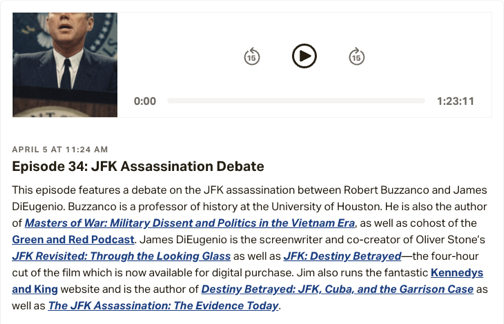
  • American Exception Episode 34: JFK Assassination Debate

    American Exception Episode 34: JFK Assassination Debate


    Click here to listen to the debate on the podcast site.


  • CNN’s Apologia for LBJ, Part Two

    CNN’s Apologia for LBJ, Part Two


    see Part 1

    Early on in Joe Califano’s book, he writes the following about LBJ and Vietnam: “He certainly thought he was doing what John Kennedy would have done…” (p. 28). Califano’s book was published in 1991. The best one can say about that statement is that, even for that time, it was ill informed, because even back then, there was evidence that this was not even close to being the case. For example, Ken O’Donnell and Dave Powers had written that Johnson had actually broken with what JFK was doing. As they stated, Kennedy was going to withdraw a thousand advisors before the end of 1963. (The authors here were referring to Kennedy’s NSAM 263 without naming it.) Kennedy then told Defense Secretary Robert McNamara to announce this to the press in October of 1963. (Johnny, We Hardly Knew Ye, p. 17) Based on the paper trail in the Pentagon Papers, Peter Scott also wrote about this withdrawal plan. (Government by Gunplay, edited by Sidney Blumenthal and Harvey Yazijian, pp. 152–187)

    CNN more or less adapts the Califano stance for this all-important issue. Why is it so important? If one is trying to salvage Lyndon Johnson’s presidency, it is imperative to somehow show that his radical escalation of the Vietnam War was really not his idea. There are two underlying reasons for doing this. First, Johnson’s escalation was not one of degree—it was an escalation in kind. LBJ would end up sending 500,000 combat troops into Vietnam. On the day Kennedy was killed, there were none there; only advisors. (The program tries to alchemize this by saying Kennedy had 16,00 troops in theater—utterly wrong.) Secondly, LBJ began Operation Rolling Thunder, the largest air bombing campaign since World War II, over both parts of the country. Even Califano admits that these American strikes extended to targets in and around Hanoi and Haiphong and close to the Chinese border. (Califano, p. 293) Kennedy never did anything like this—let alone to the extent of bomb tonnage that Johnson dropped.

    So what does the film do to relieve this heavy cross on Johnson’s back? To anyone who knows what really happened, it attempts something kind of shocking. Through Andrew Young, the film tries to say that, in December of 1964, it was McNamara, National Security Advisor McGeorge Bundy, and Secretary of State Dean Rusk who were trying to convince Johnson to go to war in Vietnam. How on earth the film makers from Bat Bridge Entertainment got Young—usually a smart guy in public—to say this is a mystery worthy of Sherlock Holmes. How they ignored all the evidence declassified by the Assassination Records Review Board which contradicts it, is even more mystifying. Let me explain why.

    II

    Two of the most important pieces of evidence in Oliver Stone’s documentary JFK Revisited: Through the Looking Glass concern the Vietnam War. Back in December of 1997, the Assassination Records Review Board declassified the records of the May 1963, SecDef meeting in Hawaii. These were regular meetings held by Secretary of Defense Robert McNamara on the progress of the war. Representatives of branches of the American government stationed in Saigon, for example CIA, Pentagon, and State, were in attendance. Those May 1963 documents were so direct and powerful that they convinced the New York Times and Philadelphia Inquirer that, at the time of his death, Kennedy was getting out of Vietnam. (Probe Magazine, Vol. 5 No. 3, p. 19) They showed that McNamara had given the order to begin a withdrawal program previously. And at this meeting various parties were submitting these schedules. To which McNamara replied: they were too slow. This supplied powerful corroboration for what O’Donnell, Powers, Scott and John Newman had written about—Newman in the 1992 edition of his breakthrough book JFK and Vietnam.

    The other important piece of evidence in this regard is a taped phone call that President Johnson had with McNamara on February 20, 1964:

    LBJ: I always thought it was foolish for you to make any statements about withdrawing. I thought it was bad psychologically. But you and the president thought otherwise, and I just silently.

    RSN: The problem is—

    LBJ: Then come the questions: how in the hell does McNamara think, when he’s losing a war, he can pull men out of there?

    That tape is played loud and clear in the film, which has been out since November of last year, but Stone could have gone even further in this regard. Because in another phone call on March 2, 1964, Johnson tried to convince McNamara to revise his prior statements about withdrawing from Vietnam. (James Blight, Virtual JFK, p. 310) Further, in a January 1965 phone call, Johnson has learned that some of Kennedy’s hires now felt the new president was trying to shift the blame for the escalation of the war from himself to his dead predecessor, which was quite a logical deduction. (ibid, p. 306)

    After his attempt to turn around McNamara on the war, Johnson set up an interagency committee headed by State Department employee William Sullivan. That committee was to plan the possible expansion of the war. (Eugene Windchy, Tonkin Gulf, p. 309) In six weeks, Sullivan concluded that nothing but direct intervention by America would stop the eventual triumph of the Viet Cong. (Joseph Goulden, Truth is the First Casualty, pp. 77­–88).

    In light of that conclusion, there is a telling point to be made about the choice of Sullivan to lead this committee. In October of 1963, Sullivan was one of the strongest opponents of Kennedy’s withdrawal plan. (John Newman, JFK and Vietnam, Second Edition, p. 410) To put it mildly, Johnson likely knew the result he was going to get from Sullivan.

    Taken as a whole, what this accumulation of evidence shows is not just that Johnson reversed Kennedy’s policy in Vietnam, but he knew he was reversing it and then tried to camouflage that reversal. It also indicates that Johnson’s intent in this regard was established fairly early. The usual point of no return is considered to be the signing of NSAM 288 in March of 1964. That document mapped out a large-scale air war over North Vietnam, which Johnson invited the Joint Chiefs to design for him. (Fredrik Logevall, Choosing War, p. 129) As one commentator wrote about it: “Henceforth the United States would be committed not merely to advising the Saigon government, but to maintaining it.” (ibid) At that time, Max Frankel of the New York Times wrote that the administration had now rejected “all thought of a graceful withdrawal.” (March 21, 1964) As Gordon Goldstein has noted, Johnson was now working hand in glove with the Joint Chiefs on these future plans. (Lessons in Disaster, pp. 108–09)

    This last is another marked difference with Kennedy. As former undersecretary Roger Hilsman wrote to the New York Times, JFK did not want any member of the Joint Chiefs to even visit South Vietnam, so the idea of him inviting them into the Oval Office to plan a massive air war there was simply a non-starter. (Letter of January 20, 1992) In other words, what Kennedy did not do for three years, Johnson did in three months.

    Make no mistake, this was a key step in Johnson’s escalation. It was the document that would supply the working thesis for future air operations Pierce Arrow—retaliation for the alleged Tonkin Gulf incident—and Flaming Dart—retaliation for the Viet Cong attack at Pleiku—and those would evolve into Rolling Thunder. All of this counters Califano’s excuse for escalation in his book: that somehow the Joint Chiefs pressured LBJ into escalating. (Chapter 2, pp. 50ff) This is made possible by Califano not mentioning or describing NSAM 288, or how that process differed from JFK.

    Why do I indicate that LBJ had all but certainly decided on a war against North Vietnam by the spring of 1964? Because one of his objectives was to get the Washington Post in his corner on this decision; so he enlisted their support in advance. In April of 1964, Johnson invited the executives of that paper, plus Kay Graham, the owner, to the White House. In the family dining room, he asked for their support for this planned expansion of the war in Vietnam. (Carol Felsenthal, Power, Privilege, and the Post, p. 234)

    III

    If that is not enough to convince the reader that the program and Andrew Young are wrong about the December 1964 date, how about this: the Gulf of Tonkin Resolution was drafted three months before it was submitted to congress. (Edwin Moise, Tonkin Gulf and the Escalation of the Vietnam War, p. 27) In other words, in May, one month after Johnson told the Washington Post he wanted their support for a future war, he had an attorney sketch a rough draft of a declaration of war in Vietnam. Like the other steps on the way to intervention, I could not find this event mentioned in either CNN’s film or Califano’s book. It would seem to me to be a quite important revelation as to intent. But let us go a step beyond it: What made Johnson rather certain that the war resolution would be used? Because Johnson’s planning even spoke of a “dramatic event” that could occur to cause the White House to go for a congressional resolution. (Moise, p. 30)

    Johnson had approved a covert action plan after Kennedy’s death. General Maxwell Taylor had drawn up designs for fast hit-and-run sea operations against North Vietnam in September of 1963, but that plan was not submitted to McNamara until November 20, 1963. (Newman, p. 385) These attacks were eventually titled OPLAN 34A. Originally, the draft of NSAM 273 limited naval forces to those of the government of South Vietnam. On November 26, 1963, Johnson altered McGeorge Bundy’s draft. When OPLAN 34A was submitted to the White House, it now allowed direct American military attacks against North Vietnam. (Newman, p. 463) As Edwin Moise shows, these PT boat operations owed just about everything to the USA and were completely controlled by Americans. (Moise, pp. 12–17) They likely could not have been done by Saigon alone.

    It was the combination of OPLAN 34A with the already-in-practice DeSoto patrols that all but guaranteed an exchange between Hanoi and the Pentagon in the Gulf of Tonkin. The PT boats were designed and equipped with armaments that could be used to attack Hanoi’s military installations near the shore, which they did. The idea was for the OPLAN 34A missions to create a disturbance and then the destroyers in the gulf could theoretically gain some kind of intelligence from the reaction. The problem was that both the boats and the ships violated the territorial waters of North Vietnam. (Moise, pp. 50–51) The PT boats attacked the islands of Hon Me and Hon Ngu off the coast of North Vietnam on the night of July 30–31. The latter was 4 kilometers off the coast, the former about 12. Hanoi was claiming their waters ended at 12 miles, therefore both islands would be within their boundaries. When the PT boats retreated, they were within sight of one of the destroyers on a DeSoto mission, the Maddox, which had just entered the gulf. (Moise, p. 56)

    Therefore all the elements were in place for a confrontation. On the night of August 2nd, Hanoi sent out three torpedo boats to counter the raiders. They were all severely damaged by American fire and four North Vietnamese sailors were killed. The Maddox endured one bullet hole from a machine gun round. In spite of this engagement, President Johnson continued the patrols and the Navy added a second destroyer, the Turner Joy, to the mission. What made it even worse is that the PT boats attacked another North Vietnamese base on the evening of the 3rd of August. (Moise, p. 97) This is why many, including George Ball of State, considered the missions to be clear provocations. (Moise, p. 100)

    Needless to say, the alleged Hanoi attack on the two destroyers on the night of August 4th never really occurred. Yet Johnson used this false reporting to launch the first American air strikes against the north, based on the NSAM 288 target list, and also to pass the Tonkin Gulf Resolution which has been penned three months earlier. (Moise, p. 212) But all of the above is not the worst. The worst is this: Johnson realized the second attack did not occur about one week after he ordered the air strikes. (Moise, p. 210)

    In light of all the above, to say that Johnson was being talked into a war by Bundy, McNamara, and Rusk in December is simply hogwash. And to say, as the program does, that Johnson was not a war monger is equally wrong. The total debate time on the Tonkin Gulf Resolution was about 8 hours. (Goulden, p. 75) And everyone sent up by the White House to testify for the resolution denied there was any connection between the DeSoto missions and the OPLAN 34A operations—which was false. (Goulden, p. 76)

    But there were two grand benefits garnered from the provocations:

    1. LBJ’s approval ratings on the war skyrocketed. As one commentator noted, he had turned his one weakness against GOP candidate Barry Goldwater into a strength.

    2. He got his declaration through. (Goulden, p. 77) The very fact he did the latter undermines what Tom Johnson says about the war: that the SEATO Treaty alone necessitated our involvement.

    IV

    Califano deals with the case of William Fulbright in one desultory page near the end of his book. (Califano, p. 360) CNN and Bat Bridge do not really deal with him at all. The Arkansas senator and Johnson had been friends prior to 1965. In fact, Johnson used Fulbright to get his Tonkin Gulf resolution through the Senate; the unsuspecting Fulbright trusted him. He ended up regretting it.

    The CNN series does not mention the 1965 invasion of the Dominican Republic either. Yet the two subjects are related, because Fulbright’s relationship with LBJ collapsed over the lies Johnson had told him about that 25,000 man Marine invasion in the Caribbean in 1965. Fulbright was the chairman of the Foreign Relations Committee. He had helped expedite both the Latin American invasion and the Tonkin Gulf resolution. Ironically, it was Fulbright’s reinvestigation of the former that led to his doubts about Tonkin Gulf and ultimately wrecked the relationship. One can even argue this was the main engine for Johnson’s capsized approval ratings, which resulted in his abdication.

    In June of 1965, Fulbright’s staff had begun to examine the reasons Johnson had given for the April 28, 1965, invasion of the island. At every opportunity, the reasons for the invasion were escalated and sensationalized. This culminated in June with the excuse that 1,500 people were killed, heads were cut off, the American ambassador called while hiding under a desk with bullets flying through windows, and Americans were huddled in a hotel screaming for protection. (Goulden, p. 166) The staff found out that this was mostly nonsense and Fulbright decided to give a scathing speech in which he said that there was simply no evidence to back up what Johnson had told him about decapitations and bullets flying through embassy windows. The democratically elected leader, Juan Bosch—who the Marine invasion fatally crushed—had been favored by President Kennedy. (Donald Gibson, Battling Wall Street, pp. 78–79) Therefore, Johnson’s reversal of JFK’s policy “lent credence to the idea that the United States is the enemy of social revolution in Latin America…” (Goulden, p. 167)

    Fulbright now suspected that maybe the White House had also lied about the Tonkin Gulf Resolution. In November and December of 1965, he and his staff now prepared for full-blown hearings on the Vietnam War. Fulbright called up administration official after official and quizzed them on both what the real purpose of the Tonkin Gulf resolution was, and if the administration had been candid about its provenance. The hearings themselves were damaging enough to Johnson, but when CBS and NBC decided to run them at full length for days on end, they began to really hurt him politically. For the first time, administration officials had to defend the remarkable escalation of the Indochina conflict and reply to questions about if the Gulf of Tonkin resolution was justified. There had been nothing like it since the Army/McCarthy hearings and there would be nothing like it again until the Watergate hearings.

    Average Americans now began to be informed about how America got into an open-ended conflict that had seemingly escalated beyond what anyone had ever thought it could be. But perhaps most importantly, the hearings dramatically illustrated the formula for the following:

    …what had happened to turn the liberal supporters of President Kennedy into opponents of the policies of President Johnson…and the right-wing opponents of Eisenhower and Kennedy into supporters of the present administration… (Goulden, p. 166)

    In other words, how Johnson had fragmented the Democratic Party beyond saving.

    Neither Califano’s book nor the CNN series figuratively lifts up the hood to show the audience just how Johnson was finally convinced to get out of Indochina. Since they will not, the present reviewer shall. After the Tet offensive, and during the siege of Khe Sanh, several foreign policy luminaries were asked to attend a Pentagon briefing at the White House—after which LBJ ranted and raved for about 45 minutes. This compelled former Secretary of State Dean Acheson to walk out. A White House staffer called him and asked him why he left. Being blunt, Acheson told him to “Shove Vietnam up your ass!” Johnson got on the phone and Acheson told him he would no longer listen to “canned briefings.” He only wanted to hear from people on the scene in Vietnam and would only accept raw data, not finished reports. About a month after this, Johnson sent his new Secretary of Defense over to the Pentagon. Clark Clifford went over the data and then quizzed the Joint Chiefs on the overall situation on the ground. He concluded that the only way to win the war was to expand it into Cambodia and Laos. Clifford reported back to Johnson that he should get out; Vietnam was a hopeless mess. (Walter Isaacson and Evan Thomas, The Wise Men, pp. 683–89; see also Clifford in the documentary film Hearts and Minds.)

    That is apparently too strong a truth for CNN and Bat Bridge Entertainment, which tells the reader a lot about the value and candor of this disappointing production. The program ends with the Richard Nixon/Anna Chennault subterfuge of Johnson’s attempt at a truce in Vietnam—which was about four years too late. (Click here for details)

    In sum, this is a disappointing and less-than-candid four-part series about Johnson and his presidency.  These kinds of programs make it difficult to understand the past, and therefore stifle our attempts to deal with the present.

  • The One and Only Dick Gregory

    The One and Only Dick Gregory


    The only comedian I can think of who I would compare to the late Dick Gregory is Mort Sahl. They were both socio-political themed stand-up comedians who, at the peak of their careers, decided to gamble fame and fortune for their political ideals. Sahl did it by deciding to become an investigator for Jim Garrison on the JFK case. Gregory did it for civil rights activists Medgar Evers and then Martin Luther King. He later became involved with people like Robert Groden and Mark Lane on the JFK case and the King case.

    The current documentary about Dick Gregory on Showtime, The One and Only Dick Gregory, makes note of the fact that, by 1962, Gregory was probably the hottest comedian in America. In fact, one of the interview subjects, Harry Belafonte, calls him the greatest political comedian ever.

    Gregory was born in St. Louis, went to high school there, and then attended Southern Illinois University on a track scholarship. He was drafted into the army and won some talent shows as a comedian. When he returned from the service, he dropped out of college and went to Chicago to try and become a professional comedian. He was one of the very few comedians who decided to make racial issues funny: “Segregation is not all bad. Have you ever heard of a collision where the people in the back of the bus got hurt?”

    This kind of comedy got him noted in both Chicago and New York City. One of his first record albums, East and West, was done in New York. (Between 1961 and 1964, he did seven albums.) When he returned to Chicago, he received what most commentators note as his big break. He replaced Professor Irwin Corey for what was supposed to be one night at the Playboy Club. One of the jokes he cracked that night went like this: “I understand there are a good many Southerners in the room tonight. I know the South very well, I spent twenty years there one night.” He was such a hit that the one-night stand turned into six weeks. One notice read as follows:

    Dick Gregory, age 28, has become the first Negro comedian to make his way into the nightlife club big time.

    Another said:

    What makes Gregory refreshing is not only that he feels secure enough to joke about the trials and triumphs of his own race, but that he can laugh, in a sort of brotherhood of humor, with white men about their own problems…

    This highly successful Chicago appearance caught the attention of Jack Paar. After Steve Allen, Paar was the second steady host of The Tonight Show. It was Paar who made the show into the institution it became. Paar was not just funny. He was intelligent, informed, curious, and principled. In other words, he was just the kind of late-night host who Dick Gregory would appeal to. As the comedian later added, it was not just the fact that Paar had him on national television, it was what happened afterwards. The host invited him over to the panel to talk. That is what was important. At that time, such a display of integration was unusual. According to the film, it blew the NBC switchboard out. Because of his new notoriety, CBS newsman Mike Wallace did a profile of him.

    From there it was on to the likes of Ed Sullivan and Merv Griffin. Greg, as his friends called him, also wrote an autobiography called Nigger, co-written with Robert Lipsyte. Amazingly, in nearly sixty years, that book has never been out of print.

    II

    At this point in the film, director/writer Andre Gaines begins to describe his subject’s transition from a pointed stand-up comic to a socio-political activist. As the sixties heated up, it wasn’t enough for Dick Gregory to say things like, “Football is the only place where a black man can knock down a white man and 40,000 people cheer.” Or, in satirizing liberals, “They all say, some of my best friends are colored, but there just aren’t that many of us.” Or in pointing out the hypocrisy of the court system: “A black guy robs a bank of $20,000 and he gets four years in Alcatraz. A white guy embezzles 3 million and he gets three years.” As civil rights demonstrations broke out in the south, Greg began to empathize with what was happening. As he put it, since he was from the north, he was not really aware of how bad the Jim Crow situation was down south. Even though he was making a lot of money at this time and he was peaking in his professional career, he decided that, whatever the consequences, he was going to get involved with the struggle for civil rights.

    And he began to adjust his humor as this happened: “A white guy kills 2 black demonstrators with his car and the cop arrests the dead guy 500 yards away for leaving the scene of an accident.” He did civil rights work first for Medgar Evers, who he very much admired for his voter registration drives. Gregory also became involved with the famous case of the three missing civil rights workers in Neshoba County, Mississippi—James Chaney, Andrew Goodman, and Michael Schwerner. He suspected the sheriff’s office was involved. He then offered a reward for information on the case. The FBI followed his lead of offering reward money. It worked. The bodies were found and the case was solved.

    The film notes that his publicist sued him at this time, since Greg had sacrificed $100,000 worth of appearances—the equivalent of about a million bucks today—in order to work the South with Medgar. At this time, Gregory was getting $5,000 per nightclub/concert appearance. Instead, he chose to risk getting arrested by participating in civil rights drives in places like Mississippi and Alabama.

    As the film shows, he did get arrested. Beyond that, he got his arm broken while being battered with a baseball bat. (Dick Gregory and Mark Lane, Murder in Memphis, ebook version, p. 29) He was very much depressed when Evers was assassinated in the summer of 1963. But he pressed on, getting arrested even more. As he put it, what these activists were doing was more important than what he was doing. When the famous 1965 Watts riots broke out in Los Angeles, he said on TV, “I just got back from Los Angeles, Vietnam.” The film dramatizes his message at the time. Greg was saying that this was not a problem confined to the black community, it was an American problem. The film then juxtaposes excerpts from rioting in Harlem in 1964 with those from Ferguson in 2014.

    From here, the film begins to show that, as Gregory now became associated with Martin Luther King, like King, he began to become a vociferous critic of the Vietnam War. And as this occurred, J. Edgar Hoover and the FBI began to keep files on the comedian; they also tapped his phone and drew up methods of neutralizing his impact. Greg decided that, for this particular anti-war message, he had to speak at colleges and universities. He began to attract large crowds and he would harangue the United States for building this Military Industrial Complex and using it against the people of Vietnam. The regents of the University of Tennessee banned him from speaking on campus. They said he was an “extreme racist” and his presence would insult much of the state’s citizenry. The students sued and they hired noted radical lawyer William Kunstler to present their case. They won in court and Gregory finally spoke there in 1970. In 1969, Gregory spoke at the huge moratorium against the war in Washington DC.

    Not mentioned by the film are the comedian’s political races. Dick Gregory (unsuccessfully) ran against Richard J. Daley for the office of mayor of Chicago in 1967. He then ran as a write-in candidate for the President of the United States in 1968. (Gregory and Lane, p. 7) In some states, Mark Lane was his running mate. In some other states, his running mate was Dr. Benjamin Spock, the famous pediatrician. Gregory later wrote one of his many books about this campaign. That election attempt landed him on Richard Nixon’s enemies list.

    As the film depicts, King’s assassination resulted in a huge wave of riots in well over 100 cities across America. The year 1968 almost brought the United States to a point of civil war. Gregory humorously commented on this state of siege. On stage, he would bring out a large violin case. He opened it and pulled out a tommy gun. He then pulled out a bow and started playing the machine gun.

    III

    At this point, the film notes that one of the methods Greg used to protest the war was by fasting. And I thought that it would be at this juncture that writer/director Andre Gaines would cut to the event that was probably the crystallization of Greg’s political career. I am, of course, referring to the night of March 6, 1975. That was when the Zapruder film was shown for the first time on national television. The three main guests that night on the program Good Night America were Geraldo Rivera as host, Robert Groden as the photo technician who had recovered a copy of the film from Life magazine, and Dick Gregory. It is not an understatement to say that the showing of this film on national TV electrified America. It put the Kennedy assassination back on the national agenda. It now became a topic of conversation at lunch and around water coolers at work.

    By this time, Dick Gregory had become convinced that something had gone politically wrong with America after 1968. And, on top of that, the fact that JFK, Malcolm X, King, and Bobby Kennedy had all been snuffed out in a span of five years—that was just too much to swallow as simply a coincidence.

    Gregory had known King and President Kennedy. Greg was at the March on Washington, which was sponsored by the White House and at which King had spoken so memorably. (Gregory and Lane, p. 6) He had been asked to come down to Birmingham in 1963 for the huge demonstration that several civil rights leaders had combined forces on. President Kennedy called him at home and asked him not to go, since they were working on a solution to the conflict and further demonstrations could imperil it. Greg appreciated the call, but said he felt he had to go. (ibid, pp. 30–33)

    As the comedian told this reviewer, when he returned from Birmingham, his wife told him that Kennedy had called again and wanted him to return his call the moment he got in. Gregory noted the late hour, but his wife said JFK told her it did not matter what time it was. So Dick Gregory called the White House and Kennedy picked up the phone. The president said to the comedian words to the effect that he needed to know everything that happened in Birmingham. Greg went on for about ten minutes describing the whole ugly mess. When he was done, Kennedy replied with “Oh, we’ve got those bastards now!” At this comment, Gregory started weeping. (2003 Interview with Joe Madison and Gregory in Washington on WOL Radio One)

    This is probably the reason he was quite interested in Kennedy’s assassination. But Greg was even closer to King. And the film shows them on stage together. In 1977, Mark Lane and Dick Gregory combined to author a book on King’s assassination. At that time, it was titled Code Name Zorro, since they had learned from FBI agent Arthur Murtaugh that “Zorro” was the FBI’s moniker for King. When it was republished in a revised version in 1993, the volume was now titled Murder in Memphis. To this day, it is a seminal book on the King case.

    Very early in that volume, Gregory notes that it was when King turned against the Vietnam War that his image in the public mind was altered.

    When King made his famous speech on April 4, 1967, in New York condemning the conflict in Vietnam, he was now perceived as an enemy of the Power Elite. (Gregory and Lane, p. 6) Later in the book, Greg outlines how even those involved in the civil rights movement were taken aback by King’s harsh stand on the Vietnam issue, for the simple reason that they knew that Vietnam had become President Johnson’s personal fiefdom. He was the one who had escalated that war to a magnitude beyond President Kennedy’s imagination. These other civil rights leaders understood that there was a danger that Johnson would take King’s condemnation as a personal assault and the president would turn his back on their cause. (Gregory and Lane, p. 51) And as Greg said so perceptively later in that book, King was expanding his vision of American civil rights to universal human rights. (ibid, p. 56)

    King’s anti-Vietnam War speech was criticized by both the New York Times and Washington Post. It’s hard to comprehend today, but both of those MSM outlets were still supporting what Johnson was doing in Indochina at that time. (Click here for details) As Gregory notes in Murder in Memphis, it was William Pepper’s famous photo essay in Ramparts magazine that had energized King in this regard. (Click here for details)

    IV

    But as Gregory also points out in Murder in Memphis, the antipathy for King amid the Power Elite was exponentially increased when he also announced his plans for a Poor People’s March in Washington. There was a good reason for this march. As many commentators have noted, what had happened under Johnson was simple to comprehend. And, in fact, he himself knew it. Johnson’s vision of a Great Society had crashed on the shores of Da Nang in Vietnam. Or as King himself had declared:

    Many of the very programs we are talking about have been stifled because of the war in Vietnam. I am absolutely convinced that the frustrations are going to increase in the ghettoes of our nation as along as the war continues. (Gregory and Lane, p. 54)

    In other words, as King said to newsman Sander Vanocur, the dream he talked about in his March on Washington speech in 1963 had, in some respects—between the race riots and Vietnam—become a nightmare. As Gregory noted, the Poor People’s March posed the possibility of exposing this nightmare, and not just to LBJ, but congress. In fact, Murder in Memphis contains an appendix in which Senator Robert Byrd made a vituperative speech against it. (Speech of March 29, 1968) The Poor People’s March provoked meetings at the White House, the Department of Justice, the Pentagon, the Metropolitan Police, and the FBI. (ibid, p. 57; the best book on this is probably Gerald McKnight’s The Last Crusade published in 1998) The combination of King’s assassination, plus the massive interference and surveillance with the march turned it into a failure.

    Dick Gregory was correct when he described King as turning in his last years towards a different agenda. About that there should be little or no doubt:

    In a sense you could say we are engaged in a class struggle, yes. It will be a long and difficult struggle for our program calls for a redistribution of economic power…I feel that this movement in behalf of the poor is the most moral thing—it is saying that every man is an heir to a legacy of dignity and worth. (Speech of March, 1968)

    Or as King—echoing Bobby Kennedy—put it more succinctly: “What good it is to be allowed to eat in a restaurant, if you can’t afford a hamburger.” (Sylvie Laurent, King and the Other America, p. x) As Gregory wrote in Murder in Memphis, the dilemma that King was trying to expose was multi-dimensional. It not only would pose problems for Johnson, the White House, and Congress, but it would probably be an international problem. As the comedian wrote:

    What would this do to our image as the richest nation in the world? What about those countries who were not aware of America’s racial problems of poverty and hunger? … White reaction to the planned Poor People’s March was astonishing. A headline in Readers’s Digest magazine a few days before King was killed read, “The United States may face a civil crisis this April when a Poor People’s Army pitches camp in the nations’ capital. (Gregory and Lane, p. 57)

    As Dick Gregory was saying, and as Sylvie Laurent amplified later, King was now trying to stretch his populist coalition. And MLK explicitly stated it in his own terms:

    The unemployed poverty-stricken white man must be made to realize that he is in the very same boat with the Negro. Together, they could exert massive pressure on the government to get jobs for all. Together, they could form a grand alliance. (Laurent, p. 8)

    Due to King’s murder and the powerful forces arrayed against what was left of the Poor People’s March, it failed. As Laurent wrote:

    On June 24, 1968, the makeshift housing Martin Luther King Jr. had dreamt of, built on the mall in Washington DC and known as Resurrection City was wiped out. Police tear gas filled the air. Hundreds of people were arrested. Bulldozers smashed the plywood shacks. (Laurent, p. 1)

    As Richard Nixon later said, it was that image and the dispersal of those people that combined to help elect him. (ibid) The grand alliance King was designing ended up dissipated. The reverse, namely Nixon’s southern strategy, was later used by Ronald Reagan, and then given broadcast voice by Rush Limbaugh and Fox News. King’s unification strategy was now somewhere in the ozone. Roger Ailes’ and Pat Buchanan’s polarization policy ruled the day.

    That would have been a powerful coda with which to end The One and Only Dick Gregory.

    V

    The only trace of this that I could detect was near the very end of the film. On a last kind of 2015 comeback tour, two years before Greg died, there is a brief glance at Pepper’s book The Plot to Kill King on a chair. If I missed something, I hope someone can remind me of it.

    So, what does approximately the last third of the film deal with? Gregory turning into a fitness expert and a health foods businessman. He moved his family to a forty-acre farm in Plymouth, Massachusetts, in 1973. He began to sell vitamins and nutrition products. He also was one of the first to argue for the primacy of natural water in everyone’s diet. He stopped playing nightclubs and there was no more alcohol consumption or smoking for him. Harking back to his college days, he became an avid runner. And his cause now was to erase world hunger. He fasted for that one also.

    He created something called the Bahamian Diet nutrition drink. This ended up being very successful. After having some legal problems in the mid 1980’s which tied up much of his assets, he settled the lawsuit and sold the business for millions.

    But Greg never really lost his affinity to protest injustice. Another part of his life was devoted to exposing the CIA/cocaine scandal of the late nineties. At that time, he actually went out to CIA HQ in Langley, Virginia, and unspooled yellow tape around the building. Because as he said, “We know where the criminals are.”

    Andre Gaines’ film is a passable chronicle of the showbiz side of Dick Gregory, but it does not do justice to what made the man the true icon he was. Perhaps that was the price of getting people like Chris Rock and Dave Chappelle and Kevin Hart to appear. If it was not, then Gaines made a mistake. His film should be called The One and Only Dick Gregory (Censored Version).

  • CounterPunch Whiffs Again!

    CounterPunch Whiffs Again!


    On July 15th, CounterPunch did it again.  The occasion was an article comparing the final withdrawal of American troops from Afghanistan with the American debacle in Indochina.  Author David Schultz used the famous line, this time attributed to Hegel, that the only lesson we learn from history is that we do not learn from history. He wrote that as the Taliban now takes over some of us “wonder if this is not Déjà vu all over again and that what we thought we had learned from the Vietnam War proved to be a fleeting lesson.”

    Schultz goes on to note the Kent State shooting, helicopters over the embassy in 1975, the domino theory, over 58,000 dead American soldiers, tens of billions wasted.  He then mentions some of the literature on the Vietnam War.  First off is Francis FitzGerald’s Fire in the Lake which tried to accent how different the culture of Vietnam was and how the American military did not understand it.  Then, of course, since this is CounterPunch, Schultz has to mention David Halberstam and The Best and the Brightest.

    Here is how Schultz quantifies Halberstam’s book.  He writes that it pointed to:

    ….the arrogance of the Kennedy administration in failing to understand that Vietnam was more about colonial independence than it was about communism and Cold War rivalry.

    As I have indicated too many times to enumerate here, this misses two major points about Halberstam.  First, Halberstam completely revised his view of Vietnam between his first book, The Making of a Quagmire, and his second book on the subject The Best and the Brightest.  In that first book, Halberstam  criticized Kennedy for not being militant enough in Vietnam. In 1965, Halberstam said that Kennedy should have gotten America in earlier. In fact, that book is an utterly coruscating critique of American policy in Vietnam until 1965. The hero of the book is Colonel John Paul Vann.  Why?  Because Vann knew how to win the war! (See Chapter 11) Halberstam is even more explicit about this later when he declares, “Bombers and helicopters and napalm are a help, but they are not enough.” (p. 321)  He then gives us his Schultzian lesson about Vietnam: “The lesson to be learned from Vietnam is that we must get in earlier, be shrewder, and force the other side to practice self-deception.” (p. 322)

    Halberstam’s role model in 1965, Vann, thought that if America was going to win the war, American troops were needed. (See the Introduction to the 2008 edition by Daniel Singal, p. xi) Well, Lyndon Johnson gave Vietnam about 500,000 American troops and it did not work out very well. Since Halberstam started writing The Best and the Brightest in about 1968, when this had all clearly turned out to be a disaster, the author decided to cover his tracks.  Back in 1963, Kennedy did not like what Halberstam and Vann were trying to do––which was move toward escalation by criticizing what they saw as JFK’s timidity. (David Kaiser, American Tragedy, p. 261) So therefore, even though America had been involved in Vietnam for eleven years prior to Kennedy’s inauguration, Halberstam focused a large part of 1972’s The Best and the Brightest on the years 1961-63, virtually ignoring what the Eisenhower administration had done to secure a commitment to Vietnam.  Eisenhower had, in fact, created a new country there, one that had not existed prior to 1954. And since America had created it, then America was obliged to defend it.

    By relying on Halberstam’s museum piece, Schultz gets the other part he writes about wrong also. President Kennedy did comprehend what the Vietnam war was about.  He understood the true circumstances because of his association with Edmund Gullion going back to Saigon in 1951. (Click here for details) This is why he refused to commit combat troops in theater. During the crucial debates in November of 1961, Air Force Colonel Howard Burris took notes. They are contained in James Blight’s book, Virtual JFK (pp. 282-83)

    Kennedy argued that Vietnam was not a case of aggression as was Korea. Therefore, America would be subject to intense criticism from even her allies. He then argued that the French had spent millions there with no degree of success. He also argued that the circumstances were such that even Democrats in Congress would have a hard time defending such a commitment. Further, one would be fighting a guerilla force, “sometimes in phantom-like fashion.” That would mean whatever base of operations American troops had would be insecure. Burris noted that during the debate, Kennedy turned back attempts by Dean Rusk, Robert McNamara, McGeorge Bundy and Lyman Lemnitzer to derail his train of thought.

    I don’t see how one can locate a more defining moment, or show how well Kennedy really understood what the facts of the war were than this.  One can argue that Ed Lansdale had been the first person to suggest inserting combat troops into Vietnam, something Kennedy refused many, many times. (John Newman, JFK and Vietnam, first edition, p. 20; Gordon Goldstein, Lessons in Disaster, p. 52) After Kennedy’s death, when Lansdale returned to the White House, he recommended sending John Paul Vann back to Vietnam. Vann did return in 1965, when Lyndon Johnson overturned Kennedy’s policy by sending tens of thousands of combat troops into Vietnam. (David Kaiser, American Tragedy, p. 384). Using David Halberstam today as any measure of what happened in Vietnam would be like cranking up a Model T Ford to make a cross country trip.  Halberstam was the author who called 1964, the “lost year” in Vietnam. Geez Dave, wasn’t the Tonkin Gulf Resolution kind of important? (For more on Halberstam click here”>)

    Another issue with the article is its comparison with how America got into Vietnam and how America got into Afghanistan. Schultz writes that America got into the latter as a result of the attacks of 9/11. Which is only partly true.  America was involved even before the Russian invasion of Afghanistan in December of 1979. President Carter had allowed the CIA to operate in the country at his National Security Advisor’s request. The late Zbigniew Brzezinski predicted that such aid would likely induce a Soviet invasion and that would give the USA an opportunity to hand Russia its own Vietnam. (January, 1998, interview with Le Nouvel Observateur)  As most people know, the CIA now began to back the struggle of the Islamic radicals against the Russians. This included Osama Bin Laden. Much of this aid went through Pakistan.  And in return, America agreed to look the other way as that country built a nuclear weapon. (James DiEugenio, The JFK Assassination: The Evidence Today, p. 386)

    Unlike America’s commitment to Vietnam, the Russians never had more than 120,000 troops in theater. Mikhail Gorbachev recommended a peace agreement before the Russians formally withdrew in 1989. The concept was to leave behind Mohammad Najibullah as president and he would form a coalition government with some of the more moderate tribes. The goal was to marginalize the Islamic fundamentalists. For whatever reason, the USA would not sign onto this sensible agreement. (The New Yorker, 9/29/2009, article by Steve Coll) There were warnings from people like the late Benazir Bhutto that were quite frank and accurate.  She said, “You are creating a Frankenstein.” (Newsweek, 10/1/2001, article by Evan Thomas)

    Bhutto was correct.  Unlike the Tom Hanks depiction of the late congressman Charlie Wilson, the congressman backed this decision. (DiEugenio, p. 387) America actually gave aid to some of these deplorable fundamentalists, e.g., Jalaluddin Haqqani and Gulbuddin Hekmatyar. The one decent tribal leader in the area, Ahmad Shah Massoud, only got a fraction of what those two men received. (Alternet, 12/20/2007, article by Melissa Roddy)

    As Bhutto and Gorbachev predicted, the country descended into a horrifying civil war. After three years, Najbullah was dislodged.  Pakistan then sent in its own charges, the Taliban, who backed Sharia Law. Najbullah was taken prisoner, mutilated and killed in late 1996. Massoud held out for years until he was assassinated two days before the 9-11 attacks.

    This is not just an interesting story for what it says about Tom Hanks and his cartoonish movie Charlie Wilson’s War. But also because, after Massoud’s demise, the Taliban took over the country.  It became a hiding place for Osama Bin Laden.  More specifically, the Battle of Tora Bora, featuring American special forces, took place there in December of 2001. The result was, again for whatever reason, Bin Laden escaped into Pakistan.

    On October 7, 2001, George W. Bush launched his invasion of Afghanistan, which dislodged the Taliban. President Obama reduced this operation significantly. And now President Biden will, perhaps, finally end it.

    One can argue that, in all this, America was still fighting the Cold War, except this time it was in Afghanistan, not Indochina.  But was there really a reason to do this? Especially in light of Gorbachev’s peace offering? To me, that is the real resemblance of the two situations. In the first instance, America created a country in the name of the Cold War. In the second, America decided to radically Islamize a country in the name of the Cold War.

    In the first instance, we know Kennedy did not agree with the policy and was withdrawing at the time of his death.  With what this author has discovered about Kennedy and the Middle East, I doubt very much he would have sided with the radical Moslems. (Click here as to why )

    But that is a story CounterPunch could never tell.

  • Jonathan Chait meets Michael Kazin

    Jonathan Chait meets Michael Kazin


    Almost any notice in the media about John F. Kennedy will supply an excuse for someone in the MSM to write a derogatory article about him. As we have seen, Michael Kazin used the occasion of a recent book about Kennedy to do a hit piece on him in The New York Review of Books. (Click here for details) Recently, a panel of scholars for C-SPAN did a poll ranking past presidents, including Donald Trump. Journalist Jonathan Chait didn’t like it. Why? Because Kennedy ended up in eighth place. Chait thinks this was unwarranted. Therefore, New York Magazine let him do a Kazin: that is a hit job on the slain president. (June 30, 2021)

    What is immediately noticeable about these rants is this: None of the writers knows very much about Kennedy or his presidency. But they pretend they do. For instance, Chait writes that Kennedy made some promises on civil rights in his presidential campaign, but abandoned them when he saw this would offend southern conservatives. The thinking being that it would stop the passage of his other domestic programs.

    As I have explained before, this is a liberal orthodoxy that has a serious problem with it. It isn’t true. This author spent months studying the issue for a four-part series about the Kennedys and civil rights. (Click here for that series)

    Kennedy did not abandon civil rights at all. He was advised by his specialist on the issue, Harris Wofford, that it would be very difficult to pass an omnibus civil rights bill in his first year and probably even in his second year. After all, there had been nine different attempts to pass such a bill since 1917 and they all failed. (Irving Bernstein, Promises Kept, p. 39) Wofford therefore advised Kennedy to issue executive orders and also to rely on the court system, through the Attorney General, to further the cause. The hope being that this would create a furor over the issue that would tilt the balance in the House and Senate. That would then make it possible to pass such a bill.

    That is what Kennedy did; and that is what happened. Anyone can read about this in more than one book (e.g. Wofford’s Of Kennedys and Kings, or Irving Bernstein’s Promises Kept). (Bernstein, pp. 40–41, 48–50)

    To list all the things that Kennedy did for civil rights in just his first year illustrates the utter fallacy of what Chait is trying to sell. Right out of the chute, JFK and his brother intervened in the New Orleans school segregation court case, something that President Eisenhower had avoided. (Jack Bass, Unlikely Heroes, p. 122) Eisenhower’s failure to act allowed the state legislature to pass laws attempting to curtail and avoid the court’s decision to implement Brown v Board. When Bobby Kennedy got the news about this scheming he replied, “We’ll have to do whatever is necessary.” (Bass, p. 131)

    The Kennedy administration did something that the Eisenhower administration would never have dreamed of doing. The Attorney General filed charges against the state Secretary of Education, Shelby Jackson. The idea was to stop the governor’s attempt to cut off funding for integrated schools. (Bass, p. 135) When a trial date was set, Jackson backed off and said he would not interfere. This episode began in February of 1961, a month after Kennedy’s inauguration.

    A similar case occurred in Prince Edward County, Virginia. Due to scheming by the governor and legislature, Prince Edward County had no schools to attend. Again, Eisenhower said he could not do anything about it. Shockingly, he even said states were not required to maintain a school system and, therefore, the president was “powerless to take any action.” (Brian Lee, Ph. D. thesis, A Matter of National Concern, p. 50)

    Again, the Kennedys reversed Eisenhower’s course. The president now began to remake the 4th Circuit Court of Appeals governing Virginia and nearby states. (Lee, p. 6) But the Kennedys also began doing two things that were, again, unprecedented. First, they joined the NAACP lawsuit as a plaintiff, not a friend of the court. Secondly, realizing the court reworking would take time, they appointed family friend William Vanden Heuvel to raise a large amount of money. The idea was to build, from scratch, a free school system to educate the African American students, so they would not fall further behind. (Lee, pp. 145–50)

    Did Chait miss all of this? Well, no surprise, since he also missed those two executive orders that Kennedy signed for affirmative action. The first was written in his first year, which again, no president had ever done before. (Bernstein, p. 56) Finally, Attorney General Bobby Kennedy made it a point to speak at the University of Georgia Law School. He spent half the address talking about civil rights. He said he would enforce the Brown v. Board decision. As historian Carl Brauer wrote, this was the first time anyone could recall an Attorney General speaking out on the issue in the South. (Carl Brauer, John F Kennedy and the Second Reconstruction, p. 95)

    That was in May of 1961. Again, we are to assume that Chait missed all of this, which is weird, since it was all unprecedented in the field. But that was just the beginning of a crescendo that led to the submission of Kennedy’s omnibus civil rights bill in February of 1963. (For the rest of the story, click here)

    Chait leads off his article by saying that Kennedy was elected due to his youth and his campaigning about the missile gap. He leaves out the fact that there was only a four-year difference in age between himself and his opponent Richard Nixon. Considering his second point, in Kennedy’s acceptance speech in Los Angles at the Democratic convention, there was no mention of a missile gap. He talked about things like separation of church and state, racial discrimination, the plight of the poor, and said this was no time to try and uphold a status quo that was not working. (Click here for the address) At a famous speech in September, which he gave before the Liberal Party in New York, again one will find no mention of a missile gap. But one will find the following: Kennedy tried to define what he thought the word liberal meant in a political sense, as opposed to how the Republicans defined it:

    But if by a Liberal, they mean someone who looks ahead and not behind, someone who welcomes new ideas without rigid reactions, someone who cares about the welfare of the people—their health, their housing, their schools, their jobs, their civil rights and their civil liberties—someone who believes that we can break through the stalemate and suspicions that grip us in our policies abroad, if this is what they mean by a Liberal, then I’m proud to say that I’m a Liberal.

    Kennedy went on to say that he also believed “…in a government which acts, which exercises its full powers and full responsibilities.” He continued by saying that when government “has a job to do, I believe it should do it.” This was then exemplified by his above actions in his first year on the civil rights issue, which, as I showed, were starkly different than Eisenhower’s. (For the whole speech click here)

    One of the nuttiest things that Chait writes is that Kennedy was a man out of his time period, because he thought there were no great problems to solve, no great dragons to slay, and no great compromises to be made. That Chait could borrow that comment from one of the worst biographers of Kennedy, the late Richard Reeves, tells you just what his game is, because Kennedy says just the opposite in both of these speeches. A constant refrain is his haranguing the GOP for not facing up to the problems as he perceives them: of the urban poor, of dispossessed farmers, of creating an imaginative foreign policy. And he clearly implies that a party of Coolidge, Hoover, and Taft simply could not really do anything about these dilemmas. He contrasted that with people like FDR, who chose to act in a time of crisis. And he compared the 1960 election to that of 1932. In other words, the Democrats could do something and would use government to solve problems.

    Chait tries to define Kennedy’s foreign policy by using the Bay of Pigs as an example. He then says, in regards to the Missile Crisis, that the president bungled his way into a nuclear showdown over Cuba. I hate to confront Mr. Chait with the facts, but I must. It was the Russians who placed a first strike capability in Cuba. This featured all three arms of the nuclear triad: long and medium range missiles, bombers, and submarines. In addition, they had 45,000 troops on the island and had also given Fidel Castro tactical atomic weapons. (James DiEugenio, Destiny Betrayed, second edition, p. 66) These would have annihilated any large invading force. This was all done in secret, knowing that Kennedy had insisted there be no offensive weapons in Cuba. And when, due to U2 photography, Kennedy inquired about them, the Soviet foreign minister lied to him about their presence. (Ernest May and Philip Zelikow, The Kennedy Tapes, p. 169) When it came time to confront the situation, Kennedy chose the least provocative action: no invasion, no air strikes, but a blockade. Choosing that option gave each side time to resolve the crisis peacefully. Anyone can read the transcripts of these taped conversations. Clearly, Kennedy was keeping the hawks at bay almost throughout. For a good example, read the record of his meeting with the Joint Chiefs, especially note their derisive comments about the president after he leaves the room. (May and Zelikow, pp. 173–88)

    As we can see, Chait’s article, like Kazin’s, is not factually based. His real point is to try and reverse the concept that somehow there was a step down in class and achievement from Kennedy to Lyndon Johnson. For instance, he writes that two programs that Kennedy was trying to get passed, but could not, were federal aid to education and health care for the elderly. As Irving Bernstein has written, Kennedy did get federal aid to education through the senate in October of 1963. (Bernstein, p. 241) Kennedy failed to get a Medicare bill through in 1962, but what Chait leaves out is that Kennedy was bringing it back for consideration through powerful congressman Wilbur Mills in 1963. And on the morning of November 22, 1963, Kennedy’s congressional liaison, Larry O’Brien wrote that “with Mill’s objections met, the passage of Medicare was assured.” (Bernstein, p. 258) In other words, Kennedy had set the table for Johnson on these two bills.

    This meme is continued when Chait lists the Civil Rights Act of 1964, the Voting Rights Act of 1965, and the War on Poverty as Johnson’s achievements, giving no credit to Kennedy or anyone else. As I have mentioned several times, the idea that Johnson got the Civil Rights Act of 1964 passed is a myth supported by establishment figures like Robert Caro. Clay Risen, who wrote a book about the passage of the act, has shown why it is a myth. (Click here for details)

    President Johnson told Martin Luther King that he could not get the Voting Rights Act passed on his own. The only way he could so was if King did something to give him the torque to implement it. King did so by staging the Selma demonstration, which he was already arranging before Johnson told him this. (Louis Menand, “The Color of Law”, The New Yorker, 7/1/2013)

    The War on Poverty began after Kennedy read Dwight MacDonald’s review of Michael Harrington’s The Other America. (Thurston Clarke, JFK’s Last Hundred Days, pp. 242–43) In June of 1963, JFK was already thinking past the Civil Rights Act he had submitted to congress. So he called in his chief economic advisor, Walter Heller, and they began to formulate a plan to counteract pockets of poverty. After Kennedy was assassinated, Heller told Johnson about this plan he and Kennedy had formulated. In other words, the War on Poverty was not Johnson’s concept. It was Kennedy’s. In his jihad to inflate LBJ and downgrade Kennedy, this is how anti-historical Chait becomes.

    If one can comprehend it, Chait even tries to elevate LBJ at Kennedy’s expense over what became Johnson’s disaster in Indochina. With all we know about Vietnam today, I would have thought no one would even think of doing this. But one should never underestimate the stubbornness and perversity of the MSM. Chait begins by saying that it is an unproven assumption that Kennedy would have pulled out of Vietnam. That worn out standby is not sustainable today. With all the information that the Assassination Records Review Board declassified, combined with the work of writers like Gordon Goldstein, Howard Jones, David Kaiser, Jim Douglass, James Blight, and the revised version of John Newman’s JFK and Vietnam, there is little or no question about the issue: Kennedy was getting out of Vietnam. We have a veritable cornucopia of evidence to prove it. And he was going to enact that withdrawal around the 1964 election. (Click here for details)

    Johnson was aware of this plan and within 48 hours of the assassination he started to reverse it. (James Blight, Virtual JFK, p. 310; also see Chapter 23 of the 2017 version of Newman’s JFK and Vietnam.) Contrary to Kennedy, Johnson’s concept was to work his escalation plan around the 1964 election. In other words, as he was saying things like he wished no wider war and he did not want to send American boys to die in a war that Asian boys should be fighting, he was arranging to do just that. This has been proven by too many scholars to belabor the point here. But to name just three: Gordon Goldstein’s Lessons in Disaster, Fredrik Logevall’s Choosing War, and Edwin Moise’s Tonkin Gulf and the Escalation of the Vietnam War.

    Chait now writes that Kennedy’s policies laid the groundwork for Johnson’s escalation; due to the calculation that no Democrat could lose a territory to communist expansion. I threw my arms up at this one. If Kennedy was withdrawing at the time of his death and Johnson stopped that withdrawal, planned on going to war in Indochina, effectively declared war on Vietnam, and then invaded the country with hundreds of thousands of combat troops—how did Kennedy lay the groundwork for that? In November of 1961, with NSAM 111, Kennedy drew the line: he refused to send combat troops to Indochina. He never crossed that line. There was not one more combat troop in Vietnam on the day he was killed than on the day he entered office. Johnson not only sent half a million combat troops there, he also initiated one of the largest American air wars ever devised, Rolling Thunder, to try to bomb North Vietnam into submission. Does any credible person think that Kennedy would have countenanced these things, let alone allowed them to happen?

    This relates to Chait’s other point about the fear of “losing Vietnam.” Kennedy simply did not think that Vietnam was worth going to war over. Just like he did not want to commit combat troops to Laos, even though Eisenhower had advised him he might need to do so. (Newman, p. 9) Kennedy was a more sophisticated thinker about the Cold War than Johnson was. For him, Berlin was a flash point, since he was not going to let the Atlantic Alliance be challenged, but Vietnam was simply not worth the price. And this indicates how uninformed Chait is about JFK. Kennedy understood just how hopeless an imperial conflict would be in Vietnam. He comprehended this due to his relationship with diplomat Edmund Gullion in Saigon way back in the early fifties, where he saw firsthand the doomed French effort to recolonize the area. (Click here for details) He also understood the problem from his Ambassador to India, John K. Galbraith who wrote him a memo to counter the hawks who wanted him to intercede in 1961. (Click here for more)

    Compare that to LBJ. Johnson actually said that, if he left Vietnam, he would be doing what Neville Chamberlain did at Munich with Hitler and Mussolini. He then compared losing Vietnam to losing China and that the former would be even worse than the latter. He concluded that reverie with the following:

    Losing the Great Society was a terrible thought, but not so terrible as the thought of being responsible for America’s losing a war to the Communists. Nothing could possibly be worse than that. (Blight, p. 211)

    Can anyone conceive of Kennedy saying such things? There is no evidence for it. In fact, as I noted in my review of John Newman’s revised version of JFK and Vietnam, Kennedy told many people that Vietnam was a hopeless struggle, which America could not win. Therefore, he was getting out. (James Douglass, JFK and the Unspeakable, p. 183) What is so incredible about Chait’s abomination is that, at the end, he concludes that Kennedy’s rating in the poll is due to a lack of analysis. We have just seen what analysis does to Chait.

    Make no mistake, Chait’s handiwork is not an accident. As Jeff Morley wrote in his recent e book about his lawsuit against the CIA, no one ever got ahead in the journalistic world trying to expose new facts about Kennedy’s assassination. Well, since 2013, the same figure applies to Kennedy’s presidency, especially in light of the fact that we now know what happened in Indochina as a result of his death. And since that switch in policy came so fast, perhaps—just perhaps—the two events were related. And if such was the case, how could the MSM have missed it with such completeness?

    As noted at the start, I recently wrote about Michael Kazin’s similar hatchet job about Kennedy’s presidency, disguised as a review of Fredrik Logevall’s book JFK: Coming of Age in the American Century. Well, if one looks back to 2013, Kazin did the same in the pages of The New Republic. At that time, he was allegedly reviewing Thurston Clarke’s book JFK’s Last Hundred Days. (July 15, 2013) As was the case of Kazin with Logevall, it was a review that was not a review. It was a way to downgrade Kennedy and wonder out loud: Geez, why does anyone pay any attention to this guy at all? The title of the article was: “On the Fiftieth Anniversary of JFK’s Assassination Don’t Bother with the Tributes.”

    As I have written before, the MSM drive to conceal who Kennedy really was has become as systematic and assiduous as the attempt to cover up the circumstances of his assassination. As noted above in regards to Vietnam, it’s pretty obvious as to why.

    Mr. Chait meet Mr. Kazin. Future employment for both is secured.

    Action suggested:

    Contact at twitter: https://twitter.com/jonathanchait

    The editor of New York Magazine is David Haskell, david.haskell@gmail.com


    See also Brian E. Lee’s Ph.D. thesis from 2015 on the Kennedy administration efforts to restore public education to Prince Edward County, VA.

  • John Newman’s  JFK and Vietnam, 2017 version

    John Newman’s JFK and Vietnam, 2017 version


    Working in the field of historical revisionism, I understand how difficult it is to challenge an established paradigm. The meme could be that Pearl Harbor was a complete surprise attack or that the Germans bear the blame for the outbreak of World War I. Whatever it is, once an alleged authoritative determination has been made in the historical field, it is very difficult to alter it in any significant manner.

    That is what made John Newman’s 1992 publication of JFK and Vietnam so startling. The author had set himself to work at, not just altering, but reversing a historical paradigm, one that had been set in stone for decades. That paradigm said this: After President Kennedy was assassinated, Lyndon Johnson continued what Kennedy was doing in Vietnam. If one looks back at college textbooks or virtually any history of the Indochina conflict, that is what one will read (e. g. David Halberstam’s massive bestseller The Best and the Brightest or Stanley Karnow’s Vietnam: A History). The mass indoctrination of the American public into this mindset was pretty much complete. Any dissenting voices were essentially marginalized. And there were some, like State Department official Roger Hilsman, former White House advisors Ted Sorenson and Arthur Schlesinger, and authors Ken O’Donnell and Dave Powers in their book Johnny, We Hardly Knew Ye. There were also essayists specializing in hidden history, like Peter Scott and Fletcher Prouty. But as per their combined effect, as the old saying goes, they might as well have been pissing in the wind. The entire media/political/academic establishment had bought into the “continuity” between Kennedy and Johnson on Vietnam: the history of Indochina would have been no different if Kennedy had lived. Altogether—between Vietnam, Cambodia and Laos—about six million people would have died no matter what.

    Which shows just how ignorant, and also pliant, these Establishment forces were. Because, if one was really looking, the journalist could have found sources that would have indicated that Kennedy differed from Johnson in his dealings with the Third World in general, and Vietnam in particular. In addition to the above, as far back as 1980, in the first volume of his biography of Kennedy, The Struggles of Young Jack, Herbert Parmet spent about 12 pages describing Kennedy’s opposition in the fifties to the Republican administration’s maneuverings in the Third World; and, specifically, Dwight Eisenhower’s policy in support of French empire in Vietnam and Algeria. In 1989, one could read about these differences at greater length and depth in Richard Mahoney’s milestone book, JFK: Ordeal in Africa. Both of those books review Kennedy’s watershed senate speech on Algeria in the summer of 1957. That remarkable oration had been available in book form since 1960. (The Strategy of Peace, edited by Allen Nevins, pp. 66–80) No one with any objectivity can read that declaration and not see that Kennedy was throwing down the gauntlet on the issue to both Eisenhower and Secretary of State John Foster Dulles. He was trying to find a new path in America’s approach to the Third World.

    I note all this in order to preface the battle that broke out over the issue when Oliver Stone’s film JFK debuted in late 1991. Stone’s staff had become aware of Newman’s dissertation on the subject. Stone had already worked the Vietnam angle into the script through military advisor Fletcher Prouty. The director decided to augment that work by making Newman a consultant on the film. Newman had direct input into the script and also has a bit part in the picture.

    No one who was around at that time can forget the unprecedented, almost collectively pathological attempt to discredit JFK several months before it opened in December of 1991. These included attacks on the film’s thesis about Vietnam: namely that Kennedy was withdrawing from Indochina at the time of his assassination and Johnson changed that policy within a matter of weeks, if not days. In fact, in one of the earliest assaults on the film—in May of 1991—Washington Post reporter George Lardner wrote that Johnson carried out a thousand man troop withdrawal as JFK had wished and, “There was no abrupt change in Vietnam policy after JFK’s death.” (JFK: The Book of the Film, by Oliver Stone and Zachary Sklar, p. 197) Newman quite effectively shot back at this in The Boston Globe. He accused Lardner of creating historical fiction and playing politics with the issue. He also questioned Lardner’s traditional sources who had swallowed the Kennedy/Johnson continuity line: Karnow and William Gibbons. Newman used several solid primary sources to counter this mythology, including General James Gavin and senators Mike Mansfield and Wayne Morse. (ibid, pp. 401–03)

    II

    In 2017, Newman issued a new version of JFK and Vietnam. It turns out that the original publisher of the hardcover edition essentially sandbagged the book. Even though the thesis was red hot at the time of first publication—early 1992—John got no book tour to promote his work, in spite of the fact that Arthur Schlesinger had written a positive critique for the New York Times Book Review. (March 29, 1992) Further, Warner Books pulled the volume from bookstores and refused to take the author’s calls about it. (Newman, JFK and Vietnam, 2017 version, p. 479) After the intervention of the family of John Kenneth Galbraith, the author got the rights back to his work. (Ibid, pp. 489–90) He set about refashioning it.

    I did not realize just how much this version of the book differed from the 1992 edition. But while working on Oliver Stone’s upcoming documentary, I had the opportunity to read certain sections. I concluded that it was a substantial rewrite. Because of that, plus the fact that I never critiqued the early version, I decided that this 2017 edition deserves to be, however belatedly, reviewed.

    Right at the start, in his prologue, the author makes two additions to the book. The first deals with how he struck upon the idea of using such a hypothesis as the subject for his dissertation. It was due to a challenge from his former boss, Lt. General William Odom. (Newman, p. xiii) Then, by serendipity, Newman was stationed in Arizona with a man who was instrumental in working on what ended up being part of the main framework of his book: Col. Don Blascak. When John told him the subject of his dissertation—Kennedy and Vietnam—Blascak said, “Well, that’s when the big lie started.” (ibid, p. xiv) Blascak then gave him a list of people involved in MACV—Military Assistance Command, Vietnam—in 1962.

    From these men, and a visit to the army’s Carlisle Barracks in Pennsylvania, Newman developed the evidence for one of the main tenets of his book, namely that General Paul Harkins and Colonel Joseph Winterbottom had devised an intelligence deception about how the war was going in 1961–62, because they knew that, in fact, it was not going well. (ibid, p. xvi)

    When the dissertation was completed in late 1991, Newman sent a chapter dealing with that issue to former Secretary of Defense Robert McNamara. McNamara declined to see him, but he did write back that he did not think he was lied to. After the book was published, McNamara did agree to a visit. Over a series of meetings, the author provoked the former secretary to write his memoir about the war, entitled In Retrospect. Published in 1995, McNamara stated for the first time in public that President Kennedy would not have escalated the war as Johnson did. In fact, he wrote that JFK would have pulled out of the war. (McNamara, p. 96) Newman, as we shall see, was quite influential in McNamara denying the academic/MSM verdict on this subject: History would have been different had Kennedy lived.

    The powerful impact of the publicity surrounding McNamara’s book caused McGeorge Bundy, Kennedy’s National Security Advisor, to write his own study of his part in the Indochina debacle. (See Lessons in Disaster, p. 22) Unfortunately, Bundy passed away before his book was completed. But a capable scholar, Gordon Goldstein—who Bundy had chosen as his writing partner—finished the volume after his death. Bundy had the same message: Kennedy would not have escalated in Vietnam. (Click here for details)

    It should be noted that those two books are not purely memoirs drawn from random reminisces. The co-authors, Goldstein and Brian Van DeMark, did copious research. They recovered hundreds of pages of documents to replenish both men’s memories. Both works are supported by documentation.

    As the reader can see, Newman’s work had a direct impact on major players involved in creating the history of the Indochina conflict. Today, with so much of the documented record finally declassified, my only question is: Why did the reevaluation take so long to occur? We will address that question later.

    III

    The textual opening of the 2017 version of JFK and Vietnam is also different. Following a brief section about General Edward Lansdale and Deputy National Security Advisor Walt Rostow directing Kennedy’s attention toward Vietnam after his inauguration, the author adds a new chapter on Laos. When President Eisenhower met with Kennedy during the transition, he told the president-elect that Laos was a key area in the struggle for Southeast Asia. (Newman, p. 9) To Ike, it was so important that he would not consider a neutralist solution. If needed, he wanted SEATO—Southeast Asia Treaty Organization—to enter the country, yet France and England did not think Laos was really worth such an investment.

    Largely agreeing with Mike Swanson, Newman argues that what American intervention did under Eisenhower was to essentially prevent any neutralist solution from occurring. (Click here for a review of Swanson’s book) The CIA then funded the pro American, anti-communist forces led by Phoumi Nosavan. They augmented this by recruiting a group of tribal hillsmen—the Hmong under Vang Pao—to fight for them and against the leftist Pathet Lao. (Newman, p. 12) Assigned a CIA case officer, Phoumi became the leader of the American backed forces. This was resisted by a neutralist leader, Kong Le. When his resistance failed, he joined the Pathet Lao. The Soviets began a large airlift to the leftist forces. (Newman, p. 18) This allowed the Pathet Lao to inflict some defeats upon Phoumi.

    In reaction, the Pentagon wanted to insert troops in South Vietnam and send them to Laos; and to also consider an atomic option if necessary. (p. 19) When the Pathet Lao began a new offensive in late March of 1961, the Joint Chiefs now pushed for a 60,000 man insertion, with air cover and atomic weapons in reserve. (p. 22) The idea behind the last was simple: the military wanted no more Koreas.

    Kennedy decided against this. Instead, he sent a naval task force into the area, accompanied by a speech saying he favored a neutralist solution. On April 24, 1961, Moscow signaled they would be agreeable to such terms. (p. 27) Up until the very end, Admiral Arleigh Burke was pushing for direct American intervention, posing the question: Where do we fight in Southeast Asia? Agreeing with Swanson, Newman ends this chapter by saying that once Laos was settled, the Joint Chiefs began to aim at Vietnam as their target. (p. 29)

    At this point, the author sketches in the background of the conflict, describing central characters like Bao Dai and Ngo Dinh Diem. (Although he writes the Bao Dai was a puppet installed by Japan, he was actually installed decades earlier by France. See p. 31) Bao Dai was asked to appoint Diem as his prime minister and Diem eventually shoved Bao Dai aside with help from the USA. Secretary of State John Foster Dulles initially approved of Diem and sent him to Saigon in July of 1954. Veteran black operator Ed Lansdale became the chief protector and benefactor for Diem. In a secret operation, Lansdale used psy war techniques to encourage Catholics from the north to migrate south. This was done to boost Diem’s popularity, since he was a Catholic, not a Buddhist. Backed by Lansdale and American funds, Diem set about building an army. Diem concentrated power by defeating the drug traffickers, the Binh Xuyen, and thus mollified the Cao Dai religious sect. (Newman, pp. 31–32)

    As many authors have pointed out, the problem with Diem is that his whole regime was built around him and his family. Lansdale rigged elections as Diem concentrated more and more power in his own hands—while stamping out freedom of debate and dissent. This went to the point of closing down newspapers and prosecuting, imprisoning, and doing away with political opponents. (p. 33) It was quite clear to any objective reporter that, contrary to what Dwight Eisenhower was saying, America was not backing democracy and Diem was not a Miracle Man. This led to serious inroads by the Viet Cong and also to plotting against Diem within his own government apparatus. To no avail, Ambassador Eldridge Durbrow tried to advise Diem to change his ways. (p. 33)

    Lansdale decided to visit Saigon in December of 1960. He was quite critical of Durbrow and his attitude toward Diem. By this time, the ambassador had essentially given up on America’s mandarin. There were two coup attempts in about seven months between the end of 1960 and the beginning of 1961. Durbrow now said he would rather see Vietnam fall than continue with Diem. (p. 34)

    As advised by Rostow, Kennedy read Lansdale’s report about his visit. Lansdale recommended that Durbrow be removed, which Kennedy agreed to do. Lansdale was not so subtly angling for the position, but Secretary of State Dean Rusk made sure he was not appointed. State Department veteran Frederick Nolting became the new ambassador.

    IV

    Kennedy was very disappointed by the advice he got on the Bay of Pigs invasion and the use of atomic weapons against Laos. Naval Chief Arleigh Burke retired in August of 1961. Shortly after, Kennedy let it be known that the Army’s Lyman Lemnitzer would not retain his position as Chairman of the Joint Chiefs. One reason for this is that Lemnitzer made it clear in the summer of 1961 that he thought America should directly intervene in Vietnam. Chief of the Vietnam MACV, Lt. General Lionel McGarr, also thought intervention would be the smart choice. (p. 67) At around this time, JFK decided he needed to talk to General Maxwell Taylor for the purposes of first, being his personal military advisor, and later, to replace Lemnitzer.

    In May of 1961, Kennedy decided to send Lyndon Johnson to Saigon on a goodwill tour. He made it clear that he wanted no one to suggest to Diem that American ground troops could or should enter the theater. (pp. 67–68) By this time, Kennedy must have understood that many of his advisors were leaning this way and, therefore, he wanted to head it off at the pass.

    Prior to Johnson’s arrival, the Joint Chiefs sent a message to McGarr saying that Diem should be encouraged to request troops from LBJ. (p. 73) And Johnson did suggest this to Diem. At this point, Diem politely declined. Instead, he asked for funding to increase the South Vietnamese army, the ARVN.

    Kennedy agreed to the increased funding for the ARVN. He refused the military request for 16,000 combat troops. (pp. 89–90) Yet in October, Diem did request American combat troops. (p. 126) Right after this, Deputy Defense Secretary U. Alexis Johnson also suggested the insertion of combat troops. Kennedy was so upset by these requests that he planted a story in the New York Times saying the Pentagon was not advising him to send in combat troops. (p. 131) Clearly, Kennedy did not like this ascending crescendo towards direct intervention. Yet that October—after Kennedy sent Taylor, Rostow, and Lansdale to Vietnam—they returned with a recommendation to insert several thousand troops under the guise of flood control. Kennedy was shocked by this request, so much so that he recalled each copy of the report. He did not want it to get into the press. (p. 138)

    At this point, I wish Newman had brought the role of John Kenneth Galbraith into finer focus. As many have pointed out, the above pushing and pulling was all headed towards a showdown debate. This happened in November, 1961. (See, for example, Chapter 3 of James Blight’s, Virtual JFK). Due to the work of Harvard professor Richard Parker, we can now detect the direct and substantial influence of Galbraith in these crucial November decisions.

    Stationed as Ambassador to India, and as part of the State Department, Galbraith had a close view of the Indochina conflict. He was strongly opposed to any further American intervention. Before the showdown meeting on Vietnam, Galbraith had flown into Washington with the ruler of India, Nehru. He arranged a meeting between the two leaders outside the Beltway area. The idea was that India could help arrange a neutralist solution to the Indochina conflict. Hearing about the Taylor/Rostow report, Galbraith later visited Rostow’s office. As a call came in, he pilfered a copy of the report which recommended inserting American combat troops. When he read it in his hotel room, he was horrified. He spent two days writing up a point by point broadside against it. When Kennedy got Galbraith’s memo, he compared it to the official report. He decided to postpone the climactic meeting. In the meantime, certain senior White House officials—perhaps Robert Kennedy—began leaking to the press that the president was opposed to sending combat troops into Vietnam. At the long-delayed meeting, it was RFK who would parry all attempts to adapt that part of the report. (Click here for details)

    Kennedy rejected combat troops, allowed for no mutual defense treaty, and did not provide any commitment to save Saigon from communism. He did allow for more American intelligence advisors, military trainers, and equipment. But as both Newman and Galbraith’s son Jamie have noted, the written result of this meeting, NSAM 111, marked a dividing line, one which Kennedy never crossed: Americans could not fight the war for Saigon. (Newman, p. 140)

    V

    It also triggered the beginning of Kennedy’s plan to begin to get out of Indochina. When Galbraith left Washington, Kennedy told him to visit Vietnam and to write a report on the situation. As Galbraith’s son Jamie told this reviewer, Kennedy knew how his father felt about American involvement there and it was his way to keep the hawks at bay. (Phone interview of July 2019)

    While this was happening, Kennedy had a meeting with some higher-ups in the national security hierarchy. This occurred on November 27, 1961, and included Rusk, Taylor, Lemnitzer, Lansdale, and McNamara among several others. Kennedy was frustrated about the repeated calls for American troops in Vietnam. To him, this showed a lack of support for his policy in the area. He went as far as to say, “When policy is decided on, people on the spot must support it or get out.” (Newman, p. 146) He said there should be whole-hearted backing for his decisions and he then asked who at the Defense Department would carry out his Vietnam policy. McNamara replied that he and Lemnitzer would. As Newman notes, this was a kindness by McNamara, since he understood that Lemnitzer would be replaced by Taylor, which is why Taylor was there. McGeorge Bundy later agreed that this had happened: Kennedy had told the Defense Secretary that there should be no talk from him about escalation or combat troops from here on out. (Blight, p. 130)

    To illustrate his function, McNamara called for and attended the first of what would be called “SecDef” meetings in Hawaii on December 16, 1961. One reason for this was to oversee how the new support Kennedy was supplying was working out. What is remarkable about all this is that, even after Kennedy issued his warning about his policy, there were still requests to escalate. Air Force Chief Curtis LeMay complained about the Farm Gate program—air attacks with an American and Vietnamese in the cockpit. LeMay said atomic weapons were needed. (Newman, p. 165) The military put together something called the Joint Strategic Survey Council, which recommended direct American intervention. (ibid) Another such recommendation followed in January of 1962 by the Joint Chiefs. This one said if America did not go to war in Vietnam, the dominos could fall all the way to Australia and new Zealand. (ibid, pp. 166–67)

    With the hawks swirling around him, Kennedy decided to use Galbraith and his report to counter them. By early in 1962, Galbraith had filed not one, but three back-channel cables to Kennedy. All of them frowning derisively on further American involvement in Indochina. (The Nation, 3/14/2005) Galbraith had pointedly written Kennedy that if the USA increased its support for Diem, “…there is consequent danger we shall replace the French as the colonial force in the area and bleed as the French did.” (James Douglass, JFK and the Unspeakable, p. 118) In early April, Galbraith met with Kennedy at his retreat in Glen Ora, Virginia. Kennedy had him write still another memorandum discouraging American involvement:

    We have a growing military commitment. This could expand step-by-step into a major, long-drawn out indecisive military involvement. We should resist all steps which commit American troops to combat action and impress upon all concerned the importance of keeping American forces out of actual combat commitment. (Gordon Goldstein, Lessons in Disaster, p. 236)

    As Newman and others have noted in discussing Galbraith’s proposal, Kennedy made a significant comment about it. He said that he wanted the State Department to be prepared to ”seize upon any favorable moment to reduce our commitment, recognizing that the moment might yet be some time away.” (Newman, p. 235; Goldstein, p. 236) That comment was recorded in a memorandum of April 6, 1962. He then had Galbraith make a personal visit to McNamara. The ambassador later reported to Kennedy that he had a long discussion with the Defense Secretary and said that they ended up being in basic agreement on most matters. (James Blight, Virtual JFK, p. 129, p. 370) We know that McNamara got the message, because his deputy Roswell Gilpatric said, “McNamara indicated to me that this was part of a plan the President asked him to develop to unwind the whole thing.” (Goldstein, p. 238) And, as we shall see, McNamara conveyed that request to Gen. Paul Harkins at the SecDef conference of May 1962.

    There is an important key that Newman now sketches in. It’s important, because it fulfilled the request Kennedy made to “seize upon any favorable moment to reduce our commitment.” As the author learned from Don Blascak, in Saigon there was a deception being perpetrated. Max Taylor appointed Harkins to lead the entire Vietnam military operation, this included intelligence gathering. Harkins made Air Force Col. James Winterbottom his chief of intelligence for MACV. This allowed Winterbottom to control the intelligence coming into CINPAC—the entire Pacific command—since that was led by another Air Force officer, General Patterson. From CINPAC it went to the Joint Chiefs and McNamara. (Newman, pp. 181–86)

    Harkins and Winterbottom did not know about the April 1962 Galbraith/McNamara meeting. Nor did they know what Kennedy had told representatives of the State Department about seizing on a moment to reduce our commitment. So, in February of 1962, at the third SecDef conference, Harkins said that things were improving in Vietnam, based upon new equipment supplied by the Pentagon. He could say this since Winterbottom was rigging the figures. (Newman p. 188, p. 195) In fact, at times, Winterbottom would actually make up numbers of Viet Cong being killed. (Newman, p. 222) The author makes clear that this deception was deliberately aimed at McNamara, since Harkins and Winterbottom thought that the illusion of progress would keep the American commitment going. (Newman, pp. 242–43)

    But there was one agency in Vietnam that actually was telling the truth about how badly the war was proceeding. This was the US Army Pacific Command or USAR-PAC. Somehow, Lyndon Johnson’s military aide, Howard Burris, had access to these reports and he passed them on to LBJ. (Newman, p. 225; 246–51) As we shall see later, this is important in relation to Johnson’s reversal of Kennedy’s withdrawal plan.

    In May, 1962, at the Fifth SecDef meeting, McNamara was presented with another rosy picture conjured up with phony figures. By now, Winterbottom was counting civilians as dead Viet Cong. Meanwhile, the communists were finding it easier to recruit, because of Diem’s increasingly corrupt and despotic rule. (Newman, p. 303)

    After the presentation was over, McNamara met with Harkins and a couple of his assistants behind closed doors. He now passed on Kennedy’s orders about beginning to reduce the American commitment, because the Pentagon could not actually fight the war for Diem. (Newman, pp. 263–65) Harkins was blindsided at being hoisted on his own petard. He replied that he would need time to begin a withdrawal schedule. McNamara said he would like the schedules at the next conference. The secretary repeated his request to Harkins in July. McNamara was now telling the press how America was winning the war.

    Newman writes that this was the beginning of Kennedy’s withdrawal plan, but it might have begun earlier with Galbraith’s visit to McNamara. As mentioned above, the Defense Secretary understood he was to be Kennedy’s stalking horse on the issue. (Blight, p. 129)

    VI

    To show how set Kennedy was on getting out, and how unawares Harkins was he was aiding him, Newman devotes another chapter to Laos. Under the cover of the June 1962 cease fire and the July settlement, the Pathet Lao and Hanoi got what they wanted: infiltration routes into Vietnam. American advisors gradually left, but Hanoi’s did not. Harkins attempted to keep the enemy advantage a secret by recalling a report on it. (Newman, pp. 276–78) But the information did get to Roger Hilsman of the State Department. Kennedy was aware of the situation and how this increased the number of Viet Cong, but he still had diplomat Averill Harriman proceed with the neutralist agreement. (Newman, pp. 280–82)

    At the July 23, 1962, SecDef meeting, Harkins continued his faux good news. He told McNamara that the training of and transfer to the ARVN, and the phase out of the major US operational support activities were, per the secretary’s request, on schedule. At this meeting, McNamara announced a three-year deadline for withdrawal of all American forces, which matches the 1965 termination date that Kennedy would endorse the next year. (Newman, p. 293)

    The real situation in Vietnam was getting worse, not better. One reason being that Diem did not want his major forces to meet the enemy in large scale battles. He wanted them preserved in order to protect Saigon. Joseph Mendenhall, a State Department advisor on Vietnam and Laos, admitted that, in reality, Saigon was losing the war. (Newman, p. 298) He blamed it on Diem and his brother Nhu. He said the status of the war would not improve unless there was a change in leadership. There were people in the State Department who shared this (accurate) view. They will loom large in 1963.

    As other commentators have noted, the full exposure of the inability of Diem and Nhu to field a functioning army came in January of 1963 at the battle of Ap Bac. With almost every advantage—more men, helicopter support, better weaponry—the ARVN were still routed. The Pentagon tried to cover up this humiliating defeat, which exposed the cover story put together by Harkins and Winterbottom. But Roger Hilsman was in country at the time and he understood what had happened. (Newman, pp. 311–13) Hilsman and his colleague Mike Forrestal wrote a memo to Kennedy about their trip, which included a questionable view of both the progress of the war and the Viet Cong casualty count. (Newman, p. 319) Ap Bac and this memo are strong indications that Kennedy knew something was wrong with the MACV information. The author also uses a 1971 NBC documentary on the killing of Diem which said that Kennedy realized the intelligence he was getting was not sound. (Newman, p. 329) The author concludes that, by March of 1963, Kennedy understood an intelligence charade was being enacted.

    One of the most important ARRB disclosures—if not the most important one—was the full record of the 8th SecDef Conference. This was held in Hawaii on May 6, 1963. Harkins was still insisting Saigon was winning. McNamara now requested the withdrawal schedules he had asked for many months prior. He looked at them and said they were too slow and asked they be speeded up. The secretary also said that he would ask for a thousand man withdrawal by the end of the year. (Newman, pp. 324–25) The declassified minutes include that it was understood this would be a part of a complete withdrawal by 1965. (Probe Magazine, Vol. 5 No. 3, p. 20) McNamara had achieved what Kennedy had asked him to do the previous year. Everything was now in place for Kennedy to execute his withdrawal plan around his re-election, which is why McNamara specified it as being completed in 1965.

    The author references a famous quote from the book Johnny, We Hardly Knew Ye. In that volume, Ken O’Donnell and Dave Powers describe the aftermath of a meeting that Kennedy had with Senator Mike Mansfield on Vietnam:

    After Mansfield left the office, the president said to me, “In 1965, I’ll become one of the most unpopular presidents in history. I’ll be damned everywhere as a communist appeaser. But I don’t care. If I tried to pull out completely now from Vietnam, we would have another Joe McCarthy scare on our hands, but I can do it after I’m reelected. So we had better make damned sure that I am reelected.” (O’Donnell and Powers, p. 16)

    This is a revelatory comment. As Newman, Jim Douglass, and Gordon Goldstein have noted, Kennedy told several friends and acquaintances he was getting out of Vietnam. But this particular quote is important, because it delineates his conscious effort to design that withdrawal around the 1964 campaign, which is why the end date was 1965. This is a key point we will return to later.

    VII

    In 1963, few could fail to see that things were not as Harkins and Winterbottom said they were. The strategic hamlet program, which was actually requested and started by Diem and McGarr, was not working. (Newman, pp. 179, 196) The Viet Cong were strong in the countryside, but the infamous Buddhist uprisings, which began in Hue in April and May of 1963, now spread the revolt against Diem and Nhu into the cities. The Buddhists were a clear majority in numbers, yet they felt they were being discriminated against by the regime—which they were. The archbishop of Hue was Diem’s brother. In April, he held a celebration on the anniversary of his ordination. Papal flags were flying everywhere. But several days later, before the celebration of Buddha’s birthday, Buddhist flags were banned. This ban was created by another brother of Diem. (Newman, p. 340)

    The regime could hardly have made a worse blunder. But they then aggrandized it by not admitting it and then trying to enforce it with arms. The deputy province chief ordered gunfire against the protesting crowds. This resulted in 7 dead, 15 wounded, and 2 children crushed under an armored vehicle. Diem ratcheted up the tensions even higher by lying about the casualties. He said they were caused by a Viet Cong grenade. A localized demonstration now expanded into a full blown political crisis. (Newman, p. 341) This featured hunger strikes and mass demonstrations in other cities like Quang Tri in June. Diem and his brother Nhu resorted to tear gas and even mustard gas. Embassy spokesman Bill Trueheart told Diem’s representative that American support “could not be maintained in the face of bloody repressive action at Hue.” (Newman, p. 342)

    Making it all worse was the presence of Nhu’s wife, Madame Nhu. She blamed the demonstrations on the communists. This set the stage for the now famous televised immolation of Buddhist monk Thich Quang Duc on June 11th. Madame Nhu responded to this shocking event by calling it a “barbecue.” She then said if any more monks wished to do the same, she would supply the gasoline. (Newman, p. 343) The White House was shocked by all this. Dean Rusk now cabled Trueheart. He wrote that he should tell Diem he must modify his relationship with the Buddhists or the USA would be forced to re-examine its relationship with Saigon. The modification did not occur. Seven more monks and one nun burned themselves in public. Diem then ordered martial law throughout the country. His brother used the declaration to raid the pagodas, arresting 1,400 Buddhist practitioners. Nhu then ordered the phone lines in the American embassy cut. (Newman, pp. 349–50)

    Blindsided, Kennedy decided to switch ambassadors. Although the author says it was Kennedy’s decision to replace Nolting with Henry Cabot Lodge, this is not the whole story. As Jim Douglass has pointed out, Kennedy wanted to appoint his longtime friend Edmund Gullion as ambassador. Rusk objected to this and they then agreed on Henry Cabot Lodge. (JFK and the Unspeakable, p. 151) As Douglass points out, this was a mistake.

    If one reads Newman’s fine chapter entitled “Cops and Robbers,” and follows that with Jim Douglass’ JFK and the Unspeakable on the role of Lodge in the downfall of Diem—pp. 190–210—those combined 33 pages give the reader perhaps the finest brief summary of the nine-week period that led to the assassination of the Nhu brothers. What I believe occurred was that Lodge and CIA officer Lucien Conein, acted in league with a cabal in the State Department—Mike Forrestal, Averill Harriman, and Roger Hilsman—in order to enable an overthrow, stop Kennedy from neutralizing it, and then the two Americans in Saigon made sure the coup plotters polished off the Nhu brothers. I should add, I also believe that Lodge and Conein moved to get rid of the CIA station chief in Saigon, John Richardson, in order to make their scheming easier to accomplish. (Douglass, p. 186) All of this is why the president had recalled Lodge to Washington at the time of his death, in order to terminate him. (ibid, p. 374)

    While all this intrigue was going on behind the scenes, Kennedy had sent Taylor and McNamara to Saigon, not to write a report, but to present him with his report. In his book, Death of a Generation, Howard Jones writes that the Taylor/McNamara report was actually written before the plane ride over to Saigon. (Jones, p. 370) Newman says it was written while the mission was in progress. The chief author was Prouty’s boss General Victor Krulak who, although he is listed as a trip passenger, was really back in Washington. It was through this back channel that Kennedy meant to make the report his fulcrum for withdrawal. This is why an early sentence reads as follows: “The military campaign has made great progress and continues to progress.” What then follows is that training of the ARVN should be completed by the end of 1965 and it “should be possible to withdraw the bulk of US personnel by that time.” (Newman, 409)

    VIII

    The author shows that even at this late date, the fall of 1963, there was resistance to Kennedy’s plan. William Sullivan of the State Department insisted that the ’65 withdrawal date was too optimistic, so that part was taken out. Kennedy was alerted to this upon the return from Saigon. At a private meeting with Taylor and McNamara, he ordered it put back in. (Newman, p. 411) Others, like the Bundy brothers and Chester Cooper of the CIA, also objected. Kennedy overrode them. There was one more tactic the opponents of withdrawal used: they began to rewrite intelligence reports from the battlefield. They now admitted Saigon was losing. Kennedy still proceeded. (Newman, p. 432)

    In the face of all this evidence of Kennedy’s determination, it surprises me that in his latest book Vince Palamara argues that this was all a mirage: Kennedy was not really withdrawing. He bases this on the advice of someone named Deb Galentine who, quite frankly, I never heard of. (Honest Answers, pp. 142–49). Vince quotes her as saying that Kennedy was a hard-core Cold Warrior and the domino theory was alive and well in the Kennedy White House.

    My eyebrows jumped up a couple of feet when I read this for the simple reason that it is pure and provable bunk. (Click here for details) She then says that Kennedy had no real intention of withdrawing from Vietnam at all. Really? Then are all these people wrong?

    • Senator Wayne Morse
    • Senator Mike Mansfield
    • General James Gavin
    • Marine Corps Commander David Shoup
    • Journalist Charles Bartlett
    • Prime Minister of Canada, Lester Pearson
    • National Security Advisor McGeorge Bundy
    • Defense Secretary Robert McNamara
    • Chair of the JCS Max Taylor
    • Assistant Press Secretary Malcolm Kilduff
    • State Department assistant Mike Forrestal
    • Congressman Tip O’Neill
    • Assistant Secretary of State Roger HIlsman
    • Assistant Secretary of Defense Roswell Gilpatric
    • Ambassador to India John Kenneth Galbraith
    • Journalist Larry Newman
    • White House assistants Ken O’Donnell and Dave Powers
    • Commanding General of North Vietnam, Vo Nguyen Giap

    Many of these are taken from either JFK and the Unspeakable, the volume under discussion, or JFK: The Book of the Film. Another source would be Virtual JFK by James Blight, or Gordon Goldstein’s Lessons in Disaster. The last listed source is from Mani Kang who interviewed Giap’s son. (Click here for the details) So all of them are wrong and Deb G is right? Kennedy faked all these people out? She makes no attempt at all to explain Kennedy’s 12 refusals—as explicated by Goldstein and Newman—to send in combat troops during 1961–62.

    The worst part of this is that she bases her argument on an issue that was first brought up by the late Post reporter George Lardner back in 1991. It was then replied to by Newman in his aforementioned column and also the first edition of his book. Lardner said all this “posturing” by Kennedy was done to threaten Diem so he would reform; and that is borne out by Kennedy’s reluctance to make NSAM 263—his withdrawal order of 1,000 troops by December of 1963—public at first, and to embody the Taylor/McNamara Report (i.e. the eventual withdrawal of all advisors by 1965).

    The idea that Kennedy was still trying to manipulate Diem into reforms is undermined by a rather simple fact: Kennedy had all but given up on Diem by this time. How anyone can know about the Torby MacDonald mission and not understand this is bizarre. (Douglass, p. 167) When you are using a secret channel to tell the President of South Vietnam to exile his brother and his wife and take refuge in the American Embassy, I think you are at the end of your rope. The late attempts to try and get Diem to reform were sponsored by Taylor not Kennedy. (Newman, p. 399) Finally, it would appear that by October, 1963, Kennedy decided he could not stop the forces pushing for an overthrow. If Kennedy did not order the overthrow, he ended up acquiescing to it—which is why he sent MacDonald to try and save Diem. (Newman, p. 421) So what would be the point of trying to manipulate Diem? In fact, Kennedy explicitly told Taylor and McNamara not to raise the withdrawal issue with him. (Newman, p. 416)

    Finally, the reason that Kennedy was reluctant to make NSAM 263 public—and to include the Taylor/McNamara Report as part of it—had nothing to do with his exit strategy. It had everything to do with the 1964 election. As noted, Kennedy was all too aware of how weak Diem’s administration had become. This is why he had ordered an evacuation plan in November. The problem for JFK was the political impact of a Hanoi takeover before the election—in the middle of a withdrawal. Kennedy was clear about this in conversations with Mansfield, Bartlett and O’Neill. He explicitly said to Bartlett that he could not give up South Vietnam and then expect the public to reelect him. (Douglass, p. 181) Therefore, he wanted to be able to adjust the withdrawal schedule in order to prevent such a political calamity from occurring. (Newman, p. 414, p. 419)

    The evidence is overwhelming. The only way to reverse a withdrawal from Vietnam was by doing so over Kennedy’s dead body.

    IX

    It was Max Taylor who decided on the OPLAN 34 operations against North Vietnam. He approved a design for these naval provocations in September, without showing it to McNamara. So Kennedy never saw it. It was not shown to McNamara until the November 20th Honolulu meeting. Taylor had only cleared it with the Pentagon and these were not hit-and-run operations. They clearly needed much American support. (Newman, p. 385, p. 444) Also, at this meeting, the intelligence reports had been rewritten and the true war conditions were apparent. Therefore, Taylor also tried to reduce the withdrawal plan by having it made up of individuals instead of the whole units that JFK wanted. (Newman, p. 442)

    When McGeorge Bundy returned from this meeting, Johnson was in the White House. His NSAM 273, written for Kennedy, was altered by the new president. Johnson’s revised version allowed expanded operations into Laos and Cambodia. The withdrawal plan was more or less neutralized and it granted the vision of OPLAN 34 that Taylor wanted: using American assets, not just Saigon’s. Therefore, coastal raids were allowed with American speedboats and some personnel, accompanied by American destroyers fitted with high tech radar and communications gear. The American aspect is what Johnson altered in these coastline operations, as the South Vietnam navy could not have performed these any time soon. (Newman, pp. 443, 456–7) These essentially American patrols/provocations led to the Tonkin Gulf incident in August, which—misrepresented by the White House—was used for a declaration of war by the USA.

    The author ends his book here before NSAM 288 of March 1964, which mapped out a large—over 90 target air campaign—against Hanoi. (Fredrik Logevall, Choosing War, p. 129) Something Kennedy would not countenance in three years, Johnson had done in three months. LBJ used 288 as a retaliation list for what he considered an attack on Americans on the high seas at Tonkin Gulf. As Newman noted, since LBJ was getting the genuine intel reports, he understood that our side was losing. And this is what he used to confront McNamara and turn him around on the issue. These conversations occurred in February and March of 1964. In the first one, the president said he always thought it was

    …foolish for you to make any statements about withdrawing. I thought it was bad psychologically. But you and the president thought otherwise, and I just sat silent.

    He then added that he could not understand how America could withdraw from a war it was losing. (James Blight, Virtual JFK, p. 310) In the March conversation, LBJ now wanted McNamara to revise his announcement of withdrawal to say that Americans were not coming home, even though the training of the ARVN was completed. (ibid)

    What Johnson was doing was the first swipe at creating the myth that he was not breaking with Kennedy—even though he knew he was. In a later call with McNamara in 1965, Johnson reveals that what is left of the Kennedy war cabinet understands what he is up to, which is “to put the Vietnam War on Kennedy’s tomb.” (ibid, p. 306) LBJ’s fabrication—that there was no breakage—was then picked up by NY Times reporters David Halberstam and Neil Sheehan and utilized in their best-selling books The Best and the Brightest and A Bright Shining Lie. (For Halberstam, click here and for Sheehan click here) The combination of those three men helped create the pernicious national mythology of Kennedy/Johnson continuity, which left McNamara holding the bag.

    Halberstam went the last nine yards in making Vietnam out to be McNamara’s War. And there lies both an epic and personal tragedy, because it was not his war. By 1967, it was clear that McNamara was going through a severe mental crisis. (Tom Wells, The War Within, p. 198) Johnson thought he was going to have a nervous breakdown. According to his secretary, he would break out into rages about the uselessness of the bombing; and then he would end up crying into the curtains on his office window. Johnson retired him in late November of 1967.

    Newman’s relationship with McNamara eventually revealed the reasons for the secretary’s tears and, also, the motive behind his order to begin a classified study of the war called The Pentagon Papers—which he kept secret from Johnson. When he left office, McNamara went through a debrief session. Newman learned of this and asked the former Defense Secretary if he could hear it. McNamara agreed and the author drove out to the Pentagon. They clearly did not want him to listen, so he had to call McNamara and get him on the phone with the archivist. It became clear why they were reluctant to let John listen in. (Vietnam: The Early Decisions, edited by Lloyd C. Gardner and Ted Gittinger, pp. 165–67)

    In those debriefs, McNamara said he and Kennedy had agreed that America could train the ARVN, advise them, and give them equipment. And that was it. When the training mission was completed, America would leave, even if the South Vietnamese forces were in a losing situation:

    I believed we had done all the training we could and whether the South Vietnamese were qualified or not to turn back the North Vietnamese, I was certain that if they weren’t it wasn’t for lack of our training. More training wouldn’t strengthen them; therefore we should get out. The President agreed. (ibid)

    This was the secret and tragedy of Robert McNamara. He knew what had really happened and couldn’t say it until it was too late. I don’t think one can get a more graphic illustration of the adage that the man sitting in the Oval office makes a difference.

    John Newman did a true service to the truth and to his country. And the new version of his book is even better than the first one.

  • Why the Vietnam War? by Michael Swanson

    Why the Vietnam War? by Michael Swanson


    In 2013, Michael Swanson wrote an interesting and unique book called The War State. That volume focused on the formation of the military industrial complex (MIC) right after World War II. One of the most important parts of the book was its description of Paul Nitze as a chief architect of that complex. Swanson detailed his role in the writing of NSC–68 and, later, the Gaither Report. Those two documents played key parts in constructing a massive atomic arsenal by wildly exaggerating the threat the USSR posed to America. They were also influential in the maintenance of a large standing army in peacetime, something America had not done after previous wars. The author also showed how crucial FDR’s death was to the rise of this deliberately alarmist illusion and how GOP Senator Bob Taft tried to resist it. He closed that work with Dwight Eisenhower’s memorable speech warning about the dangers of the MIC and President Kennedy’s dodging its attempts to persuade him to use American forces to attack Cuba during the Bay of Pigs episode and the Missile Crisis. (For my review, click here)

    Swanson has now written what is clearly a companion volume. Why the Vietnam War? focuses on what the French termed Indochina and how America entered that colonial conflict after France was defeated. Quite rightly, in the opening section of the book, he scores the 2017 Ken Burns/Lynn Novick documentary mini-series on the subject. He says that it devoted only one episode to the key period he will devote himself to, 1945–1960. He terms the series itself more about:

    the culture wars that began during those years of peak American involvement in the war and less about the causes of the war—much less any real lessons that can be drawn from it… (Swanson, pp. 17–18)

    Swanson is accurate as far as he goes. But I would go further. The Burns/Novick series was actually a kiss on the cheek to the forces that have tried so hard to place lipstick and mascara on the epochal disaster that took place in Indochina. That disaster was a result of, first, American support for France and, then, direct American involvement in the second part of the war. Any series that can deal with the formative years of American involvement without mentioning the name of Ed Lansdale or Operation Vulture, and then deals with the actual fighting of the war by discounting the Mylai Massacre, that production is serving as an appendage for the forces who wish to whitewash what happened there. (Click here for details) In fact, those forces do not want anyone to learn anything from the epic tragedy that was enacted as a result of direct American involvement. (Click here for my review)

    This refusal by the media and our political leaders allowed George W. Bush to pretty much repeat what Lyndon Johnson did. In 1965, Johnson used a deliberate deception to commit direct American intervention—including combat troops—into Vietnam. In 2003, Bush used a deliberate deception to commit direct American intervention—including combat troops—into Iraq. In the first instance, the deception was an alleged unjustified attack in open seas by North Vietnam on an innocent American patrol ship (i.e. the Tonkin Gulf Incident). In 2003, the deception was that Saddam Hussein possessed, and could use, Weapons of Mass Destruction. In both instances, neither the media, nor our elected representatives, supplied any kind of countervailing inquiry, in order to prevent two disastrous wars. In this author’s opinion—and likely Swanson’s—the Burns/Novick pastiche helps enable the possibility it will happen a third time.

    II

    The French first took control of Vietnam in the 1850’s; they then annexed Cambodia and Laos before the end of the century. (Swanson, p. 20) France treated Indochina as an economic colony creating monopolies on opium, salt, and alcohol. They constructed rubber plantations and mined zinc, copper, and coal. The work lasted from 6 am to 6 pm and the overseers used batons to beat anyone they thought was lazy. The colonizers also recruited informers to squeal on those who wished to rebel or organize resistance. They also taxed the colonists and sent the funds back to France. (Swanson, p. 22)

    There had been periodic resistance by the Vietnamese against both China and France. But the epochal event in the anti-colonial struggle was the French defat by the Third Reich in 1940. That shockingly quick loss allowed Japan, Germany’s Axis ally, to take over Indochina. But, in large part, Japan allowed the French to stay on as managers.

    In 1944, Japan took direct control. The OSS sent a man named Archimedes Patti (true name) to work against Japan and set up an intelligence unit in the area. Patti was aware that Franklin Roosevelt did not want to continue colonialism after the war. In fact, FDR told the Russians that one reason he wanted to disband colonialism was to avoid future wars for national liberation. (Swanson, pp. 25, 26)

    Since this was the aim, the OSS contacted Ho Chi Minh to know what he needed for his resistance movement and Ho met with Gen. Claire Chennault of Flying Tigers fame. (Ibid, pp. 31,32) For a brief time, Ho actually worked with the OSS and they supplied him with small arms. Patti was very impressed by the resistance leader and wanted the USA to support him against Japan. Patti also met with Vo Nguyen Giap, the future military commander of the Viet Minh. How close was the OSS to Ho Chi Minh? They actually saved his life when he was sick with malaria. (Swanson, p. 41)

    Once Japan was defeated, the plan was to have the Nationalist Chinese occupy the north, while the British occupied the south. (Swanson, p. 48) Everyone realized this was only a prelude to escorting the Japanese out and unifying the country. In fact, Ho and his followers had already designed a flag for Vietnam. He also went to work on a Declaration of Independence.

    It was not to be. The British, the largest colonizers on the globe, betrayed their trusteeship for their wartime ally, France. (Swanson, pp. 56–58) This caused a rebellion among Ho’s followers, the Viet Minh. England then asked the Japanese to aid their fight to put down the Viet Minh. Douglas MacArthur said about this reversal:

    If there is anything that makes my blood boil, it is to see our allies in Indochina and Java deploying Japanese troops to reconquer these little people we promised to liberate. It is the most ignoble kind of betrayal. (Swanson, p. 61)

    Hundreds of Viet Minh were killed in this struggle. The British commander, Douglas Gracey, left in late January of 1946. The French now returned. Ho tried to negotiate independence with the French. Those negotiations failed, as did a cease-fire attempt. (Swanson, p. 74) France now began to shell Haiphong and occupy Hanoi in the north. In December of 1946, Giap began a terrific assault on the latter city. That siege is usually designated as the beginning of the French Indochina War.

    III

    In 1947, the French talked their stand-in, Bao Dai, into returning as governor. (Swanson, p. 74) At around this time, Ho Chi Minh had approximately 60,000 troops and a million local reservists at his disposal. After his failure to take Hanoi, Giap decided to fight a passive/aggressive war, while building his forces to equal those of the French. (Swanson, p. 75) What is extraordinary about Giap’s early effort was that there was really little aid given to Giap by China, and less by Russia, in the early years.

    In fact, Stalin did not recognize Ho’s government at first. This changed in 1950. Swanson describes a visit to Moscow by Ho at this time. (Swanson, pp. 76–77) He then states that it was in 1950 that both the USSR and China officially recognized Ho’s government. But I think there was something else that could have been elucidated about this important time frame.

    As the Pentagon Papers state, in early 1950, France “took the first concrete steps toward transferring public administration to Bao Dai’s State of Vietnam.” (Pentagon Papers, complete collection, Vol. 1, p. A–7) This infuriated Ho, since he considered Bao Dai nothing but a puppet. Now Stalin and Mao Zedong recognized Ho, and Stalin instructed him that China would be aiding him most at the start. (Swanson, p. 77)

    This triggered a reaction by Washington. As Swanson notes, the 1947 announcement by the new president of the eponymous Truman Doctrine—which was based on George Kennan’s Long Telegram—signaled an end to Roosevelt’s neutralism toward nations emerging from colonialism. The team of Harry Truman and Secretary of State Dean Acheson strongly differed with Franklin Roosevelt and Cordell Hull on both Russia and the Third World. Therefore, when China and Russia extended recognition to Ho, Acheson now officially reversed the prior American policy of neutralism in Indochina. (Op. Cit. Pentagon Papers) Acheson now made a public statement in this regard:

    The recognition by the Kremlin of Ho Chi Minh’s communist government in Indochina comes as a surprise. The Soviet acknowledgement of this movement should remove any illusion as to the “nationalist” nature of Ho Chi Minh’s aims and reveal Ho in his true colors as the mortal enemy of native independence in Indochina.

    Acheson then went further. He said that Paris bestowing administrative powers on Bao Dai would lead “toward stable governments representing the true nationalist sentiments of more than 20 million peoples of Indochina.” (Ibid) This was an absurd statement. But it constituted a milestone. Not only would Truman and Acheson be abandoning FDR and Hull, they would be reversing that policy. Anyone cognizant of the history of the area would realize that Bao Dai was simply a figurehead for Paris. It was an insult to say he represented “native independence.” But Truman followed Acheson’s lead and said America also recognized the French mandarin as leader of Vietnam. Consequently, France requested funds for this colonial regime. On May 8, 1950, Acheson complied by saying the area was under threat from Soviet imperialism, which was more full-blown Cold War malarkey. (Op. Cit., Pentagon Papers, p. A–8) This groundbreaking reversal was one more example of what Anthony Eden called the incalculable foreign policy calamity that took place upon Roosevelt’s death. (Frank Costigliola, Roosevelt’s Lost Alliances, p. 2) Swanson gets the general outline, but I wish he had been a little more precise about it.

    Giap’s overall strategy proved successful. Even with Truman giving tens of millions to the French effort to reinstall colonialism, by 1951, Giap was in control of the countryside. When John Kennedy visited Saigon in that year, Giap had bases 25 miles outside the city. (Swanson, p. 67) In fact, the French had to install anti-grenade nests over restaurants and terraces. Swanson notes young Kennedy’s talks with reporter Seymour Topping and American diplomat Edmund Gullion. Both men revealed they had deep misgivings about the French effort. They did not think it would succeed and the war had now turned the Vietnamese against America. During his talk with the French commander there, Kennedy expressed so many reservations about their cause that the Frenchman filed a complaint with the American embassy about the impetuous congressman. (Swanson, p. 68) When the congressman returned to Boston, he made a speech warning about America tying itself to the desperate effort of France to hold on to its overseas empire.

    IV

    To disguise the betrayal of FDR’s neutralism and counter the beginning of Kennedy’s crusade—which will culminate in 1957 with his Algeria speech contra another doomed French colonial effort—the ploy used was the Domino Theory. (Swanson, pp. 86—87) This was the idea that, somehow, if America allowed one country in southeast Asia to go communist, it would cause a chain reaction that could extend out as far as the Philippines. It was propounded forcefully by President Dwight Eisenhower.

    What Swanson notes here is that, in spite of this posture, many prominent people simply did not believe the Domino Theory. And he lists high ranking Republicans like senators Barry Goldwater, Everett Dirksen, and Richard Russell. The amount of money America contributed to the French effort rose significantly when Eisenhower became president. And these three men objected to it. As Russell said of the expenditures:

    You are pouring it down a rathole; the worst mess we ever got into, this Vietnam. The President has decided it. I’m not going to say a word of criticism. I’ll keep my mouth shut, but I’ll tell you right now we are in for something that is going to be one of the worst things this country ever got into. (Swanson, p. 97)

    To put it mildly, these were prophetic words. Under Truman, America was giving tens of millions to the French war effort. Under Eisenhower, that figure soared into the hundreds of millions. It all culminated in the siege of Dien Bien Phu. Realizing their strategy there had been effectively countered by Giap, the French now pleaded for even more help to stave off a disastrous defeat. Secretary of State John Foster Dulles, Vice President Richard Nixon, and Admiral Arthur Radford all agreed the USA should offer the help, whether it be the insertion of American ground troops or Operation Vulture. The latter was the deployment of a huge air armada including atomic weapons. (Swanson, pp. 102–04)

    Eisenhower would only go along with Vulture if we could get England to endorse it. Foreign Secretary Anthony Eden would not approve the scheme. One reason he would not is he did not see Vietnam as being that important; another being he did not buy the Domino Theory. (Swanson, p. 108) Swanson does a good enough job on all this international intrigue, but I wish he would have included the part where, after Eden and Ike turned down the plan, Foster Dulles offered the atomic bombs to the French—and it appears he did so without the president’s authorization. (David Talbot, The Devil’s Chessboard, p. 245) They turned him down on the grounds the bombs would kill as many of their troops as the Viet Minh.

    Dien Bien Phu fell in May of 1954. There was no domino reaction.

    But Foster Dulles did react. Two days later, Dulles had a meeting with several military chiefs, one of them being Radford. The discussion centered on this question: Now that the French were gone, who would be the major power in Asia? Would it be China or the USA? (Swanson, p. 109) At this meeting, Radford was very clear that America’s enemy in Asia was now China. Unless America went after China, they would be free to spread communism throughout the continent, including Indonesia. Swanson interprets Radford’s belligerence retroactively. He now sees Radford’s Vulture plan as a way of checking China.

    At this meeting, Foster Dulles admitted that the Domino Theory was not valid in Vietnam. But he saw his new duty as enlisting allies in an alliance against China. Nixon felt a soft policy against China would not work; it would allow China to dominate Asia. Foster Dulles decided that at the upcoming peace conference ending the French Indochina War, the USA would only pay lip service to the ostensible agreement. They were not going to let the Geneva Accords allow for a vote that would unify the country, since they knew Ho Chi Minh would win that election. (Swanson, p. 114)

    At Geneva, the Chinese advised Ho Chi Minh to accept the partition of Vietnam. The reason being that Zhou EnLai did not want to fight another Korean War against the USA. (Swanson, pp. 124–25) Foster Dulles and his brother Allen, Director of the CIA, took control of decision making in Saigon. They employed legendary black operator Colonel Ed Lansdale to create this new country of South Vietnam, one that had not existed before. CIA official Bob Amory picked up the name of Ngo Dinh Diem from William O. Douglas. Amory then passed it on to Frank Wisner and Allen Dulles. And that is how Lansdale then chose the leader for this newly created country. (Swanson, pp. 128–29) Bao Dai agreed to appoint Diem as prime minister. Diem now denounced the Geneva Accords as non-binding. Lansdale quickly shuffled Bao Dai offstage by rigging elections for Diem. Diem would poll over 98% of the vote, garnering more votes than people who had registered in a district, which, of course, made a mockery of the whole electoral process. (Ibid, p. 128) This new country of South Vietnam was a creation of the United States and it was not at all a democracy. All this was done to deny an election that Eisenhower and Foster Dulles knew Ho Chi Minh would win.

    The real story, not reported in the papers or on television, is that America had created a dictatorship.

    V

    The best book I have read about Diem is Seth Jacobs’ Cold War Mandarin. Both Jacobs and Swanson note the importance of Wesley FIshel to the rise of Diem’s career in the United States. FIshel was an academic who participated in US involvement in Asian affairs. (Jacobs, pp. 25–26) What made Diem attractive to Fishel was the fact that he was against both the French and the Viet Minh. Because of this opposition, Diem left Vietnam and began to ingratiate himself with as many luminaries as he could: Fishel, Douglas MacArthur, Cardinal Francis Spellman, and Pope Pius XII. The last two owed to the fact he was a Catholic. By early 1951, Diem was being interviewed by no less than Dean Acheson to get his input as to what was really going on In Vietnam—where the USA was now tied to a French colonial war. (Jacobs, p. 28) Acheson was impressed and Diem settled in for a long American stay.

    Because of his Catholic background, Spellman offered him free lodging at Maryknoll Seminary in Lakewood, New Jersey. From this base, he went out on a speaking tour to colleges and universities in the East and Midwest, extolling his anti-French and anti-Viet Minh stance. FIshel got Diem a consultancy at Michigan State. As Jacobs notes, there was no university in the nation that was as dedicated as MSU to joining forces with the CIA and Pentagon in fighting the Cold War. Once the program was installed there, Diem and Fishel began the most ambitious of all the university’s programs in regards to nation building. (Jacobs, p. 30)

    It was at New York’s Yale Club in late 1951 where Diem met Justice Douglas. Douglas advised not just Robert Amory about the viability of Diem as a leader in Vietnam, but also Senator Mike Mansfield. Mansfield had been a professor of Asian history prior to becoming a senator, therefore his views on the subject carried some weight. In 1953, Douglas invited Spellman, Mansfield, and Senator John Kennedy to a luncheon for Diem at the Supreme Court building. (Jacobs, p. 31) During his speech, Diem complained that there had to be an alternative to the French and the Viet Minh, and if there was, it would be the driving force behind an independent Vietnam. Such a cause would give the people of that country something to fight for. Whereas the French found Diem unappealing, obsolete, and even stupid, somehow, with Spellman’s backing, he became popular in America.

    The timing, of course, was quite advantageous for Spellman. France was about to lose their colonial struggle at Dien Bien Phu. The Dulles brothers, Nixon, and Eisenhower had sunk 300 million into their winning this battle under General Henri Navarre. After making such an investment, that brain trust was not going to let Ho Chi Minh take command. And since Diem had been campaigning for three years, he was the natural choice to install as America’s mandarin. As Jacobs notes, what is surprising in reviewing the record is that there was really never any debate about this. (Jacobs, p. 33) Diem was popular in the proper echelons in America. There never seemed to be any question about whether or not his popularity would transfer to VIetnam, which was well over 60% Buddhist.

    Diem arrived in Saigon in June of 1954. He made no speech at the airport and the windows of his car were closed as he departed. (Swanson, p. 136) He now occupied the presidential palace with his brother Nhu and Nhu’s wife, Madame Nhu. The latter’s father became ambassador to Washington and her uncle became minister of foreign affairs. Eisenhower and Foster Dulles appropriated tens of millions to construct an army for him. Yet, almost at the outset, Ambassador Don Heath cabled Washington that Diem was the wrong man for the job. At this point, the Pentagon more or less agreed with Heath. They doubted if Diem could rally the populace around him and if he could not, “no amount of external pressure and assistance can long delay compete communist victory in South Vietnam.” (Swanson, p. 147) These ominous and well-founded warnings were ignored.

    Unlike Ho, Diem did not seem interested in making the lives of the peasantry easier. What he seemed to be interested in was consolidating his power. As noted above, Bao Dai was dispensed with first. Diem and Nhu then plotted to do away with the underworld drug organization, the Binh Xuyen. With the help of the army, they did. (Swanson, p. 159)

    Lansdale was Diem’s chief patron. In addition to rigging elections, he devised a propaganda operation to transfer one million Catholics south, in order to bolster Diem. (Jacobs, pp. 52–53) National Assembly candidates had to be first approved by Diem before they ran. The major party, the Can Lao, was run by Nhu. Diem and Nhu, now that they were secured by Lansdale, began to imprison and torture tens of thousands they thought could pose a threat to their regime. This included beheadings and disembowelings. (Jacobs, p.90) South Vietnam was, for all intents and purposes, a one-party state and that one party was founded by and supervised by Nhu and it also controlled the press. The constitution gave Diem the ability to rule by decree and change existing laws.

    As partly noted above, Diem took nepotism to new standards. Madame Nhu, the first lady, also served as a member of the assembly and headed the Women’s Solidarity Movement, a female militia. Another brother, Ngo Din Tuc, was the most powerful religious leader in the country. Diem’s youngest brother was ambassador to the United Kingdom. (Jacobs, pp. 86, 89)

    The puzzling thing about the above is that, in these formative years, Diem received the nearly unalloyed backing of both the American press and the Establishment. His regime worked with Fishel at MSU, but also with the Brookings Institute and the Ford Foundation. (Swanson, p. 172) From 1955–61, the USA sent his government two billion dollars. With all this power behind him, Diem appointed province and district chiefs. (Jacobs, p. 90) Yet Diem did not redistribute land. He simply moved peasants to unpopulated areas—and they were not given title. He was attempting to build a human wall along border areas. And like the French, he posted taxes on the property. Diem also used land transfers to enrich himself. (Swanson, pp. 172–75) The net result of all this, as both Swanson and Jacobs note, is that he was not able to establish any kind of loyal following among the peasant class, which made them easy targets for, first, the Viet Minh and, later, the Viet Cong. By 1960, the political arm of the Viet Cong was formed, called the NLF or National Liberation Front. This failure contributed to the creeping Americanization of the war.

    VI

    Swanson now begins to focus on a character who was central in insisting that America become directly involved in Vietnam: Walt Rostow. From his earliest days in academia—Harvard and MIT—Rostow was a rabid critic of Karl Marx and despised the doctrine of communism. At MIT, Walt became involved with the Center for International Studies (CENIS), a think tank devised as a method of getting MIT involved with the Cold War. (Swanson, pp. 194–195) In fact, even though he was a Democrat, he was discouraged by Eisenhower’s refusal to commit American ground troops to save the siege of Dien Bien Phu. He wrote several books and articles for CENIS. His most famous book was The Stages of Economic Growth. As Rostow told his friend C. D. Jackson, that volume was designed to counter Marx and show that economic progress in the Third World would lead not “to a communist end game utopia, but to a corporate capitalist end point.” (Swanson, p. 196) John Kennedy liked the aspect of Rostow’s philosophy that promoted the importance of utilizing foreign aid for democratic ends in the Third World.

    John Kennedy’s ideas about Vietnam overall, and South Vietnam in particular, differed from the Dulles brothers and also with what they had let Diem construct in South Vietnam. Senator Kennedy talked about offering the people in the area a revolution, one that was peaceful, democratic, and locally controlled. (Swanson, p. 215) As Swanson has demonstrated, that is not what Lansdale, Diem, and the Dulles brothers had created. When he became president, Kennedy resisted overtures by people like Lansdale and Rostow to utilize direct American involvement in theater. After the Bay of Pigs debacle, he tended to discount the input from the Joint Chiefs of Staff and retired CIA Director Allen Dulles. The president now turned to people like speech writer Ted Sorenson, Attorney General Robert Kennedy, Secretary of Defense Robert McNamara, and military aide General Maxwell Taylor for advice.

    Swanson spends many pages on describing the situation in Laos, next door to Vietnam. I found this part of the book quite helpful in understanding both Indochina, the ideas of the Joint Chiefs, and why Kennedy resisted them.

    Kennedy appointed a task force to study Laos and make recommendations about the country. Laos was newly formed in 1954, when it was carved out of French Indochina as a result of the Geneva Accords. It was a landlocked country of two million people. In 1954, the main vectors of power were the Royal Laotian government, the Pathet Lao, and the remnants of the French regime there. Charles Yost was the American ambassador and the embassy consisted of two rooms. (Swanson, p. 239) Prince Souvanna Phouma wanted no part of the Cold War. Prince Souphanouvong was his half-brother and he was the leader of the leftist Pathet Lao, located mostly in the northern part of the country. Because of this relationship, the prince thought he could form a working relationship with the Pathet Lao.

    Washington did not care for the idea, but what made the resistance to the idea puzzling was there so little to fight over in Laos. Ninety percent of the populace lived off self-sufficient farming. But yet, Foster Dulles decided to send them five times the country’s GNP in foreign aid. (ibid, p. 240) Before leaving the country, Yost suggested a partition, but no military aid. That was ignored and he left due to illness.

    Allen Dulles decided to set up a CIA station there. The Pentagon now set up a 22-man military outpost. This in a country where most of the people did not use the national currency and all but 10 per cent were illiterate. They did not even know what the Cold War was. In fact, Souvanna Phouma told the new ambassador, Graham Parsons, that the Pathet Lao were not communists. (Swanson, p. 249) In the face of this native advice, the CIA created a Cold War in Laos. Souvanna was blackballed and the CIA head of station, Henry Hecksher, invented something called the Committee for the Defense of National Interests (CDNI). Hecksher’s creation forced the prince to resign as Prime Minister. (Swanson, p. 253) The CDNI backed Colonel Phoumi Nosovan, who took power in late December of 1959. America now expanded its military mission there to 515 men. Allen Dulles assigned Phoumi a case officer, Jack Hasey. (John Newman, JFK and Vietnam, Second Edition, p. 13)

    Colonel Kong Le did not like the rapid polarization and disintegration of Laos. He supplanted Phoumi in August of 1960, declared Laos neutral, and invited Souvanna to return, which he did. (Swanson, p. 256) Allen Dulles now told Eisenhower that Kong Le was a Castro type communist, which he was not. Ambassador Winthrop Brown agreed with Kong Le that Laos should be neutral. It did not matter. In December of 1960, Kong Le was displaced and the CIA and Pentagon returned Phoumi to power. This drove Kong Le and his neutralists into the arms of the Pathet Lao, who were now getting aid from Hanoi. (Newman, p. 13)

    This is the messy situation that Eisenhower had left for Kennedy in Laos. What makes it even more startling is this: on January 19, 1960, the day before JFK’s inauguration, Eisenhower told Kennedy something that, in retrospect, is rather astonishing. Ike told him that Laos was the key to all Southeast Asia. If Laos fell, America would have to write off the entire area. (Newman, p. 9) If anything defines C. Wright Mills’ description of American leaders of the era as a bunch of “crackpot realists,” that judgment does.

    When Kennedy took over, he called in Winthrop Brown and asked him for his opinion. Brown started with, “Well sir, the policy is…” Kennedy cut him off and said, he knew what the policy was, he wanted to know what Brown thought. Brown replied that he favored a neutralist solution with Souvanna and Kong Le. He felt the alliance with Phoumi was a disaster. (Swanson, pp. 263–64)

    In what would be a repeated strophe, on April 5, 1961, Phoumi launched a (failed) assault against Kong Le and the Pathet Lao across the Plain of Jars. Brown was convinced this collapse could open up all the major cities to the Pathet Lao. (Swanson, p. 268) Kennedy decided to ignore the Joint Chiefs’ recommendation for direct intervention, made by Arleigh Burke and backed by Lyndon Johnson, which included using atomic weapons against China if they intervened. (Newman, p. 27) Instead, he made a show of force by moving a naval armada into the area. The Pathet Lao now called for a cease-fire. A neutralist conference was now at hand. After all the sabre rattling—referring to the Bay of Pigs debacle—Kennedy said to Schlesinger: “If it weren’t for Cuba, I might have taken this advice seriously” (Swanson, p. 284)

    VII

    The Pentagon now switched arenas. They planned for a showdown with China in either Thailand or Vietnam. (Swanson, p. 287; Newman, pp. 28–29) This not so hidden effort should be combined with the failure of Diem to attain even the semblance of functional democracy.

    Jacobs deals with what I believe is a key event indicating just how bad the Diem regime was on the eve of Kennedy’s presidency. Contrary to what the American media was depicting, there were intelligent alternatives to Diem even in the late fifties. But Diem’s Public Meeting Law stopped them from attaining recognition. That law limited candidates from speaking to a crowd of over five persons. Some candidates were threatened with arrest or trial on charges of conspiracy with the Viet Cong. (Jacobs, p. 113) In many instances, the ARVN just stuffed ballot boxes.

    Diem’s best-known critic was Dr. Phan Quang Dan. In the August 1959 national assembly elections, Diem sent 8000 soldiers to vote against Dan. Not only did the Saigon physician win anyway, he won by a margin of 6–1. (Jacobs, p. 114) When Dan was about to take his seat, he was arrested on charges of fraud. This was so outrageous that a group of prominent men met at the Caravelle Hotel to sign a letter of protest. The signers included Phan Huy Quat, a man who had previously been recommended to Eisenhower and Foster Dulles as a better alternative than Diem. Although this protest garnered some media attention in the USA, on orders of Diem, it was deliberately ignored in South Vietnam. The Caravelle Group was probably the last viable opportunity to install a government that could inspire popular loyalty in Saigon. (Jacobs, p. 116)

    In the summer of 1961, President Kennedy asked Vice President Johnson to go to South Vietnam on a goodwill tour. LBJ mightily resisted. Kennedy ended up ordering him to go. (Swanson, p. 303) On the advice of the Pentagon, LBJ asked Diem if he wanted American combat troops in theater. Diem declined, but said he needed more funds to build up the ARVN; apparently in order to protect his argovilles—groups of farming communities. (Swanson, p. 311) As the author notes, Diem changed his mind a few months later. In September of 1961, he was willing to accept combat troops. (Swanson, p. 326) This would later evolve into the Strategic Hamlet program.

    In late 1961—around when Kennedy sent Walt Rostow and General Max Taylor to Vietnam—the president met with Arthur Krock, a friend of his father’s. He told the journalist he had serious doubts about the Domino Theory and did not think the USA should get into a land war in Asia. (Swanson, p. 335) When Taylor and Rostow returned with a recommendation for inserting combat troops, Kennedy struck this from their report. He also circulated a press story saying no such recommendation was in the report. (Swanson, p. 339) Perhaps because of the Taylor/Rostow mission, Diem now told Ambassador Nolting he would like to place American troops across the demilitarized zone. Lyndon Johnson’s initial suggestion was now bearing fruit.

    Swanson names four men who had similar views to the president’s about Indochina. They were Senator Mike Mansfield, Ambassador to India John K. Galbraith, Attorney General Bobby Kennedy, and, later, Defense Secretary Robert McNamara. In two meetings in November, Kennedy made the decision that there would be no American combat troops sent to Vietnam. He would send more advisors and equipment, but no ground troops. Virtually everyone except the men mentioned above wanted the contrary and members of the Joint Chiefs wanted to go to war. (Swanson, p. 400) In fact, the Chiefs sent Kennedy a memo saying that a failure to enter Vietnam would lead to the collapse of Southeast Asia. But when McNamara forwarded the memo, he advised Kennedy that it required no action from the president at the time.

    In his coda, Swanson writes that the headlong push to go to war in Vietnam stemmed from four issues:

    1. The atomic advantage of the USA over Russia and China

    2. The failure to use that advantage at DIen Ben Phu and in Laos

    3. The Pentagon push that a showdown with China was inevitable in the battle for Asia

    4. The monolithic view that Hanoi was a satellite of China

    Swanson has written a cogent—and in some ways unique—overview of the struggle for imperial hegemony in Indochina, specifically, the rise and fall of the French effort and the seeds of the later American imposition in Laos and South Vietnam. Along the way, he foreshadows the fact that Kennedy was trapped by his own advisors and how his removal would lead to an epic tragedy.