Tag: VIETNAM

  • An Open Letter to Fredrik Logevall

    An Open Letter to Fredrik Logevall

    An Open Letter to Fredrik Logevall

    Dear Dr. Logevall:

    I have just watched all five segments of Turning Point: The Vietnam War. My review appears at the website Kennedys and King.com. I would venture to say it is the longest and most detailed examination of that disappointing series you will find.

    I have written or contributed to five books on the JFK case. And I was the screenwriter for Oliver Stone for his two most recent documentaries on that case, JFK Revisited and JFK: Destiny Betrayed. One of the things that puzzled me about Turning Point is that I could not find a writing credit for the series. Because if one is going to do an over six-hour series on such a controversial, multi-faceted, complex subject, it is not wise to just wing it and hope the chips fall into place. And, as we will see, that is not what I think happened here. Let me explain why.

    As you must know by now, the series begins with the John Kennedy administration. Which is odd in and of itself. Because America was involved in Vietnam two administrations prior: under Truman and Eisenhower. In other words, for about ten years before JFK was inaugurated. Kennedy inherited the war from those two men.

    What this series does is something that is inexplicable. It leads with Kennedy, and spends the whole first segment on him. It then, in Part 2, tells us about what happened in the fifties. In other words, it flashes backwards, referring to something that should have been the lead in. And at that, it is an abbreviated treatment of those ten years. The key development, what actually got this country into Vietnam, was America’s breaking of the Geneva Accords and its installation of the Nhu family as the leaders of the manufactured country of South Vietnam. This was done by President Dwight Eisenhower, Secretary of State John Foster Dulles and Vice President Richard Nixon. It had been presaged by Dulles’s planning of Operation Vulture to prevent the French collapse at Dien Bien Phu.

    There are simply no questions about any of this. America backed the French until the bitter end, and Dulles was willing to use atomic weapons to save the French empire. Dulles then broke his oral agreement at Geneva, i.e., to hold elections and then unify the country. He installed Ngo Dinh Diem as the leader of South Vietnam and kept him in power with rigged elections. This is what started the war under America and caused the rise of the Viet Minh.

    To say the film skimps over all this is being much too kind. But it cannot be skimped over, because this was all a monumental miscalculation. Vietnam was never worth using atomic bombs over, and it was not worth creating a new country, led by a man who turned out to be a tyrant. A leader who spoke English, wore Brooks Brothers suits, and had an American styled haircut. This was the true origin of American involvement. And you know this. Because you wrote a book about it called Embers of War.

    But as poor as that aspect was, it was not the worst part of Turning Point. Because the film jumped from the fifties to 1965. Let me repeat that: from the fifties to 1965. In other words it skipped over 1964! I could hardly believe what I was witnessing. Why? Because unlike what the film tried to depict, there was no mystery as to how all those American combat troops got into South Vietnam. They arrived there on President Johnson’s orders. And Johnson was planning this expansion of the war and its Americanization throughout 1964. But there was one problem. He had to get elected. So he lied about his planning for America’s direct entry. Some of the people who he had planning for that entry were William Sullivan and Bill Bundy. As Joseph Goulden wrote in his book, Truth is the First Casualty, Sullivan’s first paper on this for LBJ said that this American involvement was necessary in order to halt the advance of the Viet Cong. (p. 88)

    But we don’t need Mr. Goulden in order to certify that 1964 was a sea change do we? Because again, you wrote a book on this very subject. It was appropriately titled Choosing War. In other words unlike Kennedy, who stated it was Saigon’s war to win or lose, Johnson was making it America’s war. As you note in your book, two milestones in 1964 made it that way. The first was NSAM 288 which mapped out an air war against the north. The second was planning for a casus belli to get America into the war. This was achieved through the Tonkin Gulf Resolution, which was written before the infamous incident happened, and which Johnson carried around in his suit coat. That was the equivalent of a declaration of war against the north. From there the first American combat troops landed at Da Nang in early 1965, as planned for by Johnson.

    When Kennedy was killed there was not one more combat troop in Vietnam than when he took office. Which means there were none. As everyone who has studied the war understands, and as Maxwell Taylor and McGeorge Bundy were explicit about, Kennedy was determined not to commit combat troops into Vietnam. And he did not. Even though, as Gordon Goldstein has shown in his book about Bundy, he was confronted with this proposition nine times. Yet he refused each overture. Johnson did not need to be so encouraged.

    You would have been an excellent interview subject for what Johnson did in 1964. Instead you uttered the phrase that Vietnam was not Kennedy’s shining moment. Oh really? Compared to who? Compared to Lyndon Johnson, who started Rolling Thunder and committed a half million ground troops into theater? Or compared to Richard Nixon? Who invaded both Laos and Cambodia; the latter bringing a holocaust to that country. President Nixon also dropped more bomb tonnage over Indochina than Johnson did. Or shall he be compared to Eisenhower; who was going to use atomic weapons at Dien Bien Phu, but he could not get the British to back him on that. Ike also told Kennedy that Laos was worth going to the brink over in Indochina. Thankfully, Kennedy rejected that advice.

    I first encountered you and your work through the book Virtual JFK. In the transcripts that make up that volume I thought you were a well informed and objective scholar. You then got involved with Ken Burns and Lynn Novick. They had you do the reply to people like John Newman and David Kaiser and Jamie Galbraith on Kennedy’s withdrawal in the book that accompanied their bloated and utterly mediocre series. Galbraith replied to you on that issue quite strongly and appropriately. Yet you have now repeated that performance. Again, you are part of a film that ignores NSAM 263, the McNamara/Taylor Report, and Johnson’s conscious reversal of Kennedy’s policy. Maybe you did not know what this film was going to be like. After all there does not seem to have been a script. But you sure do know now.

    I’d wish you well on your relatively new high profile. But it’s not the profile I had imagined for you.

    ( This letter will be sent directly to the director and one of the producers of Turning Point.)

  • Turning Point: The Vietnam War, Part 5

    Turning Point: The Vietnam War, Part 5

    Turning Point, Part 5

    The peace talks on ending the war began under Lyndon Johnson. As we have seen, Richard Nixon covertly sandbagged Johnson’s negotiations through the Chennault Affair. So the talks continued under Nixon’s presidency. As with Johnson, there were two sets of talks, one open and observed, the other secret. Under Johnson, the secret negotiator was Averill Harriman. (No Peace, No Honor by Larry Berman, p. 25) Under Nixon, it was Henry Kissinger.

    I

    As many have commented, North Vietnam handled these negotiations adroitly. And it was all in keeping with their strategy that the long run was important. In other words, the longer they could delay any kind of truce or ceasefire, the more time they would have to attack and infiltrate their men into the south. I could not find anywhere in Turning Point, Parts 4 or 5, where this important issue was delineated. To me it is crucial to understanding how the war was decided. Hanoi also understood that the longer the war dragged on, the more that both Congress and the public would grow simply sick of all the violence. These tactics turned out to be effective.

    On the other hand, Richard Nixon had told the Russian ambassador, Anatoly Dobrynin, “I will not be the first president to lose a war.” (Berman, p. 48). But, as we also have seen, Nixon understood that the war itself was lost. Therefore, with a war that was becoming more unpopular as it proceeded, Nixon decided to turn over the actual fighting of the war to Saigon. And he would incrementally withdraw American combat troops. Nixon’s term for this was Vietnamization. By expanding the war into Laos and Cambodia, and dropping much bomb tonnage, Nixon hoped to make Hanoi understand that he would drive a hard bargain. What he first proposed was a mutual withdrawal of forces and no coalition government in the south. (ibid, p. 53)

    The first meant that all American military forces and PAVN forces would leave the south. The second meant that President Thieu would stay on until there were free elections there. In the opening rounds of the 1969 negotiations, it became clear that Hanoi was dead set against the first request and was almost as firm against Thieu staying. It was also clear that they understood that public and political opinion would provide pressure on Nixon. (Berman, p. 66)

    Let us explain–which the film does not–why the North would not agree to the first request. Hanoi was well aware that they had defeated the French on the battlefield in 1954. Dien Bien Phu was a terrible blow to not just France, but the concept of European colonialism. But they also realized that they lost the treaty at Geneva. They never should have agreed to an artificial separation of the country at the 17th parallel, and then reunification under free elections two years later. American Secretary of State John Foster Dulles had committed hundreds of millions in aid to the French struggle, and he even offered the use of atomic weapons to Paris. With that kind of investment, America was not going to go away easily. Or as he said, it was “best to let the French get out of Indochina entirely and then to try to rebuild from the foundation” ourselves. (Michael Swanson, Why the Vietnam War?, p. 114) Dulles thus subverted the Geneva Accords, and through a series of covert and overt actions, he exchanged French colonialism for American imperialism. (William Blum, The CIA: A Forgotten History, pp. 137-39)

    Ho Chi Minh, and later Hanoi leader Le Duan and his chief negotiator Le Duc Tho, were not going to let that happen again. They were not going to settle for less than they had won on the battlefield. So they were not going to agree to remove their soldiers in the south. In fact, they were going to present Nixon and Kissinger with a surprise in that regard.

    II

    The Easter Offensive took place in March of 1972. Turning Point glances over it and ignores the real importance of the action. The three-pronged attack ended up being a military failure. But it only failed because Nixon had to use an extensive amount of both Air Force bombing and Navy shelling to stop it. In just six months, Operation Linebacker dropped over 155,000 tons of explosives on North Vietnam. This was the first instance of the usage of laser-guided missiles. (Berman, p. 132)

    There are two points to be made about this attack. Without American air power, in all probability, it would have succeeded in winning the war. Which meant that Vietnamization was not going to work. Secondly, Kissinger told the Russians that Nixon would now accept a cease-fire in place, and this included leaving PAVN troops in the south–even those from the Easter Offensive. (Berman, p. 125) The film does note the second point; I could not find the first.

    There is also an outright clear deception that the film should have noted by Nixon. It is important not just because of the lie, but because it reveals how worried he was that the war was about to be lost. In his pathetic apologia of a book, titled No More Vietnams, he said that he never seriously contemplated either bombing the dikes or using atomic weapons in Vietnam. This was false. As Jeffrey Kimball discovered, Nixon considered doing both at the same meeting with Henry Kissinger. This was during the Easter Offensive when General Giap’s attack was threatening to take Saigon. (Jeffrey Kimball, The Vietnam War Files, pp. 214-19; Oliver Stone and Peter Kuznick, The Untold History of the United States, p. 386) All of this because Kissinger refused “to believe that a little fourth rate power like North Vietnam does not have a breaking point.” (Stone and Kuznick, p. 363)

    I could not detect that crucial quote in the film. But Kissinger turned out to be wrong about it. What happened of course was that the USA had a breaking point. It was the same breaking point that Edmund Gullion warned JFK about back in 1951 in Saigon. And like Gullion warned about France, America could not win a war of attrition in Indochina since the home front would not support it.

    After the Easter Offensive, Congress was much opposed to extending more funding for the war. Nixon and Kissinger were very aware of this issue. Because soon, about two months after it was over, the Democratic caucuses were to vote overwhelmingly against more funding. (Berman, p. 221) After the near success of the Easter Offensive, the writing was on the wall. The Saigon regime could not survive without massive and indefinite American intervention. And the Democrats were not going to go along with the continued financing of an endless and futile war.

    III

    Nixon’s admission to leaving PAVN troops in the south was a tell-tale sign about what he and Kissinger had really planned.

    Nixon and Kissinger now began to design their infamous “decent interval”. Knowing that Nixon’s Vietnamization plan would never defeat Giap’s PAVN and the Viet Cong, they began to plan the withdrawal of all United States forces–leaving only a bare bones maintenance mission behind. They only wanted assurances from China that the fall of Saigon would take place at what they termed a “decent interval”, after a peace treaty had been signed–they suggested something like two years. (Kimball, The Vietnam War Files, p. 187) To show how complete Nixon’s abandonment of Saigon and President Thieu was, the South was not represented at the secret Paris Peace talks. President Thieu was not told about them in advance, but only given brief summaries after the fact. (Larry Berman, No Peace, No Honor, pp. 43-44, 69) Nixon’s abandonment was so inclusive that, at the end, he allowed over approximately 150,000 PAVN troops to stay in the south. Combined with the Viet Cong, there were well over 200,000 total enemy troops there after the peace treaty was signed. Many of these were in places Hanoi had secured during the Easter Offensive. This whole “decent interval” strategy is not at all adequately dealt with in the film. Even though Frank Snepp, a former Saigon CIA officer who wrote a book with that title, is in the film.

    How badly did Nixon throw over Thieu? As we have seen, in 1968 Nixon had conveyed to President Thieu that if he would boycott Johnson’s peace talks, he would get a better deal from him than he would from LBJ. Nixon gave him many pledges of support. For instance, he gave him his personal assurances that the USA would react very strongly and rapidly to any Hanoi violation of the peace agreement—which he did not. (Berman, p. 187) At Midway Island in 1969, Nixon promised Thieu he would provide 8 more years of support, four as military and four more as economic aid. (Jerrold Schecter, The Palace File, p. 34)

    It did not take long for all that to go up in smoke. In fact, when Kissinger handed him a copy of the final agreement, Thieu noted the fact that it did not even mention a separate country of South Vietnam. There were only three countries in Indochina: Laos, Cambodia and Vietnam. To rub salt in the wounds, when Thieu was handed the agreement, it was in English. (Berman, p. 163) Quite naturally, he did not want to sign the treaty. In fact, he actually began to speak out in public against it. (Ibid, p. 148) Nixon threatened to enact the agreement without his signature, but he was bluffing.

    Thieu had over 60 objections to the proposed ceasefire. Nixon and Kissinger decided to be as fair as they could with him so he would sign. So they actually presented these to Hanoi in Paris. (Berman, 189) Thus began the notorious Christmas Bombing of late 1972. It was due to the demands made by Thieu. When Hanoi’s chief negotiator, Le Duc Tho, said he had to journey back home to get approval, the bombing began. Contrary to conventional wisdom, this did not bring Le Duc Tho back; Nixon had to ask him to return. (Kimball, The Vietnam War Files, pp. 279-80) But even then, he was reluctant to do so. The Chinese convinced him to return. They told him that Nixon had spent his last dollar on this bombing, and his political problems with Watergate were not going to disappear. They told Tho to return, sign the agreement, and they would get everything they wanted in the long run. (Berman, p. 221) The agreement was signed on January 27, 1973; and the Chinese were correct about the long run.

    IV

    Nixon hailed the signed agreement as one which would determine the future of South Vietnam without outside interference. Secondly, that it was a peace with honor for America. And third, that it had the full support of President Thieu. These were all either extreme hyperbole or knowingly false.

    Like President Diem, President Thieu never had any real legitimacy in Vietnam. In fact, Ellsworth Bunker, the next-to-last ambassador in South Vietnam, admitted that his re-election was rigged. (Berman, p. 145) One of the problems he had was the literally tens of thousands of political and military prisoners he held in indefinite detention. How could America be supporting democracy if we were rigging elections and holding that many people in prisons?

    Nixon kept Thieu for two reasons. First, he owed him something for the cooperation Thieu rendered in the October Surprise of 1968, the Chennault Affair. Without that subterfuge, it is highly likely that Hubert Humphrey would have won the 1968 election. (Kimball, Nixon’s Vietnam War, p. 60) Secondly, he also understood that Thieu would allow him to apply air power if need be to enforce the peace. Because Thieu had no legitimacy, the two men needed each other. This problem was made even worse because Le Duc Tho was fully cognizant of it—which is another very notable fact that Turning Point severely discounts. Le Duc Tho quite candidly said to Kissinger that Vietnamization was not working; that Nixon’s assault in Laos had been forlorn; that Rolling Thunder had not achieved its objective. He concluded, correctly, that America had failed in Vietnam.

    He then delivered his left hook about Vietnamization:

    Before, there were over a million US and puppet troops and you failed. How can you succeed when you let the puppet troops do the fighting? Now, with only US support how can you win? (Kimball, The Vietnam War Files, p. 127)

    This, of course, was an accurate observation. And Kissinger knew it was so. It is why he and Nixon decided on the decent interval strategy as an endgame. But the absolute necessity was that Saigon had to fall after the 1972 election. In fact, Kissinger had said this to Nixon in August of 1972. All they needed was a way to keep the country together for a year or two beyond the agreement. He then added that afterwards, “Mr. President Vietnam will be a backwater, no one will give a damn.” (Ken Hughes, Fatal Politics, pp. 84-85). In fact, Kissinger had made this agenda clear with the Chinese. (Kimball, The Vietnam War Files, p. 187) It is notable that Ken Hughes is a commentator, but I did not hear him use that rather pungent quote in the film. Hughes also could have stated that both Nixon and Kissinger denied the decent interval strategy in their books, No More Vietnams and The White House Years. But yet it is proven out by the declassified record.

    Years later, Alexander Haig, who worked directly with Kissinger on the agreement, explicitly stated that it was all a sham peace. It was designed to deceive the public with the hollow motto that Nixon had gained a peace with honor. Which he had not. As Kissinger wanted, Saigon fell in 1975, two years after the agreement had been signed. The final American evacuation was a disaster, symbolic of the whole experience there. Kissinger had performed poorly at planning the whole exodus, and his ambassador, Graham Martin, was utterly hapless in executing it. The film uses a lot of screen time depicting this debacle and trying to explain Martin’s incomprehensible actions. But I don’t think anyone will ever chronicle this better than Rory Kennedy did in her fine film, Last Days in Vietnam.

    V

    Although Nixon always used Watergate as his excuse for not enforcing the peace treaty, that was not really the case. Both Congress and the American public had turned against the war by 1973. (Berman, p. 265) For example, the Case-Church amendment effectively cut off funding for combat activities in Indochina in 1973. Thieu was so hapless toward the end that the CIA actually tried to start a coup against him in order to set up a coalition government. Even Martin favored a coup. It was scheduled for April 23, 1975, but Thieu resigned two days before. Like everything else about Vietnam, it came too late since Saigon fell on April 30th. Martin had to be ordered to leave. As the last helicopter departed, about 420 Vietnamese were in the courtyard of the embassy looking skyward. Someone had scrawled on the wall, “Turn off the light at the end of the tunnel when you leave.” (ibid)

    This segment gave short shrift to the Holocaust that happened in Cambodia as a result of the Nixon/Kissinger decision to invade that country with a combined USA/ARVN force in mid-1970. This was allowed to occur because Prince Sihanouk had been deposed by General Lon Nol in an overthrow just previously, which incidentally, Le Duc Tho accused Kissinger and Nixon of orchestrating. (Berman, p. 73) In fact there is some evidence that the CIA at least encouraged the overthrow. (William Blum, The CIA: A Forgotten History, pp. 152-53)

    Lon Nol allowed the invasion, something Sihanouk would not have done. (William Shawcross, Sideshow, p. 390) In their almost mad objective of weakening Hanoi by going after strongholds in Cambodia, Nixon and Kissinger actually added to the chaos in that country and strengthened Pol Pot and the Khmer Rouge. The chaos began in 1969 with something called Operation Menu. This was the Nixon/Kissinger secret bombing of Cambodia to disrupt the movement of supplies, arms and men through the Ho Chi Minh Trail, which cut through both Laos and Cambodia. Nixon decided that this mission should be utterly secret and disguised in every way. The pilots were not to talk about it; there would be a second set of papers to disguise what they were doing as missions over Vietnam, and there would only be one raid in order to knock out a North Vietnamese headquarters that was allegedly commandeering the entire war effort. (Shawcross, pp. 22-26)

    The one raid, in March of 1969, turned into a 14-month air campaign that included 3,630 sorties by B-52 bombers. The idea was to pulverize all of Hanoi’s troops and bases along the border between Cambodia and South Vietnam. Collectively known as Menu, the differing campaigns were called Breakfast, Lunch, Dinner and Dessert, among other meal titles. (Shawcross, p. 28) As noted, this was then supplemented by a land invasion. That air/land invasion reduced villages to rubble, killed hundreds of innocent civilians, and the refugees now began a long march away from the B-52s into the countryside. The Cambodian economy had been all but destroyed. (Blum, p. 154)

    In 1973, the air war was increased into an operation called Freedom Deal. (Shawcross, p. 215) The Pentagon ended up dropping 500,000 tons of explosives on Cambodia from 1969-73. Due to this, many Cambodians grew disillusioned with Lon Nol and joined the Khmer Rouge. The membership rose from about 4,000 to 60,000 by 1973. (Shawcross, p. 296) Two years later, the Khmer Rouge took Phnom Penh.

    I won’t go into the horrors that now befell Cambodia under Pol Pot and his Khmer Rouge machine. Once the city was secured, the mad tyrant ordered everyone out and a march to the countryside. It did not matter if you were in the hospital or a woman who was pregnant. If you stopped, you were shot. The latest estimates from judicial hearings place the total number killed at about 1.7 to 2 million. The killing fields in Cambodia were mass graves, sometimes consisting of 20,00 dead bodies. Sihanouk later stated that “There are only two men responsible for the tragedy in Cambodia today, Mr. Nixon and Mr. Kissinger.” He then added that those two spent 4 billion on the Cambodian campaign, and they achieved the opposite of what they tried to do, including losing all of Indochina. He then added, “…and they created the Khmer Rouge.” (Shawcross, p. 391)

    Richard Nixon did all he could to keep his tapes and papers secret until he died. We now fully understand why. Nixon was a very bad president, and what he did in Indochina was even worse than what Johnson did. Johnson did not invade and destabilize two neighboring countries, thus killing over 2 million people.

    The Turning Point series is actually worse than mediocre. Any program that is going to comment at length on what Richard Nixon did in Vietnam should feature the work of the foremost scholar on that topic, namely Jeff Kimball. Bill Moyers would have been a very good commentator about LBJ and Vietnam. He is quite old, but there are many tapes of him on this subject. Gordon Goldstein interviewed McGeorge Bundy at length before he passed on, and he would have been good on Johnson also. The two best commentators on Kennedy and Vietnam would have been John Newman and Jamie Galbraith.

    But this was not going to be. Luminant Media and director Brian Knappenberger seem to have an agenda from the start. It was first to skimp and to blur how America got into Vietnam in the fifties, which was through Nixon, Eisenhower and John Foster Dulles. Second, to smear Kennedy by blaming him for the war and to eliminate all the evidence of his withdrawal. Third, to then skip over 1964 and how Johnson reversed Kennedy and got the combat troops into Indochina. Finally, if anything, to be kind of soft on Nixon and Kissinger.

    With all we know today about Vietnam, there is really no excuse for this. There is almost no doubt today that if Kennedy had lived, Johnson and Nixon would never have been able to do the incredibly evil things they accomplished in Indochina. Even the Pentagon Papers admitted this. In the Gravel edition, there is a chapter entitled Phased Withdrawal 1962-64. One of the aims of that withdrawal was “ to avoid an open-ended Asian mainland land war.” (Part 4 B-4, p. ii) For any program to avoid that historical fact today is rather incomprehensible.

    Click here to read part 1.

  • Turning Point: The Vietnam War, Part 4

    Turning Point: The Vietnam War, Part 4

    Turning Point: The Vietnam War, Part 4

    Part 4 of Turning Point begins with the Nixon Administration. It will end with the huge controversy over the release of the Pentagon Papers. As we shall see, the program is not inclusive or completely accurate about the latter issue.

    As Defense Secretary Robert McNamara tried to tell President Johnson, Rolling Thunder—the bombing campaign over Vietnam—was not working. But Johnson thought it could be used as a bargaining chip to begin talks with Hanoi. During the 1968 campaign, GOP candidate Richard Nixon said that he would find an honorable way to end the war in Indochina–although he was not specific about how he would do it. In October, Nixon had a comfortable lead of about 15 points. Mainly because Vice President Hubert Humphrey was reluctant to separate himself from LBJ on Vietnam, an issue the film does not articulate. But when Johnson announced a bombing halt over the north, the peace talks—which began in May—would gain traction. And, as the film shows, Humphrey began to cut into Nixon’s lead significantly.

    To thwart this, the Nixon campaign now set out to start the original October Surprise scheme. This maneuver worked mainly through GOP power broker Anna Chennault. The object was to subvert the cease fire negotiations before one could be announced. The Nixon campaign, through intelligence passed to it from Henry Kissinger, conveyed to the government of Saigon that if they held out, they would get better terms from Nixon. (The Nation, story by Greg Grandin, 11/02/16)

    It is important to recall that, by this point, there were 500,000 combat troops in Vietnam, over a million Vietnamese had been killed, and about 30,000 Americans had died. (Robert Parry, Consortium News, 3/3/12; 1/18/13). The original tip about the Chennault sabotage came into the White House from a Wall Street financier to National Security Advisor Walt Rostow. At this same time, Ambassador Ellsworth Bunker relayed the message that Saigon’s President Thieu was now balking at a cease-fire. On November 2, 1968, Thieu made a highly publicized speech boycotting his government from the peace talks.

    Smelling a rat, Johnson ordered FBI, CIA, and NSA investigations. The inquiry discovered the roles of Chennault and Washington’s Saigon ambassador Bui Diem, who acted as a middleman. The president complained about it to GOP Senator Everett Dirksen: “They oughtn’t be doing this. This is treason.” On a phone call, Johnson confronted Nixon and threatened to go public. Nixon lied to him about it.

    But Beverly Deepe, from the Saigon office of the Christian Science Monitor, had heard of the subterfuge through local sources. She handed her story to her editor, Saville Davis, in Washington. Ambassador Bui Diem denied it all, and after a conference with his top advisors, Johnson decided not to confirm the story for Davis—even though the president knew it was true. (ibid, Parry) Thus Nixon’s subterfuge remained hidden. And he lied about it until the end. In his interviews with David Frost, he said 1.) He did nothing to undercut Johnson’s negotiations, and 2.) He did not authorize Chennault’s attempts at subterfuge.

    I have gone into more detail about this than the film does, but Turning Point misses the true denouement to Nixon’s interference. Many MSM writers have attributed the origins of Nixon’s Plumbers Unit, and therefore Watergate, to the leaking of the Pentagon Papers by Daniel Ellsberg. Robert Parry discovered that such was not really the case. The new president was told by J. Edgar Hoover about Johnson’s surveillance of the Chennault affair. As revealed on the Watergate tapes, Nixon thought Johnson and Walt Rostow had stored their evidence on his subversion at the Brookings Institute. Nixon instructed Chief of Staff H. R. Haldeman to break into Brookings and even advised him to use someone like E. Howard Hunt to do so.

    Nixon was wrong about the location. Walt Rostow sealed the materials and sent them to the LBJ Library. In an accompanying note, he labeled the papers as Top Secret, not to be opened until June of 2023. We are lucky that the late Bob Parry found out about them much earlier. (ibid)

    II

    In addition to the above, it is important to know that, as historian Jeffrey Kimball wrote, Nixon knew about the Wise Men meeting I discussed in Part 3. In March of 1968, he told three of his speechwriters:

    I’ve come to the conclusion that there’s no way to win the war. But we can’t say that, of course. In fact, we have to seem to say the opposite, just to keep some degree of bargaining leverage. (Jeffrey Kimball, Nixon’s Vietnam War, p. 52)

    In other words, before he took office, Nixon knew that the war could not be won by Saigon. But he decided to continue the conflict for political reasons. It is important to recall that Nixon was instrumental in getting America directly involved in Vietnam, and he was the first politician to ever recommend the use of American combat troops. This was during the siege of Dien Bien Phu. At that time, he also pushed for the use of atomic weapons. (John Prados, Operation Vulture, Chapter 9, JFK Revisited, by James DiEugenio, p. 131). Anyone who knows anything about Nixon understands that he was tutored in foreign policy by John Foster Dulles. It was Dulles who so memorably said after the collapse of the French empire, “We have a clean slate there now, without a taint of colonialism. Dien Bien Phu was a blessing in disguise.” (William Blum, The CIA: A Forgotten History, p. 139)

    As I noted earlier, one of the many problems with the series is that it skimps over the origins of the American involvement in the fifties. Because of that, one cannot really understand Nixon’s near schizophrenic mania about the war. And if you do not delineate his role at the start, it is not possible to explain the fruity extremes he went to– knowing Saigon could not win.

    For example, Nixon ended up dropping more bomb tonnage over Indochina than Johnson did. This is because he greatly expanded the air war over Laos and Cambodia. (Kimball, The Vietnam War Files, p. 21; William Shawcross, Sideshow, pp. 70-71) Again, in my view, the series seriously underplays this aspect; it is a significant expansion from what Johnson did. And Nixon ordered the secret bombing of Cambodia the first week he was in office. (Shawcross, p. 91) It began in March of 1969 and continued for 14 months, entailing 3,630 B-52 sorties. This campaign had horrific political effects. It began to undermine the neutralist government of Prince Sihanouk and allowed the beginning of the growth of the Khmer Rouge. To protect himself, Sihanouk appointed General Lon Nol as prime minister. Lon Nol then deposed Sihanouk, and he allowed Nixon and National Security Advisor Henry Kissinger to supplement the air war with a land invasion of Cambodia—by American and ARVN troops– in the spring of 1970. For all intents and purposes, this was the beginning of the end of Cambodia.

    In 1971, Nixon authorized an invasion of Laos by the ARVN. By most objective accounts, this ended in failure; so much so that Nixon later relieved General Creighton Abrams, who supervised American support of the operation. Even though Operation Lam Son 719 was a failure, the bombing did not stop. This bombing was even more pointless in Laos, since that was even a more backward country than Vietnam or Cambodia. (Blum, p. 160) As one commentator noted, Laos was a fledgling society the USA was trying to make extinct, to strangle in its crib, so to speak. They were so senselessly desperate in this aim, they created phony invasions from North Vietnam, not once but twice—all in order to boost military aid to a country that was landlocked and poor. (Blum, p. 159) But with the announcement of a ceasefire in Vietnam in 1973, another coalition government was announced. It would last until 1975. Up until then, due to the bombing and the incursion, “Laos had become a land of nomads without villages, without farms, a generation of refugees, hundreds of thousands dead, many more maimed.” It might not have been as bad as Cambodia, or what was to happen in Cambodia, but it was pretty much inexcusable. Eisenhower was simply wrong when he told Kennedy that Laos was worth going to the mat over. Khrushchev also wondered why Washington even bothered so much about the country, since it bored him. (Blum p. 159). But Nixon thought it was worth invading.

    III

    The expansion of the war through the invasions—Nixon called them incursions—into Cambodia and Laos brought the peace protests to a pinnacle of scope and fury. And these created tragedy at Kent State and Jackson State. At Kent State, four were killed and nine wounded by the National Guard. Chic Canfora, one of the program’s commentators, was at Kent State with her brother—who was wounded—and she does a helpful commentary on how it happened. She states in the film that the ROTC building, which was set on fire, had been scheduled to be taken down already. But further, a presidential commission concluded that the blaze was not started by Kent State students. (Commission on Campus Unrest, p. 251)

    There can be little doubt that Nixon and Governor James Rhodes despised the demonstrators and egged on the reaction to them. On the day the campus protests began, May 1, 1970, Nixon called the students bums who were burning up books and blowing up campuses. And he contrasted them with the bravery of the troops in the field abroad. (New York Times, May 2, 1970, story by Juan de Onis) Reporter Bob Woodward later stated that a year later, Nixon compared the Kent State demonstrators to the prison rioters at Attica and said Kent State might have been beneficial to his administration. On the tape, Woodward said Nixon tells Bob Haldeman, “You know what stops them? Stops them? Kill a few. Remember Kent State….” (WCBE Radio, Ohio Public Radio, May 6, 2019)

    The day before the shooting, Rhodes held a press conference in the town of Kent, and he called the demonstrators un-American revolutionaries who were trying to destroy higher education in Ohio. He said he would use law enforcement “to drive them out of Kent. We are going to eradicate the problem.” Rhodes compared the students to Hitler’s paramilitary Brownshirts who helped bring him to power. (Cleveland.com, May 3, 2020, story by Thomas Suddes; Kent State/May 4, edited by Scott Bills, p. 13)

    At Jackson State in Mississippi, two students were killed and 12 wounded. The shootings were by the Mississippi Highway and Safety Patrol and the Jackson police force. As more than one commentator has stated, unlike Kent State, there was an element of racism in this shooting. (Nancy Bristow, The Nation, May 4, 2020) All told, the demonstrations against the Cambodian attack generated protests at more than 700 college campuses. More than 200 Foreign Service employees issued a petition against the expansion of the war. Four of National Security Advisor Henry Kissinger’s aides registered their disagreement with their resignations. (Stone and Kuznick, p. 370)

    In his half-mad pursuit of a war he knew could not be won, Nixon had brought forth submerged demonic forces amid the American populace. He was intent on polarizing the country over Vietnam. In his April 30, 1970 speech revealing the Cambodian action, he said that in the USA ”‘great universities are being systematically destroyed.” Previously, he had appealed to what he called the great Silent Majority that could not abide by America looking “like a pitiful helpless giant” in Vietnam, as opposed to the bums who wanted to burn books and try to impose their will on the country by demonstrations in the streets. RMN was consciously pitting idealistic students against lunchpail factory workers and trying to split the Democratic party on cultural grounds. With Malcolm, both Kennedys and King gone, it worked.

    IV

    Even this does not show just how unhinged Nixon was on Vietnam and how effective and heroic the anti-war movement was. In 1969, Nixon designed an above top-secret plan code-named Operation Duck Hook. It included direct American infantry attacks on the north, air strikes on bridges along the Chinese border, and the mining of three seaports. (Jeffrey Kimball, The Vietnam War Files, p. 101. Other sources say that it included saturation bombing of Hanoi and Haiphong and possible use of atomic weapons–see Stone and Kuznick, The Untold History of the United States, pp. 362-64) Nixon held it so close to his vest that even his Defense Secretary, Melvin Laird, was ignorant of it. The president called it off when he saw the immense scope and intensity of the October/November Moratorium. (ibid, Kimball, p. 105; Stone and Kuznick, p. 362) It was then that he decided to give his Silent Majority speech, facing off the demonstrators against his perceived constituency.

    I could not detect Duck Hook in this series.

    At the Nixon Library in 2014, there was discovered—or some say rediscovered– evidence that Nixon and Chief of Staff H. R. Haldeman intervened in the court-martial of Lt. William Calley over the My Lai Massacre. (CBS News, March 23, 2014, story by Evie Salomon) The notes made by Haldeman indicate there was a task force for My Lai, and they should employ dirty tricks that did not go to a high level. They should also use the atrocity at Hue for countering purposes, “discredit one witness”, “use a senator or two”, and to “keep working on the problem.” According to author Trent Angers, Nixon and Haldeman were going to target Hugh Thompson and Larry Colburn, who actively tried to halt the massacre. In fact, two congressmen working with Nixon managed to seal Thompson’s testimony, hurting the cases against others who were accused. When Calley was convicted, almost immediately, Nixon had his prison sentence turned into house arrest. (NY Times, 4/2/71, story by Linda Charlton) He was paroled after a bit more than three years.

    I mentioned in the last section that the film does an above-average job on the My Lai Massacre through Ron Haeberle, the military photographer. But I could not detect any examination of Nixon’s role in the Calley trial and aftermath.

    V

    As a result of My Lai and the following cover-up, people like Jane Fonda, Mark Lane and Vietnam veteran Donald Duncan originally helped organize a public tribunal on other atrocities that had taken place in Vietnam. Eventually, this went on for three days in Detroit, January 31-February 2, 1971. It was called the Winter Soldier Investigation. The film briefly shows some of the hearings but does not go into Nixon’s reaction to them, which was to try to discredit the proceedings. (Washington Post, 12/17/17, story by Michael Dobbs) Nixon and Haldeman tried to smear the organizers as being “Kennedy supporters.” They also tried to mobilize veterans of Vietnam who were still for the war against the group Vietnam Veterans Against the War. (Andrew Hunt, The Turning, p. 73, p. 84) Nixon’s ploys worked to a degree. The film made from the hearings was not successful. Only when it was re-released in 2005 did it meet with acclaim. (Click here for a segment https://www.youtube.com/watch?v=m9KI0BUzr70)

    John Kerry became a national figure at this time when he began speaking out against the futility of the Vietnam War. His testimony before the Fulbright Committee is not included. In fact, I did not see any of those hearings on the war in the series. Yet these lasted until 1971. They were well reported on, some were even broadcast, and they were effective in ultimately cutting off funds for the conflict. Ken Hughes, one of the interview subjects, understands all this, as he wrote about it in his book, Fatal Politics.

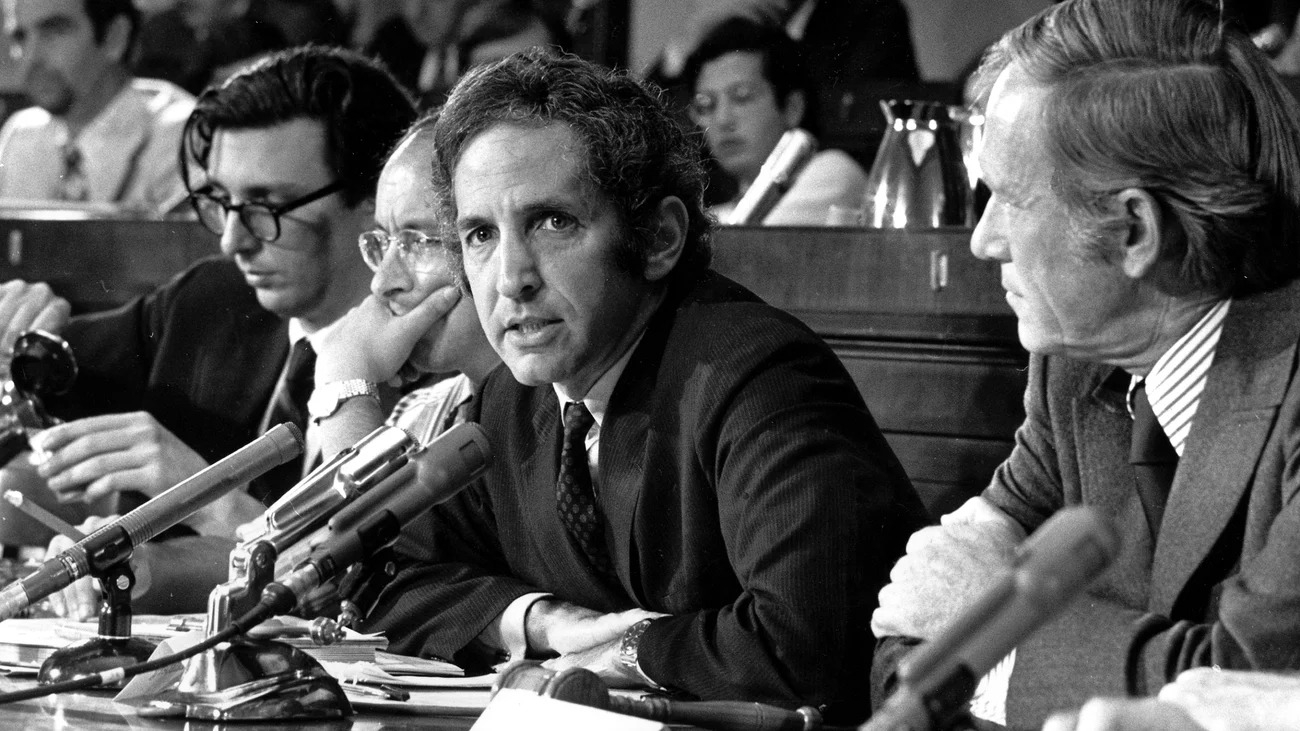
    This segment ends with the leakage and publication of the Pentagon Papers to the New York Times in 1971. There have been several books written about that whole, long, celebrated episode, and how it rocked the MSM and Washington. I have read up on it, and interviewed some of the principals involved, e.g., the late Daniel Ellsberg, and attorney James Goodale of the New York Times. Some background is in order.

    Ellsberg was working at the Rand Corporation offices in Santa Monica when Defense Secretary Robert McNamara commissioned a study on the entire expanse of the Vietnam War, from its beginnings to the end of the Johnson administration. In other words, it did not include what Nixon had done in that regard. But Nixon decided to take action due to the (poor) advice of two people: Henry Kissinger and Attorney General John Mitchell. (Steve Sheinkin, Most Dangerous, p. 221; James Goodale, Fighting for the Press, p. 73).

    When the Times and then the Washington Post published the classified material, a legal battle broke out on three fronts. One was in court in Washington to stop publication. The administration lost 6-3 on a decision that went up to the Supreme Court. They then tried to convict Ellsberg and his friend Anthony Russo in California. That case was dismissed when the judge found out that, among other things, the White House had burglarized the offices of Ellsberg’s psychiatrist. (Daniel Ellsberg, Secrets, pp. 444-49) Third, the White House opened grand jury proceedings in Massachusetts against Beacon Press for their efforts to publish a more complete version of the Pentagon Papers than the Times did. That did not succeed because Beacon’s version was based on the papers given to Senator Mike Gravel, and he recited them into the congressional record and then submitted the rest. One should add that it was that version of the papers which included a subject called Phased Withdrawal 1962-64. For whatever reason, the Times version did not.

    Nixon had begun the so-called Plumbers Unit over his fear of being caught for his sabotage of the 1968 election. He wanted a break-in at the Brookings Institution, where he (mistakenly) thought those papers were. Both acts, the subterfuge and the break-in, were illegal. But as the reader can see from the above, that was just the beginning of a record of perfidy on Indochina that is both incredulous and horrifying. This film is too kind to the criminal.

    Click here to read part 5.

  • Turning Point: The Vietnam War, Part 3

    Turning Point: The Vietnam War, Part 3

    Turning Point: The Vietnam War, Pt. 3

    In Vietnam, after the 1963 overthrow of Diem, there was a period of instability and power struggle—five governments rose and fell. One of the leading figures at that time was Nguyen Cao Ky, who came up through the Air Force and was prime minister from 1965-67. One of the problems with Ky was that he was part of a drug ring carrying opium from Laotian refineries into South Vietnam. (The Great Heroin Coup, by Henrik Kruger, pp. 134-35; Alfred McCoy, The Politics of Heroin, pp. 209-222). The other problem with Ky was his flashiness and outspoken nature. He once said, “People ask me who my heroes are. I have only one: Hitler.” But he also admitted that the communists were closer to the people’s yearning for social justice and an independent life than his government was. (Oliver Stone and Peter Kuznick, The Untold History of the United States, p. 332)

    I

    All this made him unpalatable for presidential leadership. Lyndon Johnson decided to hold an election in 1967 with Nguyen Van Thieu as president and Ky as Vice President. The pair won in another rigged election. Soldiers showed voters how to mark their ballots, and they encircled the legislature while it recorded the electoral tally. (Stanley Karnow, Vietnam: A History, p. 466; Washington Post, article by Richard Pearson,10/1/2001)

    Lyndon Johnson wanted the illusion of a democratic state, which South Vietnam was not. Accompanying this illusory aspect were various pronouncements by both Johnson and military officers about the progress of the war. General Westmoreland even taunted Hanoi to begin an attack since the Americans were ready. (Karnow, p. 514) Joseph Alsop, a well-connected and powerful columnist, wrote that Thieu and Ky predicted the war would be over by the end of 1967. (The Myths of Tet by Edwin Moise, p. 15) At the end of July 1967, Walt Rostow told Dan Ellsberg “The other side is near collapse…victory is very near.” (ibid, p. 18). In November of 1967, President Johnson brought Westmoreland to Washington, and he said the enemy was “running out of men” and “trying desperately to win a victory.” (ibid, p. 95) At the National Press Club, he then said the communists were certainly losing the war and had not been able to win a major battle in over a year. General Bruce Palmer said the Viet Cong had been defeated from Da Nang all the way down to the populated areas. (ibid, pp. 98-99)

    The film does a decent enough job in showing this political, military and press optimism, which will be shocked by the size and scope of the Tet Offensive. But it does not show the tactical maneuvering that made Tet so surprising in its effectiveness. General Giap decided to create two diversions to draw out the Americans and the ARVN to the north and west. These were at Khe Sanh, and then Loc Ninh and Dak To. (Moise, pp. 113,114) The first became a major battle, which had both Westmoreland and Johnson so worried that they considered using atomic weapons. (Erik Villard, History.net, 3/2/2022)

    The second factor that the program underplays was the intelligence failure that made the attack such a surprise. To this day, there is a dispute about how many men Hanoi was sending south prior to Tet. Westmoreland’s initial claim was between 5,500 and 6,000 per month. Even he later said that was wrong. The most reliable tally today is that the number was probably about three times that or a bit more. There was an utterly massive influx in January of 1968, as high as 45,000. And this should have been a telltale indication that something was coming. (Moise, p. 121, p. 123)

    But Westmoreland was so taken by surprise that he actually stated in February of 1968 that, “The units committed to this campaign, we carry on our order of battle.” He later added, ”No previously unidentified unit showed up.” That was simply wrong, and he probably knew it was so when he said it. (Moise, p. 124). In fact, it was so wrong that Pentagon headquarters in Saigon, Military Assistance Command Vietnam, later revised their pre-Tet infiltration figures upwards.

    Also going unmentioned in the film is the other claim by the Army: that the Viet Cong had thrown everything they had into Tet. Or as one officer put it, the VC were scraping the bottom of the barrel for recruits. This was also not true. Many Viet Cong units were simply not in position to be active in the attack at the time it happened. The initial estimates were that about 84,000 Viet Cong and infiltrated Hanoi troops participated. But Hanoi later came out with their own study saying they had used over three times that many over the whole 45-day barrage of attacks, and still had some in reserve. (Moise, p. 128)

    The only man who realized how large the coming attack was going to he was the legendary CIA analyst Sam Adams, and he did not figure it out until a few days prior. Also, very late in the day, January 25th, some DIA analysts proffered the idea that Khe Sanh might be a diversion to pull American forces away, but as this got upwards in the hierarchy, it was ignored. (ibid, p. 130) Again on January 25th—five days before Tet—the National Security Agency warned that there might be some coordinated communist attacks coming. But the warning did not say they had targeted cities or that it would be so widespread. (Ibid)

    II

    It is important to elucidate the intelligence failure that made Tet possible, for the simple reason that the offensive could not have been so powerful if it had been in any way expected. But there were almost no preparations for it. The only officer who even tried to do something in advance was General Frederick Weyand. He cancelled some operations near Cambodia and moved forces closer to Saigon. This may have prevented the capture of Tan Son Nhut Airport. But the overall feeling afterwards was conveyed by General Creighton Abrams, who “wanted to fire every intelligence officer in Vietnam.” It was that bad. (p. 132)

    Needless to say, the hopeful line that the Army and the White House had been feeding the public made the impact even worse. During the entire expanse of the multi-phased operation, scores of towns and cities were attacked, and it unfolded for weeks on end.

    If anything, the film underplays the impact the assault had in the press and in Washington. As Clark Clifford, the designated Secretary of Defense, said, “Tet, to me, was the roof falling in.” Lyndon Johnson later said that it was a shock–he did not expect an attack that was so large and so coordinated. White House Press Secretary George Christian said it was a huge surprise. He thought the Viet Cong were under control, and it was not possible for them to rise to the offensive heights they did. (Moise, p. 152)

    Because of the continuing battles at Hue and Khe Sanh, Westmoreland asked for more troops, over 200,000. This notice ended up being leaked to the press, and it created a firestorm of controversy. A New York Times editorial called it “Suicidal Escalation”. (March 11, 1968) The editorial then ridiculed the notion of a light at the end of the tunnel, which it now characterized as a bottomless pit headed nowhere: “The American people have been pushed beyond the limits of gullibility.”

    The film leaves out two rather important events that occurred as a result of this request. One was a meeting of the so-called Wise Men at the White House. This included people like Robert Lovett, Averill Harriman, and Dean Acheson. The military was giving their reasons for the call-up, and Johnson followed with a speech supporting it. In the middle of the speech, Acheson got up and walked out. When he was phoned after and asked why he left, he said, “You can shove Vietnam up your ass.” Johnson got on the line, and Acheson explained that the Pentagon was giving canned briefings and he would not stand for it anymore. He would only listen to people on the ground in Vietnam and read the raw data. This is how the group turned against the war. (The Wise Men, by Walter Isaacson and Evan Thomas, p. 687)

    Shortly after this event, Clark Clifford was sent over to the Pentagon. President Johnson wanted him to get the raw data and find out how the Joint Chiefs planned on winning the war after Tet. Clifford went there day after day for over a week. He asked many pointed questions, e.g., if we sent in more troops, would not Hanoi counter by sending more of their men? The remarkable thing about these interviews is that Clifford had been on the President’s Intelligence Advisory Board prior to his appointment as Secretary of Defense. At that time, he had been a hawk. He found the answers he got so unsatisfactory that it caused him to change his mind on the subject. He advised Johnson to begin to get out. (Isaacson and Thomas, pp. 683-89)

    The film does show the famous editorial comments on the war by Walter Cronkite, who labeled the conflict as a stalemate. LBJ reportedly said that if he had lost Cronkite he had lost Middle America, (https://www.youtube.com/watch?v=Dn2RjahTi3M) The program states that CBS president Dick Salant allowed Cronkite to do this editorial and backed the newsman after. It does not mention how, four months later, Salant allowed Warren Commissioner John McCloy to secretly have approval over the CBS four-night special endorsing the Warren Commission–and then would not admit to what he had done. (Click here for more on that https://www.kennedysandking.com/john-f-kennedy-articles/why-cbs-covered-up-the-jfk-assassination)

    III

    The film deals extensively with the battle at Hue during Tet, and it describes the massacre that took place there. Oddly, it does not go into any similar depth about Khe Sanh, which was a massive siege that lasted 77 days, beginning about a week before Tet. It resulted in 35 downed helicopters, 23 aircraft lost, and 2700 American casualties. When it was all over and the siege was lifted, the entire base was abandoned and then destroyed, rather than risk another such siege.

    The film uses Ron Haeberle to tell the story of the My Lai massacre. Haeberle was a combat photographer who took many photos of My Lai. These made it simply impossible to deny what had happened. They were published in the Cleveland Plain Dealer. He also wrote a personal account of the episode for that newspaper. The photos were then sold to Life magazine and were published in its December 5, 1969, issue. They created an immediate sensation. As did his testimony before Congress, where he described simply wanton slaughter of everyone, including women and children. The film also relates the story of Hugh Thompson, the helicopter pilot who did the most to halt the operation in real time and escorted many civilians away from the scene. Thompson was probably the most heroic person involved in the atrocity. (Click here for the film Four Hours in My Lai https://www.youtube.com/watch?v=FYzb9DH7YAE&list=PL_i8Q5O9tfujtnIlaV4vmZ9lUpLcb_mtH) )

    Although Turning Point does deal with some of the trials that happened after the atrocity, like those of Captain Ernest Medina and Lt. William Calley, it does not interview author Doug Valentine. In his fine book, The Phoenix Program, he made the argument that My Lai was really a CIA operation meant to eliminate Viet Cong sympathizers, and the Agency passed on lists to the military. William Peers, a former CIA officer who had served previously in the OSS, was appointed by Westmoreland to do the military inquiry into the massacre. During the Vietnam War, Peers began in special operations and then became a special assistant for counterinsurgency under the Joint Chiefs. Peers and journalist Sy Hersh—who wrote two books on the subject—more or less localized the affair. The latter largely chalked it up to incompetence and ambition. Hersh specifically wrote in his second book, “There was no conspiracy to destroy the village of My Lai 4….”(The Assassinations, edited by James DiEugenio and Lisa Pease, p. 367)

    IV

    The Tet Offensive was enough for Johnson to recall Westmoreland. The general was now made Chief of Staff of the US Army. Creighton Abrams became the commander in Vietnam.

    Johnson’s betrayal of Kennedy’s Vietnam policy had dealt him a lethal political body blow. Allard Lowenstein and Curtis Gans organized a Dump Johnson movement. In the autumn of 1967, Senator Eugene McCarthy had agreed to be their candidate. In November of 1967, he announced his candidacy. He entered the Democratic primaries running as an anti-war candidate. At first, no one believed he really had a chance to defeat the incumbent Democratic president. But on March 12, 1968, in the Democratic primary in New Hampshire, Johnson was held to 49% of the vote.

    McCarthy had galvanized American youth against the war. They journeyed to New Hampshire to work as volunteers. On the other hand, Johnson was so confident he had not filed, and was therefore not on the ballot. McCarthy was so well organized that he captured the majority of the delegates. The political impact was shocking. As revealed in the book 85 Days, Bobby Kennedy had decided to enter the race prior to the primary. But since he had made the decision so late, he did not announce until after the results were in. Johnson was now faced with not one but two strong opponents.

    The film does little with Bobby Kennedy’s criticism of Johnson about the Vietnam War. But yet, as many have observed, Bobby’s attacks really disturbed Johnson. Daniel Ellsberg worked for Bobby in 1968, and he knew that RFK understood there was no victory for America in Vietnam. We could not bomb our way to peace. (Lisa Pease, A Lie Too Big to Fail, p. 477) The last thing Johnson wanted to contemplate was losing to Bobby Kennedy in the primaries. But the word was out that the president’s campaign in Wisconsin was collapsing. The film depicts Johnson on the phone, realizing that he had now been labeled a war president, and it was a highly unpopular war. Using then-Johnson employee Polly Baca as a witness, the film reveals the almost tangible antipathy between Kennedy and Johnson. With one defeat barely avoided and another staring him in the face, on March 31, 1968, Johnson went on television and made a shocking declaration: He was not going to run.

    This was a political earthquake. But then, just four days later, another tremor was felt: Martin Luther King was assassinated in Memphis. The film shows Bobby Kennedy’s famous speech that night in Indianapolis, where he announced to the crowd that King had been killed. He urged the assembly not to strike out in fury and violence. Unnoted is the fact that that was the only major city that did not erupt in rioting.

    After Tet, after Johnson’s abdication, after King’s murder, what could now happen? Two months later, Bobby Kennedy was killed in Los Angeles. The film interviews Baca and Chic Canfora, who both worked for the RFK campaign. Canfora cannot speak; the memory of RFK’s death is too painful. With those two men dead, there was no one to represent the anti-war youth at the Chicago Democratic convention. Baca talks about being in a crowd when the police began striking the demonstrators with batons, and blood began to flow. Canfora observes that the powers that be wanted the war to continue and were willing to silence any voices that were opposed to it. (And that is as far as the film goes with that concept.)

    Canfora then observes that this process eventually led to someone who was even worse than Lyndon Johnson. That was the man JFK defeated in 1960: Richard Nixon.

    Click here to read part 4.

  • Turning Point: The Vietnam War, Part 2

    Turning Point: The Vietnam War, Part 2

    Turning Point: The Vietnam War, Part 2

    All you need to know about the quality of this series is that director Brian Knappenberger gives the last word on Kennedy’s Vietnam policy to Dan Rather. This is the man who perhaps has done more to obfuscate how Kennedy was killed than any living person. (Click for one aspect https://consortiumnews.com/2016/04/22/how-cbs-news-aided-the-jfk-cover-up/) And since the program does not reveal any of Kennedy’s early talks in 1951 with people like Seymour Topping, let alone his withdrawal program, Rather can give that notion the back of his hand. (Seymour Topping, On the Front Lines of the Cold War, pp. 152-56)

    I

    In Part 2, the series finally gets to the origins of the war. We get a brief biography of Ho Chi Minh and his letters to President Truman for support in his attempt not to be recolonized by France after World War II. I could detect nothing about how Secretary of State Dean Acheson advised Truman to begin supporting the French effort to take back Indochina. Or the unwillingness of Paris to grant any true independence through their stand in Bao Dai. Even at this early date, there were analysts in the State Department who felt that Ho’s resistance would eventually lead to a war between his followers, the Viet Minh, and France. (Pentagon Papers, Volume I, p. A-5) These same analysts found there was no proof that the Soviets had a strong influence on Ho Chi Minh as late as 1948, when the imperial war had begun in 1946. (ibid, p. A-6)

    By 1950, Dean Acheson had altered the American policy of chilly neutralism. This was due to the recognition of Hanoi as a state by Moscow. That was enough for Acheson to declare Ho Chi Minh a communist, not a nationalist. (ibid, p. A-7) By the summer of 1950, Acheson and Truman were extending aid to the French puppet Bao Dai. From here on in, the USA became more and more involved in the war. Later in 1950, they initiated a Military Assistance Advisory Group in Saigon to aid Paris.

    Truman and Acheson had reversed Franklin Roosevelt’s aims in Indochina. FDR was clear on this to Secretary of State Cordell Hull:

    Indochina should not go back to France. France has had the country…for nearly one hundred years, and the people are worse off than they were at the beginning….The people of Indochina are entitled to something better than that. (Oliver Stone and Peter Kuznick, The Untold History of the United States, p. 112)

    In other words, Kennedy was aligned with Roosevelt in that he valued nationalism in the European colonial empires over the American alliance with France. Acheson valued his alliance with France more than he did the decolonization dictates of Roosevelt. All of this crucial history is just about absent in Turning Point, even though this in itself is a clear turning point in the conflict. But then comes something even worse, as the film literally leaps to the siege of Dien Bien Phu.

    How is it possible to jump to that fateful siege without mentioning that Secretary of State John Foster Dulles and President Eisenhower had ratcheted up the aid to France exponentially when the general took office? By 1954, America was supplying almost 80% of the funding for the war. This was because Foster Dulles was even more of a dyed-in-the-wool Cold Warrior than Acheson. In 1953, twelve shiploads of arms were coming in per month, and by 1954, it totaled about a billion dollars per year. (Operation Vulture by John Prados, see Chapter One of the e-book version.)

    II

    But despite all this, the French strategy to lure Hanoi’s commander, General Vo Nguyen Giap, into a trap in the northwest area of the country did not work. In fact, Dien Bien Phu, which cost the Americans 300 million dollars, backfired. (Seth Jacobs, Cold War Mandarin, p. 33) About a month into the 55-day siege, it became apparent that Giap had outsmarted French General Henri Navarre. Foster Dulles and Vice President Richard Nixon could not accept this impending loss. So Nixon developed an alternative scheme: sending American ground troops. (Prados, Chapter 9)

    Then came something even wilder: the use of atomic weapons, code-named Operation Vulture. (Stone and Kuznick, p. 267) Incredibly, Dulles thought the use of these bombs would be simply an extension of conventional warfare. Recall, this is just nine years after Hiroshima. Nixon became the floor manager in Congress for Vulture. In keeping with his anti-colonial views, the chief outspoken opponent of this fruity scheme was Senator John Kennedy. (Stone and Kuznick, p. 268) One reason I think the film leaves out Vulture is because this Kennedy opposition would have undermined the false portrait of Part One.

    Eisenhower would not approve of Vulture without British backing. But England would not go along with the project. British clearance was refused even when Foster Dulles himself went to London to lobby for it. (Prados, Chapters 6 and 8) When Eisenhower would not let it proceed unilaterally, Foster Dulles used his last card. He offered the bombs to the French foreign minister. Georges Bidault pointed out something that, in his messianic zeal, Dulles had overlooked: “If those bombs are dropped near Dien Bien Phu, our side will suffer as much as the enemy.” (David Talbot, The Devil’s Chessboard, p. 245)

    Dien Bien Phu fell in early May of 1954. In a stunning lacunae, almost all of the above concerning the attempts by Nixon and Foster Dulles, and their schemes about ground troops and Vulture is absent. Yet it is essential. Once one realizes the lengths that Foster Dulles and Nixon were willing to go to in order to save France’s Indochina empire, then, and only then, can one understand what they did next. After the defeat at Dien Bien Phu, the Eisenhower administration never intended to abide by the strictures of the peace conference, labeled the Geneva Accords.

    Those Accords allowed for a division of the country between the north and south, in preparation for elections to provide for one leader under unification in 1956. The problem for Foster Dulles was that both he, Eisenhower and Nixon knew that Ho Chi Minh would win any popular election in a landslide. (William Blum, The CIA: A Forgotten History, p. 139) So Dulles had his representative make an oral pledge to abide by the accords, but instructed him not to sign them. (Stone and Kuznick, p. 268)

    Now, one of the Geneva guidelines was that “the military demarcation line is provisional and should not in any way be interpreted as constituting a political or territorial boundary.” (Trapped by Success, David L. Anderson, p. 62). The area in the south was under the temporary supervision of France, which pledged not to interfere, to the point of keeping Bao Dai’s team out of the final negotiations. (ibid, p. 63) Since Foster Dulles controlled the allied side, one can conclude this is what he wanted. Dulles violated this territorial stricture fairly early.

    III

    As Seth Jacobs outlines in his biography of Ngo Dinh Diem, the CIA had been alerted to Diem’s anti-communist and anti-French qualities in the early fifties. Diem understood that the USA played the major role in the French imperial war by that time, and would likely take over if Paris lost. So he spent years in the USA after leaving Vietnam in order to publicize himself as being able to take over for the puppet Bao Dai if France left. He managed to attract the attention of powerful people, like Congressman John McCormack, Secretary of State Dean Acheson and Supreme Court Justice William Douglas. (Seth Jacobs, Cold War Mandarin, pp. 29-32) Diem ended up meeting with Robert Amory of the CIA in the spring of 1953 and shortly after with Senator Mike Mansfield. Mansfield sponsored a luncheon for him, which included Senator Kennedy, Cardinal Spellman and Congressman Clement Zablocki. (Jacobs, p. 31) At this luncheon, Diem criticized both the French and Ho Chi Minh, and he said he could fill the area between them and rally the population to fight for him. (ibid, p. 32) This was a sales pitch, of course. As we shall see, Diem could never balance Ho’s popularity or rally a force to defeat the Viet Cong, let alone the army of North Vietnam.

    Diem then went to France, where he did not do well at all. (Jacobs, p. 32). But this did not really matter since France would be out of the equation soon. Bao Dai knew that Diem had the backing of powerful people, like Acheson, whom he had met in 1951. Bao Dai, therefore, did what Foster Dulles wanted and appointed Diem as the new leader in the south. Diem requested full powers over the state, and he got them. (Jacobs, p. 139). But when he arrived in Saigon, Colonel Edward Lansdale noticed a problem. His enclosed limousine sped by, and he did not mingle with the crowd Bao Dai had paid to greet him. Diem was never, and would never become, a man of the people. He wore Brooks Brothers suits, spoke good English, was a Catholic in a Buddhist nation, and had his hair styled like an American. In that regard, he was no match for Ho Chi Minh. The CIA and Lansdale had made a big mistake.

    On top of this, Diem never planned on being a democratic leader in the south. He did not believe in civil liberties: freedom of speech, freedom of the press, or assembly. He certainly never bought into free and fair elections, which Lansdale rigged for him. (Jacobs, p. 95) Viet Minh suspects at times were beaten, had their bones broken and some females were raped. Diem even authorized the use of the guillotine by mobile courts in the countryside. (Gordon Goldstein, Lessons in Disaster, p. 51) If Lansdale ever firmly protested to Washington about these abuses, they are hard to locate. But inevitably, this helped the Viet Minh.

    America had broken the Geneva Accords by installing military help for what was now a new country, not just a provisional one. (William Blum, The CIA: A Forgotten History, p. 139) They had constructed a new dictatorial government led by a man who was, in reality, a fascist. Therefore, Diem now broke the Accords again by announcing he would cancel the 1956 elections. (Blum, p. 139)

    To say Turning Point skimps over this crucial history gives it too much credit. For example, it says words to the effect that two states emerged out of Geneva. South Vietnam did not emerge. It was created by the USA in order to avoid the unification of the country under Ho. North Vietnam arose as a reaction to this violation of Geneva. When the film talks about the migration of the Catholics south from the north, I could not find any reference to Lansdale. But this was largely his propaganda operation to bolster Diem. (Jacobs, pp. 52-54). So the following civil war was not really such. It was an imperial war caused by the interference of the USA–through the Dulles brothers, Nixon and Eisenhower. And they had placed a man in charge of their fabricated country who was perhaps one of the worst choices they could have made. (Jacobs, pp. 38-39)

    IV

    From here, the film jumps to 1965. I didn’t understand why at first. But by doing that, it first leaves out a large segment of the Eisenhower administration and its propping up of Diem. For instance, Michigan State University faculty acted as consultants in police and public administration. (Anderson, p. 76) There were five CIA agents infiltrated into the program, but carried on the university payroll. They devised a policy for Diem to have anyone over the age of 15 carry an ID in South Vietnam. If you did not have such, you were considered a Viet Cong suspect and could be thrown into the infamous tiger cages. (Blum, p. 140) At the time of registration, fingerprints were recorded and information about political beliefs was taken.

    Lansdale was virtually Allen Dulles’ representative in Saigon, working out of something called the Saigon Military Mission, which operated independently from the regular CIA station. It was from there that he ran “Passage to Freedom,” his great propaganda triumph of scaring the Catholics of the north into fleeing south during the two-year transfer window. (Anderson, p. 77) Lansdale also headed off an early coup attempt by sending the plotters on an all-expenses-paid vacation to Manila. (ibid, p. 62)

    John Foster Dulles created the SEATO group in 1954. This was his way of establishing what he called a “no trespassing sign” against the Soviets and Chinese in Southeast Asia. Although the alliance did not include South Vietnam directly, Dulles formed an extended protocol, which Diem accepted. This was used by President Johnson when he passed the Gulf of Tonkin Resolution, which was basically a declaration of war against Hanoi. (Jacobs, p. 63) Again, I detected no mention of this crucial linkage in the over six-hour series.

    When I could not find this link, I began to pore over my notes. I then began to uncover something that I did not want to believe. But it explained the chopped-up chronology of the series. By skipping from 1956 to 1965, you don’t just minimize what Foster Dulles and Nixon did. You also eliminate Johnson’s actions in 1964, i.e., the Gulf of Tonkin Resolution: the declaration of war against Hanoi, partly based on SEATO. This is how agenda-driven the film is against JFK. They dropped the real declaration of war by Johnson in August of 1964–and everything leading up to it and following from it. Which is a huge part of the story.

    At the beginning of Part 2, the program has a Viet Cong member say that many more Americans were in Vietnam in 1965. If you skip what LBJ did both after Kennedy’s death and then during 1964, you can characterize that as some kind of mystery, or even a continuation of Kennedy’s policy. It was neither. It was not a mystery because Johnson had been planning on it for months on end. And one of the film’s talking heads, Frederick Logevall, wrote a book about that very subject, called Choosing War. Before him, Joseph Goulden wrote a similar book, called Truth is the First Casualty. Both authors prove, without any doubt, that as Johnson was saying one thing—that he was not going to send American boys to do a job Asian boys should do—he was planning to do just that. The key point was to keep that goal hidden until he got elected in 1964.

    This is critical information. It is startling for the series to dismiss it. It is perhaps the most crucial part of the story since the creation of South Vietnam itself. It was under Johnson that the war reached a scope and intensity not seen before, e.g., the air war Rolling Thunder, and 540,000 combat troops in the theater. Under Kennedy, there had been no combat troops. And he was getting out.

    Johnson first thwarted the intent of Kennedy’s NSAM 263, JFK’s order to begin the withdrawal at the end of 1963. It did not happen. Johnson then altered certain parts of NSAM 273, an order Kennedy had not seen but National Security Advisor McGeorge Bundy had prepared for him. This alteration allowed for direct involvement by US forces in the war in naval operations. Again, this was not allowed under Kennedy. (John Newman, JFK and Vietnam, pp. 447-58)

    But beyond that, in December of 1963, Johnson had appointed William Sullivan–a foreign service officer who had opposed Kennedy’s withdrawal plan–to head a multi-agency task force. It was called the Vietnam Working Group. (Joseph Goulden, Truth is the First Casualty, p. 88) Sullivan understood that his job was to plan for an all-out war against Hanoi. He came back with a paper that might as well have been written by Walt Rostow, who Kennedy had kicked out of the White House because he was too hawkish.

    Sullivan concluded that if the war was to be won, it needed direct American intervention. The Viet Cong were a formidable force, and it was necessary to bring the war to Hanoi in order to put pressure on them to lessen their support. That pressure would include American naval ships off the coast of North Vietnam to blockade Haiphong and use force if necessary to block shipping. Sullivan recommended 100,000 American troops in the first call-up. (Goulden, p. 90)

    Remember, this is December of 1963 – February of 1964. By January 22nd, Johnson had already let the Joint Chiefs in on advice and planning, and they recommended aerial war against critical targets in North Vietnam and the use of American ground troops. (Gordon Goldstein, Lessons in Disaster, p. 108) By March, the Pentagon was advising air and naval bombardment of targets in the north, mining of harbors, a naval blockade, and, in case of Chinese intervention, the use of atomic weapons. (Ibid) This planning continued under various personalities, including William Bundy. And it was decided that they would go to Congress for a resolution upon the occurrence of a casus belli. Any trace of any reference to withdrawal or neutralization had been buried with John Kennedy. In fact, the Chiefs had now recommended a list of 94 air targets in the north. (Goldstein, p. 108)

    The casus belli, of course, was the–at least partly ersatz–Gulf of Tonkin incident in August 1964. Johnson had the war resolution already composed and in his suit jacket. (Eugene Windchy, Tonkin Gulf, p. 319) Once it happened, the administration went to the senate and got their resolution through by what many later termed—including Senator William Fulbright — a false presentation. On August 4th, Johnson ordered air raids in retaliation against Hanoi, and he immediately decided to go to the Senate for his declaration. (Goldstein, p. 126). It passed overwhelmingly, and it even included allowances for American troops to enter Laos and Cambodia. (Goulden, p. 13)

    These events, the exaggerated Tonkin incident, the misrepresentation of it—for example, the speedboat raids by the Vietnamese were connected to the destroyers off the coast, the passage of the war resolution—these all allowed Johnson to do what Kennedy would not do. That was to Americanize and militarize the war.

    To not deal with any of this, and to not detail the rupture of policy that led to the landing of combat troops at Da Nang in March of 1965–this is both inexplicable and inexcusable. Unlike what the film tries to imply, Johnson knew what he was doing from the beginning.

    From here, the film deals with the failure of the Strategic Hamlet program and General William Westmoreland’s unsuccessful attempt at what he called ‘counterinsurgency’. It also details the failed concepts of Westmoreland’s “search and destroy” missions and free fire zones. These were all parts of his attempt to win a war of attrition. It therefore became a war by body count. Except, as the film shows, the body counts were fudged, and therefore, Westmoreland was not getting or giving out the correct numbers. Meanwhile, Westmoreland asked for more and more troops, which Johnson gave him. All the way until a total of over half a million were in theater by 1968.

    This troop build-up was coupled with Rolling Thunder, the largest bombing campaign since World War II. Except, in Germany and Japan, one had a surfeit of industrial and arms-building targets. You did not have anywhere near that many in Vietnam. When it was all over, as the film demonstrates, 5 million tons of bombs had been dropped over all of Vietnam. Nixon and Kissinger then dropped about 2 million more over Laos and Cambodia.

    Johnson was perturbed by the war coverage, especially by CBS reporter Morley Safer showing a village being burned live on camera, then asking: How will this win the hearts and minds of the Vietnamese? Johnson was also much disturbed by Martin Luther King coming out against Vietnam in April of 1967, with his famous speech in New York.

    By 1967, the CIA had issued a study questioning the body count thesis and whether it was valid. McNamara had shown signs of his disaffection for the war and his disagreement with Rolling Thunder. He ordered the monumental Pentagon Papers study without telling Johnson—this was a devastating secret history of the war made up from classified documents. While it was being written, he decided it was time to get out of Vietnam. Johnson disagreed. He more or less retired McNamara. Johnson then made a speech about how the enemy had never defeated our forces in battle. This was after bringing back Westmoreland, who said there was light at the end of the tunnel.

    The Tet Offensive was right around the corner. Johnson was about to pay a huge price for his break from Kennedy.

    Click here to read part 3.

  • Turning Point: The Vietnam War, Part 1

    Turning Point: The Vietnam War, Part 1

    Turning Point: The Vietnam War, Part One

    Almost eight years ago, I wrote a lengthy four-part review of the Ken Burns/Lynn Novick 18-hour PBS series The Vietnam War. I concluded it was a bloated mediocrity that was, in some instances, not candid with its viewers. What it left out, especially concerning the origins of that conflict, made for a dubious presentation of history. That pretentious and bloated program tried to tell the story of American involvement in Vietnam without mentioning the names of Dean Acheson, Bao Dai, the Dulles brothers or Edward Lansdale. It was not possible to present that tragic event in such a manner. (Click here for my review https://www.kennedysandking.com/reviews/ken-burns-lynn-novick-the-vietnam-war-part-one)

    I

    I really did not think that anyone could make another series about Vietnam that was as intellectually shabby as what Burns and Novick produced. I was wrong. The new five-part series on Netflix, Turning Point: The Vietnam War, is just as bad. As we shall see, in some respects, it is even worse.

    This show was put together by a company called Luminant, which operates out of LA, and it was directed by one Brian Knappenberger. He also served as an executive producer. There are four producers; the one who has been interviewed in the press is Doan Hoang Curtis. In going through the film credits, I could not find anyone billed as a writer, either in the front or end credits. This is a key point with this production since they bill everyone, even their “families, friends and strangers who supported us”. But no screenwriter? As we shall see, that is revealing.

    The usual entry point for any Vietnam series is the French attempt to take back their colony of Indochina after World War II. (The Novick/Burns pastiche took it back further with the original attack on Indochina by France in the 19th century.). Surprisingly, this series did not do that.

    Turning Point starts with the Kennedy administration, when, in fact, the United States had been involved for almost ten years when Kennedy took office. I soon began to see that there was a methodology behind this mangling of the record. The idea was to set up the Vietnam War as a battle within the Cold War of communism vs capitalism and to deliberately begin with Kennedy. The objective being to present two things as fact which are utterly wrong: 1.) Somehow Kennedy was a Cold Warrior and 2.) It was he who started the war.

    What this film does to fit those square pegs into round holes is nothing less than what I would term a hatchet job on John Kennedy. For example, there is no mention of Kennedy’s visit to Saigon in 1951 and his consultations with reporter Seymour Topping and diplomat Edmund Gullion, who both told him that France would not win the war. This is an important elision since those discussions had a large impact on how Kennedy looked at conflicts in the Third World and at Indochina afterwards. (Richard Mahoney, JFK: Ordeal in Africa, pp. 14-15) As a result, Kennedy made speeches on this subject, specifically saying these conflicts were not about communism vs free enterprise; they were about nationalism and independence vs colonialism and imperialism. (Betting on the Africans, by Philip Muehlenbeck, p. 35) Which is why, for example, he took out an ad in the New York Times for the novel The Ugly American. Because the message in that book was that if all the USA had to offer in the Third World was anti-communism, we might as well fold up our tables and go home. (New York Times, article by Michael Meyer, 6/10/09)

    By 1957 and his great anti-colonial Algeria speech, these declarations eventually made him the Democrats’ alternative foreign policy leader. Because he was opposed to John Foster Dulles’ view of the world as a Manichean good vs. evil, USSR vs USA constant confrontation. (John T. Shaw, JFK in the Senate, p. 110) But before that, Senator Kennedy specifically criticized the Eisenhower/Dulles American effort to back France in its futile effort to hold onto its empire in Indochina. (Mahoney, p. 16). He even addressed a letter to Foster Dulles, asking him what his goal was in backing the French effort there. (Click here for James Norwood’s overview of Kennedy’s views about this https://www.kennedysandking.com/john-f-kennedy-articles/edmund-gullion-jfk-and-the-shaping-of-a-foreign-policy-in-vietnam)

    II

    In what I think are meant to be backgrounders for their questionable portrayal, the film brings up the Bay of Pigs episode and the death of Patrice Lumumba in Congo. First, as far as Congo goes, Kennedy was going to support Lumumba, and the CIA knew that. There is evidence that the Agency sped up its assassination plots in order to get rid of Lumumba before the inauguration of Kennedy. (John Morton Blum, Years of Discord, pp. 23-24) Kennedy was not alerted to Lumumba’s death until almost a month later. There is a famous picture of his reaction to this belated knowledge, which reveals the pain he felt at that moment.

    As per the Bay of Pigs invasion, anyone who knows anything about that subject, which apparently Curtis and Knappenberger do not, understands that this was a CIA operation. It began under Eisenhower and was pushed on the new president. Kennedy had no inherent inclination to go through with it. When Arthur Schlesinger asked him what he thought about the project, JFK replied that he thought about it as little as possible. CIA Director Allen Dulles also admitted this when he said that, with Kennedy, the project was a kind of an orphan child that he had no real attachment to. (Trumbull Higgins, The Perfect Failure, pp. 102-03) JFK ended up passing on the decision to a meeting of his advisors. There were about 20 people present, and 19 voted for it. (Robert McNamara, In Retrospect, pp. 25-26)

    When the operation was failing, Kennedy refused to send in American Marines and Naval forces, even though Admiral Arleigh Burke strongly pushed escalation with direct American involvement on him. (David Talbot, Brothers, p. 47). It later turned out that the proponents of the operation—Allen Dulles and Dick Bissell–were banking on him acceding to this all along, because they knew the operation as planned would fail. (ibid).

    We know that Richard Nixon and Dwight Eisenhower would have done what Burke requested. (Arthur Schlesinger, A Thousand Days, p. 288; New York Times, story by Thomas Ronan, 10/14/65). And that is an important historical distinction to make in regards to the subject at hand. Curtis and Knappenberger do not come close to making it. They also leave out the fact that Kennedy terminated the top level of the CIA—Dulles, Bissell and Deputy Director Charles Cabell—when he discovered their treachery.

    Another parallel issue that Curtis and Knappenberger leave out is Kennedy’s decision on Laos. This was a country that Eisenhower advised Kennedy he should take great interest in, because it was the key to all of Southeast Asia. The president told Kennedy that if the communists took Laos, they would bring “unbelievable pressure” on Cambodia, Thailand and South Vietnam. He went so far as to say that Laos was so crucial that the USA should be willing “as a last desperate hope, to intervene unilaterally.” Further, the General said that America should not permit the communists any role in a new Laotian coalition. (Schlesinger, p. 163)

    Kennedy did not heed this advice. He simply did not think that Laos was worth turning into a “pro-western redoubt.” He thought that was a bit exaggerated for a small land-locked country that had only been independent for 12 years. Kennedy wanted to achieve the neutralist solution that Eisenhower had vetoed six months previously. (Schlesinger, p. 329-30). He added that he did not think that America should fight for a people who would not fight for themselves. Which, as we shall see, is another parallel with his view of Vietnam. Kennedy was opposed on this by the Pentagon, which wanted to pour in 60,000 ground troops, air assaults and, if needed, atomic weapons. (ibid, p. 332)

    Kennedy decided to forcefully make Moscow understand that he wanted a neutralist solution by bluffing on military intervention. He sailed the Seventh Fleet into the South China Sea and moved 500 Marines into Thailand. After consulting with SEATO, he got pledges from England and India to support a ceasefire. This brought Moscow around, and a neutralist solution was now agreed to with a conference later in Geneva to map out its details.

    I could not find any reference to this important precedent in this over six-hour series.

    III

    Let us now go to the actual depiction of the Kennedy years in Vietnam. There is little discussion of the conferences centering on the first major decision in the Kennedy White House on the subject. These were the November 1961 meetings that resulted in the issuance of NSAM 111. That order stated that America would allow for more advisors, air lift and equipment– but there would be no combat troops entered into the conflict. During these meetings, Robert Kennedy made it clear to the president’s all too hawkish advisors, e.g., Walt Rostow and McGeorge Bundy, that there would be no American combat troops in Vietnam. (David Kaiser, American Tragedy, p. 113, p. 116).

    As historian David Kaiser notes, the constant barrage from those asking for intervention based on a need to save South Vietnam from communism, “had not moved the president at all.” Kennedy was fundamentally opposed to direct involvement because the basis of it would not be clear, since, unlike in Korea, Vietnam was a guerrilla war with Saigon fighting against the Viet Cong. Therefore, the nature of the conflict was less flagrant and more obscure. Consequently, direct American intervention invited both domestic criticism, as well as from nations abroad. Kennedy then noted that prior to the present, millions had been spent by the French and the Eisenhower administration “for years and with no success.” (Kaiser, p. 116)

    There is no way to understand what Kennedy did in the next two years if these discussions are not elucidated. And they are not. The program then tries to thwart the import of Kennedy’s opposition by using one of the most desperate, insulting arguments I have ever heard: helicopter pilots were the equivalent of combat troops. Which is just silly. Units of combat troops are made up of squads, platoons, companies, battalions etc. One can also divide them around functions, like infantry, armor and artillery. They are designed to either protect territory or to conquer and hold enemy territory on the ground. The first American combat troops arrived in the form of the 3rd Marine Division in Da Nang on March 8, 1965, 14 months after Kennedy’s assassination.

    This is all bad enough, but the program also leaves out the looming figure of John Kenneth Galbraith. Galbraith was sent to Saigon after NSAM 111 was issued because Kennedy wanted to get a report that countered what people like Rostow and the Pentagon were saying. He knew that his former Harvard tutor would do just that—which he did. (John Newman, JFK and Vietnam, second edition, pp. 234-35)

    Galbraith was in town in April, and Kennedy directed him to meet with McNamara. He designated McNamara because, after the November conferences over NSAM 111, Kennedy called a meeting. He arrived late and waited for the small talk to die down. He then began with this: “When policy is decided on, people on the spot must support it or get out.” He then asked who would be implementing his policy for Vietnam. McNamara said it would be him and General Lyman Lemnitzer. Since everyone knew Lemnitzer would be leaving shortly, it would be McNamara. (Newman, p. 146) This is why Kennedy sent Galbraith to meet with him. Galbraith wrote to Kennedy that he was sure McNamara got the message. In that memo, Galbraith states that America should resist any temptation to use combat troops in Vietnam. (Virtual JFK, by James Blight, p. 370) McNamara’s Deputy Roswell Gilpatric later stated that McNamara had told him that the withdrawal program was something Kennedy wanted him to devise in order “to unwind this whole thing.” (ibid, p. 371)

    Less than one month later, at the 5th SECDEF Conference on Vietnam, McNamara ended the meeting and waited for the door to shut. He then addressed the commanding general in Vietnam, Paul Harkins, and his assistant, George Allen. He told them it was not the job of America to fight the war for Saigon. America’s job should be to develop the capability of South Vietnam to do so. He then asked Harkins when that capability could be attained. Harkins said they had not thought yet about a way to dismantle the American advisory structure. McNamara now gave the order to do just that. (Newman, p. 264)

    Because he was so surprised, Harkins dragged his feet about McNamara’s order. But at the May 1963 SECDEF meeting, McNamara collected the withdrawal schedules from members of the CIA, Defense Department and State assembled at the meeting in Hawaii. After he collected them, he looked up and said the schedules were too slow. (Blight, pp. 105-06)

    At this point, McNamara began to talk about a termination date for all American advisors to be out of Vietnam by 1965. That decision was then discussed in meetings at the White House in October of 1963, and then certified by the Taylor/McNamara Report and the approval of NSAM 263 on October 11, 1963. That memorandum ordered the first batch of 1,000 advisors to be out by the end of 1963. Kennedy had sent General Max Taylor and McNamara to Vietnam and wanted them to write a report that would formalize a schedule of withdrawal. (Blight, p. 295, p. 302) They did, and there is evidence the report was actually written in Washington and delivered to those two men. (Howard Jones, Death of a Generation, p. 370) Upon their return to the White House, William Sullivan tried to take out the withdrawal part of that report. Kennedy had it placed back inside. (Newman, p. 411)

    The above is all historical fact. Watch the film’s Part One and tell me how much of this crucial information is in those opening 72 minutes.

    IV

    The capper for the first section was predictable. The film tries to somehow blame Kennedy for both the overthrow of the Nhus—Ngo Dinh Diem and his brother Ngo Dinh Nhu–and their deaths. As I have stated on more than one occasion, there are two excellent descriptions of the cause of the overthrow and the ultimate demise of the Nhus. The sending of the so-called ‘coup cable’ is dealt with in objective detail in John Newman’s JFK and Vietnam. How the brothers met their bloody end is rendered honestly in JFK and the Unspeakable.

    Certain persons in the State Department, like Joseph Mendenhall, who had served as Political Counsel at the American Embassy in Saigon, understood that by the summer of 1962, the war was not going well. He asked the rhetorical question, “Why are we losing?” He blamed it on the Nhu brothers, who would not change their dictatorial rule no matter what pressure was brought. His rhetorical solution was that they had to get rid of Diem, and Mr. and Mrs. Nhu. (Newman, p. 298)

    This foreboding was exacerbated by the Buddhist crisis, which started in the city of Hue in early May of 1963. What began as a local demonstration against religious discrimination was so mishandled by Nhu, chief of security forces, that it turned into a national crisis. And it gradually spread south into Saigon. Madame Nhu smeared it as being communist inspired. And as the public immolations of monks began, she referred to them as “barbecues”, adding that she would supply the gasoline for the next one. (Newman, p. 343) It was this crumbling and chaos that gave the doubters in the State Department the opening for their scheme to rid themselves of Diem and Nhu.

    The cabal consisted of Averill Harriman, Roger Hilsman and Michael Forrestal. They waited for a late August ’63 weekend when the major players were out of the DC area—JFK, Secretary of State Dean Rusk, Defense Secretary McNamara, his deputy Roswell Gilpatric, and CIA Director John McCone. Cables began coming in from the new Saigon ambassador, Henry Cabot Lodge, and the temporary CIA station leader, Lucien Conein, who was in contact with Diem’s opponents in the military. (Newman, p. 354) The generals said that if Washington agreed, they would willingly participate in an overthrow of Diem. Hilsman then prepared a memo instructing Lodge to request Diem to strip Nhu of his powers, and if he did not, then we could no longer support him. If the government broke down, Lodge should tell the generals that we would support them in the interim.

    When Kennedy was contacted in Hyannis Port, he asked why this could not wait until Monday. Forrestal said it was because Harriman and Hilsman wanted to meet the problem right then and there. The president then asked that the cable be cleared by all the principals, especially John McCone. (Newman, p. 355). To make a long story short, Forrestal lied to Kennedy about McCone approving the cable, and Lodge did not go to Diem in advance; he went directly to the generals. When Kennedy got back from Hyannis Port, he was enraged, and Forrestal offered to resign. Kennedy said, “You’re not worth firing. You owe me something, so you stick around.” (Newman, p. 361)

    V

    As Lodge said in a TV interview, when Kennedy discovered the subterfuge, he called the ambassador and asked him to cancel the cable, which he says he did. But the cat was out of the bag. As the Buddhist crisis got worse, the Nhus realized their isolation and began tentative, indirect contacts with Hanoi; but the north demanded that Diem ask the Americans to depart. (James Douglass, JFK and the Unspeakable, p. 191)

    Lodge publicized these contacts in the press, knowing this made the generals even more suspect about Diem. Lodge understood that once he did this, it would, in all probability, prompt a coup attempt. Kennedy tried to get Lodge to talk to Diem, but that did not work. Hilsman encouraged Lodge to continue his policy of silence with Saigon’s leader. (Douglass, p. 192) When Kennedy learned that the CIA had cut off the Commodity Import Program to Saigon without informing him, he shook his head and said, “My God, do you know what you have done?” (Ibid)

    Realizing he was losing control and that Lodge was the wrong man for the job, Kennedy decided that he would try to get Diem out himself, since the writing was on the wall for his inevitable fall. He tried doing this by sending his friend Torby Macdonald to Saigon to plead with him to leave. Diem would not. (Douglass, p. 211).

    The overthrow began on November 1, 1963. Diem and Nhu made a bad mistake by consulting with Lodge as it began and continuing to do so, thus relaying locations as they tried to escape. Lodge was in close communications with Conein, who was, in large part, supervising the generals. Thus, the Nhu brothers’ attempts to escape were playing right into the coup plotters’ hands. (Douglass, pp. 208-10)

    When they learned of the church where they were, General Minh sent a team of five in a personnel carrier to pick them up. The brothers thought that Lodge had arranged an escort to the airport to provide them safe passage out of Saigon. Not suspecting what was planned, they entered the carrier and both were shot in the nape of the neck. Nhu was also shot in the chest and stabbed many times. (Douglass, p. 210) Lodge wrote out the report two days after the killings. He likely got the details from Conein.

    When Kennedy got the news, he recalled Lodge to Washington for the purpose of firing him. (Ibid, p. 375) The Dallas assassination intervened, and Lyndon Johnson kept him as ambassador. Which tells us something about what was going to occur under LBJ. As we shall see, the series is about as poor on that subject as it is on Kennedy.

    Click here to read part 2.

  • Prouty on Vietnam: NSAM 263 and 273 60 years on

    Prouty on Vietnam: NSAM 263 and 273 60 years on


    “This was the most important fallout of working on this movie JFK for me personally. As soon as we put into the movie the fact of history that John F. Kennedy had signed a White House paper, (a) National Security Action the highest most formal paper the executive branch could publish, number 263, it was dated 11 October 1963, in the month before he died. And that paper clearly said he was not going to put Americans into Vietnam. It went even further, in so many words it said that all American personnel were going to be out of Vietnam by the end of 1965. And the minute we put that into the script of the movie, even before the movie was made and put in the theaters, the newspapers and other pseudo-historians began to say ‘there’s no such thing. Prouty and Oliver Stone are wrong’.” (Col. Fletcher Prouty, May 5, 1994)

    1 Fletcher Prouty 1997

    Prior to the release of Oliver Stone’s blockbuster film JFK, few people were aware of the implications contained within two policy directives generated about seven weeks apart in the autumn of 1963. These directives concerned American involvement in Vietnam, specifically crucial decisions regarding whether to expand or decrease the U.S. military’s role in the country’s future. The eventual decision to expand – massively – became one of the most polarizing events in American history–with consequential effect continuing to reverberate at the time of the release of Stone’s film in late 1991. The George H.W. Bush administration, for example, had been celebrating the supposed vanquishing of the “Vietnam Syndrome”, which had been lamented as a brake on the use of the military as a means of enforcing US foreign policies. With a presidential election looming in 1992, and the generation most directly affected by the Vietnam war fully coming into positions of influence, the dominant Cold War establishment, focused on global hegemony, was not interested in critical reassessments which might reveal cold calculation rather than tragic “mistakes”.

    Retired Air Force Colonel L. Fletcher Prouty served as an advisor for Oliver Stone as the script for JFK was developed. Prouty was the key initial source influencing the insertion of information regarding the policy directive known as NSAM 263 into the film. While active in the Pentagon in 1963, Prouty had directly witnessed the development of the policy while serving under his boss, General Victor Krulak. Prouty’s later descriptive work on this subject, as it appeared across numerous essays and interviews, remains insightful, through its combination of personal experience with close readings of the documentary record.

    Sixty years after the fact, the texts for NSAM 263 and 273 remain a controversial point of contention. Sharp differences regarding their actual meaning continue to influence the understanding of the historical record of the Vietnam war and both the Kennedy and Johnson administrations’ conduct of the war. On the occasion of Prouty’s birthday, and the 60th anniversary of JFK’s murder, it is useful to re-examine these policy initiatives through the work of Fletcher Prouty.

    NSAM 263

    Expressed interest in reducing U.S. military involvement in Vietnam, on behalf of the Kennedy administration, dates back at least as early as the spring of 1963. In a memorandum of discussions between Secretary of Defense McNamara and the Joint Chiefs held on April 29, 1963, McNamara is said to be “particularly interested in the projected phasing of US personnel strength” in Vietnam and the “feasibility of bringing back 1000 troops by the end of this year.”[1] McNamara specifically noted two aspects for consideration: “a) phased withdrawal of US forces, and b) a phased plan for South Vietnamese forces to take over functions now carried out by US forces.” Shortly thereafter, a high-level military meeting in Honolulu featured discussion along the same lines, and indicated that South Vietnam President Diem had already been advised of withdrawal plans.[2] McNamara at this time emphasized a withdrawal plan was necessary for purposes domestic and foreign “to give evidence that conditions are in fact improving”.[3] Both the withdrawal of 1000 troops by year’s end and a lengthier phased withdrawal based on training South Vietnamese to replace US personnel, were key elements of National Security Action Memorandum 263, which was certified as official policy little more than five months later.2 NSAM 263 Official

    For the Kennedy administration, Vietnam was an inherited problem. The partition of the country, the installation of Diem, the Viet Cong insurgency, and a growing U.S. “advisor” population was attributable to the influence of the Dwight Eisenhower era’s Dulles brothers combination at CIA (Allen) and the State Department (John Foster). In 1961 and 1962, crises in Berlin, Laos and Cuba were more immediately acute. However, in the summer of 1963, internal divisions and protests, exacerbated by South Vietnam President Diem’s harsh treatment of political dissenters and the huge Buddhist crisis, these called into question the near-term stability of his government. An American backed coup was contemplated in August, and then walked back, leaving unresolved divisions of power to percolate in an atmosphere intensified by the imposition of Diem’s approval of martial law.

    At noon on August 26, 1963, with President Kennedy in attendance, a meeting was held at the White House to discuss pressing issues regarding Vietnam. At least fourteen such meetings were held from this date through October 11, when NSAM 263 was made official policy.[4] As head of the Pentagon’s Office for Counterinsurgency and Special Activities, General Krulak was assigned to attend most of those meetings. From his position in Krulak’s office, Prouty observed: “…such a full schedule in the White House, and with the President among other high officials in such a concentrated period is most unusual. It shows clearly Kennedy made an analysis of the Vietnam situation his problem, and it relates precisely the ideas he brought to the attention of his key staff on the subject.”[5]

    The initial meetings dealt with the immediate political crisis in South Vietnam, and were concerned with the implications of a potential coup against Diem. It was hoped that a well-chosen approach or negotiation with Diem could isolate Ngo Dinh Nhu – the headstrong Diem brother deemed responsible for the current troubles, whose removal became the minimum requirement derived from these meetings. By September 6, the topics under discussion expanded to hard talk on the political realities in South Vietnam, whether the counter-insurgency programs could be successful with Diem remaining in power, and what should otherwise be done.[6] It was generally agreed a “reassessment” of Vietnam was necessary, and it was recommended that Krulak be sent to Vietnam to gather informed opinions at ground level.

    Krulak left immediately and returned from Vietnam in time to appear at a White House meeting convened September 10.[7] Krulak reported the counter-insurgency effort was not too badly effected by the political crisis, and that the war against the Viet Cong “will be won if the current U.S. military and sociological programs are pursued.” Others disagreed, claiming success would not be possible short of a change in government. Kennedy called for another meeting the following day, and asked that “meeting papers should be prepared describing the specific steps that we might take in a gradual and selective cut of aid.” At that meeting, frank views across a spectrum of options were expressed. A following gathering, on September 12, continued to hone in on a precise description of “objectives and actions”, and the “pressures to be used to achieve these objectives.”[8]

    Other than the unanimous resolve that Diem brother Nhu should be separated from the South Vietnamese government, the expression of opinions during this process could vary in emphasis and focus dependent on who the receiving party was. For example, in a draft letter to Diem at this time, Kennedy emphasized the need for frank discussion, while acknowledging “it remains the central purpose of the United States in its friendly relation with South Vietnam to defeat the aggressive designs of the Communists.”[9]Five days later, Kennedy would express in a memorandum to Robert McNamara: “The events in South Vietnam since May 1963 have now raised serious questions both about the present prospects for success against the Viet Cong and still more about the future effectiveness of this effort unless there can be important political improvement in the country.”[10] McNamara, and Chairman of the Joint Chiefs General Maxwell Taylor, were about to be dispatched to Vietnam for an “on the spot appraisal of the military and paramilitary effort”.

    McNamara and Taylor met with the President on the morning of September 23, just ahead of their departure. This was an unusual meeting on the Vietnam topic due to the small number of participants: four plus the President (previous meetings over the past month had featured at least a dozen, and upwards to twenty, partakers).[11] After Kennedy expressed his opinions on the most appropriate means of convincing Diem to heed to advice from American officials, Taylor referred to a “time schedule” for direct U.S. support of South Vietnam, similar to the theme expressed in late April / May by McNamara:

    General Taylor thought it would be useful to work out a time schedule within which we expect to get this job done and to say plainly to Diem that we were which we expect to get this job done and to say plainly to Diem that we were not going to be able to stay beyond such and such a time with such and such forces, and the war must be won in this time period. The President did not say yes or no to this proposal.

    The McNamara-Taylor trip to Vietnam occurred September 23rd to October 2nd, 1963. During this time, information pertaining to Vietnam generated by the White House meetings of the past month were being collated in Krulak’s office. According to Prouty, this was the work which appeared in a thick bound volume known as the McNamara-Taylor Trip Report, presented to Kennedy in the Oval Office on the officials’ return. Prouty maintained the contents reflected “precisely what President Kennedy and his top aides and officials were actually planning, and doing, by the end of 1963. This was precisely how Kennedy planned to ‘wind down’ the war.“[12] These “plans” appeared in the McNamara-Taylor Trip Report Memorandum, generated from the October 2 meeting with Kennedy, as specific recommendations to withdraw 1000 troops by year’s end, and to wind up direct U.S. involvement by end of 1965. Previously, in a missive to Diem dated October 1, Taylor had written: “… the primary purpose of these visits was to determine the rate of progress being made by our common effort toward victory over the insurgency. I would define victory in this context as being the reduction of the insurgency to proportions manageable by the National Security Forces normally available to your Government.”[13]

    At a meeting of the National Security Council followed at 6PM on October 2, President Kennedy opened the meeting by summarizing what he considered the points of agreement on Vietnam policy going forward, as derived from the past weeks of concentration. “We are agreed to try to find effective means of changing the political atmosphere in Saigon. We are agreed that we should not cut off all U.S. aid to Vietnam, but are agreed on the necessity of trying to improve the situation in Vietnam by bringing about changes there.”[14]McNamara emphasized the “value” of the language on withdrawal of U.S. personnel as it answered domestic political criticism of being “bogged down” in Vietnam by revealing there was in fact a “withdrawal plan.” As well, “it commits us to emphasize the training of Vietnamese, which is something we must do in order to replace U.S. personnel with Vietnamese.” A Record of Action resulting from this NSC meeting noted, echoing Taylor’s words to Diem, “major U.S. assistance” was needed only until the insurgency had been either suppressed or until the national security forces of South Vietnam are capable of suppressing it.”[15]

    The official statement of U.S. national policy, National Security Action Memorandum No. 263, is dated October 11, l963.[16] It was typed on White House stationary and signed by Special Assistant to the President McGeorge Bundy. It records that President Kennedy approved “the military recommendations contained in Section 1 B (1-3) of the (Taylor McNamara) Report.”[17] The specified recommendations are:

    1. General Harkins review with Diem the military changes necessary to complete the military campaign in the Northern and Central areas by the end of 1964, and in the Delta by the end of 1965…
    2. A program be established to train Vietnamese so that essential functions now performed by U.S. military personnel can be carried out by Vietnamese by the end of 1965. It should be possible to withdraw the bulk of U.S. personnel by that time.
    3. In accordance with the program to train progressively Vietnamese to take over military functions, the Defense Department should announce in the very near future presently prepared plans to withdraw 1000 U.S. military personnel by the end of 1963. This action should be explained in low key as an initial step in a long-term program to replace U.S. personnel with trained Vietnamese without impairment of the war effort.

    Antecedent and Context

    In several of his essays, Prouty emphasized two important antecedents to the Kennedy administration’s Vietnam policies which culminated in October 1963 with NSAM 263. Both antecedents were related to operational programs run by the CIA, and both featured an expansion of scale during the period between Kennedy’s election and his inauguration.

    The first involved the introduction of helicopter squadrons in response to “the worsening of internal security conditions in Viet Nam.” Described as an “emergency measure”, an initial total of eleven H-34 Sikorsky helicopters were requested December 1,1963.[18] As Prouty described:

    “In December 1960 just after Kennedy’s election, Eisenhower’s National Security Council did direct the Defense Dept. to send a fleet of helicopters to Saigon under the operational control of the CIA …This was the situation Kennedy inherited by the time of his inaugural. It all happened between the election in Nov 1960 and the inaugural of Jan 1961.”[19]

    The provision of the helicopters would require additional resources, as acknowledged by the JCS as they recommended the plan, including personnel attached to “ground support equipment” and “helicopter maintenance capability.”[20] In this way, the U.S. effort was bound to expand. Prouty:

    “On Oct 30, 1963, there were 16,730 U.S. military personnel in Vietnam. A study performed at that time at the request of the senior military commander, General Harkins, revealed that barely 1,000 of them were in what might be called combatant roles.The rest were in such logistics tasks as helicopter maintenance, supply and training functions for the newly formed and unskilled Vietnamese armed forces.”[21](Ed. Note, by “might be called combatant roles” Prouty means Special Forces and combat advisors, since elsewhere he stated there was not one more combat troop in Vietnam when Kennedy died than when he took office.)

    A few months after Kennedy’s inauguration, the Bay of Pigs invasion/uprising directed at Fidel Castro’s Cuba failed ignominiously. This CIA project had also notably expanded in scope during the lame duck period after Kennedy’s election. The fallout from this failure was magnified by the scale the project had accumulated, leaving a large number of persons directly affected and embittered. During the event, Kennedy had faced enormous pressure to escalate using US military assets directly, and a source of this pressure came from the clandestine milieu assembled by CIA’s regime-change program. Kennedy responded by creating a Cuban Study Group,[22] which was given two formal tasks:

    a) to study our governmental practices and programs in the area of military and paramilitary, guerrilla and anti-guerrilla activity which fell short of outright war with a view to strengthening our work in this area.
    b) and to direct special attention to lessons which can be learned from the recent events in Cuba.

    The first task – to study clandestine “practices and programs” with the aim of “strengthening our work in this area” – resulted in two National Security Action Memoranda which foreshadowed some of the policy directives later applied to Vietnam. These policies would represent a direct challenge to the CIA’s control over covert activity, as established by Allen Dulles during the Eisenhower administration. Prouty identified a moment during the Study Group’s May 10, 1961 interview with Gen. Walter Bedell Smith, Dulles’ immediate predecessor as Director of Central Intelligence, as articulating the need for a new direction. Prouty:

    “This meeting with General Smith emphasized the direction that President Kennedy and his closest advisors were taking on the two related subjects: the future of the CIA and of the warfare in Vietnam. Both were going to be put under control, and ended…at least as they had been administered up to that time.”[23]
    Question: Should we have intelligence gathering in the same place that you have operations?
    General Smith: I think so much publicity has been given to CIA that the covert work might have to be put under another roof.
    Question: Do you think you should take the covert operations from CIA?
    General Smith: It’s time we take the bucket of slop and put another cover over it.

    Taylor submitted an 81-page report on the Bay of Pigs to Kennedy on June 13, 1961. Two weeks later, on June 28, NSAM 55 was signed and disseminated. Its subject was “Relations of the Joint Chiefs of Staff to the President in Cold War Operations” ( Prouty identified the phrase “Cold War Operations” as a reference to Clandestine Operations).[24]As delivered directly to the Chairman of the JCS Lyman Lemnitzer, the document began:

    a) I regard the Joint Chiefs of Staff as my principal military advisor responsible both for initiating advice to me and for responding to requests for advice. I expect their advice to come to me direct and unfiltered.
    b) The Joint Chiefs of Staff have a responsibility for the defense of the nation in the Cold War similar to that which they have in conventional hostilities…”.

    Kennedy clearly felt that the Pentagon had let him down in their advice on the Bay of Pigs operation and that the CIA had lied to him. Because this was a distinct change in direction from the Eisenhower administration’s National Security Council directive 5412 (1954), which designated responsibility for clandestine or covert operations (Cold War Operations) to the CIA. Kennedy was redirecting this responsibility to the Department of Defense.[25]A subsequent memorandum, NSAM 57, was drafted with the subject heading: “Responsibility for Paramilitary Operations”. This document outlined a more detailed breakdown of responsibilities:

    Where such an operation (clandestine) is to be wholly covert or disavowable, it may be assigned to CIA, provided that it is within the normal capability of the agency.
    Any large paramilitary operation wholly or partly covert which requires significant numbers of militarily trained personnel, amounts of military equipment which exceed normal CIA-controlled stocks and/or military experience of a kind and level peculiar to the Armed Services is properly the primary responsibility of the Department of Defense with the CIA in a supporting role.

    Examples of “large paramilitary” operations run by the CIA would, from the vantage of the summer of 1961, include the inconclusive Indonesia campaign from 1958 and the disastrous Bay of Pigs a few months before. However, this description would also apply to the CIA’s ongoing operations in Vietnam, which were then expanding, beginning with the infusion of the helicopters. In his discussions of this policy statement, Prouty made note of specific differentiating language appearing in NSAM 263, identifying separately “U.S. military personnel” followed by “U.S. personnel”. Prouty averred this distinction was deliberate, that the term “U.S. personnel” referenced in particular the ongoing CIA programs operational in Vietnam. In this way, NSAM 263 had continuity with the earlier policy developed after the Bay of Pigs, intended to shift responsibilities for covert paramilitary operations from the CIA to the Defense Department, and to reduce their scope.

    NSAM 273

    On November 6, 1963 Kennedy sent an Eyes Only telegram to Ambassador Lodge, referring to “a new Government which we are about to recognize.” South Vietnam’s President Diem had suffered a coup, resulting in his, and his brother’s, death, a few days before. While the coup had been tacitly accepted in advance (although not anticipating loss of life), there were attendant loose ends and adjustments requiring attention as Kennedy referred: “I am sure that much good will come from the comprehensive review of the situation which is now planned for Honolulu, and I look forward to your own visit to Washington so that you and I can review the whole situation together and face to face.”[26]

    On November 13, the upcoming meeting in Honolulu was discussed at the daily White House staff meeting.[27] Kennedy’s Special Assistant for National Security McGeorge Bundy, who would attend the meeting, was briefed on what to expect by his assistant Michael Forrestal: “From what I can gather, the Honolulu meeting is shaping up into a replica of its predecessors, i.e. an eight-hour briefing conducted in the usual military manner. In the past this has meant about 100 people in the CINCPAC Conference Room, who are treated to a dazzling display of maps and charts, punctuated with some impressive intellectual fireworks from Bob McNamara.”[28] The Record of Discussion also notes: “When someone asks Bundy why he was going, he replied that he had been instructed.”[29]

    The autumn Honolulu Conference was held on November 19-20. The summary of discussion which begins the official Memorandum expresses optimism: “Ambassador Lodge described the outlook for the immediate future of Vietnam as hopeful. The Generals appear to be united and determined to step up the war effort. They profess to be keenly aware that the struggle with the Viet Cong is not only a military program, but also political and psychological. They attach great importance to a social and economic program as an aid to winning the war.”[30]

    This optimism carries over to the summary’s concluding views, which reflect the policy articulated in NSAM 263:

    “Finally, as regards all U.S. programs – military, economic, psychological – we should continue to keep before us the goal of setting dates for phasing out U.S. activities and turning them over to the Vietnamese; and these dates, too, should be looked at again in the light of the new political situation. The date mentioned in the McNamara-Taylor statement on October 2 on U.S. military withdrawal had and is still having – a tonic effect. We should set dates for USOM and USUS programs, too. We can always grant last-minute extensions if we think it wise to do so.”[31]

    The New York Times published a briefing on the Honolulu Conference on November 21, 1963 (datelined November 20). Titled “U.S. Aides Report Gain, 1,000 Troops to Return”, and said to be reflecting “assessments” from the “first full-scale review of the Vietnamese situation since the military coup”, the brief report “reaffirmed the United States plan to bring home about 1,000 of its 16,500 troops from South Vietnam by Jan 1.”

    The decision to remove these troops was made in October after a mission to South Vietnam by Secretary McNamara and Gen. Maxwell D. Taylor, chairman of the Joint Chiefs of Staff, who also attended today’s conference. Officials indicated that although there were no basic changes in United States policies and commitments to South Vietnam, the conference would probably recommend some modifications in American aid programs in an effort to intensify the campaign against the Vietcong guerrillas.” [32]

    McGeorge Bundy attended sessions of the Honolulu Conference on November 19 and 20, and then boarded a plane headed back to Washington either very late on the evening of November 20 or very early on November 21. Defense Secretary McNamara was on the same flight, which landed in D.C. after Kennedy’s Presidential party had already left for Texas. Briefings scheduled for President Kennedy regarding discussions in Honolulu were to be held after his return from Texas. Bundy authored the first draft of National Security Action Memorandum 273 on November 21, perhaps on the plane. Kennedy, of course, was killed the following day. There is no indication that Kennedy received any direct reports on the discussions in Honolulu, although he may have seen the New York Times article. Regardless, the draft penned by Bundy on November 21 anticipates a result:

    The President has reviewed the discussions of South Vietnam which occurred in Honolulu, and has discussed the matter further with Ambassador Lodge. He directs that the following guidance be issued to all concerned:
    1. It remains the central object of the United States in South Vietnam to assist the people and Government of that country to win their contest against the externally directed and supported Communist conspiracy. The test of all decisions and U.S. actions in this area should be the effectiveness of their contribution to this purpose.
    2. The objectives of the United States with respect to the withdrawal of U.S. military personnel remain as stated in the White House statement of October 2, 1963…”[33]

    The difference within this draft, as compared to the language of NSAM 263, is alluded in these first two sections. The second section, for example, affirms the “withdrawal of U.S. military personnel” (1,000 by the end of the year) will remain policy (emphasis added), while the absence of reference to the corresponding withdrawal of the “bulk of U.S. personnel” by 1965 infers, by its omission, that this facet of the withdrawal plan does not, as a policy, remain. This omission is also relevant to the first section, which differs from NSAM 263 by situating US Vietnam policy as primarily concerned with assisting South Vietnam “win their contest” versus the North (and therefore primarily focused on the “effectiveness” of the U.S. effort to do so), whereas NSAM 263’s primary concern was transferring the “essential functions” of the war effort to South Vietnam in the interests of removing U.S. personnel altogether. This revision is also misrepresented as the continuation of previous policy, as the opening words assert “it remains the central object…” (emphasis added)

    This crucial difference, moreover, does not find articulation in the official Memorandum on the Honolulu Conference, which instead notes that deadlines for turning U.S. activities over to the Vietnamese were exhibiting a “tonic effect”. It is neither mentioned in the New York Times article dated November 20, based on an official briefing, which flatly states there were “no basic changes in United States policies and commitments to South Vietnam.”

    Prouty, having worked under Krulak throughout September 1963 assembling the information apprising the Taylor-McNamara Trip Report, working from direction they understood as Kennedy’s himself, was skeptical of NSAM 273’s provenance:

    Strangely, this NSAM #273, which began the change in Kennedy’s policy toward Vietnam, was drafted on Nov 21, 1963…the day before Kennedy died. It was not Kennedy’s policy. He would not have requested it, and would not have signed it. Why would it have been drafted for his signature on the day before he died; and why would it have been given to Johnson so quickly after Kennedy died? Johnson had not asked for it. On Nov 21, 1963 Johnson had no expectation whatsoever of being President…”[34]

    “We have the full record of the development of Kennedy’s Vietnam policy in the Foreign Relations of the United States series, 1961-1963 Volume IV, Vietnam, August-December 1963. There can no question of that policy as formally approved on Oct 11, 1963, and that the draft of NSAM #273 was the beginning of a change of that policy, and of the enormous military escalation in Vietnam much to the satisfaction of the military industry complex…Who could have known, before Kennedy died, that he intended to begin an escalation of the warfare in Vietnam contrary to his decision of Oct. 11th? Someone wanted to make it appear that he did. Thus this National Security Action Memorandum with its origin before his death. Or should the question be, ‘Did those connected with the creation of this document know – ahead of time – that Kennedy was scheduled to die?’ This is a measure of the pressures of that time.”[35]
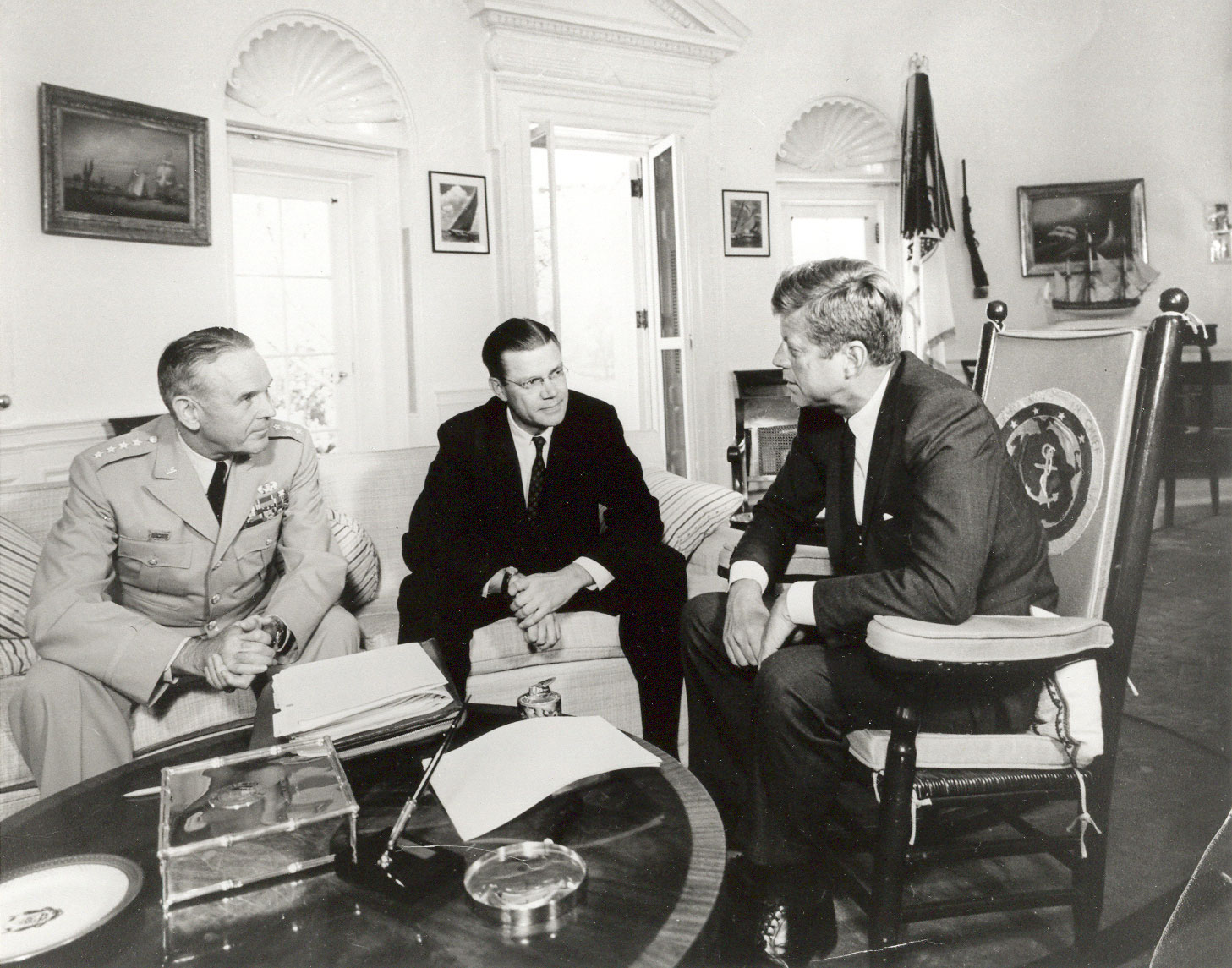
    3 JFK McNamara Taylor Oct 63Prouty believed, based on having seen numerous copies of the November 21 draft, that it was relatively widely distributed across the senior layers of the national security apparatus. A cover note attached to a copy distributed to Bundy’s brother William, a deputy within the Defense Department, asks him to review and also consult on the draft with McNamara.[36] The draft also appears to have been distributed on November 23 to newly appointed President Johnson, ahead of a meeting with Ambassador Lodge scheduled for the following day which, in an instance of macabre irony, had already been anticipated in the draft’s opening sentence: “the President…has discussed the matter further with Ambassador Lodge”.[37] A State Department Briefing Paper put together for Johnson ahead of the same meeting refers to a “draft National Security Action Memorandum emerging from the Honolulu meeting, which Mr. Bundy has initiated.” (Emphasis added).[38]
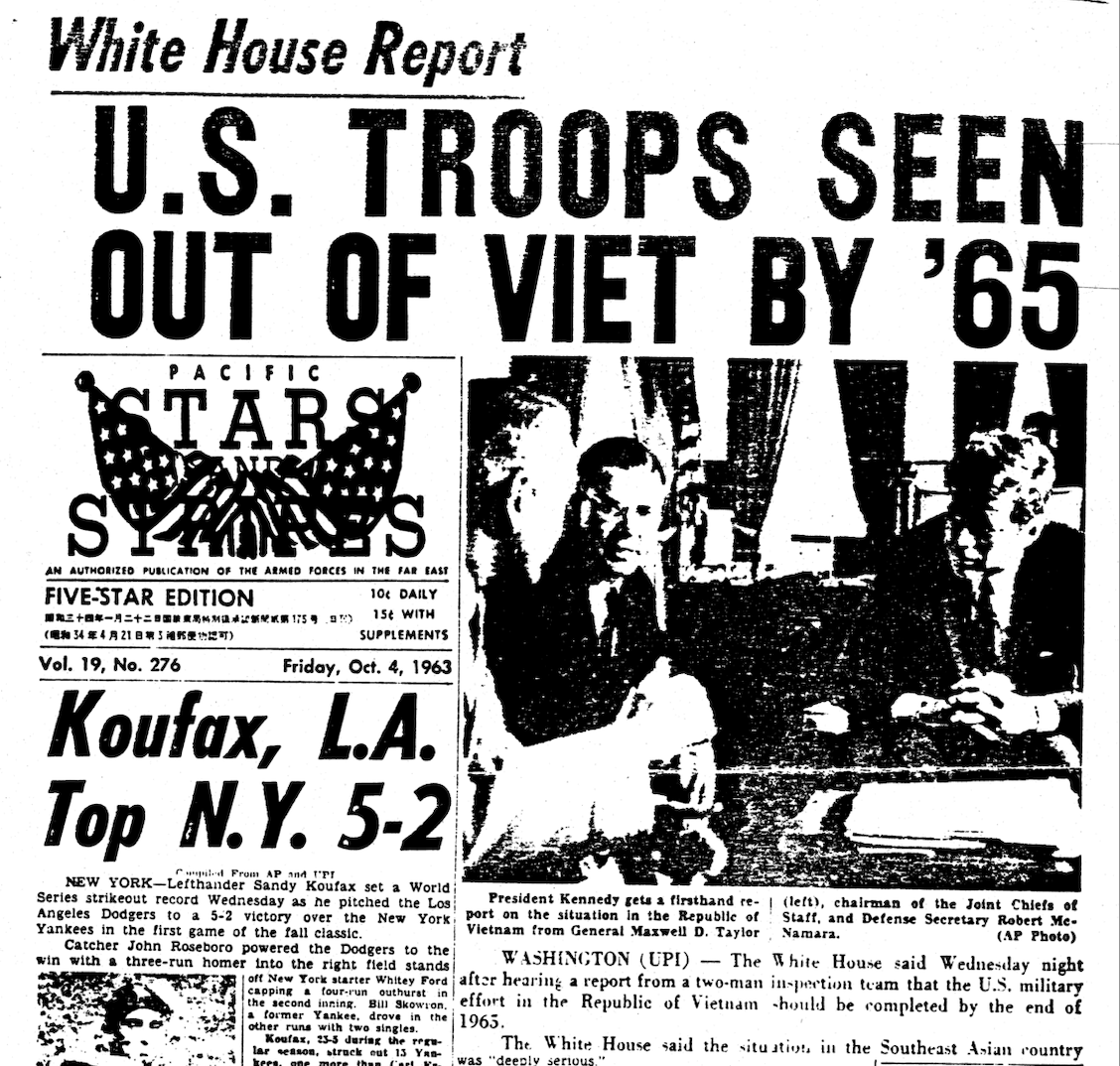
    4 Stars and Stripes Oct 1963A second draft of the proposed NSAM 273 was composed on November 24. Changes in the draft were notable in paragraph 7, which originally discussed “the development of additional Government of Vietnam resources” to be used for “action against North Vietnam.” The revision appeared to address kinetic activity generated directly by U.S. forces, in accord with established covert protocols (i.e. the “plausibility of denial”).[39]

    That same day, the anticipated meeting to discuss the South Vietnam situation was held, with LBJ, Rusk, McNamara, Ball, Lodge, McCone and Bundy in attendance.[40] This briefing for the President, focused on recommendations and updates, it represents – other than the one thousand man withdrawal slated for year-end – the internment of Kennedy’s Vietnam policies as developed in NSAM 263. Ambassador Lodge, for example, suggested that talk of a 1965 withdrawal – or “indication” thereof – was merely a negotiating ploy: “Lodge stated that we were not involved in the coup, though we put pressures on the South Vietnamese government to change its course and those pressures, most particularly on indications of withdrawal by 1965, encouraged the coup.” If ever there was a piece of high level CYA, this was it for, as James Douglass shows, Lodge was actually guiding the Diem brothers to their deaths.

    CIA Director John McCone, contradicting the conclusions delivered in Honolulu to the press, said the situation was “serious” and the paucity of optimism regarding the future of South Vietnam was evidenced by large increases in Viet Cong attacks and their advanced preparations for more. For his part, LBJ expressed misgivings with poor handling of controversial situations in the country, exacerbated by internal bickering. He rejected the idea that “we had to reform every Asian in our own image” in reference to political and economic strategies discussed in Honolulu. “(Johnson) was anxious to get along, win the war – he didn’t want as much effort placed on so-called social reforms…”

    “The meeting was followed by a statement to the press which was given out by Bundy to the effect we would pursue the policies agreed to in Honolulu adopted by the late President Kennedy.” This statement was given prominence in a New York Times report published November 25, 1963 (datelined Nov 24) entitled “Johnson Affirms Aims in Vietnam, Retains Kennedy’s Policy of Aiding War on Reds”. The opening sentence, presumably echoing Bundy: “President Johnson reaffirmed today the policy objectives of his predecessor regarding South Vietnam.” This reporting features the first three paragraphs of what would be published as NSAM 273 two days later, including the iteration that the “central point of U.S. policy on South Vietnam remains; namely, to assist the new government there in winning the war against the Communist Vietcong insurgents.” There is also a discussion of the political and economic measures advocated at Honolulu, but downplayed by Johnson shortly before (which is not mentioned), as well as the need for unity within the U.S. bureaucracy assigned in support South Vietnam.[41]
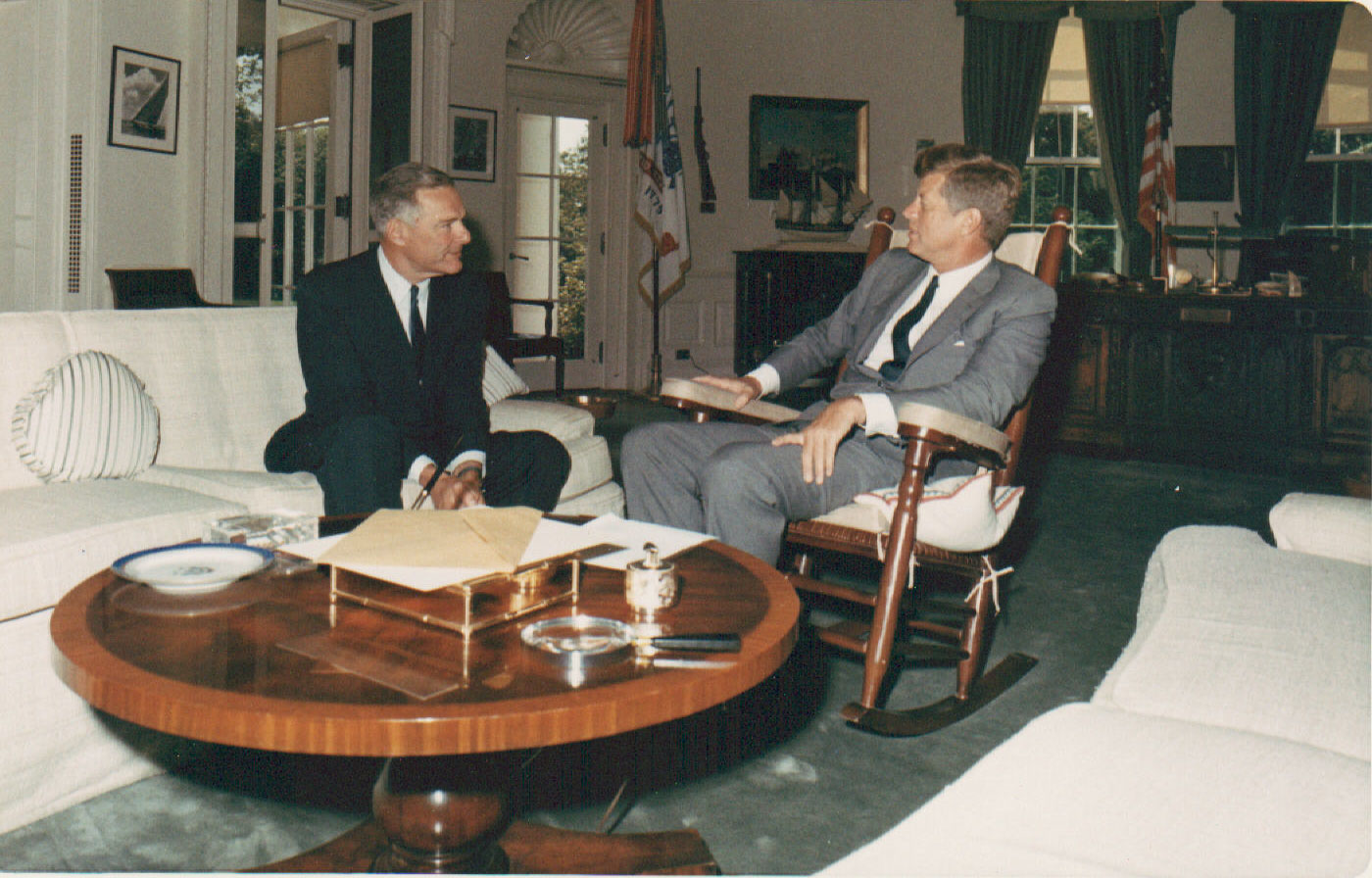
    5 JFK LodgeOn November 26, 1963, National Security Action Memorandum No. 273 was signed by McGeorge Bundy and updated NSAM 263 in United States official policy for South Vietnam.[42] Kennedy’s policy of effecting the removal of all “U.S. personnel” (i.e. military and CIA) from South Vietnam by the end of 1965, clearly referenced during conversations held at the Honolulu Conference, had been essentially erased from memory, even as NSAM 273 and its components were being described as a continuation of, or consistent with, Kennedy’s policies. The intent is now to win the war. Prouty:

    “Two months later, January 22,1964, one of the same authors of NSAM #263, General Maxwell Taylor, wrote to the Secretary of Defense, McNamara: ‘The Joint Chiefs of Staff consider that the United States must: (i) commit additional U.S. forces, as in support of the combat action within South Vietnam, and (j) commit U.S. forces as necessary in direct actions against North Vietnam.’

    These were the same two top level officials who under JFK had gone along with the Kennedy plan for the withdrawal of U.S. men. Then, less than 3 months later, under LBJ, they made totally different recommendations. The only difference was that President Kennedy was against escalation and wanted the men home, and Kennedy had never approved at any time the introduction of combat soldiers under U.S. military commanders for combat purposes in Vietnam. President Johnson, with George Ball in a top position, was doing just the opposite.”[43]

    That was how fast Johnson’s militant position infected Kennedy’s advisors.

    What many consider the true milestone on the road to an American war, NSAM 288, was approved in March, based on recommendations generated from yet another review of South Vietnam’s national security situation, presented by McNamara (working from an initial draft written by Bundy). Among the recommendations: a pledge to “furnish assistance and support to South Vietnam for as long as it takes to bring the insurgency under control”; to put South Vietnam on a “war footing”; to increase and upgrade Air Force, Army, and Naval heavy equipment; to prepare “hot pursuit”, “Border Control”, “Retaliatory Actions”, and “Graduated Overt Military Pressure” against North Vietnam.[44] By August, the increased tempo of activities supported by U.S. military assistance had created the Tonkin Gulf incident, and the inevitable slide to a shooting war. Prouty:

    “By March 1964 the U.S. approach to the situation in Vietnam had changed 180 degrees from the Kennedy policy of NSAM #263 and on March 17, 1964, President Johnson signed NSAM #288 which broadly expanded U.S. policy. About one year later, March 8, 1965, the first U.S. Marines operating under Marine commanders invaded South Vietnam at Da Nang. This was the true beginning of military action in Vietnam.”[45]

    What Kennedy had not done in three years, Johnson had done in three months.

    Obfuscation of NSAM 263

    On January 6, 1992, the New York Times published an opinion piece by Leslie Gelb titled “Kennedy and Vietnam”. Gelb could be described as the consummate Washington insider, with a c.v. laden with high-profile appointments across government, think tanks, and the media, specializing in foreign affairs. In the late 1960s, Gelb served as the director of the so-called Pentagon Papers project, leading the team of analysts in setting down an extensive history of the Vietnam War. Gelb’s authority to criticize premises expressed in Oliver Stone’s then current blockbuster film JFK ensured his opinions would hold some influence in the culture at large.

    In the piece, Gelb angrily accuses Stone (and by extension Prouty) of distorting the record of NSAM 263 and making “swaggering assertions about mighty unknowns.” Gelb claims of NSAM 263 that “some officials took the directive at face value”, but “most” saw it as a “bureaucratic scheme” to fudge the numbers of in-country personnel. He argues that “whatever JFK’s precise intentions” or “underlying thinking”, it was best to understand them as malleable and subject to changing circumstances and complications. Gelb ends his piece with an appeal to recognize the burden of the Presidency, particularly as involved Vietnam: the “private soul-searching” of Eisenhower, the “documented dilemmas ” and “torments” of Johnson and Nixon, matched by the “murky” musings represented by Kennedy’s occasional contradictory public statements. Stone (and Prouty) are therefore attacked for their “foolish” confidence over “decisions J.F.K. would have made in circumstances he never had to face.”[46] Prouty responded:

    “It is almost beyond belief that (Gelb)… in 1992, finds it easier to say that this was a decision ‘he never had to face’ instead of telling it as it is – the reason ‘he never had to face’ that decision was because he had been assassinated.”[47]

    6 McGeorge BundyThe one specific reference Gelb uses to respond to the supposed misrepresentations which had him so vexed, is itself distorted with some lawyerly spin: “Most officials also viewed the withdrawal memo as part of a White House ploy to scare President Diem of South Vietnam into making political reforms…That is precisely how the State Department instructed the U.S. Embassy in Saigon to understand NSAM 263.” What Gelb is referring to (and this became a talking point for other critics as well), is a State Department telegram to Lodge’s Vietnam embassy dated October 5, 1963.[48] While this communication is cited within the body of NSAM 263, it appears as an item of business separate from the primary matters, namely the planned withdrawal of “1000 U.S. military personnel” and the intention of withdrawing “the bulk of U.S. personnel” by the end of 1965.[49]
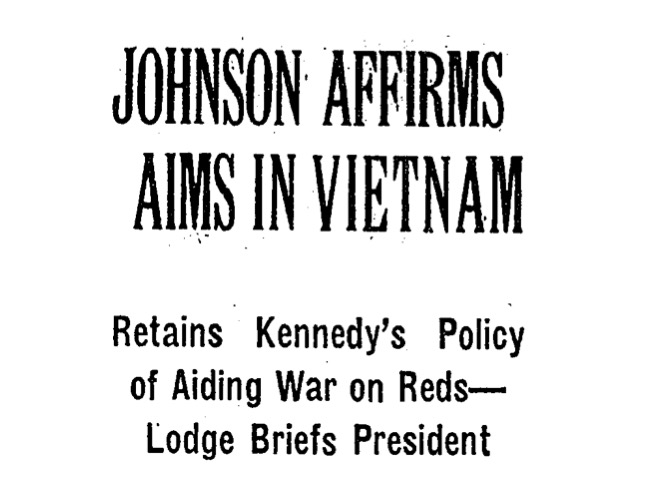
    7 NY Times 11 25 63Prouty’s issues with Gelb extended beyond the latter’s simplistic denial that Kennedy was just “going to abandon South Vietnam to a communist takeover.” Gelb’s previous role as director of the “Pentagon Papers” project could not be overlooked. Prouty:

    “However it was in the ‘Pentagon Papers’ that the intrigue to distort and misrepresent major episodes of the Kennedy era began. Pre-eminent among these distortions is the Pentagon Papers presentation of the NSAM #263 record. What was done was quite simple, and effective. The title, ‘National Security Action Memorandum No. 263’ appears as Document #146 on page 769 in Volume II of the Gravel Edition, i.e. Congressional Record. But, this is published as only three, single-sentence paragraphs of non-substantive material with no cross referencing. This is like publishing the envelope; but not the letter.”[50]

    This is a good point. While NSAM No. 263, as it appears on pp 769-770 of the Gravel Edition (Vol.II), is accurately transcribed from the original, the presentation, lacking cross reference, is opaque.[51] Since McGeorge Bundy’s original wording is not precise, in that it dates the discussion of the crucial McNamara-Taylor report (October 5, 1963) but doesn’t attribute identifiers to the report itself (dated October 2, 1963), the reader is either left to their own devices to put the pieces together, or must remember to consult a lengthy Chronology which appears some 550 pages previous. Prouty:

    Those few who already know what a true-copy of NSAM #263 looked like will find that the ‘Memorandum For The President’ that is the McNamara-Taylor Trip Report of Oct. 2, 1963 appears as Document 142 on page 751 through 766 with no reference to NSAM #263 whatsoever. This may be why so many ‘historians’ and other writers remain unaware of this most important policy statement.[52]
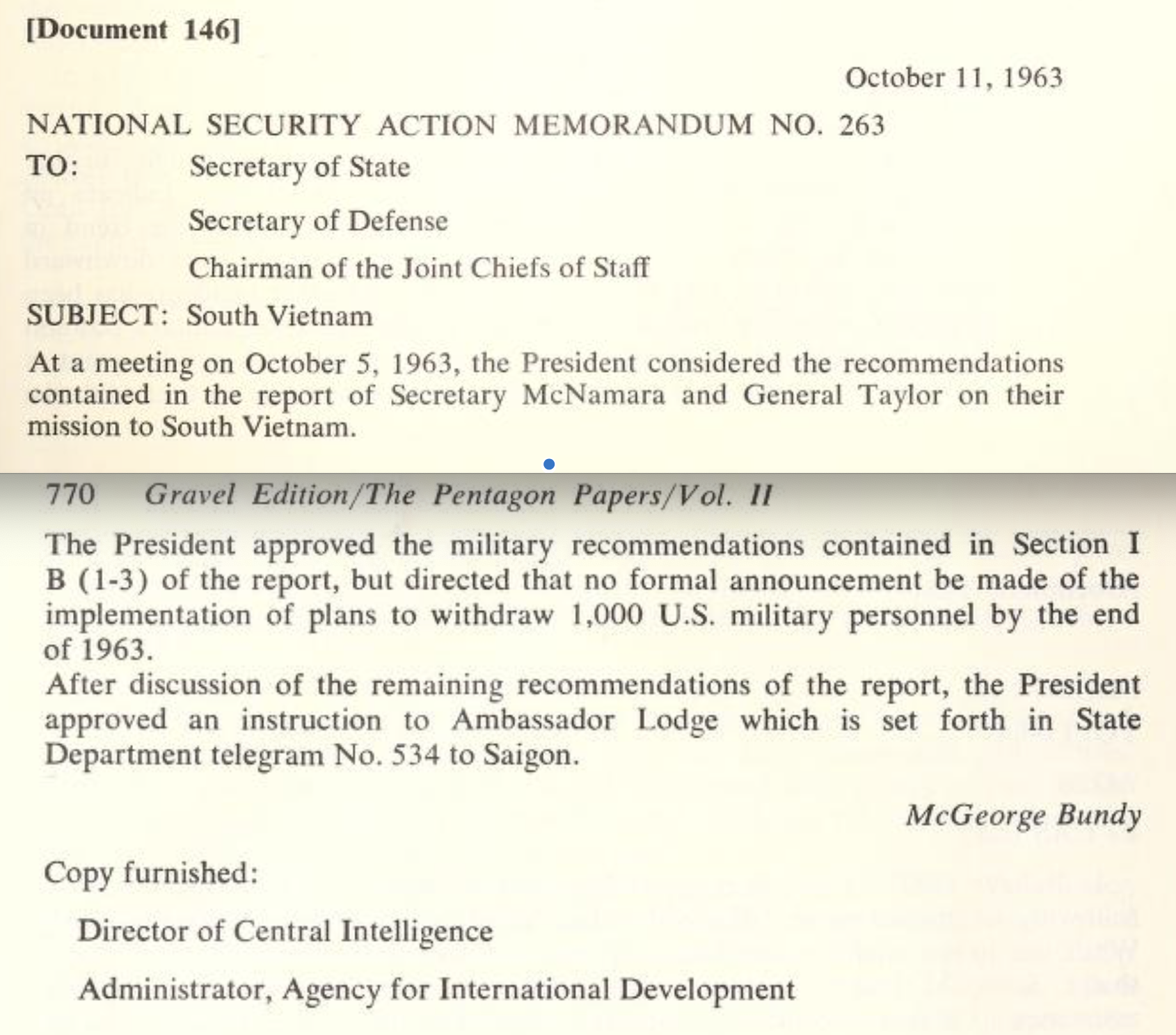
    8 NSAM 263 Pentagon PapersThe Chronology in Vol. II of the Pentagon Papers begins May 8, 1963 and concludes on November 23, 1963.[53] The Report of the McNamara-Taylor mission appears as a listing for October 2, 1963 (p216). In the brief description, the withdrawal of “1,000 American troops by year’s end” is noted, but there is no mention of the recommendation to withdraw “the bulk of U.S. personnel” by the end of 1965. The publication of NSAM 263 as an official document, October 11, 1963, is not listed.

    The Chronology’s concluding three items feature a description of the Honolulu Conference (20 November 1963), which observes a press release “gives few details but does reiterate the U.S. intention to withdraw 1,000 troops by the end of the year.” That the press release also indicated “no basic changes to U.S. policies” is not mentioned. Then, incongruously, the Chronology concludes:

    22 Nov 1963: Lodge confers with the President Having flown to Washington the day after the Conference, Lodge meets with the President and presumably continues the kind of report given in Honolulu.
    23 Nov 1963: NSAM 273
    Drawing together the results of the Honolulu Conference and Lodge’s meeting with the President, NSAM 273 reaffirms the U.S. commitment to defeat the VC in Vietnam

    9 PP chronologyNeither of these final two items actually occurred as described. Lodge did not meet with either President Kennedy or newly sworn-in President Johnson on November 22, the day on which President Kennedy was assassinated. NSAM 273 was not made official on November 23, and the specific meeting pertaining to the document was not held until the following day. Prouty:

    “NSAM 273 was signed by President Johnson on Nov. 26, 1963. It must be noted, that until an NSAM is approved and signed it does not have a formal number; therefore the subject matter that Lodge and Johnson conferred about could not have been designated NSAM #273 on the 23rd of Nov. 1963.”[54]

    Conclusion

    A separate attack on Oliver Stone’s JFK movie, published by the New York Times during the film’s initial release, was written by Tom Wicker.[55] Prouty’s response to this piece provides a good summary of his position:

    (Tom Wicker) also attacked Stone’s use of Kennedy’s Vietnam policy statement, NSAM #263, with the comment, ‘I know of no reputable historian who has documented Kennedy’s intentions.’ NSAM #263 is the official and complete documentation of Kennedy’s intentions. It was derived from a series of White House conferences and from the McNamara-Taylor Vietnam Trip Report, and it stated the views of the President and of his closest advisers as is made clear in the U.S. government publication Foreign Relations of the United States, 1961-1963, Vol. IV, ‘Vietnam: August-December 1963’. That source is reliable history. Wicker’s December 15, 1991, Times article was a lengthy and unnecessarily demeaning diatribe against Stone and his movie…

    The inclusion of this little-known NSAM #263 in the film became the principal point of attack of the big guns that were leveled at Stone, Garrison, and myself. It really is amazing that the most vitriolic attacks were those that attempted to inform the public that there was no such directive. The furor over that one item, NSAM #263, was evidence that Stone had hit his target. This alone uncovered the ‘Why?’ of the assassination.[56]

    Prouty’s insights pertaining to National Security Action Memorandums numbers 263 and 273 remain vitally important to understanding the development of Kennedy’s Vietnam policy. It is clear that the recommendations described in NSAM 263 were the result of a period of concentrated attention directed by the President. It is much less clear what motivated McGeorge Bundy to draft what became NSAM 273, and how it was that the changes to the earlier document initiated by 273 were long described as representing continuity with Kennedy’s policies. Clearing the web of obfuscation over these directives, as begun in Stone’s JFK, provides clarity to the historical record.

    The Vietnam War, with its intensive U.S. military commitments, proved a massive disaster for the people of Southeast Asia and the American public, although it remains often officially portrayed as a “tragic” event borne of circumstance and not design. As well, the missed opportunity to rein in the CIA’s operational capabilities opened the door to ever larger corrupt cynical undertakings such as Iran-Contra and Timber Sycamore, with the clandestine services’ lack of accountability ever more entrenched. The documented record strongly infers that Kennedy’s potential re-election in 1964, as a “what-if?”, would have been consequential.


    Bibliography:
    L. Fletcher Prouty, Collected Works. CD-ROM
    www.prouty.org


    Notes

    [1] JCS – Sec Def Discussions April 29, 1963 https://www.maryferrell.org/showDoc.html?docId=144

    [2] JCS Official File. May 6, 1963. https://www.maryferrell.org/showDoc.html?docId=122#relPageId=47

    [3] ibid https://www.maryferrell.org/showDoc.html?docId=122#relPageId=115

    [4] The concentrated interest in Vietnam policy during these months is recorded in Foreign Relations of the United States, 1963, vol 3 Vietnam: January-August 1963 & vol. 4 Vietnam: August-December 1963, assembled by the Department of State and published by the U.S. Government Printing Office, 1991 https://www.maryferrell.org/php/showlist.php?docset=1036

    [5] Prouty, JFK: New Preface, 1996. Collected Works

    [6] FRUS Vol. 4, p117. 66. Memorandum of a Conference with the President, White House, September 6, 1963 https://www.maryferrell.org/showDoc.html?docId=945#relPageId=143

    [7] FRUS Vol. 4, p 161. 83. Memorandum of a Conversation, White House, September 10, 1963 https://www.maryferrell.org/showDoc.html?docId=945#relPageId=187

    [8] FRUS Vol. 4, p199, Memorandum for the Record of a Meeting, White House, September 12, 1963 https://www.maryferrell.org/showDoc.html?docId=945#relPageId=225

    [9] FRUS Vol. 4, p231, Draft Letter from President Kennedy to President Diem, September 16, 1963. https://www.maryferrell.org/showDoc.html?docId=945#relPageId=257

    [10] This document would also be described as “draft instructions” from the President for McNamara to guide his upcoming trip to Vietnam with General Taylor. FRUS Vol. 4, p 278. 142. Memorandum from the President to the Secretary of Defence (McNamara) September 21,1963. https://www.maryferrell.org/showDoc.html?docId=945#relPageId=304)

    [11] FRUS Vol. 4, p 280. Memorandum for the Record of a Meeting, White House, September 23, 1963. https://www.maryferrell.org/showDoc.html?docId=945#relPageId=306

    [12] Prouty, The Highly Significant Role Played By Two Major Presidential Policy Directives, 1997. Collected Works. Prouty does make the point that neither McNamara or Taylor would have had the time or resources to compose let alone print the volume seen in photographs from October 2.

    [13] Taylor also wrote: “I am convinced that the Viet Congress insurgency in the north and center can be reduced to little more than sporadic incidents by the end of 1964. The Delta will take longer but should be completed by the end of 1965.” FRUS Vol. 4, p 328. Letter From the Chairman of the Joint Chiefs of Staff (Taylor) To President Diem, October 1, 1963. https://www.maryferrell.org/showDoc.html?docId=945#relPageId=354

    [14] FRUS Vol. 4, p 350. 169. Summary Record of the 519th Meeting of the National Security Council, White House, October 2, 1963. https://www.maryferrell.org/showDoc.html?docId=945#relPageId=376

    [15] FRUS Vol. 4, p 353. 170. Record of Action No 2472, Taken at the 519th Meeting of the National Security Council, October 2, 1963. https://www.maryferrell.org/showDoc.html?docId=945#relPageId=379

    [16] Item 194 Foreign Relations of the United States 1961-1963 Vol. IV p395 https://www.maryferrell.org/showDoc.html?docId=945#relPageId=421)

    [17] Item 167 Memorandum from the Chairman of the Joint Chiefs of Staff (Taylor) and the Secretary of Defense (McNamara) to the President, October 2, 1963 https://www.maryferrell.org/showDoc.html?docId=945#relPageId=362)

    [18] Foreign Relations of the United States 1958-1960, Vietnam Vol 1. p705 Item 255. Special Staff Note Prepared by Department of Defense.

    [19] Prouty, The Hidden Role of Conspiracy, 1993. Collected Works “(Kennedy) inherited it and revisionist historians have saddled him with the ‘Vietnam build-up’ and the ‘creation of the Special Forces’ ever since.”

    [20] Foreign Relations of the United States 1958-1960, Vietnam Vol 1. P703 Item 254. Memorandum From the Joint Chiefs of Staff to the Secretary of Defense (Gates)

    [21] Prouty, 30th Anniversary of Coup, 1994. Collected Works

    [22] The members of this Group were General Maxwell Taylor, Admiral Arleigh Burke, CIA director Allen Dulles, and Robert Kennedy representing the Executive

    [23] Prouty, 30th Anniversary of the Coup, 1994, Collected Works

    [24] copies of NSAM 55-57 as saved in Prouty’s own files can be found at https://ratical.org/ratville/JFK/USO/appE.html

    [25] “When I read to (Chiefs of Staff) President Kennedy’s statement from NSAM #55…you could have heard a pin drop in the ‘Gold Room’. They had never been included in the special policy channel which Allen Dulles had perfected over the past decade, that ran from the National Security Council (NSC) to the CIA for all clandestine operations.” Prouty The Highly Significant Role Played By Two Major Presidential Policy Directives 1997. Collected Works

    [26] Item 304 Telegram from the Department of State to the Embassy in Vietnam November 6, 1963. https://www.maryferrell.org/showDoc.html?docId=945#relPageId=605

    [27] Item 312 Memorandum for the Record of Discussion at the Daily White House Staff Meeting, Washington, November 13, 1963 8 a.m. https://www.maryferrell.org/showDoc.html?docId=945#relPageId=619

    [28] Memorandum to Mr Bundy https://www.maryferrell.org/showDoc.html?docId=146534#relPageId=6

    [29] That might infer he was instructed specifically by President Kennedy, but his reply as recorded does not actually clarify who had so instructed. Since Bundy was the author of NSAM 273, such instruction might explain the how’s and why’s of the original draft, dated November 21, which Bundy later described as drafted “for the President”. The record, however, nowhere indicates any instruction or dialogue involving Kennedy seeking revision to NSAM 263, which had been drafted only weeks previously.

    [30] FRUS Vol. 4, p 608 Item 321 Memorandum of Discussion at the Special Meeting on Vietnam, Honolulu November 20, 1963 https://www.maryferrell.org/showDoc.html?docId=945#relPageId=634

    [31] FRUS Vol. 4, p 610 Item 321 Memorandum of Discussion at the Special Meeting on Vietnam, Honolulu November 20, 1963 https://www.maryferrell.org/showDoc.html?docId=945#relPageId=636

    [32] U.S. Aides Report Gain,1,000 Troops to Return New York Times November 21, 1963, p8

    [33] a copy of the draft, along with John Newman’s discussion of it can be found here: https://jfkjmn.com/new-page-77/

    [34] Prouty, Hidden Role of Conspiracy,1993, Collected Works

    [35] Prouty The Highly Significant Role Played by Two Major Presidential Policy Directives 1997. Collected Works

    [36] “I have other copies of this draft document that were done on various typewriters and they certainly indicate that this draft document had to have been quickly circulated through all of the highest governmental levels…on the 21st. On these draft copies there are some notes, and line outs.” Also: “in this original draft that he circulated among many of the top echelons of the Government, with personal “Cover Letters” to the Director of Central Intelligence, John McCone and to his brother William in McNamara’s office…” Prouty The Highly Significant Role Played By Two Major Presidential Policy Directives 1997. Collected Works

    [37] Item 324. Memorandum From the Secretary of Defense (McNamara) to the President https://www.maryferrell.org/showDoc.html?docId=945#relPageId=653

    [38] Item 326 Briefing Paper Prepared in the Department of State for the President, November 23, 1963 https://www.maryferrell.org/showDoc.html?docId=945#relPageId=657

    [39] The first draft of NSAM 273, and a brief discussion of it, can be accessed on scholar John Newman’s site https://jfkjmn.com/new-page-77/. In an interview, McGeorge Bundy explained to Newman his first draft approach to paragraph 7: “he tried to bring these recommendations ‘in line with the words Kennedy might want to say.’” Which, considering the change in responsibility for activity from Government of Vietnam to U.S. forces from first to second draft, is a back-handed way of admitting the difference in policy, not just of words.

    [40] Item 330 Memorandum for the Record of a Meeting, Executive Office Building, Washington, November 24, 1963, 3 p.m. Subject. South Vietnam Situation https://www.maryferrell.org/showDoc.html?docId=945#relPageId=661

    [41] The concept of “unity” informs one of the paragraphs from the first draft of NSAM 273, which Prouty discussed at some length in a few of his essays. In Bundy’s draft, Paragraph Four reads: “It is of the highest importance that the United States Government avoid either the appearance or the reality of public recrimination from one part of it against another, and the President expects that all senior officers of the Government will take energetic steps to insure that they and their subordinates go out of their way to maintain and to defend the unity of the United States Government both here and in the field.” As published, reference to unity is clarified as “support for established U.S. policy in South Vietnam” – which produces a different reading than the potentially ominous warning written on the eve of the presidential assassination. It could be fairly argued, however, even lacking the precise term “South Vietnam”, that the paragraph in the first draft was referring to policies thereof, as there had been a lot of concern in the period between the Diem coup and the Honolulu Conference with perceived divisions, stoked in part by an article written by David Halberstram. These concerns are reflected in the documents published in Foreign Relations of the United States Aug-Dec 1963 from those weeks in November. That said, Prouty’s alert reading has a context, and it should not be overlooked that McGeorge Bundy was responsible for, among other things: a) called off the flight meant to destroy Castro’s last T33, ensuring failure of the Bay of Pigs b) wrote first draft of NSAM 273 c) believed to have contacted Air Force One from White House Situation Room Nov 22/63 to report lone gunman responsible for JFK assassination d) wrote first draft of NSAM 288.

    [42] Item 331 National Security Action Memorandum No. 273 November 26, 1963 https://www.maryferrell.org/showDoc.html?docId=945#relPageId=663

    [43] Prouty, Kennedy and the Vietnam Commitment, Collected Works

    [44] Memorandum From the Secretary of Defense (McNamara) to the President, March 16, 1964. https://history.state.gov/historicaldocuments/frus1964-68v01/d84

    [45] Prouty, Hidden Role of Conspiracy, 1993, Collected Works

    [46] Leslie Gelb, Foreign Affairs; Kennedy and Vietnam, Section A Page 17, New York Times, January 6, 1992

    [47] Prouty, Vietnam Daze With McNamara, Collected Works

    [48] Item 181 Telegram from the Department of State to the Embassy in Vietnam October 5, 1963. https://www.maryferrell.org/showDoc.html?docId=945#relPageId=397

    [49] The Memorandum states: “After discussion of the remaining recommendations of the report” – that is, recommendations other than those involving the planned withdrawals – “the President approved an instruction to Ambassador Lodge which is set forth in State Department telegram No. 534 to Saigon.” This telegram’s featured “instruction” refers specifically to a series of proposed Actions to guide approaches to Diem, none of which refer to troop withdrawals. The attempt to tie the matters together is strained, but notably had also found expression by Lodge during the meeting with LBJ on November 24, 1963 (i.e. talk of withdrawal simply a negotiating ploy)

    [50] Prouty, Vietnam Daze with McNamara, Collected Works

    [51] In contrast, the presentation of NSAM No. 263 in Foreign Relations of the United States, 1963, vol. 4 Vietnam: August-December 1963, published in 1991, is properly cross-referenced.

    [52] Prouty, Vietnam Daze with McNamara, Collected Works

    [53] Chronology, Pentagon Papers Gravel Edition Vol II, Beacon Press pp 207-223

    [54] Prouty, Vietnam Daze with McNamara, Collected Works

    [55] Tom Wicker, Does JFK Conspire Against Reason?, New York Times, December 15, 1991

    [56] Prouty, Stone’s JFK and the Conspiracy, 1996, Collected Works

  • Counterpunch is at it Again

    Counterpunch is at it Again


    Every once in a long while, Counterpunch will run a decent enough story on the JFK case by someone like Jeff Morley. More often the material they run is pretty much useless, and at times, worse than that. This is probably due to the legacy of the late Alexander Cockburn who teamed with Jeffrey St. Clair to edit the ‘zine. Back in 1991, Cockburn took up arms to attack Oliver Stone’s feature film JFK.

    For the 60th anniversary, Counterpunch was at it again. On two consecutive days, they ran very questionable articles that can only be called smears of President Kennedy. The first was by Howard Lisnoff on December 6th and the second was by Binoy Kampmark on December 7th.

    The first article began with a brief discussion of the Paramount Plus channel documentary entitled, JFK: What the Doctors Saw. Lisnoff acknowledges that the film produces evidence that Kennedy’s neck wound was one of entrance, and the rear head wound was an exit. He even admits that “there is no reason to doubt their clinical assessments.” But then he writes that there are few chances of “someone speaking out, or documents giving some clarity to these events…” Well Howard if you do not keep up with the declassifications of the Assassination Records Review Board or read sites like Kennedys and King, then you can say that. But if you did, you would know something about say Betsy Wolf and her inquiry into the Lee Oswald file at CIA for the House Select Committee on Assassinations. Which showed that someone was rigging that file when Oswald was on his way to defect to Russia in 1959. Does that not provide some clarity?

    From here Lisnoff jumps to the famous Walter Cronkite interview with President Kennedy on September 2, 1963. Lisnoff starts in with the Alabama school case that had just begun at Tuskegee High School. Lisnoff does this without any mention of Kennedy facing down Governor George Wallace less than three months earlier at the University of Alabama on national television. Or saying a word about Kennedy’s civil rights speech of that evening, also broadcast on TV, which is probably the greatest speech on that topic by a president since Abraham Lincoln. That is quite a neat piece of censorship is it not?

    Wallace was clearly stung by these acts and chose to retaliate by preventing the court ordered integration of Tuskegee High in Macon County. During the Cronkite interview, Kennedy refers to federal court orders—which Lisnoff also ignores. The reason Kennedy does this is because he is relying upon the relationship between his brother, Attorney General Robert Kennedy, and the great southern judge Frank Johnson from Alabama, to handle both Wallace and the case. Bobby Kennedy filed a lawsuit to prevent Wallace from interfering in the local issue. Johnson then issued an order to that effect. Wallace called up the Alabama National Guard to block entry into the school. The next morning JFK asserted federal authority over the National Guard. (Click here for the whole story)

    Lisnoff also says that Kennedy made strikingly few appointments of minorities. In March of 1961, Kennedy signed the first affirmative action law in American history. He later extended that order to deal with, not just hiring practices by the federal government, but to all federal contracting to private companies. So, for the first time, companies and businesses in the south had to follow affirmative action guidelines in their hiring practices. For example, textile plants in North Carolina had to hire African American employees or they would lose federal contracts. (Promises Kept by Irving Bernstein, pp. 55-56). Lisnoff might not think this was important. But the conservative enemies of JFK sure did, since they began a 60-year campaign to neutralize it. Which finally succeeded this year.

    LIsnoff then turns to the Vietnam conflict to address what Cronkite brings up about it and how Kennedy replied. He mentions NSAM 263, the order that Kennedy approved of on October 11, 1963 that would begin the withdrawal of American forces at the end of 1963, to be completed in 1965. Lisnoff replies that this was based on rosy predictions about the war made by Secretary of Defense Robert McNamara and JCS Chair Max Taylor. He then tries to throw this all out by saying that Kennedy was a Cold Warrior in light of the Bay of Pigs debacle and the Cuban Missile Crisis.

    In the first instance, Kennedy refused the requests of the military to save the Cuban exile invasion with American forces, even though it was obvious it was about to fail. In other words, he did not escalate even though he was in a losing situation. During the Missile Crisis, Kennedy was in a defensive position. It was the USSR that had provoked that situation by secretly importing a huge atomic armada 90 miles from Florida, and then lying about it. That Russian arsenal included all three branches of the triad: missiles, bombers and submarines. Kennedy rejected an invasion, and he also rejected bombing the missile sites. He settled on the most peaceful alternative which allowed for a negotiated settlement to the crisis, namely the blockade. Far from branding JFK a Cold Warrior, this showed Kennedy at odds with the hawks in his administration.

    This parallels what Kennedy was doing in Vietnam. The USA could help Saigon, with advisors and equipment, but no combat troops. Kennedy had drawn that line in 1961. He never crossed it. And he was planning on getting out at the time of his death. This is proven by other ARRB declassified documents that Lisnoff seems unaware of: the records of the May 1963 SecDef meeting in Hawaii. (Probe Magazine Vol. 5 No. 3, pp. 18-21) These documents showed that McNamara was collecting withdrawal schedules from all American departments in Vietnam. When he saw them he said the plans were too slow. These papers were so convincing that even the New York Times ran a story saying that Kennedy had a plan to exit Vietnam in 1963.

    Lisnoff gets utterly embarrassing in his desperation on the Vietnam topic. He actually uses David Halberstam’s obsolete book The Best and the Brightest to somehow show what Kennedy’s intent was in Indochina. That book was published over a half century ago. It was put out to pasture long ago by scholarship based on new documents that Halberstam either did not see, did not use, or discounted. If that was not enough, Lisnoff then trots out another journalist who initially promoted the Vietnam conflict, Neil Sheehan. I mean please Howard. (Click here for Sheehan)

    Authors like John Newman, Gordon Goldstein and David Kaiser, among others, have shown why Halberstam and Sheehan’s works are museum pieces. Kennedy was withdrawing and Lyndon Johnson purposefully reversed that policy within 48 hours of JFK’s death. It was Johnson who first sent in combat troops at Da Nang on March 8 1965, after carefully and secretly planning for war in 1964. (See Truth is the First Casualty by Joseph Goulden and Frederick Logevall’s Choosing War for long treatments of this planning.)

    Kennedy had no such plans. He did not even want American generals visiting Vietnam. (Monika Wiesak, America’s Last President, p. 133) And, in fact, McNamara declared in his Pentagon debriefs that he and the president had decided that America had only an advisory role in Vietnam. Once that was done we were leaving and it did not matter if Saigon was losing or winning at the time. (Vietnam: The Early Decisions, edited by Lloyd C. Gardner and Ted GIitinger, p. 166)

    Lisnoff closes with comments on what Cronkite asks JFK about the economy and the unemployment rate. At the time, the unemployment rate was about 5%. Kennedy talks about this and faces it head on, specifying where the pockets of unemployment are and what he is doing to counter it. But what Lisnoff leaves out is what Kennedy did with the economy in a short three years. The entering unemployment rate for Kennedy was about 8% inherited from Eisenhower. (John F. Kennedy: The Promise Revisited, edited by Paul Harper and Joann Krieg, p. 184) Once Kennedy’s economic program was enacted in 1964, that rate went down to 3.8 %. (ibid, p. 188). When one adds in that Kennedy increased GNP by 20%, and inflation was quite low, at about 1 % throughout, and with relatively small deficits, Kennedy’s performance on the economy is pretty impressive.

    The following article by Kampmark is probably even worse. It essentially dismisses all the hoopla over the 60th as sentimental hagiography, at times terming it as hysteria. Kampmark dismsses books by Arthur Schlesinger and Ted Sorenson with the usual charge of being done by “court historians”. My reply to this is: then what does one term the works of later writers like Richard Mahoney, James Blight, David Kaiser, Philip Muehlenbeck, Robert Rakove, Monica Wiesak and Irving Bernstein? These books were all done after careful research by men and women who were not working for or associated with the Kennedy administration. (The one exception being that Richard Mahoney’s father worked in the Kennedy state department.)

    The books by these latter-day authors, exploring both foreign and domestic policy, more or less agree with the verdicts of Sorenson and Schlesinger. Should we then add in the debacles that followed? For example, the disastrous escalation of the Vietnam War by Lyndon Johnson which led to the largest air war operation since World War II, Rolling Thunder, over a backwards economy? How about the invasions of Cambodia and Laos by Richard Nixon—the former of which led to the genocide in Cambodia by the Khmer Rouge? Or the Gerald Ford approval of the Indonesia invasion of East Timor, which led to another genocide there.

    Sorry if Kennedy looks pretty good in comparison. But facts sometimes get in the way of propaganda.

  • Old Wine in New Bottles: Fletcher Prouty’s New Critics Recycle the Past

    Old Wine in New Bottles: Fletcher Prouty’s New Critics Recycle the Past


    (Disclosure: the author is a friend and colleague of Len Osanic, who befriended and worked with Fletcher Prouty in his later years. Len continues to run the Fletcher Prouty online reference site www.prouty.org)

    Recent years have seen a resurgence in reputational criticism of the late Col. L Fletcher Prouty, the former Pentagon official responsible for numerous influential books and essays, and the real-life model for the fictional Mr X character in Oliver Stone’s 1991 film JFK. Curiously, these efforts – by a small but vocal faction – gathered momentum following the passing of John McAdams, a self-styled “debunker” of JFK assassination theories who had been a central source of reputational disparagement of Prouty dating back to the early 1990s.[1]The renewed efforts have added little to what had been previously articulated, but are notable for a distinctly strident tone and a smug certainty in presenting harsh conclusions which are not at all supported by the available record. By this, the new anti-Prouty crowd appear distinguished by being actually worse, or at least more irresponsible and reckless, than their late mentor.

    I

    A central focus for these critics has been Prouty’s 1996 appearance before a panel of ARRB staffers. While this event earned little more than a passing mention in the McAdams compendium, to contemporary debunkers it serves as the effective immolation of Prouty’s entire assassination-related oeuvre as, over the course of a long interview, he allegedly “could not substantiate any of his allegations.”

    Prouty’s Appearance at the ARRB 1996

    The Assassination Records Review Board was created by the US Congress in the wake of Oliver Stone’s JFK film and the resulting outcry over the continuing classification of much of the official record and subsequent investigations. The Board had the mandate to identify records and oversee the process by which they would be made public. In certain circumstances, the Board had the authority to interview persons whose input could assist with locating records or whose personal experiences might help clarify circumstances which were yet incomplete. An interview was arranged with Fletcher Prouty for September 1996, with the intention of both clarifying experiences and identifying records.

    The 9/10/96 letter from Chief Counsel Jeremy Gunn read as follows: “We will ask you to recount your personal experiences from around the time of the assassination of President Kennedy, as well as whatever information you have regarding military activities and procedures in effect. I would also like you to bring with you any relevant documents or notes related to these topics, especially any contemporaneous records (such as personal correspondence, telephone notes, daily diary entries, or the like) you might have.”

    A month previous to this communication, a memorandum had been distributed to Gunn from Tim Wray, a Pentagon veteran who was then running the ARRB’s Military Records Team. Wray understood a potential interview with Prouty would be assisting an effort known as the “112 Military Intelligence Project”, specifically interested in information previously published by Prouty concerning a possible “stand down” order directed to a Texas-based Military Intelligence unit related to presidential protection duties in Dallas 1963.[2]

    Wray’s 8/9/96 memo on Army Intelligence in Dallas read as follows: “We should eventually interview Prouty as well, though I frankly do not expect much from this—everything about his story that we’ve been able to check out so far appears to be untrue….Its only slightly more difficult to check the factual basis for the other elements of Prouty’s story….Prouty’s assertion to the contrary notwithstanding—it appears that military collaboration with the Secret Service was in fact, extremely limited, and that there certainly were no such thing as “military presidential protection units” per se.

    Wray would also later write, “Among other purposes, an important goal of this interview was to ask Prouty about three specific allegations he made in his book, “CIA etc”. These allegations were of particular significance to use because Prouty claimed they were based on his own firsthand knowledge.” (Wray Memo of 2/21/97)

    That there was an identified “important goal” for the interview was not shared with Prouty in the communication from September 10, 1996. Similarly, Wray’s Military Records Team assistant Christopher Barger composed a memo the following day, September 11,1996, identifying specific “allegations” appearing in Prouty’s 1992 book JFK: The CIA, Vietnam, and the Plot to Assassinate John F Kennedy, and proposing a line of questioning marked by an innate skepticism directed to Prouty’s “personal experiences”.[3] This doubting approach to his published work was also not shared with Prouty ahead of his appearance.

    The interview was conducted on September 24, 1996. According to some, referring to his performance, Prouty suffered severe damage to his reputation and the integrity of his rendering of the historic record.[4] This version of events relies on an interview “Summary”, produced by Military Records Team assistant Barger, which frames the exchange as a contentious deposition.[5] The integrity of this Summary relies on the assumption that the Team participating in this interview spoke from a position supported by the confirmed record.

    If It Walks Like A Duck…

    Wray wrote, about a month later:

    “…we should make (Prouty’s) interview with the ARRB easily available in written form so people can see for themselves what’s behind the fluff…There’s no way we can fairly represent the interview in summary form without it looking like a hatchet job.” – (Tim Wray, ARRB Memorandum October 23, 1996.)[6]

    1.TranscriptThe interview transcript was published along with the Summary so that, according to Wray, the process wouldn’t merely appear as a “hatchet job”.

    It might seem obvious that if one cannot “fairly” describe an interview process without it appearing as a “hatchet job”, then the proposition that the process was, in fact, a hatchet job is in play. Wray, to the contrary, asserts, literally, that “the emperor has no clothes” and declares therefore the ARRB Military Records Team is “not planning to do much of (Prouty’s) laundry.”[7] Beyond the strained analogy, Wray’s memorandum establishes the Team engaged the interview as an adversarial contest, tied to their own biases and skewed to a partisan acceptance of the JFK assassination’s Official Story. In a telling example, Barger opines: “Prouty also admits that he has never read or even seen the Warren Commission Report. No reputable historian would write a criticism of a source document without having read the source document first.”[8]

    Barger’s Summary begins by noting the panel’s interest in Prouty stemmed from “claims”, “theories” and “conclusions” often based on “special, firsthand knowledge that he gained through his own experiences” during his years at the Pentagon. The purpose of the interview is therefore, in part, to determine the extent to which his “various allegations or statements” were based on “personal knowledge or experience”, and, “should he disavow factual knowledge”, to determine if he is aware of other “factual data that could tend to prove or disprove his allegations.” The Summary proceeds to itemize ten supposed “allegations” Prouty had articulated or published in his work, and putting them to a test, such as locating reference in official documents or finding confirmation through the identification of other individuals. In conclusion, The Summary insists the Team “intended on hearing his story”, but found “in the face of numerous contradictions, unsupportable allegations, and assertions which we know to be incorrect, we have no choice but to conclude that there is nothing to be gained or added to the record from following up on anything he told us.”[9]

    While this Summary conclusion has apparently convinced some persons that Prouty should not be taken seriously, it represents a prejudiced interpretation reliant on a concept of allegation introduced solely by the Team’s own initiative. The concept of a “hatchet job” is confirmed by the notable reliance in the Summary on this term – allegation – a word never articulated in the communications with Prouty ahead of the interview, and used sparingly during the interview itself.[10] Within the Summary, however, its prominent use is naturalized by repetition, and contemporary endorsements of the Summary’s conclusions repeat the word liberally.

    Put another way, and considering the range of experiences across Prouty’s professional career, one might refer to his “observations” instead of the more obviously loaded preferred description. The difference between the two is quite sharp, particularly since the stated purpose of the interview, from the Team’s perspective, was to “prove or disprove” and “confirm or deny”:

    ob·ser·va·tion |(ə)n |

    a remark, statement, or comment based on something one has seen, heard, or noticed

    al·le·ga·tion |noun

    a claim or assertion that someone has done something illegal or wrong, typically one made without proof

    2.allegationThe Summary of the ARRB interview framed Prouty’s personal experiences as a series of “allegations”.

    There are ten separate “allegations” described in the Interview Summary, each with a “Result or Conclusion by ARRB” attached. Three “allegations” refer to content in the JFK film; one refers to Prouty’s work as a military liaison with the CIA; and six have to do with presidential protection, a field outside of his professional responsibility and of which he had no practical experience.

    The first “allegation” refers to Prouty’s trip to Antarctica in November 1963, noting, in the JFK movie, this trip was portrayed as “out of the ordinary or unusual in some way.”[11] Although, in a later publication, Prouty had surmised retrospectively if there was a hidden reason to being selected for the journey, he otherwise spoke consistently, including to the ARRB panel, of the trip as routine.[12] The assumed “sinister connotations”, portrayed by the ARRB panel as an “allegation”, is in fact a dramatic embellishment attributable to the JFK screenwriters, not to Prouty – who, regardless, is described as unable “to back up the suspicions he mentioned in the excerpt from his book.”[13] The second “allegation” concerns information appearing in wire service news reports and published in a New Zealand paper approximately 5-6 hours after the shots in Dallas.[14] While the Team’s “Result or conclusion” of this minor affair doesn’t refer to an actual result or conclusion, it does suggest “Prouty’s allegation of a ‘cover story’ will be weakened”. The point missed, however, is by his presence in New Zealand Prouty was outside and apart from the common shared experience stateside on that day, dominated by the visceral shock of the initial news followed by a steady drip of information which appeared to follow a sequential logic. Outside the simulacrum, Prouty could make the obvious, and correct, observation that there had quickly appeared a great deal of information about a suspect who had yet to be even arraigned on the JFK case, and in fact wouldn’t be for another 6-7 hours.[15] Having made this first observation, it is fair for him to point out the incorrect reports of “automatic weapons fire” – as others did as well.

    “Allegation” numbers three through five, and ten, concern Prouty’s information – published in his book JFK: The CIA, Vietnam and the Plot to Assassinate John F. Kennedy and in his Foreword to Mark Lane’s book Plausible Denial — regarding an apparent case of security stripping in Dallas involving a military intelligence outfit based in San Antonio.[16] Prouty had privately received information that the 112th Unit had been advised to stand down in Dallas by the Secret Service, This was referring to a Presidential protection capability within the military. According to internal memoranda, the ARRB Military Records Team was skeptical such units existed and was determined to “debunk” Prouty’s information. In the fullness of time, Prouty’s veracity regarding both the actual fact of military intelligence support for presidential protection, and the private communication he received, has been confirmed and the Team’s skepticism debunked.[17]

    Allegations six and seven refer to Prouty’s knowledge of Secret Service presidential protection protocols. When mentioning these, Prouty is referring to events specific to his military career, including several days in Mexico City, 1955, with a Secret Service advance team ahead of an Eisenhower visit. Prouty’s observations from these episodes inform his published statements and his statements during the ARRB interview. He qualifies his interactions as having “logistics purposes, not to learn all about the system.” The ARRB’s Summary characterizes the “allegations” as lacking corroborative documentation. This lack included failing to answer the question: “How many Secret Service agents would you have expected to be providing coverage in Dallas?”[18] Figurative speech is also interpreted literally, such as Prouty’s reference to the Secret Service working from a long-established “book” (he is asked if he has a copy of the “book”), or his impression that the Secret Service was deficient in Dallas stated as “they weren’t there” (he is asked if he meant they literally were not there).[19] This exchange is referred in the Summary as follows: “Prouty makes the very serious charge that the Secret Service was not even on duty in Dallas on November 22, then admits he has no experience upon which to base this statement.”[20] In truth, the deficiencies of the Secret Service during the Dallas motorcade have been well-catalogued, if not by the sources who appear to have influenced the Team.

    “Allegation #8” concerns whether some of Oswald’s activity during his Marine service in Asia – specifically with radar at Atsugi air base (where the U2s were based) and potentially in support of operations directed at Indonesia – could be described as part of CIA-directed programs. Although Prouty correctly describes the existence of the programs and Oswald’s proximity, the Panel jumps on his lack of specific documentation (“substantiating evidence”) as a means of dismissing the notion Oswald was involved. Even though Oswald himself specifically hinted at insider knowledge of U2 activity (at Atsugi) during his communications in Moscow related to his defection to the USSR, the Team presumes to consign this “allegation” as based merely on open-source rumors.

    “Allegation #9” refers to Prouty’s identification of Ed Lansdale in one of the well-known “Tramps” photos, which is portrayed in the JFK film. The Team acknowledges that a “search of travel records” might confirm or deny Lansdale’s presence in the Dallas region at the time, but factors such as the “small likelihood” of finding such records and their “relative unimportance” indicated that such effort was “not worth checking out.” (Summary ,p 11) In 1991, at the time of the JFK film, Lansdale could be traced to Fort Worth, Texas mid-November 1963. Subsequent information has placed Lansdale in Denton, a Dallas suburb, on the evening of November 21, 1963.[21]

    In sum, despite the brutal Summary composed in the aftermath of Prouty’s appearance before the ARRB’s Military Records Team, none of the ten points presuming to “debunk” his “allegations” actually hold up under scrutiny. That is, while the ARRB’s panel makes much of Prouty’s supposed failure to produce information outside his jurisdiction, such as Secret Service “manuals” (of which they aren’t even sure exist in the first place), and proceed to criticize his lived experiences, there is nothing actually incorrect or overstated in his observations. Latter-day critics lionize the Military Records Team’s Summary conclusions using a superficial reading based largely on the Team’s own predetermined finger-pointing, which was biased and subject to partial knowledge later superseded. However, there was one data point appearing in the Summary which has held up over the years as an accurate statement:

    “Fletcher Prouty was where he says he was during the period from 1955-1964. His position can be documented.” (P. 13)

    II

    Prior to the release of Oliver Stone’s JFK in late 1991, L. Fletcher Prouty was a relatively inconspicuous figure known to few outside of aging participants of early Cold War military/intelligence circles, or committed parapolitical researchers and their small followings. The backlash directed against the film – which began while it was still filming – attacked the intellectual foundation of the screenplay, as personified by director Oliver Stone (purportedly being “fooled” by Warren Commission critics), the film’s “compromised” protagonist (Jim Garrison) and, to a lesser extent, the insider Fletcher Prouty (known in the film as “Mister X”).

    3.NYC.Guardian.1991A photocopy of Diamond’s Guardian article was anonymously submitted to the JFK production office, along with several typewritten pages of “opposition research” directed at Prouty.

    All three were in the crosshairs of an article published in the November 1991 issue of Esquire Magazine. With the punning title “The Shooting of JFK”, author Robert Sam Anson put together one of the key contributions to the anti-JFK literature from the period, covering the film’s production. While bashing first Stone, then Garrison, and then turning to Prouty in a late-article segment which combined character assassination with an offhand revelation of why it was exactly the establishment had problems with the film.[22]

    Anson introduces Prouty as a genial grandfather type, at least as so impressing the JFK production office, but notes the whispers of “cautious buffs” who are “leery” and wary of Prouty’s background and “claims.”[23] Suddenly, in the production office, a “small thing” starts “the trouble”, and reporter Anson, despite the staff’s nondisclosure agreements, manages to be in the know and in the loop. Anson reports that some of the office’s research staff had been paging through “a tiny left-wing New York weekly” and, by chance, discovered an article identifying Fletcher Prouty “as a cause célèbre in the virulently anti-Semitic, racist Liberty Lobby.”[24]

    The article in question – ‘Populists’ Tap Resentment of the Elite – written by Sara Diamond and published in the July 3, 1991 issue of The Guardian (NYC) – was a legitimate investigative work, and the specific references to Prouty’s activities were accurate. While, to those who knew Prouty, the concept he was a racist fellow-traveler in step with the most virulent members of the Lobby, or even a “right-winger” as portrayed, appeared fringe and absurd, within Stone’s production office the general consensus was Prouty’s associations “looked bad” and could be a “public-relations time-bomb” for the JFK film.[25] The top researcher on staff told Stone: “Basically, there’s no way Fletcher could be unaware of the unsavory aspects of the Liberty Lobby.”[26]

    The Connections to the Liberty Lobby

    The finger-pointing directed at Prouty associating him with the Lobby was based on essentially four items: guest appearances on a syndicated radio program – Radio Free America – hosted by Tom Valentine and sponsored by The Spotlight, the Lobby’s weekly newspaper (numerous appearances 1988-94)[27];a speaking engagement at The Spotlight’s annual national convention (September 1990); the re-publication of Prouty’s The Secret Team by the Lobby’s imprint Noontide Press (autumn 1990)[28]; and Prouty’s being named to a national policy advisory board for the Lobby’s Populist Action Committee, (spring 1991).[29]

    4.Valentine.showCassettes from Radio Free America, Tom Valentine’s syndicated AM radio program. Prouty was a popular guest with both the host and the audience, appearing several times a year through 1994.

    Taken at face value, in addition to the radio program which he appeared several times a year from 1988-94 as a popular guest, the links may stem from the longer association of Prouty’s colleague Mark Lane with the Liberty Lobby, representing them across several lawsuits in the mid-to-late 1980s. The experiences would result in a book, Plausible Denial, published in 1991, for which Prouty wrote the Foreword. In his book, Lane describes how his interest in representing the Liberty Lobby was piqued by the convergence of the initial litigation, which involved E. Howard Hunt, with the JFK assassination. Lane felt it was an opportunity to litigate a facet of that lingering controversy, and potentially assist its eventual resolution.

    Prouty’s brief direct association with Lobby-related groups in late 1990 / early 1991 is coincident with the preparation of Plausible Denial.

    When You’re A Hammer, Everything Looks Like A Nail

    As it happened, there were at least three researcher/reporters working the far-right “beat” in 1990-91, observing activity sponsored by the Liberty Lobby. One was working for the Anti-Defamation League.[30] The second was Sara Diamond, the author of the piece published in the “tiny left-wing New York weekly”, and at the time working on a UC Berkeley sociology PhD, eventually producing a dissertation entitled “Right Wing Movements in the United States 1945-1992”. The third was activist Chip Berlet, concentrating on the influence of America’s political right with particular concern directed to overlap, or convergence, of the right with the left.[31] Both Berlet and Diamond were outspoken with their opinion that alliances between the extreme right and the Left, initiated through mutual disagreement with official policies such as the Gulf War, was a “bad idea” and perhaps part of a strategic plot by the right to co-opt or discredit Progressives.[32]

    Berlet was in attendance at the 1990 Spotlight conference, at which Prouty spoke, and at which both Mark Lane and Dick Gregory also appeared.[33]Acknowledging the conference’s attention to looming foreign policy controversies in the Middle East,Berlet wrote: “There was considerable antiwar sentiment expressed by speakers who tied the U.S. presence in Saudi Arabia to pressure from Israel and its intelligence agency, Mossad…No matter what actual political involvement, if any…the themes discussed at the Liberty Lobby conference tilted toward undocumented anti-Jewish propaganda rather than principled factual criticisms.”[34] However, rather than analyze the contrasts between the propaganda and the factual criticisms, Berlet is more interested in highlighting links between individuals and organizations, and connecting overarching thematic concepts between them. So the content of Prouty’s remarks, with the topic “The Secret Team”, is not discussed, but his acknowledgment during the presentation of Noontide Press for republishing his book is.[35] Similarly, the reader learns who followed Prouty to the podium, who participated in a panel Prouty moderated, how The Spotlight paraphrased the event, and even how persons “associated” with the Liberty Lobby later circulated antiwar literature “at several antiwar rallies.”

    Researcher Laird Wilcox, editor of the annual Guide To the American Right surveys, criticized in the 1990s what he termed an “anti-racist industry”, claiming anti-racist groups had consistently overstated the influence of what are in fact fringe movements, and named both the ADL and Political Research Associates as having engaged questionable tactics to support their conclusions.[36] “Mr. Wilcox says what most watchdog groups have in common is a tendency to use what he calls ‘links and ties’ to imply connections between individuals and groups.”[37]

    ‘Links and ties’ is certainly not an uncommon technique, particularly for political research. It does however produce a lot of “false positives”, and researchers are perhaps therefore best served exercising a degree of due diligence and establishing secondary sources before jumping to conclusions – such as Diamond’s linking Prouty to the “extreme right” or Berlet labelling him a “fascist”.[38]This can be compounded by a rhetorical strategy of using broad brush strokes to establish and portray monolithic racialist structures – a tendency which may be effective as a partisan effort to “sound the alarm”, but which can be misleading and reduce political complexity to simple and skewed dichotomies.[39]In this fashion, the Liberty Lobby’s weekly newspaper The Spotlight was assumed by the three researchers as necessarily a tool of the anti-Semitic foundation of the Lobby, and was therefore, in their perception, obviously engaged primarily in disseminating that message (although much of that effort may appear in code).[40] Other information portrays The Spotlight, at least during the time in question, as servicing a broader populist conservative community. The publication is described in Kevin Flynn’s 1989 investigative The Silent Brotherhood as “one of the right wing’s most widely read publications”, attracting “a huge diversity of readers, from survivalists and enthusiasts of unorthodox medical treatments to fundamentalist Christians and anti-Zionists.”[41]Daniel Brandt’s NameBase, a parapolitical research tool, described The Spotlight in 1991 as “anti-elitist, opposed to the Gulf War, wanted the JFK assassination reinvestigated, and felt that corruption and conspiracies could be found in high places.”[42]

    Prouty himself responded to the criticisms of his “links and ties” to the Liberty Lobby as follows:

    “I’ve never written for Liberty Lobby. I’ve spoken as a commercial speaker, they paid me to speak and then I left. They print a paragraph or two of my speech same as they would of anybody else, but I’ve never joined them. I don’t subscribe to their newspaper, I never go to their own meetings, but they had a national convention at which asked me to speak and they paid me very, very well. I took my money and went home and that’s it. I go to the meeting, I go home, I don’t join.”[43]

    III

    An honest review of the “hatchet-jobs” directed at Fletcher Prouty invariably sources to the time frame of 1991-1992, coinciding with the U.S. establishment’s attack on Oliver Stone’s JFK film, conducted through its legacy media. In light of that, a curious feature of Robert Sam Anson’s Esquire piece is its concluding section, following directly from the Liberty Lobby “cause célèbre” takedown of Prouty, which had in turn followed a concentrated bashing of Stone and then Jim Garrison. Rather than continuing with the overt criticism, the concluding section hastily endorses a new personage with a point of view said to gel with Stone’s general thesis of JFK’s intention to exit Vietnam, but with a non-conspiratorial spin.

    5.Prouty.with.JudgeProuty with John Judge in early 1992. Small circulation VHS interviews were among the limited options available for efforts to support and supplement Stone’s “JFK”.

    The new personage was John Newman, well-regarded these days with a solid thirty-year run of intensively detailed histories of the Kennedy administration’s national security challenges. Upon this introduction, Anson sets out immediately to contrast Newman with Prouty, utilizing complementary adjectives: Newman is described as “meticulous, low-key, methodical, highly experienced, characteristically cautious” while Prouty is “ever-voluble” and prone to jumping to conclusions. Anson strongly infers that Newman expresses what amounts to the “good” interpretation of events, while Prouty embodies the misshapen “buff” perspective.

    On the other hand, Newman’s perspective still confirms the previously fringe viewpoint that Kennedy had developed a Vietnam policy anticipating an eventual complete withdrawal of “military personnel”, which the JFK film had adopted. Anson opts to promote a presumed back-channel “secret operation” designed to “systematically deceive” the White House so to encourage expansion of the US effort in Vietnam. This secret operation is proposed to be “the real story” above and beyond Fletcher Prouty’s musings regarding the distinctions between National Security Action Memorandums 263 and 273. In the fullness of time, the “back-channel secret operation” never proved a viable hypothesis, while Prouty’s intuitive commentary on NSAM 263 and 273 has been effectively accepted even if debate over motivation continues.

    Therefore, the two express “hatchet-jobs” directed at Prouty in 1991 and 1996 – the Esquire piece and the ARRB interview – both promoting the pretension that Prouty was unstable and his concepts were easily “debunked” by the official record, have proved to be fundamentally in error, first over the NSAMs and second over the military intelligence units. To this day, Prouty’s detractors still cannot articulate where exactly he is wrong – about the assassination or about his experiences during his military career. This is why such criticisms invariably fade into a drab curtain of distraction, stained with reference to the Liberty Lobby, Scientology, Princess Diana, and other irrelevancies.

    Oliver Stone put it well in his published response to Anson’s Esquire piece: “(Prouty’s) revelations and his book The Secret Team have not been discredited in any serious way. I regret his involvement with Liberty Lobby, but what does that have to do with the Kennedy / Vietnam issue?…I have not, nor do I intend, to ‘distance’ myself in any way from Garrison’s or Colonel Prouty’s long efforts in this case. They may have made mistakes, but they fought battles that Anson could never dream of.”


    NOTES:

    [1] Mcadams’ Prouty entry on his JFK assassination website was an oft-cited compilation of disparaging talking points. Most if not all of this concerted “debunking” has in turn been debunked. Disputes over the factual record and Mcadams’ seeming influence over certain Wikipedia gatekeepers (editors) resulted in a classic essay discussing narrative management and the internet: Anatomy of an Online Atrocity: Wikipedia, Gamaliel, and the Fletcher Prouty Entry

    [2] See Fletcher Prouty vs the ARRB by Jim DiEugenio for the full story.

    [3]Memorandum dated Sept 11, 1996.

    [4]L. Fletcher Prouty Talks to the ARRB

    [5]Interview Summary, prepared October 23, 1996 by Christopher Barger

    [6]Memorandum is found on page 70 of this link.

    [7] Ibid

    [8] Interview Summary p11. In context, Prouty’s reference to the Warren Report is based on the understanding it was fully part of a cover-up operation and therefore wholly unreliable as a “historic” record and, in that regard, useless as a “source document.” Prouty’s work never had the pretension to specifically “criticize” the Report for this reason.

    [9] In some instances, the panel holds Prouty as “unreliable” due to his reluctance to identify individuals, despite his specific caution at the interview’s start that he will not identify individuals who are/were operational – “I never name a man who is operational. Never.” He was also labelled unreliable by being unable to produce particular documentation, although he had explained that the types of documents they sought either never existed or had been long destroyed.

    [10] The full transcript of the September 24, 1996 interview with Prouty can be accessed here.

    [11] Allegation #1: Trip to Antarctica may have had sinister connotations. Interview Summary p2

    [12] L. Fletcher Prouty, JFK: The CIA, Vietnam and the Plot to Assassinate John F. Kennedy, Introduction by Oliver Stone (New York: Citadel Press, 1992), p. 284. “I have always wondered, deep in my own heart, whether that strange invitation that removed me so far from Washington and from the center of all things clandestine that I knew so well might have been connected to the events that followed.”

    [13] “Result or conclusion by ARRB:…Prouty made no statements for the record to back up the suspicions he mentioned in the excerpt from his book cited above.” Interview Summary p3.

    [14] “it is alleged that the Christchurch Star, when running its first story about the assassination, included biographical information on Lee Harvey Oswald and named him as the accused before he had actually been arraigned for the crime in Dallas. The allegation is also made that the first reports from Dealey Plaza, which were not entirely accurate, were sent out as a part of a ‘cover story’ of some sort.” Interview Summary p3.

    [15] The rapid identification of Oswald as first the main and eventually the only suspect remains to be accounted for, particularly as the evidence was sparse and the suspect was denying everything. It is not known how or why the FBI concluded Oswald “did it” an hour after his arrest, or the process by which the wire services soon after were presumably signalled that Oswald’s identity and biography was newsworthy. There were other arrests made in connection with Dealey Plaza, but none other than Oswald featured names and personal biographies splashed across the evening news.

    [16] L. Fletcher Prouty, JFK: The CIA, Vietnam and the Plot to Assassinate John F. Kennedy, Introduction by Oliver Stone (New York: Citadel Press, 1992 p. 294. Plausible Denial p XV.

    [17] See: “Fletcher Prouty vs the ARRB” by Jim DiEugenio

    [18] interview transcript p36 Prouty’s tone in reply is noted: “(testily) See, we’re overdoing this. I went to Mexico City once, so I’d know the business…”. In the Summary, the descriptive “(testily”) is changed to “(Very agitatedly)” Summary Barger p8

    [19] Wray: “…When you say “the Secret Service was not in Dallas” do I understand you are speaking a little bit figuratively there? That they may have been there, but weren’t doing their job thoroughly? Or do you mean literally, that they were not there?” Interview transcript (P36).

    [20] Barger Summary p8. Prouty in fact discussed his experience, which was in 1955 in Mexico City

    [21] pp 261-262 Alan Dale with Malcolm Blunt, The Devil Is In The Details, self-published 2020. Prouty’s identification was confirmed by his Pentagon boss Victor Krulak in a personal letter written in the 1980s. There have been claims such letter never existed, but it is be found in the Prouty document archive maintained by Len Osanic.

    [22]Anson had previously written They’ve Killed the President, Bantam 1975, in which he first bashed Garrison and his truncated investigation.

    [23]According to Anson, the whispers suggested Prouty “had a tendency to see the CIA’s dark hand everywhere…Another liability was Prouty’s fondness for putting himself at the center of great events.” These suggestions seem to refer to Prouty’s military career, during which, most everyone agrees, he worked closely with CIA and “was where he says he was…his position can be documented.”

    [24]This may not be an accurate account of this discovery, as around the same time the research staff had been forwarded a photocopy of the article in question, along with several typewritten pages referring to complementary research by a researcher with the Anti Defamation League. Both sources supplied similar reference to associations between Prouty and groups linked with the Liberty Lobby. It is possible the chance “discovery” was more accurately described as the arrival of unsolicited opposition research forwarded to the Stone office. Exactly how Anson got word of this is not known.

    [25]Anson writes: “When questioned, Prouty, the intelligence expert, pleaded ignorance. He had not known of (Liberty Lobby founder) Carto’s Nazi leanings, he insisted…As for (Carto’s) assertion that the Holocaust was a lie, (Prouty)…would say only, ‘I’m no authority in that area.’ ‘My God,’ moaned a Stone assistant after listening to the rationalizations. ‘If this gets out, Oliver is going to look like the biggest dope of all time.’” This paragraph can be read as inferring Stone’s team confronted Prouty and were listening directly to his response. Anson’s sentence structure, however, is not exactly precise and leaves open the possibility, or likelihood, that someone else conducted this questioning of Prouty, under unknown circumstances, and that the staffers “listened” to the “rationalizations” second-hand.

    [26]This opinion is something of an extrapolation, also expressed by Anson i.e.: “When questioned, Prouty, the intelligence expert, pleaded ignorance.” This presumes Prouty’s attention to detail in his professional capacity necessarily carried over to other aspects of his life. Such presumption is not entirely accurate as, for example, at the time they first met, Prouty was entirely unfamiliar with Oliver Stone and had not seen any of his films, despite the publicity associated with Stone’s career momentum in the 1980s and his three Oscar wins.

    [27]Prouty’s appearances, across several years, were cited as a clear indication of his “being up to his neck in the racist right movement”. Len Osanic has copies of Prouty’s Radio Free America appearances on cassette, and says the claim, sourced to Anti Defamation League researchers, that the program engaged in routine anti-semitism and Holocaust Denial are “nothing”. Osanic says Prouty’s appearances were essentially similar to the contemporaneous Karl Loren Live broadcasts from Los Angeles which Prouty also appeared during this period. The author has reviewed several of Prouty’s interviews with Valentine and concurs with Osanic. The discussions cover ground exactly similar to most other interviews Prouty gave at the time, the content of which are entirely uncontroversial.

    [28]Prouty told Len Osanic the publication was a “one-time” commitment, a limited press run for which Prouty received a small amount of money. Prouty told Osanic that he understood Noontide as specializing in editions of books which had fallen out of circulation. Noontide, at the time, had also republished Leonard Lewin’s Report From Iron Mountain. The original edition of The Secret Team in 1973 was subject to distribution problems. Prouty discussed this in a note to the 1997 edition: “ After excellent early sales of The Secret Team during which Prentice-Hall printed three editions of the book, and it had received more than 100 favorable reviews, I was invited to meet Ian Ballantine, the founder of Ballantine Books. He told me that he liked the book and would publish 100,000 copies in paperback as soon as he could complete the deal with Prentice-Hall…Then one day a business associate in Seattle called to tell me that the bookstore next to his office building had had a window full of the books the day before, and none the day of his call. They claimed they had never had the book. I called other associates around the country. I got the same story from all over the country. The paperback had vanished. At the same time I learned that Mr. Ballantine had sold his company. I traveled to New York to visit the new “Ballantine Books” president. He professed to know nothing about me, and my book. That was the end of that surge of publication. For some unknown reason Prentice-Hall was out of my book also. It became an extinct species.” The Secret Team book, and its unavailability, was referred several times on the Valentine radio program ahead of the republication.

    [29]Prouty agreed to the use of his name, but said he had no other involvement with the Committee, i.e. he never provided advice or attended any meetings.

    [30]This may have been Kenneth McVay, whose work, later published online, corresponds to the cited information sent to Stone’s office; see this and this.

    [31]Berlet’s divisive rhetoric targeted “virtually every independent critic of the Imperial State that the reader can name”, which at the time in question (1990-91) included “the Christic Institute, Ramsay Clark, Mark Lane, Fletcher Prouty, David Emory, John Judge, Daniel Brandt” et al. Ace Hughes, Berlet for Beginners, Portland Free Press, July/August 1995.

    [32]Berlet, Chip. Right Woos Left: Populist Party, LaRouchite, and Other Neo-Fascist Overtures to Progressives, and Why They Must Be Rejected, 1999, Political Research Associates.

    [33]“Other conference speakers and moderators at the September 1990 Liberty Lobby convention included attorney Mark Lane, who has drifted into alliances with Liberty Lobby that far transcend his role as the group’s lawyer, and comedian and activist Dick Gregory, whose anti-government rhetoric finds fertile soil on the far right.” Berlet, Chip. Right Woos Left p40

    [34]ibid

    [35]A public expression of gratitude to the publishers is a routine dedication for authors.

    [36]Wilcox, Laird The Watchdogs 1997 self-published.

    [37]Researcher Says ‘Hate’ Fringe Isn’t As Crowded As Claimed, Washington Times, May 9, 2000. p.A2

    [38]NameBase is a cross-indexed database tool for “anti-Imperial” researchers, initiated by Daniel Brandt. Chip Berlet, along with Fletcher Prouty, was on the NameBase Board of Advisors in 1991 when Berlet, describing Prouty as a “Larouche-defender”, announced his refusal to remain on the same Board. Brandt encouraged Berlet to leave, saying “When it came to making a choice between Prouty and Berlet, it was a rather easy decision for me to make.” Berlet took three other Board members with him, and a lingering feud percolated for many years after. See this.

    [39]Via “links and ties”, it was common for right-wing rhetoric in the 1960s to label ideological opponents as literally Communist agents embedded within civil rights and other movements. Debates over methodology – such as links and ties – which were frequent in the 1990s, highlighted the expanding scope of identified political “enemies” (a debate again familiar in today’s polarized political and social landscape). This expansion resulted in erroneous claims such as that Prouty held right-wing, or even “extreme right-wing” political views, claims which are unfortunately being currently recycled by a small faction of researchers.Prouty never openly discussed his personal politics, other than to say “the only club I’ve joined is the Rotary Club.” Prouty, in the author’s opinion, could be fairly described as a “mid-century main-street Rotary Club American”.

    [40]Diamond is referred: “to understand where the Liberty Lobby and its supporters are coming from, you have to understand their code language, which seldom if ever attacks Jews directly, but instead refers to ‘the big medical establishment, the big legal establishment, the major international bankers’, all of them controlled by you know who.” The obvious problem with this proposition is that determining what is “code” and what is legitimate criticism is often a wholly subjective enterprise. Also, a “code” requires both the disseminators and the receivers to be “in” on the cipher interpretation.

    [41]The Spotlight “regularly featured articles on such topics as Bible analysis, taxes and fighting the IRS, bankers and how they bleed the middle class, and how the nation is manipulated by the dreaded Trilateral Commission and the Council on Foreign Relations.” p. 85. Flynn, Kevin and Gerhardt, Gary, The Silent Brotherhood: Inside America’s Racist Underground, The Free Press, 1989.

    [42]“we found only rare hints of international Jewish banking conspiracies or the like in The Spotlight.” See this.

    [43](Col. L. Fletcher Prouty Responds to Accusations of Involvement in Right Wing Extremist Groups Interview Date: April 3, 1996. – Col L. Fletcher Prouty Reference Site. There is no record of Prouty expressing extremist or racist views, as the researchers cited admit: “Diamond says that Prouty himself has, as far as she has been able to determine, made no public racist or anti-semitic utterances.” “Berlet states that Prouty himself has never made any overt anti-semitic or racist comments…” (typewritten document submitted to Oliver Stone’s production office) “Nothing here shows Prouty to have been a Nazi or an anti-Semite…” John Mcadams. This has not prevented a few contemporary critics from asserting that Prouty was, in fact, anti-semitic. This notion appears to be based on two items: an advance notice for a 1991 Liberty Lobby event which lists Prouty as a prospective speaker (Prouty did not in fact appear); and a 1981 private letter authored by Prouty in which, discussing the looming AWACS deal some months ahead of Reagan’s controversial public announcement, Prouty uses the phrase “Jewish Sgt” during a discussion of potential military logistic compromises associated with computerized systems relying on multiple inputs from different locations. The cherry-picked phrase, as presented, reveals essentially a lack of basic knowledge of the historic issue and perhaps a misunderstanding of the term “anti-semitic”. For a balanced perspective on the AWACS controversy see: Gutfeld, Arnon, The 1981 AWACS Deal: AIPAC and Israel Challenge Reagan, Begin-Sadat Center for Strategic Studies.

  • Ellsberg, McNamara and JFK: The Pentagon Papers

    Ellsberg, McNamara and JFK: The Pentagon Papers


    Daniel Ellsberg passed away on June 16. He had been diagnosed with inoperable pancreatic cancer in February and died at his home in Kensington, California.

    Ellsberg was a distinguished academic, but he will always be remembered first and foremost for his purloining of the Pentagon Papers from Rand Corporation, with help from his friend and colleague Anthony Russo. The Pentagon Papers are a multi-volume, in-depth and invaluable historical study of the Vietnam war: from the very beginning to late 1968. It was commissioned by Secretary of Defense Robert McNamara. The initial supervisor was his assistant John McNaughton. (McNamara, In Retrospect, p. 280) About a month into the project, McNaughton passed away. His assistant Morton Halperin and Defense Department official Leslie Gelb took the helm. (ibid)

    One must note a couple of preliminary matters about this famous project. First, McNamara sidestepped official channels to keep it secret. He did not use Defense Department historians. McNaughton and Gelb ultimately picked 36 researchers on a more or less ad hoc basis. (ibid) McNamara also instructed that the research not be confined to the Defense Department but also include the State Department, CIA and the White House. But when it all started in 1967, he took the precaution of not telling President Johnson or Secretary of Defense Dean Rusk.

    About the motive for the project, McNamara wrote:

    By now it was clear to me that our policies and programs in Indochina had evolved in ways we had neither anticipated nor intended, and that the costs—human, political, social and economic—had grown far greater than anyone had imagined. We had failed. Why this failure? Could it have been prevented? What lessons could be drawn from our experiences that would enable others to avoid similar failures. (McNamara, p. 280)

    This is a fascinating quote and we will return to examine it later. But it should be noted that McNamara took a hands off approach in this endeavor; he was not personally involved. He let the researchers and Gelb hold sway over what made it into the volumes. It all began on June 17, 1967. The research extended back in time for over 20 years and used a wide variety of materials. Whenever Gelb had trouble attaining a document, he would invoke McNamara’s name. That would solve the problem. (Sanford Ungar, The Papers and the Papers, pp. 20-21)

    Daniel Ellsberg was a summa cum laude Harvard graduate. In 1946 he endured a family tragedy when his mother and younger sister were killed when his father fell asleep at the wheel. Daniel survived and recovered. (See, The Guardian, 6/17/23, story by Michael Carlson). In his book, Secrets, Ellsberg describes himself in his youth as part of the Harry Truman Democratic Cold Warrior ethos: liberal on domestic issues but hardnosed and realistic on foreign policy. (Ellsberg, pp. 24-25)

    In 1954 he applied and was accepted for officer training school in the Marines. When he got out he went back to Harvard on a fellowship. Ellsberg was trained in economics, but he also wrote about decision theory. Or as he explained it, “The way people make choices when they are uncertain of the consequences of their actions.” (Ellsberg, p. 30) This had an obvious connection to military situations and this is one reason Ellsberg ended up at the Rand Corporation think tank in Santa Monica. Rand did a lot of work for the Defense Department. One of the things he worked on was the whole concept of nuclear deterrence. (He later wrote a book about the topic called The Doomsday Machine.)

    Because of this close professional association, Ellsberg was granted permission to do research at the Pentagon. This is how he met John McNaughton. And in 1964, realizing a huge escalation was on the horizon, McNaughton introduced Ellsberg to the subject of Vietnam—to the point that he convinced Ellsberg to work under him on the subject. (Most Dangerous, by Steve Sheinkin, pp. 10,11). On Ellsberg’s first day working for McNaughton the Tonkin Gulf incident erupted. President Lyndon Johnson used what he called this “unprovoked” attack to pass a war resolution that had been composed at least two months before. In fact, prior to the incident, the administration had set up a whole schedule of events for the USA to directly enter the war. (Edwin Moise, Tonkin Gulf and the Escalation of the Vietnam War, pp. 26-27).

    But through his position in the Pentagon, Ellsberg understood that the congressional hearings to pass the Tonkin Gulf Resolution had been rigged. Unlike what the administration maintained, the Navy missions along the coast of North Vietnam had been provocations, not routine patrols; they had sometimes violated territorial waters; and the evidence for North Vietnamese attacks on the missions had not been “unequivocal”. (Sheinkin, p. 31; Ellsberg, p. 12) But in spite of his reservations, in 1964 Ellsberg looked at himself both as a keeper of secrets, and a participant in the Cold War. What Ellsberg could not have known at the time was that the Tonkin Gulf casus belli—or dramatic event—had been mentioned as part of the plans for the war resolution against Vietnam and subsequent escalation. (Moise, p. 30).

    The Johnson plan for direct American intervention in the war was keyed around his election in November of 1964 and his inauguration in January of 1965. (Moise, p. 245). The first phase of massive Vietnam escalation was called Rolling Thunder, a colossal aerial bombardment of the country. This plan was approved in late February of 1965, within weeks of Johnson’s inauguration. But to protect the air bases for this giant air war, combat troops were necessary. The first ones arrived at DaNang in March of 1965. Rolling Thunder eventually surpassed the bombing tonnage the Allies dropped during World War II. The initial deployment of two battalions of Marines at DaNang morphed into a 540,000 man army by 1968.

    But it is important to note that, unlike what David Halberstam insinuated in his (very bad) book The Best and the Brightest, it was not really McNamara’s war. As Frederick Logevall has written, McNamara’s militaristic approach in 1964 and into 1965 owed to his “almost slavish loyalty to his president. Lyndon Johnson made clear he would not countenance defeat in Vietnam….” (Choosing War, p. 127)

    As the war escalated even further it began to polarize America to an extent not seen since the Civil War. McNamara’s own son turned against him, going as far as putting up a Hanoi flag in his bedroom. (LA Times, July 17, 2022, article by Jessica Garrison; see also Craig McNamara’s book, Because our Fathers Lied) In November of 1966 McNamara caused a near riot by visiting, of all places, Harvard. He had to be rescued from a mob and escaped through an underground tunnel system. (McNamara, pp.254-56). After dinner at Jackie Kennedy’s Manhattan apartment, she started pounding on his chest telling him he had to stop the slaughter. (McNamara, p. 258)

    There can be little doubt that this all took an emotional and psychological toll on Robert McNamara. In Richard Parker’s biography of John Kenneth Galbraith, Galbraith spoke about a meeting he and other colleagues from the Kennedy administration had with McNamara in 1966. McNamara seemed to be in deep distress because he had told Johnson that Rolling Thunder was not working, but the president insisted on continuing the bombing. McNamara’s office secretary later said that, on certain days, he would come to work and just rage against Rolling Thunder’s futility. The rage would subside and he would then stare out the window of his office, start weeping and wipe his tears with the curtains. (Tom Wells, The War Within, p. 198)

    In my view, this emotional turmoil was what caused McNamara to commission the Pentagon Papers. But there was something else at work. As we note from McNamara’s quote above, he states that “our policies and programs in Indochina had evolved in ways we had neither anticipated nor intended, and that the costs—human, political, social and economic—had grown far greater than anyone had imagined.” John Newman got to know McNamara before the former Defense Secretary decided to write his book. Newman got permission to listen to McNamara’s exit briefs from the Pentagon. As he states in the film JFK: Destiny Betrayed, in those tapes and transcripts, McNamara stated that he and President Kennedy both agreed that they could train Saigon’s army, give them equipment and send advisors. But they could not fight the war for them. When the training period was over, they would leave. And it did not matter if South Vietnam was winning or losing. (James DiEugenio, JFK Revisited, p. 187). In other words, by 1967, the war had become unimaginable compared to what he and Kennedy had decided upon.

    So how did the young Cold Warrior Ellsberg figure in all this originally? He decided to go to Vietnam under special status as more or less an observer for the State Department. (Ellsberg, pp. 109-125) Not only did he see a failing war effort, but he now saw the whole thing as a fraud i.e. what the media and the government were reporting was false. It was a terribly bloody war with tremendous civilian casualties and no effective tactics for victory.

    When he returned stateside in 1967 he was asked to work on McNamara’s secret project. And now he learned that in addition to the war being presented falsely in 1967, it had been presented falsely just about from the very start, including the Tonkin Gulf incident. As the escalation continued, the Pentagon Papers revealed that the war’s major goals were not to gain freedom and democracy for South Vietnam. The goals had become to avoid an embarrassing defeat and to keep Chinese influence out of South Vietnam. (Click here) McNamara himself said about the collection, “You know, they could hang people for what’s in there.” (Sheinkin, p. 125). Startled by the scale of the fraud within, Ellsberg decided to copy the papers. He had his friend Anthony Russo and Russo’s girlfriend aid him in that process. He then tried to expose the documents in public, first going to politicians like Senator George McGovern and Congressman Pete McCloskey, who both declined to read them on Capitol Hill.

    Finally, reporter Neil Sheehan got a copy to the New York Times. After a debate at the highest levels of the newspaper, they decided to start publishing the Pentagon Papers on June 13, 1971. They were stopped by Nixon’s Attorney General John Mitchell who went to court for a Temporary Restraining Order. Ellsberg then passed them to the Washington Post and other papers. In all, Nixon and Mitchell sued four papers, in addition to the Times and Post, there was the St. Louis Post Dispatch and Boston Globe. The attempt at prior restraint by the White House failed, as the Supreme Court backed the newspapers right to publish. The issue was rendered moot when, almost simultaneously with the court decision, Senator Mike Gravel read the classified papers on the floor of the senate and then moved to enter the whole collection into the record.

    But Nixon, Mitchell and National Security Advisor Henry Kissinger decided they would still punish Ellsberg and Russo. They first tried to stop publication of the Gravel version of the papers—which was longer and more detailed than the Times set. This was being done by a small house in Massachusetts called Beacon Press. But since Gravel had been covered by the congressional debate privilege in speaking from the floor, this did not work. They then moved against Ellsberg and Russo in California, where the copying originally took place. The two men stood trial in 1973 on counts of espionage and theft—Ellsberg was charged 11 times, Russo 3 times—and that would have placed them in prison for a combined 150 years. Ultimately, the trial was stopped and the charges thrown out due to federal interference: illegal electronic surveillance on Ellsberg, the burglary of his psychiatrist’s office, and Nixon’s attempt to influence the judge by offering him the directorship of the FBI. (Ellsberg, pp, 444-49)

    But before the trial was suspended, Kennedy’s White House assistant Arthur Schlesinger was allowed to testify that if President Kennedy had lived, the war would not have been escalated. (Washington Post, 3/14/73, story by Sanford Ungar). In the Gravel Edition of the collection, there is an over 40 page chapter entitled “Phased Withdrawal of US Forces 1962-64”. (Volume 2, Chapter 3) Curiously, that section does not exist in the New York Times version of the documents. Whether the version Sheehan took from Ellsberg did not include it or the Times chose not to publish it is not known. But that section is important since it was the first time the subject had been approached in a formal, sustained way by a government source.

    Partly because of that section, and the entire four volume series, Peter Scott formulated one of the earliest essays—it may be the earliest—positing that if Kennedy had lived, the evidence indicated he would not have escalated in Vietnam. And that this policy was reversed under President Johnson. Or as Scott wrote:

    McNamara had predicted that the…United States military task in Vietnam would be completed by the end of 1965, and that as a first step 1,000 United States troops…would be withdrawn by the end of 1963. It seems likely, furthermore, that the sudden reversal of subsequent plans to withdraw the 1,000 troops was only the outward symbol of a much more far-reaching policy change, of a new or renewed commitment ultimately leading America from an “advisory” to an unambiguously direct combat role. (Government by Gunplay, edited by Sid Blumenthal and Harvey Yazijian,p. 153)

    This essay, which was in the Gravel edition, was later adapted by Scott when it appeared in at least three other venues, including in Ramparts magazine. But according to Aaron Good, its inclusion was mightily resisted at first by the editors of the Gravel edition, namely Howard Zinn and Noam Chomsky. In an interview with this writer, Aaron said that they didn’t want to include it since it would look like a president could make a difference. But Chomsky eventually relented on freedom of speech grounds.

    “It would look like a president can make a difference” and therefore not include it? Thanks to Ellsberg we had the actual section in the Pentagon Papers, and other traces of Kennedy’s reversed policy which Scott excavated. In 1968, Ellsberg developed a friendship with Bobby Kennedy, who wanted him to be his advisor on Vietnam when and if he was elected president. (Ellsberg, pp. 193-97) Bobby told him that John Kennedy never intended to send in combat troops and would have tried for a neutralist solution.

    Among several aspects in a distinguished career, this is one of the things Ellsberg should be remembered for: Risking a long jail sentence to get out the whole truth about Vietnam. That they resisted this truth so mightily is one more albatross around the reputations of Nixon and Kissinger.