Tag: US POLITICAL LEFT

  • Warren Hinckle and the Glory that was Ramparts

    Warren Hinckle and the Glory that was Ramparts


    Warren Hinckle passed away on August 25th,  at age 77. Hundreds at the Saints Peter and Paul Church in North Beach, San Francisco, attended his funeral service. He was buried on Tuesday the 30th. Some of the luminaries who attended his funeral were historian Kevin Starr, the founder of Salon David Talbot, and former San Francisco Mayor Willie Brown.

    CTKA carried a notice upon his passing, one from the online version of the Chronicle, the paper he used to write for. Among several others, there were notices in the New York Times, The Nation, and the online magazine Politico. This author read most of them. Not one even came close to recalling or measuring the journalistic brilliance of the man, or the eternal glory of his most significant creation, the last great American magazine, Ramparts.  Considering the standard set by that glossy monthly periodical, I understand the reluctance to remind us of Hinckle’s achievement.

    For those too young to recall it, Ramparts is hard to describe.  For the simple reason that there is nothing today that even resembles it. Which says a lot. Because today we live in the era of online publication; which means journals are much cheaper to produce and maintain, and therefore there is much more freedom  to create. The fact that, to this day, no one has equaled Hinckle’s 1964-69 editorial achievement at Ramparts is what makes what he did the stuff of legend.  After all, it was nearly half a century ago.

    Edward Keating

    Before trying to detail the pure excitement that Ramparts represented,  it is necessary to tell the reader a bit about Hinckle’s background. He was born in San Francisco in 1938.  His father was a shipyard worker.  He attended parochial schools before studying philosophy at the University of San Francisco. There he edited the student newspaper, The Foghorn. Under his editorship it became quite an unusual student newspaper. For instance, it was one of only 14 college newspapers classified as a daily. As editor of a daily, Hinckle went to Squaw Valley in Lake Tahoe for two weeks to cover the 1960 Winter Olympics.  From Tahoe, he ran The Foghorn via telephone and telegraph. As he later noted, its readers read little about their college in the college newspaper. For Hinckle featured Herblock cartoons, and headlines like “Dorothy Day Asks: Who Baptized Capitalism?”  (USF was a Jesuit college) He once stole the entire press run of the rival San Francisco State newspaper.  Needless to say, because of disputes with the college administration, he left USF without graduating.

    From there he took a job at the San Francisco Chronicle.  His first outpost was in Oakland, which Hinckle called the Siberia of the Chronicle stations.  Working the police beat, he discovered an unwritten rule about the paper’s Oakland coverage.  The coverage of a homicide  largely depended upon where the victim lived.  To quote from his memoir: “Ghetto murders, being regarded as natural black events, were rarely considered newsworthy.  White trash murders stood a poor to even chance of getting in the paper…..”   There was also a rule of thumb similar to this in the area of fatal car accidents: “No niggers after 11 PM on weekdays, 9 PM on Saturdays (as the Sunday paper went to press early).”  To this rule there was one exception, in the area of quantity: “If two black persons died in a late evening auto crash, that event had a fair chance of making the news columns.” (Hinckle,, If You Have a Lemon, Make Lemonade,  pgs. 31-. 32)

    Eventually, he made it back to San Francisco, where he was given a bit of leeway.  One of his favorite stories was about a former slave from Alabama who emigrated to California.  He got rich in the pinball machine business and  legally adopted the children of his former master.  Then, in the fall of 1961, Hinckle took a temporary leave of absence to help invigorate an ambitious and intellectual Catholic quarterly.

    Hinckle had been moonlighting in the public relations business.  A friend of his, Harry Stiehl, decided to introduce him to a man named Ed Keating.  Keating was a converted Catholic who wanted to start a quarterly periodical that was meant to begin a dialogue between laity and the clergy of the Catholic Church.  He also wanted to begin to spawn a new generation of Catholic intellectuals who had a gift for writing and communicating.  With his PR connections, Stiehl thought Hinckle could help promote Keating’s new journal. It was called Ramparts.

    Howard Gossage

    Keating had a wealthy wife and some famous contributors, like the Trappist monk Thomas Merton and John Griffin, who wrote the bestseller Black Like Me.  In 1964, Keating tried to raise his journal’s profile by defending the highly controversial play The Deputy which had just opened on Broadway. Hinckle arranged a huge press conference in Keating’s suite at the Waldorf Astoria hotel.  Keating and his magazine got exposure;  the play opened successfully and ran for a year.  As Hinckle wrote in his book, this episode became the model for what he later termed activist journalism.

    It also increased the circulation of the magazine.  Keating liked that and he appreciated what Hinckle had done.  So Hinckle did it again. But this time he channeled all the PR into an issue that very much interested him—the murders of three civil rights workers in  Neshoba County, Mississippi in June of 1964. Hinckle promoted a man named Louis Lomax as the Ramparts author of this sensational article.  Lomax did not come through. But like the British at Dunkirk,  Hinckle turned an expected disaster into a triumph by promising the details of the Lomax piece in a future issue.  (Although Hinckle does not deal with this episode in his book, Peter Richardson does in his chronicle of the magazine, A Bomb in Every Issue.)

    There were two factors that allowed Hinckle to gain control of the magazine from Keating.  First, because of the success Hinckle had in promoting Ramparts, Keating made him executive editor.  Second, Keating was becoming financially overextended.  Or as he told Hinckle, “I do have one shopping center left.”  (Hinckle, p. 95)  Therefore Hinckle now had to find alternative sources of funding himself.  Which he did.  Thus began Hinckle’s five year reign.  He was greatly aided by the PR skills and connections of one Howard Gossage.  Gossage was an advertising executive in the Bay Area who was generally described as an innovator and iconoclast in the field.  At age 36, he founded his own agency called Wiener and Gossage.   He would often have salons at his office headquarters, inviting many of the cutting edge thinkers in the San Francisco area, including Hinckle.  (Click here for more on Gossage http://www.howardluckgossage.com/)  

    To describe in detail the contents of what Hinckle produced in those five years would take a medium sized book. And I don’t mean the machinations that went on at the magazine headquarters, or just naming some of the big stories Ramparts produced.  But to detail the contents of what the magazine exposed about America, who Hinckle decided to take on, the methods he employed and the price he was willing to pay, all these—and more—were, to my knowledge, unprecedented before him, and unmatched afterwards. Ramparts was so effective and influential that it became a regular target of the MSM, especially Time magazine and the New York Times, which obviously did not like being exposed as the poseurs they were. Beyond that, the CIA launched operations against Ramparts.  These were commissioned by Desmond Fitzgerald, supervised by Richard Ober, and executed by Edgar Applewhite. As detailed in his book Secrets, the late Angus McKenzie showed how this program grew into MHCHAOS, the massive CIA spying on and infiltration of leftist protest groups in that decade.

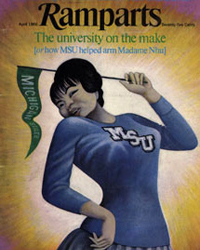
    Madame Nhu as depicted on cover of Ramparts

    What got the CIA so angry?  For starters, Ramparts exposed a program the Agency was running out of Michigan State University. (Click here http://la.utexas.edu/users/hcleaver/357L/357LMSUinVietnam.pdf) It taught CIA interns how to train interrogators in South Vietnam to torture dissidents in Saigon. This created an uproar. Not just for the story, but also because of the hilariously outrageous Ramparts cover, which featured the immortal image of Madame Nhu in an MSU  cheerleaders’ outfit waving an MSU flag.  The image suggesting the Vietnam War was now controlling the agenda of American colleges. (Click here for a time capsule reaction http://msupaper.org/issues/The_Paper_1966-04-21.pdf)

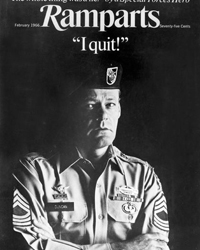
    Then there was Donald Duncan.  Duncan was a Special Forces Sergeant who served in Vietnam and taught at Fort Bragg, North Carolina.  He resigned his commission and returned to Berkeley, California. There, in February of 1966, Duncan graced another memorable Ramparts cover. He was pictured in a long sleeved uniform, topped with a Green Beret cap. Above him were the words, “I quit”. Above that was the quote: “The whole thing was a lie.”  In this emblematic story, Duncan described his ten years in the military, capped by a nearly two year tour in Vietnam.  He said he went to Vietnam to fight communism.  But what he learned there about the American effort forced him to retire from the service forever.  Duncan first focused on the fact that there really was no government of South Vietnam—it was simply constructed and propped up by the USA.  And it was in no way a democracy. Secondly, he wrote that the Ho Chi Minh Trail was wildly overrated as a source of supplies for the Viet Cong. Most of the material came over the border or from the sea. Thirdly, he said that the US military was involved in atrocities that violated the rules of warfare, and this extended to the civilian population.  Duncan was really the first former GI to open up the path for Mark Lane’s book Conversations with Americans, the Winter Soldier Hearings, and the exposure of the My Lai Massacre.  (http://vietnamfulldisclosure.org/wp-content/uploads/2015/04/1966-02-Donald-W.-Duncan-The-Whole-Thing-Was-A-Lie-Ramparts.pdf)

    In the March 1967 issue Hinckle exposed another instance of the CIA operating domestically. Ramparts now revealed that the Agency was secretly funding the National Students Association.  (http://www.unz.org/Pub/Ramparts-1967mar-00029) In other words the largest college student association in America–featuring a large annual convention picturing a celebration of youthful democracy–was secretly funded, infiltrated and channeled by the Agency. Many of the top officers knew about it and were briefed on that association.  Further, several of them had case officers, code names, and reporting requirements.  Incredibly, some of their overseas representatives were actually career CIA agents from Langley.  The aim of the program was multi-leveled.  First, the Agency would moderate any radical or leftist tendencies in the largest student organization in the world. Second, they would use the overseas voyages of the students to collect information and try and moderate any radical leaders abroad. And third, the propaganda  goal was to portray  our young representatives as independent citizens, while many of the people they met abroad were communist stooges programmed from Moscow. (Hinckle, p. 185)

    Eldridge Cleaver

    NSA officer Michael Wood had a pang of conscience about it and was talking to Hinckle. Unlike other top officers, Wood had not signed a non-disclosure agreement.  Further, Wood had records, not just about the NSA, but other related fronts that the CIA had established.  For example, Stephen Spender’s Anglo-American journal Encounter. Wood also showed how the CIA very often used large legal firms in big cities to channel their clandestine funding.  Usually these firms had a former OSS officer as a founding member.  (One is reminded here of the firm Monroe and Leeman in New Orleans, which helped fund Walter Sheridan’s hit piece on Jim Garrison.  See Destiny Betrayed, Second Edition by James DiEugenio, p. 238)

    MHCHAOS operations officer Richard Ober heard about Wood’s talks with Hinckle.  He tried to find a way to stop publication.  But he couldn’t find a legal pretext.  So he then arranged a press conference in New York.  At this conference the officers would pretend that this was all a thing of the past, and they were now reformed. Therefore, the Ramparts story was old hat.  Hinkle got wind of this plan.  He memorably said, “ I was damned if I was going to let the CIA scoop me.”  (Hinckle, p.  190) Ramparts then bought two full page ads in the New York Times and Washington Post to expose the illegal association (the CIA is forbidden by its charter to operate domestically) and what the Agency had done to cover it up.  When word of the ads leaked, Ober’s press conference collapsed. 

    The New York Times now started a couple of weeks of reporting on other CIA fronts here and abroad that was influencing cultural affairs. This was one of the many triumphs of Ramparts. In many ways, at many times, it  actually led the news cycle.  By repeatedly scooping the MSM, it became a model of what they were not doing. At the same time that—out of pure humiliation—the magazine became an object of attack. Ramparts did what the MSM was supposed to be doing but did not—actual investigative reporting.  It was showing what the real world around the reader was composed of and what it was all about. But the fact that it was camouflaged made it hard for the average person to detect. So Ramparts did it for them.  Which is why as Jeff Cohen, a student at Michigan, told Peter Richardson, Ramparts was passed around the dorm there to the point it was wrinkled and dog eared by the time he got it. “It really was a radicalizing tool of its own.  It ripped your head off. “ He added that it had turned his cousin’s fraternity into an SDS chapter.

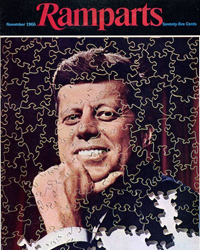
    Ramparts cover November 1966

    At its pinnacle, Ramparts had a circulation of about 250,000.  One can imagine how the CIA felt when Hinckle started featuring stories about the conspiracy to murder John F. Kennedy, and then putting such things on the cover. For this topic, there was another cover for the ages.  The November 1966 issue featured the face of JFK made up like a jigsaw puzzle, with several pieces missing.  That was followed  two months later by “The Case for Three Assassins” written by David Welsh and David Lifton. (Click here to view).

    The Welsh/Lifton article began with the following words: “No less than three gunmen fired on the Presidential motorcade in Dallas on November 22, 1963…” It was a long, illustrated, annotated examination of the ballistics, medical, and eyewitness testimony. It all indicated a triangulation of gunfire in Dealey Plaza.  To my knowledge, it was the first time such an intricate discussion reached a mass audience. That issue was then followed by two long pieces on the Jim Garrison investigation in New Orleans. (Click here for the first one).

    These were  both penned by former FBI agent William Turner, who was actually working with Garrison. Therefore, Turner had access to the DA and some of his files.  Ramparts  was one of the very few media outlets that actually treated Garrison and his evidence with respect. Until Jim Garrison published On the Trail of the Assassins, Turner’s articles were–along with Paris Flammonde’s book, The Kennedy Conspiracy—prime reference works for anyone interested in the non-MSM view of Garrison.

    Hinckle met resistance inside his office on this issue.  Reporters like Bob Scheer did not want to cover the assassinations of the sixties at all.  As he once told Turner, such writing amounted to “mental masturbation”.  Hinckle disagreed.  For the simple reason that he had read the official report and most of the accompanying volumes of evidence.  He concluded the Warren Report was impossible to believe:  “Anyone who has read those 26 volumes…knows that the function of the Warren Commission was not to ferret out the truth, but to put the citizens at ease that there was no conspiracy.” (Hinckle, p. 217)  About Jim Garrison, Hinckle wrote, “… no man I have known had more legitimate reasons to become paranoid than Garrison; there actually were people constantly plotting against him.”  (Hinckle, p, 209) With the declassified files of the Assassination Records Review Board, we know that to be, not just true, but an understatement.  (See Destiny Betrayed, Second Edition, Chapters 11 and 12)

    The Ramparts “I Quit” cover

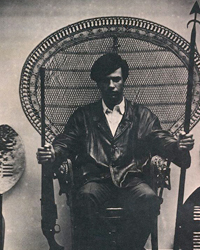
    To chronicle the endless triumphs of Hinckle’s editorship could go on and on, taking scores of pages. But to mention just two other exceptional aspects of Hinckle’s stewardship: Ramparts was the first and only widely read publication to champion the Black Panthers.  And again, there was an iconic cover design by art director Durgald Stermer to signify it:  Huey Newton in a wicker chair with a spear in one hand and a loaded carbine in the other.  Eldridge Cleaver actually became a contributing editor, and Ramparts released his book Soul on Ice through its publishing imprint.

    There was also a photo essay “The Children of Vietnam” put together by William Pepper.  (http://www.unz.org/Pub/Ramparts-1967jan-00045) That 1967 visual article showed just how extensive, indiscriminate and destructive the massive  American firepower unleashed in Indochina was. It was laying waste to the civilian population, including tens of thousands of women and children. Martin Luther King picked that issue up off a newsstand before taking a working vacation in Jamaica.  When he returned he began making his first speeches against President Johnson and his conduct of the war.  Again, Ramparts was leading the news cycle.

    The power and the glory all came to an end in early 1969.  For three reasons.  First, if Ramparts had one failing it was Hinckle’s lack of interest in the arts and the so called counter culture in San Francisco. For instance, there was no Dwight MacDonald or Robert Christgau at Ramparts to review movies or music. And many people wanted to read both.  Therefore, young Jann Wenner left Ramparts to start up something called Rolling Stone.  Which then became a competitor.  There was also an internal coup against Hinckle by new staff members who were tired of his profligate spending.  For instance, he had sent a team of 15 correspondents to cover the Chicago Democratic Convention in 1968.  And he had put up ten of them at the four star Ambassador Hotel.  Finally, when Hinckle found someone who was interested in bailing him out, Scheer got into a stupid and senseless argument with the man and his entourage.  (Hinckle, pgs. 371-78)  Hinckle was now out. The magazine declared bankruptcy and reorganized around new leadership.

    The new principals were Robert Scheer and David Horowitz.  This, of course, meant that Hinckle’s daring, “nothing sacred” approach would be abandoned.  Because those two men represented a much more doctrinaire, New Left approach. Therefore instead of writers like William Turner and Bill Pepper, we now got people who really were not all that unusual  or new e.g. Alexander Cockburn, Noam Chomsky, Sy Hersh, Jonathan Kozol. The subjects now also became those of the doctrinaire left: Earth Day and the environment, food safety, oil spills in Santa Barbara, and the plight of Native Americans. Without Hinckle, Ramparts had lost its singular, contemporary jazz riff.

    Huey Newton as he appeared in Ramparts

    Later, Scheer was moved out by Horowitz and replaced by a new second in command: Peter Collier.  The irony being that it was Scheer who brought both men to Ramparts in the first place.  But, predictably, the magazine now began to lose its  large circulation.  Seeing the writing on the wall, Horowitz and Collier decided to transition their way out.  In 1973 they met with Abby and Marion Rockefeller, part of the Rockefeller clan who were outsiders because of their contrary political beliefs—which is why they backed Ramparts.  The two men now contracted to do a history of the clan.  They got a sizeable advance, and then signed on a new management team for Ramparts.  Their book, The Rockefellers: An American Dynasty,  sold quite well.  It was published in 1976, the year after Ramparts went under for good.

    Ramparts was so unusual, so blindingly meteoric, so politically potent, that, when it fell, it actually dropped the seeds of its own reaction.  By 1975, the Sixties were pretty much killed off.  And Ramparts, in its new form, did not do a lot to preserve it.  Richard Nixon was now president, with the likes of Spiro Agnew as his VP.

    Men like Pat Buchanan and William Safire were writing his speeches.  And from 1969-75, Henry Kissinger was doing the final reversals of whatever was left of John Kennedy’s reformist foreign policy, specifically in Africa, the Middle East and the continuation and expansion of the Indochina war.

    It was within this new political milieu that men like Horowitz, Collier, Sol Stern and Martin Peretz began their  migration to what would become the New Right, neoconservative movement.  Financial backer Peretz did not like the evenhanded approach Scheer wanted to take in the Middle East.  So he pulled out of Ramparts.  He now purchased the liberal New Republic from Gilbert Harrison.  In a remarkably short time period, Peretz pretty much reversed the trajectory of that journal’s foreign policy pages. By about the mid-eighties, many were calling the New Republic a neoconservative bastion.  Which, for all intents and purposes, it was; most notably on the Middle East and Central America.

    Sol Stern, who actually wrote the Ramparts article on the NSA scandal, eventually found a home at the Manhattan Institute.  This is a New Right think tank that was actually co-founded by the deceased CIA chief Bill Casey. Manhattan Institute has sponsored books by Charles Murray, who was actually a fellow there when he wrote his anti-welfare polemic  Losing Ground.  Stern’s specialty today is to promote voucher system education, which would almost surely undermine the public school system.

    Peter Collier

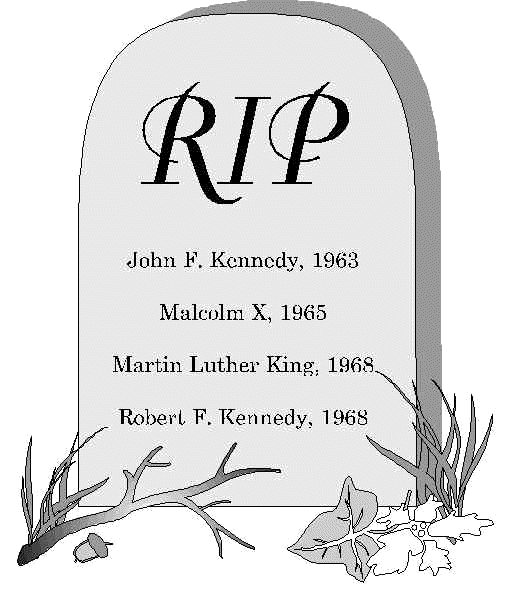
    After their tome on the Rockefellers, Horowitz and Collier then wrote books on other wealthy families:  the Kennedys, the Fords, and the Roosevelts.  Their book on the Kennedys is so bad that this author included it in his review of the anti-Kennedy literature in the essay “The Posthumous Assassination of JFK.” Predictably, that book provided the occasion for the pair to proclaim their conversion to Reagan Republicanism.  This was announced in the Washington Post under the banner “Lefties for Reagan”.  (The Assassinations, edited by James DiEugenio and Lisa Pease, p. 357).  They then went on and became beneficiaries of the largesse of the wealthy conservative class.  They founded organizations like Encounter Books, FrontPageMagazine.com, the David Horowitz Freedom center, and Discover the Networks. All of these are meant to undermine the things that Ramparts represented: the liberal ideals of an open and more egalitarian society.  And with the collapse of the Sixties, and the killing off of its leaders—JFK, Malcolm X, RFK and King, plus the FBI sponsored extermination of the Panthers—that was not really difficult to do.

    Hinckle never did anything of the kind.  He tried to start up another monthly magazine called Scanlan’s Monthly.  But I have it on two sources that the Nixon administration used the IRS and the USPS to obstruct its  distribution and circulation. Consequently it closed down in less than a year.  He next edited Francis Coppola’s City magazine, which lasted until 1976.  He then did something that no one thought possible: he revived The Argonaut, which had closed down in 1956.  He did this in 1991, and that publication is still around in both print and online versions.

    Besides that, he ran unsuccessfully for mayor of San Francisco in 1987.  He also wrote about ten non-fiction books.  There are two that are mandatory reading for anyone interested in the Sixties and the assassinations. In 1974, on the eve of the final dissolution of Ramparts, Hinckle wrote a memoir about his editorship of that magazine.  It was called If You Have a Lemon, Make Lemonade.  To me, there is nothing at all like it in the literature.  It is, at once, funny, pungent, candid, and nostalgic without being sentimental. A definite must read. Then, in 1981, he co-wrote, with Bill Turner, The Fish is Red.  That book was later reissued as Deadly Secrets in 1992.  Up until that time, and until this day, it is one of the best JFK assassination books written from the point of view of the Cuban exiles’ association with the CIA.

    In the late nineties, this author considered reviving Ramparts. I won’t go extensively into why I decided against it. But one of the reasons I didn’t was because I thought that, with the surge of online journalism, surely someone, maybe more than one, would now use the opportunity to emulate Ramparts, or Art Kunkin’s LA Free Press.  The latter was an extraordinary newsweekly that complemented Ramparts. Together, they formed the last pinnacle of American journalism.  To say the least, those online expectations were not fulfilled by the likes of Jane Hamsher, Markos Moulitsas, and Josh Marshall.  In fact, this so called internet revolution was so stillborn that it made Ramparts and the LA Free Press look like even greater achievements.  (See here for my particular disputes)  In fact, that online result recalls Hinckle’s answer as to why Ramparts was so exceptional, he replied, “Because the rest of the media was so shitty.”  I would add: But it took Ramparts to show us how shitty they were.

    Today, to do anything like what Ramparts did, a single publishing journal would have to been the first to:

    1. Shown in detail how George W. Bush stole the 2000 and 2004 elections in Florida and Ohio
    2. Demonstrated how the FBI and CIA left us unprotected on 9-11
    3. Revealed the secrets of NSA illegal spying
    4. Exposed Colin Powell’s phony UN speech justifying the war with Iraq
    5. Visited Iraq with a camera crew to show us the terrible civilian toll Bush’s phony war took on the populace.

    And they  would have to have achieved the above in just five years, from about 2001-2005 I think the reader will agree that any such comparison suggests science fiction today.  But Hinckle did it.

    Therefore, Ramparts stands alone in the history of contemporary American journalism; much as Citizen Kane towers in the history of  the American sound film.  It is often written that, in that picture, Orson Welles took the art of  film direction to a point that no other American has since matched or surpassed. With the death of Warren Hinckle we can say  that no other American has produced or edited a magazine, or online journal, that has matched or surpassed what he did at Ramparts.  And, from my point of view, it looks like no one else will do so for a long time.  For that, among other things, he deserves to be properly saluted upon his passing.  He set a standard for us all by reminding us what real journalism can and should be.

    ~ Jim DiEugenio

  • Open Letter to Rachel Maddow re Show on Gun Control


    March 29, 2013

    Dear Rachel:

    Many of us, including me, have admired much of your work on radio and television since 2004, when you were perhaps the very best show on Air America. We then followed you as you became a regular guest on MSNBC’s Keith Olbermann’s show and CNN’s Paula Zahn show. Therefore, we were glad when Keith pushed for you to have your own show on MSNBC. You deserved it. You were a great advocate for progressive causes and puncturing MSM shibboleths and sacred cows.

    Which makes it disturbing that you would do what you did on your March 13th program. A common joke among the vast majority who understand the truth about President Kennedy’s assassination is this:

    “You know 85% of the public doesn’t buy the Warren Commission hogwash about Lee Oswald being the lone assassin of President Kennedy. Unfortunately, the 15% who do all work at the New York Times, Washington Post, LA Times, NBC, CBS, ABC, and Fox.” Should we add now, MSNBC?

    Everyone knows that Chris Mathews made his career by attacking Oliver Stone’s films JFK and Nixon. And he spares no opportunity to say that he believes the Oswald myth and to knock anyone who does not. (But he wisely has no one on his show to present the other side as he does so.) We also know that Bill O’Reilly got his position at Fox by agreeing with Roger Ailes that he would drop his JFK investigatory reports he had done for Inside Edition. (Which were actually pretty good.) He now literally lies about the case in his book Killing Kennedy and on his show.

    Most of us thought that we would never see you do something like that. But yet you did use the whole Warren Commission lie about Oswald to promote gun control on March 13th. Many of us agree with the gun control cause especially after Sandy Hook and Aurora. But we would never promote something as bad as the Warren Commission to promote a common good. Especially when it’s not at all necessary.

    We all understand that there is an unwritten agreement when you make it big on TV that you cannot touch things like the JFK case. In other words you can have an open debate with anyone, no matter how far out about anything under the sun. But not the JFK assassination. Fine. Maybe you are uninformed about the facts. Maybe you like your newfound fame and fortune. That is all understandable. But is there an unwritten clause in your contract that you have to go out of your way to promote a lie as big as the Warren Commission? I doubt it.

    As you mentioned on your ill-advised show, this is the fiftieth anniversary of President Kennedy’s death. He was probably the last real Democrat to occupy that office. And he actually proclaimed he was a liberal. A word the right has successfully stamped out of the political lexicon, along with the word conspiracy. If you do visit this topic again later on, let it be in the spirit of free and open inquiry. Tell your bosses that is what you are really about—all the time, on any subject. There are many people who are articulate and convincing about how bad the Commission really was and what happened to this country afterwards. And the thing is, many people want to hear this side of the story: 85% of us.

    Sincerely,

    Jim DiEugenio, CTKA

    {aridoc engine=”iframe”}https://www.youtube.com/embed/prtUkzyO0I0?autoplay=0{/aridoc}

  • Noam Chomsky’s Sickness unto Death

    Noam Chomsky’s Sickness unto Death


    ChomskyNoam Chomsky’s attempt to obfuscate President Kennedy’s policy to withdraw from Vietnam turned out to be rather unsuccessful. If one recalls, at the time that Oliver Stone’s JFK was released, Chomsky wrote an article for Z Magazine and then published a book called Rethinking Camelot. Beneath all the excess verbiage, Chomsky was saying the following:

    1. That NSAM 263, issued in October 1963, did not actually mean what it said. Namely that Kennedy was planning on removing all American advisors from Vietnam.
    2. NSAM 273, signed by LBJ after Kennedy’s death, did not actually impact or alter NSAM 263.
    3. All the witnesses that John Newman, Fletcher Prouty and Peter Scott adduced to bolster the fact that Kennedy was withdrawing from Vietnam, these men were all either biased or wrong.
    4. Vice-President Johnson was not really all that bad of a guy. And there was no real break in Vietnam policy when he took over. After all, he and Kennedy were essentially the same man in the sphere of foreign policy.

    To put it mildy, Chomsky’s attempt to promulgate this line was not effective. Especially when the Assassination Records and Review Board unearthed even more documents supporting Kennedy’s plan. These were enough to influence even the mainstream media into writing news articles about Kennedy’s plan to withdraw from Vietnam. (Probe Vol. 5 No. 3 pgs. 19-21) These new documents were released by the ARRB on December 22, 1997. Within days, the New York Times headlined a story with, “Kennedy Had a Plan for Early Exit in Vietnam.” The Associated Press story read, “New Documents Hint that JFK Wanted U.S. out of Vietnam.” The Philadelphia Inquirer story was bannered, “Papers support theory that Kennedy had plans for a Vietnam pullout.”

    The work of the ARRB on the Vietnam issue also influenced academia. Scholars like Howard Jones, David Kaiser and Gordon Goldstein wrote a number of new books. Each of them ignored Chomsky and endorsed the Newman/Prouty/Scott view as expressed in the Stone film. This culminated in a milestone event. In 2005 a group of nearly 20 authorities on the subject met at St. Simons Island off the coast of Georgia. After two days of reviewing documents and debating the subject, a vote was taken. Half the attendees said Kennedy would not have escalated in Vietnam as Johnson did. (Virtual JFK, edited by James Blight, p. 210) This conference resulted in both a book and film, Virtual JFK, which argued that President Kennedy and Vice-President Johnson had different views on the war. Wisely, and pointedly, Chomsky was not invited to this conference.

    Soundly defeated on this issue, Chomsky did not retreat with his tail between his legs. Instead, he has now navigated to a different aspect of Kennedy’s foreign policy: Cuba.

    JFK

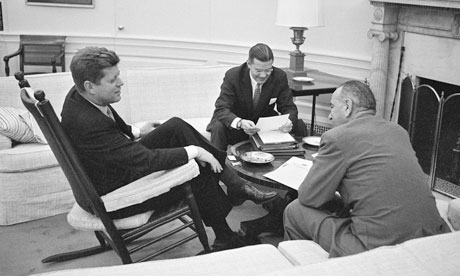
    President John F Kennedy in his office during a meeting with Secretary of Defense Robert McNamara and Vice-president Lyndon B Johnson, at the White House in Washington, DC, 1961.

    Photograph: Henry Burroughs/AP

    This year is the fiftieth anniversary of the Cuban Missile Crisis. Chomsky has chimed in with an article for The Guardian of London. (It can be read here). This article confirms what has been clear to many for a long time. Chomsky is not a historian. And when he gets anywhere near having to deal with the Kennedy assassination, or Kennedy’s presidency, his work is so bad as to be embarrassing. In that regard, he is really a polemicist. Polemicists, by definition, can’t write good or accurate history. And for anyone who did not understand that, this useless article proves it once more.

    Today, there have been at least three books published based upon the actual transcripts of the deliberations of the so-called ExComm. That is, the committee of Kennedy’s advisers assembled to discuss paths of action during the thirteen days that constituted the crisis. The first was The Kennedy Tapes by Ernest May and Philip Zelikow. The second, Averting ‘The Final Failure’ is by Kennedy archivist Sheldon Stern. The third is called The Presidential Recordings, edited by May, Zelikow and Tim Naftali.

    These books are absolutely essential to understanding who President Kennedy really was. Because in this instance, you actually do not have to rely upon memoirs, or memoranda written later. You actually have the words of the participants as spoken right in front of you. And for any objective person, these discussions show just how different Kennedy was from the vast majority of his advisors. This includes Vice-President Johnson, National Security Advisor McGeorge Bundy, and Secretary of State Dean Rusk. At one stage or another these three men all advocated armed intervention to resolve the crisis. And Johnson did not even like the ultimate resolution to the crisis: withdrawal of the American Jupiter missiles from Turkey in exchange for the Russian withdrawal of the missiles from Cuba. He talks about it as leaving the impression “that we’re having to retreat. We’re backing down.” (May and Zelikow, p. 586) Johnson said this even though the Polaris missiles–which were to later serve the same purpose as the Jupiters–were much more modern in both range and accuracy. And since they were submarine launched, they were more difficult to detect and preemptively target. Towards the end of the crisis, Johnson was actually using Kennedy’s nationally televised speech of October 22nd–in which he alerted the pubic to the danger of the Russian installed missiles–against him. The vice-president was saying that the public was going to be disappointed in Kennedy’s performance when compared to his words: “The president made a fine speech. What else have you done?” Even Johnson’s rather friendly biographer, Bob Caro, points out in The Passage of Power that, compared to JFK, during these discussions, Johnson was much more militant in tone and confrontational in approach.

    What does Chomsky say about this most important Kennedy/Johnson juxtaposition? Not a word. Which is about what he said in comparing the policies carried out by President Johnson in Vietnam after Kennedy was killed. In the game of poker, this is called a ‘tell’. Or as Peter Scott terms it, it’s a negative template. Chomsky won’t touch this evidence since it pretty much disintegrates his argument that there was no difference between Kennedy and Johnson in foreign policy.

    So Chomsky now devises another way to attempt to explain why Kennedy sounded so much more dovish during these debates than nearly anyone else in the room. He says that since Kennedy had ordered the installation of the taping system, he knew they were being recorded while the others did not. Again, Chomsky leaves out two important points here. The first is the reason Kennedy ordered the recording devices installed in the first place. As professor Ernest May has stated more than once–for example on ABC’s Nightline–he installed the system because he was upset about how many participants had misrepresented what they said during the discussions leading up to the Bay of Pigs invasion. With the taping system, there could be no argument about who said what and when. Secondly, these tapings were not made public for nearly four decades after Kennedy’s death. If there was some kind of plan to get them out sooner–and show how statesmanlike JFK was compared to everyone else–it was not very effective.

    But the point which Chomsky again avoids is this: Kennedy sounds dovish and level-headed here just as he did during the debates in November of 1961 over whether or not to send combat troops into Vietnam. (See the notes of military attaché Howard Burris dated 11/15/61 in the book Virtual JFK, pgs. 281-83) In other words, it is all of a piece, because it’s the same man. And the taping system is irrelevant to the issue. Why? Because it was not installed in 1961. In that instance, as he was during the Missile Crisis, Kennedy was virtually alone in holding out against the commitment of combat troops to Southeast Asia. And almost every commentator has noted this point, from David Kaiser to Gordon Goldstein. For his own personal, polemical reasons, Chomsky cannot.

    Another piece of flapdoodle that Chomsky tries to peddle here is the actual cause of the crisis. He says that the Russians moved the missiles onto the island in reaction to Operation Mongoose, the secret war against Cuba. To preserve this mythology, Chomsky ignores two pieces of evidence. First, the subterfuge Khrushchev practiced in transporting the weapons across the Atlantic, and second the size and scale of the deployment. Concerning the latter, the eventual arsenal was to consist of the following: 40 land based ballistic missile launchers and sixty missiles. The missiles were of both the medium (1,200 miles) and long–range variety (2,400 miles). These missiles were much more powerful than those used against Hiroshima and Nagasaki. The 9 missile sites were to be protected by 140 air-defense missile launchers. In addition there were to be 40 IL-28 bombers, each capable of carrying a nuclear weapon. This air arm would be supplemented by a submarine pen made up of 11 subs, 7 of them capable of launching nuclear missiles. In other words, the Russians could now threaten America with a nuclear missile arsenal capable of hitting the 100 largest American cities by land, sea and air.

    In addition to this, there was to be a Russian army of 45, 000 troops, with 250 tanks, supplemented by a wing of the latest Russian fighter aircraft, the MiG 21. There were also 80 nuclear-capable cruise missiles for coastal defense. Each of these had the explosive capability of the bombs dropped on Japan in 1945. (May and Zelikow, pgs. 676-77) And, as Kennedy later discovered through U2 photography, the Russians had even given the Cubans a number of Luna ground to ground rockets with a 30 mile range and 2 kiloton warheads. Because of their short range these were termed tactical nukes since they could be used in battlefield circumstances. (ibid, p. 475)

    With these facts on the table, here is my question to the former MIT professor: What use would these nuclear weapons be against a speedboat full of Cuban exiles with rifles, grenades and dynamite sent in to blow up a power plant? Would this not be equivalent to the antique analogy of using a cannon to kill a fly in your house? Why blow up your house trying to kill a fly? Could the Russians and Cubans be this stupid?

    Which relates to the subterfuge. What made Kennedy so suspicious about the deployment was the secrecy surrounding it. Multiplying that was the Russians lying about it. For instance, to choose just one instance, Russian Foreign Minister Andrei Gromyko lied to Kennedy on October 17th by saying that this was only a defensive deployment. If the aim was simply to try and neutralize Mongoose, then all that was needed was the conventional forces. And Khrushchev would have won a great international propaganda victory by announcing a Cuban-Russian military alliance in public, for instance at the United Nations. He could have claimed the diplomatic high ground by saying that this was purely a defensive alliance to defend Cuba from external aggression. If the idea was to fend off a possible invasion then the tactical nukes would have done the trick. And again, an alliance made in public would have been sympathetic to most of the world.

    But he did not. There is no evidence he even contemplated such a public announcement. Why? Because the real motive behind the massive deployment was much wider in scope. It was a way for the Russians to close the missile gap. At the time, only twenty of the Soviet long-range missiles could hit the USA from Russian territory. With what was going into Cuba, the Russians now had a formidable first-strike effort stationed 90 miles away from Miami. And anyone who understands the nuclear terminology of that day will understand how important a credible first strike force was. Secondly, once the secret installation was complete, Khrushchev could then announce it and ask for the thorn in his side to be removed: namely West Berlin. (See Slate, “What the Cuban Missile Crisis Should Teach Us”, by Fred Kaplan. See also May and Zelikow, pgs. 678-79, 691)

    This had been something that had seriously bothered the Russians since the days of the Berlin Airlift of 1948-49. And, more recently, Khrushchev had hectored Kennedy about it at their summit meeting in Vienna in 1961. This would be a significant change in the political calculus of Europe. What Chomsky does by covering up these key facts is to falsely blame President Kennedy while excusing some very irresponsible and reckless gambling by Nikita Khrushchev.

    Chomsky continues in this jingoistic mode when he then names what he thinks should be called the most dangerous moments of the crisis. One of them is on October 27th, when the U. S. Navy, trying to enforce Kennedy’s blockade, had orders to make the Russian submarines surface before they violated the quarantine line. Each Russian submarine carried a nuclear tipped torpedo. American destroyers were to drop depth charges to make the subs surface. Naturally, Chomsky does not reveal the actual instructions given to the American destroyers. They first were to drop “four or five harmless explosive sound signals”, after which the subs should emerge and proceed due east. And, in fact, the State Department told European governments about this technique, including the Russians, in advance. (National Security Archive, Briefing Book No. 399) The problem was that the Russian subs were not getting much information from Moscow and never got this message. They were monitoring Miami stations instead, which of course were carrying much more militant messages. (New York Times, 10/22/12)

    The other moment that Chomsky details is the round the clock B 52 bombers holding their fail safe points in the sky in case of an attack. He states that one pilot, Don Clawson, revealed that there was little control over these flights from Strategic Air Command, and that a rogue pilot could have easily started nuclear war. Chomsky does not say that his source for this is an almost do it yourself book published nine years ago by Clawson himself. The book is a rollicking memoir written 40 years after the fact. In other words, there was no formal input from SAC HQ about what measures really were in place in case this occurred. And Chomsky did not crosscheck his source to see if there was. (This last is a recurrent polemical practice of Chomsky’s.)

    If anyone were to list the most dangerous moments of the crisis, they would have to include three events that need no cross checking. For they have been in the record for decades. The first would be the episode that caused the only fatality by enemy fire during the entire 13-day crisis. That would be the death of Rudolf Anderson. Anderson was America’s top U-2 pilot in 1962. The plane he was flying was clearly marked with Air Force insignia. Khrushchev had assured Kennedy that the Russians would only fire if fired upon. (May and Zelikow, p. 571) The U-2 was a surveillance plane. It was not furnished with missiles or machine guns, only cameras under its wings. And everyone knew that. But, apparently, the Cubans decided to use their Russian furnished surface to air missile sites (SAM’s) near Banes, Cuba to knock the plane down and kill Anderson.

    The information about Anderson’s death was turned over to President Kennedy during an ExComm meeting at 4 PM on October 27th, the day before the crisis ended. (ibid) It gave needed ballast to the hawks in attendance, e.g. General Maxwell Taylor and Assistant Secretary of Defense, Paul Nitze. (ibid, pgs. 571-73) It also seems to have been one of the reasons why Defense Secretary Robert McNamara became more militant during the last two days of the crisis. (The other factor influencing McNamara seems to be Johnson’s not very subtle war mongering.) Following the news of Anderson’s death, there were pleas by Taylor, Bundy and Nitze to immediately take out the SAM sites. (ibid, pgs. 571-72) McNamara moved to take out the Banes SAM site and begin a much larger air attack against the island on the 31st. (ibid, pgs. 571, 575) Kennedy dutifully listened to these proposed courses of action due to this provocation. He then skillfully bent the discussion around to formulating a reply to Khrushchev’s letter requesting a deal for the Jupiters. (ibid, p. 576) There ended up being no retaliation to this reckless shoot down of an unprotected surveillance pilot. (Which, one could argue, was really tantamount to murder.) In fact, there was actually a contingency plan in place which necessitated an agreed upon retaliation. Kennedy overruled that plan and held back the air strike. (ibid, p. 695)

    Another dangerous moment came when Castro actually wanted to launch nuclear missiles against the USA. (ibid, p. 688) In other words to strike first, therefore surely starting a chain reaction leading to nuclear Armageddon. Or as Fidel Castro put it none too subtly to the Russian representative, he was ready to launch against the USA and risk incinerating Cuba in a counter attack. Alexander Alekseev was shocked. But he dutifully relayed the message to Moscow. (The Armageddon Letters, edited by James Blight and Janet Lang, p. 116) At the conclusion of the crisis, Khrushchev chastised Castro for even proposing such an act under these circumstances. He characterized such a proposal to carry out a nuclear first strike against enemy territory as “very alarming”. He continued with: “Naturally you understand where that would lead us. It would not be a simple strike, but the start of thermonuclear world war.” (May and Zelikow, op cit.)) Apparently, since Castro was and is a Marxist, in Chomsky’s book, these kind of inexcusable acts are to be ignored. To dramatize the polemicist’s double standard: Imagine what Chomsky would say if President Kennedy was on record uttering such a thing. But not only does Chomsky not comment on this nutty request by Castro, he does something even worse. He does not tell the reader about it. That act of censorship tells you all you need to know about Chomsky’s fairness and honesty in this article.

    There was another nominee for most dangerous moment. And again, you will not find it in Chomsky’s article. During the crisis, CIA officer William Harvey—a man who despised the Kennedys—secretly dispatched several teams of Cuban exile paratroopers onto the island. (Larry Hancock, Nexus, p. 80) Harvey never fully revealed what the mission of these men actually was. But since he constantly assailed the Kennedys for not having the guts to get rid of Castro once and for all, one can imagine what he had in mind. Furthering this thesis was the fact that these men were on a secret radio frequency, so that when Bobby Kennedy found out about it, he could not recall them directly. (ibid, p. 70) RFK was enraged when he found out what Harvey had done. And this was the beginning of the end for Harvey’s storied CIA career. The reason Chomsky will not touch this incident is that it violates another aspect of his special and peculiar ideology. Namely, his belief that the CIA only performs functions requested by the president. Yet, under Kennedy, the CIA often enacted autonomous actions.. (And there are many examples in both Hancock’s book and Jim Douglass’ JFK and the Unspeakable.) But Chomsky cannot admit this, no matter how foolish it makes him look. Because it would indicate that, 1.) The CIA and President Kennedy had different aims, and 2.) The Agency did not just enact policy. At times, it made its own.

    Let us continue with just how bad the Marxist leadership was leading up to and during the crisis. On September 4th, after getting preliminary intelligence reports about construction on Cuba, Kennedy had specifically warned the Russians about using the island as a forward base in the Americas. And he told Russian ambassador Anatoly Dobrynin that he would not tolerate purely offensive weapons in Cuba. He then said the same in public. (Blight and Yang, pgs. 58-59) In his reply to Kennedy’s warning, Khrushchev again lied. He said the only nuclear missiles he had trained on the USA were based in Russia. (ibid, p. 62) In July of 1962, Castro asked him: What would happen if the USA discovered the installation in progress before it was completed? Khrushchev responded with a reply so ridiculous that it must have disheartened Fidel. The Russian premier said he would send out the Baltic fleet as a show of support. (May and Zelikow, p. 677) This silly response, from a man who held the fate of the world in his hands, showed that Khrushchev had not thought through all the possibilities the dangerous installation entailed. To top it all off, the premier tried to end game the worst scenario. That is the Americans launching a counterforce attack on the Cuban missiles. The premier felt that even if this was 90% effective, “even if one or two big ones were left—we could still hit New York, and there wouldn’t be much of New York left.” When Khrushchev was ousted from office in 1964, his irresponsible actions before and during the crisis were named as prime reasons for his removal. (May and Zelikow, p. 690) Again, none of this is deemed worth mentioning by Chomsky. Probably because in his world no Marxist can do anything wrong.

    Chomsky also tries to imply that the resolution to the crisis was done by the Russians alone. He mentions the arrival of Khrushchev’s letter of October 26th at the State Department. This letter outlined a deal that would entail the removal of the Russian missiles in return for a pledge by Kennedy not to invade Cuba. The Russians later added that they also wanted the Jupiter missiles removed. Kennedy agreed to both parts of the deal. But what Chomsky leaves out is that Kennedy himself proposed the Jupiter swap more than a week before. At an ExComm morning meeting of October 18th he specifically proposed a direct trade of the Jupiters in Turkey for the Russian missiles in Cuba. (May and Zelikow, p. 137) On October 23rd he authorized his brother Robert to create a back channel to Russian Ambassador Dobrynin through Russian representative Georgi Bolshakov. (ibid, pgs. 343-46) This culminated in a formalization of the Jupiter deal as an adjunct to the no-invasion pledge. Chomsky criticizes Kennedy for not announcing this at the time. He leaves out the fact that JFK anticipated that Castro would create problems with verifying the removal of all arms of the nuclear triad from Cuba. And therefore it would take awhile for the Russians to complete their part of the deal. He was correct about this. It took over a month to complete the negotiations for verification. (May and Zelikow, pgs. 664-66)

    Chomsky’s failings as a historian are nowhere more obvious then in his discussion of Cuban-American relations in 1962-63. For instance, he writes that a plot to assassinate Castro was apparently initiated on the day of Kennedy’s murder. Chomsky is referring to the so-called AM/LASH plot. This maneuvering of the CIA with disenchanted Cuban national Rolando Cubela was not initiated in November of 1963. It had been going on for many months. And it had nothing to do with the Kennedys. (James DiEugenio, Destiny Betrayed, Second Edition, p. 73) The CIA deliberately kept it secret from JFK since they knew he would not approve it. Chomsky cannot admit this, even though it’s true, because it again shows the CIA and Kennedy at cross-purposes. He follows this by saying Mongoose was terminated in 1965. Wrong again. Mongoose was ended on November 29, 1962 at an NSC meeting of that day. (See Volume XI of Foreign Relations of the United States, Document 217) Chomsky mentions an attack on Cuba of November 8th. What he does not say is this was a response to a devastating Cuban attack in Venezuela that “had reportedly destroyed or disrupted one-sixth of the [oil] refining capacity of Venezuela….” (May and Zelikow, p. 639. Chomsky adds a reference to a contemplated invasion of Venezuela here. This appears to be fabricated since there is no such mention of any such event in the transcripts.)

    But the real point is that Kennedy began to dismantle Mongoose almost immediately after the Russian removal was verified. Cuban exile operations were severely curtailed, stipends were withdrawn, and groups were disbanded. By mid-1963, for all intents and purposes,Mongoose had been all but eliminated. As CIA official Desmond Fitzgerald wrote to President Johnson in 1964, in the second half of 1963 there were all of five raids against Cuba. The entire commando force consisted of fifty men. (Op, cit. DiEugenio, p. 70) Kennedy had clearly decided to pursue back channel negotiations with Castro with the goal of achieving normalization of relations with Cuba. The goal appeared to be in sight when Castro got the news of Kennedy’s death. He then turned to Kennedy’s representative Jean Daniel and said, “Everything is changed. Everything is going to change.” Castro was correct. Johnson showed no interest in continuing Kennedy’s goal of détente with Cuba. (ibid, pgs. 73-75) When Chomsky writes that the majority of Americans favor normalization of relations with Cuba, yet our leaders dismiss this opinion, one does not know whether to laugh or cry. Johnson cut off Kennedy’s eleven months of negotiations to achieve just that. And no American president since has ever come as close as JFK did to doing just that. And Castro himself admitted this at the time.

    The silliest part of this all too silly article is toward the end. Chomsky writes that war was avoided in 1962 “by Khrushchev’s willingness to accept Kennedy’s hegemonic demands.” When he writes something like that, one wonders if, unawares, Chomsky has Alzheimer’s disease. It was Khrushchev’s attempt to establish hegemony over West Berlin that originated the crisis. It was his insistent ignoring of Kennedy’s warnings over this first strike capability that brought the crisis to fruition. It was the premier’s lies about his intent that exacerbated it all. It was Castro’s orders to kill an American pilot that almost escalated the crisis beyond saving. And it was Castro who wanted to launch a first strike that would have led to Armageddon. The deal that Kennedy had contemplated all along was a good one for the Russians. Cuba stayed protected as a Marxist bastion, as it has to this day. After negotiations with NATO ally Turkey the Jupiters were removed. All that the USA got was the removal of a first strike threat—one which should have never been installed. And needless to say the Russians eventually caught up and actually surpassed America as a nuclear power. Gaining no real advantage at a great financial cost.

    Chomsky has now been proven both wrong and misleading on both Kennedy and Vietnam, and the Missile Crisis. But it’s worse than that. Chomsky simply has no regard for facts or evidence in the two cases. The mark of a good historian is that he provides balance and proper context first. He then produces the totality of the evidence, or close to it. His conclusion then follows inductively from the evidence. Chomsky violates each one of these strictures. Which is why his conclusion is so easily reduced to absurdity. In fact, his performance here is so bad, that when linked to his record in defending Pol Pot, his friendly ties to Holocaust deniers, and his flip-flop on the question of Kennedy’s assassination, the best thing his friends and colleagues can do is advise him to retire. The man is 84 years old. And his mental faculties seem to be failing him. Rather than embarrass himself further, it would be better if he spent the twilight of his life fishing off the Massachusetts coast. That would be better for him, the historical record, and us.

  • Arianna Huffington, Tina Brown and the New Media: Death at an Early Age?


    Readers of this site will recall that in 2008, around this time, I wrote a three part series entitled “An Open Letter to Jane Hamsher and Markos Moulitsas.” In that article I lamented the criticisms of those two bloggers about Caroline Kennedy placing her name in nomination to replace Hillary Clinton as senator from New York. I wrote that their rather shallow, melodramatic and unfounded broadsides actually said more about them than it did her. (Click here to read that piece.) Kennedy eventually withdrew from consideration. Governor David Paterson then appointed the upstate Blue Dog Democrat Kirsten Gillibrand to fill the post. I pointed out that the two bloggers goofy outrage had resulted in the appointment of just the kind of GOP-Lite Democrat they were supposed to be opposed to.

    Later, some sordid revelations surfaced about what the governor had done in the wake of Kennedy’s withdrawal. Paterson told Judy Smith, a political hack on his staff, to start selectively leaking confidential material in order to smear Kennedy. Why? To make it appear that she withdrew because Paterson would not pick her because of ethical problems. When this happened, Hamsher actually used these manufactured smears to attack Kennedy and protect herself against my column! As more objective observers have written, Kennedy dropped out because she felt Paterson was using her to garner media attention for his re-election bid. Smith, a former GOP enforcer, was later forced to resign. Paterson became the subject of an ethics inquiry over the Kennedy smears. Which was later accused of covering up for him. (Click here for that story )

    Paterson’s handling of this episode was so bad that even Republican Mayor Bloomberg questioned why it had happened. In its aftermath a decline in Paterson’s ratings began. It soon became a shocking downward spiral. Less than three months after Kennedy dropped out, Paterson’s rating had dipped from 51% to 19% positive. His negatives soared to 78%. (New York Daily News, 3/23/09) Things have gotten so bad that the White House has tried to talk him out of running again. Not just because they think he will lose, but because they think he will bring Gillibrand down with him. And since the Blue Dog Gillibrand has been scarred, the White house has also tried to talk the more liberal Carolyn Maloney out of running against her in the primary. (ibid, 7/3/09) Which tells us that Rahm Emanuel is in charge.

    Funny how the New Media’s Hamsher and Moulitsas have been hesitant to detail the mess they did so much to cause. They sure flunked that test – all the way down to covering up for Paterson. (For the best article on the Caroline Kennedy affair, click here.)

    During that travesty, Arianna Huffington played both ends of the stick. She originally cross-posted Hamsher’s first salvo against Kennedy, which was clearly meant as a preemptive strike. It was immortally titled, “Caroline Kennedy: Thanks, But no Thanks”. (In light of the above, I would reply with: “Hamsher and Moulitsas: Thanks, But find other jobs.”) Huffington also printed a follow-up post Hamsher penned which tried to link Kennedy with, of all people, Joe Lieberman. But Huffington also printed pieces that defended Kennedy. And she ultimately printed a short essay by Sherman Yellen that roundly criticized Paterson’s pick of Gillibrand as catering to the worst aspects of the Democratic Blue Dog phenomenon. Yellen compared this choice with John McCain’s pick of Sarah Palin. This was accurate and a tonic to Moulitsas who once compared Kennedy with Palin – which shows either how dumb or how off the wall the guy was and is.

    This straddling of both sides has been a clear syndrome of Huffington Post, which is the top-rated news/blog for liberals. The key to profitability for that site has been the utilization of free content. And lots of it. This means that the editors there don’t seem to really care what goes on the site. As long as it’s free, and as long as it either has some kind of celebrity attached to it, or it addresses a topic with name recognition. (Which the editors like to play up with either visuals or flashy headings.)

    I

    Edward Epstein has something of a name as a writer, and the JFK assassination certainly is a topic with high recognition quality. Epstein began his career in 1966 with the book Inquest, a study of the make-up and process of the Warren Commission. One of the underlying themes of the book is that although the Commission was not an in-depth, exhaustive investigation, it was not really a conscious cover-up. The Commissioners were misled by not having certain pieces of evidence available, by having to hew to an unrealistic timeline, and not being fully informed by agencies like the FBI and CIA. The book tried to picture the Commission as performing something like a benign political palliative.

    Volumes by Mark Lane and Sylvia Meagher, which followed Epstein’s, undermined Inquest by indicating that the Commission did understand that it was partaking in a deception. So in retrospect, his first writing performance indicated that there was more to Epstein than met the eye.

    This was confirmed the next year. FBI informant Lawrence Schiller had co-written a book called The Scavengers and Critics of the Warren Report. This book was the first attempt to ridicule and caricature them as odd creatures not deserving to be listened to or heard. It had an accompanying LP record called The Controversy. Epstein can be heard on this album joining in on the lambasting.

    If anyone maintained doubts about where Epstein now was, they dissipated in 1968. He published a long hit piece on Jim Garrison, which would later be issued as a book called Counterplot. According to Garrison’s chief investigator, Epstein had spent all of 48 hours doing research in New Orleans. (Probe Vol. 7 No. 1 p. 15) So where did the author get his information? Documents declassified by the Assassination Records Review Board (ARRB) reveal that Epstein had been in contact with Clay Shaw’s lawyers – Bill and Ed Wegmann – quite often. He was also in contact with the lawyer for both Jack Ruby and Gordon Novel, a man named Elmer Gertz. The work of the ARRB shows just how close Shaw’s lawyers were with the CIA and FBI. (See the essay “The Obstruction of Garrison” in The Assassinations ed. by James DiEugenio and Lisa Pease.) So it is not at all surprising that within one week of publication, Epstein’s hit piece was being circulated worldwide by the CIA to all station chiefs. (CIA Memo numbered 1127-987)

    In 1971, Epstein showed he was an equal opportunity pimp: he now helped the FBI. He wrote an essay that argued that the Bureau had not really killed 28 Black Panthers as their attorney Charles Garry had argued. He added that, contrary to what observers thought, there really was no scheme by the FBI to liquidate the Panthers. He argued this on television with Garry. (FBI memo of 1/20/76) This phony tenet was exploded when the Church Committee exposed the FBI’s illegal COINTELPRO programs, one of which was directly aimed at the Panthers. The declassified record today shows that the FBI – working with state and local authorities – did all they could to destroy the Panthers, including coordinating violent action against their leaders. The most famous instance being the murder of Fred Hampton and Mark Clark in Chicago. (Anthony Summers, Official and Confidential, p. 384)

    If anyone – like the editors at Huffington Post – needed more evidence about who Epstein was, it arrived in 1978 in the form of a book called Legend: The Secret World of Lee Harvey Oswald. The sub-title is the giveaway. Because the last thing you will find here is anything about Oswald’s covert life. Nothing about his activities in the Civil Air Patrol with David Ferrie. Little suspicion about how he got out of the Marines so quickly over a phony family injury to is mother. No questions about how he just happened to meet Marina Oswald right after another ersatz defector had. Nothing about Oswald in the Clinton-Jackson area with Ferrie and Clay Shaw etc. etc. etc. You get the idea.

    At the time, many felt the book was another Epstein put up job. They were right. Again, the ARRB was helpful in proving this. In 1976, Kenneth Gilmore, Managing Editor of Reader’s Digest, got in contact with the FBI about their upcoming serialization of the book. The memo reads that “Gilmore said that the book will be a definitive, factual work which will evaluate, and hopefully put to rest, recurring myths surrounding the Kennedy assassination.” (Probe, op cit) Gilmore was requesting that the FBI give Epstein as much aid and documentation as possible to help with the book. Since the Bureau had been covering up the true circumstances of Kennedy’s murder from about the first day, they obliged. (Click here for proof this was the case.) Clarence Kelley, FBI Director at the time, gave the visit his blessing. (FBI Memo of 4/5/76)

    The timing of this contact and the beginning of Epstein’s research is interesting and relevant. The Zapruder film had first been shown on national television in 1975 and created a public furor. Three bills were then drafted in Congress to reopen the JFK case. The HSCA was about to be formed. Knowing Epstein’s history of fronting for the FBI and CIA, it is safe to say he was trying to get the jump on the formation of the committee.

    Years later, in 1992, Epstein revealed in the introduction to a reissue of the book that Reader’ Digest had promised him extraordinary access to Yuri Nosenko. This was the KGB defector who had given the CIA information about Oswald’s non-recruitment by the Soviets while he was in Russia. This probably came about because a senior editor at Reader’s Digest, John Barron, had been a close friend of CIA Mexico City station chief Winston Scott. (Probe, op cit, p. 24)

    Epstein’s chief source for the book was James Angleton, the CIA’s counter-intelligence chief for over 20 years. (Jerry Policoff called Angleton one evening and he confirmed this was so.) Angleton’s infamous reign included the assassination of President Kennedy and the later imprisonment of Nosenko. Legend was budgeted at two million dollars. Epstein got an advance of half a million. He was also furnished with a research staff. (Probe, ibid)

    Although the book is amorphous to read, it seems to say that the Soviets made a pitch to Oswald when he was with the Marines in Japan. They convinced him to defect to Russia in 1959. Oswald had good information on the U-2. In return, he was given a nice apartment and job. The Russians then directed him to return and they gave him an undisclosed mission in Texas. But the book implies that in 1963, Oswald abandoned his KGB sponsors and moved toward Cuba. This seems to have provoked him to kill Kennedy. In order to detract suspicion from any involvement, the KGB sent Nosenko over to say they had never employed Oswald. The book says that, unfortunately, the Agency ultimately bought into Nosenko. The last part clearly shows the influence of Angleton since he was the one who pushed the Agency to imprison and torture Nosenko. CIA Director Bill Colby disagreed. He, and many others, thought Nosenko was genuine. For as Director Bill Colby asked: If Nosenko was sent over by the KGB to trick the CIA about Oswald, why had he tried to defect before the assassination.

    How bad was Epstein’s approach to the book? When Jim Marrs interviewed a woman who was involved in the making of the volume, he asked her why Epstein never went into Oswald’s ties to the CIA. Which, he correctly added, were at least as obvious as his ties to the KGB. She replied that they were advised to avoid that area. Billy Lord was a traveler on board the ship Marion Lykes, the boat that he and Oswald took to Europe in 1959. After a preliminary meeting with Epstein, and one with his staff, Lord refused any more contacts. He said that Epstein is “a critic of anyone who criticizes the Warren Commission.” Because of this Lord was reluctant to deal with him further and suspected “he may be an agent for, or otherwise connected, with the CIA.” (Probe, ibid, p. 26)

    The releases of the ARRB tell us why Angleton wanted to use Epstein as a mouthpiece. As John Newman notes in Oswald and the CIA, when Oswald defected to Russia, the State Department properly notified the authorities in the USA. That notification was quickly filed in the right place at the offices of the FBI and the Navy. But it was not posted at the CIA for 31 days. And when it was finally filed, it was filed in the wrong place. Instead of going to the Soviet Russia division, it was filed in Angleton’s CI/SIG unit. (See pgs. 25-27) This was a special shop that protected the CIA from penetration agents. Newman’s book demonstrates that it was Angleton who was likely running Oswald as a counter-intelligence agent. And in the 2008 reissue of the book, Newman named Angleton as the designer of the plot. (p. 637) In other words, through Epstein, Angleton was concealing who Oswald was, and who manipulated him.

    Perhaps the most intriguing fact about this deception was Epstein’s association with George DeMohrenschildt. DeMohrenschildt, nicknamed the Baron, takes up a lot of space in Legend. Because of his Russian roots, Epstein tries to insinuate that somehow he was the Russian agent guiding Oswald in his Mission from Moscow. Today, most researchers look at the Baron the other way: He was assigned by Dallas CIA station chief J. Walton Moore to approach Oswald upon his return from Russia. As he put it, “I would never have contacted Oswald in a million years if Moore had not sanctioned it.” (JFK and the Unspeakable, by James Douglass, p. 47) The Baron then introduced Oswald to the White Russian community in the Dallas area. More importantly, he connected Marina and Lee with Ruth and Michael Paine. Once that was accomplished, he slinked off-stage. But the Paines stayed closely involved with Oswald up until and after the assassination.

    On March 29, 1977, the Baron was found dead from a shotgun blast in Palm Beach. He had been staying with his daughter Alexandra at a Florida estate owned by Alexandra’s aunt. Two things happened before he died.. Gaeton Fonzi of the HSCA had been to the home to serve notice that the Committee wanted to talk to him. Second, DeMohrenschildt had just returned from an interview with Epstein at his hotel, about 12 miles away.

    At the time of his death, there were few surviving witnesses more important than George DeMohrenschildt. For one, he could have told the HSCA about the reports that he was filing about Oswald with military intelligence. All of it was of a prejudicial nature. Why? (The Man Who Knew Too Much, by Dick Russell, p. 456, 2003 edition) He could have answered questions about his 1963 relationship with Dorothe Matlack. She was the military intelligence officer who the Baron met with after Oswald left for New Orleans in April. Did she and the CIA help arrange a $285,000 oil exploration contract with the Haitian government for him and his partner Clemard Charles? (Douglass, p. 48) In May, the Baron departed for Haiti. Was the money a payoff for his Oswald assignment? Did DeMohrenschildt also arrange for Oswald’s job at Jaggers-Chiles-Stovall after Lee returned from Russia? It seems odd that a Marxist defector would be working at a shop doing Defense Department assignments. One of which was reportedly map-making the U-2 overflights during the Cuban Missile Crisis. (ibid) These are all intriguing queries that the Baron never got to answer.

    Although DeMohrenschildt’s death was ruled a suicide, the evidence presented at the inquest does not make that verdict altogether convincing. Those who have seen the autopsy photos say that, although DeMohrenschildt was supposed to have stuck a rifle in his mouth, there is no blasted out back of the skull. As Jerry Rose pointed out in The Third Decade (Vol. 1 No. 1), although the maid and cook were in the kitchen directly below DeMohrenschildt’s room, neither of them heard the shotgun blast explosion. Rose also points out that the position of the rifle post-mortem, is weird. It was trigger side up, the barrel resting at his feet, the butt to his left, and the general direction was parallel to the chair he sat in. As Rose writes, “to the layman’s eye it will appear … that the rifle was placed in that position by a living person.” These and other oddities brought out by Rose, suggest foul play.

    One other point needs to be made in this regard. In November of 1977, Mark Lane wrote an article for Gallery. It was based on his attendance at the inquest. He wrote that Alexandra’s aunt told the maid to tape record her favorite soap opera while she was gone. The tape carried the sound of the program and the shotgun blast. The servants had testified that there was an alarm system installed which caused a bell to ring when someone entered. It rang whenever an outside door or window was opened. When the tape played, just after a commercial, a gentle bell was heard, and then the shotgun blast. Did someone enter the house right before the shooting? Was this person involved in the death? The HSCA should have explored that matter thoroughly. It did not.

    Despite all these oddities in the evidence, Epstein, who the Baron had just seen, did not testify at the inquest. He had been staying at the five-star Breakers Hotel. He was paying DeMohrenschildt three thousand dollars for four days of interviews. Lane interviewed David Bludworth, the US attorney on the case. Bludworth said that although Epstein was paying George handsomely for the interview, he let the Baron go after a very short period of time. He commented to Lane: “Why do you think that was?” Bludworth said he knew the long distance calls made from the area and he knew whom Epstein had called. He had also questioned Epstein on the matter. Epstein said he had taken no notes or tape recordings of the DeMohrenschildt interview. Bludworth told Lane he thought this was a lie. Why pay him all that money then? Bludworth continued by adding that DeMohrenschildt left in a car rented by Epstein. But only after Epstein showed him a document indicating that he may be taken back to Parkland Hospital and given electroshock treatments. Bludworth closed with, “You know, DeMohrenschildt was deathly afraid of those treatments. They can wreck your mind. DeMohrenschildt was terrified of being sent back there. One hour later, he was dead.”

    II

    The above is necessary background for the following sad disclosure: On the 2009 anniversary of President Kennedy’s assassination, Epstein did a relatively long article about Oswald for the New Media’s Huffington Post. The editors provided no background to the reader about who Epstein was i.e. his long association with the FBI or the notorious Angleton.

    Apparently, they weren’t even aware that the CIA did an internal study that discounted Epstein’s credibility. Cleveland Cram worked for the Agency from 1949-1975. He was asked to return to do two internal histories. One was a multi-volume study of the counterintelligence unit under Angleton. The other was a smaller study called “Of Moles and Molehunters: A Review of Counterintelligence Literature.” In the latter, Cram reviewed several books about the CIA which were leaked to writers from former employees. Cram appraised books by David Martin, David Wise and Tom Mangold as valuable and accurate. (p. 66) In fact, he thought the Agency was lucky that Martin’s book about Bill Harvey and Angleton was not popular, because it was quite unattractively accurate. He was critical of the work of Thomas Powers, biographer of Richard Helms. But he was even more critical of Epstein. In fact, he makes it clear that Epstein was part of a disinformation campaign constructed by Angleton. Cram knew what he was talking about. What started out as a one-year study of Angleton ended up taking six years. As Cram was allowed access to all that was left of Angleton’s work product.

    Two other points should be made about the Cram study. Like many documents declassified by the ARRB, Cram didn’t think his work would see the light of day. (The Angleton volumes are still classified.) Second, after his painstaking review, he came to the conclusion that Angleton did not fool Epstein. He believed Epstein was a willing and witting accomplice in Angleton’s plan to deceive the American public through the then wildly popular Reader’s Digest. In fact, Cram also concluded that former Angleton staffers Scotty Miler and John Bagley aided Epstein. (Miler figures in Mark Lane’s Plausible Denial as trying to give E. Howard Hunt an alibi he doesn’t have for November 22, 1963) Cram ended referring to Legend as “propaganda for Angleton and essentially dishonest.” (p. 60)

    The title of Epstein’s Huffpo piece was “Annals of Unsolved Crime: The Oswald Mystery”. Which is deceptive right off the bat. Because at the start, through some slick card dealing, Epstein solves the crime. Oswald is the murderer of both President Kennedy and patrolman J. D. Tippit. Epstein begins by asking the reader to ignore the “questions about bullets, trajectories, wounds, time sequences and inconsistent testimony that has surrounded the assassination of President John F. Kennedy”. In other words, the evidence is not important. What, pray tell, is? Well, the guy who’s true identity Epstein has been hard at work trying to conceal for a good part of his life: Lee Oswald. After the set-up comes this: “His rifle, which fired the fatal bullet into the president, was found in the sniper’s nest at the Texas Book Depository.” Actually there are three deceptions in that one sentence. First, we don’t know if that rifle belonged to Oswald. I reviewed all the questions about the ordering of the rifle in the first part of my review of Reclaiming History. Also, with the new work on Buell Frazier, it is an open question if Oswald ever carried either the paper package or the rifle into the Depository. (See Part 6 of that review, Sections 2 and 3) That is also a funny “fatal bullet” Epstein says Oswald fired. As it entered JFK’s head, it split into three parts. The head and tail hurtled through Kennedy’s skull. But the middle part somehow stopped dead at the rear of the skull. Did the tail of the bullet magically elevate to jump over the middle and end up in the front seat? (See review of Reclaiming History, Part 4, Sections 5 and 6.) Finally, was this the first rifle found in the so-called sniper’s lair? Because at least three witnesses reported finding a Mauser there first.

    From here, Epstein goes on to write that Oswald’s palm print was found on the rifle: without saying when it was found. It was not found after the rifle was dusted in Dallas, or sent to Washington to be examined by the FBI. It was found after it was finally returned to Dallas-after being examined twice. This palmprint card was returned to the FBI on November 29th. A week after the murder. (Sylvia Meagher, Accessories After the Fact, p. 123)

    Another lie quickly follows. Angleton’s acolyte writes that Oswald bought the ammunition. The FBI did an investigation of all the gun shops in Dallas. No one recalled selling Oswald the ammo. (Meagher, p. 114) And no such ammo boxes were found in his possessions. (Meagher, ibid) Epstein goes on to write that Oswald’s cartridge cases were found near the body of slain policeman J. D. Tippit. He doesn’t say that the cases did not have the initials of Officer J. M. Poe on them. And they should have since he marked them. (Henry Hurt, Reasonable Doubt, pgs. 153-54) He also does not tell the reader that the cases do not match the bullets. Two of the cases are Winchesters and two are Remingtons. Three of the bullets were Winchesters while one was a Remington. (Hurt, p. 152) Further, Epstein does not reveal that the cases did not show up on the first day evidence report made at the scene of the crime. It took six days for them to appear in the evidence summary. (ibid, p. 155) Maybe because the cases originally reported at the scene were from an automatic, but the handgun attributed to Oswald was a revolver? (ibid)

    If my case rested on evidence like this, I wouldn’t’ want to argue about it either. Because I would lose. Yet the people at Huffington Post had no problem printing this piece of slime penned by a slime artist and designed to confuse matters on the anniversary of President Kennedy’s death. The New Media sure looks like the Old Media doesn’t it?

    III

    But that wasn’t enough for the liberal Huffpo. They also printed an article about one Hany Farid. Farid runs the Image Science Laboratory at Dartmouth. He claims to have solved a great mystery about the famous backyard photos of Lee Harvey Oswald. He says that it is possible to duplicate the weird shadow pattern in the photos and make them originate from just one light source. Even though some have said there had to be two. How did he solve this puzzling problem? The same way that Dale Myers and Gerald Posner explained away the Single Bullet Theory. Farid used the ever-helpful computer simulation. Did anyone tell the professor that, in 1963, people did not have personal computers or photographic software? That a real duplicating experiment would have had to been done using the technology that was extant in 1963? Further, according to the article in Science Daily (11/6/09), Farid is an authority on digital imaging. This is a different technology than the old style chemical process used in sixties cameras.

    But that did not stop Huffpo from running their news summary of this story in advance of the 2009 anniversary. Or from Farid declaring, “Those who believe that there was a broader conspiracy can no longer point to this photo as possible evidence.” (ibid)

    Farid’s great discovery lasted about a week. It turns out that apparently the Dartmouth bigwig conducted his experiment using just one of the photos. This is startling since there could be no comparison and contrast sets done with the others. Which scientifically, leaves a large hole in his methodology. Because today there are four of the photos: the two printed in the Warren Commission, the Roscoe White version, and the one surfaced by George DeMohrenschildt. It’s hard to believe Farid did not know this. Also, if the original light source was the sun, how could one possibly duplicate that natural effect with a computer? Further, in a critique done by Jim Marrs and Jim Fetzer at OPEd News (11/18/09), it appears that the Farid study was also limited by the fact he did not do a full figure duplication. He only modeled the head and shoulder areas of Oswald. And by only using the one photo he eliminated a problem in comparison that the authors point out: Oswald’s face is tilted in different directions in the photos. But the V-shaped shadow under the nose does not vary.

    To show just how eager he was to make his above dubious declaration, Farid apparently does not know that besides not doing a comparison study, the shadows are only one of many problems with the photos. To mention just three others, there is the problem of comparing the relative heights and lengths of Oswald versus the rifle and the two papers he has in his hands; plus the problem of the line across the top of his chin; and the fact that the square chin in the photo is not like Oswald’s rather pointed chin. (For two interesting studies of the photos click here and here.)

    As should have been expected, it turns out that besides specializing in digital imaging, Farid has done work for the FBI. He defends them in court when they are accused of doctoring images. (NY Times, 10/2/07) But there is something even worse underneath it all.

    Informed observers understand that Robert Blakey had an agenda when he took over as Chief Counsel of the HSCA. If he found a conspiracy, he wanted to make it small and limit it to the Cosa Nostra. But second, he wanted to do all he could to discredit the critics who had helped reopen the case and who he had little use for. According to Jerry Policoff, Blakey actually assigned a staffer to find errors in the critical studies of the Warren Commission. Then, when the Final Report was being written, almost everyone was dismissed except Blakey, Dick Billings (who also favored a Mob-did-it scenario) and two other trusted aides. After the report and the 12 volumes on the JFK case were released, Blakey filed away in the National Archives much more material than the Warren Commission did.

    If one reads the section in HSCA Volume VI dealing with the backyard photos, one will see that whoever wrote it was out to debunk the critics and support the Commission. For instance, the author writes that the rifle and revolver in the pictures of Oswald were mailed to him on March 20th. There are no questions raised about those assertions, which today are highly questionable. (See Harvey and Lee, by John Armstrong, pgs 437-484) To explain the horizontal line at the top of the chin, the report tries to say that the line was a water spot. It then says that Oswald quite clearly had a natural line running across his chin. (Para 408) Oh really? I won’t even quote the ludicrous explanation they used to explain away the different chins. (Those interested can read para 410) The report does not even try to explain the strange provenance of the Imperial Reflex camera, allegedly used to take the photos. Why did the police or the FBI not find it until weeks after the assassination? Ruth Paine had the Imperial Reflex camera and gave it, not to the FBI or the police, but to Robert Oswald. No details on how the Imperial Reflex then replaced the Stereo Realist as the American camera in evidence, yet Marina still insisted that the Stereo Realist was the American camera Lee owned. (WC Exhibit 1155) Or how Marina eventually changed her story about the Stereo Realist camera being Oswald’s, and finally Ruth Paine claiming that that camera was hers all along. (WC Vol. 1, p. 118) All very interesting. Yet none of it is in the HSCA report.

    Something else one will not find in the HSCA volumes is a study called “Report on Fake Photography Project” by a man named David Eisendrath. Eisendrath was a consultant to the HSCA. His report was submitted to the committee in November of 1978, right before Blakey and Billings released everyone and started on the final report. Eisendrath was a photographer and lecturer “known for his understanding of photographic principles and techniques.” (NY Times, 5/5/88) He worked in the field for over 50 years. His columns appeared in several photographic magazines and he was “admired for conveying often abstruse subject matter understandably.” (ibid) He was a member of the American Society of Magazine Photographers, the Society of Photographic Scientists and Engineers, and he was a fellow of the Photographic Society of America.

    In 1978, Eisendrath wrote a letter to Mickey Goldsmith, counsel for the HSCA. Referring to his report, he said: “I have already written to you about the photogrammetry of the backyard pictures and after several re-readings still feel that this should be re-edited, re-calculated or destroyed. It’s a bombshell and should not be published in its present form.” It was not destroyed. But why was Eisendrath so worried about the report being published? Because according to John Hunt, Eisendrath’s job was to prepare fake versions of the backyard photos using three different methods. Knowing they were fakes, the panel issued detailed reports on how they were forged. Guess what? They gave the wrong reasons for detecting forgery. Eisendrath’s report spelled out how they were fooled.

    If not for the ARRB, this report would be unknown today. Because Blakey knew it rendered futile and pretentious the whole methodology of how the HSCA proclaimed the backyard photos of Oswald as genuine. This internal exercise proved that the HSCA panel could not properly detect photographic forgery. Eisendrath understood that. He also understood the culture of the HSCA-that the American public had to be protected from the truth – and he was playing the good patriot. Blakey did his best to bury the report for fifty years. If not for the ARRB, it would have worked.

    This declassified report reveals a cover-up inside a cover-up. That’s a real story for Huffpo. Hold your breath until they run it.

    IV

    The Daily Beast is another combination news/blog. It is backed by former movie executive Barry Diller and run by none other than Tina Brown. Brown was born in England and rose to youthful prominence as a tabloid editor there. She was a social climber who understood you had to know powerful people to get ahead. She cultivated what she called “contacts”, not friends. She associated with people like actor Dudley Moore and writer Martin Amis. She eventually wed Harold Evans of the Sunday Times. They were married at the home of Washington Post editor Ben Bradlee and Sally Quinn. Which, of course, tells you a lot.

    In 1984, after Si Newhouse decided to revive the magazine, she became editor of Vanity Fair. She began that magazine’s present obeisance to Hollywood, and its habit of putting movie stars on the cover. Because of his Hollywood connections-he had been a movie producer – she also hired the reprehensible Dominick Dunne. Whatever relationship to and training in the canons of journalism Dunne had were extremely well hidden. But, as one commentator has written, Brown was not really about journalism. As previously noted, she was a social climber who knew about power: “Brown had an instinct and an unrestrained affection for power, and she set about glamorizing it, whether in politics, Hollywood, business, or crime.” Her idea was that a magazine could borrow celebrity power to increase its own. (New York Magazine, 5/31/09)

    In 1992, Brown went to another Newhouse magazine, The New Yorker. She did there roughly what she had at Vanity Fair. She brought in Richard Avedon as the first staff photographer. The magazine now had more color photography and less type per page. She also increased the coverage of celebrities and rich fat cats. Eventually Brown let go of 79 writers while hiring 50 new ones. Many contributors, like Renata Adler, came to believe that Brown had turned a distinguished literary weekly journal-which at one time published the likes of Nabokov, Hersey, Cheever, Salinger, O’Hara, and Roth – into something a bit more literary and high-faluting than People Weekly.

    In 1998, Brown left The New Yorker and started Talk magazine. This time, her employer actually was from Hollywood: Harvey Weinstein of Miramax studios. This was Brown’s first failure. It was so bad it ended up resembling a Mad magazine parody of what Brown would produce left on her own, without guidelines or supervision. It was essentially a grab bag of celebrity glitz, gas and frill – lacking substance, meaning or reason d’Ítre. Talk had the weight and gravitas of a helium balloon. Due to huge losses, Weinstein pulled the plug in 2002.

    After writing a book on Princess Diana, and hosting a talk show for CNBC, she teamed with Diller to launch The Daily Beast. She proclaimed about her latest venture, “I want this to be a speedy read that captures the zeitgeist. We’ll be smart and opinionated, looking to help cut through the volume with a keen sensibility. We’re aiming for a curious, upscale and global audience who love politics, news, and the media world.” (USA Today, 10/6/08) Nothing in there about an alternative web media to counter the failure of the MSM to deal with the sorry state that America has fallen into. If that’s what you want, you came to the wrong person.

    The value of Brown and Daily Beast is epitomized by the hiring of a rather curious figure as their Chief Investigative Reporter: Gerald Posner. This partly indicates Brown’s belief in “contacts”. In 1993, after he was approached by Bob Loomis of Random House, Posner wrote his execrable Case Closed. (The Assassinations, edited by James DiEugenio and Lisa Pease, p. 369) But it was Brown’s husband, Harold Evans, who was then president and publisher of Random House. So it would appear that Brown took a tip from her hubby and hired an investigative reporter who specialized in covering up the murders of John Kennedy and Martin Luther King. For Posner also did a whitewash on the King case with his god-awful Killing the Dream (1998). Also published by Random House, very likely at the request of the CIA friendly Bob Loomis.

    Like Epstein, Posner was up to his old tricks at the anniversary. For Daily Beast he did a review of the TV special called The Lost JFK Tapes. He wrote that watching the immediate reactions of people involved reminded him of the work he had done reviewing film footage for Case Closed. He wrote, “They made it clear how the seeds for conspiracy mongering was laid that very day. Ear witnesses heard shots from different directions at Dealey Plaza. Eyewitnesses had accounts that varied about when the president seemed to be struck by bullets.” He called these first impressions “flashbulb memories” that are subject to change, especially during famous events. For as we watch the event and talk to others the new information melds together “with our own memory and changes the way we recall the event.” In other words, the eyewitnesses in Dealey Plaza somehow got it wrong by running up the grassy knoll when they heard the shots from there. Yawn.

    As I noted in my previous series on Hamsher and Moulitsas, at the start – around 2003 – everyone had high hopes for the blogosphere. We believed that without the pervading pressure of corporate sponsorship, without the inevitable ties to government officials at higher levels, this was a great opportunity to return American journalism to the days that the late Angus McKenzie recalled in his book Secrets. The days of sixties and seventies alternative journalism, hallmarked by Ramparts and the LA Free Press. So far, it hasn’t happened. If one cannot feel free to deal with the bÍte noire of modern American history – the assassinations of the sixties which altered the face of America – what can you be trusted with? And how are you fundamentally different than the MSM? To me, the difference would be at the margins. I mean, Huffpo and Talking Points Memo now want to send correspondents to the White House press room. Why? If there is one thing we have learned from the MSM its that the story is not in the press room. That place is a time and space filler that is meant to indoctrinate reporters into the “conventional wisdom” of the Beltway. Which, more often than not, isn’t what is actually happening.

    The other syndrome being handed over from the MSM to the blogosphere is the fear of the “C” word: Conspiracy. Posner’s presence epitomizes this. In fact, people like Moulitsas and Huffington have sent down orders to discourage visitor postings on things like voter fraud and 9-11. This is ridiculous. Vote fraud in not a marginal issue. Nor is it up for debate. It pervades our present political reality. In the year 2000, a conspiracy took place in broad daylight. Right under the nose of the MSM, Jeb Bush and Katherine Harris stole an election in Florida. They took it from Al Gore and gave it to Jeb’s brother, the overgrown frat boy. This turned into one of the true catastrophes of the post-war era. For Jeb’s brother turned out to be one of the worst, if not the worst, president in history. Not one newspaper, TV station, or radio network launched any kind of field investigation into what really happened down there. Yet, within 24 hours, I knew what had happened. When the networks called the Florida election for Gore, then switched to Bush, then declared a toss-up, I knew something was up. If I knew it, then hundreds of thousands did also. Yet, to name one example, the late Tim Russert didn’t?

    But then how did Greg Palast know? Palast is a British journalist who immediately smelled a rat. He spent months investigating how the plot worked and he exposed it in the pages of his book The Best Democracy Money Can Buy (See pgs. 11-81 of that book for a true piece of investigative reporting). Reading the results of that inquiry, several people should have been indicted. Nobody was. Harris did not go to trial. With the help of the MSM, she went to Congress.

    We all know what happened to the rest of us: the phony war in Iraq, with hundreds of billions dumped there, along with hundreds of thousands dead Iraqis; the cover-up of Plamegate; the Wall Street collapse, and the disappearing two trillion dollars that went with it; the punctured real estate bubble and the billions lost there; and the stealing of another election in Ohio in 2004. That heist was also covered up by the MSM. And it took Robert Kennedy Jr. two years to expose what actually happened in 2006 in the Rolling Stone. In other words, rather than expose a conspiracy, the MSM would rather see the country go to hell. To them, that’s better than being called a Conspiracy Theorist. Even if there was a conspiracy. This is what the USA and the MSM have become: A lawless state, in which criminal conspiracies run rampant while the Powers That Be cry, “You silly conspiracy theorist, you probably believe in alien abductions too!”

    It’s all a diversion, orchestrated with the help of those who commit the crimes. Many hoped that the blogosphere would call a halt to it and end the carnival of decline. With these most recent indications, that won’t be the case. Huffington, Hamsher, Moulitsas, and Brown like being on TV and part of the Media Establishment. They don’t have the guts or instincts to build their own independent alternative. They don’t believe in investigating crimes of state. That could lead to uncovering a conspiracy. So like their predecessors, they provide safe haven for cover-up artists like Epstein and Posner. The more things change …

    Katherine Harris, you can rest easy. With these people in charge, you will never be held accountable for the awful crime you visited on your nation.

  • Hamsher, Moulitsas, Marshall: State of Denial


    Evidently, Jane Hamsher did not like my Open Letter to her and Markos Moulitsas. Especially after Lisa Pease wrote about it on the blog Booman Tribune, thereby publicizing it throughout the Internet. That blog was one of the very few to stand up to Hamsher, Moulitsas, and Joshua Micah Marshall and both their idiotic attacks on Caroline Kennedy and their cover up for Gov. Paterson and his shameful choice of Kirsten Gillibrand to fill Hillary Clinton’s seat. For right around when Lisa did this, Hamsher responded to my essay on her site.

    As the reader can see, she did so in the same over the top, shrieking style that she used in her off-the-wall attack on Caroline Kennedy. Incredibly, she never once refers to Chris Smith’s extraordinary essay on the subject, which I noted in my previous article The Caroline Aftermath. Even though Smith’s piece is, by far, the best reporting on the subject yet to appear. And the only report that is truly investigatory in its nature. In other words, it is not just commenting on events from the outside—it is actually digging into them to find out what really happened from the inside. This is the essence of investigative journalism. And it is the way you really enlighten your readers and actually empower them. As I noted in part two, this has been a serious failing of the blogosphere so far. It was typified by former Time Magazine correspondent Matt Cooper in his summing up piece at Joshua Micah Marshall’s Talking Points Memo (posted on 1/22). Which can only be called so agenda driven and fact averse that it could have been written for the New York Times. But this is what happens when, like Marshall, you hire former MSM reporters who don’t want to, or even know how to investigate. When you work for a publication like Time, you get paid not to find the truth. Let alone print it. After all, in the whole Valerie Plame scandal—which should have been an impeachable offense—Cooper took his leads from Karl Rove. And if you analyze that shameful episode, Cooper was maybe one bar above Judy Miller in his journalistic lineage. (Josh, don’t get any ideas from this. And Matt, please don’t give him Miller’s phone number!)

    By not referencing the Smith piece, Hamsher can keep her readers misinformed and thereby attack Kennedy on false pretenses. She leads it off by again repeating the falsity that it was Kennedy’s idea to go upstate to Syracuse. From there she’s off to the races. And she even misinforms her readers on the end game. As I noted, the clear implication of Smith’s piece is that Kennedy withdrew because she was tired of being exploited for media exposure by Gov. Paterson. She could not say that of course. So her camp said it was personal reasons and offered up Ted Kennedy’s condition. Incredibly, Hamsher scores her for this! Jane, Joshua, Markos! Pay attention now: You should have been doing what Smith was doing. Then you could have found out that Paterson’s media blitz at her expense was a bit much for her.

    But alas, Hamsher, Marshall and Markos can’t do that. Why? Because the second villain in a play, usually does not expose the first. Smith’s piece exposes just how clownishly Paterson handled this whole affair. I, for one, have been around a long time. Longer than Josh, Jane, or Markos. I do not recall ever witnessing such a circus over an interim appointment to a senate seat in my life. Actually, nothing even comes close. And as Smith reveals, the underlying reason seems to be that Paterson needs to run for office next year. And this is something that is obvious from what proceeded. Usually New York politicians do not run strongly in the more rural upstate region. So what did Paterson do? He sends Kennedy up there first to meet the mayor of Syracuse and he tells her not to talk much with the press. Then when she drops out, he appoints Gillibrand, another upstate politician to the seat. Duh! Yet the Three (and a half) Amigos—Hamsher, Marshall/Cooper, and Moulitsas—couldn’t discern that for their readers. Because if they did, it would point out that the main reason this all happened is that Paterson’s follies helped create the whole mess. Obviously, the way it should have been handled was that Paterson should have accepted calls from each interested politician in New York. He then should have made his choice in a matter of a couple of weeks. He didn’t have to look at polls, but the ability to hold the seat plus one’s Democratic credentials in a blue state should have been important. The two most logical choices should have been either Kennedy or Andrew Cuomo. But I’m talking logic here. The last word I would apply to the approach these three took in this sorry episode is logical.

    Let me point out some examples in addition to the fallacies I mentioned above. Hamsher does not mention my name in her post/rant. And she links to my Open Letter by burying it under a hyper-link named “overwrought paeans to Kennedy’s superlative abilities.” That’s being fair, isn’t it? Who would want to read such an essay with that rubric applied to it? My original essay centered on Moulitsas’ nutty charge that implied that all political families are equal in quality and achievement. So I gave a short history lesson in how it was wildly wrong to say that somehow the Kennedy family was even remotely like the Bushes or Rockefellers. Moulitsas was relying on the reader’s ignorance of history to inflame them. Which is exactly what alternative journalism is not supposed to do.

    This leads to another illogical argument Hamsher uses. This one was borrowed from another blogger, this time from Americablog. This guy said that the blogosphere should not be blamed for the eventual appointment of the Blue Dog Gillibrand. The concept was: “if a politician is leaning towards a bad decision, he shouldn’t be questioned about that decision lest he make an even worse decision.” This blogger is a lawyer and he termed this doctrine “post hoc ergo propter hoc”. Jane, it’s not smart to use lawyers in a situation like this. All they care about is winning. Therefore he begins with a false assumption. Namely that Kennedy was a poor choice. Why is that false? Because no one is ever going to know what kind of senator she would have made. But, and this is a huge but: It is possible to make a very good guess. This is what I wrote about in part one: She comes from, as Paul Wellstone used to say, the Democratic wing of the Democratic Party. For it was only after the murder of RFK that the party lost its compass and it began to get southernized by the likes of Carter and Clinton. Which culminated in the creation of the DLC. But in RFK’s 1968 race, he was actively endorsed by both Cesar Chavez and Martin Luther King. (King actually said RFK would make a great president.) Unless, you’re talking Frederick Douglass, it does not get better than that. Unlike Gillibrand, there are no Republicans in her immediate family.

    Second, as I mentioned in part two, she rejected the Clintonization of her party by endorsing Obama at a very strategic time. Third, she then helped in the search to get Joe Biden on as the Vice-President. So in a real sense, she helped forge a winning ticket of two non-DLC Democrats. Fourth, she would have certainly looked for advice from her uncle Ted Kennedy, and you don’t get much more blue than that. So in actuality, we have a very good idea on where she would have stood in the senate. Hamsher, Moulitsas, and Marshall can’t tell you that since it tells you how unfounded and false the whole basis of their campaign was.

    The capper of course, is that we do have a good idea of who Kirsten Gillibrand is. And as I showed in part two, it’s no comparison. Could anyone imagine Al D’Amato being at Kennedy’s appointment conference?

    Hamsher is also disingenuous about who she supported in the 2008 primary. It is true that her site, Firedoglake, did not formally endorse anyone. But it didn’t’ take Sherlock Holmes to figure out who Hamsher supported, and supported early. In a story in the Washington Post of 4/25/2007, it was revealed that Hillary Clinton was going to make her first guest blogging appearance at Hamsher’s site. Hamsher understood that Clinton was not perceived as being friendly with the Netroots, so she was there to help her out. At Huffington Post, 1/5/08, she was clearly giving Clinton advice on how to overcome Obama’s surprise victory in Iowa. Then she was appalled at how Clinton was letting Obama beat her in all those caucus states. She was also quick to blame any attacks on her as resulting from anti-feminism. She even had her picture taken with Bill Clinton, something I would never do. (And if I did, I would try to burn all the photos.) Who the heck would want another president who likes having someone like Dickie Morris—or Mark Penn—around the White House?? (By the way, Marshall thinks Clinton was high five material also. This is what I mean about the ignorance of youth.)

    Finally, I have to comment on the techniques used by Hamsher-and the others-in this whole affair. After Hamsher started the charge, Marshall and Moulitsas jumped on board the three wheeled Conestoga. None of them noticed one of the wheels was missing, and they were therefore headed for a crash. Therefore, the drive was marked by misinformation, ignorance, illogic, and finally-as one can see from the link to her site—it devolved into what is called on the web, a “flame war”. That is, the trading of cheap insults and baseless accusations. Which, of course, is the way Hamsher and Moulitsas started the whole thing. Like I said, in their newfound limelight, like mobsters, they take no prisoners. And in that winner take all contest, no comparison is out of bounds, no charge is too extreme. Therefore, people can write that those who think Caroline Kennedy’s bona fides are beyond reproach are like those who way Fred Hiatt is a liberal. This is the Washington Post’s editorial page editor. Again, this shows how ahistorical and anti-intellectual these people really are. Fred Hiatt, Ben Bradlee, and Kay Graham all had nothing but disdain for President Kennedy and Robert Kennedy. (I analyzed the Bradlee angle in depth in my article “Ben and Jack, not a Love Story”, Probe Vol. 4 #6, p. 30)) But these people don’t understand what self-parody is. This is illustrated by the title of Hamsher’s post in which she implies that anyone who thinks the whole process was a sideshow is somehow a victim of “groupthink”. This is the woman who started the whole misguided rampage and now calls those who think she was wrong Stalinists! (I’m not kidding, check the comments.)

    This, of course, is the opposite of what alternative, progressive journalism used to be. The kind I mentioned in part two, as practiced by Gilbert Seldes, Warren Hinckle and Art Kunkin. In those days, these kinds of cheap slurs were not accepted. Because they were not needed. The idea was that our side had both the facts and morality behind them. And the gradual accumulation of the former would forge the latter. Here it’s the opposite. As I noted in part two, the unearthed facts expose the falsity and emptiness of the Three Amigos in this affair. And this is why they have to resort to name-calling. As it usually does, it completes the cover up of their role in this fiasco. And its one of the phases in the process of denial.

  • The Caroline Aftermath: The Blogosphere Defines Itself, and it’s Not a Pretty Picture


    The aftermath of the Caroline Kennedy affair is almost as fascinating as the follies that preceded it. The two things that are interesting are 1.) Who Gov. David Paterson actually appointed, and 2.) The post-mortems that are taking place within the blogosphere to explain and justify what happened.

    As everyone knows by now, on January 23rd, after Caroline Kennedy e-mailed Paterson and told him she wished to be dropped from consideration, he selected Rep. Kirsten Gillibrand to take Hillary Clinton’s seat in the senate.

    I found this choice to be jarring. The so-called liberal blogosphere—led by Jane Hamsher and Markos Moulitsas—had gone after Kennedy relentlessly and savagely for six weeks. Hamsher opened the salvo by saying if Paterson selected Kennedy it would be a “truly terrible idea”. To me, a truly terrible idea would be selecting a Republican for the empty seat. So after all this over the top hysteria, which should be reserved for Republicans, what do we get? A Republican-Lite! Yep. Gillibrand is a member of the Blue Dog caucus within the Democratic Party. Most real Democrats look at the Blue Dogs with scorn since a large part of that caucus is made up of southern conservatives chosen by Rahm Emanuel when he was trying to take back the House. Hamsher railed against Emanuel’s strategy of choosing conservative Democrats. He was hedging his bets by not losing the mythical “center” on social issues like gun control and gay marriage.

    Guess what? Gillibrand had an incredibly perfect 100 rating with the NRA. This is in New York state of all places! Not the south. Her record on this is so extraordinary that even the Republican Mayor of New York, Michael Bloomberg, spoke out against it. (AP wire story of 1/23) Gillibrand even co-sponsored legislation to deny information that cities and police need to track the use of illegal guns. (Ibid) Got that: she did not just vote for it, she co-sponsored it. Further, her father was a powerful Republican lobbyist in the state capital of Albany. (Wikipedia bio) Yep, a Republican. As a lawyer in two high-powered law firms, she represented Philip Morris up until 1999. This is startling. Because at that time, due to years of discovery motions, it had become clear that the tobacco companies knew they were addicting customers to cigarettes and tried to cover up their criminal conspiracy to do so. This is what led to the huge verdicts and settlements that were meted out. It got so bad for them, that in 2003 Philip Morris changed their name to Altria.

    Need more? She twice voted against the TARP bailout bill. She was the only New York representative to vote for the May 2007 funding bill for the Iraq War. (Time Magazine, 1/23) She was against gay marriage before she was for it. (Ibid) She also co-sponsored a balanced budget amendment for the federal government. Which, I hate to tell you Markos and Jane, is not a good idea right now. (Huffington Post 1/23) John Maynard Keynes, FDR’s favorite economist, is throwing up in his grave on that one.

    The capper for me was this. When Paterson introduced her as his appointment, there was a very strange person on the platform next to her. It was former Republican Senator Al D’Amato. I’m not kidding. I later found out that Dirty Al is a friend and investment partner of her family. D’Amato is the hack who held senatorial hearings on every wild charge leveled by the wingnut right against Bill Clinton. This eventually paved the way for that ugly and prolonged impeachment fiasco.

    As Sherman Yellen wrote in the Huffington Post, for Paterson this was his John McCain moment—as in picking Sarah Palin. It was an attempt to gain traction upstate with the conservative wing of his party and with moderate Republicans. Yellen continued, “This is a woman who represents the far right of the Democratic Party. Her political roots are deep in the Republican Party and its platform; her instincts are Republican contrarianism.” (I/25) In other words, she is synoptic of everything the liberal blogosphere is supposed to be against. Jane and Markos, take a bow.

    But for me it’s even worse than that. Gillibrand is a close ally of Hillary Clinton. She has raised money for her, and Clinton supported her appointment. To me that makes perfect sense. Because, led by the disastrous Mark Penn, this was essentially Clinton’s approach pre-primary, and in the early days of the primary season. (And Hamsher supported her all the way.) The idea was for Clinton to appear presidential by taking the centrist route. To the point of her even voting for a resolution which could have paved the way for a war with Iran. And it was this approach and rhetoric which finally repelled Ted and Caroline Kennedy. To the point that they organized their powerful pubic endorsement of Obama at American University. They didn’t want any more of this stuff. Especially since the country didn’t want it either.

    So instead of having a person who is a true Democrat, one who fought for a real Democratic ticket, who comes from impeccable Democratic lineage, the blogosphere helps us get a Blue Dog Republican-Lite. And now they are trying to cover up this strategic embarrassment. Markos says that Gillibrand will now track left. Markos, with Kennedy there would have been no need to “track left.” She’s not the kind of person who supports the NRA a hundred percent. Do I have to tell you why? (Hint: Dallas, 1963.) Moulitsas has also said that people who were supporting Caroline were being “romantic”. If Gillibrand and the Blue Dogs are his idea of realism, I’ll take a little romance any day.

    The second interesting point about this disheartening sideshow is what it says about the vaunted blogosphere. I would like to note two symptomatic episodes that appeared on Daily Kos. The first argument Markos made against Kennedy was that, if Paterson appointed her, she was not then the choice of the people. The whole “fiat” charge. (Markos missed the point that anyone appointed by Paterson to fill the post would be in office by “fiat”.) This argument was smashed by the first polls appearing on Dec. 15th. Each of them had Kennedy with a substantial lead over second place Andrew Cuomo in a Democratic primary—by 21 and 10 points. Clearly, she would win the nomination in a primary. And she would also beat the suspected GOP nominee, Peter King. (Probably foreseeing this, King jumped on the Hamsher/Moulitsas bandwagon and started criticizing Kennedy on her inexperience. Nice to see the blogosphere helping out the Republicans.)

    Realizing this gutted the whole “choice of the people” argument he was broadcasting, Moulitsas then did something that we would expect of a GOP “oppo research” hack. And it reveals his almost pathological behavior in this whole circus. On December 18th, he did a trick with the numbers to mitigate the harpoon he had sustained. Realizing Kennedy’s numbers looked too good in a primary—and that she actually was the Democratic choice—he added the “Democratic only” numbers to an “all voters” sample. He then averaged out the two differing sets of numbers to decrease her lead. Markos, you win the primary first and then you run in the general election. When presidential candidates are running in primary elections, pollsters don’t add their primary and general election numbers together to reach an average. They are two different races. But even with that disgraceful stunt she still had a lead over Cuomo and was 25 points ahead of Gillibrand.

    But clearly, the nutty campaign by Hamsher and Moulitsas fired up the unthinking extremists in the Netroots (they are called Kossacks at Daily Kos.) They now decided to pull something that is, again, usually reserved for the general election. That is, against your Republican opponent. They faked a letter to the New York Times. This is utterly fascinating of course because the Times has always been negative on the Kennedys. So they would be willing and eager to print a letter from the Mayor of Paris criticizing the tentative appointment of Kennedy. How do we know it was probably from a Kossack? Because it called the appointment “appalling” and “not very democratic”. The incriminating clincher in the letter was this: “What title has Ms. Kennedy to pretend to Hillary Clinton’s seat? We French can only see a dynastic move of the vanishing Kennedy clan in the very country of the Bill of Rights. It is both surprising and appalling.” Only a reader of the blogosphere under the influence of Hamsher/Moulitsas hysteria could write such tripe. Well, the Times was so eager to add to the sideshow that they never even called the French mayor before they printed it. The hoax was not exposed by an ombudsman from the Times. It was exposed by a French web site. The Times apologized to the mayor and its readers. But revealingly, not to Kennedy.

    This sorry incident marked a milestone in the saga. The Times began to cooperate with the blogosphere in this bizarre and unhinged campaign against Kennedy. When Kennedy went upstate to introduce herself to some local politicians, Hamsher called this “meeting with elites”. (How the mayor of Syracuse is a member of the “elite” escapes me.) And Markos compared it—unbelievably—to the Sarah Palin rollout by McCain. Well, the Times followed this cue! On December 17th the Times web site compared this visit to the “carefully controlled strategy reminiscent of vice-presidential hopeful Sarah Palin.” Thus the so-called alternative media was perfectly matched to the MSM. In opposition to a strong and real Democratic candidate who, by all indications, who would have steamrolled the Democratic field. Talk about topsy-turvy.

    But the circus was even worse than that. And it took some real reporting—not cheap blogging— by New York Magazine to expose it. Hamsher and Markos were criticizing that Syracuse trip as if it was based on Kennedy’s instincts. You know, she’s the type who meets politicians, not the real people. Writer Chris Smith reveals that this excursion was Gov. Paterson’s idea. And he also told her not to talk to the press while she was up there. Further, Smith reveals why Kennedy hired media strategist Josh Isay. Paterson had made it clear Kennedy was his favorite, but behind the scenes he actually suggested to other interested parties—e. g. Randi Weingarten and Liz Holtzmann—that they were in it also. So when they, quite naturally, started attacking the front-runner, Kennedy turned to Isay, who she knew from her public school fund drive, for help. (Hamsher left out that last fact and billed him solely as “Joe Lieberman’s fixer”. Wow. )

    Smith also reveals something else that is disturbing. Paterson enjoyed keeping Kennedy jumping because it kept him in the limelight. For instance, instead of doing an Albany cable channel show he was scheduled for, he begged off because of -get this-stomach problems. The stomach problems cleared up enough for him to discuss the upcoming appointment with, on Monday January 19th with Larry King, on Tuesday the 20th CNN News, and Wednesday the 21st, Katie Couric. As long as the spot was kept open, Paterson was in the public eye. And the accidental governor needs to run for office next year. The clear implication of Smith’s fine piece is that Kennedy grew sick of the media spectacle that Paterson had created in both the MSM and the blogosphere at her expense. She was being exploited. For instance, King’s lead for his interview with him was “Can you hold out against all these Kennedy forces?” That was it for her. She called him to say she was withdrawing. Then Paterson did something that was nakedly self-serving. Yet it supports what Kennedy suspected. He asked her to “release a statement saying she’d changed her mind and was staying in the contest.” He pleaded with her, “You can’t withdraw, you gotta stay in this thing, and I’ll just not pick you.” Kennedy would not go along and sent him an e-mail certifying her withdrawal.

    Now, Paterson was left without his first choice. This is when he turned to the Blue Dog, tobacco lawyering, NRA supporting upstate congresswoman Gillibrand.

    But actually it’s even worse than that. Because Smith reveals that Paterson now got angry with Kennedy for dropping out of his self-created sideshow. And this is where the phony personal smears began to circulate in the press: about back taxes, marital problems, nanny problems etc. He had been shirked and now he had to reverse that image.

    Smith’s article, a real piece of investigative journalism, makes both the MSM and especially the blogosphere look sick in comparison. Besides exposing the false attributions of Hamsher and Markos, it focuses on the real villain of the sorry affair, namely Paterson. (That enlightening essay can be read by clicking here.) And I should add, it also humiliates Joshua Micah Marshall and his Talking Points Memo site. Marshall actually wrote that the reversal of Kennedy’s decision to withdraw was by Kennedy. He completely missed on Paterson’s pleading with her not to drop out. Probably because he did no investigation. And then Marshall actually had his new hire Matt Cooper do a summing up story on the whole affair. With absolutely no shoe leather—or brainpower— expended, Cooper blamed the affair, in order on: Ted Kennedy (Huh!), Caroline Kennedy, and, ridiculously, Mayor Michael Bloomberg! And the former Time reporter, and Patrick Fitzgerald target, made the same error about the genesis of Kennedy’s upstate trip. He says it was her idea, when it was actually Paterson’s. Cooper’s brief piece is almost a parody of the MSM. It’s a disgrace that 1.) It’s on TPM, 2.) Marshall hired this Karl Rove confidante, and 3.) the blogosphere still won’t print the truth.

    Which brings me to a point that refers back to the title of this essay. Everyone interested in alternative journalism, that is anyone who craved for a real outlet besides the compromised and canned MSM, had high hopes for the blogosphere. Especially when it began to rise in the wake of Bush’s inexplicable invasion of Iraq. We thought: Once this thing matures, it will become a real and genuine journalistic apparatus. One that—like Gilbert Seldes— will be unblinded and unbent by compromise, politics, ignorance, sloth, or personal predilections. It might actually begin to mimic the last great icons of alternative journalism from the last great rush of a progressive movement. Anybody who understands where I am coming from knows of what I speak: Warren Hinckle’s Ramparts and Art Kunkin’s LA Free Press. To say the least, it hasn’t happened yet. Not even close. Either in the quality and depth of reporting, or the desire to go where the MSM will not venture. In fact, I can detect no real investigative field reporting anywhere in the blogosphere. And as far as what will be reported on and what will not, Daily Kos actually discouraged some comments on the voter fraud issues in their diaries. This is an issue which was addressed at length in mainstream publications like Harper’s and Rolling Stone. It is quite a negative testament when the alleged “alternative media” will not go as far as those two well-established mainstays. Or commission their own serious and sustained inquiry into something as fundamental as the right to vote. Its almost as if the ambition of the blogosphere is to become a more moderate version of the MSM.

    And now this. A family that was good enough for the likes of Cesar Chavez and Martin Luther King isn’t good enough for Jane Hamsher and Markos Moulitsas. And, in lockstep, their unthinking followers write fake letters to the New York Times.

    For me, I’ll take the endorsements of two great men like King and Chavez any day. They would have laughed at the NRA endorsed Blue Dog Hamsher and Moulitsas brought upon us. But alas, those were the days of real alternative journalism.


    Go to Part Three

  • An Open Letter to Jane Hamsher and Markos Moulitsas re: Caroline Kennedy and “Dynasties”


    Dear Jane and Markos:

    Being an avid reader of the blogosphere I could not help but note the recent round of columns that was started by Jane and taken up by Markos. I am referring to Jane’s December 7, 2008 post about Caroline Kennedy’s interest in the open Democratic Senate seat of Hillary Clinton. (First entered at Jane’s Firedoglake and then cross-posted at Huffington Post.) Jane’s post was entitled: “Caroline Kennedy: Thanks but no thanks”. It essentially had two beefs about Kennedy’s interest in a possible appointment by Governor Paterson: 1.) That she was not around for the last eight years or so while you and Markos were fighting the good fight, and 2.) She has never run for public office before. Therefore we do not know what kind of candidate she would be when she has to maintain the office in a primary and general election. (Hmm you didn’t hold this against Ned Lamont did you?)

    Your post was picked up with relish and gusto by Markos at Daily Kos on December 8th. His post was self-righteously entitled “This country isn’t a monarchy.” He quoted some of your original entry and then added, “I hate political dynasties. Hate them.” He added that if Paterson would appoint her it would be an act of “fiat”. The main concept that that you and he were touting was you were “saviors of the common man”. And somehow Caroline Kennedy would be an insult to all the wonderful work you and Markos had done. Markos has now gone off almost every other day on the issue. Even once comparing Caroline Kennedy with, of all people, Sarah Palin. (Whew)

    As I said, I read the blogs daily. I don’t comment on them or write any “Diaries”. I guess you could say I am a lurker. One of the reasons I only lurk is that I find many of the posters to be very young. Therefore most seem to lack any sense of history and perspective. This includes both of you. Jane was about one year old when Caroline’s father, President Kennedy was elected. Markos was yet to be born when her uncle, Senator Robert Kennedy, was murdered at the Ambassador Hotel in 1968. And apparently, none of that matters to you, since you never mention any of what happened in between or afterward. Markos just says indiscriminately : I hate political dynasties! Sort of like saying: I hate three-piece suits!

    The problem is that some of us were around back then. And further, some us have studied what happened in those intervening years–and afterwards. So lumping the Kennedys with say, families like the Rockefellers or Bushes in the dynasty category is, at best, indiscriminate. At worst, it is ignorant, insulting and irresponsible. (For all that it means, why not throw in the Colbys?) Yes, there are some political families that should be avoided. Since it has been proven that they have little interest in providing for the common good. But to lump the Kennedys in with them is utterly preposterous.

    Let me briefly explain to you two why that is so. When Congressman John Kennedy was first running for the Senate, he took a trip to Vietnam. He quickly dumped his official French escorts to seek out the best information he could on the war then raging between the French and the forces of Ho Chi Minh. (For your information, Ho was the leader of the north Vietnamese and the rebel group in the south called the Viet Minh.) After educating himself on this, he then returned to America, and won his Senate seat. He then began making speeches in the Senate about how the USA needed to stop backing French colonialism in north Africa, i.e. Algeria. He warned that if we did back it, we would lose the allegiance of the rebel groups there. This would be unfortunate because, according to Kennedy, they eventually would triumph. One reason for this was their cause was not what Richard Nixon and John Foster Dulles (then Eisenhower’s Secretary for State) said it was: communism. It was really nationalism. He actually said these words on the floor of the senate in 1957. And he was roundly criticized for it. Especially by Vice-President Nixon.

    When Patrice Lumumba, nationalist leader of the Congo against the colonialist Belgians, was attempting to keep his country independent, then President Eisenhower sided with the Europeans. And Allen Dulles OK’d a CIA plot to help in his murder. The CIA hurried this plot in the interval between Kennedy’s election and his inauguration since they knew JFK would not back it . His sympathies were on Lumumba’s side. The plot succeeded. (Remember Markos, the CIA is the agency you wanted to join before you took up blogging. Maybe you missed this episode.) But Kennedy still supported the cause of independence for the Congo all the way until his assassination. Against Belgian advocates like William Buckley and Thomas Dodd. (This is Sen. Chris Dodd’s disgraced father. You two should read up on him)

    Let’s switch to the domestic side briefly. One of JFK’s first acts as President was to increase the minimum wage. Although he wanted balanced budgets, he was a Keynesian in economic theory. And in just three years, he doubled the rate of economic growth and increased GNP by about 20%. I could write pages about his civil rights program, but just let me note the following. In 1963, A. Philip Randolph was organizing the legendary 1963 March on Washington. (You two probably thought it was Martin Luther King.) The Southern Christian Leadership Conference, King’s group, signed on. But they could not get a white politician to endorse the demonstration. In July, about six weeks before it began, President Kennedy did so at a press conference. He then called in his brother, Attorney General Robert Kennedy. He essentially told him that he was entrusting the project to him and it had to come off very well, in fact, perfectly. If not, their enemies would use it to their detriment. It did come off perfectly.

    Which leads us to Caroline’s uncle, Bobby Kennedy. A man who, as Attorney General, led what was probably the most unrelenting campaign against organized crime in American history. A campaign that once started, eventually brought the Mafia to its knees. And at this time, J. Edgar Hoover’s FBI would barely recognize that there even was such a thing. RFK also forced Hoover into recognizing the fact that the Klan operated a murderous terrorist group that killed civil rights workers. As Attorney General he sued the steel companies when they tried to conspiratorially rig prices to gouge the American consumer. He also actually placed the executives ofelectric companies in jail when they tried to cheat the government.

    Now, do I really have to educate you about Ted Kennedy? The liberal lion of the senate? The man who is always there for unions, education, the mentally afflicted, the poor? The one member of a disgraceful panel who actually spoke up for Anita Hill? Surely you remember that episode?

    One last mention: Caroline’s cousin, Robert Kennedy Jr. He is probably one of the leading environmental attorneys in America. A man who is not afraid to take on corporate polluters no matter how big they are. Or to go on the radio to denounce the horrible things they have done. A guy who was probably too radical and militant in that regard for Obama to appoint as EPA administrator.

    So my question to you two is this: Did you know any of the above? If so, did it matter to you? Markos: This is the kind of political family you hate? Hmm. Did you also hate Al Gore and his dad then? How about the Gracchus brothers? (You can look them up on Wikipedia.)

    To even put Caroline Kennedy in the same sentence with Sarah Palin is ridiculous. This is a woman who helped to raise 350 million dollars for New York public schools. Who graduated from Harvard and then got a law degree from Columbia. She has co-written two books concerning serious questions about the Constitution. Do you think she would know more than one famous Supreme Court case?

    While Jane was backing Hillary Clinton, Caroline Kennedy decided to back Barack Obama. One reason for that is probably something you two aren’t aware of. Because of President Kennedy’s interest in the struggle of African nations to be free from European colonialism, he became a hero in large parts of the continent. Many young men tried to get into contact with his office in order to study in America. Barack Obama’s father wanted to do so. He got into contact with more than one agency. They turned him down. He finally contacted John Kennedy. JFK helped arrange the financing for his voyage to America.

    So when Caroline bucked the Clinton Machine in January of 2008 — a machine which Jane backed — she understood the dynamics in play. And when she and her uncle set up the announcement of their support for Obama at American University, they conveyed to millions — except maybe you two — that they understood the symbolism of the moment. For it is there, in June of 1963, that President Kennedy made his famous, “We are all mortal ” speech. The speech that mapped out his official quest for dÈtente with the Soviets and an end to the Cold War. This is why thousands of young people slept on the grass there that night to see the rally. They instinctively understood what was happening. And there is little doubt that this gave Obama a rocket boost. Just ask the Clintons. Question: Does this count for “fighting the good fight”?

    I think there is little doubt that one reason Caroline supported Obama was because he opposed the Iraq War from the start. Which Hillary Clinton did not. She understood that this was something her father and uncle would never have supported. In fact, there is a poignant story in Robert McNamara’s book, In Retrospect, where Caroline’s mother, Jackie Kennedy, had McNamara over for dinner one night. The widow understood that what President Johnson had done was a reversal of what President Kennedy had planned for at the time of his murder. That is, a withdrawal from Vietnam. As the dinner progressed, Jackie brought his issue up because she objected to what McNamara had done under President Johnson. To quote McNamara “…she became so tense that she could hardly speak. She suddenly exploded. She turned and began, literally to beat on my chest, demanding that I “do something to stop the slaughter.” I can see how you two could hate people like that.

    Let me also tryand answer the query as to why people choose to do the things they do in life. It’s true that Caroline and her late brother, John Jr., did not enter the public square as far as political office went. But I think you overlook a rather important detail. If I was a young child who stood by and had to watch my father’s brains being blown out — and had to relive that moment every time someone showed the Zapruder film–I think I would have qualms about entering the public arena. But, as many know, after John Kennedy’s murder, Bobby Kennedy then became a surrogate father to John and Caroline. And he ran for the presidency five years later. Something that Jackie Kennedy was not all that excited about. To then have your surrogate father have his brains also blown out in public … Well, that might swear me off from political life also.

    You two like taking credit forgrappling with the forces of conservatism after the new millennium began. Yet you ignore the fact that the rise of the New Right really began in this country after that murderous night in Los Angeles which I just described. That is, when the death of RFK allowed the election of Richard Nixon and the extension of the Vietnam War. A war which RFK had pledged to halt at all costs. Many questions remain about what happened in both Dallas and Los Angeles. Questions, which you two do not debate or entertain on your sites. Because they necessitate the use of the “C” word: Conspiracy. And you want to become part of the dialogue inside the Establishment. But suffice it to say, one of the unspoken reasons as to why the New Right took over was because they shot their way into power over the bodies of that “dynastic” family. If you two don’t, those forces sure understood who the Kennedys were and what they represented. And they decided to play hardball. There was a lot at stake.

    The Kennedys know this of course. They can’t talk about it. Because they have to play the game. Just like you two do. But as David Talbot’s book Brothers reveals, RFK understood what happened to his brother immediately. He even told the Russians. And this is why I think Caroline knows also. Which is one reason I like her. See, I like people who have suffered, who have felt desolation and abandonment. To have lost first, your father, to unknown regressive forces, and then your foster father to probably the same, that to me is to understand pain. Those are the kinds of shocks that no amount of money can cushion. They are the kind of experiences that build character and empathy. It’s the kind of thing that no amount of political campaigning can instill. Maybe you two have never felt that. Few have.

    But that’s no excuse for not understanding them. It’s strange, I think, that a member of the family that fought what turned out to be a fatal battle against the forces of conservatism and regression is now being persecuted by the new Liberal Establishment. It almost makes me think that you don’t really wish to replace the MSM. But just to tweak it a bit.

    It’s an irony you are both too young to appreciate. And maybe too arrogant. You actually wanted someone who had endured all that to come to you for approval first.

    Wow. We need another RFK. There’s a new Mafia in town.


    Go to Part Two

  • Max Holland Rescues the Warren Commission and the Nation


    From the September-October 2000 issue (Vol. 7 No. 6) of Probe


    Note: This version has been updated and revised beyond what was originally published in this issue.


    The Nation Magazine has long been one of the most perceptive and eloquent voices for skepticism in publishing. Its revelations over the years have established it as one of the few national media outlets that truly functions as a watchdog in the public interest. It has always been an early voice, often the first, to question official pronouncements – on Vietnam, on Watergate, on Iran-Contra, on Guatemala, on Haiti, and Chile. When, for example, CIA man Richard Helms told the U.S. Senate that the CIA played no role in demolishing Chile’s democracy in 1973, The Nation called his testimony exactly what it was: perjury.1

    But on JFK’s murder, The Nation has inexplicably kept shut the skeptical eye it normally keeps cocked at outfits like FBI, the CIA and the military – the very groups it has so often caught lying, and the very groups that produced virtually all the evidence the Warren Commission said disproved conspiracy.

    The Nation raised nary an eyebrow at the apparent ease with which the FBI was able to prove right FBI boss J. Edgar Hoover’s astounding clairvoyance – announced on the very night JFK died and before any investigation – that Lee Harvey Oswald had done it all by himself. It never wondered whether the Warren Commission’s bias toward the FBI’s solution – plainly evident already during the Commission’s very first meeting – might have been abetted by Hoover’s having employed one of his favorite dirty tricks: ‘file-checking’ the Commissioners for dirt.

    Given that the public hasn’t believed the Warren Commission since the late 60s, and since its no-conspiracy verdict was officially reversed in 1978 by the House Select Committee (HSCA), it is hard to fathom why The Nation, of all magazines, continues to toe the old line. In recent years, its in-house experts have been Alexander Cockburn and Max Holland. Skeptics like Peter Dale Scott and John Newman, whose credentials far surpass those of Cockburn and Holland in this case, have been restricted to limited responses on the letters-to-the-editor page.

    Cockburn claimed that Kennedy ‘always acted within the terms of [establishment] institutions and that, against [Oliver Stone’s film JFK‘s] assertions, there is no evidence to the contrary … The public record shows JFK was always hawkish.’2 Thus, ‘whether JFK was killed by a lone assassin or by a conspiracy has as much to do with the subsequent contours of American politics as if he had tripped over one of Caroline’s dolls and broken his neck in the White House nursery.’3

    Echoing Cockburn, Holland holds that, behind a pacific facade, Kennedy was really a clanking Cold Warrior spoiling for a fight – exactly the opposite of the fantasy held by the kooky conspiracy crowd. It was but a ‘fantasy that Kennedy was on the verge of pulling out from Vietnam.’4 A fantasy to suppose, therefore, that radical change – on the USSR, on Cuba, on Vietnam – was ever possible in the early 60s. (More on this later.)

    The situation is about to get a lot more interesting. Sometime in 2003, Holland will finally unleash his long-promised, 650-page paean to Earl Warren. Early signs are that Holland intends to use the Kennedy case to deliver a sweeping, extraordinary history and civics lesson to the public. After what the Boston Globe described five years ago as ‘one of the most exhaustive examinations ever conducted into the Warren Commission’s investigation,’5 Holland announced that, ‘It’s become part of our popular culture that the Warren Commission was a joke, and that’s not the case.’6 Holland intends to stop the laughter.

    Holland has written that ignorance, ‘cunningly manufactured falsehoods,’ and paranoia – but not a suspiciously inadequate investigation – have conspired to unjustly darken the reputation of the Warren Commission’s ‘no-stone-unturned’ murder investigation. It’s a remarkable theory. If his book bears any resemblance to what Holland has already written, and it would be surprising if it didn’t, it appears Holland represents the new wave in Warren apologia: In taking down the Warren Commission, malicious and stupid skeptics have spawned a corrosive public cynicism not only about the government’s honest answer to the Crime of the Century in 1964, but also about government in general.

    Holland Face to Face

    Here I must own up to some personal history with Max Holland. On September 13, 1999, I made a formal presentation at The Nation on some of the new JFK medical/autopsy evidence. Also speaking that day were historian John Newman, and researchers John Armstrong and Milicent Cranor. Max Holland, whose words have appeared in The Nation, in mainstream publications, as well as in U.S. government-sponsored publications, such as the CIA’s own website7 and Voice of America, sat in.

    The goal of that meeting was to update The Nation on some of the JFK disclosures that had already gotten coverage in outlets like the Washington Post and AP, and to bring some then-unpublished material to the attention of the editors. Max Holland did not appear pleased at what he heard.

    Newman projected documents showing that Oswald had been impersonated in taped conversations recorded by the CIA in Mexico City six weeks before JFK’s death. Newman showed declassified FBI and CIA documents proving that at least one phone recording to the Russian embassy survived after 11/22/63, despite both the CIA and the FBI later claiming that no such tapes had ever survived routine erasure and recycling. Two Commission lawyers listened to the tapes in 1964. One of them told Peter Dale Scott and the JFK Review Board about it. Peculiarly, the Warren Commission was unable to find space anywhere in its 26 published volumes to devote even a footnote to recordings that seemed to link the supposed Communist assassin to the USSR and to the KGB. Nor did they ever pipe up to refute the CIA’s claim no tapes survived the assassination.

    The new information Newman had found in the files was that the Oswald recording had been fabricated, almost certainly by the CIA, who found a stand-in to impersonate Oswald on the recordings. Holland scoffed that any tapes had survived; apparently unaware the story had already been publicly confirmed. During the nationally-broadcast Frontline documentary – ‘Who was Lee Harvey Oswald?’ – Commission lawyer W. David Slawson admitted that he had been permitted to hear at least part of one tape during his tenure with the Commission.

    John Armstrong gave his usual dramatic presentation of documents showing that on numerous occasions there were two different ‘Oswalds’ appearing simultaneously in different locations. Milicent Cranor provided strong evidence of what was behind autopsy pathologist James Humes’ false testimony concerning Kennedy’s throat incision.  

    The Rehabilitation of the Warren Commission

    In a series of articles that have appeared over the past 8+ years, Holland has outlined the skeleton to which one imagines he intends to affix toned muscles and strong sinews in his upcoming opus, A Need to Know: Inside the Warren Commission.8 ‘It would be one thing,’ he sighed in the respected Reviews in American History, ‘if conspiracy theories were still only believed by a decided minority of Americans. It’s quite another matter when more than 80% of Americans disbelieve or cannot accept their own history, and when the questions they ask about the past are based on palpable, cunningly manufactured falsehoods.’9

    Conspiracists have been so successful, Holland has lamented, that, ‘Now the burden of proof [has] shifted decisively and unfairly from critics to defenders of the official story … Almost any claim or theory, regardless of how bizarre or insupportable, [can] now be presented in the same sentence as the Warren Report’s conclusions and gain credence.’10 (Holland’s emphasis. Holland appears to be suggesting that it is unfair to expect advocates of the official, only-Oswald-did-it, story to bear the burden of proving their theory; that it would be fair to require skeptics to prove a negative, that Oswald did not do it.) Holland, however, isn’t troubled that the virus of mistrust has infected a few crackpots. He’s vexed at the reception of Oliver Stone’s pro-conspiracy film JFK, and the favor accorded pro-conspiracy books by authors such as Peter Dale Scott and former House Select Committee counsel Gary Cornwell.

    ‘Even the highest level of education is not a barrier,’ he complained, ‘to judge from the disregard for the Warren Report that exists in the upper reaches of the academy.’ In fact, ‘the professional historians’ most prestigious publication, the American Historical Review, published two articles (out of three) [sic] in praise of Oliver Stone’s movie JFK. The lead piece actually asserted that ‘on the complex question of the Kennedy assassination itself, the film holds its own against the Warren Report.’ In a similar vein, in 1993, Deep Politics and the Death of JFK, by an English professor named Peter Dale Scott, a book conjuring up fantastic paranoid explanations, was published by no less respected an institution than the University of California Press.’11

    Rather than explaining why one should embrace the conclusions that bear Earl Warren’s name, Holland instead attacks skeptics by offering only two simple explanations for the skepticism: ignorance and paranoia. Virtually no one (but Holland, apparently) truly grasps the unique Cold War circumstances in which both the President’s murder and its investigation transpired. And without it, one is totally lost. The deranged act of a lonely, pro-Cuban zealot, he maintains, was the unintended consequence of Kennedy’s rabid anti-Castroism. In essence, Kennedy got from Oswald what he’d intended to give Castro through the agency of the CIA and Mafia. The Kennedy murder was a case of simple reprisal. But not from the target of Kennedy’s malice, Castro, but instead from a delusional, self-appointed pro-Castro avenger.

    The government’s well-intended decision to protect the public from the seamier aspects of this scenario explains why the public has never understood the whole picture. The Warren Commission, for good reason Holland says, withheld this simple and indisputably true explanation: ‘[B]y effectively robbing Oswald of [his pro-Communist], ideological motive, Warren left a critical question unresolved and provided fodder for conspiracy theorists.’12 In essence, Cold War jitters during the 60s encouraged the Commission to de-emphasize the ferocity of Oswald’s political ardor, lest an anticommunist backlash overwhelm events, propelling us toward a hot reprisal against innocent Communist countries that had nothing to do with the Lone Nut.

    So, sure, the government hid facts about Oswald and about the CIA’s plots to murder Fidel Castro. So what? The secrets were kept, Holland argues, not to deny the basic truth of JFK’s death, but instead to calm an electrified public and protect secret, vital, and ongoing, Cold War operations. ‘[T]he 2 percent [of Warren Commission documents still withheld] doesn’t contradict the Warren Report; like the information omitted by the CIA and Robert Kennedy in 1964, it only helps to affirm Oswald’s sole guilt.’13 Rather than explaining how he knows what is in still-secret documents, Holland instead presumes to explain their meaning: secrets were kept because they had nothing whatsoever to do with Who struck John. Moreover, there is a key aspect of the secrecy that Holland believes hasn’t gotten the attention it deserves: the destructive self-serving Kennedy family secrecy about JFK’s death.

    Holland believes that RFK, to protect the Kennedy name, and his own political future, repeatedly blocked the very avenues of investigation whose sloppy coverage in 1964 is taken as proof today that the Warren Commission got it wrong. So, in Holland’s eyes, if the Warren Commission was not entirely successful, the Kennedys deserve no small portion of blame. As examples, Holland maintains that RFK prevented JFK’s autopsy doctors from dissecting the President’s back wound, and so the proof of an Oswald-implicating trajectory was lost. Also lost was the public’s confidence in the post mortem’s conclusions that only two shots, both fired from the rear, hit their mark. Besides that, RFK never told the Commission about murderous CIA plots undertaken under his command to have the Mob whack Castro, while he preserved his option to plausible deny his own role. Thus, Holland says, it was that the ferociously anti-Castro president inadvertently inspired a communist loser’s vengeful act. RFK then orchestrated a protective cover-up of his brother’s death, leaving a legacy of public skepticism that continues to undermine faith in honorable public institutions to this day. (See below.)

    The Seductions Of Paranoia

    Ignorance of the bigger picture, whether because of Kennedy subterfuge or for other reasons, is not the only explanation Holland offers for the widely held skepticism. ‘To understand the JFK phenomenon,’ he observes, ‘it helps to revisit [Richard Hofstadter’s] classic lecture ‘The Paranoid Style in American Politics.” Holland says that, ‘the most prominent qualities of the paranoid style, according to Hofstadter, are ‘heated exaggeration, suspiciousness, and conspiratorial fantasy.’ Propagators don’t see conspiracies or plots here and there in history; they regard ‘a vast or gigantic conspiracy as the motive force in historical events.”14 (Holland’s emphasis)

    Holland singles out historian Arthur Schleshinger, filmmaker Oliver Stone, Professor Peter Dale Scott, and, most importantly, Jim Garrison as especially responsible for the persistence of paranoia. Schleshinger, Holland tells us, ‘manipulates history as if he were a lifetime employee of the Kennedy White House,’ enthusiastically feeding the Kennedy Camelot myth, ‘his eloquence in the writing of history rivaled only by his skill in dissembling it.’15 It is not mere national myths that so trouble Holland, for ‘every nation is sustained by its own myths, which occasionally collide with reality. But when myths are as divorced from reality as these are, they become dangerous. Americans are encouraged to feel nostalgia for a past that never was, wax dreamily about what might have been, or indulge in elaborate paranoid fantasies about their own government.’16

    Oliver Stone, having punctuated Schleshinger’s Camelot fairytale of JFK with a free-handed, black finale, is ‘one of the worst purveyors of the kind of paranoid nonsense eschewed by [Jack Kennedy himself].’ ‘Although Stone strikes a vaguely leftish pose,’ Holland notes, ‘he in fact uses the familiar rightist logic of those who muttered darkly about black helicopters, fluoridation of the water, one-world government.’17 As an example, Holland decries Stone’s wild claim that ‘President Kennedy was ‘calling for radical change on several fronts – the USSR, Cuba, Vietnam … [and so] if nothing else, a motive for [JFK’s] murder is evident.” This is nothing, as Holland sees it, but pure fantasy, pure paranoia. Professor Scott fares little better. Holland concludes that the ‘outstanding characteristics’ of Scott’s book Deep Politics, ‘put it squarely in the [paranoid] tradition of most books about the assassination … an unreadable compendium of ‘may haves’ and ‘might haves,’ non sequiturs, and McCarthy-style innuendo, with enough documentation to satisfy any paranoid.’18

    Holland reserves his greatest contempt for the famous New Orleans district attorney, Jim Garrison, who unsuccessfully prosecuted Clay Shaw for conspiracy to murder JFK. In the introduction to an article about Garrison that appeared in the spring 2001 issue of the Wilson Quarterly, Holland hangs virtually all responsibility for America’s loss of faith in public institutions on the district attorney. He maintains that the Shaw trial’s ‘terrible miscarriage of justice was to have immense, if largely unappreciated, consequences for the political culture of the United States … Of all the legacies of the 1960s, none has been more unambiguously negative than the American public’s corrosive cynicism toward the federal government. Although that attitude is commonly traced to the disillusioning experiences of Vietnam and Watergate, its genesis lies in the aftermath of JFK’s assassination … Well before antiwar protests were common, lingering dissatisfaction with the official verdict that Lee Harvey Oswald acted alone broadened into a widespread conviction that the federal government was incompetent or suppressing the truth or, in the worst case, covering up its own complicity in the assassination.’19 20

    And who was responsible for germinating all that dissatisfaction in the 60s? None other than the fiendishly clever chaps in the Russian KGB, whose clever conspiracy only succeeded in seducing the public because of the gullibility of a vainglorious dupe, Jim Garrison. Holland’s theory is pretty straightforward. Holland says that in 1967 the KGB slipped a bogus story into a ‘crypto-Communist’ Italian newspaper, Paese Sera, that tied Clay Shaw to an a CIA front organization in Italy,  ‘Centro Mondiale Comerciale.’ (More on this below.)

    Lacking even a valid scintilla with which to move forward against Shaw, the bogus story was all the loose cannon in New Orleans needed. Garrison grabbed it ruthlessly. From there, events followed an inexorable, downward spiral as Garrison painted an incredible courtroom sketch of Shaw and Oswald clutched in the CIA’s malefic embrace as they danced toward destiny in Dallas. Had Garrison not gone wobbly on the KGB’s concoction, Holland believes that the Shaw-CIA-Oswald fairy tale would have vanished like a dream, taking the nightmarish prosecution of Shaw with it. But the communist Mickey Finn worked. The final upshot was a senseless catastrophe for Shaw, and a loss of faith in America.

    Holland, it should be emphasized, does not deny that some cynicism about government is justified. ‘Commentators usually ascribe the public’s [legitimate] paranoia to the disturbing events that followed Kennedy’s murder: Vietnam, other assassinations, Watergate, exposure of FBI and CIA abuses in the 1970s, and finally the Iran-contra scandal, all of which undermined Americans’ trust in their elected government.’21 The distrust, however, should not be taken too far. For not only on the Kennedy case is it true that, ‘a more sophisticated or mature understanding is necessary among the public to realize that the government does keep secrets, but it doesn’t mean that what they say isn’t the truth.’22 Of course no one argues it’s always untruthful. But the government’s problem is that, as with any proven liar, the government has already been caught telling myriad, big lies, and it takes only a few small lies to foster an atmosphere of mistrust.

    An illustrative example is one Holland cites himself: the edifying parallels between the JFK case and the government’s white lies about the Cold War-related events at Roswell, New Mexico over 50 years ago. The suppression of information about our use of high-tech spy balloons, he says, allowed flying-saucer and conspiracy buffs to ‘adorn the Roswell incident with mythic significance.’ In the Kennedy case, similarly, ‘the suppression of a few embarrassing but not central truths encouraged the spread of myriad farfetched theories.’23 In both cases, the government’s white lie-encased good intentions backfired, creating more skepticism than confidence. And in the Kennedy case, ‘[t]he assassination and its aftermath have never been firmly integrated into their place and time, largely because of Cold War exigencies.’ And so ‘Americans have neither fully understood nor come to grips with the past.’24

    This amusing nonsense is assailable on so many levels one scarcely knows where to begin. First, the public didn’t ‘adorn’ the Roswell incident with paranoid mythic significance because the government told the truth but not the whole truth; it did so because the government invited farfetched theorizing by offering three different ‘factual’ explanations for what really happened there, at least two of which were lies.

    A more ‘sophisticated understanding’ doesn’t lead one to trust the government more, as Holland would have it, but less. Confining his gaze to the myriad government conspiracies betokened by the words Vietnam, Watergate, Iran-Contra, and CIA and FBI abuses, doesn’t give the government its due. And it doesn’t reflect the changing nature of what properly constitutes ‘paranoia’ today.

    Since Hofstadter delivered his famous lecture in 1963, ‘paranoia’ has been beating a steady retreat. Had Hofstadter read in 1963 that in 1962 the U.S. Joint Chiefs of Staff had unanimously approved a plan to commit acts of terrorism against U. S. citizens on American soil, he might have withheld his sermon on the foolhardiness of paranoia. ABC recently publicized the story that was first disclosed in investigative reporter, James Bamford’s book, Body of Secrets. In a once-secret operation codenamed Operation Northwoods, ABC.com reported that, ‘America’s top military leaders reportedly drafted plans to kill innocent people and commit acts of terrorism in U.S. cities to create public support for a war … to oust Cuba’s then new leader, communist Fidel Castro.’25 Luckily, the plans (which can be read in the original on the web at George Washington University’s National Security Archive26) ‘apparently were rejected by the civilian leadership’ of the Kennedy administration, and never carried out.27

    In the year Hofstadter spoke, it would have been considered pure paranoia to believe – especially after the Nuremberg convictions of Nazis for grotesque human experiments – that our government was then conducting and covering-up ongoing dangerous and secret drug, LSD, radiation and syphilis experiments on unwitting, law-abiding, American citizens.28

    Had the documents themselves not been declassified, Hofstadter would likely have called crackpot a recent AP report that cited secret FBI memos linking the FBI’s J. Edgar Hoover to breathtaking lawlessness. On July 28, 2002, AP reported, ‘For more than 20 years, FBI headquarters in Washington knew that its Boston agents were using hit men and mob leaders as informants and shielding them from prosecution for serious crimes including murder.’ It also reported that a known murderer was allowed by the FBI to go free, ‘as four innocent men were sent to prison in his place.’29

    Whereas in 1963, Hofstadter would have howled, today no one calls The Nation paranoid when it reports, ‘[Once secret] ‘archives of terror’ (sic) … demonstrate that a US military official helped to draw up the apparatus of the Paraguayan police state while he was ostensibly merely training its officers. They also conclusively prove an official US connection to crimes of state committed in Brazil, Argentina, Chile, Paraguay, Uruguay and Bolivia, under Operation Condor … The moral callousness exhibited in the US response to these disclosures is shocking.’30 Given that these appalling acts occurred during the very era in which he delivered his reassuring admonitions, Hofstadter’s advice today seems foolishly naïve and misguided. He was encouraging Americans to feel nostalgic for a past that never was, to wax dreamily about what might have been. And he discouraged ‘paranoid fantasies’ about government that were often vastly less ‘paranoid’ than the suppressed reality.

    Hofstadler, alas, is obsolete because it has long since ceased being ‘paranoid’ to believe that the government has lied to the public about its secret wars abroad; that it has lied about its illegal support of murderers at home and murderous totalitarian dictatorships abroad in Central America and elsewhere; that it has lied about the immoral and illegal assaults on citizens who took lawful exception to its misguided policy in Vietnam,31 and even on citizens whose only crime was to be accidentally in the wrong place at the wrong time and so fodder for clandestine human experimentation.

    If Holland is right that there is a ‘widespread conviction’ that the federal government has suppressed the truth or covered up its own complicity in myriad, lawless acts, that conviction exists entirely independently of the efforts of Schleshinger, Stone, Scott and Garrison. In fact, so many deplorable government conspiracies have been proven that Hofstadter would never have dreamed of, most detailed eloquently in The Nation, one can’t help but wonder if conspiracy-exorcist Holland ever reads even the magazine he writes for.

     The True History of a Remarkable Investigation

    By putting the ‘extraordinary investigation’ into its historical context, it appears Holland expects to redeem the checkered reputation of Earl Warren’s most famous accomplishment. ‘The Warren Commission’s inquiry occurred at what we now know was the height of the Cold War, and it must be judged in that context. Perhaps with its history understood, the Warren Commission, instead of being an object of derision, can emerge in a different light, battered somewhat but with the essential integrity of its criminal investigation unscathed32 … In time the Warren Commission will be seen for what it truly was … a monumental criminal investigation carried to its utmost limits and designed to burn away a fog of speculation. It did not achieve perfection, and in the rush to print (there was no rush to judgment) (sic) the language on pivotal issues, such as the single bullet, was poorly crafted … the accuracy of the report’s essential findings, holding up after three decades, is testimony to the commission’s basic integrity.’33 (emphasis added)

    Commission Appointments: The Wisdom of LBJ’s Tricky Balancing Act

    Holland attributes much of the Commission’s success to the wily LBJ, whose conscription of two reluctant appointees was especially inspired. Chief Justice Earl Warren and Senator Richard Russell, staunch political enemies, were essentially coerced. Holland sees enormous wisdom in Johnson’s move. If Warren, a liberal Republican, could cobble together a consensus conclusion about the tragedy with a well-respected political enemy, the conservative Democrat Russell, there would be no doubting the fundamental integrity of the investigation and the nonpartisan nature of the conclusions. ‘If Richard Russell could possibly have disagreed with Earl Warren he would have,’ observed Holland. ‘Yet they did agree – it’s a unanimous report.’34

    Holland hastens to remind readers that the unanimity was the end product of an honest process that was established at the outset. On the day the Commission met for the first time – January 20th 1964 – Warren set the tone when he admonished the assembled staff: ‘Truth is our only client here.’ That phrase became, as Holland put it, ‘the commission’s unofficial motto.’35

    Earl Warren’s No-Stone-Left-Unturned Investigation

    With that mandate, the Commission began ‘a probe that truly spanned the globe.’36 Holland described as especially clever the Commission’s use of intelligence agencies. These groups were of incalculable value to perhaps the most sensitive aspect of the investigation: the possibility that Oswald had been a tool of Cuba or the USSR. ‘New intelligence reports from Mexico City suggested a link between Oswald and the Cuban government. The supersecret National Security Agency and allied eavesdropping agencies went into overdrive to decipher intercepted conversations, cable traffic, radio, and telephone communications at the highest levels of the Soviet and Cuban governments … In about forty-eight hours the intercepts showed beyond a reasonable doubt that both the Soviet and Cuban governments had been as shocked as anyone by the news from Dallas.’37 This fabulous intelligence coup, Holland argues, allowed cooler American heads to prevail. And yet the Commission has been criticized for having been too reliant on the intelligence apparatus, rather than on its own independent investigators. Holland has little patience for such nonsense.

    ‘The lawyers on the staff were investigators of a sort. I mean they went out in the field, they interviewed witnesses, they deposed witnesses, they conducted a first hand evaluation of evidence … [While] you can say [the Commission staff] weren’t trained homicide investigators – that’s true – but the FBI didn’t also [sic] investigate a lot of murders either. Murder was a state problem … so, number one, the staff of the Warren Commission were investigators. Number two … the Commission realized that the FBI had a lot of sensitivities about the assassination because they had the largest file on Lee Harvey Oswald and once they realized this they tried to double check and sometimes triple check the reliability of the FBI’s information by also getting it thorough the Secret Service and/or the CIA.’38

    To prove his point, he says that the Commission, for example, ‘did an extremely thorough check of the indices [they were shown] at FBI headquarters. There was no Lee Harvey Oswald listed as an informant.’ And if that wasn’t adequate disproof of rumors Oswald had ties to the Bureau, Holland adds that, ‘All the FBI agents who ever came into contact with Oswald signed affidavits saying they had never attempted to recruit Oswald. Hoover signed an affidavit saying the Bureau had never recruited or attempted to recruit Oswald.’ And so, after reviewing files the FBI supplied, files Holland can’t imagine Hoover would have sanitized, and after getting affidavits from agents, affidavits Holland can’t imagine might not be true, ‘insofar as possible, I believe the Commission put that rumor to rest.’39

    Thus, Holland maintains it is wrong-headed to believe that the Commission was too dependent on intelligence agencies that were biased toward the single-assassin theory from the beginning. Instead, Holland holds that not only did the investigation greatly benefit from the remarkable data federal snoops gathered, the Commission was also satisfactorily able to cross check any important information from them it doubted.

    The Crux and Crucible

    In a crucial sense, this may be the crux of Holland’s pro-Warren case: The Commission was a splendid, if imperfect, national effort to solve the JFK’s murder, but it doesn’t get the respect it deserves because of the misunderstandings, lies and paranoia of critics. In many ways, Holland’s defense marks a new tact in defending the Warren Commission: characterizing the Commission as a monumental criminal investigation carried to its utmost limits, while dismissing skeptics on the grounds they are either too stupid to grasp the Cold War circumstances of both the murder and its investigation, or on grounds they are liars or paranoid, or both. It isn’t surprising that such a novel defense has never been tried before by anyone – except, perhaps, by ex-Commissioners Gerald Ford and David Belin.

    Instead, skepticism about the Warren Commission has been the rule. And perhaps the most scathing critiques to come along have not come from ‘paranoid’ skeptics, but from two groups of skilled government investigators: Frank Church’s Senate Select Committee in 1976, and the House Select Committee in 1978 (HSCA). Those critiques, it should be noted, bear an eerie similarity to the critiques of skeptics such as historian Michael Kurtz, journalist Henry Hurt, Sylvia Meagher, Notre Dame law professor and former HSCA chief counsel, Robert Blakey, Peter Dale Scott, as well as many others.

    There is no denying that the Commission learned little about Oswald’s associates. Though the FBI had Jack Ruby’s phone records, it failed to spot Ruby’s suspicious, and atypical, pattern of calls to known Mafiosi in the weeks leading up to the assassination. The Commission’s ‘investigators’ didn’t know enough to triple-check the FBI, or to check themselves, and so the Commission learned next to nothing about Ruby, or his calls. Basing its conclusions on FBI-supplied ‘character references’ from, among others, two known mob associates (Lenny Patrick and Dave Yaras),40 the Commission ultimately concluded Ruby was not connected to the mob.

    Then in 1977, the HSCA performed the rudimentary task of actually analyzing Ruby’s calls and exposing Lenny Patrick’s and Dave Yaras’ mob ties. It made the obvious connection – one that fit other compelling, and previously ignored, evidence that tied Ruby to the Mafia, and the Mafia to the crime. The importance of this reversal was entirely lost on Holland, who wrote, ‘[The HSCA] corroborated every salient fact developed by the Warren Commission.’41 Perhaps the connection had been missed in 1964 because the FBI’s senior mafia expert, Courtney Evans, was excluded from the probe. (Evans told the HSCA: ‘They sure didn’t come to me. … We had no part in that that I can recall.’42) Instead, the Bureau turned to FBI supervisor Regis Kennedy, who then professed to believe Carlos Marcello, the New Orleans capo to whom Ruby had ties, was a ‘tomato salesman and real estate investor.’43 And perhaps the Commissioners also willingly averted their gaze, lest they agitate the sensitive FBI director.

    ‘The evidence indicates that Hoover viewed the Warren Commission more as an adversary than a partner in a search for the facts of the assassination,’ the HSCA concluded in 1978.44 Speaking for all the Commissioners in 1977, chief counsel J. Lee Rankin admitted that in 1964, the Commissioners were naïve about Hoover’s honesty and yet were afraid to confront him when he wouldn’t properly fetch for them. ‘Who,’ Rankin sheepishly asked, ‘could protest against what Mr. Hoover did back in those days?’45 Apparently not the President’s commissioners. And so, ‘The Commission did not investigate Hoover or the FBI, and managed to avoid the appearance of doing so.’ This had repercussions on possibly the most explosive rumor the Warren Commission ever dealt with – that Oswald had been an FBI informant. The HSCA found that, ‘The Warren Commission] ended up doing what the members had agreed they could not do: Rely mainly on FBI’s denial of the allegations [that Oswald had been an FBI informant].’46

    The FBI never informed the Commission of Oswald’s threatening note to Hosty, which it destroyed. The Commission never heard about the mafia threats against JFK and RFK that had been picked up in FBI wiretaps. Nor did they ever learn that even before the Commission started, Hoover already had a secret informant in place: Representative Gerald Ford.47 The record also suggests the CIA had been little better than the FBI.

    Two years before the HSCA issued its report, the Senate Select Committee reported on its own examination of the process employed by both agencies. It reported, ‘The Committee has developed evidence which impeaches the process by which the intelligence agencies arrived at their own conclusions about the assassination, and by which they provided information to the Warren Commission. This evidence indicates that the investigation of the assassination was deficient and that facts which might have substantially affected the course of the investigation were not provided the Warren Commission or those individuals within the FBI and the CIA, as well as other agencies of Government, who were charged with investigating the assassination.’48  

    Thus, Holland’s most threatening enemies aren’t the informed skeptics, or even the university-published skeptics who mistrust the government, but the government itself. That is, two government bodies that – armed in abundance with the one key capacity the Commission needed but lacked, a staff of experienced and proven criminal investigators – uncovered good reasons to incline any reasonable person toward skepticism. 

    The HSCA vs. The Warren Report

    The list of Commission shortcomings the HSCA assembled is not short. A brief summary of them runs some 47 pages in the Bantam Books version of the report (p. 289 – 336), which outlines what required all 500+ pages of volume XI to cover.

    To cite a particularly important one, the HSCA found that, ‘Even though [the Commission’s] staff was composed primarily of lawyers, the Commission did not take advantage of all the legal tools available to it. An assistant [Commission] counsel told the committee: ‘The Commission itself failed to utilize the instruments of immunity from prosecution and prosecution for perjury with respect to witnesses whose veracity it doubted.”49 And despite Earl Warren’s bold declaration, ‘Truth is our only client here,’ it was no less than the Chief Justice himself who recommended relying on the FBI’s investigation instead of conducting an independent investigation. Warren inexplicably refused to seek one of the most essential tools necessary for any serious criminal investigation: the authority to issue subpoenas and to grant balky witnesses immunity from prosecution. His opposition had to be overcome by the other Commissioners.50 But in practice, they proved no more  courageous than Warren. For although they admitted doubting, and with good reason, the truthfulness of some of the witnesses, the Commissioners freely admitted they never once found even a single occasion to offer a grant of immunity to pursue their only client.51

    The HSCA’s chief counsel, Robert Blakey, an experienced criminal investigator and prosecutor himself, was impressed with neither the Commission’s vigor nor its independence. ‘What was significant,’ Blakey wrote, ‘was the ability of the FBI to intimidate the Commission, in light of the bureau’s predisposition on the questions of Oswald’s guilt and whether there had been a conspiracy. At a January 27 [1964] Commission meeting, there was another dialogue [among Warren Commissioners]:

    John McCloy: … the time is almost overdue for us to have a better perspective of the FBI investigation than we now have … We are so dependent on them for our facts … .

    Commission counsel J. Lee Rankin: Part of our difficulty in regard to it is that they have no problem. They have decided that no one else is involved … .

    Senator Richard Russell: They have tried the case and reached a verdict on every aspect.

    Senator Hale Boggs: You have put your finger on it. (Closed Warren Commission meeting.)’52

    The HSCA gave a compelling explanation for how the case was so swiftly solved: ‘It must be said that the FBI generally exhausted its resources in confirming its case against Oswald as the lone assassin, a case that Director J. Edgar Hoover, at least, seemed determined to make within 24 hours of the of the assassination.’53 (The Bureau’s ability to prove is legendary. It proved that Nixon was innocent of Watergate after what then-Attorney General Richard Kleindienst, with unintended irony, described as the greatest (FBI) effort since the assassination of President Kennedy.54)

    In essence, the HSCA concluded that Hoover had divined the solution to the crime before the investigation, and then Hoover’s agents proved his epiphany. The intimidated Commission didn’t put up much of a fight. (Who could protest against what Mr. Hoover did back in those days?) Despite the Commission’s admission that it would probably need an independent investigative staff to properly investigate certain intelligence ‘tender spots,’ it chose not to get one. As the HSCA succinctly put it, ‘[T]he Commission did not go much beyond the agencies in investigating the anticipated [intelligence] ‘tender spots.”55 J. Lee Rankin explained the Commission’s spinelessness: An independent investigative staff would have required an inordinate amount of time, and ‘the whole intelligence community in the government would feel that the Commission was indicating a lack of confidence in them … .’56 Echoing Rankin, Allen Dulles pressed his fellow commissioners to accept the FBI’s investigation so as to, as Dulles’ biographer Peter Gross put it, ‘avoid frictions within the intelligence community.’57

    The HSCA’s criticism is particularly damning given the fact it was delivered by an official body. Holland, however, is unlikely to be impressed. Complaining in The Nation that HSCA deputy chief counsel Gary Cornwell ‘recycles some of the hoariest clichés regarding the Warren Commission (in his book Real Answers),’58 Holland seems disinclined to accept any of the HSCA’s critique of the Commission. For Cornwell had made an admission that one imagines would have immediately disqualified him as far as Holland is concerned: ‘Before joining the Select Committee, I had been a federal prosecutor with the Organized Crime and Racketeering Section of the Justice Department, and Chief of the Organized Crime Strike Force in Kansas City. I had investigated numerous conspiracies, and indicted and tried the organized crime members who participated in those conspiracies, including the head of the Mafia in Kansas City, and the head of the Mafia in Denver. I believe criminal conspiracies do exist. Unlike [pro-Warren columnist] Tom Wicker, my bias ran toward a belief that conspiracies are a very integral part of ‘how the world works.”59 Certainly anyone with Cornwell’s sterling credentials as a murder investigator, someone who had so often proved conspiracies actually exist, could not possibly have been relied upon to investigate JFK’s murder, or the Warren Commission’s investigation of it.

    The Senate Select Committee vs. The Warren Commission

    Very well, ignore Cornwell and the HSCA. But how about the conclusions of Frank Church’s Senate Select Committee, rendered two years before the HSCA? It is still celebrated even today for having revealed prior, gross intelligence failures, lies and abuses committed by the same agencies that Holland hails for having cracked the Kennedy case. The Church committee, moreover, did not ‘disqualify’ itself by having disagreed with the Warren Commission’s conclusions about Oswald. For it did not address that question. It only addressed the manner in which JFK’s murder was investigated.

    ‘Almost immediately after the assassination, Director Hoover, the Justice Department and the White House ‘exerted pressure’ on senior Bureau officials to … issue a factual report supporting the conclusion that Oswald was the lone assassin. Thus, it is not surprising that, from its inception, the assassination investigation focused almost exclusively on Lee Harvey Oswald … The pressure to issue a report that would establish Oswald as the lone assassin is reflected in internal Bureau memoranda. On 11/24/63, Assistant FBI Director Alan Belmont informed Associate FBI Director Clyde Tolson that he was sending to Headquarters supervisors to Dallas to review ‘ … [interviews and findings]  so that we can prepare a memorandum to the Attorney General … [setting] (sic) out the evidence showing that Oswald is responsible for the shooting that killed the President.’60 So while Hoover immediately sought to narrow the scope to Oswald, a powerful brigade swiftly joined him in lockstep.

    The Senate Select Committee also addressed one of Holland’s central concerns: to rebut the notion the Commission was overly dependent on intelligence agencies. Apparently Commissioner McCloy’s word – ‘We are so dependent on [the FBI] for our facts’ – accounts for nothing with Max Holland. His retort is that the FBI did work satisfactorily with the Commission, which was not overly dependent on the Bureau. The Commission, you see, independently double-, or triple-checked any important FBI evidence it doubted.

    Unfortunately for Holland, the Senate committee saw things pretty much the way McCloy had described them: ‘[T]he Commission was dependent upon the intelligence agencies for the facts and preliminary analysis … The Commission and its staff did analyze the material and frequently requested follow-up agency investigations; but if evidence on a particular point was not supplied to the Commission, this second step would obviously not be reached, and the Commission’s findings would be formulated without the benefit of any information on the omitted point.’61 Furthermore, ‘although the Commission had to rely on the FBI to conduct the primary investigation of the President’s death …   the Commission was perceived as an adversary by both Hoover and senior FBI officials … such a relationship,’ as the Committee dryly put it, ‘was not conductive to the cooperation necessary for a thorough and exhaustive investigation.’62

    The Senate discovered that Hoover had deployed one of his favorite dirty tricks to deal with the Warren Commission. ‘[D]erogatory information pertaining to both Commission members and staff was brought to Mr. Hoover’s attention.’63 Given the FBI’s history of destroying Oswald’s note to FBI agent James Hosty, Hosty’s recent admission that his own personnel file, and other FBI files, had been falsified,64 and given the report by author Curt Gentry that assistant FBI director William Sullivan learned of other JFK documents in the Bureau that had been destroyed,65 skeptics find cold comfort in the Committee’s follow-up comment that, ‘the Bureau has informed the Committee staff that there is no documentary evidence which indicates that such information was disseminated while the Warren Commission was in session.’66 (emphasis added)

    Although Holland touts Earl Warren’s bold declaration, ‘Truth is our only client,’ he omits a more telling Warren directive, one that has been borne out by the Commission’s own internal record: ‘[O]ur job here is essentially one for the evaluation of evidence as distinguished from the gathering of evidence, and I believe that at the outset at least we can start with the premise that we can rely upon the reports of the various federal agencies.’67 Peter Gross noted that Warren’s inclination toward the FBI’s solution was shared by another powerful Commissioner, Allen Dulles, who ‘urged that the panel confine its work to a review of the investigation already being made by the FBI.’68

    The Unbiased Warren Commission

    But is Holland right that the Commission really resisted pressure from Hoover, the Justice Department and the White House to pursue only the truth? Internal records suggest that rather than truth being its only bias, the Warren Commission’s bias was to believe what the FBI said was true. From the record, author Howard Roffman has pointed to a clear inclination on the Commission’s part that existed before it had begun its investigation.

    He has written:

    Now, Rankin and Warren drew up the plans for the organization of the work that the staff was to undertake for the Commission. In a “Progress Report” dated January 11, from the Chairman to the other members, Warren referred to a “tentative outline prepared by Mr. Rankin which I think will assist in organizing the evaluation of the investigative materials received by the Commission.” Two subject headings in this outline are of concern here: “(2) Lee Harvey Oswald as the Assassin of President Kennedy; (3) Lee Harvey Oswald: Background and Possible Motives.” Thus, it is painfully apparent that the Commission did, from the very beginning, plan its work with a distinct bias. It would evaluate the evidence from the perspective of “Oswald as the assassin,” and it would search for his “possible motives.”

    Attached to Warren’s “Progress Report” was a copy of the “Tentative Outline of the Work of the President’s Commission.” This outline reveals in detail the extent to which the conclusion of Oswald’s guilt was pre-determined. Section II, “Lee Harvey Oswald as the Assassin of President Kennedy,” begins by outlining Oswald’s movements on the day of the assassination. Under the heading “Murder of Tippit,” there is the subheading “Evidence demonstrating Oswald’s guilt.” Even the FBI had refrained from drawing a conclusion as to whether or not Oswald had murdered Officer Tippit. Yet, at this very early point in its investigation, the Commission was convinced it could muster “evidence demonstrating Oswald’s guilt.”

    Another heading under Section II of the outline is “Evidence Identifying Oswald as the Assassin of President Kennedy,” again a presumptive designation made by a commission that had not yet analyzed a single bit to evidence.69

    With Earl Warren confident in the FBI’s solution so early in the game, Warren critic Dwight McDonald made an insightful comment in 1965 on how the rest of the chips so easily fell into place. He described the young and inexperienced staff counsels who actually did the Warren Commission’s legwork, as, ‘ambitious young chaps who were not going to step out of the lines drawn by their chiefs.’70

    So it is not surprising that in recent years some of the Commissioners have had second thoughts. Alan Dershowitz reported that one-time Commission attorney, Stanford law professor John Hart Ely, ‘has acknowledged that the (C)ommission lacked independent investigative resources and thus was compelled to rely on the government’s investigative agencies, namely the FBI, CIA and military intelligence.’71  In other words, Holland’s notion that the Commission double- and triple-checked the investigative agencies’ evidence is not exactly how the Commission lawyer remembered it. HSCA counsel Robert Blakey reported, ‘When (the HSCA) asked (Judge Burt Griffin) if he was satisfied with the (Commission’s) investigation that led to the (no conspiracy) conclusion, he said he was not.’72 And author Gus Russo reported that Griffin also admitted, ‘We spent virtually no time investigating the possibility of conspiracy. I wish we had.’73

    Finally, in crowing about how Richard Russell and the Commissioners, ‘did agree – it’s a unanimous report,’74 Holland is mum about the fact that Russell was one of three Warren Commissioner who rejected the sine qua non of the Commission’s case against Oswald, the Single Bullet Theory. So also did LBJ. As the The Athens Observer, put it in a story published on 12/8/94, ‘A recording released earlier this year by the Lyndon Johnson Presidential Library has brought to light some important new facts concerning the Warren Commission’s investigation of the assassination of President John F. Kennedy.  As a result of disclosure of the recording it is now evident, more than three decades after the assassination, that President Lyndon B. Johnson and three members of the Warren Commission (Sen. Richard B. Russell, Sen. John Sherman Cooper, and Rep. Hale Boggs) rejected the so-called single bullet theory, an essential part of the Commission’s single-assassin thesis.’ [That is not to say, of course, that LBJ ever let his skepticism be known publicly.]

    Moreover, The Athens Observer also noted that Russell has never hidden his dissent. ‘Sen. Russell’s objections to important findings of the Warren Report received further publicity when the senator’s views were mentioned in various JFK assassination books, including notably Edward Epstein’s Inquest (1966), Harold Weisberg’s Whitewash IV (1974), Bernard Fensterwald’s Coincidence or Conspiracy? (1977), and Henry Hurt’s Reasonable Doubt (1985).’

    Holland Redeems Nicholas Katzenbach

    In a telling paragraph, Holland sought to salvage the sullied reputation of the Deputy Attorney General in 1963. ‘A memo by Deputy Attorney General Nicholas Katzenbach, written after Oswald’s slaying, advocated a process that would put rumor and speculation to rest, because a purgative trial had been rendered impossible. In (former HSCA investigator Gary) Cornwell’s tendentious account (in his book, Real Answers), this memo becomes documentary proof of an effort to ‘put the machinery of government into gear to make the lone, deranged assassin story a convincing one.”75

    In his famous memo, written but three days after the assassination, Katzenbach makes it clear that he already knows the truth and that he wants it disseminated. Writing presidential assistant Bill Moyers, Katzenbach urges that, ‘the public must be satisfied that Oswald was the assassin; that he did not have confederates who are still at large; and that the evidence was such that he would have been convicted at trial.’76 Holland never lets on that the ‘process’ Katzenbach advocated to ‘put rumor and speculation to rest’ consisted of ‘making public as soon as possible a complete and thorough FBI report on Oswald and the assassination,’ since ‘the reputation of the Bureau is such that it may do the whole job’ of quelling public doubts. If, however, the FBI’s report doesn’t succeed, Katzenbach suggested a backup plan: ‘[T]he only other step would be the appointment of a Presidential Commission of unimpeachable personnel to review and examine the evidence and announce its conclusions.’

    Holland grossly mistreats Cornwell’s analysis of this memo. Cornwell’s case that the ‘machinery of government’ was prematurely set in motion against Oswald does not, as Holland intimates, rest solely on Katzenbach’s memo. It rests instead on multiple lines of evidence Cornwell elucidates, but which Holland ignores, including some sworn statements from Katzenbach.

    Holland, for example, ignores that Katzenbach nowhere recommended that the backstop Presidential Commission actually investigate the murder, only that it ‘review and examine the [FBI’s] evidence and announce its conclusions.’ Katzenbach made his logic crystal clear during his HSCA testimony, though Holland doesn’t reveal it: ‘ … there is no investigative agency in the world that I believe compares with the FBI then [in 1963] and I suppose it is probably true today.’77 And, ‘very simply, if that was the conclusion that the FBI was going to come to, then the public had to be satisfied that was the correct conclusion.’78 Had Katzenbach already forgotten that in the late 50s J. Edgar Hoover denied the existence of organized crime in the U. S.? Had he also forgotten that by the time he testified to the HSCA, the Church Committee’s expose of widespread Bureau corruptions publicly had demolished the myth of the investigative supremacy of the Bureau? By then, the FBI had disgraced itself in another investigation: after what was called the most exhaustive investigation since the Kennedy assassination, it announced it had proved Nixon innocent of Watergate.

    Cornwell’s discussion of the early, official bias against Oswald draws from multiple sources, and is perfectly reflected by Katzenbach himself in his own memo. It is for that reason that Cornwell’s interpretation of the memo is the standard account of it. It is no coincidence that this same ‘tendentious’ interpretation was also reached by the Senate Select Committee in 1976,79 by the HSCA in 1978, and others. Defending the deputy A. G., Holland argued that, ‘Katzenbach has acknowledged that his memo may have been worded inartfully. But in no sense was he arguing for a pre-cooked verdict, and to believe, in any case, that J. Edgar Hoover’s FBI obeyed diktats (sic) from lowly deputy attorneys general is absurd.’80

    Of course Holland is on solid footing arguing that the imperious Hoover would never have prostrated himself before a mere lawful superior, like the Deputy A.G. But the record Holland ignores is that, rather than Hoover obeying his boss, it was his boss who was obeying ‘diktats’ from the subordinate. Was it not, after all, Hoover who announced Oswald’s sole guilt within 24 hours of the assassination, not Katzenbach?

    And as Michael Kurtz has observed, the day before Katzenbach wrote his memo, Hoover called presidential adviser Walter Jenkins and said, as if anticipating Katzenbach’s memo, ‘The thing I am concerned about, and so is Mr. Katzenbach, is having something issued so we can convince the public that Oswald is the real assassin.’81 [82 Moreover, that Katzenbach got Hoover’s message about Oswald can be gleaned in yet another Walter Jenkins memo Holland leaves out of the discussion. On 11/24/63, Jenkins relayed to LBJ the story that one Homer Thornberry of the Justice Department had ‘talked with Nick Katzenbach and he is very concerned that everyone know that Oswald was guilty of the President’s assassination.’83 Thus, if Holland is right that his memo of 11/25 inartfully conveys Katzenbach’s early openness on the identity of the culprit, it is a remarkable coincidence that Katzenbach was just as inartful in conveying that openness to a subordinate the day before.

    Holland, however, shouldn’t be faulted for scurrying to Katzenbach’s side – he wasn’t wearing the executive chef’s hat during the pre-cooking of the Kennedy case. The Senate Select Committee had him pegged as no more than a sous-chef. ‘Almost immediately after the assassination, Director Hoover, the Justice Department and the White House ‘exerted pressure’ on senior Bureau officials to complete their investigation and issue a factual report supporting the conclusions that Oswald was the lone assassin … .’84  So the view Holland so detests – that  the machinery of government was put into gear to make the lone, deranged assassin story a convincing one – is not merely Cornwell’s paranoid fancy; it is the only conclusion the record supports, the conclusion that was reached not only by informed skeptics, but also by two independent groups of government investigators. (Perhaps therein lies a legitimate conspiracy worth Holland’s attention after all!)

    Holland Denies The CIA Would Lie To Presidents

    One of Holland’s more careless assertions is that the CIA would never lie to the President. Arguing in the Boston Globe that Richard Helms was truthful when he told President Ford’s emissary, Henry Kissinger, that Robert Kennedy had personally managed the CIA’s assassination plots against Castro, Holland wrote, ‘It is inconceivable that Richard Helms told Henry Kissinger anything less than the full, hard truths as Helms knew them and as Kissinger needed to know them. As Allen Dulles once explained the need-to-know principle, ‘I would tell the president of the United States anything … I am under his control. He is my boss.”85 That the CIA would neither mislead nor disobey a president is pure myth, an ironically self-serving one coming from Dulles, an agent who had himself told at least one president a lie.

    ‘The CIA’s history reveals,’ Kate Doyle has written, ‘that when President Eisenhower summoned CIA director Allen W. Dulles and his top covert planners to give a formal briefing (about the 1954 Guatemalan coup), the CIA team lied to the president. A CIA briefer told Eisenhower that only one of the CIA-backed rebels had died. ‘Incredible,’ responded the president. And it was. In fact, at least four dozen were dead, the CIA records show.’86 Similar examples abound.

    Relevant to Holland’s example of Helms and Kissinger, the recently declassified CIA’s Inspector General’s report of 1967 offers a useful parallel. It reveals that in May 1962 Robert Kennedy was briefed on Phase One of the CIA’s anti-Castro plots, which were begun during the Eisenhower administration. The Agency’s own I.G. admitted that the CIA could not ‘state or imply that (in its assassination plotting against Castro) it was merely an instrument of (administration) policy,’ and so approved by the White House. ‘When Robert Kennedy was briefed on Phase One in May 1962, he strongly admonished (CIA agents) Houston and Edwards to check with the Attorney General in advance of any future intended use of U.S. criminal elements. This was not done with respect to Phase Two (the murder plots), which was already well under way at the time Kennedy was briefed.’87 (emphasis added) So while Holland insists it is inconceivable that Helms would have lied to Ford’s emissary, Kissinger, the CIA’s own Inspector General had determined that RFK, a much closer emissary to JFK than Kissinger had been to Ford, had been lied to by the Agency, if only by omission.

    There is, moreover, a particular beauty in Holland’s choice of Helms, who was called a perjurer by The Nation after he told the Senate that the CIA had played no role in demolishing Chile’s democracy. For it is possible that Helms had also lied to the ‘President’s Commission,’ too. On June 26, 1964, in response to a question by J. Lee Rankin asking him about the capabilities of Soviet mind control initiatives, Richard Helms responded that, ‘Soviet research in the pharmacological agents producing behavioral effects has consistently lagged five years behind Western research.’ Yet when moral qualms had led to a suspension of clandestine LSD-testing of unwitting Americans, Helms lobbied to continue them under the CIA’s ‘MKULTRA’ program. Helms then made the argument that such tests were necessary to ‘keep up with Soviet advances in this field.’88 Helms’ moral blindness and dishonesty were again exposed when he told the American Society of Newspapers Editors in 1971, ‘We do not target American citizens [with LSD testing] … The nation must to a degree take it on faith that we who lead the CIA are honorable men, devoted to the nation’s service.’89 (If Helms appears as a credible source in Holland’s new book, it will provide a useful indicia of his standards.)

    Even The Agency’s unswerving loyalty to presidents is not beyond dispute. In his book Bay of Pigs – The Untold Story,90 Peter Wyden reminds us that JFK repeatedly made it clear he wanted no American men landing on the beaches during the Cuban invasion. The CIA disobeyed, sending in some of its own agents. Anthony Summers has described how the CIA refused to honor several requests from Richard Nixon to see the internal investigation of the Bay of Pigs discussed above, the scathing post mortem critique of the invasion conducted by the CIA’s own Inspector General Lyman Kirkpatrick.91 This is not the only example of Agency deception undertaken to prevent exposure of its own lapses.

    In a 1995 National Public Radio story entitled, ‘CIA Passed Tainted Info to the President in the 80’s.’92 The story, which was also reported by the Los Angeles Times, [93] recounted that under three different CIA directors – James Woolsley, Robert Gates, and William Webster – the Agency knowingly passed dubious information regarding the Soviets along to Presidents Reagan, Bush and Clinton. ‘Instead of acknowledging they had lost their most important spies in the USSR in 1985 and 1986, and were recruiting only double agents,’ the CIA ‘knowingly provided tainted information to the White House.’94 The dubious information was taken at face value, prompting costly military acquisitions. The episode provoked Senator Arlan Specter to charge that the CIA disinformation had cost the U. S. ‘billions of dollars’ in needless military purchases.

    Holland thus exaggerates a bit when he endorses Dulles, asserting that the CIA was ‘the President’s personal instrument, for good or ill, during the cold war.’95 It is far from inconceivable that the CIA would do nothing but tell the President the full, hard truths as the CIA knew them and as the President needed to know them. Instead, what may really be inconceivable is that anyone could look at the record and still believe that the CIA was the President’s personal instrument, for good or ill, during the Cold War.

    Holland Examines The Evidence

    Since neither Cockburn nor Holland is expert on the Kennedy assassination, they’ve relied upon others. The expert Alex Cockburn featured in The Nation was a faithful Warren Commission counsel, Weslie Liebeler, who both Warren critics and loyalists alike can be forgiven for regarding as less than the most objective, or even close to the best, source. To savvy Nation readers, if to no one else, how compelling is a Warren Commissioner who tells us to trust the Warren Commission? And what kind of a source is Holland, who apparently doesn’t know the case well enough to realize that one of his most prized authorities, Posner, did not debunk the work of numerous, respected skeptics, but was instead himself debunked?

    One of Holland’s trusted experts is Gerald Posner, the controversial author of the anti-conspiracy book Case Closed.

    According to Holland, Posner has ‘exhaustively and patiently debunked every canard posited to date about the assassination.’ Perhaps unbeknownst to Holland is the fact that his favorite conspiracy exorcist has himself been debunked, not only by the skeptics,96979899100101 but also by no less than the legitimate authorities Posner reverently cites in his own book. Writing in the peer-reviewed Journal of Southern History, Historian David Wrone, a widely respected authority102 Posner deferentially cites, said Posner’s book ‘stands as one of the stellar instances of irresponsible publishing on this subject.’103 Robert Blakey, the chief counsel of the House Select Committee that reversed the Commission’s no conspiracy finding, and Roger McCarthy, the man behind the work Posner claimed had proved one of the Warren Commission’s most controversial theories – the Single Bullet Theory – are both favorite Posner sources. Both have slammed Posner for dishonesty and unfairness.104 Even the recently disbanded panel of civilian historians hired by the government to declassify millions of once secret records – the JFK Review Board – took a whack at Posner in their final report, after Posner stonewalled two personal requests from the Board for information.105

    In the few instances in which he actually discusses specific evidence, Holland places too great a reliance on dubious sources and incautious speculation. One of his favorite authorities is Gerald Posner, author of the book Case Closed. Holland says Posner makes it ‘exhaustively clear … that Oswald had no accomplices and there was no conspiracy,’106 and Posner, ‘exhaustively and patiently debunks every canard posited to date about the assassination.’107

    The First Shot

    Apparently borrowing from Posner, Holland attempts to prove an early shot at Zapruder frame 160. Such a shot allows Oswald enough time to reload and shoot again by Zapruder 224, an interpretation that favors Oswald’s guilt. He writes, ‘But what of the first shot, since the consensus was that three rifle retorts (sic) were heard in Dealey Plaza? The Zapruder film of the Kennedy assassination shows a little girl in a red dress and white coat running alongside the motorcade while the president and Mrs. Kennedy drive by. Shortly before the president is obviously wounded, this little girl stops abruptly in her tracks. When asked why, she said she stopped because she heard a loud noise. I believe, as many other students of the subject do, that this loud noise was in fact the first shot, and that it missed the occupants of the limousine entirely.’108

    This analysis, virtually perfect Posner,109 has it wrong. As Stanford physicist Arthur Snyder noted in Skeptic Magazine, the little girl, Rosemary Willis, does not slow and turn at Z-160, which might have allowed enough time for a second Oswald shot by Z-224.110 Rather, she continued running and glancing at JFK’s limousine until about Z-180, which is too late for Oswald to have fired another shot (by the required frame 224).’ Thus if Holland and Posner are right that the little girl turned in reaction to a missed, first shot, the timing of her turn excuses Oswald.

    Thus Holland offers as evidence of Oswald’s guilt the misinterpreted motions of this single person, while ignoring far more credible accounts of numerous other witnesses who place the first shot at circa Z-180-195. Ironically, one of these accounts happens to include the testimony of his star witness’s father, Phil Willis. The elder Willis specifically refuted his the Posner/Holland interpretation. He also told the Warren Commission that the first shot ’caused me to squeeze the camera shutter.’ The HSCA determined this image had been taken at Z-202. (A delay is expected due to the time required for the sound to travel and for Willis’s neuromuscular response. So an event at, say, Z-190 -195, might not be captured on film until Z-202.) But Holland remains mute about the senior Willis, if he even knows about him at all. It doesn’t ‘fit.’ He is also silent about the fact the HSCA concluded the first shot was fired circa 190. And he is mute about the fact that not a single person visible in the Zapruder film reacts as early as would be required to allow Oswald to fire again by Z-224. Borrowing from Holland’s astute observation about author Gus Russo, it is clear that, whether a witness like Rosemary, or a writer Gerald Posner, Holland, like Russo, is also ‘not much inclined to take a hard look at sources he likes.’111

    ‘Prior to That Friday, No One Called him Lee Harvey Oswald’

    Writing in the Reviews in American History, Holland took pains to point out that in order to make sense of the grandeur of his act, after the murder the media had sought to inflate the puny identity of the assassin. Quoting Jackie Kennedy, Holland writes, ”It’s – it had to be some silly little Communist.’ Significantly, the search for meaning extended outside the immediate Kennedy family circle too. It can be seen in such minor details as the media’s use of Oswald’s middle name, as if employing it gave him more stature. Prior to that Friday (November 22, 1963), no one called him Lee Harvey Oswald.’ (Holland’s emphasis.)112 In a follow-up letter published in Reviews, Peter Dale Scott pointed out that, ‘In fact he had been called Lee Harvey Oswald in newspaper accounts of his 1959 defection to the USSR (and 1962 return) in the New York Times, Washington Post, New York Herald Tribune, Washington Star, Fort Worth Press, etc. to name only some of those press accounts filed under ‘Lee Harvey Oswald’ by the FBI, the ONI, Texas Department of Public Safety, etc.’113 One needn’t have had Scott’s access to these government files to discover that Holland had got it wrong. Any decent public library would have sufficed.

    For example, the San Francisco Chronicle published a UPI report on 11/1/59 about Oswald’s defection. The first sentence reads, ‘Lee Harvey Oswald, 20, a recently discharged U. S. Marine … .’114 On the same day, the New York Times and the Los Angeles Times both published an AP dispatch that quoted and named the defector in the second sentence: ”I have made up my mind, I’m through,’ said Lee Harvey Oswald.’115 Even more telling of Holland’s scholarship, however, is that there are at least two pre-assassination references to ‘Harvey’ by journalists that are mentioned in the very Warren Commission volumes about which Holland affects such expertise: In the Commission’s ‘(Priscilla) Johnson exhibit No. 2,’ she refers to ‘Lee Harvey Oswald’ in a 1959 dispatch to the North American Newspaper Alliance. New Orleans radio journalist Bill Slater introduced ‘Lee Harvey Oswald’ as one of his three guests, as reflected in a transcript of the summer, 1963 interview published by the Warren Commission in its so-called ‘Stuckey Exhibit No. 3.’

    While this error is a rather minor one, it deserves attention given how Holland had placed himself above academics such as Scott, who he had castigated for unreliability. Having thus set his standards so high, one might have expected that Holland (or the fact-checker at Reviews) would have undertaken the few minutes of library work that would have been required to eliminate from Holland’s text so obvious an error as this.

    Kennedy Family Interference Explains Many of the Failings of JFK’s Autopsy?

    Although Holland has nowhere in print yet explored it, after my presentation at The Nation on the mysteries of the JFK medical/autopsy evidence, Holland said he believed it was likely that JFK’s pathologists didn’t dissect the back wound because of pressure from the Kennedys. In a personal letter I responded that, although ‘William Manchester,116 Gus Russo117 and John Lattimer, MD have advanced this notion,118 the weight of the evidence is against it. (Not even the discredited Gerald Posner buys it.119)’

    I followed with, ‘I won’t argue that the Kennedys probably wanted JFK’s Addison’s disease, which was irrelevant to his cause of death, left unexplored. So although there’s no solid evidence for it, perhaps they did request that JFK’s abdominal cavity, which houses the adrenals, be left alone, especially since JFK suffered no abdominal injuries. But even if the Kennedys had made that seemingly reasonable request, it was ignored. (autopsy pathologist Pierre Finck, MD and author Gus) Russo recount that one of JFK’s pathologists, Pierre Finck, MD, said that, ‘The Kennedy family did not want us to examine the abdominal cavity, but the abdominal cavity was examined.’120 And indeed it was – Kennedy was completely disemboweled.121 If Finck was right, so much for the military’s kowtowing to the Kennedys. Perhaps the only ‘victory’ the family may have won was that the doctors kept quiet about JFK’s adrenal problems, at least until 1992.

    ‘Perhaps,’ I continued, ‘they also won the choice of venues for the post mortem: Bethesda Naval Hospital. But they didn’t win much else, and they didn’t interfere with the autopsy. They didn’t, for example, select the sub par autopsists; military authorities did. Realizing how over their heads they were, the nominees requested that nonmilitary forensic consultants be called in. Permission was denied,122 restricting access to second-rate military pathologists exclusively … Moreover, Humes apparently confided in a personal friend – CBS‘s Jim Snyder – that, as Bob Richter put it in 1967 in a once-secret, internal, CBS memorandum, ‘Humes also [told a personal friend, who happened to be a CBS employee, that] he had orders from someone he refused to disclose – other than stating it was not Robert Kennedy – to not do a complete autopsy.’123 The House Select Committee (HSCA) explored the question of family interference in considerable detail finding that, other than (reasonably) requesting the exam be done as expeditiously as possible, the Kennedys did not interfere.124 And, finally, as an important, though not dispositive, legal matter, RFK left blank the space marked ‘restrictions’ in the permit he signed authorizing his brother’s autopsy.’125

    Holland vs. Garrison

    As mentioned, Holland’s latest and perhaps most ambitious theory involves a successful Communist conspiracy.126 Eschewing his usual publication outlets and using instead the Central Intelligence Agency’s website, Holland detailed his remarkable new discovery of KGB chicanery. Namely, that via a false story planted in the Italian paper Paese Sera, the KGB had hoodwinked Jim Garrison into believing Clay Shaw had CIA ties, ties that in Garrison’s febrile imagination also bound Shaw to Oswald, and both to Dallas. ‘The wellspring for his ultimate theory of the assassination was the DA’s belief in a fantasy published by a Communist-owned newspaper.’127  ‘Paese Sera‘s successful deception,’ Holland says, ‘turns out to be a major reason why many Americans believe, to this day, that the CIA was involved in the assassination of President Kennedy.’128 But that wasn’t all. The commie concoction left collateral damage extending far beyond doubts about Dallas. ‘Of all the legacies of the 1960s, none had been more unambiguously negative than the American public’s corrosive cynicism toward the federal government.’129 As we will see, Holland’s CIA-abetted conspiracy theory is not only difficult to sustain, it may also not even be his own notion.

    As evidence of the KGB’s chicanery Holland cites testimony from Richard Helms that proves ‘Paese Sera‘s well-documented involvement in dezinformatsiya.’130 On 2 June 1961, Richard Helms was the sole witness in a Senate hearing on ‘Communist Forgeries.’131 Helms recounted an episode in which Paese Sera was involved in what Holland argues had been a previous, near identical ruse: planting KGB ‘lies’ that the CIA had supported rebellious French generals in a failed coup against President De Gaulle. Holland writes that, ‘Altogether, Helms observed, the episode was an ‘excellent example of how the Communists use the false news story’ to stunning effect. And it had all started with an Italian paper that belonged ‘to a small group of journals published in the free world but used as outlets for disguised Soviet propaganda … instead of having this originate in Moscow, where everybody would pinpoint it, they planted the story first in Italy and picked it up from Italy … Six years later, a grander and more pernicious concoction originating in the same newspaper, Paese Sera, would go unexamined, unexposed, and unchallenged.’ [132] The upshot? A wild-eyed New Orleans district attorney off on a snipe hunt.

    But nowhere in the 1967 Paese Sera series was there any mention of the Kennedy case. Only that Shaw had been on the board of directors of an international trade organization headquartered in Rome, Centro Mondiale Comerciale [CMC], and that it had been a CIA front. The fact that the first of Paese Sera‘s six articles appeared a scant three days after Shaw’s arrest was taken as more damning evidence against the news outlet. ‘Paese Sera‘s 1967 scoop about Clay Shaw,’ Holland reasoned, ‘matched the earlier story in the speed and pattern of its dissemination.’133

    Holland’s new, CIA-abetted theory about Garrison would probably have drawn little public attention had it not won praise from an unexpected source, Foreign Affairs Magazine. In an unusual departure from his custom of writing only book reviews, Foreign Affairs contributor Philip Zelikow wrote a favorable commentary on Holland’s web-only piece. Two well-known Garrison sympathizers took special notice: Oliver Stone and Zach Sklar, the authors of the screenplay of the film JFK. They wrote a letter to Foreign Affairs‘ editor, which the magazine refused to run. Ironically, Stone and Sklar then published their snubbed letter as an advertisement in, of all places, The Nation,134 where Holland has served as a contributing editor. It was a fascinating rebuttal to Holland’s KGB conspiracy theory, which, they said, was based virtually entirely on a single handwritten note of a Russian defector that makes no mention of Clay Shaw, of CMC, or of Jim Garrison.

    Moreover, they charged that Holland had published his story without having done as elemental a background check as contacting the editors of Paese Sera. Stone and Sklar cited a respected scholar who had, Joan Mellen. Had Holland bothered to do his homework, they said, Paesa Sera‘s editors, ‘would have told him that the six-part series had nothing to do with the KGB or the JFK assassination, that they had never heard of Jim Garrison when they assigned the story six months before [which was also six months before Garrison had charged Shaw], and that they were astonished to see that Shaw might have any connection to the assassination.’

    The filmmakers also answered Holland’s assertion that ‘everything in the Paese Sara story was a lie.’ ‘Two important facts from the Paese Sera story remain true: 1. CMC was forced to leave Italy (for Johannesburg, South Africa) in 1962 under a cloud of suspicion about its CIA connections. 2. Clay Shaw was a member of CMC’s board … .’ They also pointed out that an important part of Holland’s case depended on a ‘released CIA document saying that the Agency itself looked into Paese Sera‘s allegations and found that the CIA had no connection to CMC or its parent Permindex.’ ‘Holland,’ they continued, ‘may be willing to accept this as the whole truth, but it is unconvincing to the rest of us who have noticed the Agency’s tendency to distance itself from its fronts, to release to the public only documents that serve its interests, to fabricate evidence, and to lie outright even under oath to congressional committees … .’

    They also dismissed as nonsense Holland’s claim that, ‘the Paese Sera articles were what led Garrison to believe the CIA was involved in the assassination,’ noting that, ‘Garrison’s book On the Trail of the Assassins describes in detail how his uncovering of various pieces of evidence actually led him to the conclusion that the CIA was involved. This gradual process began two days after the assassination when he questioned David Ferrie, a pilot who flew secret missions to Cuba for the CIA and trained Lee Harvey Oswald in his Civil Air Patrol Unit … .’

    But Holland fired right back with gusto, answering Stone and Sklar in the letters pages of the The Nation.135 He apparently correctly pointed out that Garrison had wrongly claimed in his book (Or, as Holland would have it, he ‘lied.’) that he hadn’t heard of the Paese Sera articles before he tried Clay Shaw in 1969. Holland found notes from Life correspondent Richard Billings dated in March and April 1967 that suggested Garrison had gotten wind of Paese Sera‘s charges. Though Holland was probably right that Garrison had heard of the charges from Italy in 1967, it is far from clear that he thought that much about them, that they were the ‘wellspring for his ultimate theory’ of Agency involvement.

    Former FBI agent turned FBI critic, William W. Turner, a close confidant of Garrison in that era, told the author that Paese Sera in no way influenced Garrison’s actions. ‘First of all,’ Turner said,  ‘Shaw was arrested before the first article in the series was published in Italy. Second, you can’t name a single action Garrison undertook that can be explained by those articles. Garrison and I spoke all the time in those days, and I can assure you the articles were of peripheral interest at most … Since Garrison couldn’t cite the stories in court, and since he couldn’t afford to send investigators to Italy to prove the charges, they weren’t useful legally.’136

    Turner proposed a perfectly sensible alternative explanation for Garrison’s ‘lying’ that he didn’t know of the news from Italy until after the trial: he had totally forgotten about them by the time he got around to writing his book. On the Trail of the Assassins was first published in 1988, 21 years after Shaw’s arrest.137

    Whether Garrison secretly burned with the rumors from Rome may never be known. But it is clear that, other than perhaps to Billings, Garrison thereafter made scant mention of them and probably did forget about them by the time of the trial, two years later. As Edward Epstein has pointed out, during his twenty-six-page interview in Playboy Magazine‘s October 1967 issue, Garrison’s most comprehensive review of his position that year, the D.A. ticked off eight reasons to suspect the CIA. None of them included the CMC or Paese Sera. Nor did he mention Clay Shaw, although perhaps because of the pending legal wrangle.138 Moreover, in 1967 Garrison wrote the foreword to Harold Weisberg’s 1967-published book, entitled ‘Oswald in New Orleans – Case of Conspiracy with the CIA.’139 Despite the perfect opportunity, as with Playboy, Garrison again uttered not a word about Paese Sera, the CIA, or Shaw.

    Finally, it is unhelpful for the central role Holland has Paesa Sera playing that Garrison never once cited or referred to those reports during the Shaw trial. Nor did he even use them as a basis for questioning Shaw. He never asked Shaw, for example, whether he had worked for CMC or for the CIA. Shaw’s own attorney did that.

    ‘Have you ever worked for the Central Intelligence Agency?’ lead defense attorney F. Irvin Dymond asked. ‘No, I have not,’ replied Shaw.’140

    But as even Holland admits, Richard Helms later disclosed that Shaw’s denial was perjurious. In fact, Shaw had had an eight-year relationship with the CIA, sending the Agency information on 33 separate occasions that the CIA invariably graded as ‘of value’ and ‘reliable.’141 Holland hastens to reassure readers that Shaw’s perjury was unimportant, that Shaw’s CIA links ‘innocuous,’ even patriotic. Holland never thought to question whether Helms’s innocent version of its arrangement with Shaw was fully truthful, or whether the Agency files he has seen had been sanitized.

    Responding to Holland’s imaginative theory, William Turner published a letter in the May issue of New Orleans Magazine[142] that offered additional insights on whether Garrison was duped.143

    With Turner’s permission, his letter is reproduced below:

    The answer to Max Holland’s ‘Was Jim Garrison Duped by the KGB?’ (February) is no. I am a former FBI agent and author who assisted Garrison in his JFK assassination probe. What Holland omits is that last April he contacted me about my calling Garrison’s attention to Italian press reports on Shaw’s link to CIA-influenced trade organizations. I told him that the DA’s office would not use press clippings as evidence, and that it should have been up to the FBI, which had the resources and the reach to investigate the alleged links. What Holland overlooked is that on March 30, 1967, Betty Parrott, who was in the same social set as FBI agent Regis Kennedy, informed the DA’s office that ‘Kennedy confirmed to her the fact that Clay Shaw is a former CIA agent who did some work for the CIA in Italy over a five-year span.’ Subpoenaed by Garrison, Kennedy refused to testify on grounds of executive privilege.

    Holland portrays the Shaw trial as a farce. In fact, Shaw was indicted by a grand jury, and a judge at a preliminary hearing ruled that there was probable cause to bring him to trial. The jury found that Garrison proved a conspiracy but did not produce sufficient evidence to plug Shaw into it. In 1978 the House Select Committee on Assassinations thought Garrison had the right man. ‘While the trial of Shaw took two years to bring about and did eventually end in acquittal, the basis for the charges seems sound and the prosecution thorough, given the extraordinary nature of the charges and the time,’ wrote counsel Jonathan Blackmer. ‘We have reason to believe that Shaw was heavily involved in the anti-Castro efforts in New Orleans in the 1960s and was possibly one of the high-level planners of the assassination.’

    I recount all of the above in my current book Rearview Mirror: Looking Back at the FBI, the CIA and Other Tails.144

    Besides Betty Parrott’s pre-trial revelation, and Weisberg’s book naming the CIA in 1967, Garrison had other reasons to link the CIA to the crime. The Agency was then well known to have been responsible for the botched Bay of Pigs affair, and Garrison then knew that numerous Oswald associates had ties to that episode. As Philip Melanson has noted, ‘The shadowy figures who surrounded [Oswald] – de Mohrenschildt, Ferrie, Banister, and some of the anti-Castro Cubans – were CIA-connected.’ Melanson added that, ‘This does not mean the Agency as an institution conspired to assassinate the president … One of the things we learned from the Iran-Contra affair is that in the clandestine world it is difficult to determine who is really working for the government, as opposed to those who pretend they are or who think they are. Elements of the CIA’s anti-Castro network (including the Cubans and their CIA case officers) (sic) could easily have conspired to assassinate the president, using Oswald as the centerpiece of the operation.’145

    Finally, a key element of Holland’s case for conspiracy is, as Holland put it, ‘Paese Sera‘s well-documented involvement in dezinformatsiya.’146 That, in other words, Paese Sera really was a ‘disguised Soviet propaganda’ outlet that had disseminated KGB disinformation. Holland’s evidence for the paper’s KGB pedigree is less than perfect. For, as we have seen, it consists primarily of CIA man Richard Helms’s 1961 Senate testimony about an April 23, 1961 Paese Sera‘s story. It was the one Helms said had first connected the CIA to the ‘generals’ coup against De Gaulle, a smear that grew as it was retold by other media outlets. Though on the web Holland doesn’t give it, the Paese Sera passage Helms told the Senate was nothing but KGB dezinformatsiya is worth considering here:

    ‘It is not by chance that some people in Paris are accusing the American secret service headed by Allen Dulles of having participated in the plot of the four ‘ultra’ generals … .’147

    Helms was wrong about the date the story premiered, and about Paese Sera, too. In his authoritative, pro-Agency book (CIA – The Inside Story), Andrew Tully reviewed the case against Paese Sera and cited an American report that the rumors about the CIA had actually started circulating in France on April 22, the day before the story ran in Rome. [148] Thus, ‘rumors’ weren’t planted in Italy first; they were accurately reported in Italy first, by Paese Sera. Tully added that, ‘the evidence indicates there were CIA operatives who let their own politics show and by doing so led the rebels to believe that the United States looked with favor on their adventure.’149 Despite printing Agency denials, even The New York Times acknowledged that, ‘CIA agents have recently been in touch with the anti-Gaullist generals.’150 Thus, even if the Agency hadn’t conspired, the French had every reason to start rumors that it had.

    But ironically, perhaps the most detailed account on the CIA’s role in the failed coup ran in The Nation on May 20, 1961: ‘Here in Paris,’ European correspondent Alexander Werth wrote, ‘responsible persons are still convinced that the rumors had a solid basis in fact.’ Quoting an l’Express report, Werth added that, ‘[Rebel general Challe] had several meetings with CIA agents, who had told him that ‘to get rid of de Gaulle would render the Free World a great service.” Presumably, Holland credits Paese Sera with deceiving not only Garrison, but also l’Express, the New York Times, and The Nation. Thus, Holland’s working premise of ‘Paese Sera‘s well-documented involvement in dezinformatsiya’ during the failed French coup is not exactly well-documented.

    It is fair to wonder at Holland’s embrace of Helms, a man of no small accomplishment in the art of spreading dezinformatsiya.151 During the very 1961 Senate appearance discussing ‘Communist Forgeries’ Holland cites, Helms displayed what he characterized as fabricated reports alleging an ‘American Plot to Overthrow [Indonesia’s President] Sukarno.’152 Although the specific documents Helms displayed may indeed have been false, Helms withheld the vastly greater truth from the Senators: the ‘fabrications’ had gotten the history right – the U.S. had covertly conspired to topple Sukarno.153 Thus, at least in this instance, foreign dezinformatsiya was closer to the truth than the Senate testimony of a high CIA official.

    In relying on Helms, Holland may be forgiven for not knowing the misleading nature of some of Helms testimony in 1961, but he surely could not have forgotten that Helms had lied to the U.S. Senate. Helms told the Senate the CIA had played no role in demolishing Chile’s democracy in 1973. This time he was caught. As the New York Times headlined Helms’s conviction on page 1 of its 5 November 1977 issue, ‘Helms Is Fined $2,000 and Given Two-Year Suspended Prison Term – U.S. Judge Rebukes Ex-C.I.A. Head for Misleading Panel.’

    Holland Hoodwinked?

    A search of the web turned up a fascinating postscript to Holland’s treatment of the Garrison/Paese Sera story: the whole idea probably didn’t originate with him. The first time Holland presented his KGB-duped-Garrison theory was apparently in an article entitled, ‘The Demon in Jim Garrison,’ published in the spring 2001 issue of the Wilson Quarterly. Holland’s account bears an eerie resemblance to a web newsgroup post by a teacher at Marquette University, John McAdams, whose version was published on the web at least one year before.

    On 15 October 1999, McAdams started a thread in the ‘alt.assassination.jfk’ on-line newsgroup entitled, ‘IL PAESE SERA and Communist disinformation.’ 154

    In its entirety, McAdams’ message reads:

         From “Communist Forgeries,” a Senate Internal Security Sub-Committee hearing on 2 June 61, testimony of Richard Helms, pp. 2-4:

    In recent days we have seen an excellent example of how the Communists use the false news story. In late April rumors began to circulate in Europe, rumors charging that the Algerian-based generals who had plotted the overthrow of President De Gaulle had enjoyed support from NATO, the Pentagon, or CIA. Although this fable could have been started by supporters of General Challe, it bears all the earmarks of having been invented within the bloc.

    In Western Europe this lie was first printed on the 23rd of April by a Rome daily called Il Paese.

    Senator KEATING: Is Il Paese a Communist paper?

    Mr. HELMS: It is not a Communist paper, as such. We believe it to be a crypto-Communist paper but it is not like Unità, the large Communist daily in Rome. It purports to be an independent newspaper, but obviously it serves Communist ends.

    The story charged:

    “It is not by chance that some people in Paris are accusing the American secret service headed by Allen Dulles of having participated in the plot of the four ‘ultra’ generals * * * Franco, Salazar, Allen Dulles are the figures who hide themselves behind the pronunciamentos of the ‘ultras’; they are the pillars of an international conspiracy that, basing itself on the Iberian dictatorships, on the residue of the most fierce and blind colonialism, on the intrigues of the C.I.A. * * * reacts furiously to the advance of progress and democracy * * *.”

    We found it interesting that Il Paese was the starting point for a lie that the Soviets spread around the world. This paper and its evening edition, Paese Sera, belong to a small group of journals published in the free world but used as outlets for disguised Soviet propaganda. These newspapers consistently release and replay anti-American, anti-Western, pro-Soviet bloc stories, distorted or wholly false. Mario Malloni, director of both Il Paese and Paese Sera, has been a member of the World Peace Council since 1958. The World Peace Council is a bloc-directed Communist front.

    On the next day Pravda published in Moscow a long article about the generals’ revolt.

    Senator KEATING: May I interrupt there? Did Pravda pick it up as purportedly from Il Paese? Did they quote the other paper, the Italian paper, as the source of that information?

    Mr. HELMS: Pravda did not cite Il Paese. But instead of having this originate in Moscow, where everybody would pinpoint it, they planted the story first in Italy and picked it up from Italy and this is the way it actually went out in point of time [sic].

    This is important context for understanding the PAESE SERA articles that linked Clay Shaw (correctly) to CMC/Permindex, and connected CMC/Permindex (falsely) to support for the OAS attempts against DeGaulle, various fascist and Nazi forces, etc.  The PAESE SERA stories were quickly picked up and repeated by leftist journals in France, Moscow, and Canada.

    This by no means proves that the CMC/PERMINDEX stuff was a KGB disinformation operation.  The left-wing journalists at the paper would have been happy to smear what they considered to be the “forces of capitalist imperialism” without any direct orders from Moscow. Indeed, Helms is only *inferring* that the earlier story about anti-De Gaulle generals was a KGB operation.

    But this episode does put the 1967 articles on Shaw/Permindex into context.  The articles were, in one way or another, motivated by a communist ideological agenda.

    Holland nowhere credits McAdams with his KGB/Pease Sera-duped-Garrison ‘find.’ In light of the record Holland ignores in advancing the theory, one can’t help but wonder if it is not Holland, rather than Garrison, who has been duped.

    Summary

    In his articles in The Nation, American Heritage Magazine155 and elsewhere, Holland follows a path Alex Cockburn blazed in The Nation in the early 1990s: As a ‘functional representative’156 of American elites, the deceitful and arrogant, and ‘always hawkish,’ Kennedy was an enthusiastic manifestation of America’s powerful militaristic inclinations. He in no way represented a change in America’s direction – whether on Vietnam, on Cuba, or on the Cold War. In Holland’s world, the Kennedys themselves bear the greatest responsibility for not only the President’s death but also the weaknesses of the controversial investigation of it in 1964: Kennedy’s rabid anti-Castroism provoked an unstable Castroite to take his revenge. After that, the family hobbled the government’s no-holds-barred investigation to protect the daft myth of Camelot.

    Furthermore, the Warren Commission’s shortcomings, which Holland does not totally deny, were not the product of errors made in bad faith. They were instead missteps that resulted from the honorable, if imperfect, efforts of government to protect vital state secrets during a particularly nasty stretch of the Cold War, all the while struggling against Kennedy family impediments in conducting as thorough an investigation as was humanly possible.

    While this analysis may please the minority who still cling to the Warren Commission, it is fated to be washed away under a tsunami of recent scholarship. A strikingly different, more favorable, view of Kennedy is emerging. Rooted in documents declassified in the wake of the public’s reaction to Oliver Stone’s film JFK, academics and researchers have discovered that the real JFK, despite his considerable flaws, was worlds away from the hawkish clown of Holland’s (and Cockburn’s) imagination. What is perhaps most surprising is how broad, divers and mainstream the new consensus is.

    This new image has been drawn by, among others, Naval War College historian David Kaiser, [157] Harvard historians Ernest May and Philip Zelikow,158 University of Alabama historian Howard Jones,159 and Boston University historian Robert Dallek. It turns out the public record now shows that JFK was clearly not ‘always hawkish.’ And that Kennedy did represent a threat, even a ‘radical threat’ to powerful institutions.

    Once-secret records demonstrate a pattern in Kennedy we are unaccustomed to seeing in presidents: rather than JFK following advice on critical issues – the way presidents usually do, the way LBJ did – Kennedy often ignored it. He withstood pressure from the CIA and the military to follow-up the foundering Bay of Pigs invasion with a military assault on Cuba.160 He rejected advice to use force in Laos, pushing against the defense establishment to achieve an ultimately successful negotiated settlement.161 He shouldered aside the defense and intelligence establishments to advance a nuclear test ban treaty with the Soviets.162 And as May and Zelikov note, during the Cuban Missile Crisis, taped conversations prove that JFK was often ‘the only one in the room [full of advisors] who is determined not to go to war.’163

    And, finally, on the contentious issue of what JFK would have done in Vietnam, a rising current now runs strongly against Holland (and Cockburn). For example, in Harper’s Magazine, Naval War College historian David Kaiser wrote that in his new book, American Tragedy, he had extensively documented that there were ‘ numerous occasions during 1961, 1962, and 1963 on which Kennedy did exactly that [‘stopped the United States from going to war in Southeast Asia’], rejecting the near unanimous proposals of his advisers to put large numbers of American combat troops in Laos, South Vietnam, or both.’164

    Among informed observers, Kaiser’s view of JFK’s contrary nature now reigns. University of Alabama historian Howard Jones said that when he began his study he ‘was dubious’ about the assertions of ‘Kennedy apologists [that] he would not have sent combat troops to Vietnam and America’s longest war would never have occurred.’ A look at declassified files changed his thinking. ‘What strikes anyone reading the veritable mountain of documents relating to Vietnam,’ Jones admitted, to his own surprise, ‘is that the only high official in the Kennedy administration who consistently opposed the commitment of U.S. combat forces was the president.’165 ‘The materials undergirding [his, Jones’] study demonstrate that President Kennedy intended to reverse the nation’s special military commitment to the South Vietnamese made in early 1961.’166

    Historian Robert Dallek came to much the same conclusion. ‘Toward the end of his life John F. Kennedy increasingly distrusted his military advisers and was changing his views on foreign policy. A fresh look at the final months of his presidency suggests that a second Kennedy term might have produced not only an American withdrawal from Vietnam, but also rapprochement with Fidel Castro’s Cuba.’167 Dallek produced a Kennedy quote that gets to the heart of the matter: ‘The first advice I’m going to give my successor is to watch the generals and to avoid feeling that just because they were military men their opinions on military matters were worth a damn.’168 This is scarcely the Kennedy we get from Max Holland. But it is close to the one we get from Oliver Stone.

    So it may well be that the greatest irony of all is that in the mountain of documents released in response to the public uproar over the pro-Kennedy and pro-conspiracy film that Max Holland so abhors, the Bronze Star-winning, Vietnam veteran movie maker, Oliver Stone, has won again.

    To The Establishment, JFK was a threat. He did represent change – right up until the moment the shots rang out in Dealey Plaza.

    Notes

    1 The Nation. 11/19/77.
    2 Alexander Cockburn, letter in reply. The Nation, March 9, 1992, p. 318.
    3 Alexander Cockburn. J.F.K. and JFK. The Nation, January 6/13/1992, p. 6.
    4 Max Holland. After Thirty Years: Making Sense of the Assassination. Reviews in American History 22(1994):208-209.
    5 Adam Pertman. Researcher says Cold War shaped Warren Commission conclusions. The Boston Globe, 12/8/98.
    6 Quoted by Adam Pertman, in: Researcher says Cold War shaped Warren Commission conclusions. The Boston Globe, 12/8/98.

    7 Max Holland, The Lie That Linked CIA to the Kennedy Assassination. Available at: http://www.cia.gov/csi/studies/fall_winter_2001/article02.html

    8 Adam Pertman, in: Researcher says Cold War shaped Warren Commission conclusions. The Boston Globe, 12/8/98.
    9 Max Holland. After Thirty Years: Making Sense of the Assassination. Reviews in American History 22(1994):209.
    10 Max Holland. After Thirty Years: Making Sense of the Assassination. Reviews in American History 22(1994).
    11 Max Holland. The Key to the Warren Report. American Heritage Magazine. November, 1995, p. 50 – 52.
    12 Adam Pertman. Researcher says Cold War shaped Warren Commission conclusions. The Boston Globe, 12/8/98.
    13 Max Holland. After Thirty Years: Making Sense of the Assassination. Reviews in American History 22 (1994).
    14 Max Holland. Paranoia Unbound. Wilson Quarterly, Winter, 1994, p. 88. (See also Max Holland. The Key to the Warren Report. American Heritage Magazine. November, 1995, p. 50.)
    15 Max Holland. Stokers of JFK Fantasies. Op-Ed. The Boston Globe, 12/6/98, p. D-7.
    16 Max Holland. Paranoia Unbound. Wilson Quarterly, Winter, 1994, p. 90.
    17 Max Holland. Stokers of JFK Fantasies. Op-Ed. The Boston Globe, 12/6/98, p. D-7.
    18 Max Holland. Paranoia Unbound. Wilson Quarterly, Winter, 1994, p. 87.
    19 Max Holland. The Demon in Jim Garrison. Wilson Quarterly, Spring, 2001, p. 10.
    20 Max Holland has published an article detailing his case that the KGB duped Garrison into linking Shaw to the CIA that is titled, The Lie That Linked CIA to the Kennedy Assassination . It appears at: http://www.cia.gov/csi/studies/fall_winter_2001/article02.html Holland makes much the same argument in an article, Was Jim Garrison Duped by the KGB?, that appeared in the February, 2002 edition of New Orleans Magazine.
    21 Max Holland. Paranoia Unbound. Wilson Quarterly, Winter, 1994, p. 88.
    22 Max Holland interview with Chip Selby in Washington, D.C., July 26, 1997, p. 9.
    23 Max Holland. The Key to the Warren Report. American Heritage Magazine. November, 1995, p. 50.
    24 Max Holland. Paranoia Unbound. Wilson Quarterly, Winter, 1994, p. 88.

    [25 David Ruppe. Friendly Fire – Book: U.S. Military Drafted Plans to Terrorize U.S. Cities to Provoke War With Cuba, November 7, 2001. Available at: http://abcnews.go.com/sections/us/DailyNews/jointchiefs_010501.html

    26 George Washington University’s National Security Archive, April 30, 2001: Pentagon Proposed Pretexts for Cuba Invasion in 1962. Documents can be viewed at:  http://www.gwu.edu/~nsarchiv/news/20010430/
    27 The Northwoods plan is discussed in detail by James Bamford in his book, Body of Secrets, [New York: Anchor Books, a division of Random House, 2002] on pages 82 – 91.
    28 ‘[A]fter a half-century of official denial and derision, the government is just now beginning to admit its responsibility for poisoning its own citizens’ with wildly immoral and illegal Plutonium injections. (The Nation, 2/28/00) ‘After decades of denials, the government is conceding that since the dawn of the atomic age, workers making nuclear weapons have been exposed to radiation and chemicals that have produced cancer and early death.’ (New York Times, 1/29/00) ‘The Treasury Department shredded 1262 boxes of potential evidence in a multibillion-dollar lawsuit over Native American trust funds, then covered it up for more than three months.’ (AP, 12/7/99)
    29 Jeff Donn, ‘Top FBI officials knew of mob deals – Director’s office commended agents for shielding Mafia hit men.’ AP, July  28, 2002. In: Marin Independent Journal, 7/28/02, p. A-3.
    30 The Nation, 9/6-13/99.
    31 Frank Donner. Protectors of Privilege. Berkeley: University of California Press , 1991.
    32 Max Holland. The Key to the Warren Report. American Heritage Magazine. November, 1995, p. 52.
    33 Max Holland. The Key to the Warren Report. American Heritage Magazine. November, 1995, p. 64.
    34 News from Brown. The Brown University News Bureau, distributed 11/11/98.
    35 Max Holland. The Key to the Warren Report. American Heritage Magazine. November, 1995, p. 57.

    36 Max Holland. The Docudrama that is JFK. The Nation Magazine. 12/7/98, p.26.

    37 Max Holland. The Key to the Warren Report. American Heritage Magazine. November, 1995, p. 54.
    38 Max Holland interview with Chip Selby in Washington, D.C., July 26, 1997, p. 4.
    39 Max Holland interview with Chip Selby in Washington, D.C., July 26, 1997, p. 4.
    40 Curt Gentry. J. Edgar Hoover – The Man and His Secrets. New York: W. W. Norton & Co., 1991, p. 552.
    41 Max Holland. After Thirty Years: Making Sense of the Assassination. Reviews in American History 22 (1994)
    42 HSCA, Final Report, p. 242.
    43 ‘[FBI agent Regis Kennedy told the HSCA that] he believed Marcello was not engaged in any organized crime activities or other illegal actions during the period from 1959 until at least 1963. He also stated that he did not believe Marcello was a significant organized crime figure and did not believe that he was currently involved in criminal enterprises. Kennedy further informed the committee that he believed Marcello would ‘stay away’ from any improper activity and in reality did earn his living as a tomato salesman and real estate investor.’ In: HSCA, vol. 9:70-71. See also Curt Gentry. J. Edgar Hoover – The Man and His Secrets. New York: W. W. Norton & Co., 1991, p. 530.
    44 HSCA, vol. 11, p. 53.
    45 HSCA, vol. 11, p. 49.
    46 HSCA, vol. XI, p. 41.
    47 12/12/63 memorandum from C. D. DeLoach to Mr. Mohr. (‘Ford advised that he would keep me thoroughly  advised as to the activities of the Commission. He stated this would have to be on a confidential basis.’ See also: Curt Gentry. J. Edgar Hoover: The Man and His Secrets. New York: W W Norton & Co., 1991, p. 557.
    48 The Investigation of the Assassination of President John F. Kennedy: Performance of the Intelligence Agencies, Book V, Final Report of the Select Committee to Study Governmental Operations with Respect to Intelligence Activities, United States Senate, p. 6.
    49 In: The Final Assassinations Report – Report of the Select Committee on Assassinations, U.S. House of Representatives. New York: Bantam Books edition, 1979, p. 334.

    50 Full quote: ‘At the very first meeting of the Commission, on December 5, 1963, Warren announced his belief that the Commission needed neither its own investigators nor the authority to issue subpoenas and grant immunity from prosecution to witnesses if they were compelled to testify, after first having chosen to take the Fifth Amendment on grounds of self-incrimination. The Chief Justice was overruled by the Commission on the subpoena and immunity authority, thorough immunity was never used; but he held sway on his insistence that evidence  that had been developed by the FBI would form a foundation for the Commission investigation.’ (In: R. Blakey and R. Billings. Fatal Hour – The Assassination of President Kennedy by Organized Crime. New York, Berkley Books, 1992, p. 82)

    51 ‘Immunity under these provisions (testifying under compulsion) was not granted to any witness during the Commission’s investigation.’ (In: Report of the President’s Commission on the Assassination of President John F. Kennedy. Washington, D.C.: U.S. Government Printing Office, 1964, p. xi.)
    52  In: R. Blakey and R. Billings. Fatal Hour – The Assassination of President Kennedy by Organized Crime. New York, Berkley Books, 1992, p. 29. This testimony was also published in: Mark North. Act of Treason. New York, 1991, Carroll and Graf, p. 515 – 516.
    53 The Final Assassinations Report – Report of the Select Committee on Assassinations, U.S. House of Representatives. New York: Bantam Books edition, 1979, p. 150.
    54 Fred Emery. Watergate – The Corruption of American Politics and the Fall of Richard Nixon. New York: A Touchstone Book for Simon & Shuster, 1995, p. 217.
    55 HSCA, vol. XI, p. 33.
    56 R. Blakey and R. Billings. Fatal Hour – The Assassination of President Kennedy by Organized Crime. New York, Berkley Books, 1992, p. 82 – 83.)

    57 ‘Supported by the commission’s cautious counsel and staff director, J. Lee Rankin, [Allen Dulles] urged that the panel confine its work to a review of the investigation already being made by the FBI. In taking this stand he implicitly turned his back on the sentiments of his old friend, Hamilton Fish Armstrong, who wrote Allen that the truth must come out, ‘no matter who it affects, FBI included.’ Allen argued, to the contrary, that a new set of investigations would only cause frictions within the intelligence community and complicate the ongoing functions of government on unspecified matters of national security.’ In: Peter Grose. Gentleman Spy – the Life of Allen Dulles. Amherst: The University of Massachusetts Press, 1994, p. 544 – 555.

    58 Max Holland. The Docudrama That is JFK. The Nation, 12/7/98, p. 28.
    59 Gary Cornwell. Real Answers. Spicewood, Texas: Paleface Press, 1998, p. 166.
    60 Final Report of the Select Committee to Study Governmental Operations, Book V, p 32 – 33.
    61 Final Report of the Select Committee to Study Governmental Operations, Book V, p 46.
    62 Final Report of the Select Committee to Study Governmental Operations, Book V, p 47.
    63 ‘[D]erogatory information pertaining to both Commission members and staff was brought to Mr. Hoover’s attention.’ In: Final Report of the Select Committee to Study Governmental Operations, Book V, p. 47. Also cited by: Curt Gentry. J. Edgar Hoover – The Man and His Secrets. New York: W. W. Norton & Co., 1991, p. 549.
    64 James P. Hosty, Jr. Assignment: Oswald. New York: Arcade Publishing, 1996, pp. 178 – 180, 184 – 185, 243 – 244.
    65 Curt Gentry. J. Edgar Hoover – The Man and His Secrets. New York: W. W. Norton & Co., 1991, p. 546, footnote.
    66 Final Report of the Select Committee to Study Governmental Operations, Book V, p. 47.
    67 Testimony of Burt. W. Griffin in Appendix to HSCA Hearings, vol. 11:32.
    68  Peter Grose. Gentleman Spy – the Life of Allen Dulles. Amherst: The University of Massachusetts Press, 1994, p. 544 – 555

    69 Howard Roffman, Presumed Guilty., Chapter 2. ©1976 by A.S. Barnes and Co., Inc. ©1975 by Associated University Presses, Inc. Available at: http://www.ratical.org/ratville/JFK/PG/PGchp2.html

    70 Dwight Macdonald. A Critique of The Warren Report. Esquire Magazine, March, 1965.
    71 Alan M. Dershowitz. Los Angeles Times, 12/25/91.
    72 R. Blakey and R. Billings. Fatal Hour – The Assassination of President Kennedy by Organized Crime. New York, Berkley Books, 1992, p. 94.
    73  Gus Russo. Live by the Sword. Baltimore: Bancroft Press, 1998,  p. 374.
    74 News from Brown. The Brown University News Bureau, distributed 11/11/98.
    75 Max Holland. The Docudrama That Is JFK. The Nation Magazine, December 7, 1998, p. 29.
    76 Memorandum, Nicholal B. Katzenbach to William B. Moyers, 25 November, 1963. Cited in: HSCA, vol. XI, p.4.
    77 Gary Cornwell. Real Answers. Spicewood, Texas: Spicewood Press, 1998, p. 150.
    78 Gary Cornwell. Real Answers. Spicewood, Texas: Spicewood Press, 1998, p. 151.
    79 Final Report of the Select Committee to Study Governmental Operations, 1976, Book V, p 23 to 32.
    80 Max Holland. The Docudrama That Is JFK. The Nation Magazine, December 7, 1998, p. 29.
    81 Michael Kurtz. The Assassination of John F. Kennedy: A Historical Perspective. The Historian (1982), vol. 45, p. 1 – 19. See also, HSCA, vol. XI, p. 3.

    82 See HSCA vol. XI, p. 5, for good discussion.

    83 Memorandum to the President, 24 November 1963, from Walter Jenkins, concerning subject, ‘Oswald.’ Reproduced at the National Archives, from ‘COPY Lyndon Baines Johnson Library’ (sic). Released at NARA, 8-5-00.
    84 Final Report of the Select Committee to Study Governmental Operations, 1976, Book V, p. 32.
    85 Boston Globe. Op-Ed, 9/18/98, p. A-27.
    86 Kate Doyle. Guatemala – 1954: Behind the CIA’s Coup. In: Robert Parry’s The Consortium, 7/14/97. Available at: <http://www.consortiumnews.com/archive/story38.html>
    87 Available in a National Archives-released version of the I.G. Report, and also published under the title, ‘CIA Targets Fidel,’ and published by Ocean Press in 1996. This quote appears on page 119 of the latter.
    88 Martin A. Lee and Bruce Shlain. Acid Dreams – The Complete Social History of LSD: The CIA, the Sixties, and Beyond. New York: Grove Weidenfeld, 1992, p. 285.
    89 Martin A. Lee and Bruce Shlain. Acid Dreams – The Complete Social History of LSD: The CIA, the Sixties, and Beyond. New York: Grove Weidenfeld, 1992, p. 285.
    90 New York: Simon & Schuster, 1979.
    91Anthony Summers, The Arrogance of Power: The Secret World of Richard Nixon: New York: Viking Penguin, pp. 176-177.
    92 From: CIA Passed Tainted Info to the President in the 80’s. NPR, Morning Edition, 11/1/95. Available at: http://www.elibrary.com/getdoc.cgi?id=9 … docid=567840@library_d&dtype=0~0&dinst=  (In the article, Senator Arlan Spector is quoted saying, ‘The customers [of these dubious Agency reports – U.S. policymakers] were making purchases of military equipment with vast sums of monies involved and were making judgments vital to the national security and this information went to the rank of the president of the United states and other key members of the defense establishment.’)
    93 CIA Bureau Seen as Conduit for KGB Information. James Risen and Ronald J. Ostrow. Los Angeles Times, 11/3/95, Home Edition, Part A, page 1.
    94 Melvin A. Goodman, ‘Espionage and Covert Action,’ an essay in: National Insecurity – U.S. Intelligence After the Cold War, edited by Craig Eisendrath. Philadelphia: Temple University Press, 2000, p. 26.
    95 Max Holland. The Docudrama That Is JFK. The Nation Magazine, December 7, 1998, p. 26.

    96 Scott, Peter Dale. Case Closed? Or Oswald Framed?. The San Francisco Review of Books, Nov./Dec., 1993, p.6. (This review is perhaps the most eloquent, concise, authoritative and damning of all the reviews of Case Closed.)

    97Kwitny, Jonathan. Bad News: Your Mother Killed JFK. Los Angeles Times Book Review, 11/7/93.

    98 Nichols, Mary Perot. R.I.P., conspiracy theories? Book review in: Philadelphia Inquirer, 8/29/93, p. K1 and K4.

    99 Costello, George. The Kennedy Assassination: Case Still Open. Federal Bar News & Journal. V.41(3):233, March/April, 1994.

    100Frank, Jeffrey A. Who Shot JFK? The 30-Year Mystery. Washington PostBook World, 10/31/93.

    101 Weisberg, Harold. Case Open – The Omissions, Distortions and Falsifications of Case Closed. New York: A Richard Gallen Book, Carroll & Graf, 1994.

    102 Kurtz is author of the 1992, University of Tennessee-published book, Crime of the Century.
    103 Journal of Southern History, vol. 6, #1, (2/95), p. 186.
    104 Affidavit of Roger McCarthy, 12/6/93, sworn before Notary Karen Gates, Comm. # 965772, San Mateo County, California. Available at: http://www.assassinationscience.com/mccarthy.html. Robert Blakey, The Mafia and JFK’s Murder – Thirty years later, the question remains: Did Oswald act alone? In: Washington Post National Weekly Edition, November 15-21, p. 23.
    105 Final Report of the Assassination Records Review Board, p. 134. (‘The Review Board’s initial contact with Posner produced no results. The Review Board never received a response to a second letter of request for the notes [Posner had claimed to have of conversations he claimed to have conducted with James H. Humes, MD and J. Thornton Boswell].’)
    106 Max Holland. After Thirty Years: Making Sense of the Assassination. Reviews in American History 22(1994).
    107 Max Holland. After Thirty Years: Making Sense of the Assassination. Reviews in American History 22(1994).
    108 Max Holland. Richard Russell and Earl Warren’s Commission: The Politics of an Extraordinary Investigation. An article by Max Holland published in the Spring of 1999 by the Miller Center of Public Affairs.
    109 Gerald Posner. Case Closed. New York: Anchor Books, 1993, p. 320 – 322.
    110 Arthur and Margaret Snyder. Case Still Open. Skeptic Magazine, vol. 6, #4, p.51, 1998.
    111 Max Holland. The Docudrama That Is JFK. The Nation. 12/7/98, p. 30.
    112 Max Holland. After Thirty Years: Making Sense of the Assassination. Reviews in American History 22(1994): 193. The Johns Hopkins University Press.
    113 Letter by Peter Dale Scott in: Reviews in American History 23(1995): 564.
    114 San Francisco Chronicle, 11/1/59, p. 11.
    115 New York Times. 11/1/59, p. 3. Los Angeles Times, 11/1/59, Part one, p. 4.
    116 William Manchester. The Death of a President. New York: Harper & Row, 1967, p. 419. (Note: Manchester makes the flat statement (quoted by Russo’s in his book on page 324): ‘The Kennedy who was really in charge in the tower suite was the Attorney General.’ But the decisions Manchester attributes to RFK had nothing whatsoever to do with autopsy limitations.
    117 Gus Russo. Live by the Sword. Baltimore. Bancroft Press, 1998, p. 324 – 328. (Russo cites Livingstone’s assertion, in High Treason, [1992, p. 182] that Robert Karnie, MD – a Bethesda pathologist who was in the morgue but not part of the surgical team – claimed the Kennedys were limiting the autopsy. However, the ARRB released an 8/29/77 memo from the HSCA’s Andy Purdy, JD [ARRB MD # 61], in which, on page 3, Purdy writes: ‘Dr. Karnei doesn’t ‘ … know if any limitations were placed on how the autopsy was to be done.’ He said he didn’t know who was running things.’)
    118 John Lattimer. Kennedy and Lincoln. New York: Harcourt Brace Jovanovich, 1980, p. 156.
    119  Summarizing what appears to be his own view, Posner writes, ‘The House Select Committee concluded that Humes had the authority for a full autopsy but only performed a partial one.’ (In: footnote at bottom of p. 303, paperback version of Case Closed.)
    120 Dennis Breo. JFK’s death, part III – Dr. Finck speaks out: ‘two bullets, from the rear.JAMA Vol. 268(13):1752, October 7, 1992. [Without citation, this episode was also cited by Gus Russo in: Live by the Sword. Baltimore. Bancroft Press, 1998, p. 325.]
    121 See JAMA, May 27, 1992.
    122 John  Lattimer, MD has suggested that Drs. Humes and Boswell requested, and were discouraged from, seeking local, non-military experts. Lattimer does not identify who discouraged them. In Kennedy and Lincoln, Lattimer writes, ‘Commanders Humes and Boswell inquired as to whether or not any of their consultants from the medical examiner’s office in Washington or Baltimore should be summoned, but this action was discouraged.’  In: John Lattimer. Kennedy and Lincoln. New York: Harcourt Brace Jovanovich, 1980, p. 155.
    123 Memo reproduced in: Hearing before the Legislation and National Security Subcommittee of the Committee on Government Operations House of Representatives, One Hundred Third Congress, First Session, November 17, 1993. Washington, D. C.: U.S. Government Printing Office, 1994, p.233 – 234.

    124 HSCA volume 7, p. 14:

    ‘(79) The Committee also investigated the possibility that the Kennedy family may have unduly influenced the pathologists once the autopsy began, possibly by transmitting messages by telephone into the autopsy room. Brig. Gen. Godfrey McHugh, then an Air Force military aide to the President, informed the committee that Attorney General Robert F. Kennedy and Kenneth O’Donnell, a presidential aide, frequently telephoned him during the autopsy from the 17th floor suite. McHugh said that on all occasions, Kennedy and O’Donnell asked only to speak with him. They inquired about the results, why the autopsy was consuming so much time, and the need for speed and efficiency, while still performing the required examinations. McHugh said he forwarded this information to the pathologists, never stating or implying that the doctors should limit the autopsy in any manner, but merely reminding them to work as efficiently and quickly as possible.’ (emphasis added)

    125 The question of family interference in JFK’s autopsy is explored at length in the essay, ‘The Medical Case for Conspiracy,’ by Gary L. Aguilar, MD and Cyril Wecht, MD, JD. It was published in: Charles Crenshaw. Trauma Room One – The JFK Medical Coverup Exposed. New York: Paraview Press, 2001, pp. 170 – 286.
    126 Max Holland. The Lie that Linked the CIA to the Kennedy Assassination. Available at: www.odci.gov/csi/studies/fall_winter_2001/article02.html.
    127 Max Holland. The Lie that Linked the CIA to the Kennedy Assassination. Available at: www.odci.gov/csi/studies/fall_winter_2001/article02.html
    128 Max Holland. The Lie that Linked the CIA to the Kennedy Assassination. Available at: www.odci.gov/csi/studies/fall_winter_2001/article02.html
    129 Max Holland. The Demon in Jim Garrison. The Wilson Quarterly, Spring, 2001.
    130 Max Holland. The Lie that Linked the CIA to the Kennedy Assassination. Available at: www.odci.gov/csi/studies/fall_winter_2001/article02.html
    131 See: Hearing Before the Subcommittee to Investigate the Administration of the Internal Security Act and Other Internal Security Laws of the Committee on the Judiciary United States Senate – Testimony of Richard Helms, Assistant Director, Central Intelligence Agency, June 2, 1961.
    132 Max Holland. The Lie that Linked the CIA to the Kennedy Assassination. Available at: www.odci.gov/csi/studies/fall_winter_2001/article02.html
    133 Max Holland. The Demon in Jim Garrison. The Wilson Quarterly, Spring, 2001.
    134 The Nation, August 5-12, 2002.
    135 Max Holland, letter to the editor, The Nation, 9/2-9/02.
    136 Interview with William Turner, 8/31/02.
    137 Jim Garrison. On the Trail of the Assassins – My Investigation and Prosecution of the Murder of President Kennedy. New York: Sheridan Square Press, 1988. (Paese Sera is discussed on pp. 88 – 89.)
    138 In: The Assassination Chronicles – Inquest, Counterplot, and Legend by Edward J. Epstein. New York: Carroll & Graf, 1992, p. 250 – 263.
    139 Harold Weisberg. Oswald in New Orleans – Case of Conspiracy with the C.I.A. New York: Canyon Books, 1967, p. 7 – 14.
    140 Testimony reproduced in: Max Holland. The Lie that Linked the CIA to the Kennedy Assassination. Available at: www.odci.gov/csi/studies/fall_winter_2001/article02.html.
    141 Max Holland. The Lie that Linked the CIA to the Kennedy Assassination. Available at: www.odci.gov/csi/studies/fall_winter_2001/article02.html. Reference here is made to ‘Memo to Director, DCS [Domestic Contact Service], from Chief, New Orleans Office, re Clay Shaw, 3 March 1967, JFK-M-04 (F3), Box 1, CIA Series; Memorandum re Garrison Investigation: Queries from Justice Department, 28 September 1967, Box 6 Russell Holmes Papers; various Information Reports, JFK-M-04 (F2), Box 1, CIA Series – all JFK NARA.’
    142 Available on line at: http://publications.neworleans.com/no_magazine/36.8.12-Letters.html
    143 Max Holland, Was Jim Garrison Duped by the KGB? New Orleans Magazine, February, 2002.
    144 Letter by William Turner to New  Orleans Magazine, available on-line at: http://publications.neworleans.com/no_magazine/36.8.12-Letters.html
    145 Philip Melanson. Spy Saga – Lee Harvey Oswald and U.S. Intelligence. Preager, 1990, p. 145.
    146 Max Holland. The Lie that Linked the CIA to the Kennedy Assassination. Available at: www.odci.gov/csi/studies/fall_winter_2001/article02.html

    147 Hearing Before the Subcommittee to Investigate the Administration of the Internal Security Act and Other Internal Security Laws of the Committee on the Judiciary United States Senate – Testimony of Richard Helms, Assistant Director, Central Intelligence Agency, June 2, 1961, p. 2.

    In context, the full quote reads as follows: P. 2: ‘In late April rumors began to circulate in Europe, rumors charging that the Algerian-based generals who had plotted the overthrow of President De Gaulle had enjoyed support from NATO, the Pentagon, or CIA. Although this fable could have been started by supporters of General Challe, it bears all the earmarks of having been invented within the bloc. In Western Europe this lie was first printed on the 23d of April by a Rome daily called ‘Il Paese.’ Senator Keating: ‘Is Il Paese a Communist paper?’ Mr. Helms: ‘It is not a Communist paper, as such. We believe it to be a crypto-Communist paper but it is not like Unita, the large Communist daily in Rome. It purports to be an independent newspaper, but obviously it servers Communist ends.’  The story charged:

    It is not be chance that some people in Paris are accusing the American secret service headed b y Allen Dulles of having participated in the plot of the four ‘ultra’ generals *** (sic) Franco, Salazar, Allen Dulles are the figures who hide themselves behind the pronunciamentos of the ‘ultras’; they are the pillars of an international conspiracy that, basing itself on the Iberian dictatorships, on the residue of the most fierce and blind colonialism, on the intrigues of the C.I.A.*** reacts furiously to the advance of progress and democracy ***. (sic)

    We found it interesting that Il Paese  was the starting point for a lie that the Soviets spread around the world. This paper and its evening edition, Paese Sera, belong to a small group of journals published in the free world but used as outlets for disguised Soviet propaganda. These newspapers consistently release and replay anti-American, anti-Western, pro-Soviet bloc stories, distorted or wholly false. Mario Malloni, director of both Il Paese and Paese sera, has been a member of the World Peace Council since 1958. The World Peace Council is a bloc-directed Communist front. On the next day Pravda published in Moscow a long article about the generals’ revolt. Senator Keating: May I interrupt there? Did Pravda pick it up as purportedly from Il Paese? Did they quote the other paper, the Italian paper as a source of that information? Mr. Helms: Pravda did not cite Il Paese. But instead of having this originate in Moscow, where everybody would pinpoint it, they (p. 3) planted the story first in Italy and picked it up from Italy and this is the way it actually went out in point of time. Senator Keating: Yes.

    148 Andrew Tully. CIA – The Inside Story. New York: William Morrow and Co., 1962, p. 48.
    149 Andrew Tully. CIA – The Inside Story. New York: William Morrow and Co., 1962, p. 53.
    150 James Reston. Pentagon to Get Some C.I.A. Duties. New York Times, 4/29/61, p. 3, column 6.
    151 *The Nation, 11/19/77, editorial entitled, ‘They Never Laid a Hand on Him (Helms).’ (‘Helms [walked out] of that court with only the faintest tap on the wrist for his lies to the Senate about the CIA’s sinister $8 million involvement in the corruption of Chile’s politics … .’) *Helms Cops a Plea. Newsweek Magazine, 11/14/77, p. 31. (‘For nineteen months, the government had been trying to determine whether to prosecute Helms for misleading the Senate Foreign Relations Committee about CiA attempts to oust Chile’s Marxist President Salvador Allende.’) *Helms Makes a Deal – Ex-CIA chief’s conviction shows shift in attitudes about spying. Time Magazine, 11/14/77, p. 18. * Anthony Marro. Helms Is Fined $2,000 and Given Two-Year Suspended Prison Term – U.S. Judge Rebukes Ex-C.I.A. Head for Misleading Panel. New York Times, 11/5/77, p. 1.
    152 Hearing Before the Subcommittee to Investigate the Administration of the Internal Security Act and Other Internal Security Laws of the Committee on the Judiciary United States Senate – Testimony of Richard Helms, Assistant Director, Central Intelligence Agency, June 2, 1961. See pages 44, 45, 59 and 81.
    153 See: Interim Report: Alleged Assassination Plots Involving Foreign Leaders, the Select Committee to Study Governmental Operations with Respect to Intelligence Activities (U.S. Senate), 20 November 1975, p 4.  See also: David Wise and Thomas B. Ross. The Invisible Government. New York: Random House, 1964, pp. 136 – 146. A good overview of the CIA’s role in Indonesia during the period prior to Helms’s testimony (1957 – 1958) is also available in: William Blum. Killing Hope – U.S. Military and CIA Interventions Since World War II. Monroe, Maine: Common Courage Press, 1995, p. 99 – 103.
    154 Available on the web at: http://mcadams.posc.mu.edu/siss.txt.
    155 American Heritage, November, 1995.
    156 Alexander Cockburn. J.F.K. and JFK. The Nation, January 6/13, 1992, p. 7.
    157 David Kaiser. American Tragedy. Cambridge: The Belknap Press of the Harvard University Press, 2000.
    158 Ernest R. May & Philip D. Zelikow. The Kennedy Tapes – Inside the White House During the Cuban Missile Crisis. Cambridge: Harvard University Press, 1997.
    159 Howard Jones. Death of a Generation – How the Assassinations of Diem and JFK Prolonged the Vietnam War. Oxford: Oxford University Press, 2003.
    160 ‘During the Bay of Pigs crisis in April 1961, against intense pressure from the CIA and the military chiefs, [JFK] kept to his conviction – as he had made explicitly clear to the Cuban exiles beforehand – that under no conditions would the United States intervene with military force to support the invasion. He held to this position even when it became evident that without that support the invasion would fail. I saw the same wisdom during the tense days of the Cuban Missile Crisis … .’ Robert McNamara. In Retrospect – The Tragedy and Lessons of Vietnam. New York: Times Books for Random House, 1995, p. 96 – 97.
    161 Kennedy’s decision against sending troops to Laos is covered particularly well in the second chapter of David Kaiser’s book, American Tragedy, entitled, ‘No War in Laos.’ David Kaiser. American Tragedy. Cambridge: The Belknap Press of the Harvard University Press, 2000. See also: Howard Jones. Death of a Generation – How the Assassinations of Diem and JFK Prolonged the Vietnam War. Oxford: Oxford University Press, 2003, p. 41 – 46 and 185 – 187.
    162 ‘McNamara privately told the Joint Chiefs, ‘If you insist in opposing [the Nuclear Test Ban] treaty, well and good, but I am not going to let anyone oppose it out of emotion or ignorance.’ … [JFK] was told that congressional mail was running 15 to 1 against the treaty. His aides were astonished when [JFK] told them that, if necessary, he would ‘gladly’ forfeit his reelection for the sake of the treaty.’ In: Michael Bescholss. The Crisis Years – Kennedy and Khrushchev 1960 – 1963. New York: Edward Burlingame Books, an imprint of HarperCollins, 1991 p. 632. And see Beschloss at pp. 620 – 632 for a good discussion of JFK’s spirited campaign to win approval of the Test Ban Treaty.
    163 Ernest R. May & Philip D. Zelikow. The Kennedy Tapes – Inside the White House During the Cuban Missile Crisis. Cambridge: Harvard University Press, 1997, p. 692.
    164 David Kaiser, letter to the editor, Harper’s Magazine, June, 2000, p. 15. That Kennedy would not have ‘Americanized’ the Vietnam War has gained wide support since Oliver Stone advanced that notion in his film JFK. That idea was first proposed in 1972 by Peter Dale Scott in an essay entitled ‘Vietnamization and the Drama of the Pentagon Papers,’ which appeared in volume V of the Senator Gravel edition of the Pentagon Papers. Historian John Newman was the first to popularize it in his book, JFK and Vietnam (Warner Books, 1992), Newman being the source Oliver Stone relied upon for his film But that JFK would not have sent in troops is an idea that has long been defended by people in the know. In chronological order, a partial listing of sources that have supported the Scott/Newman interpretation, follows: Roger Hilsman. To Move A Nation – The Politics of Foreign Policy in the Administration of John F. Kennedy. New York: Doubleday & Co., 1967, p. 537. [‘No one, of course, can know for sure what President Kennedy would have done in the future – had he lived. But his policy had been to keep the fighting as limited as possible … President Kennedy made it abundantly clear to me on more than one occasion that what he most wanted to avoid was turning Vietnam into an American war … .’] Kenneth P. O’Donnell. ‘Johnny, We Hardly Knew Ye.’ New York: Little Brown, 1972, p. 13 – 16. Arthur Schleshinger. Robert Kennedy and His Times. New York: Houghton Mifflin Company, 1978, chapter 31. George W. Ball. The Past Has Another Pattern. New York: WW Norton & Co., 1982, p. 366.[‘To commit American forces to South Vietnam would, in my (George Ball’s) view, be a tragic error. Once that process started, I said, there  would be no end to it.’ Within five years (Ball told JFK) we’ll have three hundred thousand men in the paddies and jungles and never find them again. That was the French experience. Vietnam is the worst possible terrain both from a physical and political point of view.’ To my surprise, the President seemed quite unwilling to discuss the matter, responding with an overtone of asperity: ‘George, you’re just crazier than hell. That just isn’t going to happen.’ (JFK responded)] William J. Rust. Kennedy in Vietnam – American Vietnam Policy 1960 – 1963. New York: A Da Capo Paperback for Charles Scribner’s Sons, Inc. Copyright by U.S. News and World Report, 1985, p. 180 – 182. Roger Hilsman, letter to the editor, New York Times, 20 January 1992. [‘On numerous occasions President Kennedy told me that he was determined not to let Vietnam become an American war … Gen. Douglas MacArthur told (JFK) it would be foolish to fight again in Asia and that the problem should be solved at the diplomatic table … MacArthur’s views made ‘a hell of an impression on the President … so that whenever he’d get this military advice from the Joint Chiefs or from me or anyone else, he’d say, ‘Well, now, you gentlemen, you go back and convinced General MacArthur, then I’ll be convinced.”] John Newman. JFK and Vietnam. New York: Warner Books, 1992. Roger Hilsman, letter to the editor, Foreign Affairs, vol. 74(4):164-165, July/August 1995. [‘(Robert) McNamara does conclude (in his book, In Retrospect) that Kennedy would not have made Vietnam an American war. But Kennedy’s view was much stronger than McNamara suggests. Kennedy told me, as his action officer on Vietnam, over and over again that my job was to keep American involvement to a minimum so that we could withdraw as soon as the opportunity presented itself.’] Robert McNamara. In Retrospect – The Tragedy and Lessons of Vietnam. Times Books for Random House, 1995, p. 97. Mike Feinsilber. Did JFK Plan to Quit Viet War? Associated Press, 12/23/97, in: San Francisco Examiner, 12/23/97., p. A-9.[‘Newly declassified government documents support the theory that weeks before his assassination John F. Kennedy wanted his military leaders to draw up contingency plans for a U.S. withdrawal from Vietnam following the 1964 presidential election.’] Tim Weiner. New Documents Hint that JFK wanted U.S. Out of Vietnam. New York Times, 12/23/97, in: San Francisco Chronicle, 12/23/97.[‘The documents also show that the Joint Chiefs were unhappy with the idea (of withdrawal) … Members of the Joint Chiefs believed that the United States should go to war against North Vietnam. But as one newly declassified memorandum shows, the chiefs knew that ‘proposals for overt (military) action invited a negative presidential decision.”] Oliver Stone. Was Vietnam JFK’s War? Newsweek, 21 October 1996, p. 14. [‘(T)he evidence is clear that he had made up his mind to pull out of a losing effort in Vietnam.’] John Newman. The Kennedy-Johnson Transition: The Case for Policy Reversal. In: Lloyd C. Gardner, ed. Vietnam – The Early Decisions. Austin: University of Texas Press, 1997, p. 158 – 176. Larry Berman offers an opposing view in the same volume. [‘The public record shows that Kennedy expended and never reduced military operations. Never was there an explicit decision made to give up on the South Vietnamese. Indeed, Fredrik Logevall documents how Kennedy and his advisers opted to reject, at each opportunity, negotiated resolutions to conflict and chose instead to increase American military presence … Never did Kennedy ever publicly state that he was willing to leave Vietnam if the result was defeat for the South Vietnamese. The public outcry would certainly have been loud.’ Larry Berman. NSAM 263 and NSAM 273: Manipulating History. In: Lloyd C. Gardner, ed. Vietnam – The Early Decisions. Austin: University of Texas Press, 1997, p 184. Richard Mahoney. Sons & Brothers – The Days of Jack and Bobby Kennedy. New York: Arcade Publishing, 1999, p. 278 – 281. David Kaiser. American Tragedy – Kennedy, Johnson, and the Origins of the Vietnam War. Cambridge: Belknap Press of The Harvard University Press, 2000, p. 70 – 132. James William Gibson. Revising Vietnam, Again, a review of David Kaiser’s American Tragedy. In: Harper’s Magazine, April 2000. [P. 83:’As we know, neither Kennedy, Johnson nor Nixon stopped the United states from going to war in Southeast Asia. To the contrary, Kennedy and Johnson escalated the war, and Nixon continued it at a high pitch for years.’] David Kaiser responded to Gibson in a letter to Harper’s editor (Harper’s Magazine, June, 2000, p. 15), writing: ‘American Tragedy extensively documents numerous occasions during 1961, 1962, and 1963 on which Kennedy did exactly that [‘stopped the United States from going to war in Southeast Asia’], rejecting the near unanimous proposals of his advisers to put large numbers of American combat troops in Laos, South Vietnam, or both. He also showed – and not at all ‘reluctantly’ – that he preferred a neutral government in Laos to American military involvement on behalf of pro-Western forces … it is now clear beyond any doubt that he had refused, on a number of earlier occasions, to do what Johnson did during those years. He also had a wide-ranging diplomatic agenda, explored at length in American Tragedy, which could not be reconciled with war in Southeast Asia – an agenda abandoned by his successor.’ Robert Dallek. An Unfinished Life – John F. Kennedy 1917 – 1963. New York: Little Brown Co., 2003, p. 670 – 693. Howard Jones. Death of a Generation – How the Assassinations of Diem and JFK Prolonged the Vietnam War. Oxford: Oxford University Press, 2003, p. 1 – 13, p. 452 – 453.
    165 Howard Jones. Death of a Generation – How the Assassinations of Diem and JFK Prolonged the Vietnam War. Oxford: Oxford University Press, 2003, p. 1.
    166 Howard Jones. Death of a Generation – How the Assassinations of Diem and JFK Prolonged the Vietnam War. Oxford: Oxford University Press, 2003, p. 11. Fred Kaplan. The War Room – What Robert Dallek’s new biographs doesn’t tell you about JFK and Vietnam. Posted on line at Slate/MSN on May 19, 2003; available at: http://slate.msn.com/id/2083136/   [‘The historian Robert Dallek doesn’t state the matter this dramatically, but his new book, An Unfinished Life: John F. Kennedy, 1917-1963, argues that JFK would not have waged war in Vietnam. I agree. But if I didn’t, this book would not have persuaded me. There’s a compelling case to be made, but Dallek doesn’t nail it … What, then, is the compelling case for why JFK wouldn’t have gone to war? Those who argue that JFK would have gone into Vietnam just as LBJ did make the point that Kennedy was every bit as much a Cold Warrior as Johnson. They also note that the advisers who lured Johnson into war – Bundy, Defense Secretary Robert McNamara, Secretary of State Dean Rusk, and the rest – had been appointed by Kennedy; they were very much Kennedy’s men. ‘But this is where there is a crucial difference between JFK and LBJ – a difference that Dallek misses. Over the course of his 1,000 days as president, Kennedy grew increasingly leery of these advisers. He found himself embroiled in too many crises where their judgment proved wrong and his own proved right. Dallek does note – and very colorfully so – Kennedy’s many conflicts with his military advisers in the Joint Chiefs of Staff. But he neglects the instances – which grew in number and intensity as his term progressed – in which he displayed equal disenchantment with his civilian advisers. Yet Kennedy never told Johnson about this disenchantment. It didn’t help that Johnson was a bit cowed by these advisers’ intellectual sheen and Harvard degrees; Kennedy, who had his Harvard degree, was not …

    ‘Indeed, the secret tapes are rife with examples of JFK’s challenging the wisdom of Bundy, McNamara, and the other architects-to-be of Vietnam. These disputes show up nowhere in Dallek’s biography. Yet the argument that Kennedy would have withdrawn from Vietnam becomes truly compelling only when you place his skepticism about the war in the context of his growing disenchantment with his advisers – and, by contrast, his failure to share this view with Johnson.

    ‘Long before “the best and the brightest” became a term of irony, Kennedy realized that they could be as wrong as anybody. Kennedy knew he could trust his instincts; Johnson was insecure about trusting his. That is why LBJ plunged into Vietnam – and why JFK would not have.’]

    167 Robert Dallek. JFK’s Second Term. Atlantic Monthly, June 2003, p. 58.
    168 Robert Dallek. JFK’s Second Term. Atlantic Monthly, June 2003, p. 61.
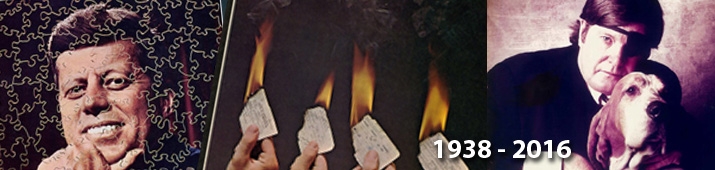
  • The Left and the Death of Kennedy: Ray Marcus


    From the January-February, 1997 issue (Vol. 4 No. 2) of Probe


    (Click here if your browser is having trouble loading the above.)

  • The Left and the Death of Kennedy

    The Left and the Death of Kennedy


    From the January-February, 1997 issue (Vol. 4 No. 2) of Probe


    In this issue we are glad to be able to excerpt parts of a new book by Dr. Martin Schotz. This new work, History Will Not Absolve Us, is an anthology of essays on varying aspects of the Kennedy case. In that regard it resembles previous anthologies like Government by Gunplay, and The Assassinations. This new collection compares favorably with those two. One of the glories of the book is that it includes Vincent Salandria’s early, epochal essays published in 1964 and 1965 on the medical and ballistics evidence. These essays were written in direct response to comments given by another Philadelphia lawyer, Arlen Specter, at the conclusion of the Warren Commission’s work. Working only from evidence available to the Commission and in the public record, Salandria shatters the case against Oswald almost as soon as it was issued. It is a shame that we have had to wait so long to see Salandria’s wonderful work collected in book form.

    There is more. Schotz has included a speech made by Fidel Castro, in which, from just reading the press reports off the wire services, he 1) exposes the murder as a conspiracy, 2) shows Oswald for what he was, 3) points towards the elements in American society from where the plot emanated, and 4) indicates the reasons for the murder. All this within twenty hours of the assassination. Shotz’s opening essay furthers his ideas used in Gaeton Fonzi’s book, The Last Investigation, dealing with concepts of belief versus knowledge and what that means for the mass psychology of American society. This fascinating, intuitive essay gives the book both its tone and its title – a play on a phrase used more than once by Castro.

    There is much more to recommend the book. We choose to excerpt here two particular selections: one in whole, the other in part. They both deal with the response of the left, or as Ray Marcus terms it the “liberal establishment”, to the Kennedy assassination. The first excerpt is an analysis by Schotz of the early editorial policy of The Nation to the assassination. The second section is from Ray Marcus’ monograph Addendum B, originally published in 1995. We chose to excerpt these for three reasons. It shows both Schotz and Marcus at their best. Both the people and institutions they discuss are still around. And finally, what they deal with here is an emblematic problem that is so large and painful – the response of liberals to high-level assassination as a political tool – that no one left of center wishes to confront it.

    Concerning the second point,The Nation repeated its pitiful performance when the film JFK was released by giving much space to writers like Alexander Cockburn and Max Holland. Neither of these men could find any evidence of conspiracy in the Kennedy case, any value to Kennedy’s presidency, or any validity to the scholarship within the critical community. In other words, a leading “liberal” magazine was acting like Ben Bradlee and the Washington Post. As far as The Nation is concerned, their editorial policy has been quite consistent throughout a 33 year period. Their article policy, with very few exceptions, has also been uniform.

    Ray Marcus extends this analysis. Marcus is one of the original, “first generation” group of researchers. In 1995 he privately published his Addendum B, which is a personal and moving chronicle of his attempts to get people in high places interested in advocating the Kennedy assassination as a cause. Ray has allowed Schotz to include sections of that important work in the book. Probe has excerpted the parts of Ray’s work which touch on the reaction of the left, both old and new, to the assassination. We feel that the section entitled “Five Professors” is especially relevant. For in this section, Ray reveals his personal encounters with some of the leading intellectuals of that ’60’s and ’70’s movement called the “New Left”, namely Howard Zinn, Gar Alperovitz, Martin Peretz, and Noam Chomsky. He shows how each of them rejected his plea. The instances of Peretz and Chomsky are both important and enlightening. For Peretz, in 1974, purchased The New Republic, another supposedly liberal publication. He owned it during the period of the House Select Committee on Assassinations. Except for excerpting declassified executive session transcripts of the Warren Commission in the mid-seventies, I can remember no important article in that publication dealing with the JFK case during his tenure. In fact, at the end of that investigation, The New Republic let none other than Tom Bethell have the last word on that investigation. Ray shows why Peretz allowed this bizarre, irresponsible choice. Bethell’s 1979 article tried to bury Kennedy’s death. Five years later, his periodical tried to bury his life. It actually made a feature article out of a review of the tawdry Horowitz-Collier family biography The Kennedys. Who did that publication find suitable to review this National Enquirer version of the Kennedy clan? None other than Midge Decter, wife of neo-conservative godfather Norman Podhoretz, mother-in-law of Elliot Abrams. Decter, presumably with the Peretz blessing, canonized this Kitty Kelley antecedent.

    Ray’s encounter with Chomsky is especially revealing and will be disturbing to adherents of the MIT professor. In his book, Looking For the Enemy, Michael Morrisey includes parts of a 1992 letter from Chomsky. In discussing a government conspiracy to murder and cover-up the assassination, the esteemed professor writes:

    That would be an interesting question if there were any reason to believe that it happened. Since I see no credible evidence for that belief, I can’t accept that the issue is as you pose it. (p.6)

    Apparently, Chomsky never thought that Marcus would include their three hour session over just three pieces of evidence. This exposes the above statement, and Chomsky’s public stance since Stone’s film, as a deception.

    Chomsky and his good friend and soulmate on the JFK case, Alexander Cockburn went on an (orchestrated?) campaign at the time of Stone’s JFK to convince whatever passes for the left in this country that the murder of Kennedy was 1) not the result of a conspiracy, and 2) didn’t matter even if it was. They were given unlimited space in magazines like The Nation and Z Magazine. But, as Howard Zinn implied in a recent letter to Schotz defending Chomsky, these stances are not based on facts or evidence, but on a political choice. They choose not to fight this battle. They would rather spend their time and effort on other matters. When cornered themselves, Chomsky and Cockburn resort to rhetorical devices like exaggeration, sarcasm, and ridicule. In other words, they resort to propaganda and evasion.

    CTKA believes that this is perhaps the most obvious and destructive example of Schotz’s “denial.” For if we take Chomsky and Cockburn as being genuine in their crusades – no matter how unattractive their tactics – their myopia about politics is breathtaking. For if the assassinations of the ’60’s did not matter – and Morrisey notes that these are Chomsky’s sentiments – then why has the crowd the left plays to shrunk and why has the field of play tilted so far to the right? Anyone today who was around in the ’60’s will tell you that the Kennedys, King, and Malcolm X electrified the political debate, not so much because of their (considerable) oratorical powers, but because they were winning. On the issues of economic justice, withdrawal from Southeast Asia, civil rights, a more reasonable approach to the Third World, and a tougher approach to the power elite within the U.S., they and the left were making considerable headway. The very grounds of the debate had shifted to the center and leftward on these and other issues. As one commentator has written, today the bright young Harvard lawyers go to work on Wall Street, in the sixties they went to work for Ralph Nader.

    deathlft

    The promise of the Kennedys or King speaking on these issues could galvanize huge crowds in the streets. But even more importantly, these men had convinced a large part of both the white middle class, and the younger generation that their shared interests were not with the wealthy and powerful elites, but with the oppressed and minorities. Today, that tendency has been pretty much reversed. Most of the general public and the media have retreated into a reactionary pose. And some of the most reactionary people are now esteemed public figures e.g. Rush Limbaugh, Newt Gingrich, Howard Stern, people who would have been mocked or ridiculed in the ’60’s. And the Washington Post and Los Angeles Times, under no pressure to disguise their real sympathies, can call Limbaugh a mainstream conservative (12/2/96).

    What remains of the left in this country today can be roughly epitomized by the nexus of The Nation, the Pacifica Radio network (in six major cities), and the media group FAIR (Fairness and Accuracy in Reporting). We won’t include The New Republic in this equation since Peretz has now moved so far to the right he can’t be called a liberal anymore. The Nation has a circulation of about 98,000. Except for its New York outlet, WBAI, Pacifica is nowhere near the force it was in the sixties and seventies. The FAIR publication EXTRA has a circulation of about 17,000. To use just one comparison, the rightwing American Spectator reaches over 500,000. To use another point of comparison, the truly liberal Ramparts, which had no compunctions taking on the assassinations, reached over 300,000. As recently declassified CIA documents reveal, Ramparts became so dangerous that it was targeted by James Angleton.

    One of this besieged enclave’s main support groups is the New York/Hollywood theater and film crowd, which was recently instrumental in bailing out The Nation. As more than one humorous commentator has pointed out, for them a big cause is something like animal rights. Speaking less satirically, they did recently pull in $680,000 in one night for the Dalai Lama and Tibet. Whatever the merits of that cause, and it has some, we don’t think it will galvanize youth or the middle class or provoke much of a revolution in political consciousness. On the other hand, knowing, that our last progressive president was killed in a blatant conspiracy; that a presidentially appointed inquest then consciously covered it up; that the mainstream media like the Post and the Times acquiesced in that effort; that this assassination led to the death of 58,000 Americans and two million Vietnamese; to us that’s quite a consciousness raiser. Chomsky, Cockburn and most of their acolytes don’t seem to think so.

    In the ’80’s, Bill Moyers questioned Chomsky on this point, that the political activism of the ’60’s had receded and that Martin Luther King had been an integral part of that scene. Chomsky refused to acknowledge this obvious fact. He said it really wasn’t so. His evidence: he gets more speaking invitations today (A World of Ideas, p. 48). The man who disingenuously avoids a conspiracy in the JFK case now tells us to ignore Reagan, Bush, Gingrich, Limbaugh, Stern and the rest. It doesn’t matter. He just spoke to 300 people at NYU. Schotz and Marcus have given us a textbook case of denial.

    With the help of Marty and Ray, what Probe is trying to do here is not so much explain the reaction, or non-reaction, of the Left to the death of John Kennedy. What we are really saying is that, in the face of that non-reaction, the murder of Kennedy was the first step that led to the death of the Left. That’s the terrible truth that most of these men and organizations can’t bring themselves to state. If they did, they would have to admit their complicity in that result.


    (Click here if your browser is having trouble loading the above.)