Tag: US POLITICAL LEFT

  • Counterpunch, JFK , and Vietnam

    Counterpunch, JFK , and Vietnam

    As readers of this site will understand, Counterpunch has consistently been one of the far left’s bastions of ideological purity. They do some good work from that vantage point. But one of the problems with that point of view is that it tends to sweep up all of history into a sanctimonious vacuum. And one of the things that gets swept up and homogenized is the issue of John Kennedy and Vietnam. (Here is a previous example.)

    Their latest in this vein was posted on April 30, 2020. It is another of their “Letters from Vietnam” series. This one is from an American living in Vietnam named Mark Ashwill. Ashwill is an educational entrepreneur. The occasion for him writing his letter is the 45th anniversary of America leaving Indochina in 1975. This was due to the agreements that were negotiated by Henry Kissinger and Alexander Haig under Richard Nixon’s supervision in Paris.

    Ashwill writes the letter as if he were a citizen of Vietnam (which he may well be) and is preaching to his former countrymen about the evil that they visited on his new nation. I would like to inform the editors of Counterpunch and also Mr. Ashwill that this history lesson is not exactly new. It has been going on at least since the rise of Students for a Democratic Society early in the sixties. It was given popular voice in the pages of Ramparts magazine, and was in book form during that decade through the work of men like William Appleman Williams and historians influenced by him who created New Left studies.

    In fact to go through his rather antique complaint today is kind of boring. Most of us know that Ho Chi Minh declared Vietnam free from French domination at the end of World War II. That he used American historical documents like the Declaration of Independence to do so. Many, many years ago Williams produced the letter that Ho sent to Harry Truman in 1945 asking the American president to cooperate with his cause against France. We also know how that letter was ignored and Harry Truman and his later Secretary of State Dean Acheson decided to side with France. And America ended up bankrolling about 80% of the French war effort. We also know the rest of Ashwill’s litany: how the defeat at Dien Bien Phu led to the Geneva Accords, and how President Eisenhower and Secretary of State John Foster Dulles sabotaged that agreement by not holding elections in 1956. And that this key event inevitably led to the USA getting involved in a second war against North Vietnam. This would have been prevented if the Geneva Accords had been honored.

    Ashwill now makes a large leap to 1961 and President John F. Kennedy. The reason I say this is a large leap is because by leaving out 1956-60, in his own David Halberstam-ish way, the author eliminates a central point. John Foster Dulles clearly ran the American participation at Geneva. The attorney realized that his oral agreement with the Accords could easily be broken if he did not sign them and this is what he advised the president to do. (William Blum, The CIA: A Forgotten History, p. 137)

    Within days of the end of the conference, Foster Dulles and his brother Allen, director of the CIA, began a long series of clandestine actions in order to create a new country called South Vietnam. These actions were supervised by General Edward Lansdale, who was in reality a high-level CIA action officer. It included a psychological terror war in the north to convince the Catholics that they would be persecuted by Ho Chi Minh and they should flee to the south. This helped prop up America’s chosen leader of this new country, the Catholic Ngo Dinh Diem. Once this creation was completed, Foster Dulles made the infamous assertion, “We have a clean base there now, without a taint of colonialism. Dien Bien Phu was a blessing in disguise.” (Blum, p. 139). Leaving out Lansdale and the Dulles brothers is not just reminiscent of Halberstam, it is also what Ken Burns and Lynn Novick did more recently in their long dud of a documentary series called The Vietnam War.

    There was no South Vietnam before this. Eisenhower, the Dulles brothers and Vice President Richard Nixon created it. Once it was created, the USA was committed to propping it up any way it could. It was through Diem that America formally cancelled the scheduled unification elections. (Blum, p. 139) This also meant using the fig leaf of communist infiltration from the north as a pretext to invoke the Southeast Asia Treaty Organization (SEATO) as a mutual defense doctrine. Omitting these details thus ignores the fact that those four men had split the country in half and then fabricated a civil war for their own purposes. It was this threat that gave Ho Chi Minh pause about enforcing the Geneva Accords and forcibly holding the elections––which could have easily been achieved. ((Blum, p. 139)

    The USA now began to send new military advisory units to Saigon in further defiance of the Geneva Accords. Lansdale began to rig elections to keep Diem in power. The Dulles brothers were not furthering democracy. They had installed and now supported a dictator. And they trained his security forces at Michigan State University. (Blum, p. 140) These techniques included torture and imprisonment in the infamous “tiger cages”.

    To skip over all this, plus the large amounts of aid we were giving Diem, is to paper over why it was not easy to get out. The Saigon government was a creation of Washington. And, to say the least, Diem was not a good choice for its leadership. But in doing all this, it created a tactical and strategic commitment that had not existed in 1952. In my opinion, it is not something that can be discounted or ignored, since in historical terms, it is crucial. To make this Bob Beamon leap to President Kennedy and 1961 is bad history, even for an informal letter.

    What makes it all worse is the fact that the editors at Counterpunch then placed a picture of President Kennedy at the top of the article next to a map of a divided Vietnam. As if, somehow, Kennedy was involved in the decision to split up the country. This is misleading not just because he was not involved, but because Kennedy was one of the very few voices in Washington to oppose the Dulles/Eisenhower policy not just in Vietnam, but throughout the Third World. This conflict between the senator and the White House was documented by Richard Mahoney back in 1983 in his important book, JFK: Ordeal in Africa. In that book, Mahoney specifically noted Kennedy’s 1957 landmark speech about the ongoing French colonial war in Algeria. During that speech Kennedy harked back to Dien Bien Phu and said what happened in Indochina will happen in Algeria, and that it would thus behoove America to be on the right side of history this time. (The Strategy of Peace, edited by Allan Nevins, pp. 66-80)

    So there is ample evidence that Kennedy understood the appeal of nationalism in Third World countries emerging from the shackles of colonialism. (For more current scholarship describing Kennedy’s familiarity with the issue, please read Betting on the Africans, by Philip Muehlenbeck, and Kennedy, Johnson and the Nonaligned World, by Robert Rakove.) But further, what Ashwill does with Kennedy’s presidency in relation to Vietnam is, well, the best word I have for it is “minimalist”.

    Ashwill describes a meeting between Kennedy and French President DeGaulle in May of 1961 in Paris where the former French resistance leader warned Kennedy about the quagmire he would be getting into if America intervened in Indochina, that it would be an endless entanglement America could not win. He then quotes DeGaulle as later saying that Kennedy listened to him but that events proved he had not convinced him.

    First of all, this discussion between Kennedy and DeGaulle is again an antique bit of news. To cite just one source, it was already described back in 1972 by Dave Powers and Ken O’Donnell in Johnny We hardly Knew Ye. (p. 13) But Kennedy was not just getting this kind of advice from DeGaulle. He also got it from General Douglas MacArthur. The retired general warned him that even if he placed a million men in Asia, it would not work. (Powers & O’Donnell, pp. 13-14). He also got the same advice from Senator Mike Mansfield. (p. 15) And most importantly, he heard the same thing from his ambassador to India, John Kenneth Galbraith.

    This is why during the debates in the oval office in November of 1961, Kennedy refused to commit combat troops into the theater. And that was a line that he never crossed. (John Newman, JFK and Vietnam, pp. 136-39). But, as Galbraith biographer Richard Parker demonstrates in the above link, Kennedy went further than this. He sent Galbraith to Saigon and asked him to write a report, knowing that the ambassador would advise against any further involvement. (Virtual JFK, edited by James Blight, pp. 72-73). Galbraith did write such a report, and when the ambassador returned to Washington in April of 1962, Kennedy had him hand deliver it to Secretary of Defense Robert McNamara. (Newman, pp. 236-37). One month later, McNamara arranged to meet with all the inter-agency chiefs of all American forces in Vietnam. After going through the regular agenda items and adjourning the meeting, he called aside General Paul Harkins, the overall commander of American forces in Indochina. He told Harkins that it was time to switch responsibility for the war over to the ARVN, the Army of South Vietnam, and he wanted to begin the planning on the reduction of American advisors as soon as possible. This was the beginning of Kennedy’s withdrawal plan. (Newman, p. 254)

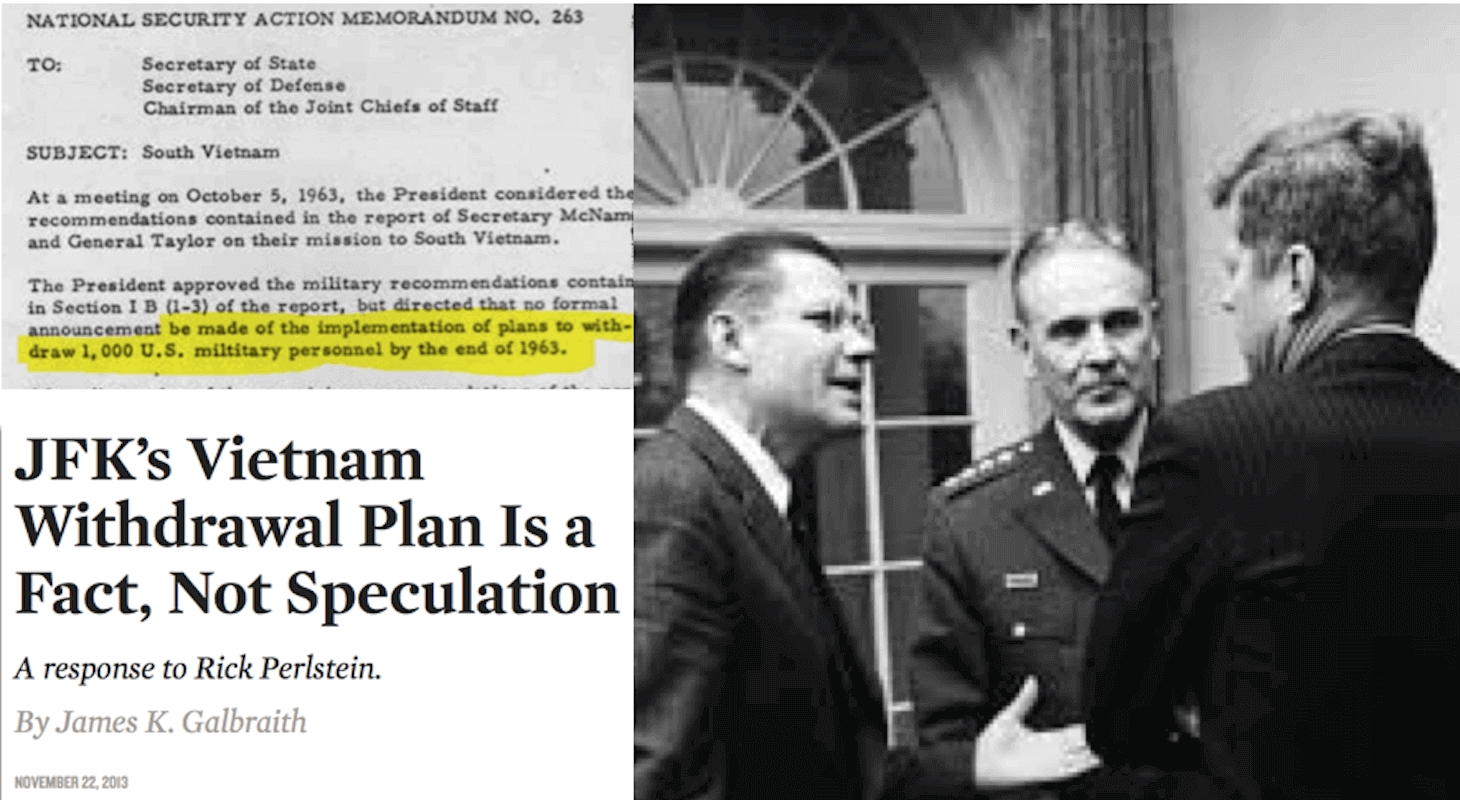
    As anyone familiar with the newly declassified record should know, in May of 1963, McNamara called another such meeting, this time in Hawaii. At this meeting the withdrawal schedules were submitted to the Secretary. He said that they needed to be accelerated. He wanted a thousand advisors withdrawn by the end of the calendar year. He directed that those plans be drawn up. (James Douglass, JFK the Unspeakable, p. 126). In October of 1963, Kennedy signed National Security Action Memorandum 263 ordering the first thousand advisors to be withdrawn by the end of the year and the rest by 1965. (Douglass, p. 188). In other words, there was not one more combat troop in Vietnam at the time of Kennedy’s death than there was when he took office. And he was in the process of removing all advisors.

    Somehow, Mark Ashwill missed all of this with a completeness that is astonishing. But the Vietnamese educator also missed a chance to have this confirmed by a source in his adopted country, namely, the son of the late North Vietnamese General Vo Nguyen Giap. If someone visiting Vietnam from the USA could do this, then why couldn’t Mr. Ashwill?

    From here, Ashwill takes another leap forward. This time to 1966. By the end of that year, Lyndon Johnson had committed 385,000 combat troops, with 60,000 sailors stationed offshore. In just that one year, 6,000 Americans would perish and 30,000 would be wounded. Ashwill discusses a speech by Ho Chi Minh in which the North Vietnamese leader says America took “the wrong fork in the road”. Ashwill never explains how America went from having no combat troops in Indochina to having nearly 400,000. The man who took the wrong fork in the road was Lyndon Johnson. And if any president’s picture should be at the top of the article, it should be his.

    As any serious study of the Vietnam War reveals, there were three events that took place––a meeting and two specific orders issued––that overturned Kennedy’s withdrawal plan and replaced it with an escalation plan that was quite apparent by 1966. These were the first Lyndon Johnson meeting on the war on November 24, 1963; the last draft of NSAM 273 signed on November 26th; and NSAM 288 finalized in March of 1964.

    At the November 24th meeting, the principals realized that Johnson’s attitude and style about Vietnam were both quite different from Kennedy’s. He said things that Kennedy never did. For instance: “I am not going to lose Vietnam. I am not going to be the President who saw Southeast Asia go the way that China went.” (Newman, p. 442) Kennedy never expressed these kinds of Cold War sentiments about Indochina. He simply did not think Vietnam was imperative to American security. National Security Advisor McGeorge Bundy agreed with this evaluation in comparing the two presidents. And he expressed those characterizations in discussions with both James Blight and his biographer Gordon Goldstein. (Goldstein, Lessons in Disaster, p. 231)

    NSAM 273 was altered to allow direct American naval involvement in patrols against the North Vietnamese coast. According to Bundy, it was altered by Johnson. (Newman, pp. 445-49) This allowed for the OPLAN 34 A plans and the so called DE SOTO patrols. The former were hit-and-run attacks by speedboats, the latter were American destroyers meant to decipher where return fire from North Vietnamese bases was coming from. In December, Johnson requested these types of covert actions against the North, with the help of Americans forces if need be. The operations ended up being largely American. (Edwin Moise, Tonkin Gulf and the Escalation of the Vietnam War, pp. 5, 7-8, 14) As many commentators agreed , including those inside the White House, these patrols were, in fact, provocations. (Moise p. 68; Goldstein, p. 125)

    NSAM 288 was Johnson’s specific preliminary design to escalate the war, including an air war against North Vietnam. This included 94 bombing targets. In three years Kennedy had never even contemplated this. The combination of the DESOTO patrols with NSAM 288 resulted in the casus belli the White House sought in order to escalate the war. (Moise, pp. 26-28) This was of course the Tonkin Gulf incident. And this is what Ashwill skips over to get to 1966.

    The rest of the article is a listing of all the damage inflicted on Vietnam, in bombs, land mines, defoliants, and so forth. Which, of course, any interested party already is cognizant of. Are we supposed to believe that the editors at Counterpunch do not know that 99% of all this happened after Kennedy’s death? And if his plan had been left intact, we would not be having this discussion? That is not speculation. Today, with the declassified documents of the Assassination Records Review Board, it can be proven.

    Near the end, Ashwill says that the American leaders did not understand what the war was really about. As I have labored to show, President Kennedy did know what it was about. That is why he was getting out. Just ask General Giap’s son.

  • Ken Silverstein and Jeffrey St. Clair Get Counterpunched

    Ken Silverstein and Jeffrey St. Clair Get Counterpunched


    counterpunchAs more than one commentator has observed, generally speaking, the Right has so much power in America that it does not have to worry about things like accuracy and morality. A good example was the journalistic trumpeting about the false charge that Iraq had Weapons of Mass Destruction. After all, people do not go to conservative martinets like Rush Limbaugh and Sean Hannity for facts and honesty in reporting.  Usually it’s the left-of-center writers and reporters who are relied upon for such things.  For, as Michael Parenti once noted, reality tends to be radical. Which is the reason that it sometimes has to be propagandized.  Or else how does one provoke something as stupid as the 2003 American invasion of Iraq?  Those on the Left insisted there was no reliable evidence for that invasion, while the MSM pretty much accepted the (ersatz) words of Colin Powell at the United Nations.

    But what happens when the Left abandons its concern for such things as accuracy, morality and fact-based writing?  What does one call such reporting then?  Does it then not become—for whatever reason—another form of propaganda?

    The above reflection was instigated by the comments of a couple of the former founders of Counterpunch magazine, namely, Jeffrey St. Clair and Ken Silverstein.

    Counterpunch was started by Silverstein back in 1994. It was then based in Washington D. C.  Silverstein was later joined by St. Clair and Alexander Cockburn. At this point, in 1996, Silverstein left and Cockburn and St. Clair became the co-editors. Silverstein stayed on as a regular contributor.  The magazine’s headquarters now shifted to northern California.

    At times, Counterpunch does good work. This writer used some of its work about the Hollywood film industry for the The JFK Assassination: The Evidence Today.  But owing to the influence of the late Alexander Cockburn, when it comes to anything dealing with the Kennedys, they begin to abuse the profession.  That is, the guidelines of accuracy, morality and fact-based reporting go out the window. Counterpunch becomes the left-wing version of Fox News.

    This is clearly a recurrent syndrome for that journal. About three months ago, I reported on their last attack on JFK.  About three months prior to that, I answered the falsities in another article, this time by a man named Matt Stevenson.  In that piece, Stevenson actually tried to say that President Kennedy’s withdrawal plan for Vietnam was just “speculation”. Stevenson then said that President Johnson’s colossal escalation in Indochina was merely a continuation of Kennedy’s policies there; or as he wrote, Johnson was “singing from Kennedy’s hymnal together with his choir.”  As I noted in that article, the declassified records on this issue show that this is utter nonsense. And we have the evidence now in Johnson’s own words—on tape.

    So what makes Counterpunch, an otherwise respectable journal, debase itself on this issue? As noted above, it is most likely the influence of the late co-editor Alexander Cockburn. As most of us know, when Oliver Stone’s film JFK came out in late 1991, the Establishment went completely batty.  This included what I consider to be the Left Establishment, i.e., Noam Chomsky at Z Magazine and Cockburn at The Nation. The Cockburn/Chomsky axis reacted to the film pretty much as the MSM did.  The Dynamic Duo wrote that the central tenets of Stone’s film were wrong: Kennedy was not withdrawing from Indochina at the time of his assassination; JFK was not killed as a result of any upper level plot; and the Warren Commission was correct in its verdict about Oswald acting alone. For the last, Cockburn brought former Warren Commission counsel Wesley Liebeler onto the pages of The Nation. As if he was being interviewed by Tom Brokaw for NBC, Liebeler was allowed to pontificate on the fascinating flight path of CE 399, that is the Magic Bullet, as well as on how Oswald got off three shots in six seconds with a manually operated bolt-action rifle, two of them being direct hits.  When an allegedly muckraking journalist softballs an attorney who later became a member of the Charles Koch funded George Mason School of Law, something is bonkers someplace (see NY Times, May 5, 2018, “What Charles Koch and other donors to George Mason got for their Money”).

    What made that spectacle even worse was the fact that Cockburn had previously co-written an essay on the Robert Kennedy assassination.  That piece was penned with RFK investigator Betsy Langman. It ran in the January 1975 issue of Harper’s. The article carefully laid out the problems with the evidence in the RFK assassination and how those problems tended to exonerate the convicted killer, Sirhan Sirhan. But now, in 1991-92, Cockburn gave his previous essay the back of his hand. He now wrote that Bobby Kennedy had turned his head, and this is how Sirhan, standing in front of RFK, shot him from behind in the back of the skull. 

    In typical MSM manner, Cockburn never commented on the following:

    1. If that was so, why did no one see it?
    2. How did Sirhan get within one inch of Senator Kennedy’s rear skull from a distance of about five feet away?
    3. How could Sirhan shoot Kennedy in the head with hotel maître d’ Karl Uecker holding his gun hand down on a table? Wouldn’t Uecker remember such a thing?
    4. Who delivered the other shots into Kennedy’s back then?

    As the reader can see, by this time, Cockburn had joined up with his friend Chomsky—who had once harbored doubts about the JFK case.  They had now both learned that discretion was the better part of valor in the murders of the Kennedys. After all, look what happened to Oliver Stone. Both men now joyfully threw overboard the Left’s shibboleths about accuracy and morality.  I mean, what kind of morality is it to give safe harbor to someone like Wesley Liebeler?

    It would have been one thing to have just ignored the issue.  After all, if one did not think President Kennedy’s assassination was important, all right, just let it pass by.  But Cockburn and Chomsky deliberately went out of their way to attack and ridicule anyone who thought differently. And they did this on numerous occasions. Since Cockburn wrote regularly for The Nation, and Chomsky was widely distributed by Pacifica Radio and Z Magazine, many on the Left were exposed to their false assumptions and smears. And that impact persists until this day.

    In the August 10th issue of Counterpunch, St. Clair has a kind of round-up column that he labels, “Roaming Charges: The Grifter’s Lament”.  In that string of paragraph-long notices about current events, the reader finds the following:

    “Barack Obama is about to be presented with the Robert F. Kennedy Award for Human Rights. RFK, the red-baiting, anti-communist zealot who desperately wanted to assassinate Fidel? Sounds about right for the President of Drones.”

    This is an excellent and made-to-order example of what I mean about the Left losing its moorings on the cases of John and Robert Kennedy. As more than one commentator has noted, both of these charges about Robert Kennedy are simply false.  But St. Clair decided that he was not going to do any research. In order to stay the Cockburn/Chomsky course, he would just play the mindless stooge for them. 

    As William Davy noted in his fine talk at VMI University last year, the declassified version of the CIA’s Inspector General Report about the CIA/Mafia plots to kill Castro admits that the Agency had no presidential approval for enacting those attempts to kill Castro.  In those pages, it is easy to see this is especially clear with regard to Attorney General Robert Kennedy, since the CIA sent two men to brief him on the plots when J. Edgar Hoover found out about them in 1962.  The obvious question is: Why did Kennedy have to be briefed if he had approved them?  The answer is that he had not—that is why the CIA had to tell him about them.  But even more egregiously, the Agency briefers told RFK that the plots had been terminated when in reality they had not been.   Again, why would they lie if they did not have to?

    As the reader can see from the link above, this document has been declassified for a number of years.  It is available on the web in more than one place.  If St. Clair had any qualms about not being a dupe or, on the other hand, if he had thought, “Maybe I shouldn’t smear a dead man without checking the record?”, he could have easily consulted the adduced facts in the case without doing very much work at all.  He chose not to.

    But it’s actually even worse than that, because as part of the record that St. Clair chose to ignore, one of the authors of that report left behind his own comments on their investigation.  This man was Scott Breckinridge, who testified to the Church Committee about this issue.  He stated that they simply could not find any credible evidence that the CIA plots had any kind of presidential approval.  When asked who gave the approval to lie to Bobby Kennedy about the ongoing nature of the plots, Breckinridge said that this went all the way up to Richard Helms, the CIA Director at the time.  (see Davy’s talk)

    In other words, in this case, St. Clair is actually siding with the cover-up about these plots that was supposed to save the CIA’s skin.  It kept them ongoing by concealing them from Bobby Kennedy. And then later, through his trusted flunky Sam Halpern, Helms could put out a disinformation story saying that the Kennedys knew about them. (David Talbot, Brothers, pp. 122-24)  Helms knew he could get away with this since the documents revealing the actual facts were classified.  But today, such is not the case.  Which leaves Mr. St. Clair with no excuse, not even a fig leaf, for writing what he did about RFK. Helms and Halpern would have been smiling at their dirty work.

    The other half of the smear concerns Bobby Kennedy’s service on the Senate’s Permanent Subcommittee on Investigations.  This was done at his father’s request to his personal friend Senator Joe McCarthy.  McCarthy had appointed attorney Roy Cohn as the committee’s chief counsel.  Kennedy violently disagreed with the way that Cohn and McCarthy ran the committee.  And as anyone can see, he steered clear of their finger pointing tactics at certain targets like Annie Lee Moss and Irving Peress. The work that Kennedy did was actually praised even by the committee’s critics.  This was a study of how the trade practices of American allies helped China during the Korean War, thereby increasing aid to our opponent North Korea.  (Arthur Schlesinger, Robert Kennedy and His Times, pp. 104-11)

    Kennedy resigned over his disagreements with Cohn after six months.  He then was asked back by the Democrats on the committee when they were in a stronger position.  He now became their chief counsel.  He retired the Moss and Peress cases, dismissed the unfounded charges of defense plant infiltration, and furnished questions for the senators in their examination of Cohn and McCarthy. He then played a large role in writing the Democratic report, which strongly attacked both men.  In fact, that report was so critical that some Democrats would not sign on to it. (Schlesinger, pp. 114-19) It constitutes the beginning of the Senate’s maneuvering to censure McCarthy. In other words, the actual record states that it was RFK who helped exculpate the victims of Cohn and McCarthy.  And it was RFK who began their toboggan ride to ruin.  The Democrats knew this would be the case, which is why they hired him as their chief counsel.

    This information has been out there since 1978.  Anyone could have availed themselves of the facts, instead of MSM malarkey. That St. Clair decided not to print the facts—for the second time—shows us how worthless his writing is on the matter. This is nothing but playing to the crowd.  That, of course, is what the Right (e.g., Ann Coulter) is famous for doing.

    Which brings us to the third founder of Counterpunch, Ken Silverstein.  Previously, I have reviewed for this site the fascinating volume by Robert Kennedy Jr., entitled Framed.  That book was about the MSM hysteria over the Michael Skakel case, a hysteria induced by Mark Fuhrman and the late Dominick Dunne.  In that review I tried to show how Dunne had enlisted in the ranks of the right-wing echo chamber in order to find a way to convict a Kennedy, or any Kennedy relation, in the unsolved 1975 murder of Martha Moxley.  (Michael Skakel was Kennedy’s first cousin from Ethel Kennedy’s family.)  Dunne assiduously worked toward this goal for years, through a variety of flimsy and dubious methods, which I detailed in that review. Dunne then enlisted Fuhrman into the quest. He obediently did the same. Since both men had high profiles with both the MSM and the Right-wing Noise Machine, and across all platforms—radio, TV, magazines, and book publishing—they now managed to transform Michael Skakel into their prime target in the Moxley murder, despite the fact that at the time of her murder, Skakel was not considered a suspect.

    Bowing to the unremitting pressure of Dunne and Fuhrman, the local Connecticut authorities then employed some rather bizarre techniques in order to indict Michael Skakel.  For example, they used a one-man grand jury, rewrote the state law as to the statute of limitations, and then tried Michael as an adult even though they said he committed the crime as a youth.  Throughout all of this, the MSM followed the spectacle like a herd of lemmings, even though Dunne was really not an investigative reporter (he more closely resembled an exalted gossip columnist).  And, to put it mildly, Fuhrman had a somewhat checkered past as a detective. In spite of all this, not one journalist cross-checked their work. Meanwhile, the supermarket tabloids egged the spectacle on. Because of the compromising publicity and an incompetent defense attorney, in 2002 Michael Skakel was convicted.

    Finally, Robert Kennedy Jr. decided this was enough bread and circuses in the Colosseum.  In early 2003, he penned a long and detailed magazine essay on the case. Incredibly, this was the first public questioning of the writings of Dunne and Fuhrman in the twelve years they had been writing on the case. Kennedy’s essay made Dunne look like the aggrandized celebrity gossip columnist that he was; in some ways, it made Fuhrman look even worse.

    Robert Kennedy Jr. cooperated with the series of defense attorneys who helped to air the problems with the Dunne/Fuhrman posturings. In 2016, he wrote his book on the case.  That book clearly had an impact on both the public and the legal system in Connecticut.  It was really the first full-scale forensic study of both the murder and the (ersatz) work of the Dunne/Fuhrman team.  It made them look like the Keystone Kops—perhaps even more asinine.  This evidence was so compelling that the state Supreme Court has now decided to free Skakel because his defense attorney ignored a credible alibi witness who placed him far away from the crime scene.

    Returning to Counterpunch founder Ken Silverstein:  When Bobby Kennedy Jr. was finishing up his book on the case, he wanted someone to review it to see if everything was in place. Through David Talbot, he asked Silverstein if he wanted to act as his researcher and offered to pay him $12,500 dollars for a month’s work.

    Silverstein turned down the offer.  But with typical St. Clair/Cockburn snarkiness he decided to go public. And by doing that he made himself look like an ignoramus.  He said that Michael had been the boyfriend of Moxley, which was wrong.  But that was not enough for Ken.  He then had to add that Skakel was obviously guilty. What is so incredible about that statement is that he made it without reading the Kennedy book!  Again, this is just what the so-called Left is not supposed to do.

    But that still was not enough.  Without reading the book, Silverstein now said that there was “a wealth of evidence demonstrating beyond a reasonable doubt that Skakel is guilty”.  To show just how far Silverstein had bought into the Dunne/Fuhrman paradigm, he actually recommended for reading Dunne’s book on the case, A Season in Purgatory.  Can the man be real? Dunne’s book is a novel that insinuated that John Kennedy Jr. was Moxley’s killer.  With a straight face, Silverstein called the book “amazing”.  What is amazing is that Silverstein could be that much of a sucker for Dunne.

    But even that ludicrous display was not enough for Silverstein.  He then attacked Robert Kennedy Jr. personally.  How?  He goes all the way over and uses a book by Jerry Oppenheimer to do so.  Oppenheimer is the equivalent of, say, Randy Taraborrelli, or perhaps even David Heymann, in the field of literary biography.  After all, who else would write a book entitled The Kardashians: An American Drama?

    Back in 1992, when Cockburn bowed down to the Allen Dulles/John McCloy led Warren Commission and softballed Wesley Liebeler, The Progressive posed the question: Why is Alexander Cockburn shaking hands with the Devil? As the record shows, these are the kinds of people—Dunne and Oppenheimer—a writer has to jump into bed with once one discards one’s code of honor and enlists in the Cockburn/Chomsky abasement program.  After all, Dulles and McCloy were two of the worst Americans of that era, and in his mad mania to trash Oliver Stone’s JFK, Cockburn ignored all the evil they had done. Silverstein and St. Clair cannot go back and say:  “Well Alex was really all wrong about that film JFK.  He made a mistake and we apologize for that.”  No, that would be admitting too much.  So instead, they take the easy way out and continue to use spurious information and cheesy New YorkPost type writers.  To the point that they not only discard any standards of scholarship, but also rub noses with the worst parts of the MSM.  This is how much Chomsky and Cockburn scorched the earth on this issue:  up is down, Left is Right, and we don’t care who we mislead or smear. 


    See also this provocative article from 2012 by author Douglas Valentine.

  • VICE News Botches the King Case

    VICE News Botches the King Case


    What is one to make of a scenario whereby a journalist on the “fake news” beat of a highly-capitalized upstart media empire posts material which is not only factually-challenged but actually proposes the family of slain civil rights leader Martin Luther King have been motivated by selfish money interests and are easily led? Well, anyone who is unfortunate to encounter the VICE News article “A History of the King Family’s Attempt to Clear the Name of James Earl Ray”, from January 2016, can read it for themselves and discover what to make of it on their own.1 This review will offer a contextual response.

    VICE News is a subsection of VICE Media, which in turn was an outgrowth of VICE Magazine. VICE Magazine built a cachet in the 2000s as it was distributed free of charge and available in various bars, eateries, video stores, record stores, and the like which catered to a younger hipper clientele. The magazine was glossy, slick, full-color, and relatively substantial, with most editions averaging about 100 pages. Most notably, VICE’s content specialized in an edgy cynical amorality, veering at times into exploitation, which was somehow appealing and seemingly appropriate during the dark days of the W. Bush administration.

    From modest beginnings in the 1990s, VICE Media has since become a global presence with thousands of employees, a virtual network with numerous online platforms and streaming entities largely focused on its cultivated younger demographic. VICE News was launched in 2014 as a multi-platform news and information service, partnered with HBO and enjoying a wide international presence both in content and reach. However, despite claims that VICE’s news department would apply critical scrutiny to the state of the world, at a “certain level of seriousness”,2 VICE News has received criticism for biased coverage by its reporters in Ukraine, Syria, Venezuela, and other geopolitical hotspots,3 and also has been criticized for adopting tabloid-style simplifications of complex subjects, relying on “exaggerated characters that create an extreme view of reality.”4

    A brief examination of a recent VICE News story may help identify some of the worst tendencies of this brand’s take on journalism, and also help put the article of concern in due context. A May 4, 2018 posting was titled “Trump Just Pulled Funding for Syria’s ‘White Helmets’ Rescue Group”.5 In reporting an unexpected cut in funding shortly after the White Helmets participated directly in the aftermath of a disputed “gas attack” in Syria’s Douma region, the author lists a number of familiar talking points concerning the integrity of the controversial organization, leading him to state: “Though their work has largely gained them international recognition as brave rescue workers, they’ve come under attack from a propaganda campaign pushed by Russian state media to discredit their work.”

    This assertion of a Russian state media propaganda campaign gets sourced to a December 2017 opinion article from The Guardian: “How Syria’s White Helmets Became Victims of an Online Propaganda Campaign”, written by Olivia Solon.6 Solon claims that negative publicity attached to the White Helmets is simply a collection of “half-truths” and “conspiracy theories” propagated by Russian state media and repeated uncritically by a motley group of anti-imperialists, alt-right bloggers, and malicious “Twitter bots”. Evidence of the alleged “Russian influence campaign” amounts to a review of clusters and patterns of online activity, which appears to resemble the clusters and patterns of effectively all online activity featuring breaking news and analysis. In effect, Solon herself spins a conspiracy theory, which is repeated uncritically by the VICE News writer.

    More accurately, the single article which did the most to establish awareness of the controversial aspects of the White Helmets appeared on the Alternet site in October 2016, written by Max Blumenthal.7 Blumenthal, in the guise of an actual journalist, traced the funding streams, identified the myriad organizations which directly connect to the group, and made the case that, rather than simply a neutral volunteer rescue agency, the White Helmets have a second primary task producing audio-visual evidence of presumed Syrian government atrocities, which integrates seamlessly into a larger coordinated apparatus used to shape public opinion towards a regime-change policy in Syria. The White Helmets, therefore, could be accurately described as a propaganda operation. Blumenthal noted the group operated exclusively in “rebel” zones, including areas held by UN-designated terrorist groups out-of-bounds to other NGO personnel and journalists. Blumenthal’s article was widely shared at the time and the information he presented has not been disputed. Therefore, the focus on an alleged “Russian” propaganda effort can be seen as a dubious misdirection. The VICE News author disagrees, referring to his own attempt to investigate: “The first three results for a ‘White Helmets’ search on YouTube are videos posted by RT, Russia’s state news agency.” Case closed.

    Examining this brief VICE News article, the following pattern or tendency is suggested: the journalist appears unaware of the history and context of his subject; in place of history or context, the journalist echoes an objectively biased mainstream or establishment source; the journalist is lazy and content with one side or position to a story; in the face of controversy, the journalist will employ the term “conspiracy theorist”; the journalist will refer to results from unsophisticated Google searches or cite unscientific statistical data of his own making.

    Unsurprisingly, these tendencies are also on display in the 2016 article on the King family and the civil trial. The author is Mike Pearl, whose byline is lately associated with a VICE News subject header called Can’t Handle The Truth, which often is concerned with debunking the distribution and dissemination of false information (aka “fake news”). Many of his numerous stories are innocuous renderings of current trending information, presented in the irreverent VICE style, with often snappy enticing headlines. Chronologically, the King article appeared a few days after Pearl posted his “The Ted Cruz Birther Question Just Became a Central Issue in the 2016 Campaign”, and the day before Pearl posted “Has This Microbiologist Found the Answer to Antibiotic Resistance?”. The story presumes a “stranger than fiction” approach with the tag “Martin Luther King’s son and convicted killer were on friendly terms.”

    That the author probably doesn’t know much at all about this particular story is revealed in the second sentence of the article: “(Ray) was arrested at London’s Heathrow Airport of all places …” (emphasis added). While yes, that might seem unlikely, other details of Ray’s flight are even more so, particularly the mystery of how he found the resources for his international travel and how he managed to secure the false identity he was travelling with. The author does not seem aware of either of those two pertinent issues, which factor directly in an appraisal of Ray’s position and therefore directly to the “surprising” fact the King family “briefly devoted their lives to his cause.” According to the public statements of the King family, they devoted that time in hopes of establishing a true record of the death of their husband and father (and part of that effort might, yes, “clear the name” of the designated assassin). The author assumes a more limited view—that the family “allied themselves with the legal team hell bent on freeing Ray” and were “utterly sold on the most daring claim made by any of the King conspiracy theorists: not just that Ray hadn’t acted alone, but that he wasn’t even involved.” That this “daring claim” was articulated by close associates of King in the 1970s, and was a focus of the work by the House Select Committee on Assassinations in those same years, seems to be something the author is not aware of.

    This is not surprising, as can be quickly discerned by examining the author’s sources, which appear as links dispersed across the body of the story. The first link, apparently the source of the initial paragraphs, arrives at a BBC News “On This Day” story which reprints coverage from Ray’s conviction on March 10, 19698. An “In Context” sidebar attached to the story notes that “federal authorities insisted there was no evidence of a cover-up” (which is technically true, although information from the FBI and Memphis police compiled by others seems to provide exactly such evidence), that Ray had “a fanatical hatred of black people” (strongly denied by those who knew him), and that forensic tests in 1997 on the rifle “proved inconclusive” (not exactly correct, as the testing was in fact curtailed to prevent any conclusions). So, here too is the BBC contributing its own half-truth fake news on this controversial topic.9

    The author then turns his attention to the aforementioned “hell bent legal team”, namely attorney William Pepper, with one of the most egregious slurs since Vincent Bugliosi: “Pepper, who has in recent years devoted himself to the 9/11/ truther movement …” Most anyone aware of Pepper knows that recent years had seen him finish the third of his books on the King case, represent Sirhan Sirhan in a series of extensive court challenges, and research a proposed book on political assassinations through history. Not aware of this, the author instead consults a YouTube search of his own, which discovered a talk by Pepper from 2006 as the keynote speaker at a conference titled “9-11: Revealing The Truth, Reclaiming Our Future,” where he discussed his direct experience with a government cover-up and conspiracy in the King case.10 To claim that someone is “devoted” means to “give all or most of one’s time or resources”, a standard to which a single keynote address does not apply. The author apparently does not have a dictionary, or is simply careless with language, a poor trait for a journalist. William Pepper’s own website might have served as a better indicator of what he was up to, but perhaps the YouTube searches are what VICE’s editors believe their young demographic want. Still, even on YouTube, there are many more relevant examples of Pepper’s work.11

    This is followed by the author presuming motive in a scenario he seems to know little about, influenced presumably by an opinionated news story which appeared in the Washington Post in January 1995 concerning the then current dispute between the King family and representatives of the local Park Service over the future of the King Historic District in Atlanta.12 Written by veteran Post reporter Ken Ringle, the piece takes every opportunity to question the judgment and ability of the King family while portraying their opponents as model citizens with the best intentions. The information in the article presents the viewpoints from only one side in the dispute, which should raise red flags to a trained journalist considering using it as a source. Instead, the author accepts the article’s portrayal of King family members at face value and then proceeds to sketch out his own conspiracy theory postulating that Dexter King had become focused on “ways to derive revenue from the work and likeness of his father,” and this may have motivated his interest in Pepper’s work. The author appears unaware that Pepper was friends with Martin Luther King in 1967-68, that Pepper worked directly with King on a possible third-party political campaign in late 1967, that Pepper’s work as a journalist in Vietnam in 1966 had directly influenced King’s policy of opposition to the Vietnam War, and, again, Pepper’s own interest in the conspiracy aspects of King’s death were generated by close associates of the King family in the 1970s.13

    The author proceeds with a brief summary of the 1999 civil trial in which he complains that some information presented to the court “flies wildly in the face of accepted wisdom”, wisdom which he associates with the opinions of author Hampton Sides.14 The author makes light of the civil trial verdict, and stresses the Justice Department conducted its own probe which found “no conspiracy at all”, allowing him to cue the applause line: “unsurprisingly, (this) doesn’t impress conspiracy theorists much.” The Justice Department refused to test the “weight of all relevant information” in an adversarial courtroom at the King civil trial, which belies the confidence expressed by its report.

    This is simply a terrible article, although it is not apparent that the author holds specific animosity towards the King family or William Pepper, and might instead be reflecting a personal attitude towards “conspiracy theorists” assisted by his limited grasp of the historical record. More recently, Pearl wrote about the mandated JFK document release acknowledging there is “still quite a lot of unexamined and important history there,” even as he insists there is “zero proof” Oswald was in fact a patsy.15 Nevertheless, he maintains—in a VICE kind of way—the newly released information provides a “good example of deep-state shit the public has an interest in knowing.” Which is true, but the VICE News quasi-journalist crew are not really going to be the best sources to consult.

    If there are conclusions to be reached, I would suggest they rest less with the inadequacies of the author’s journalistic practice, and more with the core function of VICE News itself. It is part of a capitalized company whose core business is to exploit the value of its consumers: a lucrative hard-to-get young demographic. VICE Media is worth an estimated $6 billion based largely on the appeal of its “brand”. It has received capitalization from Hearst, Murdoch, A&E Network, and recently $400 million from Disney and $450 million from private equity firm TPG Capital. VICE (despite its origins in Montreal) is a version of a classic American business story: the upstart winner which, when examined up close, is much less than the sum of its marketing strategies. If the journalism does not meet professional standards, it is because journalism is not the actual product VICE News is peddling.


    Notes

    1 https://www.vice.com/en_us/article/av38ab/a-history-of-the-king-familys-attempt-to-clear-the-name-of-james-earl-ray.

    2 See the Columbia Journalism Review’s “The Cult of Vice” from 2015.

    3 For example, watch this Mint News interview on how VICE often promotes official narratives.

    4 “About That VICE Charlottesville Documentary”.

    5 https://news.vice.com/en_us/article/xw7edn/trump-just-pulled-funding-for-syrian-white-helmets-rescue-group.

    6 https://www.theguardian.com/world/2017/dec/18/syria-white-helmets-conspiracy-theories. The Guardian has an established partnership with VICE Media.

    7 https://www.alternet.org/grayzone-project/how-white-helmets-became-international-heroes-while-pushing-us-military.

    8 http://news.bbc.co.uk/onthisday/hi/dates/stories/march/10/newsid_2516000/2516725.stm.

    9 According to The Guardian’s Olivia Solon, two half-truths and an incorrect assertion is certain proof of a Russian disinformation campaign.

    10 https://youtu.be/bXgPnaQKcyw?t=2703. The term “9/11 Truther” is just the latest in a long series of “conspiracy theorist” smears, often employed as a form of ridicule. That the 9/11 events were subject to a massive cover-up and that strong evidence of what might constitute a high level conspiracy—including the failure of America’s air defense systems and the CIA’s deliberate withholding of information ahead of the attacks—has been hiding in plain sight since that day.

    11 Another poor trait for a journalist is bad reading comprehension, which the author displays as he misattributes the name of Ray’s handler Raoul to the civilian shooter in back of Jim’s Grill as he summarizes Pepper’s book Orders To Kill.

    12 https://www.washingtonpost.com/archive/lifestyle/1995/01/16/whose-dream-is-it-now-the-family-of-martin-luther-king-is-battling-the-government-and-atlanta-is-losing/04369405-b416-48d7-8670-93c728146c4a/?utm_term=.bebe4720b36d.

    13 https://ratical.org/ratville/JFK/WFP020403.pdf.

    14 Hampton Sides is described as an “enemy of conspiracy theorists everywhere,” and the author links to a Newsweek article by Sides which serves as a source for many of the James Earl Ray references in his VICE News article. Sides’ 2010 book Hellhound On His Trail is reviewed here.

    15 “The JFK Conspiracy Shows Us What’s Dumb About Today’s Fake News,” Oct 28, 2017.

  • Does Paul Street get paid for this junk?

    Does Paul Street get paid for this junk?


    I really hope the answer to the question posed by this article’s title is no. Why? Because Street’s latest exercise in fruitiness is nothing but a recycling of two previous columns he wrote. His current article, which was supposed to be a salute to the memory of Martin Luther King, is really no such thing. It is actually a cheapening of King’s memory, because Street chose to elevate King at the same time that he denigrates President Kennedy. But beyond that, the article is ironically titled, “Against False Conflation: JFK, MLK and the Triple Evils”, since Street himself is guilty of conflating one column he did in January on King with another he did in February on Kennedy. The latter was posted at Truthdig; the former at Counterpunch. What he does in his current effort at the latter site is largely a cut-and-paste job of the two articles. Which is what I mean about hoping he does not get paid for this stuff.

    I demolished his February piece on Kennedy at length already. (See Paul Street Meets Jane Hamsher at Arlington for the ugly details) But what he does now is make believe that demolition did not happen, and he simply modifies it slightly to serve as the first part of his worthless essay. So if he is getting paid, it’s easy money.

    When I heard of what he had done, I emailed Counterpunch and asked if I could reply on site. After four days I received no reply. Therefore, I will reply here again. And to place Street on warning: whenever I hear about more of his nonsensical writing on the subject, I will reply in the future. Especially since his scholarship is so bad that this is like shooting fish in a barrel. In fact, Kennedys and King may end up with a special section called “Street is a Dead End”.

    As I stated, Street slightly modified the first part of his hatchet job on President Kennedy. He opens his article by aseerting that he does not pretend to know the full stories behind who killed Kennedy or King. But he cannot help but list the lone gunman option first. Anyone who has the slightest interest in the subject would howl with laughter at anyone who would proffer that option today. That Street leaves it open tells us a lot about the argument he wishes to make. For if he did admit that JFK was killed by a high-level plot, it would tend to undermine his nonsensical thesis.

    This is especially true in light of the fact that so many of President Kennedy’s policies were altered and then reversed after his death. For example, there were no American combat troops in Vietnam on the day Kennedy was killed. By the end of 1965, not only were there 175,000 combat troops in theater, but also Rolling Thunder—the greatest air bombardment campaign in history—was operating over North Vietnam.   We can make other comparisons to the same effect from the scholarly literature that Street refuses to consult. For example, by reading Richard Mahoney’s JFK: Ordeal in Africa, one can see that a very similar trend followed in Congo. By reading Lisa Pease’s essay about the giant conglomerate Freeport Sulphur, one can see the same trend line in Indonesia. (See JFK, Indonesia, CIA & Freeport Sulphur) By reading just a few pages from Donald Gibson’s masterful volume, Battling Wall Street, one can see that it occurred in the Dominican Republic as well. (See pages, 76-79) By reading Robert Rakove’s fine overview of Kennedy’s revolutionary foreign policy, one can see that the same thing happened in the Middle East, where Kennedy favored Gamel Abdel Nasser. After his death, Johnson and Nixon moved back to favoring Iran and Saudi Arabia, with disastrous results. (See Kennedy, Johnson and the Non Aligned World.) The story of Africa outside the Congo also followed a similar plot line. And the reader can see that by reading Philip Muehlenbeck’s Betting on the Africans.

    What is remarkable about Street’s articles is that there is no evidence at all in any of them that he read any of this material. Consequently, in addition to the ignorance he shows on the subject, there is also a tinge of arrogance involved. Does he think that since he knows better, somehow he is above reading the latest scholarship on the subject? Well, that is one way that he can keep his screeds coming, isn’t it?

    The other point that he implies with his opening is that the assassinations of the Sixties are not really linked in any way. Again, this is quite a difficult thesis to swallow. Lisa Pease and I wrote a 600-page book on that very subject called The Assassinations. There, with rather intricate and up-to-date evidence, we tried to show how the four major assassinations of the decade—President Kennedy, Malcolm X, King, Robert Kennedy—all shared similar characteristics in both their outlines and design, and in the cover-ups afterwards. We also offered a final essay in which we tried to show that it was the cumulative effect of those murders that brought us to the election of 1968: the coming of Richard Nixon and the rise of the hard right to power—a phenomenon that drastically altered the social and economic landscape of this country, and from which it may never recover. One only needs to look at what happened after Nixon left office: how Jerry Ford allowed Donald Rumsfeld and Dick Cheney to bring the Committee on the Present Danger into the White House and do battle with the CIA over their estimate of the Soviet Threat, an unprecedented event. The people they brought in—Paul Nitze, Paul Wolfowitz—thought as Rumsfeld and Cheney did: namely, that Henry Kissinger, Nixon, and Alexander Haig were too moderate. (See Jerry Sanders, Peddlers of Crisis.)  

    That remarkable, little noted occasion had two effects. First, it gave birth to the neoconservative movement, and its later cast of characters, e.g., Jeanne Kirkpatrick and Richard Perle. Second, it was the final burial of Kennedy’s progressive, visionary foreign policy. And I do not just mean his attempt at détente with Cuba and the USSR. I also mean his attempt to mold a policy concerning the Third World which was not bound to Cold War ideology, but which was characterized instead by an effort to understand and ameliorate the problems of nations coming out of the debilitating state of European colonialism.

    Indonesia and Congo offer the two most notable examples. And if Street had done a little bit of reading on the subject he would have known better. For as Susan Williams wrote in her study of the murder of Dag Hammarskjold, Harry Truman made a curious comment when he heard about the UN Secretary General’s death. He said, “Dag Hammarskjold was on the point of getting something done when they killed him. Notice, I said ‘When they killed him.’.” (Susan Williams, Who Killed Hammarskjold?, p. 232) Why on earth did Truman say this? We did not learn why until Australian scholar Greg Poulgrain published another book Street has never read.   It is called The Incubus of Intervention. In examining how Kennedy’s Indonesian policy was opposed by Allen Dulles, the author talked to George Ivan Smith, a close friend and colleague of Hammarskjold’s at the United Nations. Smith revealed that Hammarskjold and Kennedy were secretly cooperating not just on the Congo, but on the problem of Dutch occupation of West Irian, which Indonesian leader Achmed Sukarno felt should be a part of Indonesia. Smith added that Kennedy had let former Democratic president Truman in on that cooperation. That is why Truman made the comment he did. (Poulgrain, pp. 77-78. For a fuller discussion of the Hammarskjold/Kennedy nexus, see Hammarskjold and Kennedy vs. The Power Elite)

    What is so remarkable—in fact, admirable—about this revelation is this: Kennedy kept his pledge to Hammarskjold even after the UN Secretary General was killed! As anyone who reads Mahoney’s book, or Lisa Pease’s essay, or Poulgrain’s book will see, Kennedy was diligent throughout his abbreviated term on both fronts. He personally visited the United Nations on two occasions to ensure that the UN would not forget what Hammarskjold was doing in Congo after he died. And Kennedy allowed American troops into battle to stop the secession of the Katanga province, a move sponsored by Belgium and, to a lesser extent, by England. (See Desperate Measures in the Congo)

    The same was true of Indonesia. Kennedy stuck by Sukarno until the end. He engineered the ceding of West Irian to Indonesia under the negotiated guidance of his brother Robert. President Kennedy had also arranged a state visit to Jakarta in 1964, in part to stave off the confrontation between Sukarno and the United Kingdom over the creation of the Malaysia federation. When Sukarno wanted to expel foreign corporations, Kennedy negotiated new agreements with them so that Indonesia would benefit from the profit split, which JFK requested be 60/40 in Indonesia’s favor. After Sukarno was overthrown, that split was 90/10 in favor of the companies. (Poulgrain, p. 242) Without Kennedy, Sukarno lasted less than two years. President Johnson now backed Malaysia in the dispute with Sukarno, and consequently, Sukarno withdrew from the United Nations. As Lisa Pease notes in her above-referenced article, President Johnson altered Kennedy’s policy towards Sukarno very quickly, and within 12 months the CIA started to plot his overthrow.

    These are just two examples. But they typify President Kennedy’s overall foreign policy. If Street can show me another president since him who did these kinds of things in two separate instances—that is, attempt to foster a revolutionary, nationalist government against European imperialists, and work with the United Nations to do so—I would very much like to hear about them.

    Ignoring the above two cases, Street brings up Vietnam in relation to the issue of Kennedy and the Third World. Here Street says that there has been since 1991 an ongoing debate on whether Kennedy was going to withdraw. He states that the debate was between Oliver Stone and Jamie Galbraith on one side, and Noam Chomsky and Rick Perlstein on the other. He then claims that, somehow, the latter two writers have won that debate. First off, Chomsky has not done any new work on Vietnam since before 1991. But secondly, other authors have done new and important work that is based on new material. Real historians like Howard Jones, David Welch and David Kaiser have uncovered new evidence to make the original argument, first offered by John Newman in 1992, even stronger. For Street to even bring up Perlstein shows just how threadbare he is. For Perlstein did nothing but reiterate Chomsky’s dated, musty and unconvincing polemics. To note just one difference in the quality of scholarship: Welch offered up declassified tapes of Lyndon Johnson actually admitting that he knew Kennedy was withdrawing from Indochina and thus had to cover up the fact he was breaking with that policy. (Welch, Virtual JFK, pp. 304-14) I ask the reader, how much more proof does one need? Well, how about Assistant Secretary of Defense Roswell Gilpatric revealing that his boss Robert McNamara told him that Kennedy had given him orders to wind down the war? (Welch, p. 371) Is Street, who was not there, going to say he knows better than Johnson and Gilpatric, who were in the room?

    This relates to the overall comparison of King with the Kennedys. As anyone who studies American history understands, after the Civil War, the states of the former confederacy passed local and state laws which created the conditions of segregation throughout the southeast: from Texas to the Atlantic Ocean. No one wanted to challenge these laws out of fear of violent retribution from white terrorist groups, but also because of the political price that was going to be exacted. The most that any president did was Harry Truman, who decided to integrate the armed forces. Which really did not cost him much politically, since it was invisible stateside.

    From the beginning, the Kennedys decided that they were going to take the issue on, no matter what the price. They decided they were going to use the Brown vs. Board decision as a legal basis to break down the structure of segregation. Kennedy announced this before he was elected. And he stated he was prepared to lose every southern state at the Democratic Convention because of that stand. (Harry Golden, Mr. Kennedy and the Negroes, p. 95) Which, of course, completely contradicts Street’s dictum that the Kennedys were constricted on civil rights because of votes in the South.

    But prior to that, during the debate over the 1957 civil rights act, Kennedy stressed the prime role of Title 3 in the bill. That clause allowed the Attorney General to enter into a state to enforce school desegregation. When Kennedy, in no uncertain terms, came out for Title 3, he began to lose support in the South. It got worse when he made a speech in Jackson, Mississippi—let me repeat: Jackson, Mississippi—where he reiterated that he supported the Brown vs. Board decision as the law of the land. (Golden, p. 95) Again, this is before he entered the White House.

    It did not change once he was elected. Kennedy had his civil rights advisor Harris Wofford draft a long memorandum on how to strategically attack the segregation problem. Wofford advised that the president use a series of executive actions to forge a path and build momentum until it was possible to pass a bill over a filibuster in the Senate. (Irving Bernstein, Promises Kept, p. 47) To anyone who studies Kennedy’s presidency, it is common knowledge that this memorandum furnished the design of his plan to attack the bastions of southern racism.

    His brother, Attorney General Robert Kennedy, understood this out of the gate. To the Kennedys, civil rights were simply a matter of doing the right thing. As RFK said, “it was the thing that should be done.” (Robert Kennedy in his Own Words, edited by Edwin Guthman and Jeffrey Schulman, p. 105) The Attorney General announced this in public at his famous Law Day speech at the University of Georgia in May of 1961. In other words, three months after the inauguration, RFK went into the Deep South and said he was going to support Brown vs. Board in the courts. Does Street think this helped him get votes for his brother in the South?

    Quite the contrary. But, as many have noted, what these pronouncements did was provide a catalyst for the civil rights movement. They finally had someone in the White House who was on their side. This sparked King and his allies to incite even larger displays of civil disobedience. As Bobby Kennedy noted later, the emerging images and films of Bull Connor’s actions to stamp out the Birmingham demonstration were the impetus that made his civil rights bill possible. JFK used to joke about it by calling it ‘Bull Connor’s Bill’. (Guthman and Schulman, p. 171) It was that, plus Kennedy’s showdown with Governor Wallace at the University of Alabama, that provoked Bobby Kennedy to suggest his brother go on national television and make his famous speech about civil rights. That powerful oration was then followed by the Kennedys helping King arrange the March on Washington in August of 1963. (Bernstein, pp. 103; 114-15) This provided the ballast to start Kennedy’s civil rights bill on its path through Congress.

    One of the most bizarre things Street says in his article is that, somehow, the Kennedys were responsible for things like the killing of civil rights workers in the South. In his mad crusade, is he trying to blame the Kennedys for the rise of the Klan? That began about ninety years before Kennedy entered the White House. Or is Bobby Kennedy to be blamed for J. Edgar Hoover’s lack of rigor in counteracting white racists? As Burke Marshall, who was in charge of the civil rights division at Justice, once noted, it was Bobby Kennedy who had to push Hoover and the FBI into investigating civil rights matters. (Guthman and Schulman, p. 139)

    In his zealous jihad, Street can do what he wants to rewrite history and rearrange the make-up of government bodies. He can blame the whole Reconstruction Era on President Kennedy. He can ignore what Hoover failed to do. He can discount all the previous Attorney Generals before RFK. He can erase the record of all the presidents from Lincoln to Kennedy who did next to nothing on civil rights issues. He can cast a blind eye to the virtual inaction of President Eisenhower and Vice President Nixon in the six years after Brown vs. Board. But there is one simple truth that no one can deny: the Kennedys did more for civil rights in three years than all the previous 18 presidents did in nearly a century. That is an ineradicable fact.

    And Street’s hero, Martin Luther King, knew it. This is why, in March of 1968, King told his advisors that he would be behind Bobby Kennedy in the election. At this time, both McCarthy and President Johnson were in the race, but RFK had not formally declared. King preferred Bobby Kennedy over McCarthy for the specific reason that Kennedy had a stronger record on civil rights than the Minnesota senator. And he knew Kennedy would withdraw from Vietnam. (Martin Luther King, Jr: The FBI File, edited by Michael Friedly and David Gallen, p. 572)

    But further, as Arthur Schlesinger revealed through Marian Wright, it was Bobby Kennedy who gave King the idea for the Poor People’s Campaign in Washington. He suggested it to her, and then she relayed it to King. (Schlesinger, Robert Kennedy and His Times, pp. 911-12) So much for Street’s charge that the Kennedys never wanted to redistribute wealth. King very much liked what RFK offered as a candidate. As he told his inner circle, Bobby Kennedy could become an outstanding president and there was no question that King was going to formally endorse him. (Schlesinger, p. 912) But I am sure Street would say: Well, King was wrong about that one. Even though he was there.

    The judging of presidents is a comparative exercise. There is no absolute standard to propose. Mother Theresa, or an equivalent, would not have been a viable candidate. With the declassification process we have had—and which Street is apparently oblivious to—presidents like Johnson and Nixon have looked worse, Nixon much worse. But the more documents we get on JFK, the better his administration appears. Street does not read them, so he does not know. But whether he denies it or not, the bottom line is simple: King was right.

    It’s always nice to be able to hoist a pretentious gasbag on his own petard.

  • Noam Chomsky Needs an Intervention

    Noam Chomsky Needs an Intervention


    Does Noam Chomsky have permanent foot-in-mouth disease? It looks like that. In his latest, he almost outdoes himself. Yet his acolytes still print his nonsensical meanderings. The question, as we shall see, is why. On March 22nd, Lynn Parramore at Alternet posted an interview Chomsky had done with her at the blog of the Institute of New Economic Thinking. Apparently neither Parramore nor Alternet believe in fact checking anything before they post it. Since they do not, then we must.

    Parramore asked the professor emeritus about what he sees as continuities in politics and international relations. Citing Thucydides’ History of the Peloponnesian War, the esteemed linguist said that a general rule would be “the powerful do what they wish and the weak suffer what they must.” When asked how he saw the rule being modified, Chomsky immediately started in on something that was false in and of itself and even more false as a mode of historical comparison. And Parramore did not just fail to call him out on anything; she never even asked a clarifying question.

    Chomsky said that there had been “some steps towards imposing constraints and limits on state violence. For the most part, they come from inside.” He then said that if you looked at the actions Kennedy and Johnson carried out in Vietnam, “they were possible because of almost complete lack of public attention.” He then went on to say that it was hard to stage an anti-war demonstration back in 1966 because it would be broken up with the support of the press.

    Where does one begin with such malarkey? First of all, note how the linguist immediately equates what Johnson did in Vietnam with what Kennedy did. Parramore did not ask: But Mr. Chomsky, there were no combat troops in Vietnam under Kennedy, and there was no Operation Rolling Thunder—the greatest air bombing campaign in history—under Kennedy. It was LBJ who instituted both. I, for one, would have liked to hear Chomsky answer that. But it was not to be. In reality, there was not a heck of a lot to protest until after Kennedy was killed.

    In fact, the protests really began in 1964. Maybe Chomsky forgot this, but planning began in March at Yale for demonstrations in May. The New York City socialist journal, The National Guardian, then announced its support for this movement. And in May, there were coordinated demonstrations all across the country including New York City, San Francisco, Seattle and Madison, Wisconsin. And, I don’t know how he missed it, but also in Boston. This was two years before Chomsky says it could not be done. That same month, the first draft card burning protest took place in New York City. That fall, Mario Savio began the free speech movement at UC Berkeley. This was a milestone in both campus organization and demonstrations. In December of that year, there was another coordinated series of anti-war demonstrations by several leftist groups. This time they occurred in more than a dozen cities across the country, from San Francisco to, again—need I add—Chomsky’s Boston. Maybe Chomsky was not part of these, and so he thinks they could not have happened without him?

    I won’t even begin to enumerate all the demonstrations that took place in 1965. It would take up too much space. But to name just one, the Students for a Democratic Society sponsored a march in April in Washington DC that had 25,000 participants. It was hosted by journalist I.F. Stone and featured entertainers like Joan Baez, Judy Collins and Phil Ochs. But the point is made: this is what a poor and slanted historian Chomsky is.

    The reason these demonstrations began to spread that year—and to grow in size and scope—was simple. President Johnson had now openly broken with Kennedy’s policy of no direct American military intervention in Indochina, something that professor James Blight has shown LBJ, in his own words, had been planning to do almost from the week after Kennedy had been killed. (See Blight, Virtual JFK, pp. 304-14) This is what most historians call the cause-and-effect view of historical events. Chomsky can avoid it since he pretty much simply denies the events took place. And the questioner lets his adulteration of history slide.

    Chomsky then adds that by 1966, South Vietnam had been pretty much destroyed and the war had spread to other areas of Indochina. Again, to put it mildly, such a general statement is dubious. Operation Rolling Thunder had only been ongoing for a year and those bombing campaigns targeted the North. Further, when the North mounted the Tet Offensive in January of 1968, General Giap’s forces invaded well over thirty cities, all in the South. Therefore, many major population centers were in existence at that time—which was two years beyond when the professor says the country had been pretty much destroyed. What Chomsky is trying to state—that by the first year of Johnson’s escalation the country had been leveled—is pure polemical hyperbole. Which is why polemicists make very bad historians.

    The other part of the statement, that the war had spread to others areas, specifically Cambodia and Laos, is, for Chomsky, relatively accurate. Johnson almost immediately exceeded the limits Kennedy had formed in cross-border intelligence operations. (John Newman, JFK and Vietnam, pp. 447-48) But the actual air strikes against Cambodia and Laos did not begin until mid-December of 1965. These were sporadic in nature, and meant to disrupt supply lines into South Vietnam. Johnson’s Ambassador to India, Chester Bowles, visited Prince Sihanouk of Cambodia in December of 1967 to tell him that America had no desire to run any kind of military operations against Cambodia. (William Shawcross, Sideshow, p. 70) As any serious student of the war in Indochina knows, the expansion of the war into Cambodia and Laos did not begin in earnest until Richard Nixon was elected president. Within two months of his inauguration, the secret bombing of Cambodia had begun. It would go on for fourteen months. Within a year of its advent, Sihanouk would be deposed. This was the beginning of the rise to power of the Khmer Rouge.

    As the reader can see, Chomsky likes to use a loose form of historical revisionism. He transfers events that took place under LBJ to Kennedy; and those that took place under Nixon to Johnson. His is a kind of “anything goes” philosophy of historical study. Chomsky sticks everything into a blender and he comes out with a milkshake. Unfortunately for him, real historians do not work like this. A large part of what people like David Kaiser and John Newman have done is to draw distinctions so that there can be clear discernment of who was responsible for what.

    From here, Chomsky does something that is bizarre. He says that the Reagan administration tried to duplicate what Kennedy had done in Vietnam by the issuance of a White Paper about Central America. But somehow the White Paper was proven faulty by the Wall Street Journal and therefore there was no invasion of Central America. First of all, Kennedy never issued any “White Paper” about Vietnam. What I think Chomsky is referring to here is the 1961 Taylor/Rostow report which Kennedy used to debate the merits of American involvement in South Vietnam. Kennedy ended up overruling its recommendations. Against the advice of almost all of his advisors, he refused to enter combat troops into Vietnam. (Newman, p. 138) But prior to that, as Gordon Goldstein notes in his book, Lessons in Disaster, Kennedy had rejected at least seven previous attempts to do the same. (See pp. 47-65) At the same time, Kennedy then dispatched John Kenneth Galbraith to Saigon to write a report to counter Taylor/Rostow. That report was then delivered to Secretary of Defense Robert McNamara in April of 1962. (David Kaiser, American Tragedy, p. 132) This constituted the beginning of Kennedy’s withdrawal plan. That plan culminated the next year with NSAM 263, which ordered the withdrawal of a thousand advisors. (Newman, p. 407) How one can compare a White House-commissioned and -backed public White Paper with a private trip report that the president himself ended up not just rejecting, but countering—this is Chomsky’s secret.

    Unchallenged by Parramore, Chomsky then jumps to the American invasion of Iraq. Here, Chomsky gets even stranger. He actually tries to say that the demonstrations against the Iraq War were successful. No joke. That in some way, President Bush and Secretary of Defense Rumsfeld were restrained by these protests. Did Chomsky somehow forget ‘Shock and Awe’, Fallujah, Haditha?

    It’s a little surprising that Chomsky could write such a thing in the wake of two important articles that were just published at Consortium News about the Iraq War. On March 22nd, Nicolas J. S. Davies wrote an important essay which tries to estimate the total casualties that had been sustained by the Iraq War after 15 years. He came to the conclusion that the figure is about 2.4 million. The number is not final since the war is still going on. The invasion caused an explosion of terrorism and the creation of ISIS which demanded a new battle for Mosul. How can this be considered a success for the pre-war demonstrations? As I argued in my four-part review of the Burns-Novick PBS series The Vietnam War, one can make a cogent argument that the massive 1968-69 anti-war demonstrations did help bring an end to the war because, as Jeffrey Kimball has shown, they discouraged Nixon from implementing his plans for a large expansion of the war effort. But this was almost five years after Johnson committed American combat troops. As a point of comparison, there was one anti-war demonstration in 2008, the fifth anniversary of the Iraq invasion.

    The other article at Consortium News is by Nat Parry, the son of the site’s late founder Bob Parry. His article tries to measure just how bad the war has been for Iraq. As Parry notes, at the time of the 2003 invasion, “Iraq was a country that had already been devastated by a US-led war a decade earlier and crippling economic sanctions that caused the death of 1.5 million Iraqis.” But in addition to forgetting that, Chomsky also managed to forget that on the first day of the war America hurled 400 cruise missiles at Baghdad. On the second day, this was repeated. Then an air bombing campaign ensued which entailed 1,700 air sorties. To accompany the invasion, there were 10,800 cluster bombs dropped. Many of these were fired into urban areas in March and April of 2003. In Bush’s mad attempt to kill Saddam Hussein, four bombs were dropped on a residential restaurant, leaving a 60-foot crater.

    Although the assault was officially over in April of 2003 and President Bush made his Mission Accomplished speech on May 1st, the war against the resistance was just beginning. Then there was also the residue of the illegal weapons that had been used, like phosphorus and depleted uranium. These kinds of weapons, plus the nighttime bombing that the Pentagon and CIA had kept from the press junkets at Fallujah, Ramadi and Mosul, hid the fact that, as Parry describes them, those three cities had been largely reduced to rubble. By 2014, a former CIA Director had conceded that the nation of Iraq had basically been destroyed. As Michael Hayden stated, “I think Iraq has pretty much ceased to exist.” Hayden went on to say that it was now broken up into parts, which he did not think could be placed back together again.

    This was not the case with Vietnam. The war ended in 1975 and the country was reunified. Ten years later, Vietnam welcomed American investment. Does anyone think this will happen anywhere in the near future with Iraq? So what was Chomsky talking about with the “success” of those 2003 demonstrations? And the limitations placed on warfare? Can the man be serious?

    As I have pointed out previously, Noam Chomsky is not a historian. He is a propagandist. Historians try to find the truth about an historical event or era by sifting through the facts: documents, exhibits and testimony. They then create a thesis by inductive reasoning from the evidence. Chomsky does not do this. He creates a conclusion first, and then grabs onto anything he can think of to sustain it. Which is why, as I have shown, he is easy to disprove.

    But for me, that is not the worst part. The worst part are the people (like David Barsamian) and the forums (like Democracy Now) that have allowed him to ramble on, with no checks or balances on his blathering. The man needs an intervention, but none of his backers feel strong enough to give him one. Probably because they have been lulled into a zombie-like state by listening too long to his sputtering pontifications.

  • Alec Cockburn Lives: Matt Stevenson, JFK and CounterPunch

    Alec Cockburn Lives: Matt Stevenson, JFK and CounterPunch


    The late Alexander Cockburn was an influential figure on the American Left for a long time. Born in Ireland, he moved to London and became both a journalist and author in his early twenties. About ten years later, in 1972, he moved to America and became a regular columnist for The Village Voice. In 1984 he moved over to The Nation. In 1993 he helped establish the bimonthly journal CounterPunch. He stayed an integral part of CounterPunch until his death at age 71 in 2012.

    Cockburn had a loyal following on the Left and this allowed him to publish about 20 books. I could never understand his appeal, as I learned little from either reading his columns or his books. He seemed to me to be more of a showman and self- promoter than a serious author or researcher. To me, his ambition was to be a trendsetter on the Left. Yet at the same time he did very little to justify that ambition or do anything to establish, configure, or revivify the Left. I felt that way about him both before and after his attacks on Oliver Stone’s film JFK. One of those polemics actually featured an interview with Wesley Liebeler of the Warren Commission. He never once challenged one thing Liebeler said.

    Cockburn specifically attacked one of the central features of Stone’s film: namely, the thesis that, at the time of his murder, President Kennedy was intending to withdraw from Vietnam. In advancing that thesis, Stone had relied on the work of both the late Fletcher Prouty and Dr. John Newman. Newman published a volume in 1992 that was the first book-length treatment of the subject. JFK and Vietnam was a milestone in modern American historical studies. It confronted one of the most established shibboleths of both the Left and Right: Lyndon Johnson continued John Kennedy’s Vietnam policy. Not only did the book disprove that concept, it demolished it. To the point that, after reading it, one had to think: How did that myth ever get started?

    The answer to that question was in some of the tapes declassified by the Assassination Records Review Board. The culprit was Lyndon Johnson. As shown in James Blight’s valuable book Virtual JFK, knowing that Kennedy was withdrawing, President Johnson deliberately set out to conceal that fact by coopting Secretary of Defense Robert McNamara, to the point that he even wanted McNamara to write a memo saying that he did not really mean it when he announced American advisors were coming home from Indochina. The verbatim transcripts of these conversations are sometimes startling. (See Blight, pp. 304-10) But Virtual JFK is not the only new book that abides by the Newman/Prouty thesis. Other books published since that time do the same, and with new evidence; e.g., David Kaiser’s American Tragedy, Gordon Goldstein’s Lessons in Disaster, and Jim Douglass’ JFK and the Unspeakable, to name just three. But further, in surveying those books, one will note that all of Kennedy’s military and national security advisors are on record as stating that President Kennedy was not going to enter combat troops into Indochina. This would include Secretary of Defense McNamara, National Security Advisor McGeorge Bundy, and Chairman of the Joint Chiefs, Maxwell Taylor.

    In addition to those three men, there is the written evidence of the withdrawal plan: National Security Action Memorandum 263, and the Taylor/McNamara report. The latter was the underlying basis for the former, which ordered the withdrawal of a thousand advisors by the end of 1963, and the rest by 1965. As both Prouty and Newman showed, that report was not written by Taylor or McNamara. It was written by General Victor Krulak and Prouty himself in Washington under the supervision of Bobby Kennedy, who was carrying out the orders of President Kennedy. (Newman, p. 401) It was then jetted out to Hawaii and handed to Taylor and McNamara in bound form. (Douglass, p. 187) That is how determined President Kennedy was to control the report so he could base his withdrawal order upon it.

    As Jim Douglass demonstrated in his popular book, there were several witnesses JFK had confided in about his intent to withdraw from Vietnam. Two examples would be the Prime Minister of Canada, Lester Pearson, and journalist Charles Bartlett. (Douglass, pp. 181, 188) As Douglass also noted, in his last conversation about the subject, right before he left for Dallas, Kennedy confided in someone who wanted to commit combat troops in theater, but who later admitted he was wrong about this and Kennedy was right. This was National Security Council assistant Michael Forrestal. Forrestal stated that Kennedy told him the USA had virtually no chance of winning and he wanted to educate his advisors to that point of view, so that they, like he, would begin to question the underpinnings of American intervention there. (Douglass, p. 183)

    Perhaps the most important document declassified by the ARRB was the record of the May, 1963 Sec/Def meeting in Hawaii. That document was declassified in late 1997. It actually made headlines in the MSM—for example, The New York Times and Philadelphia Inquirer. McNamara had requested timelines for each department’s withdrawal from Vietnam. When he got them at this meeting, he rejected them as being too slow. (Douglass, p. 126)

    Professor James K. Galbraith has recently done a similar summary of the case for Kennedy’s withdrawal plan. The evidence in this regard is today so plentiful that Galbraith uses a number of items not mentioned here. But still, there are elements of what this author calls the doctrinaire Left that resists this evidence. In addition to the founders of CounterPunch, there are also Tom Blanton and John Prados of the National Security Archive at George Washington University. Blanton is a case study in himself. When Michael Dobbs’ book on the Cuban Missile Crisis, One Minute to Midnight, was published in 2009, Blanton used the occasion to say that Dobbs now showed it was not JFK who saved the world from Armageddon, but a Soviet submarine commander. This was in spite of the fact that Dobbs had said on national television that Kennedy’s conduct of that crisis marked him for greatness. And anyone can see this if they read a previous book on that event, The Kennedy Tapes. That book is a near complete account of the discussions during the 13-day episode that has led even MSM authors like Fred Kaplan to pay homage to JFK’s stewardship.

    But there seems to be an almost unwritten law with the doctrinaire Left that the more one holds out against appreciating JFK, the more credence one has. This idea seems to me to be utterly silly as it is both anti-historical and anti-intellectual. One relatively recent example of this was displayed by another co-founder of CounterPunch, author Ken Silverstein. In 2015, Silverstein went public with an offer he said was made to him by Bobby Kennedy Jr. Kennedy was preparing a book on the Michael Skakel case and he asked Silverstein to be his researcher. Silverstein turned him down and said words to the effect that he would not be part of a cover up since Skakel was obviously guilty. Silverstein made a retroactive fool of himself, since Kennedy’s fine book on that case showed that Skakel had been the victim of an almost maniacal frame-up. That effort was led by the likes of Dominick Dunne and Mark Fuhrman. (See my review)

    The occasion for the preceding discussion is a recent article in CounterPunch. As part of a kind of Indochina travelogue series written by Matthew Stevenson, the author brings up Kennedy’s Vietnam policy. The title reveals the puerility of the piece: “Why Vietnam Still Matters: JFK Should have Known Better”. After an introduction describing smog problems today in Vietnam, Stevenson gets to the main theme of the piece. He describes Kennedy’s withdrawal plan as nothing but “often-heard speculation”. In other words, all that I have described above—NSAM 263, the rewriting of Taylor/McNamara, the Sec/Def meeting of May 1963, the testimony of Bundy, McNamara, and Taylor—all that and more somehow does not mean what it says.

    But Stevenson goes further than that. He traces Kennedy’s record back to his 1951 trip to Saigon. At that time France was involved in a war to regain control of its former Indochina colony. Stevenson does two very tricky things in this part of his piece. It would seem impossible today to describe that 1951 journey without mentioning Kennedy’s discussion with State Department official Edmund Gullion. But Stevenson manages to do so. That discussion was first described by Richard Mahoney 35 years ago in his seminal book, JFK: Ordeal in Africa. Gullion told Kennedy that France would not win the war because Ho Chi Minh had inspired the Viet Minh to such an extent they would rather die than return to a state of colonialism. France could not win a war of attrition in Vietnam because the home front would not support it. (Mahoney, p. 108) The strong influence this conversation had on Kennedy is evidenced by the fact that he called Gullion into the White House in 1961 to become, first his point man on, and then the ambassador to, Congo. Throughout that three-year struggle, Gullion advised Kennedy not to give in to the imperial designs of Belgium and England. Which Kennedy did not. Kennedy stayed true to the secret alliance he had made with U. N. Secretary General Dag Hammarskjold and ultimately approved a United Nations military mission there to hold Congo together in the face of Belgian/British efforts to break off the wealthy region of Katanga. (See Hammarskjold and Kennedy vs the Power Elite) That policy was altered and then reversed after Kennedy’s death by the CIA and President Johnson. (Mahoney, pp. 225-31) If you don’t mention Gullion, one does not have to mention his White House influence or relate this key angle of Kennedy’s foreign policy.

    The other trick he uses is to present a long quote from David Halberstam’s obsolete book The Best and the Brightest. What Halberstam always wanted everyone to forget, and what Stevenson goes along with is this: Halberstam wanted more, not less, American involvement in Indochina up to at least 1965. That is when he published his book The Making of a Quagmire. That book was perhaps the most extreme condemnation of American policy in Vietnam written to that point in time. And it was an attack from the Right! Kennedy knew that Halberstam’s reporting made it more difficult to execute his withdrawal plan, because it asserted that America was losing. Kennedy was using the false intelligence reports that America was winning to implement his withdrawal plan. This is why he was upset with Halberstam’s and Neil Sheehan’s reporting in 1962-63. Again, Stevenson does not elucidate this state of affairs. (See part 2 of my review of the Burns and Novick Vietnam documentary)

    After this alchemy, Stevenson then writes that Kennedy changed his tune on the issue in the mid-fifties. He can say this because he ignores Kennedy’s great Algeria speech made on the floor of the Senate in June of 1957. That speech assailed the French colonial war in Algeria and explicitly stated that the US should not ally itself with that conflict since we saw what happened to France three years earlier in Vietnam. (Mahoney, pp. 20-24) As Mahoney notes, Kennedy was attacked on all sides for this speech, including by the leaders of his own party like Dean Acheson. Now it is true that Kennedy tried to make the best of Ngo Dinh Diem. But Senator Kennedy had little or nothing to do with his installation. That was done by the Eisenhower administration, i.e., CIA Director Allen Dulles and Secretary of State John Foster Dulles. And it is strange that they are absent from this article. Because it was those two men, along with Vice-President Richard Nixon and President Eisenhower who made the commitment to install Diem. As Anthony Summers noted in his biography of Nixon, it was Nixon who first said America should commit combat troops to save the French from defeat in 1954. It was Foster Dulles who proposed using atomic weapons at Dien Bien Phu. A policy that Senator Kennedy strongly objected to. (Mahoney, p. 16) It was Foster Dulles and Eisenhower who then reneged on the Geneva Accords that were supposed to reunite the country after national elections. The Eisenhower administration then backed up Diem for five years as he and his family usurped all power and began to imprison tens of thousands of dissidents in the cities and summarily execute rebels in the countryside. In other words, Kennedy was presented with a problem that should not have been there if the free elections allowed for by the Geneva Accords had been held.

    One of the most ignorant statements in the article is the following: “Kennedy could only view Vietnam and Diem through the prism of the Cold War.” This is ridiculous. Kennedy had decided not to bail out the Bay of Pigs operation. He had opted for a neutralist solution in Laos. As noted above, the record today shows that he was willing to leave Vietnam after the 1964 election.

    After this, another statement of colossal ignorance follows. Stevenson writes that although it was LBJ who sent in combat troops and started Rolling Thunder, he was “singing from Kennedy’s hymnal together with his choir.” If anything shows the utter intellectual bankruptcy of Stevenson’s piece it is this statement. As shown above, if this happened, Johnson was unaware of it. As Virtual JFK shows, Johnson consciously overturned Kennedy’s policy and then coopted McNamara into going along with that change. I mean, how much clearer can it be than this taped conversation: “I always thought it was foolish for you to make any statements about withdrawing. I thought it was bad psychologically. But you and the president thought otherwise, and I just sat silent.” (Blight, p. 310) This plainly indicates LBJ knew that Kennedy was withdrawing and that McNamara was his point man on that plan. LBJ was so opposed to it that he thought it was “foolish”. He suffered through it because he was in a subordinate position. If one needed any more proof, in another conversation, just two weeks later, Johnson asked McNamara to take back his announcement of the withdrawal plan! (Blight, p. 310) The idea that Rolling Thunder and the troop insertion were “singing from Kennedy’s hymnal” is utter and complete malarkey. It’s a statement made not with support from the record but in defiance of the record.

    To conclude his piece of piffling, the author brings up the overthrow of Diem and the subsequent assassination of him and his brother Nhu. The author actually quotes Roger Hilsman and Averell Harriman—whom he calls Harrison—in the drafting of the infamous “coup cable” of August 1963. He then says that Kennedy went along with the telegram.

    Again, this is not writing history. It is fulfilling an agenda. There are two good sources for what happened with this cable. The first is in JFK and Vietnam by John Newman. The second is by James Douglass in JFK and the Unspeakable. Newman clearly delineates the maneuvering in the State Department by those who wished to be rid of Diem. (pp. 345-51) This included Hilsman, Harriman and Forrestal. Which is why it is not good to use them as sources. After the South Vietnamese defeat at the Battle of Ap Bac, this circle had become convinced that Diem could not win the war. (Newman, pp. 302-04) They therefore hatched a plot to deceive Kennedy into approving their plan to confront Diem with an ultimatum. As Newman describes it, they waited for the weekend of August 24, 1963, when most of the principals in the cabinet were out of town. They then manipulated the phones to get approval for a cable to Diem. They told Kennedy that CIA Director John McCone had approved the cable. This was false. (Newman, p. 348) The cable essentially told the ambassador to tell Diem that, in light of the Buddhist crisis, he must begin to discard his brother Nhu as commander of the security forces. If he did not, America would look elsewhere for leadership. If Diem refused, then the ambassador should inform the military commanders of the situation.

    The new ambassador in Saigon was Henry Cabot Lodge. As Douglass notes, Lodge disobeyed the instructions on the cable. He showed it to the military before he showed it to Diem. (Douglass, p. 164) When Kennedy returned to the White House on Monday, he was enraged when he found out what had happened. He said, “This shit has got to stop!”. When Forrestal offered to resign, Kennedy barked back, “You’re not worth firing. You owe me something … .” (Douglass, pp. 164-65) As Lodge later stated in the 1983 PBS series, “Vietnam: A Television History,” Kennedy sent him a cable that cancelled the coup. And it did not go through, at least at that time. (Newman, p. 355) But since Lodge had shown the cable to the generals, there was a perceived incentive for them to proceed at a later time.

    There had always been a question as to what ignited the coup that took place several weeks later. It turns out that Jim Douglass was correct on this point. In his book, he describes a meeting between Kennedy and AID officer David Bell in September. At that meeting Bell informed the president that the CIA had already cut off the commodity support program to Saigon. Kennedy asked him to repeat what he just said. Bell did so. Kennedy then asked him, “Who the hell told you to do that?”   Bell replied that it was done automatically when deficiencies mounted with a client government. Kennedy shook his head and muttered, “My God, do you know what you’ve done?” (Douglass, p. 192)

    William Colby was the Far East chief at the time of the Diem overthrow. Prior to that he had been the CIA chief of station in Saigon. His top-secret testimony on the matter before the Church Committee in 1975 was declassified last year by order of the JFK Act. He confirmed that the suspension of the commercial import credit program was the critical factor in reigniting the coup. (Colby testimony, June 20, 1975, p. 37)

    But getting all of this wrong, and ignoring the declassified record, this is still not enough for Stevenson. He then says that with the killing of Diem and his brother Nhu, America took ownership of the war and the debacles that were to follow.   As we have seen, before Kennedy left for Dallas, he told Forrestal America had virtually no chance to win, and when he returned he wished to lead a discussion of how the USA had even gotten involved. This was after the overthrow of Diem. On November 14, 1963 Kennedy replied to a reporter’s question that an upcoming meeting in Hawaii was about how we can bring Americans home. He then added, “Now that is our object, to bring Americans home, permit the South Vietnamese to maintain themselves as a free and independent country.” (Gordon Goldstein, Lessons in Disaster, p. 96) In other words, America had done as much as it could do to aid Saigon. And Kennedy was not going to commit American combat troops to save the day. Again, those comments were made after the Diem overthrow. It was Johnson’s decision to enter combat troops into Vietnam. There were none in theater at the time of Kennedy’s death. There were 175,000 there at the end of 1965. And Bobby Kennedy, who knew what his brother was up to in 1963, tried to convince Johnson not to militarize the conflict. (John Bohrer, The Revolution of Robert Kennedy, p. 70)

    Stevenson ends his piece with some of the most unimaginable nonsense that I have recently read on the subject. He says that Kennedy was not able “to separate the Cold War or the lessons of Munich from regional or local politics.” In Mahoney’s book, one will read an entire chapter on how Kennedy did just that from 1951-57 in written and oral communications for the entire world to see. This culminated in his Algeria speech in 1957. After that he became a hero in Africa and the unofficial ambassador to that continent, while working hard as both senator and president to decolonize the continent.   The idea that somehow Kennedy thought about losing Vietnam being the equivalent to Neville Chamberlain appeasing Hitler at Munich, is actually laughable, since that is precisely what he planned on doing after the 1964 election. He could not do it before, since it would create too many political liabilities. (Ken O’Donnell and Dave Powers, Johnny We Hardly Knew Ye, p. 16)

    Can Stevenson really not know how ignorant he is revealing himself to be? It was not Kennedy, but Johnson who voiced that opinion of Vietnam. He did so in quite literal terms, to his biographer Doris Kearns. He told Kearns the following:

    Everything I knew about history told me that if I got out of Vietnam and let Ho Chi Minh run through the streets of Saigon, then I’d be doing exactly what Chamberlain did in World War II. I’d be giving a big fat reward to aggression. And I knew that if we let communist aggression succeed in taking over South Vietnam, there would follow in this country an endless national debate … that would shatter my presidency, kill my administration and damage our democracy. (Blight, p. 211)

    In other words, not only does Stevenson attribute a false psychology to Kennedy—there is, in fact, no evidence that Kennedy ever valued Vietnam as a prime national security interest of the USA—but it was actually Johnson who thought that way about the matter. And that was the difference in the two men and their conduct of the war. If Stevenson was not aware of this then he is simply ignorant of important matters. To the point that his essay finally descends into a grotesque parody of the facts.

    CounterPunch is at times a valuable journal. In fact, I used some information from it for my book JFK: The Evidence Today, which will be released in early April. But apparently they cannot outgrow the legacy of Alec Cockburn, which they perceive as some kind of banner of lefty bona fides. As seen above, what Cockburn represented on Kennedy and Vietnam was a gross distortion of historical fact. Which is a shame when it’s done by the Left as well as the Right.


    Note: the interested reader might wish to consult an essay I wrote 18 years ago, on Cockburn’s misrepresentations in reaction to the Oliver Stone movie, “Alexander Cockburn and Noam Chomsky vs. JFK: A Study in Misinformation”, at Lisa Pease’s Real History Archives.

  • Paul Street meets Jane Hamsher at Arlington

    Paul Street meets Jane Hamsher at Arlington


    About a decade ago I fell out of love with the liberal blogosphere. Prior to that time, I had read many of their sites assiduously, e.g., Think Progress, Daily Kos, Firedoglake and so on and so forth. Then, in December of 2008, I came across a rather mindless attack by Jane Hamsher at her Firedoglake site on Caroline Kennedy. That irresponsible and jejune jeremiad was picked up by Markos Moulitsas at Daily Kos. It was about whether or not JFK’s daughter was fit to serve in the Senate seat that Hillary Clinton was going to leave to become Secretary of State under President Obama.

    I was taken aback by the lack of any historical perspective, by the fundamental errors, and—there is no way around it—the deliberate distortion of the record. I decided to reply, and my reply ended up evolving into a three part series. This was the beginning of the end of my romance with the so-called “liberal blogosphere”. Later on, someone who worked for one of those sites read my series and confirmed all of my fears about what it had become. When I mentioned in my series the hopes some had for a revival of the likes of Art Kunkin and LA Free Press and Warren Hinckle’s Ramparts, he said, “Art Kunkin? You are dreaming my friend.” He then added words to the effect that: These people fell into this field. They don’t understand at all what real journalism is, let alone investigative reporting and research. And, what is worse, they are not interested in learning about it.

    Evidently my series did not have much of an impact, because someone named Paul Street has now repeated the hit piece begun by Hamsher and Moulitsas. Street writes for journals like Z Magazine and Counterpunch, former homes to the likes of Noam Chomsky and the late Alex Cockburn. They are part of what I call the doctrinaire Left that has done so much to lead so many good-hearted people astray in both history and politics.

    What is the occasion of Street picking up the cudgel to attack both President Kennedy and, to a lesser extent, Senator Kennedy? Well, it is similar to the occasion that Hamsher embarrassed herself about. Street did not like the fact that the Democratic Party chose Bobby Kennedy’s grandson, Joseph Kennedy III, to counter President Trump’s State of the Union address. As far as I could tell, Street did not mention anything that Congressman Kennedy said in his speech. Nor did he point to his attacks on Trump’s tax plan, or the Affordable Care Act, both of which were vigorous and effective. So, right at the start, we know that Street is going to be playing the usual shell game in his screed. This consists of distorting the adduced record, leaving key points out, and relying on folklore and not scholarship to jimmy together another cheap smear job.

    This gaming begins with the title: “Joe Kennedy III, Just Another False Progressive Idol, like JFK”. So from the outset, Street has no equivocations about what he is about to say, even though almost none of his essay is footnoted. Like many before him, he begins with the whole mildewed cliché that JFK has a stellar image today because of his glamorous wife, his charisma, and his two cute kids. Yawn.

    If you can believe it, Street begins his assault by referring to a book that is over forty years old, Bruce Miroff’s musty and obsolete Pragmatic Illusions. From here, Street now begins to argue that Kennedy was part of the upper class—what we would call the 1 per centers today—who wanted to perpetuate inequalities and had no interest in altering the “established socioeconomic arrangements.”

    How anyone could write something this false and have it published by any kind of journal—whether electronic or print media—is almost beyond imagining today. And why would one use Miroff’s book on the subject and ignore Donald Gibson’s classic volume on Kennedy’s economic policies, Battling Wall Street? Gibson’s book was published almost twenty years after Miroff’s and constitutes the most definitive statement in the literature on Kennedy’s economic program. Thus, right off the bat, Street shows us that he is not being honest with the reader; he has an agenda about a kilometer wide. Gibson’s volume was an example of real scholarship. He used documents and reports that had never been discussed in any kind of depth before. And after presenting these materials, reviewing President Kennedy’s showdown with the steel companies, and analyzing the long-term design of his national and international economic plan, he concluded that Kennedy’s economic concept was the most progressive he had seen since Franklin Roosevelt’s.

    One of the many valuable things Gibson did was to demonstrate the split between David Rockefeller and President Kennedy (Gibson, pp. 73-74). To anyone who knows anything about the structure of the Power Elite at that time, such a split would not have existed if Kennedy were part of that “one percent” exclusive club, for, as Gibson points out, when Kennedy took office, David Rockefeller had emerged as its leader. (Gibson, p. 73) In an exchange of letters, Rockefeller requested that Kennedy place reins on spending; that he raise interest rates, and also tighten the money supply. As Gibson notes, Kennedy shunted aside each of these requests. Kennedy’s chief economic advisor was Walter Heller, a noted Keynesian. Heller had nothing but derisive scorn for the rising policies of the Austrian School of Economics, soon to be popularly represented by Milton Friedman, who would become the darling of the GOP Eastern Establishment. Further disproving Miroff, both Henry Luce’s Fortune and the Wall Street Journal strongly attacked Kennedy’s expansive and remedial domestic economic policies and programs. (Gibson, pp. 58-67) For instance, in 1962, Kennedy instituted the Manpower Development and Training Act and attempted to pass a Medicare bill. (Irving Bernstein, Promises Kept, pp. 187, 256-57) Questions for Street: How would those programs uphold the status quo? And why doesn’t he mention them?

    Kennedy also opposed Rockefeller in his international economic policy, as exemplified by the Alliance for Progress, which extended loans to Latin America from the Treasury Department, thereby bypassing the IMF and Export-Import Bank. In fact, after Kennedy’s death, Rockefeller expressed his relief that Lyndon Johnson had done much to eviscerate this program. (Gibson, p. 84) But further, as Philip Muehlenbeck and Robert Rakove have also pointed out, Kennedy eschewed using military force in the Third World and instead wanted to use aid and loan programs to curry favor with nationalist leaders in these emerging nations, e.g., Sukarno of Indonesia, Kwame Nkrumah of Ghana. (See, respectively, Muehlenbeck, Betting on the Africans, pp. 73-96, and Rakove, Kennedy, Johnson, and the Nonaligned World, pp. 148-49)

    Continuing with his exercise in absurdist theater, Street now goes on to say that, somehow, President Kennedy and his brother Robert were also on the wrong side of the civil rights issue. He even writes that the Kennedy brothers were calculating their moves in this arena by counting how far they could go without losing white votes in the South. Before Mr. Street wrote that, he should have read the opening pages of John Bohrer’s new study of the Attorney General. The Revolution of Robert Kennedy begins with the AG pondering whether or not he should resign his position because he has lost the South for his brother due to his aggressive backing of Martin Luther King’s cause. That was on November 20, 1963. The reason for his quandary was that, from the beginning—when Robert Kennedy was being questioned by Senator James Eastland of Mississippi during his confirmation hearing—Eastland reminded him that his predecessor had never brought a legal action against discrimination or segregation in his state. (Harry Golden, Mr. Kennedy and the Negroes, p. 95) That was true. But in one year it all changed. In that time span, RFK doubled the number of lawyers in the Civil Rights Division, and in 12 months he had more than doubled the amount of cases that President Eisenhower had filed in eight years! By 1963, the number of lawyers in the Civil Rights Division had nearly quintupled. (Golden, p. 105) RFK then hired 18 legal interns to search microfilm records for evidence of discrimination in voting rights; and that led to him opening up 61 more cases.

    This was all a part of a preplanned strategy by President Kennedy. In October of 1960, Kennedy had told his civil rights advisory board that this was the legal strategy he planned on using in order to break the back of voting discrimination in the South. (Golden, p. 139) President Kennedy felt that with the Brown vs. Board decision, plus the civil rights acts of 1957 and 1960, his brother would be able to win these court cases and defeat the voting rights problem in the Southern states.

    President Kennedy had chosen this path since he understood that he could not get an omnibus bill through Congress because it would be filibustered in the Senate. In fact, when President Kennedy submitted one in 1962, it went nowhere (Robert Kennedy in his Own Words, p. 149, edited by Edwin Guthman and Jeffrey Shulman.) Therefore, as he had been advised by civil rights advisor Harris Wofford, he kept on using administrative actions as far as he could, e.g., the New Orleans Schools case (Guthman, pp. 80-82), the integration of interstate busing through the ICC (Guthman, p. 100), the integration of higher education at Ole Miss and the University of Alabama, the formation of the 1961 Committee on Equal Employment Opportunity, the Fair Housing Act of 1962, and the industry agreements to hire minorities involving all federal contracting (Golden pp. 60-61). There were many more, all of which Street is either ignorant of, or deliberately ignores in order to complete his hatchet job.

    In conjunction with the legal proceedings, what these unprecedented administrative actions did was to inspire African American groups and individuals to heights they had not scaled before. James Meredith applied to go to the University of Mississippi the day after Kennedy’s inauguration. (Bernstein, p. 76) As can be seen on the DVD of the film Crisis, Vivian Malone defied George Wallace in Tuscaloosa because she trusted the Kennedys to protect her, which is what RFK did by assembling over 3,000 federal troops against Wallace’s 845 state troops. All of this, and much more, gave the leaders of the civil rights movement more ballast and backing.

    It culminated in Birmingham. It was there where Governor Wallace and Police Commissioner Bull Connor overplayed their hand. The ugly images of fire hoses and barking dogs repelled Americans outside of the South, and even many in the South. Dick Gregory was on the scene. One night he left Alabama to fly home. When he got there, his wife told him that President Kennedy called and said he wanted him to phone the White House. Gregory said, “But it’s midnight.” She replied, “He said it didn’t matter what time it was.” Gregory called the White House. Kennedy picked up the phone. He told the comedian, “I need to know everything that went on, even the stuff not on TV.” Gregory spoke for about ten minutes. After he was done, Kennedy said, “Good. We’ve got those bastards now.” Gregory started to weep. (Author interview with Gregory on the Joe Madison Show in 2003)

    It was things like that, and the public face-off with Wallace, that allowed Kennedy the leverage to make his epochal civil rights speech to the nation in June of 1963. That speech is commonly referred to as the greatest presidential oration on civil rights since Lincoln. A month later he became the first white Washington politician to endorse King’s March on Washington, which occurred that August. (Bernstein, p. 114) This was the beginning of the passage of the two bills that guaranteed both civil rights and voting rights for African-Americans throughout America. It is why King, in 1968, told his advisors they would back RFK over Gene McCarthy. (Martin Luther King: The FBI File, edited by Michael Friedly and David Gallen, p. 572) I will take King’s judgment over Street’s any day of the week.

    But, Street actually outdoes himself when he begins to address President Kennedy’s foreign policy, ignoring the fact that the day before Kennedy made his civil rights speech, the president delivered his famous Peace Speech at American University. In the face of that address, Street can actually call Kennedy’s foreign policy record “militantly imperial and militarist.” He ignores not just Sukarno, who Kennedy backed to the end of his life, but also Patrice Lumumba, who the CIA helped to get rid of before JFK was inaugurated because they knew once he was in the Oval Office Kennedy would try to restore Lumumba to power. (James DIEugenio, Destiny Betrayed, Second Edition, p. 29) Street also ignores the new work by Australian Greg Poulgrain, who has broken new ground with his discoveries about the informal alliance between Kennedy and UN Chairman Dag Hammarskjold over Congo and Indonesia, one that Kennedy continued by himself after Hammarskjold was murdered. (See Poulgrain, The Incubus of Intervention, pp. 71-83)

    Street writes that somehow Kennedy was involved in the planning of the coup to overthrow President Goulart in Brazil. As A. J. Langguth wrote, the group behind the coup was called the Business Group for Latin America. It was headed by David Rockefeller. As we have seen, and as Donald Gibson has demonstrated, Rockefeller was not on good terms with President Kennedy. In fact, he had been given the cold shoulder by JFK for three years. But once Kennedy was killed, this all changed. With President Johnson in the White House and his new assistant on Latin America Thomas Mann in charge, Rockefeller and his group were now warmly received. (Langguth, Hidden Terrors, p. 104) Within a few months, a CIA operation, which Warren Commissioner John McCloy was part of, was aimed at Brazil. It was codenamed Brother Sam and this overthrow, plus Johnson’s 1965 invasion of the Dominican Republic, essentially spelled the beginning of the end of the Alliance for Progress. (Kai Bird, The Chairman, pp. 551-53; Gibson, pp. 78,79)

    In keeping with his utter ignorance of the declassified record, Street now turns to Cuba and Vietnam. He repeats the mantra that somehow the Kennedy White House was behind the plots to kill Castro. This was discredited with the declassification of the CIA’s Inspector General report in the nineties. There, the Agency admitted that there was no plausible deniability for them on this issue. But as William Davy has further discovered, when the Church Committee interviewed the co-author of that IG report, he admitted the same thing. He then went further and said the CIA had deliberately deceived Robert Kennedy about the plots being terminated. (Church Committee interview with Scott Breckinridge, June 2, 1975, pp. 30-33, 49)

    On Indochina, Street now says that somehow there is still a debate going on over whether or not Kennedy was going to withdraw advisors from South Vietnam. Again, this completely discounts the declassified record, either out of pure ignorance or by purposeful design. The record of the SecDef meeting in May of 1963 was probably the single most important declassified document released by the Assassination Records Review Board. That document shows that Secretary of Defense Robert McNamara had ordered all State Department, CIA officers, and Defense Department employees from Vietnam to show up in Hawaii with withdrawal plans in hand. When McNamara read the plans, he said the schedules were not fast enough and had to be hastened. (DiEugenio, pp. 336-37) This is all in black and white; it is not a Rick Perlstein/Noam Chomsky stunt over language. If Street has not read these records, then a conclusion is necessitated: He should not be writing about the issue, for the simple reasons that he is misinforming his readers and therefore resorting to propaganda. And it is this deliberate approach that allows him to ignore a very simple fact: When Kennedy was killed, there was not one combat troop in Vietnam. By the end of 1965, Lyndon Johnson had inserted 175,000 in theater. By the end of Johnson’s presidency there were over a half million there.

    If one can believe it, and by now one can, Street concludes his discussion of JFK’s foreign policy by saying that the kudos Kennedy gets over his leadership of the Missile Crisis is nauseating. Yet he somehow finds room to praise Nikita Khrushchev’s actions instead.

    Let us be clear about this: Khrushchev provoked the crisis by secretly moving a first strike force into Cuba. This included all three arms of the nuclear triad: bombers, submarines and ICBMs. All told, there were well over 100 delivery systems in this armada. Enough to knock out every major city in America except those in the Pacific Northwest. (DiEugenio, p. 60) The Russians lied to Kennedy when he wanted to discuss their presence there. They did this knowing he had repeatedly warned Moscow not to do what they had just done. Even after this Soviet subterfuge, and ignoring most of his advisors, Kennedy resorted to the least violent alternative: a blockade. He refused to bomb the missile silos since he felt too many civilians would be killed. And he refused to authorize an invasion even after the Cubans had knocked down an unarmed U2 plane, killing the American pilot. Which was the only fatality of the 13-day crisis. If one reads the transcripts of the tape-recorded discussions, any rational person—which Street is not—would admit that Kennedy was the person who saved Cuba from both a bombing campaign and an armed invasion. And it was his brother who helped defuse the crisis through his secret meetings with undercover KGB agent Georgi Bolshakov and Russian Ambassador Anatoly Dobrynin. All one has to do to see the difference is to read what almost everyone else was saying toward the end, especially Lyndon Johnson. (The Kennedy Tapes, pp. 590-91, edited by Ernest May and Philip Zelikow) Not just Kennedy’s advisors, but Senators Richard Russell and William Fulbright were also for a full invasion. (DiEugenio, p. 64) By the end, one can safely say that it was John Kennedy who rammed through a deal with Khrushchev: he would get his missiles out of Cuba, we would pledge not to invade the island and get our Jupiter missiles out of Turkey and Italy.

    Needless to say, Street makes not one mention of the détente that Kennedy was working on with both Castro and Khrushchev at the time of his assassination. Or the pain that both communist leaders felt about his death once they heard the news. Or that both men also believed that Kennedy had been the victim of a high-level government plot. This is the crazy cul de sac one arrives in following on the heels of Noam Chomsky.

    The truth is that Kennedy’s foreign policy—like his plan for civil rights—was largely arranged before he entered the White House. It was germinated on his first trip to Saigon in 1951 and his meeting with State Department official Edmund Gullion. It was later honed and refined until it was eloquently stated in his 1957 speech on the Senate floor attacking Eisenhower’s support for the French colonial war in Algeria. (The Strategy of Peace by Allan Nevins, pp. 66-80) In that speech, Kennedy directly referred to Eisenhower, Nixon and the Dulles brothers as repeating the same mistake they had made three years prior in Vietnam by not negotiating a peaceful way out before the inevitable French defeat at Dien Bien Phu.

    Did that tragic episode not teach us that, whether France likes it or not, admits it or not, or had our support or not, their overseas territories are sooner or later, one by one, inevitably going to break free and look with suspicion on the Western nations who impeded their steps to independence?

    Kennedy went on to say, “The problem is to save the French nation, as well as free Africa.” If Street can point out any other Washington politician who made these comments in public at this time I would like to read them. As Audrey and George Kahin wrote, in their book Subversion as Foreign Policy, at no time since World War II

    … has violence—especially on a militarized level—in the execution of covert American foreign policy been so widespread as during the Eisenhower administration. Especially was this so with respect to US relations with Third World countries … .” (p. 8)

    All one needs to do is recall Arbenz in Guatemala, Mossadegh in Iran, the attempted coup against Sukarno, and the murder plots against Lumumba. Kennedy formulated his foreign policy in opposition to this Dulles/Eisenhower/Nixon backdrop. And he specifically said on the eve of the 1960 Democratic convention that he had to win, because if the nominee was Johnson or Stu Symington, it would be a rerun of Foster Dulles or Dean Acheson. (Muehlenbeck, p. 37; I should note that Kennedy was correct about Johnson, as exhibited in Vietnam, Brazil, the Dominican Republic and Greece.) As George Ball said, Kennedy’s policies stated that if we did not encourage nascent nationalism, then America would be perceived as part of the imperial status quo and we would lose out to the USSR. Therefore, to compete with the Russians we had to side with those promoting change. (Muehlenbeck, p. xiv)

    It was these ideas about the Third World which stopped Kennedy from bailing out the CIA’s failed Bay of Pigs invasion, prohibited him from admitting combat troops into Vietnam, and prevented him from bombing the missile sites in Cuba during the October, 1962 crisis. This gestalt concept is easy to understand if one studies Kennedy’s career. And I have been at pains to elucidate these distinctions on more than one occasion. The last time I did so, I pointed out how Kennedy’s ideas were opposed to the stated objectives of the Council on Foreign Relations, proving once more that Mr. Street is flat wrong about Kennedy being part of the Eastern Establishment.

    As I wrote, the occasion for this leap into the abyss is Street’s outrage over Joseph Kennedy’s speech answering Trump. He is about as reliable and honest on the younger Kennedy as he is on JFK and RFK. For example, he writes that the congressman is against single payer health care. Not true. And he does not link to his speeches on Trump Care or Trump’s tax plan.

    As I noted at the start, I left the liberal blogosphere a decade ago. From reading Street, I made the right choice.

  • Rachel Maddow, JFK and Easy Money

    Rachel Maddow, JFK and Easy Money


    In the lead up to the final declassification of the long awaited secret files on President Kennedy’s assassination, there were literally dozens of TV broadcast segments alerting the public to what President Trump had decided to do and what it all meant. Not one of these programs went beyond the surface of the event. And most of them relied on nothing but general information, questionable guests, and past clichés about the case to create their segments. Incredibly, the MSM even trotted out Mr. Plagiarism, Gerald Posner, for some appearances. No one noted that Posner has not done any work of the JFK case in twenty years. And his discredited book Case Closed was written and published before the creation of the Assassination Records Review Board (ARRB) in 1994. Therefore, not only was Posner not familiar with the current batch of declassified files, he was not aware of what was in the two million pages declassified from 1994-1998. But that did not stop Michael Smerconish from hosting him on his CNN show as an authority.

    But probably the worst of the segments happened to be one of the longest ones, timing in at almost ten minutes. This took place on October 25th, the day before the documents were supposed to be released. It was on MSNBC’s Rachel Maddow Show.

    MSNBC has a reputation, and a niche, in cable television as being a liberal haven. Compared to say Fox, that is true. But many would question just how liberal, and honest, the cable network is. For instance, Melissa Harris-Perry was an acute, well-informed host who really tried to book rarely heard voices onto her program. In fact, her show was the only Sunday talk show that did not utilize a majority of white males as guests. After four years, she was forced out in early 2016. She concluded that, since she was an African-American female, they did not want to hear her comments on election returns that year. Try and find anything online, or anywhere else, that Maddow said or wrote about Perry’s highly publicized dispute with management. My other point would be this: How liberal and honest can MSNBC be if Chris Matthews is the longstanding bellwether of the network? This is the man who actually wrote a book—Kennedy and Nixon—that tried to equate the political career of John Kennedy with that of Richard Nixon. He then wrote a completely inadequate biography of JFK. In all the years I listened to the Bay-area blowhard, I never heard anything but inside-the-beltway pabulum from the man. For this he makes five million a year. Nice work if you can get it.

    Maddow has followed the Matthews paradigm on the Kennedy case, and she has also steered away from Perry’s dangerous list of guests. Her show on October 25th is a prime exhibit for what is wrong with cable news. It also demonstrates why the so-called cable revolution—begun by Ted Turner back in 1979—has been such a disappointment. Maddow’s program started off with her spoken intro to the subject of the long delayed release of the JFK assassination files. She began by showing footage of Oswald being held in detention. (To her credit, she did say Oswald was the “alleged” assassin.) She then said that as Oswald was being transferred in the basement of the Dallas jail, he was shot and killed. She added that NBC had a reporter there covering that event. His name was Tom Pettit . She then ran the NBC footage of Jack Ruby shooting Oswald. Pettit said three times that “Oswald has been shot”, and he topped it off with, “There’s no question Oswald has been shot.”

    After this memorable footage was shown, Maddow said not one word about it. She just left it with Pettit ’s rather vapid and repetitive, “Oswald has been shot.” No comment on how Jack Ruby entered the building, or how the House Select Committee on Assassinations concluded that the Warren Commission was dead wrong when they wrote Ruby came down the Main Street ramp. No observations on how the Dallas Police covered up that Ruby had help entering the building, and that even the Warren Commission suspected such was the case. (Reclaiming Parkland, by James DiEugenio, pp. 229-30) Nor did she mention that the night before, Oswald had attempted to make a call to one John Hurt in North Carolina, a former military intelligence officer. But that call was aborted on orders of the Secret Service. Nor did she say that Ruby had called the police the night before and warned dispatcher Billy Grammer not to transport Oswald the next day or “We are going to kill him.” (ibid, p. 224, italics added) Maddow did not even state that this event meant there would be no trial for Oswald, and thus he would not have any defense against the Dallas Police charges. Nor did she say that when the Warren Commission was constructed, they failed to give Oswald any defense at all, while violating almost every protection constitutionally afforded to the accused.

    Instead of any of that, which seems pretty important in setting the table for the JFK case, what did Maddow talk about instead? Well, Maddow seems to think Tom Pettit is more important then the murder of Oswald by Jack Ruby. She now mentioned his presidential interviews and some of the broadcast awards he had garnered. She chose to do that because she wanted to set up something that was really kind of inexcusable. The Pettit synopsis was used to bridge the time gap from 1963 to the release of Oliver Stone’s film JFK in 1991. She described the film as positing a theory for a broader conspiracy in the Kennedy case. She then added that there had always been theories like that, without describing any of the evidence that Stone’s film advanced. Including how Ruby actually did get into the police basement.

    Our hostess then added that Stone’s film caused the enactment of the JFK Act in 1992. But she did not say that the last title card of the film noted that the files of the House Select Committee on Assassinations—which shuttered in 1978—were classified for over fifty years. The exposure of that fact embarrassed some of the people who were involved with that classification, like Committee Chairman Louis Stokes. And this caused hearings to be held on Capitol Hill to declassify the remaining files and let Americans see what was being kept secret. Besides missing much of that, she then added something completely unwarranted. She said the idea behind this law was to “tamp down some of the assassination conspiracy theories”. The idea behind the law was to eliminate the secrecy that enshrouded one of the most pivotal events of the second half of the twentieth century. To let the public in on what, until then, only certain people in the executive intelligence community were allowed to know. And thus let the public make up its own mind about the matter. The irony of her pronouncements here is that they were all done against the background of scenes from Stone’s film.

    From here, Maddow then segued to 1993. And we now saw why she built up Tom Pettit . Because she now cuts to Pettit ’s original segment from the first day that the JFK Act declassified any of the long secret files. This was before the Assassination Records Review Board was even constructed. Consequently, if one attempted on that day to see these files, more often than not, what you would get is a RIF notice. Which meant that the file had been tagged by its originating agency—be it the FBI, CIA, or State Department—and it would remain secret until the yet to be appointed Review Board ordered it declassified. And the vast majority of the 2 million pages that were to be declassified had to go through that process.

    Why did she choose to show this particular report? Because Pettit ’s segment is pretty much worthless. He shows us documents that he does not even know had already been declassified and are a part of the Warren Commission volumes. And he relates facts that anyone with any familiarity with the case would have already known. For example, that Oswald had defected to the Soviet Union and returned with a Russian wife. Pettit would then smugly and stupidly say, “We already knew that.” Which would be a little like saying that President Kennedy was killed in Dallas in 1963; but we already knew that.

    Pettit began his report by saying the documents released that day showed that the CIA was deeply involved in the JFK investigation. This is false on two counts. The two chief investigative arms of the Warren Commission were the FBI and the Secret Service. The CIA was mainly involved with Oswald in Russia and Mexico. (And also trying to get information on foreign authors the Commission wanted to discredit, like Thomas Buchanan and Joachim Joesten.) What is quite puzzling about the Warren Commission is that the CIA produced little about Oswald in either country. In fact, as was demonstrated in the documents released this past July by the National Archives, the Agency, in the immediate days after the assassination, could not find any evidence that Oswald had been in Mexico City. This failure was driving them to distraction. Because they were stuck with audiotapes, allegedly of Oswald’s voice, in the Cuban and Russian consulates in Mexico City. So the question now became: How did the CIA capture his voice, but have no evidence he was there? And the answer to this was that—as the FBI soon discovered—it was not Oswald’s voice on the tapes. So the Agency decided to turn over this evidentiary problem about Oswald being in Mexico City to their friends in the Mexican government, specifically the Interior Department.

    Yet, in another document released this past July—which Maddow or her staff could have easily attained—it is shown that the men involved in running that investigation were not at all cooperative with the Warren Commission representatives sent to investigate the crime. In fact, as the rough draft of Commission lawyer David Slawson’s report reveals, he, William Coleman and Howard Willens were given the run around by the officers running the Mexican arm of the investigation. (Slawson Report “Trip to Mexico City” 4/22/64) This is an important point that was smudged in the final draft of Slawson’s report, which was declassified twenty years ago by the ARRB. Again, Maddow’s staff could have easily gotten hold of that report, too. The reports would have shown that the three Warren Commission representatives had all of one meeting with the man running the inquiry in Mexico. That man, Luis Echeverria, would soon become the President of Mexico.

    In reading that rough draft, they also would have learned that CIA station chief Winston Scott lied to the Commission attorneys on a key point: Namely, why he could produce no pictures of Oswald in Mexico City. (Slawson report, p. 25) Scott told his visitors that the reasons there were no photos were that the CIA was limited to daylight hours, there was not enough manpower, lack of funds, and no artificial light. This was nonsense. To take just one example: the Soviet consulate was covered by (at least) two cameras. One operated from 2 PM until darkness each day except Sunday (when the consulate was not open). The other operated from dawn to 2 PM, except Sunday. Since today we know that Oswald was supposed to be at the Soviet consulate on Friday and Saturday before 2 PM, the CIA should have four photos of him. (See John Newman, Oswald and the CIA, p. 356; DiEugenio, p. 292) Scott was blowing smoke at the Commission—which is understandable on his part. What is not understandable is that the three investigators readily accepted it.

    But since neither Maddow nor her staff has looked at these July 2017 hidden files, she sticks with Tom Pettit back in 1993. What does Tom tell us? Well, I hate to inform Rachel of this, but Tom misinformed his audience. He told them that in these declassified files it is revealed that Oswald returned home by bus from Mexico City under the name of H. O. Lee. Tom is wrong here on two points. That information was not declassified in 1993. It is in the Commission volumes, labeled as Commission Exhibit 2530 Commission Exhibit 2530. So when Pettit then adds his refrain, “We already knew that.” Well duh? Tom, it’s in the 26 volumes, so why are you showing it to us? But there is something even worse about CE 2530, and Pettit was not going to tell us about it. And Maddow’s staff did not fact check his 24 year old report.

    As noted above, the CIA decided to solve its problem about Oswald being/or not being in Mexico City by turning over its inquiry to Echeverria, who was a friend and colleague of Scott. (Jefferson Morley, Our Man In Mexico, pp. 262, 275) The FBI did not join this inquiry until February. A point that surprised even the Commission lawyers in Mexico. (Slawson rough draft, p. 65) When the Bureau did finally arrive, they had problems with what Echeverria had done. For instance, there was no record of Oswald leaving Mexico through the border by bus, but there was a record he left by car. (FBI cable to Mexico City 3/12/64) The Bureau did not want that information to stand because Oswald had no car and probably could not drive, implying Oswald was with someone. After a while, the FBI finally thought they located the buses Oswald used to leave Mexico. But they could not locate his name on a bus manifest. (ibid) Through a confidential informant, they then discovered that his name was supposed to be on a reservation request made out by a travel agency. But when they found the travel agency and the reservation number, the woman said that particular form was blank. Then another confidential source showed up at the travel agency and discovered a carbon of this form with O. H. Lee’s name on it. But when the FBI checked on the exchange of this form for a ticket, the attendant said the man she recalled exchanging it was tall with a great deal of hair. This could not have been Oswald. (John Armstrong, Harvey and Lee, p. 685)

    This is what Tom Pettit did not tell us about “what we already knew” because he didn’t know it. And this is the quality of the fact-checking Maddow’s staff did. If you can believe it, based on Pettit ’s fraudulent first day report, Rhodes scholar Maddow labeled the entire ARRB process “a bust”. This about a four year long inquiry that declassified 2 million pages of documents, produced Chief Counsel Jeremy Gunn’s milestone inquiry into the medical evidence, and yielded a largely unredacted version of the finest study of Mexico City, the HSCA’s Lopez Report. That report makes Slawson’s two Mexico City reports look like kindergarten coloring books. But again, the viewer does not know this since Maddow and her staff likely never read the Lopez Report. Which, again, they could have easily secured if they called the National Archives.

    Maddow concluded by guesting another alleged authority, author and former New York Times reporter Philip Shenon; even though Shenon had been on MSNBC three days earlier. One thing she could have asked Shenon is: Why in your book A Cruel and Shocking Act, do you say that Earl Warren, in some kind of deal with the Kennedys, refused to have the Commission look at the autopsy X rays and photos? First of all, the Kennedys had no control over the autopsy evidence in 1964; it was the property of the Secret Service. Secondly, during an exchange in the Commission’s executive session hearings, it was revealed to John McCloy that the Commission did have a secured room that housed this evidence. (Gerald McKnight, Breach of Trust, p. 171)

    But there is no way she was going to ask Shenon about the problems with his book. She then began to characterize those interested in this subject as being “crazy” about the next day’s release. There was not one comment on why on earth it would be necessary to keep 3100 files and tens of thousands of documents secret 54 years after Kennedy was killed. In other words, it was the critics who were touched, not those who want secrecy ad infinitum. When she asked Shenon just what was going to be released, he escaped into some gas about how much the government knew about Oswald. When in fact, just by looking at the National Archives spreadsheet, one can see that there are documents on the CIA/Cuban exile base JM/WAVE, the alleged CIA assassination program ZR/Rifle, and files on suspects like Bill Harvey, David Phillips, Howard Hunt and James Angleton. Harvey, Phillips and Hunt were all in Dallas in November for no apparent reason.

    But Shenon was allowed to spew his usual pap about how the CIA and FBI somehow knew that Oswald was talking about killing the president in advance. As I showed near the end of my review of Shenon’s ersatz book, the evidence he uses for this was all created after the fact by the most dubious sources and in the most dubious places. And it has been decimated by experts like John Newman and Arnaldo Fernandez.

    The wrap up to all this was so condescending, it was almost a parody. Maddow asked Shenon something like: how much crazinesss do you expect about this tomorrow? (The second time she used the C-word in regard to those who are interested in the case.) And also, do you expect a lot of tumult tomorrow? To which Shenon said, sight unseen, that a lot of the documents should be difficult to decipher, but it would be like Christmas for the army of conspiracy theorists looking for material to support their concepts. When I used the word parody above, I meant that the back-and-forth was parodic of the two conversants. Because Maddow never asked Shenon about his bizarre theory that somehow Castro controlled Oswald through Silvia Duran in Mexico City at the Cuban consulate and she knew he was ready to strike for Fidel.

    But if Maddow and her staff had done their homework, and really wanted to educate and interest their audience, she would have confronted Shenon with a record declassified this past July. It was an FBI document, dated February 1, 1967. The Bureau’s William Brannigan had discovered through the CIA that Shenon’s employer, The New York Times, had now lost faith in the Oswald-did-it confection. They were now engaged in a “special project involving a full-scale exposé of the Warren Report.” The memo said that this Times project would conclude that the Commission’s conclusions were not reliable. That investigative project was never enacted. And one can only guess that when the Agency got that report, they forwarded it to former Warren Commissioner Allen Dulles, who got in contact with Arthur Sulzberger, publisher of the Times, because Dulles was a good friend of the family. Since Maddow is part of that mediaocracy, this would have been too far outside the confines for her to bring up. In fact it would have blown up the whole segment.

    Maddow’s show was pretty much symptomatic of the MSM’s attitude toward these releases. It was Leslie Nielson/Frank Drebin time from The Naked Gun. Well if you ignore what happened in Vietnam, Cambodia and Indonesia just two years after Kennedy was killed, then yep it’s just a board game for kids on Christmas. But personally, I think it’s pretty difficult to ignore the deaths of about 5.5 million people, most of them innocent, defenseless civilians. It’s like asking someone to forget about the Holocaust.

    What these shows do is all too easy. In this one Maddow’s staff fished out some archival footage from NBC, did some research on Pettit, got permission to show parts of JFK and called up Shenon. As shown above, it results in nothing but aimless and uninformed banter. Great for the highly paid participants, but a disservice to the causes of public information, history and democracy. On this issue, all of these recent programs, not just Maddow’s, are pretty much indistiguishable from the likes of Bill O’Reilly or Sean Hannity. In the cause of journalistic irresponsibility, on the subject of JFK, left meets right. The hosts and producers simply don’t know anything and really don’t care to learn. Which is bad since, as shown above, it is an epochal subject. But unfortunately, it strikes at the feet of the Power Elite, the one that Shenon and Maddow work for and prosper at.

    I don’t really mean to single out Maddow. As I said, I did not see one good program in this ongoing boring and ultimately stultifying circus. But I did want to show that even some of the most promising figures in the media have succumbed to the radioactivity of the JFK case. Maddow attended Stanford and Oxford. She has a Ph. D. in philosophy. But as director Martin Ritt once said of actor Richard Burton, “I don’t care how talented he is. It’s how he uses that talent that concerns me.” Whatever promise Maddow showed in her early days back at WRSI in Northampton Mass. or at Air America, she has now settled into a formulaic, smooth oiled-rail routine at MSNBC. I’d wish her well on that success, but it’s not the success I had imagined for her.

  • How Max Holland Duped the Daily Beast

    How Max Holland Duped the Daily Beast


    The year 2017 contains two important milestones in the mystery of the John F. Kennedy saga—one dealing with the man, the other with the mysteries of his assassination. The end of last month marked the centennial of Kennedy’s birth in Brookline, Massachusetts. This was commemorated with glossy news magazine special editions and a few TV programs—at least one with Caroline Kennedy, the last surviving member of the immediate family. There was also an act of Congress recognizing this event.

    This October, another act of Congress will be honored in regards to John F. Kennedy. This one relates not to his life, but to his death. On October 17th, the National Archives will release well over three thousand documents relating to the assassination of President Kennedy. In other words, fifty-four years after his murder, 53 years after the Warren Report was issued, the American public will finally be allowed to read what the American government wanted to keep classified for still another 22 years. Because if it were not for Oliver Stone’s 1991 film JFK, most of these documents would have remained classified until the year 2039. But due to the firestorm of controversy created by that film, an act of Congress was passed. That act created a citizens’ panel called the Assassination Records Review Board (ARRB). From 1994-98 it declassified over two million pages of documents dealing with the assassination of President Kennedy. But there were certain restrictions placed in the legislation that allowed for exceptions until the year 2017. Those exceptions will expire this October.

    The secrets already released by the ARRB from 1994-98 were underplayed by the news media, but in fact they were quite bracing. For instance, the records of a meeting in May of 1963 helmed by Secretary of Defense Robert McNamara showed that President Kennedy did have a plan to withdraw from Vietnam. Under questioning by ARRB chief counsel Jeremy Gunn, Kennedy pathologist James Humes revealed that he had burned both his notes and the first draft of his autopsy report. We learned from declassified records of the Church Committee that INS officers—on the trail of Cuban illegals—had followed David Ferrie to Guy Banister’s office in New Orleans. And they found Lee Oswald there.

    On April 28th of this year, Max Holland published an essay on the JFK case in The Daily Beast. Holland brought up a different milestone date. This one concerned the 50th anniversary of a story originally published on April 25, 1967 in the (now defunct) New Orleans States Item. Holland’s article was called “How the KGB Duped Oliver Stone.” Holland stated that the 50-year-old article—titled “Mounting Evidence Links CIA to Plot Probe”—was a triumph for Moscow.

    The article describes the arrest of Clay Shaw by New Orleans DA Jim Garrison on March 1, 1967. Holland characterizes the arrest of Shaw for conspiracy in the JFK case as “outlandish and baseless”. He adds that the reasons for Shaw’s arrest had already been reviewed back in 1963 by the FBI and found wanting.

    But the arrest of Shaw created headlines around the world. And this led to several articles about Shaw’s work in Rome for a mysterious business entity called Centro Mondiale Commerciale (CMC). One Italian newspaper, which produced a series of articles, Paese Sera, was a leftwing publication that eventually wrote that CMC might have been a creation of the CIA, and a center of funding for illegal covert activities. Jim Garrison received copies of these Paese Sera articles. According to the author, this is how the DA now centered his investigation on CIA complicity in the Kennedy murder. The article then concludes that Garrison was really an unsuspecting dupe of Moscow. How? Because Paese Sera was really a conduit for KGB disinformation. And because Oliver Stone based his 1991 film JFK on Garrison’s memoir On the Trail of the Assassins, Stone was also made a Moscow dupe.

    Holland’s source for this? The controversial Mitrokhin archives. Vasili Mitrokhin was a former archivist for the KGB. In 1992 he defected to the United Kingdom. As Russian scholar Amy Knight has noted, the story behind Mitrokhin and his defection strains credulity. But it began a whole new genre of academic studies and books. With a skeptical eye, she surveyed the books in all of their questionable aspects, i.e., the sales and marketing of former Russian intelligence employees who spirit out their notes on KGB files. (See this article in the Wilson Quarterly)

    This new area of trade and barter reached its apogee in the instance of Alexander Vassiliev, still another former Russian intelligence officer who defected to England. In that case, it was shown that Vassiliev’s “notes” at times actually distorted the original memorandum beyond recognition.

    Once in England, Mitrokhin was furnished with an official in-house British MI5 author. In turn, Christopher Andrew set up a syndication deal with Rupert Murdoch. The subsequent volume was called The Sword and the Shield. In 1995, the political angle behind the barter was accentuated. Based on the word of still another Russian intelligence defector, Murdoch and his subordinates accused former Labor Party leader Michael Foot of accepting funds from KGB agents. Foot promptly sued for libel. Understandably, Murdoch did not want to appear in court, so he settled the case in Foot’s favor.

    Mitrokhin’s notes said that the late Mark Lane had been aided by two secret donations from the KGB: one for 1500 dollars and one for 500 dollars. As Lane later replied, the only donation he received even close to those amounts was from the extraordinarily wealthy Corliss Lamont, an heir to the JP Morgan fortune. Not a likely candidate for a KGB agent. Further, according to the Mitrokhin notes, the transfer occurred in New York City in 1966. As Lane has noted, he was living in London that year, finishing up and editing his book Rush to Judgment, which was being published by a British house. (Lane, Last Word, pp. 92-93) Third, the next largest donation Lane got for further research was from Woody Allen. It was for $50. Lane kept records of his donations. In other words, the Mitrokhin charges against him were quite dubious. Consequently, he challenged the veracity of the book in a letter to the author. Andrew never replied. (ibid, p. 96)

    II

    Which brings us to the pretext for this article. Clay Shaw was arrested on March 1, 1967. Three days later, Paese Sera began publishing its six-part series on the mysterious and suspicious activities of the CMC in Italy. The author tries to imply that there was a cause-effect relationship between the two events. He bases this on one of the notes in the Mitrokhin archive. That note says that in 1967, the Russians started a disinformation scheme in that Italian newspaper that was later picked up in New York. (ibid, p. 73) That is it. In other words, there is no specificity to the accusation. There is no mention in the Mitrokhin note of Jim Garrison, Clay Shaw, the CMC or any New York publication that picked up the story. Realizing how that paucity presents a problem, Holland had once said that there was a mention of the Paese Sera series in the socialist New York weekly the National Guardian. But this was only done because they had a contributor who lived in Rome.

    In prior presentations, Holland had realized how thin this case was. So he added the testimony of CIA officer Richard Helms before a congressional committee concerning Paese Sera. The problem with this was that Dr. Gary Aguilar exposed Helms’ testimony as being rather faulty. It turned out that Helms, in order to discredit Paese Sera, used a story in which they said the CIA was complicit in the attempts to overthrow French president Charles DeGaulle. As Aguilar ably pointed out, this story was true. Even a sympathetic CIA author like Andrew Tully admitted this as far back as 1962, after the attempted coup of the French generals over the war in Algeria. The complicity was reported even earlier than that in The New York Times by Scotty Reston. (NY Times, April 29, 1961) More recently, David Talbot hammered the point home with multiple sources in his biography of Allen Dulles, The Devil’s Chessboard. (See pp. 412-24)

    Another implication of Holland’s essay is that, somehow, the KGB dreamed up the story and gave it to Paese Sera on the occasion of Shaw’s arrest. As anyone in the newspaper business knows, usually the next day’s paper is locked down the night before. Which would mean that the KGB put the story together in about 48 hours. This author had the opportunity to read the six part series in translation. The idea that a foreign intelligence service could put together such a story on such brief notice is hard to buy. Clearly, the quite lengthy, detailed reporting was the result of a weeks-long inquiry into the whole business enterprise of the CMC. So unless this was all made up in Moscow—and it is hard to see how it could be—the idea of a KGB “planting” of the story is simply improbable.

    Why would Paese Sera be interested in such a lengthy exposé? Because the CMC was a mysterious business agency with a suspect past. Prior to moving to Italy, the enterprise had been kicked out of Basel, Switzerland in 1957. The reasons were similar to those that Paese Sera complained about: murky financing and the questionable character of the company directors. Which included one George Mandel, who had been accused of working the Jewish refugee racket during World War II. When this unsavory fact surfaced in the Swiss press, Mandel threatened to sue the paper—but he didn’t. The editor was disappointed. He commented, “Too bad. We would have heard some great things at the trial.” (Paris Flammonde, The Kennedy Conspiracy, p. 216; State Department Memorandum of April 9, 1958)

    But further, as questions about the financing in Basel began to crest, another director of the firm, former Hungarian prime minister Ferenc Nagy, mentioned J. Henry Schroder Banking Corporation as a source of funds. He also mentioned J and W Seligman. As William Davy writes in his book Let Justice be Done, Allen Dulles had been general counsel to Schroder prior to becoming CIA Director. When the Dulles brothers law firm, Sullivan and Cromwell, was still dealing with the Nazis in the thirties, they used Schroder’s as their conduit. When Dulles became DCI, he opened up a fifty million dollar emergency fund with Schroder’s. It was later reported that Schroder’s served as one of the recurring cut-outs for the Agency to transfer funds. (Davy, pp. 96-97) If one consults the book Millionaires and Managers, a 1969 analysis of the large Wall Street investment houses and legal firms, one will see that both banks—Schroder and Seligman—come under the purview and control of what the author calls the Sullivan and Cromwell/Marine Midland Group. This important back-story in Switzerland is ignored by Holland.

    In 1958, because of all the controversy in Basel, the enterprise moved to Italy. This is when Clay Shaw entered the picture. The major board players in Italy were much the same as in Switzerland. But they were augmented by people like a former member of Mussolini’s cabinet, and the son-in-law of Hjalmar Schacht, financial guru of the Third Reich. They represented “a small cross-section of the aging royalists with whom Shaw liked to hobnob on his European jaunts and whose names and phone numbers were kept in his address book.” (Davy, p. 98)

    Paese Sera was not the only newspaper that reported on the controversial company. So did Corriere della Sera, Il Messaggero and Le Devoir in Montreal. The latter likely reported on the enterprise because its general counsel was Louis Bloomfield, a Montreal corporate and international lawyer. Looking through what has been released of Bloomfield’s papers, researcher Maurice Phillips has discovered that Bloomfield was an important player in the CMC scheme. He actually coordinated meetings and investments for Nagy from some of the wealthiest men in the world, who were somehow interested in the CMC; e.g., Edmund deRothschild, and David Rockefeller. (Letter from Bloomfield to Dr. E. W. Imfeld, 2/10/60) Phillips has also uncovered documents that show that Nagy was a CIA asset and that he queried the Agency, offering them the use of CMC in any capacity. (March 24, 1967 CIA memo, released in 1998.) Phillips is now involved in a legal dispute with the Bloomfield estate, who wish to cut off any further access to these papers. This, in spite of the fact that Bloomfield’s will said his papers should be opened to the public twenty years after his death, and he passed away in 1984.

    Finally, there is information about the CIA and the CMC from FBI agent Regis Kennedy, who, along with Warren DeBrueys, was J. Edgar Hoover’s man on the ground in the Cuban exile community in New Orleans. He reportedly stated that, “Shaw was a CIA agent who had done work of an unspecified nature over a five year period in Italy.” (Davy, p. 100) That description, of course, perfectly matches both the time span and the location of the CMC. Therefore, in two strands of Holland’s sixteen-year old yarn—concerning the CIA and the DeGaulle overthrow, and the Agency connections to the Centro Mondiale Commerciale—it turns out that Paese Sera was right and Holland was, shall we say, obtuse. After all the controversy in Italy, the CMC left and went to Johannesburg, South Africa. Thus the idea that CMC was somehow connected with the Central Intelligence Agency is anything but disinformation.

    III

    But Holland goes even further here. In defiance of the ARRB declassified record, he conceals from the reader the new documents about Clay Shaw. The author writes that both the Warren Commission and the FBI investigated the true identity of a man named Clay Bertrand, who New Orleans lawyer Dean Andrews said called him to go to Dallas and defend Oswald. Holland writes that the Bureau and the Commission determined that this allegation was false, and that Bertrand was not even a real person.

    First, there is no evidence that the Warren Commission itself ever did any kind of search for the true identity of Clay Bertrand. The FBI did investigate the issue. And the results were pretty much contrary to what Holland describes. In 1967, the Justice Department committed a faux pas about it. They admitted that the FBI had investigated Clay Shaw back in 1963. (Davy, p. 191) This announcement caused much consternation at FBI headquarters, because the obvious follow up question would be: Why was the FBI investigating Shaw as part of its original inquiry into the Kennedy murder? J. Edgar Hoover did not want to answer that question. So the Justice Department issued a second announcement: the FBI had not conducted any inquiry about Shaw in 1963.

    As the declassified record demonstrates, this was false. In fact, The New York Times actually printed the truth about this on March 3, 1967. They wrote, “A Justice Department official said tonight that his agency was convinced that Mr. Bertrand and Mr. Shaw were the same man … .” Behind the scenes, FBI official Cartha DeLoach admitted that, in December of 1963, several parties had furnished the FBI information about Shaw. (Davy, p. 192, italics added) Before Shaw was arrested, the FBI had multiple sources saying Garrison was correct: Shaw was Bertrand. (ibid, p. 193) The declassified record shows that the Bureau knew this and concealed it.

    One of the most questionable statements in Holland’s essay is that it was because of the Paese Sera article that Garrison began to focus on the CIA as his chief suspect in the Kennedy murder. Again, this does not align with the record, or even with what Garrison himself has written. It is very clear what led Garrison down this path: Oswald’s Russian language test in the military, and the flyers Oswald was passing out on Canal Street in New Orleans in the summer of 1963. The former was a strong indication Oswald was receiving Russian language training in the Marines. Which suggests he was being prepared in advance for his defection to Russia upon his early release. As per the latter, some of the flyers Oswald was handing out in New Orleans contained the address: 544 Camp Street. As depicted in Stone’s film, Garrison visited this building. It turned out that Oswald had been seen there at the office of former FBI agent Guy Banister. It turned out that, again, as depicted in JFK, Banister’s office was a clearinghouse for many Cuban exiles, along with Oswald’s longtime friend, David Ferrie. And Garrison later learned that both Banister and Ferrie were involved with both the Bay of Pigs landing, and Operation Mongoose, the secret war against Cuba, also depicted in Stone’s film. Both of these were CIA sanctioned, supplied, and backed. The more Garrison peeled back 544 Camp Street, the more he discovered how residents of the address, like Sergio Arcacha Smith, were related to the CRC. This was the CIA’s anti-Castro Cuban government in exile, created by Howard Hunt. Therefore, the only way to explain Oswald’s presence amid all these CIA agents and Castro haters was that he was an agent provocateur against the Fair Play for Cuba Committee, which was billed on the literature as being located at that address. Garrison goes through all of this in his memoir, On the Trail of the Assassins. (See Garrison, pp. 22-25 and 34-36)

    But another point that caused Garrison to consider the CIA as a chief suspect was the infiltration of his office. And also the fact that suspects and witnesses in his case were being furnished lawyers associated with the CIA. Again, this point has been reinforced with the release of declassified files by the ARRB. Through that process we have discovered that the CIA maintains what they call a Cleared Attorneys Panel in major cities. This panel is called upon when the Agency gets stuck in sensitive situations. The Garrison investigation caused word to get out in the New Orleans legal community about this panel, and soon letters were being sent to CIA Director Richard Helms to volunteer for work on it. (Letter from James Quaid, May 15, 1967)

    This directly relates to the article Holland mentions in The New Orleans States Item. The Paese Sera article takes up two paragraphs in the over thirty-paragraph article. The reporting team had talked to one of the witnesses Garrison was trying to extradite back to New Orleans. Gordon Novel had volunteered for Garrison’s probe masquerading as an electronics expert who could ensure his office was not bugged. He ended up doing the opposite. Again, as Stone’s film shows, he wired the office for sound and sold some of the tapes to the producer of an upcoming NBC special. (James DiEugenio, Destiny Betrayed, Second edition, pp. 232-34) When Garrison requested Novel testify before the grand jury, he fled the state. As the article reveals, Novel had worked for the CIA since the Bay of Pigs operation. And he planned on using those credentials for his defense—if Garrison ever got him back to New Orleans. Which he did not. In other words, a former CIA operative was ingratiating himself with the DA. He was then wiring his office and selling the tapes to an upcoming negative TV special. And, as Garrison revealed in his October 1967 Playboy interview, one of Novel’s attorneys was being paid by the CIA. Kind of interesting, no? But it is left out of Holland’s story.

    IV

    As one can see from what I have indicated above, the Mitrokhin Archives represents one notch of a string of former KGB agents who understood an important historical point in time had been reached. That, after the fall of the USSR, and especially after the rise to power of Boris Yeltsin and his disastrous economic policies, the writing was on the wall. One way to escape the oncoming socio-economic crisis was to curry favor with the American State Department, as depicted in the recent film, Ukraine on Fire. Another way was to win over the west with “notes” from the KGB Archives. (Evidently Mitrokhin did not have access to a copier for all those many years he was an archivist.)

    But the East/West exchange actually goes back before Mitrokhin. It stems from the relationship of former TV/Radio journalist Brian Litman with the KGB after the USSR began to collapse in 1991. At that time, while working for an American cable TV company, Litman was living in Moscow. It is there that he began a relationship with the KGB and sold the American rights to a book called Passport to Assassination. That book proposed that Lee Harvey Oswald actually did go to the Russian embassy while he was in Mexico City. There, he met with the embassy chief consul and two assistant consuls. This occurred even though no surveillance camera captured Oswald’s image upon entrance or exit; and there was no recorded tape of his voice inside the embassy. Even though the embassy was under multi-camera surveillance and the interior was bugged.

    The portrayal of Oswald in this book is that of a desperate man at the end of his rope. He carries a handgun with him since he thinks the FBI is following him around everywhere—even in Mexico. He says ominous things, like, “For me it’s all going to end in tragedy.” Or he breaks down and weeps, because he fears the FBI will actually kill him. This is allegedly due to the fact he wrote a letter to the Soviet Embassy in Washington over the possibility of returning to Russia. In other words, by actually placing Oswald in Mexico City, this book countered what Mexico City CIA officer David Phillips said in public: namely, that when all the information is finally produced, there will be no evidence placing Oswald inside the Russian embassy. (Mark Lane, Plausible Denial, p. 82) Thus began a long migration of convenient helpers from the KGB who would paper over problems in the CIA’s version of the Cold War—including its difficulties with the Kennedy assassination. For instance, in the Litman/Nechiporenko version of Oswald in Mexico, Oswald (oh so conveniently) pulls his jacket over his head as he leaves the embassy—as if the authors were aware that the CIA surveillance took no photos of Oswald entering or leaving. One wonders, did he also do that upon entering the compound? If so, how did he know about the surveillance?

    V

    But perhaps the worst part of the essay is the charge that it was Jim Garrison who caused a loss of belief by Americans in the democratic institutions of their government. Because it was not Jim Garrison who provoked serious doubts about the Warren Commission. It was a wave of books, articles, and radio appearances by the first critics of the Warren Report, who preceded Jim Garrison. That is, writers like Edward Epstein, Vincent Salandria, Harold Weisberg, and Mark Lane. By 1967, the Gallup Poll revealed that belief in the Warren Report’s Oswald-Did-It-Alone concept was at about 30%. What drove it even lower—to 11% in 1976—were three major events, which we all know about. They were, in order, the Vietnam War, the Watergate scandal, and the exposés of the Church Committee concerning the crimes of the CIA and FBI. This all began in 1965—with the first insertion of American combat troops into Vietnam—and continued until the last reports of the Church Committee in 1976.

    The unfolding of these three events on national TV, radio, and in daily newspapers, was incessant and, in its cumulative effect, oceanic. They literally dominated all news cycles for over ten years. Has Holland completely forgot about the Tet Offensive and the cover up of the slaughter of civilians at My Lai? What about Richard Nixon’s Saturday Night Massacre? Or the indictments of over sixty employees of his administration, and the convictions of over forty of them? Perhaps he missed the Church Committee’s exposure of the attempts by the CIA to assassinate Patrice Lumumba of the Congo? Or J. Edgar Hoover’s COINTELPRO programs to infiltrate, disrupt, and sometimes eliminate leftist groups?

    It was the tremendous impact of these three events that drove down all belief in government. And anyone can see this by looking at the graph in Kevin Phillips’ 1995 book Arrogant Capitol, which first appeared in US News and World Report. But interestingly, on that US News graph, the drop-off in belief begins in 1964, the year the Warren Report was issued, three years before Jim Garrison’s inquiry was made public. This would suggest that, from the beginning—and without any outside influence—the American public thought something was awry with the official story of President Kennedy’s assassination.

    As author Larry Sabato noted in his 2013 book The Kennedy Half Century, there is an underlying reason that Kennedy’s life and death is celebrated on so many occasions. Sabato commissioned extensive polling and focus groups for his book. At the end, he revealed that 78% of those polled thought that Kennedy’s presidency had a deep impact on the USA. Which is remarkable since Kennedy only served two years and ten months of his term. Even more remarkably, 91% of the public believes that Kennedy’s murder changed the country a great deal. The last polling result was that 75% of the public did not believe the Warren Report verdict of Kennedy’s assassination, namely that Oswald acted alone.

    The Daily Beast preferred printing this article instead of previewing the upcoming releases of the ARRB in October, or the mock trial of Oswald in November in Houston. Which is somewhat surprising, since those upcoming events are rather singular in more ways than one. Holland’s article is nothing more than a rerun of an essay he started marketing at least 16 years ago. In the Spring 2001 edition of Wilson Quarterly , it was entitled “The Demon in in Jim Garrison”. In 2004, he made a very similar presentation at the Assassination Archives Research Center Conference, which, as mentioned above, was rebutted by Gary Aguilar. In 2007, the piece was printed in the CIA’s Center for the Study of Intelligence. Any differences between the versions is marginal. So if The Daily Beast paid Holland, it was like a photographer dusting off photos in his drawer from 15 years ago—easy money. But what makes it worse is that they were all done after 1998—the termination date of the Assassination Records Review Board. As the reader can see, Holland ignored the new information on Clay Shaw and Jim Garrison. Instead, he went with records from an alleged KGB archives which are easily rendered dubious.

    For many, many years now Holland has been ignoring the declassified records of the ARRB. Even when he was supposed to be reporting on those files. The fact that he still does so, even on the eve of their final disbursement, tells us all we need to know about him.


    See also:  Max Holland and Donald Carpenter vs Jim Garrison and the ARRB

  • The Deceptions and Disguises of Noam Chomsky

    The Deceptions and Disguises of Noam Chomsky


    One of the most telling moments in John Barbour’s new film, The American Media and the Second Assassination of John F. Kennedy, is his presentation of Noam Chomsky briefly discussing the JFK case. It’s a scene I will return to later. But along with Barbour’s depictions of Dan Rather and Bill O’Reilly, I thought these formed the most potent scenes in his film. I am glad Barbour depicted Chomsky because it reminds us just how bad the so-called American Left was and is on both the Kennedy assassination and his presidency. I once wrote an essay on this general subject based upon the work of Martin Schotz and Ray Marcus. (Click here for that essay) Like the Chomsky scene in the Barbour film, we will later return to Marcus’ revealing work on Chomsky.

    As many of us will recall, at the time of the release of Oliver Stone’s film JFK, Chomsky, along with his deceased cohort Alexander Cockburn, went on a jihad against almost everything depicted in the movie. Their critiques were as bad, in some ways worse, than those of the MSM. Their campaign was two-pronged. The first angle was to promote the idea that the Warren Commission was correct; that is, Oswald alone shot President Kennedy. In this regard, Cockburn obsequiously interviewed Warren Commission counsel Wesley Liebeler in the pages of The Nation. That interview amounted to a pattycake session, as Cockburn served up softball after softball to his performing seal Liebeler. Their second line of argument stemmed from the first: There was no high level plot because President Kennedy was no different than Dwight Eisenhower who preceded him, or Lyndon Johnson and Richard Nixon who followed him. So, with both polemicists, there was no political difference between, say, Kennedy and Nixon, Kennedy and Eisenhower, or Kennedy and Johnson. Even back in 1991, this was a difficult dual thesis to uphold. With the releases of the Assassination Records Review Board, it is well-nigh impossible to defend today. And later we will see how new evidence has forced Chomsky to modify his position. (For my discussion of Cockburn click here)

    There were so many crevices—actually Florida-sized sinkholes—in their arguments that it became apparent that both men were arguing from a preconceived position.

    That position, of course, is the approach to history common to the intellectual or academic Left. One might characterize the general tendency of such Marxist-influenced (or Neo-marxist) sociological analysis as ‘structural’ or ‘system-oriented’, in the sense that it views the actions of individuals as having little import or consequence, that the subject is merely an agent of larger cultural forces that impinge upon it. When applied specifically to the realm of politics, it leads to positing that institutions of power seek to protect and perpetuate themselves in a manner which is nearly blind to the choice or consciousness of the participants, that indeed the very status of the acting subject is suspect as a category of analysis. In its most extreme application, this theoretical perspective leaves no room for flexibility, for the notion that biography—personal background and characteristics—can make a difference, or that innovation from within the system can occur that can benefit many rather than a few. This concept differs somewhat from the “deep state” thesis, as advocates of the latter will allow for exceptions. But they will then note that the Deep State will correct the exception. In President Kennedy’s case, it was a correction by assassination. The former view is more rigid and zealous in its ideology insofar as it denies that there can be any political exceptions. As with extreme upholders of all theories, its proponents must work to erase the evidence that there ever were any exceptions. And as with any kind of inductive reasoning based upon dubious premises, this leads to the making of some thunderous—and pretentious—truisms.

    II

    Before we address some of Chomsky’s pronouncements on the Kennedy case, it is important to address some of his intellectual background, because it is very hard to adhere to such a system of thought without it leading to some thorny practical problems with specifics. This is simply because theories sometimes do not explain all that happens in the real world. Therefore their practitioners are forced to bend and mold facts and events in order to shape them to fit their doctrine. In the political field, this practice usually leads to questions of how ideology influences analysis. In other words it brings up questions of bias and balance. Chomsky’s career gives us prior illustrations of these characteristics. It is startling to note how Chomsky’s acolytes ignore them.

    The first is the fact that Chomsky has been known to butcher quotations for political advantage. A famous example being a quote by Harry Truman which Chomsky altered in his early book American Power and the New Mandarins. This was later exposed by Arthur Schlesinger in a letter to Commentary in December of 1969. Another example would be the misconstruing of the words of Harvard professor Samuel Huntington. Chomsky wrote that the professor said that he advocated demolishing in toto North Vietnamese society. Huntington corrected the record in the New York Review of Books (See 2/26/70)

    There are parallels to these kinds of ersatz presentations with Chomsky and the Kennedy case. With Kennedy, Chomsky has tried to insinuate that somehow JFK was involved with the assassination of Patrice Lumumba of the Congo. This wasn’t possible for the simple reason that Kennedy had not been inaugurated at the time Lumumba was killed. But further, as some have noted, Allen Dulles and the CIA most likely hastened their assassination plots against the African leader for the precise reason that Dulles knew Kennedy would not support them. (John M. Blum, Years of Discord, p. 23) In fact, there is a famous picture of President Kennedy getting the news of Lumumba’s death which shows just how pained he was by Lumumba’s passing.

    jfklumumba

    In and of itself, this photograph nullifies the Chomsky thesis that there was no difference between Eisenhower, LBJ, Nixon and Kennedy. For we can safely say that none of those other men would have reacted like this upon hearing of Lumumba’s death. According to the Church Committee, Eisenhower and Allen Dulles ordered the murder of Lumumba. (The Assassinations, edited by James DiEugenio and Lisa Pease, p. 326) Lyndon Johnson reversed Kennedy’s policies in the Congo. He ended up using Cuban exile pilots to wipe out the last followers of Lumumba, helping to destroy the first attempt at a democracy in post-colonial Africa, and allying the USA with the former colonizer Belgium to back Josef Mobutu. Mobutu became a dictator who enriched himself and his backers, and allowed his country to be utilized by outside imperial interests. (James DiEugenio, Destiny Betrayed, Second Edition, pp. 372-73) Nixon was Vice President under Eisenhower, and in National Security Council meetings spoke derisively and patronizingly of African leaders trying to break out of colonialism. He once said these leaders had only been out of the trees for fifty years. (Muehlenbeck, p. 6) Kennedy’s attitude on this subject, and Lumumba, was contrary to all these men. I cannot do better than to refer the reader to Richard Mahoney’s landmark book JFK: Ordeal in Africa, and the equally fine volume Betting on the Africans by Philip Muehlenbeck. (Click here for a review)

    To show just how pernicious Chomsky’s influence on some Left luminaries is on this subject, consider David Talbot’s last appearance on Democracy Now hosted by Amy Goodman. In discussing his book on Allen Dulles, The Devil’s Chessboard, he mentioned the differing views of Lumumba by Eisenhower and Kennedy. Incredibly, Goodman challenged him on this point. Talbot referred to the aforementioned picture of Kennedy as evidence of JFK’s feelings on the subject. But further, as Mahoney’s book demonstrates, the first foreign policy reversal of Eisenhower that Kennedy made once in office was on the Congo. And when Dag Hammarksjold was killed (likely murdered) in a plane crash, Kennedy decided to carry on the UN Chairman’s campaign for a free and independent Congo. (Click here) That any informed person could suggest otherwise shows both a massive ignorance and a massive bias on the subject. Yet, Goodman has hosted Chomsky many times. She reportedly vetoed an appearance by Jim Douglass.

    Chomsky has also tried to say that Kennedy approved the action plan to overthrow President Goulart of Brazil. (E-mail communication with Steve Jones, July 20, 2017) Yet, this plan did not occur until over four months after Kennedy was dead. Consider the information in A. J. Langguth’s Hidden Terrors. Although it is true that Kennedy wanted Goulart to broaden the political spectrum of his government, Langguth makes it clear that the actual Brazil overthrow was similar to the action against Jacobo Arbenz in Guatemala in 1954. A group of wealthy and powerful businessmen petitioned the White House for help in getting rid of a man they feared would endanger their investments. Langguth describes this group in detail. It was led by David Rockefeller. (p. 104) The author notes that Rockefeller’s coalition had not been accepted at the White House previous to January of 1964. But they were welcomed by President Johnson. And this made the difference. This demarcation is also noted by Kai Bird in his book, The Chairman. For it was John McCloy, the subject of Bird’s book, who was sent by Rockefeller’s group to make a deal with Goulart in February of 1964. When McCloy’s presence in Brazil was detected, it polarized forces of the left and right. (Bird, pp. 550-53) And this triggered the coup operation, codenamed Operation Brother Sam, which McCloy acquiesced in after causing. As Bird notes, Johnson’s willingness to cooperate with Rockefeller and McCloy ended Kennedy’s Alliance for Progress plan: “The Johnson administration had made clear its willingness to use its muscle to support any regime whose anti-communist credentials were in good order.” (ibid, p. 553) Further, anyone who has read Donald Gibson’s Battling Wall Street would understand the antipathy between President Kennedy and Rockefeller and why such a meeting was unlikely under Kennedy.

    III

    These two examples are good background for even worse gymnastics by Chomsky. And it brings us closer to Vietnam. In June of 1977, Chomsky co-wrote (with Edward Herman) a now infamous article in The Nation. It was titled “Distortions at Fourth Hand.” There is no other way to describe this essay except as an apologia for the staggering crimes of the collectivist Pol Pot regime that took place in Cambodia after the fall of both Prince Sihanouk and Lon Nol. At that time a book had been published called Cambodia Year Zero by François Ponchaud. It was the first serious look at the terrors that Pol Pot’s Khmer Rouge had unleashed in Cambodia. Chomsky and Herman criticized this pioneering work by saying that it played “fast and loose with quotes and numbers” and that since it relied largely on refugee reports, it had to be second hand. They then added that the book had an “anti-communist bias and message.” In retrospect, those two comments are startling, and again show a remarkable selectivity in an effort to discredit sources. In this same article, the two authors praised a book by George Hildebrand and Gareth Porter entitled Cambodia: Starvation and Revolution. They wrote that this book presented “a carefully documented study of the destructive American impact on Cambodia and the success of the Cambodian revolutionaries in overcoming it, giving a very favorable picture of their programs and policies, based on a wide range of sources.”

    In other words, not only were the authors attempting to discredit information that turned out to be true; at the same time, they were crediting information that turned out to be—to put it mildly—inaccurate. The net effect of this propaganda was to distort and conceal the efforts of a murderous regime in killing off well over one million of its citizens in an attempt to recreate a Maoist society overnight. Pol Pot’s was one of the greatest genocides per capita in modern history.

    What makes Chomsky’s performance here even worse is that two years later he and Herman were still discounting and distorting the Khmer Rouge in their book After the Cataclysm. They refer to what Pol Pot did as “allegations of genocide” (p. xi, italics added). On the same page they tried to imply that Western media created the mass executions and deaths. They later added that evidence was faked and reporting was unreliable. (pp. 166-77) They again attacked Ponchaud’s book by saying “Ponchaud’s ’s own conclusions, it is by now clear, cannot be taken very seriously because he is simply too careless and untrustworthy.” (p. 274) Later, more credible and responsible authors, like William Shawcross, demonstrated Chomsky’s pronouncements to be astonishingly wrong. They were so bad that Chomsky has never let up trying to minimize what he did. In fact, his whole emphasis on the Indonesian invasion of East Timor has been to try and demonstrate that that slaughter was really worse than what happened in Cambodia! The implication being that if that were true it would then somehow minimize his previous giant faux pas. And even in that he has lowballed the fatalities in Cambodia to do so. (For a complete and thorough expose of this subject, click here)

    Why is this important? Besides demonstrating what a poor scholar and historian Chomsky is, it shows that, contrary to his claim of being an anarchist, he went to near ludicrous extremes to soften the shocking crimes of a Maoist totalitarian regime. In any evaluation of Chomsky, this episode is of prime importance. For the simple reason that it clearly suggests that—as Ted Koppel recently said of Sean Hannity—ideology is more important to him than facts.

    A second notable aspect of Chomsky’s work is his association with the notorious Holocaust denier Professor Robert Faurisson. When Faurisson’s writing on this subject became public, he was suspended from his position at the University of Lyon. Chomsky then signed a petition in support of Faurisson’s reinstatement. He followed that up in 1980 with a brief introduction to a book by Faurisson. Chomsky later tried to say that he was personally unacquainted with Faurisson and was only speaking out for academic freedom. But, unfortunately for Chomsky and his acolytes, this was contradicted by Faurisson himself. For the Frenchman had written a letter to the New Statesman in 1979. It began with: “Noam Chomsky … is aware of the research work I do on what I call the ‘gas chambers and genocide hoax’. He informed me that Gitta Sereny had mentioned my name in an article in your journal. He told me I had been referred to ‘in an extraordinarily unfair way’.” (This unpublished letter was quoted in the October, 1981 issue of the Australian journal Quadrant.)

    Consequently, Chomsky’s later public qualifications about his reasons for signing the petition and writing the introduction ring hollow. He did know Faurisson. He was in contact with him personally, and apparently was encouraging him to defend his work.

    When he found this out, author and professor W. D. Rubinstein had a correspondence with Chomsky, which seemed to certify the worst fears about the noted linguist and Faurisson. Chomsky wrote the following: “Someone might well believe that there were no gas chambers but there was a Holocaust … ” (ibid) In defending Faurisson’s writings Chomsky then wrote that anyone who found them lacking in common sense or accepted the established history, was exhibiting “an interesting reflection of the totalitarian mentality, or more properly in this case, the mentality of the religious fanatic.” (Ibid) Rubinstein replied that to hold that there were no gas chambers but there was a Holocaust was an absurd tenet. Chomsky went ballistic. He wrote back that the respondent was lacking in elementary logical reasoning, and he was falsifying documentary evidence. He then said that the Nazis may have worked these Jews to death and then shoveled their bodies into crematoria without gas chambers. He concluded his blast with this: “If you cannot comprehend this, I suggest that you begin your education again at the kindergarten level.” (Click here for this remarkable article)

    As Werner Cohn has shown, Chomsky has tried to conceal his friendly relations with a Holocaust Denial group in France. This group included Serge Thion, Faurisson and Pierre Guillame. He seems to have gotten in contact with this group through Thion, another leftist critic of the idea of calling what Pol Pot did in Cambodia a genocide. This group ran a publishing house called La Vieille Taupe, which featured prints of Holocaust Denial literature. The petition that Chomsky signed contained the following sentence about Faurisson: “Since 1974 he has been conducting extensive independent historical research into the ‘holocaust’ question.” The framing of the last two words in that statement should jar anyone’s senses. (For an overview of Chomsky’s association with this group click here; for a specific example of his attempt to cover it up, click here.)

    As with his resistance to the Khmer Rouge genocide, Chomsky’s defense and association with Faurisson is startling to any objective person. Which again excludes his acolytes. Today, the low estimate for the fatalities caused by the crimes of the Khmer Rouge is 1.7 million. (see this NYT article from 2017) The idea that there were no mass gassings and crematoria at the Nazi death camps was thoroughly debunked at the trial of David Irving. Irving was a friend and colleague of Faurisson. That court action was instigated by Irving himself. There has been a very good web site constructed from the materials devoted to that trial. I strongly recommend reading the reports given to the court by Robert Jan van Pelt, Christopher Browning, and Richard Evans. They seem to me to be models of what scholarly research should be about.

    IV

    Before centering on the issues of Kennedy’s assassination and his presidency, it is important to discuss briefly the general issue of the Cold War, if only to place those subjects in historical context. As with many leftist polemicists, Chomsky usually does not do this. And when he does, he almost exclusively centers on what western powers did to cause the Cold War and continue it.

    Yet it would seem to most people to be important to review objectively these matters in any historical discussion of American foreign policy from 1945-1991—the obvious reason being that it was the most powerful influence on American foreign policy and world events in that time period. Every president from Harry Truman to George H.W. Bush was strongly influenced by it, to the point that almost every major foreign policy issue was colored by it. Therefore, if one is writing the history of this period, or a part of it, one has to factor this into the discussion. If not, then one can be accused of ignoring, or discounting, the historical backdrop.

    For to deprive these events of their context is to sap them of some of their meaning. Related to this, another problem with Chomsky—as noted above—is imbalance. The policy of aiding foreign countries in their resistance to communism was spelled out way back in 1947 with the Truman Doctrine. This was then endorsed by Congress, and legislation was passed to carry out the policy. One can argue whether or not the Cold War was exaggerated, whether it was too covert, even whether or not it was justified. But one cannot act as if it did not exist. Or that the communist side had no provocations to it, or had no atrocities done in its name. For how else can one explain the Korean War, Hungary in 1956, or the Russian invasion of Czechoslovakia in 1968? We can continue in this vein with the Chinese usurpation of Tibet or the crimes of Fidel Castro, or those of Josef Stalin and Mao Zedong, the latter of which are both mind-boggling.

    But as with Pol Pot in Cambodia, these things are minimized, discounted or ignored by people like Chomsky, and the late Alexander Cockburn. Almost all of the critical analysis was and is of the USA. But if things like balance and historical context are left out, then what is this kind of writing really worth?

    Which is another way of saying the following: A theoretical approach is only as good as the person who uses it. If that writer is too biased one way or the other, the result will suffer greatly. To make a point of comparison: Michael Parenti is also an advocate of the aforementioned style of analysis we have called “structural” or “systemic”. Yet he understands that there are men and women who occasionally manage to rise above the system and do some good for a great number of people. And Parenti also understands that political conspiracies do exist, and have been proven to exist. To use just one example, the heist of the 2000 election in Florida by Jeb Bush and Katherine Harris.

    Even though this crime was done in broad daylight—what with roadblocks set up to hinder people from voting—no person was even interviewed by any law enforcement arm, let alone indicted. The political result of this was horrendous: George W. Bush created a totally unjustified war in Iraq. A war that Al Gore would not have started. Not only do political conspiracies exist, if not addressed, prosecuted, and stopped, they can have terrible results for hundreds of thousands, even millions, of people. So to deny they occur is to deny reality. And as Parenti has said, reality is sometimes radical.

    A second problem with using this system-oriented approach is that—as we have seen with Cambodia—it tends to sweep all contrary facts or evidence into an ideological whirlpool. That is, facts get discounted, data gets warped, and key events are sometimes omitted. What is important is keeping the model of that oppressive structure intact. If facts or data collide with that model, it’s the facts or data that get discarded or discounted. The theoretical underpinnings of Chomsky and Edward Herman’s writings on Cambodia were to show that American and western media was distorting a communist revolution. Therefore, they repeatedly used phrases like “the alleged genocide in Cambodia”, or they wrote that “executions have numbered at most in the thousands”. (See this article) This last comment was written in 1979, when the Khmer Rouge regime had fallen and some reporters had visited the country to actually see the horrible devastation with their own eyes. At times Chomsky and Herman used Khmer Rouge sources and endorsed books that extensively sourced footnotes to Pol Pot’s government releases. This approach is a serious problem for people who actually care about things like accuracy, fairness, and completeness.

    In the wake of Oliver Stone’s JFK, what was so odd about the Chomsky/Cockburn allegiance to a point of view which privileges the critique of institutions as systems is that it disappeared upon their inquiry into Kennedy’s murder. That is, in both men’s comments on the Warren Commission and its presentation of evidence, you will nowhere find any discussion of the lives and careers of the persons who controlled that investigative body. Men like Allen Dulles, John McCloy, Gerald Ford, and J. Edgar Hoover. Yet, those four men dominated the Commission proceedings. (See Walt Brown’s book, The Warren Omission, especially pp. 84-87).

    This is odd—in two respects. First, it was these men, not Kennedy, who had played large parts in being ‘Present at the Creation’—that is, in forming and then supporting the Eastern Establishment, which was responsible for setting up and maintaining the structure of American government in the 20th century. Any critic of the way institutions of power function would surely be concerned with this detail, because in presenting that particular case, one does not have to juggle, manipulate, and distort the evidence. There are books on these men in which tons of evidence exist to make that demonstration. These four were clearly responsible for some of the worst American crimes of the 20th century. (See James DiEugenio, Reclaiming Parkland, second edition, pp. 234-40, 321-40.)

    Secondly, to somehow suppose that those four would not manipulate the evidence in a murder case is simply to ignore the reality of who they were. Yet this is the concept that both Chomsky and Cockburn supported. For instance, as mentioned earlier, Cockburn actually interviewed a junior counsel for the Warren Commission in the pages of The Nation. He never asked him one challenging question. Which is incredible considering the record of that Commission.

    Regarding Chomsky, consider an incident from 1994. Two subscribers to Probe Magazine, Steve Jones and Bob Dean, went to a meeting of the Democratic Socialist Club of Reading, Pennsylvania. Chomsky was the guest speaker. Both Jones and Dean were surprised when Chomsky seemed to veer off topic to go into a tirade against President Kennedy. When Jones and Dean tried to approach and talk to Chomsky about Kennedy afterwards, he became “very defensive and dismissive of us, brushing us off by saying that he’d seen all of the evidence.” Apparently, this meant the declassified record, and therefore there was nothing to address. (e-mail communication with Jones, 6/19/2017)

    Again, this tells us much about Chomsky’s respect—or lack of—for scholarly practice. Because, at that time, the Assassination Records Review Board had just begun declassifying two million pages of records that had previously been kept secret from the public on the JFK case. Hence no one had seen them prior to this time. Including Chomsky. So what was he talking about? The evidence the ARRB declassified concerning the actual circumstances of Kennedy’s murder make the case against Oswald pretty much insupportable. And in just about every way: concerning Oswald, Kennedy’s autopsy, the ballistics evidence, and Oswald’s alibi. (For the last, see Barry Ernest’s book, The Girl on the Stairs.)

    Further, neither Cockburn nor Chomsky seemed to be aware of the transcript of the final executive session of the Warren Commission. Sen. Richard Russell, Representative Hale Boggs, and Senator John Sherman Cooper—who I have previously called the Southern Wing—had planned on expressing their reservations at this meeting about the Single Bullet Theory. The idea that one bullet, CE 399, had gone through both Kennedy and Governor John Connally, smashing two bones, making seven wounds, emerging almost entirely unscathed, and losing almost no volume from its mass. Russell, especially, wanted his objections expressed in the record of this final meeting. Today, we have the record of that meeting. There is no trace of his, or anyone else’s, reservations about the Single Bullet Theory. For the simple reason that there was no stenographic record of that final meeting. (Gerald McKnight, Breach of Trust, p. 284) In other words, the Eastern Establishment figures—Dulles, McCloy, and Ford, likely coopted Chief Justice Earl Warren and chief counsel J. Lee Rankin into tricking the other members into believing there would be such a record. In fact, a woman was there masquerading as a stenographer. But the Commission’s contract with the stenographic company had expired three days prior. (ibid, p. 295) As Gerald McKnight writes about this matter, the obvious reason for this charade was to keep the strenuous objections of the Southern Wing out of the transcribed record, and thereby maintain the illusion that the Commission had been unanimous in its verdict on the case. In other words, here was an almost textbook case of the way institutions tend to ensure the survival of belief in the status quo, one made to order for critics on the Left.

    But in an unexplained inconsistency, both Chomsky and Cockburn dropped the structural approach in their analysis of the Commission. Even though it would seem to be perfectly suited for that type of analysis. Why? Because if one did explain who these men were and what they did with the evidence, then one could conclude that they covered up the true circumstances of Kennedy’s death, for the simple reason he was not a member of their club. Which is a direction they do not want to go in.

    Yet, David Talbot demonstrates this at length in his analysis of the conflicts between President Kennedy and Allen Dulles during 1961. These were centered on Kennedy’s Congo policy, Dulles’ backing of the revolt of the Algerian generals against French President Charles DeGaulle, and ultimately how Dulles lied to Kennedy about the Bay of Pigs operation. (Talbot, pp. 382-417) In other words, in just one year, the CIA Director had come into conflict with Kennedy over three important areas and events. Finally, Kennedy felt he had to terminate Dulles, along with both his Deputy Director Charles Cabell, and Director of Plans Richard Bissell. The first and only time in 70 years that has been done at the CIA. As Talbot also points out, after Kennedy was killed, Dulles lobbied for a position on the Warren Commission (ibid, pp. 573-74)—something that no one else did. As previously referred to, Walt Brown has shown that Dulles then became the single most active member of the Warren Commission. During a meeting with Commission critic David Lifton at UCLA in 1965, Dulles showed utter disdain for any of the evidence that the Commission had ignored or misrepresented to the public, e.g., the Zapruder film frames. (Talbot, p. 591)

    Let us use just one other example. Robert Kennedy was the first Attorney General who actually exercised some degree of control over FBI Director J. Edgar Hoover. The enmity between the two has been well chronicled by more than one author. After JFK was killed, Hoover had Bobby Kennedy’s private line to his office removed. (Anthony Summers, Official and Confidential, p. 315) The Warren Report itself says that Hoover and the FBI were responsible for the vast majority of the investigation. (See, p. xii) Therefore, why would such men—Dulles and Hoover—who clearly had no love for JFK, bend over backwards to find out the truth about his death? The fact is they did not. For example, the day after the murder, Hoover was so concerned about who killed President Kennedy that he was at the racetrack. (Summers, op. cit.) To leave out things like this, and much more, is not writing history. And it is not honest scholarship. It is depriving the reader of important information.

    V

    Chomsky operates his views of both Kennedy and his murder via inductive, closed-system reasoning. It is both banal and simplistic: since the USA operates in a sick political and economic system, no one can rise above it. Therefore, Kennedy was really no different than Nixon, Johnson, and Eisenhower. The underlying problem—as writers like Donald Gibson and Richard Mahoney have demonstrated—is that when one actually studies the record, Kennedy was not part of the Power Elite, and did not aspire to be part of it. This is why, as Donald Gibson has shown, Kennedy and David Rockefeller—the acknowledged leader of the Eastern Establishment at the time—had no time or sympathy for each other. (See Gibson’s Battling Wall Street throughout, but especially pp. 73-76) The reason Kennedy made his historic 1957 Senate speech on the impending doom of French colonialism in Algeria was because he had been in Vietnam when the French empire there was collapsing. He understood that the Vietnam conflict had not really been about communism, but about nationalism. And he said this many times, and took considerable heat for it. (See Mahoney, JFK: Ordeal In Africa, pp. 14-23)

    When Oliver Stone’s JFK came out, Chomsky made numerous statements questioning Stone’s thesis about Kennedy’s intent to withdraw from Vietnam. He eventually wrote an essay in Z Magazine on the topic. In essence, he denied all the withdrawal evidence as outlined by Fletcher Prouty and John Newman, who advised Stone on that subject. The problem for Chomsky today is that other scholars decided that Prouty and Newman were on to something. After all, Prouty actually worked on Kennedy’s withdrawal plan in September of 1963. John Newman was writing a revolutionary book on the subject entitled JFK and Vietnam, which was published in January of 1992.

    Seriously considering that evidence, these scholars then went to work. And today, a small shelf of books exists on the subject. These authors agree with the Stone/Prouty/Newman withdrawal thesis, e.g., David Kaiser’s American Tragedy, James Blight’s Virtual JFK, Gordon Goldstein’s Lessons in Disaster. One reason these new books are there is that the Assassination Records Review Board (ARRB) declassified many pages of documents that support the withdrawal thesis. This declassification process occurred in 1997. Any serious scholar has to consider new evidence when it is declassified. Chomsky did not. In 2000, in a book called Hopes and Prospects, in relation to this issue, he wrote: “On these matters see my Rethinking Camelot … . Much more material has appeared since, but while adding some interesting nuances, it leaves the basic picture intact.” (pp. 123, 295)

    In other words, the scores of pages of new ARRB documents released on the subject, the recorded tapes in the White House, and the new essays and books published, these amount to “nuances.” The “nuances” include President Johnson confessing in February of 1964 that he himself knows he is breaking with Kennedy’s policy. They include the transcripts of the May 1963 Sec/Def meeting in Hawaii where McNamara is actually executing that withdrawal plan—with no reference to a contingency upon victory. (These and other documents are included in this presentation)

    In 1997, that last piece of evidence convinced some MSM outlets, like The New York Times, that Kennedy was planning on withdrawing from Vietnam at the time of his assassination. We can go on and on. But the point is made. To any objective person, these are not “nuances”. They are integral.

    To show Chomsky’s bizarreness on this point, let us use two other instances of just how intent he is to disguise the facts and evidence of Kennedy’s withdrawal plan. One of his older excuses was to say that Kennedy’s advisors fabricated the withdrawal plan after the Tet offensive. (Z Magazine, September, 1992) Even for Chomsky, this is ridiculous. What is he saying? That Kennedy’s advisors falsified the then classified record while it was in the National Archives? That they also managed to get a voice impressionist to impersonate Johnson, McGeorge Bundy and McNamara discussing this withdrawal plan?

    Chomsky’s latest position is a sort of rear action retreat. He now admits that Secretary of Defense Robert McNamara offered up a withdrawal plan. In other words, it was McNamara’s plan, not Kennedy’s. Not so, and let us illustrate why.

    In November of 1961, a two-week long debate took place in the White House. The subject was whether or not to commit combat troops into Vietnam. Advisors Max Taylor and Walt Rostow had returned from Vietnam and made that recommendation. From all the accounts we have, Kennedy was virtually the only person arguing against that proposal. (James Blight, Virtual JFK, pp. 275-83) At its conclusion he signed off on NSAM 111 which sent 15,000 more advisors instead.

    Kennedy was disturbed that he had to carry the argument virtually alone. So he decided to ask someone who he knew agreed with him to write his own report on the subject. This was Ambassador to India, John Kenneth Galbraith. Galbraith did visit Saigon, and he did write a report recommending no combat troops in theater and a gradual American distancing. (Cable of November 20, 1961, which was followed by a longer report; Blight, p. 72, see also David Kaiser, American Tragedy, pp. 131-32) Kennedy later had this report forwarded to Secretary of Defense, Robert McNamara in April of 1962. This was the beginning of the withdrawal plan. We know this because on his trip to Vietnam in May, McNamara told General Paul Harkins to begin a training program for the army of South Vietnam so America could begin reducing its forces there. Harkins was the supreme military commander in Saigon. (Kaiser, pp. 132-34) Also, McNamara’s deputy Roswell Gilpatric revealed in an oral history that his boss had told him that he had instructions from Kennedy to begin to wind down the war. (Blight, p. 371) This culminated with the aforementioned declassified Sec/Def conference in Hawaii in May of 1963. At this meeting, McNamara requested from all departments—State, Pentagon, CIA—specific schedules beginning a withdrawal in December of 1963 and ending in the early fall of 1965. (James Douglass, JFK and the Unspeakable, p. 126)

    The idea that this plan was McNamara’s is another fanciful Chomsky invention. In addition to the evidence stated above—cables, oral history—there is another undeniable fact. In the November, 1961 debates described above, McNamara was asking for the insertion of combat troops into Vietnam. In fact, his proposal was the largest request of all. He told Kennedy to commit upward of six divisions, or about 205,000 men. And he framed the request in pure Cold War terms. If this was not done, it would lead to communist control over all of Indochina and also Indonesia. (Blight, pp. 276-77) The idea that afterwards McNamara had a personal epiphany and reversed himself on his own is simply not credible. Especially when combined with the above evidence. Plus the fact that it was Kennedy alone who was holding out against combat troops in November. And as with Kennedy, there is no mention by McNamara on any tape or any of the Sec/Def documents, or in NSAM 263, that the withdrawal plan would only be completed as the circumstances on the battlefield improve. Chomsky’s arguments against Kennedy’s withdrawal plan exist in a vacuum created by him and his acolytes.

    VI

    In Barbour’s film, Chomsky is shown at a seminar saying words to the effect that no one should care if Kennedy died as a result of a conspiracy. The problem with this statement is that, at the time of Kennedy’s death, it’s the people who Chomsky tries to stand up for—residents of the Third World—that felt a sharp pang of loss at JFK’s passing. And very few of them felt that Lee Harvey Oswald was the lone assassin. The president of Egypt, Gamel Abdul Nasser, fell into a deep depression and had the films of Kennedy’s funeral shown four times on national television. (Philip Muehlenbeck, Betting on the Africans, p. 228) Ben Bella, the premier of Algeria, phoned the American ambassador in Algiers and said, “I can’t believe it. Believe me, I’d rather it happen to me than him.” He then called in a comment to the state radio station saying that Kennedy had been a victim of “racialist and police-organized machinations”. (ibid, p. 227) When asked about Kennedy’s assassination in 1964, Achmed Sukarno of Indonesia began perspiring. He then said that he loved the man because Kennedy understood him. He ended the reverie by saying, “Tell me, why did they kill Kennedy?” (James DiEugenio, Destiny Betrayed, Second Edition, p. 374) Nehru of India called Kennedy’s murder a crime against humanity. He then said that Kennedy was “a man of ideals, vision, and courage, who sought to serve his own people as well as the larger causes of the world.” (Muehlenbeck, p. 231) Two weeks after Kennedy’s death, economist Barbara Ward visited the office of Kwame Nkrumah of Ghana. The president had a photo of John and Jackie Kennedy on his desk. With tears in his eyes he said, “I have written her, and I have prayed for them both. Nothing shocked me so deeply as this.” Months later, when the American ambassador presented him with a copy of the Warren Report, Nkrumah turned to the title page. He pointed to the name of Allen Dulles, and returned it to the ambassador with the one word comment, “Whitewash”. (Muehlenbeck, p. 229; Richard Mahoney, JFK: Ordeal in Africa, p. 235)

    But it wasn’t just the leaders of the Third World who were shaken and saddened by Kennedy’s passing. It was also its citizenry. As an editorial in West Africa magazine stated, “Not even the death of Dag Hammarskjold dismayed Africans as much as did the death of John Kennedy.” (Muehlenbeck, p. 229) In Nairobi, Kenya, six thousand people packed into a cathedral for a memorial service. A Kenyan politician said that never in his career had he seen this kind of grief registered over the death of a foreigner. (Muehlenbeck, p. 226) In the Ivory Coast, the American ambassador woke early the day after the assassination. There was someone waiting for him at his office. The man said he ran a small business about 25 miles away. He said he didn’t really know why he was there. But he tried to explain anyway: “I came here this morning simply to say that I never knew President Kennedy, I never saw President Kennedy, but he was my friend.” (Ibid, p. 228) According to author Thurston Clarke, upon learning of his passing, the peasants of the Yucatan Peninsula immediately started planting a Kennedy Memorial Garden.

    Were all these people wrong?

    But there is one person we can add to this list. His name is Noam Chomsky.

    In the time period following Kennedy’s murder, writer/researcher Ray Marcus tried to enlist several prominent academics to take up the cause of exposing the plot that killed President Kennedy. In 1966 he wrote I. F. Stone on the subject. In 1967, he approached Arthur Schlesinger about it. They both declined to take up the cause. In 1969, he was in the Boston area on an extended business function. He therefore arranged a discussion with Chomsky. Chomsky had initially agreed to a one-hour meeting in his office. Ray brought only 3-4 pieces of evidence, including his work on CE 399, the Magic Bullet, and a series of stills from the Zapruder film. Which had not been shown nationally yet.

    Soon after the discussion began, Chomsky told “his secretary to cancel the remaining appointments for the day. The scheduled one-hour meeting stretched to 3-4 hours. Chomsky showed great interest in the material. We mutually agreed to a follow-up session later in the week. Then I met with Gar Alperovitz. At the end of our one-hour meeting, he said he would take an active part in the effort if Chomsky would lead it.” (Probe, Vol. 4 No. 2, p. 25) Ray did have a second meeting with Chomsky which lasted much of the afternoon. And “the discussion ranged beyond evidentiary items to other aspects of the case. I told Chomsky of Alperovitz’ offer to assist him if he decided to lead an effort to reopen. Chomsky indicated he was very interested, but would not decide before giving the matter much careful consideration.” (ibid) A professional colleague of Chomsky’s, Professor Selwyn Bromberger, was also at the second meeting. He drove Ray home. As he dropped him off he said, “If they are strong enough to kill the president, and strong enough to cover it up, then they are too strong to confront directly … if they feel sufficiently threatened, they may move to open totalitarian rule.” (ibid)

    It is important to reflect on Bromberger’s words as Ray related what happened next. He returned to California and again asked Chomsky to take up the cause. In April of 1969, Chomsky wrote back saying he now had to delay his decision until after a trip to England in June. He said he would get in touch with Ray then. Needless to say, he never did. He ended up being a prominent critic of the Vietnam War and this ended up making his name in both leftist and intellectual circles. Reflecting on Bromberger’s words to Marcus, one could conclude that Bromberger and Chomsky decided that the protest against Vietnam, which was becoming both vocal and widespread, and almost mainstream at the time, afforded a path of less resistance than the JFK case did. After all, look at what had happened to Jim Garrison.

    But if this is correct, it would qualify as a politically motivated decision. One not made on the evidence. As Marcus writes, it was with Chomsky, “not the question of whether or not there was a conspiracy—that he had given every indication of having already decided in the affirmative … ” Marcus’ revelations on this subject are informative and relevant in evaluating Chomsky, both then and now. For purposes of our argument, it is important to know what Chomsky actually thought of the evidence when he was first exposed to it. This would seem to be a much more candid and open response than what he wrote decades later, when his writings on the subject were just as categorical, except the other way. In other words, Chomsky did a 180-degree flip on the issue of whether President Kennedy was killed by a conspiracy. And that first conviction lasted at least until 1976. Because in that year, he signed a petition to form the House Select Committee on Assassinations. That is very likely the reason that, in 1971, as co-editor of the Senator Mike Gravel edition of the Pentagon Papers, he allowed Peter Scott to write an essay addressing the question of Johnson’s alteration of Kennedy’s de-escalation plan in Vietnam.

    Try and find an interview or essay in which Chomsky admits how close he was to being the chief advocate for a public campaign to find out who really killed Kennedy. Yet, it is a fact. Maybe Chomsky changed his mind. But if that was the case, he has no right to be so smug and snide about others who came to the same conclusion he once did. Or perhaps, as Bromberger let out, he and Alperovitz and Chomsky decided that Vietnam offered an easier path to prominence. Which, undoubtedly, it did. If that was the case, then it was a practical choice, not an intellectual or moral one. And evidently, Chomsky and his friends did not realize that they could have combined the two.

    As we have seen, Chomsky’s recurrent posing as a scholar who has assimilated the entire declassified record on the JFK case, and on the Kennedy/Johnson Vietnam policies, is simply an empty pose. And this is part of a persona that, as we have seen in the case of Faurisson and Cambodia, substitutes an extreme and ingrained bias for what is supposed to be scholarly analysis. If there is any hope of reconstituting this nation around a viable set of values and principles, then the issue of the hijacking of America in the sixties through assassinations will have to be honestly confronted. As we have seen, Noam Chomsky refuses to do that—in fact he deliberately avoids it. He then adopts certain disguises and deceptions to conceal the way he once felt about the subject. Which is, in large part, why he is part of the problem, not the solution.