THE RING, Part One: An Untrustworthy Narrative
I never expected my research on the provenance of Lee Oswald’s wedding ring to take so many twists and turns. I didn’t start with any expectations at all. It started as just a mental exercise in staying the course and following the evidence and new leads as they appeared; a necessary endeavor to discipline myself for larger tasks.
It is a complex story, but only in the telling. As it played out, it was akin to a carnival shell game spread over 50 years where no one paid attention because no one knew the game was even being played. Each new story about which shell the ring was under became “the facts” and all previous sets of “facts” ceased to exist. Well, that’s not quite right. They still exist. They had just never been remembered, assembled, or compared, until now.
The result of this work:
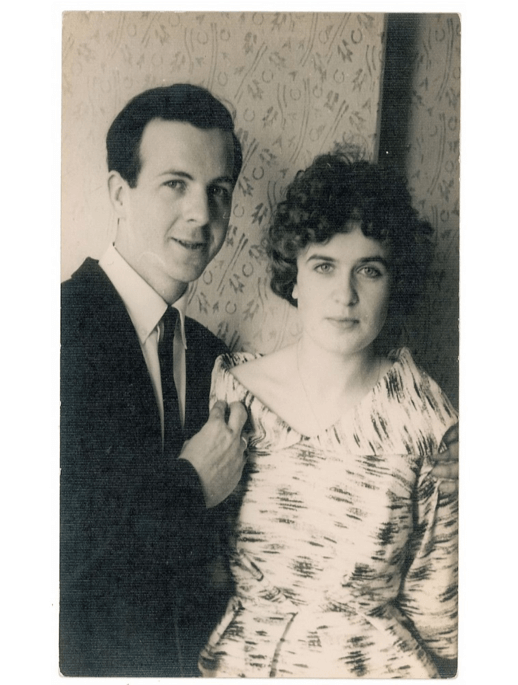 |
Wedding photo showing ring worn
on right hand per Russian tradition |
The wedding ring held and on exhibit through the Sixth Floor Museum as once having belonged to Lee Oswald, did not belong to him. It is most likely a Soviet era wedding ring of the type Oswald did indeed wear at his wedding—but as far as can be ascertained, never again thereafter. Leading to the conclusion that the ring he wore that day was borrowed for the occasion.
The evidence leading up to the above conclusion, broken down into specific areas:
Did Lee Oswald buy himself a wedding ring?
What little evidence there is suggests he did not.
Oswald made inquiries with Ella German about marriage customs in the Soviet Union—referencing silver engagement rings being swapped for gold wedding rings. He was clearly only talking about the bride-to-be. (Oswald’s Ghost, by Norman Mailer, p. 127). This fits with his noted frugality. Two rings for Marina is one thing. Another for himself is out of character.
It should also be noted that Western males wearing wedding rings at all had only started to take off during the second half of the 20th century. (“Wedding rings: Have men always worn them?”, by Stephen Robb, BBC News Magazine, Dec 8, 2011) and that until the 1960s, wedding rings were frowned upon in the Soviet Union as a symbol of “bourgeois decay, ostentation and sanctimoniousness.” (The Land of Weddings and Rain: Nation and Modernity in Post-Socialist Lithuania, by Gediminas Lankauskas, p. 254)
After this discussion with Ella, he purchased a silver engagement ring with a red stone, and for the wedding, a small plain gold band. After Lee’s death, undertaker Paul Groody was quoted in a newspaper account of Oswald’s funeral saying that the casket was open before burial and he had helped Marina place two rings on his finger but couldn’t get them “over the joint”. He described one as a “little ring with a red or black stone-maybe all they could get for an engagement ring in Russia.” (FBI 62-109060 JFK HQ File, Section A3, p12) The two rings placed on Oswald unquestionably belonged to Marina, with the second being her gold wedding ring. At the 2nd autopsy in 1981, the rings were taken from the little finger of the left hand. This confirms that the rings were too small to fit on Oswald’s ring finger—again indicating they had belonged to Marina.
Tom Bargas was Shop Foreman at Leslie Welding. He told the FBI that he knew Oswald was married only because it said so on his application. (Oswald 201 File, Vol 3, Folder 9B, Part 1, p. 40) Bargas had interviewed Oswald for the job, (WCH Vol X, p. 163) so we know from this, that Oswald was wearing no wedding ring at the time of the interview—or at work at any other time.
There are no photos available that clearly show Oswald wearing a wedding ring. There are very few photos showing a ring at all.
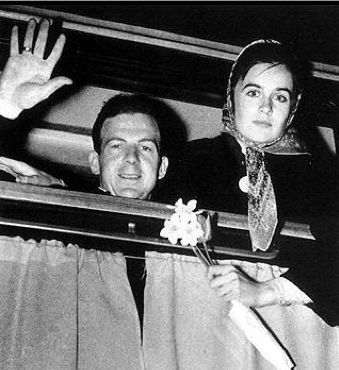 |
| Lee and Marina leaving Minsk |
The first of these is a black and white photo showing Lee and Marina leaving the Soviet Union. This shows a ring being worn on the right hand. Although some assume it is a wedding ring, it could just as easily be his Marine Corps ring. The assumption is largely based on claims made some days after the assassination when the ring-left-on-the-dresser story was developed. Marina buttressed the importance of this story by claiming that Lee never took his wedding ring off.
The day before leaving Minsk, Oswald offered his friend, Ernst Titovets “a large silver ring that he had bought in Japan and wore constantly. Titovets told Oswald he was touched but could not accept the ring. It was too expensive. Oswald, we’re told, complied with his friend’s wishes and put the ring back on his finger…” (The Interloper: Lee Harvey Oswald inside the Soviet Union, by Peter Savodnik, unpaginated ebook edition).
Since Oswald was following local traditions and wearing any rings he had on his right hand, we will logically assume that this is the “large silver ring” he had tried to give his friend just the day before. We also now know, as a result of that quote from Titovets, that it was his Marine Corp ring that was worn constantly and not a wedding ring.
The next photos showing a ring are two of the Backyard photos. Without getting sidetracked by the authenticity debate of these photos, and that the ring seems to jump from one hand to the other, the consensus is that the ring is the Marine Corp ring.
The last is one of the arrest photos and is something of a duel-edged sword. It clearly shows that the ring he is wearing—back on the left hand as per Western tradition—is his Marine Corp ring. It later appears in evidence lists under that description. The problem is that in not showing a wedding ring, the “ring-left-on-the-dresser” story gets additional support. It is a neat trick indeed, to use something you don’t see as evidence that it exists. God would be smiling.
Was a ring left on the dresser on the morning of Nov 22, 1963?
The short answer is “no, there was no ring left on the dresser of the morning of Nov 22, 1963”.
A list of some of Marina’s purported statements on the subject, speaks for itself.
…the following day (Friday) when she got up from bed, after the departure of her husband, she noticed his wedding ring laying on the top of their bedroom dresser. She stated that he never, to her knowledge, took off his ring before, and at that time she thought it a strange thing to do.” (CD 79, p. 3 Nov 30, 1963)
“…she had not discovered Oswald’s wedding ring on the dresser in her room at the Ruth Paine home the morning of November 22, 1963, upon getting up that morning. She said she had not seen it until the police came to her house to search it, following the arrest of Oswald on November 22, 1963.” (CE 1820, Jan 14, 1964)
Marina advised that on November 22, 1963, when the police came to the Paine house and searched it, they had found Oswald’s marriage ring on the dresser in the room which she, Marina used.” (FBI 105-82555 Oswald HQ File, Section 16, p. 93)
MARINA: At one time, while he was still in Fort Worth, it was inconvenient for him to work with his wedding ring on and he would remove it, but at work—he would not leave it at home. His wedding ring was rather wide, and it bothered him. I don’t know now, he would take it off at work.
RANKIN: Then this is the first time in your married life that he had ever left it at home where you live?
MARINA: Yes.
(WCH Vol 1, Feb 5, 1964)
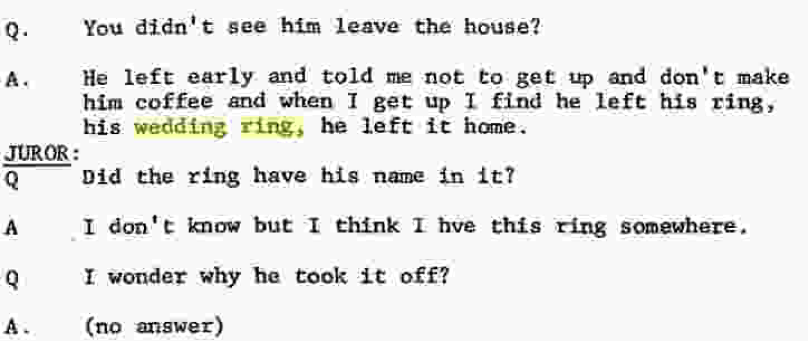
Juror: Did the ring have his name on it?
Marina: I don’t know but I think I have this ring somewhere.
(New Orleans Grand Jury testimony of Marina Oswald Porter, Feb 8, 1968, p. 69)
“Marina later made a terrible discovery. She happened to glance at the bureau and saw that, again by a miracle of oversight, the police had left another of her possessions behind. It was a delicate little demitasse cup of pale blue-green with violets and a slender golden rim that belonged to her grandmother. It was so thin that the light glowed though it as if it were parchment. Marina looked inside. There lay Lee’s wedding ring. (Marina and Lee, by Patricia Johnson McMillan p. 544)
Mrs. PORTER—Well, I do not—I remember the demitasse, but it is missed. I don’t know where it is. Are you asking me did I find Lee’s ring?
Chairman STOKES—Did you find his ring?
Mrs. PORTER—Yes, sir.
Chairman STOKES—And then did you tell Miss Johnson this: “Oh, no,” she thought, and her heart sank again, “Lee never took his ring off, not even on his grimiest manual jobs. She had seen him wearing it the night before. Marina suddenly realized what it meant. Lee had not just gone out and shot the President spontaneously. He had intended to do it when he left for work that day. Again, things were falling into place. Marina told no one about Lee’s ring.” Did you tell Miss Johnson that?
Mrs. PORTER—Yes.
(HSCA Report, Vol 2, p. 301)
Marina Oswald is the sole witness to a ring left on the dresser that morning and as we can see, her statements about the ring have little or no consistency. Nor were they made early on. The claims did not start emerging until at least a week after the assassination, during a period in the protective custody of the Secret Service. We will look more closely at this later.
Was a ring left on the dresser later that day?
The closest statement to the truth made about this subject by Marina was possibly one made to Priscilla Johnson McMillan for her book, Marina & Lee. In this statement, she said that “by some miracle” the police missed seeing it in their search. Since the police took Marina, Ruth Paine and Michael Paine in for questioning immediately after the search, she most likely put her own ring there some time prior to leaving the Paine household for good. In short, it was not there at the time of the police search. This explains the police not taking it. It also explains why she did not lead them to it.
What happened after that?
The following day, November 23, Marina and Marguerite were given three rooms at the Adolphus Hotel paid for by Life Magazine. (WCH Vol 1, p. 444) After visiting Lee that day, Life moved the women to the Executive Inn to hide them from rival journalists. While there, Marina phoned Ruth Paine to advise her “about the ring” on the dresser. (CD 329, p. 116). Although this FBI report dated January 16, 1964 alludes to the ring as belonging to Oswald and that he had left it there before going to work, the truth is more likely to be that Marina phoned upon realizing that she had forgotten her own wedding ring and she was asking Ruth Paine to look after it until it could be picked up with her other belongings.
Ruth Paine was not asked, nor did she volunteer any information about this call before the Warren Commission. On November 24, the mother, wife and daughters of the accused were taken into protective custody by the Secret Service. According to Marguerite, they were picked up after Lee was murdered. According to Peter Gregory, who was among the entourage who arrived at the Executive Inn, they only heard the news regarding Lee en route to Robert Oswald’s house, and this caused them to divert to the house of the Irving Chief of Police instead, where Marina again phoned Ruth. (WCH Vol 2, p. 345) I believe that Marguerite’s version is the more accurate regarding the timing of being picked up. It was done with great urgency, and with a Secret Service escort. Something triggered that urgency. That trigger could only be Lee’s death.
Marina Oswald testified that “They [the entourage that had picked her and Marguerite up] stopped at the house of the Chief of Police Curry [it was actually the Irving Police Chief, but Marina would not have been familiar with either of them]. From there, I telephone Ruth to tell her that I wanted to take several things which I needed with me and asked her to prepare them. And that there was a wallet with money and Lee’s ring [or as more likely, her own wedding ring].” (WCH Vol 1, p. 81)
Just a little while later, in the same session, the questions and answers seemed to get muddled as to sequence of events when she responded to the question, “what did you do after you went to the motel?” by saying, “I left with Robert and we prepared for the funeral.” This must be out of sequence because she had testified previously that Robert had left by then. It therefore must have occurred prior to going to the house of the Irving Police chief and phoning Ruth. Mortician Paul Groody is known to have gone through the same things he did with all bereaved by asking Marina about what clothes and jewelry she would like Lee to be laid to rest in.
We then go to Ruth Paine’s testimony:
Mr. JENNER—Do you recall an incident involving Lee Oswald’s wedding ring?
Mrs. PAINE—I do.
Mr. JENNER—Would you relate that, please?
Mrs. PAINE – One or two FBI agents came to my home, I think, Odum was one of them, and said that Marina had inquired after and wanted Lee’s wedding ring, and he asked me if I had any idea where to look for it. I said I’ll look first in the little tea cup that is from her grandmother, and on top of the chest of drawers in the bedroom where she had stayed. I looked and it was there.
Did Ruth take a lucky guess at where to look or did Marina tell her exactly where it was because she herself had put it (her own ring) there? We are not told when this happened, but we do at least know that the request by Marina was made on the afternoon of her husband’s murder. We also know from Marina’s testimony that she had advised Ruth that she “needed” the items requested. This is curiously as absent from Ruth’s testimony as the date for the pick-up is. The question is, was Marina ‘s need for the ring so that it could be placed on Lee’s finger for burial? Was Ruth deliberately vague on detail because, the ring having magically transformed from Marina’s ring to Lee’s ring, it now cannot be associated with the ring put on at the funeral?
The real sequence of events would be:
- Nov 22 am—Lee Oswald leaves for work. Marina gets up later
- Nov 22 pm—JFK is assassinated. Paine home is searched. No ring is found on dresser because no ring is there. Marina and Ruth and Michael Paine are taken in for questioning
- Nov 23—Marina and Marguerite are moved into rooms at the Adolphus Hotel before being moved again to the Executive Inn on the edge of town. Marina phones Ruth to let her know she has left her ring/s and savings behind and asks Ruth to look after them
- Nov 24—Lee Oswald is murdered. Robert Oswald, Peter Gregory and some Secret Service agents hustle the women into moving quickly to another location. They are now in Secret Service protective custody. Robert takes Marina to the Mortician, Paul Groody, and she tells Groody she wants Lee buried in her wedding and engagement rings as the police have his ring and bracelet. They go to the home of the Irving Police Chief where Marina again phones Ruth, telling her she needs the ring and that someone is coming to collect it. It is picked up by FBI Agent Bardwell Odum. Ruth knows where the ring is because Marina has told her
- Nov 25—Lee Oswald is buried after a quick service at Rose Hill Cemetery. The casket is open until just prior to internment and Groody assists Marina in placing the rings on Lee’s little finger as they are too small for the traditional ring finger (FBI 62-109060 JFK HQ File, Section A3, p. 12)
 |
| Marina at City Hall on Nov 22. She is still wearing her ring |
What this timeline shows is the improbability of the ring/s (it was more likely both her wedding and engagement rings) on the dresser having belonged to Lee Oswald. Moreover, it makes sense of the phone calls to Ruth on consecutive days and shows that the second call fits with the need for the rings in time for the funeral. It is surmised that Marina took her rings off sometime before leaving the Paine household on Nov 23 as Marguerite testified that both babies had diarrhea. This would cause a lot of changing of nappies and wiping of bottoms—something best done without jewelry on the fingers.
The three-ring circus
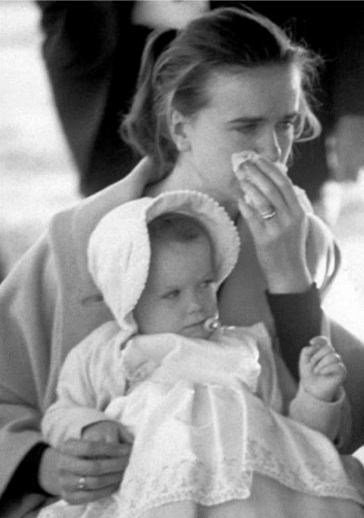 |
| Two rings on left hand and one on right |
As we can see above, on November 22, Marina wore one ring. Yet on the day of Lee’s funeral she was photographed wearing what looks like three almost identical plain wedding bands. I have no explanation for this other than to suggest that there were a number of rings left in that demitasse saucer picked up from the Paine’s by Odum and delivered to Marina—all of which belonged to Marina—as shown from they way that they fit.
Where did the story originate that the dresser ring belonged to Lee?
As shown above, the Secret Service took Marina and Marguerite into protective custody immediately after Lee Oswald was murdered. The day after the funeral, Nov 26, serious interrogations began, with both the Secret Service and the FBI. These went through until Dec 1, though further interviews were conducted periodically after that.
The interrogators quickly realized that Marina was the person they needed to concentrate on. She was vulnerable on several levels, but more importantly, she was also more flexible and pragmatic of mind. It would be a mistake to suggest this made her submissive. She was simply a survivor first and foremost. Marguerite on the other hand, had a clear and immovable portrait of her son, and it was not the portrait that investigators wanted to hear. She would be set aside and marginalized as an avaricious, nutty and neglectful mother. In fact, Marguerite testified to the Warren Commission that “I was never questioned by the Secret Service or the FBI at Six Flags. My son, in my presence, was questioned and taped, and Marina was continuously questioned and taped. But I have never been questioned.”
The Reid Interrogation Technique
The Reid Interrogation Technique is practiced throughout most law enforcement agencies and police forces in the US where suspects and witnesses are routinely interviewed. This includes the FBI and the Secret Service. It was developed in consequence to Brown Vs Mississippi (1936) which held that confessions obtained through physical violence would be inadmissible in court. It simply replaced the violence with social psychology involving isolation, induced despair, limiting opportunities for denials and alibis, and the delay of legal counsel at least until the person has been broken down and has provided a confession. Other tools used to get to this point include lying to the suspect, pretending to have witnesses or evidence that don’t exist, or showing evidence that is fraudulent, giving leading questions and finally, throwing a lifeline by offering excuses for the crime and offering support if they will only make the admission. Parallel to that is the construction of a scenario around the crime that goes to the guilt of the suspect.
The method works. The method also does not discriminate. If you are the focus of an investigation, it may only be because your psychological reactions have not been within the “norm”. For example, a woman finding her husband or child dead would be expected to be an emotional wreck. Other signs of guilt are also looked for, such as an inability to make eye contact, fidgeting, stuttering etc. All too often, once police become convinced of your guilt, based solely on their psychological evaluation, lack of evidence is of secondary importance. They will either break you or frame you.
Or in the case of Oswald, arrange your televised execution.
The method is not confined to suspects. It is also used on witnesses to get them on board with a scenario that helps their case.
Marguerite intuitively knew that something was happening, even if some of her conclusions may not have been accurate.
Mrs. OSWALD. No. I am saying—and I am going to say it as strongly as I can—that I—and I have stated this from the beginning—that I think our trouble in this is in our own Government. And I suspect these two agents of conspiracy with my daughter-in-law in this plot.
The CHAIRMAN. With who?
Mrs. OSWALD. With Marina and Mrs. Paine, the two women. Lee was set up, and it is quite possible these two Secret Service men are involved.
Mr. RANKIN. Which ones are you referring to?
Mrs. OSWALD. Mr. Mike Howard and the man that I did not—did not know the name, the man in the picture to the left. I have reason to think so because I was at Six Flags and these are just some instances that happened—I have much more stories to tell you of my conclusions. I am not a detective, and I don’t say it is the answer to it. But I must tell you what I think, because I am the only one that has this information. Now, here is another instance——
What Marguerite witnessed between the agents and Marina and assumed to be evidence of conspiracy between them in the assassination was really the Secret Service coopting Marina to assist with building the case against her husband. What Marguerite witnessed was initially Marina being isolated, threatened, asked leading questions and finally being offered all manner of assistance as her cooperation grew and she saw the money rolling in from a shocked nation. Meanwhile, Marguerite was being denied a ride home for more clothes and having her news clippings and mail confiscated. In all other respects, she was totally ignored.
Marina’s cooperation with the Secret Service then was vouchsafed by early promises arranged through immigration that she would not be deported, and by having firemen sitting within view of her as they counted the money coming in from concerned citizens around the country—a reminder that the money was within reach—but not hers until the Secret Service was happy enough with her to hand the money over. Both measures infuriated the FBI as they left Hoover’s men no bargaining chips whatsoever—and that was probably another outcome the Secret Service hoped to achieve. They now owned Marina. (Assignment Oswald, by James P Hosty, p 89). The money ended up totaling $70,000—the equal of nearly $600,000 today. Given her parlous state, the murder of her husband, two small children, and poor prospects in a foreign and now possibly hostile environment, no one should blame Marina for effectively going along with the stage play. Taking the carrot in America was certainly a better prospect than facing the stick back in the Soviet Union.
The sole purpose of the evolving ring story was simply to imply motive. Lee, it would be claimed, knew his marriage was over so he planned instead to make his mark in history. But the marriage was not over. The savings also found on the dresser—and often cited as another clue he was never coming back, had been an amount accumulating on that very dresser every pay day, not left all at once. It was money meant for an apartment to reunite the family and there is solid evidence he had found one. That information too, had to be buried and left uninvestigated. Unfortunately, it is also outside the bounds of this work.
(With thanks to Ed Ledoux for the photos used.)
THE RING, Part Two: Authentication, Sale & Acquisition
If, as shown in Part One, it is likely that Lee Oswald never owned a wedding ring, it stands to reason such a ring could not be sold at auction.
Yet a wedding ring purported to have belonged to the accused assassin was indeed sold at auction in 2013. Here, we will try and trace the history of how this came about.
2004 and the Markward file
 |
| Ring and receipt discovered by Dave Perry |
In July 2004, the Fort Worth law firm of Brackett & Ellis located the Marina Oswald file of retired lawyer Forrest Markward.
At 90 years old, Markward was long retired and by now in the early stages of Alzheimer’s, so the law firm instead, called in local JFK assassination expert, Dave Perry to go through the material.
Inside the file, Perry found an envelope containing a gold wedding ring and a receipt—allegedly from the Secret Service. This is suggested by the file reference at the top right which was the reference the Secret Service used for all JFK assassination related material. (Lost History episode, air date december 1, 2014).
 |
| Stan Dane’s MS reproduction matches perfectly |
Issues with the receipt as photographed
As can be seen, the receipt bears no signature or date and is not on Treasury or Secret Service letterhead. In short, it is the type of document that could easily be typed up by anyone. Indeed, it looks very much like it was typed using MS Word using 10-point fonts or, alternatively it was typed on an IBM Selectric typewriter using 12 pitch characters (all but identical to the 10-point fonts of MS).
Author Stan Dane proved the point by reproducing the receipt using MS Word and comparing the result to the original.
Issues with the ring as photographed
Building on the work of Dane, Jake Sykes measured the ring size with the following formula:
“Using 1/16″ (the 10-point font measurement) yields 9-1/2 lower case “s” letters. 9.5 x 1/16″ = .594″ for the ring diameter.” This means the ring is just below the average woman’s ring size of .60”. (reference.com article, What Is the Average Ring Size for a Woman?)
What we are left with is a receipt that bears indication of fakery and a ring too small to have been worn by Lee Oswald, but quite possibly one that would fit Marina.
The strange articles of Dave Perry and Hugh Aynesworth
Before getting into those articles in detail, allow me to note one of the first things that struck me about the pair—they both spell lawyer Forrest Markward’s surname as “Marquart” indicating a certain amount of cribbing from each other. I have found no indication that the name was ever spelled any other way than “Markward”. It is for instance, spelled that way in Secret Service records dated Feb 7, 1964 and in online obituaries (findagrave.com, date of death Nov 30, 2009), so if Perry went through the lawyer’s file on Marina, how on Earth did he manage to misspell his name? I will leave that detail for others to ponder.
Is This Lee Oswald’s Wedding Ring? By Dave Perry, undated
Perry starts out appearing to be wearing his investigative reporter hat. He does this by going through some (but not all) of Marina’s different and contradictory statements concerning the ring. He then notes that Oswald was buried on Nov 25, 1963 before quoting Linda Norton, the doctor who headed the exhumation autopsy in 1981:
“Upon entry into the casket a moderate malodor emanated from the decomposing body. As measured in the casket from superior skull to heel region on the left, a body length of 177cm (69½ in.) was obtained. A gold wedding band and a red stone ring were removed from the fifth digit of the left hand (subsequently identified by Mrs. Porter as representative of items placed upon the body at the time of initial burial).” (The Journal of Forensic Sciences, V. 29, N. 1, January 1984, p. 24)
To get the full flavor of the Perry piece from this point, it would be best just to quote it directly.
Originally, I believed the ring in the possession of Attorney Luke Ellis of Brackett & Ellis of Fort Worth, TX was the wedding ring removed by Dr. Norton. I thought a member of the firm, Attorney Forrest Marquart, had appeared with Marina at the exhumation autopsy.
When I visited the law firm, I found documents showing that Marina was using the firm’s services in 1964—after the burial but well before the exhumation autopsy. Marina went to the law firm in 1964 to sign documents (for example: the contract with Priscilla McMillan and publisher Harper & Row for the book that would become Marina and Lee.) and at that time presented the ring to Attorney Marquart.
With the ring is the following typed notation:
CO-2-34, 030
Receipt is hereby acknowledged of a gold wedding band which had been turned over to the United States Secret Service on December 2, 1963 by Mrs. Ruth Paine.
_____________________________
Date _________________________
I surmised the law clerk that received the ring, transcribed Marina’s comment that this was the ring that Ruth Paine turned over to the Secret Service on December 2, 1963. The Secret Service then gave it to Marina who brought it to the law firm as payment for services.
I now had no idea what ring the law firm had until I found the following:
“The lid was raised. Forty reporters peered over the (police) officers’ shoulders. Marina, who had been following TV and was learning about images, kissed her husband and put her ring on his finger.” (The Death of a President, by William Manchester, p. 568)
It would seem Marina put HER wedding ring on the body only to retrieve it years later at the exhumation. And this means the ring in the law firm’s possession is Lee Oswald’s wedding ring.
The issues and items not mentioned are just as telling as his inevitable “nothing-to-see-here” conclusion. This includes the circumstances of his appearance to inspect Markward’s file on Marina, the exact date this happened, any description or photo of the envelope and any contact he had with Marina about the discovery.
Coming Full Circle by Hugh Aynesworth, September 1, 2004
This should have been subtitled “Wither Thou Goest” such are the ties that bind the two Keepers of the Warren Commission Flame, though carrying it on opposite sides of the street.
Aynesworth, continuing the path beaten by his ally, opens with the hortative that a small gold wedding band
“believed to have been worn by Lee Harvey Oswald until just a few hours before he purportedly assassinated President John F. Kennedy has been locked in a safe at a law firm here for more than a generation.”
Is this really Aynesworth? “Believed”? “Purportedly”?
“Oswald’s friends and family, and lawyers and doctors involved in the case, say that the ring may be the one that the suspected assassin wore.”
And there is the trifecta—“may”. And we really don’t get told who these people are. Sure, Marina and Ruth. But who are the others? Markward had Alzheimer’s and had no memory of any of it. The other lawyers who called Perry in had no inkling regarding the history or ownership of the ring. The doctors is one doctor, not two or more—Linda Norton—and all they had from her was the quote made in the Journal of Forensic Sciences and that quote says nothing about who owned the ring. Aynesworth is stretching credulity big time.
“JFK investigator Dave Perry, of Grapevine, Texas, believes that the ring was Oswald’s and might have been given to federal authorities in December 1963 either by Oswald’s widow, Marina, or by Ruth Paine, the Irving, Texas, woman who let Mrs. Oswald and her two young children live with her during the fall of 1963.”
With five qualifiers in three short paragraphs, Aynseworth is suddenly in unfamiliar territory. And remember also that these qualifiers are about the history and ownership of a ring which would eventually be sold in 2013 as a bona fide historical artifact. Clearly though, as of 2004, there was far from any certainty about either ownership or history.
The next few paragraphs just add to the uncertainty. Luke Ellis, representing the law firm that held Markward’s file, admits he has no clue about what to do with any of the material. Ruth Paine is contacted. She falls back on how long ago it all was but concedes it is possible she gave the ring to the Secret Service on the date noted. The fact is though that Ruth Paine consistently stated during the days of the various investigations, that she gave the ring to the FBI—moreover, she names the agent as Bardwell Odum. The only thing she never mentioned was when she gave it to him. But since Marina advised her that she needed it on November 24, and the likely reason for needing it was to place on her husband’s finger for burial the next day, it is a good bet that it was collected no later than the morning of November 25.
The next piece of information of any value is that the Times contacted Marina during late August about the ring and was told by her that she did not recall seeing the ring after the police raid on the Paine home. When pressed as to what she thought happened to Lee’s ring, Marina simply replied “Oh, I don’t know. It’s been so long ago. If someone else has it, I don’t care.“
Compare that to what she told the Grand Jury in New Orleans
So, in 1968, She thought she still had the ring somewhere but could not recall if it was even inscribed, then by 2004, her memory was that she had not seen it since November 22, 1963! And I again remind readers that her stories constantly changed on the subject beyond these two versions. We know this is not the only subject in which Marina has given mutually exclusive accounts, with most of those being in legal settings
Back to Aynesworth:
Though the ring having been stored along with several legal documents might appear to indicate that Mrs. Oswald had given the ring to Mr. Marquart as payment for legal services, Mrs. Oswald did not recognize the lawyer’s name and said that she could not recall having the ring at any time after the Kennedy assassination.
Originally, Mr. Perry and another investigator, David Murph of Grapevine, Texas, conjectured that the ring might have been removed from the casket when the body of Oswald, who was killed by Jack Ruby two days after Kennedy’s death, was exhumed in 1981.
But Mrs. Oswald and the doctor who led the team that exhumed the body dispute that theory.
Dr. Linda Norton, a forensics specialist from Dallas, said last week that there was no male wedding band on Oswald when he was disinterred to confirm that the body buried under his name was indeed him.
“There were two rings, one small wedding band and a ring with a small red stone in it,” she said. “The wedding band was too small even for his little finger—so that couldn’t have been his.
“Afterward, I replaced both on his fingers before they closed the casket and reburied him,” she added.
There we have it. It could not have been Marina’s ring from the corpse because it was placed back on the body before reburial. Not explained is how they could have ever considered this was the ring in the files when they maintain that the ring in the files was a male size and not female (as the ring on the body was). But as we have shown already, the ring in the files was indeed a ladies’ size. Moreover, it looks like Linda Norton’s memory of putting both rings back on the body was not accurate.
Morgue: A Life in Death by Dr. Vincent Di Maio, Ron Franscel, pp. 114-122
Dr. Norton was assisted in the 1981 autopsy by Dr. Vincent Di Maio. This is what di Maio tells us in his autobiography
“First, we removed the rings on the corpse’s finger and gave them to Marina… Back in the autopsy room, before Oswald’s new casket was closed and he went back into the damp earth of Rose Hill, a grateful Marina gave Dr. Norton an odd gift: the red gemstone ring we’d taken off the corpse’s pinky. It was her way of saying thanks for the team’s work. But Linda was visibly uncomfortable with this morbid reward. As soon as Marina left the room, she inconspicuously slipped it into my hand. She didn’t want it. Neither did I. As well-meaning as it might have been, it was a sordid souvenir of a grim task and an even grimmer history. I wished for the whole wretched mess to just be buried once and for all. So just before they sealed Lee Harvey Oswald’s coffin for his next eternity, I dropped the ring into the box with him and then drove home to San Antonio in the dark.”
There is just too much detail here to have been made up. In any case, for what purpose would he make such a thing up?
We can see here that both rings were given back to Marina, but only the ring with a stone was returned to the coffin. Put anther way, Marina kept the gold wedding band—which we know was hers.
Where does this leave us? As of 1981, Marina had her own wedding band back in her possession. But we also know from Di Maio that Marina was keen to be rid of the rings and whatever memories they held. She in fact believed she had successfully given away the engagement ring. Given this mindset, Perry’s initial impression that she had given the band to Markward who was representing her interests at this autopsy, holds up perfectly well. This in turn, fits with the measurements showing the ring found was that of a female, not a male. Again, it was Marina’s own ring.
“Mystery surrounds Lee Harvey Oswald’s ring”, by Hugh Aynesworth for the Dallas Morning News, October 27, 2007
This is basically an updating of the 2004 story. The only new information apart from declaring that the Sixth Floor Museum has an interest in acquiring the ring, is the following.
“A Secret Service document that Marina signed Dec. 30, 1964, indicates that federal agents returned the wedding ring to her on that date. The Secret Service had been given the ring, the memo said, on Dec. 2, 1963, by Ruth Paine, the Irving woman who had provided a home for Marina.”
Since when does the Secret Service get the civilian subjects of memos to sign said memo? Nor does Aynesworth attempt to explain why it took from December 2, 1963 when it is alleged that the Secret Service took possession of the ring from Ruth Paine, until December 30, 1964 to return it to the rightful owner. In fact, the prejudicial word used in all the stories about the sale of the ring and its background, is “confiscated”—that is, the ring was “confiscated” from Ruth Paine—indicating that the Secret Service had taken it forcefully as “evidence”. This is at complete odds with what Ruth Paine maintained throughout 1964 and beyond. She has steadfastly stated that the FBI came to collect it at Marina’s request on an unspecified date, but in context, had to be November 24 or 25, 1963. It is only in recent years, under apparent pressure, that she has claimed she cannot recall, and so concedes it is possible that the Secret Service did pick it up on December 2, 1963. It became obvious a long time ago that Marina and Ruth had separated into different “teams”. Marina gave her allegiance to the Secret Service while Ruth gave hers to the FBI.
As far as this writer has been able to ascertain, such a memo has never surfaced, and as stated above, it was not mentioned in the original story.
It seems at some stage, the “memo” was dropped as quickly as it had been “discovered” because all it states in what purports to be the official ring timeline as published by the Dallas News is this:
Dec. 30, 1964: The Secret Service returns the ring to a Dallas lawyer who once represented Marina Oswald; that lawyer included it in files transferred to a Fort Worth attorney, Forrest Markward of Bracket & Ellis, who represented Marina Oswald from late 1963 to early 1965. (“Lee Harvey Oswald’s wedding Band Heading to Auction Block” by James Ragland, July 2013)
The only thing left of the claim is the date. But that is far from the only issue with this timeline entry. Who was the lawyer who supposedly took receipt of the ring? Why was the ring not passed on directly to Markward by the Secret Service since he was the one currently acting for Marina? The Secret Service certainly knew about Markward since he is named in a Feb 7, 1964 memo as attending a meeting with Marina, James Martin and his family, Secret Service agents and a Mr. Louis Saunders in the Grand Prairie office of John Thorne (CD 372, p. 12). Saunders was Executive Secretary for the Fort Worth Area Council of Churches—all-in-all, a diverse group meeting indeed. No doubt the agenda items would have been intriguing. Lastly, there is a key error of fact in that entry. Brackett & Ellis is on record as stating that Markward did not begin with the firm until the late 1970’s. (“Coming Full Circle”, by Hugh Aynesworth, Washington Times, September 1, 2004) Any files transferred to him in 1964 were not therefore transferred to him while working at Brackett & Ellis. The fact is that Markward not only represented Marina in the 1963-65 period, but also for the 1981 exhumation—a fact that Perry hints at early in his “investigation” of the ring, but then drops like the proverbial hot potato when it becomes an inconvenience to his predictable conclusion.
The RR Auction sale of the ring
Forrest Markward died on November 30, 2009. It took until July 24, 2012 for Brackett & Ellis to formally write to Marina and advise of the ring’s discovery. That is about 30 months after the death of the lawyer and a full 8 years after it was discovered in his old files. By the same token, Marina was in no rush to obtain it; not picking it up from the law firm until early 2013. Then in May of that year, she wrote a 5-page document outlining the history of the ring for RR Auctions—a history she has constantly rewritten through questioning under oath and through numerous interviews with various law enforcement officials, authors and the media. In that light, it is unsurprising that she wrote this history on the proviso that certain parts of it would not be made public. Five months later, the ring sold for $108,000. As a 14k gold ring, it has an intrinsic value of about point one or two percent of that amount.
Authentication
RR Auctions commissioned David Bellman of Bellman’s Jewelers to authenticate the ring. In 2017, Mr. Bellman posted a video to You Tube as part of a series called Jewelry in History. This episode was titled Lee Harvey Oswald—Authenticating His Wedding Band. What this video demonstrates is a basic process of showing it was a Soviet made 14 karat band by the markings inside it. But does this prove it belonged to Lee Oswald as claimed? Of course not. Marina’s secret statement was accepted as the sole authentication of that.
By the time I found this video, someone else had already asked what size the ring was. The jeweler replied that as best he could recall, it was .95 (of an inch)—which is the average size of a male ring (the Sixth Floor Museum lists as having a diameter of 15/16”). He failed to respond to my request for personal contact regarding the matter.
The Sixth Floor Museum
Two years later, the Sixth Floor Museum acquired the ring. During my research for this essay, the museum was contacted to alert them to the issues surrounding the ring. Here is that email, along with the reply:
Regarding the acquisition of Lee Oswald’s wedding ring:
I understand that Marina Oswald wrote a 5-page history of the ring to go with the it when she sold it at auction. Did the museum acquire it, as well?
I also understand that the ring you have was found in the files of a Fort Worth lawyer, in an envelope also containing a receipt from the Secret Service dated Dec 2.
So as to provide accurate information to the public, you need to know that this story conflicts with past stories—which are themselves all mutually exclusive.
Ruth Paine testified to the Warren Commission that the ring was picked up from her home by Bardwell Odum of the FBI.
Marina herself is documented as telling the FBI that the police found the ring on Nov 22.
But then during her testimony to the New Orleans Grand Jury, Marina testified that she found the ring after Lee went to work that morning and that she still had it “somewhere”.
That is 4 different versions, when including the Secret Service version. Two of those conflicting versions came from Marina herself. I would like to know if the 5-page note contains yet another version or incorporates one of her earlier versions.
In any case, the provenance of the ring you have, must be treated with some trepidation.
The story that Oswald always wore the ring and therefore leaving it on the dresser that Friday morning, shows he knew he would not be coming home, in my opinion, is the reason for these conflicting stories. Marina did testify that she knew Lee had taken the ring off once at work.
Here is what she said:
“At one time while he was still at Fort Worth, it was inconvenient for him to work with his wedding ring on and he would remove it, but at work—he would not leave it at home. “
I think a lot of manual laborers would take rings off while working. It makes sense to me that Oswald did not do this just once but did it as a matter of habit. Additionally, her claim that he would never leave it at home makes no sense. Why would he wear it to work, but then take it off and carry it in his pocket all day? Wouldn’t it make better sense to leave it at the Paines’—especially if he expected to be returning there that evening?
What should have been regarded as evidence of his innocence (or at the very least, evidence of nothing either way), was completely turned on its head to make him look guilty.
I also note that in his 2013 book, Mr. Fagin pushes the line that Oswald not only left his ring, but also $170.00. This is not true. He did not “leave” it there. That wallet was kept there, and he added to it every pay day—that is according to Marina’s testimony on it.
Any museum needs to ensure it gets its facts straight and does not simply push official propaganda that is not supported by the evidence. Not unless the museum is in a totalitarian country, anyway.
Five days later, I received the following reply from Stephen Fagin:
Good afternoon Mr. Parker,
Thank you for your interest in the Museum’s Collection. As our educational and public programs have demonstrated over the years, there is rarely one way of exploring evidence in a case that remains controversial and fiercely debated around the world. We value your feedback regarding Lee Harvey Oswald’s wedding ring, and the resources that you cite are available to students, researchers and the general public via our Reading Room.
We do have the May 2013 letter from Marina Oswald that you referenced in your e-mail. In it, Marina indicates that she did not see the ring that morning but believes—based on records associated with the ring—that Ruth Paine gave it to the Secret Service. She assumed that the government had kept all of their personal belongings (including the ring) and did not learn that the ring had been returned until “receiving a letter from a Fort-Worth law firm in July 2012 stating that they had it in their files for past 49 years.” She recalled that Forrest Markward, the attorney who had possession of the ring, had provided her with some pro bono legal work following the assassination. Marina recognized the ring upon examining it.
The Museum is confident, based on available documentation and research, in the provenance of the ring we currently have on display.
Again, we appreciate your interest.
Sincerely,
Stephen Fagin | Curator
Mr. Fagin failed to respond to two follow-up emails made in response to this carefully crafted, polite brush-off.
So, let us put the reply under the microscope here:
What does “there is rarely one way of exploring evidence in a case that remains controversial and fiercely debated around the world” even mean in terms of arriving at an accurate conclusion? It is nothing but a throw-away line meant to sound profound. Either the ring held is authentically one that belonged to Lee Oswald, or it isn’t. The next statement that “the resources that you cite are available to students, researchers and the general public via our Reading Room” is equally misleading in its banality. The resources cited would not be found unless specifically searched for and it is a painstaking exercise to run down all sources and all versions of and about the one story. The only version that is easy to find, is the official one because it is plastered all over the net. Mr. Fagin’s laisse-faire attitude to real history is offputting, yet still unsurprising. Being a water-carrier with only make-believe water does at least have the saving grace of being wryly amusing.
it is, however, his description of the 5-page statement regarding the history of the ring, made by Marina in order to procure a sale, that is really telling.
In it, Fagin states that according to Marina,
- She did not see the ring that morning (of Nov 22, 1963). My response: Yet she is on record as saying otherwise in the past.
- She believes, based on the records, that Ruth Paine gave it to the Secret Service. My response: Yet there are no such records that I have been able to find, apart from the alleged receipt found with the ring. And as already established, Ruth Paine testified she gave it to Mr. Odum of the FBI.
- She did not know about the existence of the ring until receiving the letter from Brackett & Ellis in July 2012. My response: Yet we have seen that she was contacted by the NYT (possibly by Hugh Aynesworth himself) for Aynesworth’s 2004 story on the finding of the ring.
Based on the results of this investigation, Mr. Fagin’s assertion that “The Museum is confident, based on available documentation and research, in the provenance of the ring we currently have on display” is a bit risible.
THE RING, Part Three: Timeline & Conclusions
1957-1958: Lee Oswald buys a Marine Corps ring while stationed in Japan
1960-61: Lee is making inquiries about Russian marriage customs concerning silver engagement rings and gold wedding rings for the bride-to-be. He makes no inquiries about rings for grooms-to-be. (Oswald’s Ghost, by Norman Mailer, p. 127)
Jan 1960-Nov 22, 1963: Lee takes his Marine Corps ring off while at work (WC testimony of Marina Oswald “At one time while he was still at Fort Worth, it was inconvenient for him to work with his wedding ring on and he would remove it, but at work—he would not leave it at home. His wedding ring was rather wide, and it bothered him. I don’t know now, he would take it off at work.” There is no reason to believe that Oswald ever wore a wedding ring at any job and the ring that he wore constantly was his Marine Corp ring—a wide ring, which is what Marina described)
1961: Lee buys a silver engagement ring and gold wedding ring in Minsk for Marina Prusakova.
April 30, 1961: Lee marries Marina. Speculation: Lee borrows a ring for the ceremony. This must be true since Marina testified as above that the wedding ring was inconvenient to work in because of its width. The wedding photo does not show a wide ring. As above, the wide ring could only be his Marine Corp ring—this being the same ring that Titovets said Lee wore constantly as shown in next entry)
May 22, 1962: Lee offers to give his friend, Ernst Titovets his Marine Corps ring as he is departing the next day to the US and wants to leave his friend something to remember him by. Titovets refuses to accept it, noting that Lee wears it “constantly” (The Interloper: Lee Harvey Oswald Inside the Soviet Union, by Peter Savodnik, ebook, unpaginated)
Nov 22, 1963: After the search of the Paine house, Marina is taken in for questioning by the DPD and provides an affidavit This statement contains nothing about a ring being left by Lee that morning. (affidavit of Marina Oswald, Nov 22, 1963). Just after 4:00 pm, Lee gives his USMC ring to Det. Sims during a body search.
Nov 23, 1963: Speculation: Marina takes her own wedding ring off while changing nappies of her babies, both of whom have diarrhea and places it in a cup or saucer on her dresser. She then leaves the Paine household for good, initially being looked after by Life Magazine. She phones Ruth later that day to let her know she left a ring behind. (FBI report dated Jan 16, 1964). The report is non-specific about which ring is being referenced. Speculation: Specifically, this call is to let Ruth know she has left her wedding ring inside the cup on her bedroom dresser and asks Ruth to keep it until she is able to pick it up.
Nov 24, 1963: Marina phones Ruth Paine again after Lee is murdered. She tells the Warren Commission on Feb 3, 1964 “I telephone Ruth to tell her that I wanted to take several things which I needed with me and asked her to prepare them. And that there was a wallet with money and Lee’s ring.” Speculation: it is not Lee’s ring she mentioned at all since the only ring he had was a Marine Corp ring and it had been taken by police. She is referring to her own ring. This call is really to ask for the return of the rest of her belongings and for the return of her ring so it can be placed on Lee before burial. Ruth Paine testified that Robert Oswald came by for all Marina’s other belongings—but the ring and money were given to FBI agent Odum.
Nov 25, 1963: Lee Oswald is buried at Rose Hill Cemetery. Marina’s wedding and engagement rings are placed on Oswald’s little finger on the left hand. Historian William Manchester tells us that “the lid was raised. Forty reporters peered over the (police) officers’ shoulders. Marina, who had been following TV and was learning about images, kissed her husband and put her ring on his finger.” (The Death of a President, by William Manchester, p. 568). And from Dr. Vincent Di Maio, one of the autopsy team at the 1981 exhumation, we have “…Groody placed two rings on Oswald’s fingers. One was a gold wedding band and the other a smaller ring with a red gemstone that Oswald’s wife had requested he be buried with.” (Morgue: A Life in Death, by Dr. Vincent Di Maio and Ron Franscell, p. 106). Paul Groody was the mortician who prepared the body for burial. He himself was quoted in a newspaper article saying that he assisted Marina in putting the rings on Lee. (Associated Press, Lee Harvey Oswald Casket Controversy Continues by Mike Cochrane, p. 36 Aug 16, 1981)
Nov 26—Dec 1, 1963: Marina Oswald is subjected to intense interrogation by the FBI and Secret Service. (see especially, CE 1787) Speculation: It is during this period that the story of Lee leaving his wedding ring on the bedroom dresser first emerges. This is typical of the Reid Technique. Isolate a witness, create a narrative incriminating the accused and use any and all manner of psychological tools to get the witness to “own” that narrative. The incrimination was implicit in the alleged act because, claim the authorities, Lee knew his marriage was over and that he was not returning. He was instead, going to leave his mark on history. Speculation: The FBI and/or Secret Service built this part of the narrative based on finding out that Marina had left her own wedding ring at Ruth’s and had asked the FBI to pick it up for her so it could be placed on Lee’s finger at the funeral. All they had to do was act like the ring on the dresser had been Lee’s and truthfully say that the ring placed on Lee for the funeral was Marina’s. Now, instead of it being the same ring—Marina’s ring in both cases—they have transformed it into two different rings. From here on, Lee’s (fictional) wedding ring would be the one it would be claimed he never took off (when this was really his Marine Corp ring per Titovets). The last requirement would be to blur what happened to the (fictional) wedding ring. The fact of FBI Agent Odum picking up the “dresser ring” to give to Marina prior to Lee’s funeral, was replaced with the Secret Service “confiscating” the ring on Dec 2, 1963, before finally returning it to Marina on Dec 30, 1964. This in turn got changed to a scenario in which it was given to an unnamed lawyer who had been representing Marina who in turn passed it on to Forrest Markward.
Dec 2, 1963: this is the day that the official time-line designates as the date that the Secret Service “confiscates” the ring from Ruth Paine. An exhaustive search of records in the Mary Ferrell Foundation data base has failed to locate any evidence of this. It is, however, the day following the FBI and Secret Service interrogations of Marina and is the day both agencies began serious investigations—largely based on the Marina Oswald interviews, as well as those of Ruth and Michael Paine, Buell Wesley Frazier and his sister Linnie Mae. Together, this group of witnesses provided, or agreed to, the dot points cobbled together to form the backbone of the case. The investigation was meant to add the flesh to this burgeoning false narrative.
By 2004, Ruth Paine’s memory is a little fuzzy as she allegedly tells Hugh Aynesworth, that she may have given the ring to the Secret Service (“Coming Full Circle”, by Hugh Aynesworth, Washington Times, Sep 1, 2004). It is much more likely that Aynesworth told her it was the Secret Service and she simply agreed it may have been. She does stick solidly to the bit about it being done at Marina’s request.
Dec 30, 1964: This is the day that the official timeline designates as the date that the Secret Service rids itself of the ring. According to a 2007 article—again by Aynesworth. This is supposedly based on a Secret Service memo signed by Marina. To quote from the Aynesworth article, “A Secret Service document that Marina signed Dec. 30, 1964, indicates that federal agents returned the wedding ring to her on that date. The Secret Service had been given the ring, the memo said, on Dec. 2, 1963, by Ruth Paine, the Irving woman who had provided a home for Marina.” (“Mystery Surrounds Lee Harvey Oswald’s Ring”, by Hugh Aynseworth, Dallas Morning News, Oct 27, 2007). Not explained is why it took from Dec 2, 1963 to Dec 30, 1964 to return the ring. Also not explained is what Marina is doing signing a Secret Service memo. It appears some of these issues finally dawned on those involved. In an article by Aynesworth written three years earlier on the same subject, there is no mention of any Secret Service document signed by Marina acknowledging the return of the ring. Now, in the official timeline, the only part left of these claims is the date. The alleged document signed by Marina acknowledging return of the ring on Dec 30, 1964 has disappeared and what we now have is “December 30, 1964: The Secret Service returns the ring to a Dallas lawyer…” No Marina—no Marina signing a memo…
Oct 4, 1981: Lee Oswald’s body is exhumed through legal pleadings from author Michael Eddowes and Marina Oswald-Porter. Eddowes had written a book claiming the person buried was a Russian imposter, switched with Oswald while he was behind the Iron Curtain. Here we again run into differing versions of what transpired regarding the rings on Oswald’s fingers. In fact, there are even two different versions regarding Marina’s presence during the second autopsy. Dealing with the latter first, we have “Her [Marina’s] presence was unusual—most widows don’t attend their husbands’ exhumations and autopsies—but she didn’t seem to be shaken by the macabre nature of the moment.” (Morgue: A Life in Death, by Dr. Vincent Di Maio, Ron Franscel, p. 115). Then we have this, from a contemporaneous news report: “The 40-year-old Mrs. Porter, who married a carpenter, Kenneth Porter, refused to view the remains but had trusted friends do it.” (“Oswald’s Body Is Exhumed; An Autopsy Affirms Identity”, New York Times, Oct 5, 1981, p. 1).
To the first part concerning the ring(s), we have these versions: “Dr. Norton explained that examiners found two rings on Oswald—one a small wedding band, the other a ring with a small red stone in it. The rings were re-buried with him. That small ring was ‘too small even for his little finger [and] could not have been his,’ said Dr. Norton.” (“Mystery Surrounds Lee Harvey Oswald’s Ring”, by Hugh Aynseworth, Dallas Morning News, Oct 27, 2007). Against that, there is this from Dr. Di Maio, “First, we removed the rings on the corpse’s finger and gave them to Marina… Back in the autopsy room, before Oswald’s new casket was closed and he went back into the damp earth of Rose Hill, a grateful Marina gave Dr. Norton an odd gift: the red gemstone ring we’d taken off the corpse’s pinky. It was her way of saying thanks for the team’s work. But Linda was visibly uncomfortable with this morbid reward. As soon as Marina left the room, she inconspicuously slipped it into my hand. She didn’t want it. Neither did I. As well-meaning as it might have been, it was a sordid souvenir of a grim task and an even grimmer history. I wished for the whole wretched mess to just be buried once and for all. So just before they sealed Lee Harvey Oswald’s coffin for his next eternity, I dropped the ring into the box with him and then drove home to San Antonio in the dark.” (Morgue: A Life in Death , by Dr. Vincent Di Maio, Ron Franscel, pp. 114-122). What we see here is a key to the mystery. Marina was given both rings at the start of the 1981 autopsy. She later gives her engagement ring to Dr. Norton who did not want it and passed it surreptitiously to Dr Di Maio—who also did not want it, and he drops it back in with the corpse. Marina kept her wedding ring. Since we now know she tried to give away her engagement ring, it is plausible that she did give the wedding ring to one of her lawyers—just as originally suspected by the law firm and by Perry. We know she had more than one lawyer looking after her interests during this 2nd autopsy because we have this from the same New York Times story as previously cited; “Mrs. Porter spent hours yesterday in meetings with lawyers in Dallas planning the event. She recalled the years of work leading to it.”
Jul 2004: The Markward Marina Oswald file is found. It is unclear as to the exact circumstances. This is what Aynesworth wrote in 2004, “Mr. Ellis said that Mr. Marquart had joined the firm in the late 1970s and just recently mentioned the materials in the firm’s safe.” Yet in 2007, Aynesworth was reporting that, “We (Brackett & Ellis law firm) have tried to get him to talk about the ring and his files, but he has refused… The firm had sent representatives to Mr. Marquart’s home ‘on several occasions’ to determine how the ring came to be with his materials, ‘but he apparently doesn’t remember,’ Mr. Ellis said.” Aynesworth goes on to say that “Marina Oswald used the services of Mr. Marquart shortly after the assassination to set up and manage a trust fund for her young daughters, June Lee, 2, and Rachel, 2 months…”
It is also noteworthy that Aynesworth claims Markward was used by Marina to set up trusts for the two girls from all the money donated post-assassination, while Perry claims the work done by Markward was sorting out the book contracts with Priscilla McMillan and Harper & Row. The end result of all of this important legal work? According to Aynesworth, McMillan “never heard of Mr. Marquart and couldn’t recall Marina discussing him during lengthy interviews with Marina in 1964.” And Marina “likewise has said she did not recall Mr. Marquart or what he might have done for her.” Miraculously however, Marina suddenly recalled who Markward was when writing up the ring history for RR Auctions in preparation for its sale. Meanwhile Markward was, as of 2004, over 90, suffering Alzheimer’s, didn’t want to discuss any of it and claimed no memory of any of it—all according to Luke Ellis. Yet we do know Markward did at the very least, meet with Marina (CD 372, p. 12 shows Markward met with Marina and Louis Saunders in the office of John Thorne at 6:10 pm on Dec 23, 1963. The nature of the meeting is not noted). The fact that Markward was one of the lawyers assisting Marina with the exhumation has been deep-sixed after the initial (and accurate) speculation that Marina had given the ring to this lawyer—just as she had given the engagement ring to Linda Norton.
The ring itself is allegedly found by Dave Perry among the newly discovered files of the retired lawyer. This was stated in a 2014 History Channel show called “Lost History” and Perry himself confirmed it was true after the show aired—but again without revealing the circumstances of the find. In sum, we have Dave Perry finding a ring among files discovered in a law firm office, with said files belonging to an ex-partner in that firm and who it is claimed, did very important legal work for Marina in the 1963-64 period. The law firm itself, however, somehow missed seeing the ring among those files. The lawyer in question, Forrest Markward, had—or may have had—no memory of the files (reports on this are conflicting), nor of the ring and—neither Marina nor Priscilla McMillan recall Markward or what legal work he did for Marina, although Marina did finally recall him in 2013. These are the circumstances that the Sixth Floor Museum relies upon to verify the authenticity of the ring. Which is perfect. Perfect that is, that the ring is not found until after it becomes known that the owner of the files has Alzheimer’s and can’t recall a gosh darn thing! Sort of like Bob Woodward naming Mark Felt as Deep Throat when he is suffering from old age dementia.
Perry claimed in his undated online article that “originally I believed the ring in the possession of Attorney Luke Ellis of Brackett & Ellis of Fort Worth, TX was the wedding ring removed by Dr. Norton. I thought a member of the firm, Attorney Forrest Marquart, had appeared with Marina at the exhumation autopsy.” Perry eventually ditched this theory on the basis that Dr Norton claimed to have placed the ring back on Oswald’s corpse—thus Marina could not have given it to anyone. Let us deconstruct this. Firstly, Perry would have been well aware that the ring placed on Oswald at the original burial was Marina’s wedding ring. For Perry to consider the ring found in the files could be this very ring, it would have been obvious it was not a man-sized ring, but one to fit a petite female. If it had been a man-sized ring, he would not have considered this theory for a nanosecond. Secondly, on what basis did he think Markward had represented Marina at the 1981 autopsy? Since the ring was found with files of the work Markward had done for Marina, maybe those same files revealed this work as well as the work done in 1963-64? If so, as previously suggested, that evidence would have been destroyed once the deception was mapped out.
Oct 2007: Luke Ellis tells Aynesworh that “We could file a lawsuit, get a judicial determination of ownership, but that’s very time-consuming and nobody really wants to do it if you don’t have to.” Yet three years have already sailed by without any claimant to a ring which would eventually fetch over 100K at auction.
July 24, 2012: A letter from Luke Ellis informs Marina Oswald-Porter of the ring’s discovery in Markward’s files making it another five years—eight in total, without a determination, before the most logical owner is formerly notified of its existence—yet still no court has determined legal ownership.
Early 2013: Marina Oswald-Porter goes to Fort Worth and gets the ring back from Luke Ellis. It seems Marina’s word is good enough, despite the discrepancies and contradictions in her stories about the ring over the years being big enough to drive a truck through—and despite there being no paper trail for it, except a quite dubious, undated, unsigned receipt.
May 5, 2013: Marina Oswald-Porter writes a five-page letter for RR Auctions documenting the ring’s history. She advises that only a very small specific section of this document may be released to the public.
Oct 24, 2013: The ring sells at auction for $108,000.
Oct 2015: The ring is acquired by the Sixth Floor Museum, Dallas, which had expressed interest in obtaining it since at least 2007.
Conclusions
I. Oswald did not buy himself a wedding ring.
II. The ring left on the dresser was Marina’s and was not placed there until after her interview with Dallas police on Nov 22, 1963.
III. After being taken away by Life Magazine, Marina phoned Ruth Paine on Nov 23 to advise she had left the ring behind and asked her to look after it and the wallet until she could pick up the remainder of her belongings.
IV. After Lee is murdered on Nov 24, Marina phones Ruth again and advises she needs the ring and will arrange for it to be picked up. The wallet and ring are picked up that day or early the next morning by FBI Agent Odum. Other belongings of Marina’s are picked up on a later date by Robert Oswald.
V. Marina’s wedding and engagement rings are placed on Oswald’s left little finger by Marina and mortician Paul Groody in preparation for the burial service on Nov 25.
VI. The rings are removed from Oswald by Dr Linda Norton on Oct 4, 1981 in preparation for a second autopsy. They are given to Marina who is present during the whole procedure.
VII. After the autopsy, Marina gives the engagement ring as a gift to Dr Norton. Once Marina is out of sight, Dr. Norton gives the ring to Dr Di Maio who likewise does not want it and places it back in the casket. Marina still has her wedding ring.
VIII. In July 2004, a ring is discovered among files pertaining to Marina. The files belong to a by now retired lawyer named Forrest Markward who had done legal work for Marina in the past. Markward has no memory of the ring due to Alzheimer’s. The finder of the ring, Dave Perry, initially assumes that the ring was payment, or a gift for legal services during the second autopsy. This was possible because ( a ) we now know it did not go back into the casket and ( b ) we also now know that Marina gifted the engagement ring to the head autopsist, Dr. Norton
IX. The ring found in 2004 was Marina’s wedding ring, either placed in the files by Markward after being given the ring by Marina in 1981, or it was placed there by someone else later for Perry to discover when he was called in to assess the legal documents. (Though the former seems more likely, it may be telling that the lawyers who found the files, missed seeing the ring themselves). Additionally, the receipt found with the ring is almost certainly a forgery to try and authenticate the original false narrative of the ring on the dresser as belonging to Oswald, and that it was picked up from Ruth Paine by the Secret Service and not the FBI as Paine testified
X. The ring sold at auction was a male size ring and not the ring found and photographed with the alleged receipt which has been shown to have been a female ring size. Further it was misrepresented as belonging to Lee Oswald, making it a valuable historical item. The authentication of the ring done by a jeweler was simply authenticating it as a Soviet made wedding ring. The authentication that it belonged to Lee was solely on the say-so of Marina. The sale of historical memorabilia is a huge and largely unregulated industry where many fraudulent transactions have come to light in recent years. In this case, sourcing a Soviet made 14-karat gold wedding band, men’s size 9 1/2 would not be difficult as a quick search of the internet will reveal.
Here is a size 13 Soviet 14K wedding band for sale on Ebay as at March 13, 2019. Asking price is $269.00.
XI. In the end, the babies having diarrhea and needing lots of diaper changes on the morning of Nov 23, causing Marina to take her ring off and leaving without it, is what made a very questionable narrative about the ring possible. That narrative would lead to the sale of a ring presented as Oswald’s, with the only evidence being Marina’s word and a dubious, undated, unsigned receipt. As commented to me by a reviewer of this series of articles, Ebay wouldn’t even buy this story to satisfy the bona fides of the sale item. But it’s good enough for the auction house who sold it and the Sixth Floor Museum who later purchased it.
Which shows that Mr. Fagin has enough money at the Sixth Floor where a hundred grand does not really mean that much. As long as it backs up the official story.
The sale of this ring should be the subject of a police bunco investigation.