Tag: SIRHAN SIRHAN

  • Requiem for Rose Lynn Mangan

    Requiem for Rose Lynn Mangan


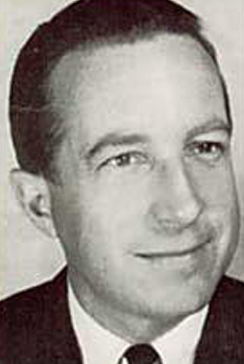
    manganWe have been informed by Paul Schrade that Rose Lynn Mangan passed away in late February of this year. Many people probably do not know who she was, for the simple reason that she was a person who worked mostly behind the scenes. Off and on, she had been the chief researcher for Sirhan Sirhan’s defense team for many years. No one had spent as much time looking at the evidence in the RFK case than she did. Mangan lived in Carson City, Nevada, so it was not that far for her to drive to the Sacramento State Archives where much of the surviving evidence in the Robert Kennedy assassination was maintained.

    If one studies the RFK assassination, which unfortunately not very many people do, one can see how Mangan fit into the historical backdrop on that case. At the start, very few people had any inclination or intuition that the Robert Kennedy case was anything but what it appeared. A young man, apparently in a fit of rage, jumps forward out of a crowd in the pantry of the Ambassador Hotel. He then fires at the person who, most people thought, was going to be the next president. Everyone’s eye is drawn to this young man as Bobby Kennedy sinks to the floor. Sirhan is immediately apprehended and taken to the police station. No one who was alive then can forget the next day’s death announcement by Frank Mankiewicz.

    But as is usually the case in these shattering instances, something was going on that was largely undetected, even though it was happening in plain sight. First of all, a witness named Sandy Serrano was on television late that night and told newsman Sander Vanocur that she saw a girl in a polka dot dress running down the rear stairs of the Ambassador Hotel with a young man. She said, “We shot him! We shot him!” When Sandy asked, “Who did you shoot?” The girl replied, “Senator Kennedy!” She and her companion then disappeared into the night. That same evening on Ray Briem’s LA radio talk show, a professional psychologist named William Bryan called in to the program. He said that, from his experience, the suspect sounded to him like he was acting under the direction of post-hypnotic suggestion, i.e., like a Manchurian Candidate. (The Assassination of Robert F. Kennedy, by William Turner and Jonn Christian, p. 226) A young high school student named Scott Enyart took photos of the shooting at the Ambassador. He was stopped by the police at gunpoint as he left the hotel. His photos of the crime scene were taken from him—and he never got them back. As many have commented, Enyart’s pictures may have been the Zapruder film of the RFK assassination. (The Assassinations, edited by James DiEugenio and Lisa Pease, pp. 619-21)

    Then there was William Harper. Harper was a well-respected criminalist who worked for, among other departments, the Pasadena police. He had a serious problem with the RFK case from the start. The reason being that he had a professional dispute with the LAPD’s chief criminalist DeWayne Wolfer. Being familiar with the shoddiness of Wolfer’s work, he had warned Sirhan’s defense lawyer Grant Cooper not to accept any of Wolfer’s findings at face value. (ibid, p. 556) Cooper did not pay heed to this well-founded warning. He actually did the opposite. He agreed to stipulate to Wolfer’s forensic findings concerning the ballistics evidence. To say the least, this had disastrous results for Cooper’s client Sirhan Sirhan. For now the trial of Sirhan became not about the guilt or innocence of the defendant; it was about Sirhan’s mental state at the time of the shooting. Because of Cooper’s blunder, Sirhan was condemned to death. But due to a later California Supreme Court decision, this was altered to life in prison.

    Two things happened after Sirhan’s trial that changed some people’s perceptions about the RFK case. Art Kunkin, the publisher of the LA Free Press, ran a story by one of the very few people who had studied the actual ballistics evidence in the pantry of the Ambassador Hotel. Lillian Castellano had analyzed the bullet evidence in the case, and she came to the conclusion that Sirhan could not have been responsible for all the projectiles that had been fired that night. Especially in light of the fact that hotel maître-d’, Karl Uecker, said that he went for Sirhan’s gun after he fired the first shot and had it controlled, at the most, after the second shot. Besides Kennedy, there were five other people shot, one of them twice. RFK was shot four times. The maximum number of bullets Sirhan’s gun could hold was eight. Castellano’s article began to cast doubt on LAPD’s honesty in building its case against Sirhan. Inversely, it indicated just how inept his defense had been.

    Harper had read the witness testimony from the pantry, and also the lengthy autopsy report by Dr. Thomas Noguchi. He went even further than Castellano. He concluded that there had to have been two assassins firing from two different directions. Allowed to test the bullet exhibits, he then concluded that they had been fired from two different weapons. (DiEugenio and Pease, p. 556)

    When Rose Lynn Mangan became the official investigator for the Sirhan case, she and Harper became friends. He even gave her his files on the case. When his affidavit about the two firing positions went public in 1971, he became a magnet for informants inside the LAPD. One of the things he told her in no uncertain terms is: “They switched the bullets; they switched the guns.” One of the things Mangan always said about Harper was that his information always checked out. (ibid, p. 565)

    Mangan served as Sirhan’s researcher from 1969-74. Then, at Sirhan’s request, she returned in 1992. In 1996 she made a memorable appearance at the civil trial of Scott Enyart vs. LAPD. As mentioned previously, Enyart was a high school photographer who was in the pantry at the Ambassador Hotel when RFK was shot. He kept on snapping photos during the firing sequence. But as he left the scene he was accosted by the police and told to turn over all of his film. Once he did, the police said they would develop the film because they needed it for the upcoming criminal trial. That statement turned out to be false, since they did not use the evidence at Sirhan’s trial. (Ibid, pp. 619-20) But when the trial was over, Enyart asked for his pictures back. He got back less than twenty per cent of them—and no negatives. He was then told that the rest would now remain secret and be archived for twenty years.

    Enyart waited for almost 20 years. In 1988 the LAPD told him that his photos were now in the state archives in Sacramento. But when Scott wrote to Sacramento, the archivist told him they were not there. He concluded that they were gone, part of the many photos incinerated by LAPD in 1968. But since the police had always maintained that the destroyed pictures were duplicates, Scott maintained that his photos must still exist. And he wanted the originals returned to him. Since he was up on a steam table during the shooting, his photos would have significant monetary value.

    Quite naturally, Enyart felt he was being given the runaround. He sued. The city appealed on a technicality. They won the appeal. But Scott won a reversal of that decision. The case was scheduled for trial in 1996. Then something utterly bizarre happened. Miraculously, the LAPD announced that Scott’s pictures had been recovered. Scott disagreed with this pronouncement, since these allegedly recovered photos were on different film stock, and none depicted what went on inside the pantry. (ibid, p. 620) Nevertheless, these photos were sent to Los Angeles from Sacramento via courier for use at the civil trial. They were then stolen out of the back seat of the automobile while it stopped at a gas station. As Scott’s lawyer said, “Somebody, for some reason, is making sure those photos do not reach public view.” (LA Times, 1/18/96)

    At the trial, Mangan exposed another layer of perfidy in the RFK evidentiary record. The police needed to explain why and how the photos suddenly appeared out of the blue, after seemingly being lost for decades. The police tried to explain this all as a mistake in record keeping. The photos had been misfiled under another person’s name on the wrong list. By diligently crosschecking the lists, they were rediscovered. If not for the theft from the courier, all would have been explained satisfactorily.

    Scott needed someone with expansive and intimate knowledge of the files at the state archives. No one was better qualified than Mangan. Clearly, the plaintiffs were unaware of who she was and were unprepared for her testimony. Mangan completely negated this LAPD cover story. Since she was familiar with all the evidence filings across all the categories, she knew that LAPD was playing a shell game. They had played around with their own property list to create a file that was not really in the Sacramento archives, under a name that was not at all related to Scott Enyart’s. (Probe Magazine, January-February 1997, p. 8) No one else could have supplied that crucial information, which helped Enyart win a jury verdict. Her testimony also indicated that the heist of the photos from the car was most likely an elaborate ruse. This is how deeply embedded the RFK cover up is inside the LAPD.

    Shortly after her appearance at the Enyart trial, Lisa Pease visited Mangan at her home in Carson City. This was in preparation for a long two-part article in Probe Magazine. In that essay, it was through Mangan that the significance of Special Exhibit 10, and the dubious markings on the bullets, were explained, the latter for the first time. Mangan had documentation on Special Exhibit 10, the secret microphotograph that was supposed to be the ace in the hole if there was ever a reopening of the Robert Kennedy assassination. In the mid Seventies, there was a legal hearing under Judge Robert Wenke. A firearms panel was appointed to examine some of the ballistics evidence in the case. They examined Special Exhibit Ten. They discovered something that Thomas Noguchi already knew: this exhibit was a fraud. It purported to be a comparison photo of the Kennedy neck bullet with a test bullet fired by Wolfer. But the Wenke Panel deduced that such was not the case. It was actually a comparison between an RFK bullet and another victim bullet, Ira Goldstein’s. As Lisa Pease wrote, “So someone was pulling yet another fraud in this case by concocting evidence in the hopes of convincing a panel of experts that a test bullet from Sirhan’s gun matched a bullet from Kennedy himself.” (DiEugenio and Pease, p. 564)

    But on her visit to Mangan, Pease was shown still another level of deception in the RFK case. Recall what Harper told Mangan: They switched the guns. They switched the bullets. And recall what Mangan said about Harper’s reliability: his information always checked out.

    Patrick Garland was the evidence master for the Wenke Panel proceedings. In that examination, the Kennedy neck bullet, #47, bore the markings ‘DWTN’ on its base. The Goldstein/victim bullet, #52, bore only a ‘6’. But these were not the original markings. Number 47 should have had a ‘TN31’ on its base. Number 52 should have had only an ‘X’. In other words, this evidence clearly indicates that someone switched the bullets, and then made the phony photograph. Besides the inherent fraud in the false comparison, this also clearly implies that Wolfer could not get a match from the gun in evidence.

    mangan lancerAt the time of her passing, Mangan had a book contract with JFK Lancer about her life as Sirhan’s Researcher, to be published in June, 2018. It was to be based upon the extensive files she had accumulated over the decades she had worked on the RFK case and visited the Sacramento Archives. Lancer is going forward with its publication in a revised format.  Debra Conway will also be visiting Carson City to collect the Mangan files; her archives will be preserved, scanned and will be made available online along with the publication. While we await her complete files to be deposited online, anyone interested in the Bobby Kennedy case should visit her web site, which is still being maintained.
    We all owe Rose Lynn Mangan a salute upon her passing. She worked the primary evidence in the RFK case like no one else did.

    ~Jim DiEugenio


    Mangan was a guest with Len Osanic on Black Op Radio a number of times; her last appearance was on:

    Show #769 Original airdate: February 11, 2016 – Listen here


    Also, listen to a tribute by Bill Pepper, Jim DiEugenio and Lisa Pease:

    • Show #839
    • Original airdate: June 15, 2017
    • Guests: Jim DiEugenio / William Pepper / Lisa Pease / Lynn Mangan
    • Topics: Sirhan’s Researcher, Lynn Mangan (click the logo below and scroll down):

    mangan blackop

  • Reopening the R.F.K. investigation: Paul Schrade and Congressman Allard Lowenstein (1973)

    Reopening the R.F.K. investigation: Paul Schrade and Congressman Allard Lowenstein (1973)


    rfk assassinationOnce again, we thank David Giglio for his help in unearthing this fascinating interview between Paul Schrade and Allard Lowenstein given over KPFK radio in early 1973.

    Paul Schrade needs no introduction. He was a very effective labor leader of that era who was one of the people shot that night with Bobby Kennedy at the Ambassador Hotel in Los Angeles. Schrade has worked for decades to get the RFK case reopened, and he is still at it today. He even showed up at the latest parole hearing for Sirhan Sirhan and pleaded with the board to release the alleged assassin.

    Unlike for Schrade, the modern readers probably does need an introduction to Allard Lowenstein. Lowenstein graduated from Yale Law School in 1954. He worked on Capitol Hill for Hubert Humphrey as a foreign policy advisor and then volunteered for the civil rights movement during Freedom Summer in Mississippi. One of his many other achievements: he toured southwest Africa in 1959 taking testimony about the reach and deeds of the Union of South Africa. He then wrote a book on the subject entitled Brutal Mandate. Because of that experience, he was called on to help Senator Robert Kennedy compose his landmark address given to the National Union of South African Students at the University of Capetown in 1966.

    Sickened by the Vietnam War, Lowenstein started his remarkably successful “Dump Johnson” movement in 1967. He attempted to get both Kennedy and Senator George McGovern to run in the primaries against President Lyndon Johnson. When they both refused, he enlisted Senator Eugene McCarthy to run. After McCarthy nearly defeated the president in the New Hampshire primary, Johnson decided to drop out of the race.

    After Kennedy was killed in Los Angeles, Lowenstein successfully ran for Congress in New York. After serving one term he was gerrymandered out of his seat by the Republicans in the state. It was about three years later that Lowenstein decided to listen to some of the complaints being first addressed about the questionable evidence in the RFK assassination. These were first surfaced by a small group of people mostly located in the LA area: Floyd Nelson, Lillian Castellano, Ted Charach. The more he listened, the more he became convinced that there really was something wrong with the official verdict in the case. He therefore became a species of a rare bird: an elected official who actually became an outspoken critic of the authorities in one of the major assassinations of the Sixties. When I say outspoken, I mean outspoken. For instance, in a speech he gave at Stanford in 1975, Lowenstein stated: “We have carried the investigation as far as we can without help.” He then named the DA’s office, the Attorney General of California, the Los Angeles Times and the LAPD as being obstructions in the search for the facts.

    Lowenstein’s courageous stand helped inspire other young people to get involved in the RFK case, people like the late Greg Stone. Stone helped Lowenstein write one of the earliest essays to appear in a mainstream journal on the Robert Kennedy assassination. This was his essay in the February 19, 1977 issue of The Saturday Review, entitled “The Murder of Robert Kennedy: Suppressed Evidence of More than one Assassin”. It’s hard to believe, but that essay was the cover story for that issue, something that would seem almost unimaginable today. It is even harder to believe the following: in 1975 he appeared on PBS with William F. Buckley to address these questions about the RFK case.

    Lowenstein had nothing but admiration for Bobby Kennedy. In 1971 he called him the greatest leader of the era, someone who every one else who followed would have to subconsciously be measured against. But he then sadly concluded, “We’re not going to get anyone of that quality or capacity again…” He later said something even more prescient, something which characterized the entire end of the decade of the Sixties, and all four assassinations:

    Robert Kennedy’s death, like the President’s, was mourned as an extension of the evils of senseless violence; events moved on, and the profound alterations that these deaths … brought in the equation of power in America was perceived as random …. What is odd is not that some people thought it was all random, but that so many intelligent people refused to believe that it might be anything else. Nothing can measure more graphically how limited was the general understanding of what is possible in America.

    ~ Jim DiEugenio


    Transcribed from Pacifica Radio Archives. PRA Archive #BC2125

    (Scroll to the bottom for a recent interview of Paul Schade by Len Osanic on BlackOp Radio.)

    REOPENING THE R.F.K. INVESTIGATION

    Paul Schrade and Allard Lowenstein interviewed by Jim Berland


    Jim Berland:

    Godfrey Issacs, the attorney for Sirhan Sirhan has made a motion for a new trial in the case of the assassination of Robert F. Kennedy. He’s not the only one interested in that matter. With me this evening are Paul Schrade, who does labor commentary for KPFK, and Allard Lowenstein, former congressman from New York. They have also taken an interest in the case and, as a matter of fact, have recently issued a statement calling for certain steps to be taken to look into the investigation, which has resulted in a good deal of confusion, perhaps more in the Los Angeles media than in any place else as the assassination took place in Los Angeles.

    One of those confusing episodes was the contradictory statements by Thomas Noguchi, the coroner in the case, at one point saying that the bullet that issued from Sirhan’s gun could not have killed Robert Kennedy, and then a couple of years later saying that Sirhan was the only one who could have killed Robert Kennedy. What other contradictions are you pointing to, and what would you like to see done about it?

    Paul Schrade:

    Well, the contradiction that worries me most, because I was directly involved, is that the Los Angeles Police Department has made an inventory of the eight bullets fired by Sirhan, by his gun. And that inventory says that the bullet that wounded me in the head passed through the right shoulder of Robert Kennedy’s coat. That bullet didn’t wound him, but it passed through from back to front.

    I recall that I was standing behind Robert Kennedy observing him shaking hands with the workers in the Ambassador Hotel kitchen, and was to his left behind him. I cannot, in my own mind, reconcile the passage of that bullet from back to front through Kennedy’s coat and winding up in my head. He would have had to been completely turned around facing me in a totally different direction. When I was shot and became unconscious as a result of it, at no time had he moved to that position. If that’s the case, then, if we can’t reconcile that part of the inventory at the Los Angeles Police Department, then we have a ninth bullet. So, that’s one of the major contradictions that appears based upon the evidence provided by the Los Angeles Police Department and the prosecution.

    Jim Berland:

    What other kinds of contradictions? I know that Issacs has said in his motion that he feels that it was physically improbable, if not impossible, for Sirhan to have fired the bullet that killed Robert Kennedy.

    Allard Lowenstein:

    The central fact, which some how or other gets lost when you listen to Chief Davis or Mr. Busch, is that the bullet that killed Robert Kennedy went in at one inch, and the it is impossible to find any of all those people who were in that kitchen that, in fact, testified that the gun that was supposed to have fired that bullet was anywhere near one inch from Senator Kennedy’s head. Now, I find that compelling, not because eyewitness testimony is reliable. It is not and everyone knows that, but it clearly is difficult to say that a bullet that killed Robert Kennedy at a distance of one inch was fired from a gun which is variously placed at anywhere up to six feet away from him.

    And when the police and the district attorney try to get past that by saying, “Nobody saw another gun, therefore it’s clear that it was Sirhan’s gun,” what they’re doing is taking the position that there are none so blind as those who will not see what the Los Angeles Police want them to see. Because in fact everyone has testified the same central fact that has to be faced, which is that Sirhan was in front of Kennedy, that even if Kennedy had turned, and he had, and had not turned back, and that’s in dispute, it is impossible for a gun to fire a bullet point blank into Kennedy’s head if that gun was feet away from him.

    Now, I think that if that can’t be reconciled, if we can’t find some way to square that, that we then must go beyond our fantasy, which has always been mine particularly, and I’m talking out of a sense of my own guilt and negligence, not pointing fingers at anyone else. But we ought to get past the fantasy that’s gripped us all these years that somehow or another there was nothing here except Sirhan. What there was beyond Sirhan, I don’t know, but I’m saying that we mustn’t fantasize answers. We must try to find facts and then decide from those facts what, in fact, occurred.

    So, I start with a very real concern that we not let the continual misstatement of the eyewitness testimony confuse us. The eyewitness testimony is the main basis on which Davis and Busch and these other people insist that the case is closed. They say, “Everyone saw Sirhan shooting Kennedy.” Well, everyone saw Sirhan shooting. The issue of whether they saw them shooting Kennedy has to do with where the bullet entered Kennedy, or bullets entered Kennedy, and where the people put the gun that was shooting. And so they quite intentionally turn around what the eyewitness testimony is to try to make it say what they want it to say, and it says the opposite.

    So, while I have problems about the number of bullets, I think that’s the central question. Paul mentioned one of the explanations that the authorities have given for the fact that there are so many mores holes than there are bullets. They give others, of course, when they find these don’t stand up. I have problems about that, and I have problems about the fact that the bullet in Senator Kennedy’s neck appears not to be from the same gun as the bullet in the walls of his stomach. I say “appears” because we’re not making any definitive statements about that either. But what troubles me the most is when you take everyone’s view of what they saw, and you take the statistics that have been compiled about those bullets and you take the autopsy report and you add it together you have a probability factor that says, “Something is rotten in the way this thing was explained to the public.”

    It’s at that point that we say, “Answer these questions,” and what we get when we raise these questions is even more troublesome because what we get is a combination of suppressing our position so that, in fact, it’s impossible to find out what it is. As for instance the Los Angeles Times, which has twice declined to report extensive statements that Paul and I have made about the facts and about our questions. Never have those questions that we’ve raised appeared, but instead of that they have taken out of context and distorted what we said and then attacked us for saying things we didn’t say.

    And the same has been done now to Mr. Harper, the ballistics man in Pasadena whose affidavit has been, I think, as careful and thorough as any man’s could be on the basis of what he’s been allowed to study. And yet the papers that have reported what he has said have alleged that he has repudiated what he said without ever reporting what he said, and, in fact, what he said was that the evidence is not definitive, that the questions are serious and can be determined if we will go through certain procedures so that we have some idea of what the facts are. That, they say, is repudiation of something without ever reporting what it is he said they say he’s now repudiating.

    So I get troubled about the effort to distort what we’re saying and then to discredit us. I heard poor Chief Davis saying the other day that the people on lecture tours are doing all this. That’s a sad thing for the man to say. He knows perfectly well that not only am I not on a lecture tour and not only is Paul not on a lecture tour, but beyond that all the expenses that are involved, considerable expenses, have been paid out of my rather limited pocket and out of Paul’s. We don’t get subsidized, we don’t want to get subsidized.

    For a man in Chief Davis’ position to be that careless about his statements about people who are earnestly trying to get to the facts, who have met with him, never questioned his motives, never imputed Mr. Busch’s motives, we’ve tried very hard to work with them cooperatively, is disturbing because if they’re that careless about this how do I know that they can be trusted in what they say about anything else? So there’s a whole pattern that I believe has emerged since our pubic statement of distortion and of an effort to discredit, of a failure to deal with the questions we’ve raised, which has intensified our sense that there has to be an investigation.

    Jim Berland:

    What are the ballistic things that Mr. Harper has referred to that should be tested in order to clarify what he calls, now, an unclear situation?

    Paul Schrade:

    Well, one of the most important things that he discovered was the question of the cannelure. A cannelure is a neuraled ring on the bullet itself, and the reason this becomes significant is that on the whole bullet that’s in evidence that was pulled from the stomach of Billy Weisel, who was the ABC Television producer wounded that night, that bullet in comparison with the bullet that was fired into Kennedy’s back that was recovered and is still in evidence, those two bullets differ in the number of cannelures they have. Those on the Weisel bullet, there are two stripes or cannelures. On the Kennedy bullet there’s only one. That becomes important because the manufacturer of the bullets in the Sirhan gun never made more than a two-cannelure bullet, so the one-cannelure bullet coming out of Kennedy then becomes important in raising doubts that Sirhan was the only person firing a gun in there that night.

    Now, the prosecution, again, raised questions about this. They say the bullets in evidence have been tampered with or damaged, yet two sets of photographs of those two bullets, one was made in 1970 under the auspices of William Harper. The other set was made through a court order received by county supervisor Baxter Ward. That second set was made April of ’74. Those two photographs, when you look at them, show no damage to the bullets, and no deterioration as Busch and Davis charge, or at least they raise that question.

    Allard Lowenstein:

    Hint.

    Paul Schrade:

    They hint that that’s the case, yet they never say, “Let’s take a look at them to find out if they’ve been damaged or there is deterioration.” So, the cannelure question becomes important because if these are two different manufacturers then Sirhan could not have fired that one bullet into the back because that bullet would have had to come from a different manufacturer. Now, the Los Angeles Police Department and the prosecution confirm that Sirhan’s gun carried the bullets of only one manufacturer, Cascade Cartridge Company. So, that’s one part of the ballistics on it.

    The other is that both Harper and McDonald and, by the way, a third ballistics expert or forensic expert as they’re called, have checked out the photographs and have determined that the rifling angle and the barrel markings are significantly different. This could, then, be the basis of finding another gun involved rather than just the Sirhan gun. So, we’re asking that the gun be re-fired, these comparisons be made, that all of the bullets in evidence, seven of the eight, portions of which, or all of which, were collected by the Los Angeles Police Department. That the ballistics experts have a chance to take a look at those barrel markings and riflings and check out the manufacturer.

    There’s one very good test that was canceled by coroner Noguchi on the basis of advice from the LAPD’s expert, DeWayne Wolfer. That test was called a neutron activation test. That test can determine the content of the bullets or the bullet fragments still in evidence and go a long way in determining the manufacturer. Again, if variations in manufacture show up in those tests, then we’re on the road to determining there was a second gun. So, all of these tests can be made and should be made.

    It’s really very difficult to understand why Chief Davis and District Attorney Busch refuse to do this. We know that Sirhan’s moving to get a new trial. We think the issues and the questions in this case are much more compelling than anything Sirhan wants to do, and this is why we’re carrying on our independent investigation and presentation of information to the pubic because there are broader issues involved than just Sirhan’s welfare, and this is why we’re so concerned and why we raised these questions in our statement last December 15th.

    Jim Berland:

    I noticed that you talk about the nature of Sirhan’s trial and explain the fact that it was not a trial of fact. Could you explain that to our listeners? What actually happened at Sirhan’s trial the first time around?

    Allard Lowenstein:

    The defense position was that Sirhan had, in fact, killed Kennedy, but that he was of diminished mental capacity and, therefore, should not get the gas chamber. His lawyer then, his chief counsel, Grant Cooper, who’s a very distinguished member of the Los Angeles bar says now that if he’d known then what he knows now he would have had a different defense. And, in fact, one of the questions that’s disturbing is why some of the information that is clearly pertinent wasn’t available to the defense at that time, and that’s a question that, I believe, may account for some of the nervousness of the authorities.

    The authorities acted at that time, I want to give the most generous interpretation I can to what’s happened on their side, they acted on the knowledge, which appeared total, and which I shared, which that is to say all of us shared. I think very few people questioned the certainty that Sirhan had killed Robert Kennedy, and acting on that certainty as it appeared then, the trial was not a trial as it would have normally been in determining the facts of what occurred. But, giving that generous interpretation of what happened, and I think it’s a fair assumption that the authorities could have believed that and therefore have assumed that anything to the contrary was confusion, giving that interpretation to it would require them now to say, “Look, in view of what has become clear we want to cooperate in finding out what did happen because this is not a matter of intentional deception or anything at the time of the murder. What this is is a question of what occurred at one of the turning points in recent American history.” Robert Kennedy was a person so potential, so beloved, really so unique for this country at that time that his demise, then, scooped out the country from its chin to its knees. It left us with a sense that almost has gotten worse with time, which is unusual with a death of a person. That that should be treated as something where it is only a historical footnote to know how it came about, understanding the impact of that death and understanding the potential lesson for the future that may or not lurk in it as to how that happened and what it portends, there is no way that a person who loves the United States and cares about what happens now can say that this has to be considered closed.

    It isn’t closed, it will not be closed. It will be closed only when these tests have been conducted, and if these tests are not decisive, then so be it. Let’s at least find that out, but don’t say we won’t conduct tests because the results of those tests may not be decisive. That’s simply using an excuse to prevent trying to find out something which we have a right to try to find out. If in the end we can’t find it out, at least let it be not that we never tried, but that having tried we failed and then we have to live with it. I believe we can find out a great deal by these tests, and that what the authorities ought to be doing is to move quickly to cooperate in bringing those tests about in order that we know all that we possibly can know, and then develop from there the kind of investigation that that may dictate.

    If it turns out those bullets match, if it turns out the eyewitness testimony can be reconciled, if it turns out that when the gun is test fired there is no problem of matching that with the bullet from Senator Kennedy’s neck, if the neutron activation analysis supports the theory that Sirhan’s gun did in fact, then I would say, “All right, the trajectory problem remains, but let’s accept the fact that the preponderance of evidence is that, even though it’s hard to understand, that those eight bullets did inflict those bullet holes.”

    Do you see what I’m saying? Is that if any major chunk of these doubts can be allayed, as I believe they can, if they’re allayable, then the other questions, some of which we haven’t even mentioned today because they’re so numerous that they could take hours to list, we would, I think both of us, be prepared to say, “Well, we will accept as nearly definitive we can these answers.” But it’s the concealment and the dishonesty and the effort to discredit the questions. It’s the fact that when people give information from official positions they’ve told me repeatedly things which were not true, which doesn’t make me feel that they’re interested in getting to the bottom of the case. These kinds of things make what are doubts become more persistent doubts, not less.

    Jim Berland:

    Now, you’ve called for the release of a 10-volume report of the official investigation and of the official trajectory study. Does that include the information from the coroner’s office, and what kind of things do you expect there, or what are you hoping for? Is it common for this kind of material to be released?

    Allard Lowenstein:

    Well, it’s difficult to know what’s in it since we haven’t had access to it. It’s also difficult to know why we can’t have access to it since there seems to be no reason why if the information there sustains the verdict it should be kept secret. There’s no rule that requires that information of an investigation of this kind be, in effect, classified. There’s no suggestion that the national security is involved or that the foreign policy of the United States would be compromised or any of the things that would may be be used as a justification for preventing the public from having access to information which is of public concern. So, I don’t know why it’s not made available.

    The kinds of information that I would like to see available to the public include, for instance, the issue of what happened to Senator Kennedy’s clothes. The reason I’m pausing is I’m trying to take examples which are not so complicated that it takes longer to explain why it’s crucial than it’s worth. Take this, one of the bullets that Paul referred to the peculiar course of the bullet that was supposed to have hit him. There was another bullet that was supposed to have gone through Senator Kennedy’s chest, hit a ceiling panel, which was an inch thick, gone through that to the ceiling above, that is the floor above, bounced off that, come back through another ceiling panel, also approximately an inch thick, and then taken off down the pantry 20 feet to hit Mrs. Evans in the head. Mrs. Evans was, at the time, troubling over her shoe, which had fallen off, and she was hit in a direction that went up, not down in her head.

    One of the things that I would like to find out is what the evidence is on those ceiling panels. I’d like to see, as I’m told it can be done, which bullet holes in those ceiling panels are entry holes, where the bullets went up and where they came down. Then you understand, you find something out. If the bullet didn’t go up through one panel and down through the next, then we have to have another bullet. Furthermore, I’d like to find out whether firing a bullet through someone’s simulated chest and then through two ceiling panels that are almost an inch thick each, and then having it go 20 feet and hit a lady in another simulated head, whether there would be 31 grains left of that bullet out of the 39 that it had when it started. If so, I’d like to know that, but if not I think the police ought to want to know that because that means that their explanation of that bullet doesn’t stand up.

    Now, there are a lot of other questions like that. I’m afraid I’m going on at length, and I didn’t intend to. What I’m suggesting to you is that that we submitted 23 questions over a year ago to the authorities. They could be expanded probably three or four times as much. But those 23 questions are questions which, presumably, this 10-volume report should be able to answer one way or another. I can’t believe that these questions didn’t occur to anyone til we came along. That seems to me to assume almost an arrogant attitude about the wisdom and the intelligence of the people dealing with the case. If these questions were dealt with there’s got to be some way that we can find out what the answers were to these questions, and so far the authorities have not either been able or have been willing to give us those answers. I’ll give you one other example. No, I won’t. I’ve talked too long on that question.

    Jim Berland:

    Well, the interesting thing is that there has been some investigation done, and the existence of a second gun is not just a matter of conjecture. What of the second gun? How did that come about? How did that discovery take place? Is there, in fact, a real second gun, or is it the figment of some other biased investigator’s imagination? Is that [inaudible 00:21:23]?

    Paul Schrade:

    There’s been a lot of private investigation going on over the years. Both Al and I share guilt in not recognizing there were serious questions before this. But those of us who were friends of Robert Kennedy felt very deeply about his death and it was very painful for us to even consider there was anything else involved than the one-gun, lone assassin theory because that’s what obvious was before the public. It was presented in the trial and so forth. But there were people who were diligently working at finding out more information because there were questions in people’s minds right from the beginning. One film I’ve seen on the second gun, I’m displeased with the film itself because I think that it’s not well-done. It does raise very important information, and should be seen. Although, my criticisms, I believe, are valid of that film.

    Ted Chirac, who did the film, did discover something that the Los Angeles Police Department with all of their investigators and the tens of thousands of hours of investigations they claim they made, and probably did, they were not able to discover, that an armed guard in that room was carrying a gun, had pulled that gun during the assassination, although he himself said that he didn’t fire it. I’m not charging he fired it or is even a suspect in this case, but there’s some other things about him that were discovered by a private investigation. One is that he owned a 22 caliber pistol that he claimed he sold in February of ’68, months before the assassination. Well, private investigator, Ted Chirac, found out that that gun actually had been purchased by a person in September of ’68, after the assassination. So, most likely it was in the possession of this guard during the period of the assassination. Now, on the record he said he sold it beforehand.

    So, that question was never explored by the Los Angeles Police. They never confiscated the gun that he said he had in the room that night, which he claims was his 38 pistol that he carried as a guard. So, the police didn’t get into this question. The police did say that they checked out everybody in the kitchen area that night who might possibly have been present during the assassination to check political background. They said nobody of extremist views or antagonistic to Kennedy was in that room that night. Yet, this same guard testified that he raised money, a small amount, for George Wallace and distributed leaflets for him. The same guard considered both Robert Kennedy and John Kennedy enemies who were selling out the country to the commies and to the blacks, and so here is a man of very extreme political views present there. Yet, the LA Police Department investigation did not discover that, or discovered it and didn’t say anything about it. So, that man ought to be checked out.

    There’s one other thing that the police didn’t discover, and that is that there was a man working for the Ambassador Hotel in the kitchen who was listed by the Secret Service, according to Metro Media, listed by the Secret Service as a man dangerous to presidents. Now, I would think that man had some extreme views, and, yet, the Los Angeles Police Department never mentioned that in the investigation.

    Allard Lowenstein:

    Nor the fact that in Sirhan’s pocket the night he was arrested was found the key to a car and that when Sirhan refused to reveal his name and the police dispatched two detectives to the Ambassador Hotel with instructions to find a car that that key fitted so they could find out who they had at Rampart, the key fitted the car of this individual that Paul is talking about. The explanation given is that this man’s ignition was lose, and that’s why Sirhan had a key in his pocket that fitted that car. Now, one of the questions I asked a year ago, to which there may be a simple answer, is did the key that was found in Sirhan’s pocket fit Sirhan’s car?

    I’m not interested in the excuse or the fact that the ignition was lose. What I’m interested in was he carrying the key to another man’s car, and if so what connection does that indicate existed between these people? These questions are among that sea or that web that I mentioned earlier on, are answerable questions, and may not indicate anything at all. But, because of the central circumstance there have to be some concern about the failure to investigate thoroughly or to answer accurately these kinds of questions.

    There’s an extraordinary woman that lives in Los Angeles called Lillian Castellano who has a whole, literally an attic filled with documentation of inconsistencies in official positions. Most of those inconsistencies, if you could square the central facts, one could accept is the result of haste or bungling or human failure. But, failing to get those kinds of central questions answered, when you find that the police are saying that witnesses said things which are literally the reverse of what they said, you get troubled. I think what we’re suggesting today, as we’ve been suggesting for some time, is that if these questions can be answered, so much the better. But, if they can’t isn’t it urgently needed to find out some facts from which we can then try to understand what damaged us so much that night?

    Paul Schrade:

    And here the authorities have a very important responsibility in getting to the truth in this matter because there are serious doubts about the case now, and I’m sure many people agree with us on it. Yet, we find the authorities most reluctant to do anything but slam the door on us and not answer any questions. The authorities are really responsible, in great part, for the doubt, for the gaps in the evidence that we’ve discussed here this evening, and are doing nothing to allay those doubts, and therefore they have some responsibility in this. And this is why I get very, very concerned when the authorities tell us, “Well, let Sirhan take the initiative. Let Sirhan go to court. Join Sirhan in what he’s trying to do.”

    Well, I’m unwilling to do that. First of all, my own personal feelings are most likely evident to most people why I wouldn’t want to do that. But just on the more serious question of the truth in this case, it’s more important that the authorities and concerned citizens get involved and try to solve these problems rather than leaving it to a person who, obviously, was there intending to kill Robert Kennedy, who said on the witness stand that he did kill Kennedy. I don’t see why the authorities allow the initiative to remain in Sirhan’s hands. And this is why we’re going to continue to insist that the authorities who, in great part, are responsible for the doubts, for the lack of a competent investigation, or their keeping information from the public, that they have an initiative in this one, too, and have a greater responsibility than anyone to get to the bottom of these questions.

    Allard Lowenstein:

    And since we’re recording in Los Angeles may I just say that I would hope that the citizens of this city, if nothing more came of listening to us, would insist that the Los Angeles Times, which has pretenses of being a national newspaper of quality, and has prospects of that, which I’ve admired for years as a paper that one can rely on ahead of so many other papers because of its thoroughness and fairness, that the Los Angeles Times explain to the citizens of Los Angeles what conceivable circumstance justifies refusing to report accurately questions raised by responsible people about a murder that occurred in this city. And then distorting those questions and attacking the people who raised them in a way which makes it impossible for the people of this city even to know what the issues are. I think that question ought to be put to the Los Angeles Times by the citizens of this community until an answer is obtained.

    Jim Berland:

    Have you received any positive response from public officials, anyone associated with the City of Los Angeles, with the congressional or senatorial delegation in California, with other public figures in the United States?

    Allard Lowenstein:

    Yes, I would say that there is overwhelming support, sympathy, interest from public people and that if it gets to the point to where we have to join in this kind of public, I hate even to contemplate it, of a public argument going on, that that will be marshaled. We have not asked, nor do we now want, to try to get into that situation. We still hope that there will be through the channels that are appropriate and without a political battle that there will be cooperation. But if that doesn’t happen, I can assure you that the information that is necessary to bring about major support from political and other influential people around the country will occur.

    Jim Berland:

    One last question, how is it that not only this assassination, but the assassination of John Kennedy should become embroiled in this kind of confusion? What is it about assassination, do you think, that leads the local authorities to apparently fix on a target as the criminal involved and be so reluctant to expand their investigation?

    Allard Lowenstein:

    I wouldn’t want to say something about that that I’m not sure Paul would agree with. We haven’t really talked this through, and I’m not speaking for anyone but myself. I am not now prepared to generalize about the assassinations. I am only prepared now to generalize about questions about assassinations. I’m no longer prepared to believe automatically, as I did for many years, that the Warren Commission was correct. Obviously, that seems to me now to be subject to reexamination also. But it may very well be that there were in each of these assassinations separate circumstances that produced these assassinations. They may not be at all interlocked. The circumstances attending the investigations may all be separate, even though there were similar difficulties, so that I would say first that it’s possible that the bedlam that’s caused and the horror that’s caused induces a kind of momentary incompetence among people who then cover up their own incompetence out of human concerns for their careers. That’s very possible.

    I would want to expressly state that it seems to me as injudicious to go from where we are now to a conclusion that there is a pattern in these assassinations that interlocks them in either investigation or in cause, as it was as injudicious before to conclude that only loose nuts could have done these things. The one thing that I most want to do, and pledge that I will try for myself to do, is to come to no conclusions until we have facts on which we can make reasonable conclusions.

    But, obviously, if we now let Los Angeles sit in its present state without understanding what the evidence is that we can get, then we are going to, I believe as Paul said before, multiply the doubts about everything because people are going to say, “Well, my goodness, if they won’t even take, the authorities, that is, won’t even take these simple steps. Why can’t they test-fire a gun? Is there a rational person who can understand why a gun can’t be test-fired? Why it should take a court fight to test-fire a gun?” There isn’t anyone who can understand that once you understand that we don’t even know if the gun was ever test-fired because the authorities say that when they test-fired it last time and they introduced the bullets into evidence they put on the exhibit, exhibit 55, the number of a different gun. We didn’t do it, they did it, and why they don’t want to clarify what may have been a clerical error by test-firing that gun and answering that question is baffling.

    And so, we come back to your question, why these things occur? Maybe because there were separate circumstances that overlapped by coincidence, maybe not. But, if we don’t start to get answers to these questions, the sense that there’s something more that leads people to stonewall, which is the thing most Americans learned most clearly in the last two years, is that when authorities stonewall there’s something they don’t to have people know, and people are not accepting that any longer, I believe, in the United States. Now, if Paul wants to separate his view on that I’d be glad to yield to that.

    Paul Schrade:

    Well, it’s similar to that, and it raises a question of why the men who’ve been assassinated in this country are those who are in some way dealing with very serious problems Americans have, John Kennedy, Robert Kennedy, Medgar Evers, Malcolm X, Martin Luther King. You can even include the contract out on Cesar Chavez’s life that was discovered a couple of years ago. Why are these persons the targets of assassins? That question comes in very strongly in this case and has to be dealt with.

    One of the convincing things that has come, to me, is that even though I knew Richard Nixon when he first began running for office and knew how corrupt he was, I still had a very difficult time believing that he would do the kinds of things and abusing the power of the presidency that he did while he was in office. And when you take that into account, plus the revelations now about the CIA being involved in domestic activities, the FBI and the military being involved in the campuses during the periods of demonstrations in the last several years, are totally corrupting the democratic system. And, using burglary and surveillance and murder as tactics in maintaining their particular form of control over the population, those things strongly motivate me in getting to the bottom of these questions.

    But, this is why we also have to exercise a great deal of discipline and self control. We’ve got to get at the bottom of these kinds of questions on the basis of the evidence, and we’ve got to do it based upon what we think is a system of justice so that we get to the bottom of these questions based upon the questions we’ve raised and the answers to them. I’m willing to back away from this whole thing if the serious questions we’ve raised with the authorities are reconciled in some intelligent, rational way. And, yet, all we’re getting is stonewalling, suppressing of information, questioning of people’s motives and no real objective consideration of these questions, and this is what we’re demanding of the authorities. And, we’re going to continue demanding answers to those questions, and I’m sure the public will support us on those.

    Jim Berland:

    Paul Schrade and Allard Lowenstein, thank you very much. For KPFK in Los Angeles this is Jim Berland.


    Written by OurHiddenHistory on Monday February 20, 2017


    Interview of Paul Schrade by Len Osanic, BlackOp Radio, March 2, 2017

    (If your browser is taking too much time to load the above, try clicking here.)

  • Fernando Faura, The Polka Dot File on the Robert F. Kennedy Killing

    Fernando Faura, The Polka Dot File on the Robert F. Kennedy Killing


    I think all of us who are interested in the assassinations of the sixties carry around certain archetypal, indelible images in our heads that symbolize those moments of horror and tragedy.  Some of those images actually exist and are embedded in film or photos, e.g.,  Zapruder frame 313. Some of them were not actually captured on any kind of film. But they are so well described and documented that they have become real for us.

    The image I carry around from the 1968 Los Angeles murder of Robert Kennedy is one that many readers of this site are familiar with.  But many, many more who are not readers, and who have not done even a modicum of research on that case, have never contemplated. My image is of a young, excited, attractive girl fleeing the murder scene—the pantry—to escape out the back door of the Ambassador Hotel.  She is wearing a white dress with dark polka dots. As she and a companion run down the stairs, they met an even younger RFK worker named Sandy Serrano. When Sandy asked what happened, the girl shouted, “We shot him! We shot him!” Serrano asked, “Who did you shoot?”  The girl in the polka dot dress said, “We shot Senator Kennedy”. Sandy then went up the stairs to see if this was so. It was.  (Faura, p. 99)

    That strange, almost surreal meeting is so vivid, so compelling, that once one reads about it, it becomes almost unforgettable.  It is an image that truly is, to apply that overused word, cinematic: what with its kinetic planes of motion, its vivid colors, its almost palpably dark overtones. But beyond that, and for our purposes, Serrano’s testimony is prima facie evidence of conspiracy. For the girl used the first person plural pronoun, “We.”  And as many authors have noted, what made Serrano’s experience even more incriminating is that she told NBC newsman Sander Vanocur about it on national television.  Albeit back east it was the wee hours of the morning when she was on, lo and behold, there it was, smack dab in the middle of the MSM. (Faura, pp. 10, 99)

    At the time of the RFK assassination, Fernando Faura was employed by a newspaper called the Hollywood Citizen News. It is safe to say that no other reporter did as much work in tracking down the girl in the polka dot dress than he did.  In fact, it is also safe to say that no one even came close.  His work became a standard for other authors on the RFK case when they wrote about her. For example, when I interviewed the late William Turner, he had much respect for the work that Faura did on this crucial issue.  And his files contained some of the stories that the local reporter penned about the RFK case.

    II

    Faura has now, somewhat belatedly, written a book about his experience on the RFK case.  His work elucidates just how important his pursuit of the girl was.  No other author has ever written at this length and depth about her.

    The irony about Faura latching onto the RFK case was that Bobby Kennedy was not even his beat at the time.  He was actually covering a California assembly race in June of 1968.  He heard about the RFK shooting on his car radio. By the next morning he learned two important things about the case.  First, that prior to being at the Kennedy celebration the night of the shooting, Sirhan had reportedly been at the headquarters of Senate candidate Max Rafferty, located upstairs at the Ambassador Hotel.  (p. 13) But more importantly, the first reports about the accused assailant being accompanied by a girl shouting “We shot him!” began to circulate. (ibid, p. 16)  As Faura writes, when he heard this, he immediately began to contemplate there had been a conspiracy.  Even though his contacts in the LAPD—plus Mayor Sam Yorty and Police Chief Tom Reddin— were already battening down the hatches and proclaiming Sirhan as the lone assassin.  The other evidentiary point that made him suspicious was that, through his reporting contacts, he learned that the police had a file on Sirhan before the RFK murder.  Even though, as far as he could discern, Sirhan had no criminal record before this time. (p. 20)

    Because of his interest in the case, Faura met with Sirhan’s family lawyer Dave Marcus. Marcus handled immigration problems for Sirhan’s brothers, Munir and Saidallah. Through Marcus, he also met Jordan Bonfante and Robert Kaiser from Life magazine.  Bonfante was an editor, Kaiser a contributor.  Marcus offered Faura the opportunity to write a book about Sirhan.  Faura declined.  Kaiser then accepted. (p. 28) In retrospect, one really has to wonder about the wisdom of that decision.  Kaiser’s book was the first one out of the chute after Sirhan’s trial.  For all of his musing about Sirhan perhaps being a Manchurian Candidate, it is still an official story book.  If Faura had been first, his book would have been much more in line with what, say, Harold Weisberg did on the JFK case. It would have been a book doubting the official story.  Instead we had to wait several years for the first volume questioning what LAPD had done, i.e., The Assassination of Robert F. Kennedy, by William Turner and Jonn Christian, released in 1978.

    After Faura published a story based on a witness at the Rafferty gathering who saw Sirhan there, two things happened that changed the trajectory of his inquiry.  Bonfante got in contact and offered to work with him on the case under the sponsorship of Life.  Secondly, a man named John Fahey read the story and came to visit him at work.

    Relatively little has been written about Fahey in the RFK literature.  For instance, he is not mentioned in the aforementioned Turner/Christian book. Over a decade later, Philip Melanson did not mention him in his estimable The Robert F. Kennedy Assassination.  What makes this odd is that both books do reference Faura. And both books do discuss the girl in the polka dot dress. In reading Faura’s book it is hard not to conclude that Fahey was his most important discovery, because it is equally hard not to conclude that Fahey spent a good part of  June 4, 1968 with the girl.  He then dropped her off at the Ambassador.  A few hours later, she escorted Sirhan into the pantry.  She then ran out and told Sandy Serrano what they had done.

    Before we get into a full discussion of Fahey and his dealings with the FBI, LAPD and Faura, we should set the stage a bit more fully. For many different reasons, the RFK murder does not get the exposure it should, so even readers of this site may not be fully familiar with that case, or the importance of two related points: 1.) The issue of post-hypnotic suggestion, and 2.) The interactions between Sirhan and the girl that evening.  We should concisely deal with both of these points in order to understand how important the testimony of Fahey actually is.

    III

    Author Fernando Faura

    The first psychiatrist who analyzed Sirhan Bishara Sirhan was Bernard Diamond, a professor of forensic psychiatry at UC Berkeley.   He is often quoted as saying that it became obvious to him rather early that Sirhan had been previously programmed. Further, that his reaction to hypnosis was exceptionally keen, in the sense that he could easily be put under, fulfill a command given to him while hypnotized, and afterwards deny he had done it or acted under post hypnotic suggestion.  For instance, as authors like Melanson have detailed, once he went under, Diamond would suggest that Sirhan later climb the bars of his cell like a monkey.  Diamond would then snap him out of the trance. Sirhan would then climb on cue, e.g., Diamond would say a certain word, or make a certain facial expression.  After he did it, Diamond would ask him why. Invariably, Sirhan would deny he did so.

    After reviewing this record, the late Dr. Herbert Spiegel—perhaps the nation’s leading expert on hypnosis—came to the conclusion that, on a rating scale of susceptibility, Sirhan was a 5, meaning he was in a class of persons that amounted to less than 10% of the population—those who could be hypnotized very simply and easily. He also said that Sirhan’s background as a Palestinian refugee, with a childhood plagued with political violence, could be used as a hook for the programming.  Spiegel added the following: these painful memories could be conjured up and then utilized as direction for the intended goal of the programmer.

    Perhaps the most interesting observations on this crucial subject were those stated in a legal declaration by Dr. Eduard Simson-Kallas. Simson was the chief psychologist in Sirhan’s prison testing program.  He ended up spending over 35 hours with Sirhan.  Agreeing with Spiegel, he stated that Sirhan was easily hypnotized.  Agreeing further, he said that the Arab-Israeli conflict could have been used as a motivation.
    In one aspect, Simson went even further than Diamond and Spiegel. After spending so much time with the subject, he did not think Sirhan was sufficiently devious or unbalanced to act on his own in the murder of RFK.  He stated that Sirhan had to have been prepared in advance.  As he said so simply: “He was hypnotized by someone.”  (These and further clinical observations were stated in Simson’s’ 33-point declaration this reviewer read out of Turner’s files.)

    Simson developed a degree of trust and rapport with his subject.  Sirhan seemed to want to know what happened that night at the Ambassador.  So Simson was in the process of attempting to deprogram him when his superiors told him to stop the procedure.  Simson was so disappointed in this that he resigned and went into private practice.

    Simson had harsh words for Sirhan’s defense team.  Sirhan’s lawyers tried to plead diminished capacity at his trial.  Diamond then stated that Sirhan had hypnotized himself.  Simson could not disagree more.  He wrote that it is just not possible to render oneself into such a deep state of hypnosis and then to set up blocks of amnesia so one cannot recall it.  He then stated that it was a mistake by the defense—he called it the psychiatric blunder of the century—to admit guilt and then proclaim Sirhan as temporarily deranged.  Since Sirhan resisted the derangement syndrome, he was not cooperative with the defense and they could not unlock his mind to find out who had planted the post hypnotic suggestions.

    Phil Melanson

    How does this all intersect with the girl in the polka dot dress?  When Diamond put Sirhan under, he would often ask him to perform something called automatic writing. This is a technique that, through a slow and repetitive process of writing with a pen to paper, attempts to release the subject’s deeper thoughts and feelings. Once, Diamond asked Sirhan if anyone was with him when he shot at Kennedy in the pantry of the hotel.  Sirhan began to write out very slowly: “The girl…the girl…the girl.”  Secondly, during his discussions with Simson—while in a normal state—the doctor asked him the last thing he recalled about that night.  Sirhan replied that he recalled sitting at a small table with the girl.  They were drinking coffee.  She wanted lots of cream and sugar.  They were then asked to leave that area. She then led him into the pantry. (Faura, pp. 210-211)

    At this point, Faura begins to use excerpts from Professor Dan Brown’s interviews with Sirhan.  Brown is a professor of psychology at Harvard. At the time, he was employed by attorney William Pepper, who was making an attempt to reopen the Bobby Kennedy case.  Brown ended up spending even more time with Sirhan than Simson-Kallas did.  Brown writes that, after Sirhan followed the girl into the pantry, he recalled getting something like a tap on the shoulder. He then went into his “weapons stance”, like he was at a target range, the visual cue being the polka dots. After firing once or twice, Sirhan snapped out of it and realized he was not at a range; then people started grabbing him and he asked himself “What is going on?”

    This makes four forensic psychiatrists who have all come to the conclusion that Sirhan had been programmed. Brown states that “Sirhan has a rare combination of personality characteristics that make him highly vulnerable to … mind control methods.” He further wrote that “Mr. Sirhan’s memory report is consistent with hypnotic programming hypothesis.”  

    The forensic psychiatrist concluded that Sirhan’s act of firing at Kennedy that night was not the result of his conscious behavior.  He wrote that it is “likely the product of automatic hypnotic behavior and coercive control. … further, that the system of mind control which was imposed upon him has also made it impossible for him to recall under hypnosis, or consciously, many critical details of actions and events leading to and at the time of the shooting … .” (ibid, p. 213)  In other words, agreeing with Simson-Kallas, someone planted mental blocks in Sirhan’s mind to conceal certain keys to his programming. 

    To close out this aspect of the case, with all this in the record, it is now necessary to mention two other crucial evidentiary points.  Serrano did not just witness the girl and one companion fleeing down the stairs after the assassination.  She saw the girl also enter the hotel from that same entrance prior to the shooting. (ibid, p. 101) Except at that time, there was a second male companion with the girl, a man who she later said resembled Sirhan. Secondly, in the pantry, after the shooting, almost everyone was absolutely hysterical—shouting, screaming, weeping, attacking Sirhan.  People were panic-stricken, trying to figure out what happened. People were trying to get in the room to see what had happened.

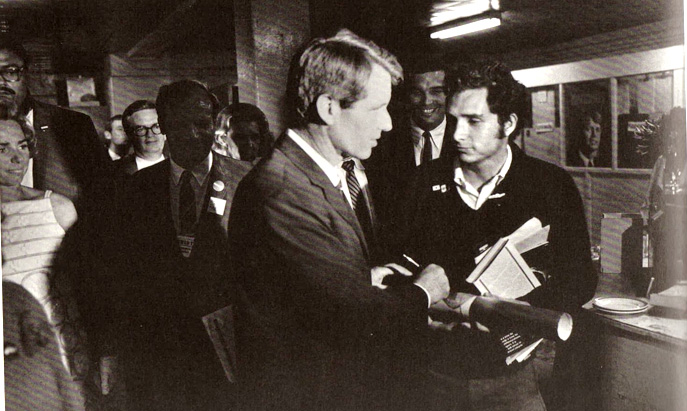
    RFK signs poster for bystander Michael Wayne minutes before he is assassinated.

    Yet, as Faura details, there were three people who were not acting like this at all.  They were not panic-stricken or overcome with grief.  They were intent on escaping from the room.  These were the girl, her original companion, and a man named Michael Wayne—who we shall discuss later.

    As the reader can see from this brief précis, ample evidence exists that Sirhan was being manipulated.  More than ample evidence exists that the girl was a key part of that manipulation.  John Fahey spent the day of the assassination with the girl. He then dropped her off at the Ambassador Hotel.

    IV

    Robert Parry

    As noted, Fahey came to see Faura after he read his first story on the RFK case, which had made the front page of the Citizen-News. Faura would find Fahey’s story so fascinating, so compelling, so potentially important to solving the case, that he recorded it on tape. He then had it transcribed. (Faura, p. 33)

    Fahey worked at a chemical company.  He arrived at the Ambassador that morning on a business matter. While waiting in the coffee shop he met up with an attractive young girl.   She would eventually give Fahey a few names, but the first one she gave him was Alice.  This is one way, Fahey felt, that she was communicating to him she was doing something secretive.  In fact, when he asked her directly what she was doing there, she put him off with words to the effect: I would not want you involved. (ibid, p. 36)  She then walked him over to the RFK headquarters part of the hotel.  She said that Kennedy would be taken care of that night, after his reception. She then said that they were being watched.  Since Fahey mentioned that he needed to travel out to Oxnard later, she asked if she could join him. Fahey accepted and they drove off.  But shortly after they hit the road, it became evident that they were being tailed.  This seemed to genuinely upset her. When Fahey asked why they were being followed, she said it had to do with what was going to happen to RFK after his reception.

    Once the pair got to Oxnard, Fahey decided to go on further to Ventura.  But he noticed that there was now a different tail behind them. (p. 41) Fahey told Faura that she said some strange things that, at the time, he did not really comprehend.  She mentioned getting a false passport to leave the country as soon as she could. She mentioned departing LA on a plane from Flying Tigers Airlines.  She also said she had come to Los Angeles from New York City, where she had met a woman named Anna Chennault.  Fahey thought she might be delusional, or inebriated.

    When they arrived back at the Ambassador it was around 7 PM.  She said she was staying at Olympic and Kenmore, which was nearby.  Fahey commented that it was pretty clear that she knew her way about every nook and cranny of the hotel. When they got back, she went to the back of the hotel.  Spooked, he did not want to be associated with her anymore. (p. 52)

    After the assassination, Fahey understood what had happened.  He went to the FBI, who interviewed him and said they would recall him. Fahey and Faura went over the route Fahey said he had driven with the girl. Fahey was very specific about where they stopped for lunch and where he got a flat tire.  Faura then took him to the police.  The reporter gave them a copy of the transcript. They also asked for the original tape to duplicate.  Which, of course, Faura did not get back until 20 years later, when it was declassified at the California Archives in Sacramento. After the LAPD interviewed Fahey they told him not to discuss his story, and for Faura not to write about it. They based the latter on a gag order placed over the upcoming Sirhan trial. Faura thought it was nonsense to apply this to the press.  But clearly LAPD was fearful that Fahey would give credibility to Serrano’s story.

    By this time, Faura was getting suspicious about what the LAPD and FBI were actually doing.  Reportedly, the Bureau had four hundred agents working the RFK case.  LAPD had set up a select unit inside the force called Special Unit Senator to investigate the case.  Yet both seemed to want to ignore the most credible leads. In fact, as Faura would later learn, LAPD wanted to discredit them—as they would attempt to do with both Serrano and Fahey.  They actually wanted to make the Girl in the Polka Dot Dress disappear, since she epitomized a sophisticated plot to kill Kennedy.

    Herbert Spiegel

    Therefore, Faura decided to go ahead and commission a drawing of the girl from Fahey’s memory.  He then got the sketch illustrated into a portrait.  This would serve as an identification instrument for other witnesses. (p. 80)

    On June 19th, Fahey called Faura and told him he was going to the Ambassador Hotel.  The FBI told him they had found the girl.  Faura found out they were actually going to pick her up and have Fahey identify her at the Kenmore Hotel, which was behind the Ambassador. Faura called Bonfante. He brought down a photographer to memorialize the moment.  The Bureau had been tipped off by Ty Hammond, manager of the Kenmore.  But it turned out that the Bureau had arrived too late and the girl was gone.  Disappointed and frustrated, Faura  decided to give Hammond the portrait of the girl.  Hammond said that yes, it looked like her. (p. 96)  He also said the girl had Arab friends and she always entered the Ambassador from his hotel.  She was not actually staying there, but lived in the nearby neighborhood.  But he was not sure she was still there.

    Just as the chase for the girl was beginning to bear some fruit, the police now called it off.   On June 21st, according to the authorities—most notably DA Evelle Younger—Serrano had taken back her story.  As the public later learned, this was not actually true, and it was done under duress. It was part of the attempt by local authorities to make the girl disappear.  By hook or by crook. (ibid, pp. 107-08)  But it actually went further than that.  Because now, his sources of information began to dry up.  When he went to see Hammond, he would not cooperate any further.  When he called Fahey, he told the reporter the FBI had seen them together and wanted him to cut off this association.

    But Faura continued to investigate.  He found two other witnesses who said they saw Sirhan with the girl.  Jose Carvajal who worked at the Ambassador saw the two talking with Sirhan on a terrace in front of the rear door of the hotel.  Vincent DiPierro saw the two seconds before the shooting.  He said that the girl smiled at Sirhan right before he began firing.  When DiPierro looked at the portrait, he had only slight modifications to the illustration.  (Pp. 117-20)

    But as the author notes, what was so odd about this was that Faura learned that the FBI was also still looking for the girl. And so was the LAPD.  But if Serrano had been discredited, and the girl did not exist, then why were they still crossing paths?  And why had Fahey been fired from his job?  (p. 136)

    An example of the continuing search for the girl was that both Faura and the FBI interviewed a woman named Pam Russo.  She said she had seen the girl with Sirhan at Rafferty’s gathering prior to the shooting.  But further, she also said that someone at Rafferty’s actually tackled a man trying to escape the pantry after Kennedy had been shot.  (p. 140)

    Which leads us to Gregory Clayton and Michael Wayne.  Clayton was the bystander who Russo was referring to who tackled a man running out of the pantry—Michael Wayne.

    V

    When Faura found out about Clayton, he tracked down his house and visited him in person. The witness told the reporter that he had seen Sirhan at Rafferty’s that night with the girl.  (p. 151)  He said that, at the Ambassador later, after he heard the first shot, he ran to the entrance of the kitchen pantry. He tackled a man running away from the murder scene.  He said there were actually two men who seemed to be fleeing together. One had an object in his hand, which appeared to “flash”.  The other man was in such haste that he was knocking a news photographer onto a table and into some chairs.  When Clayton yelled for a nearby security guard, the man with the flashing object in his hand ran the other way, into the hallway.  Clayton tripped the other man, who was then subdued by the guard.  According to the witness, the man they subdued had a “look of madness in his eyes, as if he had rabies.” (p. 153)  He then kept saying, “Let me go. Gotta get out of here. Let me go.”  As Faura later notes, these were not the words of an innocent bystander.  Clayton picked up a paper that Wayne had been carrying. It was a rather bizarre bumper sticker that read, “Kennedy Assassination a Death Hoax.”

    As anyone reading the above would understand, the Clayton story suggests there was more than one gun involved in the RFK murder.  As does the Brown/Sirhan transcript.  Because in one of these sessions Sirhan said that, during the shooting, he saw the flash of another gun firing.  (p. 212)  Finally, as almost everyone who has seen a photo of Wayne knows, the running man, who said he had to get out of here, all with a look of madness in his eyes, resembled Sirhan.

    Faura managed to temporarily make amends with Fahey.  Like a good reporter, he did two things to try and certify his story.  First, he gave him a polygraph test, which he passed.  (p. 181)  He then found the waitress who served Fahey and the girl at a restaurant in Oxnard.  Her name was Janis Page.  (p. 173) The LAPD did their best to negate both of these achievements.  They got Page to keep her mouth shut after she talked to Faura, and they gave Fahey their own version of the polygraph.  This was through their old reliable Hank Hernandez.  (p. 185) As many authors have shown, when LAPD wanted to discredit a witness, they turned him over to Hernandez.

    After this, Faura’s efforts became comparable to Albert Camus’ Myth of Sisyphus: rolling a rock up a hill, only to see it roll back down.  Fahey cut off relations with him for good.  Bonfante let him know that his supervisors at Life had told him that they would not finance any further inquiry into the RFK case.  The author tells us that this change came after a call from Washington.  (p. 191)

    Faura equates the last with the subtitle of the book, the “Paris Peace Talks Connection.”  Some background will be required for this aspect of the book.  As previously noted,  the girl told Fahey that prior to her coming to Los Angeles she had met a woman named Anna Chennault.  She also mentioned that she might be able to fly out of town on CAT or Flying Tiger Airlines. (p. 61)

    William Turner

    Anna Chennault was the Chinese wife of former military pilot Claire Chennault. Claire became famous as an aviation pilot aiding the Chinese struggle against Japan during World War II.  His initial volunteer squad was called the Flying Tigers.  This was replaced when the USAF formally entered the war and operated in the China-Burma-India air theater.

    After the war, Chennault, a big backer of the nationalist Taiwan government, created something called Civil Air Transport (CAT).  This supplied freight into Taiwan, aided the French struggle to keep their Indochina empire, and aided the Kuomintang’s occupation of Burma in the mid and late fifties.  It also helped in the early years of the American occupation of South Vietnam.

    Faura used the later dropping of these names by the girl—Fahey recalled them later, after his recorded interview—to perform two rather large functions.  He connects the girl and Chennault to the deliberate sandbagging of President Johnson’s peace talks, and he then suggests that people like candidate Richard Nixon, future Vice-President Spiro Agnew, future Attorney General John Mitchell and Senator John Tower were in on the RFK assassination.  (p. 207)

    As regards the former, Faura is referring to the rather recently discovered files by journalist par excellence Robert Parry.  Parry discovered  a file put together by National Security Advisor Walt Rostow at the Johnson Library.  That file contained information garnered by the FBI and the National Security Agency about Nixon’s efforts to subvert Johnson’s attempt to get a peace conference with the North Vietnamese prior to the fall election of 1968.  Perceiving this to be a boon for the Democrats, Nixon set out to deep-six that diplomatic effort.  Nixon did use Republican lobbyist and fundraiser Anna Chennault to communicate with the South Vietnamese government, advising them to stall Johnson, promising Nixon would give them a better deal once he was elected.

    The problem with Faura’s theory here is that, as author Ken Hughes has shown, those efforts did not begin until over a month after Robert Kennedy was killed. It was not until July 12 that Nixon alerted Chennault that she would be his go-between for these efforts to obstruct Johnson.  So if she was not aware of that function until then, how and why could she have been used prior to June 5th in the RFK plot?

    Also, although Faura mentions John Tower as a possible co-conspirator, in rereading some of the literature on Parry’s fine site, Consortium News, I could not detect his name in any of the declassified files on the illicit episode.  So, as far as I can see, the top-level players involved were Nixon, Agnew and Mitchell. Mitchell had been at the meeting in July of 1968 where Nixon appointed Chennault as his emissary. (In an interview with journalist Jules Witcover in 1994, Chennault did say that Tower did have knowledge of her mission.  See Baltimore Sun, 8/18/2014) And FBI wiretaps seem to indicate that Chennault was getting instructions from Agnew in late October of the campaign. But all of these efforts and communications are to thwart Johnson.  Just because The Girl in the Polka Dot Dress had met Chennault in New York, what is the evidence that the men mentioned above were part of the plot to kill RFK?  And if they had been, the girl would not be musing about getting a passport and flight on CAT.  She would have had her passport and been on a plane the next day.

    From what I have learned about the RFK case from writers like Turner, Melanson, and Lisa Pease, most of the evidence inherent in the crime—the MK/Ultra aspect, the associations of the leaders of SUS Hernandez and Manny Pena, the presence of former Iranian intelligence officer Khaiber Khan at RFK headquarters—seems to indicate a CIA modus operandi.

    I also have some formal criticisms of the book.  Faura was, for all intents and purposes, a participant in the RFK investigation as it unfolded. He was not an academic or a historian looking back at a past event he did not have a hand in.  Therefore, his book could have and should have been written from a first person point of view—but it is not.  At times, the author refers to himself as ‘Faura’.  Before Jim Garrison started his memoir on his inquiry into the JFK assassination, his editor Zach Sklar insisted he write it in the first person. He did this since he thought it would create personal drama and invite reader empathy, since they would be watching a real life protagonist progress through unchanneled and dangerous waters.  Sklar was correct and Garrison was grateful for that advice.  Well, someone at Trine Day publishing should have insisted on the same thing in Faura’s case.

    Also, I would have advised Faura not to use the very short chapter approach he does, some of them being literally less than two pages.  This is not the way to build and cap sustained interest.  Finally, in this vein, Faura excerpts into the book long sections of taped interrogations he did.  Again, not all that scintillating to read.  I wish he had summarized the less important parts of the interviews and only given us the key parts in the Q an A format.

    In his discussion of the Scott Enyart trial over the photos Enyart took in the pantry of the actual assassination, the (wrong) photos did not show up during the trial, but just prior to it.  (p. 219)  Finally, the author seems unkind about RFK researcher Ted Charach.  Faura does score him for some personal shortcomings.  And I agree with them. But to say that the last he heard of Charach he was still trying to sell a vinyl record—that seems really unkind and uncareful.  Charach’s 1973 film, The Second Gun, was nothing less than a breakthrough in the Bobby Kennedy case.  In fact, that film is still worth seeing today. Also, as reporter David Manning noted in an article on the Enyart trial for Probe Magazine, Charach was one of the key witnesses that turned the case in Enyart’s favor.

    All in all, we finally have a record of one of the very, very few mainstream reporters who actually delved into one of the assassinations of the sixties. Who tried to do an honest job and who actually tried to follow the evidence wherever it was headed.  He found out the hard way that the local authorities—the police, the DA’s office, Mayor Sam Yorty—did not want to do that in the least.  In fact, they were determined to not only avoid that path, but to discredit those who tried.  Including the author. This book is his testament to that process.

  • Shane O’Sullivan Letter Concerning Sirhan’s Parole


    (Click here if your browser is having trouble loading the above.)

  • Sirhan Parole Board Transcript


    (Click here if your browser is having trouble loading the above.)

  • Patrick Nolan, CIA Rogues and the Killing of the Kennedys


    The assassination of John F. Kennedy is probably one of the most written about events in 20th century American history. So given that this year marked the 50th anniversary of that tragic day, it was perhaps inevitable that we would see a deluge of books on the subject. There are some good new ones, like Jim DiEugenio’s Reclaiming Parkland, and some worthy reissues such as Gaeton Fonzi’s The Last Investigation and Harold Weisberg’s Whitewash. But, as many feared would be the case, these volumes appear to be outnumbered by books that add little or nothing to our understanding and, by and large, are being published simply to capitalize on the hoped-for resurgence of interest that such anniversaries typically bring. Dale Myers seems particularly interested in squeezing as many more pennies as possible out of the anniversary, reissuing his Tippit book, With Malice, at a whopping $65 dollars a pop – $75 if you want the honour of his Emmy award-winning autograph.

    With a personal JFK assassination library of around 100 books, I long ago stopped buying every new one to hit the shelves. Instead I save my time, money and shelf space for those books that look as if they might actually offer some genuinely new information or insight. Consequently, when I first saw CIA Rogues advertised on Amazon, I added it to the mental list of books I wouldn’t be purchasing. After all, the conclusion that rogue elements of the CIA had conspired to kill the Kennedy brothers is hardly a new one. The late, great Jim Garrison had first publicly suggested that JFK was murdered by “men who were once connected with the Central Intelligence Agency” in his NBC address on June 15, 1967. And he predicted soon after that JFK’s brother would be a victim of the same sinister forces who killed the president. Since then, a good number of writers have followed in Garrison’s footsteps and reached the same conclusion. So I expected to learn very little from CIA Rogues. However, I did note that the foreword was provided by renowned forensic scientist Dr. Henry Lee, so I checked out author Patrick Nolan’s web page. There I found the claim that CIA Rogues “is based on interviews and/or correspondence with world-renowned forensic scientist Dr. Henry C. Lee, and other notables including Kennedy aide Arthur M. Schlesinger, Jr., former FBI agent William W. Turner, Sirhan attorney Larry Teeter, RFK assassination expert Judge Robert J. Joling, and University of Massachusetts Professor Philip H. Melanson, among others.” Well, I think most would be impressed by that list. So I ordered the book.

    As it turned out, I should have trusted my initial instincts. CIA Rogues is not in any real sense based on “interviews and/or correspondence” with those named above; it is based on their published books. Checking his source notes, I came across only two references to original interviews conducted by Nolan. Almost all of his remaining 1,654 citations are to secondary sources. Talk about misleading! I had expected his treatment of the forensics would be based on new work by Dr. Lee but was disappointed to discover that it is largely derived from Josiah Thompson’s book, rather old Six Seconds In Dallas. Not that there is anything wrong with Six Seconds, but it was published in 1967 and even Thompson himself has since abandoned one of the primary tenets of its reconstruction of the assassination. So I believe it’s fair to say that there is little if anything new in CIA Rogues and, therefore, I see little point in offering a lengthy summation or critique of most of its content here. What does need addressing is Nolan’s central thesis, which is that both Sirhan Sirhan and Lee Harvey Oswald were victims of the CIA’s MKULTRA project.

    For those who don’t know, MKULTRA began in 1953 at the suggestion of Richard Helms as a project aimed at finding ways to control human behaviour. Under the direction of Helms and Technical Services Division Chief, Dr. Sidney Gottlieb, the Agency experimented with everything from sensory deprivation and electroshock therapy to LSD and hypnosis. Perhaps the most shocking aspect of MKULTRA is that many of these experiments were conducted without the knowledge or consent of the test subjects. As Nolan writes, the CIA chose “prisoners, foreigners, prostitutes, mental patients, and drug addicts…because, due to their social and economic circumstances, they typically would have little recourse if they discovered the true nature of their predicament.” (p. 19) Much documentation was lost in 1973 when Helms ordered the destruction of all MKULTRA files – approximately 20,000 records survived because they had been stored in the wrong building – so a full understanding of the scope of MKULTRA is probably not possible. However, it is widely believed that one goal of the program was the creation of a “Manchurian Candidate”. That is, a “hypno-programmed” assassin. One surviving CIA document from 1954 does mention finding ways to get a subject “to perform an act, involuntarily, of attempted assassination against a prominent [redacted] politician or if necessary, against an American official.” (Lisa Pease, The Assassinations, p. 533)

    When he was interviewed by author Dick Russell, Gottlieb denied that creating brainwashed or hypnotized assassins had been an aim of MKULTRA and suggested that such a thing wasn’t actually possible (On The Trail of the JFK Assassins, p. 242). But there’s every reason to believe it is. In 2011, British mentalist/hypnotist Derren Brown produced a series of TV shows called The Experiments, the first of which was titled The Assassin. In it, Brown took a volunteer through a series of hypnosis sessions which the volunteer believed were intended to make him a superior marksman. In reality, Brown was programming him to commit an assassination against his will of which he would have no memory. The show culminated with the unwitting gunman firing blanks at British comedian and TV personality, Stephen Fry, in front of a packed and unsuspecting auditorium. After watching The Assassin, the viewer is compelled to conclude that a mind-controlled assassin is a shockingly real possibility.

    It has long been believed that Sirhan’s behaviour before, during, and after the shooting of Robert Kennedy is highly suggestive of hypno-programming. Witnesses recalled that during the assassination Sirhan looked detached and tranquil. One of those who helped wrestle him to the ground, George Plimpton, said that Sirhan’s eyes appeared “enormously peaceful.” (Nolan, p. 253) Others reported a “sickly” smile on his face. (Pease, p. 579) More importantly, to this day, Sirhan claims and indeed appears to have no memory of shooting his pistol at senator Kennedy, or even of being in the kitchen of the Ambassador Hotel. Even under hypnosis, Sirhan has been unable to recall the assassination. When Sirhan’s defense team hired psychiatrist Dr. Bernard Diamond to put him under, he discovered signs that Sirhan had been hypnotized numerous times before. As Nolan writes, Diamond “was also struck by how reliably Sirhan would perform in a waking state what had been suggested to him under hypnosis, without recalling having been told to perform and without recalling having been hypnotized.” (Nolan, p. 269) After Sirhan was convicted and sent to San Quentin Prison, the chief psychologist there, Dr. Eduard Simson-Kallas, undertook to discover whether or not Sirhan’s amnesia was real. He ended up convinced that Sirhan had no memory of the assassination and that he was “prepared by someone. He was hypnotized by someone.” (p. 274) So it’s fair to say that there are good reasons for believing that Sirhan was indeed hypno-programmed.

    However, because Nolan wants to put MKULTRA at the centre of both assassinations, he wants to postulate that Lee Harvey Oswald was also a “hypno-programmed patsy”. Unfortunately for him, there is simply no credible evidence to support this belief and, try as he might, Nolan is unable to cobble together a convincing case. He writes of Oswald’s alleged “mood swings and irritability” which he says are “symptoms of hypno-programming”. (p. 92) He sources these “mood swings” to page 269 of Sylvia Meagher’s Accessories After the Fact, in which she includes a story of Oswald complaining about overcooked eggs at the Dobbs House Restaurant. This is hardly convincing stuff. Of course, there are allegations that Oswald beat his wife, Marina, but many of these were made by Marina herself after she was put under intense pressure to tell the authorities what they wanted to hear. As Nolan himself notes, in her earlier interviews, Marina described Lee as “a good family man” (p. 110). It wasn’t until after she was threatened with deportation that the Russian-born widow’s stories began to evolve. So these are open to question. And how would this prove Nolan’s thesis anyway?

    Further “symptoms” of Oswald’s supposed programming according to Nolan are “his rapid speech while lecturing as if by rote, and automatic writing”. (p. 110) In support of the first “symptom” he cites “a three-hour lecture on American policies regarding Cuba” that he says Oswald gave at a dinner party with “Dallas’s White Russian community.” (pgs. 110-111) When we check his source, Edward Epstein’s Legend, we discover that he is referring to an alleged three-hour “conversation” that Oswald had with Volkmar Schmidt and that there is no mention of “rapid speech”. (Epstein, p. 204) In support of the second, Nolan apparently has in mind the letters that Lee wrote home shortly after his arrival in Russia, and his so-called “Historic Diary”. Nolan writes that one of these letters contains an “uncharacteristically violent passage” in which Oswald said he was prepared to “kill any American who put on a uniform in defense of the American Government”. (p. 101) As Nolan himself admits, Oswald no doubt understood his letters were being intercepted by Russian authorities and was writing them in an attempt to prove his loyalty and gain a resident permit. And yet he somehow concludes that Oswald “no doubt had no knowledge of writing them.” (p. 102) Confused? Me too. I simply cannot follow his logic. With regard to the diary, Nolan basically repeats what others have been saying for years which is that it is full of inaccuracies and appears to have been written in one or two sittings. It hardly needs pointing out that all this proves is that the “Historic Diary” is not an authentic, contemporaneous account. In no way does that suggest “automatic writing”. Sadly, this is pretty much the extent of what Nolan could come up with as far as finding signs of hypno-programming in Oswald goes.

    In the case of Sirhan, it’s possible to identify the individual most likely responsible for hypnotizing him; CIA asset, and renowned hypnotist Dr. William J. Bryan. In fact, Dr. Bryan who, in his own words, was “chief of all medical survival training for the United States Air Force, which meant the brainwashing section”, apparently himself boasted to two Beverly Hills call girls that he had hypnotized Sirhan. (William Turner & Jonn Christian, The Assassination of Robert F. Kennedy, p. 225-228) For the role of Oswald’s hypno-programmer, Nolan offers us David Ferrie whom he claims “is known to have been a master hypnotist”. (p. 126) Now admittedly Ferrie was a strange guy who apparently dabbled in all sorts of odd areas, and I have read unconfirmed reports that he was interested in hypnosis. But I have never seen him referred to as a “master hypnotist” before. In any case, even if one accepts the notion that Ferrie practiced hypnosis on Oswald (which I don’t), this still leaves a big hole in Nolan’s theory since he has Oswald being programmed nearly four years before he moved back to New Orleans and began playing intelligence fun and games with Ferrie. Just who was supposedly hypno-programming Oswald before his fake defection, Nolan doesn’t say.

    In support of his Ferrie contention, Nolan brings up the mysterious trip Oswald made to Clinton, Louisiana but, crucially, he leaves out the visits he made to the neighbouring village of Jackson. To Nolan, Oswald’s standing in line for hours to register to vote in rural Louisiana is best explained as a test of the “MKULTRA conditioning process”. (p. 126) But the fact is that by leaving out Oswald’s appearance in Jackson, Nolan has stripped the Clinton incident of its context. Before he turned up to register in Clinton, Oswald had stopped to get a haircut in the Jackson barbershop of Ed McGehee. There he asked about job opportunities in Jackson and was told about the East Louisiana State Hospital, which was a mental institution. McGeehe suggested Oswald talk to State Representative, Reeves Morgan, who he was sure would help him get a job. When Oswald dropped in on Morgan, Morgan suggested it would help if he registered to vote. So, the next day Oswald, in the company of David Ferrie and Clay Shaw, was in Clinton attempting to register. Once he reached the front of the line, Oswald was informed that it wasn’t necessary to register in order to get a job at the hospital so off he went back to Jackson where he apparently filled out an application. (for more details see the second edition of Jim DiEugenio’s Destiny Betrayed, pgs. 88-93). It seems fairly clear that the purpose of the Clinton trip was to help get Oswald a job at the State Hospital, and had nothing to do with Ferrie testing his control over Oswald. What purpose would be served in securing Oswald such employment remains a matter of debate and speculation.

    While we’re on the subject, I cannot let Nolan’s treatment of the Clinton/Jackson incident pass without noting one other serious misconception. He writes that “Ferrie drove” Oswald in a black Cadillac that day, and that the other passenger “is believed to have been Guy Banister, based on witness descriptions, although some researchers have said the third member on the excursion was Clay Shaw”, which, Nolan says, “is unlikely”. (p. 125) This is a serious misrepresentation of the facts. Firstly, according to witnesses, Ferrie was the second passenger and not the driver. Secondly, it is not just “some researchers” who have claimed the driver was Shaw. It was Clinton witnesses John Manchester, Henry Palmer, Corrie Collins, and William Dunn. And,what’s more, they positively identified Shaw in court. There is little real doubt that Shaw accompanied Oswald to Clinton, however unlikely Nolan finds that fact. And there is also little doubt that Guy Banister was nowhere around. Because, as he told both Jim Garrison’s office and the HSCA, eyewitness Henry Palmer knew Banister from before 1963 and he was sure Banister was not in the car. (DiEugenio, p. 93)

    Returning to Nolan’s MKULTRA theory, hopefully the reader can see that there is really no credible reason to believe that Oswald was a victim of this program. But Nolan seems so enamoured with the notion of hypno-programming in the JFK case that at one point he goes completely off the deep end. This occurs when he’s discussing the Warren Commission’s star witness to the Tippit slaying, Helen Markham. Now, most serious researchers agree that Markham was somewhat eccentric and that much of her obviously coerced testimony is not to be taken at face value. And most researchers are happy to leave it there. But not Nolan. Nolan decides that Markham was “connected to Jack Ruby” because she worked at the Eatwell Restaurant where Ruby was known to eat. (Nolan, p. 161) A more tenuous connection is hard to imagine. But worse than that, Nolan decides that because she was “hysterical” when she was taken to Dallas police headquarters, and because her testimony was “odd”, Markham “may well have been conditioned or hypno-programmed”! (p. 156) This is ridiculous, nonsensical and, ultimately, fodder for the Warren Commission apologists. Making unsupported and frankly wacky claims of this nature tarnishes the author’s credibility and makes it all too easy for lone nutters to dismiss his work entirely – and that of conspiracy writers in general. And to be clear, this is far from being the only unsupported or blatantly incorrect claim in his book. For example, Nolan writes that a “201 file is a CIA personnel term that applies to individuals who are either CIA or have a contract with the Agency.” (p. 98) Wrong. A 201 file is opened on anyone in whom the CIA takes an interest. Nolan also writes that David Ferrie was found dead “shortly before he was to appear at Garrison’s JFK assassination conspiracy trial.” (p. 94) Again, this is wrong. Ferrie died almost two years before the trial began without ever being arrested, let alone charged. And finally, Nolan boldly proclaims that “Ferrie’s name was listed in Ruby’s address book.” (Ibid) It wasn’t.

    I could point out more errors and problems in CIA Rogues but there’s no need. As I wrote above, there is really nothing new in the book and its central thesis is simply not supported by the evidence. That CIA rogues were a part of the plot to kill Kennedy has been written before and in a far more persuasive manner than Nolan manages. As much as I was hoping it would be otherwise, I simply cannot recommend this book.

  • Will Sirhan be Retried? Pepper and Dusek  Advance  the RFK Case

    Will Sirhan be Retried? Pepper and Dusek Advance the RFK Case


    In 2005, the effort to reopen the Robert Kennedy murder case suffered a severe blow. In that year, accused assassin Sirhan Sirhan’s lawyer, Larry Teeter unexpectedly passed away. He had gone to Mexico to seek alternative treatment for lymphona. Very few people knew about his sickness or his attempt to seek treatment. So when he died unexpectedly, Sirhan and his case were left in the lurch. Larry Teeter had been Sirhan’s lawyer for about eleven years at the time of his passing. He had filed many petitions in both federal and state courts to try and get a new trial for his client. Many of these motions were pending at the time of his death. But since he had arranged for no other attorney to take over his files, and since he had no partner, the California Bar took control of his files. What made this even worse was that prior to his death, there had been a falling out between Teeter and Sirhan’s chief investigator, Lynn Mangan. So the RFK case now seemed stalled.

    Two things happened to change things and make this a live case today. First, as readers of this site know, in 2007, Philip Van Praag did some very important work on an audiotape discovered in the RFK Archives. This was analyzed by the audio technician and revealed to hold the sounds of as many as 13 shots. Around this time, famous attorney William Pepper also decided to take over for Teeter. Assisted by New York attorney Laurie Dusek, they have now made a pair of court filings that significantly advance the RFK case.

    As most people know, Pepper became famous for his work on the Martin Luther King case. In that particular case, he did three things. First, he served as attorney on a British TV production of a mock trial. This was sold to over 25 foreign markets, including the USA. Pepper managed to convince a jury that James Earl Ray did not kill King.

    Pepper then tried to reopen the King case in Memphis on criminal grounds. To everyone’s surprise, with the help of Judge Joe Brown, he almost did it. But when it seemed that Brown was going to approve rifle tests that would prove once and for all that the bullet that killed King did not come from the rifle in evidence, Brown was removed from the case.

    When this effort was stopped, Pepper then got the King family to file a civil claim against tavern owner Loyd Jowers, who had confessed to a role in the murder on national television. This trial went on for about three weeks in 1999. The national media boycotted it. In fact, the only reporter there each day was Jim Douglass for Probe Magazine. In a tour de force performance, Pepper prevailed for his clients. We now had an adjudicated jury verdict that the King case was a conspiracy. (See the book, The 13th Juror for a transcript of the trial.)

    Pepper and Dusek have now filed papers in federal court in hopes of reopening the Robert Kennedy case in a criminal proceeding. They are being opposed by the district attorney’s office in Los Angeles. There have been two filings so far, one in October of last year and a supplementary one in April of this year.

    The first filing is quite an interesting document. In one of the headings on the “Contents” page it actually states that one of the grounds for reopening the case is that “new evidence demonstrates it is more probable than not petitioner is actually innocent.” This, of course, refers to the audiotape analysis by Van Praag. His analysis not only demonstrates that there were too many shots fired for Sirhan to be the sole assassin but that there were two instances of “double shots”, that is when the shots were bunched too close together to be executed by one person. (Click here, for a thorough discussion of this tape evidence)

    Another section of the court filing states that Sirhan deserves a new hearing because the prosecution failed to disclose exculpatory ballistics and autopsy evidence in a timely manner to the defense. In this section, Pepper and Dusek use the Supreme Court ruling called the “Brady Rule.” It states that “the suppression by the prosecution of evidence favorable to an accused upon request violates due process where the evidence is material either to guilt or to punishment, irrespective of the good faith or bad faith of the prosecution.” (Filing, p. 28) They go on to say that evidence is deemed material if there is a reasonable probability that, had it been disclosed to the defense, the result of the proceeding would have been different. (ibid)
    The document then goes on to mention three specific instances where this occurred:

    “First, the state failed to disclose a bullet recovered from Senator Kennedy’s neck during the autopsy; second, the state had evidence of bullets at the scene that it did not disclose to defense counsel; and third, the state violated Brady in delaying its disclosure of the autopsy report.” (Ibid, pgs. 28-29)

    This first instance relates to the work of Lynn Mangan and discussed by Lisa Pease in her milestone essay on the RFK case. (Click here for that article.) In a nutshell what Mangan and Pease were arguing was that at the new inquiry set up by Judge Wenke in 1975, there was a question concerning one of the bullets entered into evidence. Originally, the bullet was recorded with the markings ‘TN 31’ on the base. Yet that bullet was not entered into the Wenke hearings. Another bullet marked ‘DN TN” was so entered. Where was the other bullet that allegedly was removed from Kennedy’s neck? This is a crucial issue in the RFK case. For it touches on the credibility of the state’s firearms witness DeWayne Wolfer. Wolfer testified twice that this bullet was the one taken from RFK’s neck and that he matched it to the handgun in evidence. (ibid, p. 30) If it can be shown that either the state held back on the actual bullet, or even switched bullets, this would be enough under Brady to reopen the case.

    The second instance pertains to the fact that there were more bullets found and seen in the pantry than could have been fired by the handgun in evidence, which held 8 bullets in the cylinder. The Pepper/Dusek filing begins with the testimony of FBI agent William Bailey in that regard. (p. 31) He signed an affidavit in 1976 saying that “I…noted at least two small caliber bullet holes in the center post of the two doors leading from the preparation room. There was no question…that they were bullet holes and not caused by food carts or other equipment in the preparation room.” (ibid) The lawyers then advance this argument by saying that there is evidence in FBI photos that these bullets were in fact removed. (ibid, p. 32) They then mention two witnesses who saw the same holes in the center post. (ibid) This evidence of extra bullets, strongly indicative of a second gunman, was never disclosed to Sirhan’s defense.

    The third instance of non-disclosure by the prosecution was with Dr. Thomas Noguchi’s autopsy report. Noguchi was the coroner in LA at the time. Since he was a friend of Dr. Cyril Wecht’s, he understood all of the problems with the autopsy of President John Kennedy. He therefore consulted with Wecht before he began the examination. The result was an autopsy that has been praised in several quarters as being one of the most thorough and painstaking ever written. And Pepper and Dusek include a copy in the filing.

    It is quite interesting to compare this document with the autopsy report in the JFK case. (Click here for that report.) The JFK report is about six pages long. Noguchi’s report is over ten times that length, with sub sections that in themselves are longer than the JFK autopsy report. Unlike the JFK case, Noguchi actually listed all the exhibits that he studied in order to reach his conclusions. For example he actually listed all the photographs he studied, both of the crime scene and of the autopsy. He then listed all of the personnel involved with the autopsy, from the pathologists, to the assistants, to the photographers to the observers. Whereas one could easily read the JFK autopsy report in a matter of minutes, Noguchi’s report takes at least two hours to read and properly understand.

    Sirhan’s trial began jury selection on January 7, 1969. There is no formal receipt or message indicating the prosecution ever turned over Noguchi’s report. There is a defense memo by Robert Kaiser saying that the autopsy defined the muzzle distance to RFK as being between one and two inches. (ibid, p. 33) But this was dated February 22, 1969 — well after the trial started and two days before Noguchi’s testimony. The Brady Rule requires that disclosure “be made at a time when disclosure would be of value to the accused.” (ibid)

    There is little doubt that Noguchi’s autopsy contained material evidence that was exculpatory to the defendant. Because he concluded that all the shots came from behind RFK, at very close range—a matter of inches—and at extreme upward angles. As the attorneys note, each interviewed close witness stated that Sirhan was always in front of RFK, at least a foot away, and had his arm extended out straight.

    Now this would seem to be very important evidence for Sirhan’s defense. That is, if it had arrived in time. But there is a question of competency. And this relates to the third ground for reopening the case: Sirhan was denied effective assistance of counsel. (p. 34) It is very clear that as Pepper and Dusek write, Sirhan’s legal team failed to investigate other legal defenses Sirhan could have had before settling on diminished capacity. Like perhaps, Sirhan was actually innocent because he was set up. Sirhan’s team also agreed to stipulate to the evidence presented against him, that is they did not argue its provenance or authenticity. And finally, they never asked for a continuance before Noguchi testified in order to completely assimilate his report. (ibid, p. 34)

    In fact, the most serious problem in this regard is that Sirhan’s lawyers made their strategic choice of a defense without any real investigation. (ibid, p. 36) Also, attached to the filing is a letter by Sirhan saying that his attorneys always assumed he was guilty and they drummed this into him. This came about because of the stipulation to the state’s evidence and the lack of any real inquiry. Or as the filing states,

    “…counsel also was ineffective in failing to investigate alternative defenses. Defense counsel in this case conducted zero investigation into the facts surrounding it, taking at face value everything that the state asserted.” (p. 39)

    Even when he was offered the professional help of criminalist William Harper, who had real doubts about whether the bullets in evidence matched Sirhan’s handgun (ibid, p. 40), lead lawyer Grant Cooper admitted that he never retained an independent ballistics expert to analyze the bullet evidence. (p. 40) This then allowed Wolfer to get away with his highly questionable testimony about the provenance of the neck bullet and the slugs matching the weapon. In fact, as Pepper and Dusek argue, Cooper did not “proffer any cross-examination of the state’s presentation of the ballistics evidence.” (p. 41)

    The attorneys summarize that the cumulative effect of the new evidence, the suppressed evidence and the ineffective counsel not only attest that the outcome of Sirhan’s trial would have been different, but that “no reasonable juror would have convicted him in the light of the new evidence.” (p. 44) They further argue that the totality of the new and suppressed evidence “unequivocally shows that there was in fact a second gunman.” (p. 45) And they then write, based on Noguchi’s autopsy, that not only was there a second gunman, but that Sirhan could not have fired the shots that killed RFK. (p. 48)

    They conclude with the evidence that Van Praag has adduced which shows that 13 shots were fired that night which “conclusively demonstrates the existence of a second shooter.” (p. 50) They then say that when a court considers an actual innocence claim, they should “consider the probative force of relevant evidence that was either excluded or unavailable at trial.” (p. 53) They then ask for a writ to reopen the case. (p. 56)

    In April, Pepper and Dusek submitted a supplement to this filing. The defense hired Harvard professor Daniel Brown, an expert in trauma memory and hypnosis, to interview Sirhan for over 30 hours. Brown got Sirhan to go further in his memory of that night then anyone has. One of the keys to the RFK case has always been the famous “Girl in the Polka Dot Dress,” the girl seen with Sirhan on the night of the murder. Witness Sandy Serrano said that she saw the girl going up the stairs that night with two men, one taller and one shorter than the girl. Sandy said she later recognized the shorter one as Sirhan. After the murder, Serrano saw the girl leave with only the taller man. Sirhan had previously stated that his last memory of the night was having coffee with the girl and then being led to the pantry, where RFK was killed. He was later seen in the pantry standing next to the girl before he pulled his handgun and started shooting.

    The question has always been this: If in fact, the girl was the accomplice who was supposed to guide Sirhan into position for a post hypnotic suggestion to trigger his firing, why on earth would she wear such an unforgettable white dress with black polka dots to do so?

    It seems that Brown may have solved this mystery. Like many others, Sirhan liked to go target shooting with his handgun. And he had done so quite recently. In these papers he said that the girl’s dress sent him into “range mode” believing he was at the firing range seeing circles in front of his eyes. Under hypnosis Sirhan recalled the girl pinching him on the shoulder and spinning him around to see the RFK entourage entering the pantry just before he fired.

    It’s an impressive filing. As Pepper has said elsewhere, in comparing the King and Kennedy cases, the RFK case would be even easier to win in open court. Let us hope he and Dusek finally get that opportunity. If they do, and with Brown’s help, we may all learn what really happened at the Ambassador Hotel in June of 1968.

    – Jim DiEugenio

    Sirhan filing 2011
  • Robert Joling, J.D. & Philip Van Praag, An Open and Shut Case


    An Open and Shut Case is an indispensable volume for those with a serious interest in the Robert Kennedy assassination. While some of the information – and especially some of its core conclusions – are based on evidence that has been called into serious question, about which I will have more to say below, there is more than enough interesting and solid work here for this book to warrant a place on your shelves.

    The book’s title comes from a quote from the Police Chief Edward Davis, who said the RFK assassination case was clearly “an open and shut case,” based on the eyewitness and physical evidence in the case. That’s true, of course, but not for the official story. As An Open and Shut Case clearly shows, the eyewitness and physical evidence are absolutely consistent with two facts: at least two guns were fired in the pantry, and Sirhan’s gun did not fire any of the shots that hit Senator Robert Kennedy.

    The book is the product of a collaboration between Robert Joling, J.D., who has studied this case for years, and Philip Van Praag (the last name rhymes with “Craig,” not “bog”), who is much newer to the case and focused primarily on a newly surfaced recording from the pantry. Joling is a past president of the American Academy of Forensic Sciences (AAFS) and was a licensed attorney for 57 years, 40 of which he devoted to criminal and civil trial work, including some homicides. Van Praag has spent 45 years working in the audio field, with 35 of those years devoted to magnetic media.

    The book’s authors met through the work of a third person, Brad Johnson, a producer at CNN International. Brad has been looking into this case for years, and has attempted to collect every possible video and audio recording of the assassination of Robert Kennedy. When he stumbled upon evidence of a recording made in the pantry at the time of the shooting, he tracked down a copy and searched for a qualified sound engineer to examine it. Johnson found Phil Van Praag, and Van Praag’s findings about this recording are detailed in the first chapter of the book.

    Just after midnight on June 5, 1968, Robert Kennedy finished his acceptance speech, having just won the California primary in the race for the Democratic Party’s nomination for the presidency. Kennedy exited the Embassy Ballroom of the Ambassador Hotel in Los Angeles and crossed east through the pantry area, an almost hall-like room, on his way to speak to the press in the Colonial room. Sirhan Bishara Sirhan (pronounced “Sear hahn”) stepped forward and fired a gun. Kennedy was taken to the hospital, where he died a day later. Five other people were also wounded by bullets, but none fatally so.

    The most famous of those wounded in the pantry, Paul Schrade, RFK’s union chair and an officer with the United Auto Workers union, contributed the Foreword to the book. Schrade opens with a quick summary of the case, and of his own initial rejection of the “conspiracy theories” about a second gun, which sprouted up within days of the assassination.

    Schrade had his eyes opened to the conspiracy aspect of the case by Congressman Allard Lowenstein (D-NY), who visited him at his home in 1974. Lowenstein took Schrade to visit Lillian Castellano and Floyd Nelson, two early and excellent researchers in the case. They showed Schrade solid evidence that more than eight bullets were fired in the pantry. Schrade joined their efforts, and, with the help of others, including the LA County Board of Supervisors and CBS, obtained an order for a court-appointed panel to re-examine the evidence. I’ll call this panel the Wenke Panel, for convenience, after the Judge who ordered it. A large part of the book focuses on the work of the Wenke Panel, and the final conclusions of the authors depend on the Wenke Panel’s findings, a problem to which we’ll return later.

    There are many anecdotes and interesting items learned firsthand by the authors which make this book truly “new,” and not just a retelling of the evidence of others. For example, Joling details how a personal acquaintance who worked for the CIA called him at one point, when Joling, as president of AAFS, had set up a special committee to review the firearms evidence in the Robert Kennedy case. His CIA associate said the Agency did not like what he was doing, and ordered him to stop. Joling became upset with his contact’s “‘hoity-toity’ attitude and demanding demeanor” and forcefully but politely told him he was not interested in the CIA’s “‘Sunday School’ games” and asked the person never to contact him again. Another time, Joling found a bug on his home office phone. Joling recounted other incidents of obvious harassment from people whose connections he could only suspect. He noted these only occurred at the height of his direct involvement with the case, and ended after the Wenke Panel concluded its work. Both Phil Melanson and Jonn Christian had accounts of being threatened, which are included here as well. The obvious question is, if there was no conspiracy, who was so intent on keeping these people from pursuing their work in the case?

    The most important new piece of evidence discussed in the book is the Pruszynski recording. While most people are familiar with the famous audio piece in which a reporter describes the aftermath of the shooting (“Get the gunä get the gunä take his thumb and break it if you have to!”), this new tape was lost to history until Brad Johnson, a producer for CNN International, rediscovered it by noticing a listing of it in the California State Archives record finding aid. And, unlike the other recordings, this one had captured the period of the shooting. Stanislaw Pruszynski, a print journalist, had inadvertently left his hand-held recorder and microphone on as Kennedy exited the stage and entered the pantry. Brad searched for a sound engineer willing to use his expertise to analyze the tape. He found Van Praag.

    The first chapter in the book deals with Van Praag’s work with this recording. The tape, according to Van Praag, shows at least thirteen distinct sounds, and possibly more, that match the sound pattern of gunshots. As the realization sets in that Kennedy has been shot, screams may have covered additional shot sounds. Since Sirhan’s gun could only hold eight bullets, this is prima facie evidence of two or more shooters.

    In addition, Van Praag noted that there were two pairs of sounds where the shots were too close together to have been fired from the same gun. Van Praag’s assertion that the two shots were fired too close together was tested on a 2007 Discovery Times cable TV special. A noted firearms expert could not pull the trigger on the Sirhan gun fast enough to make either of the double shots.

    In addition, Van Praag found that five of the shots, including one in each pair of the “double-shot” sounds, bore a distinctly different sound signature from the other shots. Van Praag sought a second gun that would leave the bullets marked in the same way as the Sirhan gun. The only gun known (to the authors) to have the same rifling characteristics as the Iver Johnson 55 Cadet in evidence for the crime was an H&R 922. Curiously, this is the exact model the guard Thane Eugene “Gene” Cesar owned. Cesar later claimed he had sold it before the assassination, when he had actually sold it after.

    Cesar is a likely candidate for being a second shooter because the medical evidence shows RFK was shot four times, all from within a distance of one to four inches. The fatal shot, a shot behind Kennedy’s right ear, was made from a distance of not more than one and a half inches. The only person near enough to have made those shots, per the testimony of Cesar and others, was Cesar. Cesar held Kennedy’s right elbow in his left hand and was pulling him gently through the pantry. Kennedy stopped and talked to a few people, and was just turning front again to continue on his path when he was hit.

    Van Praag tested the same kind of gun that Cesar was using and found some remarkable correlations to the shot sound patterns on the Pruszynski tape. Van Praag dismisses the notion that these sounds could have been balloons or firecrackers, as those have a sharp attack but die off quickly, unlike bullet shots, which register a more symmetrical signature. In addition, Van Praag recorded some test shots from the same distances that Pruszynski was at various points during the recording, a crucial point other tests have not duplicated. Pruszynski was about 40 feet away as the shooting began, and then entered the pantry in the middle of the shooting.

    Van Praag is quick to point out problems with the tape. It was “enhanced” by the FBI to improve sound clarity. The tape is also out of sequence in a couple of places, suggesting the tape was likely edited. But the tape also contains some sound segments that authenticate it as having been made at the Ambassador Hotel that night, as they can be matched up to other audio from that night, and the sequence containing the shot sounds appears to be unedited and in its original order.

    The chapter on the sound evidence may be hard to follow for those not versed in sound technology. Maybe I was just tired when I read it, but I found Van Praag’s in-person presentation at the June 2008 COPA conference in Los Angeles much clearer. Having seen the presentation, the text makes more sense to me now than it did on my first reading of it.

    One chapter seems to have no purpose other than to attempt to discredit Sgt. Paul Sharaga of the Los Angeles Police Department (LAPD). Sharaga claimed that, within a few minutes of the shooting, as he was setting up a command post at the southern end of the Ambassador Hotel, an older Jewish couple told him they had seen a girl in a polka dot dress run by with another man and that the girl was saying “We shot Kennedy.” Sharaga has often been used to buttress Sandy Serrano’s account of the same thing – a girl and a guy running down the back staircase in a state of glee, with the girl saying, “We shot him, we shot him.” When Sandy asked, “Who did you shoot?” the girl responded, “Senator Kennedy” and kept running.

    The book makes clear that the authors believe Sandy Serrano was telling the truth as she knew it, and includes in an appendix the transcript of her awful interrogation at the hands of Lt. Hank Hernandez, who had worked for Agency for International Development, a well-known CIA front in Latin America. But the authors question Sharaga’s veracity, as the tapes of the radio communication do not show any communication from Sharaga regarding a girl in a polka dot dress. Still, as the authors note, it’s possible Sharaga had a second avenue of communication available.

    The authors also fail to note that the LAPD did, in fact, put out an APB for a girl in a white dress with black polka dots, which wasn’t cancelled until days later. Since the LAPD clearly didn’t believe (or didn’t want to believe) Sandy Serrano or Vincent DiPierro, two witnesses with provocative accounts (DiPierro claimed a girl in a white dress with dark polka dots was chatting with and possibly even holding Sirhan until just before the shooting began), it seems likely that the APB went out because of other accounts, possibly Sharaga’s.

    In addition, Sharaga noted that when he said his suspect description was different from that of the suspect in custody and urged the dispatcher to continue to repeat his different description (of a tall, thin blonde man), Inspector Powers came on the radio and shut Sharaga down, saying that Rafer Johnson and Jesse Unruh had said there was only one shooter and not to “get anything started on a big conspiracy.” The authors ignore that Sharaga had that part right, and cut off the transcript before that exchange.

    The authors make a direct insinuation that Sharaga’s account is not reliable because, they say, when Powers implied that the “we shot him” statement might have been something like “he was shot,” Sharaga didn’t interject anything to correct him. Why should he? Sharaga didn’t hear the exchange, and it would be considered disrespectful for a lower level officer to argue with the Inspector over the airwaves. They suggest that Sharaga’s silence lowers his credibility. I disagree. They also point to the missing mention of a girl in a polka dot dress in the early traffic. But why did the police put out the APB for a girl in a polka dot dress? Whose account did they believe?

    I asked Van Praag if there was any possibility the police tapes had been altered. He declared that impossible, given that there were several tracks recording at the same time, and that no editing had been done.

    So perhaps Sharaga was indeed communicating through a second channel, something the authors themselves suggest, but discount, because no evidence for that has surfaced. But absence of evidence is not necessarily evidence of absence, and while Sharaga’s initial report regarding a girl in a polka dot dress never surfaced, that doesn’t mean it didn’t happen. I’ve spoken to Sharaga and found him to be an honest, unembellishing witness. Given how the LAPD burned, lost, and otherwise destroyed evidence of conspiracy in this case, I think there’s an explanation we simply haven’t found yet that will reconcile Sharaga’s account with the extant evidence.

    And since the authors never really looked into the girl in the polka dot dress (this is evident by the fact that they say she was wearing a black dress with white polka dots, when over 20 witnesses reported a suspicious girl in a white dress with dark or black polka dots), the authors missed the fact that Serrano’s account also appears to have been corroborated by at least two additional witnesses not counting Sharaga. And when I talked to Sharaga, he told me he never even heard of Sandy Serrano until years later. I continue to find his account credible, and wonder where the rest of the story will ultimately lead.

    The best and weakest part of the book is, unfortunately, the same part – the ballistics discussion. The book spends a great deal of time and gives full credibility to the findings of the Wenke Panel.

    The panel did discover a couple of layers of deception, and for that they are to be commended. They were given a photomicrograph and told that it showed a comparison of the Kennedy neck bullet to a test bullet. The panel found instead it was a comparison of the Kennedy neck bullet to that of another victim, William Weisel. In other words, one of the pieces of evidence used to convict Sirhan was thrown into serious question by this finding.

    The panel also found that Sirhan’s gun could not be matched to any of the bullets recovered in the pantry, but since two of the victim bullets at least matched each other, there was no evidence of a second gun.

    Lowell Bradford, a forensic expert chosen by CBS to be a part of this panel, also noticed something unusual. The test bullets came from an envelope marked with the wrong gun number. The Sirhan gun was number H53725. The test bullets came out of an envelope in which the gun number was listed as H18602. (The LAPD responded that was a clerical error, and that the bullets had, indeed, been fired from gun H53725.)

    So the panel concluded that the LAPD had been playing fast and loose with the evidence. But had the panel looked at the evidence as closely as Lynn Mangan, Sirhan’s former neighbor and longtime researcher, did, they would have found something much more important, which would negate all their conclusions: not one of the bullets had the original markings etched into them at the time of recovery.

    When bullets are retrieved from victims in a crime, the police scratch initials and other markings so they can later prove those bullets were the ones they claimed them to be. This ensures the bullets cannot get accidentally or deliberately switched.

    But markings are only useful if people actually check for them later. If no one checks, the wrong bullet can be introduced into evidence. And that is exactly what appears to have happened with the three bullets the panel matched to each other – the Kennedy neck bullet, the bullet from William Weisel, and the bullet retrieved from Ira Goldstein.

    The purported Kennedy bullet should have had “TN31” marked on its base, placed there by Thomas Noguchi, who confirmed his markings in court, explaining that he always used his initials and the last two digits of the autopsy case number for such markings. But the “Kennedy” bullet the Wenke Panel examined had “DWTN” on its base, calling into serious question whether any conclusions based on this bullet have any relevance, since this bullet can not be linked to any bullet recovered from the pantry victims. The markings on the Weisel and Goldstein bullet the Wenke Panel examined also do not match the markings recorded into the official record when the bullets were first recorded.

    In other words, no conclusions from the 1975 panel are relevant, because the bullets the panel examined do not appear to have been the ones fired in the pantry! I’ll even suggest the substitution was deliberate, since the bullet marked DWTN was clearly supposed to indicate it had been signed by Thomas Noguchi, but Noguchi stated under oath he always uses his initials and the autopsy case number. So someone seems to have deliberately mismarked this bullet, hoping no one would notice. And had it not been for Lynn Mangan, they might have gotten away with it.

    In addition, according to a letter Larry Teeter (Sirhan’s attorney at the time) sent the California State Archives that was provided to me by Lynn Mangan (as part of the “Robert F. Kennedy/Sirhan Evidence Report” she put together with Adel Sirhan, Sirhan Sirhan’s brother), on August 3, 1994, Mangan, Teeter, and Adel took Lowell Bradford to the California State Archives to reexamine the bullets. Bradford noted that it was impossible to read the markings on the base of the bullets, as grease had obscured the markings on the ends of the bullets. Bradford stated the grease could further damage the bullets, prompting Teeter’s letter to the Archives asking that the grease be removed. Bradford was adamant, says Teeter, that the grease was not on the bullets when he viewed them in 1975. “There goes your evidence, down the drain,” Bradford said, per Teeter.

    Unfortunately, the authors do not appear to have been aware of this problem when they wrote their book. And that’s a big problem for the authors, as their thesis re the shooting in the pantry is woven inextricably to their mistaken supposition that Cesar had to have shot not only Kennedy, but Weisel and Goldstein too, since the three bullets the panel examined matched each other. The authors suggest that Cesar was firing almost by reflex, without even realizing he was firing. While I feel that argument strains credulity on the face of it, it’s also completely unnecessary if Cesar did not, in fact, shoot Weisel or Goldstein. And there is no evidence that he did, once you discount the seemingly irrelevant conclusions of the Wenke Panel.

    Without the Wenke Panel’s limitations, you have a much more plausible scenario: Cesar fired the shots that hit Kennedy and probably at least one that entered the ceiling tiles, as all of the four shots that hit Kennedy were from a distance of one to four inches (the neck bullet having entered from a distance not greater than one and a half inches) and in a back-to-front direction. In addition, all the shots were at an upward angle, and in two cases, very steep upward angles, so whoever made those shots may well have missed and hit the ceiling instead. If that was the case, it would match Van Praag’s analysis showing five shots that didn’t match a separate eight shots.

    Another part of the ballistics discussion focuses on the cannelure issue. Cannelures are ring-like groove markings on bullets. Different bullet types from different manufacturers have different numbers of cannelures. If bullets with different cannelures were found in the pantry, that would be good evidence of a second gun, because a shooter typically fills a gun from a single box of bullets, so the bullets found in the pantry should have all had the same cannelures if they all came from the same person.

    In 1974, a panel at the American Academy of Forensic Sciences discussed Ted Charach’s film “The Second Gun” and Pasadena criminalist Bill Harper’s photographs of the bullets. Harper’s photos showed a different number of cannelures between the Kennedy bullet and the Weisel bullet, indicating two different guns were likely used.

    Lowell Bradford, the expert CBS picked to join the Wenke Panel, concluded after examining the bullets presented to the Wenke Panel that the bullets did have the same number of cannelures, and that this was detectable in color photos and by direct examination, but not detectable from the black and white photos Harper had used. But what we don’t know is, which bullets did Harper originally photograph? If Harper was given the actual bullets to photograph, and we know that Bradford was given substitutions, it’s possible both were correct, but were looking at different bullets. In other words, I think Harper’s conclusions should stand unless disproven by an examination of the actual bullets from the pantry, not the ones Bradford examined as part of the Wenke Panel.

    As I noted, the ballistics discussion is both the best and worst part of the book. The worst parts are those that rely on the Wenke Panel’s findings, which, for reasons stated above, appear irrelevant. But it’s also the best section because authors present a great deal of information showing Dwayne Wolfer’s mishandling of the evidence in careful detail.

    The authors also did a fine job on the witness section. They present a table showing the closest witnesses, and their estimates of where Sirhan’s gun was relative to Kennedy, and the LAPD’s conclusions that each of those witnesses were wrong, because if even one of them was right, that meant Sirhan didn’t kill Kennedy, and that was clearly an untenable position for the LAPD to take.

    The book is also filled with interesting personal accounts, primarily from Bob Joling, as he had followed this case with great diligence for many years, and knew many researchers. For example, Joling describes how he worked with Lowell Bradford and Dr. Mike Hecker, who had analyzed the famous “Nixon tapes” to examine three other audio tapes made in the pantry. Hecker concluded the tapes showed conclusively there were ten shots fired. Joling thought this was solid evidence, and had Hecker sign an affidavit to that effect. But then they found out that these tapes were not made simultaneously, and all of them started immediately after the shots were fired. Hecker then rescinded his identification of the sounds as gun shots.

    Ironically, Joling’s experience of having once been burned didn’t make him twice shy when it came working with Van Praag. And that’s my only fear. While Van Praag’s work seems logical, I’m no sound expert, and I do not feel I am personally in any position to judge the veracity of his analysis. It sure fits into the story as we know it so far. It would make sense if it were true.

    The book is certainly easy to read, and clearly presented. So long as you understand that some of the material is incorrect (such as the girl wearing a black dress with white polka dots) and outdated (anything gleaned from the Wenke Panel bullet comparisons), there is still much to recommend here.

    One final caveat: the book makes reference to a DVD and lists items which can be found on the DVD. But the book being sold currently does not come with a DVD, because the rights to some of the video clips they wanted to use were too expensive to make distributing the DVD feasible. So just know that if you get the book, you will not, as of this review, get the DVD with it.

  • Sirhan and the RFK Assassination, Part II: Rubik’s Cube


    In Part I of this article, we saw that Sirhan could not have shot Kennedy. Indeed, there is a great deal of evidence to suggest that Sirhan was firing blanks. If Sirhan did not shoot Kennedy, who did? Why? And how is it that Sirhan’s own lawyers did not reveal the evidence that he could not have committed the crime for which he received a death sentence?

    Before one considers the above issues, one larger issue stands out. If Sirhan did not kill Kennedy, how has the cover-up lasted this long? In the end, that question will bring us closer to the top of the conspiracy than any other. No matter who was involved, if there were a will to get to the bottom of this crime, the evidence has been available. The fact that no official body has ever made the effort to honestly examine all the evidence in this case is nearly as chilling as the original crime itself, and points to a high level of what can only be termed government involvement. In the history of this country and particularly the sixties, one entity stands out beyond all others as having the means, the motive, and the opportunity to orchestrate this crime and continue the cover-up to this very day. But the evidence will point its own fingers; it remains only for us to follow wherever the evidence leads.

    Cover-Up Artists

    It has often been said that a successful conspiracy requires not artful planning, but rather control of the investigation that follows. The investigation was controlled primarily by a few key LAPD officers and the DA. Despite Congressman Allard Lowenstein’s efforts, no federal investigation of this case has ever taken place. In other words, a small handful of people were capable of keeping information that would point to conspirators out of the public eye. The Warren Commission’s conclusions were subjected to intense scrutiny when their documentation was published. Evidently the LAPD wanted no such scrutiny, and simply refused to release their files until ordered to do so in the late ’80s.

    SUS members predominantly came from military backgrounds.1 Charles Higbie, who controlled a good portion of the investigation, had been in the Marine Corps for five years and in Intelligence in the Marine Corp. Reserve for eight more. Frank Patchett, the man who turned the Kennedy “head bullet” over to DeWayne Wolfer after it had taken a trip to Washington with an FBI man, had spent four years in the Navy, where his specialty was Cryptography. The Navy and Marines figured prominently in the background of a good many of the SUS investigators. The editor of the SUS Final Report, however, had spent eight years of active duty with the Air Force, as a Squadron Commander and Electronics Officer.

    Two SUS members were in a unique position within the LAPD to control the investigation and the determination of witness credibility: Manuel Pena and Hank Hernandez. Pena had quite the catbird seat. A chart from the LAPD shows that all investigations were funneled through a process whereby all reports came at some point to him. He then had the sole authority for “approving” the interviews, and for deciding whether or not to do a further interview with each and every witness. In other words, if you wanted to control the flow of the investigation, all you would have to do is control Lt. Manuel Pena.

    In a similarly powerful position, Sgt. Enrique “Hank” Hernandez was the sole polygraph operator for the SUS unit. In other words, whether a witness was lying or telling the truth was left to the sole discretion of Hernandez. Some people mistakenly think that a polygraph is an objective determiner of a person’s veracity. But a polygraph operator can alter the machine’s sensitivity to make a liar look like a truth teller, or a truth teller look like a liar. In addition, the manner of the polygraph operator will do much to assuage or create fear and stress in the person being polygraphed. In addition, no less than William Colby himself said it is possible to beat the machine with a few tricks. For these and other reasons, no court in America allows the results of polygraph tests to be used as evidence. But Hernandez’s polygraph results were given amazing weight in the SUS investigation. Indeed, his tests became the sole factor in the SUS’s determination of the credibility of witnesses.

    Because of their prominent roles in the cover-up, the background of Pena and Hernandez has always been of special interest. Pena has an odd background indeed. His official SUS information states he served in the Navy during WWII and in the Army during the Korean War, and was a Counterintelligence officer in France. According to Robert Houghton, he “spoke French and Spanish, and had connections with various intelligence agencies in several countries.”2 Pena also served the CIA for a long time. Pena’s brother told the TV newsman Stan Bohrman that Manny was proud of his service to the CIA. In 1967, Pena “retired” from the LAPD, leaving to join AID, the agency long since acknowledged as having provided the CIA cover for political operations in foreign countries. Roger LeJeunesse, an FBI agent who had been involved in the RFK assassination investigation, told William Turner that Pena had performed special assignments for the CIA for more than ten years. LaJeunesse added that Pena had gone to a “special training unit” of the CIA’s in Virginia. On some assignments Pena worked with Dan Mitrione, the CIA man assassinated by rebels in Uruguay for his role in teaching torture to the police forces there. After his retirement from the LAPD (and a very public farewell dinner) in November of 1967, Pena inexplicably returned to the LAPD in 1968. 3

    Hernandez had also worked with AID. During his session with Sandy Serrano, he told her that he had once been called to Vietnam, South America and Europe to perform polygraph tests. He also claimed he had been called to administer a polygraph to the dictator of Venezuela back when President Betancourt came to power.

    One of Hernandez’s neighbors related to Probe how Hernandez used to live in a modest home in the Monterey Park area, a solidly middle-class neighborhood. But within a short time after the assassination, Hernandez had moved to a place that has a higher income per capita then Beverly Hills: San Marino. He came into possession of a security firm and handled large accounts for the government.

    Another all-important position in the cover-up would necessarily have been the office of the District Attorney, then occupied by J. Evelle Younger. Evelle Younger had been one of Hoover’s top agents before he left the FBI to join the Counterintelligence unit of the Far East branch of the OSS.4

    Under these three, credible leads were discarded. Younger wrote off the problem of Sirhan’s distance as a “discrepancy” of an inch or two, when in fact the problem was of a foot or more. Truthful witnesses were made to admit to impossible lies under Hernandez’s pressure-cooker sessions. Pena took a special interest in getting rid of the story of the girl in the polka dot dress. But no investigation could be considered fully under control if one did not also have control over the defense investigators. Sirhan’s defense lawyers could not be allowed to look too deeply into the contradictory evidence in the case.

    The “Defense” Team

    Despite the late appearance of the autopsy report (after the trial had already commenced), its significance was noted and reported to Sirhan’s lead attorney, Grant Cooper by Robert Kaiser. Why did Cooper not act on this very important information? Was Cooper truly serving Sirhan, or was Cooper perhaps beholden to a more powerful client? What of the others on Sirhan’s team? Just what kind of representation did Sirhan receive?

    Several people were key to Sirhan’s original defense. These were – in order of their appearance in the case – A. L. “Al” Wirin, Robert Kaiser, Grant Cooper, Russell Parsons, and Michael McCowan. Who were these people?

    Upon Sirhan’s arrest, he asked to see an attorney for the ACLU. Al Wirin showed up. In 1954, Wirin had brought a suit against the LAPD over the legality of some of the department’s wiretapping methods.5 Most people might expect that a lawyer for the ACLU would care a great deal about the rights of the accused; that’s what the American Civil Liberties Union is supposed to be all about. But that evidently wasn’t Abraham Lincoln Wirin’s style. Consider the following information from Mark Lane:

    On December 4, 1964, when I debated in Southern California with Joseph A. Ball… [of the Warren Commission and] A. L. Wirin….Wirin made an impassioned plea for support for the findings of the commission….He said, his voice rising in an earnest plea:

    “I say thank God for Earl Warren. He saved us from a pogrom. He saved our nation. God bless him for what he has done in establishing that Oswald was the lone assassin.”

    The audience remained silent. I asked but one question: “If Oswald was innocent, Mr. Wirin, would you still say, ‘Thank God for Earl Warren’ and bless him for establishing him as the lone murderer?” Wirin thought for but an instant. He responded, “Yes. I still would say so.”6

    Wirin has made a number of claims, including that Sirhan confessed the assassination to him. Given the evidence, such a confession is of little value, since no matter what Sirhan thought, he could not have been the shooter. But more troubling is the fact that an ACLU lawyer would share a comment made by a prisoner in confidence to what he thought was a legal representative there to help him. And when Sirhan requested a couple of books relating to the occult shortly after his arrest, Wirin felt the need to report this to the media.

    How Robert Blair Kaiser entered the case is a bit fuzzy. According to Melanson and Klaber, Wirin commissioned Kaiser to approach Grant Cooper. But according to Kaiser, he had injected himself into the case right after the assassination. Upon hearing of the assassination, he claimed he “choked, cried, cursed, and, instead of sitting there weeping in front of the TV, tried to do something.” His something was to call Life magazine’s LA Bureau, where he “found that the bureau needed [his] help and tried to get on the track of the man who shot Kennedy.”7

    One of Kaiser’s first acts on the case was to interview Sirhan’s brother Saidallah in his Pasadena apartment on the night of June 5th, less than 24 hours after RFK had been shot. Kaiser brought along Life photographer Howard Bingham, who tried to take Saidallah’s picture. Saidallah did not want his picture taken.8 Saidallah later filed a police report detailing an incident later that night after Kaiser’s visit. The LAPD record states:

    At approximately 11:30 p.m. he heard someone kick on his front door. He answered the door and just as he unlocked the screen, the door was kicked open. A man rushed through the door and struck [Saidallah] Sirhan in the cheek with his fist and stated, “Damn it, we’re gonna kill all you Arabs.”…The man stated, “If you don’t give your photograph to Life, we’re going to take it from you.” He took a photograph of Sirhan from a small table and walked out of the apartment. Another man was with the one who entered Sirhan’s apartment, but he did not enter.

    Kaiser claims this event never happened. But how could he know? On a strange note, Kaiser gave Sirhan a copy of Witness, the book detailing Whittaker Chambers’ account of “exposing” Alger Hiss.9

    Kaiser initiated contact with Sirhan by calling Wirin to ask if he could get him in to see Sirhan. During the call, Kaiser mentioned that he had discussed the case with Grant Cooper, a well-known Los Angeles criminal attorney. When Wirin heard Kaiser knew Cooper, Wirin asked Kaiser to urge Cooper to help Sirhan. Curiously, Sirhan had also picked out Cooper’s name when shown a list of lawyers. It seemed everyone wanted Cooper in this case, including Cooper himself.

    Cooper had an interesting background. He had, but a year earlier, gone all the way to Da Nang, Vietnam to defend a Marine corporal on a murder charge before a military court. Why would a Los Angeles lawyer fly all the way to Vietnam to defend a man in military court? Answered Cooper, “I’d never been asked to defend a man before a military court before.”10 This highly paid lawyer with no reported proclivities for lost causes nonetheless agreed to take on Sirhan’s case, even though the family had virtually no money to offer for Sirhan’s defense. He couldn’t do so immediately, however, as he was busy defending an associate of Johnny Roselli in the Friar’s Club card cheating scandal. Roselli was hired by Robert Maheu to head up the CIA’s assassination plots against Castro. Roselli spent time at JMWAVE, the CIA’s enormous station in Miami, training snipers among other activities.11 Cooper’s client was also accused by another associate of Roselli’s, of having passed him money to pay for a murder.12

    As Probe readers saw in Jim DiEugenio’s landmark piece about how the CIA worked hand in hand with Clay Shaw’s attorneys to undermine New Orleans District Attorney Jim Garrison’s investigation of John Kennedy’s murder, the CIA maintained a “Cleared Attorneys’ Panel” from which they could draw trustworthy, closemouthed representation as needed.13 When someone as knowledgeable as Roselli of the CIA’s innermost secrets is being defended, one would assume that the CIA would go to great lengths to provide him legal assistance. Cooper was in direct and extensive contact with Roselli’s lawyer James Cantillion. In connection with this case, Cooper himself obtained stolen grand jury transcripts by bribing a court clerk, a very serious (not to mention illegal) offense. In addition, Cooper had twice lied to a federal judge. Frankly, Cooper sounded more like a candidate for the CIA’s Cleared Attorneys’ Panel than for the role of a justice crusader. The notion that he would volunteer to defend Sirhan at a time when his own legal troubles were raging around him is preposterous. Something besides pity for a penniless, guilty-looking client was likely motivating Cooper.

    While Cooper was waiting to finish the Friar’s Club case, Wirin showed Cooper a list of attorneys that included the names of Joseph Ball and Herman Selvin. Curiously, it was Ball and Selvin who had participated with Wirin in the debate with Mark Lane (all three defending the Warren Report against the attacks of Mark Lane). Ball and Selvin were Cooper’s first choices, but they turned him down.14 Two others on the list included Russell E. Parsons and Luke McKissack. Cooper chose Parsons, saying he did not know McKissack, but that he had ” worked with Russ before.”15 (McKissack was later to become a lawyer for Sirhan.16) Parsons immediately accepted defending this “poor devil in trouble,” as he characterized Sirhan.17 For whatever strange reason, LAPD files record Russell Parsons as having an alias: Lester Harris.18 Perhaps that was a remnant from his days as a Mob lawyer.19

    Parsons, in turn, brought Michael McCowan into the case as a private investigator. McCowan was an ex-Marine, an ex-cop and an ex-law student.20 Michael McCowan had been expelled from the LAPD in the wake of his dealings with David Kassab and others who were running a land scam deal in the San Fernando Valley in 1962. In the SUS files, there are continual references to the “Kassab Report”, a report of an investigation into “alleged ties between the J.F.K. and the R.F.K. assassinations.” The report itself is nowhere to be found. Listed as being in the report are names such as Clay Shaw, Lyndon B. Johnson, John F. Kennedy, Jim Braden, Russell Parsons, and many others of interest to assassination researchers. The report is over 900 pages long, according to page references scattered among these files. Why was such a massive report compiled? Why do so many references to it appear in the SUS files? And why has the full Kassab report been suppressed to this day?

    McCowan had other problems to bring to the table beyond the Kassab deal. A former girlfriend of his notified the police that he kept a large stash of weapons in his residence. The police issued an order to investigate whether the weapons represented “loot” from other crimes, but asked that the investigation be kept quiet. At the time McCowan entered the Sirhan case, he was on a three-year probation, having appealed a five-year sentence he received in conjunction with theft and tampering with U.S. mail.

    Following his involvement in the Sirhan case, McCowan worked as a defense investigator for peace activists Donald Freed and Shirley Sutherland. Freed and Sutherland had been set up by a self-proclaimed former CIA Green Beret named James Jarrett. In March of 1969, Freed and Sutherland helped organize “Friends of the Black Panthers.” Jarrett had infiltrated the group by offering training in the area of self-defense, as members of the group had experienced assaults and even rape. Freed asked Jarrett to buy him a mace-like spray to use for defensive purposes. Jarrett instead presented Freed a brown-paper wrapped box of explosives while wearing a wire and attempting to get Freed to say that the “stuff” was for the Panthers. Minutes after the exchange, agents of the FBI, LAPD and Treasury raided Freed’s home. Freed was charged with illegal possession of explosives. McCowan was hired by the defense as an investigator. McCowan in turn hired Sam Bluth to assist the defense. But Bluth worked instead as a police informant, stealing defense files and witness lists and proffering them to the police.21

    Cooper had originally secured an initial agreement from yet another lawyer to participate in the case: the famous Edward Bennett Williams. Williams had represented the Washington Post during its Watergate coverage while also representing the target of the break-in, the Democratic National Committee. He had defended CIA Director Richard Helms when he was charged with perjury in the wake of the revelations about the CIA’s participation in the events surrounding the assassination of Allende in Chile. Williams in fact defended a number of CIA men.

    Williams had also defended Jimmy Hoffa when Robert Kennedy was aggressively pursuing him. And he had the gall to ask Robert Kennedy’s personal secretary Angie Novello, recipient of the John Kennedy autopsy materials, to work for him after Robert was killed. Novello refused until Williams convinced her (rightfully or wrongly) that he and Bobby had made up in the wake of the Hoffa pursuit. In addition, Williams had defended Joseph McCarthy when he was under attack from the Senate. (Perhaps that is why Kaiser gave Sirhan Witness to read!) Lastly, and perhaps importantly, Williams had become good friends with Robert Maheu, the man who had hired Roselli to kill Castro on behalf of the CIA. Maheu himself appears to play a larger and more interesting role in the story of the RFK assassination, a point to which we’ll return. All in all, Williams was a most curious choice of Cooper’s, and one wonders what moved Williams to make even a tentative agreement to represent Sirhan.

    When Williams bowed out, Cooper turned to Emile “Zuke” Berman. Berman’s biggest case had involved defending a Marine drill instructor who had led his troop into a fast-rising estuary. Six drowned in this incident. Berman was able to get the man’s sentence reduced to six months, and then obtained a full reversal from the Secretary of the Navy. Berman was later accused by Cooper of leaking the story of a proposed plea bargain (in which Cooper would plead Sirhan guilty to 1st degree murder in the hopes of avoiding a death sentence) to the press during the trial. (Judge Walker claimed he had been told the source was Kaiser.22) Berman was distressed that the Israeli/Palestinian battles were being given focus by the defense team during the case, and Kaiser was later to say Berman was “there in name and body only; his spirit wasn’t there.”23

    Now if you temporarily throw out any questions raised by the evidence that has just been presented, and focus solely on how well these people served Sirhan, the picture is grim indeed. On the key point of the lack of a clear chain of possession of the bullets, Cooper met with the prosecuting attorneys in Judge Walker’s chamber on February 21, 1969. The way Cooper gives in on an issue he has every reason to fight goes to the heart of the credibility of how well he defended his client. Here is the relevant section:

    Fitts (Deputy DA): Now, there is another problem that I’d like to get to with respect to the medical. It is our intention to call DeWayne Wolfer to testify with respect to his ballistics comparison. Some of the objects or exhibits that he will need illustrative of his testimony will…not have adequate foundation, as I will concede at this time.

    Cooper: You mean the surgeon took it from the body and this sort of thing?

    Fitts: Well, with respect to the bullets or bullet fragments that came from the alleged victims, it is our understanding that there will be a stipulation that these objects came from the persons whom I say they came from. Is that right?

    Cooper: So long as you make that avowal, there will be no question about that.

    Fitts: Fine. Well, we have discussed the matter with Mr. Wolfer as to those envelopes containing those bullets or bullet fragments; he knows where they came from; the envelope will be marked with the names of the victims….24 [Emphasis added.]

    Cooper would make many strange moves, allegedly in “defense” of Sirhan. He kept the autopsy photos from being presented in court under the notion that they would cause sympathy for Kennedy and arouse even more ire against his client. But that was the evidence that could have been used to absolve Sirhan of guilt in the case. But Cooper wasn’t looking for evidence of Sirhan’s innocence. In addition, Sirhan’s notebooks were found during an illegal search (a search authorized by Adel, but Adel had no legal authority to give such authorization) of Mary Sirhan’s house, where Sirhan was living at the time. Cooper had every reason to bar these notebooks from being admitted into evidence, but he chose not only to admit them into evidence, but even had Sirhan read portions of them from the stand. And it was Cooper who supplied Sirhan the motive he lacked, claiming that Sirhan was angry that RFK was willing to provide jets to Israel. Sirhan, lacking any memory of the crime or why he was there with a gun, readily accepted this in lieu of the only other explanation suggested to him, that he was utterly insane.

    Kaiser involved himself with Sirhan’s defense team by negotiating a book contract, claiming that a portion of the proceeds could be used to pay the lawyers. In return for his access, he would work as an investigator for Sirhan. It was Kaiser who brought the distance problem regarding Sirhan’s position relative to Robert Kennedy’s powder burns to the attention of Sirhan’s defense team, albeit late in the game. Yet Kaiser believes that Sirhan and Sirhan alone fired all the bullets in the pantry. Kaiser was also the first to bring attention to the strange behavior of Sirhan during the crime that so strongly suggested to Kaiser that he was under some sort of hypnotic influence.

    This issue is all-important to the question of Sirhan’s guilt. The ballistics and forensic evidence indicates clearly that there was a conspiracy. So wasn’t Sirhan a conspirator? Not necessarily. The question has always been this: did Sirhan play a witting, complicit role; or was he guided in some manner by others to the point where he was not in control of his actions and their consequences? This most serious issue was never brought up during Sirhan’s only trial.

    The Question of Hypnosis

    The defense team hired Dr. Bernard Diamond to examine Sirhan to ascertain his mental state, and to find out if Sirhan could be made to remember what happened under hypnosis. As soon as Diamond hypnotized Sirhan, he found that Sirhan was an exceedingly simple subject. In fact, Sirhan “went under” so quickly and so deeply that Diamond had to work to keep him conscious enough to respond. Kaiser recorded that the very first words that Sirhan spoke to Diamond when put under hypnosis were “I don’t know any people.”25 Such rapid induction generally indicates prior hypnosis.

    The tapes of Diamond’s hypnosis sessions reveal a man that sounds like he is more interested in implanting memories than recovering them. This has been well detailed in the literature elsewhere so I will not focus on it here. Diamond, however, argued against Kaiser’s notion that Sirhan had been somehow hypnotically in the control of another, and claimed Sirhan had hypnotized himself. But self-hypnosis rarely (if ever) results in complete amnesia. In addition, Sirhan “blocked” when asked key questions under hypnosis, such as “Did you think this up all by yourself?” (five second pause), and “Are you the only person involved in Kennedy’s shooting?” (three second pause).26 In hypnosis, blocks are as important as answers, in that they can indicate some prior work in that area. Skilled hypnotists can place blocks into the subject’s mind that prevent memory of actions undertaken and associations made while under hypnosis.

    Dr. Eduard Simson-Kallas, the chief psychologist when Sirhan was at San Quentin Prison, remains convinced that Sirhan was hypnoprogrammed. He spent hours getting to know Sirhan, and when Sirhan talked about the case Simson-Kallas said it was as if he was “reciting from a book”, without any of the little details most people tell when they are recounting a real event. Sirhan came to trust the psychologist, and asked him to hypnotize him. At this point, the psychologist was stopped by prison authorities who claimed he was spending too much time on Sirhan. Simson-Kallas resigned from his job over the Sirhan case. Simson-Kallas also said he had no respect for Diamond, who claimed both that Sirhan was schizophrenic, and that he was self-hypnotized. Schizophrenics cannot hypnotize themselves.27

    The evidence that Sirhan was in some mentally altered state on the night of the assassination is plentiful. By his own account he had about four Tom Collinses. But not one person reported him as appearing drunk. Sandy Serrano, who had seen him walk up the back steps into the Ambassador had described him as “Boracho” but specifically explained that by that she didn’t mean drunk, but somehow out of place. Yosio Niwa, Vincent DiPierro and Martin Patrusky all saw Sirhan smiling a “stupid” or “sickly” smile while he was firing. Mary Grohs, a Teletype operator, remembered him standing and staring at the Teletype machine, nonresponsive, saying nothing, and eventually walking away. And then there was the issue of his incredible strength. Sirhan was a fairly small man, and he was able to hold his own against a football tackle and several other much larger men in the pantry. George Plimpton recalled that Sirhan’s eyes were “enormously peaceful”. Plimpton’s wife said Sirhan’s “eyes were narrow, the lines on his face were heavy and set and he was completely concentrated on what he was doing.” Joseph Lahaiv reported Sirhan was strangely “very tranquil” during the fight for the gun. Some have claimed Sirhan was simply tranquil because he was fulfilling his quest to kill Kennedy. But he didn’t kill Kennedy, and even if he did, such a premise would have required at least a recollection of having finally completed successfully the planned act, if not an exclamation of “Sic Semper Tyrannus”. Sirhan, like the other “lone nut assassins” of the sixties, was neither jubilant nor remorseful. But he could not claim that he hadn’t shot Kennedy, because he truly didn’t remember anything from that moment.

    Even at the police station, Sirhan’s conversation could only be termed bizarre. He would not tell his name, didn’t talk about the assassination, and was interested only in engaging in small talk with the frustrated officers around him. These trained officers tried every tactic they knew to get him to talk, but Sirhan remained silent on anything relating to his identity. When he was arraigned before the judge, he was booked only as “John Doe” until his identity was eventually discovered. This point worried the police; usually when a subject didn’t divulge his identity, it was a ruse to protect confederates, giving them a chance to get away.

    An Arab doctor spoke Arabic to Sirhan, but obtained no response in recognition. Sheriff Pitchess would say of Sirhan that he was a “very unusual prisoner…a young man of apparently complete self-possession, totally unemotional. He wants to see what the papers have to say about him.”28 At the station in the middle of a hot Los Angeles June night, Sirhan got the chills. He exhibited a similar reaction every time he came out of hypnosis from Diamond.

    Sirhan’s family and friends insisted that Sirhan had changed after a fall from a horse at a racetrack where he was working as an exercise jockey. One of his friends from the racetrack, Terry Welch, told the LAPD that Sirhan underwent a complete personality change; that he suddenly resented people with wealth, that he had become a loner. After the fall, Sirhan was treated by a series of doctors. It’s possible that one of these doctors saw Sirhan as a potential hypnosis subject, and started him down a path that would end at the Ambassador hotel. Curiously, renowned expert hypnotist Dr. George Estabrooks, used by the War Department after Pearl Harbor, suggested planting a “doctor” in a hospital who could employ hypnotism on patients.29

    The strange notebook entries, if they were indeed written by Sirhan, show certain phrases repeated over and over, including “RFK must die” and “Pay to the order of”. Other words that pop up with no explanation, scattered throughout the writing, are “drugs” and “mind control”. Diamond once hypnotized Sirhan and asked him to write about Robert Kennedy. Out came “RFK must die RFK must die RFK must die” and “Robert Kennedy is going to die Robert Kennedy is going to die Robert is going to die.” When asked who killed Kennedy, Sirhan wrote “I don’t know I don’t know I don’t know.”

    Just hours after the assassination, famed hypnotist Dr. William Joseph Bryan was on the Ray Briem show for KABC radio, and mentioned offhandedly that Sirhan was likely operating under some form of posthypnotic suggestion. Curiously, in the SUS files there is an interview summary of Joan Simmons in which the following is listed:

    Miss Simmons was program planner for a show on KABC radio and was contacted regarding allegations of Sirhan belonging to a secret hypnotic group. She stated that she knew nothing of a Doctor Bryant [sic] of the American Institute of Hypnosis or Hortence Farrchild. She was acquainted with Herb Elsman [the next few words are blacked out but appear to say “and considered him some right-wing extremist.“]

    Dr. Bryan was the President of the American Institute of Hypnosis, the headquarters of which were located on Sunset Boulevard in Hollywood. Bryan was famous for having hypnotized Albert De Salvo, the “Boston Strangler” and claimed to have discovered De Salvo’s motive under hypnosis. There is good reason to doubt that De Salvo was in fact the killer, according to Susan Kelly in her recent, heavily documented book The Boston Stranglers.30 And if he was not, that throws a more sinister light on Bryan’s overtly coercive involvement with De Salvo. Curiously, De Salvo was the topic of one of Sirhan’s disjointed post-assassination ramblings at LAPD headquarters, and references to “Di Salvo” and appear in Sirhan’s notebook.

    Bryan, by his own account, had been the “chief of all medical survival training for the United States Air Force, which meant the brainwashing section.”31 He also claimed to have been a consultant for the film The Manchurian Candidate, based on Richard Condon’s famous novel about a man who is captured by Communists and hypnotically programmed to return to the United States to kill a political leader. Condon’s novel was itself based upon the CIA’s ARTICHOKE program, which sought to find a way to create a programmed, amnesiac assassin. ARTICHOKE became MKULTRA.

    Bryan bragged to prostitutes that he had performed “special projects” for the CIA, and that he had programmed Sirhan. Publicly, Bryan denied any involvement with Sirhan. Bryan was a brilliant but sometimes insufferable egotist who seems to have had a ready opinion on nearly any subject. But whenever Sirhan came up, with the exception of that first night, he uncharacteristically shut down and refused to discuss the case. It would appear that if Bryan was not himself directly responsible, he had some inside knowledge perhaps as to who was, and chose not to reveal it. Ultimately, the case for hypnosis does not rest on Bryan, and whether or not he worked on Sirhan has no bearing on the overall issue of Sirhan having been hypnotized.

    After seeing the movie Conspiracy Theory, many people wondered if MKULTRA was indeed a real government program. Yes, Virginia, there was a sinister mind control program in which people were made to undergo hideous, obscene mental and physical tortures in the CIA’s quest for a way to create a Manchurian Candidate. It should be noted that Allen Dulles, Richard Helms, and surprisingly, the Rockefeller Foundation were instrumental in developing, supporting and funding the CIA’s various mind control programs.32

    Most CIA doctors and hypnotists will claim that they never found success, that they could never program someone to do something against their will. Not true, argue others. On the latter point, the simple way to get someone to do something against their will is to alter their reality. Estabrooks had salient comments in relation to this point:

    There seems to be a tradition that, with hypnotism in crime we hypnotize our victim, hand him a club, and say, “Go murder Mr. Jones.” If he refuses, then we have disproven the possibility of so using hypnotism. Such a procedure would be silly in the extreme. The skillful operator would do everything in his power to avoid an open clash with such moral scruples as his subject might have.33

    Will the subject commit murder in hypnotism? Highly doubtful – at least without long preparation, and then only in certain cases of very good subjects….Yet, strange to say, most good subjects will commit murder….For example, we hypnotize a subject and tell him to murder you with a gun. In all probability, he will refuse….But a hypnotist who really wished a murder could almost certainly get it with a different technique….he hypnotizes the subject, tells the subject to go to [the victim’s place], point the gun…and pull the trigger. Then he remarks to his assistant that, of course, the gun is loaded with dummy ammunition [even though it is not].34

    Under such a scenario, Estabrooks and other hypnotists are certain that creating a murderer is possible.

    But even more to the point is a note John Marks makes in his book The Search for the Manchurian Candidate, which details the CIA’s efforts in this regard. He quotes a veteran CIA officer who says that while it would be highly impractical to program an assassin, due to the unpredictable number of independent decisions the subject might encounter which could lead to exposure before the deed was done, creating an assassin in this manner is also unnecessary, as mercenaries have been available since the dawn of time for this heinous act. Marks then adds the following:

    The veteran admits that none of the arguments he uses against a conditioned assassin would apply to a programmed “patsy” whom a hypnotist could walk through a series of seemingly unrelated events – a visit to a store, a conversation with a mailman, picking a fight at a political rally. The subject would remember everything that happened to him and be amnesic only for the fact the hypnotist ordered him to do these things. There would be no gaping inconsistency in his life of the sort that can ruin an attempt by a hypnotist to create a second personality. The purpose of this exercise is to leave a circumstantial trail that will make the authorities think the patsy committed a particular crime. The weakness might well be that the amnesia would not hold up under police interrogation, but that would not matter if the police did not believe his preposterous story about being hypnotized or if he were shot resisting arrest. Hypnosis expert Milton Kline says he could create a patsy in three months; an assassin would take him six.35 [Emphasis added.]

    Sirhan exhibited behavior during the trial that also appeared to indicate post-hypnotic suggestion. One day, two girls showed up in court that Sirhan identified as Peggy Osterkamp (a name that appeared frequently in the notebook) and Gwen Gumm. Sirhan became enraged at their presence and demanded a recess, asking to talk to the judge in chambers. The judge refused to hear Sirhan in chambers, and Sirhan, visibly fighting for self-control, said “I, at this time, sir, withdraw my original please of not guilty and submit the plea of guilty as charged on all counts.” Asked what kind of penalty he wanted, Sirhan answered “I will ask to be executed,” Asked why he was doing this, Sirhan replied, “I killed Robert Kennedy willfully, premeditatedly, with twenty years of malice aforethought, that is why.” This ridiculous “confession” that a four-year old Sirhan was contemplating the murder of a man not yet famous almost half a world away strains credulity past the breaking point.

    Making this even more bizarre is the fact that the two girls were not the two girls Sirhan said they were, but in fact two other people, identified by Kaiser as Sharon Karaalajich and Karen Adams. Sirhan’s extreme reaction to two people who were not the people he thought they were forced Kaiser to conclude that “Sirhan was in a kind of paranoid, dissociated state there and then….”36 It follows that if someone programmed Sirhan to be the perfect patsy, they would likely also have programmed a seemingly spontaneous “confession” that could be spouted at the appropriate time, triggered by some person or event.

    In an interesting little book named 254 Questions and Answers on Practical Hypnosis and Autosuggestion, author Emile Franchel put forth some very interesting and relevant information on hypnosis. For example, asked how long a person could be held in a hypnotic state, Franchel replied: “With sufficient knowledge and skill on the part of the hypnotist, indefinitely.” Asked whether the hypnotic state could always be detected, Franchel said no, not in all cases. Franchel referred to hypno-espionage without further explanation, and when asked what official government agencies he worked for, Franchel declined to answer. He stated that he felt he was a bit of a “black sheep” among associates, explaining, “I help the innocent as well as convict the guilty.”

    The following question and answer pair seemed particularly relevant to Sirhan’s case. Recall that Sirhan kept firing his gun, even while six big men were pounding him, causing a sprained foot and a broken finger.

    Q: Reading about an assassination attempt recently, the report described how it took six or more bullets to stop each assassin. Could these assassins have been “conditioned” with hypnosis not to feel any pain?

    A: Well, I am not sure who is going to like or dislike my answer to your question, but I read the same reports that you did. Unfortunately, I do not have access to any more official information. From what I read, I would conclude that they not only had been hypnotically conditioned to feel no pain, but in all probability were working, perhaps partly of their own free desires, but also under hypnotic compulsion, to complete a given mission.

    The reports seem to clearly indicate that the assassins had to have a bullet placed in a vital organ to stop them. Bullets that hit anywhere else did not apparently deter them in any way.

    For whatever reason, in this 1957 book, Franchel felt compelled to offer a warning regarding hypnosis and its usage:

    [A:] The hypnotic techniques being employed at present make the hypnotic technicians of the ex-Nazi regime look like well meaning psychiatrists….

    Q: Do I understand correctly, that you are saying that hypnotism is being abused, completely without regard to human rights?

    A: You understand correctly. I am fully satisfied that hypnotic techniques are being used on a vast scale, both criminally and for other terrible reasons. Perhaps one day I might be permitted to tell you.

    Q: I have heard you say many times during your television programs [Adventures in Hypnosis] that a subject under hypnosis “cannot be made to do anything that is against his moral or religious beliefs.” How can you say that now?

    A: I am afraid you have not been listening too closely to what I was saying. The only similar remark I have made is, “IT IS SAID that a person under hypnosis cannot be made to do anything that is against their religious or moral beliefs.” I trust that the implication is clear.

    It should be noted that hypnosis is considered dangerous enough that it is illegal to broadcast a hypnotic induction on television.

    If Sirhan was indeed programmed, then his statements at the trial, his appearance at the shooting range hours before the assassination and his firing of a gun in the pantry may all have been actions carried out without the intervention of will. There is a strong possibility that Sirhan was not only hypnotized but additionally drugged by alcohol or some stronger substance. Frankel warned that drugs could shut down the conscious mind, preventing it from filtering what reaches the subconscious, adding:

    With the conscious filter action removed, anything can be forced into the subconscious mind, which must obey it in one way or another, as the subconscious cannot argue but must believe all information reaching it, and use it.

    Had Sirhan had a real trial, the possibility of his having been hypnotized may have provided reasonable doubt on the question of his guilt. But if Sirhan wasn’t guilty, then who was?

    The Polka Dot Girl and Company

    One of the most intriguing figures in this case has been “The Girl in the Polka Dot Dress” who was seen with Sirhan immediately prior to the shooting, and who was subsequently witnessed running from the scene crying “We shot him! We shot him!” The LAPD tried to shut down this story by getting the two most public witnesses to retract their stories. But there were so many credible sightings of this girl that the police were forced to take a different tack. They identified first one, then a second woman as “the” girl, despite the fact that neither bore much of a resemblance to the girl described. Meanwhile, languishing unnoticed in the LAPD’s own files is the name of a far more likely candidate, someone who leads to a host of suspicious characters.

    Over a dozen witnesses gave similar descriptions of a girl in a polka-dot dress who for varying reasons drew their attention. The two most famous of these were Vincent DiPierro, a waiter at the Ambassador Hotel, and Sandy Serrano, a Kennedy volunteer. DiPierro first noticed Sirhan in the pantry because of the woman he saw “following” him. The LAPD interviewed him the morning of the shooting (Kennedy was shot at 12:15 A.M. the morning of June 5th). During one interview, DiPierro gave the following information about the girl:

    A (DiPierro): The only reason that he [Sirhan] was noticeable was because there was this good-looking girl in the crowd there.

    Q: All right, was the girl with him?

    A: It looked as though, yes.

    Q: What makes you say that?

    A: Well, she was following him.

    Q: Where did she follow him from?

    A: From—she was standing behind the tray stand because she was up next to him on—behind, and she was holding on to the other end of the tray table and she—like—it looked as if she was almost holding him.

    DiPierro reported that he saw Sirhan turn to her and say something, to which she didn’t reply, but smiled. He said Sirhan had a sickly smile, and said “When she first entered, she looked as though she was sick also.” He described her as Caucasian and as about 20 or 21 years old, definitely no older than 24. She was “very shapely” and was wearing a “white dress with—it looked like either black or dark violet polka dots on it and kind of a [bib-like] collar.” He said her hair color was “Brown. I would say brunette,” “puffed up a little” and that it came to just above her shoulders. DiPierro told the FBI that she had a peculiar-looking nose.

    That same morning, Sandy Serrano had described to the LAPD a “girl in a white dress, a Caucasian, dark brown hair, about five-six, medium height…Black polka dots on the dress” in the company of a man she later recognized as Sirhan and another man in a gold sweater. She had seen this trio walk up the back stairs to the Ambassador earlier in the night. Sometime later, the girl and the guy in the gold sweater came running down the back stairs. Serrano recalled to the LAPD this encounter:

    She practically stepped on me, and she said “We’ve shot him. We’ve shot him.” Then I said, “Who did you shoot?” And she said, “We shot Senator Kennedy.”

    She described the girl’s attitude in this manner:

    “We finally did it,” like “Good going.”

    Serrano thought the girl was between the ages of 23 and 27, with her hair not quite coming to her shoulders, done in a “bouffant” style, wearing a polka dot dress with a bib collar and ? length sleeves. She also recalled that the girl had a “funny” nose.

    Ultimately, the LAPD pressured Serrano and DiPierro into backing down on these stories, getting each to admit they had first heard of the girl from the other, an impossibility the LAPD hoped would go unnoticed. Across page after page of witness testimony cover sheets Pena scrawled “Polka Dot Story Serrano Phoney”, “Girl in Kitchen I.D. Settled”, “Wit[ness] can offer nothing of further value” or “No further Int[erview].” But the interviews behind these sheets tell a different and compelling story.

    Dr. Marcus McBroom was in the pantry behind Elizabeth Evans, one of the shooting victims. He exited the kitchen through the double doors at the West end and noticed a brunette woman aged 20-26, medium build, “wearing a white dress with silver dollar size polka dots, either black or dark blue in color.” The report of his LAPD interview records what drew McBroom’s attention to the girl:

    This young lady showed no signs of shock or disbelief in comparison to other persons in the room and she seemed intent only on one thing—to get out of the ballroom.

    George Green was also in the pantry during the shooting, and reported seeing a girl in a polka dot dress (early 20s, blond hair) and a young, thin, taller male with dark hair. He saw this couple earlier in the night and after the shooting. Afterwards, Green stated, “They seemed to be the only ones who were trying to get out of the kitchen…Everyone else was trying to get in.”37

    Ronald Johnson Panda told the LAPD that a good-looking girl, about 5’6″, in a polka dot dress ran by him in the Embassy room immediately after the shooting yelling “They shot him.” He had seen her earlier that night carrying some drinks.

    Eve Hansen had talked to a girl in a “white dress with black or navy blue polka dots approximately the size of a quarter” who had dark brown hair that hung just above the shoulders, who had a “turned-up nose.” The girl gave Hansen money for a drink and Hansen ordered the drink. When she brought it back to her, the girl made a toast “To our next President” and shortly thereafter left the bar.

    Earnest Ruiz reported something he thought was odd to the police. He had watched a man and a girl in a polka dot dress run out of the hotel, but said the man later came back as Sirhan was being removed and was the first to yell, “Let’s kill the bastard.”

    Darnell Johnson, another pantry witness, told the police the following:

    While I was waiting [for Kennedy], I saw four guys and a girl about halfway between Kennedy and where I was standing. The girl had a white dress with black polka dots. During the time that a lady yelled, “Oh, my God,” they walked out. All except the one…this is the guy they grabbed [Sirhan]. The others that walked out seemed unconcerned at the events which were taking place.

    Johnson also told the police that he had received threatening phone calls and that his car brakes had been tampered with, causing a near-accident.

    Roy Mills also observed a group of five people, one of which was female, standing outside the Embassy Room as Kennedy was speaking. He claimed that Sirhan was one of the four males in the group, remembering him distinctly for his baggy pants. He thought one of the other men was a hotel employee. He couldn’t remember anything about the girl except that she was wearing a press pass. Curiously, Conrad Seim—who, like Serrano, DiPierro and Hanson, had noticed the girl’s “funny nose”—reported being asked by a girl in a white dress with black or navy polka dots for his press pass. He refused her request, but she came back about 15 minutes later. “She was very persistent,” he told the police. He thought the girl’s nose might have been broken at one time, and described her as Caucasian but with an olive complexion.

    Bill White saw a female Latin and two male Latins near the door of the embassy room. Their dress looked out of place. He also noticed a busboy wearing a white button-down jacket in the Anchor Desk area sweeping up cigarette butts where there were no butts to be swept up. He wasn’t sure this was really a busboy.

    Earnest Vallero was a job dispatcher for the Southern California Waiters Alliance. He reported that a man resembling Sirhan appeared at the union office two or three weeks prior to the assassination and requested placement as a waiter at the Ambassador Hotel. Vallero said the man got upset when he was refused, and flashed an Israeli passport.

    A Hungarian refugee “with absolutely no credentials at all”38 named Gabor Kadar had been turned away from the Embassy Room during the night, but found a waiter’s uniform, and donned it. Kadar later involved himself directly in the struggle to wrest the gun from Sirhan.

    Booker Griffin, another pantry witness who had reported seeing a woman in a polka dot dress,39 asked Richard Aubry, a friend of his who was also in the pantry during the shooting, “Did they get the other two guys?”40

    At about 9pm the night of the 4th, Irene Gizzi noticed a group of three people who “just didn’t seem to be dressed properly for the occasion.” Her LAPD interview report summarizes the events as follows:

    [Gizzi] saw a group of people talking who did not seem to fit with the exuberant crowd. Observed the female to be wearing a white dress with black polka dots; approximately the girl was standing with a male, possible Latin, dark sun bleached hair gold colored shirt, and possible light colored pants, possibly jeans. Possibly with suspect [Sirhan] as a third party….”

    A friend of Gizzi’s who was also present, Katherine Keir, gave a very similar description of this group, describing a male in a “gold colored sport shirt” and blue jeans, another man of medium build with a T-shirt and jeans, both with dark brown hair, and a girl in a black and white polka dot dress. Keir was standing at a stairway when the polka dot dress girl ran down yelling, “We shot Kennedy.” The police were able to persuade Keir to consider that she had heard the girl say instead, “Someone shot Kennedy.”

    Jeanette Prudhomme also saw two men, one of which looked like Sirhan and the other of which was wearing a gold shirt, in the company of a woman who appeared to be 28-30, with brown, shoulder length hair, wearing a white dress with black polka dots.

    A couple of people even recalled seeing this girl on the CBS broadcast. A Mr. Plumley, first name unrecorded, claimed he had seen a polka dot dress girl in the CBS broadcast the night of June 4th. Duncan Grant, a Canadian citizen, wrote the LAPD when he heard they were canceling their search for the polka dot dress girl, stating that he had seen her on the CBS broadcast. He wrote:

    We could hear two shots fired and then another burst of shots. At this moment someone shouted that the Senator had been shot. There was more confusion and at this moment a young lady burst in on the picture and she shouted We have shot Kennedy then shouted again We have shot Senator Kennedy. She was what I would call half-running and she crossed right in front of the camera from left to right and disappeared from view.

    Sirhan himself remembered talking to a girl shortly before he blacked out that night. According to Kaiser, one of Sirhan’s last memories is of giving coffee to a girl of “Armenian” or “Spanish” descent in the pantry:

    “This girl kept talking about coffee. She wanted cream. Spanish, Mexican, dark-skinned. When people talked about the girl in the polka-dot dress,” he figured, “maybe they were thinking of the girl I was having coffee with.”41

    Sirhan had been at the Ambassador the Sunday before election night. A girl matching the description of the polka dot dress girl was also seen there Sunday. Karen Ross described her to the LAPD as having a nose that had been “maybe fixed”, a white dress with black polka dots, ? length sleeves, dark blond hair worn in a “puff” and with a round face. Sirhan and a girl were also recorded as behaving suspiciously at a previous Robert Kennedy appearance in Pomona on May 20th.

    One man may have spent the last day of Kennedy’s life with this girl. While his tale is extraordinary, it is eerily credible for the nuances and details which matched other evidence of which he could not possibly have been aware. Kaiser and Houghton referred to this man by the pseudonym of “Robert Duane.” His real name is John Henry Fahey.42

    June 4th with the Mystery Girl

    At 9:15 A.M. on June 4th, Fahey entered the back of the Ambassador Hotel. He had planned to meet another salesman there 45 minutes earlier, but had left late and been held up in traffic. On his way up the back stairs, he noticed two men he thought looked Spanish. When they spoke, however, he realized it wasn’t Spanish because he knew Spanish. He presumed they were kitchen workers.

    While in the lobby area, he spotted a pretty girl and made a flirtatious comment to her. She asked him where the Post Office was, and he couldn’t help her, and she left. About ten minutes later, she returned. He invited her to join him for breakfast in the coffee shop at the hotel. She spoke “very good English” but also had a “slight accent” that he couldn’t place. He asked her where she was from. She said she had only been there three days, and that she was from Virginia. Fahey had a relative in Virginia, and asked her if she knew Richmond, whereupon the girl said she really had come from New York, and before that a middle-eastern country (“Iran” or “Iraq”, Fahey thought). She mentioned specifically Beirut. (Fahey had to ask his interviewer if there was a place named “Beirut”.) She also mentioned “Akaba”. When he asked her name, she gave him one, and soon another, and another. He didn’t know what her real name was. She, meanwhile, pumped him for as much information as she could get, asking his name, his occupation, and his business at the hotel. When he asked her about her own business, she said “I don’t want to get you involved…I don’t know if I can trust you to tell you the whole thing.”

    She told him that they were being watched, and indicated a man near the door of the coffee shop. Fahey saw a man he thought might be Spanish or Greek, resembling one of the men he had seen on the back stairs when entering the hotel. He thought the man resembled Sirhan, except that this man was taller and had sideburns. When later shown pictures of Sirhan’s family, Fahey said the man was not one of the Sirhan brothers.

    The girl wanted Fahey to help her get a passport. Fahey said he had no idea how to do that, at which point she explained to him that you just find a deceased person, use their Social Security Number and write to the place where he was born to get a passport. He said she seemed shaken, and very nervous, with clammy hands, and that she seemed to be genuinely in some sort of trouble.

    He described her as “Caucasian” but with an “Arab complexion, very light.” He called her hair “dirty-blond” and guessed her age might be 27-28. He said her clothes, shoes and purse were all tan. In addition, he felt the purse and stockings looked foreign. He also said “Her nose was of—on the hooked fashion where you can realize that she was from the Arabic world.” Asked if the nose was what one might call prominent, Fahey answered affirmatively.

    Fahey had business calls to make in Oxnard, and invited the girl to come along for the ride with him, since she seemed so troubled. When they got up to leave, she wanted to pay the bill, and opened a purse where he saw a fistful of money in her wallet—”big stuff—50 dollar bills—hundred dollar bills.”

    They drove up the coastal route through Malibu. Two different tails followed them for part of the way. At one point, Fahey was so nervous he pulled off the road, thinking the tail would leave him. As he started to get out of the car, he noticed the girl eyeing his keys, and thinking she might run off with his car, decided not to get out after all. During the ride, she said the people tailing them were “out to get Mr. Kennedy tonight at the winning reception.” He thought they should call the police to get rid of the tail but she insisted they should not call the police, and asked to be taken back to Los Angeles. In the end, although they drove to Oxnard, Fahey opted out of his sales calls and returned with the girl to the Ambassador Hotel. After driving and eating meals, they returned at around 7pm, where he dropped her off. She wanted him to come into the hotel with her. When he refused, she got angry.

    Fahey might not have thought of this incident again had it not been for the assassination and the story of the strange woman who ran out into the dark afterwards. A frightened Fahey called the FBI and told them he thought he might have spent the day with that woman. After talking to the FBI, Fahey read a story by journalist Fernando Faura in the Valley Times about the polka dot girl. He called Faura and told him he might know something about the girl. Faura was hot on the trail of the mystery girl, and took Fahey’s detailed description of the girl to a police artist. Fahey tweaked the image with the artist until he saw a match.

    Faura then showed the drawing to Vincent DiPierro. “That’s her,” DiPierro responded. “She’s the girl in the polka-dot dress. The girl’s face is a little fuller than this sketch has it, but this is the girl.”43 Faura then brought in Chris Gugas, a top Los Angeles polygraph operator, who put Fahey and his story through a lie detector. Faura told Fahey he passed the test “like a champion.”44

    Jordan Bonfante, the Los Angeles Bureau Chief of Life magazine, was interested in publishing Faura’s account. Hank Hernandez of SUS, however, was busy trying to crack Fahey under his own polygraph test. Under pressure from Hernandez, Fahey told an untruth, saying it was Faura who had persuaded him to connect the girl he was with to the polka dot girl. But Fahey had made the connection to the FBI long before he ever spoke with Faura. But this lie was pronounced “true” by Hank Hernandez, proving again that a polygraph’s value depends a great deal upon the integrity of the operator. Sgt. Phil Alexander tried to persuade Bonfante that Fahey was not credible, and that Life shouldn’t run the story on the girl. Kaiser amusingly recounts this incident:

    “I don’t think you’ve really proved that [Fahey] was mistaken,” said Bonfante. He was right. It was practically impossible to do so. But if the police didn’t do so, the implications were that there was a girl who knew something about the Kennedy assassination and that the police couldn’t find her. That was a black eye for the department.

    To Bonfante, this sounded too much like Catch 22 to be true. He decided to discover how important this was to the LAPD and let Alexander talk. Six hours later, Alexander was still talking, and had not yet managed to persuaded Bonfante there was no “girl in the polka dot dress.”45

    So then the final question is this. Was the LAPD really so deficient? Could they really not find the girl? Amazingly, the LAPD evidence log itself contains a plausible name that may well lead to the heart of the conspiracy.

    The Girl Revealed?

    A former New York Police Department detective named Sid Shepard, then working at CBS-TV in New York as Chris Borgen, happened upon Sander Vanocur’s 5:00 A.M. (Eastern time) interview of Sandy Serrano. He recalled a couple of people who seemed to fit the description of the polka dot dress girl. In fact, he had observed them at a protest demonstration in New York at the United Nations building which had been captured on 16mm film. He felt so strongly about the match that he put the film, along with a couple of blowups made from the film, onto a TWA flight for Martin Steadman of the WCBS-TV affiliate in Los Angeles. Steadman brought the film and two photos made to Rampart detectives L. J. Patterson and C. J. Hughes. These items were booked into evidence as items #69 and 70 in the evidence log for the case as follows:

    #69 1 Film — 16mm roll on gry plast reel

    #70 1 Photo — 8″ x 10″ of female (1) protest demo (taken from abv film)

    Photo — 3″ x 4″ of female “Shirin Khan” with writing on back “Shirin Khan DOB 4/22/50 daughter of Khaibar Khan Goodarzian, presented flowers & court order to Shah of Iran in NY 6/1964.”

    That Shepard/Borgen would identify Shirin Khan as a likely candidate for the girl was positively uncanny. He could hardly have known at that point that her father had reportedly been seen with Sirhan at Kennedy headquarters just two days before the assassination, and that some campaign workers had identified Khan as a suspicious person in the Kennedy camp.

    Khaibar Khan at Kennedy Headquarters

    Bernard Isackson, a Kennedy campaign volunteer, had been at the Ambassador in the Embassy room at the time of the shooting. His interview summary contains this interesting tidbit:

    Mr. Isackson was asked if anything or anyone acted strange or out of place around the headquarters. He stated the only thing that stood out as being unusal [sic] was the actions and statements of Khaibar Khan (I216). He stated Khan would never fill out cards or write on anything from which the handwriting could be positively ID as Khan. He also stated to Mr. Isackson he was from Istanbul, Turkey and currently living in England. Mr. Isackson stated Khan was very overbearing when it came to the point of trying to impress someone.

    Mr. Isackson recalled one incident when Khan asked one of the office girls if she had seen a [sic] unidentified volunteer, when the office girl started to page the volunteer Khan became very nervous and told the girl to never mind. Khan would often meet volunteers entering the headquarters and escort them to the information desk to register them as if they were personal friends of his; this was evidence[d] by many of them using his address and phone number.

    Khan was from Iran, not Turkey, and had been living in New York before he came to Los Angeles. He filled out over 20 volunteer cards (present in the SUS files) with names of “friends”, always using his own address as their contact information. For this, and a more sinister reason, Isackson was not the only one suspicious of Khan. Several campaign workers said they had seen him with Sirhan.

    Eleanor Severson was a campaign worker for RFK. She told the LAPD that on May 30, 1968, a man named Khaibar Khan came into Headquarters to register for campaign work. Khan claimed to have come to California from back East to help the campaign. From that day, Khan came into Headquarters every day until the election. The Sunday before the election, June 2, he brought four other foreigners (of Middle Eastern extraction) in to work as volunteers. Severson and her husband both said that Sirhan was one of these men. She remembered this group in particular because while she was registering the men, Kennedy’s election day itinerary was taken from her desk. Her husband thought Sirhan may have taken it. Severson reported seeing Sirhan again early in the afternoon of June 3, standing near the coffee machine.

    Larry Strick, another Kennedy worker, confirmed this account. He said he had spoken to Sirhan in the company of Khan. When Sirhan’s picture was finally shown on TV, he and Mrs. Severson called each other nearly at the same instant to talk about the fact that this was the man they both remembered from Headquarters. Strick positively ID’d Sirhan from photos as the same man he had seen on June 2nd to both the LAPD and the FBI in the days immediately following the assassination.

    Estelle Sterns, yet another Kennedy volunteer, claimed to have seen Sirhan at Headquarters on Election Day itself. He was with three other men of Middle Eastern extraction and a female who was wearing a white coat or dress and who had dark hair that was nearly shoulder length. Sterns said Sirhan offered to buy her a cup of coffee (a typical Sirhan act), which Sterns declined. Sterns said that Sirhan and another of the men were carrying guns. The day after the assassination, Sterns claimed to have received a phone call from a man who sounded muffled, as though he was speaking through a towel, telling her “Under no circumstances give out any information to anybody as to the number of people or their activities at your desk on Tuesday.”

    The LAPD loved this. They “discredited” the whole Sirhan-at-headquarters sighting by focusing solely on Sterns’ account. They even used Severson to discredit this story, although the LAPD buried Severson’s interview where she stated she too had seen Sirhan at Headquarters. The LAPD also claimed Strick had retracted his identification of Sirhan.

    Surprisingly, Khan himself, as well as his “sister” (who was really his personal secretary/consort) Maryam Koucham both claimed they saw Sirhan at Headquarters. Khan claimed to have seen Sirhan standing in Headquarters on June 4th at around 5:00 p.m. in the company of a girl in a polka dot dress. The question is, did he really see a girl with Sirhan and was he trying to help, or was he instead helping to muddy the waters about a girl who may have been his own daughter? Khan also claimed to have seen Sirhan with the woman on June 3rd, the same day he brought his daughter Shirin Khan into headquarters. (On this day, he also met Walter Sheridan and Pierre Salinger at the Ambassador Hotel.) But did he bring his daughter Shirin into Headquarters, or his other daughter Rose, or some other woman, or no woman at all? Did he see a girl with Sirhan, or did Khan just say he did to deflect suspicion away from both himself and his daughter? How are we to know which statements of his are to be believed?

    He refused to take a polygraph or to attend a showup to identify Sirhan more positively. He was illegally in the country, having overstayed his visa. He told the police he was on the run from the Shah of Iran’s goons. But Khan had previously had a working relationship with the Shah. Khan wasn’t using his real name, but was going by the alias of Goodarzian, as was his ex-wife and daughter Shirin. He had a prior arrest recorded with the LAPD (1/13/67), at which time he had been using the alias of Mohammad Ali. And when the LAPD checked the names of the volunteers whom he had registered under a single address, the LAPD stated that “Records show that none of these persons entered the U.S. between the period of June 1968 through December 1968.”46 (As an aside, thirteen Iranians suspected of participating in a political assassination in 1990 came under suspicion when it was found that they had all listed the same personal address. The address in that case turned out to be an intelligence-ministry building.47)

    The address Khan used belonged to Khan’s ex-wife and Shirin’s mother, Talat Khan. Talat had lived there with sons Mike and Todd and daughter “Sherry”. (After the assassination, “Shirin Goodarzian” went by the name of “Sherry Khan”.) Although housing three children and herself, according to the LAPD records Talat had no source of employment. Her son Mike was working as a manager at a small pizza outlet in Santa Monica. Her daughter Shirin showed two different places of employment for the same dates. She had only just graduated from University High and allegedly worked for either or both “University Ins. Co.” and “Pacific Western Mtg. Co.” in Los Angeles. Despite her working status, Sherry had no social security number.

    Talat told the LAPD that she was divorced from Khan. She initially told them she did not know his whereabouts, but then was able to contact him to tell him the police wanted to talk to him. The LAPD recorded that Talat was not involved in politics. She may have been involved with Khan and Koucham in a bank fraud scheme in 1963, after having divorced Khan in 1961, but the evidence in that regard is far from clear.48 Khaibar Khan, Maryam Koucham and Talat Khan became political targets when Khaibar Khan brought some astounding information to the attention of Senator McClellan’s Committee on Government Operations in May of 1963. Khan had accused several prominent Americans, including David Rockefeller and Allen Dulles, of receiving payoff money from the Shah of Iran from funds received through an American aid program. In short, Khan was no ordinary Iranian. He was master over a powerful intelligence network that had worked for and against the Shah of Iran at various points in time.

    Khaibar Khan’s father had been executed by the Shah when he was only a boy of eight. Khan might have been killed as well, but a British couple named Smiley, who worked for oil interests, had taken pity on him and removed him from the country. Khan was educated in Scotland, and in 1944 joined British military intelligence. In 1948 his Iranian title was restored, and he ran a fleet of taxicabs, trucks and operated a repair shop. He also worked for the Anglo-Iranian Oil Company and maintained ties with British and American missions there. Fred Cook, who wrote about Khan’s life in detail in The Nation (4/12/65 & 5/24/65), dropped this interesting piece of information:

    The Khaibar Khan’s role in the counter-coup that toppled Mossadegh is not quite clear, but indications are that he helped.

    Was Khan working with the CIA in that operation?

    Despite the Shah’s role in his father’s death, Khan and the Shah became friends. The Shah even provided Khan a villa on the palace grounds. Their friendship took a turn for the worse, however, when Khan wanted to use some of the plentiful American foreign aid coming into the country for a sports arena. The Shah and his family, however, had other plans for the land and the money, leading to a falling out between Khan and the Shah. One day, the Shah discovered that Khan’s large and lavishly equipped Cadillac El Dorado was wiretapped to the hilt, and realized that he had a major spy in his midst. Khan was warned of the Shah’s discovery, and fled the country. But Khan had spent years building up a powerful spy network. As Khan later told the Supreme Court:

    …we put engineers, doctors, gardeners and as servants and as storemen; all educated people working in several different places. And we put a lot of secretaries; a lot of people who was educated in England. And we put them as secretaries.

    Through this network, Khan noticed something interesting. Some $7 million of the sports arena’s funds had been redirected to the Pahlavi Foundation, the Shah’s family’s personal fund. He directed his spies to find out where the money was going, to whom and what for. What his agents found was rather astonishing, and led to a most peculiar congressional investigation. He found that just days before the Shah was to have an audience with President Kennedy in the U.S., six and seven figure checks had been cut from the Pahlavi Foundation account to a number of prominent and influential Americans. Kennedy had no great love for the Shah or his operations, and was not planning on granting the largesse the Shah was seeking. Was the Shah feathering the nest before his arrival by spreading money around? Khan’s agents photocopied a batch of checks from the Shah’s safe. The checks included payments to the following:

    Allen Dallas [sic]: $1,000,000
    Henry Luce: $500,000
    David Rockefeller: $2,000,000
    Mrs. Loy Henderson: $1,000,000
    George V. Allen: $1,000,000
    Seldin Chapin: $1,000,000

    Henderson, Allen and Chapin had all served at some point as Ambassador to Iran, a role Richard Helms would later play when removed from the CIA by Richard Nixon. (Richard Helms, by the way, had been a childhood friend of the Shah; they had attended the same Swiss school in their youth.) David Rockefeller, Allen Dulles and Henry Luce had contributed to Mossadegh’s overthrow, an effort double-headed by the CIA and British intelligence. The Shah’s family members also received checks ranging from six to eight figures in length, the highest being a $15,000,000 check paid to Princess Farah Pahlavi. Princess Ashraf, the Shah’s twin sister, came in second at $3,000,000. High level British officials were also on the list.

    Needless to say, when this news was given to Congress, the earth began to rumble. According to Cook:

    The Khaibar Khan’s disclosures [of May and June, 1963] were called to the attention of President Lyndon B. Johnson in late December by one of the President’s closest advisers, Washington attorney Abe Fortas. Since then, there have been these seemingly significant developments: the American Ambassador to Iran has been relieved of his duties; the Iranian Ambassador in Washington has been recalled—and for the past year there has been a stoppage on all economic (i.e. non-military) aid to Iran….49

    From the look of it, it appeared Khan’s revelations were being taken seriously. Khan’s credibility was enhanced when a secret Treasury report provided solely to McClellan’s committee was photocopied from within the Iranian embassy and given to Khan, who showed the copy to the committee. His copy proved that 1) someone on McClellan’s committee was providing information to the Iranian embassy, and 2) Khan had agents so sensitively placed within the embassy as to be able to intercept this highly sensitive information. Khan’s credibility became something that needed to be destroyed at all costs. Who in Congress dared accuse David Rockefeller, Henry Luce and Allen Dulles of receiving payoffs from a foreign government? Someone had to be taken down, and the spotlight focused on Khan. An attempt was made to physically assault Khan, but the attempt was performed in a public arena and was quickly stopped. A more violent attack was made upon Maryam Koucham in an effort to scare her into revealing Khan’s sources within the Embassy.

    The publication of Cook’s article about these events in The Nation seems to have been the impetus for a sudden and furious turnaround from McClellan’s committee. After two years of pursuing evidence of what the committee had termed “gross corruption” in the use of American aid money to Iran, the committee suddenly launched an all-out assault on Khan. McClellan suddenly surfaced a letter (dated a year earlier) from the bank in Geneva from which the records of payoffs had surfaced. The letter from the bank managers stated that the records Khan had submitted were false, citing typeface difference, differing account number systems and so forth. But were this true, why did McClellan’s committee continue to investigate Khan’s allegations for a full year? Clearly the committee knew no one would buy the letter, at least at that point. But once Cook made the issue public, then anything had to be used, no matter how ill-supported, to discredit Khan. It was at this point that Khan, his ex-wife and Koucham were accused of bank fraud.

    What had started as Khan’s crusade to regain money that was to be used for Iran turned into an ugly, losing battle. Khan was a very resourceful man, and knew how to play on a winning team. It seems highly unlikely that he continued forever his fight against the Shah, and more likely that he gave in to the old adage of “if you can’t beat ‘em, join ‘em.” And a man with Khan’s sources could not be allowed to become an enemy of American intelligence. He had too powerful a network. One can’t help but wonder if the CIA took an interest in protecting the actions of their own (Dulles, Rockefeller, the Shah et. al.) while using Khan for their own purposes.

    Khan appeared out of the blue at RFK Headquarters, was seen with Sirhan, lied about his background, raised suspicion by his secretiveness, and may have fathered the girl in the polka dot dress. But perhaps his most suspicious act was giving a ride on election night to a man who was arrested while running out of the pantry immediately after the shots had been fired: Michael Wayne.

    Michael Wayne

    Mr. Wayne was in the kitchen when Kennedy was shot, and was the subject of reports by Patti Nelson, Tom Klein and Dennis Weaver of a man running through the lobby with a long object in his hand, which appeared to be a rifle.— SUS supplement to Wayne’s interview (I-1096)

    Michael Wayne, whose real name was Wien, was a twenty-one year old from England who the LAPD wrote “professes to be of Jewish background, but not from the mid-east.”50 Wayne worked at the Pickwick Bookstore on Sunset Boulevard. Wayne had gained entry to the pantry by obtaining a press button, and even managed to get into Kennedy’s suite on the 5th floor. When Kennedy went down to the Embassy room to make his speech, Wayne followed. He was loitering in the kitchen, was asked to leave, and returned shortly before the shooting took place. Cryptic references in the extant files on Wayne seem to indicate that Wayne made some comment indicating foreknowledge of the assassination to a man in the electrician’s booth shortly before the shooting. In fact, the first question on the proposed list of questions to be asked of Wayne under a polygraph was this:

    Did you have prior knowledge that there might be an attempt on Senator Kennedy’s life?

    Curiously, that question does not appear on the actual list of questions asked.51

    Right after the shots were fired, Wayne, who bore a resemblance to Sirhan, although taller and with sideburns, ran out of the East end of the Pantry and then out through the Embassy room. William Singer described this event to the LAPD:

    I was in the lobby of the Ambassador Hotel right next to the ballroom. Senator Kennedy had just walked away from the podium after his victory speech. Several moments before the commotion started a man came running and pushing his way out of the ballroom past where I was standing. I would describe this man as having Hebrew or some type mid-eastern features, he was approx 18/22 5-10 thin face, slim, drk swtr or jkt, drk slacks, no tie, firy [sic] neat in appearance, nice teeth, curly arab or hebrew type hair. He may have been wearing glasses, I’m not sure. I can ID him. He isn’t one of the men in the pictures you showed me (Saidallah B. Sirhan or Sirhan Sirhan) this man was in a big hurry and was saying, “Pardon me Please” as he pushed his way out of the crowded ballroom. He was carrying a rolled piece of cardboard, maybe a placard. This placard was approx 1? yards long and 4-6″ in diameter. I think I saw something black inside. Just as he got pst [sic] me I heard screaming and shouting and I knew something bad had happened. Two men were shouting to “Stop that man.” these two men were chasing the first man. I don’t know if they caught him.52

    Gregory Ross Clayton also reported this incident to the LAPD, adding that it was a newsman who yelled “Stop him.” Clayton then tackled the man and held him while a hotel security guard handcuffed and removed the man. Clayton reported having seen this man standing with a girl and three other men, one of which resembled Sirhan, earlier that night at the hotel.53 Clayton identified Michael Wayne as the man he had seen. The LAPD confirmed that Ace Security guard Augustus Mallard had arrested and handcuffed Wayne because of his suspicious behavior running from the scene of the shooting.

    The press man was evidently Steve Fontanini, a photographer for the Los Angeles Times. Thinking Wayne was a suspect, he ran after him. Fontanini didn’t buy Wayne’s explanation that he was running to a telephone because he was running out of the press room (adjacent to the pantry), a room full of phones. That fact bothered neither the LAPD nor Robert Kaiser, who accepted Wayne’s explanation as the truth.

    Joseph Thomas Klein, Patti Nelson and Dennis Weaver had seen Wayne run by with something rolled up in his hand. Klein originally described the roll as larger at one end than at the other. Weaver remembered Patti had yelled “He’s got a gun,” although Weaver did not see a gun. Weaver said he only saw Wayne for several seconds. A month later, when questioned again, the LAPD recorded the following interesting comments, begging the question of what had given rise to them:

    The man was carrying a blue poster, rolled up in his left hand. It could have been a cardboard tube, or rolled up posters. Mr. Weaver states he had a clear view of the object and states that there was no gun sticking out of the roll.

    This investigator questioned Mr. Weaver additionally concerning the object being carried by the man crossing the lobby. Weaver states he is absolutely sure there was no gun protruding from the object. He states the object was blue, but was not wood colored at the one end, or even resembling a gun stock.

    Patti Nelson’s interview appears to no longer exist. Joseph Klein’s, however, contained the interesting notation:

    Klein states that as he pursued Wayne, he passed Nelson and Weaver and said, to them; “my God, he had a gun, and we let him get by.” (Klein states this is the first time since the incident he can recall making the statement.)

    What happened after Wayne was arrested and handcuffed by Ace Security Guard Mallard is unclear, and troubling. An LAPD supplemental report to Michael Wayne’s interview states:

    This investigator received information that the business card of Keith Duane Gilbert was in the possession of Wayne, at the time of his apprehension after Sen. Kennedy was shot. Gilbert is reported to be an extremist and militant who has been involved in a dynamite theft, previously.

    Wayne, however, denied any knowledge of Gilbert, and did not remember ever having his card. But in the SUS files, yet another problem cropped up. Gilbert’s file, when checked, contained a business card as well. The card belonged to Michael Wayne.

    Sgt. Manual Gutierrez of SUS spent a great deal of time trying to find out whether there was some sinister association between Wayne and Gilbert, a radical Minuteman activist. Gutierrez did not believe Wayne’s denials of a relationship, and ultimately pushed to have Wayne polygraphed. Unfortunately, the polygraph was operated by Hernandez, whose record of truth in this case is so poor as to make his tests worthless. Not surprisingly, Hernandez determined Wayne was “truthful” about not knowing Gilbert. Gutierrez, a fitness buff, died in 1972 at the young age of forty. Turner and Christian wrote, “It was said that he [Gutierrez] had privately voiced doubts about the police conclusion [that Sirhan alone had killed Kennedy].” SUS ended up claiming that that the Michael Wayne card in Gilbert’s file referred to a different Michael Wayne. They never did explain the reverse possession.

    Wayne is an interesting person. He was seen in a group that allegedly included Sirhan. He obtained a ride from the suspicious Khaibar Khan. A couple of people thought he had a gun as he ran out of the pantry. And he was apprehended by a guard from the service that employed one of the most famous alternate suspects in this case, Thane Eugene Cesar.

    Thane Eugene Cesar

    Thane Eugene Cesar was just behind and to the right of Kennedy at the time the shots were fired. If Cesar is telling the truth about his position, then either he was the shooter, or the shooter had to be between himself and Kennedy. Cesar denies that he shot Kennedy, and denies that anyone else in that position shot him either. Cesar’s proximity to Kennedy is graphically demonstrated by the presence of his clip-on tie just beyond Kennedy’s outstretched hand as he lay on the floor. Cesar has made many statements that he has later contradicted, adding to the suspicion of sinister involvement. For example, he told police he had sold his.22 before the assassination, and that he had lost the receipt. But the police found the receipt, and found that he had sold the gun after the assassination.

    Cesar was also one of the first to accurately pinpoint where Kennedy was shot. Most people thought Kennedy was shot in the head. Cesar, on the other hand, in an interview immediately following the shooting, reported that Kennedy was shot in the head, the chest and the shoulder. He also said he was holding Kennedy’s arm when “they” shot him. Asked if Sirhan alone did all the shooting he said, “No, yeah. One man.”54 Paul Hope of the Evening Star also obtained early comments from Cesar. Hope recorded Cesar’s comments as follows:

    I fell back and pulled the Senator with me. He slumped to the floor on his back. I was off balance and fell down and when I looked up about 10 people already had grabbed the assailant.55

    Cesar told the LAPD that he ducked and was knocked down at the first shot, hardly the same report he gave the press. Richard Drew witnessed something similar to Cesar’s original version, as he reported in a separate article in the Evening Star that same day (6/5/68):

    As I looked up, Sen. Kennedy started to fall back and then was lowered to the floor by his aides.

    In Drew’s LAPD interview, he reduced the plural to the singular, saying “Someone” had lowered Kennedy to the floor. Since Kennedy was shot in the back at a range of 1-2 inches, anyone lowering him to the floor should have been an immediate suspect.

    Equally important was Eara Marchman’s report to the LAPD of what she witnessed prior to the assassination. Thane Eugene Cesar had been assigned to guard the pantry area that night. The LAPD recorded the following information from Marchman:

    She walked out towards the kitchen area and observed a man in a blue coat, dark complexion, possibly about 5-3/6 wearing lt. colored pants, standing talking to, and possibly arguing with, a uniformed guard who was standing by swinging kitchen doors (after showing mugs susp Sirhan was pointed out, although she only saw the man from the side position).

    Was Cesar arguing with Sirhan earlier that night? Cesar claims he never saw Sirhan in the pantry before the shooting, despite his having been sighted there by several other witnesses. But is Cesar to be believed?

    Anyone wishing to look into the involvement of Cesar eventually runs into Dan Moldea. (See DiEugenio’s article on Moldea in this issue.) It’s almost as if Moldea has become Cesar’s handler, deciding who will get access to his prize.

    Moldea spends a great deal of his book on the case discussing Cesar. Cesar was standing immediately behind and to the right of Kennedy—exactly the spot from which the gun had to have been fired, according to the autopsy report. While many researchers have felt (and continue to feel) that Cesar was the top suspect for the actual assassin of RFK, Moldea has not. Moldea, curiously, has been a defender. In his first published article on the case in Regardie’s, Moldea concluded with the following statement about Cesar:

    Gene Cesar may be the classic example of a man caught at the wrong time in the wrong place with a gun in his hand and powder burns on his face—an innocent bystander caught in the cross fire of history.

    Whatever Moldea’s motives may have been in 1987, when the above quotes were published, by 1997 he was singing an even more disturbing tune:

    To sum up, Gene Cesar proved to be an innocent man who since 1969 has been wrongly accused of being involved in the murder of Senator Kennedy.

    What would cause a man to state such a thing, in the face of overwhelming evidence to the contrary, some of which he dug up himself?

    Moldea tells us that Cesar had secret clearance to work on projects at Lockheed’s Burbank facility, and at Hughes Aircraft. Note that Robert Maheu, Roselli’s partner in assassination plots, was overseeing a great deal of Hughes’ operations in 1968. Note too that the CIA has had a long and admitted relationship with Hughes. A CIA document dated 1974 but not released until 1994 relates the following:

    DCD [Domestic Contacts Division] has had close and continuing relationships with the Hughes Tool Company and Hughes Aircraft Company since 1948. Both companies have been completely cooperative and have provided a wealth of information over the years….It should be noted…that in the case of Hughes Aircraft, DCD has contacted over 250 individuals in the company since the start of our association and about 100 in Hughes Tool over the same period. The substance of the contacts ranged from FPI collection to sensitive operational proposals. In addition, there is some evidence in DCD files that both companies may have had contractual relationships with the Agency. In the context of such a broad range in Hughes/CIA relationships, it is difficult to state with certainty that the surfacing of the substance of a given action would not cause Congressional and/or media interest.56

    He also reveals that at a lunch with Cesar, Cesar casually mentioned that he had purchased some diamonds from a businessman who was a Mafia associate. Despite these points, Moldea writes:

    For years, numerous conspiracy theories have alleged that Cesar worked for the Mafia, the CIA, Howard Hughes, or even as a freelance bodyguard, leg breaker, and hit man.

    There is no evidence to support any of these allegations.

    While one could argue that there is no proof, there is plenty of evidence to support such allegations. Moldea even provided some of it, but did so in a sneaky fashion. For example, the Burbank Lockheed facility is the famous “Skunkworks” facility that housed the CIA’s U-2 program. And Howard Hughes owned Hughes Aircraft. The CIA also had a stake in Hughes Aircraft (and the entire Hughes operation), a non-secret at this point. Why did Moldea leave out such salient points?

    The denouement of Moldea’s exploration of Cesar comes in the form of a much-touted polygraph test, which Cesar passed. Cesar had offered to take a polygraph in the past, but LAPD consistently avoided all opportunities to do so. Moldea claims that had Cesar failed his test, he would have pursued him to the ends of the earth. But since he passed, he concludes that Cesar is credible. He could have passed some of the questions he was asked whether he was the shooter or not. Consider the following:

    Between the ages of twenty-eight and forty-five, other than your kids, did you ever hurt anyone?

    No.

    One can’t help but wonder, from the wording, just what Cesar did do to his kids between those ages! But worse, Cesar was twenty-six at the time of RFK’s assassination, not twenty-eight! That question and a similar one had no relevance to June 5th at all!

    Examine the semantic trick in the next question:

    Did you fire a weapon the night Robert Kennedy was shot?

    No.

    Kennedy was shot at about 12:15 AM in the morning, so “the night” he was shot would have been the night of the 5th, long past the point at which the shooting took place. No assassin fired a gun that “night”.

    The wording of this next question was interesting.

    Were you involved in a plan to shoot Robert Kennedy?

    No.

    Note how the question was limited specifically to shooting, and not to any other broader kind of involvement in a plan to kill Robert Kennedy. What if Cesar was not the shooter, but was protecting the shooter’s identity by saying he was the only one in the shooter’s position? He might do this if he knew it could never be proved that he was the shooter. And if he didn’t fire any shots into the Senator, it would be difficult, despite circumstantial evidence, to link him in a court of law to the crime. But by saying he was there and that no one was between them, possibly he could be lying to protect someone else. If that were true, his next answer could very well be true:

    Regarding57 Robert Kennedy, did you fire any of the shots that hit him in June of ’68?

    No.

    The following question and answer either supports this theory, or proves Cesar to be inaccurate or lying about his position relative to Kennedy:

    Could you have fired at Kennedy if you wanted to?

    No.

    By his own account, he had been practically touching Kennedy, and did have a gun with him that night. So it would seem that his answer is inaccurate, unless someone was physically between him and Kennedy.

    There are, of course, other possibilities to the postulations I have just suggested. He might have truly had no involvement, and genuinely told the truth. Another possibility is that he faked his way through the test. No less than former CIA Director William Colby said this was doable if you knew the tricks of the trade. A third possibility is that the operator, Edward Gelb, altered the machine and/or results to achieve the desired results. And these suggestions are not mutually exclusive.

    Whatever the results, Moldea was not justified in basing his sole conclusion as to the question of Cesar’s guilt or innocence upon a test that is not even admissible in court. Moldea’s unquestioning credence casts as many doubts about Moldea as Cesar’s conflicting statements continue to cast upon himself.

    Lastly, there is the question of Ace Guard Services. Ace was only formed in the beginning of 1968 by Frank J. and Loretta M. Hendrix. And Cesar was only hired in May of 1968, just days before the assassination. Years after the assassination, DeWayne Wolfer, the criminalist in Sirhan’s case, became president of Ace under its newer name of Ace Security Services. Is this all just coincidence?

    Lining Up the Squares

    Like a Rubik’s cube, this case seems to involve many small, separate players. But as you get closer to solving the puzzle, you find there are really only a few planes, all of which connect in a single, logical fashion. The conspiracy is obvious; the players semi-obvious; but the motive is considerably less obvious. The question of Cui Bono remains all-important: Who Benefits?

    Once a supporter of Red hunter Joe McCarthy, Bobby had grown a great deal since his brother’s death. He became the champion of the disenfranchised. He marched for civil rights, and lashed out at the inefficiencies in our social system. He was not a supporter of welfare handouts but of jobs for all. He was often accused of being “angry”, and retorted “I am impatient. I would hope everyone would be impatient.” “I think people should be angry enough to speak out.” Another favorite: “It is not enough to allow dissent. We must demand it.” As Richard Goodwin has written, it was the very qualities that people most appreciated that caused the establishment to loathe and fear him. The people loved a Senator who would stand up and tell it like it was, without fear, without softening rhetoric. The establishment wanted him to go away.

    Bobby Kennedy had more enemies it would seem then his brother. Where John Kennedy played the politician, Bobby Kennedy played the populist. A famous episode recounted by Richard Goodwin shows how radical Bobby had become. The State Department had threatened to cut off aid to Peru over a dispute Peru had with the International Petroleum Company, a Standard Oil subsidiary. Kennedy had been outraged at the State Department, saying, “Peru has a democratic government. We ought to be helping them succeed, not tearing them down just because some oil company doesn’t like their policies.” But when Kennedy was confronted with what he considered excessive anti-Americanism from a Peruvian audience, Kennedy turned the tables on them. Goodwin recounts what transpired as follows:

    Irritated by the attacks, Kennedy turned on his audience. “Well, if it’s so important to you, why don’t you just go ahead and nationalize the damn oil company? It’s your country. You can’t be both cursing the U.S., and then looking to it for permission to do what you want to do. The U.S. government isn’t going to send destroyers or anything like that. So if you want to assert your nationhood, why don’t you just do it?”

    The Peruvians were stunned at the boldness of Kennedy’s suggestion. “Why, David Rockefeller has just been down here,” they said, “and he told us there wouldn’t be any aid if anyone acted against International Petroleum.”

    “Oh, come on,” said Kennedy, “David Rockefeller isn’t the government. We Kennedys eat Rockefellers for breakfast.”

    Bobby had outraged the CIA by exercising heavy oversight after the Bay of Pigs fiasco. Richard Helms, the friend of the Shah and a key MKULTRA backer, held a special animosity for Bobby Kennedy. And Bobby was the one who asked, immediately after the assassination, if the CIA had killed his brother. What might Bobby have uncovered had he been allowed to reach the office of the Presidency? Powerful factions hoped they’d never have to find out.

    Kennedy himself expected tragedy for his efforts. “I play Russian roulette every time I get up in the morning,” he told friends. “But I just don’t care. There’s nothing I could do about it anyway,” the fatalist explained, adding, “This isn’t really such a happy existence, is it?”58

    The assassination of both Kennedys guaranteed the elongation of our involvement in Vietnam, a war that personally brought Howard Hughes and everyone involved in defense contracts loads of money. Killing Bobby prevented any effective return to the policies started under John Kennedy, and prevented Bobby from opening any doors to the truth about the murder of his brother. And killing Bobby removed a thorn in the side of many in the CIA who felt he had treated them unkindly and unfairly.

    Who killed Bobby? One man gave me an answer to that. I interviewed John Meier, a former bagman for Hughes and by association the CIA. Meier was one of the tiny handful of people in direct contact with Howard Hughes himself. His position gave him entry to circles most people will never see.

    Meier had worked for Hughes during the assassination, and saw enough dealings before and after the assassination to cause him to approach J. Edgar Hoover with what he knew. For example, he knew that Thane Eugene Cesar had an association with Maheu. (Maheu also had an extensive working relationship with the LAPD. This partnership produced a porno film pretending to show Indonesian president Sukarno in a compromising position with a Soviet agent.59) According to Meier, Hoover expressed his frustration, saying words to the effect of “Yes, we know this was a Maheu operation. People think I’m so powerful, but when it comes to the CIA, there’s nothing I can do.”

    People will choose what they will believe. But the evidence is still present, waiting to be followed, if any entity has the fortitude to pursue the truth in this case to wherever it leads. And so long as Sirhan remains in jail, the real assassins will never be sought.


    © 1998 Lisa Pease
    Do not copy, repost, quote largely from, plagiarize, or distribute in any other form without the written permission of Lisa Pease.
    Links are welcome.


    Notes

    1. The SUS files begin with biographies of all the SUS members, including military service information.

    2. Robert A. Houghton with Theodore Taylor, Special Unit Senator (New York: Random House, 1970), pp. 102-3.

    3. Jonn Christian and William Turner, The Assassination of Robert F. Kennedy (New York: Thunder’s Mouth Press, 1978), pp. 64-66.

    4. Richard Harris Smith, OSS: The Secret History of America’s First Central Intelligence Agency (Berkeley: University of California Press, 1972), p. 20.

    5. Frank Donner, Protectors of Privilege, p. 249. For his efforts, Wirin, a native-born Russian, was branded a Communist. One can only wonder at the effect that had on his career or his subsequent actions.

    6. Mark Lane, Plausible Denial (New York: Thunder’s Mouth Press), p. 52.

    7. Robert Blair Kaiser, R. F. K. Must Die (New York: E. P. Dutton & Co., 1970) p. 102.

    8. Kaiser, pp. 103-104.

    9. In Kaiser’s own book, he writes that he had been the one to recommend the book to Sirhan (p. 239). But in his January 17, 1969 article for Life magazine, Kaiser writes that Sirhan “requested” the book Witness. Similarly, in RFK Must Die Kaiser writes that Eason Monroe, the president of the ACLU, had called A. L. Wirin after the assassination with the suggestion that Wirin approach Sirhan (p. 60). But in the Life article, Kaiser implies that Adel Sirhan brought Wirin into the case.

    10. Kaiser, p. 124.

    11. Brad Ayers, The War That Never Was (Indianapolis: Bobs-Merrill, 1976) and private correspondence.

    12. Klaber and Melanson, Shadow Play: The Murder of Robert F. Kennedy, the Trial of Sirhan Sirhan, and the Failure of American Justice (New York: St. Martin’s Press, 1997) p. 43.

    13. CIA document dated 3/18/68 referencing the “cleared attorneys’ panel”, quoted in Probe(7/22/97), p. 18.

    14. Kaiser, p. 128.

    15. Kaiser, p. 129.

    16. McKissack was later removed from the Sirhan defense team and replaced with Godfrey Isaac.

    17. Klaber and Melanson, p. 26.

    18. SUS Files, Index Card under Russell E. Parsons.

    19. Kaiser, p. 245. “In the forties…Russell Parsons was defending some well-known members of what is sometimes called The Mob….” See also the SUS final report (unredacted version), p.1430.

    20. Kaiser, p. 152.

    21. Frank Donner, Protectors of Privilege (Berkeley: University of California Press, 1990), pp. 261-263.

    22. Klaber and Melanson, p. 72.

    23. Klaber and Melanson, p. 72.

    24. A copy of this transcript is provided by Lynn Mangan in her monograph on the case on p. 214 (p. 3967 of the original trial transcript). Sirhan was not present in chambers when this agreement was reached.

    25. Kaiser, p. 296.

    26. Kaiser, pp. 302-303.

    27. Alan W. Scheflin and Edward M. Opton, Jr. The Mind Manipulators (New York: Paddington Press Ltd., 1978), p. 439.

    28. Kaiser, p. 86.

    29. Walter H. Bowart, Operation Mind Control (New York: Dell Publishing Co., 1978), p. 58.

    30. Kelly makes a good case for De Salvo’s innocence, and the guilt of his closest associate, George Nasser. The lawyer in that case was F. Lee Bailey, a friend of Bryan’s. Bryan helped Bailey on two other famous cases. F. Lee Bailey was later to defend a mind control victim named Patty Hearst. (Curiously, her father’s first two choices for a lawyer for her defense were Edward Bennett Williams and Percy Foreman, the notorious lawyer who coerced James Earl Ray into pleading guilty, an act Ray forever after regretted.)

    31. Turner & Christian, p. 226, quoting Bryan’s KNX Radio Interview of February 12, 1972.

    32. Allen Dulles’ and Richard Helms’ participation in these programs is well documented. Lesser known has been the role the Rockefeller family funds played in developing these horrific programs. The Rockefeller Foundation, for example, set up the infamous Allen Memorial Institute at McGill University in Montreal. See Thy Will be Done by Gerard Colby (New York: HarperCollins Publishers, 1995), p. 265.

    33. George H. Estabrooks, Hypnotism (New York: Dutton, 1948), p. 172.

    34. Estabrooks, p. 199.

    35. John Marks, The Search for the “Manchurian Candidate” (New York: W. W. Norton & Company, 1979), 1991 paperback edition, p. 204.

    36. Kaiser, p. 407.

    37. Kaiser, p. 114 and SUS I-613.

    38. Kaiser, p. 19.

    39. Noted in the interview of Samuel Strain, SUS I-62.

    40. Kaiser, p. 46.

    41. Kaiser, p. 305.

    42. The following account is taken from the SUS file on John Henry Fahey. This document is marked S.F.P.D. which presumably stands for the San Fernando Police Department. The interviewer is listed as “Fernando” and “Fdo”, and is likely Fernando Faura, a journalist who was hot on the trail of the polka dot girl.

    43. Kaiser, p. 174. This drawing is shown in Ted Charach’s video The Second Gun.

    44. Kaiser, p. 175. Gugas is a past president of the American Polygraph Association.

    45. Kaiser, p. 225.

    46. Supplemental Report Khaibar Khan Investigation, SUS Files, prepared by R. J. Poteete.

    47. “The Tehran Connection”, Time 3/21/94.

    48. Fred Cook, “Iranian Aid Story: New Twists to the Mystery”, The Nation (5/24/65), pp. 553-4.

    49. Cook, The Nation (4/12/65), p. 384.

    50. SUS Interview of Michael Wayne (I-1096).

    51. SUS files contain both proposed questions and actual questions/responses. There are several differences between sets of questions.

    52. SUS Interview of William Singer (I-58-A).

    53. SUS Interview of Gregory Ross Clayton (I-4611).

    54. Turner and Christian, pp. 167-168, sourcing a KFWB transcript.

    55. “Senator Felled in Los Angeles; 5 Others Shot”, The Evening Star (6/5/68).

    56. CIA memo to the Inspector General regarding DCD’s response to the Agency-Watergate File Review. Dated 24 April 1974; released 1994, CIA Historical Review Program.

    57. “Regarding” may also have been used in the sense of “While looking at”. In other words, Cesar may have shot Kennedy while not “regarding” him.

    58. “Kennedy Expected Tragedy to Strike”, Dallas Times Herald (6/6/68)

    59. William Blum, Killing Hope (Monroe, ME: Common Courage Press, 1995), p. 102.