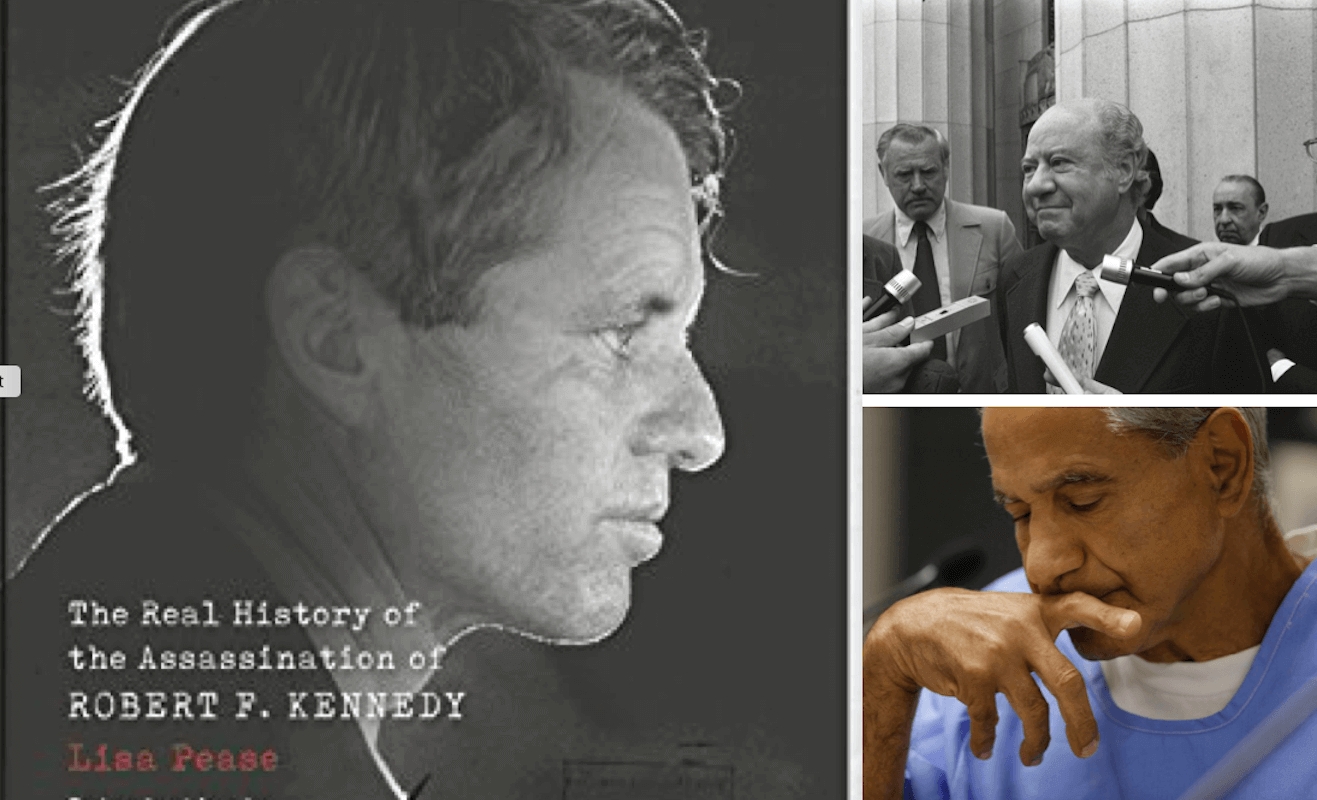
Tag: SIRHAN PAROLE

  • Sirhan’s New Parole Hearing

    Sirhan’s New Parole Hearing


    Update:

    If you have sent a letter and still have a copy on your computer, please email a copy to contact@kennedysandking.com with your name on it. If you have not sent the letter yet, please send us a copy, before you snail mail it. Thanks. This is important. We would not ask you if it wasn’t.


    We now have a definite date for Sirhan Sirhan’s upcoming parole hearing. As we all know, the plague of CV–19 has set back trials and hearings throughout the country (e.g. the trial of the notorious millionaire Robert Durst in Los Angeles).

    The revised date for Sirhan’s parole hearing is August 27th, about three months from now, which gives our readers that much longer to compose letters asking for Sirhan to be properly released. This particular hearing should have another advantage to it. The new LA District Attorney, George Gascon, has a different policy than most of his predecessors concerning parole hearings.

    Gascon will not allow his assistant DA’s to attend these hearings. That, in itself, is a reversal of a longtime procedure, because almost inevitably, these deputies would argue that the criminal should not be paroled. To his credit, Gascon’s policy has broken with this concept. (Click here for details) As he has said, that former policy assumed the individual had not evolved. Under Gascon’s policy, he will support parole for low or moderate risk cases, which the record says Sirhan certainly was and is.

    Due to what former California Attorney General, and now Vice President, Kamala Harris did with the Sirhan case, he probably will not get a new trial. The ambitious Harris understood that if this new trial was granted, Sirhan would likely go free. (Click here for details) She did not want that to occur on her watch.

    As Lisa Pease proves in her milestone book on the RFK case, A Lie too Big to Fail, Sirhan was convicted because his defense team was both incompetent and compromised. The case of the murder of Robert Kennedy is even more obviously a conspiracy than the case of John F. Kennedy. As anyone who reads Pease’s book will understand, not only did Sirhan not shoot Bobby Kennedy, he could not have done so. Not with the facts of Thomas Noguchi’s autopsy on the table and demonstrated in court, which they were not. (See Pease, pp. 65–69, 255–91)

    Because of the inept performance by Sirhan’s defense team, Sirhan was convicted. And the defendant has been in prison since 1969, a total of about 52 years. The reason for this updated notice is that Sirhan has a new attorney and part of her specialty is these types of hearings. His current attorney, Angela Berry, is requesting that interested parties write the parole board.

    But, and this is important, do not focus on the facts of the case in order to prove his innocence. I have done so ever so slightly here only to try and motivate the reader into writing on his behalf. Berry suggests instead that the writer of the letter accent things like Sirhan’s age, his spotless record in prison, the fact that the prisons are overcrowded, and that he is not a threat to anyone.

    In fact, he once said that if he ever got out, he would like to live a quiet life somewhere and help people if he could. (William Klaber and Philip Melanson, Shadow Play, p. 318) One might also add that Sirhan has served a much longer time than others convicted of homicide.

    Also, there is a new law in effect (see pages 7 and 9 of Youth Offender Parole here). This says that people under age 26 at the time of the crime—Sirhan was 24—should have their youth weighed higher in the parole decision. Berry adds that a key factor in a parole hearing can be public opinion. Hence, this appeal for you to write. That, plus Gascon’s new policy, could be influential in the outcome.

    Letters should be mailed to:

    State of California

    Department of Rehabilitation and Correction, Board of Parole

    Post Office Box 4036

    Sacramento CA 95812-4936

    Open with “Dear Parole Board” and ask them to parole Sirhan in accordance with the fact that he has served his time. Under normal conditions, being a model prisoner, Sirhan likely would have been released in 1985. (Shane O’Sullivan, Who Killed Bobby?, p. 3)

    Please do this ASAP. You will get a note in reply to certify your letter has arrived.

  • Sirhan’s Upcoming Parole Hearing

    Sirhan’s Upcoming Parole Hearing


    Anyone who knows anything about the assassination of Robert Kennedy should understand that his assassination is in some ways even more clearly a conspiracy than the murder of President Kennedy. The true facts of the case were covered up by the local authorities, and the defense team was—to put it mildly—rather less than zealous in their obligations to their client, Sirhan Bishara Sirhan. The best analysis of Sirhan’s phony trial is in Lisa Pease’s book A Lie Too Big to Fail. (See pp. 135–95) And in this author’s opinion, that is the best, most comprehensive book we have on the Bobby Kennedy case.

    As both Lisa Pease and the late Philip Melanson have noted, Sirhan’s defense was so inept—as we shall see, it may have been compromised—that they let the prosecution’s psychiatrist talk directly to their client. This is something he was not supposed to do and it would appear to be an ethical violation by Sirhan’s lead lawyer, Grant Cooper. What makes this more than just odd is that, as Pease notes, Cooper was accused of bribing a court clerk in order to pilfer grand jury transcripts and then lying to a judge about it. His investigation for these violations was going on at the time of Sirhan’s trial. (See Pease’s earlier article, “Rubik’s Cube”, Probe Magazine, Volume 5 Number 4)

    It then gets even more curious. After his inept defense of Sirhan, Cooper got off with a slap on the wrist for this offense: he was fined a thousand dollars. The late Larry Teeter, one of Sirhan’s attorneys, thought the light penalty for the serious violations was a result of Cooper’s rather dubious performance for Sirhan. Teeter voiced this opinion with the author in an in-person interview in late 2002.

    Perhaps that is one way to explain the direct interviews that the prosecution’s Seymour Pollack had with Sirhan. Pollack was a forensic psychiatrist from USC employed by the prosecution. That Cooper allowed this to occur was so unethical that defense assistant and later author on the RFK case, Robert Blair Kaiser, tried to say it did not happen. (Kaiser, RFK Must Die!, p. 151) But it did and the forensic psychiatrist spent hours with Sirhan trying to supply him with a motive for why he really killed Bobby Kennedy. What was that motive? Because he was standing up for the Arabs against Israel. (Philip Melanson, The Robert Kennedy Assassination, p. 152) In fact, Pollack went as far as to say that it would be better for his case if he did say this, than to say that he did not really know what his motive was. What is even more remarkable about this is that Cooper’s own psychiatrist, Bernard Diamond, ended up joining Pollack in trying to get Sirhan to say this. In fact, Diamond did this when he had Sirhan under hypnosis. (Pease, A Lie Too Big to Fail, pp. 417–18)

    One of the most oft repeated external indications of this motive was one that was used not just by the prosecution, but again, by the defense. And not just Sirhan’s original team, but later lawyers like Luke McKissack. It consisted of an entry in Sirhan’s notebooks which contained a notation on May 18, 1968, with the refrain “RFK must die”. The original story made up by the prosecution was that Sirhan saw a TV special that day in which candidate Kennedy endorsed a sale of fighter aircraft to Israel made by President Johnson. There is a very large problem with this allegedly incriminating scenario. The TV special did not air on May 18th, but on May 20th. (Philip Melanson and William Klaber, Shadow Play, pp. 136–37). Further, there was no mention of the weapons sale in the program. (ibid) Yet, the tall tale has grown so long, that years later Kennedy was supposed to be endorsing the deal in the program while in a temple wearing a yarmulke. This was a myth meant to supply Sirhan with some kind of motive, since initially he said he did not recall the circumstances of the shooting and did not know why he performed the act.

    As anyone who has read Pease’s book understands, not only did Sirhan not shoot Bobby Kennedy, he could not have shot the senator. It is simply a physical impossibility in light of Thomas Noguchi’s autopsy. (See Pease, pp. 65–69; pp. 255–91) All the indications are that Sirhan was under post hypnotic suggestion at the time of the shooting and, further, that he was being manipulated by a young, attractive woman in a polka-dot dress. This woman actually led Sirhan into the pantry after they had drank coffee together. And they were standing next to each other in the pantry while Kennedy was walking through. (Pease, p. 50) She was one of the very few people who actually ran out of the pantry area after the shooting.

    That young woman has all the indications of being the same person who Sandy Serrano saw after the shooting. Serrano was a Kennedy worker, who was standing outside the Ambassador Hotel to get some fresh air. The young lady ran down the stairs to the hotel and she yelled, “We’ve shot him! We’ve shot him!” When Serrano asked who she shot, the reply was, “We’ve shot Senator Kennedy.” When newsman Sander Vanocur interviewed Serrano live on national television, he had delayed reaction to what Serrano said. After a delay, he went back and asked, “Did this young lady say ‘we’?” Serrano replied in the affirmative. (Pease, pp. 35–36)

    Serrano never testified at Sirhan’s trial. Yet, her testimony clearly denotes some kind of a conspiracy. Combined with the incompatible forensics of the case, Sirhan should have been acquitted. As Pease demonstrates, for many, many reasons, this did not happen. Between the efforts of the LAPD to cover up the case, the incompetence—or worse—of Sirhan’s attorneys, and a rather sickening performance by the media, Sirhan was convicted. But it’s actually worse than that, because of the three monumental cases of the sixties—the murders of John Kennedy, Martin Luther King, and Robert Kennedy—that one became known as the “open and shut case”. In other words, you could not even ask any questions about it. When, as I noted earlier, it is the one in which the facts of the case most easily disprove the guilty verdict.

    Unfortunately for both Sirhan and justice, the defendant has been in prison since 1969, a total of over 51 years. The reason for this notice is that Sirhan has a new parole hearing that is coming up on March 21st. His current attorney, Angela Berry, is requesting that interested parties write the parole board.

    But, and this is important, do not focus on the facts of the case in order to prove his innocence. I have done so here only to try and motivate the reader into writing on his behalf. She suggests instead that the writer of the letter accent things like Sirhan’s age, his spotless record in prison, the fact that the prisons are overcrowded and he is not a threat to anyone.

    In fact, he once said that if he ever got out, he would like to live a quiet life somewhere and help people if he could. (Klaber and Melanson, p. 318) One might also add that Sirhan has served a much longer time than others convicted of homicide.

    Also, there is a new law (see pages 7 and 9 of Youth Offender Parole, prison.law.com) that says people under age 26 at the time of the crime—Sirhan was 24—should have their youth weighed higher in the parole decision. A key factor in a parole hearing can be public opinion. Hence this appeal for you to write.

    Letters should be mailed to:

    State of California Department of Rehabilitation and Correction
    Board of Parole
    P. O. 4036
    Sacramento, CA 95812-4936

    Open with “Dear Parole Board:” and ask them to parole Sirhan in accordance with the fact that he has served his time. Under normal conditions, being a model prisoner, Sirhan likely would have been released in 1985. (Shane O’Sullivan, Who Killed Bobby? p. 3)

    Thanks in advance. This kind of activism is what this site is about.

  • Lisa Pease, A Lie Too Big to Fail: The Real History of the Robert Kennedy Assassination

    Lisa Pease, A Lie Too Big to Fail: The Real History of the Robert Kennedy Assassination


    pease le flemIt’s a rare thing indeed when a book actually delivers everything you could wish for—and then some. I can count on one hand the number of books in recent memory that have achieved this. Incorporating over twenty years of research, personal interviews, deep archival digging, and a comprehensive survey of nearly all the extant literature and articles surrounding Robert Kennedy’s encounter with the unspeakable in the pantry of the Ambassador Hotel on the night of Jun 5, 1968, A Lie too Big to Fail will no doubt stand the test of time as the definitive book on the RFK murder. Pease establishes not only the most compelling case against the LAPD’s compromised (non-)investigation of the case to date, but reveals startling new discoveries, including previously unexplored forensic evidence, new witnesses to multiple shooters, and evidence of foul play at the highest levels of the United States political apparatus.

    Digging deep into the court records and transcripts of the also-compromised defense attorney who sold the 24-year old Sirhan Sirhan down the river before he ever had a chance at anything approaching a fair trial, Pease presents a firm case for why his fate—as he sits locked up in a California prison for life—cannot be justified in a democratic society. That Sirhan is still alive and paying for a crime he never committed brings a necessary urgency to her plea that the case be reopened. Because not only did Robert Kennedy’s murder signal the death knell of true progressivism in the United States political arena, but it served as perhaps the most arrogant abuse of power by a hidden hand that, for five decades, hijacked the United States’ foreign and domestic policy. Written with a gripping, driving cadence, the author’s narrative gifts are as pronounced as her investigative acumen. And with this book as her lifetime achievement on a case that still remains relatively obscure in light of the JFK assassination, she will likely establish herself as the preeminent authority on the subject for years to come.


    II

    Officially, minutes after delivering his victory speech in the Embassy Ballroom of the Ambassador Hotel in Los Angeles just after midnight, Senator Kennedy—to the cheers of his teeming supporters and staff—excused himself from the podium, proceeded backstage through a small passage leading to large double doors, entered the hotel’s kitchen pantry, shook hands with cooks and a busboy, and was shot to death. The sole perpetrator was held to be Sirhan Bishara Sirhan, a 24-year-old Palestinian immigrant who appeared in the confusion of the crowded space in front of the senator and fired a .22 caliber revolver at Kennedy, mortally wounding him and injuring five other people with his eight-shot discharge.

    Kennedy died almost a day later. He had multiple brain surgeries and finally succumbed to the massive damage of the shattered bullet fragments: his heart rate lowered to barely a pulse, then stopped. His funeral ceremony was one of the most highly attended in U.S. history. For people like Tom Hayden, original author of the Port Huron Statement, who sat crying in a church pew upon learning of the death of his hero, the senator’s untimely death was also the death of hope for a generation seeking to take their nation on a course of peace and social justice. With Richard Nixon’s victory all but assured in the confused scrambling of the Democratic Party to promote their second tier candidates, the United States was going to fundamentally change.

    That’s the official version of events we teach our kids in school and repeat ad nauseum in the mainstream media. The problem, of course is that when Thomas Noguchi, the LA County coroner who was tasked with performing Robert Kennedy’s autopsy, was finished, he discovered that the fatal shot, just behind his right ear into the victim’s brain, was fired with the gun barrel at contact range, which could not have been more than three inches. This was demonstrable, as Kennedy’s neck exhibited tell-tale signs of powder burn tattooing, or stippling, which Noguchi took great pains to demonstrate by setting up a test-firing at the LA Police Academy on mock human skulls made of latex and pig ears after the autopsy. Each officer was asked to fire at his respective target from six ranges: barrel-pressed against the target, a quarter inch, half inch, two inches, three, and finally four. Only at three inches, did the stippling dispersal pattern match that on Kennedy’s corpse. Of the nearly seventy witnesses in the pantry that night, none placed Sirhan closer than three feet, and most average a distance of approximately five to six feet. Equally troubling was the fact that the three shots which struck Kennedy were fired from behind and at equally sharp vertical angles, from low to high, which makes it physically impossible for them to have come from Sirhan’s gun, which even before he was attacked and restrained by bystanders, was by all accounts pointed directly at Kennedy in a flat, arm-outstretched fashion. We know Kennedy only perceived a threat from the front by the fact that numerous witnesses recall his hands defensively coming up to cover his face at seeing an approaching Sirhan before he fell to his knees, wounded, and then slumped to the floor where he lay dying in a pool of gathering blood from his fatal head wound.

    The immediate aftermath of the shooting is another one fraught with contradictory claims. Officially, the LAPD concluded—or as we will see, decided actively to conclude, with the urging of two former CIA interrogation experts who took over the investigation within days of the murder—there was no conspiracy. Sirhan was apprehended, everyone saw him shoot, Kennedy went down, case closed. And yet, as Lisa Pease aptly demonstrates, that is not at all what witnesses reported. Almost thirty separate people placed Sirhan in the company of a young lady in a polka dot dress, along with several male accomplices. Many of them saw her in the pantry, seemingly holding Sirhan, and having the same sickly smile on her face as they claim he did before he lurched forward with gun outstretched to make his move. Witness Sandy Serrano places her in the immediate aftermath of the shooting running down the fire escape to the back parking lot with her male companion—both of whom Serrano witnessed entering the hotel via this very fire escape with Sirhan Sirhan earlier in the evening. Serrano said she was exuberantly shouting, “We shot him!” When asked by Sandy who did she kill, the girl responded, “Kennedy! We killed him!”. They were overheard by the Bernsteins, an elderly couple in the parking lot who reported the incident to first-responder Paul Sharaga, of LAPD. When Sharaga put out an APB for these two suspects, he was told moments later by a superior at Ramparts station that, “We don’t want them to get anything started on a big conspiracy.” (Larry Hancock, “Incomplete Justice, Part One: At the Ambassador Hotel,” 5/19/2007) The APB was subsequently pulled, allowing any accomplices ample time to make their escape.

    Lisa Pease details this familiar chain of events and the controversy surrounding the clearly real accomplices, sited by dozens of witnesses throughout the ballroom and surrounding areas that night. With regard to figures like the infamous girl in the polka dot dress, she brings some fascinating new insights to the case: including the likely use of multiple teams and multiple polka dot women who were also part of the plot. Many have wondered: What would have happened had Kennedy exited via a different route? The author is quick to note that he was marked for death that night by the sheer number of likely assassins actually positioned in the Ambassador Hotel that evening. While as many as three shooters could have been in the pantry, the LAPD was immediately told to stand down in their pursuit of leads concerning anyone but Sirhan’s immediate family and friends. Therefore, we will probably never be able to say conclusively who these people were. Lisa Pease provides some excellent considerations though, and that is perhaps one of the most exciting parts of her new findings, along with some of her personal interviews which to my knowledge she is sharing here for the first time in print. That, plus the fact that SUS officers at Ramparts station also burned over 2,400 photos taken at the Ambassador ballroom in a hospital incinerator, removed and later destroyed key ceiling and door panels containing bullet holes because they “didn’t have room to store them,” and both discredited and intimidated major credible eyewitnesses: all this smacks of a systematic cover-up.


    III

    Stylistically, A Lie To Big To Fail achieves a fine balance between the immense complexity of the case—with its thousands of files, its many bizarre suspects and characters, its hypno-programming realities, and other strange but relevant source data—and the inherent drama of the event. We begin with an almost Raymond-Chandler-styled portrait of those fateful California nights spent with folks like director of The Manchurian Candidate John Frankenheimer (talk about situational irony) and other supporters, then progress to the primary victory speech at the Ambassador Hotel. The book is instantly engaging, no matter how familiar readers might be with the case. The accessibility of the book is another commendable feat Pease has pulled off; experts who have studied the case for decades will still find evidence and propositions they had never seen or considered, while a friend I loaned the book to—who had never examined the case—could just as easily engage with the text. That is no small feat. Too often a book in the assassination field presumes a level of familiarity with the subject material that is beyond the scope of most readers, while those that are more accessible often gloss over the depth and complexity of the subplots, and also motives and new information gleaned from recent declassifications. A Lie to Big to Fail does neither, and presents an eminently readable, thoroughly substantiated story that, in many respects, is stranger than fiction.

    Covering the gamut of the LAPD’s Special Unit Senator files, along with newly discovered archival footage from places like the California State Archive and local news agencies, Pease’s book is probably the most comprehensive I have ever read on this case, incorporating not only the limited but extremely useful secondary literature from the 1970s, 80s and recent times, but also combing the entire primary source record of the case as well. The author poured thousands of hours of personal research into the book. And it shows. Sources are meticulously detailed and annotated, in the classical manner with the references at the bottom of the page. This allows anyone with an internet connection to fact check most of her findings; some must be accessed in person in Sacramento and elsewhere.

    The other thing that really stands out in the book is the author’s refusal to argue she’s definitively solved the case. Don’t get me wrong: if anyone has come close to figuring out exactly what happened that night, it’s Lisa Pease. What I mean is that too often plots of this magnitude, which require not only clandestine funding, months of planning, a deeply complex cover-up often stretching decades, and the complicity of many high-level officials and planners, are traced to a single source: the mob, the CIA, the Minutemen, Nixon. What seems to be the case, and I will let readers reach their own conclusions, is that, as Lisa notes, there were aspects of both underworld crime liaisons, private military contractors, and off-the-books involvement of the Central Intelligence Agency in the persons of say Hank Hernandez and Manny Peña (USAID/CIA), and of course Robert Maheu (Howard Hughes Corporation/CIA). Thane Cesar has been and still is a prime suspect, given his anti-Kennedy, pro-segregation views and convenient placement as RFK’s escort in the pantry. That he “retired” from Ace Security, a job he’d had for only a few weeks, as he sarcastically stated during his exit interview with the LAPD, is also extremely suspicious. (RFK LAPD Microfilm, Volume 122, Reporters Daily Transcripts, Reinvestigative Files 1974—1978) p. 314). That Nixon was basically handed the presidency does not, of course, implicate him personally; though as the end of the book suggests, there is anecdotal evidence his brother Don was indeed apprised of the events surrounding the assassination and informally debriefed shortly thereafter. In a diary entry that Pease personally procured from John Meier, a Howard Hughes top aide from 1966 to 1970, Meier wrote on June 6, 1968:

    Bob Maheu called to ask about the Don Nixon meeting and suggested 8:30 breakfast at the Desert Inn Country Club (in Las Vegas). I went to the club. Maheu was all smiles, and Don Nixon walks in an all smiles. What followed next had to be seen to be believed. They embraced each other and Don Nixon said, “Well that prick is dead,” and Maheu said, “Well it looks like your brother is in now.” (Pease, p. 493)

    This book also presents perhaps the most balanced look at the controversy surrounding the potential and very likely programming Sirhan underwent before his arrival on the scene. Drawing from both familiar and quite obscure cases, where people were indeed exposed as hypno-programmed assets operating against their will with no working knowledge of how or why they performed various acts and crimes, she gives those in the research community a solid footing on which to stand in what amounts to the hardest part of the case for the MSM to digest. Given the CIA’s millions of dollars of research into its MK-ULTRA and related mind control experiments, along with the accounts provided in Pease’s later chapters, even the most skeptical critics will be hard pressed now to discredit this exotic but very real use of actionable hypnosis.


    IV

    Sirhan remains languishing in prison to this day, narrowly avoiding the gas chamber by a lucky break which saw California abolish the death penalty in 1972. Despite his good behavior, insistence that he has no memory of the events in the pantry, his numerous and sincere interviews with new therapists and hypno-suggestive experts, his fate remains sealed. William Pepper, the attorney and barrister who represented the King family during their 1999 civil trial against Lloyd Jowers, in which a Shelby County jury determined Martin Luther King had been assassinated as a result of a conspiracy, has joined attorney Laurie Dusek in a bid to free Sirhan from a crime we know he could not possibly have committed.

    Senator Kamala Harris, who served as the California Attorney General until 2017, and who was also the DA of San Francisco from 2004 to 2011, insisted since the parole hearing reached her desk in 2012 that Sirhan is still guilty. Following the release of an audio tape found in the California State Archives which captured what acoustics expert Philip Van Praag believes is thirteen distinct shots in the pantry, Harris was confronted by the very real possibility that Sirhan was not a lone gunman. Harris calls Van Praag’s analysis “pure speculation.” (Martinez and Johnson, “Prosecutors, attorneys argue: Was there a second gun in RFK assassination?” CNN, 3/12/2012)

    Similarly, despite the very real fact that hypno-programming has been successfully deployed in military, civilian, and criminal plots, and other special operations dating back to the early 20th century, Harris refuses to accept its possible use on Sirhan in the RFK saga. Upon reading the adamant testimony of Harvard professor of forensic psychiatry and hypnosis, Dr. Daniel Brown—who spent over sixty hours interviewing Sirhan—Harris claimed, “The theory that a person could be hypnotized into planning and committing a murder against his will is a controversial (if not fantastic) one and has not been adopted by most of Brown’s peers, including the American Psychological Association.” She continues, “Thus, even if Sirhan could show that some psychologists believe in mind control or hypno-programming, his showing of actual innocence is nevertheless based on a debatable theory that is not universally accepted in the psychology community.” (CNN, 3/12/2012) Brown, in a signed 2011 affidavit, stated, “I have written four textbooks on hypnosis, and I have hypnotized over 6,000 individuals over a 40-year professional career. Mr. Sirhan is one of the most hypnotizable individuals I have ever met, and the magnitude of his amnesia for actions under hypnosis is extreme.” (Tom Jackman, “The Assassination of Bobby Kennedy: Was Sirhan Sirhan hypnotized to be the fall guy?” Washington Post, 6/4/2018)

    What is actually a debatable theory, in reply to DA Harris’ conclusions, is that three bullets fired at very close range and one at contact range (the fatal head shot behind the right ear), all from behind and at a steep upward angle are supposed to have come from a weapon that was always at least three feet in front of the target. Or that at least thirteen bullets were fired from a gun which could only hold eight, and which likely fired no real bullets, just blanks. These are solidly based facts of the case, yet they are treated as conjectures. If other major legal cases were handled with this much disregard for forensic evidence, lawyers would be disbarred. And if Sirhan had been offered a fair trial—another exceptional chapter of A Lie Too Big to Fail—it is almost certain he would be a free man. But the special logic applied by those seeking to obfuscate the sinister implications of the final major assassination of the 1960s continues to hold fast, at least at the legal level.

    Things are changing though, and it would seem that the concerted efforts of those like Lisa Pease, along with the recent public denial of the official version of events by none other than Robert Kennedy Jr., may be turning the tide towards the real evidence which supports a concerted high-level conspiracy to remove a potential president. It was with a real sigh of relief that I read a recent Washington Post summary of Lisa’s new findings, one that, for a change, actually took her argument seriously and did not attempt to reduce her thesis to fringe theory. In the fifty-one years of relative silence surrounding the case, dotted here and there by books and talks by people like Allard Lowenstein, Ted Charach, Philip Melanson and others, that’s a true testament to the work of informed citizens uncovering the darker chapters of their nation’s history. As journalist Tom Jackman’s article notes, “Robert F. Kennedy Jr., the son of the slain senator, said he thought Pease was ‘a great researcher.’ Similarly, Kennedy said that his own investigation, which included meeting with Sirhan in prison in December 2017, showed that ‘Sirhan could not and did not fire the gun that shot and killed my father.’” (Jackman, “CIA may have used contractor who inspired ‘Mission Impossible,’ to kill RFK, new book alleges,” Washington Post, 2/9/2019)


    V

    A Lie Too Big To Fail is more than a window into one of the most fascinating and disturbing assassinations of the sixties. It is a work whose implications are relevant to anyone trying to understand how the United States devolved into a shell of a country whose tenets of equality, freedom and justice have gone by the boards, leaving us with a paper-thin facade of a democracy embodied by charlatans who wear red and blue uniforms but who essentially represent the same corporate and military-industrial overlords, or what Colonel Fletcher Prouty once referred to as “The Secret Team:”

    It is a sinister device of opportunity and contrivance. What does exist is the mechanism. What exists is the automatic system, much like a nervous system or an electrical system. More properly, what exists is like a giant electronic data processing machine … which has its own power to grow, to reproduce, and to become more insidiously effective and efficient as it operates. It is a great intra-governmental infrastructure that is fed by inputs from all sources. It is big business, big government, big money, big pressure, and headless—-all operating in self-centered, utterly self-serving security and secrecy. (Prouty, The Secret Team: The CIA and its Allies in Control of the United States and the World, p. xvii)

    It was Jim Garrison who eerily predicted this in an obscure and brief interview less than a month after the RFK slaying. Art Kevin, host of Los Angeles’ KHJ Radio, asked the New Orleans District Attorney,

    AK: Jim … are you prepared to say that the same elements responsible for the death of John F. Kennedy were responsible for the deaths of Senator Robert F. Kennedy and perhaps even Martin Luther King?


    JG: Well, you can remove the perhaps. The answer is “of course,” except that in the case of Senator Kennedy, they apparently interposed a cover organization.

    A bit later:

    JG: But there’s no, I don’t think there’s any question about the fact that the same forces removed everyone. Every one of these men were humanists. They were concerned about the human race. They were not racist in the slightest way, and above all, they were opposed to the evolution of America into an imperialist empire-seeking warfare state. Which it has become, I’m afraid. And now there aren’t too many, now there aren’t too many leaders left to talk out loud against the war in Vietnam. They’re eliminating them, one by one. Always a lone assassin. (“Jim Garrison says RFK was Hip to Murder Plots,” San Francisco Express-Times, 7/3/1968)

    Entrenched in an almost two-decade long foreign policy disaster in the Middle East and Afghanistan, riddled with crippling, insurmountable debt, with young people more despondent and driven to self-medication and violence, the United States of 2019 is unquestionably the dark legacy of those tiny .22 caliber slugs flying through the pantry that fateful July night. As political philosopher Sheldon Wolin described it, the United States in the past half-century has come to resemble an inverted totalitarian government. By that he means, a state run not by a traditional dictator like Stalin, Mao or Mussolini, but one even more ruthlessly efficient at quelling dissent and spreading disinformation through a diffuse and impossible-to-pin-down network of powerful and manipulative factors, from the corporate media to lobbyist groups, to the hollow candidates propped up every four years for the election circus:

    Antidemocracy, executive predominance, and elite rule are basic elements of inverted totalitarianism. Antidemocracy does not take the form of overt attacks upon the idea of government by the people. Instead, politically it means encouraging what I have earlier dubbed ‘civic demobilization,’ conditioning an electorate to being aroused for a brief spell, controlling its attention span, and then encouraging distraction or apathy. The intense pace of work and the extended working day, combined with job insecurity, is a formula for political demobilization, for privatizing the citizenry. It works indirectly. Citizens are encouraged to distrust their government and politicians; to concentrate upon their own interests; to begrudge their taxes; and to exchange active involvement for symbolic gratifications of patriotism, collective self-righteousness, and military prowess. Above all, depoliticization is promoted through society’s being enveloped in an atmosphere of collective fear and of individual powerlessness: fear of terrorists, loss of jobs, the uncertainties of pension plans, soaring health costs, and rising educational expenses. (Wolin, Democracy Incorporated, p. 239)

    Indeed, many of these issues, which could have been addressed in Dr. King’s Poor People’s March—which RFK conceived and encouraged MLK to undertake—have never been seriously resolved in the last fifty years of American history. The powerful and vigorous aspirations of those like Tom Hayden, which burned briefly and flickered out with RFK’s assassination, have not been rekindled. After Robert Kennedy’s death, there have not been any significant, ideologically divergent political candidates offering real change or practical solutions to basic entrenched issues in the United States. What we got was Richard Nixon, Gerald Ford, Jimmy Carter. It then got worse with the full-blown neoconservative movement’s apotheosis in the persons of Ronald Reagan, followed by George H. W. Bush, and W. In effect, the antithesis of everything which people like Martin Luther King, JFK, Malcolm X, and Robert Kennedy represented.

    But we must not lose hope, however bleak the future looks. And it is our responsibility not to. As Lisa Pease has so expertly done in her recent book, everything is in our power to expose the lie which still surrounds RFK’s untimely end. As the author concludes in her final passages, “He spent the last years of his life tilting at the windmills of greed and self-interest that ultimately cut him down. But his song lives on in all of us who strive, in whatever ways we can, to reach those unreachable stars.” (Pease, p. 504)


    Some related items:

  • Requiem for Rose Lynn Mangan

    Requiem for Rose Lynn Mangan


    manganWe have been informed by Paul Schrade that Rose Lynn Mangan passed away in late February of this year. Many people probably do not know who she was, for the simple reason that she was a person who worked mostly behind the scenes. Off and on, she had been the chief researcher for Sirhan Sirhan’s defense team for many years. No one had spent as much time looking at the evidence in the RFK case than she did. Mangan lived in Carson City, Nevada, so it was not that far for her to drive to the Sacramento State Archives where much of the surviving evidence in the Robert Kennedy assassination was maintained.

    If one studies the RFK assassination, which unfortunately not very many people do, one can see how Mangan fit into the historical backdrop on that case. At the start, very few people had any inclination or intuition that the Robert Kennedy case was anything but what it appeared. A young man, apparently in a fit of rage, jumps forward out of a crowd in the pantry of the Ambassador Hotel. He then fires at the person who, most people thought, was going to be the next president. Everyone’s eye is drawn to this young man as Bobby Kennedy sinks to the floor. Sirhan is immediately apprehended and taken to the police station. No one who was alive then can forget the next day’s death announcement by Frank Mankiewicz.

    But as is usually the case in these shattering instances, something was going on that was largely undetected, even though it was happening in plain sight. First of all, a witness named Sandy Serrano was on television late that night and told newsman Sander Vanocur that she saw a girl in a polka dot dress running down the rear stairs of the Ambassador Hotel with a young man. She said, “We shot him! We shot him!” When Sandy asked, “Who did you shoot?” The girl replied, “Senator Kennedy!” She and her companion then disappeared into the night. That same evening on Ray Briem’s LA radio talk show, a professional psychologist named William Bryan called in to the program. He said that, from his experience, the suspect sounded to him like he was acting under the direction of post-hypnotic suggestion, i.e., like a Manchurian Candidate. (The Assassination of Robert F. Kennedy, by William Turner and Jonn Christian, p. 226) A young high school student named Scott Enyart took photos of the shooting at the Ambassador. He was stopped by the police at gunpoint as he left the hotel. His photos of the crime scene were taken from him—and he never got them back. As many have commented, Enyart’s pictures may have been the Zapruder film of the RFK assassination. (The Assassinations, edited by James DiEugenio and Lisa Pease, pp. 619-21)

    Then there was William Harper. Harper was a well-respected criminalist who worked for, among other departments, the Pasadena police. He had a serious problem with the RFK case from the start. The reason being that he had a professional dispute with the LAPD’s chief criminalist DeWayne Wolfer. Being familiar with the shoddiness of Wolfer’s work, he had warned Sirhan’s defense lawyer Grant Cooper not to accept any of Wolfer’s findings at face value. (ibid, p. 556) Cooper did not pay heed to this well-founded warning. He actually did the opposite. He agreed to stipulate to Wolfer’s forensic findings concerning the ballistics evidence. To say the least, this had disastrous results for Cooper’s client Sirhan Sirhan. For now the trial of Sirhan became not about the guilt or innocence of the defendant; it was about Sirhan’s mental state at the time of the shooting. Because of Cooper’s blunder, Sirhan was condemned to death. But due to a later California Supreme Court decision, this was altered to life in prison.

    Two things happened after Sirhan’s trial that changed some people’s perceptions about the RFK case. Art Kunkin, the publisher of the LA Free Press, ran a story by one of the very few people who had studied the actual ballistics evidence in the pantry of the Ambassador Hotel. Lillian Castellano had analyzed the bullet evidence in the case, and she came to the conclusion that Sirhan could not have been responsible for all the projectiles that had been fired that night. Especially in light of the fact that hotel maître-d’, Karl Uecker, said that he went for Sirhan’s gun after he fired the first shot and had it controlled, at the most, after the second shot. Besides Kennedy, there were five other people shot, one of them twice. RFK was shot four times. The maximum number of bullets Sirhan’s gun could hold was eight. Castellano’s article began to cast doubt on LAPD’s honesty in building its case against Sirhan. Inversely, it indicated just how inept his defense had been.

    Harper had read the witness testimony from the pantry, and also the lengthy autopsy report by Dr. Thomas Noguchi. He went even further than Castellano. He concluded that there had to have been two assassins firing from two different directions. Allowed to test the bullet exhibits, he then concluded that they had been fired from two different weapons. (DiEugenio and Pease, p. 556)

    When Rose Lynn Mangan became the official investigator for the Sirhan case, she and Harper became friends. He even gave her his files on the case. When his affidavit about the two firing positions went public in 1971, he became a magnet for informants inside the LAPD. One of the things he told her in no uncertain terms is: “They switched the bullets; they switched the guns.” One of the things Mangan always said about Harper was that his information always checked out. (ibid, p. 565)

    Mangan served as Sirhan’s researcher from 1969-74. Then, at Sirhan’s request, she returned in 1992. In 1996 she made a memorable appearance at the civil trial of Scott Enyart vs. LAPD. As mentioned previously, Enyart was a high school photographer who was in the pantry at the Ambassador Hotel when RFK was shot. He kept on snapping photos during the firing sequence. But as he left the scene he was accosted by the police and told to turn over all of his film. Once he did, the police said they would develop the film because they needed it for the upcoming criminal trial. That statement turned out to be false, since they did not use the evidence at Sirhan’s trial. (Ibid, pp. 619-20) But when the trial was over, Enyart asked for his pictures back. He got back less than twenty per cent of them—and no negatives. He was then told that the rest would now remain secret and be archived for twenty years.

    Enyart waited for almost 20 years. In 1988 the LAPD told him that his photos were now in the state archives in Sacramento. But when Scott wrote to Sacramento, the archivist told him they were not there. He concluded that they were gone, part of the many photos incinerated by LAPD in 1968. But since the police had always maintained that the destroyed pictures were duplicates, Scott maintained that his photos must still exist. And he wanted the originals returned to him. Since he was up on a steam table during the shooting, his photos would have significant monetary value.

    Quite naturally, Enyart felt he was being given the runaround. He sued. The city appealed on a technicality. They won the appeal. But Scott won a reversal of that decision. The case was scheduled for trial in 1996. Then something utterly bizarre happened. Miraculously, the LAPD announced that Scott’s pictures had been recovered. Scott disagreed with this pronouncement, since these allegedly recovered photos were on different film stock, and none depicted what went on inside the pantry. (ibid, p. 620) Nevertheless, these photos were sent to Los Angeles from Sacramento via courier for use at the civil trial. They were then stolen out of the back seat of the automobile while it stopped at a gas station. As Scott’s lawyer said, “Somebody, for some reason, is making sure those photos do not reach public view.” (LA Times, 1/18/96)

    At the trial, Mangan exposed another layer of perfidy in the RFK evidentiary record. The police needed to explain why and how the photos suddenly appeared out of the blue, after seemingly being lost for decades. The police tried to explain this all as a mistake in record keeping. The photos had been misfiled under another person’s name on the wrong list. By diligently crosschecking the lists, they were rediscovered. If not for the theft from the courier, all would have been explained satisfactorily.

    Scott needed someone with expansive and intimate knowledge of the files at the state archives. No one was better qualified than Mangan. Clearly, the plaintiffs were unaware of who she was and were unprepared for her testimony. Mangan completely negated this LAPD cover story. Since she was familiar with all the evidence filings across all the categories, she knew that LAPD was playing a shell game. They had played around with their own property list to create a file that was not really in the Sacramento archives, under a name that was not at all related to Scott Enyart’s. (Probe Magazine, January-February 1997, p. 8) No one else could have supplied that crucial information, which helped Enyart win a jury verdict. Her testimony also indicated that the heist of the photos from the car was most likely an elaborate ruse. This is how deeply embedded the RFK cover up is inside the LAPD.

    Shortly after her appearance at the Enyart trial, Lisa Pease visited Mangan at her home in Carson City. This was in preparation for a long two-part article in Probe Magazine. In that essay, it was through Mangan that the significance of Special Exhibit 10, and the dubious markings on the bullets, were explained, the latter for the first time. Mangan had documentation on Special Exhibit 10, the secret microphotograph that was supposed to be the ace in the hole if there was ever a reopening of the Robert Kennedy assassination. In the mid Seventies, there was a legal hearing under Judge Robert Wenke. A firearms panel was appointed to examine some of the ballistics evidence in the case. They examined Special Exhibit Ten. They discovered something that Thomas Noguchi already knew: this exhibit was a fraud. It purported to be a comparison photo of the Kennedy neck bullet with a test bullet fired by Wolfer. But the Wenke Panel deduced that such was not the case. It was actually a comparison between an RFK bullet and another victim bullet, Ira Goldstein’s. As Lisa Pease wrote, “So someone was pulling yet another fraud in this case by concocting evidence in the hopes of convincing a panel of experts that a test bullet from Sirhan’s gun matched a bullet from Kennedy himself.” (DiEugenio and Pease, p. 564)

    But on her visit to Mangan, Pease was shown still another level of deception in the RFK case. Recall what Harper told Mangan: They switched the guns. They switched the bullets. And recall what Mangan said about Harper’s reliability: his information always checked out.

    Patrick Garland was the evidence master for the Wenke Panel proceedings. In that examination, the Kennedy neck bullet, #47, bore the markings ‘DWTN’ on its base. The Goldstein/victim bullet, #52, bore only a ‘6’. But these were not the original markings. Number 47 should have had a ‘TN31’ on its base. Number 52 should have had only an ‘X’. In other words, this evidence clearly indicates that someone switched the bullets, and then made the phony photograph. Besides the inherent fraud in the false comparison, this also clearly implies that Wolfer could not get a match from the gun in evidence.

    mangan lancerAt the time of her passing, Mangan had a book contract with JFK Lancer about her life as Sirhan’s Researcher, to be published in June, 2018. It was to be based upon the extensive files she had accumulated over the decades she had worked on the RFK case and visited the Sacramento Archives. Lancer is going forward with its publication in a revised format.  Debra Conway will also be visiting Carson City to collect the Mangan files; her archives will be preserved, scanned and will be made available online along with the publication. While we await her complete files to be deposited online, anyone interested in the Bobby Kennedy case should visit her web site, which is still being maintained.
    We all owe Rose Lynn Mangan a salute upon her passing. She worked the primary evidence in the RFK case like no one else did.

    ~Jim DiEugenio


    Mangan was a guest with Len Osanic on Black Op Radio a number of times; her last appearance was on:

    Show #769 Original airdate: February 11, 2016 – Listen here


    Also, listen to a tribute by Bill Pepper, Jim DiEugenio and Lisa Pease:

    • Show #839
    • Original airdate: June 15, 2017
    • Guests: Jim DiEugenio / William Pepper / Lisa Pease / Lynn Mangan
    • Topics: Sirhan’s Researcher, Lynn Mangan (click the logo below and scroll down):

    mangan blackop

  • This is the Washington Post?


    Remarks on the February 11, 2016 article by Peter Holley

    This article by Peter Holley about Paul Schrade’s epochal appearance at the parole hearing for Sirhan Sirhan is well worth reading in its own right. But it is exceptional in another sense. It appeared in the Washington Post. As readers of this site, and of any literature on how the media deals with the assassinations of the sixties will know, the Post has a terrible record in dealing with the assassinations of the sixties. That record began in 1963 and went all the way up to, at least, the reception given Oliver Stone’s film JFK. If one recalls the latter, reporter George Lardner got hold of a renegade early draft of the script for Stone’s film and he used that to attack the picture—six months in advance of the movie’s premiere. In fairness, Stone then asked for space to reply. This was refused. So Stone then said he was going to buy a full page ad and use that to reply. The Post then relented. Stone and screenwriter Zach Sklar were allowed to publish a reply; but Lardner got the last word.

    That attack by the Post launched something that was pretty much unprecedented in the history of both cinema and the press. Lardner’s article began a 180-day campaign to infest the public with a jaundiced view of a film that they would not see for at least a half-year. This writer has never seen anything like that campaign: either before or since. Then, the week Stone’s film premiered, the Post’s sister publication, Newsweek, smeared the picture on its cover. That cover story was headlined, “The Twisted Truth of JFK: Why Oliver Stone’s New Movie Can’t be Trusted.” The periodical used perennial and reliable Jim Garrison critics like Hugh Aynesworth and Rosemary James to pummel the film. The magazine also hired four ancillary writers to contribute to that issue so they could get as much negative publicity out as soon as possible.

    That particular Post attack was carried out under the auspices of Len Downie. In 1991, Downie took over the executive editorship of the Post as Ben Bradlee’s successor. As this author has written, Bradlee had a very curious relationship with his alleged friend John F. Kennedy. (See this two-part article) Because throughout his long reign as a chief editor at the Post, from about 1965-1991, Bradlee never allowed any critical discussion of the JFK case to enter his pages. For instance, when Anthony Summers called Bradlee to tip him off about the whole Antonio Veciana/David Phillips meeting at the Southland Center in Dallas, Bradlee put a British intern on the story by the name of David Leigh. What Leigh did not know is that Phillips had called Bradlee about the story also. When Leigh came back and said the story looked real to him, that did not matter. Because of his relationship with the CIA and Phillips, Bradlee would spike the story anyway. (James DiEugenio, Destiny Betrayed, pp. 363-64)

    Bradlee’s obstinate attitude on the JFK case extended to the Robert Kennedy assassination. In the mid-seventies, through the efforts of people like LA county supervisor Baxter Ward, and film-maker Ted Charach, there was an effort to reopen the RFK case. A high level Democratic Party political operative, attorney Lester Hyman, decided to call Bradlee. He told the editor about certain elements of the crime that had now come out into the open, e.g., the second gun controversy. That is, there was a second gun firing in the pantry of the Ambassador Hotel in addition to Sirhan’s. He also mentioned some work done on the RFK case by Ramparts contributing editor William W. Turner. Bradlee told Hyman he would put someone on the assignment.

    Unfortunately, but predictably, Bradlee placed Ron Kessler on the story. At that time, Kessler had been with the Post for about five years. He ended up being one of the many reporters and journalists Bradlee hired that turned the Post into an almost civilian outpost of the intelligence community. Suffice it to say, Kessler would later write a terrible book about the Kennedys called The Sins of the Father; even later he became a mainstay at Chris Ruddy’s online Newsmax. Ruddy was the journalistic hit man on the Clintons for the late multi-millionaire Richard Mellon Scaife.

    As Turner related in his book, Kessler asked him who he should talk to about the case first. Turner said he should talk to criminalist William Harper, and then Jonn Christian. Harper would explain to him how Sirhan Sirhan could not have killed Bobby Kennedy. Christian could then give him some leads about what actually did happen. (The Assassination of Robert F. Kennedy, by William Turner and Jonn Christian, pp. 311-13)

    To put it simply, Kessler did not follow Turner’s leads. Once he arrived in Los Angeles, he immediately met up with local police and FBI agents who all backed the official story of Sirhan being the only person firing that night. . He also met with writer Robert Blair Kaiser who had written a book on the case that said that Sirhan was the sole assassin. It was only after these meetings that Kessler met with Harper. Harper told Turner that Kessler was so obtuse about the case that he gave up trying to educate him. He stood up and handed him his short essay on the ballistics of the murder—which Kessler refused to accept. Kessler never got in contact with Christian. But he told Turner that Bradlee had given him an open-ended schedule for the story and, although he was headed back to Washington, he would soon return.

    Kessler did not come back. Three days after telling Turner about Bradlee’s open-ended schedule, his story on the RFK case appeared on the front page of the Washington Post. It was titled “Ballistics Expert Discounts RFK 2nd Gun Theory.” The first sentence of the 12/18/74 story was, “The nationally recognized ballistics expert whose claim gave rise to a theory that Robert F. Kennedy was not killed by Sirhan Bishara Sirhan, this week admitted there is no evidence to support his contention.” As Turner notes, Kessler’s story was picked up by nearly every newspaper outlet in the nation. (ibid, p. 312)

    This is not what Harper told Kessler. And it is not what was in Harper’s synopsis—which is why Kessler refused to accept it. When Hyman called Bradlee to ask for a right to reply, as with Stone, he got a refusal. As Turner writes, “Despite persistent requests, Bradlee refused to print a correction, retraction or Harper’s version.” (ibid) Kessler’s article was so bad, the Columbia Review of Journalism singled it out as an object lesson in unfair reporting. (ibid, p. 313)

    With all that—and much more—in mind, the story that ran in the Post on February 11th of last week, which we linked to in our news section, is a bit stunning. Written by one Peter Holley, it is actually a fair and objective account of Sirhan’s latest parole hearing. That story focuses on the appearance of former labor leader Paul Schrade before the panel. Schrade, an RFK campaign worker, was at the Ambassador Hotel the night RFK was killed. He was actually walking through the hotel pantry behind the senator when both he and Kennedy were struck by bullets. The forensic problem which arises is that although they were walking in the same direction, Schrade was hit from the front and RFK from behind. As Schrade is quoted by Holley, “The truth is in the prosecutions’s own records and the autopsy. It says Sirhan couldn’t have shot Robert Kennedy and didn’t. He was out of position.”

    The story then gets better. Holley now quotes Schrade’s words to author Shane O’Sullivan: “The LAPD and LA DA knew two hours after the fatal shooting of Robert Kennedy that he was shot by a second gunman and they had conclusive evidence that Sirhan Bishara Sirhan could not and did not do it.” The story also delves into the problem of the number of shots that could be fired from Sirhan’s gun, versus the number of wounds in both Kennedy and the five other victims. It even includes the revolutionary audio analysis made in 2007 by technician Phil Von Praag of a tape recording of the shooting recovered from the California archives which reveals at least 13 shots being fired that night. Yet Sirhan’s revolver carried a maximum of eight cartridges.

    Can anyone imagine this kind of stuff being written in the Post under Bradlee or Downie? What makes it even more startling is that Holley didn’t even go to the other side, e.g., Dan Moldea or Mel Ayton, to counter these arguments.

    As everyone knows, Amazon.com owner and founder Jeff Bezos purchased the Post several years ago for a shockingly low figure of 250 million. He kept most of the editorial page in place. But he has hired new reporters, and also Ryan Kellett, who is the “audience and engagement editor”, a title that had to come from Bezos’ management style at Amazon.com. Holley came from Texas where he worked for Houstonian Magazine and the San Antonio Express-News. This is unlike Bradlee who hired either from New York or in the Beltway area.

    Let us keep our fingers crossed and hope for the best with this rather refreshing new take on the RFK case by the Post. Meanwhile, we all owe thanks to Schrade for showing up at the hearing. And we should also congratulate Holley, which you can do by emailing him at his byline. Tell him to keep up the fine work. No more Kesslers.

  • Shane O’Sullivan Letter Concerning Sirhan’s Parole


    (Click here if your browser is having trouble loading the above.)

  • Sirhan Parole Board Transcript


    (Click here if your browser is having trouble loading the above.)

  • Full text of Paul Schrade’s statement before Sirhan’s parole board

    Full text of Paul Schrade’s statement before Sirhan’s parole board


    Wednesday, February 10, 2016, at the Richard J. Donovan Correctional Facility

    I am Paul Schrade of Los Angeles. I am 91-years-old. And back when I was 43, I was among six persons shot at the old Ambassador Hotel in Los Angeles at just after Midnight on June 5th, 1968.

    I was shot along with Senator Robert F. Kennedy, who had just won California’s Democratic Primary Election for the Presidency of the United States. Five of us survived our wounds. And as history knows, Senator Kennedy was fatally wounded.

           I am here to speak for myself, a shooting victim, and to bear witness for my friend, Bob Kennedy.

    Kennedy was a man of justice. But, so far, justice has not been served in this case. And I feel obliged as both a shooting victim and as an American to speak out about this – and to honor the memory of the greatest American I’ve ever known, Robert Francis Kennedy.

    Sirhan Bishara Sirhan was originally scheduled for release in 1984 but, after intense political pressure, his parole date was rescinded and he has since been denied 14 times.

    In order for you to make an accurate determination of Sirhan Sirhan’s parole, you need to know my feelings on this case and the full picture of what actually happened.

    Sirhan, I forgive you.

    The evidence clearly shows you were not the gunman who shot Robert Kennedy. There is clear evidence of a second gunman in that kitchen pantry who shot Robert Kennedy. One of the bullets – the fatal bullet – struck Bob in the back of the head. Two bullets struck Bob literally in his back. A fourth bullet struck the back of his coat’s upper right seam and passed harmlessly through his coat. I believe all four of those bullets were fired from a second gunman standing behind Bob. You were never behind Bob, nor was Bob’s back ever exposed to you.

    Indeed, Sirhan, the evidence not only shows that you did not shoot Robert Kennedy but it shows that you could not have shot Robert Kennedy.

    Gentlemen, the evidence clearly shows that Sirhan Sirhan could not and did not shoot Senator Bob Kennedy.

    Several days ago, I made sure that several documents were submitted to this board for you to review. If you have not done so as yet, I would ask you to please review them very carefully during your deliberation. I will be glad to re-submit these documents to you, here today.

    I believe, after you review these documents, that it should become clear to you that Sirhan Sirhan did not shoot – and could not have shot – Robert Kennedy. What I am saying to you is that Sirhan himself was a victim.

    Obviously there was someone else there in that pantry also firing a gun. While Sirhan was standing in front of Bob Kennedy and his shots were creating a distraction, the other shooter secretly fired at the senator from behind and fatally wounded him. Bob died 25 hours later.

    Gentlemen, I believe you should grant Sirhan Sirhan parole. And I ask you to do that today.

    Along with what Sirhan’s lawyers have submitted to you, the following are the documents that I made sure were submitted to you and which should also be factored into your decision today.

    First, I want to show you this. It’s a letter written in 2012 by my good friend, Robert F. Kennedy Junior. Bobby wrote this letter to Eric Holder, who was then the Attorney General of the United States. In his letter to Mr. Holder, Bobby requests that federal authorities examine the Pruszynski Recording, the only known audio recording made of his father’s assassination at the Ambassador Hotel. The recording was uncovered in 2004 at the California State Archives by CNN International senior writer Brad Johnson.

    This next document is a federal court declaration from audio expert Philip Van Praag, who Johnson recruited to analyze the Pruszynski Recording.

    In this document, Van Praag declares that his analysis of the recording concludes that two guns were fired in the Robert Kennedy shooting.

    Van Praag found a total of 13 gunshots in the Pruszynski Recording. Sirhan’s one and only gun at the crime scene held no more than eight bullets and Sirhan had no opportunity to reload it.

    Van Praag also found what he calls “double-shots” – meaning two gunshots fired so close together that they could not both have come from Sirhan’s Iver Johnson Cadet revolver. Van Praag actually found two sets of these “double-shots”.

    Additionally, he found that five of the 13 gunshots featured a unique audio resonance characteristic that could not have been produced by Sirhan’s gun model, meaning those five shots were fired from a second gun of a different make.

    Van Praag further found that those five gunshots were fired in a direction heading away from Pruszynski’s microphone. Since the microphone was about 40 feet west of the Kennedy shooting, those five shots were fired in an eastward direction, which was opposite the westward direction that Sirhan is known to have fired his eight-shot Iver Johnson Cadet.

    These documents are statements from two witnesses to the Robert Kennedy shooting, both of them assistant maître d’s for the Ambassador Hotel. These two men, Karl Uecker and Edward Minasian, escorted Robert Kennedy into the kitchen pantry immediately after the Senator delivered his victory speech in a hotel ballroom for having won the California Primary. Both Uecker and Minasian say Sirhan was in front of Bob Kennedy as the Senator walked toward Sirhan, meaning that Bob and Sirhan were facing each other. Both witnesses say Sirhan was still in front of Bob as Sirhan fired his gun. And both say that after Sirhan fired his first two shots, Uecker quickly pushed Sirhan against a steam table, placing Sirhan in a headlock while grabbing hold of Sirhan’s firing arm, forcing the tip of Sirhan’s gun to point away from where Bob Kennedy was and causing Sirhan to fire blindly his remaining six bullets.

    In other words, Sirhan only had full control of his gun at the beginning, when he fired his first two shots, one of which hit me. Sirhan had no opportunity to fire four precisely-placed, point-blank bullets into the back of Bob Kennedy’s head or body while he was pinned against that steam table and while he and Bob were facing each other.

    This document is the official Robert Kennedy autopsy report summary. It shows that all bullets directed at Senator Kennedy were fired from behind him at point-blank range. As the autopsy states, and as these drawings show, the bullets traveled from back-to-front at steep upward trajectories. One bullet struck Senator Kennedy at the back of the head, two bullets at the right rear armpit and a fourth bullet at the right rear shoulder of his jacket, which passed harmlessly through his jacket.

    Again, Sirhan’s bullets could not have struck the back of Bob Kennedy’s head or the back of his body or the back of his jacket’s right shoulder, as the autopsy clear shows took place, because Sirhan was never in a position to administer any of those four Kennedy shots. The prosecution never placed Sirhan in that location and position.

    These are documents from the Los Angeles Police Department that reveal LAPD misconduct in the police investigation of the Robert Kennedy murder. They detail evidence that was destroyed while Sirhan’s appeal was still pending as well as a photograph that was acknowledged by the LAPD to be “effective rebuttal” but was withheld from the defense team.

    Indeed, the LAPD and L.A. County District Attorney knew two hours after the shooting of Senator Kennedy that he was shot by a second gunman and they had conclusive evidence that Sirhan could not – and did not – do it. The official record shows that the prosecution at Sirhan’s trial never had one witness – and had no physical nor ballistic evidence – to prove Sirhan shot Bob Kennedy. Evidence locked up for 20 years shows that the LAPD destroyed physical evidence and hid ballistic evidence exonerating Sirhan – and covered up conclusive evidence that a second gunman fatally wounded Robert Kennedy.

    This document is a memo written by Criminalist Larry Baggett, who investigated the Robert Kennedy shooting for the LAPD. The Baggett memo states that the bullets that hit Senator Kennedy and William Weisel, another shooting victim in the pantry, were not fired from the same gun. The memo also states that the bullet that traveled upward through Bob Kennedy’s body and into his neck was not fired from Sirhan’s revolver. Such a finding would be proof that Sirhan did not shoot Robert Kennedy.

    Mr. Deputy District Attorney, based on all of this information and more, I ask that you inform Los Angeles County District Attorney Jackie Lacey that I am formally requesting her to order a new investigation of the Robert F. Kennedy assassination. I will also be making the same request of Los Angeles Police Chief Charlie Beck.

    Please note, Mr. Deputy District Attorney, that I am using the word “new” here. I am not requesting that the old investigation simply be re-opened. For that would only lead to the same old wrong conclusions. I am requesting a new investigation so that after nearly 50 years, justice finally can be served for me as a shooting victim; for the four other shooting victims who also survived their wounds; for Bob Kennedy who did not survive his wounds because his were the most grievously suffered in that kitchen pantry; for the people of the United States who Bob loved so much and had hoped to lead, just as his brother, President John F. Kennedy, had led only a few years before; and of course for justice, to which Bob Kennedy devoted his life.

    Furthermore, Mr. Deputy District Attorney, I ask that you please also tell the District Attorney, Ms. Lacey, that I would appreciate the opportunity to personally meet with her in Los Angeles at her earliest convenience. Would you please convey my message to her?

    I hope you will consider all of the accurate details of this crime that I have presented in order for you to accurately determine Sirhan Sirhan’s eligibility for parole. If you do this the right way and the just way, I believe you will come to the same conclusion I have: that Sirhan should be released. If justice is not your aim, then of course you will not.

    Again, Sirhan was originally scheduled for release in 1984 but after intense political pressure, his parole date was rescinded and he has since been denied 14 times.

    The best example of this can be found in this statement of Los Angeles District Attorney John Van de Kamp.

    Again, gentlemen, I believe you should grant Sirhan Sirhan parole. And I ask you to do that today in the name of Robert F. Kennedy and in the name of justice.

    Thank you. That concludes my remarks.