Tag: SECRET SERVICE

  • More Proof JFK Was Hit From the Front

    More Proof JFK Was Hit From the Front


    Many people are now analyzing the newly-released documents concerning the assassination of John F. Kennedy, and most are hoping to find scraps of information that will help reveal Who Done It? But some of us are still intrigued by a different puzzle: What exactly They Done.

    We continue to ponder this issue because so much of what we have been told by the government has been contradicted by key witnesses, those who were closest to the action, and whose testimony was the most detailed and specific.

    One such person is Glen Bennett, a Secret Service agent who rode in the back seat of the follow-up car just behind Kennedy on the day of the assassination. If what he said is true, then he saw something small but extraordinary—something that would mean that at least one bullet came from the front.

    SS Agent Glen Bennett at Love Field
    (Image courtesy of Vince Palamara)

    Bennett said he was looking right at Kennedy’s back at the very moment he heard a shot, a second shot, and he saw it hit.

    It’s not what Bennett saw, but when he saw it, that is key: Photographic evidence shows that if he indeed saw this strike, it had to have happened after JFK was already reacting to an earlier strike. That earlier strike—by a separate bullet—led to an obvious reaction: Kennedy seemed to be grabbing at his throat.

    And, if the throat wound is not related to the back wound—then it has to have been an entrance.


    What Bennett Said He Saw

    Bennett said he saw Kennedy hit in the back “about four inches down from the right shoulder.”

    He said it in a formal typed statement, as well as in his notes written by hand while he was on the plane returning to Washington—that is, before the autopsy, presumably before anyone else had known about that wound. The emergency room doctors in Dallas’s Parkland Memorial Hospital said they never turned the body over and were unaware of the wound. So it does seem that Bennett actually saw this strike. The relevant part of his statement:

    About thirty minutes after leaving Love Field, about 12:25 P.M., the motorcade entered an intersection and then proceeded down a grade. At this point, the well-wishers numbered but a few; the motorcade continued down this grade en route to the Trade Mart. At this point, I heard what sounded like a firecracker. I immediately looked from the right/crowd/physical area/ and looked towards the President who was seated in the right rear seat of his limousine open convertible. At the moment I looked at the back of the President I heard another firecracker noise and saw the shot hit the President about four inches down from the right shoulder. A second [sic] shot followed immediately and hit the right rear high of the President’s head. [If he heard two “firecracker” sounds earlier, the headshot has to be the third shot he heard, not the “second.” ~M.C.]  I immediately hollered “he’s hit” and …

    Promoters of the official story say Bennett could not have seen that shot because he was too far away. But you can see from the pictures that he was not so far.

    They also say such a wounding would be too small to see. Wrong again. You can perform your own experiments to see what is visible, and at what distances.

    Bennett did not describe in detail what he saw, but such a shot would look like a sudden, inward tenting in the jacket.


    When He Saw It

    I see no visible clue on films that suggests JFK is being hit in the back. It could have happened soon after the throat shot – or several seconds later, during what many described as a “flurry” when JFK was shot in the head.

    On the other hand, reactions to the first and last shots are easy to see. Evidence of the first is unambiguous at Zapruder frame 224.

    But he had to have been hit before that.The sound of the shot would have come after the bullet hit, but before JFK showed any reaction.

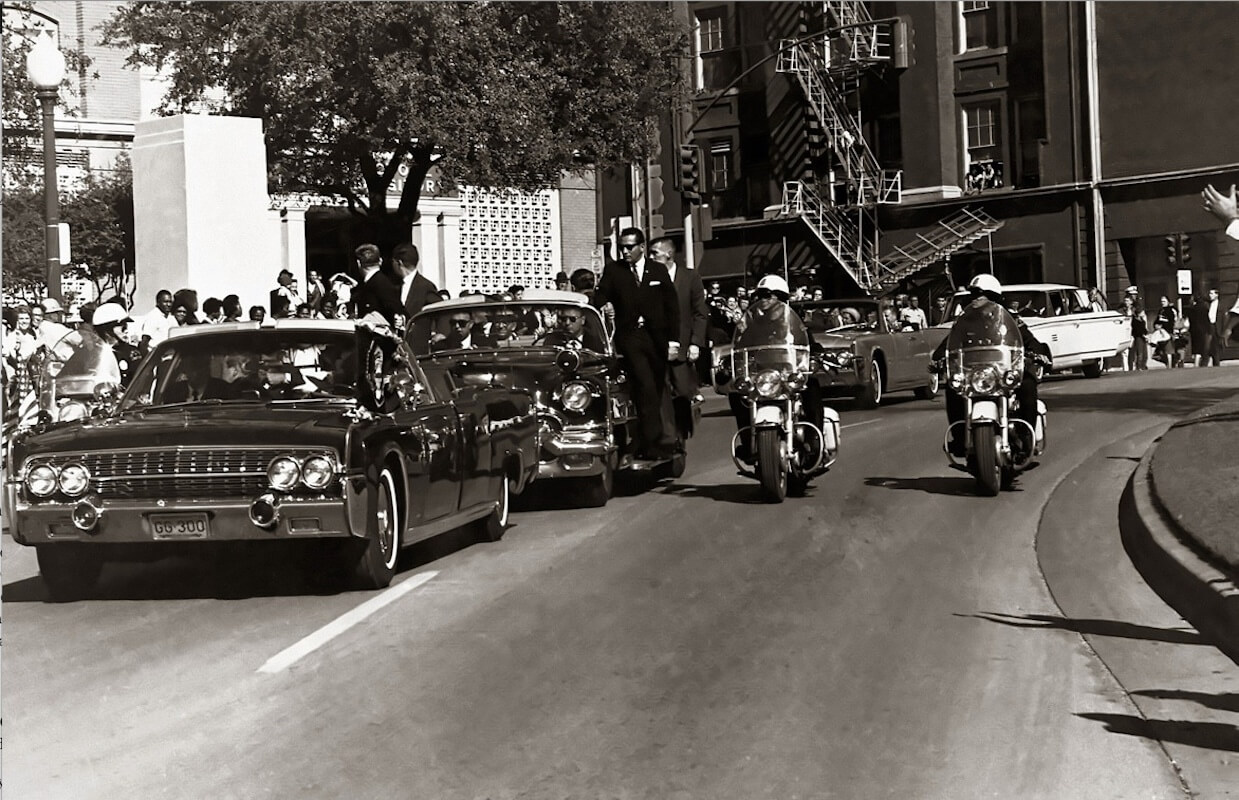
    A photo taken by Major Phillip L. Willis, a bystander, captures this moment. As he put it,

    “The shot caused me to squeeze the camera shutter, and I got a picture of the President as he was hit with the first shot. So instantaneous … the crowd hadn’t had time to react.”

    Willis Photo No. 5

    Nor did Glen Bennett have time to react. He is in this photo and, as you can see, his upper body is turned to the right as he watches the crowd on the north side of Elm Street. According to his statement (see above), he would not yet be looking at Kennedy.

    If he heard the same shot Willis reacted to, he still would not yet be reacting as of this moment. But, like many other witnesses, it’s possible Bennett didn’t even hear this shot. (Some didn’t even hear the second one, yet they heard more than one later, during the head wounding. But that’s another story.)

    About three seconds later, James W. Altgens, an Associated Press photographer, also took a photo of the motorcade. The strange thing is, Altgens said he took that picture almost simultaneously with what he called “the first shot.”  When questioned closely about the timing, Altgens swore that he heard no other shots or noises that could have been shots before this “first” one.

    Altgens Photo No. 6

    Glen Bennett is also in this photo. People say he is still turned to his right here, but I have trouble seeing him at all. In any case, if Bennett, like Altgens, had not heard a shot before this moment, then I would not expect him to have reacted yet.

    Jackie Kennedy apparently did not hear all the shots, and she had an explanation: the noise of the motorcycles put-put-putting. And Bennett was very close to them. (Please go here for more on the acoustical evidence, and other bewildering mysteries of this case, including the fact that Mary Moorman heard a shot for the first time when JFK’s head exploded, which she captured on her famous Polaroid photo.)


    An Attempt to Discredit Glen Bennett

    Glen Bennett was never asked to testify before any of the official investigating bodies, like the Warren Commission or the House Select Committee on Assassinations. This is no surprise. Kennedy’s own physician, George Burkley—a man who was with him in the Dallas emergency room, and at his autopsy in Washington—was also never asked to testify. Whatever Burkley witnessed gave him the impression that more than one shooter was involved in the assassination. (Please go here to see more on that.)

    Thanks to David Lifton, author of the best-selling book, Best Evidence, many assassination researchers ignore Bennett’s comments.

    Lifton—who believes that all shots came from the front, despite Connally’s back wound and other evidence—claims Bennett was lying. (See pages 77, 284-7, and 510-511 in the 1988 edition of his book). Lifton’s proof? The Willis and Altgens photographs. They both show Bennett looking off to his right.

    But Willis said he snapped his photo when the first shot was fired. How could Bennett be already facing the front at that moment? The same applies to the Altgens photo. Even if Bennett had heard the same “first” shot Altgens heard, how could he be reacting already? He would have been facing the front at the time of the second shot (the second shot he heard)—not the first.

    If I had to guess, I’d say JFK was hit in the back during the “flurry” at the end. Too bad we can’t question Bennett about it.

    Ironically, what Lifton considers proof that Bennett lied, is actually proof, though indirect, of a shot that came from the front.

  • The Larry and Phil Show, Part 3

    The Larry and Phil Show, Part 3


    On July 25th of this year, in The Washington Post, Larry Sabato and Philip Shenon co-authored a column in which they both recommended that President Trump not grant any appeal that an agency of government could make to delay any final releases of JFK-related assassination documents. When the Assassination Records Review Board closed its doors in 1998, they allowed that any document that they had exempted from release would have to be declassified in 2017. Included in that legal exemption were documents endangering an agent in place, or an ongoing operation. It was hard to believe 35 years after Kennedy’s assassination such a risk could be run. But the ARRB did allow for a large number of documents to be so withheld. It is well-nigh impossible to think that excuse could exist 54 years later. And it is also hard to fathom that, even if it did, that danger would outweigh the benefits to the public of finally getting to look at what the government had kept hidden from them on the JFK case. After all, many intelligent commentators have held that the secrecy about Kennedy’s death in 1963 provoked a corrosive effect upon the public’s belief in the government’s credibility.

    Which is almost the exact argument that Sabato and Shenon used in their July article. They wrote:

    We know we speak for an army of historians, political scientists, journalists, and concerned citizens … when we say that it is time for the federal government to release everything …. This is the moment for full transparency about a seminal event that cost many Americans’ trust in their government.

    Although Sabato and Shenon got the number of documents released in July wrong, they were correct in saying that the July release was only a partial one. At that time, the National Archives had planned on doing more partial releases until the last day the law allowed for a final release, which was October 26, 2017. The authors advised that the president not listen to any possible appeal from the CIA, the FBI, the Secret Service or any other intelligence agency that wished to further delay declassification. They wrote that when it came to JFK’s murder, there were no secrets worth keeping at this late date. As for the necessity of keeping any spy’s identity secret, “logic suggests that almost all those people are now dead …”

    Sabato and Shenon closed with their usual two standard trademarks. First, that somehow 21st-century forensic science has demonstrated Oswald was the lone assassin, and that if there was a conspiracy, Oswald was still the trigger man. But they closed with a request to Trump that he must release these last documents, for if the message is that the USA cannot “tell the truth about the murder of the president, it could not be expected to be honest about anything else.”

    About ten days later, the duo printed another article, this time in the online journal Politico. Here they wrote that they had reviewed some of the documents released in July—although the evidence in the article suggested they had only read one. And that release revealed that somehow the CIA may have known that Oswald had killed Kennedy to avenge the CIA/Mafia plots to kill Castro. The idea that Oswald was inspired by Cuban propaganda to kill JFK is quite old. In fact, there was an entire book written about it in 1970 by Albert H. Newman, a former Newsweek correspondent. In 1984, that hoary idea was then repeated by Jean Davison in her equally bad and error-filled book Oswald’s Game. (See my review) Shenon then repeated the “Oswald was inspired by Castro” premise in his book A Cruel and Shocking Act. That volume was timed for release on the 50th anniversary of JFK’s death.

    In this new article, the authors again repeated their claim that somehow 21st century forensic science had proven that Oswald acted alone. More than one person—most notably forensic pathologist Cyril Wecht—has appealed to Sabato and Shenon to please make public their evidence backing up that forensic claim. For the only instance of any such “21st century” testing was done by the father and son team of Lucien and Michael Haag for the PBS series Nova; it was entitled Cold Case: JFK. That program was literally skewered by Gary Aguilar and Wecht in a twenty-page reply published in a professional forensic journal over two installments. (“NOVA’s Cold Case: JFK – the Junk Science Behind PBS’s Recent Foray into the Crime of the Century”) The Haags were so thoroughly thrashed that they have refused to debate either Aguilar or Wecht in public. Even though Aguilar has offered to pay their air fare and hotel bill. This author knows of no other such 21st century demonstration.

    But the idea behind the August 3rd story, that somehow the CIA only suspected a motive for what Oswald did and had no active role in the cover up, this was also quite questionable. And it was taken up by more than one commentator. (For an example, see “New Files Confirm the JFK Investigation Was Controlled by the CIA – Not ‘Botched’ as Some Pretended”) It is clear today that the CIA was deliberately obstructing more than one attempt to find out the truth about Oswald and the assassination. To name three examples, it has now been shown that they obstructed the Warren Commission, the Garrison investigation, and the House Select Committee on Assassinations. Nevertheless, Sabato and Shenon did not say anything in this column to revise or retract their previous plea for full disclosure of the ARRB documents.

    Just two days ago, however, on October 16th, they seemed to hit an off-key note. In another co-authored article for Politico, the headline reads, “The JFK Document Dump Could be a Fiasco”. The authors mentioned that the National Archives had altered their original schedule, which was to release the final JFK documents in a staggered schedule over three months. One obvious reason this was done was so the CIA, FBI, Secret Service and other executive intelligence agencies could buy time to convince the White House to grant their appeals for delay.

    But the authors criticize the decision on different grounds. They write that “with everything public at once, pandemonium is all but guaranteed, since major news organizations around the world will want to know, almost instantly, what is in the documents that is new and potentially important.” They warn that the result could be that many journalists will “reach overly hasty, cherry-picked conclusions from individual documents.” The other alternative would be for them to “throw up their hands, assuming that the confusion over the documents is simply more proof of why it is impossible to know the full truth about JFK’s death.” What makes that last statement seem a bit prejudicial is the article’s opening sentence. There Sabato and Shenon proclaim, “The federal government’s long campaign to try to choke off rampant conspiracy theories about the November, 1963 assassination of President John F. Kennedy is threatening to end this month in massive confusion, if not chaos.” They then prognosticate the worst nightmare possible for them, especially if Trump decides on further delay: it “will simply help fuel a new generation of conspiracy theories.”

    This author does not follow that logic. For the simple reason that with one lonely exception, Sabato and Shenon—over three installments—have never mentioned or reviewed a single document that was released from the July disbursement. So if you always ignore what was disbursed, how can the pattern of disbursement have an impact on the content of the disbursement?

    One reaction to their writing would be: Why aren’t Shenon and Sabato actually reviewing the files and describing what is in them? Another would be, why has no MSM outlet done something similar? In fact, the only lengthy discussion of any of the newly released July documents was by this author on Black Op Radio on September 14, 2017. (Click here and scroll down to that date) With the help of researcher Gary Majewski, host Len Osanic and I shared some of these delayed secrets with the audience. Which made for a most appreciative reaction.

    But there is also a conclusion about the remaining documents that Sabato and Shenon seem to want to avoid. That is this: contrary to their standard refrain, maybe there is material in those long hidden papers that contravenes their recurring thesis: namely, that there is nothing of real importance there that would alter the tenets of the Warren Commission. Is that not one logical conclusion for continued classification after 54 years? Why, after over a half century, and so much controversy and damage to their reputations, would the CIA, FBI, or Secret Service still want to conceal records on the JFK case? In light of the fact of how much suspicion such secrecy has already created, why not walk down the path described by Sabato and Shenon in their first article: full disclosure? Especially when some senators and congressman have already recommended that path as the only wise one to take.

    After the July release, many people complained about a long download time. There seems to be something more than just computer efficiency that made NARA alter their schedule. The evidence would suggest that there are people in high positions who want to maintain the cover-up about Kennedy’s assassination. If so, why? And if Trump agrees with that plea, the public will need to be fully informed as to why he went along with it.

    This author would like to say he trusts that Sabato and Shenon will report that possible outcome accurately. But by their past record in all this, he has some reservation about the matter.

  • Vincent Palamara, The Not-So-Secret Service

    Vincent Palamara, The Not-So-Secret Service


    leader not so secret

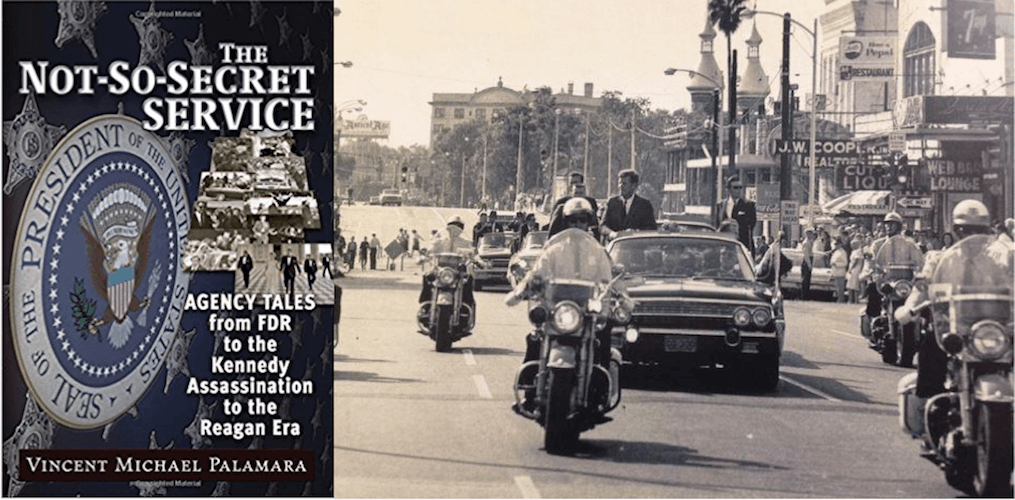
    The Kennedy researcher and film historian Joseph McBride often cites Penn Jones’s suggestion that one should “find a single aspect of the case, and research the hell out of it.” The living embodiment of that suggestion is Vincent Michael Palamara. Vince has specialized in the Secret Service protection for decades, producing the books Survivor’s Guilt, JFK: from Parkland to Bethesda and now The Not-So-Secret-Service: Agency Tales from FDR to the Kennedy Assassination to the Reagan Era. As a result of his frequent contacts with members of the Secret Service, he has information in his books that cannot be accessed elsewhere.

    The first thing to know about this new collection is that it does not solely focus on John F. Kennedy, although much of it reflects on or fills in the historical background of the Secret Service. Palamara, via his correspondence, for example, is able to supply significant first-hand reports about the quality of Presidential protection from an historical perspective prior to 11/22/1963, and the quality of the protection on that day. As is well-known, Fletcher Prouty had referred to the poor quality of the protection supplied on the day of the assassination, pointing out, for example, that there were strict procedural measures that had been ignored. He criticized the route itself, the open windows in the buildings, the slow speed of the parade route, and a few other things (cf. Dave Ratcliffe, Understanding Special Operations, 205-210).

    Palamara contrasts the Secret Service performance in Dallas and compares it to a trip taken just four days earlier in Tampa. Why, he asks, did the motorcade not proceed in a wedge formation, with agents physically on the president’s limousine, as was customary? He also points to an interesting article from December of 1963, from U.E. Baughman, a former Secret Service Chief, who also indicates a violation of what he calls “basic, fundamental” rules. (Palamara, 87). Fascinating.

    For researchers, perhaps the most important chapter in the book is called “Debunking Agent Gerald Blaine’s The Kennedy Detail.” It’s the longest chapter in the book, and goes into detail to counter Blaine’s book, which—as Palamara points out—has no footnotes and uses the sheen of authority to put forward questionable history. To use just one example, he asserts that Admiral Burkley, Kennedy’s physician, ran late and therefore had to catch the bus rather than riding in a staff car; while Burkley himself stated for the record that it was the Secret Service who put him on the bus. (122) The Kennedy Detail (co-written by Lisa McCubbin, who served the same function for Clint Hill’s series of books), focuses entirely away from “conspiracy theories,” as Palamara observes, largely on the grounds they are disrespectful to the family.

    A few words should be said about Lisa McCubbin, both Blaine’s and Hill’s co-author. McCubbin, a journalist by trade, found in Clint Hill both a boyfriend and a new business. Hill had promised he would never write a memoir, but having met McCubbin, he then decided to write three of them: Five Presidents, Five Days in November, and Mrs. Kennedy and Me. “He credits Lisa McCubbin for bringing him out of his ‘dungeon, where he languished for years in [his] emotional prison’ and for helping him ‘find a reason to live, not just exist,’” says the bio on Lisa McCubbin’s webpage: Quite interesting. The major media likes to criticize the “cottage industry” of JFK books; but as usual, it seems like the best supported and promoted works are those with the least interesting content. In addition, Hill’s exit from the “dungeon” and hooking up with McCubbin has also mysteriously coincided with Hill no longer saying anything to upset the defenders of the Warren Commission. In fact, if you want to hear him speak on the subject in your town, all you need is cash.

    There is also some interesting background on McCubbin at this AEI site:

    In July of 2001, just two months before September 11, Lisa gave up her news anchor chair and moved with her family to Riyadh, Saudi Arabia, where her husband was being transferred by his company. After September 11, KGET-TV asked Lisa to report as a foreign correspondent with an insider’s view of Saudi Arabia. Her reports from inside the Middle East captivated the southern California audience by providing a personal connection to the Arab world.

    In Riyadh, Lisa met Prince Abdullah bin Faisal bin Turki Al-Saud, a great-grandson of the founder of Saudi Arabia. After learning that Lisa was an experienced journalist, Prince Abdullah convinced her to work for the Saudis as a media consultant and trainer. In a country where women are not allowed to work with men, it was extraordinary that Lisa had direct meetings with the prince and his male staff—often held secretly at Prince Abdullah’s private villa. Her rare experiences in Saudi Arabia are the subject of her first book, Undercover in Islam: Spinning the News from Saudi Arabia.

    McCubbin is the daughter of Gay and Wyman Harris. Wyman Harris graduated from the USAF, class of ’63. His background can be seen here:

    Mr. Wyman C. Harris is a Principal at Harris, Hoimes, Sutton & Allen, LLC. He was the Chief Operating Officer and Chief Executive Officer at Wyndham Foods, Inc. Mr. Harris is a Director of Sagus International, Inc. He served six years in the United States Air Force in Germany and the Pentagon. Mr. Harris completed the Program for Management Development at Harvard Business School and received an M.S. in Industrial Engineering at Purdue University and a B.S. from the United States Air Force Academy.  (See this link; a little more can be found here)

    Anyway, it’s all a bit interesting.

    To return to the main topic, Blaine contends that conspiracy theorists are just nasty people who want to think ill of our government. The trouble is, the behavior of the Secret Service tends to belie that. Palamara gives a full list of the contents of the two boxes that the Secret Service had deliberately destroyed in January of 1995, just a few months after the Assassination Records and Review Board had been established. Those records concerned the Protection of President John F. Kennedy and the Protective Survey Reports from presidential trips ranging from September 1963 right up until November 8, 1963—two weeks before the assassination. As Palamara writes, this cannot be an accident. How did the Secret Service respond to this?

    … the Secret Service attempted to wriggle out of its predicament by simultaneously suggesting that perhaps the destruction was really the Review Board’s fault because it was not in receipt of the ARRB’s expanded definition of what constituted an “assassination record” until February 1995, after the records were destroyed …. [Ralph] Basham [the Administrative Director of Administration] also tried to downplay the significance of the missing Chicago protective survey reports for the cancelled November 2, 1963 trip (during which conspirators had planned to assassinate President Kennedy) … (137)

    Needless to say, all of these trip reports would be of tremendous significance to any investigative body reviewing the protection of the president during a completed assassination. But the Chicago report is critical because it resulted in the cancellation of a trip and the possible saving of Kennedy’s life. Because there were strong indications that a plot was afoot in Chicago, as first reported by Edwin Black in his landmark essay “The Chicago Plot,” and also supplemented by Abraham Bolden, who later wrote about the incident in The Echo from Dealey Plaza. For the Secret Service to “accidentally” destroy these most important records, just before the ARRB was about to request them, is ever so slightly suspicious.

    There is more to be found in the book: for example, I had not heard the story of Thomas Shipman, who was one of three people to drive President Kennedy while he was in office and who died shortly before the assassination. Although not much is known about him, it is certainly of interest.

    Overall, there are two great strengths of the book. One is that it is relatively short yet fairly dense with information. Palamara is not selling any particular theory throughout the text (except the general thesis that the Warren Commission was wrong) and this is an excellent feature. The second great strength of the book is the obsession with obtaining direct reports and interviews, and when using secondary sources he reprints many of them right in the book so we can look at them. I was very appreciative of this aspect. The book’s subtitle is “Agency Tales from FDR to the Kennedy Assassination to the Reagan Era,” and that is what it delivers; so there is some information in the book that JFK researchers might regard as trivial. However, much of the material, especially the historical background work that the author has done with the agents themselves, is invaluable. And his persistence in attacking the work of Blaine/McCubbin/Hill is thoroughly admirable, if for no other reason than to continue our collective insurgency against the falsified historical record that the establishment wants to carve into stone.

  • Anatomy of the Second Floor Lunchroom Encounter (excerpts)

    Anatomy of the Second Floor Lunchroom Encounter (excerpts)


    Last year at the JFK Lancer Conference in Dallas, Bart Kamp was awarded the New Frontier award. The citation stated that his work in reexamining the second floor encounter of Oswald with Texas School Book Depository foreman Roy Truly and motorcycle officer Marrion Baker utilized “a broad array of new data, including documents and statements of the participants and a variety of TSBD witnesses.” We agreed with this award and the description of the achievement. The second floor lunch encounter is a thread-worn shibboleth of the Warren Report that – like Oswald’s mail order rifle – the first generation of critics simply passed on; the notable exception being Harold Weisberg in his book Whitewash II. In Reclaiming Parkland, I began to question it, largely based on Marrion Baker’s first day affidavit, where the officer does not even mention the episode – or Oswald or Truly.  Even though, as he wrote the affidavit, Oswald was sitting across from him in the rather small witness room. In other words, after he had just stuck a gun in his stomach, Baker didn’t recognize him.

    But Bart Kamp goes much further than that in his analysis. We are presenting a small part of that long essay here, with a link to the longer version at the admirable group Dealey Plaza UK. The new revised version of the essay, from which this part is adapted, will be posted there soon and we will link to it then. This is the kind of work, daring and original, questioning accepted paradigms with new and provocative evidence, that KennedysandKing.com stands for.

    ~ Jim DiEugenio


    The current, updated version of the full essay can be read here.


    If the 2nd-floor lunchroom encounter did not happen,

    then was Oswald encountered somewhere else?


    Some researchers think Oswald walked up the stairs inside the first floor vestibule, went through the corridor on the second floor, passed the door, moving from right to left, and got his coke. This is possible, but the news reports and statements, which come in various guises, show Oswald was encountered on the first floor instead, while trying to leave the building. It is even possible that Baker never saw Oswald until he was brought in while Baker was giving the affidavit taken by Marvin Johnson.

    Bob Considine of the Hearst Press, for example, was told that Oswald had been questioned inside the building “almost before the smoke from the assassin’s gun had disappeared.” That hardly sounds like an encounter on the second floor does it? It points more to an altercation on the first floor, just where Oswald had claimed to be. Various newspapers made reference to this so-called first floor encounter instead of the second floor lunch room encounter.

    Roy Truly was overheard by Kent Biffle, who reported in the November 23 edition of the Dallas Morning News:

    In a storage room on the first floor, the officer, gun drawn, spotted Oswald. ‘Does this man work here?’, the officer reportedly asked Truly. Truly, who said he had interviewed and had hired Oswald a couple of months earlier reportedly told the policeman that Oswald was a worker.”

    01

    Biffle mentions overhearing Truly again in the Dallas Morning News, edition from November 21, 2000:

    “Hours dragged by. The building superintendent showed up with some papers in his hand. I listened as he told detectives about Lee Oswald failing to show up at a roll call. My impression is there was an earlier roll call but it was inconclusive inasmuch as several employees were missing. This time, however, all were accounted for but Oswald. I jotted down all the Oswald information. The description and address came from company records already examined by the superintendent. The superintendent would recall later that he and a policeman met Oswald as they charged into the building after the shots were fired.”

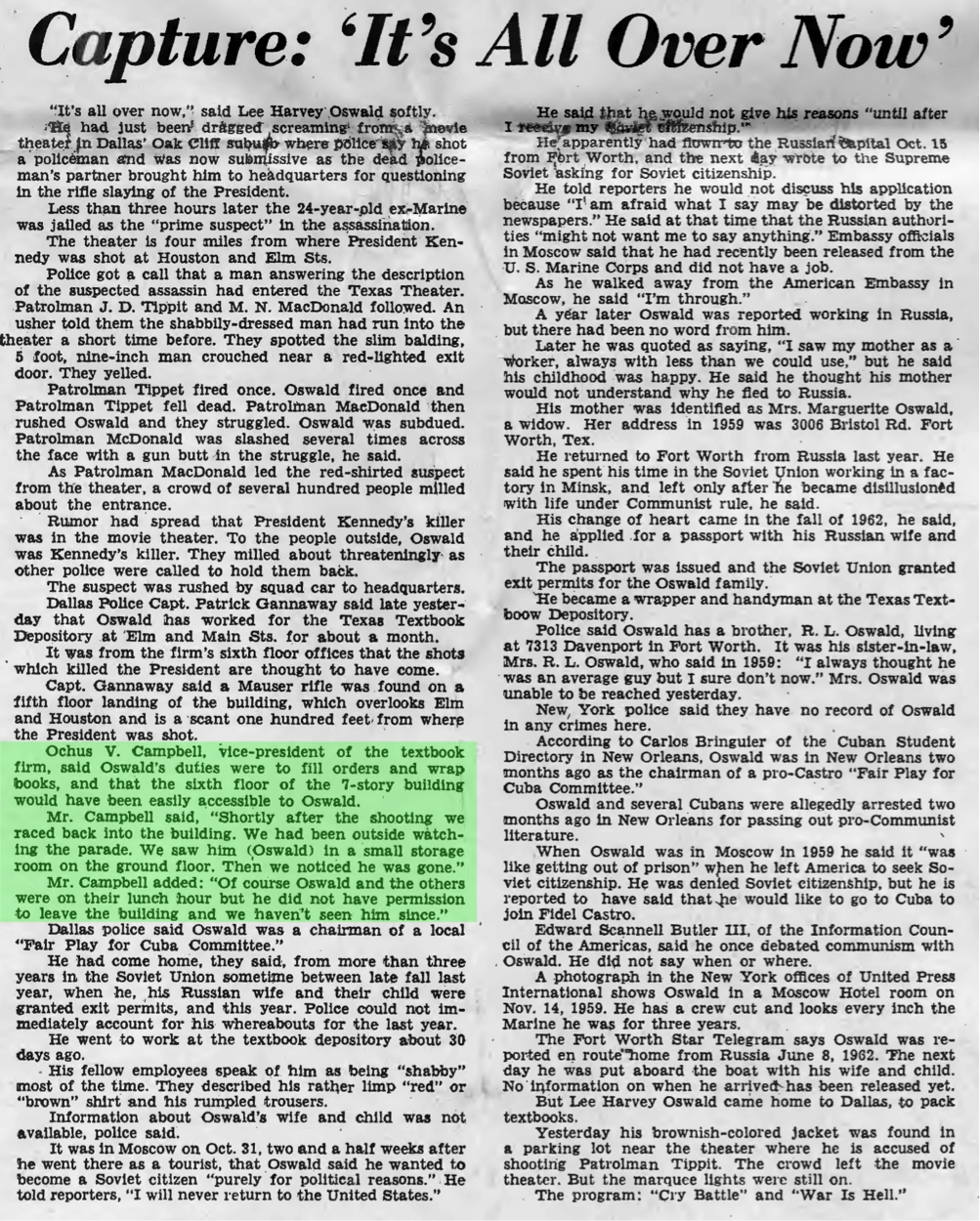
    Ochus Campbell, the vice president of the TSBD, stated in the New York Herald Tribune on November 22:

    “Shortly after the shooting we raced back into the building. We had been outside watching the parade. We saw him (Oswald) in a small storage room on the ground floor. Then we noticed he was gone.” Mr. Campbell added: “Of course he and the others were on their lunch hour but he did not have permission to leave the building and we haven’t seen him since.”
    02

    Detective Ed Hicks is quoted in the London Free Press on November 23, and in various other newspapers, saying:

    As the Presidential limousine sped to the hospital the police dragnet went into action. Hicks said at just about that time, Oswald came out of the front door of the red bricked warehouse. A policeman asked him where he was going. He said he wanted to see what all the excitement was all about.

    03

    In addition, from Jack White’s archive at Baylor in a document called “Escape”, city detective Ed Hicks, after intensive investigation of the slaying, drew this picture of the hour surrounding the tragedy:

    “As Oswald left the building, he was stopped by Dallas police, Oswald told them he worked in the building and was going down to see what was going on.” [AP, 1:45 a.m. CST]

    In the Washington Post of November 23, Dallas Police Chief Jesse Curry is quoted:

    “As an officer rushed into the building Oswald rushed out. The policeman permitted him to pass after the building manager told the policeman that Oswald was an employee.”

    04

    The first officer to reach the six-story building, Lieutenant Curry said, found Oswald among other persons in a lunchroom. New York Times, Nov 24thDallas, [11/23], Donald Jansen (from Jack White’s archive at Baylor in a document called “Escape”)

    The Sydney Morning Herald of November 24 reports:

    Police said that a man who was identified as Oswald walked through the door of the warehouse and was stopped by a policeman. Oswald told the policeman “I work here” and when another employee confirmed that he did, the policeman let Oswald walk away, they said.

    05

    Henry Wade, during a press conference, which by the looks of it was published unedited in the New York Times on November 26, states:

    “A police officer, immediately after the assassination, ran in the building and saw this man in a corner and tried to arrest him; but the manager of the building said he was an employee and it was all right. Every other employee was located but this defendant of the company. A description and name of him went out to police to look for him.”

    06

    J. Edgar Hoover, in a telephone conversation with LBJ, states:

    at the entrance of the building he was stopped by police officers, well he is alright, he works here, you needn’t hold him. They let him go.”

    In Gary Savage’s book, First Day Evidence, Baker states:

    “Shortly after I entered the building I confronted Oswald. The man who said he was the building superintendent said that Oswald was all right, that he was an employee there. We left Oswald there, and the supervisor showed me the way upstairs.”

    07

     {youtube}9tjgH8o4Adw{/youtube}

    Dallas Police Chief Jesse Curry’s press conference of November 23, 1963


    Dallas Police Chief Jesse Curry gave a press conference on November 23, 1963, during which he stated a few things that are very interesting:

    At 5:25:

    Reporter: Could you detail for us what lead you to Oswald?

    Chief Curry: Not exactly except uh in the building we uh, when we uh went to the building, why, he was observed in the building at the time but the manager told us that he worked there and the officers passed him on up then because the manager said he was an employee…”

    At 6:41:

    Reporter: Did you say chief that a policeman had seen him in the building?

    Chief Curry: Yes

    Reporter: After the shot was fired?

    Chief Curry: Yes

    Reporter: uh why didn’t he uh arrest him then?

    Chief Curry: Because the manager of the place told us that he was an employee, ‘said he’s alright he’s an employee.”

    Reporter: Did he look suspicious to the policeman at this point?

    Chief Curry: I imagine the policeman was checking everyone he saw as he went into the building.

    At 10:42:

    Reporter: And you have the witness who places him there after the time of the shooting.

    Chief Curry: My police officer can place him there after the shooting.

    Reporter: Your officer wanted to stop him and then was told by the manager that he worked there.

    Chief Curry: Yes.

    So let’s get this straight: Truly and Campbell, TSBD employees, are recorded by the newspapers while at the TSBD. Various ranking officers of the Dallas police are quoted in the corridors of the DPD. And even Hoover and LBJ discuss it!


    Oswald’s alibi given just before and just after the shooting


    In the second part of this study I will focus exclusively on the interrogation of Lee Oswald; here I will review the parts relating to the second floor lunch room encounter. These are the notes and reports by Robbery and Homicide Captain Will Fritz, FBI agents James Hosty and James Bookhout, Postal Inspector Harry Dean Holmes (who was an informant for the FBI), and Thomas Kelley of the Secret Service. These people were all present during the interrogations either Friday, Saturday and/or Sunday morning.

    08Captain Will Fritz interrogated Lee Oswald for roughly a dozen hours. Fritz claimed he took no notes, but in fact there were some (probably kept as a souvenir…); these were submitted anonymously in the mid-90’s to the ARRB after Fritz had died. These notes had been ‘buried’ for more than 33 years; until they appeared, researchers had to make do with Fritz’s statement from November 22 and his Warren Commission testimony.

    Fritz’s interrogation notes contain a few gems when it comes to Lee’s location just before, during and just after the assassination:

    On page 1 is found:

    claims 2nd floor Coke when

    off came in

    Oswald had a coke from the 2nd floor when the officer came in. Came in where? 1st? 2nd?

    to first floor had lunch

    Oswald had lunch on the 1st floor.

    out with Bill Shelley

    in front

    Oswald knew Shelley was standing in front of the building. And that is before the shooting, not after! As Shelley had departed almost immediately after the shooting from the TSBD steps.

    09
    Page 1 of Captain Fritz’s Notes

    On page 3 of the same set of Fritz’s interrogation notes:

    says two negro came in

    one Jr + short negro – ask? for lunch says cheese

    sandwiches + apple

    Oswald saw Jarman and possibly Norman come into the Domino Room while he was having his lunch.

    Lunch consisted of a cheese sandwich and an apple.

    10
    Page 3 of Captain Fritz’s Notes

    Looking at both these pages, one thing becomes evident: a new sentence does not always start on a new line, but midway as well. This leaves his notes open to interpretation.

    In his report to Chief Curry from November 23, 1963, Fritz says:

    “We also found that this man had been stopped by Officer M.L. Baker while coming down the stairs. Mr. Baker says that he stopped this man on the third or the fourth floor on the stairway, but as Mr. Truly identified him as one of the employees he was released.”

    The undated draft of Fritz’s report states:

    “I asked him what part of the building he was in when the president was shot, and he said that he was having his lunch about that time on the first floor. Mr. Truly had told me that one of the police officers had stopped this man immediately after the shooting near the back stairway, so I asked Oswald where he was when the police officer stopped him. He said he was on the second floor drinking a coca cola when the officer came in.”

    Fritz’s Warren Commission testimony:

    Mr. BALL. Did you ask him what happened that day; where he had been?

    Mr. FRITZ. Yes, sir.

    Mr. BALL. What did he say?

    Mr. FRITZ. Well he told me that he was eating lunch with some of the employees when this happened, and that he saw all the excitement and he didn’t think, I also asked him why he left the building. He said there was so much excitement there then that “I didn’t think there would be any work done that afternoon and we don’t punch a clock and they don’t keep very close time on our work and I just left.”

    Mr. BALL. At that time didn’t you know that one of your officers, Baker, had seen Oswald on the second floor?

    Mr. FRITZ. They told me about that down at the bookstore; I believe Mr. Truly or someone told me about it, told me they had met him, I think he told me, person who told me about, I believe told me that they met him on the stairway, but our investigation shows that he actually saw him in a lunch room, a little lunch room where they were eating, and he held his gun on this man and Mr. Truly told him that he worked there, and the officer let him go.

    Mr. BALL. Did you question Oswald about that?

    Mr. FRITZ. Yes, sir; I asked him about that and he knew that the officer stopped him all right.

    Mr. BALL. Did you ask him what he was doing in the lunch room?

    Mr. FRITZ. He said he was having his lunch. He had a cheese sandwich and a Coca-Cola.

    Mr. BALL. Did he tell you he was up there to get a Coca-Cola?

    Mr. FRITZ. He said he had a Coca-Cola.

    Although he learned from a conversation with Roy Truly at the “bookstore” [sic] that they met Oswald on the stairway, his own investigation shows it was inside the second floor lunch room instead! It has also only recently come to light that Martha Joe Stroud corresponded with the Warren Commission, relating that Fritz was not happy with his statement and that he wanted it changed. So there seem to be two versions of his statement. I would love to see the difference between the two! (This was recently posted by Robin Unger.)

    James Hosty and James Bookhout of the FBI state in their joint November 23 report:

    “OSWALD stated that he went to lunch at approximately noon and he claimed he ate his lunch on the first floor in the lunchroom; however he went to the second floor where the Coca-Cola machine was located and obtained a bottle of Coca-Cola ‘for his lunch. OSWALD claimed to’ be on the first floor when President JOHN F. KENNEDY passed by his building.”

    This report does not mention the specific location of Oswald on the first floor at the time of the assassination, nor does it mention any encounter involving Oswald, a police officer and Truly.

    In the solo report by James Bookhout (dated November 24, after Oswald was dead), things are turned around a bit, but not for the better.

    “Oswald stated that on November 22 1963, at the time of the search of the Texas School Book Depository building by Dallas police officers, he was on the second floor of said building, having just purchased a Coca-Cola from the soft-drink machine, at which time a police officer came into the room with pistol drawn and asked him if he worked there.

    Mr. Truly was present and verified that he was an employee and the police officer thereafter left the room and continued through the building. Oswald stated that he took this Coke down to the first floor and stood around and had lunch in the employee’s lunch room. He thereafter went outside and stood around for five or ten minutes with foreman Bill Shelley.”

    First, he mentions “officers”, when Baker was the only police officer in that building for a fair amount of time (5 to 10 minutes is a reasonable assumption); everyone else on the force was busy in the railroad yard. Or is this an indication that Oswald was in the building much later than he has been credited for?

    Second, Oswald had purchased a coke, which from a timing perspective makes it already “interesting” (getting the correct change out, putting it in the machine and waiting for the bottle to appear and to take the cap off). But what is more important is that neither Truly nor Baker saw anything in his hands.

    Third, Oswald stood around and had lunch after the shooting, and even stood outside with Bill Shelley for 5 to 10 minutes after having had his lunch. So how long was he in that building? According to this second report, for quite some time, which makes one wonder how the bus-to-cab ride transpired, how he changed his clothes, ‘grabbed his gun’ and walked towards 10th and Patton to blow Tippit away. This is impossible from the timing perspective described by James Bookhout! Plus Shelley left immediately after the shooting and did not come back until at least 5 minutes after leaving.

    Hosty writes in Assignment Oswald about an exchange he had with Oswald during his questioning while in police custody. No second floor lunch room encounter whatsoever.

    Okay now, Lee, you work at the Texas School Book Depository, isn’t that right?

    Yeah, that’s right.

    When did you start working there?

    About October fifteenth.

    What did you do down there?

    I was just a common laborer.

    Now, did you have access to all floors of the building?

    Of course.

    Tell me what was on each of those floors.

    The first and second floors have offices. The third and fourth floor are storage. So are the fifth and sixth.

    And you were working there today, is that right?

    Yep.

    Were you there when the president’s motorcade went by?

    Yeah.

    Where were you when the president went by the book depository?

    I was eating my lunch in the first floor lunchroom.

    What time was that?

    About noon.

    Were you ever on the second floor around the time the president was shot?

    Well, yeah. I went up there to get a bottle of Coca-Cola from the machine for my lunch.

    But where were you when the president actually passed your building?

    On the first floor in the lunchroom.

    And you left the depository, isn’t that right?

    Yeah.

    When did you leave?

    Well, I figured with all the confusion there wouldn’t be any more work to do that day.

    Hosty tried to pin Oswald’s location down decades after the fact, based on memory and also probably the interrogation report signed by him and James Bookhout, since it coincides neatly with the so-called recollection above. Oswald has gone for lunch and stayed in the Domino Room after he had gotten his coke from the second floor. Many must have seen him, since the ladies from the office all started to have their lunch at 12:00 upstairs in the second floor lunchroom. Some people will claim that this pins Oswald on the first floor, and that he went upstairs via the front of the building and ended up passing the window in the door leading to the small area in front of the lunchroom, thus being spotted by Baker. But why would he do that? The Domino Room was in the back at the east end, where the infamous back stairs were perhaps a little closer, affording more direct access.

    The Secret Service was present too. Forrest Sorrels and Thomas J. Kelley were there during some of Lee Oswald’s interrogations.

    Thomas J. Kelley is the only one who supplies an interrogation report that actually goes so far as to claim that Oswald explicitly admitted to not having watched the motorcade. In his First interview with LHO, he states:

    I asked him if he viewed the parade and he said he had not. I then asked him if he had shot the President and he said he had not. I asked him if he has shot governor Connally and he said he had not.”

    None of the notes or reports – by Fritz, Bookhout, Hosty or even Harry Dean Holmes, who was actually present during that final interrogation of Oswald alongside Kelley – back up the statement highlighted above.

    According to Vince Palamara, Kelley perjured himself during the HSCA hearings.

    Finally, Postal Inspector and FBI informant Harry Dean Holmes, on page 4 of his report dated December 17, 1963:

    “the commotion surrounding the assassination took place and when he went downstairs, a policeman questioned him as to his identification and his boss stated ‘he is one of our employees’, whereupon the policeman had him step aside momentarily”.

    In his statement and his testimony (see below), Oswald is being asked to step aside.

    Holmes’ Warren Commission testimony:

    Mr. BELIN. By the way, where did this policeman stop him when he was coming down the stairs at the Book Depository on the day of the shooting?

    Mr. HOLMES. He said it was in the vestibule.

    Mr. BELIN. He said he was in the vestibule?

    Mr. HOLMES. Or approaching the door to the vestibule. He was just coming, apparently, and I have never been in there myself. Apparently there is two sets of doors, and he had come out to this front part.

    Mr. BELIN. Did he state it was on what floor?

    Mr. HOLMES. First floor. The front entrance to the first floor.

    And later on during the very same testimony:

    Mr. BELIN. Now, Mr. Holmes, I wonder if you could try and think if there is anything else that you remember Oswald saying about where he was during the period prior or shortly prior to, and then at the time of the assassination?

    Mr. HOLMES. Nothing more than I have already said. If you want me to repeat that?

    Mr. BELIN. Go ahead and repeat it.

    Mr. HOLMES. See if I say it the same way?

    Mr. BELIN. Yes.

    Mr. HOLMES. He said when lunchtime came he was working in one of the upper floors with a Negro. The Negro said, “Come on and let’s eat lunch together.” Apparently both of them having a sack lunch. And he said, “You go ahead, send the elevator back up to me and I will come down just as soon as I am finished.” And he didn’t say what he was doing. There was a commotion outside, which he later rushed downstairs to go out to see what was going on. He didn’t say whether he took the stairs down. He didn’t say whether he took the elevator down.

    But he went downstairs, and as he went out the front, it seems as though he did have a coke with him, or he stopped at the coke machine, or somebody else was trying to get a coke, but there was a coke involved. He mentioned something about a coke. But a police officer asked him who he was, and just as he started to identify himself, his superintendent came up and said, “He is one of our men.” And the policeman said, “Well, you step aside for a little bit. Then I just went on out in the crowd to see what it was all about.”

    Step aside, which does not point to a second floor encounter, as Baker and Truly did a 180-degree turn after this alleged “lunch date”.

    Lee Oswald did not lie when he claimed he was on the first floor when the president passed by the TSBD. Not only did Holmes relay this; so did Fritz in his interrogation notes, as did Bookhout and Hosty in their joint report.

    James ‘Junior’ Jarman told the HSCA that Billy Lovelady told him that he had personally witnessed Oswald being allowed out of the front entrance by a policeman shortly after the assassination, and that Truly had said he was alright. (See HERE and HERE.)

    This is, of course, hearsay – just as Pauline Sanders’ support for Mrs. Reid’s encounter with Oswald in his t-shirt is equally hearsay. But it is worth mentioning. What also needs to be taken into consideration is that Lovelady left for the railroad yard almost straight after the shooting had stopped, and said he went back in through the side entrance and ended taking police officers up in the elevator. Yet Lovelady is filmed standing outside on the TSBD steps afterwards by John Martin and Robert Hughes at about 12:50. And it looks like he is waiting to get in. Danny Garcia is there, as is Bonnie Ray Williams. Did Lovelady see Oswald leave then? Which would mean he left much later than has been acknowledged. Lovelady was extremely economical with the truth during his Warren Commission testimony as I already pointed out earlier.

     {youtube}_vIbHH8CYMk{/youtube}


    James Earl Jarman and Harold Norman saw Howard Brennan talking to a police officer. This by itself shows how quickly they made their way down from the fifth floor.

    According to Harold Norman’s HSCA testimony, he states that after starting their descent from the fifth floor, they stopped on the fourth floor for a couple of minutes, because they saw the ladies looking through the windows at the railroad yard activity shortly after the shooting.

    This is during the same interval in which Dorothy Garner stayed behind, after “following” Victoria Adams and Sandra Styles, when they started their descent; Garner was then joined by other women from those fourth floor offices. Norman’s HSCA testimony strengthens Dorothy Garner’s statements and also shows that the three African American men, Williams, Jarman and Norman, did not encounter anyone, not even Truly and Baker while they made their descent. Or did they wait much longer? Baker states in his HSCA testimony that he was spotted by them while they hid behind boxes on the 5th floor. Norman had no recollection of this during his testimony, and couldn’t attest to when he saw Truly after coming down to the first floor.

    11


    {youtube}Jk0toNwH7rc{/youtube}


  • A Coup in Camelot

    A Coup in Camelot


    Considering the large number of films and TV specials about the assassination of President Kennedy that have appeared over the last ten or fifteen years, genuinely worthwhile documentaries on the subject are sadly few and far between. The likes of Mark Lane’s Rush to Judgement and Chip Selby’s Reasonable Doubt were fine for their day but given the wealth of information and technological tools that have become available in the time since those films were produced they appear more than a little outdated now. Sadly, the majority of well budgeted, slickly produced documentaries of the 21st century have been created solely to push the delusory mythology of the Warren Commission. Aside from Shane O’Sullivan’s mostly worthwhile Killing Oswald there has been very little of note that has even attempted to counter the MSM’s seemingly endless deluge of propaganda with reliable evidence and solid reasoning. A Coup in Camelot clearly aims to fill that void. Unfortunately, however, it falls considerably short of the mark because it consistently confuses theory with fact.

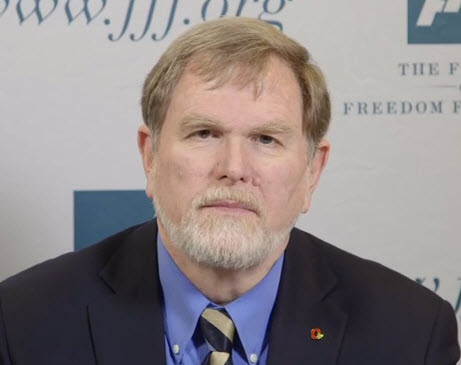
    The film begins strongly enough with a ten minute introduction that briefly discusses Kennedy’s intention to withdraw American troops from Vietnam then outlines the reasons for his trip to Dallas and explains how, within hours of the assassination, Lee Harvey Oswald was fingered as the lone nut assassin. From there A Coup in Camelot moves swiftly into one of its strongest segments, featuring respected author and researcher Vince Palamara as its main talking head. Over the years, through his diligent hard work in locating and interviewing members of the Secret Service, Palamara has made himself the go-to expert on the subject of President Kennedy’s protection―or lack thereof―in Dallas. I must admit that I have never been convinced the Secret Service was actively involved in the assassination. Yet Palamara’s work most certainly gives reason to at least consider the idea that JFK’s protection on November 22, 1963, was intentionally compromised.

    Secret Service authority
    Vince Palamara

    Palamara details just how many of the Secret Service’s usual practices were not followed that day. For example, it was standard procedure during an open motorcade for agents to be walking or jogging alongside the Presidential limousine. In fact there were two hand rails in place for agents to hold onto as they stood on the rear running boards of the car. As Palamara points out, “Secret Service agents are powerless to really do much of anything if they’re not close to the President.” And yet there were no agents on or near the limousine in Dallas. Defenders of the official mythology have long claimed that Kennedy himself had ordered the agents off the back of the car because he wanted the public to get a good look at him. But when Palamara spoke with Gerald Behn, the Special Agent in charge of the White House detail, Behn told him in no uncertain terms that he had never heard any such request from the President. Palamara then contacted numerous other Secret Service agents and White House aides and each one of them told him the same thing: Kennedy had not ordered the agents off of the car.

    Lone nut mythologists also tend to blame Kennedy for the fact that the limousine’s plexiglass bubble top was not used that day. Although the bubble top was not bullet proof or resistant it was, as Palamara notes, “a psychological deterrent because most people assumed it was bullet proof…The bottom line what the bubble top would have done is it would have obscured an assassin’s view via the sun’s glare.” To discover whether or not Kennedy really had ordered its removal, Palamara spoke with Special Agent Sam Kinney who was the driver of the Secret Service follow-up car. “Sam Kinney adamantly on three different occasions told me that President Kennedy had nothing to do with it; it was solely his responsibility.”

    Houston, 11/21/63

    Another procedure not followed in Dallas involved the additional protection customarily provided by local law enforcement. Whenever and wherever there was to be a motorcade, the Secret Service would usually work hand in hand with local police who would provide a motorcycle escort of six to nine officers that would ride in a wedge formation in front of and beside the Presidential limousine. This formation had been in place on all of the previous stops along Kennedy’s Texas trip. Yet in Dallas the escort was reduced to just four motorcycle officers who ended up riding behind the limo instead of beside it. As Palamara notes, “The formation was meaningless. It offered no protection at all…They left Kennedy a sitting duck.”

    II

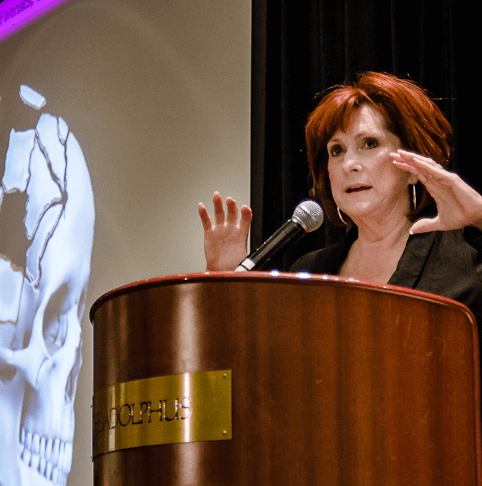
    Having detailed these and many other irregularities in JFK’s protection, A Coup in Camelot moves on to a discussion of the “Blood, Bullets & Ballistics”, focusing largely on the conclusions of retired crime scene investigator, Sherry Fiester. It is Fiester’s contention that the massive spray of blood seen in frame 313 of the Zapruder film represents “back spatter” from a frontal shot. She further asserts that, despite numerous witnesses believing they heard shots or saw smoke coming from behind the fence on top of the “grassy knoll”, her own trajectory analysis excludes it as the source of the head shot. The actual source of the shot, she claims, was on the other side of Elm Street at the southern end of the triple overpass. But despite her impressive credentials and her 30 years experience with the Dallas police, Fiester’s conclusions fail to convince.

    Medical, scientific and ballistics experts such as Dr. Cyril Wecht, Dr. Gary Aguilar, Dr. Donald Thomas, and Larry Sturdivan agree that, by itself, the explosion of blood, bone and brain matter seen in the Zapruder film actually tells us very little about the direction in which the projectile was travelling. That is because it does not occur at the point of entrance or exit but near the mid-point of the bullet’s trajectory. Rifle wounds of the skull can be a very different matter than gunshot wounds to other parts of the body. The skull is a closed vessel containing fluid contents that cannot be compressed. The energy and momentum imparted to the skull by the passage of the bullet creates a temporary cavity. The result of cavitation in an enclosed skull containing blood and brain is a hydraulic pressure applied to the cranium causing it to burst open. As Aguilar and Wecht explain, the resultant “spew” of blood and tissue is “radial to the bullet’s path and is separate from the inshoot and outshoot splatter.” (Aguilar & Wecht, Letter to the Editor, AFTE Journal, Volume 48 Number 2, p. 76) This is what is known as the “Krönleinschuss” effect―named for the German ballistics expert who first demonstrated it using skulls filled with clay.

    This type of effect was demonstrated during filmed simulations performed in the Biophysics laboratory at Edgewood Arsenal in 1964 when rifle bullets were fired into numerous skulls filled with ballistic gelatin. Describing a typical example Sturdivan writes, “The bullet entered the back of the skull and exited in a small spray at the front in the space of one frame of the high-speed movie. Only after the bullet was far down-range did the internal pressure generated by its passage split open the skull and relieve the pressure inside by spewing the contents through the cracks. A similar type explosion would have taken place if the bullet had gone through in the opposite direction. The only way to distinguish the direction of travel of the bullet is to examine the cratering effect on the inside of the skull on entrance and on the outside of the skull at exit.” (Sturdivan, The JFK Myths, p. 171)

    The empirical evidence, therefore, demonstrates that Fiester is mistaken in believing the explosive spray of matter we see in the Zapruder film is back spatter. In fact, forward spatter and back spatter are not seen in the film; probably because of the limitations of Zapruder’s camera. The film of the Edgewood simulation shows little to no back spatter and only a very small amount of forward matter which, as Sturdivan explains, was only visible “because of the strong lighting, a close-up view, and (especially) a very high framing rate…over 200 times the framing speed of the Zapruder movie…” (ibid. p. 174)

    Sherry Fiester

    Fiester’s trajectory analysis is also deeply flawed because it assumes something there is no reason to assume. Namely, that the bullet followed a straight path through the skull. In 1978, when the House Select Committee on Assassinations (HSCA) hired a NASA scientist to perform the same type of backward projection analysis, the committee’s forensic pathology panel cautioned against placing too much faith in it. The panel noted that, in their experience, “if a missile strikes an object capable of creating a shearing force, such as the skull, the bullet’s pathway in the body might be significantly different from the line of its trajectory prior to impact.” (7HSCA168) In other words, a bullet striking a dense, resistant skull bone is likely to become deformed and be deflected. Sturdivan writes that “The path of a deformed bullet through a body is never straight…Of the thousands of examples of yawed, deformed, and broken rifle bullets fired into gelatin tissue simulant at the Biophysics Division lab and other similar facilities, none had a perfectly straight trajectory. Few were even close.” (ibid. p. 208) So drawing a line between the presumed entrance and exit points in JFK’s skull will not tell us where the gunman was located no matter how far that line is extended into Dealey Plaza.

    Far from being excluded as Fiester asserts, the grassy knoll remains the most likely location for a frontal shooter. Not only because it was the location to which numerous witnesses pointed, but also because two teams of America’s top acoustical scientists agreed that the Dallas Police dictabelt recording they analyzed on behalf of the HSCA contained the acoustic fingerprint of a gunshot fired from the knoll. And the dictabelt recording synchronizes perfectly with the Zapruder film when―and only when―the knoll shot is aligned with frame 313.

    Featured alongside Fiester’s theories in this segment of A Coup in Camelot is the claim that President Kennedy was shot in the throat from the front. Yet aside from a brief reference to the way the wound was “described by doctors at Parkland Hospital”, no detail is provided to substantiate this assertion. As most readers will no doubt be aware, the Parkland physicians were indeed under the initial impression that the wound might have been an entrance; describing it as small, round, clean cut, and measuring little more than 5 mm in diameter. But those who hold these descriptions up as proof that a bullet entered the throat need to deal with the fact that studies have shown emergency room doctors to be frequently wrong in their assessment of bullet wounds. This is precisely why the premiere textbook for trauma room physicians, Rosen’s Emergency Medicine, cautions that “Clinicians should not describe wounds as ‘entrance’ or ‘exit’ but should document, using appropriate forensic terminology, a detailed description of the wound, including its appearance, characteristics, and location without attempting to interpret the wound type or bullet caliber. Exit wounds are not always larger than entrance wounds, and wound size does not consistently correspond to bullet caliber.” (Rosen’s Emergency Medicine: Concepts and Clinical Practice, p. 828)

    Those who propose that a bullet entered the throat must also deal with the fact that said bullet would have had to have disappeared entirely almost immediately after piercing the skin. Because not only was there no exit in the rear and no bullet found anywhere in the body, there was also no damage to the spine as there would almost certainly have had to have been had a missile entered Kennedy’s throat near the midline. It is for these reasons that, despite its appearance, the wound is extremely unlikely to have been one of entrance.

    III

    A Coup in Camelot moves from Dallas to Bethesda for a lengthy discussion of JFK’s autopsy, centred largely around the highly controversial theories of Douglas Horne. In a nutshell, Horne believes that Kennedy’s gunshot wounds were altered to hide evidence of a frontal shooter. This, of course, is not a new idea. It was first popularized by author David Lifton in his 36-year-old book, Best Evidence. But whereas Lifton postulated that unknown conspirators had hijacked the President’s body en route to Bethesda and altered his wounds to fool the autopsy surgeons, Horne suggests that the prosectors themselves altered the head wound during a secret “pre-autopsy” at the Navy morgue. For what purpose and to fool whom is never really made clear.

    Doug Horne

    At the very heart of Horne’s hypothesis is a comment made by Tom Robinson―an embalmer who was present for most of the autopsy―during a 1996 interview for the Assassination Records Review Board. When shown a photo displaying a large defect in the top of Kennedy’s head Robinson recalled that this was “what the doctors did”. He then explained that the autopsy surgeons had cut the scalp open and “reflected it back in order to remove bullet fragments.” (ARRB MD180) He also recalled seeing that “some sawing was done to remove some bone before the brain could be removed.” (ibid) What Robinson described is, of course, a perfectly normal part of an autopsy and he himself called what he saw a “normal craniotomy procedure.” (ibid) Yet somehow Horne construes Robinson’s remarks as evidence of some clandestine pre-autopsy activity. Why?

    The reason, according to Horne, is that “Dr. Humes always denied having to saw the skull open, he always maintained that the wound was so big that he just removed the brain with a minimum of cutting of the scalp; he never had to cut any bone.” However, as this passage from Hume’s sworn deposition for the ARRB demonstrates, Horne is entirely mistaken :

    GUNN: But just let me start out first: Where was the first incision made?

    HUMES: I believe, of course, the top of the skull to remove the skull plate of the brain. To remove what remained of the calvarium and to approach the removal of the brain.

    GUNN: And was that incision simply of the scalp, or did you need to cut –

    HUMES: No, we had to cut some bone as well. [my emphasis]

    * * *

    GUNN: Where did you cut the bone?

    HUMES: I find that–it’s hard to recall. Once we got the scalp laid back, some of those pieces could just be removed, you know, by picking them up, picking them up because they were just not held together very well, other than by the dura, I suppose. So other than that, we probably made it like we normally do, in a circumferential fashion from books, like right above the ear around. But it was a real problem because it was all falling apart, the skull. And I can’t recall the details of exactly how we managed to maneuver that, because it was a problem. (ARRB Deposition of James J. Humes, pgs. 101-102)

    As the reader can see, not only did Humes not deny having to saw the skull, he specifically testified to doing so. But Horne does not quote Humes himself and instead refers to a report written in 1965 by autopsy surgeon Dr. Pierre Finck―who did not arrive at Bethesda until after the brain had already been removed―in which Finck recalled being told that “no sawing of the skull was necessary”. What this means, therefore, is that the basis of Horne’s claim that “Humes always denied having to saw the skull open” is not any direct quotation from Humes himself, but the hearsay claim of a man who wasn’t even present when the brain was removed. This type of methodology is extremely difficult to defend. And what makes it all the more confounding is that Horne himself was actually present for the deposition during which Humes specifically swore to cutting the skull bone.

    Sadly, this is not the only instance in A Coup in Camelot in which Humes’ words are misconstrued in support of pre-autopsy surgery. The film’s co-writer, Art Van Kampen, suggests that “Something had to have happened to that body before the photos were taken”, and in the case of some photos that is indeed true. But Van Kampen claims that “Dr. Humes is very clear that no autopsy work had been done on the President’s skull before either photos or X-rays were taken.” This, again, is a clear misinterpretation of what Humes actually said. When asked during his ARRB deposition whether or not any incisions were made before the photographs were taken, Humes responded, “Well, depending on which photographs you’re talking about. We didn’t photograph the wound in the occiput until the brain was removed, you know. Sure, we had to make an incision to remove the brain and so forth, but no, generally speaking, no, we didn’t make any incisions at all [my emphasis].” (ibid. p. 95) Humes was then shown the photographs of the top of the head and asked whether or not, before the photo was taken, he had pulled the scalp back “in order to be able to have a better look at the injury” to which he responded “Yes, I probably did.” (ibid. p. 162) So, as should be perfectly clear, Humes confirmed that “generally speaking” most of the photographs were taken before any incisions took place but that some were indeed taken during the course of the autopsy. He also said essentially the same thing as Tom Robinson, which is that the photographs of the top of the head were taken after the scalp had been manipulated. There is, then, no meaningful discrepancy between what the autopsy pictures show and what Humes testified to.

    There has been confusion over Kennedy’s head wounds ever since the Warren Commission issued its findings. In large part this is due to there being two entirely different descriptions of the wounds on record. By and large the doctors at Parkland Hospital recalled seeing one fairly large hole that was located near the right rear of the head. Yet the autopsy report describes a massive defect involving almost the entire right side of the cranium. It was to explain this discrepancy that the body alteration hypothesis was first offered. However, as Dr. Aguilar has noted, “that the wound was described as larger at autopsy than noted by emergency personnel is not proof that it was surgically enlarged. Wounds picked apart during an autopsy are often found to be larger than they first appeared to emergency personnel.” (Murder in Dealey Plaza, p. 187)

    There is a simpler, far more reasonable explanation than clandestine alteration. One that, ironically enough, is touched upon in A Coup in Camelot. Shortly before discussion of the autopsy begins, the film’s narrator correctly informs viewers that “In the Zapruder film, a flap of skull can be seen opening up after the head strike. During the frantic ride to Parkland Hospital the flap had been folded back into place where the blood acted like glue and sealed the wound.” Indeed, Jackie Kennedy later testified to trying to hold her husband’s skull together on the way to the hospital. As Dr. Aguilar writes, “It is not hard to imagine the possibility that during the time it took the Presidential limousine to get to Parkland Hospital, clot had formed gluing a portion of disrupted scalp down making JFK’s skull defect appear smaller to treating surgeons than it later would to autopsy surgeons.” (ibid) In other words, because the flap had been closed up, the emergency room staff only saw the rearmost portion of the wound.

    IV

    The idea that something out of the ordinary occurred at Bethesda is buttressed by stories of multiple coffins being brought into the morgue on the night of the autopsy. At Parkland Hospital, Kennedy’s body had been placed into an ornamental bronze casket. However, in A Coup in Camelot it is alleged that the body actually arrived at Bethesda in an aluminium shipping casket at around 6:35 pm. This means that when the bronze casket was brought into the morgue at 7:17 pm it was, unbeknownst to the FBI agents who accompanied it, completely empty. Or so we are told. Horne further alleges that for some reason the Dallas casket then “made a second entry that night…at 20:00 hours military time.”

    Once again the evidence does not support the theory. As presented in the film, the idea that Kennedy’s body arrived in an aluminium shipping casket is based on the recollection of Naval petty officer, Dennis David, who recalled helping carry one into morgue. Yet, as the summary of his ARRB interview states, David “emphasized that he had no direct knowledge, by observation, that President Kennedy was in the gray shipping casket…” (ARRB MD177) The reality is that, being as Bethesda was a morgue, there is no reason to believe that Kennedy’s body was the only one to be brought there that night. In fact, FBI agent Francis O’Neill specifically recalled being told that one of the four drawers in the anteroom adjacent to the autopsy room contained the body of a child “that had died that day.” (O’Neill ARRB deposition, p. 57)

    Perhaps more importantly, the claim that the bronze casket was empty when brought into the mortuary is belied by the testimony of both O’Neill and his FBI colleague, James Sibert. These two agents who helped unload the casket from the ambulance swore that they stayed with it until it was opened and saw with their own eyes the President’s body taken out. O’Neill stated without hesitation during his ARRB deposition that there was “no time” from the time he first saw the casket “until the time it was opened and the body taken out that the casket was not in my view…” (ibid. p. 59) Similarly, when asked whether or not there had been any time between being unloaded from the ambulance and being opened that the casket had been out of his sight, Sibert responded, “I was there until it was opened.” (Sibert ARRB deposition, p. 45) There is, therefore, no basis for claiming that the casket was “certainly empty” as Horne does.

    Finally, the supposed 20:00 re-entry of the casket is based on a time notation which appears in an unsigned, undated document titled “The Joint Casket Bearer Team.” This document describes the activities of a group containing one officer and seven enlisted men “from each branch of the Armed Forces” who were “trained to carry the casket to and from the ceremony sites and to fold the flag which draped the casket following the internment service.” (ARRB MD163) This team, as A Coup in Camelot correctly informs, was also known as the “honor guard”. It appears quite apparent that, far from being proof of a second entry for the bronze casket, the 20:00 hours time notation on this document is nothing more than a mistake. Why? Because despite the film’s claim that Sibert and O’Neill had carried the casket into the morgue at 7:17 pm alongside Secret Service agents Roy Kellerman and William Greer, O’Neill explained in his ARRB deposition that, in actual fact, it was the honor guard who had physically lifted the coffin at that time. (O’Neill deposition, p. 57) So unless anyone wants to believe that the honor guard carried it in twice, they are going to have to accept that the unknown writer of the document was in error and there was only one entry for the bronze casket.

    A coup in Camelot intermingles these stories of casket-swapping and wound tampering with claims that the autopsy X-rays and photographs have also been altered. This, once again, is not a new theory. In fact it has been a commonly held belief amongst students of the assassination for decades. And yet nothing approaching proof of alteration has ever emerged. The most commonly cited reason for believing the photos have been tampered with, the one repeated in A Coup in Camelot, is that the pictures appear to show the back of the head completely intact. This is, of course, at odds with the testimony of the Parkland physicians who recalled seeing a large wound in the right rear. But as autopsy surgeon J. Thornton Boswell explained to both the HSCA and the ARRB, the reason the rear skull damage is not seen in the photographs is because the scalp is being held up and “pulled forward up over the forehead, toward the forehead.” (Boswell ARRB deposition, p. 150) This has the effect of hiding the wound underneath.

    Those who choose to ignore Boswell’s words are still stuck with the reality that the autopsy photographer, John Stringer, authenticated the photographs during his own ARRB deposition, repeatedly stating that he had no reason to believe the existing photographs were anything other than the ones that he himself took on the night of the autopsy. The same is true of the X-rays. The technician responsible for taking them, Jerrol Custer, repeatedly swore to the accuracy and authenticity of the existing X-rays for the ARRB. For example, when shown the anterior/posterior view:

    GUNN: Is there any question in your mind whether the X-ray that’s in front of you right now is the original X-ray taken at the autopsy?

    CUSTER: No question.

    GUNN: And the answer is––

    CUSTER: It is the original film. (p. 122-123)

    And when shown the right lateral skull X-ray:

    GUNN: … Mr. Custer, can you identify the film that is in front of you right now as having been taken by you on the night of the autopsy of President Kennedy?

    CUSTER: Correct. Yes, I do, sir.

    GUNN: And how are you able to identify that as being––

    CUSTER: My marker in the lower mandibular joint. (p. 124)

    With the men who took them―and all three autopsy doctors―swearing to their authenticity, there seems little doubt that the autopsy photographs and X-rays would have been admitted into evidence were there to be a trial in the Kennedy case. And with questions of validity settled, a more important question would be asked: What do the skull X-rays actually show? The answer to that, as a number of experts including neuroscientist Dr. Joseph Riley and radiologist Dr. Randy Robertson have attested, is that the official theory of a single shot from the rear simply cannot be true.

    As Dr. Humes explained in his Warren Commission testimony, the pathologists found an entrance wound that was 2.5 cm to the right, and “slightly above” the external occipital protuberance―a small bump located very low down in the rear of the skull―and “a huge defect over the right side” involving “both the scalp and the underlying skull…” After a “careful examination of the margins of the large bone defect” on the right side, the doctors were unable to find a point of exit, which Humes put down to the fact that they “did not have the bone.” However, the pathologists concluded that a single bullet was responsible for all the damage, having entered the rear and exited the right side. In support of this contention, Humes implied that the path of the bullet was laid out by a trail of metallic fragments that could be seen on the X-rays “traversing a line from the wound in the occiput to just above the right eye…” (Warren Commission Hearings, Vol. II, p. 351-353)

    Annotated X ray

    Unfortunately for Dr. Humes, the X-rays do not show what he claimed. The entrance wound in the lower rear of the skull is indeed visible. So too is the trail of bullet fragments. But the two are in no way related. In fact, the trail lies along the very top of the skull, several inches above the entrance site. Therefore, those fragments could not have been left behind by a bullet which entered near the external occipital protuberance. As Aguilar and Wecht have noted, “…the fragment trail alone almost completely eliminates the official theory JFK was struck from above and behind by a single bullet that entered his skull low…” (Aguilar & Wecht, Op. cit. p. 78) Dr. Joseph Riley, who has a Ph.D in neuroscience and specializes in neuroanatomy and experimental neuropathology, noted decades ago that the medical evidence as it stands is only compatible with two separate bullet strikes. It is for that very reason that I see little logic in suggesting that the X-rays have been altered to support the official story.

    V

    These largely specious claims about the medical evidence form the centrepiece of A Coup in Camelot and, clocking in at nearly 40 minutes, comprise well over a third of the film’s running time. For those who are familiar with the facts that are being misinterpreted and/or overlooked, this time will not pass quickly. Things do pick up, however, for the final 20 minutes of the film which deals partially with the enigmatic Lee Harvey Oswald. Whether or not Oswald was on the sixth floor of the Texas School Book Depository with a rifle in his hands at the time of the assassination has never been conclusively established. But A Coup in Camelot demonstrates, through the pioneering research of former investigative reporter Barry Ernest, that in all likelihood Oswald was where he claimed to be when the shots were fired; on the first floor of the building eating lunch.

    Barry Ernest

    Ernest centred his research on an often overlooked witness named Victoria Adams who had viewed the assassination from a fourth floor window of the depository building. As most students of the case know, Oswald was seen by his boss Roy Truly and police officer Marion Baker in the second floor lunch room approximately 90 seconds after the shots were fired. Baker was on his way to the roof where he believed the gunman might be located but, upon spotting Oswald alone in the lunch room, he halted his ascent and demanded Oswald identify himself. Truly quickly informed Baker that Oswald was an employee and the pair then continued their dash up the stairs. Oswald later told police that he had gone from the first floor to the second in order to purchase a Coke. But, of course, the Warren Commission claimed that he had actually rushed down from the sixth floor immediately after shooting the President.

    In that regard, Victoria Adams was a problematic witness for the Commission. After watching the motorcade pass by with three co-workers, she had stayed at the fourth floor window for what she said was around 15 to 30 seconds and then quickly made her way down to the first floor. What this means, as Ernest explains, is that “she would have been on the stairs at the same time Oswald was descending from the sixth floor.” The problem is “…she did not see or hear anyone on the stairs during that period.” The Commission’s handling of her story typified its approach to the investigation. It did not bother to question any of those who had stood at the window with her to watch the motorcade―not even Sandra Styles who had accompanied Adams down the stairs―and instead suggested that she was simply mistaken about the time she left the fourth floor window.

    Victoria Adams

    In support of this contention, the Commission alleged that Adams had testified to seeing two other employees of the building, William Shelley and Billy Lovelady, when she arrived on the first floor. And because Shelley and Lovelady had testified to being outside on the depository steps during the shooting and not re-entering the building until several minutes later, the Commission claimed that Adams’ “…estimate of the time when she descended from the fourth floor is incorrect, and she actually came down the stairs several minutes after Oswald and after Truly and Baker as well.” (Warren Report, p. 154) The problem with the Commission’s argument is that when Ernest tracked Adams down she “flat-out denied” ever saying she had seen Shelley and Lovelady on the first floor. In order to confirm or refute her assertions, Ernest searched the National Archives for the stenographic tape of Adams’ testimony. Not surprisingly, however, he soon discovered that there is no record of her April 7, 1964, testimony and the stenographic tape has gone mysteriously “missing.”

    But in 1999 Ernest discovered a bombshell document in the Archives in the form of a June 2, 1964, letter written by Assistant United States Attorney, Martha Joe Stroud, to Warren Commission Chief counsel, J. Lee Rankin. This letter contains the only known reference in the Commission’s files to an interview with Dorothy Garner, who was Adams’ supervisor and one of those with whom she had stood at the fourth floor window. The letter notes matter-of-factly that “Miss Garner…stated this morning that after Miss Adams went downstairs she (Miss Garner) saw Mr. Truly and the policeman come up.” Thus Garner provided complete corroboration for Adams’ testimony. Just as she swore, Adams had indeed descended those old wooden steps at the same time Oswald was supposed to have been on them. And the corroboration of this fact was completely ignored by the Commission who made no mention of Garner’s interview whatsoever.

    As Ernest details in his indispensable book, The Girl on the Stairs, he went on to locate and interview Garner for himself. He asked her about her own activities following the assassination and Garner explained to him that as Adams and Styles made their way downstairs, she herself went to a storage area by the stairway. It was from there that she was able to see Baker and Truly ascend the stairs. Garner said that she was “right behind” Adams and Styles in leaving the window and although she didn’t actually see them enter the stairway, she heard them “after they started down” because “the stairs were very noisy.” (The Girl on the Stairs, p. 268) Garner, it appears, had arrived on the fourth floor landing area only seconds after Adams and was there long enough to see Baker and Truly. Quite obviously, then, if Oswald had descended from the sixth floor during that time as he would have had to have done in order to make it to his second floor encounter with Baker, then Garner was in a position to see him. Yet, as she told Ernest, “I don’t remember seeing him at all that day…except on TV.” (ibid)

    It is impossible to overstate how damaging all of this is to the case against Oswald. It is clear that he could not have made it down to the second floor ahead of Adams because he did not have the time. This means he would have had to have descended long enough after Adams for her not to have heard his footsteps. Yet if he was 10 or 15 seconds behind her on the stairwell, it seems highly unlikely that he would not have been spotted by Garner who did not see or hear him on the noisy old stairs, even though she stayed on the fourth floor landing area long enough to see Truly and Baker. The most logical conclusion to be drawn is that when Oswald arrived at his second floor meeting with Baker, he had not come from the sixth floor but from the first, just as he said he had. And that would mean that, whatever else he did that day, Oswald did not shoot President Kennedy.

    VI

    A Coup in Camelot finishes with a brief discussion of how Kennedy’s plans to pull American military personnel out of Vietnam were reversed after his death and how private US contractors profited from the all-out war that followed. However none of this is explored in any detail and no attempt is made to show how it can be directly connected to the assassination. Had the writers and producers chosen to focus more heavily on these areas they may well have created a more valuable and compelling film than this one.

    It is clear that the filmmakers wanted to offer forensic proof of a conspiracy and, in fact, at the end of the film it is claimed they have done just that. “We have proven through modern forensics”, narrator Peter Coyote says, “that a shot or shots were fired from the front.” Yet, as I have demonstrated above, proof of such is not offered in A Coup in Camelot. What is provided instead is a bloodspatter theory that, whilst plausible on the surface, is entirely contradicted by empirical evidence. Instead of relying on the opinions of one individual, the filmmakers should have consulted with other, perhaps better qualified experts to ensure that what was being proposed had really been put to the test. How else can one claim to have proven something? There are numerous medical and scientific professionals who are well-versed in the facts of the assassination―such as Doctors Wecht, Aguilar, Robertson, and Thomas―who, I am sure, would have been more than happy to share their expertise.

    As I see it, this is the fatal flaw of A Coup in Camelot. Theory is all too readily accepted and promoted by the filmmakers without any independent verification or even basic fact-checking. How difficult would it have been to have had somebody actually read Dr. Humes’ various testimonies to see if he really had “always denied having to saw the skull open”? Or to have studied the deposition of Francis O’Neill to discover who had physically carried the casket into the morgue at 7:17 pm? A clearer understanding of these two points alone would have been enough to call into serious question the highly dubious claims of multiple casket entries and wound tampering at Bethesda.

    Theories about the Kennedy assassination―many of them nutty―have been promulgated for far too long and they are not convincing anyone outside of the so-called “research community”. When you attempt to counter the ballistics experiments and slickly-produced computer simulations featured in mainstream lone gunman documentaries with something as bizarre-sounding and ill-founded as the body alteration hypothesis you are not likely to win many converts amongst the general population. What is needed is real expert opinion and cold, hard evidence presented in a compelling manner. A Coup in Camelot is skilfully produced on what appears to have been a reasonable budget and if the filmmakers had consulted the right individuals and doubled down on their facts they could well have produced something of real value. For that reason the film strikes me as a wasted opportunity.

  • A Coup in Camelot

    A Coup in Camelot


    Considering the large number of films and TV specials about the assassination of President Kennedy that have appeared over the last ten or fifteen years, genuinely worthwhile documentaries on the subject are sadly few and far between. The likes of Mark Lane’s Rush to Judgement and Chip Selby’s Reasonable Doubt were fine for their day but given the wealth of information and technological tools that have become available in the time since those films were produced they appear more than a little outdated now. Sadly, the majority of well budgeted, slickly produced documentaries of the 21st century have been created solely to push the delusory mythology of the Warren Commission. Aside from Shane O’Sullivan’s mostly worthwhile Killing Oswald there has been very little of note that has even attempted to counter the MSM’s seemingly endless deluge of propaganda with reliable evidence and solid reasoning. A Coup in Camelot clearly aims to fill that void. Unfortunately, however, it falls considerably short of the mark because it consistently confuses theory with fact.

    The film begins strongly enough with a ten minute introduction that briefly discusses Kennedy’s intention to withdraw American troops from Vietnam then outlines the reasons for his trip to Dallas and explains how, within hours of the assassination, Lee Harvey Oswald was fingered as the lone nut assassin. From there A Coup in Camelot moves swiftly into one of its strongest segments, featuring respected author and researcher Vince Palamara as its main talking head. Over the years, through his diligent hard work in locating and interviewing members of the Secret Service, Palamara has made himself the go-to expert on the subject of President Kennedy’s protection―or lack thereof―in Dallas. I must admit that I have never been convinced the Secret Service was actively involved in the assassination. Yet Palamara’s work most certainly gives reason to at least consider the idea that JFK’s protection on November 22, 1963, was intentionally compromised.

    Secret Service authority
    Vince Palamara

    Palamara details just how many of the Secret Service’s usual practices were not followed that day. For example, it was standard procedure during an open motorcade for agents to be walking or jogging alongside the Presidential limousine. In fact there were two hand rails in place for agents to hold onto as they stood on the rear running boards of the car. As Palamara points out, “Secret Service agents are powerless to really do much of anything if they’re not close to the President.” And yet there were no agents on or near the limousine in Dallas. Defenders of the official mythology have long claimed that Kennedy himself had ordered the agents off the back of the car because he wanted the public to get a good look at him. But when Palamara spoke with Gerald Behn, the Special Agent in charge of the White House detail, Behn told him in no uncertain terms that he had never heard any such request from the President. Palamara then contacted numerous other Secret Service agents and White House aides and each one of them told him the same thing: Kennedy had not ordered the agents off of the car.

    Lone nut mythologists also tend to blame Kennedy for the fact that the limousine’s plexiglass bubble top was not used that day. Although the bubble top was not bullet proof or resistant it was, as Palamara notes, “a psychological deterrent because most people assumed it was bullet proof…The bottom line what the bubble top would have done is it would have obscured an assassin’s view via the sun’s glare.” To discover whether or not Kennedy really had ordered its removal, Palamara spoke with Special Agent Sam Kinney who was the driver of the Secret Service follow-up car. “Sam Kinney adamantly on three different occasions told me that President Kennedy had nothing to do with it; it was solely his responsibility.”

    Houston, 11/21/63

    Another procedure not followed in Dallas involved the additional protection customarily provided by local law enforcement. Whenever and wherever there was to be a motorcade, the Secret Service would usually work hand in hand with local police who would provide a motorcycle escort of six to nine officers that would ride in a wedge formation in front of and beside the Presidential limousine. This formation had been in place on all of the previous stops along Kennedy’s Texas trip. Yet in Dallas the escort was reduced to just four motorcycle officers who ended up riding behind the limo instead of beside it. As Palamara notes, “The formation was meaningless. It offered no protection at all…They left Kennedy a sitting duck.”

    II

    Having detailed these and many other irregularities in JFK’s protection, A Coup in Camelot moves on to a discussion of the “Blood, Bullets & Ballistics”, focusing largely on the conclusions of retired crime scene investigator, Sherry Fiester. It is Fiester’s contention that the massive spray of blood seen in frame 313 of the Zapruder film represents “back spatter” from a frontal shot. She further asserts that, despite numerous witnesses believing they heard shots or saw smoke coming from behind the fence on top of the “grassy knoll”, her own trajectory analysis excludes it as the source of the head shot. The actual source of the shot, she claims, was on the other side of Elm Street at the southern end of the triple overpass. But despite her impressive credentials and her 30 years experience with the Dallas police, Fiester’s conclusions fail to convince.

    Medical, scientific and ballistics experts such as Dr. Cyril Wecht, Dr. Gary Aguilar, Dr. Donald Thomas, and Larry Sturdivan agree that, by itself, the explosion of blood, bone and brain matter seen in the Zapruder film actually tells us very little about the direction in which the projectile was travelling. That is because it does not occur at the point of entrance or exit but near the mid-point of the bullet’s trajectory. Rifle wounds of the skull can be a very different matter than gunshot wounds to other parts of the body. The skull is a closed vessel containing fluid contents that cannot be compressed. The energy and momentum imparted to the skull by the passage of the bullet creates a temporary cavity. The result of cavitation in an enclosed skull containing blood and brain is a hydraulic pressure applied to the cranium causing it to burst open. As Aguilar and Wecht explain, the resultant “spew” of blood and tissue is “radial to the bullet’s path and is separate from the inshoot and outshoot splatter.” (Aguilar & Wecht, Letter to the Editor, AFTE Journal, Volume 48 Number 2, p. 76) This is what is known as the “Krönleinschuss” effect―named for the German ballistics expert who first demonstrated it using skulls filled with clay.

    This type of effect was demonstrated during filmed simulations performed in the Biophysics laboratory at Edgewood Arsenal in 1964 when rifle bullets were fired into numerous skulls filled with ballistic gelatin. Describing a typical example Sturdivan writes, “The bullet entered the back of the skull and exited in a small spray at the front in the space of one frame of the high-speed movie. Only after the bullet was far down-range did the internal pressure generated by its passage split open the skull and relieve the pressure inside by spewing the contents through the cracks. A similar type explosion would have taken place if the bullet had gone through in the opposite direction. The only way to distinguish the direction of travel of the bullet is to examine the cratering effect on the inside of the skull on entrance and on the outside of the skull at exit.” (Sturdivan, The JFK Myths, p. 171)

    The empirical evidence, therefore, demonstrates that Fiester is mistaken in believing the explosive spray of matter we see in the Zapruder film is back spatter. In fact, forward spatter and back spatter are not seen in the film; probably because of the limitations of Zapruder’s camera. The film of the Edgewood simulation shows little to no back spatter and only a very small amount of forward matter which, as Sturdivan explains, was only visible “because of the strong lighting, a close-up view, and (especially) a very high framing rate…over 200 times the framing speed of the Zapruder movie…” (ibid. p. 174)

    Sherry Fiester

    Fiester’s trajectory analysis is also deeply flawed because it assumes something there is no reason to assume. Namely, that the bullet followed a straight path through the skull. In 1978, when the House Select Committee on Assassinations (HSCA) hired a NASA scientist to perform the same type of backward projection analysis, the committee’s forensic pathology panel cautioned against placing too much faith in it. The panel noted that, in their experience, “if a missile strikes an object capable of creating a shearing force, such as the skull, the bullet’s pathway in the body might be significantly different from the line of its trajectory prior to impact.” (7HSCA168) In other words, a bullet striking a dense, resistant skull bone is likely to become deformed and be deflected. Sturdivan writes that “The path of a deformed bullet through a body is never straight…Of the thousands of examples of yawed, deformed, and broken rifle bullets fired into gelatin tissue simulant at the Biophysics Division lab and other similar facilities, none had a perfectly straight trajectory. Few were even close.” (ibid. p. 208) So drawing a line between the presumed entrance and exit points in JFK’s skull will not tell us where the gunman was located no matter how far that line is extended into Dealey Plaza.

    Far from being excluded as Fiester asserts, the grassy knoll remains the most likely location for a frontal shooter. Not only because it was the location to which numerous witnesses pointed, but also because two teams of America’s top acoustical scientists agreed that the Dallas Police dictabelt recording they analyzed on behalf of the HSCA contained the acoustic fingerprint of a gunshot fired from the knoll. And the dictabelt recording synchronizes perfectly with the Zapruder film when―and only when―the knoll shot is aligned with frame 313.

    Featured alongside Fiester’s theories in this segment of A Coup in Camelot is the claim that President Kennedy was shot in the throat from the front. Yet aside from a brief reference to the way the wound was “described by doctors at Parkland Hospital”, no detail is provided to substantiate this assertion. As most readers will no doubt be aware, the Parkland physicians were indeed under the initial impression that the wound might have been an entrance; describing it as small, round, clean cut, and measuring little more than 5 mm in diameter. But those who hold these descriptions up as proof that a bullet entered the throat need to deal with the fact that studies have shown emergency room doctors to be frequently wrong in their assessment of bullet wounds. This is precisely why the premiere textbook for trauma room physicians, Rosen’s Emergency Medicine, cautions that “Clinicians should not describe wounds as ‘entrance’ or ‘exit’ but should document, using appropriate forensic terminology, a detailed description of the wound, including its appearance, characteristics, and location without attempting to interpret the wound type or bullet caliber. Exit wounds are not always larger than entrance wounds, and wound size does not consistently correspond to bullet caliber.” (Rosen’s Emergency Medicine: Concepts and Clinical Practice, p. 828)

    Those who propose that a bullet entered the throat must also deal with the fact that said bullet would have had to have disappeared entirely almost immediately after piercing the skin. Because not only was there no exit in the rear and no bullet found anywhere in the body, there was also no damage to the spine as there would almost certainly have had to have been had a missile entered Kennedy’s throat near the midline. It is for these reasons that, despite its appearance, the wound is extremely unlikely to have been one of entrance.

    III

    A Coup in Camelot moves from Dallas to Bethesda for a lengthy discussion of JFK’s autopsy, centred largely around the highly controversial theories of Douglas Horne. In a nutshell, Horne believes that Kennedy’s gunshot wounds were altered to hide evidence of a frontal shooter. This, of course, is not a new idea. It was first popularized by author David Lifton in his 36-year-old book, Best Evidence. But whereas Lifton postulated that unknown conspirators had hijacked the President’s body en route to Bethesda and altered his wounds to fool the autopsy surgeons, Horne suggests that the prosectors themselves altered the head wound during a secret “pre-autopsy” at the Navy morgue. For what purpose and to fool whom is never really made clear.

    Doug Horne

    At the very heart of Horne’s hypothesis is a comment made by Tom Robinson―an embalmer who was present for most of the autopsy―during a 1996 interview for the Assassination Records Review Board. When shown a photo displaying a large defect in the top of Kennedy’s head Robinson recalled that this was “what the doctors did”. He then explained that the autopsy surgeons had cut the scalp open and “reflected it back in order to remove bullet fragments.” (ARRB MD180) He also recalled seeing that “some sawing was done to remove some bone before the brain could be removed.” (ibid) What Robinson described is, of course, a perfectly normal part of an autopsy and he himself called what he saw a “normal craniotomy procedure.” (ibid) Yet somehow Horne construes Robinson’s remarks as evidence of some clandestine pre-autopsy activity. Why?

    The reason, according to Horne, is that “Dr. Humes always denied having to saw the skull open, he always maintained that the wound was so big that he just removed the brain with a minimum of cutting of the scalp; he never had to cut any bone.” However, as this passage from Hume’s sworn deposition for the ARRB demonstrates, Horne is entirely mistaken :

    GUNN: But just let me start out first: Where was the first incision made?

    HUMES: I believe, of course, the top of the skull to remove the skull plate of the brain. To remove what remained of the calvarium and to approach the removal of the brain.

    GUNN: And was that incision simply of the scalp, or did you need to cut –

    HUMES: No, we had to cut some bone as well. [my emphasis]

    * * *

    GUNN: Where did you cut the bone?

    HUMES: I find that–it’s hard to recall. Once we got the scalp laid back, some of those pieces could just be removed, you know, by picking them up, picking them up because they were just not held together very well, other than by the dura, I suppose. So other than that, we probably made it like we normally do, in a circumferential fashion from books, like right above the ear around. But it was a real problem because it was all falling apart, the skull. And I can’t recall the details of exactly how we managed to maneuver that, because it was a problem. (ARRB Deposition of James J. Humes, pgs. 101-102)

    As the reader can see, not only did Humes not deny having to saw the skull, he specifically testified to doing so. But Horne does not quote Humes himself and instead refers to a report written in 1965 by autopsy surgeon Dr. Pierre Finck―who did not arrive at Bethesda until after the brain had already been removed―in which Finck recalled being told that “no sawing of the skull was necessary”. What this means, therefore, is that the basis of Horne’s claim that “Humes always denied having to saw the skull open” is not any direct quotation from Humes himself, but the hearsay claim of a man who wasn’t even present when the brain was removed. This type of methodology is extremely difficult to defend. And what makes it all the more confounding is that Horne himself was actually present for the deposition during which Humes specifically swore to cutting the skull bone.

    Sadly, this is not the only instance in A Coup in Camelot in which Humes’ words are misconstrued in support of pre-autopsy surgery. The film’s co-writer, Art Van Kampen, suggests that “Something had to have happened to that body before the photos were taken”, and in the case of some photos that is indeed true. But Van Kampen claims that “Dr. Humes is very clear that no autopsy work had been done on the President’s skull before either photos or X-rays were taken.” This, again, is a clear misinterpretation of what Humes actually said. When asked during his ARRB deposition whether or not any incisions were made before the photographs were taken, Humes responded, “Well, depending on which photographs you’re talking about. We didn’t photograph the wound in the occiput until the brain was removed, you know. Sure, we had to make an incision to remove the brain and so forth, but no, generally speaking, no, we didn’t make any incisions at all [my emphasis].” (ibid. p. 95) Humes was then shown the photographs of the top of the head and asked whether or not, before the photo was taken, he had pulled the scalp back “in order to be able to have a better look at the injury” to which he responded “Yes, I probably did.” (ibid. p. 162) So, as should be perfectly clear, Humes confirmed that “generally speaking” most of the photographs were taken before any incisions took place but that some were indeed taken during the course of the autopsy. He also said essentially the same thing as Tom Robinson, which is that the photographs of the top of the head were taken after the scalp had been manipulated. There is, then, no meaningful discrepancy between what the autopsy pictures show and what Humes testified to.

    There has been confusion over Kennedy’s head wounds ever since the Warren Commission issued its findings. In large part this is due to there being two entirely different descriptions of the wounds on record. By and large the doctors at Parkland Hospital recalled seeing one fairly large hole that was located near the right rear of the head. Yet the autopsy report describes a massive defect involving almost the entire right side of the cranium. It was to explain this discrepancy that the body alteration hypothesis was first offered. However, as Dr. Aguilar has noted, “that the wound was described as larger at autopsy than noted by emergency personnel is not proof that it was surgically enlarged. Wounds picked apart during an autopsy are often found to be larger than they first appeared to emergency personnel.” (Murder in Dealey Plaza, p. 187)

    There is a simpler, far more reasonable explanation than clandestine alteration. One that, ironically enough, is touched upon in A Coup in Camelot. Shortly before discussion of the autopsy begins, the film’s narrator correctly informs viewers that “In the Zapruder film, a flap of skull can be seen opening up after the head strike. During the frantic ride to Parkland Hospital the flap had been folded back into place where the blood acted like glue and sealed the wound.” Indeed, Jackie Kennedy later testified to trying to hold her husband’s skull together on the way to the hospital. As Dr. Aguilar writes, “It is not hard to imagine the possibility that during the time it took the Presidential limousine to get to Parkland Hospital, clot had formed gluing a portion of disrupted scalp down making JFK’s skull defect appear smaller to treating surgeons than it later would to autopsy surgeons.” (ibid) In other words, because the flap had been closed up, the emergency room staff only saw the rearmost portion of the wound.

    IV

    The idea that something out of the ordinary occurred at Bethesda is buttressed by stories of multiple coffins being brought into the morgue on the night of the autopsy. At Parkland Hospital, Kennedy’s body had been placed into an ornamental bronze casket. However, in A Coup in Camelot it is alleged that the body actually arrived at Bethesda in an aluminium shipping casket at around 6:35 pm. This means that when the bronze casket was brought into the morgue at 7:17 pm it was, unbeknownst to the FBI agents who accompanied it, completely empty. Or so we are told. Horne further alleges that for some reason the Dallas casket then “made a second entry that night…at 20:00 hours military time.”

    Once again the evidence does not support the theory. As presented in the film, the idea that Kennedy’s body arrived in an aluminium shipping casket is based on the recollection of Naval petty officer, Dennis David, who recalled helping carry one into morgue. Yet, as the summary of his ARRB interview states, David “emphasized that he had no direct knowledge, by observation, that President Kennedy was in the gray shipping casket…” (ARRB MD177) The reality is that, being as Bethesda was a morgue, there is no reason to believe that Kennedy’s body was the only one to be brought there that night. In fact, FBI agent Francis O’Neill specifically recalled being told that one of the four drawers in the anteroom adjacent to the autopsy room contained the body of a child “that had died that day.” (O’Neill ARRB deposition, p. 57)

    Perhaps more importantly, the claim that the bronze casket was empty when brought into the mortuary is belied by the testimony of both O’Neill and his FBI colleague, James Sibert. These two agents who helped unload the casket from the ambulance swore that they stayed with it until it was opened and saw with their own eyes the President’s body taken out. O’Neill stated without hesitation during his ARRB deposition that there was “no time” from the time he first saw the casket “until the time it was opened and the body taken out that the casket was not in my view…” (ibid. p. 59) Similarly, when asked whether or not there had been any time between being unloaded from the ambulance and being opened that the casket had been out of his sight, Sibert responded, “I was there until it was opened.” (Sibert ARRB deposition, p. 45) There is, therefore, no basis for claiming that the casket was “certainly empty” as Horne does.

    Finally, the supposed 20:00 re-entry of the casket is based on a time notation which appears in an unsigned, undated document titled “The Joint Casket Bearer Team.” This document describes the activities of a group containing one officer and seven enlisted men “from each branch of the Armed Forces” who were “trained to carry the casket to and from the ceremony sites and to fold the flag which draped the casket following the internment service.” (ARRB MD163) This team, as A Coup in Camelot correctly informs, was also known as the “honor guard”. It appears quite apparent that, far from being proof of a second entry for the bronze casket, the 20:00 hours time notation on this document is nothing more than a mistake. Why? Because despite the film’s claim that Sibert and O’Neill had carried the casket into the morgue at 7:17 pm alongside Secret Service agents Roy Kellerman and William Greer, O’Neill explained in his ARRB deposition that, in actual fact, it was the honor guard who had physically lifted the coffin at that time. (O’Neill deposition, p. 57) So unless anyone wants to believe that the honor guard carried it in twice, they are going to have to accept that the unknown writer of the document was in error and there was only one entry for the bronze casket.

    A coup in Camelot intermingles these stories of casket-swapping and wound tampering with claims that the autopsy X-rays and photographs have also been altered. This, once again, is not a new theory. In fact it has been a commonly held belief amongst students of the assassination for decades. And yet nothing approaching proof of alteration has ever emerged. The most commonly cited reason for believing the photos have been tampered with, the one repeated in A Coup in Camelot, is that the pictures appear to show the back of the head completely intact. This is, of course, at odds with the testimony of the Parkland physicians who recalled seeing a large wound in the right rear. But as autopsy surgeon J. Thornton Boswell explained to both the HSCA and the ARRB, the reason the rear skull damage is not seen in the photographs is because the scalp is being held up and “pulled forward up over the forehead, toward the forehead.” (Boswell ARRB deposition, p. 150) This has the effect of hiding the wound underneath.

    Those who choose to ignore Boswell’s words are still stuck with the reality that the autopsy photographer, John Stringer, authenticated the photographs during his own ARRB deposition, repeatedly stating that he had no reason to believe the existing photographs were anything other than the ones that he himself took on the night of the autopsy. The same is true of the X-rays. The technician responsible for taking them, Jerrol Custer, repeatedly swore to the accuracy and authenticity of the existing X-rays for the ARRB. For example, when shown the anterior/posterior view:

    GUNN: Is there any question in your mind whether the X-ray that’s in front of you right now is the original X-ray taken at the autopsy?

    CUSTER: No question.

    GUNN: And the answer is––

    CUSTER: It is the original film. (p. 122-123)

    And when shown the right lateral skull X-ray:

    GUNN: … Mr. Custer, can you identify the film that is in front of you right now as having been taken by you on the night of the autopsy of President Kennedy?

    CUSTER: Correct. Yes, I do, sir.

    GUNN: And how are you able to identify that as being––

    CUSTER: My marker in the lower mandibular joint. (p. 124)

    With the men who took them―and all three autopsy doctors―swearing to their authenticity, there seems little doubt that the autopsy photographs and X-rays would have been admitted into evidence were there to be a trial in the Kennedy case. And with questions of validity settled, a more important question would be asked: What do the skull X-rays actually show? The answer to that, as a number of experts including neuroscientist Dr. Joseph Riley and radiologist Dr. Randy Robertson have attested, is that the official theory of a single shot from the rear simply cannot be true.

    As Dr. Humes explained in his Warren Commission testimony, the pathologists found an entrance wound that was 2.5 cm to the right, and “slightly above” the external occipital protuberance―a small bump located very low down in the rear of the skull―and “a huge defect over the right side” involving “both the scalp and the underlying skull…” After a “careful examination of the margins of the large bone defect” on the right side, the doctors were unable to find a point of exit, which Humes put down to the fact that they “did not have the bone.” However, the pathologists concluded that a single bullet was responsible for all the damage, having entered the rear and exited the right side. In support of this contention, Humes implied that the path of the bullet was laid out by a trail of metallic fragments that could be seen on the X-rays “traversing a line from the wound in the occiput to just above the right eye…” (Warren Commission Hearings, Vol. II, p. 351-353)

    Annotated X ray

    Unfortunately for Dr. Humes, the X-rays do not show what he claimed. The entrance wound in the lower rear of the skull is indeed visible. So too is the trail of bullet fragments. But the two are in no way related. In fact, the trail lies along the very top of the skull, several inches above the entrance site. Therefore, those fragments could not have been left behind by a bullet which entered near the external occipital protuberance. As Aguilar and Wecht have noted, “…the fragment trail alone almost completely eliminates the official theory JFK was struck from above and behind by a single bullet that entered his skull low…” (Aguilar & Wecht, Op. cit. p. 78) Dr. Joseph Riley, who has a Ph.D in neuroscience and specializes in neuroanatomy and experimental neuropathology, noted decades ago that the medical evidence as it stands is only compatible with two separate bullet strikes. It is for that very reason that I see little logic in suggesting that the X-rays have been altered to support the official story.

    V

    These largely specious claims about the medical evidence form the centrepiece of A Coup in Camelot and, clocking in at nearly 40 minutes, comprise well over a third of the film’s running time. For those who are familiar with the facts that are being misinterpreted and/or overlooked, this time will not pass quickly. Things do pick up, however, for the final 20 minutes of the film which deals partially with the enigmatic Lee Harvey Oswald. Whether or not Oswald was on the sixth floor of the Texas School Book Depository with a rifle in his hands at the time of the assassination has never been conclusively established. But A Coup in Camelot demonstrates, through the pioneering research of former investigative reporter Barry Ernest, that in all likelihood Oswald was where he claimed to be when the shots were fired; on the first floor of the building eating lunch.

    Barry Ernest

    Ernest centred his research on an often overlooked witness named Victoria Adams who had viewed the assassination from a fourth floor window of the depository building. As most students of the case know, Oswald was seen by his boss Roy Truly and police officer Marion Baker in the second floor lunch room approximately 90 seconds after the shots were fired. Baker was on his way to the roof where he believed the gunman might be located but, upon spotting Oswald alone in the lunch room, he halted his ascent and demanded Oswald identify himself. Truly quickly informed Baker that Oswald was an employee and the pair then continued their dash up the stairs. Oswald later told police that he had gone from the first floor to the second in order to purchase a Coke. But, of course, the Warren Commission claimed that he had actually rushed down from the sixth floor immediately after shooting the President.

    In that regard, Victoria Adams was a problematic witness for the Commission. After watching the motorcade pass by with three co-workers, she had stayed at the fourth floor window for what she said was around 15 to 30 seconds and then quickly made her way down to the first floor. What this means, as Ernest explains, is that “she would have been on the stairs at the same time Oswald was descending from the sixth floor.” The problem is “…she did not see or hear anyone on the stairs during that period.” The Commission’s handling of her story typified its approach to the investigation. It did not bother to question any of those who had stood at the window with her to watch the motorcade―not even Sandra Styles who had accompanied Adams down the stairs―and instead suggested that she was simply mistaken about the time she left the fourth floor window.

    Victoria Adams

    In support of this contention, the Commission alleged that Adams had testified to seeing two other employees of the building, William Shelley and Billy Lovelady, when she arrived on the first floor. And because Shelley and Lovelady had testified to being outside on the depository steps during the shooting and not re-entering the building until several minutes later, the Commission claimed that Adams’ “…estimate of the time when she descended from the fourth floor is incorrect, and she actually came down the stairs several minutes after Oswald and after Truly and Baker as well.” (Warren Report, p. 154) The problem with the Commission’s argument is that when Ernest tracked Adams down she “flat-out denied” ever saying she had seen Shelley and Lovelady on the first floor. In order to confirm or refute her assertions, Ernest searched the National Archives for the stenographic tape of Adams’ testimony. Not surprisingly, however, he soon discovered that there is no record of her April 7, 1964, testimony and the stenographic tape has gone mysteriously “missing.”

    But in 1999 Ernest discovered a bombshell document in the Archives in the form of a June 2, 1964, letter written by Assistant United States Attorney, Martha Joe Stroud, to Warren Commission Chief counsel, J. Lee Rankin. This letter contains the only known reference in the Commission’s files to an interview with Dorothy Garner, who was Adams’ supervisor and one of those with whom she had stood at the fourth floor window. The letter notes matter-of-factly that “Miss Garner…stated this morning that after Miss Adams went downstairs she (Miss Garner) saw Mr. Truly and the policeman come up.” Thus Garner provided complete corroboration for Adams’ testimony. Just as she swore, Adams had indeed descended those old wooden steps at the same time Oswald was supposed to have been on them. And the corroboration of this fact was completely ignored by the Commission who made no mention of Garner’s interview whatsoever.

    As Ernest details in his indispensable book, The Girl on the Stairs, he went on to locate and interview Garner for himself. He asked her about her own activities following the assassination and Garner explained to him that as Adams and Styles made their way downstairs, she herself went to a storage area by the stairway. It was from there that she was able to see Baker and Truly ascend the stairs. Garner said that she was “right behind” Adams and Styles in leaving the window and although she didn’t actually see them enter the stairway, she heard them “after they started down” because “the stairs were very noisy.” (The Girl on the Stairs, p. 268) Garner, it appears, had arrived on the fourth floor landing area only seconds after Adams and was there long enough to see Baker and Truly. Quite obviously, then, if Oswald had descended from the sixth floor during that time as he would have had to have done in order to make it to his second floor encounter with Baker, then Garner was in a position to see him. Yet, as she told Ernest, “I don’t remember seeing him at all that day…except on TV.” (ibid)

    It is impossible to overstate how damaging all of this is to the case against Oswald. It is clear that he could not have made it down to the second floor ahead of Adams because he did not have the time. This means he would have had to have descended long enough after Adams for her not to have heard his footsteps. Yet if he was 10 or 15 seconds behind her on the stairwell, it seems highly unlikely that he would not have been spotted by Garner who did not see or hear him on the noisy old stairs, even though she stayed on the fourth floor landing area long enough to see Truly and Baker. The most logical conclusion to be drawn is that when Oswald arrived at his second floor meeting with Baker, he had not come from the sixth floor but from the first, just as he said he had. And that would mean that, whatever else he did that day, Oswald did not shoot President Kennedy.

    VI

    A Coup in Camelot finishes with a brief discussion of how Kennedy’s plans to pull American military personnel out of Vietnam were reversed after his death and how private US contractors profited from the all-out war that followed. However none of this is explored in any detail and no attempt is made to show how it can be directly connected to the assassination. Had the writers and producers chosen to focus more heavily on these areas they may well have created a more valuable and compelling film than this one.

    It is clear that the filmmakers wanted to offer forensic proof of a conspiracy and, in fact, at the end of the film it is claimed they have done just that. “We have proven through modern forensics”, narrator Peter Coyote says, “that a shot or shots were fired from the front.” Yet, as I have demonstrated above, proof of such is not offered in A Coup in Camelot. What is provided instead is a bloodspatter theory that, whilst plausible on the surface, is entirely contradicted by empirical evidence. Instead of relying on the opinions of one individual, the filmmakers should have consulted with other, perhaps better qualified experts to ensure that what was being proposed had really been put to the test. How else can one claim to have proven something? There are numerous medical and scientific professionals who are well-versed in the facts of the assassination―such as Doctors Wecht, Aguilar, Robertson, and Thomas―who, I am sure, would have been more than happy to share their expertise.

    As I see it, this is the fatal flaw of A Coup in Camelot. Theory is all too readily accepted and promoted by the filmmakers without any independent verification or even basic fact-checking. How difficult would it have been to have had somebody actually read Dr. Humes’ various testimonies to see if he really had “always denied having to saw the skull open”? Or to have studied the deposition of Francis O’Neill to discover who had physically carried the casket into the morgue at 7:17 pm? A clearer understanding of these two points alone would have been enough to call into serious question the highly dubious claims of multiple casket entries and wound tampering at Bethesda.

    Theories about the Kennedy assassination―many of them nutty―have been promulgated for far too long and they are not convincing anyone outside of the so-called “research community”. When you attempt to counter the ballistics experiments and slickly-produced computer simulations featured in mainstream lone gunman documentaries with something as bizarre-sounding and ill-founded as the body alteration hypothesis you are not likely to win many converts amongst the general population. What is needed is real expert opinion and cold, hard evidence presented in a compelling manner. A Coup in Camelot is skilfully produced on what appears to have been a reasonable budget and if the filmmakers had consulted the right individuals and doubled down on their facts they could well have produced something of real value. For that reason the film strikes me as a wasted opportunity.

  • Clint Hill, with Lisa McCubbin, Five Presidents

    Clint Hill, with Lisa McCubbin, Five Presidents


    Oh, what I hath wrought to the world. As readers of my critical review of Lisa McCubbin’s first of four “co-authored” books The Kennedy Detail well know [1], I am thoroughly convinced that it was my 22-page letter to Clint Hill in 2005 that awoke a sleeping giant. Hill, then 73 and with zero want or desire to write a book (a sort of badge of honor that he carried for decades), was angered by my letter, a “cliff notes” version of the basics from my then self- published first book critical of the JFK-era Secret Service entitled Survivor’s Guilt.[2]It is important to emphasize the fact that Hill had an unlisted address and phone number at the time; it was only through the good fortune of an unsolicited bit of help via a colleague of Hill’s, former agent Lynn Meredith, that I was able to obtain this then highly-sought bit of information. As I discovered during my June 2005 conversation with Gerald Blaine, Clint shared the contents of my private letter to his fellow former agent, a man who, I soon found out, was his best friend for many years and who was, by any measurable standard, an obscure agent of the Secret Service who was on the Texas trip (but not in Dallas), having served a meager five years with the agency.

    Perhaps you can figure out where this is headed to.

    As fate would have it, it was during this same summer of 2005 that two things happened: Gerald Blaine began writing his book[3] and Clint Hill, writer of the Foreword to the book (and participant in the book tour and numerous television programs), destroyed his personal notes he had in his possession for decades.[4] It was also during this very same time that Lisa McCubbin, an obscure former television reporter who lived in Qatar in the Middle East for six years as a freelance journalist[5], began helping Blaine with the writing of his book. McCubbin was born after the assassination and was friends with the Blaine family; in fact, she had dated Blaine’s son.[6] In an unexpected turn of events, McCubbin (born in 1964) would start a romantic relationship with Hill (born in 1932), although Hill is still married. [7] This partnership, professional and otherwise, would reap many benefits: The Kennedy Detail in 2010 and the accompanying Emmy-nominated Discovery documentary of the same name[8], Mrs. Kennedy and Me in 2012[9]; Five Days In November in 2013[10]; and, now, Five Presidents in 2016, all of which would go on to become New York Times best-sellers, having the distinct advantage of being published by the biggest publishing house in the world, Simon and Schuster, who can guarantee instant articles on Yahoo, People magazine exposes, and coverage on Fox, CNN, and NBC. McCubbin even brags on her website that “she is widely respected within the U.S. Secret Service for her responsible and accurate writing about this highly secretive agency.”

    And, yet, as I have written at length about in both my book Survivor’s Guilt, my forthcoming book The Not So Secret Service, and in several CTKA reviews (not to mention countless blogs and posts online), her work cannot be trusted with anything controversial. Sure, you can take it to the bank when she writes about harmless historical items such as Hill’s many interactions with Jackie Kennedy and other Redbook/Reader’s Digest type moments, but her work should be viewed with a jaundiced eye when the Kennedy assassination is mentioned.

    Hill, Blaine and McCubbin are much aware of my work; no delusions of grandeur here. Apart from my aforementioned 22-page letter that opened Pandora’s box, Hill and Blaine have discussed my work on C-SPAN with CEO Brian Lamb (in Hill’s case, twice);[11] Blaine sarcastically names me as a Secret Service “expert” on pages 359-360 of his book (and quite a few other pages are a direct response to my work); I am credited at the end of a 2013 television program in which Hill briefly addresses my “allegations” (McCubbin also participated as well)[12]; Blaine had his attorney send me a threatening letter[13]; McCubbin, who contacted me about my blog, gave my first book a one star on “Good Reads” and has even admitted on C-SPAN of finding information that contradicted Blaine (almost certainly my work)[14]; Blaine added my book as an item “to read” on “Good Reads”; Blaine and Hill friend (and former agent) Chuck Zboril, much aware of my blog, gave my first book a one-star review on Amazon; former agent Ron Pontius mentions one of my articles without naming me on the television documentary; and I have been treated to petty harassment by several other personal friends of Blaine, both at home and at my former place of employment.

    With all of this in proper focus, it is time to examine the latest offering from the Hill/McCubbin partnership, Five Presidents.

    Clint Hill with Jackie Kennedy

    While serving five different presidents is somewhat noteworthy, Hill is hardly the first or only one to have served five or more presidents or to have written books about their service. SAIC Edmund Starling (author of the 1946 book Starling of the White House), SAIC/ Assistant Director Rufus Youngblood (author of the 1973 book Twenty Years in the Secret Service: My Life With Five Presidents), Chief/Director (and former SAIC) James Rowley, SAIC Gerald Behn, ASAIC Floyd Boring (who contributed to David McCullough’s 1993 book Truman and the 2005 Stephen Hunter book American Gunfight), ASAIC Roy Kellerman, Art Godfrey, Chuck Zboril (misspelled “Zobril” on page 451), Winston Lawson, Emory Roberts, Vince Mroz, Howard Anderson, Morgan Gies, SAIC of PRS Bob Bouck, John Campion, Ron Pontius, Stu Stout, Hill’s brother-in-law David Grant, Director Stu Knight, and others served five or more presidents (the number is quite large if one were to include agents from field offices and/or on temporary assignments, as it was not unusual for an agent from the FDR-Ike era to serve for many years on the White House detail, later known as the Presidential Protective Division, or in the Washington field office, among many other field offices around the country and, indeed, the world. The number is even larger if one was also to include those agents who also protected former presidents or vice presidents who later became president such as Truman, Nixon, LBJ, Ford, and Bush 41).

    Part 1 of the book, encompassing the first seven chapters, details Hill’s time protecting President Eisenhower. After learning that Hill served in Army Counter Intelligence from 1954-1956 (pages 8-10), serving duty at Fort Holabird (where Richard Case Nagell and fellow agent Win Lawson also served), Hill makes a troubling error, claiming that James Rowley was the Special Agent in Charge of the White House detail since the FDR days (page 14) when, in actual fact, he became SAIC on 5/3/46 during the Truman era, replacing George Drescher.[15] In yet another contradiction to the writing of Gerald Blaine and Lisa McCubbin found on page 398 of The Kennedy Detail, wherein they state that Ike usually rode in a closed car, there are seven photos of Eisenhower in a motorcade and every photo depicts him in an open vehicle. This is in addition to various times in the actual text where Hill mentions Ike riding in an open car (this reviewer has found dozens and dozens more photos online of President Eisenhower in an open-topped vehicle. In fact, one is hard pressed to find any photos of Ike in a closed car).

    In the coup de grace, Hill (and, presumably, McCubbin) writes on page 44, not realizing the stark contradiction, “[the canvas roof] really bothered Ike, who liked seeing the crowds, but more important, wanted them to have the opportunity to see him…President Eisenhower preferred to use the car as an open convertible whenever possible so he could stand up and be even more visible to people viewing the motorcade.”

    On pages 40 and 46, in particular, the heavy use of well-armed military guards on Ike’s foreign trips paints a picture in sharp contrast to Dallas circa 11/22/63. On page 48, there is a minor contradiction: Hill states that Ike’s eleven-nation tour was his first time out of the United States, yet, on page 24, he writes of an earlier one-day trip to Canada with Ike.

    On pages 53-55, Hill describes working with Harvey Henderson, a controversial and racist agent from Mississippi who harassed fellow agent Abraham Bolden to no end.[16] While Hill describes Henderson as “a good ol’ Southern boy,” he was more forthcoming to author Maurice Butler: “Now there were certain individuals in the service, I won’t deny that, who were very, very bigoted. Most of them came from Mississippi or Alabama or somewhere in the South. Sometimes we had problems with them. They didn’t want to work with a black agent.”[17] Fellow agent Walt Coughlin told me, “Harvey Henderson he [Bolden] is probably rite (sic) about.”[18] Yet The Kennedy Detail’s Gerald Blaine, in typical fashion, wrote this reviewer on 6/12/05: “I don’t remember anybody on the detail that was racist. Merit was perceived by a person’s actions, their demeanor, reliability, dependability and professional credibility – not race! Harvey was not even on the shift that Bolden was during his thirty day stay. Even though Harvey Henderson was from Mississippi, I never heard of him discriminating nor demeaning anyone because of race.” Can the reader see why I have major problems with history as seen through the Blaine and McCubbin prism? There’s a real tendency to whitewash and omit crucial information. They know better…and they know I know better, but they are hoping you do not, if that makes any sense. But I digress a tad.

    Also on page 55, Hill notes that local police helped secure buildings and routes of travel, as well as checking out the local medical facilities (which he further notes on page 81). Yet, again, when President Kennedy goes to Dallas, officially speaking, no buildings were secured, the motorcade route was woefully short staffed, and they allegedly did not know that Parkland Hospital was the closest hospital in case of emergency.

    Overall, I would assess Part 1 of the book-the Ike era- as a fairly decent perspective of an agent’s time protecting the former World War II hero. Although glimpses of Eisenhower come through, I was left more with Hill’s outlook on trying to do his job than any deep analysis of Ike.

    Part 2 covers the Kennedy era and encompasses chapters 8-19 and much of it will be familiar to anyone who has read the three previous Lisa McCubbin co-authored books; lots of repetition here. That said, there are some items of interest. On page 112, it is noted that the 27-mile motorcade route in Caracas, Venezuela was massively guarded by the host country’s heavily-armed military, involving more than 30,000 soldiers and 5,000 police officers. The bubbletop was used, despite the nice weather, and agents rode on the rear of the limousine.[19]

    On page 133, while discussing President Kennedy’s European tour (in an obvious allusion to the upcoming Dallas trip several months later), Hill writes: “There was no way to check every building or every rooftop,” yet that is precisely what they were able to do on past trips, at least those involving multi-story buildings.[20] Chapters 16 and 17 (pages 141-160) cover the Texas trip and the assassination. On page 142 McCubbin, as she did with Blaine in The Kennedy Detail and in the prior two books with Hill, mentions once again the alleged “order” from President Kennedy, via Floyd Boring, to not have the agents on the back of the car. I have written at length on this specific topic, as I am extremely skeptical of the veracity and timing of this situation.[21] My first reaction when reading this section was “McCubbin HAD to put that one in there again.” On page 152, not realizing the huge contradiction, Hill/ McCubbin write: “I knew the president didn’t want us on the back of the car, but I had a job to do.” Hill jumped off and on the back of the limousine four different times on Main Street. So much for the president’s “order.” No other agent attempted to get on the back of the car.

    Hill deals with the infamous drinking incident at Kirkwood’s the night before JFK’s death in a very dismissive fashion on page 147. Hill was one of nine agents who drank the early morning of the assassination. Hill was also one of the four agents who drank alcohol who would go on to work the follow-up car in Dallas (the others were Paul Landis, Jack Ready and Glen Bennett).

    On pages 153-154, Hill writes of the shooting sequence and, as he has done in the past (echoing the same thoughts as Dave Powers and Governor Connally on the matter), Hill states that all three shots made their mark and there was no missed shot: the first shot hit JFK, the second hit Connally, and the third was the fatal head shot. Again, he does not realize the grave contradiction to official history. In this regard, he once again repeats what he has written (and said) many times before: JFK had “a gaping hole in the back of his skull” (page 155).

    Once again, as was noted in their prior works (and as I was the first to note in my own work): ”Normally [SAIC Gerald] Behn would be on the [Texas] trip, but as fate would have it, he had decided to take a few days off-his first vacation in years…” (page 156). “As fate would have it.” huh?

    On page 178, Hill states his disagreement with the “magic bullet theory,” stating that Governor Connally and his wife Nellie agreed with him. Hill cannot seem to understand you cannot have your cake and eat it, too: either there was a “magic bullet” or there were two assassins. Still, it is nice to have him on the record about this vital issue. And he seems unaware that as authors like Joe McBride have shown, Connally actually disagreed with the entire thesis of the Warren Report. (McBride, Into the Nightmare, p. 418)

    Overall, I would assess Part 2 of the book-the Kennedy years- as largely repetitive from his and McCubbin’s past books, which all seem to tout the same recurring agenda in two parts: his adamant stand that there was only one assassin (despite his contradictory views as expressed by his statements about the wounds and the shooting sequence), and that the agents did the best they could, despite their feelings of failure (and making sure to put that false blame-the-victim nugget in there again for good measure). That said, there were some new tidbits of information about prior trips and, to be fair, the Kennedys shine through in a positive way in this section.

    Part 3, the LBJ section, encompasses chapters 20-29 and is arguably the best part of the book- Hill really captures Johnson and the so-called “Johnson treatment” quite well. Even before the formal Johnson section of the book begins, the JFK section ends with Hill’s auspicious first greeting to LBJ in October 1964 when the President visited Jackie Kennedy in New York. Hill extended his hand to Johnson and said “Hello, Mr. President, I am Agent Clint Hill.” LBJ simply ignored him, reached into his back pocket, pulled out a handkerchief, and blew his nose. Hill said the experience, witnessed by the agents of the White House detail who were guarding LBJ, was “humiliating.”

    Another minor error occurs on page 227 when Hill states that the Kennedys visited Mexico in 1961-it was actually 1962, as is correctly noted on page 114.

    Hill succeeds the best here when he vividly describes Johnson’s interactions with himself and others, as well as the impromptu nature of the brusque Texan. Like the travels of Ike and JFK, the many travels, domestic and foreign, of Johnson are duly noted and Hill (and McCubbin) do an admirable job describing the interaction the president had with the hosts and with the spectators, as well as with the agents themselves. When the McCubbin “team” (either with Blaine or Hill) aren’t treading into controversial waters, they actually succeed with some well-written stories and presidential anecdotes. Perhaps this is why I liked Mrs. Kennedy and Me the most- other than a couple pages, it was harmless fun about the elegant First Lady and a touch of Camelot, albeit a tad maudlin and trite in places. In this regard, I believe Five Presidents is a very close second to that work, with Five Days In November being disposable and forgettable and The Kennedy Detail as the worst by a country mile for its deceit and deception. In fact, one could argue that Five Presidents, despite the Kennedy-era repetition and one page (page 142, to be exact) of controversy, is the best of the lot, but I digress.

    What I think makes the LBJ section such a winner is not just that it is the longest section of the book, but that the “safe” button was switched to off and Hill is telling the true stories with the bark off, so to speak. It is actually a shame, for history’s sake, that an agenda pervaded two of the three earlier books (and a very small part of the other two, this one included) because, again, when McCubbin and Hill just tell the tales, I find myself begrudgingly admiring the vivid pictures of the presidents they draw. In hindsight, perhaps it was Blaine as the true culprit in all of this and Hill merely thought it was good to have in-house symmetry when a touch of the blame-the-victim (JFK) mantra was repeated in his books–less readers would be left to wonder why he appeared to disagree with his adamant colleague. Paradoxically, when it comes to Ike, Hill is diametrically opposed to Blaine (the above-mentioned open car versus Blaine’s claim of an Eisenhower preference for a closed car).

    Funny enough, there is also fodder for the LBJ-did-it crowd on page 235: Hill, describing Johnson’s 1966 trip to Australia, wrote that the president “crouched down in the backseat…it was the only time I ever saw a president duck down in the rear seat of a car to avoid being seen.” Roger Stone and Phil Nelson, take note.

    On pages 236-237, Hill describes the Melbourne, Australia trip, wherein angry Vietnam War protestors threw balloons filled with paint at the presidential limousine and, by extension, several of the agents surrounding the car. Hill again makes a minor error, stating that agents Rufus Youngblood and Lem Johns rode on the rear of the car when, in actual fact, it was Youngblood and Jerry Kivett, as several clear films and photos of the motorcade incident demonstrate, although Johns was indeed there and was also splattered with paint, albeit in his position walking by the automobile.

    The travels and tribulations for LBJ continue through 1967 and 1968, as Hill does a good job of documenting the activities of President Johnson in relation to the monumental events of this two-year period. In particular, the assassinations of MLK (pages 278-286) and RFK (287-295), as well as the turbulent 1968 Democratic convention (pages 303-306), are remarkably described in the context of Hill’s and LBJ’s reaction to them. Interestingly, although Hill’s brother-in-law, fellow agent David Grant, is mentioned on one page (page 303), once again, as he did in his previous two books, Hill does not mention their family connection (although Blaine did so in The Kennedy Detail and in a conversation with myself in 2005, although nothing was mentioned when Grant and Hill appeared, separately, on the television documentary of the same name). As I describe in my forthcoming book The Not So Secret Service, I believe there was bad blood between the two near the end of Grant’s life, having something to do with his writing partner, among other things (Grant passed away 12/28/2013). Hill’s wife Gwen is mentioned in his obituary but Clint is not. As mentioned above, Hill is still legally married to Gwen[22]).

    Part 4 covers Hill’s involvement in the protection of Presidents Nixon and Ford and encompasses chapters 30-38. Although quite interesting in its own right. Hill was off the front lines of presidential protection and relegated to, first, the SAIC of the vice president’s detail for Spiro Agnew and, shortly thereafter, to Secret Service headquarters. He was first Deputy Assistant Director of Protective Forces, then later Assistant Director of the Presidential Protective Division (PPD). So the intimacy and interaction with both President Nixon and Ford pales in comparison to the prior three presidents, especially LBJ. That said, it is what it is; Hill was where he was in those moments in history. Still, there are several items of special interest. On page 367, after describing how fellow agent (since the Kennedy days) Hamilton Brown was angered by President Nixon’s disregard for security protocol by visiting anti-war demonstrators at the Lincoln Memorial on 5/9/70, Hill writes: “all of us were disgusted with the attitude of the president for placing himself in such a vulnerable position.” [23]

    On page 376, Hill reveals that he was “one of very few people who knew about the [Nixon] taping system, and, as with all types of similar privileged information, it was kept very private, limited to people on a need-to-know basis.” After learning on page 381 that then-Secretary of the Treasury John Connally was instrumental in promoting Hill to his highest position in the Secret Service (the aforementioned Assistant Director of PPD), Hill describes the inner turmoil he felt in having to witness multiple viewings of the Zapruder film of the JFK assassination during Secret Service training classes.

    On pages 388-391, Hill totally whitewashes the Bob Newbrand-as-informant matter. Agent Newbrand was used as a plant by Nixon and his henchmen to try to obtain information of a derogatory nature against Ted Kennedy.[24] Interestingly, Hill was in contact with Alexander Butterfield and James McCord (and agent Al Wong), principal people in the Watergate mess.

    While the dismissal of agents Bob Taylor, the SAIC of PPD, and his assistant, Bill Duncan, by the Nixon/ Haldeman gang is relatively old news for those like myself who study these things (page 403), Hill adds that agent Art Godfrey was also a victim of the purge. To my knowledge, there is no evidence that Godfrey, whom I spoke to and corresponded with, was removed by Nixon’s hand (Director Rowley retired in October 1973). While Deputy Directors Rufus Youngblood and Lem Johns were ousted by the Haldeman gang a few years earlier. In fact, Godfrey was a favorite of Nixon, belonged to the February Group (die-hard Nixon loyalists), watched the Grand Prix with Nixon after the president’s fall from grace, and was even asked by Nixon’s best friend Bebe Rebozo to work for him.[25] Further, it is a matter of record that Godfrey retired in 1974, a year after this all took place, as ASAIC of PPD, not from some field office.[26] Godfrey served on PPD protecting Presidents Truman, Ike, JFK, LBJ and Nixon. Needless to say, I am skeptical of Hill’s assertion. Perhaps Hill is simply mistaken.

    Chapters 37, 38 and the Epilogue contains some fascinating personal details of Hill’s final days as an agent and the troubled aftermath, as Hill has had trouble coping with his failure on 11/22/63. He goes into detail about his appearance on 60 Minutes in November 1975 (which aired the next month). Hill states that Mike Wallace’s interview was the first time, other than his Warren Commission testimony, that he had ever spoken to anyone about the assassination (pages 429 and 430). This is wrong; Hill was interviewed by William Manchester for his massive best-seller The Death of a President (on 11/18/64 and 5/20/65, to be exact). Manchester also talked to The Kennedy Detail’s Gerald Blaine, Gerald Behn, Bill Greer, Roy Kellerman, Lem Johns, and a host of other agents. However, to be fair to Hill, Blaine also denies ever talking to any author (including Manchester) before he wrote his book. [27] In addition, Hill also spoke about the assassination for 60 Minutes once again (November 1993), The History Channel’s The Secret Service (1995; also a home video), The Discovery Channel’s Inside the Secret Service (1995; also a home video), and National Geographic’s Inside The U.S. Secret Service (2004; also a DVD still available).

    On the second to last page, Hill/McCubbin write: “As with our previous two books [28], our overriding concern was to present a factual account to preserve history, while also abiding by the Secret Service pledge to be worthy of trust and confidence.” I would say it is the latter part of that statement that has guided McCubbin, Hill and Blaine through all four books. Sometimes to extremes – don’t embarrass the agency (what J. Edgar Hoover would call “the bureau”) and protect reputations as they would protectees.

    Nevertheless, with all the aforementioned points and previous disclaimers in mind, Five Presidents must be considered a worthy addition to anyone’s library. The first was the worst…they saved the best for last.


    Footnotes:

    [1] review of The Kennedy Detail

    [2] review of Survivor’s Guilt

    [3] review of The Kennedy Detail

    [4] https://www.youtube.com/watch?v=3gRhG3ya7JE

    [5] http://lisamccubbin.com/

    [6] https://www.youtube.com/watch?v=lYpY8zI_wwA and https://www.youtube.com/watch?v=EmCEx-f0dfI

    [7] http://www.irishexaminer.com/lifestyle/features/why-i-blame-myself-for-jfks-death-248893.html

    [8] “Slick propaganda” and https://www.youtube.com/watch?v=oALbLw4U7U0

    [9] review of Mrs. Kennedy and Me

    [10] A mostly repetitive photo book that appears to have been a cash grab for the 50th anniversary. Since this book is basically a shortened version of Mrs. Kennedy and Me with glossy photos, I chose not to formally review it.

    [11] https://www.youtube.com/watch?v=IbD1shPmla8 and https://www.youtube.com/watch?v=_bqE0rPJyGI

    [12] JFK: The Final Hours 2013, National Geographic (also a DVD); see: https://www.youtube.com/watch?v=zNXJKs9xAMI

    [13] review of The Kennedy Detail

    [14] https://www.youtube.com/watch?v=lgB2mnmiU-s

    [15] George Drescher oral history, Herbert Hoover Library.

    [16] Survivor’s Guilt (2013), pages 174-175, 403, 407-408.

    [17] Out From The Shadow: The Story of Charles L Gittens Who Broke The Color Barrier In The United States Secret Service by Maurice Butler, KY: Xlibris, 2012, pp. 125-126.

    [18] Survivor’s Guilt (2013), page 408.

    [19] See photo in Survivor’s Guilt.

    [20] See Survivor’s Guilt and my forthcoming book The Not So Secret Service.

    [21] See my CTKA reviews of The Kennedy Detail, the accompanying documentary, and Mrs. Kennedy and Me, as well as my own book Survivor’s Guilt (especially chapter 1) and my upcoming book The Not So Secret Service.

    [22] http://www.legacy.com/obituaries/washingtonpost/obituary.aspx?pid=168833469

    [23] See my book Survivor’s Guilt, especially chapters 1 and 10.

    [24] See my forthcoming book The Not So Secret Service.

    [25] The Arrogance of Power: The Secret World of Richard Nixon (2000) by Anthony Summers, pages 247 and 262.

    [26] Survivor’s Guilt, chapter 13.

    [27] https://www.youtube.com/watch?v=LxZVgPIt05o and https://www.youtube.com/watch?v=23K1J_cMt2c

    [28] By definition and book order release, this statement omits The Kennedy Detail.

  • Ed Souza, Undeniable Truths


    I was looking forward to Ed Souza’s book on the JFK case. Souza has had a long career in the field of law enforcement. He has served as a police officer, a homicide investigator, and today he works as an instructor. It’s always good to get a viewpoint on the JFK case from a man who has spent his professional life in the field of forensics. For the simple reason that, in the normal course of murder investigations, the myriad anomalies that appear all over the JFK case, don’t occur. Therefore, I was eager to see how a professional in the ranks would confront them. As Donald Thomas showed in his book Hear No Evil, the previous course of some law enforcement professionals had been to avoid or discount those anomalies at all costs. To the point of revising the strictures of previous professional practice.

    I

    At the beginning of his book, Undeniable Truths: The Clear and Simple Facts Surrounding the Murder of President John F. Kennedy, I was pleased by Souza’s approach. And also on the evidence he was relying upon to prove his points. For example, in his introduction he reveals that, unlike some other previous investigators, Souza had actually visited Dallas more than once. While there he took many photographs with which he illustrates his book. And from his experience there on the ground, he had concluded “one man with a rifle could not have committed this crime alone.” He then comments that the sixties turned out to be the “decade of death”, not just for three important and progressive leaders – John Kennedy, Martin Luther King, and Bobby Kennedy – but also for the United States as we knew it. Most people would agree, the author is off to an auspicious start.

    Souza opens Chapter 1 by proclaiming that neither the Dallas Police nor the Secret Service fulfilled their first professional duty at the venue of the crime. Neither one of them secured the crime scene. The Texas School Book Depository was not immediately locked down. And the Secret Service actually took a pail and sponge to the presidential limousine at Parkland Hospital. (p. 1, all references to e book version.) He also notes that for the official version to be true, with Oswald firing from behind President Kennedy, the mass of blood and tissue from Kennedy – or a large part of it – should have gone forward, onto the rear of the front seat, and the backs of the two Secret Service agents in front of him. Yet, once one looks at the extant photos of the limousine, much of this matter seems to be behind the president and beside him. (p. 3) Souza writes that things like this strike him as odd. Because in all the years he investigated homicides for the LAPD, he never encountered the laws of physics violated as in the JFK case. (p. 5)

    He continues in this vein by saying, if the official version is true – that is, all the shots coming from the rear – then why was the back of Kennedy’s head blown out? (ibid) And, beyond that, why is the president’s face intact? (p. 9) He brings up a point that has received scant attention. If one goes to Dealey Plaza and looks at the kill zone from, say, a block or two away from the side, the angle from the sixth floor to the first shot seems too steep for what the Warren Commission says it is. And recall, in the FBI report on the autopsy, the angle of the back wound into Kennedy is registered as 45 degrees, or more than twice the dimensions the Commission says it is. (p. 7) And like Ryan Siebenthaler, and Doug Horne, Souza brings up the possibility that there may have been more than one wound in Kennedy’s back. (Click here and scroll down) He completes Chapter 1 by bringing up two more salient points. First, from his military records, Oswald had no training at all in aiming at and hitting moving targets. (p. 10) Secondly, there appears to be a time lapse between when Kennedy experiences his throat wound and the instant that John Connally is being hit for the first time. (He could have added here, that in the intact film – with the excised frames restored – it appears that JFK is hit before he disappears behind the Stemmons Freeway sign.)

    Again, so far, so good. These all seem to me to be truths that are pretty much backed up by the evidentiary record. And they contravene the official story.

    In Chapter 2, Souza now begins to hone in on the medical evidence, an aspect of the case that has become a real thorn in the side of Warren Commission advocates. He begins by quoting some of the Parkland Hospital witnesses, those who saw Kennedy immediately after the assassination in the emergency room. Dr. Gene Coleman Akin said that the throat wound appeared to be one of entrance, and the rear of Kennedy’s skull, at the right occipital area, was shattered. He further added that this head wound had all the earmarks of being an exit wound. (pp. 19-20) Nurse Diana Bowron talked about a large hole in the rear of Kennedy’s skull. (p. 23) Dr. Charles Carrico also witnessed a large, gaping wound in the right occipital/parietal area that was 5-7 centimeters in diameter, and was more or less circular in shape. (pp. 24-25)

    As Milicent Cranor has pointed out, Kemp Clark is an important witness. For the simple facts that he was a neurosurgeon and he officially pronounced Kennedy dead. Souza dutifully quotes Clark as describing a large, avulsive wound in the right posterior part of the skull, with cerebral and cerebellar tissue being damaged and exposed. (pp. 26-28)

    Souza concludes this part of his case with Margaret Hencliffe and Ronald Jones. Nurse Hencliffe stated that the bullet hole in the neck was an entrance wound. Doctor Jones also stated the neck wound was one of entrance and the rear head wound was an exit. Or to be explicit, Jones said: “There was a large defect in the backside of the head as the president lay in the cart with what appeared to be brain tissue hanging out of his wound ….” (p. 32)

    In summing this all up, the author states that twenty witnesses in Dallas said there was a hole in the back of Kennedy’s head. Further, at least seven of these witnesses saw cerebellum, which means the wound in the rear of the skull extended low in the head. Not only does this indicate a shot from the front, but if Kennedy had been shot from the rear, there would have been an exit in the front of the skull. Yet, on the autopsy photos, there is no such wound. (p. 33)

    From here, Souza now goes to the civilian witnesses in Dealey Plaza. He begins with two deceptive quotes from the Warren Report. The first is this one: “No credible evidence suggests that the shots were fired from the railroad bridge over the triple underpass, the nearby railroad yards, or any other place other than the Texas School Book Depository.”

    The second one is as follows: “In contrast to the testimony of the witnesses who heard and observed shots from the Depository, the Commission’s investigation has disclosed no credible evidence that any shots were fired from anywhere else.” (p. 42)

    Souza calls both of these statements lies. He then lists several witnesses who proffered evidence of shots from the front, specifically the grassy knoll: Sam Holland, Richard Dodd, patrolman J. M Smith (who really is not a civilian), James Simmons, Austin Miller, and , of course, the capper to all of this, the railroad crane worker, Lee Bowers. Bowers, of course, goes beyond giving evidence of shots from the front. With his observations of the phased timing of three cars coming in behind the picket fence and in front of the railroad yard, Bowers may have actually seen some of the preparations for the hit team operation. (See pp. 43-50)

    Souza then lists witnesses who say the second and third shots were fired almost on top of each other. And some of these men are police officers – Seymour Weitzman and Jesse Curry – and one was an unintended victim; John Connally. Others he lists as indicating shots came from the front are either spectators or part of the motorcade: Bill and Gayle Newman, Dave Powers, Ken O’Donnell, and J.C. Price. He notes that Powers and O’Donnell, worked for Kennedy, and were intimidated into changing their testimony. Price actually saw a man running from the fence to the TSBD, and was not called as a witness by the Commission. (See pp. 50 ff.)

    Again, all of this is fine. Like a responsible legal investigator, Souza has collected valid physical evidence from the crime scene, linked it with the autopsy evidence, and then corroborated it with witness statements. Its been done before, but Souza performs it with skill and brio and he brings in a few witnesses others have ignored.

    II

    Unfortunately, we have now reached the high point of the book. And we are only about twenty per cent into the text. For here, in my view, Souza now makes a tactical and strategic error. He shifts gears ever so slightly. He now begins to try and go one step up the investigative ladder. That is, how did the actual operation work? For about the next fifty pages the book now becomes a decidedly mixed bag – which the first fifty pages were not. Also, mistakes now begin to creep into the book – mistakes which should have been rather easily detected if a proofreader or fact checker had been employed.

    Let us begin with the better material. In order to show that something was going on inside the TSBD, the author uses witnesses like Arnold Rowland, Carolyn Walther and Toney Henderson to reveal the possibility that there may have been more than one gunman in the building Oswald worked in, and that they may have been elsewhere in the Texas School Book Depository. Most readers are familiar with Rowland and Walther, who both say they saw suspicious persons elsewhere than the sixth floor. Henderson said she saw two men on the sixth floor about five minutes before the shooting, and one had a rifle. We know it was five minutes before the shooting because she said an ambulance had just left the front of the building. This had to have been the transport for the man who had the epileptic seizure. And that occurred at 12:24 PM (p. 59)

    Souza then moves to the presence of Secret Service officers in Dealey Plaza post-assassination, when in fact none were actually there at that time. He uses law enforcement witnesses like DPD patrolman Joe Smith and Sgt. D. V. Harkness to demonstrate this point. And he culminates his case against the Warren Commission by using Chief of Police Jesse Curry to criticize the incredibly bad autopsy given to President Kennedy. (p. 117)

    But in this section of the book, the author now begins to do two things that will mar the rest of the work. He begins to rely on some rather dubious witnesses – who he apparently does not know are dubious. And he also begins to make some errors. Concerning the former, it is one thing to use a dubious witness, but if one is going to do so, one must be willing to shoulder the load of rehabilitating him or her. Souza does not do that. Therefore, when he used the rather controversial Gordon Arnold, and coupled that with the even more controversial Badgeman photo, I began to frown. (Click here for a brief expose of this controversy. Click here for a discussion of the Gordon Arnold debate.)

    He then mentioned the testimony of a man whose evidence he did not footnote. He calls him Detective De De Hawkins. Souza says this officer met two men in suits outside the TSBD who said they were from the Secret Service. (see p. 69) I had never seen this name anywhere. So I went searching for it. I could not find it in the Warren Report. I could not find it in Walt Brown’s The Warren Omission, which lists every single witness interviewed by the Commission. I began to panic when I could not find him in Michael Benson’s quite useful encyclopedia Who’s Who in the JFK Assassination. After looking in Ian Griggs’ book No Case to Answer and Jim Marrs’ Crossfire I was about to give up, since those books are strong on the Dallas Police aspect. I then decided to look at the late Vince Bugliosi’s behemoth Reclaiming History, which, although not a good book, has a very good index to its over two thousand pages of text. I came up empty again. Either Souza made a serious error, or he found someone who no one else has found. If the latter, he should have noted the interview.

    But if this was a mistake, it’s not the only one in the book. Not by a long shot. On page 89, Souza begins a brief discussion of the controversy between FBI agent Vince Drain and DPD officer J. C. Day about a print being found on the alleged rifle used in the assassination – except, it’s not, as Souza writes, a fingerprint, but a palm print. On page 95 of his book, he puts quotation marks around words attributed to Pierre Finck discrediting the magic bullet. When I looked up his source, the words were not in quotes; they were a paraphrase. (Benson, p. 137)

    In Chapter 6, properly entitled “The Autopsy Cover Up”, Souza makes three errors in the space of about one page. He says the autopsy doctors wrote that the president had a small hole in the upper right rear of his skull, which was an entrance wound. The hole was in the lower part of the right rear. He then says that there was a large hole in the right front part of the president’s head. According to the autopsy, it’s on the right side of the head, forward and above the ear. He also says that Dr. Charles Crenshaw was the first attending physician at Parkland Hospital to work on the president. (p. 100) But in looking at Crenshaw’s book, Trauma Room One, one will read that, before Crenshaw ever got inside the emergency room, Malcolm Perry and Chuck Carrico had already placed an endotracheal tube down the president’s throat. (Crenshaw, p. 62) Once Crenshaw got there, Perry made an incision for a tracheotomy.

    It was in this chapter that I felt that Souza began to lose control of his subject. Since the release of Oliver Stone’s film JFK, there has been a deluge of books and essays published on the medical aspects of the Kennedy case. In fact, Harrison Livingstone quickly published a sequel to High Treason called High Treason 2. David Lifton’s Best Evidence, the book and DVD, was back on the shelves.

    Why? Because, Stone, for the first time, exposed a large public audience to the utter failure of the Kennedy pathologists. Largely relying on the devastating testimony of Dr. Pierre Finck at the trial of Clay Shaw in New Orleans, hundreds of thousands of viewers now began to see that President Kennedy’s autopsy was not meant to find the cause of death. Because the pathologists were controlled by the military, neither Kennedy’s head wound nor his back wound was tracked for transience or directionality. For many people, including the autopsy doctors, it was a shocking thing to witness.

    Now, some of this subsequently published material on the autopsy material has been good and valuable. But there has been so much of it that it is easy to lose track of where the weight of the evidence lies. For example, Souza uses Paul O’Connor to say there was no brain in Kennedy’s skull to remove. (Souza p. 102) Yet many witnesses at Parkland Hospital said that, although Kennedy’s brain was damaged, a sizable portion of it was still present. And James Jenkins, among several others, who was at Bethesda that night, says about two thirds of it was intact. Here, Souza is relying on an outlier, not the weight of the evidence. (For a catalog of these witnesses see James DiEugenio, Reclaiming Parkland, p. 137) Further, Souza seems overly reliant on the work of Lifton. This was understandable decades ago, but today, there are several other authors who have done very good work on the medical side of the JFK case e.g. Milicent Cranor, David Mantik, Gary Aguilar. I could find none of these very respectable names in Souza’s book. I don’t understand why they aren’t there.

    III

    And to me, from here on in, the bad begins to outweigh the good in Undeniable Truths. Thus rendering the book’s title ironic.

    In Chapter 7, in a discussion of the attempted shooting of General Edwin Walker, Souza calls him a “former right-wing radical.” In 1963, Walker was anything but a “former” extremist. He then says the Walker shooting happened “just prior to the assassination ….” (Souza, p. 113) I think most people would say that a time-span of nearly eight months is not “just prior” to the assassination. According to the work of Secret Service authority Vince Palamara, the presidential motorcade route was not finally decided upon by the Secret Service and Dallas Mayor Earl Cabell’s office. (Souza, p. 115) It was decided upon by the Secret Service, and a small delegation from the White House, including advance man Jerry Bruno and presidential assistant Ken O’Donnell.

    From approximately this point on, Souza now begins to try and dig into the how, why, and who behind the assassination. And for me, the more he tried to do this, the more his book dissipated. This kind of exploration has to be handled quite gingerly, for the simple fact that the Kennedy assassination literature is not formally peer reviewed. Further, there is no declassified library for the likes of Sam Giancana or H. L. Hunt. One therefore has to be very discerning, scholarly and careful in picking over this evidence. It constitutes a giant swamp with large areas of quicksand beneath. To put it mildly, I was disappointed that Souza exhibited very little discernment in this part of his book.

    One startling example: he actually takes the book Double Cross by Chuck Giancana seriously as a source. This 1992 confection was clearly a commercially designed project; one that was meant to capitalize on the giant national controversy created by Oliver Stone’s film. And the idea that Sam Giancana was behind the JFK murder is simply a non-starter today. That book is currently considered a fairy tale. Yet Souza uses it as a source, and even recommends it to the reader. (See pp. 183, 295)

    Souza also considers the long series made by British film-maker Nigel Turner, The Men Who Killed Kennedy, as “one of the best documentaries on this subject.” (See pp. 300-02) I could hardly disagree more. Moreover, Souza heartily recommends Turner’s segment in the series called “The Guilty Men”, which featured none other than Barr McClellan. Apparently Souza missed the fact that in McClellan’s book, Blood. Money and Power, the author had Oswald on the sixth floor of the depository firing a shot at Kennedy, which elsewhere Souza says Oswald could not have done, because Oswald was not on the sixth floor. (p. 165)

    Souza is so enamored with the untrustworthy and irresponsible Nigel Turner that he can write, “It is a clear and solid fact that Malcolm Wallace’s fingerprint was found in the so-called sniper’s nest on the sixth floor ….” (p. 223) No, it is not such a fact. And, with state of the art computer scanning, Joan Mellen will show that in her upcoming book. But further, Souza is so uncritical about the Kennedy literature that he does not even take Turner to task for buying into the discredited Steve Rivele’s French Corsican mob concept in his first installment, and then switching horses and buying into Barr McClellan’s Texas/LBJ concept in his 2003 series. To me, Nigel Turner wasted one of the best opportunities anyone ever had in the Kennedy field to get a large segment of the truth in this case out to the public. Instead, Turner settled for the likes of Tom Wilson, Judy Baker, Rivele, Barr McClellan, et al. But Souza stands by this dilettante and poseur. And I shouldn’t even have to add the following: by this part of the book, Souza is also vouching for the likes of Madeleine Brown.

    If you can believe it, Souza says that Howard Hunt operated out of 544 Camp Street in 1963. (Souza, p. 175) This is a ridiculous overstatement. There is some evidence that Hunt was in New Orleans to set up the Cuban Revolutionary Council with Sergio Arcacha Smith, but that was not in 1963. (William Davy, Let Justice be Done, p. 24) And the idea that he “operated” Guy Banister’s office in 1963 is completely divergent from the adduced record. Yet Souza is so feverish in his conspiratorial invention that he doesn’t realize he is also writing that Sam Giancana enlisted Guy Banister in setting up Oswald. (See p. 182) That is due to his reliance on Chuck Giancana and Double Cross. How “all in” is Souza with this facetious book? He also quotes Giancana as saying that he knew George DeMohrenschildt, and the Chicago mobster enlisted George in helping to set up Lee Harvey Oswald. If someone can show me any evidence of this outside of the Chuck Giancana fantasy, I would like to see it.

    Now, right on this same page, and in this same section, Souza – in a book on the JFK case – groups Howard Hunt with Richard Nixon as potential players in the JFK case. Like the work of John Hankey, who Souza is now beginning to resemble, the author bases this simply on the fact that Hunt was one of the burglars caught at the Watergate complex in 1972. Souza then quickly shows that he is as circumspect on Watergate as he is on the overview of the JFK case. For he now says that Nixon ordered the Watergate break-in. Like many of his weighty disclosures, he does not footnote this. Probably because there is simply no credible evidence ever found by either the court system or the Senate Watergate Committee that Nixon did any such thing. Souza then compounds this by writing that Charles Colson was one of the planners of the break-in who Nixon hung out to dry. Again, there has never been any credible evidence adduced to substantiate this claim.

    I don’t have to go any further do I? As the reader can see, a book that started out promising, obeying the laws of criminal forensics, has now all but sunk in the lake of specious Kennedy assassination folklore. Souza’s book now began to remind me of nothing more than that monumental, nonsensical and misleading tract commonly called the Torbitt Document, more precisely entitled Nomenclature of an Assassination Cabal. As I argued in the second edition of Destiny Betrayed, that pamphlet looks today like a deliberate attempt at misdirection. It was designed to confuse and to stultify by amassing a large number of names and agencies in front of the reader and stirring them up in a blender. The problem being that there was very little, if any, connective tissue to the presentation, and even less genuine underlying evidence. (See Destiny Betrayed, second edition, pp. 323-24)

    I can assure the reader that I am not exaggerating by drawing that comparison. Just how unsuspecting is Souza? Because Chuck Giancana used Dallas police officer Roscoe White in his fable Double Cross, Souza uses White as one of the assassins in Dealey Plaza! (See page 187) The whole Roscoe White matter was exposed as another financially motivated fraud back in the nineties in an article entitled “I Was Mandarin” in Texas Monthly (December 1990). And that was not the only place it was exposed. Apparently, Souza was not aware of these exposures. Or if he was, he wanted to keep the mythology alive. Either way, it does not reflect very well on his professional scholarship or the quality of his book.

    As I have often said, what we need today is more books based upon the declassified files of the Assassination Records Review Board. And any book that does not utilize those records to a significant degree should be looked upon with an arched eyebrow. I have also said that, if everyone killed Kennedy – the Mob, LBJ, Nixon, the Dallas Police, the CIA – then no one killed Kennedy. Giving us a smorgasbord plot is as bad, maybe worse, than saying that Oswald killed Kennedy. It leads to a false conclusion that, in its own way, is just as pernicious as the Warren Commission’s.

    About the first fifty pages of Undeniable Truths is pretty much undeniable. The next fifty pages are a decided mixture of truth and question marks. Most of the last 200 pages do not at all merit the title. In fact, that part is, in large measure, nothing more than conjecture. And much of that conjecture is ill-founded.