Tag: SECRET SERVICE

  • The JFK Files Volume II: Pieces of the Assassination Puzzle

    The JFK Files Volume II: Pieces of the Assassination Puzzle

    The JFK Files Volume II: Pieces of the Assassination Puzzle

    By Jeffrey Meek

    Jeffrey Meek is the only writer I know who is allowed to pen a regular column on the JFK case. He writes for the Hot Springs Village Voice newspaper. He has now published his second collection of articles from that paper and added two long essays he wrote for the new version of George magazine. I have previously reviewed his first collection on this site. (Click here for that critique https://www.kennedysandking.com/john-f-kennedy-articles/the-jfk-files-pieces-of-the-assassination-puzzle)

    The main title of this anthology is The JFK Files, Part 2. This second collection leads off with an interview of the late Jim Gochenaur. People who have watched Oliver Stone’s JFK Revisited will know who Jim was. Jim was interviewed by the Church Committee. As the witness says here, and he said to Stone off-camera, that interview transcript went missing. When he arrived in Washington, he was first interviewed by staffers Paul Wallach and Dan Dwyer, and then by Senator Richard Schweiker himself. Schweiker, of course, made up half of the subcommittee running the inquiry into the JFK case for Senator Frank Church. The other half is Senator Gary Hart.

    What makes that loss even odder is that the man he was interviewed about, Secret Service agent Elmer Moore, was also brought in for an interview. The transcript of that interview is available. Jim met Moore back in early 1970 in Seattle when he was doing an academic assignment concerning the JFK case. The following year, he went to visit Moore in his office. Moore agreed to talk to him about his Secret Service inquiry into the JFK case, which began about 72 hours after Kennedy was killed. But he would only speak to him on condition that he took no notes or made no tapes, and he understood that if anything he said appeared in public, Moore would deny it. (p. 5)

    Since most of this site’s readers have seen Stone’s documentary, I will not repeat the things that Jim said on camera for this review. There are some things that Stone and I did not cover in that interview (we did that one jointly). For example, Jim told Jeff that Moore considered George DeMohrenschildt—nicknamed The Baron–a key player in the case. But unfortunately for Moore, he could not get access to him once President Johnson put the FBI in charge of the investigation. Moore also told Jim that he could not understand why Captain Will Fritz did not make a record of his questioning of Oswald, since he knew that there were two stenographers on hand for the Dallas Police. (p. 6). Moore also had a print copy of one of the infamous backyard photographs of Oswald with a rifle and handgun. Jim noted that one could easily see a line through Oswald’s chin. I don’t have to inform the reader why that is of central importance.

    Jim was also interviewed by the House Select Committee on Assassinations (HSCA). Strangely, that was only a phone interview. Even though the HSCA lasted much longer than the Church Committee and was a direct investigation of the JFK case, the Church Committee was chartered with only inquiring about the performance of the FBI and CIA for the Warren Commission. But further, Jim said they were more interested in another acquaintance he made in Seattle, namely, former FBI agent Carver Gayton. Gayton had told him that he knew James Hosty–whom he met after the assassination. The former Dallas agent told Carver that Oswald was an FBI informant. (p. 11) This action by the HSCA is odd since Jim always insisted that Moore was a more important witness than Gayton was. This two-part interview with Jim Gochenaur is one of the volume’s three or four high points. Made all the more important and poignant since Jim has passed.

    II

    Another interesting interview that Jeff did was with a man named Lee Sanders. Sanders was on the Dallas Police force at the time they were participating in a reconstruction of the assassination. This was for the acoustics testing that the HSCA did towards the end of their term. Sanders was involved with crowd and traffic control during a five-day assignment. Live ammunition was being used in these tests. (p. 49)

    Sanders said that the DPD’s best marksman, a man named Jerry Compton, took part in the tests. He and an FBI sharpshooter took their shots from the sixth floor of the Texas School Book Depository. Between test firings, Compton would come down out of the building. Sanders overheard Compton say that they were having problems repeating what the Warren Commission said Lee Oswald had done. As Meek writes, “The scuttlebutt from other officers was that there must have been other shooters.” (p. 49). Sanders then added, “We just didn’t think that one guy could have done this. We didn’t say that in public because it wouldn’t have been good for your career, not if you wanted to stay in good stature with the department.”

    Meek interviewed former Commission counsel Burt Griffin about his 2023 book, JFK, Oswald and Ruby: Politics, Prejudice and Truth. As an interviewing journalist, Meek is rather merciful with Griffin. His technique was to let him burn himself. Griffin tells Jeff that Jack Ruby shot Oswald out of anti-Semitism. He wanted to be seen as an avenger due to the infamous black bordered ‘Wanted for Treason’ ad in the papers. That was signed by a Bernard Weissman. This is Griffin’s money quote about Jack Ruby: “He was convinced at the time, and for the rest of his life, that antisemites were involved, with the goal being to blame the Jews for the president’s assassination.” (p. 56) Griffin properly labels this as his conclusion. He then adds that Jews were being blamed for the attack on General Walker in April of 1963. He then states, “So, antisemitism was an important factor in Dallas at the time.”

    Griffin then continues in this nonsensical vein by saying that there is no evidence that anyone else was involved in the JFK assassination except Oswald. He then adds the antique adage that the Commissioners always use: that the Commission’s goal was to locate a conspiracy. And if he could have done so he would have had an acclaimed political career. Meek does not say if he giggled during these comments. I assume he did not. His goal was to keep Griffin spouting these absurdities, which Griffin did by using Howard Brennan as a reliable eyewitness to the assassination.

    Something puzzling comes up next. It appears to be Griffin who surfaces the fact that the Commission has Jack Ruby entering the basement through the Main Street ramp. The book says that Sgt. Patrick Dean was the head of security, and Dean said no, Ruby did not come down that ramp. ( Meek, p. 57) But if one reads the Warren Commission volumes, one will see that it was Dean who was the first person to say that Ruby proclaimed he did come down the Main Street ramp. And this was right after the shooting. This information is also contained in Paul Abbott’s recent book about the shooting of Oswald by Ruby. (Death to Justice, pp. 226-27) In fact, Abbott implies that Dean might have manufactured this quote by Ruby since, initially at least, no one else heard it. It did not catch on as a cover story for the DPD until November 30th. (ibid) In fact, according to one disputed journalistic account, Dean even said he saw Ruby come down the ramp, which was not possible. (Abbott, p. 229).

    But here it states that Dean said that Ruby did not come down that ramp. It was then this dispute that caused a blow-up between Griffin and Dean. (Meek, p. 57). But yet in Seth Kantor’s book on Ruby he has excerpts from some of Griffin’s contemporaneous memos. This is what one of them says:

    If Dean is not telling the truth concerning the Ruby statement about coming down the Main Street ramp, it is important to determine why Dean decided to tell a falsehood about the Main Street ramp. (p. 288)

    In that memo, Griffin wrote that he thought Ruby came in some other way. And that Dean, who was responsible for security that day, “is trying to conceal his dereliction of duty.” In fact, Griffin even theorized that Dean “simply stated to Ruby he came down the Main Street ramp.” Evidently, through the intervening decades, something got lost in translation or dissipated down the memory hole.

    III

    One of the most fascinating tales in the book was not directly told to Meek. He relates it from an MSNBC show in 2013, an interview with HSCA staffer Christine Neidermeier. She said there was a lot of pressure for the committee to downplay any talk about conspiracy. It also became clear that it was going to be difficult getting straight answers from the CIA, and to a lesser extent, the FBI. (p. 69)

    She then related that she got a call from a man she thought was an FBI agent. Because he seemed to know everything she had told another agent. One of the things she said was that she leaned toward the conspiracy verdict since the HSCA could not duplicate what Oswald did in their rifle tests. The caller then revealed that he knew all about her classes at Georgetown, and also some of her friends. He then said that, with such a bright future ahead of her, maybe she should rethink her position. Niedermeier said this call rocked her back on her heels.

    Three other highlights of the book are interviews by Meek with Morris Wolff, Dan Hardway and Marie Fonzi.

    Wolff was a Yale Law School graduate who was employed by Attorney General Bobby Kennedy in his Office of Legal Counsel, where he worked on civil rights, and also contributed to the famous Peace Speech at American University. (Meek, pp 74-75) According to Morris, he was also a bicycle messenger between the AG and the president when Bobby wanted to get around J. Edgar Hoover. After JFK was killed, Bobby suggested that he go over to the staff of moderate Senate Republican John Sherman Cooper. According to Morris, when Cooper served on the Warren Commission, he was strongly opposed to the Single Bullet Theory. (p. 71)

    The interview with Dan Hardway was for a three-part review of the investigations of the JFK case by the federal government. HSCA staffer Dan tells Jeff that, at first, he and his partner Ed Lopez were stationed at CIA headquarters and allowed to have almost unrestricted access to requested files. That changed in 1978 when Scott Breckenridge, the main CIA liaison, told the HSCA that they were bringing in a new helper, namely George Joannides. George was coming out of retirement. And he assured the HSCA that he had nothing to do with the JFK case back in the sixties. (p. 150)

    As most everyone knows, this was false. Joannides was a CIA propaganda officer who was instrumental in running the Directorio Revolucionario Estudiantil (DRE) faction of anti-Castro Cubans in New Orleans. And they had many interactions with Oswald in the summer of 1963. It was around the arrival of Joannides that Dan and Ed were moved out of the CIA offices and into a new building with a safe, and then a safe inside the larger safe. They would now have to wait for files and would get them with missing sentences. They would then have to turn over both the files and their notes into the safe at night. This might indicate that the pair were getting too close to Oswald’s association with the CIA and what really happened in Mexico City, which were the subjects they were working on.

    IV

    The closing three-part essay is an exploration of the life and career of the late Gaeton Fonzi. It is greatly aided by the extensive cooperation Meek had with his widow, Marie. Gaeton Fonzi began as a journalist, first for the Delaware County Daily Times and then for Philadelphia magazine. It was his meetings in Philadelphia with first Vince Salandria and then Arlen Specter that got him interested in the JFK assassination. After consulting with Vince, he was prepared to ask Specter some difficult questions about the Single Bullet Theory, which was the backbone of the Warren Report. Fonzi was troubled by Specter’s halting replies to his pointed questions. (pp. 172-73). He then wrote an article about this for Philadelphia called “The Warren Commission, The Truth and Arlen Specter.”

    In 1972, Gaeton moved south to Florida. He began working for Miami Monthly and Gold Coast. In 1975, he got a phone call that would have a great impact on his life and career. Senator Richard Schweiker was from the Philadelphia area and had apparently heard about Fonzi’s article about Specter. He and Senator Gary Hart now made up a subcommittee of the Church Committee. Their function was to evaluate the performance of the CIA and FBI in aiding the Warren Commission. Schweiker was inviting Gaeton to join as chief investigator, which he did.

    In only one year, that committee made some compelling progress. The combination of their discoveries and the broadcast showing on ABC of the Zapruder film helped cause the HSCA to be formed. Fonzi continued his work there and was hot on the trail of CIA officer David Phillips. That pursuit actually began under Schweiker. And when the HSCA began, the first Deputy Counsel on the Kennedy side, Robert Tanenbaum, went to visit the senator. After a general discussion, Schweiker asked Tanenbaum’s assistant to leave the room. The senator then opened a drawer and pulled out a folder made up largely of Fonzi’s work. He handed it to Tanenbaum and said, “The CIA killed President Kennedy.” (click here https://www.kennedysandking.com/john-f-kennedy-articles/robert-tanenbaum-interviewed-by-probe) That file is what got Fonzi the job with the HSCA.

    As we all know, once Tanenbaum and Chief Counsel Richard Sprague were forced to resign, the writing was on the wall for that committee. And Fonzi did a very nice job outlining this in his memorable book, The Last Investigation. That book was presaged by a long article Fonzi did for Washingtonian magazine, which had a significant impact on the critical community. (p. 174) Fonzi clearly implied in both the article and the book that the findings in the HSCA report were not supported by the research that the committee conducted. When the Assassination Records Review Board ordered the HSCA files declassified, this was proven out in spades.

    A column that Meek apparently got a lot of reaction to involved an interview with this reviewer. It was about John Kennedy’s evolving foreign policy views from 1951 until his death. This included his visit to Saigon and his signal 1957 speech on the Senate floor about the French crisis in Algeria. (p. 103) No speech Kennedy made up to that time elicited such a nationwide reaction as the Algeria address. The Africans now looked to Kennedy as their unofficial ambassador. Meek follows through on this with the Congo crisis: how Kennedy favored Patrice Lumumba, while Belgium and the CIA opposed him. This was at least partly the cause of Lumumba’s death in January of 1961, about 72 hours before Kennedy was inaugurated.

    There are two essays that I find problematic. The first is with Antoinette Giancana, daughter of Chicago Mafia chieftain Sam Giancana. As I have been at pains to demonstrate, the Mob had nothing to do with either Kennedy’s primary win in West Virginia or the result in the general election in Illinois. Dan Fleming proved the former in his important book Kennedy vs Humphrey, West Virginia, 1960. He conducted extensive interviews and found no evidence of any Mafia influence on anyone. And he also outlines three official investigations of that election, on a state level, on a federal level, and one by Senator Barry Goldwater, which all came up empty. As per Illinois, Professor John Binder did a statistical study showing that, in the wards controlled by Giancana, not only did the results not show his support for Kennedy, they indicated the contrary: that he might have discouraged voting for candidate Kennedy. That essay first appeared in Public Choice, and it has been preserved at Research Gate.

    The second essay I find problematic is the one dealing with the whole Ricky White/Roscoe white imbroglio from the early nineties. In August of 1990, Ricky White was presented as the son of the Grassy Knoll shooter, namely Roscoe White. Roscoe was also supposed to have killed Patrolman J. D. Tippit. Meek bends over backwards to be fair to Ricky White. I will not take up space to deal with all the problems with this story. But for a contrary view, I include a link to Gary Cartwright’s 1990 article critiquing this concept. (https://www.degruyterbrill.com/document/doi/10.7560/711990-014/html?lang=en)

    All in all, Jeff Meek has done some good work. We are lucky to have him toiling in the vineyards of the JFK case oh so many years afterwards. I hope he keeps it up.

  • Clint Hill Passes

    The only Secret Service agent who tried to act in the face of a crossfire has passed on, agent and author Clint Hill is dead.  Read more.

  • Review of The Plot to Kill President Kennedy in Chicago

    Review of The Plot to Kill President Kennedy in Chicago

    The Plot to Kill President Kennedy in Chicago

    by Vince Palamara

    Vince Palamara begins The Plot to Kill President Kennedy in Chicago with a quote by Martin Martineau of the Chicago office of the Secret Service.  In an interview from 1993 Martineau said that he was certain there was more than one assassin on 11/22/63.  And he added that one reason he knew this was his own role in the investigation.  A second was his knowledge of and experience with firearms.

    Palamara then continues with a surprise phone call he got from a man named Nemo Ciochina.  Ciochina had a go between actually do the calling.  But he wanted to talk to Vince since he knew he was dying.  And, in fact, he passed away about two  months later. Nemo wanted to tell Vince that he was aware of his work. But he wanted to point out that, to him, the real conspiracy was in Chicago and not in Dallas. Nemo was in fact an agent in the Chicago field office who later served in Indianapolis. (Palamara, p. 6)

    He wanted to give Vince some information he thought was relevant but had been ignored. But he specified that he wanted to leave his name out of things until after he had passed.  The main piece of information that Nemo gave Vince was about a man who was named Lloyd John Wilson, which was an alias, but the most common one he used.

    Wilson was in the Secret Service files as of September 10, 1963. And there were continuing reports on the man after 11/23.  According to these reports Wilson had enlisted in the Air Force in late October of 1963 and been sent to Texas on November 2nd. (Palamara, p. 13). He was discharged from the Air Force on December 17, 1963 and turned himself in to the FBI a couple of days later.  He said he was part of a plot to kill JFK.  And he said he wrote a threatening letter he did not send.  An anonymous caller to the FBI said he had seen the letter. (Palamara, p. 41)  Wilson  also claimed he paid Oswald a thousand dollars to kill Kennedy. (p. 16). Wilson said he left this letter in a hotel in Santa Clara, in northern California.  But when the Bureau checked the room they did not find it. (p. 45). They concluded he was a nutcase.

    But Wilson was interviewed on October 29, 1963.  This was in Spokane after his file was flown in from San Francisco. The FBI took a ten page statement from him. The review was sent to an assistant US attorney named Carroll D. Gray in Spokane.  Wilson denied to Gray that he was organizing a white supremacist group; said he did not now own any weapons; and he was looking forward to being in the Air Force. He also added that he did not mean he was going to kill JFK personally, but destroy him politically.  (Ibid, pp. 47-49)

    The case was closed, prosecution was not enacted, and Wilson went on to duty in the Air Force in Texas.  Later on we learn that Wilson claimed to have met Oswald in San Francisco through a contact who heard Oswald was anti-Kennedy and had threatened the president. Wilson gave Oswald a thousand dollar bill and told him to go ahead.  This was at the Cow Palace in either late August 1963 or early September 1963. Allegedly Wilson paid him with a thousand dollar bill. (Palamara, p. 60)

    There are some problems with this story. To my knowledge, I have never seen any evidence that Oswald was in San Francisco at this time.  And I also have never seen any evidence that Oswald came into a thousand dollars, which today would be the equivalent of ten thousand dollars in this time period. Wilson was discharged from the Air force on December 17, 1963 because he appeared to be mentally imbalanced.  And I should add he also threatened President Johnson. (Palamara, p. 16)

    Its good to get this information out there I think.  And it probably would have been wise to maintain Wilson under some kind of surveillance.  But I tend to agree with Mr. Gray that it seems to me that Wilson was simply unstable.

    II

    The author now picks up his real subject which are the major threats to JFK toward the end of his life.  These include instances in El Paso in June of 1963, in Billings in September of 1963, the famous Joseph Milteer case, and the Walter telex made famous by Jim Garrison, which the author corroborates with a San Antonio telex of November 15, 1963. (Palamara, p. 79)

    Palamara reveals a couple of new details  on the November 18th Tampa threat.  (p. 82)  It turns out that Ted Shackley and William Finch assisted the Secret Service on this visit by JFK.   And the original threat was “posed by a mobile, unidentified rifleman with a high powered rifle fitted with a scope.” 

     Palamara also mentions the famous Cambridge News story. This is one of the strangest events in the entire JFK case, which does not get enough attention. About 25 minutes before the assassination, the Cambridge News in Britain was given an anonymous tip.  Someone called a senior reporter working the East Anglia area of England.  The caller said there was going to be big news from the States very soon. He advised the reporter to call the American Embassy in London.  The reporter then called  MI 5, the British version of the FBI.  The MI 5 said that the reporter had a reputation for being of sound mind with no prior record. (p. 86)

    One of the most telling parts of the book is a section where the author compares the protection afforded Kennedy in Dallas with what happened in Tampa. Palamara lists eleven significant differences. (pgs. 104-06). This includes agents riding on the rear of the limousine, the guarding of nearby rooftops,  Dr. George Burkley riding close to the president, and multiple motorcycles riding next to Kennedy in a wedge formation.  The author points out that what makes this even more odd is that Tampa was the longest motorcade President Kennedy ever took domestically. Dallas was much shorter, so it should have been more manageable. 

    III

    The book then focuses on several Secret Service agents who seem to have merited some special attention by subsequent investigations, but did not get it.  We will deal with only five of them here.

    Paul Paterni was a direct assistant to chief James Rowley.  During World War 2, he served in Italy with James Angleton and Ray Rocca.  Both men ended up being influential with both the Warren Commission and the Jim Garrison investigation. As the author learned from Chief Investigator Michael Torina, Paterni served in the OSS concurrently while on the Secret Service. (p. 115) Which mean that, potentially, Paterni would be a good nexus point for the CIA to have a listening post inside the Secret Service. It was Paterni who made Inspector Thomas Kelley liaison to the Warren Commission, where, to put it mildly, he performed questionably. Paterni was involved in the Protective Research Section about threats against JFK prior to the visit, and he reported none prior.

    Forrest Sorrels was Special Agent in charge of the Dallas Secret Service field office.  He took part in the dubious planning of the motorcade route.  According to Palamara, Sorrels was involved in the 1936 route for FDR in Dallas, which used Main Street instead of Houston and Elm. (p. 118)

    On November 27, 1963 the FBI was in receipt of a call from a woman who did not give her name.  She said she was a member of a local theater guild, and on numerous occasions she had attended functions where Sorrels had spoken.  She advised he should be removed from his position since he could not have protected Kennedy. She stated that Sorrels was “definitely anti-government, against the Kennedy administration, and she felt his position was against the security of not only the president, but the US.” (p. 118)

    Mike Howard was an agent who was proficient at putting out rather unsound stories concerning the assassination.  For instance, that a janitor had seen Oswald pull the trigger from the Depository building.  It was Howard and Charles Kunkel who tried at first to manipulate Marina Oswald into saying her husband had been to Mexico City, an overture she first resisted. Howard was also one who effectively smeared Marguerite Oswald  as being an eccentric and unreliable source. (pp. 134-36)

    Roger Warner, like Paterni, served both in the CIA  (12 years) and the Secret Service (20 years).  He was also in the Bureau of Narcotics for three years. He was on the Texas trip when JFK was murdered and it was his first protective assignment. (p. 121)  According to the late Church Committee witness Jim Gochenaur, Warner was the man who later accompanied fellow Secret Service agent Elmer Moore to Parkland Hospital with the Kennedy Bethesda autopsy in hand. They used that to align the Parkland witnesses not with what they saw, but what was in that very questionable document. (p. 125)  

    Of course, Palamara lists Moore as one of the agents about which an extensive inquiry should have been made. Jim Gochenaur talked about Moore at length in Oliver Stone’s films JFK Revisited and JFK:Destiny Betrayed. Not only was Moore involved in the Parkland doctors’ testimony, but Palamara notes that Moore was also involved in influencing Jack Ruby’s in a substantive way.  This included his movements on the day before the assassination. (p. 125)

    And it was not just Ruby and the Parkland doctors.  As exposed in Secret Service Report 491, there is evidence that Moore was one of the agents involved  in the interviews of Depository workers Harold Norman, Bonnie Ray William and Charles Givens.  In that interview these men changed some of their testimony that they had given earlier, and in a dramatic way. For instance, in the later report Norman mentioned hearing a gun bolt working and cartridge cases falling on the floor above him.  There was no mention at all of these noises in his November 26th FBI report.  Or to anyone else prior to Moore getting the interview. (James DiEugenio, The JFK Assassination: The Evidence Today, p. 55)

    To put it mildly, the Secret Service did not perform admirably either before, during or after the Dallas assassination.

    IV

    Palamara concludes the book with his examination of the threats against Kennedy emanating from Chicago in November of 1963.  There was one early in the month and one late.   The later one, on November 21st was suppled by informant Thomas Mosley who was negotiating a sale of machine guns to Homer Echevarria, part of the Cuban exile community.  According to Mosley, an ATF informer, Homer said they now have new backers who are Jews, and they would close the arms deal as soon as Kennedy was taken care of.  When Kennedy was killed, Mosley reported the conversation to the Secret Service. (Palamara, p. 154)

    Echevarria was part of the 30th November Group which was associated with the DRE, who Oswald has associated with that summer.  According to Mosley, the arms deals was being arranged and paid for through Paulino Sierra Martinez and his newly formed well financed group, Junta of the Government of Cuba in Exile.

    Agent David Grant said that he had conducted surveillance on Mosley and Echevarria, prior to the assassination. All memos and files and notebooks went to Washington, and he was told not to talk about the case with anyone. For whatever reason this inquiry was later dropped.

    Palamara adds that interestingly, Chief Jim Rowley had written an article for Reader’s Digest in November that outlined how easy it would be to assassinate a president using a high powered rifle. (p. 155) To say the least it was odd timing that went unnoted after the fact.

    Earlier that November month, Rowley phoned the agent in charge in Chicago, Maurice Martineau.  The FBI had gotten wind of an assassination plot featuring a team of four men.  Martineau called in his men and briefed them on the call and said this inquiry was going to be hush hush.  It would have no file number and nothing was to be sent by interoffice teletype. (p. 156). It was never made clear why this was so.

    One of the most interesting parts of the book is the substantiation Palamara gives for this early November plot in Chicago. Over 7 pages the author lists 16 direct and indirect sources to prove such a plot was was in the making and that it was thwarted. It was not just journalist Edwin Black.  Not even close. And like Sorrels, Martineau did not like JFK, especially his stand on integration. (p. 167)

    The book concludes with Palamara’s discussion of Abe Bolden, recently pardoned by President Biden for a crime he very likely never committed. The frame up  was clearly retaliation for Bolden trying to tell the Warren Commission about the early November Chicago plot.  In fact, the man who set up Bolden later admitting to doing so. (p. 200).  Plus there was a man, Gary McLeod, who tracked Bolden to Washington when he was trying to talk to the Commission. 

    The book ends by listing all the Secret Service failures that took place that day in Dallas that should not have been allowed to occur.  But these led to the murder of Kennedy. Palamara lists 13 of them. This book shows—through descriptions of what happened in Tampa, Chicago, and Dallas and elsewhere–that for whatever reason, Kennedy was not getting out of 1963 alive.

  • JFK Secret Service Agent Paul Landis Makes a Big Splash In 2023 Ahead of the 60th Anniversary of the Kennedy Assassination, But How Credible Is He?

    JFK Secret Service Agent Paul Landis Makes a Big Splash In 2023 Ahead of the 60th Anniversary of the Kennedy Assassination, But How Credible Is He?


    Author of Survivor’s Guilt: The Secret Service & The Failure to Protect President Kennedy, JFK: From Parkland to Bethesda, The Not-So-Secret Service, Whos’ Who in the Secret Service and Honest Answers About the Murder of President Kennedy: A New Look at the JFK Assassination

    PART ONE: THE ADVANCE HYPE FOR THE BOOK

    I personally find 88-year-old former JFK[1] Secret Service Agent Paul Landis a bit of an enigma: very credible in some respects, not so credible in others. Landis, who’s upcoming October 2023 book The Final Witness[2] made big headlines in early September 2023 on CNN[3], NBC[4], The BBC[5], TMZ[6], Vanity Fair[7], The New York Times[8], People Magazine[9], and other media outlets, was largely an unknown commodity to the public at large other than to JFK assassination researchers, as he is one of the eight Secret Service follow-up car agents who rode mere feet away from President Kennedy’s limousine when the assassination occurred on 11/22/63 (Sadly, Landis was also one of the 9 agents who drank the morning of the assassination[10]). The specific book excerpt that has caused such an uproar is the claim that Landis found a whole intact bullet on the top of the back seat of the presidential limousine-specifically, above the president’s seat where the bubble top would normally attach.

    This was an explosive claim. If true, the whole Warren Commission single bullet theory would fall down like a house of cards and, thus, a conspiracy of (at least) two shooters would be readily apparent to all, as the so-called “magic bullet” (also known as Commission Exhibit CE399) could not have been the one to go on to allegedly strike Texas Governor John Connally in the back and cause all of his wounds. The bullet Landis claims to have found apparently did not even travel through JFK’s back but came back out of the wound as some sort of “short charge.” As everyone knows, accused assassin Lee Harvey Oswald only had enough time to fire three bullets during the assassination with the ill-equipped bolt action Mannlicher Carcano rifle: one shot missed, one shot was the “magic bullet” that allegedly went thru Kennedy and on to Connally, and then there was the fatal head shot. Any more bullets and the Warren Commission was wrong- simple as that. Even President Kennedy’s nephew, the son of Robert Kennedy, commented as much:Picture1

    So why is Landis an enigma? Because he appears to straddle the fence on the key issues of the case:

    On the one hand, he says he now “has his doubts,” yet, on the other hand, he also states that he believes Oswald was the lone shooter. In addition, Landis wrote not one but two Secret Service reports shortly after the assassination that both indicate that a shot came from the front[11]:Picture2

    Picture3If that wasn’t enough, Landis even verified their contents almost 16 years later when the House Select Committee on Assassinations (or HSCA) did an outside contact report involving Landis[12]:Picture4

    That said, when Paul Landis was interviewed for Secret Service Agent Gerald Blaine’s 2010 book The Kennedy Detail, he changed his tune[13]:Picture5

    The initial Landis book hype via Amazon.Com gives one the impression that the former agent will debunk conspiracy claims. From the Amazon.Com book page:Picture6

    Picture6 1And yet, the September 2023 media blitz left the opposite impression: this was a book that would scream that there was something rotten in Denmark and there indeed was a conspiracy (the aforementioned bullet business).

    Landis book states that he is “the final witness,” yet this is not true: fellow author[14] and Secret Service agent Clint Hill (on the opposite running board of the follow-up car), as well as Mary Moorman, the Newman Family, Tina Towner (also an author[15]), Milton Wright, Rosemary and Linda Willis, and others who witnessed the assassination are still with us. In addition, Landis book claims he is finally “breaking his silence,” yet nothing could be further from the truth: in addition to his two Secret Service reports in the Warren Commission volumes (the second a lengthy seven pages of details), Landis had the aforementioned 1979 HSCA contact, an interview for a 1983 newspaper article[16], an interview for a 1988 newspaper article[17], a 2003 interview for the A&E program All The President’s Kids (also a DVD), interviews for both the 2010 book The Kennedy Detail and the television documentary of the same name (also a DVD), a 2014 Vanity Fair article[18], a 2016 Sixth Floor Museum videotaped oral history, a 2016 Cleveland.Com interview, as well as several You Tube videos depicting local Ohio programs that Landis participated in.

    In the 2016 Cleveland.Com interview, Landis came out against the Warren Commission’s single bullet theory that is absolutely essential in having Oswald as the lone assassin:Picture7

    In fact, 2016 was something of a banner year for Secret Service revelations, as Clint Hill came out in his book Five Presidents also denouncing the single bullet theory[19]:Picture8

    As with the Connallys before them, it is as if former agents Landis and Hill cannot comprehend the ramifications of not believing the single bullet theory.

    Staying on Clint Hill for a moment, the former agent has been on the record for decades stating that the fatal wound to JFK involved the right rear of his head, indicating (although he would never admit on the record) a shot from the front, as entrance wounds make small wounds and exit wounds make larger wounds:

    Excerpts from Hill’s 11/30/63 report[20]:Picture9

    Picture10

    Picture11An excerpt from Hill’s 3/9/64 Warren Commission testimony[21]:Picture12

    One of several examples from The Kennedy Detail[22]:Picture13

    An excerpt from Hill’s first book Mrs. Kennedy & Me[23]:Picture14

    An excerpt from Hill’s second book Five Days in November[24]:Picture15

    An excerpt from Hill’s third book Five Presidents[25]:Picture16

    And, perhaps most dramatically, Hill actually demonstrating the JFK head wound on the television documentary JFK: The Final Hours in 2013 (also a DVD):Picture17

    In a September 2023 discovery by this author, it turns out that Paul Landis mirrored Hill’s location for the JFK head wound during his 2016 Sixth Floor Museum oral history[26]:Picture18

    Hill and Landis were colleagues and friends for many years. Here is a 2010 photo of them (with Hill’s future wife and four-time co-author Lisa McCubbin) during the filming of The Kennedy Detail documentary in Dealey Plaza:Picture19

    However, Hill came out against Landis book after he made the following announcement on his Twitter account:Picture20
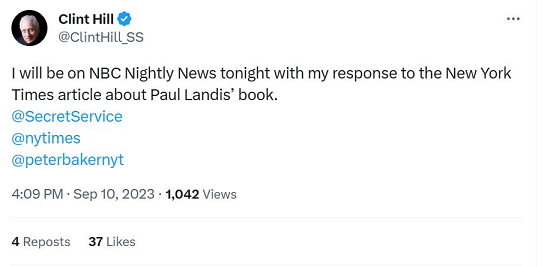
    Sure enough, Hill denounced Landis book on NBC Nightly News on 9/10/23. His thoughts were outlined in the Vanity Fair article referenced above:Picture21

    The crux of the matter seems to be, for both Clint Hill and certain members of the JFK assassination research community (this current author included), the fact that Landis is previously on record a whopping three different times[27] in stating that what he now in 2023 calls a whole bullet, which he placed on JFK’s stretcher in the emergency room, was then merely a bullet “fragment” which he “gave to somebody.” Here is what he said in 1983[28]:Picture22

    Here is what Landis said in 1988[29]:Picture23

    And here is what Landis conveyed in The Kennedy Detail from 2010[30]:Picture24

    Landis claimed in the Blaine book that he put the fragment on the seat, rather than giving it to somebody as he previously stated in both 1983 and 1988. If all this weren’t enough, Landis makes no mention of finding a bullet or bullet fragments in his 2016 Sixth Floor Museum oral history[31].

    In Landis own 9/12/23 NBC interview, separate from the one Hill did,he reports three gunshots (which in 2016 he said were fired in “5 to 6 seconds,” with the second and third fired rapidly one after the other[32]) and didn’t address the discrepancy with his initial 2-shot reports from decades ago. He also never mentioned stating (again in two different reports) that one of the shots came from the front. Incongruously, he still seemed to favor an Oswald-did-it scenario and that there was no grassy knoll shot, despite his initial two reports stating that a shot came from the front.

    My questions for Paul Landis today[33]:

    • Please distinguish the bullet you are now referring to compared to the bullet fragment that since 1983 you’ve claimed that you found in the limo. Are these “bullets” the same? Is the new bullet in addition to the bullet fragments? Does the whole bullet you now recall finding in the limo physically resemble CE399?
    • Please explain your thinking in November 1963 for not reporting this found bullet in your written reports. Was there explicit or implicit pressure to express or not express certain viewpoints? What form did that pressure come in? Are there additional unspoken revelations that you’re aware of from your Secret Service peers?
    • When did you first tell another person about the whole bullet you now report having found in the limo? What is the oldest written document or letter (or documented conversation) that references this 2023 found bullet?
    • Please share your thoughts on the propriety of a Secret Service agent not including a found bullet in your post-assassination report. Was evidence chain of custody part of your Secret Service training? Do you have a sense of the historic importance of what you are now revealing?
    • “I did not want this piece of evidence to disappear.” So, what does Landis do? He drops this crucial piece of evidence on a gurney without telling anyone. I guess he must have missed all those Preservation of Evidence classes at the Secret Service academy.
    • If Secret Service agents weren’t trained in the fundamentals of crime scene preservation, evidence gathering and reporting, weren’t they at least vetted for common sense?
    • Why then would Landis remove evidence from a crime scene (the presidential limousine) and relocate it to a stretcher instead of handing it off to his superior or at the very least local authorities?
    • Why didn’t he mark the bullet?
    • Why didn’t he record his findings in a report?
    • Did PTSD impede him from fulfilling his oath to support and defend democracy for decades?
    • How could he avoid the Warren Commission Report and Arlen Specter’s “magic bullet” theory for decades?
    • Did he state as late as 2010-2013 that he believed a lone gunman was responsible for Kennedy’s assassination?
    • Did the trauma overwhelm him for six decades?
    • The reason for why his total silence is not believable (or “understandable”) is because at the time Landis did what he said he did with that bullet, he had absolutely no knowledge or information about any of the details concerning the assassination. He had no idea who Oswald was at that time, and he had no idea if a conspiracy might be involved. He knew nothing at that point. And yet he tells NOBODY about finding and moving an important piece of evidence like a bullet?! Such dead silence by a member of the U.S. Secret Service (or anyone in law enforcement) in such a situation is completely beyond belief, not to mention totally irresponsible on Landis’ part. And, in my opinion, even if it had been days or weeks or months later that he had somehow come across a piece of new evidence connected with JFK’s death, it still would not be at all “perfectly understandable” that he would just keep completely silent about encountering such a piece of potentially vital evidence in the case of a murdered President.

    What’s more, according to fellow follow-up car Secret Service agent Sam Kinney’s neighbor Gary Loucks[34] (reported publicly for the first time in 2013), Kinney admitted to Loucks in 1986 to finding an extra bullet and putting it on a stretcher, a story eerily like Landis claims a decade later. One wonders if Landis read the articles about Loucks and Kinney or saw the video[35]? Likewise, Parkland Hospital Nurse Phyllis Hall[36] came out in the same year, 2013, to state that she saw a mystery bullet at Parkland[37]. One also wonders if Landis saw the articles or the videos about her story. Interestingly, Hall’s 2013 story surfaced yet again in September 2023 to corroborate Landis tale[38].

    Possible corroboration for Landis 2023 story (or something he may have viewed previously[39]) comes fromHSCA attorney Belford V. Lawson, in charge of the Secret Service area of the “investigation,” the author of a memo regarding an interview with Nathan Pool conducted on 1/10/77 and headlined “POOL’s CO-DISCOVERY OF THE ‘TOMLINSON’ BULLET.” In the memo, Pool mentions the fact that two Secret Service agents were by the elevator, one of which ” remained there throughout most or all of Pool’s stay”. Before we can catch our breath, a third Secret Service agent enters the picture; although all these men were in the immediate vicinity of the discovery of the bullet, one agent “was within 10 feet when Pool recognized the bullet”. According to Pool, the bullet was pointed, and he added that it “didn’t look like it had hit anything and didn’t look like it had been in anything”.

    Lawson felt that further development of Pool’s testimony may reveal the following:

    QUOTE: “A SECRET SERVICE AGENT WAS FOR A SIGNIFICANT PERIOD OF TIME CLOSE ENOUGH TO THE ELEVATOR TO PLANT A BULLET; MAY LEAD TO AN IDENTIFICATION OF THAT AGENT…”[40]

    In addition, author Jim DiEugenio wrote the author:”During the last days of the public hearings of the House Select Committee, Congressman, now Senator Dodd, gave the most important revelation. He stood up or sat up and asked Professor Blakey to answer one question. And he said, Mr. Blakey, will you please explain to me about the bullet that was found in the President’s limousine that cannot be ballistically matched to the Oswald weapon? Congressman Dodd never received an answer to this day.”

    Finally, in yet another story prevalent online that predates Landis 2023 bullet story, Captain James Young[41][42]story of a bullet — a spent, misshapen, but otherwise intact, bullet — that Young, a Navy doctor, said was found late at night, on the floor, in the back of Kennedy’s limousine. He inspected it himself. The bullet was found by two chief petty officers who, during the autopsy, were sent to retrieve any skull fragments they could find in the limousine. They came back with three pieces of bone, and the bullet. The skull fragments were reported — but not the bullet.

    Writer Ed Curtin thoughtfully wonders if Paul Landis book is merely a “limited hangout.”[43] The man seen with Landis during several televised interviews and the author of the new Vanity Fair article, Cleveland-based attorney James Robenalt, helped Landis to “process his memories,” a strange choice of words, indeed.[44]

    The more I investigate this whole thing, the more skeptical I become of Landis 2023 statements. Just as Jean Hill embellished her account in her book The Lady in Red, perhaps to sell books and make her account more dramatic, I believe such is the case here. And, just like Jean Hill, the “good news” is that the core of their story is true- Jean Hill was there and indicated a shot came from the knoll. Landis wrote in two reports that a shot came from the front, he verified their contents when the HSCA contacted him in early 1979 as they were writing the final report, and I want to believe his denouncement of the single bullet theory in 2016 (echoing Clint Hills own denouncement in the same year in his book Five Presidents) and his stating/demonstrating that the back of JFK’s head was missing (also in 2016, again echoing Clint Hill) are both true.

    As for these 2023-vintage statements about the bullet- I don’t believe it. I wanted to at first, but it falls apart upon deeper scrutiny.

    This whole thing almost reminds me of the Roscoe White story that broke out in August 1990: everyone was so excited as Ricky White made the media rounds. Oh, my Lord- there is a photo of his wife with Ruby! Wow- he was a Dallas police officer trainee. What?! He had the third backyard photo…

    But then, upon further scrutiny, the main part of his story fell to pieces- his father was the grassy knoll shooter as “proven” by a diary that no longer existed. Beverly Oliver said she saw Roscoe White on the knoll (yeah, right); Gerry Patrick Hemming said he knew Roscoe (suuuure he did)…

    Then Ricky disappeared and that was that.

    Will Paul Landis likewise disappear and avoid the tough questions? We shall see.

    PART TWO: THE BOOK ITSELF

    Well, the book was due out October 10, 2023, yet my pre-ordered hardcover was delayed until the end of the month. Being impatient, I decided to get the readily available Kindle edition.[45] Having devoured the entire book in one day, I must say that I was disappointed, both for what Landis says and for what he does not say. Quite frankly, if it wasn’t for the massive advance hype, I think his book would have sunk without a trace with meager sales, to boot (when I originally posted about his upcoming book, very few people seemed to care until the huge media hype came along). In fact, judging by the early mixed reviews on Amazon, Landis should be lucky that he has garnered a lot of advance sales because word of mouth from this point on will not be favorable.

    Comically, right from the start, the Acknowledgments section of the book mentions Clint Hill: “I appreciate your support for my book.” Yet, as we know, Hill came out against his book on NBC and, if that wasn’t enough, Landis was not invited to a get-together of all surviving Kennedy Detail Secret Service agents at the residence of Hill and his wife (and co-author) Lisa McCubbin Hill.[46]Ron Pontius, Jerry Blaine, Ken Giannoules, Tom Wells, and Rad Jones came to the Hill’s residence, as well as another mutual friend, former Secret Service Director Joseph Clancy, yet Landis (who was Hill’s friend for decades and participated in both The Kennedy Detail book and documentary) was not invited and not present.

    From the Introduction, we learn that Landis was given the Josiah Thompson book Six Seconds in Dallas in 2014 and that he “actively avoided reading any books about the events of November 22, 1963,” although he does acknowledge reading the The Kennedy Detail to which, as already noted, he participated in both the book and documentary.

    The bulk of the book will have little interest to all but the most ardent Kennedy fanatics and Secret Service buffs, but I will note some items along the way of getting to the more “meat and potato” points about the bullet and so forth.

    From Chapter One we learn that fellow Kennedy agents Richard Johnsen (the future keeper of CE399) and David Grant (future co-advance agent with Win Lawson in Dallas and Clint Hill’s brother-in-law) were roommates of Landis during his Secret Service career.

    From Chapter Two Landis notes the influence that fellow Ohio native Robert Foster had on his Secret Service career-Landis began his time in the agency in 1959, ending in 1964[47] (Foster would go on to be a member of the Kiddie Detail during the JFK years: the agents who looked after Caroline and John Jr.).

    Chapter 3 mentions Landis’ study of the 700-page Secret Service manual (this is only of interest for those who like to criticize Colonel Fletcher Prouty’s claim that there was indeed a Secret Service manual. Landis mentions having to study it during his training).

    Chapter 4 duly notes Landis time on the President Eisenhower grandchildren detail at Gettysburg, PA in 1960. Future JFK agents (and then-Ike White House Detail agents) Gerald Behn, Floyd Boring, Tom Wells, Stu Stout, Harry Gibbs, Sam Kinney, Bill Greer, Ernie Olsson, Ken Wiesman and John Campion are mentioned. Interestingly, Landis states that he is “proud” to have “planted the seed” for the Secret Service going on to use the AR-15 rifle, which became an official weapon of the agency. For his part, Landis became an official member of President Kennedy’s White House Detail within days of the inauguration: 1/23/61, to be exact.

    In Chapter 5, after mentioning the Secret Service manual once again, Landis fondly notes his positive interaction with JFK and how the President knew his name and the names of the other agents on the detail.

    Chapter 6 chronicles Landis’ time at Hyannis port as part of his 14-month time on the Kennedy Kiddie Detail along with fellow agents Tom Wells and Lynn Meredith. Landis, code name Debut, was the second youngest agent on the Kennedy Detail at 26, with fellow agent Ken Giannoules, also 26, beating him by a mere few months as the youngest one. The 12/19/61 Joseph P. Kennedy Sr. stroke is noted, as is a cute story about how Landis brought Caroline and her pony Macaroni into the actual Oval Office itself, much to JFK’s bemusement.

    Chapters 7-9 reminds one heavily of Clint Hill’s first book Mrs. Kennedy & Me, as Landis chronicles his time as a member of the First Lady Detail assisting Clint Hill in Ravello, Italy (along with fellow agents Toby Chandler and Paul Rundle), during the Cuban Missile Crisis of October 1962 (Landis formally joined the First Lady Detail during this time), the loss of Patrick Kennedy in August 1963, and Jackie Kennedy’s trip to Greece and Morocco in October 1963. Upon their return to Washington, D.C., Landis playfully wore a fez- while still sitting on the plane, President Kennedy (after greeting Jackie) shook his head from side to side and told Landis “Off with the fez, Mr. Landis.”

    Chapter Ten, titled “Texas,” mentions the October weekend trip Jackie made to Camp David, along with Clint Hill, the Kiddie Detail, Caroline, John Junior and the children’s nanny Maude Shaw. Interestingly, as with Hill’s four books and Blaine’s book The Kennedy Detail, Landis makes no mention whatsoever of the death of Secret Service agent Tom Shipman at Camp David on 10/14/63.[48] Landis mentions that the agents received a briefing about the upcoming Texas trip on 11/20/63 and that Dallas was known as the “City of Hate,” as Dallas was known for the attack on UN Ambassador Adlai Stevenson, the foul JFK as traitor notion, and the idiotic idea that the UN was a communist front. As Landis notes, there was “reason to be on alert.”

    After mentioning the trips to San Antonio and Houston (mentioning fellow agents Emory Roberts, Jack Ready, Don Lawton, William McIntire, Glen Bennett, Jim Goodenough, Andy Berger and “Muggsy” O’Leary), the Fort Worth trip of 11/21-11/22/63 is briefly chronicled. The infamous drinking incident involving nine agents, four of which rode on the follow-up car (Hill, Ready, Bennett and Landis himself), which occurred at both the Fort Worth Press Club and The Cellar is conveniently glossed over, as Landis denies that anyone was either drunk or misbehaving, although he does concede that he stayed until the early morning hours and got no sleep whatsoever. The bubble top decision is mentioned, yet no one is specifically mentioned as being the culprit for leaving the top off in Dallas (as I have noted in my books, Secret Service agent Sam Kinney was adamant to me on three occasions that he-Sam-was solely responsible for the top’s removal and that JFK had nothing to do with it).[49]

    Secret Service agent Bill Duncan is noted as the advance agent for Fort Worth, while Winston Lawson is noted as being the lead advance agent for Dallas. Fellow agent Larry Newman told me that he was concerned that Kennedy aides Dave Powers and Ken O’Donnell rode in the follow-up car, as he did not think they belonged there[50], and Paul Landis voices the same concern, even noting that they were unexpected and uninvited guests.

    Interestingly, Landis remembered agent Don Lawton throwing up his arms “as if in frustration” at Love Field as the motorcade started to move out (something this reviewer noted over thirty years ago and popularized in his books, online blogs, conference presentations and television appearances[51]). Landis thought it was because of uninvited guests Powers and O’Donnell, yet he notes that “I have since read that he was left behind to help secure the area for our departure later that afternoon.” However, Landis states that “I personally find this difficult to believe, because Love Field was already secured for our arrival. We were already short of agents and needed all of the on-site coverage we could get.” As with the omission of any word about agent Thomas Shipman’s death, Landis makes no mention of agent Henry Rybka, the other agent (along with Don Lawton) recalled and left behind and Love Field.[52]

    Landis, after duly noting fellow follow-up car agents Sam Kinney (the driver), Emory Roberts, George Hickey (manning the AR-15), Clint Hill, Tim McIntire, Jack Ready, Glen Bennett and himself, also mentions that agent Glen Bennett was “our protective research agent,” yet, officially, he was merely an extra agent added to the somewhat depleted detail of agents. That said, Landis’ comment corroborates both Clint Hill’s statement in his book and my own research that agent Bennett was there as an unofficial covert monitor of threats to Kennedy’s life and the true nature of his reason for riding in the follow-up car was hidden for decades after the assassination.[53]

    Landis notes that the Dallas motorcade was ten miles long (in contrast, the Tampa, Florida motorcade of 11/18/63, which entailed agents on the rear of the limo and infinitely better overall security, was a whopping 28 miles long[54]). Landis rightly notes that Clint Hill got on the rear of the presidential limousine several times and that the motorcade, travelling at “30-35 mph” before they got to Main Street, had driver Sam Kinney hugging the rear bumper of JFK’s limo, maintaining a 3-5 foot distance between the cars the whole time (although there would be a markedly wider distance between the two cars on Elm Street when the assassination began). Landis notes that they were barely moving at a snail’s pace around the sharp, almost hairpin turn from Houston Street onto Elm Street.

    When the assassination started, Landis states that “everything happened so fast” and that the shooting occurred within “5-6 seconds.” Landis does state that the second shot “sounded louder than the first one” and that it “had a different feeling, a different reverberation.” From Landis’ description of the 3 shots, he says he heard, it sounds like there were actually more than three shots, for he states that the second one occurred as “Hill was starting to pull himself up onto the limo” and that the third shot was the head shot! Landis states that the head wound was “massive”, yet does not state exactly where it was, unlike his 2016 Sixth Floor Museum oral history, in which he demonstrates that it was located at the “right rear” of the head.[55]

    Disappointingly, perhaps influenced by his participation in The Kennedy Detail, Landis, with no first-hand knowledge (he admits that this was his first motorcade), states that the agents were not on the rear of the limo because JFK did not want them there, a notion the author has adamantly debunked.[56] Landis does admit that Shift Leader Emory Roberts instructed the agents to cover Vice President LBJ as soon as the follow-up car stopped at Parkland Hospital, quite a switch in allegiance from Kennedy to Johnson.

    Chapter 11, titled “Parkland”, begins with Landis noticing “a crack in the windshield” of the presidential limousine and further adding that Texas Governor John Connally was “probably (hit) by the second bullet”; that he “saw two brass bullet fragments sitting in a pool of bright red blood” on the rear limousine seat; and that he also “saw a bullet on top of the tufted black leather cushioning” and that it was “a completely intact bullet,” yet he does not state the obvious contradictions these observations would have to the official government Warren Commission single bullet theory, an absolutely essential component to having Lee Harvey Oswald acting as the sole shooter. In fact, the official photo of CE399, the magic bullet, is shown with the caption that this was “the bullet that Special Agent Paul Landis found in the limousine”!

    Landis wonders where the agents were when he discovered the intact bullet, yet Sam Kinney (one of the ones he mentions as missing) was indeed still there, as many photos and films prove.[57] Landis claims he actually held the bullet in his hand, placed it in his suit pocket, and (not long afterward) placed it on the examination table next to JFK’s left shoe, none of which he ever stated before when (as noted in part one) he was interviewed in 1983, 1988 or 2010.

    Landis goes on to mention that Texas law forbids the president’s body from leaving Texas, yet, as we know, the agents forcibly removed JFK’s body at gunpoint on their way to Love Field and Air Force One. Landis also notes fellow agent Glen Bennett taking notes aboard Air Force One. Interestingly, Landis also states that agent Roy Kellerman, nominally in charge of the Texas trip, persisted and insisted that Landis watch the swearing in ceremony, fodder for those who believe something happened to Kennedy’s body while the ceremony was taking place.

    Chapter 12 has a few items of interest. After noting that roommate and fellow agent David Grant (Hill’s brother-in-law and advance agent for the Trade Mart) stayed in Dallas to assist the police in their investigation, he notes that some of the agents thought that LBJ had something to do with the assassination! Also of interest: Landis states that, not only were all the agents in Dallas told to write reports, but they were all told to watch the Zapruder film: “all agents were required to view the film and sign off that they had seen it. It was mandatory.” Landis refused to do so and heard nothing more about it.

    Remarkably, Landis claims to have purchased a Mannlicher-Carcano like Oswald’s from American Rifleman magazine back in March 1958 and that he brought his rifle to the White House to show his fellow agents on the morning of 11/25/63, Kennedy’s funeral. Of note, Landis does not mention Gerald Blaine’s alleged “meeting” from this same morning wherein the agents supposedly talked of suppressing the “fact” that Kennedy told them to stay off the limo so as not to blame the president.[58]

    Chapter 13 takes note of Landis’ PTSD and how he would play the assassination over and over in his mind which led to his eventually leaving the Secret Service on 8/15/64, three days after his 29th birthday.

    The Epilogue has Landis finally admitting that he read the Warren Report, albeit in 2018. Surprisingly, Landis admits that he was indeed contacted by the HSCA in 1979, yet he omits what he conveyed: that he stands behind his two reports! In fact, perhaps the most glaring omission of all: Landis does not mention that he stated in BOTH of his reports that a shot came from the front! I find these omissions very troubling, to put it mildly. Landis ‘forgets’ to mention the fact that he wrote something in TWO reports that goes against official history AND he doesn’t bother to mention the bullet he allegedly found: bizarre and suspicious.

    Quite frankly, I find the entire book a real “bait and switch” scenario: hype the book about the bullet Landis found while it racks up best-selling sales in pre-order, only to deliver a pamphlet’s worth of interesting and new information. And, as noted above, there are glaring omissions and the whole bullet business leaves one wondering if this was added to sell books (as he wrote nothing about it in 1963 or said nothing about it in 1983, 1988 or 2010 when given the chance) and, perplexingly, Landis does not go into any detail about the significance of this alleged find and how it debunks official history (if true). Seasoned researchers know about the significance of a whole bullet found where it was in Landis’ scenario, but I can imagine the public being quite confused (and totally in the dark about Landis’ two reports that stated a shot came from the front, as well as his demonstration of a right rear head wound in 2016).

    But, hey- Landis has a runaway best-seller (in advance sales) for his children and grandchildren to enjoy…


    Journalist Jeff Morley and attorney Larry Schnapf interview Landis about this new controversy and his book. Watch/download the interview here.


    [1] Perhaps JFK era agent is more appropriate, as Landis, like fellow Secret Service Agent Clint Hill, was actually a First Lady Agent, protecting the life of Jacqueline Kennedy.

    [2] The Final Witness: A Kennedy Secret Service Agent Breaks His Silence After Sixty Years: Landis, Paul: 9781641609449: Amazon.com: Books

    [3] Jackie Kennedy’s ex-Secret Service agent makes new claim about the JFK assassination – YouTube

    [4] Former Secret Service agent describes JFK assassination in new detail – YouTube

    [5] Ex-Secret Service agent reveals new JFK assassination detail – BBC News

    [6] JFK Secret Service Agent Refutes Magic Bullet Assassination Theory (tmz.com)

    [7] A New JFK Assassination Revelation Could Upend the Long-Held “Lone Gunman” Theory | Vanity Fair

    [8] J.F.K. Assassination Witness Breaks His Silence and Raises New Questions – The New York Times (nytimes.com)

    [9] Agent Paul Landis Makes Startling Claim About JFK Assassination in New Book (people.com)

    [10] 18 H 687. See also Could the Secret Service Have Saved J.F.K.? | Vanity Fair

    [11] 18 H 758-759; 18 H 751-757

    [12] HSCA REPORT, pages 89 and 606

    [13] The Kennedy Detail by Gerald Blaine (2010), page 353

    [14] Author of the books Mrs. Kennedy & Me (2012), Five Days in November (2013), Five Presidents (2016), and My Travels with Mrs. Kennedy (2022). In addition, Hill wrote the Foreword and contributed significantly to the Gerald Blaine book The Kennedy Detail (2010)

    [15] Tina Towner: My Story as the Youngest Photographer at the Kennedy Assassination (2012)

    [16] The Coshocton (Ohio) Tribune, 11/20/83; Greenfield (Ohio) Daily Times, 11/22/83

    [17] The Columbus (Ohio) Dispatch, 11/20/88

    [18] Could the Secret Service Have Saved J.F.K.? | Vanity Fair

    [19] Five Presidents by Clint Hill (2016), page 178

    [20] 18 H 740-745

    [21] 2 H 141

    [22] The Kennedy Detail, page 217

    [23] Mrs. Kennedy & Me, page 291

    [24] Five Days in November, page 139

    [25] Five Presidents, page 155

    [26] Paul Landis on location of JFK head wound: blockbuster – YouTube

    [27] Although, importantly, not in either of his 1963 reports

    [28] The Coshocton (Ohio) Tribune, 11/20/83; Greenfield (Ohio) Daily Times, 11/22/83

    [29] The Columbus (Ohio) Dispatch, 11/20/88

    [30] The Kennedy Detail, page 225

    [31] Paul Landis – no mention of bullets or fragments in 2016 interview plus bad memory – YouTube

    [32] Paul Landis – fast shots that sounded different but fails to mention frontal shots from HIS reports – YouTube

    [33] Special thanks to researcher K.K. Lane for his help with this specific list of questions.

    [34] Loucks died on 2/23/23: Gary Lee Loucks (1946-2023) – Find a Grave Memorial

    [35] JFK Secret Service Agent Sam Kinney’s neighbor’s (Gary Loucks) revelations – YouTube

    [36] Hall died on 4/18/23: Obituary | Phyllis J. Hall of Irving, Texas | Donnelly’s Colonial Funeral Home (donnellyscolonial.com)

    [37] Nurse claims JFK had another bullet lodged in body after assassination – New York Daily News (nydailynews.com)

    [38] JFK assassination nurse says she SAW the ‘pristine bullet’ Secret Service agent Paul Landis now claims he retrieved from limo and placed on stretcher – upending the ‘magic bullet’ theory | Daily Mail Online

    [39] As referenced in my books and fairly prevalent online.

    [40] Pool Nathan 01.pdf (archive.org)

    [41] White House Physician, Autopsy Eyewitness, questions President Ford about Missing Bullet – ASSASSINATION ARCHIVES (aarclibrary.org)

    [42] Navy Doctor: Bullet Found in JFK’s Limousine, and Never Reported – WhoWhatWhy

    [43] Another Magical JFK Assassination Pseudo-Debate and Limited Hangout | Dissident Voice

    [44] James Robenalt – Wikipedia

    [45] With this in mind, all references are to the Kindle edition.

    [46] Clint Hill Facebook 9/24/23. Hill noted: “There were messages from former USSS director Lew Merletti and Secretary of State Tony Blinken and his wife Evan Ryan, the granddaughter of James J. Rowley, my first boss at the White House.”

    [47] The same time span as agent Gerald Blaine.

    [48] See the reviewer’s books Survivor’s Guilt: The Secret Service & The Failure to Protect President Kennedy, The Not-So-Secret Service, Who’s Who in the Secret Service and Honest Answers About the Murder of President John F. Kennedy. See also: THE REAL DEATH OF A SECRET SERVICE AGENT THE MONTH BEFORE THE KENNEDY ASSASSINATION 10/14/1963 – YouTube

    [49] The JFK bubble top: Sam Kinney’s decision + all the times it was used (1/3 of all motorcades) – YouTube

    [50] Interview with Larry Newman.

    [51] JFK assassination Secret Service documentary: the Kennedy agents 2016 – YouTube

    [52] The Secret Service stand down on the day of the JFK assassination EXPLAINED: one hour version – YouTube

    [53] Gerald Blaine, The Kennedy Detail (kennedysandking.com)

    [54] Excellent security for President Kennedy 11/18/63 Tampa and Miami, Florida – YouTube See also EXCELLENT security for JFK in Tampa, FL on 11/18/63 | Vince Palamara

    [55] Paul Landis on location of JFK head wound: blockbuster – YouTube

    [56] JFK’s agents deny that President Kennedy ordered them off the limo – YouTube

    [57] For example, see the 16-minute mark of: The Last Two Days – Highest Quality Version (JFK Assassination) – YouTube

    [58] Gerald Blaine, The Kennedy Detail (kennedysandking.com)

  • A Presumption of Innocence: Lee Harvey Oswald, Part 2

    A Presumption of Innocence: Lee Harvey Oswald, Part 2


    Part 1

    CE 399

    How does one go about verifying the authenticity of Commission Exhibit 399? That is a very important question. Had Lee Harvey Oswald survived long enough to see a public trial, no doubt one of the most important pieces of evidence against him would have been the nearly pristine bullet found on a stretcher at Dallas’s Parkland Hospital in the wake of the president’s murder. One of the most important aspects of any criminal case is verification of physical evidence which is being presented in a court of law. This high-profile murder case is no exception; therefore the provenance of CE 399 must be explored if we are to make a determination as to its authenticity. This exploration begins through the study of the variety of documentation and witness statements relating to this core evidence. This legal doctrine behind this exploration is termed ‘chain of possession.’ In relation to CE 399, we want to determine:

    1. Who found the bullet?
    2. Who took possession of the bullet?
    3. What documentation and markings exist in relation to the bullet?
    4. What do the witnesses say about the bullet?

    The discovery of the bullet is credited to Parkland maintenance employee Darrell C Tomlinson. Mr Tomlinson was in the process of moving a stretcher which was blocking an area in front of an elevator in the hospital’s emergency department. Tomlinson stated before the Commission that:

    Mr. TOMLINSON.  I pushed it back up against the wall.

    Mr. SPECTER.      What, if anything, happened then?

    Mr. TOMLINSON.  I bumped the wall and a spent cartridge or bullet rolled out that apparently had been lodged under the edge of the mat.

    (Testimony of Darrell C Tomlinson)

    Upon the retrieval and inspection of this bullet, Tomlinson handed it over to Mr. O. P. Wright, who was Parkland’s personnel director. Mr Wright was a retired Dallas deputy chief of police, in charge of patrol division in the 1950’s. Upon close inspection of this bullet, Wright sought out a Secret Service agent. That agent was Richard E Johnson. Agent Johnson kept in his possession the Parkland bullet until he had flown back to Washington D.C. with the slain president’s body. Once in Washington, Johnson handed over possession of the bullet to chief of the Secret Service, James Rowley. In turn, Rowley handed the bullet over to FBI agent Elmer Lee Todd. Todd, who is alleged to have placed his markings upon the bullet, handed the bullet over to Robert Frazier of the FBI crime lab. That is the official explanation as to how the bullet found in Dallas ended up in Washington D.C. on 11/22/63.   Let us examine some of the participants in this chain:

    Tomlinson => Wright => Johnson => Rowley => Todd => Frazier

    Darrell C Tomlinson

    Tomlinson appeared before the Warren Commission on March 20th, 1964. Amazingly, Mr. Tomlinson was not shown CE 399 during his hearing and consequently was not asked to ID it as the bullet that he found on the stretcher at Parkland Hospital on 11/22/63. This is strange behaviour from the Commission as Mr. Tomlinson was an important witness to the identification of this key piece of evidence.

    According to one memo (Commission Exhibit 2011, p.2), on June 12, 1964, Darrell C. Tomlinson, maintenance employee, Parkland Hospital, Dallas, Texas, was shown Exhibit C1 (CE 399), a rifle slug, by Special Agent Bardwell D. Odum of the Federal Bureau of Investigation. To quote from that report, “Tomlinson stated it appears to have been the same one he found on a hospital carriage at Parkland Hospital on November 22, 1963, but he cannot positively identify the bullet as the same one he found and showed to Mr. O. P. Wright.” Did Tomlinson at least concede that CE 399 resembled the bullet he held in his possession that day?

    O P Wright

    As incredible as it sounds, Mr. Wright was not called to testify before the Commission. According to an FBI Memo which was printed in the Warren Commission hearings (Commission Exhibit 2011, p.2), on June 12, 1964: “O. P. Wright, Personnel Officer, Parkland Hospital, Dallas, Texas, advised Special Agent Bardwell D. Odum that Exhibit C1 (CE 399), a rifle slug, shown to him at the time of the interview, looks like the slug found at Parkland Hospital on November 22, 1963. He advised he could not positively identify C1 (CE 399) as being the same bullet which was found on November 22, 1963.” But does the evidentiary record support the notion that Wright conceded that the Parkland bullet looked like CE 399?

    In November of 1966, Josiah Thompson visited Tomlinson and Wright at Parkland Hospital in Dallas. Thompson later asked Wright to describe the bullet he got from Tomlinson on 11/22/63. Wright described the bullet he obtained as having a “pointed tip.” (Six Seconds in Dallas, p. 175)

    In reference to an earlier re-enactment done with Tomlinson, Wright stated to Thompson that the stretcher bullet looked “like the one you got there in your hand,” referencing the .30 calibre projectile used for the re-enactment. (Thompson, Last Second in Dallas, p. 24)

    This description from Wright must bring into question Wright’s alleged concession to Odum that CE 399 looked like the bullet he had in his possession that day. When Thompson showed Wright a picture of CE 399, similar bullets from Oswald’s alleged rifle and CE 606, similar bullets from Oswald’s alleged revolver, Wright denied that any of these resembled the bullet Tomlinson found on 11/22/63. 

    Thompson stated that later, while getting ready to leave Parkland, Wright approached him and said, “Say, that single bullet photo you kept showing me … was that the one that was supposed to have been found here?” Thompson replied “Yes.”  Thompson states that Wright “looked right at me, his face expressionless, and said, ‘Uh…huh.’ Then Wright turned and went back to his office.” (Last Second in Dallas, p. 26)

    To Thompson, Wright had rejected CE 399 as the bullet Tomlinson handed over to him that day. Tomlinson also could not identify CE 399 as the bullet he found on the stretcher on 11/22/63.

    In a declassified document dated 6/20/64 from Gordon Shanklin, SAC Dallas, to FBI Director J Edgar Hoover, Shanklin states: “Neither Parkland’s DARRELL C. TOMLINSON, nor O. P. WRIGHT, can identify this bullet.”

    So as of June 20th 1964, the FBI knew that neither Tomlinson nor Wright could identify CE 399 as being the bullet which came from a stretcher at Parkland Hospital on 11/22/63. 

    Richard E Johnson

    Richard E Johnson was another important witness whose testimony the commission neglected to hear. Maybe it is because, contained within the document CE 2011, we find the following information with regard to his identification of CE 399:

    On June 24, 1964, Special Agent Richard E. Johnson, United States Secret Service, Washington, D.C., was shown Exhibit C1 (CE 399), a rifle bullet, by Special Agent Elmer Lee Todd, Federal Bureau of Investigation. Johnson advised he could not identify this bullet as the one he obtained from O. P. Wright, Parkland Hospital, Dallas Texas, and gave to James Rowley, Chief, United States Secret Service, Washington D.C., on November 22, 1963. (Commission Exhibit 2011, Volume XXIV, p. 412)

    James Rowley SS Chief

    On June 24, 1964,  James Rowley, Chief, United States Secret Service, Washington, D.C., was shown exhibit C1(CE 399), a rifle bullet, by Special Agent Elmer Lee Todd. Rowley advised he could not identify this bullet as the one he had received from Special Agent Richard E. Johnson and gave to Special Agent Todd on November 22, 1963. (Commission Exhibit 2011, Volume XXIV, p.  412)

    Elmer Lee Todd

    On June 24th, 1964, Special Agent Elmer Lee Todd, Washington D.C. … identified C1 (CE 399), a rifle bullet, as being the same one he had received from James Rowley, Chief, United States Secret Service, Washington D.C. … on November 22, 1963. This identification was made from initials marked thereon by Special Agent Todd at the Federal Bureau of Investigation Laboratory upon receipt, November 22, 1963. (Commission Exhibit No. 2011, Volume XXIV, p.  413)

    So according to CE 2011, SA Elmer Todd was able to identify CE 399 because of the initials Todd had placed upon the bullet to establish chain of custody.  

    Well respected Kennedy researcher John Hunt wanted to establish if the bullet which sits in the National Archives today in fact bears the marking of Special Agent Elmer Lee Todd. Hunt managed to put together an illustration using photographs of CE -399.” He was thenable to track the entire surface of the bullet using four of NARA’s preservation photos.”

    As Hunt states in his fine essay on this subject:

    There is no question but that only three sets of initials appear on CE -399. There is likewise no question that they have all been positively identified:  RF was Robert Frazier, CK was Charles Killion, and JH was Cortland Cunningham … It can be stated as a fact that SA Elmer Lee Todd’s mark is not on the historical CE -399 bullet.” (Phantom Identification of the Magic Bullet: E. L. Todd and CE-399)

    We also find further collaboration for Hunt’s work from Dr David Mantik. At NARA in June 1994, Mantik and astronomer Steve Majewski confirmed that Todd’s initials are not on the historical CE 399.  In an email communication with me, Mantik stated, “The other initials are precisely as described by John Hunt.”

    Robert Frazier FBI

    Another of John Hunt’s masterclasses comes in the form of the essay, “The Mystery of the 7:30 Bullet.” Hunt discovered through his examination of Robert Frazier’s detailed notes that the Parkland bullet was recorded as “Reed Elmer Todd, 11/22/63 – 7:30 p.m.” According to Frazier himself, he took custodianship of the bullet from Todd as of 7:30 p.m. on 11/22/63.

    However, upon further analysis of the documentation, Hunt came across an envelope which was filled out by SA Elmer Lee Todd upon receipt of the bullet from Chief Rowley. This documentation states:

    Received from Chief Rowley, USSS, 8:50 p.m. 11/22/63 E. L. Todd. (The Mystery of the 7:30 Bullet)

    Question: How could Todd have given Frazier the stretcher bullet at 7:30 p.m. when Todd had not yet received that bullet from Chief Rowley until 8:50 p.m.? This discrepancy further casts the authenticity of the prosecution’s evidence into the most serious doubt.


    Gary Aguilar and Josiah Thompson Track Down Odum

    Dr Gary Aguilar and Josiah Thompson tracked down former FBI agent Bardwell Odum. The following encounter is well documented in their fine essay, “The Magic Bullet: Even More Magical Than We Knew?” (The Assassinations, edited by James DiEugenio and Lisa Pease, pp. 282-84)

    On September 12th 2002, Aguilar phoned Odum and the two conversed about various things, but naturally the discussion turned to the assassination of John Kennedy. Odum agreed to look over various documents for Aguilar. Mr. Odum was sent three separate documents. The three were CE 2011, which states that Odum had shown CE 399 to Tomlinson and Wright at Parkland, the FBI airtel dated June 12, 1964, and the three-page FBI memo dated July 7, 1964. After a few weeks, Aguilar phoned Odum back. During that second phone call, Bardwell Odum then made the following statements: “Oh I never went to Parkland Hospital at all. I don’t know where you got that?” When Gary Aguilar asked Odum about CE 399, Odum replied, “I didn’t show it to anybody at Parkland. I didn’t even have any bullet. I don’t know where you got that from, but it is wrong.” (The Magic Bullet: Even More Magical Than We Knew?)

    Mr. Odum then went on to state that he never even saw CE 399, let alone had it in his possession. What makes it all worse is that Mr. Odum was a personal friend of O. P. Wright. Surely if Odum had at any time taken possession of this important piece of evidence relating to the murder of President Kennedy and presented it to his friend for identification purposes, then Odum would have remembered, would he not have?

    Summary 

    It is pretty clear that CE 399 would have been an evidentiary debacle for a prosecuting attorney trying Lee Oswald. In order for evidence to be ruled as admissible in a court of law, the item must have an intact chain of possession. If a certain piece of evidence does not meet that standard, then this evidence is wide open to serious questioning by a defense attorney. Why would any prosecutor want Tomlinson, Wright, Johnson, and Rowley to testify that CE 399 was not the bullet each of them took possession of that day? Why would the prosecution want Todd testifying that he had indeed marked the Parkland bullet, when the historical CE 399 which sits in evidence today does not bear his marked initials? Why would the prosecution want Frazier to take the stand and testify under oath that he had received the bullet from Todd at 7:30 pm, when the bullet from Dallas wouldn’t be received by Todd until 8:50 pm?

    Mark Lane, quoting Mark Twain, summed it up best:  “Who so clinging from a rope by his hands severeth it above his hands must fall. It being no defense to claim that the rest of the rope is sound.”


    C 2766 Palm Print

    Leaving behind CE 399, I now would like to turn our attention to another piece of evidence which is cited against Lee Oswald: the alleged presence of his palm print upon the rifle claimed as the murder weapon of John Kennedy. This alleged discovery of the print was made by J. C. Day of the Dallas police on 11/22/63. Even at that early stage it is alleged that Day had tentatively identified the palm print as coming from the main suspect, Lee Oswald. (Sylvia Meagher, Accessories After the Fact, p. 123) Is there any photographic evidence in existence of the print on C2766? The shocking but unsurprising answer to that question is there is no contemporaneous photographic evidence. Standard practice is to photograph a lift before an attempt at its removal is made. This step is taken to safeguard against the possibility of losing the print. Take, for example, the statements of FBI Fingerprint Expert Sebastian Latona: “Primarily, our recommendation in the FBI is simply in every procedure to photograph and then lift.” (Meagher, p. 123)  The absence of any contemporaneous photograph of the print on the rifle is even more dumbfounding when we learn that Lieutenant Day attended an advanced latent print school conducted in Dallas by the Federal Bureau of Investigation. (Meagher, p. 123)

    There are photographs of other partial prints taken by Day which were found on the exterior of the rifle. These prints were found to be valueless by the FBI.  Day claimed that he had taken these photographs around 8 p.m. on 11/22/63.

    Day claimed that he did not take a photograph of the most important latent palm print because he was given orders by Dallas Police Chief Jesse Curry to “go no further with the processing.” However, prior to his Commission testimony, Day related to the FBI that he received these orders from Curry shortly before midnight. So by his own admission, Day had almost 4 hours to photograph the print he identified as Oswald’s before receiving the orders from Chief Curry. (Commission Exhibit 3145)

    Why, then, did he not photograph the latent print? He must have known that this would be important evidence in any trial of Oswald. Not only is there no evidence that the palm print was ever present on the rifle, but when the FBI received the weapon and tested it for prints, they found no evidence of any fingerprint traces and no evidence of a lift ever being performed. (Henry Hurt, Reasonable Doubt, p. 107) Day testified that “the print on the gun … still remained on there … there was traces of ridges still on the gun barrel.” (WC Vol. 4, pp. 261-62) Which is in stark contrast to the findings by the FBI.

    There is also no independent collaboration to Day’s alleged lifting of the print, as Day claimed to be alone when he attempted the lift. (CE 3145)

    Day also apparently neglected to inform FBI agent Vincent T. Drain. Drain transferred the rifle to Washington D.C. on 11/23/63.  Day said he informed Drain he had indeed found a palm print on the rifle which he believed was Oswald’s. As Henry Hurt wrote, Drain clearly disputes this:  he says Day never showed him any such print or left any indication on the rifle where to look for it. (Hurt, p. 109)

    Once the rifle arrived in Washington D.C., FBI hair and fibre expert Paul Stombaugh examined it, stating, “I noticed immediately upon receiving the gun that this gun had been dusted for latent fingerprints prior to my receiving it. Latent fingerprints powder was all over the gun.” (Meagher, p. 121)

    In Accessories After the Fact, Sylvia Meagher states, “How could powder survive on the gun from Dallas to Washington, but every single trace of powder and the dry ridges which were present around the palm print on the gun barrel under the stock vanish?” (Meagher, p. 122)

    Now when Capt. Will Fritz was asked on Saturday, November 23, if Oswald’s prints were found on the rifle, he stated “No sir.”  Chief Curry also made no mention of this important discovery to the media. (Meagher, p. 124) In fact, the first mention of a palm print discovered on the rifle was announced on 11/24/63 by Dallas DA Henry Wade. (Hurt, p. 108) This was after the rifle was back in Dallas and after Oswald was murdered. The following is very hard to swallow:  Day allegedly informed Fritz and Curry on 11/22/63 that he had found a palm print on the rifle which allegedly was used in the killing of President Kennedy and that he had tentatively identified the palm print as coming from the main suspect, Lee Oswald. (Meagher, p. 124)

    With this powerful information in their arsenal, neither Fritz, Curry nor Wade, who were guilty of making many fraudulent and prejudicial statements of “fact” against the accused, offered not once to the assembled media on 11/22 or 11/23 that the existence of Oswald’s palm print had indeed been found on the suspected murder weapon.

    The statements emanating from law enforcement officials were so prejudicial against Oswald that they warranted comment from various sources, one of these being Attorney Percy Foreman. According to the St Louis Post Dispatch, Foreman suggested that “authorities are running a serious risk of jeopardizing their case against Oswald by failing to observe his constitutional rights.” He went on to state: “Officials may have already committed reversible error in the case by permitting the accused to undergo more than 24 hours of detention without benefit of legal counsel.” Citing grounds for reversal, Foreman further asserted: “Under recent decision of the United States Supreme Court, Federal procedural guarantees must be observed in state prosecutions. Their abridgment can be grounds for a reversal or even a conviction. This is a new law. They could get a conviction in Texas and get it thrown out on appeal, but it takes a long time for these dim-witted law enforcement officers to realize it.”  (St Louis Post Dispatch, 11/24/63)

    After Oswald’s murder, all the evidence pertaining to the murder of President Kennedy was transferred from Dallas to Washington for good on November 26th. Day’s alleged lift of the palm print on the rifle did not reach Washington until November 29th. Why did this important piece of evidence not arrive with the others? (Meagher, p. 123)

    In his book Reasonable Doubt, Henry Hurt interviewed retired FBI agent Vincent T Drain. Remember, Drain was the man who transferred the rifle from Dallas to Washington in the early hours of 11/23/63. When Drain was asked about the authenticity of the palm print, he replied: “I just don’t believe there was ever a print.” He noted that there was increasing pressure on the Dallas police to build evidence in the case. Asked to explain what might have happened, Agent Drain said, “All I can figure is that it (Oswald’s print) was some sort of cushion because they were getting a lot of heat by Sunday night. You could take the print off Oswald’s card and put it on the rifle. Something like this happened.” (Hurt, p. 109)

    From Latona’s testimony it appears that the FBI never did find any of Oswald’s prints on C 2766. Latona confirmed Oswald’s prints from pictures supplied to him by the Dallas Police on November 29th. (WC Vol. 4, pp. 24-25). To put it mildly, any accomplished defense attorney would have moved for what is called an evidentiary hearing prior to any trial of Oswald on both these pieces of evidence. He would likely have had both declared inadmissible. If not, he would have demonstrated to any jury that they were worthless as evidence since no chain of custody existed with either one. Beyond that, people were lying in order to create the illusion of a chain.


    Part 3

  • Zero Fail: Déjà vu All Over Again

    Zero Fail: Déjà vu All Over Again


    As someone who has written extensively about the Secret Service, especially the Kennedy years, I was looking forward to 3-time Pulitzer Prize winning author Carol Leonnig’s hyped book Zero Fail. While this is not a review of her book, per se, it is a tale of disappointment and how I was once again the victim of some sophisticated and sinister hacking, which directly affected my books and my work. This is something I went through back in 2010, when former Secret Service agent Gerald Blaine’s book The Kennedy Detail was in the news and again when my own book Survivor’s Guilt: The Secret Service & The Failure to Protect President Kennedy was coming out.

    In the short days before Leonnig’s book was due to be released (5/18/21), I was admittedly quite excited about reading the book, even having it on pre-order from Amazon in anticipation. The author is a very respected journalist who had previously co-authored the number one best-selling anti-Trump book A Very Stable Genius. I had high hopes that, when Leonnig tackled the Kennedy era, in particular, she would put on her investigative reporter hat and do some digging to find the real truth on the matter of Kennedy’s Secret Service protection, or lack thereof, in Dallas.

    Then, the flood of articles and media appearances began and my heart sank. Leonnig merely bought into the old canard that JFK ordered the agents off his limo and was reckless with his own security—the old blame-the-victim mantra—no doubt enhanced by personal interviews with former agent/authors Clint Hill and Gerald Blaine. I kept thinking to myself “surely this acclaimed author has to know of my work; she has to know there is a huge dissenting view on this matter.”[1] But, alas, Leonnig chose the lazy way out and didn’t do her own thinking on the subject.

    That was the first part of my disappointment…then came the real shocker.

    On the eve of her book being released, I went to my Amazon author page and, to my horror, I discovered that ALL FIVE OF MY BOOKS WERE GONE…gone! I immediately went to my bookmarks and found that the individual URLs were still there, but the books were gone from my author page. It gets worse.  When I did a search in Amazon using the terms “Vince Palamara”, “Vincent Palamara”, “Palamara”, “JFK assassination”, “Kennedy assassination” or “Secret Service”, none of my books—which were normally at or near the very top of these search terms, especially my latest Honest Answers About the Murder of President John F. Kennedy—were missing. Nothing was there!

    By removing my books from my author page, they were essentially invisible to the potential buyer. Then I checked Josiah Thompson’s popular new book Last Second in Dallas.  Same thing, his was gone too! I also checked a few other very recent pro-conspiracy books…same fate. I let author Larry Hancock know of this alarming situation and he became an instant student of this hack and the ramifications of the disappearance of his books from Amazon. I also alerted Josiah to this drastic situation via a mutual friend, writer Matt Douthit. First and foremost, I fired off some edgy messages to Amazon’s support staff. It took about 6 hours or so, but the books slowly came back. But, and it’s a big but: There was no explanation from Amazon regarding how or why this happened! As someone told me: they wouldn’t hack their own products and “kill their own”, so to speak; they want the money and sales. This had to have been a nefarious hack with a purpose (for the record, no lone-nut books were harmed in the making of this hack. Also, older titles were not touched, either).

    I cannot help but think that someone—knowing Leonnig’s red hot volume was due for release, and seeing all the hype articles and television appearances and the positive effect this would have on curious minds wishing to check out books related to the Secret Service and the Kennedy assassination like mine, Josiah’s, Larry’s and a couple others—somehow did a malicious hack to erase them from searches. With Amazon offering no explanation and realizing how highly unusual this was, what else was one to think? Since 2013, when my first book came out, and ever since, this has never happened before[2] and I make this statement as someone who admittedly checks out my books a few times daily to monitor for positive comments, negative comments, sales, and any potential mischief, so any other past hack would have been known to me.

    This feeling is further enhanced due to this fact: I am the victim of previous harassment due to my work.

    As readers of my detailed review of The Kennedy Detail well know[3], I am firmly convinced that Gerald Blaine’s book was written to counter my work on the Secret Service. In fact, both Gerald Blaine and Clint Hill took to C-SPAN to address some of my criticisms, even showing a You Tube video of myself speaking about their book[4] (Hill wrote the Foreword to Blaine’s book, contributed to its contents, did the book and media tours, and ended up in a romantic relationship with co-author Lisa McCubbin which led to three books: Mrs. Kennedy & Me[5], Five Days In November[6], and Five Presidents[7]). Keep in mind-this was all before my first book was published, although it was a self-published affair at the time with a link on my blog as part of my heavy online presence (I will return to this later).

    I went on to write a critical review of Blaine’s book on Amazon which was deleted with no explanation, despite many “likes” and positive comments. Then it began: my blog was hacked and I temporarily could not add to it or see it online. The same thing happened to my You Tube channel. It took several days to get them back. But this was only the beginning. In the middle of 2013, I suddenly saw a drastic reduction in my online presence. All my many blogs and sites were still up, nothing had changed on my end, yet Google acted like most of my work didn’t exist, despite a heavy search-term presence from 1998 to mid-2013. Someone told me I was most likely the victim of algorithms and hidden HTML coding which made a lot of my work disappear despite still technically being online. When one did searches for “Clint Hill”, “Gerald Blaine”, “The Kennedy Detail” or (especially) “JFK Secret Service”, my work came up for years in commanding fashion with little or no competition. But 2013 was the 50th anniversary of the assassination, when the media was truly working overtime to close down dissent on the case and wrap it all up as “Oswald did it-get a life.”

    But this was only the start of my troubles.

    My first book Survivor’s Guilt was due out in October of 2013. Gerald Blaine marked my book as “to read” on Good Reads; Lisa McCubbin gave it a one-star rating on Good Reads before it even came out; and former JFK Secret Service agent Chuck Zboril gave my book a one-star review on Amazon when it did come out, which prompted a specific friend of Blaine’s (whom I will not name for legal reasons and to give him any notoriety), a person formerly in military intelligence who had also worked for the United States Post Office, to begin bothering me online with many nasty comments on both Amazon and my blogs. What was truly bizarre about this individual was that he seemed to be able to track my every moment online and know when I was at work!

    Which relates to this, not once but twice I was called to a private conference room at work, as a woman from Human Resources (HR) alerted me to the fact that the same above noted individual wrote to the CEO of my company attempting to get me fired for:

    a) my unpatriotic attacks on Blaine and

    b) doing these things on company time.

    Neither of these had any merit.  My reviews of Blaine’s book never crossed the line into libel and I only wrote my criticisms at home, not on the clock at work. In any event, the lady from HR informed me that (luckily) the CEO never sees his mail first, as they always screen it and, more importantly, they sided with me: nothing I did went against company policy, it was under the First Amendment protection. In fact, they added that they would seek legal remedies against him if he ever wrote again!

    I also had the kindle version of my first book disappear for a couple days from Amazon.  I had to fight to get it back: no explanation was forthcoming. In addition, all my hundreds of reviews on Amazon were wiped out—the excuse being that someone—I wonder who—reported my reviews as “biased” (!).  So they all went away. I am no longer able to write reviews for books; I can only edit my book page, because I am an author of five books.

    In the interest of transparency, there may have been a specific reason why I became the target of this harassment. I wrote an e-mail to Stephen Gyllenhaal, the director of Gerald Blaine and Clint Hill’s then upcoming Hollywood movie The Kennedy Detail (based on Blaine’s book).  I alerted the director of my criticisms of Blaine’s book in no uncertain terms. The letter, while G-rated and professional, seems to have had an impact. Not long after, Blaine’s proposed movie sank without a trace and the once impressive website they had for the movie-in-progress (with several Academy Award winning production people included) likewise disappeared.

    Which leads us to the present day. Zero Fail may be an epic professional fail when it comes to its Kennedy-era chapter. But it achieved its goal: the whole blame-the-victim mantra is once again alive and well (Leonnig’s book is another massive number-one best-seller). I must say that I am heartened by a few Amazon reviews of her book which duly note the truth about my work:

    The media hype for this book is all wrong! With all due respect, the Kennedy Detail agents are on record many years ago debunking the notion that President Kennedy had asked them to get away from the limo or order the bubble top off or reduce the number of motorcycles. What’s more, the Secret Service was the only boss the president of the United States truly has, to quote from Presidents Truman, Johnson, and Clinton. Author Vincent Palamara has proven this in multiple books he has written.

    How can you take this book seriously when she gets the part about JFK so wrong. The notion that JFK told the SSA not to ride the limo in Dallas has long been disproved. He never interfered with the SSAs and what they wanted to do. There are numerous SSA agents who have stated this on the record. You can see them on YouTube – or read their written statements. The notion that JFK interfered was promoted by a select few SSA’s to deflect blame from the agency for their MASSIVE failure that day in Dallas. The salacious press of the day ate it up and fiction became fact—for a while—until it was debunked. The fact that this author is oblivious to this and still repeats those old canards causes me to question the rest of her “investigatory” prowess.

    Renowned author Vince Palamara, via his many interviews with the vast majority of the Secret Service agents who guarded JFK, as well as sundry White House aides, has demonstrated overwhelmingly that President Kennedy did not order the agents off his limousine or even interfere with the agent’s actions at all. Special Agent in Charge of the White House Detail Gerald Behn (who outranks anyone Leonnig interviewed in extreme old age if at all) told Palamara that President Kennedy never ordered the agents off his car. Agents Floyd Boring, Sam Sulliman, Robert Lilley, and many others said the same thing. What’s more, presidential aide Dave Powers and Florida Congressman Sam Gibbons (who rode with Kennedy during the entire 28-mile Tampa motorcade) said the same thing.

    The moral to this story—my story—is this: if one thinks that the Kennedy assassination is not a current event in some respects, you are wrong. There are still those who will do anything they can to tamp down on dissent.


    [1] She does indeed: she references my fourth book Who’s Who in the Secret Service on page 504 of her book, as well as citing a video on my You Tube page.

    [2] Technically, a much smaller hack had happened on Amazon just to myself on one form of my first book before. I will get to this shortly.

    [3] Please see Kennedys And King – Gerald Blaine, The Kennedy Detail.

    [4] Please see JFK Secret Service Agent Clint Hill vs Vince Palamara Part 1 – YouTube and JFK Secret Service Agent Clint Hill vs Vince Palamara Part 2 – YouTube.

    [5] Please see Kennedys And King – Clint Hill, Mrs. Kennedy and Me.

    [6] Not reviewed by myself because it was basically a rehash of his first book with many photos related to those five days in November 1963.

    [7] Please see Kennedys And King – Clint Hill, with Lisa McCubbin, Five Presidents.

  • The Ordeal of Malcolm Perry

    The Ordeal of Malcolm Perry


    On the afternoon of the JFK assassination, within an hour or two after his death, there was a press conference at Parkland Hospital. Three important pronouncements were made. In fact, they were so important that they should have shaped the case in a permanent manner.

    First, acting press secretary Malcolm Kilduff talked about how Kennedy had died.

    Malcolm Kilduff at Parkland press briefing

    When he did so, he pointed to his right temple and said something like: it was a matter of a bullet through the head. Very shortly after, Chet Huntley said the same thing live on NBC television. On the air, he revealed his source to be Dr. George Burkley, President Kennedy’s own personal physician.

    Dr. Kemp Clark, chief of neurosurgery—the man who actually pronounced Kennedy dead—said he observed a large gaping hole in the rear of Kennedy’s skull. (Michael Benson, Who’s Who in the JFK Assassination, p. 80) Dr. Malcolm Perry, who cut a tracheostomy across the bullet wound in Kennedy’s neck, said that the wound was one of entrance. (James DiEugenio, The JFK Assassination: The Evidence Today, p. 367)

    Therefore, from these three pieces of evidence, one would have had to conclude that Kennedy was hit from the front. That implication would be almost inescapable. Therefore, some strange things happened with this key press conference. First of all, there is no film available of it today, which is remarkable in and of itself, because, as one can see from pictures and film snippets, there were many reporters in that conference room. It is very hard to comprehend how not one of them called for a film camera to cover the initial public pronouncement of President Kennedy’s death. Second, initially, the Secret Service told the Warren Commission that they did not even have a transcript of this conference. According to former Assassination Records Review Board (ARRB) analyst Doug Horne, there are two real problems with the Secret Service saying this. First, according to Horne, the Secret Service went around collecting the films of this press conference. Thus making it disappear. (See Horne at Future of Freedom Foundation conference of May 18th. This is at the FFF web site.)

    But further, the Secret Service lied to the Commission about having the transcript. In responding to Commission counsel Arlen Specter’s request, Chief of the Secret Service James Rowley wrote a letter to chief counsel J. Lee Rankin. He said that he could not locate either the films or the transcript of this press conference. (DiEugenio, p. 367) As the ARRB proved, this was a lie, because they found a transcript of that press conference that was time stamped, “Received US Secret Service 1963 Nov. 26 AM 11:40”. (ibid) Does it get much worse than that? In other words, the Warren Commission’s own investigators were keeping important pieces of evidence from them—and then lying about it.

    As most of us know, Perry was pressured to alter his first day story. By the time of his appearance before the Commission, he now said that the edges of the wound were neither ragged nor clean and that the wound could have been an exit or entrance. Gerald Ford got him to say that the reporting from the press conference was inaccurate. Allen Dulles applied the icing on the cake: he said Perry should issue a retraction—which, of course, he just had. (DiEugenio, pp. 166–67)

    The reason Ford and Dulles could do this is because, in all probability, the Secret Service had absconded with the films and the transcript. But further, Perry had been worked on. As the Church Committee had discovered, a man named Elmer Moore had taken it upon himself to convert Perry to the Commission’s point of view. Moore was a Secret Service agent who was forwarded to work for the Commission. One of his first assignments was to take up a desk at Parkland Hospital and convince the doctors there that they were wrong and the autopsy report was correct. One of his priority targets was Perry. (DiEugenio, p. 167)

    As Pat Speer later discovered, this story about Moore gets even worse. After he performed his assignment in Dallas so effectively, he got a promotion to a longer term one. He became the aide de camp to Commission Chairman Earl Warren. (DiEugenio, p. 168)

    But it was not just Moore—and it was not just a couple of weeks later. As Horne stated during that FFF conference, Nurse Audrey Bell testified that Perry told her he was getting calls that evening directing him to alter his testimony.(DiEugenio, p. 169) This is now backed up by a startling piece of evidence surfaced by author Rob Couteau. Martin Steadman was a reporter at the time of the JFK assassination. Couteau discovered a journal entry by Martin that is online. Steadman was stationed in Dallas for several days after the assassination gathering information. Some of it got in print and some of it did not. From all indications, the following did not.

    One of the witnesses he spent some time with in Dallas was Malcolm Perry. Steadman was aware of what Perry had said at the press conference about the directionality of the neck wound. Steadman wrote that, about a week after the assassination, he and two other journalists were with Perry in his home. During this informal interview, Perry said he thought it was an entrance wound because the small circular hole was clean. He then added two important details. He said he had treated hundreds of patients with similar wounds and he knew the difference between an exit and entrance wound. Further, hunting was a hobby of his, so he understood from that experience what the difference was. And he could detect it at a glance.

    Steadman went on to reveal something rather surprising. Perry said that during that night, he got a series of phone calls to his home from the doctors at Bethesda. They were very upset about his belief that the neck wound was one of entrance. They asked him if the Parkland doctors had turned over the body to see the wounds in Kennedy’s back. Perry replied that they had not. They then said: how could he be sure about the neck wound in light of that? They then told him that he should not continue to say that he cut across an entrance wound, when there was no evidence of a shot from the front. When Perry insisted that he could only say what he thought to be true, something truly bizarre happened. Perry said that one or more of the autopsy doctors told him that he would be brought before a Medical Board if he continued to insist on his story. Perry said they threatened to take away his license.

    After Perry finished this rather gripping tale, everyone was silent for a moment. Steadman then asked him if he still thought the throat wound was one of entrance. After a second or so, Perry said: yes, he did.

    What is so remarkable about this story is that it blows the cover off of the idea that the autopsy doctors did not know about the anterior neck wound until the next day. Not only did they know about it that night, they were trying to cover it up that night.

    But things always get worse in the JFK case. And this issue does also, because, if the reader can comprehend it, that night was not the first time Perry was told to revise his story—or to just plain shut up. Bill Garnet and Jacque Lueth have written, produced, and directed a documentary called The Parkland Doctors. It was shown at the CAPA Houston mock trial a few years back, but only to those in attendance, not to the viewing audience. Robert Tanenbaum is the host of the documentary. He let me see it at his home two years ago. It is a good and valuable film, since it features seven of the surviving doctors at that time, 2018.

    Towards the end of the program, Dr. Robert McClelland made a bracing comment about Perry. He said that as Perry was walking out of the afternoon press conference, a man in a suit and tie grabbed him by the arm. After he got his attention, he forcefully said to Malcolm, “Don’t you ever say that again!” I turned to Tanenbaum and said: “This is about ninety minutes after Kennedy was pronounced dead.” Tanenbaum said, “Jim, they knew within the hour.” At the very least, someone knew that there had to be a cover story snapped on.

    Malcolm Perry was a victim of a large-scale crime. The evidence above indicates that the cover up was planned with the conspiracy. I would love to know who that well-dressed man who accosted him was.

    One last point. When Elmer Moore was asked to appear before the Church Committee, he brought a lawyer with him. (DiEugenio, p. 168)

  • Clue to When JFK Was Shot in Back


    Previously I posted an article here on the significance of S.S.A. Glen Bennett’s statement:  He saw Kennedy shot in the back—and, as you will see from the story, this had to have happened at least two seconds after he was hit in the throat (see the link above).

    This could explain the puzzling nature of JFK’s back wound—the way its abrasion collar suggests a shot coming from below.  Some have explained it by insisting JFK was hit while he was leaning over.

    As anyone can see from films, JFK was not leaning over at the time he first began to react.

    But if Glen Bennett was telling the truth when he said he was looking at JFK’s back the instant he was struck in the back, photographic evidence shows this had to have happened after Kennedy was already hit.

    The interesting thing is, seconds after that first hit, Kennedy actually did begin to lean forward. And so no wonder the abrasion collar was on the bottom edge of the back wound.

    This is further proof that Kennedy was first hit in the throat, then in the back, but only after he began to sag in his seat.