Tag: RUTH PAINE

  • Russ Tarby on Thomas Mallon’s book, “Mrs. Paine’s Garage”

    Russ Tarby on Thomas Mallon’s book, “Mrs. Paine’s Garage”

    Russ Tarby on Thomas Mallon’s book: Mrs. Paine’s Garage

    The book, Mrs. Paine’s Garage, fails not so much for what it is but for what it is not.

    Mallon’s subjects, Ruth and her ex-husband, Michael Paine, were the young couple who befriended Lee and Marina Oswald in early 1963. When President John F. Kennedy’s long-awaited visit to Dallas rolled around on Nov. 22, 1963, Marina was living at Ruth’s house in Irving, Texas. Lee Oswald, who would eventually be charged with the president’s gunshot slaying, spent the night before the assassination there at Ruth’s home. When Dallas police appeared at the Irving address on that fateful Friday afternoon, Marina told them Lee’s rifle was missing from the garage.

    Mallon’s book could have delved deeply into the Paines’ background, revealing their family’s relationship, for instance, to former CIA Director Allen Dulles, who was one of the seven Warren Commissioners appointed by Lyndon Johnson to inquire into the Kennedy assassination. This was odd on its face because President Kennedy had fired Dulles—along with Deputy Director Charles Cabell, and Director of Plans Richard Bissell—over the disastrous Bay of Pigs operation of April 1961. Kennedy suspected, correctly, that they knew it was going to fail and were relying on him to send in the Navy and Marines to bail out the project. Which was something he had pledged in public previously that he was not going to do. Could someone like Dulles, who had deceived Kennedy and then been terminated from his dream job, could someone like that be trusted to look for the facts about his assassination?

    To protect a Pandora’s Box of CIA secrets — including its plans to murder Cuban dictator Fidel Castro, which was also kept from the president — Dulles worked hard to conceal and obfuscate aspects of the JFK assassination probe rather than to reveal what really happened. No one attended more meetings or asked more questions than Allen Dulles. And no one answered more questions than the Paines. Ruth herself replied to over 5,000 questions over six days. Compare that to how many questions were posed by attorney Arlen Specter and replied to by one of the autopsy doctors, Thornton Boswell. Boswell was asked 14 questions, and his testimony consumes less than one full page of the Warren Commission hearings. This is about one of the most controversial and incomplete pieces of pathology in medical history.

    When the Paines each testified before the Warren Commission in 1964, Dulles oversaw their questioning. For many years, Michael’s New England-based mother and stepfather, Ruth and Arthur Young, had been close friends of Mary Bancroft. Bancroft was run as an OSS agent during World War II by Dulles. She was also his mistress dating back to the time as an officer in Switzerland during the war.

    If the public had known in 1964 about Dulles’ treachery and deceit, and the true reasons for his termination, would they have tolerated him on the Commission? Because it was not just over the Bay of Pigs that JFK could not live with Dulles. It was also over the CIA’s role in the murder of African leader Patrice Lumumba. Lumumba died about 72 hours before Kennedy was inaugurated. Kennedy’s predecessor, Dwight Eisenhower, had ordered Dulles to kill Lumumba. Kennedy supported Lumumba as an African nationalist. Therefore, some believe his murder was timed to take place before JFK took office.

    Kennedy also was upset over the Dulles opposition to France’s President Charles DeGaulle. Since 1957, when he gave a speech on Algeria in the Senate, John Kennedy had supported Algeria’s struggle to be free from French colonialism. DeGaulle was predisposed to that path. But a group of military and civilian French officials opposed Algerian independence. They were actively trying to kill DeGaulle and even tried to overthrow his government. The top level of the CIA agreed with them and offered them aid and encouragement. Kennedy told the French ambassador in the USA that he had no role in this. But he could not assure him about the CIA, because often he did not know what they were doing. So for these reasons, Kennedy decided Dulles had to go.

    If all this had been out in the open, and if the idea of making the Paines the star witnesses against Oswald, along with their family ties to Dulles, the Warren Commission may have had a much rockier ride with the press and public. And this does not even include the role of FBI Director J. Edgar Hoover. President Lyndon Johnson and Hoover both desperately wanted the JFK hit to dissolve swiftly into history, attributed to a “lone nut,” Oswald, who in turn was assassinated by another “lone nut,” Dallas nightclub operator Jack Ruby.

    Thomas Mallon is apparently among the shrinking number of Americans who swallow that unlikely scenario, the double-lone nut theory.

    Instead of exploring the Paines’ ties to Dulles in this book—a matter which Dulles himself joked about in private–Mallon wallows in Ruth’s Quakerism and her worries over her lost friendship with Marina. Yet, under oath before a New Orleans grand jury, Marina stated that the Secret Service had dissolved that relationship. Why? Because they felt that Ruth had “friends over there,” meaning the Agency, and they did not want it to appear that Marina was involved in all that.

    Instead of examining Michael’s classified work at Bell Helicopter or his father’s interest in the assassination of Leon Trotsky, he describes the husband’s fascination with cabinetry and contradancing. By doing these things, Mallon effectively trivializes the JFK murder and expressly taunts those who insist that the Paines deserve more serious probing. Mallon actually mocks longtime assassination researchers by comparing them to “Trekkies,” the cult-like followers of a long-ago canceled TV science fiction show.

    Yet those who have actually explored these cracks and crevices in the story of the Paines include independent researchers like Carol Hewett, Steve Jones and Barbara LaMonica. Those three explored the hidden record and came up with a series of in-depth and fascinating articles which ran in Probe Magazine over a number of years. Hewett, for one, is a graduate of the University of Texas Law School and has been a practicing attorney in Florida for decades.  Having endeared himself to Ruth–courting her carefully over three years via mail and telephone in order to secure her permission to interview her at length about the murder of the president–Mallon somehow was free to evade all of the implications of their discoveries.

    The Westport, Connecticut writer boasts a lengthy and impressive resume, having cranked out well-received novels such as Henry and Clara and Dewey Defeats Truman, as well as a collection of essays, In Fact. But yet, here he seems to rely on his literary talents to dance around issues he should have more fully embraced. Specifically, he simply labels such facts as the Dulles connection as mere “coincidence.”

    In making this point, Mallon quotes two people: Ruth’s mother, who blames “fate” for her daughter’s unusual notoriety, and Norman Mailer, author of Oswald’s Tale, a 1995 biography of the alleged assassin.

    Mallon neglects to inform his readers that in Mailer’s book, he actually suggested the possibility of a second assassin. He asserted that — given the unlikelihood of the Warren Report’s single-bullet theory — a second gunman may well have stood, completely by chance, firing at JFK from behind the stockade fence on the grassy knoll in front of the presidential limousine while Oswald fired from behind–totally oblivious to the other shooter! After reading such illogical deductions, you can see why writers such as Mailer and Mallon remain more highly admired for their fiction than for their non-fiction.

    To illustrate his insistence that coincidence ruled the Paines’ fate, Mallon concludes his book by relating a story about Mr. and Mrs. Raymond Entenmann, former Paine pals who happened to help stock JFK’s Fort Worth Hotel room with artwork on the night of Nov. 21-22, 1963.

    The Entenmanns have nothing to do with the killing of the president, of course. But Mallon seems to be saying that since the Paines knew the Entenmanns, it’s also logical that they may have known Dulles or Dallas FBI agent James Hosty. And that we shouldn’t be surprised that Ruth’s father worked for a CIA-related development agency in South America, or that Michael happened to have a Minox camera, which the FBI used to disguise the fact that Oswald had one, which the Bureau then disappeared.

    Inexplicably, although they both gave lengthy testimony before the Warren Commission in 1964, neither of the Paines were called before the House Select Committee on Assassinations (HSCA) from 1976-79. And neither were they called before the Assassination Records Review Board (ARRB) from 1994 to 98. And Thomas Mallon apparently agrees with all this since he does not ask them any difficult questions in his book.

    Is it just a coincidence that Ruth Paine was involved in finding Lee Oswald a job about five weeks before the JFK murder? And that site just happened to be on the revised pathway for Kennedy’s motorcade. Which, according to Commission testimony, Oswald was unaware of until that morning?

    Is it just a coincidence that the Paine household became a treasure trove of evidence against Oswald? Evidence that somehow the Dallas Police failed to find in their searches of the house? And it was not just one search, it was two over two days.

    Was it just a coincidence that the man who first escorted the Oswalds around Dallas upon their return from Russia was George DeMohrenschildt, a White Russian who did work for the CIA? And that he then introduced them to Ruth Paine in February of 1963, before he left for Haiti on an Agency-related assignment. Or that, after Ruth Paine and Marina’s relationship dissipated, that writer Priscilla Johnson entered the picture to become Marina’s new escort? And that ARRB declassified documents reveal her to be a “witting collaborator” for the Agency?

    Is it just a coincidence that Michael Paine’s family ties extend back to the wealthy first families of the USA, namely the Cabots and the Forbeses? Or that some of these relations were involved in the CIA/ United Fruit overthrow of the Arbenz regime in Guatemala in 1954?

    Is it just a coincidence that Ruth’s father, William Avery Hyde, worked for a CIA-front organization called the Agency for International Development in Latin America, both before and after the JFK hit?

    Is it just a coincidence that Michael’s stepfather was Arthur Young, who invented certain improvements to the Bell Helicopter, which made him a rich man and also helped Michael get a job at the Bell facility near Dallas, where he was working on the day of Kennedy’s murder? That Michael had a security clearance to work there, and yet he had two persons who just returned from Russia staying at his house? One being a self-proclaimed Marxist who had been arrested in New Orleans?

    Is it just a coincidence that Ruth took an automobile trip to the Northeast during the summer of 1963 after she had befriended the Oswalds? And that during that timely journey, she told friends and family in advance that she was going to pick up a Russian lady eventually on her return. Which she did, and Ruth placed her in her home, thus separating Marina from her husband at the time of the JFK murder.

    On the macroscopic level:

    Can it just be a coincidence that Jack Ruby’s idol was Lewis McWillie, who ran one of Santo Trafficante’s casinos in Havana, and that Trafficante was one of the Mafia dons whom the CIA hired to assassinate Castro?

    Is it just a coincidence that J. Edgar Hoover despised Attorney General Bobby Kennedy, and that when JFK was killed, he ripped out RFK’s private line into his office? That while doing all he could to conceal the true circumstances of the president’s death, like covering up the bullet strike to the curb that hit bystander James Tague?

    Is it just a coincidence that the Commission covered up the fact that three Commissioners—Sen. Richard Russell, Sen. John Sherman Cooper, and Congressman Hale Boggs did not want to sign the Warren Report since they had reservations about the Magic Bullet theory. And that when Russell called up President Johnson after the final meeting, Johnson said he did not believe it either?

    Would any objective person consider all the above, and much more, to be simply a coincidence. Probably not, which is why Lee Oswald never stood trial and why the Commission—made up almost entirely of lawyers– never gave him a defense counsel.

    (The above is a revised and expanded version of the original review, which appeared in The Citizen of Cayuga County, NY, where Russ was a copy editor and staff writer.)

    For more on the Paines, see Jim DiEugenio’s substack, which is still free.

    https://jamesanthonydieugenio.substack.com/p/the-passing-of-ruth-paine-pt-1

    https://jamesanthonydieugenio.substack.com/p/the-passing-of-ruth-paine-pt-2

     
  • Ruth Paine’s Passing

    Ruth Paine, the woman who Marina Oswald was staying with at the time of the JFK murder, has passed away. We have a link to an obituary, but we recommend the reader watch Max Good’s “The Assassiantion and Mrs. Paine” for a more balanced view (free link here).

  • Sylvia Hyde Hoke Dies

    The sister of Ruth Paine, Sylvia Hyde Hoke, has passed on. Read more.

  • Our Lady of the Warren Commission: Part 2/2

    Our Lady of the Warren Commission: Part 2/2


    The Inconvenient Witness

    Thomas Mallon. “And he (Oswald) had gotten away with it. The bullet had almost grazed the top of Walkers head, the hair, and he got away on foot, he didn’t drive a car… (And) he hid the rifle by the railroad tracks…”

    To rebut Mr. Mallon’s claims, it is crucial to highlight that there is a substantial and irrefutable body of evidence indicating that Lee Harvey Oswald was never seen at or near General Walker’s home at4011 Turtle Creek Boulevard before, during, or after the attempted Walker assassination on April 10th, 1963. This point is not merely speculative but grounded in well-documented and verified accounts.

    Furthermore, the weight of the evidence supports the conclusion that the assassination attempt involved not just one, but two individuals. Particularly compelling testimony comes from Walter Kirk Coleman, a 15-year-old residing near the General’s residence. On the night of April 10th, 1963, Coleman reported hearing a gunshot, an ominous sound aimed at ending General Walker’s life. In a swift reaction, Coleman dashed outside and peered over his fence. His vantage point provided a clear view of the church parking lot adjacent to General Walker’s residence. What he witnessed there is crucial to understanding the events of that fateful night.

    Coleman observed:

    A man getting into a 1949 or 1950 Ford, which was parked headed towards Turtle Creek Boulevard, with the motor running and the headlights on. (Before the man got into the car, he) glanced back in the direction of Coleman and (took) off. Also, further down the parking lot was another car, a two door, black over white, two-door Chevrolet sedan and a man was in it. He had the dome light on, and Kirk could see him bend over the front seat as if he was putting something in the back floorboard. Kirk described the car as; “black with a white stripe.” The man who took off in the Ford was described as; “a white male, about 19 or 20 years of age, about 5”10 tall, and weighing about 130 pounds. He was attired in “Kakhi pants and a sports shirt with figures in it. Kirk stated, “that this man had dark bushy hair, a thin face with a large nose, and was real skinny”. The second man was described by Coleman as, “a white male, about 6”1, about 200 pounds, wearing a dark long sleeve shirt and dark pants. Kirk could furnish no information on this man’s facial features nor his age.

    Was one of the men Kirk Coleman saw, Lee Harvey Oswald?

    “Coleman stated that he had seen numerous pictures of Lee Harvey Oswald, and he was shown a photograph of Oswald among several other photographs. He stated that neither man resembled Oswald and that he had never seen anyone in or around the Walker residence or the church before or after April 10, 1963, who resembled Lee Harvey Oswald”.

    This testimony is a significant piece of evidence, as it directly challenges any claims that Oswald was present at the scene of the attempted assassination. (see this and this)

    Coleman’s account is corroborated by Walker himself who testified to the Warren Commission that; “As I crossed a window coming downstairs in front, I saw a car at the bottom of the church alley just making a turn onto Turtle Creek. The car was unidentifiable. I could see the two back lights, and you have to look through trees there, and I could see it moving out. This car would have been about at the right time for anybody that was making a getaway. (Volume XI; p. 405)Picture1

    April 8th, 1963.

    Between 9:00-9:30pm on April 8th, 1963, Robert Surrey, a disciple of General Walker’s, was proceeding up Avondale Avenueto the house at 4011, Turtle Creek Boulevard. It was Surrey’s intention to enter the General’s property via the alleyway entrance. However, just prior to turning off Avondale, Mr. Surrey, “Observed a 1963 dark brown or maroon, four door Ford, parked on Avondale with two men sitting in it.” Surrey decided to avoid taking the alley, instead continuing around to block the car-park near the Mormon Church. Surrey observed the two men, “Get out of the car, walk up the alley and onto the Walker property and look into the windows of the Walker house.” At this point Surrey went to their automobile, where he checked the rear of the car, and observed there was no license plate. He then opened the door and looked into the car and opened the glove compartment. He observed nothing in the car or glove compartment which would help identify the occupants. He then went back to his car and drove to a position where he could observe the 1963 Ford leave.

    Surrey testified to the Commission regarding the strange behavior of these two individuals…

    Robert Surrey.“Well, the gist of the matter is that two nights before the assassination attempt, I saw two men around the house peeking in windows and so forth, and reported this to the general the following morning, and he, in turn, reported it to the police on Tuesday, and it was Wednesday night that he was shot at. So that is really the gist of the whole thing.”Picture2

    Surrey told the FBI that, “He had never seen either of these two men before or since this incident, and (believed) neither of these two men was identical with Lee Harvey Oswald. (Surrey) “Described one of the men as a white male, in his 30s, about 5’10” to 6’ tall and weighing about 190 pounds. (Surrey) described the second individual as a white male, in his 30’s, 5’10” to 6’ tall, and weighing about 160 pounds. Both men were well dressed in suites, dress shirts and ties.FBI 105-82555 Oswald HQ File, Section 186 (maryferrell.org)

    The Ballistics Evidence

    From April 10, 1963, the bullet which was fired at General Walker, “Appeared to be from a high-powered, 30.06 rifle, and was a Steel jacketed bullet”. (see this)

    This information was highly disseminated throughout the press and was reported in a New York Times article of April 12, 1963.Picture3

    A Mystifying Metamorphosis: The “Magic Bullet” Phenomenon

    From the ashes of President Kennedy, Officer Tippit and Lee Oswald’s tragic murders, a bewildering transformation occurred within the confines of the Dallas Police Evidence Room. Here, the “Walker bullet” performed a baffling act of alchemy, transforming from its official initial classification as a 30.06 steel-jacketed projectile into a 6.5 Mannlicher Carcano bullet—its steel guise mysteriously supplanted by copper. This near-miraculous change provided the Warren Commission with a serendipitous twist in their narrative, allowing them to lay the blame for the attempted assassination of Maj. Gen. Edwin A. Walker squarely on the now-silenced Oswald. This switch, a masterpiece of evidentiary sleight of hand, was instrumental in allowing the Commission to fortify their case of circumstantial evidence, confidently proclaiming in their report: “Oswald had attempted to kill Maj. Gen. Edwin A. Walker (Retired, U.S. Army) on April 10, 1963, thereby demonstrating his disposition to take human life.” (WCR; p. 20). Through this narrative legerdemain, the Commission could weave a more compelling, albeit convenient, story of guilt. (WCR;p..20)

    A Dichotomy of Possibilities: Incompetence or Subterfuge?

    The ballistic evidence bifurcates into two realms of possibility. One path leads to a conclusion of stark incompetence on the part of General Walker and the Dallas Police Department investigators, a lapse in judgment and identification that stood unchallenged for over seven months. The alternate path veers towards a more sinister landscape, positing that the bullet now residing in the National Archives (CE573) and officially linked to the Walker case was, in fact, a posthumous plant designed to frame Oswald. While this theory may initially seem steeped in the realms of far-fetched conjecture, it gains a semblance of plausibility when juxtaposed against the backdrop of questionable evidence marshalled against Oswald in both the JFK and Tippit cases.

    The FBI’s Spectrographic Analysis: A Tale of Suppressed Evidence

    Adding to the enigma, the FBI’s spectrographic analysis of Q-188 (CE573) painted a divergent picture. Special Agent Henry H. Heilberger, in his analytical report (PC-78378), discerned that the lead alloy comprising the Walker bullet bore no resemblance to the lead alloy from the two large bullet fragments allegedly retrieved from beneath the presidential limousine’s jump seat. This revelation, chronicled in Breach of Trust (pp. 49-50), never saw the light of public scrutiny, as both the FBI and Warren Commission elected to sequester Heilberger’s findings from the official record, and notably, his testimony was conspicuously absent from their proceedings. One ponders the alacrity with which the Commission might have embraced Heilberger’s testimony had it tilted the scales of evidence towards Oswald’s guilt in the Walker affair.

    In the police report filed by Officers Van Cleave and McElroy, the authors noted that the projectile was steel jacketed. Both local Dallas newspapers, and an Associated Press story depicted the projectile as being 30.06 in caliber. (James DiEugenio, The JFK Assassination: The Evidence Today, p. 100) But three weeks after the assassination, the FBI now had transformed the bullet to a 6.5 caliber, copper jacketed projectile. In fact, the bullet today in the National Archives, allegedly shot at Walker, is copper coated. But none of the Dallas policemen who handled that bullet were called to testify under oath before the Commission. (ibid) In other words, unlike what Mallon and Ruth Paine told their spectators, the eyewitness testimony and the ballistics evidence is exculpatory of Oswald.

    I now wish to posit some questions to Mrs. Paine & Mr. Mallon regarding some substantial inconsistencies in their narrative surrounding Oswald’s guilt in this case.

    Marina testified that Lee allegedly extracted the rifle from their Neely Street residence three days before the attempt, concealing it in bushes near Walker’s home. However, this raises significant questions about the practicality and rationality of such a decision. Why would a logical individual choose to stow this surplus WWII, Mannlicher Carcano, in a bush for an extended period, subjecting it to various environmental elements, only to later retrieve it for an assassination attempt? This scenario, frankly, challenges the bounds of credibility. (Breach of Trust; p.53)

    Storing a rifle in a bush for three days before committing a crime poses several significant issues:

        1. Weather Damage:The rifle’s exposure to rain, humidity, or extreme temperatures could impair its functionality, leading to potential malfunctions.
        2. Rust and Corrosion: Continuous exposure to moisture and air might result in rust, which could negatively affect the rifle’s accuracy and reliability.
        3. Dirt and Debris: Accumulation of dirt and debris could obstruct the barrel or jam the firing mechanism, hindering the rifle’s operational efficiency.
        4. Visibility and Discovery Risk: Concealing a rifle in a public or semi-public area substantially increases the likelihood of it being discovered by others, potentially leading to premature arrest or the foiling of the planned crime.
        5. Damage to Ammunition: If ammunition is also stored under similar conditions, its efficacy and reliability could be compromised.
        6. Mechanical Failures:The rifle’s prolonged exposure to outdoor elements could lead to mechanical failures in its moving parts, affecting its performance.
        7. Inconsistent Performance: Environmental conditions may alter the rifle’s condition, resulting in inconsistent performance and reduced accuracy.
        8. Legal Risks: Discovery of the rifle by authorities could lead to early detection and intervention, preventing the crime.
        9. Compromised Concealment: The need to retrieve the rifle from a public location heightens the risk of being seen and identified before committing the crime.
          Marina Oswald testified: That she accosted Lee over the Carcano’s whereabouts in the immediate aftermath of the Walker attempt; “Where is the rifle? What did you do with it? ‘Lee’ said that he had left it somewhere, that he had buried it, it seems to me, somewhere far from that place, because he said dogs could find it by smell. I don’t know—I am not a criminologist”. (Volume I; p.16)
        10. How did Oswald bury a rifle in the ground without using a spade and shovel or any implement other than his bare hands?
        11. How did he protect the rifle from corrosion and other damage to be expected if the rifle was buried in soil for some four days or more?
        12. If he used no protective wrappings, why did the microscopic examination of the rifle by FBI Expert Paul Stombaugh on November 23, 1963 reveal no traces of soil?
        13. Since Oswald ostensibly buried the rifle in the dark of night, how did he locate the place of burial some four days later? And how did he dig it up without a shovel or any other implement?
        14. How is it that many searches of Oswald’s property and possessions by local officers and federal agents uncovered no rifle cleaning equipment.(Sylvia Meagher, Accessories After The Fact; p.129)
        15. During his testimony before the Warren Commission, General Edwin Walker was not presented with Commission Exhibit 573 for authentication, despite his role in the custody chain. Why?
        16. Why was the DPD officers, who were present that night at the Walker residence, Van Cleave, McElroy, Tucker and Norvell not called to give testimony before the Warren Commission?
        17. Why was Walter Kirk Coleman not called to testify before the Warren Commission?
        18. Why are there no contemporaneous photographs of the Walker bullet, taken on April 10, 1963, in the record?
        19. Who were the two men observed by Robert Surrey scoping out General Edwin Walker’s residence two nights before the attempt on his life, and what were their motives for such reconnaissance?
        20. What is the chain of custody for the Walker bullet?
        21. How do you interpret the fact that Lee Oswald was not considered a suspect in the Walker case until after his death, which means the charge is post-mortem.

    If Lee Harvey Oswald had been brought to trial for the alleged attempt on General Edwin Walker’s life, the task facing Dallas District Attorney Henry Wade would have been daunting, to say the least. The prosecution’s case would have been fraught with a series of significant hurdles, each casting a shadow of doubt over Oswald’s culpability. Key among these were the logistical improbabilities – the complex chain of events leading up to the incident that seemed almost too convoluted to be feasible. Coupled with this were glaring inconsistencies in the evidence presented, gaps large enough in the witness testimonies to drive a truck through, and serious procedural questions that begged to be answered.

    To surmount these formidable challenges, the prosecution would have needed more than just the usual evidentiary fare; it would have required exceptionally strong and unimpeachable alternative evidence, alongside coherent and convincing explanations to iron out the existing inconsistencies. The absence of direct testimonies and conclusive photographic evidence only compounded the issue, necessitating an even more persuasive argument to bridge these gaps.

    It’s noteworthy that, to this day, no one, whether officially or unofficially, has truly grappled with these glaring deficiencies in the case against Oswald for the attempted assassination of General Walker. The shortcomings in the case are not merely minor quibbles or legal technicalities; they represent fundamental flaws that go to the very heart of the judicial process and the principles of fair trial and justice. For any defense attorney, these issues would not just be talking points; they would be central pillars of a defense strategy rooted in the bedrock of reasonable doubt.

    “I had no way of knowing that Oswald attacked me. I still don’t. And I am not very prone to say in fact he did.” Edwin Walker. (Volume X1; p.426)

    Thomas Mallon Praises the Warren Commission

    “Before publication of the Warren Report, there was the irresistible reaction against the audacity of those who loudly proclaimed the dead man’s guilt but asked those who had doubts to keep silent. After the Report, there was something even more irresistible: the feeling that, in this case, silence would give consent to injustice.” Leo Sauvage. (see this)

    Thomas Mallon. All these years later, how do you feel The Commission, that Report, it still essentially holds up?

    Ruth Paine. Oh yea, oh yea. They were very thorough…

    Advocating for the Warren Report’s conclusions, 60 years after the fact, is not just a matter of differing historical interpretation; it’s a position that, quite frankly, borders on the delusional or suggests a profound misapprehension of the facts. In my detailed analysis in ‘Assassination 60’, particularly in point 13, I underline the profound skepticism held by key figures regarding the Report. Notably, Bobby Kennedy dismissed it as ‘a shoddy piece of craftsmanship,’ a stark indictment from a figure intimately connected to the events.

    Sylvia Meagher.”It was appalling to find how many of the Commission’s statements were unsupportable or even completely contradicted by the testimony and/or exhibits. I began to list what is now a long series of deliberate misrepresentations, omissions, distortions, and other defects demonstrating not only extreme bias, incompetence, and carelessness but irrefutable instances of dishonesty.” (Praise from a Future Generation; pp. 149-150)

    Penn Jones Jr. “I really believe that the only way you can believe the Warren Report is not to read it.” (Praise from a Future Generation; p. 130)

    The Commission’s credibility is further eroded by the dissent within its own ranks. Commissioners Richard Russell, Hale Boggs, and John Cooper explicitly expressed their disbelief in the Single Bullet Theory (SBT), a cornerstone of the Commission’s findings. John Sherman Cooper was unequivocal: “I could not convince myself that the same bullet struck both of them. No, I wasn’t convinced by [the SBT]. Neither was Senator Russell.” (James DiEugenio, JFK Revisited, pp. 30-31)

    Hale Boggs voiced similar concerns, “I had strong doubts about it [the single bullet theory], the question was never resolved.” (Edward Epstein, Inquest; pp.149-150)

    Commissioner Gerald Ford told French President d’Estaing that the President’s murder “was something set up. We were sure it was a set up, but we were not able to discover by whom.” (JFK Revisited; p. 57)

    Even more damning is the disbelief expressed by Richard Russell, a sentiment shared by President Lyndon Johnson himself: “…they said that they believed…that the Commission believed that the same bullet which hit Kennedy hit Conaolly… well I don’t believe it.” To which Johnson replied, “I don’t either.” (Phone call of 9/18/64).

    In the fantastic new collaborative book The JFK Assassination Chokeholds by Jim DiEugenio. Paul Bleau, Matt Crumpton, Andrew Iler and Mark Adamczyk, Professor Bleau presents a modern, critical examination of the Warren Report, demonstrating conclusively that the official record challenges, rather than supports, the Commission’s findings. This contemporary analysis further undermines the Report’s standing.

    Perhaps the most scathing indictment comes from the late United States Senator Richard Schweiker, who declared, “The Warren Commission has in fact collapsed like a house of cards and I believe it was a set up at the time to feed pablum to the American people for reasons yet known, and one of the biggest cover-ups in the history of our country occurred at the time.” (JFK Revisited, p. 108)

    A Tumultuous Marriage?

    Thomas Mallon. “Not everybody knows (this) about Oswald, he was not a good husband… he beat Marina, this is very well documented in Pricilla McMillian’s book…”

    Lee and Marina Oswald’s marriage remains a subject of intrigue and speculation. While Lee’s character has often been scrutinised, Marina’s role in their relationship is less frequently examined.

    In a memorandum written in 1964, Norman Redlich reports that, “James H. Martin stated that (after the assassination) he had consciously attempted to create a public image of Marina Oswald as a simple, devoted housewife who had suffered at the hands of her husband and who was now filled with remorse for her husband’s actions and deeply grateful for the generosity and understanding of the American people… As Martin’s testimony indicates, there is a strong possibility that Marina Oswald is in fact a very different person— cold, calculating, avaricious, scornful of generosity, and capable of an extreme lack of sympathy in personal relationships. A wife who married him for selfish motives, degraded him in public (and) taunted him about his inadequacies…” (see this)

    The George and Jeanne De Mohrenschildt testimonies also revel the mutual abuse the young couple would engage it.

    George DeMohrenschildt.“I don’t like a woman who bitches at her husband all the time, and she did, you know. She annoyed him. She bickered. She brought the worst out in him. And she told us after they would get a fight, you know, that she was fighting also. She would scratch him also. ‘He has been beating me’, but she said, ‘I fight him back also…She was annoying him all the time ‘Why don’t you make some money?’, why don’t they have a car, why don’t they have more dresses, look at everybody else living so well, and they are just miserable flunkeys. She was annoying him all the time. Poor guy was going out of his mind. She openly said he didn’t see her physically–right in front of him. She said, ‘He sleeps with me just once a month, and I never get any satisfaction out of it.’ A rather crude and completely straightforward thing to say in front of relative strangers, as we were.” (Volume IX; p. 166-284)

    Jeanne De Morenschildt.…His greatest objection was that people helped them too much, they were showering things on Marina. Marina had a hundred dresses given to her…He objected to that lavish help, because Marina was throwing it into his face. He could never give her what the people were showering on her. So that was very difficult for him, no matter how hard he worked–and he worked very hard. (Volume IX; p. 309)

    The Assassination & Mrs Paine

    Mrs. Paine, in a response to a question from Mr. Mallon, then highlights her displeasure at the recent documentary by researcher Max Good, The Assassination and Mrs. Paine. She states;

    Ruth Paine. “What troubles me is, for instance there is this new DVD out… Mrs Paine and the murder of John F. Kennedy… I asked him, you know, what do you think, what is your opinion about the attempt on Walker and he (Max) says well I don’t think that happened. So that’s how some of the plot people, follow their stories, they just take what they want and leave the rest alone, and that is not good research.”

    Thomas Mallon.“Yea, which is the way they pick and choose from the Warren Report, the different ‘facts’”.

    I was interested if Max had seen this segment, so I reached out to him and asked what his thoughts were on it;

    Max Good.“I think Ruth was referring in this talk to my meeting with her several months ago, which was set up and filmed by the producers of “Four Died Trying.” She did ask me my thoughts on the Walker shooting. I believe I said that I had doubts that it happened the way the official story describes. The way Ruth states it in this talk with Mallon, it sounds like I am denying that anything happened. In reality, I believe the Walker shooting was probably a staged event and that if Oswald was involved, it was as a pawn. The evidence throws all kinds of doubt on the official story, including the type of bullet not matching Oswald’s rifle and a witness seeing two suspects each leaving in separate cars. I’ve never heard Ruth discuss any of these details of the investigation. She seems to depend solely on the dubious “Walker note” and testimony of Marina, and the conclusions of the Warren Commission. It seems that she’s just as guilty of “taking what she wants and leaving the rest alone.” (Personal Correspondence) (buy the documentary here)

    With the session now moving into its question-and-answer phase, Mr. Mallon assumed the role of a careful gatekeeper, sifting through and discarding the numerous inquiries presented to him. He selectively allowed only a subset of questions, primarily the less challenging ones, to be presented to Mrs. Paine. More demanding questions put forward by Dealey Plaza UK members in the audience were amongst those discarded. In this sea of generally unremarkable questions, however, there was one that emerged as notably intriguing. This question is detailed below.

    Thomas Mallon. “Ruth someone asks, do you think Dallas being The City of Hate, as it was sometimes called, because there was such fierce opposition to Kennedy, do you think any of that motivated Oswald”

    Ruth Paine.“No… no… no, he (Oswald) saw an opportunity on Wednesday morning, and he fired the gun on Friday.

    Thomas Mallon.And the really awful part of the journey home (from New Orleans to Dallas) was you didn’t know that one of the items, that was in the car, that he had packed, that was with everything… and one of the things in the car was the rifle.

    Ruth Paine.“It has to have been.”

    Thomas Mallon.“Yes.”

    Ruth Paine.“There were two large Marine duffel bags, standing this high, he could have easily put a full-fledged rifle, it wouldn’t even have to have been broken down to fit in there, so yea, looking back it has to have been in there.”

    In a notable deviation from recent disclosures, Mrs. Paine had testified to the Warren Commission about Oswald’s luggage and the alleged concealment of the Mannlicher-Carcano rifle within. When probed specifically about the possibility of these bags containing a long, slim object like a rifle, Mrs. Paine firmly denied noticing anything that would suggest the presence of such an item, asserting that the bags appeared to be filled with clothes and showed no signs of concealing a weapon. (Volume II; p. 462-463)

    Let He Who is Without Sin, Cast the First Stone

    Thomas Mallon.“He (Oswald) was not shy about asking for favours sometimes, one of the extraordinary things he did on the Saturday (November 23rd) after the assassination, when he was in the Dallas City Jail, he called and what did he want?

    Ruth Paine.“… he called and wanted me to contact a man named John Abt, who had acted as a lawyer for the American Communist Party, he gave me a phone number, this is Saturday, the day after the assassination. So, I did as he asked, rang up the phone and nobody answered, which is not really a surprise.

    Thomas Mallon.“But he was still willing to be helped by you, a day after he had upended, you’re own life.”

    Ruth Paine.“Oh yes”

    Michael Paine was a Christian Unitarian, and Ruth came from a Quaker background. Quakerism is sometimes called the Society of Friends. Quakerism arose in England as a religion without creeds, or clergy. A religion coming from an Inner Light. Quakerism is usually attributed in America to the founding of Pennsylvania by William Penn. In addition, that state is usually considered one of the hotbeds of the American Revolution and the Bill of Rights, the latter of which is perhaps what the revolution was about. Oswald had a right to counsel, he was also supposedly granted the presumption of innocence. Therefore according to both religion and the American Creed what was so jarring about Oswald requesting Ruth to make a call for an attorney?

    What makes this even worse is that neither Mallon nor Paine ever refer to how Greg Olds of the local American Civil Liberties Union (ACLU) was apparently bamboozled in his attempt to represent Oswald by the Dallas Police. (WC Vol. 7, pp. 322-25) But here is the capper that Mallon never asked: “Ruth were not you and your husband members of the ACLU? And did not your husband take Oswald to an ACLU meeting? And did not Oswald later join that group?” (Philip Melanson, Spy Saga, pp. 56-57) The icing on the cake would be this: the ACLU came to prominence due to the deprivation of legal rights during the Palmer Raids.

    The Final Curtain

    Facts do not cease to exist because they are ignored. Aldous Huxley.

    Thomas Mallon. “Fundamentally as we look back… do you think the assassination fundamentally was more of a psychological crime rather than a political crime? Meaning it grew form Oswald’s psychology more than from any ideology he picked up?”

    Ruth Paine.“His life wasn’t going well at all, and he wanted to be a big shot and he was not.”

    From the moment of Lee Oswald’s arrest on November 22, a narrative of presumption has shrouded him in guilt. This presumption was swiftly embraced by Dallas Police and Prosecution officials and eagerly disseminated by the media. As the soul of the nation was entrenched in grief, the martyred President’s remains were solemnly returned to Washington, and Oswald’s guilt was prematurely declared aboard Air Force One.

    The Dallas officials quickly branded Oswald—a man without an attorney– as the sole assassin, casting an unjust shadow over his reputation and grossly violating that bedrock of American jurisprudence: the presumption of innocence. Yet, a crucial inquiry persists: What definitive evidence did they possess to warrant such a precipitous rush to judgment?

    A critical examination of the evidence reveals a narrative fraught with inconsistencies, credibility issues with key evidence, and outright fabrications, suggesting a narrative far more complex and disturbing than Oswald’s solitary guilt. The tampering with evidence, the distortion of facts, and the neglect of judicial fairness hint at a conspiracy that does not include Lee Oswald.

    The failure to conduct a comprehensive and impartial investigation into the full scope of President Kennedy’s assassination has not only failed Oswald but has veiled the truth from both the American people and the world at large.

    Faced with such profound doubts, it becomes our imperative duty to challenge the oversimplified and unfounded assertions advanced by Mrs. Paine & Mr. Mallon. In the face of such overwhelming doubts, it is our fundamental duty to reject the simplified and unsupported claims of Oswald’s guilt.

    “The worst form of injustice is pretended justice.” Plato.

    The full talk is on YouTube.


    Go to Part 1 of 2

  • Our Lady of the Warren Commission: Part 1/2

    Our Lady of the Warren Commission: Part 1/2


    “I frankly don’t like to talk to the people who think it was a conspiracy….” Ruth Paine (November 20th, 2023). 

    “The committee believes, on the basis of the evidence available to it, that President John F. Kennedy was probably assassinated as a result of a conspiracy.” House Select Committee on Assassinations (HSCA)

    On November 15th, 2023, I set course for a place once dubbed the ‘city of hate’ Dallas, Texas, a city forever haunted by the specter of November 22nd, 1963. This journey was not just a traversal across the Atlantic; it was a pilgrimage borne of a reverence for President Jack Kennedy

    My itinerary in the United States was bursting with pivotal events, among these seminal moments was a night imbued with historical significance at Irving’s Dupree Theater on November 20th. Attending ‘An Evening of Conversation: (with) Ruth Paine & Thomas Mallon,‘ I wanted to take an opportunity to see Mrs. Paine and delve into her narrative, all be it one entrenched in the lore of the Warren Commission Report.

    The Dupree Theatre, usually pulsating with the dynamism of the arts, had metamorphosed into a solemn sanctuary of contemplation that evening –its seats filled with an eclectic mix of individuals— Warren Commission stalwarts and those who advocate for the innocence of Lee Oswald, sat side by side united by a shared reverence for history.

    We had all gathered to witness Mrs. Ruth Paine, a figure whose role in the Kennedy case oscillates between acclaim and controversy. As the most frequent witness before the Warren Commission, her accounts played a significant role in condemning Oswald as the lone assassin of President Kennedy— a portrayal I find quite contestable. Her testimonies, often cited as crucial in cementing Oswald’s culpability, added layers of complexity to an already convoluted historical puzzle. As she spoke, the air brimmed with a mix of reverence and skepticism.

    Right on cue and wielding a tone steeped in certainty, Mrs. Paine delivered her highly questionable condemnation of the late Lee Oswald;“It was Lee who murdered President Kennedy, and he acted alone,”she declared, her voice imbued with a conviction that brooked no opposition.

    Voltaire’s words echoed in my mind, “It is better to risk saving a guilty person than to condemn an innocent one.” Yet, in the Dupree Theater, Ruth Paine’s stance was unyielding, projecting Oswald’s guilt as an indisputable fact to the captivated audience.

    When Mrs. Paine declared Lee Oswald guilty of assassinating President Kennedy, she entered a realm where ethics and legal principles intersect. Such public declarations, especially from those closely linked to a high-profile event, carry an inherent moral duty to provide evidence, even though not legally required. Her statements, lacking substantial corroboration, significantly influence public opinion, placing on her an implicit obligation for fairness and evidence-based assertions. Moreover, her avowed disdain for Oswald, highlighted by a remark about regretting her association with him, raises questions about her objectivity in this historical discourse.

    Mr. Mallon, assuming a notably sanctimonious demeanor, then steered the discussion towards the attempted assassination of General Edwin Walker on April 10, 1963. His shift in focus, however, was not underpinned by the presentation of empirical evidence, eyewitness accounts, or ballistic analysis against Oswald. Instead, he chose to spotlight the highly contentious backyard photographs, just then projected onto the overhead screen.Picture1

    Thomas Mallon. Something which helps to explain the Assassination of The President and that was Oswald’s attempt in April of 63, to shoot General Edwin Walker… This is Oswald in the backyard of the house on Neely Street in Dallas, holding a rifle and a copy of the Daily Worker and he has got his pistol at his waist. Marina took these photographs in the backyard in Neely Street, I think on March 31st 1963. About 10 days later, he used that rifle, which was the same rifle he would kill the President with, to shoot at General Walker”.

    Mr. Mallon, I must press upon a critical point: How do you reconcile the significant leap in logic required to use photographs, taken weeks before the attempt on General Walker’s life and months prior to President Kennedy’s assassination, as conclusive or even suggestive evidence of Oswald’s involvement in both crimes? These photographs, temporally distant from the events in question, seem to offer scant connection to the actual incidents. Could you elucidate how such a substantial leap in deductive reasoning is justified in this case, especially in the absence of more direct, contemporaneous evidence?

    Marina Oswald, A Credible or Compromised Witness?

    The issue of Marina Oswald’s credibility is not only discussed in depth in my series, ‘Assassination 60’’, but is also a well-acknowledged concern among experts on the case. Freda Scobey, a lawyer on the staff of Warren Commission dissenter Richard Russell, was one of the first to highlight the inconsistencies and contradictions in Marina’s testimonies, casting serious doubt on her reliability as a witness. Scobey’s observations underscore the problematic nature of using Marina’s testimony as a reliable source. (see this)

    Moreover, as highlighted by my compatriot, Scott Reid, an expert on the Walker shooting, in his critical article ‘Oswald and the Shot at Walker:Redressing the Balance,’ zealous prosecutor, Norman Redlich, voiced similar reservations regarding Marina in a 1964 memorandum. He specifically addressed Marina’s pattern of deception: ‘Marina Oswald has repeatedly lied to the (Secret) Service, the FBI, and this Commission on matters which are of vital concern to the people of this country and the world… (Marina) may not have told the truth in connection with the attempt on General Walker.’ (see this)

    Fellow commission counsel, J. Lee Rankin also voiced similar concerns to FBI director J. Edgar Hoover, stating; “Marina’s testimony on the Walker shooting to the FBI and Secret Service was giving the Commission lawyers fits because it was riddled with contradictions.” Marina’s statements, Rankin complained, “Just don’t jibe.” (Gerald McKnight, Breach of Trust; p. 57)

    And for those still harboring any skepticism, I earnestly encourage delving into the House Select Committee on Assassinations (HSCA) 29-page report, “Marina Oswald-Porter, Statements of a Contradictory Nature.” This segment offers a thorough exploration of the discrepancies within her testimonies. It diligently documents the divergences in her narratives across different aspects of the case, presenting a compelling study of inconsistency. (see this)

    Taken together, these factors paint a picture of a witness whose credibility has been seriously compromised. As such, the reliance on Marina’s testimony by Mr. Mallon to link Oswald to the Walker case becomes a weak foundation for his argument, raising profound questions about its overall validity.

    Oswald Denies the Backyard Photographs

    According to the report by Captain Will Fritz, chief of the Homicide & Robbery Division, regarding the interrogation of Lee Harvey Oswald, Oswald himself contested the authenticity of the Neely Street photographs. Fritz’s account reveals that Oswald denounced the backyard photographs as sophisticated forgeries. He reported that Oswald claimed: “I again asked him about his property and where his things might be kept, and he told me about the things at Mrs. Paine’s residence and a few things on Beckley…I showed Oswald an enlarged picture of him holding a rifle and wearing a pistol. This picture had been enlarged by our Crime Lab from a picture found in the garage at Mrs. Paine’s home. He said the picture was not his, that the face was his face, but that this picture had been made by someone superimposing his face, the other part of the picture was not him at all and that he had never seen the picture before. When I told him that the picture was recovered from Mrs. Paine’s garage, he said that the picture had never been in his possession… He denied ever seeing that picture and said that he knew all about photography, that he had done a lot of work on photography himself… and (that it) had been made by some person unknown to him. He told me that he understood photography real well, and that in time, he would be able to show that it was not his picture, and that it had been made by someone else”. (WCR; p. 607-609)

    The Legal Considerations of the Backyard Photographs

    “As far as I know, according to the local laws here, a wife cannot be a witness against her husband”, Marina Oswald. (Volume I; p.18)

    As I also highlighted in ‘Assassination 60’, the question of whether Marina Oswald could have legally testified against Lee raises interesting forensic considerations for the case. Under Texas law, spouses are generally permitted to serve as witnesses for each other in criminal cases. However, a crucial exception exists they cannot testify against each other unless one spouse is being prosecuted for an offense committed against the other. In the context of Oswald’s hypothetical trial, Marina’s testimony would have been excluded based on this spousal privilege. This means that the controversial backyard photographs, which were allegedly linked to Lee, could not have been admitted into evidence to be used against him. This is because Marina’s testimony, which was the sole source of corroboration for the photographs, would have been inadmissible due to the spousal privilege.

    A Tribute to Priscilla

    “…Priscilla Johnston [sic] … also had contact with Oswald in Russia. [Priscilla was] formerly [a] State Department employee at the American Embassy and [her] contact with Oswald was official business.” (FBI Memo, November 23rd 1963.)

    Thomas Mallon. “Ruth, could you speak, to why you think this (Walker shooting) is so key to understanding the assassination?”

    Ruth Paine.It certainly is.”

    At this, Mrs. Paine paid tribute to Priscilla Johnson McMillan, symbolized by a folder in her possession. Addressing the audience, Mrs. Paine conveyed, “That she (Priscilla) described it (the attempt on Edwin Walker) as the Rosetta Stone to understand the attempt on the President (Kennedy), (Oswald’s) trying to kill the President. That knowing what was going on in his mind and how he plotted and did all the preparation for trying to shoot General Walker. Said so much about his personality, his sense of being, not recognized and that he wanted to have notoriety.”Picture2

    During the tribute, an image of Mrs. Johnson-McMillan suddenly appeared on the screen. Just then, my phone vibrated with a message. Neale Safety, the secretary of Dealey Plaza UK, had sent a message to the DPUK WhatsApp group. It read “Michael, Priscilla & Ruth at a CIA BBQ…” This one liner had undoubtedly become the highlight of the evening.Picture3

    For those interested in learning more about Mrs. Johnson, I strongly recommend the insightful series ‘Priscilla and Lee; Before and After the Assassination,’ authored by Peter R. Whitmey. (see this)

    The Oswald Paradox: Seeking Fame or Framed by Fate?

    Mrs. Paine & Mr. Mallon’s narrative is a rehash of the weary, well-worn trope that the Warren Commission clung to in their attempts to explain Oswald’s hypothetical motives in the assassination of President Kennedy. As I dissected in ‘Assassination 60’, this theory buckles under the weight of its own contradictions. If Oswald was indeed driven by a deep-seated craving for notoriety, a thirst to bask in the infamy of such a heinous act, then why did he vehemently and persistently proclaim his innocence during his harrowing detention at the hands of the Dallas Police? His resolute denials, voiced with an unwavering firmness even in the face of grave accusations, starkly undercut the narrative that he was a man hungry for the dark spotlight of historical infamy. This incongruity casts a long shadow of doubt over the simplistic explanation offered by the Warren Commission and echoed by Mrs.Paine & Mr. Mallon, challenging us to look beyond the surface in our quest for truth.

    Pleading Innocence: The Forgotten Voice of Lee Oswald

    Reporter. “Did you shoot the President?”
    Lee Oswald. “I didn’t shoot anybody, no sir.”

    Reporter. “Oswald did you shoot the President?”
    Lee Oswald. “I didn’t shoot anybody sir I haven’t been told what I am here for.”

    Reporter. “Kill the President?”
    Lee Oswald. “No sir I didn’t. People keep asking me that.”

    Reporter. “Did you kill the President?”
    Lee Oswald. “No, I have not been charged with that in fact no one has said that to me yet. The first thing I heard about it was when the newspaper reporters in the hall asked me that question.”

    Lee Oswald. “I don’t know what dispatches you people have been given but I emphatically deny these charges… I have not committed any acts of violence.” (see this)

    Oswald’s Last Defense: Proclaiming Innocence Against History

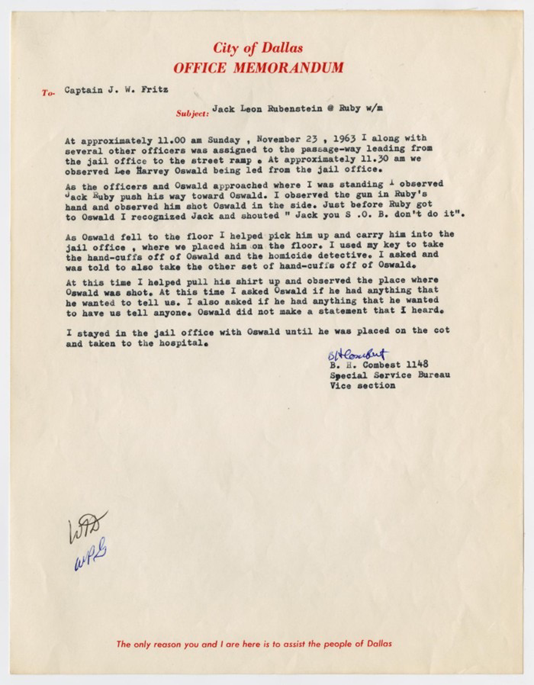
    On November 24, 1963, in the dim, oppressive confines of the City Hall basement, a critically wounded Lee Harvey Oswald lay in a dire state. Surrounded by the urgency and chaos of the moment, his life precariously hanging by a thread, a profound silence enveloped him. Officer B.H. Combest of the Dallas Police Department, amidst the turmoil, sought to extract a final confession or declaration from Oswald, particularly about the assassination of President Kennedy. This was Oswald’s moment, if ever there was one, to claim the notoriety that some believed motivated him. Yet, in this charged atmosphere, where each second could have been his last, Oswald chose silence. He uttered no words of confession, no statements of guilt or pride; he merely shook his head in response to direct prompts. This silence, in such a critical juncture, resonated with a powerful implication of innocence. It stood in stark contrast to the allegations that he sought fame through infamy. Oswald’s refusal to embrace a narrative of notoriety in these final, fleeting moments, where a single word could have immortalized him in infamy, spoke more emphatically than any verbal declaration could. His silence in the face of death, under the weight of such grave accusations, became his most resounding and final testament to his claim of innocence. (Volume XII; p. 176-186)Picture4

    Mrs Paine: On what firm bedrock of evidence do you anchor your assertion that Oswald was propelled by a voracious yearning for infamy and fame? This supposition appears to starkly contrast with the profound narrative woven by his actions, most notably his resolute silence in the face of imminent mortality.

    This pivotal silence speaks volumes, challenging the notion of his supposed thirst for recognition.

    As Mrs. Paine’s trenchant condemnations of Oswald continued, they resonated powerfully with the audience, evident in the synchronized nods of her supporters, symbolizing a shared conviction. She complained; “I seem to think that the shooting of Walker is absolutely crucial to understand what was going on with Oswald and what happened… not enough has been said about it!”This crescendo of influence reached its zenith when she directed a leading question to the assembled crowd, skillfully crafted to further cast Oswald in the role of the guilty. Her inquiry, loaded with implication and designed to sway opinion, hung heavily in the air, compelling the audience to view the situation through her lens of accusation; “How many of you know that Oswald, and most of you should because you are here, but how many of you ‘know’ that Oswald tried to kill Edwin Walker in April” (1963).Picture5

    In a choreographed motion, her hand ascended first, soon echoed by a sea of hands in the crowd. Recognizing this solidarity, Mrs. Paine responded with a mix of satisfaction and camaraderie, remarking, “There you go, good crowd, “laughing as her supporters returned the favor. I would call it kind of a dull crowd. It was hard to comprehend that no one asked the obvious question:

    Why would Oswald try to kill a right-wing fascist like Walker and then shoot the most liberal president since FDR? I mean, you must know Ruth that Kennedy sent in troops to put down a riot over integration at Ole Miss staged by Walker in 1962? You do know that don’t you? And you also must know that Kennedy retired Walker from the service for distributing John Birch Society material to his troops?Picture6

    Absent one sentient person, the dog and pony show continued.

    Thomas Mallon.“How did it finally come to light that he had shot Walker?”

    Ruth Paine.“ When he went out to try and shoot Walker, he wrote a note for Marina… it started out here is the key to the post office box, if I am arrested here is where the police station is and of course she was frightened, terrified as she didn’t know what to do, who to tell… so she (Marina) tried to threaten him, I am going to hide this and if you ever do anything crazy like this I will go to the police with it, but it didn’t work. The amount of preparation that he did, for trying to shoot Walker, is in no way mimicked in the preparation he did before shooting Kennedy, because that was an impulse. He was working on a place that turned out to be on the parade route, with the car going by. He learned that when he was at work on Wednesday (November 20th) called and came and got right out to my house, he had never come out on a weekday, he had never come out before asking permission, this was very different… He came out to get his rifle which was hidden in my garage, which I did not know. Got it and went in and shot the President as we ‘know’. It was a little bit later that the note came to light.

    Thomas Mallon.“How did the note reach her?”

    Ruth Paine.“…I sent the book to Marina (which contained the note). Of course, what is the first thing a Secret Service man going to do when he sees a book? See what falls out, and out came this note. She was confronted with this note and had to explain that it was the note he wrote when he went out to try and shoot Walker. If that note had not been found then I don’t think that we would ever have found out, because she was not going to tell”.

    The Walker Note

    “Did it seem strange to you at the time, Marina, that Lee did make these careful plans, take pictures, and write it up in a notebook, and then when he went out to shoot at General Walker, he left all that incriminating evidence right in the house so that if he had ever been stopped and questioned and if that notebook had been found, it would have clearly indicated that he was the one that shot at General Walker?” Wesley Liebeler.

    If Exhibit A in the case against Lee Oswald—anchored by Mrs. Paine and Mr. Mallon’s account of the attempt on General Walker—draws heavily from Marina Oswald’s testimony, then Exhibit B is undoubtedly the infamous ‘Note,’ which surfaced, via Mrs. Paine, only after Oswald’s death. This ‘Note,’ has become a cornerstone of controversy. Its posthumous discovery raises pressing questions: What does the ‘Note’ truly prove? At the heart of this debate, several critical concerns undermine the ‘Note’s’ validity and its connection to Oswald:Picture7

    1. Absence of Mention of General Edwin Walker: The note’s content does not reference General Edwin Walker, which is a significant omission if it was intended to be related to the assassination attempt on him. This raises questions about the note’s intended purpose and relevance to that specific incident.
    2. Lack of Signature and Date: The note’s anonymity and lack of a temporal marker further cloud its authenticity. An unsigned and undated note lacks the definitive characteristics necessary to firmly tie it to a specific individual or time frame, undermining its credibility as a piece of evidence.
    3. Fingerprint Analysis Results: The FBI’s analysis revealed that none of the seven latent prints found on the note matched Lee Harvey Oswald or Marina Oswald. This forensic evidence is crucial as it directly challenges the assumption that Oswald had physical contact with the note, casting serious doubts on its connection to him.View Source
    4. Secret Service Inquiry into Mrs. Paine’s Possible Involvement: Mr. Gopadze of the Secret Service accosted Mrs. Paine over the “Walker note” suspecting her potential role in its creation. “
    5. Expert Consensus on the ‘Walker’ Note’s Authenticity: The House Select Committee on Assassinations (HSCA) consulted three experts to assess the authenticity of the ‘Walker’ note. Notably, there was no majority consensus that the note was written by Lee Harvey Oswald. This raises serious doubts about the note’s legitimacy and its alleged connection to Oswald.View Source
    6. Oversight in Dallas Police Search: Despite an extensive search of the Paine residence on November 22-23, 1963, specifically aimed at uncovering evidence that could incriminate Lee Oswald, the Dallas Police failed to uncover the ‘Walker’ note. This oversight is particularly striking given Ruth Paine’s testimony indicating the thoroughness of the search. The fact that such a potentially incriminating item eluded the police during their detailed search adds a layer of mystery to the case and raises questions about the note’s whereabouts during this critical period.

      Ruth Paine:“I was just preparing to go to the grocery store when several officers arrived again from the Dallas Police Office and asked if they could search…and held up their warrant and I said, yes, they could search. They said they were looking for something specific… Before I left, they were leafing through books to see if anything fell out but that is all I saw… “(WC Volume III; p. 86-87)

      th, 2023, and Mrs. Paine stated that the note was contained within “a little book we had, a small book of advice to Russian mothers. It happened to be in the kitchen where we were reading, which made it different from the things in the garage… but they didn’t get that note because it was in my kitchen.”Picture8

      Considering your statement, Mrs. Paine, that the note was hidden “inside a little book of advice to Russian mothers’”in your kitchen – a location and item distinct from those in the garage – several deeply perplexing and troubling questions arise.

      Firstly, if this book was indeed in regular use by Marina in the days or weeks prior to the President’s assassination, it seems utterly baffling that neither of you noticed a note concealed within its pages? This oversight becomes even more confounding when considering the ease with which the Secret Service later discovered it. How is it possible that this note remained undetected in a book that was actively being used?

      Secondly this is 1960’s Texas, this period was marked by intense suspicion towards anything remotely associated with communism or the Soviet Union, it stretches credibility to suggest that a book intended for Russian mothers would go undetected by Texas police officers during a property search. My own visit to the property at 2515 W Fifth Street, in November 2023, offered insightful perspectives on this matter. As I toured the house, I found that the garage could be accessed directly from the kitchen/dining area, a detail clearly illustrated in the floor plan I have referenced above. This observation becomes critical when considering Mrs. Paine’s own admission of having given the police unfettered access to search her home in her absence, thus leaving them unsupervised. Given this level of access, and the fact that the garage is directly connected to a central living area of the house, the suggestion that their search would exclude the kitchen, and by extension, overlook a culturally and politically charged item like the book, seems strained. (see this)

    7. Marina Oswald’s Initial Disavowal of Knowledge: In a striking turn of initial testimony, Marina Oswald professed complete ignorance regarding the existence of the ‘Walker’ note. This initial declaration of ignorance is pivotal, casting a veil of doubt over her subsequent revelations and the evolution of her narrative. View Source
    8. Evidence Destroyed? The scenario as detailed in Marina Oswald’s testimony regarding the Walker shooting incident indeed unravels into a web of paradoxes and inconsistencies. Her claim that she urged Oswald to destroy a notebook, rich with intricate details of the attack on General Walker, stands in stark contrast to their apparent preservation of the ‘Walker’ note. This dichotomy is not just perplexing but contradictory. If Oswald, as suggested by Marina, felt compelled to incinerate the notebook due to its incriminating nature, it is logical to assume that similar caution would extend to all related materials, including the ‘Walker’ note, pictures of Walkers home found in the Paine garage and the notorious Neely Street photographs. The decision to eradicate one potential piece of evidence while seemingly safeguarding others defies logical reasoning and casts a shadow over their approach to handling such sensitive materials.

    Marina Oswald. “I was so afraid after this attempt on Walker’s life that the police might come to the house. I was afraid that there would be evidence in the house such as this book… I told him that it is best not to have this kind of stuff in the house…I suggested to him that it would be awfully bad to keep a thing like that in the house.” (Volume XI; p.293-294)

    The scenario presented by Marina Oswald’s testimony regarding the Walker shooting incident is fraught with paradoxes and inconsistencies. It is indeed paradoxical that while she claimed to have urged Oswald to destroy a notebook detailing plans for the attack on General Walker – an act acknowledging the danger of retaining incriminating evidence – she seemingly allowed the ‘Walker’ note to remain in their possession. This contradiction is puzzling. If Oswald took the drastic step to burn a notebook for fear of its incriminating nature, logic would dictate that all related materials, such as the ‘Walker’ note, the infamous backyard photographs, and the photographs of Walkers property would also be destroyed to eliminate any trace of involvement.

    This inconsistency in the handling of evidence is succinctly highlighted by Wesley Liebeler’s poignant question:’If Oswald was guilty in the Walker shooting, why would Oswald keep the photos and the note around for almost eight months?’


    Go to Part 2 of 2

  • The Assassination and Mrs. Paine (Part 2)

    The Assassination and Mrs. Paine (Part 2)


    see Part 1

    [Allen Dulles] joked in private that the JFK conspiracy buffs would have had a field day if they had known…he had actually been in Dallas three weeks before the murder…and that one of Mary Bancroft’s childhood friends had turned out to be a landlady for Marina Oswald, the assassin’s Russian born wife.

    James Srodes, Allen Dulles, pp. 554–55

    In Part One of this review, I noted how director Max Good draws parallels in the escorting of Marina Oswald by a trio of persons who seemed to arrive out of the blue in 1963. One of the circumstances that is notable is that all three—George DeMohrenschildt, Ruth Paine, and Priscilla Johnson—spoke Russian. Again, could this be a strange accident? I, for one, have never met anyone in my life who spoke Russian. Yet, in the space of about ten months, three people entered into the lives of the Oswalds who all happened to speak Russian. And as each one left, another replaced the former, almost as if each was being managed by an off-stage supervisor as to when to take over.

    Part of The Assassination and Mrs. Paine centers on the mystery of Naushon Island. Naushon Island is the largest of the Elizabeth Islands in southeastern Massachusetts. It is very much an exclusive area, having been owned by the Forbes—Michael’s family—for a century and a half. Some of the wealthiest and most powerful members of the Eastern Establishment have vacationed there, for example former Secretary of State John Kerry, as did Michael and Ruth Paine. As Barbara LaMonica wrote in Probe magazine, the FBI found out that Michael’s grandmother, Elise Cabot Forbes, took out a $300,000 trust fund for her grandson Michael. (Probe, Vol. 5 No. 5, p. 6) That would translate to about 3 million dollars today. The logical question is: what was someone with that kind of money doing living in a suburb of Dallas/Fort Worth chumming around with an alleged Marxist agitator? And, as noted in Part One, engaging with local college students on the merits of Castroism—and taking Castro’s side while doing so.

    As we know, George DeMohrenschildt—aka the Baron—was the route through which Ruth and Michael first met the Oswalds in early 1963. (James Douglass, JFK and the Unspeakable, p. 168) The Baron was intimately involved with the White Russian community in the Dallas/ Fort Worth area. The late Philip Melanson established that this group:

    …received financial assistance from the CIA. Most of the White Russians had fled Communist persecution and had been brought to the United States by the Tolstoy Foundation, an anti-communist lobby that received yearly subsidies from the Agency. The Russian Orthodox Church, a centerpiece of the very conservative and religious White Russian Community, also received Agency philanthropy. (Spy Saga, p. 79)

    George Bouhe was a prominent member of this expatriate community. Bouhe was Marina’s English tutor. (Probe, Volume 7, No. 3, p. 3) When Jim Garrison told Marina that Bouhe was also a neighbor of Jack Ruby, the man who killed her husband, Marina said she was aware of that. How? Because Bouhe visited her to tell her about it. He said it was just a coincidence that he happened to live next door to her husband’s killer. As researcher Steve Jones noted, was this not a possible connection between Oswald and Ruby? Did the Warren Commission ever explore it? This reviewer has never seen any evidence they did.

    II

    In Max Good’s film, Ruth Paine tries to imply that she only met George DeMohrenschildt once, in early 1963.

    As Steve Jones mentioned in 1998 in Probe magazine, this is not accurate. In her appearance before the New Orleans grand jury, Ruth admitted to Jim Garrison that she and Michael met up with the Baron in 1967. It turns out they were dinner guests of his and they discussed, among other things, a copy of the infamous backyard photo which was recently found amongst the Baron’s belongings after the assassination, upon his return from Haiti. (Probe, Vol. 5 No. 3, p. 9)

    As Carol Hewett noted, in May of 1963, Michel Paine returned a record player and some records to Everett Glover, which Marina had borrowed from the Baron. (Probe, Vol. 5 No. 1 pp. 16–17) Glover took the items to George’s storage unit. When the Baron returned from Haiti, they discovered another version of the infamous backyard photographs in that storage unit.

    As the late Jim Marrs wrote, there are some notable aspects about this version of the backyard photo; but we will focus on the discovery of the picture. First, as described, it was not unearthed until George returned to Texas from Haiti. (Jim Marrs, Crossfire, p. 287) The Baron’s widow told Marrs that they had never seen the picture before then. She was also convinced the photo was planted, while in storage. Although Everett Glover later had placed the Baron’s things in storage, Ruth Paine also had access to the storage space. (ibid) George later wrote that he only discussed the photo with his closest friends, which apparently included the Paines. (Op. Cit. Probe, p. 17)

    But, with the Paines, there is always a capper. Here it is:  Michael Paine told Dan Rather in 1993 that he saw one of the infamous backyard photographs in April of 1963! He told CBS that Oswald proudly showed him a photo as he picked him up for a dinner engagement. As Ms. Hewett asked: if this is true, why did Michael never say anything about this to the FBI or the Warren Commission? (Probe, Vol. 5 No. 1, p. 16)

    As mentioned in the first part of this review, Sylvia Hyde—Ruth’s sister— refused to talk to Max for his film. Jim Garrison was curious about Sylvia, since he could not find out who she worked for. Garrison questioned Ruth before the New Orleans grand jury about this. To be mild, Ruth is rather unhelpful. Even though she spent over a week with her back in 1963, she cannot figure who she worked for. But what makes it even more puzzling, she cannot even say where she lived! Recall, she had driven down to the central Atlantic coast to visit her and she does not recall where she drove to? (Transcript, 4-18-68, pp 58–62). She ended up insinuating to the DA that Sylvia lived in Virginia, most likely Falls Church. But a listener to Len Osanic’s Black Op Radio program later found out that she lived in Maryland.

    An aspect that Sylvia Meagher insinuated about Ruth Paine was her predisposition against Oswald. On more than one occasion, Ruth has said she was taken aback that Oswald would call her about contacting attorney John Abt. If one can comprehend it, she was surprised he was also presuming of his own innocence. As Joseph McBride later pointed out, in an article written by Jessamyn West for Redbook in July, 1964, Ruth went further. She told West she was glad that Ruby killed Oswald. This surprised the author. She gave Ruth a chance to repair the damage and this is what Ruth said: “I thought Lee’s death this way would be so much easier for Marina.” (Warren Commission Vol. 22, p. 856) Recall, Oswald never had an attorney while in custody, the Warren Commission never allowed any legal counsel for him, and their hearings were closed to the public. Ruth Paine, the kindly Quaker lady, somehow thinks that due process and right to counsel can go to Hades in regard to Oswald. And let us not forget, John Kennedy.

    III

    Max Good has structured his film as a kind of point/counterpoint dialogue between the critics of the Warren Commission and its stalwarts. From the latter side we hear from, in addition to Ruth, Max Holland, and Gerald Posner. I cannot see how anyone can complain about their treatment and/or the balance of the film. To give just one example, Posner says that Oswald’s last two calls were to Ruth about an attorney and about Marina, but that is not really the whole story. Oswald tried to make one other call on Saturday night and the Secret Service would not let it through. It was to a former military intelligence officer named John Hurt in North Carolina. How Oswald ever knew this man, or his phone number, is a mystery worthy of Sherlock Holmes. (Click here for details) It furthers Senator Richard Schweiker’s concept that Oswald had the fingerprints of intelligence all over him.

    Ruth gets plenty of speaking time. And the film shows that she is a standard bearer for many Establishment-backed TV specials which support the official story, for example the London trial which featured prosecutor Vincent Bugliosi and defense attorney Gerry Spence. About that one, she says that it was like a regular trial. This reviewer spent a large part of a book showing that such was simply not the case. (See, The JFK Assassination: The Evidence Today, pp. 3–70) She then mentions the Peter Jennings special on ABC in 2003, which she calls one of the best.

    Recall, this was the program in which Dale Myers prepared a computer simulation which proclaimed that the Magic Bullet—about which so much controversy has swirled for so long—should not be titled the Single Bullet Theory. That title denotes the facts that one bullet went through two men, causing seven wounds, smashing two bones, and emerging pretty much intact. Dale said this should not be called a theory. With his trusty computer, he renamed it: the Single Bullet Fact. That very questionable computer graphic has been effectively attacked at least five times: by Bob Harris, by Pat Speer, by Milicent Cranor, by Dave Mantik and by John Orr. (For the Harris demonstration, click here and for the Speer version, click here)

    Around the same time in the film, Holland tells the audience, well the Warren Commission was not perfect and we should be skeptical. But saying the murder of Kennedy was a coup d’etat, that is just going too far. This from a man who was responsible for one of the very worst documentaries ever assembled on the JFK case. One which was not even supported by some of the backers of the Commission. And according to Speer, Holland likely knew the main thesis was faulty before the show aired. (Click here for details)

    Oliver Stone gets mentioned, for instance by former Motion Picture Association of America president Jack Valenti, who violently objected to the film, calling it a “monstrous charade.” Michael Beschloss says that Stone created myths. Since everything Stone presented about the Vietnam War in 1991 turned out to be accurate, those two statements are understandable, for Valenti was in the White House working for LBJ as he implemented the first escalations after Kennedy’s death. In 1997, Beschloss tried to dispute Stone on the Vietnam War in his first book on LBJ called Taking Charge. Unfortunately for him, at the end of that year, the Assassination Records Review Board declassified 800 pages of documents which proved Stone was correct on this issue. (New York Times, 12/23/97, “Kennedy Had a Plan for Early Exit in Vietnam”) And as Stone shows in the film JFK Revisited: Through the Looking Glass, LBJ was fully aware of Kennedy’s exit plan, disagreed with it, and consciously worked to reverse it.

    Ruth mentions Stone again and says that celebrated film director never tried to talk to her during the making of the film JFK.

    Stone seems to contradict her in the film. And when I asked him about this, he stated he did try and talk to her and later added, “You can take that to the bank.” (Email and phone conversations, 6/6 and 6/8/22)

    IV

    The film closes with three tantalizing areas of controversy. The first is the so-called “Walker note.” This was allegedly a set of directions left by Oswald for his wife in the wake of his attempted shooting of General Edwin Walker. There is a big problem with this: the shooting happened in April. Oswald was never even considered a suspect until after the Kennedy assassination, over 7 months later. At that point, as if by magic, two things happened.

    First, the FBI turned the original bullet, a steel colored 30.06, into a copper coated 6.5 mm projectile. (Gerald McKnight, Breach of Trust, p. 49; DPD General Offense report of 4/10/63) Needless to say, that 30.06 projectile would not be fired with the Oswald Mannlicher-Carcano 6.5 rifle. Secondly, Ruth Paine transported the Walker note to Marina through a book she sent via the Secret Service. This is the note the Secret Service was so suspicious of that they thought she wrote it. (DiEugenio, Destiny Betrayed, second edition, p. 203)

    But it’s even worse than that. The best witness in the Walker case that summer was Kirk Coleman. Coleman said he ran out when he heard the shot. He saw two men escaping the scene in their cars. Neither of the men looked like Oswald and, according to the Warren Commission, Oswald could not drive. (McKnight, p. 57) Coleman was never called as a witness by the Commission. That is how important the Walker note was.

    As mentioned above, both Ruth Paine and Priscilla Johnson produced evidence that Oswald had been in Mexico City. This was after the official searches of the Paine household. In fact, with Johnson, this went on until September—10 months after the first searches. (Mark Lane, Plausible Denial, pp. 66–67) Even members of the Commission—like Richard Russell—felt this was over the top and it raised more questions than it answered. In fact, there is an internal problem with the “Oswald letter” that Ruth took from her desk secretary. Namely, Oswald likely would not have known that a certain person in the Cuban embassy had been rotated out and replaced by someone else, which is what he wrote about in his alleged letter. (Click here for details) In fact, due to some very good work by David Josephs, among others, many critics do not think Oswald went to Mexico City. (Click here for details)

    One last point about the Mexico City letter. Carol Hewett wrote that it was when Ruth Paine decided to move her furniture that Ruth actually took the letter. (Probe, Vol. 4 No. 3, p. 27) Ruth appears to say that in the film also. Chris Newton, due to some insightful observations, raises the most fundamental questions about this story, namely, that the furniture was not really moved. That, in reality, it stayed where it originally was. If Chris is correct about this, at a minimum, what it seems to mean is that Ruth wanted a pretext and landmark to pick up that letter. I cannot begin to describe Newton’s work in a synoptic form. I can only advise the interested reader to please go through this attached thread. (Click here for details)

    Finally, the impression left by Ruth about her picking up Marina from New Orleans and taking her to Irving, was that it was more or less made by serendipity. Yet, during her cross country trip, the FBI discovered that she had talked about it well in advance to others she had visited, presenting it like a fait accompli. (Probe, Vol. 3 No. 4, p. 15)

    And related to this, in some very interesting work by Tom Gram, it appears that Oswald was getting mail at Ruth’s Irving address in late July of 1963. (Email communication of June 22, 2022) And, in fact, Marina had also signed a transfer document to Ruth’s home in May. Gram writes that Ruth likely encouraged this on the grounds that it would ensure she would not miss anything. (Click here for details)

    Max Good has done a creditable job in making this film. He has raised the correct questions and raised them in a fair and adroit way, giving both sides time to mount their arguments. He has done it all in a skillful manner, considering the budget constraints he worked under. He deserves kudos for his difficult travail and the public should extend him the courtesy of watching his film. It is overdue, but still it is the first of its kind. If you were unaware of the questions, you will be surprised. If you were aware, you will be pleased that someone finally placed them in the pictorial public domain.

  • Carol Hewett, Steve Jones, and Barbara La Monica Dissect the Paines

    Carol Hewett, Steve Jones, and Barbara La Monica Dissect the Paines


    From the May-June 1996 issue (Vol. 3 No. 4) of Probe


    (Click here if your browser is having trouble loading the above.)


    From the July-August 1996 issue (Vol. 3 No. 5) of Probe


    (Click here if your browser is having trouble loading the above.)


    From the November-December 1996 issue (Vol. 4 No. 1) of Probe


    (Click here if your browser is having trouble loading the above.)


    From the March-April 1997 issue (Vol. 4 No. 3) of Probe


    (Click here if your browser is having trouble loading the above.)


    From the November-December 1997 issue (Vol. 5 No. 1) of Probe


    (Click here if your browser is having trouble loading the above.)


    From the March-April 1998 issue (Vol. 5 No. 3) of Probe


    (Click here if your browser is having trouble loading the above.)


    From the July-August 1998 issue (Vol. 5 No. 5) of Probe


    (Click here if your browser is having trouble loading the above.)


    From the March-April 2000 issue (Vol. 7 No. 3) of Probe


    (Click here if your browser is having trouble loading the above.)


  • The Assassination and Mrs. Paine (Part 1)

    The Assassination and Mrs. Paine (Part 1)


    Film-maker Max Good has spent several years working on a film about Ruth and Michael Paine and what their precise relationship was to the assassination of President John Kennedy. Although I have some reservations about it, it is worth watching and I encourage our readers to do so.

    One of the most puzzling aspects about it is this: Why did it take almost 60 years for anyone to make a film on such a rich, relevant, and interesting topic? Perhaps because there are no references to either Paine in the indexes of Harold Weisberg’s book Whitewash, Edward Epstein’s Inquest, or Josiah Thompson’s Six Seconds in Dallas.

    Of the first generation of critics, Sylvia Meagher’s book devotes by far the most pages to the Paines. Perhaps, we should quote her overall impression of Ruth Paine in order to place Max’s film in perspective:

    Ruth Paine…is a complex personality, despite her rather passive façade…Some examples from her testimony show a predisposition against Oswald and a real or pretended friendliness toward the FBI and other Establishment institutions, which should not be overlooked in evaluating her role in the case…Mrs. Paine is sometimes a devious person, and her testimony must be evaluated in that light. (Meagher, Accessories After the Fact, p. 217)

    But it was really Jim Garrison who first tried to place the Paines under the microscope. For example, he was interested in the family ties of Ruth, specifically who her sister Sylvia worked for. In fact, he questioned Ruth about this point during Ruth’s appearance before the New Orleans grand jury. To put it mildly, Ruth replied in a rather non-responsive manner, a point we shall examine later.

    Ruth and Michael Paine spent, by far, the most time on the witness stand for the Warren Commission. According to Walt Brown, the combined total questions they answered was over six thousand. In fact, Ruth was so eager to answer questions, she even volunteered areas of examination that she thought the Commission had bypassed. For instance, as Albert Jenner was about to close his questioning of her on March 21, 1964, Ruth interjected with:

    Ruth: You have not asked me yet if I had seen anything of a note purported to be written by Lee at the time of the attempt on Walker. And I might just recount for you that, if it is of any importance…

    Jenner: Yes, I wish you would…Tell me all you know about it. (WC Vol. 9, pp. 393­–94)

    As we shall see, a major problem with the Paines is this: they surfaced evidence of things Oswald did which were in fact, dubious acts. One would be the supposed Walker shooting, another would be Oswald’s alleged journey to Mexico City. Looked at with the perspective, we have today—after the work of the Assassination Records Review Board (ARRB)—the implicative nature of these events is rendered suspect. Therefore, the fact that the Paines were part of finding evidence that incriminated Oswald—in events that perhaps did not occur—this should merit some notice. In fact, 5 days after she delivered the Walker Note to the Secret Service—in Marina Oswald’s book—Ruth was visited by two Secret Service agents. They were actually returning her the note, since they thought it was from her. (James DiEugenio, Destiny Betrayed, second edition, p. 203)

    It is surprising to juxtapose the star billing the Commission gave the Paines with the fact that neither the House Select Committee on Assassinations (HSCA) nor the ARRB called them in for questioning. It is, perhaps, a bit disturbing. For during and after the days of the ARRB, a whole wave of information created a new data plateau on the Paines. The parties who were largely responsible for this new information were author George Michael Evica and researchers Carol Hewett, Barbara La Monica, and Steve Jones. Evica wrote a book, A Certain Arrogance, which dealt with the Paines and their religious background. Before that, Hewett, LaMonica, and Jones wrote a series of essays on the couple for Probe magazine. We will be referring to both in this review.

    II

    The way this reviewer got involved with the matter was that I was the publisher of Probe magazine when Hewett, LaMonica, and Jones wrote their essays. I thought their work was new and interesting. Author Thomas Mallon was so dismayed by their work that he wrote a book contesting it. (Mrs. Paine’s Garage, 2002) The writing trio began their series with a truism: “Ruth and Michael Paine…are among the most significant, yet least studied, of the figures surrounding the Kennedy assassination.” (Probe, Vol. 3 No. 4 p. 14) After reading their work, this was an understatement. The three were responsible for a set of eight essays which one can reference on this site.

    A provocative point Carol conveyed dealt with Ruth’s so-called discovery of Lee Oswald’s letter to the Russian embassy, which he wrote at her home over Memorial Day weekend, 1963. In her testimony before the Commission, Ruth tried to explain why she took the rather remarkable step of picking the letter up, hand copying it, and eventually giving it to the FBI. She said that as she glanced at the letter, the first sentence contained a lie and she was insulted by Oswald using her typewriter to do such a thing. But if one buys the official story, which Ruth does, the first line of the letter, about Oswald visiting a Russian diplomat in Mexico City, was not a lie. Commission lawyer Albert Jenner understood that this made for a serious problem. He (wisely) decided to go off the record. Jenner knew they had to patch over Ruth’s story. (Probe, Vol. 4 No. 3, p. 17)

    Throughout that series, the authors exposed things like this to the light of day. One more example will suffice. There had always been a question as to why the relationship between Ruth and Marina Oswald ended after the assassination. When Marina testified before the New Orleans Grand Jury, she addressed this. As we know, Marina was detained by the Secret Service for weeks afterwards. She told the jury, “I was advised by the Secret Service not to be connected with her (Ruth Paine)…She was sympathizing with the CIA.” When assistant Andrew Sciambra pursued that line, he asked her, “In other words, you were left with the distinct impression that she was in some way connected to the CIA?” The one word reply was, “Yes.” (Probe Vol. 7 No. 3, p. 3) Was this the reason the Secret Service returned the so-called Walker Note to Ruth? (James DiEugenio, Destiny Betrayed, second edition, p. 203)

    The separation of Ruth from Marina after Kennedy’s murder is a good way to introduce one of the most intriguing and compelling aspects of Max Good’s film. Because as we know, prior to Ruth Paine becoming so inseparable from Marina, the person who escorted the Oswalds around Dallas/Fort Worth was George DeMohrenschildt. As Max asks Ruth in the film: Why would a White Russian be so interested in a Communist? Ruth replies that this is a good question.

    We actually know why. Near the end of his life, DeMohrenschildt stated that, on his own, he would have never come near the Oswalds. J. Walton Moore, chief of the CIA station in Dallas, asked him to do so. (DiEugenio, p. 194) George, sometimes called the Baron, arranged a gathering of the White Russian community with the Oswalds in late February of 1963. From that gathering, Ruth arranged a one-on-one meeting with Marina. Approximately three weeks after that meeting, April 7th, Ruth composed a letter asking Marina to move in with her. Kind of fast? (Probe, Vol. 5 No. 1, p. 14)

    As described in the film by myself and Peter Scott, around this time, George left for Haiti, had a briefing in the DC area with the CIA and military intelligence, and then had about $300,000 deposited into his account. (James Douglass, JFK and the Unspeakable, p. 168) As I ask in the film: Was this for services rendered? We will never know, since after he was subpoenaed by the HSCA, the Baron was either killed or took his own life by shotgun blast.

    One of the strongest parts of the film is the segue from DeMohrenschildt to Priscilla Johnson. Because after the (likely) forced cut off between Ruth and Marina, Johnson entered the picture—and she stayed there for a long time, like 13 years. Priscilla always denied she was with the CIA. She even threatened to sue Jerry Policoff over this. It’s a good thing she did not, because as Max shows in the film, the ARRB pretty much sealed the deal on her. He shows the documents which categorize her as a “witting collaborator,” meaning that she did not need to be employed by them; they could rely on her to write sympathetic stories anyway. (See also, John Armstrong, Harvey and Lee, pp. 279–82)

    As the film shows, you have one CIA asset—the Baron—escorting the Oswalds around Dallas/Fort Worth upon their return from the USSR. You had another—Johnson—picking up Marina after the assassination and becoming her personal escort. And when Priscilla finally wrote her book about the Oswalds, Marina and Lee, it completely backed the Warren Report.

    In the interim, you had Ruth and Michael Paine. Further, both Ruth and Priscilla were producing evidence Oswald was in Mexico City, when, in fact, Marina initially insisted to the Secret Service he was not. (DiEugenio, p. 203; Armstrong, p. 696, Secret Service report of Charles Kunkel, 12/3/63) And many researchers today—including the authors of the HSCA’s Mexico City Report—agree he wasn’t.

    The film makes this point about parallels rather subtly; I have made it more bluntly.

    III

    Although it is not part of his ostensible subject, Good does a nice job in penciling in the background to his story: namely the presidency of John Kennedy. As many have, he notes that some of JFK’s policies fostered opposition from people in high places, for example the Bay of Pigs and the Missile Crisis. But people like the Paines and Priscilla Johnson have always used the old standby that, for those examining the case, it is hard to accept that a little man like Oswald could single handedly erase a great figure like Kennedy. The subtext being that this is what fulfilled Oswald as a large figure in history, for example Michael voices this mantra early in the narrative. But if that was so, then why did Oswald never claim credit for the assassination? On the contrary, as the film shows, he loudly stated he was a patsy.

    At this point, Ruth says that the Warren Report always made sense to her. Priscilla tops this with an astonishing comment: she says that conspiracy theories have done more damage to the country than the death of JFK did. In the film, it is made clear that when the police arrived at the Paine household, looked for a weapon, and did not find one in the rolled up blanket Marina thought it was in, this shocked Mrs. Paine. It started her down the road to incriminating Oswald in the press.

    But it was Ruth who picked up Marina from New Orleans, packed the car, and drove her to Irving to stay with her, thus now accomplishing what she was trying to do since April. If there was a rifle amid the belongings, why did neither she nor her husband notice it while packing and then unpacking the station wagon? They missed it twice?

    One of the valuable contributions the film makes is the outlining of the curious family ties that the Paines had. (For a good summary see Evica, pp. 364–65) As noted, Ruth’s father, William Avery Hyde, and her brother-in-law, John Hoke, worked for US AID, which was closely tied to the CIA. As Greg Parker discovered, her sister, Sylvia Hyde Hoke, worked on a joint CIA/Air Force project. (Lee Harvey Oswald’s Cold War, pp. 266–68) One of the most pungent moments in the film is when Max calls Sylvia and asks for an interview. She instantly hangs up on him. Michael Paine’s mother, Ruth Forbes Young, was best of friends with Mary Bancroft. Bancroft was both an agent and girlfriend of CIA Director Allen Dulles. As author Bill Simpich notes in the film: could Mary have noted to Allen the utility of the Quaker/ Unitarian couple in performing surveillance duties on the left?

    In fact, this is the theme of Evica’s book: how Allen Dulles used these religious groups—Quakers and Unitarians—for espionage work, for example Noel Field. And Bancroft knew about this. (Evica, p. 116) Evica ended his book by suggesting that Allen Dulles may have helped secure for the Paines a sterling character recommendation from a wealthy couple at the beginning of the FBI’s inquiry into the JFK murder. This was from Frederick Osborne Jr. and his wife Nancy. (A Certain Arrogance, pp. 250–58) Allen had worked with Frederick’s father in the National Committee for a Free Europe and also in the CIA’s Crusade for Freedom. And there are examples of surveillance activities by the couple.

    Sue Wheaton appears in the film. She met Ruth in Nicaragua in 1990, after the election of Violetta Chamorro. Ruth was with Pro-Nica, a project out of St. Petersburg. This was a more conservative strain of the Quaker movement. Wheaton said that Ruth told her that their Quaker group was funded primarily by “6 wealthy, conservative individuals from the Southeast.”(Probe, Vol. 3 No. 5, p. 9) Wheaton also noted that Ruth’s group ran a sawmill project on the east coast of Nicaragua, a Contra holdout and nexus of CIA based activities. Ruth showed up at Wheaton’s council meetings of the anti-Contra group, of which Pro-Nica was not a member. Wheaton got the distinct impression Ruth was taking down information about individuals and groups in attendance. Ruth “studied the bulletin board there, copying everything on it…Also she made reference to people she knew in the U. S . Embassy.” (ibid) Wheaton later added that Ruth would show up with two cohorts and these two men would make tape recordings and take pictures. Ruth’s plea was they were authorized by the Nicaragua Network to take photos, but when this was checked, the claim turned out to be ersatz.

    In the spring of 1963, Michael Paine was engaging students from Southern Methodist University in debate and discussion “about communism in general and Cuba in particular.” During these debates, it was Michael who took the role of a Castro advocate. He even bragged about being familiar with an actual communist, “an ex-Marine who had recently returned to the States with a Russian wife,” an obvious reference to Lee Harvey Oswald. Michael also encouraged these students to go to local commie cell gatherings. (Probe, Vol. 5 No. 1, p. 14)

    This last point leads us to one of the most provocative pieces of evidence concerning the Paines. Did Detective Buddy Walthers find the notes Michael kept of these meetings? These would be the file folders found at their home with information on communist, Castro sympathizers. They were picked up by Walthers on the weekend of the assassination and he made a contemporaneous report about them. (Armstrong, pp. 879–80) Over time, they were made to disappear, until they ended up in the Warren Commission “Speculations and Rumors” section. One of the most interesting parts of the film is that it appears that Ruth has employed, or is good friends with, a veteran of the Defense Investigative Service. Max talked to this gentleman and he tracked down one of the (now) empty file folder boxes. He informs Max that Ruth does a lot of studying on the Kennedy case.

    There is one other example of this possible activity that could have been used. Cliff Shasteen was a barber who cut Oswald’s hair a few times in the fall of 1963. Cliff said that Oswald was accompanied twice by a 14 year old boy who did not get his hair cut or say anything. But strangely, this boy appeared by himself a few days before the assassination. Once there, he began to rant about the benefits of one world government and the plight of “have nots” in society. Shasteen was taken aback, because he knew he was not a local kid. The youth never returned. (Click here for details)

    Greg Parker did a fine job of inquiring into this odd, but notable occurrence. Greg deduced that the description fit future actor Bill Hootkins perfectly. Who had access to both Hootkins and Oswald? Ruth Paine tutored Hootkins in Russian that fall. Bill’s mother told the Bureau that Ruth would pick her son up and take him to St. Mark’s—an upper class, private school where Ruth worked at—for lessons. Hootkins’ contact information was in Ruth’s address book. Did Ruth take young Bill to Irving instead?

    see Part 2


    Purchase here on iTunes.

    Purchase here on Amazon.