Tag: RICHARD M NIXON

  • Gerald Posner vs. Roger Stone in Coral Gables

    Gerald Posner vs. Roger Stone in Coral Gables

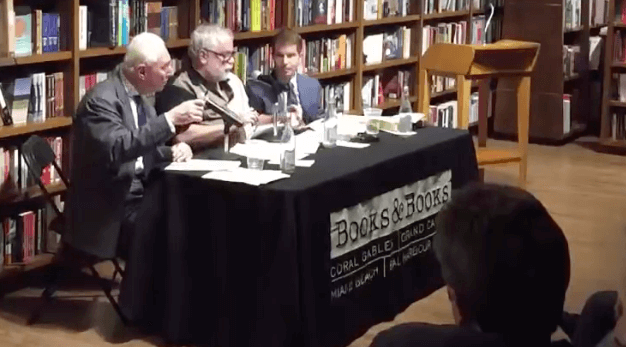
    On the 54th anniversary of President Kennedy’s assassination, at a bookstore in Coral Gables, Florida two famous authors convened. They were Gerald Posner and Roger Stone. The subject was a debate over the circumstances of Kennedy’s assassination. Obviously, because of the orientation of their books on the subject, Posner defended the Warren Commission verdict while Stone argued for a conspiracy.

    Robert Loomis

    Posner was trained as a lawyer. At age 23, he became one of the youngest attorneys ever employed by Cravath, Swaine and Moore, John McCloy’s old law firm. In 1980, he left that firm and opened a private practice with a partner. In 1986, he left that practice and became an author. In a relatively short period of time, he wrote three non-fiction books and one novel. In 1991, he was enlisted by Robert Loomis of Random House to write a response to Oliver Stone’s movie about the Kennedy assassination, JFK. The very plugged-in Loomis promised Posner that the CIA would cooperate with him on the project. (The Assassinations, edited by James DiEugenio and Lisa Pease, p. 369) And they did. Without their help, how else could an author gain access to high level defector Yuri Nosenko?

    Harold Evans

    As was exposed in a later lawsuit by the late Roger Feinman, Random House put a major effort into selling Posner’s Case Closed. One that was personally supervised by Harold Evans, who was president of the publishing house at the time. According to information Feinman discovered in his lawsuit, it was Evans who personally approved the infamous NY Times ads for the book. This was a four-phase campaign. It began with two teaser ads that promised to name the guilty parties in the JFK assassination. It culminated with two more ads. These featured the faces of Oliver Stone, David Lifton, Robert Groden, Jim Marrs, Mark Lane and Jim Garrison under a title which boldly accused them of the charge: “Guilty of Misleading the American Public”. If the reader knows anything about advertising costs in major newspapers, he can guess what those four ads cost. (Click here for Feinman’s essay about his lawsuit against Random House.)
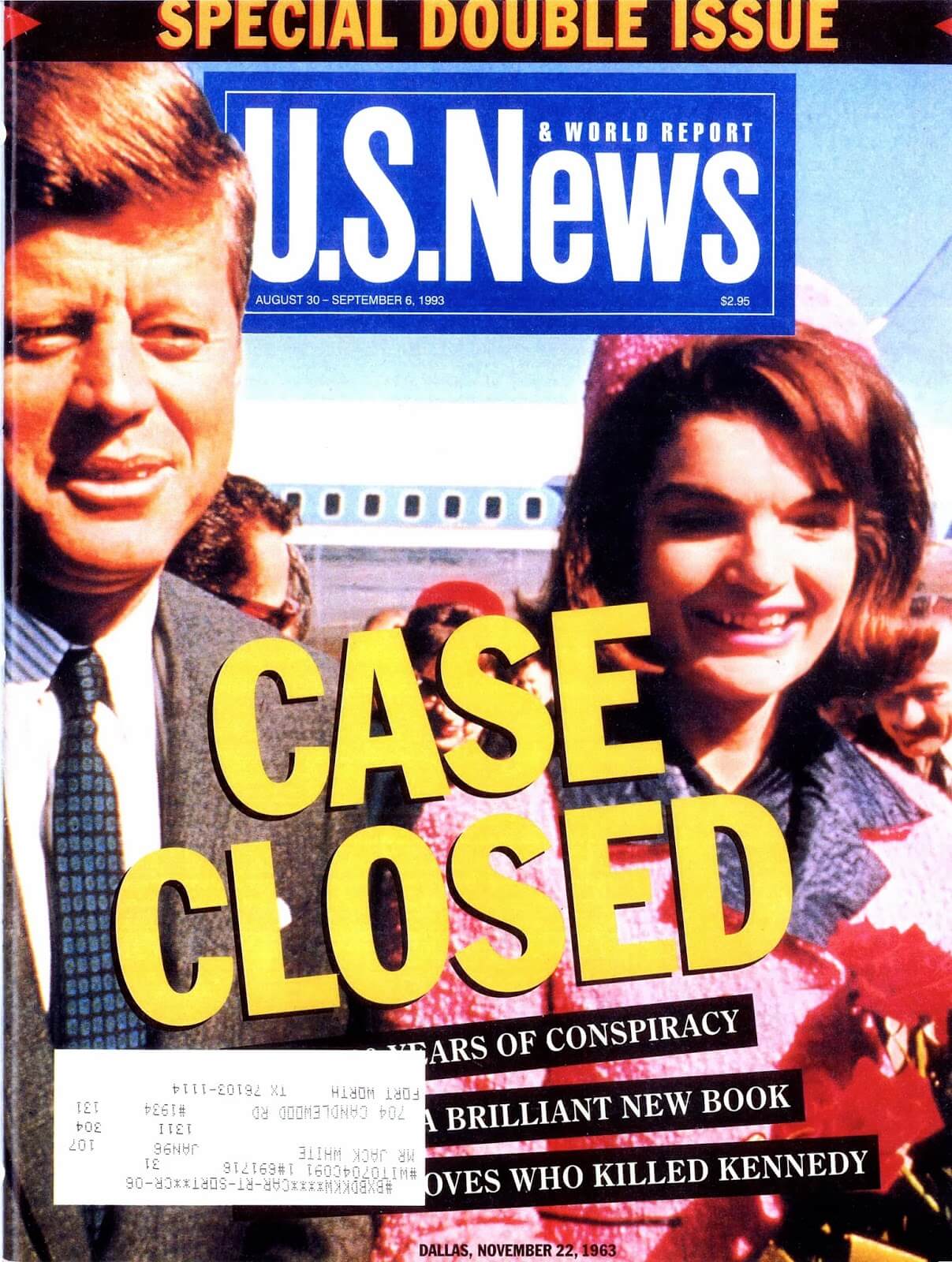
    But that was not all. Apparently because Evans had previously served as a director of US News and World Report, that magazine gave Posner’s book a cover story. The book became such a cause celebre that other authors have successfully used it as a way to curry favor with the MSM, e.g., Jeff Toobin and Robert Dallek.

    The problem with all this hoopla, which was designed to coincide with the 30th anniversary of the assassination, is that it was completely unwarranted. There were several reviews that showed just how flawed Case Closed was: for instance, David Wrone’s. (See also this index of items on this site.) In fact, there were so many problems with Posner’s book that activist Dave Starks put together a compendium page of articles to show that, not only was Case Closed a very bad piece of scholarship, but it might have been worse than that. In his haste to do a hatchet job on the critics, Posner may have created interviews he did not actually do. For instance, Peter Scott talked to Carlos Bringuier after Case Closed came out. Contrary to the book’s claims, Bringuier said he never talked to Posner. (Author interview with Scott in San Francisco in 1994) Same with Dealey Plaza witness James Tague, who the author clearly states he talked to on two successive days. (See Posner, paperback edition, p. 546) When Gary Aguilar talked to Tague, he said he never spoke to Posner. To use another example, although the author said he interviewed JFK’s forensic pathologist Thornton Boswell, Boswell told Aguilar he never spoke to him. (Click here for Starks’ devastating page on Posner.)
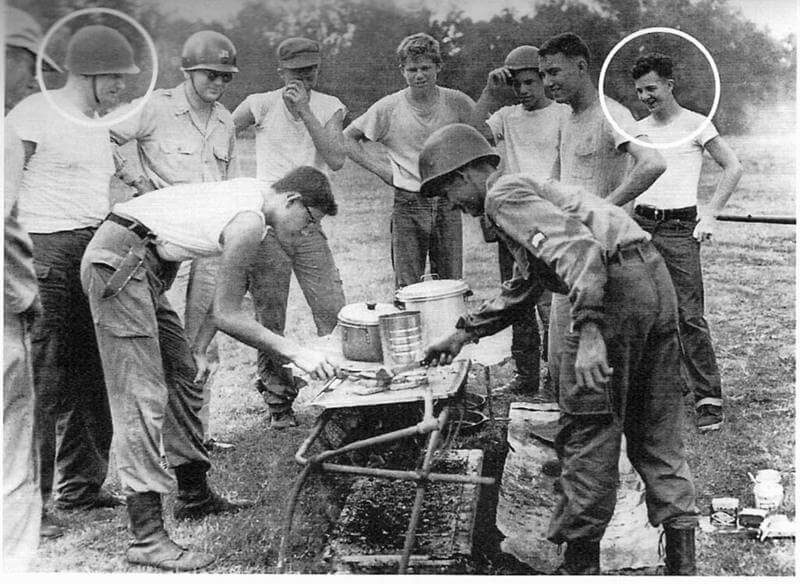
    David Ferrie & Lee Oswald,
    Civil Air Patrol (1955)

    Posner also committed some outright howlers in his much-ballyhooed book. For example, in his schematic drawings of the assassin at the Texas School Book Depository window, he has him posed as firing from an extreme left to right angle. So much so that these “Posner shots” would have ended up in the railroad yards behind the picket fence. (See Appendix A of Case Closed, paperback edition.) This makes one wonder if Posner was ever in Dallas. Because to anyone who has been to the building and peered out the sixth floor window—which was possible back then—it presents a slight right to left angle. Posner also wrote that there was no evidence to connect David Ferrie with Oswald. (Posner, p. 425) This was utterly ridiculous on many counts. But to name just one, when the book came out PBS did a special which featured a photo of Oswald and Ferrie together at a Civil Air Patrol (CAP) barbecue. They found it by questioning some other members of the CAP. Which means Posner could have done the same if he had knocked on some doors in the Crescent City. Posner also writes that there was no such personage as Clay Bertrand in New Orleans. When the JFK Act declassified both the Jim Garrison files and the papers of the HSCA, Posner again ended up with custard pie on his face. Those documents reveal that the number of witnesses who stated that Clay Shaw used the alias of Clay Bertrand was in the double digits. (Destiny Betrayed, Second Edition, by James DiEugenio, pp. 211, 387, 388)

    Posner’s book showed us in excelsis just how schizoid America is on the murder of President Kennedy. It did not matter to the Powers That Be just how error-strewn Posner’s book was. It did not matter to them that he was more or less acting as a hired gun for Loomis and Evans. It did not matter to them that the book was obviously a rush job for the 30th anniversary. Or that the title was preposterous since the declassification process of the JFK Act had not even gone into effect yet. In other words, the book was saying the case was closed when, in fact, two million pages of documents were about to be declassified in the next four years.

    Clearly, as representatives of the Anglo-American Establishment, the important thing for Loomis and Evans was this: They wanted to create a tangible cultural artifact to rally around at the 30th anniversary. Why? In order to beat back the tsunami effect of Oliver Stone’s JFK, which had blindsided them. Posner’s book was a concocted historical event. Today the book has been retired to the (rather large) ash heap of useless volumes on the JFK case. It has no intrinsic factual merit to it at all. It is simply an exemplar of a two-part cultural/historical phenomenon. I say two parts, because the second phase of this Jungian neurotic outbreak occurred four years later, with another Loomis client. This time the collective seizure was over Sy Hersh’s equally horrendous book. This one was a biography of John Kennedy, The Dark Side of Camelot. That bookend volume was as bad in its own way as Posner’s tome. But Oliver Stone had not just said that JFK was killed by a conspiracy. His film also stated that Kennedy was a foreign policy iconoclast who was changing things in that realm. This was true and has been proven even more accurate by recent scholarship. But that did not matter with Hersh, whose book was so bad that some critics said it should have been titled, The Dark Side of Seymour Hersh.

    II

    Roger Stone was born in Lewisboro, New York to a reporter mother and a father who drilled oil wells. Stone got hooked on politics when he read Conscience of a Conservative by Barry Goldwater. Although he admired Goldwater’s ideas he could not comprehend the tactics of his 1964 campaign. To put it mildly, he thought they were rather quixotic. As he told writer Matt Labash, “It’s like he was trying to lose. Going to Tennessee and coming out against the Tennessee Valley Authority? These were suicidal acts.” (Weekly Standard, November 5, 2007)

    Roger Stone & Nixon

    Because of this, Roger Stone became more enamored with Richard Nixon as his conservative standard bearer. He deduced that Nixon was “more pragmatic, more interested in winning than proving a point.” He took a pithy aphorism from RMN: “Losers don’t legislate.” (ibid) Stone liked Nixon so much that he decided that his newly found idol had not really lost the 1960 election. He had been robbed of the presidency through electoral fraud. So he wrote Nixon a letter at his New York law firm encouraging him to run again. Nixon replied that he did not plan on doing so, but if he did, he would be in touch with young Stone. (Stone is such a Nixon fan he had his face tattooed on his back.)
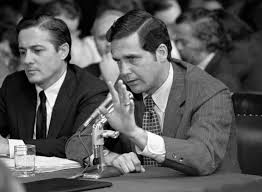
    Jeb Magruder testifies
    during the Watergate hearings

    While a student at George Washington University in Washington D.C., Stone invited Jeb Magruder, deputy director of the Committee to Reelect the President, to speak at the college’s Young Republican Club. After the speaking engagement Stone asked Magruder for a job with CREEP. At age 19, Stone decided to forsake his studies and joined right in with the antics of the infamous CREEP. For instance, he planted a mole in the camp of Democratic rival Hubert Humphrey. Magruder and his cohorts were obsessed with intelligence and skullduggery, and Stone had a natural affinity for them. He once wrote a check to Nixon rival Pete McCloskey from an account inscribed as the Young Socialists Alliance. Once he got the receipt he leaked it to the reactionary newspaper Manchester Union-Leader. (ibid)

    Against Senator George McGovern in the general election, Stone hired another spy he termed Sedan Chair II. But according to Stone, he did not understand the mentality of CREEP. To him it did not make any sense to take the kinds of risks they were taking when the Democratic candidate, McGovern, had so little chance of winning. After Watergate, which spelled the end of Nixon’s political career, he went to work for Bob Dole, and then for the (failed) Ronald Reagan campaign of 1976. During this period, he co-founded the National Conservative Political Action committee, which was designed to execute a GOP takeover of the Senate. Which, by recruiting men like Dan Quayle and Chuck Grassley, it did. As he noted to Jeffrey Toobin, “The Democrats were weak, we were strong.” (The New Yorker, June 2, 2008)

    Donald Trump & Roy Cohn
    JohnAnderson9 16 80
    John Anderson (Sept. 16, 1980)

    In 1980, he again worked for Reagan. In that election, he joined forces with the notorious attorney Roy Cohn, sworn enemy of the late Bobby Kennedy. They decided that the best way for Reagan to beat incumbent president Jimmy Carter in New York was to help Democratic congressman John Anderson get on the ballot. This way, the Democratic Party vote would be split and therefore weakened. According to Stone, Cohn told him to get in contact with a lawyer friend he had. Once in contact, he was to ask him how much it would cost to get Anderson the Liberal party nomination in New York. Stone reported back that the price was $125,000. A couple of days later, Stone was told by Cohn to pick up a suitcase and deliver it to the lawyer. He did so, and Anderson won the Liberal Party nomination. Reagan won New York with 46% of the vote. (ibid, Labash)

    Reagan’s victory in 1980 allowed Stone to enter the upper stratosphere of political campaign managing and lobbying. He now set up an office with two other GOP stalwarts, Charles Black and Paul Manafort. They would later be joined by none other than the late Lee Atwater, the man usually given credit for the Willie Horton TV ads, which helped defeat Democrat Michael Dukakis in 1988. The firm was lobbying on behalf of such people as Ferdinand Marcos, dictator of the Philippines, as well as conservative causes like the Nicaraguan Contras, and Angola’s UNITA rebels. And they advised several presidential candidates, even when they opposed each other.

    Stone’s primacy in the higher circles of the GOP came to an end in 1996. He was serving as an unaccredited adviser to Bob Dole’s presidential campaign when scandal struck. And it struck through the National Enquirer. They billed the story as “Top Dole Aide Caught in Group-Sex Ring.” (op. cit., Toobin) He and his second wife had run ads for swinging partners to participate in bedroom games. (op. cit., Labash) The tabloids even got hold of the advertising photos. Stone tried his usual “Deny, deny, deny” tactics. But they did not succeed.

    But in 2000, James Baker, who was running the GOP recount effort in Florida against Al Gore, brought Stone back to perform one last piece of political subterfuge. That act would have a momentous impact on America for decades into the future. It has come to be known as the “Brooks Brothers riot”.

    When the Florida Supreme Court ruled that Gore could have a recount in four counties, Stone and Baker decided this had to be thwarted. Scores of Republican congressional aides—the Brooks Brothers suits—had been flown to Miami to simulate grass roots, Floridian protest against the recount. Stone stationed himself in a Winnebago outside the building where the Miami-Dade County recount was taking place. Outfitted with walkie-talkies and cell phones, he went to work using these aides to create the illusion of an indigenous attack on the building. He did this by having the congressional aides actually enter the building and demand the recount be halted. According to the New York Times, some people were struck or kicked. (11/23/2000) This scene inside the building was coupled with Stone inspired Spanish language radio warnings about carloads of Cuban exiles driving to the scene. (op. cit., Toobin) In its broad outlines, the operation resembled the CIA coup in Guatemala in 1954. Between the Brooks Brothers demonstrators and the “imminent Cuban exile assault”, the recount was discontinued. The episode likely stopped Gore from actually taking the lead for the first time. This—plus the later Antonin Scalia order granting emergency relief due to the “irreparable damage” of counting votes—ultimately led to the US Supreme Court decision stopping the recount. And that brought us George W. Bush, perhaps the worst president in history.

    III

    After his work for Random House on the JFK case, in 1998 Posner wrote a book on the 30th anniversary of the Martin Luther King assassination. To no one’s surprise, Killing the Dream came to the same conclusion as Case Closed—the official story was correct. One year later of course, William Pepper demonstrated in court that Posner was wrong. The jury in a civil case brought by the King family ruled that King was killed as a result of a conspiracy.

    David Marwell

    Because of his establishment-pleasing writings, Posner became a TV and MSM presence. And he continued to write more non-fiction books. He appeared on many TV programs and also as an editorial writer for some major newspapers. According to Doug Horne in his book Inside the ARRB, the first director of the Assassination Records Review Board, David Marwell, said he found much of value in Case Closed. Consequently, he had lunch with Posner more than once. Harold Evans’ wife, Tina Brown, hired Posner as an investigative journalist for the online magazine Daily Beast. But he was forced to step down from that position in 2010 over several accusations that demonstrated that Posner was a serial plagiarist. He not only plagiarized for his articles at Daily Beast, but also in at least three of his books, e.g., Miami Babylon. (See Slate, “The Posner Plagiarism Perplex”, 2/11/2010, also Miami New Times, March 30, 2010)

    Tina Brown
    Harper Lee

    Three years later, the late Harper Lee filed a lawsuit claiming that her literary agent’s son-in-law had directed Posner to set up a corporation to defraud Lee of her royalties from her colossal best-seller To Kill a Mockingbird. In her court filing she said that she had faulty hearing and eyesight and these had been used by Samuel Pinkus to snooker her into signing over her book copyright. Pinkus assigned the copyright to a company incorporated by Posner. (NY Post, May 4, 2013) Four months later, Posner settled the suit and was dismissed from the legal action.

    After his work for James Baker in Miami, Roger Stone tended to concentrate on two new subjects. First, there was his friendship with Donald Trump. Stone was sold on the idea of Trump making a run for the presidency on the Reform Party ticket, the party created by Ross Perot. Although Trump made some overtures to run in the 2000 election, he ultimately decided against it. Stone also began to develop an avocation as an author. To say that his output has been prolific does not do him justice. In the space of about three years, beginning in late 2013, Stone has written or co-written—at last count—seven books. At least three of them rely on his relationship with Richard Nixon, who he still holds in high regard. If one looks closely, three of them rely on his relationship with Trump, who he had worked for in Trump’s 2015-16 campaign before they (allegedly) parted ways. His book about Jeb Bush, Jeb and the Bush Crime Family, was clearly meant as a broadside against the candidate most perceived as the favorite in the GOP primary campaign. His book about the Clintons, The Clintons’ War on Women, was meant as a preemptive strike against the attacks against Trump’s philandering with females.

    But Roger Stone/author first came to prominence at the 50th anniversary of the JFK assassination. At that time he co-wrote a book entitled The Man Who Killed Kennedy: The Case Against LBJ. That book became a New York Times bestseller. In fact, of all the books released at the 50th, it likely sold the most copies. Since then he has stayed involved in the field. In fact, his co-writers on the two previously mentioned books come from the JFK field. They are, respectively, Saint John Hunt and Robert Morrow.

    Why has Stone done this? It likely does not pay him the fees he commanded as a Washington lobbyist working in a very powerful PR firm. In a profile written by Jeff Toobin for The New Yorker, some hints for this career move are tossed out—almost inadvertently. One of the reasons Stone gives for being so enamored of Nixon is his anti-elitism. He adds Nixon was class conscious. And he identified with average people who ate TV dinners and watched Lawrence Welk. To Stone, Nixon “recognized the effectiveness of anti-elitism—a staple of American campaigns even today—as a core message.” In comparing Nixon with Reagan, Stone states that although many Republicans give Reagan credit for the defections of the working class from the Democrats, it was really Nixon who started it. Stone then zeroes in on the whole polarization concept:

    Nixon figured out how to win. We had a non-elitist message. We were the party of the workingman! We wanted lower taxes for everyone across the board. They were the part of the Hollywood elite. … The point that the Democrats missed was that the people who weren’t rich wanted to be rich.

    There is little doubt that Nixon, with his appeals to the Silent Majority in order to expand and lengthen the Vietnam War, did use these kinds of techniques. It’s obvious from the declassified tapes at the Nixon Library that he did not mean any of it. This was amply exposed by author Ken Hughes, among others, in his fine book Fatal Politics. And this exposure helps explain why Nixon and his family fought so long and hard not to have those tapes declassified. That book reveals that Nixon knew the war was lost in 1969. But he did not want to have South Vietnam fall on his watch. Therefore, he lied to Nguyen Van Thieu of South Vietnam to keep him in his corner while he negotiated an agreement with the north. The whole time he slaughtered tens of thousands of innocent civilians in an expanded air war over all of Indochina. The only reason for this was to announce a peace agreement on the eve of the 1972 election to make sure he had a landslide victory. This is all admitted to on these tapes in the Hughes book, and in letters he sent to Thieu in the book The Palace File.

    But the relevant point for today’s scene is that this cultural anti-elite aspect was well used by both Stone and Trump during the latter’s successful presidential campaign. Trump decided to leapfrog most of the MSM, and he did this with Stone’s help. In addition to the two books mentioned above, Stone helped promote the whole mythology of Ted Cruz’s father being seen in New Orleans with Lee Oswald in the summer of 1963. Stone used the word of Judyth Baker to promote this bizarre story. And Trump went on national TV with it. (Click here for our reaction.) The Morrow/Stone book about Clinton helped Trump alleviate the impact of the compelling Access Hollywood videotape. And this whole anti-cultural-elite concept helped avoid the question of how in the heck do the interests of a billionaire real estate investor coincide with America’s shrinking middle class? With the announcement of Trump’s cabinet, we can see that, as with Nixon, the whole idea is little more than window dressing. The policies that this cabinet and the Republican Party will try to enact will gut the middle class even more.

    IV

    All of the above about these two men is more than relevant to their debate in Coral Gables. Because it informs us of the state of the JFK case in America today. This author would not walk across the street to see Posner speak about either the JFK or King case. Simply because he is a lawyer who is in the employ of the official story. Therefore, it does not matter if what he is saying is incomplete, dubious or just specious. This reviewer has never read any of Stone’s books for the simple reason that I have a hard time thinking that Stone could master something as complex and multi-layered as the JFK case in just a matter of 3-4 years. I am also skeptical of the case that he and others have made against Lyndon Johnson. In watching this confrontation it appears I was correct about these suspicions.

    Roger Stone presented first. He led off with remarks about the avulsed rear skull wound that, for him, disappeared from the back of Kennedy’s head after he left Parkland Hospital. (This is not accurate. Gary Aguilar has shown it did not disappear, it was apparent at both the emergency room at Parkland and Bethesda Medical Center, where Kennedy’s body underwent an autopsy.) Stone later added the confusing point that the House Select Committee on Assassinations (HSCA) was convened because of Oliver Stone’s film JFK. I think Roger meant the Assassination Records Review Board (ARRB) was convened.

    But he then confuses this issue even more by saying that the HSCA revealed more of Ruby’s Mafia ties, which led them to conclude organized crime involvement in the JFK case. This is not really accurate, as the HSCA did not deduce this as one of their conclusions. Chief Counsel Robert Blakey did that in his later book on the JFK case, The Plot to Kill the President (which was co-written with Dick Billings).

    Stone also talked about his relationship with Senator Arlen Specter and how Specter did not have access to the autopsy materials during the Warren Commission proceedings. This needed to be qualified. As revealed by the declassified transcripts of the their executive hearings, the Warren Commission did have the autopsy materials. (Gerald McKnight, Breach of Trust, p. 171) And as Pat Speer has shown on his web site, Specter did see at least one of the autopsy photos. (See Chapter 10, “Examining the Examinations”.)

    Stone also said that the alleged rifle used by Oswald was purchased for $75.00 and that no marksman was able to duplicate what he did, that is get 2 of 3 direct hits in six seconds. The latter part of this is correct, the former sum is about three times what the rifle actually cost. Stone then concluded with the Jay Harrison/Barr McClellan sponsored Mac Wallace fingerprint found on the sixth floor. He also even mentioned one Loy Factor’s involvement with Wallace and the LBJ plot.

    Posner then replied. He criticized Stone’s book for having so many footnotes to other books. He therefore termed the book outdated. This is bizarre since Posner’s book is overwhelmingly reliant on the Warren Report and the accompanying volumes of evidence. He then said there was no evidence on the autopsy x-rays and photos that revealed anyone firing from anywhere except from behind and the general vicinity of the sixth floor.

    Apparently, Posner was not aware of the ARRB interview with Tom Robinson who worked out of Gawler’s funeral parlor. He said there was a wound near the right temple of the president that he filled in with wax. He said it was so close to the hairline it was difficult to see. (Murder in Dealey Plaza, p. 250, edited by James Fetzer.) Author Don Thomas has also done good work with the autopsy photos, which makes this wound easier to discern. Posner also ignores the fact that, as many have indicated, if the autopsy doctors are correct and the entrance wound in the skull came in near the base, then there is no trajectory of bullet particles on the X-rays to match it up with.

    Since Stone gave Posner an opening about only the Parkland doctors seeing the hole in the back of the skull, lawyer Posner took advantage of it. He said that since Kennedy’s body was not turned over at Parkland, they really didn’t see it. This is ridiculous on more than one count. First, as Gary Aguilar has shown, this avulsed wound did not “disappear” after Dallas. It was clearly observed at Bethesda, except the HSCA hid these interviews from the public. Therefore they were only declassified with the advent of the ARRB. (ibid, p. 199) And Posner talks about using dated information.

    Secondly, Parkland nurse Diana Bowron actually saw this wound as she was aiding the entourage bringing Kennedy’s body into the emergency room, and she saw it again as she was prepping Kennedy’s corpse to depart. (ibid, pp. 60, 199) Neurosurgeon Kemp Clark examined Kennedy’s skull as the tracheotomy was being performed and he stated that he saw this wound. (ibid, p. 193) Nurse Audrey Bell told the ARRB that Malcolm Perry showed her this wound by turning Kennedy’s head slightly. (Interview of 4/1/97) Then, of course, there is the testimony of Secret Service agent Clint Hill who said he saw this wound in the limousine on the way to Parkland. (op. cit., Fetzer, pp. 198-99) Stone should have literally harpooned Posner for citing such specious information.

    The bloviating Posner then added something just as dubious. He said that in order to argue conspiracy one must state that the X-rays and photos are altered. More baloney. Stone should have asked Posner on rebuttal, “How did the 6.5 mm fragment get on the X-rays if it’s not in the autopsy report and none of the autopsy doctors saw it that night?” He then should have asked the prosecutor, “What happened to the trail of fragments that lead pathologist Jim Humes wrote about in his report which goes from the bottom rear of the skull to the top? Those do not exist today. Why Gerald?” (Reclaiming Parkland, by James DiEugenio, pp. 152-54) Stone should also have asked the attorney, “Gerald, if all the shots came from the rear, including the head shot, why is there no blowout in the front of Kennedy’s face?”

    Further, the brain was never sectioned. Therefore we do not know the path of the bullet through the skull, or if there was only one bullet.  That would have been the best evidence of exactly what killed President Kennedy.  But it  was not done. Why?

    Finally, the back wound was not dissected.  So we do not know if this wound was a through and through wound–did it transit the body?  If it did not, then the Single Bullet Theory Posner upholds is kaput.  And according to pathologist Pierre Finck’s testimony at the Clay Shaw trial, the reason it was not tracked is that the doctors were prevented from doing so by the military brass at Bethesda.

    These all indicate a cover up, if not a conspiracy.  And they all would have been better evidence than the photos and X-rays. After all, one cannot photograph autopsy practices that were never performed.

    Posner then said it is wrong to say that no marksman ever duplicated Oswald’s shooting feat. He said the Commission did, CBS did, and the HSCA did.

    Concerning the first, I don’t know what Posner is talking about. Mark Lane and Sylvia Meagher have discussed the rifle experiments of the Warren Commission.  (Meagher, Accessories After the Fact,  pp. 108-10; Lane, Rush to Judgment,  pp. 126-30)  The FBI tried to get off three shots in six seconds, scoring two of three direct hits in the head and shoulder area. They failed. Therefore, the Commission had three military snipers try it. These tests were rigged. They were done from about twenty feet up, not sixty, as would have been the case with Oswald.  The three riflemen were given as much time as they wanted to gauge the first shot, again not the case for Oswald.  Third, they were firing at stationary and not moving targets.  And even at that, the targets were grouped much closer together than what the Commission said was the firing series in Dealey Plaza. Fifth, these were some of the vey best marksmen in the military. They were so good they were above the best in the Marine Corps, and could qualify for the Olympics. To put it mildly, Oswald was nowhere near this quality.  But even at that only one of them got the shots off in the required time.  And none were able to get two of three direct hits.

    Concerning CBS, apparently Posner has not read my essay based on CBS internal memoranda adduced by their employee Roger Feinman. Unlike what Posner stated, their first marksman, a famous military sniper, using a model of the 6.5 Mannlicher Carcano, could not do what Oswald did. They then brought in a team of riflemen, and let them practice for a week—which Oswald did not do in any way, shape or form. They then set up a target that eliminated the oak tree from the sixth floor, eliminated the curve in the street, and instead set up a moving sled to fire at. This last was the most important factor. Why? Because the sled posed an enlarged target, as Feinman notes, it at least doubled the target area. In other words, CBS cheated after their first marksman failed. (Click here for that information.)

    Stooping to the HSCA for evidence on this subject is really hard to understand. Even for Posner. Because the HSCA did no rifle tests during its actual duration. They did not do them until after the HSCA ceased operation. Wallace Milam sent me the full memo on this episode. It turns out that Chief Counsel Robert Blakey, his assistant Gary Cornwell, and some Washington policemen went out to a rifle range. There they tried to do what the Commission said Oswald did. In their overweening ambition, at first they decided not to use the telescopic site. Which is ridiculous since the Commission said Oswald did use it. After all, why would it be attached to the rifle if it were not used? As I can inform the reader, that scope makes a huge difference. To say Oswald did what he did without it is simply preposterous. But when the policemen used only the iron sights on the rifle, they had the same problem that the Commission did. They could not maintain accuracy within the six second time interval of the Warren Commission. So what did Blakey and Cornwell do? They used something called “point aiming”. Which means not using any site at all, just pointing the rifle. When they got off two shots in under two seconds that was enough. They then deduced it was possible to do what Oswald allegedly did even though they were only 20 feet up instead of 60 feet and their accuracy results were not recorded. (The Assassinations, edited by James DiEugenio and Lisa Pease, p. 83)

    Marine sniper
    Carlos Hathcock

    Stone should have replied that, yes, you can do what the Commission said Oswald did. But you have to cheat. And then not tell the public about the cheating. I would have then added that Carlos Hathcock, the greatest sniper of the Vietnam War, actually did try and duplicate accurately what the Commission said Oswald did. He told author Craig Roberts that he could not do it, even though he tried more than once.

    Posner actually used the fingerprint evidence on the alleged Oswald rifle to try and convict Oswald. Without telling the public that this so-called evidence was presented only after the FBI found there were no prints found on the rifle when Sebastian LaTona examined it that night. (Meagher, op. cit., pp. 120-27) Prints only showed up about a week later, and then thirty years later for a PBS special. Stone rightly pointed out that the FBI was inexplicably at the Oswald funeral parlor trying to get fingerprints off of his corpse. (Henry Hurt, Reasonable Doubt, pp. 107-09) Which is weird, since the Dallas Police already had Oswald’s fingerprints.

    Posner concluded by rebutting the use of the Mac Wallace fingerprint with the work of FBI authority Robert Garrett, as is featured in Joan Mellen’s book, Faustian Bargains.

    I won’t go on with my analysis since it would just be more of the same. Posner making more and more dubious claims and Stone replying with populist type experts, e.g., Judyth Baker on Cruz, and Richard Bartholomew on the Wallace print. (Yet, to my knowledge, Richard is not a fingerprint expert.) Posner actually tried to impeach Victoria Adams not seeing Oswald running down the stairs after the shooting by saying she did not see officer Marrion Baker or supervisor Roy Truly either. Again, Posner seems unaware that Miss Garner, Victoria’s supervisor, did see those two men come up the stairs after Adams and co-worker Sandy Styles went down. Further, the Warren Commission had this document in their hands, since it was dated June 2, 1964. While they were in session.

    Now, obviously, if Garner saw Baker and Truly after Victoria and Sandy went down the stairs, then the two women left within seconds of the shooting, as they said they did. Yet the Warren Report says they left much later, minutes afterwards. In other words, the Commission covered up the true facts of what had occurred. Because Adams and Styles give Oswald a rock solid alibi for not being on the sixth floor when they needed him to be so. (DiEugenio, op. cit., pp. 115-20)

    The most important thing that was said during this debate was that Stone would try and talk to Mr. Trump about the declassification of the final documents being held at the National Archives by the JFK Act. They are supposed to be finally disposed of in October of this year. Let us hope Mr. Stone uses his influence to see that through. It would be in keeping with his and Mr. Trump’s obeisance to conservative populism.

    (The debate video is embedded below, or the reader can watch it by clicking here.)

  • Gerald Posner vs. Roger Stone in Coral Gables

    Gerald Posner vs. Roger Stone in Coral Gables

    On the 54th anniversary of President Kennedy’s assassination, at a bookstore in Coral Gables, Florida two famous authors convened. They were Gerald Posner and Roger Stone. The subject was a debate over the circumstances of Kennedy’s assassination. Obviously, because of the orientation of their books on the subject, Posner defended the Warren Commission verdict while Stone argued for a conspiracy.

    Robert Loomis

    Posner was trained as a lawyer. At age 23, he became one of the youngest attorneys ever employed by Cravath, Swaine and Moore, John McCloy’s old law firm. In 1980, he left that firm and opened a private practice with a partner. In 1986, he left that practice and became an author. In a relatively short period of time, he wrote three non-fiction books and one novel. In 1991, he was enlisted by Robert Loomis of Random House to write a response to Oliver Stone’s movie about the Kennedy assassination, JFK. The very plugged-in Loomis promised Posner that the CIA would cooperate with him on the project. (The Assassinations, edited by James DiEugenio and Lisa Pease, p. 369) And they did. Without their help, how else could an author gain access to high level defector Yuri Nosenko?

    Harold Evans

    As was exposed in a later lawsuit by the late Roger Feinman, Random House put a major effort into selling Posner’s Case Closed. One that was personally supervised by Harold Evans, who was president of the publishing house at the time. According to information Feinman discovered in his lawsuit, it was Evans who personally approved the infamous NY Times ads for the book. This was a four-phase campaign. It began with two teaser ads that promised to name the guilty parties in the JFK assassination. It culminated with two more ads. These featured the faces of Oliver Stone, David Lifton, Robert Groden, Jim Marrs, Mark Lane and Jim Garrison under a title which boldly accused them of the charge: “Guilty of Misleading the American Public”. If the reader knows anything about advertising costs in major newspapers, he can guess what those four ads cost. (Click here for Feinman’s essay about his lawsuit against Random House.)

    But that was not all. Apparently because Evans had previously served as a director of US News and World Report, that magazine gave Posner’s book a cover story. The book became such a cause celebre that other authors have successfully used it as a way to curry favor with the MSM, e.g., Jeff Toobin and Robert Dallek.

    The problem with all this hoopla, which was designed to coincide with the 30th anniversary of the assassination, is that it was completely unwarranted. There were several reviews that showed just how flawed Case Closed was: for instance, David Wrone’s. (See also this index of items on this site.) In fact, there were so many problems with Posner’s book that activist Dave Starks put together a compendium page of articles to show that, not only was Case Closed a very bad piece of scholarship, but it might have been worse than that. In his haste to do a hatchet job on the critics, Posner may have created interviews he did not actually do. For instance, Peter Scott talked to Carlos Bringuier after Case Closed came out. Contrary to the book’s claims, Bringuier said he never talked to Posner. (Author interview with Scott in San Francisco in 1994) Same with Dealey Plaza witness James Tague, who the author clearly states he talked to on two successive days. (See Posner, paperback edition, p. 546) When Gary Aguilar talked to Tague, he said he never spoke to Posner. To use another example, although the author said he interviewed JFK’s forensic pathologist Thornton Boswell, Boswell told Aguilar he never spoke to him. (Click here for Starks’ devastating page on Posner.)

    David Ferrie & Lee Oswald,
    Civil Air Patrol (1955)

    Posner also committed some outright howlers in his much-ballyhooed book. For example, in his schematic drawings of the assassin at the Texas School Book Depository window, he has him posed as firing from an extreme left to right angle. So much so that these “Posner shots” would have ended up in the railroad yards behind the picket fence. (See Appendix A of Case Closed, paperback edition.) This makes one wonder if Posner was ever in Dallas. Because to anyone who has been to the building and peered out the sixth floor window—which was possible back then—it presents a slight right to left angle. Posner also wrote that there was no evidence to connect David Ferrie with Oswald. (Posner, p. 425) This was utterly ridiculous on many counts. But to name just one, when the book came out PBS did a special which featured a photo of Oswald and Ferrie together at a Civil Air Patrol (CAP) barbecue. They found it by questioning some other members of the CAP. Which means Posner could have done the same if he had knocked on some doors in the Crescent City. Posner also writes that there was no such personage as Clay Bertrand in New Orleans. When the JFK Act declassified both the Jim Garrison files and the papers of the HSCA, Posner again ended up with custard pie on his face. Those documents reveal that the number of witnesses who stated that Clay Shaw used the alias of Clay Bertrand was in the double digits. (Destiny Betrayed, Second Edition, by James DiEugenio, pp. 211, 387, 388)

    Posner’s book showed us in excelsis just how schizoid America is on the murder of President Kennedy. It did not matter to the Powers That Be just how error-strewn Posner’s book was. It did not matter to them that he was more or less acting as a hired gun for Loomis and Evans. It did not matter to them that the book was obviously a rush job for the 30th anniversary. Or that the title was preposterous since the declassification process of the JFK Act had not even gone into effect yet. In other words, the book was saying the case was closed when, in fact, two million pages of documents were about to be declassified in the next four years.

    Clearly, as representatives of the Anglo-American Establishment, the important thing for Loomis and Evans was this: They wanted to create a tangible cultural artifact to rally around at the 30th anniversary. Why? In order to beat back the tsunami effect of Oliver Stone’s JFK, which had blindsided them. Posner’s book was a concocted historical event. Today the book has been retired to the (rather large) ash heap of useless volumes on the JFK case. It has no intrinsic factual merit to it at all. It is simply an exemplar of a two-part cultural/historical phenomenon. I say two parts, because the second phase of this Jungian neurotic outbreak occurred four years later, with another Loomis client. This time the collective seizure was over Sy Hersh’s equally horrendous book. This one was a biography of John Kennedy, The Dark Side of Camelot. That bookend volume was as bad in its own way as Posner’s tome. But Oliver Stone had not just said that JFK was killed by a conspiracy. His film also stated that Kennedy was a foreign policy iconoclast who was changing things in that realm. This was true and has been proven even more accurate by recent scholarship. But that did not matter with Hersh, whose book was so bad that some critics said it should have been titled, The Dark Side of Seymour Hersh.

    II

    Roger Stone was born in Lewisboro, New York to a reporter mother and a father who drilled oil wells. Stone got hooked on politics when he read Conscience of a Conservative by Barry Goldwater. Although he admired Goldwater’s ideas he could not comprehend the tactics of his 1964 campaign. To put it mildly, he thought they were rather quixotic. As he told writer Matt Labash, “It’s like he was trying to lose. Going to Tennessee and coming out against the Tennessee Valley Authority? These were suicidal acts.” (Weekly Standard, November 5, 2007)

    Roger Stone & Nixon

    Because of this, Roger Stone became more enamored with Richard Nixon as his conservative standard bearer. He deduced that Nixon was “more pragmatic, more interested in winning than proving a point.” He took a pithy aphorism from RMN: “Losers don’t legislate.” (ibid) Stone liked Nixon so much that he decided that his newly found idol had not really lost the 1960 election. He had been robbed of the presidency through electoral fraud. So he wrote Nixon a letter at his New York law firm encouraging him to run again. Nixon replied that he did not plan on doing so, but if he did, he would be in touch with young Stone. (Stone is such a Nixon fan he had his face tattooed on his back.)

    Jeb Magruder testifies
    during the Watergate hearings

    While a student at George Washington University in Washington D.C., Stone invited Jeb Magruder, deputy director of the Committee to Reelect the President, to speak at the college’s Young Republican Club. After the speaking engagement Stone asked Magruder for a job with CREEP. At age 19, Stone decided to forsake his studies and joined right in with the antics of the infamous CREEP. For instance, he planted a mole in the camp of Democratic rival Hubert Humphrey. Magruder and his cohorts were obsessed with intelligence and skullduggery, and Stone had a natural affinity for them. He once wrote a check to Nixon rival Pete McCloskey from an account inscribed as the Young Socialists Alliance. Once he got the receipt he leaked it to the reactionary newspaper Manchester Union-Leader. (ibid)

    Against Senator George McGovern in the general election, Stone hired another spy he termed Sedan Chair II. But according to Stone, he did not understand the mentality of CREEP. To him it did not make any sense to take the kinds of risks they were taking when the Democratic candidate, McGovern, had so little chance of winning. After Watergate, which spelled the end of Nixon’s political career, he went to work for Bob Dole, and then for the (failed) Ronald Reagan campaign of 1976. During this period, he co-founded the National Conservative Political Action committee, which was designed to execute a GOP takeover of the Senate. Which, by recruiting men like Dan Quayle and Chuck Grassley, it did. As he noted to Jeffrey Toobin, “The Democrats were weak, we were strong.” (The New Yorker, June 2, 2008)

    Donald Trump & Roy Cohn
    JohnAnderson9 16 80
    John Anderson (Sept. 16, 1980)

    In 1980, he again worked for Reagan. In that election, he joined forces with the notorious attorney Roy Cohn, sworn enemy of the late Bobby Kennedy. They decided that the best way for Reagan to beat incumbent president Jimmy Carter in New York was to help Democratic congressman John Anderson get on the ballot. This way, the Democratic Party vote would be split and therefore weakened. According to Stone, Cohn told him to get in contact with a lawyer friend he had. Once in contact, he was to ask him how much it would cost to get Anderson the Liberal party nomination in New York. Stone reported back that the price was $125,000. A couple of days later, Stone was told by Cohn to pick up a suitcase and deliver it to the lawyer. He did so, and Anderson won the Liberal Party nomination. Reagan won New York with 46% of the vote. (ibid, Labash)

    Reagan’s victory in 1980 allowed Stone to enter the upper stratosphere of political campaign managing and lobbying. He now set up an office with two other GOP stalwarts, Charles Black and Paul Manafort. They would later be joined by none other than the late Lee Atwater, the man usually given credit for the Willie Horton TV ads, which helped defeat Democrat Michael Dukakis in 1988. The firm was lobbying on behalf of such people as Ferdinand Marcos, dictator of the Philippines, as well as conservative causes like the Nicaraguan Contras, and Angola’s UNITA rebels. And they advised several presidential candidates, even when they opposed each other.

    Stone’s primacy in the higher circles of the GOP came to an end in 1996. He was serving as an unaccredited adviser to Bob Dole’s presidential campaign when scandal struck. And it struck through the National Enquirer. They billed the story as “Top Dole Aide Caught in Group-Sex Ring.” (op. cit., Toobin) He and his second wife had run ads for swinging partners to participate in bedroom games. (op. cit., Labash) The tabloids even got hold of the advertising photos. Stone tried his usual “Deny, deny, deny” tactics. But they did not succeed.

    But in 2000, James Baker, who was running the GOP recount effort in Florida against Al Gore, brought Stone back to perform one last piece of political subterfuge. That act would have a momentous impact on America for decades into the future. It has come to be known as the “Brooks Brothers riot”.

    When the Florida Supreme Court ruled that Gore could have a recount in four counties, Stone and Baker decided this had to be thwarted. Scores of Republican congressional aides—the Brooks Brothers suits—had been flown to Miami to simulate grass roots, Floridian protest against the recount. Stone stationed himself in a Winnebago outside the building where the Miami-Dade County recount was taking place. Outfitted with walkie-talkies and cell phones, he went to work using these aides to create the illusion of an indigenous attack on the building. He did this by having the congressional aides actually enter the building and demand the recount be halted. According to the New York Times, some people were struck or kicked. (11/23/2000) This scene inside the building was coupled with Stone inspired Spanish language radio warnings about carloads of Cuban exiles driving to the scene. (op. cit., Toobin) In its broad outlines, the operation resembled the CIA coup in Guatemala in 1954. Between the Brooks Brothers demonstrators and the “imminent Cuban exile assault”, the recount was discontinued. The episode likely stopped Gore from actually taking the lead for the first time. This—plus the later Antonin Scalia order granting emergency relief due to the “irreparable damage” of counting votes—ultimately led to the US Supreme Court decision stopping the recount. And that brought us George W. Bush, perhaps the worst president in history.

    III

    After his work for Random House on the JFK case, in 1998 Posner wrote a book on the 30th anniversary of the Martin Luther King assassination. To no one’s surprise, Killing the Dream came to the same conclusion as Case Closed—the official story was correct. One year later of course, William Pepper demonstrated in court that Posner was wrong. The jury in a civil case brought by the King family ruled that King was killed as a result of a conspiracy.

    David Marwell

    Because of his establishment-pleasing writings, Posner became a TV and MSM presence. And he continued to write more non-fiction books. He appeared on many TV programs and also as an editorial writer for some major newspapers. According to Doug Horne in his book Inside the ARRB, the first director of the Assassination Records Review Board, David Marwell, said he found much of value in Case Closed. Consequently, he had lunch with Posner more than once. Harold Evans’ wife, Tina Brown, hired Posner as an investigative journalist for the online magazine Daily Beast. But he was forced to step down from that position in 2010 over several accusations that demonstrated that Posner was a serial plagiarist. He not only plagiarized for his articles at Daily Beast, but also in at least three of his books, e.g., Miami Babylon. (See Slate, “The Posner Plagiarism Perplex”, 2/11/2010, also Miami New Times, March 30, 2010)

    Tina Brown
    Harper Lee

    Three years later, the late Harper Lee filed a lawsuit claiming that her literary agent’s son-in-law had directed Posner to set up a corporation to defraud Lee of her royalties from her colossal best-seller To Kill a Mockingbird. In her court filing she said that she had faulty hearing and eyesight and these had been used by Samuel Pinkus to snooker her into signing over her book copyright. Pinkus assigned the copyright to a company incorporated by Posner. (NY Post, May 4, 2013) Four months later, Posner settled the suit and was dismissed from the legal action.

    After his work for James Baker in Miami, Roger Stone tended to concentrate on two new subjects. First, there was his friendship with Donald Trump. Stone was sold on the idea of Trump making a run for the presidency on the Reform Party ticket, the party created by Ross Perot. Although Trump made some overtures to run in the 2000 election, he ultimately decided against it. Stone also began to develop an avocation as an author. To say that his output has been prolific does not do him justice. In the space of about three years, beginning in late 2013, Stone has written or co-written—at last count—seven books. At least three of them rely on his relationship with Richard Nixon, who he still holds in high regard. If one looks closely, three of them rely on his relationship with Trump, who he had worked for in Trump’s 2015-16 campaign before they (allegedly) parted ways. His book about Jeb Bush, Jeb and the Bush Crime Family, was clearly meant as a broadside against the candidate most perceived as the favorite in the GOP primary campaign. His book about the Clintons, The Clintons’ War on Women, was meant as a preemptive strike against the attacks against Trump’s philandering with females.

    But Roger Stone/author first came to prominence at the 50th anniversary of the JFK assassination. At that time he co-wrote a book entitled The Man Who Killed Kennedy: The Case Against LBJ. That book became a New York Times bestseller. In fact, of all the books released at the 50th, it likely sold the most copies. Since then he has stayed involved in the field. In fact, his co-writers on the two previously mentioned books come from the JFK field. They are, respectively, Saint John Hunt and Robert Morrow.

    Why has Stone done this? It likely does not pay him the fees he commanded as a Washington lobbyist working in a very powerful PR firm. In a profile written by Jeff Toobin for The New Yorker, some hints for this career move are tossed out—almost inadvertently. One of the reasons Stone gives for being so enamored of Nixon is his anti-elitism. He adds Nixon was class conscious. And he identified with average people who ate TV dinners and watched Lawrence Welk. To Stone, Nixon “recognized the effectiveness of anti-elitism—a staple of American campaigns even today—as a core message.” In comparing Nixon with Reagan, Stone states that although many Republicans give Reagan credit for the defections of the working class from the Democrats, it was really Nixon who started it. Stone then zeroes in on the whole polarization concept:

    Nixon figured out how to win. We had a non-elitist message. We were the party of the workingman! We wanted lower taxes for everyone across the board. They were the part of the Hollywood elite. … The point that the Democrats missed was that the people who weren’t rich wanted to be rich.

    There is little doubt that Nixon, with his appeals to the Silent Majority in order to expand and lengthen the Vietnam War, did use these kinds of techniques. It’s obvious from the declassified tapes at the Nixon Library that he did not mean any of it. This was amply exposed by author Ken Hughes, among others, in his fine book Fatal Politics. And this exposure helps explain why Nixon and his family fought so long and hard not to have those tapes declassified. That book reveals that Nixon knew the war was lost in 1969. But he did not want to have South Vietnam fall on his watch. Therefore, he lied to Nguyen Van Thieu of South Vietnam to keep him in his corner while he negotiated an agreement with the north. The whole time he slaughtered tens of thousands of innocent civilians in an expanded air war over all of Indochina. The only reason for this was to announce a peace agreement on the eve of the 1972 election to make sure he had a landslide victory. This is all admitted to on these tapes in the Hughes book, and in letters he sent to Thieu in the book The Palace File.

    But the relevant point for today’s scene is that this cultural anti-elite aspect was well used by both Stone and Trump during the latter’s successful presidential campaign. Trump decided to leapfrog most of the MSM, and he did this with Stone’s help. In addition to the two books mentioned above, Stone helped promote the whole mythology of Ted Cruz’s father being seen in New Orleans with Lee Oswald in the summer of 1963. Stone used the word of Judyth Baker to promote this bizarre story. And Trump went on national TV with it. (Click here for our reaction.) The Morrow/Stone book about Clinton helped Trump alleviate the impact of the compelling Access Hollywood videotape. And this whole anti-cultural-elite concept helped avoid the question of how in the heck do the interests of a billionaire real estate investor coincide with America’s shrinking middle class? With the announcement of Trump’s cabinet, we can see that, as with Nixon, the whole idea is little more than window dressing. The policies that this cabinet and the Republican Party will try to enact will gut the middle class even more.

    IV

    All of the above about these two men is more than relevant to their debate in Coral Gables. Because it informs us of the state of the JFK case in America today. This author would not walk across the street to see Posner speak about either the JFK or King case. Simply because he is a lawyer who is in the employ of the official story. Therefore, it does not matter if what he is saying is incomplete, dubious or just specious. This reviewer has never read any of Stone’s books for the simple reason that I have a hard time thinking that Stone could master something as complex and multi-layered as the JFK case in just a matter of 3-4 years. I am also skeptical of the case that he and others have made against Lyndon Johnson. In watching this confrontation it appears I was correct about these suspicions.

    Roger Stone presented first. He led off with remarks about the avulsed rear skull wound that, for him, disappeared from the back of Kennedy’s head after he left Parkland Hospital. (This is not accurate. Gary Aguilar has shown it did not disappear, it was apparent at both the emergency room at Parkland and Bethesda Medical Center, where Kennedy’s body underwent an autopsy.) Stone later added the confusing point that the House Select Committee on Assassinations (HSCA) was convened because of Oliver Stone’s film JFK. I think Roger meant the Assassination Records Review Board (ARRB) was convened.

    But he then confuses this issue even more by saying that the HSCA revealed more of Ruby’s Mafia ties, which led them to conclude organized crime involvement in the JFK case. This is not really accurate, as the HSCA did not deduce this as one of their conclusions. Chief Counsel Robert Blakey did that in his later book on the JFK case, The Plot to Kill the President (which was co-written with Dick Billings).

    Stone also talked about his relationship with Senator Arlen Specter and how Specter did not have access to the autopsy materials during the Warren Commission proceedings. This needed to be qualified. As revealed by the declassified transcripts of the their executive hearings, the Warren Commission did have the autopsy materials. (Gerald McKnight, Breach of Trust, p. 171) And as Pat Speer has shown on his web site, Specter did see at least one of the autopsy photos. (See Chapter 10, “Examining the Examinations”.)

    Stone also said that the alleged rifle used by Oswald was purchased for $75.00 and that no marksman was able to duplicate what he did, that is get 2 of 3 direct hits in six seconds. The latter part of this is correct, the former sum is about three times what the rifle actually cost. Stone then concluded with the Jay Harrison/Barr McClellan sponsored Mac Wallace fingerprint found on the sixth floor. He also even mentioned one Loy Factor’s involvement with Wallace and the LBJ plot.

    Posner then replied. He criticized Stone’s book for having so many footnotes to other books. He therefore termed the book outdated. This is bizarre since Posner’s book is overwhelmingly reliant on the Warren Report and the accompanying volumes of evidence. He then said there was no evidence on the autopsy x-rays and photos that revealed anyone firing from anywhere except from behind and the general vicinity of the sixth floor.

    Apparently, Posner was not aware of the ARRB interview with Tom Robinson who worked out of Gawler’s funeral parlor. He said there was a wound near the right temple of the president that he filled in with wax. He said it was so close to the hairline it was difficult to see. (Murder in Dealey Plaza, p. 250, edited by James Fetzer.) Author Don Thomas has also done good work with the autopsy photos, which makes this wound easier to discern. Posner also ignores the fact that, as many have indicated, if the autopsy doctors are correct and the entrance wound in the skull came in near the base, then there is no trajectory of bullet particles on the X-rays to match it up with.

    Since Stone gave Posner an opening about only the Parkland doctors seeing the hole in the back of the skull, lawyer Posner took advantage of it. He said that since Kennedy’s body was not turned over at Parkland, they really didn’t see it. This is ridiculous on more than one count. First, as Gary Aguilar has shown, this avulsed wound did not “disappear” after Dallas. It was clearly observed at Bethesda, except the HSCA hid these interviews from the public. Therefore they were only declassified with the advent of the ARRB. (ibid, p. 199) And Posner talks about using dated information.

    Secondly, Parkland nurse Diana Bowron actually saw this wound as she was aiding the entourage bringing Kennedy’s body into the emergency room, and she saw it again as she was prepping Kennedy’s corpse to depart. (ibid, pp. 60, 199) Neurosurgeon Kemp Clark examined Kennedy’s skull as the tracheotomy was being performed and he stated that he saw this wound. (ibid, p. 193) Nurse Audrey Bell told the ARRB that Malcolm Perry showed her this wound by turning Kennedy’s head slightly. (Interview of 4/1/97) Then, of course, there is the testimony of Secret Service agent Clint Hill who said he saw this wound in the limousine on the way to Parkland. (op. cit., Fetzer, pp. 198-99) Stone should have literally harpooned Posner for citing such specious information.

    The bloviating Posner then added something just as dubious. He said that in order to argue conspiracy one must state that the X-rays and photos are altered. More baloney. Stone should have asked Posner on rebuttal, “How did the 6.5 mm fragment get on the X-rays if it’s not in the autopsy report and none of the autopsy doctors saw it that night?” He then should have asked the prosecutor, “What happened to the trail of fragments that lead pathologist Jim Humes wrote about in his report which goes from the bottom rear of the skull to the top? Those do not exist today. Why Gerald?” (Reclaiming Parkland, by James DiEugenio, pp. 152-54) Stone should also have asked the attorney, “Gerald, if all the shots came from the rear, including the head shot, why is there no blowout in the front of Kennedy’s face?”

    Further, the brain was never sectioned. Therefore we do not know the path of the bullet through the skull, or if there was only one bullet.  That would have been the best evidence of exactly what killed President Kennedy.  But it  was not done. Why?

    Finally, the back wound was not dissected.  So we do not know if this wound was a through and through wound–did it transit the body?  If it did not, then the Single Bullet Theory Posner upholds is kaput.  And according to pathologist Pierre Finck’s testimony at the Clay Shaw trial, the reason it was not tracked is that the doctors were prevented from doing so by the military brass at Bethesda.

    These all indicate a cover up, if not a conspiracy.  And they all would have been better evidence than the photos and X-rays. After all, one cannot photograph autopsy practices that were never performed.

    Posner then said it is wrong to say that no marksman ever duplicated Oswald’s shooting feat. He said the Commission did, CBS did, and the HSCA did.

    Concerning the first, I don’t know what Posner is talking about. Mark Lane and Sylvia Meagher have discussed the rifle experiments of the Warren Commission.  (Meagher, Accessories After the Fact,  pp. 108-10; Lane, Rush to Judgment,  pp. 126-30)  The FBI tried to get off three shots in six seconds, scoring two of three direct hits in the head and shoulder area. They failed. Therefore, the Commission had three military snipers try it. These tests were rigged. They were done from about twenty feet up, not sixty, as would have been the case with Oswald.  The three riflemen were given as much time as they wanted to gauge the first shot, again not the case for Oswald.  Third, they were firing at stationary and not moving targets.  And even at that, the targets were grouped much closer together than what the Commission said was the firing series in Dealey Plaza. Fifth, these were some of the vey best marksmen in the military. They were so good they were above the best in the Marine Corps, and could qualify for the Olympics. To put it mildly, Oswald was nowhere near this quality.  But even at that only one of them got the shots off in the required time.  And none were able to get two of three direct hits.

    Concerning CBS, apparently Posner has not read my essay based on CBS internal memoranda adduced by their employee Roger Feinman. Unlike what Posner stated, their first marksman, a famous military sniper, using a model of the 6.5 Mannlicher Carcano, could not do what Oswald did. They then brought in a team of riflemen, and let them practice for a week—which Oswald did not do in any way, shape or form. They then set up a target that eliminated the oak tree from the sixth floor, eliminated the curve in the street, and instead set up a moving sled to fire at. This last was the most important factor. Why? Because the sled posed an enlarged target, as Feinman notes, it at least doubled the target area. In other words, CBS cheated after their first marksman failed. (Click here for that information.)

    Stooping to the HSCA for evidence on this subject is really hard to understand. Even for Posner. Because the HSCA did no rifle tests during its actual duration. They did not do them until after the HSCA ceased operation. Wallace Milam sent me the full memo on this episode. It turns out that Chief Counsel Robert Blakey, his assistant Gary Cornwell, and some Washington policemen went out to a rifle range. There they tried to do what the Commission said Oswald did. In their overweening ambition, at first they decided not to use the telescopic site. Which is ridiculous since the Commission said Oswald did use it. After all, why would it be attached to the rifle if it were not used? As I can inform the reader, that scope makes a huge difference. To say Oswald did what he did without it is simply preposterous. But when the policemen used only the iron sights on the rifle, they had the same problem that the Commission did. They could not maintain accuracy within the six second time interval of the Warren Commission. So what did Blakey and Cornwell do? They used something called “point aiming”. Which means not using any site at all, just pointing the rifle. When they got off two shots in under two seconds that was enough. They then deduced it was possible to do what Oswald allegedly did even though they were only 20 feet up instead of 60 feet and their accuracy results were not recorded. (The Assassinations, edited by James DiEugenio and Lisa Pease, p. 83)

    Marine sniper
    Carlos Hathcock

    Stone should have replied that, yes, you can do what the Commission said Oswald did. But you have to cheat. And then not tell the public about the cheating. I would have then added that Carlos Hathcock, the greatest sniper of the Vietnam War, actually did try and duplicate accurately what the Commission said Oswald did. He told author Craig Roberts that he could not do it, even though he tried more than once.

    Posner actually used the fingerprint evidence on the alleged Oswald rifle to try and convict Oswald. Without telling the public that this so-called evidence was presented only after the FBI found there were no prints found on the rifle when Sebastian LaTona examined it that night. (Meagher, op. cit., pp. 120-27) Prints only showed up about a week later, and then thirty years later for a PBS special. Stone rightly pointed out that the FBI was inexplicably at the Oswald funeral parlor trying to get fingerprints off of his corpse. (Henry Hurt, Reasonable Doubt, pp. 107-09) Which is weird, since the Dallas Police already had Oswald’s fingerprints.

    Posner concluded by rebutting the use of the Mac Wallace fingerprint with the work of FBI authority Robert Garrett, as is featured in Joan Mellen’s book, Faustian Bargains.

    I won’t go on with my analysis since it would just be more of the same. Posner making more and more dubious claims and Stone replying with populist type experts, e.g., Judyth Baker on Cruz, and Richard Bartholomew on the Wallace print. (Yet, to my knowledge, Richard is not a fingerprint expert.) Posner actually tried to impeach Victoria Adams not seeing Oswald running down the stairs after the shooting by saying she did not see officer Marrion Baker or supervisor Roy Truly either. Again, Posner seems unaware that Miss Garner, Victoria’s supervisor, did see those two men come up the stairs after Adams and co-worker Sandy Styles went down. Further, the Warren Commission had this document in their hands, since it was dated June 2, 1964. While they were in session.

    Now, obviously, if Garner saw Baker and Truly after Victoria and Sandy went down the stairs, then the two women left within seconds of the shooting, as they said they did. Yet the Warren Report says they left much later, minutes afterwards. In other words, the Commission covered up the true facts of what had occurred. Because Adams and Styles give Oswald a rock solid alibi for not being on the sixth floor when they needed him to be so. (DiEugenio, op. cit., pp. 115-20)

    The most important thing that was said during this debate was that Stone would try and talk to Mr. Trump about the declassification of the final documents being held at the National Archives by the JFK Act. They are supposed to be finally disposed of in October of this year. Let us hope Mr. Stone uses his influence to see that through. It would be in keeping with his and Mr. Trump’s obeisance to conservative populism.

    (The debate video is embedded below, or the reader can watch it by clicking here.)

  • Rules Don’t Apply

    Rules Don’t Apply


    For many years Warren Beatty had wanted to do a movie about Howard Hughes. According to various reports, he had dallied with the idea since the seventies. Because Beatty has produced and directed some distinguished films, most of us who heard about this project had some high expectations for it. An accomplished and intelligent Hollywood film-maker was going to take on a fascinating and complex American historical figure, about whom much mystery and fascination have existed. In fact, one could argue that Hughes was the most famous and controversial American billionaire before Donald Trump. Except he was much richer than Trump. To give one example: when Hughes Aircraft was auctioned off in 1985—about a decade after Hughes’s death—it sold for $5.2 billion.

    Trump, early in his career, actually thought of going into the movie business. He then optioned for real estate. Hughes actually did go into the movie business for about a twenty-year period. After that, he became a major real estate investor in the Las Vegas area. As Trump did in Atlantic City, Hughes purchased several hotel-casinos.

    CIA counterintel tsar
    James Angleton

    But in many ways, Hughes’ life and career is much more interesting, complex, and puzzling than Trump’s. In fact, the last part of Hughes’ life is so mysterious that, to this day—over forty years after his death—writers are still trying to figure out the last ten years of it. All one needs to know as to why the mystery exists is this little known fact: Although there is no evidence that Hughes actually met James Angleton, the legendary CIA counter-intelligence chief attended Hughes’ funeral.

    Robert Maheu in Las Vegas

    CIA agent Robert Maheu—who ran Hughes’ Nevada holdings for four years—once said about him that Hughes wanted to “set himself into an alliance with the CIA that would protect him from investigation by government agencies.” (Playboy, September , 1976, “The Puppet and the Puppetmasters”, by Laurence Gonzales and Larry DuBois) After Maheu was unceremoniously expelled from his position as Hughes’ manager in Nevada at the end of 1970, the CIA found a way to mitigate Hughes’ fear about government inquiries. They secretly contracted out with Hughes for something called Project Jennifer. This was a top secret operation that was budgeted at about $350 million. The idea was to build a huge salvage ship that would surface a sunken Russian submarine in the Pacific about 700 miles from Hawaii. At that time, it was one of the largest contracts for a single national security item the CIA had ever extended. This, of course, allowed the Agency to plant agents inside the company.

    But this was only a rather small part of the cross-pollination of Hughes companies with the CIA. On April 1, 1975, The Washington Post reported that “Hughes Aircraft had been mentioned as a potential hotbed of interrelationships with the CIA.” For the simple reason that “Hughes gravitated into areas that other people refused to go into or didn’t believe in.” (op. cit. DuBois and Gonzales) This allowed the CIA to negotiate with Hughes for many of their black budget items. Time magazine once reported that, in the last ten years of his life, the CIA had contracted out about six billion dollars worth of this kind of work to Hughes. This is why, as more than one investigator has noted, at times it was difficult to know where the Hughes empire ended and the CIA began.

    This problem did not just exist with Hughes Aircraft, but also with Hughes Tool Company, whose chief asset was an oil drill bit which cracked through rock in record time. This device was invented by Hughes’ father, but he refused to market it, preferring to patent and then lease it. It was a sensational success, both nationally and internationally. As one source revealed, the information garnered from these leases became an important part of the Hughes/CIA relationship because of the Agency’s interest in resource-recovery information. Other countries could not keep the true value of their petroleum resources secret anymore. (ibid)

    Bebe Rebozo with Nixon

    Even Hughes Medical Institute was not immune to this melding of interests. HMI was originally set up in 1953 in Florida with much fanfare. Hughes announced it would be a great research institute that would benefit all mankind. In reality, it was a tax dodge scheme. Much of the profits from Hughes Aircraft were funneled through HMI. Now Hughes would not have to pay taxes on them since HMI was designed as a tax exempt charity, with Hughes as the sole trustee. But by the late sixties, as Hughes became more eccentric, incapacitated, and cut off from the outside world, and as his interests became entwined with the Agency, there were reports that HMI became a CIA front. One Pentagon official told Time words to that effect. When, on instructions from Hughes, employee John Meier went on a visit to HMI in 1969, he learned the same thing from HMI president Ken Wright. He also learned that Wright was siphoning off money to Richard Nixon’s close friend Bebe Rebozo. (Lisa Pease, “Howard Hughes, John Meier, Don Nixon and the CIA”, Probe Magazine, January-February 1996) All these instances, and more, explain why Angleton was quite appreciative of the opportunities Hughes gave the Agency to extend its reach and power.  In fact, the role of Hughes with the Agency was joked about in the halls of Langley. There, they referred to Hughes as “The Stockholder”. (Jim Hougan, Spooks, p. 259)

    We should add one more notable point about this particular issue. Most commentators seem to agree that a central crossroads in Hughes’ life and career was a mysterious journey that he made to Boston in 1966. While in Boston, he stayed at the Ritz-Carlton. But he also visited a hospital whose physician in chief was George Thorn, a director of Hughes Medical Institute. (Howard Hughes: His Life and Madness, by Donald Bartlett and James Steele, p. 276) To this day, no one knows the purpose of this trip, why Hughes was in the hospital, or what was done to him there. But in addition to Thorn’s presence, the security for the Boston journey was arranged by CIA agent Robert Maheu. (ibid, p. 275) It was after this that Hughes made the decision to move his empire to Nevada, and he also went into a state of near hibernation. He moved into the top floor of the Desert Inn hotel and began to inject himself with large liquid doses of codeine and Valium.

    Hughes parade after his
    around-the-world flight (1938)

    In addition to all the above intrigue, Hughes was a movie producer and director for a period of about twenty years. After he lost interest in films, he still ran the RKO studio as a kind of absentee owner until the fifties, when he sold it. He was a record-breaking airplane pilot. In 1935, piloting a plane he himself commissioned, he easily smashed the prevailing air speed record. In 1936 and 1937, he set four consecutive records for transcontinental flight times. (Bartlett and Steele, pp. 82-87) In 1938 Hughes cut Charles Lindbergh’s flight time from New York to Paris in half. That same year, as part of the same flight, Hughes did the same with the late Wally Post’s round the world flight. (ibid, pp. 94-97) For that achievement Hughes and his four-man crew received a ticker tape parade down Broadway that rivaled Lindbergh’s.

    Donald Nixon’s diner

    Then there was Hughes’ relationship with Richard Nixon. The Internal Revenue Service recognized that Hughes had set up a tax scam with HMI, and refused to give the so-called medical center the necessary tax exemption. So Hughes did what he became famous for: he found a way to grease a politician’s palm. Except, in this case, it was the politician’s brother. Donald Nixon was having problems with a business enterprise called Nixonburgers—a combination fast food venture and shopping center. He was tendered a loan for over two hundred thousand dollars—well over a million today. The loan came from Hughes. It was extended in December of 1956, a month after the presidential election in which President Dwight Eisenhower and Vice-President Richard Nixon were re-elected. The loan was secured by a plot of land in Whittier, California—except the lot was worth, at most, about $50,000. Once the transaction was completed, Hughes headquarters in Hollywood notified the Vice-President all was in place for his brother Donald. (ibid, p. 204) That phone call was made in February of 1957. On March 1st, the IRS reversed its decision about Hughes Medical Center: the tax dodge scheme was now made legal.


    Actress Jean Peters
    Hughes & Noah Dietrich

    In the late fifties, Hughes began to struggle with his personal demons and galloping eccentricities. One of America’s richest and most powerful men called an old friend in Texas and told him he had ruined his life beyond repair. (ibid, p. 225) For instance, his marriage to actress Jean Peters in 1957 seems to have been a marriage of convenience. Hughes thought that his long time employee, Noah Dietrich, was plotting to have him declared incompetent so as to appoint a conservator over his affairs. Once married, this could not be done unless Peters approved it. (Beatty refers to this aspect more than once in his film) So, after 32 years, Hughes ended up firing Dietrich. There was reason for Hughes to fear such a coup. For example, when once facing a financial crisis with TWA, he lived and worked out of a screening room in West Hollywood for months. (ibid, p. 231) Unlike the depiction in the Martin Scorsese/Leonardo DiCaprio film, The Aviator, it appears it was at this time that he began to act bizarrely: walking around nude, spending hours in the bathroom, refusing to touch doorknobs etc. He also became addicted to drugs, e.g., painkillers like codeine and sedatives like Valium.

    The TWA Constellation,
    which Hughes requested
    Lockheed to build

    After losing control of TWA in 1965, Hughes decided to sell his stock in that company. That transaction, worth well over a half billion dollars, was one of the largest single stock sales in history up to that time. To lower his taxes, he then decided to move to Las Vegas. He promptly purchased both the Desert Inn and the Sands hotel casinos in 1967. Shortly after, he purchased the Castaways, the Landmark, and the Frontier hotels plus the Silver Slipper casino. He also bought a local TV station. As with his Nixon bribe, he then assigned a lawyer on his staff to run envelopes full of cash to scores of politicians in the state, both Democrats and Republicans. (ibid, p. 344) Hughes had designs on buying every major hotel-casino on the Las Vegas Strip, and then extending his empire north to Reno and Lake Tahoe. For all intents and purposes, he was going to own Nevada.

    The Desert Inn (1967)

    He made one mistake. He had moved too far too fast. He had Nevada pretty much sewn up; even Governor Paul Laxalt was in his corner. (ibid, p. 307) But after the TWA stock sale he was now billed as the richest man in America. And he now seemed intent on using that money to buy Las Vegas. When word leaked out he was going to buy the Stardust, the Justice Department stepped in: If that sale was announced they would file suit on anti-monopoly grounds. This was anathema to Hughes, because it would necessitate him appearing in court—which he would never do.

    Once his plans to take over the state were neutralized, Hughes’ life entered its final, almost surreal chapter. It is so strange, so fantastic, that it has generated a surfeit of controversy. In 1970, Jean Peters began divorce proceedings against Hughes. His behavior now began to get even more bizarre: for instance, he began to urinate into glass bottles and then cap them. (ibid, p. 426) Rumors of a palace coup based on declaring Hughes incompetent again began to swirl. This time they were spread by Maheu about Bill Gay, the head of Hughes operations in Los Angeles. Hughes now moved out of his penthouse at the Desert Inn and, for no apparent reason, relocated to Paradise Island in the Bahamas. He then moved from the Bahamas to Nicaragua, to London, to Vancouver, to Acapulco. Hughes reportedly passed away in Mexico and his body was flown to his hometown of Houston in April of 1976.

    With the size, scope and drama of this kind of life and career, the subject of Hughes has provoked dozens of essays, books, and even novels; for example, Harold Robbins’ pulp novel, The Carpetbaggers, which was later made into a movie. Much of this output was generated after he passed away. In addition to more than one full length biography, there have been books devoted solely to Hughes’ actions in Hollywood, or in Las Vegas. There have been four films I know of that have dealt with Hughes either as the major character or a supporting figure. Jonathan Demme’s 1980 film Melvin and Howard deals with the much questioned incident between Hughes and one Melvin Dummar, who claimed to have picked up Hughes on a highway in Nevada and driven him to the Desert Inn. Years later, a Hughes will was discovered in a Mormon church in Salt Lake City. It left Dummar $150 million. But in 1978, a jury declared that the will was invalid.

    To my knowledge, there have been two films made strictly about Hughes. In 1977 Tommy Lee Jones starred in a four-hour television mini-series entitled The Amazing Howard Hughes, which was based upon Noah Dietrich’s 1972 book. This is the only film I know that tries to trace the entire arc of Hughes’ adult life. In 2004, Martin Scorsese directed The Aviator starring Leonardo DiCaprio as Hughes. This film was a hundred million dollar super production that concentrated on Hughes in Hollywood. It made liberal use of dramatic license. Especially near the end where it portrayed the extreme symptoms of Hughes’ dementia about ten years earlier than they actually occurred—and impacting events they did not impact.

    The Hoax (2006)

    In 2006, Lasse Hallstrom directed Richard Gere as author Clifford Irving in The Hoax. That film depicts the episode where Irving attempts to pass off a manuscript he wrote about Hughes as being based upon hundreds of hours of private interviews he did with the reclusive billionaire. Irving sold the book to McGraw-Hill for over $700,000. The publisher did not go far enough in testing Irving or the manuscript, for Irving had never even met Hughes, let alone interviewed him. He had procured the manuscript of the Dietrich book and used that for much of his work. The caper later unraveled when it was discovered that Irving’s wife had deposited checks the publisher made out for Hughes into her personal bank account in Switzerland.

    Warren Beatty’s current Hughes film begins with a fictionalized version of the Irving affair. In reality, Hughes made his famous phone call contesting the book from the Bahamas to a Hollywood sound stage at Universal Studios. The much ballyhooed event was televised live. Hughes had issued a press release saying he had nothing to do with the Irving manuscript, which had generated significant publicity well before it was printed. Therefore seven reporters had gathered on stage, along with an eighth person who was a Hughes PR official. The reporters—like James Bacon and Vernon Scott—had all covered Hughes extensively. They were there to hear the man’s voice and ask him questions about his past that he should have been able to recall. And they would use these to see if it was really Hughes on the line and to measure his denials about the book. Considering the fact he was under the high dosages of Valium and codeine injected into his body via syringe, Hughes did fairly well. But there were still certain questions that he could not answer, and these left malingering questions about the book. Those were later dashed by the discovery of the spouse’s foreign bank deposits.

    Beatty’s film, entitled Rules Don’t Apply, fictionalizes the phone call. It treats it as a complete triumph. It subtitles the scene as taking place in 1964 and the call being from Acapulco. Also, the purported autobiography has now become a novel which claims Hughes has amnesia and cannot recall the last five years of his life. From here, the film flashes backwards in time to the very end of Hughes’ film career to pick up the main body of the story. Towards the end of that part of his life—and for a few years after—Hughes had a curious habit. He had made stars out of relative unknowns Jean Harlow and Jane Russell in, respectively, Hell’s Angels and The Outlaw. From these promotions Hughes apparently thought he had the Midas touch with young starlets. For even though he was not really active in the movie business, he would send employees of his, like Maheu, out as talent scouts to say, a Miss America contest. They would sign up one or two young ladies and Hughes would pay for certain dancing, singing, and drama classes.

    This was a very minor part of Hughes’ career, and most serious biographers deal with it in, perhaps, a page or so. But Beatty has made it the fulcrum of his film. After the movie’s prelude, with Hughes preparing for the live phone call about the ersatz book, he begins the film proper with a mother and daughter arriving in Los Angeles after being signed by a Hughes agent. The mother gets tired of waiting around and tells the daughter Hughes is playing around with her. The mother (played by Beatty’s wife Annette Bening) then leaves.

    Gail Ganley

    The girl that the story concentrates on is named Maria Mabrey. I assume, because of the use of alliteration in the name, that this character was based upon a woman named Gail Ganley. Ganley was a promising singer who was signed by Hughes, given acting classes, and told to keep her deal with Hughes a secret. She was promised $450 a week, plus expenses, and a future contract with Hughes. A driver transported her to her lessons each day in a Hughes auto. She was to keep the arrangement secret from everyone except those in her immediate family. And she was also to hold herself ready for a meeting with Hughes about her career. But as weeks dragged into months, none of what she was promised—the weekly salary, or the Hughes contract—actually materialized. When she complained about the delay she was put off by being told that Hughes was simply too busy at this time to deal with her—but he would in the future. She finally raised such a ruckus that she was told to drive to the Hughes headquarters at 7000 Romaine in Hollywood. She did and, as instructed, she honked her horn three times. On cue, a window flew open from the second floor. A man lowered an envelope with money in it by a string. This action was repeated a couple of times, but Ganley never got her contract. She later sued and received an out of court settlement. This weird ritual then ended. (Bartlett and Steele, pp. 243-44)

    The “Spruce Goose”

    The story progresses through a relationship developed between Mabrey (played by Lily Collins) and her driver, a character named Frank Forbes (Alden Ehrenreich).   Like Ganley, Mabrey begins to complain about the lack of progress with her career. Frank tells her about a plot of land he wants to develop with another Hughes employee named Levar Mathis (Matthew Broderick). Frank , who is engaged, begins to lose interest in his fiancée and gets entangled emotionally with Mabrey. Frank hopes to interest Hughes in his land deal. One night he drives Hughes to see the infamous Spruce Goose in Long Beach. On the way Hughes reminds him that his employees should not be having relationships with each other (hence the film’s title).

    Noah Dietrich (Martin Sheen) tells Hughes that he is beginning to act eccentrically—he is forgetful and repeating phrases. Hughes suspects Dietrich is plotting against him in order to have him declared incompetent. So he fires him and promotes Forbes. Mabrey then meets with Hughes, and in a rather odd scene, she starts crying and drinking, and he then proposes to her. The two get carried away and have sex. This happens while a Wall Street banker is calling Hughes, trying to see him about saving his investment in TWA.

    Mabrey gets pregnant and tells Hughes, who does not believe her and thinks she is out for his money. She and Frank have an argument about Hughes with her saying that her mother was right about him using people. Hughes then says he wants to travel the world, so the film actually does a flash-forward. We see Hughes with Frank and Levar in Nicaragua, and then London—where Hughes pilots a plane. (This really happened and is one of the very last times anyone in the outside world saw Hughes.) While in Nicaragua, Hughes is informed the U.S. government is suing him for $645 million. He is then advised by one of his attorneys that he must sell Hughes Tool Company—founded by his father—to pay for it.

    The film then returns to the phone call. Maria arrives with her son, who wanders around the suite and into Hughes’ bedroom. Hughes does not recognize him. On the phone he tells the reporters he has never met or seen the author of the book. Frank now decides to quit his job. He runs after Maria and the two, including Hughes’ son, leave the eccentric billionaire forever.


    As noted previously, Beatty had contemplated doing a film about Hughes for a long time. Because of that, plus the fact that Beatty has made some distinguished historical films, many had high hopes for this film. Consider his track record in this regard. In 1967 he produced and acted in Bonnie and Clyde, which is both a classic and a milestone in American film history. In 1981 he produced, co-wrote, starred in and directed Reds, a moving chronicle about the life of American journalist John Reed. In 1991, he co-produced and starred in Bugsy, an entertaining and well-acted film about gangster Benjamin Siegel and the creation of Las Vegas. He also starred in The Parallax View in 1974, a tense, taut thriller about the assassinations of the sixties.

    But in the last thirty years, Beatty has only appeared in six films prior to Rules Don’t Apply. And excepting Bugsy, those films have been, at best, non-distinctive—Dick Tracy, Love Affair, Bulworth; at worst, disasters—Ishtar, Town and Country. That record makes one wonder just how interested Beatty is, at age 79, in making films at this stage in his life. Because Rules Don’t Apply seems to me to be rather uninspired for a film that Beatty has contemplated doing for so long. One can excuse all of the rather excessive use of dramatic license if it adds up to something justifiable on its own. But the best one can say about the film’s meaning is that it shows us how two young people finally see that Howard Hughes is an irresponsible scoundrel who, for all his money, is someone they would be better off without. Which is the same message one can get from, say, the film of The Devil Wears Prada.

    As a film, the best one can say is that it is competently made. There was one memorable shot in it. At night, Hughes and Frank are having hamburgers at the Long Beach airport, the camera at a high angle looking down on them. We then reverse the angle and see that they are staring at the colossal Spruce Goose in its hangar. But that’s about it as far as visual creativity and drama go. And I hate to say it, but that lack of creativity extends to Beatty’s performance. Twelve years ago I was not enamored with Leonardo DiCaprio’s performance as Hughes in The Aviator, but at least he tried for the basic outline and design of the man. In Rules Don’t Apply, Hughes does not appear until about twenty minutes into the film. But from the outset, this reviewer was surprised at how superficial Beatty’s acting was. There are several films that survive of Hughes today. Watching those films would be a starting point for any actor. But there seems to me to be very little effort by Beatty to capture any of the vocal inflections or speech patterns of Hughes. And beyond that, there was even less attempt to delineate any of the inner turmoil within the man that finally broke out into dementia in the latter part of the sixties. For me it was a pallid, barely subcutaneous performance from a talented actor who was both vivid and memorable in Bonnie and Clyde, Reds and Bugsy.

    As I said, Beatty has been quite liberal in his use of dramatic license in this film. Even in the past, he has had a tendency to romanticize and glamourize his main characters. As Hughes is waiting for his opening phone call, the subtitle appears that this is taking place in 1964. As I said, the actual phone call took place in 1972. But as I walked out of the theater contemplating the mystery of Beatty’s lackluster performance, I wondered if the date of the call had something to do with his acting. For if Beatty had not fictionalized the call or its timing, then he would have had to present Hughes in a much more extreme state of dementia and emaciation. Evidently, as actor-star, he didn’t want to do that. I can’t really blame him for it. Except for someone as dedicated and meticulous as Robert DeNiro, most major American stars don’t like to present themselves as being that distasteful and unattractive.

    And that seems to me to be a major problem with the film. As outlined above, there are all sorts of intriguing angles about Hughes’ career that can be explored without using dramatic license. With the grand scope of his life, one could actually make a case that Hughes was a tragic character who, as he himself said, screwed up his life at a rather early age. Rules Don’t Apply avoids virtually all those aspects and turns Hughes into your weird Uncle Willie, the relative who got shoved off into a separate room at Christmas. And his film is really a light romantic comedy.

    As I have outlined above, Hughes was a heck of a lot more than that. And the nightmare he lived—touching on the movie business, air travel, the growth of Las Vegas, and the CIA—was a large and fascinating canvas to draw on. Perhaps such a story could only be told through the auspices of a cable channel like HBO, which would give the tale its full airing. Beatty probably should have gone that route. Then he would not have had to reduce this large-scale saga to the status of a fairy tale for adults.

  • Rules Don’t Apply

    Rules Don’t Apply


    For many years Warren Beatty had wanted to do a movie about Howard Hughes. According to various reports, he had dallied with the idea since the seventies. Because Beatty has produced and directed some distinguished films, most of us who heard about this project had some high expectations for it. An accomplished and intelligent Hollywood film-maker was going to take on a fascinating and complex American historical figure, about whom much mystery and fascination have existed. In fact, one could argue that Hughes was the most famous and controversial American billionaire before Donald Trump. Except he was much richer than Trump. To give one example: when Hughes Aircraft was auctioned off in 1985—about a decade after Hughes’s death—it sold for $5.2 billion.

    Trump, early in his career, actually thought of going into the movie business. He then optioned for real estate. Hughes actually did go into the movie business for about a twenty-year period. After that, he became a major real estate investor in the Las Vegas area. As Trump did in Atlantic City, Hughes purchased several hotel-casinos.

    CIA counterintel tsar
    James Angleton

    But in many ways, Hughes’ life and career is much more interesting, complex, and puzzling than Trump’s. In fact, the last part of Hughes’ life is so mysterious that, to this day—over forty years after his death—writers are still trying to figure out the last ten years of it. All one needs to know as to why the mystery exists is this little known fact: Although there is no evidence that Hughes actually met James Angleton, the legendary CIA counter-intelligence chief attended Hughes’ funeral.

    Robert Maheu in Las Vegas

    CIA agent Robert Maheu—who ran Hughes’ Nevada holdings for four years—once said about him that Hughes wanted to “set himself into an alliance with the CIA that would protect him from investigation by government agencies.” (Playboy, September , 1976, “The Puppet and the Puppetmasters”, by Laurence Gonzales and Larry DuBois) After Maheu was unceremoniously expelled from his position as Hughes’ manager in Nevada at the end of 1970, the CIA found a way to mitigate Hughes’ fear about government inquiries. They secretly contracted out with Hughes for something called Project Jennifer. This was a top secret operation that was budgeted at about $350 million. The idea was to build a huge salvage ship that would surface a sunken Russian submarine in the Pacific about 700 miles from Hawaii. At that time, it was one of the largest contracts for a single national security item the CIA had ever extended. This, of course, allowed the Agency to plant agents inside the company.

    But this was only a rather small part of the cross-pollination of Hughes companies with the CIA. On April 1, 1975, The Washington Post reported that “Hughes Aircraft had been mentioned as a potential hotbed of interrelationships with the CIA.” For the simple reason that “Hughes gravitated into areas that other people refused to go into or didn’t believe in.” (op. cit. DuBois and Gonzales) This allowed the CIA to negotiate with Hughes for many of their black budget items. Time magazine once reported that, in the last ten years of his life, the CIA had contracted out about six billion dollars worth of this kind of work to Hughes. This is why, as more than one investigator has noted, at times it was difficult to know where the Hughes empire ended and the CIA began.

    This problem did not just exist with Hughes Aircraft, but also with Hughes Tool Company, whose chief asset was an oil drill bit which cracked through rock in record time. This device was invented by Hughes’ father, but he refused to market it, preferring to patent and then lease it. It was a sensational success, both nationally and internationally. As one source revealed, the information garnered from these leases became an important part of the Hughes/CIA relationship because of the Agency’s interest in resource-recovery information. Other countries could not keep the true value of their petroleum resources secret anymore. (ibid)

    Bebe Rebozo with Nixon

    Even Hughes Medical Institute was not immune to this melding of interests. HMI was originally set up in 1953 in Florida with much fanfare. Hughes announced it would be a great research institute that would benefit all mankind. In reality, it was a tax dodge scheme. Much of the profits from Hughes Aircraft were funneled through HMI. Now Hughes would not have to pay taxes on them since HMI was designed as a tax exempt charity, with Hughes as the sole trustee. But by the late sixties, as Hughes became more eccentric, incapacitated, and cut off from the outside world, and as his interests became entwined with the Agency, there were reports that HMI became a CIA front. One Pentagon official told Time words to that effect. When, on instructions from Hughes, employee John Meier went on a visit to HMI in 1969, he learned the same thing from HMI president Ken Wright. He also learned that Wright was siphoning off money to Richard Nixon’s close friend Bebe Rebozo. (Lisa Pease, “Howard Hughes, John Meier, Don Nixon and the CIA”, Probe Magazine, January-February 1996) All these instances, and more, explain why Angleton was quite appreciative of the opportunities Hughes gave the Agency to extend its reach and power.  In fact, the role of Hughes with the Agency was joked about in the halls of Langley. There, they referred to Hughes as “The Stockholder”. (Jim Hougan, Spooks, p. 259)

    We should add one more notable point about this particular issue. Most commentators seem to agree that a central crossroads in Hughes’ life and career was a mysterious journey that he made to Boston in 1966. While in Boston, he stayed at the Ritz-Carlton. But he also visited a hospital whose physician in chief was George Thorn, a director of Hughes Medical Institute. (Howard Hughes: His Life and Madness, by Donald Bartlett and James Steele, p. 276) To this day, no one knows the purpose of this trip, why Hughes was in the hospital, or what was done to him there. But in addition to Thorn’s presence, the security for the Boston journey was arranged by CIA agent Robert Maheu. (ibid, p. 275) It was after this that Hughes made the decision to move his empire to Nevada, and he also went into a state of near hibernation. He moved into the top floor of the Desert Inn hotel and began to inject himself with large liquid doses of codeine and Valium.

    Hughes parade after his
    around-the-world flight (1938)

    In addition to all the above intrigue, Hughes was a movie producer and director for a period of about twenty years. After he lost interest in films, he still ran the RKO studio as a kind of absentee owner until the fifties, when he sold it. He was a record-breaking airplane pilot. In 1935, piloting a plane he himself commissioned, he easily smashed the prevailing air speed record. In 1936 and 1937, he set four consecutive records for transcontinental flight times. (Bartlett and Steele, pp. 82-87) In 1938 Hughes cut Charles Lindbergh’s flight time from New York to Paris in half. That same year, as part of the same flight, Hughes did the same with the late Wally Post’s round the world flight. (ibid, pp. 94-97) For that achievement Hughes and his four-man crew received a ticker tape parade down Broadway that rivaled Lindbergh’s.

    Donald Nixon’s diner

    Then there was Hughes’ relationship with Richard Nixon. The Internal Revenue Service recognized that Hughes had set up a tax scam with HMI, and refused to give the so-called medical center the necessary tax exemption. So Hughes did what he became famous for: he found a way to grease a politician’s palm. Except, in this case, it was the politician’s brother. Donald Nixon was having problems with a business enterprise called Nixonburgers—a combination fast food venture and shopping center. He was tendered a loan for over two hundred thousand dollars—well over a million today. The loan came from Hughes. It was extended in December of 1956, a month after the presidential election in which President Dwight Eisenhower and Vice-President Richard Nixon were re-elected. The loan was secured by a plot of land in Whittier, California—except the lot was worth, at most, about $50,000. Once the transaction was completed, Hughes headquarters in Hollywood notified the Vice-President all was in place for his brother Donald. (ibid, p. 204) That phone call was made in February of 1957. On March 1st, the IRS reversed its decision about Hughes Medical Center: the tax dodge scheme was now made legal.


    Actress Jean Peters
    Hughes & Noah Dietrich

    In the late fifties, Hughes began to struggle with his personal demons and galloping eccentricities. One of America’s richest and most powerful men called an old friend in Texas and told him he had ruined his life beyond repair. (ibid, p. 225) For instance, his marriage to actress Jean Peters in 1957 seems to have been a marriage of convenience. Hughes thought that his long time employee, Noah Dietrich, was plotting to have him declared incompetent so as to appoint a conservator over his affairs. Once married, this could not be done unless Peters approved it. (Beatty refers to this aspect more than once in his film) So, after 32 years, Hughes ended up firing Dietrich. There was reason for Hughes to fear such a coup. For example, when once facing a financial crisis with TWA, he lived and worked out of a screening room in West Hollywood for months. (ibid, p. 231) Unlike the depiction in the Martin Scorsese/Leonardo DiCaprio film, The Aviator, it appears it was at this time that he began to act bizarrely: walking around nude, spending hours in the bathroom, refusing to touch doorknobs etc. He also became addicted to drugs, e.g., painkillers like codeine and sedatives like Valium.

    The TWA Constellation,
    which Hughes requested
    Lockheed to build

    After losing control of TWA in 1965, Hughes decided to sell his stock in that company. That transaction, worth well over a half billion dollars, was one of the largest single stock sales in history up to that time. To lower his taxes, he then decided to move to Las Vegas. He promptly purchased both the Desert Inn and the Sands hotel casinos in 1967. Shortly after, he purchased the Castaways, the Landmark, and the Frontier hotels plus the Silver Slipper casino. He also bought a local TV station. As with his Nixon bribe, he then assigned a lawyer on his staff to run envelopes full of cash to scores of politicians in the state, both Democrats and Republicans. (ibid, p. 344) Hughes had designs on buying every major hotel-casino on the Las Vegas Strip, and then extending his empire north to Reno and Lake Tahoe. For all intents and purposes, he was going to own Nevada.

    The Desert Inn (1967)

    He made one mistake. He had moved too far too fast. He had Nevada pretty much sewn up; even Governor Paul Laxalt was in his corner. (ibid, p. 307) But after the TWA stock sale he was now billed as the richest man in America. And he now seemed intent on using that money to buy Las Vegas. When word leaked out he was going to buy the Stardust, the Justice Department stepped in: If that sale was announced they would file suit on anti-monopoly grounds. This was anathema to Hughes, because it would necessitate him appearing in court—which he would never do.

    Once his plans to take over the state were neutralized, Hughes’ life entered its final, almost surreal chapter. It is so strange, so fantastic, that it has generated a surfeit of controversy. In 1970, Jean Peters began divorce proceedings against Hughes. His behavior now began to get even more bizarre: for instance, he began to urinate into glass bottles and then cap them. (ibid, p. 426) Rumors of a palace coup based on declaring Hughes incompetent again began to swirl. This time they were spread by Maheu about Bill Gay, the head of Hughes operations in Los Angeles. Hughes now moved out of his penthouse at the Desert Inn and, for no apparent reason, relocated to Paradise Island in the Bahamas. He then moved from the Bahamas to Nicaragua, to London, to Vancouver, to Acapulco. Hughes reportedly passed away in Mexico and his body was flown to his hometown of Houston in April of 1976.

    With the size, scope and drama of this kind of life and career, the subject of Hughes has provoked dozens of essays, books, and even novels; for example, Harold Robbins’ pulp novel, The Carpetbaggers, which was later made into a movie. Much of this output was generated after he passed away. In addition to more than one full length biography, there have been books devoted solely to Hughes’ actions in Hollywood, or in Las Vegas. There have been four films I know of that have dealt with Hughes either as the major character or a supporting figure. Jonathan Demme’s 1980 film Melvin and Howard deals with the much questioned incident between Hughes and one Melvin Dummar, who claimed to have picked up Hughes on a highway in Nevada and driven him to the Desert Inn. Years later, a Hughes will was discovered in a Mormon church in Salt Lake City. It left Dummar $150 million. But in 1978, a jury declared that the will was invalid.

    To my knowledge, there have been two films made strictly about Hughes. In 1977 Tommy Lee Jones starred in a four-hour television mini-series entitled The Amazing Howard Hughes, which was based upon Noah Dietrich’s 1972 book. This is the only film I know that tries to trace the entire arc of Hughes’ adult life. In 2004, Martin Scorsese directed The Aviator starring Leonardo DiCaprio as Hughes. This film was a hundred million dollar super production that concentrated on Hughes in Hollywood. It made liberal use of dramatic license. Especially near the end where it portrayed the extreme symptoms of Hughes’ dementia about ten years earlier than they actually occurred—and impacting events they did not impact.

    The Hoax (2006)

    In 2006, Lasse Hallstrom directed Richard Gere as author Clifford Irving in The Hoax. That film depicts the episode where Irving attempts to pass off a manuscript he wrote about Hughes as being based upon hundreds of hours of private interviews he did with the reclusive billionaire. Irving sold the book to McGraw-Hill for over $700,000. The publisher did not go far enough in testing Irving or the manuscript, for Irving had never even met Hughes, let alone interviewed him. He had procured the manuscript of the Dietrich book and used that for much of his work. The caper later unraveled when it was discovered that Irving’s wife had deposited checks the publisher made out for Hughes into her personal bank account in Switzerland.

    Warren Beatty’s current Hughes film begins with a fictionalized version of the Irving affair. In reality, Hughes made his famous phone call contesting the book from the Bahamas to a Hollywood sound stage at Universal Studios. The much ballyhooed event was televised live. Hughes had issued a press release saying he had nothing to do with the Irving manuscript, which had generated significant publicity well before it was printed. Therefore seven reporters had gathered on stage, along with an eighth person who was a Hughes PR official. The reporters—like James Bacon and Vernon Scott—had all covered Hughes extensively. They were there to hear the man’s voice and ask him questions about his past that he should have been able to recall. And they would use these to see if it was really Hughes on the line and to measure his denials about the book. Considering the fact he was under the high dosages of Valium and codeine injected into his body via syringe, Hughes did fairly well. But there were still certain questions that he could not answer, and these left malingering questions about the book. Those were later dashed by the discovery of the spouse’s foreign bank deposits.

    Beatty’s film, entitled Rules Don’t Apply, fictionalizes the phone call. It treats it as a complete triumph. It subtitles the scene as taking place in 1964 and the call being from Acapulco. Also, the purported autobiography has now become a novel which claims Hughes has amnesia and cannot recall the last five years of his life. From here, the film flashes backwards in time to the very end of Hughes’ film career to pick up the main body of the story. Towards the end of that part of his life—and for a few years after—Hughes had a curious habit. He had made stars out of relative unknowns Jean Harlow and Jane Russell in, respectively, Hell’s Angels and The Outlaw. From these promotions Hughes apparently thought he had the Midas touch with young starlets. For even though he was not really active in the movie business, he would send employees of his, like Maheu, out as talent scouts to say, a Miss America contest. They would sign up one or two young ladies and Hughes would pay for certain dancing, singing, and drama classes.

    This was a very minor part of Hughes’ career, and most serious biographers deal with it in, perhaps, a page or so. But Beatty has made it the fulcrum of his film. After the movie’s prelude, with Hughes preparing for the live phone call about the ersatz book, he begins the film proper with a mother and daughter arriving in Los Angeles after being signed by a Hughes agent. The mother gets tired of waiting around and tells the daughter Hughes is playing around with her. The mother (played by Beatty’s wife Annette Bening) then leaves.

    Gail Ganley

    The girl that the story concentrates on is named Maria Mabrey. I assume, because of the use of alliteration in the name, that this character was based upon a woman named Gail Ganley. Ganley was a promising singer who was signed by Hughes, given acting classes, and told to keep her deal with Hughes a secret. She was promised $450 a week, plus expenses, and a future contract with Hughes. A driver transported her to her lessons each day in a Hughes auto. She was to keep the arrangement secret from everyone except those in her immediate family. And she was also to hold herself ready for a meeting with Hughes about her career. But as weeks dragged into months, none of what she was promised—the weekly salary, or the Hughes contract—actually materialized. When she complained about the delay she was put off by being told that Hughes was simply too busy at this time to deal with her—but he would in the future. She finally raised such a ruckus that she was told to drive to the Hughes headquarters at 7000 Romaine in Hollywood. She did and, as instructed, she honked her horn three times. On cue, a window flew open from the second floor. A man lowered an envelope with money in it by a string. This action was repeated a couple of times, but Ganley never got her contract. She later sued and received an out of court settlement. This weird ritual then ended. (Bartlett and Steele, pp. 243-44)

    The “Spruce Goose”

    The story progresses through a relationship developed between Mabrey (played by Lily Collins) and her driver, a character named Frank Forbes (Alden Ehrenreich).   Like Ganley, Mabrey begins to complain about the lack of progress with her career. Frank tells her about a plot of land he wants to develop with another Hughes employee named Levar Mathis (Matthew Broderick). Frank , who is engaged, begins to lose interest in his fiancée and gets entangled emotionally with Mabrey. Frank hopes to interest Hughes in his land deal. One night he drives Hughes to see the infamous Spruce Goose in Long Beach. On the way Hughes reminds him that his employees should not be having relationships with each other (hence the film’s title).

    Noah Dietrich (Martin Sheen) tells Hughes that he is beginning to act eccentrically—he is forgetful and repeating phrases. Hughes suspects Dietrich is plotting against him in order to have him declared incompetent. So he fires him and promotes Forbes. Mabrey then meets with Hughes, and in a rather odd scene, she starts crying and drinking, and he then proposes to her. The two get carried away and have sex. This happens while a Wall Street banker is calling Hughes, trying to see him about saving his investment in TWA.

    Mabrey gets pregnant and tells Hughes, who does not believe her and thinks she is out for his money. She and Frank have an argument about Hughes with her saying that her mother was right about him using people. Hughes then says he wants to travel the world, so the film actually does a flash-forward. We see Hughes with Frank and Levar in Nicaragua, and then London—where Hughes pilots a plane. (This really happened and is one of the very last times anyone in the outside world saw Hughes.) While in Nicaragua, Hughes is informed the U.S. government is suing him for $645 million. He is then advised by one of his attorneys that he must sell Hughes Tool Company—founded by his father—to pay for it.

    The film then returns to the phone call. Maria arrives with her son, who wanders around the suite and into Hughes’ bedroom. Hughes does not recognize him. On the phone he tells the reporters he has never met or seen the author of the book. Frank now decides to quit his job. He runs after Maria and the two, including Hughes’ son, leave the eccentric billionaire forever.


    As noted previously, Beatty had contemplated doing a film about Hughes for a long time. Because of that, plus the fact that Beatty has made some distinguished historical films, many had high hopes for this film. Consider his track record in this regard. In 1967 he produced and acted in Bonnie and Clyde, which is both a classic and a milestone in American film history. In 1981 he produced, co-wrote, starred in and directed Reds, a moving chronicle about the life of American journalist John Reed. In 1991, he co-produced and starred in Bugsy, an entertaining and well-acted film about gangster Benjamin Siegel and the creation of Las Vegas. He also starred in The Parallax View in 1974, a tense, taut thriller about the assassinations of the sixties.

    But in the last thirty years, Beatty has only appeared in six films prior to Rules Don’t Apply. And excepting Bugsy, those films have been, at best, non-distinctive—Dick Tracy, Love Affair, Bulworth; at worst, disasters—Ishtar, Town and Country. That record makes one wonder just how interested Beatty is, at age 79, in making films at this stage in his life. Because Rules Don’t Apply seems to me to be rather uninspired for a film that Beatty has contemplated doing for so long. One can excuse all of the rather excessive use of dramatic license if it adds up to something justifiable on its own. But the best one can say about the film’s meaning is that it shows us how two young people finally see that Howard Hughes is an irresponsible scoundrel who, for all his money, is someone they would be better off without. Which is the same message one can get from, say, the film of The Devil Wears Prada.

    As a film, the best one can say is that it is competently made. There was one memorable shot in it. At night, Hughes and Frank are having hamburgers at the Long Beach airport, the camera at a high angle looking down on them. We then reverse the angle and see that they are staring at the colossal Spruce Goose in its hangar. But that’s about it as far as visual creativity and drama go. And I hate to say it, but that lack of creativity extends to Beatty’s performance. Twelve years ago I was not enamored with Leonardo DiCaprio’s performance as Hughes in The Aviator, but at least he tried for the basic outline and design of the man. In Rules Don’t Apply, Hughes does not appear until about twenty minutes into the film. But from the outset, this reviewer was surprised at how superficial Beatty’s acting was. There are several films that survive of Hughes today. Watching those films would be a starting point for any actor. But there seems to me to be very little effort by Beatty to capture any of the vocal inflections or speech patterns of Hughes. And beyond that, there was even less attempt to delineate any of the inner turmoil within the man that finally broke out into dementia in the latter part of the sixties. For me it was a pallid, barely subcutaneous performance from a talented actor who was both vivid and memorable in Bonnie and Clyde, Reds and Bugsy.

    As I said, Beatty has been quite liberal in his use of dramatic license in this film. Even in the past, he has had a tendency to romanticize and glamourize his main characters. As Hughes is waiting for his opening phone call, the subtitle appears that this is taking place in 1964. As I said, the actual phone call took place in 1972. But as I walked out of the theater contemplating the mystery of Beatty’s lackluster performance, I wondered if the date of the call had something to do with his acting. For if Beatty had not fictionalized the call or its timing, then he would have had to present Hughes in a much more extreme state of dementia and emaciation. Evidently, as actor-star, he didn’t want to do that. I can’t really blame him for it. Except for someone as dedicated and meticulous as Robert DeNiro, most major American stars don’t like to present themselves as being that distasteful and unattractive.

    And that seems to me to be a major problem with the film. As outlined above, there are all sorts of intriguing angles about Hughes’ career that can be explored without using dramatic license. With the grand scope of his life, one could actually make a case that Hughes was a tragic character who, as he himself said, screwed up his life at a rather early age. Rules Don’t Apply avoids virtually all those aspects and turns Hughes into your weird Uncle Willie, the relative who got shoved off into a separate room at Christmas. And his film is really a light romantic comedy.

    As I have outlined above, Hughes was a heck of a lot more than that. And the nightmare he lived—touching on the movie business, air travel, the growth of Las Vegas, and the CIA—was a large and fascinating canvas to draw on. Perhaps such a story could only be told through the auspices of a cable channel like HBO, which would give the tale its full airing. Beatty probably should have gone that route. Then he would not have had to reduce this large-scale saga to the status of a fairy tale for adults.

  • Introduction to JFK’s Foreign Policy: A Motive for Murder


    In a little over a year [2013-2014], I have spoken at four conferences. These were, in order: Cyril Wecht’s Passing the Torch conference in Pittsburgh in October of 2013; JFK Lancer’s 50th Anniversary conference on the death of JFK, in Dallas in November of 2013; Jim Lesar’s AARC conference in Washington on the 50th Anniversary of the Warren Commission in September of 2014; and Lancer’s Dallas conference on the 50th anniversary of the Commission in November of 2014.

    At all four of these meetings, I decided to address an issue that was new and original. Yet, it should not have been so, not by a long shot. The subject I chose was President Kennedy’s foreign policy outside of Vietnam and Cuba. I noted that, up until now, most Kennedy assassination books treat Kennedy’s foreign policy as if it consisted of only discussions and reviews of Cuba and Vietnam. In fact, I myself was guilty of this in the first edition of Destiny Betrayed. My only plea is ignorance due to a then incomplete database of information. I have now come to conclude that this view of Kennedy is solipsistic. It is artificially foreshortened by the narrow viewpoint of those in the research community. And that is bad.

    Why? Because this is not the way Kennedy himself viewed his foreign policy, at least judging by the time spent on various issues—and there were many different topics he addressed—or how important he considered diverse areas of the globe. Kennedy had initiated significant and revolutionary policy forays in disparate parts of the world from 1961 to 1963. It’s just that we have not discovered them.

    Note that I have written “from 1961 to 1963”. Like many others, I have long admired Jim Douglass’ book JFK and the Unspeakable. But in the paperback edition of the book, it features as its selling tag, “A Cold Warrior Turns.” Today, I also think that this is a myth. John Kennedy’s unorthodox and pioneering foreign policy was pretty much formed before he entered the White House. And it goes back to Saigon in 1951 and his meeting with State Department official Edmund Gullion. Incredibly, no author in the JFK assassination field ever mentioned Gullion’s name until Douglass did. Yet, after viewing these presentations, the reader will see that perhaps no other single person had the influence Gullion did on Kennedy’s foreign policy. In a very real sense, one can argue today that it was the impact of Gullion’s ideas on young Kennedy that ultimately caused his assassination.

    These presentations are both empirically based. That is, they are not tainted or colored by hero worship or nostalgia. They are grounded in new facts that have been covered up for much too long. In fact, after doing this research, I came to the conclusion that there were two cover-ups enacted upon Kennedy’s death. The first was about the circumstances of his murder. That one, as Vince Salandria noted, was designed to fall apart, leaving us with a phony debate played out between the Establishment and a small, informed minority. The second cover-up was about who Kennedy actually was. This cover-up was supposed to hold forever. And, as it happens, it held for about fifty years. But recent research by authors like Robert Rakove and Philip Muehlenbeck, taking their cue from Richard Mahoney’s landmark book, JFK: Ordeal in Africa, have shown that Kennedy was not a moderate liberal in the world of foreign policy. Far from it. When studied in its context—that is, what preceded it and what followed it—Kennedy’s foreign policy was clearly the most farsighted, visionary, and progressive since Franklin Roosevelt. And in the seventy years since FDR’s death, there is no one even in a close second place.

    This is why the cover-up in this area had to be so tightly held, to the point it was institutionalized. So history became nothing but politics. Authors like Robert Dallek, Richard Reeves, and Herbert Parmet, among others, were doing the bidding of the Establishment. Which is why their deliberately censored versions of Kennedy were promoted in the press and why they got interviewed on TV. It also explains why the whole School of Scandal industry, led by people like David Heymann, prospered. It was all deliberate camouflage. As the generals, in that fine film Z, said about the liberal leader they had just murdered, Let us knock the halo off his head.

    But there had to be a reason for such a monstrous exercise to take hold. And indeed there was. I try to present here the reasons behind its almost maniacal practice. An area I have singled out for special attention was the Middle East. Many liberal bystanders ask: Why is the JFK case relevant today? Well, because the mess in the Middle East now dominates both our foreign policy and the headlines, much as the Cold War did several decades ago. And the roots of the current situation lie in Kennedy’s death, whereupon President Johnson began the long process which reversed his predecessor’s policy there. I demonstrate how and why this was done, and why it was kept such a secret.

    It is a literal shame this story is only coming to light today. John Kennedy was not just a good president. Nor was he just a promising president. He had all the perceptions and instincts to be a truly great president.

    That is why, in my view, he was murdered. And why the dual cover-ups ensued. There is little doubt, considering all this new evidence, that the world would be a much different and better place today had he lived. Moreover, by only chasing Vietnam and Cuba, to the neglect of everything else, we have missed the bigger picture. For Kennedy’s approach in those two areas of conflict is only an extension of a larger gestalt view of the world, one that had been formed many years prior to his becoming president.

    That we all missed so much for so long shows just how thoroughly and deliberately it had been concealed.


    {aridoc engine=”google” width=”400″ height=”300″}images/ppt/JimDFP-Wecht2013.pptx{/aridoc}


    {aridoc engine=”google” width=”400″ height=”300″}images/ppt/JimDFP-Lancer2014.pptx{/aridoc}


    Wecht 2013 Presentation

    Lancer 2014 Presentation


    Version given at November in Dallas, November 18, 2016

    {aridoc engine=”google” width=”400″ height=”300″}images/ppt/JimDFP-Lancer2016.pptx{/aridoc}

    Lancer 2016 Presentation


    Revision, presented on March 3, 2018, in San Francisco

    {aridoc engine=”google” width=”400″ height=”300″}images/ppt/JimD-JFK-FP-2018.pptx{/aridoc}

    2018 Revision

  • Master Class with John Hankey, IV: Corson, Trento, Hankey, and Their Zhou En-Lies


    The frustrating thing about being a writer is sometimes things don’t make the final cut. Such was the case when I wrote up a mini article for Jim DiEugenio to use in his review of Dark Legacy. I recall; I sent it to him after the horse had bolted. This was not helped by my decision to exclude it in my second article “Onward and Downward With John Hankey.

    I had wanted to expand on a point made by Jim during his Murder Solved forum back and forth with John Hankey (JH) (a very revealing insight into his solipsistic mind). One of the angles Hankey has used to stump his “Prescott Bush the real power of the CIA” myth is the CIA’s 1955 attempt on the life of Chinese leader Zhou Enlai (for background on the CIA’s operation against EnLai click here). He believes Prescott Bush (PB) ran the CIA because he supposedly denied Allen Dulles information from the committee reviewing the attempted assassination of Mr En-Lai.

    As we shall see Hankey is distorting this scenario; hence, exaggerating once again. He is also exposing the shallowness of his reasoning and research for the umpteenth time.

    Hankey Pankey at Murder Solved

    After my Hankey piece, I ended my stint at the Murder Solved Forum. I still hold the vast majority of the people there in high regard, and they were great fun. Indeed, while I do not share Wim Dankbaar’s take on several things (PB in particular) their tolerance of my positions was humbling. Indeed, Murder Solved stands as the only current staging point for any moderated debate between a CTKA representative, (Jim, who stepped in after I left) and John Hankey.

    What piqued my interest at the time was a comment made by Hankey below.

    “Prescott Bush was sent to investigate. And, says Trento, Dulles asked for an update, and was told that he didn’t have sufficient clearance. My points are two-fold: 1) the fact that Dulles was director, and therefore in the public spotlight, suggests that he would have been a figurehead so that things could go on behind the scenes, directed by truly powerful parties unknown, and 2) this story of Trento’s suggest that Prescott was the power behind the scenes.”

    This is a gross misappropriation of the author (Trento) and his comments by Hankey. It also opened up a can of worms that Hankey, in his desperation to distort for his own purposes, missed.

    Trento and Corson Translated for Mr Hankey

    Let us now re-examine Hankey’s rather game changing sentence…

    “And, says Trento, Dulles asked for an update, and was told that he didn’t have sufficient clearance.”

    Trento actually wrote the following, and the parallels with Hankey’s absurd fantasies with the Bush/CIA document are all too obvious.

    “Bush pressed Corson about whether there had been any out of the ordinary communications preceding the ill-fated assignment. Corson told Bush that Allen Dulles had made attempts to find out what Truscott’s operatives were doing. I explained to him that I thought Dulles was unhappy because he was not told operational details when his agency had to provide logistical support. That seemed to satisfy Bush.”

    If PB really did fly to Hong Kong and discuss the operation with Corson, then he made it very clear he wanted to find out about Dulles. Dulles, for his part, purportedly wants to know about what Colonel Lucian Truscott’s operatives were doing. The last part is so straightforward it is mind –boggling that Hankey could have distorted it as he did. Dulles only wants to know what was happening so he could supply the expertise and equipment. There is no indication of Dulles being cut out of the loop, and there is no indication of Bush being in on it. Nor is there any evidence of some banal committee meeting. In fact, it is just the opposite, the “that seemed to satisfy Bush” line indicates Corson had brushed him off. No matter what Hankey has said, he clearly is wrong about this. Just as he distorted the McBride/Hoover/Bush memo. However, as we will see, Trento was conned, as well.

    Bill Corson: Angleton’s Rebellious Limited Hangout Truth Teller William Corson is an intriguing figure. While he posed as something of a rebel, I liken him to James Bamford. He is essentially a guy cut loose to be a limited hangout exponent. Corson worked for Dulles, and while maintaining his stance as a CIA outsider, he introduced Trento to James Angleton.

    How many CIA rebellious “outsiders” recommend authors to people like Jim Angleton? Corson also cooked up the story to Trento that Dulles petitioned LBJ to be on the Warren Commission (Trento “Secret History of the CIA” pages, 268-269). Although, as Donald Gibson brilliantly surmised in “The Assassinations”, the data indicates there would not have been a Warren Commission without a guarantee of Dulles on it. Dulles clearly wasn’t begging anyone.

    Corson, for all of his CIA critiques, was a dyed in the wool Angleton supporter. In the 80’s, he co-wrote a book with Robert Crowley, Angleton’s friend at the CIA. This book was called “The New KGB: Engine of Soviet Power”. It argued that, contrary to what many thought was going on in the Soviet Union at the time—the ascension of Mikhail Gorbachev—nothing had changed at all, and the KGB was actually running the country. Which, as we know today, is so wrong as to be ludicrous and dangerous. Corson was putting out a propaganda line, with some help from Crowley and Angleton. Still, Hankey somehow cannot see how this throws backward light on the Hong Kong story.

    Really, Corson like any limited hangout specialist, was more than prepared to distribute BS and spread a little bit of truth when he could. His angle concerning GHWB being moulded by Dulles, is one of his more credible claims. Although, I have to be careful of cherry picking here. Corson spoke a lot of BS. There is nothing outside of him to indicate any special status bestowed upon GHWB by Dulles. Allen already had his own beautiful children: Dick Helms and Jim Angleton. As for PB, as one will see throughout this article there is little verification, even anecdotal, for the role Corson puts him in. Indeed, the roots of the bogus all-powerful PB angle today seem to stem solely from his direction.

    The Dubious Meeting with Prescott in Hong Kong

    John Hankey, who never figured this out on his own, is likely to try and say we are defending the Bush family (again). This is stupid. PB was a blue blood of his age. He had no problems with Nazi money, was an ardent supporter of the CIA, and he was a Bonesman, which gave him some useful contacts. He only was never as high up the chain of command as John Hankey fantasizes, not even close. The comment below from Corson is more important and more dubious than anything JH has said about PB and EnLai.

    “I was unaware that the senator was at that altitude. I didn’t know anyone outside the White House who knew about these operations. That’s how I learned that he (Prescott) was Ike’s adviser on the most secret covert operations.” (Page 11)

    Corson is referring to the Senate Armed Services Committee, which Prescott Bush allegedly sat on. Yet, this committee is not White House brass; it is made up entirely of bipartisan groups of politicians of which even a cursory glance on Google will tell you Bush was not even a chair. If perchance Bush were involved, this hodgepodge group would have been out of their league in dealing with the CIA. Their monitoring of the agency was not even in their mandate for starters.

    Thus, I find it hard to believe Corson, a veritable alley cat, would not have known about the NSC (National Security Council) NSC 5412/1 and 2 committees set up in 1955 not to mention the rather more secretive “President’s Board of Consultants on Foreign Intelligence Activities.” Nevertheless, this kicked off in early January of 1956 . (John Ranelagh, “The Agency”, page 279).

    The reprinted version of “The Secret History of the CIA” which came out in 2005 does not mention PB, while GHWB barely gets any coverage. When Trento discusses En-Lai in the former, he uses an interview with Donald Denesyla, “Corsons Armies of Ignorance”, and Miles Copeland’s “Game of Nations: The Amorality of Power Politics”. Corson’s account is the only one that mentions PB. Hence, what I find interesting in Trento’s “Prelude to Terror”, which was also released that year, is Trento, who was obviously coy on Corson’s PB story, in “The Secret History of the CIA”. He seems to have noted “evil and discredited Bush family” books sold like hot cakes. He simply added the PB story he initially ignored due to its implausibility to make a buck in “Prelude to Terror”.

    Therefore, I must give credit to Russ Baker here. He too dealt with the Zhou En-Lai angle and got sucked into Corson’s PB line. However, he never really tried definitively pushing the PB insider angle as much as Trento had. Besides, he was nowhere near as off the wall as Hankey was.

    A Suspicious Mind is Never Satisfied

    Here are just a few things that bug me about Corson’s account.

    • Regardless of their being no evidence anywhere in any Eisenhower biography, or in the Eisenhower Library concerning PB being intelligence adviser to Eisenhower, why not just send Corson home or get someone else to debrief him in Washington?
    • Why didn’t PB simply call up Truscott?
    • Why didn’t he take a stroll and have a cup of tea with Allen?
    • While it is feasible, PB may have snuck into Hong Kong, the idea of a well-known and highly visible 6 foot 4, U.S. Politician, playing a game of golf on a popular course after a very important clandestine event with a known covert operator 6km across from Red China is simply stupid.
    • Bush taking a journey of some 7,892 miles (11,265,408 km) for a ridiculously short chat and a round of golf is worse than anything Hankey could dream up.

    These queries further detract from Corson’s dubious tale. Furthermore, if Dulles were not waiting on Truscott for anything. If there were not some mythical committee that somehow held Dulles accountable. If PB were never in this mystical group or partook, in the,NSC1-2 meetings, it stands to reason the people chasing the evidence were not getting anything substantial. Why, because Corson is having a yarn.

    Sympathy for the Hankey

    I can understand Hankey’s confusion here, Trento, and Baker, the two blokes who have made the most of the tale in recent years, for whatever reason, ignored the bigger picture. Hence, Hankey can legitimately blame people for leading him astray (to a small degree) for once. This is a small consolation for gross ineptitude, and incompetence.

    The aforementioned General Lucian Truscott was not part of some Eisenhower group watching over Dulles. Nor was he the loyal General fearing for Eisenhower being embarrassed by a Dulles operation as Corson and Trento claim (Trento, “Secret History of the CIA”, page 494). What no one will tell you is Truscott was CIA all the way, and a close associate of Dulles. He was a no bullshit guy, and he wouldn’t have taken any crap from a minor league politician like PB. In his biography, “Dog Face Soldier”, the Zhou operation is discussed (Page 281), but there is no mention of Corson’s stroll on the green with Bush. Which Truscott would certainly have heard about; indeed, there is no mention of PB anywhere in the book.

    As said, there are no credible sources anywhere for PB’s ascension to Eisenhower’s inner intelligence sanctum. Corson is the alpha and omega on the issue, and as we have seen the man is someone to be extremely cautious of. None of the (or for that matter the worst) studies of the CIA mention PB, nor do any of the intelligence investigations of the 70’s. Moreover, the “worst” point really says something about Trento, and Hankey on this PB angle. How bad does one have to be to get smashed by Phil Nelson? I’ll say something for his horrific “LBJ did it” book (which I have the equally horrific job of reviewing). That fool never went down this road either.

    Prouty, another of Hankey’s misquoted and abused heroes, appeared to be interested in, but generally paid PB little notice. This is significant since his insights into Dulles and the CIA, and the Cold War is extensive. Moreover, Prouty’s work on Dulles is amongst his most verifiable, valuable, and accurate work. I’d trust him way before Corson, yet oddly Hankey does not. Yet, if we take Hankey to his most pathetic extreme. Is he now saying people like Prouty are wrong for not buying into the PB kingpin angle?

    Don’t worry, he will make up some absurd and lame excuse. Please read on as I have a lovely little angle – ton (pardon the pun) he can use for free.

    Forget Hankey, Remember Angleton

    Everyone is overlooking the fact that Corson’s book came out in 1977 at the time when the HSCA was convening. It was also some months after Bush retired from as DCI of the CIA. So let us look at what Angleton was doing.

    • Corson hooked Trento up with Angleton. Via this relationship, the story of Hunt in Dealey Plaza trying to prevent a Russian hit was let slip.
    • During the HSCA, Angleton was also fooling around with Epstein pressuring George DeMohrenschildt to go with an oil men plot.
    • Trento, unwittingly or not, created another layer to the Prescott Bush intelligence guru angle by quoting a dubious story by an old mate.

    Ironically, while GHWB was CIA, DeM was contacting him to call off Angleton’s harassment campaign. GHWB effectively gave him his burn notice. Yet, being a master plotter and shooter GHWB decided to keep his contact with DeM in the records. Clever guy that Bush isn’t he? Hankey drops the GHWB dart gun in Hoover’s office angle to make him an arrested shooter in the depository (amongst other hilarity discussed in Parts 1-3). The aforementioned lack of documentation for Bush being in Eisenhower’s intelligence apparatus will lead some excitable folk like John to say documents have been destroyed. The reality is if an acolyte of Angleton like Corson is pimping Bush with next to no evidence, he is clearly not doing it for the cause of truth.

    However, JH will likely now seize the opportunity to leap in, as there is an angle here. Furthermore, seeing as JH likes debating inanimate recordings and putting words in people’s mouths they never said, I have taken it upon myself to have this little debate. Unlike JH, I have even given him the last word.

    Seamus Coogan’s point of view concerning Angleton, Corson and PB.

    “Angleton was probably making a veiled threat to Bush, via this phoney story to enforce on GHWB how far back his ties to the agency really went. Bush was moving into the political sphere and in years would be the vice President. His CIA role would always bug him. Angelton knew all the scabs to pick. Yet, it was not just GHWB (who obviously feared Angleton immensely, by the way) Angleton targeted. His limited hangout stooges took punts right across the bow of U.S politics and intelligence. Not all of his targets necessarily had anything to do with JFK. Angleton, was involved in and knew of numerous criminal activities across the gamut of Washington and beyond.”

    John Hankey’s take on Angleton, Corson and PB

    “Angleton, like Hoover, also knew those Bush scumbags killed Kennedy. So what does he do? He tells Corson; that’s he does. And by doing that he’s saying to Bush “I know you killed JFK you little bastard. And I know your Nazi Dad was really running the CIA. Why? Because I was working for Dulles, and we all knew about PB’s secret security group he ran for Eisenhower.”

    Were this one of his God-awful videos, one can imagine the shooting script. Cue: Cheap, shitty, Flash animations of Angleton with a pythonesque mouth jabbering away. Fade in picture of Bush family with Hitler moustaches, swastika,’s holding poorly photo shopped dildo’s in their hands. I shall leave it up to you the reader to decide who is in charge of the facts.

    A Little Something Extra

    Here is part of Jim’s reply to JH, which also adds another nail in his arguments’ coffin. Whichever shape it may be. It is from their exchange at Murder Solved Forum:

    “As Seamus showed in his essay, there is no mention of this Bush for Dulles substitution in either of the two standard reference books on the CIA. So what does Hankey now do? He says that Prescott Bush was on a committee of inquiry in the Chou En Lai assassination affair. Dulles asked him for the status of the inquiry and Prescott declined to tell him. Therefore, Prescott was really the power behind Dulles at CIA. This is a totally illogical deduction. Every so often, there is an internal inquiry at CIA. During the Dulles years, there were, for example, the Bruce-Lovett report and the Lyman Kirkpatrick report on the Bay of Pigs. If Dulles has asked David Bruce, Robert Lovett or Kirkpatrick to divulge anything from their reports before it was done, and they had refused, would that mean that these three men were really in charge at CIA and not Allen Dulles? Of course not. The very question seems ridiculous. But these are the illogical lengths that Hankey will go to in twisting evidence to buttress his baseless theory.”


    Part 1

    Part 2

    Part 3


    “The Dark Legacy of John Hankey”

    “Onwards and Downwards with John Hankey”

    Hankey/DiEugenio Debate Murder Solved

    DiEugenio’s Review Update of “Dark Legacy”

    Coogan Reply to Fetzer at Deep Politics Forum

  • Master Class with John Hankey, III:  The Podcast

    Master Class with John Hankey, III: The Podcast


    This session of Fetzer’s podcast begins with Fetzer and King discussing how CTKA didn’t show up for the debate. They have their reality we have our own. Regardless of their claims that we backed off, one can see here in Part II I would be more than happy to oblige them should JH be willing to participate with the aforementioned questions.

    11 Min: Outtake of “The Jim Garrison Tapes”

    Gary King adds a segment from John Barbour’s “The Garrison Tapes” production. It discusses the Bay of Pigs invasion and uses Garrison, Prouty, and David Phillips. The segment has nothing whatsoever to do with GHWB but it serves to make out as if Hankey will somehow defend and champion Garrison and Fletcher Prouty’s cause. The problem is we do not have any real problems with either. Once again, people familiar with CTKA and our material will see through this diversion.

    14 Min: “And he’s Away.”

    Important Note: Hankey says he will go through the evidence point by point. Yet he does not run through a list of the topics discussed or give the reader a general time – frame. This is standard for a presentation because that is what Hankey’s rambling approach is. To call this farcical approach a debate of any weight is a grievance against standard debate procedure.

    Straight out of the blocks Hankey begins discussing the trials and tribulations Gary had getting us on. Without including the CIA agent baiting mentioned before. Wow, I thought this was about GHWB? Anyhow, salivating with sarcasm he thanks Jim Di and his friends (namely Frank Cassano and I) for attacking him, because, we have forced him to look at his positions. Cassano is involved because Hankey accused Jim of being a CIA agent on the aforementioned James Corbett show. Cassano and I called in to complain. But Hankey now says that after his re-evaluation, he now realizes his position was actually much stronger than he realized. (Yes, and I am the reincarnation of Mao Zedong).

    He now uses his old “Jim amasses a ton of irrelevant information to discredit me and never confronts the main stuff” routine. Which is a new take on his “my evidence was incorrect but my conclusions were correct” bull. This is interesting on two counts. First, Jim did not write the article he is contesting. I did. Jim only edited that article and most of what he did was edit for length. The actual substance is about 90% my own. Second, as noted, he has now changed his defense. On the “Murder Solved Forum”, he admitted to almost all of the mistakes I pointed out in my piece. And he was even repetant about most of them. But his defense there was he was still correct on his main thesis about Bush. Which obviously sidesteps the issue of: how can a guy who makes so many errors about so many topics be correct about a major thesis? When in fact, the standard of this kind of thesis is: Extraordinary claims demand extraordianry evidence.

    15 Min: How Many Years have you Been Researching John?

    “I’ve been researching the assassination in a pretty serious fashion for about forty years.”

    This is a vast improvement from JH claiming he had been a researcher for 50 years four years before the 50th anniversary.

    “It took me nearly 40 years to find these memos; and nearly another ten to figure out what they mean. Believe me, I’m not bragging. But I am advocating patience”

    JH will try denying this by saying we made it up (have a look at the 56:57 passage for a stellar example). Sadly for JH its right here 40 + 10 = 50. (http://911blogger.com/node/19864)

    As I explained in my first essay, Hankey says he got involved in about 1999 after JFK Jr’s plane crash. IMDB say JFK II came out in 2003 (I said 2004 originally). Hankey’s movie is officially 12 years old and John has been perfecting his stand-up routine for 15. He had only spent some 2-3 years looking at the case before he decided come through the curtain and be a big star. That is a rather substantial difference of 25 years in terms of his 40 years of research.

    Hell, at least he has dropped his banal story about holding talks at different campuses concerning the JFK case. Judging by what he is spouting now, those discussions would have been awful (if they ever happened).

    15 – 16 Min: Memo Madness

    On top of all we have written about his insane memo fetish and the denouncement of JH’s interpretation by Joseph McBride the man who found the documents. I really do not need to go on. Except to say Bush was not the head of the CIA in 1972. His tenure was from January 1976 to 1977.

    Wait… did he just say the memo states that George Bush is the supervisor of the killers again? Damn, I was hoping he would announce that he was bullied and had an unhappy childhood. That might explain his over engaged fantasy world and his distortion of the JFK case.

    18 Min: No Thanks to CTKA

    Hankey mentions the famous memo Angleton let Trento have a peak at which placed Hunt in Dealey Plaza that day. However, he won’t say anything about us correcting him on the issue. He originally said Helms wrote the memo, not Angleton. Remember, this is from “Plausible Denial”, a book he supposedly pores over, and then recently called “Rush to Judgement”. Indeed, JH as one will see, has apparently co-opted a lot of CTKA material with which he used to lecture us about.

    19 Min: The Bush Dulles Meeting

    Hankey has a particular obsession for a dinner Prescott Bush had with Allen Dulles. I discussed this meeting in my last Hankey article. JH had told radio host James Corbett that the “Pilot Project” was about “George Bush and the Bay of Pigs.” However, he is now saying the project refers to George Bush setting up his oil company. Both are hilariously off the ball. The document is dated April 1963. That’s two years after the Bay of Pigs, and to cap it off Bush Jr had set up his oil business in 1953-54.

    It is no big deal Prescott Bush was friendly with Dulles. A whole heap of wealthy elitiest were friends with Allen. For he was one of the them; hence, why be does JH get so excited over the association with Prescott? Was Prescott as close to Dulles as Helms, Phillips, Hunt, Edwards, Truscott, Bissell, Cabell, Angleton or CD Jackson. That is an extremely closed group of pals. I would like to know how Bush interacted with this group?

    As I said, if Hankey is going to try and use bluestering langauge he can at least get his facts right and keep his story straight. He can also get real about the relationships Dulles had with his intelligence cronies. As one will note throughout the guy can do none of this.

    20 Min: Hunt and Bush

    JH says the Bay of Pigs was where Bush met E Howard Hunt. He has said this for a long time. If perchance, Bush was involved in some of the smaller aspects of anti-Castro operations the two could have met. We have never said it was impossible; nevertheless, when one has an editor (which Hankey does not) we cut little pieces that didn’t ram home the point in “The Dark Legacy of John Hankey.” I wrote…

    “The viewer may have noted that in skipping over the nefarious American activities in Latin America at the time. Hankey has presented absolutely no evidence of Hunt and Bush working together on anything other than the Bay of Pigs, and even that is an unproven and indirect relationship.”

    I should have kept the line “the two could have met” and then added “but even that is an unproven and indirect relationship” in my first Hankey piece. It is hardly an admission and it changes nothing. The problem we have is that Hunt was a big player, an out and out intelligence hard core operative. Bush maybe was essentially a CIA business liaison with political ambitions. The CIA, like any intel agency, uses compatmentalization and delegates agents and contractors based on their abilities. You don’t just become a covert operator, you get chosen.

    In the past Hankey has tried to intimate Bush would have been higher up the chain for the Bay of Pigs than Hunt. He seems to have dropped this angle (for the time being at least) preferring to now say Bush was in charge of Dallas (check out the inanity some 24:00 minutes in). He has even gone so far to say Bush was a shooter!

    Of course, listening to JH we had nothing to do with his modifying this aspect of the story. Nor did my first article have anything to do with his abandoning the notion Bush and Hunt used Hunt’s oil platform at Cal Say as the staging point for the Bay of Pigs. Now he has something else to learn from us. JH ludicrously believes the CIA launched the Bay of Pigs with only two boats “Houston” and “Barbara.” In fact, there were four others.

    Atlántico, Rio Escondido, Caribe, and Braggart.

    Furthermore, one does not need to misquote Mark Lane concerning what Fletcher Prouty said about the Bush/BOP connection to prove Hunt and Bush could have known each other.

    Hunt potentially bumping into Bush is no big deal.

    21 Min: The old “Why aren’t you Attacking Lane/Prouty it’s his/their fault” Line

    Hankey pulls this old chestnut out again. Our reasoning, as I have said before, is very simple. I ask the reader to look at Mark Lane’s history and record compared to JH’s. Lane has bought some good work to the table, as has Fletcher Prouty. Hankey on the other hand provides accidental comedy. We have criticized Lane before. Indeed, we did in the very first Hankey review and we were slightly disappointed with his last book. But further, neither Lane nor Poruty have ever taken the Bush/Hoover memo nearly as far as Hankey has. That is, to have made a whole film about it. If they would have, and it was anything like Hankey’s, we would have criticized them also.

    What is hilarious is not once has he turned on Jim and I saying “Why don’t you attack Paul Kangas, Jim Fetzer, Russ Baker, or Murder Solved. I got my stuff from those sources.”

    Thus, if Hankey were ever to debate (and trust me I am very game). We want his beloved fall back line “Why don’t CTKA attack blah, blah” to be one of the questions.

    24 Min: Bush out of the BOP in Charge of Dallas

    We know there is a decent chance Howard Hunt, and David Phillips were in or near Dealey Plaza that day. Hunt’s appearance came via the Angleton memo, and his ninety percent dubious testimonies in his book and to his son. David Phillips came thanks to his brother. One has to ask why this bunch of pipe swinging intelligence professionals would hand the Dallas project over to an office junior like George. Because that’s what JH is saying around about now.

    The Parrot Memo (http://jfkmurdersolved.com/images/bushwarning.jpg) becomes a particular sticking point for JH here. Why isn’t there any FBI documentation of Hunt, and Phillips calling in for their alibis or calling up people to name as false suspects? Indeed, why didn’t they run advertisements they were in town giving speeches against fighting Communism? The whole scenario is juvenile and schoolyard. Bush, the supposed team leader in Dallas, has to call in with a fake report to create an alibi for killing the headmaster to his mother. That is what the whole thing plays out like.

    I would imagine the assassins of Kennedy being somewhat less accountable to the FBI than dear George appears to be. Hankey’s angle that Jim DiEugenio has kept quiet on Bush’s phone call is a boldfaced lie. Jim discussed and destroyed the Parrot Memo silliness and the idea of Bush leading a squad in his review of Russ Baker’s book.

    25 Min: Hankey’s Ever Changing Landscape and Bush a Shooter

    JH now discusses the Craig/Vaughn account he gave in his VT article concerning Bogus George arrest outside the Dal Tex building. He says he has known about the account for a long, long time. If so, he never used it until he got desperate for options. Adding new information is perfectly okay in a presentation like this but there are parameters. If JH had a shred of honesty, he would say to his listeners…

    “Jim and Seamus did not raise these points in their articles and interviews at the time but I would like to add…”

    He never does this and he brings up the Parrot memo. I never discussed the above Parrot phone call in my review because Hankey did not bring it up in the version of his documentary I watched.

    Anyhow, JH has added the Bush TSBD angle to his repertoire. Again, this was not in his catalogue of marital aids at the time I was first encountering him. CTKA reacted to JH, as we would to any bad JFK product. He got a bad review befitting the horror he created. He then got snarky (ridiculously so as you can see). Had he bought this dubious material up back then he would have received the same treatment he is getting now. So his attempts at intimating that somehow we missed something, for reasons stated above, fall flat.

    Anyhow, let us cap off a stunning barrage of fibs concerning CTKA, Bush’s arrest and his Parrott phone call. Hankey, almost beside himself with self-righteousness, now announces something absolutely shocking in its arrogance:

    “Bush was caught with a frigging gun in his hand.”

    Maybe this is just a figure of speech. I hope it is. For the man cannot be serious. Vaughn never said that to Craig. Indeed, we need a brief summary of Hankeyian events from 24-25 minutes to refocus, as there is so much wonderful, factual, and logical information to absorb.

    • Bush the leader of the hit squad is arrested with a gun outside the Dal Tex building. So was he shooting at JFK with a pistol?
    • Obtaining a quick release from the police GHWB then poses in a suit and tie outside the TSBD for a picture.
    • Then he leaps in a car and goes to the Blackstone Hotel in Tyler Texas where places a telephone call to the FBI concerning dissident James Parrott precisely ten minutes later.

    I am not saying all of this is impossible, noooo I would never say that. It is just incredibly improbable. I mean, take the third point. Tyler, Texas is something like 97 miles from Dallas. The driving time is about 90 minutes. Yet, this is John Hankey and therefore in his alternative universe, anything really is possible. As long as it makes George Bush a part of the JFK assassination.

    29 Min: Hunt a Sniper in China and Morales ran JM WAVE

    As one can see from the above rubric, this is turning into a vintage performance from the old master. Not even Saint John Hunt (his son) mentioned E. Howard training as a sniper in China and that guy can talk a lot of gunk. Sure Hunt was a killer, all active CIA black op types are. Nevertheless, if Hankey understood operations, he would know that to be a presidential level sniper Hunt would have had to be training every day for hours on end. Nothing in Hunt’s life and his activities in covert planning indicate the required marksmanship dedication.

    It appears judging by some of Hankey’s later comments concerning Bush being a , well any idiot can become an assassin. As for the ludicrous idea of Morales running JM WAVE, well that is to be expected of JH’s quest for accuracy and evidence. Unbeleivable carelessness. Ted Shackley ran JM WAVE.

    30 Min: Beatles Songs – Interval

    Thank you Jim Fetzer, your research is appalling but I have never appreciated the Beatles more.

    The first quarter is over, and it has been a torrid battle. Not between Jim and John. Hell, the chief hasn’t even made his appearance. It seems that Hankey has done a stellar job of beating himself up. If this train wreck does this to himself, one has to wonder what on Earth will happen when he battles samples of Jim?

    36 Min: Jim Finally Gets a Bite

    Prior to Jim’s debut JH insinuated that Jim is hard to follow because he goes off on tangents and jumps around topics. Hankey really needs to make like Michael Jackson and talk to the “Man in the mirror.” He also needs to “Beat it” because a number of the samples he has chosen are deliberately cut to make Jim come across as a blithering madman. Sadly, for JH there is only one blithering idiot and he is not moon walking out of this one.

    Anyhow, Jim discusses the problem of people over identifying suspects in the pictures and films of Dealey that day. When he mentions names, he is paying no particular attention to any one suspect. Nor is he actually saying none of them are there. It is a position bar one or two slight differences I share with Jim. Namely if we put everybody’s suspects into the mix, we have a grossly inefficient and rather silly conspiracy. Incidentally, the kind JH’s Godfather, JIm Fetzer, adores.

    37 Min: Hankey, Fletcher Prouty’s Brave Champion

    Hankey replies and states categorically that all the subjects Jim names are in there. However, it soon gets crazier. He discusses Ed Lansdale’s possible sighting as if he has been a long-time advocate. However, as with the Bush outside the TSBD his new Lansdale angle occurred well after my first and second articles, not to mention Jim’s BOR interview.

    As said in Part I, I am open to the Lansdale picture but I refuse go to the bank on any photo ID. JH now launches a grossly hypocritical diatribe about CTKA’s insensitivity towards all things Prouty. If CTKA is so insulting to the Colonel, I have to ask why Len has Jim on Black Ops Radio every other week. Surely Hankey knows Len’s background with Prouty? I mean Len had the charity to have Hankey on his show once. An interesting aside is a claim by Fetzer that Jim is running BOR. The result being Hankey and himself have been turfed. If Jim ran BOR, he certainly would not have Fetzer’s pal Mark DeValk on. Plain and simple, Len also got a lot of complaints about JH and Fetzer. Hence, it was a no brainer not to have them back. Further, Fetzer has begun to attack len in print. Why should Len genuflect to someone who is trashing him? Finally, Fetzer, with his participation in the zany OIP, his obsession with Zapruder film alteration, and his attacks on Tink Thompson, and his belief in the likes of Judith Baker and now Hankey and also Peter Janney, with all this, Fetzer has now occupied the very far out reaches of the JFK community. Black Op Radio is not about those Outer Limits. Its about what is provable in this case by the standard of civil law. That is, would a jury vote 9-3 in favor of the critical case in front of them. That later work of Fetzer, and now that of Hankey, does not qualify as such.

    40 Min: Sanctimonious + Insanity = Hypocrisy

    Hold the phone Martha! JH’s let loose another ripper. He’s scolding Jim for dismissing people without looking at the evidence adding, “Jim never does that.” My God, JH is pulling out all the hypocritical stops he can. The sound bites he has selected of course do not let Jim build any argument or evidence. JH also all forgets about the screeds of writing we have at CTKA dissecting his stuff, and on top of that, Jims Black Op Radio interview, and our stint on the Corbett Report. Jim by the way has written and edited four books. He has also written and edited hundreds of articles. If JH really wants proof there is a website called CTKA, the one you the reader are visiting right now, then he also needs to read this article an dmaybe, just maybe, learn something about journalistic standeards and th rules of logic and evidence.

    42-43 Min: Nixon Hired Hunt and other Fantasies

    What is interesting is that JH has dropped his inane Connally – Nixon angle. The one he assiduously pushed in his first documentary. Indeed, he was still pushing the Connally angle when Jim encountered Hankey over at Murder Solved.

    The Nixon angle is in my first article on JH. He completely ignores the points and evidence in that section, or does he? Hankey now says he agrees that Hunt set up Nixon, as if he has known that all along. If he did, surely a man of his integrity would have included this point in his documentaries. However, Hankey is not knowledgeable or honest. He only learned this from the original CTKA article I wrote and Jim’s interview. Hence, all JH can do now is scream something along the lines that “Nixon knew he was employing Hunt, because he hired him” Which is an illogical sentence to begin with.

    I wrote,

    For instance, Hankey states that Nixon brought Howard Hunt into the White House. Not accurate. As Jim Hougan points out in his brilliant and revolutionary Secret Agenda, prior to being hired by Charles Colson – not Nixon – Hunt worked at a CIA front called the Mullen Company. This was ostensibly an advertising and public relations firm. It was closely aligned with Howard Hughes. It was presided over at the time by CIA asset Robert Bennett. It was Bennett who mentioned Hunt’s name to Colson; Hunt then offered his services to him; and then Colson hired Hunt. (Hougan p. 33) It was an act that Colson came to regret. Why? Because Hunt appears to have been a CIA infiltrator in the White House who, along with James McCord, deliberately sabotaged the Plumbers at Watergate and helped collapse Nixon’s presidency. (ibid, pgs. 270-75)”

    It is clear Nixon learned of Hunt while he was at the Mullen Company, and then in the White House. And it is clear he did use him from time to time. And Nixon did mention Hunt on the White House tapes before the was hired. But there is still no proof or real evidence that Nixon hired Hunt. If I was Nixon and I was unsuspecting of his true motives too ultimately screw me I would have not done so as well. Hunt was a pro. Nevertheless, if Hankey was not such a knee jerk reactionary his comment concerning why Nixon would have a suspect in the Kennedy assassination hanging around the White House would actually merit discussion. Because it seems clear to some, like Hougan, that the CIA was infiltrating Nixon’s White House, the Plumbers, and CREEP. And as Jim DiEugenio and Lisa Pease have argued, one can make a credible thesis that many of the players invovled in murdering Kennedy, were also involved with removing Nixon.

    Indeed, Jim Hougan and Jim DiEugenio have discussed Watergate on Black Ops Radio. So too has Hankey’s new archenemy in his pantheon of victimisation Lisa Pease (check out Hankeys grand finale at 1H: 52).

    During JH sermon, about Nixon it is obvious he is once again trying to position CTKA to points of view we have either never held or have actually discussed before. Hence, we have another thing JH can add to his future arguments. Nixon apparently met Hunt during his trip to Latin America in 1958.

    44-45 Min: I Only Made Two Mistakes and CTKA Endorses Barr McClellan!

    JH is angry because Jim and I took the mickey out of him for his unfunny picture of Nixon holding a gun in Dealey Plaza. He begrudgingly admits this was a mistake and he should not have done it. Later he admits he made a mistake with the Nixon – Ruby memo (see below at 51-52 minutes). Declaring he only made these two mistakes. However, he will not tell you he has dropped his classic Prescott Bush funded Nixon into the White House gag. Not to mention a misdated photo he has of them shaking hands with Nazi armbands. Indeed, I spent over some 1000+ words explaining JH’s Nixon follies. He also won’t tell the reader that on his website he has a version of his debate with Jim in which he omits Jim’s post outlining some 20 errors he noted in the first half of JH’s JFK II. I mentioned this in my follow up article some years ago.

    He then asks what Nixon was doing in Dallas if not to kill JFK. Well Johnny Boy, Nixon was in Dallas for a Pepsi Cola Bottlers Convention. There was very little hoopla at all. He was not there merely to give speeches and bump Kennedy off as Hankey implied. Nixon’s comment about Johnson and his removal off the JFK ticket was essentially in passing to the press. Nixon could have made his statements anywhere; nevertheless, I personally think Nixon was not there by accident or by his design either. Hence, his presence that day provided another additional layer of mystery. Essentially, he was a red herring.

    CTKA Endorses the Johnson Hypothesis

    I thought this deserved a title. Simply because it is so ludicrous one must take note. Neither Jim nor I have ever fully advocated for the Kennedy ticket dumping Johnson in 1964. That is really up in the air as the sources for his scandals at the time have been poor and compromised. We have no doubt Johnson was dodgy to a degree. However, what Texas politician of the era, bar the odd Ralph Yarbrough, was not? As much of a liability as he was, LBJ was essential for Kennedy’s success in the South. Jim and I have written about this ad nauseam. Hankey, for the umpteenth time, appears to be lifting information off us and trying to lecture Jim about issues long known to CTKA.

    It is a shame he is so dodgy because he makes the point about Barr McClellan’s ties to GWB, a point of view people have. This is actually a clever use of the information I got from Alex Constantine’s site. I mentioned it in my article on Alex Jones. However, this was after apparently reading my article on Alex Jones (Hankey is not a good enough researcher to find this sort of good information himself). He then seemingly babbles on about Jim and I endorsing Barr McClellan. We have never endorsed McClellan. Nor any of the recent LBJ did it cul de sacs. Indeed, we have numerous articles discussing why we do not.

    Therefore, why is Jim Fetzer the kingpin of all the worst LBJ did it dross, endorsing Hankeys stance? He clearly hates us enough to have Hankey dump on his argument. Clever guy that Jim Fetzer. A man who has clearly lost his was from his former academic standards. Now, apparently, the end justifies the means.

    51-52 Min: Why Doesn’t Jim Attack Prouty

    It’s time for the old “Why do they always pick on me” routine. Hankey says he got the bogus Nixon – Ruby memo from Prouty. So why aren’t we attacking Prouty? Well, it is for the same reason we don’t go for Lane. Prouty has enriched the case, not detracted from it. The man could make one or two mistakes; he earned that right. Hankey has not earned that privilege and he likely never will. Furthermore, JH is responsible for the information he chooses to use. His deferment of responsibility is very immature and unprecedented in the field. One is not supposed to pass on questionable material, no matter who the source is. A true critical thinker cross checks materials that seem to good to be true.

    56:57 Min: Hankey’s Implausible Denial (You Have to Read This Folks)

    Now, until here, there have been some jaw dropping and hilarious moments. Nevertheless, this is the highlight of the entire charade. Hankey now plays an important segment of Jim’s BOR interview. This discusses Hankey’s ineptitude concerning Allen Dulles and his deep background in the spy trade.

    “I am not sure what it is that he’s (Jim) trying to say here, I mean besides that I’m incredibly ignorant, and that is his main point which is always his main point, always.”

    JH is correct about something: he is “incredibly ignorant.” He then rambles on about Dulles getting the CIA job, only because of his Nazi ties. This belittles the sound research many others have done concerning Dulles’ post WWII background. JH says these facts are niggling little annoyances that do not apparently amount to much. Nevertheless, JH’s actions at the 57 minute, mark indicate he took these niggling facts rather seriously.

    Hankey plays an excerpt from Jim’s interview in which Jim quotes Hankey from my piece.

    “Prescott Bush is the guy who during WWI was with Army Intelligence. Dulles was not with army intelligence during WWI and it’s a little bit surprising that he would be put in charge of the CIA instead of Prescott, given that they are more or less parallel in their power up until that time.”

    Hankey abruptly states …

    “He’s making that quote up! But never mind let’s move on.”

    I quoted Hankey directly from Black Op Radio on show 424, May 2009. The show is in Len’s archives. Why on Earth did he choose that particular statement and then act as he did? Was it to try to wound Jim’s credibility, or to save his own? Either way, he not only shoved a foot in his mouth, but he shoved the other in there also. And why did Fetzer accept this at face value?

    58:30 Min: If the Head of the CIA is a Front why the Boner about GHWB

    JH is angling for his old Prescott Bush was the power behind the throne line. To be honest he has not bought PB up yet; however, he starts pondering aloud inane stuff like “The head of the CIA is a front”, he is not naming names but he is clearly saying this about Dulles as he has used this line many times before in relation to Prescott, and he discusses him at 1H:02.

    If the head of the CIA is a puppet then why does he make such a huge deal about GHWB and his one-year gig as DCI? Furthermore, Prescott Bush must have been tripping on acid to let his son, whom never trained as a sniper take a shot at President Kennedy, as Hankey now insinuates. Indeed, if you hark back to 24-45, minute mark GHWB’s shooting at Kennedy was not the only dumb thing George did that day. He says his hypothesis “is a can of worms.” I can think of a few things to call it and it is not worms; thus, I can only wonder what Russ Baker is thinking. Baker tried vainly to bring credibility to the Bush did it hypothesis. I wonder how he feels to have his efforts smeared by JH.

    1H: 02 Min: Hankey and Zhou En-Lai

    This is very long so I have made it into a separate article, which can be found here [need link here]. Thank the lord for the Beatle interlude once again.

    1H: 30 Min: Hoover Beatles.

    The next 12 minutes or so is a bizarre ode to J Edgar Hoover. Hankey has long believed the CIA pressured Hoover concerning the Kennedy assassination. CTKA has known and understood all of the angles JH discusses, but more besides. JH has never read Anthony Summers work (and that’s just an entree). Thus, he fails to understand what 99 percent of researchers believe that Hoover did not need much cajoling to participate in the cover up. He also tries to swing it that CTKA endorsed the idea of Hoover as a main plotter. That might be good enough for Peter Dale Scott, Phil Nelson, or Jim Fetzer; but that type of analysis is not good enough for CTKA.

    1H:42 Min: “This Guy is so Full of Shit”

    So says the master of the art form after a snippet in which Jim disagrees with JH delusions about the memo. Hankey retorts “If Bush was contacted it was because he was in charge of the anti-Castro Cubans.” Remember what McBride said to me at the end of Part I folks. I don’t need to remind you all that we have written.

    1H:44 Min: David Morales JM Wave Boss Again

    Morales was good pals with his boss Ted Shackley. Hankey’s pals at Murder Solved must be blue in the face explaining this sort of stuff to him. They have a write up about him here.

    1H:48 Min: “All This Shit About Dulles”

    “Jim has gone on with all of this shit about whether Dulles really had any intelligence background or not I mean what has that got to do with anything? And when do we get to the real substance of the movie the mountain of evidence I am putting together”

    There are a lot of fools out there dribbling all manner of gibberish. Nevertheless, even individuals as inept as Fetzer do not find Dulles’ extensive intelligence background irrelevant. It was not Dulles’ ties to the Nazis that got him the DIrectorship. It was his long experince as an intel officer in World War I and II, the plan he submitted to Walter B. Smith to reorganize the CIA after World War 2 (which prompted Smith to make him Deputy DCI), and finally Smith falling ill and his brother, Secretary of State John Foster Dulles, convincing Eisenhower to make Dulles the new Director. All of this material is in the record on the several books about the Dulles brothers. But not only has Hankey not read them. He actually seems to think its not even important for him to do so! And its arrogance and presumptuousness like this that allowed him to make over 40 errors of fact in the first version of his film. As for JH’s mountain of evidence he is putting together: he has to be kidding. He has not structured even a hillock.

    1H:49 Min: “What the Fuck”

    Hankey declares “What the fuck?” after a brief snippet of Jim explaining that Bush’s links to the agency and Cubans were hardly unique amongst the blue blood set. Jim names Clare Booth Luce and Bill Pawley as examples. This leaves an exasperated JH bellowing…“ But these guys didn’t get mentioned in this memo.” He forgets the fact George Bush does not have his name redacted. This indicates to anyone with half a brain he was hardly a CIA higher up. Since Hoover was very sensitive to such matters. Even if he was, it is hardly sensitive information if Captain William Edwards of the DIA was running the Cubans? Was Agent F.T Forsyth? They are mentioned as well. Also, if Hankey saying that there were no communications at all with the FBI, CIA, DIA, NSA, about any Cuban renegade attack on Castro to any backers of any Cuban cadres in the wake of JFK’s death?

    If Bush was head of the CIA in 1976, why didn’t he destroy this memo? Surely, someone of his all seeing, all evil pedigree would eradicate all vestiges of his earlier wrongdoings running the Anti-Castro Cuban programme. Hell the guy couldn’t even get rid of his banal correspondence with George DeMohrenschildt. I have to say it is rather odd Hankey has not bought that old chestnut up yet. Is it because CTKA crushed that dream before he could grab it?

    1H:52 Minutes: Hankey’s Last Stand

    JH has been building for this for close to two hours, or has it been his entire life?

    What follows is a ramble that will echo through eternity. Its power is such that it conjures up an image of an illusionist actually believing he is the Human Torch, and then setting himself alight, and leaping off the TSBD to fly away. Is it a bird? Is it a plane? No folks it is just JH crashing and burning. Again.

    Anyhow, for your enjoyment, here are the highlights of what he screamed on the way down…

    Fuck you Jim DeYouhayneo! For Making me Think.

    “Fuck you Jim Deyouhayneo! He is not honest, he, he is not… an honest researcher and you shouldn’t pay any attention to anything that he says except that he may occasionally raise a point that is in fact worth investigating.

    And in fact makes us think about something harder than perhaps we have in the first place.”

    Hankey is essentially saying, “Fuck you Jim for making me think.” It is certainly an odd way of showing one’s appreciation. But shouldn’t John have done some thinking before he put together his film. And again, the article was not Jim’s. It was mine. Jim was just reading it.

    Hoover: the Subtle Hero of the Bush Memo

    “But Hoover wrote one memo and the memo that he wrote named George Bush and frankly I just love that he managed to write it in such a way he made it so innocent that it survived.”

    Wow, so is he actually saying that the document reads as it looks. If so, that is a complete somersault. He is now saying Hoover carefully coded the message so it could slip through Bush’s fingers. It’s a message only JH can see.

    Mark Lane Never Heard of GHWB

    “Mark Lane said he saw this memo when it was first discovered and he didn’t make anything of it because he had never heard of George Bush before. It didn’t draw Mark Lane’s attention in the least… but that’s why it survived.”

    Okay, Mark Lane is a prominent political and civil rights activist and lawyer. JFK is only one of his many interests. He has had more scrapes with the CIA than JH has had hot dinners. Yet Hankey is trying to say in the period 1985-1988 a time when knowledge of the document was growing, Lane had never heard of the ex-head of the CIA or George Bush, Reagan’s second, and Presidential candidate. With that logic, JH probably thinks Mondale won. He now returns to Hoover’s cunning ploy…

    Jim is “Full of Shit,” but Hoover is “Frigging Brilliant

    “Now if Hoover was in on the assassination why did he write this memo and well… Jim is just so full of shit. I can’t believe it. He does draw our attention into that question I think, at least he drew my attention to that question. That I haven’t thought about in a long time. Why did Hoover write this memo? You know that when Hoover died his files were immediately seized and destroyed. If he had put it in his files it wouldn’t have survived but he made it sound innocent and he sent it out again to all these people. I think the guys frigging brilliant.”

    I couldn’t be bothered telling the reader that earlier he had congratulated Hoover’s investigative ability. Something considered a joke in the modern era to all but JH. Nonetheless, we can see he is very keen on Hoover’s subtle abilities that once again all but JH the mystic can see or translate. But beyond that, consider this a bi tmore deeply. Is Hankey really saying what he seems to be saying? That Hoover wanted to expose the actual plotters of JFK’s death? Again, this is what happens when writers leap into the sea of the JFK case without doing their homework. Or even going to the corner library to pick up a book or two.

    Nothing could be furhter from the truth in this case. From the first day, Hoover was hard at work molding the cover up from the ground up. He never let up the pressure on framing Oswald. Not from the beginning until the end. At the end, he was trying to disguise what the Sylvia Odio story really meant. To go through every instance in which he did this would take a small book. In fact, many people think that the exposure of the FBI cover up in this case was the beginning of the end of Hoover’s impenetrable image as a crime stopper. (Of which, most would say he never really was. Except maybe Johnny Boy.) But now, all of that work by say Tony Summers and Curt Gentry will have to reevaluated. Because John Hankey says the FBI memo has a much deeper meaning than anyone has ever given it. Even Joe McBride. Hoover was talking in codes I guess. Codes that only Hankey could decipher. And maybe Fetzer.

    John Hankey the Measure of Rationality

    Then comes something that really had to be heard to be believed. Consider the following:

    “Generally speaking I try to avoid saying things that I think that are so out there that they will reflect badly on everything else that I say.”

    Can Hankey really have this little self-knowledge? I hate to say it John but that horse has already bolted. And it left you on the ground. Indeed anybody who has read Parts I & II of this article, and three others at CTKA would see the bizarreness of the above statement. It was nice to know that before JH made this hilarious comment, you agreed with Jim that your theory of Bush threatening Hoover in his office with a dart gun was irresponsible and stupid.

    The Ridiculous CTKA Conspiracy

    But he is not done. Hankey’s final tirade accuses CTKA of launching a conspiracy against him. He bizarrely claims that different versions of his videos were not available at the time I wrote my first article. As you will see I am in awe of JH saying this stuff. It is a sociopathic, face saving and utterly dishonest argument. As one will see, JH himself was the very person who sent out his documentary and created different versions of it.

    The Ring Master Lisa Pease Part 1

    Why Hankey gets angry about anyone distributing his videos is curious. Is he secretly ashamed? He alleges Lisa Pease disseminated the video. This begs the question: why would Lisa want to promote anything of his. She, like any CTKA contributor, thinks Hankey’s work sucks. Was she distributing the video to discredit JH?

    Now again, please sit down before you read this wild conspiracy theory. It makes Lamar Waldron look like an amateur.

    For Hankey now claims Lisa then sent the video to Jim, and during his interview with Len, Lisa was handing him notes.( Lisa and Jim were in different parts of LA that night.) Yet, despite Jim’s reviewing his lame “Dark Legacy”, he then claims Jim has never seen his movie “JFK II”? What on earth is he trying to suggest here? If Jim actually sat down and watched the film, he would agree with JH? Wow, that is incredible logic considering Jim has seen both “JFK II” and “Dark Legacy.” Jim edited my articles and rechecked my facts. Threefore, it is impossible for him not to have watched JFK II. And he did at at my instigation, not Lisa’s. Hankey is not just delusional about whe he is, he is now creating wild paranoid plots to distract from the shoddiness of his own work.

    “For the record, and to repeat what jim has said on the air, this is how I came to write my first essay on Hankey’s film. One night I began to send Jim a series of questions based upon my viewing of Hankey’s documentary. Even though I was not as well versed in Kennedy matters back then, I sensed some of the facts in the film were either wrong or hyperbolic. So I sent a series of questions about these disputed matters to Jim so he could settle the matters. After about four of my queries I saw that indeed, my doubt was well founded since Jim, in each instance, stated that the info I was sending to him was wrong. Finally, in exasperation, he said, “Where are you getting this malarkey?”

    I told him: “Its from Hankey’s film.”

    Jim then watched the film, and we decided that someone had to critique this since it would mislead to many people. This is one of the functions of CTKA. To expose flatulence and pretension on both sides: the Krazy Kid Oswald types, and those who advocate ill founded conspiracies.

    He Doesn’t Mention Prison Planet

    There were five people in total he sent the movie to Lisa Pease, his brother, Kris Millegan, and Wim Dankbaar. He plays dumb and say’s “I think I mentioned them all.” The fifth was Alex Jones and Prison Planet. If not JH is probably wondering how their logo got on the front of his production.

    Lisa Pease Ring Master Part II (This is Even More Nutty).

    He now says I, the writer of the article that drove him mad, I am just a straw man in all of this. Apparently there is no way I could have seen it without Lisa sending it to me. In other words, I was part of Lisa’s conspiracy.

    According to the Wayback Machine, the version of JH’s JFK II that I used to review “JFK II” and linked to Google Video, has now disappeared rather suspiciously. One can see it had been posted to Google Video in at least 2006. (See the screen shot below)

    Table 2: Hankey’s Deleted Video Posted on 2006

    seamus 02

    On the Education Forum there is a post dating from August 2006 from a guy called Wade Rhodes discussing the very “JFK II” video. Rhodes, by the way, had used the same link I had. It is also important to note what Rhodes asks concerning Alex Jones and the Prison Planet disclaimer on Hankey’s earlier versions.

    Table 3: JFK II-2007 on Google Video

    seamus 03

    Anyhow, just do a Google video search for “JFK II: The Bush Connection.” The earliest YouTube entry now appears to be Jan 9, 2007. Note underneath there are different versions by different people. Furthermore, there is one from Mar 12, 2009.

    All of the above dates I have discussed, 2006, 2007, and March 2009 are way, way, way before I began my first Hankey take down, which CTKA published in early 2010. I had worked on JH for 3-4 months prior, in 2009. I have no idea how it got viral in the period 2003-2006. Jones’ operation was still growing. One presumes it was posted to a forum or linked to his webpage at some point. Some crazed people obviously liked it and bingo.

    Two major problems

    1. JH has accused us at one time or another of circulating unreleased editions that we somehow apprehended. As seen, JH has had “JFK” out and about for some time. Who created all the different versions that were available before September-October 2009 when I began? Were JH’s fans so concerned about JH’s content they made their own subtractions, or were they concerned about time? I don’t know. But the idea of Lisa Pease, cutting up JH’s video’s to make a better presentation or decrease its length is absurd (see the different lengths below)
    2. Problem one, assumes JH was not also promoting JFK II prior to my starting to write my first CTKA essay in September-October. Noooo JH never promoted JFK II at all according to the great man. It was us, Lisa Pease or CTKA.

    Table 4: Different Lengths of “JFK” all Publically Available

    seamus 04

    Well it turns out John Hankey was promoting JFK II. On Black Op Radio twice circa 2005, 2006, and also 2009. It was the latter recording on BOR (show # 424 that eventually helped spur me into what I am still doing now: correcting the ersatz record of JH.

    Conclusion on JH’s JFK II Videos

    People reply to criticism in different ways. Some take it upon themselves to improve. Some take it personally and resent the message. Hankey is in the latter group. For he now maligns Lisa Pease to cover his own behind. He has been less than candid about who distributed the videos since this information seems to be in plain sight. He seems to have edited the videos himself on the advice of others. John Hankey was also promoting his film two years before he released it. I am sure he made noises elsewhere, but I cannot be bothered tracking them down. Nothing should surprise me about John Hankey anymore – but this “CTKA conspiracy angle” is bizarre behavior even for him.

    Here Endeth the Lesson

    Well thankfully, it is over. Fetzer as deluded as ever, and without a trace of sarcasm, now announces, “Hankey prevailed in this exchange.” The reality is one can clearly see JH was defeated by mere voice samples. In his battle with an inanimate adversary, one can see he manufactured events, and corrupted CTKA’s own research for his own means. He then exaggerated, abused, smeared and manufactured again.

    I wish this was all over and initially it was fun. But it is extremely tedious and I feel sorry for Hankey.

    I will catch you up when I discuss JH and Zhou En – Lai.


    Part 1

    Part 2

    Part 4


    “The Dark Legacy of John Hankey”

    “Onwards and Downwards with John Hankey”

    Hankey/DiEugenio Debate Murder Solved

    DiEugenio’s Review Update of “Dark Legacy”

    Coogan Reply to Fetzer at Deep Politics Forum

  • Master Class with John Hankey, II: The Debate Debacle: An Introduction


    If you have not caught Part I, you will see John Hankey has featured in three previous CTKA articles. Including this new batch of essays, he now has a grand total of six studies detailing his myriad pratfalls.

    Last year Hankey and Gary King were pestering Jim DiEugenio for a live debate concerning CTKA’s articles on Hankey. They appeared to be at odds with Jim’s appearance on Black Op Radio discussing my article. Indeed, for some rather callow folk it appears that Jim’s discussing my article means I did not write it and Jim did. I take it as a compliment. I always aim to be as diligent as Jim DiEugenio.

    Jim appeared on Black Ops Radio simply because I did not want to go on. Jim is an old hand with interviews, and I felt he would better present my case. Furthermore, Len Osanic and Jim go way back and they are adept at each other’s styles. Clearly, Hankey’s work had me riled. Quite clearly, John has no idea of how things work here at CTKA.

    Jim did a lot for of my first ever CTKA piece. Because he and John Kelin had to edit some fifty thousand words of text and then HTML format the finished article. As I had little access to Jim Hougan, and the best Watergate literature, Jim helped me out with the faux Nixon, Hunt, and Bush stuff Hankey used. This is not unique. Should Hankey ever write for CTKA (something of a longshot, admittedly) he would get Jim’s helpful expertise, as all contributing writers, in particular baby faces as I was, received. Now, depending on the topic I occasionally help people out with their first time articles. It is a small community and it is what we do.

    The Ballad of the Rejected Prima Donna

    If we count, the introduction t the debate by Fetzer and John Hankey’s presentation, the show is nearly two hours long. What is funny about all of Hankey’s cries of victimization is the fact he can jump on any crank supporting radio show, write on any crank blog, and debate his case. What perturbs Hankey however, is that this crank nexus is shallow. His ideas are just as good as the next hack that comes along.

    CTKA is highly regarded by genuine JFK researchers. Serious researchers do not engage with the likes of John Hankey, nor his pals at the “Oswald Innocence Project.” Apparently, John Hankey really wanted to be a name. He fooled himself into believing he was one until he got snapped out by those who really understand the field and really are careful about the facts of the JFK case. I have likened his behaviour to that of some deluded amateur singer shot down on X-Factor. As a result of his rejection, he certainly made a name for himself. Just not in the deluded way he had imagined.

    To save you the pain of listening to Hankey’s rather loose interpretation version of a debate, I have listed the highlights as I heard them. So sit , grab a coffee, tea, or beer, and giggle along with us.

    Name the Time and Date

    Radio host Gary King really wanted to make a splash for the 50th by having Jim or I debate John Hankey. We were very busy at the time. Indeed, we both emailed him saying when either of us were able that we would be more than willing to debate him. I did not have the energy for it debate preparation, and the last thing I wanted at the time was to do more JFK stuff. Sure, anything involving Hankey is some fun, but in many ways, it is also exhausting because of the sheer amount of crap shovelling.

    Then I eventually got a second wind and prepared for the debate. But I noticed someone affiliated to Hankey and King had put a profile of me on Zimbio as the DCI of the CIA. I suspected something was up, and after listening to Gary’s show, I felt his promises of a moderated debate were empty and Hankey would run rough on him. I was out of there… at least until now. If John wants a piece, I will give him all the CTKA he can handle.

    Hell, I will even find a decent neutral venue for us to chat if he so wants. Sorry John and Gary but after being named as head of the CIA by your rabid pals it just would not feel right to cooperate with you. At the end of this overlong piece, (which you can blame on almost two hours of Hankey’s rant) I was left with a host of questions I would like to have answered in a debate with him.

    Questions for a Debate With Mr Hankey

    Were I to debate the man, I would like the following questions to be tabled for moderation. I will probably kick myself for not remembering more; however, he has made so many calls it is impossible to keep track of them all. These questions come from CTKA’s original reviews and essays, not to mention Hankey’s new rants. I anticipate this list will grow.

    Hankey’s Deletions

    • Why did Hankey (JH) drop his Roman numerals line for “J” equalling three (i.e., Barbara III GHWB’s plane in WWII) did CTKA have anything to do with this?
    • Why has JH never admitted splicing interview footage of Governor Connally?
    • Why has JH dropped the angle of Connally being involved in the assassination, but when he was debating Jim on the Murder Solved forum, he still backed it. Where is that position now and did CTKA force his re-evaluation?
    • Why has JH apparently dropped the bogus body alteration in the plane idea he pushed in “JFK II” and “Dark Legacy.”
    • Why has JH not explained how it was he who proved it was GHWB in the Hoover/Bush memo before Joseph McBride in 1985 – 1988?
    • Why did Hankey insist the Bay of Pigs was launched from around Cal Say when it was launched from Guatemala and Nicaragua? Why did he drop this angle?
    • Why has Hankey dropped the Nixon/LBJ phone call as evidence of Nixon discussing the plot.
    • Why does Hankey rely on a known unreliable source like Paul Kangas?

    John Hankey on Literature & Documents

    • How could JH say I misquoted Gaeton Fonzi on Murder Solved when it was clear JH had never even read Fonzi’s book “The Last Investigation?”
    • Why did JH say David Talbot’s book “Brothers” confirmed JH’s thesis of mafia/CIA plots against Castro when Talbot used sources known since the 70’s?
    • Was JFK II, cited in Talbot’s book?
    • Why did Hankey say he only made one mistake concerning the CIA in Guatemala a few years ago but now admits two more errors with Nixon while denying all the rest? Yet, he now denies he made a mistake about Guatemala again?
    • Why did Hankey confuse “Rush to Judgement” with” Plausible Denial” in a written piece after all these years of chattering on about the latter?
    • Why is JH so special he can read the supposedly hidden messages behind the Hoover/Bush memo when Mark Lane and Joseph McBride cannot?
    • If the Hoover/Bush memo was so important, why didn’t GHWB track it down and destroy it as head of the CIA, before it ever got out?

    Prescott Bush/George Bush and Dealey Plaza

    • What evidence does JH have for George Bush being part of a hit team in Dealey Plaza? Surely, he is not using the photo?
    • Why didn’t George give a false job if he was arrested as Jim Braden (Eugene Hale Brading) was?
    • If PB were the architect of Kennedy’s demise, why would he entrust the mission to his son as who then faced arrest?
    • Where is the evidence his son trained covert operational mechanic?
    • Marita Lorenz is dubious as she has never mentioned meeting or seeing GWHB, nor did Frank Sturgis or Hunt.
    • The CIA did not use just two boats in the BOP invasion as JH said. Did GHWB name the others?
    • When has CTKA said GHWB was not involved with the CIA?
    • Why did JH misrepresent Joseph Trento and Bill Corson concerning Zhou En-Lai and PB?
    • Why did Hankey change the dinner dates and reasons behind the dinner Mellon arranged for Dulles and let PB tag along with?
    • Why did JH give fake identities to members of GHWB’s fellow Skull and Bones peers?
    • Why has JH dropped his Skull and Bones angle? Did CTKA have anything to do with it?
    • Why did JH say no Kennedy family members have spoken out about a plot to kill Kennedy when a cousin had, not to mention Talbot’s book. Had Hankey read “Brothers” at the time?
    • What evidence does JH have for Allen Dulles only getting the job as head of the CIA simply because he was a Nazi sympathizer?
    • Why does he ignore evidence of Dulles extensive history in intelligence work?
    • What evidence did JH have for their being no CIA operatives in the Nixon Whitehouse?
    • Why does JH call Jim DiEugenio “Jim Deeyouhayneo.”
    • Why have Mark Lane and the late Fletcher Prouty, while believing Bush was involved in the BOP never said he was running the operation?
    • Where is the documented evidence of GHWB running the Bay of Pigs?
    • Where did Mark Lane say he had never heard of George Bush?

    The Prouty/Lane Blame Game

    • Why does JH blame Lane and Prouty for his own mistakes, when there are numerous other sources Hankey has used, yet, he does not blame for his information.
    • Why does JH criticise CTKA on irrelevant points and arguments; nevertheless, he feels free to includes actor Bruce Willis’ opinions on a conspiracy to kill JFK?

    Miscellaneous Questions for Mr Hankey

    • Why could John Hankey not correct or answer one by one all the questions I asked of him at Murder Solved?
    • What evidence other than CTKA disagreeing with his analysis does JH have to prove we are CIA? Has he heard of libel?
    • Why does JH think that misappropriating Operation 40 with Alpha 66, and Operation Mongoose are irrelevant?
    • Why did JH claim he has been researching for 49 and 50 years at least 2-3 years before the 50th anniversary?
    • When has CTKA ever endorsed Barr McClellan, or Johnson and Hoover being plotters in the crime?
    • Why does JH blame CTKA for distributing his video when it was widely available years before CTKA reviewed it and Hankey was promoting it?
    • Why would Lisa Pease want to distribute JH work?
    • Why did JH not admit to sending his video to Alex Jones?
    • Why did JH hide his reply to Jim DiEugenio’s 20 mistakes he observed in the first half of his debate at “Murder Solved” on his website; furthermore, why did he delete Jim’s 20 point argument?
    • Why did JH feel the need to misrepresent Jim making up a comment JH actually made on Black Ops Radio?

    Part 1

    Part 3

    Part 4


    “The Dark Legacy of John Hankey”

    “Onwards and Downwards with John Hankey”

    Hankey/DiEugenio Debate Murder Solved

    DiEugenio’s Review Update of “Dark Legacy”

    Coogan Reply to Fetzer at Deep Politics Forum

  • Master Class with John Hankey, I: A Note for the Hankey Noviates

    Master Class with John Hankey, I: A Note for the Hankey Noviates


    Jim DiEugenio and I had no idea what we would kick up when I wrote my first article for CTKA. Since then my name and CTKA’s have been nearly synonymous with John Hankey. I do not know how I feel about that. I personally prefer that people discuss my article on James Bamford, or JFK and the MJ-12 hoax. One thing I do know is that Hankey hates being associated with Jim, CTKA, and myself. Considering how bizarre Hankey’s work has been of late, I really don’t know how to interpret that. This present essay was going to be short piece. But it ended up as a three-part essay discussing the latest hilarious installments in Hankey’s (and Jim Fetzer’s) career.


    Here are the three Hankey related articles and a reply to one of Mr. Fetzer’s silly articles.

    “The Dark Legacy of John Hankey”

    “Onwards and Downwards with John Hankey”

    Hankey/DiEugenio Debate Murder Solved

    DiEugenio’s Review Update of “Dark Legacy”

    Coogan Reply to Fetzer at Deep Politics Forum

    There are another three new additions (including this) I shall link to later.


    Veterans Today a new Hankey Haven

    In Part I, we learn he has teamed up with Jim Fetzer and written a spectacularly ridiculous article on the silly “Veterans Today” site. We discuss his new positions and get feedback from Joseph McBride. In Part II, to celebrate the 50th last year he debated a tape recording of Jim DiEugenio and still lost the argument. Part III discusses his interpretation of the Zhou En-Lai assassination attempt and his delusions concerning Prescott Bush, whom according to Hankey, was the real power behind the CIA.

    Fetzer, Hankey’s Ally against CTKA Oppression

    CTKA, essentially set Fetzer’s JFK agenda in all of this Hankey imbroglio. And almost anything we criticize Fetzer seems to admire e.g. Philip Nelson, Russ Baker. So much so, he writes about us much at Veteran’s Today. At last count, he has at least five articles defending the honor of numerous jokers we have attacked. He also has two Hankey inspired essays.

    The first article “Was George Bush Involved in the Assassination of JFK?” was a belated reply to the Bush articles we have posted here. Hankey co-authored the piece with Fetzer. My reply to Mr Fetzer’s lame critique is linked above. You will note that Mr Fetzer could not reply to any of my questions concerning his own argument against me. Furthermore, the reader will see Fetzer asked Jim to call me off in the very fight that he started, with his silly article.

    Hankey: The Gift That Just Keeps Giving

    John Hankey’s central illusion revolves around a certain FBI memo which, according to him, contains mystical properties. These properties have elevated GHWB into the realms of Kennedy assassination kingpin. Nevertheless, the person who discovered it has recently challenged Hankey’s interpretation of the document.

    Before I get to that tasty morsel, let us explore some new Hankeyian standards.

    First, perhaps in reaction to CTKA, he has dropped many of his bogus angles. To list all of the stuff he has changed since we began tracking him closely back in January 2010, is just plain boring. He is still misappropriating Mark Lane’s work badly, so badly he now believes Lane’s Rush to Judgement was the book that mentioned the Hunt and Bush connection. Consider the following:

    “But then Mark Lane, in Rush to Judgment, did the fabulous work of demonstrating, and in fact persuading a jury, that E. Howard Hunt, a major lieutenant in the CIA’s “misguided anti-Castro Cuban” program, was in Dallas and involved in the assassination. With this background – with this framework to guide the researcher-it was then possible to assemble the evidence linking Bush to Hunt.”

    The book he is discussing is not Rush to Judgment, It’s actually Plausible Denial. If he had said this in an interview, I could understand; we all make mistakes live. What I do not understand is he actually wrote this down and has included a photo of the reprinted 1992 version. Everyone knows Rush to Judgement was based off Lane’s posthumous defense brief for Oswald. Hankey’s excuse will be there is some mention of the Hunt case in a new edition of Rush to Judgement. Which is ludicrous as it is hardly the book’s topic. Here is a shot of his comment.

    Table 1: Hunt’s Trial Main Point of Rush to Judgment

    seamus 01

    Hankey simply does not know the contents of the book. Anyhow, what is scary is my examination of John Hankey’s new angles has barely started. After this short essay, I have an interview to annotate and Bill Corson to straighten out.

    Bogus George Bush, the Vengeful Nut Sack, and Ed Lansdale

    Hankey now leaps onto Russ Baker’s book. He is trying to pull Russ’s old line about Bush using his political campaign in 1963 as a figleaf for his covert activities that day. Hankey has never really pushed this angle too heavily. Indeed, I recall he initially dismissed the Bush outside the depository angle, and I admired him for that. Yet he now clutches at straws about an old statement from Roger Craig discussing the arrest of an “Independent oil operator from Houston.”

    “Jim also asked me about the arrests made in Dealey Plaza that day. I told him I knew of twelve arrests, one in particular made by R. E. Vaughn of the Dallas Police Department. The man Vaughn arrested was coming from the Dal-Tex Building across from the Texas School Book Depository. The only thing which Vaughn knew about him was that he was an independent oil operator from Houston, Texas. The prisoner was taken from Vaughn by Dallas Police detectives and that was the last that he saw or heard of the suspect.”

    Considering how many oilmen from Houston there are to call him “Bush” is slightly selective. Indeed, Hankey’s expert analysis begs some questions…

    • Vaughn offered no physical description whatsoever. How could anyone know who this man was?
    • In Hankey’s debacle of a debate, he insists GHWB was arrested with a “frigging gun in his hand” departing dramatically from his VT article.
    • If Bogus Bush got arrested outside the Daltex building why is he supposedly outside the Texas School Book Depository un-cuffed.
    • Why does the blurred image not give any indication of a bloke in a suit and tie, Bogus
    • George’s white shirt would have stuck out in the shadows?
    • Would Russ Baker approve of this take on his ID?
    • In the Garrison book, On the Trail of the Assassins (page 205-206). Garrison describes the arrest of two men one was arrested running out of the Daltex building was picked up by Police and disappeared. This is supposedly a panicked GHWB in Hankey land. The other man arrested was inside the building, Jim Braden, whose real name was Eugene Hale Brading. He claimed he was there on oil business and was based in LA. He was obviously lying if so why didn’t bogus George give a phony business are we led to believe the police took his real name.

    Hankey has now added the alleged photos of Ed Lansdale in Dealey Plaza that day into his lexicon. Jim DiEugenio is a little more skeptical concerning photo identifications in Dealey Plaza than I am. I have always been a little more open to the idea some images may depict Ed Lansdale and another depicting Orlando Bosch. However, I happily sit on the fence with these images, my belief in a conspiracy does not hinge on their being in these photos.

    Hence, where I agree with Jim is that for every balanced observation of a suspect there are a host of irresponsible writers making all kinds of discoveries. An example of cheapening the Lansdale ID is the addition of an individual who is clearly not GHWB. However, this is just the tip of the iceberg; it seems as if every major U.S. Cold War era crook can be identified as being there, not to mention every character in the Oswald saga.

    Another problem is some like to have their cake and eat it with any photo or film. A case is Fetzer’s hypocritical and goofy OIP (Oswald Innocence Project). Fetzer insists upon the veracity of the Lansdale and Bush images. Yet if the conspirators supposedly rubbed Oswald’s face off the steps at the TSBD (a main point of the OIP) then surely, the defacement of suspects like Lansdale and Bush to protect their identities would be a matter of routine.

    Hankey rounds off another emphatically poor performance with Bruce Willis’ belief in a conspiracy. This is another favourite party trick of his. Bar a celebrity having the balls to discuss the topic. Willis is cosmically irrelevant to JH premise about anything what Bruce Willis believes about a conspiracy. Yet, the maestro somehow has the temerity to call the mass of evidence we use to bury him under irrelevant?

    Hooke, Lies, and Stinker

    Much of this information the sophomoric Richard Hooke discussed in his laughable article “Did George Bush Coordinate a JFK Hit Team”, it will be covered in my upcoming review of Phil Nelson’s book. Nevertheless, he is worth a quick mention as it was Hooke’s coloration of the Altgen’s image that gave us the multi headed blue nut sack called Bogus George and identifying George ‘W’ Bush himself in Dealey Plaza! Now if that is not ridiculous enough, Hooke also claims Mac Wallace was a Skull & Bones man alongside George Bush. Hankey once had a real fetish for the Skull & Bones angle before CTKA came along.

    Hooke’s evidence is a photo of someone who looks vaguely similar to Wallace. After looking around, I deduced the person to be one the following individuals: John Erwin Caulkins, William James Connelly, Jr, George Cook III, Richard Elwood Jenkins, Howard Sayre Weaver, and one Richard Gerstle Mack.

    Well as it turns out, I was able to contact the relatives of Mr. Gerstle Mack.

    “Dick was a member of Skull and Bones and was my uncle. He is the 3rd person on the left in the Skull and Bones photo you all are speculating about.” (Email Gerstle and Sloss Family Reunion 8/4/2014)

    I was then given the rundown on who Gerstle Mack was. He was one of the first Jewish people to join Skull and Bones. He didn’t rule the world either. He invented a baby carrier called the “Hikeapoose.” The Bush family would help him out with his medical expenses in later life. Wow, he sounds, and looks like Mac Wallace doesn’t he?

    Hooke, a man truly qualified to stand beside Fetzer and Hankey, has no evidence of Wallace attending Yale; dare I say there is no evidence of Wallace at Yale. Furthermore, Bonesmen are all tapped from the same year. Most of the lads back in the day were blue bloods that had familial connections to previous Bones members. Wallace was born in 1921, and George in 1924. Hence, it is impossible for Wallace and Bush to have been playmates.

    There is a good takedown (bar the incorrect date) of this ludicrous scenario at the “Oswald Innocence Campaign is a Fraud.”

    “Just long enough for him to be accepted to Yale in the first place, of which there is no proof, and then accepted into the Skull and Bones society, of which there is no proof, just long enough to be photographed for the 1947 edition of the Skull and Bones society? And then he said, okay, I got into the photograph, bye-bye, and went back to Texas? He didn’t stick around and graduate from Yale? He decided the Univ of Texas at Austin was a better school?”

    I could not have said it better myself.

    Hankey is now trying to forge himself something of a new identity as an anti-LBJ did it researcher. Unfortunately his reputation has been ruined by his inane dabbling in the Bush zones. From what I have seen, he has been cribbing a lot of his anti-LBJ stuff from CTKA anyway. Nevertheless, this is not the point. The main issue is Fetzer’s acceptance of Hankey’s stance.

    Addendum: John Please Read The Following

    Here it is my grand finale… at least for Part I anyway.

    John Hankey has long been fixated with the supposed mystical properties of the discovery by Joseph McBride of a Bush/CIA document. But Hankey has misconstrued this memo and Mark Lane’s book “Plausible Denial” that published it so often and so badly, he has created his own nearly solipsisitc unvierse.

    Mark Lane

    Answering questions on a 2/4/2012 thread at the Education Forum Mark Lane said the following concerning Bush’s non-appearance in Rush to Judgement, the Hoover/Bush memo, and E Howard Hunt’s role that day.

    “No, I did not mention George Herbert Walker Bush in Rush to Judgment. I did report in Plausible Denial (pp. 329-33) the facts about Bush, the former director of the CIA and later president, and his suspicious engagement which demonstrates that he had been involved in the CIA before the assassination of President Kennedy — a statement that he falsely denied — as well as his likely involvement during 1961 with the CIA’s planned Bay of Pigs invasion. I was asked why I have not spoken much about that subject. I published it in full in the New York Times bestselling book, Plausible Denial, and I discussed it during lectures on the Kennedy Assassination. Since I was not asked by network TV to discuss anything in Plausible Denial, I did what I could.”

    Lane also commented on E Howard Hunt’s role. Note he does not back the idea of Hunt being a sniper. Or actually being in Dealey Plaza that day despite the Trento memorandum, Lane appears to believe it was a limited hangout.

    “I don’t know where Hunt and Sturgis were during the shooting, but I know they were in Dallas the day before the shooting helping to plan the operation. If they had any sense of self preservation, they got out of town before the shots were fired.”

    Now ain’t that a kick in the head for Hankey’s hypothesis all based on Lane’s book?

    Joseph McBride

    The Deep Politics Forum is a fascinating place with some crackling reseaerchers, including Joe McBride. McBride is a jouralist/author in the vein of the illustirous Jim Hougan. In The Dark Legacy of John Hankey I quoted the following from Joe:

    “Bush’s duties with the CIA in 1963 – whether he was an agent for example or merely an “asset” – cannot be determined from Hoover’s memo.”

    At the DPF I emailed Joe at the start of the year and asked him about Hankey’s use of the document that he (McBride) had unearthed. This is what he said in reply: “I have read the Hankey piece. It is bizarre what he has done with the information.”

    If you do not believe me John, contact Joe. I am sure he would love to hear about how after all the hard work he did identifying it as GHWB, that it was actually you who destroyed the idea of the memo not referring to him. Can you remember saying the following…

    “I will give myself props for destroying Bush’s claim that the memo did not refer to him.”

    Prop away John, prop, prop, prop away, and deny you ever said it.


    Part 2

    Part 3

    Part 4

  • John Hankey Marches Onward and Downward


    with Frank Cassano


    Introduction

    As readers will recall, Seamus Coogan did a long analytical piece on Hankey’s documentary, JFK II. That negative critique stung Hankey and his followers – yes, he does have some, though not quite as many after as before. Hankey posted a reply at the web site: JFK Murder Solved, and then Jim DiEugenio replied and there was then a rebuttal round.

    On that forum, Hankey admitted that he was embarrassed by the sheer number of errors – over 20 – that he had made in an 85 minute film, that was supposed to be “a documentary.” He then said that he could not hire a fact-checker. Yet, as Jim pointed out: What had prevented him from going to the library and picking up say, three books on the JFK case? This would have saved him the subsequent embarrassment. He then tried to save the day by saying that the accumulation of mistakes exposed by Seamus did not touch on his major thesis. Anyone who reads Seamus’ essay will understand that this is a dubious and face-saving assertion.

    At first, Hankey apparently did not understand the hit his credibility had sustained; though later he did, since he now has shifted tactics. He now says that he only made – please sit down before you read this – all of one error! This is simply a deception on his part. As anyone can comprehend by reading Coogan’s essay. The litany of errors he made is staggering. And understand, that essay was cut down by about 20 pages on the grounds of overkill. The total amount of pratfalls was more like 50. A fact Hankey cannot admit to today.

    His other new tactic is to actually accuse Jim DiEugenio – again, sit down before you read this – of being a CIA operative. This is simply nutty. No one writing today has accused the CIA more often and more strongly of being behind the JFK murder. Can Hankey really be ignorant of this? If so, it indicates why his work is so full of errors. But because CTKA published Seamus’ essay, this is what Hankey is reduced to. Even though it was Coogan – not DiEugenio – who wrote the original piece.

    Hankey’s new tactics were revealed on an Internet radio show called The Corbett Report. After his appearance, several readers let us know about what he had said. Frank Cassano (and others) wrote the host a letter and Jim DiEugenio left a call. On January 2nd of the new year, Mr. Corbett then granted Jim and Seamus an opportunity to respond. (Click here to download an mp3 file of Jim’s and Seamus’ appearance on The Corbett Report.)

    John Hankey’s statement below, made in an interview with podcast host James Corbett, shows the limited scope of his logic, and is a fine way to begin this brief examination of Hankey’s latest faux pas on the show of December 4th, 2010. For those of you new to this debate, I refer you to my review of Hankey’s appalling documentary, JFK II and Jim DiEugenio’s reviews of Dark Legacy and Hankeyan clone Russ Baker’s Family of Secrets.

    The Hankeyan Strategy:  “Everything I get – all the major points – are from Plausible Denial.”

    Mark Lane’s book Plausible Denial was published in 1991. Since that time there have been many published JFK books and much updated research. Lane’s book is an important contribution that did much to sharpen the point that E. Howard Hunt did not have an alibi for where he was on 11/22/63. Which leads to the question: Why did he need one? When combined with the fact that his friend and colleague, David Phillips, admitted to his brother that he was in Dallas that day – well, that is quite interesting. When you add in a third point, that it was James Angleton that proffered the memo saying that Hunt did need such an alibi – well, that is even more than interesting. It’s compelling. Hankey, however, completely leaves out the latter two facts. He then tries to connect Hunt, not to Phillips or Angleton, but to Richard Nixon and George Bush. Even though Hunt did not work for Nixon until ten years after the assassination. And there is no proof that Bush and Hunt worked with each other at all. It is only a Hankeyan presumption.

    Now, although Nixon figures prominently in the Hankey film as part of the JFK plot, contrary to what Hankey says above, he is not part of the plot – in any way – in Lane’s book. (Hankey seems to have borrowed his material on Nixon from Paul Kangas, a notoriously unreliable and sensationalistic researcher.) But Hankey tried to save the day by telling Corbett that Lane’s book also implicates George Bush in the JFK case – a distortion that Corbett seemed to accept.

    The problem is that Lane does not mention George Bush in the main text of the book. And that is where he actually discusses his investigation of the JFK case. He only mentions him in the Epilogue. And he references here the famous Joseph McBride articles in The Nation. McBride, of course, talked about the J. Edgar Hoover memo which showed Bush’s ties to the Central Intelligence Agency. (And those of you familiar with my earlier treatment of Hankey will know he mangled that memo beyond all normal usage.) What Hankey did with Corbett was to extract one sentence from this Epilogue to provide as evidence that Lane and he are actually “soul brothers.” In this Epilogue, Lane was trying to jab up present interest in the JFK case. So he asked if there was any person on the scene today with a relation to the “Kennedy drama.” (Lane, p. 329) He then discusses Bush and the McBride articles. And he adds that Bush knew George DeMohrenschildt and Bush may have been involved in the Bay of Pigs. (Ibid, pgs. 332-33) And that is it. So for Hankey to state that somehow Lane’s book presaged his interest in, and use of, Nixon and Bush in the JFK assassination is simply not accurate.

    Hankey has adopted an interesting strategy of naming respected sources such as Fletcher Prouty and Lane and then claiming that people like Jim DiEugenio and myself are unwilling to criticize them, choosing instead to pick on him – which is stretching things. Since in my original article, I did jab at Lane for using Marita Lorenz at face value. Hankey also tries to insinuate that we are antagonistic towards them, another patently false allusion since CTKA respects the work of both authors as seen in numerous articles. Finally, his last recourse is exceptionally creative: He seeks to combine these factors and then literally blame it all on Lane and Prouty:

    And anyone as brilliant about his facts as Seamus is, knows it. But he attacks me, and pretends that Mark Lane and Fletcher Prouty have nothing to do with any of this. I don’t blame him for not wanting to take on Mark Lane. But this pretense is not merely cowardly. It is fundamentally, and darkly, dishonest.

    In retrospect, we really shouldn’t have edited out some points in the original Hankey piece. But due to the originals mammoth 52 pages, some things went to the cutting room floor. One of the things deleted was another thing Hankey has failed to give serious thought to: If Prouty’s assertions about the Bush connection in the naming of the Bay of Pigs vessels as the Barbara and Houston are correct, Prouty never made a big song and dance about it. Nor did Prouty elevate Bush into the realms of the planners for the Kennedy assassination. But Hankey has. Prouty showed common sense with his allegations and didn’t go off on tangents. It is people like Hankey who inadvertently damage reputations like Prouty’s by taking Prouty’s positions to extremes that were never intended.

    Finally, there is this: Prouty and Lane have brought to the table much of benefit to all serious researchers. Lane has written three valuable books on the case: Rush to Judgment, A Citizen’s Dissent, and Plausible Denial. Prouty has written a classic book on the CIA – The Secret Team – and a good book on Kennedy’s assassination and his intent to withdraw from Vietnam – JFK: The CIA, Vietnam, and the Plot to Assassinate John F. Kennedy. There is much, much more to both men than simply Hunt, Nixon being depicted with a rifle in hand, George Bush being named in a Hoover memo, allegations that Bush named some boats used in the Bay of Pigs, and the Christchurch Star. Hankey, who has brought next to nothing to the table, grossly misrepresented or overstated what they and other authors have said or written. This is a far more serious offense than any small differences of opinion with them over the naming of two ships used in the Bay of Pigs invasion.

    Another bizarre and immature Hankey strategy is to admit fault in his data collection, but then to say DiEugenio and I are either nit-picking over minor details that don’t threaten his main thesis, or to greatly minimize the number of errors he made in JFK II. These two issues intersect each other: because if you make literally dozens of errors, as Hankey did in JFK II, who can trust what you say at all? One thing that Hankey is aware of, and hoodwinks his few supporters into ignoring, is that every “minor” detail we pick up on, no matter how divergent (and he gets pretty diverse in his multiplicity of errors), is a building block to the foundation of his overall conclusion. And that he himself has included it, not us. When we include other pieces of information it is to show what Hankey has missed.

    Let us give the reader an idea of how Hankey has tried to counter the exposé of his error-filled film. When my long review first appeared, a discussion of it surfaced at the web site: JFK Murder Solved. An indiscriminating radio host named Michael Dell tried to minimize the myriad errors Hankey had made. (Dell had hosted Hankey, and obviously was stung by the fact that somehow he had not caught any of his litany of errors.) Hankey joined the discussion and admitted that he should have done a better job in his fact-checking. But somehow he did not have the budget for a researcher. Jim DiEugenio chimed in and added words to the effect: Well, can’t you drive to the nearest public library and pick up a few books to prevent you from taking so many pratfalls?

    On the Corbett show, Hankey has now organized a different defense against his failure to fact-check. He now tries to insinuate that the only mistake he made was that he said the CIA had killed Mossadgeh in the Iran coup of 1953. Let us call this for what it is: A deliberate lie to save face in public. That may be strong, but it is wholly justified. Why? Because just in that particular section of the early edit of JFK II, it was pointed out that he made another error: He implied that Jacobo Arbenz had died in the CIA coup the following year. Again, this was false. He did not die until 1971. Further, he also tried to imply that Prescott Bush was the guiding hand behind those two coups, plus the murder of Patrice Lumumba in 1961 – which, for anyone who knows anything about the CIA, is patently false. Clearly, the Dulles brothers guided the first two operations, and Allen himself supervised the last.

    To show just how dishonest Hankey was on the Corbett show in this regard, let us go back to the thread on JFK Murder Solved. In the exchange with Hankey and Dell, Jim DiEugenio examined only the first 45 minutes of the film. From my review, he extracted nearly 20 factual errors! Or almost one per minute. And, as Jim further noted, the second half of the film is even more error-strewn than the first half, e.g., Hankey puts words in Bill Colby’s mouth that he never told the Church Committee. So for Hankey to say in public that he made only one error is simply knowingly deceitful.

    Another ploy that Hankey and some of his followers (like Michael Green) have developed is to call my essay “a hit piece.” This is ridiculous. In its traditional usage, that term means that a journalist or reporter is called in by his superiors and told words to the effect: Go out and wreck this story, or impugn this guy’s character – or both. In the traditional media, this often occurred. For example, the Los Angeles Times appointed a task force to go after the late Gary Webb and his generally accurate story about cocaine smuggling into Los Angeles by the Contras. Further back, in 1967, Walter Sheridan and NBC deliberately set out to wreck Jim Garrison’s case against Clay Shaw. (Click here for the details.) No such thing happened here. After watching Hankey’s film, I was appalled by the many factual errors in it. I relayed some of them to Jim DiEugenio, not telling him they were a part of Hankey’s film. After about four of these, Jim asked me “Where are you getting these whoppers from?” I told him. I then suggested I do an essay on the film. So the process was just the opposite of what is considered a “hit piece.” Hankey’s film was so just so poor that it inspired a writer to correct the record. I was commissioned to do so by no one. I just wanted to set the record straight, and I wanted to raise the bar for the research community to shoot for. The surprise is that it took so long for anyone to do that – which tells you something about the quality control in the field.

    Another Hankey tactic is to portray critical comments as down-playing certain individuals’ roles or credentials, like say Oswald’s intelligence connections. I hate to tell him, but it isn’t a big deal anymore that Oswald was a low-level CIA operative and FBI informant. It’s no big deal Bush was associated with the CIA before he admitted he was; and therefore that the Hoover memorandum is not such a big deal either. Why? Because better researchers than Hankey have pored over this stuff for years and have drawn much the same conclusions. Conclusions utterly divergent from Hankey’s fantasies, e.g., fantasies like George Bush and two Cubans storming into Hoover’s office and threatening him with a flechette gun (a truly nutty proposition which Hankey prudently cut from the final edit of his film).

    10:44: “No members of the Kennedy’s family ever alleged there was an assassination plot.”

    Untrue, Kerry McCarthy spoke out about it at JFK Lancer in 1997.

    This is shaping up to be a vintage performance from Hankey here and this is an utterly hilarious statement. In my review of Hankey, there’s a statement by The King of Comedy in which he attested to a fan that David Talbot’s book Brothers backed his findings in the case.

    If you thought the above comments were a little exaggerated, then check this one out. It comes from an email exchange between Hankey and an online fan:

    I’m grateful that you called me at all. But it sounds like I’m better off to shut my mouth about what you’ve told me, since, like many true stories, it’s so incredible and the other evidence is there in plain sight anyway. This new book, Brothers, further corroborates all the CIA-trained Cubans and Mafia material in JFK II.

    Does he really think that his video JFK II was the first to expose the CIA-Mafia plots and their possible coordination with Cuban exiles? Did Hankey ever hear of Anthony Summers’ valuable book, originally titled Conspiracy? It was first published many, many years – even decades – before JFK II began to circulate. Further, how was David Talbot’s Brothers inspired by Hankey’s research? You will not see Hankey’s name in Talbot’s index. But you will see Summers’ name. (p. 476) But even that gives Hankey too much credit. For the Talbot book does not really outline any such conspiracy to kill President Kennedy.

    There’s further evidence that Hankey has never even read Brothers. The entire book is based on the evidence from RFK’s closest confidants that he believed there was a high level conspiracy to kill his brother.

    16:57: Dulles, the Chief Sponsor of the Kennedy Hit

    The above section concerning Prescott’s dominion over Dulles (a key theme running throughout Hankey’s work) is very interesting stuff because Hankey soon back-flips and admits (extremely begrudgingly by the sound of his tone) that Dulles had been the king-pin of the JFK coup. This may be due to the drubbing given him by myself, Jim DiEugenio, and likely numerous others after his comments on Black Op Radio in 2009 that Dulles was Bush’s puppet.

    19:44: “I’ve been attacked recently by some very, very reputable people.”

    Apparently this is “rather chilling” because Hankey’s “evidence” is apparently “clear and overwhelming” – according to himself and “lots and lots of people who agree with me that if somebody’s challenging that, it throws into question their credibility.” This is astounding in its delusionary rationalization. The idea that Jim DiEugenio’s reputation in the research community, or at large, or CTKA’s credentials, or my own are in some way going to suffer when our work is compared to Hankey’s – well, what can one say to such nonsense?

    21:33: James Jesus Angleton Memorandum about Hunt

    Hankey gets something correct again. James Angleton did supply the Hunt memorandum about Howard Hunt needing an alibi for Dallas. But what he won’t like is that this is a correction that came from my piece. Re: 40:13 into his film:

    First, he says that the famous CIA memorandum explaining how they must provide Howard Hunt with an alibi for 11/22/63 was written by Director of Plans, Richard Helms. Yet according to his own source, it was written by James Angleton, Chief of Counter-Intelligence. (Lane, p. 145)

    Of course Hankey has no idea that this memorandum (purportedly dated back to 1966) was leaked out during the closing phases of HSCA; nor that by 1978 Helms and Angleton were not formally employed by the agency. I should also add that in the same sentence I mentioned above, I also recall that I have never heard Hunt admit that he was an assassin. Hankey makes this vacant claim at a later stage of his “documentary.”

    23:34: Mark Lane writes, “All of the participants are dead except George Bush.”

    As mentioned above, this is not accurate. When Plausible Denial was published in 1991, two figures considered prominently involved in the assassination were alive: E. Howard Hunt and Richard Helms. Lane says so in the book on page 235, a few sentences before he even mentions George Bush. He never named Bush as a participant in the plot. But in the “Kennedy drama,” which is not the same thing. Hunt’s trial occurred in 1987 (a year Hankey, the Mark Lane devotee, could not even name at one point). At the time of writing this book, Lane believed Bush was somewhere around the scene and he believes Bush named the boats (as we have said, fine, he has every reason to think so). But that is about it. And the idea that Bush was a businessman asset used in the Bay of Pigs invasion is something that is defensible and logical. Like Prouty, Lane didn’t offer much more than that. They both had bigger fish to fry. But Hankey wrote this in his bizarre and needlessly convoluted argument on JFK Murder Solved. It concerns the much vaunted CIA memo (which is discussed in-depth in my actual review):

    Coogan pretends that I am alone in my position that this Bush-supervised group was directly involved. But that is precisely the principal thesis of Mark Lane’s Plausible Denial (the content of which is outrageously misrepresented by Coogan); and Gaeton Fonzi, cited by Coogan, has said that this is the most important area for further investigation into the murder.

    I don’t know if John ever read the same book everyone else did, but as I said earlier, George Bush is not mentioned in Lane’s book as part of the conspiracy. He never forges any relationships in Plausible Denial between Bush, Marita Lorenz, Gerry Hemmings, Hunt, and Frank Sturgis. He actually corrected himself because of Jim DiEugenio, who posted this reply about Hankey’s above spiel:

    This is pure balderdash. The Cubans Bush was allegedly associated with in the memo are never named in the memo. So what is the evidence that they are the same as those in Lorenz’s group? He produces none. And to conflate Fonzi with Lane on this issue is fundamentally dishonest. As Seamus pointed out, Fonzi in his fine book The Last Investigation, showed why Lorenz was not to be trusted on this point. He came to the conclusion she was trying to sell a screenplay. He explains why in detail on pages 83-107. Fonzi’s book came out in 1993, two years after Lane’s. Lane may have been unaware of this evidence against her. But Hankey should not have been. And used her tall tale anyway. After all, he needed some Cubans, any Cubans.

    25:03: Unintelligible Ramble

    Okay he’s getting into his famous memo here but he’s misappropriated something. In fact, he’s babbling on about an imminent invasion of Cuba and that somehow Hoover knew all about it and that Fabian Escalante was a Cuban Intelligence Officer, etc., etc. Oh boy, where does it end? I ask anyone: Does the Hoover document he’s discussing mention an invasion anywhere? (Click here to read it yourself.) It mentions the possibility of an “unauthorized raid” by some misguided anti-Castro Cubans. But next up and true to form, he’s discussing an imminent invasion of Cuba after the Kennedy assassination as discussed by Fabian Escalante – or did he? It’s all very unclear. Escalante and Cuban intelligence thought there was definitely the potential for it. The CIA had been pumping a story that Castro’s agents did it and that Oswald was an operative. But in an odd twist, Hankey, who had said earlier that the Mafia was not involved, yet mentions that Escalante has the invasion backed by “the Mob and United Fruit.”

    The invasion that Hankey discusses is not a central tenant of Escalante’s 2006 book, JFK: The Cuba Files, in any way, shape, or form. Escalante’s chief concern, indeed, the theme of his book, were the leads Cuban intelligence had developed in the case. The judgement by most researchers is that, though interesting in some regards, he was fairly off in terms of who organized it all. But Hankey picks up tidbits wherever he can.

    27:42: Jim Di-you-hay-neo

    John Hankey pronounces the surname of Jim DiEugenio (pronounced dee-you-jee-neo) in what seems like Spanish vowels. He obviously thinks Jim is Hispanic. The problem is, that with so many things, he is wrong. He overlooked that the DiEugenio surname is of Italian origin and is taken to mean “Son of Eugenio.”

    Nor can he even say the name of DiEugenio’s book correctly. It’s real title is The Assassinations. He calls it The Assassins. He gives no indications that this is his second book, his first being Destiny Betrayed. Judging by his mispronunciation of DiEugenio’s last name, Hankey also has no idea that Jim DiEugenio was a consultant to Stone on the DVD re-release of JFK and featured in a segment on new evidence declassified by the ARRB. Or that he has appeared as a guest in several documentaries on this case. Or that he has done literally scores of radio shows.

    28:00: DiEugenio, “The Operator,” and Mr. Bush Goes to Washington… Again

    At 28:00 minutes we are greeted with this slanderous tirade from Citizen Hankey about Jim DiEugenio:

    He’s a guy of great repute, and you hear intelligent people, who I believe are honest, and so on, referring to him with great deference, and… I think that he’s an operative. He’s certainly attacking the conclusions that I’ve drawn in a wildly unprofessional and unintelligent fashion. I mean, the guy has written extensively. He’s very, very well versed. He’s very knowledgeable, and nothing I’ve ever seen that he’s written has been incredibly stupid… [emphasis added]

    Now this is what we have come to expect from Hankey. Hankey say’s nothing negative about DiEugenio, except that he is “an operative.” In other words, that he is a CIA plant within the research community. And his evidence for this cheap smear? Well, it is that “he’s certainly attacking the conclusions that I’ve drawn in a wildly unprofessional and unintelligent fashion.” This is the sum of the evidence against DiEugenio. He disagreed with both the factual data in his film and the overall conclusion. Did Hankey ever read DiEugenio’s review of Ultimate Sacrifice? Say this for Lamar Waldron and Tom Hartmann: They never reduced themselves to slander to counteract a negative review. Further, is there anyone on the current scene who has accused the CIA more strongly and more often of being involved in the JFK murder than Jim DiEugenio? Finally, why is Hankey going after DiEugenio in the first place? He did not write that review of his film. I did.

    Within seconds, Hankey then confuses himself by saying that Hoover is supervising the Cubans. Luckily for Hankey, Corbett corrects him once again (not for the last time). Hankey gets back on track, but then he goes back to the idea of this memo advocating an invasion of Cuba (which it does not do). And then get this one. Really lean back and concentrate. For we are now in for another Hankeyan leap of logic. Even though the Hoover memo does not mention any kind of USA sponsored invasion, Hankey then says does notand that Hoover is writing the memo because Bush is the guy in charge of the possible invasion! It then gets worse: Hoover’s report constitutes a warning to Bush saying, in effect, “You’re busted,” and to shut it down. Why else, according to Hankey, would the FBI contact him? At this point it is a good idea to provide another link to the document. Please read it closely. Now compare what it says to what Hankey is aggrandizing it into for his own solipsistic purposes.

    Is there anything in the memo that mentions any kind of invasion? Or hints that it is CIA or state sponsored? What it actually says is that the FBI has heard that the State Department is worried that, in the wake of Kennedy’s murder, “some misguided anti-Castro group… might undertake an unauthorized raid against Cuba… .” In fact, the memo goes on to say that the FBI sources in Miami say they “knew of no plans for unauthorized action against Cuba.” So what is Hankey talking about? This seems to be nothing but pure and irresponsible hyperbole.

    Hankey clearly doesn’t understand how intelligence works. For if the memo really said what he is inflating it to say, some FBI heavy-hitter like William Sullivan or Cartha DeLoach would be sent out to talk with some CIA representative, say someone like Richard Helms or Tracy Barnes or Desmond Fitzgerald (all of them way above and beyond George Bush). And this discussion would be off the record. It would not be written up at all. As Warren DeBrueys told Jim DiEugenio in his home in Metarie, whenever the FBI stumbled across a CIA operation, they did not interfere with it. If the situation was volatile enough, the report from such a meeting would likely wind up in Hoover’s personal files and not routed through the system, as this was. Larry Hancock explained as much in my review. If Bush is so important and if this was word of an “invasion,” then why did it get written up in the first place?

    Hankey then makes another enormous leap and mentions the utterly fictional meeting between Hoover and Bush at the FBI. This is precisely the angle he got attacked on by myself and which he erased out of Dark Legacy (before our first review appeared). But he brings it back up again. This encounter never ever happened. With regards to this, in his outing on JFK Murder Solved, he accused me of illicitly procuring a copy of JFK II, in which the demonstrably fraudulent meeting between Bush and Hoover is depicted. The joke here is that Hankey has numerous versions depicting this ridiculous scene all over the internet, and has done so for a rather long time.

    31:28: Mallon and Bush Send for Dulles

    What is it with official documents that John Hankey doesn’t get? Because the lies and distortions of the historical record just keep on a rolling in. In JFK II and Dark Legacy, Hankey unearths a letter from Neil Mallon to Allen Dulles. In the draft version of my review I had paid some attention to this. As I said earlier, it was one of the things that didn’t make it in. In the Mallon memo, which is by itself an interesting little document (if one can squint they can see it), Mallon is thankful that a friend, “Tiny,” (it’s what it looks like to me), has “convinced” Dulles to come to the Carlton (presumably the Ritz Carlton in Georgetown, Washington) at 7:00 pm to celebrate the Anniversary. (Not sure precisely what they were celebrating, but Hankey, in his zeal to prove a point, doesn’t recognize that the date appears to be mid-April, near enough to the date of the Bay of Pigs invasion. Needless to say, I regret bringing this up because Hankey will now change his tack and make numerous other claims.) This location was chosen by Mallon (who is going to stay at the DuPont Plaza) because it was the most convenient place for Dulles to go to. He also says he has someone else is coming, whose name is indiscernible, and he has also invited Prescott Bush. Mallon wants Dulles to “listen in” on their “Pilot Project in the Carribean.”

    Hankey describes this memo as Bush and Mallon “sending” for Dulles, as if he is a notch above the hotel concierge in status. In JFK II, moments before we view the Mellon/Dresser Industries document, Hankey had shown a memo in which Bush had sent a letter to C. D. Jackson recommending his pal Mallon for a position, and he mentions that he had been recruiting people for Allen Dulles and the CIA. Allen Dulles is regarded as the father of the agency by any and all researchers (bar John Hankey). Thus most reasonable people would assume that Mallon was, for all intents and purposes, Dulles’ follower.

    Most people would also clearly see that Mallon had pestered Dulles to come along. Of all the people attending, the location was named as being the most convenient for Dulles. As for Bush sending for Dulles, this is ludicrous. He’s been invited and seems to have had no problem wanting to be in Dulles’ presence. There’s nothing indicating Bush sent for him or demanded his presence in any way. If he had planned it with Mallon, which is a distinct possibility, they focused all attention on Dulles. Dulles was the man they needed, not the other way around. It’s as clear as daylight. Another thing that is pretty clear is the date of the document, which Hankey ignores while claiming to Corbett that the Pilot Project in the Carribean is “George Bush and the Bay of Pigs.” The problem here is that the document looks like it is dated in April of 1963. The Bay of Pigs occurred in 1961 – two years earlier.

    36:40: Prouty Picked up a Newspaper in Australia

    Part way through this ramble, Hankey says Fletcher Prouty was involved in NSAM 273, the order to withdraw 1000 troops from Vietnam by Christmas 1963. In fact, it was NSAM 263 which contained this order – and all troops by the end of 1965. NSAM 273 was the beginning of Lyndon Johnson’s reversal of NSAM 263, which ultimately resulted in the deployment of 185,000 troops into Vietnam by the end of 1965.

    Now Prouty figures fairly prominently in Oliver Stone’s film JFK. Who can forget the scene where Mr. X encounters Jim Garrison in Washington and tells him about picking up a newspaper and instantly thinking there was a cover story put out about Oswald? As it turns out, Hankey can. He forgot what country Fletcher Prouty was in, and the famous name of the newspaper he picked up. Corbett had to correct him again. Prouty was not in Hankey’s Australia, but in New Zealand and the paper was the Christchurch Star. But Hankey isn’t done. He then calls Prouty a CIA operative. This is JFK 101 level stuff and Hankey is flunking. In the film, Mr. X explicitly denies this. Everybody knows that Colonel Prouty was a high-level liaison between the Pentagon and the CIA. If Hankey were as big an advocate of Prouty as he says he is, he would know that Prouty never worked for the Agency.

    John, let’s stop here and take a quick breather. Are these horrific mistakes irrelevancies to you? Are these minor matters, or mistakes that do not interfere with your overall analysis that the Bush family orchestrated the assassination? If so John, let’s take you – no, let’s walk you – back to the start. The irrelevancies we discuss are the irrelevancies you bring up. Not us. Understand this. We simply clean up your errors – big and small. What has Fletcher Prouty in New Zealand got to do with anything regarding your grand scheme? Did George Bush send him there John? Well you seem to think so. Why on earth would you say stuff along the lines of: “It’s clear they moved Prouty out of the country to move Bush into Dallas to supervise his troops.” And later on when discussing Bush’s phone call to the FBI in Tyler, Texas, why would you joke that he should have placed the call from New Zealand?

    Fletcher Prouty never actually said New Zealand got the story ahead of the rest of the planet. After spending five years examining the Star (unlike your 5 minutes), I agree with Prouty that there was a probable cover story. This went out around the world. None of the potential conduits of this information have any bearing on the Bush family. It has more to do with individuals like Joe Goulden, Hal Hendrix, and David Atlee Phillips. Persons you think are not relevant. While you are at it, please tell us that Prescott Bush invented Operation Mockingbird, which was a major part of the plot that day.

    39:10: George Bush’s Impossible Phone Call in Tyler, Texas

    Hankey’s mysterious conflict with documentation again rears its ugly head. But before we tap this rich vein of Hankeyism, let us note that he says that Bush cannot remember where he was that day. This is a myth. Paul Kangas is the spiritual father to Hankey, which, considering his grip on facts, makes perfect sense. He seems to have come up with the idea of “Bush, The Amnesiac.” In this excerpt from a draft for another project, Kangas provided no sources for the following 1991 diatribe in his piece The Kennedy Assassination: The Nixon Bush Connection:

    On the day of the assassination Bush was in Texas, but he denies knowing exactly where he was. Since he had been the supervisor for the secret Cuban teams, headed by former Cuban police commander Felix Rodriguez, since 1960, it is likely Bush was also in Dallas in 1963. Several of the Cubans he was supervising as dirty-tricks teams for Nixon, were photographed in the Zagruder film.

    Only Hankey could be influenced by someone who calls the most famous home movie ever, the “Zagruder film,” and then calls George’s dad “Preston.” And to make it a trifecta, Kangas says “Preston” (he, of course, should have said “Prescott”) ran his son’s non-existent campaign for the Senate in 1962. That Hankey and Russ Baker have both fallen for this line says much about their “rigorous research standards.” (And yes, Jesse Ventura was criticized by me as well for this.) Hankey then tries to say here that Bush was not really in Tyler, Texas at the time! How? He says there was only seven minutes for him to make a call to the FBI about Thomas Parrot. As if seven minutes were not enough time to call the FBI. Yet, the FBI document says that Bush called at 1:45. George Bush actually had something like 15 minutes to make the phone call. It is there in black and white in the document he so astoundingly says gave Bush 7 minutes to make the call. Hankey’s excuse – and he always has one – will be something like the call would have taken time to get through and so on. I’m sorry, but it’s all there and it looks like an extremely simple operation to any rational person looking at the document in question. (Click here for a view.)

    56:07: Madeleine Brown, The Prostitute

    Hankey’s right to be skeptical of Madeleine Brown. However, he’s not prepared to go all the way. He seems to believe that the mystical Murchison assassination-eve party occurred. It’s not clear to me if he does or not. But he goes all the way and smears the dead woman by calling her a prostitute. I have seen no evidence which suggests she was a prostitute. Yet based on the fact that she attended some upper-echelon Dallas parties, the woman is called a prostitute: “Why do you think they keep inviting her?” Hankey asks. In the midst of Brown’s purported whoring, Hankey, in his excitement, forgets the name of the prominent Wall Street figure on the Warren Commission who was supposed to be there also. John J. McCloy was the name you were after John. Gad, you “expert” you.

    1:13:41: Hankey, The Eternal Victim

    James Corbett clearly wanted Hankey on his show to discuss Dark Legacy. But what it turned into was a rambling diatribe against CTKA. The debate on Murder Solved is an interesting case in point. In the final stages of his interview, Corbett asks Hankey if he has formulated a response to “Delhayneos” CTKA “hit piece” on him. (Even though I – not Jim – wrote it.) Hankey’s reply, as per usual, was all over the place and yet deeply revealing:

    Hankey: The way I’ve been dealing with it is to address it where it’s raised and to ignore it when it’s…. and I haven’t raised it on my website because I don’t think that 99 percent of the population are familiar….and, and god, I mean have you read it?

    Corbett: Yes, I actually have.

    Hankey: Yes…..well congrats … you know, what is it 25 pages?

    Corbett: Yeah, it’s quite voluminous.

    Hankey: And it’s horrible I think….um and I find it impenetrable, [Yes, after myriad silly and petty assaults at it, he’s finally figured it out] and it’s…anyway, anyway you can find my rebuttals at JFK Murder Solved, because they raised it ah at JFK Murder Solved and so I asked DiYouhayneo…..will you know allow me to respond? And he said nooo ha ha ha, okay alright… so now what?

    Now, let us do our usual Hankeyan breakdown. First of all, Hankey has raised the issue on his web site. We have seen it. But what he does is quite slick. In order to preserve his fig leaf that he really didn’t make that many errors in the film, he eliminates any reference to Jim’s second post there. Why? Because Jim listed the 20 errors he made in the first half of the film. Secondly, as Jim later explained when he was allowed to reply on Corbett’s show, CTKA has a general rule that we don’t allow authors to counter the reviews we place, for the simple reason that we negatively review so many books, essays, and DVD’s that it would take up much too much time. (There has only been one exception to this rule, a reply to my discussion of Alex Jones.)

    But let’s continue Hankey’s “comeback special” tirade, where he is a bit more candid:

    Um and… anyway to me it’s such a stupid ugly, ah, rabbit hole that I don’t bring it up at my place. I do have a link I can send you if you like where I have Coogan’s statement, my response, DiYouhayneo’s response and my response they’re all at JFK Murder Solved. Um I have them on a hidden page at my website but I don’t put them out front. Because I don’t think that’s really that much of a problem…

    Yes, John. That’s why you’re saying you’re hiding it when it’s a public forum. That totally makes sense. But in the next sentence you completely give the game away:

    Right I mean I didn’t make my movie for those people…those the………what percent of the population I dunno the small percent of the population that um read 25 page…..25 page hit pieces on a little known documentary about Bush’s involvement.

    As we have explained, my piece was not a “hit piece.” It was a painstaking correction of a litany of literally scores of errors. If Hankey would have done his homework, he would not have been embarrassed, as he himself admitted at JFK Murder Solved. Incredibly, he never even turned the film over to a fact-checker who was more well-versed in the JFK case than he was – which is just irresponsible.

    Hankey’s JFK II is not a little video by any account. In fact, by all accounts it has gone viral and brought Hankey quite a lot of attention. Thus, when Hankey plays victim, he’s either deluded or making a fantastic marketing pitch.

    1:16:15: J in Latin is I-I

    He then uses an example of CTKA’s correcting his use of the boat named Barbara in the Bay of Pigs. The boat we explained was the Barbara J, not simply, the Barbara. Now Hankey ignored the middle initial because it damaged his point. (Which he’ll blame now on Prouty and then us for going against Prouty-foul betrayers; we are as you will see in the grand finale). Barbara Bush was George Bush’s wife, but Barbara has no middle name. So perhaps he was wrong to insinuate the ship was named after her? He now tries to reclaim ground by making the bizarre claim that the “J in Latin is I-I.”

    Hankey’s excuse for all of this:

    Now Bush being the classest classicist, a classic devil worshipper if, you’ll, you’ll allow me to go there, you know what I am saying these guys are into that sort of …….his, his Skull and Bones name I believe is “Beelzebub” but they’re into that weird crap. So it’s legitimate to suggest that it is called the Barbara II. Because ‘J’ in Latin is double ‘I’. I’m not going into all that.

    Now, Hankey spent a good deal of time in his film discussing Bush’s association with Skull and Bones. In the CTKA review, he was roundly shredded because of his inaccuracies. Hankey, “the S&B expert,” should have known that Bush’s name was “Magog.” As for the conversion of ‘J’ into Roman numerals, it is a half truth. Is he really trying somehow to equate Roman numerals with the letter value of ‘J’ ? If he took a quick look on Google, it would have shown him that there was little numerical usage in replacing ‘J’ with an ‘I’ or ‘i’, and it definitely didn’t equal two of them.

    In any case, Prouty said it… “first-hand knowledge, in this codified fashion.”

    Hankey reaches a new all-time low with regard to misappropriating Fletcher Prouty – who never ever said anything of the “codified” sort in his discussions about the Bay of Pigs.

    In a field abounding with some truly bad research and researchers, John Hankey scoops the pool. To even call Hankey a researcher is to shame what the term means. Real researchers, when they are criticized, do not have to hide behind the skirts of their elders and betters, and then scream they are being singled out and victimized. They defend their work on its own terms.

    Hankey cannot. So he hides.


    “The Dark Legacy of John Hankey”

    Hankey/DiEugenio Debate Murder Solved

    DiEugenio’s Review Update of “Dark Legacy”

    Coogan Reply to Fetzer at Deep Politics Forum


    Master Class with John Hankey, Part 1

    Master Class with John Hankey, Part 2

    Master Class with John Hankey, Part 3

    Master Class with John Hankey, Part 4