Tag: RICHARD M NIXON

  • How JFK Tried to Prevent our “Lesser Evil” Elections

    How JFK Tried to Prevent our “Lesser Evil” Elections

    Many Americans feel disenfranchised and are tired of voting for the “lesser evil.” But why does every election cycle offer so few decent options? While many factors are at play, perhaps the reason for this lack of choice that supersedes all others is money in politics. After all, if political officeholders were accountable to the American people rather than to their donors, then the policies they implement would align far more closely with the interests of the average American. One man tried admirably to address this issue.

    John F. Kennedy felt deeply that the duty of the American president was to “serve as … the defender of the public good and the public interest against all the narrow private interests which operate in our society.” [1] He understood the grave challenges that money in politics placed on that obligation. And he made it clear that he would not succumb to those financial pressures. In a May 1961 press conference, he declared:

    I made it clear in the campaign and I make it clear again … that while we’re glad to have support, no one should contribute to any campaign fund under the expectation that it will do them the slightest bit of good and they should not stay home from a campaign fund or dinner under the slightest expectation that it will do them a disservice. [2]

    He understood, however, that such strict ethical adherence would be much easier achieved if financial pressures were taken off public officials. As such, he added to his statement that the U.S. needed “to try to work out some other way of raising funds for these presidential campaigns … and as long as we can’t get broader citizen participation, I think it ought to be done through the national government, and I would support that strongly if the Congress would move in that direction.” [3]

    To help guide Congress, JFK created a Commission on Campaign Costs in October 1961 to review and recommend alternate ways of financing campaigns. In his announcement of the commission, he proclaimed:

    To have Presidential candidates dependent on large financial contributions of those with special interests is highly undesirable, especially in these days when the public interest requires basic decisions so essential to our national security and survival.

    … Traditionally, the funds for national campaigns have been supplied entirely by private contributions, with the candidates forced to depend in the main on large sums from a relatively small number of contributors. It is not healthy for the democratic process—or for ethical standards in our government—to keep our national candidates in this position of dependence. I have long thought that we should either provide a federal share in campaign costs, or reduce the cost of campaign services, or both. [4]

    In April 1962, the commission issued its findings. [5] On May 29, 1962, JFK wrote a letter to the president of the Senate and the speaker of the House, stating, “It is essential to broaden the base of financial support for candidates and parties. …” JFK indicated that this could be accomplished via an incentive system. He specifically recommended a tax incentive that would give each taxpayer the choice of receiving a 50 percent tax credit on their contribution amount, up to $10 annually (valued at approximately $100 in 2024), or a reduction in taxable income, up to $750 annually. If that was not acceptable to the legislators, he suggested that the government match all contributions under $10. So, for every $10 donated by a citizen, the government would contribute another $10 to the citizen’s chosen candidate. He also requested that all large donors be required to disclose their donations. [6] He resubmitted a similar letter to the Senate and the House on April 30, 1963, declaring, “The people of the United States are entitled to know their candidates for public office and to be free of doubts about tacit or explicit obligations having been necessary to secure public office.” [7] He urged them again to consider his proposed legislation.

    JFK opposed setting contribution limits, not because he felt they were unnecessary, but because he thought that practically, they could never be enforced. The commission explained to him that placing limits would only increase the number of political action committees (PACs). PACs are generally formed by corporations, labor unions, trade associations, or other organizations or individuals. [8] They fund campaign activities and are subject to federal limits. Super PACs are independent expenditure-only political committees that raise money to influence elections through advertising and other efforts. They cannot directly contribute to or work with a campaign. Their donations are not subject to federal limits. [9]

    The commission pointed out that “there is doubt whether individuals could be prohibited from making certain expenditures, instead of contributions, if the latter were effectively limited, in view of constitutional guarantees of freedom of expression.” [10] In place of limits, JFK proposed the “establishment of an effective system of disclosure and publicity to reveal where money comes from and goes in campaigns.” He declared that in the commission’s view “full and effective disclosure … provides the greatest hope for effective controls over excessive contributions and unlimited expenditures.” [11]

    JFK proposed these legislative changes in 1962 and again in 1963. There is no guarantee that he would have been able to pass the legislation, but he would likely have continued to try, and it is not uncommon for legislation to take several years to be enacted into law successfully. When considering that JFK’s brother, Robert F. Kennedy, may have been elected as president after him, had he not been assassinated while running for the presidency in 1968, it is pretty likely the legislation would have eventually passed. Instead, we got the Federal Election Campaign Act of 1971, which set hard limits on financial contributions and did not create an incentive system to encourage vast numbers of small, federally financed donations. The act had the end result of accomplishing what the commission predicted such policies would accomplish: a vast increase in the number of PACs and multiple Supreme Court decisions striking down parts of the law as unconstitutional. [12] It failed to broaden the base of political contributions or remove the influence of wealth on political campaigns.

    The first Supreme Court decision to strike down parts of the Federal Election Campaign Act was Buckley vs. Valeo in 1976. The court declared that placing limits on campaign expenditures was unconstitutional as it infringed on the right to political speech. The court upheld the limits on campaign contributions, saying that individuals could still contribute independently, outside the official campaign, preserving their free speech rights. One can promote a candidate without contributing to his official campaign. [13]

    In the 2010 Citizens United vs. Federal Election Commission case, the Supreme Court determined that laws preventing corporations or unions from using their funds for independent “electioneering communications” violated the First Amendment. [14]

    Had JFK lived, his proposed campaign finance laws would likely have passed in place of the 1971 Federal Election Campaign Act. His legislation would have led to a much broader base of campaign contributors. This, in turn, would have led to the election of officials who were more pressed to serve the small donor, which would have spawned policy decisions that were beneficial to the average American. Wealth would have still greatly influenced campaigns but less so than today. There would have been some degree of balance.

    Notes

    1. Donald Gibson, Battling Wall Street (New York, NY: Sheridan Square Publications, 1994), 19.
    2. News Conference 11, May 5, 1961, John F. Kennedy Presidential Library and Museum, https://www.jfklibrary.org/archives/other-resources/john-f-kennedy-press-conferences/news-conference-11.
    3. News Conference 11, May 5, 1961, John F. Kennedy Presidential Library and Museum, https://www.jfklibrary.org/archives/other-resources/john-f-kennedy-press-conferences/news-conference-11.
    4. Office of the White House Press Secretary Press Release, October 4, 1961, Papers of John F. Kennedy, Presidential Papers, President’s Office Files, Departments and Agencies, Commission on Campaign Costs, https://www.jfklibrary.org/asset-viewer/archives/jfkpof-093-002#?image_identifier=JFKPOF-093-002-p0029.
    5. News Conference 31, April 18, 1962, John F. Kennedy Presidential Library and Museum, https://www.jfklibrary.org/archives/other-resources/john-f-kennedy-press-conferences/news-conference-31.
    6. Letter to the President of the Senate and to the Speaker of the House Transmitting Bills to Carry Out Recommendations of the Commission on Campaign Costs, May 29, 1962, The American Presidency Project, https://www.presidency.ucsb.edu/documents/letter-the-president-the-senate-and-the-speaker-the-house-transmitting-bills-carry-out-0.
    7. Letter to the President of the Senate and to the Speaker of the House Transmitting Bills to Carry Out Recommendations of the Commission on Campaign Costs, April 30, 1963, The American Presidency Project, https://www.presidency.ucsb.edu/documents/letter-the-president-the-senate-and-the-speaker-the-house-transmitting-bills-carry-out.
    8. Michael Levy, “Political Action Committee,” Encyclopedia Britannica, https://www.britannica.com/topic/political-action-committee.
    9. “How Does Campaign Funding Work?” Caltech Science Exchange, https://scienceexchange.caltech.edu/topics/voting-elections/campaign-funding-finance-explained.
    10. Report of the President’s Commission on Campaign Costs, pg 17, Papers of John F. Kennedy, Presidential Papers, President’s Office Files, Departments and Agencies, Commission on Campaign Costs, https://www.jfklibrary.org/asset-viewer/archives/jfkpof-093-002#?image_identifier=JFKPOF-093-002-p0018.
    11. Letter to the President of the Senate and to the Speaker of the House Transmitting Bills to Carry Out Recommendations of the Commission on Campaign Costs, April 30, 1963, The American Presidency Project, https://www.presidency.ucsb.edu/documents/letter-the-president-the-senate-and-the-speaker-the-house-transmitting-bills-carry-out.
    12. Clifford A. Jones, “Federal Election Campaign Act,” Encyclopedia Britannica, https://www.britannica.com/topic/Federal-Election-Campaign-Act.
    13. Clifford A. Jones, Buckley vs. Valeo, Encyclopedia Britannica, https://www.britannica.com/event/Buckley-v-Valeo.
    14. Brian Duignan, Citizens United v. Federal Election Commission, Encyclopedia Britannica, https://www.britannica.com/event/Citizens-United-v-Federal-Election-Commission.
  • Goodbye and Good Riddance to Chris Matthews

    Goodbye and Good Riddance to Chris Matthews


    On Monday March 2nd, Chris Matthews, host of the MSNBC program Hardball, announced on the air that he was resigning after 20 years. That resignation was effective immediately. Therefore, he would not be around for the next day’s Super Tuesday primary elections. Which suggests that this was not his idea and he was forced out. Furthering this idea was how he announced his leaving, which he said was not due to his lack of interest in politics. (For the brief sign-off, click here)

    To put it mildly, Matthews has had a pretty bad last couple of weeks. Even for a dyed-in-the-wool MSM zealot, he has made some real bonehead comments. When Bernie Sanders won the Nevada caucuses, Matthews compared that victory to the Third Reich’s successful invasion of France in 1940. After the New Hampshire debate between Democratic candidates, Matthews indulged himself in a diatribe against socialists. During that tirade, in John Birch society mode, he confused socialism with communism and said that if Fidel Castro had won the Cold War, there would have been executions in Central Park and he would have been killed while others were cheering. He then added, “I don’t know who Bernie supports over these years, I don’t know what he means by socialism.” This reveals either extreme bias or a feigned ignorance, since Sanders has held political office for about 35 years.

    In another blunder, last week Matthews confused Jaime Harrison, an African American candidate for the Senate in South Carolina, with another black politician, Tim Scott, who is the GOP incumbent senator from that state. After Harrison corrected him, Chris apologized for the “mistaken identity”. Perhaps the last nail in the coffin was a column by writer Laura Bassett appearing on Saturday in the magazine GQ. In that column she complained about some sexist comments Matthews had made to her while she was in the makeup chair.

    Jimmy Carter
    Jimmy Carter
    Jimmy Carter
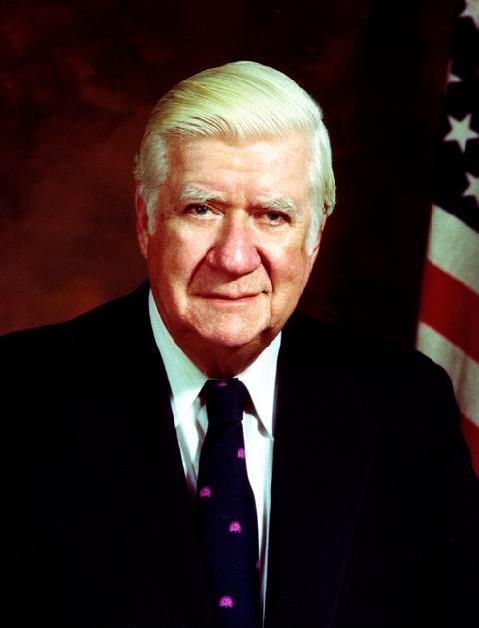
    Tip O’Neill

    Matthews began in Washington as an officer with the United States Capitol Police. He then became an aide for four Democratic members of Congress before he failed in an attempt to win a congressional seat in Pennsylvania. After this, he became a speechwriter for President Jimmy Carter. When Carter failed to win reelection in 1980, Matthews signed up with House Speaker Tip O’Neill. Matthews then switched over to print journalism for 15 years.

    Jimmy Carter
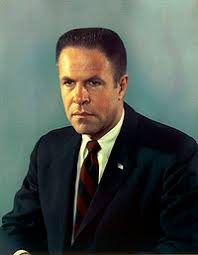
    H.R. Haldeman
    Jimmy Carter
    Richard Helms

    It was in his position as a columnist that Matthews now emerged as a rabid, mocking conservative member of the Washington establishment. After Oliver Stone released his film Nixon, Matthews criticized that picture for its use of a passage from H. R. Haldeman’s book The Ends of Power. In that passage, Haldeman had described a meeting with CIA Director Richard Helms in which the Bay of Pigs invasion was discussed. Helms’ reaction was so extreme that Haldeman concluded that Nixon’s use of the incident had been code for the Kennedy assassination. In a December of 1995 column, Matthews said this was all strained interpretation by Stone that Haldeman had blamed on his co-author Joe DiMona. Matthews could write this since he did not visit with DiMona. Dr. Gary Aguilar did so, and he learned why Matthews had not. DiMona told Aguilar that the book had gone through five drafts and Haldeman made many changes, but he never altered that passage. Clearly, Matthews had realized that after his films JFK and Nixon, Stone had become a lightning rod for the MSM. And if he was going to advance up the ladder, he had to join in the assault.

    Therefore in 1996, Matthews published his book entitled Kennedy and Nixon. This was supposed to be a dual biography of these two central political characters. But to anyone who knew who Matthews was, and understood the two men, there was a not so subtle subtext to the volume. Matthews was actually trying to say that, contrary to popular belief, Richard Nixon and John Kennedy had more in common than they had differences. Oliver Stone agreed that this was an unjustified interpretation. The LA Times allowed him to review the book in June of 1996. He took the author to task for his unwarranted assumption that the two were somehow chums and comrades in arms. Two weeks later, on June 30, 1996, the Times allowed Matthews to reply. The columnist said he had nothing but contempt for Stone and all but called him a liar.

    This got his ticket punched and Matthews now made the transfer into television. He first became a commentator for ABC’s Good Morning America, and then he got his own CNBC show titled Politics with Chris Matthews. That program eventually morphed into Hardball and was then placed on MSNBC.

    While the host of this program, Matthews made good on his promise to be one of the foremost bastions of the MSM. How bad could Matthews get? He even visited the disgraced Tom DeLay at his home in Sugarland, Texas after he forcibly left Washington. The alleged Democrat admitted to voting for George W. Bush in 2000. He later defended this admission by saying that he thought Al Gore was kind of strange. Is it only a coincidence that Gore was one of the high-level politicians who had no problem admitting that he thought John F. Kennedy was killed by a conspiracy?

    For, as Doug Horne writes on his blog in the wake of Matthews’s resignation, the Hardball host was one of the foremost defenders of the Warren Commission during his 20-year span. In all of those years, this writer can only recall one small exception to the rigor with which Matthews took pains to mock and ridicule those who held a different view of the JFK assassination than the Warren Report did. This was after Jesse Ventura did an interview for Playboy back in 1999.

    Jimmy Carter
    Jesse Ventura

    At that time, Governor Ventura was making the rounds of talk shows after the controversy caused by his rather bold pronouncements during that interview. One of the interviews he did was with Matthews at Harvard. (Probe, November/December 1999) When Matthews asked Ventura about his opinion of Vietnam, Ventura very soberly said that the United States should have never sided with France in that conflict. This was a mistake that prefigured our own involvement in Indochina. Matthews replied by saying the American buildup actually started under Kennedy. When Ventura stated that there were certain elements in the country that favored us going to war in Indochina, Matthews said that it was Kennedy who was giving them what they wanted from 1961-63. Ventura did not think fast enough to say, “Chris, there was not one more combat troop in Vietnam after Kennedy’s death than when he took office. So please show me the huge expenditures made by Kennedy?”

    Matthews then shifted to the assassination itself. He tried the old chestnut about having to believe in a large conspiracy if one advocated for a plot. Ventura replied that if one thinks the Dallas Police were involved, then their negligence does not denote a wide conspiracy. Ventura turned the tables and asked a question of Matthews: Why didn’t the Commission call all the witnesses who smelled smoke on the grassy knoll? To which Chris finally made his minor exception. He beat a tactical retreat by saying that he would admit the Warren Report was a rush job and he agreed with Ventura’s critique of their work. But this author has to note that Matthews’ retreat was very limited. In his book Kennedy and Nixon, he endorsed the verdict of the Commission and said that Oswald shot Kennedy.

    Towards the end of the interview, Matthews went completely off the rails. He characterized Oliver Stone’s film JFK in a completely nutty, wild manner by saying that somehow Nixon was involved in the plot depicted in the film. Since Nixon does not appear in the film except for the introduction over the credits, this is simply a smear. In fact, even if we expand this to the film Nixon, it is still not true. But Matthews really showed who he was when, near the end of the interview, he said that Stone tried to portray Kennedy as a peacenik when, in fact, he was a Cold Warrior. He then added that no one in JFK’s administration said he was trying to get out of Vietnam. Which is astonishing. For even at that time one had people like Roger Hilsman of the State Department, and Robert McNamara, Secretary of Defense, who both said such was the case. One can also add in Joint Chiefs of Staff Chairman Max Taylor, advisor Ted Sorensen, and assistants Dave Powers and Ken O’Donnell. All of these men said that Kennedy would never have gone into Vietnam with combat troops and direct American military intervention. So what was Matthews talking about?jfk no vietnam

    But this nonsense is consistent with Matthews’ book on Kennedy, titled Jack Kennedy: Elusive Hero. In that book, Matthews never mentioned NSAM 263. This was the order issued by Kennedy in October of 1963 which began a formal withdrawal from Vietnam of a thousand advisors by the end of the year and the rest of the advisors by early in 1965. If one does not mention that document, then one can say the things Matthews does. And I do not for one moment believe that Matthews did not know about it, since it was featured so prominently in Oliver Stone’s film. Matthews chose to ignore it due to his own bias against Stone.

    He is now gone, from at least MSNBC. I cannot help but wonder who will replace him, and if that person will be any kind of an improvement. I would think he or she could not be much worse.


    Link to Jim DiEugenio’s review of Jack Kennedy: Elusive Hero : https://consortiumnews.com/2012/01/03/why-mr-hardball-found-jfk-elusive/

    Link to Jim DiEugenio’s review of Bobby Kennedy: A Raging Spirit: https://consortiumnews.com/2018/06/04/distorting-the-life-of-bobby-kennedy/

  • The Mysterious Life and Death of James W. McCord

    The Mysterious Life and Death of James W. McCord


    Usually when a high profile person in the field of entertainment, politics or news passes away, it is noted with almost lighting-like immediacy. We live in the Internet world, one with a 24/7 news cycle. That cycle does not sleep. It doesn’t even nap.

    For some reason it did in June of 2017.

    On June 15, 2017, James W. McCord of Watergate fame passed away. That’s correct. He passed on nearly two years ago. (here is one confirmation; here is another) If one can believe it, you will not find an obituary for him on the web. If one checks, say Wikipedia, he is still alive. You will only find a date of death through Ancestry or Find a Grave.

    Corroboration comes from Shane O’Sullivan’s book, Dirty Tricks. According to the author, McCord’s family wanted to keep his passing quiet. (O’Sullivan, p. 405) They succeeded to a remarkable, in some ways, an unprecedented degree. The logical question, which I am not sure O’Sullivan asked, is this: What was the purpose behind all the secrecy? Since today, nearly no one knows he is dead, no one can ask his family that question. But with help from genealogist Rob Couteau, and on the ground investigation in Pennsylvania by Steve Jones and Jerry Policoff, Kennedys And King can confirm that O’Sullivan is correct. McCord passed on nearly two years ago—in mystifying silence. This is therefore the first obituary anyone will read about him. Which is startling considering the impact James Walter McCord had on modern American history.

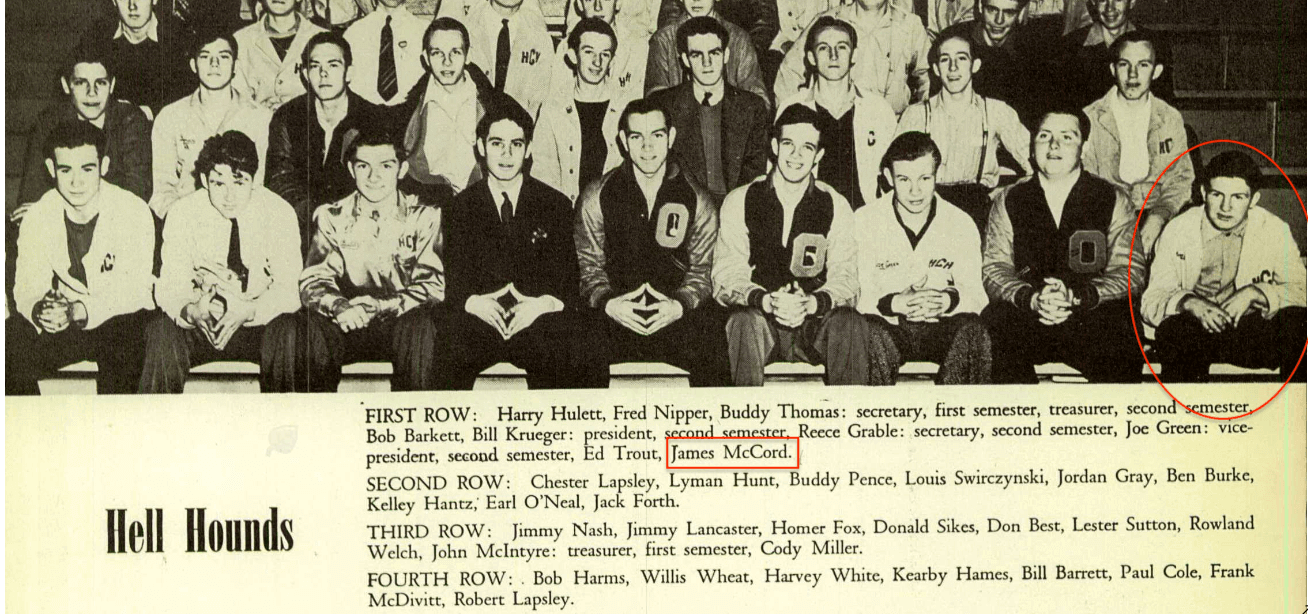
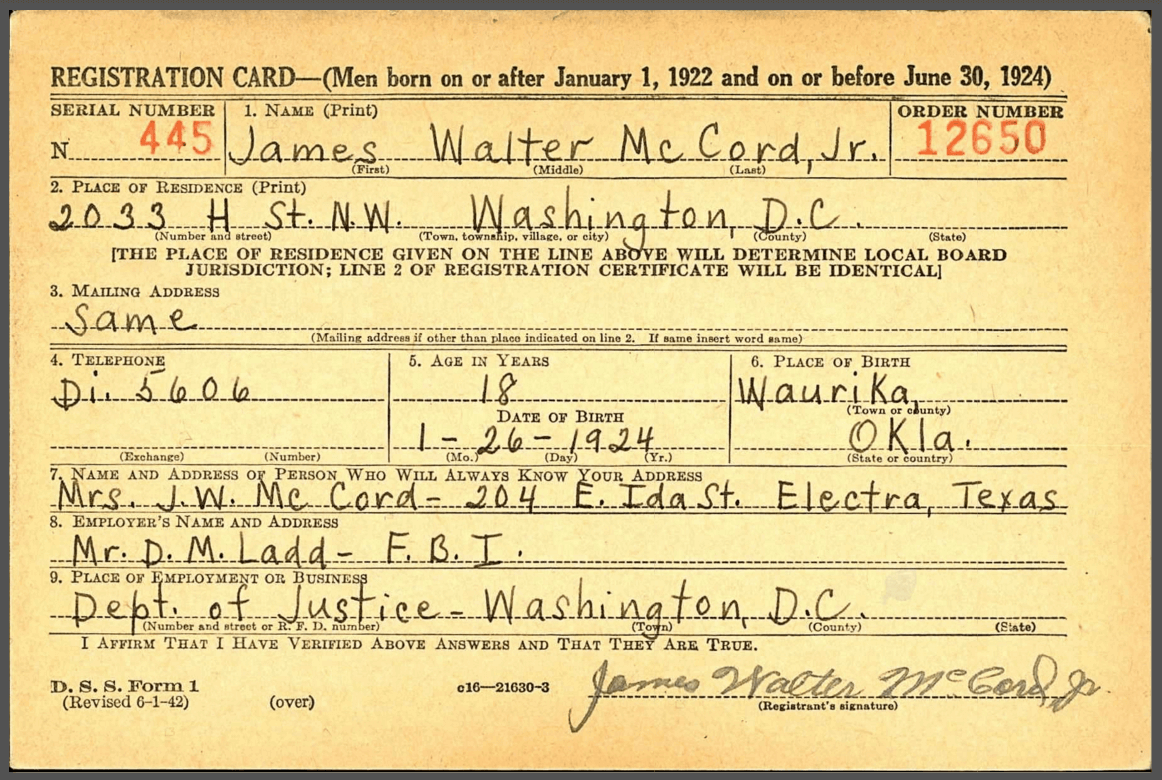
    Owing to Couteau’s work, we know that McCord’s family originated in Scotland. His great-grandfather served in the Tennessee militia during the War of 1812. McCord’s grandfather, James Allen McCord, was from Alabama and served in the Confederate army. Both his mother and father hailed from Texas. His father was a public school teacher. Although some entries place his date of birth in June, McCord was born in Waurika, Oklahoma on January 26, 1924. He attended public schools there. In 1943 he enlisted in the Army Air Corps in Miami, Florida. When that split off from the army to create the Air Force, he eventually attained Lt. Colonel status in the U. S. Air Force Reserve. After World War II, he attended Baylor before graduating from the University of Texas at Austin in 1949. He began his professional career by working briefly for the FBI. He was then employed for nineteen years by the CIA. He allegedly retired and went to work for the Committee to Reelect the President, commonly knows as CREEP, in late 1971. The man who hired him to work on the Richard Nixon campaign was Jack Caufield.

    Ambrose McCord, 
    James’s great-grandfather,
    served in the Tennessee militia
    McCord’s mother

    McCord’ high-school yearbook

    McCord’s selective service card

    McCord’s wife Sarah’s tombstone

    Caufield was a former New York City police detective. He was invited by John Ehrlichman to set up a private security agency to provide intelligence on Nixon’s political opponents. It was Caufield who first suggested forming Operation Sandwedge: illegal electronic surveillance of Nixon’s political opponents focusing on their sex lives, drinking habits, tax records and marital problems. (The Telegraph, July 11, 2012) Later on, when the so-called Plumbers Unit was formed, McCord migrated there and joined Howard Hunt for their break-ins of the Democratic National Committee. It was called the Plumbers Unit because it was partly designed to plug leaks, like the Pentagon Papers. In fact, one of the first missions the unit executed was a raid on the Los Angeles office of Daniel Ellsberg’s psychiatrist. Ellsberg had leaked the Pentagon Papers to the NY Times and Washington Post. The objective was to dig up dirt on him and smear his character in the press.

    To say that McCord was a secretive and odd person understates both his character and career. He was one of the several personages who were involved in both the John F. Kennedy assassination and the Watergate caper: two seismic shocks to the system that occurred within a decade of each other. They were both so colossal in their impact that complex and multi level cover-ups ensued afterwards to conceal their true natures. In the JFK case, it took about three years to fully expose the official Warren Report as a cover-up.

    With Watergate, where McCord’s role was much more front-and-center, it took quite a bit longer. Most analysts of that expansive and complicated phenomenon would date the beginning of its true elucidation to 1984, ten years after Richard Nixon resigned the presidency. That was the year Jim Hougan published Secret Agenda, his watershed book on Watergate. Secret Agenda is now recognized as a classic in the field. Some would go even further and deem it as one of the finest pieces of investigative political reporting in the last 40 years. No objective observer can read the book without feeling the official story handed to them on Watergate was, to say the least, both faulty and incomplete.

    What was that official story composed of? It was a combination of two factors. First, the coverage by Bob Woodward and Carl Bernstein in the WashingtonPost. This was largely supervised by editor Ben Bradlee. It was made world famous by Robert Redford in his film of their bestselling book, All the President’s Men. The second element of this official story was then adduced by the Senate Watergate Committee. In the summer of 1973 that committee’s hearings were probably viewed proportionately by as many spectators as the 1954 Army/McCarthy hearings. Led by Senator Sam Ervin, the committee pretty much followed the story that had been laid out by the Washington Post. It was this unrelenting and massive media glare that paved the way for Nixon’s resignation in August of 1974.

    One of the worst things about Watergate was that the praise and fame heaped upon Ervin, Bradlee, Woodward and Bernstein left the impression that the system had worked. Through the political and journalistic process a grievous crime had been self-corrected. We all felt good. The system had purified itself.

    A few years later, Jim Hougan walked into the FBI research library and made a request. When his documents were delivered he quickly realized that someone had made a mistake. He was getting papers that were still classified. Realizing the error would be discovered, he immediately began copying hundreds of pages from the original FBI Watergate investigation, documents that had not seen the light of day. Stuffing them into his briefcase before they were recalled, he managed to take them home. They confirmed his suspicions about what had really happened.

    Hougan opens his book with an unforgettable chapter entitled “Of Hunt and McCord”. (pp. 3-26) It is clear from these pages that Hunt and McCord lied before the Ervin Committee when they said they did not know each other prior to going to work for the Plumbers. Hougan also pointed out that when Howard Hunt retired from the CIA in 1970, that was the third time he had done so. (Hougan, p. 6) At the recommendation of Director Richard Helms, he then went to work for a CIA associated PR group called the Mullen Company. That company would then be sold by Mr. Mullen to another CIA asset, Robert Bennett. Bennett and Hunt then badgered Nixon’s hatchet man at the White House, Charles Colson, into giving Hunt a job. (Hougan, p. 33) From there, Hunt went on to perform a series of alleged intelligence assignments that were so poorly conceived and badly executed that one has to wonder if they were just Keystone Kops hijinks or something worse. Yet even though Hunt was now supposedly retired and working for the White House, the CIA continued to technically support his efforts. In fact, the Agency reviewed and extended Hunt’s Top Secret security clearance prior to his retirement. (Hougan, p. 7) His security clearance was now the same one Clay Shaw had in New Orleans. (William Davy, Let Justice be Done, p. 196)

    Four months after Hunt joined the Mullen Company, James McCord decided to retire from the Agency after 19 years of service. Although he was later billed as a technician, he worked out of the Office of Security’s secretive Security Research Staff program (SRS). (Hougan, p. 9) As John Newman later discovered, it was here where McCord teamed up with David Phillips to supervise the Agency’s anti-Fair Play for Cuba Committee campaign, of which Lee Harvey Oswald had all the earmarks of being a component. (James DiEugenio, Destiny Betrayed, Second Edition, p. 158)

    Hunt reportedly worked with McCord on Manuel Artime’s “Second Naval Guerilla” operation out of Nicaragua and Costa Rica. This was attested to by Cuban exile Harry Williams to author William Turner. (Hougan, p. 10) But Hougan dug up evidence that the pair worked together even earlier than that, back in the fifties on the Asian mainland. (p. 19) He then showed that the two men had also worked together in a domestic surveillance operation in 1969. We should add one other point. When McCord arrived at CREEP, he did not have a picture of Nixon in his office. He had a photo of Richard Helms on the wall. It was inscribed, “To Jim, With deep appreciation”. The emphasis was in the original. (Hougan, p. 22. We will reveal later a possible reason for that “deep appreciation.”)

    So just from the little noted above, the questions come rapid-fire. Why did Hunt and McCord lie about not knowing each other prior to 1972? Why did the Agency let the lie stand? Were Hunt and McCord really retired when they eventually joined, respectively, the White House and CREEP? Why was Robert Bennett so eager to get Hunt into the White House? Why was McCord working for Nixon while his allegiance appears to be to Helms? But beyond that, why did it take ten years for anyone to ask these questions?

    It is not completely accurate to write that no one investigated this aspect of the caper until Jim Hougan. There actually were two inquiries that attempted to explore the role of the CIA in Watergate. The first was the minority report of the Ervin Committee. The Republicans, led by Tennessee’s Senator Howard Baker and Minority Counsel Fred Thompson, did try to inquire into things like the role of the Mullen Company and the true goal of the burglary at the Watergate complex. Thompson and Baker theorized that the burglars’ real goal was not political intelligence for the 1972 election. It may have been surveillance of Democratic Chairman Lawrence O’Brien’s representation of Howard Hughes. Nixon’s association with Hughes, and his past attempts to bribe the president, were fairly well known at the time. The White House may have feared that O’Brien had more evidence of the same. In fact, John Meier, who worked for Hughes, told Nixon’s brother Donald that he was thinking of turning over everything that he had on Hughes. This included his knowledge of a million dollar secret donation from Hughes to Nixon. According to Age of Secrets, Don then informed his brother of this. (Probe Vol. 3 No. 2, pp. 9, 11, 15)

    Besides Baker and Thompson, the other committee that explored the CIA angle was the House Committee on Intelligence. This was led by Representative Lucien Nedzi, until he controversially resigned his chairmanship. (“House Supports Nedzi”, Washington Post, June 17, 1975) This committee did produce a report that Hougan sourced several times in his book.

    But the fact was that very, very few people knew anything about these two investigations. This overall ignorance continued even when Fred Thompson published his 1975 book based on the Baker inquiry entitled, At That Point in Time. The fact that this book was all but ignored bears witness to the enormous torque created by the Washington Post, the Woodward/Bernstein best seller, and the Academy-Award-winning hit film. A veritable whirlpool was constructed, one which carried the entire MSM along with it.

    As Jim Hougan later told me, he just never thought very much of Woodward’s reporting skills. One of the most revealing sections of Secret Agenda is in Appendix V. There the author publishes documents describing Robert Bennett’s communications with his CIA case officer. It is revealed that Bennett was actively spinning reporters like Sandy Smith and Woodward away from the Agency’s association with the Mullen Company, and selling them on the angle that his newly purchased PR company was actually “clean”. For this “information”, Woodward had agreed that these stories would not be attributed to Bennett. Bennett also had access to Senator Ervin and he had been assured that the senator would conceal the Mullen Company’s overseas role in placing agents for the CIA. (Hougan, pp. 332-335)

    To put it mildly, that memorandum raised issues about Woodward’s independence and honesty. Hougan then raised questions about the Post’s major secret source. This was the man Woodward labeled “Deep Throat” in his book. Hougan specifically raised questions about the signaling system the duo would use when Deep Throat would request a nightly meeting in a parking garage. (Hougan, pp. 291-93) Hougan and others have also explored Woodward’s military background and his high-level security clearances as part of the national security state. This has led some to believe that one reason the reporter was so keen to assault Nixon was that, unlike Bernstein, Woodward was politically to the right of the president.

    Because of this enormous propaganda apparatus, both the public and press were diverted from an alternative view of James W. McCord. Far from being a mere put-upon technician, McCord may have been a central operator. Consider just two major instances in the two-year Watergate episode. After the discovery of the break-in, the case had reached an impasse at the trial of the burglars. If they all kept silent, the conspiracy would likely be limited to them only—it would not reach into the White House. But in March of 1973, McCord radically raised the stakes. He wrote a letter to Judge John Sirica stating that perjury had been committed in his courtroom and pressure had been brought to bear for the seven burglars to remain quiet. When Sirica read McCord’s letter in court, it created pandemonium. It seemed to affirm all the stories that Woodward and Bernstein had been writing, and Bradlee publishing, in the Post.

    But, in retrospect, the question should have been: If not for James McCord, would there have been a trial at all? As most analysts of the June 17, 1972 final break-in have noted, there was something odd about the way the burglars were caught. McCord had taped the locks on numerous doors to keep them open during the break-in. The security guard, Frank Wills, had found these doors and removed the tape. (Hougan, p. 196) When the burglars entered the building at about 1:10 AM, they found a previously taped door that was now stripped. McCord then conferred with higher-ups Hunt and Liddy. According to everyone but McCord, it was he who insisted on not aborting the mission. (Hougan, pp. 197-98) The door was retaped. But after McCord entered the building, he told his low-level cohorts that he himself had removed the tape on the doors. This was not true. (Probe, Vol. 3 No. 2, p. 14)

    But that is not all that McCord had done. On the previous break-in—there were four attempts in all—it appears that McCord also switched the informational photos that had been taken inside the DNC, which were supposed to be of papers inside O’Brien’s desk, to a set of innocuous ones taken inside a Howard Johnson’s hotel room. (Hougan, pp. 153, 157) He also placed a faulty bug inside O’Brien’s office. (pp 162, 166) This from a man who when he was arraigned said—truthfully—that he had been a security consultant for the CIA. These alleged faux pas made another break-in necessary.

    Wills discovered the new tape on the same door. It was almost impossible to miss it since McCord taped as many as eight doors that night—he even taped doors on floors that would never be used, like a floor above the DNC. (Hougan, p. 207) At 1:47 AM, Frank Wills called the Washington Police Department. Just a few minutes later, the police arrived at the scene. Reinforcements soon arrived. McCord, along with four Cubans recruited by Hunt, were arrested. They were Virgilio Gonzalez, Bernard Barker, Eugenio Martinez and Frank Sturgis. Things then got worse. Surprisingly, Barker and the others had been allowed to keep their hotel keys with them. And further, neither McCord nor Hunt had sterilized the hotel rooms. Therefore, when the police entered the rooms, they discovered a treasure trove of evidence. This included their notebooks with Hunt’s name and phone number, which included the abbreviation W. House next to it. (Probe Vol. 3 No. 2, pp. 14-15) Hunt was traced to the White House. Liddy was linked to CREEP.

    But the circus even went beyond that. Hunt had paid off the burglars in sequentially numbered hundred dollar bills. The money trail would lead from Miami, to Mexico City and back to CREEP. (Probe 3.2: 14-15) And that would lead to the chairman of that body, former Attorney General John Mitchell. The notebooks with Hunt’s name and phone in them would lead to Charles Colson who ran the Plumbers Unit at the White House.

    Once apprehended—as was the case with Bennett—McCord did all he could to keep the spotlight off the CIA and on the White House. His first lawyer, Gerald Alch, had proposed an Agency cover defense. (O’Sullivan, p. 268) He was later jettisoned and replaced by Bud Fensterwald. Fensterwald wasted little time in announcing, “We’re going after the president.” (Hougan, p. 307)

    When Alch first suggested his CIA defense, McCord began to write Paul Gaynor, chief of the SRS division at CIA. He advised Gaynor to pre-empt this attempt with multiple and effective leaks to the press before the CIA defense could gain traction. Meanwhile, he would keep Gaynor informed of the legal tactics planned by the defendants. (O’Sullivan, pp. 269-70) A few days later, McCord wrote Jack Caufield at the White House. McCord stated that if Watergate was dumped off on the CIA and Richard Helms was fired,

    … every tree in the forest will fall. It will be a scorched desert. The whole matter is at the precipice right now. Just pass the message that if they want it to blow, they are on exactly the right course. (Letter of December 28, 1972)

    In spite of this warning, Helms was terminated about a month later on February 2, 1973. Around six weeks after, Caufield met with McCord. He offered him money, a job and executive clemency if he would plead guilty and remain silent. Caufield said this offer came from the highest levels of the White House. (NY Times, June 23, 2012, article by Douglas Martin.) McCord refused the deal. His allegiance was to Helms and the CIA. Shortly after, he wrote the letter to Sirica about pressure being brought to bear and perjury in his courtroom. For all intents and purposes, that is what blew the case wide open.

    Because, as McCord had warned, the Nixon White house could easily be turned into a scorched desert. And it was. Through a steady stream of disclosures by people like McCord and White House counsel John Dean, the seamy underside of the Nixon White House was placed on public display. As McCord warned, it was not a pretty sight. The secret bombing of Cambodia, the August 1971 break in at Daniel Ellsberg’s psychiatrist’s office, Nixon’s attempt to form a super intelligence group to counter student protests (commonly called the Huston Plan), the proposed fire-bombing of the Brookings Institute, etc. And, in this author’s opinion, the worst went undiscovered, because this last caper, the fire bombing of the Brookings Institute, was first thought to be part of Nixon’s war against the leaking of the Pentagon Papers. As the late journalist Robert Parry discovered, such was not the case. That proposal was really designed to find out if the evidence of Nixon sabotaging President Johnson’s Vietnam peace plan was located at Brookings. Candidate Nixon had arranged for Saigon not to cooperate with President Lyndon Johnson in his attempt to arrange a truce in Indochina before he left office. This tilted the election to Nixon and extended the war. Once in office, Nixon was worried that this evidence, like the Pentagon Papers, could be leaked to the press.

    By the summer of 1973, Nixon seemed to realize what had really happened. He called up H. R. Haldeman at four in the morning, and asked him some pointed questions:

    • “Do you know anything about the Bennett PR firm, the Mullen Company?”
    • “Did you ever employ them at the White House? Were they ever retained by us for any purpose?”
    • “Did you know they were a CIA front?”
    • “Did you know that Helms ordered Bennett to hire Howard Hunt?”
    • “Did you know that Hunt was on the payroll at the Bennett firm at the same time that he was on the White House payroll?” (Probe, Vol. 3 No. 2, p. 32)

    It was too late.

    Because of his willingness to cooperate with the court and the Ervin Committee, McCord served by far the briefest prison time of the seven men directly involved with the break in: four months. Hunt served almost ten times that long. Gordon Liddy was in prison for almost five years before being pardoned by President Carter.

    Forty-five years later, the conventional view of Watergate still largely reigns in the MSM. This is partly due to Woodward’s occasional attempts to prop up that version. For instance, when FBI officer Mark Felt was close to dying, Woodward wrote a book saying that Felt was Deep Throat. In 2017, Mr. Hollywood Mythology, Tom Hanks, then had a hand in making a truly mediocre film based on an even more mediocre book about Felt.

    But, in 2009, Ed Gray, son of L. Patrick Gray, had published an interesting book about Watergate titled In Nixon’s Web. Patrick Gray had been appointed interim director of the FBI after J. Edgar Hoover died. He supervised the initial FBI inquiry into Watergate until he resigned. He passed away before he could finish the book. It was then completed by his son. In the epilogue to that volume, Ed Gray demonstrates that Deep Throat was a composite character. And he does it with Woodward’s own notes. He also proves that Mark Felt was leaking stories to the press that sunk Gray’s nomination. The reason was Felt’s own personal ambition: he wanted the Director’s position. Again, because of the MSM censorship on Watergate, very few people know these important facts.

    The idea promulgated by Hougan, that Watergate was really a trap set for Nixon, was also a part of John Meier’s book Age of Secrets. (Co-authored by Gerald Bellett) As Bellett wrote in the introduction to the Meier book:

    Watergate was a set-up, a classic ploy as old as espionage itself. In its favor it had simplicity of execution, an irresistible bait and a spy on the inside. It was flawless. So completely were the anti-Nixon conspirators in control, that they knew an intrusion into the Democratic Party’s national headquarters was being plotted, yet did nothing to prevent it. (Bellett, p. viii)

    That last sentence refers to the fact that Lawrence O’Brien was actually tipped off in advance that the Democratic National Committee was under surveillance. He was warned of this by a prominent Democrat and newspaper publisher by the name of William Haddad. (Hougan, p. 79) Haddad was apprised of this from a private investigator named A. J. Woolston Smith. Smith apparently gained the information from an agency called the November Group. This was a set of advertising executives working on Nixon’s campaign. Liddy was the agency’s incorporator and secretary. McCord was in charge of the November Group’s security. Haddad actually told a DNC representative in advance that they would be bugged and burglarized. And that McCord and Liddy were somehow involved in the effort. Further, that other operators would be recruited from Little Havana in Miami. (p. 79)

    One of the chief investigators for the FBI on the Watergate case was Angelo Lano. O’Sullivan quotes Lano from a previous interview where he stated that he always thought the caper was a set-up. He noted that the neat arrangement of the evidence the burglars left behind at the hotel felt planted—”everything was arranged like somebody knew it was gonna happen.” And Lano could not ignore the tape:

    You’ve got a guy who’s expert in key entry, burglary [Virgilio Gonzalez]. Why did they have to put the tape back on? You put the tape on one door; it wasn’t necessary to put it on six doors. There’s always been a question in my mind [about] the response of the police department—2:30 in the morning—the placement of the items in the hotel room, the tape. To this day I still think that one of those guys tipped off the police department and it was either Hunt or McCord. (O’Sullivan, pp. 404-5)

    In 2012, Max Holland published a book about Watergate called Leak. It largely focused on the FBI inquiry. Predictably, he could not find enough space to include Lano’s insightful quote.

    As more than one person said later, James McCord was not just a technician. He was an operator. But it’s something he tried to conceal. For instance, after he moved to Pennsylvania, a reader of this site got in contact with him. He asked him about his service with David Phillips and their campaign against the FPCC. McCord said he was not a part of that; it was the FBI’s function. Since the ARRB had released those documents, I said he should question him again with the papers in hand.

    But beyond that, when Lisa Pease and I were publishing Probe magazine in the nineties, we met up with former CIA pilot Carl McNabb. He said that prior to the Bay of Pigs, he had been briefed at the Miami CIA station, since he was part of the aerial facet. He noticed that McCord was in the room and he was struck by how taciturn he was. Afterward, he asked the briefer who he was. He told him his name. He then added that he was Helms’ Zap Man. McNabb later showed me the very old notes with this information recorded on it. I asked him what the term meant. He replied McCord was his liquidator.

    Which may tie in with a quite interesting piece of information in O’Sullivan’s book. Alfred Baldwin was a former FBI agent who was recruited by McCord for the Watergate operation. He was supposed to make a log of the surveillance coming out of the Democratic National Committee. O’Sullivan found out through James Rosen that McCord told Baldwin he was in Dallas on the day of the Kennedy assassination. (O’Sullivan, p. 405) If this is true, and I am not saying it is, then it makes a quite intriguing list of CIA associated personages in that city either on the day Kennedy was killed, or a few weeks prior:

    1. Allen Dulles (James Srodes, Allen Dulles: Master of Spies, pp. 554-66)
    2. William Harvey (David Talbot, The Devil’s Chessboard, p. 477)
    3. David Phillips (Dick Russell, The Man Who Knew too Much, 2003 edition, p. 272)
    4. Howard Hunt (Mark Lane, Plausible Denial, p. 152)
    5. James McCord (Shane O’Sullivan, Dirty Tricks, p. 405)
    6. Sergio Arcacha Smith (James DiEugenio, Destiny Betrayed, second edition, p. 329)
    7. Bernardo DeTorres (Gaeton Fonzi, The Last Investigation, p. 238)

    What makes the list rather striking, as I have arranged it, is that it goes from the top of the hierarchy, through the middle, down to the lower ranks, men who would act as foot-soldiers or mechanics. Does the above explain why the McCord family wished to keep the death of James McCord so quiet?

  • John Newman, Countdown to Darkness, Volume 2

    John Newman, Countdown to Darkness, Volume 2


    John Newman has just released the third part of his series on the murder of John F. Kennedy. Titled Into the Storm, we are running an excerpt from it on our site, while linking to another excerpt. This review deals with the second volume, Countdown to Darkness. It is indefinite as to how long this series will be. I originally heard it would be a five-volume set. But now I have heard from other sources it may be six. (I will comment on this length factor later.)

    Countdown to Darkness assesses several subjects. Some of these the author deals with well. Some of his treatments disappoint. The point is the book is wide-ranging in scope, as I imagine the rest of the series will be. It does not just deal with topics relating to the JFK murder. There are subjects dealt with that are more in keeping with a history of Kennedy’s presidency. Therefore, the book is broad based.

    Countdown to Darkness begins with the peculiar arrangement surrounding the dissemination of Oswald’s file at CIA. This valuable information is a combination of Newman’s examination of the file traffic, plus insights gained by the estimable British researcher Malcolm Blunt. Those insights were achieved through Blunt’s discussions with the late CIA officer Tennent Bagley. In this analysis, Newman repeats his previous thesis that although the first Oswald files went to the Office of Security, they should have gone to the Soviet Russia Division. (p. 3; all references to the e-book version) He expands on this by saying this pattern appears to have been prearranged. The mail distribution form was altered in advance to make this happen. (p. 2) One effect of this closed off routing was that there was little chatter about Oswald’s implied threat to surrender radar secrets. When Blunt talked to Bagley, Malcolm told him about this dissemination pattern. Bagley asked Blunt if he thought this was done wittingly. When Malcolm said he was not sure, the CIA officer replied he should be—because it was set up that way in advance. Blunt said that this disclosure was “a significant departure from Bagley’s normal cautious phrasings.” (p. 30)


    II

    From here, the book turns to Cuba and President Dwight Eisenhower’s intent to overthrow Castro. CIA Director Allen Dulles with Vice President Richard Nixon first discussed this idea in 1959. The initial planning on the project was handed to J. C. King and Richard Bissell; the former was Chief of the Western Hemisphere, the latter was Director of Plans. (p. 32) The author traces the familiar story of how the original idea—to integrate a guerilla force onto the island to hook up with the resistance—began to evolve into something larger in January of 1960. This was coupled with the Allen-Dulles-inspired embargo, which extended to include weapons from England. This was meant to force Castro to go to the Eastern Bloc and the USSR for arms. (pp. 36-37) Dulles also wanted to sabotage the sugar crop, but Eisenhower turned that request down.

    Bissell turned over the architecture of the overthrow plan to CIA veteran officer Jake Esterline. (p. 48) Esterline had been a deputy on the 1954 task force in the coup against Arbenz in Guatemala. Like David Talbot before him, the author points out the fact that warnings about the overall design problems, and how the objective differed from Guatemala, were deep-sixed. (p. 55) By March of 1960, Eisenhower started talking about a different approach, a strike force type invasion. The president wanted OAS support for this plan. And here the author introduces something new to the reviewer: his concept of Eisenhower’s Triple Play. That is, in order to achieve such outside support, the White House and CIA would rid Latin America of a thorn in its side, namely, the bloodthirsty dictator of the Dominican Republic, Rafael Trujillo. (p. 90) This will later expand into an attempt to also get NATO behind the overthrow. Hence, Ike’s Triple Play will include the assassination of Patrice Lumumba of Congo.

    One of the contingencies upon which Eisenhower based his overthrow of Castro was the establishment of a government in exile. This consisted of the banding together of several individual groups of Cuban exiles under an umbrella called the Revolutionary Democratic Front, or FRD. (p. 127) This endeavor ended up being quite difficult, for two reasons. First, some prominent exile members, like Tony Varona, did not want to join. Second, a principal officer involved for the CIA, Gerry Droller (real name Frank Bender), had rather poor organizational skills. The author gives us more than one example of this trait. (pp. 129-32)

    As the operation morphed from a guerilla-type incursion into a brigade invasion concept, more managers were grafted onto the project. The author first names Henry Hecksher. (p. 140) Hecksher worked with David Phillips on the Arbenz overthrow, then went to Laos, and then was assigned to Howard Hunt’s favorite exile, Manuel Artime, in 1963-64. (pp. 142-44) Another person named by the author as part of this expansion is Carl Jenkins.(p. 147) Jenkins worked at the Retalhuleu military base in Guatemala. A base was also set up in Nicaragua and some of the Alabama National Guard pilots were enlisted.

    As the brigade concept was escalating, false information was entered into the information flow. Undersecretary of State Douglas Dillon said only 40% of the Cuban populace would end up supporting Castro. (p. 170) Which, to put it mildly, turned out to be almost ludicrously wrong. Castro now began to import a flow of Eastern Bloc arms through Czechoslovakia. (p. 171) As this occurred, Eisenhower, through Dulles, began to activate the Trujillo aspect of the Triple Play. This appears to have been set in motion between February and April of 1960. (p. 172)

    When Castro began to seize oil companies like Texaco, Esso and Shell, Vice President Nixon began to urge Eisenhower into action. He recommended “strong positive action” to avoid becoming labeled, “uncle Sucker” throughout the world. (p. 174) National Security Advisor Gordon Gray said much the same thing: “… the U.S. has taken publicly about all it can afford to take from the Castro government ….” (p. 174)

    On July 9, 1960, Nikita Khrushchev threatened the USA with ICBMs over Cuba. Eisenhower replied that America would not be intimidated by these threats. (p. 176) The author mentions that at this time there was an attempt by the Agency to solicit a Cuban pilot to assassinate Raul Castro. Newman scores author Evan Thomas for distorting this as the pilot’s idea, when the impetus was clearly from the CIA. (p. 182) General Robert Cushman, working on the staff of Richard Nixon, urged Howard Hunt to use as much skullduggery as possible to get rid of Castro. (pp. 184-85)

    But as the Inspector General report by Lyman Kirkpatrick later revealed, the attempt to arm and supply the dissidents on the island was not working. In fact, at times, it was counter-productive, since Castro’s forces would recover the supplies and arms. As the threat grew, Russia sent in more arms to the island: tanks, mortars, cannons. With these advantages Castro began to close in on the resistance. And this was another reason the original guerilla plan was modified into a brigade-sized invasion. (p. 185)


    III

    We now come to what this reviewer feels is probably the highlight of the first two books in the series: the author’s work on the assassination of Patrice Lumumba of the Congo. Newman devotes four chapters to this subject. In my opinion the result is one of the best medium-length treatments of the Congo crisis I have read. As noted above, Eisenhower felt that by getting involved in Belgium’s colonial problems, this would encourage NATO allies to stand by him in his attempt to overthrow Castro. After all, the NATO alliance began in 1948 with the Brussels Treaty.

    As early as May 5, 1960 Allen Dulles was aware that Belgium was attempting to set up a breakaway state in the Congo called Katanga. This was two months before the ceremony formalizing the Belgian withdrawal from its African colony. (p. 153) Katanga was the richest region in Congo, and perhaps one of the richest small geographical areas in the world. If the Katanga secession were successful, it would do much to benefit Belgium and its covert ally England, at the same time that it would damage the economy of the new state of Congo.

    Dulles was predisposed to favor Belgium because of his prior career as a corporate lawyer with the global New York law firm of Sullivan and Cromwell. That firm represented many companies that benefited from low wage conditions in the Third World. Therefore Dulles and his deputy Charles Cabell began to smear independence leader Patrice Lumumba at National Security meetings in advance of his assuming power. Combined with the fact that the Belgian departure was not total, this pitted Lumumba against both the former imperialists and the growing malignancy of the USA. (p. 154)

    Lumumba’s stewardship was not just hurt by the Katanga secession, but also by the fact that Belgium had removed Congo’s gold reserves and placed them in Brussels prior to independence being declared. (p. 155) With little cash on hand, Lumumba’s army mutinied and spun out of control. This created the pretext for Belgium to send in paratroopers. The Belgians now began to fire on the Congolese. On July 11th, Katanga declared itself a separate state. By July 13, 1960, two weeks after independence, the Belgians occupied the Leopoldville airport and Lumumba decided to break relations with Brussels. The next day the United Nations, under Secretary General Dag Hammarskjold, passed a resolution to send troops to Congo. In the meantime Allen Dulles was working overtime to tell anyone on the National Security Council and in the White House that Lumumba would tie Congo to Egypt’s Gamal Abdel Nasser, Castro and the Communist Bloc. (pp. 162-63)

    This tactic worked. When Lumumba arrived in Washington to ask for supplies, loans and aid in expelling the Belgians, Eisenhower was not on hand to greet him. Instead, Lumumba talked to Secretary of State Christian Herter and Under Secretary Douglas Dillon. They lied to him by saying they were working through Hammarskjold. (p. 220) This left Lumumba little choice but to ask Russia for supplies. The USSR sent him transport planes and technicians. (p. 222)

    When the Russians sent Lumumba the military aid, it sealed his fate. On August 18, 1960 Leopoldville station chief Larry Devlin sent a cable that was drawn in the most hyperbolic terms imaginable. Devlin told CIA HQ that Congo was now experiencing a classic communist takeover, and there was little time to avoid another Cuba. (p. 223) This was clearly meant as a provocation. It worked. On the day this cable arrived, Eisenhower instructed Dulles to begin termination efforts against Lumumba. This was kept out of the meeting record. It was not revealed until the investigations of the Church Committee. The recording secretary to the meeting, Robert Johnson, told the committee that it was too sensitive to be included in the minutes. (p. 227)

    The plot began the next day. Director of Plans Dick Bissell told Devlin to begin action to replace Lumumba with a pro-Western leader. On August 26, Allen Dulles sent an assassination order to Devlin that authorized a budget of $100,000 to terminate Lumumba, the equivalent of close to a million dollars today. (p. 236) Bissell now called in the head of the Africa Division, Bronson Tweedy, and they began to assemble a list of assets they could employ in order to do the job. (p. 246) One of these was the infamous Dr. Sydney Gottlieb, who began to prepare poisons for use in the assassination. Devlin also got President Joseph Kasavubu to remove Lumumba from his position as prime minister. At this point Hammarskjold sent his own emissary, Rajeshwar Dayal, to Congo to protect Lumumba.

    This was necessary because, in addition to Gottlieb, Devlin now bribed the chief of the army, Josef Mobutu, to also assassinate Lumumba. (p. 265) At around this time, two CIA-hired killers, codenamed QJ WIN and WI ROGUE, both arrived in Leopoldville. Not knowing each other, they both stayed at the same hotel. Gottlieb then arrived in Congo. (p. 268) In September of 1960, with a multiplicity of lethal assets on hand, Tweedy now cabled Devlin to produce an outline of how he planned on terminating Lumumba.

    The use of the two codenamed assassins in Congo marks the beginning of the ZR/Rifle program. This was the CIA’s mechanism for exterminating foreign leaders. It began under Eisenhower in September of 1960. (p. 280) The next month it was taken over by CIA officer William Harvey. ZR/Rifle was sort of like the reverse side of Staff D, which was a burglary program to break into embassies and steal codebooks. Harvey and his assistant Justin O’Donnell recruited safe crackers, burglars and document forgers for that part of the program. (pp. 284-85) When Harvey testified before the Church Committee, he lied about the use of ZR/Rifle in the Lumumba case. He was fully aware of what the two men were doing in Congo. (p. 290)

    Mobutu now tried to arrest Lumumba, but Dayal blocked the attempt. Three things happened in November of 1960 that penned the final chapter. CIA officer Justin O’Donnell arrived in Congo to supervise the endgame. John Kennedy, who the CIA knew sympathized with Lumumba, was elected president. And third, America and England cooperated in seating Kasavubu’s delegation at the United Nations. This last event provoked Lumumba into escaping from Dayal’s house arrest. O’Donnell had decided that the CIA should not actually murder Lumumba. But they would help his enemies do the deed. Therefore, Devlin cooperated with Mobutu to cut off possible escape routes to Lumumba’s base in Stanleyville. He was captured, imprisoned and transferred to Elizabethville in Katanga. (p. 295) Lumumba was executed by firing squad and his body was soaked in sulphuric acid. When the acid ran out, his corpse was incinerated. (p. 296) Thus was the sorry end of the first democratically elected leader of an independent country in sub-Saharan Africa.

    As I said, for me, this section on Lumumba is the highlight of the first two volumes.


    IV

    Another topic that the author spends significant time on is the CIA/Mafia plots to kill Castro. The author traces this idea from Allen Dulles to Dick Bissell. He believes that Eisenhower gave his tacit approval to the plots. He also believes that Bissell dissembled in his testimony on how the plots were hatched, and he mounts several lines of evidence to demonstrate this. (p. 327) Bissell dissembled in order to conceal the fact that it was he who approved of giving the assignment to the Mafia through CIA asset Robert Maheu. By mid-August of 1960, the CIA’s Technical Services Division was at work manufacturing toxins to place in Castro’s cigars.

    Maheu offered gangster Johnny Roselli $150, 000 to kill Castro. (p. 331) Both Allen Dulles and his deputy Charles Cabell were briefed on this overture in late August by Chief of Security Sheffield Edwards, who was part of the Mafia outreach program. Meetings were arranged with Roselli in Beverly Hills and New York City. Maheu and CIA support officer Jim O’Connell masqueraded as American businessmen who wanted to protect their interests by getting rid of Castro. But Maheu eventually told Roselli that O’Connell was CIA. Therefore, the veneer of plausible deniability was lost. (p. 333) Roselli now began to recruit Cubans in Florida for the murder assignment. He also arranged a meeting in Miami for Maheu to be introduced to Sam Giancana and Santo Trafficante, respectively the Mafia dons for Chicago and Tampa. When this occurred the author writes that, because of the reputations and history of these two men, the plots and the association should have been reassessed and approval cancelled. They were not.

    They should have been. Because the recruitment of Giancana was a huge liability. Not just because of his history of being a hit man; but also because of his inability to keep a secret. Feeling emboldened, since he was now in the arms of the government, he bragged about his role in the plots to at least two people. From there the word spread to others, including singer Phyllis McGuire. Giancana revealed both the mechanism of death—poison pills—and the projected date of the assassination—November of 1960. (p. 334-35) Through his network of informants, FBI Director J. Edgar Hoover found out about Giancana’s dangerous chatter. But Hoover did not know that the CIA had put him up to it. The Director told Bissell about it, but Bissell did not inform Hoover about his role as recruiter.

    Maheu now arranged to have McGuire’s room wired for sound in Las Vegas. This was done for two reasons. First, to see if she was talking about the plots; and second, as a favor to Giancana, who suspected she was cheating on him with comedian Dan Rowan. The police discovered this illegal bugging. In addition to the security problem, this all had disturbing repercussions when Attorney General Robert Kennedy began his crusade against organized crime in 1961. (p. 336)

    Along with these assassination plots, on November 3, 1960, National Security Officer Gordon Gray came up with the idea of using Cuban exiles dressed as Castro soldiers to stage an attack on Guantanamo Bay as a pretext for an invasion. (p. 346) As the author suggests, the very fact that the murder plots and this false flag operation were contemplated show that those involved in managing the strike force invasion understood that its chances for success were low. (pp. 345-46) To further that miasma of doubt, at this same meeting, a question was asked about “direct positive action” against Fidel, his brother Raul and Che Guevara.

    There was good reason for both the doubt and the fallback positions, because about two weeks later, CIA circulated a memo admitting that there would not be any significant uprisings on the island due to any incursion, and also that the idea of securing an air strip on the island was also not possible unless the Pentagon was part of the attempt. (p. 348) This memo was not shared with the incoming President Kennedy. The author deigns that it was not shared because the internal uprising myth was used to manipulate Kennedy into going along with the operation. It thus became part and parcel with the new “brigade strike force” concept. (pp. 352-53)

    On January 2, 1961, Castro broke relations with the United States. The favor was returned two days later. These actions caused the training of the exiles in Central America to be expanded, and also for the action against Trujillo to be accelerated. (p. 355) On January 4th, Chief of the CIA paramilitary section wrote a memo to one of the operation’s designers, Jake Esterline. The memo said the invasion would be stuck on the beach unless an uprising took place or there was overt military action by the USA. (p. 355) As the author notes, this is another indication that the people involved at the ground level understood that, left to its own devices, the prospects for the invasion were fey. Hawkins added that Castro’s military forces were growing. They would soon include featured tanks, artillery, heavy mortars and anti-aircraft batteries. Given those facts, Hawkins warned that:

    Castro is making rapid progress in establishing a communist-style police state that will be difficult to unseat by any means short of overt intervention by US military forces. (p. 356, Newman’s italics)

    Since Bissell was a supervisor of both the assassination plots and the invasion, one wonders if he was banking on the murder of Castro to bail out what looked like an upcoming failure on the beach. In fact, as the author notes, at NSC meetings of January 12 and also January 19, the idea of overt intervention was brought up again. What made the time factor even more pressing was that the CIA had information that the shiploads of these munitions would reach Cuba in mid-March and continue with daily arrivals after that. This is why Hawkins urged that the invasion be launched in late February and no later than March 1. (p. 356) This would not happen, since Kennedy rejected the first proposal for the operation, namely the Trinidad landing site.


    V

    Kennedy had two meetings on the subject during his first week in office. At neither did he appear enthusiastic about it. On February 3, 1961 the Joint Chiefs wrote a ten-page report in which they viewed the plan favorably. This was something of a reversal from their previous assessments. But they cautioned that the plan was reliant on indigenous support from the island, meaning defections from Castro. They foresaw that if the force retreated to the mountains it might need overt American intervention. But even with these reservations, the executive summary at the end was positive. (pp. 363-64) Newman comments that one way to explain this reversal is that the Joint Chiefs felt that if the CIA plan failed, they would be called in to save the day and collect the glory.

    Kennedy now chimed in with his reservations about having the operation look too much like a World War II amphibious assault. He asked if it were possible to configure it more like a guerilla operation. (p. 366) This was a harbinger of what was to come from the president, who clearly never liked the operation in the first place. Knowing this, those pushing the plan tried to convince Kennedy that the strike force would ignite a rebellion on the island, even though they knew that such was not the case. (p. 383) Newman writes that this manipulation was done so that JFK would not cancel the operation—the gamble being that he would feel obligated to send in the Pentagon once he saw the invasion faltering. This hidden agenda to the Bay of Pigs episode was pretty well established in 2008 by Jim Douglass in his fine book JFK and the Unspeakable.

    At White House insistence, the location of the plan was moved away from Trinidad, 170 miles southeast of Havana, at the foothills of the Escambray Mountains. (p. 389) The reason for the switch was that Trinidad had a population of about 26,000 people. This decreased the odds of surprise and opened up the possibility of civilian casualties. Trinidad also did not have a proper length airfield for B-26 bombers. For these reasons, the locale was shifted to the Bahia de Cochinos (Bay of Pigs), east of the Zapata Peninsula. The CIA now went to work tailoring a plan for the new location.

    There was a serious problem with these delays. The longer it took to launch the operation, the more time Castro had to import weaponry from the USSR. The arms supplies began arriving in earnest on March 15. After that, one or two ships would unload per day. (p. 392) At this point, both Esterline and Hawkins wanted to leave the project.

    As the author notes, another important alteration was that the air cover and assaults were gradually whittled down in frequency and scope. This was owed to the reluctance of Kennedy and Secretary of State Dean Rusk to reveal the hand of American involvement. The first Hawkins-Esterline plan featured well over one hundred sorties in five different waves. (p. 390) When Kennedy asked Bissell how long it would take for the invasion force to work its way off the beachhead, he replied about ten days. In light of what actually happened, this was absurd, since no beachhead was ever established to break out of.

    As late as an April 4 meeting, Kennedy was still trying to argue for an infiltration plan. Inserting groups of 200-250 men and developing a build-up from there. Kennedy was trying to make it appear less as an invasion and more as an internal uprising. The CIA replied that this would only alert Castro, and each group would then be eliminated. (p. 394) The next day Kennedy asked assistant Arthur Schlesinger what he thought of the project. Schlesinger said he opposed it. He felt that Castro was too entrenched to be displaced by a single landing force. And if the landing did not cause uprisings, logic would dictate American intervention. The author notes the late date of this cogent observation: ten days before the launch from Central America. Newman also notes the fact that no one from the Pentagon pointed this out at the meeting; just as there was no real discussion of the air cover plan. Making it all the worse: Kennedy had instructed Bissell to tell the brigade leaders that no American military forces would participate or support the invasion in any way. (p. 393)

    But further, Kennedy drastically cut back on the amount of air sorties he would allow. And this is what had Esterline and Hawkins ready to depart the project. (p. 396) As stated previously, they insisted there had to be five waves of air strikes and over 100 individual sorties. Kennedy and Rusk opposed this aspect. Newman blames the Joint Chiefs for not stepping in and pointing out the difference between the Esterline/Hawkins design and what was happening to it. The author, citing Bissell, now says that what was left was the strikes scheduled the day before, and also the D-Day air strikes. Newman, citing Bissell, says that Kennedy then cancelled the latter the day before they were scheduled. (pp. 399-400) I was surprised to see the author adopt this interpretation of the controversial issue. This is a point of dispute which I will delve into later.

    The invasion was an utter failure and the battle was decided within the first 24 hours. There was no surprise. There were no defections. And in the first 24 hours there was no Allen Dulles. Bissell had encouraged him to keep a speaking engagement in Puerto Rico. Dulles did keep it. Newman makes an interesting observation about this. Dulles kept the engagement to give the appearance that the operation was really Bissell’s. Therefore, after the Navy saved the day, he should be forced to resign while Dulles kept his job. (p. 402)

    What no one thought would happen did happen at midnight on April 18. Joint Chiefs Chairman Lyman Lemnitzer and Navy Chief Arleigh Burke tried to convince the president that he must intervene. (p. 403) Kennedy turned down this last attempt to get him to commit American power into the failed beachhead. Dulles’ plan to overthrow Castro and save his position had failed.

    Burke was relieved of duty in August of 1961. Later in the year, Dulles, Bissell and Cabell were also terminated. Lyman Lemnitzer was moved to NATO command and replaced by General Maxwell Taylor. In a conclusion, the author writes that after doing the research for this book, he has now downgraded his opinion about Eisenhower as a president. (pp. 404-405) After doing my own work on the man, I would have to agree. But I would make this judgment not just on foreign policy but also with civil rights. Eisenhower had some remarkably good circumstances accompanying his presidency; for instance, a growing economy, positive net trade balance in goods and services, a great military advantage over the USSR, and a unified populace behind him. In retrospect, he had a lot of political capital to make some daring decisions with, both abroad and on the domestic scene. For whatever reason, he chose not to. He passed those decisions on to his successor.


    VI

    I might as well begin the negative criticism with the subject of the Bay of Pigs. As the reader can see from my above synopsis, the author advocates for the stance put forth by Allen Dulles and Howard Hunt in their Fortune magazine article, saying that Kennedy cancelled the D-Day air strikes. (September, 1961, “Cuba: The Record Set Straight”) And that somehow this was the fatal blow delivered to the enterprise. (Newman, p. 400)

    I would have thought that by now, this stance would have been discredited. In the penetrating report delivered by CIA Inspector General Lyman Kirkpatrick, he poses the hypothetical: Let us assume that Castro’s air corps had been neutralized. That would have left about 1,500 troops on the beach against tens of thousands of Castro’s regular army, reinforced by a hundred thousand or more men in reserve. And the Russians had been delivering shiploads of artillery, mortars and tanks every day for over a month, the very weapons one uses to stop an amphibious invasion on the ground. (Peter Kornbluh, Bay of Pigs Declassified, pp. 41, 52. This book contains most of the Kirkpatrick Report and its appendixes.) What made this aspect even worse is something Newman barely mentions: the element of surprise. One reason Kennedy moved the operation out of Trinidad is that the area was too populated, which would mitigate against that element. The Zapata peninsula was sparsely populated and the CIA said there was no paramilitary patrol there. This turned out to be false. There was a police force at Playa Giron beach the night of the landing. (Kornbluh, p. 37) They alerted Havana. Castro had his troops, with armor and artillery, on the scene within ten hours. But it’s actually worse than that. Castro had so thoroughly penetrated the operation by his intelligence sources that he knew when the last ship left Guatemala. (Kornbluh, p. 321) Therefore, on high alert, he was literally waiting for the landing. To top if off, the other element that the CIA said would be important to the invasion’s success, mass defections from the populace, was non-existent. In fact, Castro later crowed about how even the small number of people on the scene had backed him against the exiles. (Kornbluh, pp. 321-22) Therefore, with no defections, no surprise, being massively outnumbered, and with mortars, tanks and artillery shelling the force on the beach, as Kirkpatrick wrote: What difference would it have made with or without Castro’s air corps in operation?

    But I would further disagree with the author’s presentation. There is today an ample body of evidence that the so-called D-Day air strikes were not actually cancelled. They were contingent on being launched from an airfield on the island, which is one reason the Zapata Peninsula was chosen. Prior to the invasion, the CIA had agreed to this in their March 15th outline of the plan. In fact, they mention the issue three times in that memo. (Kornbluh, pp. 125-27) Further, both the Kirkpatrick Report and the White House’s Taylor Report mention this stipulation. (Kornbluh, p. 262; Michael Morrisey, “Bay of Pigs Revisited”, The Fourth Decade, Vol. 1 No. 2, p. 20) In the latter, the report states that National Security Advisor McGeorge Bundy explicitly told CIA Deputy Director Charles Cabell that such would be the case. (p.23)

    This speaks to another issue directly related to the alleged cancellation of the D-Day air strikes. Newman says that both Cabell and Bissell went to the office of Dean Rusk and pleaded their case for the strikes. Rusk was against it and he then got Kennedy on the line and he was also against it. This disagrees with both Dan Bohning’s book, The Castro Obsession, and Peter Kornbluh’s fine volume, Bay of Pigs Declassified. Both of those works say that Rusk offered to get Kennedy on the line, but the offer to talk to JFK in person was turned down. (Bohning, p. 48, Kornbluh p. 306) There is a good reason why Cabell would not want to talk to Kennedy about this subject. It comes from an unexpected source, namely Howard Hunt. In his book on the subject, Give Us this Day, he describes being at CIA headquarters monitoring the operation. He writes that Cabell actually stopped the D-Day strikes from lifting off. Cabell did so because he knew this was not part of the final plan! (Hunt, p. 196)

    Newman’s source for much of this rather controversial material is Dick Bissell’s memoir, Reflections of a Cold Warrior. To put it mildly, between his role in the CIA/Mafia Castro plots and the Bay of Pigs—and his dissembling about both—one would think that any author would look at what Bissell had to say about those topics with an arched eyebrow. Larry Hancock, who is quite familiar with the Bay of Pigs, actually called Bissell an inveterate liar on the subject. For instance, he kept on lying to Esterline and Hawkins about his meetings with Kennedy and about the cutting down of the air strikes. He also told them that if there was too much cut back, he would abort the project. He did not. (e-mail communication with Hancock, 2/23/19)

    If for some reason the author feels all of this information is wrong and Bissell was correct, then he should have at least acknowledged the discrepancy and explained why he felt such was the case.

    But probably worse than this are the two chapters Newman devotes to Judith Exner, Sam Giancana and Kennedy. Before I read this book, I would have thought I would have never seen anything like that topic in a book penned by Newman, for the simple reason that he has almost always been circumspect about the sources he uses for his writing. What caused him to drop his guard on this topic is inexplicable to this reviewer. But whatever the reason, he did.

    And he dropped it all the way down. He buys into just about everything Exner ever authored. To the point that he actually writes that the Church Committee allowed her to get away with lying to them. But that somehow, some way, she did tell the truth to—of all people—Seymour Hersh for his hatchet job on JFK, The Dark Side of Camelot. (p. 203) And I should add, it is not just Hersh. The author’s sources for these two chapters include people like Tony Summers on both Exner and Frank Sinatra, and Chuck Giancana on Sam Giancana. I don’t know how he missed the likes of Randy Taraborrelli and Sally Bedell Smith.

    If one is going to buy Exner’s stories, one has to examine them in order and be complete about the inventory, or relatively so. The first time she ever spoke in public about her affair with JFK was in her book, My Story, published in 1977. That book was co-authored by Ovid Demaris, an experienced crime author who wrote a fawning book about J. Edgar Hoover called The Director. He also co-wrote a book called Jack Ruby, which pretty much takes the stance toward Oswald’s killer that the Warren Commission did. In that work, he also went out of his way to criticize the Warren Commission critics, like Mark Lane. So right from the beginning, one could at least find evidence that Exner was being used as a vehicle.

    My Story was 300 pages long. Demaris was anti-JFK, and he made this clear in his own introduction. If Exner had anything significant to say beyond her Church Committee testimony, she had the opportunity and, in Demaris, the correct author to do it with. She did not. But eleven years later, she did. In a February 29, 1988 cover story for People magazine, Exner was now billed as “the link between JFK and the Mob.”

    What did that title signify? Exner was now telling America that, since she knew both Giancana and Kennedy, they were using her as a messenger service for things like buying elections and also the CIA/Mafia plots to kill Castro. But this was all done with Exner being unaware of what she was doing. Newman writes that Exner likely first talked about this in 1992 with talk show host Larry King. (Newman, p. 203) The author apparently never looked up this 1988 story. This allows him to miss some important aspects of the Exner saga.

    There was another key point in the Exner tales. This came in 1997 with a double-barreled blast from both Liz Smith in Vanity Fair and Hersh in his hatchet job. All one needed to do is compare the installments for an internal analysis to see if they were consistent with each other. One easily finds out they are not. For instance, in 1977 Exner said the idea that she had an abortion was a lie spread about her by the FBI. She denies it in the most extreme terms. She actually said she wanted to kill the agent for slandering her. (The Assassinations, edited by James DiEugenio and Lisa Pease, p. 336) But in 1997, she now said she did have an abortion and beyond that, it was JFK who impregnated her. Major revisions like that should raise serious doubts in anyone’s mind about Exner and how she was being used.

    But that’s not all. For People magazine, Exner said she was not cognizant of her role as a message carrier. She never bothered reading any of the messages between Giancana and Kennedy, or opening any of the containers. But as Michael O’Brien later wrote, this was contradicted in 1997 for Smith, to whom she said that Kennedy showed her what was in one of the large envelopes. Supposedly it was $250,000. Somehow, in 1983, she forgot about being shown that much money. (Washington Monthly, December 1999, p. 39)

    There is another whopper in this trail of horse dung. In 1992, when asked by Larry King if Bobby Kennedy had anything to do with this message-carrying service or if she had any kind of relations with him at all, she said no she did not. Either Exner lost track of all the lies she told, or her handlers didn’t give a damn, because in 1997 this was reversed. Now she said that when she was at the White House having lunch with JFK, Bobby would come by and pinch her on the neck and ask if she was comfortable carrying those messages back and forth to Chicago for them. (Washington Monthly, p. 39)

    If Newman had done his homework on this, he would have discovered just how and why the 1983 fantasy version started. Exner knew she could make money off her story. Contrary to what Newman writes, she ended up making hundreds of thousands of dollars selling her tall tales to the anti-Kennedy press. (DiEugenio and Pease, p. 330) She was paid $50,000 to sit down with Kitty Kelley for the People story in 1983. (O’Brien, p. 40)

    As biographer George Caprozi later revealed, the two did not get along at all. The problem was that Kelley kept on trying to pump Exner for information about Frank Sinatra. She was preparing one of her biographies about him at the time. Exner did not like this and so the two fought like cats and dogs. Nothing productive came out of the meetings. Since they had to pay both women, the editors decided that they themselves would pen the story. (DiEugenio and Pease, p. 334) I should not have to ask Newman, or anyone reading this review, who owns People magazine. The purview of the cover story would come under the aegis of Time-Life. The people who hid the Zapruder film for eleven years; who edited the stills from the film so as not to reveal the head snap; the same people who, on February 21, 1964, placed a dubious photo of Oswald on their cover with the alleged weapons he used to kill Officer Tippit and JFK. In 1983, the time of the story’s publication, the principals were all dead: Sam Giancana, John Roselli and John F. Kennedy. With Exner bought off, the story was libel-proof.

    Finally, to prove that Exner was being used as an anti-Kennedy vehicle, consider the Martin Underwood appendage to the saga. By 1997, Exner had gone hog-wild with her mythology. She now said she was carrying money and messages to Chicago from the White House and she would deliver them to a train station with Giancana waiting for her. This was so silly on its face that Hersh knew he needed a corroborating witness for it. So apparently, with help from Gus Russo, he tried to recruit Martin Underwood to accompany Exner in this film noir scenario. Underwood had worked for Mayor Richard Daley in Chicago and then did some advance work in 1960 for the Kennedy campaign. But the Exner follies now collapsed. Under questioning from the Assassination Records Review Board, Underwood would not go along with the scheme and said he knew nothing about such train travel or Judith Exner. (O’Brien, p. 40; see also “ Who is Gus Russo?”)

    I could go on and on. But I think the above is enough to expose Judy Exner for what she was: a lying cuss. Someone who would sell her soul for money and tinsel to the likes of Hersh, Smith and Time-Life. She did not deserve one sentence in this book, let alone two chapters.

    Let me make one final overall criticism. I have reviewed parts one and two of the series. Countdown to Darkness ends with the debacle at the Bay of Pigs. That took place in April of 1961. Kennedy had been in office for all of three months. I don’t have to tell the reader how long this series could be if the author keeps up this pace. The overall title of the series is The Assassination of President Kennedy. That is not what the series is really about. The book is really about the Kennedy administration. For instance, Volume 3, Into the Storm, features chapters on the association of the Kennedy administration with Martin Luther King. Unless the author is going to say the Klan killed Kennedy, I fail to see how that fits the overall rubric.

    When I was talking about and reviewing Vincent Bugliosi’s elephantine Reclaiming History, I wrote that because something is bigger does not make it better. In my opinion, with an astute and sympathetic editor, these first two volumes could easily have been collapsed into one—with the Exner garbage completely cut. More does not automatically connote quality. Sometimes it’s just more. I had the same complaint about Doug Horne’s five volumes series. Our side does not have to compete with the late Vince Bugliosi to exhibit our knowledge or bona fides. This is a long way of saying that I really hope Newman contains himself, or finds a decent editor who he respects and will listen to. He should stop at five volumes.

    There is a saying among actors: Sometimes, less is more.


    SEE ALSO:


  • Edmund Gullion, JFK, and the Shaping of a Foreign Policy in Vietnam

    Edmund Gullion, JFK, and the Shaping of a Foreign Policy in Vietnam


    In the 1951 photograph above, General Jean de Lattre de Tassigny is leading a contingent through the streets of Saigon at a time when France was engaged in a losing cause during the First Indochina War. In the back of the pack, a young congressman from Massachusetts, John F. Kennedy, is observing the conditions on the ground in a war effort that was at the time receiving substantial American aid. Kennedy’s younger brother Robert accompanied him on the trip. RFK later ran on an anti-war platform at the height of the Vietnam War, shortly before his assassination in 1968. This study explores the impact of the 1951 trip to Vietnam on John F. Kennedy, his association with the diplomat Edmund Gullion, and the evolving vision of JFK for American foreign policy in Vietnam, which was articulated in a major address given in 1954.

    Edmund Gullion (1913-98) enjoyed a distinguished career as a diplomat followed by a second life in academia as Dean of the Fletcher School of Law and Diplomacy at Tufts University, where he trained a generation of foreign officers. As a Southeast Asian specialist, he held senior positions at the American Embassy in Saigon from 1949-52 during the First Indochina War. At a time when the Truman administration was ramping up aid for France in an effort to salvage its colonial outpost in Southeast Asia, Gullion was an advocate of Vietnamese independence. Later, at a critical juncture in America’s involvement in Vietnam in 1963, Gullion asked a colleague, “Do you really think there is such a thing as a military solution for Vietnam?”1

    Gullion was also a confidant of the young Congressman and World War II hero John F. Kennedy, who visited Saigon in 1951. Congressman Kennedy was there to observe up close the conditions of a foreign colonial war in progress, in preparation for his run for the Senate the next year against Henry Cabot Lodge. Later, he used Gullion as a sounding-board as he was shaping his own views on America’s role in Southeast Asia and the Third World. During his presidency, JFK appointed Gullion as ambassador to the Congo.2 Gullion’s oral interviews and the words of JFK himself help to shed light on the congressman’s formation as a statesman in the period before he acceded to the presidency. The year 1954 is an especially important crossroads in the history of Vietnam and a turning point for JFK in articulating a foreign policy for Southeast Asia.

    Young John F. Kennedy was an inveterate traveler. When he was a Harvard student, he took time out to travel to Europe, the Balkans, and the Middle East in 1939, witnessing first-hand the ominous signs of the coming war. During the war itself, he survived an attack on his PT boat in the Solomon Islands, heroically rescuing a badly burned crew member and guiding his men to safety until they were rescued. At the close of the war in 1945, he worked as a journalist, attending the United Nations Conference on International Organization in San Francisco and the Potsdam Conference. As a congressman from Massachusetts, Kennedy embarked on a seven-week, 25,000-mile trip in 1951. Accompanied by his brother Robert and his sister Patricia, Kennedy visited Israel, Pakistan, Iran, India, Singapore, Thailand, French Indochina (Vietnam), Korea, and Japan. Upon his return home, he conveyed to the press that his goal for the trip was to learn “how those peoples regarded us and our policies, and what you and I might do in our respective capacities to further the cause of peace.”3

    At the time, he described in a radio interview what he believed should be the primary goal of combatting communism in the Third World, which was “not the export of arms or the show of armed might but the export of ideas, of techniques, and the rebirth of our traditional sympathy for and understanding of the desires of men to be free.”4 When Kennedy met with Indian Prime Minister Jawaharlal Nehru, he asked Nehru for his view on the current war in French Indochina. Nehru replied that the military and financial assistance provided to the French by the United States was a “bottomless hole” because the war was an example of doomed colonialism.5 Upon arriving in Vietnam, the Kennedy entourage observed Charles de Gaulle and the top brass of the French military as the war was in progress. But, more significantly, the young Congressman was to have a fateful meeting with an American consular officer named Edmund Gullion.


    II

    While the French were optimistic about retaining their colonial empire with American support, Gullion had recognized in 1951 that they would not prevail. Kennedy had known Gullion since 1947 when they had conferred about a speech the congressman was to give on foreign policy. Now, they met privately on the top of the Hotel Majestic in Saigon. Earlier in the day, Kennedy had been told by the French commander, General Jean de Lattre de Tassigny, that with 250,000 troops, it would be impossible for the French to lose.6 But as JFK listened to the twilight mortar shells exploding in the distance from the artillery of the Viet Minh, Gullion informed him that

    In twenty years there will be no more colonies. We’re going nowhere out here. The French have lost. If we come in here and do the same thing, we will lose, too, for the same reason. There’s no will or support for this kind of war back in Paris. The homefront is lost. The same thing would happen to us.7

    Congressman Kennedy would never forget the prophetic words of Gullion. A decade later, in the now famous debates in the White House in November of 1961, he recalled them to his cabinet members. As John Newman and James Blight have described, these men were pressing him as commander-in-chief to augment military advisors in Vietnam with American combat troops, a request that JFK adamantly rejected.8

    When Kennedy returned from his 1951 trip, it was clear that he was deeply affected by the words of Gullion. Robert Kennedy later recalled that the experience had been “very very major” [sic] in shaping his older brother’s vision for American foreign policy in the countries he had visited.9 In describing this period in Kennedy’s life, historian Herbert S. Parmet writes that,

    … at a time of containment as the sine qua non of meeting the spread of the ‘international Communist conspiracy,’ Jack Kennedy was evolving into a spokesman for a more sophisticated view. He was beginning to call attention to the soft spot of the Western cause, to the frustration of a region that had long contended with colonial domination.10

    In March of 1952, Kennedy spoke to an audience in Everett, Massachusetts, voicing his opposition to sending American troops to assist the French in Indochina. In April, he addressed a Knights of Columbus chapter in nearby Lynn, stating that “we should not commit our ground troops to fight in French Indochina.”11 In an editorial in The Traveler,the Congressman received praise for taking a stand against the status quo: “Mr. Kennedy is doing a service in prodding our conscience.”12 It was clear in 1952 that Kennedy was as outspoken of American aid to the French as he was against the French colonial war itself.

    Gullion returned to Washington in 1953, at which time he renewed his association with Kennedy, who had recently been elected to the Senate. They had many conversations and bonded in their minority opinion about the policy of pouring aid into the French war effort in Indochina. The State Department even suspected Gullion of contributing to Kennedy’s speeches on foreign policy. But Gullion recalls an independently minded Kennedy, who not only did not require Guillon’s assistance as a speechwriter, but was shaping a vision entirely on his own. In reflecting on his meetings with Kennedy in an oral history interview in 1964, Gullion modestly recalled that from the very first speech in which Kennedy had sought Gullion’s aid in 1947, the young politician was thinking for himself:

    Actually, it was a very realistic and an advanced kind of perspective that he had, and it was his own. My own contributions to it were factual, and I volunteered some opinions and some sentences, but I was somewhat surprised and, I suppose, my own very youthful egoisms somewhat checked when I saw the finished product and realized how much of this was Kennedy and how little of it was mine. It was quite an interesting product.13

    Gullion also recalled that after his 1951 trip, Kennedy’s “stance on Indochina certainly went against the prevailing opinion …. Now when he came back he prepared an address in the Senate which was one of his most important.”14 In his work on this major address, Kennedy conferred with Gullion, and, once again, his views were “entirely his own,” according to Gullion.15

    JFK’s speech in the Senate came at a turning point in the modern history of Vietnam in the year 1954. After a brutal, fifty-seven day standoff in northwestern Vietnam, Dien Bien Phu fell to the forces of Ho Chi Minh on May 7. With aid from the Chinese and Russians, the Viet Minh commander Võ Nguyen Giáp had amassed troops and, most importantly, heavy artillery that negated the formidable French airpower. The collapse and surrender of the French that followed were the result of Giáp’s brilliant tactical campaign at Dien Bien Phu. In July, French Prime Minister Pierre Mendès-France put his signature to the Geneva Accords that effectively marked the end of French control of Indochina. The Geneva agreement stipulated that in the nation’s transition to independence, there would be a temporary partition of the country pending a national election to be held in the summer of 1956.

    But the United States never signed the Geneva agreements, and almost immediately, the CIA aggressively began to transform Vietnam with the same zeal that had just effected regime changes in Iran and Guatemala. Now, to counter Ho Chi Minh in the north, the search was on for a United States backed leader in the south, whose rise to power would be facilitated by the CIA specialist in black operations, Edward Lansdale. In early 1954 and prior to the French defeat at Dien Bien Phu, Ngo Dinh Diem was made prime minister of Vietnam by France’s longstanding puppet ruler Bao Dai. Within the next two years, Diem would take control of South Vietnam through the sophisticated psychological warfare and propaganda campaigns of Lansdale.16 With Diem in place, Secretary of State John Foster Dulles was able to boast that, “We have a clean base there now, without a taint of colonialism. Dien Bien Phu was a blessing in disguise.”17 The elections that were to unify Vietnam never occurred in 1956, because the United States knew that Ho Chi Minh would be elected in a landslide. Instead, the partition between North and South Vietnam was no longer “temporary,” the North Vietnamese were identified as the “communists,” and, propped up by American economic and military support, the “free” nation of South Vietnam under Diem came into existence.18


    III

    As the turbulent events of 1954 were unfolding in Vietnam, and a month before Dien Bien Phu collapsed, John F. Kennedy rose to deliver an address in the Senate on April 6, 1954. The structure of the speech was a detailed, year-by-year recapitulation of the massive American support given to the struggling French mercenary army through administrations of both a Democrat (Truman) and a Republican (Eisenhower). Kennedy had done his homework for the speech. This included sending a list of forty-seven detailed questions to Secretary of State John Foster Dulles about the purpose of American involvement in Vietnam.19 But Kennedy was not aware that the United States national security network had already recognized the futility of American intervention in Vietnam by 1954. In 1971, the release of the secret Pentagon Papers revealed that in 1954,

    … unless the Vietnamese themselves show an inclination to make individual and collective sacrifices required to resist Communism, which they have not done to date, no amount of external pressure and resistance can long delay complete Communist victory in Vietnam.20

    With that knowledge, the Eisenhower administration continued its unalloyed engagement in Vietnam.

    On the floor of the Senate, Kennedy prefaced his chronological survey by demanding the government’s accountability to the American people for adventurism and potential war in Vietnam:

    If the American people are, for the fourth time in this century, to travel the long and tortuous road of war—particularly a war which we now realize would threaten the survival of civilization—then I believe we have a right—a right which we should have hitherto exercised—to inquire in detail into the nature of the struggle in which we may become engaged, and the alternative to such struggle. Without such clarification the general support and success of our policy is endangered.21

    Kennedy was most likely expressing to Eisenhower his personal outrage when he had learned that secret discussions had occurred about deploying atomic warfare in Vietnam to support the fading French prospects of victory. In his speech, Kennedy’s concerns for disclosure were being raised prior to the outcome of the battle of Dien Bien Phu and months before the American subversion of the Geneva Accords that resulted in the artificial division of Vietnam against the will of the Vietnamese people. As he was speaking in the Senate, there was as yet no design for a portion of Vietnam to become an American client state led by a puppet ruler like Diem. It was precisely such a scenario that Kennedy feared.

    Kennedy then went on to warn of the dangers of an American military commitment to Vietnam in the wake of the French struggle he had observed in 1951, based on his first-hand experience and the perspectives he had gleaned from Edmund Gullion:

    But to pour money, materiel, and men into the jungles of Indochina without at least a remote prospect of victory would be dangerously futile and self-destructive. I am frankly of the belief that no amount of American military assistance in Indochina can conquer an enemy which is everywhere and at the same time nowhere, “an enemy of the people” which has the sympathy and covert support of the people.22

    In hindsight, the prophetic nature of Kennedy’s 1954 address underscores a set of lessons that would eventually be learned the hard way by the policymakers after the horrific number of American and Vietnamese casualties during the war that unfolded between 1965-75. Kennedy closed his address by issuing a warning about the potential consequences of military adventurism in Vietnam, including a nod to Thomas Jefferson’s prudence and caution, prior to leaping into the unknown with a military entanglement abroad:

    The time to study, to doubt, to review, and revise is now, for upon our decisions now may well rest the peace and security of the world, and, indeed, the very continued existence of mankind. And if we cannot entrust this decision to the people, then, as Thomas Jefferson once said: “If we think them not enlightened enough to exercise their control with a wholesome discretion, the remedy is not to take it from them but to inform their discretion by education.”23

    This coda to Kennedy’s speech could have been a road map to the future to avoid what became the tragedy of the Vietnam War.


    IV

    JFK’s tour-de-force Senate address of 1954 was not political grandstanding. Rather, it was a carefully formulated examination of the question of American intervention in Vietnam at a pivotal moment for both nations. Prior to the Senate speech, Kennedy had spoken to the Cathedral Club in Brooklyn, New York, stressing that the French could not withstand the united forces of Ho Chi Minh, who “has influence penetrating all groups of society because of his years of battle against French colonialism.”24 As he would say again in late 1961 to his advisors, the situation was far different from the recent Korean conflict, wherein an independent government in the south was threatened by the invading communists from the north. Even before the Geneva Accords had mandated free elections to unify Vietnam and before Eisenhower began to use the expression “domino theory,” Kennedy had identified the unique circumstances of Vietnam’s long struggle for independence, as distinct from a nation that America could potentially “lose” to communism.

    After the Senate speech, Kennedy followed up with a television appearance, indicating that the French could not possibly retain Indochina and that again, as he would say seven years later, “American intervention with combat troops would not succeed.”25 In another 1954 speech in Los Angeles, Kennedy asserted that the American people “have been deceived for political reasons on the life and death matters of war and peace.”26 He reiterated this theme before the Whig-Cliosophic Society of Princeton University and the Executives Club in Chicago, stressing above all the importance of recognizing independent movements for nationhood in the Third World and distinguishing them from the global expansion of communism. In response to Vice President Richard Nixon’s call to send American ground troops into Vietnam, Kennedy responded that if we were to do that, “We are about to enter the jungle to do battle with the tiger.”27 By the end of 1954, an imaginary line would be drawn across Vietnam as a result of the Geneva Accords. But a very different line was being drawn in the sand by John F. Kennedy: one that proscribed American military intervention. The 1954 Senate speech, which was addressed to President Eisenhower, was a prescient warning about repeating the mistakes of the French. Ultimately, it was advice that was ignored after the death of President Kennedy by his successors, Lyndon B. Johnson and Richard M. Nixon.

    In Adlai Stevenson’s bid to unseat Eisenhower as president, Kennedy delivered speeches in support of Stevenson in the run-up to the 1956 presidential election. But when he discussed foreign policy, Kennedy refused to engage in partisan politics. In describing American interference in the developing nations of Africa and Southeast Asia, Kennedy observed that

    … the tragic failure of both Republican and Democratic administrations since World War II to comprehend the nature of this revolution, and its potentialities for good and evil, has reaped a bitter harvest today. And it is by rights and by necessity a major foreign policy campaign issue that has nothing to do with anti-communism.28

    After such speeches, the Stevenson election team asked Kennedy to refrain from making further foreign policy remarks in the course of the campaign. Senator Kennedy was unsuccessful in his quest for the nomination of Vice President on the Stevenson ticket. Which was probably a blessing in disguise.

    During the late 1950s, the focus of Southeast Asian foreign policy of the Eisenhower administration was on preventing the nation of Laos from becoming the first fallen domino. During the 1960 presidential campaign, Kennedy stressed that we would never succeed in Laos against “guerrilla forces or in peripheral wars … We have been driving ourselves into a corner where the choice is all or nothing.”29 As a senator, Kennedy had recognized that “public thinking is still being bullied by slogans which are either false in context or irrelevant to the new phase of competitive coexistence in which we live.”30 By the time he was elected President in 1960, Kennedy had the wisdom to see beyond the Cold War slogans of “the domino theory,” “godless communism,” and “Soviet master plan.” In his first year in office as President, Kennedy traveled to Vienna for a summit with Khrushchev. While en route, he was warmly received in Paris by President Charles de Gaulle. After Kennedy presented de Gaulle with a gift of an original letter written from George Washington to the Marquis de Lafayette, de Gaulle proffered advice to Kennedy on Vietnam, telling him that intervention in Southeast Asia would be “a bottomless military and political quagmire.”31

    This counsel reflected the lessons learned by de Gaulle himself from Dien Bien Phu and Algeria. But John F. Kennedy hardly needed this advice from de Gaulle, as his thinking about the emerging nations of Africa, the Middle East, and Southeast Asia had been formed after a decade of close study and hands-on experience during his travels. His 1954 address in the Senate could be a blueprint even today for correcting the misguided American attempts at “nation building” abroad.32 From the time he traveled to Vietnam until his death, Kennedy had the clarity of thinking to understand that the struggle in Vietnam was the story of nationalism, not a Cold War intrigue. And the thinking that informed his vision was guided at the outset by the words he had heard in 1951 from Edmund Gullion.


    Afterword

    The history of the Vietnam War is invariably delineated by historians as a continuum of escalating involvement from the administrations of Eisenhower to Kennedy to Johnson to Nixon in the form of an incremental progression.33 This essay challenges that notion as apparent in the vision of John F. Kennedy, one that vehemently opposed conventional warfare in Vietnam. According to JFK’s speechwriter Theodore Sorensen, Vietnam was

    … not central to the foreign policy of the Kennedy presidency. Berlin was, Cuba, the Soviet Union, but not Vietnam. Vietnam was a low-level insurrection at that point.34

    While there were sixteen thousand military advisors in Vietnam at the time of his assassination on November 22, 1963, Kennedy had resisted the pressure to send in combat forces. According to Sorensen, Kennedy listened to his hawkish advisors, “but he never did what they wanted.”35 Similarly, Võ Hong Nam, the son of the North Vietnamese general Võ Nguyên Giáp, informed researcher Mani Kang, in an interview in 2011, that “President Kennedy was finally changing his foreign policy in regards to Vietnam in 1963” and “he was withdrawing.”36

    The military historian John M. Newman observes that “at 12:30 P.M., on Friday, November 22, the rifle shots rang out in Dealey Plaza that took the president’s life. His Vietnam policy died with him.”37 Lyndon Johnson’s decision to use the Gulf of Tonkin affair as the pretext to send combat troops into Vietnam, escalate the war, prop up a string of South Vietnamese dictators in a client state, and, finally admit failure, when choosing not to run for reelection as President in 1968, has tended to erase the memory of JFK’s goal of withdrawing all military advisors no later than 1965.

    Speaking before a large gathering at the LBJ Library on May 1, 1995, Robert McNamara, JFK’s Secretary of Defense and, later, one of the principal policymakers of the Vietnam War under LBJ, recalled the strategic meetings of the National Security Council (NSC) on October 2 and October 5, 1963, wherein, against the will of the majority of the NSC committee members, President Kennedy had made the determination for complete withdrawal of United States military advisors from Vietnam by December 31, 1965. Historian James DiEugenio has effectively summarized the psychology that JFK was using against a powerful national security network that opposed his plan for withdrawal from Vietnam:

    Kennedy had based his withdrawal plan on taking advantage of the differences between what the real battlefield conditions were and what the Pentagon said they were. Knowing that the American-backed South Vietnam effort there was failing, the Pentagon was disguising this with a whitewash of how bad things really were. Therefore, Kennedy was going to hoist the generals on their own petard: If things were going so well, then we were not needed anymore.38

    In Kennedy’s plan, the initial phase-out of one thousand advisors would be accomplished by the end of 1963. A public announcement would be made to set these decisions “in concrete.”39 McNamara’s recall of the NSC meeting was corroborated when, in the late 1990s, the Assassination Records Review Board (ARRB) released tape recordings of key meetings during the Kennedy presidency, including those of the National Security Council sessions of October 2 and October 5, 1963, wherein all of McNamara’s points were confirmed. McNamara’s voice appears on the tape, stating, “We need to get out of Vietnam, and this is a way of doing it.”40 Shortly after the NSC meetings, JFK approved the Top Secret National Security Action Memo 263. Declassified in the early 1990s, the document identifies the first phase of the withdrawal of one thousand U.S. military personnel by the end of 1963. The combination of contemporary eyewitness testimony, oral history, recollections of statesmen, tape recordings of meetings, documentary evidence, and, above all, President Kennedy in his own words, points to his capacity as commander-in-chief to steer the United States away from what became the tragedy of the Vietnam War following his assassination.


    Notes

    1 Wolfgang Saxon, “Edmund Asbury Gullion, 85, Wide-Ranging Career Envoy,” obituary, The New York Times, March 31, 1998. (https://www.nytimes.com/1998/03/31/world/edmund-asbury-gullion-85-wide-ranging-career-envoy.html)

    2 At a critical stage in the crisis of the Diem regime in Vietnam in the summer of 1963, JFK wanted to appoint Gullion as ambassador in Saigon. But Secretary of State Dean Rusk opposed the nomination of Gullion in favor of an opposition party member, the Republican Henry Cabot Lodge. In an effort to show bipartisan unity, JFK went along with Rusk. But the appointment of Lodge was a grave mistake that eventually JFK would regret. Robert Kennedy had also preferred the selection of Gullion, warning his brother that Lodge would create “a lot of difficulties in six months.” RFK’s words were prophetic, especially at the time of the CIA-backed assassination of Ngo Dinh Diem that occurred six months later and unbeknownst to the President. James W. Douglass, JFK and the Unspeakable: Why He Died and Why It Matters (Mary Knoll, NY: Orbis Books, 2008), 151.

    3 Robert Dallek, An Unfinished Life: John F. Kennedy—1917-1963 (New York: Little Brown and Company, 2003), 165.

    4 Dallek, 167.

    5 Dallek, 168.

    6 Douglass, 93.

    7 Douglass, 93.

    8 Kennedy’s advisors included Robert McNamara, Dean Rusk, McGeorge Bundy and his brother William, and Eugene Rostow and his brother Walt. These were the men identified by journalist David Halberstam as “the best and the brightest” of the intellectuals in JFK’s administration. After the president’s assassination, these civilian policy makers would be complicit with Lyndon Johnson as the chief architects of the disastrous war in Vietnam.

    9 Herbert S. Parmet, Jack: The Struggles of John F. Kennedy (New York: The Dial Press, 1980), 228.

    10 Parmet, 228.

    11 Parmet, 228.

    12 Parmet, 228.

    13 Oral History with Edmund A. Gullion, July 17, 1964.

    14 Oral History with Edmund A. Gullion, July 17, 1964.

    15 Oral History with Edmund A. Gullion, July 17, 1964.

    16 The clandestine operation of Lansdale has been documented with great thoroughness by Talbot and Douglass, as per bibliography.

    17 Richard Mahoney, JFK: Ordeal in Africa (Oxford and New York: Oxford University Press, 1983), 139. Quoted in James DiEugenio, Destiny Betrayed—JFK, Cuba, and the Garrison Case, second edition (New York: Skyhorse Publishing, 2012), 24.

    18 The 1958 bestselling novel The Ugly American, written by Eugene Burdick and William J. Lederer, exposed the smooth tactics of counterintelligence, propaganda, and force exerted by American operatives to win “hearts and minds” in a fictitious Southeast Asian nation. The thinly veiled portrait of Lansdale was apparent in the wily character of Colonel Edwin Hillendale, whose psychological ploys sought to convert the nation to the American way. Senator John F. Kennedy loved the novel and purchased one hundred copies for distribution to the entire United States Senate. He also paid for a large advertisement of the book in The New York Times.

    19 Mahoney, 15.

    20 The Complete Pentagon Papers, The New York Timesonline, 1945-67 (http://www.documentcloud.org/documents/205509-pentagon-papers-part-iv-a-4.html)

    21 John F. Kennedy, Senate Address on Indochina, April 6, 1954 (https://www.jfklibrary.org/Research/Research-Aids/JFK-Speeches/United-States-Senate-Indochina_19540406.aspx)

    22 John F. Kennedy, Senate Address on Indochina, April 6, 1954. Shortly after the period in which Edmund Gullion was stationed in Vietnam, Charlton Ogburn became an intelligence officer in Southeast Asia, writing memos to the State Department and warning of the dangers of military involvement in Vietnam. His voice was completely ignored by the overconfident civilian leaders in Washington. Ogburn believed that the reach of the authorities was “totalitarian” in nature, a reality that was grasped by Plato, who may have been the first to identify the amorphous power of the “State” in the example of ancient Athens. For Ogburn, Vietnam was a “laboratory” for understanding how dogma is wielded by authority figures. He later recalled that “we lost over fifty thousand lives in Vietnam because the authorities could not be budged. Their appraisal of themselves was based on their being right …. They had to be right.” 
The passage of time would prove Ogburn to be correct in his assessment of Vietnam. Writing in 1989, Andrew Jon Rotter in The Path to Vietnam—Origins of the American Commitment to Southeast Asia (Ithaca, New York: Cornell University Press, 1989) refers to Ogburn’s dispatches to State Department officials as “startling and prophetic” in his early critique of the false assumptions guiding U.S. policy. Ogburn concluded one of his memos to Dean Rusk with a statement that spoke for the rights of Third World nations caught up in the Cold War. Referring to the people of Southeast Asia, Ogburn wrote, “Darn it, they are the ones who are threatened with a fate worse than death—not we.” Around the same time, John F. Kennedy was making virtually the same argument in his Senate speech of April 4, 1954.

    23 John F. Kennedy, Senate Address on Indochina, April 6, 1954.

    24 Parmet, 281.

    25 Parmet, 286.

    26 Parmet, 285.

    27 Parmet, 285.

    28 Remarks of Senator John F. Kennedy at the Los Angeles World Affairs Council Luncheon at the Biltmore Hotel on September 21, 1956. (https://www.jfklibrary.org/Research/Research-Aids/JFK-Speeches/Los-Angeles-CA-World-Affairs-Council_19560921.aspx)

    29 Arthur Schlesinger, Jr., A Thousand Days—John F. Kennedy in the White House (New York: Fawcett, 1965), 310-11.

    30 Quoted in James DiEugenio, Destiny Betrayed—JFK, Cuba, and the Garrison Case, second edition (New York: Skyhorse Publishing, 2012), 25.

    31 Dallek, 397. Prior to acceding to the presidency, Kennedy paid a visit to General Douglas MacArthur who, like de Gaulle, advised him to “never get involved in a land war in Asia.” (https://www.cnn.com/2016/09/08/politics/caroline-kennedy-axe-files)

    32 As observed by biographer David Talbot, “Kennedy’s thinking about the historical imperative of Third World liberation was remarkably advanced. Even today, no nationally prominent leader in the United States would dare question the imperialistic policies that have led our country into one military nightmare after another. Kennedy understood that Washington’s militant opposition to the world’s revolutionary forces would only reap ‘a bitter harvest.’” Talbot, The Devil’s Chessboard—Allen Dulles, the CIA, and the Rise of America’s Secret Government (New York: Harper Collins, 2015), 362.

    33 In the popular Steven Spielberg film The Post, the screenwriters lump together on multiple occasions the American Presidents from Eisenhower to Nixon, suggesting that each President was on board with military intervention in Vietnam, as the American commitment grew exponentially from one administration to the next. But the historical record suggests that this was not the case during Kennedy’s thousand-day presidency.

    34 David Talbot, Brothers—The Hidden History of the Kennedy Years (New York: Free Press, 2007), 215.

    35 Talbot, Brothers, 215.

    36 Mani Kang, “General Giap Knew,” Kennedys and King, August 30, 2013. (https://kennedysandking.com/john-f-kennedy-articles/general-giap-knew)

    37 John M. Newman, JFK and Vietnam—Deception, Intrigue, and The Struggle for Power (self-published, 2016), 458.

    38 James DiEugenio, Reclaiming Parkland—Tom Hanks, Vincent Bugliosi, and the JFK Assassination in the New Hollywood (New York: Skyhorse Publishing, 2016), 188.

    39 James K. Galbraith, “Exit Strategy: In 1963, JFK Ordered a Complete Withdrawal From Vietnam,” Boston Review (September 1, 2003).

    40 Galbraith.


    Works Cited Bibliography

    The Personal Papers of Edmund A. Gullion. The John F. Kennedy Library, Boston, Massachusetts (https://archive2.jfklibrary.org/EAGPP/EAGPP-FA.xml )

    Historic Speeches of John F. Kennedy. The John F. Kennedy Library, Boston, Massachusetts (https://www.jfklibrary.org/JFK/Historic-Speeches.aspx )

    The Complete Pentagon Papers, The New York Timesonline, 1945-67 (http://www.documentcloud.org/documents/205509-pentagon-papers-part-iv-a-4.html )

    Dallek, Robert. An Unfinished Life: John F. Kennedy—1917-1963. New York: Little Brown and Company, 2003.

    DiEugenio, James. Destiny Betrayed—JFK, Cuba, and the Garrison Case, Second Edition. New York, Skyhorse Publishing, 2012.

    DiEugenio, James. Reclaiming Parkland—Tom Hanks, Vincent Bugliosi, and the JFK Assassination in the New Hollywood. New York: Skyhorse Publishing, 2016.

    Douglass, James W. JFK and the Unspeakable: Why He Died and Why It Matters. Mary Knoll, NY: Orbis Books, 2008.

    Galbraith, James K. “Exit Strategy: In 1963, JFK Ordered a Complete Withdrawal From Vietnam,” Boston Review, September 1, 2003.

    Mahoney, Richard. JFK: Ordeal in Africa. Oxford and New York: Oxford University Press, 1983.

    Newman, John M. JFK and Vietnam—Deception, Intrigue, and the Struggle for Power, second edition. Self-published, 2016.

    Parmet, Herbert S. Jack: The Struggles of John F. Kennedy. New York: The Dial Press, 1980.

    Rotter, Andrew Jon. The Path to Vietnam—Origins of the American Commitment to Southeast Asia. Ithaca, New York: Cornell University Press, 1989.

    Saxon, Wolfgang. “Edmund Asbury Gullion, 85, Wide-Ranging Career Envoy. “ Obituary, The New York Times, March 31, 1998.

    Schlesinger, Arthur, Jr. A Thousand Days—John F. Kennedy in the White House. New York: Fawcett, 1965.

    Talbot, David. Brothers—The Hidden History of the Kennedy Years. New York: Free Press, 2007.

    Talbot, David. The Devil’s Chessboard: Allen Dulles, the CIA, and the Rise of America’s Secret Government. New York: Harper Perennial, 2016.

  • Robert Parry’s Legacy and the Future of Consortiumnews

    Robert Parry has left us at the young age of 68.  Read this tribute by his son Nat Parry.

  • The Vietnam War and the Destruction of JFK’s Foreign Policy (Part 2)


    Part 1


    Part 2: 1963-1975


    What happens next, of course, is that Johnson essentially passes NSAM 273 which had been drafted for JFK at his Honolulu conference at which Kennedy said, “When these guys get back, we’re going to have a long discussion about how the heck we ever got into Vietnam.” LBJ rewrites this and he orders three important revisions in the rough draft that McGeorge Bundy had written. One of them was that they would be able to use American naval equipment to raid the north coast of Vietnam and the other two were to make it easier to do special forces cross-border operations into Cambodia and Laos.

    In other words, what you were going to have now was the beginning of the Gulf of Tonkin incident because South Vietnam didn’t have any navy. South Vietnam itself couldn’t do those raids coupled with the destroyer communications missions, what they called the DESOTO patrols, which is going to result in the Gulf of Tonkin incident.

    Second of all, this now spreads the war across the borders into Laos and Cambodia which Kennedy really didn’t want to do. He wanted to keep [Cambodian Prince] Sihanouk in Cambodia and he wanted to try and keep Laos neutral.

    If you can believe it, and by now you can, Burns and Novick don’t mention NSAM 273 and how it altered Kennedy’s policies. After the election, when Johnson then is elected president in a landslide in which he campaigned essentially on the idea that we’re not going to send American boys to fight a war that Asian boys should, he uses this incident in the Tonkin Gulf as a war declaration.

    I’m going to go with that just briefly because I think everybody listening to this understands what the Tonkin Gulf incident was. These patrols that I mentioned, these raids by the South Vietnamese army aboard these American sponsored patrol ships, they were coupled with American destroyers decked out with high-tech communications equipment to find radar spots and communication spots along the North Coast of Vietnam off the Tonkin Gulf. They were clearly … even George Ball who worked for Johnson in the State Department, and even McGeorge Bundy, later said that they were designed as provocations.

    When the North Vietnamese went ahead and counter attacked the raids, they actually put one machine gun bullet into one of the destroyer’s hulls then, of course, there was a so-called second attack, which never really happened. That was enough pretext for Johnson to use as a way to attack the North which is, by the way, what he wanted to do since March of 1964 when he signed NSAM 288, which more or less reversed NSAM 263 and which mapped out certain targets that we would use. He sends these airplane jet sorties over North Vietnam, bombing petroleum refineries and also navy shipyards. I think it was something like at least 65 sorties. Two guys were shot down, one was killed, one was taken prisoner. That signaled to Hanoi that Johnson planned to go to war in Vietnam.

    Giap actually admitted towards the end of his life, through his son, that he understood Kennedy was withdrawing at the end of 1963. (https://kennedysandking.com/john-f-kennedy-articles/general-giap-knew) This new signal told the North to start planning for a war because Johnson’s attitude was completely different.

    And that, of course, is what happened. Once Johnson won the landslide election, then very shortly after that he began to militarize this, by the way, I should say over Bobby Kennedy’s protests.

    There’s a really nice book out by a guy named John Bohrer called The Revolution of Robert Kennedy, where for the first time that I know of, it’s revealed that Bobby Kennedy did not agree with what Johnson was doing, and he did not agree as early as 1964. Everybody says it’s 1967, but that was only when Bobby Kennedy, this is in public; privately, he was trying to discourage Johnson from militarizing the war. That’s what Johnson’s intent was.

    In early 1965, he begins to send all kinds of bombing planes into South Vietnam. I think about 90 some bombers come over from Thailand. Of course, if you’re going to put all these bomber planes in there, the Viet Cong are going to raid them – which they did. That was the excuse for sending in the first American combat troops.

    I think there was something like 5,000 who went ashore at Da Nang in March of 1965 and then that increased amazingly by the end of the year if you can believe it, by the end of 1965 there’s 175,000 combat troops in the country. Amazing escalation.

    Operation Rolling Thunder which was, like I said, the biggest bombing campaign the world had ever seen. You got to wonder what the hell is there to bomb? The reason you bombed Germany or Japan was because there was an industrial base that supplied the war machines of both countries; but how the heck can you bomb rice fields and palm trees? There really wasn’t a heck of a lot of industrial base in North Vietnam to bomb, or in South Vietnam. Of course you ended up killing a heck of a lot of civilians.

    By the way, I should add that when I did some research on this, the numbers I found go way beyond what the Defense Department admitted. I found a study that was made by a British medical group that actually went to Vietnam today and they went ahead and they interviewed, they went door to door, which is what you’re supposed to do with epidemiological work on this. You want to actually try and talk to people in the field. When they asked them, “How many members of your family did you lose when it was all over?” meaning to anything, not just bombing but also stepping on mines and things like that, they came to the rather astonishing figure – these revised figures – that between both the military casualties and the civilian casualties that the number is 4 million, which is amazing in a country of 35 million people. Which means that about one-tenth of the population was killed during this crazy, senseless, nutty war.

    Let me add that this is one of the reasons Kennedy did not want to send combat troops in because he said, “How do you fight an enemy that is both everywhere and nowhere and at the same time has the support of the people? How do you send American combat troops in to fight that kind of a war?”

    Johnson and Westmoreland, who was the guy who … Westmoreland was the general that Johnson chose to be the commanding officer in Vietnam; they didn’t seem to understand that. They never came to a kind of tactical and strategic decision about how to fight the war except to try and overpower the enemy with this terrific artillery fire and air power, and it didn’t work.

    All it did was essentially kill a lot of civilians, not win over the population for us, in fact it did the opposite; and it bombed to smithereens the beautiful ecology of that country. This went on: ’65, ’66, and ’67. By this time, the United States had something like 525,000 combat troops in country. By the way, when I say that figure, once Johnson made his decision to escalate, he asked the Joint Chiefs of Staff: he said “Tell me how many men it’s going to take and how long to win this war?” And they actually told him they said 500,000 men, five to ten years to do it.

    Johnson finally hit the 500,000 number in 1967, 1968, around that time; 500,000 combat troops in the country and it still didn’t work. The horrible thing of course is that as it didn’t work, the American army begin to collapse, began to fall apart internally, because they knew there really wasn’t any plan to win the war.

    Colonel Robert Heinl wrote a wonderful article in which he described this, called Collapse of the Armed Forces in Indochina. (https://msuweb.montclair.edu/~furrg/Vietnam/heinl.html) He reported all the drug abuse, because in addition to not being able to win the war, the United States got involved through the CIA, Air America, in this Golden Triangle Opium Trade in which President Thieu knew about it and Vice-president Ky was a part of it. By the way, Burns and Novick don’t mention that involvement at all.

    What happened is that many of these soldiers either begin to smoke pot or do heroin and then it got to be a business. It began to be refined because you refine opium into heroin and then it began to be shipped to Marseille a great French seaport on the Mediterranean, and then some of it got into the United States. There had been reports that some of it came in in the body bags of dead American soldiers. I’m not positive that happened, but I’ve seen reports that it happened. There was a report that Hoover talked about it in one of his memos but I’ve never actually seen the memo. That’s how bad this thing got as the American army began to collapse. And then of course began what the military termed “fragging”.

    As the American soldiers begin to see that there was no way to win this war, they began to do two things. They began to take it out on the civilian population by slaughtering many unarmed civilians; and then also by taking it out on their commanding officers. If they got a mission message the night before that they knew was hopeless, instead of going through with the mission, they would just go ahead and toss a grenade in the commanding officer’s cabin.

    There were numerous … Heinl in his article said that … I think it’s from 1969 to 1971. There were well over 200 instances of that happening in Vietnam. You can’t run an army, I don’t have to tell anybody – even people who want to defend this war to this day and there’s still some people who do – that you can’t run an army like that. You can’t run an army, if you got that many people mutinying.

    The American army began to collapse, and then, of course, you have the Tet Offensive. The Tet Offensive took place at the beginning of 1968 and at the time when Johnson and Westmoreland were saying that there’s light at the end of the tunnel. Well, the massive size and scope of the Tet Offensive, in which the Viet Cong raided almost every major city in South Vietnam, in which they actually had Viet Cong inside the American Embassy in Saigon; and there was a famous picture, and Burns and Novick didn’t show this picture. There’s a famous picture of an American diplomat shooting a handgun at a Viet Cong rebel running through the courtyard. That picture got published in Life Magazine.

    Then the American people said “We can’t even defend our own American Embassy in Saigon?” Like I said, these raids took place all throughout South Vietnam, from the northern part to the southern part. That showed the American public that we weren’t winning the war, and Johnson refused to admit this.

    At a famous meeting after the Tet Offensive, he called in his advisors and he called in some elder statesmen like Bob Lovett and Dean Acheson. He brought in the Pentagon to try and explain how United States had not lost Tet; we actually won: because we killed so many more of the enemy than they killed of us. And Acheson walked out. When Johnson called him up later and said: Why did you walk out, Dean? Acheson said something like: I’m not going to listen to any of this crap anymore. I’m not going to listen to some commissioned officer coming over and giving me the message that Pentagon wants to deliver. I actually want to see the raw reports.

    That began to turn Johnson around. A couple of weeks later he sent a new Secretary of Defense, because McNamara had quit by now. One by one all the Kennedy people quit; Pierre Salinger, John McCone, McGeorge Bundy, George Ball, and then McNamara. One by one they all left. He appointed his own Secretary of Defense, Clark Clifford. He went over to the Pentagon and he talked about this on more than one occasion. He said words to the effect: When I started these interviews I was a hawk; after two weeks of asking these guys questions based on the documents they gave me, I realized that I had made a terrible mistake. Today, I have no problem saying that I could not have been more wrong about Vietnam.

    At the end of that two-week review, he went back to Johnson and he said, “There’s no way we’re going to win this war. My best advice to you is to get out of this thing.” That’s when Johnson went on TV, I think it was the end of March 1968, and he shocked the country and he said he was not going to run again, as he was going to devote the rest of his time to trying to get a peace treaty in Vietnam.

    OHH:

    ’68 is such an important year. Can you just give us a little chronology of the assassinations, the riots in Chicago, and these other things you were talking about?

    James DiEugenio:

    1968 is one of the most … I mean to call it pivotal doesn’t do it justice. It’s really epochal because you had so many key events happening in that one year that there’s no way around it: Individually they changed the shape of history. Put it together, they completely shifted history around.

    In the beginning of 1968, of course we had the Tet Offensive. That leads to Johnson going on the air and saying he’s not going to run again, which is a shock to everybody. Then a week later, you had the assassination of Martin Luther King in Memphis, just a week later. Then you had McCarthy and Bobby Kennedy both running for president and slowly but surely Bobby Kennedy takes a lead. It looks like he’s going to win the nomination because he won this great victory in California. Then that night, which I think is almost exactly one month after … no, no, excuse me, two months after King is assassinated, then Bobby Kennedy is assassinated.

    In many ways, in many ways, anybody who studies history should be able to tell you this: With the death of Bobby Kennedy you really, I don’t think we’re exaggerating this at all, you really had the death of the 60s. That was it. With him went all the hopes and dreams and the aspirations, whether well-founded or not, of that whole generation of people who really wanted to see the promises of the New Frontier, the promises of the civil rights movement, the promises of a new approach to foreign policy, the promises of a more equitable country. That was over with his death and that’s what made it so shocking.

    That led to the Chicago Convention. At that convention, you essentially had what was the RFK/King wing of the Democratic Party led by all those young people and people of color protesting against the Richard Daley/Lyndon Johnson wing of the Democratic Party. You had that split that was dramatized by the violence which I think most people who study that, that was really a planned attack by Daley who wanted to put down this uprising that he saw.

    It was really kind of a street battle which the networks really didn’t do a heck of a good job broadcasting. But there had been a lot of private pictures taken of what those cops were doing to those kids. It was really brutal. It leaked over to the convention where you had Abraham Ribicoff, a Kennedy guy, looking right at Daley and saying, “If George McGovern won this thing” – because McGovern was the guy they put up at the last minute in place of Bobby Kennedy to represent the Robert Kennedy wing of the party—“We wouldn’t have this Gestapo tactics in the streets of Chicago.”

    You can see Daley, you can read his lips when he says “F – – K. You”; and the Democratic Party splintered apart at that convention. Then of course, you had Nixon … and I’ve said this more than once, Nixon essentially hijacked Johnson’s peace plan. Because he began to perceive this as a way that Johnson was going to become the peace president and win the election for Hubert Humphrey, his vice president who, after Kennedy was killed, won the nomination in Chicago.

    He sabotaged it, quite literally, there’s no other way around this. The evidence today is overwhelming that he sabotaged the peace talks that Johnson was trying to sponsor by having an emissary, Madame Chennault, the wife of Claire Chennault, and Bui Diem who was President Thieu’s Ambassador in Washington. They told President Thieu not to cooperate with Johnson’s peace plan. If they held out, they would get a better deal from Nixon.

    What’s important to remember about that is you have to really understand how treacherous Nixon was. I don’t think that the Burns-Novick special got that close to it. At that time Nixon is having Chennault and Diem report to John Mitchell, who’s going to be his attorney general, and who was his campaign manager. Nixon knows about the meeting of Lovett and Acheson and Clark Clifford in Washington that took place in January and February. He tells people working on his speeches … literally he says, because he has heard about that meeting and he says: We know the war can’t be won, but we can’t let on to that. We have to make like it can be won to have more leverage in the campaign.

    Here’s a guy who knows that the Vietnam War was lost, who sabotages Johnson’s attempt to end it for purely political purposes, and then once he becomes president due to this … because, see, on the eve of the election, I think four or five days before the election, President Thieu made a 27-minute speech – and by the way, Burns and Novick don’t tell you this either – he made a 27-minute speech in Saigon that was carried by all three networks. Back in those days you had ABC, NBC, and CBS, and if you had those three, everybody in the country is watching it because that’s all there was except for PBS which had a very small audience.

    They all televised Thieu’s speech, in which he made it clear that he was not going to cooperate with Johnson’s plan because he perceived this as a sell-out to South Vietnam. Even people who worked for Nixon said that that speech won the election for him because Humphrey was coming on very strong in October and that speech put the stop to Humphrey’s rally.

    That’s what happened in 1968 and that’s how Nixon became president.

    It was an unbelievable, mind-boggling year and it all happened in the space of a matter of months. That’s what put Richard Nixon in the White House. It’s a bloody shame what happened as a result of that because Nixon and Kissinger passed a paper around the first weeks they were in the White House, it’s called NSSM1, which means National Security Study Memorandum. They wanted to know what people thought about in the foreign policy apparatus, what people thought about the Vietnam War.

    Johnson had replaced Westmoreland with Creighton Abrams at this time. Even Creighton Abrams, in his response, said words to the effect that: in my opinion you cannot win a military victory. All you have is a stalemate there.

    In other words, knowing that the best he could do was get a long stalemate and knowing the American people will never stand for that, Nixon begins to expand the air war into Laos and Cambodia. For political purposes, he then began to draw down the number of troops there.

    In other words, you were doing a balancing act. You were getting out American combat troops, trying to turn the war over to South Vietnam; and at the same time you’re increasing and expanding the focus of the air war. What that did, of course, is it destabilized Cambodia and Laos.

    I don’t have to tell about it, what happened in Cambodia, because once the air war began to rain down, it began to help the Chinese Marxist rebels led by Pol Pot. I shouldn’t say that because most people, if you try and classify who Pol Pot was, nobody really knows what the heck he was. He is seen to be like an agrarian revolutionary who wanted to empty whole cities out and bring them to the countryside in a crazy, restructuring of society.

    As the bombing campaign picked up, Pol Pot’s forces strengthened. When Sihanouk brought in his Prime Minister Lon Nol, a military guy, when he went on vacation, Lon Nol staged a coup. Of course, Lon Nol encouraged Nixon because he was keeping what they were doing, and the country got destabilized even more and the bombing went inland. What happened, of course, was this built up Pol Pot’s forces until he was able to lay siege to Lon Nol’s new government, a horrible, horrible situation that resulted.

    This went on, this expansion of the war, Nixon knowing that he really can’t win but trying to find a way to get the best agreement he can, and at the same time he’s polarizing and deceiving the public in America. He’s going to sell out President Thieu because once he realizes that he can’t win the war, he also knows he has to get out before the election or else people are going to ask him … rather, excuse me, he has to arrange to have the defeat come after the election or people are going to say, “You kept us here for four years for nothing.” He begins to create something called “the decent interval”.

    The decent interval is something that both Nixon and Kissinger lied about in both their books; in Nixon’s book, No More Vietnams and Kissinger’s book, The White House Years. They denied that this thing existed, but it did exist. In fact, Kissinger even wrote about it in his notebooks he took over to China and he talked about it with Zhou Enlai. And Zhou Enlai communicated it to North Vietnam.

    The decent interval was this concept: Saigon could fall but it had to fall after the American troops were gone, because then we could blame it on President Thieu and the South Vietnamese army, and it wouldn’t be blamed on us.

    That’s how treacherous these guys were. That’s how bad these guys were. The countless tons of bombs … by the way, Nixon dropped more bombs in Indochina than Johnson did, and it was by of wide margin, just so he could ensure that he’d win the 1972 election and humiliate … these guys hated what they perceived as a liberal media and leftist intellectuals, and so that’s what they were doing. That’s what they were doing. That’s what they did it for. That’s what it went on for.

    What happens, of course, is that there is the Easter Offensive in the spring of ’72 that undoubtedly would have taken the country over at that time. It was a massive tank attack from the north, but then Nixon and Kissinger called in the American Air Force from as far away as Thailand and that stopped the Easter Offensive.

    Then, when Nixon thought he had a peace agreement in the fall of 1972 and Kissinger brought the agreement back to President Thieu, and President Theiu went into a rage because he looked at it and it only mentioned three countries in Indochina; Cambodia, Laos, and Vietnam. In other words, Nixon and Kissinger were essentially saying: We know that it’s all over and we know that the country is going to be united again with the north and you’re not going to be a part of it. Thieu flew into a rage and Kissinger couldn’t handle him. He let him write out a list of demands and he brought the demands back to Le Duc Tho, who was the negotiator in Paris, with Kissinger.

    It was a list of 60 demands. Le Duc Tho says: Look, I can’t settle every one of these in one-on-one with you. I got to take them back to Hanoi and I have to discuss a few of them with the Politburo there. Kissinger didn’t want to admit that he wasn’t making any headway because Nixon had already relieved Kissinger of his duties with Thieu, and he appointed Alexander Haig to run that aspect. Kissinger said that the North Vietnamese were being deliberately belligerent, and so Nixon ordered the Christmas Bombing which went on for something like 13 days. The North was so outraged by this…

    There is a mythology on what people, like the military, that says somehow that it was the Christmas Bombing that brought Le Duc Tho back to the negotiating table. First of all, Le Duc Tho was going to return to the negotiating table anyway. What Nixon did that for was to try and show President Thieu that he would use American military power if there were any violations of the agreement. That’s what that was for. Then, Hanoi got so angry because they didn’t want to return to the negotiating table. Nixon had to ask them to come back. They didn’t want to come back. The Chinese had to convince them to go back. China basically said: Look, Nixon has lost something like 12 points in his approval ratings because of that bombing. He is in deep trouble over this Watergate thing, which is not going to go away. All you have to do is wait them out and you can take the whole country because they’re going to have to leave.

    Also, Congress has start cutting funding for the war.

    After the shootings at Kent State and Jackson State, the Gulf of Tonkin Resolution was repealed, and now the liberals in Congress and even some Republicans were so sick of this thing that they started to cut off the funding for the war. The Peace Movement accomplished that, which of course Burns and Novick don’t tell you that in their documentary; but they did achieve that. A very significant achievement.

    So Le Duc Tho went back to Paris and the agreements were signed in January of 1973. Nixon’s big thing was always peace with honor. Well, first of all, there was no peace and there was no honor. The fighting continued, each side trying to get an advantage. There was nothing honorable about it because polarizing the country and selling out your ally at the same time, there’s no honor in doing that.

    Then, of course, in 1975 Nixon is finally out of office due to the Watergate Scandal like the Chinese predicted. Kissinger is running the evacuation of South Vietnam, and everybody remembers the famous image of the American helicopter at the top of … some people say it’s the American Embassy but actually I think it’s a CIA station building. That helicopter there with all the Vietnamese trying to get on the helicopter. Some of them didn’t get on. The United States left. President Jerry Ford and Kissinger left about 500 people there.

    That’s the image that everybody remembers about America leaving Vietnam. That night, Kissinger got on the phone with an old friend of his from academic circles when he was at Harvard and said: Thank God it’s all over. We should have never been there. In other words, that’s what he really thought. That’s what Kennedy was saying – we should have never had American combat troops there, we should have never had this huge military mission there.

    It always amazed me that Nixon and Kissinger were looked up to as these foreign policy mavens. When, in fact, they were nothing but dyed-in-the-wool Cold Warriors, who manipulated the Cold War for political purposes.

    To show you how stupid Nixon and Kissinger were, in the ’80s when Gorbachev took over the Soviet Union, after he met with Reagan … Reagan really liked him. He thought this guy is a real reformer. Margaret Thatcher, the right-wing nut from England actually said we can work with Mr. Gorbachev. Reagan called in Nixon and he then called in Kissinger and he told them: I think I can really work with this guy. I don’t think he’s one of those old hard line communist apparatchiks. Nixon didn’t believe it. He told him, “Yes he is. That’s how he got the power.” And then he told, as he was leaving, he told Reagan’s assistants: “Whatever you do, don’t leave Reagan in the same room with Gorbachev alone.”

    Kissinger said the same thing, How can you be that wrong about two important things, like the Vietnam War and that great moment in history which Reagan partly bungled because of the advice from those two guys? It has always puzzled me how Nixon and Kissinger, how the mainstream media made them out to be these foreign policy gurus when in fact they were nothing except a dressed up John Foster Dulles.

    I’ll take Kennedy any day of the week.

    OHH:

    Right. Just from what happened in Vietnam, and just because you brought up Pol Pot. Eventually it was the Vietnamese themselves that had to go get rid of Pol Pot because of what he had done.

    James DiEugenio:

    Correct. See, that’s something that Burns and Novick don’t even touch on. The horrible genocide that took place in Cambodia because of the Nixon-Kissinger bombing campaign. When Pol Pot took over, God knows … I usually go by a million people but if you go ahead and find that … because there was this investigation I think a few years ago, this long series of trials and investigations that went on. They actually put the figure much higher than that. They actually put the figure at about two million that perished by Pol Pot in Cambodia.

    And you’re exactly right. It got so horrible in Cambodia that the North Vietnamese had to go in, and it was they that overturned the Pol Pot tyranny, not us.

    OHH:

    Right. When you think about what you just said with … you have Cambodia, two million people; you have Vietnam, four million people I don’t think you can take out from this whole thing the Indonesian massacres of 1965 because it’s obvious at the whole domino theory, so you’re talking about seven million people in the course of 20 years, whatever it was.

    James DiEugenio:

    No, that all happened. The vast amount of casualties in Vietnam all happened from about 1966 onward and you had the overthrow of Sukarno in ’65, right? In the period of about a decade, you had the … going by the latest figures, the latest figures that I could find, when you add in Vietnam, Cambodia, and Indonesia. What did you say, seven million?

    OHH:

    Just roughly from what you had said earlier…

    James DiEugenio:

    Yeah, that’s what I would say. I would say a rough estimate would be about seven million. That might be wrong, that might be too high, it might be too low but it’s around, from the latest figures I could find, the most accurate figures I could find, it’s about seven million.

    At the very least, it’s five and a half million. And all because of the reversals of Kennedy’s policies in both Indochina and Indonesia. Because Kennedy, as people who read my website and keep up on Greg Poulgrain’s work, the wonderful scholar on Indonesia from Australia, Kennedy was backing Sukarno all the way to the end. I’m talking 1963, and he planned on visiting Indonesia in 1964.

    Kennedy went as far as to arrange nationalization deals for Sukarno, because he thought Sukarno was getting screwed by these big petroleum companies. He actually got on the phone and relayed his message: I want a much more generous split to go to Indonesia. They wanted 90/10 in favor of the company. Kennedy insisted 60/40 in the favor of the Indonesian government.

    That was the whole difference because we know what happened in Indonesia after. Under Johnson, it just became a pig out in which tens of thousands of people, hundreds of thousands of people were slaughtered and Suharto gave the government over to the big corporations, most of them being Americans.

    OHH:

    Let’s end on this. I want to put Kennedy’s policies in perspective a little bit. Do you feel that there’s any resemblance between his idea of what America’s foreign policy should be and what FDR’s vision for the post-war world should have been?

    James DiEugenio:

    I think they’re pretty similar when I look at this. When I see what FDR’s foreign policy was and what he wanted to do with the Soviet Union and what he wanted to do in the third world. I think they’re pretty much similar.

    Roosevelt wanted to keep that grand alliance together after the war: that is between United States, England, and the Soviet Union. He felt he could control Stalin at least in the international field and so he wanted to keep that together after the war. He tried to understand the Soviet Union’s insecurity about Eastern Europe. Now in the third world, Roosevelt did not want any more of the colonialism, this brutal colonialism that actually went in and made the native people even worse off than they were before the colonial state took over. He actually said that to one of his advisors: We can’t tolerate a situation in which the native people are in worse conditions after the Europeans come in than they were before.

    Those two things I think are pretty similar to what Kennedy’s ideas were, certainly by 1963. In my opinion, what you had here is you had Kennedy trying to go ahead and turn back American foreign policy by rebelling against what the Dulles Brothers had done and restoring it back to Roosevelt. Then what you have when Johnson and then Nixon took over, you had essentially the overthrow of Kennedy’s reform policy and you went back to what the Dulles Brothers were.

    By the way, let me add one I’m pretty sure about, I’m right about this. At one time before the Burns-Novick series came on, I was going to do a very long two-part essay for kennedysandking,com, and this was going to be my central idea. I was going to go ahead and demonstrate, because most authors all they do is compare Kennedy with Johnson: what did Johnson do to Kennedy’s foreign policy? I was going to take it all the way through Nixon and Kissinger. And I was going to do it in four central areas: Vietnam, Pakistan and India, Indonesia and the Middle East. I actually spent a lot of time on this. I spent about four months doing research on it.

    Then, when the Burns-Novick thing came on I said, “Well, I can do it this way. I can do it with just focusing on this and this is going to be a big media event so more people will probably read this if I just focus it on Vietnam”, but I did do the preliminary research and so I’m pretty sure that I’m right about this. That was the historical contour: Kennedy was going back to Roosevelt and then after Kennedy was assassinated, Johnson and Nixon went back to Dulles. They repealed almost all the good things that Kennedy had done, and they went back to more or less a Dulles-Eisenhower paradigm.

    To complete that thought – to show you how bad it got – once Nixon left office Jerry Ford, Mr. Warren Commission cover-up, took over. He brought in Don Rumsfeld and Dick Cheney. Those guys thought that Kissinger was too moderate, if you can believe it. They thought he was too moderate. That was the historical beginning of the Neocon movement, the Neoconservative movement that eventually swept through Washington. That was the complete elimination and destruction of whatever was left of Kennedy’s foreign policy once those guys took power. Because we saw what happened first with the Reagan administration and then with both the Bushes. They did so much damage to the American image abroad that … I don’t really honestly … I don’t think you can even salvage it anymore. In my opinion that’s what happened.

    Kennedy’s Foreign Policy today is essentially in a museum.

    OHH:

    Right.

    James DiEugenio:

    It’s dead and buried and you can study it for historical purposes. But that series of events from Johnson to Nixon to Ford spelled the end of that kind of view of American foreign policy throughout the world. It’s like that book that Kennedy liked so much, The Ugly American. Did you know that? That he was a big fan of that book?

    OHH:

    No, no.

    James DiEugenio:

    It was a classic back then. It was trying to show how misguided American foreign policy was, and they made a movie out of it with Marlon Brando. It was how misguided American foreign policy was in the Third World. Kennedy liked it so much he bought a hundred copies and he gave it to everybody else in the Senate, so they could read it so they would understand, in a fictional form, what was happening.

    That view that America could not be a controller, we had to let those people in the Third World have a degree of freedom and democracy for themselves; that we we’re going to lose them to either fascism or communism. That was all dead and buried then, and that’s what happened. I sincerely believe that that was the case from the work I did on this.

    OHH:

    Can you give a list of books if people want to dig more into this issue?

    James DiEugenio:

    To find out about Kennedy’s foreign policy?

    OHH:

    Yeah.

    James DiEugenio:

    Okay. A really good one I believe is [by] Robert Rakove and it’s called Kennedy Johnson, and the Nonaligned World;

    [A second one is:] Betting on the Africans by Philip E. Muehlenbeck.

    The third one is The Incubus of Intervention by Greg Poulgrain.

    The last one is JFK: Ordeal in Africa by Richard Mahoney.

    OHH:

    Is there anything you want to add, tag on at the end here?

    James DiEugenio:

    No. I think we did a pretty good job covering it. There’s a lot of information in this interview that’s not in those essays, so I think we did a pretty good job on it and I got to actually be more explicit about what my original message was going to be.

    OHH:

    Great. You’re such a wealth of knowledge so it’s always great to hear you go over all these things. Let me … is that Colby interview, is that in the new JFK releases?

    James DiEugenio:

    Yes.

    OHH:

    Great. I’ll dig that up at some links on there. Thanks for talking once again, and I really appreciate you taking the time.

    James DiEugenio:

    Okay.


    This interview was edited for grammar, flow and factual accuracy.

  • The Vietnam War and the Destruction of JFK’s Foreign Policy (Part 1)


    Part 1: 1945-1963


    OHH:

    We’ve got James DiEugenio here. He’s the publisher and editor of kennedysandking.com. It’s a great website with tons of information on a lot of Cold War history, the assassinations of the ’60s and a lot of interesting book reviews and things like that. He’s here today and we’re going to talk about the United States’ involvement in Vietnam and a lot about Kennedy’s involvement in that war as well. Thank you, Jim, for speaking today.

    James DiEugenio:

    Sure and I guess I should add that one of the reasons that I’m doing this, and one of the reasons that I wrote the four-part essay is because I was so disappointed in the Ken Burns-Lynn Novick colossal 18-hour, 10-part documentary series that was on PBS. I felt like it was a squandered opportunity. Our site became one of the big critical focuses of that disappointing series. I’m going to take that further with you in this interview.

    OHH:

    Great. Let’s just start from the beginning. What’s the history of the United States’ involvement in Vietnam?

    James DiEugenio:

    To understand how the United States got bogged down in this horrible disaster that ended up in an epic tragedy for both the people of Vietnam and a large part of the American population? It goes back to what historians – and I always like to take a historical viewpoint of things because I think that’s the most accurate way to understand something like this – call the second age of imperialism. Historians say the first age of imperialism, or colonialism took place in the late 1400s, early 1500s, when some of the great powers of Europe, the Dutch, the French, the British, the Portuguese and the Spanish started to carve up the Western Hemisphere.

    Now, what we call the second age of imperialism took place from about the 1800s, in the early 1800s to the later part of the 1800s when the French and the British, to a lesser part the Germans and the Belgians, began to occupy areas of Africa and Asia.

    Now, the French involvement in Vietnam began as a kind of religious missionary movement to convert the people of Indochina to Catholicism. And as that picked up steam, it became a kind of commercial relationship. The French built a factory there and they began to have trade agreements. By about the late 1850s, the French had a military attaché there and they began to attack the province of Da Nang and they created a colonial region in the southern part of Vietnam called Cochinchina. That spread gradually over the next few years into the central region and then finally the northern region which they called Aman. And then they began to spread it out even further westward into Cambodia and Laos.

    This is how the French empire, which we called Indochina, that’s how it started and it lasted there of course until the fall of the French government to the Germans in the early part of World War II.

    When Paris fell, the Japanese went in, filled the vacuum, and then at the end of World War II, President Franklin Roosevelt had made it clear before he died that he did not want the French to go back into Indochina after the war. He even asked the Chinese nationalist government if they would rather go in instead to prevent the French from going back in, they said, “No.”

    He made it clear that he didn’t want any more colonial powers going back in and taking up the places they had before the war. Unfortunately, Roosevelt passed away shortly after that and as the Japanese left, the British came in and they allowed the French to come in behind them and reestablish their government in Vietnam. Except now there was an organized rebellion against this led by this guy named Ho Chi Minh. Ho Chi Minh tried to negotiate with the French. When that didn’t work, he decided to organize opposition forces to the French as they began to try and reoccupy Cochinchina.

    Now, there was a fellow – and by the way, this was extraordinary to me that the Burns-Novick series left the figure of Bao Dai completely out of the picture. I don’t even think they mentioned him once. But Bao Dai had been the French figurehead in Vietnam. What really escalated the conflict between Ho Chi Minh and the French was the fact that the French now wanted to bring back Bao Dai.

    Ho Chi Minh got really furious at this because he figured, look, if that’s what they’re designing to do, then what they’re going to do is to create another colonial empire because he knew that Bao Dai was nothing but a figurehead. He was not going to give democracy or self-government to the Vietnamese people at all.

    That began what’s usually referred to as the first Indochina war.

    What happened here of course is that once the Chinese and the Russians decided to stand by Ho Chi Minh when he declared his opposition to Bao Dai, Dean Acheson, Truman’s secretary of state, saw that as a movement towards communism. And this really shows you how crazy the times were and this was a huge problem back then in those days, that this whole idea that the Dulles Brothers put out and advocated for and Acheson preceded the Dulles Brothers but he had a lot of their trademarks in diplomacy.

    The idea was this: you had to be on our side, and if you weren’t on our side, you were against us. This simply meant that there was going to be no neutrality. We’re not going to go ahead and allow third world nations to pick their own path. And as we’ll see, this will be a serious point of contention when Kennedy comes to power because he disagreed with that policy. When the French now picked up these hints that the United States would support them, they begin to escalate the war and Acheson and Truman now began to finance a large part of the French military effort to retake Vietnam and Indochina.

    This went on for a couple of years. But in the election of 1952, when Eisenhower takes over and the Dulles brothers come to power – Foster Dulles of the State Department and Allen Dulles as director of the CIA – the aid to the French gets astronomical. It goes up by a factor of about 10, until by the last year of the war in 1954, the United States is literally dumping hundreds of millions of dollars and military aid, supplies, et cetera, into the French effort to maintain control of Indochina.

    Now, John Foster Dulles brought Acheson’s ideas in the Third World to a point that I don’t even think Acheson would agree with. John Foster Dulles was extremely ideological about this whole issue. He simply would not tolerate any kind of neutrality by any new leader in the Third World. And this is why he and his brother then began to back the French attempt to a really incredible degree. By the last year of the war late 1953, early 1954, the United States was more or less financing about 80% of the French war effort. On top of that, because they were footing the bill, they would not even allow the French to negotiate a way out, because the French actually wanted to do that in 1952 or 1953. The French were going to negotiate a way out of this dilemma but Dulles would not tolerate it.

    And so the war went on until the French made a last desperate strategic gamble to win the war in 1954 and that of course was the Battle of Dien Bien Phu.

    OHH:

    Can I interrupt you before we go onto Dien Bien Phu?

    James DiEugenio:

    Go ahead.

    OHH:

    Why were the Dulles brothers, was this purely an ideological thing they were pushing or did the United States, did we already have business there? Was it an economic thing too? What was the push for getting so deeply involved with the French?

    James DiEugenio:

    That’s correct. It was not just ideological because the Dulles Brothers, prior to becoming parts of the government, had pretty high positions in one of the giant, probably the predominant corporate law firm in the United States called Sullivan & Cromwell. In fact, John Foster Dulles was actually the managing partner there and he brought his younger brother Allen in as a senior partner. It’s not completely correct to say that this was all ideological because it wasn’t.

    A large part of this was for commercial reasons in the sense that a lot of the clients that the Sullivan & Cromwell law firm represented had these large business interests in all different parts of the globe and sometimes this included Third World countries.

    That’s another reason of course the Dulles Brothers were so intent upon putting down this rebellion against the French attempt to recolonize the area. Because to them, it was an example of an industrial or already commercialized western power going ahead and exploiting cheap labor and cheap materials in the Third World. In large part, that’s what that law firm represented. So that’s absolutely correct. It was not just ideological. It was also a commercial view of the world and what the Dulles Brothers stood for in relation to the use of the natural resources in the Third World.

    Now, what happened at Dien Bien Phu, and I don’t think the Burns-Novick film really explained this as well as it should have, is that the French under Henri Navarre decided that they were losing the guerrilla war. So they decided to try and pull out the North Vietnamese forces, led by General Giap, into a more open air kind of a battle ground. They took over this low-lying valley in the northern part of Vietnam, not very far from the western border. The strategic idea was to get involved in a large scale battle where they would be able to use their air power and overpowering artillery to smash Giap’s forces.

    Well, it didn’t work out that way for a number of reasons. But one of them was that the Russians went ahead and transported these huge siege cannons to Giap, and Giap used literally tens of thousands of civilian supporters to transport these huge siege guns up this incline overlooking Dien Bien Phu. They began to bombard the airfield there, which negated a lot of the military advantage that the French thought they were going to be able to use. When that started happening, John Foster Dulles began to arrange direct American aid. And I’m talking about military aid.

    He actually began to go ahead and give them fighter planes, which he had repainted and drawn with French insignia run by CIA pilots. I think there were about 24 of them that he let them use. Then when that didn’t work, then he went ahead and started giving them large imports of other weapons to try and see if they could hold off the siege that was going to come. Finally, when that didn’t work, he arranged for Operation Vulture. Operation Vulture was the arrangement of a giant air armada. It was originally planned as something like, if I recall correctly: 60 small bombers, 150 jet fighters in case the Chinese intervened and also, three, I think there were B-36 Convair planes to carry three atomic bombs.

    Dulles could not get this through Eisenhower. Eisenhower refused to agree to it because the British had turned him down. He didn’t want to do this by himself. Even though Dulles tried to convince the British to help, they turned them down twice.

    Then Dulles, in a very strange move, he actually offered the atomic bombs to the French Foreign Secretary Bidault, Georges Bidault, in a separate private exchange which is a really remarkable thing to do because I’ve never been able to find any evidence that Eisenhower knew about that.

    That’s how desperate he was not to see Dien Bien Phu fall. But the French refused, the guy said straight to Foster Dulles, “If I use those, I’m going to kill as many of my troops as I will General Giap’s.” Dien Bien Phu fell, and at this point, two things happened that will more or less ensure American involvement in Vietnam.

    At the subsequent peace conference in Geneva, Switzerland, it’s very clear that the United States is calling the shots. Secondly, when the Chinese and Russians see that, they advised Ho Chi Minh to go along with whatever the western powers leaned towards. If not, they feared that the Americans would intervene immediately. In fact, Richard Nixon in a private talk with American newspaper editors, actually floated the idea of using American ground troops to intervene at Dien Bien Phu.

    What happens now is that, John Forster Dulles goes ahead and orally agrees that there will be general elections held in two years in 1956, and whoever wins, will then unify Vietnam. He didn’t sign it because the lawyer that he was understood that that would expose him later, but he did advise his representative at the conference to go ahead and say they will abide by that decision.

    This begins, for all intents and purposes, the American intervention in Vietnam and it begins – and this is really incredible to me that the Burns-Novick series never mentioned – Ed Lansdale, and how you can make a series, an 18-hour series about Vietnam and American involvement there and not mention Lansdale is mind-boggling.

    They did show his picture but they didn’t say his name. The reason it’s so mind-boggling is that Allan Dulles now made Lansdale more or less the action officer for the whole Vietnam enterprise. In other words, the objective was, number one to create an American state in South Vietnam, and number two, to prop up an American chosen leader to be the American president of this new state.

    Lansdale did it and I’ll tell you, it’s an incredible achievement what he did. Because he set up this giant psychological propaganda campaign, that scared the heck out of all the Catholics because the French had occupied the country.

    OHH:

    The whole country, we’re talking. This is the French were fighting over North Vietnam, South Vietnam. This was not splitting the two countries until this point, right?

    James DiEugenio:

    Right. They had converted a lot of the people there to the Catholic religion. What happens is that now, Lansdale has this great psychological propaganda war saying that Ho Chi Minh is now going to slaughter all the Catholic residents in North Vietnam. And so literally, hundreds of thousands of these converted Vietnamese now begin to come to the South and the CIA helps them by both land and by sea. They begin to transport them to the South because of the agreement was that all the Vietnamese would have I think a 36-month window to move in either direction.

    This was a great, great propaganda victory for the Dulles Brothers because they said, “Look, all these people are fleeing the North. Why? Because we represent democracy and the North represents communist slavery”. That wasn’t the reason at all of course, but that’s how they used it. Then, they found this Ngo Dinh Diem guy…

    OHH:

    Well, before we go ahead, can we talk a little bit about Lansdale? Whose auspices… was he running under the CIA, was he part of the military?

    James DiEugenio:

    The reason I don’t think Burns and Novick wanted to introduce Lansdale is because there isn’t any way in the world that you can talk about what Lansdale did in South Vietnam and not bring in the CIA. Because although Lansdale had a cover as a brigadier general in the Air Force, he really wasn’t an air force officer. He himself admitted this.

    We found some letters, John Newman and myself, up at Hoover Institute near Stanford in which he essentially admitted that he was really working for the CIA the whole time. He had done a lot of covert operations, most famously in the Philippines before he was chosen by Allen Dulles to lead this giant – which I’m pretty sure at that time – was the biggest CIA operation in their history. What he was doing here with this pure psychological warfare to get all these people to come south.

    And if you expose who Lansdale is, there isn’t any way that you can say that this was not a CIA-run operation. This whole idea is to thwart the whole Geneva agreement, and number two to thwart the will of the people of Vietnam. Because the reason this was done of course, and Eisenhower admitted this later, was that there was no way in the world that the CIA could find any kind of a candidate that was going to beat Ho Chi Minh in a national election.

    The CIA did these polls and they found out that Ho Chi Minh would win with probably 75 to 80% of the vote if there was an honest, real election. That’s why the CIA under Lansdale decided first to get all these new people into the south and then prop up this new government in the south to separate it from what they then called Ho Chi Minh’s area in the north.

    Now, understand: that didn’t exist before. France had colonized the whole country. So now you had the beginning of this entirely new country created by the CIA. There’s no other way around that statement and I really think that the Burns-Novick film to be mild, really underplayed that. There would have been no South Vietnam if it had not been for Lansdale.

    He’s the guy who created the whole country. Now, they picked a leader, a guy named Ngo Dinh Diem who was going to be their opposition to Ho Chi Minh. Well, the problem with picking Ngo Dinh Diem was number one, he spoke perfect fluent English; number two, he dressed like a westerner that is, he wore sport coats and suits and white shirts and ties and number three, he even had his hair cut like an American. His family was the same thing: his brother Nhu and Nhu’s wife Madame Nhu.

    How on earth anybody could think that somehow Diem and his family was going to win the allegiance of all the people in Vietnam and win elections… well, that wasn’t going to happen. What Lansdale did is and … You got to admire the way these guys think even if you don’t like the goals they achieve, the way they do it is very clever. Lansdale, number one, wanted to get rid of Bao Dai because he did not want to have anymore – him and John Foster Dulles had agreed – they had to get rid of the stigma of French colonialism.

    They sponsored a phony plebiscite, an up or down plebiscite on bringing Bao Dai back in 1955. Now, anybody who analyzes that election in 1955 will be able to tell you very clearly that it was rigged. To give you one example, Bao Dai was not allowed to campaign. It was pretty easy to beat somebody if the other guy cannot campaign, and Lansdale, for all practical purposes, there’s no other way to say this, he was Diem’s campaign manager. It was CIA money going in and running his campaign and there’s a famous conversation where Lansdale, because he has all this money and because they’ve already built up a police force in South Vietnam, he essentially tells Diem that, “I don’t think that we should make this very blatant. I don’t think you should win with over 65% of the vote.”

    Well, Lansdale decided he should be out of the country during the actual election so it wouldn’t look too obvious. So Diem then went ahead and decided he wanted to win with over 90% of the vote and that’s what it was rigged for. And as everybody who analyzed that election knows it was so bad that you actually had more people voting for Diem in certain provinces than actually lived there. That’s how bad the ballots were rigged. But it did what they wanted to do. It got rid of Bao Dai, so now in a famous quote by John Foster Dulles, he said words to the effect that: Good, we have a clean face there now. Without any kind of hint of colonialism.

    Now, you can believe he said that, it’s actually true. And it shows you the disconnect between the Dulles Brothers and Eisenhower with the reality that’s on the ground there because Diem is going to be nothing but a losing cause. Now that Diem is in power, Lansdale then goes ahead and advises him to negate the 1956 election and that’s what happens. The agreements that were made in Geneva were now cancelled, and this is the beginning of two separate countries. You get the north part of Vietnam led by Ho Chi Minh and with its capital at Hanoi and you get South Vietnam which is a complete American creation with its capital at Saigon led by Diem.

    By the end of 1957, and this is another problem I had with the Burns-Novick series – they try and say and imply that the war began under Kennedy. Simply not true.

    And by the way, this is something that Richard Nixon liked to say. He liked to say that, “Well, when I became President I was given this problem by my two predecessors.” No no, not at all.

    In the latter part of 1957, I think in either November or December, the leadership in the North, that is Ho Chi Minh and Le Duan and General Giap, they had decided they were now going to have to go to war with the United States. They began to make war plans at that early date and those war plans were then approved by the Russian Politburo. And both Russia and China, because in some ways it had been their fault that this happened by advising Ho Chi Minh to be meek and mild at the Geneva conference; they agreed to go ahead and supply Ho Chi Minh with weaponry, supplies and money.

    The war now begins. In the first Indochina War, France against the Vietnamese, the rebels in the south were called the Viet Minh. While now the Viet Minh are converted into the Viet Cong. This rebel force in the south now begins to materialize again except their enemy is Diem. Now begins the construction of the Ho Chi Minh Trail which crosses down through Laos and Cambodia and this is going to be a supply route to supply these rebels in the south and actually infiltrate troops into the south.

    The other way they’re going to do it is through a place called Sihanoukville in Southern Cambodia, there they’re going to bring in supplies by sea. Now, for all intents and purposes, the war now begins in around 1958.

    There begins to be hit and run raids against the Diem regime in the south. The United States now begins to really build up, not just a police force, which they had done before, but they now begin to build up a military attaché in the south. By the end of the Eisenhower regime, there’s something like about, if I recall, about 650 military advisers there with the police force that is trained at Michigan State University under a secret program.

    The battle in the countryside now begins in earnest: 1958, 1959, 1960. Diem, as he begins to be attacked, now gets more and more tyrannical. He begins to imprison tens of thousands of suspects in his famous tiger cages. These bamboo like 2′ by 4′ cages which people are rolled up like cinnamon rolls and kept prisoner, there were literally tens of thousand of those kinds of prisoners by 1960. He actually began to guillotine suspects in the countryside.

    As more and more of this militarized situation takes place, it begins to show that the idea that the United States is supporting a democracy is a farcical idea: because it’s not a democracy in the South because the police force is run by his brother Nhu and Diem is very much pro-Catholic and anti-Buddhist and unfortunately, for the United States, about 70% of the population in South Vietnam was Buddhist, even with the hundreds of thousands of people who fled south.

    The situation, and by the way, Lansdale was still there. He’s still supervising Diem, trying to hold on to this thing because he had so much invested there. As time goes on and the situation becomes more militarized, there actually comes to be a coup attempt against Diem in 1960, and the American ambassador in Saigon, I think his name was Elbridge Durbrow, he even lectures Diem that you’ve got to democratize this country, or else you’re going to be the symbol of this whole militaristic situation and you’re going to be under a state of siege, and this won’t work. That’s the situation that occurs during the election of 1960 with Kennedy versus Nixon. That’s the situation that whoever wins that election is going to be presented with.

    OHH:

    There’s an actual line here from Lansdale I guess, they acknowledge that this is a fascist state they set up.

    James DiEugenio:

    Lansdale actually said that. It’s a famous quote he said when things began to spin out of control when things began to be an overt militarized struggle by ’64, ’65 – where he said words of the effect: I don’t understand these people who complain about democratic rights and human rights, when I was never instructed to build that kind of state. I was instructed to build a fascist state and that’s what I did. Talk about from the horse’s mouth. That’s not an exact quote but it’s pretty much what he said.

    What happened is that the CIA sent in completely trained police officers that were meant to monitor and surveil any kind of, what they perceived as being subversive opposition to Diem. The CIA plan was that: we probably can’t control the countryside because it’s too big and it’s too expensive. But we have to maintain control in the big cities. So they began to issue ID cards, which identified the great majority of the population so they could begin to keep track of it and then they began to train the police forces to go ahead and root out anybody they thought was subversive.

    You’re never going to get an exact number of how many people Diem put in prison. But one of the most credible numbers I’ve seen is about 30,000. That’s how big the prison population was. Anybody who dissented against the Diem regime. What made it worse, what made it really almost fatal, was the fact that his brother Nhu did not want to tolerate religious freedom for the Buddhists. You had this crushing of political dissent and then you had this perceived persecution on religious grounds.

    It began to be a kind of endless downward spiral where the Diem regime needed more and more American aid to stay in power because it could not win, in the famous Lyndon Johnson phrase, “the hearts and minds of the people”. More and more aid began to be funneled into South Vietnam.

    It was like an inverse equation, the more the political system failed, the more the military system had to be escalated if we’re going to hang on to South Vietnam. That is the terrible situation that Kennedy is confronted with when he becomes president, when he’s inaugurated in January of 1961.

    OHH:

    Let’s talk about what Kennedy’s initial moves were? I mean, he had a lot facing him. Obviously, Cuba was probably more in the news as was things happening in Berlin, but how did Kennedy try to deal with Vietnam at the beginning of his administration?

    James DiEugenio:

    Well, that’s exactly right because Vietnam did not figure very strongly in the 1960 campaign. It was about the islands off the coast of China, Quemoy and Matsu, and about Cuba. Kennedy tried to get some things in there about Africa during the campaign but there really wasn’t a heck of a lot about Vietnam in the 1960 campaign. In fact, as we know now, the Eisenhower administration was actually secretly planning for the Bay of Pigs operation with Nixon and Howard Hunt.

    When Kennedy becomes president, he’s immediately confronted with these conditions in South Vietnam. And Edward Lansdale, I think it was a few days after the inauguration, hands him a report about how dire the situation is in Saigon, and he predicts that if the United States does not assert itself – meaning sending in American ground troops – that the Diem regime is in danger of falling.

    That was really the first time that Kennedy had ever heard such a thing. Because when he and Eisenhower had talked – they had a two-day conference to go ahead and facilitate the transition – Kennedy said that the country in Indochina that Eisenhower warned him about was not Vietnam, it was Laos. That’s why Kennedy first tried to solve the Laotian situation, in which he chose to put together a neutralist solution to the problem in 1961.

    Confronted with Vietnam, after Lansdale’s report, this created a landslide. Person after person, Walt Rostow, Maxell Taylor… by November of 1961, there are about eight reports on his desk, all encouraging the United States to send ground troops into South Vietnam. Even McGeorge Bundy, his national security adviser, recommended 25,000 ground troops, American combat troops, to go ahead and enter into South Vietnam to save the country.

    At this point, I think it’s necessary to correct another terrible mischaracterization in the Burns-Novick series. If you don’t understand who Kennedy was by 1961, then you cannot in any way present what Kennedy did in an honest way from 1961 to 1963. Kennedy was in Vietnam in 1951 as he was getting ready to run for senator. He took a trip into Asia. He landed at the Saigon airport and he deliberately avoided being briefed by the French emissaries or representatives of the French administration or the French press there. He had a list of people that he wanted to talk to. One of them was Edmund Gullion – who the film never mentions. They mentioned a New York Times reporter, I think his name was Seymour Topping.

    It was the Gullion meeting that really impressed Kennedy because Gullion simply stated, when Kennedy asked him, “Does France have a chance of winning this war?” Gullion said, “No. France doesn’t have any chance of winning. There’s no way in the world we’ are going to win this thing.” JFK said, “Well, how come?” Gullion said, “Look, Ho Chi Minh has fired up the Vietnamese population, especially the younger generation, to a point that they would rather die than go back to French colonialism. With that kind of enthusiasm, that kind of zealotry, there’s no way in the world that the French are going to kill off a guerrilla movement because it’s going to devolve into a war of attrition. You will never get the French population in Paris to support that kind of a war.” That’s why Gullion predicted France and America would lose, way back in 1951.

    That talk had a tremendous effect on Kennedy’s whole view of the Cold War. Up until that point, Kennedy was more or less a moderate in a Democratic Party on that issue. That meeting radicalized Kennedy on the whole issue of the Third World, because he now began to see it as being not really about democracy versus communism. It’s really about independence versus imperialism, and the United States had to stand for something more than anti-communism in the third world in a practical sense, or else, we were going to lose these colonial wars.

    Kennedy now began to map out this whole new foreign policy that, I’m not exaggerating very much when I say that no other politician in Congress had at that time. I don’t know of any other politician, senator or congressman, that this early, 1951, 1952, began to pronounce these statements that Kennedy is going to go on with for six years. Namely that it’s not the Democrats that are wrong, it’s not the Republicans that are wrong: both parties are wrong on this. We have to understand that in the Third World, we have to be on the side of independence. Nationalism is a kind of emotion, a kind of psyche that’s not going to be defeated there. We have to understand that.

    So when Dien Bien Phu fell in 1954, Kennedy was on the Senate floor saying that: it doesn’t matter how much men, how much material we put in, this is not going to work; direct American intervention is not going to work. Operation Vulture is not going to work. That continued until his great speech in 1957 on the floor of the Senate about the French colonial war in Algeria. And I advise anybody, if you want to see who JFK really was, read that speech. It’s in that book, The Strategy of Peace, the entire speech.

    In that one, he essentially says: Look, we saw this happening three years ago in Indochina, and now it’s repeating itself on the north coast of Africa. How many times do we have to go through this to understand what the heck is happening here? If we were the real friends of France, we would not be sending them weapons to fight this colonial war with. What we’d be doing instead is we’d be convincing them to go to the negotiating table and exit, find a gentlemanly way to get out of this thing so that not only can they spare the bloodshed, but they can save a civil war in their own country over this.

    That speech in the summer of 1957, that speech was so radical, it was so revolutionary that, if I remember correctly, there were 165 editorial comments about it throughout half the newspapers in the United States, half of the major newspapers in United Stated commented on it. Two thirds of them were negative. That’s how far ahead of the curve JFK was. We know two-thirds of them were negative because his office clipped all the newspapers; he had a clipping service.

    Kennedy was really stunned by this, “Did I make a mistake here?” He wrote his father saying: You know dad I might have miscalculated on this thing. I’m getting hammered in the press. His father wrote back to him and said: You don’t know how lucky you are, because two years from now when this thing gets even worse and everything you predicted turns out to be true, you’re going to be the darling of the Democratic Party.

    And that’s what happened. When Kennedy comes in to the White House – and this is where I have a disagreement with a lot of people in the critical community including people like John Newman, even Jim Douglass – my view of it is that in 1961 he already has the gestalt idea of what his foreign policy is going to be. And a big part of that is: I’m going to do everything I can not to intervene with American military power in the Third World, whether it be Cuba, whether it be Vietnam.

    When the debates come in the fall of 1961, when everybody in the room is telling him: You’ve got to send ground troops into South Vietnam or the country is going to fall. McNamara, if you can believe it, Defense Secretary McNamara was even worse than McGeorge Bundy. He wanted 200,000 men to be sent in the South Vietnam. Kennedy, as he is described in many books – a good one is James Blight’s book Virtual JFK, he spends 40 pages discussing those debates – Kennedy is virtually the only guy in the room, who was resisting all of it. This was a difference between Kennedy and Johnson.

    Kennedy was not a domineering kind of a personality. He would encourage his advisors to say what they thought, whereas Johnson would use every rhetorical trick in the book to steer everything to go his way. He’d use ridicule, sarcasm, et cetera.

    Kennedy wasn’t like that, and so he let this debate go on. Finally, after about two weeks, he said: No, we’re not going to go ahead and commit ground troops in the Vietnam for a number of reasons. Number one, we are not going to be able to get anybody to ally ourselves with. We’re going to have to go to this alone. Secondly, it’s a very, very hard thing to understand. It’s not like the Korea situation where you have the North Korean invasion come across the border. This is much more of a civil war. The mass of congressmen, let alone the public, is not going to be able to understand it. Third, how do you send in infantry divisions and artillery divisions to fight a war in the jungles of Indochina? Of course, those all ended up being accurate. He did go ahead and increased the number of advisors; he sent in 15,000 advisors.

    Right after this, and this is something that people like David Halberstam in his incredibly bad book, The Best and the Brightest, they shrug this off in a sentence. Right after this, JFK tells John Kenneth Galbraith, his ambassador to India: I want you to go ahead to Saigon and I want you to write me a report on what you think is going on there and if you think the United States should go in there with combat troops and the whole armada – knowing, of course, that Galbraith thinks it’s a stupid idea.

    That was meant to counteract the report that Walt Rostow and Gen. Max Taylor had brought back to him in which he had gone over in the debate. He gets his Galbraith report, and sits on it for a while. When Galbraith comes to town in April 1962, he tells him: Take your report on Vietnam, bring it to McNamara, and tell him it’s from me.

    That’s what Galbraith did, and he wrote back to Kennedy saying: All right, I did what you asked me to do, and McNamara’s on board. This is how, number one, Kennedy finally got an ally in his own cabinet to share his view of Vietnam, and McNamara now becomes the spearhead for what’s going to be Kennedy’s withdrawal plan. That’s the beginning of Kennedy’s plan to withdraw from South Vietnam.

    OHH:

    Now, just to go into some of it, Kennedy wasn’t doing nothing in Vietnam. Did he setup the things like the strategic hamlets? He carried on the war to some degree, right? But not with American troops.

    James DiEugenio:

    Correct. What I think Kennedy was trying to do, he was essentially running a kind of two-track program. He wanted to see if this more expansive advisory aid would do any good. Is the problem that we’re not giving Saigon enough aid to counter the Russian and Chinese aid being given to Hanoi? Is that the problem?

    What he decided to do was, number one, to try and expand the aid to Saigon and, at the same time, if that doesn’t work he’s also planning a withdrawal from Saigon. Kennedy’s idea was this: We can go ahead and help the people we are allied with. We give them money, we can give them supplies, we can give them weapons, we can send in trainers but we can’t fight the war for them. We can’t do that.

    He quite literally said that to Schlesinger. He said: If we fight the war for them, then we’re going to end up like the French; and I saw that. We can’t make it into a white man’s war. He quite literally said, “We can’t make it into a white man’s war” or it will be recognized as that by the native population.

    On the one hand, he’s trying to give them extended help and on the other hand he’s planning withdrawal in case that doesn’t work.

    There’s one other element here – there’s the 1964 election. See, as John Newman said in his groundbreaking book, JFK and Vietnam, the best way to explain the two men in relation to Vietnam was that Kennedy was planning his withdrawal plan around the 1964 election, Johnson was planning his escalation plan around the 1964 election.

    Remember, John Newman wrote his book, I think it was published in 1992 which is 25 years ago, and everything that has come out of the archives since then has supported that he is absolutely right about that whole issue. Kennedy actually said such to Kenny O’Donnell and Dave Powers: I’m going to be damned as an appeaser when we leave by everybody on the right after the election, but we better win the election because that’s what I’m going to do.

    It was those three things, it was the trying to help and train the people we’re allied with as much as we could. Number two, planning for withdrawing in case that doesn’t work, and then timing it around that 1964 election. I think those are three things we have to understand about the Kennedy administration, in his approach to the war.

    OHH:

    Can you walk us through the assassination of Diem? Why would Kennedy want to make such a drastic change at that point?

    James DiEugenio:

    I’m glad you asked me that question because there’s some new information on that which, of course, everybody has ignored. I haven’t seen any mention of this in any media outlet, whether it’d be the mainstream press or the so-called alternative press. [Editor’s Note: This interview was on 6/20/75 by the Church Committee and was declassified on July 24, 2017]

    What I’m talking about is the top-secret Church Committee interview with Bill Colby, which was in 1975. Colby was, first of all, he was stationed in Vietnam up until I think the summer of 1962 and then he became the CIA’s Chief of the Far East, which made him the top officer in that area.

    Let me go ahead and sketch in the background. There’s two things we should understand about what happened with the coup attempt against Diem and his brother, which culminated in early November of 1963.

    First of all, as time goes on, Diem and especially his brother Nhu, began to be more and more tyrannical about any dissent in South Vietnam. As time goes on, and the success of the Viet Cong gets more and more strong, is that the dissent now begins to pour into the cities, and it comes in a way through the Buddhist demonstrations which began to be, by late 1962, early 1963, pretty massive. Nhu, who was in charge of the secret police in Saigon, now decides to crack down on these demonstrations. That’s one element.

    The second element is that as the war begins to be more obviously a losing proposition by about late 1962, it becomes clear to a lot of people, I think including Kennedy and certain elements in the State Department, that is Averill Harriman, Mike Forrestal, and Roger Hilsman, that this new support that Kennedy is giving isn’t doing very much good. We’re not getting very much results compared to the amount of money and supplies and advisors we have there. What happens is, the press, and I’m talking about David Halberstam and Neil Sheehan, they got together with one of the advisors that’s stationed there, John Paul Vann, and they begin to write stories about how Kennedy is not doing enough, we’re not doing enough to win this war.

    What happens, the key event, is the battle of Ap Bac. This began in early January, 1963. There a heavily supported force consisting of two South Vietnamese battalions, parts of a regiment, and three companies, supported by armed personnel carriers, artillery and at least ten helicopter gunships, lost to a force less than half that size, consisting of Viet Cong supplemented by North Vietnamese regulars.

    Roger Hilsman was in country at that time and he read up on this thing. He begins, and the only term you can call this is a cabal within the State Department that begins to plot to get rid of Diem’s government. They’re convinced by now that Diem cannot win this war. They essentially said: We picked the wrong guy. So they hatched a plot that when everybody is out of Washington, there was a weekend, the third weekend of August, when Kennedy has decided to change ambassadors. He wanted to bring Gullion into Saigon. Secretary of State Dean Rusk rejected that, and Rusk picked Henry Cabot Lodge.

    While that was going on, Hilsman and his circle run a con job on Kennedy on a weekend knowing that everybody’s out of town. They tell him that all of his advisors, including John McCone, the new CIA director, have agreed to send an ultimatum to Diem: You have to get rid of your brother, you have to grant more democratic rights or we’re going to side with the military against you. They read this to Kennedy who’s up in Hyannis Port, and Kennedy said, “McCone’s on board with this?”, and they say, “Yeah.” [See John Newman, JFK and Vietnam, Chapter 18]

    Well, they didn’t show it to McCone. That’s why Kennedy had a hard time because he knew that McCone was a big Diem backer. They deceived him. That’s the first part. The second part was that Lodge did not go to Diem and counsel him first as to what the plan was. He went directly to the generals who wanted to overthrow Diem with the telex – this is called a cable.

    When Kennedy comes back to Washington and he discovers what’s happened, he’s furious. He starts slamming the desk: “This shit has got to stop!” Forrestal, who had been part of the plot, offered his resignation and Kennedy says very coldly, “You’re not worth firing. You owe me something now.” Kennedy cancels the order. Cabot Lodge, on that 1983 PBS special, which is much better than the Burns-Novick one, he admits getting that cancellation order.

    The new evidence we have now is that Bill Colby told the Senate in a private session, he said that the generals backed away from the overthrow attempt for a couple of months. He then added that it’s when the Commodity Import Program cancelled Diem’s credits, which was a month after that, that they decided to go ahead because to them that told them that Diem didn’t have any more support from the business community at all. (See aforementioned Colby deposition, po. 37, 74)

    If you want to see how important that is, if you go to Jim Douglass’ book, he talks about that meeting in which the CIA representative at the meeting, they were having a meeting about Vietnam, and he suddenly … Kennedy is talking about the financial support we’re giving Diem and the CIA guy at the meeting says, words to the effect: “Sir that’s been cancelled.” And Kennedy says he didn’t cancel it. And the reply is: I know you didn’t cancel it. He says: It’s automatically cancelled at a certain dispute level. [Refer to Douglass, JFK and the Unspeakable, p. 192]

    Kennedy gets angry and he says, “My God, do you know what you’ve done?” The guy doesn’t say anything because Kennedy knew what’s going to happen. That’s the event that Colby says that recharged the plot to overthrow Diem. When Kennedy found out about this, he tried to send a private emissary to Diem to relieve his brother Nhu and take refuge in the American Embassy. He didn’t listen to him. Instead, Diem made a terrible mistake. He decided to work with Lodge when they started laying siege at the Presidential Palace.

    I can’t recommend … there’s no better chronicle of this than what’s in Jim Douglas’ book, JFK and the Unspeakable. I think between that, the chapter in Newman’s book and what Colby said in his private session with the Church Committee, I think it’s pretty clear. I don’t think you can prove this beyond a reasonable doubt, but I think you can prove it beyond what they call a preponderance of the evidence. I think it’s pretty clear that Lodge and the de facto head of the CIA station, Lucien Conein (because Lodge had gotten rid of the actual CIA station chief because he figured he favored Diem too much). Lodge and Conein, because Diem was calling Lodge thinking that he was going to help him get out of Saigon, really Lodge was relaying those messages to Conein who was in communication with the generals.

    So when Diem comes out of that church thinking he is going to have a limousine to the airport, it is really the generals who greeted him and they assassinated him in the back of the truck. [See Douglass, pgs. 192-210]

    Kennedy was furious about this when he heard about it. He walked out of the meeting with Taylor pounding his teeth. He told Forrestal that he was going to recall Lodge for the purposes of firing him and then they were going to have a huge meeting, and then we’re going to go ahead and educate everybody about how the hell we got into this mess because he was going to try and educate them to his point of view.

    What happened, of course, is that Kennedy is assassinated in Dallas. Johnson becomes president and doesn’t fire Lodge. He keeps Lodge there. Instead of educating them to Kennedy’s point of view, at the very first meeting, it’s very clear that Johnson is going to, instead of getting out of the war, he is determined not to lose the war. Then of course, everything changes in a period of just a matter of months.

    As many authors have noted, Johnson’s point of view about this whole thing was diametrically opposed to Kennedy and it went all the way back to 1961 where he was sent to Saigon on a goodwill tour and he actually told Diem to ask Kennedy for military troops at that time in 1961. Everything changes very quickly once Kennedy is assassinated and once Johnson takes over.

    OHH:

    Can you just give us some of the numbers? How many soldiers died in Vietnam by the time Kennedy was assassinated? How many advisors were there? The war didn’t really get started until pretty far into Johnson’s administration. Is that right?

    James DiEugenio:

    The war doesn’t begin in a real sense until Johnson wins the election in 1964. Once he does that, then about three months later there begins to be a big Air Force buildup, a bombing buildup; and then ground troops begin to arrive in 1965 at Da Nang to compliment the big air buildup that’s going to take place.

    When Kennedy is killed, there’s something like 15,000 American advisors. No combat troops in Vietnam. I think, at that time, there had been, all the way through from Eisenhower to Kennedy, I think there are about 135 American fatalities in Vietnam. It’s minuscule; when it’s all over, of course you’re going to have 58,000 dead American troops, about 300,000 casualties, and on top of that you’re going to have the greatest air bombing campaign in the history of mankind. Rolling Thunder under Johnson, and then a continuance of that especially over Laos and Cambodia by Nixon. There’s going to be more bombs dropped over Indochina than the allies dropped during all of World War II.

    OHH:

    What do you think next? You could go into the NSAM itself, if you are interested in that, or we could go on to the Johnson’s part of the war?

    James DiEugenio:

    One of the things … the big problems I had with the Burns-Novick program was that the stretch of time between Kennedy’s assassination, which was of course in November of ’63 until the Gulf of Tonkin incident, was very much underplayed.

    First of all, there was no mention of NSAM 263 which is unbelievable. Really kind of shocking because NSAM 263, of course, was Kennedy’s order that officially began his withdrawal program. That withdrawal program actually began in May of 1963. The implementation part began in May of 1963 when McNamara met was all of the CIA, State Department, Pentagon advisors from Vietnam at a meeting in Honolulu called the SecDef conference. At that meeting, he demanded that everybody bring with them their schedules for getting out of Vietnam.

    When he was presented with those schedules he said, “This is too slow. We have to speed this up,” which is a very curious comment which no one has really been saying anything about. I think the reason that McNamara said that … One of the most important declassified documents that came out since the closure of the AARB, and Malcolm Blunt, a wonderful British researcher found this and he sent it to me, is that Kennedy ordered an evacuation plan for South Vietnam which had just been returned to him the first week of November.

    John Newman, in my talks with him, has said that McNamara and Kennedy were worried that Saigon would fall before the withdrawal was completed. In other words, Kennedy had mapped out his withdrawal program from late 1963 to the middle of 1965. It would be completed by that time, approximately 1,000 troops a month but they worried that Saigon would not be able to hold out. I think that’s why Kennedy ordered that evacuation plan. Once that’s in place, once McNamara has made it clear to the people in Saigon that the United States is getting out, then Kennedy goes ahead and gathers his advisors in October of 1963 and he pre-writes the McNamara-Taylor report. That report was not written by McNamara-Taylor. It was written by Victor Krulak and Fletcher Prouty under the direction of Bobby Kennedy under the orders of Jack Kennedy. The Novick-Burns series didn’t mention any of this about NSAM 263 or about the writing by the Kennedy brothers of the Taylor-McNamara report.

    Vietnam War and the USA

    Generally, historians have determined a number of causes of the Vietnam War including European imperialism in Vietnam, American containment, and the expansion of communism during the Cold War.

    The aftermath of the Vietnam War

    Thousands of members of the US armed forces were either killed or went missing. While Vietnam emerged as a potent military power, its industry, business, and agriculture were disrupted, and its cities were severely damaged. In the US, the military was demoralized, and the country was divided.


    Part 2


    This interview was edited for grammar, flow and factual accuracy.

  • Ken Burns & Lynn Novick, The Vietnam War: Part Four (The Nixon Years)

    Ken Burns & Lynn Novick, The Vietnam War: Part Four (The Nixon Years)


    For all practical purposes it is not possible to separate out the last months of President Johnson’s stewardship of the Vietnam War from Richard Nixon’s. For they are intertwined around two crucial points.

    First, after the Tet offensive and during the siege of Khe Sanh, Johnson called a meeting of the so-called Wise Men of American foreign policy, retired eminences like Dean Acheson and Robert Lovett. Johnson brought in the military to try and explain how America had actually won the Tet offensive. Acheson walked out. When Johnson called him later to ask why he left, Acheson said he would not listen to any more canned Pentagon presentations. He wanted the raw data of the intelligence reports. LBJ complied and Acheson got the real picture of what was happening in the field. (Walter Isaacson and Evan Thomas, The Wise Men, p. 687)

    A couple of weeks later, Johnson told Secretary of Defense Clark Clifford to begin an in depth review of the war based on the real figures. After about two weeks of discussion, with Clifford asking the generals many probing questions, the new secretary came to the conclusion it was a hopeless military situation. (Isaacson and Thomas, pp. 683-89) As Clifford later said, “The Tet offensive’s size and scope made a mockery of what the American military had told the public about the war, and devastated American credibility.” (Carl Oglesby, Ravens in the Storm, p. 156) As a result of these two developments, Johnson decided there would be no further granting of General Westmoreland’s requests for combat troops. Shortly after, he removed Westmoreland and replaced him with Creighton Abrams.

    Nixon had heard about the Wise Men meeting and understood what it meant. In March of 1968, before the presidential campaign began, he told three of his speechwriters: “I’ve come to the conclusion that there’s no way to win the war. But we can’t say that, of course. In fact, we have to seem to say the opposite, just to keep some degree of bargaining leverage.” (Jeffrey Kimball, Nixon’s Vietnam War, p. 52)

    What makes that statement startling is the following episode. Realizing it was the end of the line, Johnson decided not to run again in 1968. When he announced this at the end of March, he said he would spend the rest of his administration, about ten months, trying to get a peace settlement. When the presidential race heated up in the summer of 1968, Nixon began to perceive this tactic as a way of aiding the Democratic candidate, Hubert Humphrey, LBJ’s Vice-President. Nixon decided to hatch a plot in order to stop Johnson’s negotiations from getting off the ground. With newly discovered files, writers like Bob Parry and Ken Hughes have filled in the outlines of this previously hazy conspiracy. The idea was to use sympathetic agents like GOP lobbyist Anna Chennault and Vietnamese ambassador to the USA Bui Diem to tell President Thieu in Saigon not to enter the negotiations. If he did not, he would get a better deal from President Nixon. The plot was successful. Thieu boycotted the negotiations, stymying Johnson’s efforts, thus backstopping Nixon’s narrow victory. (For a good article on the subject, see Robert Parry, “LBJ’s X File on Nixon’s Treason,” Consortium News, March 3, 2012; for a book-length treatment see Ken Hughes’, Chasing Shadows.)

    Nixon managed to win the presidency, but unawares to him at the time, he was sowing the seeds of his downfall. For, as both Parry and Hughes have noted, the real provocation for Watergate was not the publication of the Pentagon Papers. It was Nixon’s knowledge that Johnson knew that he—a private citizen—had illegally subverted LBJ’s foreign policy. This was a violation of the Logan Act. For Johnson perceived something was wrong with Thieu’s reaction. He decided to have the CIA and the FBI place surveillance on Nixon’s campaign, Anna Chennault, and the Vietnamese embassy in Washington. The result of this was that Nixon’s covert campaign was discovered. But Johnson decided not to go public with the information. When Nixon took office, J. Edgar Hoover tipped him off as to what Johnson had done. Nixon commissioned a study of where Johnson had stored the file on the matter. A young aide concluded (wrongly) that it was at the Brookings Institute. On one of the declassified Watergate tapes one can hear Nixon talking about firebombing Brookings, and sending a team in under the confusion to ransack the place to find the file. This caused the creation of the so-called Plumbers Unit in the White House. It was that unit which would break into the Watergate Hotel in the summer of 1972. Nixon resigned facing impeachment charges two years later because of that event. (“Fleshing Out Nixon’s Vietnam Treason”)

    The Burns/Novick documentary does a decent enough job on the above. It touches on these major points (except for Johnson’s Wise Man meeting). But it does not note two important subsidiary issues. Although Nixon acknowledged the war was lost before he entered office, he greatly increased air operations over both Laos and Cambodia. During 1969, Nixon increased bomb tonnage over Laos by 60%. (Jeffrey Kimball, The Vietnam War Files, p. 21) In Cambodia, the increase was even more radical. As William Shawcross noted in his bestselling book Sideshow, the leader of Cambodia in 1969, Prince Sihanouk, had allowed the Johnson administration to do small scale cross-border raids. This was to hinder North Vietnam’s supply route to South Vietnam, the Ho Chi Minh Trail, which crossed through Cambodia and Laos. But he never gave them permission to extend the war into his country, or to use sustained B-52 bombing. (Shawcross, pp. 70-71)

    This all changed under Nixon and his National Security Advisor Henry Kissinger. And Burns and Novick drastically underplay the change. In fact, they attempt to blur the difference between the two administrations. As Shawcross writes, by the end of 1968 there were about 4,000 of Pol Pot’s Khmer Rouge rebels in Cambodia. (p. 73) Sihanouk had done all he could to walk a tightrope between Hanoi and Washington in order to protect his people and their social structure from the war, thus keeping Pol Pot at bay.

    This was not good enough for Nixon. During the first week of his administration he made Cambodia and Sihanouk targets of his war plans. (Shawcross, p. 91) In March of 1969, Nixon began secret sustained B-52 bombing attacks over Cambodia. As he said, “We’ll bomb the bastards off the earth.” (Anthony Summers, The Arrogance of Power, p. 333 ) And he tried. In the next 14 months there were 3,630 B-52 sorties flown over Cambodia. That bombing campaign drove the North Vietnamese from the border areas of Cambodia inward; but the bombing raids followed them. (William Blum, The CIA: A Forgotten History, p. 151) And this began to destabilize Sihanouk’s government. (Shawcross, p. 113) To protect his right flank, Sihanouk appointed General Lon Nol as his prime minister. The general staged a coup against Sihanouk. Lon Nol allowed Nixon and Kissinger to supplement their air war with an invasion of Cambodia in the spring of 1970. From here the Khmer Rouge exponentially gained in strength until Lon Nol’s government was under siege by Pol Pot. Nothing like that existed under Johnson, let alone Kennedy. Therefore, it is quite a stretch to blur the dividing lines.

    How much of an escalation in the air war was there under Nixon? Realizing in 1968 the war was lost, and later announcing a program of troop withdrawals in August of 1969, Nixon proceeded to drop more bomb tonnage over Indochina than Johnson had. And it was by a significant factor—over a million tons. (Kimball, The Vietnam War Files, p. 21)

    A good question could have been posed at this time in the Burns/Novick narrative. Knowing the war was lost, why was Nixon now spreading it further beyond the borders of Vietnam? The only way to answer that question would be to trace Nixon’s involvement with Ngo Dinh Diem and President Eisenhower back to 1954-56. (Actually before that, since Nixon appealed to President Truman to support the French cause in the first Indochina War; see David F. Schmitz, Richard Nixon and the Vietnam War, p. 1). Contrary to what Nixon liked to tell interviewers like David Frost, he did not inherit the South Vietnam problem. He helped create it—through illicit means. He did so, at the foot of his master Secretary of State John Foster Dulles, by breaking the Geneva Accords and not allowing unification elections. America then handpicked a homegrown, Catholic, English speaking leader, Ngo Dinh Diem. (Blum, pp. 138-139) CIA Director Allen Dulles then had veteran black operator Ed Lansdale rig the plebiscite that got rid of the French administration and installed Diem as dictator. (p. 139) The Agency furnished Diem a police force by training his security officers at Michigan State. As former Green Beret Donald Duncan wrote, some of these security measures comprised torture techniques against dissidents like lowering the prisoner’s testicles into a vise, and also waterboarding. (pp. 141-42. It should be noted, Burns and Novick imply that Americans did not do these things. A false presumption we will return to.)

    In other words, whether Nixon wanted to deny it or not, he was up to his neck in the creation of the state of South Vietnam. It would not have existed without the Eisenhower/Nixon administration. Foster Dulles, Nixon’s mentor, said in a rather famous comment, which the film ignores: “We have a clean slate there now, without a taint of colonialism. Dien Bien Phu was a blessing in disguise.” (Blum, p. 139)

    Yet, in spite of all this, one of the worst things about this series is that it tries to imply that three presidents fought the war: Kennedy, Johnson and Nixon. Utter balderdash. The fact is that when Kennedy won the presidency he was presented with this fabricated country, run by a Lansdale-chosen leader, who could hardly be less wrong for the population he was representing. And Diem was backed up by Pentagon advisors, and a CIA-run police state—replete with the infamous tiger cages—and tens of millions of dollars in aid each year. In introducing Nixon, the film ignores all of this. And, as I noted in Part 1, concerning the first Indochina War and the creation of both South Vietnam and Diem: Burns and Novick deliberately cut most of this out, including the mention of Lansdale’s name. They also excised the fact that Vice President Nixon was the first high level politician who proposed sending American combat troops to Vietnam, in order to bail out the French at Dien Bien Phu.

    In my opinion, this censorship is historically untenable. One has to fully grasp Nixon’s initial involvement in the conflict in order to understand his irrational actions upon becoming president. Partly because of his schooling at the foot of Foster Dulles, Nixon was an inveterate Cold Warrior, and would die as one. About the famous and serious Sino/Soviet border dispute he once said, “They are simply arguing about what kind of shovel they should use to dig the grave of the United States.” (Richard Nixon and the Vietnam War, by David Schmitz, p. 10) While campaigning for GOP Senator Barry Goldwater in the 1964 presidential election, Nixon said the war was part of Chinese expansionism into Southeast Asia, and if they won they would spread into Australia and New Zealand. (Schmitz, p. 12) In that campaign he also said LBJ was not aggressive enough and he should take the war into the north. (p. 12) In an article for Reader’s Digest, Nixon wrote that America losing in Vietnam would be like Neville Chamberlain appeasing Adolf Hitler at Munich. For, he added, the fate of all Asia relied on the outcome. (p. 13) In December of 1964, after Johnson won the election, Nixon now urged the expansion of the war into Laos and North Vietnam. For if we lost in Vietnam, it would risk a major war with Russia or China; we should therefore fight now and not later. (p. 14) Once Johnson did commit combat troops in 1965, Nixon said we needed more until the communists left. (p. 16) To say this all turned out to be wrong is not the point. It all turned out to be complete malarkey. This from a man who the MSM once framed as some kind of foreign policy guru.

    On top of that, there were his multiple trips to South Vietnam, four of them in five years. All while he was out of office. (Schmitz, p. 19) The one he took in 1964 is inexplicable. (Jim Hougan tries to explain it here.) In 1967, he met in country with Ed Lansdale and tried to encourage Johnson to mine Haiphong harbor. (p. 16)

    Then there was the Madman Theory. Foster Dulles called it the “uncertainty principle”. What it meant was this: you had to convince your foe that you were willing to go to previously unimagined lengths in order to persuade him you were irrational. (Jeffry Kimball, The Vietnam War Files, p. 55) He would as a result either capitulate or agree to unfavorable terms. The problem is that none of this worked in Vietnam; not the bombing of Cambodia, not the invasion of Cambodia, not the increased bombing over Laos, not the invasion of Laos, not the mining of Haiphong harbor, and so on. Yet even when the military saw that the torture and assassination program, Operation Phoenix, was not working and wanted to cut it back, Nixon insisted it be renewed. (Summers, p. 334)

    The fact was that the Cold War construct that Eisenhower, Johnson and Nixon bought into was faulty. The idea that there was a colossal communist conspiracy emanating from Moscow or Bejing (or both), that Vietnam was part of this plot, and if we did not stop them there then the dominoes would fall all the way to Hawaii: this turned out to be moonshine. And by 1957, State Department officer George Kennan—the man who made up the concept of containment back in 1946—deplored the contortions that his original ideas had undergone at the hands of the Pentagon, the CIA and hardline political hacks. But he specifically excluded President Kennedy from this pack. In fact, he liked working with JFK, and after he was killed, he had a “dismal foreboding for the future of this country”. (Click here) One of the most serious failings in this 18 hour behemoth is that the underpinnings of these horribly flawed ideas are never exposed. On the contrary, at times, they are even supported.

    Nixon and his National Security Advisor Henry Kissinger set up a series of secret negotiations in Paris in 1969. For a long time they did not go anywhere. The main negotiators were Kissinger and Hanoi’s Le Duc Tho. The latter saw through all the bluster that Nixon and Kissinger tried to throw at him. He told Kissinger in 1970 that Nixon’s Vietnamization program—the attempt to gradually turn over the war to South Vietnam as American troops left—was not working and would not work. He specifically mentioned the failure in Laos, and the previous failure of Johnson’s bombing campaign, Rolling Thunder. He then was quite frank: he told Kissinger that America had failed in Vietnam. (Jeffrey Kimball, The Vietnam War Files, p. 127) Hanoi’s representative made the following cogent observation: “Before, there were over a million US and puppet troops, and you failed. How can you succeed when you let the puppet troops do the fighting? Now, with only US support, how can you win?” (p. 127)

    Nixon was caught between the devil and the deep blue sea. For his own political survival, he knew he could not keep American troops in Vietnam. He had to maintain his withdrawal schedule. It was the only way to at least partly neutralize the anti-war movement, which—contrary to what the film states—had a strong influence on what Nixon was doing. Jeffrey Kimball, the foremost authority on Nixon’s Vietnam policies, has clearly noted this. Prior to the giant October and November 1969 anti-war demonstrations—which took place not just throughout America but also around the world—Nixon had mapped out a multi-pronged offensive against Hanoi. It was a land-air-sea plan. It included, but was not limited to: infantry operations across the DMZ, air strikes at bridges near the Chinese border, and the mining of three seaports. It was codenamed Operation Duck Hook. It was so secret that not even Defense Secretary Melvin Laird knew about it. (Kimball, p. 101) Nixon had drafted a speech to announce this surprise offensive. But after seeing the size, scope and intensity of the protest movements, he called off the operation. He then changed his planned address to his Silent Majority speech. (p. 105) It was startling to me that Burns and Novick did not mention this strophe at all. Perhaps it was excised because one of the goals of the film was to belittle the anti-war movement, a point I will return to later.

    Richard Nixon fought to the end of his life to prevent any of his records from being released through the National Archives. There was real progress made on this only after he passed away in 1994. Today, it is apparent that one reason he fought so desperately against it was due to the nature of his many discussions with Kissinger on Vietnam. The tapes would have exposed his book on the subject, No More Vietnams, as a knowing deception. For instance, Nixon wrote that he never considered bombing the dikes in North Vietnam or using atomic weapons. As Kimball discovered, during Hanoi’s Easter Offensive, in spring 1972, Nixon considered doing both. (Kimball, pp. 214-19) Although their film discusses the Easter Offensive, Burns and Novick do not play this tape.

    But there was actually something else in those tapes and papers that was just as bad. Realizing the war was lost and that Hanoi would drive a hard bargain in Paris, Nixon and Kissinger decided to prolong the conflict for purely political purposes. Kissinger called this the “decent interval” strategy. (Kimball, p. 187) What it meant was that South Vietnam could fall, but only after America had left the country, the resulting perception being that America and Nixon had not lost the war, but that South Vietnam and President Thieu had. There were two motivating forces behind this construct. First, as Kissinger and Nixon both noted, Saigon had to fall after the 1972 election. If not, their political opponents and media critics would assail them with the question as to why they had stayed in the war for four more years. (pp. 138-39) Not only would this endanger them politically, but it would also give ballast to their dreaded enemies: the leftist media and intellectuals. As Kimball notes, Kissinger knew how to drive Nixon into a frenzy over this theme. At times Kimball describes a scene that almost resembles a folie à deux: Nixon would end up screaming and pounding the table over Vietnam. (p. 172) With so much time and emotion invested in a lost cause, Nixon was willing to prolong the hostilities in order to secure a second term.

    Related to this was what Nixon told his Chief of Staff Bob Haldeman: He was not going to be the first president to lose a war. (Summers, p. 337) Burns and Novick note the first factor, they ignore the second.

    And they understate how badly Nixon and Kissinger manipulated and then sold out President Thieu. When Thieu agreed to go along with Nixon’s 1968 plot to short-circuit Johnson’s bid for peace talks, Thieu went beyond the call. On November 1st, on the eve of the election, he made a speech in Saigon that was broadcast by all three American networks. It was a 27 minute address in which he declared he could not participate in the Paris talks, the implication being that they were politically motivated and would be bad for Saigon. Historian Teddy White wrote in his book about the 1968 election that if not for Thieu, “Hubert Humphrey would probably have won the election.” (See Nguyen Tien Hung and Jerrold Schecter, The Palace File, p. 28) Nixon speechwriter and conservative columnist Bill Safire agreed with that judgment. He wrote that because of Thieu’s assent to the scheme, Nixon probably owed his presidency to him. Safire then added, “Nixon remembered.” (Kimball, Nixon’s Vietnam War, p. 60)

    But he remembered only to a point. The most obvious indication of this was the fact that Nixon excluded South Vietnam from the secret Paris peace talks. Thieu was not told about them in advance and was not consulted on them. He was only given 1-2 page summaries after the fact. (Larry Berman, No Peace, No Honor, pp. 43-44, 69) This despite the fact that Nixon had told southern delegates to the 1968 Republican convention that America could not withdraw from Vietnam because it would be sacrificing an ally. Yet this is now what he was doing. (p. 47) In less than two years, Nixon had reversed his position. But it was worse than that. At a conference on Midway Island in 1969, Nixon had promised Thieu eight more years of support: four of them would be military and four would be economic in nature. (Schecter, p. 34)

    After two years of negotiations, and before his journey to China, Nixon made the secret talks public on January 25, 1972. It was at this time that Thieu was allowed to read the record of the twelve secret meetings that Kissinger had with Le Duc Tho extending back to 1969 (Schecter, pp. 47-48) What Burns and Novick do with this episode is odd. They imply that Hanoi thought Nixon—with an upcoming trip to Moscow also scheduled—was getting too close to their allies, trying to undermine their support. And this is why the Easter Offensive was launched at the end of March. This does not jibe with the record. It is true that Nixon was using these visits as a way to negotiate the war, but the record states that he was weakening his position. For instance, during his February 1972 China visit, he abandoned his demand of mutual withdrawal. America would complete its withdrawal unilaterally. (Schecter, pp. 50-51) In late March, Hanoi launched its Easter Offensive. In preparations for the May Moscow meeting, Kissinger told Soviet premier Brezhnev that Nixon would now accept a cease-fire in place, meaning troops from the north could stay in the south after the truce. (p. 58) This was a crucial concession, because Hanoi was determined not to repeat the mistake they made in 1954, which was surrendering their military position for empty agreements. Again, Thieu was not told about this key concession until afterwards.

    In spite of this, Nixon still wrote a letter to Thieu in October that said, “… we both seek the preservation of a non-communist structure in South Vietnam …” (Schecter, p. 73) Yet when Kissinger presented the draft agreement to Thieu, it only talked about Indochina as three nations: Laos, Cambodia and Vietnam. (pp. 88, 108) Justifiably, he got extremely upset. And it did not help when Kissinger tried to explain this as an error in stenography. Thieu made a string of specific objections he wanted Kissinger to address with Hanoi, or he threatened not to sign the agreements.

    Here, the film had a good opportunity to elucidate the true circumstances behind the infamous 1972 Christmas bombing of the north.  Although Nixon threatened to enact the peace proposal without Thieu’s signature, he really wanted Saigon to sign. Without that, his recurrent rubric of Peace with Honor would ring hollow. For instance, Nixon once said in a speech in 1972, that his goal was “… peace with honor, and not peace with surrender in Vietnam.” (Schecter, pp. 116-17) This was false, and both he and Kissinger knew it was false when Nixon said it. They did not give a hoot about either peace or honor. What they wanted was political cover for the 1972 election. For in a taped conversation in August of 1972, Kissinger said to Nixon that all they needed was a way to keep the country together for a year or two beyond the agreement, after which “Mr. President, Vietnam will be a backwater, no one will give a damn.” (Ken Hughes, Fatal Politics, pp. 84-85) In fact, from the Chinese, Le Duc Tho understood what Nixon and Kissinger were angling for, since Kissinger had made the “decent interval” concept clear to Zhou en Lai. (Hughes, p. 86; also Kimball, The Vietnam War Files, p. 187)

    When Thieu expressed his reservations at signing, Kissinger went back to Paris with his demands. There were many, and Le Duc Tho said he had to take some of them back to Hanoi for discussion. Kissinger told Nixon that Hanoi was being obstinate. So Nixon used this as an excuse for the Christmas bombing. But the latter was really designed to convince Thieu to sign. It was Nixon’s way of previewing to him that, as he promised, should Hanoi break the agreement, he would bring swift retaliation. (Kimball, p. 275) The bombing dropped Nixon’s approval ratings eleven points in two weeks. And contrary to conventional wisdom, it did not bring Hanoi back to the table. Nixon had to ask Le Duc Tho to return. (pp. 279-80) Even then, he was reluctant to do so. He had to be convinced by the Chinese to go back. They told him that Nixon was now on the ropes; plus his political problems—the Watergate scandal—would considerably alter the situation within a year. This is what convinced Hanoi to return. (Berman, p. 221) The agreement was then signed on January 23, 1973. Nixon could now conduct his second administration without the Vietnam albatross around his neck.

    Needless to say, little of the above is elucidated in the film. And without that, one cannot really fathom the level and scope of Nixon and Kissinger’s deceit and duplicity. In their books—No More Vietnams, and The White House Years—both men denied there was any such “decent interval”. Knowing there was, Nixon deliberately polarized the country: left versus right, young vs. old, all before his phantasm of Peace with Honor, and aware the entire time it was all malarkey. Malarkey designed to guarantee his election in 1972 over George McGovern, and also to avoid saddling him with the stigma of being the first president to lose a war. This is why he so bitterly fought not to have his tapes and papers declassified.

    Did Burns and Novick soften their treatment of Nixon because, in one sense they employed his tactics? As anti-war activist Christopher Koch has noted, their film seems intent on doing what it can to belittle the anti-war movement, both its character and its impact. As Koch notes, at one point, the film intercuts young people dancing at Woodstock with soldiers in combat in the jungle. The film even gets one former protester to apologize for what she did back then on the (unpictured) charge that she called a returning vet a “baby killer”. The film does the same thing to Jane Fonda. They picture her topless in the film Barbarella, and then extract an unwise thing she said in North Vietnam. This is supposed to discredit the Oscar winning actress and discount the sacrifices she made to educate the public to stop the war.

    This is both unfair and untrue. As Koch notes, the vast majority of the anti-war movement respected and tried to help veterans. Mark Lane, for example, did much to organize GI coffee houses where lawyers would counsel returning veterans, or soldiers who had serious objections to being sent to Vietnam. (See Citizen Lane, pp. 232-49) Jane Fonda toured the country with former veterans and visited local colleges, addressing standing-room-only crowds. One of the things she did was have the former soldiers demonstrate the anti-personnel, three stage cluster bombs that the army was using in Indochina. I know this, since I was at one of her talks in my hometown of Erie, Pennsylvania. Cluster bombs are loaded with smaller bomblets that explode and scatter over an area as large as three football fields. (What is a “cluster bomb”?) Although the film shows many scenes of combat, these weapons are not demonstrated.

    Which relates to the film’s treatment of John Kerry. At first, Kerry is depicted as a courageous and eloquent young man uttering his famous phrase, “Who wants to be the last man to die for a mistake?” But then, when Kerry mentions some of the atrocities American soldiers had committed, Burns and Novick do something cheap but predictable. They cut to other veterans disagreeing with those descriptions. Of course, because the war was so polarizing, it is easy to find someone who would reflexively object to this testimony. Yet the evidence that such things happened is overwhelming. And the film ignores it all. For example, there is no mention of the Winter Soldier Investigation held in Detroit, Michigan in early 1972. There, approximately one hundred veterans testified by live broadcast into Canada about the many, many atrocities that they had seen or, in some cases, participated in. Were they all lying? Apparently Charles Colson of the Nixon White House did not think so. He composed a memo on methods to discredit these individuals because their testimony was so potent. (Lane, p. 218) He used the same tactic that, as I mentioned in part 2, Neil Sheehan used to discredit Lane’s book, Conversations with Americans. He got in contact with the Pentagon and they said some of these vets had never served in Vietnam. This was exposed as a lie. (p. 223. For a summary of those powerful, unforgettable hearings click here) Like the attack on Jane Fonda, the questions about Kerry are uncalled for and unwarranted.

    Further, in addition to stopping Nixon from launching Operation Duck Hook, there can be no doubt that the protests caused Congress to begin to cut off Nixon’s ability to prosecute the war at all. Within one year of the shootings at Kent State and Jackson State—where a total of six students were killed protesting the invasion of Cambodia—Congress had repealed the Gulf of Tonkin resolution. (McGeorge Bundy, “Vietnam and Presidential Powers” Foreign Affairs, Winter 1979-80) Contrary to what Nixon and Kissinger later said—and what the film parrots—that repeal had nothing to do with Watergate, since Watergate had not happened yet. Forced to come up with a new rationale for maintaining the war, Nixon now said he had to “wind up” what was already in process. As McGeorge Bundy explained, the reaction to Cambodia now forced the White House to explain the ongoing carnage. The “wind up” excuse was so feeble and inhuman, so condescending to Congress, that it was the beginning of the congressional movement to cut off all funding for the war. Bundy clearly elucidated that 37 years ago. If you can believe it, somehow the Burns and Novick research team missed it.

    Did they also miss the Golden Triangle? How could anyone researching the Vietnam War ignore Alfred McCoy’s milestone book, The Politics of Heroin in Southeast Asia. That book demonstrated that the CIA cooperated with Southeast Asian drug lords in shipping heroin to France, with some of it eventually arriving in America. And it showed that the leaders of South Vietnam, like Nixon’s forlorn friend Mr. Thieu, knew about it. Which makes sense since Thieu’s Vice President, Nguyen Cao Ky, actually participated in the drug trade. (Henrik Kruger, The Great Heroin Coup, pp. 134-35)

    The film’s last episode ends with the collapse of South Vietnam in 1975. Burns and Novick spend a great deal of time on this, but in this viewer’s opinion, it was done better in the 2014 film, Last Days in Vietnam. Better in every way: cinematically, dramatically, in conveying of crucial information, and in extracting the heroism involved. (Click here)

    At the very end, Burns and Novick reprise in a montage close to all of their witnesses. In an oft-used device, captions then tell us what they do today. One of them, Tim O’Brien, reads part of a book he wrote on the war. We then hear the classic Beatles ballad Let it Be. I am still trying to understand what this all meant. We know that these people survived and went on after, or they would not be in the film. Short of all-out nuclear warfare, that was going to happen; and happens in any war. Survivors often write books about their wartime experiences. The use of the Beatles song was quite puzzling: did this signify “Hey, look at these fine people who survived. It couldn’t have been all bad?” If that was the point, it did not work since many of the individual stories were not very memorable or exceptional. I could not figure out, for example, why Denton Crocker, who died early in the war, was even included. If this combination of music and montage was meant to be a tragic ending, it did not even come close. Yet that is what the Vietnam War was, an epic tragedy, especially for Vietnam.

    What I really think Burns and Novick were trying to do was perform an act of commemoration. Which might be why they do not go into the concurrent fall of Cambodia to Pol Pot in 1975. It’s well-nigh impossible to commemorate what Nixon and Kissinger caused there, which was one of the greatest genocides of the 20th century. And this is what makes the preface to the programs by Bank of America so offensive. Before each episode we hear and see the words that Bank of America is a sponsor of the show because “with perspective comes understanding.” This is a ridiculous statement, one that is simply not applicable to the study of history. Any true historian will tell you that perspective has little to do with understanding the past. And, at worst, perspective can seriously distort history. What helps us understand history is not perspective, it is the accumulation of important facts. As a famous Ivy League professor once said, facts are like sunshine, they illuminate events. Here are some facts Burns and Novick could have shown us that would have had the effect of klieg lights. In 1986, about ten years after the fall of Saigon, Vietnam opened its doors to American investment. About ten years after that, in 1995, Vietnam normalized relations with America. In 2000, Washington and Hanoi signed broad trade agreements. (Oglesby, p. 313) Which means that if Eisenhower, Nixon and the Dulles brothers had not violated the Geneva Accords back in 1954, Vietnam and America would have normalized relations by 1975. Probably sooner, since the awful residue of the war would not have existed.

    You cannot understand Vietnam if you spend about six minutes out of 18 hours on the Phoenix Program. And in those few moments you do not show the viewer the segment on that subject from Peter Davis’ classic 1974 film Hearts and Minds. In that unforgettable episode, Davis interviewed a military officer who knew about the program. He described a technique they employed to get information about the Viet Cong. The agents would take a group of communist sympathizers up in a helicopter. They would ask them to reveal information. If they hesitated, they would run the suspect up to an open door. If he still did not talk, they would run him up again. If that did not work, the third time they would throw him out. The officer ended with the words that, inevitably the next suspect would talk. For me, that 1-2 minute segment revealed more about the failure of American actions in Vietnam than this entire ten-part documentary did. In miniature, that interview showed why we could not win over the populace, because we had brutalized ourselves into barbarism.

    At the end of Hearts and Minds, Davis asked a returning veteran if we had learned anything from this horrendous experience. The veteran said he thought we were trying not to. Which turned out to be accurate. Because so few people knew and understood just how bad Vietnam was, George W. Bush was allowed to repeat the whole nightmare with his unprovoked war in Iraq. He made up his own phony Gulf of Tonkin pretext: the non-existent weapons of mass destruction (WMD). That war destabilized the Middle East, just as Nixon and Kissinger destabilized Cambodia and Laos. Except this time, the White House and the Pentagon did learn something. They learned not to conduct a Living Room War. They learned the secret of the “embedded correspondent,” like Judith Miller of the New York Times, who the military trusted so much, they had her still looking for WMD when they knew there were none to be found.

    The other lesson learned was by the media. They learned how to cooperate with power. The Vietnam War caused a rightward drift in America. After Nixon resigned, Gerald Ford took office. The Warren Commission cover-up veteran brought with him two young conservative firebrands: Dick Cheney and Donald Rumsfeld. Those two did not care for Kissinger’s foreign policy. They actually considered him too moderate. Thus began the neoconservative movement. Which eventually took over Washington, including the Public Broadcasting System. The best evidence of that triumph is to compare the 1983 PBS series Vietnam: A Television History with the Burns/Novick version. The former is more honest, more hard-hitting, and more complete on the facts of the war. Much more rewarding than this newer version. And in a very real way, that comparison tells us how the Nixon/Kissinger view of Vietnam and the world eventually eclipsed John F. Kennedy’s.


    Part 1

    Part 2

    Part 3

  • C-SPAN Announces Schedule for “The National Security State & JFK”


    Saturday, July 15, 2017
    2:00 p.m. ET
    Jacob Hornberger, James DiEugenio , and Oliver Stone

    As soon as these air on TV you should be able to find them in C-SPAN’s video library at www.c-span.org/history using the search box up top to search by speaker name.