Tag: RFK

  • Legacy of A Lie

    Legacy of A Lie


    The following is an excerpt from Pat Speer’s on-line book, A New Perspective on the Kennedy Assassination. “Legacy of a Lie” is a sub-section of Chapter 10, “Examining the Examinations” (scroll down from the top to find it); it takes a hard look at the claim made by Howard Willens that Robert Kennedy obstructed the Warren Commission’s access to the autopsy photos and X-rays, and uncovers it as a fabrication.

    Reprinted here with permission of the author.

    legacyofaliefixed

    The 50th anniversary of Kennedy’s assassination added another chapter to our ongoing discussion of Kennedy’s back wound, and the probability Warren Commission counsel (and future Senator) Arlen Specter deliberately lied about its location to help prop up the single-assassin conclusion.

    In his 2013 book, A Cruel and Shocking Act, New York Times reporter Philip Shenon revealed that he talked to Specter shortly before his death in October 2012 and asked him about his viewing the back wound photo before the May 1964 re-enactment. Specter’s answer to Shenon was most illuminating, but the substance that was illuminated was strangely missed by Shenon. Specter reportedly told Shenon that he’d assumed Warren had asked Secret Service Inspector Thomas Kelley to show him the photo in order to “placate” him. Well, heck, that rules out Specter’s not saying anything about the photo to the rest of the commission because he didn’t want Warren to know he saw the photo.

    And that’s just the beginning. Reportedly, Specter also told Shenon that the photo he wanted to see in order to confirm the relative accuracy of the face sheet (which showed a wound on the back) and the Rydberg drawings (which showed a wound at the base of the neck) “resolved nothing” as the photo failed to show Kennedy’s face. Reportedly, Specter then proceeded to complain that “I know what evidence is” and that his being shown the photo (which shows a wound on the back) in that manner was a “bunch of horseshit.”

    Sounds like Specter knew what his seeing the photo and doing nothing about it would mean for his legacy…

    Still, his influence over Shenon seems apparent. When discussing Specter’s 3-11-64 meeting with the autopsy doctors (which Shenon mistakenly places on 3-13-64), Shenon reports: “As the autopsy continued, the pathologists could see that the muscles in the front of the president’s neck had been badly bruised–proof, they thought, that the bullet had passed through his neck and then exited out the front.” But this, as we’ve seen, is gobbledygook. Humes made this clear in his testimony. The bruising of the strap muscles led Humes to suspect the neck wound was a missile wound. Period. It was not “proof” the bullet exited out the front. Perhaps in the elderly Specter’s desperately defensive mind…but that doesn’t count for much and an experienced journalist like Shenon should have known as much. Specter’s original memo on this meeting, we should recall, presented a different scenario: “They noted, at the time of the autopsy, some bruising of the internal parts of the President’s body in the area but tended to attribute that to the tracheotomy at that time.” It’s really quite clear, then. As “the autopsy continued,” the doctors did not see the bruising of the strap muscles as “proof” the bullet came from behind, Specter should not have told Shenon as much, and Shenon should not have repeated something which a mere modicum of research–such as reading Specter’s memo on the meeting–would have proved to be inaccurate.

    And that’s not the last time Shenon, presumably unwittingly, buys into Specter’s re-writing of history. A few pages later, while discussing Humes’ testimony, Shenon discusses Specter’s attempts at gaining access to the autopsy photos. He relates: “Humes had tried to be helpful by bringing along diagrams of the president’s wounds prepared by a Navy sketch artist at Bethesda, but both he and Specter knew the drawings were based on Humes’ imperfect memory.” Well, this hides that 1) these drawings were created at the request of Joseph Ball, as well as Specter; 2) Ball had previously noted that the back wound appeared to be lower than the throat wound, and that this was a problem for the Oswald-did-it scenario; 3) the back wound in these drawings was now much higher than the throat wound; and 4) Specter induced testimony from Humes which suggested the measurements obtained at autopsy were used in the creation of these drawings, and that the drawings were therefore reasonably accurate.

    It seems likely, then, that Shenon was too enamored with Specter to find what needed to be found, and see what needed to be seen. Specter had provided him access, and was thus granted a free pass. His questionable behavior was never even questioned.

    It seems likely, for that matter, that Shenon wasn’t the only one determined to defend Specter and the commission.

    2013 also saw the release of History Will Prove Us Right, former Warren Commission attorney (and Specter college chum) Howard Willens’ spirited defense of the commission. I took an interest in this book in October of that year, and was put in contact with Willens through an intermediate. Within our first exchanges, Willens was friendly enough; he readily acknowledged that the wound in the photo shown Specter was a back wound, and not a wound on the back of the neck. And yet, he expressed no interest in second-guessing Specter’s actions while working for the commission. Not unlike Shenon with Specter, I suppose, I gave him a pass.

    In November, however, I saw him on CNN, in its Bugliosi-fueled program The Assassination of President Kennedy. There, he described the back wound of our discussions as a wound “in the back of the neck.” This surprised me. I wrote Willens pointing out his mistake, and received a response in which he acknowledged it as a mistake and once again admitted it was a back wound, and not a wound in or on the back of the neck. I once again gave him a pass.

    I was probably being too generous. A 12-11-13 article in the Hudson Hub Times reported on a recent appearance by Willens at the Hudson Library in which he discussed the assassination. When asked about the commission’s mistakes, he acknowledged: “Some of the diagrams were inaccurate.” He then added: “Someone testified Kennedy was shot in the back of the neck but it was the back of the upper shoulder.” Well, this came as another surprise. Was Willens really trying to push that the Rydberg drawings were inaccurate because the commission had been deceived by “someone’s” inaccurate testimony? Now, one, this was but weeks after Willens himself had made an appearance on CNN in which he himself claimed Kennedy was shot in the back of the neck. So that’s strange right there. I mean, was he also trying to blame “someone” for his more recent mistake? And, two, well, by blaming this mistake on “someone”, Willens was concealing that this someone was Dr. James Humes, Kennedy’s autopsist, and that Humes had been asked by the commission to explain how a bullet striking Kennedy’s back could have exited his throat, and that he then, and only then, started claiming the wound was really in the back of the neck, and that, furthermore, oh yeah, Earl Warren and Arlen Specter at the very minimum looked at the autopsy photo, and knew for a fact this wound was really in the shoulder, and not the neck, well before the commission’s report, in which this wound was repeatedly called a wound on the back of the neck, was published.

    And Willens knew all this, moreover, because I had discussed this with him in a series of emails written but weeks before his appearance at the Hudson Library.

    When I finally got around to reading Willens’ book, for that matter, I found much much more that was suspicious.

    On page 53, while discussing the Warren Commission’s review of the FBI’s report on the assassination, Willens relates: “One major issue that came up right away was the bureau’s preliminary finding regarding the bullets that struck President Kennedy and wounded Governor Connally. The FBI concluded that two bullets had struck the president and a third had wounded Connally. To support this assessment, the FBI relied in part on the initial, but inaccurate, information from Parkland Hospital that the first bullet that hit Kennedy had not exited from his body.”

    Well, geez, as pointed out by writer Martin Hay in his devastating review of Willens’ book, this is one of the most disturbingly inaccurate passages ever written about the medical evidence by a supposedly credible source. The Parkland doctors thought the throat wound was an entrance, and wondered if this bullet lodged in Kennedy’s body. The FBI, in its report, made no reference whatsoever to this wound, and discussed instead a shallow back entry wound, which the autopsy doctors told them represented a wound made by a bullet that DID NOT enter the body.

    Willens’ “error”, then, concealed that the autopsy doctors, upon whom the commission relied, could not find a passage into Kennedy’s body for the bullet the commission would later claim passed through both Kennedy and Connally.

    And this was no isolated incident, mind you, but the beginning of a disturbing pattern in which Willens concealed problems with the commission’s work, and Specter’s work in particular, from his readers.

    Throughout his chapters on April and May, 1964, Willens describes Specter’s attempts at gaining access to the autopsy materials. When one reads these chapters, however, one can’t help but get the feeling he’s hiding something. Here are a few of the things Willens avoids:

      • On page 170, Willens quotes liberally from Norman Redlich’s April 27 memo describing the need for a re-enactment of the shooting. He skips over the following passage, however, in which Redlich’s higher purpose is highlighted: “We have not yet examined the assassination scene to determine whether the assassin in fact could have shot the President prior to frame 190. We could locate the position on the ground which corresponds to this frame and it would then be our intent to establish by photography that the assassin could have fired the first shot at the President prior to this point. Our intention is not to establish the point with complete accuracy, but merely to substantiate the hypothesis which underlies the conclusions that Oswald was the sole assassin.”


      • On page 150, Willens briefly discusses the April 30 Executive Session of the commission, and relates “Warren also seemed receptive to Rankin’s proposal that a doctor and a commission member examine the autopsy photographs and X-rays so as to ensure the accuracy of the testimony of the autopsy doctors who did not have those materials available when they testified, but that the materials would not be included in the public record of the commission’s proceedings.” Note that he writes “seemed.” Well, this avoids that Warren did not “seem” to agree, but did agree that such an inspection could occur. That this inspection was forthcoming is also avoided by Willens’ failure to cite that “Rankin’s” proposal was brought about by a memo from Specter, in which Specter stressed the necessity of viewing the photo of Kennedy’s back wound so that the precise location of the wound and the precise trajectories of the shots could be calculated during the re-enactment. Willens makes no mention, moreover, of the May 12 memo from Specter which starts off “When the autopsy photographs and x-rays are examined, we should be certain to determine the following…” and thereby suggests that Specter had been told such an inspection was about to take place.


      • Despite referencing Specter’s 2000 memoir Passion for Truth a whopping 19 times, including one reference to the page in which Specter discusses his viewing the photo of Kennedy’s back wound on May 24, 1964, the day of the re-enactment, Willens never admits that Specter saw such a photo, and that the chalk mark used in the re-enactment to designate Kennedy’s back wound location was quite clearly marked in accordance with the photo shown Specter. (Willens subsequently told me that he attached no importance to Specter’s viewing of the photo.)


      • On page 173, when discussing the re-enactment, moreover, Willens writes “it wasn’t simply the alignment of the two victims that strongly suggested it. (The single-bullet theory.) The angle of the bullet trajectory was also consistent with the bullet exiting Kennedy’s neck and striking Connally’s back.” Uhhh, wait a second. The purpose of the re-enactment was NOT to determine if the angle of trajectory from the sniper’s nest was consistent with a bullet exiting Kennedy’s neck and then striking Connally’s back, it was to determine if the angle was consistent with a bullet hitting Kennedy in the back where he was actually hit, then exiting from his neck where a tracheotomy wound was noted at autopsy, and THEN hitting Connally in the back where he was wounded. By removing Kennedy’s back wound location from this series of wounds, Willens had taken a short-cut, a short-cut that wouldn’t have been necessary, of course, if the back wound had actually aligned with the other wounds…


    Now let’s look at what Willens does tell us…

      • On page 199, Willens writes: “Securing testimony from Mrs. Kennedy had been difficult, but getting our hands on the autopsy photographs and X-rays proved even more so. Although the public might accept our delicate handling of Mrs. Kennedy, we doubted they would be sympathetic to our failure to get the hard evidence that the autopsy materials represented. The Kennedy family had deep, long-term, emotional interests at stake but, for us, it was much more difficult to take a pass on this issue. We all believed we could not back down. Most of the staff was convinced that the commission’s failure to consider these materials carefully in its report would be used to attack our competence and integrity. Specter had taken the testimony of the three autopsy doctors three months earlier, at a time when neither he nor the doctors had access to the autopsy photos and X-rays. He and others were satisfied that the testimony of the doctors did accurately reflect the trajectory of the bullets and the nature of the wounds suffered by both Kennedy and Connally. However, the corpsman’s sketch introduced during this testimony was inaccurate as to the location of the wounds and to that extent inconsistent with that testimony.” WAIT. WHAT? While trying to defend the integrity of commission’s staff, Willens lets on that they knew the “corpsman’s” sketch–an obvious reference to CE 385–was inaccurate and inconsistent with the testimony of the doctors. Well, geez, this is interesting, seeing as NONE of these bastions of competence and integrity EVER said ANYTHING to indicate they’d thought the “corpsman’s” drawings were inaccurate in the years after the assassination. And worse, far worse, this suggests that when Dr. Boswell in 1966 and Dr. Humes in 1967 went public, at the urging of the Johnson Administration Justice Department, to claim their review of the autopsy photos proved the drawings were accurate, “most” of the Warren Commission’s staff knew they were blowing smoke.


      • Willens then proceeds to describe the memos written by Specter when he was preparing for the re-enactment. Willens then admits “At the commission meeting of April 30, Rankin obtained Warren’s approval to try and obtain access to the X-rays and photos.”


      • On page 200, he continues: “Unknown to Specter, the question of the commission’s access to these materials was still unresolved when I met with Katzenbach on June 17.” Well, this avoids that Specter was shown the back wound photo on May 24. In our personal correspondence, Willens told me Specter never told him he saw such a photo during the life of the commission, nor at any other time. And he also claimed that as of 1966 he didn’t even know Specter had been shown the photo. But Willens had clearly read Specter’s book. And he’d clearly taken notes. This leads me to suspect, then, that when writing his own book Willens knew full-well that Specter had viewed the back wound photo, and that he knew how this would appear to his readers, and that he thereby opted to leave this out of his narrative.


      • Willens continues: “I understood at this time that the attorney general had agreed to let Warren and Rankin see the autopsy materials. I urged Katzenbach to get Kennedy’s approval for Specter rather than Rankin to examine them. I told him it was very important to have the most knowledgeable lawyer on the staff assume this responsibility and that Specter was known to the attorney general as the prosecutor who had successfully won the Roy Cohn Teamster case in Philadelphia.” Well, this is also kinda suspicious. Specter’s memos and the transcript of the April 30 executive session of the Warren Commission reflect that Specter’s–and Rankin’s–interest was in getting Dr. Humes access to the autopsy materials in order to confirm the accuracy of his testimony and the exhibits he’d had created. Willens mentions this on page 150. So why is Willens on page 200 telling his readers that the issue was getting Specter access to these materials? Was Willens trying to avoid that Warren had prohibited Dr. Humes–the man who’d pulled Kennedy’s brain from his skull–from taking a quick peek at a photo of Kennedy’s back?


      • “Katzenbach raised the question a few days later with Kennedy, who decided that Warren could view these materials on behalf the commission, but that no one else could be present and the X-rays and photographs would remain in the possession of the custodian who brought them. Kennedy was understandably wary of an opportunity to copy them.” Now, this is strange. Katzenbach was deposed by the HSCA’s Gary Cornwell on 8-4-78. He told Cornwell that Robert Kennedy’s attitude towards the Warren Commission’s investigation was as follows: “He found parts of it distasteful, maybe what Jackie did, I do not know, the whole autopsy business, revealing all that medical information he just found extremely distasteful. I would say I would have also under the circumstances. With respect to that kind of matter, he would ask ‘Is it necessary?’ and I would say ‘Yes, it is. You know, we do not have to circulate those pictures around to everybody. Competent people have to examine them,’ and so forth, and he would accept that.” (HSCA 3 p 738). 14 years after discussing the autopsy photos with Robert Kennedy, Katzenbach testified that Robert Kennedy accepted that competent people needed to examine them! Now here Willens, 35 years later, comes along to tell us that Katzenbach was not telling us the truth, and that Robert Kennedy had actually limited the number of people who could look at the photos to one–Earl Warren–who quite obviously lacked the competence to interpret them. Yikes. Either Willens was offering up a much-delayed correction to Katzenbach’s testimony, when he was no longer around to argue, or he was to defending Warren (and the Warren Commission), at the expense of Katzenbach and Robert Kennedy. In any event, this concern led me to ask Willens if he could publish any memos he’d written on Katzenbach’s meeting with Robert Kennedy. He responded: “I did not prepare any report other than what might be in my personal journal on the subject, which would reflect only what I reported in the book about my conversation with Katzenbach and the concerns of the staff.”


      • But this was misleading. There is no such report in Willens’ journal. On 4-03-14, Willens published his personal journal on his website. His entry for 6-14-64 reads, in part: “(2) I spoke to the Deputy regarding the need for an appropriate member of the staff to gain access to the photographs made at the autopsy which the Attorney General was reluctant to have anyone see. At this time the Attorney General had agreed that the pictures could be seen by the Chief Justice, Mr. Rankin and one of the autopsy doctors.” Now, wait a second. This is interesting right here. RFK had said it was okay for Dr. Humes to look at the photos? So why did Willens leave this out of his book? Was he preparing his readers for when he subsequently claimed RFK said that Warren and Warren alone could look at the photos? In his journal, Willens continues: “I told Mr. Katzenbach that Mr. Rankin had no need or interest to see these pictures, but that it was important that one of the members of the staff, Mr. Specter, who had been working in this area, be given access to these pictures. I mentioned the fact that Mr. Specter was known to the Attorney General as the prosecutor who tried the Ray Cohn case in Philadelphia and indicated to Mr. Katzenbach that he was a reliable person. Mr. Katzenbach said he would discuss it with the Attorney General on Friday, June 19, when the Attorney General returned to town.” And that’s it. There is no follow-up entry reporting on the results of Katzenbach’s discussion with Kennedy. Nothing. Nada. Bupkus. It follows, then, that Willens’ claim Katzenbach told him RFK said Warren had to look at the photos alone has no basis other than Willens’ faint recollections of a discussion almost half-a-century before, written for a book designed to defend Warren and his commission.


      • It’s actually worse than that. In 1967, Edward J. Epstein, the author of Inquest, a 1966 book on the Warren Commission, for which Willens was interviewed, was himself interviewed for The Scavengers and Critics of the Warren Report, a stinging rebuke to his book written by Richard Lewis and Lawrence Schiller. On page 101, Epstein is quoted as follows: “The most interesting thing is that the Commission never saw the autopsy pictures and X rays, which are the basic evidence…When I was interviewing the lawyers, they all said they didn’t see these, because Bobby Kennedy had refused to show them. But one of the lawyers, Howard Willens, checked his files and found Senator Kennedy never refused. It was Warren who didn’t want to see them.” So, hmmm, which are we to believe? Howard Willens’ 50 years-on memories of something he never mentioned previously? For which he created no memos? And took no notes? Or Edward Epstein’s 1 year-on memory of a discussion with Willens, for which Willens consulted his files? I would go with the latter.


      • And it’s even worse than that. On August 17, 1992, U.S. News and World Report published an account of the Warren Commission’s investigation, written with the input of the commission’s staff, including Willens. The article reported: “the Kennedy family resisted releasing images of JFK’s mutilated corpse, in part to avoid further pain. Indeed, Robert Kennedy refused invitations to testify. ‘I don’t care what they do,’ he told an aide. ‘It’s not going to bring him back.’ With no photos to show the paths of the bullets, Warren decided to use drawings, based on the autopsy surgeons’ recollections. Staffers complained that he was being too deferential to the Kennedys. Unknown to the young lawyers, Willens, who worked for RFK at Justice, kept pushing for access to the photos and X-rays. RFK has often been portrayed as blocking their release. But in mid-June he agreed to let Warren, Rankin and the autopsy doctors review them.” Now, Willens was the obvious source for this passage. And it is in keeping with his journal–that Kennedy initially agreed Warren, Rankin, and a doctor could view the images. But it says nothing of what Willens later pushed in his book–the part not in his journal–that RFK subsequently told Katzenbach Warren would have to view the photos all by his lonesome. Well, it follows then that Willens had pulled this part out of a dark place…and that he probably should have washed his hands afterwards.


      • In any event, in History Will Prove Us Correct, Willens continues: “Warren promptly arranged to have the materials brought to his chambers at the Supreme Court. He looked at them reluctantly and only briefly. He reported back to Rankin, and presumably the other commission members, that the photographs were so gruesome that he did not believe that they should be included among the commission’s records.” Well, wait a second. This is late June ’64. On April 30, Warren and the commissioners had agreed that one of them should view the photos in the company of Dr. Humes. On May 24, Specter was shown the back wound photo. Specter told Shenon, moreover, that he suspected Warren had arranged for him to see the photo. Well, then, isn’t if far more likely that Warren viewed the photos before allowing Specter to see the photo of the back wound, and at least a month before Willens presents him as viewing the photos? I mean, what’s going on here? Why would Specter be pushing to see the autopsy materials in mid-June, weeks after he’d decided not to put his viewing of the back wound photo on the record, and weeks after he’d actually drawn testimony from Secret Service agent Thomas Kelley and FBI agent Lyndal Shaneyfelt suggesting both that the “inaccurate” “corpsman’s” drawing was used during the re-enactment, and that the re-enactment supported its accuracy? Is Willens simply wrong, or is he blowing smoke? There is, of course, no mention of Warren’s viewing the photos in Willens’ personal journal.


      • “Due to Warren’s extreme distaste for these materials and his previous commitment to publishing everything relied on by the commission, Rankin concluded that there was no possibility of Specter being permitted to view these materials to confirm the accuracy of Humes’ earlier testimony.” Well, this is another head-scratcher. It totally avoids that 1) the transcript of the April 30 executive session of the commission reveals that Warren and Rankin AGREED that they could view the autopsy materials without publishing them, as long as they were using them to confirm previous testimony, and 2) the issue was not whether Specter would be allowed to view the materials, but whether Dr. Humes–the man for whom the materials had been created in the first place–could view the materials.


      • On page 201, Willens further claims: “Specter did not learn that Warren had examined the autopsy materials until long after the commission report was filed.” Now, this is interesting. If true, it suggests that Specter was afraid to say anything when shown the back wound photo in Dallas, and only later came to suspect Warren was behind his being shown the photo. If true, this suggests a surprising scenario, one so ironic it just might be true–that Specter was afraid to correct the record after seeing the back wound photo because he assumed Warren would not approve of this correction, while Warren took Specter’s silence as an indication no correction was necessary.


    There’s also this to consider. In his posthumously-published memoirs, Earl Warren writes: “In the last few years, although conspiratorial theories have borne no fruit, an attack has been made on the fact that pictures of the badly mutilated head of the President taken for the doctors do not appear in the records of the Commission now on file in the National Archives. It has been contended that the reason these pictures were not filed was because they would show that the shots which struck the President did not come from behind and above him. While I have never before entered into that discussion, I feel that it is appropriate to do so because I am solely responsible for the action taken, and still am certain that it was the appropriate thing to do. The President was hardly buried before people with ghoulish minds began putting together artifacts of the assassination for the purpose of establishing a museum on the subject. They offered as much as ten thousand dollars for the rifle alone…They also, of course, wanted the pictures of his head…I saw the pictures when they came from Bethesda Naval Hospital, and they were so horrible that I could not sleep well for nights. Accordingly, in order to prevent them from getting into the hands of these sensationmongers, I suggested that they not be used by the Commission…

    First, note the self-righteousness. Second, note that Warren focuses our attention on the photos of the head wound, and how horrible they are. Well, this totally avoids that he also prevented the public from seeing a photo of the back wound, or even a tracing of a photo of the back wound, or even a drawing made by someone who’d recently looked at a photo of the back wound. Third, note that he fails to admit that others had argued and that he’d agreed that the photos could be viewed by Dr. Humes and a commissioner without being published by the commission. Fourth, note how he says he “suggested” the photos not be used by the commission, when he in fact made the decision all by his lonesome, against the previously-stated wishes of his fellow commissioners. Well, when someone self-righteously tells us something that fails to acknowledge or align with the known facts I call that lying.

    Chief Justice Earl Warren lied about his reasons for not letting Humes view the photos. Arlen Specter lied about his reasons for not telling people what was shown in the photo he saw. And now we have Howard Willens risking his own reputation to cover for them…

    Which brings us back to Warren… Fifth, note that Warren says nothing of Robert Kennedy’s requesting he view the photos alone.

    Well, this suggests the possibility that Warren and Specter weren’t the only liars working for the commission…

    And yet… I suspect Howard Willens is not lying, at least in the way most would assume he is lying, where he knows he’s lying.

    Let me explain. While Willens’ many “errors” smell like lies, they seem, to me, too brazen, and more probably a reflection of Willens’ innate inability to come to grips with the many problems with the single-bullet theory, the theory upon which the Warren Commission’s conclusions–and thus, Willens’ reputation–rests. In our private correspondence, he insisted that he attached no importance to Specter’s viewing of the autopsy photo, as he believed the location of the back wound in the photo to be fully compatible with the single-bullet theory. He had no interest in discussing this any further, of course. To his mind, the single-bullet theory works. Period. End of debate. Well, to my mind, this qualified him as a man in denial, terrible, terrible, denial, who is constitutionally unable to process and honestly present the medical evidence.

    So…at least for now, I’m giving the old man a pass…sort of. I mean, I know a lot of old geezers, myself included, who would much rather be called a liar than someone whose brain is unable to understand their own history.

    I am being generous on this. When one reflects on the comments of the Warren Commission’s staff over the years, one is struck by an astounding fact. None of them have ever publicly acknowledged that Warren and Specter admitted they’d looked at a photo showing the wound to be in the back, and then said nothing when the commission subsequently published drawings in which it was presented at the base of the neck. In fact, as Willens, they have twisted themselves into knots to avoid doing so. As but one example, in his final book on the subject, Final Disclosure, David Belin admitted that Warren had made a mistake in not “submitting the physical evidence” (which in this context means the autopsy photos and x-rays) “to us” (which in this context means the staff). He then suggests this was because Warren had yielded to “the desires of the Kennedy family”, and that the family had thereby “denied” the commission the opportunity to study the “best evidence”. He then claims “Warren directed that the physicians furnish us their own drawings, which depicted what the photographs and x-rays showed” and concludes “this shortsighted decision helped breed the various false theories of assassination sensationalists.”

    Well, heck. Let’s fill in what he leaves out. Final Disclosure was written in 1988. By 1988, it had already been established that 1) Warren and Specter had both seen the back wound photo before the publication of the commission’s exhibits misrepresenting the location of the wound, and had had plenty of opportunity to correct this “mistake”; 2) it was not the Kennedy family but Warren himself who made the decision to withhold the photos and x-rays from both the staff outside Specter, and the doctors who’d created the photos and x-rays, for their own use; and 3) the problem was not that drawings that “depicted what the photographs and x-rays showed” were submitted instead of the photos, but that the drawings were created after Rankin said the commission would be seeking “help” from the doctors in explaining how the shots came from above, and that the back wound in these drawings was, hmmm, at the base of the neck, inches higher on the back than depicted in the photos, and that this “mistake” just so happened to “help” explain how the shots came from above.

    It seems clear, then, that Belin, in 1988, the 25th anniversary of the assassination, and then, Willens, in 2013, the 50th anniversary of the assassination, were running cover for Warren and Specter, and the commission as a whole. Belin, I suspect, knew exactly what he was doing. Willens, I’m not so sure.

    Specter, well, he’s in even worse shape than Belin.

    Yes…to be clear, while it seems possible the octogenarian Willens was only deeply confused about the medical evidence, it seems near certain that a thirty-something Specter LIED about the back wound location. The back wound photo Specter begged to see and was finally shown shows a wound on the back, inches below the “base of the back of the neck,” where Specter long claimed it resided–even after viewing the photo. When taken in conjunction with Specter’s related behavior–his failure to tell the Warren Commission the back wound was not where it is shown in the Rydberg drawings, his taking testimony (which he knew to be untrue) suggesting that the accuracy of the Rydberg drawings had been confirmed by the May 1964 re-enactment, and his deferring to the accuracy of the autopsy measurements when speaking to U.S. News in 1966 (when the question related to the accuracy of the Rydberg drawings)–his repeatedly claiming the wound was at the base of the neck when it was inches lower on the back makes it abundantly clear that he lied, with the intention to deceive, in order to support the accuracy of the Rydberg drawings and convince the public the back wound was in a location consistent with his “Single-Bullet Conclusion.”
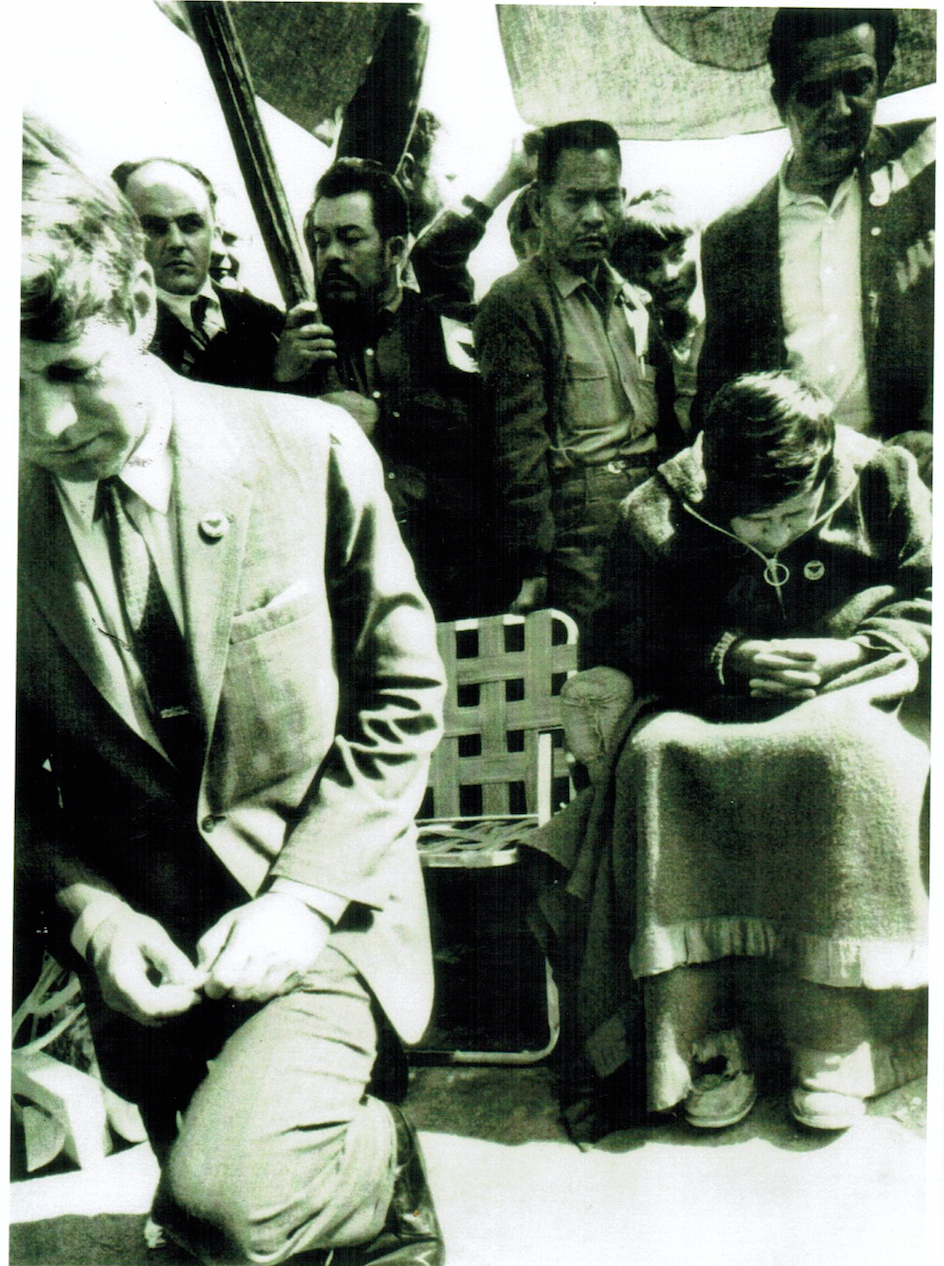
  • RFK and Cesar Chavez

    RFK and Cesar Chavez


    This is a very rare photo sent to CTKA by Paul Schrade, a labor officer who figures in the following story of Bobby Kennedy going to Delano.


    Read “The Saga of Cesar Chavez”, by Jim DiEugenio, at Robert Parry’s Consortium News


    Bob Parry is one of the very few editors who allows articles on the Kennedys and King and their assassinations. Please donate if you can to his cause. And also leave a comment for the article and the good work he does.


  • David Heymann Haunts us from the Grave

    Correcting An ‘American Legacy’

    by Anne Johnson, At:  NPR Ombudsman

  • The MSM and RFK Jr.: Only 45 years late this time

    The MSM and RFK Jr.: Only 45 years late this time


    The evidence at this point I think is very,
    very convincing that it was not a lone gunman.

    Robert F. Kennedy Jr.
    Jan. 11, 2013


    On the evening of January 11th, Charlie Rose interviewed Robert Kennedy Jr. and his sister Rory in Dallas at the Winspear Opera House. This was part of Mayor Mike Rawlings hand chosen committee’s year long program of celebrating the life and presidency of John F. Kennedy. In fact, Rawlings introduced the program. He probably did not like how it turned out, for during this interview Kennedy Jr. said that his father thought the Warren Report was a “shoddy piece of craftsmanship” and he was “fairly convinced” that others were involved. Robert Jr. himself thought that the evidence in the JFK case, “…at this point I think is very, very convincing that it was not a lone gunman.”

    To my knowledge, this is the first time that a member of the Kennedy family has stated these sentiments in public. Kennedy Jr. went further and backed up the idea, widely held by many that RFK “publicly supported the Warren Commission report but privately he was dismissive of it.” He added “He was a very meticulous attorney. He had gone over reports. He was an expert at examining issues and searching for the truth.”

    RFK, JR. Charlie Rose
    The Associated Press

    Once this story hit the wires, it created a mini-sensation. Cable and network news programs did segments on it; hundreds of Internet outlets and newspapers carried the story. This really sums up how cloistered and controlled our news media is even today, with cable channels and the Internet now on the scene. The only thing new about this story is what I mentioned above: the fact that a member of the Kennedy family was saying it in public. As of this writing, there is no official transcript available of this interview, nor is there an audio or videotape which seems odd since it was recorded in front of cameras. Since Dallas Mayor Rawlings was there as the taboo subject was mentioned maybe it is not so odd. But clearly, people should contact Rawlings’ office and ask that this interview be placed on the web immediately. Therefore, people can write articles based upon the actual exchange instead of reporters’ stories about the exchange.

    The fact that RFK did not buy into the Warren Report, and he only endorsed it in public for political reasons, this has been established for quite some time. In 2007 David Talbot, in his book Brothers, clearly showed that Bobby Kennedy never bought into the Oswald-did-it line. That from the moment he learned of his brother’s death he suspected a plot had been behind it. (Click for a review)

    He “publicly supported the Warren Commission report but privately he was dismissive of it.” He added “He was a very meticulous attorney. He had gone over reports. He was an expert at examining issues and searching for the truth.

    RFK, Jr. about his father Robert Kennedy

    A decade previous to Talbot, in 1997, Tim Naftali and Aleksandr Fursenko published the fine book, One Hell of a Gamble,a study of the Missile Crisis from the Russian point of view. In that volume, the authors first wrote about William Walton’s now famous mission to Moscow in 1964. Walton was ostensibly going as a goodwill ambassador for cultural exchanges, but his real objective was to carry a message to Nikita Khrushchev from Robert and Jackie Kennedy. That message was that, although the American media had jumped on this lone gunman idea, they thought that President Kennedy had been killed by a domestic conspiracy… one that was politically motivated from the rightwing. That because of this assassination, the attempts at détente that Kennedy and Khrushchev had made would now have to be placed on hiatus. Johnson was much too pro-big business to pursue that ideal. Therefore, RFK would soon resign. When he became president, the effort at reconciliation would then continue. (Talbot, p. 12)

    However, way before that book, there had been instances during Jim Garrison’s inquiry into the Kennedy assassination that indicated Robert Kennedy was quite interested in what the New Orleans DA was uncovering. In this author’s current book, Destiny Betrayed (Second Edition) I note an instance where RFK was in California staying at a friend’s house in 1968. Family friend Mort Sahl was also there. That night, Sahl had to leave for a performance. When he got back, his then wife told him that RFK peppered her with questions about what Garrison was digging up. (Sahl was working for Garrison.) Richard Lubic, a campaign worker for Bobby Kennedy in 1968 told another Garrison investigator, Bill Turner, that RFK said that if he were elected president, he would like to reopen the Warren Commission inquiry. (Talbot, p. 359) In Harold Weisberg’s original manuscript of Oswald in New Orleans, he wrote about being in contact with someone in Bobby Kennedy’s 1968 campaign. He communicated to Weisberg that RFK had real doubts about the Warren Commission. Weisberg told his contact if this were the case RFK should voice his concerns in public, making sure he would not be assassinated because of his belief. After Bobby was killed, Weisberg wrote that never was a seer less happy with the fulfillment of his prophecy.

    In other words, anyone looking for evidence of this could have found it many years previous. Only in our media, especially in the MSM, could any such story be considered news. From a sociological point of view it is interesting to note two factors that figured in the reaction.

    Charlie Rose has built a career out of being the alleged thinking man’s talk show host and he actually began hosting such programs on Dallas’ KXAS-TV in the seventies. He then worked for CBS News in the eighties and began the present version of his talk show on PBS in the nineties. But while doing his show he also worked for the CBS program Sixty Minutes II from 1999 until 2005. Therefore Rose was the perfect choice from the Dallas power elite point of view. All this would indicate that he is pretty much a canned establishment figure. How much of an establishment figure is he? Well, he has attended several Bilderberg Conferences of late. His second wife is the stepdaughter of CBS founder Bill Paley. It will be a cold day in Hades if one ever catches anything on his snooze fest that seriously counters the established American Conventional Wisdom. Therefore Rose was the perfect choice from the Dallas power elite point of view.

    Consequently, when his guest began uttering such heresies in public, Rose automatically kicked into damage control mode. When the son mentioned that his father went into a long funk after JFK was killed, Rose (understanding his next ticket to a Bilderger Conference depended upon his stemming this tide) quickly suggested if this was because RFK felt “some guilt because he thought there might have been a link between his very agressive efforts against Organized Crime?”. This question was, of course, an attempt to simultaneously:

    1. Turn the crime inward on the Kennedy clan by focusing on RFK’s ambitious drive against the Mafia, and
    2. Pin the assassination on an acceptable culprit. One made acceptable by the likes of Robert Blakey, namely the Cosa Nostra.

    Rose’s response was unwarranted. There are any number, or even combination of reasons RFK may have sunk into emotional quicksand. As indicated above, he clearly understood that his brother’s large and looming foreign policy agenda would now go unfulfilled. RFK may also have come to an understanding, realizing the enormous pressure now placed upon him, to become something he was not: a political candidate. He also had to have realized that, in fact, he had no choice but to do so because his power base had now been pretty much circumscribed by President Johnson and J. Edgar Hoover. In fact, this idea was mentioned by the son when he said, “As soon as Jack died, he lost all his power.” Further, after this point, Hoover “never spoke to him again.”

    But RFK Jr. then returned to this Mafia theme when he said one of the things that pricked his father’s curiosity was the phone records of Oswald and Ruby. These contained many calls to organized crime figures. Therefore, his father “was fairly convinced at the end of that there had been involvement by somebody.” Again, Rose jumped in and did his bit: “Organized crime, Cubans.” To which, RFK Jr. (thankfully) replied, “Or rogue CIA.”

    Rose’s initial reaction was the first attempt to channel the story down a certain acceptable path. Rawlings’ decision not to release a recording is another. But the third is the reaction of the Dallas Morning News to it. In about one week they wrote three articles based on the interview. In these articles, dating from January 11th to the 14th, the paper consulted with their official propaganda mouthpiece Gary Mack. Mack tried to cast aspersions on the credibility of RFK Jr. by saying that there really could not be any Oswald phone calls since there is no record of him having a personal phone service. Bill Kelly quickly and effectively countered this deliberate obfuscation. (http://jfkcountercoup.blogspot.com/2013/01/oswald-and-ruby-phone-records-rfk-jr.html) One of the Morning News writers, Rodger Jones, then tried to confuse things even further by saying that, well, RFK Jr. said that Bobby’s interest first began during the Garrison inquiry. Yet, according to David Talbot, Bobby Kennedy actually started his inquiry back in 1963. This spin control ignores two things: 1.) According to Garrison volunteers, like Mort Sahl, the Attorney General clearly did have an interest in Garrison’s investigation, and 2.) Since RFK Jr. was still something of a child in 1963, it is much more likely that four years later, as an adolescent, he would more clearly recall such a matter.

    In further comments, Mack said that it appears that some members of the Kennedy clan have decided to say one thing in public, “But apparently, privately, some members. . . have raised questions about areas of the assassination.” Well, from the material I have presented here, its pretty clear that the Kennedy family did have doubts from a very early date. In fact, we can go back even further, to Arthur Schlesinger’s massive biography of the Attorney General, Robert Kennedy and His Times. In that biography, published back in 1978, Schlesinger made clear that Kennedy thought the Warren Report was a subpar and unsatisfactory effort. And further that CIA Director John McCone told him that two assassins were involved in the shooting. (pgs. 643-44)

    Further demonstrating how only in the MSM can the fairy tale exist that RFK and the Kennedy family abided by the Warren Commission, consider the words of Kennedy cousin Kerry McCarthy to Debra Conway in 1997. McCarthy was a speaker at Lancer’s November in Dallas conference. She told Conway that, whatever the Kennedys say in public about the JFK murder, when you visit their homes, you will see several of the JFK assassination books lining their shelves.

    Chris Lawford, son of Peter Lawford and Pat Kennedy, more or less explained why this was so. In his book, Symptoms of Withdrawal, he wrote that the day after the assassination, “I woke up [and] found my father sitting at the flagpole where I used to raise the presidential flag when Uncle Jack came to visit. He was crying like a baby. Strangers held a vigil on the beach outside my parents’ house for days after the assassination.” Pat Kennedy now started drinking with a new seriousness, and the couple was divorced shortly afterwards.

    It takes a long time to come to grips with that kind of pain. And who wants to deal with it in public? At this talk, Robert Jr. finally did. He also praised one of the books the clan had on their shelves, JFK and the Unspeakable by James Douglass. This is one of the few books on the case that has managed to make its way out of the JFK assassination niche. It has sold well now for four years, and there are now over 100,000 copies of it for sale in various formats, including audio book. Bobby Kennedy Jr. liked this book so much that, after he read it, he called Douglass and congratulated him on a job well done. Maybe that was the first sign of recovering from a family trauma that has lasted for well over four decades. And maybe now the MSM can wake up and say, well, if the Attorney General thought the Warren Report was shot full of holes, maybe it was. Thanks to his son for making that moment possible.

    As mentioned above, the fact that this interview is not on the Internet is a disgrace. Please contact Mayor Mike Rawlings and tell him that, in the interest of democracy, history, and proper journalism, it should be posted immediately.

    Phone: 214-670-4054

    Fax: 214-670-0646

    Address: Dallas City Hall, 1500 Marilla Street, Room 5EN, Dallas Texas, 75201

    or send an email to Chris Heinbaugh, Vice President of External Affairs | AT&T Performing Arts Center

    ~Jim DiEugenio


    Articles online:


  • David C. Heymann, Bobby and Jackie: A Love Story


    As a researcher into a controversial subject – the assassinations of the sixties – people often ask me this question: How do you know which sources to believe and which to disbelieve?

    My answer is this: When you read an author for the first time, check every single fact you don’t already know from elsewhere. If a nonfiction book isn’t even footnoted, it’s not worth your time other than as a source of leads you’ll have to check out on your own. Leads are not data. They are only possible data.

    Hearsay, what someone said when they were not under oath, when nothing was at risk for them personally, I also treat as a lead, not data. Personally, I don’t trust interviews much because people often misremember things, or enhance or embellish the truth, sometimes without realizing it. And some will simply lie for their own reasons, and none of us is so good that we can “just tell” who is lying or not. But by interviewing people you can sometimes get a lead on data for which there is some sort of a verifiable paper trail. And that can be valuable.

    If the book is footnoted, check out the footnotes. And I mean, really check it out – don’t just see if there is a footnote. Go to the library, go to the book referenced, go to that page number, and see if the note is correct. Was the correct reference on that page? Or did the author miss it? (Sometimes book pages change from one printing to the next so check a few pages on either side of the reference in case it’s nearby.)

    Most important, check to see if what is in the footnoted text is accurately represented. I’ve gone through people’s footnotes and found sometimes, to my dismay, that the author misread the original text or is deliberately misrepresenting it.

    What about things you can’t check out, like interviews with people? Then two additional considerations come into play: the credibility of the person being interviewed, and the reliability of the interviewer. Did either person have a reason to lie? Did either person work for an intelligence service, a career which requires one to lie well? Have they lied or misquoted people in the past?

    It is with these considerations in mind that I read C. David Heymann’s latest book, Bobby and Jackie: A Love Story. If I had to describe the book in a single word it would be this: puerile. But because this book has gotten so much media attention, I will say more than one word. And because the book depends nearly entirely on hearsay, I have to examine the overall credibility of the author, as well.

    When I started reading the book, I tried to look up certain items to find Heymann’s source. There were some footnotes, to be sure, but never for the items that interested me. Instead, he sourced the book generally, chapter by chapter, to a list of interviews conducted by Heymann and his researchers. Lacking access to those, the only way for me to evaluate the credibility of Heymann’s claims of a so-called love affair between Bobby and Jackie was to evaluate the credibility of Heymann himself.

    I’ve been researching Robert Kennedy for years. Early on, I picked up Heymann’s book RFK: A Candid Biography of Robert F. Kennedy. At the time, I knew nothing about Heymann. I was writing about Robert Kennedy’s ride to the Ambassador Hotel – a moment of no particular consequence. I just wanted to get the time correct and to quote something ironic that had been said on the drive.

    Here is what Heymann wrote for this episode:

    At six-fifteen, Kennedy and Dutton were driven by John Frankenheimer from Malibu to the Ambassador Hotel. … As Frankenheimer cruised along the Santa Monica Freeway, attempting to make the thirty-minute trip in half that time, Bobby said, “Hey, John, take it slow. I want to live long enough to enjoy my impending victory.”

    The footnote for the above said this:

    “At six-fifteen”: Schlesinger, RK, p. 980.

    If you go to page 980 in Arthur Schlesinger’s book Robert Kennedy and his Times, you find nothing but a page of footnotes with no reference to those events. But a page number mistake is easy to make – and it was easy enough to find the correct page. So I wasn’t going to be too hard on Heymann for such a simple error. I looked up “Frankenheimer” in Schlesinger’s book to get the correct page (p. 913), and found this text:

    About six-thirty Frankenheimer drove him to the Hotel Ambassador. He sped furiously along the Santa Monica Freeway. “Take it easy, John,” Kennedy said. “Life is too short.”

    Schlesinger sources this quote to Robert Blair Kaiser’s book R.F.K. Must Die!, page 15. Schlesinger’s quote of what Kennedy said exactly matches the original in Kaiser’s book, whereas Heymann’s strange misquote added a touch of arrogance (“my impending victory”). Heymann evidently improvised his version, and moved the time he explicitly footnoted up fifteen minutes for no apparent reason. Add that to the wrong page number, and for this inconsequential item, Heymann managed to make three mistakes. That’s way too high an error ratio for me. If he could make three errors on something so simple, what would he do with things more controversial or complex? At that point, I put away Heymann’s book, realizing it would be worthless to my research.

    Had I read further, I would have seen Heymann fabricating events from whole cloth. For example, on page 361 in his RFK book, Heymann wrote something wildly untrue:

    [I]n May 1997, Gerald Ford publicly admitted that in 1975, while president of the United States, he had suppressed certain FBI and CIA surveillance reports that indicated that JFK had been caught in a crossfire in Dallas, and that John Roselli and Carlos Marcello had orchestrated the assassination plot.

    Gerald Ford never said any such thing. What Gerald Ford did say in 1997 was in response to a document that surfaced showing it was his edits that changed the wound from Kennedy’s “back” to the “back of the neck,” a change of verbiage that managed to move the wound up five inches to support the single bullet theory. Never mind that the shirt (which was fitted and could not have bunched up five inches, as some have suggested) showed a bullet hole well down the back and definitely not in the “back of the neck.”

    Here is the passage from the 1997 AP report regarding Ford’s public comment:

    Thirty-three years ago, Gerald R. Ford took pen in hand and changed – ever so slightly – the Warren Commission’s key sentence on the place where a bullet entered John F. Kennedy’s body when he was killed in Dallas.

    The effect of Ford’s change was to strengthen the commission’s conclusion that a single bullet passed through Kennedy and severely wounded Texas Gov. John Connally – a crucial element in its finding that Lee Harvey Oswald was the sole gunman.

    A small change, said Ford on Wednesday when it came to light, one intended to clarify meaning, not alter history.

    “My changes had nothing to do with a conspiracy theory,” he said in a telephone interview from Beaver Creek, Colo. “My changes were only an attempt to be more precise.”

    So Heymann is freely mixing a real event (Gerald Ford’s public comment) with a fictional one (admitting to participating in a cover-up and naming Roselli and Marcello as the conspirators).

    How could Heymann be so wrong? Heymann wouldn’t deliberately lie, not in a nonfiction book, right?

    Wrong. Heymann not only would, he does, and provably so, right on the book’s dust jacket. Under Heymann’s picture, Heymann is described as a three-time Pulitzer Prize nominee. Finding that impossible to believe, I decided to check it out. As I suspected, Heymann was never nominated for any award by the Pulitzer Prize committee. The Pulitzer Prize committee goes to some trouble to ensure that nominees, called “finalists,” are listed on their Web site. Heymann is not there.

    Was it possible that Heymann pulled one over on his editor? I had to find out, so I contacted his current editor, Emily Bestler, at Atria Books, a subsidiary of Simon and Schuster. It never occurred to me that an employee of a Simon & Schuster property would knowingly perpetrate a fraud regarding one of their writers. How naive I was.

    When I queried Bestler about the fact that he was not listed as a Pulitzer Prize nominee on the Pulitzer Prize committee’s site, Bestler explained that his previous publishers had submitted his books for nomination.

    Now, I don’t know about you, but no one in Hollywood would dare call themselves an Academy Award nominee just because their agent submitted their reel to the Academy. They’d be laughed out of the business. The agent and actor would both lose all credibility.

    The same should be true in the publishing world. You can’t seriously claim to be a nominee just because your book, along with thousands of others, was sent to the Pulitzer committee. That’s patently ridiculous. Any author anywhere on the planet could then send in their book and claim the same. Is this the industry’s dirty little secret? Is this a widespread practice?

    I emailed the Pulitzer Prize Web site asking what the Pulitzer Prize committee does when someone claims to be a “nominee” when they’ve only been submitted for nomination. Claudia Weissberg, the Web Site Manager for the Pulitzer Prize committee, wrote back:

    Occasionally when we see misapplication of the term “nominated”, we send a straightforward message informing an author about the misstep and usually get compliance. Also, when people contact us to confirm such a claim, we try to set them straight. Unfortunately, our staff of four is too busy with other things to regularly police the situation.

    So the next time you see someone claiming to be a “Pulitzer Prize Nominee,” don’t believe it until you first confirm it for yourself. (Search www.pulitzer.org. If the author was truly a nominee or an award winner from the year, they will show up in the search, and the date and name of their nomination or prize will be listed. Gus Russo, author of Live By the Sword: The Secret War Against Castro and the Death of JFK, has also misused that term, claiming to be a nominee when he, too, was merely an entrant.) You would think some “truth in advertising” statute should apply here to protect consumers. Whatever else it is, it’s simply dishonest, on any level, and shame on Heymann and Bestler for participating knowingly in a deliberate deception. Shame on Atria Books. Shame on Simon and Schuster for misusing the prestige of the Putlizer Prize to sell some books.

    Why do I spend so much time on this false claim? Because if one is willing to lie about themselves to enhance the sales of their book, what else might they be willing to lie about?

    That question should be foremost in mind when reading Heymann’s book Bobby and Jackie because we, the readers, are not in a position to check the factual accuracy of his most sensational claims. First of all, the most outrageous claims are not footnoted specifically, but sourced generally to people who are now dead. We can’t go question them to see if Heymann quoted them accurately. So how can we check this out?

    We have to go back to Heymann’s past work, and hear from people he has quoted in the past, to assess his accuracy with people when they were living. As it turns out, credibility has long been an issue for Heymann.

    In his book Poor Little Rich Girl: The Life and Legend of Barbara Hutton, about the famous Woolworth heiress, Heymann inaccurately accused a doctor in Beverly Hills of overprescribing drugs for Ms. Hutton. The accused doctor was provably only 14 years old at the time and incapable of prescribing drugs for anyone, and sued Random House. Random House hesitated. They were not eager to destroy a book that had all the markings of a bestseller. After all, the film rights had already been optioned for $100,000.

    Heymann blamed the mistake on one of his researchers, and was upset when Random House held him, the author who had received the $70,000 advance for the book, accountable.

    Shortly after the doctor’s suit, Ned Rorem, an author and composer, pointed out that Heymann had lifted a passage from one of Rorem’s own books and attributed it to Hutton. That was enough, for Random House. The publisher recalled the book and destroyed all copies.

    Heymann was so depressed at this episode, which threatened to destroy the only career he’d ever loved, that he attempted suicide. He then changed his mind, sought emergency medical treatment, and headed to a Manhattan psychiatrist.

    How was it that Random House didn’t review the book for accuracy? The publicity director said Random House relied on Heymann’s assurances of accuracy. (Emily Bestler, his current editor, told me the same thing, that she never questioned him about his sources, never did any independent verification. “He’s the expert,” she said in all seriousness, the irony of which you will understand by the time you finish this review.)

    Heymann’s troubles with the Hutton book were still expanding. As reporter Curt Suplee described in his Washington Post article “The Big Book That Went Bad” (Feb. 8, 1984), “Meanwhile, the unthinkable got worse. Another author cried foul; some of Hutton’s longtime chums claimed they had never seen her keep notebooks; several people quoted in the book either denied that they had been interviewed or disowned the quotations. And in Los Angeles, some old Hutton hands openly doubted that Heymann – who says he conducted six weeks of intermittent interviews with the enfeebled heiress during 1978 – ever met her at all.”

    Heymann said he made no tapes of these alleged conversations, but that he could prove his presence there in a court of law if he had to. (In a separate interview, Heymann said the only person who could verify he conducted the interviews with Hutton was his wife.) No one put that claim to the test, although Manhattan District Attorney Robert Morganthau’s office did investigate Mr. Heymann for fraud. (No indictment was ever issued from Morgenthau’s investigation.)

    A handwriting expert determined that the so-called “diary” (a collection of notebooks and scribblings on random pieces of paper) was not from Hutton. Regarding the authenticity of the handwriting, Suplee noted, Heymann displayed “photocopies of letters Hutton wrote decades ago in an idiosyncratic, loopy script; and apparently more recent sheets of embossed letterhead stationery on which incoherent, broken sentences are printed in big block letters. How could both be written by the same hand? ‘They were written many years apart,’ Heymann says. ‘I didn’t question it.’” Sadly, neither did his editors. Fortunately for history, however, some reporters did.

    David Johnston, a reporter for the Los Angeles Times, said the Times contacted several of Heymann’s alleged sources in an attempt to verify Heymann’s work. Most of the sources were long dead, but a few were still alive.

    Of the nine people contacted, all nine seriously disputed Heymann’s accuracy.

    Seven of the nine said they never spoke to Heymann or his researchers. Heymann told the Times he had taken their anecdotes from Hutton’s notes and that neither he nor his researchers had contacted those people. Heymann claimed to Suplee, however, that these people had spoken with his researchers, which contradicts his earlier statement that he had gotten the anecdotes from the disputed journal entries. The eighth person said that, while part of what was quoted was true, nearly a page-worth of quotes attributed to that person were false. The ninth said he had been contacted by an aide of Heymann’s, but refused to be interviewed. (Los Angeles Times, Dec. 24, 1983)

    Johnston also noted that one lengthy anecdote in the book involved a physician who didn’t exist. Heymann explained that he used fictitious names in the book “in five or six cases.” The book, however, contains no disclaimer indicating that any fictitious names were used. And in a later interview with the Washington Post, Heymann changed the number of fictitious names used to two. “That’s not such an unusual ploy, is it?” Heymann asked the reporter. But, of course, it is. Nonfiction is supposed to be truthful in all aspects, with no made-up names, or, if necessary, with pseudonyms clearly identified as such.

    When asked if he had alerted his editor at Random House to the fact that he had used false names, Heymann said, “Yeah – it would have been impossible otherwise.” According to Suplee in the Post, “a company spokesman denies that Heymann said anything about fictitious names or mentioned that he would be using researchers for the preponderance of the interviews.” “Clem was not forthcoming,” said Heymann’s agent Peter Matson, “about the way he was working.”

    Heymann even dared blame his editor for not insisting on the use of a pseudonym for the doctor who ended up suing. “It seems to me an experienced editor would have said, ‘why use this guy’s real name? Why not use a pseudonym?’” (Wash. Post, Feb. 8, 1984)

    Philip Van Rensselaer, a one-time escort of Hutton’s, told the Post he was thinking of suing Heymann for plagiarism, saying Heymann had copied dozens of sentences from his own biography of Hutton. Heymann had quoted a news article from Van Rensselaer’s book without verifying its accuracy. Van Rensselaer had actually embellished the news item, itself a violation of journalistic standards. Yet Heymann had quoted it verbatim as if it was an actual news item, showing how poor a researcher he is.

    It’s odd, in retrospect, that Random House was so incurious about Heymann’s accuracy, given that his two previous works by that time had already been challenged for accuracy. Had they actually bought Heymann’s claim that, after any nonfiction book is published, “eight out of ten people will deny what they said”? That may be the standard for a Heymann book (and with good reason, if they didn’t, in fact, say what was quoted), but he presents no evidence to support that claim on behalf of other nonfiction authors.

    Random House’s spokesperson told the Post that Random House had been unaware of the problems with Heymann’s earlier books. The Village Voice had given Heymann’s 1980 book American Aristocracy: The Lives and Times of James Russell, Amy and Robert Lowell a “Most Mistakes Medallion” for the huge number of inaccuracies in that volume.

    One of Heymann’s earliest books was on the poet Ezra Pound, who happened to be a close friend of none other than the CIA’s former counterintelligence chief James Angleton. Heymann claimed he had interviewed Pound just before his death, which would have been at least four years before Heymann’s book was published. Time magazine lauded Heymann’s book, calling it “The most harshly realistic portrait of the poet so far produced.” But in 1983, a noted Pound scholar, Professor Hugh Kenner of John Hopkins University, accused Heymann of claiming someone else’s interview with Pound as his own. Heymann dismissed the charge, claiming Kenner was retaliating against Heymann for a negative review Heymann had given to Kenner’s book. Both offered to take and pass a lie detector test supporting their view in this matter. (Wash. Post, Dec. 21, 1983)

    In the wake of the problems resulting from the serious examination of his Hutton book, Heymann moved to Israel where, according to Heymann, he joined the Mossad. The Hutton book was eventually republished by Lyle Stuart (after Heymann rewrote nearly a third of it) and was made into a television miniseries.

    Since Heymann was never really punished for his lax standards, if not outright dishonesty, is it any surprise the errors and misrepresentations continued in subsequent works?

    When Heymann’s book A Woman Named Jackie: An Intimate Biography of Jacqueline Bouvier Kennedy Onassis, came out, Mike Wilson of the Miami Herald did an in-depth review, similar to what the Los Angeles Times and Washington Post reporters had done with the Hutton book. Wilson opens his review with this:

    C. David Heymann has called his book “A Woman Named Jackie” “a search for the real Jackie Kennedy.”

    Sometimes, it seems, the author didn’t search farther than his own bookshelf.

    Wilson goes on to quote a passage from Kitty Kelley’s earlier biography of Jackie, and compares it to Heymann’s. It’s not a direct copy, but it’s a very similar passage. He does this again with a passage from Ralph Martin’s book and compares it to Heymann’s passage, which is even more similar than the first example.

    Wilson also noted that Heymann lifted material from one of Jack Anderson’s columns. “No question about it. It’s obvious. That’s outrageous,” Wilson quotes Anderson as saying. (Heymann’s publicist Sandra Bodner tried to explain this away by suggesting the story was perhaps told to Heymann by Anderson’s source in exactly the same words.)

    Wilson notes some of the key allegations in the book, but adds, “much in the book is not new. And much, Heymann’s sources are saying, is not true.” For example, Larry O’Brien challenged several remarks in the book, telling the Miami Herald he had never said those things. And worse, Heymann has O’Brien essentially lying, saying something O’Brien couldn’t, wouldn’t have ever said because he’d already said the opposite in his own book! (Heymann claimed O’Brien said he refused to speak to Lyndon Johnson on the plane back from Dallas after Kennedy had been assassinated. But in O’Brien’s own book he noted he spoke to Johnson twice on the plane – once on the ground in Dallas and a second time in the air.)

    The first time I cracked Heymann’s book on Jackie open, I randomly turned to a page where a name caught my eye. Heymann quotes “James T. Angleton, director of covert operations for the CIA” talking about Mary Meyer. Surely he meant James J. Angleton, director of counterintelligence for the CIA. But it’s no wonder he got the name and title wrong. When I checked the footnotes, there was no source for the Angleton quote listed, and, according to the footnotes, Heymann sourced no interview with Angleton for that chapter. So whom was he quoting? What source gave him that Angleton quote about Meyer? How could his editor, Allan Wilson, have missed the fact that there was literally no source for that quote? That wouldn’t pass muster in a History 101 course. I had expected more from publisher Lyle Stuart, Heymann’s post-Random House sponsor.

    Heymann does get Angleton’s full middle name correct in his book The Georgetown Ladies’ Social Club: Power, Passion, and Politics in the Nation’s Capital. Unfortunately, according to Washington Post reporter Roxanne Roberts, the book had little to recommend it. Roberts opens with this line:

    There are lies, damn lies, and statistics … and autobiographies, biographies and books by C. David Heymann.

    As with so many before her, Roberts describes Heymann’s work as “unfettered by live subjects,” noting,

    This makes it harder to determine what is true and what is not, assuming one cares about those things. “When you write about people who are dead, you’re libel-proof,” author Kitty Kelley says. “They can’t sue and neither can their families. It just breaks your heart sometimes.”

    When Heymann wrote Liz: An Intimate Biography of Elizabeth Taylor, he told the press that “discussions will continue” with Liz Taylor about whether she would approve the biography as official. But Taylor’s representatives responded they had never been in touch with Heymann and that she would definitely “not be participating” in his project. (Wash. Post, Aug. 15, 1989)

    You would think Heymann would have learned some serious lessons about checking facts, not relying on researchers, verifying everything, and heeding the notion that extraordinary claims deserve extraordinary evidence. You would be so wrong.

    Heymann came under the scrutiny of New York Observer reporter Andrew Goldman when, in the wake of John Kennedy Jr.’s death, Heymann put out the story that John hadn’t wanted to fly to Martha’s Vineyard, but that his wife made him do it. (See Goldman’s article detailing challenges to Heymann’s credibility with several of his books here: http://www.observer.com/node/41806.)

    In the wake of John’s death, Heymann had told Cindy Adams, a New York gossip columnist, that Heymann had just spoken to John a few weeks before his death, and that John had complained about having to drop his wife’s sister off in Martha’s Vineyard the day his plane went down.

    Curiously, this is the same Cindy Adams I wrote about years ago, who wrote a biography of the Indonesian President Sukarno during the period in which the CIA was trying to overthrow him, and the same Cindy Adams who interviewed the Shah of Iran in his last days – the man the CIA had installed as the leader in Iran after overthrowing Iran’s democratically elected leader Mossadegh in 1953. Cindy wrote that Heymann was a frequent source of hers.

    Cindy’s story put Heymann in Rupert Murdoch’s New York Post, and got him interviews on Chris Matthews’ MSNBC show Hardball, among others.

    Heymann claimed to have had a ten-year relationship with John. But, as with the Hutton stories, people close to John found that impossible to believe. No one at John’s magazine George knew of any association. John’s appointment secretary had no appointments with Heymann listed.

    The only person Goldman could find to in any way corroborate an acquaintance between Heymann and John was Heymann’s girlfriend, who claimed only to have seen a man from behind as he departed whom Heymann told her had been John.

    Even Cindy Adams came to believe Heymann had lied to her, and issued a probable mea culpa to her readers, having been assured by the Kennedy clan that Heymann had never spoken to John (New York Post, July 29, 1999). Indeed, it is hard to believe on the face of it that John would have spoken one word to the guy who had trashed his parents in print.

    So who is Heymann? What drives him? His father was a German Jewish novelist, who fled the Nazis with his wife and came to New York in 1937. There, the family entered the hotel business, and Heymann sometimes worked behind the desk. Suplee quotes Heymann as saying, “When I looked at these people coming and going, I always made up imaginative stories of how fascinating their lives were.”

    After the Hutton episode, Heymann expressed a desire to write a novel based on his experiences with the book “to examine myself as if I were a biographical subject.”

    Did he really join the Mossad? If so, why does he openly acknowledge it? Isn’t that, like the CIA, the kind of organization you cannot admit to being a member of?

    And now we come, at last, to the book I started out to review: Heymann’s Bobby and Jackie: A Love Story. I submit that even the title is false, because Heymann doesn’t even attempt to paint a love story. He paints a lust story, and a lopsided one at that. And really, the title should have been: Heymann and the Kennedys: A Hate Story. That would have been a more honest description of the book.

    Heymann goes after nearly all the Kennedys, starting with the father, who he accused of being an “ardent admirer of the Third Reich,” a gross misrepresentation of Joe Kennedy’s views. Joe was an ardent pacifist, who feared that another world war would bring socialism not just to more of Europe, but to America as well. For his reluctance to go to war, or, as historian Will Swift puts it, for his willingness to explore every avenue for peace, he was branded an appeaser. And for that, people made the leap that an opponent of war was a friend of Hitler, when in fact that is an unjustified leap. Those of us who opposed George W. Bush’s war in Iraq did not do so out of any admiration for Saddam Hussein. It’s a ridiculous meme about Joe Kennedy that has persisted for reasons beyond the scope of this book review.

    Heymann goes after John Kennedy, portraying him in such sexual terms one wonders when the guy had a chance to govern. He even claims Kennedy’s youthful glow in the debates was due to his having had sex just prior to the debate, saying “The results of the exercise were obvious to anyone who watched the debates. Kennedy looked refreshed and composed on camera, whereas Nixon seemed nervous and out of sorts.” And pre-debate sex is his only possible explanation? Whatever else Kennedy was, he was ambitious as hell and believed in preparation. It’s just not credible that he would have allowed a moment of pleasure to interfere with the most important political moment of his career.

    Heymann sources this episode to “a longtime congressional and senatorial aide to JFK,” Langdon Marvin. Author David Pietrusza, in his book 1960 – LBJ Vs. JFK Vs. Nixon: The Epic Campaign That Forged Three Presidencies, challenged Marvin’s credibility on this episode, which first appeared in Heymann’s book on Jackie.

    Pietrusza notes that in the original account, Heymann’s version in the Jackie book claims the sex happened at the Palmer House in Chicago. Pietrusza notes that the Palmer House is nowhere near the studio in which the debate was filmed. He also noted that the route there would have taken Kennedy “perilously close” to Nixon’s “Pick-Congress” headquarters. As Pietrusza puts it, “There are risks, there are John Kennedy risks, and there are risks not even a Jack Kennedy would take.”

    Pietrusza also questions Marvin’s assertion, conveyed by Heymann, that just prior to the debates, Jack Kennedy had sex with a stripper in New Orleans while her fiancé, Governor Earl Long, held a party in the next room. The problem with that is that the debate was filmed September 26, Long had left office in May, and had died September 5. So either Marvin or Heymann’s account of what Marvin said is simply not credible.

    Pietrusza notes that Marvin did have a motive to attack the Kennedys. Marvin was an aviation consultant. But for whatever reason, Bobby Kennedy wrote the following to reassure airline industry representatives who expressed concern about Marvin having a role overseeing their industry. Pietrusza quotes the following letter from Bobby Kennedy:

    I assure you that Langdon Marvin will not be a part of the administration. He will not have a job of any kind and will play no role, directly or indirectly, in the policies of the administration.

    Your sentiments regarding Mr. Marvin are exactly in accord with mine, and I assure you that, when I say that Langdon Marvin will have nothing to do with the government for the next four years, I mean what I say.

    As Pietrusza summarized, “Langdon Marvin’s story is a good story. Repeating it uncritically is not very good history.”

    Heymann paints Jackie as, forgive the words, a royal bitch. There is no nuance. There are no other colors. He has her throwing fits at publishers, threatening to sue, demanding payments from the Kennedys for her wardrobe and expenses after John’s death, and, of course in the centerpiece to the book, sleeping with Bobby. Of course, Heymann has no direct source for that. He has all kinds of innuendo, but not one credible account from anyone who can verify their quote to show that the two were in love or had any sexual contact of any kind.

    One of his racier episodes, where he claims a witness spied Bobby with his hand on Jackie’s naked breast at the Kennedy estate in Palm Beach, has already been disputed by Andrew Goldman in his review of Bobby and Jackie in the Daily Beast (July 24, 2009). The witness in question is Mary Harrington, who, according to Goldman, died a year before Heymann ever quoted her. Heymann has Harrington supposedly watching the two on the grass from Harrington’s third-floor window next door to the Kennedy estate.

    The problem with this, Goldman notes, is that, according to Ned Monell, the listing agent for the Kennedy residence when it was sold in 1995, the entire property was walled. The only place, therefore, from which Harrington could have been staying would have been a beach shack which was 10 feet lower than the Kennedy house. And given that heavy vegetation surrounded the house, she couldn’t have seen anything on the lawn at all.

    Many of Heymann’s sources for the affair between Bobby and Jackie are people saying they heard it through the grapevine, so to speak. Here’s a typical factless piece of innuendo:

    Film producer Susan Pollock had a friend who occupied a suite opposite Jackie’s at the Carlyle. On several occasions, the friend saw Bobby and Jackie return to the suite late at night, then leave together in the morning. “You can look at people and tell if they’ve been intimate,” said Pollock. “My friend could tell. In any case, their affair was an open secret. Everyone knew it.”

    What standards of proof does this meet? That is sheer speculation. And of course, there’s a very innocent explanation for overnights. Bobby had taken over the responsibilities of father for his brother’s two children. He read to them at bedtime. He took them to school in the morning. It makes sense he’d spend the night. Anything else is unproven speculation.

    Only a few claim to have any direct knowledge. And while Heymann starts off quoting someone as saying that, while Bobby wasn’t faithful to Ethel, he treated his paramours as “second or third wives,” Heymann then has Bobby and John having sex with their respective females in the same room, being open with friends about it, and coming on to people like Joan Braden, the former wife of the longtime CIA media operative Tom Braden. And this from the same Bobby Kennedy Heymann quotes, via another source, as having said “nothing you saw or heard leaves this office. Is that understood?”

    I had previously read another equally disgusting book, Nemesis, by Peter Evans. That, too, was a book designed to make Jackie look like a bed-hopping whore, selling her body to Onassis in exchange for protection for her children. Not surprisingly, in Bobby and Jackie, Heymann borrows liberally from Evans work. What did surprise me is that Evans found fault with Heymann. He implied Heymann concocted, in his Jackie book, a quote Heymann attributed to Christina Onassis. It seems even Evans has standards which Heymann cannot meet.

    One episode seems inspired more by news that surfaced while Heymann was working on his book rather than by his interviewee, who died in 1998, ten years earlier. In 2008, a story surfaced in the New York Post (April 14, 2008, not April 15, as Heymann has in his footnote) about an alleged FBI tape showing Marilyn Monroe in a “perverted” sex act with a man whose face is never seen. Evidently, Hoover tried to prove, unsuccessfully, that the man was John or Robert Kennedy.

    Heymann claims that Clark Clifford told him about this tape. Clifford ala Heymann even has Jackie asking Clifford if he’s seen a ‘certain film’ of a sex act between Bobby and Marilyn, looping her into this ridiculous scenario as if to give credibility to that having been Bobby. First, Jackie would have been too discreet to ever ask such a question if she had seen such a film. Second, Clifford died in 1998. I find it hard to believe Heymann would have sat on that salacious tidbit for ten years. He would have put it in one of his earlier books.

    Missing from the book is any hint of the loyalty the Kennedy operatives had to the family. He quotes Kenneth O’Donnell, who would have practically taken a bullet for the Kennedys, saying things that, even if true, he would never share. Heymann quotes from him liberally, which is extremely odd, since O’Donnell died in 1978, many years before Heymann wrote about any of the Kennedys. Did he interview him and then sit on that material for years and years? If O’Donnell had talked of an affair in 1978 just before he died, why did it take Heymann nearly 30 years to write that up? And how did he remember something O’Donnell said in 1978 for his 2009 book that he had presumably forgotten for his 1989 book about Jackie? In his 2009 book, Heymann quotes O’Donnell as saying he thought Bobby loved Jackie, but that he understood the “limitations of their romance.” If O’Donnell had really said that, why didn’t Heymann mention that in his book on Jackie, where he briefly quotes several people as having “suspected” there was an affair between them? If he has O’Donnell confirming it, why didn’t he surface that earlier?

    Pierre Salinger, who is dead, is liberally quoted talking openly about an affair. That makes no sense. Salinger was so trusted he was the President John Kennedy’s press secretary. Only the most closed-mouth, trusted associates are considered for such a sensitive role in any administration. John Greenya, in his review of Bobby and Jackie for The Washington Times (August 11, 2009), challenges this point too. Greenya knew Pierre Salinger very well, as they spent over a year together working on Salinger’s book P.S. A Memoir. Said Greenya:

    In the hundreds of hours we spent in conversation, over the phone and in person, he never sounded the way he sounds in this book. And for him to tell Kennedy stories out of school, which he allegedly did to Mr. Heymann, strikes me as completely out of character.

    And I simply cannot believe he would use a crude, locker room term in talking about Mr. Kennedy, the man he devotedly served as press secretary.

    And that’s another point I want to make. I’ve been studying screenwriting for some time now. Good writers know that people don’t all speak the same. Every person has a different vocabulary, with different idioms that give them away. But in Heymann’s book, everyone sounds the same. They all talk like crass older men with a chip on their shoulder. They all talk in grammatically perfect, short, clipped sentences. Most interviewees aren’t writers, and don’t talk like that. They wander. They get off topic. You have to bring them back. This would be indicated by an ellipses in the quote. But when Heymann interviews people, they seem to speak in ready-for-publication phrases.

    Also missing from the book is any sense of the historical context. Bobby was running for the Senate, and later the presidency. J. Edgar Hoover had already tried and failed to link Bobby to Marilyn Monroe. If it was an “open secret” that Bobby and Jackie were having an affair, there’s not a chance in hell that Hoover wouldn’t have found out about it and run to one of his media assets, like James Phelan, with the story of the century. He would have had files on their affair, and maybe even photos.

    Photos. That’s another funny thing. In many research books, people include not just photos of people, but of documents. Howard Hughes books contain photos of his handwriting. JFK books include photos of CIA and FBI files. But Heymann books contain photos of no documents whatsoever. Even ones he mentions in his text. For example, at one point, Heymann mentions a letter from Bobby Kennedy to Katherine Graham. The letter sounded plausible to me, like something Bobby might actually have written. How hard would it have been to put a photo of that in the book? I asked his editor, Emily Bestler, why, given the past charges against Heymann’s credibility she hadn’t asked for that item to be shown. Bestler said the author was responsible for all the content, and that she didn’t recall that particular item from the book, but that if she’d seen it, she would probably have asked for it to have been included. I then asked her: So what was her role as editor, if not to help shape the content? Was she really more of a proofreader? I could tell that offended her by her abrupt change of voice. She said she edited the book for flow. Well, it flows fine. It’s an easy read. There were no typos that I noted. Clearly, she did her job well. But to me, that’s what a copy editor does, not a book editor. A book editor should challenge one for sourcing and demand to see backup for anything not verifiable elsewhere. That’s what people expect when they see a big name publisher. They expect credibility.

    My takeaways from this experience?

    1. I would never believe anything Heymann writes unless I could confirm it elsewhere.
    2. “Pulitzer Prize nominee” is a deliberately misused term.
    3. Editors at major publishers do not fact-check nonfiction books. They simply trust the author. You should not. Believe nothing in a nonfiction book that you can’t independently verify yourself. Check all footnotes. A pattern of honesty or deception will quickly present itself. Judge all else in the book accordingly.

    I feel compelled to note that about 80% of the data in this article was compiled over a two-day period, using only the Internet (with access to past issues of newspapers via a couple of online databases) and copies of a few of Heymann’s previous books. It’s just beyond belief that someone would sign on to be this guy’s editor and not do at least that much due diligence to find out if he’s credible. Especially when he claims to be a Pulitzer Prize nominee – and is provably not.

    Believe it or not, I’m not mad at Heymann. While I dislike intensely what he’s written, I can imagine the situation from his point of view. In his mind, he’s a crafty guy who figured out a way to make a great living, while breaking, to my knowledge, no enforceable laws to do so. That he broke all laws of decency and historical faithfulness, if you put yourself in his shoes, is beside the point. In his mind, he may well be P. T. Barnum, reveling over the number of suckers born a minute. Or worse, he may actually think he did a good job with the historical record! Hey, if no editor ever holds you accountable, how do you know you are failing?

    Whatever the reality inside his mind, in the actual world, Heymann’s work should never have been published without a proper factual, not just textual, review. For that, the blame really must be shouldered by the enablers: the editors who functioned more as proofreaders than as shepherds of content; book reviewers who were too lazy to check to see whether what he wrote was true (with a few notable exceptions); and fellow authors who recycle his writing and spread it around in their own books like a virus, infecting the historical record for future generations.

    What can you do? You know I never like to leave you without a course of action. Why don’t you write to his current publisher, Atria Books, and ask them to make available his audio recordings of the interviews he claims to have made for this book? That would be a real service to the historical record, assuming the voices are authentic and unaltered, and that the tapes even exist.

    In his notes at the end of Bobby and Jackie, Heymann wrote, “Much of the interview material, including tapes and transcripts, has been placed in the author’s personal archive, located in the Department of Special Collections, State University of New York at Stony Brook, Stony Brook, New York, where it is available for viewing and/or listening.” That’s funny, because when the Miami Herald went after Heymann for his book on Jackie, Heymann’s publicist at the time, Sandra Bodner, said that, unless someone sued Heymann, he would not play his tapes for anyone. So who told the truth? Heymann, or his publicist? Can you hear the tapes, or would you have to sue for the privilege?

    Ask Atria Books and find out. You can reach his editor, Emily Bestler, c/o:

    Atria Books

    1230 Avenue of the Americas

    New York, NY 10020

    “I always wanted to write fiction,” Heymann told a Washington Post reporter in 1989. You have the power to determine if his wish came true.

  • Arianna Huffington, Tina Brown and the New Media: Death at an Early Age?


    Readers of this site will recall that in 2008, around this time, I wrote a three part series entitled “An Open Letter to Jane Hamsher and Markos Moulitsas.” In that article I lamented the criticisms of those two bloggers about Caroline Kennedy placing her name in nomination to replace Hillary Clinton as senator from New York. I wrote that their rather shallow, melodramatic and unfounded broadsides actually said more about them than it did her. (Click here to read that piece.) Kennedy eventually withdrew from consideration. Governor David Paterson then appointed the upstate Blue Dog Democrat Kirsten Gillibrand to fill the post. I pointed out that the two bloggers goofy outrage had resulted in the appointment of just the kind of GOP-Lite Democrat they were supposed to be opposed to.

    Later, some sordid revelations surfaced about what the governor had done in the wake of Kennedy’s withdrawal. Paterson told Judy Smith, a political hack on his staff, to start selectively leaking confidential material in order to smear Kennedy. Why? To make it appear that she withdrew because Paterson would not pick her because of ethical problems. When this happened, Hamsher actually used these manufactured smears to attack Kennedy and protect herself against my column! As more objective observers have written, Kennedy dropped out because she felt Paterson was using her to garner media attention for his re-election bid. Smith, a former GOP enforcer, was later forced to resign. Paterson became the subject of an ethics inquiry over the Kennedy smears. Which was later accused of covering up for him. (Click here for that story )

    Paterson’s handling of this episode was so bad that even Republican Mayor Bloomberg questioned why it had happened. In its aftermath a decline in Paterson’s ratings began. It soon became a shocking downward spiral. Less than three months after Kennedy dropped out, Paterson’s rating had dipped from 51% to 19% positive. His negatives soared to 78%. (New York Daily News, 3/23/09) Things have gotten so bad that the White House has tried to talk him out of running again. Not just because they think he will lose, but because they think he will bring Gillibrand down with him. And since the Blue Dog Gillibrand has been scarred, the White house has also tried to talk the more liberal Carolyn Maloney out of running against her in the primary. (ibid, 7/3/09) Which tells us that Rahm Emanuel is in charge.

    Funny how the New Media’s Hamsher and Moulitsas have been hesitant to detail the mess they did so much to cause. They sure flunked that test – all the way down to covering up for Paterson. (For the best article on the Caroline Kennedy affair, click here.)

    During that travesty, Arianna Huffington played both ends of the stick. She originally cross-posted Hamsher’s first salvo against Kennedy, which was clearly meant as a preemptive strike. It was immortally titled, “Caroline Kennedy: Thanks, But no Thanks”. (In light of the above, I would reply with: “Hamsher and Moulitsas: Thanks, But find other jobs.”) Huffington also printed a follow-up post Hamsher penned which tried to link Kennedy with, of all people, Joe Lieberman. But Huffington also printed pieces that defended Kennedy. And she ultimately printed a short essay by Sherman Yellen that roundly criticized Paterson’s pick of Gillibrand as catering to the worst aspects of the Democratic Blue Dog phenomenon. Yellen compared this choice with John McCain’s pick of Sarah Palin. This was accurate and a tonic to Moulitsas who once compared Kennedy with Palin – which shows either how dumb or how off the wall the guy was and is.

    This straddling of both sides has been a clear syndrome of Huffington Post, which is the top-rated news/blog for liberals. The key to profitability for that site has been the utilization of free content. And lots of it. This means that the editors there don’t seem to really care what goes on the site. As long as it’s free, and as long as it either has some kind of celebrity attached to it, or it addresses a topic with name recognition. (Which the editors like to play up with either visuals or flashy headings.)

    I

    Edward Epstein has something of a name as a writer, and the JFK assassination certainly is a topic with high recognition quality. Epstein began his career in 1966 with the book Inquest, a study of the make-up and process of the Warren Commission. One of the underlying themes of the book is that although the Commission was not an in-depth, exhaustive investigation, it was not really a conscious cover-up. The Commissioners were misled by not having certain pieces of evidence available, by having to hew to an unrealistic timeline, and not being fully informed by agencies like the FBI and CIA. The book tried to picture the Commission as performing something like a benign political palliative.

    Volumes by Mark Lane and Sylvia Meagher, which followed Epstein’s, undermined Inquest by indicating that the Commission did understand that it was partaking in a deception. So in retrospect, his first writing performance indicated that there was more to Epstein than met the eye.

    This was confirmed the next year. FBI informant Lawrence Schiller had co-written a book called The Scavengers and Critics of the Warren Report. This book was the first attempt to ridicule and caricature them as odd creatures not deserving to be listened to or heard. It had an accompanying LP record called The Controversy. Epstein can be heard on this album joining in on the lambasting.

    If anyone maintained doubts about where Epstein now was, they dissipated in 1968. He published a long hit piece on Jim Garrison, which would later be issued as a book called Counterplot. According to Garrison’s chief investigator, Epstein had spent all of 48 hours doing research in New Orleans. (Probe Vol. 7 No. 1 p. 15) So where did the author get his information? Documents declassified by the Assassination Records Review Board (ARRB) reveal that Epstein had been in contact with Clay Shaw’s lawyers – Bill and Ed Wegmann – quite often. He was also in contact with the lawyer for both Jack Ruby and Gordon Novel, a man named Elmer Gertz. The work of the ARRB shows just how close Shaw’s lawyers were with the CIA and FBI. (See the essay “The Obstruction of Garrison” in The Assassinations ed. by James DiEugenio and Lisa Pease.) So it is not at all surprising that within one week of publication, Epstein’s hit piece was being circulated worldwide by the CIA to all station chiefs. (CIA Memo numbered 1127-987)

    In 1971, Epstein showed he was an equal opportunity pimp: he now helped the FBI. He wrote an essay that argued that the Bureau had not really killed 28 Black Panthers as their attorney Charles Garry had argued. He added that, contrary to what observers thought, there really was no scheme by the FBI to liquidate the Panthers. He argued this on television with Garry. (FBI memo of 1/20/76) This phony tenet was exploded when the Church Committee exposed the FBI’s illegal COINTELPRO programs, one of which was directly aimed at the Panthers. The declassified record today shows that the FBI – working with state and local authorities – did all they could to destroy the Panthers, including coordinating violent action against their leaders. The most famous instance being the murder of Fred Hampton and Mark Clark in Chicago. (Anthony Summers, Official and Confidential, p. 384)

    If anyone – like the editors at Huffington Post – needed more evidence about who Epstein was, it arrived in 1978 in the form of a book called Legend: The Secret World of Lee Harvey Oswald. The sub-title is the giveaway. Because the last thing you will find here is anything about Oswald’s covert life. Nothing about his activities in the Civil Air Patrol with David Ferrie. Little suspicion about how he got out of the Marines so quickly over a phony family injury to is mother. No questions about how he just happened to meet Marina Oswald right after another ersatz defector had. Nothing about Oswald in the Clinton-Jackson area with Ferrie and Clay Shaw etc. etc. etc. You get the idea.

    At the time, many felt the book was another Epstein put up job. They were right. Again, the ARRB was helpful in proving this. In 1976, Kenneth Gilmore, Managing Editor of Reader’s Digest, got in contact with the FBI about their upcoming serialization of the book. The memo reads that “Gilmore said that the book will be a definitive, factual work which will evaluate, and hopefully put to rest, recurring myths surrounding the Kennedy assassination.” (Probe, op cit) Gilmore was requesting that the FBI give Epstein as much aid and documentation as possible to help with the book. Since the Bureau had been covering up the true circumstances of Kennedy’s murder from about the first day, they obliged. (Click here for proof this was the case.) Clarence Kelley, FBI Director at the time, gave the visit his blessing. (FBI Memo of 4/5/76)

    The timing of this contact and the beginning of Epstein’s research is interesting and relevant. The Zapruder film had first been shown on national television in 1975 and created a public furor. Three bills were then drafted in Congress to reopen the JFK case. The HSCA was about to be formed. Knowing Epstein’s history of fronting for the FBI and CIA, it is safe to say he was trying to get the jump on the formation of the committee.

    Years later, in 1992, Epstein revealed in the introduction to a reissue of the book that Reader’ Digest had promised him extraordinary access to Yuri Nosenko. This was the KGB defector who had given the CIA information about Oswald’s non-recruitment by the Soviets while he was in Russia. This probably came about because a senior editor at Reader’s Digest, John Barron, had been a close friend of CIA Mexico City station chief Winston Scott. (Probe, op cit, p. 24)

    Epstein’s chief source for the book was James Angleton, the CIA’s counter-intelligence chief for over 20 years. (Jerry Policoff called Angleton one evening and he confirmed this was so.) Angleton’s infamous reign included the assassination of President Kennedy and the later imprisonment of Nosenko. Legend was budgeted at two million dollars. Epstein got an advance of half a million. He was also furnished with a research staff. (Probe, ibid)

    Although the book is amorphous to read, it seems to say that the Soviets made a pitch to Oswald when he was with the Marines in Japan. They convinced him to defect to Russia in 1959. Oswald had good information on the U-2. In return, he was given a nice apartment and job. The Russians then directed him to return and they gave him an undisclosed mission in Texas. But the book implies that in 1963, Oswald abandoned his KGB sponsors and moved toward Cuba. This seems to have provoked him to kill Kennedy. In order to detract suspicion from any involvement, the KGB sent Nosenko over to say they had never employed Oswald. The book says that, unfortunately, the Agency ultimately bought into Nosenko. The last part clearly shows the influence of Angleton since he was the one who pushed the Agency to imprison and torture Nosenko. CIA Director Bill Colby disagreed. He, and many others, thought Nosenko was genuine. For as Director Bill Colby asked: If Nosenko was sent over by the KGB to trick the CIA about Oswald, why had he tried to defect before the assassination.

    How bad was Epstein’s approach to the book? When Jim Marrs interviewed a woman who was involved in the making of the volume, he asked her why Epstein never went into Oswald’s ties to the CIA. Which, he correctly added, were at least as obvious as his ties to the KGB. She replied that they were advised to avoid that area. Billy Lord was a traveler on board the ship Marion Lykes, the boat that he and Oswald took to Europe in 1959. After a preliminary meeting with Epstein, and one with his staff, Lord refused any more contacts. He said that Epstein is “a critic of anyone who criticizes the Warren Commission.” Because of this Lord was reluctant to deal with him further and suspected “he may be an agent for, or otherwise connected, with the CIA.” (Probe, ibid, p. 26)

    The releases of the ARRB tell us why Angleton wanted to use Epstein as a mouthpiece. As John Newman notes in Oswald and the CIA, when Oswald defected to Russia, the State Department properly notified the authorities in the USA. That notification was quickly filed in the right place at the offices of the FBI and the Navy. But it was not posted at the CIA for 31 days. And when it was finally filed, it was filed in the wrong place. Instead of going to the Soviet Russia division, it was filed in Angleton’s CI/SIG unit. (See pgs. 25-27) This was a special shop that protected the CIA from penetration agents. Newman’s book demonstrates that it was Angleton who was likely running Oswald as a counter-intelligence agent. And in the 2008 reissue of the book, Newman named Angleton as the designer of the plot. (p. 637) In other words, through Epstein, Angleton was concealing who Oswald was, and who manipulated him.

    Perhaps the most intriguing fact about this deception was Epstein’s association with George DeMohrenschildt. DeMohrenschildt, nicknamed the Baron, takes up a lot of space in Legend. Because of his Russian roots, Epstein tries to insinuate that somehow he was the Russian agent guiding Oswald in his Mission from Moscow. Today, most researchers look at the Baron the other way: He was assigned by Dallas CIA station chief J. Walton Moore to approach Oswald upon his return from Russia. As he put it, “I would never have contacted Oswald in a million years if Moore had not sanctioned it.” (JFK and the Unspeakable, by James Douglass, p. 47) The Baron then introduced Oswald to the White Russian community in the Dallas area. More importantly, he connected Marina and Lee with Ruth and Michael Paine. Once that was accomplished, he slinked off-stage. But the Paines stayed closely involved with Oswald up until and after the assassination.

    On March 29, 1977, the Baron was found dead from a shotgun blast in Palm Beach. He had been staying with his daughter Alexandra at a Florida estate owned by Alexandra’s aunt. Two things happened before he died.. Gaeton Fonzi of the HSCA had been to the home to serve notice that the Committee wanted to talk to him. Second, DeMohrenschildt had just returned from an interview with Epstein at his hotel, about 12 miles away.

    At the time of his death, there were few surviving witnesses more important than George DeMohrenschildt. For one, he could have told the HSCA about the reports that he was filing about Oswald with military intelligence. All of it was of a prejudicial nature. Why? (The Man Who Knew Too Much, by Dick Russell, p. 456, 2003 edition) He could have answered questions about his 1963 relationship with Dorothe Matlack. She was the military intelligence officer who the Baron met with after Oswald left for New Orleans in April. Did she and the CIA help arrange a $285,000 oil exploration contract with the Haitian government for him and his partner Clemard Charles? (Douglass, p. 48) In May, the Baron departed for Haiti. Was the money a payoff for his Oswald assignment? Did DeMohrenschildt also arrange for Oswald’s job at Jaggers-Chiles-Stovall after Lee returned from Russia? It seems odd that a Marxist defector would be working at a shop doing Defense Department assignments. One of which was reportedly map-making the U-2 overflights during the Cuban Missile Crisis. (ibid) These are all intriguing queries that the Baron never got to answer.

    Although DeMohrenschildt’s death was ruled a suicide, the evidence presented at the inquest does not make that verdict altogether convincing. Those who have seen the autopsy photos say that, although DeMohrenschildt was supposed to have stuck a rifle in his mouth, there is no blasted out back of the skull. As Jerry Rose pointed out in The Third Decade (Vol. 1 No. 1), although the maid and cook were in the kitchen directly below DeMohrenschildt’s room, neither of them heard the shotgun blast explosion. Rose also points out that the position of the rifle post-mortem, is weird. It was trigger side up, the barrel resting at his feet, the butt to his left, and the general direction was parallel to the chair he sat in. As Rose writes, “to the layman’s eye it will appear … that the rifle was placed in that position by a living person.” These and other oddities brought out by Rose, suggest foul play.

    One other point needs to be made in this regard. In November of 1977, Mark Lane wrote an article for Gallery. It was based on his attendance at the inquest. He wrote that Alexandra’s aunt told the maid to tape record her favorite soap opera while she was gone. The tape carried the sound of the program and the shotgun blast. The servants had testified that there was an alarm system installed which caused a bell to ring when someone entered. It rang whenever an outside door or window was opened. When the tape played, just after a commercial, a gentle bell was heard, and then the shotgun blast. Did someone enter the house right before the shooting? Was this person involved in the death? The HSCA should have explored that matter thoroughly. It did not.

    Despite all these oddities in the evidence, Epstein, who the Baron had just seen, did not testify at the inquest. He had been staying at the five-star Breakers Hotel. He was paying DeMohrenschildt three thousand dollars for four days of interviews. Lane interviewed David Bludworth, the US attorney on the case. Bludworth said that although Epstein was paying George handsomely for the interview, he let the Baron go after a very short period of time. He commented to Lane: “Why do you think that was?” Bludworth said he knew the long distance calls made from the area and he knew whom Epstein had called. He had also questioned Epstein on the matter. Epstein said he had taken no notes or tape recordings of the DeMohrenschildt interview. Bludworth told Lane he thought this was a lie. Why pay him all that money then? Bludworth continued by adding that DeMohrenschildt left in a car rented by Epstein. But only after Epstein showed him a document indicating that he may be taken back to Parkland Hospital and given electroshock treatments. Bludworth closed with, “You know, DeMohrenschildt was deathly afraid of those treatments. They can wreck your mind. DeMohrenschildt was terrified of being sent back there. One hour later, he was dead.”

    II

    The above is necessary background for the following sad disclosure: On the 2009 anniversary of President Kennedy’s assassination, Epstein did a relatively long article about Oswald for the New Media’s Huffington Post. The editors provided no background to the reader about who Epstein was i.e. his long association with the FBI or the notorious Angleton.

    Apparently, they weren’t even aware that the CIA did an internal study that discounted Epstein’s credibility. Cleveland Cram worked for the Agency from 1949-1975. He was asked to return to do two internal histories. One was a multi-volume study of the counterintelligence unit under Angleton. The other was a smaller study called “Of Moles and Molehunters: A Review of Counterintelligence Literature.” In the latter, Cram reviewed several books about the CIA which were leaked to writers from former employees. Cram appraised books by David Martin, David Wise and Tom Mangold as valuable and accurate. (p. 66) In fact, he thought the Agency was lucky that Martin’s book about Bill Harvey and Angleton was not popular, because it was quite unattractively accurate. He was critical of the work of Thomas Powers, biographer of Richard Helms. But he was even more critical of Epstein. In fact, he makes it clear that Epstein was part of a disinformation campaign constructed by Angleton. Cram knew what he was talking about. What started out as a one-year study of Angleton ended up taking six years. As Cram was allowed access to all that was left of Angleton’s work product.

    Two other points should be made about the Cram study. Like many documents declassified by the ARRB, Cram didn’t think his work would see the light of day. (The Angleton volumes are still classified.) Second, after his painstaking review, he came to the conclusion that Angleton did not fool Epstein. He believed Epstein was a willing and witting accomplice in Angleton’s plan to deceive the American public through the then wildly popular Reader’s Digest. In fact, Cram also concluded that former Angleton staffers Scotty Miler and John Bagley aided Epstein. (Miler figures in Mark Lane’s Plausible Denial as trying to give E. Howard Hunt an alibi he doesn’t have for November 22, 1963) Cram ended referring to Legend as “propaganda for Angleton and essentially dishonest.” (p. 60)

    The title of Epstein’s Huffpo piece was “Annals of Unsolved Crime: The Oswald Mystery”. Which is deceptive right off the bat. Because at the start, through some slick card dealing, Epstein solves the crime. Oswald is the murderer of both President Kennedy and patrolman J. D. Tippit. Epstein begins by asking the reader to ignore the “questions about bullets, trajectories, wounds, time sequences and inconsistent testimony that has surrounded the assassination of President John F. Kennedy”. In other words, the evidence is not important. What, pray tell, is? Well, the guy who’s true identity Epstein has been hard at work trying to conceal for a good part of his life: Lee Oswald. After the set-up comes this: “His rifle, which fired the fatal bullet into the president, was found in the sniper’s nest at the Texas Book Depository.” Actually there are three deceptions in that one sentence. First, we don’t know if that rifle belonged to Oswald. I reviewed all the questions about the ordering of the rifle in the first part of my review of Reclaiming History. Also, with the new work on Buell Frazier, it is an open question if Oswald ever carried either the paper package or the rifle into the Depository. (See Part 6 of that review, Sections 2 and 3) That is also a funny “fatal bullet” Epstein says Oswald fired. As it entered JFK’s head, it split into three parts. The head and tail hurtled through Kennedy’s skull. But the middle part somehow stopped dead at the rear of the skull. Did the tail of the bullet magically elevate to jump over the middle and end up in the front seat? (See review of Reclaiming History, Part 4, Sections 5 and 6.) Finally, was this the first rifle found in the so-called sniper’s lair? Because at least three witnesses reported finding a Mauser there first.

    From here, Epstein goes on to write that Oswald’s palm print was found on the rifle: without saying when it was found. It was not found after the rifle was dusted in Dallas, or sent to Washington to be examined by the FBI. It was found after it was finally returned to Dallas-after being examined twice. This palmprint card was returned to the FBI on November 29th. A week after the murder. (Sylvia Meagher, Accessories After the Fact, p. 123)

    Another lie quickly follows. Angleton’s acolyte writes that Oswald bought the ammunition. The FBI did an investigation of all the gun shops in Dallas. No one recalled selling Oswald the ammo. (Meagher, p. 114) And no such ammo boxes were found in his possessions. (Meagher, ibid) Epstein goes on to write that Oswald’s cartridge cases were found near the body of slain policeman J. D. Tippit. He doesn’t say that the cases did not have the initials of Officer J. M. Poe on them. And they should have since he marked them. (Henry Hurt, Reasonable Doubt, pgs. 153-54) He also does not tell the reader that the cases do not match the bullets. Two of the cases are Winchesters and two are Remingtons. Three of the bullets were Winchesters while one was a Remington. (Hurt, p. 152) Further, Epstein does not reveal that the cases did not show up on the first day evidence report made at the scene of the crime. It took six days for them to appear in the evidence summary. (ibid, p. 155) Maybe because the cases originally reported at the scene were from an automatic, but the handgun attributed to Oswald was a revolver? (ibid)

    If my case rested on evidence like this, I wouldn’t’ want to argue about it either. Because I would lose. Yet the people at Huffington Post had no problem printing this piece of slime penned by a slime artist and designed to confuse matters on the anniversary of President Kennedy’s death. The New Media sure looks like the Old Media doesn’t it?

    III

    But that wasn’t enough for the liberal Huffpo. They also printed an article about one Hany Farid. Farid runs the Image Science Laboratory at Dartmouth. He claims to have solved a great mystery about the famous backyard photos of Lee Harvey Oswald. He says that it is possible to duplicate the weird shadow pattern in the photos and make them originate from just one light source. Even though some have said there had to be two. How did he solve this puzzling problem? The same way that Dale Myers and Gerald Posner explained away the Single Bullet Theory. Farid used the ever-helpful computer simulation. Did anyone tell the professor that, in 1963, people did not have personal computers or photographic software? That a real duplicating experiment would have had to been done using the technology that was extant in 1963? Further, according to the article in Science Daily (11/6/09), Farid is an authority on digital imaging. This is a different technology than the old style chemical process used in sixties cameras.

    But that did not stop Huffpo from running their news summary of this story in advance of the 2009 anniversary. Or from Farid declaring, “Those who believe that there was a broader conspiracy can no longer point to this photo as possible evidence.” (ibid)

    Farid’s great discovery lasted about a week. It turns out that apparently the Dartmouth bigwig conducted his experiment using just one of the photos. This is startling since there could be no comparison and contrast sets done with the others. Which scientifically, leaves a large hole in his methodology. Because today there are four of the photos: the two printed in the Warren Commission, the Roscoe White version, and the one surfaced by George DeMohrenschildt. It’s hard to believe Farid did not know this. Also, if the original light source was the sun, how could one possibly duplicate that natural effect with a computer? Further, in a critique done by Jim Marrs and Jim Fetzer at OPEd News (11/18/09), it appears that the Farid study was also limited by the fact he did not do a full figure duplication. He only modeled the head and shoulder areas of Oswald. And by only using the one photo he eliminated a problem in comparison that the authors point out: Oswald’s face is tilted in different directions in the photos. But the V-shaped shadow under the nose does not vary.

    To show just how eager he was to make his above dubious declaration, Farid apparently does not know that besides not doing a comparison study, the shadows are only one of many problems with the photos. To mention just three others, there is the problem of comparing the relative heights and lengths of Oswald versus the rifle and the two papers he has in his hands; plus the problem of the line across the top of his chin; and the fact that the square chin in the photo is not like Oswald’s rather pointed chin. (For two interesting studies of the photos click here and here.)

    As should have been expected, it turns out that besides specializing in digital imaging, Farid has done work for the FBI. He defends them in court when they are accused of doctoring images. (NY Times, 10/2/07) But there is something even worse underneath it all.

    Informed observers understand that Robert Blakey had an agenda when he took over as Chief Counsel of the HSCA. If he found a conspiracy, he wanted to make it small and limit it to the Cosa Nostra. But second, he wanted to do all he could to discredit the critics who had helped reopen the case and who he had little use for. According to Jerry Policoff, Blakey actually assigned a staffer to find errors in the critical studies of the Warren Commission. Then, when the Final Report was being written, almost everyone was dismissed except Blakey, Dick Billings (who also favored a Mob-did-it scenario) and two other trusted aides. After the report and the 12 volumes on the JFK case were released, Blakey filed away in the National Archives much more material than the Warren Commission did.

    If one reads the section in HSCA Volume VI dealing with the backyard photos, one will see that whoever wrote it was out to debunk the critics and support the Commission. For instance, the author writes that the rifle and revolver in the pictures of Oswald were mailed to him on March 20th. There are no questions raised about those assertions, which today are highly questionable. (See Harvey and Lee, by John Armstrong, pgs 437-484) To explain the horizontal line at the top of the chin, the report tries to say that the line was a water spot. It then says that Oswald quite clearly had a natural line running across his chin. (Para 408) Oh really? I won’t even quote the ludicrous explanation they used to explain away the different chins. (Those interested can read para 410) The report does not even try to explain the strange provenance of the Imperial Reflex camera, allegedly used to take the photos. Why did the police or the FBI not find it until weeks after the assassination? Ruth Paine had the Imperial Reflex camera and gave it, not to the FBI or the police, but to Robert Oswald. No details on how the Imperial Reflex then replaced the Stereo Realist as the American camera in evidence, yet Marina still insisted that the Stereo Realist was the American camera Lee owned. (WC Exhibit 1155) Or how Marina eventually changed her story about the Stereo Realist camera being Oswald’s, and finally Ruth Paine claiming that that camera was hers all along. (WC Vol. 1, p. 118) All very interesting. Yet none of it is in the HSCA report.

    Something else one will not find in the HSCA volumes is a study called “Report on Fake Photography Project” by a man named David Eisendrath. Eisendrath was a consultant to the HSCA. His report was submitted to the committee in November of 1978, right before Blakey and Billings released everyone and started on the final report. Eisendrath was a photographer and lecturer “known for his understanding of photographic principles and techniques.” (NY Times, 5/5/88) He worked in the field for over 50 years. His columns appeared in several photographic magazines and he was “admired for conveying often abstruse subject matter understandably.” (ibid) He was a member of the American Society of Magazine Photographers, the Society of Photographic Scientists and Engineers, and he was a fellow of the Photographic Society of America.

    In 1978, Eisendrath wrote a letter to Mickey Goldsmith, counsel for the HSCA. Referring to his report, he said: “I have already written to you about the photogrammetry of the backyard pictures and after several re-readings still feel that this should be re-edited, re-calculated or destroyed. It’s a bombshell and should not be published in its present form.” It was not destroyed. But why was Eisendrath so worried about the report being published? Because according to John Hunt, Eisendrath’s job was to prepare fake versions of the backyard photos using three different methods. Knowing they were fakes, the panel issued detailed reports on how they were forged. Guess what? They gave the wrong reasons for detecting forgery. Eisendrath’s report spelled out how they were fooled.

    If not for the ARRB, this report would be unknown today. Because Blakey knew it rendered futile and pretentious the whole methodology of how the HSCA proclaimed the backyard photos of Oswald as genuine. This internal exercise proved that the HSCA panel could not properly detect photographic forgery. Eisendrath understood that. He also understood the culture of the HSCA-that the American public had to be protected from the truth – and he was playing the good patriot. Blakey did his best to bury the report for fifty years. If not for the ARRB, it would have worked.

    This declassified report reveals a cover-up inside a cover-up. That’s a real story for Huffpo. Hold your breath until they run it.

    IV

    The Daily Beast is another combination news/blog. It is backed by former movie executive Barry Diller and run by none other than Tina Brown. Brown was born in England and rose to youthful prominence as a tabloid editor there. She was a social climber who understood you had to know powerful people to get ahead. She cultivated what she called “contacts”, not friends. She associated with people like actor Dudley Moore and writer Martin Amis. She eventually wed Harold Evans of the Sunday Times. They were married at the home of Washington Post editor Ben Bradlee and Sally Quinn. Which, of course, tells you a lot.

    In 1984, after Si Newhouse decided to revive the magazine, she became editor of Vanity Fair. She began that magazine’s present obeisance to Hollywood, and its habit of putting movie stars on the cover. Because of his Hollywood connections-he had been a movie producer – she also hired the reprehensible Dominick Dunne. Whatever relationship to and training in the canons of journalism Dunne had were extremely well hidden. But, as one commentator has written, Brown was not really about journalism. As previously noted, she was a social climber who knew about power: “Brown had an instinct and an unrestrained affection for power, and she set about glamorizing it, whether in politics, Hollywood, business, or crime.” Her idea was that a magazine could borrow celebrity power to increase its own. (New York Magazine, 5/31/09)

    In 1992, Brown went to another Newhouse magazine, The New Yorker. She did there roughly what she had at Vanity Fair. She brought in Richard Avedon as the first staff photographer. The magazine now had more color photography and less type per page. She also increased the coverage of celebrities and rich fat cats. Eventually Brown let go of 79 writers while hiring 50 new ones. Many contributors, like Renata Adler, came to believe that Brown had turned a distinguished literary weekly journal-which at one time published the likes of Nabokov, Hersey, Cheever, Salinger, O’Hara, and Roth – into something a bit more literary and high-faluting than People Weekly.

    In 1998, Brown left The New Yorker and started Talk magazine. This time, her employer actually was from Hollywood: Harvey Weinstein of Miramax studios. This was Brown’s first failure. It was so bad it ended up resembling a Mad magazine parody of what Brown would produce left on her own, without guidelines or supervision. It was essentially a grab bag of celebrity glitz, gas and frill – lacking substance, meaning or reason d’Ítre. Talk had the weight and gravitas of a helium balloon. Due to huge losses, Weinstein pulled the plug in 2002.

    After writing a book on Princess Diana, and hosting a talk show for CNBC, she teamed with Diller to launch The Daily Beast. She proclaimed about her latest venture, “I want this to be a speedy read that captures the zeitgeist. We’ll be smart and opinionated, looking to help cut through the volume with a keen sensibility. We’re aiming for a curious, upscale and global audience who love politics, news, and the media world.” (USA Today, 10/6/08) Nothing in there about an alternative web media to counter the failure of the MSM to deal with the sorry state that America has fallen into. If that’s what you want, you came to the wrong person.

    The value of Brown and Daily Beast is epitomized by the hiring of a rather curious figure as their Chief Investigative Reporter: Gerald Posner. This partly indicates Brown’s belief in “contacts”. In 1993, after he was approached by Bob Loomis of Random House, Posner wrote his execrable Case Closed. (The Assassinations, edited by James DiEugenio and Lisa Pease, p. 369) But it was Brown’s husband, Harold Evans, who was then president and publisher of Random House. So it would appear that Brown took a tip from her hubby and hired an investigative reporter who specialized in covering up the murders of John Kennedy and Martin Luther King. For Posner also did a whitewash on the King case with his god-awful Killing the Dream (1998). Also published by Random House, very likely at the request of the CIA friendly Bob Loomis.

    Like Epstein, Posner was up to his old tricks at the anniversary. For Daily Beast he did a review of the TV special called The Lost JFK Tapes. He wrote that watching the immediate reactions of people involved reminded him of the work he had done reviewing film footage for Case Closed. He wrote, “They made it clear how the seeds for conspiracy mongering was laid that very day. Ear witnesses heard shots from different directions at Dealey Plaza. Eyewitnesses had accounts that varied about when the president seemed to be struck by bullets.” He called these first impressions “flashbulb memories” that are subject to change, especially during famous events. For as we watch the event and talk to others the new information melds together “with our own memory and changes the way we recall the event.” In other words, the eyewitnesses in Dealey Plaza somehow got it wrong by running up the grassy knoll when they heard the shots from there. Yawn.

    As I noted in my previous series on Hamsher and Moulitsas, at the start – around 2003 – everyone had high hopes for the blogosphere. We believed that without the pervading pressure of corporate sponsorship, without the inevitable ties to government officials at higher levels, this was a great opportunity to return American journalism to the days that the late Angus McKenzie recalled in his book Secrets. The days of sixties and seventies alternative journalism, hallmarked by Ramparts and the LA Free Press. So far, it hasn’t happened. If one cannot feel free to deal with the bÍte noire of modern American history – the assassinations of the sixties which altered the face of America – what can you be trusted with? And how are you fundamentally different than the MSM? To me, the difference would be at the margins. I mean, Huffpo and Talking Points Memo now want to send correspondents to the White House press room. Why? If there is one thing we have learned from the MSM its that the story is not in the press room. That place is a time and space filler that is meant to indoctrinate reporters into the “conventional wisdom” of the Beltway. Which, more often than not, isn’t what is actually happening.

    The other syndrome being handed over from the MSM to the blogosphere is the fear of the “C” word: Conspiracy. Posner’s presence epitomizes this. In fact, people like Moulitsas and Huffington have sent down orders to discourage visitor postings on things like voter fraud and 9-11. This is ridiculous. Vote fraud in not a marginal issue. Nor is it up for debate. It pervades our present political reality. In the year 2000, a conspiracy took place in broad daylight. Right under the nose of the MSM, Jeb Bush and Katherine Harris stole an election in Florida. They took it from Al Gore and gave it to Jeb’s brother, the overgrown frat boy. This turned into one of the true catastrophes of the post-war era. For Jeb’s brother turned out to be one of the worst, if not the worst, president in history. Not one newspaper, TV station, or radio network launched any kind of field investigation into what really happened down there. Yet, within 24 hours, I knew what had happened. When the networks called the Florida election for Gore, then switched to Bush, then declared a toss-up, I knew something was up. If I knew it, then hundreds of thousands did also. Yet, to name one example, the late Tim Russert didn’t?

    But then how did Greg Palast know? Palast is a British journalist who immediately smelled a rat. He spent months investigating how the plot worked and he exposed it in the pages of his book The Best Democracy Money Can Buy (See pgs. 11-81 of that book for a true piece of investigative reporting). Reading the results of that inquiry, several people should have been indicted. Nobody was. Harris did not go to trial. With the help of the MSM, she went to Congress.

    We all know what happened to the rest of us: the phony war in Iraq, with hundreds of billions dumped there, along with hundreds of thousands dead Iraqis; the cover-up of Plamegate; the Wall Street collapse, and the disappearing two trillion dollars that went with it; the punctured real estate bubble and the billions lost there; and the stealing of another election in Ohio in 2004. That heist was also covered up by the MSM. And it took Robert Kennedy Jr. two years to expose what actually happened in 2006 in the Rolling Stone. In other words, rather than expose a conspiracy, the MSM would rather see the country go to hell. To them, that’s better than being called a Conspiracy Theorist. Even if there was a conspiracy. This is what the USA and the MSM have become: A lawless state, in which criminal conspiracies run rampant while the Powers That Be cry, “You silly conspiracy theorist, you probably believe in alien abductions too!”

    It’s all a diversion, orchestrated with the help of those who commit the crimes. Many hoped that the blogosphere would call a halt to it and end the carnival of decline. With these most recent indications, that won’t be the case. Huffington, Hamsher, Moulitsas, and Brown like being on TV and part of the Media Establishment. They don’t have the guts or instincts to build their own independent alternative. They don’t believe in investigating crimes of state. That could lead to uncovering a conspiracy. So like their predecessors, they provide safe haven for cover-up artists like Epstein and Posner. The more things change …

    Katherine Harris, you can rest easy. With these people in charge, you will never be held accountable for the awful crime you visited on your nation.

  • Hamsher, Moulitsas, Marshall: State of Denial


    Evidently, Jane Hamsher did not like my Open Letter to her and Markos Moulitsas. Especially after Lisa Pease wrote about it on the blog Booman Tribune, thereby publicizing it throughout the Internet. That blog was one of the very few to stand up to Hamsher, Moulitsas, and Joshua Micah Marshall and both their idiotic attacks on Caroline Kennedy and their cover up for Gov. Paterson and his shameful choice of Kirsten Gillibrand to fill Hillary Clinton’s seat. For right around when Lisa did this, Hamsher responded to my essay on her site.

    As the reader can see, she did so in the same over the top, shrieking style that she used in her off-the-wall attack on Caroline Kennedy. Incredibly, she never once refers to Chris Smith’s extraordinary essay on the subject, which I noted in my previous article The Caroline Aftermath. Even though Smith’s piece is, by far, the best reporting on the subject yet to appear. And the only report that is truly investigatory in its nature. In other words, it is not just commenting on events from the outside—it is actually digging into them to find out what really happened from the inside. This is the essence of investigative journalism. And it is the way you really enlighten your readers and actually empower them. As I noted in part two, this has been a serious failing of the blogosphere so far. It was typified by former Time Magazine correspondent Matt Cooper in his summing up piece at Joshua Micah Marshall’s Talking Points Memo (posted on 1/22). Which can only be called so agenda driven and fact averse that it could have been written for the New York Times. But this is what happens when, like Marshall, you hire former MSM reporters who don’t want to, or even know how to investigate. When you work for a publication like Time, you get paid not to find the truth. Let alone print it. After all, in the whole Valerie Plame scandal—which should have been an impeachable offense—Cooper took his leads from Karl Rove. And if you analyze that shameful episode, Cooper was maybe one bar above Judy Miller in his journalistic lineage. (Josh, don’t get any ideas from this. And Matt, please don’t give him Miller’s phone number!)

    By not referencing the Smith piece, Hamsher can keep her readers misinformed and thereby attack Kennedy on false pretenses. She leads it off by again repeating the falsity that it was Kennedy’s idea to go upstate to Syracuse. From there she’s off to the races. And she even misinforms her readers on the end game. As I noted, the clear implication of Smith’s piece is that Kennedy withdrew because she was tired of being exploited for media exposure by Gov. Paterson. She could not say that of course. So her camp said it was personal reasons and offered up Ted Kennedy’s condition. Incredibly, Hamsher scores her for this! Jane, Joshua, Markos! Pay attention now: You should have been doing what Smith was doing. Then you could have found out that Paterson’s media blitz at her expense was a bit much for her.

    But alas, Hamsher, Marshall and Markos can’t do that. Why? Because the second villain in a play, usually does not expose the first. Smith’s piece exposes just how clownishly Paterson handled this whole affair. I, for one, have been around a long time. Longer than Josh, Jane, or Markos. I do not recall ever witnessing such a circus over an interim appointment to a senate seat in my life. Actually, nothing even comes close. And as Smith reveals, the underlying reason seems to be that Paterson needs to run for office next year. And this is something that is obvious from what proceeded. Usually New York politicians do not run strongly in the more rural upstate region. So what did Paterson do? He sends Kennedy up there first to meet the mayor of Syracuse and he tells her not to talk much with the press. Then when she drops out, he appoints Gillibrand, another upstate politician to the seat. Duh! Yet the Three (and a half) Amigos—Hamsher, Marshall/Cooper, and Moulitsas—couldn’t discern that for their readers. Because if they did, it would point out that the main reason this all happened is that Paterson’s follies helped create the whole mess. Obviously, the way it should have been handled was that Paterson should have accepted calls from each interested politician in New York. He then should have made his choice in a matter of a couple of weeks. He didn’t have to look at polls, but the ability to hold the seat plus one’s Democratic credentials in a blue state should have been important. The two most logical choices should have been either Kennedy or Andrew Cuomo. But I’m talking logic here. The last word I would apply to the approach these three took in this sorry episode is logical.

    Let me point out some examples in addition to the fallacies I mentioned above. Hamsher does not mention my name in her post/rant. And she links to my Open Letter by burying it under a hyper-link named “overwrought paeans to Kennedy’s superlative abilities.” That’s being fair, isn’t it? Who would want to read such an essay with that rubric applied to it? My original essay centered on Moulitsas’ nutty charge that implied that all political families are equal in quality and achievement. So I gave a short history lesson in how it was wildly wrong to say that somehow the Kennedy family was even remotely like the Bushes or Rockefellers. Moulitsas was relying on the reader’s ignorance of history to inflame them. Which is exactly what alternative journalism is not supposed to do.

    This leads to another illogical argument Hamsher uses. This one was borrowed from another blogger, this time from Americablog. This guy said that the blogosphere should not be blamed for the eventual appointment of the Blue Dog Gillibrand. The concept was: “if a politician is leaning towards a bad decision, he shouldn’t be questioned about that decision lest he make an even worse decision.” This blogger is a lawyer and he termed this doctrine “post hoc ergo propter hoc”. Jane, it’s not smart to use lawyers in a situation like this. All they care about is winning. Therefore he begins with a false assumption. Namely that Kennedy was a poor choice. Why is that false? Because no one is ever going to know what kind of senator she would have made. But, and this is a huge but: It is possible to make a very good guess. This is what I wrote about in part one: She comes from, as Paul Wellstone used to say, the Democratic wing of the Democratic Party. For it was only after the murder of RFK that the party lost its compass and it began to get southernized by the likes of Carter and Clinton. Which culminated in the creation of the DLC. But in RFK’s 1968 race, he was actively endorsed by both Cesar Chavez and Martin Luther King. (King actually said RFK would make a great president.) Unless, you’re talking Frederick Douglass, it does not get better than that. Unlike Gillibrand, there are no Republicans in her immediate family.

    Second, as I mentioned in part two, she rejected the Clintonization of her party by endorsing Obama at a very strategic time. Third, she then helped in the search to get Joe Biden on as the Vice-President. So in a real sense, she helped forge a winning ticket of two non-DLC Democrats. Fourth, she would have certainly looked for advice from her uncle Ted Kennedy, and you don’t get much more blue than that. So in actuality, we have a very good idea on where she would have stood in the senate. Hamsher, Moulitsas, and Marshall can’t tell you that since it tells you how unfounded and false the whole basis of their campaign was.

    The capper of course, is that we do have a good idea of who Kirsten Gillibrand is. And as I showed in part two, it’s no comparison. Could anyone imagine Al D’Amato being at Kennedy’s appointment conference?

    Hamsher is also disingenuous about who she supported in the 2008 primary. It is true that her site, Firedoglake, did not formally endorse anyone. But it didn’t’ take Sherlock Holmes to figure out who Hamsher supported, and supported early. In a story in the Washington Post of 4/25/2007, it was revealed that Hillary Clinton was going to make her first guest blogging appearance at Hamsher’s site. Hamsher understood that Clinton was not perceived as being friendly with the Netroots, so she was there to help her out. At Huffington Post, 1/5/08, she was clearly giving Clinton advice on how to overcome Obama’s surprise victory in Iowa. Then she was appalled at how Clinton was letting Obama beat her in all those caucus states. She was also quick to blame any attacks on her as resulting from anti-feminism. She even had her picture taken with Bill Clinton, something I would never do. (And if I did, I would try to burn all the photos.) Who the heck would want another president who likes having someone like Dickie Morris—or Mark Penn—around the White House?? (By the way, Marshall thinks Clinton was high five material also. This is what I mean about the ignorance of youth.)

    Finally, I have to comment on the techniques used by Hamsher-and the others-in this whole affair. After Hamsher started the charge, Marshall and Moulitsas jumped on board the three wheeled Conestoga. None of them noticed one of the wheels was missing, and they were therefore headed for a crash. Therefore, the drive was marked by misinformation, ignorance, illogic, and finally-as one can see from the link to her site—it devolved into what is called on the web, a “flame war”. That is, the trading of cheap insults and baseless accusations. Which, of course, is the way Hamsher and Moulitsas started the whole thing. Like I said, in their newfound limelight, like mobsters, they take no prisoners. And in that winner take all contest, no comparison is out of bounds, no charge is too extreme. Therefore, people can write that those who think Caroline Kennedy’s bona fides are beyond reproach are like those who way Fred Hiatt is a liberal. This is the Washington Post’s editorial page editor. Again, this shows how ahistorical and anti-intellectual these people really are. Fred Hiatt, Ben Bradlee, and Kay Graham all had nothing but disdain for President Kennedy and Robert Kennedy. (I analyzed the Bradlee angle in depth in my article “Ben and Jack, not a Love Story”, Probe Vol. 4 #6, p. 30)) But these people don’t understand what self-parody is. This is illustrated by the title of Hamsher’s post in which she implies that anyone who thinks the whole process was a sideshow is somehow a victim of “groupthink”. This is the woman who started the whole misguided rampage and now calls those who think she was wrong Stalinists! (I’m not kidding, check the comments.)

    This, of course, is the opposite of what alternative, progressive journalism used to be. The kind I mentioned in part two, as practiced by Gilbert Seldes, Warren Hinckle and Art Kunkin. In those days, these kinds of cheap slurs were not accepted. Because they were not needed. The idea was that our side had both the facts and morality behind them. And the gradual accumulation of the former would forge the latter. Here it’s the opposite. As I noted in part two, the unearthed facts expose the falsity and emptiness of the Three Amigos in this affair. And this is why they have to resort to name-calling. As it usually does, it completes the cover up of their role in this fiasco. And its one of the phases in the process of denial.

  • The Caroline Aftermath: The Blogosphere Defines Itself, and it’s Not a Pretty Picture


    The aftermath of the Caroline Kennedy affair is almost as fascinating as the follies that preceded it. The two things that are interesting are 1.) Who Gov. David Paterson actually appointed, and 2.) The post-mortems that are taking place within the blogosphere to explain and justify what happened.

    As everyone knows by now, on January 23rd, after Caroline Kennedy e-mailed Paterson and told him she wished to be dropped from consideration, he selected Rep. Kirsten Gillibrand to take Hillary Clinton’s seat in the senate.

    I found this choice to be jarring. The so-called liberal blogosphere—led by Jane Hamsher and Markos Moulitsas—had gone after Kennedy relentlessly and savagely for six weeks. Hamsher opened the salvo by saying if Paterson selected Kennedy it would be a “truly terrible idea”. To me, a truly terrible idea would be selecting a Republican for the empty seat. So after all this over the top hysteria, which should be reserved for Republicans, what do we get? A Republican-Lite! Yep. Gillibrand is a member of the Blue Dog caucus within the Democratic Party. Most real Democrats look at the Blue Dogs with scorn since a large part of that caucus is made up of southern conservatives chosen by Rahm Emanuel when he was trying to take back the House. Hamsher railed against Emanuel’s strategy of choosing conservative Democrats. He was hedging his bets by not losing the mythical “center” on social issues like gun control and gay marriage.

    Guess what? Gillibrand had an incredibly perfect 100 rating with the NRA. This is in New York state of all places! Not the south. Her record on this is so extraordinary that even the Republican Mayor of New York, Michael Bloomberg, spoke out against it. (AP wire story of 1/23) Gillibrand even co-sponsored legislation to deny information that cities and police need to track the use of illegal guns. (Ibid) Got that: she did not just vote for it, she co-sponsored it. Further, her father was a powerful Republican lobbyist in the state capital of Albany. (Wikipedia bio) Yep, a Republican. As a lawyer in two high-powered law firms, she represented Philip Morris up until 1999. This is startling. Because at that time, due to years of discovery motions, it had become clear that the tobacco companies knew they were addicting customers to cigarettes and tried to cover up their criminal conspiracy to do so. This is what led to the huge verdicts and settlements that were meted out. It got so bad for them, that in 2003 Philip Morris changed their name to Altria.

    Need more? She twice voted against the TARP bailout bill. She was the only New York representative to vote for the May 2007 funding bill for the Iraq War. (Time Magazine, 1/23) She was against gay marriage before she was for it. (Ibid) She also co-sponsored a balanced budget amendment for the federal government. Which, I hate to tell you Markos and Jane, is not a good idea right now. (Huffington Post 1/23) John Maynard Keynes, FDR’s favorite economist, is throwing up in his grave on that one.

    The capper for me was this. When Paterson introduced her as his appointment, there was a very strange person on the platform next to her. It was former Republican Senator Al D’Amato. I’m not kidding. I later found out that Dirty Al is a friend and investment partner of her family. D’Amato is the hack who held senatorial hearings on every wild charge leveled by the wingnut right against Bill Clinton. This eventually paved the way for that ugly and prolonged impeachment fiasco.

    As Sherman Yellen wrote in the Huffington Post, for Paterson this was his John McCain moment—as in picking Sarah Palin. It was an attempt to gain traction upstate with the conservative wing of his party and with moderate Republicans. Yellen continued, “This is a woman who represents the far right of the Democratic Party. Her political roots are deep in the Republican Party and its platform; her instincts are Republican contrarianism.” (I/25) In other words, she is synoptic of everything the liberal blogosphere is supposed to be against. Jane and Markos, take a bow.

    But for me it’s even worse than that. Gillibrand is a close ally of Hillary Clinton. She has raised money for her, and Clinton supported her appointment. To me that makes perfect sense. Because, led by the disastrous Mark Penn, this was essentially Clinton’s approach pre-primary, and in the early days of the primary season. (And Hamsher supported her all the way.) The idea was for Clinton to appear presidential by taking the centrist route. To the point of her even voting for a resolution which could have paved the way for a war with Iran. And it was this approach and rhetoric which finally repelled Ted and Caroline Kennedy. To the point that they organized their powerful pubic endorsement of Obama at American University. They didn’t want any more of this stuff. Especially since the country didn’t want it either.

    So instead of having a person who is a true Democrat, one who fought for a real Democratic ticket, who comes from impeccable Democratic lineage, the blogosphere helps us get a Blue Dog Republican-Lite. And now they are trying to cover up this strategic embarrassment. Markos says that Gillibrand will now track left. Markos, with Kennedy there would have been no need to “track left.” She’s not the kind of person who supports the NRA a hundred percent. Do I have to tell you why? (Hint: Dallas, 1963.) Moulitsas has also said that people who were supporting Caroline were being “romantic”. If Gillibrand and the Blue Dogs are his idea of realism, I’ll take a little romance any day.

    The second interesting point about this disheartening sideshow is what it says about the vaunted blogosphere. I would like to note two symptomatic episodes that appeared on Daily Kos. The first argument Markos made against Kennedy was that, if Paterson appointed her, she was not then the choice of the people. The whole “fiat” charge. (Markos missed the point that anyone appointed by Paterson to fill the post would be in office by “fiat”.) This argument was smashed by the first polls appearing on Dec. 15th. Each of them had Kennedy with a substantial lead over second place Andrew Cuomo in a Democratic primary—by 21 and 10 points. Clearly, she would win the nomination in a primary. And she would also beat the suspected GOP nominee, Peter King. (Probably foreseeing this, King jumped on the Hamsher/Moulitsas bandwagon and started criticizing Kennedy on her inexperience. Nice to see the blogosphere helping out the Republicans.)

    Realizing this gutted the whole “choice of the people” argument he was broadcasting, Moulitsas then did something that we would expect of a GOP “oppo research” hack. And it reveals his almost pathological behavior in this whole circus. On December 18th, he did a trick with the numbers to mitigate the harpoon he had sustained. Realizing Kennedy’s numbers looked too good in a primary—and that she actually was the Democratic choice—he added the “Democratic only” numbers to an “all voters” sample. He then averaged out the two differing sets of numbers to decrease her lead. Markos, you win the primary first and then you run in the general election. When presidential candidates are running in primary elections, pollsters don’t add their primary and general election numbers together to reach an average. They are two different races. But even with that disgraceful stunt she still had a lead over Cuomo and was 25 points ahead of Gillibrand.

    But clearly, the nutty campaign by Hamsher and Moulitsas fired up the unthinking extremists in the Netroots (they are called Kossacks at Daily Kos.) They now decided to pull something that is, again, usually reserved for the general election. That is, against your Republican opponent. They faked a letter to the New York Times. This is utterly fascinating of course because the Times has always been negative on the Kennedys. So they would be willing and eager to print a letter from the Mayor of Paris criticizing the tentative appointment of Kennedy. How do we know it was probably from a Kossack? Because it called the appointment “appalling” and “not very democratic”. The incriminating clincher in the letter was this: “What title has Ms. Kennedy to pretend to Hillary Clinton’s seat? We French can only see a dynastic move of the vanishing Kennedy clan in the very country of the Bill of Rights. It is both surprising and appalling.” Only a reader of the blogosphere under the influence of Hamsher/Moulitsas hysteria could write such tripe. Well, the Times was so eager to add to the sideshow that they never even called the French mayor before they printed it. The hoax was not exposed by an ombudsman from the Times. It was exposed by a French web site. The Times apologized to the mayor and its readers. But revealingly, not to Kennedy.

    This sorry incident marked a milestone in the saga. The Times began to cooperate with the blogosphere in this bizarre and unhinged campaign against Kennedy. When Kennedy went upstate to introduce herself to some local politicians, Hamsher called this “meeting with elites”. (How the mayor of Syracuse is a member of the “elite” escapes me.) And Markos compared it—unbelievably—to the Sarah Palin rollout by McCain. Well, the Times followed this cue! On December 17th the Times web site compared this visit to the “carefully controlled strategy reminiscent of vice-presidential hopeful Sarah Palin.” Thus the so-called alternative media was perfectly matched to the MSM. In opposition to a strong and real Democratic candidate who, by all indications, who would have steamrolled the Democratic field. Talk about topsy-turvy.

    But the circus was even worse than that. And it took some real reporting—not cheap blogging— by New York Magazine to expose it. Hamsher and Markos were criticizing that Syracuse trip as if it was based on Kennedy’s instincts. You know, she’s the type who meets politicians, not the real people. Writer Chris Smith reveals that this excursion was Gov. Paterson’s idea. And he also told her not to talk to the press while she was up there. Further, Smith reveals why Kennedy hired media strategist Josh Isay. Paterson had made it clear Kennedy was his favorite, but behind the scenes he actually suggested to other interested parties—e. g. Randi Weingarten and Liz Holtzmann—that they were in it also. So when they, quite naturally, started attacking the front-runner, Kennedy turned to Isay, who she knew from her public school fund drive, for help. (Hamsher left out that last fact and billed him solely as “Joe Lieberman’s fixer”. Wow. )

    Smith also reveals something else that is disturbing. Paterson enjoyed keeping Kennedy jumping because it kept him in the limelight. For instance, instead of doing an Albany cable channel show he was scheduled for, he begged off because of -get this-stomach problems. The stomach problems cleared up enough for him to discuss the upcoming appointment with, on Monday January 19th with Larry King, on Tuesday the 20th CNN News, and Wednesday the 21st, Katie Couric. As long as the spot was kept open, Paterson was in the public eye. And the accidental governor needs to run for office next year. The clear implication of Smith’s fine piece is that Kennedy grew sick of the media spectacle that Paterson had created in both the MSM and the blogosphere at her expense. She was being exploited. For instance, King’s lead for his interview with him was “Can you hold out against all these Kennedy forces?” That was it for her. She called him to say she was withdrawing. Then Paterson did something that was nakedly self-serving. Yet it supports what Kennedy suspected. He asked her to “release a statement saying she’d changed her mind and was staying in the contest.” He pleaded with her, “You can’t withdraw, you gotta stay in this thing, and I’ll just not pick you.” Kennedy would not go along and sent him an e-mail certifying her withdrawal.

    Now, Paterson was left without his first choice. This is when he turned to the Blue Dog, tobacco lawyering, NRA supporting upstate congresswoman Gillibrand.

    But actually it’s even worse than that. Because Smith reveals that Paterson now got angry with Kennedy for dropping out of his self-created sideshow. And this is where the phony personal smears began to circulate in the press: about back taxes, marital problems, nanny problems etc. He had been shirked and now he had to reverse that image.

    Smith’s article, a real piece of investigative journalism, makes both the MSM and especially the blogosphere look sick in comparison. Besides exposing the false attributions of Hamsher and Markos, it focuses on the real villain of the sorry affair, namely Paterson. (That enlightening essay can be read by clicking here.) And I should add, it also humiliates Joshua Micah Marshall and his Talking Points Memo site. Marshall actually wrote that the reversal of Kennedy’s decision to withdraw was by Kennedy. He completely missed on Paterson’s pleading with her not to drop out. Probably because he did no investigation. And then Marshall actually had his new hire Matt Cooper do a summing up story on the whole affair. With absolutely no shoe leather—or brainpower— expended, Cooper blamed the affair, in order on: Ted Kennedy (Huh!), Caroline Kennedy, and, ridiculously, Mayor Michael Bloomberg! And the former Time reporter, and Patrick Fitzgerald target, made the same error about the genesis of Kennedy’s upstate trip. He says it was her idea, when it was actually Paterson’s. Cooper’s brief piece is almost a parody of the MSM. It’s a disgrace that 1.) It’s on TPM, 2.) Marshall hired this Karl Rove confidante, and 3.) the blogosphere still won’t print the truth.

    Which brings me to a point that refers back to the title of this essay. Everyone interested in alternative journalism, that is anyone who craved for a real outlet besides the compromised and canned MSM, had high hopes for the blogosphere. Especially when it began to rise in the wake of Bush’s inexplicable invasion of Iraq. We thought: Once this thing matures, it will become a real and genuine journalistic apparatus. One that—like Gilbert Seldes— will be unblinded and unbent by compromise, politics, ignorance, sloth, or personal predilections. It might actually begin to mimic the last great icons of alternative journalism from the last great rush of a progressive movement. Anybody who understands where I am coming from knows of what I speak: Warren Hinckle’s Ramparts and Art Kunkin’s LA Free Press. To say the least, it hasn’t happened yet. Not even close. Either in the quality and depth of reporting, or the desire to go where the MSM will not venture. In fact, I can detect no real investigative field reporting anywhere in the blogosphere. And as far as what will be reported on and what will not, Daily Kos actually discouraged some comments on the voter fraud issues in their diaries. This is an issue which was addressed at length in mainstream publications like Harper’s and Rolling Stone. It is quite a negative testament when the alleged “alternative media” will not go as far as those two well-established mainstays. Or commission their own serious and sustained inquiry into something as fundamental as the right to vote. Its almost as if the ambition of the blogosphere is to become a more moderate version of the MSM.

    And now this. A family that was good enough for the likes of Cesar Chavez and Martin Luther King isn’t good enough for Jane Hamsher and Markos Moulitsas. And, in lockstep, their unthinking followers write fake letters to the New York Times.

    For me, I’ll take the endorsements of two great men like King and Chavez any day. They would have laughed at the NRA endorsed Blue Dog Hamsher and Moulitsas brought upon us. But alas, those were the days of real alternative journalism.


    Go to Part Three

  • An Open Letter to Jane Hamsher and Markos Moulitsas re: Caroline Kennedy and “Dynasties”


    Dear Jane and Markos:

    Being an avid reader of the blogosphere I could not help but note the recent round of columns that was started by Jane and taken up by Markos. I am referring to Jane’s December 7, 2008 post about Caroline Kennedy’s interest in the open Democratic Senate seat of Hillary Clinton. (First entered at Jane’s Firedoglake and then cross-posted at Huffington Post.) Jane’s post was entitled: “Caroline Kennedy: Thanks but no thanks”. It essentially had two beefs about Kennedy’s interest in a possible appointment by Governor Paterson: 1.) That she was not around for the last eight years or so while you and Markos were fighting the good fight, and 2.) She has never run for public office before. Therefore we do not know what kind of candidate she would be when she has to maintain the office in a primary and general election. (Hmm you didn’t hold this against Ned Lamont did you?)

    Your post was picked up with relish and gusto by Markos at Daily Kos on December 8th. His post was self-righteously entitled “This country isn’t a monarchy.” He quoted some of your original entry and then added, “I hate political dynasties. Hate them.” He added that if Paterson would appoint her it would be an act of “fiat”. The main concept that that you and he were touting was you were “saviors of the common man”. And somehow Caroline Kennedy would be an insult to all the wonderful work you and Markos had done. Markos has now gone off almost every other day on the issue. Even once comparing Caroline Kennedy with, of all people, Sarah Palin. (Whew)

    As I said, I read the blogs daily. I don’t comment on them or write any “Diaries”. I guess you could say I am a lurker. One of the reasons I only lurk is that I find many of the posters to be very young. Therefore most seem to lack any sense of history and perspective. This includes both of you. Jane was about one year old when Caroline’s father, President Kennedy was elected. Markos was yet to be born when her uncle, Senator Robert Kennedy, was murdered at the Ambassador Hotel in 1968. And apparently, none of that matters to you, since you never mention any of what happened in between or afterward. Markos just says indiscriminately : I hate political dynasties! Sort of like saying: I hate three-piece suits!

    The problem is that some of us were around back then. And further, some us have studied what happened in those intervening years–and afterwards. So lumping the Kennedys with say, families like the Rockefellers or Bushes in the dynasty category is, at best, indiscriminate. At worst, it is ignorant, insulting and irresponsible. (For all that it means, why not throw in the Colbys?) Yes, there are some political families that should be avoided. Since it has been proven that they have little interest in providing for the common good. But to lump the Kennedys in with them is utterly preposterous.

    Let me briefly explain to you two why that is so. When Congressman John Kennedy was first running for the Senate, he took a trip to Vietnam. He quickly dumped his official French escorts to seek out the best information he could on the war then raging between the French and the forces of Ho Chi Minh. (For your information, Ho was the leader of the north Vietnamese and the rebel group in the south called the Viet Minh.) After educating himself on this, he then returned to America, and won his Senate seat. He then began making speeches in the Senate about how the USA needed to stop backing French colonialism in north Africa, i.e. Algeria. He warned that if we did back it, we would lose the allegiance of the rebel groups there. This would be unfortunate because, according to Kennedy, they eventually would triumph. One reason for this was their cause was not what Richard Nixon and John Foster Dulles (then Eisenhower’s Secretary for State) said it was: communism. It was really nationalism. He actually said these words on the floor of the senate in 1957. And he was roundly criticized for it. Especially by Vice-President Nixon.

    When Patrice Lumumba, nationalist leader of the Congo against the colonialist Belgians, was attempting to keep his country independent, then President Eisenhower sided with the Europeans. And Allen Dulles OK’d a CIA plot to help in his murder. The CIA hurried this plot in the interval between Kennedy’s election and his inauguration since they knew JFK would not back it . His sympathies were on Lumumba’s side. The plot succeeded. (Remember Markos, the CIA is the agency you wanted to join before you took up blogging. Maybe you missed this episode.) But Kennedy still supported the cause of independence for the Congo all the way until his assassination. Against Belgian advocates like William Buckley and Thomas Dodd. (This is Sen. Chris Dodd’s disgraced father. You two should read up on him)

    Let’s switch to the domestic side briefly. One of JFK’s first acts as President was to increase the minimum wage. Although he wanted balanced budgets, he was a Keynesian in economic theory. And in just three years, he doubled the rate of economic growth and increased GNP by about 20%. I could write pages about his civil rights program, but just let me note the following. In 1963, A. Philip Randolph was organizing the legendary 1963 March on Washington. (You two probably thought it was Martin Luther King.) The Southern Christian Leadership Conference, King’s group, signed on. But they could not get a white politician to endorse the demonstration. In July, about six weeks before it began, President Kennedy did so at a press conference. He then called in his brother, Attorney General Robert Kennedy. He essentially told him that he was entrusting the project to him and it had to come off very well, in fact, perfectly. If not, their enemies would use it to their detriment. It did come off perfectly.

    Which leads us to Caroline’s uncle, Bobby Kennedy. A man who, as Attorney General, led what was probably the most unrelenting campaign against organized crime in American history. A campaign that once started, eventually brought the Mafia to its knees. And at this time, J. Edgar Hoover’s FBI would barely recognize that there even was such a thing. RFK also forced Hoover into recognizing the fact that the Klan operated a murderous terrorist group that killed civil rights workers. As Attorney General he sued the steel companies when they tried to conspiratorially rig prices to gouge the American consumer. He also actually placed the executives ofelectric companies in jail when they tried to cheat the government.

    Now, do I really have to educate you about Ted Kennedy? The liberal lion of the senate? The man who is always there for unions, education, the mentally afflicted, the poor? The one member of a disgraceful panel who actually spoke up for Anita Hill? Surely you remember that episode?

    One last mention: Caroline’s cousin, Robert Kennedy Jr. He is probably one of the leading environmental attorneys in America. A man who is not afraid to take on corporate polluters no matter how big they are. Or to go on the radio to denounce the horrible things they have done. A guy who was probably too radical and militant in that regard for Obama to appoint as EPA administrator.

    So my question to you two is this: Did you know any of the above? If so, did it matter to you? Markos: This is the kind of political family you hate? Hmm. Did you also hate Al Gore and his dad then? How about the Gracchus brothers? (You can look them up on Wikipedia.)

    To even put Caroline Kennedy in the same sentence with Sarah Palin is ridiculous. This is a woman who helped to raise 350 million dollars for New York public schools. Who graduated from Harvard and then got a law degree from Columbia. She has co-written two books concerning serious questions about the Constitution. Do you think she would know more than one famous Supreme Court case?

    While Jane was backing Hillary Clinton, Caroline Kennedy decided to back Barack Obama. One reason for that is probably something you two aren’t aware of. Because of President Kennedy’s interest in the struggle of African nations to be free from European colonialism, he became a hero in large parts of the continent. Many young men tried to get into contact with his office in order to study in America. Barack Obama’s father wanted to do so. He got into contact with more than one agency. They turned him down. He finally contacted John Kennedy. JFK helped arrange the financing for his voyage to America.

    So when Caroline bucked the Clinton Machine in January of 2008 — a machine which Jane backed — she understood the dynamics in play. And when she and her uncle set up the announcement of their support for Obama at American University, they conveyed to millions — except maybe you two — that they understood the symbolism of the moment. For it is there, in June of 1963, that President Kennedy made his famous, “We are all mortal ” speech. The speech that mapped out his official quest for dÈtente with the Soviets and an end to the Cold War. This is why thousands of young people slept on the grass there that night to see the rally. They instinctively understood what was happening. And there is little doubt that this gave Obama a rocket boost. Just ask the Clintons. Question: Does this count for “fighting the good fight”?

    I think there is little doubt that one reason Caroline supported Obama was because he opposed the Iraq War from the start. Which Hillary Clinton did not. She understood that this was something her father and uncle would never have supported. In fact, there is a poignant story in Robert McNamara’s book, In Retrospect, where Caroline’s mother, Jackie Kennedy, had McNamara over for dinner one night. The widow understood that what President Johnson had done was a reversal of what President Kennedy had planned for at the time of his murder. That is, a withdrawal from Vietnam. As the dinner progressed, Jackie brought his issue up because she objected to what McNamara had done under President Johnson. To quote McNamara “…she became so tense that she could hardly speak. She suddenly exploded. She turned and began, literally to beat on my chest, demanding that I “do something to stop the slaughter.” I can see how you two could hate people like that.

    Let me also tryand answer the query as to why people choose to do the things they do in life. It’s true that Caroline and her late brother, John Jr., did not enter the public square as far as political office went. But I think you overlook a rather important detail. If I was a young child who stood by and had to watch my father’s brains being blown out — and had to relive that moment every time someone showed the Zapruder film–I think I would have qualms about entering the public arena. But, as many know, after John Kennedy’s murder, Bobby Kennedy then became a surrogate father to John and Caroline. And he ran for the presidency five years later. Something that Jackie Kennedy was not all that excited about. To then have your surrogate father have his brains also blown out in public … Well, that might swear me off from political life also.

    You two like taking credit forgrappling with the forces of conservatism after the new millennium began. Yet you ignore the fact that the rise of the New Right really began in this country after that murderous night in Los Angeles which I just described. That is, when the death of RFK allowed the election of Richard Nixon and the extension of the Vietnam War. A war which RFK had pledged to halt at all costs. Many questions remain about what happened in both Dallas and Los Angeles. Questions, which you two do not debate or entertain on your sites. Because they necessitate the use of the “C” word: Conspiracy. And you want to become part of the dialogue inside the Establishment. But suffice it to say, one of the unspoken reasons as to why the New Right took over was because they shot their way into power over the bodies of that “dynastic” family. If you two don’t, those forces sure understood who the Kennedys were and what they represented. And they decided to play hardball. There was a lot at stake.

    The Kennedys know this of course. They can’t talk about it. Because they have to play the game. Just like you two do. But as David Talbot’s book Brothers reveals, RFK understood what happened to his brother immediately. He even told the Russians. And this is why I think Caroline knows also. Which is one reason I like her. See, I like people who have suffered, who have felt desolation and abandonment. To have lost first, your father, to unknown regressive forces, and then your foster father to probably the same, that to me is to understand pain. Those are the kinds of shocks that no amount of money can cushion. They are the kind of experiences that build character and empathy. It’s the kind of thing that no amount of political campaigning can instill. Maybe you two have never felt that. Few have.

    But that’s no excuse for not understanding them. It’s strange, I think, that a member of the family that fought what turned out to be a fatal battle against the forces of conservatism and regression is now being persecuted by the new Liberal Establishment. It almost makes me think that you don’t really wish to replace the MSM. But just to tweak it a bit.

    It’s an irony you are both too young to appreciate. And maybe too arrogant. You actually wanted someone who had endured all that to come to you for approval first.

    Wow. We need another RFK. There’s a new Mafia in town.


    Go to Part Two

  • Time Magazine on the JFK Conspiracy and Presidency


    David Talbot’s book Brothers is clearly the inspiration for the July 2, 2007 issue of Time featuring President Kennedy on the cover. In a long center section from pages 44-67, the magazine features seven essays on Kennedy, including one by Caroline Kennedy. The first one is by Talbot and is a general overview of Kennedy’s foreign policy. This is a kind of magazine type summary of his book, which treats Kennedy fairly, judiciously, and insightfully. The last essay is a point/counterpoint conspiracy/no conspiracy argument on the assassination itself between Talbot and Vincent Bugliosi. In between there are essays on Kennedy’s civil rights policies (by Robert Dallek), how he confronted the Roman Catholic faith issue in the 1960 election, and two essays on Kennedy’s style as president.

    This issue is remarkable for two reasons. First, as Talbot notes in his book, the Luce press (i.e. Time and Life) were strong critics of Kennedy while in office. They then did much to cover up the true facts of his death after the assassination. In fact, the last cover Time devoted to Kennedy was when Seymour Hersh published his absolutely horrendous hatchet job of a book on him, The Dark Side of Camelot back in 1997. This, of course was in keeping with the magazine’s tradition. So this issue offers a clean break with that tradition. Second, Talbot’s book, and his essay in the magazine focus on Robert Kennedy as the first to suspect a conspiracy in the JFK case. For instance, Talbot writes in Time: “…Bobby immediately suspected the CIA’s secret war on Fidel Castro as the source of the plot.” (p. 66) He then traces RFK ‘s secret search for the truth about his brother’s death through to 1968. He concludes with, “Kennedy told confidants that he himself would reopen the investigation into the assassination if he won the presidency, believing it would take the full powers of the office to do so … Bobby never got a chance to prove his case.” (ibid)

    This is extraordinary. I can’t recall a previous time when Time actually printed a genuine pro-conspiracy essay on the Kennedy case in its pages. Let alone describing Robert Kennedy as a conspiracy investigator who was going to “Let the Heavens Fall” when he became president. The even more remarkable thing about this is that if the reader was unawares of RFK’s inquiry before, he could come to the subliminal conclusion that, “Hey, RFK was killed before he got to so this. Maybe that was the reason.” In other words, Time may have opened the door for some on the RFK case also.

    David Talbot’s book, which rose as high as number thirteen on the New York Times non-fiction bestseller list, is having a salutary effect.