Tag: RFK
-

The Assassination of Robert Kennedy
From the YouTube Channel introduction:
Robert Kennedy’s killing seemed an open and shut case, yet in spite of 77 witnesses, it remains shrouded in mystery. Many witnesses at the time complained of pressure by the LAPD to change their testimony.
For the first time, we expose how evidence was changed: how an FBI officer saw bullets being removed from the scene of the assassination and how LAPD officers who didn’t toe the line found themselves suspended on ridiculous charges or taken off the case.
This hard-hitting documentary is prodced in the gripping style of “The Day The Dream Died”, the documentary which catapulted Chris Plumley to international prominence and formed the backbone of Oliver Stone’s acclaimed film “JFK”.
-

Does Paul Street get paid for this junk?
I really hope the answer to the question posed by this article’s title is no. Why? Because Street’s latest exercise in fruitiness is nothing but a recycling of two previous columns he wrote. His current article, which was supposed to be a salute to the memory of Martin Luther King, is really no such thing. It is actually a cheapening of King’s memory, because Street chose to elevate King at the same time that he denigrates President Kennedy. But beyond that, the article is ironically titled, “Against False Conflation: JFK, MLK and the Triple Evils”, since Street himself is guilty of conflating one column he did in January on King with another he did in February on Kennedy. The latter was posted at Truthdig; the former at Counterpunch. What he does in his current effort at the latter site is largely a cut-and-paste job of the two articles. Which is what I mean about hoping he does not get paid for this stuff.
I demolished his February piece on Kennedy at length already. (See Paul Street Meets Jane Hamsher at Arlington for the ugly details) But what he does now is make believe that demolition did not happen, and he simply modifies it slightly to serve as the first part of his worthless essay. So if he is getting paid, it’s easy money.
When I heard of what he had done, I emailed Counterpunch and asked if I could reply on site. After four days I received no reply. Therefore, I will reply here again. And to place Street on warning: whenever I hear about more of his nonsensical writing on the subject, I will reply in the future. Especially since his scholarship is so bad that this is like shooting fish in a barrel. In fact, Kennedys and King may end up with a special section called “Street is a Dead End”.
As I stated, Street slightly modified the first part of his hatchet job on President Kennedy. He opens his article by aseerting that he does not pretend to know the full stories behind who killed Kennedy or King. But he cannot help but list the lone gunman option first. Anyone who has the slightest interest in the subject would howl with laughter at anyone who would proffer that option today. That Street leaves it open tells us a lot about the argument he wishes to make. For if he did admit that JFK was killed by a high-level plot, it would tend to undermine his nonsensical thesis.
This is especially true in light of the fact that so many of President Kennedy’s policies were altered and then reversed after his death. For example, there were no American combat troops in Vietnam on the day Kennedy was killed. By the end of 1965, not only were there 175,000 combat troops in theater, but also Rolling Thunder—the greatest air bombardment campaign in history—was operating over North Vietnam. We can make other comparisons to the same effect from the scholarly literature that Street refuses to consult. For example, by reading Richard Mahoney’s JFK: Ordeal in Africa, one can see that a very similar trend followed in Congo. By reading Lisa Pease’s essay about the giant conglomerate Freeport Sulphur, one can see the same trend line in Indonesia. (See JFK, Indonesia, CIA & Freeport Sulphur) By reading just a few pages from Donald Gibson’s masterful volume, Battling Wall Street, one can see that it occurred in the Dominican Republic as well. (See pages, 76-79) By reading Robert Rakove’s fine overview of Kennedy’s revolutionary foreign policy, one can see that the same thing happened in the Middle East, where Kennedy favored Gamel Abdel Nasser. After his death, Johnson and Nixon moved back to favoring Iran and Saudi Arabia, with disastrous results. (See Kennedy, Johnson and the Non Aligned World.) The story of Africa outside the Congo also followed a similar plot line. And the reader can see that by reading Philip Muehlenbeck’s Betting on the Africans.
What is remarkable about Street’s articles is that there is no evidence at all in any of them that he read any of this material. Consequently, in addition to the ignorance he shows on the subject, there is also a tinge of arrogance involved. Does he think that since he knows better, somehow he is above reading the latest scholarship on the subject? Well, that is one way that he can keep his screeds coming, isn’t it?
The other point that he implies with his opening is that the assassinations of the Sixties are not really linked in any way. Again, this is quite a difficult thesis to swallow. Lisa Pease and I wrote a 600-page book on that very subject called The Assassinations. There, with rather intricate and up-to-date evidence, we tried to show how the four major assassinations of the decade—President Kennedy, Malcolm X, King, Robert Kennedy—all shared similar characteristics in both their outlines and design, and in the cover-ups afterwards. We also offered a final essay in which we tried to show that it was the cumulative effect of those murders that brought us to the election of 1968: the coming of Richard Nixon and the rise of the hard right to power—a phenomenon that drastically altered the social and economic landscape of this country, and from which it may never recover. One only needs to look at what happened after Nixon left office: how Jerry Ford allowed Donald Rumsfeld and Dick Cheney to bring the Committee on the Present Danger into the White House and do battle with the CIA over their estimate of the Soviet Threat, an unprecedented event. The people they brought in—Paul Nitze, Paul Wolfowitz—thought as Rumsfeld and Cheney did: namely, that Henry Kissinger, Nixon, and Alexander Haig were too moderate. (See Jerry Sanders, Peddlers of Crisis.)
That remarkable, little noted occasion had two effects. First, it gave birth to the neoconservative movement, and its later cast of characters, e.g., Jeanne Kirkpatrick and Richard Perle. Second, it was the final burial of Kennedy’s progressive, visionary foreign policy. And I do not just mean his attempt at détente with Cuba and the USSR. I also mean his attempt to mold a policy concerning the Third World which was not bound to Cold War ideology, but which was characterized instead by an effort to understand and ameliorate the problems of nations coming out of the debilitating state of European colonialism.
Indonesia and Congo offer the two most notable examples. And if Street had done a little bit of reading on the subject he would have known better. For as Susan Williams wrote in her study of the murder of Dag Hammarskjold, Harry Truman made a curious comment when he heard about the UN Secretary General’s death. He said, “Dag Hammarskjold was on the point of getting something done when they killed him. Notice, I said ‘When they killed him.’.” (Susan Williams, Who Killed Hammarskjold?, p. 232) Why on earth did Truman say this? We did not learn why until Australian scholar Greg Poulgrain published another book Street has never read. It is called The Incubus of Intervention. In examining how Kennedy’s Indonesian policy was opposed by Allen Dulles, the author talked to George Ivan Smith, a close friend and colleague of Hammarskjold’s at the United Nations. Smith revealed that Hammarskjold and Kennedy were secretly cooperating not just on the Congo, but on the problem of Dutch occupation of West Irian, which Indonesian leader Achmed Sukarno felt should be a part of Indonesia. Smith added that Kennedy had let former Democratic president Truman in on that cooperation. That is why Truman made the comment he did. (Poulgrain, pp. 77-78. For a fuller discussion of the Hammarskjold/Kennedy nexus, see Hammarskjold and Kennedy vs. The Power Elite)
What is so remarkable—in fact, admirable—about this revelation is this: Kennedy kept his pledge to Hammarskjold even after the UN Secretary General was killed! As anyone who reads Mahoney’s book, or Lisa Pease’s essay, or Poulgrain’s book will see, Kennedy was diligent throughout his abbreviated term on both fronts. He personally visited the United Nations on two occasions to ensure that the UN would not forget what Hammarskjold was doing in Congo after he died. And Kennedy allowed American troops into battle to stop the secession of the Katanga province, a move sponsored by Belgium and, to a lesser extent, by England. (See Desperate Measures in the Congo)
The same was true of Indonesia. Kennedy stuck by Sukarno until the end. He engineered the ceding of West Irian to Indonesia under the negotiated guidance of his brother Robert. President Kennedy had also arranged a state visit to Jakarta in 1964, in part to stave off the confrontation between Sukarno and the United Kingdom over the creation of the Malaysia federation. When Sukarno wanted to expel foreign corporations, Kennedy negotiated new agreements with them so that Indonesia would benefit from the profit split, which JFK requested be 60/40 in Indonesia’s favor. After Sukarno was overthrown, that split was 90/10 in favor of the companies. (Poulgrain, p. 242) Without Kennedy, Sukarno lasted less than two years. President Johnson now backed Malaysia in the dispute with Sukarno, and consequently, Sukarno withdrew from the United Nations. As Lisa Pease notes in her above-referenced article, President Johnson altered Kennedy’s policy towards Sukarno very quickly, and within 12 months the CIA started to plot his overthrow.
These are just two examples. But they typify President Kennedy’s overall foreign policy. If Street can show me another president since him who did these kinds of things in two separate instances—that is, attempt to foster a revolutionary, nationalist government against European imperialists, and work with the United Nations to do so—I would very much like to hear about them.
Ignoring the above two cases, Street brings up Vietnam in relation to the issue of Kennedy and the Third World. Here Street says that there has been since 1991 an ongoing debate on whether Kennedy was going to withdraw. He states that the debate was between Oliver Stone and Jamie Galbraith on one side, and Noam Chomsky and Rick Perlstein on the other. He then claims that, somehow, the latter two writers have won that debate. First off, Chomsky has not done any new work on Vietnam since before 1991. But secondly, other authors have done new and important work that is based on new material. Real historians like Howard Jones, David Welch and David Kaiser have uncovered new evidence to make the original argument, first offered by John Newman in 1992, even stronger. For Street to even bring up Perlstein shows just how threadbare he is. For Perlstein did nothing but reiterate Chomsky’s dated, musty and unconvincing polemics. To note just one difference in the quality of scholarship: Welch offered up declassified tapes of Lyndon Johnson actually admitting that he knew Kennedy was withdrawing from Indochina and thus had to cover up the fact he was breaking with that policy. (Welch, Virtual JFK, pp. 304-14) I ask the reader, how much more proof does one need? Well, how about Assistant Secretary of Defense Roswell Gilpatric revealing that his boss Robert McNamara told him that Kennedy had given him orders to wind down the war? (Welch, p. 371) Is Street, who was not there, going to say he knows better than Johnson and Gilpatric, who were in the room?
This relates to the overall comparison of King with the Kennedys. As anyone who studies American history understands, after the Civil War, the states of the former confederacy passed local and state laws which created the conditions of segregation throughout the southeast: from Texas to the Atlantic Ocean. No one wanted to challenge these laws out of fear of violent retribution from white terrorist groups, but also because of the political price that was going to be exacted. The most that any president did was Harry Truman, who decided to integrate the armed forces. Which really did not cost him much politically, since it was invisible stateside.
From the beginning, the Kennedys decided that they were going to take the issue on, no matter what the price. They decided they were going to use the Brown vs. Board decision as a legal basis to break down the structure of segregation. Kennedy announced this before he was elected. And he stated he was prepared to lose every southern state at the Democratic Convention because of that stand. (Harry Golden, Mr. Kennedy and the Negroes, p. 95) Which, of course, completely contradicts Street’s dictum that the Kennedys were constricted on civil rights because of votes in the South.
But prior to that, during the debate over the 1957 civil rights act, Kennedy stressed the prime role of Title 3 in the bill. That clause allowed the Attorney General to enter into a state to enforce school desegregation. When Kennedy, in no uncertain terms, came out for Title 3, he began to lose support in the South. It got worse when he made a speech in Jackson, Mississippi—let me repeat: Jackson, Mississippi—where he reiterated that he supported the Brown vs. Board decision as the law of the land. (Golden, p. 95) Again, this is before he entered the White House.
It did not change once he was elected. Kennedy had his civil rights advisor Harris Wofford draft a long memorandum on how to strategically attack the segregation problem. Wofford advised that the president use a series of executive actions to forge a path and build momentum until it was possible to pass a bill over a filibuster in the Senate. (Irving Bernstein, Promises Kept, p. 47) To anyone who studies Kennedy’s presidency, it is common knowledge that this memorandum furnished the design of his plan to attack the bastions of southern racism.
His brother, Attorney General Robert Kennedy, understood this out of the gate. To the Kennedys, civil rights were simply a matter of doing the right thing. As RFK said, “it was the thing that should be done.” (Robert Kennedy in his Own Words, edited by Edwin Guthman and Jeffrey Schulman, p. 105) The Attorney General announced this in public at his famous Law Day speech at the University of Georgia in May of 1961. In other words, three months after the inauguration, RFK went into the Deep South and said he was going to support Brown vs. Board in the courts. Does Street think this helped him get votes for his brother in the South?
Quite the contrary. But, as many have noted, what these pronouncements did was provide a catalyst for the civil rights movement. They finally had someone in the White House who was on their side. This sparked King and his allies to incite even larger displays of civil disobedience. As Bobby Kennedy noted later, the emerging images and films of Bull Connor’s actions to stamp out the Birmingham demonstration were the impetus that made his civil rights bill possible. JFK used to joke about it by calling it ‘Bull Connor’s Bill’. (Guthman and Schulman, p. 171) It was that, plus Kennedy’s showdown with Governor Wallace at the University of Alabama, that provoked Bobby Kennedy to suggest his brother go on national television and make his famous speech about civil rights. That powerful oration was then followed by the Kennedys helping King arrange the March on Washington in August of 1963. (Bernstein, pp. 103; 114-15) This provided the ballast to start Kennedy’s civil rights bill on its path through Congress.
One of the most bizarre things Street says in his article is that, somehow, the Kennedys were responsible for things like the killing of civil rights workers in the South. In his mad crusade, is he trying to blame the Kennedys for the rise of the Klan? That began about ninety years before Kennedy entered the White House. Or is Bobby Kennedy to be blamed for J. Edgar Hoover’s lack of rigor in counteracting white racists? As Burke Marshall, who was in charge of the civil rights division at Justice, once noted, it was Bobby Kennedy who had to push Hoover and the FBI into investigating civil rights matters. (Guthman and Schulman, p. 139)
In his zealous jihad, Street can do what he wants to rewrite history and rearrange the make-up of government bodies. He can blame the whole Reconstruction Era on President Kennedy. He can ignore what Hoover failed to do. He can discount all the previous Attorney Generals before RFK. He can erase the record of all the presidents from Lincoln to Kennedy who did next to nothing on civil rights issues. He can cast a blind eye to the virtual inaction of President Eisenhower and Vice President Nixon in the six years after Brown vs. Board. But there is one simple truth that no one can deny: the Kennedys did more for civil rights in three years than all the previous 18 presidents did in nearly a century. That is an ineradicable fact.
And Street’s hero, Martin Luther King, knew it. This is why, in March of 1968, King told his advisors that he would be behind Bobby Kennedy in the election. At this time, both McCarthy and President Johnson were in the race, but RFK had not formally declared. King preferred Bobby Kennedy over McCarthy for the specific reason that Kennedy had a stronger record on civil rights than the Minnesota senator. And he knew Kennedy would withdraw from Vietnam. (Martin Luther King, Jr: The FBI File, edited by Michael Friedly and David Gallen, p. 572)
But further, as Arthur Schlesinger revealed through Marian Wright, it was Bobby Kennedy who gave King the idea for the Poor People’s Campaign in Washington. He suggested it to her, and then she relayed it to King. (Schlesinger, Robert Kennedy and His Times, pp. 911-12) So much for Street’s charge that the Kennedys never wanted to redistribute wealth. King very much liked what RFK offered as a candidate. As he told his inner circle, Bobby Kennedy could become an outstanding president and there was no question that King was going to formally endorse him. (Schlesinger, p. 912) But I am sure Street would say: Well, King was wrong about that one. Even though he was there.
The judging of presidents is a comparative exercise. There is no absolute standard to propose. Mother Theresa, or an equivalent, would not have been a viable candidate. With the declassification process we have had—and which Street is apparently oblivious to—presidents like Johnson and Nixon have looked worse, Nixon much worse. But the more documents we get on JFK, the better his administration appears. Street does not read them, so he does not know. But whether he denies it or not, the bottom line is simple: King was right.
It’s always nice to be able to hoist a pretentious gasbag on his own petard.
-

Ted Charach, The Second Gun
During this, the 50th anniversary of Senator Robert Kennedy’s assassination, we wish to raise awareness of his life and death. We thus follow our posting of Joseph Palermo’s interview with a link to Ted Charach’s The Second Gun.
(Click image for video link)
-
New York Historical Society Features Exhibit on MLK and RFK
Rebel Spirits: Robert F. Kennedy and Martin Luther King Jr., February 16, 2018 through May 20, 2018
-

Paul Street meets Jane Hamsher at Arlington
About a decade ago I fell out of love with the liberal blogosphere. Prior to that time, I had read many of their sites assiduously, e.g., Think Progress, Daily Kos, Firedoglake and so on and so forth. Then, in December of 2008, I came across a rather mindless attack by Jane Hamsher at her Firedoglake site on Caroline Kennedy. That irresponsible and jejune jeremiad was picked up by Markos Moulitsas at Daily Kos. It was about whether or not JFK’s daughter was fit to serve in the Senate seat that Hillary Clinton was going to leave to become Secretary of State under President Obama.
I was taken aback by the lack of any historical perspective, by the fundamental errors, and—there is no way around it—the deliberate distortion of the record. I decided to reply, and my reply ended up evolving into a three part series. This was the beginning of the end of my romance with the so-called “liberal blogosphere”. Later on, someone who worked for one of those sites read my series and confirmed all of my fears about what it had become. When I mentioned in my series the hopes some had for a revival of the likes of Art Kunkin and LA Free Press and Warren Hinckle’s Ramparts, he said, “Art Kunkin? You are dreaming my friend.” He then added words to the effect that: These people fell into this field. They don’t understand at all what real journalism is, let alone investigative reporting and research. And, what is worse, they are not interested in learning about it.
Evidently my series did not have much of an impact, because someone named Paul Street has now repeated the hit piece begun by Hamsher and Moulitsas. Street writes for journals like Z Magazine and Counterpunch, former homes to the likes of Noam Chomsky and the late Alex Cockburn. They are part of what I call the doctrinaire Left that has done so much to lead so many good-hearted people astray in both history and politics.
What is the occasion of Street picking up the cudgel to attack both President Kennedy and, to a lesser extent, Senator Kennedy? Well, it is similar to the occasion that Hamsher embarrassed herself about. Street did not like the fact that the Democratic Party chose Bobby Kennedy’s grandson, Joseph Kennedy III, to counter President Trump’s State of the Union address. As far as I could tell, Street did not mention anything that Congressman Kennedy said in his speech. Nor did he point to his attacks on Trump’s tax plan, or the Affordable Care Act, both of which were vigorous and effective. So, right at the start, we know that Street is going to be playing the usual shell game in his screed. This consists of distorting the adduced record, leaving key points out, and relying on folklore and not scholarship to jimmy together another cheap smear job.
This gaming begins with the title: “Joe Kennedy III, Just Another False Progressive Idol, like JFK”. So from the outset, Street has no equivocations about what he is about to say, even though almost none of his essay is footnoted. Like many before him, he begins with the whole mildewed cliché that JFK has a stellar image today because of his glamorous wife, his charisma, and his two cute kids. Yawn.
If you can believe it, Street begins his assault by referring to a book that is over forty years old, Bruce Miroff’s musty and obsolete Pragmatic Illusions. From here, Street now begins to argue that Kennedy was part of the upper class—what we would call the 1 per centers today—who wanted to perpetuate inequalities and had no interest in altering the “established socioeconomic arrangements.”
How anyone could write something this false and have it published by any kind of journal—whether electronic or print media—is almost beyond imagining today. And why would one use Miroff’s book on the subject and ignore Donald Gibson’s classic volume on Kennedy’s economic policies, Battling Wall Street? Gibson’s book was published almost twenty years after Miroff’s and constitutes the most definitive statement in the literature on Kennedy’s economic program. Thus, right off the bat, Street shows us that he is not being honest with the reader; he has an agenda about a kilometer wide. Gibson’s volume was an example of real scholarship. He used documents and reports that had never been discussed in any kind of depth before. And after presenting these materials, reviewing President Kennedy’s showdown with the steel companies, and analyzing the long-term design of his national and international economic plan, he concluded that Kennedy’s economic concept was the most progressive he had seen since Franklin Roosevelt’s.
One of the many valuable things Gibson did was to demonstrate the split between David Rockefeller and President Kennedy (Gibson, pp. 73-74). To anyone who knows anything about the structure of the Power Elite at that time, such a split would not have existed if Kennedy were part of that “one percent” exclusive club, for, as Gibson points out, when Kennedy took office, David Rockefeller had emerged as its leader. (Gibson, p. 73) In an exchange of letters, Rockefeller requested that Kennedy place reins on spending; that he raise interest rates, and also tighten the money supply. As Gibson notes, Kennedy shunted aside each of these requests. Kennedy’s chief economic advisor was Walter Heller, a noted Keynesian. Heller had nothing but derisive scorn for the rising policies of the Austrian School of Economics, soon to be popularly represented by Milton Friedman, who would become the darling of the GOP Eastern Establishment. Further disproving Miroff, both Henry Luce’s Fortune and the Wall Street Journal strongly attacked Kennedy’s expansive and remedial domestic economic policies and programs. (Gibson, pp. 58-67) For instance, in 1962, Kennedy instituted the Manpower Development and Training Act and attempted to pass a Medicare bill. (Irving Bernstein, Promises Kept, pp. 187, 256-57) Questions for Street: How would those programs uphold the status quo? And why doesn’t he mention them?
Kennedy also opposed Rockefeller in his international economic policy, as exemplified by the Alliance for Progress, which extended loans to Latin America from the Treasury Department, thereby bypassing the IMF and Export-Import Bank. In fact, after Kennedy’s death, Rockefeller expressed his relief that Lyndon Johnson had done much to eviscerate this program. (Gibson, p. 84) But further, as Philip Muehlenbeck and Robert Rakove have also pointed out, Kennedy eschewed using military force in the Third World and instead wanted to use aid and loan programs to curry favor with nationalist leaders in these emerging nations, e.g., Sukarno of Indonesia, Kwame Nkrumah of Ghana. (See, respectively, Muehlenbeck, Betting on the Africans, pp. 73-96, and Rakove, Kennedy, Johnson, and the Nonaligned World, pp. 148-49)
Continuing with his exercise in absurdist theater, Street now goes on to say that, somehow, President Kennedy and his brother Robert were also on the wrong side of the civil rights issue. He even writes that the Kennedy brothers were calculating their moves in this arena by counting how far they could go without losing white votes in the South. Before Mr. Street wrote that, he should have read the opening pages of John Bohrer’s new study of the Attorney General. The Revolution of Robert Kennedy begins with the AG pondering whether or not he should resign his position because he has lost the South for his brother due to his aggressive backing of Martin Luther King’s cause. That was on November 20, 1963. The reason for his quandary was that, from the beginning—when Robert Kennedy was being questioned by Senator James Eastland of Mississippi during his confirmation hearing—Eastland reminded him that his predecessor had never brought a legal action against discrimination or segregation in his state. (Harry Golden, Mr. Kennedy and the Negroes, p. 95) That was true. But in one year it all changed. In that time span, RFK doubled the number of lawyers in the Civil Rights Division, and in 12 months he had more than doubled the amount of cases that President Eisenhower had filed in eight years! By 1963, the number of lawyers in the Civil Rights Division had nearly quintupled. (Golden, p. 105) RFK then hired 18 legal interns to search microfilm records for evidence of discrimination in voting rights; and that led to him opening up 61 more cases.
This was all a part of a preplanned strategy by President Kennedy. In October of 1960, Kennedy had told his civil rights advisory board that this was the legal strategy he planned on using in order to break the back of voting discrimination in the South. (Golden, p. 139) President Kennedy felt that with the Brown vs. Board decision, plus the civil rights acts of 1957 and 1960, his brother would be able to win these court cases and defeat the voting rights problem in the Southern states.
President Kennedy had chosen this path since he understood that he could not get an omnibus bill through Congress because it would be filibustered in the Senate. In fact, when President Kennedy submitted one in 1962, it went nowhere (Robert Kennedy in his Own Words, p. 149, edited by Edwin Guthman and Jeffrey Shulman.) Therefore, as he had been advised by civil rights advisor Harris Wofford, he kept on using administrative actions as far as he could, e.g., the New Orleans Schools case (Guthman, pp. 80-82), the integration of interstate busing through the ICC (Guthman, p. 100), the integration of higher education at Ole Miss and the University of Alabama, the formation of the 1961 Committee on Equal Employment Opportunity, the Fair Housing Act of 1962, and the industry agreements to hire minorities involving all federal contracting (Golden pp. 60-61). There were many more, all of which Street is either ignorant of, or deliberately ignores in order to complete his hatchet job.
In conjunction with the legal proceedings, what these unprecedented administrative actions did was to inspire African American groups and individuals to heights they had not scaled before. James Meredith applied to go to the University of Mississippi the day after Kennedy’s inauguration. (Bernstein, p. 76) As can be seen on the DVD of the film Crisis, Vivian Malone defied George Wallace in Tuscaloosa because she trusted the Kennedys to protect her, which is what RFK did by assembling over 3,000 federal troops against Wallace’s 845 state troops. All of this, and much more, gave the leaders of the civil rights movement more ballast and backing.
It culminated in Birmingham. It was there where Governor Wallace and Police Commissioner Bull Connor overplayed their hand. The ugly images of fire hoses and barking dogs repelled Americans outside of the South, and even many in the South. Dick Gregory was on the scene. One night he left Alabama to fly home. When he got there, his wife told him that President Kennedy called and said he wanted him to phone the White House. Gregory said, “But it’s midnight.” She replied, “He said it didn’t matter what time it was.” Gregory called the White House. Kennedy picked up the phone. He told the comedian, “I need to know everything that went on, even the stuff not on TV.” Gregory spoke for about ten minutes. After he was done, Kennedy said, “Good. We’ve got those bastards now.” Gregory started to weep. (Author interview with Gregory on the Joe Madison Show in 2003)
It was things like that, and the public face-off with Wallace, that allowed Kennedy the leverage to make his epochal civil rights speech to the nation in June of 1963. That speech is commonly referred to as the greatest presidential oration on civil rights since Lincoln. A month later he became the first white Washington politician to endorse King’s March on Washington, which occurred that August. (Bernstein, p. 114) This was the beginning of the passage of the two bills that guaranteed both civil rights and voting rights for African-Americans throughout America. It is why King, in 1968, told his advisors they would back RFK over Gene McCarthy. (Martin Luther King: The FBI File, edited by Michael Friedly and David Gallen, p. 572) I will take King’s judgment over Street’s any day of the week.
But, Street actually outdoes himself when he begins to address President Kennedy’s foreign policy, ignoring the fact that the day before Kennedy made his civil rights speech, the president delivered his famous Peace Speech at American University. In the face of that address, Street can actually call Kennedy’s foreign policy record “militantly imperial and militarist.” He ignores not just Sukarno, who Kennedy backed to the end of his life, but also Patrice Lumumba, who the CIA helped to get rid of before JFK was inaugurated because they knew once he was in the Oval Office Kennedy would try to restore Lumumba to power. (James DIEugenio, Destiny Betrayed, Second Edition, p. 29) Street also ignores the new work by Australian Greg Poulgrain, who has broken new ground with his discoveries about the informal alliance between Kennedy and UN Chairman Dag Hammarskjold over Congo and Indonesia, one that Kennedy continued by himself after Hammarskjold was murdered. (See Poulgrain, The Incubus of Intervention, pp. 71-83)
Street writes that somehow Kennedy was involved in the planning of the coup to overthrow President Goulart in Brazil. As A. J. Langguth wrote, the group behind the coup was called the Business Group for Latin America. It was headed by David Rockefeller. As we have seen, and as Donald Gibson has demonstrated, Rockefeller was not on good terms with President Kennedy. In fact, he had been given the cold shoulder by JFK for three years. But once Kennedy was killed, this all changed. With President Johnson in the White House and his new assistant on Latin America Thomas Mann in charge, Rockefeller and his group were now warmly received. (Langguth, Hidden Terrors, p. 104) Within a few months, a CIA operation, which Warren Commissioner John McCloy was part of, was aimed at Brazil. It was codenamed Brother Sam and this overthrow, plus Johnson’s 1965 invasion of the Dominican Republic, essentially spelled the beginning of the end of the Alliance for Progress. (Kai Bird, The Chairman, pp. 551-53; Gibson, pp. 78,79)
In keeping with his utter ignorance of the declassified record, Street now turns to Cuba and Vietnam. He repeats the mantra that somehow the Kennedy White House was behind the plots to kill Castro. This was discredited with the declassification of the CIA’s Inspector General report in the nineties. There, the Agency admitted that there was no plausible deniability for them on this issue. But as William Davy has further discovered, when the Church Committee interviewed the co-author of that IG report, he admitted the same thing. He then went further and said the CIA had deliberately deceived Robert Kennedy about the plots being terminated. (Church Committee interview with Scott Breckinridge, June 2, 1975, pp. 30-33, 49)
On Indochina, Street now says that somehow there is still a debate going on over whether or not Kennedy was going to withdraw advisors from South Vietnam. Again, this completely discounts the declassified record, either out of pure ignorance or by purposeful design. The record of the SecDef meeting in May of 1963 was probably the single most important declassified document released by the Assassination Records Review Board. That document shows that Secretary of Defense Robert McNamara had ordered all State Department, CIA officers, and Defense Department employees from Vietnam to show up in Hawaii with withdrawal plans in hand. When McNamara read the plans, he said the schedules were not fast enough and had to be hastened. (DiEugenio, pp. 336-37) This is all in black and white; it is not a Rick Perlstein/Noam Chomsky stunt over language. If Street has not read these records, then a conclusion is necessitated: He should not be writing about the issue, for the simple reasons that he is misinforming his readers and therefore resorting to propaganda. And it is this deliberate approach that allows him to ignore a very simple fact: When Kennedy was killed, there was not one combat troop in Vietnam. By the end of 1965, Lyndon Johnson had inserted 175,000 in theater. By the end of Johnson’s presidency there were over a half million there.
If one can believe it, and by now one can, Street concludes his discussion of JFK’s foreign policy by saying that the kudos Kennedy gets over his leadership of the Missile Crisis is nauseating. Yet he somehow finds room to praise Nikita Khrushchev’s actions instead.
Let us be clear about this: Khrushchev provoked the crisis by secretly moving a first strike force into Cuba. This included all three arms of the nuclear triad: bombers, submarines and ICBMs. All told, there were well over 100 delivery systems in this armada. Enough to knock out every major city in America except those in the Pacific Northwest. (DiEugenio, p. 60) The Russians lied to Kennedy when he wanted to discuss their presence there. They did this knowing he had repeatedly warned Moscow not to do what they had just done. Even after this Soviet subterfuge, and ignoring most of his advisors, Kennedy resorted to the least violent alternative: a blockade. He refused to bomb the missile silos since he felt too many civilians would be killed. And he refused to authorize an invasion even after the Cubans had knocked down an unarmed U2 plane, killing the American pilot. Which was the only fatality of the 13-day crisis. If one reads the transcripts of the tape-recorded discussions, any rational person—which Street is not—would admit that Kennedy was the person who saved Cuba from both a bombing campaign and an armed invasion. And it was his brother who helped defuse the crisis through his secret meetings with undercover KGB agent Georgi Bolshakov and Russian Ambassador Anatoly Dobrynin. All one has to do to see the difference is to read what almost everyone else was saying toward the end, especially Lyndon Johnson. (The Kennedy Tapes, pp. 590-91, edited by Ernest May and Philip Zelikow) Not just Kennedy’s advisors, but Senators Richard Russell and William Fulbright were also for a full invasion. (DiEugenio, p. 64) By the end, one can safely say that it was John Kennedy who rammed through a deal with Khrushchev: he would get his missiles out of Cuba, we would pledge not to invade the island and get our Jupiter missiles out of Turkey and Italy.
Needless to say, Street makes not one mention of the détente that Kennedy was working on with both Castro and Khrushchev at the time of his assassination. Or the pain that both communist leaders felt about his death once they heard the news. Or that both men also believed that Kennedy had been the victim of a high-level government plot. This is the crazy cul de sac one arrives in following on the heels of Noam Chomsky.
The truth is that Kennedy’s foreign policy—like his plan for civil rights—was largely arranged before he entered the White House. It was germinated on his first trip to Saigon in 1951 and his meeting with State Department official Edmund Gullion. It was later honed and refined until it was eloquently stated in his 1957 speech on the Senate floor attacking Eisenhower’s support for the French colonial war in Algeria. (The Strategy of Peace by Allan Nevins, pp. 66-80) In that speech, Kennedy directly referred to Eisenhower, Nixon and the Dulles brothers as repeating the same mistake they had made three years prior in Vietnam by not negotiating a peaceful way out before the inevitable French defeat at Dien Bien Phu.
Did that tragic episode not teach us that, whether France likes it or not, admits it or not, or had our support or not, their overseas territories are sooner or later, one by one, inevitably going to break free and look with suspicion on the Western nations who impeded their steps to independence?
Kennedy went on to say, “The problem is to save the French nation, as well as free Africa.” If Street can point out any other Washington politician who made these comments in public at this time I would like to read them. As Audrey and George Kahin wrote, in their book Subversion as Foreign Policy, at no time since World War II
… has violence—especially on a militarized level—in the execution of covert American foreign policy been so widespread as during the Eisenhower administration. Especially was this so with respect to US relations with Third World countries … .” (p. 8)
All one needs to do is recall Arbenz in Guatemala, Mossadegh in Iran, the attempted coup against Sukarno, and the murder plots against Lumumba. Kennedy formulated his foreign policy in opposition to this Dulles/Eisenhower/Nixon backdrop. And he specifically said on the eve of the 1960 Democratic convention that he had to win, because if the nominee was Johnson or Stu Symington, it would be a rerun of Foster Dulles or Dean Acheson. (Muehlenbeck, p. 37; I should note that Kennedy was correct about Johnson, as exhibited in Vietnam, Brazil, the Dominican Republic and Greece.) As George Ball said, Kennedy’s policies stated that if we did not encourage nascent nationalism, then America would be perceived as part of the imperial status quo and we would lose out to the USSR. Therefore, to compete with the Russians we had to side with those promoting change. (Muehlenbeck, p. xiv)
It was these ideas about the Third World which stopped Kennedy from bailing out the CIA’s failed Bay of Pigs invasion, prohibited him from admitting combat troops into Vietnam, and prevented him from bombing the missile sites in Cuba during the October, 1962 crisis. This gestalt concept is easy to understand if one studies Kennedy’s career. And I have been at pains to elucidate these distinctions on more than one occasion. The last time I did so, I pointed out how Kennedy’s ideas were opposed to the stated objectives of the Council on Foreign Relations, proving once more that Mr. Street is flat wrong about Kennedy being part of the Eastern Establishment.
As I wrote, the occasion for this leap into the abyss is Street’s outrage over Joseph Kennedy’s speech answering Trump. He is about as reliable and honest on the younger Kennedy as he is on JFK and RFK. For example, he writes that the congressman is against single payer health care. Not true. And he does not link to his speeches on Trump Care or Trump’s tax plan.
As I noted at the start, I left the liberal blogosphere a decade ago. From reading Street, I made the right choice.
-
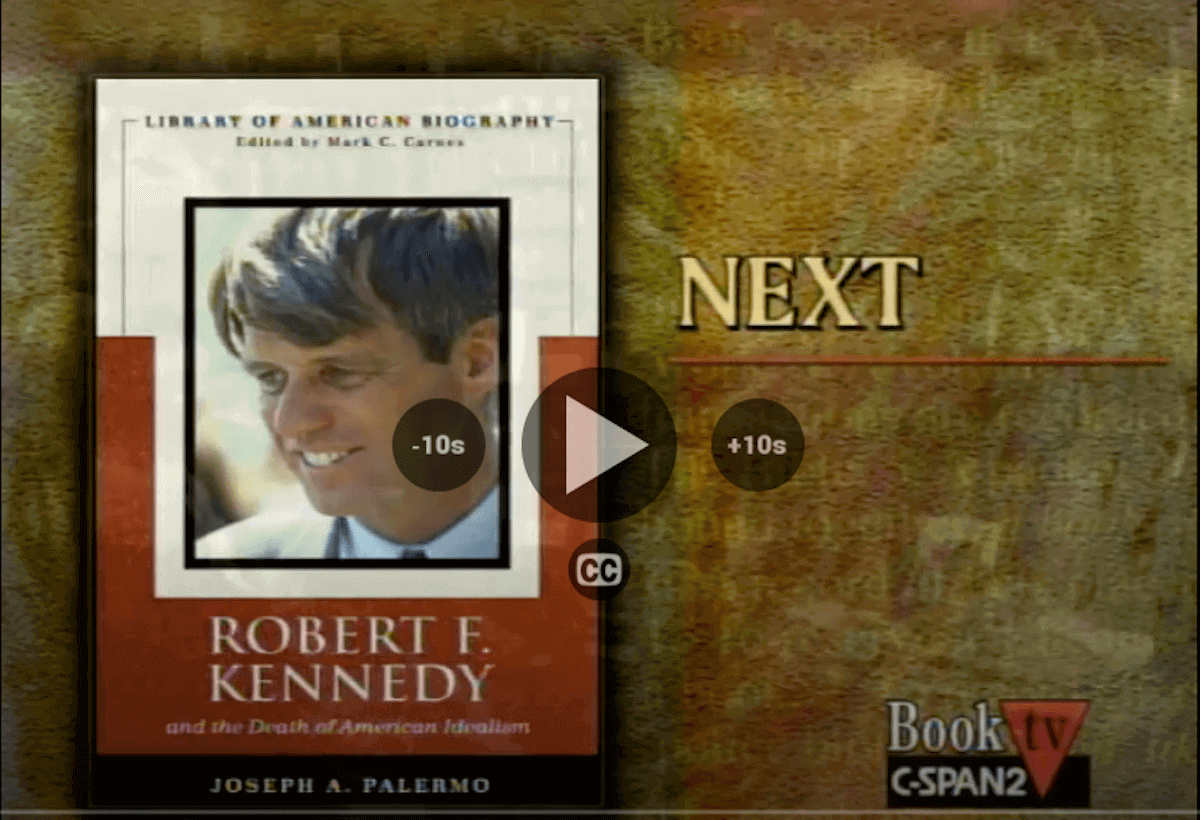
Joseph Palermo, Robert F. Kennedy and the Death of American Idealism
During this, the 50th anniversary of Senator Robert Kennedy’s assassination, we wish to raise awareness of his life and death. Joseph Palermo is one of the better authors on RFK, and this interview concerning his 2007 book is one way to begin that commemoration.
(Click image for video link)
-

John R. Bohrer, The Revolution of Robert Kennedy
 Next year will mark the fiftieth anniversary of the assassination of Senator Robert Kennedy. Consequently there have been three biographies published about RFK in the last 16 months. Last year we had the Henry Kissinger endorsed book by Larry Tye entitled Bobby Kennedy: The Making of a Liberal Icon. That work was so agenda driven, with so little new information, that it was quite difficult to read. (Click here for my review) A couple of weeks ago we had the publication of Chris Matthews’ book on RFK. Judging from Matthews’ book on John Kennedy, the volume does not hold much promise; but we will be fair in our upcoming review.
This past June, John R. Bohrer published an unusual book about RFK. Entitled The Revolution of Robert Kennedy, it focuses on the period of time from after President Kennedy’s assassination to the end of 1966. In other words, it covers only three years, but they were crucial years. To anyone really interested in RFK, it seems to me a volume of the greatest interest. Not only is it unique in its focus, but, unlike Tye, Bohrer has done some valuable research on his subject, and unearthed some new and important information about the senator. His book shows that you can reveal a lot about a person if you study your subject from a small window but tell more about that frame than others do.
In his introduction, Bohrer mentions something I was not aware of. Bobby Kennedy had offered to resign his position as Attorney General in advance of his brother’s 1964 reelection campaign. It had become clear to RFK that the opposition to his actions in the civil rights arena had done much to alienate both Democratic voters and politicians in the south. He saw this as being a serous liability to President Kennedy’s 1964 reelection. JFK refused to entertain the offer, but on November 20, 1963 Bobby Kennedy was despondent about the issue and still thought it was the right thing to do. After all, as the author notes, Bobby had run JFK’s 1952 senatorial campaign. In 1956, as a kind of dress rehearsal for 1960, he joined up with Adlai Stevenson’s presidential campaign. So he knew how brutal these things could become, and the impact his name and acts could have on the calculus for 1964.
Bohrer portrays the assassination of President Kennedy as something that seriously affected Robert Kennedy and made him rethink his ideas about politics, in the sense that ideas and ideals mattered. It should not be all about practicality and vote counting. In fact, one of the recurring words in his speeches after his brother’s death was “revolution”. In visiting Peru, he told students who had assembled to meet him that the revolution was their responsibility. They must be wise and humane so that it will be peaceful and successful: “But a revolution will come whether we will it or not. We can affect its character, we cannot alter its inevitability.” (Bohrer, p. 8) That speech was made while RFK was a senator from New York. Ask yourself the last time you heard a US senator encourage revolution anywhere in the world.
II
When Attorney General Robert Kennedy got the word of his brother’s death, he talked with his press secretary Ed Guthman. The latter commented that this might bring people together. RFK replied prophetically that no, this was going to make things worse. (Bohrer, p. 12) He actually pondered whether he should resign. But President Johnson sent Clark Clifford to persuade him to stay in his position. Within days, FBI Director J. Edgar Hoover had pulled RFK’s private line out of his inner office. And with that, the Attorney General realized that his power in the Justice Department had been severely curtailed. As long as his brother was president, he had some leverage over Hoover. Without the White House behind him, Hoover was free to chart his own course. (p. 15) Again, he thought of resigning. But he decided to stay on until the Civil Rights bill that he and his brother had worked so hard for was passed. A main thesis of Bohrer’s book is that although his brother was gone, and JFK had been the main fulcrum of his life, Bobby now began to search for a new rudder. And that would turn out to be keeping the legacy of President Kennedy alive. Because, as the book outlines, in addition to Hoover, RFK saw certain moves that President Johnson made as being counter to what his brother had been about.
One of these was the ascension of Thomas Mann on the Latin American desk of the State Department. Under President Kennedy, Mann had been Ambassador to Mexico. Within three weeks of his murder, Mann was promoted by Johnson to Secretary of State for Inter-American Affairs, and also to govern the US Agency for International Development. As Arthur Schlesinger has noted, and as RFK agreed, this double appointment seemed aimed at neutralizing JFK’s rather moderate Alliance for Progress program in Latin America. (Bohrer, p. 19)
In fact, a couple of months later, Mann held a conference for the State Department’s Latin American diplomatic corps. During his address, he did not mention the Alliance for Progress. He said the USA should not intervene against dictators if they were friendly to American business interests. But they should oppose communists whatever their policies would be. The speech was leaked to the press and characterized as advocating American commercial profits over Latin American political reform. The policy became known as the Mann Doctrine. (Walter LaFeber Inevitable Revolutions, p. 157)
Mann’s speech was instrumental in the American backed coup that occurred several weeks later in Brazil. The following year, Mann and Johnson worked together in order to halt the movement to reinstall Juan Bosch in the Dominican Republic. President Kennedy had ordered severe economic sanctions against the military plotters who had ousted the democratically elected President Bosch in September of 1963. In their opposition to Bosch, Mann and LBJ’s actions eventually led to a large military intervention by the Marines to halt his restoration. (See LaFeber, pp. 157-58; Donald Gibson, Battling Wall Street, pp. 78-80)
What RFK and Schlesinger understood was that Johnson’s favoring of Mann’s hardline approach was a direct challenge to what Kennedy wished to achieve with his Alliance for Progress. (For a long, detailed analysis of this program under JFK, see Schlesinger’s Robert Kennedy and His Times, pp. 494-574) One of the aims of the 1961 Alliance program was to stimulate economic growth by making loans to Latin American countries directly from the American treasury; this afforded lower interest rates and less stringent policy strictures than going through the World Bank.
To understand who Mann was and what he did in Latin America, one only has to comprehend that in reviewing the Alliance for Progress, historians like Schlesinger and LaFeber divide it in half: the Kennedy version versus the Johnson version. As Alliance administrator William D. Rogers stated about the Mann/LBJ takeover: “… a more dramatic shift in tone and style of US Alliance Leadership would have been difficult to imagine.” (Schlesinger, p. 721) As for President Kennedy’s oratorical hopes for the Alliance causing peaceful revolution, LBJ assistant Harry McPherson termed that: “A lot of crap.” As LaFeber notes, the Mann/LBJ revision of the Alliance consisted largely of dismantling it. But also in tilting it away from economic investment and toward military build ups. (LaFeber, p. 156) As Juan Bosch later noted of JFK’s intent to use the Alliance for Progress for democratization and structural change, those aims died with Kennedy in Dallas. (Schlesinger, p. 722) Bobby Kennedy predicted what the outcome of that abandonment would be: “The people of Latin America will not accept this kind of existence for the next generation. We would not, they will not. There will be changes.” Considering the violence that swept through Central America in the eighties, and the more peaceful revolutions that occurred in the new millennium, Kennedy was correct. (For the latter, see Oliver Stone’s documentary film, South of the Border.)
A significant achievement of the book is its detailed explication of Robert Kennedy’s opposition to what LBJ did in another theater of Third World conflict, South Vietnam. The accepted version of RFK’s thoughts and actions on this subject has been that his tacit acceptance of what Johnson did in Indochina from 1964-66 suggested that he was in agreement with it. With what Bohrer has unearthed for his book, that view is simply untenable today.
When young Adam Walinsky first joined Senator Kennedy’s staff, Kennedy told him that Johnson was more conservative than most people thought he was. (Bohrer, p. 141) Walinsky recommended that they not confront Johnson directly, but on the edges of policy, thus not inciting an open feud. So Kennedy took his time in making his disagreement over Indochina public. But as early as 1964, he told Johnson that he did not think the war should be escalated into a full-blown military conflict. (p. 70) Kennedy felt that raising the military component to a higher level would not work. There had to be some attempt at a political settlement. But also, our side had to offer more significant aid to the people of South Vietnam. Johnson feigned at agreeing with this approach. But, as we all know, that is not the path he took. (p. 152) In June of 1964, shortly after telling Johnson about his ideas, Attorney General Kennedy confided to Schlesinger that he believed “the situation in Vietnam may get worse and become a serious political liability to the administration.” (p. 72)
It did get worse after the Gulf of Tonkin Resolution was passed two months later, and Johnson began air attacks against the north. When the Viet Cong retaliated by detonating bombs on new American air bases, the retaliatory air attacks increased. Kennedy was also disappointed that, while escalating, Johnson seemed to rely for advice and courage on former President Eisenhower. (p. 152)
Journalist David Halberstam—who was a full-fledged Hawk at the time—got wind of this and criticized Bobby on the grounds of arrogance: How dare he think he was smarter than the likes of LBJ and Eisenhower? Unlike them, Bobby thought he could win the war without dropping tons of bombs and using overwhelming force. Needless to say, Halberstam’s half-baked ideas would lead to an epochal disaster. And only when it peaked out in 1968, with over 500,000 combat troops in Vietnam, and the war devolved into ”dropping tons of bombs and using overwhelming force,” did Halberstam begin to see that he and his colleague Neil Sheehan were utterly and completely wrong about a path to victory. But, to my knowledge, neither author ever admitted that the Kennedys were right.
III
Although some members of JFK’s staff wanted to resign after his assassination, the Attorney General advised them to stay on at least until the presidential election of 1964, if only in order to push Johnson into following through on President Kennedy’s goals on civil rights, unemployment insurance, and aid to education. In January of 1964, there was a boomlet to draft Bobby Kennedy as Johnson’s vice-president. Democratic leaders like Peter Crotty of New York, and Paul Corbin, who was working a write-in vote for Bobby in New Hampshire, were a major part of this effort. (Bohrer, pp. 31-39) Without visiting the state, Kennedy got over 25,000 write-in votes in New Hampshire. (p. 47) By April, a poll showed that 47% of the public wanted the Attorney General to serve as vice-president. An aide, Fred Dutton, advised him to make more speaking engagements to boost that figure. Up until that time, Kennedy had only made two speeches after his brother’s death. The first was little more than a courtesy appearance for the UAW, the second was a speech on civil rights. Kennedy now began to negotiate personally with GOP Senator Everett Dirksen over the civil rights bill in progress through Congress. (p. 55) To show how intent he was on seeing the bill pass, he visited Prince Edward County Virginia, a school district that had closed down its school system rather then integrate. The Kennedys had been instrumental in raising private funds to keep the system open. RFK visited the area again to present a large check to the Teachers’ Union to sustain issuing paychecks. Shortly after, in a visit to West Georgia College, he was asked about George Wallace’s popularity. He replied that people who vote for Wallace “…want the Negroes to be quiet, but the Negroes are not going to be quiet.” He then managed to continue his reply with what was now becoming his favorite word: “This is a revolution going on in connection with civil rights and the Negroes.” (pp. 58-59)
In an oral history given as he began to find his own voice, Kennedy stated the differences between him and the new president. He said LBJ had made it clear that it was not really the Democratic Party anymore. It was now an All-American party and the businessmen like it. All the people who opposed JFK now like it. He concluded with, “I don’t like it much.” (p. 60)
Those sentiments are remarkably consistent with what Senator William Fulbright would conclude in 1966 as he began to investigate the reasons for the escalation in Vietnam. Namely, conservatives opposed to President Kennedy were now supporting LBJ, while liberals who supported President Kennedy were now opposed to the new president. In the late spring of 1964, Bobby Kennedy began to formulate a countering political strategy: running for the Senate from New York. As he said, there he would be the “head of the Kennedy wing of the Democratic Party.” (p. 60)
Bobby Kennedy was leaving the Senate seat in Massachusetts to his brother Teddy. His brother-in-law, Steve Smith, had been at work organizing President Kennedy’s presidential campaign. New York was to be a big part of that campaign. So Smith now switched to recommending RFK run for the Senate in New York against Republican Kenneth Keating. After all, the Attorney General had lived in New York for about ten years. (pp. 62-63) Bobby now put out the word that he would resign from Johnson’s cabinet after the civil rights bill was passed and signed. As the author notes, one of the things that bothered the AG was that he believed that Johnson saw Vietnam as a military problem. Kennedy did not see it that way. He thought a purely military effort would not be successful. He also did not like Secretary of State Dean Rusk, who was also a Hawk on Vietnam. (pp. 70-71) Because of this, Kennedy was not happy when Johnson chose General Maxwell Taylor as the new ambassador to Vietnam. RFK liked Taylor because of his advocacy of low intensity warfare through Special Forces, like the Green Berets. But Kennedy thought that LBJ chose the general to give him cover for a military escalation. Which turned out to be the case. (p. 74)
The civil rights bill passed in the latter part of June, 1964. A few days later, Ben Bradlee of Newsweek asked Kennedy what he would like to do in life now. Kennedy replied that he would like to maintain all the energy and excitement his brother had generated and harness it. (p. 88) Bradlee printed this and Johnson was quite naturally perturbed. During the signing of the bill, LBJ let Bobby know how perturbed he was. Within earshot, he handed a signing pen to J. Edgar Hoover and told the FBI Director, “You deserve several of these.” If anything told the Attorney General he was persona non grata with the new power axis, that did. (p. 90) Further, Johnson now arranged the upcoming Democratic convention so that the salute to President Kennedy came on the last night, instead of the first. Johnson was worried because Bobby Kennedy was now outpolling Hubert Humphrey for vice president by a margin of 2-1. In July, Johnson called in the Attorney General and read off a list of potential vice presidential nominees he would not consider, with Bobby being on the list. (p. 100) The next month in Atlantic City at the Democratic convention, it was obvious that Johnson had made the right decision for himself politically. When Robert Kennedy appeared at the podium an oceanic ovation took place that lasted over ten minutes. In the public eye, Robert Kennedy was the heir apparent to his brother. It was time to begin his ascension to the throne.
IV
Robert Kennedy declared himself a candidate for the Senate on August 25, 1964 at his home in Glen Cove, Long Island. As he began to campaign, something unusual began to happen which no one recalled seeing before. In his public appearances, a reaction set in similar to Beatlemania: people began to tear his clothes off, rip his cuff links, and shake hands with him so hard that after doing this repeatedly, it caused the candidate’s hands to bleed. (p. 117) His managers, fearing for his health, demanded he not campaign each day and take off one day per week to recover.
His advisors also found out that Kennedy did not speak well in rehearsed commercials for the camera. But he did do well in unrehearsed Q-and-A periods after delivering a speech, especially with young people. So this is what they broadcast. (p. 124) Kennedy ended up defeating Keating by ten points.
Once in the Senate, RFK visited his brother’s grave at night. In fact, after a friend watched this happen once, he realized that the groundskeeper had an arrangement with Bobby to let him in when no one was there. (p. 147) In the Senate, Robert Kennedy decided to do what he could to maintain what he perceived to be his brother’s legacy. He fought against closing Veterans Hospitals for budgetary reasons. He got the administration’s requested allotment cut in half. He moved for adding testing provisions to a large education bill—and he got that through. He fought Governor Nelson Rockefeller on getting grants for New York state’s impacted poverty areas. He won that battle also. (pp. 148-50) By his eleventh week in office, the new senator was getting a thousand letters per day.
One of his pet issues was something his brother was an early advocate for: gaining home rule for Washington D. C. He said about this objective that, because the District of Columbia was predominantly African-American, home rule was being held back for the reason that “there are many people who don’t want progress made here.” (p. 161) He further added that, in his view, the problem fundamentally was not about race, but about poverty. There was a reason he accentuated this point. RFK had kept his notebook from President Kennedy’s last cabinet meeting. In his notes he had written down the word “poverty” seven times. So this was another way of continuing the policies his older brother had left behind. (p. 159) To him, if America did not attack the problems of broken homes in the ghetto, and the effect that had on education, then there would be no real improvement.
RFK and his brother Senator Ted Kennedy were very much involved in extending the Civil Rights Act with the Voting Rights Act of 1965. They also wanted to add a clause that would eliminate the poll tax. That failed, and an amendment had to be passed to eradicate the tax. (pp. 165-66) The bill passed in large part because of the 1964 electoral landslide, which gave the Democrats 68 seats in the Senate. As Walinsky later said, it was, “A crazy time. I mean we were going to reshape American society, all of us. There was a new bill every day.” (p. 166)
But there was a shadow hanging over it all. In early April of 1965, Johnson gave a hawkish speech about Vietnam. This was just after the first combat troops had landed at DaNang Air Base, and Rolling Thunder, Johnson’s air campaign against the north, was in its initial stages. Again, RFK advised Johnson against taking the militaristic path in Vietnam. Sounding like his fallen brother, he added that America should make it clear to the Saigon government that we will not be staying there to fight the war for them. He even asked Johnson to fire Dean Rusk and replace him with the more moderate Bill Moyers. (p. 168) But since he was a Democrat, and American troops had been committed into theater, he also felt obligated to vote for Johnson’s appropriations for escalation, even though he did not approve of the actions. He explained, “If I voted for it without saying anything, it would have appeared that I approved of it—which I didn’t.” (p. 175)
In his public speeches he again returned to his favorite word, revolution. He praised students who marched on Washington as demonstrating the “essence of the American Revolution.” (p. 180) At a commencement address he stated, “We are the heirs of a revolution that lit the imagination of all those who seek a better life for themselves and their children.” He added that there was also a revolution aimed against America. After hundreds of years of domination by the West he said, America buys 8 million cars per year, while those in formerly colonized countries go without shoes. He told the graduates, that they “have an unparalleled opportunity—not to find a world, but to make one.” (p. 179)
Kennedy had no qualms about taking on big lobbies or big business. He railed in public about the growing power of the NRA, a lobby which he characterized as spending huge amounts of cash distorting the facts, and which placed a minimal inconvenience above saving the lives of thousands of Americans each year. (p. 182) He called in the CEO’s of the Big Three auto companies and questioned them about how much money their companies were making while spending so little on research into safety matters. (pp. 200-01) He also moved against the tobacco companies. He was the first to propose a warning label on cigarette packages. (p. 203) Senator Kennedy even tried to get right-to-work statutes repealed. These were laws, mostly in the south, that weakened unions since they allowed employees in a shop to opt out of union membership while enjoying union benefits. (p. 203)
Reading Bohrer’s book, it is very hard to defend the MSM meme that RFK was a reluctant warrior on civil rights and the plight of African Americans. For the simple reason that he never let go of the issue. At times he went beyond what most civil rights advocates were talking about. Frequently, his ideas echoed Martin Luther King’s. At a VISTA indoctrination in Harlem, Kennedy said, “It is one thing to assure a man the legal right to eat in a restaurant: it is another thing to assure that he can earn the money to eat there…” (p. 205) He was sometimes at pains to delineate the differences for black Americans in the south versus the north. For example, he stated, “Civil rights leaders cannot, with sit-ins, change the fact that adults are illiterate. Marches do not create jobs for their children.” (p. 205)
In one of his most controversial statements about the issue, the former Attorney General talked about the differing ways in which the law is looked upon by middle class and wealthy Caucasians as opposed to downtrodden minorities. To the more privileged group, the law is looked upon as a friend who preserves and protects property and personal safety. But to the latter group, the law seems different: “The law does not fully protect their lives, their dignity, or encourage their hope and trust for the future.” (p. 206) Kennedy was attacked for this statement by several media outlets including the Christian Science Monitor, the New York Times and Time. They characterized his comments as a sitting senator encouraging youths to break the law. Kennedy stood by his statement. He said that the Watts riots of 1965 would be repeated “across the nation if we don’t act quickly.” (p. 206)
As noted above, another point that Bohrer’s book effectively contravenes is the idea that Kennedy was late to oppose Johnson’s escalation of the Vietnam War. As shown, Kennedy had done this in private with LBJ in 1964. That same year, in an address at Caltech, he did so publicly in an indirect way. He stated that guerilla warfare and terrorism arose from the conditions desperate people live under, and they cannot be put down by force alone. He then said, “Over the years, an understanding of what America really stands for is going to count far more than missiles, aircraft carriers and supersonic bombers.” (p. 190)
What surprised many commentators inside the beltway was that the first term senator’s attempt to forge his Kennedy wing of the Democratic Party was working. For example, one evening there were two competing Washington social events arranged. One was by the Kennedys; one by the wealthy Washington hostess and former ambassador to Luxembourg, Perle Mesta. Mesta had backed Johnson against JFK in 1960. The Kennedy gathering outdrew Mesta’s by a 10-1 ratio. (p. 183)
In the midst of this entire rising furor came the invitation to speak in South Africa.
V
Ian Robertson was a member, and eventual president, of the longstanding National Union of South African Students (NUSAS). From its founding in 1924, this group had opposed the apartheid system in their country. In July of 1965, Robertson extended an invitation to Kennedy to speak at Cape Town University in the spring of 1966. After doing so, he challenged the authorities to deny Kennedy entry. Robertson was now placed under house arrest. Not only did Kennedy accept, he made the invitation public, thereby making it harder for the South African government to deny him entry. Reporter Murray Kempton wrote, “It is unlikely he will ever go. What is extraordinary is the fact of the invitation …. Senator Kennedy has a name at which lonely men grasp in their loneliness.” (p. 227)
Kempton was wrong. Kennedy had every intention of speaking in South Africa. But at the time that journey was being arranged, RFK also decided to also take an expedition to Latin America. What Kennedy did south of the border, and the very fact that he was determined to go to South Africa—these factors defined who he was at this time, and also where he was in the makeup of our political system. As we shall see, he had by now clearly inherited his brother’s mantle, and in some ways, gone beyond it.
Before going to Latin America, Kennedy was to be briefed on the political conditions in the countries he was visiting, and also what the State Department wanted him to say and not say while he was there. So he and two assistants showed up at the State Department and were briefed by Jack Vaughn. As Vaughn went through the countries Kennedy was to visit, and advised him on what to say if anyone asked him about the American invasion of the Dominican Republic, the senator began to fully understand how much Johnson had overturned President Kennedy’s Alliance for Progress program. By the time it was ending, RFK registered his disgust at what had happened:
Well, Mr. Vaughn, as I see it, then, what the Alliance for Progress has come down to is that you can abolish political parties and close down the Congress and take away the basic freedoms of the people and deny your political opponents any rights at all and banish them from the country, and you’ll get a lot of our money. But if you mess around with an American oil company, we’ll cut you off without a penny. Is that it?
Vaughn then replied, “That’s about the size of it.” Walking out of the meeting, Kennedy said to one of his assistants, “It sounds like we’re working for United Fruit again.” (p. 231)
What Kennedy said and did while on this voyage south seemed designed to show that he, for one, was not working for United Fruit. In addressing crowds in Lima, Peru, he told them to emulate the men who liberated Latin America from the Spanish Empire: San Martín and O’Higgins. He urged them on by saying, “You can do as they can. You cannot do less.” He then went beyond that. He urged them to emulate the justice of their Indian ancestors, the Incas, who punished nobles more harshly than they did the peasants for breaking identical laws. (p. 233) In Lima, Santiago and Buenos Aires, he repeated what had become his motto: “The responsibility of our times is nothing less than revolution.” (p. 233)
In speaking of the history of the United States, he told crowds that the revolution in the American political system that they should look at was Franklin Roosevelt’s New Deal. Because that example demonstrated “the power of affirmative free government.” To RFK it was a hallmark of the state combining the twin ideals of social justice and liberty. (p. 234)
In Peru, Kennedy made part of his itinerary a visit to the high altitude city of Cuzco, the capital of the Inca civilization. There, young children followed him shouting “Viva Kennedy”, ripping his pants and tearing his cheek, drawing blood. On their way back down, he stopped to talk to some peasant farmers tilling the land. When they told him they paid high prices for powdered milk donated through the US Food for Peace program, he turned to the Peace Corps aide with them and told him to look into the matter. He then asked aloud, “What happened to all our AID money? Where is it going?” He then added that the ambassador to Peru, Wesley Jones, “might as well have been the ambassador from Standard Oil.” (p. 235)
The high point of the Peru part of the visit was a meeting with intellectuals and artists in Lima, at a gathering that resembled a salon on the west side of Manhattan. Bobby was being assailed about all the problems that the Rockefeller owned oil companies had caused and mistakes America had made. RFK asked why they always looked to the USA first. The answer was that the USA would not let them do anything about Rockefeller’s International Petroleum Company. Kennedy replied that they could not have it both ways, cursing the USA and then blaming the State Department. The solution was simple: nationalize the oil company. Someone responded that David Rockefeller had been there and warned them if they did anything to his oil company all aid would be cut off.
The senator’s response to this should serve as a model to any doctrinaire leftist who still thinks that the Kennedys were part of the Eastern Establishment. He tartly replied, “Oh, come on! David Rockefeller isn’t the government. We Kennedys eat Rockefellers for breakfast.” (p. 235)
In Chile, he offered to debate with communist students on an equal time basis. But after he gave his speech and offered the time to the other side, no one took him up on it. (p. 240) Then, in the mining town of Concepcion, he went down into a coal mine. When he came back up he said, “If I worked in this mine, I’d be a communist too.”
In Brazil, three youths were arrested on charges of plotting to kill the senator. Bobby asked that they be released. They were not, but the charges were then lessened. RFK then sent a messenger to the jail to ask them to write down any questions they had about him. (p. 244) He then visited a sugar cane field and talked to the workers. They told him that their landlord was paying them three days wages for six days work. The senator walked directly to the property owner’s house and started yelling at him for not paying his workers a decent wage. (p. 245) He then went to the presidential palace. After visiting with the newly installed government ushered in by the previous year’s CIA sponsored coup, he was being driven back to his hotel when he saw some of the crowd being struck by soldiers trying to keep them away from his car. He jumped out of the car and shouted, “Down with the government! On to the palace!”
His visit to Latin America was so incendiary that much of it was not reported in American newspapers. (p. 245)
VI
At the time of his death in August of 1965, United Nations representative Adlai Stevenson was working on at least one—perhaps two—ways of negotiating out of Vietnam. One was through the UN Secretary General U Thant. A second rumored one was initiated by Ho Chi Minh, using Italy and India as go-betweens. (p. 250) Bobby Kennedy heard about these through his contacts in the White House. He was very disappointed they came to naught, and shared his chagrin with columnist Joe Kraft. Kraft then wrote a column in which he said that the senator opposed what Johnson was doing in Indochina, but could not confront the White House about it out of loyalty to the president and also to his party.
In December of 1965, echoing Martin Luther King, Kennedy said that we should not forsake the domestic battle against poverty for a war abroad because it would divide the nation. (p. 252) Heeding Kennedy’s words to accept an offer for a bombing halt at Christmas 1965, Johnson did so, although he told Defense Secretary Robert McNamara it went against his “natural inclinations.” Both Senators Fulbright and Kennedy urged Johnson to use the interim halt as a negotiating tool for some kind of settlement. When LBJ resumed bombing at the end of January 1966, Kennedy said if bombing Indochina is our answer to the problem there, we were headed for a disaster. He added that, “The danger is that the decision to resume may become the first in a series of steps on a road from which there is no turning back—a road which leads to catastrophe for all mankind.” (p. 264)
The next month RFK called a press conference. The reaction to this conference shows just how much Johnson and the unquestioning press—specifically David Halberstam and Neil Sheehan—had tilted the scales toward intervention. This press conference was called a few months after Halberstam had published his book, The Making of Quagmire. That book was an all out attack on American policy toward Saigon from the right. Kennedy suggested a power sharing coalition government in South Vietnam, which included the communists. (p. 269) In retrospect, this was a very sensible solution for everyone: Hanoi, Saigon, and the USA. Kennedy was viciously attacked by both the MSM and Washington politicians, even those from his own party. Vice-President Humphrey said this would be like placing an arsonist in the fire department. The Chicago Tribune called him Ho Chi Kennedy. Forgetting Vietnam was one country, The Washington Post said it would be rewarding aggression. (pp. 271-74).
Incredibly, Kennedy visited both Ole Miss and the University of Alabama in 1966. At Ole Miss, he revealed to the crowd just how politically motivated Governor Ross Barnett was before the James Meredith riot broke out there in 1962. In negotiations with Barnett, the governor had asked Kennedy if he could have a federal marshal pull a gun on him so it would look like he was physically intimidated into going along with integrating the college. Kennedy was not responsive. So Barnett called him back and said, no, he wanted all the marshals to pull guns on him. The students roared with laughter at that one. (p. 285)
At Christmas, 1965, Kennedy threw a series of celebrations of the holidays in the Bedford Stuyvesant area of Brooklyn. It was his way to begin to follow through on President Kennedy’s nascent attempt at a war on poverty. It was his way to generate interest in a developing program to attack the poverty cycle in the inner cities. He gave a series of three speeches on the subject. The aim was to break up the ghettoes and offer subsidies to those who wished to leave. For those who stayed, Kennedy wanted to give more aid to schools to improve education, offer tax breaks to companies to relocate there, and free legal advice for tenants to fight predatory landlords. The idea was to go beyond the New Deal. He envisioned this program to be a combination public-private community development corporation, the aim being to offer a diversified program to end inner city poverty and eradicate ghettoes. (pp. 255-61)
There can be no better way to end this review than to describe Kennedy’s eventual journey to South Africa at the request of the courageous Ian Robertson. I should preface this by saying Kennedy really had nothing to gain from this visit. The South Africa cause was so vague and nebulous in 1966 it did not even register as a blip on the political screen. And, due to what he and his brother had done from 1961-63, there was no domestic political benefit for him because he already had the African–American vote tied up.
The South African government denied any American reporters entry into the country. Four who tried to sneak in were rounded up and placed on a plane to Rhodesia. (p. 294) The visual record we have of this momentous event consists largely of grainy black and white home movies. No member of the government would meet with him. And the only press representatives on hand were those who supported apartheid. Unlike in the USA and Latin America, spectators did not rush to grab him, since it was considered an offense for a black man to shake hands with a white man. At his first speaking engagement Kennedy stood an empty chair next to him to signify the absence of Robertson. Robertson had been charged with the Suppression of Communism Act. Which evidently meant that, in South Africa, RFK was considered a communist.
When he visited Robertson at his apartment, the government would allow no one else to be present, not even friendly journalists. The first thing he asked Robertson was if the place was bugged. He then told him to stomp his feet to throw the surveillance off temporarily. Kennedy then asked him questions about his country and how he felt about Vietnam. He told him how badly he felt about his house arrest. He closed the meeting by giving him a copy of President Kennedy’s book Profiles in Courage. It was signed by Jackie Kennedy. (p. 295)
He then went to make his memorable speech at the University of Cape Town—to, of course, an all white audience. That speech has one of the most brilliant openings in the history of modern American oratory. He began by saying he was glad to be in a country settled by the Dutch, taken over by the British, and now a republic. A nation in which the natives had been subdued and with whom relations remained problematic; a land which defined itself by a hostile frontier; a land which once imported slaves and now had to solve the residue of that problem. He then stopped, smiled, and said, “I refer, of course, to the United States of America.” (p. 295)
He then talked about the responsibilities of a republic, which South Africa had become in 1961. And how that model of government was intended to guarantee individual rights for its citizens. He added that he meant all of the citizenry. He then talked about governments that denied freedom and would label as “‘communist’ every threat to their people.” He continued with how his family had felt the sting of prejudice because they were looked down upon as being Irish in New England. He mentioned the fact that Martin Luther King had won the Nobel Prize because of his struggle in the USA. He ended his speech in South Africa with the following:
Each time a man stands up for an ideal or acts to improve the lot of others or strikes out against injustice, he sends forth a tiny ripple of hope, and crossing each other from a million different centers of energy and daring, those ripples build a current which can sweep down the mightiest walls of oppression and resistance.
He then closed with, “Each of us have our own work to do.”
This is a fine book. The best volume on Robert Kennedy I have read since Arthur Schlesinger’s two volume set in 1978. If you want to know about Bobby Kennedy’s life, the Schlesinger book is your choice. But if you want to know who RFK was in his last years, this is the book to read. No politician I know of ever did or said these kinds of things at home and abroad. I strongly recommend the book as a Christmas gift for your children and younger loved ones. Through it, they will be reminded that, not that long ago, the political spectrum was not defined by the likes of Hillary Clinton and Donald Trump. And you did not have to hold your nose before entering the voting both. We all owe thanks to John Bohrer. He is to be congratulated for capturing the essence of a good man who became a great man. The vivid memory this book draws reminds all of us just what America could have been.