President Trump issues an executive order to begin to declassify all records on the JFK case in 15 days and all classified records on the MLK and RFK case in 45 days. Read more.
Tag: RFK ASSASSINATION
-
Trump’s statement regarding document release
Donald Trump says everything is coming out, JFK, RFK, MLK. Whew, did Bobby Kennedy have an influence on this decision? Read more.
-
RFK Jr. and the Unspeakable: Why This Historic Moment Matters
When Bernie Sanders ran for president in 2016, he raised nearly a quarter of a billion dollars in grassroots donations to challenge Hillary Clinton for the Democratic nomination. After he dutifully backed out and endorsed the candidate chosen by the party’s super delegates, a lot of his supporters reportedly ended up voting for Donald Trump in November. When a reporter asked him how he felt about ex-members of his camp voting against Clinton, Sanders answered: “Wrong question.” If so many of his followers had decided to turn to someone whose policies were anathema to his own, he asked, then they must have been pretty angry about something, right? The media, he suggested, should figure out what ordinary voters are so mad about instead of blaming him and his populist movement for Hillary Clinton’s defeat.
While it’s true that the campaign of Robert F. Kennedy Jr. and Nicole Shanahan has not raised Bernie-levels of grassroots cash, it’s also true that ordinary voters have less disposable income than they did eight years ago. What RFK Jr. did do, however, was gather over a million signatures nationwide through the mobilization of some 100,000 volunteers for access to the ballot in all 50 states and the District of Columbia. Sanders never had to worry about ballot access in the Democratic primaries. For some reason, RFK Jr. was not only shut out of the party’s nominating process; he also had to qualify the “hard way,” as an independent, when he finally gave up on the once-upon-a-time party of his father and uncle.
Thus began one of the ugliest and most vicious assaults on a presidential candidate in recent memory. Even though he decided to run as an independent, the Democratic National Committee (DNC) launched a well-financed “lawfare” campaign through the courts to block him from the ballot in the general election. This was when he was taking more voters away from Trump than Biden! DNC-friendly mainstream media lent this discrimination campaign a helping hand by censoring him from their airwaves as much as possible. Joe Biden disgraced his presidency by denying him Secret Service protection until two days after the assassination attempt on Trump, and nearly 15 months after Bobby announced his own candidacy. Now that he’s formed a coalition with Trump, it’s fair to echo Sanders and say his supporters might have been a bit angry also.
As someone who has volunteered for Kennedy’s campaign since shortly after he declared his candidacy, I confess to brief shock at the announcement that he was suspending his run, endorsing Trump, and calling on his supporters to refrain from voting for him in about ten “battleground states.” Those ten might include my own, Virginia, where “RFK2”– as he’s sometimes known–polls relatively high. But I’m over it.
In 1968, many supporters of his liberal father’s presidential campaign transferred their vote to George Wallace, very possibly in sheer protest at RFK’s untimely and highly suspicious demise. For all his faults, New York real estate mogul Donald Trump is neither the racist Alabama governor nor his running mate, warmongering Gen. Curtis LeMay, who may have been smoking a cigar in the autopsy room during the postmortem exam of President John F. Kennedy, a man he hated. Trump has never smoked, and Wallace would have thoroughly disdained Trump’s Oval Office photo ops with African-American admirers.
With his stance on tariffs and no taxes on tips or on Social Security, Trump claims the mantle of a populist; and whether he is or not, elites do not like populists. They did not like Sanders either. But the neocons among the “Never Trump” crowd – e.g. Bill Kristol and John Podhoretz – despise Trump mostly for what they perceive as his “nativism,” which embarrasses them as members of the urban-liberal intelligentsia. Trump’s potential isolationism (he started no new wars) is the worst of it and frightens them to this day. Yet even a populist-nativist isn’t necessarily a “threat to democracy.” I think many people sincerely believe Trump is a threat, and I respect that, but I don’t see it myself. January 6th was a tragedy, and Bobby Kennedy Jr. has described Trump’s actions during that violent, vandalistic riot as “reprehensible.” Personally, I’ve never believed Trump intended or foresaw what happened, even if he bore blame through his recklessness or negligence.
Moreover, three and a half years later, we have to ask who poses the greater threat to basic freedoms? Was it those involved in the insurrection or the authorities cracking down in its aftermath?
A recent article by Margot Williams at Jefferson Morley’s JFK Facts (a Substack I write for), explains the excesses of federal law enforcement, which even now is rounding up and arresting people who did no more than enter the Capitol and walk around after a (small) advance mob broke in a door with a battering ram under the eyes of the immobile police.
RFK Jr. and the JFK Assassination
At a fundamental level, ending the toxic polarization of American society over the last decade and figuring out how to end it has always been the main theme of the RFK Jr. campaign. But the causes of our current social crisis are deep-seated, rooted in history, and I think they find their origin in the assassination of President Kennedy in 1963, before I was even born. After much study, I now hold the sincere conviction that this isn’t just a historical issue but an extremely important current one too. Every historic episode is both a cause and an effect, but many of our problems lead through November 22, 1963, when the fundamental nature of our government changed. Jeff Morley, who has done invaluable pioneering research into the JFK assassination, opines that it isn’t the most important issue facing America today: people have bills to pay, jobs to hold down, kids to put through school. When ordinary folks are thinking day-to-day about making ends meet this week, they aren’t thinking about a violent event from generations ago. I understand that.
But whatever John Q. Citizen is thinking as he goes about his day, I respectfully disagree with the JFK Facts editor-in-chief. It doesn’t necessarily follow that an issue is less important because most Americans think so. The “Great Crime” must stay alive as an issue in current U.S. politics and society until it’s resolved to the satisfaction of serious historians and researchers at large. Only one campaign now pledges to address that: Donald J. Trump and his new ally, Robert F. Kennedy Jr.
The murder isn’t just a fetish for conspiracy freaks and assassination hobbyists. It is a seminal event that still affects us. Thanks mostly to the political and media influence of RFK Jr. this election cycle, it is a live issue now as well. It may be a long shot to expect Trump and the GOP to seriously do any justice to it, but a long shot is better than no shot at all. Maybe a re-elected President Trump will have no power to force disclosure on the 61-year-old atrocity; because maybe, as some believe, all presidents are only cyphers of the national-security state. But while cynicism makes some people feel superior, it doesn’t do it for me.
Regarding transparency over the still-withheld files related to the assassination of JFK, Trump has already disappointed “bigly.” His postponement of full disclosure in 2017 only aroused more public discomfort and mistrust. Yet if Trump was bad on the JFK files, President Joe Biden has proven to be worse. He is not only postponing release of the remaining withheld assassination records but also announcing the “final certification” under the JFK Records Act. Congress’s unanimous passage of that law in 1992 prevented President George H. W. Bush from vetoing it, and Biden himself voted for the law as a senator. Worse, instead of honoring the spirit and letter of the law to serve the public interest–as attorney Andrew Iler showed–Biden devised a new scheme to conceal the records and replace the JFK Act.
This scheme, known as the “Transparency Plan,” was devised by the CIA-led national security apparatus and essentially guts the 1992 federal statute by burying its timeframes and requirement of periodic review. By executive order, Biden handed all declassification decisions over to the CIA and other unelected agencies in control of relevant records, washing his hands of the process forever. In doing so, Biden not only grievously abused the public trust. He probably didn’t even see any records before making his fateful decision. Already in cognitive decline, he very likely just signed where he was told to sign and forgot about it. At least Trump claimed he saw something, at least according to Judge Andrew Napolitano. It’s just that what he saw was so bad, he felt he had to bow to the will of the national security state and keep it under wraps.
But Biden? Nothing. Now his vice president, the Democratic nominee for his job, is eventually going to have to make her own position known on JFK. Does Kamala Harris even have an opinion? Born after the assassination, she has – to the best of my knowledge – never expressed any view at all. With any luck, the subject will come up in the upcoming Trump-Harris debate, but how will Harris “get out in front” on the issue when her boss has already tried to bury it? Trump will be able to comment first-hand, but I see no cause for optimism from Harris. I therefore have little compunction over favoring Trump right now.
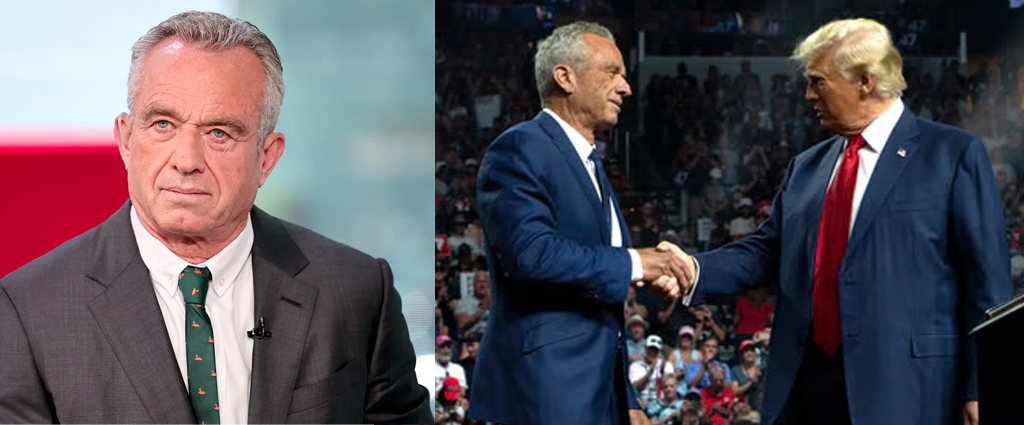
The issue of transparency in the JFK assassination isn’t the exclusive reason I decided to support RFK Jr. for president, but it’s at least tied for first place. I already knew his position on his uncle’s assassination – as well as his father’s – and that made him a qualitatively different and unprecedented kind of candidate. But on Friday, August 23rd, confronted with the image of him on stage with Donald Trump in Arizona, I admit I trembled a bit. The former president graciously introduced RFK Jr. as having “lost his father and uncle in service to our country.” He vowed to establish an “independent presidential commission” to revisit the JFK assassination and release all the withheld records. I imagined RFK Jr. standing there, waiting to speak, exhilarated at coming as close as anyone in the last 60 years to doing what Dorothy Kilgallen said she was going to do right before her mysterious death.
Maybe Bobby wasn’t thinking that at all, and when he took the podium, he never even mentioned the JFK assassination. He talked, as usual, about public health, endless war, and censorship. But I wanted to believe he was consciously hoping President Trump would speak to that morbid tragedy in Bobby’s own family for him, and that Bobby – like all of us outside the inner circle of the national security state – still put a top priority on finding out what happened to his uncle. This was probably the best chance he had ever had in his lifetime. Whether Trump was only prompted by the recent attempt on his own life seemed immaterial at that moment. The point was: millions of people were watching and listening. It was live.
Again, full disclosure over JFK’s murder continues to be a matter of vital public interest. Without at least an official rejection of the official history as currently disseminated by government and mainstream media, Americans won’t even have a version of events that is closer to the truth than what their government now peddles to them. We will continue to languish in a social sickness complementary to the physical degradation Kennedy so passionately wants to reverse, and about which he continually warns us. We need the topic of the JFK assassination in the news cycle now more than ever, so that it resonates into the next administration and stays in the public memory, no matter who wins. In Oliver Stone’s JFK, Jim Garrison paraphrases Tennyson: “Do not forget your dying king.” To find out what happened, we have to resist forgetting.
Kennedy, Trump, and Harris
Whatever the political fallout from the Trump-Kennedy coalition (liberal MSM commentators quickly united in their attacks), I have no regrets about supporting RFK Jr.’s campaign. The dominant experience of working with other RFK Jr. volunteers was, primarily, an absence of hate. Plenty of fellow campaign workers had voted for Biden in 2020, and plenty of others for Trump. But when handing out campaign literature or soliciting signatures for ballot access, the only hate we ever encountered came from obvious Biden supporters. They would hiss at us, sometimes spitting inadvertently in the process, their faces red as tomatoes, telling us we were a “disgrace” or “dangerous” or should be “ashamed.” Trump supporters would sometimes refuse to sign our petition forms, but they were never mean or unhinged. The “Bidenista” passers-by were manifestly contemptuous, sometimes calling us “nuts” or “crazy” even as they boiled over right in front of us.
How different from that experience could Bobby Kennedy’s have been at the level of the DNC high grandees? He and running mate Nicole Shanahan both said that the Biden-Harris people had refused even to speak to them, whereas the Trump campaign was at least willing to meet. Under these circumstances, why would anyone blame RFK Jr. for giving up on cooperation with the arrogant Biden-Harris cabal? Would anyone passionate about issues of vital public interest, who meets a brick wall from one side and an ajar door from the other, go on bashing his head repeatedly against the bricks and mortar?
Maybe a significant percentage of RFK Jr. supporters now refuse to back him for endorsing Trump as a means of advancing his own agenda of peace, public health, and free speech. I haven’t met any yet. But at the end of the day, faced with the Democratic Party’s well-financed litigation drive to keep him off the ballot, plus censorship by overwhelmingly DNC-friendly mainstream media, Bobby evidently felt he had to choose between doing something or doing nothing. He decided to do something, to take a chance on Donald Trump honoring an agreement to prioritize the issues closest to him. Even if Trump reneges on his pledge of full disclosure in the JFK assassination, I think Bobby did the right thing.
The drab, uninspiring Democratic Party long ceased to be the party of RFK Jr.’s uncle and father. It is not the party of FDR, JFK and RFK. It is the party of LBJ, a corrupt, brutal scoundrel desperate to use the White House for the public adulation he craved. The long-term symptom of LBJ is the Democratic Party of today. And the DNC hit squads are part of this LBJ apparatus. (NY Times, May 2, 2024 online edition or May 4, 2024 print edition, article by Michelle Cottle: “The Drive to Tell Voters What They Don’t Know About R.F.K. Jr.”)
It is largely a party made up of elites. Nancy Pelosi ushered out Biden, and after, there was no competition from anyone to take the spot. Not even a token of a debate took place. And, if one recalls, there was no debate during the Democratic primaries, or what passed for primaries. Harris was anointed, she was not in any way elected. How interesting that process becomes when compared with how Robert Kennedy Jr. was treated in the media. This is democracy?
The censorship Kennedy speaks about is not conspiracy theory. It’s real and palpable, and Facebook CEO Mark Zuckerberg now confirms publicly that “deep state” goons pressured him to censor content related to COVID-19 and other subjects. Moreover, the “censorship-industrial complex” (as RFK Jr. calls it) traces its roots to November 22, 1963. In interviews, Bobby has repeatedly recommended James Douglass’s influential book, JFK and the Unspeakable (2008), which refers to a systemic evil, a “void” permeating official policy and discourse, making it soulless and hollow. The assassination put a kind of “final seal” on what had built up over the previous decade and a half, as an unaccountable “deep state” acquired more and more power at the expense of elected authorities. That power manifests itself everywhere, particularly through censorship. Scholarly writers, researchers, and historians of the JFK assassination are marginalized and deprived of the big, lucrative book deals and promotions, as well as prestige. There is no meaningful difference between “muzzling” these writers and state censorship.
Ironically in the so-called “information age,” the idea that certain things are “unspeakable” is still strong. Six decades after the assassination of JFK, and 56 years after the murder of RFK, Bobby Kennedy Jr. has exhumed a range of issues buried under a mass of mainstream media talking points developed over generations. Possessed of a collective blindness residual of the Cold War, most Americans have ignored the “forever wars,” dietary and environmental toxicity, the waste of our economic resources, and the decline of our civic consciousness. A drug-addled, unhealthy nation, we’ve received a big wake-up call from RFK Jr., who has brought issues of vital public interest back into popular discourse. For instance, the revolving door between big pharma and public health agencies.
The issues that Kennedy leads with – (1) the war in Ukraine, (2) chronic illness and disease, and (3) the mainstream-media censorship regime – are all the product of the rise in power of the unelected national-security apparatus, which secured its dominance over the political system after passage of the National Security Act of 1947. President Truman signed it into law, giving official birth to the Central Intelligence Agency. As soon as President Kennedy was assassinated, Truman sat about writing an op-ed for the Washington Post, essentially lamenting the effects of a law he was responsible for enacting. He suspected the CIA was involved in the murder of his young successor, and that suspicion permeates his op-ed.
The CIA had gradually accumulated more and more power under President Eisenhower, who would warn the public about the dangers of the “military-industrial complex” in his farewell speech in January 1961. By the time JFK attempted to resist its power, it was too little, too late. The title of David Talbot’s book, The Devil’s Chessboard: Allen Dulles, the CIA, and the Rise of America’s Secret Government (2015) is no cliché. Our unaccountable “secret government” is the biggest open secret in America today. Only one candidate talked about any of this in any detail, and that is RFK Jr. It was probably that, plus his opinion of Anthony Fauci that sealed his fate at the starting gate.
The Biosecurity Agenda and the ‘Anti-Vaxxer’ Pejorative
One issue remains largely “unspeakable,” as mainstream media and government barriers to talking about it are still mostly intact. It is what RFK Jr. calls the “Biosecurity State.” The most recent manifestation is the attempt by governments worldwide to restrict freedom in societies over which they preside. The method is known as “PPR” – pandemic preparedness response. The World Health Organization declares a “pandemic,” and national governments stand ready to impose a series of measures, including lockdowns, school closings and other mandates, thus curtailing basic liberties. Behind PPR and restrictions on human freedom stands the obscenely profitable pharmaceutical industry – “Big Pharma” – which rolls out “cures” as soon as it can scare everyone enough. The gravy train is then off and running again. Anyone who dismisses as “conspiracy theory” the idea that Big Pharma is irretrievably corrupt should read a book by a bête noire of Warren Report dissenters everywhere, Gerald Posner’s Pharma: Greed, Lies, and the Poisoning of America (2020). When Kennedy calls Big Pharma a “criminal cartel,” he’s being gentle.
Many educated people seem to shrug all this off, but many of us are sincerely alarmed. RFK Jr.’s recent book, The Wuhan Cover-Up and the Terrifying Bioweapons Arms Race (2023), traces the historical continuity between Pentagon and CIA experimentation and abuses at Fort Detrick, Maryland. This began around the late 1940s,and it spread to the Wuhan Institute of Virology in China in 2020. Which is where former National Institute of Allergy and Infectious Diseases (NIAID) director Anthony Fauci took his “gain of function” research after the Obama administration imposed a temporary moratorium on that dangerous activity within the United States. Kennedy’s previous book, The Real Anthony Fauci: Bill Gates, Big Pharma, and the Global War on Democracy and Public Health (2021), gives scholarly content to a now-widespread perception that the longtime, powerful, and highly-paid NIAID chief is corrupt, self-serving, and responsible for serious public health policy abuses in service to the bottom line of both himself and Big Pharma e.g. the whole disastrous AZT as a cure for AIDS debacle. Fauci has never even hinted at suing Kennedy despite the book becoming an instant bestseller. And it is not just RFK Jr. who has made these charges against Fauci. Senator Rand Paul has done the same against both Fauci and Gates. Senator Paul wanted to charge Fauci for lying to congress about gain of function research and how this caused the breakout of CV 19 in Wuhan.
Although RFK Jr. has never led with the issue specifically, he is not shy about explaining his vaccine safety advocacy in the face of accusations that he is a “nut” or (per the first sentence of his Wikipedia page) a “conspiracy theorist.” Most citizens of the industrialized West have been vaccinated for different things at various points in their lives, and I make no exception of myself. Neither does RFK Jr. But the COVID-19 pandemic ushered in tyrannical new rules about the subject.
RFK Jr.’s Children’s Health Defense (CHD) advocacy group and its online periodical, The Defender, offered scholarly analysis for anyone entranced by the three-letter public health agencies’ scare-mongering for Big Pharma. But they had to be aware of CHD in the first place. CHD should have acquainted everyone with the “Biosecurity State” before censorship of mass media and internet in the democratic West really ramped up, since Kennedy had been warning of it for years. But social media – to say nothing of the MSM – suppressed it. Those of us who had never felt blunt censorship in America could see social media “moderating” or deleting posts for even questioning public health policy by the end of 2020. The words “false” and “falsely” became mantric in MSM, intensifying after President Trump publicly charged that the 2020 election result reflected fraud.
The censorship situation in the West became extreme after the “warp speed” rollout of the COVID-19 vaccines, when even wire services openly branded anyone daring to question their safety or efficacy “conspiracy theorists” promoting dangerous views. RFK Jr. became super-prominent among the targets of coordinated attacks by legacy outlets of America’s ostensibly “free press.” The pharmaceutical industry’s power over supposedly neutral organizations like Reuters and AP had been more subtle, but by the end of 2020, the “corrupt merger of state and corporate power” was brazenly and frighteningly visible every day. Another target was author Naomi Wolf, who had written more than one bestseller and was an advisor to both Bill Clinton and Al Gore.
Friends’ acceptance of my choice to rely on my innate immune system in confronting COVID-19 has, at least, reassured me. Others have been less fortunate. The family of an unvaccinated American friend overseas told him if he wanted to come home for Christmas, he had to be COVID-jabbed. He spent Christmas of 2021 alone in a country that doesn’t even celebrate it.
As time has passed, and more and more vaccinated friends have contracted COVID: Jim DiEugenio contracted it twice. The realization that people like me aren’t as loony as they first imagined has become more ingrained. The full symptoms of my own bout with COVID-19 lasted four or five days. After no longer testing positive, I felt even more confident of the benefits of strengthening natural immunity.
Even vaccine enthusiasts have to admit to a level of adverse side effects never seen before, since this is a matter of official record, not theory. It isn’t necessary to indulge in conspiracy theory to conclude that the COVID-19 vaccines have never been proven totally safe. The CDC’s own Vaccine Adverse Events Reporting System (VAERS) has received more reports from the COVID-vaccinated than for all previous vaccines combined, yet in the late 1970s, the “swine flu” vaccine was withdrawn after a tiny number of recorded Guillain-Barré Syndrome (GBS) cases. Many more GBS cases have been recorded for the COVID-19 jabs. Again, the best explanation for why the COVID-19 vaccines survived is record levels of state and corporate stipulation. No matter how much others claim to “believe in” the COVID-19 vaccines, there is no basis for “trusting” the companies producing them. They trade in year-end profits, not long-term public health. Whatever COVID vax advocates argue, skeptics have the right to remain skeptical, especially since we cause no increased harm to anyone by remaining “jab free.”
Warp Speed and Political Orthodoxies
One does not have to conceive of a “plandemic” designed and implemented by a “high cabal” to reduce the world’s population through vaccine mandates. Corruption and greed can explain what happened, and why it should not happen again. After all, Operation Warp Speed broke several rules in its haste to come up with a vaccine. But there is still an important point to be made, and I felt it most intensely when I attended RFK Jr.’s “Defeat the Mandates” protest in front of the Lincoln Memorial in Washington in early 2022, with SWAT teams on the roof and police helicopters circling loudly overhead. That point is, no matter how much our friends, family, or anyone else may show tolerance toward our refusal to be vaccinated for COVID-19, if universal mandates were ever imposed, the overwhelming majority of these “friends” wouldn’t lift a finger to defend our right to refuse them. One can easily picture them, instead, shrugging, wishing us “good luck,” and sauntering off to comply with the latest Biosecurity-State rule. In short, we have to defend our own civil rights, and RFK Jr. is the most powerful tribune for our cause.
Among those of us who have never availed ourselves of the COVID-19 vaccines, the sense of freedom to speak more loudly about our personal choice is much stronger today, in no small part thanks to RFK Jr. His supporters – vaccinated and unvaccinated – overwhelmingly oppose mandates, and the diversity of his base reflects a healthy political realignment, resurrection of wholesome social values, and reintroduction of vital interests to public discourse.
As people like Jimmy Dore have shown, the MSM relies on Big Pharma accounting for a disproportionately large share of its ad revenue. Consequently, it has already trotted out more pharmaceutical execs posing as “independent experts,” telling us we need to mask up and get the next shot. But yet, neither Peter Hotez nor Jake Tapper for two, would debate Robert Kennedy Jr. Robert Kennedy’s response to Hotez was that he was not talking about a conspiracy, he was talking about an orthodoxy which had taken hold, one that stated silence was the best course; so many smart and moral people decided that the best road was to keep your head down and move forward.
Reportedly Trump has offered Kennedy a role in his transition team, one in his health program, and one on a commission to declassify all the records on the JFK assassination. These negotiations began right after the attempted assassination of Mr. Trump in Butler, Pennsylvania. At the start the Vice Presidency was on the table, which Kennedy refused outright. Two of the go betweens in the talks were Calley Means, a preventivve health care advocate, and Tucker Carlson who had Kennedy on his much watched program. (NY Times, 9/2/24, story by Maggie Haberman).
It is interesting of course that these negotiations began after Butler, since RFK was the only candidate talking about the subject of assassinations for months on end. And reportedly it was Carlson—who has famously defied the MSM orthodoxy in the JFK murder– who first connected the two candidates via text message. (ibid). As former RFK manager Dennis Kucinich has noted, the DNC had shown no such outreach to the candidate. In fact, they had done all they could to sabotage him, similar—and perhaps worse–than what they did to Sanders. (Ibid, NY Timesarticle by Michelle Cottle) The DNC started 9 nuisance lawsuits to keep Kennedy/Shanahan off state ballots; they sandbagged particular events; and according to a talk show interview by VP candidate Nicole Shanahan, they even sent in double agents to certain offices. (Click here for this revealing interview https://www.youtube.com/watch?v=lAqVn5lRdes). And the whole time, Kennedy was denied Secret Service protection, thus forcing his campaign to spend hundreds of thousands per month on private security. This was startling, considering the history of that family.
If the alliance with Trump does not, in the end, produce meaningfully greater transparency in the assassination of JFK, RFK Jr. can’t be blamed. The struggle will continue. The “Justice for Kennedy Act” introduced in the House by a Republican congressmen in early 2023 is apparently dead, but the lawsuit of Mary Ferrell Foundation v President Biden and the National Archives has now reached the U.S. Court of Appeals for the Ninth Circuit, already well known for unpredictable decisions. Hopefully, the Democrats will feel forced to confront the assassination issue, perhaps with another legislative initiative, since Biden’s presidency was such a failure on the topic. So even if Trump’s executive-branch “commission” disappoints us, activism elsewhere could compensate for another letdown. There is, in sum, ample cause for hope, attributable in no small part to the influence of Robert F. Kennedy Jr. We now have Trump on tape in front in front of multiple cameras saying so.
-
Four Died Trying, Chapter One
Four Died Trying is a mini-series streaming on Amazon and Apple TV, on the four major political assassination of the sixties: John Kennedy, Malcolm X, Martin Luther King and Robert Kennedy. Jim DiEugenio wrote a review of the Prologue to this series at his Substack site. Please read that before your read this.
Chapter One of Four Died deals with the era of the fifties. In other words this installment was meant to lay in the backdrop of what was changed and how those attempts at change were then themselves stopped and rolled back. The main talking heads in this chapter are Bobby Kennedy Jr., Oliver Stone, author Mark Crispin Miller and screenwriter Zachary Sklar.
The view taken by the narrative is that of, let us call it, “The Haunted Fifties”, the title of an I. F Stone book on the subject. The chapter concentrates on the fear of communism, of being accused of being a communist, and the rise and fall of Senator Joe McCarthy. In accordance with the last, Kennedy talks about his grandfather’s relationship with the senator and how this led to his father’s initial service on McCarthy’s committee. After a few months, RFK switched over to the Democratic side and – although the film does not show it – he was instrumental in causing the senator’s downfall.
Professor Miller goes into how, in 1947, President Truman was maneuvered into making government employees sign loyalty oaths. This was Executive Order 9835, which mandated there be a loyalty investigation of persons entering as employees of any department of the executive branch of the national government. The film then comments on how this policy was proven to be unwarranted since the FBI had infiltrated the communist party in America to the point that any meeting had as many informants as it did communists. Yet many people were unjustly harassed: the film makes the talented actor and singer Paul Robeson a prime example.
II
From here, the film goes into the Hollywood sideshow set up by the House on Unamerican Activities, featuring people like Richard Nixon. Zachary Sklar’s father was a victim of all this and Sklar vividly describes how fearful the writer was of a visit by the FBI and being called as a witness before the committee – as one of his writing partners, Albert Maltz, was. Some of the clips, particularly of actors Adolphe Menjou and Robert Taylor, are rather nauseating in their obsequiousness. The film gives the Hollywood Ten case its proper due, especially the plight of writer Dalton Trumbo, who, with the help of producer Kirk Douglas and ultimately President John F. Kennedy – who went to a theater to see the Trumbo/Douglas film Spartacus – finally broke the Hollywood backlist. The film shows a rather rare clip of baseball player Jackie Robinson, who unlike Menjou and Taylor, managed to keep some of his dignity in the face of this charade.
The film also includes some of the artistic reactions to McCarthyism, e.g. director Don Siegel’s classic allegory disguised as a sci-fi thriller film, Invasion of the Body Snatchers. Professor Miller aptly comments on how the pressure got to the point that it was almost like the Bill of Rights was on trial. Perhaps this point should have been made more explicitly: that it was not and is not illegal to be a communist. At least not according to the First Amendment. And if this point had been delineated more strongly then perhaps the film could have dovetailed into a larger theme, that is how The Fifties was really a kind of “make believe” era, one for which the perfect figurehead was President Dwight Eisenhower. One in which a rising economic tide masked the serious problems ignored at home, and a marked tendency to use the CIA to intervene in the Third World abroad.
The title of the series is so evocative and Chapter One, which is not long – just under 40 minutes—is rich on foreshadowing. So yes, the chapter is worth watching, especially if one is unfamiliar with the anti-communist sturm und drang of the 50s.
III
The chapter begins dramatically and suggestively. Each of the four murdered political leaders are seen speaking, one by one, on TV screens. Suddenly, unexpectedly, a gunshot can be heard, the screen goes to complete static and the image of the speaker disappears. JFK is first. He can be heard saying “Not a Pax Americana enforced by American weapons of war.” Then Bam! He’s gone. Then Malcolm appears: “People in power have misused it and now there has to be a change, a better world has to be built.” Bam! Malcom is gone. We see bombs being dropped over Vietnam. MLK, Jr. is speaking, “The bombs in Vietnam explode home. They destroyed the dream and the possibility for a decent America.” Bam! Martin is gone. Finally, RFK appears and says, “Cannot continue to deny and postpone the demands of our own people.” Bam! TV goes to static. RFK is gone too.
These are the four who died trying. But we aren’t told in this chapter what each of them did to warrant being murdered and what the shared trying consists of specifically. The chapter works better as an unfolding, ominous, wait-and-see decade.
The characterization of postwar America presented to the viewer is an America hell bent on developing a massive military arsenal to combat an evil empire. Director John Kirby’s use of old propaganda film, which scared the daylights out of Americans back then, is effective in making the propagandists sound and look ridiculous today. But the reality of the impact of the propaganda, hysterical though it may seem today, is not lost on the viewer. The fear ginned up that the Russians were about to end civil liberties in America had a near totalitarian quality about it. The set up seductively invites the viewer to yearn for that knight in shining armor to save us all from this American styled, glitzy – America is nothing if not beautiful things to buy – star-spangled neo-fascism.
The centerpiece in this tableau are several clips of Eisenhower’s well known Farewell Address where he warned citizens of the rising power and presence in American life of the “military industrial complex” (MIC). Kennedy, Jr. is brought in to concur: The MIC “would hollow out the middle class” and “direct” [America] toward constant wars.”
Eisenhower’s warning becomes more ominous: the MIC represents “misplaced power” that “endangers our liberty and democratic processes.” In fact, Eisenhower concludes that the MIC has penetrated so thoroughly into the American way of life that it has become the very “structure of our society.” Against this tale of America on the ropes, RFK, Jr. provides a bit of foreshadowing that is more specific: the “whole administration” of his uncle, JFK, “was a battle with his own military brass and the intelligence apparatus.”
Amid this intensity of American ideological managing during the 50s, NYU Professor Miller (who is used throughout as a commentator), explains that because the USSR was “shattered” following WWII, the Soviet Union, actually posed no real military threat to the US. However, Miller wishes to make clear that, “There is no doubt the US was now up against a totalitarian enemy, whose history of bloodshed and oppression is beyond question.” But hold on: There is a real threat to our civil liberties, but not from the Russians themselves but from the anti-communists behind McCarthyism. As Miller explains, “There was no chance that …[the totalitarian enemy] could extend to this country and in any way threaten American democracy. It was the anti-communists who did that.”
Indeed, Kirby and producer Libby Handros are onto something. We need to be aware of the machinations of the far right, especially when they have the guns and/or the power.
Context
One of the many fifties propaganda film voices lets us know that “the main target of the American communists has been labor.” Now there’s something that could provide a clue as to what is going on beneath the surface. The far right aren’t just a collection of madmen and women. As owners of the country they have material interests. So I took a quick look to see what animated the first Red Scare.
Something that may have been added to the context was what many feel was a prime motivation for the first Red Scare, that is the rise of unions in America. With FDR as president, hundreds of socialists and communists coopted the labor movement and were among the militants pushing for the organization of labor in the industrial sectors of the economy. Consequently, the 30’s saw the greatest growth of unions in American history. Along with numerous social programs, a middle class was being created. And with marginal income tax rates above 90 percent and corporate tax rates above 50%, capitalist were not just on the defensive, they were apoplectic.[1]
Further, the accomplishments of socialists and communists in the 30s helped build the very middle class that RFK Jr is worried about being “hollowed out.” And to cite one other example of concrete success, because of the pressure organized by A. Philip Randolph, an early supporter of the Bolshevik Revolution, President Roosevelt signed an executive order that opened the defense industry to black workers.[2]
IV
Can the situation following WWII be explained by ideology alone? The US did become the world-wide hegemonic power. It inherited, in a certain respect, the colonies of the western world lost during the war. And it was the very rise of the left and the democratic forces and their collision with the burgeoning American empire that explains why the ruling class in 1947 was extremely fearful and why, subsequently, they felt compelled to instill fear among ordinary citizens over the fraudulent Russian presence within the US., which is what Miller is trying to elucidate.
In the period of 1945-1946, the fired-up union members, many socialists and communists, in a massive outpouring of militancy, struck industries across the nation. More than five million workers were involved and these strikes lasted four times longer than those strikes during the war. “They were the largest strikes in American labor history.”[3]
The government lost no time in retaliating. The Taft-Hartley Act followed quickly, as did Truman’s loyalty program, both in 1946. The Taft-Hartley Act established new restrictions on labor organizing and was quickly passed. Truman’s Loyalty Program forced employees of the Federal Government to sign oaths declaring that they did not have “sympathetic association” with Communists.[4] This is not to suggest that these acts were due to labor struggles alone. There were many important international acts as well that helped the government in intensifying the fear of the Soviet Union, not the least of which was Winston’s Churchill declaring, also in 1946, that an “Iron Curtain” had descended around Europe.
As I have mentioned, Chapter One begins with Eisenhower warning Americans of the implications of the rise of the MIC. But if you listen closely and if you look for his explanation as to why this rise took place, he merely states that the US was “compelled”, with no explanation.
When asked to explain US foreign policy, Michael Parenti, taking into account the imperatives of a capitalist economy noted:
“The goal is to support all those countries, leaders, and movements that welcome in multinational corporate investors, that open up their land, their labor, their markets and their natural resources to the expropriation and exploitation by these rich people. A side of the same goal is to obliterate or wipe out or undermine any leader, political movement, or nation that tries to develop its own land, labor, and resources for itself.”[5]
In 1947, the CIA was established. In this postwar year of turmoil, the CIA identified former colonial uprisings or national liberation movements as the most important challenge facing the US. We know JFK was both in support of anti-colonial movements and in favor of peace, but “not a Pax Americana enforced by American weapons of war.” Notice how the analysis changes when we link Kennedy’s peace ambition to the specifics of US foreign policy identified by Parenti. The quest for peace suddenly becomes quite edgy, terrifying, enormously subversive, complex, and risky. Is this sort of quest that may not be possible given the structure of the general foreign policy outlined above. Is Kennedy impossible?
Chapter One, is good as far as it goes, particularly as a foreshadowing instrument. I appreciate the trajectory or arc of the series plan. There are many moving parts which need to be brought together and I look forward to seeing how the producers and writers manage that task. Clearly a new perspective is in the offing. I only hope that it is edgy, that it does not ignore the sacred cows, and that it locates the threat they posed in the context of the American political economy. We owe that much to those who died trying.
[1]https://www.google.com/search?q=rick+wolff%2C+socialists+and+communists%2C+great+depression&rlz=1C5CHFA_enIT1028IT1029&oq=rick+wolff%2C+socialists+and+communists%2C+great+depression&gs_lcrp=EgZjaHJvbWUyBggAEEUYOdIBCTE1NTU3ajBqNKgCALACAQ&sourceid=chrome&ie=UTF-8#fpstate=ive&vld=cid:0b2672f5,vid:jfUj5x_PwKA,st:0
[2] https://inthesetimes.com/article/a-philip-randolph-march-on-washington
[3] https://en.wikipedia.org/wiki/United_States_strike_wave_of_1945%E2%80%931946
[4] I would assume that a “small c” communist would be anyone who identified with communist philosophy. Suspect but probably not a target. Whereas, “capital c” Communist indicates that the person in question is a member of a Communist Party.
[5] https://www.youtube.com/watch?v=KUkwpVXaytc&ab_channel=TS%2FALCOLLECTIVE
-

ACTION ALERT: Secret Service Protection for RFK Jr.
To Our Readers:
There was a very strange event in Los Angeles on late Friday afternoon. Robert Kennedy Jr. was delivering a speech at a theater just two miles from the old Ambassador Hotel, where his father was assassinated. A man approached him brandishing two loaded guns with one in his backpack. The man had previously posted on Tik Tok, closing his message by saying Donald Trump was the president. The man was stopped and then arrested by the LAPD.
There was next to no coverage of this strange event in the MSM. But in the face of this, why has the DHS not granted Kennedy Secret Service protection? After the murder of Robert Kennedy in Los Angeles in 1968 candidates for president were provided Secret Service protection. The turnaround time after the request was usually 14 days. But when Kennedy requested it, after 88 days it was denied. Secretary Alejandro Mayorkas wrote, “I have determined that Secret Service protection for Robert F. Kennedy Jr. is not warranted at this time.” The Kennedy submission included a 67 page report describing security and safety requests including death threats. The reply was that this was only granted 120 days prior to a general election. Which would mean it would be denied to Kennedy almost throughout the primary season. Yet, to mention just one example, when Barack Obama requested it in 2007, prior to the primary season, it was accorded to him. Donald Trump was also in that category.
This combination of the DNC and the corporate media has done everything it can to try and marginalize Robert Kennedy Jr. and his candidacy. Is this the ultimate marginalization? Whether or not the incident on Friday was real or the man was deluded, it certainly does seem to point out a need for protection. (See this segment of Strange Bedfellows for a discussion of the affair)
Please notify Secretary Mayorkas for a reversal of this decision.
Phone Comment Line: 202-282-8495
US Mail: The Honorable Alejandro Mayorkas,
Secretary of Homeland Security,
Washington DC 20258Thanks and please do ASAP.
Jim DiEugenio