Tag: POLITICAL

  • Murder Orthodoxies: A Non-Conspiracist’s View Of Marilyn Monroe’s Death


    Don McGovern has transformed his fine book about Marilyn Monroe’s death into a web site. This is the best, most complete, and most up to date treatment that there is of the subject. It is a first rate antidote to the likes of Donald Wolfe, Anthony Summers, and Robert Slatzer. Not only does he expose the myths, he shows how they started. Strongly recommended.

  • Steven Gillon: Mark Lane Equals Donald Trump?

    Steven Gillon: Mark Lane Equals Donald Trump?


    On the 57th anniversary of President John Kennedy’s death, historian Steven Gillon was given a platform to write an opinion piece relating to Kennedy’s assassination, except he did not write about John Kennedy’s presidency; nor did he address any new facts about his assassination. The title of his column for the Washington Post was: “The Tie Between the Kennedy Assassination and Trump’s Conspiracy Mongering.” Gillon was going to comment on the refusal of President Trump to concede the election and the failure of his lawyers to turn his loss into a legal victory.

    As a lead in to his real subject, Gillon wrote:

    …conspiracy theories have a long history in right-wing politics. But tempting though it may be to chalk conspiracies up as a conservative phenomenon, the truth is more complicated.

    In itself, that statement is an historical humdinger, because what Gillon is trying to do is not just sweep the right-wing QAnon under the rug; which would be quite a magic trick in and of itself. But when he only alludes to the fact that “conspiracy theories have a long history in right-wing politics”, he is trying to somehow neuter the entire ultra-conservative movement that sprung up against President Dwight Eisenhower, because of his perceived mild reaction to the Cold War. To give that movement the back of one’s hand is both irresponsible and ahistorical, because it morphed and mushroomed into the pernicious and frightening far right force we live with today.

    That began with the pure force of the second Red Scare. In large part, this was caused by Richard Nixon as a member of the House Unamerican Activities Committee (HUAC). That committee was designed to pursue Nazi espionage activities in America, but the HUAC was quickly sidetracked by conservative Republicans. It now explored any kind of suspected domestic communist infiltration. Nixon used that committee to advance the questionable case of journalist Whitaker Chambers against former State Department employee Alger Hiss. Nixon, and FBI Director J. Edgar Hoover, used an array of questionable tactics both in congress and then at two trials. At the second trial, Hiss was convicted of perjury. He could not have been convicted for espionage simply because Chambers had so many liabilities as a witness. Plus, as we have come to learn, the typewriter produced at the trial was the wrong machine. (There has been a flurry of recent books on this case that show just how unethical the Nixon/Hoover case was e.g. Joan Brady’s America’s Dreyfus.)

    It was this case that added great torque to the second Red Scare of the fifties. This resulted in the faux senate investigations of Senator Joe McCarthy and his chief counsel Roy Cohn. Robert Kennedy was an attorney on the committee, but resigned after he saw what Cohn was really up to. He later returned as counsel for the Democrats. And it was through his efforts, plus the exposure of McCarthy on national television by Edward R. Murrow, that brought an end to the McCarthy/Cohn demagoguery.

    But there can be little doubt that a certain part of the Republican Party found the McCarthy/Cohn movement politically useful. The constant refrain of innumerable communists infiltrating 1.) the State Department, 2.) the Pentagon, 3.) the CIA and 4.) even the White House, this created a climate of fear, loathing, and paranoia. When this was turned on the Democratic Party, it could be used for political impact e.g. the slogan that the Democrats lost China.

    It was this emotional, almost pathological, anti-communist appeal that led to the rise of the John Birch Society (JBS) and its affiliated rightwing groups e.g. the Minutemen. The founder of the John Birch Society wrote a controversial book called The Politician. In the original draft of the manuscript, Robert Welch tried to insinuate that somehow President Eisenhower was really a kind of Manchurian Candidate, that is, he was a communist plant. (D. J. Mulloy, The World of the John Birch Society, pp. 15-16)

    Welch’s view of the worldwide communist plot is depicted in The Blue Book of the John Birch Society:

    Communism, in its unmistakable present reality is wholly a conspiracy, a gigantic conspiracy to enslave mankind; an increasingly successful conspiracy controlled by determined, cunning, and utterly ruthless gangsters, willing to use any means to achieve its end. (Mulloy, p. 3)

    But that was just the beginning of Welch’s accusations. Welch thought water fluoridation was a communist plot. The JBS thought the civil rights movement was run out of Moscow. For that reason, they ended up opposing John Kennedy’s civil rights bill. Their legal pretext was the doctrine of states’ rights. (Mulloy, p. 110) In that respect, it should be noted that both Fred Koch and Harry Lynde Bradley were early promoters and members of the JBS. (Mulloy, p. 9) Fred Koch was the father of Charles and David Koch. Bradley was a co-founder of the Lynde and Harry Bradley Foundation. These present clear and powerful ties to the GOP establishment of today, which, for whatever reason, Gillon wants to air brush out of the picture.

    It is significant to note that, through their publishing house, Western Islands, the JBS sponsored writers like Gary Allen. Allen propagated the idea that both the American government and the USSR were actually controlled by international bankers and financiers like David Rockefeller and Armand Hammer. Allen and the JBS saw the United Nations as a kind of front for this group to create a world government. Professor Revilo Oliver, a contributor to the JBS magazine American Opinion, wrote a two part essay about the Kennedy assassination for that journal. It was called Marxmanship in Dallas. (See Warren Commission, Vol. 15, p. 732) It turned out that some of the information Oliver used for that rather wild piece came from Frank Capell. Capell was another far right journalist and professional Red hunter who helped create the pernicious mythology about Robert Kennedy being involved in the “murder” of Marilyn Monroe. (Click here for details) Robert Alan Greenberg, in his book Enemies Within: The Culture of Conspiracy in Modern America, describes some of what Revilo Oliver thought about the murder of President Kennedy:

    The conspirators had become impatient with Kennedy when his efforts to foment domestic chaos through the civil rights movement and “economic collapse” had fallen behind schedule. (Greenberg, p. 110)

    By 1960, the JBS had become a fairly powerful political force that was threatening to enter the mainstream of the Republican Party and the conservative movement. It posed such a threat that, as Welch got further and further out in his conspiracy thinking e.g. Adam Weishaupt and the Illuminati, he sustained a series of attacks from first, the new publisher of the Los Angeles Times, Otis Chandler in 1961, then from William F. Buckley in his magazine The National Review. (February 13, 1962) In November of 1964, on the eve of the election, historian Richard Hofstadter wrote an article for Harper’s, “The Paranoid Style in American Politics”. This much misrepresented essay was really about how the McCarthy movement had influenced Welch and how, in turn, that had impacted the rise of Barry Goldwater.

    Although many observers thought that the defeat of Goldwater would end the JBS, that was not really true. It exists to this day. (Click here for their website) Note that they greet the viewer with the slogan “America Needs Patriots.” This is how its influence has stayed alive: through the birth of the Patriot Movement and the growth of armed militias, for Robert DePugh, who founded the Minutemen, was originally associated with the JBS. This group was militaristic and featured training camps with caches of arms. DePugh later formed something called the Patriotic Party in 1966. President Kennedy criticized both groups in a speech in November of 1961. (Mulloy, p. 43)

    Many commentators have noted that today’s militia groups are powerfully influenced by far-right conspiracy theories. D. J. Mulloy once wrote that, “The embrace of conspiracy theories by militia members is the most well-known and most thoroughly documented aspect of their ideological and rhetorical concerns.” (American Extremism, p. 169) As Mulloy writes, the themes of these theories center around an international cabal which is intent on disarming Americans and creating a formal One World government. A member group, the National Alliance, published what many consider to be the keystone piece of literature of the movement. The Turner Diaries has sold over half a million copies. Reportedly, after the Oklahoma City bombing in 1995, Tim McVeigh had a copy of that book when he was pulled over for speeding in a vehicle with no license tag.(The Medusa File II, by Craig Roberts, p. 130)

    In these anti-government/pro-gun circles, President Trump is depicted as a hero: exposing and expelling a Satan worshipping international pedophilia ring based in Washington. QAnon is also reminiscent of the JBS because of its not so lightly veiled anti-Semitism. (Revilo Oliver was expelled from the JBS when his anti-Semitism got too obvious.)

    Everyone, except maybe Gillon, knows that the QAnon movement is tied to the modern GOP. Marjorie Taylor Greene of Georgia, a former member of the group, is a Republican representative in Congress. So is Lauren Boebert of Colorado. (Click here for details) After Trump lost the election, QAnon followers began to send the bizarre claims of Trump election attorney Sidney Powell across the web. A movement follower was quoted as saying that Powell was “our attorney doing God’s work to preserve our Republic.” QAnon had to do this since the group was expecting Trump to win in a landslide. (CNN Business, 11/24/20, story by Donie O’Sullivan)

    But it’s even worse than that. Lisa Nelson, an employee of the sprawling Charles Koch political network, met with a group of conservative activists back in February of this year. She told them that, although she wanted Trump to win in the fall, they had already been working with three attorneys on how to dispute the election results if he lost. She specifically mentioned how to foul the electoral college. This talk is captured digitally. (Crooks and Liars, 11/23/20, story by Susie Madrak) And we all can understand by now that President Trump’s complaints about Jeff Bezos and his influence over the USPS was a pretext. Trump knew that the Democrats were most likely to use mail in ballots than Republicans. Once Trump installed Louis DeJoy as Postmaster General, he went to work disposing of high-speed automatic sorting machines in states where mail in ballots would be impacted. (Click here for details)

    Furthering this concept is the fact that certain key state legislatures would not allow mail in ballots to be counted on the day of the election. They had to be counted afterwards. This gave the White House an interval in which to create a controversy about election fraud. (USA Today, 11/4/20, story by Katie Wedell and Kyle Bagenstose) Trump cooperated with this by going on TV on November 5th and saying there should be doubts about continued counting of the ballots. He said, “They’re trying to rig an election and we can’t let that happen.” (Raw Story, November 9, 2020, “Has Donald Trump had his Joe McCarthy moment?”)

    But that is not all. On his twitter account, Trump has cross posted the rather weird ravings of actor Randy Quaid. This was part of an attempt by the president to attack Fox News and Tucker Carlson, because, on his show, Carlson kept asking Powell for her evidence of vote fraud. In other words, Trump was even losing Fox News. In one of his videos, Quaid talks about a day of reckoning coming, which is similar to QAnon and their idea about the Storm: the day when Trump will root out the Washington pedophilia ring. (NBC News, 11/24/20, story by Minyvonne Burke)

    In the face of all this discernible evidence about how the dispute over the election was foreseen and planned for by forces on the right, how does Gillon confront it? He doesn’t. He ignores it. Who does he blame for this instead? A man who has been dead since 2016: Mark Lane.

    The way he explains controversy within the Republican party is by saying that it was all really caused by the critics of the Warren Commission, beginning with Mark Lane back in 1966. I‘m not kidding. Gillon writes that, beginning with Lane’s book Rush to Judgment, an entire “conspiracy culture” arose in America “that now permeates every aspect of American society.”

    This is an historian? I have just pointed out how the rise of the so-called giant communist conspiracy preceded Mark Lane’s book by a decade. But Gillon has to discount that in order to create his phony argument. He then, of course, adds in Oliver Stone’s 1991 film JFK as contributing to all this disbelief in our government and institutions.

    I have to inform Gillon about the following: the assassination of Malcolm X, the war in Vietnam, the murders of Martin Luther King and Robert Kennedy, Watergate, the colossal Iran-Contra scandal, the CIA/cocaine scandal, the heist of the 2000 election in Florida, the 9/11 attacks, the debacle of the Iraq War, our prolonged involvement in Afghanistan, the heist of the 2004 election in Ohio, the rise of ISIS, the near collapse of the world economy in 2007–08, the bombing war on Gaddafi, and Operation Timber Sycamore in Syria. Steve, these are not attributable to Mark Lane. If many Americans are frustrated with the way our government works, they have a lot of good reasons to feel that way. And this is what Trump was suggesting with his Make America Great Again slogan.

    It is also logical to think that, since many people are fed up with this sorry trail of folly, they voted for a perceived outsider like Trump in 2016. In fact, if the powers that be in the Democratic Party would have not worked against him, another outsider, socialist Bernie Sanders, likely would have won the Democratic nomination that year.

    What makes Gillon’s argument even more nonsensical is this: Trump does not think the JFK case was a plot. One only has to look in the pages of Michael Cohen’s book Disloyal, to understand that. Trump and his pals at the National Enquirer used a phony relationship between Ted Cruz’ father and Lee Harvey Oswald to defeat the Texas senator in the GOP primaries in 2016. Obviously that could only have an effect if one assumes Oswald was the killer the Warren Commission says he was. Somehow Gillon missed that important point also.

    Gillon is a scholar in residence at History Channel. If you know what he did there at the 50th anniversary of Kennedy’s death, it helps explain his rancidly over the top column. In 2013, Gillon co-produced a documentary—with the liberal use of recreations—called Lee Harvey Oswald: 48 Hours to Live. All one needs to know about this program is that, in addition to Gillon, two of the other talking heads were the late Gary Mack and Dale Myers. Myers was the guy who, in 2003, got on national TV and said that the single bullet theory was not a theory but a fact. In other words, he was telling the public that something that never happened—and could not have happened—actually occurred. Gillon put this guy on his show.

    The result was predictable. This program was made 15 years after the Assassination Records Review Board closed its doors. One would think that a “scholar-in-residence” like Gillon would utilize at least some of the massive amount of new information made available by that body. Wrong. In the face of a veritable flood of new documents and interviews—which altered the calculus of the JFK case—this program was nothing more than a regurgitation of the Warren Report.

    This helps explain why Gillon wrote what he did on November 22nd. People who back a lie as big as the Warren Report are always eager to attack those who know just how utterly false their position is. This helps explain why Gillon ignores the real reason why Trump’s claims of electoral fraud can prosper in the modern GOP, because followers of QAnon and the militia movement are daily stoked and amplified. Due to Ronald Reagan’s striking down of the Fairness Doctrine and Equal Time provisions of the Federal Communications Act, plus the liberalization of ownership laws under Bill Clinton, the Right has been able to create a giant communications network. It exists in television (Fox, OAN, Sinclair Network, Newsmax), in radio (iHeart and Cumulus), and in print, both online and newspapers (Newsmax, New York Post, Washington Times). The reach of this network is nothing less than staggering in scope. It’s hard to believe Gillon is not aware of it, since he worked for Rupert Murdoch and Fox News for two years.

    Now that we know a little more about Gillon, it helps explain his vituperative column for the Washington Post. The professor definitely has a dog in this fight. And that is something a real historian should not have.

  • Edward Curtin’s Seeking Truth in a Country of Lies


    Edward Curtin is a former college instructor in Massachusetts. His insightful and valuable writing has appeared at Global Research and Countercurrents. His anthology includes essays on the JFK and RFK cases, 9/11, Robert Kennedy Jr.’s book American Values and Allen Dulles, among others topics. Joe Green offers more below.

  • Trump, Biden and the JFK Act:  Something Can and Should be Done

    Trump, Biden and the JFK Act: Something Can and Should be Done


    About a year ago, as an attorney, I wrote about the delayed release of the JFK assassination records. More specifically the government’s blatant disregard for the full disclosure required by the JFK Records Collections Act of 1992 (The JFK Act). (That article can be found here.)

    As explained in my previous article, under the aegis of that 1992 Act, the US government was required to release all records pertaining to the JFK assassination, in full, by October 26, 2017.

    On the eve of the 10/26/17 release date, we saw tweets from President Trump stating that he was looking forward to having ALL the records on the JFK case released. Then, the intelligence agencies must have intervened and convinced him otherwise. The president then announced a six-month delay and in April of 2018 more records were released. That should have been a good sign. The JFK Records Collections Act had essentially been ignored since the mid-nineties, when the Assassination Records Review Board—the ARRB—worked tirelessly to declassify thousands of assassination records. A six-month delay seemed reasonable, given the clear requirement in the JFK Act to explain to the American public why certain records must still be withheld.

    But as I discussed in my last article, the records that were released still have significant redactions. Many have the same redactions that were approved by the ARRB in the mid-nineties. And there are still thousands of documents that have not been released at all. According to journalist Jefferson Morley, a grand total of over 15,000 records are still being withheld in whole or in part.

    Why? What “national security” concerns remain in 2020, in connection with an assassination in 1963 that was reportedly carried out by a lone gunman? Or, if the Chief Counsel of the House Select Committee on Assassinations (HSCA), Robert Blakey, was correct in 1979 in concluding that there was a “probable conspiracy” involving organized crime and anti-Castro Cubans—how does the full release of assassination records harm the United States in 2020? By law, the JFK Act requires an explanation, a detailed explanation for each and every record still withheld.

    Fast forward to 2020, what progress has been made? None that I can see. Our government continues to treat the JFK Act as a mere suggestion. Well, it isn’t. It’s a law and every law can and should be enforced.

    The goal of this article is to explain how the JFK Records Collections Act can be enforced, based on the plain language in the statute itself.

    First, let’s get back to what was supposed to happen by October 26, 2017. The JFK Records Act required that each assassination record be publicly disclosed, in full, no later than 25 years from the date the law was created (again, that would be October 26, 2017). The only mechanism in the statute for postponing a full release of records was a certification from President Trump stating that:

    1. continued postponement is made necessary by an identifiable harm to the military defense, intelligence operations, law enforcement, or conduct of foreign relations; and
    2. the identifiable harm is of such gravity that it outweighs the public interest in disclosure.

    Critically, the certification from the President was supposed to specify, in writing, the specific reason(s) for postponement of each and every record. A certification that postponement was necessary for reasons of “national security” is not enough under the JFK Act. Rather, the President was required to provide the ARRB with an unclassified written certification specifying the reasons for his decision to deny public disclosure of a record. That written certification must state the justification of the President’s decision and state the applicable grounds for postponement under the JFK Act. This record for postponement, as directed by the President, is to be published in the Federal Register, unclassified, and be made available to the public.

    What do we have instead?

    1. A random selection of records newly released, with information redacted;
    2. The same records released that were released in the 1990’s, with the same redactions;
    3. A thousand assassination records still withheld in full;
    4. And no certification from the President regarding the reasons for redactions or for continued postponement, at least, not that we know of.

    In other words, after all the media hoopla that attended that October 2017 date of final release—nightly cable segments, magazine and newspaper stories—no one mentioned that President Trump was in violation of the law in his choice to delay release of so many documents without the required explanation.

    So, what can we do about it? Section 11 of the JFK Act provides for judicial review. Specially, that provision states: “Nothing in this Act shall be construed to preclude judicial review, under chapter 7 of title 5, United States Code, of final actions taken or required to be taken under this Act.”

    5 U.S. Code, Chapter 7 is intended to assist persons suffering a legal wrong because of “agency action.” A claim can be brought stating that an agency of the United States, or an officer or employee thereof, acted or failed to act in an official capacity or under “color” of legal authority. The United States government may be named as a defendant in a legal action and a judgment or decree may be entered against the United States.  The caveat is that the court order or decree shall specify the Federal officer personally responsible for compliance.

    We know what the JFK Act says and we know who was is responsible for full compliance as of October 26, 2017, the executive branch and the President. At this point, more than 3 years after the mandated deadline for full public disclosure, the President should be held accountable under 5 U.S. Code, Chapter 7. Of course, the simplest and least divisive alternative is for the President—whether that is Trump in his last 74 days, or Biden—to work together with Congress on a brief amendment to the JFK Act which operates to reconvene the ARRB. The ARRB did a lot of hard work in the mid-nineties to start the process of public disclosure; but it did not have nearly enough time or resources to complete the job.

    The original JFK Act required the termination and winding up of the ARRB after only three years. Literally thousands, perhaps tens of thousands, of assassination records must still be reviewed for their unexplained and repetitive redactions. And many, many hundreds, if not thousands, of documents are still withheld in full, without any explanation whatsoever. Who is going to do the remaining work required by the JFK Act? Clearly, not the president or congress. It should not require a lawsuit initiated by taxpayers—who already paid for the creation of the JFK Act and the ARRB’s initial work—to finally get compliance and full disclosure of assassination records. But if that is what it takes, there is the outlined mechanism to resort to. Either way, the American public is entitled to a full release of unredacted records, or a certified explanation as to why assassination records are still being withheld.

    The last question in this article for the reader to ponder is: Why, 57 years after the JFK assassination, are there so many records still being withheld IN FULL? We know that the CIA was working with organized crime in the early sixties to eliminate Fidel Castro. That has been public knowledge since the seventies. We know that the FBI and CIA withheld critical information from the Warren Commission and the House Select Committee on Assassinations, the two major federal inquiries into John Kennedy’s murder. We even know that the CIA’s liaison charged with “assisting” the HSCA in 1978, George Joannides, is the same CIA officer who supervised the anti-Castro organization which was connected to Lee Harvey Oswald in New Orleans in 1963. It is quite probable at this point that the remaining records will explain what the CIA knew regarding Oswald and why one of the CIA’s chief supervisors of Cuban exile forces in 1963 was appointed to control the flow of information and records to the HSCA in 1978.

    If that information and those records indicate that Oswald was an intelligence asset set up to take the fall in the assassination—probably in a designed intelligence scheme to lay the blame on Cuba and/or the USSR—then so be it. There are certainly strong signs that indicate that conclusion. Release the records and prove there is a less sinister explanation for the assassination of President Kennedy.

  • Trump and Kennedy? Is Politico for Real?

    Trump and Kennedy? Is Politico for Real?


    Politico was started back in 2007 by two veterans of the Washington Post, John F. Harris and Jim VandeHei. It was reported at the time that Post management, including Ben Bradlee, did not wish to fund an online venture. Therefore, the partners went to Albritton Communications, specifically Robert L. Albritton, for startup costs. The Albritton family had consolidated and salvaged what was left of the Washington Star conglomerate. With the millions on hand, Politico began hiring MSM fellows like Mike Allen from Time, and commentators like Mike Kinsley and Joe Scarborough. Due to sites like Politico, what promised to be an online revolution in journalism was stillborn. Considering what Politico turned out to be, it’s hard to see what people like Bradlee could have objected to.

    An example would be the book published in 2008 by Harris and ABC correspondent Mark Halperin. It was titled The Way to Win: Taking the White House in 2008. That book focused on the Bush and Clinton families, father and son, husband and wife, and how they had won election sometimes using each other’s techniques. It also spent time on Karl Rove, in appreciative aspects, as being a smart presidential campaign manager. After the election, Harris and Halperin had custard pie all over their faces, because Barack Obama had won both the primary and the election, with a team not at all owed to either the Bush or Clinton camp. And Rove, since he was forcefully retired due to the Valerie Plame scandal, has not run a presidential campaign since. If nothing else, the book showed just how much Harris had invested in the status quo, i.e. in a very conservative GOP and a centrist/right Democratic Party.
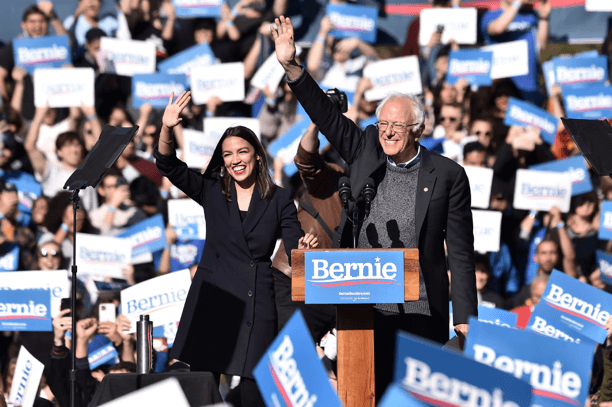
    Bernie Sanders campaigning with Alexandria Ocasio-Cortez

    From the above example, one could predict that Politico, like much of the MSM it represents, was intent on being critical of the Bernie Sanders candidacy. This was both before and after he dropped out of the race this year. (Click here and here)

    In fact, in surveying the way they headline certain events, it is hard not to write that they almost celebrate the losses of progressive candidates. (Click here for an example) They are also eager to cast many topics, issues, and political races as left vs. right, or center vs. right. (Click here for an example) In other words, the idea is to keep America divided, as Harris tried to do in his 2008 book. Consequently, there is almost no vision, insight, and too little in-depth reporting as to what the underlying truth (or truths) of these matters may be. Media Matters, for example, has frequently been critical of Politico. (Click here for details)

    Of course, this quite naturally means that Politico cannot be fair, objective, or honest about the Kennedys. Because JFK, RFK, and Ted Kennedy were trying to get at the underlying truths of many of the problems with America (e.g. race, economic inequality, education, and health care). A good example of this targeting occurred in April of 2018, when the film Chappaquiddick was released. Politico could not just review the film. They used the picture’s release to fill a huge top headline on their site, for two days. Peter Cannelos’ long essay was so negatively tilted that, in reference to the concurrent documentary mini-series The Kennedys, he implied that the series was complimentary to the family. (Click here for a more realistic view) In another example, consider their take on Robert Kennedy. On the 50th anniversary of his assassination, they ran an article entitled “The Bobby Kennedy Myth.” (Click here for the article)

    They are at it again; this time concerning John Kennedy. On June 13th, they printed an article by someone named Peter Keating. They billed Keating as an “investigative reporter”. In establishing that credential, they did not say what he investigated. It turns out that Keating is a sports writer. He writes mainly for ESPN, and his central beat is something called sabermetrics. (Click here for an example) If one does not know what that term means, please watch the Brad Pitt film Moneyball. How this area of study made Keating an authority on John Kennedy’s political career escapes this author—as it does probably many others. In fact, it shows that Politico does not mind who authors their Kennedy hit piece articles. They will bend over to cloud the author’s lack of established credentials.

    The title of Keating’s essay is “How JFK Paved the Way for Donald Trump.” I am not kidding. Just when one thinks American journalism cannot get any worse, you can rely on Politico to give us a further piece of flapdoodle. What is the point of the article? Keating is trying to insinuate that, somehow, Kennedy’s 1960 campaign for the presidency had something to do with the election of Donald Trump in 2016. To say that this is far fetched is not accurate. To anyone familiar with Kennedy’s career it’s a bunch of horse feathers. The idea is to suggest that somehow Kennedy’s campaign in 1960, particularly the primary, exemplified how Trump could win the presidency in 2020.

    The primary system had been around since the early 1900’s. It had been a reform of the Progressive Era to give the public more of a say in the nominating process, instead of exclusively being the role of the state party leaders. They were not as widespread as they are today, so they were not as definitive. But to say they had no impact at all is simply wrong. For instance, William McAdoo swept the Democratic primaries in 1924 and almost won the nomination. He had to be stopped at the convention, because he was backed by the Klan. It took 99 ballots to get rid of him.

    Amazingly, but predictably, the sportswriter completely passes over the 1952 GOP primary. There were four major candidates that year:  Earl Warren, Harold Stassen, Robert Taft, and Dwight Eisenhower. The battle winnowed down to Taft and Eisenhower and it was quite close. But Thomas Dewey, who many thought was going to run, did not. And he ended up supporting Eisenhower through his influence in New York which did not have a primary. To show how far American has come, at that time, many people in the Republican Party thought that Taft was simply too conservative to win. (Richard Bain and Judith Parris, Convention Decisions and Voting Records, pp. 280-86) In 1956, in the Democratic primary race, Governor Adlai Stevenson won out in the primary season over Senator Estes Kefauver. So to somehow say that Senator John F. Kennedy suddenly discovered the primary season as a way to the White House is simply tapering history.

    And that’s not all Keating does to fulfill his agenda. In 1956, there ended up being an intrastate battle in Massachusetts for control of the Democratic machinery for the upcoming nominating convention. Kennedy sensed, correctly, that the state pols—Congressman John McCormack and local hack William Burke—were going to try and block the nomination of Stevenson. Kennedy had supported Stevenson, would end up speaking at the 1956 nominating convention, and then placed him in his administration as representative to the United Nations. McCormack had opposed Stevenson in the primary and actually won by a write-in vote. Mr. Burke boasted about this victory and even personally insulted Kennedy for supporting the losing Stevenson. After that, JFK had no choice but to go after the duo, for both Stevenson’s sake and the personal insult. So, Kennedy, through his proxies, fought this move and, as Dave Powers and Ken O’Donnell have written, it ended up being a “Boston Irish political brawl.” Kennedy was outnumbered on the state committee, but there were enough uncommitted for him to lobby them and turn them to his side. He told Powers and O’Donnell he would call them and even ring doorbells if he had to and he did. At the end, Burke was out. (For a complete chronicle of this episode, see Johnny We Hardly Knew Ye, by O’Donnell and Powers, pp. 124-32)

    The idea that this episode taught Kennedy how to control his own delegation is undermined by the facts that Kennedy allowed McCormick to run as a favorite son at the convention and, contrary to what Keating/Sabermetrics writes, Kennedy did not appoint his own man to the state chairmanship. Pat Lynch was so unknown to him that he needed a personal audience with him to remember who he was. (ibid, p. 127) And even then, he still did not accept him. It was O’Donnell and Powers who pushed his candidacy on him.

    This was all part of Kennedy staying true to Stevenson, who was the national leader of the party. The idea that the state party, without this, would not have supported him in 1960 when he ran is a bit silly—even for sabermetrics. But Kennedy first really made a name for himself on the national level when Stevenson threw open the vice-presidential nomination to the convention that year. (ibid, p. 134) Although he did not win, most attendees were surprised at how strongly JFK ran.

    That is because, unlike Trump, the senator had already been around for ten years. In his valuable book, JFK: In the Senate, John T. Shaw chronicles his entire congressional career. (Click here for a review) And the very next year, Kennedy was going to indelibly imprint himself on the national consciousness with his famous, powerful Algeria speech, which he had been headed for ever since his visit to Saigon in 1951. (See Shaw, p. 101) If you did not know who Kennedy was before that speech, you sure as heck knew who he was afterwards. As Richard Mahoney wrote, there were 138 newspaper editorials printed over that highly controversial speech. The vast majority were negative. (Mahoney, JFK: Ordeal in Africa, p. 21) As both Mahoney and Shaw write, this speech made Kennedy the titular leader on foreign policy in his party. (Shaw, p. 110) Partly because he had deliberately singled out and criticized President Eisenhower, Secretary of State John Foster Dulles, and Vice-President Nixon in his speech and said there had to be a different approach to Third World nationalism rather than supporting European colonialism. In fact, Kennedy now made the cover of Time Magazine for December 2, 1957. The story’s title was “Man out Front.” (Mahoney, p. 29)

    As the British commentator Alistair Cooke had stated, by his purposeful attack on the White House, Kennedy had positioned himself as the man the Republicans now had to do something about. The presidential hopeful that the GOP now had to scorn: “It is a form of running martyrdom that Senators Humphrey and Johnson may come to envy.” (Mahoney, p. 29) None of this is in Keating’s article. Yet this is the way JFK had now become a national figure.

    I don’t see how much more of a contrast with Donald Trump that could be. By the time of the 1960 primary, Kennedy had been in office for 14 years. He was a prominent member of the senate not just through his high profile in foreign affairs, but also because of his service with his brother Robert on the Senate rackets committee and their opposition to Teamsters leader Jimmy Hoffa. And there was no real brilliance, Keating’s word for it, to his 1960 primary campaign. It was pretty fundamental in its planning. Kennedy got in early, had a good manager in his brother Robert, and spent a lot of money in defeating Senator Hubert Humphrey. But even here, Keating gets it wrong. As everyone but Keating knows, the man Kennedy was worried about was Lyndon Johnson. He wasn’t quite sure he could beat the Senate Majority Leader. So, he sent RFK to Texas to sound him out. Johnson told Bobby he was not going to run. This is something that even Chris Matthews knows. (See Bobby Kennedy, pp. 162-63) This assured JFK, since he thought that if either Stu Symington or LBJ won, it was going to be the same old Acheson/Dulles Cold War foreign policy all over again. (Harris Wofford, Of Kennedys and Kings, p. 37) As we have seen, Kennedy had charted out a different course that had put him near the forefront of the leadership in his party. This, as we have seen, was an important motivation for his running that year.

    But for whatever reason, Johnson did get in the race. He announced on July 5th, which was a week before the convention opened. To this day, no one knows why Johnson waited so long to announce his candidacy. But the amazing thing about it is this:  entering just one week before, he amassed more delegates than every other competing candidate combined. And it was not really close. In fact, Johnson’s late candidacy was so strong that Bobby Kennedy now had to switch tactics. He now had to pull out all the stops in order to make sure his brother won on the first ballot. He placed his agents on the floor to make sure no one was going to switch their votes to LBJ. Since if it went beyond a first ballot, there was a real danger that Johnson would outlast Kennedy. (Arthur Schlesinger, Robert Kennedy and his Times, pp. 213-15) Again, how does this resemble the Trump coronation in Cleveland? Who is to say that if Johnson had gotten in early, with all of his Texas backers, he might not have won?

    President Trump’s photo-op in front of the historic St. John’s Church

    In comparison to this, Trump never held any political office before his run for the presidency. And, in large part, that is the issue that he ran on. The public in 2016 was so sick of the political establishment on both sides that they voted for Trump and almost voted in Bernie Sanders. It was a different political universe in 2016. But further, as anyone with any knowledge of recent political history understands, the primacy of the political primaries was not forged in steel until after 1968, due to the famous McGovern-Fraser reforms. (Click here for details)

    Johnson could not have done what he did after those reforms. They were established partly as a result of what happened to RFK’s constituency after his assassination. Those changes eventually ended up mandating that each state have a primary or a caucus. The man who commandeered this new system, thus setting an example which has been mimicked by many, was Jimmy Carter in 1976. I, for one, am not convinced Trump would have made it without McGovern-Fraser, for the simple reason that almost all of the GOP establishment was opposed to his candidacy.

    Military presence in Washington, D.C.

    As the reader can see, there is no real efficacy to Keating’s article. It is just a part of the Harris agenda. And it’s not possible to fail to take note of the timing. As everyone knows, the Trump presidency, to put it mildly, has now confronted some tough times. Between COVID-19 and the George Floyd shooting in Minneapolis, things have gotten quite rocky. And between his denial of the first and his rather inept staging of a Bible pledge in Lafayette Park, he has not reacted well to either one. The Trump ally, Senator Tom Cotton, has tweeted that the Floyd protesters should not just face combat troops, but death from the skies: “Let’s see how tough these Antifa terrorists are when they’re facing off with the 101st Airborne Division.” And if that were not enough, Cotton then drew up his own battle order: “And, if necessary, the 10th Mountain, 82nd Airborne, 1st Cav, 3rd Infantry—whatever it takes to restore order. No quarter for insurrectionists, anarchists, rioters, and looters.” We all know what “no quarter” means do we not? (Fintan O’toole, NY Review of Books, 7/23/20)

    Deputy Attorney General Nicholas Katzenbach confronting Governor George C. Wallace

    As O’toole continued, that was not just bombast, because seven hundred soldiers from the 82nd Airborne did go to Washington. They were in the streets of the capitol, as were the low-flying helicopters and sand-colored Humvees. (ibid) And recall, the demonstrators in Lafayette Park who got tear gassed and clubbed were peaceful protesters. This makes for a vivid and continuing comparison with President Kennedy—which Keating does not mention. During the days of the civil rights demonstrations, Kennedy never wanted to call out troops. If needed, his graduated policy was to go from federal marshals, to the National Guard, with federal troops only called in as a last resort. And this was in aid of the civil rights cause and against the right-wing forces opposing them. For example, when governors Ross Barnett and George Wallace refused to uphold court orders to integrate, respectively, Ole Miss and the University of Alabama, Kennedy relied on federal marshals, only calling in troops—at Ole Miss—when the organized rightwing demonstration to stop James Meredith from registering grew violent. At Alabama, in addition to the National Guard, he had 3000 troops in reserve to oppose the 900 state troopers and police that Wallace had summoned to the scene. Kennedy had the National Guard handle the Alabama conflict.

    John F. Kennedy’s historic civil rights speech

    As I have demonstrated with facts, President Kennedy did more for civil rights for African Americans than any president since Lincoln. And it was not even close. He did more than Roosevelt, Eisenhower, and Truman combined in about one tenth the time. As O’toole writes, for Trump to say that he has done more in that cause than anyone since Lincoln, completely overlooking Kennedy, that is just self-promotion as well as being ahistorical. (For the evidence, click here and scroll to the chart at the end) It is startling that Trump could somehow miss Kennedy’s 1963 civil rights speech, which JFK made right after his confrontation with Wallace. But alas, Trump is the president who said there were good people on both sides at Charlottesville. In a phone conversation with Dick Gregory during the Birmingham crisis, Kennedy referred to the rightwing racists as “bastards”. In fact, some make the argument that Trump’s policies have exacerbated the impact of COVID-19 on the African American community. (Click here for details)

    It’s even more shocking that Trump can say this at a time when, as Alan Mcleod has written in MintPress, “A record 36 million Americans have filed for unemployment insurance, with millions losing their employer based healthcare plans and around a third of the country not paying its rent.” In the midst of this, working class Americans get a $1,200 check, while the Federal Reserve has given about $4.25 billion to big banks and corporate America. As Mcleod further wrote, the fact that the very upper class has risen in riches so rapidly signifies that their wealth “is barely connected to productive forces anymore and has more to do with how much wealth one can take from public coffers.”

    In reaction to all this, the man who President Trump is starting to resemble is Richard Nixon. As O’toole notes, on June 2nd, Trump issued one of his sparsely worded tweets: “SILENT MAJORITY!” If the reader recalls, with hundreds of thousands of demonstrators in the streets against the Vietnam War, Nixon used that phrase in a November 1969 speech. It was specifically about the war. Nixon was appealing to “the great silent majority of my fellow Americans” to stand with him against the demonstrators. That brief message echoes Trump’s earlier tweets in which he requested that his followers “LIBERATE MICHIGAN,” “LIBERATE VIRGINIA,” and then save your great 2nd amendment. It is under siege.” (Click here for details) How can anyone not interpret this as a call to the rightwing militias to bear arms, if they have to, in order to stop the COVID-19 lockdowns? That appeal to armed extremists has also provoked confrontations with George Floyd protestors. (Click here and here for details)
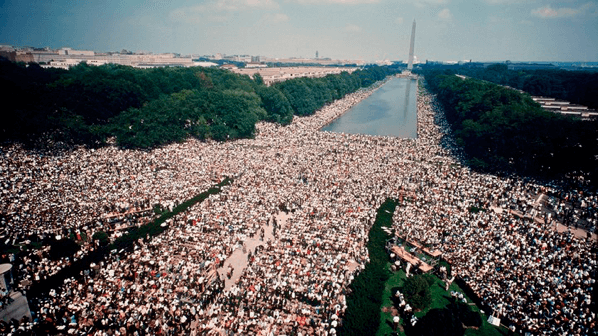
    August 28, 1963 – 300,000 people peacefully demonstrating for justice and jobs

    Richard Nixon was expert at dividing Americans along political fault lines:  Vietnam and his Southern Strategy on race. JFK tried to unite those of different races and classes. One great example being his sponsorship of the March on Washington. (See Irving Bernstein, Promises Kept, pp. 113-17) Kennedy was the first white politician to approve of this rally, on July 17, 1963. He then assigned his brother to make sure it came off perfectly and no extremists would upset it in any way. The Kennedys then got UAW chief Walter Reuther to bus in union workers, so the attendance would be both large and diverse. As many have said, that demonstration was probably the high point of post-World war II liberalism. It followed by two months, what many consider the greatest presidential civil rights speech since Lincoln.

    Make no mistake; none at all. Politico wants us to forget all about an example, so long ago, when a president and his brother were actually leading the country on civil rights. For me, it’s pretty transparent:  that is what the publication of this piece of malarkey is really about. It’s to throw sand in your eyes in hopes the public doesn’t notice how far we have fallen.

    Peter Keating should be ashamed of himself.


    Addendum:

    Click here or on the image below to see just how far Trump will go to polarize the racial issue:

  • Laurene Jobs and The Atlantic Go All In

    Laurene Jobs and The Atlantic Go All In


    If CNN and MSNBC can disseminate obvious propaganda and not be held accountable, as they did for three years during the “Russia did it hoax,” then who cares anymore? Facts? Evidence? Logic? Why did we have to go to the Rolling Stone’s Matt Taibbi and The Nation’s Aaron Mate on Russia Gate to discern that it was a mirage. (Click here for details)

    For instance, it was recently revealed through the declassification of depositions before the House intelligence committee that, in February of 2017, the Clinton campaign raised money to further the Russia Gate meme after Trump was inaugurated. (John Podesta deposition pp. 8-9, 12/4/2017) Hillary Clinton is still dodging Tulsi Gabbard’s process servers in Gabbard’s ongoing $50 million-dollar defamation lawsuit in which she is suing Clinton for calling her a “Russian asset” during the primaries. And when a man in a Wisconsin town hall meeting called Joe Biden out for his son’s questionable Ukrainian sinecure—put in place while Biden was still Vice President under Obama—Biden ignored the question and instead challenged the man to a push-up contest, to rising cheers from the audience.

    Deceptions usually trickle downward and must necessarily be both enabled and promulgated by the corporate gatekeepers masquerading as journalists for the pseudo-intellectual class of Whole Foods liberals who cannot seem to internalize their own party’s bankruptcy.

    These are the folks who with a straight face will preach tolerance and inclusion in flurries of inane Facebook “debates” and on online forums, but will attack anyone who doesn’t tow their ideological line when hard-pressed to engage in real debate. These are some of the people who all but put a scarlet letter on a woman in a New York City grocery store this week who didn’t feel like wearing a mask as she bought vegetables. I was all but physically attacked at a Chicago bar a few years ago when I told a drunk patron I didn’t think Russia “hacked the election.” Nothing serious: a few words exchanged, a shove, a few more words exchanged, a nice woman beside me made uncomfortable, etc. But I almost had to fight a fellow taxpaying citizen on U.S. soil outside of a Chicago bar thirty years after the Cold War ended, because I did not believe the “Russia Gate” probe was authentic or impartial.

    Where do Americans get these ideas? Well, some of them get these ideas from places like The Atlantic Monthly. Even the usually reliable and objective James Fallows pushed this Russia Gate meme for The Atlantic. (The Atlantic Monthly, July of 2018, “Trump-Putin Meeting: How Will Republicans React?”) That journal began way back in 1857 over the issue of slavery. Writers like Ralph Waldo Emerson and John Greenleaf Whittier outflanked the nascent Republican Party. They would brook no compromise with the south. They were abolitionists. James Russell Lowell, the illustrious poet and critic, was the first editor.

    It’s quite a long haul—and fall—from that auspicious beginning to David Bradley and the late Michael Kelly. Beginning in the eighties, Bradley made his fortune as a healthcare consultant. In the nineties, he sold two companies and became a multimillionaire. In 1999, he bought The Atlantic Monthly and made Kelly the editor. Bradley calls himself a political centrist. Michael Kelly was a strong supporter of the George W. Bush invasion of Iraq. In fact, as an embedded reporter, he passed away in that war. Prior to that, as editor of The New Republic, he not only accepted the largely fabricated stories of his contributor Stephen Glass, he defended Glass without investigating the stories. That investigatory job fell to his successor Charles Lane. Under Lane, The New Republic then uncovered a whole slew of stories Glass had made up, either in whole or in part. Glass even manufactured evidence to backstop his fabrications. The new editor had to issue an apology and listed the titles of all the stories Glass had created in whole or in part. Incredibly, Kelly was still defending Glass even after he admitted his chicanery. (Gawker, 4/03/2013, story by Tom Scocca)

    Kelly also mocked those who did not accept the pretexts for the Bush invasion of Iraq. In fact, Kelly tried to make the case that Bush’s war should be accepted by liberals. (Jewish World Review, 10/23/2002, “Anti-War effort Perverts Liberal Values”). He also allied himself with Neocon kingpin Daniel Pipes to create the fusion paranoia theory. This was a true milestone in a war of political and psychological denial by the Power Elite.

    Back in 1995, Kelly wrote an essay for The New Yorker entitled “The Road to Paranoia”. That article was then used by Pipes in his 1999 book Conspiracy. In fact, Pipes spent all of Chapter 8 addressing this idea. He used the following quote by Kelly as a blast off point:

    Views that have long been shared by both the far right and the far left…in recent years have come together in a weird meeting of the minds to become one, and to permeate the mainstream of American politics and popular culture. You could call it fusion paranoia.

    Kelly focused on the Militia of Montana and, specifically, the chief researcher and spokesman for that group, a man named Bob Fletcher. Fletcher postulated a global conspiracy theory that was something of a forerunner to QAnon. What Kelly was driving at was how left and right had beliefs in certain conspiracies. Pipes then adapted it in its broad outlines. This was dubious on its face, for more than one reason. But to give one example, Pipes drew similarities between how the modern militia movement and the Weather Underground viewed the FBI. Kelly’s above quoted tenet, that these ideas now permeated the mainstream, seems quite strained. The MSM and the political establishment do what they can to ridicule these concepts and to marginalize their advocates; never differentiating between which are true, and, therefore, deserve inspection and which are false and should be ignored.

    This is an important point, because it was this kind of automatic disdain that paved the way for one of the most lethal conspiracies in contemporary history. That was, of course, the Karl Rove/Dick Cheney plot to create an arsenal of WMD in Iraq. It included the stamping out of any dissenters, like the late diplomat Joseph Wilson. What was amazing was how much of the MSM got behind a clearly fabricated mythology, which included not just the above personages, but also people like Douglas Feith and Paul Wolfowitz. (Click here for details) And Kelly bought into this, with a vengeance. If the reader can believe it, ever since his death, The Atlantic Monthly sponsors an annual Michael Kelly award in journalism. An award named after a journalist who bought the lying Stephen Glass and also the myths about WMD which ended up killing 600,000 people.

    In July of 2017, Bradley sold the controlling interest in The Atlantic Monthly to something called the Emerson Collective. A nice sounding name which is actually run by multi-billionaire Laurene Powell Jobs, the widow of Steve Jobs. Jobs is on the advisory committee to the Council on Foreign Relations and has given loads of money to people like Hillary Clinton and Kamala Harris. (Click here for details)

    Right after this, The Atlantic Monthly printed a cover story by radio host and author Kurt Anderson. It was titled “How America Went Haywire”. That essay—an excerpt from an upcoming book—maintained that Donald Trump’s arrival as president was caused because of America’s belief in conspiracy theories. And this dated from—drumroll please—the JFK assassination! (For a review of that article, click here).

    Anderson managed to do something many historians would think impossible. He tried to draw an arc of American decline without describing the effects of 1.) The Vietnam War or 2.) The Church Committee. Here, the old joke applies: Well, Mrs. Lincoln besides your husband’s assassination, did you like the play? The Living Room War went on for ten years in all its ugliness and sickened much of America with its pointless carnage. The Church Committee explored the myriad crimes of the CIA and FBI: the plots to drive Martin Luther King to take his own life, to exterminate the Black Panthers, and the conspiracies to murder Patrice Lumumba and Fidel Castro—and those were just some of the highlights. But those two huge events deepened the cynicism of many Americans in what their government was doing and why. And it was all true. Anderson and The Atlantic Monthly decided to ignore those facts.

    One of the things the Church Committee did was delve into the CIA’s attempt to control the media. This was Director Allen Dulles’ scheme termed Operation Mockingbird. It was inspired by Dulles’s reaction in Bern, Switzerland to viewing how the Third Reich controlled the media in Nazi Germany, which, in turn, Joseph Goebbels modeled in part on the ideas of public relations wizard Edward Bernays. Bernays began as a journalist and then helped the Woodrow Wilson administration propagandize America into entering World War I. In 1928, Bernays published his classic work on the subject called simply Propaganda. It was one of the first books to use the phrase “invisible government.” Bernays thought these techniques were not just good but necessary. He later used them to attain riches through Madison Avenue type advertising for huge corporations including cigarette companies. This was while he was trying to break his wife’s smoking habit. (Click here for some information on Bernays)

    As most of us know, one of the things the CIA did was to try and control the media criticism of the Warren Commission. In 1967, the Agency issued a memorandum titled “Countering Criticism of the Warren Report”. CIA planners clearly state that “the aim of this dispatch is to provide material for countering and discrediting the claims of the conspiracy theorists, so as to inhibit the circulation of such claims in other countries.” (CIA 1035-960, “Countering Criticism of the Warren Report,” NARA Record Number: 104-10404-10376) Thus was born Kurt Anderson’s knee-jerk meme, “conspiracy theorist” in the American imagination. Prior to this, that term had been used quite rarely. As author Lance DeHaven Smith has shown, after this the term broke through the stratosphere to become a meaningless catch all term. The CIA memo stresses the importance of a full-spectrum approach to countering criticism and maintaining the official story. They deem it essential to “employ propaganda assets to answer and refute the attacks of the critics,” claiming, “book reviews and feature articles are particularly useful for this purpose.” (Ibid) After then explaining to the dispatch’s readers how best to disseminate information to the agency’s embedded Mockingbird assets in the U.S. media, the document lists the five most effective ways to combat critics of the Warren Commission’s conclusion that Oswald shot president Kennedy because he was a crazy Marxist lone nut: “Our play should point out, as applicable, that the critics are (i) wedded to theories adopted before the evidence was in, ( ii ) politically interested, ( iii ) financially interested, ( iv) hasty and inaccurate in their research, ( v ) infatuated with their own theories.”

    And now the Anderson Gang is back again. The Atlantic Monthly recently ran a piece entitled “The Conspiracy Theorists are Winning” on May 13. According to Jeffrey Goldberg, editor in chief, “America is losing its grip on Enlightenment values and reality itself.” We’d like to address both claims, since The Atlantic Monthly is now apparently running counter-intelligence on the questioning masses.

    First of all, we’d like to thank Mr. Goldberg for the admission, finally, that we’ve won. It’s probably the greatest single admission by the mainstream media we’ve ever seen. After years and years of toiling, of gnashing of teeth, of cries in the wilderness, of evidence, of testimonies, of unredacted documents released through FOIA requests, of Congressional hearings, of whistle blowers speaking out, of declassified memos, of declassified archives, we, the independent research community, have finally won.

    But that’s not really what Goldberg is saying.

    You see, conspiracies don’t exist according to the editor in chief of The Atlantic Monthly. And the only thing worse, according to his latest missive are “theories” about conspiracies. Goldberg implies that everything that has ever entered the Encyclopedia Britannica, the Congressional Record, or the text books in history classrooms from the time of the founding of the United States is a 100% accurate, unexpurgated, unredacted representation of the thousands and thousands of incalculable factors that comprise any major historical event as it happened in real time. To say that conspiracy theories do not exist is, in essence, to say that it is wrongheaded to write that people like Bernays paved the way for the acceptance of the American public to go along with Woodrow Wilson’s declaration of war in 1917. Are people also wrong who say that President Johnson was planning on declaring war in Vietnam months before he actually did so? When Adam Weishaupt founded the Bavarian Illuminati in 1776, whose entire mission statement was to conspire against entrenched European power structures in secret, he was, according to the legal meaning of acting in concert with others, engaged in a conspiracy. As any criminal lawyer will tell you, if you had the Justice Department, and all state Attorney Generals and all local DA’s order all prison inmates incarcerated on conspiracy charges immediately released you would greatly reduce the prison population of the USA.

    What is a “theory”? Well, according to the Merriam-Webster Dictionary, one definition of a theory is “a hypothesis assumed for the sake of argument or investigation.” Some theories become “the official story,” if they tow the party line at the time of their release. Others become the pejorative “conspiracy theories,” if they, at all, challenge the dominant power structure of their times. We are allowed to admit that the Gulf of Tonkin incident was a provocation in 2020, because the Vietnam War, who’s selling to the public was largely based on this lie and the unfolding “official story” narrative, is long over and is now, at best, considered a monumental mistake. Or, it can be safely referenced as a type of political crime that somehow had a benign intent to it.

    If you question anything, in essence, according to Jeffrey Goldberg, you are also “destroying the enlightenment virtues upon which America was founded”. That’s funny. Co-author Michael LeFlem wrote his Master’s degree thesis on the 18th-century Enlightenment under a world authority of that subject, Professor Darrin McMahon, at Florida State University. Tell Dr. McMahon that questioning political realities is “against Enlightenment values.” He might refer you to his excellent book, Enemies of the Enlightenment.

    Donald Trump did not win the election of 2016 because American culture went berserk with conspiracy theories. Nor did he win because of Mr. Putin’s manipulations in America; that idea has been pretty much discredited. In fact, with the revelations of the Michael Flynn case, it has been discredited with an air of finality. Without the complicity of the MSM, through the lens of carrying propaganda, the case against Flynn probably would have fallen apart even sooner. On and on they droned about Russia. But as of late May, there is mounting evidence that Russia Gate was a power play to somehow cover up the failure of the Democratic National Committee to run a fair primary campaign and also the failures at the management level of the Clinton candidacy. In other words, it was those “centrist” Democrats, like Mr. Bradley and Ms. Jobs, camouflaging their tracks.

    If we’re going to be honest, we need to face these inconvenient truths instead of ducking behind our safe-spaces of like-minded propaganda. It does us no good to try and conceal what has happened to the Democratic Party behind a smoke screen of “pernicious conspiracy thinking,” which has now become part and parcel of the Democratic party’s legacy.

    The Atlantic Monthly is part of that oligarchical problem. Let us admit it and Move On.

    Written by Michael LeFlem with consultation and contributions from Jim DiEugenio.