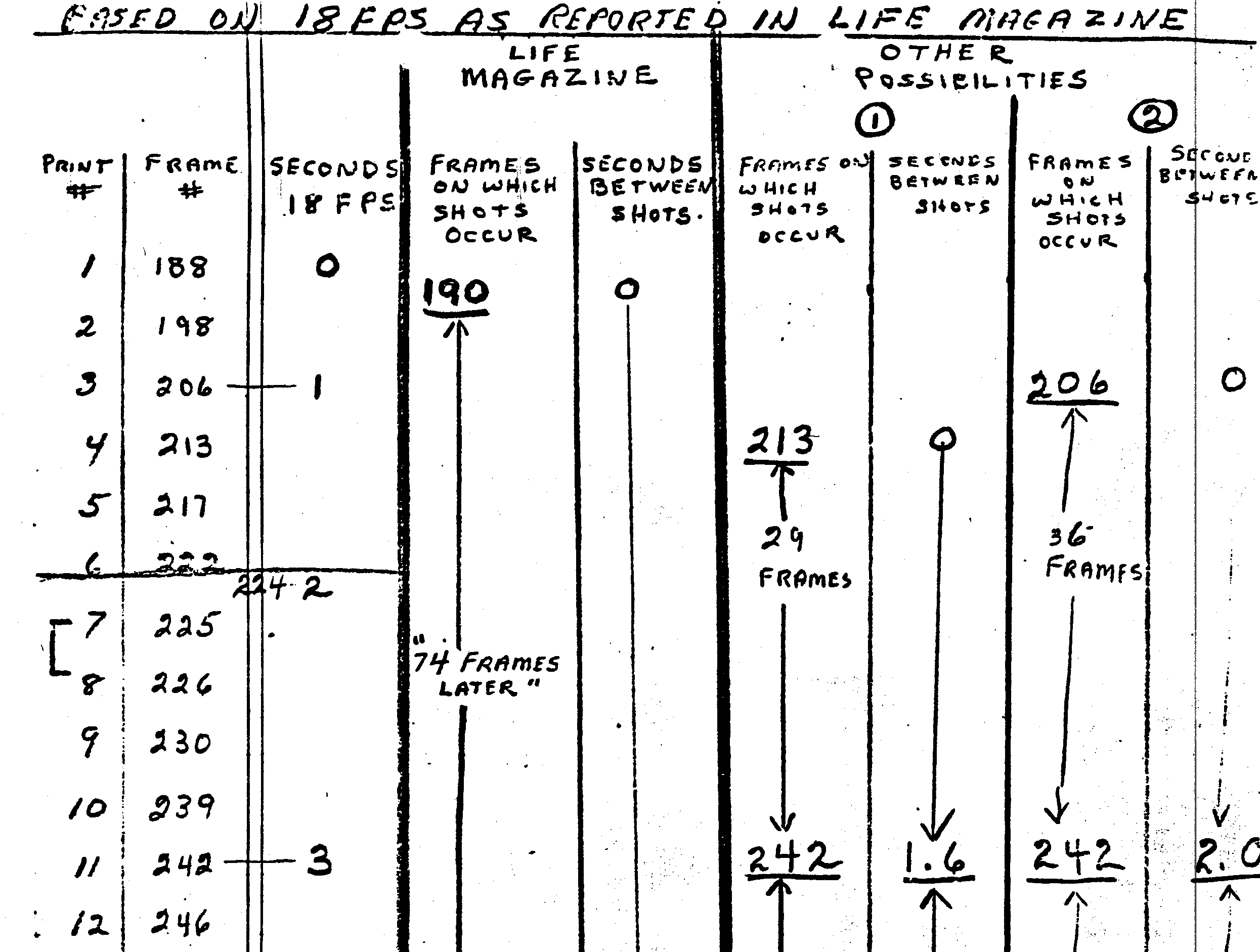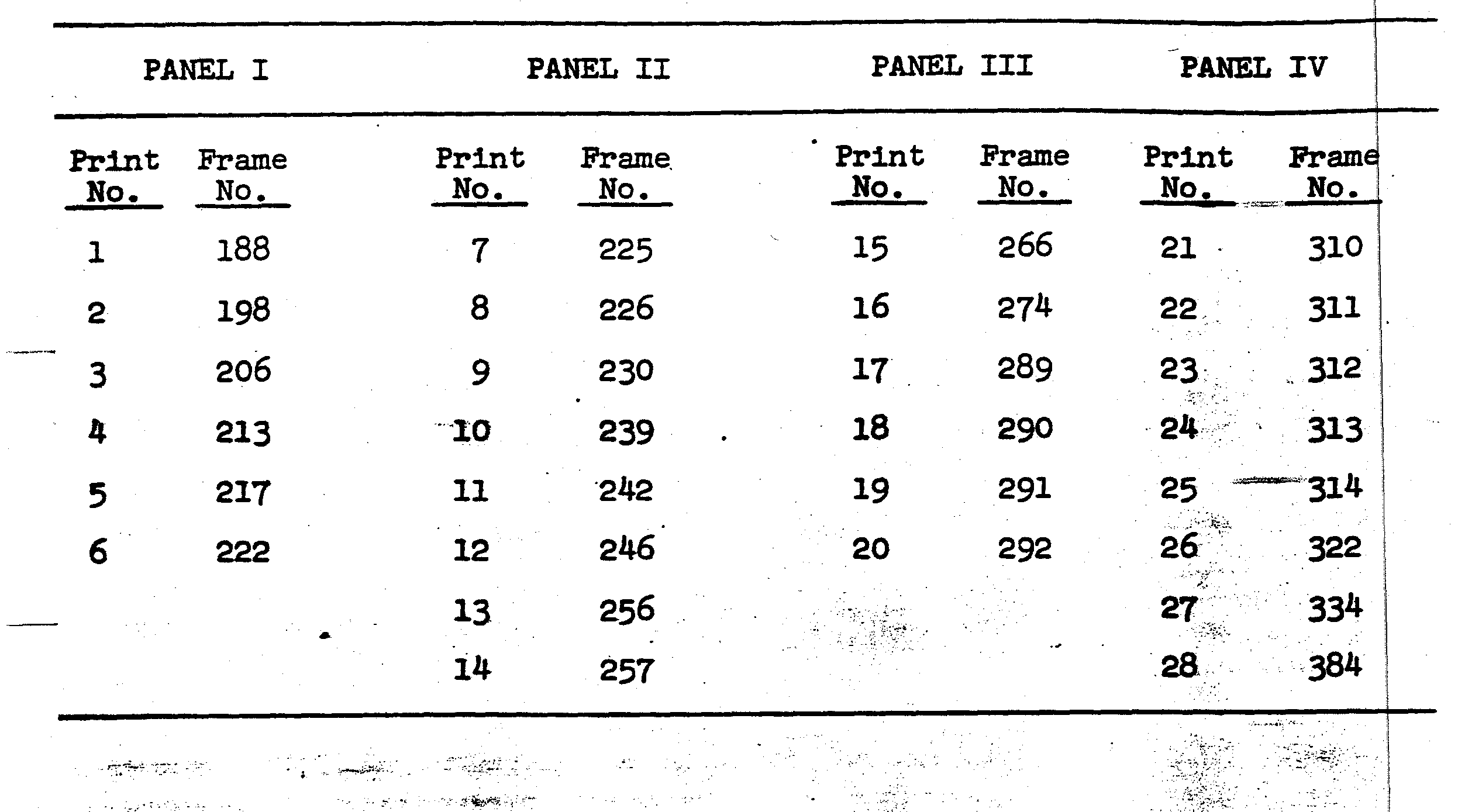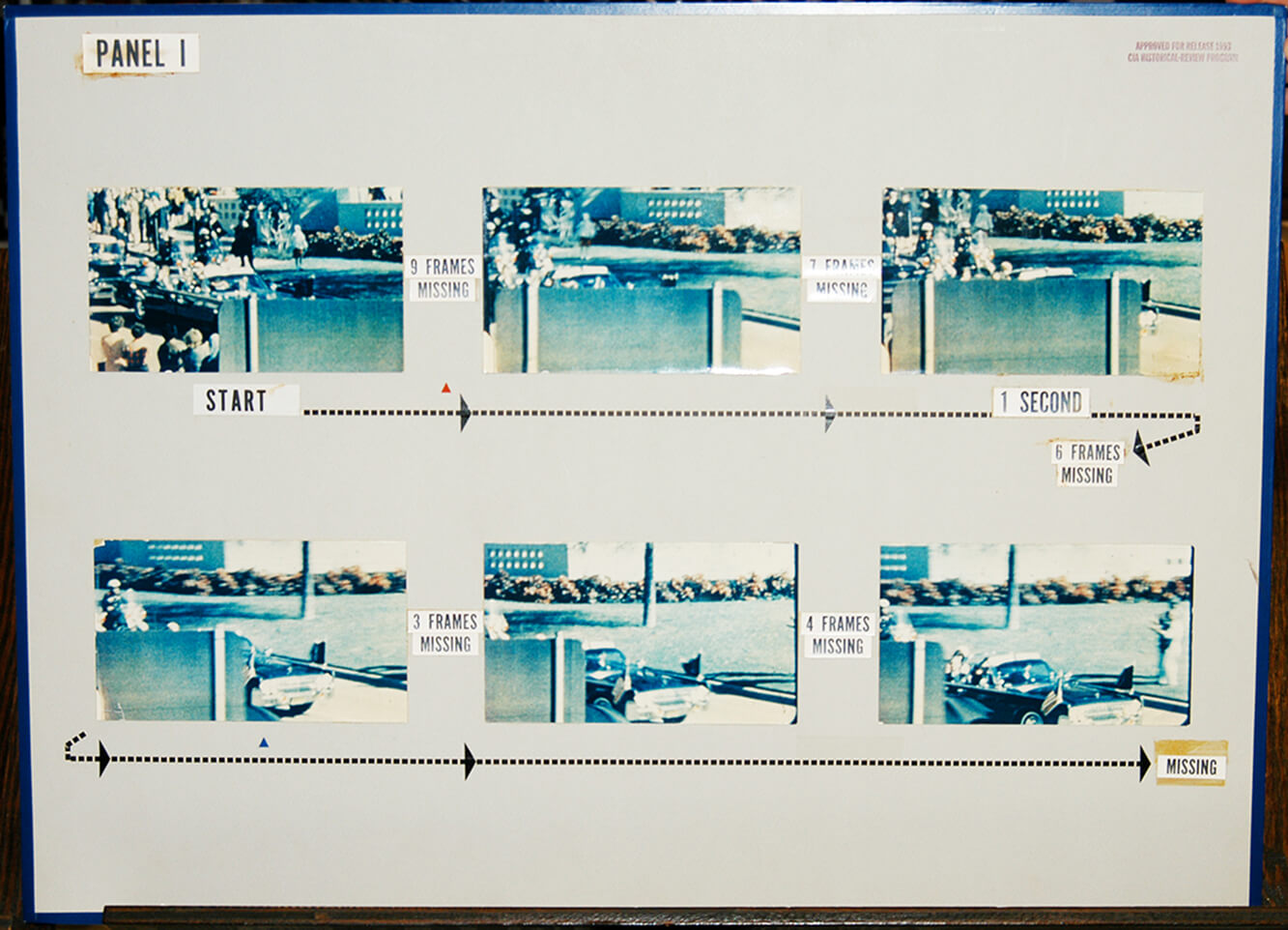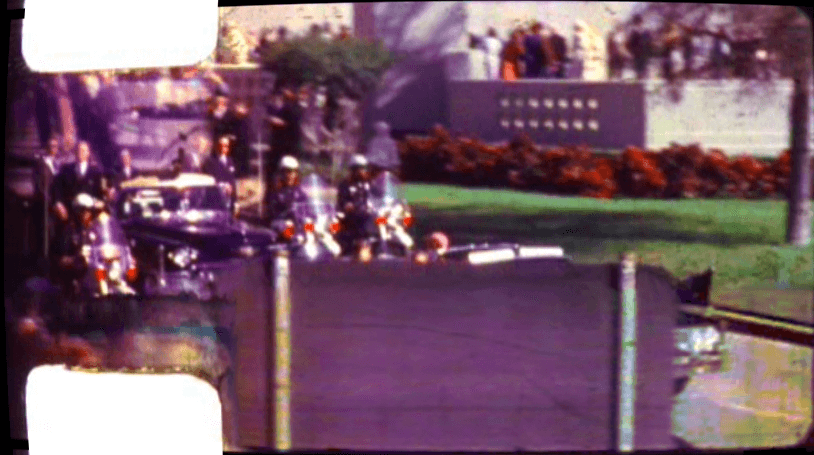
Tag: PHOTOGRAPHIC EVIDENCE

  • Last Second in Dallas, part 2

    Last Second in Dallas, part 2


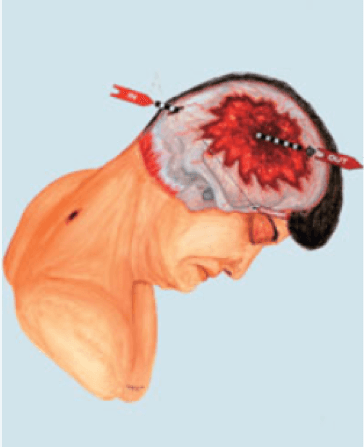
    Another dispute Thompson had with Vince Salandria was the author’s theory about the small hole in JFK’s throat. On the day of the assassination, Dr. Malcolm Perry said to the public that this appeared to be an entrance wound. Thompson’s idea is that it was a piece of either brain or metal ejected from Kennedy’s skull. And he includes a diagram of this on page 98. The trajectory of this projectile is hard to fathom, especially since it would be traveling through soft tissue. But also, once it went into the throat area, it would be entering into all kinds of small bones and thicker cartilage. So in addition to the trajectory, it found an exit path through that maze?

    Thompson takes Howard Brennan at his word. (pp. 98-99) Which he also did in his previous JFK book. I am not going to go into the myriad problems with Brennan as a witness. That would be redundant of too many good writers. Let me say this: today, the best one can say about Brennan is that he was looking at the wrong building. The worst one could say is that he was rehearsed and suborned. As Vince Palamara wrote in Honest Answers, Brennan refused to appear before the House Select Committee on Assassinations. Beyond that, he would not answer written questions. When they said they would have to subpoena him, he replied he would fight the subpoena. Does this sound like a straightforward, credible witness? (Palamara, pp. 186-89)

    To supplement the dubious Brennan, the author uses the testimony of the three workers underneath the sixth floor. Vincent Bugliosi used one of them in a mock trial of Lee Oswald in England in 1986. I addressed the serious problem with using these men––in Bugliosi’s case it was Harold Norman––in my book The JFK Assassination: The Evidence Today. (pp. 54-55) To make a long story short, after they were interviewed by the FBI, their stories were altered by the Secret Service. At that mock trial, Norman could have been taken apart and spat out if defense lawyer Gerry Spence had been prepared––which he was not. (For a long version of how and why this happened, see Secret Service Report 491)

    Let me add one key point about this. One of the Secret Service agents involved in this mutation was Elmer Moore, a man who––since the declassifications of the ARRB––has become infamous in the literature. There is little doubt today, in the wake of the declassified files, that Moore was an important part of the coverup. (DiEugenio, pp. 166-69) Therefore, in my view, Thompson missed another pattern––one which could have been indicated to him by Gary Aguilar or Pat Speer, in addition to myself.

    The middle part of the book narrates much of the case history from the early to late seventies. For Thompson, this means the first showings of the Zapruder film by Bob Groden at conferences, then the big national showing on ABC in 1975. This was one of the factors that spurred the creation of the HSCA in 1976. Thompson says that he was invited to the so called HSCA “critics conference.” He says this was where he first heard of the dictabelt tape of a motorcycle recording of the assassination. He takes the opportunity to tell us how the HSCA actually recovered the tape. He also explains how it worked and some of the technology behind it. (pp. 147-51) Keeping with his personal journey aspect, in this part of the book he also tells us how he decided to give up his professorship at Haverford and become a private investigator.

    From 1979 until 2006 the author tells us he was very little involved with the case. (pp. 182-83) This is kind of surprising when one thinks about it. Thompson all but leaves out the yearlong furor that took place over the release of Oliver Stone’s film JFK. Which is odd, since that was the largest period of focused attention the case got since 1975. All he says is that he was called to testify by the Assassination Records Review Board about their purchase of the Zapruder film. And he testified, properly I think, that once the Secret Service knew about the film it should have gone to Abraham Zapruder’s home and taken possession of it right there as a piece of evidence in a homicide case. (pp. 189-90) About any of the rather startling disclosures of the ARRB, I could detect little or nothing.

    He spends several pages on a conference organized by Gary Aguilar in San Francisco which featured Eric Randich and Pat Grant. It was these two men who broke open the whole mythology of Vincent Guinn’s Neutron Activation Analysis, today called Comparative Bullet Lead Analysis. I was at that conference and Thompson does a good enough job summing up their scientific findings. (pp. 190-96). As the author notes, this “junk science” had been important to the HSCA in its findings that somehow Oswald alone did the shooting, and the acoustical second shot from the front missed.


    II

    In the second half of the book Thompson more or less forsakes the personal journey motif. He concentrates on what he sees as three important pieces of evidence, which he figures are crucial to the case. I will deal with each of these as candidly and completely as I can.

    Thompson devotes Chapter 16, well over twenty pages, to the medical evidence in the JFK case. He begins this part of his book by declaring that the JFK autopsy was “botched,” in other words, whatever shortcomings there were in that procedure, they were not by design. I was rather surprised by this supposition, for the simple reason that Dr. Pierre Finck said under oath at the trial of Clay Shaw that the reason the back wound was not dissected is because the military brass in the room stopped them from doing so. He also said that James Humes, the chief pathologist, was not running the proceedings. They were being so obstructed that Humes literally had to shout out, “Who’s in charge here?” Finck testified that an Army general replied, “I am.” Finck summed up the situation like this:

    You must understand that in those circumstances, there were law enforcement officials, military people with various ranks, and you have to coordinate the operations according to directions. (James DiEugenio, Destiny Betrayed, p. 300, italics added)

    The Department of Justice––among other groups––was monitoring the Clay Shaw trial in close to real time. When Carl Eardley, the Justice Department specialist on the JFK case, heard this, he almost had a hernia. He called up another of the pathologists, Thornton Boswell, and sent him to New Orleans, since they now had to discredit Finck for revealing what had happened. Eardley later thought better of this, probably because by any standard measure, Finck had better qualifications as a forensic pathologist then Boswell did. (ibid, p. 304)

    One cannot overrate the importance of this testimony. To give just one indication of its importance: I did a pre-interview with Dr. Henry Lee for Oliver Stone’s new documentary on the JFK case. I asked him this specific question, directly related to Finck’s testimony: Can you figure out a firing trajectory without a tracking of the wound? He said that under those circumstances, it was very difficult to do. Here is a man who has worked about 8000 cases all over the world and is recognized as one of the best criminalists alive.

    The same situation applies to the skull wound, except in this case, the situation is more complex. If one talks to Lee or Cyril Wecht they will tell you there is no evidence of a brain sectioning. But the Review Board did an inquiry into this subject, and Jeremy Gunn and Doug Horne came up with some evidence that such an examination may have been done. Under the scope of this particular review, this is not the place to do an expansive analysis of their evidence. Suffice it to say I found Thompson’s excuse for this lack rather strained: the doctors did not have the time to do so such a thing. (Thompson, p. 259) Yet in the Commission’s volumes there is a brain examination, dated 12/6/63. (CE 391) And there is no mention of sectioning; two weeks was not long enough? Yet without sectioning, how can one determine the bullets’ paths? On this matter, Lee was quite animated. He put his right hand up in front of his face and said words to the effect: You have this bullet coming in at a right to left angle: it then reverses itself and goes left to right? The lack of dissection in this instance is even more perplexing because the head wounding was how Kennedy was killed. And this is why Lee’s hand was piercing the air in bewilderment.


    III

    Thompson wrote something later that stunned me. On page 258 he says that the first time the autopsy doctors learned of a tracheostomy over the anterior neck wound was when they read about it in the next day’s newspapers. That passage is undermined by Nurse Audrey Bell’s 1997 testimony to the Review Board. Bell told them that Dr. Malcolm Perry complained to her the next morning (on Saturday, November 23rd) that he had been virtually sleepless, “because unnamed persons at Bethesda had been pressuring him on the telephone all night long to get him to change his opinion about the nature of the bullet wound in the throat, and to redescribe it as an exit, rather than an entrance.” (See DiEugenio, The JFK Assassination: The Evidence Today, pp. 167-68; also this discussion)

    In a very late discovery by writer Rob Couteau, Bell’s testimony was both certified and expanded. In the days following the assassination, many reporters were milling around Dallas, and some found their way to Malcolm Perry’s home, for the reason that he and Dr. Kemp Clark had held a press conference on the day of the assassination where Clark said there was a large, gaping wound in the back of Kennedy’s skull, and Perry said the anterior neck wound appeared to be one of entrance. One of the reporters who migrated to Perry’s home was from the New York Herald Tribune and his name was Martin Steadman. He asked Perry about this issue and Perry was frank. He affirmed that it was an entrance wound. But beyond that he said he was getting calls through the night from Bethesda. They wanted him to change his story. He said that the autopsy doctors questioned his judgment about this and they also threatened to call him before a medical board to take away his license. (See further “The Ordeal of Malcolm Perry”) To put It mildly, I disagree with Thompson’s next day thesis on this point.

    Another surprising aspect of this chapter is that Thompson agrees with the Ramsey Clark Panel. That panel’s findings were released on the eve of the Clay Shaw trial. They upheld the original autopsy’s conclusions about two shots from behind; but they made about four major changes that were rather bracing. One of them was that they raised the entrance wound in the rear of Kennedy’s skull 10 mm upward, into the cowlick area. (Thompson, p. 248)

    The way Thompson mentions this in passing was, again, jarring to the reviewer, one reason being that, in all likelihood, it was Six Seconds in Dallas which caused both the Clark Panel to be formed and the rear skull wound to be raised to the cowlick area. (DiEugenio, The JFK Assassination, p. 150). As Russell Fisher, the panel’s chief pathologist later said, Attorney General Ramsey Clark got hold of an advance copy of Six Seconds in Dallas. On page 111 of that book, Thompson shows that Kennedy’s head––as depicted in the Warren Commission to illustrate the fatal wound––is not in the correct posture as shown in Zapruder frame 312. The Commission had the film; therefore, all the indications are that they fibbed about this key point.

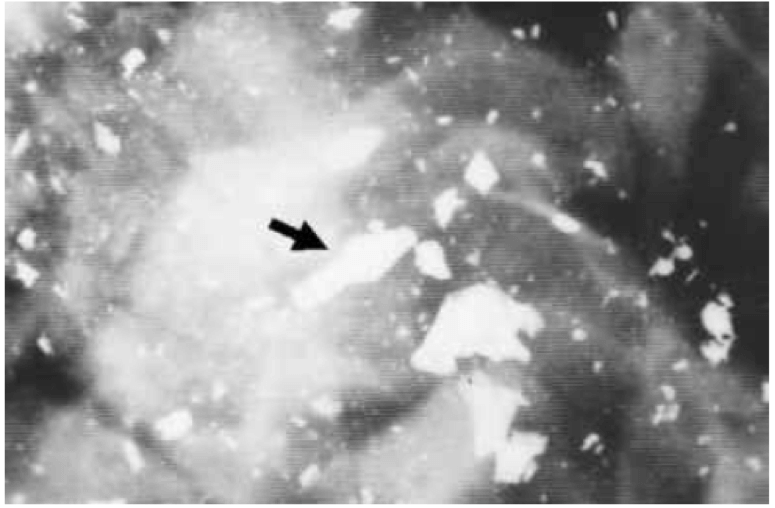
    How did the Clark panel elevate that wound into the cowlick area? Since Thompson does not show the anterior/posterior X-ray, the reader is in the dark about this point. The answer is they largely based it on a disk-shaped white object in the rear of the skull that stands out plain as day on the X-ray. The problem with this piece of evidence is that none of the autopsy doctors, or the two FBI agents in attendance, saw it on the X-rays in the morgue the night of the autopsy; and it is not in the 1963 autopsy report. All of which is incredible, for two reasons. First, it is by far the largest fragment visible; and second, its dimensions of 6.5 mm precisely fit the caliber of ammunition Oswald was allegedly firing. (DiEugenio, The JFK Assassination, pp. 153-54)

    I could go on from there, but I won’t. As the reader can see, I did not find this chapter at all satisfactory.


    IV

    One of the key points Thompson wants to make in this book is something he has been talking about for a rather long time. It is the work of Dave Wimp on what the author calls “the blur illusion.” In fact, Thompson calls Chapter 14, “Breaking the Impasse: The Blur Illusion.” Since I took Thompson at his word about this, several years ago, at a JFK Lancer conference, I mentioned Wimp and his work. I said the forward bob by Kennedy preceding the rearward head snap did not really exist. Almost immediately after I finished my address, first Art Snyder and then John Costella disagreed with me. Snyder disagreed with me on the mathematical analysis Wimp had done. Costella disagreed on whether or not this was really an illusion. In other words: did Kennedy’s head really bob forward before jetting backward? The two disagreements gave me pause. Why? Because both men are physicists.

    Back in the sixties, Thompson first learned of this forward bob between Zapruder frames 312-313 from one of the earliest students of the film, Ray Marcus. (See page 112 of Six Seconds in Dallas, footnote 2) The author and Vince Salandria then studied this in combination with the more dramatic and lengthier rearward slam at the Archives. (Six Seconds, pp. 86-87) The issue is one of the most interesting aspects of Thompson’s first book. He goes through a few explanations of how this could have occurred. He then decides on a term that became rather famous in the critical community––the “double hit” or “double impact.” (pp. 94-95) In other words, two projectiles hit Kennedy’s skull almost instantaneously: one from behind and one from the front. The first moved him forward, the second rocked him backward. He then adds that S. M. Holland had told him the third and fourth shots sounded like they were fired almost simultaneously. He backs this up with other witnesses who heard the same thing. Thus the double impact was credible.

    Why did Thompson change his tune on this point? There seem to be three reasons for this. The first is that he felt his first thesis allowed for too precise a synchronization of the shots. No firing team could be that well trained. The second and third are complementary: Dave Wimp’s work coincided with his gravitation towards the acoustics evidence.

    Since Thompson decided to go with the acoustics, he had to dump the “double hit” he wrote about in his earlier book, because the acoustics evidence allows for only one shot from the front at Zapruder frame 312. The following shot comes from behind at Zapruder frame 328. Dave Wimp aided this new scenario by somehow making the forward bob disappear, being dismissed as an illusion.

    But if such was the case, then why did the two physicists disagree with my statement about the Wimp thesis? Snyder objected to it on mathematical grounds. He did not think that Wimp’s work had absolutely proved his thesis. He told me that there was about a 20% chance Wimp was wrong. Snyder turned out to be correct, because in a reply to Nick Nalli’s review of Last Second in Dallas, Wimp admitted his calculations were not correct. He wrote:

    That I have a blur illusion hypothesis is the result mostly of people failing to distinguish between what people are saying and what people are saying people are saying, which seems to be a pervasive problem. The issue is not about illusions but rather about bad methodology.

    Today, Wimp now seems to admit that Kennedy’s head did go forward by about an inch. Evidently, Thompson oversold this idea to at least one person: me. And since he still insists on it in his book, perhaps others.

    Costella explained why Wimp made an error in a more practical, applicable sense:

    Wimp has always made a valid observation about trying to measure the position of a single (rising or falling) edge, in the presence of blur. That is fraught, especially in the presence of unavoidable nonlinearities. What he never seems to have considered, as far as I can tell, is that if you have two opposite edges (rising then falling, or vice versa) of an object, then it is quite simple to align the center of mass of the object between any two frames, even if the edges are blurred. You can do this even if the two frames are blurred differently––that’s effectively what all stabilized versions of the film do (including his own!). It’s even simpler if you either deblur the blurred 313 to match 312 (like I did back in the day, per my animation on my website), or else blur 312 to match 313 …. What I never did is put an exact number of inches on the forward head movement. I have no idea if his smaller number is accurate or not, because I didn’t quantify. What is certain, just from the visuals, is that the head moves forward in the extant Z film. (Email of 6/15/21)

    How proficient is Costella in his study of the film? After he approached me at JFK Lancer, he took out his cell phone and showed me how he had deblurred Zapruder and the forward head bob was still there. Yes, John is a man who carries his work with him.

    G. Paul Chambers, another physicist, probably has the most sensible explanation for this aspect of the case. He has told Gary Aguilar that what likely happened is that the first shot through Kennedy’s back likely paralyzed him. When the car began to brake, his limp body then went forward. (Phone call with Gary Aguilar, 7/18/21)


    V

    “Jim, there is no motorcycle where the HSCA says there is.”

    The above quotation is taken from a phone conversation in 1994 between this reviewer and the late Dick Sprague. I chose to lead this part of my review with it because, as with the head bob, I once believed in the acoustics evidence. So when the famous photo analyst Dick Sprague said the above to me, I was surprised.

    Let me explain why I had that reaction. When I visited the now deceased HSCA attorney Al Lewis at his office in Lancaster Pennsylvania, he told me about something his former boss had done in the early days of that congressional committee. Chief Counsel Richard A. Sprague had arranged a day-long study of the photographic evidence in the JFK case. There were three presenters on hand: Bob Cutler, Robert Groden, and Dick Sprague. They went in that order. Before Cutler began, the chief counsel turned to those in attendance and said, “I don’t want anyone to leave unless I leave, and I don’t plan on leaving.” As Lewis related to me, Cutler’s presentation was about 35 minutes. Groden’s was over 90 minutes, close to two hours. Dick Sprague’s went on for four hours. By the end of Sprague’s demonstration, 12 of the 13 staff lawyers believed Kennedy had been killed by a conspiracy. (James DiEugenio and Lisa Pease, The Assassinations, p. 57)

    Such was the photographic mastery of Dick Sprague. At that time, no one had a more expansive collection of films and photos than he did. In that phone call, he told me that Robert Blakey, the second chief counsel, only called him once. It was to ask him if there was a motorcycle where the acoustics experts said there had to be one. Dick spent a lot of time going through his massive collection. He eventually replied that no, there was not. It was Groden who said that there was.

    To this day this issue has not been settled to any adequate degree. And there is simply no papering it over. Because the motorcycle has to be at a precise point near the intersection of Houston and Elm for the acoustics evidence to be genuine. Modern experts on the motorcade, like Mark Tyler, insist that Sprague was correct. And Mark argues that point effectively at the Education Forum. (See his post of June 9th) What I found severely disappointing about Thompson’s book is this: he barely deals with the issue at all. This is what he says about the highly controversial but crucial point: he writes that he and author Don Thomas found the correct motorcycle in the films of Gary Mack. Afterwards, they had a few beers and called it a night. (p. 304)

    I could hardly believe what I was reading. I actually wrote “WTF” in the margin of my notes. Somehow, this trio, not experts on the photo evidence, easily accomplished something that Dick Sprague––who was the leading authority in the field––could not do? The cavalier way Thompson deals with this important point––throwing in the phrase “having a few beers and calling it a night”––underscores just how unconvincing his treatment of it is. If it was this easy to locate and demonstrate, then why is there no picture of the proper motorcycle in proper context to accompany the “few beers and calling it a night”––straight out of Sam and Diane at Cheers––motif? I was so puzzled by this carelessness, leaning toward avoidance, that I went back and read up on the acoustics evidence.

    These sound recordings first entered the legal case during the days of the HSCA. They were offered up by Texas researchers Gary Mack and Mary Ferrell. Thompson does a good job in explaining the rather primitive technology which the Dallas police used in these recordings. There were two channels being recorded that day, simply labeled Channel 1 and Channel 2. The latter used a Gray Audograph powered by a worm gear which drives a needle into a vinyl disk. (Thompson, pp. 304-06). Channel 1 “was done by a Dictaphone that used a stylus inscribing a groove onto a blue plastic belt called a Dictabelt mounted on a rotating cylinder.” (Thompson, p. 148). Channel 1 was used for basic police operations. Channel 2 was for special events, like Kennedy’s motorcade. Back at headquarters, the dispatcher would announce each minute that passed, and each time the dispatcher spoke to a unit he would announce the time. (p. 149)

    The HSCA did two tests of the acoustics. The first was by a company called Bolt, Beranek, and Newman. The main scientist on this was James Barger, who supervised a reconstruction test in Dealey Plaza. After doing this, Barger said that there was about a 50% chance of a shot from the Grassy Knoll. The HSCA then gave those results to another team of acoustic experts: Mark Weiss and Ernest Aschkenasy . After examining this data they decided there was a much higher probability, 95%. The HSCA announced this in their final days.

    Because he is wedded to this evidence for the finale of his book, Thompson has nothing but scorn for what is today called the Ramsey Panel. The Department of Justice asked the National Academy of Sciences to review the work of the HSCA. They set up a committee named after Harvard physicist Norman Ramsey. Alvarez ended up serving on this committee. Alvarez told Barger that no matter what he said he would vote against him. (Thompson, p. 287) The panel was biased from the start and the author does a good job proving that point. For Thompson, this is why they ended up rejecting the HSCA result.

    But I want to note two things about the closing 80 or so pages of Last Second in Dallas and how an author making himself a character in his book is a double-edged sword. Thompson mentions a 2013 debate he did for CNN moderated by Erin Burnett; his opponent was Nick Ragone. (p. 276) If one can comprehend it, Ragone brought up Gerald Posner’s discredited book Case Closed. Thompson says he did not do well since he did not have any new evidence to reply with. I don’t want to toot my own horn, but if I had been there, I would have had a lot of new evidence to throw back. This is how I would have replied:

    Nick, that book came out in 1993. Which was one year before the ARRB was set up. They declassified 2 million pages of documents. Have you read them? I read a lot of them, and here is what they said.

    When asked the old chestnut, “Well why didn’t someone squeal?”, Thompson could have mentioned Larry Hancock’s book Someone Would Have Talked. He then could have said: “Larry shows that two people did talk, Richard Case Nagell and John Martino. If you don’t know about them, that is a failure of the MSM.” As a point of comparison, when Oliver Stone and I did an interview this past June with Fox, I brought about eight of these new ARRB documents with me. Fox filmed me showing them while I described what they said. They then had me send them in email form. Whether or not they will exhibit them on the show, I don’t know. But I had enough rocks in hand to play David with his slingshot.


    VI

    But the reason I think Thompson plays up the CNN experience is that he wants to show that if the acoustics evidence had been reexamined, he could have mentioned that. As noted, Thompson harshly critiques the Ramsey Panel, and much of this is warranted. But he only briefly mentions how the Weiss/Aschkenasy ––hereafter called WA––verdict was rather hastily granted a stamp of approval by the HSCA.

    What makes this kind of odd is that the author mentions Michael O’Dell more than once in the book. But he does not go into O’Dell’s rather bracing criticism of WA. O’Dell is a computer scientist and systems analyst. O’Dell wrote that the WA conclusion was based upon a motorcycle rider having his Channel 1 microphone button stuck open for a continuous five minute period. This was thought to be H. B. McLain, who first said it was and then said it was not him. What O’Dell was trying to do was to replicate what WA had done, except with much more powerful computer tools, not available back then. He wrote a report called “Replication of the HSCA Weiss and Aschkenasy Acoustic Analysis.” In his report, he found that:

    Numerous errors have been found with the data provided in the report, including basic errors involved in the measurement of delay times, waveform peaks and object position. Some of the errors are necessary to the finding of an echo correlation to the suspect Dictabelt pattern. The Weiss and Aschkenasy report does not stand up to even limited scrutiny, and the results it contains cannot be reproduced. (p. 2)

    O’Dell revealed that WA had relied on a millimeter ruler and string to map out their bullet paths on a map of Dealey Plaza. O’Dell used Adobe Photoshop to scan the same map as WA and transferred the measurements into pixels after lining them up in Excel. He found multiple critical errors in WA’s work, including those of distance measurement of buildings from other objects like the stockade fence. (See p. 3) O’Dell wrote that the microphone was positioned in the wrong place by WA. (p. 9) There were errors in the original paperwork independent of a transfer to a virtual model. For the buildings list in Dealey Plaza, items 16 and 20 were described as the same object. (p. 4) He also found out that one of the bullet paths was supposed to rebound off of object 23, yet there were only 22 structures WA had listed. (p. 5). There were objects listed in the WA table that O’Dell could not find on the map. (p. 8) But perhaps the most bracing criticism O’Dell made was that

    … the values presented in Table 4 for the Dictabelt pattern do not appear to be valid measurements of the peaks in the recording. A test that supposedly identifies a gunshot on the Dictabelt recording must, at a minimum, correctly measure the sound being tested on the Dictabelt. (p. 11)

    I could go on. But before anyone comes back at me by saying, “Why would you use something like this after what Dale Myers did with his phony cartoon based on the Zapruder film?” After all, Jim, Myers went on ABC TV and said the single bullet theory was really the single bullet fact. All I can do is reply with the following. I used O’Dell because Thompson used him. In communicating with the man I found out that Thompson had signed him to a non-disclosure agreement about his book. It ended when the work was published.

    Another series of problems with this evidence was written about by Charles Olsen and Lee Ann Maryeski in June of 2014 for Sonalysts, Inc. out of Waterford, Connecticut. They stated that although McLain had claimed he had opened up his cycle to a continuous high speed after the shooting, that is not what they determined by placing the sound on a graph: “What Figure 1 shows is a motorcycle that variously speeds up and slows down and idles during this latter period.” (6/6/2014, Olsen and Maryeski, pp. 3-4)

    Let me add one other comment. As both O’Dell, and especially Dave Mantik have pointed out, one of the virtues attributed to this evidence is the so called “order in the data.” Or as Don Thomas puts it in his book, the best test matches correspond to a topographic order in Dealey Plaza and with the dictabelt. (Hear No Evil, p. 583) But as Mantik informed me, if one looks at Thompson’s own table, if the HSCA had chosen the bullet sound at the 144.90 point in the tape, they would have had two matches to the School Book Depository that very closely matched the one to the knoll area. (Thompson, p. 155) The same thing occurred at 137.70; the TSBD could have been chosen over the knoll. (interview with Mantik, 6/26/21)

    In addition to all the above, Thompson essentially brushes over the issue of heterodyne tones. (p. 296) This is an important point that the Sonalyst report examined. It’s important because it can result in words being scrambled in pronunciation as one listens to them. Meaning that they can sound like one phrase to one person and another phrase to someone else. And this has happened. (Olsen and Maryeski, p. 9)

    Even his heralded discovery, that voices saying “Hold everything” and “I’ll check it,” occur around the assassination is odd. First, the object is to show whether or not the bullet echo correlation is real, not the voices. Also, to get a more distinct peak for “I’ll check it,” Richard Mullen, Barger’s protégé, used a narrower sampling PCC (Pattern cross correlation) window of 64. Therefore Thompson concludes this is what should have been used from the start. Yet for “Hold everything,” a wider sampling window of 512 yielded a larger net peak than did a smaller sampling window of 64. Thompson offers no explanation for this seeming paradox. (See Figures 22-6 and 22-7; 6/26/21 interview with Mantik)

    If the “Hold everything secure” phrase is at the time of the assassination, then the acoustics is invalid, since this is spoken after the assassination. “I’ll check it” would be around the time of the shots. So the two phrases are in conflict if both were valid. The first phrase is at the wrong time, the latter one is at the right time. So Thompson argues that the “Hold” phrase has been altered and is really an overdub. (Thompson, pp. 345-47)

    This has also been placed in doubt by O’Dell. (See Dictabelt Hums and the “hold everything secure” Crosstalk) The “Check” phrase, as has been argued by many, is not really crosstalk at all. The same sound does not appear on both channels. (Email communication with O’Dell, 7/25/21). And further, Sonalysts showed that the spectrograms of the phrase differ on Channel 1 and 2. (Olsen and Maryeski, p. 6)

    I could go on. But I think the point has been made. There are simply too many uncertain variables with the acoustics evidence to rely on it as having a 95% probability. Much of this is due to the innate poor quality of the recordings themselves.

    When we were making JFK Revisited, producer Rob Wilson asked me to incorporate a section on the acoustics evidence. I recommended against it. I simply noted that with all the above problems with that evidence we would be making ourselves into a bull’s eye on a target range; a whole gallery of persons would take out their bows and arrows and start unloading their quivers on us.

    As I said in Part 1, there are good things in Last Second in Dallas. And as a responsible critic I have described them. In my opinion, they are important and valuable and have stood the test of time. But it is also my opinion that there are a lot of things which seem to me to be liabilities, including what the author thinks is the culminating arc of his book––and I have described those deficits also. This is why Last Second in Dallas is a decidedly mixed bag.

    Return to Part 1

  • Forensics Journal Unintentionally Proves Conspiracy in Cover-Up of JFK Assassination

    Forensics Journal Unintentionally Proves Conspiracy in Cover-Up of JFK Assassination


    Lucien C. Haag, BS, describes himself as a “former criminalist and technical director of the Phoenix Crime Laboratory, with nearly 50 years of experience in the field of criminalistics and forensic firearm examinations; president, Forensic Science Services Inc.” And he was an “expert witness” in the November 2017 mock trial of Lee Harvey Oswald, hosted by South Texas College of Law.

    In the December 2019 issue of the American Journal of Forensic Medicine and Pathology, Haag demonstrates this “expertise” with his article, The Unique and Misunderstood Wound Ballistics in the John F. Kennedy Assassination.

    When it comes to this case, his expertise seems to be in the specialty of propaganda.

    His article demonstrates scholarship below the level of a junior high school term paper. The title, like the rest of his story, is misleading. The wounds were not unique, and would have been understood had they been properly explored, and truthfully explained in previous investigations. But Haag is correct when he says the evidence is misrepresented — and he himself grossly misrepresents the evidence in crude attempts to perpetuate the government-approved narrative. His techniques include the following:

    • Presents highly misleading and sometimes outright false information to support the Warren Commission.
    • Omits documented key facts that contradict it.
    • Provides almost no references to primary sources. Instead, he uses mostly his own articles as references. In other words, his “proof” of a particular statement is … that he said it before.
    • Litters the discussion with an obstacle course of “alternate facts” and distracting irrelevancies.

    Haag focusses on promoting a slightly tarted-up version of the single bullet theory: a bullet entered high in the base of JFK’s neck, exited his throat — traveling around 1800 fps (feet per second) — struck Governor John Connally while “yawing” (tumbling), perforated his torso, then wrist, and finally created a puncture wound in his thigh.


    Bullet Probably Not Yawing

    Haag’s main “proof” the bullet first went through Kennedy is the 15 mm elliptical wound in Connally’s back.

    Haag claims its size and shape prove the bullet struck Connally while turned somewhat sideways, that is, yawing (tumbling) — presumably a result of having first gone through JFK.

    Haag does not tell you that the wound in the back of Kennedy’s skull was also 15 mm long. No one claims that bullet had been yawing.

    Obviously there are two possible explanations for an ovoid or elliptical wound:

    The bullet strikes while turned sideways.

    The bullet strikes nose-on — but at a slant, and the nose travels a bit on the surface before entering the body. This is a tangential hit.

    Had the Connally hit been a tangential one, would the bullet have made a fairly straight path through his torso? Is this why Haag created this picture of a confused bullet tumbling around inside the governor?

    There is an additional, critically important fact to understand, which is either not understood or deliberately dismissed by conspiracy advocates who draw straight wound paths through Governor Connally’s torso … A yawing, tumbling, destabilized bullet entering the Governor’s body is not at all likely to follow a straight path through his body. Because Governor Connally lived, we do not have the benefit of an autopsy report and autopsy photographs through which the actual wound path might be ascertained

    Then why not report what Connally’s thoracic surgeon said about it?

    Robert Shaw, MD testified to seeing indications of a straight path though the torso. Among his observations: the bullet created a small “tunneling wound … The bullet struck the fifth rib in a tangential way.” And it “followed the line of declination of the fifth rib.” Even more revealing was “the neat way in which it stripped the rib out without doing much damage to the muscles that lay on either side of it.” Apparently not the behavior of a tumbling bullet.

    And watch how Haag tries to trick you into thinking the FBI said the bullet was tumbling:

    The yawed entry of a de stabilized bullet was confirmed by FBI firearms expert Robert Frazier upon an examination of the governor’s suit coat, which also showed an elliptical entry hole approximately 5/8 of an inch in length.

    In fact, the FBI couldn’t even swear the hole was caused by a bullet, let alone whether it was destabilized. Here’s what Frazier actually said:

    On the hole on the back of the coat although it had the general appearance and could have been a bullet hole, possibly because of the cleaning and pressing of the garment, I cannot state that it actually is a bullet hole nor the direction of the path of the bullet, if it were a bullet hole.

    No wonder Haag gives no references to primary source materials.

    (Nor does he mention that Frederick W Light, Jr, MD, Former Chief Wound Assessment Branch, Edgewood Arsenal, testified to the Warren Commission that he was not convinced Connally was struck by a yawing bullet.)


    JFK’s Throat Wound

    Haag mentions the well-publicized smallness and roundness of JFK’s throat wound, but says nothing about its lesser known but more compelling features. Malcolm Perry, MD who performed the tracheotomy said it was approximately 5 mm (originally he said 3-5mm, later he seemed to have been persuaded to say it was a bit larger), punctate, had clean edges, not punched out (i.e. not everted) and, more important, something considered by many to be definitive of an entrance — it had a contusion ring. And figures for its small size included this bruising. (Charles Baxter, MD who assisted Perry, supported this observation.) To see more on contusion rings, please go here; and to see my own work on the throat wound, go here.

    No one can say for sure whether the wound was an exit, but I cannot find any record of an exit wound associated with such bruising. And the back wound was never proven to connect with the throat wound. It was never dissected, and could not be probed with a finger. And, while viewing the open chest from the front, an autopsy technician said there was no entrance into the chest cavity from behind, and the bullet seemed to have stopped at the apex of the right lung.

    Haag tries to sell the wound as an exit:

    There is a common expectation that exit wounds from high-velocity rifle bullets will be larger than the entrance wound … The 6.5-mm Carcano bullet is not at all likely to behave this way. As will be shown, it is extremely stable as it penetrates soft tissue, resulting in exit wounds that are little different, to no different in dimensions, from entry wounds. This was, in fact, the case insofar as President Kennedy’s first gunshot wound.

    Further below, I present reasons for why Haag’s research proves no such thing. But first you should take a look at this next specimen. But don’t step in it. Step around it:

    The Carcano bullet, and others like it, are essentially a cylinder with a blunt, hemispherical nose. In such bullets, the CG [center of gravity] and CP [center of pressure] nearly coincide so the distance between them is very small. Any destabilizing force applied to the blunt, rounded nose when such a bullet deviates slightly from its nose-forward penetration into soft tissue is quickly counteracted by a much greater correcting force aft of this bullet’s CG … many, many shots have been fired by this writer into blocks of ballistic soap, 10% ordnance gelatin, 20% ordnance …These bullets consistently remain nose-forward throughout their journey …

    The above may be true, but is a distraction from more relevant realities.


    Relation of Wound Size to Exiting Velocity

    The very small size of Kennedy’s throat wound suggested it was an entrance — but that’s not the biggest problem for the single bullet theory.

    Here’s the biggest problem: a bullet, especially a 6.5mm FMJ bullet, exiting at 1800 fps, or even 1600 fps, does not create a 5mm wound — even if it exits straight out, that is, nose-on, and not sideways.

    This was proven with experiments using steel spheres performed by Frederick W Light, Jr, MD, (mentioned above). Their shape eliminates such variables as bullet orientation (sideways vs nose-on) since the presented area of a sphere is always the same. Light said “the size of the wound at a given point in a given type of tissue depends basically on only two things: (1) the presented area of the missile at the point, and (2) velocity of the missile at the point.”

    But what sort of wound would be created by an undeformed FMJ from a centerfire rifle, exiting straight out, without tumbling, at a velocity of ~1800 fps?

    Larry Sturdivan, an Army wound expert consulted by the HSCA — and one of Haag’s sources — told me in an email that such a wound would be large with obvious lacerations radiating from the center (“stellate”). He described how these lacerations are formed:

    Poke a finger through something flexible, such as cloth or saran wrap, and you will first see a “tenting effect,” a cone, with the tip of your finger at the small end. Push forward and you tear a hole in the material, and the tear grows into a laceration as you perforate the material.

    Sturdivan said that Kennedy’s throat wound would have looked like a typical exit — i.e., much larger than 5mm, had it not been a “shored” wound.

    Haag does not mention this argument about a shored wound, but you should be aware of it, lest he try to use it in the future: Sturdivan and the late John Lattimer, another favorite source of Haag, have spread the false claim that JFK’s throat wound was kept small and prevented from being stretched outward, because it was buttressed, or “shored,” by the collar and necktie. To understand why this could not have happened in this case, please take a look at what happens when shoring occurs:

    Skin between the outgoing bullet and the buttressing material is crushed, and it becomes stuck to the material. When that material is pulled away, it creates a wide abrasion collar consisting of skin tags that resemble a peeling sunburn.

    More important — grossly visible skin is left behind on the material. (Am J Foren Med Path 1983; 4(3):199-204) The FBI closely inspected Kennedy’s shirt, inside and out, and did not report seeing any skin on it.

    Another thing. The wound was reported to have been “right above” any material that might have shored it.


    Haag’s Scam: Don’t Use Skin! Don’t Even Mention it!

    Haag assassinated many blocks of gelatin in his quest to prove that a Carcano bullet does not tumble when burrowing its way through 7 inches of the stuff. That is the assumed distance between the alleged high entrance in back to the throat. But it tumbles after it exits.

    Therefore, says he, the bullet would (1) create a small exit, and (2) then tumble its way to fulfilling its job as a magic bullet. And never mind the effect of velocity alone on the size of the wound. He won’t tell you about that, even if he knows.

    But here is yet another reason to doubt Haag’s conclusions: The behavior of skin. Entrance and exit wounds are in skin. And, according to one study, gelatin “does not replicate the significant resistance that human skin provides in preventing penetration into sub-dermal tissue.” [And presumably out of such tissue.] According to another study,

    Hydrogels prepared from water solutions containing 10-20 mass% gelatin are generally accepted muscle tissue simulants in terminal ballistic research. They, however, do not have a surface layer which simulates the effect of human skin.

    Haag said the stable Carcano bullets went through gelatin without yawing. So of course their exit holes — in that simulant — were not much larger than the bullet’s diameter.

    Haag makes much ado about this. Look, he says, no yawing during its course through the simulant, and that “proves” why Kennedy’s throat wound was an exit, though small. And look, he says, the bullet does tumble right after it exits through those 7 inches. This “proves” why Connally’s wound was the size of a tumbling bullet.

    But in none of his experiments did Haag give the bullet the job of exiting skin.

    And he does not mention the fact that when the Warren Commission had the US Army perform experiments to reproduce the assassination — they did use skin, animal skin — but they did not reproduce small exits. Most of the bullets began to yaw during their exit, after going through only 5.3 to 5.7 inches of gelatin.

    But back to Haag’s penetration of 7 inches before the bullet yawed, how many more inches were between Kennedy’s throat — and the true location of his entrance in the back? Might that longer journey, plus an exit through skin, have resulted in more yawing? (See next section.)

    In any case, if Kennedy’s throat wound had been an exit, its small size suggests the bullet that created it was nearly out of energy — and could not have gone on to perforate Connally’s torso and smash his wrist.

    (And those who say a bullet exited Kennedy’s throat wound, but did not go on to strike Connally in the back should explain where it did go.)


    Haagwash Regarding JFK’s Back Wound

    A big problem for the government-approved narrative was, and still is, the location of the back wound. It was lower than the throat wound. How could a bullet from the sniper’s nest above come down, enter the back — then go back up again?

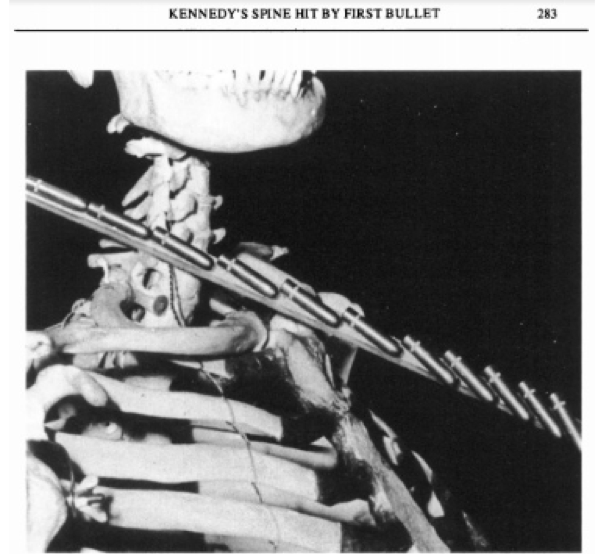
    To solve the problem, the late John Lattimer — one of Haag’s main sources of “information” — raised the back wound to the sixth cervical vertebra (C-6), using deceitful props, false reporting on X-ray findings, and fraudulent representation of neurological implications.

    If you want to see instant proof of how much of a fraud Lattimer was, just look at the picture below. It says it all.

    lattimer skeleton

    lattimer skeleton caption

    And the caption that went with the picture demonstrates one of Lattimer’s techniques in conning people. Lattimer created this prop himself, then said — as if he were an independent observer — “It appears that the first bullet … grazed the tip of the transverse process of his sixth cervical vertebra.” Of course it did: he put it there. (Note: the fragments of bone he mentions were dismissed as artefact.)

    Haag appears to have learned from past experience that some of Lattimer’s “research” is too blatantly fraudulent, so he would not likely want you to see Lattimer’s contrivance shown above. It is conspicuously at odds with the autopsy photo below:

    backwound

    Photo credit: JFK Lancer


    Like Lattimer, Haag tried to use X-ray reports to sell the higher entrance wound: He said:

    [There was a] possible graze to the right traverse [sic] process of one of the cervical vertebrae at, or adjacent, to C6.

    As usual, he provides no reference to support this assertion. In fact, the graze, if it happened, was assumed to have occurred lower, at the first thoracic vertebra — T-1, not the higher C-6:

    “There is an undisplaced fracture of the proximal portion of the right transverse process of T-1 … There is no evidence of fracture of the cervical spine or its associated appendages.”

    And why doesn’t Haag mention what is in the autopsy report? It said the wound was “just above the upper border of the scapula.” (But numerous witnesses thought it was even lower. Kennedy’s own physician said it was at the T-3 level.)

    Haag also recycles another Lattimer hoax — the “Thorburn position.” He repeats the false claim that JFK was struck at the C-6 level, based on the way he moved his arms after being shot for the first time. He said it was a reflex, tied exclusively to C-6, as described by the surgeon, Sir William Thorburn. As Haag put it:

    When the President first reappears from behind this sign [on the Zapruder film], his arms are in a very odd position, and it looks as though he is reaching for his throat. This is not the case; rather, it has been attributed to a little-known, involuntary response first described by the English spinal surgeon and military doctor, Sir William Thorburn,1 in 1887 …

    In fact, Thorburn described an entirely different position of the arms in response to damage at C-6. At no time did Kennedy ever move his arms in a way that resembled the position of Thorburn’s C-6 patient. That patient’s arms were abducted; Kennedy’s adducted.

    (Many readers of KennedyandKings.com are already familiar with this scam. Those who are not can go here for my detailed report. And see also Donald B. Thomas’s fraudulent revision of Lattimer’s scam.)

    Aside from using deceitful means for establishing a back wound at C-6 while omitting documented information that contradicts it, Haag pretends Kennedy’s back wound controversy concerns whether it is was an entrance or exit:

    Regarding this matter of entry or exit for this singular perforating gunshot wound, it is definitively solved by Federal Bureau of Investigation (FBI) firearms examiner Robert Frazier when he notes and documents the presence of bullet wipe around the margin of the small, circular hole in the upper back of the President’s suit coat.


    Kennedy’s Head Wound

    Haag repeats the old government-approved line:

    A massive exit site with expulsion of bone, tissue, and brain matter was produced in the upper right-front of the President’s head.

    Yes, the wound was in right front and right side — but also the right rear, which he omits. Even the autopsy report says so: the wound extended into occipital bone. According to Parkland Hospital’s former chief of neurosurgery, enough occipital bone was missing to reveal a great deal of missing cerebellum.

    Haag also made this strange claim:

    The WCC Carcano bullet’s ability to totally change character into that of an expanding bullet once its nose area is breached by striking thick bone. In this situation, testing by this author and others (Lattimer2 and Sturdivan7) has shown that the nose of the full metal jacket Carcano bullet can be breeched [sic] upon striking skull bone, after which the bullet behaves much like a soft-point hunting bullet.

    But Lattimer said that, in all experiments — his and those performed by the Army — there was a “complete separation” of the copper shell and the lead core. After that, much of the bullet’s energy has been spent. So how could the jacket alone go on to do the damage of a soft-point hunting bullet? That sort of bullet does its damage immediately on contact.

    (Lattimer also claimed a complete separation of shell and lead core in the case of JFK’s head wound. But what was found in the front seat, and presumed to have been “the” head bullet, were two jacketed fragments, but that is another story.)

    Regarding JFK’s backward head movement, Haag chose not to get into this issue. Instead, he referred readers to past articles on the jet effect.

    Please go here to see my gallery of amazing scams related to this case, including my exposure of fraud — based on the omission of one fundamental fact — in all presentations of the so-called jet effect.


    Conclusion

    Haag published his article in a journal that makes the following claims about itself:

    Drawing on the expertise of leading forensic pathologists, lawyers, and criminologists, The American Journal of Forensic Medicine and Pathology presents up-to-date coverage of forensic medical practices worldwide. Each issue of the journal features original articles on new examination and documentation procedures. (Emphasis added.)

    Original? Haag is just a recycler. And what he recycles is crude pseudoscience.

    New examination? He repeated experiments performed long ago by others, and they don’t back up his conclusions with respect to Kennedy’s wounds..

    Documentation procedures? Haag violates the most basic principles of documentation. He provides no references to the primary sources that he pretends back up his misleading assertions. And he leaves out critical facts that challenge them.

    How does such an unscholarly piece get into a peer reviewed journal? Obviously its vetting process has been corrupted by the deep, insidious contamination of politics.

  • Clue to When JFK Was Shot in Back


    Previously I posted an article here on the significance of S.S.A. Glen Bennett’s statement:  He saw Kennedy shot in the back—and, as you will see from the story, this had to have happened at least two seconds after he was hit in the throat (see the link above).

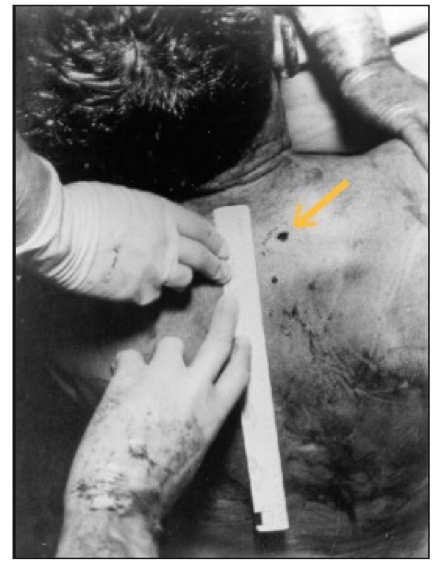
    This could explain the puzzling nature of JFK’s back wound—the way its abrasion collar suggests a shot coming from below.  Some have explained it by insisting JFK was hit while he was leaning over.

    As anyone can see from films, JFK was not leaning over at the time he first began to react.

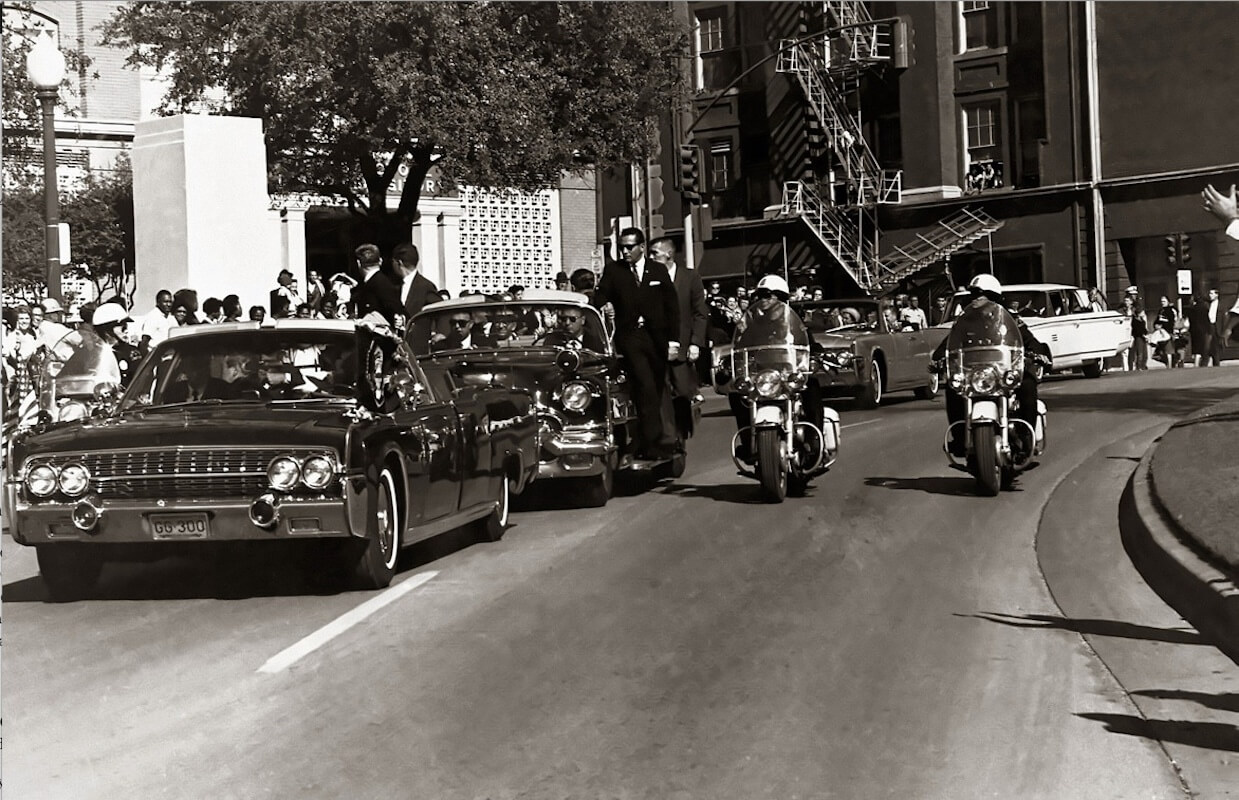
    But if Glen Bennett was telling the truth when he said he was looking at JFK’s back the instant he was struck in the back, photographic evidence shows this had to have happened after Kennedy was already hit.

    The interesting thing is, seconds after that first hit, Kennedy actually did begin to lean forward. And so no wonder the abrasion collar was on the bottom edge of the back wound.

    This is further proof that Kennedy was first hit in the throat, then in the back, but only after he began to sag in his seat.


  • Life Magazine Warren Commission Issue, October 2, 1964

    Life Magazine Warren Commission Issue, October 2, 1964


    Findings of the Warren Commission

    “Like most of us who are interested in the Kennedy assassination, I was aware of the existence of different versions of the Life Magazine Special Warren Commission issue dated October 2, 1964. I had read that there were three versions of the issue. The explanation researchers have given for the different versions is that Life Magazine was trying to make the issue released to the public (the newsstand issue) support more clearly the lone assassin Warren Commission results.

    It turns out that I subsequently was able to confirm firsthand the existence of at least two different versions, by a bit of serendipity. I already possessed the newsstand version but wanted a copy in a better condition. I checked out the best issue on e-bay that was available and purchased it. When I received my newly acquired issue, I was surprised at this version’s Warren Commission results. They were indeed different from the newsstand issue that I previously owned. It appeared to be the first version of the three versions of this issue that Life produced.”

    The main purpose of this article is to demonstrate for the readers of Kennedys And King what those differences are. The three versions of this issue are as follows:

    • Version one [V1]: issue with different frame 6 of Zapruder film stills shown and different caption describing frame 6 shown (different from newsstsnd copy). This copy I possess.
    • Version two [V2]: issue with different frame 6 of Zapruder film stills shown (different from newsstand copy) and caption describing frame 6 the same as the newsstand copy. This is alleged since I do not own this version.
    • Version three [N]: newsstand issue. This one I possess.

    These were produced in the order shown above, with version three being the final result sent to subscribers and the newsstands.

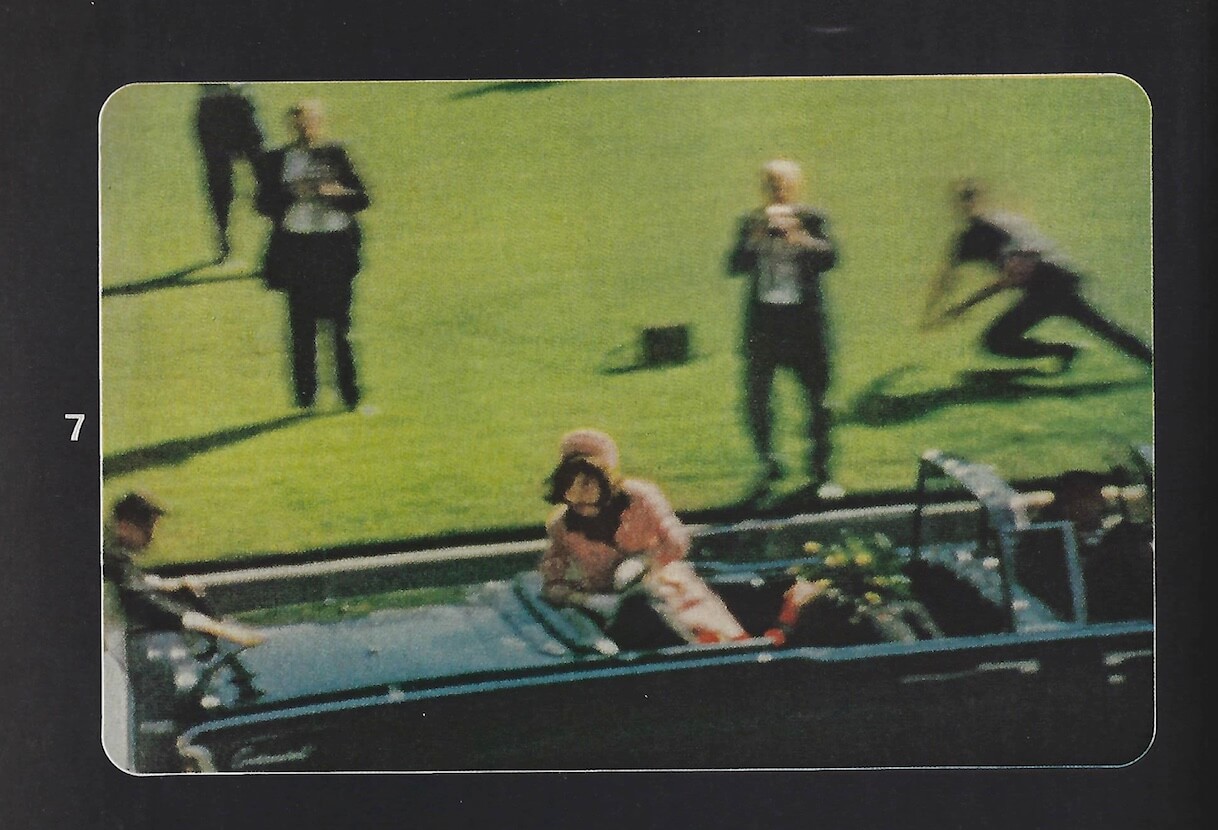
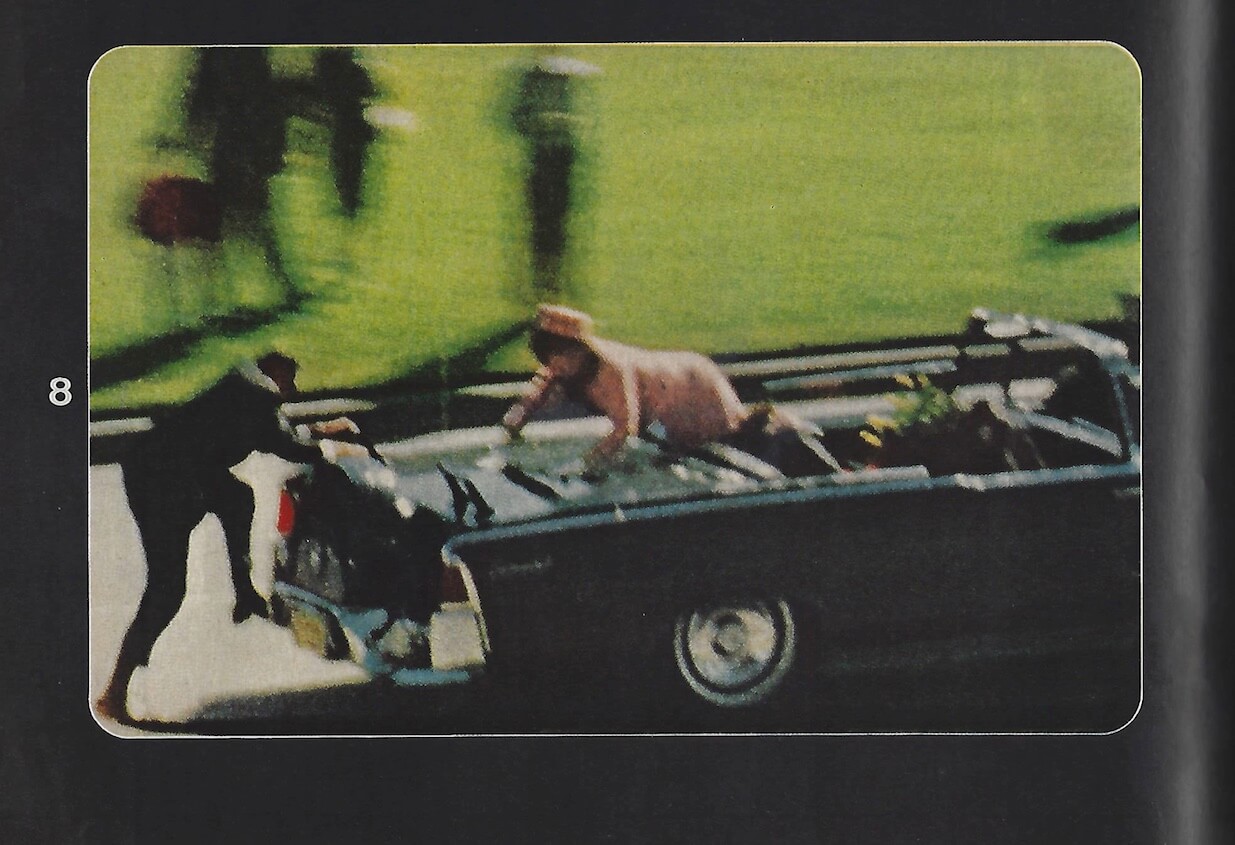
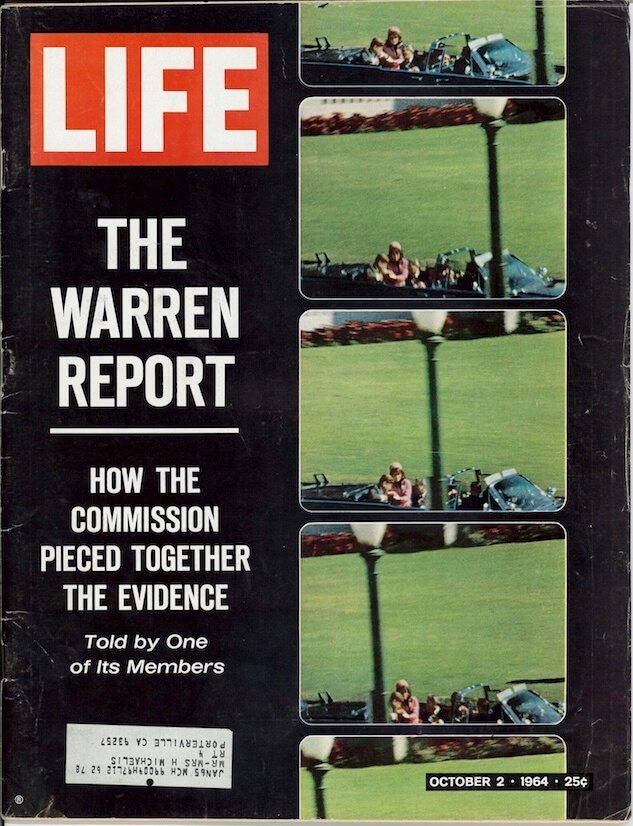
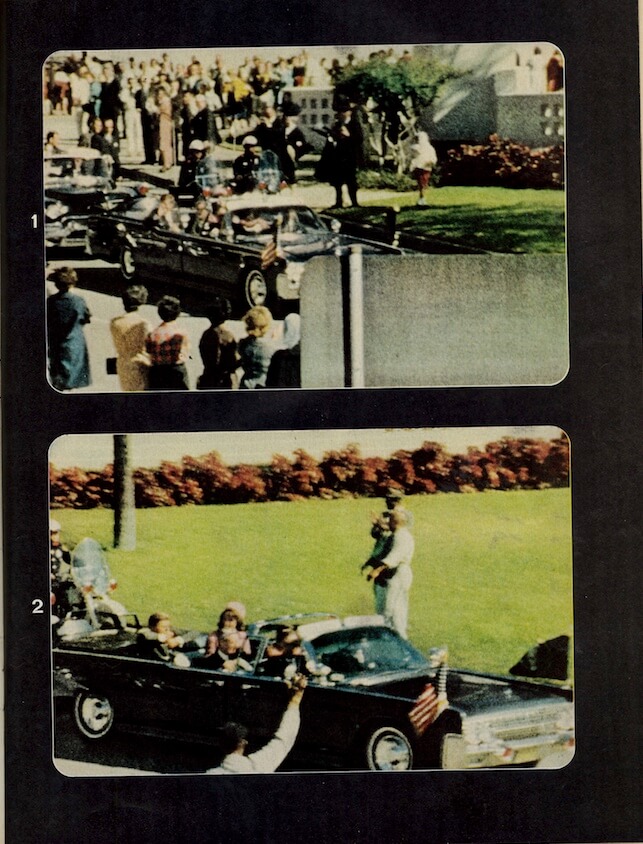
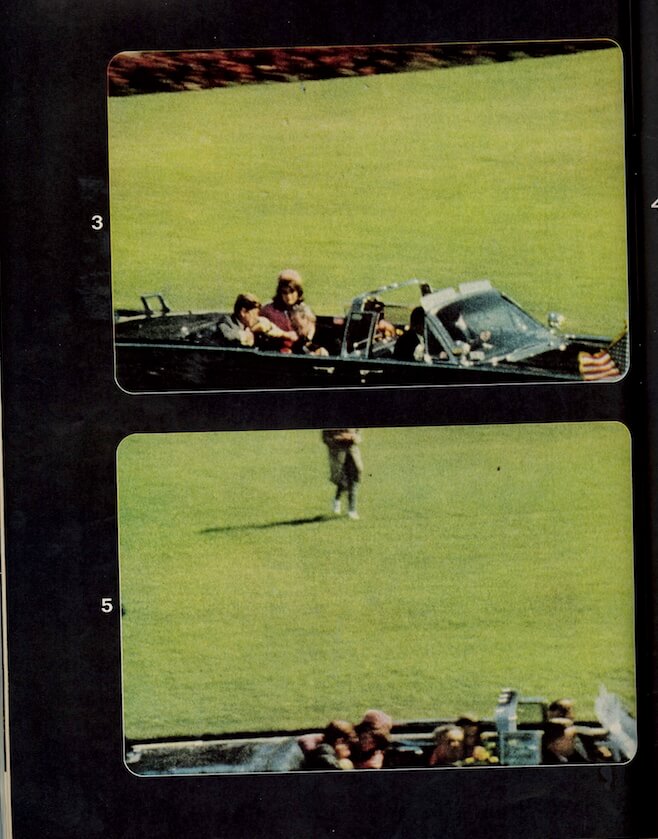
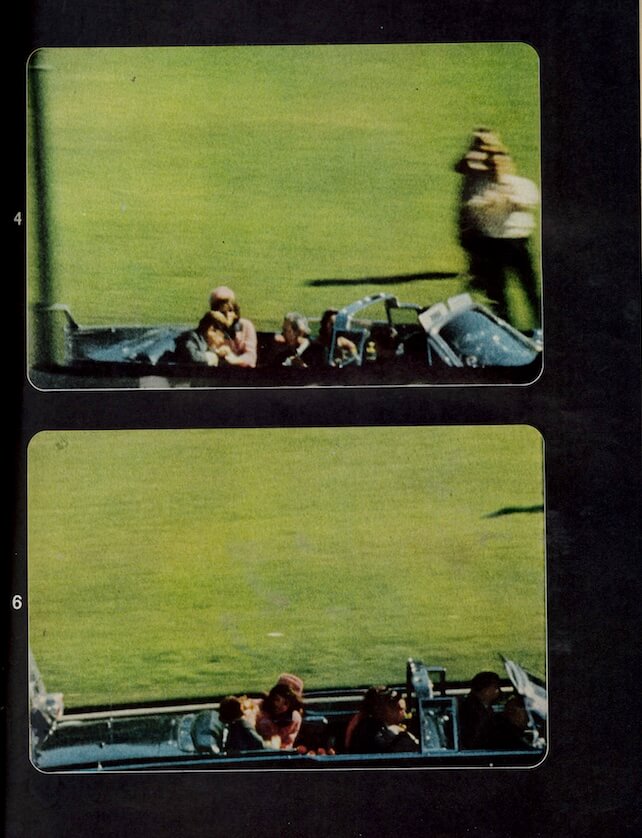
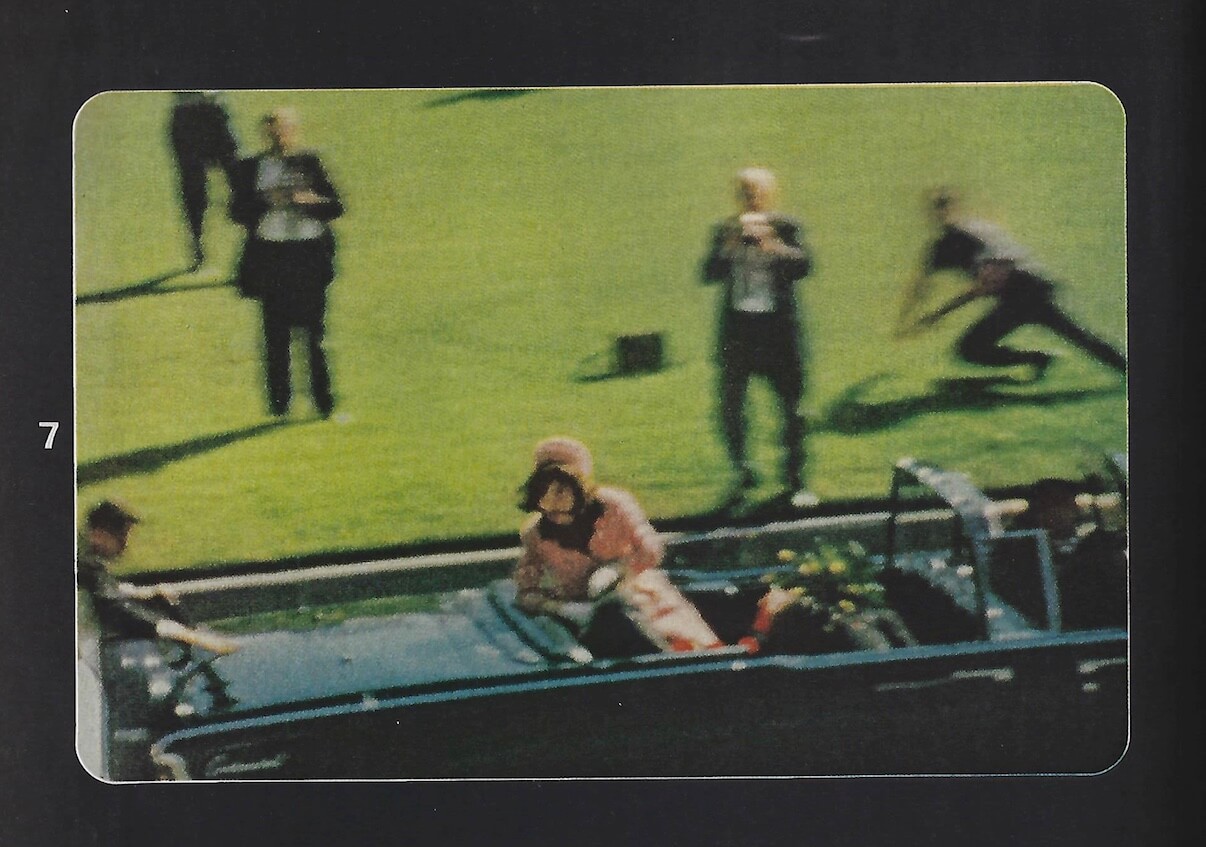
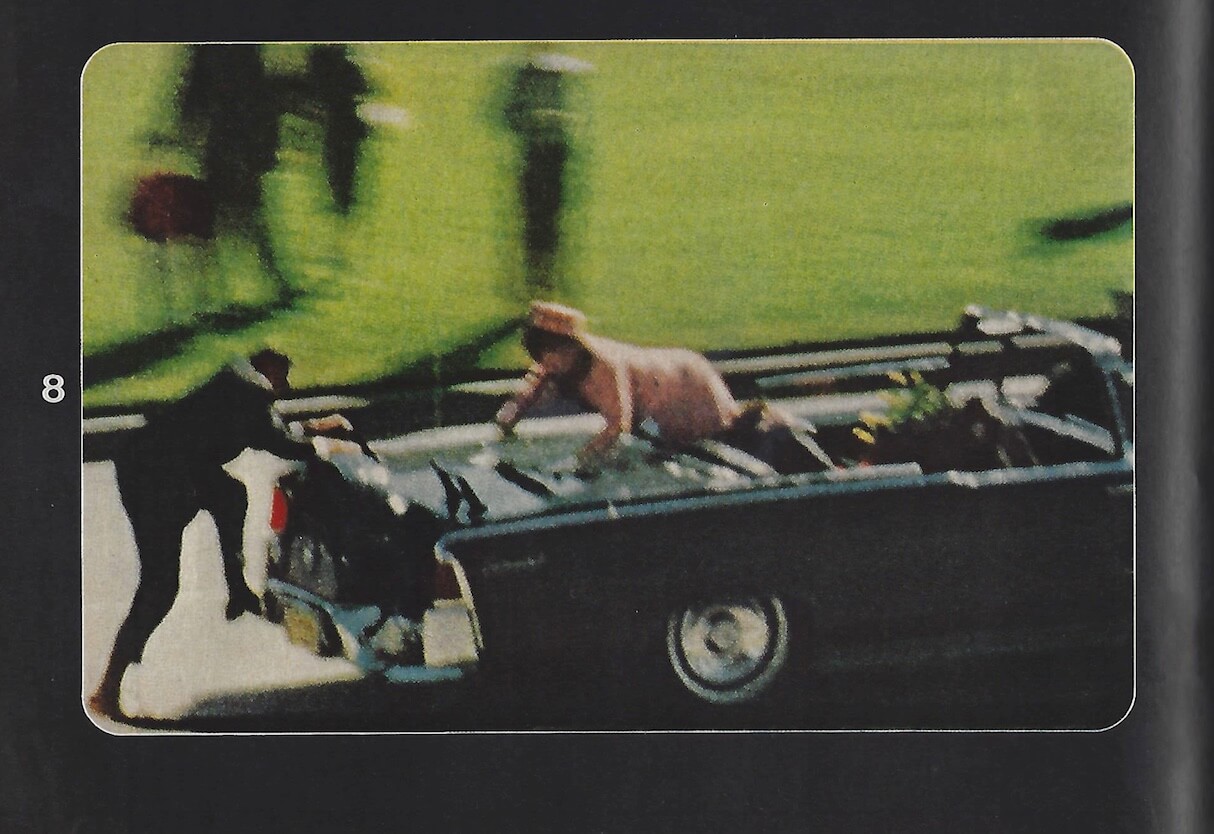
    The following set of images are reproduced from the two versions I own. I have included here the cover of the October 2, 1964 issue, the first page of the Warren Commission article (p. 42), and the eight still frames of the Zapruder film shown directly after page 42. First, the final newsstand issue [N], with exhibits numbered one through seven:

     
    Exhibit 1: Newsstand Cover   Exhibit 2: Newsstand p. 42
     
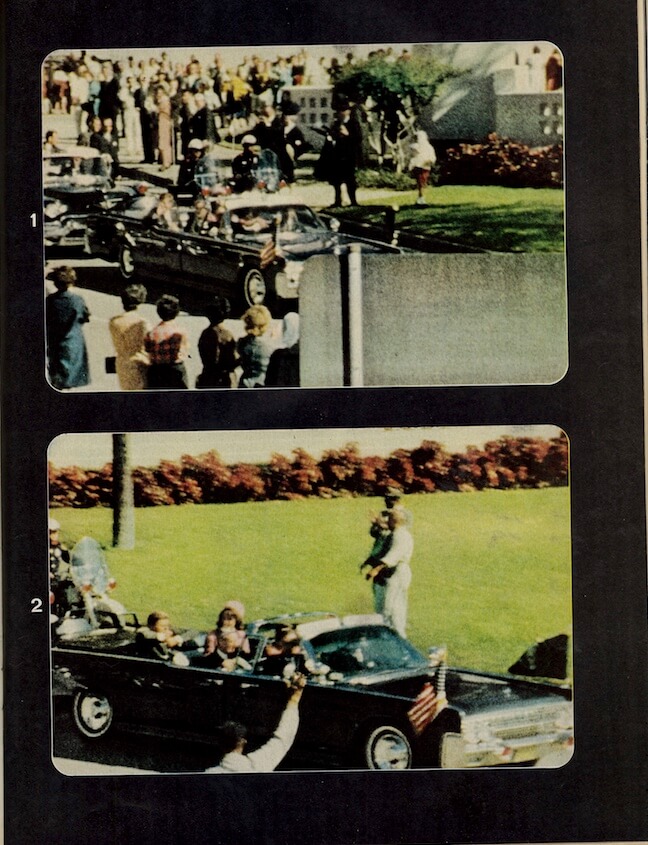
    Exhibit 3: Newsstand Frames 1 & 2   Exhibit 4: Newsstand Frames 3 & 5
       
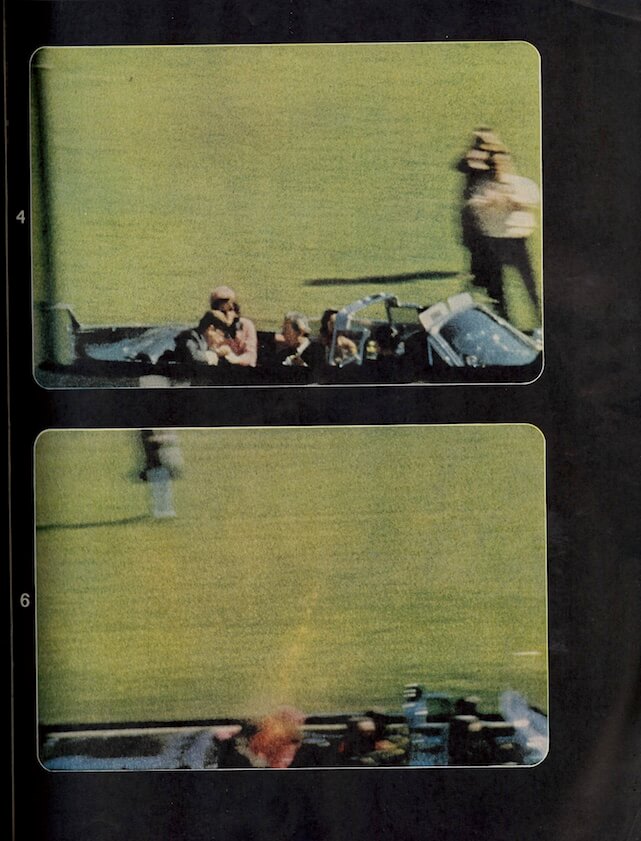
      Exhibit 5: Newsstand Frames 4 & 6  
     
    Exhibit 6: Newsstand Frame 7   Exhibit 7: Newsstand Frame 8

    Next, the copy of the earlier version [V1], with exhibits numbered eight through fourteen:

     
    Exhibit 8: Alternate Cover   Exhibit 9: Alternate p. 42
     
    Exhibit 10: Alternate Frames 1 & 2   Exhibit 11: Alternate Frames 3 & 5
       
      Exhibit 12: Alternate Frames 4 & 6  
     
    Exhibit 13: Alternate Frame 7   Exhibit 14: Alternate Frame 8

    The feature begins with a story by Gerald Ford on the workings of the Warren Commission. On this same page are also eight captions describing the corresponding eight still frames of the Zapruder film displayed on the next four pages.

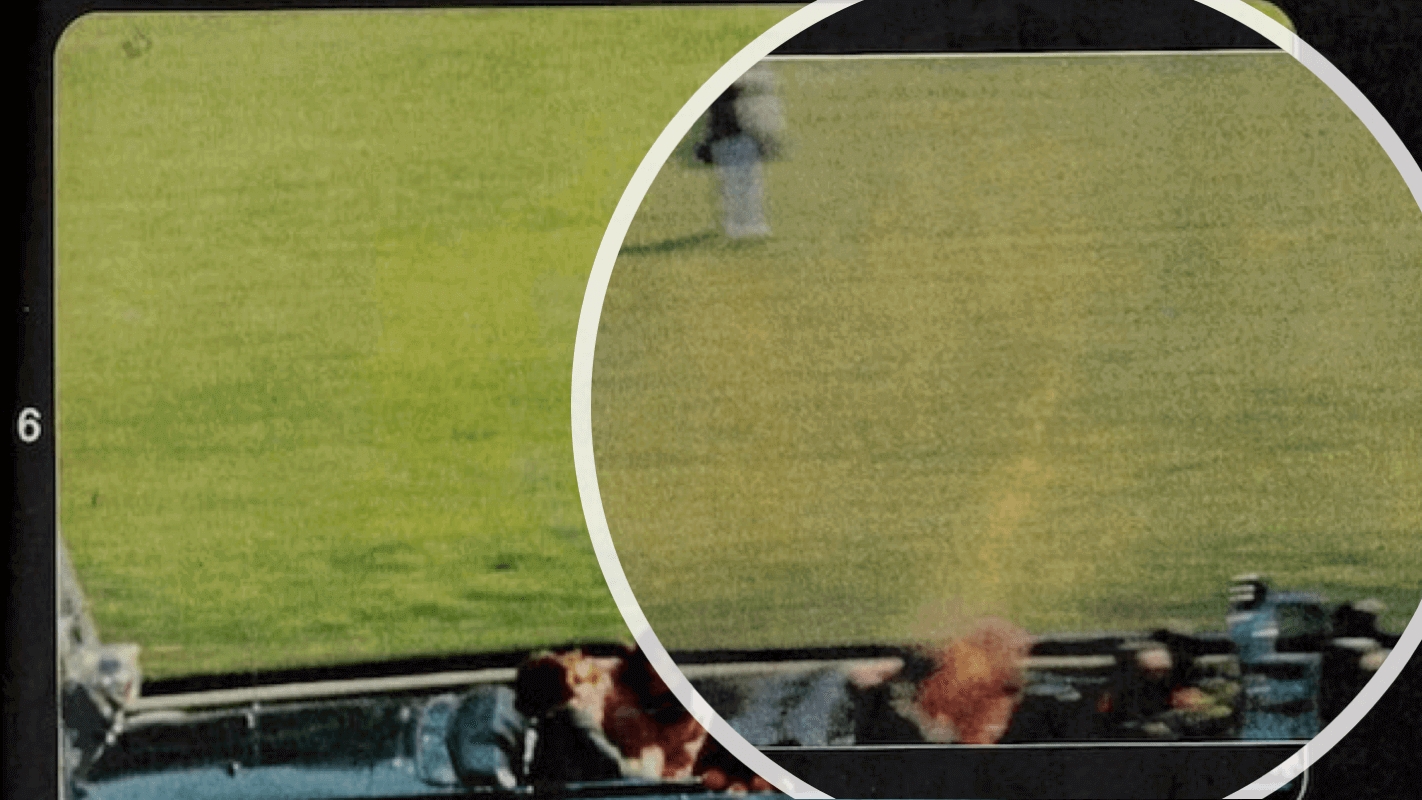
    The difference between the two issues (I reserve comment on the putative second version [V2] since I have not seen it) centers on the frame 6 Zapruder film still and its corresponding caption. The earlier alternate version [V1] (produced before the final issue version was sent to the newsstands) shows JFK’s head and body up against the rear seat cushion, suggesting, when seen in sequence with the preceding frames, that he had moved backwards and to the left (see exhibit 12). This frame corresponds to Z-323. The caption for this frame on page 42 reads as follows: “The assassin’s shot struck the right rear portion of the president’s skull, causing a massive wound and snapping his head to one side” (see exhibit 9). The caption, however, seems to be telling you something different from what your own eyes tell you. Would you, from comparison with frame 5, exhibit 11, be led to conclude that JFK’s head was “snapping to one side” or backwards and leftwards?

    With the newsstand issue [N], this Zapruder frame has been swapped out in favor of Z-313, which shows the famous halo of red exploding on the right side of JFK’s head (see exhibit 5). The caption for this version now reads: “The direction from which shots came was established by this picture taken at instant bullet struck the rear of the president’s head, passing through, caused the front part of his skull to explode forward” [sic] (see exhibit 2).

    While arguments have been made that the preceding frame, Z-312, in sequence with this one, shows the head moving forward, that motion (which may not be due to a bullet strike) is so imperceptible as to be negligible to the normal viewer, much less one perusing a selected sequence of stills. In fact, judging from the motion of the head, there really is no unequivocal proof of a bullet strike from the rear in the film, much less so in the frame that was originally chosen to represent the fatal shot (Z-323). One can only conjecture here that this was recognized by redaction. The misleading description of what is depicted in Z-323 already raises the suspicion that the authors of the feature struggled to choose a frame for the fatal shot which would unamibiguously support the offical story. The further possibility that Z-323 might actually suggest just the opposite (motion backwards) must have eventually led them to opt for the more gruesome frame they were evidently avoiding, because the latter showed that some blood, brains and skull went forward, implying (for the non-expert, at least) a rear-to-front bullet trajectory.

    It is the substitution of this telltale frame and caption that suggests an effort to make the newsstand version of the Life issue better conform with the Warren Commission’s single assassin findings; the swap was ostensibly made both to be more visually consistent with them, and to mask from the public the motion of Kennedy’s head and body which could denote, even via a still sequence, a bullet fired from the right front.


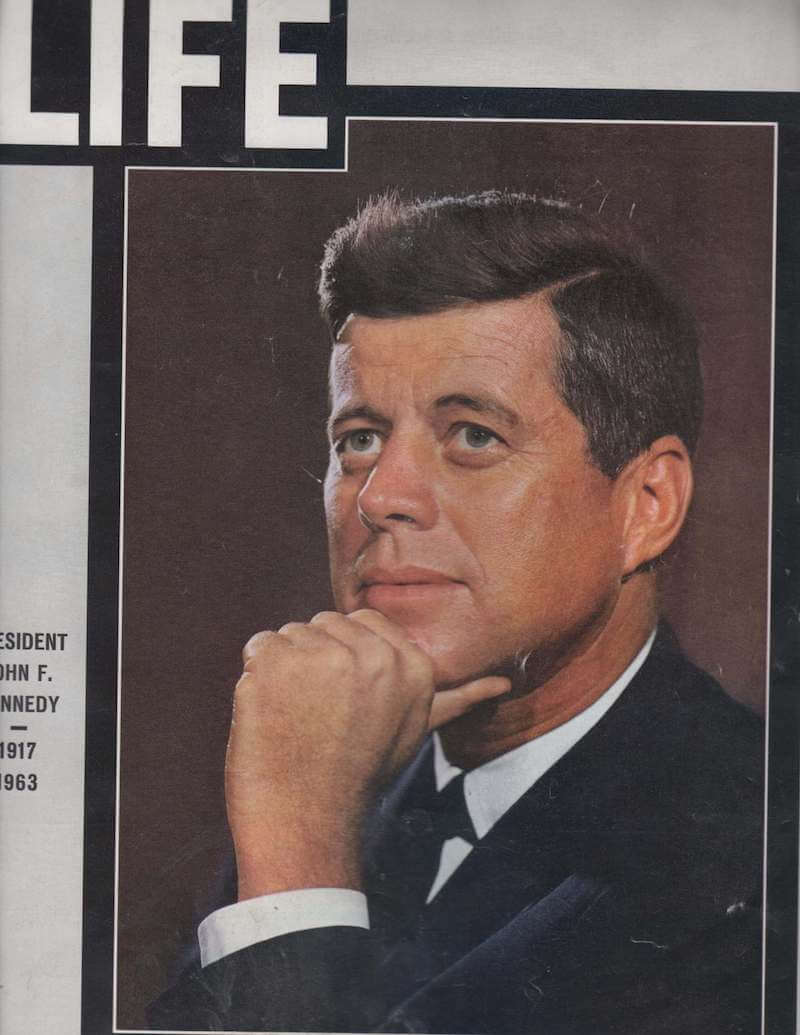
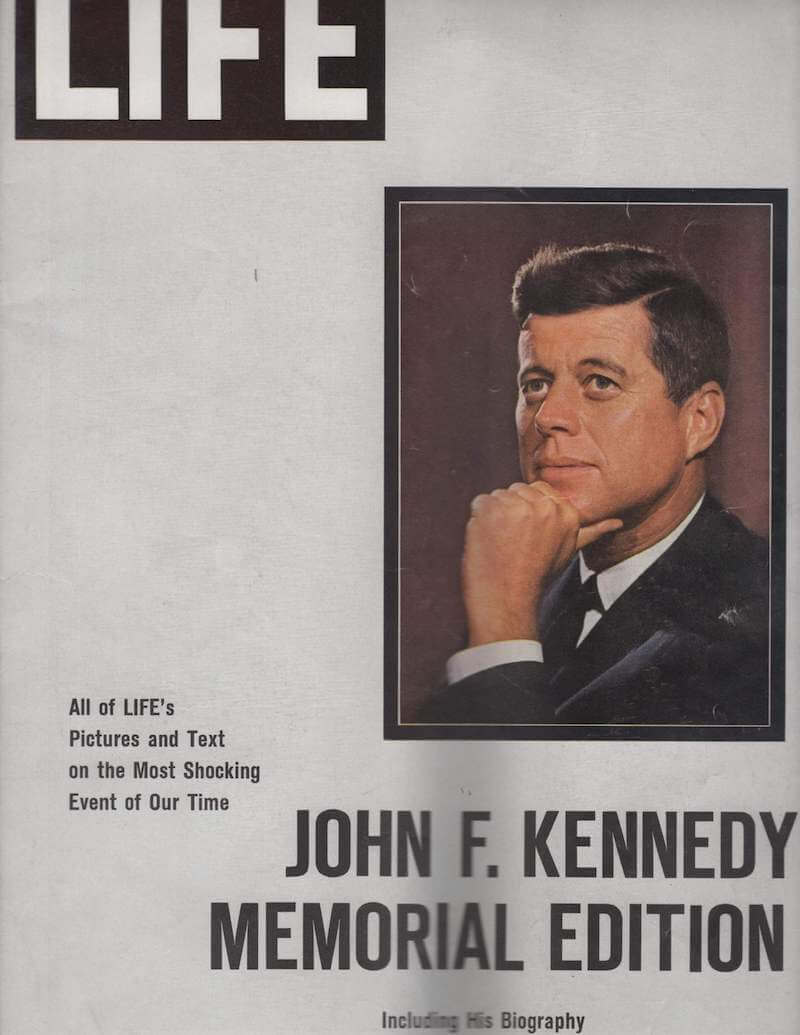
    There is a rather bizarre déjà vu in this legerdemain by the editors of the October 2, 1964 Life issue: something very similar had already been done once before. On November 29, 1963, Life published an issue mainly dedicated to John F. Kennedy and the assassination. This was a regular issue in that it contained, along with the assassination reportage, the usual full-page ads, unrelated features, and so forth. Shortly thereafter, Life decided to excerpt and rerun the relevant material from the November 29th issue in a separate, ad hoc volume, the John F. Kennedy Memorial Edition, of about 80 pages in length (only about 20 pages less than the total number of pages in the regular issue). The date is not clearly given on the cover or credits page, but the issue appears to have been published December 14, 1963.

    As can be seen from the covers, these two versions are readily distinguishable.


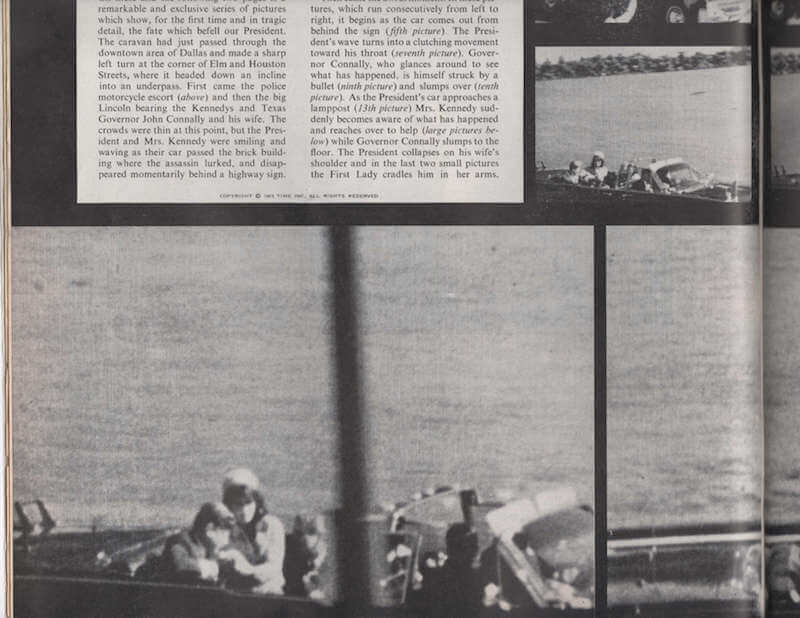
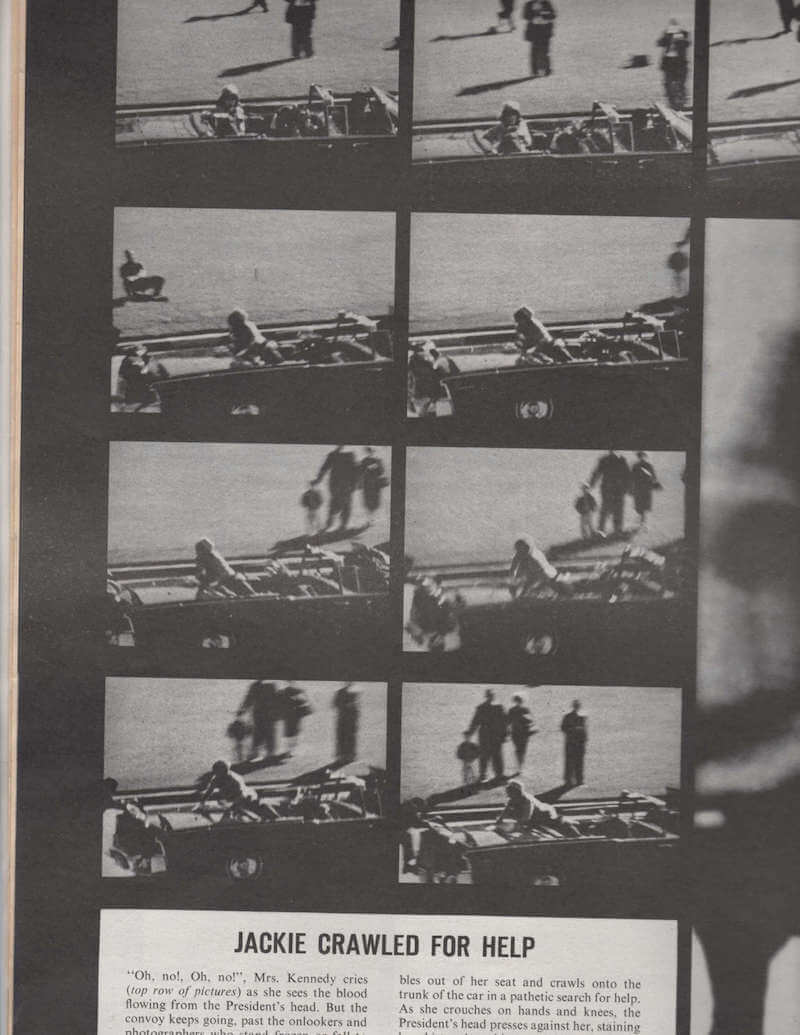
    The special edition, while carrying over what was originally published on November 29 (including the insert on LBJ), has also greatly amplified the text and photos for its now multifeatured retrospective on Kennedy’s life, presidency, and assassination. But what is most noteworthy for our purposes is the difference between the two versions in their respective presentation of the Zapruder film. What was in the regular issue a black-and-white, fuller sequence of frames is swapped out for a more limited, in-color, and somewhat magnified sequence of frames. The captioning is also very different.

    The November 29, 1963 issue carries the caption for the entire sequence:

    SPLIT-SECOND SEQUENCE AS THE BULLETS STRUCK

    There is no explicit commentary on the direction of the shots in this issue, except for what has been underlined. Here is a partial reproduction of the frame sequence, which is spread out over four pages:


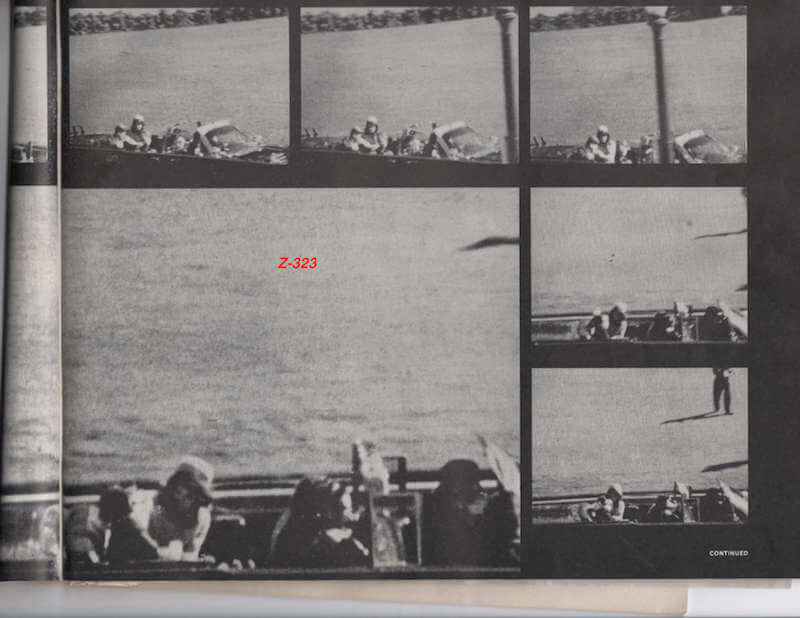
    The December 14th Memorial Edition, on the other hand, carries the caption for the entire sequence, now running across the first two pages of the four-page color spread:

    SPLIT-SECOND HORROR AS THE SNIPER’S BULLETS STRUCK

    One immediately notes the not-so-subtle variant, “horror”, and the addition of “the sniper’s” in the singular. The selected frames are now larger and fewer:


    One could, of course, argue that some of these changes were constrained by marketing choices. Color reproductions, something Life was famous for, would undoubtedly sell more copies. Given the relative expense of color vs. black-and-white, and the further magnification of some of the frames on the page, it might seem inevitable that parts of the previous frame sequence would be curtailed. On the other hand, the special edition contains a number of other color photos besides the full-page blow-up, also in the November 29th issue, of Jack and Jackie as they step off Air Force One at Love Field, which tends to undercut the idea that the change in the presentation of the Zapruder frames was guided by purely economic considerations. In any case, what was (quite conveniently) excised is telling: the frames following Z-323 depict JFK bouncing off the rear seat and Jackie scrambling out onto the hood, image sequences capable of raising questions in the reader about why JFK would move this way, and what Jackie actually might have been doing (other than crawling for help). The fuller sequence also hints at the embarrassing interval before Clint Hill reached the limo (we see in the special issue only three of those frames, two of which occupy the entire fourth of the four pages, not shown here). At the very least, providing answers to these questions would have embroiled the magazine in something more easily left to silence.

    But even if these frames were innocently removed as a result of some sort of design decision, one frame substitution cannot so be explained. Indeed, we may ask ourselves, how is the fatal shot indicated in the black-and-white sequence in the original issue? The captioning is vague, but given the absence of both Z-312 and Z-313, and the fact that it is one of the larger frames, the only candidate for this is Z-323 (marked in red in the reproduction above). But where is this frame in the Memorial Edition? It has once again been removed, with Z-312 (also in red, above) now being used to “demonstrate” the bullet strike to the rear of the head (Z-313 was probably considered just too shocking for public consumption at that time). Granting Life the benefit of the doubt and attributing this change to “clarifications” afforded by the passage of two weeks between the two editions, it is still remarkable that no frame from the fatal wounding sequence after Z-312—much less Z-323—is printed in the special edition.

    Aside from this sleight of hand with frame selection and elimination, the Memorial Edition also exchanges the original text for significantly modified copy, which names Oswald and clearly places him in the TSBD, firing three shots with a carbine, and in general adds details that follow the official story more explicitly. In this regard, one is tempted to reflect further on the main caption it has borrowed from the original issue, not only because it now declares the shots to be from a single gunman, but because the switch to “horror” there almost seems too glib. At first blush the new diction might suggest an effort to render more vividly the shared experience of Dealey Plaza witnesses, to invest the description with evaluative, rather than simply objective, content (and direct that judgment squarely at the sole perpetrator). But the word also serves as a trace, a verbal stand-in for what has been visually erased, naming the very emotion that is simultaneously denied the reader through a fuller graphic re-experiencing of the event. If this rhetorical ploy is not cynical in origin, its final effect is nonetheless ironic.

    That such editorial “rethinking” occurred twice at a distance of ten months, both times involving, among other things, the suppression of the same Zapruder frame (Z-323), is astonishing and, from the standpoint of what was going on internally at Time-Life, puzzling. But in connection with this peculiar repeat performance, let us not forget what Life reporter Paul Mandel wrote in the December 6, 1963 issue in another article on the assassination, “End to Nagging Rumors: The Six Critical Seconds”. Mandel realized that Kennedy’s treating doctor, Malcolm Perry of Parkland Hospital, had said the bullet hole in his throat was an entry. Since the moment of that impact was considerably past the time Kennedy’s limousine could have been in front of the Depository building, and in fact, Kennedy’s back was now facing the alleged sniper, Life and Mandel had a serious problem with directionality. They solved it by blatantly misrepresenting what is in the Zapruder film:

    Since by this time the limousine was 50 yards past Oswald and the President’s back was turned almost directly to the sniper, it has been hard to understand how the bullet could enter the front of his throat. Hence the recurring guess that there was a second sniper somewhere else. But the 8mm film shows the President turning his body far around to the right as he waves to someone in the crowd. His throat is exposed—toward to the sniper’s nest—just before he clutches it.

    As Life must have known, since they had the film, no such movement exists. On December 14, Life is still sticking to this story, as can be seen by the caption to frames 1 & 2 above:

    Past the book warehouse the President turned to his right to wave to someone (1). Just as his car passed behind the road sign shown in the foreground the first bullet struck him in the neck. He clutched at his throat (2).

    Though less clearly articulated here, one has only to read further in the issue to find Mandel’s article reprinted under a slightly different title (“First Answers to Nagging Rumors: What Lay Behind Six Crucial Seconds”), but with essentially the same text containing the crucial gloss quoted above. The only way to sustain this ruse was to omit the intermittent frames which would have given the lie to this explanation. The frame with Kennedy waving has purposely been made the focus here; interestingly, it was missing from the black-and-white sequence in the November 29th issue, which shows only three of the frames before the limousine emerges from behind the Stemmons Freeway sign. In just four more days, however, this entire charade will no longer be necessary: on December 18th, the NYT and Washington Post will relate “autopsy findings” which appear to derive either from the FBI or possibly some earlier, destroyed version of the autopsy report, where the wound in the back/shoulder does not exit and the puncture in the throat is from an exiting fragment from the head shot; see this article by Jefferson Morley from 2012.

    Together with the Mandel story, the frame sequence evidence we have presented above establishes that at least three times in less than a year Life colluded in deceiving the American public about the circumstances of President Kennedy’s assassination.

  • Bullet Trails on the Zapruder Film?

    Bullet Trails on the Zapruder Film?


    Years ago, on a shadowy website for snipers, I saw an interesting complaint. It had to do with the problem of killing people in very humid weather. The sniper was concerned about bullet trails leading back to his hidden position. These tell-tale bullet trails are condensation, not muzzle flashes, and certainly not tracers.

    The trails he was worried about are water vapor. A bullet creates a partial vacuum in its path, and a vacuum is very cold. Moisture in the air condenses around things cold. If you quickly pump an aerosol can until it’s nearly empty, it will become cold inside, and the can will “sweat,” that is, moisture in the air will condense on it.

    In dry air, any vapor trails created are quickly absorbed. But in humid weather, vapor dissipates more slowly. That’s why you can see your breath in the winter only when it’s cold enough and humid enough.

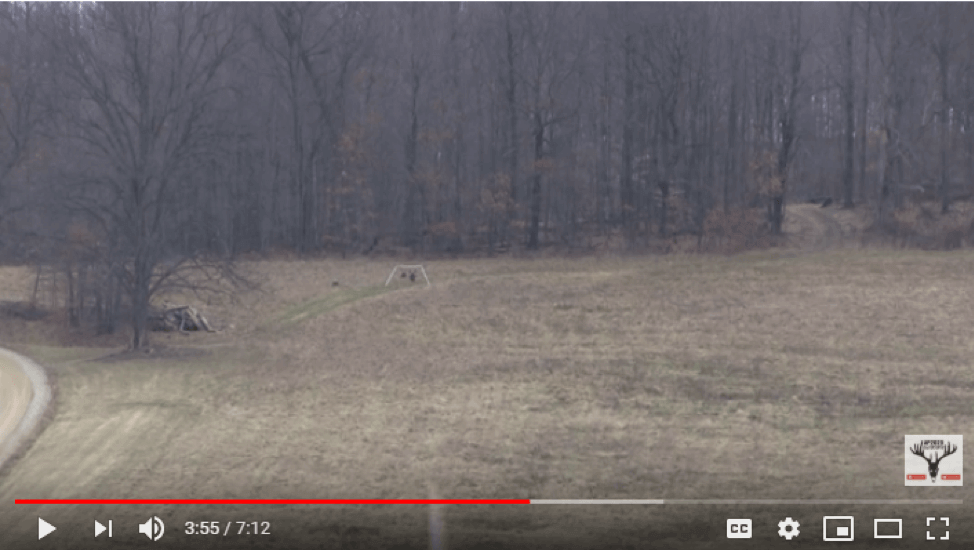
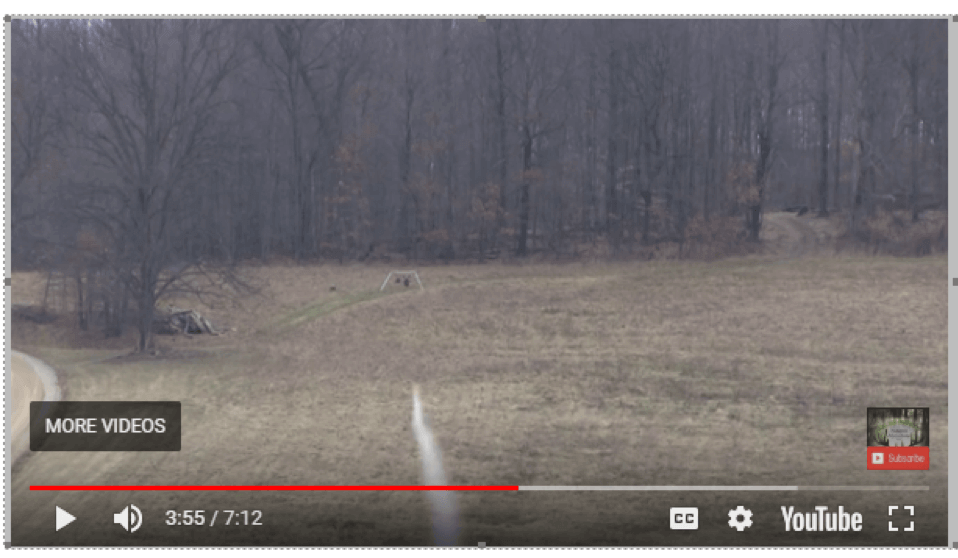
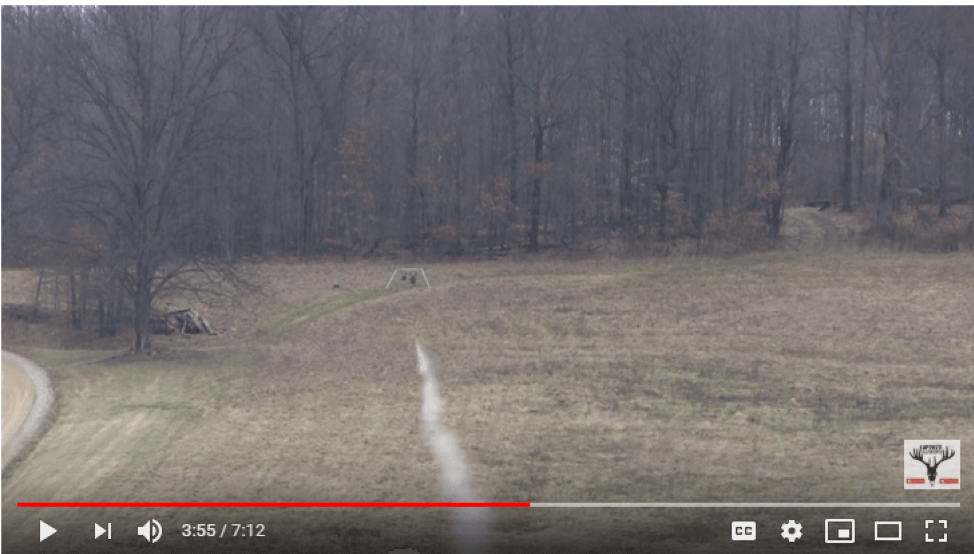
    Here is what a trail caused by a 6.5mm, 122 grain bullet traveling very fast (over 3000 feet per second) through “very humid” air looks like, as recorded by a high speed camera:


    https://www.youtube.com/watch?v=LZ2a80vxvrY

    We do not know what kind of bullets were fired at Kennedy, or their muzzle velocity, but it is doubtful they were as fast as the one above. (Weatherman Dan Satterfield told me in a private email that at 12:30 in Dallas on that day it was 66 degrees, with a west wind of 15-20 MPH. He did not know the humidity, but it had rained earlier.)


    Trails on the Zapruder Film?

    I suspected that such trails show on the Zapruder film of the Kennedy assassination, especially in frame 313. But what I claim to be bullet trails leading to the head are assumed to be matter leaving from the head—the two long, fairly straight, white lines.

    On some of the earlier copies of the film, the lines are longer. On other copies, the lines are not only shortened, they are smeared together. I have been unable to find a copy of the film as clear as the one I saw years ago, but here is a copy of frame Z-313 that isn’t bad:

    Over 20 years ago, I showed those Zapruder frames to two scientists—one from the Jet Propulsion Lab in Pasadena, California, and one from the Weizmann Institute of Science in Israel—both of whom wish to remain anonymous. Both agreed: the lines are most likely bullet trails.

    In any case, they said condensation trails from bullets had to have occurred, whether seen or not.

    Since they would not allow me to quote them by name, I asked for a textbook reference on the phenomenon. One suggested a book I could not get my hands on. The other told me to look into the work of Daniel Bernoulli—and the phenomenon of an aircraft’s “wingtip vortices”, which are easy to see:

    Go here for a fuller explanation. (Note: these are not the “contrails” that come from a jet engine’s exhaust. The wingtips are not excreting vapor, they are causing it to form.)

    (I am not the only researcher to suggest the white lines are bullet trails. In the early 90s, when I went to Jim Lesar of the Assassination Archives Research Center to tell him of my findings, he had no comment, but showed me a letter from Robert Morningstar, another researcher interested in the white lines. Morningstar’s interpretation was nothing like that of the scientists. He called them “heat tracks.”)


    Exploding Brain

    Bullet-related exploding brain looks nothing like those lines.

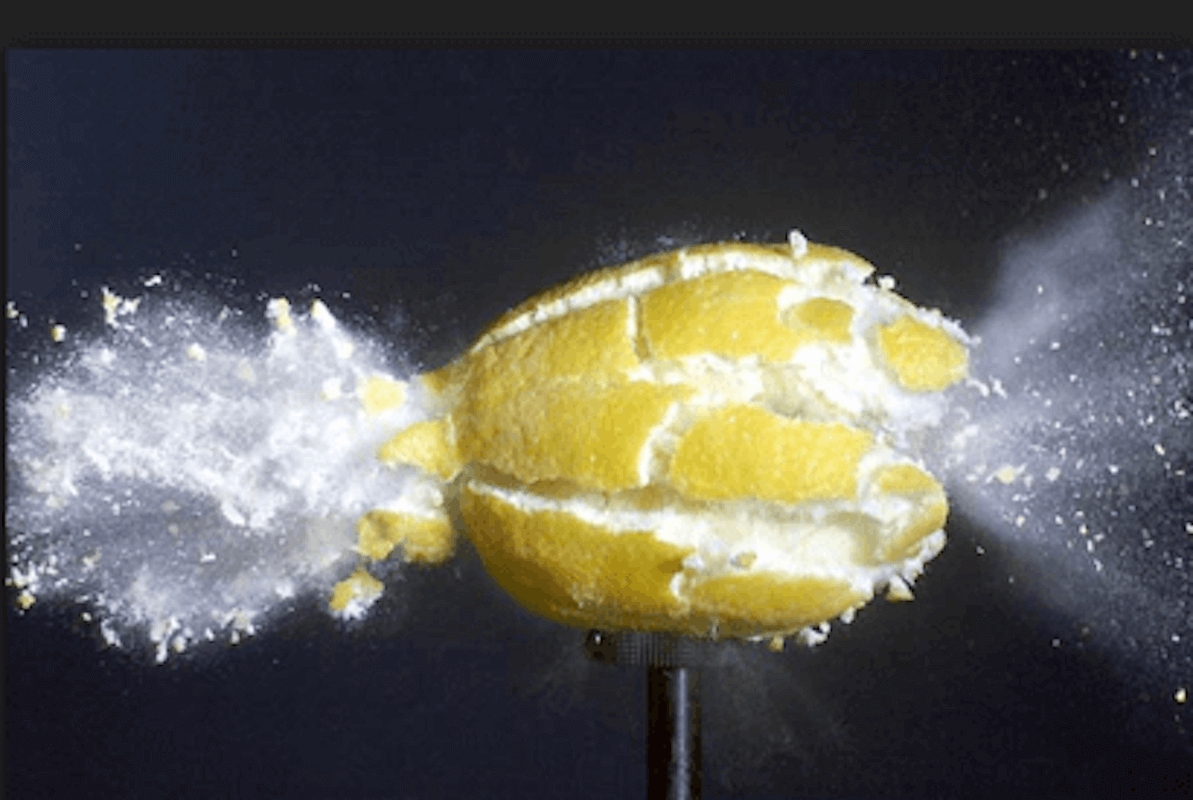
    Consider what happens when a bullet fired by a high powered rifle perforates the skull: the bullet goes in and out, leaving holes in the skull that are almost the same size. Milliseconds later, a process known as “cavitation” takes place. Exploding brain thrusts open the skull, creating adherent as well as loose bone fragments, and a massive wound—usually on top, regardless of where the bullet enters. This process is known as “cavitation.” How it happens:

    “With high-velocity wounds, there is … a sudden sharp increase in intracranial pressure … (and a) temporary cavity … formed by the radial motion imparted by the missile, through creation of oscillating positive and negative pressure along the path of the missile …” (Youmans, J.R. (ed.), Neurological Surgery, Vol.4, p. 2056, W.B. Saunders Company) 

    Scientists discovered the difference between holes created by cavitation, and those created by exiting bullets when they shot empty skulls. Without brain or brain simulant, there is no cavitation. And both entrance and exit wounds were almost the same size. The exit wound is usually only slightly larger because the bullet deforms or tumbles. Sometimes the bullet takes a small amount of adjacent skull with it, and then the hole is bigger.

    If exploding brain creates massive holes—and we know JFK had a massive hole at the top of his head extending into the right rear—then how could exploding brain appear as two long, rather straight, slender lines? Or, as some say, exiting bone fragments leaving the head, one behind the other?

    Fluid forced through small holes under high pressure will come out as long streams—but would such streams have the strength to blow off so much bone?

    And why would they remain in the air—afterward?

    The more visible line seen on the Zapruder film is broken into small, fairly evenly spaced, individual bits. Magnified, the bits seem to be little spirals. The most prominent one lies across Kennedy’s head in frame 313, leaning to the right at about a 50 degree angle.

    This bullet trail—if that indeed is what it is—suggests the bullet skated across Kennedy’s right temple, creating a shallow tangential wound that flipped out a flap of bone—and kept on going.


    Did Rockefeller Commissioner See Those Lines?

    An exchange between Robert Olsen of the Rockefeller Commission and John Lattimer, MD, who examined the autopsy materials (President’s Commission on CIA Activities, 1975, pages 28-30):

    Doctor, did you find any evidence whatever that would support postulating a tangential shot from the front or right front which would not have penetrated the President’s head, but merely would have glanced off the right side of his skull?.

    Lattimer said he saw no such evidence.

    What about the possibility of the President having been struck from the rear … and then that being followed, within a fraction of a second, by a tangential blow by a bullet from the front, or the right front, glancing off the right side of the head? Is there any possibility?

    Again Lattimer said he saw nothing to indicate that. But why did Olsen ask such questions?


    Following the Trail

    In the early 90s, I went on a fool’s errand to Dealey Plaza to see if I could find where that bullet trail might have led back to. The most likely spot, in my non-expert opinion: The sniper was to the left of Zapruder, firing from behind the pergola through one of the lattice holes, about midway between the left and right side of the crescent-shaped structure, concealed from behind by the parked cars. The shot would have been nearly horizontal.

    All just conjecture, of course.

  • New URL for TheMantikView

    New URL for TheMantikView

    David Mantik’s home site can now be found at http://themantikview.com

  • More Proof JFK Was Hit From the Front

    More Proof JFK Was Hit From the Front


    Many people are now analyzing the newly-released documents concerning the assassination of John F. Kennedy, and most are hoping to find scraps of information that will help reveal Who Done It? But some of us are still intrigued by a different puzzle: What exactly They Done.

    We continue to ponder this issue because so much of what we have been told by the government has been contradicted by key witnesses, those who were closest to the action, and whose testimony was the most detailed and specific.

    One such person is Glen Bennett, a Secret Service agent who rode in the back seat of the follow-up car just behind Kennedy on the day of the assassination. If what he said is true, then he saw something small but extraordinary—something that would mean that at least one bullet came from the front.

    SS Agent Glen Bennett at Love Field
    (Image courtesy of Vince Palamara)

    Bennett said he was looking right at Kennedy’s back at the very moment he heard a shot, a second shot, and he saw it hit.

    It’s not what Bennett saw, but when he saw it, that is key: Photographic evidence shows that if he indeed saw this strike, it had to have happened after JFK was already reacting to an earlier strike. That earlier strike—by a separate bullet—led to an obvious reaction: Kennedy seemed to be grabbing at his throat.

    And, if the throat wound is not related to the back wound—then it has to have been an entrance.


    What Bennett Said He Saw

    Bennett said he saw Kennedy hit in the back “about four inches down from the right shoulder.”

    He said it in a formal typed statement, as well as in his notes written by hand while he was on the plane returning to Washington—that is, before the autopsy, presumably before anyone else had known about that wound. The emergency room doctors in Dallas’s Parkland Memorial Hospital said they never turned the body over and were unaware of the wound. So it does seem that Bennett actually saw this strike. The relevant part of his statement:

    About thirty minutes after leaving Love Field, about 12:25 P.M., the motorcade entered an intersection and then proceeded down a grade. At this point, the well-wishers numbered but a few; the motorcade continued down this grade en route to the Trade Mart. At this point, I heard what sounded like a firecracker. I immediately looked from the right/crowd/physical area/ and looked towards the President who was seated in the right rear seat of his limousine open convertible. At the moment I looked at the back of the President I heard another firecracker noise and saw the shot hit the President about four inches down from the right shoulder. A second [sic] shot followed immediately and hit the right rear high of the President’s head. [If he heard two “firecracker” sounds earlier, the headshot has to be the third shot he heard, not the “second.” ~M.C.]  I immediately hollered “he’s hit” and …

    Promoters of the official story say Bennett could not have seen that shot because he was too far away. But you can see from the pictures that he was not so far.

    They also say such a wounding would be too small to see. Wrong again. You can perform your own experiments to see what is visible, and at what distances.

    Bennett did not describe in detail what he saw, but such a shot would look like a sudden, inward tenting in the jacket.


    When He Saw It

    I see no visible clue on films that suggests JFK is being hit in the back. It could have happened soon after the throat shot – or several seconds later, during what many described as a “flurry” when JFK was shot in the head.

    On the other hand, reactions to the first and last shots are easy to see. Evidence of the first is unambiguous at Zapruder frame 224.

    But he had to have been hit before that.The sound of the shot would have come after the bullet hit, but before JFK showed any reaction.

    A photo taken by Major Phillip L. Willis, a bystander, captures this moment. As he put it,

    “The shot caused me to squeeze the camera shutter, and I got a picture of the President as he was hit with the first shot. So instantaneous … the crowd hadn’t had time to react.”

    Willis Photo No. 5

    Nor did Glen Bennett have time to react. He is in this photo and, as you can see, his upper body is turned to the right as he watches the crowd on the north side of Elm Street. According to his statement (see above), he would not yet be looking at Kennedy.

    If he heard the same shot Willis reacted to, he still would not yet be reacting as of this moment. But, like many other witnesses, it’s possible Bennett didn’t even hear this shot. (Some didn’t even hear the second one, yet they heard more than one later, during the head wounding. But that’s another story.)

    About three seconds later, James W. Altgens, an Associated Press photographer, also took a photo of the motorcade. The strange thing is, Altgens said he took that picture almost simultaneously with what he called “the first shot.”  When questioned closely about the timing, Altgens swore that he heard no other shots or noises that could have been shots before this “first” one.

    Altgens Photo No. 6

    Glen Bennett is also in this photo. People say he is still turned to his right here, but I have trouble seeing him at all. In any case, if Bennett, like Altgens, had not heard a shot before this moment, then I would not expect him to have reacted yet.

    Jackie Kennedy apparently did not hear all the shots, and she had an explanation: the noise of the motorcycles put-put-putting. And Bennett was very close to them. (Please go here for more on the acoustical evidence, and other bewildering mysteries of this case, including the fact that Mary Moorman heard a shot for the first time when JFK’s head exploded, which she captured on her famous Polaroid photo.)


    An Attempt to Discredit Glen Bennett

    Glen Bennett was never asked to testify before any of the official investigating bodies, like the Warren Commission or the House Select Committee on Assassinations. This is no surprise. Kennedy’s own physician, George Burkley—a man who was with him in the Dallas emergency room, and at his autopsy in Washington—was also never asked to testify. Whatever Burkley witnessed gave him the impression that more than one shooter was involved in the assassination. (Please go here to see more on that.)

    Thanks to David Lifton, author of the best-selling book, Best Evidence, many assassination researchers ignore Bennett’s comments.

    Lifton—who believes that all shots came from the front, despite Connally’s back wound and other evidence—claims Bennett was lying. (See pages 77, 284-7, and 510-511 in the 1988 edition of his book). Lifton’s proof? The Willis and Altgens photographs. They both show Bennett looking off to his right.

    But Willis said he snapped his photo when the first shot was fired. How could Bennett be already facing the front at that moment? The same applies to the Altgens photo. Even if Bennett had heard the same “first” shot Altgens heard, how could he be reacting already? He would have been facing the front at the time of the second shot (the second shot he heard)—not the first.

    If I had to guess, I’d say JFK was hit in the back during the “flurry” at the end. Too bad we can’t question Bennett about it.

    Ironically, what Lifton considers proof that Bennett lied, is actually proof, though indirect, of a shot that came from the front.

  • The Omissions and Miscalculations of Nicholas Nalli

    The Omissions and Miscalculations of Nicholas Nalli


    “If there are enough parameters, it is possible to fit anything.”

    –G. Paul Chambers, Ph.D. (physics)1


    The source material for this review is as follows:


    Nicholas R. Nalli*. “Gunshot-wound dynamics model for John F. Kennedy assassination.” Mechanics, Engineering, Physics. 30 Apr 2018, Volume 4, Issue 4.

    *Corresponding author. I.M. Systems Group, Inc., 5825 University Research Court, College Park, MD 20740, USA. nallin@imsg.com.

    https://www.heliyon.com/article/e00603

    • From the news release: “The new findings do not necessarily rule out a broader conspiracy, but they do pour water on the theory that the fatal shot was fired from the grassy knoll.”2
    • From Nalli’s abstract: “It is therefore found that the observed motions of President Kennedy in the film are physically consistent with a high-speed projectile impact from the rear of the motorcade, these resulting from an instantaneous forward impulse force, followed by delayed rearward recoil and neuromuscular forces.”
    • From the closing paragraph: But themodeling study (and underlying dynamics and conservation laws) presented in this paper, in corroboration of the autopsy findings, do imply that President Kennedy was not hit by a hypothesized gunshot from the front.”

    First: A Logical Issue3

    Nalli claims that his work is “consistent with” a (rearward) recoil of JFK’s head after a posterior shot. He then concludes that because his work is “consistent with” such a scenario, this means that any other scenario (e.g., a frontal shot) cannot be correct. On the other hand, G. Paul Chambers has shown that JFK’s head snap is fully consistent with a frontal shot.4 Can Chambers therefore justify reaching precisely the opposite conclusion, i.e., namely that recoil from a posterior shot cannot be correct?

    These mutually exclusive models remind us of the Ptolemaic model, which described the earth as the stationary center of the universe. The planetary motions were modeled on clever epicycles. The model worked (well enough), and it was “consistent with” the data. But that does not mean that other models were excluded—as Copernicus (1473-1543) discovered. Nalli does not seem to recognize this logical issue. Moreover, he does not recognize that a shot from the rear might even be compatible with a second head shot (from the front).

    David Lifton was an early pioneer in this controversy about the movement of JFK’s head, first meeting with a Nobel Laureate, the physicist Richard Feynman, and next with a British physicist, Dr. James Riddle at UCLA, who (like Chambers) concluded:

    The motion of Kennedy’s body in frames 312-313 is totally inconsistent with the impact of a bullet from above and behind. Thus, the only reasonable conclusion consistent with the laws of physics is that the bullet was fired from a position forward and to the right of the President.5


    The Nalli Assumptions

    Nalli employs numerous key assumptions. If any one of these is seriously wrong, his model might well collapse. Here are 21 assumptions, many of which inevitably lead to miscalculations.

    1. NALLI: In his scenario, ejected debris only goes forward; none travels backward.

      MANTIK: Nalli acknowledges that the autopsy skull defect measured 13 cm (5 inches), but he never explains why ejecta could not escape in other directions. The autopsy report (if it is accepted) described a defect that encompassed the frontal, parietal, and occipital skull. The Parkland doctors, almost uniformly, described a baseball-sized hole in the right occiput; so also did autopsy assistants, FBI observers, and the individual6 who developed autopsy photographs. (See Addendum 1 below.) If some ejecta went backwards, Nalli’s thesis is in serious trouble—after all, less momentum would then be available to drive the head backwards. Furthermore, many witnesses—in Dealey Plaza, as well as early observers of the Z-film—recalled such rearward-flying debris. One of these was Charles Brehm: “That which was a portion of the President’s skull went flying slightly to the rear of the President’s car and directly to its left.”7 Clint Hill noticed that there “…was blood and bits of brain all over the entire rear portion of the car.” Hill added that he himself had been covered with blood and brain tissue. Moreover, the evidence is not all from eyewitnesses; Josiah Thompson was the first to point out debris visible on the limousine trunk, as seen in the Nix film.8 Nalli (perhaps innocently) ignores all this rearward going momentum.

    2. NALLI: He estimates that the projected area (A) of the bullet (as it struck the skull) was merely its cross-sectional area.

      MANTIK: Milicent Cranor9 points out, however, that no such estimation is required—after all, the autopsy report plainly states the actual size of the entry hole as 6 x 15 mm,10 which is obviously much larger (by more than a factor of two) than the bullet’s cross-sectional area. She further quotes Nalli, who states that all the pertinent drag forces (on the bullet)—are directly proportional to the projected area of the bullet. Therefore, Nalli’s calculations for the drag force (Fd) are wrong by at least a factor of two. In addition, such a tangential strike would deliver a greater impulse to the head, making it more difficult for Nalli’s forward ejecta to reverse the resulting (additional) forward momentum of JFK’s head. Cranor concludes:

      The elliptical shape of the long entrance wound indicates a sideways or tangential hit (the two are different but have much in common). This would mean the bullet was in contact with the bone in front of it longer than it would have been in a nose-on hit.

      And the longer bullet and bone are in contact, the more energy is imparted to the bone—and, in some circumstances, the more the head moves, until the bone in front of it detaches completely. According to Capt. Philip Dodge, tangential strikes can actually knock a person down.11

    3. NALLI: In his Figure 3, he plots the drag force (Fd) as a function of tissue depth (δx). Four curves are shown, each with a different value of the exit wound diameter (de).

      MANTIK: Unfortunately, he never shows similar curves for different values of the entrance diameter, which he incorrectly estimates to be the cross-sectional area (A) of the bullet.

    4. NALLI: In his Figure 4, he plots the impulse (Jx) as a function of tissue depth, for four different values of the exit wound diameter (de).

      MANTIK: However, the impulse force is directly proportional to the projected area (A) of the incident bullet, which means that the entrance wound diameter (A) is also critical. Unfortunately, he merely estimates that A is the cross-sectional area of the bullet—even though the pathologists described it as 6 x 15 mm. His Figure 4 therefore examines only a small fraction of the universe of possibilities; he should have used either the correct value of A, or some reasonable range, instead of estimating that A was merely the cross-sectional area of the bullet.

    5. NALLI: In his Figure 4, he plots the velocity of the bullet at depth (vx) for four different values of the exit wound diameter (de).

      MANTIK: Unfortunately for Nalli, according to his equation 23, the velocity also depends on the projected area (A) of the bullet, but he again merely estimates that A is the cross-sectional area of the bullet, rather than the 6 x 15 mm stated in the autopsy report.

      So, this graph also needs some serious amendments.

    6. NALLI: He sees only a single head shot (said to be due to a Mannlicher-Carcano bullet).

      MANTIK: The only intact bullet (the Magic Bullet) in the Warren Commission (WC) case was purportedly found on a Parkland Hospital stretcher. Its provenance has been thoroughly debunked by Josiah Thompson and Gary Aguilar, M.D.12 John Hunt has also noted the paradoxes evoked by its so-called arrival at the FBI laboratory in Washington, DC.13 Most likely, the Mannlicher-Carcano bullet is irrelevant to the JFK case, but it is the only bullet that Nalli considers.

      There is even more: Dr. Randy Robertson, my radiology colleague, recently discovered the papers of James M. Young, M.D., at a Navy website. Young, a White House physician at the time, reports that one more bullet was found in the limousine.14 The WC did not report this, nor does Nalli recognize this bullet, although he may not have known about it.

    7. NALLI: “…the impulse force [sic] is modeled in the current paper by assuming a perfectly inelastic collision.”

      MANTIK: During such an inelastic collision, by definition, the entire bullet must remain inside the target. Inconveniently for Nalli, the nose and tail of this same bullet were purportedly15 found inside the limousine—not inside of JFK’s head. Nalli is aware of these fragments, but he does not really address the conundrums that they pose. No one knows how much momentum was carried away by these miscreant limousine fragments—or by the middle portion of this bullet—because this middle section was never recovered.16 Since Nalli never considers the momentum of these three fragments in his calculations, a dark cloud is cast over his results.

    8. NALLI: His “…theoretical model calculations were performed for an idealized high-energy spherical projectile with the mass and speed of a Carcano bullet.”

      MANTIK: Of course, the actual bullet (or bullets) remains unknown,17 and its spherical shape is only an approximation. In particular, if the 6.5 mm object on the AP skull X-ray represents a real metal fragment (that mysteriously sheared off and remained behind at the rear of the skull), then that bullet fractured at entry (which Nalli concedes) and was never round at any point inside the skull.

    9. NALLI: The cratering process identifies the exit wound—and therefore the direction of the exiting projectile.

      MANTIK: The purported exit site is shown on the left below (Figure 1), from WC Exhibit 388, as produced by H.A. Rydberg18 under the direction of JFK autopsy pathologist Dr. James Humes. Frame 313 of the Zapruder film (Z-313) is on the right. Nalli displays neither of these images. Nalli’s streaking debris can be faintly seen here in Z-313, going upward and forward. (He describes four particles.)

      Figures 1A and 1B. On the left is the WC sketch. On the right is Z-313.

      The usefulness of beveling (to pinpoint entrance or exit sites) has now been roundly criticized. It is no longer considered definitive. Nowhere does Nalli acknowledge this.19 It is not certain that he was aware of this rather new state of knowledge.

    10. NALLI: Perfect inelasticity is assumed, i.e., the bullet does not exit from the skull: “As a final note, all these calculations have treated the head as a ballistic pendulum.”

      MANTIK: Unfortunately for Nalli, if the nose and tail of the bullet were found inside the limousine (as the WC reported), and the middle portion has disappeared, then his ballistic model is broken. For the classical ballistic pendulum (where nothing exits), such a broken rule might well destroy his case.20

    11. NALLI: The parameter a, used to calculate the bullet speed at depth (Equation 18),is a projectile nose-shape parameter that ranges between ≈1.2 and 1.9.

      MANTIK: This value contains an alarmingly large range. In Nalli’s Figure 3, he presents the drag force for several values of de (the effective exit diameter of the deformed bullet—see Nalli’s Table 2). Nalli’s Figure 4 displays the bullet speed at tissue depth (vx), but no variation of a is demonstrated, thus concealing a great deal of uncertainty. MATLAB could easily have plotted this for him (for different values of a).

    12. NALLI: The bullet was broken into at least three fragments.

      MANTIK: This presumably (Nalli never clarifies this) includes the 6.5 mm “fragment,” located inside JFK’s right orbit as seen on the AP X-ray—but never explicitly cited by Nalli21—as well as the nose and tail of this same bullet. Nalli also overlooks the 40-odd fragments still visible on the skull X-rays. Figure 2 is my meticulous 3D localization of these fragments, with a schematic attempt at relative sizes. This work was performed at the National Archives, using the extant JFK X-rays. The blue ellipse (not its actual shape) represents a fuzzy cloud of ill-defined metallic debris, quite unlike that typically seen from a full metal-jacketed bullet. (See Addendum 2 below for images of typical fragments from a metal-jacketed bullet.) The thin orange arrow (in Figure 2) represents the approximate trail of particles. I shall return to this trail later, as it is grossly inconsistent with Nalli’s bullet trajectory.

      Figure 2. My localization (in yellow) of tiny metal fragments on JFK’s lateral X-ray. The blue ellipse represents a fuzzy cloud of metallic debris. The red ellipses represent mysterious objectsthat appear on the reproductions by the House Select Committee on Assassinations.
    13. NALLI: The bullet exited at the right coronal suture [somewhat anterior to the exit site shown in WC Exhibit 388)].

      MANTIK: Nalli thereby ignores the multiple bullet fragments seen on the X-rays (Figure 2) that lie far anterior—and far inferior—to his chosen exit site. He also ignores the single metal fragment in the left hemisphere, easily visible on most extant images of the AP skull X-ray (but not identified here).22 Most of these fragments lie in the anterior portion of the skull, which suggests a frontal bullet. For so many tiny fragments to fly so far forward from a posterior entry would be odd indeed. Furthermore, the largest fragment in the trail is near the back of the head, whereas it would be expected to fly the farthest from the entry, and therefore lie nearer the front of the head.

    14. NALLI: JFK’s hat size was average (7 3/8), but then (paradoxically) he assumes that JFK’s intact brain weighed 2100 grams [sic].

      MANTIK: Wikipedia reports that male brain sizes lie between 1250 and 1500 cubic centimeters.23 There is, however, substantial variation between individuals; one study of 46 adults, aged 22-49 years and of mainly European descent, found an average brain volume of 1273.6 cubic centimeters for men, with a range of 1052.9 to 1498.5 cubic centimeters.24 Based on Nalli’s estimate of 2100 grams, JFK’s brain size lies extraordinarily far outside the normal range.25 As an extreme example, Oliver Cromwell’s brain was well over 2000 grams, possibly the largest ever recorded.26 Cyril Wecht tells me that he has performed over 50,000 autopsies, but has never encountered a brain anywhere near that large. Nalli here faces a classic choice between Scylla and Charybdis: either he must admit that the brain weight in the autopsy is wrong27 or he is stuck with too little dispensable brain to achieve his jet effect.

    15. NALLI: He claims that JFK had only a single large wound—which was on the right front.

      MANTIK: The autopsy report disagrees with a single right frontal defect; on the contrary, it describes a 13 cm defect (a number quoted by Nalli) that included the frontal, parietal, and occipital regions. The autopsy notes of pathologist J. Thornton Boswell suggest that the defect was even larger, i.e., 17 cm (Figure 3). Furthermore, numerous Parkland physicians reported a large right occipital defect. See the recent documentary film, “The Parkland Doctors,”28 for their essentially unanimous—and very troubling recollections.29 Nalli might find the doctors’ comments exceptionally disconcerting, but he never mentions these professional eyewitnesses. Figure 3 is Boswell’s depiction of the huge skull defect at the autopsy. The line at the vertex (#2) represents a scalp laceration. In other words, bone was missing over most of the upper skull, which raises profound questions about why the debris should only go forward (as Nalli claims). Furthermore, Dino Brugioni, who saw an early version of the Z-film, reported that debris surrounded JFK’s head, and did not merely travel forward. (See further discussion of Brugioni below.) The autopsy X-rays also confirm large areas of missing skull, even over the occiput, as I have extensively discussed in Reference 8.

      Figure 3. Boswell’s marks on a skull as photographed at the National Archives. He prepared this for the ARRB to depict JFK’s skull at the autopsy. Line #2 represents a scalp laceration. Most of the upper skull is missing, which Nalli never tells us.
    16. NALLI: He admits that the mass of the forward “exhaust jet” (i.e., the ejected debris) is not known, but he estimates it as 20 ±10% of the total brain mass.

      MANTIK: The problem here is that the photographs of the brain show rather little missing brain tissue. I have viewed these at the National Archives. Nalli never refers to these photographs—or even to the public sketch from the House Select Committee on Assassinations (HSCA). Figure 4 is a reasonable portrayal of the photographs (which I have seen at the Archives). This image is grossly inconsistent with Humes’s statement: “Two thirds of the right cerebrum had been blown away.”30 Furthermore, the exact masses of the ejecta are manifestly critical to Nalli’s calculations. Therefore, his explicit confession of ignorance on this point is quite disturbing.

      Figure 4. JFK’s (purported) brain shows little missing tissue. This is the sketch by Ida Dox for the HSCA. This brain was likely present at the second examination, i.e., not JFK’s brain.
    17. NALLI: His pièce de résistance is his Figure 7, which is based on his Equation 27. In this figure he demonstrates that JFK’s head displacement is always backward (as shown by the negative signs in his figure), no matter the angle of the ejecta, and no matter their masses.

      MANTIK: But, of course, if the presumed scenario can only yield a leftward (backwards) displacement of the head, one should not be too surprised to obtain a backward displacement of the head. Nalli should clearly note (but fails to do so unambiguously) that these measurements only apply to the Center of Mass (CM) system, i.e., the perspective of the moving limousine. He notes (again unclearly) that “… this calculated recoil displacement can be translated to the observed changes of position in the Zapruder Film by re-adding the initial velocity.” Unfortunately, he never does this simple addition for the edification of his reader, nor does he take time to explain exactly what this means.

    18. NALLI: He argues that a “real” [sic] force caused JFK’s head snap, and that without it JFK would simply have “…succumbed to gravity” and fallen forward or sideways. He claims that the “anomalous forward impulse” at Z-313 is not observed on any other limousine occupant.

      MANTIK: We might ask Nalli about Kellerman’s dramatic backward head snap (and subsequent prompt forward snap)—as seen in multiple Dealey Plaza films—immediately prior to JFK’s head snap. If JFK’s movement requires a “real force,” why is Kellerman exempt? (Kellerman sat in the right front seat.) Kellerman’s movement in the Nix film can be seen here:31

      http://assassinationofjfk.net/wp-content/uploads/2018/05/Nix.gif

      The corresponding animation from the Z-film is here:

      http://assassinationofjfk.net/wp-content/uploads/2018/05/Zapruder.gif

      And here is the Muchmore film:

      http://assassinationofjfk.net/wp-content/uploads/2018/05/Muchmore.gif

      In each of these films, Kellerman clearly moves rather dramatically, yet Nalli insists that JFK is the only person who moves.

    19. NALLI: JFK was hit in the head at Z-312.

      MANTIK: Nalli thereby ignores a legion of witnesses to a head shot well after Z-313.32 He also ignores WC survey data,33 corroborating WC documents, WC sketches of shot locations on Elm St., and the prompt WC re-enactments on Elm St., all of which are consistent with a shot well after Z-313.34 Figure 5 is taken from the WC files, and clearly shows a shot well after Z-313.35 In Reference 8 (p. 56) I display corroborating Secret Service photographs that show the limousine positions for each of these three shots.36 Such a late shot, of course, raises the specter of another shooter.

      Figure 5. WC exhibit, prepared by the FBI, showing a shot (first limousine on the left)well after Z-313 but ignored by Nalli. The next nearest shot(second limousine from the left) here is at Z-313.
    20. NALLI: He tacitly assumes that the Z-film is authentic.37 Likewise, he assumes that the streaking debris in Z-313 is authentic.

      MANTIK: These streaks are central to Nalli’s calculations of recoil momentum. See References 3 and 6 below for detailed analyses of Z-film authenticity.38 The bizarre issues raised by this streaking debris are discussed below.

    21. NALLI: The Mannlicher-Carcano was the assassination weapon.

      MANTIK: Nalli does not recognize the evidence-based arguments that the Mannlicher-Carcano is likely irrelevant to the case. Almost certainly Oswald did not fire a weapon that day, and it is dubious that he owned the Mannlicher-Carcano. The truly diverse arguments for this conclusion are dazzling and overpowering.39

      Robert Frazier, the FBI ballistics expert, admitted they did not swab the barrel of the weapon to determine if it had been fired that day. Lyndal Shaneyfelt of the FBI added that he could not identify the weapon from the photograph in which Oswald held it. Even Howard Brennan, who supposedly saw Oswald in the sixth-floor window, admitted that he never saw a rifle discharge or flash—and that he never saw a scope (the weapon in the Archives has a scope40). Furthermore, no one ever identified it as the weapon supposedly stored in the Paine garage. Finally, between May 8, 1959, and November 22, 1963, despite diligent efforts by the FBI, no evidence was ever unearthed to show that Oswald fired a weapon during those 1,600+ days.41 Moreover, Marine Colonel Allison Folsom,42 testifying before the WC, characterized Oswald (while he was in the Marines and using a Marine-issued M-1) as “a rather poor shot.” Yet on November 22, 1963, using a far inferior weapon, he was supposedly perfect.


    Nine Nalli Omissions

    1. Dr. Luis Alvarez, who Nalli frequently refers to, persisted in his experiments until he got the result he wanted.43 Even worse, he failed to disclose what he had done. This embarrassing gaffe was finally revealed by Josiah Thompson during Cyril Wecht’s “Passing the Torch” conference in Pittsburgh during October 2013.44 45 It should also be emphasized that Alvarez only got his result (of a jet effect) by using a soft-nosed bullet. A Mannlicher-Carcano bullet never produced a consistent jet effect.46 Nalli fails to disclose this critical evidence. In fact, Nalli’s next step should be to demonstrate the jet effect with an intact Mannlicher-Carcano bullet (or to hire someone for the job).
    2. No Dealey Plaza witness—or any early viewer of the Z-film—reported a JFK head snap. Instead, these witnesses repeatedly recalled JFK slouching forward.
    3. Nalli does not cite the rearward going debris seen by surveyors (in individual magnified Z-film frames) during their prompt re-enactment on Elm Street.47
    4. Nalli does not cite the Dealey Plaza witnesses who saw debris slowly rising 6-8 feet in theair above and around JFK.48 Jackie Kennedy and William Manchester also saw slow-moving fragments. Manchester should know—after all, he had watched the Z-film seventy-five times.
    5. Nalli seems unaware (which may be excusable) of the recollections of Dino Brugioni, who saw an early, and quite different, Z-film.50 Brugioni observed debris surrounding JFK’s head—not just going forward, as Nalli assumes. This is of course consistent with Nalli’s statement that the kinetic energy is “…propagated radially outward [emphasis added] in the form of an expanding pressure wave, resulting in a rupture and explosion of the skull.”51 Furthermore, Nalli may not be aware that Brugioni was quite certain that the extant Z-film is different from the one he saw.52 In particular, Nalli only sees these forward flying particles in 2-3 frames at most, whereas Brugioni recalled seeing them in many frames. So also did the Dealey Plaza surveyors. The same is true for the debris in Alvarez’s experiment.53
    6. Nalli omits the observations of Hargis (a motorcyclist at the left rear), who was struck so hard by debris that he thought he had been hit:

      Then I felt something hit me. It could have been concrete or something, but I thought at first I might have been hit.54

      A second motorcyclist was also hit—Billy Joe Martin, who also rode at the left rear.55 Their positions in the motorcade are shown in Figure 6. It is surely quite odd that the two motorcyclists at the right rear (Chaney and Jackson) did not report being hit. Nalli tells us none of this, but perhaps he did not know.

      Figure 6. Positions of the motorcycle men, as seen in the Nix film; this image was supplied by David Josephs. Chaney and Jackson were apparently not struck by debris, but Hargis and Martin were.

      This (rearward-flying) debris might well have carried away a significant fraction of ejected momentum, so its omission by Nalli is critical. Also recall that Hargis and Martin were riding at the left rear, while Nalli’s ejecta derive from the right front—exiting at veryhigh speeds (he claims)—so it is unlikely that Hargis simply encountered these same ejecta as he rode forward—even though the wind was blowing toward the limousine. Moreover, if the wind was blowing debris (ejected from the right front) backwards toward the limousine, why then were the motorcyclists at the right rear not struck by debris, while both of those at the left rear had such vivid recollections of being hit?

    7. Although Nalli cites his business address as College Park, MD, and he acknowledges the assistance of the staff at National Archives II, he does not report a personal examination of the JFK artifacts at Archives II—which is in College Park, MD. On the other hand, I have viewed these artifacts on nine different days, initially with Cyril Wecht, M.D., J.D.56
    8. Nalli fails to tell his readers what happened when a posterior shot struck a skull in the WC scenario: the face of the skull was blown out. This shocking image was printed by the WC (Exhibits 861 and 862).57 That is clearly not what happened to JFK. So, how does Nalli explain this astonishing result?
    9. Nalli ignores the eyewitnesses—from Dealey Plaza, from Parkland, and from Bethesda. He does not display the JFK skull X-rays, which he mostly avoids. He even overlooks the WC data tables, re-enactments, and their sketches of shots on Elm St. The Z-film is his sole source for truth. The WC three-shot scenario (Figure 5 above) clearly shows a shot well after Z-313.58 The final shot appears at the bottom of the stairs, but Nalli seems unaware of this.

    A Nalli Admission

    • NALLI: Missed shots cannot be ruled out.

      MANTIK: Nalli missed the bullet reported by James Young, M.D. Likewise, he does not mention the Belmont memo; written the evening of the assassination by assistant FBI director Alan Belmont, it states that a bullet was lodged behind Kennedy’s ear (Joseph McBride, Into the Nightmare, p. 556).


    Eight Questionable Statements by Nalli

    1. NALLI: The WC considered the question of conspiracy.

      MANTIK: Hale Boggs, Majority Leader and former Warren Commissioner:

      Hoover lied his eyes out to the Commission—on Oswald, on Ruby, on their friends, the bullets, the guns, you name it …59

      Judge Burt W. Griffin, former assistant counsel for the WC and judge of the Court of Common Pleas, Cuyahoga County, Ohio:

      “I think the CIA and all the other investigative agencies, including the FBI, were totally dedicated to trying to find out if there was a conspiracy,” he said. “But they were also totally dedicated to concealing how they operated, and the CIA did not want us to know that they were trying to assassinate [Fidel] Castro.”60

      W. David Slawson has been even more outspoken:

      Slawson’s silence has ended once and for all. Half a century after the commission issued an 888-page final report that was supposed to convince the American people that the investigation had uncovered the truth about the president’s murder, Slawson has come to believe that the full truth is still not known. Now 83, he says he has been shocked by the recent, belated discovery of how much evidence was withheld from the commission—from him, specifically—by the CIA and other government agencies, and how that rewrites the history of the Kennedy assassination.61

      William Walton, a friend of the Kennedys, speaking on behalf of RFK and Jacqueline Kennedy:

      Perhaps there was only one assassin, but he did not act alone …. Dallas was the ideal location for such a crime.62

      Richard Goodwin, former Deputy Assistant Secretary of State for Inter-American Affairs:

      We know the CIA was involved, and the Mafia. We all know that.63

    2. NALLI: The recoil effect “… has been backed up by subsequent independent experimental studies.”

      MANTIK: For the WC, Larry Sturdivan (one of Nalli’s consultants) shot ten skulls with the Mannlicher-Carcano at the Aberdeen Proving Grounds.64 All ten skulls moved in the direction of the bullet. (Did Sturdivan, as consultant to Nalli, fail to tell him about these skulls?) Oddly enough, Sturdivan thereby confirmed the (long-concealed) results of Alvarez, i.e., the jet effect is a unique event, which does not occur with the Mannlicher-Carcano bullet. Furthermore, the jet effect as an explanation for the head snap has been fully discredited in at least three other independent experiments performed by John Nichols, M.D., Ph.D., Arthur Snyder, Ph.D. and Doug DeSalles, M.D.65 In summary, if we were to count Sturdivan’s (10) disobedient skulls and Alvarez’s (singular) failure, this would total five independent confirmations (of no jet effect). Moreover, based on Lucien Haag’s more recent report, we now have six. He shot at fiberglass wrapped melons with 6.5 mm Carcano bullets and seemed to show a dramatic jet effect in sequences of colorful frames. But Haag was careful to parse his words—a jet effect was only obtained when he first exposed the soft lead cores of these bullets! On the contrary, when he used intact Carcano bullets, “…the melons…remained in place, and the entry and exit holes were small.”66 In summary, he obtained the same results as everyone else—intact Carcano bullets do not cause a jet effect.

    3. NALLI: John Connally (JBC) reacted at the same time as JFK. (JFK was apparently shot while behind the sign, i.e., before Z-224.)

      MANTIK: This is misleading. JBC believed he had been hit shortly after JFK, between Z-231 and Z-234. (His wife chose Z-229 through Z-233.) Connally’s surgeons, Robert Shaw and Charles Gregory, believed it might have been as late as Z-236.67 JBC insisted that he heard the first shot, and only after that felt himself hit by the second one. Furthermore, he was certain that only JFK was hit by the first shot.

    4. NALLI: The development of high speed cameras has assisted our understanding of wound ballistics.

      MANTIK: Indeed, it has. Such films routinely show both forward spatter and backspatter, but Nalli totally ignores the inevitable backspatter, as seen in Figure 7.68 For Nalli, there is only forward spatter—he never mentions backspatter—at all, let alone in the JFK case.

      Further support for this conclusion derives from experiments on live pigs destined for slaughter. Bone particles were a feature of backspatter from close-range shots to their heads: “Contamination of nearby surfaces by bone fragments and bone-plus-bullet fragments, as well as other organic debris appears to be quite heavy.”69 Many Dealey Plaza witnesses saw debris flying backwards. If this had been due to backspatter, much of Nalli’s assumed forward momentum would have been cancelled out. These Dealey Plaza witnesses though were not seeing backspatter—they saw forward spatter, from a frontal bullet.

      Figure 7. Backspatter is obvious here; it occurs in most similar shots.
    5. NALLI: Three [sic] additional government investigations affirmed the WC’s basic findings.

      MANTIK: On the contrary, the HSCA favored a “probable conspiracy.” The Assassination Records Review Board (ARRB) was neutral, as stated in their final report, which published no official conclusions or findings of fact. The ARRB merely cited the Congressional prohibition against reinvestigating the assassination. Nalli has merely misled us about this fundamental issue. Worse than that (for Nalli), the ARRB staff strongly suggested that two separate brain examinations had been conducted of two different brains on two different dates.70 That report was approved by Chief Counsel Jeremy Gunn and reported in the Washington Post. This conclusion likely explains the odd reported brain weight of 1500 grams. Furthermore, the ARRB learned that the autopsy photographs could not be matched to the pertinent camera/lens combination,71 and that Saundra Kay Spencer, the photographic technician who developed and printed JFK autopsy images at the Naval Photographic Center (NPC) in November 1963, testified to the ARRB that she saw a photograph with a hole of one to two inches on the back of JFK’s skull.72 Altogether, even though they were officially neutral, the ARRB reached four different sets of autopsy conclusions.73 Despite Nalli’s pleading for the WC, the commissioners would not have been pleased with these ARRB autopsy conclusions.

    6. NALLI: The WC offered “definitive evidence.”

      MANTIK: Nalli conveniently overlooks the rather long list of criticisms that the HSCA levelled against the WC investigation. Also recall the comments above by Boggs, Griffin, Slawson, Walton, and Goodwin. Then there is Walt Brown’s The Warren Omission (1996), written by a Ph.D. in history, Harold Weisberg’s Never Again (1996), and the detailed review article by Aguilar and Cunningham.74 Moreover, historian Gerald McKnight provides an exhaustive guide to the antics of the WC.75 The army’s top ballistics expert in that era was Colonel Joseph R. Dolce; the army specifically sent him to the WC, but the agenda-driven Specter shrewdly ignored his answers. For example, Dolce insisted that two bullets had struck Connally.76 Dolce’s experience in government had led him to say that in “… conferences you cannot disagree too often … especially when you’re discussing bullets before three-and-four-star generals.” For their sympathy with the WC conclusions, Drs. Alfred G. Olivier and A. J. Dziemian of the Edgewood Army Arsenal were well received by the WC; on the other hand, when Dolce was eager to correct the wrong impression they had made, the WC ignored him.

    7. NALLI: He claims that no bullet fragments were recovered (except for two tiny ones by Humes).

      MANTIK: He thereby ignores the independent recollections of James Jenkins, Dennis David, and Tom Robinson, all of whom saw bullet fragments (distinctly more than two tiny ones) while in the morgue that night. Others with similar recollections include Paul O’Connor, Floyd Riebe, Jerrol Custer, Edward Reed, John Stringer, and Captain John Stover77.

    8. NALLI: He posits a neuromuscular reaction as a further source for JFK’s rearward head snap.

      MANTIK: This claim rests upon slim evidence, i.e., the movement of JFK’s head at about Z-318. If one is permitted to interpolate, then this latter event (according to Nalli) is more precisely located at Z-318.2. But Z-318 itself does not even contain an original data point (due to excessive image blurring). Furthermore, the graph of displacement (Nalli’s Figure 8a) shows a nearly uniform displacement between Z-316 and Z-319 (and includes only three data points); it is inexplicable how a force can be invoked during this interval of essentially uniform motion. Finally, after Nalli’s supposed neuromuscular reaction at Z-318, JFK’s head slows down (while going backward), whereas the neuromuscular reaction (according to Nalli) should accelerate the head (backward). Here are the pertinent Nalli Figures 8a, 8b, and 8c.78

      Figure 8. Nalli’s graphs of position, “speed,” and “acceleration.”

      Gary Aguilar, M.D., and Cyril Wecht, M.D., J.D., have responded in detail to the neuromuscular speculation. Here is a quotation from their work.

      There are numerous problems with this “neuromuscular” theory. With respect to the example of the alleged human victim in 1936, Robert Capa’s famous “Fallen Soldier,” it’s now widely believed that the photograph [to which Nalli apparently alludes] was likely not taken of a head shot victim in a war zone, where Mr. Capa claimed he’d taken it. Instead, it’s likely the photograph was staged, far from any battle action. But even if “Fallen Soldier” is valid, the image, like those of the goat, depicts reactions distinctly different than what we see when JFK is fatally struck.79

      Aguilar also notes (in the same article) that neither the decorticate nor the decerebrate posture explains JFK’s head snap; if so, the neuromuscular reaction simply does not apply. Oddly enough, Larry Sturdivan invokes both of these postures—at different places in his work. It should be quite sufficient to emphasize that no expert in neuroscience has ever supported this bizarre neuromuscular theory.


    Two Stubborn Paradoxes for Nalli

    1. Now what about those forward-streaking ejecta in the Z-film—the very ones that critically underlie Nalli’s momentum calculations?
      1. The two most obvious trajectories extrapolate back to the same point on JFK’s forehead/frontal bone.
      2. This same site is also the origin of the large bone fragment seen (and X-rayed) at the autopsy; according to Lawrence Angel this was frontal bone.
      3. This large bone fragment simply fell into the limousine—while the streaking fragments (supposedly) zoomed off at very high speeds.80 How can such wildly different behavior occur for bone fragments ejected from the same forehead site? And how exactly can all these fragments fit into this same limited forehead site—where no one at Parkland saw any defect? Nalli addresses none of these issues, even though he claims to see four solid flying fragments, which he explicitly interprets as skull fragments.
      4. Dealey Plaza witnesses—and early viewers of the Z-film—saw only fragments slowly moving in the air immediately around JFK.
      5. Witnesses saw fragments flying to the left rear—but not to the right front.
      6. Calculations show that the Z-313 ejecta could have flown 117 feet, whereas John Lattimer’s (experimental) fragments flew only 20-40 feet. The latter distance, of course, is more consistent with slower ejecta speeds. Furthermore, the documentary, “Inside the Target Car,” did not report such far flung fragments.81 On the contrary they only report nearby fragments.
      7. The relative absence of spatter behind JFK’s head is itself suspicious, as such spatter would be expected for either a shot from the front or from the rear.
    2. This final paradox is one of the most fundamental in the entire case, although it is seldom noted. The left image below is Z-312, essentially the moment of impact—per Nalli. Note JFK’s forward head tilt. For dramatic comparison, WC Exhibit 388 is shown again on the right.
      Figures 9A and 9B. Z-312 is on the left, while the WC trajectory is on the right. The yellow arrow represents the metallic trail on the X-rays (assuming a posterior bullet), while the red arrow (on the left) identifies Nalli’s headshot, as prescribed by the WC.

      On the left, the red arrow identifies Nalli’s proposed single head shot, with the appropriate downward angle of 16° (taking into account the downward 3° slope of Elm St.). The entry site does not seem to matter to Nalli, so I have chosen the WC site, which is also shown in the image on the right. (The HSCA entry site lay 10 cm superior.) The yellow arrow represents the trail of metallic debris on the lateral skull X-rays—presumably deposited by this same bullet. The WC trajectory in Figure 9B—presumably championed by Nalli—stands in stark contrast to the red arrow in Figure 9A, i.e., the exit sites are quite different. In fact, Nalli’s trajectory might well blow out JFK’s forehead, which would have been obvious at Parkland (but such damage was not seen).

      But the second (and even more profound) paradox is apparent in Figure 9A. Nalli’s bullet trajectory cannot reasonably deposit the metallic trail seen on the X-rays: the entry site is both too low and the angle is quite wrong. The HSCA entry site might be nearly superior enough, but then the bullet would exit through the top of the skull—well before depositing the anterior portion of the trail. However, the red arrow in 9A could work if JFK were sitting erect. Oddly enough, many witnesses recalled that JFK was sitting erect when hit.82 If that is true, though, then the Z-film does not reflect reality. To more clearly illustrate this confounding paradox, Figure 10 is a composite image.83 If any single image emasculates the WC verdict of one shot to the skull (as well as Nalli’s conclusions), then this is the one.

      Figure 10. The lateral X-ray superimposed on Z-312, as composed by David Josephs.

    Conclusions

    Nalli runs into surprisingly many buzz-saws. If even one critical assumption is seriously wrong, his conclusion cannot stand. This review has demonstrated several such assumptions that clearly must be wrong. At the very least, the uncertainty in many of his parameters casts a strong shadow over the entire work. Nalli clearly favors the Zapruder film over the X-rays, but he never explains why. Furthermore, eyewitnesses—even the Parkland M.D.s—are persistently ignored. Although he cites Larry Sturdivan as a consultant, he does not cite Sturdivan’s shooting experiment, where 10 of 10 skulls flew forward—not backward. Nor does he recognize Sturdivan’s conclusion that the 6.5 mm object (on JFK’s AP X-ray) cannot represent a metal fragment. Without any comment, he accepts the Mannlicher-Carcano as the guilty weapon, and Z-312 as the critical moment. He resorts to inflating the mass of JFK’s brain—to nearly match Oliver Cromwell’s outsized brain (whose size appears unmatched in history—at least for home sapiens). He assumes that ejecta only flew forward—despite current knowledge that backspatter is typical, and despite visible evidence on the limousine trunk of rearward-going debris. Based on rather fragile reasoning, he merely assumes the masses of these ejecta. He mistakenly estimates the projected cross-sectional area of the bullet as it initially struck the skull, whereas the autopsy report states a much larger area. And these items are all fundamental to his calculations. For example, if some ejecta flew backward, his calculations cannot possibly be correct—and his model might well fail. (Since some brain likely flew backward, even less brain mass would then be available to fly forward and provide backward propulsion.)

    Moreover, he commits a logical fallacy—just because his model works, he concludes that no other model can possibly be correct. Logically, however, just because one model is initially preferred, its challenger is not thereby finally proven wrong. After all, the history of science often illustrates battles between opposing models, where both (temporarily) explain the same data set. Most critically though, he assumes a scenario in which debris only flies forward which means that, in his calculations, the head can only lurch backwards. Well, in that case, it surely will go backwards.


    Addendum 1: The Witnesses

    Figure 11. What the witnesses saw at the right rear of JFK’s head.

    For higher resolution images of Figure 11, see Robert Groden, The Killing of a President (1993), pp. 86ff.


    Addendum 2: Bullet Fragments

    Figure 12. X-ray of someone shot in the head with a Bronze-Point® bullet. The arrow-like “Bronze-Point,” a hunting bullet, is identified by the arrow.

    Notice the very large fragments in Figure 12, quite unlike the JFK X-rays. Also note how numerous these fragments are—quite unlike the next image (of a metal-jacked bullet). Furthermore, none of these fragments have the remarkably fuzzy borders that most of the JFK fragments show.84

    Figure 13. This test skull was shot with a Mannlicher-Carcano (full metal-jacketed bullet) by the Biophysics Division at Edgewood Arsenal.

    In Figure 13, the bullet entered occipital bone superior to the site where Mr. Larry Sturdivan believes that JFK was struck (note the “hole”). But the fragment trail is relatively low on the skull (compared to JFK’s trail) and the fragments are larger than most of the JFK fragments. There are fewer fragments than in Figure 12 (a hunting bullet), but also notice how large most of these fragments are (compared to the JFK X-rays). Notice another striking feature: the bullet in Figure 13 breaks up some distance from its entrance site (as is typical of full metal-jacketed bullets), whereas the fragments in the JFK X-rays cluster toward the front, especially the smaller ones (which suggests a frontal entry). Furthermore, there is nothing in Figure 13 remotely like the fuzzy cloud in JFK’s X-rays. Such a fuzzy cloud (i.e., the blue ellipse in Figure 2), as well as fuzzy borders for many (but not all) JFK fragments, hint at a possible mercury bullet.

    Figure 14. These fragments were produced by a full metal-jacketed bullet.

    None of these examples in Figure 14 come close to matching the fragments in JFK’s X-rays.85


    Addendum 3: Brain Weights

    Figure 15 displays brain weight versus body weight for various species. The red line represents the brain size gifted to JFK by Nalli.86 David Josephs alerted me to this graph, although I first became aware of this concept in 1963 as a graduate student in biophysics. Note that this is a log-log graph. If a linear-linear graph had been used, the inexplicable size (2100 grams) cited by Nalli for JFK’s brain would have looked even more preposterous.

    Figure 15. Brain weights vs. body weight in various species. The red line identifies Nalli’s brain weight for JFK, which is far outside the normal range for homo sapiens.

    Acknowledgments

    Fortunately, this essay was not orchestrated by a one-man band. Although I am not quite sure whether to thank him or to curse him, Jim DiEugenio incited me to undertake this review. Jeffrey Sundberg offered his usual astute clarifications, often weeding out ambiguous statements. Michael Chesser, M.D. has confirmed so many of my observations at the Archives that I hardly know how to express my gratitude. Gary Aguilar, M.D. and Cyril Wecht, M.D., J.D. contributed singular insights. Douglas DeSalles, M.D. reminded me of the many shooting experiments that failed to show a jet effect. Gregory Burnham contributed the movie clips about Kellerman. Walt Brown reminded me of Marine Colonel Allison Folsom. Paul Hoch, Ph.D., generously shared his unique historical perspective on the shooting experiments of Luis Alvarez. John Hunt supplied the skull photographs from the National Archives. Douglas Horne, the éminence grise of assassination researchers, as always, offered critical input. And David Josephs offered so many suggestions that he should be a co-author. Finally, I must thank Nicholas Nalli for reminding me of so many concepts that I once appreciated intuitively while on the physics faculty at the University of Michigan—and for thereby also resurrecting many happy memories of those long-gone days.


    Notes

    1 Head Shot: The Science Behind the JFK Assassination (2010), p. 128. Nalli lists twenty parameters in his Table 2. He also reports that the strength of cortical bone (σu) can be three times higher during high-speed trauma. This necessarily introduces a great deal of uncertainty into any calculations based upon this parameter. And, according to Nalli, the drag force (Fd) is directly proportional to σu, so any calculations of drag force are subject to this uncertainty—and Nalli has many of these calculations in his paper. According to Nalli, “…while uncertainties in parameters were accounted for as much as possible, this could not be done for a handful of them, especially bio-mechanical parameters (e.g., σu, U6, ρt, ρs and E).”

    2 http://www.newsweek.com/jfk-assassination-conspiracy-theory-debunked-new-gunshot-study-902292.

    3 Although the first draft of this review was completed soon after Nalli’s article appeared, I then got hopelessly sidetracked for many weeks while working in an underserved clinic in northern California—trying to help zillions of cancer patients with poor lifestyle choices. My apologies for this delay; it was due to a commitment I had made well before Nalli’s article appeared. NOTE: To avoid tedium, many sources are not cited here. Reference 8 includes most of these. June 18, 2018. DWM.

    4 Chambers, Chapter 9. Nalli references Chambers’s book, but he does not comment on his conclusions. Chambers, also a physicist, supports a frontal head shot, and does not accept a jet effect.

    5 David Lifton, Best Evidence (1980), p. 53.

    6 I have personally interviewed several of these individuals, who tell a mutually consistent story.

    7 Mark Lane, Rush to Judgment (1966), p. 56.

    8 Josiah Thompson, Six Seconds in Dallas (1967), p. 99. Inspect the trunk in this image.

    9 https://whowhatwhy.org/2018/05/31/scientist-neutralizes-jfks-back-and-to-the-left-or-does-he/.

    10 This reported entrance wound diameter of 6 x 15 mm introduces yet one more paradox into the case: How can this bullet scape off a nearly round 6.5 mm fragment onto the back of the skull (as seen on the JFK AP X-ray) if it struck tangentially?

    11 Journal of Neurosurgery 9 (1952), 472-483—as cited by Cranor.

    12 https://history-matters.com/essays/frameup/EvenMoreMagical/EvenMoreMagical.htm.

    13 http://www.jfklancer.com/hunt/mystery.html.

    14 https://whowhatwhy.org/2017/10/06/navy-doctor-bullet-found-jfks-limousine-never-reported/.

    15 Although this seems an unlikely scenario, the WC bequeathed it to us.

    16 Nalli seems to accept the 6.5 mm fragment (on JFK’s AP skull X-ray) as authentic—even though his consultant (Larry Sturdivan) does not. Even if it is authentic, it cannot represent much of the middle portion, as it is extremely thin. See my peer-reviewed paper about this object at Reference 9.

    17 These limousine fragments could not definitively be matched by neutron activation analysis to any other metal fragments in the case—nor to the Magic Bullet.

    18 Rydberg has since expressed his misgivings about his sketch: http://assassinationofjfk.net/for-the-sake-of-historical-accuracy/.

    19 From that memorable essay (Reference 5) by Gary Aguilar, M.D. and Kathy Cunningham, here is their footnote 352: “As observed by David Mantik, M.D., Ph.D. (personal communication), there are numerous cases from the scientific literature in which the documented beveling characteristics were the reverse of what might be expected from the known direction of wounding. While beveling may be a useful clue, it is far from Humes’ ‘100 times out of 100.’ [Dixon DS.”Keyhole lesions in gunshot wounds of the skull and direction of fire.”J Forensic Sci,1982; 27:555-66. Coe JI.”External beveling of entrance wounds by handguns.” Am J Forensic Med Pathol,1982; 3:215-9. Baik S, Uku JM, Sikirica M.”A case of external beveling with an entrance wound to the skull made by a small caliber rifle bullet.”Am J Forensic Med Pathol,1991; 12:334-6. Donohue ER, Kalelkar MB, Richmond JM, Teas SS.”Atypical gunshot wounds of entrance; an empirical study.”J Forensic Sci,1984; 29:379-88. Lantz PE.”An atypical, indeterminate-range, cranial gunshot wound of entrance resembling an exit wound.”Am J Forensic Med Pathol, 1994; 15 (1):5-9.]”

    20 For an illustration of a ballistic pendulum, see Chambers’ useful sketch at p. 203.

    21 Despite Nalli’s reliance on Sturdivan (he is, after all, one of Nalli’s consultants), Nalli never cites Sturdivan on the critical matter of the 6.5 mm object. Instead Nalli appears to accept it as an authentic metal fragment. But Sturdivan has stated the opposite in The JFK Myths (2005), p. 193: “No, I think it’s an artifact of some kind … [bullet] fragments could have been found anywhere but, wherever they were found, NONE (sic) would be disks 6.5-mm in diameter … Some have said it was a piece of the jacket, sheared off by the bone and left on the outside of the skull. I’ve never seen a perfectly round piece of bullet jacket in any wound….”

    22 Michael Chesser, M.D. (neurologist), while recently at the National Archives, noted many tiny metallic fragments just inside the forehead bone (on JFK’s extant lateral skull X-rays). This location is grossly inconsistent with Nalli’s exit site. Chesser’s observations were made public well in advance of Nalli’s review, but Nalli was likely unaware of them. Chesser’s tiny fragments partially overlap the more inferior of the two red ellipses in Figure 2. Chesser also noted a hole in the forehead bone, possibly created by the same bullet that deposited these tiny fragments. Now if Chesser is correct—and it would be difficult for an impartial observer to avoid the conclusion—not only would this overt evidence for a frontal shot “pour water” on Nalli’s conclusions, but it would render his work quite irrelevant. Like me, Chesser was an expert witness at the November 2017 Mock Trial of Lee Harvey Oswald. See Reference 12 (slides 9-31) for Chesser’s own presentation.

    23 https://en.wikipedia.org/wiki/Brain_size.

    24 Allen, JS; Damasio H; Grabowski TJ (2002). “Normal neuroanatomical variation in the human brain: An MRI-volumetric study”. Am J Phys Anthropol. 118(4): 341-58. doi:10.1002/ajpa.10092.PMID12124914.

    25 If true, JFK’s brain weighed 4.6 pounds, compared to the average brain of 3.0 pounds. The average head weight is 10-11 pounds: https://www.brainstuffshow.com/blogs/how-much-does-the-human-head-actually-weigh.htm. Nalli estimates JFK’s head as 10.3 pounds. See https://www.brainstuffshow.com/blogs/how-much-does-the-human-head-actually-weigh.htm. So, the average ratio of brain to head size is about 29%. Since JFK’s hat size was average (and his head size therefore was probably average, as Nalli agrees), his brain to head size in Nalli’s scenario (using Nalli’s numbers) becomes a fantastic 45% (2100 grams ÷ 4500 grams).

    My cousin Steve agreed to submerge his head in a bucket of water; using Archimedes Principle, his head weight was 4250 grams.

    26 https://www.scientificamerican.com/article/the-littlest-human-2006-06/. Was Cromwell blessed with especially potent NOTCH2NLS genes? Ironically, this article (about these genes) was posted online during the Mock Trial of Lee Harvey Oswald: https://www.biorxiv.org/content/biorxiv/early/2017/11/17/221226.full.pdf.

    27 The listed brain weight (1500 grams) most likely describes the one at the second brain autopsy, i.e., the one shown in Figure 4 below (not JFK’s brain).

    28 https://www.youtube.com/watch?v=AN6WXERsEKE.

    29 This film was screened during the November 2017 Mock Trial of Oswald, where I appeared as an expert witness.

    30 In JAMA, May 27, 1992—Vol 267, No. 20, p. 2798.

    Humes here almost certainly described JFK’s actual brain, i.e., not the one shown in Figure 4. Humes, of course, was not the only one to report rather little residual brain. FBI agent Frank O’Neill, several autopsy assistants, and professional personnel at Parkland agreed: https://www.maryferrell.org/pages/ARRB_Medical_Testimony.html.

    But we don’t need witnesses—we have optical density measurements that yield similar results for the large amount of missing brain: see David W. Mantik and Cyril H. Wecht, “Paradoxes of the JFK Assassination: The Brain Enigma”. Cf. https://archive.org/details/assassinationspr00jame.

    31 Greg Burnham supplied these online images.

    32 See Milicent Cranor’s brilliant summary of these witnesses to a shot after Z-313: https://web.archive.org/web/20110606195259/http:/spot.acorn.net/jfkplace/09/fp.back_issues/31st_Issue/jiggle.html. Also see my argument for such a late shot in Reference 1, p. 285. Then there is Clint Hill, who also recognized a shot well after Z-313: https://www.dailystar.co.uk/news/latest-news/604980/jfk-assassination-kennedy-clint-hill-witness-account-president-dallas. Clint Hill first placed his hand on the limousine 30 frames after Z-313. According to the FBI, his foot did not reach the bumper until Z-368; both feet reached at Z-381. Mary Moorman has often recalled hearing a shot well after her famous photograph, which supposedly captured the headshot. Finally, even Josiah Thompson, in his forthcoming book, Last Second in Dallas, now favors a late shot near Z-327.

    33 The first survey plat of Dealey Plaza was by Robert H. West, Dallas County Surveyor, on November 26, 1963, just four days after the assassination. That data was obviously altered later to fit the single bullet theory. At the bottom of the next survey (December 5th, CE-585) is a note, “Revised 2-7-64,” which means that in February 1964 the last shot was still fixed near the concrete steps, well after Z-313. See Chuck Marler, “The JFK Assassination Re-enactment: Questioning the Warren Commission’s Evidence,” in Assassination Science (1998), ed. James Fetzer.

    34 See reference 8 for a WC reconstruction (with photographs) that clearly display a shot well after Z-313.

    35 https://kennedysandking.com/content/warren-commission-document-wcd-298-how-the-bureau-made-a-fourth-shot-beyond-z-313-disappear. This is an enlightening essay by David Josephs, which illuminates the nature of the earliest FBI conclusions. These still stand in stark contrast to those of the WC.

    36 These SS photographs were initially published by Harold Weisberg in Whitewash II (1966), p. 248. David Josephs reminds us that CE875 is an album of SS photographs with the limousine at every station point on Elm St. at intervals of 0+25. No photograph was taken at 5+00 because the last shot was within 4 feet of this. But this site is well beyond Z-313, i.e., well past Zapruder’s pedestal, as is readily seen here: https://www.history-matters.com/archive/jfk/wc/wcvols/wh17/pdf/WH17_CE_875.pdf.

    37 Nalli cites Vincent Bugliosi, who claimed that the Z-film was not necessary to reach the WC conclusions. I concur that the Z-film is not required to reach a conclusion—unfortunately for Nalli, though, that conclusion is rather one of conspiracy. My review of Bugliosi’s enormous book can be found online: https://www.assassinationscience.com/v5n1mantik.pdf. (So also is my review of his Divinity of Doubt.)While he once regaled me with his frustration over my review (for well over an hour), Bugliosi stated that I was the only reviewer who he had telephoned.

    38 Here are some arguments for film alteration: (1) John Costella (Ph.D. in theoretical physics) has shown via mathematical algorithms that unrealistic distortions appear in the film, (2) some frames (e.g., Z-232) show physically impossible images, (3) odd inconsistencies exist among the Dealey Plaza films, (4) the debris hangs in the air for only about three frames, (5) the black geometric patch over the back of JFK’s head (flagrant on early generations of the film—as I have observed in two separate formats), (6) the two, totally compartmentalized Z-film events at the CIA on consecutive days that weekend, (7) witnesses uniformly reported that the limousine stopped, and (8) witnesses reported actions no longer seen in the Z-film (e.g., see the Preface in Reference 8).

    See http://educationforum.ipbhost.com/topic/19952-new-proof-of-jfk-film-fakery-conclusive-evidence-experts-claim/ and http://assassinationofjfk.net/the-two-npic-zapruder-film-events-signposts-pointing-to-the-films-alteration/.

    At the recent Mock Trial of Oswald, Alec Baldwin reported that even the Kennedy family accepts alteration of the Z-film. After all, Jackie was there.

    39 The reader is referred to the exhaustive work by John Armstrong, Harvey and Lee. An easier approach is via James DiEugenio, Reclaiming Parkland (2013). Then there is David Josephs, who has also done heroic work on these issues: https://kennedysandking.com/john-f-kennedy-articles/oswald-on-november-22-1963.

    40 https://en.wikipedia.org/wiki/John_F._Kennedy_assassination_rifle. Brennan failed to identify Oswald in a police lineup that day; for further discussion of Brennan’s erratic statements, see Gerald McKnight, Breach of Trust: How the Warren Commission Failed the Nation and Why (2005), pp. 109ff.

    41 This is longer than US involvement in WW II—and even longer than Tiger Woods’s major tournament drought.

    42 Warren Commission Hearings, Volume XIX, p. 17ff: https://www.maryferrell.org/showDoc.html?docId=1136#relPageId=35&tab=page.

    43 Alvarez shot at coconuts, pineapples, and even at water-filled jugs—and he tried quite different bullets, until he happened upon a combination that finally yielded his long-desired jet effect. But that did not happen with the Mannlicher-Carcano bullet.

    44 This was based on original documentation generously supplied by Paul Hoch, Ph.D., who was then Alvarez’s graduate student in physics.

    45 http://www.patspeer.com/chapter16:newviewsonthesamescene.

    46 I was in the audience (as a medical student) when Alvarez gave his lecture at Los Alamos, NM in 1975, where I received (and preserved) a pre-print of his paper.

    47 Charles Breneman, who assisted surveyor Robert H. West, stated that he “…saw three frames of the Zapruder film which showed large blobs of blood and brain matter [emphasis added] flying from Kennedy’s head to the rear of the car” (Fort Worth Star Telegram, April 14, 1978).

    48 Larry Sneed, No More Silence (1998), pp. 351-371.

    49John Corry, The Manchester Affair (1967), p. 45.

    50 Dino A. Brugioni (1921-2015) served as the Chief Information Officer at the National Photographic Interpretation Center (NPIC) for about two-and-a-half decades. He was the world’s foremost living expert on the U-2 and SR-71 aerial reconnaissance imagery, and on the Corona and early Keyhole satellite reconnaissance imagery.

    51 In his excellent book, Hear No Evil (2010), pp. 351ff, Donald Thomas describes this as a Krönleinschuss effect, as it is called in forensic pathology. Nalli references Thomas, but does not quote his conclusion: “… we are compelled to conclude that the jet recoil theory is dubious at best.”

    52 https://www.lewrockwell.com/2012/05/douglas-p-horne/the-two-npic-zapruder-film-events-signposts-pointing-to-the-filmsalteration/.

    53 The American Journal of Physics, Volume 44, No. 9, September 1976; I have carefully examined the images in the original article.

    54 http://mcadams.posc.mu.edu/hargis.htm.

    55

    Mr. BALL. You had a white helmet on?
    Mr. MARTIN. Yes.
    Mr. BALL. Did you notice any stains on your helmet?
    Mr. MARTIN. Yes, sir; during the process of working traffic there, I noticed that there were blood stains on the windshield on my motor and then I pulled off my helmet and I noticed there were blood stains on the left side of my helmet.
    Mr. BALL. To give a more accurate description of the left side, could you tell us about where it started with reference to the forehead?
    Mr. MARTIN. It was just to the left—of what would be the center of my forehead—approximately halfway, about a quarter of the helmet had spots of blood on it.
    Mr. BALL. And were there any other spots of any other material on the helmet there besides blood?
    Mr. MARTIN.Yes, sir; there was other matter that looked like pieces of flesh.
    Mr. BALL. What about your uniform?
    Mr. MARTIN. There was blood and matter on my left shoulder of my uniform.
    Mr. BALL. You pointed to a place in front of your shoulder, about the clavicle region?
    Mr. MARTIN. Yes, sir.
    Mr. BALL. Is that about where it was?
    Mr. MARTIN. Yes.
    Mr. BALL. On the front of your uniform and not on the side?
    Mr. MARTIN. No, sir.
    Mr. BALL. That would be left, was it?
    Mr. MARTIN. Yes; on the left side.
    Mr. BALL. And just below the level of the shoulder?
    Mr. MARTIN. Yes, sir.

    Mr. BALL. And what spots were there?
    Mr. MARTIN. They were blood spots and other matter.
    Mr. BALL. And what did you notice on your windshield?
    Mr. MARTIN. There was blood and other matter on my windshield and also on the motor.
    Mr. BALL. Was the blood noticeable—were there large splotches?
    Mr. MARTIN. No; they weren’t large splotches, they were small—It was not very noticeable unless you looked at it.

    Mr. BALL. Was the discoloration on your helmet noticeable?
    Mr. MARTIN. Not too much—no—as a matter of fact, there were other people around there and two more officers there and they never noticed it.
    Mr. BALL. At that time were you with Mr. Hargis?
    Mr. MARTIN. No, sir; I don’t believe that he went to the hospital with us. I believe he stopped there at the scene of the shooting.
    Mr. BALL. And did you ever see his helmet or his uniform or the windshield of his motorcycle?
    Mr. MARTIN. No, sir—I never recall seeing him again until the next day.
    Mr. BALL. Now, was this blood on the outside or the inside of your windshield?
    Mr. MARTIN. It was on the outside of my windshield.
    Mr. BALL. Was it on the right or left side?
    Mr. MARTIN. It was on the outside of my windshield.

    56 Reference 4.

    57 https://www.history-matters.com/archive/jfk/wc/wcvols/wh17/html/WH_Vol17_0440b.htm.

    58 This exhibit was supplied by David Josephs.

    59 Bernard Fensterwald, Jr. and Michael Ewing, Coincidence or Conspiracy?, p. 96. The quote comes from an unnamed aide to Congressman Boggs. The book also quotes Bogg’s wife Lindy, through a colleague, as saying “He wished he had never been on it [the Commission] and wished he’d never signed it [the Report].”

    60 http://www.toledoblade.com/MarilouJohanek/2013/11/17/Retired-Ohio-judge-investigated-Ruby-s-slaying-of-Oswald.html.

    61 https://www.politico.com/magazine/story/2015/02/warren-commission-jfk-investigators-114812.

    62 https://www.maryferrell.org/pages/JFK_Assassination_Quotes_by_Government_Officials.html.

    63 David Talbot, Brothers, p. 303. Author interview.

    64 http://mcadams.posc.mu.edu/russ/jfkinfo/hscastur.htm. Also see Larry M. Sturdivan, JFK Myths (2005), p. 163, which displays the 10 (of 10) skulls that failed to show the jet effect. Although the resolution in these images is low, backspatter might be faintly visible.

    65 http://www.jfklancer.com/galanor/jet_effect_text.html. See Arthur and Margaret Snyder, “Case Still Open: Skepticism and the Assassination of JFK” in Skeptic Magazine, Volume 6, Number 4. (Arthur is a SLAC physicist.) DeSalles (e-mail to me) notes that his multiple attempts, with full metal-jacketed bullets through melons wrapped with either duct tape or casting plaster, failed to show convincing evidence of a jet effect. He has offered $100 to anyone who can demonstrate a jet effect (with the proper bullet). DeSalles has gifted me with videotapes of his experiments, which I have viewed closely. John Nichol’s experiments are reported here: https://www.baylor.edu/content/services/document.php/185131.pdf.

    66 “President Kennedy’s Fatal Head Wound and his Rearward Head ‘Snap,’” AFTE Journal, Volume 46, Number 4, Fall 2014, pp. 279-289; see Figure 8.

    67 Thompson, Six Seconds in Dallas (1967), pp. 70ff.

    68 https://www.google.com/search?q=exploding+bullets&rls=com.microsoft:en-us:IE-SearchBox&tbm=isch&tbo=u&source=univ&sa=X&ei=o-YoUrqzOYWSiAKtjYDoAQ&ved=0CEMQsAQ&biw=1920&bih=1048#facrc=_&imgrc=w_ukJR22ViotQM.

    Nalli never acknowledges backspatter, although it might well offset much of his proposed forward momenta. An authentic human skull would be a superior example for Figure 7, but my internet trolling failed to discover such an example, although this image is memorable: https://www.nytimes.com/2018/02/01/world/asia/vietnam-execution-photo.html.

    69 “These materials were examined by scanning electron microscopy/energy-dispersive X-ray analysis. Calcium-phosphorous (bone) particles were detected on the 9-mm Smith & Wesson pistol, on two casings found at the scene, and on one of the revolvers. Two of the calcium-phosphorous particles on the casings had associated bullet fragments.” J Forensic Sci. 1991 Nov; 36 (6):1745-52. https://www.ncbi.nlm.nih.gov/pubmed/1770342?dopt=Abstract.

    70 Reference 2. Douglas P. Horne , “Evidence of a Government Cover-Up: Two Different Brain Specimens in President Kennedy’s Autopsy”.

    71 Reference 5, Section V.

    72 Reference 5, Section V.

    73 Reference 6, Chapter 11.

    74 Reference 5.

    75 The most infamous quote from the WC was uttered by attorney Wesley Liebeler: “The best evidence that Oswald could fire his weapon as fast as he did and hit the target is the fact that he did so.”

    76 Breach of Trust, pp. 186ff. This book was published by the University Press of Kansas.

    77 http://aarclibrary.org/publib/jfk/wc/wcvols/wh17/pdf/WH17_CE_397.pdf. Stover was the Commanding Officer of the National Naval Medical School at Bethesda that night.

    78 Paul Hoch, Ph.D. (e-mail to me) raises several issues about these graphs: (1) Did Nalli repeat the measurements? (2) Nalli states that he “re-plotted” the data, whereas re-measurement would have been expected. (3) When Nalli refers to “digitization of the original image,” does he mean the Z-film—or rather the graph in Six Seconds in Dallas, p. 91? (4) Nalli’s Figure 8 has error bars; they all appear the same size; “I wonder where he got them.” Thompson has since disavowed the initial forward motion (due to blur artifact), although Nalli does not tell us that: http://jfkcountercoup.blogspot.com/2013/10/wecht-center-symposium-on-jfk.html.

    Here is my response to Hoch. Comparison of Nalli’s graphs with Thompson’s graphs suggests that Nalli performed his own measurements even though he ambiguously states, “The data have been re-plotted [emphasis added] by the current author….” To further confuse us, Nalli’s legend for Figure 8 states that the position measurements are those of Thompson, so the answer is still in some doubt. Given the sequential steps involved in Nalli’s three successive graphs, I would expect the uncertainty to increase successively from graph to graph. Close inspection suggests that is likely true, but the error bars remain oddly uniform within each graph. And certainly, the blurring in some frames (e.g., Z-318) must increase the calculated uncertainty at that point, yet that is not seen in the third graph at Z-318—just where the neuromuscular reaction supposedly begins.

    79 https://statick2k-5f2f.kxcdn.com/images/pdf/AguilarWechtAFTA2015.pdf. For more details from Aguilar and Wecht, see AFTE Journal, Volume 47, Number 3—Summer 2015, and AFTE Journal, Volume 48, Number 2—Spring 2016.

    80 While investigating these streaks decades ago, I had also measured their speeds, and calculated their ranges.

    81 https://www.youtube.com/watch?v=8dMzdvYyXNA.

    82 See my discussion of these many witnesses in Reference 1. James Altgens is a corroborating witness, discussed in Reference 8.

    83 This image presents even more challenges to a frontal headshot at Z-313, which means that the traditional believer in conspiracy might become even more bewildered than a WC supporter. See Reference 8 for further discussion of this paradox.

    84 https://www.bevfitchett.us/gunshot-wounds/centerfire-rifle-bullets.html. Incidentally, ingested game that contains lead is distinctly unhealthy. It should be left to the elderly.

    85 The images in Figure 14 were supplied by David Josephs.

    86 http://serendip.brynmawr.edu/exchange/brains/compare/size6.


    Principal References

    1. Fetzer, J. H., ed. (1998). Assassination Science: Experts Speak Out on the Death of JFK. Chicago, Catfeet Press.
    2. Fetzer, J. H., ed. (2000). Murder in Dealey Plaza: What We Know Now that We Didn’t Know Then about the Death of JFK. Chicago, Catfeet Press.
    3. Fetzer, J. H., ed. (2003). The Great Zapruder Film Hoax: Deceit and Deception in the Death of JFK. Chicago, Catfeet Press.
    4. David W. Mantik (2003). “Twenty Conclusions after Nine Visits”, an online lecture. https://assassinationresearch.com/v2n2/pittsburgh.pdf.
    5. Gary L. Aguilar, M.D. and Kathy Cunningham (2003). “How Five Investigations into JFK’s Medical Evidence Got It Wrong.”
    6. Horne, D. P. (2009). Inside the Assassination Records Review Board: The U.S. Government’s Final Attempt to Reconcile the Conflicting Medical Evidence in the Assassination of JFK. Self-published.
    7. David W. Mantik (2009). “The JFK Skull X-rays: Evidence for Forgery,” A Lecture for JFK Lancer. http://www.assassinationscience.com/JFK_Skull_X-rays.htm.
    8. David W. Mantik (2015). JFK’s Head Wounds: A Final Synthesis—and a New Analysis of the Harper Fragment. e-book.
    9. David W. Mantik (2015). “The John F. Kennedy Autopsy X-rays: The Saga of the Largest ‘Metallic Fragment’” (peer-viewed article). http://www.journals.ke-i.org/index.php/mra/article/view/177/78.
    10. David W. Mantik (2017). The State of Texas vs. Lee Harvey Oswald: “The JFK Autopsy Skull X-rays”, an online lecture prepared for the Mock Trial of Oswald. https://kennedysandking.com/john-f-kennedy-articles/the-state-of-texas-vs-lee-harvey-oswald-the-jfk-autopsy-skull-x-rays.
    11. David W. Mantik (2018). “JFK Paradoxes: A Primer for Beginners” (peer-reviewed article). http://escires.com/articles/Health-1-126.pdf.
    12. Michael Z. Chesser, M.D. (2017). “The Application of Forensic Principles for the Analysis of the Autopsy Skull X-rays of President Kennedy and a Review of the Brain Photographs.” This is a visual essay prepared by a neurologist and expert witness for the Mock Trial of Lee Harvey Oswald, held at the South Texas College of Law in Houston, Texas, November 16-17, 2017. https://statick2k-5f2f.kxcdn.com/images/pdf/michael-chesser-houston-2017.pdf.

    The Mantik Website: http://themantikview.dealeyplazauk.org.uk/


  • Requiem for Rose Lynn Mangan

    Requiem for Rose Lynn Mangan


    manganWe have been informed by Paul Schrade that Rose Lynn Mangan passed away in late February of this year. Many people probably do not know who she was, for the simple reason that she was a person who worked mostly behind the scenes. Off and on, she had been the chief researcher for Sirhan Sirhan’s defense team for many years. No one had spent as much time looking at the evidence in the RFK case than she did. Mangan lived in Carson City, Nevada, so it was not that far for her to drive to the Sacramento State Archives where much of the surviving evidence in the Robert Kennedy assassination was maintained.

    If one studies the RFK assassination, which unfortunately not very many people do, one can see how Mangan fit into the historical backdrop on that case. At the start, very few people had any inclination or intuition that the Robert Kennedy case was anything but what it appeared. A young man, apparently in a fit of rage, jumps forward out of a crowd in the pantry of the Ambassador Hotel. He then fires at the person who, most people thought, was going to be the next president. Everyone’s eye is drawn to this young man as Bobby Kennedy sinks to the floor. Sirhan is immediately apprehended and taken to the police station. No one who was alive then can forget the next day’s death announcement by Frank Mankiewicz.

    But as is usually the case in these shattering instances, something was going on that was largely undetected, even though it was happening in plain sight. First of all, a witness named Sandy Serrano was on television late that night and told newsman Sander Vanocur that she saw a girl in a polka dot dress running down the rear stairs of the Ambassador Hotel with a young man. She said, “We shot him! We shot him!” When Sandy asked, “Who did you shoot?” The girl replied, “Senator Kennedy!” She and her companion then disappeared into the night. That same evening on Ray Briem’s LA radio talk show, a professional psychologist named William Bryan called in to the program. He said that, from his experience, the suspect sounded to him like he was acting under the direction of post-hypnotic suggestion, i.e., like a Manchurian Candidate. (The Assassination of Robert F. Kennedy, by William Turner and Jonn Christian, p. 226) A young high school student named Scott Enyart took photos of the shooting at the Ambassador. He was stopped by the police at gunpoint as he left the hotel. His photos of the crime scene were taken from him—and he never got them back. As many have commented, Enyart’s pictures may have been the Zapruder film of the RFK assassination. (The Assassinations, edited by James DiEugenio and Lisa Pease, pp. 619-21)

    Then there was William Harper. Harper was a well-respected criminalist who worked for, among other departments, the Pasadena police. He had a serious problem with the RFK case from the start. The reason being that he had a professional dispute with the LAPD’s chief criminalist DeWayne Wolfer. Being familiar with the shoddiness of Wolfer’s work, he had warned Sirhan’s defense lawyer Grant Cooper not to accept any of Wolfer’s findings at face value. (ibid, p. 556) Cooper did not pay heed to this well-founded warning. He actually did the opposite. He agreed to stipulate to Wolfer’s forensic findings concerning the ballistics evidence. To say the least, this had disastrous results for Cooper’s client Sirhan Sirhan. For now the trial of Sirhan became not about the guilt or innocence of the defendant; it was about Sirhan’s mental state at the time of the shooting. Because of Cooper’s blunder, Sirhan was condemned to death. But due to a later California Supreme Court decision, this was altered to life in prison.

    Two things happened after Sirhan’s trial that changed some people’s perceptions about the RFK case. Art Kunkin, the publisher of the LA Free Press, ran a story by one of the very few people who had studied the actual ballistics evidence in the pantry of the Ambassador Hotel. Lillian Castellano had analyzed the bullet evidence in the case, and she came to the conclusion that Sirhan could not have been responsible for all the projectiles that had been fired that night. Especially in light of the fact that hotel maître-d’, Karl Uecker, said that he went for Sirhan’s gun after he fired the first shot and had it controlled, at the most, after the second shot. Besides Kennedy, there were five other people shot, one of them twice. RFK was shot four times. The maximum number of bullets Sirhan’s gun could hold was eight. Castellano’s article began to cast doubt on LAPD’s honesty in building its case against Sirhan. Inversely, it indicated just how inept his defense had been.

    Harper had read the witness testimony from the pantry, and also the lengthy autopsy report by Dr. Thomas Noguchi. He went even further than Castellano. He concluded that there had to have been two assassins firing from two different directions. Allowed to test the bullet exhibits, he then concluded that they had been fired from two different weapons. (DiEugenio and Pease, p. 556)

    When Rose Lynn Mangan became the official investigator for the Sirhan case, she and Harper became friends. He even gave her his files on the case. When his affidavit about the two firing positions went public in 1971, he became a magnet for informants inside the LAPD. One of the things he told her in no uncertain terms is: “They switched the bullets; they switched the guns.” One of the things Mangan always said about Harper was that his information always checked out. (ibid, p. 565)

    Mangan served as Sirhan’s researcher from 1969-74. Then, at Sirhan’s request, she returned in 1992. In 1996 she made a memorable appearance at the civil trial of Scott Enyart vs. LAPD. As mentioned previously, Enyart was a high school photographer who was in the pantry at the Ambassador Hotel when RFK was shot. He kept on snapping photos during the firing sequence. But as he left the scene he was accosted by the police and told to turn over all of his film. Once he did, the police said they would develop the film because they needed it for the upcoming criminal trial. That statement turned out to be false, since they did not use the evidence at Sirhan’s trial. (Ibid, pp. 619-20) But when the trial was over, Enyart asked for his pictures back. He got back less than twenty per cent of them—and no negatives. He was then told that the rest would now remain secret and be archived for twenty years.

    Enyart waited for almost 20 years. In 1988 the LAPD told him that his photos were now in the state archives in Sacramento. But when Scott wrote to Sacramento, the archivist told him they were not there. He concluded that they were gone, part of the many photos incinerated by LAPD in 1968. But since the police had always maintained that the destroyed pictures were duplicates, Scott maintained that his photos must still exist. And he wanted the originals returned to him. Since he was up on a steam table during the shooting, his photos would have significant monetary value.

    Quite naturally, Enyart felt he was being given the runaround. He sued. The city appealed on a technicality. They won the appeal. But Scott won a reversal of that decision. The case was scheduled for trial in 1996. Then something utterly bizarre happened. Miraculously, the LAPD announced that Scott’s pictures had been recovered. Scott disagreed with this pronouncement, since these allegedly recovered photos were on different film stock, and none depicted what went on inside the pantry. (ibid, p. 620) Nevertheless, these photos were sent to Los Angeles from Sacramento via courier for use at the civil trial. They were then stolen out of the back seat of the automobile while it stopped at a gas station. As Scott’s lawyer said, “Somebody, for some reason, is making sure those photos do not reach public view.” (LA Times, 1/18/96)

    At the trial, Mangan exposed another layer of perfidy in the RFK evidentiary record. The police needed to explain why and how the photos suddenly appeared out of the blue, after seemingly being lost for decades. The police tried to explain this all as a mistake in record keeping. The photos had been misfiled under another person’s name on the wrong list. By diligently crosschecking the lists, they were rediscovered. If not for the theft from the courier, all would have been explained satisfactorily.

    Scott needed someone with expansive and intimate knowledge of the files at the state archives. No one was better qualified than Mangan. Clearly, the plaintiffs were unaware of who she was and were unprepared for her testimony. Mangan completely negated this LAPD cover story. Since she was familiar with all the evidence filings across all the categories, she knew that LAPD was playing a shell game. They had played around with their own property list to create a file that was not really in the Sacramento archives, under a name that was not at all related to Scott Enyart’s. (Probe Magazine, January-February 1997, p. 8) No one else could have supplied that crucial information, which helped Enyart win a jury verdict. Her testimony also indicated that the heist of the photos from the car was most likely an elaborate ruse. This is how deeply embedded the RFK cover up is inside the LAPD.

    Shortly after her appearance at the Enyart trial, Lisa Pease visited Mangan at her home in Carson City. This was in preparation for a long two-part article in Probe Magazine. In that essay, it was through Mangan that the significance of Special Exhibit 10, and the dubious markings on the bullets, were explained, the latter for the first time. Mangan had documentation on Special Exhibit 10, the secret microphotograph that was supposed to be the ace in the hole if there was ever a reopening of the Robert Kennedy assassination. In the mid Seventies, there was a legal hearing under Judge Robert Wenke. A firearms panel was appointed to examine some of the ballistics evidence in the case. They examined Special Exhibit Ten. They discovered something that Thomas Noguchi already knew: this exhibit was a fraud. It purported to be a comparison photo of the Kennedy neck bullet with a test bullet fired by Wolfer. But the Wenke Panel deduced that such was not the case. It was actually a comparison between an RFK bullet and another victim bullet, Ira Goldstein’s. As Lisa Pease wrote, “So someone was pulling yet another fraud in this case by concocting evidence in the hopes of convincing a panel of experts that a test bullet from Sirhan’s gun matched a bullet from Kennedy himself.” (DiEugenio and Pease, p. 564)

    But on her visit to Mangan, Pease was shown still another level of deception in the RFK case. Recall what Harper told Mangan: They switched the guns. They switched the bullets. And recall what Mangan said about Harper’s reliability: his information always checked out.

    Patrick Garland was the evidence master for the Wenke Panel proceedings. In that examination, the Kennedy neck bullet, #47, bore the markings ‘DWTN’ on its base. The Goldstein/victim bullet, #52, bore only a ‘6’. But these were not the original markings. Number 47 should have had a ‘TN31’ on its base. Number 52 should have had only an ‘X’. In other words, this evidence clearly indicates that someone switched the bullets, and then made the phony photograph. Besides the inherent fraud in the false comparison, this also clearly implies that Wolfer could not get a match from the gun in evidence.

    mangan lancerAt the time of her passing, Mangan had a book contract with JFK Lancer about her life as Sirhan’s Researcher, to be published in June, 2018. It was to be based upon the extensive files she had accumulated over the decades she had worked on the RFK case and visited the Sacramento Archives. Lancer is going forward with its publication in a revised format.  Debra Conway will also be visiting Carson City to collect the Mangan files; her archives will be preserved, scanned and will be made available online along with the publication. While we await her complete files to be deposited online, anyone interested in the Bobby Kennedy case should visit her web site, which is still being maintained.

    We all owe Rose Lynn Mangan a salute upon her passing. She worked the primary evidence in the RFK case like no one else did.

    ~Jim DiEugenio


    Mangan was a guest with Len Osanic on Black Op Radio a number of times; her last appearance was on:

    Show #769 Original airdate: February 11, 2016 – Listen here


    Also, listen to a tribute by Bill Pepper, Jim DiEugenio and Lisa Pease:

    • Show #839
    • Original airdate: June 15, 2017
    • Guests: Jim DiEugenio / William Pepper / Lisa Pease / Lynn Mangan
    • Topics: Sirhan’s Researcher, Lynn Mangan (click the logo below and scroll down):

    mangan blackop

  • Alexandra Zapruder, Twenty-Six Seconds: A Personal History of the Zapruder Film (Part 2)

    Alexandra Zapruder, Twenty-Six Seconds: A Personal History of the Zapruder Film (Part 2)


    Part 1 of this essay


    What the Zapruder Film Is (and Isn’t)

    The Zapruder film is (most probably) an intact and authentic 8mm motion picture sequence. Information appearing in the film corresponds with common segments of other amateur films taken in Dealey Plaza during the assassination event, as well as existing still images. The extant images match the general description provided by Abraham Zapruder, the man who filmed the images, during his live televised appearance at WFAA studios in Dallas approximately two hours after the shooting. Later suspicions Zapruder film frames may have been removed or altered, after the film was processed and initial copies printed, gradually gained momentum in the late 1970s/early 1980s as a previously unacknowledged analysis of the film was revealed which challenged the established chain of custody with the film’s possession. Suspicions increased after the Assassination Records Review Board took specific interest in authenticating the film in the late 1990s. Although there is not currently any hard evidence that tampering took place, the presence of a Zapruder film (original or copies) at the CIA’s National Photographic Interpretation Center (NPIC) on the weekend of the assassination has been effectively established, even as official records of this event have inexplicably failed to appear.


    Limits to Fakery

    NPIC analysts at work
    during Cuban Missile Crisis

    The most precise description of a possible how and when pertaining to alteration of the Zapruder film was developed by Doug Horne, who had worked as Chief Analyst for Military Records for the Assassination Records Review Board (ARRB) in the 1990s. Horne assisted in the joint efforts between the ARRB and Kodak to preserve and assess the authenticity of the Zapruder film. During this process, as former employees of NPIC added detail to events on the weekend of the assassination, Horne came to realize two things: two separate teams developed distinct sets of briefing boards from selected frames of the film; and, from recollection (albeit many years after the fact), each team believed they were handling the original Zapruder film—one group working from an 8mm film reel, and the other from an unslit 16mm reel.1 Horne postulated that, in the approximately twelve-hour period between the work of the two teams, the original film could have been sent to a top-secret CIA film facility attached to a Kodak plant in Rochester, NY (Hawkeye Works) and there revised over the course of the day on an optical printer. A freshly altered “original” film was then presumedly returned to NPIC for a new set of briefing boards, and the existing prints of the original film were swapped out.2.

    Information pointing to two separate briefing boards, and two different film formats used to create them, should not be dismissed. Official clarification may yet be discovered, perhaps in the still missing official history of the Zapruder film’s presence at the NPIC written by Dino Brugioni. As speculation has otherwise filled the vacuum, it’s worth considering what was, and was not, possible to do manipulating film images in 1963. Evidence of an 8mm reel of film on one night, and an unslit 16mm reel the next does not automatically or logically lead to an alteration hypothesis.3

    The alteration argument vis-à-vis the Zapruder film has been prone to a certain illiteracy regarding the mechanics and science of special-effects filmmaking, specifically the use of the optical printer, which ranges from mildly informed to wildly uninformed, even as the whole of the argument requires intervention of such machines. Roland Zavada, a retired Kodak specialist hired by the ARRB to authenticate the Zapruder film, explained technical issues mitigating against alteration in a patient, if somewhat exasperated, response to Doug Horne’s theories and criticism published in the fourth volume of Horne’s Inside the Assassination Record Review Board.4 The substance of Zavada’s response can be, and is, supported by relevant professional technical and descriptive texts, as well as, if sought, personal affidavit from technicians experienced in practical application of optical printers for celluloid-based motion pictures (a skill set largely displaced since the advent of digital technologies). The notion that elements within the Zapruder film’s frames could be removed or rearranged at will, let alone done so without evident and obvious trace, is completely mistaken. Such sorcery was not possible with the available optical printer technology, and, for what was possible, the relatively short time period available in Horne’s hypothesis would not allow for anything but very limited—very limited—activity.

    An Oxberry 1600 aerial optical printer,
    a common commercial model

    In an article titled “The Cinemagic of the Optical Printer”5, Linwood Dunn lists the variety of visual effects achievable on the optical printer: creating transitions such as dissolves and wipes of varying complexity; changing image size and position on screen; frame modification such as speeding up or slowing down a sequence, or “freezing” a select frame; optical zooms; superimpositions; split screens; adding motion, e.g., creating a rocking effect for a scene set in a boat or aircraft. He then describes “special categories” of effects work: travelling mattes “used to matte a foreground action into a background film made at another time”; blow-ups and reductions used to convert formats, e.g., 16mm film converted to 35mm; anamorphic conversion to change aspect ratio; and “doctoring and salvaging” which includes salvaging unusable scenes due to mechanical or human error on set or adding elements to previously filmed scenes.6.

    Claims of Zapruder film alteration usually cite changing image size, frame modification, superimposition, travelling mattes, and doctoring. Where these claims tend to fail is by misunderstanding necessary limitations in the use of these techniques. A common claim is that an altered Zapruder film has removed or repositioned bystanders along the visible motorcade route through doctoring and superimposition combined with a travelling matte of the Presidential and Secret Service limousines. What is not understood while making such claims is, prior to the introduction of digital workspaces, mattes and superimpositions found seamless effect by utilizing hard vertical and horizontal lines within the frame to join separate elements, or by adding images to a flat uniform background. Consistent vertical or horizontal separation points or uniform backgrounds within the Zapruder film are virtually nonexistent because a) the sequence is always in motion as Zapruder panned with the motorcade, b) the motorcade varies in size within the frame as it approaches and passes Zapruder’s zoomed-in lens, and c) the shaky hand-held filming is inconsistent (i.e., this is not a steady locked-off pan performed with a tripod).7

    Any element within the frame said to have been removed from the Zapruder film would require an equal consistent element to replace it; for instance, removing a bystander from the Dealey Plaza lawn would require additonal lawn in place for the requisite number of frames, just as a replaced bystander closer to Elm Street would require a replacement background consistent with what already is visible (portions of road, sidewalk, landscaping and other persons). These replacement elements must also adjust plausibly in perspective as Zapruder’s camera drifts and pans, and blur when the camera is unsteady. Again, this is long before digital technologies, and the workspace of each individual celluloid frame was 8mm in diameter. Theoretical radical alteration of the Zapruder film would require exacting work in multiple areas of each frame, for many dozens of frames, which would require many weeks, at least, to accomplish.8 At the end of such a process, it would be necessary for the results to appear as a seamless element of the original, an impossible task to conceive. Any removal of persons, geographic features, or even splatter from a large exit wound, should be obvious through inconsistencies produced by attempting to replace the lost information. If the Zapruder film was in fact somehow radically altered, appearing as it appears today, then it would stand as the single greatest trick shot in cinema history, even as the technique developed by these magicians would never be exploited for any other purpose, or even rumor of such incredible feat leaked as the magicians never sought credit.

    Another important consideration for determining what is possible with an optical printer is the requirement for precise testing related to exposure and color temperature, to maintain consistency as film stocks have varying exposure indexes and grain structure. Print stocks used with optical printers are different from those used in the field, and production of an intermediate internegative with these stocks is a necessary part of the process,9 adding generational loss. Alteration of the Zapruder film would then require not only seamless work within the frames, but also assuring the resulting altered film’s colour, exposure, and grain is consistent with the original 8mm film stock, a feat with no known precedent.10 Discussing this, Roland Zavada determined that the minimum time to evaluate these factors, including filming, processing, and viewing the necessary tests, would have been more than seven hours,11 which factors poorly in considering an alteration scenario limited to Sunday November 24.

    Z-313: a painted blob and debris removal?

    Incredibly, although Zavada’s peer-supported professional opinion mitigating against alteration to the Zapruder film should have largely diminished the controversy, the notion of alteration has since hardened, and a substantial number of persons have somehow become convinced that radical alteration is a proven fact. In truth, time constraints and technical limitations make plain that if alteration was in fact engaged in that Sunday, it would necessarily be limited to, for example, a “blob” added to a frame or a black mask added to a few frames. However, even this work appears unlikely due to the difficulties in returning the altered product to an undetectable plausible 8mm “original”.12.

    Aside from the technical reasons mitigating against Zapruder film alteration and substitution, a set of other considerations was articulated by Josiah Thompson in his 1998 article “Why The Zapruder Film Is Authentic.” 13 Thompson notes, from the officially vetted timeline, the original Zapruder film was in the possession of either Abraham Zapruder or representatives from LIFE Magazine that entire weekend. This notion is no longer assured. Even so, Thompson makes the point there was no means to ensure additional copies of the original intact version were not created before the film could be presumedly delivered to Hawkeye for alteration. For example, an extra copy could have been printed surreptitiously at the facilities in Dallas on the first day, or a copy perhaps made by the FBI from a borrowed Secret Service print, as discussed in memos from Saturday November 23.14 Thompson also notes that there are numerous films and photographs depicting the same sequence (or portions thereof) which potentially could require alteration as well (some thirty-eight persons had cameras in use during this sequence), and, as important, on the weekend of the assassination it could not be known if all photos and film had been accounted for—that is, a then unknown film or photograph could appear later to reveal the forgery.

    Finally, other than a painted “blob” or black mask to hide wounds, it is unclear what exactly it is believed the alleged alteration is concealing. In the numerous films and still photographs which feature portions of the exact sequence captured by Zapruder, and in sequences taken before and after Zapruder was filming, there is nothing to suggest a person or event which would require excision, such as during the limousine turn which does not appear in the Zapruder film (although Abe Zapruder suggested he had filmed it during his Warren Commission testimony). One frequently cited presumed alteration is the slowing down and near complete stop of the Presidential limousine in the moments ahead of the fatal (Z312) shot which, it is claimed, was removed from the film. This is not true, but can appear that way because Zapruder is panning his camera to follow the passing vehicle; the camera itself in motion assumes a certain pace even as the vehicle slows within the frame. The slowing of the limousine becomes apparent if the viewer is able to identify Zapruder’s panning motion as a separate element from the motion of the vehicle, and follow as the pan in turn slows to keep the limousine relatively centered in frame. The camera pan actually gets ahead of the vehicle, highlighting its decrease in speed. That the limousine had come near to a complete halt can be observed in the person of Secret Service Agent Hill who rapidly gains on the static chassis. The acceleration of the vehicle is also obvious, and is even more so in the Nix film.


    The Zapruder Film Is Not A Precise Clock

    According to Dino Brugioni, one of the NPIC staff interviewed in the late 1990s and 2000s, representatives from the Secret Service were at NPIC on Saturday evening November 23, 1963 and were “vitally interested in timing how many seconds occurred between various frames.” Brugioni’s colleague Ralph Pearse informed these men that the Zapruder Bell & Howell Zoomatic 414PD was “a spring-wound camera, with a constantly varying operating speed”, and attempts to determine precise timing would be “unscientific” and could lead to false conclusions.15 The Secret Service agents insisted, and Pearse apparently used a stopwatch to gauge time between “various frames of interest.” Later testing by the FBI would determine that the Zapruder camera ran at an average speed of 18.3 frames per second, and, with that established, it was claimed that a count of frames between significant events appearing in the Zapruder film, divided by 18.3, could produce a precise reading of the time between which these events occurred, particularly the timing between presumed shots.

    This formula unfortunately bypasses the important qualifier “average”, as it became commonly reported that the camera’s film speed was 18.3 frames per second, and thereby it was claimed the Zapruder film could serve as a precise clock for the assassination sequence.16 This is not the case, due to the spring-wound mechanism of Zapruder’s camera which, as Ralph Pearse noted, had a “constantly varying operating speed.” This factor is apparent in the results of the tests done by the FBI’s Lyndal Shaneyfelt, “focusing the camera on a clock with a large sweeping second band”, later counting frames from the developed film to ascertain the number of frames per second as determined by the sweeping second band. A “sync” motion picture camera, with a crystal sync oscillator maintaining consistent operating speed, would indeed produce repeatedly the exact same number of frames per second, but a spring-wound camera would vary.17 This spring-wound effect is reflected in the FBI report:

    “This study has been made by checking the film speed of the Zapruder camera at ten second intervals throughout the full running time of a fully wound camera. Several checks were made on a full roll of film and it was found that the film speed of the camera when fully wound runs at an average speed of from 18.0 to 18.1 frames per second (fps) for the first ten seconds. It gradually increases to 18.3 to 18.5 fps for the next 20 seconds, then gradually decreases slightly to 18.1 fps for ten seconds before the final twenty seconds that run at an average speed of 17.6 to 17.9 frames per second. Mr. Zapruder has stated that the camera was fully wound when he started filming the President’s motorcade.”18.

    According to the above calculation, the Zapruder film, once the Presidential car comes into view (the 132 frames of the head of the motorcade accounts for approximately 7.3 seconds) was exposed at 18 to 18.1 fps for about three seconds, and then “gradually” increased to 18.3 to 18.5 fps for its duration. The 353 frames, according to the FBI’s calculation, occurred over somewhere between 19.138 seconds to 19.332 seconds (without accounting for the “gradual transition from 18/18.1 to 18.3/18.5). The shooting sequence (LIFE 12/6/63 frame Z-190 to Z-312) occurred from somewhere between 6.595 seconds and 6.666 seconds (again not accounting for the “gradual” transition), a difference of between one and two frames. So, while not demonstrating extreme variation, the FBI’s work, at least as described, demonstrates that, giving or taking even two frames in a short span, the Zapruder film cannot be considered an exact clock. Other tests on similar cameras noted even greater disparity between individual “checks” than a few tenths of seconds.19 Such disparity is more in keeping with the advice of NPIC’s Ralph Pearse that a spring-wound camera’s operating speed was constantly varying and that attempts to measure precise timing could lead to false conclusions. In fact, the FBI’s “average” speed seems unusual for these cameras in that the results inferred suggest comparatively minute differences.

    Might the FBI have dropped a high frame count pass and a low frame count pass recorded by the Zapruder camera during their speed tests, in the interest of arriving at a more precise statistical average? This statistical method is known as a “truncated mean.”20 An odd reference to frames-per-second appears in a chart presented to the Warren Commission in January 1964, presenting timing scenarios for the Presidential limousine’s approach to Dealey Plaza, based on measurements which identify a high and low miles-per-hour determination (15 mph and 12 mph) with a similar constant frames-per-second count (“22 fps” and “17.6 fps”).21 It is very tempting to speculate that these numbers—22 fps and 17.6 fps—might represent the high and low markers of the FBI’s speed tests with the Zapruder camera. Shaneyfelt told the Warren Commission “we ran through several tests of film … and averages were taken.” (WCH Vol. 5, p. 160)


    In 1967 CBS time-tested five same-model cameras and got varying results


    If so, the presumed “average speed” of 18.3 frames-per-second is, as Pearse told the Secret Service, meaningless in context of the assassination as there is no possibility or means to determine the frame rate when Zapruder’s camera actually ran on November 22. In theory, the “constantly varying operating speed” of the spring-wound camera would mean the frame rate varied across the duration of any filmed sequence. Although Pearse articulated this, and Brugioni apparently attached this information to the first set of prepared briefing boards, the insistence of the Secret Service agents suggests determining a time sequence for the assassination was an investigative priority. This insistence would create for the developing lone assassin narrative a series of problems.


    How Did LIFE Magazine Know The Camera Ran At 18fps?

    Before the FBI ran their speed tests with the Zapruder camera, LIFE Magazine’s article “An End To Nagging Rumors” (December 6, 1963) already states: “from the movie camera’s known speed of 18 frames a second—two frames a second faster than it should have run—it is possible to reconstruct the precise timing …” Zapruder’s Bell & Howell camera, according to its operating manual, was supposed to run at 16 frames per second in its RUN setting. That it actually ran some two frames faster could only be determined through tests similar to what the FBI would later do—filming a clock with the original camera. The LIFE Magazine article does not directly state that LIFE itself conducted tests and determined the speed, it says only the speed is “known”.

    Although there is nothing in the record about testing Zapruder’s camera before the FBI took possession of it on December 4, 1963, it appears highly likely that a test to determine the speed of that camera was undertaken as part of an official investigation, connected with the Secret Service and CIA, sometime during the week following assassination. Information derived from this test was subsequently shared with LIFE Magazine. 22 Philip Melanson’s 1984 essay “Hidden Exposure: Cover-Up and Intrigue in the CIA’s Secret Possession of the Zapruder Film” first noticed a brief aside in an December 4, 1963 FBI memorandum discussing the possession of the camera: “(Zapruder) advised this camera had been in the hands of the United States Secret Service Agents on December 3rd, 1963 as they claimed they wanted to do some checking of it.”23 If the Secret Service were in possession of Zapruder’s camera on December 3rd, they may well have been in possession of the camera before that date. The memorandum certainly does not clarify.

    When the Secret Service visited NPIC on the evening of November 23, 1963, “vitally interested in timing how many seconds occurred between various frames” Dino Brugioni recalled: “Ralph Pearse informed them, to their surprise and dismay, that this would be a useless procedure because the Bell and Howell movie camera (that they told him had taken the movie) was a spring-wound camera, with a constantly varying operating speed.” A 1975 CIA description of the same NPIC event states that since “the film had been taken in a spring-powered movie camera, it was not possible to determine precise time between shots without access to the camera to time the rate of spring run-down.”24 Access to the camera was necessary to determine the information the Secret Service was intent on establishing. That the Zapruder camera, and even the Zapruder film original, may have been, or probably were, examined at NPIC shortly after the assassination should have been an expected procedure. The Secret Service considered themselves holding “primary jurisdiction in a case of this nature”,25 and, as Philip Melanson notes, “the Secret Service of the 1960s and early 1970s had some sort of technical dependence upon the CIA.”26.

    An FBI memorandum dated November 29, 1963, generated by Dallas field agents, discusses a meeting with Secret Service Special Agent John Howlett, in which Howlett described an ability to determine the distance from the alleged sniper’s nest to the Presidential limousine at the time of shots striking the President, ascertained from 8mm movies of the assassination.27 Howlett places the first shot, “where the President was struck the first time in the neck”, at “approximately 170 feet”. Paul Mandel’s LIFE article also places the first shot at 170 feet ( “The first shot strikes the President, 170 feet away…”, also identified as Zapruder frame 190 since 122 frames are then counted to the third shot which “over a distance of 260 feet, hits the President’s head.”). Howlett would inform the FBI the fatal shot was at “approximately 260 feet”. As Howlett was meeting with the FBI men, LIFE’s issue with Mandel’s article was being readied for the printers. It is hard not to believe that Special Agent Howlett and LIFE Magazine’s Paul Mandel received their information from the same or similar sources, derived from analysis conducted at NPIC.

    A later chart created by the Secret Service, listing distances which differed slightly from Howlett’s,28 and associating these distances with Zapruder film frames (CE884), would situate the given distance of the first shot as equivalent to Zapruder frames 200 or 201, shortly before JFK disappears behind the Stemmons Freeway sign in the film. A certain flexibility in determining position and frame number has been introduced as early as Howlett telling the FBI men on November 29 that the Secret Service “using the 8 millimeter film have been unable to ascertain the exact location where Governor JOHN B. CONNALLY had been struck.” This uncertainty reflects the difficulties for the developing official story, as the FBI’s Robert Frazier had determined on November 27 that the bolt-action rifle in evidence required at least 2.8 seconds to operate between shots at moving target, the equivalent to approximately fifty Zapruder frames. Determining that Connally was not struck until somewhere around Z-250 (in relation to a first hit on JFK at frame 200) is not supported by the Zapruder film, where it appears the strike occurred at least 20 frames earlier.29 Differing from Howlett, Mandel in the LIFE article, provides a precise frame for a shot striking Connally (Z-264):

    “The first shot strikes the President, 170 feet away, in the throat; 74 frames later the second fells Governor Connally; 48 frames after that the third, over a distance of 260 feet, hits the President’s head. From first to second shot 4.1 seconds elapse; from second to third, 2.7 seconds. Altogether, the three shots take 6.8 seconds—time enough for a trained sharpshooter, even through the bobbing field of a telescopic sight.“ (Paul Mandel, “End To Nagging Rumors: The Six Critical Seconds”, LIFE Magazine, December 6, 1963)30

    In her book, Alexandra Zapruder ponders the irony that her grandfather’s film had displaced the view from the purported sniper’s nest; standing in, so to speak, for “seeing the assassination through Oswald’s eyes”. In actuality, the true irony is that, by insisting on establishing exact timing and ignoring Ralph Pearse’s advice, federal investigators wrapped themselves into a straightjacket trying to explain the visible shooting sequence, and the “exact” timing of the film, against the self-imposed limitation of three shots and one bolt-action rifle. Ultimately the Warren Commission had to go with both the single bullet theory and the claim that it could not determine when the first shot was fired. For its part, the HSCA’s photographic panel seemed to determine that the President was struck before disappearing behind the freeway sign in the film and also endorsed the single bullet theory, which are mutually exclusive.


    What Happened At The NPIC November 23-25, 1963?

    Dino Brugioni in 1962

    It appears that two sets of “briefing boards” were independently created—one through the Saturday evening into Sunday morning and one through Sunday evening into Monday morning—both using frame blow-ups derived from a copy of or the original of the Zapruder film. Dino Brugioni was involved with the Saturday night event, and Homer McMahon the Sunday evening event, as developed by Doug Horne. Brugioni’s recollections are corroborated by a CIA submission to the Rockefeller Commission made in May 1975.31 This document, describing an analysis of the Zapruder film at NPIC, matches Brugioni’s account of the presence of the Secret Service, that establishing elapsed times between rifle shots was of primary concern, and the subsequent production of briefing boards. The document states the Secret Service “were present during the process of analysis” and took away one set of briefing boards, while CIA Director McCone retained another. The briefing board set “was controlled carefully; very few people saw it.” Notably, the document does not date the event, instead choosing to vaguely locate it in “late 1963.” Results of the analysis are deflected: “We assume the Secret Service informed the Warren Commission about anything of value resulting from our analysis of the film, but we have no direct knowledge that they did so.”

    On the day following this first disclosure of a Zapruder film analysis at NPIC, the Rockefeller Commission requested “memoranda or other textual information provided to the Secret Service by CIA after NPIC’s analysis of the Zapruder film.” The CIA responded a week later, claiming they “had no indication in our records that any such written material was provided to the Secret Service. Attached are copies of the only textual matter in our files pertaining to the NPIC’s analysis of the Zapruder film.”32 Xerox copies of six “written or typed papers” were attached, described as the total existing documentation of an analysis process which spread over a thirty-six hour period and featured the production of two separate briefing board sets. That the May 7 CIA Addendum included information about the “spring-powered camera” which appears directly derived from Brugioni’s briefing board notes attached, but no such notes are among the sparse released documentation on May 14, does not inspire confidence that the CIA is on the level here.33.

    Among the six papers provided to the Rockefeller Commission is a typed page which features an undated columned list featuring four “panels” with Zapruder frame numbers listed below each panel. Each frame number has a corresponding “print” number, totalling 28 prints. This appears to be for a set of briefing boards presumably created the weekend of the assassination, perhaps the second session, as Brugioni said his boards consisted of less than twenty prints. Handwritten notes on another page calculate time needed to “shoot internegs”, process, test, and make three prints. During interviews in the 1990s, Homer McMahon and Ben Hunter recognized their handwriting on this document, and also on portions of another handwritten document recreating the previously described typed briefing board chart.34 Three more handwritten pages are included, author unknown, which appear to have been created at a later date than the November 23-25 analysis as these pages feature charts and calculations which refer directly to information appearing in LIFE ’s December 6 article “An End To Nagging Rumors.”


    These relatively unsophisticated charts were presented as artifacts of the 1963 NPIC analysis,
    even though they were clearly drawn up later.


    In fact, these pages seem to have been drawn up by a person completely unaware of the first weekend briefing boards, or that the Secret Service had already possessed the information that appeared in LIFE. The hand drawn charts feature phrases from the Mandel article in quotation marks: “74 frames later”; “48 frames after that”; “2 FPS than it should have been run”. A question is written out: “how do they know frames of first and second shot?” Timing calculations cluster the page, with division tables setting scenarios of 18fps (attributed to LIFE) and 16 fps (the camera’s speed according to its operating manual). Alternative shooting scenarios, most of which feature Zapruder frame 242 as a second shot, appear next to the LIFE attributed shooting sequence of Z-190—Z-264—Z-312. Whatever is going on with these unsophisticated charts, the impression left by the CIA’s 1975 presentation on the NPIC analysis—from lack of documentation to the sketchy attribution of “late 1963”—is of a conscious decision not to admit analysis occurred on the weekend of the assassination. Making it appear the NPIC, the premiere image analysis lab anywhere at the time, relied on timings and frame numbers printed in LIFE Magazine served to deflect attention from the actual analysis done, as did the diversion of highlighting the Secret Service’s supposed sole responsibility to share “anything of value resulting from our analysis.” The NPIC analysis event had been effectively disappeared from the record.


    The typed frame chart produced as part of NPIC’s records. This may be from the second analysis event, Nov. 24-25, 1963.

    The briefing panels in the record seem derived from the above typed chart.
    Dino Brugioni was certain these were not the charts he had created during the first analysis event Nov. 23-24, 1963.


    This motion sequence features the selected frames from the above chart.
    That the panning of Zapruder’s camera gets ahead of the slowing vehicle is apparent.


    For its part, the Secret Service had nothing to add, claiming that by 1979 all documents relating to the assassination had been passed to the National Archives. Nothing directly attributed to an NPIC analysis appears. The Warren Commission—which sponsored two conferences in April 1964 at which the Zapruder film was closely analyzed in the presence of Bethesda and Parkland doctors, ballistics experts from Edgewood Arsenal, FBI agents, Commission attorneys, and even John and Nellie Connally—did not receive any information regarding the November 1963 NPIC analysis.

    In her book, Alexandra Zapruder asks about the NPIC event: “Who cares when it happened?” That is not the appropriate question. More appropriately: Why was the NPIC analysis hidden from the official record and the official investigation, and then, when uncovered in 1975, its “when” was obscured and its documentation was obviously incomplete?

    A reason for this may be the NPIC analysis clearly demonstrated that a lone gunman conclusion was not viable; that something like the “flurry” of shots described by Secret Service Agent Roy Kellerman—seated in the passenger seat of the Presidential limousine—was more apparent. Homer McMahon, during his 1990s interviews, said it was his impression that “he saw JFK reacting to 6 to 8 shots fired from at least three directions.”35 Robert Kennedy would tell Arthur Schlesinger Jr., on December 9, 1963, that CIA Director John McCone, who received the NPIC’s first briefing boards, had indicated to him “there were two people involved in the shooting.”36 A few hours after McCone’s briefing on Sunday November 24, LIFE Magazine’s publisher C.D. Jackson sent instructions to Dallas to negotiate the remaining rights to the Zapruder film which had been explicitly left out of the contract signed the previous day. An internal LIFE memo would note that “C.D. Jackson bought the copyright to Zapruder’s film to keep it from being shown in motion.”


    The Zapruder Film Proves Conspiracy

    A week after the assassination, the Secret Service was continuing its investigation utilizing a shooting sequence which commenced with a first hit at either Zapruder frame 190 or frame 200. At the same time, LIFE Magazine was preparing its December 6 issue featuring an article which placed the first shot at Zapruder frame 190. Years later, a House Select Committee on Assassinations photographic panel systematically analyzed the Zapruder film in a manner similar, if not more extensively, to that done previously by the NPIC.37 The HSCA panel would report: “At approximately Zapruder frame 200, Kennedy’s movements suddenly freeze; his right hand abruptly stops in the midst of a waving motion and his head moves rapidly from his right to his left in the direction of his wife. Based on these movements, it appears that by the time the President goes behind the sign at frame 207 he is evidencing some kind of reaction to a severe external stimulus.”38


    Zapruder frames 190, 200, and 207. Analysis determined Kennedy began to react to a “severe external stimulus” at this point.


    The Warren Commission Report would claim “it is not necessary to any essential findings of the Commission to determine just which shot hit the Governor.”39 This is not true, as essential findings of the Commission included the determination that only three shots were fired, all from a particular bolt-action rifle found on the sixth floor of the Texas School Book Depository. If the President was reacting to a “severe external stimulus” (i.e. a shot) before disappearing behind the Stemmons freeway sign, as seen in the Zapruder film and as determined by both expert panels in 1963 and 1978, there was not enough time to operate the rifle’s bolt and fire a second shot to strike Connally consistent with his observed reaction (struck approximately Z224-230). The Commission’s Single Bullet Theory proposes that Kennedy and Connally react to the same bullet as they come into view at Zapruder frame 222-223, although in the film it appears obvious the President is already reacting to external stimulus while Connally is not. It has been suggested that Connally’s reaction is somehow delayed, although the smashing of his rib bone by the passing bullet would initiate an immediate involuntary reflexive response.

    Since the time of the HSCA, independent researchers have been successful in aligning close analysis of the Zapruder film with eyewitness testimony and with other photographic evidence.40 With this work, the determination advanced by the analysis in 1963 and 1978 that the President was struck by a shot at a point between Zapruder frames 190-200, before disappearing behind the Stemmons Freeway sign as seen in the film, has been corroborated by the accounts in the official record of at least a dozen witnesses, and their interlocking observations are further supported by the photographic record apart from the Zapruder film.

    The testimony of Jacqueline Kennedy exemplifies this support for a first shot circa Z-190. She told the Warren Commission that she turned in her seat to directly face her husband as the result of a commotion, a noise, which can be identified as this first strike (which probably hit in the back, as witnesses located behind the Presidential vehicle described his reaction as a slump to his left). Mrs. Kennedy can be observed in the Zapruder film as turning just ahead of the disappearance behind the sign, and afterwards her hat remains largely visible holding this position, looking directly at her husband. Proponents of the single bullet theory are suggesting that a shot from a high-powered rifle blasted through Kennedy’s neck and struck Connally, while Mrs Kennedy looked directly on, closely positioned, and she didn’t realize what had just happened. What is observable in the Zapruder film is that Jackie Kennedy, looking directly at her husband in the moments before the devastating shot at Z-312, is bewildered as to the source of her husband’s distress.


    Mrs. Kennedy turned to look at her husband as the result of an audible commotion,
    generally conceded as the strike of a first shot. She is doing so before the vehicle disappears behind the sign.


    Dino Brugioni, during his 2009 interviews, recalled that the Secret Service agents who arrived with the Zapruder film at NPIC on November 23, 1963, and who directed the analysis of the film “in individual stop frames”, paid particular attention to the portion of the film which showed the Presidential limousine just ahead of the Stemmons sign, its subsequent disappearance behind the sign, and then the frames after it reappeared. The Zapruder film is unique in the photographic record as capturing this portion of the assassination sequence, and what it shows cannot be reconciled with the official conclusion of a lone assassin—as the Secret Service, and its CIA partner, surely realized less than forty-eight hours after the event.


    NOTES

    1 The 8mm film in Zapruder’s camera was actually a spool of 16mm film, exposed along one side and then flipped and exposed on the other. After processing the film would be slit down the middle, the two halves spliced together to make one continuous roll of developed 8mm film.

    2 For an overview of the National Photographic Interpretation Center and excerpts from Horne’s work, see Bill Kelly, “Washington Navy Yard NPIC”, JFK Countercoup blog http://jfkcountercoup.blogspot.com/2010/02/washington-navy-yard-npic.html.

    3 That the Saturday 8mm reel is assumed to be the Zapruder original relies on Dino Brugioni’s recollection that there was film information between the sprocket holes. Brugioni’s memory appears fairly solid, and is corroborated on crucial points by the available sparse official documentation, but the Zapruder film possession timeline is tight because LIFE Magazine did its own work with the film at some point over the first weekend. If Brugioni is mistaken on this detail, then he was working from a Secret Service first generation copy of the film. Brugioni remembers an 8mm projector was used to view the film, but it is hard to believe NPIC employees projecting the actual original due to risk of damaging the film. It could also be that the Zapruder original was retrieved from LIFE on Sunday, possibly delivered to Hawkeye to create additional copies, and then sent to NPIC for creation of a second briefing board. Roland Zavada determined in his authenticity report that the Zapruder original initially remained as an unslit 16mm reel, as seen at NPIC Sunday night. The compartmentalization of the two briefing board sessions may reflect that the first was an “in-house” analysis, and the second featured a differing set of impressions.

    4 Zavada’s open letter can be read here: http://www.jfk-info.com/RJZ-DH-032010.pdf It is a response to Chapter 14: “The Zapruder Film Mystery”, Douglas P. Horne, Inside the Assassination Record Review Board, Volume Four.

    5 Linwood G Dunn, ASC., “Cinemagic of the Optical Printer”, American Cinematographer Manual, Fifth Edition, 1980. The Fifth Edition features a unique section on special effects cinematography. Dunn’s company Film Effects of Hollywood was established in 1946, and Dunn was a pioneer in optical printer technology. The American Cinematographer Manual has served as an essential professional reference book since its first edition was published in 1935. The latest Tenth Edition appeared in 2013. These volumes are compiled and published by the American Society of Cinematographers.

    6 The specific examples for this final category are much simpler than might be inferred by the term “doctoring”. In the film It’s A Mad, Mad, Mad, Mad World, a gag was to feature a truck bumping into a wooden shack which subsequently collapses. During filming, the breakaway shack was pulled before the truck had backed up far enough for the gag to work. Using the optical printer, the frame was split vertically between the truck and the shack, and the frame portion of the intact shack was held (frozen) until the other frame portion saw the truck reversed to the position that would sell the intended gag. Note that the ability to achieve this effect depended on a lack of moving elements in the portion of the frame featuring the shack, as can be seen in the movie itself. A second example was of using split screens, trick cuts, and superimpositions to create close explosions and artillery fire near a group of actors playing refugees for a film titled One Minute To Zero (the desired effect was unsafe to attempt on the set.)
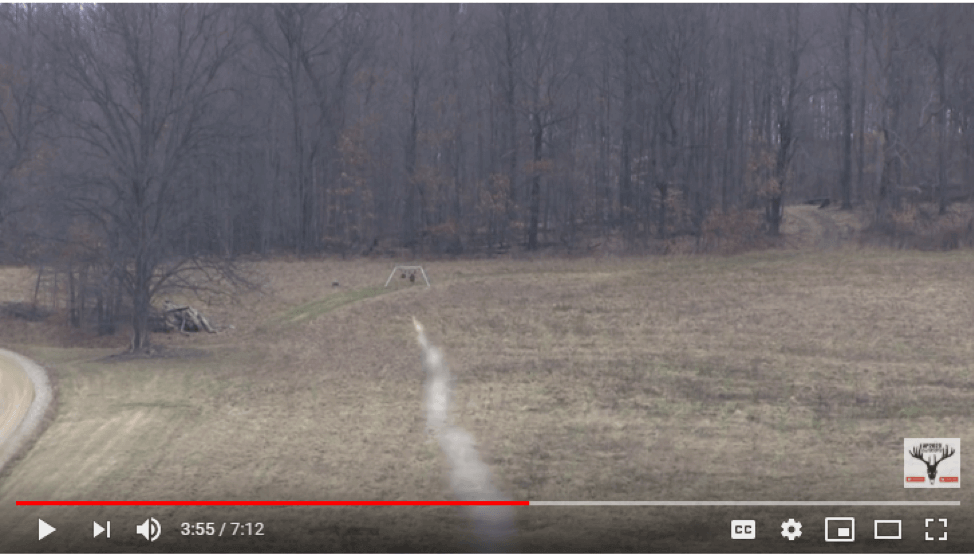
    7 ”A Hollywood or other film production requiring postproduction optical effects is a product of a carefully planned and executed script in advance. The key subject matter, foreground and background scene content, camera image focus, depths of field, masks or mattes, etc., are carefully executed ahead of time and incorporated into the camera film that becomes the optical master…(the Zapruder film) was handheld, unsteady, panned to follow the limousine causing bystanders and background to be blurred and Zapruder jerked as reflex reaction to rifle shot reports or other stimuli.” Zavada, p. 19.

    8 Consider the time required to produce relatively simple shots of the USS Enterprise against a black space background, as described in an online article (http://memory-alpha.wikia.com/wiki/Film_Effects_of_Hollywood) discussing Film Effects of Hollywood’s association with the first Star Trek television show. This indicates the time-consuming and sometimes imperfect results using optical printers. The effects seen in the original Star Trek program are nothing compared to claims of Zapruder film alteration.

    9 “Preparation of an internegative which closely simulates the characteristic of the original has always been the goal of optical houses throughout the industry. In spite of the superb quality frequently achieved in internegatives, it seems virtually impossible to attain characteristics identical to those of the original negative in the duplicate generations for the following reasons: 1) The non-linear response of photographic film limits the range over which the following generations can duplicate an original. The internegative is one or two generations away from the original, depending on the stock used. 2) Many variable elements are introduced during the processing of the internegative. 3) The exposure characteristics of the optical printer may vary from time to time.” Mehrdad Azarmi, “Exposure Control of Optical Printers”, American Cinematographer Manual, Fifth Edition, 1980.

    10 “There is no known film production history that would provide a technology reference for the use of an 8mm KODACHROME II camera film as a printing master to allow subsequent significant optical special effects into selected scenes and then reconstitute the adjusted images on to an 8mm KODACHROME II daylight film ‘indistinguishable’ from the camera original.” Zavada, p. 18.

    11 Zavada, pp. 30-32.

    12 One text cited as “proof” that altering the Zapruder film was plausible has been Techniques of Special Effects Cinematography by Raymond Fielding. When excerpts of alteration arguments were shared with Fielding by Zavada in 2006, Fielding’s response included: “in my judgment there is no way in which manipulation of these images could have been achieved satisfactorily in 1963 with the technology then available … if such an attempt at image manipulation of the footage had occurred in 1963, the results could not possibly have survived professional scrutiny … challenges regarding the authenticity of the NARA footage and assertions of image manipulation … are technically naïve.” Zavada, p. 18.
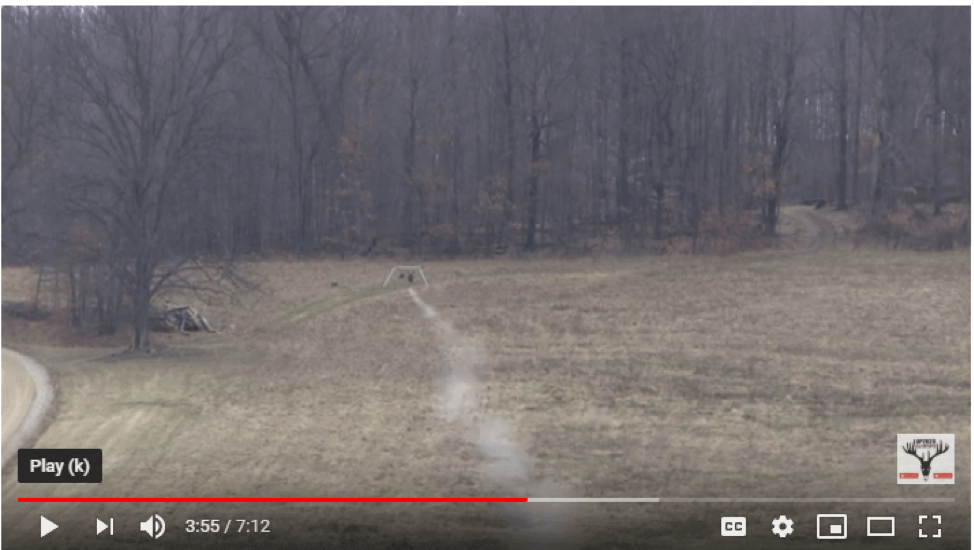
    13 The article is derived from a presentation made at a conference in Dallas November 20, 1998. (http://www.jfk-info.com/thomp2.htm)

    14 DeLoach to Mohr, “8 Millimeter Color Film Taken At Scene of Assassination” https://www.maryferrell.org/showDoc.html?docId=62256#relPageId=43&tab=page.

    15 Horne, Inside the Assassination Records Review Board, Volume Four, p. 1233. This fascinating and important information, derived from an interview conducted by Peter Janney, is worthwhile considering in full: “… He also said that the Secret Service was vitally interested in timing how many seconds occurred between various frames, and that Ralph Pearse informed them, to their surprise and dismay, that this would be a useless procedure because the Bell and Howell movie camera (that they told him had taken the movie) was a spring-wound camera, with a constantly varying operating speed, and that while he could certainly time the number of seconds between various frames if they so desired, that in his view it was an unscientific and useless procedure which would provide bad data, and lead to false conclusions, or words to that effect. Nevertheless, at the request of the two Secret Service agents, Ralph Pearse dutifully used a stopwatch to time the number of seconds between various frames of interest to their Secret Service customers. Dino Brugioni said that he placed a strong caveat about the limited, or suspect, usefulness of this timing data in the briefing notes he prepared for Art Lundahl.”

    16 The HSCA’s photographic panel did note in its report “only the average, and not the precise, running speeds for the camera are known.” Despite this, the panel would go ahead and calculate time between frames anyway. HSCA Report Appendix, Volume VI, p. 31.

    17 “In crystal drive systems, a crystal oscillator of extremely high accuracy at, or in, the recorder, provides the sync pulse. The camera, in turn, is driven by a specially designed D.C. motor and control circuit which is capable of operating in exact synchronism with a self-contained crystal oscillator of comparable accuracy…both camera and recorder reference to self-contained crystal oscillators which are so accurate the effect is the same as if they had been tied together.” Edmund M. Di Giulio, “Crystal Controlled Cordless Camera Drive System”, American Cinematographers Manual, Fifth Edition, pp. 469-472.

    18 FBI Memorandum, Griffith to Conrad, January 31, 1964. https://www.maryferrell.org/archive/docs/062/62298/images/img_62298_37_300.png.

    19 CBS did their own tests for their 1967 news special on the Warren Report. Using five cameras, the same model as the Zapruder camera (not the actual camera), their tests filming a clock with a sweeping hand resulted in a fair amount of disparity. Roughly matching the timing of the shooting sequence, the common exposed frames came in at 6.16, 6.70, 6.90, 7.30, and 8.35 seconds. Pat Speer: “IN 1967, CBS PURCHASED FIVE IDENTICAL CAMERAS AND FOUND THAT THEY RAN 15.45, 17.7, 18.7, 19.25, AND 20.95 FRAMES PER SECOND, A SIMILAR RANGE WITH A SIMILAR AVERAGE OF 18.4 FPS.” A New Perspective On the Kennedy Assassination, Chapter 2B http://www.patspeer.com/chapter2b%3Athesecretservicesecrets.

    20 “It involves the calculation of the mean after discarding given parts of a probability distribution or sample at the high and low end, and typically discarding an equal amount of both.” https://en.wikipedia.org/wiki/Truncated_mean.

    21 CD 298, p. 59 (https://www.maryferrell.org/showDoc.html?docId=10699#relPageId=59&tab=page) and CD 298, p. 62 (https://www.maryferrell.org/showDoc.html?docId=10699#relPageId=62&tab=page). It should be noted that 17.6 frames per second is cited in the FBI’s January 31, 1964 memorandum in reference to average running speed during the final twenty seconds of the Zapruder camera’s wind. This does not explain how “22 fps” entered the record. Further discussion is found in Pat Speer, A New Perspective On the Kennedy Assassination, Chapter 2B http://www.patspeer.com/chapter2b%3Athesecretservicesecrets.

    22 LIFE’s publication schedule was such that editions were assembled a week ahead of publication date. So the December 6 edition would have been largely prepared by the weekend of November 29-Dec 1, and on the newsstands by mid-week.

    23 FBI 105-82555 Oswald HQ File, Section 16, pp. 30-31 https://www.maryferrell.org/showDoc.html?docId=57688#relPageId=30&tab=page. This report also states the “camera was set to take normal speed movie film or 24 frames per second.” This is incorrect: the Bell & Howell camera’s normal run speed, as noted in its operating manual, was 16 frames per second. The camera had no setting to reproduce 24 frames per second.

    24 This comment was most likely derived from Brugioni’s briefing board notes. https://www.maryferrell.org/showDoc.html?docId=7135#relPageId=4&tab=page.

    25 Memorandum 11/25/63, CD 87, p. 91.

    26 Philip H. Melanson, “Hidden Exposure: Cover Up and Intrigue in the CIA’s Secret Possession of the Zapruder Film”, The Third Decade, Vol. 1, Issue 1, November 1984. https://www.maryferrell.org/showDoc.html?docId=48721#relPageId=15&tab=page.

    27 Barrett/Lee, Dallas, 11/29/63. https://www.maryferrell.org/archive/docs/010/10406/images/img_10406_120_300.png.

    28 Howlett’s measurement for the fatal shot is “approximately 260 feet”, whereas the Secret Service chart (CE 884) notes the distance as 265.3 feet.

    29 The FBI’s Frazier would tell the Warren Commission that Connally’s wounds could not have occurred past Z-231, if the shot was fired from the designated TSBD 6th floor window. A week after Howlett shared information with the FBI, the Secret Service would promote a different set of measurements, extending the shooting sequence to the equivalent of Z-217, Z-283, and Z-343 (CE 585). A Visual Aid Guide presented in January 1964 by the FBI to the Warren Commission (CD 298) would include a similar extended measurement whereas the first shot strikes at “167 feet”, the second at “262 feet”, and a third at “307 feet”—a full 45 feet beyond the location of the headshot seen in the Zapruder film. This Visual Aid Guide is therefore saying the fatal shot at Z312 is the second shot in the sequence. See Pat Speer, A New Perspective On the Kennedy Assassination, Chapter 2B (http://www.patspeer.com/chapter2b%3Athesecretservicesecrets) for more discussion.

    30 Mandel goes on to describe a sharpshooter test, using the “director of the National Rifle Association”, firing “an identical-make rifle with an identical sight against a moving target over similar ranges for LIFE last week. He got three hits in 6.2 seconds.” Later, at the request of the Warren Commission, the FBI investigated this sharpshooter test. It was determined that the sharpshooter used by LIFE was not “the director” of the NRA, and the test had no connection to the NRA. The test target was approximately fifty yards away and moved “from right to left and back, running for a distance of thirty-three feet in one direction.” (CD 1309) This test may not have been directly related to the Zapruder camera speed test results, as numerous media outlets, including LIFE, were interested in timing tests with a similar rifle very soon after the assassination, even in the absence of any published exact time for the shooting sequence. The “nagging rumor”—that there wasn’t enough time for three shots—probably derived from observation of the bolt action mechanism of the purported assassination weapon. Five decades later, well-founded skepticism remains.

    31 “Addendum To Comment On Zapruder Film” https://www.maryferrell.org/showDoc.html?docId=7135.

    32 “NPIC Analysis of Zapruder Filming of John F. Kennedy Assassination” https://www.maryferrell.org/showDoc.html?docId=31994.

    33 A handwritten note written by then NPIC Director John Hicks, Brugioni’s boss in 1975, attests that these are “the only known” documents available. In a 2009 interview, Brugioni recalled discovering one of his briefing boards from 1963 during the 1975 review, and that Hicks was distressed about this.

    34 Douglas P. Horne, Inside the Assassination Record Review Board, Volume Four, p. 1230.

    35 Douglas P. Horne, Inside the Assassination Record Review Board, Volume Four, p. 1224.

    36 For discussion of this see Bill Kelly, “CIA Director Told RFK Two People Shooting at JFK” http://jfkcountercoup.blogspot.ca/2013/01/cia-director-told-rfk-two-people.html.

    37 “The Zapruder film was viewed by this group on a frame-by-frame basis and at various speeds approximately 100 times.” HSCA Report Appendix, Volume VI, p 16. https://www.maryferrell.org/showDoc.html?docId=958#relPageId=22&tab=page.

    38 HSCA Report Appendix, Volume VI, p. 17. https://www.maryferrell.org/showDoc.html?docId=958#relPageId=23&tab=page.

    39 Report of the President’s Commission on the Assassination of President Kennedy, p. 19.

    40 see, for example, Pat Speer, A New Perspective on the Kennedy Assassination, Chapter 12 http://www.patspeer.com/chapter12%3Athesingle-bullet%22fact%22. Barb Junkkarinen, “First Shot/First Hit Circa Z-190”, Kennedy Assassination Chronicles, Volume Five, Issue Two, 1999 https://www.maryferrell.org/showDoc.html?docId=4884#relPageId=24&tab=page.