Tag: PARKLAND HOSPITAL

  • The Second Luna Hearing

    The Second Luna Hearing

    Unheard: The Silence of the MSM on the Luna Hearings

    By Matt Douthit


    We’ve come to the point where 62 years after the crime of the century—finally, its most important testimony has been given to the highest inquest chamber in the land—only for two news outlets to pick it up. Ultimately, the New York Post and NewsNation are just reporting the news and have turned the page. But this JFK assassination hearing before the House Oversight Committee could be colossal in getting us to the final turn in the maze…a new honest investigation.

    Testifying via ZOOM, 90-year-old Abraham Bolden—the first black Secret Service agent, handpicked by JFK himself—gave his knowledge of a prior Chicago assassination attempt. Skeptics might say Bolden is “the only source” for this—but it’s supported by six other plots that failed. Skeptics have also gone ad hoc: “Now, of course, memories fade over time…Might Bolden have been conflating the Vallee story with [a 1963] rumor?” When basically all you have left is the old shibboleth, “memories are unreliable” excuse—then you have no case. Bolden was railroaded for trying to tell the truth, was imprisoned, the key witness against him later admitted they lied to get the conviction, and Bolden was subsequently pardoned by President Biden. And Jim Douglass corroborated the Chicago Plot story in his fine book, JFK and the Unspeakable.

    Also testifying was 88-year-old Dr. Don Curtis, one of the physicians who tried to save JFK’s life. He had the courage—to stand up—and say in public—under oath—in front of the world—what all the other Parkland doctors did not do: “The wounds I saw were not consistent with the government’s conclusion Lee Harvey Oswald acted alone.” Dr. Charles Crenshaw came close with his 1992 book, Conspiracy of Silence, but Dr. Curtis finally did it. Curtis also revealed that neurosurgeon Dr. Kemp Clark told him he saw an entry wound in the temple. Skeptics might point out this detail is absent from the autopsy report—but it’s supported by 17 other eyewitnesses who saw it. In fact, as the late Don Thomas graphically pointed out via magnified photos one of the autopsy photos—the infamous “Stare of Death”–does indeed indicate this. A frontal shot, of course, disproves the official story.

    Another witness was Doug Horne, former Assassination Records Review Board staff member, who rang the bell on missing autopsy materials, from bullet fragments to photos and X-rays. Skeptics, of course, will be skeptical—but it’s supported by sworn witnesses, the authorized book The Day Kennedy Was Shot and the official inventory itself. The inventory tells us the National Archives once held 29 X-rays, 73 B&W photos, 55 color photos, blocks of tissue sections, 119 slides, and the brain. All that’s there now are 52 photos and 14 X-rays!

    Horne left us with these powerful, thought-provoking words: “You don’t change the autopsy conclusions four different times within 2 weeks after the President’s death if a lone nut killed the President.”

    Next to Horne sat Judge John Tunheim, former head of the Assassination Records Review Board (ARRB). He, along with Dan Hardway, former staff member on the House Select Committee on Assassinations(HSCA), laid out what they described as actions by the CIA to obstruct their investigations. In regards to the now infamous George Joannides file, skeptics have avowed: “But the ARRB looked at it and found nothing of relevance to the JFK assassination.” However, Judge Tunheim addressed this very point: “The CIA misled us…What we got was something very small…The staff was told that was all they had on Joannides, which is clearly incorrect.”

    Perhaps the biggest question garnered from the hearing is this: If the Joannides file “does not contain any material relevant to the JFK assassination,” as skeptics claim, then why is it suddenly missing and can’t be found?

    Another voice heard that day was presidential historian Alexis Coe, who made a dissenting declaration: “As far as the files—no hidden truths, no real disclosures, no shocking revelations.” This is a vastly different conclusion from what JFK historian Jefferson Morley had announced 2 months before: “There’s a bombshell in here. The National Archives released the declassified testimony of James Angleton—the counterintelligence chief—from 1975. And this document indicates that Angleton recruited Oswald as a CIA source or contact, that he monitored Oswald’s movements, political contacts and personal life for 4 years, that he had a 180-page file on Oswald on his desk when the President left for Dallas. So, this is a big breakthrough, there’s definitely a bombshell.” (Piers Morgan Uncensored, YouTube, 3/20/25)

    Ms. Coe did raise an important point: “There is so much concern about coverups with the CIA when it comes to Kennedy, and I don’t see that same concern being translated to Martin Luther King and to his records. It feels like Hoover 2.0.” But it was at this important moment that she was cut off. Will the King case be explored by the Luna Committee? Two good witnesses would be Judge Joe Brown and author John Avery Emison.

    Judge Tunheim left us with these words: “I’d like to see a time when everything has been released, unredacted. It’s 60-something years since the assassination. The assassination was closer to World War I than we are to the assassination. Let’s release the materials, and that’s my plea here, is just get everything out, let people decide what they want.”

    The truth hasn’t spoken its final word—another hearing is not optional; it’s essential.

    (The second hearing may be viewed here)

  • Doug Horne Reviews Sean Fetter’s new book “Under Cover of Night”

    Doug Horne Reviews Sean Fetter’s new book “Under Cover of Night”


    This review is primarily a “medical critique” of three major aspects of Sean Fetter’s UNDER COVER OF NIGHT, as well as commentary about his historiography.

    (1) Fetter has fully adopted and thoroughly advanced David Lifton’s hypothesis from BEST EVIDENCE that the post mortem surgery to JFK’s head wounds (evidenced in both Dr. Boswell’s autopsy sketch of the severe damage to the top of JFK’s skull, and in the graphic autopsy photos showing the top of JFK’s cranium removed—damage that no one saw at Parkland Hospital) occurred well before the President’s body arrived at Bethesda Naval Hospital the night of the assassination. In my many telephone conversations with Lifton from 1996-2000, before we largely parted ways with each other, Lifton indicated to me many times that he still believed this to be the case, in spite of the strong evidence to the contrary that I presented to him on numerous occasions. Fetter explicitly states his support for this old Lifton hypothesis when he states the same conclusions, on pages 46 and 52; in summary, in Volume I of UNDER COVER OF NIGHT, Sean Fetter concludes that JFK’s corpse was violently mutilated (namely, that the top of the head was hacked open with a “crash axe,” and his throat wound was torn open); his spinal cord was severed; and his brain was removed from the cranium, all long before 6:35 PM when Kennedy’s body arrived at Bethesda Naval Hospital. So, as much as Fetter decries Lifton’s analytical abilities, and disparages him personally, he has endorsed THE major hypothesis in Lifton’s BEST EVIDENCE.

    And yet, strong dispositive evidence exists that post mortem tampering with JFK’s wounds did NOT occur prior to the arrival of his body at Bethesda Naval Hospital—and that JFK arrived at Bethesda with his head in the same condition that was observed when his body left Parkland Hospital, in Dallas: namely, with a localized, avulsed exit wound in the right rear quadrant of his head, about the size of a baseball or small orange; with the top of the head apparently intact; and with the brain still in the cranium.

    Read the rest of the article here.


    Doug Horne replies to Gary Aguilar’s comments on his appearance in What the Doctors Saw.

    Read here.

  • JFK: What the Doctors Saw – An Important Addition, and a Missed Opportunity

    JFK: What the Doctors Saw – An Important Addition, and a Missed Opportunity


    Paramount Plus’ new documentary, JFK: What the Doctors Saw, is a valuable contribution to the story of the assassination. It features interviews conducted during the past six years with the trauma surgeons who tried to save President John F. Kennedy’s life after he was shot in Dallas on 11/22/63. It will inevitably expand and enliven the never-ending controversy about whether Lee Harvey Oswald, alone, could have inflicted the wounds these doctors saw. On film, they make a compelling case that the answer is no.

    Whether one agrees with them or not, one can simply not watch them without concluding that these are sincere, highly experienced surgeons with no axe to grind, speaking truthfully about what they witnessed on perhaps the most dramatic day in their long and distinguished careers. Importantly, what they emphasize on film is something they’ve always said, right from the day Kennedy was assassinated: JFK arrived in Parkland Hospital’s Trauma Room One with a large, rearward skull wound.

    The House Select Committee on Assassinations in the late ‘70s, and Warren Commission defenders ever since, maintain that the Dallas doctors were mistaken. JFK’s actual head wound they say was where it appears in the autopsy photographs, on the right side of his skull toward the front, not the rear. It’s a question that is at the very heart of the question of conspiracy.

    Unfortunately, the film’s great value is somewhat diminished by the theory that JFK underwent a secret surgical procedure before the official autopsy began at Bethesda Naval Hospital. Douglas Horne, an Assassinations Records Review Board (ARRB) investigator, said on film that he believed that Commander James Humes, MD, JFK’s chief pathologist, had surreptitiously removed JFK’s brain to extract bullet evidence of a shot from the front. He then, says Horne, put Kennedy’s picked-over brain back into his shattered brain case, only to remove it again later during the official autopsy which Horne described as a “charade.” His extraordinary claim is made without extraordinary evidence, and so will persuade few and be dismissed by this author.

    That aside, there is much to recommend this work, especially the fact that the seven featured Parkland doctors have been consistent in their descriptions of JFK’s wounds for nearly 60 years. They still think Kennedy’s throat wound was probably an entrance wound, but never opined as to where that bullet might have gone. However, they seemed willing to consider the more likely possibility: that it was an exit wound for a shot that struck from behind. For while bullet fragments were found in front of JFK from a likely back-to-front trajectory, there is no evidence a bullet or fragments popped out behind Kennedy, nor any signs – X-ray or otherwise – that a bullet was retained anywhere in JFK’s chest or abdomen from a shot in front. The Parkland crew were less equivocal about JFK’s fatal head wound.

    As documented by the trauma surgeons in hospital notes written on the day of the murder and published by the Warren Commission, the Dallas crew still says there was major damage to right rear portion of JFK’s head. Kennedy’s autopsy photographs show no such wound. On film Doug Horne offered a possible explanation. “Everything changed as soon as JFK’s body left Parkland Hospital,” he said, reprising the claim first made by author David Lifton in his book, Best Evidence. As regards Kennedy’s head injury at least, new information shows that things don’t appear to have changed all that much between Dallas and the autopsy room at Bethesda Naval Hospital.

    In the 1990s, The Assassinations Records Review Board released suppressed interviews with witnesses at JFK’s autopsy that the House Select Committee had conducted in the late 1970s.Their descriptions of Kennedy’s skull injuries are strikingly similar to what the Parkland doctors said on the day of the assassination, as well as in interviews over the past 60 years and again in the documentary.

    By way of background, the following sampling of quotes are taken from notes written by the trauma surgeons who attended Kennedy on 11.22.63 and published in the Warren Report[1]:

    • Kemp Clark, MD, professor of neurosurgery: “There was a large wound in the right occipito-parietal region…There was considerable loss of scalp and bone tissue. Both cerebral and cerebellar tissue was extruding from the wound.” (WR, p. 518) And, “a large 3 x3 cm remnant of cerebral tissue present…there was a smaller amount of cerebellar tissue present also…There was a large wound beginning in the right occiput extending into the parietal region…Much of the skull appeared gone at the brief examination…” (WR p. 524-525)
    • Malcolm Perry, MD: p. 521: “A large wound of the right posterior cranium was noted…” (WR p. 521)
    • Charles Baxter, MD: “…the temporal and occipital bones were missing and the brain was lying on the table.” (WR p. 523)
    • Marion Thomas Jenkins, MD, the professor of anesthesiology who held JFK’s head in his hands during the resuscitation effort: “There was a great laceration on the right side of the head (temporal and occipital), causing a great defect in the skull plate so that there was herniation and laceration of great areas of the brain, even to the extent that the cerebellum had protruded from the wound.” (WR p. 529-530)

    Paramount Plus had the Dallas doctors reaffirming those observations, but it said nothing about what the autopsy witnesses had reported. Given Doug Horne’s remark, viewers were thus left to assume everything had changed. But it hadn’t.

    In formerly suppressed witness interviews that were not available to David Lifton when he wrote Best Evidence, but were to Doug Horne, the HSCA reported the following:

    • Bethesda lab technologist James Jenkins told the HSCA that, “he saw a head wound in the ‘…middle temporal region back to the occipital.’[2]
    • In an affidavit prepared for the HSCA, FBI agent James Sibert wrote that, “The head wound was in the upper back of the head … a large head wound in the upper back of the head…”[3]
    • The HSCA’s Andy Purdy interviewed Tom Robinson, the mortician who prepared John Kennedy’s remains for burial.: “Approximately where was (the skull) wound located?” Purdy asked. “Directly behind the back of his head,” Robinson answered. Purdy: “Approximately between the ears or higher up?” Robinson, “No, I would say pretty much between them.”
    • Jan Gail Rudnicki, Dr. Boswell’s lab assistant on the night of the autopsy, told the HSCA’s Mark Flanagan, the “back-right quadrant of the head was missing.”[4]
    • When first asked, John Ebersole, MD, the attending radiologist who took JFK’s autopsy X-rays, told the HSCA, “The back of the head was missing,” Hethen waffled after being shown the autopsy photographs.[5]
    • Regarding the Commanding officer of the military District of Washington, D. C., Philip C. Wehle, the HSCA reported that, “(Wehle) noted that the wound was in the back of the head so he would not see it because the President was lying face up.”[6] (emphasis added throughout)

    Besides these clear statements, several autopsy witnesses drew diagrams of President Kennedy’s wounds for the HSCA. (Figures 1 and 2)

    aguilar1Fig. 1. Left — Diagrams of JFK’s wounds prepared for the HSCA by autopsy technician, James Curtis Jenkins.[7] Right — Diagrams of JFK’s wounds prepared for the HSCA by autopsy witness, FBI agent James Sibert.[8]

    aguilar2Fig. 2. Left — Diagrams of JFK’s wounds prepared for the HSCA by Tom Robinson, the mortician who prepared Kennedy’s body for burial.[9] Right — Diagrams of JFK’s wounds prepared for the HSCA by autopsy witness, FBI agent Francis O’Neill, Jr.[10]
    [These and other, similar accounts are further elaborated upon in the 2003 on-line essay: “HOW FIVE INVESTIGATIONS INTO JFK’S MEDICAL/AUTOPSY EVIDENCE GOT IT WRONG.[11]]

    In neglecting the autopsy witnesses, the program missed a great opportunity – a long known, underreported HSCA scandal that the producer, Jacque Lueth, knew all about from repeated, personal conversations with me over the past several years. (Ms. Lueth told me she wanted to present this material on film but was blocked by others involved in the documentary.) Only when the ARRB released the accounts of the autopsy witnesses in the late 90s did we discover that the Select Committee had misled the public about what they had said in the 1970s. It had everything to do with the heart of Paramount’s documentary: JFK: What the Doctors Saw.

    Confronting the conflict between autopsy photos that show no damage to the rear of JFK’s skull and the Parkland doctors who said damage was in the rear, theHSCA reported it had resolved the problem. “Critics of the Warren Commission’s medical evidence findings have found (sic) on the observations recorded by the Parkland Hospital doctors,” they wrote. “They believe it is unlikely that trained medical personnel could be so consistently in error regarding the nature of the wound, even though their recollections were not based on careful examinations of the wounds…In disagreement with the observations of the Parkland doctors are the 26 people present at the autopsy.All of those interviewed who attended the autopsy corroborated the general location of the wounds as depicted in the photographs;none had differing accounts … Further, if the Parkland doctors are correct, then the autopsy personnel are either lying or mistaken. It did not seem plausible to theCommittee that 26 persons would by lying or, if they were, that they could provide such a consistent account of the wounds almost 15 years later. Second, it is less likely that the autopsy personnel would be mistaken in their general observations, given their detailed and thorough examination of the body…it appears more probable that the observations of the Parkland doctors are incorrect.” (7HSCA37-9. Emphasis added.[12])

    aguilar3

    This was clearly false. The autopsy witnesses had described a rearward skull defect to the HSCA verbally, in writing, and by sketch diagram. The HSCA, however, reported that the autopsy witnesses had refuted the Dallas witnesses whom, in fact, they had actually corroborated. There is an additional aspect of this that might have also been worth a few moments of film.

    At the one hour, 18-minute mark, the program showed a clip of the HSCA’s Andy Purdy declaring that the ‘Dallas doctors are wrong; these recollections afterward are faulty.’ As noted above, it was Purdy who was wrong, as the doctors’ ‘recollections afterward’ closely aligned with what Parkland’s experts documented on the day of the murder as per the Warren Report. They also snugly fit with the suppressed claims of the autopsy witnesses whom Purdy had himself interviewed, and whose diagrams he had signed (See Figs. 1 & 2). Though arguing that the public has been misled, Paramount Plus missed a perfect opportunity to both expose the government’s false claim, while debunking one of the government officials whom they had on film pushing that claim, Andy Purdy.

    There is another, evidence-based problem for those who argue that Parkland got it all wrong. Research has shown that experienced, credible witnesses working in their usual environment, simply do not make mistakes of this nature. Furthermore, how could a different group of credible witnesses at a multi-hour autopsy at a different location have made the same error as the Texans? Though witness claims are often disparaged as unreliable, the reigning authority on eyewitness testimony, Elizabeth Loftus, has reported that there are circumstances in which their reliability tends to be high.[13] She based her conclusions on evidence from a 1971 study. In a Harvard Law Review paper[14] Marshall, Marquis and Oskamp reported that, when test subjects were asked about “salient” details of a complex and novel film clip scene they were shown, their accuracy rate was high: 78% to 98%. Even when a detail was not considered salient, as judged by the witnesses themselves, they were still accurate 60% of the time.

    Loftus has identified the factors that tend to degrade witness accuracy, most of which are relevant to the Kennedy case. Principal among them are poor lighting, short duration of an event, or a long duration between the event and when a witness is asked questions about it, the unimportance of the event to the witness, the perceived threat of violence during the event, witness stress or drug/alcohol influence, and the absence of specialized training on the witness’s part. Absent these factors, Loftus’s work shows that witnesses are very reliable.[15]

    JFK’s skull damage would certainly have been considered a “salient detail” to the senior trauma surgeons in Trauma Room I, as well as the witnesses in the morgue. Negligible adverse circumstances were present in either location that would explain how both groups of witnesses might have erred. They were working as highly trained experts in their usual capacity, in their usual circumstances, and in their usual setting. Moreover, both groups had no reason to dissemble, and more than ample time and opportunity to make accurate observations, many of which were recorded immediately. Though the overwhelming odds are that they were right, Warren Commission loyalists are constrained to insist they were nearly 100% wrong, and somehow wrong in the same way. Their case hinges on the official autopsy photographs, which are regarded as unimpeachable proof the Parkland doctors were wrong. Presumably, they also prove that the autopsy witnesses were unimpeachably wrong, too: they show no damage to the right rear portion of JFK’s head.

    For Warren Commission skeptics, however,this documentary, combined with evidence declassified by the ARRB, offer reasons to believe the Dallas doctors and the autopsy witnesses were probably right.

    First, the extant autopsy photos may not tell the whole story. We learned from ARRB releases and other evidence that all three of JFK’s pathologists, both autopsy photographers, and the two government employees who developed Kennedy’s autopsy photographs have claimed, sometimes under oath, that photos they either took, or later saw after development, are missing.[16] Assuming they had no reason to lie, it’s likely the photographic record is incomplete. Among the pictures that may well be missing is an image (or images) of the full extent of Kennedy’s skull wound taken from his injured, right side. (Interestingly, in the official collection there is one of uninjured, left side of JFK’s head.)

    Autopsist J. Thornton Boswell’s face sheet diagram, prepared on the night of the post mortem, specifies that 17-cm of JFK’s skull was missing. No autopsy photograph captures such a huge defect. It strains credulity to think that the surgical team tasked with documenting JFK’s cause of death would have neglected to take such an image. In fact, as documented elsewhere, autopsy witnesses say such an image, or images, were taken.[17]

    Second, in the documentary Dr. McClelland said that the image of the back of Kennedy’s head does not show the wound he saw. He pointed out that a hand is holding JFK’s torn scalp over the rearward wound that he saw. (Figure 3)

    aguilar4Fig, 3: Bootleg copy of an autopsy photo from JFK’s autopsy in the correct orientation, with JFK lying on his left side. A hand appears to be holding the scalp forward over the back of the President’s head, over what Dr. McClelland said was a large rearward skull defect.

    In a similar vein, Kenneth Salyer, MD said he thought that the autopsy photos appeared to have been tampered with, and that they had replaced the scalp over an area that was wide open (1 hr., 20 min. mark).

    Near the end of the film Dr. Salyer made a suggestion that some of us skeptics have long believed plausibly explains why the Parkland doctors and autopsy witnesses said JFK’s wound was right-rearward. A flap of JFK’s scalp had fallen backward, Salyer said, and it “bunched up” at the base of Kennedy’s occiput.

    Since the autopsy report documented that there were large scalp tears, and since JFK was lying face-up on the Parkland gurney, as well as on the autopsy table, it only makes sense that gravity would have drawn a torn flap downward to reveal what was present, a rearward skull defect described by both Parkland and Bethesda witnesses. It would jibe with Dr. Boswell’s 11/22/63 “face sheet” diagram specifying that 17-cm of President Kennedy’s skull was missing. (Figure 4) It would also fit with the anatomical ARRB sketch of Dr. Boswell’s depiction showing a massive skull defect. (Figure 5)

    aguilar5Figure 4. J. Thornton Boswell, MD’s “face sheet” diagram prepared during the autopsy on the night of JFK’s assassination at Bethesda Naval Hospital. Note the number “17” with arrows pointing fore and aft. Under oath, Dr. Boswell later explained that when examined, the President’s skull defect measured 17-cm.

    aguilar6Fig, 5. These diagrams are two-dimensional drawings prepared by the ARRB to depict JFK’s skull damage. They are based on markings made on a three-dimensional human skull model by J. Thornton Boswell, MD. Note that these diagrams reasonably match the face sheet diagram prepared on the night of the autopsy that documented 17-cm of Kennedy’s skull was missing . The images show what most skeptics believe: that Kennedy’s skull damage extended from the so-called “frontal bone” anteriorly well into the occipital bone posteriorly. A truly massive, fatal wound.

    Despite its imperfections, including the omission of evidence such as the above that would have reinforced its case against the Warren Commission’s trustworthiness, JFK: What the Doctors Saw is a valuable, first-hand account by credible witnesses, a real contribution to the medical evidence in the Kennedy case.

    At a minimum it confirms the widely held view that the government has not told the public the whole truth about the Kennedy case. It also adds to existing evidence from JFK’s X-rays, from the Zapruder film, from Dealey Plaza witnesses, etc. that have chipped away at the official version of Kennedy’s murder. It’s inescapable that the President’s mortal head wound was far larger than the 13-cm defect specified in the official autopsy report,[18] and much different than what can be gleaned from the extant file of autopsy photographs. Simply, by the most credible accounts imaginable, it’s too large and too different to be explained by a single shot fired from Lee Harvey Oswald’s alleged perch, “above and behind.”


    [1] Warren Report. >https://history-matters.com/archive/jfk/wc/wr/contents.htm

    [2] HSCA interview with Curtis Jenkins, Jim Kelly and Andy Purdy, 8-29-77. JFK Collection, RG 233, Document #002193, p.4. Also reproduced inARRB Medical Document #65, see p.4 and diagram on p. 16.

    [3] HSCA rec # 002191. Also reproduced in ARRB Medical Document #85, see p. 3 anddiagram on p. 9.

    [4] HSCA rec. # 180-10105-10397, agency file number # 014461, p. 2.)

    [5] https://history-matters.com/archive/jfk/arrb/master_med_set/md60/html/Image04.htm

    [6] HSCA record # 10010042, agency file # 002086, p. 2.

    [7] https://www.history-matters.com/archive/jfk/arrb/master_med_set/md65/html/md65_0016a.htm

    [8] https://www.history-matters.com/archive/jfk/arrb/master_med_set/md85/html/md85_0009a.htm

    [9] https://www.history-matters.com/archive/jfk/arrb/master_med_set/md63/html/Image13.htm

    [10] https://www.history-matters.com/archive/jfk/arrb/master_med_set/md86/html/md86_0011a.htm

    [11] https://history-matters.com/essays/jfkmed/How5Investigations/How5InvestigationsGotItWrong_5.htm#_edn287

    [12] 7HSCA37-39 https://www.history-matters.com/archive/jfk/hsca/reportvols/vol7/html/HSCA_Vol7_0024a.htm

    [13] Loftus, Elizabeth F.Eyewitness Testimony. Cambridge, Harvard University Press, 1996, p. 25 – 26.

    [14] Marshall, Marquis and Oskamp, Vol.84:1620 – 1643, 1971.

    [15] E Loftus, JM Doyle.Eyewitness Testimony: Civil and Criminal, Second Edition. Charlottesville:The Michie Company, 1992

    [16] See HOW FIVE INVESTIGATIONS INTO JFK’S MEDICAL/AUTOPSY EVIDENCE GOT IT WRONG, Part V. https://history-matters.com/essays/jfkmed/How5Investigations/How5InvestigationsGotItWrong_5.htm#_edn287

    [17] See “Questions Arise about JFK’s Autopsy Photographs.” https://www.history-matters.com/essays/jfkmed/How5Investigations/How5InvestigationsGotItWrong_5.htm

    [18] https://www.archives.gov/files/research/jfk/warren-commission-report/appendix-09.pdf

  • Last Second in Dallas, part 2

    Last Second in Dallas, part 2


    Another dispute Thompson had with Vince Salandria was the author’s theory about the small hole in JFK’s throat. On the day of the assassination, Dr. Malcolm Perry said to the public that this appeared to be an entrance wound. Thompson’s idea is that it was a piece of either brain or metal ejected from Kennedy’s skull. And he includes a diagram of this on page 98. The trajectory of this projectile is hard to fathom, especially since it would be traveling through soft tissue. But also, once it went into the throat area, it would be entering into all kinds of small bones and thicker cartilage. So in addition to the trajectory, it found an exit path through that maze?

    Thompson takes Howard Brennan at his word. (pp. 98-99) Which he also did in his previous JFK book. I am not going to go into the myriad problems with Brennan as a witness. That would be redundant of too many good writers. Let me say this: today, the best one can say about Brennan is that he was looking at the wrong building. The worst one could say is that he was rehearsed and suborned. As Vince Palamara wrote in Honest Answers, Brennan refused to appear before the House Select Committee on Assassinations. Beyond that, he would not answer written questions. When they said they would have to subpoena him, he replied he would fight the subpoena. Does this sound like a straightforward, credible witness? (Palamara, pp. 186-89)

    To supplement the dubious Brennan, the author uses the testimony of the three workers underneath the sixth floor. Vincent Bugliosi used one of them in a mock trial of Lee Oswald in England in 1986. I addressed the serious problem with using these men––in Bugliosi’s case it was Harold Norman––in my book The JFK Assassination: The Evidence Today. (pp. 54-55) To make a long story short, after they were interviewed by the FBI, their stories were altered by the Secret Service. At that mock trial, Norman could have been taken apart and spat out if defense lawyer Gerry Spence had been prepared––which he was not. (For a long version of how and why this happened, see Secret Service Report 491)

    Let me add one key point about this. One of the Secret Service agents involved in this mutation was Elmer Moore, a man who––since the declassifications of the ARRB––has become infamous in the literature. There is little doubt today, in the wake of the declassified files, that Moore was an important part of the coverup. (DiEugenio, pp. 166-69) Therefore, in my view, Thompson missed another pattern––one which could have been indicated to him by Gary Aguilar or Pat Speer, in addition to myself.

    The middle part of the book narrates much of the case history from the early to late seventies. For Thompson, this means the first showings of the Zapruder film by Bob Groden at conferences, then the big national showing on ABC in 1975. This was one of the factors that spurred the creation of the HSCA in 1976. Thompson says that he was invited to the so called HSCA “critics conference.” He says this was where he first heard of the dictabelt tape of a motorcycle recording of the assassination. He takes the opportunity to tell us how the HSCA actually recovered the tape. He also explains how it worked and some of the technology behind it. (pp. 147-51) Keeping with his personal journey aspect, in this part of the book he also tells us how he decided to give up his professorship at Haverford and become a private investigator.

    From 1979 until 2006 the author tells us he was very little involved with the case. (pp. 182-83) This is kind of surprising when one thinks about it. Thompson all but leaves out the yearlong furor that took place over the release of Oliver Stone’s film JFK. Which is odd, since that was the largest period of focused attention the case got since 1975. All he says is that he was called to testify by the Assassination Records Review Board about their purchase of the Zapruder film. And he testified, properly I think, that once the Secret Service knew about the film it should have gone to Abraham Zapruder’s home and taken possession of it right there as a piece of evidence in a homicide case. (pp. 189-90) About any of the rather startling disclosures of the ARRB, I could detect little or nothing.

    He spends several pages on a conference organized by Gary Aguilar in San Francisco which featured Eric Randich and Pat Grant. It was these two men who broke open the whole mythology of Vincent Guinn’s Neutron Activation Analysis, today called Comparative Bullet Lead Analysis. I was at that conference and Thompson does a good enough job summing up their scientific findings. (pp. 190-96). As the author notes, this “junk science” had been important to the HSCA in its findings that somehow Oswald alone did the shooting, and the acoustical second shot from the front missed.


    II

    In the second half of the book Thompson more or less forsakes the personal journey motif. He concentrates on what he sees as three important pieces of evidence, which he figures are crucial to the case. I will deal with each of these as candidly and completely as I can.

    Thompson devotes Chapter 16, well over twenty pages, to the medical evidence in the JFK case. He begins this part of his book by declaring that the JFK autopsy was “botched,” in other words, whatever shortcomings there were in that procedure, they were not by design. I was rather surprised by this supposition, for the simple reason that Dr. Pierre Finck said under oath at the trial of Clay Shaw that the reason the back wound was not dissected is because the military brass in the room stopped them from doing so. He also said that James Humes, the chief pathologist, was not running the proceedings. They were being so obstructed that Humes literally had to shout out, “Who’s in charge here?” Finck testified that an Army general replied, “I am.” Finck summed up the situation like this:

    You must understand that in those circumstances, there were law enforcement officials, military people with various ranks, and you have to coordinate the operations according to directions. (James DiEugenio, Destiny Betrayed, p. 300, italics added)

    The Department of Justice––among other groups––was monitoring the Clay Shaw trial in close to real time. When Carl Eardley, the Justice Department specialist on the JFK case, heard this, he almost had a hernia. He called up another of the pathologists, Thornton Boswell, and sent him to New Orleans, since they now had to discredit Finck for revealing what had happened. Eardley later thought better of this, probably because by any standard measure, Finck had better qualifications as a forensic pathologist then Boswell did. (ibid, p. 304)

    One cannot overrate the importance of this testimony. To give just one indication of its importance: I did a pre-interview with Dr. Henry Lee for Oliver Stone’s new documentary on the JFK case. I asked him this specific question, directly related to Finck’s testimony: Can you figure out a firing trajectory without a tracking of the wound? He said that under those circumstances, it was very difficult to do. Here is a man who has worked about 8000 cases all over the world and is recognized as one of the best criminalists alive.

    The same situation applies to the skull wound, except in this case, the situation is more complex. If one talks to Lee or Cyril Wecht they will tell you there is no evidence of a brain sectioning. But the Review Board did an inquiry into this subject, and Jeremy Gunn and Doug Horne came up with some evidence that such an examination may have been done. Under the scope of this particular review, this is not the place to do an expansive analysis of their evidence. Suffice it to say I found Thompson’s excuse for this lack rather strained: the doctors did not have the time to do so such a thing. (Thompson, p. 259) Yet in the Commission’s volumes there is a brain examination, dated 12/6/63. (CE 391) And there is no mention of sectioning; two weeks was not long enough? Yet without sectioning, how can one determine the bullets’ paths? On this matter, Lee was quite animated. He put his right hand up in front of his face and said words to the effect: You have this bullet coming in at a right to left angle: it then reverses itself and goes left to right? The lack of dissection in this instance is even more perplexing because the head wounding was how Kennedy was killed. And this is why Lee’s hand was piercing the air in bewilderment.


    III

    Thompson wrote something later that stunned me. On page 258 he says that the first time the autopsy doctors learned of a tracheostomy over the anterior neck wound was when they read about it in the next day’s newspapers. That passage is undermined by Nurse Audrey Bell’s 1997 testimony to the Review Board. Bell told them that Dr. Malcolm Perry complained to her the next morning (on Saturday, November 23rd) that he had been virtually sleepless, “because unnamed persons at Bethesda had been pressuring him on the telephone all night long to get him to change his opinion about the nature of the bullet wound in the throat, and to redescribe it as an exit, rather than an entrance.” (See DiEugenio, The JFK Assassination: The Evidence Today, pp. 167-68; also this discussion)

    In a very late discovery by writer Rob Couteau, Bell’s testimony was both certified and expanded. In the days following the assassination, many reporters were milling around Dallas, and some found their way to Malcolm Perry’s home, for the reason that he and Dr. Kemp Clark had held a press conference on the day of the assassination where Clark said there was a large, gaping wound in the back of Kennedy’s skull, and Perry said the anterior neck wound appeared to be one of entrance. One of the reporters who migrated to Perry’s home was from the New York Herald Tribune and his name was Martin Steadman. He asked Perry about this issue and Perry was frank. He affirmed that it was an entrance wound. But beyond that he said he was getting calls through the night from Bethesda. They wanted him to change his story. He said that the autopsy doctors questioned his judgment about this and they also threatened to call him before a medical board to take away his license. (See further “The Ordeal of Malcolm Perry”) To put It mildly, I disagree with Thompson’s next day thesis on this point.

    Another surprising aspect of this chapter is that Thompson agrees with the Ramsey Clark Panel. That panel’s findings were released on the eve of the Clay Shaw trial. They upheld the original autopsy’s conclusions about two shots from behind; but they made about four major changes that were rather bracing. One of them was that they raised the entrance wound in the rear of Kennedy’s skull 10 mm upward, into the cowlick area. (Thompson, p. 248)

    The way Thompson mentions this in passing was, again, jarring to the reviewer, one reason being that, in all likelihood, it was Six Seconds in Dallas which caused both the Clark Panel to be formed and the rear skull wound to be raised to the cowlick area. (DiEugenio, The JFK Assassination, p. 150). As Russell Fisher, the panel’s chief pathologist later said, Attorney General Ramsey Clark got hold of an advance copy of Six Seconds in Dallas. On page 111 of that book, Thompson shows that Kennedy’s head––as depicted in the Warren Commission to illustrate the fatal wound––is not in the correct posture as shown in Zapruder frame 312. The Commission had the film; therefore, all the indications are that they fibbed about this key point.

    How did the Clark panel elevate that wound into the cowlick area? Since Thompson does not show the anterior/posterior X-ray, the reader is in the dark about this point. The answer is they largely based it on a disk-shaped white object in the rear of the skull that stands out plain as day on the X-ray. The problem with this piece of evidence is that none of the autopsy doctors, or the two FBI agents in attendance, saw it on the X-rays in the morgue the night of the autopsy; and it is not in the 1963 autopsy report. All of which is incredible, for two reasons. First, it is by far the largest fragment visible; and second, its dimensions of 6.5 mm precisely fit the caliber of ammunition Oswald was allegedly firing. (DiEugenio, The JFK Assassination, pp. 153-54)

    I could go on from there, but I won’t. As the reader can see, I did not find this chapter at all satisfactory.


    IV

    One of the key points Thompson wants to make in this book is something he has been talking about for a rather long time. It is the work of Dave Wimp on what the author calls “the blur illusion.” In fact, Thompson calls Chapter 14, “Breaking the Impasse: The Blur Illusion.” Since I took Thompson at his word about this, several years ago, at a JFK Lancer conference, I mentioned Wimp and his work. I said the forward bob by Kennedy preceding the rearward head snap did not really exist. Almost immediately after I finished my address, first Art Snyder and then John Costella disagreed with me. Snyder disagreed with me on the mathematical analysis Wimp had done. Costella disagreed on whether or not this was really an illusion. In other words: did Kennedy’s head really bob forward before jetting backward? The two disagreements gave me pause. Why? Because both men are physicists.

    Back in the sixties, Thompson first learned of this forward bob between Zapruder frames 312-313 from one of the earliest students of the film, Ray Marcus. (See page 112 of Six Seconds in Dallas, footnote 2) The author and Vince Salandria then studied this in combination with the more dramatic and lengthier rearward slam at the Archives. (Six Seconds, pp. 86-87) The issue is one of the most interesting aspects of Thompson’s first book. He goes through a few explanations of how this could have occurred. He then decides on a term that became rather famous in the critical community––the “double hit” or “double impact.” (pp. 94-95) In other words, two projectiles hit Kennedy’s skull almost instantaneously: one from behind and one from the front. The first moved him forward, the second rocked him backward. He then adds that S. M. Holland had told him the third and fourth shots sounded like they were fired almost simultaneously. He backs this up with other witnesses who heard the same thing. Thus the double impact was credible.

    Why did Thompson change his tune on this point? There seem to be three reasons for this. The first is that he felt his first thesis allowed for too precise a synchronization of the shots. No firing team could be that well trained. The second and third are complementary: Dave Wimp’s work coincided with his gravitation towards the acoustics evidence.

    Since Thompson decided to go with the acoustics, he had to dump the “double hit” he wrote about in his earlier book, because the acoustics evidence allows for only one shot from the front at Zapruder frame 312. The following shot comes from behind at Zapruder frame 328. Dave Wimp aided this new scenario by somehow making the forward bob disappear, being dismissed as an illusion.

    But if such was the case, then why did the two physicists disagree with my statement about the Wimp thesis? Snyder objected to it on mathematical grounds. He did not think that Wimp’s work had absolutely proved his thesis. He told me that there was about a 20% chance Wimp was wrong. Snyder turned out to be correct, because in a reply to Nick Nalli’s review of Last Second in Dallas, Wimp admitted his calculations were not correct. He wrote:

    That I have a blur illusion hypothesis is the result mostly of people failing to distinguish between what people are saying and what people are saying people are saying, which seems to be a pervasive problem. The issue is not about illusions but rather about bad methodology.

    Today, Wimp now seems to admit that Kennedy’s head did go forward by about an inch. Evidently, Thompson oversold this idea to at least one person: me. And since he still insists on it in his book, perhaps others.

    Costella explained why Wimp made an error in a more practical, applicable sense:

    Wimp has always made a valid observation about trying to measure the position of a single (rising or falling) edge, in the presence of blur. That is fraught, especially in the presence of unavoidable nonlinearities. What he never seems to have considered, as far as I can tell, is that if you have two opposite edges (rising then falling, or vice versa) of an object, then it is quite simple to align the center of mass of the object between any two frames, even if the edges are blurred. You can do this even if the two frames are blurred differently––that’s effectively what all stabilized versions of the film do (including his own!). It’s even simpler if you either deblur the blurred 313 to match 312 (like I did back in the day, per my animation on my website), or else blur 312 to match 313 …. What I never did is put an exact number of inches on the forward head movement. I have no idea if his smaller number is accurate or not, because I didn’t quantify. What is certain, just from the visuals, is that the head moves forward in the extant Z film. (Email of 6/15/21)

    How proficient is Costella in his study of the film? After he approached me at JFK Lancer, he took out his cell phone and showed me how he had deblurred Zapruder and the forward head bob was still there. Yes, John is a man who carries his work with him.

    G. Paul Chambers, another physicist, probably has the most sensible explanation for this aspect of the case. He has told Gary Aguilar that what likely happened is that the first shot through Kennedy’s back likely paralyzed him. When the car began to brake, his limp body then went forward. (Phone call with Gary Aguilar, 7/18/21)


    V

    “Jim, there is no motorcycle where the HSCA says there is.”

    The above quotation is taken from a phone conversation in 1994 between this reviewer and the late Dick Sprague. I chose to lead this part of my review with it because, as with the head bob, I once believed in the acoustics evidence. So when the famous photo analyst Dick Sprague said the above to me, I was surprised.

    Let me explain why I had that reaction. When I visited the now deceased HSCA attorney Al Lewis at his office in Lancaster Pennsylvania, he told me about something his former boss had done in the early days of that congressional committee. Chief Counsel Richard A. Sprague had arranged a day-long study of the photographic evidence in the JFK case. There were three presenters on hand: Bob Cutler, Robert Groden, and Dick Sprague. They went in that order. Before Cutler began, the chief counsel turned to those in attendance and said, “I don’t want anyone to leave unless I leave, and I don’t plan on leaving.” As Lewis related to me, Cutler’s presentation was about 35 minutes. Groden’s was over 90 minutes, close to two hours. Dick Sprague’s went on for four hours. By the end of Sprague’s demonstration, 12 of the 13 staff lawyers believed Kennedy had been killed by a conspiracy. (James DiEugenio and Lisa Pease, The Assassinations, p. 57)

    Such was the photographic mastery of Dick Sprague. At that time, no one had a more expansive collection of films and photos than he did. In that phone call, he told me that Robert Blakey, the second chief counsel, only called him once. It was to ask him if there was a motorcycle where the acoustics experts said there had to be one. Dick spent a lot of time going through his massive collection. He eventually replied that no, there was not. It was Groden who said that there was.

    To this day this issue has not been settled to any adequate degree. And there is simply no papering it over. Because the motorcycle has to be at a precise point near the intersection of Houston and Elm for the acoustics evidence to be genuine. Modern experts on the motorcade, like Mark Tyler, insist that Sprague was correct. And Mark argues that point effectively at the Education Forum. (See his post of June 9th) What I found severely disappointing about Thompson’s book is this: he barely deals with the issue at all. This is what he says about the highly controversial but crucial point: he writes that he and author Don Thomas found the correct motorcycle in the films of Gary Mack. Afterwards, they had a few beers and called it a night. (p. 304)

    I could hardly believe what I was reading. I actually wrote “WTF” in the margin of my notes. Somehow, this trio, not experts on the photo evidence, easily accomplished something that Dick Sprague––who was the leading authority in the field––could not do? The cavalier way Thompson deals with this important point––throwing in the phrase “having a few beers and calling it a night”––underscores just how unconvincing his treatment of it is. If it was this easy to locate and demonstrate, then why is there no picture of the proper motorcycle in proper context to accompany the “few beers and calling it a night”––straight out of Sam and Diane at Cheers––motif? I was so puzzled by this carelessness, leaning toward avoidance, that I went back and read up on the acoustics evidence.

    These sound recordings first entered the legal case during the days of the HSCA. They were offered up by Texas researchers Gary Mack and Mary Ferrell. Thompson does a good job in explaining the rather primitive technology which the Dallas police used in these recordings. There were two channels being recorded that day, simply labeled Channel 1 and Channel 2. The latter used a Gray Audograph powered by a worm gear which drives a needle into a vinyl disk. (Thompson, pp. 304-06). Channel 1 “was done by a Dictaphone that used a stylus inscribing a groove onto a blue plastic belt called a Dictabelt mounted on a rotating cylinder.” (Thompson, p. 148). Channel 1 was used for basic police operations. Channel 2 was for special events, like Kennedy’s motorcade. Back at headquarters, the dispatcher would announce each minute that passed, and each time the dispatcher spoke to a unit he would announce the time. (p. 149)

    The HSCA did two tests of the acoustics. The first was by a company called Bolt, Beranek, and Newman. The main scientist on this was James Barger, who supervised a reconstruction test in Dealey Plaza. After doing this, Barger said that there was about a 50% chance of a shot from the Grassy Knoll. The HSCA then gave those results to another team of acoustic experts: Mark Weiss and Ernest Aschkenasy . After examining this data they decided there was a much higher probability, 95%. The HSCA announced this in their final days.

    Because he is wedded to this evidence for the finale of his book, Thompson has nothing but scorn for what is today called the Ramsey Panel. The Department of Justice asked the National Academy of Sciences to review the work of the HSCA. They set up a committee named after Harvard physicist Norman Ramsey. Alvarez ended up serving on this committee. Alvarez told Barger that no matter what he said he would vote against him. (Thompson, p. 287) The panel was biased from the start and the author does a good job proving that point. For Thompson, this is why they ended up rejecting the HSCA result.

    But I want to note two things about the closing 80 or so pages of Last Second in Dallas and how an author making himself a character in his book is a double-edged sword. Thompson mentions a 2013 debate he did for CNN moderated by Erin Burnett; his opponent was Nick Ragone. (p. 276) If one can comprehend it, Ragone brought up Gerald Posner’s discredited book Case Closed. Thompson says he did not do well since he did not have any new evidence to reply with. I don’t want to toot my own horn, but if I had been there, I would have had a lot of new evidence to throw back. This is how I would have replied:

    Nick, that book came out in 1993. Which was one year before the ARRB was set up. They declassified 2 million pages of documents. Have you read them? I read a lot of them, and here is what they said.

    When asked the old chestnut, “Well why didn’t someone squeal?”, Thompson could have mentioned Larry Hancock’s book Someone Would Have Talked. He then could have said: “Larry shows that two people did talk, Richard Case Nagell and John Martino. If you don’t know about them, that is a failure of the MSM.” As a point of comparison, when Oliver Stone and I did an interview this past June with Fox, I brought about eight of these new ARRB documents with me. Fox filmed me showing them while I described what they said. They then had me send them in email form. Whether or not they will exhibit them on the show, I don’t know. But I had enough rocks in hand to play David with his slingshot.


    VI

    But the reason I think Thompson plays up the CNN experience is that he wants to show that if the acoustics evidence had been reexamined, he could have mentioned that. As noted, Thompson harshly critiques the Ramsey Panel, and much of this is warranted. But he only briefly mentions how the Weiss/Aschkenasy ––hereafter called WA––verdict was rather hastily granted a stamp of approval by the HSCA.

    What makes this kind of odd is that the author mentions Michael O’Dell more than once in the book. But he does not go into O’Dell’s rather bracing criticism of WA. O’Dell is a computer scientist and systems analyst. O’Dell wrote that the WA conclusion was based upon a motorcycle rider having his Channel 1 microphone button stuck open for a continuous five minute period. This was thought to be H. B. McLain, who first said it was and then said it was not him. What O’Dell was trying to do was to replicate what WA had done, except with much more powerful computer tools, not available back then. He wrote a report called “Replication of the HSCA Weiss and Aschkenasy Acoustic Analysis.” In his report, he found that:

    Numerous errors have been found with the data provided in the report, including basic errors involved in the measurement of delay times, waveform peaks and object position. Some of the errors are necessary to the finding of an echo correlation to the suspect Dictabelt pattern. The Weiss and Aschkenasy report does not stand up to even limited scrutiny, and the results it contains cannot be reproduced. (p. 2)

    O’Dell revealed that WA had relied on a millimeter ruler and string to map out their bullet paths on a map of Dealey Plaza. O’Dell used Adobe Photoshop to scan the same map as WA and transferred the measurements into pixels after lining them up in Excel. He found multiple critical errors in WA’s work, including those of distance measurement of buildings from other objects like the stockade fence. (See p. 3) O’Dell wrote that the microphone was positioned in the wrong place by WA. (p. 9) There were errors in the original paperwork independent of a transfer to a virtual model. For the buildings list in Dealey Plaza, items 16 and 20 were described as the same object. (p. 4) He also found out that one of the bullet paths was supposed to rebound off of object 23, yet there were only 22 structures WA had listed. (p. 5). There were objects listed in the WA table that O’Dell could not find on the map. (p. 8) But perhaps the most bracing criticism O’Dell made was that

    … the values presented in Table 4 for the Dictabelt pattern do not appear to be valid measurements of the peaks in the recording. A test that supposedly identifies a gunshot on the Dictabelt recording must, at a minimum, correctly measure the sound being tested on the Dictabelt. (p. 11)

    I could go on. But before anyone comes back at me by saying, “Why would you use something like this after what Dale Myers did with his phony cartoon based on the Zapruder film?” After all, Jim, Myers went on ABC TV and said the single bullet theory was really the single bullet fact. All I can do is reply with the following. I used O’Dell because Thompson used him. In communicating with the man I found out that Thompson had signed him to a non-disclosure agreement about his book. It ended when the work was published.

    Another series of problems with this evidence was written about by Charles Olsen and Lee Ann Maryeski in June of 2014 for Sonalysts, Inc. out of Waterford, Connecticut. They stated that although McLain had claimed he had opened up his cycle to a continuous high speed after the shooting, that is not what they determined by placing the sound on a graph: “What Figure 1 shows is a motorcycle that variously speeds up and slows down and idles during this latter period.” (6/6/2014, Olsen and Maryeski, pp. 3-4)

    Let me add one other comment. As both O’Dell, and especially Dave Mantik have pointed out, one of the virtues attributed to this evidence is the so called “order in the data.” Or as Don Thomas puts it in his book, the best test matches correspond to a topographic order in Dealey Plaza and with the dictabelt. (Hear No Evil, p. 583) But as Mantik informed me, if one looks at Thompson’s own table, if the HSCA had chosen the bullet sound at the 144.90 point in the tape, they would have had two matches to the School Book Depository that very closely matched the one to the knoll area. (Thompson, p. 155) The same thing occurred at 137.70; the TSBD could have been chosen over the knoll. (interview with Mantik, 6/26/21)

    In addition to all the above, Thompson essentially brushes over the issue of heterodyne tones. (p. 296) This is an important point that the Sonalyst report examined. It’s important because it can result in words being scrambled in pronunciation as one listens to them. Meaning that they can sound like one phrase to one person and another phrase to someone else. And this has happened. (Olsen and Maryeski, p. 9)

    Even his heralded discovery, that voices saying “Hold everything” and “I’ll check it,” occur around the assassination is odd. First, the object is to show whether or not the bullet echo correlation is real, not the voices. Also, to get a more distinct peak for “I’ll check it,” Richard Mullen, Barger’s protégé, used a narrower sampling PCC (Pattern cross correlation) window of 64. Therefore Thompson concludes this is what should have been used from the start. Yet for “Hold everything,” a wider sampling window of 512 yielded a larger net peak than did a smaller sampling window of 64. Thompson offers no explanation for this seeming paradox. (See Figures 22-6 and 22-7; 6/26/21 interview with Mantik)

    If the “Hold everything secure” phrase is at the time of the assassination, then the acoustics is invalid, since this is spoken after the assassination. “I’ll check it” would be around the time of the shots. So the two phrases are in conflict if both were valid. The first phrase is at the wrong time, the latter one is at the right time. So Thompson argues that the “Hold” phrase has been altered and is really an overdub. (Thompson, pp. 345-47)

    This has also been placed in doubt by O’Dell. (See Dictabelt Hums and the “hold everything secure” Crosstalk) The “Check” phrase, as has been argued by many, is not really crosstalk at all. The same sound does not appear on both channels. (Email communication with O’Dell, 7/25/21). And further, Sonalysts showed that the spectrograms of the phrase differ on Channel 1 and 2. (Olsen and Maryeski, p. 6)

    I could go on. But I think the point has been made. There are simply too many uncertain variables with the acoustics evidence to rely on it as having a 95% probability. Much of this is due to the innate poor quality of the recordings themselves.

    When we were making JFK Revisited, producer Rob Wilson asked me to incorporate a section on the acoustics evidence. I recommended against it. I simply noted that with all the above problems with that evidence we would be making ourselves into a bull’s eye on a target range; a whole gallery of persons would take out their bows and arrows and start unloading their quivers on us.

    As I said in Part 1, there are good things in Last Second in Dallas. And as a responsible critic I have described them. In my opinion, they are important and valuable and have stood the test of time. But it is also my opinion that there are a lot of things which seem to me to be liabilities, including what the author thinks is the culminating arc of his book––and I have described those deficits also. This is why Last Second in Dallas is a decidedly mixed bag.


    Return to Part 1

  • The Ordeal of Malcolm Perry

    The Ordeal of Malcolm Perry


    On the afternoon of the JFK assassination, within an hour or two after his death, there was a press conference at Parkland Hospital. Three important pronouncements were made. In fact, they were so important that they should have shaped the case in a permanent manner.

    First, acting press secretary Malcolm Kilduff talked about how Kennedy had died.

    Malcolm Kilduff at Parkland press briefing

    When he did so, he pointed to his right temple and said something like: it was a matter of a bullet through the head. Very shortly after, Chet Huntley said the same thing live on NBC television. On the air, he revealed his source to be Dr. George Burkley, President Kennedy’s own personal physician.

    Dr. Kemp Clark, chief of neurosurgery—the man who actually pronounced Kennedy dead—said he observed a large gaping hole in the rear of Kennedy’s skull. (Michael Benson, Who’s Who in the JFK Assassination, p. 80) Dr. Malcolm Perry, who cut a tracheostomy across the bullet wound in Kennedy’s neck, said that the wound was one of entrance. (James DiEugenio, The JFK Assassination: The Evidence Today, p. 367)

    Therefore, from these three pieces of evidence, one would have had to conclude that Kennedy was hit from the front. That implication would be almost inescapable. Therefore, some strange things happened with this key press conference. First of all, there is no film available of it today, which is remarkable in and of itself, because, as one can see from pictures and film snippets, there were many reporters in that conference room. It is very hard to comprehend how not one of them called for a film camera to cover the initial public pronouncement of President Kennedy’s death. Second, initially, the Secret Service told the Warren Commission that they did not even have a transcript of this conference. According to former Assassination Records Review Board (ARRB) analyst Doug Horne, there are two real problems with the Secret Service saying this. First, according to Horne, the Secret Service went around collecting the films of this press conference. Thus making it disappear. (See Horne at Future of Freedom Foundation conference of May 18th. This is at the FFF web site.)

    But further, the Secret Service lied to the Commission about having the transcript. In responding to Commission counsel Arlen Specter’s request, Chief of the Secret Service James Rowley wrote a letter to chief counsel J. Lee Rankin. He said that he could not locate either the films or the transcript of this press conference. (DiEugenio, p. 367) As the ARRB proved, this was a lie, because they found a transcript of that press conference that was time stamped, “Received US Secret Service 1963 Nov. 26 AM 11:40”. (ibid) Does it get much worse than that? In other words, the Warren Commission’s own investigators were keeping important pieces of evidence from them—and then lying about it.

    As most of us know, Perry was pressured to alter his first day story. By the time of his appearance before the Commission, he now said that the edges of the wound were neither ragged nor clean and that the wound could have been an exit or entrance. Gerald Ford got him to say that the reporting from the press conference was inaccurate. Allen Dulles applied the icing on the cake: he said Perry should issue a retraction—which, of course, he just had. (DiEugenio, pp. 166–67)

    The reason Ford and Dulles could do this is because, in all probability, the Secret Service had absconded with the films and the transcript. But further, Perry had been worked on. As the Church Committee had discovered, a man named Elmer Moore had taken it upon himself to convert Perry to the Commission’s point of view. Moore was a Secret Service agent who was forwarded to work for the Commission. One of his first assignments was to take up a desk at Parkland Hospital and convince the doctors there that they were wrong and the autopsy report was correct. One of his priority targets was Perry. (DiEugenio, p. 167)

    As Pat Speer later discovered, this story about Moore gets even worse. After he performed his assignment in Dallas so effectively, he got a promotion to a longer term one. He became the aide de camp to Commission Chairman Earl Warren. (DiEugenio, p. 168)

    But it was not just Moore—and it was not just a couple of weeks later. As Horne stated during that FFF conference, Nurse Audrey Bell testified that Perry told her he was getting calls that evening directing him to alter his testimony.(DiEugenio, p. 169) This is now backed up by a startling piece of evidence surfaced by author Rob Couteau. Martin Steadman was a reporter at the time of the JFK assassination. Couteau discovered a journal entry by Martin that is online. Steadman was stationed in Dallas for several days after the assassination gathering information. Some of it got in print and some of it did not. From all indications, the following did not.

    One of the witnesses he spent some time with in Dallas was Malcolm Perry. Steadman was aware of what Perry had said at the press conference about the directionality of the neck wound. Steadman wrote that, about a week after the assassination, he and two other journalists were with Perry in his home. During this informal interview, Perry said he thought it was an entrance wound because the small circular hole was clean. He then added two important details. He said he had treated hundreds of patients with similar wounds and he knew the difference between an exit and entrance wound. Further, hunting was a hobby of his, so he understood from that experience what the difference was. And he could detect it at a glance.

    Steadman went on to reveal something rather surprising. Perry said that during that night, he got a series of phone calls to his home from the doctors at Bethesda. They were very upset about his belief that the neck wound was one of entrance. They asked him if the Parkland doctors had turned over the body to see the wounds in Kennedy’s back. Perry replied that they had not. They then said: how could he be sure about the neck wound in light of that? They then told him that he should not continue to say that he cut across an entrance wound, when there was no evidence of a shot from the front. When Perry insisted that he could only say what he thought to be true, something truly bizarre happened. Perry said that one or more of the autopsy doctors told him that he would be brought before a Medical Board if he continued to insist on his story. Perry said they threatened to take away his license.

    After Perry finished this rather gripping tale, everyone was silent for a moment. Steadman then asked him if he still thought the throat wound was one of entrance. After a second or so, Perry said: yes, he did.

    What is so remarkable about this story is that it blows the cover off of the idea that the autopsy doctors did not know about the anterior neck wound until the next day. Not only did they know about it that night, they were trying to cover it up that night.

    But things always get worse in the JFK case. And this issue does also, because, if the reader can comprehend it, that night was not the first time Perry was told to revise his story—or to just plain shut up. Bill Garnet and Jacque Lueth have written, produced, and directed a documentary called The Parkland Doctors. It was shown at the CAPA Houston mock trial a few years back, but only to those in attendance, not to the viewing audience. Robert Tanenbaum is the host of the documentary. He let me see it at his home two years ago. It is a good and valuable film, since it features seven of the surviving doctors at that time, 2018.

    Towards the end of the program, Dr. Robert McClelland made a bracing comment about Perry. He said that as Perry was walking out of the afternoon press conference, a man in a suit and tie grabbed him by the arm. After he got his attention, he forcefully said to Malcolm, “Don’t you ever say that again!” I turned to Tanenbaum and said: “This is about ninety minutes after Kennedy was pronounced dead.” Tanenbaum said, “Jim, they knew within the hour.” At the very least, someone knew that there had to be a cover story snapped on.

    Malcolm Perry was a victim of a large-scale crime. The evidence above indicates that the cover up was planned with the conspiracy. I would love to know who that well-dressed man who accosted him was.

    One last point. When Elmer Moore was asked to appear before the Church Committee, he brought a lawyer with him. (DiEugenio, p. 168)

  • Suppressed Evidence of JFK Throat Entry

    Suppressed Evidence of JFK Throat Entry


    For years, distinguished pathologist Cyril Wecht, MD, JD has expressed doubts that Kennedy’s throat wound was an entry because no one could tell him where the bullet went. “The throat is all soft tissue, where did it exit?”

    Good question, but it’s based on the premise that if the bullet had been found … we would know about it.

    Well, we don’t know where that bullet went, but we do know about another bullet that was found—but never mentioned in the official record.

    A Navy doctor published an obscure memoir in which he reports that petty officers sent to retrieve bone fragments from JFK’s car also found a misshapen, but whole bullet in the back of the car. (Official reports only mention bullet fragments, and they were found in the front of the car.)

    That doctor, James Young, briefly inspected it, then gave it back to the petty officer who gave it to James Humes, the lead pathologist. Then where did it go? Humes made a big show of looking for bullets that night.

    Young was puzzled when, years later, he could find no report on that bullet. He wrote to President Gerald Ford asking about it, and got a useless response. We have researcher Randy Robertson to thank for this discovery. (To see more on this, please go here.)

    Maybe you can’t quite believe the above story, but you should be even more skeptical of anything you are told by the government. And you should wonder about what you are not told.


    Humes et al Suppressed Fundamental Evidence:

    (1) Kennedy’s cerebellum. You will not find one word about it in the main autopsy report, which only describes the upper brain, as well as organs not even relevant to the murder. Nor will you find mention of it any of Humes’s testimony. (The supplementary report mentions a microscopic analysis of a small piece of it.) The Parkland Hospital doctors described massive damage of this organ, damage inconsistent with the official narrative. (For more on this, go here and here.)

    (2) Kennedy’s throat wound. Humes et al pretended they were completely unaware of it on the night of the autopsy, when the body was still available. And so they did not document it or explore it further. Years later, a pathologist who assisted Humes, said they saw the remains of the bullet hole itself, part of the perimeter of a bullet wound in the anterior neck.” (For the complete story on this, go here.)

    And so again I ask, why assume no bullet entered JFK’s throat because you don’t know where it went?


    Throat Wound: Abrasion/Contusion Collar

    Not long ago, I saw an email in which a researcher said Kennedy’s throat wound had no abrasion collar. He didn’t say that he saw no report of one, or that blood obscured the wound so that none was seen (a lone nutter claim). He just omnisciently asserted that none had existed. People are entitled to their opinions, but they should be given along with all the facts readers need for making up their own minds.

    Here is probably the most relevant fact of all: When Malcolm Perry—the Parkland Hospital doctor who worked on the throat wound—was specifically asked by the HSCA to describe the wound’s edges, he included these words: “The edges were bruised.” A bruise is a contusion. Perry seems to have been referring to a contusion collar—which, like an abrasion collar, is definitive of an entrance wound.

    Some authors use the expressions “abrasion” and “contusion” rings or collars interchangeably. But though related, they are not the same. Both are said to be caused by temporary over-stretching of the skin. And the skin on the perimeter of the bullet hole is abraded. A few millimeters away, damaged blood vessels in the dermis bleed beneath the skin, resulting in a visible bruise. Here’s an illustration from an article on the characteristics of entrance wounds by jacketed bullets, fired at a distance.entrance wound

    Note: Jacketed bullets from centre fire rifles do not always cause abrasion collars. Also, entrances can have slightly ragged edges. (Gunshot Wounds Aspects of Firearms, Ballistics, and Forensic Techniques, Second Edition, by Vincent J.M. Di Maio, MD, CRC Press, 1999.)

    To the Warren Commission, Perry had described a typical entrance wound: “approximately 5 mm in diameter…exuding blood slowly which partially obscured it. Its edges were neither ragged nor punched out, but rather clean.”

    Later he was again asked about the wound, and this time Commissioner Arlen Specter clarified something significant. Perry seems to have said the wound was “not punched out,” but he also said it was “not pushed out.” Specter specifically asked if the wound was “pushed out”—“everted” in the language of forensics—and characteristic of an exit. Perry said it was not. (Nor did he say it was pushed in.)


    Don Thomas: Throat Wound Was an Exit

    In his book Hear No Evil. Politics, Science & the Forensic Evidence in the Kennedy Association (Mary Ferrell Foundation Press, 2010), Donald Byron Thomas promotes the idea that the wound was an exit.

    The author seems to believe the back and throat wounds were proven to be connected when in fact there was no proof. This was an inference based on incomplete information. Very few researchers claim the back wound was anything but an entrance, but we cannot explain where that bullet went. Since it created such an apparently shallow wound, it may have fallen out. It may have been the slightly bent bullet found in the limousine.

    As for explaining what happened to the bullet that we say entered the throat, we cannot. But, based on all the other key evidence that went unreported, it’s not unreasonable to assume that if it had been found during the autopsy, it would not have been reported. (Thomas does not mention any of the known suppressed key evidence described above.)

    Thomas also seems to believe the pathologists who performed the autopsy saw no evidence of the bullet wound in the throat. On page 238 of his book, he said “The precise nature of the wound cannot be determined because the wound was obliterated.” In fact, it was only bisected, not obliterated and, as mentioned above, one of the pathologists reported seeing part of it.

    The author does not report any of the telling details Perry described, aside from the wound’s smallness. And instead of providing recent information on wounds, Thomas quoted from a not very informative book written in the early 1920s:

    Provided no bone lesion is present, the exit aperture is often difficult to discriminate from the entrance wound. The two wounds maybe [sic] equal in size, the entrance wound may show inverted edges, while in the exit wound the edges are generally everted [pushed out]. When the bullet has passed through soft parts alone, the exit wound is apt to be circular in shape. (Thomas, p. 238) [Emphasis added.]

    But Perry had specifically said the edges were not everted, that is, not pushed out. More important, Thomas said nothing about the bruised edges.


    An Invalid Explanation for Wound’s Smallness

    Thomas said that, though the wound was small, it was still an exit, and its size could be explained by the phenomenon of “shoring” or “buttressing.” Meaning the skin was held in place by Kennedy’s collar and necktie. And he quoted experts who say that when the skin is held in place by something, like a wall, floor, chair back, or supportive clothing, the bullet can’t stretch the skin outward until it tears (one reason why exits are small and star-shaped)—and a small “shored” wound is created.

    But for this to be possible, the wound has to be right behind the shoring material.

    Parkland Hospital’s Charles Carrico, MD—who saw the wound while Kennedy was still fully dressed—said the wound was “right above” the neck tie. And Malcolm Perry, the doctor who cut across the wound, said the bullet struck at the level of the second or third tracheal ring, just below the Adam’s apple.

    Instead of deferring to these doctors who provided facts, Thomas gave his opinion, based on a photo showing JFK in an unnatural position with his neck hyperextended: “… it would seem more likely that the bullet passed below the necktie.” (p. 236)

    Below the necktie? As you can see from this photo, his Adam’s apple is well above his collar and necktie.jfk

    Though Thomas disagreed with what Carrico said about the wound’s location, he argued the idea of shoring even if Carrico was right: The amount of buttressing would still be appreciable whether just above or just below the exiting bullet’s path.” (p. 236) He did not buttress this assertion with any references.

    Here’s another good reason to doubt the wound was buttressed. Take a close look at what actually happens: Skin between the outgoing bullet and the buttressing material is crushed, and it becomes stuck to the material. When that material is pulled away, it creates a wide abrasion collar consisting of skin tags that resemble a peeling sunburn. More important—grossly visible skin is left behind on the material. (Am J Foren Med Path 1983; 4(3): 199-204)

    The FBI closely inspected Kennedy’s shirt and tie, and did not report seeing skin on either garment.


    Relevance of Bullet Velocity

    What Malcolm Perry said about the internal damage in the neck reveals that if a bullet entered the throat, it was probably traveling at medium velocity (as defined circa 1963.).

    There’s some concussive damage to surrounding organs—these are the kind of things one sees with gunshot wounds, in a blast injury … And with high velocity, we do see a lot. Now the low velocity stuff, it’s often just a track, a wound track, with very little concussive or blast injury. This one was in between. There was evidence of some blast injury, but not like, say, what one sees with a high velocity rifle, like a 3006 or 223 …

    A bullet traveling that fast would have left a much larger exit wound. And this was proven by Army experiments involving the assassination of goats.

    Yet other experiments proved that when non-deformed jacketed bullets exit straight out—as opposed to sideways—the size of the wound created is directly proportional to their exiting velocity. (J Trauma 1963; (March) 3(2): 120-128, p. 122) (Gunshot Wounds: Aspects of Firearms, Ballistics, and Forensic Techniques, Second Edition, by Vincent J.M. Di Maio, CRC Press, 1999.) (Thomas did not report this, but possibly he was unaware of these experiments.)

    Translated: When all other things are equal, the slower the bullet, the smaller the exit wound. Put another way, the smaller the exit, the slower the bullet.

    Translated further: If a bullet really did exit the president’s throat, it would not likely have had the energy to make it through Connally’s mohair jacket, let alone his chest and wrist.

    And there goes the Single Bullet Theory.

  • Ricochet of a Lie

    Ricochet of a Lie


    Ricochet of a Lie

    And Kennedy’s Throat Wound

    (A version of this essay was previously published under the title “The Magic Throat.”)


    If you believe the gaping hole in the front of Kennedy’s neck was the result of body alteration by unknown persons, the facts below may change your mind.


    Commander James Humes, M.D., the lead pathologist who performed the autopsy on President John F. Kennedy, was interviewed in 1992 by the Journal of the American Medical Association (JAMA).1 Once again, he and his team were going to set the record straight.

    As often happens on these occasions, Humes provided a fresh crop of contradictions.   One such contradiction is the subject of this article: the size Humes gave JAMA for the incision in Kennedy’s throat: less than half the size he reported earlier,2 3 and less than half the size as it appears in autopsy photographs.  

    What intrigues me about this new size is its striking similarity to the one described by Malcolm Perry, M.D., to David Lifton, author of “Best Evidence.”4


    1964, James Humes: Large Incision

    According to Humes’s autopsy report,5 the tracheotomy incision was 6.5 centimeters, but Humes told the Warren Commission it was between 7 and 8 centimeters.6 The latter description seems to match what shows in autopsy photographs. (Note: “tracheotomy” is sometimes spelled “tracheostomy”; both are correct.)


    1980, Malcolm Perry: Small Incision

    The best selling Best Evidence by David Lifton was published in 1980. In it, Lifton quotes Malcolm Perry as saying the incision was only 2 to 3 centimeters wide. When Lifton asked if it could have been 3.5 centimeters, Perry agreed. Could it have been 4 centimeters? Perry “hesitated a bit, then said yes.” How about 4.5 centimeters? Perry said he “really doubted it was that large. It just wasn’t necessary.” Lifton added, “Perry sounded distinctly uneasy.” Lifton quoted other Parkland doctors who corroborated Perry’s claims.7

    Perry’s first answer, “2 to 3 centimeters wide,” is consistent with the routine tracheotomy incision as diagrammed in Lifton’s book.

    Not the kind of incision made on a victim of a penetrating neck trauma.


    1992, James Humes: Small Incision

    Humes told JAMA that “The tracheostomy was a gaping wound, about 3 to 4 centimeters around ….”8

    Only 3 to 4 centimeters “around”? This is how one describes a perimeter. Translated, this would make the incision across no more than 2 centimeters in horizontal width—about the size Malcolm Perry gave David Lifton. A very interesting match indeed.


    What Did Malcolm Perry Actually Do?

    Small incisions are created for routine tracheotomies—the kind performed for patients with severe breathing problems, such as those due to pneumonia, for instance. David Lifton investigated and then publicized the appearance of a routine tracheotomy incision.

    What David Lifton did not investigate at all, apparently, was this relevant question:

    How do emergency room doctors respond to a penetrating wound in the neck, regardless of whether the patient has wounds elsewhere in the body?

    Doctors must quickly find and repair any life-threatening damage that has been done—and that means creating a fairly wide incision, one large enough to visualize the carotid arteries, for example. (These arteries are not in the middle of the throat; they are off to either side of the neck.)

    From Perry’s and Humes’s descriptions, it sounds like Kennedy had a “collar incision,” similar to the one shown below from the Journal of Trauma 1978; 18 (1) : 2-77 (see the Addendum at the end of this article for more extensive documentation).
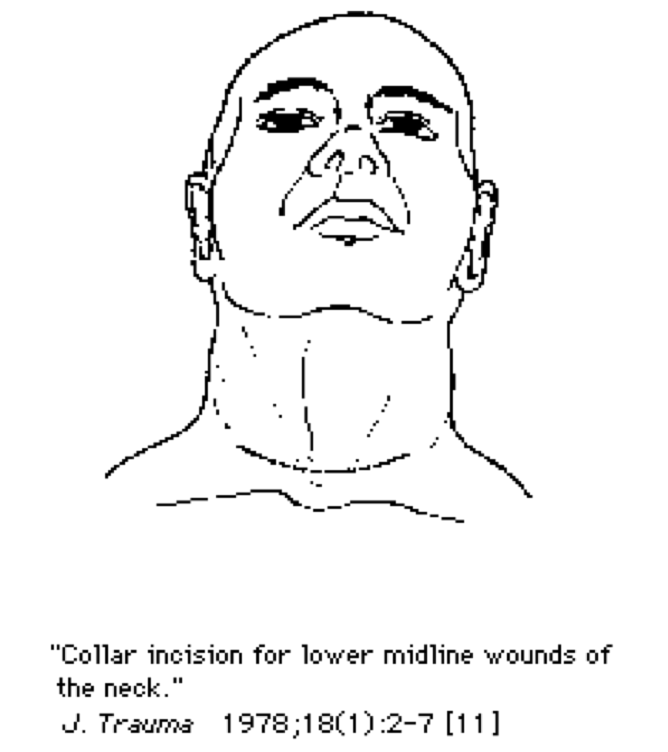
    incision

    In Kennedy’s case, it was already clear that he was having trouble breathing, and one doctor placed an endotracheal tube which proved to be inadequate. So when Perry arrived, he performed a tracheotomy. And, he said, he “made an incision right through this wound which was present in the neck.”9

    But that was not all that Perry did. He made an incision large enough to allow him to inspect the carotid arteries, the mediastinum, and other structures.

    “Once the transverse incision through the skin and subcutaneous tissues was made, it was necessary to separate the strap muscles covering the anterior muscles of the windpipe and thyroid. At that point, the trachea was noted to be deviated slightly to the left and I found it necessary to sever the exterior strap muscles on the other side to reach the trachea.”10 (His testimony on another day is similar.11)

    “I also made it big enough that I could look to either side of the trachea … I didn’t know whether I was going to encounter carotid arteries or whatever. But the path of the bullet clearly put those vessels at risk as well as the trachea, so I made the wound big enough to do that … How big it [the incision] was, I don’t know … . I made it big enough to control an underlying bleeding blood vessel if necessary.”12

    Please see the Addendum for quotations from articles on this subject—including some from a chapter in a textbook written by Malcolm Perry himself.


    Why Perry Described Such a Small Incision: A Theory

    Malcolm Perry was aware of Humes’s sworn testimony that, on the night of the autopsy, he knew nothing about a bullet wound in the throat, that he thought only a tracheotomy had been done.

    Caught off guard by Lifton’s question, Perry probably thought he had better not say anything that would contradict Humes’s story. 

    Perry was apparently confident that Humes’s earlier report of a large incision was not well known. He has said more than once that he never met anyone who had read the Warren Commission Hearings.


    Why Humes Revised the Size: A Theory

    Small incisions are not done in the presence of a penetrating wound in the throat.

    If Kennedy only had a small opening in his throat, this would have made it easier to believe Humes’s story of thinking the president only had a tracheotomy. This may have been the reason Humes gave such a different description of the incision to JAMA.

    Furthermore, he may have worried that, had he described a wider incision, one that was more consistent with those performed in the presence of trauma, then one of JAMA’s readers might well have asked, how could he have been so sure the only abnormality in JFK’s throat was the remains of a tracheotomy? Especially in the presence of a bullet wound in the back?


    What May Lie Behind the Revisions

    Had Humes admitted to being aware of a throat trauma, he would have then been obliged to deal with it: dissect its path, obtain tissue specimens, document its characteristics, photograph it close-up and under magnification.

    What if a proper study of the wound showed it to be an entrance? This would mean that at least one shooter was in front of Kennedy. But Humes and his team were under a great deal of pressure to prove the president’s wounds were created by one sniper, located above and behind.

    Better to feign ignorance of a wound that may contradict that conclusion. Better to wait until after the body was gone, when it was too late to document its nature—entrance or exit—and its alleged connection with the wound in the back.13


    But Humes Did Know

    It seems that, even on the night of the autopsy, Humes et al. did know that a bullet had passed through Kennedy’s throat, either coming or going.

    The bruising in the neck is what told him, bruising that could only have occurred during the motorcade—when the heart was still beating normally. What’s more, possibly out of vanity (and to avoid looking stupid to his peers), he wanted the Warren Commissioners to know that he knew, that he had not missed something so important, or its significance.

    “When examining the wounds in the base of the President’s neck anteriorly … we noted, and we noted in our record, some contusion and bruising of the muscles of the neck of the Present. We noted that at the time of the postmortem examination.”14

    He went on to describe wounds that were created by the Parkland doctors: incisions made in the chest for the placement of chest tubes, and in the arm and ankle for administering intravenous fluids—wounds that did not lead to bleeding and bruising, because they were made later, when the heart was barely beating.

    “Those wounds [made at Parkland, on the chest and in the arm and ankle] showed no evidence of bruising or contusion … which made us reach the conclusion that they were performed during the agonal moments of the late President … when the circulation was … seriously embarrassed, if not nonfunctional. So that these wounds … were performed about the same time as the tracheotomy wound …”15

    “So, therefore, we reached the conclusion that the damage to those muscles on the anterior neck just below this wound were received at approximately the same time that the wound here on the top of the pleural cavity was, while the President still lived and while his heart and lungs were operating in such a fashion to permit him to have a bruise in the vicinity … so we feel that, had this missile not made its path in that fashion, the wound made by Doctor Perry in the neck would not have been able to produce, wouldn’t have been able to produce, these contusions of the musculature of the neck.”16

    Ignoring Humes’s comments above, Commissioner Allen Dulles then completely changed the subject.17

    In later years, J. Thornton Boswell, the pathologist who assisted Humes, actually described seeing, on that same night, the remains of the bullet hole itself, “part of the perimeter of a bullet wound in the anterior neck”,18 and they concluded that night that the bullet exited the throat.19 When talking to the ARRB in 1996, Humes denied seeing the remains of the bullet wound, or knowing anything about its existence.20

    The lead photographer, John Stringer, described the pathologists putting their fingers into the gaping hole trying to feel for anything sharp, looking for bullet fragments, in other words.21 John H. Ebersole, M.D., Acting Chief of Radiology, said that Humes had been in touch with the Parkland doctors that same night, and, clearly, had been informed of the bullet wound in the throat.22 (This is not a comprehensive treatment of the subject; there is yet other testimony relative to this issue not included here.)


    Comic Relief: Humes “Explains”

    “And we wondered, where’s the bullet? You know. Should have called Dallas right then and there. It would have saved me a lot of worry and grief for several hours, because x-rays hadn’t found it for us. Like it could have been in his thigh or it could have been in his buttock. It could have been any damn place …”23

    So, it could have gone any damn place—except a few inches away out the hole in the front?

    “We didn’t know where it went. It was obvious after we talked to the doctors the next morning where it went. It went out. That’s why we couldn’t find it. And we weren’t going to spend the rest of the night there, you know. Meantime, George Burkley is telling me, you know, the family wants to get out of here sometime tonight. Then we proceeded with the dissection of the lungs, heart and abdominal contents and so forth.”24

    Note: Kennedy was not shot in the abdomen.

    “… it wouldn’t make a great deal of sense to go slashing open the neck. What would we learn? Nothing you know.”25

    Have sympathy for the late James Humes. He not only had to cover his own ass, he had to cover the collective ass of those who were pressuring him to come up with the “right” answers. He never did seem sure of the script.


    Was it an Entrance Wound?

    We have no way of knowing what the nature of Kennedy’s throat wound was but, considering all the lies told about it, Humes et al. probably thought it was an entrance. Based on the wound’s characteristics as reported, nothing seems to justify declaring it an entrance or an exit although, grossly, it was most typical of an entrance.

    • Exit wounds can be small;
    • Ragged wounds can be entrances;
    • Entrance wounds need not have abrasion collars, but often do;
    • Shored exit wounds always have pronounced abrasion collars.
    • Non-shored exit wounds do not have abrasion collars.

    One thing does seem certain: if the wound had been an exit, the bullet had to have exited above the shirt; it could not have gone through the shirt (the bottom part of the collar band), as alleged. This would have created a “shored wound.” In shored wounds, an obvious abrasion collar is created26 with little bits of skin hanging (like the flakes of a sunburn) as the shoring material—which usually sticks to the wound—is pulled off the victim.27

    Furthermore, skin would have been left behind on the shirt: upon exiting, the bullet would have crushed the skin against the shirt on its way out, skin that would have been visible to the naked eye.28 The FBI would surely have loudly announced such evidence had they found any.

    Kennedy’s throat wound did not have the wide, pronounced abrasion collar of a shored exit wound, but it apparently did have the abrasion collar of an entrance wound.29

    As mentioned above, exit wounds can be small, but would a jacketed bullet travelling at medium high velocity through the loose, wrinkled, tanned, leathery skin of Kennedy’s neck leave a small wound?

    Or—unhindered by any shoring material—would the bullet pull the skin forward on its way out, tenting the skin, creating the lacerations of a typical “stellate” wound of exit?

    (All of the small exit wounds in the photos that I could find were in what looked like taut, young skin in areas not unexposed to the sun and not subjected to a lot of stretching, and wrinkle-causing movement, like the neck and wrists.)

    For more on the subject of bullet wounds (including photographs and additional references) please see my article, Trajectory of a Lie Part I. The Palindrome” at www.history-matters.com.


    Conclusion

    Commander James Humes testified that, on the night of the autopsy, the only abnormality seen in Kennedy’s throat was a tracheotomy incision. For the following reasons, this seems to have been a cover story:

    • Context: there was an entrance wound, only inches away, in the back;
    • The incision was larger than one for a typical tracheotomy, though, by itself, this is not reason to suspect trauma;
    • The strap muscles were severed; this is not done in routine tracheotomies;
    • Humes testified he saw bruising in the throat muscles that he said he knew could only have occurred during the motorcade, when the president’s heart was still functioning normally;
    • Other doctors testified that they all knew of the bullet wound in the throat;
    • Part of the perimeter of the hole created by the bullet was seen.

    By denying awareness of the wound, Humes avoided documenting its nature. (He also avoided properly documenting the back and head wounds, all for the same reason apparently.)

    A few years later, in an apparent effort to support Humes’s story, the surgeon who performed the incision, Malcolm Perry, M.D., described it as small enough to be typical. This same surgeon was most accommodating when it came to revising other trajectory-related details.   Nearly 30 years later, Commander Humes himself reported the incision as small, radically contradicting his own testimony to provide a description that just happened to agree with Malcolm Perry’s.

    It is also possible that each doctor simply had a malfunction of memory.


    ADDENDUM

    Standard Response to Penetrating Wounds of the Neck

    What was the standard emergency response to a penetrating injury of the throat—whether or not the trachea (windpipe) is injured, and whether or not there is another life-threatening wound?

    Exploratory surgery—however quick and limited—was and is the standard. The incision Perry made was apparently similar to the one shown in the diagram below:30

    incision

    According to the 1971 issue of the American Journal of Surgery, the performance of an “exploratory” in these circumstances had been standard since World War II:

    “The general surgical principle of mandatory exploration of all penetrating wounds has become established during the past three decades.” 31

    Parkland Policy on Penetrating Neck Wounds

    “Since 1957 it has been the policy at Parkland Memorial Hospital to explore virtually all penetrating wounds of the neck regardless of the clinical impression as to the severity of the injury …”

    “The incision was planned to allow full exposure of the tract of injury. Proximal and distal control of the major vessels was also considered in the length and position of the incision. The sternocleidomastoid (“strap”) muscle and/or other neck muscles were taken off the insertion or transected whenever necessary to provide adequate exposure.”32

    The textbook Principles of Trauma Care contains a chapter written by Malcolm Perry, “Penetrating Wounds of the Neck.”33 Perry’s list of findings that indicate the need for exploration include some that applied to Kennedy:

    • Bleeding
    • Large hematoma
    • Shock
    • Respiratory distress
    • Subcutaneous emphysema
    • Blood in the oropharynx

    Finally, an exploratory is even appropriate in the absence of these signs because life-threatening damage can hide behind a superficial looking wound. The authors of the 1971 paper discovered the following:

    “… one third of the patients with injury to a major structure had no clinical evidence for this. This latter group included one patient with a through and through bullet wound of the carotid artery.”34


    Notes

    1 D. L. Breo, “JFK’s death-the plain truth from the MD’s who did the autopsy.” Journal of the American Medical Association 1992; 267: 2794-2803, here p. 2798.

    2 Autopsy Report. MD3, ARRB Master Set of Exhibits.

    3 J. J. Humes, Warren Commission Hearings, Vol. II, p. 361 (“some 7 or 8 cm in length”).

    4 D. S. Lifton, Best Evidence. Carroll & Graff, 1980, p. 238.

    5 Autopsy Report.

    6 WCH II, p. 361.

    7 Lifton, p. 238.

    8 Breo, p. 2798.

    9 M. Perry, Warren Commission Hearings, Vol. VI, p. 10.

    10 WCH VI, p. 10.

    11 Perry, Warren Commission Hearings, Vol. III, p. 370.

    12 Perry, ARRB Testimony, August 17, 1998, pp. 24-25.

    13 Humes, HSCA Testimony, September 7, 1978, p. 330.

    14 WCH II, p. 367.

    15 WCH II, p. 367.

    16 WCH II, p. 368.

    17 WCH II, p. 368.

    18 J. T. Boswell, HSCA Testimony, August 7, 1977, pp. 8, 12.

    19 Boswell, ARRB Testimony, February 26, 1996, pp. 34, 45.

    20 Humes, ARRB Testimony, February 13, 1996, p. 115.

    21 J. Stringer, ARRB Testimony, July16, 1996, pp. 191-2.

    22 J. H. Ebersole, HSCA Testimony, 1978, p. 20; pp. 51-52.

    23 Humes, ARRB Testimony, p. 113.

    24 Humes, ARRB Testimony, p. 113.

    25 Humes, ARRB Testimony, p. 36.

    26 V. J. M. Di Maio, Gunshot Wounds, Practical Aspects of Firearms, Ballistics, and Forensic Techniques, Second Edition. CRC Press, 1999.

    27 J. C. Aguilar, “Shored gunshot wounds of exit.” American Journal of Forensic Medicine and Pathology 1983; 4(3): 199-204.

    28 Aguilar, “Shored gunshot wounds of exit.”

    29 M. Perry, HSCA p. 302; C. Baxter, Warren Commission Hearings, Vol. VI, p. 42.

    30 For the diagram: J. D. Saletta, R. J. Lowe, L. T. Lim, J. Thornton, S. Delk, and G. S. Moss, “Penetrating trauma of the neck.” Journal of Trauma and Acute Care Surgery 1976; 16(7): 579-587; D. C. Blass, E. C. James, R. J. Reed, C. W. Fedde, and A. L. Watne, “Penetrating wounds of the neck and upper thorax.” Journal of Trauma and Acute Care Surgery 1978; 18(1): 2-7.

    31 “Exploratory since WW II”: C. Ashworth, L. F. Williams, and J. J. Byrne, “Penetrating wounds of the neck. Re-emphasis of the need for prompt exploration.” American Journal of Surgery 1971; 121: 387-391.

    32 Parkland: R. F. Jones, J. C. Terrell, and K. E. Salyer, “Penetrating wounds of the neck: an analysis of 274 cases.” Journal of Trauma and Acute Care Surgery 1967; 7(2): 228-237.

    33 M. Perry, Chapter 16, “Penetrating Wounds of the Neck.” In: G. T. Shires, ed., Principles of Trauma Care, Third Edition. McGraw-Hill Book Company, 1985.

    34 Ashworth, Williams, Byrne, “Penetrating wounds of the neck.”