Tag: PAINES

  • Russ Tarby on Thomas Mallon’s book, “Mrs. Paine’s Garage”

    Russ Tarby on Thomas Mallon’s book, “Mrs. Paine’s Garage”

    Russ Tarby on Thomas Mallon’s book: Mrs. Paine’s Garage

    The book, Mrs. Paine’s Garage, fails not so much for what it is but for what it is not.

    Mallon’s subjects, Ruth and her ex-husband, Michael Paine, were the young couple who befriended Lee and Marina Oswald in early 1963. When President John F. Kennedy’s long-awaited visit to Dallas rolled around on Nov. 22, 1963, Marina was living at Ruth’s house in Irving, Texas. Lee Oswald, who would eventually be charged with the president’s gunshot slaying, spent the night before the assassination there at Ruth’s home. When Dallas police appeared at the Irving address on that fateful Friday afternoon, Marina told them Lee’s rifle was missing from the garage.

    Mallon’s book could have delved deeply into the Paines’ background, revealing their family’s relationship, for instance, to former CIA Director Allen Dulles, who was one of the seven Warren Commissioners appointed by Lyndon Johnson to inquire into the Kennedy assassination. This was odd on its face because President Kennedy had fired Dulles—along with Deputy Director Charles Cabell, and Director of Plans Richard Bissell—over the disastrous Bay of Pigs operation of April 1961. Kennedy suspected, correctly, that they knew it was going to fail and were relying on him to send in the Navy and Marines to bail out the project. Which was something he had pledged in public previously that he was not going to do. Could someone like Dulles, who had deceived Kennedy and then been terminated from his dream job, could someone like that be trusted to look for the facts about his assassination?

    To protect a Pandora’s Box of CIA secrets — including its plans to murder Cuban dictator Fidel Castro, which was also kept from the president — Dulles worked hard to conceal and obfuscate aspects of the JFK assassination probe rather than to reveal what really happened. No one attended more meetings or asked more questions than Allen Dulles. And no one answered more questions than the Paines. Ruth herself replied to over 5,000 questions over six days. Compare that to how many questions were posed by attorney Arlen Specter and replied to by one of the autopsy doctors, Thornton Boswell. Boswell was asked 14 questions, and his testimony consumes less than one full page of the Warren Commission hearings. This is about one of the most controversial and incomplete pieces of pathology in medical history.

    When the Paines each testified before the Warren Commission in 1964, Dulles oversaw their questioning. For many years, Michael’s New England-based mother and stepfather, Ruth and Arthur Young, had been close friends of Mary Bancroft. Bancroft was run as an OSS agent during World War II by Dulles. She was also his mistress dating back to the time as an officer in Switzerland during the war.

    If the public had known in 1964 about Dulles’ treachery and deceit, and the true reasons for his termination, would they have tolerated him on the Commission? Because it was not just over the Bay of Pigs that JFK could not live with Dulles. It was also over the CIA’s role in the murder of African leader Patrice Lumumba. Lumumba died about 72 hours before Kennedy was inaugurated. Kennedy’s predecessor, Dwight Eisenhower, had ordered Dulles to kill Lumumba. Kennedy supported Lumumba as an African nationalist. Therefore, some believe his murder was timed to take place before JFK took office.

    Kennedy also was upset over the Dulles opposition to France’s President Charles DeGaulle. Since 1957, when he gave a speech on Algeria in the Senate, John Kennedy had supported Algeria’s struggle to be free from French colonialism. DeGaulle was predisposed to that path. But a group of military and civilian French officials opposed Algerian independence. They were actively trying to kill DeGaulle and even tried to overthrow his government. The top level of the CIA agreed with them and offered them aid and encouragement. Kennedy told the French ambassador in the USA that he had no role in this. But he could not assure him about the CIA, because often he did not know what they were doing. So for these reasons, Kennedy decided Dulles had to go.

    If all this had been out in the open, and if the idea of making the Paines the star witnesses against Oswald, along with their family ties to Dulles, the Warren Commission may have had a much rockier ride with the press and public. And this does not even include the role of FBI Director J. Edgar Hoover. President Lyndon Johnson and Hoover both desperately wanted the JFK hit to dissolve swiftly into history, attributed to a “lone nut,” Oswald, who in turn was assassinated by another “lone nut,” Dallas nightclub operator Jack Ruby.

    Thomas Mallon is apparently among the shrinking number of Americans who swallow that unlikely scenario, the double-lone nut theory.

    Instead of exploring the Paines’ ties to Dulles in this book—a matter which Dulles himself joked about in private–Mallon wallows in Ruth’s Quakerism and her worries over her lost friendship with Marina. Yet, under oath before a New Orleans grand jury, Marina stated that the Secret Service had dissolved that relationship. Why? Because they felt that Ruth had “friends over there,” meaning the Agency, and they did not want it to appear that Marina was involved in all that.

    Instead of examining Michael’s classified work at Bell Helicopter or his father’s interest in the assassination of Leon Trotsky, he describes the husband’s fascination with cabinetry and contradancing. By doing these things, Mallon effectively trivializes the JFK murder and expressly taunts those who insist that the Paines deserve more serious probing. Mallon actually mocks longtime assassination researchers by comparing them to “Trekkies,” the cult-like followers of a long-ago canceled TV science fiction show.

    Yet those who have actually explored these cracks and crevices in the story of the Paines include independent researchers like Carol Hewett, Steve Jones and Barbara LaMonica. Those three explored the hidden record and came up with a series of in-depth and fascinating articles which ran in Probe Magazine over a number of years. Hewett, for one, is a graduate of the University of Texas Law School and has been a practicing attorney in Florida for decades.  Having endeared himself to Ruth–courting her carefully over three years via mail and telephone in order to secure her permission to interview her at length about the murder of the president–Mallon somehow was free to evade all of the implications of their discoveries.

    The Westport, Connecticut writer boasts a lengthy and impressive resume, having cranked out well-received novels such as Henry and Clara and Dewey Defeats Truman, as well as a collection of essays, In Fact. But yet, here he seems to rely on his literary talents to dance around issues he should have more fully embraced. Specifically, he simply labels such facts as the Dulles connection as mere “coincidence.”

    In making this point, Mallon quotes two people: Ruth’s mother, who blames “fate” for her daughter’s unusual notoriety, and Norman Mailer, author of Oswald’s Tale, a 1995 biography of the alleged assassin.

    Mallon neglects to inform his readers that in Mailer’s book, he actually suggested the possibility of a second assassin. He asserted that — given the unlikelihood of the Warren Report’s single-bullet theory — a second gunman may well have stood, completely by chance, firing at JFK from behind the stockade fence on the grassy knoll in front of the presidential limousine while Oswald fired from behind–totally oblivious to the other shooter! After reading such illogical deductions, you can see why writers such as Mailer and Mallon remain more highly admired for their fiction than for their non-fiction.

    To illustrate his insistence that coincidence ruled the Paines’ fate, Mallon concludes his book by relating a story about Mr. and Mrs. Raymond Entenmann, former Paine pals who happened to help stock JFK’s Fort Worth Hotel room with artwork on the night of Nov. 21-22, 1963.

    The Entenmanns have nothing to do with the killing of the president, of course. But Mallon seems to be saying that since the Paines knew the Entenmanns, it’s also logical that they may have known Dulles or Dallas FBI agent James Hosty. And that we shouldn’t be surprised that Ruth’s father worked for a CIA-related development agency in South America, or that Michael happened to have a Minox camera, which the FBI used to disguise the fact that Oswald had one, which the Bureau then disappeared.

    Inexplicably, although they both gave lengthy testimony before the Warren Commission in 1964, neither of the Paines were called before the House Select Committee on Assassinations (HSCA) from 1976-79. And neither were they called before the Assassination Records Review Board (ARRB) from 1994 to 98. And Thomas Mallon apparently agrees with all this since he does not ask them any difficult questions in his book.

    Is it just a coincidence that Ruth Paine was involved in finding Lee Oswald a job about five weeks before the JFK murder? And that site just happened to be on the revised pathway for Kennedy’s motorcade. Which, according to Commission testimony, Oswald was unaware of until that morning?

    Is it just a coincidence that the Paine household became a treasure trove of evidence against Oswald? Evidence that somehow the Dallas Police failed to find in their searches of the house? And it was not just one search, it was two over two days.

    Was it just a coincidence that the man who first escorted the Oswalds around Dallas upon their return from Russia was George DeMohrenschildt, a White Russian who did work for the CIA? And that he then introduced them to Ruth Paine in February of 1963, before he left for Haiti on an Agency-related assignment. Or that, after Ruth Paine and Marina’s relationship dissipated, that writer Priscilla Johnson entered the picture to become Marina’s new escort? And that ARRB declassified documents reveal her to be a “witting collaborator” for the Agency?

    Is it just a coincidence that Michael Paine’s family ties extend back to the wealthy first families of the USA, namely the Cabots and the Forbeses? Or that some of these relations were involved in the CIA/ United Fruit overthrow of the Arbenz regime in Guatemala in 1954?

    Is it just a coincidence that Ruth’s father, William Avery Hyde, worked for a CIA-front organization called the Agency for International Development in Latin America, both before and after the JFK hit?

    Is it just a coincidence that Michael’s stepfather was Arthur Young, who invented certain improvements to the Bell Helicopter, which made him a rich man and also helped Michael get a job at the Bell facility near Dallas, where he was working on the day of Kennedy’s murder? That Michael had a security clearance to work there, and yet he had two persons who just returned from Russia staying at his house? One being a self-proclaimed Marxist who had been arrested in New Orleans?

    Is it just a coincidence that Ruth took an automobile trip to the Northeast during the summer of 1963 after she had befriended the Oswalds? And that during that timely journey, she told friends and family in advance that she was going to pick up a Russian lady eventually on her return. Which she did, and Ruth placed her in her home, thus separating Marina from her husband at the time of the JFK murder.

    On the macroscopic level:

    Can it just be a coincidence that Jack Ruby’s idol was Lewis McWillie, who ran one of Santo Trafficante’s casinos in Havana, and that Trafficante was one of the Mafia dons whom the CIA hired to assassinate Castro?

    Is it just a coincidence that J. Edgar Hoover despised Attorney General Bobby Kennedy, and that when JFK was killed, he ripped out RFK’s private line into his office? That while doing all he could to conceal the true circumstances of the president’s death, like covering up the bullet strike to the curb that hit bystander James Tague?

    Is it just a coincidence that the Commission covered up the fact that three Commissioners—Sen. Richard Russell, Sen. John Sherman Cooper, and Congressman Hale Boggs did not want to sign the Warren Report since they had reservations about the Magic Bullet theory. And that when Russell called up President Johnson after the final meeting, Johnson said he did not believe it either?

    Would any objective person consider all the above, and much more, to be simply a coincidence. Probably not, which is why Lee Oswald never stood trial and why the Commission—made up almost entirely of lawyers– never gave him a defense counsel.

    (The above is a revised and expanded version of the original review, which appeared in The Citizen of Cayuga County, NY, where Russ was a copy editor and staff writer.)

    For more on the Paines, see Jim DiEugenio’s substack, which is still free.

    https://jamesanthonydieugenio.substack.com/p/the-passing-of-ruth-paine-pt-1

    https://jamesanthonydieugenio.substack.com/p/the-passing-of-ruth-paine-pt-2

     
  • Oswald’s Last Letter:  The Scorching Hot Potato

    Oswald’s Last Letter: The Scorching Hot Potato


    So much time is spent in the JFK assassination debate arguing about shaky evidence that we have seen serious researchers sometimes turn on one another and lone-nut apologists then pounce and deliver their salvos portraying the research community as made up of quacks. This is even though the official HSCA conclusions, as well as the opinions of an overwhelming number of government inquiry insiders, clearly discredit the Warren Commission conclusion that Oswald and Jack Ruby both acted alone. Therefore, this author has steered clear of discussions around subjects such as Judyth Vary Baker, Madeleine Brown, James Files, the Badge Man photo, the Prayer Man photo, etc.

    My focus has always been on smoking gun evidence. There are three levels of smoking guns:

    1. Those that prove that the Warren Commission inquiry is impeached.
    2. Those that demonstrate conclusively that there was a conspiracy.
    3. Those that prove who some of the conspirators were.

    There are a number that prove the first two points:

    1. Conclusions from post-Warren Commission inquiries and statements made by the investigation insiders.
    2. Oswald during his short life had touch points with over seventy-five people with plausible intelligence links including over thirty with definite ones.
    3. Ruby had ties with the mob including some who are suspects in the assassination such as Santo Trafficante.
    4. Oswald was impersonated in Mexico City.
    5. Too many witnesses in Dealey Plaza, as well as those who inspected the president’s wounds, confirmed a front shot.
    6. The demolishing of the Single Bullet theory.
    7. The similarities in the prior plots to kill JFK.
    8. The weak security on November 22, 1963, and the behavior of some Secret Service operatives.
    9. The obvious cover-up.

    There are none at this point that prove beyond a shadow of a doubt who the conspirators were. Some do expose persons of extreme interest, these include:

    1. Oswald’s summer in New Orleans in 1963.
    2. Oswald’s and Ruby’s links to Trafficante and intelligence.
    3. The case against David Atlee Phillips.

    In this article, we will look at another important piece of evidence and let the reader decide whether it rises to the level of a smoking gun: Oswald’s last letter!

    Dueling Spins

    On the very day that Kennedy was assassinated, forces that desperately wanted the overthrow of the Castro regime went into a press relations frenzy, most likely led by CIA propaganda whizz David Atlee Phillips. The tale they were peddling was that Cuba and Russia were Oswald’s backers.

    Much has been written about the steps taken to sheep-dip Oswald in 1963, so that he could come out looking like an unbalanced Castro sympathizer: the famous backyard photos of him holding alleged murder weapons, as well as communist literature, his recruitment efforts for the Fair Play for Cuba Committee, his scapegoating in the General Walker murder attempt, and his interviews in New Orleans where he openly paints himself as a Castroite.

    Some steps, however, went further. They were designed to make Oswald seem to be in league with Cuban and Russian agents, plotters, and assassins. They came out of the assassination play-book code-named ZR Rifle, authored by exiled, CIA super-agent William Harvey. It would have given the U.S. the excuse they needed to invade Cuba. But the new President Lyndon Johnson eventually nixed this stratagem.

    Persons of interest like John Martino, Frank Sturgis, and Phillips-linked contacts (Carlos Bringuier, Ed Butler, and journalist Hal Hendrix) began a “Castro was behind it” spin to the assassination.

    Carlos Bringuier of the DRE, who had gotten into what was likely a staged fight with Oswald on Canal Street in New Orleans in August of 1963, also wrote a press release that was published the day after the assassination to position Castro as being in cahoots with Oswald.

    The DRE was actually set up under William Kent in 1960, working for David Phillips. David Morales was the group’s military case officer. Later, with Phillips in Mexico City, Kent was George Joannides supervisor. Kent’s daughter told Gaeton Fonzi that her father never mentioned Oswald except one time over dinner. He stated that Oswald was a “useful idiot”.

    Through Ed Butler and the CIA-associated INCA, Oswald’s apparent charade and his televised interview went a long way in painting his leftist persona to the public at large. INCA had been used by Phillips for propaganda purposes during the period leading up to the Bay of Pigs. Butler was quick to send recordings to key people on the day of the assassination.

    These frame-up tactics were the ones the cover-up artists wished had never occurred and worked hard to make disappear. The perpetrators of the framing of Castro offensive soon ran into stiff competition after Oswald was conveniently rubbed out. The White House and the FBI concluded, without even investigating, that both Oswald and Ruby were lone nuts. The pro-Cuba invasion forces were overmatched and their intel leaders had no choice but to fall in line.

    But it was too late, there was too much spilled milk around plan A. In time, government inquiry investigators like Gaeton Fonzi, Dan Hardway, and Eddie Lopez, along with some very determined independent researchers, would uncover leads that all pointed in the same direction: Oswald was framed to appear to be in league with Cuban and Russian agents.

    This can only lead to two possibilities. If Oswald was in cahoots with foreign agents, there was a foreign conspiracy to remove the president. In the more likely scenario that Oswald was being framed to look like he was cahoots with foreign agents, there was a domestic conspiracy to remove the president. In both cases, the lone-nut fairy-tale is obliterated.

    Spilled Milk

    Oswald and Kostikov

    On September 27, 1963, Oswald allegedly travelled to Mexico City and visited both the Cuban consulate and the Russian embassy, in a failed attempt to obtain a visa to enter Cuba. FBI agents, who had listened to tapes of Oswald phone calls made while in the Cuban consulate, and Cuban consul Eusibio Azque, confirmed that there was an Oswald imposter.

    In October 1963, the CIA produced five documents on Oswald that linked him to Valery Kostikov. One of the claims was that they had met in the Russian Embassy in Mexico City. Kostikov was later described as “an identified KGB officer … in an operation which is evidently sponsored by the KGB’s 13th Department (responsible for sabotage and assassination).” They also confirmed that they felt that there were either fake phone calls made by an Oswald impostor to Kostikov while he was allegedly in Mexico or at least faked transcripts.

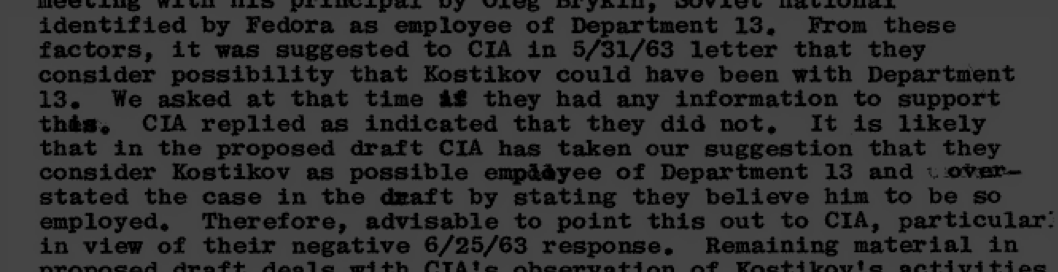
    In September 1964, the case against Kostikov took a bizarre turn, when a September 1, 1964, Hoover memo (105-124016) to the CIA seemed to indicate that the CIA (James Angleton’s department) in fact had no evidence to prove Kostikov was part of the infamous Department 13.

    This means either one of two things:

    1. Angleton knew Kostikov’s connection to Department 13 was unfounded, but tried to recycle that info in November.
    2. Angleton lied to Hoover on June 25, 1963, perhaps for the same reason (to keep the lid on it until November 22).

    David Atlee Phillips’ dirty tricks

    HSCA investigator Dan Hardway hypothesizes that, because of compartmentalization, Phillips and Oswald may have found out on November 22, 1963, that Oswald was a patsy and Phillips received orders to tie the murder to Castro.

    In a critique of Phil Shenon’s work written for the AARC in 2015, Hardway expresses the opinion that the CIA is heading to what he calls a limited hang-out by admitting that Oswald may have received guidance from Cuba and that the CIA director at the time, John McCone, was involved in a benign cover-up.

    Following the assassination, it became obvious that Phillips was connected to several disinformation stories trying to link Oswald to Castro agents. HSCA investigator Hardway called him out on it:

    Before our unexpurgated access was cut off by Joannides, I had been able to document links between David Phillips and most of the sources of the disinformation that came out immediately after the assassination about Oswald and his pro-Castro proclivities. I confronted Phillips with those in an interview at our offices on August 24, 1978. Phillips was extremely agitated by that line of questioning, but was forced to admit that many of the sources were not only former assets that he had managed, in the late 50’s and early 1960’s, but were also assets whom he was personally managing in the fall of 1963. Mr. Phillips was asked, but could not explain, why the information that came from anti-Castro Cuban groups and individuals pointing to Cuban connections, all seemed to come from assets that he handled personally, but acknowledged that that was the case.

    One of these assets was Nicaraguan double agent Gilberto Alvarado who, on November 25, claimed to have witnessed Oswald being paid off to assassinate Kennedy when Oswald was in Mexico City. A tale that was quickly debunked.

    While the HSCA hearings were going on, Phillips himself made the claim to a Washington Post reporter that he had heard a taped intercept of Oswald when he was in Mexico City talking to a Russian Embassy official offering to exchange money for information (Washington Post, November 26, 1976). Something he never repeated. Phillips also tried to get Alpha 66 operative Antonio Veciana to get one of his relatives in Mexico City to attest that Oswald accepted bribes from a Cuban agent.

    Letters from Cuba to Oswald—proof of pre-knowledge of the assassination

    For this obvious frame-up tactic, it is worth revisiting what was written in this author’s article The CIA and Mafia’s “Cuban American Mechanism”.

    In JFK: the Cuba Files, a thorough analysis of five bizarre letters, that were written before the assassination in order to position Oswald as a Castro asset, is presented. It is difficult to sidestep them the way the FBI did. The FBI argued that they were all typed from the same typewriter, yet supposedly sent by different people. Which indicated to them that it was a hoax, perhaps perpetrated by Cubans wanting to encourage a U.S. invasion. However, the content of the letters and timeline prove something far more sinister according to Cuban intelligence. The following is how John Simkin summarizes the evidence:

    The G-2 had a letter, signed by Jorge, that had been sent from Havana to Lee Harvey Oswald on November 14th, 1963. It had been found when a fire broke out on November 23rd in a sorting office. “After the fire, an employee who was checking the mail in order to offer, where possible, apologies to the addressees of destroyed mail, and to forward the rest, found an envelope addressed to Lee Harvey Oswald.” It is franked on the day Oswald was arrested and the writer refers to Oswald’s travels to Mexico, Houston and Florida …, which would have been impossible to know about at that time!

    It incriminates Oswald in the following passage: “I am informing you that the matter you talked to me about the last time that I was in Mexico would be a perfect plan and would weaken the politics of that braggart Kennedy, although much discretion is needed because you know that there are counter-revolutionaries over there who are working for the CIA.”

    Escalante informed the HSCA about this letter. When he did this, he discovered that they had four similar letters that had been sent to Oswald. Four of the letters were post-marked “Havana”. It could not be determined where the fifth letter was posted. Four of the letters were signed: Jorge, Pedro Charles, Miguel Galvan Lopez, and Mario del Rosario Molina. Two of the letters (Charles & Jorge) are dated before the assassination (10th and 14th November). A third, by Lopez, is dated November 27th, 1963. The other two are undated.

    Cuba is linked to the assassination in all of the letters. In two of them, an alleged Cuban agent is clearly implicated in having planned the crime. However, the content of the letters, written before the assassination, suggested that the authors were either “a person linked to Oswald or involved in the conspiracy to execute the crime.”

    This included knowledge about Oswald’s links to Dallas, Houston, Miami, and Mexico City. The text of the Jorge letter “shows a weak grasp of the Spanish language on the part of its author.” It would thus seem to have been written in English and then translated.

    Escalante adds: “It is proven that Oswald was not maintaining correspondence, or any other kind of relations, with anyone in Cuba. Furthermore, those letters arrived at their destination at a precise moment and with a conveniently incriminating message, including that sent to his postal address in Dallas, Texas … The existence of the letters in 1963 was not publicized or duly investigated and the FBI argued before the Warren Commission to reject them.”

    Escalante argues: “The letters were fabricated before the assassination occurred and by somebody who was aware of the development of the plot, who could ensure that they arrived at the opportune moment and who had a clandestine base in Cuba from which to undertake the action. Considering the history of the last 40 years, we suppose that only the CIA had such capabilities in Cuba.”

    We will see that these letters are suspiciously similar to Oswald’s “last letter.”

    Policarpo Lopez

    Attempts to link foreign governments to the assassination were not just limited to the framing of Oswald. As reported in the article The Three Failed Plots to Kill JFK, eight alternate patsies were profiled and no fewer than five of these made strange trips to Mexico City and at least four had visited Cuba.

    One who did escape authorities to Mexico and was reportedly the lone passenger on a plane to Cuba shortly after the assassination was Policarpo Lopez. Even the HSCA found this case egregious.

    The HSCA described parts of what it called the “Lopez allegation”:

    Lopez would have obtained a tourist card in Tampa on November 20, 1963, entered Mexico at Nuevo Laredo on November 23, and flew from Mexico City to Havana on November 27. Further, Lopez was alleged to have attended a meeting of the Tampa Chapter of the FPCC on November 17 … CIA files on Lopez reflect that in early December, 1963, they received a classified message requesting urgent traces on Lopez … Later the CIA headquarters received another classified message stating that a source stated that “Lopes” had been involved in the Kennedy assassination … had entered Mexico by foot from Laredo on November 13 … proceeded by bus to Mexico City where he entered the Cuban Embassy … and left for Cuba as the only passenger on flight 465 for Cuba. A CIA file on Lopez was classified as a counterintelligence case.

    An FBI investigation on Lopez through an interview with his cousin and wife, as well as document research, revealed that … He was pro-Castro and he had once gotten involved in a fistfight over his Castro sympathies.

    The FBI had previously documented that Lopez had actually been in contact with the FPCC and had attended a meeting in Tampa on November 20, 1963. In a March 1964 report, it recounted that at a November 17 meeting … Lopez said he had not been granted permission to return to Cuba, but was awaiting a phone call about his return to his homeland … A Tampa FPCC member was quoted as saying she called a friend in Cuba on December 8, 1963, and was told that he arrived safely. She also said that they (the FPCC) had given Lopez $190 for his return. The FBI confirmed the Mexico trip (Lopez’ wife confirmed that in a letter he sent her from Cuba in November 1963, he had received financial assistance for his trip to Cuba from an organization in Tampa) … information sent to the Warren Commission by the FBI on the Tampa chapter of the FPCC did not contain information on Lopez’ activities … nor apparently on Lopez himself. The Committee concurred with the Senate Select Committee that this omission was egregious, since the circumstances surrounding Lopez’ travel seemed “suspicious”. Moreover, in March 1964, when the WC’s investigation was in its most active stage, there were reports circulating that Lopez had been involved in the assassination … Lopez’ association with the FPCC, however, coupled with the fact that the dates of his travel to Mexico via Texas coincide with the assassination, plus the reports that Lopez’ activities were “suspicious” all amount to troublesome circumstances that the committee was unable to resolve with confidence.

    Oswald’s Last Letter

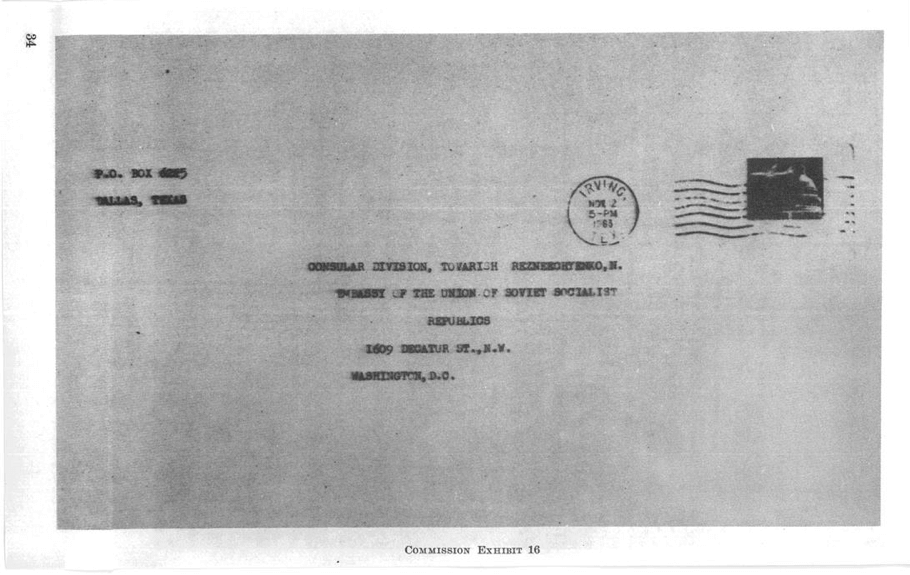
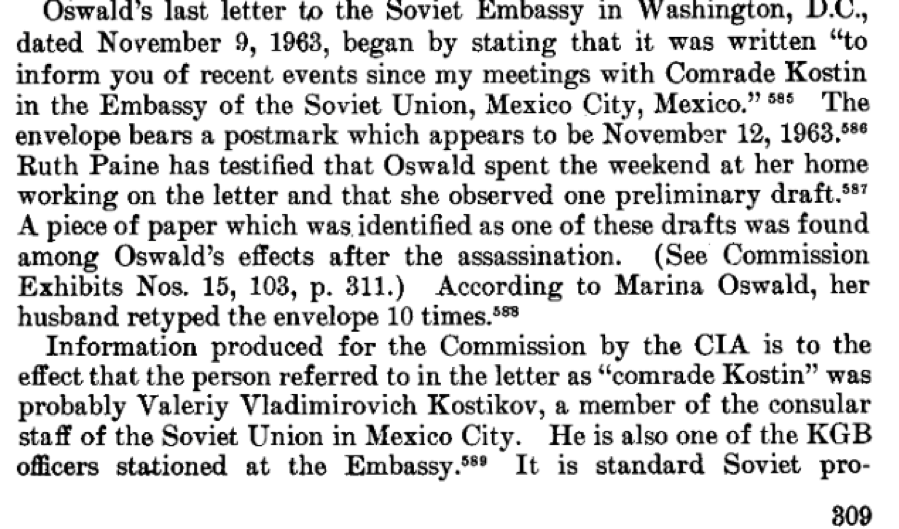
    On November 18, 4 days before JFK’s assassination, the Russian Embassy received a letter dated November 9 from “Oswald”, which was uncharacteristically typed and was in an envelope post-marked November 12. The letter, as was the case for all mail sent to the Russian embassy, had been intercepted by the FBI (Hoover phone call to Johnson November 23 10:01). The envelope is addressed to Tovarish Reznekohyenko, N. (note that Tovarish means Comrade).

    Before this incriminating letter, there were at least 6 exchanges in writing between the Oswalds and the Russian Embassy between February and November 1963, where the Russian contact was Nikolai Reznichenko according a number of Warren Commission exhibits. We can assume he is also the recipient of the last letter, despite different spellings.

    The FBI sent a briefing about the letter to the FBI Dallas office who received it on the day of the assassination. The Russians, sensing they could be blamed, handed over a copy of the letter to the Americans after noting correctly that it was the only one of all the letters from Oswald that was typed and that its tone differed from all previous correspondence. As the Soviet Ambassador pointed out at the time, the tone was also quite dissimilar to anything Oswald had communicated before; it gave “the impression we had close ties with Oswald and were using him for some purposes of our own.” Their opinion was that it was either a fake or dictated to him. Previous letters were more straight to the point dealing with visa applications.

    This letter became a hot potato. One that posed problems for the Warren Commission and the HSCA, which were amplified by the different takes Ruth and Michael Paine, Marina Oswald, the CIA, and the Russians had on it and the incredible lack of depth in the Warren Commission probe.

    With time, researchers like Peter Dale Scott, James Douglass, and Jerry D. Rose pointed out several troubling points, not only in the letter itself, but also with a Ruth Paine generated handwritten draft of the letter, as well as a Russian analysis of it.

    Warren Commission Volume 16 Exhibit 16

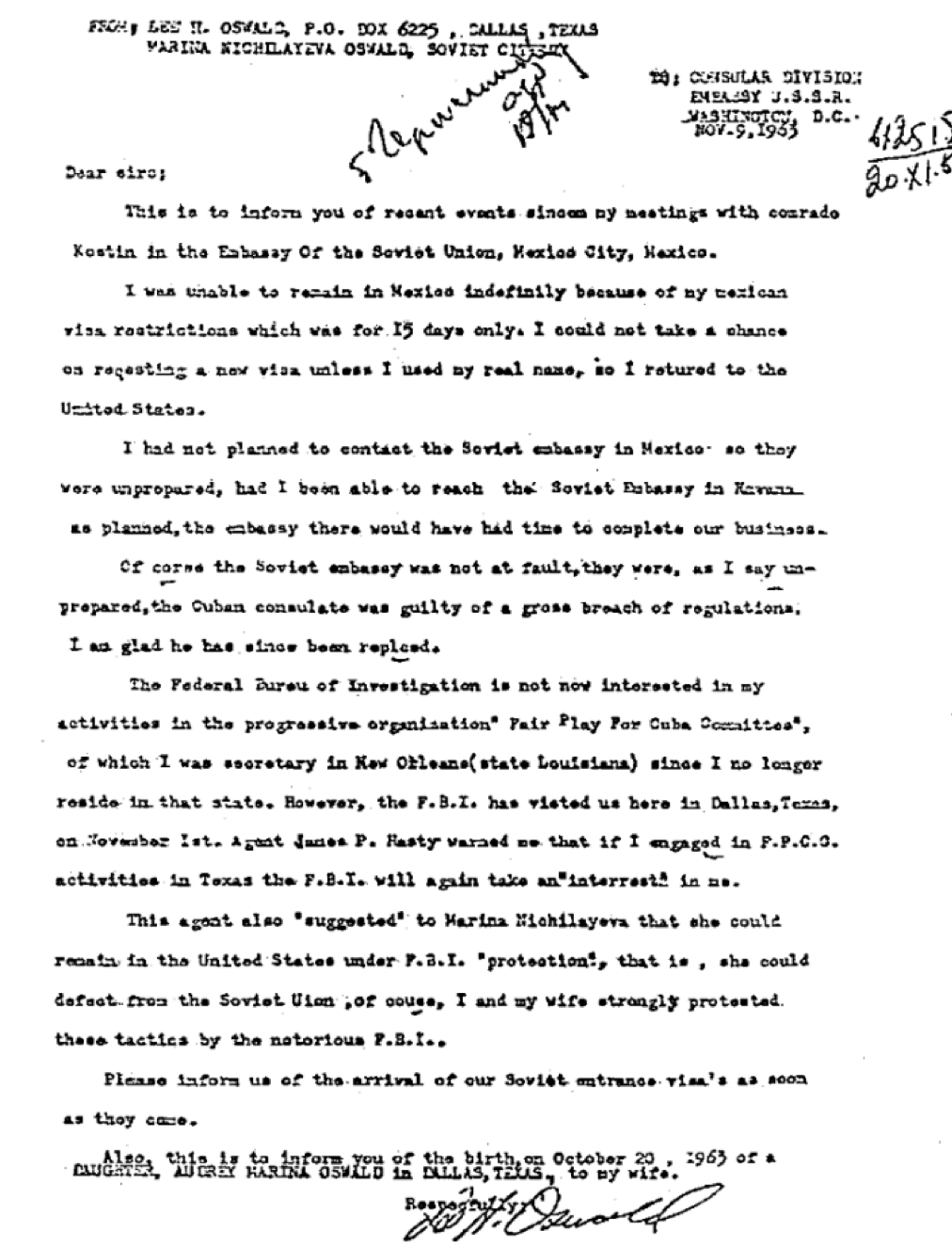
    Letter from Lee Harvey Oswald to the Russian Embassy, dated November 9, 1963:

    Warren Commission Volume 16 Exhibit 15

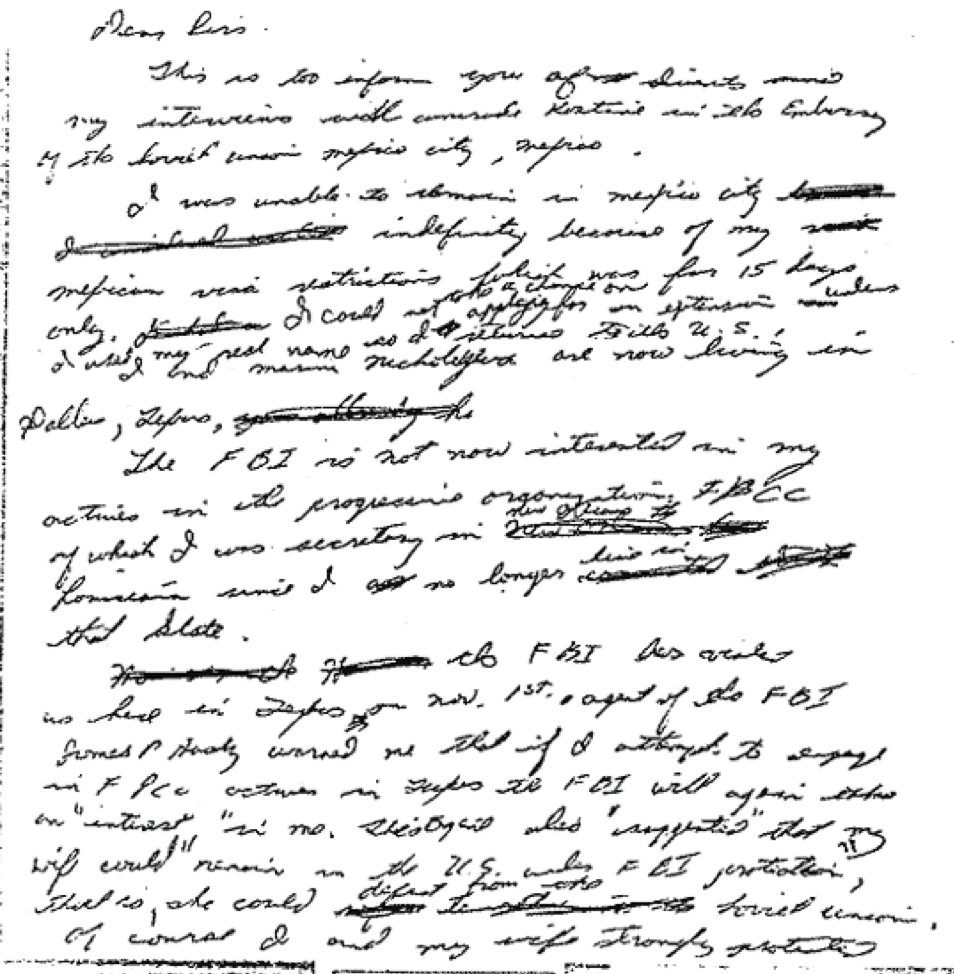
    The mistake-riddled letter was linked to Ruth Paine’s typewriter. Ruth Paine and Marina Oswald testified that they had seen Oswald working on the letter shortly before it was sent and Ruth and Michael Paine both testified that they had seen a handwritten draft of the letter, which Ruth Paine handed over to an FBI official on November 23. Somehow, investigators who had combed through the Paine house had missed it. Handwriting analysis apparently confirmed it had been written by Oswald.

    For some incredible reason, by April 1964, the Warren Commission had accepted a Ruth Paine request to have Oswald’s draft returned. However, when the Dallas FBI did return it to her, she decided to send it back to the Commission, because, finally, she felt it would be more proper for it to be kept in the public archives, but would take it in the event it would not be archived. Hoover said with finality that the Commission would not hold onto it and, by May 1964, had the original sent back to Ruth Paine, which escaped further examination as to its authenticity. (JFK and the Unspeakable, p.443)

    Oswald’s draft of the letter found by Ruth Paine:

    HSCA exhibit F 500/Warren Commission exhibit 103

    The Warren Report’s descriptions of Oswald’s trip to Mexico City and his last letter are among the best examples of just how weak their investigation was and how misleading they were in their disclosures.

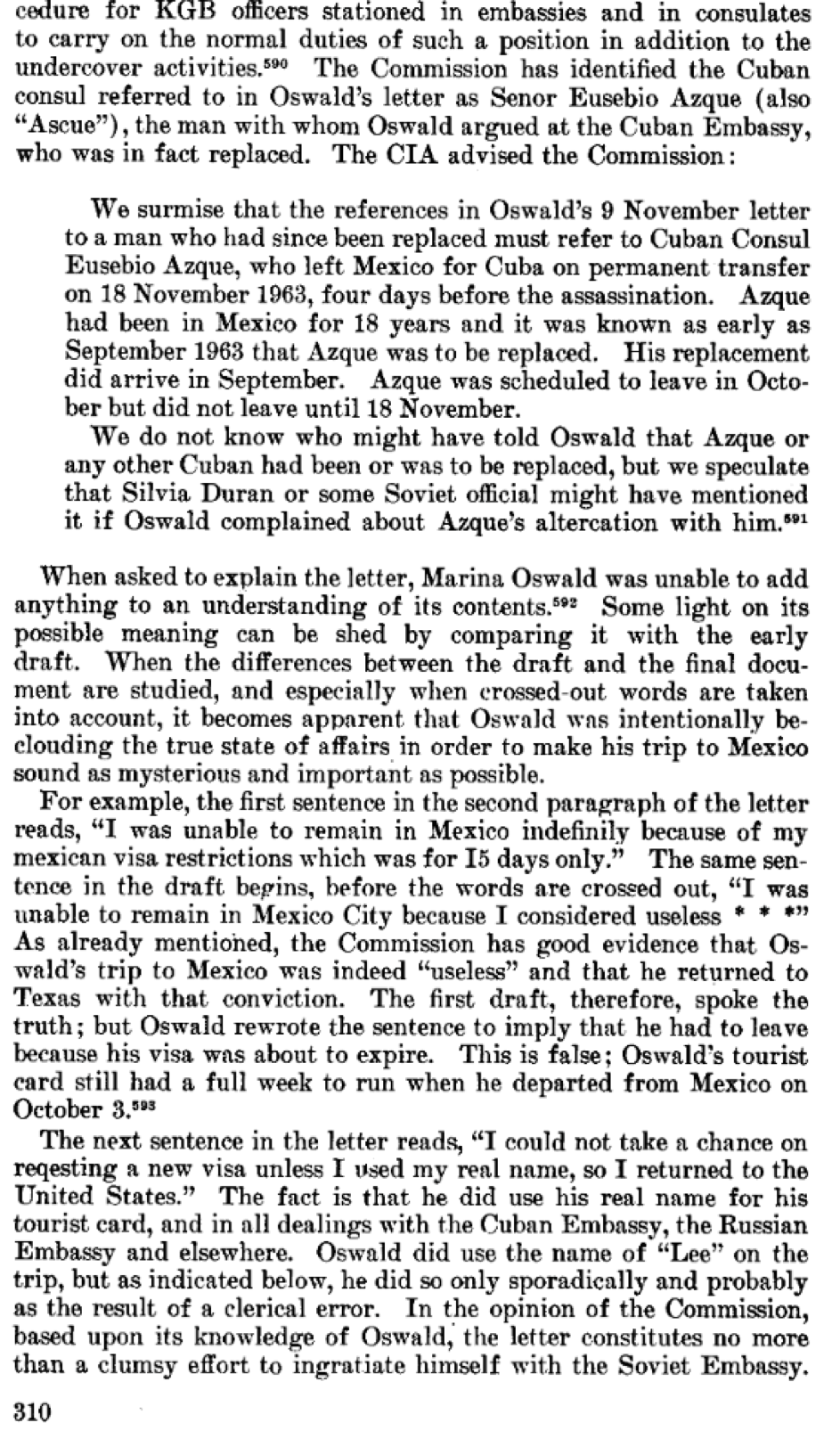
    It seems the only thing that they found perplexing from the letter was how a “drifter” like Oswald could have known that a consul from the Cuban consulate in Mexico City could have been replaced. So, they asked the CIA to weigh in. The CIA surmised that the consul in question was Eusebio Azque and speculated that Silvia Duran or some Soviet official might have mentioned it if Oswald had complained about an altercation with Azque.

    The Commission recognized that Kostin, who Oswald talks about, was KGB officer Valery Kostikov, but dilutes the meaning of this by stating “that it was common procedure for such KGB officers stationed in embassies to carry on normal duties along with undercover activities”.

    Buried in the appendices of the Report, we can find a memo (Warren Commission Document 347 of January 31, 1964, p. 10) by the FBI’s Ray Rocca, sent to the Commission in January 1964:

    Kostikov is believed to work for Department Thirteen of the First Chief Directorate of the KGB. It is the department responsible for executive action, including sabotage and assassination. These functions of the KGB are known within the Service itself as “Wet Affairs” (mokryye dela). The Thirteenth Department headquarters, according to very reliable information, conducts interviews or, as appropriate, file reviews on every foreign military defector to the USSR to study and to determine the possibility of using the defector in his country of origin.

    Richard Helms, while heading the CIA, went on to confirm this very important detail. Kept hidden from the public was an allegation that Oswald had met Kostikov just a few weeks earlier in Mexico City and that a likely Oswald impostor had placed a call to Kostikov that was intercepted by the CIA! This makes the reference to “unfinished business” that we can read in the letter quite suggestive.

    It is interesting to note that the letters from Cuba designed to incriminate Oswald and link him to Cuban agents use some of the same suggestive language. “Close the business”, “after the business, I will recommend you”, and “after the business I will send you your money” are some of the phrases that can be found in just one of the letters. Others talk about “the matter” or “the plan”.

    A real investigation and transparent report would have revealed a lot more about Kostikov’s explosive background and would have blown the lid off what really happened in Mexico City. It would have also delved into who the recipient of the Washington letter was and its important significance, if Plan A (blaming foreign foes for the assassination) had been pursued. Something we will discuss later.

    Instead, the report concludes its extremely hollow analysis on a whimper: “In the opinion of the Commission, based upon its knowledge of Oswald, the letter constitutes no more than a clumsy effort to ingratiate himself with the Soviet Embassy.” The truth was that, had plan A gone ahead, the letter would have been peddled as further proof of complicity between the president’s “murderer” and foreign adversaries.

    The Warren Report on the letter

    While Jim Garrison clearly suspected something unholy occurred in Mexico City, as well as with the letter, the public had to wait until 1970 to see some of the first clues about what the FBI really thought about this correspondence, when newsman Paul Scott revealed the following:

    The F.B.I. discounts the C.I.A. suggestion to the Warren Commission that Silvia Duran, a pro-Castro Mexican employee of the Cuban Embassy, might have told Oswald about Azque being removed. In her statement to Mexican officials concerning her discussion with Oswald, Mrs. Duran made no mention of Azque. And, although she was questioned at the request of C.I.A., no attempt was made to quiz her about whether she knew of Azque’s recall. This makes the C.I.A. conclusion highly dubious, to say the least.

    Although the F.B.I. still has not been able to resolve the key mystery of the Oswald letter, it has narrowed the sources of where he might have obtained information about Azque. These sources are: (1) An informant in the Cuban Embassy in Mexico City who contacted Oswald after he returned to the U.S. (2) The Central Intelligence Agency. Or (3), the Soviet Secret Police (K.G.B.) in Mexico City. Significantly, the F.B.I. probe discovered that the K.G.B. and the C.I.A. learned of Azque’s replacement at approximately the same time and not until after Oswald visited Mexico City. This finding has raised the possibility that whoever informed Oswald contacted him after he returned to Dallas from Mexico City.

    According to Paul Scott’s son Jim, his father was wiretapped for over 50 years, because of his dogged investigations into the assassination.

    The HSCA

    Perhaps the biggest blow to the Lone Nut fabrication came when the Church Committee and the HSCA investigations deciphered one of the most important ruses, which would turn the tables on the frame-up artists who concocted the aborted Plan A stratagem. This had to be kept secret.

    One thing the Lopez Report makes very clear is that an Oswald impostor made a phone call designed to lay down a trace that would be used as proof of Russian complicity in the assassination and would provide the types of motives and stratagems that were part of the ZR/RIFLE and the Joint Chiefs of Staffs Operation Northwoods play books, both which involved having adversaries blamed for their own covert acts of aggression. The letter served to authenticate the Oswald-Kostikov relationship and add a third player to the mix. The potato became scorching hot.

    This analysis needed to be buried as much and as long as possible. The HSCA did not want to be the ones exposing this in the 1970s. The world had to wait nearly 25 years for the declassification of the explosive reports concerning Oswald’s trip to Mexico City and the mysterious letter and sometimes much later for their eventual release.

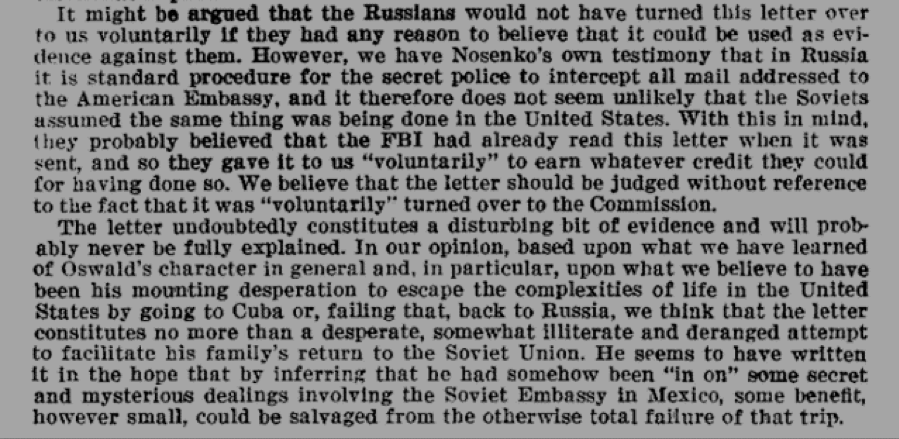
    The HSCA’s conclusions about the letter were even more hypocritical than the Warren Commission’s. While they recognize that it is “disturbing”, they seem to ignore the fact that the letter had been intercepted by the FBI and do not factor in the explosive findings of their very own Lopez Report, nor the confirmations about Kostikov’s role as Russia’s head of assassinations for the Western Hemisphere. When we consider the proof that they were sitting on, that an Oswald impersonator was recorded talking to Kostikov, and that Oswald (or an impostor) was said to have actually met him, we can easily see that the context of the letter and its explosive meaning were completely sidestepped in the Report:

    While the second paragraph represents a fake opinion designed to deviate from the real implication of the letter, the first one represents a blatant deception that can be proven outright by the transcript of Hoover’s call to President Johnson the day after the assassination:

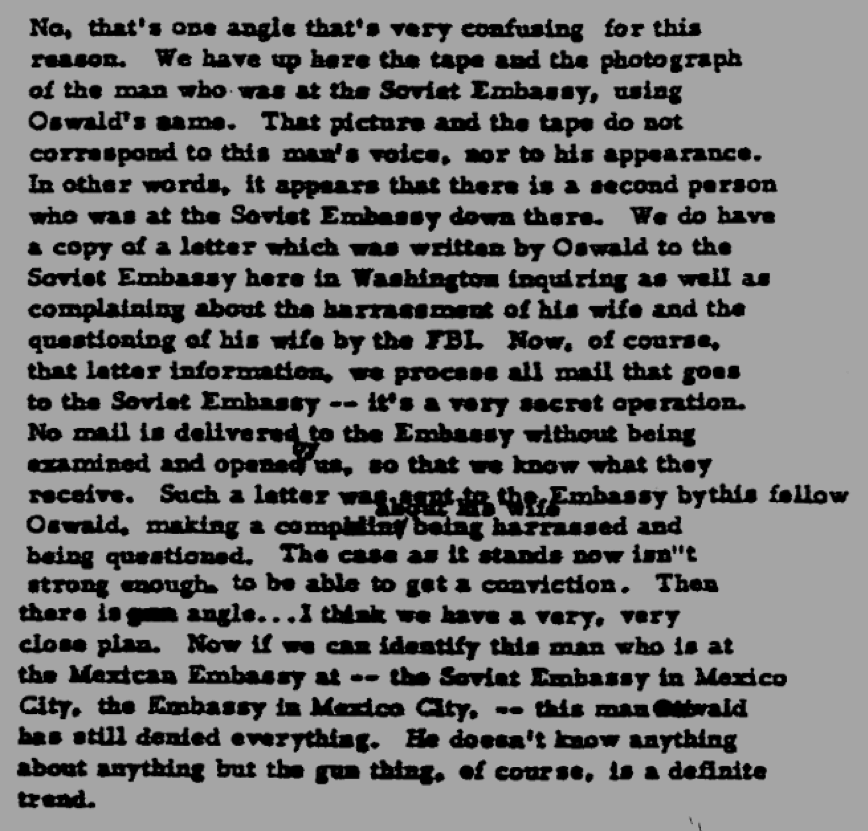
    In short, the FBI did in fact examine all mail sent to the Soviet Embassy and had a copy of the letter all along.

    The ARRB and Russians Weigh In

    Thanks in large part to Oliver Stone and his landmark JFK movie classic, the ARRB was founded in 1992 and began declassifying files shortly after on the JFK assassination. In 1996, the Lopez Report was available. By 2003, a less redacted version was released. The explosive document shed light on Oswald impersonators, missing tapes, photos, and bold-faced lying by top CIA officials. The lone drifter was not alone!

    As reported by Jerry Rose in the Fourth Decade, in 1999, Boris Yeltsin handed Bill Clinton some 80 files pertaining to Oswald and the JFK assassination. One of the memos reveals that, at the time of the assassination, Russian ambassador Anatoly Dobrynin had right away seen the letter as a “provocation” to frame Russia by the fabrication of complicity between Russia and Oswald, when none existed. “One gets the definite impression that the letter was concocted by those who, judging from everything, are involved in the president’s assassination,” Dobrynin wrote. “It is possible that Oswald himself wrote the letter as it was dictated to him, in return for some promises, and then, as we know, he was simply bumped off after his usefulness had ended.” In late November, the Russians sent the letter to U.S. Secretary of State Dean Rusk explaining why the letter was a fraud. By then, the White House was peddling the lone nut fable. Kept hidden was the fact that the FBI already had a copy of the letter.

    In his article, Rose points out that the typed letter had many more spelling errors in it than the rough draft. Very odd indeed.

    If you go back to how the Warren Commission fluffs off the alleged Kostikov/Oswald (and/or impostor) exchanges and compare it with what is written by Bagley in the CIA’s November 23rd 1963 memo (declassified in 1998), you will see a startling difference in Kostikov’s status:

    Memo of 23 November 1963 from Acting Chief, SR Division, signed by Tennant Bagley, “Chief, SR/Cl.” CIA Document #34-538

    Just one of the reasons the Warren Report was impeached! But wait, it gets worse.

    The FBI’s Reaction to the Letter and the Mysterious Tovarish Reznkecnyen

    Since the mid-1990s, there have been a few revealing writings about the letter, but very little about the FBI’s take on it.

    Now, thanks to document declassification, we can see it through a wider scope that includes troubling dovetailing facts, such as the impersonation of Oswald in Mexico City and multiple hoaxes to tie him in unequivocally with sinister foreign agents and the chief assassination officer in Mexico—Kostikov. The analysis of tape recordings and transcripts, the mysteriously disappearing evidence, the fake letters from Cuba, and the full-fledged perjury of CIA officer David Atlee Phillips during the HSCA hearings prove there was subterfuge beyond a shadow of a doubt.

    Hoover’s phone call to Johnson is already very revealing. The following FBI report (HSCA Record 180-10110-10104), released only in 2017, is nothing short of stunning. It was the one Scott wrote about in 1970. It is strongly urged that you follow the above link to understand the full implication of the report, which sheds light on the investigation mindset which preceded the whitewash. However, for this article, our attention will be on the following paragraph of the report which focuses on the letter Oswald sent to the Soviet Embassy in Washington.

    Oswald’s letter deeply troubled the FBI for a number of reasons. Its tone was one of ongoing complicity referring to “unfinished business” and convenient reminders of the alarming exchange between Oswald and Kostikov. But the letter stretches the elastic to add yet another element that has so far gone under the radar.

    The fact that the letter was sent to Tovarich Nikolai Reznichenko all of a sudden became alarming, even though the Oswalds corresponded with him several times in 1963. The FBI report clearly refers to him as “the man in the Soviet Embassy (Washington’s) in charge of assassinations.” In 1970, Scott had described him as “one of the top members of the Soviet Secret Police (K.G.B.) in the United States.”

    The significance of this report leads to many conclusions and as many unanswered questions. Hoover had already decided that Oswald acted alone and they would not “muddy the waters internationally”. The HSCA, who possessed this document, in reports debates the authenticity of the same letter that was given to Dean Rusk by the Soviet ambassador, when they knew full well of its existence and FBI worries about its explosive implications. While this author has found little corroboration about Nikolai Reznichenko’s status, or perceived status, he believes it should not be dismissed as a mistake or confusion with Kostikov. This is an official FBI report that was written in 1963. There have not been any clarifications made about this very significant statement, despite the fact that Paul Scott exposed this in 1970 and its access to HSCA investigators.

    The mere fact that he worked in the Russian embassy and that he often corresponded with a “defector” on a watch list and his Russian wife and that the last letter by Oswald addressed to him has a complicit tone while name dropping the Mexico-based KBG chief of assassinations and talking about unfinished business suggests that both the FBI and the CIA had files on him. Where are they? For him to be described by Hoover as the head of assassinations in Washington on the part of the Soviet government in an official FBI document is of utmost significance and requires an explanation.

    This is one issue that deserves more debate in the research community.

    Conclusion

    The last letter on its own, perhaps, does not rise to the level of a smoking gun that proves there was conspiracy. It is another compelling piece of evidence that does prove that the Warren Commission and the HSCA shelved important evidence and information from the public that they found bothersome.

    If one adds this letter to the other attempts to pin the blame on foreign agents, including the charade in Mexico City, false testimonies by CIA contacts, the perjury of CIA officials of interest in the case, the Policarpo Lopez incident, and the incriminating letters from Cuba, we have proof beyond a shadow of a doubt that there was conspiracy. The naysayers cannot have it both ways. Either these events were genuine, which proves an international conspiracy, or they were not, which proves a domestic conspiracy. There has been enough evidence to demonstrate that they were not genuine.

    The letter has one attribute that can play an important role, actually proving who some of the conspirators were. It pre-dates the assassination. As it refers to happenings and ruses that took place in Mexico City two months earlier that few knew about, we can narrow the scope on who was involved. When we inspect the propaganda aspect of the operation, the case against David Atlee Phillips as a person of extreme interest is almost airtight. He had many touch points with Oswald and is easy to link to all of the ruses behind the sheep dipping activities, including the incriminating last letter.


    See also Carol Hewett’s Ruth Paine “Finds” Evidence: Oswald’s Letter to the Soviet Embassy

  • A new look at the enigma of the Backyard Photographs, Part 5

    A new look at the enigma of the Backyard Photographs, Part 5


    Part 5:  Michael Paine and the Backyard Photos

    Ruth and Michael Paine responded exactly the same way when news broke that shots were believed to have originated from the Texas School Book Depository: they both immediately assumed that Oswald was involved. During a phone call placed at one pm November 22, 1963, Michael Paine calling from his office at Bell Helicopter to Ruth at home in Irving, this assumption receives a qualification: “the male voice was heard to comment that he felt sure LEE HARVEY OSWALD had killed the President, but did not feel OSWALD was responsible, and further stated, “We both know who is responsible.”1 Whoever it is Michael Paine believed “responsible” for the assassination it has remained closely held, as neither he or Ruth Paine have faced official scrutiny since 1968.

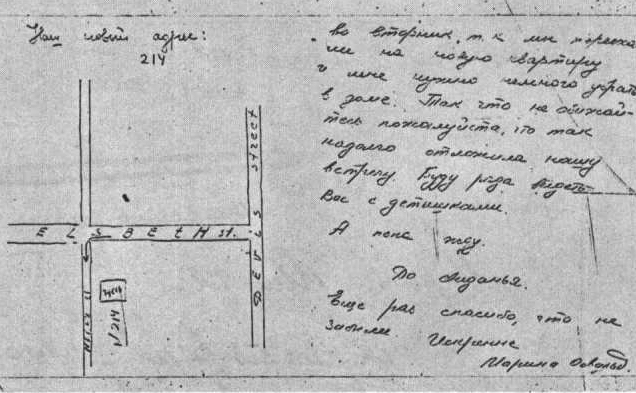
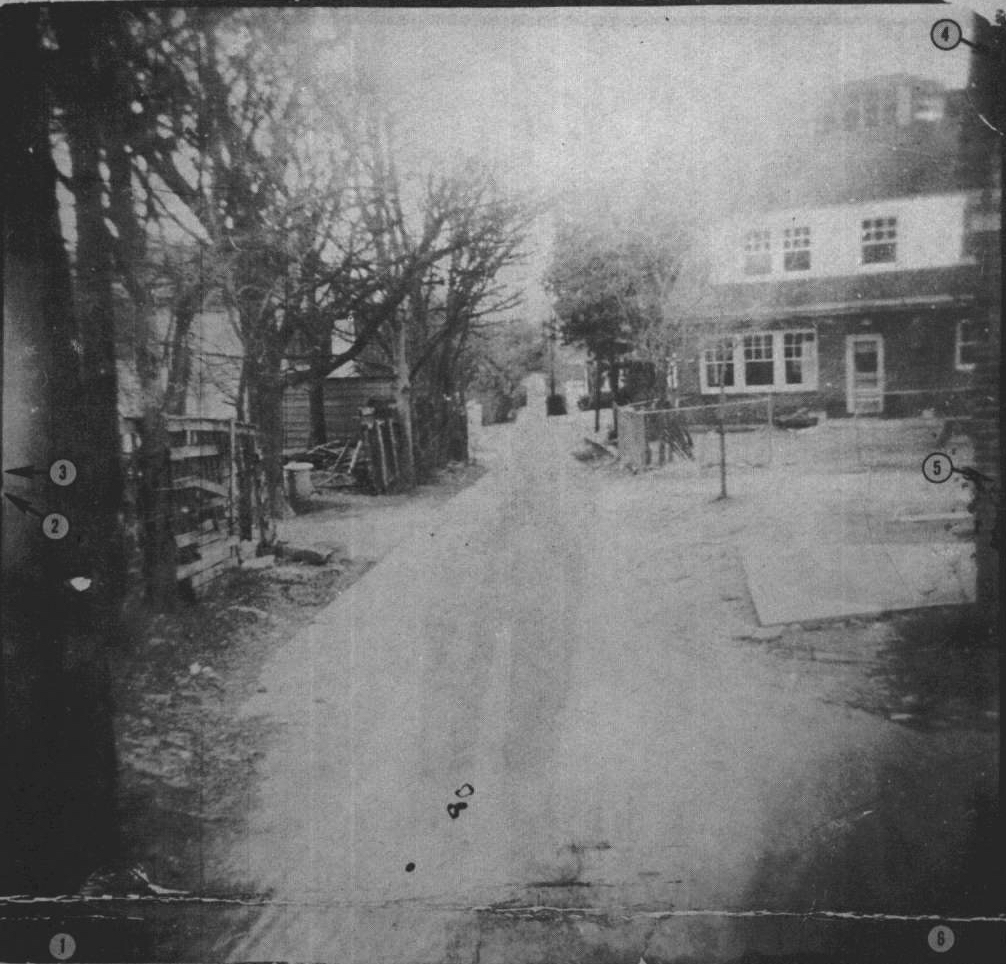
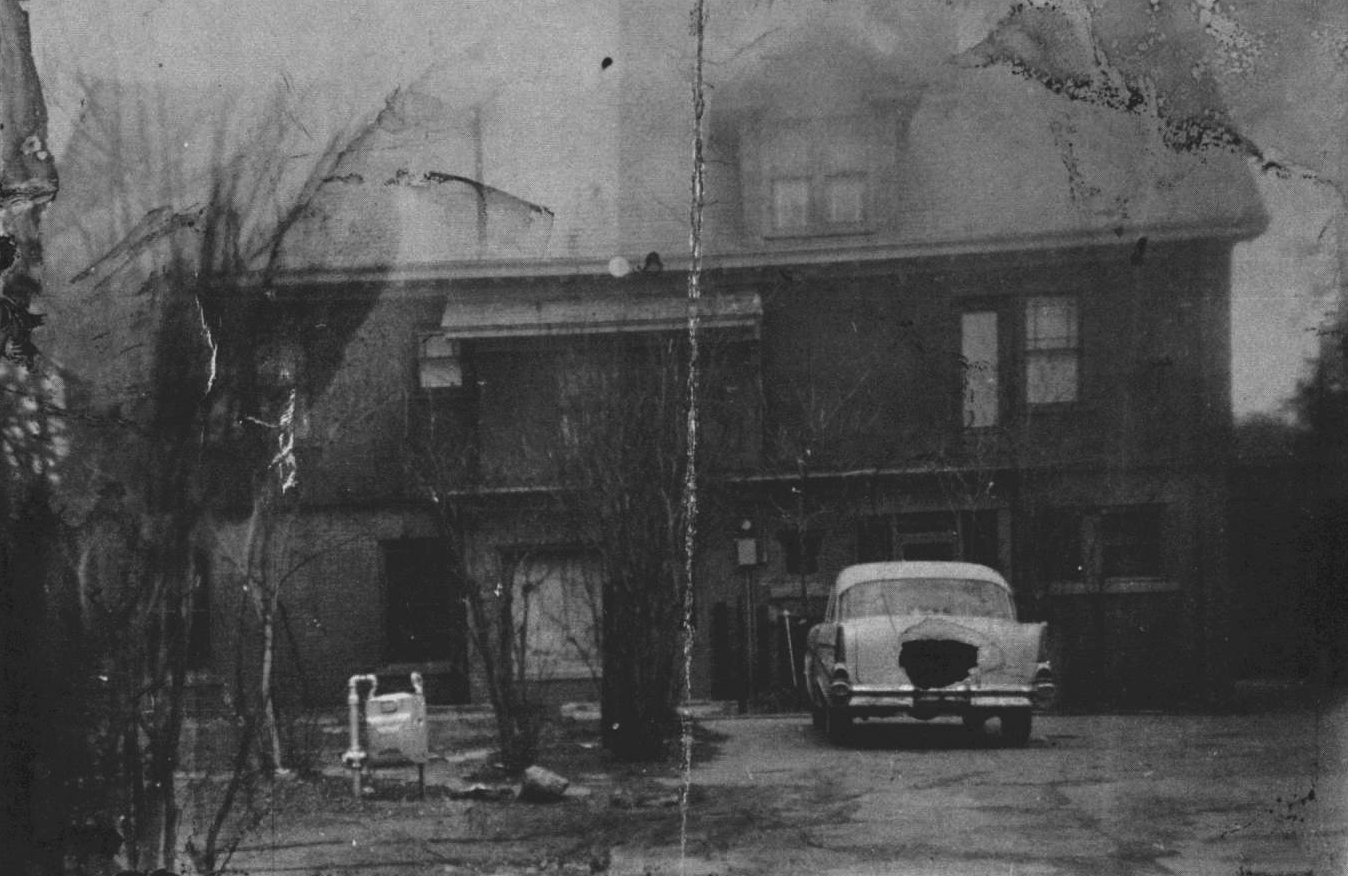
    Michael Paine intersects with the backyard photo story at least six ways, surprising since the official story portrays him as akin to a bystander, simply caught up in events. Michael Paine was one of a handful of known visitors to 214 West Neely Street. The Imperial Reflex camera said to have taken the backyard photos was apparently stored at his house in the autumn of 1963. He saw a backyard photo at the Dallas Police station the night of the assassination. The backyard photos known as 133-A and 133-B were discovered at his house the following day. He was involved in the delivery of a box of records, from which the de Mohrenschildt backyard photo would be later discovered. Michael Paine, with his wife Ruth, had dinner with the de Mohrenschildts soon after the photo was discovered in 1967. Years later, around the time of Oliver Stone’s JFK, Paine began claiming that Oswald actually showed him a backyard photo when he first visited the West Neely Street apartment in April 1963.

    April 1963: Michael Paine Visits 214 West Neely

    Mr LIEBELER: Did you ever make the acquaintance of Lee Harvey Oswald?

    Mr PAINE: Yes.

    Mr LIEBELER: Would you tell us briefly the circumstances under which that occurred?

    Mr PAINE: My wife invited Lee and his wife over to supper one evening.

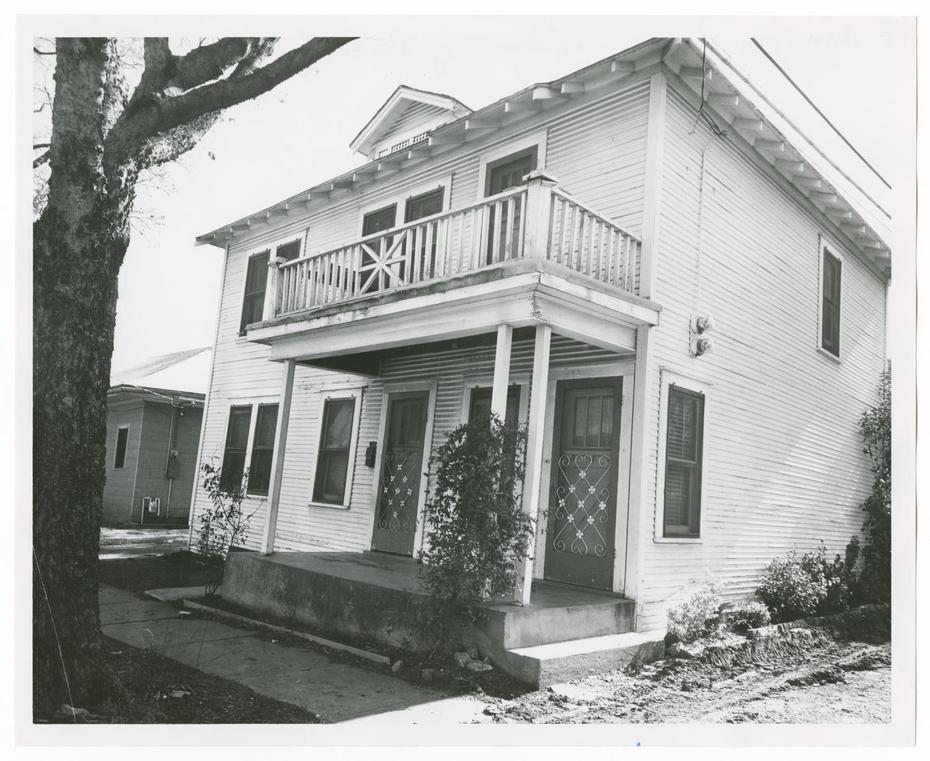
    Michael Paine arrived by automobile at 214 West Neely Street around 6 PM in the late afternoon of April 2, 1963.2 He was there by arrangement, to pick up Lee and Marina Oswald and their young daughter, and transport them to the Paine’s home in Irving for a dinner engagement. At the time, Lee Oswald had begun his final week of employment at Jaggars-Chiles-Stovall, having previously received his notice. Allegedly, the backyard photos had been exposed two days before. Paine was brought upstairs to the Oswald’s modest second-floor apartment. According to him, “Marina took about half an hour to pack all the things for Junie. Meanwhile, I was talking to Lee at their house there.”3

    The subsequent thirty minute delay, or conversation, or briefing, is portrayed as a chance event allowed by the circumstance of Marina’s packing bags for the trip to Irving. The two men started up a conversation based on Oswald’s experiences in the Soviet Union. Michael Paine: “I asked him what he was doing, his job … I asked him about Russia … I wanted to know why he had gone to Russia and why he had then come back … I asked him how was it they so readily accepted (him) … he spoke more with disfavour of the Soviet Union … I wasn’t sure whether he was speaking derogatively in order to win my good graces or thinking he would win my friendship that way … I was asking him questions, taking his answers.” (WCH II, pp. 393-398)

    Michael Paine’s account of the conversation held during the half-hour delay at the Neely Street apartment fills ten transcript pages in the Commission Hearings (WCH II pp 393-402). As he concludes this detailed account, largely concerned with Oswald’s experiences in Russia, he tells the Commission: “What you have heard now occurred mostly in the first half hour when I was speaking directly to him when I met him … in all the subsequent conversations, you are going to get less information in what he said.” (WCH II, p. 398) Paine would maintain he and Oswald had a total of four conversations in the spring and autumn of 1963.

    General Walker ’s name came up later during the April 2 visit, apparently during or subsequent to the dinner at the Paine home in Irving.4 Paine: “I was still trying to find common ground with him, and I think we probably spoke critically of the far right. It seems to me we may have mentioned Walker … My memory is very foggy … a friend of ours … just achieved her citizenship papers … and General Walker had been invited to lead the singing [sic] … she was rather sorry that Walker should take it upon himself to define … what this country stands for. So I think I mentioned this episode to him … and I think (Oswald) smiled and nodded his assent … I don’t think he made any important remarks about Walker … that is the only time, probably the only time we mentioned Walker.” (WCH II, p. 402)5

    Michael Paine drove Lee, Marina and daughter June back to Neely Street to conclude the evening. He claimed he did not see Lee Oswald again until October. Paine would provide material support for Ruth Paine’s efforts in housing Marina Oswald, and transporting her to and from New Orleans, ostensibly as a means to brush up her Russian language skills. The Imperial Reflex camera which took the backyard photos was probably transported to New Orleans in May, in Ruth Paine’s station wagon, included with the Oswald belongings or on her own initiative.

    The New Orleans photo set, taken by that camera, features eleven photos, which could be said to represent a single twelve exposure roll of film. The eleven photos consist of similar versions of effectively four separate poses or views, suggesting the photographer was intent on shooting out the roll of film on this occasion. The Oswald and Paine families enjoyed a New Orleans tourist day on Sunday May 12, but no photos were taken on that occasion. If Ruth Paine was responsible for the New Orleans set, then the likeliest date was Monday May 13, when Oswald was at work. It is possible that Ruth Paine did not reveal to Lee that the hard-to-forget Imperial Reflex camera was in her possession, or else it was uncovered as the Oswald possessions were moved into the Magazine Street apartment. It is possible the roll of film was already in the camera. Ruth Paine may have returned to Irving with this camera, as there are no other personal photographs in the Oswald record dated after May 1963.6

      The eleven New Orleans photos feature four groups of similar views.  

    October 1963: Oswald, Michael Paine and the ACLU

    November 10, 1963, the Sunday of a long weekend, the last weekend he would in fact spend with his family, and Lee Oswald, according to Ruth Paine’s timeline, “spent the entire day … watching television.”7 Michael Paine remembered this occasion before the Warren Commission: “ I think that weekend I remember stepping over him as he sat in front of the TV … thinking to myself for a person who has a business to do he certainly can waste the time. By business I mean some kind of activity and keeping track of right-wing causes and left-wing causes or something. I supposed that he spent his time as I would be inclined to spend more of my time if I had it, trying to sense the pulse of various groups in the Dallas area.” (WCH II, p. 412)

    Oswald, September 1963

    The inquiries of Commission counsel Wesley Liebeler switched at this point to topics related to the informal driving lessons Lee was receiving from Ruth Paine, leaving aside the curious aspects to Michael Paine’s observation: Oswald had a “business to do”, he had “activity … keeping track of right wing causes and left-wing causes”, an inclination shared by Michael Paine, “trying to sense the pulse of various groups in the Dallas area.” Was this a hobby for both or either men? Was this activity more exactly described as a “business to do”? If it was a business, monitoring political activity, which Paine was inclined to do more of but had time constraints, might his annoyance with Oswald be generated from having sub-contracted, so to speak, some of this “keeping track” to Oswald? Paine was questioned by the FBI in June 1964 over a report he had talked about Cuba and Oswald with students of Southern Methodist University at Luby’s Cafeteria in April or May 1963. Paine said he was in the habit of eating lunch on Sundays at Luby’s, and would engage in “intellectual conversations or debates concerning world affairs with various SMU students … he did not specifically recall discussing (Oswald) with any of these SMU students … although he could very well have since at this time he was acquainted with OSWALD and OSWALD’s background. (CD 1245, p. 196)

    On October 2, 1963, Oswald had resurfaced in Dallas, after seeing off Marina, June and Ruth Paine in New Orleans on September 23.8 Oswald stayed at the YMCA for two nights, and then spent the weekend of October 4-6 at the Paine home in Irving. The following week, Oswald rented a room at Mary Bledsoe’s Oak Cliff rooming house, while he searched in Dallas for a new job. Bledsoe would later tell the FBI that Oswald told her at least twice “he was attempting to obtain work at Texas Instruments and Collins Radio.”9

    On Sunday night October 13, although Ruth Paine’s timeline says “OSWALD was at the PAINE home all during this day and night,” (CE 2124) Oswald, or someone identical to him, was seen sitting at the back of the room at a meeting sponsored by the Student Directorate of Cuba (DRE) (CD 205, p. 646). “This individual spoke to no one but merely listened and then left.” General Walker was also in attendance at this meeting. How Oswald knew of, or traveled to this meeting and then back to Irving, is not known.

    Ruth Paine took Oswald into Dallas the following morning, and Oswald moved from Bledsoe’s to a rooming house at 1026 North Beckley. Two days later, Oswald began work at the Texas School Book Depository. Two days after that, Lee Oswald turned 24 years old. On Sunday night, October 20, Marina went into labour and daughter Rachel was born. This began a busy week for Oswald.

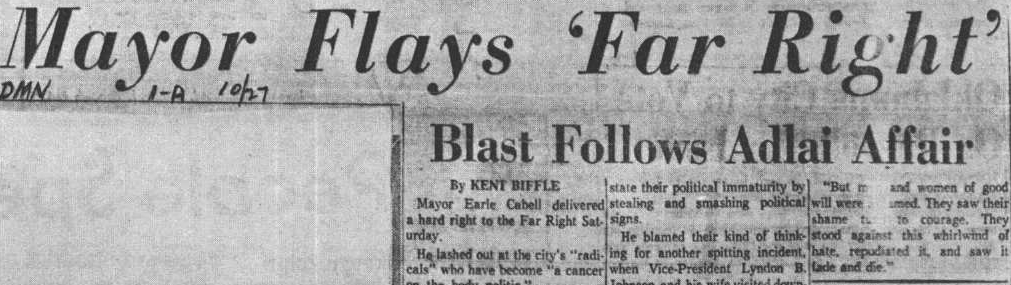
    On Wednesday October 23, Oswald attended a “United States Day” right-wing political rally featuring General Walker, a response to the Adlai Stevenson United Nations Day event scheduled for the following evening. That next night, as Stevenson spoke in Dallas, the event suffered a vigorous protest by right-wing demonstrators organized in part by Larrie Schmidt. Stevenson would be struck by a placard. Michael Paine would express to the Warren Commission his understanding that Oswald was in attendance at this protest. Paine, for his part, attended a John Birch Society meeting on this same night.10 He would explain: “I have been to a number of rightist meetings and seminars in Texas.” (WCH II, p 389) Michael Paine would say of Oswald: “ I gathered he was doing more or less the same thing … I didn’t inquire how he spent his free time but I supposed he was going around to right wing groups … familiarizing himself for whatever his purposes were as I was.” (WCH II, p. 403)

    Ruth Paine’s timeline features the following entry for October 25, 1963: “LEE OSWALD came out after work with WESLEY FRAZIER and saw his wife and baby for the first time after they had left the hospital.” Oswald soon left with Michael Paine, to attend a Dallas meeting of the American Civil Liberties Union. Paine: “I took him in my car, he and I alone, and on the way, which takes about 35 minutes, described the ACLU to him, and he didn’t know about it, and described its purpose.” (WCH II, p. 407)11 During the meeting, Oswald stood and challenged an opinion from the moderators regarding the religious tolerance of the right-wing. Paine: “Lee at this point got up, speaking loud and clear and coherently … reporting that he had been to this meeting of the right-wing group … two nights before and he refuted this statement, saying names and saying how that people on the platform speaking for the Birch Society had said anti-Semitic things and also anti-Catholic statements … ” (WCH II, p. 408) Oddly, Michael Paine uses a generality (Oswald “saying names”), instead of reporting that Oswald referred specifically to General Walker, as Paine’s co-worker Frank Krystinik, also invited to this meeting, observed.12

    As the meeting broke to informal discussion, Krystinik, who had been informed earlier that Oswald was a Marxist, engaged in a debate on economics with Oswald and another older man. Michael Paine: “in this … argument that he had with Frank and a third person, on the way home he asked me if I knew that third person and whether I thought he was a Communist, Lee thought the third person was a Communist, and he gave me some reason … a receptivity to some words spoken about Castro. And I thought that was such a feeble reason … he must be out of it if that is the way he has to find his fellow travellers.” (WCH IX, p. 456)

    Shortly thereafter, Oswald wrote to Communist Party USA newspaper The Worker, a letter postmarked November 1: “Through a friend, I have been introduced into the American Civil Liberties Union Local chapter, which holds monthly meeting on the campus of Southern Methodist University. The first meeting I attened (sic) was on October 25th, a film was shown and afterward a very critical discussion of the ultra-right in Dallas … Could you advise me as to the general view we have on the American Civil Liberties Union? And to what degree, if any, I should attempt to highten (sic) its progressive tendencies? … some of those present showed marked class-awareness and insight.” (Johnson Exhibit 7)

    On the same day, previous to mailing this letter, Oswald rented a new Dallas post office box and listed both the Fair Play For Cuba Committee and the American Civil Liberties Union on the postal form (Holmes Exhibit 1).13 Oswald mails a membership application to the ACLU that same day. He includes two dollars in cash for the membership fee and lists his occupation as “photographer”. He adds a handwritten letter which requests notification on how to contact “ACLU Groups in my area,” even as he already knows they hold monthly meetings at SMU. (CE 783) Michael Paine had been an ACLU member for some years, and Ruth Paine was the local treasurer.

    Following the assassination, the ACLU had to react defensively after Dallas Bar Association president H. Louis Nichols met with Oswald on Saturday afternoon November 23, then appeared on television to reveal Oswald was an ACLU member and requested an ACLU lawyer if John Abt was not available. By Wednesday November 27, a reporter from the Dallas Times Herald had been informed of the Oswald postal form listing the ACLU along with Fair Play for Cuba Committee as the assassin’s specified organizations. By that afternoon, the ACLU executive were anticipating “danger in the future, as a result of the tragedy of last Friday, that civil liberties will be under increased stress.” (CD 205, pp. 704-708)

    November 22, 1963: Michael Paine Is Shown A Backyard Photo By the Dallas Police

    According to Michael Paine, he was asked at the Dallas Police station Friday night November 22, 1963, if he could “identify the place where Lee was standing when he was holding this rifle … I identified the place by the fine clapboard structure of the house … the house has an unusually small clapboard.“ This, taken at face value, reveals an alert observational skill set and excellent memory retention as, according to Paine, he had only visited 214 West Neely Street once, almost eight months previous.14

    Paine’s excellent retention skills are particularly admirable given the “fine clapboard structure” of the Neely Street house, as seen in the backyard photos, is visible but hardly dominates the frame the way the staircase and its support beams do. The clapboard can be seen behind and below the staircase on the left side of the frame. If the photo viewed by Michael Paine on Friday night was 133-C, it is the individual backyard photo showing the least detail of the clapboard structure. If 133-C was possessed by the Dallas police in the format of a “drugstore print”, then still less detail would be visible as the photo would be cropped on its horizontal edges, as well as appearing in its small 3”x3” size.

    Considering that the backyard photos, according to the official story, would not be discovered until the following afternoon, it is interesting that it is Warren Commission counsel Wesley Liebeler who brings the subject up during Paine’s testimony. Liebeler, at that time, is seeking to establish some other point, related to the rifle, and does not seem to realize that Paine is describing being shown something which officially had not yet been found. (WCH IX, p. 444)

    Michael Paine and the de Mohrenschildt Backyard Photo

    Everett Glover was separated from his wife at the start of 1963, and had arranged to share his house with two fellow employees at Magnolia Oil, Richard Pierce and Volkmar Schmidt. Everett Glover was a friend of George de Mohrenschildt, and also with Michael and Ruth Paine. Michael Paine: “We met the Glovers at madrigal singing, we liked to sing madrigals and he was part of the group … he showed up once or twice at a single adult party dance of the Unitarian Church.” (WCH IX, pp. 451-452)

    Folk dancers and madrigal singers: a hotbed of intrigue?

    In February, Glover, along with Volkmar Schmidt and others, met Lee and Marina Oswald at George de Mohrenschildt’s home, and they were supposedly impressed enough to arrange their own social occasion and invite the Oswalds. Through their friendship with Glover, the Paines would be invited to this Magnolia Oil party held on February 22,1963, which was the President’s Day holiday. Everett Glover provided the transportation for the Oswalds. The party was said to feature George de Mohrenschildt’s Central American walking tour slideshow, but it really seemed about presenting the Oswalds to new people.15 Michael Paine: “Everett Glover invited us knowing that Ruth was studying Russian … they were presented to us as an American who had defected to Russia and decided he didn’t like it and came back and brought a Russian wife with him. Would we like to meet these people? Yes, that sounded interesting.” (WCH II, p. 404)

    Sometime after this party, a record player lent to Glover by the de Mohrenschildts was, at their request, in turn lent to Marina Oswald, and delivered to the Neely Street apartment by Glover and roommate Richard Pierce. Jeanne de Mohrenschildt had also lent Marina a few instructional English/Russian language LPs to go with this player. Some weeks later, after the Oswalds had moved to New Orleans, Everett Glover was contacted by one of the Paines regarding this record player:

    Mr. GLOVER. I got a call on the telephone, I am not sure whether it was Mr. or Mrs. Paine, in which they said the record player – I believe it was the same one I had given or taken over to (Marina) that belonged to the De Mohrenschildts, was there at their house … I think at this time I learned through them that Marina had gone to join (Lee) in New Orleans.

    Mr. JENNER. Was anything said about Mrs. Paine having taken Marina to New Orleans?

    Mr. GLOVER. Nothing was said about her taking her to New Orleans, but I do believe I knew at that time that Marina had stayed with her. I think I learned it through conversation with them. I don’t remember having heard from or seen the Paines since the time they were at my house until the time that I have learned Marina had gone to New Orleans and had previously stayed with Ruth. And until the time that Mike came over and delivered the record player. I think Mike was the one who brought the record player, and I don’t remember the circumstances on that …

    Months later, Glover is contacted again by the Paines:

    Mr. GLOVER … the only other connection I had with them was that later than that … I got a call from one of the Paines saying they had records that the De Mohrenschildts had given Marina. These were for Russian speaking people learning English, I believe, that they had, and what to do with them? And I said, bring them over here and I will store them … and I remember Michael Paine brought the records over to me and came in the house, and I talked with him a little bit. At this time Michael Paine told me the last information I had about (the Oswalds). He told me that, I am not sure whether he said they were back, Marina was coming back, or Marina had already come back to Dallas, that Lee had lost his job and that Lee was coming back, and that was in the time I believe.

    Mr. JENNER. Was coming back to live or was visiting?

    Mr. GLOVER. Well, was coming back. Presumably he lost his job and was coming back here.

    The backyard photo known as deMohrenschildt-A, a first generation print which shows information from the original negative cropped from the “drugstore print” 133-A, and which features handwritten inscriptions on its backside, was discovered within the sleeve of one of these language LPs when the deMohrenschildt’s returned to Dallas in 1967. Accepting Glover’s Warren Commission testimony, this photo was presumably inside the LP sleeve when the language albums were returned at about the beginning of October 1963. Presumably, these LPs had travelled with Marina Oswald to New Orleans and then back to Irving, even as they could not be played since the record player had possibly been returned months earlier, as established during Glover’s questioning by Commission counsel Albert Jenner (although when exactly Michael Paine dropped off the record player is not explicitly stated). Conceivably, the backyard photo known as deMohrenschildt-A could have been inserted into the LP sleeve by Oswald at any time between April and September. Or, inserted by the Paines, or someone associated with the Paines, just before the records were returned to Everett Glover. Or, since Everett Glover is uncertain of the circumstances, perhaps the record player was not returned in May but actually at about the beginning of October, and Glover was confused between the record player and the LPs. There is no indication any investigatory agency went to have a look at these LPs after Glover’s testimony, even as important evidence had been uncovered inside other items associated with the Oswalds.

    A month after Glover’s appearance, during testimony from George de Mohrenschildt, Commission counsel Jenner would suggest the LPs were actually found in the Paine’s home:

    Mr. De MOHRENSCHILDT. We gave (Marina) some records to study English – not mine, but my wife’s and her daughter’s records, of Shakespearian English, how to learn English, and they obviously still have those records.

    Mr. JENNER. Yes, they were found in Mrs. Paine’s home.

    Mr. De MOHRENSCHILDT. We even gave them a phonograph, I think, a cheap phonograph, to play the records.

    Stovall Exhibit A lists the property “taken from” the Paine house in Irving on November 22. The list includes “3 Brown metal boxes 12” x 4” containing phonograph records”. If the language LPs lent to Marina Oswald were among these “phonograph records,” then they would have been taken to Dallas Police HQ, and apparently later that night sent to the FBI lab in Washington. If Oswald had stashed the de Mohrenschildt backyard photo inside a record album later seized at the Paines, it would in all probability been discovered by the Dallas police or by the FBI. If these LPs were found at the Paine home after the assassination rather than delivered to Glover weeks earlier, then the backyard photo must have been inserted into the sleeve after being returned from the custody of the FBI sometime in 1964. Glover, who had assumed much of the de Mohrenschildt’s furniture on their departure for Haiti in April 1963, moved many of these items into a storage locker early in 1964, and it is in this locker the language LPs with the backyard photograph were found.

    Glover left Dallas before the de Mohrenschildt’s return, and there have been indications that Ruth Paine had access to the storage locker in the meantime. When the de Mohrenschildt’s discovered the backyard photo, they called the Paines, despite having only been introduced to Ruth once, years before. During an ensuing meeting between both couples, over dinner, the newly found backyard photo was a topic of conversation as well as discussion “generally, of events.”16 In his manuscript “I Am a Patsy”, George de Mohrenschildt described Ruth Paine as “a perfectly charming, charitable Quaker … (who) helped the Oswalds out of pure humanitarian impulses … She and her husband were simply admirable people.” (HSCA Volume XII, p. 260) Paragraphs earlier, de Mohrenschildt disparages Marina Oswald’s deportment following the assassination. He was under the incorrect impression that it was Marina who wrote “Hunter of fascists ha-ha-ha” on the back of the discovered photo.

    1993: Michael Paine Claims That Oswald Himself Showed Him A Backyard Photo

    “Almost the next thing he does is to pick up this eight-by-ten glossy photo of himself in black with a rifle and a couple of pamphlets … it was very different from what I had expected to find … I had been told he was a communist and I kind of expected a social idealist and couldn’t see the connection between this picture of a guy with his rifle there in black clothing. But he was obviously proud of that picture ….” (Michael Paine, quoted in Gus Russo, Live By The Sword, interview conducted 1993)

    “When I first met him … the first thing he showed me was a picture of himself holding a rifle and I could see he was proud of that picture. I had the strong impression that it was an icon of himself that he liked.” (Michael Paine, ABC News, “Beyond Conspiracy”, 2003)

    In 1993, Michael Paine began telling interviewers that Oswald had showed him a backyard photo when they first met in the Spring of 1963. If Michael Paine’s relatively recent claim is actually true, then his Warren Commission testimony is severely compromised, a fact which appears to have escaped many mainstream journalists and network research departments. If Oswald showed Michael Paine a backyard photo in the Spring of 1963 it must have been, according to Paine’s timeline, during the visit to the Neely Street address when Paine arrived to drive the Oswald’s to dinner in Irving. This event, if true, is entirely absent from Paine’s long and detailed description of his half hour with Oswald as told to the Warren Commission. If true, and Oswald was offering Michael Paine visual evidence of an apparent tendency to violent fanaticism, it is not at all clear why this troubling information was not passed to Ruth Paine as she continued to forge her friendship with Marina. Ruth Paine claimed to the Warren Commission that she did not know Lee owned a rifle and would not have accepted the presence of a rifle in the same home as her children.

    Most critically, if true, it calls into question Michael Paine’s extensive deliberations during his Warren Commission testimony on the supposed “camping equipment” inside a rolled blanket amongst Oswald’s possessions in his garage at the Paine residence in Irving. During Paine’s first appearance before Warren Commission attorneys Wesley Liebeler and Norman Redlich on March 17, 1964, a total of seven transcript pages describe his interaction with a rolled blanket, wrapped with string, lying on the floor of the garage. (WCH IX, pp. 437-443) The Warren Commission would determine that the murder weapon used in the assassination had been wrapped inside this blanket, which had been stored on the garage floor without the Paines’ knowledge of what was in it. Michael Paine’s efforts to explain why he did not make any effort to understand what may have been wrapped, (or allegedly wrapped), in this blanket are strained and tend to over-thinking:

    Paine: “ I picked up this package and the first time I picked it up I thought it was camping equipment and thought to myself they don’t make camping equipment of iron anymore … I supposed it was camping equipment because it was wrapped in this greenish rustic blanket and that was the reason I thought it was a rustic thing … there was also a certain wideness at one end and then I thought of a folding tool I had in the Army, a folding shovel and I was trying to think how a folding shovel fit with the rest of this because that wasn’t quite, the folding shovel was too symmetrical … I first thought it was tent poles and then I thought there are not enough poles here, enough to make a tent … I visualized a pipe or possibly two, and with something coming off, that must have come off kind of abruptly a few inches at 45° angle … I wasn’t thinking of a rifle. Definitely that thought never occurred to me … I would lift the package up, move it, put the package down and one time I was trying to puzzle how you could make camping equipment out of something – this is only one pipe in the package … if I had been the least bit curious I could have at least felt of this blanket but I was aware of personal privacy … ”

    Instead of a rifle, Michael Paine visualized tent poles and folding shovels.

    Neither Liebeler or Redlich asked Paine why, if he was not curious, did he expend so much intellectual energy visualizing tent poles and folding shovels in an effort to understand what might be inside this blanket. He was not asked if he was aware the Oswalds had ever been camping. He was not asked why he did not simply inquire of Oswald what was up with the blanket, which had been in Paine’s way as he worked in the garage (Oswald presumably could be found in front of the television set). Although neither Liebeler or Redlich could know this, if Michael Paine had indeed previously been shown a backyard photo, then all of his supposed puzzling over what was in the blanket is utter nonsense.

    It is possible that Michael Paine is simply completely mistaken, and since 1993 has been relating what amounts to a false memory. It is also possible that the story of being shown a backyard photo by Oswald in the spring of 1963, was deliberately concocted by Michael Paine to assist in buttressing the official portrayal of Oswald as a lone nut assassin – a portrayal which had at that time faced renewed public skepticism with the release of Oliver Stone’s JFK. The inclusion and positioning of Paine’s backyard photo claim, in books and network documentaries supportive of the Warren Commission’s findings, favors the latter view. If this is the case, then Michael Paine can be regarded as less the simple madrigal-singing Quaker unwittingly caught up in historic events, and more a conscious collaborator assisting the project of framing Oswald, at least in the public mind, as the lone nut assassin. At the very least, the eagerness by which mainstream publications and broadcasts have presented Michael Paine’s revisionist account, despite the obvious damage this claim does to his Warren Commission testimony and other tenets of the official story, is a demonstration of just how shoddy and agenda-driven these histories really are.

    Michael and Ruth Paine were interviewed at their home by Dallas television station WFAA on Sunday November 24, 1963. They both shared their impression that Oswald was the lone assassin of President Kennedy, motivated, Ruth Paine suggested, by a realization “that he had an opportunity to no longer be a little guy, but to be someone extraordinary.” Michael Paine would echo: “I think it was a lone wolf thing, the opportunity presented itself to him and he probably wanted to make a mark on society by – suddenly it occurred to him that he could.” The Warren Commission would later presume Oswald’s motivation using similar language.

    Fifty some years later, the informed benign version of what occurred in 1963 would concede the Paines’ involvement with the Oswalds had purposes other than officially stated, but which did not necessarily directly relate to an assassination plot directed against JFK, although the Paines did assist in the post-assassination framing of Oswald, in deference to the authorities and by intuiting what was really happening.17 This view is supported by the intercepted phone call from the afternoon of November 22, 1963, where Michael Paine speculates that Oswald may have been involved but was not “responsible.” If the Paines had been directly involved in an assassination plot, this phone call would not have happened.

    One pm November 22, 1963 – “We both know who is responsible”

    During his questioning of Michael Paine on March 18, 1964, Warren Commission counsel Wesley Liebeler addressed the issue of a particular phone call which was referred to in FBI records. Liebeler handled this issue in a notably lawyerly fashion:

    MR LIEBELER. Now, there has been a report that on November 23, 1963, there was a telephone call between a man and a woman, between the numbers of your residence and the number of your office, in which the man was reported to have said in words or substance, “We both know who is responsible for the assassination.” Have you been asked about this before?

    MR PAINE. I had heard that – I didn’t know it was associated with our numbers. I had heard a report that some telephone operator had listened in on a conversation somewhere, I don’t know where it was. I thought it was some other part of the country.

    MR LIEBELER. Did you talk to your wife on the telephone at any time during Saturday, November 23, on the telephone?

    MR PAINE. I was in the police station again, and I think I called her from there.

    MR LIEBELER. Did you make any remark to the effect that you knew who was responsible?

    MR PAINE. And I don’t know who the assassin is or was; no, so I did not.

    MR LIEBELER. You are positive in your recollection that you made no such remark?

    MR. PAINE. Yes.

    Liebeler makes reference to a “report”, within which the date of the phone call is established as November 23, 1963. Liebeler should have known that subsequent information, including phone records, corrected the report to which he refers, and established the actual date of the phone call as November 22. Inside a lengthy collection of FBI reports dated February 11,1964, a sub-section is titled ‘Investigation Regarding Alleged Telephone Call Between CR 5-5211, Arlington, Texas and BL 3-1628, Irving, Texas on November 23, 1963” (the telephone numbers identified are Michael Paine’s Bell helicopter office in Arlington, and the Paine household in Irving). Part of this investigation is a January 25, 1964 report by FBI Special Agent Robert Lish listing long distance phone calls charged to the Paine’s number in Irving, from late October to mid-December 1963. These records, made available from the Southwestern States Telephone Company, establish the phone call in question was made on November 22. (FBI 105-82555 Oswald HQ File, Section 83, p. 127) Both Michael and Ruth Paine told the Warren Commission, several times, that a phone call between themselves, from the same locations, occurred on November 22, 1963 at about one pm. Liebeler’s questions to Michael Paine have the dismissive effect of labelling a supposed November 23 phone call, discussing “who is responsible,” as something like an unestablished rumor.

    The initial report on this phone call was generated by Special Agent Lish on November 26, 1963. It summarizes an interview with Captain Paul Barger of the Irving Police Department, who had “received information that a male voice was overheard in a conversation,” during a telephone call held on “November 23”. Barger provided both the Arlington number from Michael Paine’s office, and the Paine’s residential number in Irving. “Captain BARGER advised that the male voice was heard to comment that he felt sure LEE HARVEY OSWALD had killed the President, but did not feel OSWALD was responsible, and further stated, “We both know who is responsible.” Barger does not identify the source of his information. (FBI 105-82555 Oswald HQ File, Section 67, p. 51)

    This information is repeated, essentially word-for-word, in the FBI Gemberling Report of January 7, 1964, but instead of naming Paul Barger, the source is identified as Confidential Informant Dallas T-4 (CD 206, p. 66). Why this designation when there was nothing confidential about Barger’s identity or original statement? Barger is interviewed again by the FBI’s James Hosty on January 17, 1964, where this question seems to come up, as Barger says he “had no objection to the use of his name in connection with information he furnished … ” (CD 329, p. 91) Barger claims “he made extensive inquiry in an effort to identify the name of the individual who furnished him with the information concerning a telephone conversation … He said he had an unusually large amount of work assignments during that period and these assignments kept him from recalling the time of day that this information was received.” Barger said he was assigned to “obtain a list of telephone tickets, or other helpful information” from the Southwestern States Telephone Company. “He felt sure the information he furnished SA LISH had come from some telephone company sources, but he was still unable to identify the individual who related it to him … ”

    Additionally, Barger claimed the information he passed to Lish in November was based on his “personal recollection”, as he did not have his handwritten notes at the time. In what he identified to Hosty as his original handwritten note, the overheard dialogue from the male caller is presented as: “Oswald wouldn’t have any reason to do it, but when you get right down to it, the only guilty person is that bastard himself.” That is significantly different from the information provided on November 26, such that even “an unusually large amount of work assignments” cannot account for the disparity. If Barger actually received the information as first reported, from a source at Southwestern States Telephone Company sometime during the assassination weekend, his response to such potentially explosive information is notably muted and casual.18

    The Gemberling report specifying Confidential Informant Dallas T-4 was classified and not shared with the Warren Commission. It was declassified in 1976, and Bernard Fensterwald of the Committee to Investigate Assassinations determined that “confidential informant T-4 is almost undoubtedly a wiretap recording. The nomenclature is widely used by the FBI to indicate to their own agents the wiretap source of a piece of information without having to reveal the source to outsiders.”19 Fensterwald’s allegations were repeated by Congressmen Thomas Downing and Henry Gonzalez, who publicized the Paine’s “we know who is responsible” conversation on the House floor. In a 1976 Dallas Times Herald article written to refute the allegations of a wiretap on the Paine’s residential line, Hugh Aynesworth interviewed Paul Barger, then working for the Irving Independent School District. Barger claimed the source of his original report was known to him after all, and was a telephone repairman who by chance, “due to some mechanical difficulties … he was checking out the line” and inadvertently listened in on the conversation. Barger, supposedly, did not identify the man back in 1963 over concerns of reprimand. Barger added he “did not believe the FBI had any wiretap on the Paine house, ‘If they did,’ he said, ’they wouldn’t have been asking me for what happened.’” (FBI 62-109060 JFK HQ File, Section A28, p. 71-72). The phone call itself, and its content, are not denied.

    Michael Paine denied the content of the call during an interview conducted December 23, 1963 by FBI Special Agent Bardwell Odum. “Mr. PAINE advised that on November 23, 1963, he did not make any statement to anyone that he felt sure LEE HARVEY OSWALD had killed the President but did not feel OSWALD was responsible … Mr. PAINE advised that what he did say, in fact, in a conversation with his wife, was that he was not sure that OSWALD had killed the President because at that time he had no facts at his command … Mr PAINE flatly denied at any time saying that he felt he knew who was responsible for the President’s death other than OSWALD.” (CD 206, p. 67)20 Paine’s Warren Commission testimony to Liebeler – that he did not know the “who is responsible” conversation was associated with his telephone numbers – is challenged by this report.21

    Paul Barger’s 1976 story of a telephone repairman, as well as his initial stories of being so busy on the assassination weekend that he could not recall either the source of the information or when it arrived to him, do not seem credible in the absence of cross-examination. The January 7 Gemberling identification of Confidential Informant Dallas T-4 is probably not referring to Barger, since Barger had been identified by name in an FBI report from weeks earlier, and there was no confidential necessity to that interview. Barger’s handwritten note presented on January 17 is unconvincing, and was not pursued. The Warren Commission was apparently unaware that telephone records established the phone conversation in question occurred on November 22 instead of the following day. These unsatisfactory efforts suggest that the Paine telephone conversation was indeed captured through a wiretap on the Paine’s residential phone, that Paul Barger assisted in covering up the source of the information by fudging his recollection and attributing an incorrect date to the phone call in question, and that Gemberling revealed the true source (Dallas T-4) for internal FBI use.

    Michael Paine has yet to be asked directly who he thought, at one pm on November 22, 1963, “was responsible” for the assassination.


    Notes

    1  FBI 105-82555 Oswald HQ File, Section 83, p. 75. John Armstrong discusses this phone call in Harvey and Lee, pp. 832-835.

    2  Oswald’s J-C-S timesheet shows him, on April 2, finishing his work day at 5PM (CE 1856). During his second session with Warren Commission, March 18, 1964, Paine would place the supper date as April 10, which would have provided Oswald an alibi against his alleged involvement with the Walker shooting. (WCH II, p. 393) But Paine is a bit vague, and he defers to Ruth Paine’s calendar which, for events beginning March 1963, becomes for the Warren Commission a sort of master-clock determining who went where when. Ruth Paine’s calendar says dinner on April 2 was at 7 PM.

    3  This pickup had been pre-arranged, so Marina Oswald’s lack of preparation sticks out, as does the total of about 30 minutes to gather and pack for an outing of just a few hours. Perhaps every contingency had to be accounted for, but Ruth Paine also had young children and would have had similar items waiting at her home. Marina’s story of the origin of the backyard photos also has her “really busy” with child-related chores. Seeing as the official narrative features numerous events which seem to be combinations or merging of separate stories and incidents, it is not far-fetched to ask if Michael Paine took the backyard photos during this half hour. This scenario would require the dinner get-together occur on a Sunday in March or after April 6, Oswald’s last day at J-C-S, when Paine could arrive closer to four pm than six (as the shadows in the backyard photos indicate they were exposed mid-to-late afternoon.

    4  At the time of this dinner, the Warren Commission held that Oswald had already spent several weeks surveilling Walker’s home as part of a meticulously planned assassination attempt, had ordered and received a rifle by which to carry out this plan, had been spending time practicing with the rifle, and had posed for the backyard photos.

    5  Marina Oswald would later tell the Commission that Lee had told her he and Paine had attended a meeting at which Walker was present. This information resulted in a further deposition for Michael Paine on July 23, 1964 (WCH XI). Paine could not explain Marina’s remark, but allowed that he had once attended an event where Walker spoke – a National Indignation Committee meeting December 13, 1961.

    6  If Ruth Paine took these pictures, she may not have had them developed when she returned to Irving. One roll of exposed 620 film is listed as having been found in a metal index card box found November 23, 1963, or so it appears on the typed list created November 26, 1963 by the FBI after these items had already been sent to the FBI lab in Washington and then returned to Dallas (CE 2003; WCH Vol. XXIV, p. 337). There are two typed lists from this date, on the other the description is “one roll 620 plus x film exposed (?)” (FBI JFK HQ files, Section 150, p. 125) In the original list of items taken from the Paine house (Stovall Exhibit A), rolls of film are listed but not always identified and not associated with the two file boxes on the list. These items were seized on November 22 not on the 23rd. The New Orleans photo set was not included with the initial batches of photos shown Marina Oswald.

    7  Oswald was said to enjoy football, and chances are that’s what he spent the day watching. The hometown Dallas Cowboys, then in their fourth NFL season, played in San Francisco against the lowly 49ers that afternoon. As a west coast start, the game would have started about 3-3:30 PM Dallas time, and lasted on toward the dinner hour, which would have contributed to the perception Oswald was in front of the television the “entire day.” Although ahead 21-7 in the second quarter, the Cowboys would be outscored 21-3 in the second half and lose the game. It was a memorable afternoon in Cowboy’s history, as quarterback Don Meredith would throw for 460 yards, a franchise record at the time.

    8  Oswald, supposedly, had been preparing to search for work in Houston and maybe Philadelphia, and therefore his return to the Dallas area could not be expected or anticipated. Everett Glover, however, would tell the Warren Commission that Michael Paine indicated to him Oswald would return to Dallas sometime early in October.

    9  FBI interview November 23, 1963, report dated November 24. see Oswald 201 file, Volume 3, Folder 9B, p. 92. A year earlier, George de Mohrenschildt had inquired for Oswald about possible employment at Collins Radio. Curiously, Robert Surrey, General Walker’s confidant, told the FBI that the vehicle seen parked in front of Walker’s home in photograph CE5, with the license plate cut out, “appears identical” to one owned by Charlie Klier, a frequent visitor to Walker’s home, and who was employed by Texas Instruments. (CD 1245, p. 104)

    10  “It was rather sparsely attended, most of them were down spitting at Stevenson.” (WCH II, p. 388)

    11  Oswald supposedly knew nothing of the ACLU, but did know the FPCC, SWP, CPUSA, Hall-Davis Defense Committee, et al, and was “familiarizing” himself with right-wing outfits “for whatever his purposes.” This is an example of how disjointed Michael Paine’s testimony can be. It is curious that a 30 minute conversation from April 1963 can produce pages of testimony, but this 35 minute drive to the ACLU meeting followed by a second 35 minute drive back to Irving produces just two recollections, including the spurious notion that Oswald needed to have the ACLU explained to him, which, according to Paine, happened on both ends of the journey.

    12  Just minutes before this, during his testimony, Paine had been questioned closely about Oswald and Walker. Krystinik: “The first notice I made of Oswald is when he stood up and made a remark about General Walker in reference to him not only being anti-Catholic but anti-Semitic in regard to his comments about the Pope. Then he made further comments that a night or two nights before he had been at the General Walker meeting here in Dallas.” (WC testimony March 24, 1964)

    13  The home address listed on this form – “3610 N. Beckley” – was non-existent. Previously, when filling out such forms, Oswald used actual addresses. A change of address card dated October 11, 1963 listed the Paine’s Irving home as a forwarding address (Holmes Exhibit 3-A), although the card has a New Orleans postmark, and does not appear to be Oswald’s handwriting.

    14  This skill set is not always evident, as Paine’s Warren Commission testimony has its share of hazy memory moments. Paine was evidently fully engaged during the Neely Street introduction, retaining precise recollection of details of the house, along with apparently complete recall of the initial conversation.

    15  Everett Glover had met Lee and Marina, through George de Mohrenschildt, several times before this party. Stories about the party, particularly on the topic of Ruth Paine’s introduction to Marina Oswald, are fuzzy and contradictory. De Mohrenschildt, for example, would tell the Warren Commission that he could not observe Ruth Paine or the Oswalds because it was dark in the room to facilitate his slideshow. Everett Glover, on the other hand, would say that the de Mohrenschildt’s were only there for a few minutes, and he does not refer to a slideshow. Volkmar Schmidt would claim he arranged the event but could not attend, while others like de Mohrenschildt and Glover say he was there.

    16  See Ruth Paine Orleans Parish Grand Jury testimony April 18, 1968, pp. 7-8, and de Mohrenschildt manuscript, “I Am A Patsy”, HSCA Volume XII, pp. 253- 258.

    17  This is the “benign” version, which does not account for the Imperial Reflex camera’s use in New Orleans. Based solely on the official record, a far less benign version can also be constructed. Compare what happened with the Paines following the Warren Commission, to what happened to George de Mohrenschildt, who had made several statements, privately, to the effect that Oswald may have in fact been a patsy. The Paines walked away, while de Mohrenschildt complained, ahead of his alleged suicide, that he had been ruined.

    18  Paul Barger was also the Irving Police representative to whom Ruth Paine personally delivered the Russian book which she wanted sent to Marina, and in which the so-called Walker note was discovered. FBI 62-109060 JFK HQ File, Section 150, p. 97.

    19  Fensterwald’s analysis has been confirmed through release of more FBI documents and background over the years. Confidential Informants have been identified as both human and mechanical in the FBI documents. If a wiretap had been placed on the Paine residential phone line, it likely was the result of Marina Oswald’s presence, rather than specific interest in either of the Paines.

    20  At the time of this conversation, one pm on November 22, the President’s death was known only to a few people at Parklands Hospital.

    21  See also the James Hosty FBI report on Michael Paine December 30, 1963, CD 263, p. 7. This is the original filed report on the Paine interview of December 23, 1963. The interview is mostly concerned with Paine’s relationship with his father. The denial of stating others were responsible appears as a single sentence concluding the brief report.


    Series Bibliography

    • Warren Commission Hearings, Exhibits and Documents
    • House Select Committee Report and Appendixes
    • Sylvia Meagher, Accessories After The Fact
    • Dick Russell, The Man Who Knew Too Much
    • Peter Dale Scott, Deep Politics and the Death Of JFK
    • John Newman, Oswald and the CIA
    • John Armstrong, Harvey And Lee
    • Edward Epstein, Legend: The Secret World of Lee Harvey Oswald
    • Gus Russo, Live By The Sword
  • A new look at the enigma of the Backyard Photographs, Part 4

    A new look at the enigma of the Backyard Photographs, Part 4


    Part 4:  Oswald in Oak Cliff

    The Warren Commission’s description of the origin of the backyard photos relies on a very unreliable narrator. Many critics believe the visual content of the photos is unreliable (i.e. it is a composite). When the Kennedy case was re-investigated by the HSCA, examination of the backyard photos was limited to the question of authenticity. Other pertinent questions, once examined, impeach the unreliable narration adopted by the Warren Commission.

    Follow-up questions: If the camera wasn’t Oswald’s, whose was it? If Marina didn’t take the photos, then who did? 1 The answers could lead directly to the plot to frame Oswald, and therefore to the plot to remove Kennedy.

    The Kuleshov Effect

    In the interest of realizing a scientific materialist understanding of cinema technique, young filmmakers in the new revolutionary Soviet Union conducted a series of visual experiments designed to quantify elements of montage (editing). One of the most famous was conducted by Lev Kuleshov, a twenty-three year old theorist and educator. A medium close-up of an impassive actor was variously juxtaposed with specific images – a plate of soup, a prison gate, a dead child – cutting back to the actor’s impassive face. Viewers of these simple cross cutting experiments invariably read the actor’s always identical blank visage as variously expressing hunger, loneliness, or mourning. The audience would invariably conjure an association, even absent a spatial relationship within the shots (through lighting or scenic consistencies). 2

        HE IS HUNGRY
        HE IS SAD

    The backyard photos, since the Life Magazine cover in 1964, have been presented to the public as a deliberate self-representation by JFK’s future lone-nut assassin Lee Oswald, who interrupted his wife’s household chores on a spring Sunday afternoon so she would snap two photographs, him dressed in black, brandishing firearms and socialist literature. The backyard photos are understood as the self-portrait of a political fanatic, a man preparing for violence, in the service of ideology and his twisted psyche. They are said to be Oswald’s idealized image of himself – the hunter of fascists, the man ready for anything. 3

        FANATIC LONE-NUT KILLER
        DESTROYER OF INNOCENCE

    Should it be understood that Marina Oswald did not snap these photos at her husband’s insistence, the context and interpretation of these photos must transform. Are the backyard photos instead the portrait of a political provocateur, posing as part an operation to discredit organizations of the left? Are the backyard photos some kind of in-joke, a trophy from a modestly successful false flag attempt? Hunter of fascists ha-ha-ha!

    A Backyard Photo Was In Possession Of Dallas Police On The Evening of November 22

    An internal FBI memo dated February 25, 1964, generated as part of the FBI’s multi-city investigation into the leak of backyard photo 133-A to the media, describes an interview with Jerry O’Leary, Jr., a reporter for the Washington Evening Star. O’Leary confirmed to agents he had arrived in Dallas on the evening of November 22, 1963 and “advises as follows: Deputy Sheriffs and Dallas Police Department detectives, he believes, arrived at the Payne home in Irving … O’Leary understands that the officers started searching, Mrs. Payne objected, whereupon they told her they would get a search warrant. O’Leary thinks these officers took photographs back to the police department or the Sheriff’s office which they obtained in the Payne residence from Marina Oswald. O’Leary says he believes the photograph carried by “Life” on its 2-21-64 issue was among those taken by the police. O’Leary says that either late the night of 11-22-63 or the morning of 11-23-63, he saw a copy of the photograph in the hands of a police officer” (FBI DeLoach to Mohr 2-25-64)

    O’Leary was not in attendance at the Paine home during the initial search, and his information of what happened there is not accurate. Ruth Paine, according to all in attendance, never objected to the police presence and allowed full access. The legal issue of a search warrant, as officially explained, rests on the distinction that officers could access visible objects as they moved through the residence, but a warrant was required to open sealed items such as the seabags and suitcases in the garage. O’Leary may have received or overheard incomplete and/or inaccurate background information, but his seeing “the photograph carried by Life” on the Friday night or early Saturday morning “in the hands of a police officer” is important and has corroboration.

    On March 17, 1964 Michael Paine provided testimony to Warren Commission attorneys Wesley Liebeler and Norman Redlich. The following exchange was recorded:

    Mr. LIEBELER – Did the FBI or any other investigatory agency of the Government ever show you a picture of the rifle that was supposed to have been used to assassinate the President?

    Mr. PAINE – They asked me at first, the first night of the assassination if I could locate, identify the place where Lee was standing when he was holding this rifle and some, the picture on the cover of Life.

    Mr. LIEBELER – Were you able to?

    Mr. PAINE – I identified the place by the fine clapboard structure of the house.

    Mr. LIEBELER – By the what?

    Mr. PAINE – By the small clapboard structure, the house has an unusually small clapboard.

    Mr. LIEBELER – What did you identify the place as being?

    Mr. PAINE – The Neely Street address.

    Michael Paine confirms the observation of Jerry O’Leary Jr., that Dallas Police had in their possession, on Friday night November 22, 1963, a copy of a backyard photo, many hours before these photos were officially discovered.

    There is a third confirmation. In a typed version of notes taken by Dallas Police Homicide Captain Will Fritz during his interrogations with prisoner Lee Oswald, the following information covers midday Saturday November 23: “Oswald was placed back in jail at 11:33 a.m. At 12:35 p.m. Oswald was brought to the office for another interview with Inspector Kelley and some of the other officers and myself. I talked to Oswald about the different places he had lived in Dallas in an effort to find where he was living when the picture was made of his holding a rifle which looked to be the rifle we had recovered. This picture showed to be taken near a stairway with many identifying things in the back yard … Mr Paine had told me about where Oswald lived on Neely Street. Oswald was very evasive about this location.” (CE2003)

    The Dallas police had at least one version of a backyard photo long before the photos were officially found mid-afternoon Saturday. In the Fritz typed notes he adds: “We found later that this was the place where the picture was made.” The Dallas police would go to 214 West Neely Street on November 29, 1963 to take photos of the property, including a replication of the Oswald pose identified as backyard photo 133-C, supposedly unknown, beyond certain Dallas police officers, for another dozen years. (CE712) This demonstrates the existence of 133-C was not some dark secret known only to a few. It is highly unlikely backyard photo 133-C could have been withheld from the FBI or the Secret Service. The Secret Service, in the person of Forrest Sorrels, supervised the November 29 photo recreations. 4 There is no acknowledgment of the existence of 133-C anywhere in the official record generated in 1963/1964, other than the recreated pose. The withholding of 133-C from the official record appears a deliberate decision, involving a tacit understanding between the Dallas Police, the FBI, and the Secret Service. Why would this happen?

    A speculation: 133-C was the backyard photo in possession of the Dallas police on the evening of Friday November 22, 1963. The reason for its withholding: the means by which it came into the hands of the police was problematic, by origin or method.

    Looking again at Jerry O’Leary’s information, the suggestion is made the lack of a search warrant might have compromised evidence gathered that first afternoon, though it is also said the photographs were “obtained” directly from Marina Oswald. The information regarding the search warrant is not correct, and if Marina directly passed photographs to the attending officers, the incident was not mentioned in any reports or recollections. Perhaps O’Leary was given or overheard something like a cover story. The photo may well have been “obtained” from a location or source other than the Paine household, and this source could not be rationalized within the emerging lone-nut paradigm. Once 133-A and 133-B came into the record on Saturday afternoon November 23, in convenient fashion, 133-C could be quietly shelved.

    The complete lack of curiosity concerning photograph 133-C on the part of the HSCA – the government panel which first became aware of this photo – supports a notion that there was something decidedly fishy about this photograph, and the fishiness is not a matter of content, which is effectively the same as the other two backyard photos in the record. The HSCA took forty pages of testimony from Dallas police officer R.L. Studebaker concerning the many copies made of all three backyard photos in the Dallas Police Department Photography Laboratory, but the provenance of 133-C was not clarified. 5

    A closer look at the context and circumstances of these photographs may help establish the range of possibility which could explain the backyard photographs.

    Oswald the “Marxist”

    In October 1962, the Dallas FBI closed its Oswald file started the previous June, when Oswald returned from the Soviet Union. Five months later, the file would be reopened, supposedly after learning Oswald had subscribed to the Communist Party USA newspaper The Worker. As John Newman describes in Oswald and the CIA, the FBI’s reasoning appears flawed. Oswald maintained contacts and subscriptions with numerous left and radical-left organizations continuously since his return, and the FBI had no reason not to be aware of this. Oswald began his subscription to The Worker on August 5, 1962 and he had contacted the Socialist Worker’s Party, a listed subversive organization and publisher of The Militant, a week later, not long before his FBI file was rendered “inactive”. A copy of both The Worker, and The Militant are featured in the backyard photos.

    Oswald communicated with left-wing organizations as early as fifteen years of age, and was known to espouse left-wing sentiments while with the Marines. When he attempted to renounce his American citizenship in Moscow, he claimed: “I am a Marxist” (CE910). Consul Richard Snyder recalled “strong impression he used simple Marxist stereotypes without sophistication or independent formulation” (CE909). The same impression was expressed by others acquainted with Oswald. 6 While in the Soviet Union, Oswald did not associate with Marxist or communist institutions, and there is little to indicate he engaged in Marxist analysis or discussions with his friends in MInsk. Oswald’s Marxist / leftist persona appears exclusively to an American audience, first in the Marines, then to American officials and reporters in Moscow, and then again on his return to Fort Worth in 1962.

    On August 26, 1962 Oswald ordered pamphlets on Trotsky from Pioneer Publishers, associated with the Socialist Worker’s Party. He applied for SWP membership at the end of October (Dobbs Exhibit 9). On December 6 he steps up his prospective involvement by offering his skills in “blow-ups, reversals and reproduction work” gained at his employer Jaggars-Chiles-Stovall to the SWP’s New York office (Dobbs Exhibit 12). He makes a similar offer to the Hall-Davis Defense Committee, linked to the CPUSA (Tormey Exhibit 1). On December 15 Oswald subscribes to the The Militant. 7

    If Oswald’s Marxist tendencies had been more informed, his subscription and party membership activity should have been limited to one or other of Communist Party USA or the Socialist Worker’s Party. Factional splits and philosophical differences had led to bitter divisions between the two organizations. Oswald’s correspondence through 1962 and 1963 with various left-wing outfits shows him apparently unaware or unconcerned with these splits. Oswald assumed a personal stance, articulated during social occasions at the time, that he disliked both the Soviet and American political systems and instead endorsed Marxist analysis and ideals. Yet in Texas and Louisiana, in 1962 and 1963, he worked and socialized with, for the most part, persons of the right. 8 Oswald’s Marxist identity should be considered a front, and his communications with left-wing organizations insincerely motivated.

    Oswald in Oak Cliff

    Near the beginning of October 1962, George de Mohrenschildt’s daughter Alexandra and her husband Gary Taylor were invited to a modest gathering held at Oswald’s Mercedes Street apartment in Fort Worth. For the Taylors, this was their first meeting with the Oswalds, and as they were not Russian speakers, the interaction with their hosts was limited. Even so, as the occasion concluded a few hours later, Marina Oswald gathered clothes and her infant daughter, and joined the Taylors for the drive back to their apartment in Dallas, where she would then stay for almost a week. One rationale for this holds that Marina complained of spousal abuse to the guests, so the removal to the Taylor home was a hastily conceived reaction. Alexandra Taylor, in contrast, told the FBI on November 30, 1963 that Marina’s stay had been arranged by her father some time before (CD60). Gary Taylor’s Warren Commission testimony also confirmed that it was a prearranged event orchestrated by George de Mohrenschildt. 9

    Lee and Marina would be separated throughout October 1962, commencing a year of absences and separations, when Lee Oswald’s movements and activities assume a murky or unknown character. On his own, Oswald stayed at the Mercedes apartment until October 8, when he vacated and quit his job at Leslie Welding the same day. Where he stayed the following week is unknown. He rents the (later infamous) Post Office Box 2915 on October 9, and has several appointments with the Texas Employment Commission. On Friday October 12, Oswald is hired by the typographic firm Jaggars-Chiles-Stovall. Oswald checks into the Dallas YMCA on October 15 and stays there until October 19, when he relocates to the Coz-I-Eight apartments on North Beckley Street in the Oak Cliff neighborhood of Dallas. For the rest of his days in Dallas, Oswald would reside at addresses closely clustered, within a ten block radius, in Oak Cliff. 10

    Jeanne de Mohrenschildt, referring to the Dallas-Fort Worth Russian community, would tell the Warren Commission: “Lee insisted for some particular reason to live very, very far from everybody, from all these people. They lived in Oak Cliff – God knows where from us … Why did he live so far? … Why wouldn’t they take a little place near us, it will be much easier for me to help her. He had some reasons to live far away. I don’t know if anybody else mentioned that to you. That was everybody’s impression. For some particular reason, he moved all the way out” (WC testimony April 24, 1964).

    On November 3, 1962 Gary Taylor would help rent a trailer for Oswald, then assist in the relocation of Marina and June, with belongings, from Fort Worth to a new home at Apartment 2 – 604 Elsbeth, which Lee had arranged the week before. 11 Three days later, Marina moved out, allegedly the result of a bad argument sparked by her conversation with the wife of the Elsbeth apartment’s building supervisor. Marina and June shuttled between three White Russian homes for two weeks before another reconciliation with Lee was achieved on November 18. On November 22 the Oswalds attended a Thanksgiving dinner hosted by his brother Robert in Fort Worth. Several snapshots of the Oswald family were taken at the Fort Worth bus depot’s Photo-mat booth, the only specific instance of “family-type snapshots” from the period that Marina could later recall.

    The Oswald’s domestic situation is notable for its instability throughout the autumn of 1962, coinciding with George de Mohrenschildt’s efforts as their benefactor. Marina Oswald would say in a letter to the Soviet Embassy on December 31,1962 “we change address often because my husband changes work and for other reasons” (emphasis added). She shares with the Embassy her new mailing address “Box 2915, Dallas, Texas” (CE986). 12

    The February Hand-Off

    Even though Lee Oswald’s unemployment in October 1962 lasted only four days, George de Mohrenschildt was known to lament “we‘ve got to find Lee a job.” The kind of job he was likely referring to was as free lance informant, investigator and possibly provocateur – activity associated with industrial security and/or private firms and organizations linked to federal intelligence or police agencies (such as Guy Banister’s outfit in New Orleans). 13 This is the milieu believed to have motivated otherwise inexplicable activity on the part of Oswald throughout the year 1963. Introductions or inquiries on Oswald’s behalf were made by de Mohrenschildt in the autumn of 1962 to persons such as Admiral Chester Bruton, of Collins Radio, and Max Clark, overseeing industrial security at General Dynamics.

    Oswald had extra money available to him in December 1962 / January 1963, not huge amounts but enough to pay the remainder of the State Department loan which assisted his return to America. A few months later, allegedly, Oswald was able to purchase the mail-order guns under the name Hidell, amounting to just over $50, representing a week’s salary. 14

    In 1963, not only did Oswald’s Fair Play For Cuba activity coincide with active programs by the FBI and CIA directed against the organization, he also (allegedly) ordered interstate mail-order firearms from Klein’s and Seaport Traders when both of these firms were also targeted by federal investigations. Peter Dale Scott notes: “in 1963 Seaport Traders and Klein’s Sporting Goods were being investigated, by the ATF unit of the U.S. Treasury’s Internal Revenue Service, as well as by Senator Dodd’s Juvenile Delinquency Subcommittee. Treasury and the Committee sought to demonstrate the need for more restrictive federal legislation to control the burgeoning mail-order traffic in firearms” (Deep Politics, Chapter 15).

    In early February 1963, George de Mohrenschildt introduced Oswald to Volkmar Schmidt, a German oil geologist employed in Dallas by Magnolia Oil. During a small dinner party held at de Mohrenschildt’s home, a political and philosophical conversation ensued between Schmidt and Oswald lasting two hours, during which Oswald exhibited traits similar to the Warren Commission’s lone nut psychological profile. 15 Schmidt claimed Oswald seemed to him a man “desperate, spiritually, totally desperate … His determination to leave an imprint in history was just incredible.” After redirecting Oswald’s spiritual desperation toward an antipathy to the far-right positions of General Edwin Walker, Schmidt came to believe this conversation triggered Oswald’s alleged obsession with Walker, which may have resulted in a failed assassination attempt two months later. 16

    From Oswald’s address book

    Schmidt decided to arrange his own get-together for Oswald, at the house he shared with other Magnolia Oil employees including Ruth and Michael Paine’s friend Everett Glover. Schmidt described the event as one which he hoped could assist getting Oswald “out of his shell”, though he would not personally attend. Invited guests included the de Mohrenschildts and the Paines. 17 The Magnolia Oil party occurred on Friday night, February 22, 1963. Ruth Paine met Marina Oswald at this event, beginning a rapid transition for the Oswalds – from dependence on the generosity of the de Mohrenschildts to dependence on the generosity of the Paines.

    A few days previously, on February 17, Marina Oswald had written the Soviet Embassy, apparently at her husband’s insistence, to request assistance in returning to the USSR. This letter differed markedly from Marina’s earlier genial communications with the Embassy, due to its specific pleading and urgency. 18 As their friendship took root, Ruth Paine would go into something of a panic as Marina spoke of Lee’s insistence she return to Russia. Her first offers for Marina to stay with her in Irving are made in response, a persistent theme through the year. Earlier, in November 1962, the Dallas area Russian community had been canvassed to find a place “where (Marina) could live with somebody for 2 or 3 months.” 19

    214 West Neely Street

    The Oswalds moved again soon after the Magnolia Oil party, on March 3, 1963 to 214 West Neely Street, a short distance away. After moving to this address, Oswald was said to have begun surveillance of General Edwin Walker’s residence and ordered the rifle from Klein’s Sporting Goods. At this address the backyard photos were said to have been taken, followed by Oswald’s supposed assassination attempt on General Walker. Notes taken by Dallas Police Homicide Captain Will Fritz during Oswald’s interrogations indicate Oswald was distinctly evasive about this location. During her testimony to the Warren Commission, Marina allowed that Oswald’s behavior had changed in this time:

    Mrs. OSWALD. … the later time he was more excited and more nervous but it was quite a contrast between the way he was in Russia.

    Mr. RANKIN. By the later time that you just referred to what do you mean? Can you give us some approximate date?

    Mrs. OSWALD. When we went to Neely Street. (WC, February 3, 1964)

    CE404. In a letter dated March 4, 1963, Marina Oswald drew Ruth Paine a map to 214 Neely Street

    Known visitors to this address included a few members of the White Russian community, the de Mohrenschildt’s once or twice, Michael Paine once and Ruth Paine several times, and also Gary Taylor, George de Mohrenschildt’s now estranged son-in-law. He came by the apartment one afternoon, when Lee Oswald was at work.

    Mr. JENNER. Why did you go there?

    Gary Taylor: “Some of the baby’s toys – a ball and something or other – were out there on this porch.”

    Mr. TAYLOR. Just for a friendly visit. Marina was at home. She – her English had improved enough for her to get across to me a few ideas … I did inform Marina of my impending divorce and – uh – in other words, telling her that Mrs. Taylor and I were no longer living together and we had separated.” (WC testimony March 25, 1964)

    Taylor was able to recall a specific image: “this apartment in question had a small balcony on the front of it and I remember the door was open and I thought what a nice place for the baby to play and some of the baby’s toys – a ball and something or other – were out there on this porch.”

    Early during Taylor’s testimony, Commission counsel Albert Jenner established:

    Mr. JENNER. During the time you had your interest, which you still may have, in – what did you say – photographing?

    Mr. TAYLOR. Yes …

    Mr. JENNER. Are you an amateur camera fan?

    Mr. TAYLOR. Just a little bit. I try to carry it on as best I can …

    His former wife Alexandra (Mrs Donald Gibson) confirmed “he was working on and off with a photographer … ” (WC testimony May 28, 1964). In light of Gary Taylor’s photography interest, the Commission’s interest in establishing this hobby, and his specific recollection of June Oswald on the Neely Street balcony – this may establish the origin of the Neely Street balcony photographs (and assist in emphasizing Lee Oswald did not take any “family-type snapshots” while in America 1962-63).

    Oswald and the Walker Shooting

    A Dallas Times Herald story titled Walker Target of Sniper’s Blast, dated Thursday April 11, 1963, describes the aftermath of the apparent assassination attempt directed at General Walker (CD1019 pp. 4-5). Walker is portrayed as upbeat and on-message:

     
    “The Kennedys say there’s no internal threat to our freedom,” the general said with a laugh, nodding to the gaping hole in the wall. Gen Walker said the shooting was not going to slow him up in any way from carrying out his fight against Communists at home and abroad. “The shooting here is going to speed me up. You know I said … that the front lines were right here at home – in Dallas,” he said.

    This assassination attempt, on the immediate heels of Walker’s cross-country tour with the Christian crusader Billy James Hargis, had an element of convenience in that it underscored Walker’s message of vigilance, despite the absence of suspects. Walker could be portrayed as patriotically filling out his tax forms, reacting bravely to the shot, then eschewing medical care so he could continue with his taxes. Viewed through a cynical lens, one might wonder if this was really an assassination attempt at all.

    If Oswald was involved in this supposed assassination attempt against General Walker, and there’s a chance he was, then the circumstances would certainly bear little to no relation to the stories told by Marina Oswald and adopted by the Warren Commission. Marina’s Walker stories portray Oswald as erratic, irrational, and prone to panic. This flies in the face of the common perception of Oswald as calm and collected whatever the circumstance. 20 The Warren Commission’s acceptance of Oswald as the lone would-be assassin of Walker in turn disavows sightings of multiple persons surveying Walker’s residence ahead of the shooting, and multiple persons fleeing the area immediately after the shot was fired.

    Whatever the true circumstances, Oswald is linked to the Walker incident at least by association, since one of the so-called surveillance photos of the Walker residence was identified as having been taken with the same Imperial Reflex camera responsible for the backyard photos. 21 The Walker surveillance photos would be discovered among Oswald’s possessions at Ruth Paine’s home.

    Researcher Dick Russell interviewed Walker for his book The Man Who Knew Too Much, and was told a private investigation revealed brothers Larrie and Bob Schmidt may have connected with Oswald and may have been responsible for the shooting at Walker’s home. 22 The Schmidt brothers were far-right political activists, part of a scene described by Peter Dale Scott as a “Minutemen-Cuban exile-General Walker milieu supported by H.L. Hunt.” Oswald the Marxist would have no business making friends with such persons. The paths of Oswald, Larrie Schmidt and General Walker would cross again in the autumn of 1963. Schmidt and Walker tie back to Munich, where a right-wing newspaper would print a story on November 29, 1963 claiming Oswald was responsible for the Walker assassination attempt. 23 Marina Oswald began relating her version of the alleged Walker attempt four days later on December 3, 1963.

    The Warren Commission corroborated Marina Oswald’s version with testimony from the de Mohrenschildts, focused on a supposed trip one night to Neely Street to present an Easter toy for infant June. In one version of this story, Marina Oswald takes Jeanne de Mohrenschildt on a tour of the Neely Street apartment and the rifle is observed, prompting George to joke that Oswald could have been Walker’s would-be assassin. In the other, de Mohrenschildt makes the Walker joke as they are greeted at the door. Jeanne de Mohrenschildt was nervous as she testified about this visit, and she implied her visit to 214 West Neely actually occurred on a different occasion.

    Mr. JENNER. Was it upstairs or downstairs?

    Mrs. De MOHRENSCHILDT. Upstairs. There was a little terrace, and a big tree growing right next to the terrace.

    Mr. JENNER. Had you been there before?

    Mrs. De MOHRENSCHILDT. No.

    Mr. JENNER. That is the first time you had ever been there?

    Mrs. De MOHRENSCHILDT. I don’t remember. Maybe I was. I don’t think so.

    Mr. JENNER. All right … Now, just relax –

    Mrs. De MOHRENSCHILDT. I am trying to think hard, because every little fact could be important.

    Mr. JENNER. But you are excited. Relax, and tell me everything that occurred, chronologically, as best you can on that occasion. You came to the door and either Marina or Oswald came to the door, and you and your husband went in the home?

    Mrs. De MOHRENSCHILDT. That is right.

    Mr. JENNER. Then, go on. Tell me about it.

    Mrs. De MOHRENSCHILDT. And I believe from what I remember George sat down on the sofa and started talking to Lee, and Marina was showing me the house that is why I said it looks like it was the first time, because why would she show me the house if I had been there before? (WC testimony April 24, 1964)

    When Jeanne de Mohrenschildt had been interviewed by a representative of the State Department in Haiti in early December 1963, she claimed to have seen a rifle in Oswald’s possession in the autumn of 1962 (State Department airtel December 8, 1963). Marina Oswald first described showing a rifle to Jeanne de Mohrenschildt at 214 West Neely Street during an FBI interview December 11, 1963, but this story does not mention it being nighttime or that Oswald and George de Mohrenschildt were also there (CE1403). Questioned later the same day, Marina told of an occasion when George de Mohrenschildt visited and made a joke about Oswald shooting Walker, but Jeanne’s presence and observation of the rifle is not mentioned. The Warren Commission, for its part, apparently did not notice that the rifle is allegedly seen inside a small room elsewhere described as Oswald’s secret sanctum, a room said to be completely off-limits to Marina.

    Jeanne de Mohrenschildt finished her Easter visit recollections to the Commission’s Albert Jenner with a concrete image: “And we left. She got me some roses. They had a big rose tree right by the staircase. And she got me a lot of roses, and we went home.” This implies the de Mohrenschildt’s exited down the back staircase, even though it was night. It suggests that, in the dark, Marina Oswald plucked “a lot of roses” from a nearby bush. It is very possible that Jeanne de Mohrenschildt instead visited 214 West Neely during the day sometime in March or April 1963.

    Could there be a reason for the de Mohrenschildt’s co-operation with the Warren Commission, supplying an important but untrue corroboration in the case against Lee Oswald? George de Mohrenschildt begins his Commission testimony with a matter of personal concern:

    Mr. De MOHRENSCHILDT. You know, this affair actually is hurting me quite a lot, particularly right now in Haiti, because President Duvalier – I have a contract with the Government … They got wind I am called by the Warren committee … and I am about to be expelled from the country. My contract may be broken … So I hope that this unpleasantness will be somehow repaired … if the committee could do something in that respect … (WC testimony April 22, 1964)

    Possible Circumstances of the Backyard Photos

    If the backyard photos were not actually photographed at 214 West Neely Street in March or April 1963, then persons unknown made a considerable effort to make them appear as such. The Warren Commission used the props displayed by the Oswald figure to set a likely creation date (Sunday March 31), and to solidify a link between Oswald and the murder weapons. In addition to accessing these weapons and the newspapers, forgers would also require knowing that Oswald resided at this address in the first place, as his stay was only about eight weeks. 24

    According to Marina Oswald, the backyard photos were created to be submitted to the Socialist Worker’s Party newspaper The Militant:

    Mrs. OSWALD. … it happened just before he went to shoot General Walker. Then, I asked him why he was taking this silly picture and he answered that he simply wanted to send it to the newspaper.

    Mr. LIEBELER. The Militant?

    Mrs. OSWALD. The Militant.

    Mrs. OSWALD. I didn’t attach any significance to what he said at the time, but he added, “That maybe some day June will remember me.” He must have had something in his mind – some grandiose plans. (WC July 24, 1964)

    If Oswald’s primary concern was to ingratiate and associate himself with The Militant, then a backyard photo would surely had the opposite effect. The firearms plus the ideological contrast of the two papers would have signaled Oswald as unhinged and confused rather than a reliable warrior for the cause. The photo would have revealed Oswald as some sort of provocateur and potentially compromised his upcoming activity for the Fair Play For Cuba Committee. 25

    Oswald contacted the Fair Play for Cuba Committee in mid-April, claiming he had leafletted in Dallas with a pro-Castro placard around his neck, and requested more pamphlets. A notation on Oswald’s letter indicates that 50 of what Oswald described as “fine, basic pamphlets” were sent to P.O. Box 2915 on April 19 (Lee Exhibit 1).

    Oswald left for New Orleans on April 24. The Warren Commission, using the testimony of Marina Oswald and Ruth Paine, explained this as a response to desperate unemployment. Oswald had been out of work for less than three weeks, and it is not clear that the reasons for his leaving Jaggars-Chiles-Stovall were exactly that implied by his supervisors. 26

    Oswald contacted the Fair Play for Cuba Committee from New Orleans on May 26. He requested formal membership in the organization: “I have been thinking about renting a small office at my own expense for the purpose of forming a F.P.C.C. branch here in New Orleans.” He desires information on “buying pamphlets in large lots, as well as blank FPCC applications … a picture of Fidel, suitable for framing would be a welcome touch” (Lee Exhibit 2).

    In Dick Russell’s book, Richard Nagell emphasized Oswald was not trying to “penetrate” the FPCC: “His involvement with the Fair Play for Cuba Committee in New Orleans was something entirely different. There was no chapter of the committee that he was associated with, not in reality. It was a ploy.” Former New Orleans CIA agent William Gaudet would tell Russell: “I don’t think (Oswald) knew exactly what he was distributing … (with) the Fair Play for Cuba deal, which was nothing but a front and was one of the dreams of – I think Guy Banister.” 27

    When Oswald arrived in New Orleans, the Fair Play for Cuba operation was already active, the first contact made in mid-April, suggesting his association with Banister had been arranged while Oswald was still in Dallas. The intrigue of March and April 1963 – which includes the fast friendship with the Paines, the ordering of the rifle from Klein’s Sporting Goods, the Walker attempt, the backyard photos, the start of the FPCC activity and the move to New Orleans – is not easily explained by the official record, which relies largely on Marina Oswald’s shifting testimony. Lee Oswald’s activity requires assistance, of which the Warren Report is silent.

    On the morning of November 23, 1963 the FBI were in contact with M. Waldo George, who was the owner of 214 West Neely Street. George did not reside at or nearby that address, and his contact with Oswald the previous spring had been limited to three brief occasions. The Warren Commission obtained an affidavit from George dated June 12, 1964.(WCH Vol. XI, p 155) In this affidavit, tenants of the ground floor apartment at 214 Neely Street were identified as Mr. and Mrs. George B Gray. The Grays would have conceivably served as crucial witnesses to this extremely important time period, witnesses who had maybe seen Oswald with his rifle, or witnessed the backyard photo session, seen visitors to the Oswald suite, and who perhaps could verify Oswald’s bizarre activities leading to the Walker attempt (as described by Marina). A Secret Service Report from December 1963 (CE2189), however, just as the later affidavit, states succinctly: “The Gray family has now moved and Mr. George does not know where they moved to.”

    It might be assumed the resources available to the Commission would succeed in locating these potentially crucial witnesses, the Gray family, but nothing appears in the published Report or Exhibits. However, buried inside Commission Document 6 – the FBI De Brueys Report of 8 Dec 1963 – is information from FBI SA Robert E. Wiatt, referring to a November 30, 1963 interview held in Corrigan, Texas with George B. Bray and his wife Clydie. Spelling aside, Mr Bray is clearly the downstairs tenant from 214 West Neely. Bray states: “The OSWALDS were moved into this apartment by a woman who was driving a white station wagon. This woman transported them and their personal belongings.” 28 While Bray claims there was little contact with the new neighbors, as he and his wife both worked full time, he does recall an astonishing detail: “OSWALD and his wife often quarreled loudly and on occasions these quarrels occurred in the presence of an unknown male visitor who utilized the back stairs to visit the OSWALDS. This man is described only as white male having a chunky build.” (CD6, p. 57)

    “An unknown male visitor who utilized the back stairs”

    A man with a “chunky build” does not square with the known visitors to the West Neely apartment. 29 This man “utilized” the back staircase, which suggests furtive behavior, and he did so more than once (“on occasions”). He is not a casual acquaintance, as he is present during Lee and Marina’s quarreling. These quarrels may have had something to do with this man. Despite this information, there is no record of any follow up with the Brays (Grays). Marina Oswald is never asked during her Warren Commission testimony if she could identify the “chunky” man who arrived up the back stairs and was present during quarrels with her husband. All that appears in the published record is an acknowledgment that there were downstairs tenants at 214 West Neely, who had since moved. This can be understood as a deliberate omission on the part of the Warren Commission, as the staff counsel were well versed in the contents of the Commission Documents.

    Within this atmosphere of intrigue and furtive acquaintance, it is possible to envision a backyard photo session, featuring Oswald and arranged by an as-yet unknown person or persons. With both neighbors working full-time, using the back staircase Oswald and persons unknown could have accessed the backyard, taken three or more photos, and returned to the second-floor apartment without attracting undo attention. This could have happened on a weekday, such as Thursday April 11, 1963, when Ruth Paine shuttled Marina and June Oswald to a visit at her home in Irving. Following this reasoning, the persons unknown could have brought black clothing, the weapons, and the camera with them. The purpose of the photos could have been related to the Walker incident, which would have occurred the previous evening, or for the upcoming provocation involving the Fair Play for Cuba Committee. The backyard photos are not random snapshots, as Oswald’s presentation featured deliberately selected clothing, weapons, and literature. The context of the backyard photos may relate to the intrigues of March/April 1963, and were later appropriated for the patsy operation.

    The Neely Street duplex sat empty for a few months later in 1963. This presents a possibility the backyard photos were created at a later date, with the intent of superimposing Oswald’s face atop someone else’s body. The argument against this, noted by the HSCA photography panel, due to the technical skill required to produce a composite which did not give itself away too obviously, purported forgers would have been content creating one single photo. It is difficult to understand why the Imperial Reflex camera would not also have been stashed within Oswald’s seabags, as the two forged photos must have been. Instead, the camera’s insertion into the record was awkward and required questionable and uncorroborated information from Irving policeman John McCabe.

    There is nothing uniquely incriminating within the backyard photos, and they were not absolutely necessary to the posthumous prosecution of Oswald. For the Warren Report, paper trails trace the mail order firearms to Oswald’s postal box, and paper trails to CPUSA and SWP establish Oswald’s Marxist bona fides. The backyard photos are invoked as secondary confirmation of Oswald’s guilt, but their true influence is marked by their power and value as a photographed image. 30 The backyard photos, whether forged or retrieved from another operation, were placed with Oswald’s belongings for the purpose of public dissemination.

    The introduction of a backyard photo to the Dallas police on Friday night November 22, 1963 was probably not planned and may have been a response to Oswald’s survival, also not planned. The Friday photo may have served the purpose of convincing key personnel of the Dallas police and other investigators that Oswald was the assassin, as Curry, Wade, and Fritz insisted he was during statements to the media when no evidence to support this claim otherwise existed and Oswald proclaimed his innocence.

    Accepting that the backyard photos were not taken by Marina Oswald, and that the Imperial Reflex camera was not owned by Oswald, and accepting that the photos are genuine, it follows that whoever was responsible for these photos was known to Oswald, was known to Ruth Paine, had something to do with the Walker “assassination attempt”, and had a hand in setting up Oswald as the patsy for the Kennedy assassination.


    Notes

    1  This is assuming the backyard photos are “genuine”. If the backyard photos are instead composites, then “who took the pictures” could be rephrased as “who faked the pictures.”

    2  This is how film can be understood as a sort of language, and why these early cinema experiments were influential to 20th century linguistics and similar disciplines. The advertising industry implicitly understands the Kuleshov Effect, and it can be witnessed in full effect many times everyday.

    3  The phrase “hunter of fascists” appears on the back of the de Mohrenschildt version of 133-A. Who wrote it and when is not known.

    4  Bobby Brown, the officer seen in the recreation pose, later told researchers that he was given instructions on how to pose by the Secret Service. See First Day Evidence (Gary Savage), or “Bobby Brown And Oswald’s Ghost(s)” (John Johnson, The Fourth Decade, Volume 5, Number 1).

    5  Testimony of Robert Lee Studebaker, 5 Oct 1978 (http://www.maryferrell.org/showDoc.html?docId=146602) Studebaker had no specific memory of creating prints of backyard photos, although he acknowledged he probably made his own prints of all three backyard poses, as well as the 8×10 enlargement of 133-A (CE134). He assumed that all backyard photo prints were made from their negatives, but never retained or knew what happened to these negatives. He allowed that numerous police officers had copies of these photographs. Studebaker was not asked if he knew how 133-C came into police possession. He did not know under whose instructions Officer Baker assumed the same pose as 133-C during the Nov 29 recreation at Neely Street, or why there was a white cut-out version of the same pose.

    6  For an example of Oswald’s dogmatic thought patterns, see Aline Mosby’s notes from her meeting with Oswald in Moscow November 1959 (CE1385).

    7  As noted by John Newman: “The mail to and from (Oswald’s) address during this period is so unusual for Texas that Oswald was probably watched closely … His mail was so radically left wing that he could have expected to be the subject of FBI scrutiny” (Oswald and the CIA, Chapter 15). The Socialist Workers Party was listed as a subversive organization. Oswald never appeared on any security index even as persons with far less radical contact did.

    8  Oswald professed dismay and disappointment with the Soviet Union, but his life in Minsk represented the high point of his short life. He received a good salary, he had friends and girlfriends, a nice apartment, and was not prone to the introverted secretive behavior seen on his return to America.

    9  Gary Taylor would serve as Oswald’s driver for about a month, shuttling him to several homes associated with the Dallas White Russian community, for visits with Marina. Oswald would also visit the Taylor apartment, where he and Gary Taylor would engage in political debates (CD60, pp. 3-6).

    10  Coz-I-Eight Apartments 1306 North Beckley; 604 Elsbeth; 214 West Neely; 621 North Marsalis (the Bledsoe rooming house); 1026 North Beckley. see The Cozy Eight Apartments (R.F. Gallagher, The Fourth Decade, Volume 5 Number 1). During a March 3, 1964 FBI-led tour through the neighborhood, Marina Oswald had the rooming house at 1026 North Beckley pointed out at her request. She stated “she had often seen this house because it was situated near a bus stop which she and her husband had used” (CE1838). Lake Cliff Park, mentioned in Marina’s testimony several times, also by Ruth Paine, is within walking distance of these addresses. Oswald’s denouement on 11/22/63, from the North Beckley rooming house to the Texas Theater, played out, for him, on very familiar turf.

    11  Apartment 2, 604 Elsbeth was the address provided to the Warren Commission by the landlord M.F. Tobias. Oswald himself would refer to 602 Elsbeth (CE427), or 602 Elsbeth, Apt 2. On file at the 112th Military Intelligence group in San Antonio, cross linked to file name AJ Hidell, “Harvey Lee Oswald” was listed as residing at 605 Elsbeth. “Harvey Lee Oswald” with address “605 Elsbeth” was the first name which appeared on DPD Lieutenant Jack Revill’s Texas School Book Depository employee list, drawn up early on the afternoon of November 22, 1963.

    12  P.O. Box 2915, the postal box which A Hidell allegedly used to receive the murder weapon of JFK, was therefore also the postal box for communications from the Oswalds to the Soviet Embassy in Washington from the beginning of 1963 through the 17th of May, when a change of address card was sent from New Orleans. All communications and subscriptions to and from socialist organizations were also received at this PO box. How a mail-order rifle, addressed to an A Hidell, could arrive at a PO Box which also hosted activity from the Soviet Embassy and communist/socialist newspapers, without any alert or notice generated, is inexplicable.

    13  See Peter Dale Scott, Deep Politics and the Death of JFK, Chapter 15, “Oswald as an Informant for the Government,” and Chapter 16, “Oswald as a Double Agent for Hoover.”

    14  Richard Nagell, also known to use the Hidell alias, and who may have been Oswald’s “control agent” for American intelligence or Soviet intelligence or both, was in Dallas in October 1962 as Oswald first dropped off the radar, and also in February and April 1963.

    15  See the Volkmar Schmidt interview with researcher Bill Kelly. Schmidt told Kelly this meeting came about because he “wanted to study Russian.” Ruth Paine would say essentially the same thing about her desire to meet Marina Oswald, and the same motivation was used to explain a mysterious visit to the Paine residence in Irving a few days ahead of the assassination by Col. J. D. Wilmeth.

    16  Schmidt’s account was not made contemporaneously; it was first aired in Edward Epstein’s 1978 book Legend: The Secret World of Lee Harvey Oswald. Beginning in the early 1990s, at the time of the release of Oliver Stone’s JFK, Schmidt, along with Michael Paine, began making appearances on mainstream television documentaries espousing a lone-nut analysis of Oswald.

    17  Michael Paine would not attend this event due to a “cold”.

    18  Marina specifically says that she and her daughter would return to Leningrad while her husband would stay in the United States. Marina sends another letter dated March 17, with a questionnaire received from the Embassy filled out. On April 18 the Embassy responds cautiously, suggesting she travel to them for an interview. On May 15 the Embassy was sent a change-of-address card switching the Oswald’s address from Box 2915 Dallas to Magazine St in New Orleans. In the next letter, dated July 1st, Lee Oswald is now included as part of the request to return to the Soviet Union. Marina claims their lives are hard, and incorrectly states her husband is “often unemployed” (Oswald had been unemployed for four days the previous October, and for about three weeks in April). For his part, Oswald allows, in an included hand written letter, that the visas for his wife and himself could be considered “separately.” A response comes in August, then no activity until November 1, when a change of address card is sent to switch from New Orleans to a new Dallas P.O. box. The next day, a bizarre typewritten letter which describes a Mexico City meeting with “comrade Kostin”, is mailed to the Embassy. The letter is postmarked November 2, but dated November 9. Previous communications from both Lee and Marina were handwritten (CE986).

    19  Jeanne de Mohrenschildt, WC testimony, April 24, 1964.

    20  Oswald’s calm demeanor under pressure was observed during the street confrontation in New Orleans August 1963, and during his interrogations after the assassination. Richard Nagell: “Let me tell you, he was a cool customer.” Michael Paine: “I think Lee knows how to keep his temper, knows how to control himself.”

    21  The Walker surveillance photo in question was determined, by the presence of a building under construction in its background, to have been photographed somewhere between March 8-12, 1963. Oswald was working at Jaggars-Chiles-Stovall every one of those days from morning to late afternoon with the exception of March 10.

    22  The Schmidt brothers are not related to Volkmar Schmidt. A second-hand story told to Russell in The Man Who Knew Too Much has Oswald hanging with Larrie and Bob Schmidt, drinking heavily, calling out Walker as a “no good son of a bitch” and then, on Oswald’s suggestion, retrieving his rifle and driving to the general’s home to take a pot shot. It is difficult, at face value, to believe a committed ideologue such as Larrie Schmidt would put all his endeavors at risk committing a capital crime on a drunken whim.

    23  Deutsche National-Zeitung und Soldaten-Zeitung, November 29, 1963. A reporter in the hallway of the Dallas Police Department asked Jesse Curry on Saturday November 23 about the possibility that Oswald may be connected to the Walker attempt the previous spring. Curry said he had no information. The context by which the reporter formulated the question is not known. The Munich newspaper’s story of communist Oswald revealing his true nature and loyalties ahead of the JFK assassination, has similar intentions to published stories generated by members of the DRE in Florida and New Orleans.

    24  Oswald had been using Dallas post office box 2915 for his mail, but there does exist a change of address form dated March 6, 1963, switching from Elsbeth to West Neely. The envelope containing Marina’s first letter to Ruth Paine (with the map of the new address), did had a return address: 214 Neely St., postmarked March 8 (CE404-A). The FBI’s Hosty obtained the Neely address on March 11 from a source at the Dallas Post Office. Gary Taylor said his source was the Elsbeth Street landlords. Oswald’s change-of-address form sent from New Orleans on May 12, 1963 lists his old address as P.O. Box 2915 (CE794).

    25  Gus Russo would claim in his book Live By The Sword that interviews he conducted in 1993 with former employees from The Militant confirmed that a backyard photo was sent to the paper and caused consternation. “After the assassination, Farrell Dobbs directed that the photograph, together with ‘every scrap of paper’ mentioning Oswald, including his subscription plate, be swept from the files and given to William Kunstler … ” (Live By The Sword, endnotes p. 537). In fact, Dobbs, the National Secretary of the Socialist Worker’s Party, publisher of The Militant, brought all existing communications to and from Lee Oswald with him to his Warren Commission testimony, whereby they became Commission Exhibits. Dobbs approached his Commission testimony carefully, appearing with legal counsel. It is hard to imagine a backyard photo, or any other artifact from Oswald, being deliberately withheld from the Commission as the potential repercussions would be great, and there would be reason to suspect an informant might already have reported the receipt of such a photo. No legal counsel for Dobbs would have advised anything but full disclosure. An informant had reported details of a “closed membership meeting” of the SWP held November 27, 1963 during which responses to Oswald’s connections to The Militant and the SWP were discussed with concern, and no photo was mentioned (CE2213).

    26  Oswald wrote to his brother in mid-March, describing success developing his photography skills at J-C-S, and claiming he was in line for a raise. Testimony to the Warren Commission by Oswald’s immediate supervisor John Graef and by the firm’s owner Richard Stovall suggest that Oswald was let go because he had no aptitude for the job. Noting that Oswald frequently volunteered for Saturday overtime shifts, Graef stated: “his work didn’t come up to the quality that we needed so it was very, very seldom that we ever brought him in unless we … had an urgent work that absolutely had to go … ” But Oswald worked every Saturday in the month of March, and also Saturday April 6, his final day at the firm after being let go, supposedly, for his poor work. The Warren Commission published, as Exhibits, the J-C-S timecards which show these six-day weeks (CE 1855/1856).

    27  Dick Russell, The Man Who Knew Too Much, Chapters 15 & 17.

    28  This description cannot help but bring to mind Ruth Paine. If it was, then for an unknown reason this activity was never mentioned in her testimony, or in the testimony of Marina Oswald. Marina holds that she and Oswald moved themselves on foot. If this was Ruth Paine, then the card Marina sent her five days later with a map to the new address becomes odd (CE404-A). It may have been a member of the White Russian community. In a discussion of this on the Education Forum list, researcher Greg Parker notes the descriptive similarity between the white station wagon seen by Gray, and the “white Nash Rambler station wagon” seen by Roger Craig outside the Texas School Book Depository in the immediate aftermath of the assassination. Craig’s observation was supposedly met by a response from Oswald: “That’s Mrs Paine’s car, you leave her out of it.”

    29  Speculatively, this person could range from Richard Nagell to the FBI’s James Hosty to Jack Ruby, or someone unknown. Nagell was in Dallas in April 1963, in part to monitor Marina Oswald. Nagell said of Marina: “I’ve seen her but never met her. There is the possibility she has seen me with other people.” On January 18, 1964, Marina Oswald was interviewed for two hours by Secret Service SA Jamison “re Richard Case Nagell” (CD 379, p. 6).

    30  If the backyard photos were faked, it means that all items within the photo were deliberately chosen by the forgers. The odd inclusion on the Oswald figure is then the pistol. It invokes the Tippit slaying, but how could the Tippit slaying be anticipated months ahead? Perhaps a shootout with the pistol-carrying assassin was the anticipated event.

  • A new look at the enigma of the Backyard Photographs, Parts 1-3

    A new look at the enigma of the Backyard Photographs, Parts 1-3


    Part 1:  What are the Backyard Photos?
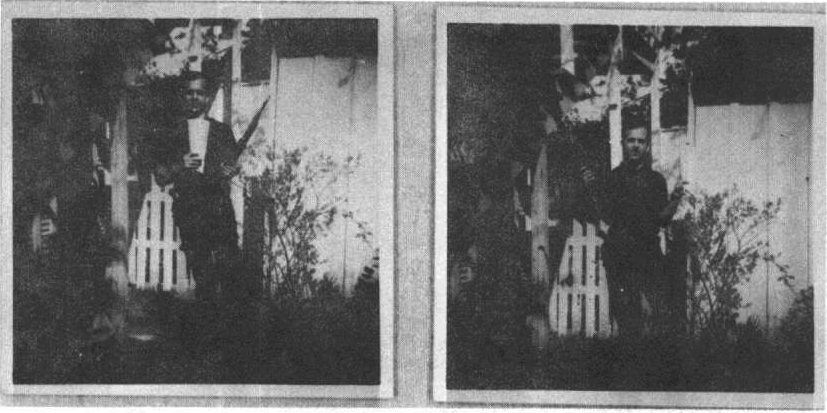
    The backyard photos are among the most contentious items in the record of the JFK case. These portraits of the accused assassin Lee Oswald are strikingly odd, as his clothing, posture, demeanor, and accessories combine to strange effect. There is something undefinably askew in the photographs, and it’s not just that the socialist papers are so at odds, or the firearms are out of context in the domestic yard setting, or that the Oswald figure seems bent at an unnatural angle. There’s a certain patness to the incriminating content, with the future accused man apparently posing with the future murder weapons and signaling a radical political bent which could present motive for his murderous action. This patness encourages a view that the photos are “too good to be true” and the elements of incrimination too obvious, such that the photos may be forgeries, as the accused assassin himself had stated. The oddness of the photos, immediately apparent, supports this view.

    Most discussion of the backyard photos falls within partisan divides: supporters of the government’s version of events tend to accept both the authenticity of the photographs and the narrative of their creation, while critics point to inconsistencies and details within the photos which suggest they are forged composites. This divide has tended to polarize discussion of the backyard photos – they are authentic! they are fake! – such that many salient issues which could assist an understanding of these strange images get overlooked. A review of the backyard photos and their context as developed in the official record can assist in bringing such issues to the foreground.

    Backyard Photos Discovered Amongst Oswald’s Possessions

    At 4:30 PM (CST) November 23, 1963, the Dallas Police Identification Bureau received two negatives matching photographic prints showing “Lee Harvey Oswald holding rifle with scope.” Earlier in the afternoon, Dallas Police detectives had undertaken a second search at Ruth Paine’s home in Irving, Texas, concentrating on the small one-car garage where seabags, suitcases and boxes belonging to Lee Oswald were stored. The Investigation Report (CE Stovall D) states ”found by Dets. Rose was two snapshots and negatives showing Oswald holding the rifle (murder weapon) and wearing a pistol in a holster on his right hip (Tippitt murder weapon).”

    The Identification Bureau would create copies from the negatives, including an 8×10 enlargement of the backyard photo later identified as 133A (CE134). An hour later, at approximately 6 PM, Lee Oswald underwent another round of questioning and was confronted with the enlargement. Oswald rejects it as a fake, claiming “somebody has superimposed my face on that picture” (Rose WC testimony). Oswald is subsequently shown the found print of the second photograph, 133-B, which he dismisses as simply a smaller version of the larger doctored print. He accuses the Dallas police of being responsible for the creation of a fake photograph and states he will not discuss this photograph further without the advice of an attorney. Oswald assures his interrogators that he was familiar with photographic processes and would, in the fullness of time, demonstrate the technique used to create this composite.

    At this same time, the content of the photos was being leaked to reporters. The Dallas Police had been under pressure all day to explain their certainty the suspect was indeed the president’s assassin. At a press scrum, Police Chief Jesse Curry’s announcement of the other big discovery of the day, the Klein’s order letter for the mail order rifle, was upstaged by inquiries regarding these photos:

    Q. These are the photographs of the revolver and the rifle?

    A. There is a photograph of him with a revolver on his hip and holding a rifle in his hand.

    Q. Does it look like the one you have, that you think is the murder weapon?

    A. It does.

    Q. Does it have a telescopic sight?

    A. It does.

    Q. Is he aware of this?

    A. I don’t believe he knows all this as yet. I think the captain is talking to him about this at the present time …

    Q. Did he have in his hand a copy of the communist publication The Worker? With a headline “Be Militant”?

    A. It seems there’s two papers there. On one you can see the words Be Militant. On the other you see The Worker …

    Q. Do you consider the case shut tight now, Chief?

    A. We will continue to work on it and get every shred of evidence that’s possible.

    The link of the alleged murder weapons with the suspect, although more tenuous than initially portrayed, was publicized as a major breakthrough and helped harden opinion that Oswald was the assassin ahead of his own murder. The presence of radical left wing literature in the photos also helped solidify a portrait of Oswald as a dangerous communist. Curry’s misreading of a newspaper banner – Be Militant instead of The Militant – is indicative of a particular frame of reference, and explains a note jotted by reporter Seth Kantor: “Ask Fritz … 501 Elm is place that processed photo. What are details of photo (showing gun & Daily Worker head: “Be Militant.” (CE Kantor 3)1

    Backyard Photo Leaked To the Media

    In early 1964, the backyard photo identified as 133-A was sold and/or released to several newspapers and magazines, resulting in wide public dissemination, most notably on the cover of Life Magazine’s February 21 issue. The release of the photo was considered a serious breach of the Warren Commission’s confidentiality, and the FBI was tasked with investigating “how the press got hold of the photo.” The FBI responded energetically, focusing resources in numerous cities.

    Officially, an FBI summary (CE1788) would report that Dallas Police officials Will Fritz, George Doughty, George Lumpkin and Carl Day, acknowledge multiple copies of both backyard photos were made for investigation purposes immediately after the assassination, but they knew nothing concerning the dissemination to the media. Captain Fritz would refer to information published in the March 2 edition of Newsweek, claiming that Life Magazine and the others bought their copy of the photo from representatives of Marina Oswald.

    An internal FBI memorandum dated March 25, 1964 is far less circumspect, stating: “Based on our investigation it would appear all of the photographs emanated from the Dallas Police Department.” The Dallas Police, as the HSCA would later confirm, “made numerous copies and did not control the dissemination.” Life Magazine negotiated a price of $5000 with Marina Oswald’s business agents for the publication rights to the photo, but the photo itself came from “an enterprising young man in the Dallas Police Department.” Life had an “original copy negative” of the photo, made in Dallas. (Shaneyfelt Exhibit 10)2

    Retouching photographs ahead of publication, for reasons of aesthetics or for technical quality, was routine practice in the print media. Eventually, inconsistencies from this work between various published versions of the photo became publicized by critics, and the Warren Commission was compelled to apply additional resources addressing this issue. Getting to the bottom of the controversy allowed the Commission to appear resolute in debunking yet another dark rumor. In all, the unauthorized February leak of the photo worked well for the Commission and the generation of the official story. The cover of the February 21 issue of Life single-handedly stamped the image of Oswald brandishing a rifle and militant socialist literature into the consciousness of millions of persons (several Warren Commission witnesses refer to “the picture published In Life” when discussing a backyard photo). In Life’s accompanying nine page “clinical study” of Lee Oswald’s biography, lone nut behavior patterns are emphasized and left-wing connections identified.

    The Warren Commission and the Backyard Photos

    Using the witness testimony of Marina Oswald bolstered by technical reports from the FBI’s photographic specialist Lyndal Shaneyfelt, the Warren Commission would assert that the backyard photos were taken by Marina at her husband’s request, using an Imperial Reflex camera which was owned by Oswald, and that this probably occurred on March 31, 1963. Further, the Warren Report determined that the rifle seen in the photographs was the same rifle found on the sixth floor of the School Book Depository and believed to have been used to kill the President.3

    The FBI’s Shaneyfelt used a comparative negative technique to determine that the Imperial Reflex camera in evidence had taken the backyard photographs. Snapping a new picture using this camera allowed for a comparison of this new negative with the backyard photo negative 133-B. Unique marks and scratches created by the camera on the edge of the image could be identified, and then checked against other negatives to find similarities which could link them to this same camera. Shaneyfelt also identified a photo taken near General Edwin Walker’s home, found among Oswald’s possessions, with this camera.

    Following the publication of the Warren Report, the backyard photos came under sustained criticism. Mark Lane discussed issues related to the February photo leak in Rush To Judgement, while Sylvia Meagher offered a substantive critique of the logic of the backyard photos, and the shortcomings with the evidence, in Accessories After The Fact. Researchers versed in photography challenged the authenticity of the photographs themselves, proposing that some form of superimposition was utilized to create a fraudulent Oswald snapshot, a view which gained momentum as it was discovered that this had been Oswald’s position while in custody. In the mid-1970s, as interest in the case was building ahead of the HSCA, news documentaries produced by the BBC in Britain and CBC in Canada featured photographic experts who concurred that fakery was evident.

    New Backyard Photos introduced to the Record

    The House Select Committee on Assassinations asked a specially convened photographic panel to examine controversies associated with the backyard photos, particularly (if not solely) the question of their authenticity. The panel would examine the photos from a primarily technical basis, using forensic techniques to determine “evidence of fakery”, reproducing to some extent work done by the FBI’s Shaneyfelt in 1964, but with more sophisticated techniques. The panel would also identify and describe the various prints in the record, as new versions of the photos appeared through sources connected with the Dallas Police, including, incredibly, a previously unknown third backyard photo (designated 133-C).

    133-A de Mohrenschildt The de Mohrenschildt backyard photo was apparently discovered in February 1967 by Jeanne de Mohrenschildt, inside the sleeve of a record album found at a Dallas storage unit the de Mohrenschildts had secured ahead of their move to Haiti in April 1963. The record album, an instructional Russian/English language LP, had been lent by Jeanne to Marina Oswald, and was found with similar albums inside a box which had been placed in the storage locker sometime after the de Mohrenschildt’s departure, perhaps through Everett Glover and Michael Paine.

    The photo was deemed a first generation print of 133-A (although some researchers believe the Oswald figure’s arms are held higher), with markedly higher detail and resolution compared to the originally discovered prints. On the back side of the photo are two inscriptions. One says “To my friend George from Lee Oswald 5/IV/63.” The other, written in darker ink, is Russian cyrillic translated as “hunter of fascists ha-ha-ha!!!” This second inscription appears to have been written over the top of other writing which had been erased. The HSCA commissioned a handwriting expert who determined that the first inscription matched Lee Oswald’s known handwriting. The second inscription was thought to have been written by Marina Oswald. The subject was broached during an interview, with the now Mrs Porter, on September 13, 1978:

    Mr. McDONALD … do you recognize the handwriting?

    Mrs. PORTER. No, I don’t … you have certain way of writing, habit of writing certain letters, so I know for sure that I could not, I do not write certain letter that way. So at first I thought it was maybe my handwriting, but after I examine it, I know it is not … this is something like maybe foreigner would try to write it, you know, to copy Russian language.4

    In his manuscript “I Am A Patsy”, George de Mohrenschildt described how he viewed the photo as a “gift from the grave” from Lee Oswald. If it was a “gift”, an assumption since the print’s origin and presence inside the record album remain mysterious, then, presuming the April 5 1963 inscription date correct, Oswald passed on an opportunity to present it directly when the de Mohrenschildts apparently paid a social visit the following weekend, what would turn out to be their last meeting.

    Ruth Paine testified to the Garrison Grand Jury convened in New Orleans on April 18, 1968 that she had met the de Mohrenschildt’s only twice, once at the Everett Glover party in February 1963 where she was first introduced to the Oswalds, and a second time in 1967 precipitated by the discovery of the photo. “They called and asked Michael and me to come have dinner with them … he said he found in his luggage the same picture that appeared in Life Magazine of Oswald holding the rifle and the gun on his hip, and it gave him such a turn, it was afterward, after the assassination, and we just talked generally of the events.” Considering the centrality of both the de Mohrenschildts and the Paines to the Oswald’s lives in 1962-63, talking “generally of the events” appears as an understatement.

    Jeanne deMohrenschildt passed the print on to the HSCA in 1977, shortly after her husband’s apparent suicide (which remains controversial).

    133-C Dees In late December 1976, a print of what was termed an “additional view” of the backyard pose was passed to the House Select Committee by Mrs Geneva Dees. According to a staff summary of an interview with Mrs Dees, the print “had been acquired by her former husband, Roscoe White, now deceased, while employed with the Dallas Police at the time of the assassination.” Roscoe White has assumed some notoriety for numerous reasons, including that his tenure with the DPD began only a few weeks before the assassination, assigned to the Identification Bureau where the backyard negatives would be delivered. White, according to his family members, had experience with “trick photography”. Previously he had been in proximity with Oswald in the late 1950s, as they were occasionally in the same places while serving with the Marines.

    133-C Dees was deemed by the panel as a first-generation print, which would indicate the corresponding negative was also in possession of the Dallas Police. This negative is not in the record. The existence of this third pose, as a print or negative, is not accounted for anywhere in the official recounting of the investigation or the generated paperwork. However, when the Dallas Police and Secret Service photographed a recreation of the backyard photos on location a week after the assassination, the pose struck by the photographed officer was that seen in 133-C. Astonishingly, the House Select Committee expressed muted, at best, curiosity regarding this photo and the missing negatives.

    133-A Stovall / 133-C Stovall These prints were delivered to the HSCA in April 1978 through Richard Stovall, who had been one of the Dallas Police detectives involved with the search of the Paine household in November 1963. These were also deemed first-generation prints, created from negatives which are not in the record.

    According to the HSCA photographic panel’s analysis, the backyard photo prints in the record were created using at least four different processes, representing at least five unique printing events.

    The two prints originally found among Oswald’s possessions were described by the panel as “drugstore or photofinisher prints because they appeared to have been produced on the type of commercial photo printing machine used by photofinishers for camera stores, drugstores and mass-produced prints.” The prints are small (3”x3”), with a white border and markings consistent with an automated commercial machine. The de Mohrenschildt print is larger (5”x5”) and described as “probably made in a high quality enlarger with a high quality lens” due to its increased resolution. The panel notes that “the entire negative area is printed” (showing more picture than the cropped “drugstore” print), and that the print had yellowed, “indicating that it was not adequately fixed or washed during the development process”. Another print of 133-A (Stovall), was larger (5”x8”) and cropped on the sides. The two prints of 133-C (Stovall / Dees) were 8”x10”, the same size as the blow-up print shown to Oswald a few hours after discovery (CE134).

    Although the HSCA panel does not directly speculate, their review indicates that the original roll of film which exposed the backyard photos was processed at a common commercial photofinisher, the de Mohrenschildt version possibly created by Oswald at his Jaggars-Chiles-Stovall workplace, and the other prints were created at various times at Dallas Police headquarters.5

    The HSCA Panel Determines The Backyard Photos are Authentic

    The House Select photography panel’s real work, as evidenced by their report’s exhaustive detail, was to determine the authenticity of the backyard photos. Questions concerning the photos which were non-technical in nature were therefore not addressed. The panel implicitly accepts two crucial assumptions: 1) the Imperial Reflex Duo-Lens camera identified as having produced the photographs was “Oswald’s camera”; 2) Marina Oswald operated that camera to produce the photos.

    Stressing that the panel conducted their forensic analysis of the backyard photos utilizing the best available materials – the one negative and the seven known first generation prints – the Photograph Authentication section of the HSCA Report details results of digital image processing examining consistency in the film grain, stereoscopic techniques to determine if superimposition had been applied, and photogrammetry to establish measurements of objects and shadows. These are all accepted and proven techniques for forensic examination of photographs. The panel also undertook numerous controlled experiments to examine specific points advanced by critics: identical heads from photo to photo, inconsistent body proportions, unnatural and inconsistent shadows, and unnatural lines in the vicinity of the subject’s chin. The result of this analysis: “Careful examination of the photographs with respect to lighting, perspective, sharpness, distortion, grain pattern, density, and contrast revealed no evidence of fakery.”

    Malcolm Thomson, the British photographic expert who determined for the BBC that the photos had been faked, and also the unnamed Canadian analyst who did the same for CBC, were then contacted. Both men were presented with the panel’s findings and asked to respond. Thomson, noting the thoroughness by which the panel had investigated the issue, “deferred to the panel’s conclusions”, and added that he had been working from generational copies rather than first generation prints. The Canadian analyst also replied that he had been examining “very poor copies”.

    Thomson, however, did maintain that the subject’s chin in the backyard photographs was “suspiciously different” and that a well-done fake would be difficult to detect, digital image processing or not. Indeed, both the FBI’s Shaneyfelt in 1964 and the HSCA panel in 1978 concede that a determined skillful forger with access to high quality equipment and then also to the Imperial Reflex camera in evidence, could have faked the backyard photos. Therefore, a categorical assertion of “authenticity” is not possible, and that someone may have superimposed Oswald’s face onto another man’s body cannot be ruled out.
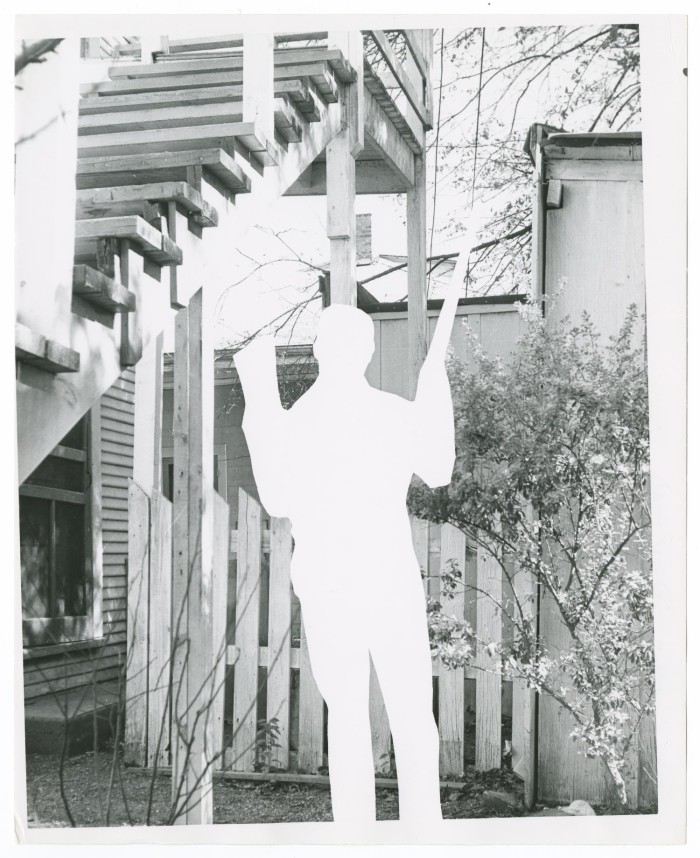
    A counterfeiter creating such forgeries would require: access to the Neely Street backyard; assistance from at least one other person; access to a Mannlicher-Carcano rifle and a pistol; access to the specific issues of The Worker and The Militant; access to the Imperial-Reflex camera; and access to a photo featuring Oswald’s face (or two or three similar photos of Oswald ) for superimposition. Dallas Police recreations staged at the location on November 29,1963 show mature flowered plants behind the subject and therefore date the backyard photos themselves, or at least a photo of the backyard used for a later composite, as generated some months ahead of the assassination. The counterfeiter would likely possess knowledge of a plot involving Oswald. Alternatively, it cannot be ruled out that photos were taken in the Neely St backyard featuring an unknown male subject for a reason unrelated to the future assassination, possibly with Oswald’s assistance, and then later appropriated for another purpose by superimposing Oswald’s face.

    In light of the panel’s extensive forensic work, using the existing negative and first generation prints, the weight of probability does support these photos as “real”, absent a technical challenge to this analysis or specific information regarding a forgery operation. However, regardless of the thoroughness by which the House Select Committee’s panel approached its subject, by limiting its investigation solely to the authenticity of the photos themselves, the panel bypassed two equally compelling questions which bear weight especially if the photos are considered “authentic”: was the camera which was identified as having taken the photos actually “Oswald’s camera”, and did Marina Oswald actually take the photos?


    Part 2:  Was the Imperial Reflex Actually Oswald’s Camera?

    The official investigations accept without question the attribution of the Imperial Reflex camera as owned by Lee Oswald. The Warren Commission refers exclusively to the “Oswald camera”. The HSCA Report references “Oswald’s camera”, as does the House Select testimony of Cecil Kirk from the photography panel.

    The camera itself was described in the Warren Report as “a relatively inexpensive, fixed-focus, one-shutter speed, box-type camera, made in the United States”. (WR p593) That description, while accurate, sells the camera a little high, as it could also be described as a cheap all-plastic body wrapping a minimal array of flimsy elements. The lower lens sent light to the film plane, while the upper lens sent an inverted image to the viewer, which was accessible by popping open the top plate. The small red lever at the front opened the shutter, and the larger red knob at the back advanced the film.

    This Imperial Reflex camera does not appear in the inventories of Oswald’s possessions seized by the Dallas Police at the Paine address in Irving and the North Beckley room in the Dallas neighbourhood of Oak Cliff. Investigations determined that Oswald owned a “Russian camera” and an “American camera”. A Russian-made Cuera-2 camera appeared in the inventories, as did an American-made camera called a Stereo Realist. The Imperial Reflex camera only came to light, in the possession of Robert Oswald, about three months after the assassination and presumably after it had been determined that the Stereo Realist camera could not be linked with the backyard photos.

    Russian Cuera-2 camera “American” Stereo Realist camera


    A timeline of events as the ownership of the cameras was developed is illuminating:

    11/28/63 “(Marina) was asked whether she or Lee had any cameras and she replied that Lee bought one camera in Russia and a second one in the United States … She added that she was not proficient with operating any cameras as she never had an opportunity to do so.” (CE1792)
    12/2/63 “(Marina) said that they had two cameras, one Russian and one American, but she does not recall with which camera she took the (backyard) photograph.” (CE1401)
    1/29/64 “The other camera owned by the OSWALDS was a United States made camera which LEE HARVEY OSWALD had owned prior to his entry into the U.S. Marine Corps and this was the camera which he had taken pictures with when he was in the Marine Corps … (Marina) said the ‘Cuera-2’ camera appears to be the Russian camera and the ‘Realist’ appears to be the American made camera.” (CE1155)
    2/16/64 “ROBERT LEE OSWALD … viewed photos of a Stereo Realist camera and and a Cuera-2 camera and advised that he did not recognize either of the cameras as having been the property of LEE HARVEY OSWALD, but also stated he was not familiar enough with the cameras … to either state that the cameras in question did or did not belong to LEE HARVEY OSWALD.” (CE2557)
    2/17/64 “(Marina) was also shown the photograph of the Stereo Realist … She stated it was not the property of OSWALD as far as she knew. She advised to her knowledge she had never seen this camera … ” (CE1156)
    2/18/64 “(Marina) advised that she believed she took the photograph with the American camera which OSWALD owned … She said the American camera had a greyish color, somewhat like aluminum. It was a box-type camera … She can recall that she sighted the camera by looking down into the viewer at the top of the camera … ” (CE1404)
    2/19/64 “RUTH PAINE … advised that approximately three weeks after the assassination … ROBERT OSWALD … came to her residence and requested that they take all the remaining property belonging to LEE HARVEY OSWALD … she pointed out to them the boxes and other materials in her garage belonging to the OSWALDS and they removed this property.” (CE2557)
    2/24/64 “ROBERT LEE OSWALD made available a Duo-Lens Imperial Reflex camera made in the United States of America. It is aluminum colored … ROBERT OSWALD advised that in about 1957, LEE HARVEY OSWALD purchased a camera at about the time he first went into the U.S. Marine Corps … About 1959 … he left this camera with ROBERT at Fort Worth, Texas. In about August 1962 … LEE HARVEY OSWALD regained possession of this camera from ROBERT.” (CE2557)
    2/25/64 “Imperial Reflex camera obtained from ROBERT LEE OSWALD … was exhibited to MARINA OSWALD at which time she identified it as the camera belonging to LEE HARVEY OSWALD with which she had taken the picture of OSWALD holding the rifle and newspaper and wearing the pistol.” (CE2557)

    Robert Oswald would claim he “had never made this camera available to authorities before February 24, 1964, because he had never been asked for it previously and he could see no evidentiary value … of this cheap camera … He stated that it had never occurred to him that anyone would be interested in the camera.” (CE2557) This is after he had been specifically interviewed about and shown photos of cameras (February 16). It would also turn out to be the second instance in which a subjective judgment apparently kept this camera away from the sweep of the investigation. Marina Oswald temporarily stayed with Robert Oswald in February 1964, coinciding with the FBI’s determined efforts. She was thereby in the same house as the Imperial Reflex and, a week later, she suddenly recalled the camera was “aluminum” colored and that it was sighted “by looking down into the viewer”.6

    The FBI Closes The Circle

    The discovery of the Imperial Reflex would create something of a loose end in the developing official narrative since it was unclear how the camera could have been overlooked during the thorough Friday and Saturday searches of the Paine residence the previous November. On February 19, 1964, the same day Ruth Paine advised that a box of miscellaneous items was passed to Robert Oswald (five days before the camera was “found”), the FBI interviewed Irving Police detective John McCabe, who had attended both searches of the Paine household. According to the FBI, McCabe is “certain that he saw a light gray box camera in a box in Mrs PAINE’s garage. MCCABE stated that this camera was in a box which contained books and photographs belonging to LEE HARVEY OSWALD. MCCABE stated that he searched this box and did not take the camera since he did not consider it to be of evidentiary value.” (CE2557)

    On March 14, Dallas Police Detectives John Adamcik, Richard Stovall, Gus Rose and Henry Moore – who conducted the searches of the Paine residence – are interviewed by the FBI. They are shown a photograph of the Imperial Reflex camera. “None of these officers could recall ever seeing this camera and did not recall seeing it during a search of the garage at the PAINE residence. They all stated that if it had been discovered during the search, they would have brought it in.” (CE2557)
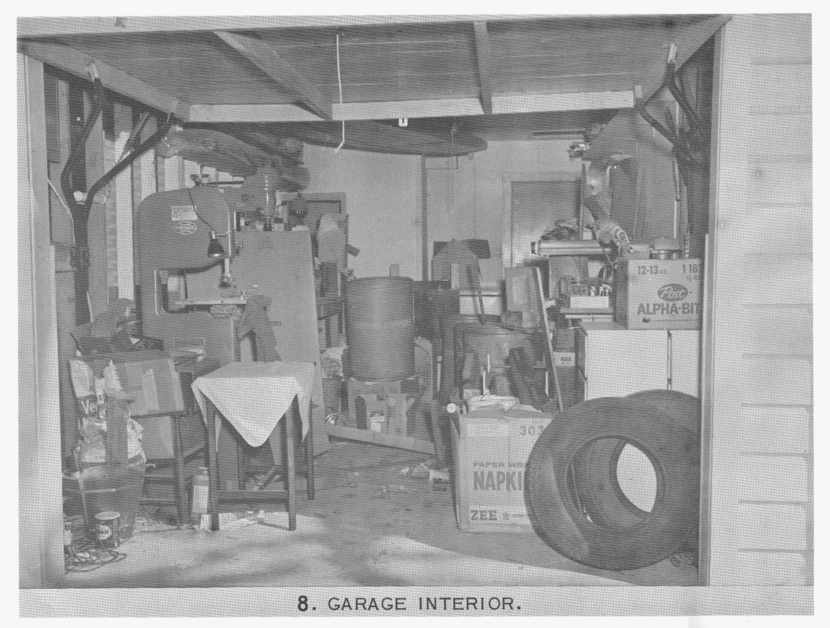
    The Paine’s garage

    McCabe is interviewed again by the FBI on March 23. He tells of “going through a box containing some books, some pictures, and a camera. He took the camera out of the box, put it on a dresser and searched the box in detail, and then put the camera back in the box.” He is shown a photograph of the Imperial Reflex camera received from Robert Oswald a month earlier and “he stated the camera in this photograph appeared identical with the one he described … in his opinion the Dallas Police Officers, who were also participating in the search, did not see this camera and did not search this particular box. He stated he had already searched the box and told them so. He did not point out the camera to them.” (CE2557)

    On March 23/24,1964, the four Dallas officers are also interviewed once more. They “all advised that during the search of the PAINE residence they recalled that there were several boxes in the garage at the PAINE residence and that all boxes were searched by one of the officers participating in the search … all stated that they definitely did not see the Imperial Reflex camera … or any other camera in the PAINE garage.” (CE2557)

    McCabe was at the Paine household as a representative of the Irving Police Department since the Paine home was so located, but the Dallas detectives were responsible for the search. How could a camera be found inside a box which also contained photographs “belonging” to the suspect, and yet be considered of no evidentiary value? In McCabe’s March 23 interview he says the camera “appeared in such poor condition that he believed it was not capable of taking pictures.” The box handed to Robert Oswald by Ruth Paine, in which the camera was said to be found, was presumably the same box searched by McCabe. This box was itemized by the FBI. It contained thirteen books, including six Russian books and a book on Marxism, some random items such as dice and a pencil sharpener, but no photos or pictures are listed. The original inventory list from November 23, 1963 (CE Stovall D) notes a “grey metal box containing miscellaneous Russian literature and some slide negatives”, but no camera.

    McCabe was not called before the Warren Commission nor does he personally appear in the record again. He does feature in the one anomaly in the testimony of the Dallas Police officers regarding the discovery of the backyard photos. Gus Rose (but no one else) gives McCabe some agency in the search: “I found two negatives first that showed Lee Oswald holding a rifle in his hand, wearing a pistol at his hip, and right with those negatives I found a developed picture … and Detective McCabe was standing there and he found the other picture – of Oswald holding the rifle.”
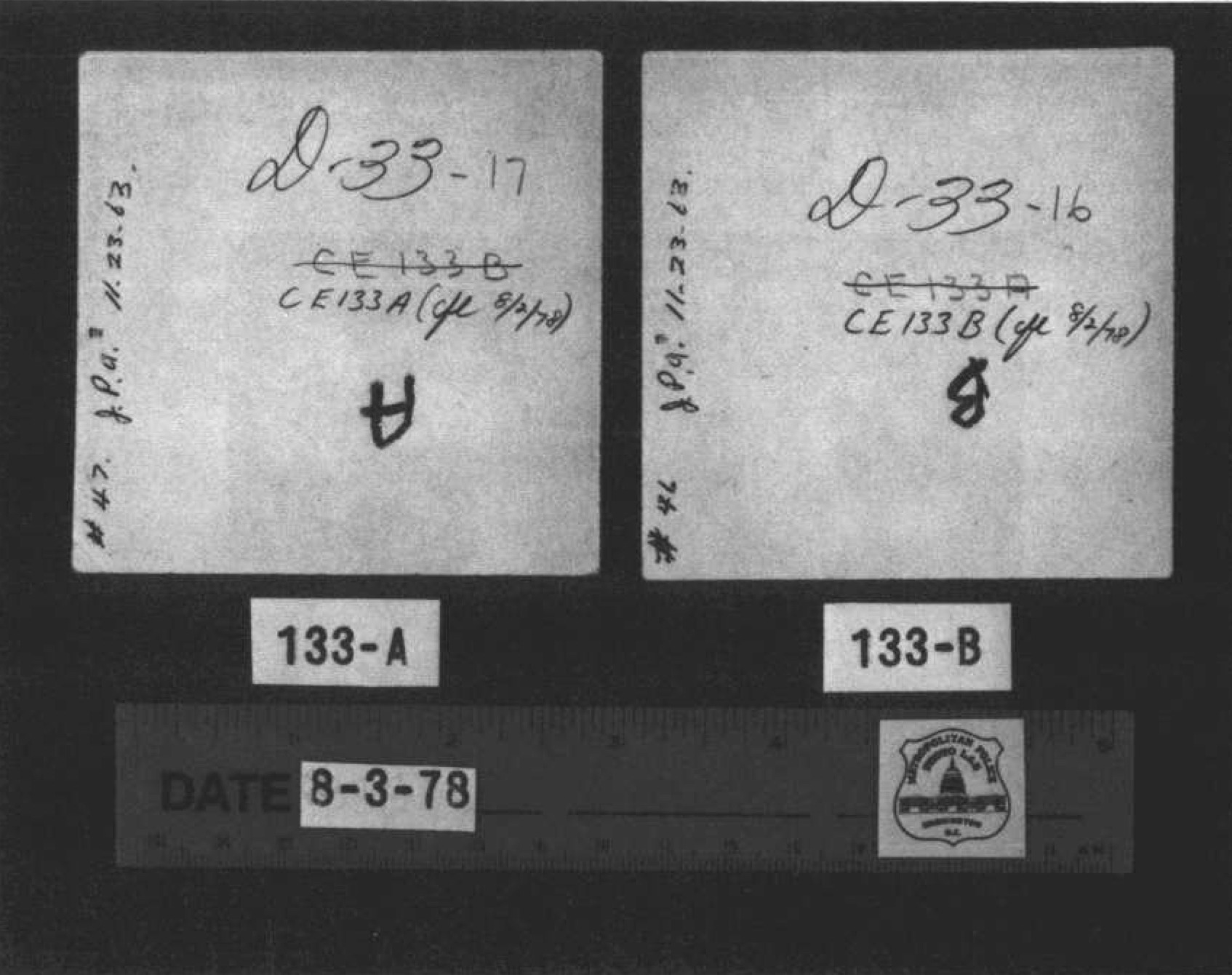
    Adamcik’s initials on the left side

    In June 1964, Special Agent Bookhout of the FBI met with Gus Rose to apparently re-establish where the backyard photos were discovered. “Rose identified same as being two photographs in a packet of forty-seven photographs found by him in a box during a search of the garage at the residence of Mrs Ruth Paine … ” A few days later, Bookhout met with Detective Adamcik who “stated these are two photographs from a packet of forty-seven photographs found in the search … Adamcik stated since he was present at the search he had numbered each photograph on the back and placed his initials thereon.” Adamcik’s initials appear on the back of the drugstore prints of both 133-A and 133-B, as do the numbers 46 and 47.

    It is hard to reconcile Rose’s account of McCabe finding one of the prints with the alternate story that the prints were found inside a packet. It is possible that Rose had become aware that McCabe had supposedly found something in the garage, and so stated McCabe found one of the prints in a bid to be helpful (if ultimately confused).7

    Oswald’s Photographs

    The House Select Committee’s photographic panel sought to buttress the identification of the Imperial Reflex as “Oswald’s camera” by applying the unique signature test – the markings on the edges of the negatives exposed in that camera – to other photographs found amongst Oswald’s possessions. Panel leader Cecil Kirk authored the following paragraph:

    “In regard to the allegation that this camera had been used only to take the incriminating backyard pictures of Lee Harvey Oswald, the panel examined all of the photographic material in the National Archives that was listed as having been taken from the effects of Lee and Marina Oswald … Most of these were family-type snapshots, including scenes of an older child and baby in a crib, Marina Oswald playing with a child, and Lee Oswald holding an infant. The frame edge markings appearing on the negatives to these photographs and the camera scratch marks appearing directly on the pictures were studied and found to be entirely consistent with both the original test materials and the Oswald backyard pictures which were exposed in the Oswald Imperial Reflex camera.” (HSCA Report p. 161)

    Edge markings negative 133-B Edge markings JFK Exhibit 189
    “Lee Oswald holding child”

    Serving as an example of a photo “entirely consistent” with the Imperial Reflex is a photograph taken in New Orleans, JFK Exhibit F-189, in which Oswald’s young daughter June is pictured posing before the screened porch in the courtyard of the Magazine Street apartment. Numbered pointers show identified scratches or markings which appear to match the scratches and markings found on the backyard photos. This photograph is one of a New Orleans set, “family-type snapshots” which include photos that could be described as “Marina Oswald playing with a child” (and a set to which negatives were recovered). Of the other photographs specifically mentioned in the Kirk’s description of the Oswald photographs, the known snapshots of “Lee Oswald holding an infant” originate from Russia, while the “scenes of an older child and a baby in a crib” seem to refer to separate photos of either an older child or a baby in a crib which originate from Russia and later a few from Dallas and New Orleans. According to Robert Oswald, the Imperial Reflex (or whatever “American camera” Lee Oswald owned) stayed with him until Lee’s return to Fort Worth in 1962 and so could not have been used in Russia.

    Cecil Kirk’s paragraph appears to have been carefully worded, such as a lawyer might do, to imply something without actually saying it. Here, the description of “family-type snapshots” is followed by an analysis of frame edge markings, implying that all of the specific snapshots referred to were “studied” and found to have the same markings as the Imperial Reflex. But Kirk is referring to the frame edge markings “on the negatives to these pictures”, and the New Orleans set represent the only “family-type snapshots” identified as having negatives at the Archives, where only about two dozen negatives were on file in the first place. In describing a “match”, Kirk is referring to one photograph/negative – JFK Exhibit F-189. “It is our opinion that the same camera produced the baby picture.”

    Mr GOLDSMITH: What were the panel’s overall conclusions regarding the frame edge marks and camera scratch marks that it evaluated?

    Sergeant KIRK: That it is a reliable source of identification and it is our opinion that the camera did indeed produce these photographs.

    Mr GOLDSMITH: When you say these photographs, you are referring to the backyard pictures?

    Sergeant KIRK: The backyard pictures and the baby picture. (HSCA Vol II p. 371)

    The assertion in the HSCA report that “many” photos and negatives were linked to the Imperial Reflex camera is technically true, but appears to refer only to four photos and one photo group: the three backyard photos, one photo of General Walker’s house, and the multiple photos included in the New Orleans set.8
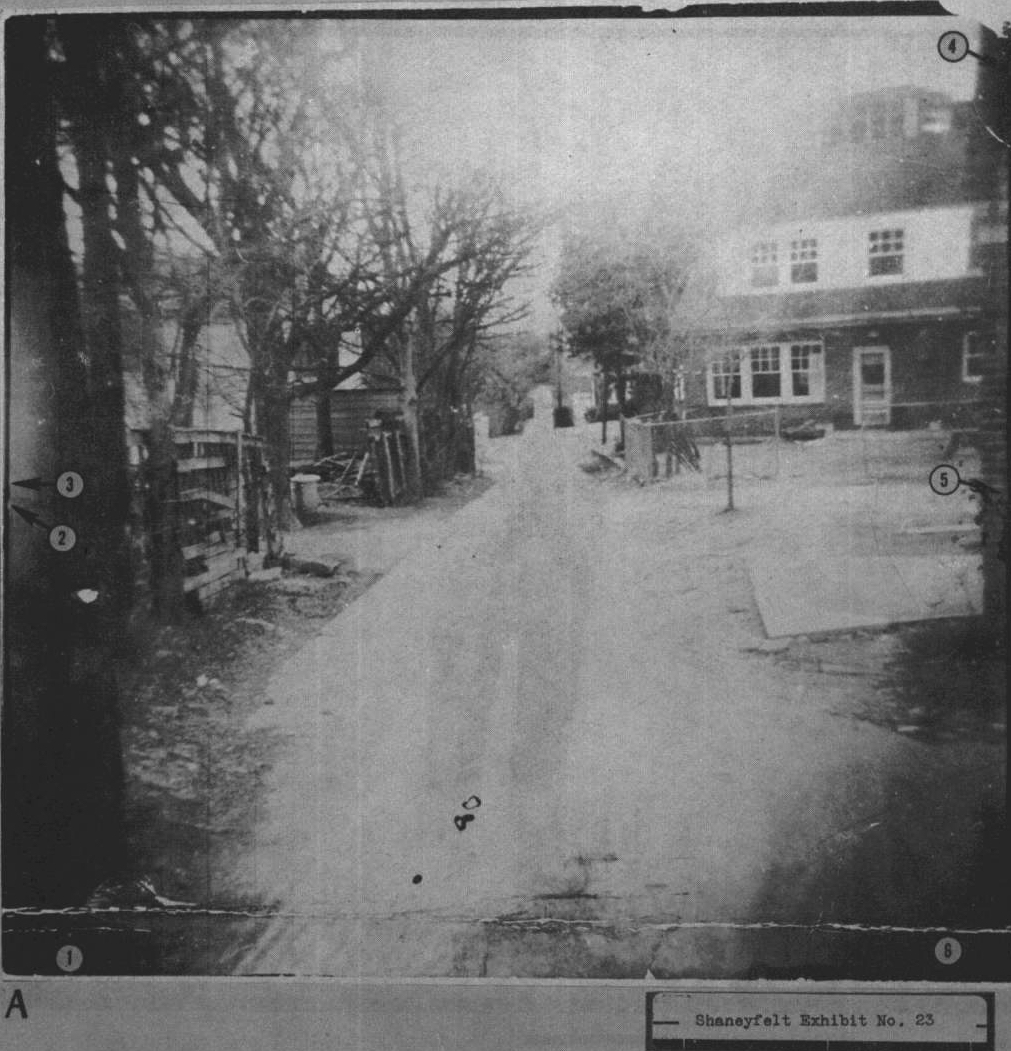
    Shaneyfelt Exhibit 23: “Walker” photo

    What of the photographs “listed as having been taken from the effects of Lee and Marina Oswald”? To say that “most” of these photos consisted of “family-type snapshots” is something of a stretch. Some of the family photos, for example, are scenes of Oswald’s mother or his brother Robert’s family, which had been forwarded to him while overseas. Others are of friends in Russia, or friends in the Marine Corps. Altogether, family-type snapshots – understood as photos of Lee Oswald and his immediate family (Marina and his children) – are relatively few and most of them date from the Soviet Union.

    On December 3, 1963 FBI agents visited Marina Oswald with a group of forty-seven photographs for her identification. These pictures had been delivered to the FBI from Captain Fritz of the Dallas Police Department, and were described as “among the effects of LEE HARVEY OSWALD.” The two backyard photos are listed in this group as photos 46 and 47. (CE1401) This collection of photographs appear to be the contents of the “packet” in which the backyard photos were discovered, referred to by Rose and Adamcik in June 1964. The forty-seven photograph group is also mentioned in a report generated investigating the leak of 133-A in February 1964 (CE1788). The December 3 report lists photographs by number, accompanied by Marina Oswald’s description of their content. The majority of these photographs are from Russia. Three photos predate the Russian trip – one labeled Oswald in 1952; one of Oswald and John Pic, and one from Japan. The two backyard photos alone postdate the Russian trip.

    June Oswald at Elsbeth St

    On January 31,1964 FBI agents visited Marina Oswald with a collection of over 350 images for her identification, mostly photographs but also some postcards (CD443). The photographs are numbered within groups, with some photos duplicated from the packet shown to Marina in December, but the backyard photos not among them. Only two photographs, both from Elsbeth Street, were of immediate Oswald family and dwelling in Dallas (Item 11 P4, Item 33 P6).

    June Oswald Neely St balcony

    On March 19, 1964 FBI agents again visited Marina Oswald to exhibit for her identification another group of photographs, 448 in total – of which about 300 were determined to belong to the Paines. A different filing system again is used to list and describe the photographs (CIA Oswald 201 file Volume 32). Of this group – approximately one hundred and fifty Oswald photos, with many duplications from the previous presentations – only six are linked to the first four months of 1963: one photo from Elsbeth Street (65-7), three of June Oswald at the Neely address (B3-13, B3-17, B3-29),and the two backyard photos (D33-16, D33-17).9

    From the record, excluding the backyard photos, there appear to be only six Oswald family-type snapshots from the first months of 1963 and, from the record, very few others from Oswald’s entire stay in Dallas in 1962-63. Oswald was known to complain that he couldn’t find the proper film for his Russian camera, but he seems to have been adverse to using his “American camera” despite having a young child, the subject of most of the few photos which do exist.

    None of the photos in the record from this time period, including the photos of the Walker house attributed to Oswald, have the dimensions or borders of the backyard photos known as 133-A and 133-B. The “drugstore” finishing is unique to these photos.10 The automated machines of the era maneuvered an exposed roll of film to fix the negatives and then create the prints, so it is likely the backyard photos were originally processed using this method. Given the absence of any other photos from the period with a “drugstore” finish, did Oswald orchestrate the backyard photo shoot and then process a roll of film which contained only three exposures? Assuming the official narrative is correct and the photos were taken on the last day of March 1963, why wouldn’t Oswald develop the three negatives at Jaggars-Chiles-Stovall? Perhaps he felt the content of the photos might prove awkward, as he had earlier been told not to bring Russian literature to work after he was seen reading one of his subscription periodicals.11 This is assuming that Oswald was the person responsible for the processing of these photos. The two originally discovered backyard photos, as “drugstore” prints, are an anomaly amidst the Oswald photographs.

    Did Lee Oswald Have A Working “American Camera” In Dallas?

    Marina Oswald was asked about her late husband’s photographic habits during a Deposition for the HSCA:

    Q. Did he like photography?

    A. I don’t think so. That is a very expensive hobby.

    Q. To your knowledge … did he own a camera?

    A. I really don’t remember.

    Q. Did he own any kind of –

    A. I remember in Russia, he took pictures. It was our camera or somebody’s camera but I know he was taking pictures. I do believe it was our camera because he was carrying it with him.

    Q. When you lived in Texas did he own a camera?

    A. I don’t recall but, according to some pictures we had he might have because he had some pictures that were taken recently, I mean during our living there. I do believe he probably had. (HSCA September 20, 1977)

    This theme was picked up again some eleven months later:

    Q. Did Lee photograph pictures of you and your daughters at any time?

    A. In this country?

    Q. Yes.

    A. Yes; in Dallas once, on a balcony, he took a picture of my daughter.

    Q. Any other times?

    A. Possibly.

    Q. Do you recall now any other times?

    A. Well, we took a picture once at the bus station through this thing called the photomat where you put a quarter or a dime or whatever price in it and maybe Lee took pictures of me during our life together; yes.

    Q. Do you have any memory of these specific pictures being taken?

    A. No. (HSCA August 9, 1978)

    Marina Oswald is not saying she witnessed Lee operating a camera while in Dallas, but offering an assumption, since she had seen photos of her daughter June filmed on the balcony at 214 Neely Street in March or April 1963, then Lee must have been responsible.12

    Ruth Paine also was not sure a camera was available to Oswald in Dallas.

    Mr. JENNER – Was there any picture taking during the period, during the fall of 1963, either in New Orleans or in Irving or in Dallas?

    Mrs. PAINE – Not by either Lee or Marina that I heard of.

    Mr. JENNER – And did you hear any conversation between them in your presence or with you with respect to his or they having a snapshot camera or other type of camera to take pictures?

    Mrs. PAINE – No; the only reference to a camera was made by Lee when he held up and showed me a camera he had bought in the Soviet Union and said he couldn’t buy film for it in this country. it was a different size.

    Mr. JENNER – Did they ever exhibit any snapshots to you?

    Mrs. PAINE – Yes; a few snapshots taken in Minsk.

    Mr. JENNER – But no snapshots of any scenes in America that they had taken?

    Mrs. PAINE – No.

    Mr. JENNER – Or people?

    Mrs. PAINE – No. (WC March 21, 1964)

    The New Orleans Photo Set

    In contrast to the sparse number of Oswald family-type snapshot originating from Dallas in early 1963, at 4905 Magazine Street in New Orleans a set of eleven photos are taken in the courtyard, probably within a relatively few minutes. Negatives from these photos were said to be found amongst Oswald’s possessions, and later used by the HSCA photography panel to identify a match to the Imperial Reflex camera.

    There are a few occasions in the Oswald photographic collection when multiple pictures cover an event – Lee Oswald ironing baby clothes on a suitcase during the last days in Minsk, or the Oswalds at the train to begin the journey back to America13 – but eleven photos at a single location represents a burst of photographic enthusiasm not seen elsewhere.

    The New Orleans photo set is a domestic scene: toddler June Oswald poses before the Magazine Street apartment for two wider photos, then the photographer comes in closer near the gate and fence with a distinct driveway behind, then June joins Marina, who is barefoot and comfortable in black shirt and shorts.14 The lawn is wet with spray from a garden hose, which June picks up and aims about her. The mood is casual and happy. The photos are undated, but Marina’s visible pregnancy is consistent with early second trimester dating these photos to the first month in New Orleans, May-June 1963. This was a time, according to the available testimonies, of tension and disagreement for the Oswalds:

    Mr. PREYER … .just before he went to New Orleans, what was his treatment of you?

    Mrs. PORTER. Well, he was quite brittle, sometime toward me.

    Mr. PREYER. That was family quarreling?

    Mrs. PORTER. Quite constantly. (HSCA September 13, 1978)

    This state of affairs was evident to others. Ruth Paine: “when I took her to New Orleans in May, he was very discourteous to her, and they argued most of that weekend.” (WC March 18, 1964). Mrs Jesse Garner, the landlady at Magazine Street also witnessed tensions:

    Mr. LIEBELER – Did you ever try to talk to Marina Oswald?

    Mrs. GARNER – Yes; I did when she would be outside hanging clothes. I tried to talk to her and to the baby, I talked to both, and she would put her hands over her eyes and start crying. I asked her how she felt, and she would just do like this with her shoulders.

    Mr. LIEBELER – She shrugged her shoulders?

    Mrs. GARNER – Yes … And another thing, she would nod, try to tell you hello when he wasn’t there, but if he was there like they was sitting on the steps or something, or they would go through the drive and he was there, she wouldn’t even look at you.

    Mr. LIEBELER – She was more friendly and outgoing when Oswald wasn’t there?

    Mrs. GARNER – Yes; when he was there, she wouldn’t have nothing to say.

    If Lee Oswald did not suddenly find peace with his wife and take this unusual set of photos, who could have? There were very few known visitors at this address, and the casual nature of the photos strongly suggests the photographer was known and familiar to the subjects (Marina and June). The photo set was shown to Marina Oswald during an HSCA Deposition on August 9, 1978:

    Q. I now would like to show you, Mrs. Porter, six photographs and see if you can identify these for us.

    A. This is a picture of me and my daughter June when she was a child. I do not know where they were taken though …

    Q. Do you recall when this was taken?

    A. No.

    Q. Do you know if people took pictures of you apart from Lee?

    A. Well, I don’t recall the picture taking incident, period. I don’t know who took the picture.

    Q. Did Lee take pictures of you?

    A. I don’t know. I don’t remember.

    Q. You don’t remember?

    A. No; it could have been in New Orleans because I was expecting a baby then …

    Q. Mrs. Porter, do you remember the incident when these pictures were taken?

    A. No.

    There is one person who had been present at the Magazine Street apartment and was friendly with Marina, familiar to June, and who could be linked with the Imperial Reflex camera. That is Ruth Paine, who arrived in New Orleans with Marina Oswald on Saturday May 11, 1963, and stayed through Tuesday morning May 14. On Sunday, the Oswald and Paine families (Ruth Paine had her own two children along) toured the French Quarter. On Monday, Lee Oswald would have gone to his job at the Reilly Coffee Company, leaving Marina and Ruth Paine together at the Magazine Street apartment.

    Ruth Paine would visit this apartment again for several days in September 1963. For the Warren Commission she could draw a sketch of the interior and exterior layout of 4905 Magazine Street (CE403). She referred to the courtyard area where the photos were taken several times in her testimony:

    Mrs. PAINE – … Lee showed her, of course, all the virtues of the apartment that he had rented. He was pleased that there was room enough, it was large enough that he could invite me to stay, and the children, to spend the night there. And he pointed out this little courtyard with grass, and fresh strawberries ready to pick, where June could play … Marina was definitely not as pleased as he had hoped. I think he felt – he wanted to please her. This showed in him.

    Mr. JENNER – Tell us what she said. What led you to that conclusion?

    Mrs. PAINE – She said it is dark, and it is not very clean. She thought the courtyard was nice, a grass spot where June could play, fenced in.

    Mrs. Garner, the landlady, remembered Ruth Paine’s visits from observing her station wagon parked out front. She did not see Paine personally, but told the Warren Commission that her husband did.

    Ruth Paine sketched the Magazine St layout for the Warren Commission

    Mr. LIEBELER – Did your husband see that person?

    Mrs. GARNER – Yes; my husband.

    Mr. LIEBELER – At this time.

    Mrs. GARNER – Yes; my husband saw her and spoke to her. I never did see her.

    Mr. LIEBELER – You say your husband had talked to her. Did he tell you what she had said?

    Mrs. GARNER – No; I never asked him and he never said nothing. (WC April 6, 1964)

    At the close of her testimony, Mrs Garner is addressed by Liebeler: “I do want to thank you for the patience that you and your husband have shown to me and for the cooperation you have given us in coming down here and testifying. On behalf of the Commission I want to thank you both very much.” If Mr Garner had testified and perhaps been asked the circumstance of his conversation with Ruth Paine it is not in the record. Despite his apparent presence during his wife’s appearance before Liebeler, there is no transcript of any interview with Jesse Garner from April 6, even as it would have been as relevant, if not more so, than what his wife could offer. Instead, a brief affidavit focused specifically and exclusively on his contacts with Lee Oswald is executed on May 3, 1964.

    The New Orleans photo set is not listed among the group of photographs shown Marina Oswald on January 31, 1964. The photo set is listed and identified as among the group of photographs shown to Marina on March 20, a group which included many photographs belonging to the Paines.

    If the Imperial Reflex camera was not Oswald’s – and the evidence assembled by the Warren Commission and the HSCA does little to install confidence in this assertion – its provenance can be located in circles close to Oswald, as seen with the backyard photos and the New Orleans set,15 and can be linked, directly or indirectly, with Ruth Paine.


    Part 3:  Did Marina take the Backyard Photos?

    The narrative establishing the origin of the backyard photos is based largely on Marina Oswald’s recollection, but official investigators have often been skeptical of her stories. Her memory lapses tend to recur or intensify unpredictably, spiked by sudden detailed recollections of incidents which are often incredible or absurd (i.e. Lee Oswald’s attempt to assassinate Nixon or wandering busy Oak Cliff for target practice with the rifle jammed in a raincoat). There are moments in her testimonies and interviews where she appears dumb and largely unaware, other times when she is fairly lucid. If there is a pattern, at least in the months following the assassination, it’s the memory lapses and absurd stories occur most frequently over incidents which critics over the years have suspected never actually happened.16
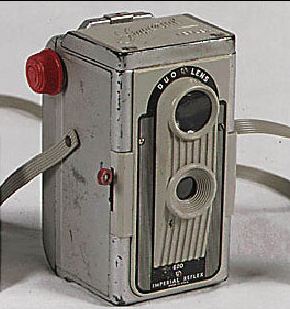
    The problem accepting Marina’s fuzzy account of the creation of the backyard photos is partly a psychological one: how is it possible for her to be so vague about details when the event itself was so highly unusual and possibly indicative of a dark turn in her husband’s life? It was purportedly the first and only time she had ever operated a camera, but later she could barely recall the procedure. Supposedly her husband appeared before her wearing strange wardrobe and brandishing firearms which she had not been previously aware.17 Yet Marina tells the Warren Commission: “I didn’t attach any significance to it at the time.” (WC February 3, 1964) The backyard photo session was apparently never mentioned to Ruth Paine, even as tension in the Oswald’s marriage was a frequent topic of conversation during their burgeoning friendship. Marina’s handwritten narrative about her life with Lee, filled with anecdotal episodes from their marriage, does not mention the backyard photo-taking at all (CE993/994).18

    The Warren Commission – through Commission lawyers Rankin and Liebeler – never questioned Marina Oswald with the intent of extracting details on the creation of the backyard photos, content to have her briefly recount her story of being interrupted by her husband while hanging diapers. The interviewers for the HSCA did a better job trying to tease specific information to help clarify the veracity of the story. These interviews occurred some fourteen to fifteen years after the fact so her already vague recollections are all the more challenged.

    A. I do believe it was a weekend and he asked me to take a picture of him and I refused because I don’t know how to take pictures. That is the only pictures I ever took in my whole life. So we argued over it and I thought the pose, or whatever he was wearing was just horrible, but he insisted that I just click, just push the button and I believe I did it twice and that was it …

    Q. And you recall testifying about these same two photographs when you testified to the Warren Commission?

    A. Yes; I remember them asking if I ever took the pictures and I had completely forgotten because it was only once in my life and I didn’t know who to take pictures. Yes, when they showed me that, yes, I did take the pictures …

    Q. What did he tell you to do with the camera as far as taking the pictures?

    A. He just told me which button to push and I did.

    Q. Did you hold it up to your eye and look through the viewer to take the picture?

    A. Yes. … (HSCA Deposition September 20, 1977)

    The interviewer is well aware the Imperial Reflex camera said to have taken the pictures featured a viewer at the top of the camera that one looks down into, and that the camera is held mid-body rather than raised to the eye. He is also aware that the shutter is opened by pushing down on a small lever, a different mechanical activity than simply pushing a button. Marina Oswald’s recollections cast doubt on her story, as the operation of the Imperial Reflex is so different than most consumer cameras that it should not be easily forgotten.

    Marina Oswald did, once, describe accurately the camera’s mechanics, as accounted in an FBI summary from February 18, 1964, when agents were keenly focused on locating the backyard camera and a week after Marina temporarily stayed with Robert Oswald in the house where the camera would be later be “found”. The summary ascribed to her, compared with her other statements on the topic, is absurdly detailed and contains information never repeated: “She said the American camera had a greyish color, somewhat like aluminum. It was a box-type camera … She can recall that she sighted the camera by looking down into the viewer at the top of the camera … ” (CE 1404)

    Q. When you took the first picture you held it up to your eye?

    A. Yes; that is what I recall.

    Q. What did you do next?

    A. I believe he did something with it and told me to push it again.

    Q. The first time you pushed it down to take the picture?

    A. Yes.

    Q. And the first time, what happened before you took the second picture?

    A. He changed his pose.

    Q. What I am getting at is, did you give the camera to him so he would move the film forward or did you do that?

    A. He did that.

    Q. So you took the picture and handed the camera to him?

    A. Yes.

    Q. What did he do?

    A. He said, “Once again,” and I did it again.

    Q. So he gave you back the camera?

    A. For the second time; yes.

    Q. Did he put the rifle down?

    A. You see, that is the way I remember it.

    Q. Did he put the rifle down on the ground between ––

    A. I don’t remember. (HSCA Deposition September 20, 1977)

    Marina Oswald is being asked whether her husband freed his hands by placing the rifle to ground, to support a developing hypothesis of the photo shoot. The HSCA photographic panel would surmise that the three photos were taken in a particular order, and that Lee’s need to move the film forward in the camera and otherwise instruct his wife resulted in the rifle and literature appearing in one set of hands, then the other, and then again as the first. Observing the photos in this presumed order (133-C followed by B followed by A) allowed the panel to state the “photographic technique improved appreciably during the sequence”, implying that the learning curve of the novice Marina Oswald was this way visible.19

    The Peter Gregory Interview

    Peter Gregory was a member of the Dallas area White Russian community and one of the first persons to meet with Lee Oswald on his return from the Soviet Union in June 1962. Gregory, a consultant in the oil industry, taught Russian part-time in Fort Worth. Oswald sought a reference for his language skills. Gregory’s son Paul befriended both Lee and Marina, and the Oswalds were gradually introduced to a wider community of Russian speaking persons over the course of social visits into the autumn of 1962. In the aftermath of the assassination, Gregory was enlisted to provide translation services as Marina Oswald appeared before investigators.20

    Peter Dale Scott, in his book Deep Politics And the Death of JFK, discusses the Russian language interpreters recruited for initial interviews with Marina Oswald. The first, Ilya Mamantov, was recruited by Army Intelligence officer Jack Crichton five hours after the assassination. Peter Gregory was brought in the following day.21 Scott notes that both men, as interpreters, had occasion to add words, or otherwise misrepresent what Marina was actually saying, as deliberately adding adjectives “dark” and “scopeless” to her vague descriptions of a rifle. (WCD 344 p22-23)

    On November 27, 1963 Secret Service agent Leon Gopadze, Russian speaking and newly assigned to the Dallas investigation from Washington, joined the FBI’s Hosty and Brown to interview a tired and uncooperative Marina Oswald at the Six Flags Inn. During the interview, Marina was informed, through Gopadze, “the Government needs her cooperation and this might help her” remain in the United States. She was “asked how she intended to make a living … She was then told that her cooperation with the Government could also be of assistance.” (CE1791)

    The following day, Gopadze solicited assistance from Peter Gregory, whose presence he felt would be “beneficial” to enabling a more cooperative attitude from Marina Oswald. Gopadze had reviewed Gregory’s interpretive work recorded during interviews with her on November 23 (WCD 344). Gopadze’s review noted that Gregory had added words and rephrased certain statements, but his interpretive work was characterized as flawless in a later report (CE1792). Gopadze and Gregory met at the Six Flags Inn, discussed “mutual personal background,” and then Gregory described his introduction to Lee Oswald and subsequent interaction with the Oswalds. Gregory was characterized by Gopadze as “very patriotic, and loyal to this country.”

    Immediately following this briefing, Gregory conducted what was described as a private interview with Marina Oswald. According to the summary, this interview was largely concerned with reviewing biographical information already on the record. Gopadze determines that Marina “was very sincere in her statements and that she was furnishing the information voluntarily without trying to hold anything back.”22 Gopadze then joins Gregory and Marina Oswald as the interview continues, possibly on Gopadze’s initiative, covering Lee Oswald’s frugality, his membership in a hunter’s club in Russia, and then a perhaps pointed question about an “Inter Club” in Leningrad.23 She is asked about Lee’s purported trips to Washington and Mexico (answering in the negative) and then was asked “whether she or Lee had any cameras.” Marina replies there was a Russian camera and an American camera: “one was a small camera and the other was a box camera”. This is one of two occasions, with the absurd February 18, 1964 summary from the FBI, that the descriptive term “box camera” was used by Marina Oswald.

    According to the summary of this November 28 meeting, after a few more questions Marina became “very much concerned that Mr Gregory and I had any doubts as to her sincerity and truthfulness … ’I hope you believe me, as I swear by God, this is the truth’.” Moments later, a measure of Marina Oswald’s willingness to be cooperative and truthful was revealed:

    “Before showing Marina Oswald photographs of Lee Oswald holding the rifle, she was forewarned to tell me the truth about the photographs. She replied she would. At this time two photographs of Lee holding the rifle, a newspaper, and a revolver strapped at his side were shown to her and by seeing them it seemed somewhat of a shock to her. She started crying, but after composing herself, she said that the pictures were taken while they were living in the duplex on Neely Street at Dallas, Texas, as she recognized the background of the picture. She was then asked who took the picture. Marina hesitatingly said she didn’t think she knew but immediately stated that there was no use telling a lie, and added that it was taken by her upon Lee’s request, even though she did not know how to operate the camera. The operation of the camera was explained to her by Lee who also measured the distance where she should stand when taking the photographs. After Marina Oswald examined the pictures it was pointed out to her Lee was holding a rifle containing the scope and she said honestly that she does not remember noticing the scope but that it was Lee’s rifle and the same one she had previously seen in their apartment in New Orleans. The fact that Lee had a revolver in a holster on his right side was pointed out to her but she said she did not notice the revolver while taking the picture as Lee was dressed in black and it would be hard to see. She said the reason Lee asked her to take the photographs was for the purpose of sending photographs to the Militant magazine to show that he was ready for anything … ” (CE1792)

    This is the first recitation of the backyard photo story and Marina Oswald is strangely detached from the images, recognizing “the background of the picture” rather than her supposed personal involvement in the photo’s creation, and having to examine the pictures while things she didn’t know are pointed out to her. She claims to recognize the rifle, but as one “previously seen in their apartment in New Orleans.” Marina was consistent during her post-assassination interviews that she had first seen a rifle associated with her husband in New Orleans, and here maintains that position even as she is viewing a picture featuring a rifle taken previous to traveling there.24

    This begins the phenomenon of Marina Oswald’s recovered memories, later to illuminate the Walker shooting, Lee and the rifle, the trip to Mexico City and so on. They begin shortly after the private interview with Peter Gregory, and one day after the subtle threat to “cooperate” with the government and its representatives. The appearance of the descriptive term “box camera” shortly before the first telling of the backyard story suggests the private Gregory interview may have been less concerned with retelling already known biographical detail, and more concerned with laying out terms of cooperation. If “box camera” was introduced to Marina from an outside source, how this descriptive information was known many weeks ahead of the camera’s later discovery raises serious questions.25

    The Destroyed Photo of Oswald with a Rifle

    Two days later, on November 30, 1963, Marina Oswald tells Secret Service Special Agent Gopadze “when she was shown, by the reporting agent, pictures of Lee Oswald holding a rifle she did not advise at that time that she had the same pictures but in smaller sizes pasted in her family album but that upon the suggestion of Mrs. Marguerite Oswald she destroyed them upon learning that her husband was a prime suspect in the shooting of the President.” (CE1787) This seems to confirm that a photo of Oswald holding a rifle was in Marina’s possession on the evening of the assassination and was destroyed either that night or the following day.26 It also seems to confirm that Marina began to identify or confuse, correctly or incorrectly, the destroyed photo with the backyard photos.

    In testimony before the Warren Commission, Marina displays her confusion:

    Mrs. OSWALD. … I had even forgotten that I had taken two photographs. I thought there was only one. I thought that there were two identical pictures, but they turned out to be two different poses. (WC, February 3, 1964)

    What is she referring to? The source of her confusion may be knowledge she handled one photograph of her husband, with a rifle, on the evening of the assassination, and later was advised she took two backyard photos (actually it would have been three, the fact of which demonstrates that the “two photograph” event was a construct created by her interviewers).

    The most often told destroyed photo story features one photograph. Marina Oswald secured the photo from her personal effects after she had returned, along with mother-in-law Marguerite Oswald, to Ruth Paine’s house from Dallas Police headquarters the evening of the assassination. In the photo, Oswald is seen holding a rifle. Apparently there was an inscription, on the front or back, which said in English: “To my daughter, June”.27 Marina, fearful that the photograph be considered incriminating, showed it to Marguerite, who recommended she destroy it. The photo was apparently destroyed at either Ruth Paine’s home that evening, or at the Executive Inn the following day. It was burned in an ashtray, or ripped into pieces and flushed down the commode, or a combination of the two.

    Marguerite Oswald told the Warren Commission that in the photo Oswald was holding the rifle above his head with both hands. If this was a backyard photo then it would represent a unique pose and therefore be a fourth photo, with Oswald posing this time without the literature.

    Mrs. OSWALD … And she came out with a picture a picture of Lee, with a gun. It said, “To my daughter June”-written in English … I say to my daughter … anybody can own a rifle, to go hunting. You yourself probably have a rifle … I think my son is all agent all the time no one is going to be foolish enough if they mean to assassinate the President, or even murder someone to take a picture of themselves with that rifle, and leave that there for evidence. (Marguerite Oswald, WC testimony, February 10, 1964)

    Sylvia Meagher speculated back in 1967 that the destroyed photo could have originated from Oswald’s time in Minsk, associated with his membership in a hunting club. Marguerite Oswald’s Warren Commission testimony could support this as she is shown the two backyard photos (Commission Exhibits 133-A , 133-B, and the blowup 134):

    Mr. RANKIN … I will show you some photographs. Maybe you can tell me whether they are the ones that you are referring to. Here is Commission’s Exhibit 134.

    Mrs. OSWALD. No, sir, that is not the picture.

    Mr. RANKIN. And 133, consists of two different pictures.

    Mrs. OSWALD. No, sir, that is not the picture. He was holding the rifle and it said, “To my daughter, June, with love.” He was holding the rifle up.

    Mr. RANKIN. By holding it up, you mean ––

    Mrs. OSWALD. Like this.

    Mr. RANKIN. Crosswise, with both hands on the rifle?

    Mrs. OSWALD. With both hands on the rifle.

    Mr. RANKIN. Above his head?

    Mrs. OSWALD. That is right.

    Mr. RANKIN. Did you ever see these pictures, Exhibits 133 and 134?

    Mrs. OSWALD. No, sir, I have never seen those pictures.

    This appearance before the Commission occurred before the Life Magazine cover flooded the newsstands or her answer should have been more precise, such as a picture like or unlike the one on the cover of Life (as other witnesses referred to specifically). The backyard photos are distinct for Oswald’s clothing and the location, so Marguerite Oswald’s reply “I have never seen those pictures” implies that whatever the destroyed picture was, it was not a backyard photo.

    Marguerite’s observation “anybody can own a rifle, to go hunting” may also be indicative of another origin for the destroyed photo. There is one known photograph of Lee Oswald with a rifle, apparently taken during leave from the Marines in 1958, which was in the possession of his brother Robert. Some of Robert’s photographs had been forwarded to Lee while he was in the Soviet Union. Did Marina have a copy of this photo misremembered by Marguerite, or an alternate of this photo in which the rifle was held above his head?

    Regardless, Marina Oswald’s initial response to the backyard photos does not indicate she was responsible or even that she had seen them previously.


    Notes

    1  501 Elm Street is the Dal-Tex Building. Since the two photos and their corresponding negatives were said to be found inside a “packet”, perhaps that packet had an identifier listing this address. Did the Dal-Tex building have a tenant in 1963 which could process photos in the fashion associated with the originally discovered backyard photos?

    2  The original negative of 133-A went missing while in the possession of the Dallas Police department. It would later be claimed (i.e. First Day Evidence) that only one negative was found at the Paine residence, and that the copies disseminated by the Dallas Police were generated from the two prints, not the negative(s). However, it is hard to get around the clear ID of two negatives made by the officers who found these photos, and the Identification Bureau paperwork from 4:30 PM which unambiguously records two negatives.

    3  Shaneyfelt, the FBI man charged with investigating the photographs, did not actually make a positive identification between the rifle seen in the photographs and the rifle in evidence. He said it had “the same general configuration” and that “all appearances were the same”, and he noted that a notch or groove in the stock which “appears very faintly in the photograph” perhaps matched a similar notch found on the rifle in evidence, but it was not enough to make a “positive identification to the exclusion of all other rifles of the same general configuration.” The Warren Commission was responsible for claiming the positive identification, using deductive reasoning based on the timing of the receipt of the mail order firearms and the receipt of the two newspapers seen in the photographs.

    4  Marina used the phrase “ha! ha!” in a handwritten narrative included in the Warren Commission’s exhibits (CE993) The handwriting and punctuation does not appear similar to that of the inscription on the back of the photo:


    Did Marina have a habit of using the exclamatory phrase “Ha! ha!”? She maintained of the inscription: “it would sound like me.” Who would have known that? For the Warren Commission, Ruth Paine would describe her Russian language skills: “My writing would be with fewer mistakes, because I can think about it more in putting it down, but still very many mistakes occur in it.” (WC March 18, 1964) Author Gus Russo, in his book Live By The Sword, speculated that the phrase was actually written by Jeanne de Mohrenschildt, but this photo was not known to her until its discovery in 1967.

    5  Dennis Orfstein worked with Oswald at J-C-S and told the Warren Commission that Oswald had enquired about creating enlargements from his personal negatives and he showed Oswald the steps involved. Orfstein said that employees would use the J-C-S equipment for small personal jobs from time to time. According to Orfstein, Oswald initially created an enlargement of a landscape photograph from Minsk. There has long been speculation that Oswald used the J-C-S facilities to create not just the de Mohrenschildt print, but several identification cards and perhaps more backyard prints. This may be so, but Orfstein described the photography work space at J-C-S as a common area, so any work Oswald may have done would have been either in the presence of other workers or risking interruption by other workers.

    6  This process, where little or zero knowledge or remembrance of an event on the part of Marina Oswald, gradually expands to extensive and detailed knowledge, often buttressed by newly discovered evidence, recurs during the investigation over topics such as the rifle, Oswald’s alleged attempt on Walker, and Oswald’s alleged visit to Mexico City.

    7  If this should seem an outlandish proposition, then it is best to point out that both Rose and Stovall described finding a photo of General Walker’s house (CE5), amongst Oswald’s possessions, with the license plate already removed or blacked out from the parked car. Rose “stated he definitely recalls that this photograph, marked as Commission Exhibit 5, was one of the photographs recovered from the PAINE residence and that it had been mutilated at the time they had recovered the box containing the photographs.“ (CE1351) This cannot be true, as an evidence photo published in Jesse Curry’s memoir showed the Walker photo with the licence plate still intact. Gus Rose would later appear in an unfavourable light in Errol Morris’ film “The Thin Blue Line”.

    8  The HSCA panel did not examine the photographs of the Walker residence found amongst Oswald’s effects, but previously, for the Warren Commission, the FBI’s Shaneyfelt had identified markings on one of these photographs as matching the Imperial Reflex. (WR p. 596) There has been a tendency to claim all the Walker photos were linked to the Imperial Reflex, but it was only the one, which had been printed with the image edge of the negative visible. Since the story of Oswald’s ‘American camera” was that he had it in Japan, left it with brother Robert while in Russia, and then retrieved it, the HSCA should have examined the photos from the Marines/Japan looking for these same consistencies, but there is no indication they did.

    9  The Neely Street balcony photos of June Oswald appear to have been taken on two separate occasions, as her garment is long-sleeved for two photos and short sleeved in the other. According to Marina, the blanket laid out on the balcony floor on which June sits would later serve as the blanket which allegedly wrapped the rifle as it sat in the Paine’s garage.

    10  There should be a “drugstore” print of 133-C as well, which has never come to light.

    11  The automated commercial printers would produce the prints with no one needing to closely handle or see them.

    12  During her testimony before the Warren Commission on February 4, 1964 Marina is asked to describe Lee’s performance as a father. She replies: “He would walk with June, play with her, feed her, change diapers, take photographs everything that fathers generally do.” Four days previous she had been shown a photo collection by the FBI which included the Neely Street balcony photos.

    13  Neither of these photo groups were actually photographed by Lee Oswald, as he often appears in the photos. Many of the Russian photos in Oswald’s collection feature him as a subject, so these photos were either passed on to him or were taken by someone else using his camera.

    14  Marina may be wearing a pair of “maternity shorts” as mentioned by Ruth Paine: “When she was with me in the spring, late April to the 9th of May, she had some money from Lee for her own expenses, and she used a portion of this, I would think a rather large portion, buying a pair of maternity shorts … I know they cost nearly $5, and this was quite a large expenditure and quite a thrill. These were bought in Irving.” (WC March 21, 1964) Soon after her return to Irving from New Orleans, Marina wrote to Ruth and referred to her domestic situation with “The love is gone!”

    15  This holds even if the backyard photos are conclusively determined to be forgeries, since the signature of the Imperial Reflex camera establishes it as part of the counterfeiting.

    16  Marina’s memory problems are not consistent. For context, consider her response during Warren Commission testimony dated July 24, 1964 as she is shown the photograph of the Walker house (CE5) in which the licence plate of a vehicle had been removed: “I think when the Commission showed me this picture the number was there … I would have remembered this black spot if it were there at the time the Commission showed me this.. When the FBI first showed me this photograph I remember that the license plate, the number of the license plate was on this car, was on the photograph … It had the white and black numbers. There was no black spot that I see on it now … I would have remembered it if there were a black spot on the back of the car where the license plate would be…I remember very distinctly that there was a license plate on this car. When this business about General Walker came up I would have remembered this black spot … This black spot is so striking I would have remembered it … There was no hole in the original when they showed it to me I’m positive of it.”

    17  The set of black clothes was not found amongst Oswald’s possessions, and Marina was never questioned about this wardrobe.

    18  Ending with a plea she be allowed to stay in the United States, Marina’s narrative is a saccharine version of events which often reads like the work of a ghost writer. Lee Oswald is portrayed as a classical music lover, sweet and gentle except when he’s not. Like when he’s shooting at General Walker.

    19  This proposed order is supported, according to the panel, by minute but visible changes in shadow location. The panel determined that “the camera was aimed about 70º east of north. The shadows in the photographs indicate that the Sun was behind and to the right of the camera. Since this would place the Sun in the southwestern sky, it was afternoon, and the Sun was going down.” This would time the photo shoot as mid-to-late afternoon. A learning curve operating this camera, with the inverted viewer, would be likely true for anyone.

    20  In November 1963, before the assassination, Marguerite Oswald apparently attended one of Gregory’s Russian classes, and then phoned him early on the morning of November 24 seeking assistance in relocating herself, Marina, and the two children. Gregory was travelling in a vehicle with them when word broke that Lee had been shot. Later, he told the Warren Commission, Ruth Paine contacted him seeking assistance writing “Russian letters”.

    21  “Chapter 17 – Army Intelligence And The Dallas Police.” Peter Dale Scott, Deep Politics And the Death of JFK. According to Scott, Ilya Mamantov and Peter Gregory had known each other for years and “had worked together to set up a CIA-subsidized anti-communist ‘church’ in Dallas.”

    22  CE1792. How Gopadze could determine Marina’s sincerity is not clear, as this interview was supposedly conducted by Gregory alone.

    23  John Armstrong has speculated that, in the Soviet Union, Marina Oswald was part of various “honey trap” scenarios directed at foreign officials, and complications related to this activity in Leningrad in 1959 resulted in her relocation to Minsk, where she would later meet Oswald. Armstrong notes during this time, a number of foreigners would marry Soviet women, bring them back to their home country, and then promptly face divorce proceedings. Marina began separating herself from Oswald, and sharing stories of physical abuse, within four months of their arrival in the United States.

    24  The only confirmation of the “Oswald rifle” at the Neely house was from Jeanne de Mohrenshildt, who allegedly saw it during their final visit just before Easter 1963. But in her first statement on the subject, to representatives of the State Department in Haiti December 1963, de Mohrenschildt said the rifle sighting associated with Oswald happened in the Fall of 1962.

    25  If this is what indeed happened, the fact “box camera” could have been known to Gregory, or shared with Gregory by Gopadze during their briefing ahead of the session with Marina. If Marina’s “recovered memories” were the result of coaching, it would not necessarily be in the form of specific lies to parrot. Presenting purported evidence or sharing “established” information with the suggestion that her “cooperation” would help to clarify, could set out a blueprint of what to say, while making it appear less a lie and more a reaction or embellishment to information she has been assured was true. Marina’s testimony is full of asides which seem to refer to such a practice.

    26  There are several differing stories told by both Marina Oswald and Marguerite Oswald. John Armstrong’s Harvey and Lee, pp. 497-498 reviews these stories.

    27  Much later, when the inscription on the back of the de Mohrenschildt backyard photo came to light, a presumption was made that Lee Oswald made habit of inscribing certain prints of backyard photos because, allegedly, he was proud of the image. But an inscription addressed to his young daughter on a backyard photo is difficult to believe, as it is so perverse.
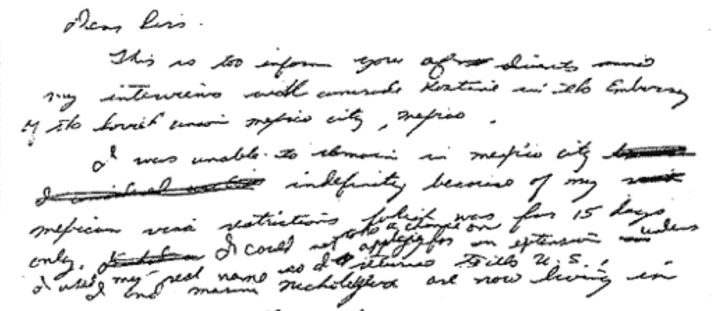
  • Shane O’Sullivan, Killing Oswald


    I. Introduction

    Shane O’Sullivan is an Irish writer and filmmaker best known for his book and documentary RFK Must Die where he examined the assassination of Robert Kennedy. O’Sullivan created a sensation and made headlines when he identified three mysterious looking persons at the Ambassador Hotel at the time of the Bobby Kennedy assassination, as CIA agents. He named them as David Morales, George Johannides and Gordon Campbell. Most researchers have disputed his claim and believe that O’Sullivan was mistaken. And to his credit, he himself has admitted his error.

    In his new film, he decided to take on the JFK assassination. He made a film to document the life of the alleged assassin, Lee Harvey Oswald. The title he chose was Killing Oswald and it gave me the impression that the theme of the film would have been an examination of Oswald’s murder by Jack Ruby. After watching it I realized that the title was not the best of choices. The film does not deal with his murder per se, but with his life and actions before the assassination. A more appropriate title would have been something like “Oswald the Patsy” or “The Life and Death of Oswald” or even “Was Oswald an Intelligence Agent?”

    The documentary consists of fourteen chapters beginning with Oswald’s days in Japan, his defection to Russia, his relationship to the CIA, his Cuban escapades in New Orleans, his bizarre trip to Mexico and finally the day of the assassination. Other chapters examine double agent Richard Case Nagell, the Odio incident and the attempt to kill General Walker. One the best features of the film is the rare historical footage, including that of Castro entering Havana with Che Guevara, interviews with George De Mohrenschildt and Antonio Venciana, the Bay of Pigs invasion, David Atlee Phillips in Mexico and Oswald in custody.

    Now let’s examine if the O’Sullivan produced film is what some claimed it is: the best documentary ever about the JFK assassination.

    II. Kaiser and the Theology of Conspiracy

    In the opening of the documentary we watch Oswald talking to the reporters and declaring himself a “Patsy” followed by Chief of Police Curry’s assurances that Oswald will not be in danger since the police have taken all the necessary precautions. Unfortunately for Curry history proved him wrong. As America watched Ruby assassinate Oswald while inside the Police station in front of Police officers. Marguerite, Oswald’s mother predicts what we now know with a degree of certainty: that Oswald was a patsy and that “history will absolve him of any involvement in the deaths attributed to him.” Then O’Sullivan proceeds with a clip from a Woody Allen movie where Woody is obsessed with the assassination and his girlfriend mocks him for using the conspiracies theories to avoid sex with her. Although the scene is humorous, I did not quite understand what purpose it was supposed to serve, other than ridicule JFK researchers as conspiracy theorists who will believe any whacky theory. I would expect this from someone like John McAdams, but not from someone who does a movie to help explain this complex case and this complicated figure.

    However this was nothing compared to the second blow, which hit me directly in the face. The first person to be interviewed, of all people, is David Kaiser, a man who firmly believes that the Mafia instigated the assassination. And he elaborated on this theorem in his book The Road to Dallas. One only needs to read Jim DiEugenio’s review of that book to understand Kaiser and his beliefs. An historian by trade has now decided to talk in theological terms to explain the various beliefs regarding the assassination. He informs us that there are three churches:

    1. The Lone Nut Church, whose high priests are Gerald Posner and Vincent Bugliosi and believe that Oswald and Ruby were lone nuts that acted of their own.
    2. The Grand Conspiracy Church whose founder was Mark Lane and has Oliver Stone as its high priest and who believe in a large conspiracy and a cover up.
    3. The Middle Church, which includes a few people like Robert Blakey and David Kaiser. They believe that Oswald was guilty but as a part of a conspiracy put together by Organized Crime.

    So there you have it. This is the “Divine Conspiracy” according to Kaiser, to paraphrase Dante’s “Divine Comedy.” In my view Kaiser’s beliefs constitute a “Conspiracy Comedy.”

    Now, if a church includes as its members Lane and Stone, I will proudly join that church. I am very wary of those middle ground researchers who are not sure of what really happened, who think that Oswald maybe did what the WC says or maybe he did not; that maybe, just maybe, there was a conspiracy. Kaiser puts himself in the same league with Robert Blakey, the Chairman of the House Select Committee on Assassinations who chose to not investigate the case in depth and surrendered to the CIA’s wishes. If one wants to learn more about the deeds of Blakey he can read Jim DiEugenio’s excellent piece called “The Sins of Robert Blakey” from the book The Assassinations, which he co-edited with Lisa Pease. Unfortunately for him, Kaiser’s theory is outdated and today, with the possible exception of Tony Summers, all serious researchers disagree with the idea that the Mafia was behind the assassination.

    If one reads DiEugenio’s books, like Reclaiming Parkland and Destiny Betrayed, one will find out that Oswald was never in the sniper’s nest during the assassination. Therefore, he did not fire the alleged weapon.

    I cannot comprehend why O’Sullivan invited Kaiser to be a part of his documentary. Even worse he was a, perhaps “the” central figure in the documentary, speaking more than the other three guests. I would agree that John Newman, Dick Russell and Joan Mellen were excellent choices but I cannot imagine what prompted him to pick Kaiser. If he wanted a historian or a researcher with a good grasp and knowledge of the case, there were plenty to choose from. Some that come to my mind are Gerald McKnight, Peter Dale Scott, Jim DiEugenio, Lisa Pease, James Douglass, Larry Hancock and Greg Burnham. These researchers have proved time and again that they have a superior knowledge of the case than Kaiser will ever have. However, this is something that only O’Sullivan can explain. In my opinion, it was a serious blunder that cast a shadow over his entire effort.

    III. Oswald’s Defection to the Soviet Union

    Luckily things get better when John Newman and Dick Russell talk about Oswald’s years in Japan, and his subsequent defection to the USSR. Newman tells us that there was a mole in the KGB who informed the CIA that there was a mole in the U-2 program. He obviously meant Colonel Pyotor Popov who revealed to the CIA the above information after overhearing a drunken Colonel bragging that the KGB had obtained technical information about the U-2 spy plane (see Peter Dale Scott’s article “In Search of Popov’s Mole”). Popov was arrested by the Russians for treason on October 16, 1959, the day Oswald arrived in Moscow. Dick Russell explains to us that Richard Case Nagell, who met Oswald in Japan “had a casual but purposeful acquaintanceship with Oswald”, related to Oswald’s feature defection to USSR with radar secrets. Newman continues that Oswald, while announcing to American Consul Richard Snyder that he wanted to renounce his citizenship, also threatened to reveal classified information of special interest to the Soviets. Newman says that it was not necessary to do that in order to renounce his citizenship, which could have resulted in his arrest. Because it was Saturday Oswald could not fill out the necessary paperwork so he did not renounce his citizenship officially. We also see an actor, Raymond Burns, as Oswald. He recites monologues from the historic diary regarding his defection.

    I believe that O’Sullivan wasted valuable time on the historic diary, which only helps to reveal Oswald’s bone fides as a false defector. Instead, he should have examined the defection in more depth to fully understand what happened.

    Snyder assumed Oswald was referring to the U-2. Snyder concluded that Oswald was assuming that the KGB had bugged the American Embassy, and “was speaking for Russian ears in my office. If he really wanted to give secret information to the Soviets he could have gone straight to them without the Americans ever knowing. Bill Simpich (State Secret, Ch.1, www.maryferrell.org) believes that if Snyder’s assumption was right, Oswald may have been wittingly or unwittingly prepped by someone from Bil Harvey’s Staff D, since they were responsible for signal intelligence.

    It is worth it to mention that Bill Harvey of Staff D worked on the U-2 related Project Rock. This documentary should have also examined the theory that Oswald somehow had something to do with the shootdown of the U-2 plane by the Soviets on May 1, 1960 which led to the abortion of the Soviet-American peace conference in Paris. The failure of that process ensured the continuation of the Cold War, which satisfied a treasonous cabal of hard-line US and Soviet Intelligence officers, whose masters were above Cold War differences as George Micahel Evica and Charles Drago believe. Among the Soviet hardliners were Leonid Brezhnev, Yuri Andropov and Yekaterina Furtseva who wanted to wrest power from Khrushchev (see Joe Trento, The Secret History of the CIA). Dick Russell wrote in his book (The Man Who Knew Too Much, p. 118) that Furtseva-who was the most powerful woman in Russia-urged that Oswald be allowed to stay in Russia, and then prevented KGB from recruiting him.

    I don’t think that Oswald gave the Soviets any important information with which to aid them in the shootdown the U-2. His role was a distraction to take the blame for this treasonous act, instead of those who were responsible. Bob Tanembaum wrote in his book Corruption of Blood that “every intelligence agency is plagued by volunteers and individuals who wish to become spies. Virtually all of them are useless for real intelligence work…but some of them can be used as pigeons, that is, as false members of a spy network who can distract attention of counterintelligence operatives…” I believe that Oswald played that pigeon role in USSR and later in New Orleans and Mexico City. Many believe that Oswald was some kind of CIA operative, but not directly. John Newman noted that since Oswald had defected to the USSR, it should have been the Soviet Russia Division that should have opened a file on him. Strangely enough, it was Jim Angleton’s CI/SIG that opened the file, a year after his defection. And simultaneously he was put in the mail intercept HT/LINGUAL program, which made Oswald quite unique. Newman told Jim Dieugenio that he suspected that Oswald was an off-the-books agent for Jim Angleton because Oswald’s first file was opened by CI/SIG, and he was on the super secret and exclusive mail intercept list. (Destiny Betrayed, p. 144).

    IV. New Orleans and Cuban Escapades

    Two of the great mysteries that surround Oswald’s life are his activities and associations in New Orleans and Mexico City. When in New Orleans Oswald contacted the Communist Party (CPUSA), The Socialist Workers Party (SWP) and he tried to open a local charter of the pro-Castro organization, Fair Play for Cuba Committee (FPPC). While there he was in the company of strange fellows, which on the surface, did not make sense. Private Detective Guy Banister a fanatical rightwinger, anti-Communist, anti-Castro and segregationist. Jim Garrison proved Oswald was also in contact with a weird character named David Ferrie, and also Clay Shaw, a local businessman employed by the International Trade Mart. Somehow, O’Sullivan does not mention Ferrie and Shaw while examining Oswald’s activities in New Orleans. I feel that he should have done so. He correctly shows Oswald’s contact with the anti-Castro organization DRE, his phony fight with Bringuier, and his TV and radio interviews that brought him in contact with Ed Butler of an anti-Communist and anti-Castro organization, named Information Council of the Americas (INCA).

    Kaiser came to the conclusion that Oswald was part of FBI’s COINTELPRO program, which had as its goal to disrupt subversives, and it targeted organizations like the FPCC, the CPUSA and the WSP. He also concluded that Oswald was not working directly for the FBI, but he was working for anti-Communist organizations like INCA that were given the assignment by Hoover. Peter Dale Scott had first suggested in his book Deep Politics that Oswald didn’t work directly for the FBI but for a private investigative firm that probably had contracts to many different intelligence agencies. Kaiser may be right about this conclusion, but not entirely. We have evidence that both Banister and Butler were in contact with the CIA and not just the FBI. As DiEugenio showed, Butler was in communication with people like Charles Cabell, Deputy Director of the CIA, and Ed Lansdale, the legendary psy-ops master within the Agency who was shifting his focus from Vietnam to Cuba. Gordon Novel, the CIA agent who spied against Garrison said that he had seen David Atlee Phillips, and Sergio Arcacha Smith in Banister’s office (DiEugenio, p. 105, Destiny Betrayed). It is also documented that the CIA, back in 1961 was planning to discredit the FPCC, and the officers involved in the operation were James McCord and David Atlee Phillips. Thankfully, John Newman and Joan Mellen remind us that Oswald’s actions in New Orleans were choreographed by the CIA and David Atlee Phillips. Antonio Venciana, a Cuban exile, said in his interview that he had seen in Dallas his case officer Maurice Bishop talking to Oswald in Dallas. Gaeton Fonzi believed that Phillips was Bishop but Veciana never confirmed it. Luckily, in November, during the 50th anniversary, Venciana sent a letter to Fonzi’s widow confirming that Phillips was indeed the officer he knew as Maurice Bishop.

    A key facet of information missing from the documentary is that George Johannides, a CIA officer, was the man handling Carlos Bringuier’s New Orleans DRE organization from Miami, something that was hidden from the HSCA when he was the CIA liaison with the Committee. Other key incidents missing are the Cliton-Jackson incident and the story of Rose Cheramie.

    O’Sullivan then takes on the famous Sylvia Odio incident, giving us three different versions as to what happened then, and who the Cubans were, known by their war names as Leopoldo and Angel. Dick Russell, correctly in this author’s opinion, said that we still don’t know their true identity. Mellen tell us her belief that Leopoldo was Bernardo DeTorres and Angel was Angel Murgado, a Cuban associated with Robert Kennedy. But many researchers have disputed her claim. Kaiser states that it was Loran Hall, Laurence Howard and William Seymour, the three visitors to Odio. This theory was promoted by Hoover but long discredited, and without merit (DiEugenio, Reclaiming Parkland, pp.239-242).

    I believe that, instead of trying to identify these persons, he should have concentrated on the fact that Odio was a member of JURE, a Cuban exile organization used by the CIA against Castro. Some CIA officers like E.H. Hunt and David Morales hated its leader Manolo Ray and considered him to be a communist, not much better than Castro. Leopoldo presented Oswald as a nut and expert marksman, which is exactly what the Warren Commission supported. So it was an effort to associate Oswald the nut, and the subsequent assassination of the President, with Manolo Ray and JURE, the group the CIA hated. None of this is included in the documentary.

    Oswald in Mexico

    Despite the time limitations of the documentary, O’Sullivan does a fairly decent job in describing Oswald’s alleged visits to the Cuban and Soviet embassies in Mexico City, what occurred there, and the impersonation of Oswald that linked him to Valeri Kostikov, a KGB officer who allegedly was a member of KGB’s Department 13, responsible for assassinations.

    John Newman, in trying to explain what occurred in Mexico, stated “My explanation is that the story reflects a failure in the primary mission which was that Oswald, or the Oswald character, was supposed to be able to get to Cuba, ostensibly on his way to the Soviet Union…to cement the story that Oswald was connected to Castro…When that failed, to get the visa from the Cubans and Soviets…they had to come up with a plan B, … the phone conversations, mentioning his name and Kostikov’s name…”

    I am a great admirer of John Newman and his work, and we owe him a great deal of gratitude for deciphering the Mexico City mystery. However I will have to respectfully disagree with him that the primary mission was to get Oswald to Cuba. I cannot believe that his handler-who Newman thinks was probably David Phillips-did not know that to get a Cuba visit, one had to arrange it via the CPUSA, or that the Cubans would have required a Soviet visa first. I think the whole operation was a ruse to make it appear that Oswald wanted to travel to Cuba and force the Cubans to call the Soviets to have on record that they were cooperating together in controlling Oswald. Kaiser is certain that Oswald did travel to Cuba, but I disagree with him. If Oswald was in Dallas visiting Odio he would not have been able to make it in time to Mexico. If one reads the Lopez report it is almost clear that someone had impersonated him all along and that Oswald never traveled to Mexico.

    Although Newman names Phillips as the man handling Oswald in Mexico, O’Sullivan for whatever reason, chose not to include Newman’s view regarding James Jesus Angleton, the Chief of CIA’s Counterintelligence. In the 2008 epilogue of his superb book Oswald and the CIA Newman names Angleton as the man who designed the Mexico City plot. In fact, the name of Angleton is not mentioned even once during the two hour duration of the documentary. The same goes with Anne Goodpasture, Win Scott’s assistant in the US Embassy in Mexico. The very person that produced the “Mystery Man” photograph, that was supposed to be Oswald entering the Cuban and Soviet Embassies. He is not a mystery man though, because the Lopez Report has settled the issue many years ago. “Since the time of the assassination, this man has been identified as Yuriy Ivanovich Moskalev, a Soviet KGB officer” Lopez Report (p.179). These should have been included, since it is by now fairly obvious that it was Angleton in Langley and Phillips with Goodpasture in the field who choreographed Oswald’s moves and set up the Mexico City charade.

    Two others facts that are very crucial in the case are not covered by this documentary. The first was a memo that the CIA sent to FBI the day before Oswald got his tourist visa to visit Mexico. There, the CIA proposed a counter-operation against the FPPC. According to the memo, the CIA was considering “planting deceptive information to embarrass the organization in areas where it had support” (Newman, Oswald and the CIA, pp. 622-623).

    The second fact had to do with CIA’s reply to Mexico Station that included the statement that they had no information on Oswald after May 1962, which was a lie. Jane Roman, Angleton’s subordinate who signed off on the bottom of the cable, admitted to John Newman in 1994 after seeing the cable that “I am signing off on something I know isn’t true.” She also told him that “the SAS group would have held all the information on Oswald under their tight control”, and that “it’s indicative of a keen interest in Oswald, held very closely on a need-to-know basis” (Newman, ibid).

    VI. DeMohrenschildt and Ruth Paine

    After Oswald returned from Russia, he settled with his family back in Dallas. O’Sullivan documents the fact that Oswald was befriended by a White Russian Baron, George DeMohrenschildt, with CIA connections. It was Dallas CIA station chief J. Walton Moore who asked DeMonhreschildt to get into contact with the ex-Marine. O’Sullivan includes some rare footage of the Baron being interviewed and one of its best moments is a very clever and witty remark by DeMohrenschildt: “As it stands now, Oswald was a lunatic who killed President Kennedy. Ruby was another lunatic who killed the lunatic who killed the President – and now we have the third lunatic, supposedly Garrison, who tries to investigate this whole case. I think it is extremely insulting to the United States, the assumption, that there are so many lunatics here.”

    When Oswald went to New Orleans, his wife Marina and his child moved to her friend’s Ruth Paine. After hearing some of the interviews that Ruth Paine gave and presented on this documentary, one would get the impression that she was a very compassionate and altruistic person, who helped her friend Marina out of kindness. You would certainly not assume that this woman had CIA connections, and had played an important role in the framing of Oswald. She seems joyful and smiling, a housewife clueless, about the assassination. However if O’Sullivan have done his homework, he would have known that she was more than a housewife.

    Most of the incriminating evidence against Oswald was found at Ruth Paine’s garage. Among them,

    1. The pictures of the outside of General Walker’s house, along with the backyards photographs, showing Oswald holding in his hands, communist literature, a rifle and a handgun (DiEugenio, Destiny Betrayed, p.202).
    2. The documents produced after JFK’s assassination that proved that Oswald had travelled to Mexico City, evidence that the Police couldn’t find after searching her house (DiEugenio, Reclaiming Parkland, p.284).
    3. Testimony that she had seen Oswald typing a letter referring to Kostin (another name for Kostikov), about their meeting in Mexico that was sent to the Soviet Embassy in Washington. This letter is considered to be a forgery.
    4. Ruth Paine was the one who found Oswald the job at the Texas School Book Depository. However he received a phone call on October 15, 1963 from the unemployment office which asked her to inform Oswald that they had found for him a job with Trans-Texans Airlines, as a baggage carrier. They were paying him $100 more than the Texas Book School Depository, yet Oswald chose the job at the library. The truth is that Ruth never told Oswald about the phone call. (John Armstrong, Harvey and Lee, p.725).

    I could have written a lot more about her, but this not in the scope of this review. But if you wish to learn more about her you can read DiEugenio’s Destiny Betrayed and Evica’s A Certain Arrogance.

    VI. Conclusions

    This is a good enough documentary for the novice, but it does not contain enough information that is vital to understanding this complex case. I also believe that there were plenty of good researchers to recruit instead of David Kaiser, who, with all due respect, is just a better version of Robert Blakey. I noted earlier on that the choice of the documentary’s title was not the most appropriate. But I bypass this issue since the film was one of the few antidotes to the 50th anniversary Lone Nut blitz of propaganda, e.g. the movie Parkland and the numerous books that supported the Warren Commission fraud. It was a brave act by O’Sullivan to produce a documentary that tried to present and unravel the mysteries surrounding Oswald’s life, almost all of which were ignored at the 50th. And I hope that more JFK researchers will take this as an example and produce similar work. It is a duty we all have that is long overdue.

  • George Michael Evica, A Certain Arrogance


    A Certain Arrogance is the last published work by the late George Michael Evica. We mentioned the book in the Evica obituary on this site. There have been very few reviews or notices of A Certain Arrogance. But since the book deals with an interesting subject – and personages – I think it merits some discussion.

    The overall subject of the work is the use of religious institutions by American intelligence agencies for purposes of infiltration, surveillance, and subversion. It is a subject that interested others in the assassination field e.g. Jim Garrison. In looking through the late District Attorney’s files, I saw that he had clipped certain articles on the subject. The book studies the efforts of the American government in this area especially during and after World War II. The prime focus is on the towering figures of the Dulles brothers: CIA Director Allen, and Secretary of State John Foster. As Evica notes, the brothers – especially Allen – had a history of using liberal Protestant groups to achieve these kinds of aims. Some of the denominations Evica names as targets are the Quakers, Unitarians and other liberal Christian groups. (p. 85) One of the families that Allen Dulles exploited in this regard was the Field family: Herbert and his son Noel. The author states that Herbert Field’s Quaker-based network of World War I would become an integral keystone of Allen Dulles’ OSS spy operations during the Second World War. (p. 93) And it was Herbert’s son Noel who helped run it for Dulles. There were also Unitarians incorporated into the spy apparatus like Varian Fry and Robert Dexter. (pgs 98-99)

    Evica then points out the interesting paradox that the use of these liberal religious organizations allowed Allen Dulles an ideological mask over his operatives. Toward the end of their careers, Fry and Noel Field were accused of being communists. Yet until the end, Fry was associated with “several right-wing anti-Communist organizations closely tied to the CIA.” (p. 100) Noel Field began his government career as a State Department employee. He was a Quaker who later befriended the radical Unitarian, Stephen Frichtman, who constructed the Unitarian Service Committee in 1940. (p. 105) This committee later became part of a large umbrella group called Refugee Relief Trustees. The man supervising the Unitarian aspect of this umbrella group was Percival Brundage.

    Noel Field began his espionage career by aiding anti-Fascists trying to get out of Spain during the advent of Franco’s rule. Dulles used Field to work leftists resisting the Nazis. Then, by 1943, when it became obvious that the Allies would win the war, he began using him to strengthen church groups against communists. John Foster Dulles, for example, was a leading member of the American Council of the Churches of Christ. And he used the body “both as a stabilizing factor for … the German people, and as a stronghold against Bolshevism.” (p. 114) The body used by Allen Dulles was the World Council of Churches. At a meeting of the group in 1945, German theologian Martin Niemoeller told Dulles’s girlfriend and employee Mary Bancroft about this effort. (p. 116) This religious-intelligence union eventually became so extensive that by 1960 all liberal Protestant or Quaker/Unitarian welfare agencies were placed under suspicion by the KGB. ( ibid)

    Furthering just how secretive and extensive this nexus was is the fact that the curator of Allen Dulles’ personal papers from the time he was fired by JFK until his death was Garner Ranney. (This would include the former CIA Director’s time on the Warren Commission.) Then, after Dulles died, Ranney was one of a three-person team that governed the release of his papers through Princeton University. Ranney did the same kind of work for the Episcopalian church of Maryland. Evica notes that many of these files dealing with Field and the Unitarians have been sanitized. And the CIA cleared the boxes of cables and letters between Dulles and Field from the Unitarian Service Committee files stored at Harvard. And in fact, a writer who did a book on that Committee wrote to Evica that she had no doubt there were intelligence files on several of the upper level officers like Dexter and possibly Frederick May Eliot of the American Unitarian Association. (p. 134)

    All of the above serves as (rather lengthy) background in the book for what will be the main focus of the first and last parts. That would be Lee Harvey Oswald and his association with Albert Schweitzer College in Switzerland, and his later association in Dallas with Ruth and Michael Paine, who were first Quakers and then joined a Unitarian church in Dallas. (p. 246)

    As mentioned elsewhere on this site, Oswald’s association with Albert Schweitzer College is one of the most fascinating releases made by the Assassination Records Review Board. After a struggle with the FBI for a year, in December of 1995 the ARRB finally released a set of five documents concerning their search for Oswald in Switzerland – a place where he was never supposed to have been. This search was provoked by a request made long ago by Oswald’s mother to the FBI. She told agent John Fain that she had mailed her son a series of letters in Russia in late 1959. Some enclosed money orders. She got no reply. She was worried he might be lost. She alerted the Bureau to the fact that she had received a letter from an official of Albert Schweitzer College in Switzerland. A man named Hans Casparis told her that Lee had been expected there in April of 1960. Casparis also said that Lee had sent them a deposit registering for the spring, 1960 session.

    J. Edgar Hoover then began a search for Mr.Casparis and this college. This search occasioned the famous June 3, 1960 memo by FBI Director Hoover saying that there may be an imposter using Oswald’s birth certificate. The FBI representatives in Paris had no idea where the place was, so they got in contact with the Swiss Police. It took them two months to locate the school. (See Probe Vol. 3 No. 3) So the obvious question is: How did Oswald know about this college? It is a question the Warren Commission never came close to answering. But Albert Schweitzer College fits into Evica’s framework since it was founded by the Unitarian Church in 1953, as the Cold War was ratcheting up. Shortly after Kennedy’s murder, in 1964, the college was closed down. The FBI visited the institution twice: once in 1960, and again in 1963. As Evica notes, this may be why most of the papers on Oswald from Albert Schweitzer are gone. (The author notes that the files on the college at its Providence headquarters, where most American applicant forms were sent, were also spirited away in December of 1963.)

    Consider the facts above. Here you have an institution so obscure that the FBI in Paris never heard of it. So obscure that the Swiss Police took two months to locate it. An institution that actually closed down within months of JFK’s murder – yet Oswald only applied there; he never attended. In fact, from what we know, he never set foot in the place. Why did they then close shop, after eleven years, approximately when the Warren Report was issued? Especially since that report mentions Albert Schweitzer only briefly and in passing? (Referring to his passport application in Santa Ana California, here is the entirety of that mention: “His application stated that he planned to leave the United States on September 21 to attend the Albert Schweitzer College … .” (See Warren Report, p. 689) This is stunning in and of itself of course. Since, in any serious investigation, the mystery of how Oswald found out about Schweitzer would have been of some importance. Not to mention why he applied there, and why he did not show up. For as Evica notes, the college did not advertise in the Christian Register from 1948-59. (p. 65)

    Evica’s book tries to do at least some of the work the Warren Commission chose not to do. For instance, when he left the Marines, on his trip to Europe in 1959, Oswald mentioned attending a school in Switzerland on two occasions. (Evica, p. 17) But he did not. He proceeded to Russia. Yet the Swiss Police found out that he wrote Schweitzer from Moscow confirming that he still planned on attending the fall semester of 1959. ( Ibid, p. 18) What makes this episode even more interesting of course is that in this exact time frame Oswald is getting his so-called “hardship discharge” even though a) His mother had no real hardship, and b) There is no evidence he helped her through anything. Interestingly, he told his brother Robert that he was leaving for Europe from New Orleans where he planned to work for an export firm. When he got to New Orleans he booked passage on a freighter from an agency at Clay Shaw’s International Trade Mart. (Of course, CIA agent Shaw’s cover was that business.) In fact, on a form he filled out there Oswald listed his occupation as “shipping export agent”. (p. 17) Further, he listed his stay abroad as being for only a couple of months. Yet, if he was attending Schweitzer it would have to have been at least a four-month stay.

    One reason that the Commission ignored most of this may be that it did not want to draw attention to the holes in the paper trail. As I have noted above, some of it is missing – swept up in the wake of the FBI investigation. But even in what was left, Evica points out some tantalizing inconsistencies. For instance, Oswald sent a deposit to the school even though there is not a written record of his official acceptance. (p. 34) Yet, as the author notes, this was the official procedure as outlined by the college secretary, Erika Weibel: you were accepted first, then you sent the deposit. Further, there is no letter of introduction from Oswald to the college. In other words, there is no indication of how or why Oswald became interested in attending with his request for an application form. (p. 32) When Oswald did apply, he used the wrong form. He submitted an application form for the summer session, not the regular fall term. This short form was mailed before March 4, 1959. Yet the date on the form is March 19th. He also sent the longer, correct form on March 4th. But as Evica notes, since the college wrote Oswald that it got his incorrect form no later than March 28th ” the college could not have sent out the longer, correct form to him any earlier than March 28th, 1959.” (p. 33) So who got Oswald the longer, correct form before the college sent it out? And who told him that he sent out the wrong form in the first place? ( This is all reminiscent of Guy Banister correcting Oswald when he put his office address on his Fair Play for Cuba literature in New Orleans.)

    Well, it may be one of the denizens from Banister’s office. Evica could not find any evidence that Oswald attended any Unitarian churches prior to applying to the Swiss school. But a close friend of Oswald’s in the Marines did attend. Interestingly, it was the Warren Commission’s prime witness attesting to Oswald’s communist leanings: Kerry Thornley. At the time he knew Oswald in the Marines, Thornley testified that he “had been going to the First Unitarian Church in Los Angeles.” (p. 21) This particular church is the subject of a sixty-page FBI report at the National Archives. But when Thornley was then asked if Oswald had any connection to that church, he replied that he did not. (Ibid)

    The man who wrote Oswald’s mother, Hans Casparis, is also an interesting character. He is one of the founders of the college, and in 1959-60 he was billed as the director. In his correspondence with Oswald, Casparis changed the opening date of the spring trimester three times. But Evica could find “no record in the available Albert Schweitzer College documents at Harvard Divinity School Library supporting this schedule modification.” ( p. 37) Evica also found a student who said the pushed back start date never took place. And that Oswald’s name never appeared on any student roster. (Ibid) Need I add that almost all the records for the Friends of Albert Schweitzer College at Harvard for the 1959-60 term are missing? (p. 289)

    All these questions about Oswald, the college, and its sudden disappearance are accentuated by the questions about Hans Casparis. Casparis wrote that he had graduated from three universities and lectured at the University of Zurich. But when Evica contacted that university they said he had never lectured there. The universities he said he had graduated from were Zurich, Basel and the Univeristy of Chicago. But Evica discovered that he held no reported diplomas or degress from these three universities. (p. 78) So from Evica’s research, here you had a man who billed himself as a professor of a college who did not receive a degree from any of the academic institutions he said he attended. And this was supposed to be one of the “founders” of Albert Schweitzer.

    Almost all of the material on Oswald and Albert Schweitzer is at the beginning of the book. And for me this was the best part of the volume. Evica was not a skilled or supple writer, but when he bit into a particular issue he persevered and saw it through to the end as he saw it. No one has taken the Albert Schweitzer story as far as he has. The second reason this demonstration is valuable is it shows once again that if you press on almost any aspect of the Oswald saga, questions, inconsistencies, paradoxes in abundance come to the forefront. How many Marines in 1959 applied for a Unitarian college abroad, sent their deposit forward, and then never showed up, deciding to defect to Russia instead? But that is about par for the course with Lee Harvey Oswald. Third, the appearance of Thornley and Shaw’s ITM reminded me of a talk I had with former House Select Committee investigator L. J. Delsa. Along with Bob Buras, Delsa manned the New Orleans beat for the HSCA. He told me that one of David Ferrie’s purposes as a Civil Air Patrol captain was the recruitment of young men for future military-intelligence functions.

    As alluded to above, the long middle section of the book, ranging approximately from pages 85-219, basically chronicles how the American government used and abused religious institutions for subversive ends. This part of the volume could have used compression. In my view, about half of this part of the book could have been cut with very little of any substance lost. Evica was a friend and colleague of Peter Dale Scott, and some of the sub-headings and his approach here reminds me of Scott at his worst. For example, here are a couple of sub-headings: “The Killian/Brundage/Bissell/Rockefeller Space Program”, “The CIA, the Catherwood Foundation, the Young Family, the Philippines, and Ed Lansdale”. Like Scott, Evica does not use the rubric Chapter, but Essay. Essay Seven is titled “Percival Brundage, The Bureau of the Budget, James R. Killian Jr., Lyndon Baines Johsnon and the Unitarian Matrix.” And as with Scott, much of the material is just excess baggage. The connections are just too wide to be material or relevant. Especially in these days that are post ARRB.

    But towards the end, the relevance picks up. First, Evica presents interesting facts about Percival Brundage who was involved with Albert Schweitzer College. Brundage was a major Unitarian Church officer from 1942-54, when it was cooperating with both the OSS and CIA. But even more interesting he was a signatory to the incorporation papers of Southern Air Transport. In fact, he became one of the registered stockholders in the company. (p. 223) As many people know, this was a notorious CIA proprietary company that did major air supply missions for the Company in both Southeast Asia and the Caribbean. It originated with Paul Heliwell’s purchase of Claire Chennault’s Civil Air Transport for the CIA. Civil Air Transport was then broken down into smaller units, one of them being Southern Air Transport. SAT specialized in the Caribbean area. When the Certificate of Incorporation of the Friends of Albert Schweitzer College was filed in New York, Brundage was one of the three directors named. He served as president of the body from 1953-58. So here you had a man who played an importnat part in Allen Dulles’ religious spy apparatus, and who was a major stockholder in a notorious CIA shell company, and he just just happens to end up the president of Albert Schweitzer College and a chief member of its American support team.

    Then at the end, Evica ties the loop together by profiling the background on the Paines and how they fit into this milieu. As Evica notes, much of this material is taken from the extraordinary work done on the couple by Carol Hewett, Barbara La Monica, and Steve Jones. (Much of which was published in Probe. Evica makes good use of it, but inexplicably he leaves out some of the more important evidentiary aspects relating to the Warren Commission inquiry. This includes things like the mystery of the Minox camera and the origin of the rifle allegedly ordered by Oswald.) As the author notes, this work is so potent that it was attacked by a big gun of the GOP, Thomas Mallon in his pathetic whitewash of a book, Mrs. Paine’s Garage.

    Evica uses much of Hewett, La Monica, and Jones’s excellent work and even supplements it with other authors. He makes other good points, like the exquisite timing of the separation of Ruth and Michael Paine, which made it so convenient for Marina to move in with Ruth before the assassination. How CIA contact George DeMohrenschildt introduced Oswald to the Paines and the White Russian community of Dallas-Fort Worth. And at one of the very first meetings of Oswald with this group, Lee talked to Volkmar Schmidt for three hours. And according to Schmidt, through Edward Epstein, “Oswald violently attacked President Kennedy’s foreign policy … Schmidt baited Oswald with a negative analysis of right-wing General Edwin A. Walker and an impending American fascism.” (p. 237) Why Oswald would want to talk to Schmidt, who was a neo-Nazi fascist, is puzzling. But Schmidt concluded that “Oswald was completely alienated, self-destructive, and suicidal.” This vignette encapsules what the Warren Commission would do with Oswald several months later: pin the shooting of Walker and murder of Kennedy on him, and paint him as a sociopath. I suppose it is just a coincidence that, at this time, Schmidt was living with Michael Paine. (ibid)

    Evica closes the book with a couple who emerged as character witnesses for the Paines during the Warren Commission inquiry: Frederick and Nancy Osborn. The Osborn family, including his father Frederick Sr., was significantly involved in the American eugenics movement whose intention was to “create a superior Nordic race.” (p. 251) Frederick Sr. also worked with Allen Dulles in the organization of the National Committee for a Free Europe. (p. 254) The funding for this group eventually came from Frank Wisner’s Office of Policy Coordination in the CIA. (p. 255) These were the connections of the friends of the kindly Quaker couple who befriended Lee and Marina.

    Mr. Mallon, are you paying attention?

  • Ruth Paine “Finds” Evidence:  Oswald’s Letter to the Soviet Embassy

    Ruth Paine “Finds” Evidence: Oswald’s Letter to the Soviet Embassy


    From the March-April, 1997 issue (Vol. 4 No. 3) of Probe

    (Click here if your browser is having trouble loading the above.)

    see also Paul Bleau’s Oswald’s Last Letter: The Scorching Hot Potato