Tulsi Gabbard visits the National Archives, talking about the release of RFK assassination files. JFK files also mentioned, along with a look at archived items such as the Zapruder camera and the shirt Oswald was wearing. View here.
Tag: OSWALD
-

The Oswald Puzzle: The Pieces That Won’t Fit – Part 2
The Oswald Puzzle: The Pieces That Won’t Fit – Part 2
By Johnny Cairns
U.S. Military Policies on Communist Affiliation: A Zero-Tolerance Stance
“I am a Marxist and have been studying Marxist principles for well over 15 months”. Letter to Socialist Party of America, October 3rd, 1956; (Greg Parker, Lee Harvey Oswald’s Cold War; p.250)
Larry Hancock recently said to me that “as an individual (Oswald) was an American citizen and free to espouse any beliefs that were legal and did not espouse violence.” (Dave Boylan. Private Correspondence with Johnny Cairns.) This argument is fundamentally incompatible with the rigid security measures, legal precedents, and ideological purges of Cold War America.
Yes, as a private citizen, Oswald would have had the constitutional right to hold Marxist beliefs. However, as we’ve already explored, such beliefs were not merely frowned upon but actively treated as subversive and dangerous. Even vague associations with leftist ideology were enough to end careers, prompt surveillance, and trigger legal repercussions.
But more importantly, Oswald was not a private citizen—he was an active-duty U.S. Marine, bound by the strict regulations of a military institution that explicitly prohibited Communist affiliation. His open, repeated expressions of Soviet allegiance, his reverence for Marxism, and his vocal disdain for American capitalism weren’t just ideological posturing—they were direct challenges to the national security apparatus of the United States. And yet, the Marine Corps did nothing.
Oswald’s status as an active US Marine placed him under an even stricter loyalty standard than a civilian. Upon enlistment, he swore an oath:
“I, Lee Harvey Oswald, do solemnly swear that I will support and defend the Constitution of the United States against all enemies, foreign and domestic; that I will bear true faith and allegiance to the same.”
Oswald also signed the Loyalty Certificate for Personnel of the Armed Forces. The number one provision of this certificate read: The Department of Defense has the authority to establish procedures implementing the national policy relating to loyalty of persons entering on duty with the Armed Forces. This has been determined by proper authority to include restrictions as to certain standards of conduct and membership in, or sympathetic association with, certain organizations.” (Parker, p.263)
II
Let us add, the Uniform Code of Military Justice (UCMJ) Article 134; Marines found possessing, distributing, or promoting Communist literature could face disciplinary action, dishonourable discharge, or court-martial. Disloyalty statements, such as Oswald’s repeated praise of the Soviet Union and his accusatory references to fellow Marines as “You Americans, American imperialism” and “exploitation” were grounds for immediate scrutiny. (Epstein, p.82) https://www.govinfo.gov/content/pkg/USCODE-2011-title10/html/USCODE-2011-title10-subtitleA-partII-chap31-sec502.htm
And how about this: The Communist Control Act of 1954 (CCA) made membership in or association with the Communist Party USA (CPUSA) illegal, classifying it as a subversive organization working to overthrow the U.S. government. The CPUSA’s official publications, The Daily Worker and The People’s Daily World—which Oswald openly subscribed to and read while stationed at Santa Ana, California—were directly linked to this illegal organization. Under Cold War-era policies, merely consuming Communist literature was considered a national security threat. 50 USC CHAPTER 23, SUBCHAPTER IV: COMMUNIST CONTROL
Beyond the CCA, federal policies actively sought to root out any Communist influence within government and military institutions:
The Attorney General’s List of Subversive Organisations; (AGLOSO) catalogued groups deemed Communist-affiliated, and association with these groups led to termination, blacklisting, and potential prosecution. Prelude to McCarthyism: The Making of a Blacklist | National Archives
Executive Order 9835 (1947); established by President Harry S. Truman, mandated the Federal Employee Loyalty Program, mandating investigations into federal employees and military personnel suspected of disloyalty. https://www.trumanlibrary.gov/education/presidential-inquiries/trumans-loyalty-program
Executive Order 10450 (1953); President Dwight D. Eisenhower further expanded these investigations, stating that even sympathies toward subversive organisations could be grounds for dismissal. https://www.dni.gov/files/NCSC/documents/Regulations/EO_10450.pdf
House Un-American Activates Committee; (HUAC) hearings paraded suspected Communists before Congress, demanding loyalty oaths and public confessions. Government employees lost their jobs for past associations, and yet an active-duty U.S. Marine, stationed at a military base, openly consuming Communist literature, escaped scrutiny? If loyalty investigations were aggressively enforced across all levels of American society, how did Oswald’s Marxism on a military base not trigger an immediate inquiry? House Un-American Activities Committee – Wikipedia
Yet the historical record simply does not support the idea that such behaviour was tolerated in the U.S. military. Other servicemen—guilty of far less—were swiftly discharged, disgraced, or investigated under Cold War security measures.
Radulovich, Abramowitz, Peress: The Harsh Reality of the Red Scare
The Cold War’s loyalty purges were merciless, cutting through government, academia, and the military with ruthless efficiency.
One of the most infamous cases was that of Milo Radulovich, a U.S. Air Force reservist who was discharged. But not for his own political beliefs. But because his father, a Serbian immigrant, subscribed to a Serbian-language newspaper that the U.S. government deemed to have Communist affiliations. His sister, too, was suspected of leftist sympathies.
Radulovich himself had never engaged in subversive activity, but mere association with “questionable” individuals was enough to end his military career. He became yet another casualty of Cold War hysteria, a victim of an era that demanded absolute ideological purity. https://en.wikipedia.org/wiki/Milo_Radulovich
“Simply getting Russian magazines, books, or progressive news magazines, etc. was perfectly legal.”
– Larry Hancock, via Dave Boylan (Private Correspondence with Johnny Cairns)Oswald did not simply “get” Russian or progressive news magazines—he subscribed to publications directly linked to the Communist Party USA. His subscription history alone would have been enough to trigger an investigation, security clearance review, or outright discharge under Cold War loyalty policies. His fellow Marines confirmed that Oswald did not hide his Communist affiliations.
Paul Edward Murphy provided an affidavit stating:
“Oswald had a subscription to a newspaper printed in English which I believe was titled either The Worker or The Socialist Worker. Members of the unit saw copies of this paper as they passed through the mailroom; when the paper was identified as being directed to Oswald, few were surprised.”
Erwin Donald Lewis, another Marine, corroborated this:
“It was a matter of common knowledge among squadron members that Oswald could read, write and speak Russian. I knew from personal observation that he read the ‘Daily Worker.’ I heard he had a subscription to that publication.” (WC Vol VIII; p. 323.)
The People’s Daily World, another Communist newspaper Oswald subscribed to, gained infamy shortly after World War II when several of its editors were convicted under the Smith Act for conspiring to overthrow the U.S. government! (Summers; p.147)
While Radulovich was expelled over his father’s newspaper, Oswald was actively subscribing to CPUSA newspapers while serving in the military. And not only was he not investigated, but he was also allowed to continue service without disruption. The inconsistency is staggering.
Howard Abramowitz & Irving Peress: Expelled Without Evidence of Subversion
Radulovich was far from alone. In 1954, Howard Abramowitz, a decorated Korean War veteran, was forcibly discharged from the Enlisted Reserve. But not for active Communist ties, but simply for past membership in leftist organizations. Even honorable military service was not enough to protect him from the Red Scare. Howard D. Abramowitz – Wikipedia
Captain Irving Peress, a U.S. Army dentist, was expelled from the military after refusing to answer questions about his political affiliations. He had not been caught in any subversive activities, nor had he been accused of actively promoting Communist ideology. Yet his silence alone was enough for Senator Joseph McCarthy to brand him a “Fifth Amendment Communist,” leading to his immediate discharge. Irving Peress – Wikipedia
III
The military was not the only institution where ideological purity was ruthlessly enforced. The Red Scare cast its shadow over every facet of American society, reaching deep into government offices, university halls, and even the glamour of Hollywood. Professors, civil servants, and filmmakers alike were compelled to renounce any association—real or perceived—with leftist ideology or risk professional and personal ruin.
Academics and scientists saw their careers disintegrate for nothing more than distant affiliations with suspected radicals, while schoolteachers were blacklisted for the simple act of refusing to sign loyalty oaths. In this climate of paranoia, there was no room for nuance, no distinction between passive interest and active subversion. Mere suspicion was a death sentence for livelihoods—proof was optional.
And then there was Lee Harvey Oswald—a man who openly and unapologetically declared his allegiance to Marxism. A man who spoke Russian in the barracks, studied Communist texts, and loudly praised the Soviet system while serving in the military at the height of the Cold War. A man who, by every precedent of the era, should have been immediately arrested, blacklisted, or imprisoned.
And yet, he faced nothing. No investigation. No dishonourable discharge. Why was he tolerated? The answer is inescapable.
U2 Realties?
“Nothing Lee Oswald knew or could have provided had to do with the loss of the U2 aircraft…” (The Oswald Puzzle; p.50) To put it mildly, this is contested by the testimony of Francis Gary Powers and works such as Oswald & The CIA, Spy Saga, Destiny Betrayed, etc.
The Motherland Awaits
“Oh, what a tangled web we weave, when first we practice to deceive!” Walter Scott.
Lee Harvey Oswald’s hardship discharge from the U.S. Marine Corps remains one of the most striking anomalies in his so-called “legend.” Discharges of this nature typically took months. Yet, for Oswald, the process unfolded with astonishing speed; as if the bureaucracy had stepped aside to expedite his path to the Soviet Union.
Nelson Delgado recalled the rapidity of the process: Oswald’s discharge “must have been a fast processing, because I wasn’t gone over 15 days and when I came back, he was already gone.” (WC Vol. VII; p.255)
Even those familiar with standard military procedures were perplexed by the urgency of Oswald’s departure. Delgado continued: “I knew he was putting in for a hardship discharge… but, like I say, it usually took so long to get a hardship discharge.” (WC Vol. VII; p.257)
Colonel B. J. Kozak, a military officer with direct knowledge of dependency discharges, provided an even more specific timeframe: “It normally took between 3 to 6 months for a hardship discharge to be approved.” (DiEugenio, Destiny Betrayed; p.136). Yet, for Oswald, all standard protocols were seemingly cast aside. He submitted his request on August 17, 1959—and by August 28, just eleven days later, the Dependency Discharge Board had already approved it.(WCR; p.688)
Why did the system move mountains to ensure that Oswald could leave his post without delay? Why was “Oswaldovich” granted a swift exit from a fiercely anti-Communist institution at the height of the Cold War?
Serious Questions arise about Oswald’s pilgrimage to the USSR
Lee Harvey Oswald’s journey to the Soviet Union is riddled with contradictions, logistical anomalies, and inexplicable conveniences. It is a tale of a man who, by all accounts, was of limited means. Yet, he managed a journey that required substantial finances, elite accommodations, and a series of improbably smooth bureaucratic processes—each step raising more questions than answers.
Oswald has long been characterized as frugal, a man of limited financial resources. As The Oswald Puzzle states, “Oswald had limited funds and was frugal by nature.” (The Oswald Puzzle; p.68)
Yet how do the authors reconcile this claim with the fact that, upon his arrival in Helsinki, Oswald did not seek out a modest or budget-friendly hotel but instead took residence in two of the most opulent establishments the city had to offer?
His first stop was the Hotel Torni, a five-star hotel renowned for hosting VIPs, including former U.S. President Herbert Hoover. The late Ian Griggs, a highly respected researcher and founder of Dealey Plaza UK, who visited the hotel, described it as the Finnish equivalent of the Savoy in London. (Destiny Betrayed;p.138.)
Oswald then moved to the Klaus Kurki Hotel, another prestigious institution, located on Bulevardi, one of Helsinki’s most exclusive streets. According to Griggs, if the Torni was Helsinki’s premier luxury hotel, the Klaus Kurki was not very far behind. (Ibid; p.138.)
So, how do we square this with the image of a cash-strapped, penny-pinching Oswald? Why did a supposedly frugal ex-Marine, who had only just embarked on an arduous defection journey, opt for deluxe accommodations that would have strained his already limited funds?
IV
Then, there is the larger financial mystery: How did Oswald fund this trip at all? At the time of his departure from the United States, Oswald’s bank account contained a mere $203.00, yet the cost of his journey to the Soviet Union amounted to at least $1,500. (Melanson p.13) Nelson Delgado was also baffled: “I couldn’t understand where he got the money to go… it costs at least $800 to $1,000 to travel across Europe, plus the red tape you have to go through.” (WC Vol.VIII; p.257.)
This raises the obvious question: Where did Oswald obtain the additional funds? Travel expenses aside, what about his day-to-day living costs? How did he afford food, toiletries, laundry, clothing, and grooming essentials over a period of over a month? How did he pay for Soviet “tourist vouchers” which cost a total of 300 dollars. (WCR, p. 690) Every journey requires sustenance—so how did Oswald survive on what was, by all accounts, an insufficient sum?
Even more suspicious is the manner in which Oswald was granted a visa for the Soviet Union.
The Oswald Puzzle claims, “It is true that Oswald’s tourist visa for Russia was granted relatively quickly in Helsinki, but that was not particularly exceptional for that location.” (The Oswald Puzzle; p.68) Yet this claim obscures a crucial detail: Oswald’s visa was processed in record time, in just 24 hours, at the Soviet consulate in Helsinki—an embassy known for expedited handling of special cases. Normally, a tourist visa took at least a week to process. (Destiny Betrayed; p.139.) In fact, the only Soviet embassy in Europe where a visa could be issued in such a short span of time was the one in Helsinki. (Ibid.)
Who arranged for this remarkable convenience?
The answer may lie in a man named Mr. Golub, an official at the Soviet consulate in Helsinki, who handled Oswald’s visa. Mr. Golub had direct ties to the American Embassy in Helsinki, where U.S. officials reportedly sent select individuals to him for “priority processing.” (Ibid, p.138.) So, was Oswald simply the recipient of a string of coincidental bureaucratic miracles? Or was someone ensuring his seamless transition into the Soviet Union?
Upon his arrival in Moscow, Oswald wasted no time in making his intentions known. “I was warned you would try to talk me out of defecting,” Oswald declared at the U.S. Embassy in Moscow in 1959. ( John Newman, Oswald & the CIA; p.5). This statement alone raises an obvious question: Who warned Oswald that U.S. officials would attempt to dissuade him from defecting? Who had prepared him for this moment?
V
Yet the most damning aspect of Oswald’s embassy visit was not his declaration of intent. It was the information he freely offered to American officials. According to The Oswald Puzzle, “Even though he did not state that such information was classified—if he had, he might well have been detained by security on the spot.” (p.72).
This claim is demonstrably dubious. Because, by multiple accounts, Oswald did state that he had classified information and was prepared to share it with Soviet officials.
According to CIA records, Oswald openly declared that he had been a radar operator in the Marine Corps. Also, he had voluntarily informed unnamed Soviet officials that, as a Soviet citizen, he would make known to them the information he possessed concerning the Marine Corps and his specialty. He even intimated that he might know something of special interest. (Newman, p.6). John McVickar, an official at the U.S. Embassy in Moscow, later recalled that Oswald explicitly stated his intent to turn over “classified things” to Soviet authorities. (Ibid)
Rimma Shirakova, an Intourist guide who met Oswald upon his arrival in Moscow, agreed with this. She recalled that Oswald told her outright that he was in possession of classified information about U.S. airplanes. (Destiny Betrayed;p.140)
Oswald’s open declaration at the U.S. Embassy in Moscow that he intended to provide classified military information to the Soviet Union constituted serious violations of U.S. law, military regulations, and his sworn oaths.
Espionage Act of 1917 (18 U.S.C. § 793-798) Violation: Wilfully conveying or attempting to convey classified national defense information to a foreign government. Espionage Act of 1917 – Wikipedia
Penalty: Up to life imprisonment, or the death penalty in cases of extreme national security risk.
Treason Clause of the U.S. Constitution (Article III, Section 3) Violation:Levying war against the U.S. or “giving aid and comfort” to an enemy nation. Penalty: Death or imprisonment. U.S. Constitution | Constitution Annotated | Congress.gov | Library of Congress
Uniform Code of Military Justice (UCMJ) Article 94 (Mutiny and Sedition) –Encouraging or aiding an enemy. 10 USC 894: Art. 94. Mutiny or sedition
Article 104 (Aiding the Enemy) – Attempting to supply intelligence to a foreign power. 904. Article 104. Aiding the Enemy – UCMJ – Uniform Code of Military Justice – Military Law
Article 134 (General Article) – Conduct unbecoming a Marine. Penalty: Dishonorable discharge, court-martial, life imprisonment, or death. What is Article 134 of the UCMJ? – UCMJ – Uniform Code of Military Justice – Military Law
Communist Control Act of 1954 Violation: Affiliation with or providing assistance to a Communist government or organization. Penalty: Denaturalization, deportation, or imprisonment.
Oath of Enlistment – United States Marine Corps Violation: Oswald swore to “support and defend the Constitution of the United States against all enemies, foreign and domestic.” Penalty: Immediate dishonorable discharge and legal action under military law.
What Should Have Happened at the U.S. Embassy in Moscow?
Immediate Detainment:
Any U.S. citizen, let alone a Marine veteran with a security clearance, admitting to plans of turning over classified information should have been immediately detained by security personnel.
Interrogation by Military & Intelligence Agencies: On the spot, Oswald should have been subjected to intense questioning by CIA and military intelligence officers to determine: What classified information he had already revealed. If he was acting alone or under foreign influence. And his true intentions and affiliations.
Revocation of U.S. Passport & Citizenship Review: Oswald’s passport should have been confiscated immediately. The State Department should have initiated proceedings to revoke his U.S. citizenship under laws barring Americans from aiding enemy nations.
Legal Charges & Potential Arrest: Oswald’s admission that he was offering classified material to the Soviets should have resulted in formal espionage or treason charges. The FBI and CIA should have been notified immediately to launch an investigation.
Monitoring & Surveillance: At the very least, Oswald should have been flagged as a national security threat, placed under continuous surveillance, and denied re-entry into the U.S. until a full security review was conducted.
And yet, despite these laws, despite his explicit statements, Oswald walked out of the U.S. Embassy a free man.
Had any other American—especially an active-duty Marine—made such declarations during the height of the Cold War, their fate would have been sealed in an instant. But Oswald? Oswald was allowed to continue on his Soviet adventure.
The question is: why?
-

The Oswald Puzzle: The Pieces That Won’t Fit – Part 1
The Oswald Puzzle: The Pieces That Won’t Fit – Part 1
By Johnny Cairns
“I worked in Russia. Er… I was… er, under the protection… er, that is to say, I was not under the protection of the American government, but as I was at all times… er, considered an American citizen.” Lee H. Oswald, New Orleans- 1963.
Who was Lee Harvey Oswald? That is the $64,000 question, isn’t it? A question that has been debated endlessly since that fateful afternoon in November of 1963 when he was dragged from the darkness of the Texas Theatre and thrust into history. He was cast as an assassin, charged, murdered without trial, and sentenced to a posthumous verdict of guilty—his name forever etched in infamy. Truly as it was written long ago; The evil that men do lives after them; The good is oft interred with their bones.
Oswald’s death remains a festering wound on the soul of a nation—a nation that, for over sixty years, has continued to grieve the loss of one of its finest leaders: President John F. Kennedy.
The name Oswald will forever be synonymous with one of the gravest injustices in history. And yet, his short life remains an open contradiction—an enigma that defies easy explanation.
On one hand, we have the Marxist Marine—a contradiction in itself. A public ‘defector’ to the Soviet Union. A man who, throughout his life, openly espoused socialist, Marxist, and communistic ideologies at the height of Cold War America.
On the other, we have a man who always seemed to be at the center of American intelligence operations. A man who was impersonated multiple times—including once when he wasn’t even in the country. A man whose closest acquaintances were a who’s who of the most fiercely militant anti-communists of the late 1950s and early 1960s.
Men such as:
•David W. Ferrie
•George De Mohrenschildt
•Clay L. Shaw (alias Bertrand)
•Guy Banister
These were not just random acquaintances. This was a who’s who of intelligence-linked operatives, far-right extremists, and shadowy figures operating at the nexus of covert operations.
Their connections to Oswald were so striking that Senator Richard S. Schweikerwould later remark: “The fingerprints of intelligence are all over Oswald.”
And it is this very contradiction that compelled me to write this review of The Oswald Puzzle.
II
In the interest of full transparency, I must first acknowledge my respect for co-authors Larry Hancock and Dave Boylan. They are serious researchers, meticulous in their methodology, and their work is thorough, well-sourced, and deeply considered. In fact, it was through the generosity of Dave Boylan that I was able to write this review at all. With the book’s UK release delayed until mid-March, Dave was kind enough to send me a copy from the U.S.—a gesture I greatly appreciated.
And on the surface, Larry and Dave stand on solid ground here. They follow Oswald’s own writings, a literary North Star, which guides them through the “swamp” of “conspiracy” research and into their contrarian conclusion on his true ideology.
In essence, Oswald’s writings are a literal treasure trove of Marxist ideology. But you know what they say: actions speak louder than words, but Inaction screams loudest of all.
For example, if we take the view that I espouse, that Oswald’s Marxism was a facade, a carefully constructed legend, then his writings should be the first thing held as suspect. After all, a good intelligence operative doesn’t just prove their loyalties with actions; they do it with words designed to be seen. And Lee Oswald was seen.
But before we jump into that, I think we need to remind ourselves what the culture surrounding Socialism, Marxism, and Communism looked like in the United States of the 1950s. Would there even be a distinction between the three?
Though Senator Joseph McCarthy himself had faded from power by the time Oswald’s ‘Marxism’ emerged, the suspicion and paranoia he unleashed still gripped America’s national psyche in a stranglehold of fear. The spectre of Communist infiltration loomed large, fuelling an era where mere suspicion could end careers, shatter reputations, and destroy lives. The machine of McCarthyism had been set into motion, and even in his absence, it continued to devour those deemed ideologically impure.
This unrelenting witch hunt led to the blacklisting, expulsion, and imprisonment of Americans—men and women whose constitutional rights were shattered, cast into political exile for even the faintest whiff of leftist affiliation. Careers were obliterated, reputations tarnished beyond repair, and lives upended—all in the name of eradicating the Communist spectre. Yet, in the midst of this ideological purge, Oswald—the overt, self-proclaimed Marxist—stood untouched.
Why?
For nothing about Oswald’s documented behavior, affiliations, or the way he was treated by the U.S. government aligns with the paranoia and persecution of Cold War America. How did Oswald escape the fate of so many “suspected” leftists before him? Men whose mere associations with Communism—often far less explicit than Oswald’s—led to ruin?
• Alger Hiss.
• Langston Hughes.
• Milo Radulovich.
• Dalton Trumbo.
• Irving Peress.
• Howard Abramowitz.
Yet Oswald—a man who openly espoused Marxism, declared his allegiance to Communist ideology, and even attempted defection to the Soviet Union—remained inexplicably untouched. What made him so exceptional that he was able to avoid a national security investigation?
And here lies the dichotomy at the heart of the Oswald Puzzle—a contradiction too glaring to ignore. If Lee Harvey Oswald’s blatant Marxist/Communist ideology was truly genuine, then why was it tolerated by the staunchly conservative, fervently anti-Communist institutions of Cold War America?
Why did the Civil Air Patrol, the United States Marine Corps, and ultimately the U.S. government itself turn a blind eye?
It is a question Larry and David, in my opinion, fail to answer.
Civil Air Patrol
“Oswald and Ferrie were in the unit together. I know they were because I was there. I specifically remember Oswald. I can remember him clearly, and Ferrie was heading the unit then. I’m not saying that they may have been together; I’m saying it is a certainty.” (Bill Davy, Let Justice Be Done; p.5)
Who was David Ferrie? Was he a pivotal figure in the life of Lee Harvey Oswald? If you were to judge by The Oswald Puzzle—where he is mentioned only once in passing—you’d think not. And if that glaring omission isn’t shocking enough, then the book’s characterization of Ferrie as merely a “commercial airline pilot” should leave you a bit dumbfounded. Because, to put it mildly, David Ferrie was far more than that.
He was a dangerous, militant right-wing extremist, a rabid anti-communist, and a man with deep, verifiable connections to U.S. intelligence, paramilitary operations, and underground networks.
His absolute hatred for Communism is best captured in a letter he wrote to the U.S. Air Force, offering his services in the fight against the “Red menace”:
“There is nothing that I would enjoy better than blowing the hell out of every damn Russian, Communist, Red or what have you. We can cook up a crew that will really bomb them to hell… I want to train killers, however bad that sounds. It is what we need.” (Davy, p. 7)
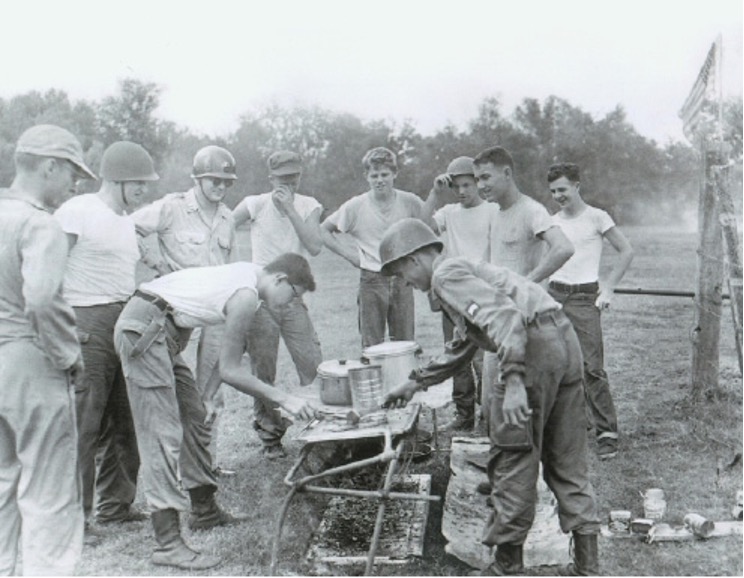
And this fanatic wasn’t just some peripheral character in Oswald’s orbit. As one can see from the above, he was the squadron leader of Lee Harvey Oswald’s Civil Air Patrol unit.
So now we must ask the question: Are we truly expected to believe that a man who wanted to “train killers” to obliterate Communists would have had a benign, indifferent view of a cadet who—according to The Oswald Puzzle—was already:
“forceful in the expression of his own views on government, social issues, and geopolitics”? A cadet who, according to William Wulf, “started to expound the Communist doctrine? Who was allegedly “highly interested in communism” and believed that “communism was the only way of life for the worker”.
Most astonishingly, however, was the revelation that Oswald “was looking for a Communist cell in town to join” (The Oswald Puzzle; p.40) ( WC Vol VIII; p.18)
Would such a cadet have been tolerated under the leadership of a rabid “Red” hater like Ferrie?
We do, however, have testimony on record that directly contradicts the characterisation of Oswald as a budding Marxist in his youth.
His fellow Civil Air Patrol cadet, Ed Voebel, who joined the CAP alongside Oswald, dismissed the notion outright when testifying before the Warren Commission:
“I have read things about Lee having developed ideas as to Marxism and communism way back when he was a child, but I believe that is a lot of baloney”. Voebel also stated that he saw no evidence whatsoever that Oswald was studying communism in 1954.
Robert Oswald’s testimony would further reinforce this:
“If Lee was deeply interested in Marxism in the summer of 1955, he said nothing to me about it… Never in my presence, did he read anything that I recognised as communist literature”.
So what changed?
If Oswald showed no interest in Marxism in 1954-55, then what triggered his sudden transformation? The evidence suggests that his introduction to Marxist literature was not organic but rather coincided with his encounters with David Ferrie.
Can’t you see the contradiction?
Even more damning is that The Oswald Puzzle explicitly states:
“It is around this time that Oswald is showing clear and consistent indications of his beliefs regarding political and social systems.” (The Oswald Puzzle; p.40) Yet if this were true, then why—just a year later—would Oswald, the supposed overt Marxist, voluntarily enlist in the United States Marine Corps—an institution built to uphold and defend American capitalism and imperialism? The very antithesis of Marxist ideology.
Oswald’s half-brother, John Pic, testified before the Warren Commission that Oswald had no ideological motivation behind his enlistment. Instead, he suggested that Oswald joined the Marines simply “to get from out and under the yoke of oppression from (his) mother”, Marguerite. (WC Vol. XI; p.10)
Possible. But I believe the answer lies elsewhere—at the feet of David Ferrie.
One of Ferrie’s primary roles in the Civil Air Patrol was to encourage and recruit young men into the U.S. military—particularly the Marines. He frequently boasted about his connections to intelligence and military operations, and he would speak to cadets about the orders he received from those channels.
In fact, when Lee, underage, tried to join the Marines just after his 16th birthday, his mother was visited by a man passing himself off as a Marine Corps recruiter. As Bill Davy rightly points out, “this was a clear violation of the law”.
Ferrie, as it turns out, “often posed as a military officer and exhibited domineering and controlling behavior towards his cadets”. (Davy, p.6; James DiEugenio, Reclaiming Parkland, pp. 152-153)
Now, consider this. If Oswald was truly the overt “Marxist”, why, while preparing to enlist in the U.S. military, did he begin to do two opposing things simultaneously? He starts to obsessively study his brother’s Marine Corps manual, memorizing it “by heart.” While, at the same time, devouring Communist literature. (WC Vol I, 198.)
Now take a moment to really let that one sink in for a second.
That’s tantamount to me, as a supporter of the Glasgow Celtic, turning up each week to Ibrox Stadium to cheer on the Glasgow Rangers. It defies all logic. (And would never happen). And logic should be an easy trail to follow, especially if one is as intelligent as Oswald.
To just ever so briefly skim over Oswald’s relationship with Ferrie is not presenting the totality of the evidence. As James DiEugenio, a specialist in New Orleans, wrote: “Oswald’s relationship with Ferrie had a powerful, perhaps crucial, effect on his life.” (The JFK Assassination: The Evidence Today, p. 177). Which is likely the reason that, in the wake of the assassination, Ferrie was frantically trying to conceal that relationship. (ibid, p. 176)
The Marxist Marine
“At the time he entered the Marine Corps, Lee Oswald… was very much interested in socialism and Marxism.” (The Oswald Puzzle; p.40)
Yet, which is the real Oswald?
“Oswald was not a Communist or a Marxist. If he was, I would have taken violent action against him, and so would many of the other Marines in the unit.” James Bothelo.
Two statements. Two conflicting realities. Both cannot be true. So, which one is the illusion? With this, we enter a phase of Oswald’s life that defies explanation—at least if one assumes his Marxist convictions were genuine. His enlistment in the United States Marine Corps (USMC) stands as a glaring contradiction, compounded by the military’s staggering negligence in addressing his overtly pro-Soviet behavior.
How could a staunch Marxist thrive within the staunchly anti-Communist U.S. military? How was his open admiration for the Soviet Union and Castro’s Cuba tolerated—at the height of the Cold War? And why did none of it trigger the alarm bells that destroyed so many others?
Some have suggested that the Marine Corps simply viewed Oswald as an eccentric ideologue, dismissing his vocal admiration for the Soviet Union and his praise for Fidel Castro’s revolution as nothing more than a harmless personality quirk. But is that even remotely plausible in the rigid, hyper-vigilant, anti-Communist climate of the 1950s?
Had Oswald merely harboured private sympathies for leftist ideals, perhaps this argument could be entertained. But that is not what happened. His behavior was neither subtle nor sporadic. He was a Marine who, while actively serving in the U.S. military—a force dedicated to opposing Communism—repeatedly and publicly expressed Marxist ideology, Soviet allegiance, and disdain for American capitalism.
This is not just an inconsistency—it is a contradiction. And one that requires rigorous scrutiny.
The Marxist Résumé
“He must have had a secret clearance to work in the radar center, because that was a minimum requirement for all of us”. John Donovan. (WC Vol VIII; p.298)
“We all had secret clearances.” Nelson Delgado. (Vol VIII; p.232)
Below is a documented list of some of Marine Radar Operator Oswald’s openly pro-Soviet activities while serving in the U.S. Marines, under normal Cold War security policies. Any one of these actions should have immediately marked him as a severe national security risk.
- Openly Studying/Declaring interest in Marxist/Communist Ideology. (WCR; p.388) (Oswald Puzzle; p.57)
- Declared publicly his support for the Soviet system. (WCR, p.388)
- Believed that communism was “the best system in the world”. (WCR, p.686)
- Gigged by his fellow Marines about “being a Russian spy”. (WC Vol; VIII; p.322)
- Described by his commanding officer as a “Little nuts on foreign affairs”. (WC Vol VIII; p.290)
- Complained about the incompetence of the “American Government”. (WC Vol VIII; p.292)
- Made Remarks About “American Imperialism” and “Exploitation”. (Edward Epstein, Legend; p. 82)
- Referred to Fellow Marines as “You Americans”. (Ibid)
- Made serious references to “American Capitalist Warmongers”. (WC Vol; VIII; p. 315)
- Denounced Capitalism and praised the Soviet economic system to fellow Marines. (WCR; p.868)
- Nicknamed “Oswaldovich”. (WCR; p.388)
- Made remarks stating his preference for “The Red Army”. (WC Vol VIII; p.323) (WCR; p.388)
- Had his name in Russian on one of his jackets. (Vol VIII; p. 316)
- Played Russian records at extremely loud volume (particularly Tchaikovsky’s “Russian War Dance”) (Ibid)
- Studied The Russian Language. (WCR; p.388) (Oswald Puzzle; p.55-56)
- Made remarks in Russian frequently or used expressions such as “da”, “nyet,”or “comrade” to his fellow Marines. (Vol VIII; p. 315) (WCR; p. 686)
- Read a Russian language newspaper. (Vol. VIII, p. 315-321-292)
- Read Karl Marx’s Das Kapital, which is fundamentally a Marxist work but is also foundational to Communist ideology. (Vol. VIII, p. 254)
- Read and subscribed to publications directly linked to the Communist Party USA: The Daily Worker-The People’s World. (Elaborated on later). (WC Vol VIII; p.292-320-323) (Tony Summers Conspiracy; p.147)
- On February 25, 1959, Oswald sat for a Marine Corps Russian proficiency exam—an event that, in itself, is rather shocking in its improbability. The Oswald Puzzle states that “Oswald may have been motivated by the fact that scoring at certain levels of proficiency would add to his monthly base pay” or “he just wished to test himself” in the Russian language.“ In other words, Oswald—a Marine assigned to anti-aircraft radar operations, with a secret clearance—chooses to take a Russian language proficiency exam. But it’s not because it had any bearing on his military duties. But either for a small financial bonus or as a personal intellectual challenge. This explanation, however, is so weak that it collapses under even the slightest scrutiny.
The late District Attorney of New Orleans, Jim Garrison, famously ridiculed the absurdity of such a test for someone in Oswald’s position. He noted, “In all my years of military service during WWII and since, I had never taken a test in Russian… I could not recall a single soldier EVER having been required to demonstrate how much Russian he had learned… A soldier genuinely involved in anti-aircraft duty would have about as much use for Russian as a cat would have for pyjamas.” (On The Trail of The Assassins, p. 23). (WCR; p.685) (The Oswald Puzzle; p.56)
- Received mail on base suspected to be from the Cuban government. And openly supported Fidel Castro and the Cuban revolution. (WC Vol VIII; p.240-243)
By any rational metric of Cold War security policy, Oswald’s conduct should have led to:
- A full-scale investigation by the USMC and the Office of Naval Intelligence (ONI).
- Immediate dishonourable discharge.
- Blacklisting from any future government employment.
- Court-martial proceedings.
- Possible imprisonment for espionage or subversive activities.
And yet, none of this happened.
If one attempts to reconcile Oswald’s “radicalism” as nothing more than a mere “personality quirk”, then the U.S. Marine Corps was running the most reckless, incompetent security operation imaginable—hardly consistent with the military ethos of Cold War America. And if The Oswald Puzzle expects us to swallow that narrative, the real scandal isn’t just Oswald—it’s the alarming possibility that other “personality quirks” were freely roaming U.S. military bases, unchecked, with the potential to defect to the Soviet Union.
Even more alarming, Oswald had access to one of the most sensitive military installations in the world—Atsugi, Japan. This base housed the U-2 spy plane program, one of America’s most closely guarded Cold War secrets. And yet, this proclaimed Marxist, who referred to his fellow Marines as “you Americans,” was reportedly seen strolling around the base, casually taking photographs (Philip Melanson, Spy Saga, p.8).
Oswald’s Ability to Follow Orders and Authority
It has often been argued that Oswald’s temperament—frequently characterized as rebellious, defiant, and resistant to authority—would have made him wholly unsuitable for intelligence work. Detractors paint him as a loose cannon, a man who bristled under orders and was incapable of following directives.
However, as with so much else in the Oswald enigma, this portrayal is contradicted by testimony on the record. Nelson Delgado testified that;
“He used to take orders from a few people there without no trouble at all…If he had respect, he would follow, go along with you.” (WC Vol VIII; p262)
This statement suggests that Oswald’s alleged inability to follow orders was not an intrinsic trait, but rather a selective disposition—he was fully capable of obedience when he deemed it warranted. A quality, one might argue, that could be highly desirable in certain intelligence circles.
How Did Oswald Learn Russian?
The Oswald Puzzle makes the case that Oswald’s Russian proficiency was solely the product of his own self-discipline, a testament to his determination to master the language through solitary study. The book cites various Marines recalling his commitment to learning Russian, as if this alone explains how a young radar operator—without formal instruction—somehow acquired an impressive grasp of one of the most notoriously difficult languages in the world. (The Oswald Puzzle; p.55)
This argument, however, begins to unravel when faced with a striking omission from the book—a name that should have been central to the discussion but is instead left out entirely: Rosaleen Quinn.
Quinn was the aunt of Oswald’s fellow Marine, Henry J. Roussel, Jr., and she had a personal stake in learning Russian. She was preparing for a position at the American Embassy in Moscow, which required passing a State Department exam in the language. To achieve this, she undertook a Berlitz course and received formal tutoring for more than a year. (WC Vol. VIII; p.321) (XXIV; p.430)
At her nephew’s arrangement, Quinn spoke with Oswald one evening for over two hours in Russian. She later recalled that Oswald spoke the language better and more confidently than she did! (Melanson; p.11)
That revelation alone should be enough to pierce the myth of Oswald as a self-taught Russian student. Here was a woman who had received structured, professional training, yet she found herself outpaced in fluency and confidence by a 19-year-old Marine with no formal instruction.
It gets even more implausible when we consider the timing. This conversation took place after Oswald had already failed his Russian proficiency test in February 1959. According to The Oswald Puzzle:
“Oswald got two more questions right than wrong, however, his overall rating on the test was poor. Oswald scored -5 for “understanding” (listening to spoken Russian) +4 for reading and +3 for writing. Those scores suggest that he had been teaching himself Russian from a book up to that point in time”. (p.56)
So we are supposed to believe that a man rated as “poor” in Russian just months earlier—who had a negative score in listening comprehension (-5)—could, by the time he spoke with Quinn, outclass a trained Russian speaker?
Jim Garrison captured the absurdity of this contradiction perfectly when he wrote: “I am reminded of the man of said his dog was not very intelligent because he could beat him three games out of five when they played chess.” (Garrison, p.22)
But beyond the numbers, there is an even larger problem. Russian is not an easy language for an American to master, even with professional training. Dr. James Weeks, a professor of modern languages at Southeastern Massachusetts University, taught Russian himself and underwent military language training. He was consulted by researcher Phillip Melanson and was asked whether Oswald’s supposed rate of progress was feasible.
Weeks stated that attaining Russian fluency requires more than twice as many hours as Spanish or French—1,100 hours or more, including instruction. Weeks opined that the kind of progress described in Oswald’s case would be exceedingly difficult, if not impossible, to attain in such a short time by using only the radio and self-study props. (Melanson, p.12)
This is not an opinion—it is a fact supported by decades of linguistic research.
We must also consider a particularly revealing exchange from the January 27, 1964, executive session of the Warren Commission, in which Chief Counsel J. Lee Rankin made a rather curious admission:
“We are trying to run down to find out what (Oswald) studied at the Monterey School of the Army in the way of languages”. History Matters Archive – January 27, 1964 transcript, pg
This single sentence raises profound implications. Why was the Warren Commission investigating Oswald’s possible enrolment at Monterey?
The Monterey School (Defense Language Institute) was not some casual language academy—it was a top-tier training ground for U.S. military and intelligence personnel. Students did not elect their own courses; they were assigned languages based on operational requirements.
If Oswald had indeed studied at Monterey, this would explain both the speed and depth of his Russian proficiency, as well as why his behavior in the Marine Corps—so outwardly pro-Soviet and politically suspect—never raised alarms within the military establishment.
The very fact that Rankin and the Warren Commission found it necessary to “run this down” suggests they had reason to believe Oswald’s Russian training was more than just the efforts of a self-motivated Marine flipping through textbooks in his spare time. (Melanson, p.12)
-
The PEPE Letters
The PEPE Letters
By: Paul Bleau“… we will analyze similar situations that demonstrate stratagems around other subjects and incidents that occurred during the months preceding and succeeding the assassination of JFK that are revealing of a pattern that is indicative of central coordination.”
From The JFK Assassination Chokeholds
Executive Summary
There is a strongly supported theory in the JFK research community that the assassination bears the fingerprints of a CIA assassination program code-named ZRRIFLE, and that it was led by rogue, high-level agents linked with the failed Bay of Pigs operation. Many facts support this theory, including the association of regime change specialists with many elements of the plot, the impersonation of Oswald in Mexico City in the fall of 1963 to make him look unhinged and Castro-connected, and, most interestingly for this article, the use of incriminating correspondence.
Shortly after the Mexico City incident, a letter with a forged signature incriminating Oswald and foreign confederates, and corroborative of the Mexico City charade was sent to the Russian embassy in Washington. The FBI eventually dismissed it as a clumsy attempt by Oswald to ingratiate himself with the Soviets. The content and the timing of the letter suggest rather that it was part of the same stratagem designed by those behind the Mexico City set-up.
Five other letters sent from Cuba, all postmarked shortly after the assassination, incriminated Oswald, unidentified Cuban agents, and Fidel Castro himself. They contained details of the Mexico City fabrication known only to a very few. Despite this, the FBI dismissed these letters as a hoax. (See the book ZR Rifle by Claudia Furiati)
Recently this author discovered three more incriminatory letters in released CIA files that received little attention from the research community. These very similar letters are postmarked in the late fall of 1962, the year before the assassination. This article analyzes these letters and concludes that:
- They reveal that plans to assassinate JFK were likely triggered by the Cuban Missile Crisis.
- They are consistent with and add detail to the theory that the assassination followed the ZRRIFLE playbook.
- The fact that the sender of these letters was directly linked to the Fair Play for Cuba Committee, just like Oswald and other subjects of interest involved in suspicious events throughout 1963, provides compelling added evidence that plans to kill JFK during the last year of his life were centrally coordinated.
- They add credence to the theories that point to the involvement of specialists in regime change operations. They add to the suspicions that high-level officers David Phillips and William Harvey were involved.
- They do not incriminate the CIA as an organization, nor the FBI and Secret Service.
Introduction
Case linkage is a standard offender profiling technique that was never performed for the JFK assassination by the leading intelligence organizations of the country. By the time the ARRB was running, the Secret Service ensured that this could not be done by illegally destroying JFK files just before they would have been made available through declassification beginning in the mid-nineties.
In Chokeholds, by comparing some 20 incidents and/or subjects that were worthy of exploration, we were able to present a picture that revealed: “…that the peculiarities that one can find in many of the subjects’ personas, associations and actions are hardly a haphazard collection of traits and behaviors.” One of the traits that was underscored was links with the Fair Play for Cuba Committee that existed in a vast majority of the cases explored.
(For more see the articles on Prior Plots and on Exposing the FPCC at Kennedysandking.com)
In late December 2024, while reading some of the latest declassified files available at Mary Ferrell, I found a series pertaining to letters sent from Havana, written in a way to incriminate Cuba in a plot to kill JFK right after the peak of the Missile Crisis. I had a déjà vu moment.
The 1962 Pepe letters are not only corroborative of what many researchers have come to think, but they add a clearer picture to the offender profile that is getting more precise from added pieces to the puzzle– like these. In 1962, just following the height of the Missile Crisis where JFK was strongly opposed by his war hawks, three letters signed by a “Pepe,” were sent from Havana in a way that ensured that they would be discovered by U.S. intelligence. These letters created deep concern that there was a plot to kill JFK in the works, one that involved enemy agents in both Cuba and the U.S. They are remarkably similar to the 1963 letters and link potential patsies and perpetrators to Fidel Castro in what can only be seen as another false flag operation.
The FBI eventually dismissed these letters as a Cuban harassment tactic despite referring to the sender as a suspect.
- Was this a prequel to what would happen in the fall of 1963?
- Are the perpetrators of this similar case the same as those who are behind the conspiracy?
This author believes that the answer is yes to both questions, which can only lead to more crystallization of the opinions that most researchers have, according to recent surveys on the matter, about the who, when, how, and why of the conspiracy.
After the assassination, investigators did nothing to see how these letters linked up with the eerily similar subsequent events described earlier in this section.
Background
“According to a historical study of the Arbenz removal project: discussing themes and tactics that would become constants during the following decades… deniable assassination squads… while placing the blame on designated parties (patsies).
In 1953, sabotage and propaganda efforts were discussed but beyond that a CIA officer proposed a plan for first, spreading rumors that the communists were dissatisfied with Arbenz, then killing him in a fashion that would be laid on the communists.” (Nexus, by Larry Hancock)
According to a recent study, most researchers are of the opinion that the maneuvers described above are part of the assassination program code-named ZRRIFLE, and that CIA regime change specialists David Phillips and William Harvey should be considered people of interest and that the Missile Crisis was a determining factor in the decision to remove JFK.
1) ZRRIFLE
“ZRRIFLE” was a program to recruit foreign criminal assets for various illegal activities including burglary, wiretaps, strong-arm work, and thefts in support of ZR code-breaking work. Later it was used by William Harvey as a project for an Executive Action assassination program.
It provided a cover for recruiting individuals who could be used to provide the CIA with a highly targeted ‘executive action’ capability. Along with other CIA assassination activities, it was investigated by the Church Committee in the 1970s. That investigation was the first to document and publicize American efforts to eliminate Fidel Castro, Patrice Lumumba, and other foreign leaders.
In 1961, William Harvey was tasked by Richard Helms with perfecting an executive action program. Key aspects of ZRRIFLE included setting up phony paper trails, the use of surrogates and patsies, as well as provisions to blame a foe. He left behind hand-written notes. The following are excerpts fromWilliam Harvey’s notes:
“Should have phony 201 in RI [Records Integration] to backstop this, all documents therein forged & backdated. Should look like a CE file …. Cover: planning should include provision for blaming Sovs or Czechs in case of blow.”
2) The Mexico City Charade
Between September 27 and October 3, 1963, conspirators in the JFK assassination, developed a false flag incident in Mexico City designed to make future patsy, Lee Harvey Oswald, look like he was in league with Cuban and Soviet agents. Oswald was alleged to have received bribes from Cuban agents and met KGB agent Valery Kostikov, who was their head of assassinations in the Western Hemisphere. J. Edgar Hoover affirmed that Oswald had been impersonated in Cuba. (Also see the Lopez Report.)
3) A forged letter sent to the Russian Embassy in Washington incriminates Cubans, Soviets, and Oswald.
Shortly after the Mexico City fabrication, a forged letter (see Appendix 1) incriminating Oswald and foreign confederates and corroborative of the Mexico City charade was sent to the Russian embassy in Washington. It denigrates the “notorious FBI” and refers to Kostikov as comrade Kostin. The Warren Commission eventually dismissed it as an awkward appeal by Oswald to the Soviets. In fact, the content and the timing of the letter suggest that it was part of the same stratagem designed by those behind the Mexico City set-up. The Russians, upon receiving the letter, saw it for what it was: As reported by Jerry Rose in the Fourth Decade, “in 1999, Boris Yeltsin handed Bill Clinton some 80 files pertaining to Oswald and the JFK assassination. One of the memos reveals that, at the time of the assassination, Russian ambassador Anatoly Dobrynin had right away seen the letter as a ‘provocation’ to frame Russia by the fabrication of complicity between Russia and Oswald, when none existed. ‘One gets the definite impression that the letter was concocted by those who, judging from everything, are involved in the president’s assassination,’ Dobrynin wrote. ‘It is possible that Oswald himself wrote the letter as it was dictated to him, in return for some promises, and then, as we know, he was simply bumped off after his usefulness had ended.’ In late November, the Russians sent the letter to U.S. Secretary of State Dean Rusk explaining why the letter was a fraud. By then, the White House was peddling the lone nut fable. Kept hidden was the fact that the FBI already had a copy of the letter.”
In his article, Jerry Rose points out that the typed letter had many more spelling errors in it than the rough draft found at Ruth Paine’s home. (Oswald’s Last Letter: The Scorching Hot Potato)
4) The Phony Letters from Cuba
Five letters from Cuba (See Appendix 2), all postmarked shortly after the assassination, one of which was destined for Oswald, were part of the false flag operation and were used to incriminate Oswald, unidentified Cuban agents, and Fidel Castro himself. They also corroborate the Mexico City fabrication that very few people would have known about. The FBI dismissed these letters as a hoax, but their content and timing revealed the same tactics being used by the assassination planners. (Read the letter from Cuba section in Kennedysandking article The CIA and Mafia’s “Cuban American Mechanism” and the JFK Assassination.)
The first letter addressed to Oswald includes: “close the business,” “money I gave you,” “recommend much to the chief,” “I told him (Castro) you could put out a candle at fifty meters,” “when you come to Habana.” Letter four specifies $7000 in bribes given to Oswald which is close to what a Phillips-connected false witness claimed he saw being given to Oswald in Mexico City in the Cuban embassy. It also states that a Cuban agent named Pedro Charles “became a close friend of former Marine and expert shooter Lee H. Oswald in Mexico.”
The following is how researcher John Simkin (Spartacus) summarizes the evidence:
The G-2 had a letter, signed by Jorge that had been sent from Havana to Lee Harvey Oswald on 14 November 1963. It had been found when a fire broke out on 23rd November in a sorting office. “After the fire, an employee who was checking the mail in order to offer, where possible, apologies to the addressees of destroyed mail, and to forward the rest, found an envelope addressed to Lee Harvey Oswald.” It is franked on the day Oswald was arrested, and the writer refers to Oswald’s travels to Mexico, Houston, and Florida…, which would have been impossible to know about at that time!
It incriminates Oswald in the following passage: “I am informing you that the matter you talked to me about the last time that I was in Mexico would be a perfect plan and would weaken the politics of that braggart Kennedy, although much discretion is needed because you know that there are counterrevolutionaries over there who are working for the CIA.”
Fabian Escalante, chief of Castro’s G-2, informed the HSCA about this letter. When he did this, he discovered that they had four similar letters that had been sent to Oswald, RFK, The Voice of America, and The Director of the Diario de New York. Four of the letters were postmarked “Havana.” It could not be determined where the fifth letter was posted. Four of the letters were signed: Jorge, Pedro Charles, Miguel Galvan Lopez, and Mario del Rosario Molina. Two of the letters (Charles & Jorge) are dated before the assassination (10th and 14th November). A third, by Lopez, is dated 27 November 1963. The other two are undated.
Cuba is linked to the assassination in all the letters. In two of them, an alleged Cuban agent is clearly implicated in having planned the crime. However, the content of the letters, written before the assassination, suggested that the authors were either “a person linked to Oswald or involved in the conspiracy to execute the crime.”
This included knowledge about Oswald’s links to Dallas, Houston, Miami, and Mexico City. The text of the Jorge letter “shows a weak grasp of the Spanish language on the part of its author. It would thus seem to have
Escalante adds: “It is proven that Oswald was not maintaining correspondence, or any other kind of relations, with anyone in Cuba. Furthermore, those letters arrived at their destination at a precise moment and with a conveniently incriminating message….The existence of the letters in 1963 was not publicized or duly investigated, and the FBI argued before the Warren Commission to reject them.”
Escalante continues: “The letters were fabricated before the assassination occurred and by somebody who was aware of the development of the plot, who could ensure that they arrived at the opportune moment, and who had a clandestine base in Cuba from which to undertake the action. Considering the history of the last 40 years, we suppose that only the CIA had such capabilities in Cuba.” (JFK: The Cuba Files)
The linkage with Mexico City is interesting in that very few people were even aware of Oswald’s alleged behavior there shortly before the assassination. David Phillips worked undercover in Cuba in 1959-60 and under Win Scott in Mexico City when the assassination took place. He was a lead propagandist for regime change operations for the CIA. He collaborated closely with other clandestine specialists such as Harvey over the years. Some of the letters suggest a $7000 payoff to Oswald given by Pedro Charles, “a Mexico City-based Castro agent.” Interestingly, Phillips was queried by the HSCA about misinformation from his agents painting a picture of a Cuba-backed conspiracy in league with Oswald. One of his underlings, Gilberto Alvarado, was found to be lying when he claimed that he saw Latinos giving Oswald $6500 in the Cuban embassy.
The Pepe Letters
a) Overview
In the process of reviewing the recent Latin American intel files at the Mary Ferrell Foundation, a series of them that culminated with CIA file 104-10506-10007 (See appendix 3), set off alarm bells. In it, we find the first Pepe letter translated from Spanish and other observations.
This file, on its own, is very revealing:
The letter suggests several troubling points if authentic (which it is not):
- It was sent from Cuba to “Bernardo Morales” at a post office box in Miami owned by an anti-Castro propaganda unit called Radio Libertad, La Vos Anti-Communista de America. It was sent by Jose Menendez and signed by Pepe. Morales was unknown to those who handled the letter and was eventually forwarded to a CIA contact linked to the JMWAVE station in Miami.
- It reveals a network of conspirators based in Miami, Washington, and Cuba.
- The letter is postmarked November 29, 1962, just after the height of the Missile Crisis.
- It lamely suggests that by sending the letter to the right-wing Radio Libertad, it would not be intercepted.
- It crudely links “Fidel” to a plot to kill JFK.
- It does not mince words and is self-incriminating: “if we are able to kill President Kennedy,” “It would be a great success, super extraordinary, for Fidel,” “Marxist-Leninists 90 miles from the U.S.,” “paralyze imperialism completely,” “terrorize capitalism”, “get in contact with your Friends”, “You are an artist”: all very similar to the 1963 letters.
- Letter three of 1963 letters from Havana (appendix 2) was sent to the Directors of the Voice of America, which, like Radio Libertad, was a Cold War vehicle for anti-communist propaganda.
- The information was sent to the Secret Service, the FBI, and the Department of State on Dec. 8, and later to the INS by Rufus Horn of Task Force W and is signed by him as Liaison and in lieu of William Harvey.
- The links with the 1963 letters and William Harvey (a person of extreme interest in the assassination) caught my attention.
As I went through other related files, the parallels would get even more evident: In short order, I was able to find out that the 1962 letter was one of three Castro incriminating letters, originally written in Spanish, sent within days of one another, all signed by Pepe. (See Appendix 4)
The second letter was postmarked November 14 and was sent to Antonio Rodriguez who was a chauffeur for Colonel Hugo Trejo (a suspected intelligence contact from Venezuela). Improperly addressed, Trejo said that the letter arrived at a Venezuelan Delegation office. The Secret Service, tipped off by an informant suspecting an assassination plot involving Trejo, questioned members of the delegation including Trejo, Rodriguez, and others.
The letter refers to the assassination plot in a similar fashion as the first Pepe letter discussed above and was deemed to have been written by the same sender following FBI analysis. The letter opens with Comrad Rodriguez (was Comrad commonly used by Cubans in 1962?) In Oswald’s last letter to the Russian embassy (Appendix 1), he refers to comrade Kostin. Like the letter intended for Morales, this one finds a clumsy way of clearing the Soviets in this plot.
The third Pepe letter (appendix 4) was sent to Guatemala. It does not refer to the assassination plot. It does link Cuba to clandestine revolutionary activities in the country.
b) The FBI and HSCA Investigations of the Pepe letters (See Mary Ferrell file 124-10279-10068 for 21-page FBI document) and click to see the HSCA report
FBI summary of findings:
The sender’s full name is Jose Menendez Ramos. The Ramos part of the name may bear significance.
Radio Libertad was CIA-sponsored (which was also the case for Voice of America) and operated out of Venezuela. It had an antenna office in Miami. CIA representative William Finch said he was unable to confirm this link. The report affirms that the Pepe letter was acquired through a contact coded MM-T1.
Special agent John A. Marshall of the Secret Service and the FBI took this threat very seriously. He advised the FBI about the second letter (Rodriguez).
Olga Duque de Heredia de Lopez and Aida Mayo Coetara, Miami Representatives for Radio Libertad, handled the mail. Lopez handed the letter to Cesar Gajate whom she described as an anti-Communist fighter. Mayo is the wife of Humberto Lopez Perez, the director of Radio Libertad in Venezuela.
The INS identified a Morales who entered the U.S. using a fake visa. Some witness evidence indicated that he was anti-communist.
Hand-writing analysis confirmed that the two letters were written by the same person. The FBI compared these letters to a letter signed by Jose Menendez sent to V. T. Lee but could not determine definitely whether it was from the sender because of insufficient comparable handwriting. The report concludes that Menendez moved from Tampa, Florida, to Cuba in 1961 and that he was being investigated as a suspect.
What the report does not state is that V. T. Lee was head of the Fair Play for Cuba Committee. He would later correspond frequently with Lee Harvey Oswald.
The FBI suspected subterfuge around the flagrant errors in addressing all three letters:
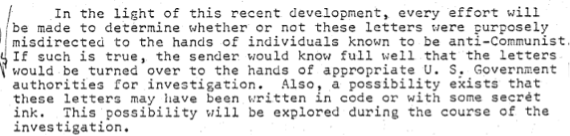
The HSCA 1978 report sheds more light on the cast of characters and the Pepe affair:
Concerning the third letter sent to Guatemala, it states that the intended recipient Carlos Meneses was not associated with a P.O. Box 347 in Guatemala City and consequently the letter was intercepted. It describes how Radio Libertad operatives in Caracas contacted the U.S. embassy to let them know about their broadcasting initiatives in Latin American countries, including Cuba.
The sender Jose Menendez and his wife Carrie Hernandez had been described by the informant as members of the Tampa FPCC. Menendez got a “top Job” in the Cuban Government after his return. He and his wife are said to be extremely pro-Castro. Concerning Olga Duque, the HSCA repeats how the Morales letter went from her to Gajate, to eventually make its way to the Secret Service, without divulging the CIA Miami station role in the logistics. Aida Mayo is described as a founder of an anti-Castro organization. Olga and Aida shared an apartment.
Concerning the intended recipient of letter 2, Antonio Rodriguez, the reports are a mixed bag. One lead with thin traces connected his father with the assassination of an anti-Castroite in Haiti. Another points to links with a Castro henchman named Pino Machado. (Note: a base story for a pro-Castro conspiracy could have emerged had a plot developed further.)
The HSCA Weighs in
The Warren Commission paid no attention to the Pepe incident and only made fleeting mention of the Pedro Charles letters, lazily fluffed off as a hoax by the FBI.
The HSCA published a 165-page report (180-10108-10017 titled ANTONIO GUILLERMO ROGRIGUEZ JONES.) Towards the beginning of the report exchanges among intelligence agents all the way up to Chief Rowley, head of the Secret Service, and FBI director Hoover emphasize the seriousness of these letters. S.A. Marshall is extremely insistent about the importance of looking into Menendez.
The HSCA Final Report
While the above is a summary of the raw data concerning the Havanna 1962 letters, the HSCA presented in a report, Volume 3 of its final report in which there is precious little value when it comes to interpretation. As we have seen, the FBI fluffs all of this off as simply Cubans muddying the wells. The HSCA toed the line, which seems contradictory to its criticism around the absence of case linkage regarding potential patsy Policarpo Lopez, whom they linked to suspicious behavior in and around the assassination in 1963 (compare the double standard):
Lopez would have obtained a tourist card in Tampa on November 20, 1963, entered Mexico at Nuevo Laredo on November 23, and flew from Mexico City to Havana on November 27. Further, Lopez was alleged to have attended a meeting of the Tampa Chapter of the FPCC on November 17… CIA files on Lopez reflect that in early December 1963, they received a classified message requesting urgent traces on Lopez… Later the CIA headquarters received another classified message stating that a source stated that “Lopes” had been involved in the Kennedy assassination… had entered Mexico by foot from Laredo on November 13…proceeded by bus to Mexico City where he entered the Cuban embassy…and left for Cuba as the only passenger on flight 465 for Cuba. A CIA file on Lopez was classified as a counterintelligence case…
An FBI investigation on Lopez through an interview with his cousin and wife as well as document research revealed that… He was pro-Castro and he had once gotten involved in a fistfight over his Castro sympathies.
The FBI had previously documented that Lopez had actually been in contact with the FPCC and had attended a meeting in Tampa on November 20, 1963. In a March 1964 report, it recounted that at a November 17 meeting… Lopez said he had not been granted permission to return to Cuba but was awaiting a phone call about his return to his homeland… A Tampa FPCC member was quoted as saying she called a friend in Cuba on December 8, 1963, and was told that he arrived safely. She also said that they (the FPCC) had given Lopez 190$ for his return. The FBI confirmed the Mexico trip (Lopez’ wife confirmed that in a letter he sent her from Cuba in November 1963, he had received financial assistance for his trip to Cuba from an organization in Tampa)… information sent to the Warren Commission by the FBI on the Tampa chapter of the FPCC did not contain information on Lopez’ activities… nor apparently on Lopez himself. The Committee concurred with the Senate Select Committee that this omission was egregious since the circumstances surrounding Lopez’ travel seemed “suspicious.” Moreover, in March 1964 when the WC’s investigation was in its most active stage, there were reports circulating that Lopez had been involved in the assassination… Lopez’ association with the FPCC, however, coupled with the fact that the dates of his travel to Mexico via Texas coincide with the assassination, plus the reports that Lopez’ activities were “suspicious” all amount to troublesome circumstances that the committee was unable to resolve with confidence.
So, what fingerprints did they pick up on the Menendez links to the FPCC, the similarities with the Pedro Charles letters and Oswald’s last letter, and the fact that Menendez was deemed an FBI suspect in an assassination plot…? None! None they wished to discuss that is. The HSCA also deflected somewhat by speculating that Menendez may have been someone else (Juan Jose Mulkay Gutierrez- 1977 File 104-10506-10036). The HSCA ended by concluding that there was a probable conspiracy but leaned towards a Mafia-centric one. The Pepe letters did not support this concept.
SGA, JMWAVE, Task Force W, and SAS
Dave Boylan is a co-author of the book The Oswald Puzzle and the essays The Wheaton Lead and The Red Bird Airport Leads. He is regarded as one of the leading researchers of JFK assassination-related files and he is currently working with this author on a far-reaching JFK research project. In it, we have produced the beginnings of the CIA org chart for 1963 as well as one specifically for the CIA station in JMWAVE and another for the SAS CIA cell. No one understands this structure more than Dave. Interested in the Pepe letters, he helped me decode some of the files and added a few to the mix. Thanks to this we can better understand the extended team that was involved with this covert operation, whether wittingly or not.
From Spartacus: “After the Bay of Pigs disaster, President John F. Kennedy created a committee (SGA) charged with overthrowing Castro’s government. The SGA, chaired by Robert F. Kennedy (Attorney General), included John McCone (CIA Director), McGeorge Bundy (National Security Adviser), Alexis Johnson (State Department), Roswell Gilpatric (Defence Department), General Lyman Lemnitzer (Joint Chiefs of Staff) and General Maxwell Taylor. Although not officially members, Dean Rusk (Secretary of State) and Robert S. McNamara (Secretary of Defense) also attended meetings.
At a meeting of this committee at the White House on 4 November 1961, it was decided to call this covert action program for sabotage and subversion against Cuba, Operation Mongoose. Attorney General Robert F. Kennedy also decided that General Edward Lansdale (Staff Member of the President’s Committee on Military Assistance) should be placed in charge of the operation.
The CIA JMWAVE station in Miami served as operational headquarters for Operation Mongoose. The head of the station was Ted Shackley and over the next few months, he became involved in the attempt to overthrow Fidel Castro. One of Lansdale’s first decisions was to appoint William Harvey as head of Task Force W. Harvey’s brief was to organize a broad range of activities that would help to bring down Castro’s government.”
After Harvey left America for Rome, Desmond FitzGerald stepped in to provide new leadership to the Cuban division at Headquarters, renamed as the Special Affairs Staff (SAS). Harvey stepped down as chief of Staff D.”
By painstakingly assembling names from files, searching through directories, and working with colleagues, David and I have been putting together org charts representative of the CIA in 1963. It is a colossal work in progress that does sometimes involve guesswork and evolving conclusions. Of interest for this article is the 63-64, org chart of SAS developed by David. (Note: William Harvey does not figure in this because he had by then been demoted and exiled. In 1962, he would have had a prominent position near the top of a structure SAS replaced called Task Force W). By visiting Appendix 5, the reader will better appreciate how many of the persons profiled below worked within the Counterintelligence section of SAS under Fitzgerald in 63 and Harvey in 62.
David’s first take on the files we looked over proved very insightful:
“These are very close to the Pedro Charles letters! I suspect that the person that sent these was a cutout/asset for the Psychological Warfare, Propaganda guys. Notice that the memo went to Paul Maggio and Rufus ‘Austin’ Horn. Horn was SAS/Counterintelligence who met with FBI liaison Sam Papich every day. Horn worked for Hal Swenson, who worked for Harvey and later, Dez Fitzgerald. The initial source was a PW/Prop anti-communist radio station (Olga Duque). From there to an AMOT (Gajate). The AMOT sent it to JMWAVE, most likely the head of the AMOTs, Tony Sforza. Then JMWAVE sent it along to SAS (Maggio and Horn) who brought in the FBI (Papich). Of course, Harvey would have seen this.”
Dave later added the following:
Another possible source of the letters was members of the DRE—the Student Revolutionary Directorate. The DRE was a “specialized” student group of the larger Revolutionary Directorate. The student group was founded in the summer of 1960 by Ross Crozier (Harold Noemayr) and William Kent (Oliver Corbus/Doug Gupton) under the direction of Philip Toomey (Robert Trouchard) and David Phillips (Michael Choden) and designated AMSPELL. Kent was first introduced to Juan Salvat (AMHINT-2) by Alberto Muller (AMHINT-1). Salvat knew Kent as Gupton. Other early members of AMSPELL were Isidro Borja (AMHINT-5), and Luis Fernandez Rocha (AMHINT-53). AMSPELL was split into three sections: AMSPELL itself, AMHINT and AMBARB. AMSPELL proper was managed by Ross Crozier, AMHINT, the paramilitary section, was managed by David Morales, and the AMBARB (propaganda) section was managed by Calvin Thomas. (Note: Oswald’s interaction with the New Orleans chapter of the DRE in the summer of 1963 was key in creating his pro-Castro credentials and adding to his Mexico links to Phillips.)
David Morales, who was part of the 1954 Guatemala coup (operation PBSUCCESS) with Phillips, was also chief of operations for the Bay of Pigs invasion under Ted Shackley at JMWAVE and was reportedly involved in various assassination projects including the capture and killing of Che Guevara and later aided repressive governments in South America.
1) Lt. Ramos
This link File 104-10308-10271 and File 104-10308-10272 establish that Castro’s close friend Lt. Ramos could be Menendez, the alleged FPCC-linked sender of Pepe’s letters. The latter file identifies William Harvey as its author. These files pertain to a project to assassinate Castro in 1962 called AMRANGE, likely led by Harvey.
2) Augusto Cesar Gajate Puig
The Morales letter was received at JMWAVE on December 7, via Augusto Cesar Gajate Puig, a Cuban exile involved in the fight for a free Cuba, who had received it from Olga Duque who worked for the CIA-sponsored Radio Libertad. The reason she got to handle it was because the letter was suspiciously mistakenly addressed to this right-wing conduit by supposedly communist assassins working for Castro. File 104-10308-10249 refers to Gajate as a CIA contact and expresses a need to protect his identity. 104-10506-10015: ROUTING SHEET AND GREEN LIST NAME CHECK REQUESTS/RESULTS describes him more specifically as an AMOT contact. AMOT is a cryptonym for a network of Cubans trained by David Morales during 1960-61 to be a new Cuban intelligence service once Castro had been ousted. It became a proprietary which produced economic and sociological reports in support of Cuban operations.
3) Rufus Horn
A report about the letter (appendix 3) was then written up by Rufus Horn who signed it (by direction of Victor Wallen) as the liaison as well as in lieu of William Harvey above his name at the bottom of the report. The report is sent on December 8 to the FBI, Secret Service, and Department of State.
Rufus Horn, also known as Austin Horn, was a key liaison within the SAS group and TFW as well as with the FBI (File 104-10269-10134) where he interacted with Sam Papich. He was also well connected with Desmond Fitzgerald of the CIA who led the all-powerful SAS group that enacted major covert activity policies.
Horn was put in the loop when Oswald was arrested for a street fight with a DRE operative (Carlos Bringuier) around his provocative FPCC leafleting activities in New Orleans in 1963: (from State Secret, Simpich, Chapter 5) “Anderson received a Sept. 24 report of Oswald’s arrest, which revealed Oswald’s request to speak with an FBI agent and share quite a bit of information while in jail: Austin Horn, the Special Affairs Staff (SAS) liaison with the FBI, also got his copy of the September 24 report on October 8. The routing sheet indicates that Horn’s copy was signed for by ‘LD,’ SAS/CI L. Demos. This document was passed on to SAS/CI/CONTROL, then Egerter, and then CI/IC Cal Tenney. Horn was active on the Cubela case at its end in 1965.” (Note: The Cubela case was another plot to assassinate Castro involving Harvey.)
4) Richard Tansing
Another person whose name appears in many of the Pepe letter files is Richard Tansing. Tansing describes himself as C/TFW/CI. His boss, Harold Swenson, used the pseudonym of Joseph Langosch while serving as C/SAS/CI and C/WH/SA/CI between 1963 and 1965. In a cable on October 17, 1963, that was originated by Anita Potocki (Harvey Assistant), SAS/CI, and Tansing C/SAS/CI, was a Coordinating Officer.
Tansing is also linked to William Harvey, Desmond Fitzgerald, Sam Halpern (all TFW or SAS), Win Scott (Chief of Station in Mexico City), Papich of the FBI, as well as soldiers of fortune: Frank Sturgis (of Watergate fame) and Gerry Patrick Hemming (104-10048-10217: FRANK ANTHONY STURGIS, ALSO KNOWN AS FRANK FIORINI and 104-10218-10274: ROUTING AND RECORD SHEET).
Tansing was involved in an effort to recruit the Cuban Head of the Mexico City embassy, Eusebio Azcue (who had contact with Oswald) shortly before the Mexico City charade, the Cubela assassination of Castro plot, and direct involvement with CIA FPCC assets and covert activities.
5) Anita Potocki
Anita Potocki was Bill Harvey’s long-time loyal aide. She helped potential patsy Santiago Garriga set up an FPCC chapter in Miami. She aided CIA FPCC informant Thomas Vicente (who helped Oswald with his New Orleans Chapter) travel to Cuba as an asset for the CIA. She is also closely linked to David Phillips. Her relations with Tansing are noted above.
6) Desmond Fitzgerald
Fitzgerald was the head of a secret unit within the CIA called the Special Affairs Staff. His top priority, as directed by SAG, was to eliminate Castro.
Note: In a nutshell, we can conclude that those involved in handling the Pepe letters within the CIA coalesced under Harvey and then Fitzgerald mostly in the CI section of SAS. SAS had its tentacles in JMWAVE where covert activities involving AMOTs (like Gajate) were run as well as Mexico City activities (where David Atlee Phillips was based).
7) David Phillips
“I’m firmly convinced now that he [Phillips] ran the red herring, disinformation aspects of the plot. The thing that got him so nervous was when I started mentioning all the anti-Castro Cubans who were in reports filed with the FBI for the Warren Commission and every one of them had a tie I could trace back to him. That’s what got him very upset. He knew the whole thing could unravel.” Dan Hardway (HSCA investigator), from Gaeton Fonzi’s The Last Investigation
From Spartacus: “David Phillips also worked undercover in Cuba (1959-60). He returned to the United States in 1960 and was involved in the organization of the Bay of Pigs operation. During this period he worked with E.Howard Hunt in the attempts to have Fidel Castro murdered. Phillips later worked under Winston Scott, the head of the CIA station in Mexico.
Desmond FitzGerald arrived in Mexico City to tell Phillips that he had the freedom to roam the entire Western Hemisphere mounting secret operations to get rid of Fidel Castro. Phillips now worked closely with David Morales at JMWAVE in Miami. Phillips also provided support to Alpha 66. It was later claimed that Phillips told Antonio Veciana his goal was to provoke U.S. intervention in Cuba by ‘putting Kennedy’s back to the wall…’
David Atlee Phillips served as Station Chief in the Dominican Republic and in Rio de Janeiro. In 1970, he was called to Washington and asked to lead a special task force assigned to prevent the election of Salvador Allende as President of Chile. Allende was killed in a military takeover in 1973.”
From Someone Would Have Talked, Larry Hancock: “However, there are two further indications that he was either aware of the conspiracy or actively supported it.
One of these is from conversations David Phillips had with Kevin Walsh, a former HSCA staffer who went on to work as a private detective in Washington, DC. In a conversation not long before his death, Phillips remarked: ‘My private opinion is that JFK was done in by a conspiracy, likely including American intelligence officers.’ — David Atlee Phillips, July 1986.
The second conversation was related in an email exchange between researcher Gary Buell and David Phillips’ nephew, Shawn Phillips. As Shawn described in the email, Shawn’s father, James Phillips, became aware that his brother, David, had in some way been ‘seriously involved’ in the JFK assassination. James and David argued about this vigorously and it resulted in a silent hiatus between them that lasted for almost six years.
As David was dying of lung cancer, he called his brother. Even at this point, there was apparently no reconciliation between the two men. James asked David pointedly, ‘Were you in Dallas that day?’ David answered, ‘Yes,’ and James hung up the phone on him.
8) William Harvey
Harvey hated the Kennedys, wrote up the executive action program called ZRRIFLE, and led Task Force W, which headed Operation Mongoose (an anti-Castro sabotage program). At the height of the Missile Crisis, he foolishly defied the Kennedys by sending three commando units to Cuba. This got him exiled to Rome. ZRRIFLE describes the importance of ensuring corroborative paper trails when planning elimination programs. Harvey was singled out by HSCA investigator Dan Hardway as a person of extreme interest in the assassination… something our studies confirm as a point of agreement among most researchers.
From Spartacus on William Harvey: “At a meeting of this committee at the White House on 4 November 1961, it was decided to call this covert action program for sabotage and subversion against Cuba, Operation Mongoose. Attorney General Robert F. Kennedy also decided that General Edward Lansdale (Staff Member of the President’s Committee on Military Assistance) should be placed in charge of the operation.
The CIA JMWAVE station in Miami served as operational headquarters for Operation Mongoose. The head of the station was Ted Shackley and over the next few months became very involved in the attempt to overthrow Fidel Castro. One of Lansdale’s first decisions was to appoint Harvey as head of Task Force W. Harvey’s brief was to organize a broad range of activities that would help to bring down Castro’s government…
During the Cuban Missile Crisis, Robert Kennedy instructed CIA director John McCone, to halt all covert operations aimed at Cuba. A few days later he discovered that Harvey had ignored this order and had dispatched three commando teams into Cuba to prepare for what he believed would be an inevitable invasion. Kennedy was furious and as soon as the Cuban Missile Crisis was over, Harvey was removed as commander of ZRRIFLE. On 30 October 1962, RFK terminated ‘all sabotage operations’ against Cuba. As a result of President Kennedy’s promise to Nikita Khrushchev that he would not invade Cuba, Operation Mongoose was disbanded.
Harvey was now sent to Italy where he became Chief of Station in Rome. Harvey knew that Robert Kennedy had been responsible for his demotion. A friend of Harvey’s said that he ‘hated Bobby Kennedy’s guts with a purple passion.’”
The Usual Suspects
There are numerous reasons that many researchers have suspected David Phillips and William Harvey as being part of the conspiracy. It is Harvey’s links with Johnny Rosselli and the mob, his suspicious behavior during the months leading up to the assassination–including a possible visit to Dallas–his hatred of the Kennedys, and his experience in executive action; all these that make Harvey of extreme interest.
In the case of Phillips, his universe is so intertwined with Oswald’s through his ties to Mexico City, the FPCC, the DRE, Alpha 66, New Orleans right-wing networks, George Joannides, etc. that renders him suspicious. He also made quasi-confessions—including being in Dallas on the day of the assassination– revelations that have led most researchers to suspect him.
What do the Pepe letters add to the mix?
If one agrees that—their similarities with the 1963 letters, the FPCC links of the sender, and the total post-assassination complacency displayed by investigators of this despite the obvious fingerprints and the labeling of Menendez as a suspect are not a matter of happenstance–then we can conclude that this incident, like so many others, was deep-sixed, because it went against the lone nut scenario.
This author believes it went further than just this:
– The fabrication of a false paper trail is alluded to in William Harvey’s executive action plan called ZRRIFLE. So are the tactics of shifting the blame on a foe and the use of proxies. All this is in full display with the Pepe letters.
– The 1963 letters have content that only a few people could have known about, including alleged bribes and Oswald’s fall 1963 displacements. One of these people is clearly suggestive of Phillips and another could well be William Harvey, who worked closely with Phillips in the past on covert activities and whose assistant, Anita Potocki, worked closely with the Mexico City station.
– The 1962 letters occurred one year earlier and share a similar template with the 1963 letters. These were certainly two false flag operations organized by the same perpetrators.
– William Harvey had already turned on the Kennedys by the time he tried to sabotage the Kennedy/Khrushchev diplomacy attempts at the height of the Missile Crisis. Phillips expressed his disgust with the failed Bay of Pigs mission which he blamed on JFK.
– Over and above his privileged knowledge, Phillips had the contacts in Havana, in Mexico City, and at JMWAVE in Miami as well as the false flag expertise to pull off these tactics.
– It is interesting to note that one of the recipients of the Pepe letter was a CIA conduit called Radio Libertad out of Miami. And one of the 1963 recipients was the Voice of the United States of America, another Cold War propaganda organization. Phillips would have been well acquainted with these organizations as he himself used such tools in his regime change propaganda efforts.
Conclusion
This author had opinions, based on intelligent speculation, about who was involved in the assassination. The prior plots to remove JFK confirmed a template. Ergo, solving a prior plot meant solving the JFK assassination. Because of negligence and obfuscation on the part of investigators, this proved difficult.
Two things changed all this in the past four months: one—a better understanding of the intelligence universe of 1963 that culminated in organizational charts and two—the Pepe letters.
With declassification, the current downfall of Warren Commission apologists was predictable. The files not only torpedoed the lone-nut scenario and disgraced the Warren Commission, but they revealed the biggest challenge facing conspiracy deniers caused by the shift to pushing a lone-nut scenario which had to be improvised because the blame Castro scenario was overruled after the assassination. The fairy tale spinners could not put all the toothpaste back in the tube. Fabrication, witness intimidation, coercing media, and file classification became the order of the day. Until 1991, when the movie JFK, gave us the declassification of thousands of files, and changed the assassination universe.
The Pepe letters operation proved more difficult to sweep under the rug because it occurred in 1962 and had been analyzed by the FBI and the Secret Service, both genuinely concerned by the threat. A suspect for a plan to remove Kennedy linked to the FPCC had been identified. The knee-jerk dismissal of the Pepe letters does not hold water. The HSCA simply tabled them, until against all odds, they were found decades later, and are only now being analyzed in detail.
What we can take away from the Pepe Letters is monumental and could be even more incriminating with more research.
- The Pepe letters bear too much of a resemblance to the 1963 incriminating correspondence for them not to be linked.
- Both correspondence initiatives were designed to incriminate Fidel Castro in plots to kill JFK.
- Both initiatives use FPCC links to taint the offenders.
- Both initiatives correspond closely with the ZRRIFLE executive action template mastered by both William Harvey and David Phillips who are regime change specialists.
- Phillips’s network is omnipresent in the false flag operations around Oswald in 1963.
- Harvey’s network is very closely connected to the characters involved in the post-reception phase of the Pepe letters.
- Harvey and Phillips connect closely through their regime change operations history, members of their networks, and relations between TFW/SAS and Mexico City.
- Both shared a hatred of the Kennedys.
- SAS was a critical conduit between regime change operators and those who set policy.
- The post-assassination analysis was cursory and evasive.
It remains difficult to determine who, within the networks, acted wittingly vs. unwittingly and who figured out after the fact the minutiae around the operations. However, if we conclude that what happened in the 1962 and 1963 false flag operations discussed in this article are not the result of mere happenstance, and that neither the Cubans, Mafia nor lone wolves could have pulled these plots off, we can conclude that they were coordinated by the same perpetrators who are regime change specialists.
Find out who designed tactics for either the false flag plots, their roll-out, the propaganda themes, and who got the instructions through to contacts in Havana to send the letters, who set up the FPCC tainting strategy… You have a strong case of who was behind the JFK assassination at the operations management level.
Appendices
A 9-page PDF with all appendices may be found here.
-

Death to Justice: The Shooting of Lee Harvey Oswald – Part 1
Foreward
by Paul Bleau
Paul Abbott and I live at opposite ends of the world – he in Australia and I in Canada. We got to know one another because of the Garrison Files. After reading some ten thousand pages of these, I knew that hidden away in this collection, there were gems that were not on the radar when it came to analyzing the JFK assassination. Just one example is how Garrison was on the trail of Latinos, with likely links to Guy Banister, who frequently escorted Oswald.
I knew that if others went through these, they could pick up on clues I may have missed. Paul reached out and provided the community with a research booster that is an archive asset of great value: the Garrison Files Master Index. Garrison’s unfairly dismissed primary research can now be referenced with ease digitally by info ferrets. It took Paul over a year to build the index, and he deserves our thanks.
So, when Paul asked me to write a foreword for his book, I felt an obligation to do so. This was risky, in a way, as I refuse to plug material of mediocre quality. What if I did not like it?
You have guessed by now that I like this book… a lot. Thousands of books have been written about the Kennedy assassination. A few classics have been written about the Tippit murder, which is often covered in more JFK-focused writings. Question to the reader: What do you know about the other murder of that weekend? In my case, it was not much. Yet it, as much as the JFK murder, has all the fingerprints of a conspiracy. It matches the JFK assassination when it comes to poor security. The elimination of Oswald sealed the lips of the most important witness. The shooter likely had assistance to get to the victim and was clearly mob-linked.
There are many ways one can zero in on the leaders of the JFK assassination conspiracy; Work your way up the ladder around the equally suspicious prior plots to kill JFK; Find out who pulled strings with the media ineptness and the botched autopsy or the Warren Commission charade; Solve the Rosselli, Giancana murders; Figure out who Cubanized Oswald and organized his impersonations… There is a good chance that we will draw vectors pointing in the same direction to the string pullers.
Ask yourself who organized the removal of the witness who, with his life on the line, could have revealed everything we have painstakingly come to know, suspect about him and his associations and obviously those who conspired to kill Kennedy would be the prime suspects. Yet what do we really know about this crime. Certainly, the Warren Commission’s lame explanation around a series of unfortunate mishaps that led to his unfortunate death should carry even less weight than their impeached whitewash of the JFK assassination. I mean really, two misguided lone nuts… Give me a break!
Who were the witnesses? What did they say? What was the series of events that led this obvious ruse to obstruct justice? How could this murder have been carried out? Who are the persons of interest? This book delves into all of this and a lot more. Factually, brilliantly and clearly!
It is amazing how one Australian on the opposite end of the planet from Dallas can say ten times more about this murder than the FBI, CIA, Warren Commission and Dallas Police Department combined.
The man who gave us the master index to the Garrison files has now provided us with the all-defining book around the unsolved murder of the most important witness of the twentieth century, which will stand as the go-to reference on the most ignored murder of that infamous weekend in November 1963 in Dallas and shed light coming from an ignored source on the mother of all conspiracies.
(End of foreward by Paul Bleau)
-
Death to Justice: The Shooting of Lee Harvey Oswald – Part 2
CIVILIANS OVERLOOKED
Having laid out the geography of City Hall and the Annex Building basement levels and examining the many points not guarded, therefore could be accessed through, it is now important to focus on the accounts of those present in and around the basement prior to and during Lee Oswald’s shooting. Given there were just under three hundred statements made regarding the Oswald shooting, it will be useful to group as many present as possible into categories: citizens, law enforcement, and media. And beyond those, specific instances and locations of events. With this approach, we can focus in depth on the many narratives that took place across City Hall during the hours leading up to Oswald’s shooting.
The most under-represented cohort of witnesses that day were the civilian employees of both City Hall and the Dallas Police Department. While it is true that none were present to directly witness Jack Ruby shooting Oswald, their testimonies regarding the preparations for the transfer and the aftermath provide important pieces to the overall picture of the puzzle, as it were. However, other than in records of the DPD investigation and the Warren Commission, there is little to no reference to be found regarding these people and their stories – until now.
Below is the list of non-Police and media personnel that were at or outside City Hall that morning and who provided at least one statement to the subsequent investigations:
Fred Bieberdorf – First Aid Attendant
Wilford Ray Jones – Bystander
Frances Cason – Dispatcher
Edward Kelly – Maintenance
Napoleon Daniels – Former police officer
Louis McKinzie – Porter
Nolan Dement – Bystander
Johnny F. Newton – Jail Clerk
Doyle Lane – Western Union Supervisor
Edward Pierce – Engineer
Harold Fuqua – Parking Attendant
Alfreadia Riggs – Porter
Michael Hardin – Ambulance Driver
John Servance – Head Porter
Jerry D. Slocum – Jail Clerk
Any reasons behind the seemingly random nature of who was and was not interviewed by which investigation remains anybody’s guess particularly when it came to who the DPD did not interview. Consider, for instance, how crucial the testimonies of Dallas locals Fred Bieberdorf, who provided Oswald with first aid after he had been shot, and Michael Hardin, who drove the ambulance that rushed Oswald to Parkland Hospital, ought to have been considered but were not taken.
That aside, we will first focus on a group of workers who were employed to ensure the smooth running of all infrastructure across both buildings of the City Hall complex including the basement car park. They were:
Harold ‘Hal’ Fuqua
Alfreadia Riggs
Edward Kelly
John Servance
Louis McKinzie
Edward Pierce
For the porter and parking workers, their base of work was clearly the car park in the City Hall basement. Their jobs were focused on keeping the area in order, getting police personnel cars parked or ready for use and keeping the general public from parking down there – which was most prevalent when it came to jail inmate arrivals and departures. For the maintenance and engineer workers, their work would take them to all parts of both buildings including the utilities spaces across the sub-basement level. There was also a female standing with the workers who was identified as a telephone operator by the name of Ruth – surname unknown – and it is not evident what her movements were after that point.
Once the search of the basement began, all media personnel were apparently cleared out but the City Hall workers remained in the far eastern end of the basement where the stairs and elevators went up to the Annex Building, having already stopped work to watch the comings and goings in preparation for the transfer. To this point, Harold Fuqua even testified to the FBI of observing car trunks being opened and searched.(1)
Edward Pierce also thought they could stay and watch the proceedings that morning up to and including Oswald’s transfer if they kept out of the way. On the face of it, this was a fair assumption given where they were all positioned: nowhere near the transfer route and out of sight of the television cameras. But they were ordered to clear out of the basement and not just for the time it took police personnel to search it. In his own testimony to the DPD, it was Reserve Officer Brock who gave these orders.(2) And presumably this was done a few minutes after he arrived in the basement for assignment at around 9:30am.
Collectively, it is clear that the workers followed this directive by taking the service elevator up to the First Floor of the Annex Building. This was because the two public elevators had their power cut and were not functioning. Porter, Louis McKinzie, who was responsible that day for running the service elevator took the group up that way to the First Floor. From there the group would walk across to the City Hall Building to find a place to watch the transfer. Soon, Brock called for McKinzie to bring the service elevator back down so he (McKinzie) could escort, according to Brock’s own testimony to the Warren Commission, ‘one of the TV men over there, (who) wanted to go up the fourth – fifth floor to do some kind of work with the equipment there.’ Both Brock and McKinzie would corroborate that the repair man only spent a few minutes doing whatever it was he was doing up in the upper floors of the Annex Building before being brought back down by McKinzie. There is no testimony from any of the media personnel present that day to explain who this person was and what it was they were doing. After that, Brock told McKinzie to leave the service elevator locked on the First Floor and not bring it back down to the basement. McKinzie did so by locking it in place with a key, then hung it on a hook within as was common practice. In his testimony to the Warren Commission, the time was 10:00am.(3) He then walked along the hallway on the First Floor of the Annex Building to the City Hall Building. McKinzie confirmed in his testimony to the Warren Commission that there were three ‘passageways’ that connected the two buildings. They were on the First (Ground), Second and Third Floor and each could be locked with a metal, accordion-style expanding gate. Over nights and on the weekends, these gates were routinely locked so it is easy to imagine that they were in all probability locked on that day too and that is when Edward Pierce noticed as much and at least unlocked it so he and the others could get through.
Once in the City Hall Building, the workers, not wanting to miss any of the happenings surrounding Oswald’s transfer, had stayed on the First Floor, and walked to the Commerce Street entrance. From there, behind the locked glass doors they stood and watched the activity outside on Commerce Street and waited to watch Lee Oswald be driven away. This is where Louis McKinzie would rejoin them.
It appears that the group stayed together in this location for up to one hour. At which point, Harold Fuqua(4) and Alfreadia Riggs(5) decided to leave to find a television to watch the coverage of the transfer instead.
A Circuitous Journey
Having decided to leave the other workers at the Commerce Street entrance, Harold Fuqua and Alfreadia Riggs set off to find a television. Having both been long-serving employees of City Hall (Fuqua – 6 years, Riggs – 7 years) they would have known that the nearest television was down in the Locker Room in the sub-basement level – two floors directly below. However, given they had been ordered out of the basement as a security measure, and Oswald had still not been transferred, it is understandable that they chose to avoid taking a direct route to the Locker Room as it would have likely resulted in them being turned away or worse, in trouble.
Instead, they retraced the way they had come with the other workers from the Annex Building. From there, they continued along the First Floor of the Annex Building to the far eastern end where the elevators and stairwell were. As McKinzie had left the service elevator locked on the First Floor, it was in position for them to walk through it and exit through the rear door and out to the fire escape and passage that led directly to the outer door. According to both Riggs and Fuqua in their testimonies to the Warren Commission, it was Riggs who used the keys that McKinzie had left hung up in the elevator to unlock the outer door. He kept them with him but said that he made sure the alleyway door was locked by shaking on the door handle. This is an important point that we will revisit later.
Riggs and Fuqua walked through an alleyway to Main Street and began to walk west – along the front of the Annex Building. They then came to the top of the ramp that led from the street down to the basement. This is where Officer Roy Vaughn had been standing guard for at least the last hour. And it was this point where Jack Ruby was most commonly purported as entering the basement in time to shoot Oswald. We will also revisit this location and the comings and goings of people there in more detail. However, Vaughn did confirm in his testimony that ‘some city hall janitorial’ staff approached on foot from the east (6) – which is the direction Riggs and Fuqua would have come from. And they said they stopped at the top of the ramp for only a few moments to look down into the basement before walking on. Vaughn also corroborated this.
Riggs and Fuqua rounded the corner of Main and Harwood Streets and stopped below the steps up to City Hall. According to Riggs, Fuqua asked him to go down the steps and check to see if ‘it would be all right for us to go down because we (they) were under the impression they had the police – had a police officer on the door.’ Riggs did so and discovered that there weren’t any officers guarding the basement entrance from there into City Hall so he turned around and told Fuqua to come down. This further reiterates the fact that all public entrances into City Hall that morning were not guarded and therefore secure. Riggs and Fuqua walked down the hallway and got as far as the door before the jail office. There they got close enough to see all of the media assembled. They turned right and headed down the corridor that led to the Records Room, Assembly Room, and the stairs down to the Locker Room. Once down there they encountered someone who was all alone. Let’s pick it up with Riggs’ recollection to the Warren Commission’s counsel, Leon Hubert with what happened next:
Hubert: You mean you went down into the locker room? That is where all the policemen have their lockers and there’s a recreation room and television and —
Riggs: Yes, sir, and television and – and there was a jail attendant down there, actually he didn’t work in the jail office, he’s not a policeman, but he works in the jail office.
Hubert: What is his name? Do you know?
Riggs: No, sir. I really don’t. He told us that he didn’t think they were going to show it on television. He imagined they were going to run a tape and show it later on. Said, “Well, we should have stayed up there. Maybe we could have seen him when they brought him out—”
Riggs and Fuqua testified to the Warren Commission on the same day – April 1st 1964. This was no coincidence as witnesses were organised into categories, particularly when the WC lawyers travelled to take testimonies. Riggs gave his testimony at 10:30am that day and Fuqua, at 3:55pm. Yet Counsel Hubert, who interviewed both men, did not pursue the question of the unidentified man in the Locker Room with Fuqua. But thankfully, Fuqua corroborated the encounter with the man and that he said he thought the transfer would be shown as reruns only. Yet, Hubert did not ask Fuqua if he could identify him. It can only be chalked up as another thread of questioning that was cut frustratingly early at the quick. So, we are left with some clear questions to consider:
– Who was the man Riggs and Fuqua encountered in the Locker Room? Per Riggs’ speculation it well could have been any kind of a police officer that he saw or associated with the jail office. And this could feasibly have been any officer from reserve to patrol officer to detective – as all had reason to be there during normal times of operation. But, as we will uncover in later chapters, there is a clear candidate for who the man was that Riggs and Fuqua encountered.
– Why would the man urge Riggs and Fuqua to go somewhere else to observe Oswald’s transfer? The locker room was large enough for them all to sit and watch whatever coverage was broadcast so what was the big deal with redirecting Riggs and Fuqua away?
Riggs bought a can of chilli from a vending machine, and he ate from it as he and Fuqua left there to go back upstairs. According to both men, they stood in the Harwood Street hallway and were there when Oswald was shot. They both would testify to not seeing it take place, just to hearing and seeing the chaos that broke out. In terms of other people mentioned so far in this book, their position was approximately a couple of metres behind cameraman, James Davidson.
After the shooting, Riggs and Fuqua kept out of the way but were able to note that all entrances had been sealed. When things had calmed down, Fuqua testified to the WC that he asked Captain George Lumpkin to escort he and Riggs across the basement car park to the service elevator and stairwell. None of the seven City Hall workers listed earlier in this chapter were interviewed for the Dallas Police investigation, despite being among the most accessible of people to do so. Perhaps, it was because they were all presumed to have not been in the immediate vicinity of the shooting. But Riggs and Fuqua were mentioned in others’ testimony to the DPD such as Roy Vaughn. And others in the basement hallway would have seen them to identify them if only for the uniforms Riggs and Fuqua were wearing. Yet they were still not noted and considered for interviewing. But this does not diminish the fact that their movements reinforce the point of how lax security was across multiple points of the City Hall complex.
The Attorney
Dallas Attorney, Tom Howard’s law firm was situated in one of the buildings across Harwood Street from City Hall. On the morning of Oswald’s transfer, as he would have done, no doubt, many times before, he walked over to the City Jail. On this occasion, he would tell the FBI, he did so because he had received a call from someone in the jail office on behalf of someone else, presumably an inmate.(7) He was able to enter down into the basement level of City Hall from Harwood Street – down the same steps that Harold Fuqua and Alfreadia Riggs had. He did so with the intention of taking the elevator up to the Fifth Floor from the jail office. The obvious inference being that the main entrance from Harwood Street would have been locked – like the ones on Commerce and Main Streets.
Having walked down to the jail office, Howard testified that he did get to the elevator there and punch the button to go to the Fifth Floor. He said that he then turned to someone he presumed was a detective and asked if they were ‘fixing to take him (Oswald) out of here?’ Oddly, Howard couldn’t recall if the detective said anything in response.
In any event, Howard did not go up in the elevator. Instead, he found his way back out into the hallway. Soon he would notice a ‘sudden jostling and shoving among the newsmen’ and then he heard a shot. He did not see Lee Oswald or Jack Ruby or any of the shooting. Instead, according to his own words, he turned around and simply walked back along the corridor he had entered from, then out onto Harwood Street and stood on the sidewalk. There he would confer with his legal partner, Coley Sullivan, before returning over the road to their offices.
Using the testimony of others, we can apply some firm question marks to Howard’s one and only account of his movements in the City Hall basement in the moments prior to Oswald emerging and being shot.
Detective Homer McGee told both the DPD(8) and FBI investigations(9) that he was standing inside the jail office. There was an information desk and window which was opposite the elevator that faced out into the hallway. He noticed Tom Howard walk up to the window out in the hallway from either the Commerce or Harwood Street doors. Recall the layout of the basement because, even at that junction, it really was possible to access the basement level from the steps that ran down under both the Commerce and Harwood Street steps. According to McGee, Oswald then emerged from the elevator to be led out for the transfer. As that was happening, McGee said that Howard waved through the window, said that he’d seen all he’d needed to see and walked back up the hallway. Moments later, Oswald was shot.
Detective H. Baron Reynolds was the only other person to positively identify Tom Howard in the ‘lobby’ outside of the jail office in the moments just prior to the shooting.(10) And all Reynolds could add was that Howard was standing behind two uniformed officers. Tom Howard is just another case that exemplifies how easy the basement in City Hall was to access, right up to when Oswald was shot. However, what is even more strange about the case of Howard is the fact that, in barely a matter of hours, he would be acting as Jack Ruby’s lawyer.
If Detectives McGee, and to a lesser degree, Reynolds, are to be believed, they put massive holes in Howard’s account of him being in the jail office, getting as far as the elevator, saying something to a ‘detective’ but not recalling what was said to him. So, if Howard was lying about his movements in the crucial moments prior to the shooting, the question must be asked, why? His stake in the events of the day would apparently only come into play after Ruby had shot Oswald. He and his movements were allegedly of no consequence before that point of time. He could have had genuine reason, as a defence attorney, for being at City Hall Jail. His offices were across the road and clients of his were in the jail. But the coincidence of him being there at that point in time and his saying that he had ‘seen everything he had needed to see’ before exiting certainly is curious.
We will revisit the matter of Tom Howard in a later chapter but while we are focusing on the vicinity of the jail office, let’s account for the two civilian clerks that were working in there on the morning of Oswald’s shooting.
The Rest
Johnny F. Newton(11) and Jerry D. Slocum(12) were not police officers – both were civilian clerks for the jail office. According to their testimonies, that morning was business as usual in terms of the processing of incoming and outgoing jail inmates. Neither testified to venturing away from their workstations, down to the Locker Room for instance, or that they had received any special instructions nor experienced any changes to their workplace. Only Newton would comment about the build-up of police officers and media and his impressions of the shooting aftermath. However, one of his and Slocum’s colleagues, Information Desk clerk, Melba Espinosa, according to Detective Buford Beaty, was not allowed to enter the jail office, where she worked.(13) Frustratingly and confusingly, she would be turned away near the basement car park giving her claim as one of the few people on the receiving end of any kind of strict police guard work that morning.
Nolan Dement was one of many civilians who had stopped on Commerce Street across from the ramp opening. It appears that the DPD chose to interview him because he had a camera, and they wanted to ascertain if he had been in the basement and taken any pictures there. He testified that he had not entered the basement and that he did not take any pictures ‘or have anything of worth for the investigation’.(14) He was one of only two bystanders who were interviewed. One can only wonder again why, if Dement was deemed important enough to interview, then why were a multitude of others who witnessed the before, during and aftermath of the shooting overlooked? The other bystander interviewed, Wilford Jones, wandered between the Main Street and Commerce Street ramp openings before and after the Oswald shooting. He was interviewed by the DPD and stated that he was near the Main Street ramp entrance before walking around City Hall to the Commerce Street entrance.(15) When the shooting took place, he walked to a nearby parking lot for no apparent reason before going back to the Main Street entrance where he saw former police officer, Napoleon Daniels, who we will focus on in a later chapter. Interestingly, he recalled then seeing Attorney Tom Howard telling reporters that he heard of the Oswald shooting while on his way home.
The remaining civilians listed in the table earlier in this chapter will be discussed in the context of what they were interviewed for by at least one of the subsequent investigations. However, as we have already touched on, there are numerous people that witnessed the events that enveloped the shooting of Lee Oswald but were not called on for any of the investigations. So, as we continue to peel back the layer of the onion by scrutinising the many narratives that took place across Dallas City Hall on the morning of November 24, those that have lain obscured will finally be focused on to help piece together more of the overall puzzle.
-

Maureen Callahan Goes over the Edge-Along with Megyn Kelly Pt 3
As I have shown in Part One, Maureen Callahan’s three sets of eyes on her cover—Marilyn Monroe, Jackie Kennedy and Carolyn Bessette—are really a portentous charade. In Part Two, I explained why Mimi Alford is not credible; Leo Damore is not reliable on Chappaquiddick and third, how she turns the innocent into the guilty in the cases of Michael Skakel and William Kennedy Smith. She manages this by consistently using very questionable and biased sources. She is so consistent on this that it suggests a lack of objectivity from the start.
But even after all of the above, we are still not done scrubbing Callahan. There is the case of Arabella Kennedy. This was a child who Jackie Kennedy delivered stillborn in 1955. It’s true that John Kennedy was not there for his wife, but it is also true that the child was born prematurely by about five weeks. And, unlike Callahan, I do not trust George Smathers as a source about John F. Kennedy in this case. (Callahan, p. 37; for Smathers, see Don McGovern, Murder Orthodoxies, 193-218) In fact, I could not find any notes to this episode in her references section. Yet, in spite of this, she actually rebuilds dialogue.
Then there is Diana DeVegh. This is a woman who revealed she had an affair with John Kennedy rather late in life. She first wrote about it sixty years after it happened. I have no doubt if she had waited 15 more years, Callahan still would have printed it.
There was no way Callahan was going to leave alone the tragedy of Rosemary Kennedy. She was the first daughter to Joe and Rose Kennedy. No one knows what the real problem with Rosemary was. It may have begun with Rose’s difficult birth of her, done without her normal doctor. But most observers think that this uncertainty was the beginning of the spiraling road downward.
Whatever the basis of the problem, her rages and tantrums grew worse and worse upon her return from England in 1940. She became uncontrollable. As one writer described it, Rosemary would pace “up and down the halls of her home…like a wild animal, given to screaming, cursing, and thrashing out at anyone who tried to thwart her will.” She even physically assaulted her 78 year old grandfather, to the point she had to be restrained. (Dr. Jeffrey Lieberman, “The Miracle Cure” at The Literary Hub)
Joseph Kennedy—the less we write about what Callahan says about him the better—finally became desperate. He consulted with two doctors at George Washington University Hospital. They recommended what was then called a leucotomy, something being sold as a cure all for violent anti-social behavior. We know this today as a prefrontal lobotomy. And it was a terrible mistake for all involved, most of all Rosemary. She became an invalid and was sent to a convent in Wisconsin. There she lived in a private home and had full time care. (ibid, Lieberman)
II
But as noted above, a serious problem with Callahan is her selectivity. For example, if the Kennedys were so pathological in their relations with the opposite sex, then a couple of obvious questions are: 1.) Why was Ted Kennedy’s second marriage to Victoria Anne, ambassador to Austria, so successful? 2.) Why was Bobby Kennedy’s marriage to Ethel so enduring? (As I have shown, the stuff she writes about Bobby through Jeanne Carmen is rubbish) And if one is going to use Kick Kennedy as a strike against the mother Rose Kennedy, then why not bring up the facts of the very successful and lengthy marriages of say Eunice Shriver and Jean Kennedy Smith? I think to most objective people this pattern betrays an agenda.
But none of the above bothered Megyn Kelly. And before Kelly gave her so much time, as far as I can see, the book was not doing very well. But not only did Kelly give her a lot of time, she whole heartedly endorsed all that is in the book. But, beyond that, on her YouTube channel she actually labeled what Callahan wrote about Jackie as “Shocking new reporting”. Having read through all Callahan wrote about Jackie Kennedy, and taken many notes, I am still wondering how any of it is new. And if any of it is new, as I noted, I failed to see references.
On that same channel Kelly actually said that Mary Jo Kopechne was killed by Ted Kennedy. As I explained in Part 2, this is simply not the case. It was an accident pure and simple and Ted Kennedy tried to save her. But since Callahan was working an agenda through the flawed author Leo Damore, like a ringmaster, Kelly follows it word by word.
Here is the very serious professional problem with this. Kelly started her career as a lawyer, with a degree from Albany Law School. She then worked as a practicing attorney for ten years. So she understands the rules of evidence and testimony. Any good lawyer would have sliced and diced this book into pieces.
Now here is something else that the reader should understand about these Kelly/Callahan You Tube interviews. Kelly is worth tens of millions. She was very well paid at Fox for 13 years. She then jumped to NBC News where she was again very well paid for two years, reportedly at about 15 million per year. When NBC terminated her she collected about 30 million. (The question should have been: why did NBC ever hire her?)
Now, let us give Kelly the benefit of the doubt. Maybe she did not know anything about this material. But if Kelly was not cognizant of any of the problems I have sorted through, what was to stop the millionairess from hiring a fact checker? Callahan’s book is less than four hundred pages. So it would have taken a fact checker maybe a month to hand in a thorough and annotated report. Total cost would have been maybe 12-15 thousand dollars; a proverbial drop in the bucket for Kelly.
Was there a reason for that lack? There are indications there were. Because if you were looking for some balance, some questioning, some kind of cross examination from the former lawyer, forget it. Kelly pretty much accepts everything in the book and then leads Callahan on from point to point, with nothing asked or overturned.
For anyone in the know, their interview on the Marilyn Monroe mirage is actually ludicrous. As many Jackie Kennedy biographers have noted, the reason she was not at the 1962 Madison Square Garden birthday/fundraiser is that she did not like doing those kinds of events. That fundraiser featured 17 entertainers, one of which was Monroe The reason Jackie went to Dallas/Fort Worth is because her husband had allowed her to take a cruise with her sister after her miscarriage with Patrick. When Callahan starts talking about some kind of ultimatum that Jackie gave JFK over Monroe, we are in sci fi land. Except Kelly doesn’t realize it.
But wait, wait, then it gets worse. Callahan says that this “ultimatum” then caused JFK to cut off his “relationship” with Monroe. Still more. It was this alleged curtailment that caused Monroe’s death. And Callahan can’t help herself. She adds this for the road: the Kennedys probably had a hand in her passing.
What does lawyer Kelly say in reply to all this? She actually says that Bobby Kennedy was in LA on the day Marilyn died. As I noted in Part One, this is provably false. (Susan Bernard, Marilyn: Intimate Exposures, pp. 184-87). And Callahan’s so called evidence would be demolished by the photographic proof in Susan Bernard’s book. But then Kelly adds something that is probably just as bad. That somehow, even if Bobby did not kill her, it was the Kennedys who somehow ruined Monroe. Well, ringmaster Kelly has just cued up Callahan. Callahan says the brothers tossed her around like a sexual plaything. As Don McGovern and Gary Vitacco Robles have shown, there is no evidence at all that Bobby Kennedy ever had any kind of romantic or sexual relationship with Monroe. (Don McGovern, Murder Orthodoxies, pp. 177-87; pp. 236-37) There is evidence of perhaps one encounter with JFK, but Vitacco Robles even disputes that. So this is more mythology, which Kelly encourages and then let slide. Some lawyer.
Now let us get out of sci fi land to the facts. The LA suicide prevention squad that investigated Monroe’s death —made up of Dr. Norman Farberow, Dr. Edwin Shneidman and Dr Robert Litman—reported that she had tried to take her life on four prior occasions. Since 1955 she had been through three different psychoanalysts: Margaret Hohenberg, Marianne Kris and Ralph Greenson. Kris had her institutionalized in 1961 since she felt she was suicidal.(The Marilyn Report, 2/11/2002) She had been married and divorced three times by the time she was 35. There is no doubt that Monroe was a pill freak, and this was before she ever met Bobby Kennedy. She suffered from insomnia, depression and many commentators understand it today as bipolar disorder. This caused her to escape via alcohol and chemical abuse. (Dr. Howard Markel, PBS News, 8/5/2016)
To leave all of that out, and more, is simply irresponsible writing and journalism. And Kelly’s interview with Callahan was for me at the level of tabloidism. Whatever credibility Kelly had as a journalist—and for me it was not much—has now dissolved into cheap grandstanding.
III
If one looks at her references, these are some of the sources Callahan uses.
Sy Hersh
Hustler
National Enquirer
Dominick Dunne
Peter Collier
David Horowitz
Leo Damore
David Heymann
Kitty Kelley
Richard Burke
Ron Kessler
Thomas Reeves
James Spada
To go through and analyze what is wrong with these sources would, in and of itself, take another essay. But the fact that she uses them without qualification, I believe, suggests what her intent was.
When one reads the book, there are indications that, as with Hersh, this is partly a political book. Some of the things that Hersh tried to do were so off the wall wrong—like involving the Kennedys in the assassination plots against Castro—that the only way one could explain them was through a political agenda. Well, there are indications of that with Callahan.
This begins quite early when she says that somehow John Kennedy Jr. was wrong to insist that his father was not going to escalate in Vietnam. (Callahan, p. 6). She actually calls the idea that President Kennedy was going to disengage a “post assassination myth”. Can the woman be for real?
The declassifications of the Assassination Records Review Board (ARRB) proved beyond a doubt that Kennedy was getting out of Vietnam at the time of his assassination. The records of the May 1963 Sec/Def meeting proved definitively that Kennedy had ordered Secretary of Defense Robert McNamara to request schedules for withdrawal from all major agencies: CIA, Pentagon, and State Department. When McNamara was in receipt of them he replied that they were too slow. (Probe Magazine, Vol. 5 No. 3 pp. 18-21) These documents were so convincing that even the New York Times and Philadelphia Inquirer ran stories about them, billed as Kennedy’s plan to get out of Vietnam.
So the question becomes: If that meeting took place five months before the assassination, how could this be a “post assassination myth”? And one should add that McNamara’s initial request for this withdrawal action took place in May of 1962. Which is 18 months before Kennedy was killed. (James Douglass, JFK and the Unspeakable, pp. 119-21). When McNamara made this original request the Vietnam commanding general’s chin figuratively hit the floor. General Paul Harkins was shocked. This, and more, all culminated of course in National Security Action Memorandum 263 in October of 1963. That was the order for an initial withdrawal of a thousand advisors, and a complete withdrawal by 1965. (Douglass, p. 180). Again, I hate to tell Callahan, but that is about six weeks before Kennedy’s assassination. So, again, how could it be a ”post-assassination myth”?
This was all reversed by Lyndon Johnson in the space of about three months. Culminating in National Security Action Memorandum 288 in March of 1964, which mapped out an air war against North Vietnam. The Gulf of Tonkin Resolution in August was essentially a declaration of war. (JFK Revisited, James DiEugenio, pp. 216-217) So what Kennedy did not do in three years, LBJ accomplished in nine months. It is hard to ignore something as sweeping as that. But Callahan manages to do so.
But then there is this: somehow the Missile Crisis was a catastrophe of Kennedy’s own making. (Callahan, p. 289) Again, this is simple nonsense.
To anyone who knows anything about that much studied event, it was not Kennedy who caused it. Kennedy had made it clear to the Soviets that he would allow defensive weapons in Cuba but not offensive ones. (The Kennedys Tapes, edited by Ernest May and Philip Zelikow, p. 35) And, in a letter, Nikita Khrushchev had told Kennedy:
We have stated on many occasions, and I now state again, that our government does not seek any advantages or privileges in Cuba. We have no bases in Cuba, and we do not intend to establish any. (Ibid, p. 34)
This might have been the case in the spring of 1961. But it was not the case a year later. In March of 1962, Khrushchev began haranguing Kennedy about Berlin becoming a demilitarized free city. (ibid, p. 35) Which the Russian leader knew was a sensitive spot with JFK, as he saw it as the nexus of the Atlantic Alliance. In July there were reports of “Soviet freighters steaming for Cuba with what appeared to be military cargo on board.” There were accompanying reports of military equipment arriving at Cuban ports and moving to the interior under Soviet escort. (ibid). CIA Director John McCone was the first to suggest that the Soviets were sending in offensive medium range ballistic missiles. And as early as August, Kennedy “raised the question of what we should do in Cuba if Soviets participated a Berlin crisis.” (ibid, p. 36)
This was in all likelihood correct. Because the size and scope of the atomic armada betrayed any kind of defense against a Cuban exile invasion. There were 40 land based missile launchers, with 60 missiles in five missile regiments. There were both medium and long range missiles, the long range missiles could fly a distance of 2,400 miles. There were also 140 air defense sites to protect the launchers. In addition to this there were 40 nuclear armed IL-28 bombers. The third leg of the triad was a nuclear armed submarine pen consisting of seven atomic launching subs with one megaton payloads. That would be five times the power of the Nagasaki bomb. But further, the Russians provided a wing of MIG-21’s, and 45,000 men in motorized divisions. In other words, the Soviets had a protected first strike that could hit over 100 American cities with ferocious atomic power. (James DiEugenio, Destiny Betrayed, second edition, p. 66)
It was Kennedy who was confronted with this out of the blue. And when he called in the Soviet foreign minister, Andei Gromyko, he was lied to. (May and Zelikow, p. 169) Kennedy now felt he had to take some kind of action to remove the threat. He decided on the least aggressive act, the blockade. And this worked toward a settlement for which he went around his advisors, sending his brother Robert to negotiate with the Russian ambassador. One reason he did this was because most everyone else wanted either an invasion or a bombing run on the missile siloes. (DiEugenio, p. 64) And this included not just military men but congressmen. Because of the Russian forces on the island either of those options would have created many casualties. And if there was an invasion it very well might have resulted in atomic holocaust since the Russians had given Castro two varieties of tactical nuclear weapons, short and long range.
How Callahan can say that Kennedy created that first strike armada is beyond me. But there can be little doubt that Kennedy was the most important person on the American side in avoiding atomic war. For whatever reason, Callahan wants to reverse that.
IV
We have seen how Callahan distorts two important Cold War military issues, one in Cuba and one in Vietnam. Many commentators think those areas loom large in the violent fate of the brothers. Since, as for example, John Bohrer proves, Bobby Kennedy was even more liberal in 1967-68 than his brother was in ‘62-63. (See his fine book, The Revolution of Robert Kennedy)
In my opinion one can draw a dotted line between her treatment of those two huge issues and the assassinations of Bobby and John. The first is explicit and the second is indirect. In dealing with the assassination of Robert Kennedy, she writes that there were 3 gunshots. (p. 113) And that Sirhan shot Bobby Kennedy by himself. (ibid)
Any amateur investigator in that case rushes straight into the problem that there was much solid evidence to betray many more than three shots being fired that night at the Ambassador Hotel. Lisa Pease perhaps has the best study on that case, and through some very detailed and revealing work from the UCLA archives, she believes that there more like 14 bullets fired. (Pease, A Lie too Big to Fail. p.265) She furnishes prolific evidence for those findings including pictures and illustrations of the walls and the swinging door opening into the pantry where Kennedy was shot. In addition to this there were injuries to other victims. (See for example, pp. 258-63) She has also unearthed other suspects like Michael Wayne (Pease, p. 313-14) and Thane Eugene Cesar. They were in much better positions to shoot Kennedy than Sirhan was. Sirhan was in front of the senator, slightly off at an angle, yet all the bullets that struck RFK came from behind, at extreme upward angles, and fairly close range. in fact the fatal shot to the skull was at contact range 2-3 inches. (Pease pp.68-69) Sirhan was never that close. Cesar was. But further, although Cesar said he had a gun similar to the one used in the assassination, he said he had sold it prior to that event. This was later proven false. He had sold it after the assassination.(Bill Turner and Jonn Christian, The Assassination of Robert F. Kennedy, p. 166)
So what Callahan says about the murder of RFK is wrong on all counts.
In her reference section, Callahan lists the Warren Report. (p. 337). I assume she read it. Therefore she knows that the Commission concluded that Oswald fired all the shots that struck President Kennedy, Governor John Connally and bystander James Tague. And since Oswald was allegedly inside a building behind the limousine, all the shots came from that direction. This is the major conclusion from the Warren Report. No one who reads it can miss it.
Yet early in the book, in describing the Dallas assassination scene, Callahan first tells us about Jackie leaning out the back of the car after the fusillade in order to retrieve a part of her husband’s skull. (p. 25). She then tells us that, as Secret Service agent Clint Hill jumped on the car from the trunk, he saw through the back of Kennedy’s skull. (ibid). Yet she never comments on this paradox with the Warren Report. If the Commission was correct, then how could Kennedy’s skull eject backwards out of the car. Secondly, how could there be a large hole in the rear of his skull. Entrance holes are usually small and neat, it is exit holes that look like what Hill saw. In other words, Callahan has just shown the Warren Report is dubious. But she does not want to dwell on that, so she passes it over like its not important. When in fact it is crucial.
V
In her prologue, when Callahan says her book is not ideological or partisan, these claims ring hollow due to the evidence adduced above. Further, in her stream of consciousness style, she says that Jackie Kennedy realized that all the claims made about JFK at the tenth anniversary were lies, among them being he was a good man who would have been a great president, (Callahan, p. 227). Again, can she be serious?
This is undermined by her interview with Theodore White for Life magazine, and blasted into orbit by the book Jacqueline Kennedy: Historic Conversations on Life with John F. Kennedy. That volume was so valuable in its insights about her husband’s policies that Monika Wiesak used it in her fine analysis of Kennedy’s presidency, America’s Last President.
After writing this 3 part analysis, one that Megyn Kelly was averse to doing, contrary to Callanan’s plea, I think the book is ideological and partisan. No one could have so consistently used the sources she did as a haphazard decision. By chance, no one could have been as selective as she is in her use of evidence. No one could have been so eager to rush to such questionable conclusions in each case if they were at all trying to be objective.
In fact, right at the beginning, she makes this clear by going after Robert Kennedy Jr. and his presidential candidacy. She calls him “a prominent conspiracy theorist and anti vaxxer who has made racist and antisemitic comments…” (p. xii) She prefaces this by saying that “The Kennedys remain a powerful and frequently destructive force, both in our politics and our culture.” Well if you leave out JFK’s withdrawal from Vietnam, and his masterful handling of the Cuban Missile Crisis, you can say that.
But beyond that, this completely clashes with historical fact. Because in Larry Sabato’s book, The Kennedy Half Century, the author did interviews with focus groups on this subject. The public came to a contrary conclusion. The vast majority thought that Kennedy’s assassination changed the country. It took away America’s innocence and it was, in retrospect, an unthinkable act.
Those alive at the time can attest to the deep depression that set in across the country, as the optimism that had mainly prevailed since the end of World War II seemed to evaporate. …Kennedy’s murder, marked the end of an era of peace and prosperity.. (p. 416)
It seem to me that Callahan’s agenda, like Sy Hersh and Thomas Reeves before him, is to do what she can to somehow alter that public consciousness. In fact, its pretty clear from her prologue that this is her intent. Which is probably why Megyn Kelly and then Fox have supported her. And Kelly has had her on more, this time to go after Kamala Harris. Which kind of gives the game away. A pseudo journalist, teaming with a pseudo historian to attack the woman who endangers the GOP nominee.
Especially in light of the following. Donald Trump has been in court twice over a sexual assault charge from advice columnist E. Jean Carroll. And he lost both of those cases. In the second one he defamed her and was ordered to pay over 80 million. Trump had an affair with Karen McDougal, a former Playboy model, while he was married to his current wife Melania. In an interview with Anderson Cooper, McDougal said that Trump tried to pay her after sex, their relationship lasted ten months and she saw him dozens of times. She was paid $150,000 by the National Enquirer in order to kill that story for political purposes. Trump also has been adjudicated as to paying to have sex with Stormy Daniels, a porn star—while his wife was pregnant–and then trying to conceal that act, again for political purposes. He also began an affair with Marla Maples-his future wife– while he was married to his first wife Ivana.
For someone like Kelly, and for Fox, Callahan’s book creates a nice diversion from their man’s serious character problems. Which, unlike say Marilyn Monroe, are real and actually adjudicated as true.
-

Maureen Callahan Goes over the Edge–Along with Megyn Kelly Pt. 2
There was no way that someone like Maureen Callahan was not going to use Mimi Alford. And Callahan used her in two different sections of her book. Even though she presents a myriad of problems. Greg Parker did a nice job outlining the origin problems with Robert Dallek’s surfacing of the story. (Article by Parker at reopenkennedy case.net of 2/7/2012) As he points out there was no ‘intern” program being run out the White House by press officer Barbara Gamarekian–who was Dallek’s original source for Alford. This was likely a term Dallek wanted to use to make a parallel with Monica Lewinsky. Secondly, at first no one recalled Alford, even when Dallek first brought her name up. As Parker notes, after Dallek’s book came out, reporters pieced together a story of her being at the Bermuda summit with British Prime Minister Harold Macmillan. (Time magazine, May 26, 2003) How do you piece together something from 1961 in 2003? Especially when no one recalled her at first?
Plus the Alford claim is she did not start at the White House until 1962. (NY Times 2/11/62)
But the story is actually worse than that. And Callahan knows it but she just discounts it. Mimi claimed she was in the White House during the Missile Crisis. (Callahan, p. 289) And also that JFK sent his wife and kids away so he could be with her. (Sunday Times, 2/12/12)
As biographer Randy Taraborrelli shows, this is more malarkey. Jackie Kennedy refused Secret Service agent Clint Hill’s request for her to go to a bomb shelter in the East Wing. (Taraborrelli, Jackie: Public, Private, Secret, p. 100) She refused to relocate elsewhere. The reason she gave was that average American citizens did not have that opportunity so she should not either. During the entire two week episode, she was gone for only two days. And this coincided to times when her husband was also gone. And when this happened, it was JFK who called her and said he was returning, so she should also come back. (ibid, pp. 101-02) Jackie clearly stated that if she was going to perish in an atomic war she would do so with her husband and kids. (ibid, p. 104)
But the most jocular part of the Alford story is her statement that not only was she there during the Missile Crisis, but Kennedy told her “I’d rather my children be red than dead.” (The Guardian, 2/10/12)
How can any informed person keep a straight face while reading such rubbish? Kennedy went on national TV and warned the Russians that any missile launched from Cuba would be considered an attack from Russia. He considered the secret installation of a first strike force in Cuba to be a Russian ploy in order for Moscow to make a play for Berlin. And that is where Kennedy had drawn a line in the sand. And any historian can tell that from the preceding year’s Berlin Crisis. Furthering that line in the sand was OPLAN 316, a huge joint Pentagon operation that was designed for land, sea and air operations against Cuba. Thank heaven that did not occur since the Russians had given Castro tactical nuclear weapons with which to incinerate any incoming invasion.
Kennedy’s open determination to go to the brink was part of his masterful diplomacy that saved us from incineration. It has always been part of the conservative agenda to somehow demean Kennedy’s stellar achievement.
II
Callahan’s approach was not going to spare Ted Kennedy. Even though many Republicans called him the most effective Democratic senator of the era. Who can forget his attack on Judge Robert Bork? Kennedy’s call in the night was a warning against that The Federalist Society was hijacking our judiciary system in broad daylight, something that Donald Trump completed, with loathsome results. Equally memorable was his eloquent, unforgettable concession speech at the 1980 Democratic Convention, which seemed to sum up the whole reason d’etre of the party.
Well Callahan can. And she does her usual rigging of the schema. She discounts credible and objective biographies of Kennedy by accomplished biographers like Neal Gabler and John Farrell. Instead she references and uses a book about him by a guy named Richard E. Burke. (p. 361) I strongly recommend the reader go to Amazon and compare the number of books and biographies published by Gabler and Farrell and the number by Burke. You will see many by the first two, I could only find one by the last: the Kennedy book. With likely good reason.
As reviewer Theo Lippman, who wrote a book about Kennedy, said, he got all of Teddy’s staff to talk to him except Burke. Lippmann learned that Burke was a gofer. And he made up stuff like Kennedy sharing cocaine with his children. But what some journalists dug up was that what caused Burke to write the book was a combination of personal bankruptcy, drug dependence and serious emotional problems. (Greensboro News and Record, 10/24/92). It was a sizeable bankruptcy, $875, 230.00. According to another report , numerous people’s names in the book were changed, and composites were used. (Sharon Isaak, Entertainment Weekly, 10/30/92)
Is this the way to write biography? Well, I guess its okay for Callahan.
In addition to Burke, she also says that the late Leo Damore’s book about the Chappaquiddick tragedy is the best on the subject. (Callahan, p. 348) Yet Senatorial Privilege was rejected by its original publisher, Random House. Even though they had given Damore a $150,000 advance. This ended up in a court action since Random House wanted their money back. Damore said this was all caused by pressure from the Kennedy family. The judge in the case stated that that there were no extenuating circumstances: that is, the Kennedy family exerted no pressure. He also said the publisher had acted in good faith rejecting the manuscript. Another problem was that Damore was accused of practicing “checkbook journalism” paying off a witness, i.e. Bernie Flynn. (Read Lisa Pease’s discussion of Damore.)
So what happened to Damore’s book after this? Rightwing literary agent Lucianna Goldberg came to the rescue. She found him a home at the conservative house Regnery. One of the most bizarre aspects of Damore’s book is that he suggests that the drowning victim, Mary Jo Kopechne, survived for hours after the crash due to an air pocket in the car. And she appears to borrow this. (Callahan, p. 106) This is utter nonsense. Because three of the windows in the car were open when the car hit the water. (Chappaquiddick: The Real Story, by James Lange and Katherine DeWitt, p.41) Also, Damore all but dismissed the effect of hypothermia in this case.
Another problem with Damore is his use of Joe Gargan, a Kennedy cousin, as a witness. Gargan had a falling out with Ted Kennedy in the early eighties. As Pease notes, even the NY Times took issue with this: “What undermines Mr. Damore’s account is that these accusations, while seeming to come from a firsthand source, are not direct quotes from Mr. Gargan, nor are they attributed directly to the 1983 interviews.” The accusation is that Kennedy wanted Gargan to say that it was him driving the car. The problem is that there is no evidence in the original record that Kennedy ever said or even implied such a thing. (op. cit. Pease)
But the worst part of Damore’s book was its title. Because as James Lange and Katherine DeWitt point out, Ted Kennedy did not get any special treatment as a result of this case. Lange was a personal injury lawyer, and he concluded that Kennedy got what any other person who could afford a good lawyer would. He had to pay a combined indemnity to the Kopechne family of in what is today well over a million dollars, he got his license suspended, and a two month suspended sentence for leaving the scene of an accident. (Lange, p. 151, pp. 160-62)
Callahan, I think borrowing from the cheapjack film that was made of this tragic episode, tries to say that Ted Kennedy really did not need the neck brace he was wearing . (Callahan, p. 121) Again, this is malarkey. Both doctors who examined Kennedy told him to wear that brace due to cervical strain. That would be Dr. Watt, a trauma specialist, and Dr. Broughan, a neurosurgeon. (Lange, p. 51, p. 120) I think they know something more about such injuries than Callahan.
In fact they both concluded that, among other injuries, Kennedy suffered a concussion so severe that he had both retrograde amnesia and post traumatic amnesia. (ibid, pp. 120-21) In fact Brougham wanted to do a lumbar puncture, popularly called a spinal tap. This was a dangerous operation at the time; but he suspected there was blood leaking into Kennedy’s brain. (ibid, p. 51, p. 72)
Kennedy had almost always used a driver to get him around. That night was about a one in a hundred exception.(Lange, p.195) And this was the first time he had even been on the Chappaquiddick Island.(Lange, p. 191) In fact, he had been driven to the cottage where the Robert Kennedy memorial cookout was taking place.(Lange, p. 201) In his original statement given to the police it is revealed just how unfamiliar he was with Mary Jo. (p. 100) He could not spell her name correctly. (Callahan notes Mary Jo was not wearing panties; she should have noted that she was wearing slacks. Lange, p. 42).
Callahan also tries to imply that Kennedy was drunk and speeding at the time. She says he had four coke and rums. He had two all evening. (Lange, p. 138, p. 205) As for speeding he was driving around 20 miles per hour upon entry to the main road and slowed down to about 7-8 MPH as he took the right turn onto Dyke Bridge, which was the wrong turn and on a bridge with no lights and no guard rails. (Lange, p. 201)
Kennedy made numerous efforts to save Mary Jo. But the current was so powerful he was unsuccessful. (Lange, p. 87, p. 208-10) The same thing happened when he enlisted Gargan and Paul Markham to help.
The third book that Callahan uses is a biography of Ted Kennedy’s first wife Joan. The book was written by Joan’s administrative assistant for three years, Marcia Chellis. What I thought was interesting in this book is that although Callahan criticizes Ted for being a cheater, its pretty clear from Chellis’ descriptions that Joan cheated on Ted also. (Living with the Kennedys, p. 47). What is also interesting is that Ted supplied Joan with a lot of help in the house, maid, cook etc. And somehow, that is supposed to be a bad thing? (Ibid, p. 38)
Finally, that book closes with Joan’s recovery from alcoholism and her return to normality after the finalization of her divorce from Ted Kennedy. The implication being that it was all Ted’s fault and Joan would now go on to fulfill her potential both personally and professionally.
Chellis spoke too soon. That is not what happened. In 1988 her car crashed into a fence on Cape Cod. This earned a 45 day license suspension, with an order to go to meetings about her alcoholism. Three years later, she was arrested for drinking vodka straight out of a bottle while weaving her car along an expressway. She was later sent for rehabs at McLean Hospital and also at St Luke’s in New York. The latter specializes in celebrity treatments. She said she finally felt free around this point. (Boston.com, “The Fall of Joan”, 5/15/2006)
Then in 2006 she was found with blood on her face trying to get up after a fall on a Beacon Street sidewalk. Someone called for an ambulance. She sustained a concussion and a broken shoulder. Her blood alcohol was above the legal limit. This episode eventually led to her three children setting up the equivalent of a conservatorship over her affairs and assets. For one thing, she was hiding her addictions from her own caretaker. (ibid)
Just recall, 2006 was well over 20 years after her divorce from Ted Kennedy.
III
Maureen Callahan’s book is so imbalanced, so agenda driven, that even if you are a Kennedy relative who is innocent, you are guilty. A good example of this is the William Kennedy Smith/Patricia Bowman incident from 1991 . Callahan touches on this case in passing three times. (p. 180, pp. 268-69, pp. 313-14) And she clearly sides with the accuser Bowman without describing any of the evidence that caused the jury to acquit Smith. In March of 1991, the two met at a bar in Palm Beach, Florida and according to Smith, Bowman offered to drive him home. Smith was the nephew of Senator Ted Kennedy, the son of Jean Kennedy Smith who was appointed ambassador to Ireland in 1993. What happened after they arrived at home was a subject of dispute. It was finally decided in court over a broadcast by the Courtroom Television Network, their first jury trial. Bowman’s claim was that Smith sexually assaulted her; Smith insisted that it was consensual sex. Smith said this happened on the beach. Bowman said it happened near the pool closer to the house; there he tackled and assaulted her. Smith called her story an outrageous lie. (Miami Herald, 5/12/91)
At first it was believed that there would be no trial since Bowman’s case largely consisted of her word against Smith’s. But prosecutor Moira Lasch decided to file charges. This did not occur until May 12, almost six weeks later. (ibid) Smith told his cousin Patrick Kennedy that he felt he was being set up. And the fact that the woman took an urn and framed photograph out of the house suggested to Patrick that such might have been the case. (Miami Herald, 5/15/91)
The problem with Lasch’s case was simple. Defense attorney Roy Black took apart Bowman’s key corroborating witness. Anne Mercer met Bowman at the Kennedy estate that following morning. Mercer’s story was shown to be a bit inconsistent. For example, in prior statements Mercer said that the victim told her she had been assaulted twice, on the beach and inside the estate. She also said that Ted Kennedy had been watching the first time. (ibid) It came out on Black’s cross examination that she had sold her story to A Current Affair for 40,000 dollars and, with that money, she had taken a trip to Mexico with her live in in boyfriend. This was after she was in receipt of a subpoena for the trial, and after the jury had been selected. Some observers felt this was a turning point in the proceedings. Another fascinating factor Black brought out was this: the accuser was able to find her way to Mercer’s home afterwards–even though this was the first time Mercer said she had ever been there. Black’s cross-examination of Mercer was so effective that legal commentators ended up calling her “his witness”.
Forensically, Black called Charles M. Sieger, an architect who examined the house for acoustic properties. He concluded that noises would travel far inside the confines of the home. But the accuser previously said that she screamed that night about 15-20 feet from the property. But none of the dozen people inside heard her. Sieger said, on the contrary, he heard a conversation from the second floor coming from the beach area.(Miami Herald, December 8, 1991) Forensic scientist Henry Lee testified that he could find no grass, or mud stains or major damage on the accuser’s clothes, which he expected to be there from a struggle on the lawn. He even used a microscope. (Chicago Tribune, 12/8/91).
In fact, and a point which Black accentuated, when Mercer arrived to pick her up, the accuser was in the house at the top of a stairs. She had not run away, or locked herself in her car.
But here was the real problem with Lasch’s case. Bowman had removed both her shoes and pantyhose before she entered the house. Black effectively used this fact during his cross examination of both Mercer and Bowman: the suggestion being that she intended to have relations with Smith from the start. We will never know if, as Smith told his cousin Patrick Kennedy, he was being set up. But Black managed to put the possibility out there.
In a bit over an hour, the jury acquitted Smith. Needless to say none of this is mentioned by Callahan.
IV
The problem with the Smith acquittal can be explained in two words: Dominick Dunne. Dunne was writing for Vanity Fair and editor Tina Brown at that time. She allowed him to write a story in the March 1992 edition of that magazine saying that Smith was acquitted because of the Kennedys’ “pageant of piety in Palm Beach”. It was this belief that formed part of the motive for his years long crusade to convict Michael Skakel in the cold case of Martha Moxley’s 1975 murder in Greenwich, Connecticut. Skakel was a nephew to Ethel Kennedy, the widow of murdered Senator Robert Kennedy. Callahan spends about 17 pages on the Moxley case. But she does not even begin to describe the true roles of Dunne and LAPD detective Mark Fuhrman. (Callahan, pp. 180-196). To anyone familiar with that massive and prolonged media event, this is startling. Because without those two men, in all probability, there would have been no trial of Michael Skakel
Callahan suggests that somehow the leaders of Greenwich had little interest in the wake of 15 year old Martha Moxley’s bloody murder during Hell Night in 1975. She also implies that one of the elite was involved.(Callahan, p. 186) There is an evidentiary problem with that implication. There was no hard evidence in the case to convict anyone: no matching blood samples, no DNA, no fingerprints, no eyewitnesses, no shoeprints. Therefore, prosecutor Donald Browne did not file charges. But he did commission inquiries. The two main suspects were Ken Littleton–the Skakel family tutor—and Michael’s older brother, Tom Skakel. Tom was allegedly having some kind of an affair with Martha and was the last known person to see her alive. But—and it’s a big but– on Hell Night, Halloween Eve, there was and is a large influx of youngsters on the streets and in alleys who party, imbibe in liquor, and smoke dope. (Robert Kennedy Jr, Framed, p. 19).
Dunne would have none of this. How bad was Dunne in both cases, i.e. the Smith and Moxley cases? During the former case, he dropped a rumor that William Kennedy Smith had been in Greenwich the night Moxley was killed, and that Browne wanted to do forensic tests on him. This was false, but it indicates the jihad that Dunne had against the Kennedys. (Vanity Fair, October, 2000)
Another point that Callahan leaves out: in 1993 Dunne wrote a novel, A Season in Purgatory, based on the Moxley case. It featured a cover up by the police caused by a wealthy family’s power. Incredibly, the killer is a camouflaged John Kennedy Jr. Between the rubbish about Smith and this incendiary novel, could Dunne make his intention any more clear? Also ignored by Callahan: the novel was then made into a mini-series in 1996, and this gave Dunne an even larger platform on the Moxley case.
In addition to downplaying Dunne’s rabid crusade and erasing Fuhrman, Callahan does not mention Tom Sheridan. Yet it was through Sheridan that Michael now became a suspect. It was attorney Sheridan who talked Michael’s father Rushton into doing “purposely prejudicial” inquiries into Tommy, Michael and Littleton on the Moxley case. Sheridan edited those files to spin them against Michael. (Kennedy, pp. 145-46) It was Sheridan who requested that, after a DUI and accident, that his father place Michael in a kind of bootcamp reform school called Elan. Michael was regularly beaten up there, and he tried to escape more than once. He ended up suffering from PTSD because of this house of horrors. Not noted by Callahan: That school was eventually closed down, partly due to the efforts of former students. (Ibid, p. 138)
Dunne- with help from the late rightwing literary agent Lucianna Goldberg–was rehabbing Fuhrman after his calamity in the O. J. Simpson trial. The pair convinced the former detective to write a book on the Moxley case. Fuhrman visited this school and he found some of the people who said they knew Skakel. No surprise, they said he confessed to the Moxley killing. Two of them testified at Skakel’s trial. Michael’s defense was so bereft that the school administrators were not summoned. One of them, Mr. Ricci, called this testimony preposterous. He never heard about it and he should have. He then would have called in the attorneys. (p. 193) One of the trial witnesses named a corroborator. When this person was finally found, he said it was all invented. He then called the two trial witnesses liars. (ibid, pp. 199-200) Callahan uses these witnesses. (Callahan, p. 192)
The inquiries paid for by Rushton eventually got out to at least three people. This included Dunne, and he gave them to Fuhrman to write his book, Murder in Greenwich. Dunne also wrote a long article based on them for the October 2000 issue of Vanity Fair. If you are counting, that is a novel, a mini-series, a non-fiction book, a major magazine article and –we should not leave it out– there was also a broadcast film made out of Fuhrman’s book. Plus both Dunne and Fuhrman made TV appearances. Finally, Dunne gave the files to the investigator on the case, Frank Garr.
Under this unremitting pressure from outside forces the local authorities succumbed. (Hartford Courant, November 14, 2002, article by Roger Catilin) They indicted Michael using a one man grand jury, they rewrote the statute of limitations, and they tried him as an adult, even though he was a juvenile when the crime occurred. To top it all off, Michael had a defense attorney, Mickey Sherman, who was somewhat less than zealous, yet he charged Rushton 200,000 dollars for media appearances. (Kennedy, p. 222) Surprisingly, although charging a 2.5 million overall fee, Sherman did not hire a jury selection expert. With this kind of defense, with Dunne and Fuhrman infesting the new DA’s office, and the media arrayed against him, in 2002 Michael was railroaded to conviction.
In an appeal for a new trial, Skakel was paroled in 2013. His conviction was overturned in 2018 on the grounds that Sherman did not provide an adequate defense. In the appeals process an alibi witness was found for Michael who proved he was not at the scene of the crime. Callahan spends one sentence on this witness. (Callahan, p. 195) The DA could have retried the case. They declined. Again, Callahan left that out.
She also does not mention the following: Michael Skakel has filed a lawsuit against both the town of Greenwich and lead investigator Frank Garr. The primary grounds are malicious prosecution and violation of legal rights. Part of that lawsuit states that Garr threatened witnesses, hid evidence, and was attempting to profit from a book and movie deal. (CNN report of January 4, 2024 by Syllla and Sabrina Souza) Michael’s lawyer termed what happened to his client a “railroad job”. He called Michael an innocent man who never committed the crime. (News 12 Connecticut, January 3, 2024)
For Callahan to not fully reveal this side of the story is inexplicable. Perhaps because if one does, in tandem with the Smith case, it counters her thesis. The indications are the two men were prosecuted because they were Kennedy related.
In baseball, there is a term called “taking the collar”. That means a batter goes zero for four in a nine inning game. That is he got no hits or walks in four trips to the plate. As the reader can see, from parts 1 and 2, Callahan has gone zero for seven. Which is more like the equivalent of taking the collar in a double header. Quite a negative achievement.
In Part 3: Former lawyer Megyn Kelly cheerleads Callahan’s trashy book.
-

The Dallas Police Convicted Oswald without a Trial – Part 2/2
Let us continue with the pervasive and relentless attempt by the local authorities to convict Lee Harvey Oswald, a man without a lawyer.
KRLD-TV Interview of Jesse Curry.
In an interview with KRLD-TV on November 23rd , Jesse Curry revealed that Lee Harvey Oswald was charged with the attempted murder of Governor John B. Connally.
Curry. We have one more thing. We have filed on him for assault to murder—
Q. Assault to what?
Curry. Assault to murder against Governor John B. Connally. That charge had been filled. (CE2150, Volume XXIV; p. 782.)This decision introduces a significant aspect to the case, particularly when contrasted with the Dallas Police’s emphasis on Oswald’s alleged attempt to ‘kill’ Officer Nick McDonald during his arrest—although Oswald was never formally charged with McDonald’s attempted murder.
Testimonies highlight the incident involving McDonald: Gerald Hill reported that “the gun was fired one time by the suspect but luckily it misfired, the pin hit the shell but did not fire” (Volume XXIV; CE2160; p.804)
Henry Wade noted that Oswald “struck at the officer, put his gun against his head, and snapped it, but the bullet did not go off.” (Volume XXIV; CE2168; p.820)
Additionally, Jesse Curry confirmed that “Oswald was attempting to shoot one of the officers in the theater and did snap the pistol.” (See this)
WFAA-TV Press interview of Jesse Curry.
Q. Has he named an attorney?
Curry. I understand now that he is trying to contact attorney Abt, I believe, A-B-T, I believe out of New York… it’s my understanding that this attorney, Abt, had been involved in some of the defense of some communists. (Volume XXIV, CE2152. p. 786.)Interview of Louis Nichols, WFFA TV

Nichols Testimony to the Warren Commission.
H. Louis. Nichols, President of the Dallas Bar Association was permitted a short audience with Oswald in his cell on the fifth floor of the Dallas City Jail. Nichols, who publicly stated he did not practice criminal law, was permitted this time with Oswald, rather than the ACLU, whom Oswald was a member and who was a preference for representation. Many people have charged, that this proves that Oswald did not want legal representation, as Oswald declined the services of Nichols, but ask yourself this question: If you were in Oswald’s position, accused and vilified as a communist, presidential assassin, would you not want the absolute best defense available to you? Also, there is another important caveat to this narrative, Oswald would have no way of knowing that this would be his final chance at legal assistance, because in less than 24 hours, he too would be dead.
For clarity this section has been written in narrative form.
Nichols. (Do you have) a lawyer,
Oswald. Well, I really didn’t know what it was all about, (I have) been incarcerated, and kept incommunicado.
Nichols. (I am here to) see whether or not (you) had a lawyer, or wanted a lawyer.
Oswald. (Do you) know a lawyer in New York named John Abt.
Nichols. I don’t know him.
Oswald. Well, either Mr. Abt or someone who is a member of the American Civil Liberties Union…I am a member of that organization, and I would like to have somebody who is a member of that organization represent me and If I can find a lawyer here who believes in anything I believe in, and believes as I believe, and believes in my innocence as much as he can, I might let him represent me.”
Nichols. I’m sorry, I don’t know anybody who is a member of that organization…what I am interested in knowing is right now, do you want me or the Dallas Bar Association to try to get you a lawyer?
Oswald. No, not now. You might come back next week, and if I don’t get some of these other people to represent me, I might ask you to get somebody to represent me.Nichols then testified; “My inquiry was intentionally very limited. I merely wanted to know whether he had a lawyer, if he had a lawyer then I had no problems.”
November 24, 1963.
Kevin Costner as Jim Garrison. “Who grieves for Lee Harvey Oswald? Buried in a cheap grave, under the name Oswald? Nobody.” (Oliver Stone; JFK)
WFAA-TV Press interview of Captain Will Fritz. 11/23
Q. Captain, is there any doubt in your mind that Oswald was the man who killed President Kennedy?
Fritz. No, sir, there is no doubt in my mind about Oswald being the man. Of course, we’ll continue to investigate and gather more and more evidence, but there is no question about it.
Q. Is the case closed or not, then, Captain?
Fritz. The case is cleared… (Volume XXIV, CE2154. P. 788)WFAA-TV. NBC. KHLD. WBAP. Press Conference of Henry Wade.
Sylvia Meagher. District Attorney Henry Wade held a press conference on Sunday night after Oswald was murdered, of which it has been said that he was not guilty of a single accuracy. (Accessories After the Fact; p. 75)
Before Oswald’s body had even grown cold, District Attorney Henry Wade stood before the assembled television cameras at the Dallas City Jail to ostensibly ‘detail some of the evidence against Oswald for the assassination of the President.’ In this briefing, Wade delivered several dramatic assertions that further skewed the already precarious case against the accused. This press conference, fraught with such distortions, has been meticulously dissected by Mark Lane in ‘A Lawyer’s Brief.’ Lane’s critical examination reveals how Wade’s statements not only tainted public opinion but also demonstrated a stark disregard for the principles of judicial integrity. (See this)
Wade asserted that a palm print identified as Oswald’s was found on a box situated near the sixth-floor southeast corner window of the Texas School Book Depository.
Wade. On the box that the defendant was sitting on (around the sixth floor, southeast corner window), his palmprint was found and was identified as his.
However, this evidence was later significantly qualified. Commission lawyer Wesley Liebeler, in a radio interview on December 30, 1966, pointed out a crucial flaw: “The fact that Oswald’s fingerprints were on cartons has no probative value whatsoever on the issue of whether he was in the window or not, because he worked at the Depository, he could have put his prints there at any time.” (Accessories After The Fact; p. 13)
Q. Would you be willing to say in view of all this ‘evidence’ that it is now beyond a reasonable doubt at all that Oswald was the killer of President Kennedy?
Wade. I would say that without any doubt he’s the killer—the law says beyond a reasonable doubt and to a moral certainty which I—there’s no question that he is the killer of President Kennedy.
Q. The case is closed in your mind?
Wade. As far as Oswald is concerned, yes.
Q. How would you evaluate the work of the Dallas Police in investigating the death of the President?
Wade. I think the Dallas Police done an excellent job on this and before midnight on when (JFK) was killed had (Oswald) in custody and had sufficient evidence what I think to convict him.
Q. Is there any doubt in your mind that if Oswald was tried that you would have, have him convicted by a jury? With the evidence you have?
Wade. I don’t think there is any doubt in my mind that we would have convicted him…
Q. As far as you are concerned, the evidence you gave us, you could have convicted him?
Wade. I’ve sent people to the electric chair on less. (CE2168, Volume XXVI, p. 819- 823-826.)
KRLD-TV Press interview with Jesse Curry.
Q. Could you tell us sir, (of) the possibility that somebody else might be involved? We’ve had statements in the last couple of days saying; “This is the man, and nobody else”.
Curry. This is the man, we are sure, that murdered the patrolman and murdered—and assassinated the President. (CE2147. Volume XXIV, p-772.)KRLD-TV, Press interview with Jesse Curry.
Henry Wade. I told them that the man’s wife said the man had a gun or something to that effect… that isn’t admissible in Texas. You see a wife can’t testify. It is not evidence, but it is evidence, but it is inadmissible evidence. (Volume V; p. 223)
Curry. (We) felt yesterday morning that we were capable of presenting our case to the court and had ample evidence for a conviction…
Q. What do you consider the high points?
Curry. We have been able to do this. We have been able to place this man in the building, on the floor at the time the assassination occurred. We have been able to establish the fact that he was at the window that the shots were fired from. We have been able to establish the fact that he did order a weapon… and we feel (this) is the weapon that was used. We have been able to establish the fact that we do have the murder weapon… this is the gun that fired bullets that killed President Kennedy and wounded the Governor.
Q. How much importance do you attach to this picture?
Curry . Well, it’s important to us. Whether or not we will be able to introduce it as evidence will be left up to the attorney and judge, of course, but it establishes beyond a reasonable doubt in our mind that he is our man with our guns. (CE397; Volume XVII; p.780-781)In point 20 of ‘Assassination 60,’ this issue is addressed; “The question of whether Marina Oswald could have legally testified against her husband, Lee Oswald, raises interesting forensic considerations for the case. Under Texas law, spouses are generally permitted to serve as witnesses for each other in criminal cases. However, a crucial exception exists they cannot testify against each other unless one spouse is being prosecuted for an offence committed against the other. In the context of Oswald’s hypothetical trial, Marina’s testimony would have been excluded based on this spousal privilege. This means that the controversial backyard photographs, which were allegedly linked to Lee, could not have been admitted into evidence to be used against him. This is because Marina’s testimony, which was the sole source of corroboration for the photographs, would have been inadmissible due to the spousal privilege.”
The Federal Bureau of Investigation.
In a declassified document from Alan Belmont to Clyde Tolson, Belmont lays out the plan to convince the public of Oswald’s guilt.
“We will set forth the items of evidence which make it clear that Oswald is the man who killed the President. We will show that Oswald was an avowed Marxist, a former defector to the Soviet Union and an active member of the FPCC, which has been financed by Castro.
Despite the fact that Oswald is dead, this evidence will be necessary to back up any statement that Oswald was the man who killed the President. At 4:15pm Mr. DeLoach advised that Katzenbach wanted to put out a statement, we are now persuaded that Oswald killed the President…” (See this)
For a detailed examination of the circumstances surrounding Oswald’s murder, please refer to part 2 of ‘Assassination 60.
Widespread Condemnation of the Dallas Police.
The concessions to the media resulted in Oswald being deprived not only of his day in court, but of his life as well. American Civil Liberties Union.
Theodore Voorhees, chancellor-elect of the Philadelphia Bar Association — Stated that Lee H. Oswald had been “lynched” by the Dallas Police & Prosecutorial officials. Although some concern was expressed that Oswald be provided counsel, he said, no member of the legal profession protested the publication of the evidence, the 24-hour interrogation and the violations of the prisoners’ rights. (New York Times, Dec. 5th, 1963, p. 32)
Ben. K. Lerer, President of the Bar Association of San Francisco. We believe that television, radio and the press must bear a portion of the responsibility which falls primarily on the Dallas law-enforcement officials. Both press media and law enforcement officials must seek to protect the rights of accused persons against the damage to them, and consequently to our system of justice, which can come from revealing information concerning the accused at times when the revelation might inflame the public. (New York Times, Dec. 28th, 1963, p. 23)
Percy Foreman, Texas Attorney. Federal decisions for at least five years have held that a defendant has a right to legal counsel at every level including arraignment before a justice of the peace. It’s not being done in Texas, but it’s the law, and (Oswald) is entitled to counsel whether he requests it or not.
Another legal doctrine requires that an appellant show that an alleged abridgement of his rights caused him substantial harm. Foreman stated this could be shown if Oswald is persuaded to sign a confession before he has had the benefit of legal counsel. Foreman said a lawyer should be advising Oswald to insist on an examining trial, as a preliminary hearing is called in Texas. An examining trial requires the state to produce its witnesses and lay out its line of evidence against the accused.
Foreman said Oswald might be able to show that his trial was prejudiced by inflamed public opinion if he is brought to trial before a lapse of, say, two years. Television and press are far more persuasive than the bill of rights or the code of criminal procedure. Try (Oswald) a month from now, and you might just as well march him out on the courthouse lawn and lynch him.” (St LouisPost Dispatch, 11/24/1963, p.10)
John De J. Lamberton Jr. Executive Director of the American Civil Liberties Union.
The American Civil Liberties union charged yesterday that the police and prosecuting officials of Dallas committed gross violations of civil liberties in their handling of Lee H. Oswald, the accused assassin of President Kennedy. The ACLU said that it would have been simply impossible for Oswald, had he lived, to have obtained a fair trial because he had already been tried and convicted by the public statements of Dallas law enforcement officials.
The ACLU indicted television, radio and the press for the pressure they exerted on Dallas officials. They described the transfer of Oswald from the city jail as a theatrical production for the benefit of the television cameras. The ACLU hold the Dallas police responsible for the shooting of Oswald, saying that minimum security considerations were flouted by their capitulation to publicity.
If Oswald had lived, he would have been deprived of all opportunity to receive a fair trial by the conduct of the police and prosecuting officials in Dallas. From the moment of his arrest until his murder, two days later, Oswald was tried and convicted many times over in the newspapers, on the radio and over television by the public statements of Dallas law enforcement officials. Time and again high-ranking police and prosecution officials stated their complete satisfaction that Oswald was the assassin.
As their investigation uncovered one piece of evidence after another, the results were broadcast to the public. All this evidence was described by the Dallas officials as authentic and incontestable proof that Oswald was the president’s assassin. The cumulative effect of these public pronouncements was to impress indelibly on the public’s mind that Oswald was indeed the slayer. With such publicity, it would have been impossible for Oswald to get a fair trial in Dallas or anywhere else in the country, the trial would have been nothing but a hollow formality. (New York Times, December 6th 1963, p.18)
Harvard Law School. Released a statement in the New York Times, commenting on the deplorable incidents in the Dallas Police station ending in the death of Lee Oswald. From Fri, Nov. 22, through Sunday (24th) the shocking manner in which are processes of criminal justice are often administered was exhibited to ourselves and to the world. The process of investigation and accusation can only be described as a public spectacle, carried on in the Dallas Police station with its halls and corridors jammed with a noisy, milling throng of reporters and cameramen.
Precisely because the president’s assassination was the ultimate in defiance of law, it called for the ultimate vindication of law. The law enforcement agencies, in permitting virtually unlimited access to the news media, made this impossible.
Not only would, it have been virtually impossible to impanel a jury which had not formed its own views on those facts which might come before it, but much of the information released such as statements by Mrs Oswald might have been legally inadmissible at trial.
It is ironic that the very publicity which had already made it virtually impossible for Oswald to be tried and convicted by a jury meeting existing constitutional standards of impartiality should, in the end, have made such trial unnecessary.
For the fact is that justice is incompatible with the notion that police, prosecutors, attorneys, reporters and cameraman should have an unlimited right to conduct ex-parte public trials in the press and on television.
(New York Times, December 1st, 1963, p. 10E.)
New York Times Editorial, The Spiral of Hate.
The shame all America must bear for the spirit of madness and hate that struck down President John F. Kennedy is multiplied by the monstrous murder of his accused assassin while being transferred from one jail in Dallas to another.
The primary guilt for this ugly new stain on the integrity of our system of order and respect for individual rights is that of the Dallas police force and the rest of its law-enforcement machinery.
The Dallas authorities, abetted and encouraged by the newspaper, TV and radio, press, trampled on every principle of justice in their handling of Lee H. Oswald. It is their sworn duty to protect every prisoner, as well as the community, and to afford each accused person full opportunity for his defense before a properly constituted court.
The heinousness of the crime Oswald was alleged to have committed made it doubly important that there be no cloud over the establishment of his guilt.
Yet—before any indictment had been returned or any evidence presented and in the face of continued denials by the prisoner, the chief of police and the district attorney pronounced Oswald guilty. “Basically, the case is closed,” the chief declared. The prosecutor informed reporters that he would demand the death penalty and was confident “I’ll get it.”
After two days. of such pre-findings of guilt, in the electrically emotional atmosphere of a city angered by the President’s assassination and not too many decades removed from the vigilante tradition of the old frontier, the jail transfer was made at high noon and with the widest possible advance announcement. Television and newsreel cameras were set in place and many onlookers assembled to witness every step of the transfer-and its tragic miscarriage.
It was an outrageous breach of police responsibility—no matter what the demands of reporters and cameramen may have been—-to move Oswald in public under circumstances in which he could so easily have been the victim of attack. The police had even warned hospital officials to stand by against the possibility of an attempt on Oswald’s life.
Now there can never be a trial that will determine Oswald’s guilt or innocence by the standards of impartial justice that are one of the proudest adornments of our democracy. (New York Times, Nov. 25th, 1963, p. 18)
J Edgar Hoover, Director of the FBI. I dispatched to Dallas one of my top assistants in the hope that he might stop the Chief of Police and his staff from doing so damned much talking on television. Curry, I understand, cannot control Capt. Fritz of the Homicide Squad, who is giving much information to the press.… we want them to shut up. All the talking down there might have required a change of venue on the basis that Oswald could not have gotten a fair trial in Dallas. There are bound to be some elements of our society who will holler their heads off that his civil rights were violated—which they were. (see this)
Warren Commission.
The Commission agrees that Lee Harvey Oswald’s opportunity for a trial by 12 jurors free of preconception as to his guilt or innocence would have been seriously jeopardized by the premature disclosure and weighing of the evidence against him.
The news policy pursued by the Dallas police, endangered Oswald’s constitutional right to a trial by an impartial jury. Neither the press nor the public had a right to be contemporaneously informed by the police or prosecuting authorities of the details of the evidence being accumulated against Oswald….It would have been a most difficult task to select an unprejudiced jury, either in Dallas or elsewhere. The disclosure of evidence encouraged the public, from which a jury would ultimately be impaneled, to prejudge the very questions that would be raised at trial. (WCR, pp. 238-240)
The American Bar Association.
The widespread publicizing of Oswald’s alleged guilt, involving statements by officials and public disclosers of the details of ‘evidence’ would have made it extremely difficult to impanel an unprejudiced jury and afford the accused a fair trial. It conceivably could have prevented any lawful trial of Oswald due to the difficulty of finding jurors who had not been prejudiced by these public statements.
Official laxity resulting in excessive, and prejudicial publicity reached its climax in the pre-announced removal of Oswald from the City jail, and the spectacle of his murder– literally in the arms of police officers, and before the eyes of the television audience. (CE2183, Volume XXVI; pp. 856-857)
Nicholas Katzenbach.
The Dallas police have put out statements on the Communist conspiracy theory, and it was they who were in charge when (Oswald) was shot and thus silenced. The matter has been handled thus far with neither dignity nor conviction. Facts have been mixed with rumour and speculation. We can scarcely let the world see us totally in the image of the Dallas police when our President is murdered. (see this)
Henry Wade.
Wade testified that on November 23, various lawyers reached out to him, expressing their concern and outrage over the handling of Lee Oswald.
Henry Wade. “Saturday November 23. we had calls from various people and most of them was from people here in the East calling lawyers there in Dallas rather than me, and them calling me.”
Lee Rankin. “ What were they saying to you about that?”
Henry Wade. “Well, they were very upset, one, in looking at American justice where the man didn’t have an attorney, as apparently, and two, that too much information was being given to the press too, by the police and by me.” (Volume V; p. 239)Ruby, The Hero?
The depth of the animosity towards Oswald, cultivated by the Dallas police, is starkly illustrated by the flood of congratulatory telegrams sent to Jack Ruby following his murder of Oswald. These messages prompt a disconcerting reflection on the state of justice in America: Have we really descended to a point where such an act is celebrated? Is this what we consider justice? (see this)

 DA of Dallas County, Craig Watkins.
Prosecutors in Dallas have said for years, any prosecutor can convict a guilty man, it takes a great prosecutor to convict an innocent man. Melvyn Carson Bruder. (See this)
Craig Watkins, who was the first African American in history to be elected as Dallas District Attorney in 2006, stated in a 2008 interview that the DA’s office under Henry Wade’s tenure was rife with; “Negligence, prosecutorial misconduct and faulty witness identification. It’s just been a mindset of conviction at all costs around here.
Q. You talk about the mindset of winning convictions at all costs. The legendary Dallas prosecutor Henry Wade, who held the job you now hold for many, many years, embodied that philosophy. He’s known to have actually boasted about convicting innocent people—that convincing a jury to put an innocent man in jail proved his prowess as a prosecutor.
Watkins. Oh yeah, it was a badge of honor at the time—to knowingly convict someone that wasn’t guilty. It’s widely known among defense attorneys and prosecutors from that era. (See this)
Win At All Costs.
Attorney Kenneth Holbert. “(Wade) was a brilliant attorney. He got the maximum that was available. The maximum is what he always got.
Dallas Assistant District Attorney Edward Gray “Even in cases where evidence was weak, Wade would go all out, go for broke, be super-competitive.”
Innocence Project of Texas. “ When someone was arrested, it was assumed they were guilty. I think prosecutors and investigators basically ignored all evidence to the contrary and decided they were going to convict these guys.” (See this)
Below I have highlighted the legacy of injustice which occurred under the tenure of DA of Dallas County, Henry Wade.
Randall Dale Adams (1976): Wrongfully convicted of the murder of Dallas police officer Robert Wood. His conviction was overturned in 1989 after new evidence emerged from the documentary The Thin Blue Line.
Adams describes an all too familiar story regarding his interrogation at the hands of the Dallas Police;
“The day they picked me up, December 21st, they took me upstairs—they put me in a little room. Gus Rose walked in; he had a confession there he wanted me to sign. He said that I would sign it, he didn’t give a damn what I said, I would sign this piece of paper he’s got. I told him I couldn’t. I don’t know what the hell you people expect of me but there’s no way I could sign that. He left, he came back in 10 minutes and threw a pistol on the table. Asked me to look at it. Which I did, I looked. He asked me to pick it up. I told him no; I wouldn’t do that. He threatened me, again I told him no. He pulled his service revolver on me, we looked at each other, to me seemed like hours, I do not like looking down the barrel of a pistol. I do not like being threatened… I kept telling them the same thing, they did not want to believe me. Never once was I allowed a phone-call. Never once was an attorney there. I don’t know how long this had been, I know I had smoked two packs of cigarettes, I had been out for a long time. (See this)
Lenell Geter (1982): Convicted of armed robbery and sentenced to life imprisonment. His conviction was overturned in 1983 after investigative journalism by CBS News and others demonstrated his innocence. (See this) Guilty of Innocence|The Lenell Geter Story 1987
James Woodard (1981): Convicted of murder and spent 27 years in prison. Exonerated in 2008 through DNA testing. (See this)
Thomas McGowan (1985): Wrongfully convicted of rape and burglary based on misidentification. Exonerated in 2008 after DNA evidence proved his innocence. (See this)
David Shawn Pope (1986): Sentenced to life in prison for a rape he did not commit. Exonerated in 2001 through DNA evidence. (See this)
Joyce Ann Brown (1980): Brown was wrongfully convicted of a fur store robbery and the murder of the store employee. She was exonerated in 1990 after proof emerged that Wade had withheld critical evidence from the defense. (See this)
Richard Miles (1994): Though slightly after Wade’s tenure, this case reflects ongoing issues from practices during Wade’s era. Miles was wrongfully convicted of murder and attempted murder based on weak evidence and prosecutorial oversights. He was released in 2009 and officially exonerated in 2012. (See this)
Johnnie Earl Lindsey (1983) was wrongfully convicted for a rape he did not commit, a verdict which was significantly influenced by flawed eyewitness identification procedures, particularly the use of a photographic line up. In this lineup, Lindsey and one other individual were the only two shirtless men depicted, a factor that had unduly influenced the victim’s identification. This line up process, which lacked procedural safeguards, was a pivotal factor leading to Lindsey serving over 26 years in a Texas prison. His innocence was finally proven through DNA testing facilitated by the Innocence Project, leading to his exoneration in 2009. (See this and this)
Tommy Lee Walker (1955):Tommy Lee Walker was undeniably innocent, yet his life was tragically taken due to the deeply flawed and corrupt practices under Henry Wade’s tenure as Dallas County DA. The aggressive pursuit of convictions over fairness, a hallmark of Wade’s leadership, led to a gross miscarriage of justice in Walker’s case. This wrongful execution was carried out despite the complete absence of physical evidence and relied heavily on a confession that was coerced without legal representation. L.A. Bedford, Dallas County’s first black judge and a respected attorney, expressed profound outrage over the case, describing it as the “greatest injustice I have ever seen in my life.”
During Tommy Lee’s interrogation, the Dallas Police used tactics similar to those later employed against Buell Frazier. Captain Fritz, who led the questioning, spent hours grilling Lee who said that; “Fritz told him he had received a phone call implicating him in the murder of Venice Parker. Fritz had received no such call. Fritz said that there were witnesses and that police knew what he had done. Fritz had a reputation for being unusually effective at wringing admissions of guilt out of suspects, and his techniques worked in this case as well. Years later, we know much more about how often false confessions occur and what can trigger them—fear, cultural differences, sleep deprivation, and feelings of hopelessness, all of which played a role in this case.”
“Tommy Lee said later that he was intimidated when Fritz shouted at him again and again that he was lying about the murder. He said Fritz asked repeatedly if he had to bring in the men from upstairs when Tommy Lee balked at signing a confession. He believed that was a reference to the two officers he’d earlier seen beating a man.” (see this and this)
Since 2001, there have been a total of 44 exonerations in Dallas, according to the District Attorney’s office, while 100s of cases are still waiting to be reviewed. (See this)
Summation.
“No one has ever been able to put Oswald in the Texas School Book Depository with a rifle in his hand.” Jesse Curry. (Dallas Morning News-11/6/1969)
While in the grasp of the Dallas Police, Oswald’s life was significantly diminished, it was reduced to being a central figure in a highly charged and publicized criminal case, without the benefit of the usual legal protections afforded to a suspect. Under intense scrutiny, both by law enforcement and the media, Oswald was paraded before cameras, leading to widespread speculation and judgment by the public. This spectacle overshadowed his rights and dignity, casting him as a villain in a predetermined narrative rather than a suspect with the right to a fair trial.
Moreover, Oswald’s ability to defend himself or to present his side of the story was virtually non-existent, as he was quickly labelled the assassin of President Kennedy before any trial could take place. The immediate and overwhelming presumption of his guilt, coupled with the hostile and chaotic environment of the Dallas Police headquarters, meant that Oswald was deprived of the presumption of innocence. His life, in those final days, became a mere footnote in a broader national tragedy, overshadowed by the grief and anger of the entire world.
Mark Lane once posed this question; “If Oswald is innocent—and that is a possibility that cannot now be denied—then the assassin(s) of President Kennedy remain(s) at large.” (See this)
More by Johnny Cairns.
Our Lady of the Warren Commission
A Presumption of Innocence: Lee Harvey Oswald
Deanne Stillman’s American Confidential Exposed
Go to Part 1 of 2
