Tag: OLIVER STONE
-
Doug Horne Replies: On Oswald’s Earnings
Here is what I can tell you. Please read most carefully and do not misquote me or even unintentionally misrepresent any of this information. Be most precise, I implore you.
On September 18, 1997, I reviewed the payment records from both the TSBD and the USMC to Oswald, within the earnings records of the Social Security Administration. Roy Truly was not on the SSA name list of persons paid by the TSBD during the fourth quarter of 1963 (Oct-Dec 63). (I have no idea who was paying Truly; but clearly, on the day of the assassination, he was still acting as LHO’s supervisor, per his encounter of LHO with cop Marion Baker on the TSBD second floor.)
The Marine Corps did NOT pay Oswald during the third quarter of 1959 (July 1–Sept 11, 1959). The specialist at the SSA told me that while Lee Harvey Oswald was IN the Marine Corps during the third quarter of 1959 (until September 11th, his discharge date), they definitely did not PAY HIM during the third quarter. I reviewed the printed records of the earnings he received from the USMC for that year—which had been stored on microfilm—and it was ZERO for the third quarter, whereas they did pay him for the first and second quarters of 1959. The ARRB’s contact at SSA said there was “no possibility of a mistake” in their records. I printed all of the microfilm records I reviewed on paper and took them back to the ARRB as assassination records.
Now, as you know, Blakey wrote the draft JFK Act legislation. In it, he exempted both the autopsy materials (“All Deed of Gift” materials donated to the Archives) and “tax information” from the disclosure requirements of the Act. The IRS actually wanted all tax information on Oswald to be subject to the Act and to be released; Congress, erring on the side of privacy (like Blakey), refused to allow this in the Act. That is most unfortunate, because at this juncture, these detailed records that I reviewed can only be released if Section 6103 of the IRS Code is amended to permit their release.
The Oswald earnings records I reviewed are covered by RIFs 137-10005-10060 through10089, inclusive. They are redacted unless or until Section 6103 of the IRS code is amended by Congress to permit all “tax information” (which definition includes not only tax returns, but also earnings records) to be released.
I published a memo about all this on September 23, 1998, and all tax information and earnings records issues I was aware of are discussed therein. Its title was: “Questions Raised by John Armstrong and Carol Hewitt About Lee Harvey Oswald’s Tax and Earnings Records.” In that memo, all specifics about the microfilm records of LHO’s earnings that I reviewed on September 18, 1997, are REDACTED. The redactions cannot be unredacted unless or until Section 6103 of the IRS Code is amended by Congress to allow release of all “tax information” on LHO, Jack Ruby, and others identified by ARRB RIFs. (We looked at “tax information” for others besides LHO and they are all identified by RIFs, and all the details are redacted).
Now, listen to this: in a Feb 3, 1964, letter to J. Lee Rankin from HEW, the Warren Commission was told that there were NO EARNINGS REPORTED for Oswald for the third quarter of 1959. This was initially withheld from the public for the standard privacy reasons surrounding “tax information,” but in 1965, the confidentiality classification for this information was removed by the USG. (See enclosure 13 to my long memo) That information passed to the Warren Commission in Feb 1964 is in CD 353 (the cover letter) and 353a (the specifics about when he earned money and from whom).
Thus, when reviewing Oswald’s earnings records from the Marine Corps in September of 1997, I was simply confirming (by viewing the dollars and cents details) what the Warren Commission had been told by HEW in the Feb 3, 1964, letter, and for which the confidentiality had been removed in 1965. This means that in my oral statements in the documentary, I am simply confirming information that the WC learned about in Feb 1964, and which became open information in 1965 when the USG lifted its confidentiality.
To obtain the unredacted version of my long research memo, and to get the RIFs about Oswald’s earnings opened up, Section 6103 of the IRS Code would have to be amended. I do not today have the paper copies of the earnings records. Only the Archives has those, as identified above by RIF numbers.
Now, some of Oswald’s “tax information” is already open information, including his 1959 tax return, which shows his total earnings for 1959 to be $996.31 for that year. This would seem to indicate that SOMEONE paid him during the third quarter (because his earnings for quarters 1 and 2 are not that much money), but whichever entity paid him did not pay him very much, at all. SPECULATION: Perhaps it was what would have been his normal USMC salary, IN CASH???
The Review Board recommended in its Final Report “…that Congress enact legislation exempting Lee Harvey Oswald’s tax return information, Oswald’s employment information obtained by the Social Security Administration, and other tax or IRS related information in the files of the Warren Commission and HSCA from the protection afforded by the Section 6103 of the Internal Revenue Code, and that such legislation direct that these records be released to the public in the JFK Collection.”
That is all I am willing, or able, to say about this.
In summary, I simply confirmed in my interview for your documentary that what the Warren Commission was told in Feb 1964—that Oswald had no reported earnings in the third quarter of 1959—was confirmed by me through careful examination of the microfilmed paper earnings records at SSA. For someone to actually view and review those records identified by RIF number above, the IRS Code would have to be amended.
That is all I can say.
Doug Horne
-

Bob Buzzanco: Chomsky’s “Useful Idiot”
Robert Buzzanco is a history professor at the University of Houston. He is also a co-host—along with Scott Parkin—of a podcast called Green and Red. On January 12, 2022, Buzzanco had the 94-year-old Noam Chomsky—looking every year of his age—on his show to reply to the treatment of Vietnam in Oliver Stone’s documentary JFK Revisited: Through the Looking Glass. Chomsky could not help but make some general comments about Kennedy. In this regard, the linguist was his usual pompous and somewhat ludicrous self. At one point, he compared President Kennedy to Ronald Reagan and Donald Trump. If Chomsky can show us where either of the latter supported Medicare, universal healthcare, and equal rights for African Americans in the sixties, I would be curious to read about it, because Kennedy did all three. The program then slipped into Rocky Horror Picture Show low camp: Chomsky tried to parallel Kennedy’s success to the conditions existing in Germany in the twenties. I wish I was kidding, but I’m not. The only way there is any resemblance is that the assassinations of that decade—JFK, Malcolm X, King and Robert Kennedy—led to the election of Richard Nixon, the premature end of an era of hope and aspiration, and a continuance of the war in Vietnam. I wish I could add that Buzzanco pointed out these absurd exaggerations. He didn’t. (For more on Chomsky, click here and here)
As the program went on, it became clear that Chomsky and Buzzanco had done zero research on the new evidence about the subject of Vietnam adduced by the Assassination Records Review Board (ARRB) and presented in JFK Revisited. The pair was largely relying on what Chomsky had written, if you can believe it, back in the nineties in response to Stone’s film JFK. The pair actually ended up being worse than the MSM on the subject.
How? Because back in December of 1997, the Board declassified the records of the May 1963, SecDef meeting in Hawaii. This was a regular meeting that Secretary of Defense Robert McNamara had with representatives of each branch of the American government in Saigon: State, CIA, Pentagon, etc. Those declassified documents were so direct and compelling they convinced the New York Times and Philadelphia Inquirer that, at the time of his death, Kennedy was getting out of Vietnam. (Probe Magazine, Vol. 5 No. 3, p. 19) It should be noted that the NY Times story was written by MSM stalwart Tim Wiener. But yet, Chomsky was still using his old excuse that Kennedy was only getting out if Saigon was winning. This was ridiculously illogical back in the nineties, because, as John Newman pointed out in his book JFK and Vietnam, Kennedy understood that the Pentagon was rigging their numbers in order to make it appear Saigon was winning. Newman demonstrates this awareness in the book. He even named the two men who cooked the books: General Paul Harkins and Air Force Colonel Joseph Winterbottom. (pp. 185–245, 2017 edition)
The thesis of Newman’s book is that Kennedy was going to use this optimistic information to hoist the Pentagon on their own petard. Revealing on this point is that Kennedy told McGeorge Bundy’s assistant Michael Forrestal that America had about a hundred to one chance of winning in Vietnam. He then said that when he returned from Dallas:
I want to start a complete and very profound review of how we got into this country, what we thought we were doing, and what we now think we can do. I even want to think about whether or not we should be there. (James Douglass, JFK and the Unspeakable, p. 183)
The other point that is important in this regard is that, after it became clear what JFK was doing—and also what the new president wanted—the intelligence reports began to change. They now became pessimistic and also backdated to early November, and even before. (Click here; see also The Third Decade Vol. 9 No. 6 pp. 8–10; Newman, 2017 edition, p. 438)
Is not the point made with those two pieces of data? In fact, as historian Aaron Good has stated, when one combines the evidence, this “profound review” suggests the genesis of the Pentagon Papers. By 1967, it was fairly clear that President Johnson’s escalation and direct intervention was not going to work. Robert McNamara was still Secretary of Defense. Realizing that Johnson’s strategy of air and infantry escalation had failed, he had become quite emotionally disturbed. In 1966, fearing he was going to be attacked at Harvard, he escaped a hostile crowd through a tunnel. His son had draped a Viet Cong flag across his bedroom. He would rage against the war’s futility and then turn to the window and literally cry into the curtains. As his secretary said, that happened frequently. (Steve Sheinkin, Most Dangerous, p. 98, p. 121, p. 126) It’s a logical deduction that McNamara realized what had happened between Kennedy and Johnson and he was now expiating his guilt by exposing the secret history of the war through the Pentagon Papers, which is likely why he kept this 18-month effort a secret from Johnson. And he had no objection to Daniel Ellsberg giving the papers to, first, the New York Times and, then, the Washington Post.
In fact, in JFK Revisited: Through the Looking Glass, Stone plays a tape from February of 1964 in which Johnson admits that Secretary of Defense Robert McNamara was implementing Kennedy’s withdrawal policy. Johnson states that he knew this and he stewed in silence, because as Vice President he could not do anything about it, at least at that time. Somehow both Chomsky and Buzzanco missed this.
But that is not what I really wish to address here. On that podcast, near the end, Buzzanco implies that somehow, there was no information in the documentary about Lee Harvey Oswald that was not in the House Select Committee on Assassinations (HSCA) volumes. I could barely believe what I was hearing, but I really think he meant it. If that is so, then Buzzanco:
- Could not have read the HSCA volumes
- Did not pay any attention at all to the documentary.
This from a man who pontificates to the listener that he knows what he is talking about and can be trusted to set the record straight.
One will search in vain through the 12 volumes of the HSCA for any annex on Oswald’s relationship with the CIA and/or FBI at any time in his career. In the film, we have John Newman and Jeff Morley talking about this issue. To mention just four things they brought up that are not in those volumes:
- That the liaison for the HSCA with the CIA also secretly handled the Cuban exile who tried to frame Oswald after the assassination for killing Kennedy for Cuba.
- That the FBI scraped off the address of 544 Camp Street from the Oswald flyers before they were sent to HQ. That address housed the offices of Guy Banister and also the CIA-backed Cuban Revolutionary Council.
- The FBI took Oswald’s flash warning off his file in the first week of October 1963. This meant the Secret Service was unlikely to remove him from the motorcade route. That warning had been on the file for 4 years prior.
- A similar thing occurred at CIA, in order to lower Oswald’s profile in advance of the assassination.
In fact, one will only see the last point in the so called Lopez Report. This was the HSCA’s classified report on Oswald and Mexico City, which was only released by the ARRB, a body which Buzzanco refers to only in passing, discounting it as he does. The middle two points were also only discovered as a result of that Board’s work. So just what is Buzzanco talking about in regards to the HSCA? He clearly has not done his homework on the subject.
In fact, the only systematic, direct work done on Oswald and the CIA by the HSCA was not declassified until after the Board went out of existence. This was in 2005. I am referring to the scintillating work of HSCA researcher Betsy Wolf and it was discovered by British researcher Malcolm Blunt. (I would like Buzzanco to prove to me he knew of either person before he opened up his mouth on the subject.) Back in 1977–78, Wolf was the main HSCA researcher on the Oswald file at CIA. She discovered that there were two odd things about this file. First, there was no 201 file opened on Oswald for 13 months after his defection, even though the CIA knew about the defection within days, and had accumulated many papers on the man in just one month.
The second thing she discovered was that the documents on Oswald did not go to the place where they should have gone, namely the Soviet Russia Division. Instead, they went to the Office of Security, which, as Malcolm found out, almost guaranteed there would be no 201 file opened on him.
These anomalies disturbed Wolf. She decided to interview officers in the CIA who would know about such matters. She discovered that there was an unofficial Agency rule which said, once there were five documents on a subject, a 201 file should be opened. This was clearly and blatantly disregarded in the Oswald case. But it was not until late in 1978, when the HSCA was about to close down, that she found her Holy Grail about the Oswald file and its weird path. At that time, she interviewed Robert Gambino, who was the present Chief of Security at CIA. He told her that it did not matter how many documents came in on a subject or if they were stamped to a certain division. If someone had already arranged with the Office of Mail Logistics, those papers would go to the agreed upon destination. (Click here for that information) I would like for Buzzanco to show me where Gambino’s information is located in the HSCA volumes. I think I will have a very long wait, since, from what I can see, Wolf’s memos were not typed into memoranda form.
When one combines the above information with what JFK: Destiny Betrayed reveals about another ARRB discovery, then we learn much, much more about who Oswald was. The four-hour version of the film, released this month, has an interview with ARRB Military Records Analyst Doug Horne. He revealed to Stone that in Oswald’s last quarter in the Marines, he was not being paid by that organization, but likely by someone else. The combination of these two new important pieces of information—the bizarre file routing, and the source of funds—would all but clinch the fact that Oswald was an intelligence project before he left for Russia. Buzzanco will not find that information in the HSCA volumes.
I won’t go into all the incredibly important data that Oliver Stone unveiled to millions of people around the world in his film and which directly impacts on the facts of Kennedy’s death. How else does one explain that CE 399, the Magic Bullet, got to FBI HQ before it was delivered there. But on top of that, the FBI declared that the agent who dropped it off placed his initials on that bullet. The film proves they are not there.
The film all but proves that CE 399 was never fired in Dealey Plaza that day and would never be admitted into a court of law since, as Stone said on the Joe Rogan Show—in front of 2.5 million people—it has no chain of custody. Buzzanco and Chomsky ignored this key evidentiary issue, because, as David Mantik states in the film, in all previous inquiries CE 399 was foundational to the case against Oswald.
As Doug Horne says in the two-hour version of the film, the official autopsy photographer John Stringer denied under oath that he took the pictures of Kennedy’s brain at the Archives. He did this on at least five grounds. The first two being that he never used the type of film utilized in the photos. Second, he never used the optical processing method to produce the photos, which was a press pack. (For more details see Horne’s Inside the ARRB Vol. 3, p. 810) With Stringer’s denial, these official autopsy photographs would not be admitted into court. And they also indicate, as we show in the film, that the brain in evidence today cannot be Kennedy’s. The fact this subterfuge took place at a military controlled medical center, with many generals and admirals in control, betrays a high-level conspiracy—without even dealing with the mysterious flight plan of General Curtis Le May that day, which is also described in the recently released long version of the film.
How can men who attest to be leading intellectuals of the left do such incredibly sloppy and irresponsible work? This critique could have easily been twice as long as it is. And it would have been just as pungent and pointed. Buzzanco and Chomsky remind me of what psychologists term a folie a’ deux. It spiraled into a collapsing domino effect, since neither man made any attempt to check the other. There was never one ounce of effort placed on fact checking on matters they knew nothing about, which was a lot.
This has always been my problem with what I call the doctrinaire/structuralist left. In an odd way, their aims meet the MSM; and the underpinnings of both are exposed as being built on quicksand, because they both value expedience over facts, but for different aims.
Addendum: In another program one week later, Buzzanco apparently could not get anyone to interview him, so he had Parkin act as his line reader for what amounted to an Orwellian “60 Minutes Hate” against President Kennedy. Like Buzzanco with Chomsky, Parkin did not cross check his colleague once. Buzzanco did issue a debate challenge, which I accept, but not on his program, since that would help aid his viewership. He can contact me and we can arrange an agreed upon venue with an agreed upon agenda that follows the subject lines of JFK Revisited.
I await his response.
-

James Kirchick and his JFK Assassination Gurus
In a previous essay, I tried to summarize the worldwide reaction to Oliver Stone’s documentary JFK Revisited: Through the Looking Glass. (Click here) By far, it is the widest and strongest reaction to any documentary ever made on the JFK case. The fact that it created such a hubbub clearly disturbed certain past critics of Stone, for example, Noam Chomsky and Gerald Posner. It also disturbed certain mainstays of the MSM, like Tim Weiner and Max Boot. I ended that discussion with what may be the worst outburst about the documentary yet, the one by James Kirchick at the digital zine Air Mail.
As I noted in that overall review, it’s clear that none of these writers wish to deal with the specific points of new evidence made possible by the Assassination Records Review Board in the film. This evidence had never been presented to a worldwide audience in broadcast form. Weiner, Boot, Chomsky, Posner, and Kirchick never even mentioned that body. Yet this was the reason for the making of the documentary! Which is why it features interviews with three employees of the Board: Chairman John Tunheim, Deputy Chair Tom Samoluk, and Military Records analyst Doug Horne.
Weiner and Kirchick dodged the problem of confronting the declassified evidence in the film by using two escape routes. First, they ignored the matters addressed, like official photographer John Stringer denying he took the photos of Kennedy’s brain at the National Archives. The second means of escape was to use discredited writers to smear the documentary and not reveal why they had earned derision in the critical community.
As I noted at length, both Weiner and Kirchick utilized the discredited work of Max Holland to somehow impute that JFK Revisited: Through the Looking Glass was based on some sort of KGB disinformation campaign. This is so stupid it is actually ludicrous and I showed why. (For a lengthier reply, click here)
The real reasons that New Orleans DA Jim Garrison formed his ideas about Oswald as an intelligence agent were his Russian language test in the service—suggesting he was being groomed as a false defector—and the address stamped on his New Orleans pro-Castro flyers, which was 544 Camp Street. (See Garrison’s On the Trail of the Assassins, pp. 22, 24) This had been the home of both the CIA’s Cuban Revolutionary Council and the FBI/CIA connected Guy Banister, who had been involved in both the Bay of Pigs project and Operation Mongoose. (William Davy, Let Justice be Done, pp. 25–28) In his book, the DA clearly depicts both these events occurring way before the arrest of Clay Shaw who, as Bill Davy notes in his volume, Garrison had first called in for questioning in December of 1966. All of these events—the discovery of the Russian test, Garrison visiting 544 Camp Street, the suspicions about Shaw—occurred months before the Paese Sera article about Permindex, and Shaw’s service on the board, was published in Italy. Garrison was correct on his ideas about Bansiter, 544 Camp Street, and Oswald. In JFK Revisited, we have Jeff Morley and John Newman discuss the attempts by the CIA and FBI to disguise the provocative activities going on in New Orleans that summer. Holland’s redbaiting dodge of this evidence shows another reason why he is not credible inside the JFK critical community. But that does not disqualify him from being used in moments of desperation by the MSM.
Another discredited source, used especially by James Kirchick, was Fred Litwin. Litwin has been taken over the coals so many times it’s kind of embarrassing, but somehow, with a straight face, Kirchick trotted him out. Kirchick then criticized JFK Revisited for something that is not in the film , namely the homosexuality of Clay Shaw and David Ferrie. What we did was show the connections of these men to the CIA and how Shaw lied about that connection. This Kirchick diversion is inherited from Litwin (and his partner Alecia Long). And, like Weiner with Holland, Kirchick ignored past demolitions of Litwin that clearly show he is not credible on the facts of the case. (Click here for one and here for another)
This practice of using sources with serious journalistic and academic liabilities would not be allowed in any advanced historical studies or journalism class. But ever since the MSM decided to side with the Warren Commission back in 1964 and when CBS violated all of its Standards and Practices for its 1967 four part special, it’s par for the course in the JFK case. (Click here for that CBS story)
For Kirchick to use Litwin as a source is simply inexcusable for any journalist or historian. In addition to the exposures noted above, this author has shown in detail why the Canadian alt/right media maestro should never enter into any debate on the subject. (Click here and here and here and here and here)
Litwin’s self-admitted role model is the rather lamentable David Horowitz. Litwin tries to run away from this fact today, but it is there to see in his first book, Conservative Confidential. Does Kirchick know this? Would it matter?
In the essays I noted above, we can see the factual havoc that Litwin’s admiration for Horowitz leads to. Some examples among a universe of them:
- Quoting Sylvia Meagher, Litwin writes that Kennedy’s motorcade route was not altered.
This has been disproven by Vince Palamara in his book Survivor’s Guilt. (pp. 104–05)
- Litwin writes that the motorcade had to turn on Elm Street to take an exit on to the Stemmons Freeway which would take it to the Trade Mart.
This was disproven by both Palamara and the House Select Committee on Assassinations. (HSCA, Volume 11, p. 522; Palamara, p. 109)
- In his first book on the JFK case, Litwin wrote that Jim DiEugenio had no testimony or paperwork to prove fraud with CE 399, and its chain of custody can be proven.
This is not just false but it’s a case of Litwin practicing libel, since he had my book right in front of him which showed, with testimony and paperwork, the opposite. (The JFK Assassination: The Evidence Today pp.89–92, 247–49)
- Litwin writes that Clay Shaw’s lawyers got no help from the CIA or FBI.
This was completely disproven by the ARRB declassifications. Shaw’s lawyers lied about this until the end of their lives. (See James DiEugenio, Destiny Betrayed, second edition, pp. 264–65, 269–83, 293, 294)
- In his book on Jim Garrison, Litwin features a picture of Harry Connick Sr., the DA who succeeded Jim Garrison and he says he used him as a source.
What Litwin leaves out is shocking. According to investigator Gary Raymond, Connick failed to indict Father Dino Cinel for child abuse when Gary had the evidence to do so. Gary had to go to the media to force Connick to act. (Probe Magazine Vol. 2 No. 5)
- Litwin praised Hugh Aynseworth in the most fulsome terms for his work on the JFK case in his book on Jim Garrison.
Aynseworth is a proven FBI informant. According to Joan Mellen Aynesworth tried to bribe Shaw trial witness John Manchester with a CIA job. Sheriff Manchester replied, “I advise you leave the area, otherwise, I’ll cut you a new asshole.” (Destiny Betrayed, pp. 249–55)
- In his chapter on the Clay Shaw trial in his Garrison book, Litwin never mentioned the testimony of Kennedy autopsy physician Pierre Finck.
This is astonishing, because, for the first time, Finck’s testimony showed that Kennedy’s autopsy was not controlled by the pathologists, but by the military men there in the gallery, who guided them in doing what some have called the worst autopsy in history. (Ibid, pp. 300–04)
- Litwin implies that Garrison was allowed to pick his own grand juries.
More nonsense. As anyone can find out by reading a law journal, in Louisiana grand juries are chosen from voter rolls. (Louisiana Law Review Vol. 17, No. 4, p. 682)
- In his book Conservative Confidential, Litwin attempts to hold up as praiseworthy the reactions of Mayor Rudy Giuliani, and President George W. Bush, after the 9–11 attacks.
That book was published in 2015. By this time, everyone knew that Giuliani had placed the city’s emergency response headquarters in WTC Building 7, and that W’s reason for the Iraq invasion, WMD, was false. Yet 650,000 innocent Iraqis had died because of that lie.
- Perhaps the worst thing that Litwin ever penned was in his first JFK book. There he wrote that the authors of the Warren Report were honorable men who conducted an honest investigation.
In this day and age to write or imply that the likes of John McCloy, Allen Dulles, Jerry Ford, and J. Edgar Hoover were honorable men is just this side of science fiction. For one example, just read Kai Bird’s book on McCloy. Anyone who could help the Nazi criminal Klaus Barbie escape to South America and then deny it or never feel any remorse for his pushing through the Japanese internment in World War II, that person is anything but honorable. And therefore would have little difficulty in covering up the death of President Kennedy.
This could go to an endless length. That is how bad a writer and scholar Litwin is, but evidently Kirchick did not give a damn about Litwin’s credibility. In fact, Kirchick even threw Joe Rogan under the bus for having Oliver Stone on his show. Stone did not say one thing about CV 19 while he was on the program.
When one understands all that, plus the fact that JFK Revisited: Through the Looking Glass does not deal with anyone’s sexuality, one begins to understand what Kirchick is up to and why he borrows from Litwin. By creating a smoke and mirrors distraction, Kirchick can sidestep what does exist in the film. That is the revelations of the Assassination Records Review Board (ARRB) which completely overturn the verdict of the Warren Commission. The film leaves no doubt that the Commission was wrong in its rogue prosecution of Oswald. A prosecution which did not even grant the defendant a lawyer. What the film deals with are the forensic facts of the JFK case, for example, Kennedy’s autopsy and the ballistics evidence, which is how one determines guilt in a homicide. As former prosecutor Bob Tanenbaum says in the film, because of all the problems with the evidence, one could not convict Oswald in any court in America.
The murder of President Kennedy had a tremendous impact on the course of history, both in the USA and abroad. As we show in this film—and will show even more completely in the four-hour version, Destiny Betrayed—Kennedy was withdrawing from Vietnam at the time of his murder. We present evidence that Lyndon Johnson knew this and he consciously reversed Kennedy’s policy. LBJ then lied about what he had done. In the four-hour version, we make it clear through Professor Bradley Simpson and author Lisa Pease that Johnson also reversed Kennedy’s policy of friendship and aid to President Sukarno of Indonesia.
Those two Johnson reversals had horrendous effects. The latest tallies of total dead in Vietnam under American influence are at around 3.8 million. (See British Medical Journal 2008 study by Ziad Obermeyer) If one throws in the genocide that took place in Cambodia due to Richard Nixon’s invasion of the country, which one must, you can add in about 2 million. (Click here for details) The minimum who perished during the massacre of the PKI in Indonesia under Suharto is pegged at 500,000. (William Blum, The CIA: A Forgotten History, p. 217). JFK Revisited: Destiny Betrayed shows with authority that none of this would have happened under Kennedy.
Most people would find this information rather interesting. James Kirchick did not. He chose to write about an issue not in the film. It is then fair to characterize his article as a distraction from these important, some would say, epochal matters.
But this is what one expects from the MSM on the Kennedy case. About three months after the 26 volumes of the Warren Commission were published, in March of 1965, the first combat troops landed in Vietnam. By the end of the year, there were 170,000 of them in theater.
Under President Kennedy, there were none.
That is a pretty hefty issue to sidestep, but Kirchick does so with a completeness that is astonishing.
Post Script: I now extend to Kirchick the same offer I did to another unfounded critic of the documentary, namely Gerald Posner. I will offer to debate Mr. Kirchick at any venue in Los Angeles or San Francisco on the merits of the JFK case, the Warren Report, or either version of Oliver Stone’s documentary. We can arrange for the sponsors, the format, and recording apparatus. He can even bring Tim Wiener. I await his reply.
-

The Unprecedented Debate over JFK Revisited
It is almost three months since Oliver Stone’s documentary JFK Revisited: Through the Looking Glass was released on the Showtime cable network. The international impact of the film is unprecedented for a documentary on the subject. After its July debut at the Cannes Film Festival, the film made the cover of Paris Match. In Australia, the documentary was featured in three national newspapers as a feature story. The program Today Extra! carried by Channel 9—one of the largest TV networks on that continent—picked up the writer of the documentary, namely me, and drove him to a studio on Sunset Boulevard in Hollywood for an interview. It screened at the Rome Film Festival in both versions, 2 hours and 4 hours—playing within a mile of each other, which again made national news. This screenwriter was also interviewed by Izvestia, one of the largest media groups in Russia. After the Cannes debut, the distribution company Altitude collected the European reviews of the film and the reaction was strongly favorable. Needless to say, Oliver Stone did many media interviews while in Cannes and these got large circulation. One he later did with the RT network’s Michael McCaffrey was widely watched on YouTube, as were the three YouTube trailers made in advance of the film’s American debut. The film is on the long list for the BAFTA award for Best Documentary and will be submitted for the Emmy awards in the same category.
The amazing thing about this debate and discussion is this: it’s still going on. And this is even before the four-hour version, Destiny Betrayed, has been made available in the USA. Stone enacted a strategy that understood the problem he faced. The MSM in this country has always been predisposed to favor the official story in the JFK case—and the film deals with this topic. So, the celebrated director did an end-run around the MSM. And, with the help of journalist Jeff Morley, it worked. Between Morley and Counterpunch, Glenn Greenwald, Joe Rogan, The People’s Weekly, Russ Baker, Dick Russell and Who What Why, Ed Curtin at Lew Rockwell, Countercurrents, and The Unz Review, Branko Marcetic at Jacobin, and Stone’s personal appearances on shows like Useful Idiots and Breaking Points, the message of the film has reached a potential domestic audience of over twelve million. This is in addition to the foreign exhibition—which is ongoing.
In fact, two continuing series were caused by the film. Aaron Good’s Destiny Betrayed interview series at Patreon cohosted by Abby Martin (click here) and Russ Baker’s journalistic series at WhoWhatWhy (click here). This successful end-run created enough buzz that it drew author Gerald Posner and leftwing polemicist Noam Chomsky back into the arena. Hardly anyone missed them, but the fact they returned shows that JFK Revisited has had an impact. The MSM attempt to halt that effect has proven unsuccessful. Yet, almost three months later, the attempt is still being made.
The way the MSM has tried to parry this impact is notable. It’s obvious that writers like Tim Wiener at Rolling Stone do not want to deal with the intellectual architecture of the film. That architecture was formed by the discoveries made possible by the Assassination Records Review Board (ARRB). A fact which Wiener did not even note in his slam at the film. (For my reply, click here)
Tim never mentions the ARRB, which is quite a feat, because without the Board, JFK Revisited could not have been made. He never mentions points in the evidentiary record that the film delineates as never before in a broadcast format, for example the specious provenance of CE 399 which the FBI lied about; official autopsy photographer John Stringer and his admission that he did not take the pictures of Kennedy’s brain at the National Archives; the long concealed testimony of Dorothy Garner of the Texas School Book Depository where she corroborates Sandy Styles and Victoria Adams in that she never saw Oswald descending from the sixth floor after the assassination. Garner makes this point even more forceful, since she stayed on the fourth floor until supervisor Roy Truly and motorcycle policeman Marron Baker ascended the stairs. All of this is elucidated in the film at length and with precision. How could Tim miss it? Maybe because he had to, since it proves a conspiracy.
And here lies a curious phenomenon. Tim clearly did not want to do his homework on the subject. Instead, he trotted out, of all people, Max Holland. By now, Holland has been discredited so often that one would think he would be off the table. Gary Aguilar took Holland apart on the very point that Tim borrowed from him to deploy against the film, namely CIA disinformation tales about foreign news stories attacking the Agency (e.g. their role in encouraging the coup plots against President Charles de Gaulle). In fact, in the Holland/Aguilar debate, it became clear Holland was proffering the very dubious testimony of, if you can believe it, Agency official Richard Helms. Helms was actually convicted of perjury on this very topic: that is lying about Agency covert actions. (If the reader thinks I am exaggerating, please click here to see that debate for yourself) Did Weiner not know about this? It was easy enough to locate the debate.
But in addition to being routed by Aguilar, there was Holland’s pathetic attempt at a documentary on the JFK case. This was 2011’s The Lost Bullet. Here, Holland said that the bullet that struck James Tague on Commerce Street had previously struck a streetlight—and this happened before Abraham Zapruder started filming! In other words, it took place before Kennedy had proceeded down Elm Street into the kill zone, but it’s worse than that. As Pat Speer later revealed, in all probability, the producers of the program knew their nutty thesis about the streetlight was false, since they had had a laboratory do an experiment before the documentary was shown. As Speer noted, “Holland’s theory had thus been shot to pieces, both figuratively and literally, even before the program pushing his theory had aired.” (click here for details)
In his desperate attempt to critique JFK Revisited, this is the kind of author Tim Wiener utilizes, without telling his readers about it, which brings us to James Kirchik.
Air Mail is a recently introduced digital magazine. Its chief founder was Graydon Carter. Carter was the longtime editor of Vanity Fair. His 2019 co-founder was Allesandra Stanley, a longtime veteran of Time and The New York Times. They allowed Kirchik to write a review of Stone’s documentary which almost makes one wonder if he saw the film. Kirchik spends most of his time talking about Jim Garrison’s 1969 prosecution of Clay Shaw and Stone’s JFK, the 1991 feature film of Garrison’s book On the Trail of the Assassins. Kirchik does this with all the mildewed and phonily sinister strophes of the likes of James Kirkwood in American Grotesque, a museum piece in the literature on the JFK case.
When Kirchik does get to what is in the new documentary, who does he use to try and attack it? The Canadian version of Max Holland, namely Fred Litwin. JFK Revisited accurately notes that, with help from the ARRB, 12 witnesses are now revealed to have known that Shaw used the alias of Clay Bertrand. Some of these were turned up by Joan Mellen in her book, A Farewell to Justice. Barbara Bennett was a chanteuse at Pat O’Brien’s. She “had turned on the television and seen Shaw being arrested: ‘There’s Clay Bertrand!’ she shouted out.” Shaw had frequented that nightclub and Bennett was “his sometime party guest.” (p. 121) French Quarter businesswoman Rickey Planche just knew the man as Bertrand. Only when she saw him on TV did she learn his name was Shaw. (ibid) Her testimony would suggest that the knowledge of Shaw as Bertrand was not uncommon.
It was not. As Garrison notes in his book, a bartender at Cosimo’s said that “Bertrand comes here a lot.” And the man knew that his real name was Clay Shaw. He added, “I think most people know that.” (Garrison, p. 85) Garrison’s investigators then found two more bartenders in the French Quarter who said the same. (ibid) An FBI memorandum of March 2, 1967, states that the Bureau had two sources in February who knew Shaw was Bertrand. Jessie Parker a hostess at the VIP room for Eastern Air Lines, testified that Shaw signed her guest book as Clay Bertrand. Alfred Moran corroborated this instance, but declassified documents show the CIA got to him and talked him out of his story. (William Davy, Let Justice be Done, pp. 178–79) In March of 1967, reporter Larry Schiller told the FBI that he had five sources in New Orleans and San Francisco who indicated Shaw used other names including Bertrand. (Davy, p. 193) Ed Guthman, a former Justice Department official, also knew about Shaw’s alias. (ibid) In fact, the Justice Department had told the New York Times that such was the case. (Davy, p. 191) Reporter Richard Billings, who was interviewing Garrison in 1967, noted in his journal that evidence that Shaw was Bertrand was popping up everywhere. (Davy, p. 302) Dr. Jacob Hety knew a gay man named Greg Donnelly. Donnelly had known Shaw for many years and he had referred to him as Clay Bertrand. (Probe, Vol. 7, No. 2, p. 21) When essayist Ed Tatro was in New Orleans for the Shaw trial, he was told words to the effect that, everyone down here knows Shaw is Bertrand. (James DiEugenio, Destiny Betrayed, Second Edition, p. 387) As the film notes, the icing on the cake as far as this matter goes is that Dean Andrews, who Shaw employed as an attorney, admitted to Harold Weisberg that Shaw was Bertrand. (DiEugenio, p. 388) There are still others I could list, but this makes the point beyond any real question. Clear and simple: Shaw was Bertrand and he lied about it in public and on the witness stand.
Why did he lie? For the simple matter that he did not want to reply to this question: Why did you call Andrews and ask him to go to Dallas to defend Oswald? By denying the evidence above, Kirchik avoids that point.
He then recites the discredited line first issued by Dick Helms: Shaw was only a domestic contact source for the CIA, one of thousands of businessmen they interviewed for information from abroad. Then comes this howler: “This was the extent of his involvement with the agency.” JFK Revisited proves this is false and Helms was providing a cover story. Shaw was a highly paid and valued contract agent/source and we produced the document which proves this in the film. It was first unearthed by Mellen in her book Our Man In Haiti. (p. 54) Shaw had a third Agency clearance also. This one was a covert security approval for Project QKENCHANT. (Davy, p. 195). Again, we show this in the film. How could Kirchik have missed it? But the worst one of all is the fact that the ARRB discovered that the CIA had destroyed Shaw’s 201 file. (Click here for the memo)
And then there is this issue.
Shaw denied in public and on the stand that he had any association with the Agency. We show a film clip of him saying this in the documentary. Therefore this is more perjury that Kirchik does not wish to admit. From declassified files, we also understand today that Shaw lied about not knowing David Ferrie. (Davy, p. 195). We also know Shaw lied about not knowing Oswald. (See Davy, Chapter 11 and click here) As the late attorney Allard Lowenstein once remarked in relation to the RFK case: In his experience as a lawyer, people with nothing to hide don’t hide things.
From here, Kirchik pulls a Tim Weiner. He says that the whole idea Garrison had about Shaw and the CIA in the JFK case was part of a Paese Sera story that was printed on March 4, 1967, in that Italian leftist newspaper.
This is utterly stupid. Garrison was investigating Shaw months before that, in December of 1966. On February 24th, an FBI informant had called Garrison’s office and told them that Shaw was Bertrand. (Davy, p. 120) Shaw was then arrested before the story came out. But beyond that, the FBI itself had been investigating Shaw in December of 1963, since his name had come up in their inquiry into the JFK case due to several parties furnishing them information about him. (Davy, p. 192) Does Kirchik know any of this? What does any of it have to do with Paesa Sera? Zilch.
The McCarthyite attempt by the CIA to link Kennedy assassination writers and investigators to Communist causes and thereby labeling them dupes of Russian disinformation, that propaganda tactic preceded Max Holland for decades. It first started with Joachim Joesten over his book Oswald: Assassin or Fall Guy back in 1964. Using Gestapo files, they labeled Joesten a member of the German Communist Party. (Click here) This about a man who worked for Newsweek in the forties. As was reported in Time, the Warren Commission—with help from Dick Helms—was out to spike Joesten’s book and one way of doing that was smearing him. (John Kelin, Praise from a Future Generation, pp. 168–71) It is very disappointing to see Kirchik use similar smear tactics today, especially when they are even more groundless now than they were then.
The article concludes with more meritless attributions Kirchik borrows from Litwin. Jim Garrison never wrote a memo, or said anything in public, about Shaw’s homosexuality. There is not one memo I have ever seen to this effect by him. So what does Kirchik do? He says an August 1968 Confidential magazine article portraying the Kennedy murder as part of a gay plot was written by a Garrison investigator. Kirchik—who does not seem to give a damn about fact checking—has slipped on another banana peel. The author was not a Garrison investigator. He was a friend of Bill Boxley, later exposed as a CIA plant inside the DA’s office. (Davy, pp. 146–47)
The article ends with another jeremiad against Stone’s 1991 film. In other words, Kirchik has not addressed one evidentiary point in JFK Revisited. His column is a perfect example of what film criticism should not be—bringing one’s own personal prejudices and obsessions to the film; rather than elucidating the film’s structure, themes, and style for the viewer. If one does not know anything or give one iota about the murder of President Kennedy, then one should just admit that and slide by, rather than ensnaring the reader inside the writer’s own pernicious ignorance.
-
Gerald Posner vs Oliver Stone’s JFK Revisited
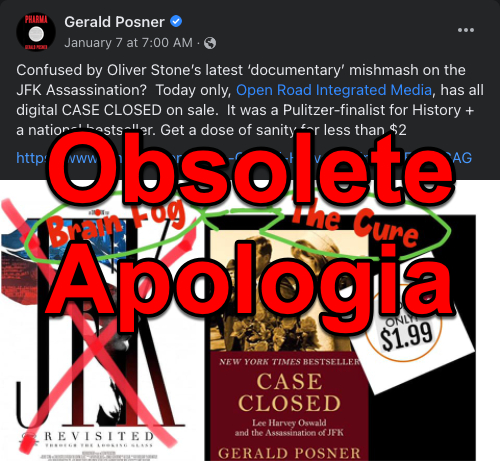
As could have been predicted, JFK Revisited is knocking the deniers sideways, to the point that people like Max Boot, and now Gerald Posner, cannot tell time. On January 8th, Posner tried to counter the smashing success of Oliver Stone’s appearance on Joe Rogan and the ringing endorsement given to him by Glenn Greenwald. Together, Rogan and Greenwald reached an audience of well over 3 million people. This is what Posner posted on his Facebook page:
Confused by Oliver Stone’s latest ‘documentary’ mishmash on the JFK Assassination? Today only, Open Road Integrated Media, has all digital CASE CLOSED on sale. It was a Pulitzer-finalist for History + a national bestseller. Get a dose of sanity for less than $2.
Underneath that post, he pictured the poster of JFK Revisited and placed a label on it as “brain fog.” Next to that was a photo of the cover of Case Closed with the label “the cure.”
On his page, there are posts you can comment on. There was no way to comment on this particular post. He had closed them down., for good reason. It’s an inane, carnival barker type of post. Sort of like Max Boot, Posner has lost his space/time moorings. Recall, Boot had John Kennedy trying to topple Patrice Lumumba in Congo, when, in fact, Lumumba had been killed before JFK took office. Well, Posner published his book in 1993. The Assassinations Records Review Board was appointed and began work in 1994. They stayed at work until 1998. They declassified 60,000 documents, making up a repository of 2 million pages. JFK Revisited is largely based on their work product. So how the heck could Posner’s book be used to counter the discoveries in the film based on the work of the ARRB? If anyone has “brain fog”, it’s Posner.
Let us use some examples of Posner’s brain fog:
-
In perusing the index to his book, Posner does not mention Dorothy Garner. How could he? Her interview with Justice Department lawyer Martha Stroud was discovered in 1999 by author Barry Ernest. It corroborates the alibi evidence supplied by Vicki Adams and Sandy Styles, who worked at the Texas School Book Depository. That document destroyed the Warren Report’s false presentation of the Adams and Styles time frame for being on the stairs after the assassination, one which Posner dutifully recites on page 263 of his book. Barry clearly demonstrates this in the film. (See also The Girl on the Stairs, pp. 214–18). What makes it worse is that Barry proves that the Chief Counsel of the Warren Commission knew of the Garner interview in the summer of 1964.
-
Posner mentions the name of John Stringer in his book. Quoting chief pathologist Jim Humes, he says that Stringer’s autopsy photos were never touched and, therefore, Posner writes, “they provide proof positive of the President’s wounds…” (Posner pp. 300–01) He then says that Stringer verified the autopsy photo inventory in 1966. What he cannot write is that Stringer denied that the 1966 photographic inventory was intact before the ARRB, as Humes did before both the HSCA and the ARRB. Stringer said that he knew the 1966 inventory was not intact, but he was told to sign it. So, he did. (Stringer ARRB Interview, 7/16/96 pp. 136–37; Humes’ ARRB interview of 2/13/96 pp. 96–97)
Because of the ARRB, this record now gets worse. Doug Horne was in the room when the ARRB’s Chief Counsel Jeremy Gunn conducted his landmark deposition with Stringer. As Doug describes in JFK Revisited, under Gunn’s questioning, official photographer Stringer ended up denying that he photographed the extant pictures of President Kennedy’s brain and he did this on no less than five evidentiary grounds. Two of them were that he did not use the film utilized in the present National Archives pictures and he also did not use the photographic technique used to take these extant photos. (Horne, Inside the ARRB, pp. 803–10) Therefore, once this is established, the film asks the logical questions: Who did take them, and why? How could one ask those questions before the Gunn/Stringer deposition?
-
In discussing the so-called Magic Bullet, that is Commission Exhibit 399, Posner used Vincent Guinn’s Comparative Bullet Lead Analysis test to argue for both its authenticity and its trajectory through both Kennedy and Governor John Connally—who was in front of the president. In Case Closed, Posner rhapsodized about Guinn’s work. He called it “indisputable evidence” that CE 399 had not been planted and “it had traveled through Connally’s body…” (pp. 340–42) This has turned out to be pure bunk. The entire scientific underpinning of that test has been shown to be utterly false, so much so that the FBI will not use it in court again for fear of its agents being indicted for perjury. This was done by the team of metallurgist Ric Randich and statistician Pat Grant. (Federal Lawyer, Nov/Dec, 2007, pp. 66–68)
But beyond that, in Posner’s discussion of CE 399, I could not locate the names of Bardwell Odum or Elmer Lee Todd. These two men are crucial in exposing the fraud of CE 399 and the fact that the FBI misrepresented the provenance of this bullet. As JFK Revisited demonstrates with new evidence, the FBI lied when it said that agent Bardwell Odum had shown CE 399 to the two men who first encountered it at Parkland Hospital: Darrell Tomlinson and O. P. Wright. Odum told Gary Aguilar and Josiah Thompson that he did no such thing. And, in fact, Wright previously denied to author Thompson that CE 399 was the bullet he turned over to the Secret Service. (The Assassinations, edited by James DiEugenio and Lisa Pease, pp. 282–84) JFK Revisited also proves, through the work of the late John Hunt, that unlike what the FBI states in the Commission volumes, agent Elmer Lee Todd’s initials are not on the bullet. And since he was the agent who delivered it to the FBI lab on the night of the assassination this is inexplicable. What is even more inexplicable is the fact that the lab already had the “stretcher Bullet” an hour and twenty minutes before it was allegedly delivered by the Secret Service to Todd. As Dave Mantik asks in the film: How is that possible? (James DiEugenio, The JFK Assassination: The Evidence Today, pp. 248–50) If all these discoveries by Hunt, Aguilar, and Thompson came after 1993, then how does Posner’s book counter this new evidence? With people like Odum, Todd, and O. P. Wright not even in the index of his book?
JFK Revisited demonstrates all the above about CE 399 through Gary Aguilar, who interviewed Odum, and with documents that people like Aguilar, Thompson and Hunt produced. In other words, it is all done with primary sources. So, the questions then become: Why did the FBI lie about the identification of the bullet? Why did the FBI lie about Todd’s initials being on CE 399? How could CE 399 be delivered to the FBI lab after they already had it? And the ultimate question: who planted the bullet? And likely on the wrong stretcher. (Don Thomas, Hear No Evil, pp. 392–99) And make no mistake, CE 399 is utterly crucial to the Warren Report.
What makes all of the above even worse is the fact that Posner is a lawyer! Therefore, he has to know what the rules of evidence are. He was educated at a California law school, so he knows what a 402 hearing is. This is a pre-trial procedure where the defense has the opportunity to challenge the evidence the prosecution is going to present. There is simply no chain of custody for CE 399. And if in fact it would be presented at trial, it would be destroyed upon cross-examination.
Posner also has to know that if a photo or illustration is to be presented at trial, the person who took it would have to testify that this is the picture he took. Well, Stringer’s testimony would show that the pictures of the brain in evidence were not taken by him, which would open the door to a line of questioning that would likely get the prosecution’s case thrown out of court. For if someone else took the pictures, then that would lead to the questions of who did so and why? To use one example, which is described in JFK Revisited, ARRB witness Sandy Spencer did see other autopsy pictures which were different than the ones in evidence today. (William Matson Law, In the Eye of History, pp. 429–33) As Jeremy Gunn told Doug Horne, he thought Spencer was the best witness the ARRB had. Again, Spencer’s name is not in the index to Posner’s book. How could she be?
Finally, as any lawyer will tell you, when one has an independent alibi witness like Garner, it makes it hard to disprove time and place. The Commission knew this, which is why their Chief Counsel, J. Lee Rankin, buried the evidence of Garner’s interview with Stroud. Does it get much worse than that? See if that bit of information is in Posner’s book.
For Posner to either ignore or completely discount the above is simply preposterous and it reduces his book to rubble. But it’s even worse than that. As an attorney, he has to know its value in court. In all probability, this much fraud would have gotten the case against Oswald thrown out. On that basis, let me extend a challenge to Gerald. I will agree to debate him at a public venue in either Los Angeles or San Francisco and he can bring former Commission attorneys Howard Willens, Burt Griffin, and David Slawson with him. I would only ask that I be allowed to choose one other person. In other words, it would be 4–2 in their favor.
Gerald can contact me through Oliver Stone’s office or the Kennedysandking.com website. I eagerly await his communication. In my view, the interest is this would be so high it would be broadcast on radio and TV.
I predict that call will never come, because if they did show up they would be shown to be, at best, clowns, at worst, charlatans. And their books, Case Closed and the Warren Report should be in the fiction section of any library.
Appendix (from Jim Lesar):
(Click here if your browser is having trouble loading the above.)
-
-

The Post and the 30th Anniversary of JFK
On Sunday, May 19, 1991, the Washington Post published a feature story by George Lardner in its Outlook section. It was titled “On the Set: Dallas in Wonderland.” Lardner had visited the set of Oliver Stone’s film JFK while it was shooting in Dallas. His lengthy article pretty much gave a blast off to the long, sustained MSM preemptive strike against a film that the public would not see for seven months. This phenomenon was unprecedented in the history of cinema, before or since. And Lardner’s attack was total. He even wrote the following (shocking) sentence about the film’s major thesis: “There was no abrupt change in Vietnam policy after J.F. K.’s death.” (Click here for details)
On December 22, 2021, Ann Hornaday published a feature story in the Sunday Arts section of the Washington Post. It was titled, “JFK at 30.” The extended subtitle was “Oliver Stone and the lasting impact of America’s most dangerous movie.” Her article was softer in tone than Lardner’s superheated polemic. But as far as the film went, and the state of the JFK case today, there is not much difference in effect.
Perhaps the worst aspect is when Hornaday makes an attempt to somehow link the film to what happened at the January 6th insurrection. She says that JFK “did not invent alternative facts, deepfakes, or Deep State paranoia. But its form and content surely anticipated them and helped usher in an era when audiences would increasingly accept them as reality.”
Only someone wishing to ignore rightwing conspiracy movements could write such a statement. In 1991, when JFK was released, Rush Limbaugh’s radio show had been nationally syndicated for three years. A year later, in 1992, Limbaugh would launch a TV version of his show. Recognizing Limbaugh’s success, approximately four years after that, Roger Ailes convinced Rupert Murdoch to launch Fox News Channel. Limbaugh and Fox were used to attack scientific concepts like global warming, to defend Donald Trump after the Unite the Right rally in Charlottesville, and to spread 2020 election fraud allegations. It is this kind of propaganda—furthered by Fox imitators OAN and Newsmax—that led to the insurrection, which was planned and exacerbated—even while it was happening—by the Mercer family backed Parler online service. (Click here for details)
This false attribution angle is complemented by her comments about Stone’s portrait of President Kennedy, which she says, “has been called the mother of all counterfactuals.” Why? Because Stone thinks that Kennedy would have stopped the war in Vietnam, aggressively pursued civil rights, and curtailed the Cold War. If Kennedy pulling out of Vietnam is “counterfactual” one has to wonder why the following illustrious scholars also support that thesis: Gordon Goldstein, Howard Jones, David Kaiser, James Blight, and David Welch. And why did a man she uses to denigrate Stone, Tim Weiner, write this headline in the New York Times on December 23, 1997: “Kennedy had a Plan for Early Exit in Vietnam.” The reason Tim wrote that article was because the Assassination Records Review Board had just declassified scores of pages of documents from the May 1963 SecDef meeting in Hawaii. At that meeting, Defense Secretary Robert McNamara was collecting Vietnam withdrawal schedules from the Pentagon, CIA, and State Department. Schedules he had requested months earlier.
As per Kennedy and civil rights, again, this is not at all counterfactual. President Kennedy did more for civil rights in three years than Franklin Roosevelt, Harry Truman, and Dwight Eisenhower did in three decades. This is simply a matter of historical record. It is also historical record that, after the tearing down of Jim Crow in the south, President Johnson altered Kennedy’s plans for the second stage of his program—with deleterious effect. (Click here for details)
Finally, Kennedy was trying for a détente with the USSR and a rapprochement with Fidel Castro at the time of his death. For the latter, Hornaday could have made reference to the people involved, like William Attwood and Jean Daniel. (Peter Kornbluh, Cigar Aficionado, September/October 1999) As per the USSR, she could have consulted another negative critic she uses, namely Tim Naftali. In Naftali’s book, One Hell of Gamble, he revealed a secret communication that was sent to the Kremlin through Kennedy family friend William Walton. That letter originated a week after the assassination with Robert Kennedy and Jackie Kennedy. It said that they did not buy the MSM story about Oswald alone killing JFK. They suspected a large rightwing domestic plot, but they knew that the new president, LBJ, was too close to big business to continue the détente that JFK and Nikita Khrushchev had begun. Therefore, Bobby would resign as Attorney General, gain electoral office, and then run for the presidency and that he would then continue it, which is what RFK did—and Jackie did not want him to do. (Naftali and Aleksandr Fursenko, pp. 345, 402; David Talbot, Brothers, pp. 30–34) She ended up being correct in her prognostication. If this happened as previously outlined, how is it counterfactual?
About the original release of Stones’ film, she says that Warner Brothers launched a “Free the Files” campaign which shrewdly detracted from a negative press. That campaign began the day the film was first shown. For at the end of the picture, a crawl was attached which said that the files of the House Select Committee on Assassinations (HSCA)—the last official inquiry into JFK’s murder—were classified until the year 2029. The public reaction to that information was electric. Capitol Hill was deluged with phone calls, faxes, and telegrams outraged that this secrecy could still be going on. To give just one example: when the chairman of the HSCA, Congressman Louis Stokes, saw the film with his daughter, she asked him: “Why did you do that Daddy?” Stokes ended up being one of the prime backers for the creation of the Assassination Records Review Board (ARRB). The Board’s function was to do just that—attempt to declassify all of those still secret documents. According to ARRB employee Doug Horne, Stokes met privately with the five person panel and urged them to reinvestigate the medical evidence in the case. Since, according to Stokes, no one on his committee was satisfied with what they had done in that regard.
This leads us to the subject of the ARRB. Using Naftali as a source, Hornaday says that Donald Trump delayed the ultimate release of the still withheld ARRB files for three years. What happened was this. By law, everything was supposed to be released in October of 2017. President Trump had tweeted about how he was looking forward to doing just that. He was the only person who could delay that release. On the day it was supposed to occur, he did just that—he delayed it for a period of 6 months. When that interval was over, he then added another three years to the extension. One would think 3 1/2 years would be enough to sort through the files. Apparently, it was not, because, in October of 2021, President Biden delayed it for two more months. In December, he only released about 10% of what was still being withheld. The rest was postponed until October of next year. In other words, if all is finally released then, we will have waited almost five years beyond the legislated release date to see what was in these files. And what is the guarantee that Biden will not delay it further at that time?
Concerning what was in some of the previously released files, she says that Clay Shaw—who Jim Garrison prosecuted for conspiracy in the JFK case—had once worked with the CIA. The implication being that at the time of the assassination or afterwards, he had not. One of the ARRB declassified files revealed that Shaw had a covert security clearance—and it was valid in 1967. (William Davy, Let Justice de Done, p. 195). Through its CIA specialist, the ARRB also learned that the Agency had destroyed Shaw’s 201 file. (ARRB memorandum of November 14, 1996 by Manuel Legaspi) Since the Shaw case figures rather expansively in the 1991 film, and the defendant denied he had worked for the CIA, one would think that this would be relevant information for her article.
Quoting Tim Weiner, the former New York Times reporter says the thesis of the film is a lie, but yet many people believe it. Hornaday then mentions the whole Weiner/Max Holland mythology about Garrison’s case being initiated by a KGB planted story in an Italian newspaper. Since Garrison arrested Shaw before that story was printed, and was investigating Shaw for about three months prior to its publication—and there was no contact between the two entities prior to publication—the reader should find the logic of all this rather puzzling. (For a detailed explanation of how Holland duped The Daily Beast, click here) And as I have previously noted, for anyone to take Holland seriously after he produced one of the worst documentaries ever on the JFK case is simple MSM fruitiness. Holland’s program was so bad that even Warren Commission zealots decried it. (Click here for details)
Writing about Stone’s dark 1991 portrait of Lyndon Johnson, and consistent with an emerging pattern, Hornaday now goes to Mark Updegrove. Mark was the Director of the Lyndon Johnson Library and Museum for eight years and is president and CEO of the LBJ Foundation in Austin. Predictably, he says that Stone’s film was,
…seminal insofar as it legitimized wide-eyed conspiracy theory and set a great precedent in how far we could push film to depict history, or purport to depict history. And that was a dangerous and irresponsible precedent.
Everything in Stone’s JFK about the Vietnam War, and Johnson’s actions involving it, has proven to be accurate. For example, the scene where Johnson tells the Joint Chiefs, “You just get me elected and I’ll give you your damned war” was taken from the 1983 edition of Stanley Karnow’s book Vietnam: A History (p. 326)
The most recent scholarly work in the field is even more convincing in this regard. In 1962, Johnson was getting the true data on how poorly the war was proceeding, not the false numbers that showed it was going well. (John Newman, JFK and Vietnam, 2017 edition, p. 223) But in 1961, the vice president had visited Saigon and, in conjunction with the Pentagon, had suggested to President Diem that he request American combat troops to help fight the war. (Newman, pp. 73, 77) This is something Kennedy had not authorized and would never authorize. In Virtual JFK, the authors’ quote a 1964 tape in which Johnson literally says that he disagreed with Kennedy’s policies in Vietnam, especially his decision to withdraw in a losing situation. (Blight, pp. 305–10) A month after this, in March, LBJ authorized the drafting of NSAM 288. This planned a great militarization of the war, including a full scale air war against Hanoi. It meant that “the administration has rejected all thought of a graceful withdrawal.” (Fredrik Logevall, Choosing War, p. 129) What was left to enact NSAM 288 was a declaration of war. The Johnson administration was drafting just that—three months before congress passed the Tonkin Gulf resolution in August. (Edwin Moise, Tonkin Gulf and the Escalation of the Vietnam War, pp. 26–27) As noted above by Blight, not only did Johnson know he was breaking with Kennedy’s policy, but he also took pains to conceal it. Again, Stone’s portrait of Johnson in relation to Vietnam was accurate. And has been both proven and bolstered by later document releases and research.
She also says that somehow the conspiratorial framework of the film, that is a plot between the CIA and Joint Chiefs, has been debunked. She does not say where or by who, but to name some prominent people in the critical community who subscribe to, or had subscribed to, this general concept: attorney Stanley Marks, attorney Vincent Salandria, author Doug Horne, author Jacob Hornberger, Professor John Newman, and myself. In the long version of JFK Revisited: Destiny Betrayed, Stone backs this up with more evidence. She also says that JFK Revisited does not prove that Allen Dulles was a part of the plot. One of the featured speakers in the film, David Talbot, does make that case in his book The Devil’s Chessboard. All she had to do was call him as she did Tim Wiener or Mark Updegrove. Evidently, she didn’t.
She never called the screenwriter of JFK Revisited either, even though I left her an email and asked her to do just that. If she had done so she could not have written that the documentary includes what Stone “insists” is new evidence. Since I was involved in researching the script, arranging the interviews and posing the questions, I could have told her just what was new, how it was new, and what it meant to the calculus of the case (e.g. in dealing with CE 399, the testimony of Commission witness Victoria Adams, and the ARRB sworn deposition of autopsy photographer John Stringer). Respectively, it means that there is no chain of custody for the magic bullet and the FBI lied about it; that Dorothy Garner, Adams’ supervisor, supported her testimony, which gave Lee Oswald a formidable alibi for the time of the shooting; and that Stringer did not take the photos of Kennedy’s brain in the National Archives. Which begs the questions: Who did and why? There is no ”insisting” about this. It is all new—made possible by the ARRB.
In 1991, George Lardner gave Oliver Stone a slap across the face with his open hand. In 2021, Ann Hornady gave him a backhand wrapped in a velvet glove. After Max Boot and this, it’s pretty clear that, thirty years after Stone’s film, The Washington Post cannot accept the facts—old or new—about what happened to President Kennedy.
-
Max Boot vs JFK Revisited
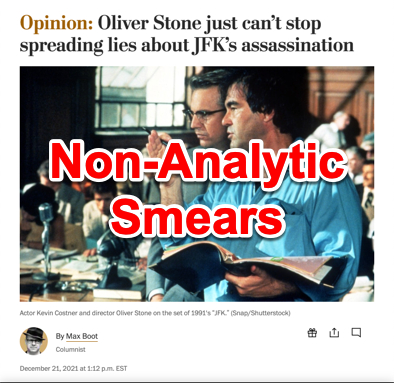
On December 21st, the Washington Post decided to publish an opinion piece by columnist Max Boot about Oliver Stone and his new documentary JFK Revisited: Through the Looking Glass. Like Alecia Long before him, and Tim Weiner in Rolling Stone, there was little pretense of Boot writing any genuine criticism. (Click here for a reply to Weiner and here for one to Long) After all, the title of the column accused the director of telling lies about JFK’s assassination. Boot then called Stone a demagogue and compared his work to that of Leni Riefenstahl. When a writer stoops to this kind of name calling by the first line of his second paragraph, one knows what lies ahead is going to be a non-analytical smear.
In the second paragraph, Boot calls Stone’s 1991 film JFK “the most deceitful film ever produced by a major Hollywood studio.” This for a film that won two Oscars and was nominated for eight. And, as far as Max is concerned, that disposes of that.
Except it doesn’t. When one compares the director’s cut of that film with the declassified record, one will see that compared to other true story films (e.g. The Untouchables), Stone’s film does not use an excess of dramatic license. The hyperbole used in that regard is so exaggerated as to be dismissed as an outburst of collective journalistic hysteria. The truth is that the people making these charges knew next to nothing about the JFK case or what happened in New Orleans with Oswald in the summer of 1963.
I know this since I am aware of those matters and did a comparative analysis of the first 16 scenes of the film with the new records made available by the Assassination Records Review Board (ARRB). There are some things which appear later in the film that I would have advised Stone not to use, but there are also things that are clearly labeled as speculation or presented as theorizing. (James DiEugenio, The JFK Assassination: The Evidence Today, pp. 190–94) To point out one major strand of JFK which was vehemently attacked at the time: all the material pertaining to the Vietnam angle is accurate. And further work in this field has made Stone’s thesis even stronger. (Click here for details)
Therefore, at the start, Boot shows what he is writing is bombast, playing to the crowd. In referring to the declassification process, he cannot even spell out the term Assassination Records Review Board. Or inform the reader that the Board declassified 60,000 documents and two million pages of material. Yet today there are still approximately 14,300 pages being withheld from public view: 58 years after Kennedy’s assassination.
Max then writes this whopper:
What has come out so far has done nothing to shake the conclusion reached by all credible investigators that Oswald was the lone gunman.
How does he know? Has he read the two million pages? It’s this kind of arrogance that has made a large part of the public so sick of the MSM that they have turned to alternative forms of media for information.
The other part of Max’s charade is this: He does not tell the reader anything that is in the film based on this new information. If he did, he’d expose his charade, because the ARRB did not just declassify 2 million pages of either redacted or completely classified documents. They were also able to conduct inquiries into ambiguities in the evidence. Therefore, they did an investigation into the autopsy of President Kennedy. Two of the witnesses they deposed under oath were FBI agents Jim Sibert and Frank O’Neill, who were present at the Bethesda morgue that night. Both men stated that they observed a large defect in the right rear of Kennedy’s skull. In their declassified interviews with the House Select Committee on Assassinations (HSCA), both men said the bullet in Kennedy’s back did not exit his body. (Doug Horne, Inside the ARRB, pp. 681, 685)
The agents had nothing but scorn for Arlen Specter of the Warren Commission. They were angry because neither testified before that body. They both felt this was due to Specter, since he knew what they would say would contradict his pre-ordained conclusion. They also both learned that Specter had, to put it gently, misrepresented their testimony to the rest of the Commission in order to keep them from testifying. (Horne, pp.702–05)
When the reader is presented with their evidence, one can see why Specter did not want them deposed. First, there is no autopsy picture of the skull wound they describe; a wound which would indicate a shot from the front. Secondly, their testimony vitiates the Single Bullet Theory that Specter needed to construct. If the bullet in the back did not transit Kennedy then Specter’s theory is simply untenable: another bullet hit Governor John Connally and there was a second assassin. JFK Revisited refers to this testimony. But Max Boot doesn’t reveal it to the reader, probably because it would “shake the conclusion reached by all credible investigators that Oswald was the lone gunman.” Or, in plain English, it would show that Max is a poseur.
Another episode in the film that would “shake the conclusion reached by all credible investigators” is the fact that there were two plots to kill Kennedy prior to Dallas. They both occurred in November of 1963. One was in Chicago and one was in Tampa. As essayist Paul Bleau demonstrates in the film, both of these failed attempts had remarkable similarities to what finally succeeded in Dallas. For example, in Chicago the profile of the fall guy—Thomas Vallee—resembled Oswald.
And the FBI informant who helped thwart the Chicago plot was codenamed ‘Lee’. (James Douglass, JFK and the Unspeakable, pp. 204–07)
In Tampa, the suspected patsy was Gilberto Lopez. As Oswald was the organizer of the Fair Play for Cuba Committee (FPCC) branch in New Orleans, and its only member, Lopez was a pro-Castro Cuban who attended meetings of the Fair Play for Cuba Committee. He had been hospitalized that year for an epileptic condition. He was in Tampa on the day of Kennedy’s long motorcade route which went past the 23 floor Floridian Hotel. According to Secret Service expert Vince Palamara, the authorities had men on every floor of that hotel due to information about a threat on Kennedy’s life. Afterwards, Lopez went to Texas, and on the night of the assassination, he crossed the border at Nuevo Laredo into Mexico. With money loaned him by the FPCC, he was the only passenger on a Cubana airlines flight from Mexico City to Havana on November 27th. The Mexican authorities later wrote he was acting suspiciously and they had an informant who said he was involved in the Kennedy case. (Michael Benson, Who’s Who in the JFK Assassination, pp. 256–58; see also Daily Mail, September 3, 2019, article by Daniel Bates) On December 3rd, the CIA was alerted to run “urgent traces” on Lopez. Both the Church Committee and the House Select Committee on Assassinations found that, while the Warren Commission was in its most active stage, reports were “circulating that Lopez had been involved in the assassination.” (HSCA Final Report, pp. 118–21)
JFK Revisited: Through the Looking Glass, is the first broadcast documentary to include these prior attempts. For whatever reason, both were covered up at the time. If that had not been the case, it is quite possible that the successful attempt in Dallas would not have occurred. The reason being that the similarities to the prior instances were obvious enough that Oswald would have been removed from the motorcade route. Somehow, Max Boot does not think this information merits public attention.
The film proves matters that Boot labels “lies.” It proves that CE 399, the Magic Bullet, was not fired in Dealey Plaza that day and would not have been accepted into a court of law. It does the latter through an instructor in criminal justice and also the illustrious criminalist Dr. Henry Lee. The film proves that James Humes, the lead autopsist, destroyed both the first draft of his report and, even worse, his autopsy notes. It also shows that Pierre Finck, another Kennedy pathologist, had his notes pilfered. The film illustrates, with blown up photos, points of evidentiary discrepancies not officially explored in the so-called backyard photographs of Oswald. In the forthcoming 4-hour version, the documentary will present the late CIA officer Tennent Bagley’s analysis of the routing of the CIA file on Oswald and his conclusion that he was a false defector.
For Max Boot to write that the information in the film was debunked by Gerald Posner in his book Case Closed is the height of MSM clownishness on the JFK case. That was not possible, since Posner’s book was published before the ARRB went to work. For Max to use the late Vincent Bugliosi to pose the question of why there were no extra bullets discovered is about as silly. In the long version of the film, to be released in America in February, we will show that there is evidence that an extra bullet was recovered that evening that made it into the morgue. (Click here for details)
Boot goes off the edge when he writes that the film uses an absence of evidence “as proof of a monumental coverup.” The film clearly demonstrates parts of the cover up that were concealed, but have been revealed by the ARRB. Another example being the hidden statement of Dorothy Garner, the supervisor to Victoria Adams and Sandra Styles at the Texas School Book Depository. As author Barry Ernest states in the film, she backed up what Adams and Styles officially stated: that they were on the stairs of that building about 15–30 seconds after the shots were fired. Therefore, in all probability, they would have seen or heard Oswald coming down those rickety wooden steps, if he had been on the sixth floor. They didn’t. The presentation of this evidence by Mr. Ernest is a major segment of the film. How Max missed it, or deemed it unimportant, is inexplicable.
Boot ends his column by saying that the film theorizes that Kennedy was a “peacenik” who was trying to end the Cold War. This is not a theory. The film shows with new evidence that JFK was planning to withdraw from Vietnam; his policy to keep the Congo free from imperialism after independence; and his attempts at rapprochement with both the USSR and Cuba in 1963. The film uses excerpts from Kennedy’s famous Peace Speech at American University in June of 1963, where he clearly called for outreach to Moscow. After his death, the last two policies were abandoned and the first two were dramatically reversed—with disastrous results. The upcoming 4-hour version of the film goes into this issue in more areas and at greater length. Boot tries to neutralize all this by using the speech Kennedy made it Fort Worth the morning of his assassination. I hate to tell Max, but if a president goes to a city that relies on defense spending for jobs, he makes a speech about defense spending, especially if his election is coming up the next year. Max ignores Kennedy’s planned speech in Dallas for that afternoon, where JFK was to speak against the John Birch Society, about leadership and learning, about the importance of foreign aid to developing nations, the pursuit of peace, and how military might is secondary to maintaining a just and righteous society.
It is predictable that Boot would cherry pick the speeches, since he was and is a neocon. He was a former member of the calamitous Project for the New American Century, which advocated for American intervention in Iraq as far back as the Clinton administration. He was also part of the mythologizing about Saddam Hussein’s weapons of mass destruction as a pretext for that debacle. Boot championed intervention in Afghanistan and opposed withdrawal. He had no problem with Hillary Clinton’s unmitigated disaster in Libya. He also agreed with her advocacy of direct American intervention in Syria. As several have said, there has scarcely been a war that Max Boot did not like—no matter how bad the results were. And they do not get much worse than Iraq or Libya.
This helps show why Boot cannot be trusted with anything dealing with Kennedy. In 2018, in his hagiography of Ed Lansdale, he wrote that JFK had tried to topple Patrice Lumumba in Congo. (The Road not Taken, p. xxvii). As with Posner debunking the ARRB, this was not possible. How could it be? Lumumba was assassinated before President Kennedy took office. One of the reasons the CIA took part in his murder was because they feared that Kennedy would back Lumumba once he was inaugurated. (John Morton Blum, Years of Discord, p. 23)
As the reader can see Max Boot is in no position to accuse anyone of telling lies about JFK.
(Click here for Max Boot’s twitter feed)