Quebec City, June 14 2022
The eminent panel spoke before select members from academia and media. See below.

Quebec City, June 14 2022
The eminent panel spoke before select members from academia and media. See below.

As most of you know, Edward Epstein rather quickly did a 180-degree somersault on the JFK case. After writing his valuable book Inquest in 1966, he then turned around and turned Warren Commission defender in quite a hurry. According to Vince Salandria, it was about a year or so later. And he never let up. He wrote one of the first anti-Jim Garrison books called Counterplot, that was first excerpted in The New Yorker.
Because of that book, Epstein was in the front ranks of Oliver Stone’s attackers when his film JFK came out in 1991. For instance, at a public debate in New York, sponsored by The Nation, he was Victor Navasky’s lead attack dog against Stone. This was pretty much a witless farrago, since Navasky had never had very much interest in or sympathy for critics of the Warren Commission. Between Epstein and the late Chris Hitchens, the event was really an intellectual disgrace.
When Jim Garrison passed on a year later, Epstein wrote an article smearing him in The New Yorker. About a year after that, he wrote another hit piece for The Atlantic. The excuse for this one was that Stone was coming out with a double tape VHS box of JFK. Because of this widened focus for the second article, Epstein could now use the occasion to broaden his focus to the celebrated director and one of his chief consultants, namely Fletcher Prouty. (For my reply click here)
After trying to attack Prouty, and—as I proved in my reply pretty much falling on his face—Epstein tried to say that Fletcher thought that Leonard Lewin’s 1967 book Report from Iron Mountain was a work of non-fiction. According to Len Osanic, the expert on Prouty, this is simply not the case. (Click here here for Len’s website on Prouty) And in fact, when Len was setting up his fine Fletcher Prouty site, Fletcher insisted that he include a link to a 1972 New York Times story with Lewin saying the book was a satiric novel. Len also has a show in his Archives—Program 825—in which Prouty says four times that the book is a novel.
But Fletcher appreciated the satiric edge of Lewin’s book, which was the idea that if a lasting peace could be achieved, it would not be in the best interests of society to achieve it. War was a basic part of the American economy. Lewin’s book was a New York Times bestseller and has been translated into 15 languages. US News and World Report (11/20/67) stated they had confirmation that the report was real and that President Johnson hit the roof when he read it. John Kenneth Galbraith was one of the advisors to the book and he tried to further the deception about it in an article in The Washington Post. ( 11/26/67)
Fletcher Prouty appreciated the point of the satire. Since he knew officials at the Pentagon who acted and spoke like the people in Lewin’s book: We cannot abandon the warfare state. And, in JFK, he used some of these dictums voiced through Donald Sutherland as Mr. X in the famous scene in Washington where X tries to explain why John Kennedy was killed. Mr. X of course was based on Prouty.
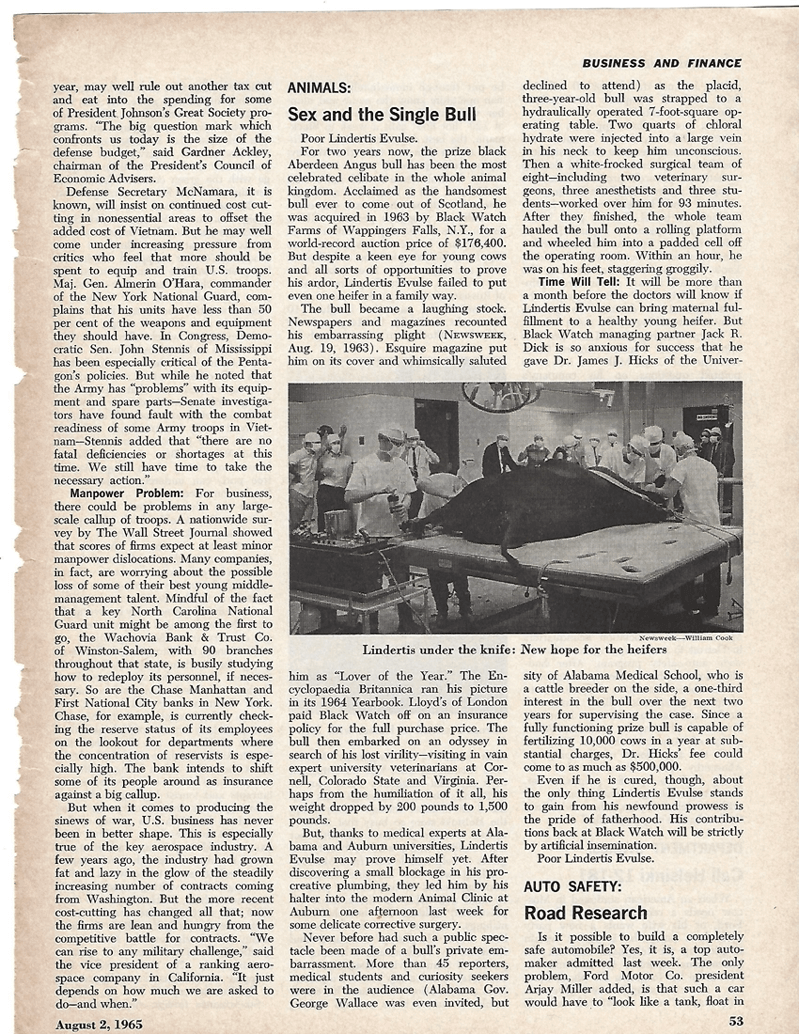
Fletcher Prouty also wrote about the transformation that took place after Kennedy’s death. For instance, concerning the war in Indochina and how that fed the war machine. And conversely how that would not have happened if JFK had lived. Reader James Finn has clipped two valuable stories from the MSM that illustrate the point Fletcher was making, namely that Kennedy’s withdrawal plan was already impacting the war economy. And the second story shows how his death turned that deceleration around in a hurry. Predictably, it appears that Epstein was wrong about that and Colonel Prouty was correct. One more posthumous feather in Fletcher’s cap. And thanks to Mr. Finn.
“What Can Industry Do As Pentagon Cuts Back?”
Newsweek October 7, 1963


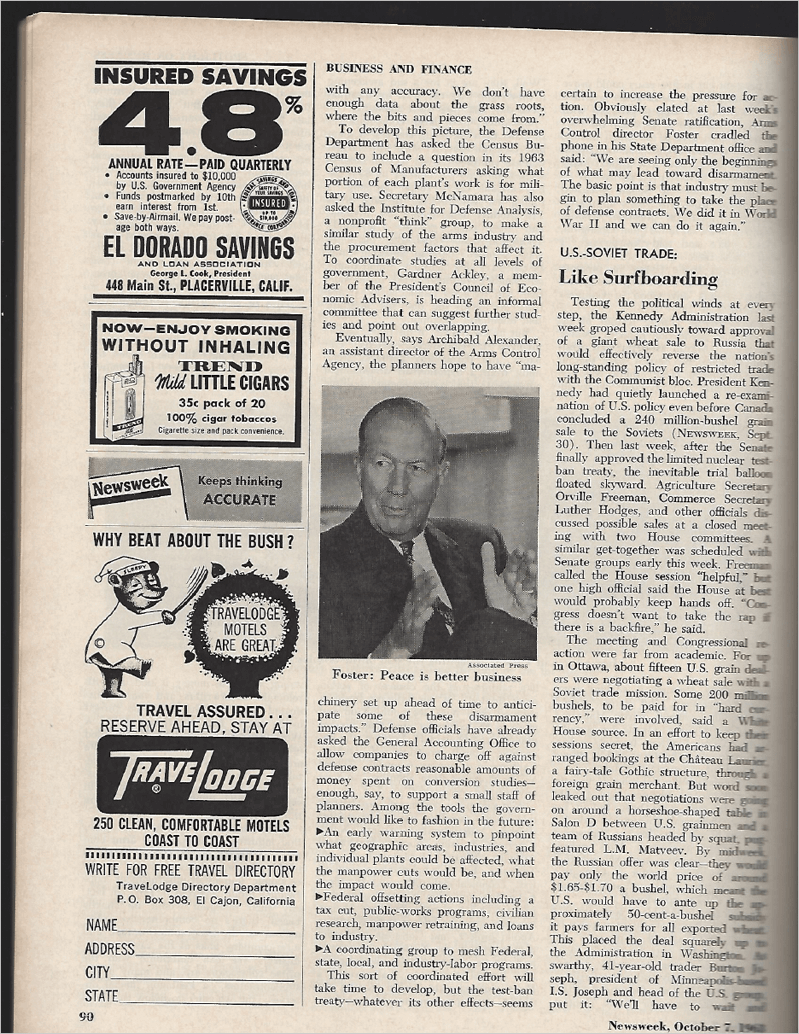
“War’s Widening Ripples”
Newsweek August 2, 1965



see Part 1
The Panel Discussion
That afternoon Oliver, Jim, and I would be part of a panel animated by rising TV star Rafael Jacob in a small, packed venue of some 73 members of academia, assassination buffs, journalists who were there by invitation only.

The atmosphere was electric, friendly, and focused. Many in the audience had been enthralled by Stone’s movies. I believe that one question I asked the audience that helped us gauge their level of knowledge was how many of them had seen the Zapruder Film. Just over 50% raised their hands. This really helped us adjust our explanations in accordance to who was there.
The audience heard compelling evidence that there was a front shot, that Oswald was intel-linked, and that what history books were relating to students (mostly the Lone Nut scenario) was unconscionable. Rafael at first wanted to have all three of us on for fifty minutes and then only Oliver for the second half. He revised himself, the audience was so entertained by what they had heard that he announced that all three of us would be there all the way through.
During the break I had time to chat with Oliver.
Paul: How are you doing Oliver?
Oliver: There is not enough oxygen in the room.
Paul: Jim and I have your back. Have fun, they love you.
Oliver: Thanks.
The main highlight in the second half was the projection of a grainy, three-minute testimonial by Abraham Bolden, the first black secret service agent, who had been hand-picked by Kennedy and had been railroaded into jail for trying to tell the Warren Commission what he had witnessed in terms of suspicious behavior by some members of the Secret Service in and around a planned presidential trip to Chicago—something I had discussed in the documentary.
It took a while for Oliver to understand that this was Mr. Bolden until he thanked Mr. Stone for helping him get a presidential pardon one month earlier. There was an eruption of applause in front of Oliver, whom I was told was misty eyed.
The panel ended with warm applause, handshakes, and photo requests. Rafael told Jim that we should do a road show. I received a number of heartfelt congratulations. Over seventy people who would now have serious doubts when someone would call Oswald the lone assassin of JFK. The onlookers were clearly impressed, including Mr. Jean François Lépine among them.
Back in our lounges:
Oliver: Tell me Paul, who made the Bolden video.
Paul: Len did.
Oliver: Thank you so much, can you send me a copy?
Paul: You bet.
That evening Ken Hall would host us for a special supper at the Château Frontenac. Our goal to celebrate three years of making and promoting the documentary that would help cement the position of conspiracy advocates as measured, logical, and based on a solid foundation of evidence would be met. Everything was first class. We were all content but tired. We needed rest. The next day was our last one, but would be far from the easiest.

June 15
This was the day that would make or break the event. By their count, Oliver and Jim went through some eight interviews that day alone, which seem to have gone rather well according to Jim. However, the organizers were being seriously challenged by some in the media. “In hindsight, given what is raging in Ukraine do you regret hosting a Putin apologist?” was a typical question. Ouch! This was not part of the plan.
In the final analysis, as a friend of mine accurately put it, for many, the event had morphed into a political story instead of being the cultural event it was intended to be. This is what stood out in the final third of a conversation between Mr. Lépine and Mr. Stone: The 600 plus in the audience who had come to learn from one of the greatest contemporary filmmakers instead witnessed a debate about how and why Mr. Stone interviewed dictators, most notably Vladimir Putin.
Before the final event got started, many of us met on the spectacular Le Diamant terrace, where we got to chat, exchange handshakes, take pictures, and enjoy hors-d’oeuvres and refreshments. I got to shake hands with Mr. Bernatchez and wish him good luck in his upcoming career moves and he thanked me for my email message. I also chatted with a dear friend, Lynda Beaulieu, who manages both Le Diamant as well as her famous artist brother Robert Lepage. Of course, our guests would be there, as well as Mr. Lépine, whom I got to meet for the first time.
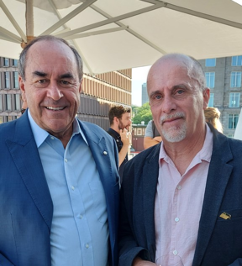
Jean-François Lépine
I cannot do justice to the distinguished, illustrious career of Lépine. (Click here for details)
Just before the interview, he talked to me about how he faced some pressures from colleagues and fought off some dis-information attempts in so many words. He asked me if I heard his Lagacé interview, where he felt compelled to correct a fellow journalist on air and whether I knew so and so who had dug up dirt on the interviewee. Very nice, well-spoken veteran. He had done his research on Oliver and looked forward to the event.
The Interview
At least in part, it was an interview. The intro was dramatic: Two empty golden colored sofa chairs awaiting the stars with music from a Stone movie in the background: beautiful lighting, 600 audience members feeling suspense. Mr. Lépine first entered the stage under a warm applause. He began by defending the event, the audience, and our guest from the criticism by some in the media. He described a legendary filmmaker in glowing terms. He was supported by a four-minute, vibrating video of Oliver`s career. Oliver arrived on stage to a standing ovation. The chemistry between the two seemed good…at first.
While I applaud the interviewer for having done his homework, I was disappointed in the format.
Let me explain: Two years earlier at our college I had the pleasure of receiving Canada’s all-time greatest adman: Frank Palmer. We organized a panel and used the screening of memorable ads: going through the decades our guest toiled away in and would have Frank analyze the commercials that marked each period, many of them his, while he would give anecdotes and provide students with life lessons. It was a beautiful evening for our college in terms of honoring, entertaining, teaching, and involving the audience.
The film lovers would have loved to hear Oliver comment on scenes from his movies that could have been projected for all to see, discuss challenges he faced, actors he directed, awards he won.
The last one third of the evening turned into a testy debate. Mr. Lépine disagreed with Oliver’s “pandering” to dictators when interviewing them. Mr. Stone answered that there would be no interview if he had used Lépine`s approach. Lépine said, “You know that you could never have made a movie like Platoon in countries run by these dictators.” Stone said that, while it is important to show empathy when producing movies or documentaries, it does not mean we agree with the subject. Lépine asked why he did not make a film about Mandela, to which Stone retorted, “because there are already fifty of those out there.” Quebec City meets Oliver Stone had been politicized.
This was not going as I had hoped: A journalist companion of mine found that the guest was always being cut off, Oliver’s wife left for a while in dismay, and an audience member walked down to admonish Mr. Lépine: “I paid to hear Mr. Stone talk, not you!”
The one thing that resonated most with the audience was when Oliver said, “that the problem right now is that the world does not need more escalation, we need diplomacy and peace initiatives which are sadly sidelined.”
The show ended with strong applause from the audience. Mr. Lépine graciously invited Mr. Stone to have a late dinner at the terrace next door. The organizing team followed. Despite the raucous debate that occurred a few moments earlier, the two septuagenarians had a cordial discussion and left one another on good terms.
I had an opportunity to ask Mr. Lépine at this time what he thought of the JFK assassination. He said that he and his colleagues in journalism school thought the Warren Commission was a joke. Another journalist colleague of his sitting beside us nodded in agreement. Mr. Lépine also asserted that the big problem with journalists today was not partisanship, but laziness!
Rafael then talked to me: “Paul you know that none of this would have happened without you!” Pretty heady stuff…a feeling of triumph and mental fatigue overcame me.
After tooting my own horn and those of the contributors during a Black-Op Radio interview with Len Osanic and Jim DiEugenio just a few days after the departures, my initial appraisal of complete success, was tempered somewhat by other reactions that were coming in and that were not so laudatory, counterbalanced by some staggering viewership metrics. The bag was a mixed one, but mostly favorable.
The Aftermath
The documentary ended its promotional tour on a high note with packed venues, enthusiastic applauses, and a visibility unheard of, emanating from a City of less than 1 Million Francophones. The clipping reports from the PR firm confirm that between the dates of June 13 and 21, excluding social media, 27 million impressions about the event were generated. I repeat: 27 million! From my estimates, if we had included social media, media exposure generated from Quebec City since December (keeping in mind that the press release was sent out in around April and that I was heavily interviewed for months), and still more media coming in. The total impressions may indicate nearly twice that number—the 27 million—as a potential audience. If we consider that articles have between 2.5 and 5 times more impact than paid ads, this number is breathtaking. Indeed, I have received congratulatory emails from all over the province.
The other element that is notable were the number of mainstream media journalists, including Mr. Lépine, who were on the record stating things like: Jim Garrison was vindicated, that there were other inquiries after the Warren Commission that indicated that there was a conspiracy, that the Warren Commission was not believable, that there had been a plot.
On Friday June 16th, Mr. Lépine was interviewed on FM 98.5 in Montreal by Alain Crête about the event, where he stated that “the movie JFK caused the declassification of hundreds of thousands of pages of documents and there were government inquiries subsequent to the Warren Commission that exposed a conspiracy, that there was more than one shooter. (Click here for audio) This, my friends, is historical!
Many other journalists who were not specialized or knowledgeable about the assassination were very open to the possibility of a conspiracy. Those who saw the documentary found it very compelling. The only negative press about the documentary that I was aware of came from journalists who had not seen it and used the same tired labels to try and paint conspiracy theorists as quacks.
In Québec, we can now say that U.S. government inquirers and many in our media agree, at least to some degree, with the probability that some sort of conspiracy occurred in the assassination of JFK. At a minimum they have doubts about the lone nut version. This is a huge victory. Kudos to Oliver Stone, Jim DiEugenio, and Rob Wilson.
Where things did take a negative turn, however, was when a fast-emerging side-story became controversial, sparked by Putin’s ill-thought decision to invade Ukraine. This caused Oliver Stone’s interviews with Putin, which ended some five-years ago, to take a lot of space in the press mid-way through the event and during the last interview. Here I have to temper my opinions by the fact that I have not yet seen the interviews. I will do so soon, in order to form a better opinion.
I have however tried to piece together some of the press coverage that has taken place over time and one can note very different reactions: Press coverage varies tremendously when the interviews were first aired some 5 years ago. U.S. press tends be mixed or negative and foreign press is more positive as far as I can see. Here are two examples of coverage:
Stone’s interviews simply give voice to the man behind a country where media objectivity is mediocre at best. If we can count on Russia Today to hem and haw about Washington and the perils of fracking, then so can we count on our political media to do the same about Russia.
Stone takes Putin to task at times, saying he looks like a “fox in a hen house,” when he imagines out loud that there might already be a secret battle between the U.S. and Russia in cyberspace. “I believe cyber warfare can lead to a hot war,” says Stone. “Is Russia doing something about it? Come on, Mr. President, lay it on me…”
Putin tells him, “Maybe. For every action…there is a counteraction.”
From the Figaro:
Vladimir Putin exposed in the last episodes
If the first two episodes seem to boil down to long interviews between the two men where the geopolitics of the last seventy years between the United States and Russia is evoked with “a simple observer’s gaze” deplores the New York Times.
Oliver Stone hardens his tone towards the end of the documentary and obtains from the Russian president his position on the thorny issues of the moment: Syria, Crimea…He even reserved for the end of the documentary, a sequence where he asks him about his involvement in the 2016 US election. A feat praised by the press.
Invited this evening from France 3, Oliver Stone will be able to defend himself from all these criticisms. On the other hand, it is not certain that the “mental power” exercised by the head of the Kremlin and the “hysteria” observed in the United States by the director on the American people are strong enough in France to guarantee France 3 a large audience.
Locally, and abroad, I have not seen any negative comments about Oliver Stone coming to Quebec City before the invasion. Furthermore, the Putin interviews were shown on Showtime and advertised for broadcast on March 19, 2022 by TVQC. (Click here for details) Should these stations be vilified?
Here are some other questions we should ponder:
If you were a journalist, would you have refused the opportunity to question Putin? Even if you knew that there would be rules, constraints and a certain decorum affecting your liberties? Oliver Stone once said, “If Vladimir Putin is America’s greatest enemy, then we must at least try to understand him.”
What other current filmmaker would even say something like that? Oliver can do so based on JFK’s Peace Speech, which no president since has ever come close to.
A message from me and Oliver
Hi all,
Just wanted to thank the students, teachers, and other Sarah Lawrence College (SLC) colleagues who participated in this wonderful moment for our City.
Having spoken to the organizers, audience members, the managers of the three packed venues and the Château Frontenac (SLC partner Ken Hall), and guests, I think this was a real shot in the arm for our city and the Film industry.
While our Oscar winning VIP guest has taken positions that not all of us necessarily agree with (unanimity on issues he discusses is impossible), everyone I spoke to, including many members of academia, came away with wonderful memories of moments they will cherish forever and were especially united around Mr. Stone`s cry for diplomacy and peace.
I wanted to especially thank our own Nancie Moreau for her incredible efforts in hosting, guiding, and comforting our beautiful guests. She gained incredible friends and I believe genuine interest in her wonderful book about Tesla. Two of our SLC students/Bloom members, Amélie Caron and Océanne Côté Garand worked impeccably with the organizers in receiving audience members for a panel discussion and deserve our thanks. They really enjoyed the experience, grew their network, and added another feather in their cap.
Thank you, Ken Hall, Robert Mercure of Destination Québec, Valérie Bissonnette of Vélocité, Martin Genois of the Festival du Cinéma, SLC alumni Geneviève Doré, Rafael Jacob (super animator/interviewer), my daughter Vanessa who was with me every second, my unbelievable financial wizard and SLC friend Martin Brassard who bought 130 tickets and our guests from out west and all their team members.
Looking forward to sharing stories, some public and others behind the scenes.
On that note I wish you all a great summer.
Paul Bleau
Paul,
Appreciate your note. I did have a good time and a warm welcome from your friends. Too bad about Len, but the people I met there stood out. Thanks to Ken Hall, Valérie and Geneviève, and Martin, who was terrific with me. I don’t think I met the other Martin, but thank him, please. It was a memorable trip.
Oliver

June 2019
This is when I was in receipt of a letter from Oliver Stone saying that he was putting together a documentary, as he termed it, a follow-up story, to his 1991 feature film JFK. One part read as follows:
Rob Wilson, Jim DiEugenio, and I are seeking to put this information together under one roof in a documentary that will be clear to John Doe. We’re focused on examining the evidentiary findings of the ARRB and would like to interview you for the film to discuss the Tampa and Chicago assassination plots.
Lastly, as this project has not yet been announced, please keep all of this confidential.
We hope you’ll be able to be part of this film and we look forward to hearing from you.
Best regards,
When I got this message I knew it was genuine because the person I write articles for, Jim DiEugenio—the world`s leading JFK assassination expert—knows Mr. Stone and had talked about making such a project.
September 2019, Georgetown: First Meeting
I had been interviewed by Oliver Stone for about one hour about the prior plots to assassinate JFK for his upcoming documentary. I got to meet Jim DiEugenio in person for the first time, as well as producer Rob Wilson and even chatted with Doug Horne—one of the top guns from the ARRB. Heck they even had a make-up person for me.
Then between two sips, almost out of nowhere, Oliver Stone enters and heads to the counter to grab a bite. Opportunity knocks! I approach him.
Paul Bleau: Mr. Stone, I would like to thank you for this opportunity. It has been a great honor for me.
Oliver Stone: Thank you for coming.
PB: When it comes time to promote the documentary, you may want to come to Quebec City. I am certain you will receive a warm welcome from open-minded people.
OS: Hmmm, why not Montreal?
PB: Montreal is beautiful, but wait until you see Quebec City.
OS: It must be beautiful up there during the Autumn.
PB: Gorgeous and it is during the time of the Quebec City Film Festival.
OS: Hmmm.
2019 to 2021: Putting Together a Package
Receiving a Hollywood mogul was really not an expertise of mine. I called Louis Côté who was our recently retired mayor’s right-hand man. Oliver Stone coming to Quebec! Let me set you up with Robert Mercure, who heads our tourism association: Destination Québec. Robert and I spoke and, in very little time, he said: Let’s make it happen.
We were offered some funding and Robert himself recruited the Château Frontenac and its brilliant manager Ken Hall to host our guests. By now, it was Fall 2021.
None of us knew much about handling a cinema-related event, so I called Valerie Bissonnette. She and I go back about 25 years. Valérie founded her own production company in 1998, known today as Groupe Vélocité. She has done much to make Quebec City an international hub for film production. Having seen her incredible efficiency in documentary launches, I knew she had to be part of our team. Now, with some backing, I sent a message to Mr. Stone and his entourage in September 2020, inviting him and Jim to Quebec City.
It was followed by this answer:
Paul,
I’m not going to be able to do this for you. I’ve been doing far too much interviewing for my book and still have a ways to go with different countries.
It would be almost a year later before I would try again. This time the answer would be positive. Mr. Stone would come here in person on December 16, 2021, shortly after the North American debut of the documentary on Showtime, scheduled for November. What changed? The film had been launched and was very well received at the Cannes Film Festival in August. It was time to sell it in North America, where anything about the assassination has been greeted with crossed arms compared to markets abroad.
Mr. Stone and Jim DiEugenio were to spend three days with us. Then disaster struck: COVID reared its ugly head again and travel costs skyrocketed. We did not have enough funds and could not face the pandemic risks.
Winter 2022: The calm before the storm
The documentary aired on Showtime on November 22, 2021. Everyone I know who saw it became convinced there was a conspiracy. I received kudos for how I explained that there was a template that could be observed in prior attempts to assassinate JFK. This led to a call from Peter Black of the Chronicle Telegraph and this created an appetizer story that took flight locally: how did a Quebecker ever make his way into an Oliver Stone documentary?
I also teased that we were trying to get Oliver Stone to come and visit us in the Spring. Really! That would be incredible for our city.
By February, thanks to Valérie, the Quebec City Film Festival joined the fray as well as private sponsors. After two years of COVID forced hibernation, the Festival was planning a new format: Instead of living solely on a ten-day Festival in the Fall, it would remain visible year-round by inviting industry legends to our City. What better way to kick it off than with Oliver Stone?
By late February, Oliver and Jim agreed to come. Everyone was hard at work getting organized: a galvanizing shot in the arm for our tourism industry that would kick off our summer season with a blast. The coverage was massive and widespread and even included the foreign press. Quebec City’s film industry would be on the map. The venues were filling up quickly. Things were looking up. And then Russia invaded Ukraine.
The Build Up
Oliver Stone is easily one of the top five filmmakers of his era. He and his movies have been winners of numerous Oscars, Golden Globes, and other prestigious awards. He is also a multi-medaled Vietnam War veteran. Among his movies that most influenced me were Platoon, Wall Street, and JFK.
His book Chasing the Light is a must-read for anyone interested in movies or examples of courage and determination. Mr. Stone also is candid about his mistakes. When he interviewed me, I was struck by his genuine interest in what I had to say, his jovial nature, and his professional approach.
Accompanying him would be Jim DiEugenio, my editor, and mentor. He, of course, was the writer of the documentary.
They would be joined by the famous leading JFK assassination interviewer, Len Osanic. Len is the producer of the long running Black Op Radio series, the best JFK radio show there is. It was through Len and Jim that I was in a position to start this adventure. Without them, I would not have been interviewed by Mr. Stone.
On the hosting side of things, Martin Genois put together a dream team of drivers, guides, photographers, aides, PR specialists, pundits, animators, etc. He worked up a perfect itinerary and lined-up mesmerizing venues. I was able to contribute interns, sponsor contacts, and I recruited my daughter and my colleague Nancie Moreau from our college, who wrote a fine book about Nikola Tesla and had the perfect personality to cement new friendships.
The problem we were facing was that because of the Ukraine invasion, and the fact that our VIP guest had interviewed Putin some five years earlier, media interest in Mr. Stone`s visit began shifting from his JFK documentary and his legendary moviemaking to his relationship with Putin. This put the organizers in a tricky situation: How could we roll out the red-carpet for someone who was now being labeled a Putin apologist?
Having spoken to Mr. Stone, he is probably the last man on Earth who would agree with Putin`s tragic, ill-thought decision. He has even said so. None of us were for this. The practice firm I supervise at the college had even developed a Vodka for Peace campaign for a local distiller.

The PR team came up with an effective strategy: Mr. Stone and DiEugenio, after the showing of the documentary, would only field questions about the film. The second event would be a panel discussion focusing on the assassination in general and during the marquis event, a seasoned journalist would talk about Stone’s career, including his controversial interview/ exchanges, as could the press during interviews that were lined up. This way no one could be accused of mindless stargazing.
Behind the scenes, pressure was mounting on one of Quebec’s larger than life journalists, Jean-François Lépine, to take on Mr. Stone aggressively during his interview at Le Diamant. The stage was set for two septuagenarians to lock horns during Mr. Stone’s final evening with us in front of a packed house of 600 people.
Pre-arrivals
Things got off to a rocky start. A few days before our guests arrived, I received an email from Oliver. He wanted to talk. “Please let this not be a last-minute cancellation,” I thought!
The phone rings:
OS: Tell me what will happen when I arrive. Can we get a lift?
Oliver’s secretary was on the line also: Oliver, do not worry, Maxime will pick you up, he’s the guy who drove Paul McCartney around.
OS: Paul McCartney, oh OK. Paul, what kind of clothes should I bring up?
PB: Be certain you have a windbreaker.
OS: What will we do during our first day?
PB: It’s an open day for you to just relax…talk to Maxime and Geneviève (the lead hostess), they can feed you full of ideas…or I can have Nancie meet up with you. In the evening, you can come to my cottage, 40 minutes away in the wilderness, for a BBQ.
OS: That sounds good.
PB: I must tell you, there are bugs this time of year.
OS: Bugs, I must say I hate bugs.
PB: Oliver, I read your book, if you can handle Vietnam, I think you can handle a mosquito.
And so on…
Thinking back…what a lousy quip. Vietnam, to a veteran of that mindless war was nothing to slight. When Oliver Stone comes to our city, show some respect.
On the positive side: Two Montreal dailies interviewed Jim and Oliver before their departures.
June 10-11
Because of COVID related staff shortages at our airports, it took Oliver 12 hours to get here from L.A. instead of 7 or 8. Jim, for reasons out of our control, arrived a day later.
June 11th was when Len and his wife arrived at the airport and I enjoyed a coffee and croissant with them in the old town along the riverside, before dropping them off at the Château.
The six out of towners headed to the cinema after a late supper to see the Top Gun sequel.
June 12
Our guests used this day for touring and discovered the hidden gem that is our Provincial Capital: beauty, history, culture, nature, the Château, the Riverside…all done by a very pleasant and erudite tour guide.
In the meantime, I was interviewed by a curious and knowledgeable radio host. It went very well and I invited him to the panel discussion.
June 13

JFK: Through the Looking Glass
The CLAP Cinema reserved its largest room for the showing of the documentary. Its 260 seats sold out in a matter of days, without even promoting the event. We were not able to secure any added rooms, because of the blockbusters opening that week, otherwise we could have tripled the attendance rather easily.
There was a buzz that evening rarely seen for a movie in our city. The combination of COVID-free leisure and the presence of Oliver Stone was magically palpable. The cameras were rolling and some people were in disbelief that the famous director would address the crowd.
I was accompanied by a lawyer friend of mine, plus family and work companions. Their reactions to the JFK case, as written for the screen by Jim DiEugenio and presented by countless experts, charts, and archive footage left them bewildered and shocked. The documentary’s closing was followed by a standing ovation.
The crowd assimilated devastating facts about broken chains of custody, a Keystone Cops quality autopsy performed by three manipulated pathologists with almost no experience in gunshot wounds, powerful evidence of a front shot, strong witness evidence that cast doubt on Oswald even having been in the sixth-floor sniper’s nest, destruction and manipulation of evidence, Oswald’s intelligence file manipulation, bullying and intimidation of witnesses, proof of altering of photo and autopsy evidence, countless examples of how and why Kennedy had powerful enemies. This was the two-hour version. Imagine what the reactions would be had they seen the four-hour, even more detailed version called JFK: Destiny Betrayed.
One thing that was perhaps difficult for the audience to comprehend was the formidable status of some who we hear talking in the film, both as experts and in archive footage: Warren Commissioner Senator John Cooper; Sen. Richard Schweiker of the Schweiker-Hart subcommittee to the famous Church Committee hearings; the House Select Committee on Assassination’s (HSCA) lead initial counsels Richard Sprague and Robert Tanenbaum; Doug Horne, one of the chief investigators on the Assassination Records Review Board (ARRB): all attacking the Warren Commission fairy tale. And these represent a small fraction of most inquiry insiders who sound a lot more like the conspiracy advocates than the Warren Commission acolytes.
At the end of the documentary, audience members were given the chance to ask questions answered by the tandem of Oliver Stone and Jim DiEugenio. Oliver giving the big picture, Jim following up with fine details, sources, and added insights.
At one-point Mr. Stone underscored my participation, which led to applause for a local contributor and my taking a bow. Based on reactions of the crowd, friends of mine, my lawyer companion, it is doubtful that even one person left that evening believing that the assassination of JFK was committed by a lone nut. Two young history students thanked me and looked enthralled by what they had just seen. Even one of my brothers, who has an immediate reflex of dismissing conspiracy theories—which by the way tends to be my own attitude towards the conveyor belt of endless anti-establishment yarns—stated: “There is no way that bullet (the magic bullet) caused all that damage.” Marquis event number one was an unqualified success. In the background however, resistance to Oliver’s presence and an attack on his credibility were building.
June 14
Before this date, I had been interviewed over a dozen times about the event and the assassination. All positive, focused on the good news for our city, tourism, our film industry, and genuine interest about the assassination and the documentary. My interview on this morning at French CBC Radio with a well-respected morning man would be different.
Mr. Bernatchez, a gentleman with a distinguished career, came to shake my hand before I was on air. He had an all-business air about him that foreshadowed what would be his skeptical tone during our 12-minute talk. This was further confirmed when a poker-faced assistant of his asked me if I believed all this stuff involving intelligence in the conspiracy. I responded yes, when I really should have pointed out the complexity of the case.
For example, when he asked what I based my affirmation about there being prior plots on, I answered that the plots I discuss in the documentary were about Chicago and Tampa during the month that preceded Dallas. I explained that there were FBI files (I should have added HSCA) about Tampa and that the Chicago plot was based on Edwin Black’s research as well as Secret Service agent Abraham Bolden’s witnessing of the goings-on. He seemed surprised. When he said that the conspiracy was not acknowledged by the media, I talked about how five government investigations that succeeded the Warren Commission and revelations from these as well as from the investigators/insiders themselves presented a very different account from what is concluded by the obsolete Warren Commission—which is what seems to be the basis on which Lone Nut scenario believers continually turn to.
At one point I answered a question about press complacency on this issue by stating, “You would have to ask the press why they are not pouring through the declassified files.” He said, “Now you are accusing us of cooperating in the conspiracy,” and I replied, “Perhaps it is just a lack of interest.” That is how it ended.
I came out worried that I sounded hesitant, confused, and lacking in credibility. When I listened to myself later, I was OK with how I answered: calmly and factually. If I had to redo it, I certainly would have been better documented, ready with French wording, and I would have tried to understand the nature of the skepticism. Nonetheless, I sent Mr. Bernatchez a friendly email thanking him for his time, congratulating him on his excellent career, and offering to have coffee some time to further discuss this.
Other things were happening that day at a frantic pace: some good, some not so good. In the not so good category, Montreal’s La Presse published an article blasting Stone, calling him an apologist for Putin and a conspiracy theorist with a plea to not go to the Le Diamant finale event. (Too late, it was almost sold out). According to this journalist, Stone was Putin’s friend and vocal chord as well a teller of wild tales. The organizers were pandering to a controversial loose cannon and so on and so forth. The writer had not seen the documentary: a common denominator of many of the critics.
On Montreal’s CBC morning show Jean François Lépine was interviewed by the CBC’s Patrick Lagacé and Catherine Beauchamp (click here for audio). Mr. Lagacé, referred to the blistering La Presse article about Stone calling him an apologist and a conspiracy theorist whose movie JFK was revisionist, full of a mish mash of baseless claims. What happened after the intro left me positively dumfounded: Mr. Lépine retorted that Oliver Stone was a great film-maker whose story about Kennedy was so misunderstood. It constituted the chronicling of D.A. Jim Garrison, who despite his defeat was later vindicated when it was confirmed that Clay Shaw, the defendant, was in fact CIA attached. He added that other government inquiries proved that Garrison was spied upon and that there was a plot (more than one shooter). The film JFK was responsible for the creation of the ARRB and the declassification of hundreds of thousands of document, many vindicated Garrison and proved there was a conspiracy. He said that the Warren Commission was discredited and defended researchers like myself and Jim DiEugenio.
As a prelude, he did express strong disagreement with Mr. Stone’s “pandering” to dictators.
Mr. Lagacé seemed somewhat taken aback. He too had not seen JFK Revisited: Through the Looking Glass. He asked Mrs. Beauchamp, who had seen the film, what she thought. Among other positive comments, she said how she enjoyed the way they linked Oswald to intelligence, how the CIA had files on him despite claiming to the Warren Commission that he was not on the radar and that he was removed from a watch list just a few weeks before the assassination. She also described how the documentary discredited the single bullet theory and revealed destruction of documents. This to me was historical! A Quebec media Golden Boy saying that there was a conspiracy re-enforced by a CBC journalist on mainstream media. I wish I had been aware of this before my interview with Mr. Bernatchez.
In the meantime, some media began challenging the organizers on why they had invited Oliver Stone given his relationship with Putin.
see Part 2

For A Review of Oliver Stone’s JFK: Destiny Betrayed (Chapter 1) click here.
For A Review of Oliver Stone’s JFK: Destiny Betrayed (Chapter 2) click here.
For A Review of Oliver Stone’s JFK: Destiny Betrayed (Chapter 3) click here.
For A Review of Oliver Stone’s JFK: Destiny Betrayed (Chapter 4) click here.
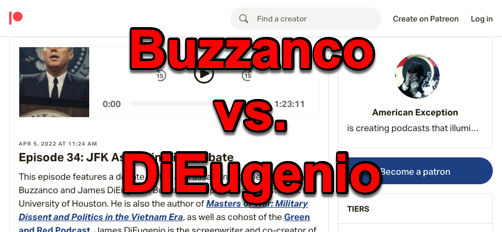
As our readers know, I wrote a column not long ago on Noam Chomsky’s appearance on a podcast called Green and Red. Chomsky and the podcast co-host, Bob Buzzanco, were fulminating about how Oliver Stone’s recent media appearances were misleading the left about both President Kennedy and the whole issue of what America’s role was in Vietnam. I replied to both of them. (Click here for that column) When Buzzanco later challenged the people behind JFK Revisited to a debate, I decided to oblige him. I would not do so on his show, since it would help him raise his audience, which I had moral reservations about. I said I would do so on Aaron Good’s American Exception podcast, a neutral site.
That debate did take place. (Click here for that debate) When Oliver Stone heard it, he immediately called me, as he was excited about the result. The problem with debates, of course, is trying to balance out the positive points you wish to make with the necessity of playing defense, that is negating the charges being made by the other side. Therefore, in addition to doing a follow up show with Aaron on this, I would like to make some comments on that score here.
First of all, to dispose of the last part of the debate, Buzzanco had said that there was little discovered about Oswald’s intelligence ties since the days of the House Select Committee (HSCA), which is an utterly false statement. John Newman wrote a whole book about this area which, contrary to what Buzzanco tried to imply, was not directly explored by the HSCA. In Oswald and the CIA, Newman discovered that both the CIA and FBI had anti Fair Play for Cuba Committee campaigns ongoing in the summer of 1963, which, of course, Oswald’s activities in New Orleans would seem to fit neatly into both. In addition to missing this, there was no place in those volumes where Oswald’s relationship with either the CIA or FBI was examined in any formal way. It turns out that the work of the HSCA’s Betsy Wolf, who was studying Oswald’s relationship with the CIA, was not declassified into the new millennium. To put it mildly, her work created a new plateau in this field. (Click here for details)
In the last part of the debate, it is hard to comprehend how someone who likes to pontificate about the impact of JFK’s murder could declare he knows little or nothing about the actual circumstances of his assassination, but like Noam Chomsky, such is the case. Suffice it to say that what happened during Kennedy’s autopsy—both the main one and the supplementary—would appear to indicate just what Chomsky says did not occur: a high-level plot. In the film JFK: Destiny Betrayed, we show that:
The photos of Kennedy’s brain cannot be of Kennedy’s brain, simply not possible.
In all probability, General Curtis LeMay was in attendance that night and tried to disguise how he got there.
Buzzanco is apparently ignorant of all this, as is Chomsky, which is no surprise really. What they lack in knowledge, they make up for in arrogance and snark.
Like so many leftist critics of Kennedy, Buzzanco said that somehow I should watch myself in talking about JFK’s civil rights program. This shows that, in addition to swallowing Chomsky, he has bought into the almost incessant and deceptive MSM campaign to bury what Kennedy did on civil rights. I made it a purpose of mine to go back into the record and find out what the truth was about this issue. Why? Because a while back, someone said to me words to the effect: Jim what you did with Kennedy’s foreign policy, you could probably do with all the other aspects of his presidency.
That turned out to be accurate. After a long four-part analysis, which surveyed literally dozens of books on the subject, I concluded that President Kennedy had done more for civil rights in less than three years than Presidents Roosevelt, Truman, and Eisenhower did in three decades. In fact, it was not even close. Kennedy went to work on the issue the night of his inauguration. He was disappointed that there were no African Americans in the Coast Guard parade that day. He called up Secretary of the Treasury Douglas Dillon and asked him about it. When Dillon said he had no idea why that was, Kennedy told him: Well, find out what the problem is.
The result of this was two affirmative action orders within a year. The first taking place in March, just two months after his inauguration. That first order dealt with employees in the federal government. There was a second one about purchases by the federal government, that is any contracting, with say the Pentagon or State Department, by a private vendor made that company also responsible for affirmative action guidelines.
What had happened was this: Kennedy was disappointed with the Civil Rights Commission set up by Senate Majority Leader Lyndon Johnson while he was in the senate. Although Kennedy voted for it, he thought it was toothless. So, he decided to enlist the Commission’s lawyer, Harris Wofford, as a campaign advisor in 1960. After Kennedy was elected, he instructed Wofford to write out a program for civil rights. Wofford specifically wrote that the president should not even think of trying to pass an overall bill in the first or even the second year since it would be stymied by the southern filibuster. Wofford advised Kennedy to try and get some momentum through executive orders, the Justice Department and perhaps the courts.
And that is what Kennedy did. For example, differing with Dwight Eisenhower and Richard Nixon, Attorney General Robert Kennedy said the administration would support the Brown vs. Board decision. Bobby Kennedy then indicted the Secretary of Education in Louisiana for resisting that ruling. In Prince Edward County Virginia, the state would not support an integrated school system. The Kennedys collected contributions from wealthy donors and William Vanden Huevel actually built a new school system from scratch—superintendent, principal, counselors, teachers, and buildings—so that the local children could register for classes. (Click here for that story)
I could go on and on, for example funding voting drives, integrating both state and private universities in the south, filing suits against voting rights violations. No previous president went as far on as many fronts than JFK did. It’s not even close. And this was before he submitted his omnibus civil rights bill to congress in February of 1963. (For all the details, click here) As with Indochina, Buzzanco drank the Kool-Aid on this one.
Buzzanco also said that in my claim that Kennedy was much more reformist than what is made out to be, all I had to back me was Richard Mahoney’s book JFK: Ordeal in Africa, which shows that Buzzanco has not read this site very often. On the concept of President Kennedy’s reformist foreign policy, Robert Rakove’s book, Kennedy, Johnson and the Non-Aligned World is one of the best. That was published in 2013, decades after Mahoney’s 1989 book. On just the area of Africa, there is Philip Muehlenbeck’s fine work, Betting on the Africans. That volume was published in 2012, again decades after Mahoney. Decades prior to Mahoney, there was Roger Hilsman’s book To Move A Nation, which was astute on Kennedy’s foreign policy ideas, particularly about Indonesia. About the 1965 Indonesian upheaval, there is Bradley Simpson’s book Economists with Guns. Simpson says in that 2010 book, as he did for Oliver Stone in JFK: Destiny Betrayed, the epochal overthrow of Sukarno would not have happened if Kennedy had lived. Greg Poulgrain says the same thing in his book, JFK vs Allen Dulles: Battleground Indonesia, which was published in 2020.
As far as Indochina goes, it is just as bad for Buzzanco. Since the film JFK came out, there have been books by Howard Jones, David Kaiser, James Blight, and Gordon Goldstein which all agree with the views of that film: that Kennedy was withdrawing from Vietnam at the time of his death. There is also John Newman’s second edition of his milestone work JFK and VIetnam. In my view, that version is even better than the 1992 edition. There is also Richard Parker’s biographical work on John K. Galbraith. Galbraith was one of the strongest influences advising Kennedy on this issue, and the president took his advice to begin his withdrawal plan. (Click here for details)
Considering all this new scholarship, what is hard to understand is this: Why is Buzzanco still abiding by Noam Chomsky’s badly dated and intellectually shabby 1993 book? Because in the face of over 800 pages of new information declassified by the ARRB, no one else is. Need I add that since Chomsky’s book came out, both Secretary of Defense Robert McNamara and National Security Advisor McGeorge Bundy (posthumously) published scholarly tomes in which they said the same thing: Kennedy was not going into Vietnam. Just how much evidence, how many witnesses, and how many scholars does one need in this regard?
Like the late Alexander Cockburn, Buzzanco wants us to think that somehow President Kennedy was involved in the Ramadan Revolution of February 1963. This was the overthrow of the Iraq leader Karim Qasim and his (temporary) replacement by the Baath party. Since I found Cockburn about as convincing as Chomsky on the issue of Kennedy’s foreign policy, I did some research on this. I read three works on the issue—one book and two Ph. D. dissertations—and none of them agreed with either Cockburn or later the work of Vincent Bevins on this score. All three writers stated that, unlike Eisenhower, the Kennedy administration was not all that interested in Qasim. For instance, the interagency committee Eisenhower had on Iraq was more or less dropped under Kennedy. And by late 1961, Qasim had turned on the communists, so there was no Cold War motive to dethroning him.
Where Qasim got into trouble was with the British and the Kurds. The former was over an oil rights dispute, the latter was over a territorial rebellion in the north. After the Kurds inflicted some defeats on the army, the Baath Party infiltrated the military and negotiated with the Kurds. And that is what set the stage for the overthrow in February of 1963. There is no credible evidence that the CIA or State Department commandeered the plot. (Peter Hahn, Missions Accomplished? p. 48) And unlike what Cockburn tried to imply, Saddam Hussein was not even in the country at that time. (For a longer treatment click here and scroll to part 6)
Buzzanco also brought up the overthrow in Brazil. It is true that Kennedy was worried about Brazil, but this is due to the horrible advice he was getting from Lincoln Gordon, who he should never have approved as ambassador. But it’s also true that he sent Bobby Kennedy to Brazil to advise Joao Goulart to moderate his government to avoid any conflict. Gordon had actually told JFK that Brazil was in danger of becoming a new Red China. (See Merco Press, April 8, 2022) We do not know what Kennedy would have eventually done in Brazil, but it was President Johnson and Warren Commissioner John McCloy who actually arranged for the overthrow in 1964. The Brazilian military was given aid by Vernon Walthers of the CIA. Operation Brother Sam was done hand-in-glove with the Rockefeller interests in Brazil, which is why McCloy was the front man for it. (The Chairman, by Kai Bird, pp. 550–53) I would like to add that, in reference to Latin America, Kennedy did not recognize rightwing takeovers in either Dominican Republic or Honduras. Also, unlike what Buzzanco said, the American embargo of Cuba did not start under Kennedy. Its initial stages began first in 1958, under Eisenhower. Ike extended it in 1960 to include most exports. Kennedy expanded it again in 1962. It’s quite surprising that a history professor could be inaccurate about something as simple as this.
My last point would be about the concept of what Rakove called “engagement.” This was his word for how Kennedy approached the concept of neutrality. Kennedy felt that if a country wanted to remain neutral in the Cold War, that was their decision. We could still send them aid and, in fact, we should send them as much as possible in order to keep them away from the communists. As Rakove notes, this was a large jump from John Foster Dulles, who did not want to deal with the concept of neutrality at all. With him, there was no neutral ground in the Cold War: you were either for the USA or against the USA. (See Rakove, pp. 6–11). A good example of this would be Kennedy’s attitude toward Nasser in Egypt versus Foster Dulles’ and, later, Johnson’s stance toward the charismatic pan-Arab leader. Any history scholar should be able to discern this wide difference. Nasser certainly did, as did most of the leaders in Africa. (Muehlenbeck, pp 227–228) For Buzzanco to say I agreed with him on this issue shows a combination of political spin and his lack of knowledge on who Foster Dulles was.
I would like to append one last point about how leftist ideology clouds the picture of who Kennedy was. Peter Scott wrote an essay for the Gravel Edition of the Pentagon Papers back in 1971. That essay was one of the earliest efforts to detect that Kennedy was withdrawing from Vietnam at the time of his death. The editors of that series were Chomsky and Howard Zinn. They did not want to print that essay, because to them it would indicate that whoever is president makes a difference. I do not know any clearer way of showing that Chomsky’s concept amounts to writing history according to ideology. And to me, that is not writing history. Its polemics.
John F. Kennedy was not a perfect president. We have never had a perfect president and there never will be one, but the best brief characterization of Kennedy was made by Richard Mahoney. He used Edward Gibbon’s description of the Byzantine general Belisarius as a point of comparison: “His imperfections flowed from the contagion of the times; his virtues were his own.”

see Part 1
Early on in Joe Califano’s book, he writes the following about LBJ and Vietnam: “He certainly thought he was doing what John Kennedy would have done…” (p. 28). Califano’s book was published in 1991. The best one can say about that statement is that, even for that time, it was ill informed, because even back then, there was evidence that this was not even close to being the case. For example, Ken O’Donnell and Dave Powers had written that Johnson had actually broken with what JFK was doing. As they stated, Kennedy was going to withdraw a thousand advisors before the end of 1963. (The authors here were referring to Kennedy’s NSAM 263 without naming it.) Kennedy then told Defense Secretary Robert McNamara to announce this to the press in October of 1963. (Johnny, We Hardly Knew Ye, p. 17) Based on the paper trail in the Pentagon Papers, Peter Scott also wrote about this withdrawal plan. (Government by Gunplay, edited by Sidney Blumenthal and Harvey Yazijian, pp. 152–187)
CNN more or less adapts the Califano stance for this all-important issue. Why is it so important? If one is trying to salvage Lyndon Johnson’s presidency, it is imperative to somehow show that his radical escalation of the Vietnam War was really not his idea. There are two underlying reasons for doing this. First, Johnson’s escalation was not one of degree—it was an escalation in kind. LBJ would end up sending 500,000 combat troops into Vietnam. On the day Kennedy was killed, there were none there; only advisors. (The program tries to alchemize this by saying Kennedy had 16,00 troops in theater—utterly wrong.) Secondly, LBJ began Operation Rolling Thunder, the largest air bombing campaign since World War II, over both parts of the country. Even Califano admits that these American strikes extended to targets in and around Hanoi and Haiphong and close to the Chinese border. (Califano, p. 293) Kennedy never did anything like this—let alone to the extent of bomb tonnage that Johnson dropped.
So what does the film do to relieve this heavy cross on Johnson’s back? To anyone who knows what really happened, it attempts something kind of shocking. Through Andrew Young, the film tries to say that, in December of 1964, it was McNamara, National Security Advisor McGeorge Bundy, and Secretary of State Dean Rusk who were trying to convince Johnson to go to war in Vietnam. How on earth the film makers from Bat Bridge Entertainment got Young—usually a smart guy in public—to say this is a mystery worthy of Sherlock Holmes. How they ignored all the evidence declassified by the Assassination Records Review Board which contradicts it, is even more mystifying. Let me explain why.
II
Two of the most important pieces of evidence in Oliver Stone’s documentary JFK Revisited: Through the Looking Glass concern the Vietnam War. Back in December of 1997, the Assassination Records Review Board declassified the records of the May 1963, SecDef meeting in Hawaii. These were regular meetings held by Secretary of Defense Robert McNamara on the progress of the war. Representatives of branches of the American government stationed in Saigon, for example CIA, Pentagon, and State, were in attendance. Those May 1963 documents were so direct and powerful that they convinced the New York Times and Philadelphia Inquirer that, at the time of his death, Kennedy was getting out of Vietnam. (Probe Magazine, Vol. 5 No. 3, p. 19) They showed that McNamara had given the order to begin a withdrawal program previously. And at this meeting various parties were submitting these schedules. To which McNamara replied: they were too slow. This supplied powerful corroboration for what O’Donnell, Powers, Scott and John Newman had written about—Newman in the 1992 edition of his breakthrough book JFK and Vietnam.
The other important piece of evidence in this regard is a taped phone call that President Johnson had with McNamara on February 20, 1964:
LBJ: I always thought it was foolish for you to make any statements about withdrawing. I thought it was bad psychologically. But you and the president thought otherwise, and I just silently.
RSN: The problem is—
LBJ: Then come the questions: how in the hell does McNamara think, when he’s losing a war, he can pull men out of there?
That tape is played loud and clear in the film, which has been out since November of last year, but Stone could have gone even further in this regard. Because in another phone call on March 2, 1964, Johnson tried to convince McNamara to revise his prior statements about withdrawing from Vietnam. (James Blight, Virtual JFK, p. 310) Further, in a January 1965 phone call, Johnson has learned that some of Kennedy’s hires now felt the new president was trying to shift the blame for the escalation of the war from himself to his dead predecessor, which was quite a logical deduction. (ibid, p. 306)
After his attempt to turn around McNamara on the war, Johnson set up an interagency committee headed by State Department employee William Sullivan. That committee was to plan the possible expansion of the war. (Eugene Windchy, Tonkin Gulf, p. 309) In six weeks, Sullivan concluded that nothing but direct intervention by America would stop the eventual triumph of the Viet Cong. (Joseph Goulden, Truth is the First Casualty, pp. 77–88).
In light of that conclusion, there is a telling point to be made about the choice of Sullivan to lead this committee. In October of 1963, Sullivan was one of the strongest opponents of Kennedy’s withdrawal plan. (John Newman, JFK and Vietnam, Second Edition, p. 410) To put it mildly, Johnson likely knew the result he was going to get from Sullivan.
Taken as a whole, what this accumulation of evidence shows is not just that Johnson reversed Kennedy’s policy in Vietnam, but he knew he was reversing it and then tried to camouflage that reversal. It also indicates that Johnson’s intent in this regard was established fairly early. The usual point of no return is considered to be the signing of NSAM 288 in March of 1964. That document mapped out a large-scale air war over North Vietnam, which Johnson invited the Joint Chiefs to design for him. (Fredrik Logevall, Choosing War, p. 129) As one commentator wrote about it: “Henceforth the United States would be committed not merely to advising the Saigon government, but to maintaining it.” (ibid) At that time, Max Frankel of the New York Times wrote that the administration had now rejected “all thought of a graceful withdrawal.” (March 21, 1964) As Gordon Goldstein has noted, Johnson was now working hand in glove with the Joint Chiefs on these future plans. (Lessons in Disaster, pp. 108–09)
This last is another marked difference with Kennedy. As former undersecretary Roger Hilsman wrote to the New York Times, JFK did not want any member of the Joint Chiefs to even visit South Vietnam, so the idea of him inviting them into the Oval Office to plan a massive air war there was simply a non-starter. (Letter of January 20, 1992) In other words, what Kennedy did not do for three years, Johnson did in three months.
Make no mistake, this was a key step in Johnson’s escalation. It was the document that would supply the working thesis for future air operations Pierce Arrow—retaliation for the alleged Tonkin Gulf incident—and Flaming Dart—retaliation for the Viet Cong attack at Pleiku—and those would evolve into Rolling Thunder. All of this counters Califano’s excuse for escalation in his book: that somehow the Joint Chiefs pressured LBJ into escalating. (Chapter 2, pp. 50ff) This is made possible by Califano not mentioning or describing NSAM 288, or how that process differed from JFK.
Why do I indicate that LBJ had all but certainly decided on a war against North Vietnam by the spring of 1964? Because one of his objectives was to get the Washington Post in his corner on this decision; so he enlisted their support in advance. In April of 1964, Johnson invited the executives of that paper, plus Kay Graham, the owner, to the White House. In the family dining room, he asked for their support for this planned expansion of the war in Vietnam. (Carol Felsenthal, Power, Privilege, and the Post, p. 234)
III
If that is not enough to convince the reader that the program and Andrew Young are wrong about the December 1964 date, how about this: the Gulf of Tonkin Resolution was drafted three months before it was submitted to congress. (Edwin Moise, Tonkin Gulf and the Escalation of the Vietnam War, p. 27) In other words, in May, one month after Johnson told the Washington Post he wanted their support for a future war, he had an attorney sketch a rough draft of a declaration of war in Vietnam. Like the other steps on the way to intervention, I could not find this event mentioned in either CNN’s film or Califano’s book. It would seem to me to be a quite important revelation as to intent. But let us go a step beyond it: What made Johnson rather certain that the war resolution would be used? Because Johnson’s planning even spoke of a “dramatic event” that could occur to cause the White House to go for a congressional resolution. (Moise, p. 30)
Johnson had approved a covert action plan after Kennedy’s death. General Maxwell Taylor had drawn up designs for fast hit-and-run sea operations against North Vietnam in September of 1963, but that plan was not submitted to McNamara until November 20, 1963. (Newman, p. 385) These attacks were eventually titled OPLAN 34A. Originally, the draft of NSAM 273 limited naval forces to those of the government of South Vietnam. On November 26, 1963, Johnson altered McGeorge Bundy’s draft. When OPLAN 34A was submitted to the White House, it now allowed direct American military attacks against North Vietnam. (Newman, p. 463) As Edwin Moise shows, these PT boat operations owed just about everything to the USA and were completely controlled by Americans. (Moise, pp. 12–17) They likely could not have been done by Saigon alone.
It was the combination of OPLAN 34A with the already-in-practice DeSoto patrols that all but guaranteed an exchange between Hanoi and the Pentagon in the Gulf of Tonkin. The PT boats were designed and equipped with armaments that could be used to attack Hanoi’s military installations near the shore, which they did. The idea was for the OPLAN 34A missions to create a disturbance and then the destroyers in the gulf could theoretically gain some kind of intelligence from the reaction. The problem was that both the boats and the ships violated the territorial waters of North Vietnam. (Moise, pp. 50–51) The PT boats attacked the islands of Hon Me and Hon Ngu off the coast of North Vietnam on the night of July 30–31. The latter was 4 kilometers off the coast, the former about 12. Hanoi was claiming their waters ended at 12 miles, therefore both islands would be within their boundaries. When the PT boats retreated, they were within sight of one of the destroyers on a DeSoto mission, the Maddox, which had just entered the gulf. (Moise, p. 56)
Therefore all the elements were in place for a confrontation. On the night of August 2nd, Hanoi sent out three torpedo boats to counter the raiders. They were all severely damaged by American fire and four North Vietnamese sailors were killed. The Maddox endured one bullet hole from a machine gun round. In spite of this engagement, President Johnson continued the patrols and the Navy added a second destroyer, the Turner Joy, to the mission. What made it even worse is that the PT boats attacked another North Vietnamese base on the evening of the 3rd of August. (Moise, p. 97) This is why many, including George Ball of State, considered the missions to be clear provocations. (Moise, p. 100)
Needless to say, the alleged Hanoi attack on the two destroyers on the night of August 4th never really occurred. Yet Johnson used this false reporting to launch the first American air strikes against the north, based on the NSAM 288 target list, and also to pass the Tonkin Gulf Resolution which has been penned three months earlier. (Moise, p. 212) But all of the above is not the worst. The worst is this: Johnson realized the second attack did not occur about one week after he ordered the air strikes. (Moise, p. 210)
In light of all the above, to say that Johnson was being talked into a war by Bundy, McNamara, and Rusk in December is simply hogwash. And to say, as the program does, that Johnson was not a war monger is equally wrong. The total debate time on the Tonkin Gulf Resolution was about 8 hours. (Goulden, p. 75) And everyone sent up by the White House to testify for the resolution denied there was any connection between the DeSoto missions and the OPLAN 34A operations—which was false. (Goulden, p. 76)
But there were two grand benefits garnered from the provocations:
LBJ’s approval ratings on the war skyrocketed. As one commentator noted, he had turned his one weakness against GOP candidate Barry Goldwater into a strength.
He got his declaration through. (Goulden, p. 77) The very fact he did the latter undermines what Tom Johnson says about the war: that the SEATO Treaty alone necessitated our involvement.
IV
Califano deals with the case of William Fulbright in one desultory page near the end of his book. (Califano, p. 360) CNN and Bat Bridge do not really deal with him at all. The Arkansas senator and Johnson had been friends prior to 1965. In fact, Johnson used Fulbright to get his Tonkin Gulf resolution through the Senate; the unsuspecting Fulbright trusted him. He ended up regretting it.
The CNN series does not mention the 1965 invasion of the Dominican Republic either. Yet the two subjects are related, because Fulbright’s relationship with LBJ collapsed over the lies Johnson had told him about that 25,000 man Marine invasion in the Caribbean in 1965. Fulbright was the chairman of the Foreign Relations Committee. He had helped expedite both the Latin American invasion and the Tonkin Gulf resolution. Ironically, it was Fulbright’s reinvestigation of the former that led to his doubts about Tonkin Gulf and ultimately wrecked the relationship. One can even argue this was the main engine for Johnson’s capsized approval ratings, which resulted in his abdication.
In June of 1965, Fulbright’s staff had begun to examine the reasons Johnson had given for the April 28, 1965, invasion of the island. At every opportunity, the reasons for the invasion were escalated and sensationalized. This culminated in June with the excuse that 1,500 people were killed, heads were cut off, the American ambassador called while hiding under a desk with bullets flying through windows, and Americans were huddled in a hotel screaming for protection. (Goulden, p. 166) The staff found out that this was mostly nonsense and Fulbright decided to give a scathing speech in which he said that there was simply no evidence to back up what Johnson had told him about decapitations and bullets flying through embassy windows. The democratically elected leader, Juan Bosch—who the Marine invasion fatally crushed—had been favored by President Kennedy. (Donald Gibson, Battling Wall Street, pp. 78–79) Therefore, Johnson’s reversal of JFK’s policy “lent credence to the idea that the United States is the enemy of social revolution in Latin America…” (Goulden, p. 167)
Fulbright now suspected that maybe the White House had also lied about the Tonkin Gulf Resolution. In November and December of 1965, he and his staff now prepared for full-blown hearings on the Vietnam War. Fulbright called up administration official after official and quizzed them on both what the real purpose of the Tonkin Gulf resolution was, and if the administration had been candid about its provenance. The hearings themselves were damaging enough to Johnson, but when CBS and NBC decided to run them at full length for days on end, they began to really hurt him politically. For the first time, administration officials had to defend the remarkable escalation of the Indochina conflict and reply to questions about if the Gulf of Tonkin resolution was justified. There had been nothing like it since the Army/McCarthy hearings and there would be nothing like it again until the Watergate hearings.
Average Americans now began to be informed about how America got into an open-ended conflict that had seemingly escalated beyond what anyone had ever thought it could be. But perhaps most importantly, the hearings dramatically illustrated the formula for the following:
…what had happened to turn the liberal supporters of President Kennedy into opponents of the policies of President Johnson…and the right-wing opponents of Eisenhower and Kennedy into supporters of the present administration… (Goulden, p. 166)
In other words, how Johnson had fragmented the Democratic Party beyond saving.
Neither Califano’s book nor the CNN series figuratively lifts up the hood to show the audience just how Johnson was finally convinced to get out of Indochina. Since they will not, the present reviewer shall. After the Tet offensive, and during the siege of Khe Sanh, several foreign policy luminaries were asked to attend a Pentagon briefing at the White House—after which LBJ ranted and raved for about 45 minutes. This compelled former Secretary of State Dean Acheson to walk out. A White House staffer called him and asked him why he left. Being blunt, Acheson told him to “Shove Vietnam up your ass!” Johnson got on the phone and Acheson told him he would no longer listen to “canned briefings.” He only wanted to hear from people on the scene in Vietnam and would only accept raw data, not finished reports. About a month after this, Johnson sent his new Secretary of Defense over to the Pentagon. Clark Clifford went over the data and then quizzed the Joint Chiefs on the overall situation on the ground. He concluded that the only way to win the war was to expand it into Cambodia and Laos. Clifford reported back to Johnson that he should get out; Vietnam was a hopeless mess. (Walter Isaacson and Evan Thomas, The Wise Men, pp. 683–89; see also Clifford in the documentary film Hearts and Minds.)
That is apparently too strong a truth for CNN and Bat Bridge Entertainment, which tells the reader a lot about the value and candor of this disappointing production. The program ends with the Richard Nixon/Anna Chennault subterfuge of Johnson’s attempt at a truce in Vietnam—which was about four years too late. (Click here for details)
In sum, this is a disappointing and less-than-candid four-part series about Johnson and his presidency. These kinds of programs make it difficult to understand the past, and therefore stifle our attempts to deal with the present.