Please see a review of the film here.
Tag: OLIVER STONE
-
Oliver Stone Does Not Give Up: He Wants Those Files!
Oliver Stone’s letter to Marco Rubio follows:
Oliver Stone
Ixtlan Productions
Los Angeles, CA 90064Dear Secretary of State Rubio:
I am writing you as the Acting Archivist at NARA. As you may recall, in 1991 I co-wrote and directed JFK. That film caused the passage of the JFK Records Collection Act, and the creation of the Assassination Records Review Board (ARRB). This legislation certified that all the records about President Kennedy’s assassination should be released by 10/26/17.
I have testified about this twice before congress: once in 1992 and again in April of this year. I had to appear this second time because the JFK Records Act has been disobeyed. Almost eight years after the terminal date, and seven months after President Trump’s executive order, all of the JFK records have not been declassified. It is disturbing to see the intelligence agencies defying both congress and the president.
I have since learned about four issues you and the president should be informed of, since they negatively impact this reluctance to obey the will of congress. The ARRB issued over 27,000 binding and enforceable declassification orders called Final Determinations. By law, these should have been the last word on JFK Records. Not so. In fact, for all intents and purposes, they have not even been made public or searchable by NARA–even though they have been subject to repeated FOIA requests. It is not clear that either you, or Presidents Trump or Biden were aware of these strictures. Legally, they should have impacted any and all decisions on the remaining JFK closed records.
We now know that President Clinton signed onto a Memo of Understanding with the ARRB. And he did not override any of their Final Determinations. These are crucial precedents concerning the efficacy of those decisions. Yet, it troubles me that these binding orders have been ignored and buried for over 25 years. It is my information that only 2 percent of the tens of thousands have been released to the public; and that neither congress nor the White House appear to be cognizant of this crucial fact.
Secondly, there is evidence that the CIA tried to subvert the JFK Records Collection Act by submitting a large amount of material to NARA before the Board was appointed and started working. This is contained in a 1992 secret Agency memo to the Archives. This information is complemented by ARRB chair John Tunheim’s testimony before the Luna Committee Task Force on declassification in May. There he stated that “many of the recently released records were never shown to the ARRB.” If records were transferred before or after the four-year term of the Board, then they likely escaped proper review.
Third, according to all interested visitors to NARA, the state of the JFK Records Collection is simply and frankly a mess. There is no comprehensive, usable index or catalog. Even though the JFK Act specifies their function to maintain one for each record.
Fourth, at the closing of my film, I displayed a card which stated that the records of the House Select Committee on Assassinations (HSCA)—the last formal inquiry into Kennedy’s murder– were largely classified, 13 years after the committee shut down. Yet, to this day, some of those HSCA files are still partly closed. That secrecy also applied to another congressional body of work, the Church Committee, which preceded the HSCA. This, in spite of the fact that the JFK Act declares presidential postponement should only apply to executive branch records.
These conditions have been allowed to fester because there has been no proper supervision of the Board decisions since 1998. There should have been: by either congress or the archivist or both. Therefore I would hope that you would make a formal request to the full House Oversight Committee to fulfill the mandate of the JFK Records Act, which ordered full and complete release by October of 2017. There should be an explanation as to why these records are still closed and why the Final Determinations are not fully open to the public 62 years after President Kennedy’s death. Both representatives Anna Luna and Eric Burlison have called for accountability by the CIA in the wake of their release of George Joannides records. In my view we should not be limited to just that. The CIA and FBI should finally be called upon to release every last document in full.
I would be glad to inform you and/or the president more fully on these matters if you so desire.
Yours Sincerely,
-

Impact of the Luna Hearing
The Impact of the Luna Hearing
by James DiEugenio
Oliver Stone, Jeff Morley and myself testified before congress last Tuesday before the committee helmed by Anna Paulina Luna, congresswoman from Florida. Her committee is tasked with declassifying documents on several controversial cases from contemporary history: the murders of John Kennedy, Martin Luther King and Robert Kennedy; plus the Jeffrey Epstein case, the origins of CV-19, files on 9-11 and UFO’s.
The announcement of this committee, which she call a Task Force, met with several stories in the MSM, including one in Newsweek. (2/11/25) She stated that it would not make bold promises and then fade into irrelevance. She continued, “This will be a relentless pursuit of truth and transparency, and we will not stop until the American people have the answers they deserve.” (ibid). Luna said she will be cooperating with people like Attorney General Pam Bondi and Secretary of State Marco Rubio. She then said the following:
We will cut through the bureaucracy, challenge the stonewalling and ensure that the American people finally get the truth they have been denied for too long. If we are to endure and thrive as a nation, we must restore trust, trust through transparency. (ibid)
On January 19th, President Trump said that:
In the coming days, we are going to make public remaining records related to the assassinations of President John F. Kennedy, his brother Robert Kennedy, as well as Dr. Martin Luther King. (ibid)
On his third day in office, President Trump signed an executive order to that effect. As he signed it, Trump said, “That’s a big one, huh? A lot of people are waiting for this for a long—for years, for decades.” (ibid). Luna added that,
The American people must be trusted to think for themselves, to form their own judgments from the truth they are entitled to know. We’ve been treated like children for too long and kept in the dark by those we elected to serve us.
She then added that she would be calling her first hearing soon. That first hearing was, wisely, on the JFK case. And she managed to secure a large room with a five row gallery, that was almost full. Oliver Stone, Jeff Morley and myself were on her first witness panel. There were twice as many Republican in attendance as there were Democrats. And it was the GOP side which stayed longer, asked the most pertinent questions, and seemed the most interested in what happened to JFK.
The hearing was televised by CSPAN and taped by PBS. (One can see it here posted at You Tube https://www.youtube.com/watch?
v=WF6qlr3KLtI) For the first time perhaps in congressional history, the viewer was allowed to hear about the disappearing hole in the rear of Kennedy’s skull, and the spurious chain of custody concerning the Magic Bullet, Commission Exhibit 399. Jeff Morley declared that the true authors of the plot to kill JFK were likely to be found in the ranks of the CIA and Pentagon. Oliver Stone ended his evocative opening statement by quoting a very high suspect in the case, namely James Angleton about him being fated to end up in Hades. I tried to concentrate in my opening statement about how Kennedy’s murder and the failure of the Warren Commission resulted in a loss of trust and belief by the public in their institutions of the press and the government. The entire hearing lasted over the 2.5 hours that Luna said it would. Afterwards, Oliver, Morley and myself addressed a press gaggle. That was not the end of it. Not even close. It’s the after effects of this hearing that I wish to address here. If one goes to You Tube you will see over thirty postings of the hearings, either in full or in part. I located most of them, for instance by Forbes, Fox, CSPAN, Global News, The Blaze and accumulated total was over 2.6 million views! Even Joe Rogen posted a segment focusing on Oliver.
But in addition to that, Oliver and myself, Morley and Matt Crumpton—a co-author of The JFK Assassination Chokeholds who attended—all did appearances on TV shows. Oliver and myself did the Jesse Waters show on Fox and two spots on the News Nation network. Morley did Waters and Glenn Greenwald. Matt did a spot on Newsmax. If one adds up all of these for their average viewership, that total is about 8.95 million. So the rolling total would be about 11.55 million. And since You Tube would be growing daily, it will probably be 12 million by the end of this week. Which is remarkable for a 62 year old event.
But yet, I have not even included the newspaper and online new stories about the hearing. It was covered by USA Today, Politico, AP and ABC among many others. So we can add at least hundreds of thousands more. As I said in my opening statement, the JFK case simply will not go away.
We all owe thanks to Congresswoman Luna and also to Oliver Stone for attending. A lot of the publicity was caused by him. We all await the next step in the Task Force’s inquiry.
(Click here for an inside view of the Washington experience https://jamesanthonydieugenio.
substack.com/p/jim-and-oliver- meet-the-luna-commitee) -
Oliver Stone Interview Award
This interview with Oliver Stone by Ed Rampell was awarded second place at the National Arts and Entertainment Journalism Awards in the category of Personality Profiles. We post it here in case you missed it. Read more.
-

JFK Revisited: Through the Looking Glass – Book Review
Since the start of the year I have read more books about the JFK assassination, including Uncovering Popov’s Mole by John Newman, which should be a subject of a future book review (for now let me say simply that it is a must read). But belatedly I read JFK Revisited: Through the Looking Glass by James DiEugenio, the subject of this review.
I purchased this book half a year ago as part of a package that included three versions of the documentary, mostly because I participated in the film, which I have viewed a number of times. I was never in a rush to actually read it, because I assumed that it could not add much to what was revealed in the film.
Boy was I wrong!!!
From pages 15 to 220, we have transcripts of the actual documentaries (annotated 2-hour version and annotated 4-hour version). I did not read these. What I had underestimated, was the monumental importance of the last 200 pages which are excerpts from the interviews of some of the world’s top experts conducted over months of production by a legendary director Oliver Stone, guided by the leading authority of our times on the subject, Jim DiEugenio.
Oliver Stone’s record of prize-winning movie and documentary production is unparalleled when it comes to historical, political and societal significance. Thanks to his movie JFK, Congress passed the President John F. Kennedy Assassination Record Collections Act of 1992. This led to the formation of the Assassination Records Review Board (ARRB). This in turn led to the declassification of millions of pages of documents that have helped researchers put together the pieces that paint a much better picture of what really took place in and around JFK’s assassination. What other movies have initiated so much change?
Jim DiEugenio is arguably the most important expert on the assassination in our community. The landmark book and film JFK Revisited is a culmination of a lifetime of research, analysis, writing and networking he has performed during the last decades that has raised his stature to encyclopedic. Through his website Kennedysandking, as well as his groundbreaking books The Assassinations, Destiny Betrayed, The JFK Assassination: The Evidence Today, he has archived perhaps the most important collection of writings on the political assassinations of the sixties ever assembled.
The documentary JFK Revisited: Through the Looking Glass, when all is said and done, will be regarded as a milestone by independent-minded historians, and will materialize memories of Jim, Oliver , producer Rob Wilson and the participants in this film– despite poison tipped arrows being shot at it by career-obfuscators. Through the Looking Glass is a documentary form bookend to 30 some years of revelations that took place since JFK was viewed by millions, and lays out what we have learned through declassification, rendering the tired old platitude of criticism: “There is nothing new here folks” the summum of ridiculousness. In fact, viewers, got to hear from some 30-world leading specialists dismantling the lone-nut Warren Commission fairy tale, point by point by point. It also buries forever the war-mongering/Vietnam instigator persona that ignorant historians have attempted to lamely paint JFK with.
Among the contributors–through recent interviews or archive footage and references through articles–audiences got to hear from irreproachable investigation insiders who played leading roles in the various investigations including the Warren Commission (Commissioners Senators Cooper, Russell, and Congressmen Boggs and even Ford), the Church Committee (Senator Schweiker), the HSCA (Richard Sprague and Robert Tannenbaum) and the ARRB (Doug Horne, Judge John Tunheim, Thomas Samoluk) . These are the people who had subpoena power, questioned witnesses who were under oath, had access to classified documents, examined evidence and were hired to do exhaustive, independent work. Well they certainly did not help proponents of the impeached Warren Commission version of events.
Added to these solid sources, we can add physicians, lawyers, historians, criminalists and others who provided solid arguments that proved beyond a shadow of a doubt for the audiences that there was in fact a conspiracy in the assassination, that JFK was going to desist from Vietnam and that there was a major cover-up. I can state this with confidence because I witnessed first hand reactions of nearly 1000 audience members who attended events during Oliver and Jim’s promotional tour in Quebec City last June.
Now I ask, who comes across as more QAnonish? Those who prefer putting their confidence in some of the more vociferous nay-sayers like the late John McAdams and who deny the record put forth by people of the likes of Senator Schweiker? Or those who believe the documented affirmations of the leading investigators hired by the US Government. In other words, this documentary has turned the tables on those who are the real theorists and obfuscators by placing them squarely at the opposite end of official records!
As I was reading the second half of the book, it began to dawn on me: I could not recall getting so much insight from a book at such a trailblazing speed. By the end I concluded that JFK Revisited: Through the Looking Glass is perhaps the most underrated book about the assassination I have ever read. In hindsight I should have known that what was in there is pure gold. Sort of a rare glimpse of the very best insights from some of the very best experts in the field within two hundred pages.
Another way to look at this is that if about 30 researchers had been, like myself, interviewed for between 1 and 2 hours on average, in order to end up with 4 to 5 minutes on average of actual screen time, we can conclude that over 90% of the interview content had been left out so as to be able to produce 4 hours of content which also includes an introduction, narration, stock footage that are not interview-based. While reading my part and the others in the excerpt section, I estimate that the author added some 15% of the total interview content of that 90 %.. While I guess that many of the points in these interviews might be found in previous speeches or writings of the experts, the fact that one can find so much power-packed content coming from almost 30 different sources, all within 200 pages, is simply unheard of and certainly worth the ride.
After pointing out some recommendations on how I would improve this tour de force, I will give readers samples of some of the statements that really should mark people who were unaware of these, including those who saw the documentary.
JFK Revisited the Book: Its Weaknesses
As a preface to this section, it is important to note what a monumental task it must have been to produce, with limited means, two versions of the documentary for broadcast, a third one with commentary by Oliver and Jim, create a kit with DVDs, a poster, and the book, all to be launched through a minefield of resistance orchestrated by the usual suspects of disinformation artists and saboteurs.
I personally witnessed attempts to torpedo the Quebec City events first-hand. And most of us know the price Oliver Stone paid for his movie JFK. Anyone willing to invest three years of their lives into this project deserves two thumbs up for a job well done. Kudos to Jim, Oliver and producer Rob Wilson.
That there are so few weaknesses is surprising in this critic’s view, but there are some over and above a small number of typos that made their way in the writings.
- One of the extremely persuasive demonstrations made in the documentary was of how the chain of custody around the magic bullet, the conflicting documentary timelines, how this missile simply could not have created the damage it is given credit for and how key witnesses deny the validating statements it was claimed they had made. This convinced audiences overwhelmingly that the CE399 flight trajectory was one the biggest shams by the Warren Commission. One of the claims made in the documentary, that Elmer Lee Todd of the Secret Service had not initialed the projectile when he handled it, seems to be false. This error is repeated in the book. This was graciously admitted to by the authors during the CAPA 2022 conference in Dallas. The significance of this is minimal in the overall picture painted in the documentary: There can be no doubt that CE399 would have been thrown out in a court proceeding, or even turned into an object of ridicule for the benefit of the defendant.
- Jim and Oliver were both asked why they chose to keep the Lopez report and Oswald in Mexico City out of the documentary. To most of us, the revelations around this highly suspicious episode represents one of the highlights of declassification. The answers were that tough choices had to be made in order to respect constraints and that Mexico City would have been simply too complex for less knowledgeable audiences. Still, what happened there is so explosive and informative, I feel an opportunity was missed to lob a Molotov cocktail into the discourse that no historian, journalist or lone-nut officiado can counter. The audience could have heard HSCA investigators Dan Hardway and Ed Lopez reveal how: Oswald was likely impersonated in order to make him look unhinged and under Castro’s control and in talks with Russia’s western hemisphere assassination tsar; investigators were forced to downplay and reverse this scheme; Intelligence agents Anne Goodpasture and David Atlee Phillips lied their heads off; how Hoover and others proved that the claim that recordings of an Oswald impersonator in Mexico City were routinely destroyed by the CIA was a boldfaced lie; how in fact Hoover confirmed that agents who questioned Oswald after his arrest stated that they had heard at least one recording and that the voice on the tape was not Oswald’s… and this is just the tip of the iceberg. Honestly, if I had to choose between this event, and the one I covered around prior plots, I would have tried to find a way to get this one in, at least in the four-hour version and in the book.
- The reason this book has not reached the star status level it deserves is perhaps due to what I would humbly describe as a tactical error. Almost half of the book is dedicated to providing the transcripts of the documentary. This may have created a perception, that it was a derived product: some sort of merchandising throw-in. In this writer’s view the full first half of the book is a buzz-killing rehash of the documentary without the star power, imagery, music or any added value. Contrary to serving the reader by providing entertainment, it detracts from both the film version and the second half of the book. Why read this if we can view the superior documentary? One of the effects of this is that it gave secondary status to the all the explosive information buried somewhat in the second half. The other is that it turned this book into a 450-page behemoth. Clearly this collector’s item, would have benefited marketing and content-wise by exposing even more the high-level information that did not make its way in the documentary: Including 10% more from each expert, the Mexico City episode, author and producer commentary and complementary add-ons. Why not have a chapter or two on the making of accompanied with wonderful anecdotes and pictures accumulated over the years of production and promoting: Jim in Washington, Oliver in Quebec City, participants in interviews.
- Finally, one of the great features of the film version, was the use of compelling visuals that supported the presentations every step of the way. The book Absolute Proof by Robert Groden gives us a clinic on how this can be effective. For instance, in the excerpts section, Doug Horne describes a sketch made by autopsist Dr. Boswell of JFK’s head wound that is so incriminating that it compelled me two look for it on the web:
 Combined with Doug Horne’s description of the three-dimensional version Boswell drew, you will see later, that we are talking about smoking gun evidence that could have used the same level of graphics support the film production-team put together in the documentary.
JFK Revisited: Through the Looking Glass – The New Reference for Assassination Expertise
Decades from now, Jim DiEugenio’s scholarly accomplishment will serve as a time capsule benchmark for the evolution of the research in what is still a cold case. Today, it provides those of us who are clearly on the right side of history with the most up to date rebuttals to those who have fossilized their jargon in the 1963 cover story peddled by the Warren Commission. I would love to see a keen student of history challenge his or her brain-washed teacher with some of the material I will present in this section. The answers, if honestly replied, would be “I am sorry I was not aware of that”. I know this because I have researched history books and exchanged with the writers. Out of over twenty respondents to my questions, ninety percent were not aware of the HSCA investigation into the assassination. So, try and imagine how they would explain the following excerpt samples from the second half of Jim’s book.
The following is just a miniscule part of what you may not be aware of if you have not read this book:
Jefferson Morley (Veteran Journalist) on Oswald’s seemingly manufactured fight with DRE local leader Carlos Bringuier:
Oswald goes public and the two organizations in New Orleans that give him his publicity are instruments of the CIA: The Cuban Student Directorate was paid $50,000 a month… and INCA which also publicized Oswald’s group, was also in league with the CIA.
Aaron Good (PhD, Author, Editor) on Henry Luce:
… It was implicit when he writes things like there’s a lot of money that’s going to be made in Asia… This was his big disagreement with Kennedy… What form should decolonization take?
Barry Ernest (Journalist, author) on Victoria Adams (The Girl on the Stairs):
When they interviewed her in February 1964, the Dallas Police were no longer involved in the investigation… And in that Dallas Police interview, that was the first time she mentioned seeing Billy Lovelady and William Shelley on the first floor, a comment that was repeated two months later in her Warren Commission testimony… she continually told me that she never made that statement… And that she actually felt those words were inserted in her testimony to specifically make her appear wrong.
Professor Bradley Simpson (University of Connecticut professor of history, author) on US support to Indonesia regime changes under Eisenhower:
Alan Pope was captured… It was later revealed that Alan Pope worked for the CIA. The revelation of the US support for these regional rebellions really helped to radicalize Sukarno and to convince many Indonesians that the United States was working to overthrow Sukarno.
Brian Edwards (Instructor in Criminal Justice at Washburn University) on investigation anomalies:
I confronted Jim Leavelle… I asked him point-blank, why didn’t you take notes of what this guy (Oswald) is saying? And you know what he told me? It wouldn’t have changed the outcome of the case. This is the day before Oswald got shot.
And…
There was a Dallas postmaster Harry Holmes who was an FBI informant… He was invited into the Dallas Police headquarters interrogation room to interview Oswald. Oswald is charged with murder. Why would a postal director have any business being in there? He doesn’t.
Dr. Cyril Wecht (Forensic pathologist) on missing evidence and pathologist Jim Humes destroying his autopsy notes and his first draft:
In addition to some photos and some X-Rays that are missing (at the National Archives), there’s a large metal box that obviously contained the brain listed in ‘65, no longer listed in ‘66… There were some microscopic tissue slides missing too. And by the way, tissue slides are important when you’re looking at gunshot wounds to try to differentiate entrance from exit…
Humes did something that would undoubtedly lead to a murder case being thrown out.
Dr. Wecht on JFK possible neuromuscular reaction:
But the decerebrate and decorticate do not fit. You don’t see the features- an arched back? A protruding chest? And with decerebrate, the arms then out and flexed in, and decorticate, the arms extended outward. Neither of those are shown with Kennedy’s position in the car.
Dr. David Mantik (Radiation oncologist, Ph.D. in physics) on the CE399 trajectory and the Harper fragment:
But I personally spoke to John Ebersole, the radiologist (at Bethesda autopsy) … and he said it was probably T4 (entrance wound). So if that’s true, then the magic bullet is a total loss. It’s impossible…
Either you run into the lung and the lung would be punctured, but we know that did not happen. Or the bullet runs into the cervical vertebrae… But we know from the X-Rays that did not happen either.
Altogether three pathologists saw this Harper Fragment and they all agree that it was from the occipital area.
David Talbot (Author of Brothers and the Devil’s Chessboard and founder of Salon) on Allen Dulles:
In reality, Allen Dulles recovers very quickly (after being dismissed by Kennedy). He retreats to his home in Georgetown and he begins basically to set up a government in exile there…. So, people like Richard Helms, James Angleton still feel they are part of the Allen Dulles circle. Dulles is not only seeing his old CIA lieutenants, but generals, admirals, the national security network.
Dr. Gary Aguilar (Ophthalmologist and college instructor at UC San Francisco) on the HSCA treatment of the back of the head wound, mainstream media bias and the CE399 stretcher:
They said that all the witnesses at the autopsy, they all agreed to those autopsy photographs (showing no damage to the back of JFK’s head). But they suppressed the witness statements themselves. When the ARRB came along, and out come those witness statements, out comes the diagrams. And lo and behold, it turns out that the witnesses at the autopsy all agreed with the doctors at Dallas: That the defect involved the rear of the head. They basically lied about what was there…
So here you have the New York Times assuring the public that all the documents have been released and no question remains unresolved. In the absence of having seen any of the 26 volumes of supplementary evidence… They admit they are working with the Warren Commission…
To the great shame of my organization, the American Medical Association by the Journal of the American Medical Association. They published some articles that were laughably absurd and were ultimately repudiated even by members of the mainstream media.
The stretcher that it (CE399) was supposed to be found on was almost certainly not John Connally’s stretcher.
Dr. Michael Chesser (Neurologist) on the skull X-Rays:
The fragment trail does not fit the conclusions of the Clark Panel or the HSCA… So, it’s impossible for a shot here, in the back of the skull, to result in all the tiniest bullet fragments in the frontal region…
The bright object (supposed bullet part) suddenly shows up between the Bethesda autopsy and the Clark Panel. I think it was most likely… placed there shortly after the autopsy…
Chesser explains later that it is not credible that this had been missed, and also that Ebersole (the radiologist) refused to talk about this.
Doug Horne (Military Records Analyst for the ARRB, author of Inside the ARRB) on Bethesda autopsists Drs. Boswell and Humes, and on Oswald’s earnings:
Horne also explained that, contrary to other depositions done of the autopsists during other investigations, the ARRB questioned Dr. Humes and Dr. Boswell separately. This yielded a stunning result: “While Humes contended under oath that there was no bone missing in the back of JFK’s skull, Boswell said there was bone missing in the rear skull and actually made a sketch on a three-dimensional skull model (now at the archives) showing missing bone skull from the top of the head, part of the right side, and the entire right rear of the cranium.”
Boswell admitted that there was an “incised wound” in the forehead of JFK that Horne interpreted the following way: “Tells me there was an entrance wound right there, which other people saw in photographs. The photographs that did make it into the official record. There was a small entrance wound… removed with a scalpel before the autopsy started”… And also that he did not see the entrance wound (in the back of the skull) that they described so carefully in the autopsy report…. “So, the autopsy of John F. Kennedy is probably the evidentiary mess of the twentieth century….”
But the FBI report says that the entrance wound has a steep downward trajectory of forty-five to sixty degrees. That is not in the autopsy report… This three-hit scenario [instead of two] is undoubtably the content of the first draft [destroyed by Humes] of the autopsy report…
Oswald’s last quarter of earnings in the United States before he defected to the Soviet Union should have been paid by the Marine Corps. And they weren’t… That has serious implications to me because of the speculation that he was a fake defector.
James Galbraith (University professor, author, essayist on Kennedy’s Vietnam withdrawal plan) on his father and JFK:
He (his father) admitted many times… Kennedy knew what he wanted and he knew that my father would deliver what he did. Which was a detailed skeptical report about the deficiency of the South Vietnamese government. If … an army of a quarter of a million people could not prevail against less than 20,000 insurgents at that time, it was not a situation in which an outside force stood much chance of changing the outcome…
Jim Gochenaur (Church Committee witness) on Elmer Moore’s feelings about JFK and Jack Ruby:
He was giving away everything he could to the Russians… His father was an appeaser. Just like he was…
Gochenaur also said that Moore showed him an autopsy photo of JFK. Moore also confirmed that he had to shut down Ruby when he began opening up about shooting Oswald, fearing it would imply premeditation.
John Newman (University professor of history and respected author) on executive action, Northwoods:
Eisenhower got very impatient with Allen Dulles. He had told him to get rid of Lumumba. And it wasn’t happening. So, he got very frustrated in the middle of an NSC meeting and just blurted out an order to kill.
He (Lansdale) inserts the false flag operations to kill our own people: sink our ships, attack Miami, all that stuff was later Northwoods. Way back in January, Lansdale inserts it as a Mongoose thing because he is actually acting as a stalking horse for Lemnitzer, chairman of the Joint Chiefs. He is siding with them… and going against the orders of President Kennedy.
Judge John Tunheim (Chief Judge of the US District of Minnesota, Chairman of the ARRB) on assassination records:
I think it is pretty clear Angleton destroyed records before he was summarily dismissed from the CIA.
He (Connick) was embarrassed because he said all the files (Garrison) had been preserved, and turned everything over to us. When in fact he had ordered the records to be destroyed. And they weren’t destroyed.
We were misled by the CIA about Joannides as was the HSCA.
Tuenheim also noted the destruction of autopsy records and Secret Service files, how the CIA and President Bush opposed the release of classified documents and how Trump did not respect the law by stalling declassification and finally how the CIA is resisting the release of the Joannides files.
Lisa Pease (Co-editor of Probe magazine, author of A Lie Too Big to Fail) on the Church and Pike committees:
The Church Committee and the Pike Committee, it’s really the only investigations the CIA had really ever had. The only in-depth ones where their operations were analyzed and really looked at. Both Pike and Church came to the conclusion that the CIA was a rogue elephant operating independently of the president. (She points out that these committees were kind of the end of Pike’s and Church’s respective careers).
Under the JFK Act… they (the Church Committee) realize at no point did they (the CIA) ever have presidential authority. (To murder Castro) (This is according to the CIA’s own reports.)
Henry Lee (Commissioner of Public Safety for the State of Connecticut-1998-2000, chair professor in Forensic Science University of New Haven) on the second Magic Bullet, the head shot, and the forensic research into the JFK assassination:
Somehow the trajectory (head-shot) turned in a ninety-degree angle… The Third Shot, the most important shot, entered the back-right side of the head (according to the WC), and came out the front right. So, the bullet actually turned that angle…
He also deplored that the brain was not sectioned to analyze trajectory, and that one could have no idea what happened based on the messy work.
Paul Bleau (MBA, college professor, essayist KennedysandKing) on case linkage:
For the excerpts selected from my interview with Oliver Stone, let me simply state that one should conclude that no case linkage analysis was performed by investigators and there was destruction of files around prior plots. But what we can piece together surely indicates that there was a template, contingencies, and a mission to remove JFK before the end of 1963. They also suggest an angle that should be used to build an offender profile in the assassination.
Dr. Philip Muehlenbeck (George Washington University instructor, author). On JFK anti-colonization credo:
He (diplomat Edmund Gullion) had told Kennedy that the French were actually losing the war. That the war was unwinnable and that, if the U.S. were to replace the French in the war, the US would also lose the war.
After he (JFK) made his Algeria speech, the French were very upset with Kennedy…
He took a full-page advertisement (promoting the book The Ugly American) in the New York Times. He bought a copy of the book to give to every member of the senate.
Thomas Samoluk (Deputy Director and Press Officer of the ARRB) on intel resistance and Northwoods:
… the intelligence agencies kind of adopt that approach, that they (the ARRB) will eventually go away. The Review Board will not last forever. We’ll still be here.
The Northwoods records are really, I have to say, bizarre… the military creating situations that would make it look like Cuba had committed terrorist acts, had downed a US jet-liner as a pretense to invade Cuba.
The records have not been released in total, and I don’t think any good reasons have been given.
Dr. Robert Rakove (Professor of history at Stanford, author) On Nasser:
Eisenhower and Dulles had edged onto a course of confrontation with Nasser… after he opened relations with China, they canceled a loan that Nasser depended on to build the Aswan Dam. This set the Suez crisis in motion as Nasser nationalized the Suez Canal.
Kennedy discerned he was actually quite modern, quite rational, quite forward looking…. Open to Western investment in commerce. He saw religious fundamentalism as a step backward… They could kind of achieve mutual harmony together.
Richard Mahoney (Professor at the School of Public and International Affairs at North Carolina State University, author) on UN Secretary Dag Hammarskjöld and on Kennedy being left in the dark:
Hammarskjöld was appealing to Kennedy to basically get Lumumba out of a military base and into UN hands so he wouldn’t be killed. So, Kennedy agreed… What he did not know was that the Eisenhower administration had already decided that he should be assassinated.
Mahoney shows how Kennedy was not even told about the murder by Dulles as he found out about 4 weeks after it occurred:
They moved quickly to execute this man… they didn’t tell President Kennedy at all.… As soon as Mobutu takes power, the Belgian commercial and clandestine interests and the CIA are back in business big time. And for three decades, he brutalizes his country, murders wantonly, profits at an incredible rate and becomes one of the worst dictators in the world.
Robert F. Kennedy, Jr. (author, chairman of the Children’s Health Defense group) on his father and uncle:
My uncle and father knew that US policies towards Latin America were anti-democratic and US policy was especially driven by the economic interests of American corporations…
My grandfather opposed World War I because he thought it would only benefit the bankers.
My father was horrified at the US intervention in the Dominican Republic… Jack had an interest in Cuban history… Jack was very aware of the corruption of the Batista regime.
It’s very clear from the autopsy reports and the police reports that Sirhan could not have killed my father.
Edwin Lee McGehee (Possible last surviving witness of the Clinton Jackson incident) on Officer Frances Fruge, Oswald:
Edwin McGehee did not appear in the documentary. By going over the excerpts in the book of Jim’s interview with him, the reader will understand why the HSCA found the connections between Oswald, Ferrie and Clay Shaw to be credible. He will also see why evidence was made to disappear… How DA Harry Connick became visibly upset when he met McGehee… and that it became common street knowledge that Oswald had been in Clinton-Jackson.
Debra Conway (Owner of Lancer Productions and Publications) on the shells in the TSBD and Tom Alyea: the first reporter on the sixth floor:
The shells looked like they were placed in some sort of pattern on the floor. They did not look like they were ejected from the rifle. They were very close together… Much later people started questioning, you know, I’ve shot a rifle and I couldn’t even find my shells… It became important because it looked like the scene was staged… I would say that he (Alyea) was a friend of the Dallas Police, he worked as a photographer on many crime scenes and he probably knew most of the officers that were there.
Dr. Donald Miller (Professor emeritus University of Washington, Division of Cardiothoracic Surgery) on Malcolm Perry and George Burkley:
He (Perry) said it (Kennedy’s throat wound) was an entrance wound, unquestionably an entrance wound… and then in front of the HSCA a year later, he once again said it was consistent with an exit wound… the main reason he changed his testimony (WC) and publicly agreed it was an exit wound is a Secret Service agent put the pressure on him, and that person was Elmer Moore.
He (Burkley’s son and Miller’s friend) said his dad was a close hold on his professional life and he wouldn’t talk about the assassination. That the only thing he would say was that he couldn’t understand why the Warren Commission never asked him to testify…
Burkley’s signature (on the face sheet) and his writing “verified” has been erased…
Dr. Randy Robertson (Radiologist who testified before congress on the JFK case. Member of the Board of Directors of the Assassination Archives and Research Center in Washington) On the limousine bullet and James Young:
He (Young) was a physician (White House) who ordered Chiefs Mills and Martinell, their assistants, to go to the White House and retrieve what they knew were skull fragments at that time… He was the first one at the autopsy to see these materials recovered from the limousine… He described a bullet (among the materials) brass-colored with a bent tip, he described as five millimeters in diameter… They said it was in the back seat…
He thought he would go to Bethesda to relieve Dr. Burkley who was sixty-something at the time.
He further reveals how Young was ignored by Gerald Ford, Arlen Specter and some at the ARRB, and how he was shunned because he mistakenly referred to the Limousine as the Queen Mary instead of the SX 100X presidential limousine.
Conclusion
In this review I have revealed only seven pages out of a total of over two hundred, less than five percent of the content. I can assure you that what was not included is just as revealing. In a way, researchers will find out a lot more in these pages than what documentary viewers did.
I challenge anyone to suggest another book that included the quantity and quality of experts who spoke freely in this book. You cannot find better interviewers than Oliver and Jim. Compare the credentials of these highly educated lawyers, judges, criminalists, journalists, professors, doctors, investigation insiders with the Warren Commission apologists and tell me who you would most associate the word nutcase with… an insult spat up in the air by so many of the lone nutters who are now seeing it fall back on their faces. Not one of the participants got involved for the money… none was offered. No, they all share at least one trait… their pursuit of the truth.
The other element that is clear is that there is a high-level of corroboration throughout the second half of the writings, and that the author did a lot of fact-checking before publishing. The experts clearly do something that most nay-sayers avoid. They get down and dirty in their research and analysis and base their affirmations on solid foundations. How many WC apologists actually questioned Young, McGehee, Moore, Sandy Spencer, John Stringer, Galbraith, Burkley’s son… Not one. Never has the contrast between the current crop of lone scenario defenders and the network of real researchers been so evident. The current cast of nay-sayers sound somewhat like Joe McCarthy when he was left babbling drunkenly after having been torn down decisively by attorney Joseph Welch… empty cans that make a lot of noise.
The tables are now turned: To say that Lee, Tunheim, Samoluk, Horne, Morley, Sprague, Schweiker, Tanenbaum, Blakey, Russell, Cooper, Boggs, Robertson, Edwards etc… somehow are involved in a false flag operation, and are quacks, says more about those dishing out these mindless insults and turns the lights on who the real QAnonish conspiracy theorists are.
JFK Revisited: Through the Looking Glass has already convinced the hundreds of thousands who have seen it that the JFK assassination was the result of a conspiracy. Abraham Bolden thanked Oliver Stone and Jim for the effect the documentary had on getting him a pardon. The jury is out: Jim, Oliver and Rob have prevailed already.
And now mainstream media in the US, after yet more illegal delays in declassifying records, has even begun spreading doubt about the “official version”… Tucker Carlson comes to mind.
This book on its own destroys both the lone-nut and JFK Cold Warrior myths that history books peddle to high school students. They now have both the sources and arguments to counter these mouthpieces… who have begun to come crashing down like a house of cards. What’s next… perhaps the release of the interviews in their entirety! Hopefully!
Jim DiEugenio is known as one of the most knowledgeable researchers of the assassinations of the sixties. His real secret to success however is his ability to network with researchers, producers, podcasters… and now international media who have come to respect him, listen to him and recognize his accomplishments, which will echo down the halls for a very long time.
Publisher’s Note: This review was not in any way initiated by the editor of the book, James DiEugenio. It was, as is stated, completely initiated by Paul Bleau. He was truly shocked by the sheer amount of information contained in the interviews that were left out of Stone’s two films. That is the reason he wrote it and asked to have it posted.
-
Fred’s Flim-Flam
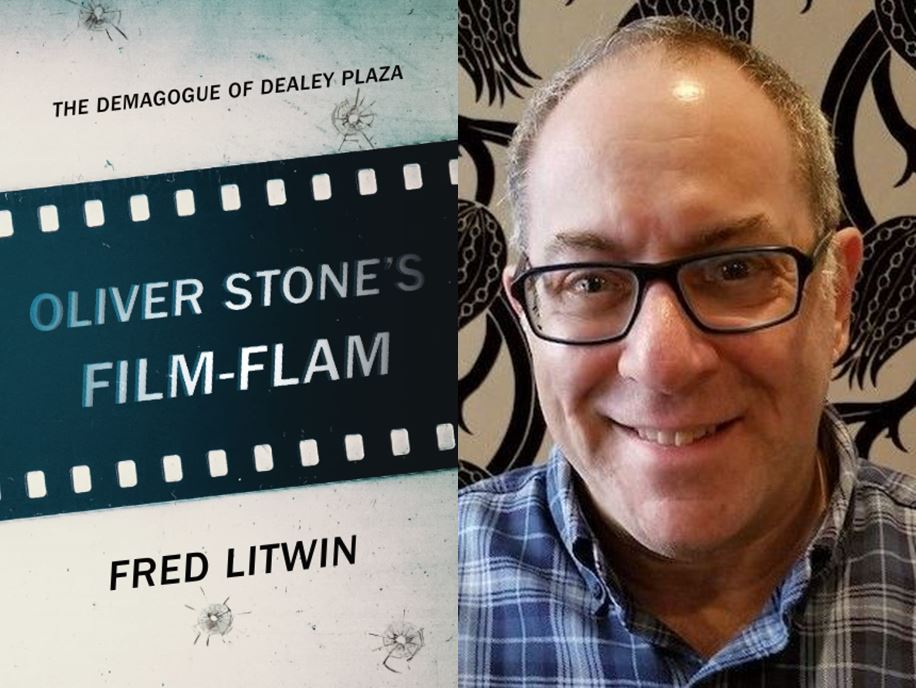
Fred Litwin’s latest book is not really a book. This “book” is mainly just a copy and paste of his blog posts. So he actually didn’t write a book. But nonetheless, fundamentally, Fred Litwin still can’t debunk JFK Revisited and JFK: Destiny Betrayed. So he made up lone nut excuses…he transferred them from his blog to the pages of what he calls a book.
JOHN STRINGER—“Which is more likely? A different brain, or a lack of memory for minor details after 32 years?” (11/24/21 blog; Chapter 17)
BRAIN WEIGHT—“Here is an excerpt from Vincent Bugliosi’s book, Reclaiming History…” (11/30/21 blog; Chapter 15)
BRAIN PHOTOS—“Which is more likely? That the powers that be switched out another brain to fool the pathologists, or that they just used a higher concentration of formaldehyde?” (12/1/21 blog; Chapter 16)
JAMES GOCHENAUR—“How much he [Elmer Moore] pressured Perry is not exactly known.” (12/5/21 blog; Chapter 8)
THROAT WOUND—“Dr. Perry…wasn’t performing an autopsy, he was frantically trying to save the life of President Kennedy…No forensic pathologist who has examined the autopsy X-rays and photographs believes the throat wound to be one of entrance.” (12/10/21 blog; Chapter 7)
BACK WOUND—“Gerald Ford made a reasonable and purely editorial change.” (12/12/21 blog; Chapter 21)
VALERY GISCARD D’ESTAING—“This all could have [just] been misinterpreted.” (12/15/21 blog; Chapter 34)
AUTOPSY PHOTOGRAPHS—“JFK Revisited ignores the issue of memory.” (1/14/22 blog; Chapter 18) “One possibility, raised by Vincent Bugliosi…” (1/18/22 blog; Chapter 19)
HEAD WOUND—“The doctors at Parkland Hospital were frantically trying to save the life of President Kennedy. They were extremely busy and no one had the time to examine his wounds in detail. Dr. Michael Baden explained this to Gerald Posner…” (3/22/22 blog; Chapter 14) “We are dealing with human beings and their imperfect memories.” (3/27/22 blog; Chapter 10)
MISSING AUTOPSY PHOTOGRAPHS—“Memory is a tricky thing…Here is what Vincent Bugliosi wrote about this issue…” (4/8/22 blog; Chapter 20)
JFK’S AUTOPSY—“Every single forensic pathologist who has examined JFK’s autopsy x-rays and photographs has come to the same conclusion: that JFK was hit from behind.” (5/12/22 blog; Chapter 22)
The problem with doing such a thing is simple: a blog is not a book. And the above are just a series of excuses for the powerful evidence presented in Oliver Stone’s films, JFK Revisited and JFK: Destiny Betrayed.
To show just how weak they are—and also how fundamentally flawed this cut and paste job is as a book—consider the first three. These all concern the forensic case of President Kennedy’s brain. Since the fatal shot was through JFK’s skull, this is quite important forensically. One of the strongest parts of Stone’s film is the case made for the pictures and illustrations of Kennedy’s brain not being genuine. In fact, the evidence dictates that they simply cannot represent Kennedy’s brain. In the film, this case is made on three different planes of evidence.
- The sworn testimony of the official autopsy photographer John Stringer made before the Assassination Records Review Board (ARRB).
- The Dutch medical study testing average weights for the human brain.
- The pictures and films of Kennedy’s skull exploding and the tissue, brain matter and blood deposited all over the car, into the air, and even on the cyclists riding behind and to his left.
A fourth plane would be the eyewitness testimony of those who saw Kennedy’s brain after he was pronounced dead. Stringer denied the pictures at the Archives were his due to—among others—two major issues. He did not use the type of film these pictures were taken with, and the technical process that produced the film, a press pack, was not used by him.
Now look back at what Litwin says about Stringer. Is he really saying what I think he is? That Stringer would have forgotten how he worked as a photographer over a period of decades, and on this the most important case of his life? One of the most compelling interviews the Assassination Records Review Board (ARRB) did was with Stringer, and it is described in Doug Horne’s book, Inside the ARRB. According to Horne, Stringer was both surprised and excited when he saw the pictures. So much so that he walked over to the holders to examine them closely, he actually held them in his hands. (Horne, p. 807). He then said this was not Ektachrome film and it was from a press pack, neither of which he used in this case. So as far as he knew he did not take the pictures. (ibid, p. 809)
The second plane of evidence is the famous Dutch study that measured average brain weight—which came out to be about 1350 grams (The Assassinations, edited by James DiEugenio and Lisa Pease, p.253) Oddly, Kennedy’s brain was not weighed the night of the autopsy. About a week later, when it was weighed, it came in at 1500 grams. How could that be considering the massive head explosion depicted in the Zapruder film with a jet stream of blood and tissue exiting the top of the skull, with all the blood and tissue all over the back of the car, on Jackie Kennedy’s clothes, brain matter hurled with such force backwards that the cyclists thought they had been hit by a projectile. It was not a projectile; it turned out to be Kennedy’s brain and skull bone. (Josiah Thompson, Last Second in Dallas, pp. 56,57) We will never know how much of Kennedy’s brain was in the back seat of the car because it appears the Secret Service was sponging out the car while Kennedy was in the emergency room; there is a photo to denote this.
The above matches up with the plentiful witness testimony, all attesting to see a brain that was severely damaged to the point that a large part of it was missing. After all, witness Marilyn Sitzman said, “I saw his head open up and brains coming out.” (David Mantik, JFK Assassination Paradoxes p. 265) In his book, The JFK Assassination: The Evidence Today, Jim DiEugenio collects 12 witnesses from both Parkland and Bethesda who recalled a large part of the brain being lacerated and missing. (p. 161) Which is not at all what one sees in the pictures, or the HSCA illustration drawn by artist Ida Dox.
Litwin’s argument about using too much formaldehyde shows a shocking ignorance of what happened that night during the autopsy at Bethesda Medical Center. He might ask himself why Kennedy’s brain was not weighed that night at Bethesda. James Curtis Jenkins, a morgue assistant, said the brain was so vitiated it was difficult to induce needles into the blood vessels in order to perfuse the specimen with formalin solution. (DiEugenio and Pease, p. 251) Pathologist Thornton Boswell said the brain was so torn up it might not have even shown a bullet track. (ARRB Deposition, p. 193).
Which leads to the final question: Why was the brain not dissected? As neurologist Mike Chesser said on camera during the filming of Oliver Stone’s documentary, this is necessary in order to determine the bullet path (paths) through the skull. (James DiEugenio, JFK Revisited, p. 298) As Cyril Wecht says in the film, the excuse given in the supplementary autopsy report for not doing it was “in the interest of preserving the specimen”. (Warren Report, p. 544) As Wecht declared: preserving the specimen for who and for what? Of course, Boswell’s description might explain why there was no dissection. It also explains why the photos and illustrations cannot be Kennedy’s.
Taking all of this evidence into consideration, as Doug Horne says in the film, these pictures would not be admitted into court. But further, if a defense lawyer can prove fraud or bad faith—which one could—the attorney can move for a mistrial and also to have the charges dismissed. That is undoubtedly what would have happened here.
This is Fred Litwin at work. Having demonstrated the (non-existent) quality of his labors in depth and at length, one can guess the value of the rest of those blog posts. And one would be correct; they are something less than zero.
II
Slip sliding along, Litwin actually claims that John Connally’s account of the shooting “is all consistent with the single bullet theory.” (11/21/21 blog) Oh really Fred? Connally stated, in the clearest terms, that the first bullet which hit Kennedy did not strike him. (Warren Commission Hearings, Vol. 4, pp. 135-36) His wife, sitting right next to him in front of JFK, completely agreed. She said that she turned at the sound of that shot and Kennedy “had both hands at his neck….very soon there was the second shot that hit John.” (ibid, p. 147) If one only allows for three shots, as Litwin has to do, then Connally does not agree with the centerpiece of the Commission, the single bullet theory. Because the other two shots consisted of one that missed the car completely, and the bullet that struck Kennedy in the skull. So if Connally is saying that he and JFK were hit by separate shots he contradicts the whole Magic Bullet concept: its four bullets. Moreover, he testified: “There were either two or three people involved or more in this or someone was shooting with an automatic rifle.” (Ibid, p. 133) He later went beyond that in private and said he never believed the findings of the Warren Commission for one second. (Joseph McBride, Into the Nightmare, p. 418). This is being consistent with the single bullet theory?
Litwin got offended and hurt about the straight-talk in the film—“I must question whether there was any need for Dr. Cyril Wecht to add that comment in about Gerald Ford. It’s nasty.” (12/12/21 blog; Chapter 21) Wecht says in the film, “As I recall, they said about Gerald Ford that he could not chew gum and walk at the same time.”
Why does Wecht say this? Because in the next sentence he decries the fact that it was Ford who moved the bullet wound in Kennedy’s back (its true location) up into his neck for the final draft of the Warren Report. So the forensic pathologist asked: on what professional grounds did Ford have the standing to do this? Was he a forensic pathologist? Was he an expert photographer? Was he a criminalist? If he had none of those skills then how did he know how and why to do such a thing?
What makes Fred look all the worse is this. The man who originally made the unflattering remark about Ford was Lyndon Johnson. He actually said Ford could not fart and chew gum at the same time. And you can find the remark at Brainy Quote. So the real question Litwin will not ask is this: If LBJ thought so little about Ford’s mental acuity, why did he ask him to serve on the Warren Commission?
Litwin exhibited the same faux outrage when the film “dissed” the Sixth Floor Museum. (3/13/22 blog). No objective person can deny that this institution is dedicated to preserving the myths in the Warren Report. In fact, while offering a prominent position there to a researcher, the management told him he would have to support the Warren Report in public. (See JFK: Inside the Target Car Pt. 3 by James DiEugenio)
Litwin claimed Nurse Audrey Bell “did not see the wound in Kennedy’s throat despite being there for the tracheotomy.” (3/21/22 blog) This is incorrect! She made clear on NOVA in 1988 that she DID see it: “It looked small and round like an entry wound.”
I don’t get angry easily, but I did when Litwin actually said Clint Hill “was rather busy trying to help Jackie Kennedy back to her seat, it seems clear that Hill didn’t have time to do a forensic examination.” (3/27/22 blog; Chapter 10) Which is another nonsensical argument. JFK was face down in the car and Hill could see the hole in the back of the head for several minutes until they reached the hospital. It has nothing to do with a “forensic examination”, it’s what the man saw. (See David Mantik, JFK Assassination Paradoxes, p. 281; Warren Commission Hearings, Vol. 2 p. 138)
Litwin cherry-picked certain witness statements to try to put the skull defect solely on the right side of the head. (3/27/22 blog; Chapter 10) He uses John Stringer’s later 1996 words to the ARRB saying the wound was “in the right side of his head above his ear”—but ignored Stringer’s original 1972 account: “In the occipital part, in the back there, up above the neck.” (ARRB MD 84, p. 5) He uses Ed Reed’s later 1997 ARRB testimony saying he saw no wound on the back of the head—but ignored Reed’s original 1978 account: “Very large and located in the right hemisphere in the occipital region.” (ARRB MD 194, p. 2)
Litwin uses an FBI report to say that Darrel Tomlinson and O. P. Wright seemed to identify the bullet, CE 399, to agent Bardwell Odum. (4/9/22 blog; Chapter 29) But as the film series plainly addressed—and which Litwin ignored—Odum was shown this report by Gary Aguilar, and he adamantly said that he never had or showed any bullet to anyone. In fact, he told Gary Aguilar that, “I didn’t show it to anybody at Parkland. I didn’t have any bullet. I don’t think I ever saw it, ever.” (Mantik, p. 192)
Litwin next, and rather incredibly, states that Wright “never said or implied that CE 399 was not the bullet [he] found.” Yet again, the film series addressed that very point. Wright adamantly told Josiah Thompson way back in 1966 that the bullet he handled had a pointed tip. And Thompson has a dramatic photo comparison of the two bullets in his Six Seconds in Dallas on page 175. In fact, if one talks to Thompson, or reads Last Second in Dallas, Wright actually followed him out of his office and incredulously asked him this direct question: Was that exhibit the bullet they said I turned over? How could Litwin have missed all this?
III
Clearly, Litwin was unnerved by the two speeches that Dr. Henry Lee and Brian Edwards gave in Stone’s documentary about inadmissibility of evidence in court. This is why he brings up these above points about CE 399. No documentary had ever made this issue as strongly as those two men did, with as much backing as this documentary did. So, striking out with Odum and Wright, Litwin tries to extend this issue by saying that the so-called mystery of the 7:30 bullet in Robert Frazier’s notes is actually not that mysterious.
Let us be clear, Litwin is obfuscatory.. Writer researcher John Hunt notes that there seems to be documents missing from ballistics technician Robert Frazier’s files from that day.
But still, in two places in his work product, Frazier noted that he was in receipt of the stretcher bullet at 7:30 PM on the day of the assassination. (“The Mystery of the 7:30 Bullet” by John Hunt, at JFK Lancer.com) Which makes for a serious problem in chain of possession. Why? Because the stretcher bullet had not arrived at FBI HQ at 7:30 PM. In fact, the best estimate would be that it would not arrive until probably after 9:20 PM. And the FBI was waiting for this bullet from the Secret Service. (See Figures 6 and 7 in Hunt’s essay.) The FBI memo from Alan Belmont clearly denotes two bullets will be arriving, as he writes “and we are arranging to get both of these.” That memo was signed off on by seven men in the FBI hierarchy, including the number two man, Clyde Tolson.
What does Litwin now manufacture to get around this information indicating two bullets? He actually writes that Frazier wrote down 7:30 because that was the time that O. P. Wright at Parkland Hospital gave the bullet to Secret Service agent Richard Johnsen! I am not kidding. Can you imagine the spectacle in court on this one? An FBI agent is making chain of possession notes for a private security officer (Wright) and a Secret Service agent (Johnsen)—while they were in Dallas! Which is over 1,300 miles away from where he is. Two men he had no direct contact with and likely did not even know!
All of this nonsense to disguise the question: How could Frazier be getting the stretcher bullet from Todd when he already had the stretcher bullet?
IV
Litwin nonchalantly said the autopsy doctors “identified the entry and the exit wounds in JFK’s head and they saw the beveling that told them which wound was entry and which wound was exit. The evidence was pretty clear.” (5/12/22 blog; Chapter 22) No. As Dr. Boswell explained, a semicircle of one of the late arriving bone fragments kind of looked like an entry wound. And a notch in one of the other bone fragments might have been an exit. Nothing was for sure.
Litiwn incredibly states about the back wound: “…the autopsy photographs that shows its exact location, which is totally consistent with the single-bullet theory.” (Chapter 21) Simply not true! The HSCA said that in order for it to work, JFK would have to be leaning WAY forward (HSCA Vol. 7, p.100)—which he was not. (Warren Commission Hearings Vol.18, p.26) The bullet also would’ve smashed the first rib had it traversed where the measurements place it.
In relation to the testimony of the secretaries on the fourth floor i.e. Sandra Styles and Victoria Adams, the author says “Oswald just simply beat Adams and Styles down the stairs.” (Chapter 23) I simply respond to this presupposing statement with, “How do you know there was anyone running down the stairs from the 6th floor in that time frame?” Litwin might say, “The rifle seen in the window and the rifle being found!” To which I will say, “That just means there was a shooter up there. But again, how do you know there was anyone running down the stairs from the 6th floor in that time frame?” Crickets.
Litwin parrots the lone nut talking point that “of course there was no evidence of the [palm] print being lifted, because the dusting powder on the print is totally lifted off.” (Chapter 27) But that’s impossible, because there was powder found “all over the gun.” (Warren Commission Hearings, Vol. 4 , p.81) Litwin says “Oliver Stone would have you believe that there is no evidence the print was even lifted.” (Chapter 27) Hmm…has Litwin not read this sentence from the Warren Report itself? “Nor was there any indication that the lift had been performed.” (WR, p. 123) Litwin also never gets to the real crux of the issue. That is this: the palm print didn’t appear for a week. (Warren Commission Hearings Vol. 4, pp. 24-25). And also, that the only person to see this alleged print said it was an old print. (Gary Savage, First Day Evidence, p. 108)
Let us mention the Chicago Plot. Litwin says: “Now, of course memories fade over time…Might Bolden have been conflating the Vallee story with [a 1963] rumor?” (7/20/22 blog; Chapter 39) As Edwin Black (Chicago Independent, 11/75) and Jim Douglass (JFK and the Unspeakable, Chapter 5) have proven, at length and in depth, the Chicago plot was no rumor. But I will say this…when basically all you have left is the old shibboleth, “memories are unreliable” excuse—which is Litwin’s and many lone nutters’ constant M.O.—then you have no case.
V
As bad as Litwin is on the forensic side, he is just as bad on the historical angle. Which is a major part of JFK: Destiny Betrayed. He refuses to confront the fact that Kennedy was looking for a way to get out of Vietnam in 1961. In the 14 pages he devotes to the Indochina episode the reader will not detect the name of John Kenneth Galbraith. Which, for today, is astonishing. Because right after the White House debates over Vietnam in the fall of 1961, Kennedy sent Galbraith to Saigon.
Why did he do so? Because, as his son told Oliver Stone, Kennedy did not like the advice he was getting from his rather hawkish advisors in Washington. In fact, as Jamie Galbraith told Stone about his father:
He admitted many times in the years following, he said Kennedy sent me to Vietnam, because he knew I did not have an open mind. Kennedy knew what he wanted and he knew my father would deliver what he did. (James DiEugenio, JFK Revisited, p. 316)
The second reason this is an inexcusable lacunae is this: Galbraith’s report was the beginning of Kennedy’s withdrawal program. This is another aspect which Litwin actually turns upside down and backwards. If one can comprehend it: Litwin tries to say the withdrawal plan was Secretary of Defense Robert McNamara’s idea! (p. 365) Which is pretty much impossible. For the simple reason that McNamara was a steady and strong proponent of inserting combat troops throughout 1961. He actually wanted to send anywhere from 6-8 divisions in late 1961. If you do the arithmetic that is about 120,000 men. (Gordon Goldstein, Lessons in Disaster, pp. 56-59)
So how did McNamara get turned around on the issue? Through Kennedy and Galbraith, and in two steps. At the end of the debates of November 1961, Kennedy was extremely frustrated that he had to fight so hard to get his ‘no combat troops’ decree through his advisors. He called a meeting for November 27, 1961. He said words to the effect: Look, when policy is decided, those on the spot carry it out or they get out. He then asked: Now who is going to implement my Vietnam policy? McNamara said he would. (John Newman, JFK and Vietnam, Second edition, p. 146) That was step one.
With that established, in April, Galbraith was in town. He and Kennedy discussed a neutralist solution—something Litwin says Kennedy would not do— through the India ambassador’s relations with Nehru. (Newman, pp. 234-36; Litwin p. 367) At this meeting, Kennedy said “he wished us to be prepared to seize upon any favorable moment to reduce our commitment.” Kennedy then sent the ambassador to see McNamara, and according to Galbraith, the defense secretary got the message. This point is double sourced since McNamara’s deputy, Roswell Gilpatric, said that his boss told him ”the withdrawal plan was part of a plan the president asked him to develop in order to unwind this whole thing.” (Virtual JFK, by James Blight, p. 129: p. 371).
There is a third source for McNamara getting Kennedy’s drift. At the May, 1962 SecDef meeting in Saigon, McNamara asked the overall commander, General Harkins, to stay after. McNamara then asked him when he thought the army of South Vietnam would be able to take over the war effort completely. As someone who was there noted, “Harkin’s chin nearly hit the table.” (JFK and the Unspeakable, by James Douglass, p. 120) McNamara said the American effort would be dismantled and Harkins had responsibility to prepare a plan to do so.
In the light of the above facts, for Litwin to say that the withdrawal plan was McNamara’s idea is utter malarkey.
Stone’s film then supplies the two major pieces of evidence which show that Kennedy was getting out, without any questions about it. First, the declassified minutes of the May 1963 SecDef meeting in Hawaii where Harkins handed in all the withdrawal schedules for each department. McNamara leafed through them and said the overall plan was too slow, we were getting out faster.(Newman, p. 324-25) The second piece of clinching evidence was McNamara’s exit briefing which John Newman listened to. There, the Secretary said he and Kennedy had decided that America was getting out once the training mission was over. And this was unequivocal; it did not matter if they were winning or losing. (Vietnam: The Early Decisions, edited by Lloyd C. Gardner and Ted Gittinger,p. 166). It does not get any more clear than that. Which is probably why Litwin ignores not just those two instances, but everything else in the above.
Fred Litwin is not an author. He is an agitprop artist.
Afterword
by James DiEugenio
This will be the last article Kennedysandking will ever publish on Fred Litwin. As the reader can see from the above, Litwin has nothing to contribute to the subject that has any value or insight. On top of that, he has a penchant for the smear. For instance, he heads his chapter on Vietnam by labeling it as “politics”.
JFK: Destiny Betrayed had the finest array of historians ever assembled in a documentary on the subject: Robert Rakove of Stanford, Philip Muehlenbeck of George Washington, Richard Mahoney of North Carolina State, John Newman of James Madison, Bradley Simpson of Connecticut. There was no better roster to review Kennedy’s policies in the Middle East, Africa, Indonesia, and Indochina. This rivaled the luminaries the film had on the forensic side. (For a demonstration of just how unique Kennedy’s foreign policy was, click here)
Broadly speaking, history is the collection of the best sources with the most relevant information from the most reliable scholars. Politics should have nothing to do with it. And the viewer can read the works of these authors and they will see that they are not at all political in nature; they are factually based.
Litwin quotes David Talbot from the film saying that there is a thread between 1963 and the horror show of American politics today. (Litwin, p. 363) That is not Talbot saying that about himself. This is what the American public feels. And one can check author Larry Sabato’s book, The Kennedy Half-Century to certify it. In the focus groups he conducted, adults of all ages agreed that the assassination “changed America.” An astonishing 61% said Kennedy’s murder “changed the nation “a great deal’. Sabato observed that those alive at the time, testified to the “deep depression that set in across the country. Because the optimism that prevailed since WW2 seemed to evaporate”. (Sabato, p. 416) Kevin Phillips revealed the same in his book Arrogant Capital. In his introductory chapter he depicted a chart which showed the collapse of the public’s belief in the government. The percentage went from over 70% in 1960 to the teens by the nineties. And the collapse began in 1964, the issuance of the Warren Report.
So this is not, in any way, politics. This is simply social science. If Litwin wishes to deny it then he should speak to Sabato or Phillips. If he does not, then that proves it is Litwin who is being political. It seems to indicate that either psychologically or politically he cannot accept these facts. To be kind, maybe it is because he is Canadian and does not live here?
The second reason we will now ignore Litwin is the fact that there is a real question of who is the Confidence Man here. Oliver Stone’s life has been laid out by biographers, and by himself in the first volume of an autobiography called Chasing the Light. He makes no bones about who he is.
But this is not the case with Litwin or his soul brother Steve Roe. In his first book, I Was a Teenage JFK Conspiracy Freak, Litwin states that 1.) He used to be a strong believer in a conspiracy in the JFK case, and 2.) He had been a left winger who turned into a conservative. He has never been able to convincingly prove either one of these claims. Therefore it seems he may have adopted them to mimic his role model David Horowitz. As per Roe, no one has been able to certify a business entity known as “roeconsulting”, which is the rubric he used to post his criticisms of Stone’s film.
If a writer cannot remove these kinds of fundamental doubts about who they are, why should anyone pay any attention to his work product?
-

Dale Myers and his World of Illusion
Dale Myers has made a career out of giving the MSM what it wants concerning the assassination of President John F. Kennedy. This includes proffering a truly dubious witness, Jack Tatum, to incriminate Lee Oswald as the murderer of J. D. Tippit. Jack Myers exposed the man Myers foisted on the public via PBS in 1993. (Click here for details).
But that was not enough for Myers. Not by a long shot. On the 40th anniversary of JFK’s murder ABC’s Peter Jennings wanted to do a program supporting the Warren Report. Somehow, he knew where to go. Jennings hired Myers’ buddy Gus Russo as lead reporter. Russo turned to his PBS chum Dale. Myers went to work on two main areas. These were the acoustics evidence, and his Rube Goldberg “computer simulation” of the Zapruder film: an animation that is supposed to reveal the forensic truth about the last few seconds of Kennedy’s life as it was extinguished in Dealey Plaza.
The problem with both of these is that they turned out to be about as reliable as Myers’ PBS work on the murder of Tippit. Concerning the acoustics evidence, Myers tried to proffer that by relating the movement of the DPD motorcycle driven by H. B McLain in the Hughes film, and then drawing a parallel with the same rider in the famous Zapruder film, he could discredit the acoustics evidence as being inaccurate about the shot sequence in Dealey Plaza. Myers attested that by his mathematical comparison, McLain would have had to have been riding at 200 mph to be in the correct spot to capture the sounds of the bullets in Dealey Plaza on his radio. (Donald Thomas, Hear No Evil, p. 676).
The problem with Myer’s statement was that the general public only saw the computations it was based on three years later. When informed people finally did, it turned out that Dale had done some MSM like slicing and dicing in order to come out with that 200 mph number, e. g. the timing of the first shot, assuming the grassy knoll shot missed, the placement of Robert Hughes etc. (Thomas, pp 677-680). After a long and detailed analysis, Don Thomas concluded that not only was Myers wrong, but “The ABC documentary’s “concrete evidence” had feet of clay. The producers had relied on an expert whose only credential was a bias against conspiracy theories.” (ibid, p. 684; we will go into the Myers “simulation” shortly.)
On July 24th, Myers wrote a piece that was his way of getting back at Oliver Stone’s two new documentaries JFK Revisited and JFK: Destiny Betrayed. He bases this critique on his viewing of the two films in the DVD package plus the release of the accompanying book JFK Revisited: Through the Looking Glass, which contains the annotated scripts, and interview excerpts.
He starts off on the wrong foot by saying the DVD package contains almost ten hours of material. Since the long version of the film is four hours and the short version is two hours, and there is overlap between the two, I guess we will have to wait about another three years to figure out how Dale came to that number. (Even if one throws in the commentary track version, it is not ten hours.)
Myers now slips up again. He wants to criticize the film for something that it does not include. Namely the murder of Tippit. He then acknowledges that some might think this is not fair, but he brushes this off with another of his patently bombastic pronouncements: “I think this is the heart of why the film comes off like a stacked-deck.”
This is the guy who used Jack Tatum as his chief witness in the Tippit case, and who then based his 200 mph motorcycle speed on invisible calculations. He now works his way into the mind of Oliver Stone and his screenwriter—namely me—and says imperiously, ”Oliver Stone and James DiEugenio won’t deal with the Tippit murder because it is the snare that entrapped Lee Harvey Oswald. It was Tippit’s murder that made Oswald a prime suspect in the JFK assassination.” Now that is a rhetorical trick worthy of a card sharp. For the simple matter that the film shows that Oswald not only did not shoot Kennedy, he could not have shot Kennedy. Therefore why would he be involved in the Tippit murder? As Bob Tanenbaum, who Stone and I met with numerous times while planning the film, says on screen: With the Warren Report’s evidence you could not convict Oswald in any court in the country. As an Assistant New York County District Attorney in Manhattan Tanenbaum never lost a murder case in seven years. I think those credentials outdo Myers’. Don’t you?
The book accompanying the DVD contains annotated scripts to both films: the short and long version. It also has excerpts from interviews that largely did not make it into the film due to time issues. Myers refers to that over four hundred page book as being “semi-annotated”. In reality, the pages dealing with the film scripts contain over 500 footnotes. Every statement of factual evidence is sourced.
Interestingly, Stone’s lawyer actually started that process when, upon seeing the rough cut of the film, she wanted us to prove the things we were saying about the pathologists in the film. She thought they were quite startling and might be hard to comprehend to a general audience. Much of that evidence was produced by the Assassination Records Review Board (ARRB), and this is why we enlisted three members of the Board to appear on the program. The reader may want to ask Myers if, in any of the shows he has worked on, he talked about the existence of that body or revealed any of the new or declassified results of its work. One example: that autopsy photographer John Stringer denied he took the pictures of Kennedy’s brain in the National Archives. After all, JFK Revisited has ARRB employee Doug Horne relating this evidence. He was in the room when Stringer said it under oath. That disturbing testimony leaves us with these questions:
- Who did take the pictures?
- Why did someone else have to shoot them?
This evidence, as presented in the film, is the kind of material that one could have taken into a court room to adjudicate an acquittal for Oswald. Because the presentation of fraudulent evidence in a felony case can be grounds for having the proceeding thrown out. Stone’s film actually has a practicing neurologist, Michael Chesser, talking about this evidentiary issue.
JFK Revisited, the film and the book, attempted to gather professionals in the field of legal procedure and forensics. I have named two, Tanenbaum and Chesser, and I wish to introduce a third, namely Dr. Henry Lee. Why? Because Myers said that our film included an animated reconstruction of the shooting. No it does not. If we had done so, we would have had to include scale models of the figures in the car, close ups of where the bullets struck the two bodies, and some kind of time sequence also. We chose not to do that. And this is where Dr. Lee comes in to play.
As screenwriter, I did a pre-interview with Lee when he was in Los Angeles testifying in a case. I asked him about this whole issue of doing computer reconstructions for trajectory analysis purposes in the JFK case. He said simply and pointedly: You cannot do that in the Kennedy case. He added that this is due to the basic reason that neither wound in the president was dissected. Therefore, any trajectory analysis amounts to guesswork. Unless a wound track is dissected, you cannot present a trajectory with any real authority. This from the man who many consider the best crime scene reconstruction professional in the business. I decided he was, in all probability, correct and we did not do that sort of thing.
Why did I conclude that? Because Lee has worked on 8,000 felony cases, and about 1,000 of them have been death by gunshot. He has written over 30 books about true crime cases and some of those are used as textbooks in forensic science classes. He has been approved to testify in almost every state of the union, and also 42 countries. As with Bob Tanenbaum, I would like to ask Mr. Myers: “How many states have you been approved in to testify as a forensic crime scene reconstruction expert? How many countries?”
Concerning Lee’s statement, in Myers’ ABC “simulation’ I don’t recall him telling the audience that there was no dissection of the back wound in President Kennedy. Or explaining why. He surely has to know that Kennedy pathologist Pierre Finck admitted under oath at the Clay Shaw trial that there was military brass in the morgue that night and they would not allow the wound to be tracked. (James DiEugenio, Destiny Betrayed, second edition, p. 302). This was rather important information. But I don’t think that Russo or Jennings would have allowed that in the show; for obvious reasons.
Myers tries to neutralize the attacks on his “computer simulation” by saying the critiques I named of it, that somehow, he had crushed them all. This really makes me wonder about good ole Dale. According to Bob Harris, Myers asked You Tube to remove his critique of Myers’ simulation. To my knowledge, he never replied to Milicent Cranor. Myers said he called David Mantik, but Dave said he never got the call or any message. As for Pat Speer’s, well the reader can see how this exchange turned out himself.
Anyone who watches JFK Revisited can see that what we did was to present evidence that 1.) It is highly unlikely that a bullet could do the damage that CE 399 did and emerge in such intact condition. 2.) The chain of custody of this bullet is rather suspect. For the former we had forensic pathologist Cyril Wecht on camera along with battlefield surgeon Dr. Joseph Dolce, who worked for the Warren Commission. For the latter we had Dr. Gary Aguilar, Dr. Henry Lee, and former police investigator Brian Edwards as witnesses. In the film, Aguilar proved that the FBI lied when they wrote that Bardwell Odum showed CE 399 to original Parkland identification witnesses O. P. Wright and Darrell Tomlinson. Odum said he never did any such thing. (The Assassinations, edited by James DIEugenio and Lisa Pease, pp.282-84) To repeat: this is the kind of fraud that can get a case thrown out of court. Again, I do not recall Myers discussing this for his ABC “reconstruction”. I think it would be relevant to that presentation. After all, if the bullet was not CE 399, what bullet trajectory was Dale “simulating”?
Myers objects to my references to the Tippit case in the book, JFK Revisited. He says the essay I wrote and reference is a mélange of work by Bill Simpich, Farris Rookstool and John Armstrong. Anyone who reads that piece can see that there are about 7 references to those three in that profusely annotated work. (Click here.) The two most often used sources are, by far, the Warren Commission volumes and the book by Joe McBride, Into the Nightmare. Myers does not want to acknowledge this, perhaps because it indicates 1.) There is material in the volumes he chose not to use and 2.) McBride’s book showed that Myers’ work on the Tippit case was, to be kind, not as comprehensive as he tried to advertise it.
For instance, it turns out that– in all the decades he says he worked on the Tippit case–he never interviewed the murdered policeman’s father. If Joe McBride found him, why couldn’t Dale? When McBride quoted Edgar Lee Tippit as stating things that would contradict the Myers/Warren Report version of the Tippit shooting, Dale did a funny thing. He now wrote that Edgar Lee was somehow mentally afflicted. As McBride points out, that information was garnered from a sister of J. D. ten days after Myers ordered McBride’s book. In other words, Myers somehow could not locate the man in some 35 years, but now—oh so conveniently– he finds out it did not matter.
Anyone can read McBride’s reply to Myers. (Click here.) Myers wants to belatedly discredit Edgar because he brings out evidence that indicates Tippit, and another officer, “Had been assigned by the police to hunt down Oswald in Oak Cliff.” Edgar then added that the other policeman did not make it to the scene since he stopped for an accident. As McBride also reveals, former DA Henry Wade seemed to corroborate Edgar. He told Joe: “Somebody reported to me that the police already knew who he [Oswald] was, and they were looking for him.” McBride goes further and states, with convincing evidence, that the other officer, who did not get to the scene, was William Duane Mentzel.
In sum, if Oliver Stone had decided to explore the Tippit case, I would have scripted that also. And I would have brought in the work of McBride, as well as authors like Henry Hurt, Jack Myers and myself. I would have chosen what I thought was the best from each of these sources and arranged it as astutely as I could. To put it mildly, it would not have comported with the Warren Report version.
Myers closes his diatribe by making some of his usual sociologically absurd comments. He first says that there is a movement to silence in America. Really Dale? In the age of Donald Trump? He then gets to his point: Somehow Oliver Stone and myself were ignoring and obfuscating what happened on the day Kennedy was killed. No we were not. We were doing what he never did. We were analyzing the newest evidence in the case with persons who are, unlike him, credentialed professionals. That is why we used people like Dr. Cyril Wecht, criminalist Henry Lee, Dr. Gary Aguilar, physicist David Mantik, neurologist Mike Chesser, former police investigator Brian Edwards, journalist Barry Ernest, ARRB investigator Douglas Horne, surgeon Donald Miller and radiologist Randy Robertson. We easily had more accredited professionals on screen than appeared in all of the programs Myers has worked on combined. In fact, the comparison is so one sided as to be kind of laughable.
This unprecedented gathering of authorities gave the public some new, evidence-backed insights into the actual circumstances concerning what happened to President Kennedy in Dallas. One example: Chesser, Mantik and Aguilar proffered a case– with House Select Committee on Assassinations advisor Larry Sturdivan’s own evidence—that a shot came from the front. Those same three, plus Horne, also showed that the brain photos, accepted by the HSCA as President Kennedy’s, cannot be his. And, as anyone can see—except Dale Myers—they did this on three evidentiary grounds. I could go on in this vein e.g. about demonstrating Oswald’s alibi, but the point is made. Questions like: What does the autopsy reveal about the true circumstances and the actual cause of death? Does the defendant have an alibi? These are what a criminal investigation of a gunshot homicide are about.
But that is what Myers, Russo, the late PBS producer Mike Sullivan, and Peter Jennings, were not going to do. It was they who were the masters of silence about really happened to JFK. And this new work helps show Dale Myers for what he was and is: a designer of sand castles in the air.


