Clay Shaw in Italy: Amid Permindex and Gladio, Part 2
In Part 1, we have established the enormous influence of Licio Gelli and Propaganda Due, and its association with Permindex/Centro Mondiale Commerciale. This was through someone, only Michele Metta discovered, namely, Roberto Ascarelli. As noted, both groups met in his offices, and he served on the board of Permindex/CMC. Now that we have presented this new and compelling information, it is appropriate to review some already established material before proceeding forward again.
As noted, Clay Shaw always denied he had any association with the CIA. He did this in public, and he also declared it under oath on the stand at his trial. This, of course, turned out to be a canard. The declassified record adduced by the ARRB has proven it as such. As William Davy showed in his book, Shaw had a covert security clearance, and he was so valued that he was issued a Y file. (William Davy, Let Justice be Done, p. 195, p. 199). As Joan Mellen later discovered, Shaw was a highly paid CIA contract agent. (Our Man inHaiti, pp. 54-55) In an internal communication, the ARRB’s CIA analyst, Manuel Legaspi, stated that the Agency had severely altered Shaw’s 201 file. But, as previously mentioned, we do know that Shaw did work for the CIA “over a five year span in Italy.” (Davy, p. 100)
When Ference Nagy first announced plans for a business organization in Basel, this met with criticism in the papers due to some of the people involved. That would include Nagy himself, since the year before he had been referred to as “a long-time asset of CIA Deputy Director of Plans, Frank Wisner.”(Maurice Phillips’ blog, 10/15/10) According to the Soviets, Nagy had a role in the Hungarian uprising of 1956. (New York Times, 11/8/56) In declassified documents by the ARRB, Nagy was revealed to be “a cleared contact of the International Organizations Division. His 201 file contains a number of references to his association with the World Trade Center.” (CIA document of 3/24/67)
When the financial banking for Nagy’s new enterprise was announced, it raised even more controversy. (State Department Memo, 1/15/57) The first bank announced was J. Henry Schroder’s. This bank was closely associated with the CIA and Director Allen Dulles. The Dulles law firm, Sullivan and Cromwell, used Schroder’s in dealing with the Nazis in the late thirties. When Dulles became director, that bank was a repository for a 50-million-dollar contingency fund he controlled. (Davy, p. 96) That financial conglomerate was a prime source as a conduit for CIA fronts like the Kaplan Foundation and a half dozen others like it. (ibid)
So Schroder’s now denied its backing. Another bank stepped in, namely, Hans Seligman’s. The State Department was curious about this since Seligman’s was a much smaller house than Schroder’s. When the American consul interviewed Nagy and Seligman, he found them to be rather cautious in revealing the firms backing the project. But Seligman had a reputation for cooperating with the fascists during the war. And also, like Schroder’s, Seligman’s bank was also in the Sullivan and Cromwell financial orbit. (State Department cables of 2/1/57 and 11/7/58; S. Menshikov, Millionaires and Managers, p. 297)
Due to the characters involved, the questionable backing, plus attacks in the press, the project stalled. But it was now ascertained that the International Trade Mart was a model for Permindex, and that Clay Shaw of the ITM had shown “from the outset great interest in the Permindex project.” (State Department cables of 4/9/58 and 7/18/58) This prompted a visit to New Orleans by certain Swiss officials in 1957. (State Department cable of 11/7/58) In the spring of 1958, Enrico Mantello and his father Giorgio—a main player in the Permindex scheme—traveled to New Orleans and met with Shaw. This was after an exchange of letters between the two parties. (Nagy collection at Columbia University, sourced by Ed Berger.) Nagy seemed to be determined now to move to Rome, and Secretary of State John Foster Dulles somehow heard of this. In a memo of September of 1958 requesting aid for Nagy in Italy, the document originates at Commerce but it has Foster Dulles’ name on it at the end.
Nagy then announced that Permindex would be opening up an affiliate called Centro Mondiale Commerciale in Rome. According to a Time-Life internal memo, Shaw visited their new HQ prior to its official opening. This was a 37,000 square foot office building originally constructed in 1942. Shaw was then reported by the State Department to be on the Board of Directors. (State Department cable of 11/7/58)
As Maurice Phillips and Metta have pointed out, there was a Canadian connection to CMC. This was through former Major Louis Bloomfield. In a letter written by Bloomfield on February 4, 1960, he noted that Nagy had met with David Rockefeller the previous day. Bloomfield was supposed to be there, but due to a temporary health affliction, he could not attend. Bloomfield described the meeting as successful, and he planned on meeting with Rockefeller in a week or so. (From Bloomfield to Ernest Wolf) As the Bloomfield archive, as excavated by Maurice Phillips, showed, it was not just Rockefeller who was in the Permindex outer circle, but also Baron Edmund de Rothschild. Both men were being solicited as investors. In other words, those involved in Permindex were in contact with two of the richest and most powerful men in the world at that time. (Letter by Bloomfield to Abraham Friedman of April 1, 1959)
II
There was another side to Permindex/CMC. As William Davy notes in his book about Jim Garrison, Ferenc Nagy was a close acquaintance to, and supportive of, Jacques Soustelle. (Let Justice be Done, p. 99) Soustelle had been the governor-general of Algeria and had worked for President Charles DeGaulle. But he had broken with the president over his policy of an independence solution to the war with Algerian rebels—a policy which President Kennedy had advocated since 1957. Soustelle had traveled to Washington in the early sixties and met with CIA officers. He was pleading for support for the OAS, a group of breakaway military officers trying to overthrow and/or kill DeGaulle. According to Andrew Tully in his book CIA: The Inside Story, the meeting was a success. Many years later, it was revealed to the Church Committee that the Agency had aided in a scheme to assassinate DeGaulle. (Chicago Tribune, June 15, 1975)
We should also note something on a lower level that is pertinent. In the 1961 raid on the weapons cache in Houma, Louisiana DA Jim Garrison discovered that some of the arms that were lifted and sent to Guy Banister’s office were CIA stockpiled weaponry on loan to the OAS group. (Garrison, On the Trail of the Assassins, p. 90) In tracing the money used to finance the plots against DeGaulle, French intelligence discovered that about $200,000 in covert funding had been sent to Permindex accounts in the Banque de la Credit Internationale. In 1962, Banister sent to Paris his lawyer colleague Maurice Gatlin, who was a member of Banister’s Anti-Communist League of the Caribbean. Gatlin reportedly had a suitcase full of money for the OAS, estimated at around $200,000. (Jim Marrs, Crossfire, pp. 499-500)
This relates to another explosive disclosure by Michele Metta in his first book on the Centro Mondiale Commerciale. Enrico Mattei was the miracle man who turned the National Fuel Trust (ENI) of the Italian government into a formidable force in petroleum markets on the world stage. Mattei was controversial in his policies as he made key petroleum deals in the Middle East and significant agreements with the USSR. In the former instance, he agreed to lower concessions in order to gain new drilling rights. In the latter case, he agreed to purchase 12 million tons of Russian crude oil. (Time, 11/2/62)
Mattei’s maneuvering weakened the Rockefeller/Shell/British Petroleum-controlled Seven Sisters oil monopoly that had dominated oil markets through the 20th century. (The attorney for that oil monopoly was John McCloy of the Warren Commission.) Mattei also broke with tradition in his policies toward countries where the oil was discovered. He insisted that they get up to 75% of the profits. He stated that he thought the giant foreign oil companies were preying on the Italian market by rigging higher prices. In a clear jab at the Seven Sisters, he once said:
The policy I am following has permitted me not only to free my country from the grip of the cartel, but to benefit from prices lower than those which our neighbors pay. (Ibid)
Mattei was so successful in his endeavors that he expanded the reach of the ENI into motels, cafes, service stations, newspapers and factories producing synthetic rubber. ENI was estimated to be worth 2 billion in 1962. Mattei was said to have played a major role in spurring the enormous growth in the Italian economy during his years as director. He donated his salary to an orphanage. And one should also note this: like Kennedy and DeGaulle, he wanted France out of Algeria.
III
Mattei’s brilliant reign came to an end on October 27, 1962. He perished in a mysterious plane crash, which recalled the murder of Dag Hammarskjold the previous year. (See the book Who Killed Hammarskjold? by Susan Williams) At the beginning of 1962, Mattei’s pilot discovered an attempt to sabotage his plane. Therefore, Mattei now ordered an identical aircraft which he would choose between on short notice. After his death, the wreckage was removed very quickly, and the identical plane was sold off in parts to parties in America. Film director Francesco Rosi commissioned a script after a journalist reported a significant discovery in the case. That journalist then disappeared –forever. But not before he said, “I have a scoop that is going to shake Italy.” (See, “The Mystery of Enrico Mattei’s Death” at Ecco le marche web site; see also La Repubblica, story by Attilio Bolzoni 6/18/2005)
Although Rosi did make his film, it did not get very much exposure in America, and neither did Mattei’s death. But the matter did inspire much private inquiry in Italy. Vincenzo Calia was one of the more important researchers. In fact, Calia changed the verdict about the crash for most later biographies of Mattei. His work altered those references from a plane malfunction to sabotage of Mattei’s aircraft. Calia advanced powerful evidence that the plane went down because of an explosion. (Michele Metta, CMC, p. 132)
Metta was loaned Calia’s research materials. In one of the interviews Calia did, he talked to a writer named Fulvio Bellini. In one of Bellini’s books, he had gone over the problems Mattei was having with his immediate superior, who was opposed to some of his policies and, in fact, was close to Borghese. Bellini referred to the Centro Mondiale Commerciale as: “The terminal in Italy of the group who attend to all the dirty work in world politics, including the assassination of Enrico Mattei.” (Italics added)
Bellini then went even further. He said that, to understand the death of Mattei, one had to follow the trail to none other than Soustelle. Bellini said Soustelle was given the job of performing, what he referred to as, Operation Mattei. He then concluded that Soustelle was given around 100,000 dollars to do so from Montreal through Permindex. (Ibid., p. 133)
We can speculate about the Montreal connection. That is where Bloomfield operated from with the shares of Permindex stock. And he was enlisting the likes of David Rockefeller and Edmund de Rothschild as investors. I do not have to refer to how much interest Rockefeller had in the Seven Sisters: two of the seven were Rockefeller-controlled, Chevron and Exxon.
Two more elements should be mentioned regarding this Metta discovery. A young man named Jules Ricco Kimble was a friend of David Ferrie’s who introduced him to Clay Shaw. One day in late 1961—perhaps early 1962—Ferrie called him and asked if he wanted to take a plane ride with him. Kimble agreed and met Ferrie at the airport, where he learned that Shaw would be joining them. Ferrie made some stops to refuel, but their last stop was Montreal. The trip was for an overnight stay, and Shaw did not rejoin them until the next morning. A bit later, Ferrie called him again to make another flight into Canada, but Kimble declined. (Garrison, p. 118)
Finally, to add more intrigue to what Bellini noted, Metta reports that Soustelle was meeting with former Italian prime minister Fernando Tambroni in Rome in the latter part of 1961. Tambroni had been financed by a member of P2. (Metta, Accomplishing Jim Garrison’sInvestigation, p. 362) Tambroni’s son-in-law was a member of the CMC. Tambroni had been involved in the central government in three different positions for eight years prior to becoming prime minister. But he was so right-wing that riots took place against him, and he lost office after about five months. Tambroni and Soustelle met at the building housing a reactionary group of Tambroni’s called Civil Order. Italian intelligence also suspected it to be the headquarters of the OAS in Italy. (Metta, CMC, p. 131)
IV
Gladio experts Philip Willan and Daniele Ganser mention the role of Frank Gigliotti in reviving masonry, and aiding Gladio in Italy after the war. Willan, for instance, describes Gigliotti as a former OSS and CIA agent. (Puppetmasters, p. 58) Gigliotti, who had spent years in Italy as a young man, was a Presbyterian pastor who was anti-communist and pro-Mussolini in the thirties. He then became an OSS agent against Il Duce during the war. He joined up with the CIA afterwards and, as noted, was quite active in the revival of Italian masonry. In 1960, he was very much pro-Nixon and anti-Kennedy. (Metta, CMC, pp. 10-12)
Beyond that, more than one source has stated that it was Gigliotti who secretly recruited Licio Gelli. The Tina Anselmi P2 Commission thought it was important to note that when Gigliotti left the scene, Gelli took the stage. (Metta, Accomplishing Jim Garrison’s Investigation, p. 65) According to Ganser’s NATO’s SecretArmies, it was Gigliotti who instructed Licio to construct an anti-Communist network in Italy associated with the Rome CIA station. In fact, CIA Director Allen Dulles was actually contributing millions of lire to funding this kind of militant neo-fascist network there. (Metta, CMC, p. 15)
What makes this even more intriguing is this: one of Kennedy’s enemies, William Harvey, was stationed in Ganser’s Rome CIA station in 1963. Another enemy, Lyman Lemnitzer, ran NATO forces and, therefore, Gladio, in that same year. Both men had been guilty of insubordination at the White House in 1962.
Lemnitzer’s rise in the Pentagon was largely owed to General Dwight Eisenhower; Lemnitzer planned operations in North Africa and Italy. Once he became president, Eisenhower made him commander of Far East forces, then Army Chief of Staff, and then JCS chair—all in the space of five years. (Cottrell, pp. 86-87) According to James Bamford, “in Lemnitzer’s view, the country would be far better off if the generals could take over.” (Ibid., p. 92)
To put it mildly, this was not what JFK thought. As chair of the Joint Chiefs, Lemnitzer was opposed to Kennedy’s policies in both Vietnam and Cuba. He was close to Col. Edwin Lansdale, who was in charge of Operation Mongoose. Lemnitzer had been in on a false flag plan against Cuba under the Eisenhower administration. (John Newman, Into the Storm, p. 372) Lansdale himself now thought up the idea of staging a fake Cuban attack at Guantanamo in order to provoke an American invasion. This actually preceded the infamous Operation Northwoods, the series of false flag plans devised by the Joint Chiefs to provoke an invasion of the island.
The problem was that not only was Kennedy against such a provocation, he did not even want to hear about it. (Newman, p. 385) Yet on March 13, 1962, Northwoods was presented to JFK. Then Lemnitzer suggested that America did not even need a pretext; we could just invade, which Kennedy was clearly against.
On Vietnam, Lemnitzer said that Kennedy’s policy would lead to “communist domination of all of the Southeast Asian mainland.” He even said Australia and New Zealand would be threatened. (Newman, p. 391) Notably, this was after the November 1961 Kennedy decision that there would be no combat troops in Indochina, only advisors. According to a conversation John Newman had with the present writer, the JCS knew there were ICBM missiles in Cuba before Kennedy did. They wanted to force JFK’s back against the wall to see how he would respond. They did not care for the peaceful and equitable result. Kennedy ended up removing Lemnitzer in the fall of 1962 (Newman, p. 396). But he made a mistake and sent him to Europe to oversee NATO forces.
V
Bill Harvey began his career in the FBI, but he was too much of a hard drinker for J. Edgar Hoover to tolerate. So he joined the CIA, and he liked to needle the Ivy League officers by pulling out his gun during meetings and spinning the cylinder. (David Talbot, The Devil’s Chessboard, p. 469) He supervised the Berlin station and got to know Reinhard Gehlen and his network there. When he returned stateside, he wanted to run the Soviet Russia division, but he was assigned to Staff D, signals intelligence, with which he worked on with the National Security Agency. (ibid., pp. 470-71)
Buried inside Staff D was a project called ZR/Rifle. This was the development of an assassination program commissioned by Dick Bissell. Prior to this, James Angleton supervised a small assassination team run by Colonel Borish Pash. (James Douglas, JFK and The Unspeakable, p. 143) Both men, Angleton and Harvey, visited with British intelligence officer Peter Wright about the subject of assassinations. (Wright, Spycatcher, p. 204) In fact, the Church Committee discovered that Harvey had made notes about blaming an assassination on a communist–either a Czechoslovak or a Soviet. He also noted that the patsy’s CIA 201 file should be rigged in advance. Which, as HSCA staffer Betsy Wolf showed, Oswald’s was. (Vasilios Vazakas, “Creating the Oswald Legend, Pt. 4” at Kennedys and King.) According to the Church Committee, both QJ WIN and WI ROGUE were Harvey’s recruits, and both were sent to Congo to take part in the plot to eliminate Patrice Lumumba. (See Midnight in the Congo, by Lisa Pease, Probe, Vol. 6 No. 3)
In 1962, Harvey was supervising Task Force W, directly involved with Cuba. Bobby Kennedy was the ombudsman of the overall project called Mongoose. Harvey deeply resented RFK’s fastidious veto power over CIA requests for operations. As David Corn showed in his book on Ted Shackley, Allen Dulles approved of these by rote orally. Bobby wanted them in writing and in detail. Harvey grew to hate the Kennedy brothers, especially Robert. He said his actions bordered on treason. (Talbot, p. 472)
What the Kennedys did not know was that Harvey was also in charge of the second phase of the CIA/Mafia plots to kill Castro, which were going on while Mongoose was proceeding. Harvey had teamed with mobster John Roselli to try to assassinate Fidel. This went on for months on end; there is evidence that it extended into the spring of 1963. (Larry Hancock, Someone Would Have Talked, pp. 148-49) But what got Harvey in deep trouble was his actions during the Missile Crisis. At one of the hottest points of that confrontation, Harvey sent teams of “sixty agents into Cuba to support any conventional military operations”. (Dick Russell, The Man Who Knew Too Much, p. 151) Bobby Kennedy was enraged by this. At that moment, the slightest provocation could have brought on atomic warfare. RFK wanted him fired, but Richard Helms shuffled him off to Rome.
VI
While in Rome, Harvey formed an alliance with General Giovanni DeLorenzo, who, as we saw in part one, planned a 1964 coup called Piano Solo. Harvey was also friendly with the notorious Michele Sindona, the fraudster who almost caused the Vatican bank to collapse. Harvey also met with a man who was instrumental in the Strategy of Tension, Renzo Rocca. Harvey gave Rocca a list of names of far-right zealots who would help in carrying out that strategy. As with ZR/Rifle, Harvey wanted to create a team of thugs who would be “capable of killing, placing bombs and firebombs, and promoting propaganda.” One of the first people whom Rocca talked to after this meeting was Valerio Borghese, Angleton’s friend, and the man who would attempt another coup in 1970. (Metta, Accomplishing Jim Garrison’sInvestigation, p. 88)
Harvey was continuing an old CIA policy first implemented by Allen Dulles in a 1951 document. Dulles wanted the Christian Democrats to treat the Italian communists not as Italians but as communists. He wanted them discriminated against through legislative enactments, administrative harassment, suppression and also control. The project was called Operation Demagnetize, and it was cooperated on between the CIA and SIFAR, the then Italian secret service. (Ibid., p. 43) Years later, the Christian Democrats were very worried about how their full cooperation with the CIA would look if it was fully exposed to the Anselmi Commission on P2. And in fact, Anselmi’s notes make it clear that the Christian Democrats did all they could to close down her investigation. (ibid., pp. 64-65)
The fear was real. Because eventually Judge Felice Casson came to the conclusion that P2 had been involved in the attacks of the strategy of tension “and that the secret society was acting as a proxy for the CIA.” And that inquiry concluded that P2 and Gelli were not just doing so in Italy but in Argentina, and that Jorge Mario Bergoglio, who later became Pope Francis I, was cognizant of it. This is how powerful Gelli and P2 were. (Paul Williams, Operation Gladio, p. 110) They were involved with the assassination program in South America called Operation Condor. (Cottrell, p. 127)
The only other part of Gladio that was likely as impactful as the P2/ Permindex aspect was Yves Guerin-Serac, who led another CIA shell company called Aginter Press. Guerin-Sac was part of the OAS plots to kill DeGaulle. When they failed, he fled to Portugal for what he called, “ …a truly western league of struggle against Marxism.” (Cottrell, p. 118) And, in fact, Aginter Press was involved in the Strategy of Tension in Italy by blowing up a bank in Milan in 1969. Guerin-Sac and Aginter Press were allied with Otto Skorzeny and his gun-for-hire Paladin Group. At one time, in the Paladin group bureau in Zurich, offices of both Permindex and the CMC were located. (Cottrell, p. 125)
In Rome, Harvey’s deputy was F. Mark Wyatt. Wyatt acted as a buffer between the rather unrefined Harvey and the locals; and unlike Harvey, he spoke fluent Italian. He was knowledgeable about Harvey’s attempts through SIFAR and Rocca to carry out bombings on Christian Democrat offices and blame them on the left. (Talbot, The Devil’s Chessboard, p. 475). Harvey also entertained the idea of using the Mafia to murder Italian communists. On the day Kennedy was killed, Harvey blurted out some disturbing remarks that stayed with Wyatt the rest of his life. In fact, his children wanted him to testify before the House Select Committee on Assassinations. He declined.
But during an interview Wyatt did with a French journalist at his retirement home in Lake Tahoe in 1998, he did say something quite provocative. As the writer left, he said: “You know, I always wondered what Bill Harvey was doing in Dallas in November 1963.” The reporter was shocked. Wyatt explained that he bumped into Harvey on a flight to Dallas a bit before the assassination. When he asked his boss what he was doing there, Harvey said rather nebulously: “I’m here to see what’s happening.” (Talbot, p. 477) And thanks to the Luna committee we have just found out that CIA documents reveal that Harvey had permission to fly under an FAA-approved alias in 1963 in the USA.
As the reader can see, those attempting to label Permindex a Russian disinformation story– like Max Holland–are simply and utterly wrong. It and P2 and Gladio and the Strategy of Tension were all too real.
Back in 1992, when I initially went to New Orleans, I interviewed some of Clay Shaw’s remaining family and friends. One of the things that was repeated to me was that he liked to travel; it was not just part of his job as a businessman and as the face of the International Trade Mart. We know about some of these journeys through declassified records. For instance, Shaw filed reports with the CIA from various countries in Europe and Latin America: Peru, Argentina, Nicaragua, and Czechoslovakia. (William Davy, Let Justice Be Done, pp. 198-99)
But further, Shaw was such a valued asset that the Agency gave him what was called a “Y” number. Shaw’s reports under that rubric include “Observations on International Fairs at Milan, Brussels, Basel, Paris and London/Comments on Western European Economics and Desire to Trade with the Soviet Bloc.” (Davy, p. 199). These journeys explain why Shaw frequented the VIP room of Eastern Air Lines and used his alias of Clay Bertrand to sign in there. (James DiEugenio, Destiny Betrayed, second edition, p. 278)
But from these relatives, I understood that Shaw’s favorite countries in Europe were England, and even more so, Italy. Shaw was likely introduced to Britain during his service in World War II. (Paris Flammonde, The Kennedy Conspiracy, p. 76) But it is clear through Anthony Frewin–writing under the pen name Anthony Edward Weeks– that Shaw still held British contacts after the war. One of the pieces of evidence that DA Jim Garrison recovered from Shaw’s home was his address book. Since Frewin lives in England, he began to look up some of these persons and penned a 12-page article on the subject. He wrote that the first thing that struck him about the address book was that Shaw’s British contacts all lived in the best, most expensive areas, e.g., Belgravia, Mayfair, Kensington, etc. (see Lobster, No. 20) On a phone call I had with the author, he stated, this guy was not Joe Sixpack. As we shall see, that is an understatement.
About Shaw’s visits to Italy, the FBI seems to have understood that they were not just social. As the Garrison investigation discovered through an acquaintance of Bureau official Regis Kennedy, “Shaw was a CIA agent who had done work, of an unspecified nature, over a five-year span in Italy.” (Davy, p. 100) As William Davy comments, this almost has to be in reference to Shaw’s service with Permindex/Centro Mondiale Commerciale in Rome. As Davy suggested, this is fascinating, and not just because of Permindex itself. But because one of the main organizers of that business group was Ferenc Nagy, the former prime minister of Hungary. Nagy fled Hungary due to a leftist overthrow in 1947. From the USA, he then became a backer of the Hungarian anti-communist émigré community.
But Nagy was also a friend of Jacques Soustelle. Soustelle was a former Governor-General of Algeria under Charles de Gaulle. But he split with the French president over the issue of independence for Algeria. Soustelle became a backer of the OAS, the rebel military group that tried to both assassinate and overthrow de Gaulle over the independence movement in Algeria, which Soustelle opposed. There is very little doubt that Soustelle had implicit backing from the CIA on this issue. (Davy, p. 99; James DiEugenio, JFKRevisited, pp. 99-100) And, as we shall see, Soustelle figures into the whole Permindex black op backdrop.
There is another connection with Permindex and Shaw, which is important to note in advance. It was not revealed until 2003, perhaps as one of the Assassination Record Review Board’s (ARRB) delayed declassifications. An Agency document dated from June 28, 1978 described Clay Shaw’s service to CIA as encompassing from 1949-72. That document made reference to a claim “that CIA used Shaw for service in Italy with U.S. agent Major Louis Mortimer Bloomfield.” Shaw’s part is described as making connections with political circles and the business world in Rome, and also with developing relationships with extreme rightwing groups. As we shall see, this was accomplished, and the Canadian high-powered lawyer Bloomfield was an integral part of it. (Joan Mellen, A Farewell toJustice, p. 389)
II
Since 1948, Italy had been a high priority for the then-nascent Central Intelligence Agency. In fact, it was the subject of the first National Security Council meeting in late 1947. (John Ranelagh, The Agency, p. 115) Secretary of Defense James Forrestal was concerned about a communist victory in the 1948 Italian elections. Therefore, a directive was issued initiating propaganda and psychological warfare activities to marginalize the leftist parties and promote the Christian Democrats as a bulwark against them. Both the CIA and the State Department participated in this campaign. It was implemented through both the Agency’s Office of Special Operations and, according to Christopher Simpson’s book Blowback, also through the law offices of Sullivan and Cromwell. The latter being the home of the Dulles brothers, John Foster and Allen. At that location, Allen Dulles, Frank Wisner, James Angleton, Bill Colby and others went to work supervising the rigging of the vote.
There was a real possibility that the Italian communists and their allies would win the 1948 elections outright. Which meant they would have a foothold in Western Europe. (Simpson, pp. 89-90) For obvious reasons, this possibility was also a nightmare for the Vatican: to have Godless communism in your own backyard? As Bishop James Griffiths, an American emissary to the Vatican, wrote, they feared a “disastrous failure at the polls which will put Italy behind the Iron Curtain.” (Simpson, p. 90) According to Simpson, the CIA laundered ten million dollars to give directly to the Vatican for anti-communist agitation purposes. This was only one part of an enormous 350 million dollar overall total for the American crusade in Italy.
This fear and this expenditure were justified to these Cold Warriors because in 1946, the Italian Communist party—at that time the largest in the world outside of Russia—and the Socialists had actually outpolled the Christian Democrats for the Constituent Assembly. (William Blum, The CIA: A Forgotten History, p. 23). But because they were separate parties, they had to settle for a coalition government under a Christian Democrat premier. In 1947, a party of American congressmen stopped off in Italy and announced the theme of the upcoming election:
The country is under great pressure from within and without to veer to the left and adopt a totalitarian-collective national organization. (Blum, p. 24)
The two leftist parties were going to unite in 1948 to form the Popular Democratic Front (FDP), and early in the year had won local elections in Pescara, defeating the Christian Democrats. As Bill Colby later wrote:
It was primarily this fear that led to the formation of the Office of Policy Coordination which gave the CIA the capability to undertake covert political propaganda and paramilitary operations in the first place. (Blum, p 25)
This is how important these elections seemed to Washington. Because there was a question in the CIA Director’s mind about legality, the forming of a new department was created to do such missions in the future. And this had both presidential and congressional permission. (Ranelagh, p. 115)
James Angleton also had a special interest in Italy. His father, who had business in the National Cash Register company, moved his family there when Jim was fourteen. Hugh Angleton was a colonel in the OSS during the war. An operations officer, Max Corvo, said of Hugh’s politics, “He was ultra-conservative, a sympathizer with Fascist officials. He was certainly not unfriendly with the Fascists.” (Tom Mangold, Cold Warrior, p. 33) Hugh sent his son to England to get a boarding school education. During the war, young Angleton started out in the army and was then switched over to the OSS and stationed in London to handle the Italy desk. (ibid., p. 38) He was transferred to Rome in 1944 and made chief of counter-intelligence for the entire country. By all accounts, Angleton liked Italy and stayed there until the end of 1947. When he returned to the USA, he got a high position in the newly birthed CIA. (ibid., p. 44)
III
One of the things that Angleton did before he left Italy is important to note for our subject at hand. He and Junio Valerio Borghese organized what was called ‘Stay-behind’ units in Italy. (Paul L. Williams, OperationGladio, p. 15) Borghese was a Navy commander during Mussolini’s reign and fought alongside the Nazis against the Allies. By most accounts, he should have been imprisoned for war crimes. But Angleton secured his release into US Army custody. He dressed The Black Prince in an American uniform and shipped him from Milan to Rome. As Paul Williams wrote:
Angleton needed Borghese and the 10, 267 fascists who fought under his command to help establish the stay-behind units that would ward off any Soviet aggression. (Williams, p. 28)
Angleton got Borghese off with about three years of preventive detention. He wanted The Black Prince to “lead a shadow government, along with a secret army that could manipulate Italian affairs throughout the coming decades.” (ibid) The State Department passed an edict which gave Angleton control over the police, military intelligence and the Italian secret services.
With this power, Borghese was now running the newly formed Gladio forces in Italy, under sectors entitled sabotage, espionage, propaganda, escape tactics and guerrilla warfare. In addition, a training camp for the stay behind units was constructed on the island of Sardinia. This camp was not just for the Italian Gladio trainees but those from Germany, France and Austria. They were sent there by former Nazi intelligence chief Reinhard Gehlen. (ibid., p. 29) As Angleton had rescued Borghese from post-war justice, Allen Dulles had saved Gehlen. The two war criminals were now in business together. They had lost the war, but—through Angleton and Dulles—they had won the peace. Very soon, there were to be hundreds of these Gladio units infiltrated into Western Europe.
They were not just a contingent military force, but as with Borghese, a potent political one. Borghese joined the MSI (Italian Social Movement), a neo-fascist party that was largely made up of former supporters of Mussolini. But that was not reactionary enough for him. He later formed the Fronte Nazionale (National Front), which wished to abolish parties and trade unions, and was much more devoted to a quasi-military state. (Philip Willan, Puppetmasters, pp. 93-94)
He was hardly alone in this belief. There was also Stefano Delle Chiaie, founder of National Vanguard. That group also wished to work outside the political system to subvert democracy to the point that Italy would return to fascism. And it was not just in Italy; his group carried out bombings and killings in both Spain and Chile. (Williams, p. 112)
These rightwing groups were so powerful and well-organized that they encouraged two coups in six years. The first, in 1964, was called Piano Solo. The previous year, the communists had arranged a large labor rally and, undercover as police, Gladio members smashed it, injuring 200. (Williams, p. 74) As a result, General Giovanni DeLorenzo, assisted by 20 other senior army officers—along with CIA station chief William Harvey, military attache Vernon Walthers, plus the director of Gladio–planned an overthrow which included National Vanguard and the Mafia. Piano Solo was to conclude with the murder of Prime Minister Aldo Moro and the installation of a handpicked Christian Democrat as president. It included extensive surveillance and the rounding up of leftwing activists and their imprisonment at a concentration camp in Sardinia. (Wilian, Puppetmasters, p.35) The coup did not proceed since Moro created a compromise between the socialists and Christian Democrats, plus President Segni—who was in on the planning—sustained a cerebral hemorrhage which forced his resignation. (Williams, pp. 74-75)
IV
The timing of all this, the huge communist demonstration and the crackdown, can probably be attributed to President Kennedy’s breaking of Dwight Eisenhower’s Italy policy. The idea for funding the Christian Democrats was to defeat the left; so obviously, that policy did not include making the socialists or communists part of the Christian Democratic government. At the urging of Arthur Schlesinger, Kennedy was advocating for a policy of apertura, that is, an opening to the left. Schlesinger thought that by including the socialists in the government, one could split them off from the communists. Kennedy thought this was a good idea. So, in his 1963 visit to Italy, he decided to advocate the policy change. (David Talbot, The Devil’s Chessboard, pp. 464-68)
Both Angleton and former ambassador Clare Booth Luce strongly opposed it. Luce wrote JFK an over-the-top letter, and Angleton spread rumors that Schlesinger was a Soviet agent. CIA officer William Harvey also opposed it and recommended ways to defeat it. Richard Nixon also opposed it. (Michele Metta, CMC: The Undercover CIA and Mossad Station, pp. 40-41) Kennedy ignored this. On his trip to Italy, he talked to the Socialist leader, Pietro Nenni, directly. After which Nenni clasped his wife and started weeping with joy. By the end of the year, apertura was made policy. It was this violation of tradition which likely caused the attempted coup in 1964.
The second coup attempt was in 1970. It was led by Angleton’s favorite son, Borghese. It was supported by Delle Chiaie’s group and over 200 forest guards who arrived in coaches near Rome. Borghese thought he had support from three army regiments, the police and the Air Force. (Willan, Puppetmasters, p. 91) Also, the plotters had met with the CIA and had financing from a Swiss company in advance.
The Black Prince was so confident of success that he had his speech already planned and, of all things, he was going to back Italy’s intervention in Vietnam! Why? Because Borghese had established contact with President Nixon and with NATO units in Malta to implement the overthrow. One of the connecting points was a man named Pier Talenti, who had worked for Nixon since 1968 and had an estate and business in Italy. Angleton arrived in the country before the coup, and he left shortly after it was aborted. (Willan, Puppetmasters, pp 117-18) In fact, NATO ships were warmed up and ready to go. What went wrong was that the planned call to Nixon was not passed on from Malta. (ibid., p. 93) Another problem was that when the coup did not go as planned, Soviet ships entered the Mediterranean. (Ibid., p. 97)
In addition to the attempted coups, Gladio’s so-called “strategy of tension” also included a series of bombings. The first one was in December of 1969 in Milan’s Piazza Fontana. Seventeen people were killed and eighty-eight were injured. (Willan, Puppetmasters, p. 123) That same afternoon, three other bombs exploded in Rome, killing fourteen. These bombings went on until the early eighties. The most famous one was the Bologna railway station bombing of 1980, where 73 people were killed and over 200 were injured. Collectively, these were known as the Years of Lead. As time went on, they were discovered to be false flag operations. That is, they were investigated originally as leftist plots but later discovered to be done by neo-fascist groups with support from the CIA. The idea was to destabilize the country out of Kennedy’s centrist/left coalition to a centrist/right one.
V
After Borghese’s failed coup, he fled to Spain. He passed away there in 1974. Many years ago, I noted an entry in Clay Shaw’s address book to a Princess Marcella Borghese, who had married into the Borghese family. In my very early investigation of Shaw, this was one of the first hints that he was not the Wilson-Roosevelt-Kennedy liberal that he proclaimed himself to be. (Paris Flammonde, TheKennedy Conspiracy, p. 211) Another was the fact that he scrubbed his Who’s Who in the Southwest entry after either 1963 or 1964. Up until that time, his name appeared regularly. In those prior entries, he was listed as a member of the Board of Directors of Permindex. The exposure of Permindex would also have undermined his self-proclaimed liberal pose. Because Permindex and its offspring, Centro Mondiale Commerciale, appear to be a part of Gladio and this stay behind network in Italy. Shaw seemed interested in concealing this association.
And for good reason. At that time, this network was so hidden and such a taboo subject that people literally lost their lives over revealing its scope and power. For example, Mino Pecorelli was an offbeat but insightful journalist in Italy in the sixties and seventies. He had some valuable sources inside “the underground state and secret services.” (Richard Cottrell, Gladio, p. 75). His stories about Gladio and its relationship to the kidnapping and eventual murder of Prime Minister Aldo Moro clearly hinted at a connection between the two. Pecorelli was even in receipt of some letters Moro wrote his family while in captivity. Mino hinted that, behind the Moro kidnapping stood a “lucid superpower”, clearly hinting at the USA. He also noted that it was interesting that the State Department sent over a Deputy Secretary to advise the Italian government not to negotiate for Moro’s release. He also indicated a connection between Gladio and the Moro death. Shortly thereafter, he was gunned down in a drive-by shooting near his office in Rome. (Ibid) Prime Minister Giulio Andreotti was implicated in his murder. He was first found guilty, then acquitted on appeal. (Richard Cottrell, Gladio, p. 78)
Aldo Moro was a natural target of the stay-behind operations. Why? Because it was he who forged Kennedy’s left/center coalition back in 1963. (Talbot, p. 468). But what made Moro even more dangerous to the Gladio network was that, in the seventies, he was going to widen the window even more. He was going to include the communists, or PCI, in his government. In fact, in a visit to the USA, Henry Kissinger harangued him for advocating this policy, plus the fact that he leaned toward the Arabs in the Middle East dispute. It got so bad that Moro foreshortened his visit. Kissinger then slipped a story about it to the New York Times, warning that Italy could go communist. Senator Henry Jackson warned that if Moro did this, Italy would be kicked out of NATO. (Willan, Puppetmasters, p. 220-21; see also Williams, p. 103)
After he was kidnapped and held in captivity for 55 days, some of the things he said during his so-called trial at the hands of the Red Brigades leaked out. He reportedly said that the strategy of tension was foreign-inspired but implemented with the help of the secret services. He referred to Gladio guerrilla training in case of occupation. Understandably, since he appears to have had a hand in his demise, he had nothing but venom for Andreotti–who was now acting Prime Minister–and Moro accused him of having meetings with the Agency. Moro also admitted that the Christian Democrats were funded by the CIA. (Willan, Puppetmasters, p. 291). But, and it’s a big but, his captors insist that he said even more, and these transcripts have been either lost or stolen. (ibid., p. 281, 284)
Moro was kidnapped in a precision-type, carefully planned operation in March of 1978, with the killers in airline pilot costumes. The ambush was brilliantly executed: all five bodyguards were eliminated immediately, but Moro was kept alive in the hail of bullets. This happened on the day the debate about his new communist policy was to begin. (Williams, p. 103) In fact, it was so perfectly done that some commentators felt it was beyond the ability of the Red Brigades.
VI
Was there a central force behind this strategy of tension and the Moro kidnap/murder? There actually does seem to have been, not just a central force but a central character. His name was Licio Gelli, Venerable Master of the infamous Propaganda Due (P2). On the day of the Moro kidnapping, his secretary stated that Gelli was visited by two men. She overheard the following words exchanged: “The major part is over. Now we’ll see the reactions.” (Willan, Puppetmasters, p. 228) This testimony was so explosive that the Tina Anselmi P2 Commission would not hear it in open session. In fact, when it was discovered that Gelli was the head of this secret group, the government collapsed. When his villa was raided, it was revealed that P2 had well over 900 members and from almost every power center in Italy: 43 members of Parliament, 4 cabinet members, heads of branches of the secret services, chiefs of the intelligence services (SIFAR and SISMI), leaders of the Treasury, finance ministers and chairmen of banks, among many others. It even included the clergy and the military. (Willan, The Last Supper, p. 115, p. 121; Metta, CMC p. 9). It was later discovered that during the Years of Lead, both prime ministers, Andreotti and Silvio Berlusconi, were members of P2. (Williams, p 265)
In other words, the exposure of Gelli confirmed that there was nothing fanciful about the idea that there was a shadow government overseeing the visible government. And if Gelli’s secretary was correct, that shadow government did control the political system. (Willan, The LastSupper, pp. 113-15). About his P2 lodge, Gelli told one writer, “It was an invisible army, just as Gladio was an invisible army.” (ibid., p. 117). And that was no understatement as, in addition to Moro, there was also evidence that Gelli got his intelligence services to plant ersatz leads in the Bologna bombing. (Williams, pp. 218-19)
And there was a direct American connection. Because Gelli attended the inaugurations of Gerald Ford, Jimmy Carter and Ronald Reagan. (Willan, Puppetmasters, p. 67) Gelli had connections to the Allies’ intelligence network during his service in World War II, and P2 was the main Masonic lodge that kept up relations with the CIA; reportedly, the Agency funded them to the tune of millions per month. (Willan, Puppetmasters, p. 70, p. 78)
When he was exposed through the raid, and the vast power and reach of P2 was now in the open, he went on the run. About three months later, his daughter arrived at the Rome airport. She was searched, and a false bottom was found in her briefcase. It contained a trove of documents. One of them was entitled “Stability Operations, Intelligence—Special Fields.” It outlined how Army intelligence should respond to communist insurgencies in allied nations. Part of the manual suggested that insurgency movements should be targeted and then infiltrated “with a view to establishing clandestine control by US Army intelligence over the work of such agents.” And this specifically included the leadership level. (Willan, Puppetmasters, p. 209) This discovery fit into the notion that the Red Brigades had been penetrated, and this is how Gelli knew what was happening with Moro the day he was kidnapped. The question then became: Was he also knowledgeable about Moro’s murder 55 days later, and was this why he ran? We will likely never know since well over 40 members of P2 were involved in working on the Moro case. (Metta, CMC p. 156)
How did Gelli ascend so rapidly in the hierarchy of masonry to become one of the most powerful men in all of Italy? The Anselmi Commission on P2 discovered that Gelli was pointed out by assistant Grand Master Roberto Ascarelli to Grand Master Giordano Gamberini, in terms of his ability to do great things and enlist qualified people to the lodge. Prior to joining P2, Ascarelli knew Gelli though a lodge called Hod. (Willan, Puppetmasters, p. 59; Metta, Accomplishing JimGarrison’s Investigation, p. 73)
And here is the capper: Permindex/CMC met in the same place as Gelli’s P2 group; in the offices of Ascarelli in the Spanish Steps area of Rome. Later on, in a book, Gelli admitted to this location. But further, Michele Metta discovered that Ascarelli was on the Board of Directors ofPermindex/CMC. (Metta, Accomplishing Jim Garrison, pp. 72-73)
There was a crossover between the two rightwing groups. In other words, the man who sponsored Licio Gelli–the most powerful fascist in Italy– served in the same group as Clay Shaw. So much for the myth of Shaw as the Wilson-Roosevelt-Kennedy liberal.
Prolific author on world cinema, the John Kennedy assassination, and particularly Jim Garrison, and professor of English at Temple, Joan Mellen, has passed away. Here is a notice from the AARC.
Some time in 2022, I gave an online talk for UK Dealey Plaza about the Garrison Files, which I had just completed reading…all nine thousand pages. During the question period, one audience member asked me…Paul, do you have any idea why someone like Dean Andrews would represent someone like Clay Shaw? like Dean Andrews was chosen to represent Clay Shaw (1:08:33)? I have to admit my answer was quite vague. As the moderator of this talk, Neale Safaty, pointed out: Dean Andrews is very enigmatic.
In their book, the authors ask, for anyone has a minimum of critical thinking abilities: Why would Andrews get a call from Clay Shaw, AKA Clem or Clay Bertrand on the day of JFK’s assassination to represent an already doomed Oswald?
At 44:32 of this same video, the questions of sexual orientation of Oswald and Ruby come up, where you can witness my own confusion about sightings of a scruffy-looking Oswald vs. the neat, clean Oswald.
When Donald Jeffries asked me if I would do a book review of this book, I was at first hesitant—as I had just gone through a year of writing and promoting The JFK Assassination Chokeholds with four colleagues and frankly, I needed a break from JFK. But a book about Dean Andrews, played so enticingly by fellow-Canadian John Candy in JFK, I decided to give it a go. I am happy I did. I now have a better grasp of whom Andrews was, the mystery of the unkempt Oswald, and the scene in New Orleans during the summer of 1963.
Their interview with Andrews’ son represents an important find. Not that we can take what Dean junior says as gold. Like the children of many of the cast of characters associated with the JFK saga, Dean Andrews III and other members of the Andrews family paid a heavy burden that reminds one of the Saint John Hunt story. Dean will be seriously challenged for what he reveals because of whom he became, and not necessarily what he says. You will see that I have reservations with some of his statements. His dad clearly had his safety in mind when he answered Dean’s questions when he was a youngster by being evasive, cryptic, and mysterious. His father’s non-denials in certain instances speak volumes. So, on the weight alone of the Dean Andrews III interviews, well conducted by Law, assassination researchers will have plenty to consider, debate and research further and is reason enough to read this book. Other than the ad-hominems Dean is certain to face, there will be some who may want to unfairly shoot the messengers: Don Jeffries and William Law.
While I do recommend Pipe the Bimbo in Red, I would urge the authors to consider writing a revised version, or maybe even a second edition to clear up loose ends, and synthesize by adding information and plucking out irritants. Some of the weaknesses in this book are self-inflicted through overreach and sloppiness which will distract from the key themes before they are even presented and provide a juicy target for lone nut theorists.
First Impressions
I have to say that I do not know Donald Jeffries, so I felt his request came a little out of the blue. I had a negative impression of the title but must admit that it unmistakably projects the image we all have come to associate with Dean Andrews.
Next, I found out that it was co-authored by William Matson Law, whom I had the pleasure of listening to at last November’s Lancer Conference. Law’s interviews of FBI agents Jim Sibert and Frank O’Neill are landmarks and help obliterate the Warren Commission by underscoring what they witnessed during JFK’s autopsy and reveal bias of the Warren Commission. The authors’ work received an endorsement by Garrison authority William Davy, who wrote a foreword that also goes a long way in proving that Clem Bertrand and Clay Shaw were one and the same.
The preface by Edward Haslam does a fine job in presenting how important the setting of NOLA was for the goings-on in 1963, and just how tightly knit the characters were in this small, big city.
Their bibliography includes the following:
William Davy, Let Justice be Done: New Light on the Jim Garrison Investigation
James DiEugenio, Destiny Betrayed: JFK, Cuba, and the Garrison Case
Paris Flammonde, The Kennedy Conspiracy: An Uncommisioned Report on the Jim Garrison Investigation
Jim Garrison, A Heritage of Stone
Jim Garrison, On the Trail of the Assassins: My Investigation and Prosecution of the Murder of President Kennedy
Edward T. Haslam, Dr. Mary’s Monkey
Marrs, Jim, Crossfire: The Plot That Killed Kennedy
Joan Mellen, A Farewell to Justice: Jim Garrison, JFK’s Assassination, and the Case That Should Have Changed History
Jack Roth, Killing Kennedy: Exposing the Plot, the Cover-Up, and the Consequences
Richard E. Sprague, The Taking of America 1-2-3
One element not included is the raw data available from the 9000 pages of the Garrison files. This, in my view, reduced their sources of information, though the best of these may have surfaced in the many books they referenced…but certainly not all. Thanks to Paul Abbott from Australia, there is now a master index to help navigate dozens of files. Dean Andrews name is associated numerous times in over twenty different files. I would argue that this is a much richer source than what we can find in any other government investigation.
Overall, the book was certain to rest on a solid foundation if the information was well absorbed.
The Preface, Foreword and Introduction
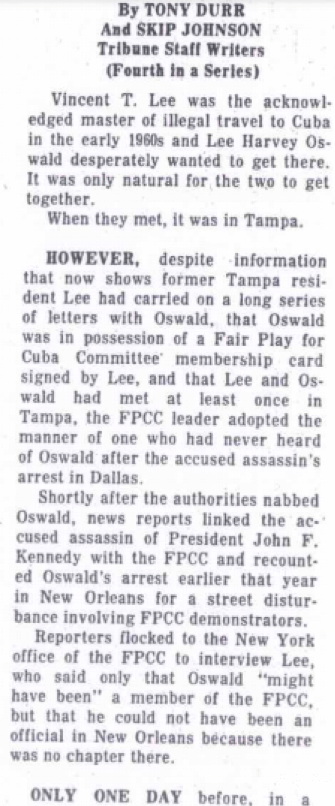
The preface by Haslam is really useful for describing the NOLA setting and the network that Dean Andrews, Oswald, Clay Shaw and Garrison roamed around in. It is a network that hated the Castro threat because of their business ties to Latin America, that saw Kennedy as Castro’s enabler, one that was well connected to intelligence, the mob and Cuban exiles all working in sync to reclaim their kingdom. New Orleans was the last place for a Fair Play for Cuba Committee chapter to set up shop, unless it was a front. Haslam remembered that on the day of the assassination, very threatening skies were forming west of the city…skies no normal person would drive into for an ice-skating outing, as David Ferrie said he was doing that day.
Davy continues the strong start with more than just a normal plug of what I was about to read. For this author, Shaw and Bertrand being the same person is a fact. Shaw told Officer Aloysius Habighorst that Bertrand was an alias he used, which was transcribed on an arrest form that is now part of the official record. Attempts to explain this away border on the loony, as in another person in the crowded, noisy room when Shaw revealed his secret identity did not hear him say this (in other words he simply did not hear). Davy reinforces this with another salvo:
By the time of my interview with Weisberg (ca. 1997) he had long since turned bitter towards Garrison and his investigation—which made one of his comments to me inexplicable. When I asked him about the shadowy figure of “Clay Bertrand” he confidently stated that “Bertrand was Clay Shaw. No doubt. Monk Zelden confirmed it to me.”
Of course, Shaw was the defendant in Garrison’s case and Zelden was a New Orleans attorney who worked with one of the more colorful characters in Lee Harvey Oswald’s orbit, Dean Andrews. Davy then, in a few surgical paragraphs, sets the stage for the book by explaining how Andrews’ links with both Shaw and Oswald were a catalyst for the Garrison investigation—which led to the municipal court attorney’s demise.
He also adroitly points out the extremely revealing INS information about Oswald that Law and Jeffries rely on and that so few in the research community have utilized. Somewhere around 2017 when this information was pointed out, I remember Davy telling Len Osanic on Black Op Radio words to the effect: The fact that we have a governmental agency affirmation that Oswald could be seen entering the building where Banister had his offices with Ferrie and his gang of nuts represents an official intelligence confirmation about Oswald’s connections and exclaimed that this is game, set and match!
That introduction does a good job setting up the highlight of the book, that is the Dean Andrews III interviews. In the view of the authors, the considerable time spent with Dean was enough to convince them that his unique vista of the case and the access he had to his father’s perspective (which was not without limitations) were grounds for relating his story and shedding light around the enigma that is his dad.
Through their relationship with Dean Junior, the authors even heard briefly from Dean Andrews’ wife, who described her deceased husband as a very unstable individual which caused so much hardship.
Beyond bringing fresh, untapped information, the authors argue that Garrison uncovered the ground-level conspirators alluded to in the movie JFK. While this statement may please some of the Garrison disciples, it is clearly too all-encompassing. The plot was too complex for Garrison to grasp the whole ground-level operation. Gaeton Fonzi and some of his followers would argue that there was plenty of intrigue related to Miami that also qualifies as ground level. Who the ground players were for what happened in Dealey Plaza depends on roles that likely did not emanate entirely from Ferrie and friends…at least this book does not prove this. This does not diminish in any way the importance of what took place in New Orleans in 1963.
CHAPTER ONE: Harold Weisberg in New Orleans
Readers in this chapter will understand just how much of a threat Garrison became to the conspirators and they will see an early example of how pro-conspiracy forces can turn bitterly against one another through the Weisberg/Garrison break-up…Something we have witnessed time and time again over the years up to today where the infighting around the legal procedures concerning the breaches of the JFK Act is in full swing, to the delectation of lone nut propagandists.
The authors do not pull any punches when it comes to covering Weisberg whether it is describing his research or his underhanded jabs at Garrison and the movie JFK. They also in this chapter meander into a number of subjects including the organized smear campaign against Garrison by media assets and the infiltration of his office.
There are a lot of nice nuggets here. But one problem began to emerge that permeated throughout the first three chapters: while we are getting a summary of a lot of what has been written about Garrison and New Orleans and even more, the authors are inconsistent with their sources. For example, on page 18 they write: A rough draft of Aynesworth’s May 15, 1967, Newsweek article, “The JFK Conspiracy,” is in the Lyndon B. Johnson Library. There is also a cover letter addressed to LBJ’s press secretary George Christian. Aynesworth wrote, “I am not offering this for comment of any kind, nor a check of the validity of any part…My interest in informing government officials of each step along the way is because of my intimate knowledge of what Jim Garrison is planning…I intend to make a complete report of my knowledge available to the FBI, as I have done in the past.” Interesting weaseling about for certain, but no direct source to prove the existence of this highly incriminating behavior, either by a link or a book source.
Consider this reference: Regis Kennedy (no relation to the president) is among several witnesses connected to the events in Dallas in 1963 who died “before they could be fully questioned,” according to online sources. No careful researcher will take such a statement seriously. There is also this one on page 79: In an interview aired two years after his death in 1990, (Judge) Haggerty would say, “I believe he [Shaw] was lying to the jury. Of course, the jury probably believed him. But I think Shaw put a good con job on the jury.” I found this so important that I had to ask Jim DiEugenio if it really happened, and he confirmed that it did, but an author needs to be more precise than this. In one case the source is the controversial Torbitt document, and the authors seem unaware of the true name of its author: (Lawyer David Copeland). Sometimes the source is Quoting from the Spartacus Educational Forum. There is also a preference by the authors to refer to a book as a source rather than the primary data the book info is based on. I paid a price for this when I used Ultimate Sacrifice as a source about potential patsy Policarpo Lopez. I got panned by some whereas I could have avoided all the flack by quoting directly from the HSCA files on Lopez.
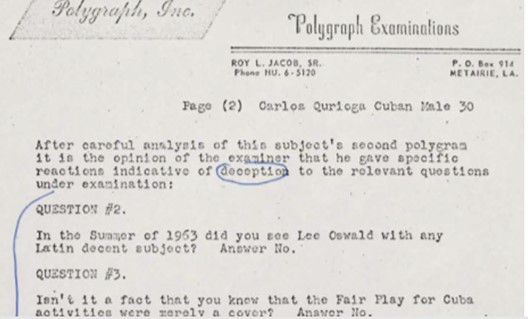
This to me is an irritant because I often cannot refer directly to a source to learn more, and I cannot repeat it as fact until I know that the source is solid. Where this sloppiness came to bite the authors hard can be seen on page 58 where they hover around a Carlos who was seen in the company of Oswald and Sergio Arcacha Smith, a little later they say Garrison attorney Lou Ivon asked witness Dave Lewis if he recognized the name Carlos Corega…In so doing they completely messed up the Carlos Quiroga incident which is well covered in two sources they had referred to elsewhere: Destiny Betrayed and this author’s KennedysandKing articles about the FPCC. Quiroga is known to have met Oswald at his place, bringing a stack of FPCC flyers, being with Oswald at Mancuso’s restaurant in the presence of Arcacha Smith and other usual suspects and revealing that Oswald used the FPCC as a front through a failed polygraph test. Lewis strengthened some of these revelations in his own polygraph test.
Do not get me wrong, dismissing the authors and this book because of improper sourcing would be in my view an error. There is too much good information and new insights to throw away the baby with the bath water. The work put into talking to Dean Andrews III and his mother as well as Ed Voebel’s sisters, niece and son, John Barbour, Garrison investigator Stephen Jaffe, etc. represent important developments.
Chapter 1 showcased another problem with Bimbo that can also be seen in chapters 2 and 3: it lacks structure. The first chapter is supposed to be about Weisberg, but many tangents are taken that bring the reader into whole other subject matters that are interesting yes, but certain to create confusion with information overload. I also think that they should have broken down the chapters into subsections. They have only one subsection in the whole book as far as I can remember which sticks out like a lonely outlier: Kennedy. In a second edition, and I really hope they write one, they will need to break down the information into more chapters with multiple subsections.
CHAPTER TWO: A Ground Level Plot
If one wants to get a snapshot of what has been said and written about the central characters operating out of New Orleans, this part of the book throws everything at the reader, plus the kitchen sink. Since my book readings about Garrison go back for a while, it was good to be reminded of the many anomalies that took place in the Crescent City. There is plenty here that I did not know or recall.
This chapter is also inconsistent with sources and tends to wander. I believe it should be retitled. While many interesting links are made around shady people, I would have trouble describing this the ground-level plot based on the information we are given. Objectives, strategies, timelines, roles…there is a lack of clarity around the “said” plot. The chapter is really more about hanky-panky in New Orleans.
CHAPTER THREE: Dean Andrews and His Fluid Recollections
After the strong start to the book, I found the first two chapters to be interesting, but a mixed bag in terms of reliability. The authors make it difficult for the readers to digest the sheer quantity of information thrown at them and to come away with a high level of confidence in what is written. You sometimes feel as if you are on a carousel ride in a figure eight trajectory while in gallop mode.
While some of the sloppiness and meandering continues, Chapter 3, for this reader, was a turning point and was appropriately titled. Dean Andrews is one of the keys to understanding the New Orleans network of shady characters that link Oswald to Clay Shaw. New Orleans was so toxic to the Warren Commission that Andrews was coerced into confabulating (because he was supposedly under sedation) that a call from Shaw AKA Bertrand that he got asking him to represent Oswald while he was sick in the hospital was a figment of his imagination. The FBI also decided not to delve into Oswald’s 544 Camp Street office and the cast of right-wingers and intelligence actors that the office was a fulcrum for…a mistake according to the HSCA.
From Andrews’ own mouth, an open-minded reader should be left with a clear impression that:
Andrews represented Oswald a number of times.
Clay Shaw backed this relationship as well as Andrews’ representation of members of the gay community.
Andrews was a small-time fixer. Better Call Saul comes to mind.
The call did occur and was corroborated.
Andrews was intimidated and scared out of his wits.
He professed Oswald’s innocence.
He admitted that the FBI turned the heat on him.
Oswald’s representation of the Fair Play for Cuba Committee was a front, and he was paid.
He was part of a network that includes Shaw, Oswald, Wray Gill, Ferrie, Marcello and the anti-Castro movement.
The contradictory comments he made were for self-preservation.
The authors deserve credit for making this clear to the world.
CHAPTER FOUR: The Dean Andrews III Interviews
This chapter represents the apex of the book. Dean Andrews was 12 when JFK was assassinated. During the Garrison Investigation, he witnessed and lived through a downturn of his father’s fortunes and career and the quasi break-up of his family. The impact on Dean Junior’s health and ambitions were immense. It is a tragic story that seems to be a recurring theme for so many of the family members of those connected the assassination. Perhaps the real perpetrators of JFK’s assassination never went to jail for the crimes, but many paid a personal price with a lot of collateral damage to their close ones.
Those who did seek the truth also risked a lot. The traces they left likely caused trauma for the ones they cared for, but hopefully left them with a sense of pride for fighting the good fight. The cover-up artists live in denial. The more that comes out throughout the years, the less their positions are tenable. Yet they plod on even though they are at the opposite end of the official records. With a great majority of the population and more and more traditional and new media open to the conspiracy scenarios, lone nut advocates are swimming in a much smaller pond and are the ones who come across as Q-ananonish.
What Jeffries and Law do in these interviews is shed light on what a son, who is knowledgeable about the case and who decoded his father the way only a family member can, said, thought, knew, guessed, heard about his father and the case. Dean’s father was very abstract when talking about the saga but revealed so much anyway. Sometimes through non-denials you can figure things out. A son picks up patterns, signals from non-verbal communications and knows when his father is hiding something.
The authors deserve kudos for recognizing Dean’s importance, gaining his trust and making a record of what he can relate no matter how troubled he became.
I will not tell you what he has to say because you need to read it for yourself and ponder:
Dean talks about his dad’s sexuality;
What he thinks about Jim Garrison;
The Bertrand-Shaw identities;
Attempts to harm, intimidate and even kill his dad;
The divide in his family;
His dad’s links to Shaw, Marcello, Garrison, Oswald, Mork Zelden, David Ferrie;
Oliver Stone and the film JFK;
Oswald and the FPCC;
His dad’s links to intelligence;
His father’s personality and biography.
You will ponder, debate and hopefully research on your own to build around this new low-hanging fruit in figuring out the enigma of Dean Andrews. These revelations will likely be polarizing due to the fact that they focus on Jim Garrison and New Orleans. But they are very much worth reading.
I would encourage the authors to try and get corroboration. Dean claims the Figaro ran an article about Garrison being arrested for sexual misconduct…where is it? The only sources that I have seen around such allegations come from discredited smear tacticians. Challenge Dean on whom he confided to, who he thinks could corroborate what he has to say. Not much was said about David Ferrie in the interview…Query William Davy and others about what other questions should be asked. We are actually reaching a point where even the offspring will not be available for much longer.
CHAPTER FIVE William Law 1993 Interview with Perry Raymond Russo
I am not certain why this part gets to be labeled a chapter, while the two that follow the aftermath are labeled appendices. They are essentially decades old interviews that they decided to highlight as blasts from the past. I am happy they did, as I believe that what is in them is pertinent and not necessarily well known.
This section underscores many themes we can find elsewhere in the book but recounts them as seen and felt through the important witness—Perry Russo.
One detail that came screaming out at me that would help explain the differences in appearance in Oswald: The unkempt, messy, unshaven Oswald vs. the neat, clean Oswald. Despite the use of impostors, there had to be something more to these seemingly conflicting sightings. Here is what Russo says: “I’m saying that the guy stayed over at this other guy’s house. Well, the wife should know. How the fuck would this dude, Perry Russo, how would he know? Well, he didn’t. And then she admitted that he used to beat the fuck out of her, and then run out on her. And he’d be gone for three or four days. And she’s glad to see him go. And she said in 1969, telling her when we were in court, she said that he always was immaculately clean. Well, he wasn’t when he was away from her. He was dirty and unshaven. Well and understandable, because he didn’t bring his shaving stuff. He didn’t bring his deodorant. He didn’t give a fuck. He was mad at the world. I didn’t get along with him. But I maintain that. I look like the Lone Ranger. No one could believe me. His wife said he slept every night with her. He took care of the kids. He was never dirty. He was always clean and meticulous about his appearance. I’m saying he’s unshaven three days in. Now, that comes out in 1979. He used to beat the fuck out of her, leave for a week. And all of a sudden, it becomes reasonable that Lee Oswald went over to his friend’s house, Dave Ferrie. Not that far from 4905 Magazine Street, where he lived, with her…in Louisiana.”
When you connect the dots between what Russo, Andrews Sr. and Andrews Jr. have to say, we get a better idea of how the whole Andrews, Ferrie, Oswald, Shaw, Marcello, Cuban Exile network is linked as well as the many double lives led by so many of these characters.
CHAPTER SIX Conclusion: The Conspiracy Is Clear
In chapter 6 the authors pick the brain of author and former TV personality John Barbour. Here I discovered what Garrison confided to his good friend off the record. We get to know what Garrison speculated as to the nature of the conspiracy…From what happened in Dealey Plaza to the catalyst behind the decision to remove JFK to how the murder was sanctioned. Garrison also had a contact who described the very weird goings-on during the Oswald interrogation after the murder. The source was there and wished to remain anonymous. This is also very interesting.
Then they come back and touch on a Dean Andrews’ claim that his father’s hospitalization just before the assassination was due to an attempted murder because of what he knew. What is not asked here, is that if this were the case, did this attempt likely involve the very person who called him to represent Oswald? How Clay Shaw even knew where to reach Andrews is a point that is raised.
Here again the title is misleading. While it is clear that there was a conspiracy, and this book adds food for thought around some of the characters, it does not come close to clarifying what the conspiracy was…not even what they call the ground-level conspiracy. New Orleans on its own, if completely decoded, cannot explain even one quarter of the ground-level conspiracy. As Hancock and Boylan show in Tipping Point, so much else was revolving around players in Miami who were the real architects of regime change operations and were way more determining of what happened in Dealey Plaza than Ferrie et al. There is a big difference between getting Oswald to goosestep in a charade vs. participating in an ambush of a president.
The Afterword by Jack Roth, and the Three Appendices
I have visited Dealey Plaza and Oswald’s “said” flight trajectory, guided by Dallas resident and researcher Matt Douthit and found it to be fascinating. Jack Roth has convinced me to tour New Orleans. His brilliant description in just a few pages culminates with the following statement from a tour guide he met: “…there’s no way anybody could’ve walked these streets, been engaged in this kind of activity, and been involved with people of this caliber in this city and have it not been something more than what it seemed.”
When he goes into the Judy Baker stuff however, I cringe and worry for the authors. I don’t know how many serious writers contaminate their work and tarnish their own reputations on frivolous yarns. Some stories require qualifiers like the not yet substantiated story by…(the Paul Landis revelation comes to mind). Others are sure to polarize those who believe there was a conspiracy and provide a big juicy target for lone-nut advocates: Madeleine Brown, Judith Exner Campbell and Baker clearly fall in this category.
The three appendices are excellently chosen: Dean Andrews’ fascinating Warren Commission testimony; a letter from Fletcher Prouty to Oliver Stone (September 2, 1990) which sheds light on how a coup emanates from the highest levels of power in the U.S. and excerpts from a little exposed speech before a November 18, 2006, JFK Lancer Conference by Anne Dischler who worked with State Trooper Francis Fruge for Jim Garrison.
Conclusion
Just last fall, we had completed our book, The JFK Assassination Chokeholds, after going through through a very strict regime of trying to only include fact-based, primary evidence and carefully backing up each statement we made. All in all, there are close to 800 footnotes, exhibits and direct quotes with sources within the text. Among my other co-authors, there are three attorneys grounded in how to write on a legal basis and one of the world’s premier researchers. Reading Bimbo, I needed to completely change my base of references on how to write a book: questionable sources, lack of focus and fallacious thinking pop up too often to avoid the poison pen of critics. It would have been easy to pan it. But in a sense the authors are really telling a story.
Bimbo offers too much to be ignored and opens the doors to further exploration around the subject of New Orleans which was clearly toxic and threatening to the early, biased investigators with an agenda. They talked to Andrews III, Davy, Barbour, Jaffe and Voebel’s close ones. They revealed important, little-known records that are decades old yet still so very important. Not reading Bimbo is tantamount to not accessing fresh, controversial information from none other than the son of one of the most enigmatic personages in this whole affair. Even if we discount everything else in Bimbo (which one should not do) and even if we do not believe everything Dean Andrews III says, a serious researcher should hear and consider it closely, just like we listened to William Kent’s daughter, E. H. Hunt’s son and David Atlee Phillips’ relatives.
Interviewing Dean junior was a coup!
As for the rest of the book here are my suggestions for a second edition.
Get yourselves an editor, someone like William Davy, who acts as a real devil’s advocate to rethink the chapters, improve the focus, break down the information better, get rid of the frivolous, add crucial data, correct grammar, etc.
Really improve choice of sources and how these are disclosed for every affirmation made.
Add a master chronology of events in New Orleans, a full Dean Andrews bio, a glossary of names and a map with key locations.
Consider showing exhibits from the Dean III scrapbook.
Re-interview Andrews with questions, people like Davy, DiEugenio, Mellen would like to ask and try and get some corroboration from people Dean himself may be able to identify.
Order the Garrison Files from Len Osanic as well as Paul Abbott’s master index and see what you can find there. There are many files on Andrews.
Try and increase the Dean Andrews research and write more about him and cool it on the ground-level plot.
Dean Andrews is to this book what the Big Mac is to McDonald’s…Your cash cow! Milk it!!!
The 88-year-old Edward Epstein was found dead in his apartment on Tuesday January 9th. His nephew, Richard Nessel , said the cause of death was complications from CV 19. (NY Times obituary by Sam Harris of January 11, 2024)
The obituary notes the first of Epstein’s many books was entitled Inquest, published in 1966. As Epstein wrote in his memoir, Assume Nothing, he wrote this book after he flunked out of Cornell and was trying to get back into the college. The man trying to help him, Professor Andrew Hacker, was with him on campus when the news came in that President Kennedy had been killed. Hacker said that finding the truth about the assassination would be a test for American democracy. This gave Epstein the idea of writing a Master’s thesis on the subject. Hacker wrote letters for him in order to talk to the Commissioners, and all agreed except for Earl Warren.
Inquest was published in 1966, and it helped form something of a wave effect, since it just preceded Mark Lane’s Rush to Judgment, Sylvia Meagher’s Accessories After the Fact and Josiah Thompson’s Six Seconds in Dallas. But, as Joseph McBride notes in his book on the media Political Truth, there was a difference between Epstein’s book and the others. McBride quotes from the ending of Inquest:
If the Commission had made it clear that very substantial evidence indicated the presence of a second assassin, it would have opened a Pandora’s box of doubts and suspicions. In establishing its version of the truth, the Warren Commission acted to reassure the nation and protect the national interest. (McBride, pp. 192-93)
In fact, the first part of the book is titled “Political Truth”. McBride comments on this by saying its pretty obvious that the author knew “full well that the assassination was covered up.” But it would seem that he was at least partly trying “to justify the reason for the cover-up.” Further, Warren Commissioner John McCloy told Epstein that the function of that body was to “show the world that America was not a banana republic, where a government can be changed by a conspiracy.” (McBride, p. 137)
Epstein went even further in this regard in first his E-book, The JFK Assassination Diary, and then again in his printed memoir Assume Nothing. In those two places, both published in the 21st century, he revealed that when he asked Arlen Specter how he convinced the Commission about the Single Bullet Theory, he said he told them that it was either that or start looking for a second assassin. (Epstein E book, p. 24) Norman Redlich, one of the most powerful members of the Commission staff agreed with Specter. (Epstein, The Assassination Chronicles, p. 155). As anyone should know, even without being a lawyer, that path is not 1.) Following the evidence, or 2.) A viable standard of proof.
There was also something else that Epstein knew, namely that the Commission was basing their case on unreliable witnesses. For instance, he knew that attorney Burt Griffin had told Dallas police officer Patrick Dean that he was a liar. Dean was in charge of security the day Jack Ruby entered city hall and gunned down Oswald on national TV. (The Assassination Chronicles, p. 110) The Commission also thought that Marina had fabricated a story about Oswald attempting to kill Richard Nixon. And Redlich had written this about her: “Marina Oswald has lied to the Secret Service, the FBI and this Commission on matters of vital concern.” Commission lawyer Joe Ball did not trust Helen Markham or Howard Brennan either. (ibid, pp. 142-44) In an interview Epstein did with Commission lawyer Wesley Liebeler, he referred to the Commission as Snow White and the Seven Dwarfs with Marina as Snow White and Earl Warren as Dopey. (E book, p. 17)
In reviewing Epstein’s work on the Commission in his book and diary –the latter may have been created after the fact—what is puzzling is how many important things escaped him. To point out just two: he did not find out about Commissioner Jerry Ford changing the entering location of the Magic Bullet from the back to the neck in the final draft of the Warren Report. Even though he interviewed Chief Counsel J. Lee Rankin. Rankin had this evidence in his files, and his son turned it over to the Assassination Records Review Board in the nineties. Epstein interviewed J. Lee Rankin.
Another important fact that escaped him is that there was no transcript made of the final executive session meeting of the Commission. Although he describes the debate that took place on this issue at that meeting, he relies on interviews he did for his information. (The AssassinationChronicles, pp. 154-56; p. 604) He could have gone to the National Archives and found out that no transcript of this meeting was made. That is what Harold Weisberg did. (Gerald McKnight, Breach ofTrust, pp. 295-97)
If Epstein would have done that, he could have informed people like Senator Richard Russell and Senator John Cooper that they had been hoodwinked about their objections being recorded. And that could have opened up just how deeply they were opposed to not just the Magic Bullet, but the way in which the Commission was being conducted. Author Gerald McKnight later revealed Russell’s disharmony in his book on the Commission, and Cooper assistant Morris Wolff did the same about Cooper. (Wolff, Lucky Conversations, pp.103-15)
Something appears to have happened to Epstein shortly after he wrote Inquest. For instance, he appeared on the record album for the book Scavengers and Critics of the Warren Report. That book was published in January of 1967 and was clearly a cheap smear of the Commission critics, co-written by FBI informant Larry Schiller. There is further evidence for Epstein’s sudden switch in John Kelin’s fine book Praise from a FutureGeneration.
On November 30, 1966 there was a debate on the Warren Report in Boston. Epstein had been invited to participate, but he declined. Vince Salandria was a participant. After the debate, Salandria was surprised to see Epstein in the audience walking toward him. They had a brief discussion during which Epstein said, “I’ve changed Vince.” Salandria replied with, “You mean you made a deal.” Epstein smiled and said, “You know what happened” and walked away. (Kelin, p. 335, E book version). In fact, years later, when he made an appearance on the Larry King Show he actually said he thought “the men who served on the Warren Commission served in good faith.” (Probe Vol. 7 No. 1, p. 14). Today we have two sources telling us that Jerry Ford knew the Commission was a sham: Morris Wolff and Valery d’Estaing. (See Interview with Wolff, Black Op Radio, 1/11/2024; the film JFK Revisited)
To say that Epstein changed is an understatement. In his next two books, he now became an unrepentant defender of the official story. Because he wrote a book on the Warren Commission, he was invited by The New Yorker to go to New Orleans and write a long article on the JFK investigation being done by DA Jim Garrison. It’s pretty clear from the beginning of his “diary” entries that Epstein had a bias against any new inquiry into the Kennedy case that would lead elsewhere than where the Commission had. For instance, he distorts Garrison’s dispute with the local judges and also on how David Ferrie was initially released by the FBI in 1963. (Epstein, pp. 39-41). In fact, Epstein was accepting advice from the likes of Tom Bethell and Jones Harris on Garrison. Some people who encountered Harris, like the late Jerry Policoff, thought he was rather erratic in his beliefs on the JFK case. Tom Bethell had all the earmarks of being a plant in Garrison’s office. (Click here for that)
But that was just the beginning of Epstein’s lack of fairness. Epstein also had many contacts with Shaw’s lawyers. Beyond that he was also in contact with a lawyer who represented both Gordon Novel and Jack Ruby, Elmer Gertz. Within one week of The New Yorker publishing Epstein’s article, the CIA was circulating it as an example of how they could counter critics of the Warren Report. (Op. cit. Probe, p. 15)
To give just one example of Epstein’s objectivity: he believed Dean Andrews when Andrews said Clay Shaw was not Clay Bertrand. (Epstein’s diary, p. 46). Even though Epstein’s JFK diary was published in the new millennium, he avoids the fact that Dean Andrews was indicted and convicted for perjury on this point. But beyond that, Andrews secretly admitted to Harold Weisberg that Shaw was Bertrand. Weisberg kept that promise until after Andrews passed. And today, there are about a dozen witnesses to this fact. (See the book JFK Revisited, p. 65)
Then there was Legend. With the Church Committee exposing the crimes of the CIA, and issuing a report showing how poorly the FBI had investigated the case, there was movement to reopen the Kennedy case. Clearly an establishment lion like the Reader’s Digest would want to get a jump on such a reopening. Knowing what they wanted, they called in Epstein to do a full scale biography of Lee Oswald. Ken Gilmore, a managing editor there, contacted the FBI and told them the book would put to rest recurring myths surrounding the Kennedy assassination. Gilmore requested that the Bureau allow Epstein to access their files on the case. Epstein did visit the FBI offices at their invitation. (Op. cit. Probe, pp. 15-16)
John Barron, a senior editor, was also friendly with the CIA. Therefore, the Agency did something remarkable, they gave Epstein access to Soviet defector Yuri Nosenko. They also told him he would have access to the tapes made at the Mexico City station of Oswald at the Soviet and Cuban embassies. (ibid) The only other writer I know who had CIA assisted access to Nosenko was Gerald Posner. Before the ARRB I know of no writer who had access to those tapes. Finally, Epstein was in contact with James Angleton both by phone and in person. Epstein freely admits to this in his diary. And here is the capper in that regard. Jim Marrs interviewed a Legend researcher. He asked her why the book did not explore Oswald’s ties to the CIA, which were at least as obvious as those to the KGB, which the book accented. She replied that they were advised to avoid that area. (ibid, p. 24)
According to Don Freed, the book was budgeted by Reader’s Digest for 2 million. Epstein got a $500,000 advance, over 2.5 million today. As noted above, they also furnished him with a fleet of researchers, including Pam Butler and Henry Hurt of Reader’s Digest. All this for a book that tries to convey the almost indefensible tenet that Oswald was first recruited by the Russians, and then upon his return was now pledged allegiance to Castro and this was why Oswald shot Kennedy. The Russians then sent Nosenko over to discourage any thought the KGB was involved, since he said Oswald was never recruited by Moscow.
With all we know today, for Epstein to maintain these types of theses well into the 20th century is simply inexcusable. Because for example, today it appears that Oswald’s file at CIA was being rigged before he went to Russia. And we know that from the declassified work of HSCA researcher Betsy Wolf. And it appears that it was only Angleton who had access to all the files on Oswald at the Agency. (See this) Secondly, Clay Shaw had two CIA clearances and was employed by them as a highly paid contract agent. (JFK Revisited, p. 65). Finally, in a declassified file attained by Malcolm Blunt, it appears that Angleton was in charge of commandeering operations against Garrison. For that file, we only have the cover sheet, with several folders missing.
Let me conclude with two interesting anecdotes about Epstein. Epstein was the last person to see George DeMohrenschildt alive. He was paying him about a thousand dollars a day for interviews down in Florida. On the second day, after the Baron left, he went to a friend’s house where he was staying and allegedly took his own life by shotgun blast. Dennis Bludworth was the DA investigating the case. He wanted to see the notes of the interviews. Epstein said he had no notes or tape recordings. Bludworth did not believe that, not with Epstein paying him that kind of money. Under further questioning Epstein told Bludworth that he was also paying for the Baron’s rented car and he added that:
…he showed DeMohrenschildt a document which indicated he might be taken back to Parkland Hospital in Dallas and given more electroshock treatment. You know, DeMohrenschildt was deathly afraid of those treatments. They can wreck your mind… (Mark Lane, November 1977, Gallery)
Finally, let us make one other note as to how plugged in Epstein was to the power elite on Legend. Billy Joe Lord was on the same ship that Oswald took to Europe in 1959 on his voyage to Russia. In fact, Lord was Oswald’s cabin mate. The pair spent about two weeks together crossing the Atlantic. For this reason Epstein wanted to interview him for the book. Lord did not want to talk to Epstein since he knew he was a critic of anyone who contested the Warren Report. Lord then related that he did meet with two of Epstein’s researchers. (FBI Report of March 15, 1977) One of them said that they may have to apply pressure to Lord. And they knew two people who could do so. One was James Allison, a local newspaper chain owner and a friend of the Bush family. The other was no less than future governor and president, George W. Bush.
These are the perks you get with the equivalent of a $2.5 million advance—on a JFK assassination book.
For more on the career of Epstein on the JFK case, please click here.
Hugh Aynesworth died on December 23rd at age 92 after being in both the hospital and hospice care.
Aynesworth was born in West Virginia and started his newspaper career at the Clarksburg Exponent-Telegram. In the fifties he was employed in Fort Smith, Arkansas as a sports editor and then a managing editor. He then moved to Dallas as a business writer for the Times Herald, and later worked for UPI in Denver. He returned to Dallas in 1960 to write for the Morning News and it was while there that the JFK murder took place. In 1967 he shifted over to Newsweek, from where he began to cover the Jim Garrison inquiry into the JFK case.
To anyone who was really interested in the assassination of President John Kennedy, his death will be unlamented. Because perhaps no other reporter in America—excepting maybe Dan Rather– did more to cover up the facts in that case, over a longer period of time, than did Hugh Aynesworth.
He maintained that he was at three crucial venues on the day of Kennedy’s murder. First, he was a witness to the actual assassination in Dealey Plaza. Yet, does any photograph reveal this to be the case? He was also allegedly on the scene when Patrolman J. D. Tippit was killed, though it is hard to pin down a time when he was there. (More on this later.) He then pulled off a trifecta. He also said he was at the Texas Theater when the police apprehended Lee Oswald–and he added that he saw Oswald try and shoot Officer Nick McDonald. (“The Man Who Saw Too Much”, by William Broyles, Texas Monthly, March 1976). Since the evidence indicates that Oswald did not do any such thing, this is also tough to buy into. (Sylvia Meagher, Accessories After the Fact, p. 259)
But, for Hugh, that was not enough. Aynesworth also said that he was in the Dallas Police Department basement when Jack Ruby lunged forward to shoot Oswald. Again, if anyone can pinpoint a film or photo of the man being there, please do. After all, this event was captured live on television. The thesis that he was on the scene for all of these events allowed him to maintain the concept that he had “broken almost every major assassination story.” (Broyles, op. cit.) He now became the Morning News’ lead reporter on the Kennedy case.
As William Broyles wrote, Aynesworth liked to throw bouquets at himself. For instance, that he became the first reporter to break the story of Oswald’s escape route. Since Oswald was not trying to escape, this is also a dubious story. After all, how does one “escape” by using public transportation, like a bus and taxi. And in the latter case, Oswald offered the cab to an elderly lady first. (Meagher, pp. 75-83)
As anyone can see, it was not enough for Aynesworth to cover the story. He had a definite viewpoint about the JFK assassination. And he had it before the Warren Report was even published. On July 21, 1964, through his columnist colleague Holmes Alexander, it became clear that the omnipresent reporter did not trust Chief Justice Earl Warren on the JFK case. So the pair fired a shot across the bow of the Commission. The Commission had to show that Oswald was a homicidal maniac. If not, then Aynesworth would reveal that the FBI knew Oswald was a potential assassin and that the Bureau blew their assignment.
But even that was not enough for Hugh. He was now going to show that Oswald was “a hard driven political radical Leftist”. How so? The column revealed that Aynesworth had interviewed Marina Oswald. Marina had told him that Oswald had threatened to kill Richard Nixon. This one shows just how nutty Aynesworth had become on the Kennedy case. Because not even the Warren Commission bought into it. (Warren Report, pp. 187-89) This rubbish has been exposed by more than one writer. For instance: Nixon was not near Dallas at the time Marina said the incident happened. (Meagher, p. 241) But further, as Peter Scott has observed, to buy into this, Marina had to have locked Oswald in the bathroom to stop him from this heinous act–yet the bathroom locked from the inside. Finally, there was no local newspaper announcement that Nixon was going to be in Dallas at this time, April of 1963. Yet Marina clearly implied that this is what caused Oswald to plan on shooting him. (See also WC Vol., 5, p. 389, and Scott, Deep Politics and the Death of JFK, pp. 286-91) According to Michael Granberry’s obituary for Aynesworth, the Nixon nuttiness originated with a conversation between Marina and Aynesworth.
Was there more to the Marina/Hugh relationship? In May of 1967, researcher Shirley Martin wrote a letter to Jim Garrison about her 1964 meeting with the man. Hugh started off with some “disgusting anti-Kennedy stories.” He then began to praise the city of Dallas, especially his newspaper the Morning News. Hugh then personally smeared some of the Commission critics like Thomas Buchanan and Mark Lane; the former was a “fairy” and the latter was a communist. He added that the JFK case was really a communist plot that Earl Warren would cover up. He also said that he had an affair with Marina. He then commented that Marina and Ruth Paine were involved in a lesbian relationship prior to the assassination. Martin also wrote that Aynesworth was bitter about Merriman Smith winning the Pulitzer for his JFK coverage.
But then there was this. The reporter told Shirley that he was at the scene of the Tippit shooting at 1:05, no later than 1:10. In other words, before the Commission said the murder occurred. (Warren Report, pp. 165-66). In fact, it would be impossible for Oswald to have walked from his rooming house to the scene of the crime—10th and Patton—during that time interim. (Meagher, p. 255)
According to researcher Rachel Rendish, Aynesworth once offered to show her some sex photos of Marina. Rendish slammed the door shut like this:
Oh yes, I know all about that film and how you boys set her up. She said that was the item you always used for blackmail. I have absolutely no interest in seeing it… He was stunned. (Email to Robert Morrow, 12/27/23)
Then there was the Oswald diary heist. When the FBI did an investigation of how the alleged “Oswald diary” got into Aynesworth’s newspaper they concluded that it was likely stolen from the Dallas Police archives by assistant DA Bill Alexander and then given to Aynesworth. After running it locally, he then put it on the market to other publications. The sale garnered well into the five figures, a ducal sum in those days. The proceeds were split between Aynesworth, his then wife, and Alexander. Marina, who had a legal claim, was originally cut out of the deal.
In late 1966, Aynesworth became an FBI informant on the JFK case. There was a December 12th report from Hugh on the progress of the Life magazine re-inquiry into the murder of Kennedy. Its odd that this would occur at all since Aynesworth was not a part of that investigative team, which included Josiah Thompson, Ed Kern and Patsy Swank. It likely happened due to the titular Life leader Holland McCombs, a friend of Clay Shaw’s, wanting to cover all the bases, and knowing he could rely on Hugh to do so. Aynesworth told the Bureau that Life had found a witness who connected Oswald with Ruby. In his report he also added that Mark Lane was a homosexual and had to drop his political career because of the allegations. If one recalls, earlier it was Buchanan who was homosexual and Lane was a communist. So now Lane was a gay commie? Like the CYA coward he was, Aynesworth specifically requested his identity not be disclosed by the FBI.
But it was during the Jim Garrison inquiry that Aynesworth really came into his own as an agent/informant for the FBI and CIA. The reporter learned about Garrison’s inquiry through Life magazine stringer David Chandler. The DA granted Hugh an interview at his home after which Aynesworth wrote to McCombs that they should not let Garrison knew they were playing “both sides”. This was after the first meeting! But recall the man’s credo: “I’m not saying there wasn’t a conspiracy….I know most people in this country believe there was a conspiracy. I just refuse to accept it and that’s my life’s work.” (July of 1979 on Dallas PBS affiliate KERA). How could he do so if he was so invested in the Krazy Kid Oswald story from the start? But there is a corollary to this: the Machiavellian rule that the one’s own ends justify the means. And, as with Marina and Nixon fabrication, he was about to prove it once more.
In May of 1967, Aynesworth wrote an article for Newsweek on the Clay Shaw case. The article was simply a cheap smear. It said that whatever plot there was out of New Orleans, it was made up by Garrison; that the DA’s staff had threatened to murder a witness; and the DA was running the equivalent of a reign of terror over the city which had the citizenry in fear. But, before the libelous story ran, the reporter sent a copy to both the White House and the FBI. In an accompanying telegram, he wrote that Garrison’s plan was to make it seem that the FBI and CIA are involved in the JFK “plot”. He again requested his name be withheld. This secrecy is what he relied upon to make it seem he was independent and not in bed with the feds. In fact, when Aynesworth helped organize a Kennedy conference in Dallas to compete with the ASK seminars in the early nineties, someone asked him that question: Have you ever cleared a story in advance with the White House or the FBI. Like any common fink, he denied it. The questioner then confronted him with this telegram.
But it was not just the FBI and the White House from whom he sought protection. British researcher Malcolm Blunt has discovered a CIA document in which the Agency revealed that Aynesworth was interested in Agency employment from back in the early sixties. (Memo of January 25, 1968). And in fact, he appears to have gone to Cuba, not once, but twice, in 1962 and 1963. Robert Morrow confronted him with this and the reporter’s answer was a clever piece of evasion. (Click here for the exchange)
James Feldman commented on this meeting, saying that Hugh never directly replied to the question of was he a CIA media asset. He only said that he did not take money from a government agency. But as Feldman added, agencies often distribute funds through business intermediaries or other types of fronts. Feldman concluded that “his failure to answer the question in a forthright, honest manner merely supports those who assert that Aynesworth has been a CIA media asset.”
About the last there can be little, if any, doubt. For in his attempt to directly obstruct Garrison’s legal proceedings against Clay Shaw, the reporter actually did what he (falsely) accused Garrison of doing: he attempted to bribe a witness. As many know, Shaw, Oswald and David Ferrie had gone to the Clinton/Jackson area–about 120 miles northeast of New Orleans– in the early autumn of 1963. Many witnesses saw the trio, with Oswald in a voter registration line and Shaw and Ferrie sitting in a Cadillac (Garrison actually had a picture of the car, see Joan Mellen, A Farewell to Justice, p. 223).
Sheriff John Manchester was one of the most important witnesses to this strange but fascinating episode. And Aynesworth understood how important he was. Hugh had essentially moved to New Orleans by 1967 and was working with Shaw’s lawyers. He had plants inside of Garrison’s office, e.g. William Gurvich. And they had supplied him with memoranda on which Garrison was working. (See Destiny Betrayed, by James DiEugenio, Second Edition, pp.252-54) One of these concerned Manchester’s testimony, in which he identified Shaw as the driver of the car. Aynesworth drove to the Clinton area with it and told Manchester something quite interesting and revelatory about himself and who he was working with in tandem. Hugh told the sheriff that if he failed to show up at Shaw’s trial he could get him a job as a CIA handler in Mexico for 38,000 dollars per year, over $300,000 today. Obviously, if he was not working with the Agency, how could Aynesworth extend such an offer?
I rather liked Manchester’s incorruptible reply: “I advise you to leave the area. Otherwise I’ll cut you a new asshole.” (ibid, p. 255)
From threatening the Warren Commission and FBI, to helping create a phony Nixon murder attempt, to allegedly sleeping with Marina Oswald and taking photos of it, to smearing Commission critics as being both gay and commies, to informing for J. Edgar Hoover and lying about it, to interfering with a DA’s investigation and bribing prospective witnesses, Hugh Aynesworth was a piece of human flotsam masquerading as a reporter on the JFK case. That Dallas holds him up as an exemplary journalist shows how deeply in denial that city is about President Kennedy’s assassination and the cover up that followed…
“After a nearly yearlong investigation, the commission, led by Chief Justice Earl Warren (1891-1974), concluded that alleged gunman Lee Harvey Oswald (1939-1963) had acted alone in assassinating America’s 35th president, and that there was no conspiracy, either domestic or international, involved.” As we all know, this was the Warren Commission’s conclusion about the accused assassin of President John F. Kennedy. One of the premises that this conclusion is based upon was that Oswald was a lone, unstable drifter. “He does not appear to have been able to establish meaningful relationships with other people.”
Senator Richard Schweiker of the Church Committee, however, underscored the striking dichotomy of Oswald’s interactions with rabid right-wingers as well as pro-Castro subjects, speculating that he was a double agent. The HSCA completed its investigation in 1978 and issued its final report the following year, which concluded that Kennedy was probably assassinated as a result of a conspiracy.
In this author’s three-part series on Exposing the FPCC, it is made clear that lone-nut theorists present Oswald’s seemingly bizarre behavior in New Orleans during the Summer of 1963 at face value rather, than accepting the obvious: That Oswald was simply following orders in stratagems to counter communism. That is, he was playing the role of a provocateur.
The number of touch-points he has that put this twenty-three-year-old in proximity with intelligence, anti-communists and rabid right-wingers are so numerous that his drifter tag is simply not credible.
When one reads the Jim Garrison files, there is one of his sidekicks who stands out. Simply because of his unique appearance, by the important number of witnesses who saw Oswald with him, and by the fact that he has never been publicly identified.
Jim Garrison tried but was unable. The Warren Commission and FBI knew about him but did not want to probe very thoroughly. Identifying him and other probably Cuban exiles seemingly connected to Oswald, that would have opened up a whole can of worms. This would have proven that Oswald was not a loner and did not drift anywhere. On the contrary, it would have opened the doors to Lee Oswald`s network, his provocation duties, and it would have validated so many testimonies of troubling witnesses who were unified in aspects of these sightings – which stood out like sore thumbs.
The implications of what you are about to read are many:
Oswald was assigned at least one escort
This escort was most likely known by Guy Banister, David Ferrie, Clay Shaw, Sergio Arcacha Smith and others, and quite possibly handed his assignments by Banister
He may even have been identified by the FBI, which was kept hidden
Some very dramatic and important testimony by witnesses such as Roger Craig, Richard Case Nagell, Perry Russo, Sylvia Odio and many others become even more credible because of the corroborative value of the escorts they described
Garrison’s work and astuteness are once again bolstered after his forced demise
There are signs that the Warren Commission stepped on the brakes and turned a blind eye to these important leads
Jim Garrison’s files need to be gone through with a fine-tooth comb by researchers and cross-analyzed with the ARRB releases, and other sources. And that will help refute, complete, and corroborate evidence and opinions he put forth on a whole host of issues
This Essay
The main goal of this article is to lay out over 30 testimonies/reports that provide evidence of Oswald having escorts. These sightings begin in 1957 when Oswald was 16 or 17 and go on to November 22nd 1963. They include incidents that occurred when Oswald was in Russia and his identity in the U.S. was borrowed. Almost all of the escort observations include Oswald (or a double). However, a few are described where they are seen with persons of interest while Oswald was elsewhere. There are sightings in both New Orleans and Dallas, including a few in the Carousel Club. The primary sources for each of these come not only from Garrison’s work, but also the Warren Commission, HSCA, FBI and other intelligence documents. The witnesses vary in age, gender, nationality, profession, city of residence etc. On a number of occasions, there is more than one witness to the same event. Some, such as law enforcement officials, are trained observers. There is one polygraph-based testimony and another one took place while the witness was under hypnosis. Many of the testimonials were given shortly after the assassination, eliminating any form of convoluted plot of coaching witnesses. Some of the leads are perhaps a bit tenuous and refutable or explainable, but in this author’s opinion, an overwhelming number are not. Each should be taken seriously as the tables are now turned: It is clear that Oswald was not a lone nut nor a drifter and that there was according to the U.S. government a probable conspiracy.
A second goal is to provoke thought and analysis on the increased value of unfairly discredited testimonies and take seriously contentions that go way beyond Oswald being escorted. For example, if Roger Craig’s description of an Oswald being driven away after the assassination by a very muscular, dark complexed Latino cannot be dismissed- consider the implications of this. Do not ask me today to draw definite conclusions. I am unable to.
To be able to read each record in their entirety, you are encouraged to acquire the Jim Garrison files (available through Len Osanic at BlackOp Radio). Then read the longer primary document through hyperlinking or by using the references to navigate through the files. This will provide the setting, and sometimes, very important collateral affirmations that become more credible if one accepts the escort traces that cannot be explained away by some sort of imagining of so many different individuals. In quoting from the documents, I have underlined what Garrison did and higlighted what he emphasized further.
On the Trail of the Escort
The Garrison Files include thousands of pages of information… a lot of it is pretty raw. When I began reading them, some of the content was stunning from the get-go, other parts only began taking form after reading hundreds of pages. The more I read, the more I noticed testimonies, that were separated by days and sometimes weeks of reading, that referred to physical traits of a Latino that almost seemed freakish in nature. At least this seemed to be the case in the eyes of many of the witnesses. Numerous accounts described looks, nationality and oral skills that were unique enough that they could only belong to one person.
Out of some 35 witnesses, each one said the escorts, (there were often two or more), looked Latin. For many, it was one of the escorts who stood out: This one was often described as short, stocky, in his early to mid-twenties, dark complected and he spoke little English or English with an accent. One person who did take note was Garrison, who would often make special annotations in his documents when this description came up. It is obvious that Latinos following Oswald around this flew in the face of the lone nut-drifter persona the Warren Commission peddled in its report. Garrison wanted to find him
Because Garrison became toxic due to a smear campaign, there seems to have been reluctance to follow-up on any of his leads, including two in the above article: First, that the escort had been photographed in the vicinity of Oswald while he was handing out Fair Play for Cuba flyers; and that he and a group of Cubans were possibly hidden behind a billboard during the murderous motorcade. This last might jibe with the reported presence of the notorious Bernardo DeTorres in Dealey Plaza, as reported by Gaeton Fonzi in his book The Last Investigation.
Garrison may not have been the first to realize the importance of this lead. During his Warren Commission exchange with Wesley Liebeler, New Orleans DRE leader Carlos Bringuier confirms the following: That Oswald was in full provocateur mode in the Habana Bar in New Orleans while accompanied by a short stocky Latino seen by two witnesses. (Reasonable Doubt, by Henry Hurt, p. 360) That the FBI, the Secret Service and the Warren Commission were aware of two Latino escorts and seemed to have identified at least one and even had his picture and were trying to locate them. This was corroborated by Evaristo Rodriguez who met both Oswald and David Ferrie.
Also note how when discussions turn to the photos, Wesley Liebeler goes off the record. This author noticed that Liebeler did not seem to want to dig into this further when questioning other witnesses.
Mr. BRINGUIER. You see, that is a hard question, because here in the city you have a lot of persons. There are some who are pro-Castro, there are many who are anti-Castro. Even among the Cubans you could have some Castro agents here in the city and you could not have control of everybody.
But there is something else: The owner of the Habana Bar – the Habana Bar is located in 117 Decatur Street, just two doors or three doors from my store – the owner of the Habana Bar is a Cuban, and he and one of the employees over there, gave the information to me after Kennedy’s assassination – not before, that Oswald went to the Habana Bar one time. He asked for some lemonade. He was with one Mexican at that moment, and when Oswald was drinking the lemonade, he starts to say that, sure, the owner of that place had to be a Cuban capitalistic, and that he arguse about the price of the lemonade. He was telling that that was too much for a lemonade, and he feel bad at that moment, Oswald feel bad at that moment – he had some vomits and he went out to the sidewalk to vomit outside on the sidewalk. These persons here from the Habana Bar told me that the guy, the Mexican, who was with Oswald, was the same one that one time the FBI told them that if they will see him, call them immediately because that was a pro-Communist. I remember that was between August 15 and August 30, was that period of time. I could not locate that because I start to find out all these things after the Kennedy assassination, not before, because before I did not found any connection. They did not told nothing of this before to me. Between the 15th and the 30th the brother of the owner of the Habana Bar came to my store asking me to call the FBI, because he already saw one automobile passing by the street with two Mexicans, one of them the one who had been with Oswald in the bar, and he told me that the FBI, one agent from the FBI, had been in the bar and told them that if they will see those two guys to call them. This person, the brother of the owner of the bar, he gave to me at that moment the number of the plate of the automobile, but he didn’t get from what state. I called the FBI, because this person don’t know to speak English. That was the reason why he came to me. I talked to the person in the FBI. I explained what was going on, but looked like this person on the telephone didn’t know nothing about that matter and he took the – I believe that he took the notes of what I was telling to him, and that was all.
Mr. LIEBELER. When did this happen, before the assassination or after?
Mr. BRINGUIER. I called before the assassination, but I didn’t know that that was any connection with Oswald, because they didn’t told me at the Havana Bar that one of them was the one that was with Oswald in the Habana Bar, and learn that Oswald was one day over there with one Mexican, the brother of the owner told me, “Yes. You remember those two Mexicans? One of them was the one who was with Oswald in the bar.”
Mr. LIEBELER. Now, tell me approximately when you called the FBI about this.
Mr. BRINGUIER. Well, that was between the 15th of August and the 30th of August, because that was when the owner of the Habana Bar was on vacation. The brother was the one who was at the front of the business at that moment, and we figure that the owner of the Habana Bar went on vacation from August 15 to August 30 and that had to happen in that period of time.
Mr. LIEBELER. As I understand it, sometime between August 15 and August 30 the brother of the owner of the Habana Bar told you that he had seen a man that had been formerly identified to him by the FBI, and the FBI had asked this man, the brother of the owner of the bar, to notify them if he saw this man?
Mr. BRINGUIER. Yes.
Mr. LIEBELER. And he had seen this man together with another man driving in an automobile somewhere here in New Orleans? Is that correct?
Mr. BRINGUIER. But the question is this: The FBI was, according to the information that the brother of the owner of the Habana Bar told me, the FBI was looking for both men, not for one.
Mr. LIEBELER. For both of them?
Mr. BRINGUIER. For both of them, but just one of them was in the Habana Bar with Oswald, not both.
Mr. LIEBELER. What is the name of the brother of the owner of the Havana Bar?
Mr. BRINGUIER. Ruperto Pena, and the one who saw Oswald in the bar – that was the one who served the lemonade to him – Evaristo Rodriguez.
Mr. LIEBELER. Did you report this to the FBI when you talked to them after the assassination?
Mr. BRINGUIER. After the assassination?
Mr. LIEBELER. Yes.
Mr. BRINGUIER. I report this to the Secret Service. I believe so. [Producing document.] I have here a copy of the letter that I send to the headquarters on November 27, 1963, informing here to the headquarters the information that I gave to the Secret Service about the man who was working in the Pap’s Supermarket, that he was going to Delgado Trades School, I believe with the name of Charles, and I have here that I gave to the Secret Service this information during that day.
Mr. LIEBELER. May I see that? [Document exhibited to counsel.]
Mr. LIEBELER. It is in Spanish?
Mr. BRINGUIER. Yes.
Mr. LIEBELER. Off the record.
(Discussion off the record.)
Mr. LIEBELER. You have given me a draft of a document entitled “Open Letter to People of New Orleans,” which I have marked “Exhibit No. 4” to your deposition taken here in New Orleans on April 7, 1964, and I have initialed it in the lower right-hand corner. Would you initial it, please? Mr. BRINGUIER. [Complying.] And you agree to send me back the original?
Mr. LIEBELER. Going back briefly to this story of Mr. Pena telling you that he had seen Oswald in the Habana Bar with this other Mexican, did the FBI ever talk to Mr. Pena about this? Do you know?
Mr. BRINGUIER. I don’t know. I know that the owner of the Habana Bar, in my opinion, is a good person; but he says that always, when he talks to the FBI in the bar or something like that, that he loses customers. Because, you see, to those bars sometime there are people, customers, who don’t like to see FBI around there, and he says that always he losses customers when the FBI starts to go over there, and sometimes he becomes angry and sometimes he don’t want to talk about. I am sure that the brother, Ruperto – I am sure that he will tell everything that he knows.
Mr. LIEBELER. Did you form any opinion as to whether the report that Ruperto made about Oswald being in the bar was an accurate report?
Mr. BRINGUIER. Well, the question is this: Was not only Ruperto told me that Oswald went to Habana Bar. The one who told me that was Evaristo Rodriguez, and I never saw Evaristo Rodriguez telling lies or never—Evaristo is quiet person, he is young, married, but he is quiet. He is not an extrovert, that is, n— a –
Mr. LIEBELER. He wouldn’t be likely to make this story up?
Mr. BRINGUIER. No; I don’t believe so.
(At this point, Mr. Jenner entered the room to obtain photographs, and there ensued an off the record discussion about the photographs.)
Mr. BRINGUIER. I remember that when somebody—I believe that was the Secret Service showed to me the other picture that I tell you, that they were—they had already identified one and they were trying to identify the other one. I am sure that there were two, and no doubt about that.
Mr. LIEBELER. In any event, you didn’t recognize any of the –
Mr. BRINGUIER. No.
Mr. LIEBELER. Individuals in the pictures that we showed you previously, Pizzo Exhibits 453-A and 453-B, and Exhibit No. 1 to your own deposition?
Who was the Latino who was identified? For Garrison, finding this Cuban would have helped him resolve the whole Fair Play for Cuba Committee leafletting charade and expose damning links between these escorts and their handlers. For the Warren Commission, it would have opened up a Pandora’s box full of intrigue, informants and a special ops stratagem that would have been diametrically opposed to the WC fairy tale, still referred to today in many history books. This story needed to be buried.
Oswald’s Escorts
1.
George Clark – (Garrison Files, confidential memorandum, Sciambra to Garrison April -23 1969, Shaw leads 2)
This first event is the only one that does not relate to a Latin escort. But, if true, would perhaps shed light on the strange relationship between down and outers like David Ferrie and Oswald with the upper crust Clay Shaw. George Clark, a plumber, was doing some work in Clay Shaw’s apartment in the Winter of 1959 when he saw a 16-year-old Lee Harvey Oswald in his CAP uniform – David Ferrie had trained Oswald in the Civil Air Patrol – along with another young fellow who looked to be about 17 years old. During his second day of work he saw Clay Shaw arrive after a day’s work at the ITM.
Does this explain the travel bookings that were made out of the ITM by Oswald when he went to Russia? In the Garrison files there are a number of episodes described where former CAP students seem to be dragged into irresponsible situations by Ferrie and a number of sightings of him with Clay Shaw and young companions. It crossed my mind that Ferrie may have helped set up Shaw with young male dates. I discussed this with Jim DiEugenio and he sent me this jolting information in December 2021:
“I interviewed Larry Delsa in New Orleans. We had lunch and talked for about 4 hours. He was the HSCA investigator, along with Bob Buras, for New Orleans. He told me that Ferrie would take his cadets on bivouacking excursions to Keesler air base in Mississippi. Somehow Ferrie was allowed to do this which told him that Ferrie was really in tight with the military.
He said that from the interviews he did, he got the impression that while working with the CAP that he was securing young men for Shaw. I don’t recall how he attained this information. If it was through interviews he did or files he secured. But that was the definite impression he conveyed to me. Unfortunately, he just passed away so I cannot call him. But he was really reliable.”
2.
Fred Hendrick Leemans – (Garrison Files, Statement of Fred Hendrick Leemans Jr. in the Office of the District Attorney, Parish of Orleans May, 5, 1967)
Around Late 1959 or early 1960, Leemans, became an owner of a gym with a steam bath. On occasion, he saw a man using the name Clay Bertrand accompanied by a friend he would call Lee (later described as Oswald). Sometimes, infrequently, there were two Latinos with them who he described as dark and who spoke Spanish with English.
While we do know that Oswald was in Russia at this time, this would not have been the only occasion that someone allegedly used his identity or that an Oswald double was thought to be identified.
3.
I. E. Nitschke – (Garrison Files, under Banister, pages 3-4)
What I. E. Nitschke saw in December 1961 was so bewildering that the reader should read this document in full. He describes Banister offices as a real beehive of Cuban exile meetings for gun smuggling. He recalls seeing four or five Latinos, three of whom he goes on to describe, and seems to connect them to photographs that are shown to him. Among them, we have a first sighting of the short muscular one who may have been an Oswald and/or an Oswald double escort. The early sightings of the escort provide powerful arguments that he was taking his orders from Banister and, as we will see, Ferrie. He helps reveal an Oswald- Banister- Ferrie- Shaw foursome. Take good note as this description will echo its way through many of the witness accounts. Also, of interest in his revelations is the reference of Klein’s in Chicago for weapon supplies for Banister activities (where Oswald is said to have ordered his Mannlicher-Carcano.)
“The taller of the men that were in Banister’s office had a full head of black hair. He appeared to be between 6’ and possibly 6’2” tall. His lips were full or thick. He appeared to be the leader of the conversation.There was a short, stocky man that I estimated to weigh from 210 to possible 230 pounds with obviously large arms and neck. The others were lighter in complexion and all definitely appeared to be Latins.”
4.
For many researchers, the Bolton Ford incident is so very incriminating, because a fake Oswald, accompanied by a Latino, supposedly named Joseph Moore, attempted to buy a truck for the Friends of Democratic Cuba in 1961, which featured no other than Guy Banister and ex-Oswald employer Gerald Tujague as two of its officers. Observe closely Fred Sewell’s description, whose account is bolstered by two colleagues and documentary evidence: (Garrison Files: Kent Simms memorandum Feb. 14 1968, to Louis Ivon, interview with Fred Sewel Fleet and Truck Manager)
“MR. SEWELL, went on to relate that the man who came in with OSWALD had a scar over his left eye, that he didn’t have a Spanish name but that he was a Cuban type. Further, that his man was either an engineer or a mechanic as he was familiar with the working parts of a truck. Also, that he was between 5’6” and 5’8” and well over 200 pounds. He was the athletic type and in his mid-twenties.”
5.
Eric Michael Crouchet – (Garrison File, Smith Case L, page 26)
In this testimony, storekeeper Crouchet relates a damning sighting of Ferrie and the stocky Cuban in 1961 who is used for intimidation purposes after Crouchet had made a complaint against Ferrie in 1961. If this is the same Cuban as the Oswald escort, we have a definite Oswald link to the Ferrie-New Orleans network of anti-Castro right-wingers who were handling Oswald and the bodyguard.
“According to Crouchet, Ferrie was with another person whom he introduced as a Cuban who had jumped in the recent invasion of Cuba. Ferrie urged him to sign some sort of statement about dropping the charges against him. Crouchet stated that it has been quite a long time ago, and he couldn’t exactly remember what this Cuban looked like. As far as he could remember, he was between 5’8” and 5’10” and weighed between 175 and 180 pounds. He had black wavy, yet sort of “flat” hair stocky build, olive complexion and spoke with an accent. Krouchet stated that this subject appeared to be a weight lifter judging from the way he was built – strong shoulders and a real thick neck.”
6.
Charles Noto and other officers at the Levee Board Police Headquarters – (Garrison Files, Memorandum, March 1, 1967, to: Jim Garrison, From John Volz)
While there is some disagreement on the year that this event took place, the fact that some 7 colleagues of Noto’s were present at the station or during the arrest when Noto brought in “Oswald” who was accompanied by a Latino identified as Celso Hernandez. Hernandez strongly denied this during the Garrison investigation. So far, this author has found two corroborating testimonies you can find in the files.
“…He made the arrest after noticing OSWALD and another white male whom he identified as CELSO HERNANDEZ from our photographs, together in a white panel truck at a late hour. He recalls the truck belonged to an electronics firmbut cannot recall the name. At the time of the arrest OSWALD became very belligerent and went into a spiel about GESTAPO tactics and identified himself as being with Fair Play for Cuba. He demanded to see the officer in charge. Both OSWALD and HERNANDEZ were brought to Levee Board Police Headquarters on the Lakefront, where after a “closed door” session with MARCEL CHAMPON, the officer in charge, he, CHAMPON, told NOTO to release both men.”
Based on Lousteau’s observation, there is an implication that there is an Oswald impostor who has already begun FPCC manifestations while the real Oswald is in Russia.
“Mr. LOUSTEAU also said that he can recall the particular incident that NOTO was talking about, but he cannot place any faces or any names. He did take a look at the photograph and said that man is always around the Lakefront area fishing; that he has talked to him on several occasions; that he has seen him around a panel truck with a television repair sign on it which apparently was done by an individual and not by a professional sign painter. However, LOUSTEAU said that this could not have happened in 1962 because, as he remembers it, it was in 1961. He said that he can remember CHAMPON staying there late that night in 1961,but that he knows this incident could not have happened in October or November of 1962 because JOE CRONIN was not working for the Levee Board at that time.”
7.
Captain Wilfred Grusich and Sergeant De Dual – (FBI Doc (89-69), 11/30/63, FD 302, (Rev. 1-23-80), by John Quigley)
New Orleans officer Grusich reported to the FBI that someone fitting the facial characteristics of Oswald and two Cubans came to see him in March 1962 (while Oswald is still in Russia) in order to obtain a permit for an anti-Castro, fundraising parade (probably for the Crusade to Free Cuba).
“Two of these persons were, as he can remember, Cubans who spoke very little English; the third individual was an American who acted as the spokesman. As best as he can remember, these people represented the Cubans in exile in the United States, and it was their desire to stage a parade for the purpose of raising funds to aid Cubans in Cuba to resist FIDEL CASTRO and his regime.”
This sighting was partially corroborated by Sergeant George De Dual:
“Captain GRUSICH said that he discussed this incident with Sergeant GEORGE DE DUAL who is assigned to the Traffic Division, and DE DUAL felt that he had also seen either OSWALD or someone who closely resembled him in the Traffic Division, attempting to secure a parade permit.”
8.
James R. Lewallen – (The Garrison Files, J.G. Pages 29-30)
Lewallen had met David Ferrie in 1948 in Cleveland. He moved to New Orleans in 1953 where he lived with Ferrie for a short while. He met Clay Shaw in 1958. Ferrie introduced him to Guy Banister and Layton Martens. He also met Dante Marichini whom he introduced to Ferrie. Marichini worked with Oswald at the Reilly Coffee Company. Lewallen stated that Ferrie had him over to his apartment a few days after the assassination to try and help find photos and other items that could link him to Oswald. While all of this is suspicious in itself, we can throw in his description of a Latino who was with Ferrie at an airport during the spring of 1962 as an added oddity:
“As he recalls it, DF and the Latin had just landed. He was introduced to the Latin but did not engage in any conversation with him. He recalls the Latin spoke a few words of English but not having engaged in a lengthy conversation with him unable to say how well he spoke English. The Latin was of olive complexion about 5 feet 7 inches tall with a stocky build appearing to be about 25 years of age. He had black hair… and was wearing casual attire.”
9.
Edward Joseph Girnus – (Garrison Files: Dean Andrews Page 10)
Sometime around May or June 1963, Girnus described this scene with Shaw, Oswald and another unidentified party. While not short per say, he is definitely stocky:
“SHAW was in the office and they started talking about guns. SHAW allegedly knew people who wanted to buy some guns. SHAW made a telephone call, and sometime thereafter two men came to the office. One of the men was LEE HARVEY OSWALD. OSWALD was introduced by SHAW to GIRNUS as LEE. GIRNUS cannot remember the name of the man who came in with OSWALD. He was well dressed in a business suit, 5’11” tall, 210 pounds, and he had dark black hair. OSWALD was wearing khaki pants and a white shirt.”
One young employee in a restaurant who saw Oswald hobnobbing with Latinos on multiple occasions was Garland Babin. Guess which one stood out most?
“GARLAND BABIN, a busboy at Arnaud’s Restaurant, said that during the summer of 1963 on no less then 5 occasions he saw LEE HARVEY OSWALD playing pool at the pool hall on Exchange Place. He said OSWALD never talked much and was accompanied by several people who always referred to him as “LEE”. BABIN described one of the persons as being a short, stocky, heavy set, and either black or very dark. (Possibly the escort.) BABIN also remembers (Kerry) THORNLEY coming into Arnaud’s to see some of his friends. BABIN suggests that we talk to some of the regulars around the pool hall for information about OSWALD.”
11.
Dean Andrews – (Garrison Files: Dean Andrews page 27, page 43 and Miscel. reports 2 and Shaw Cuba, page 67 and Smith Case L pages 41, 42)
Oswald’s lawyer, Andrews, has provided researchers with one of a multitude of clear links between Oswald and one of his handlers, Clay Shaw, as well as powerful arguments that Clay Bertrand was a Shaw alias. (See Exposing the FPCC, Pt. 3.) Probably fear, more than anything, made him perjure himself during the Garrison investigation.
While his descriptions of Oswald’s companions vary, the one of Oswald’s powerful escort are simply too similar to everything else the reader is currently absorbing for it to be dismissed… an escort he saw between three and six times depending on which nervously-evasive testimonial we focus on.
“ANDREWS said OSWALD came to his office in May or June 1963 for legal assistance. From memory, ANDREWS said he probably saw OSWALD three or four times. ANDREWS’ office was in 627 Maison Blanche Building, New Orleans, when OSWALD came with three young men who were obvious homosexuals.
The last time ANDREWS saw OSWALD was in front of the Maison Blanche Building when OSWALD was distributing pro-Castro leaflets. ANDREWS approached OSWALD to attempt to collect a delinquent fee but OSWALD had no money to pay him. ANDREWS recalls a Mexican being with OSWALD at this time. This Mexican was about 5’10”, had a short, flattop haircut that tapered in back, and had an athletic-type build. ANDREWS said a Mexican was always with OSWALD. Although the Mexican was not identified or introduced and never spoke, ANDREWS said he could recognize him.”
Other descriptions by Andrews of the escort:
“During the summer of 1963, OSWALD came into the office of attorney Dean Andrews from three to five times (XI, 325 et seq). On each occasion he was accompanied by a Latin who was stocky, fairly short and who had an “athletic build” and a “thick neck”.Andrews describes him as having “flat” hair. In Andrews’ parlance, this man “could go to ‘Fist City’ pretty good if he had to”. This man spoke little and then only in Spanish.”
“But anyway, to give you more of the picture, the description given by Dean Andrews of the Cuban who was always with Oswald. He was about 5 feet 4 inches which is very short, very muscular and strong and unusually dark like an Indian.”
12.
R. M. Davis – (Garrison Files, Russo Pages 28, 29)
Andrews’ on-call investigator, Davis was a very fearful man whenquestioned by team Garrison. The takeaway from his evasive answers, should be that Oswald was accompanied the way Andrews described and that the Andrews/Bertrand link was real:
“DAVIS stated the he saw LEE HARVEY OSWALD in DEAN ANDREWS’ office in the Maison Blanche Building. He stated that OSWALD was in company with four or five other individuals and that two of three of these individuals were of Cuban or Mexican extraction. He stated the OSWALD was merely one of the group of characters that came in together.” …
“When questioned if he knew CLAY BERTRAND, DAVIS stated no. He stated that he had heard the name CLAY BERTRAND. When asked specifically if he knew CLAY BERTRAND as CLAY SHAW, he became nervous and stated that he did not. When asked if he had seen CLAY BERTRAND, he stated that he did not remember if he did or did not see him.”
13.
Leander D’Avy and Eugene Davis – (Garrison Files, Memo Sciambra to Garrison, August 14 1967, Interview with Leander D’Avy and Eugene C. Davis (Gene Davis), Grand Jury testimony June 28, 1967)
Leander D’Avy was a doorman at the Court of the Two Sisters, a well-known gay establishment at the time. In May or June 1963, he was approached by someone looking for a Clay Bertrand, whom he did not know. He saw the manager Eugene Davis talk to this person. Interestingly, even though he estimated the weight of this person to be 185 lbs, he believed he looked like Oswald. D’Avy goes on to say that he saw Eugene Davis talk to Clay Shaw, who began frequenting his place of work at about this time. D’Avy also makes this connection which caught Garrison’s attention:
Mr. D’AVY also said that GENE DAVIS was very close friends with a Cuban waiter who worked there and whose name was PEPE or JOSE. He said PEPE or JOSE was around 29 to 30 years old with black hair and palled around with a fellow named HAROLD SANDOZ, who was stocky, muscular and had some previous military training and appeared to be rugged.
Lisa Pease and Jim DiEugenio investigated this further and added the following:
“Davis spoke to Oswald at the bar and later told D’Avy that the man had been behind the Iron Curtain… In early November 1963… He found Davis in an upstairs storeroom that was being used as a makeshift apartment. With Davis were Oswald, Ferrie, a Cuban, and three unidentified men… Davis was an active informant for the FBI, designated symbol informant 1189-C, as of October, 1961.”
Davis did admit to Garrison that he knew Clay Shaw very well.
14.
Clifford Joseph Wormser – (Garrison Files, New KT File page 19)
Owner of a junkyard, Wormser, during the summer of 1963, saw Oswald accompanied by likely Marina and their young daughter, as well as two other persons (Latinos). They were there to supposedly sell “Oswald’s” car, which was dealt for 15 bucks, minus 2 tires. Here is how he describes our short hulk:
About 5’6” tall –Dark Complexion (Latin type) -Black curly hair -Approximately 165 pounds –Stocky frame -Approximately 23 to 25 years of age -Wearing dirty clothes, somewhat similar in appearance to a mechanic who had been working on automobiles -This man spoke English without an accent -No noticeable scars
This is a second reference to the appearance of a mechanic. Since Oswald did not have a car, this might be a double.
15.
Perry Russo -Revelations under Hypnosis (Garrison Files, Russo, page 10)
Perry Russo was an important witness for Garrison because he was able to place Oswald, Shaw and Ferrie together with Cuban exiles in Ferrie’s apartment when he overheard Ferrie rant about assassinating JFK. Under hypnosis, here is how he made vivid one of the Cubans who attended the gathering at Ferrie’s.
“Dr. F. Could you count the Cubans that are in the room for me, Perry?
PR. Four
Dr. F. I wonder—are they pro-Castro?
PR. I don’t know, I didn’t talk to them
Dr. F. Anti-Castro?
PR. I didn’t talk to them. – They are in green fatigues, one in khaki pants and he is short and strong and hefty and has on a T-shirt—one maybe 22 or 25 and he is dressed in dungarees and checked yellow and red and blue, lots of colors in his shirt…”
16.
Roland Brouillette – (Garrison Files: Miscel. Materials 2, page 87)
IRS employee Brouillette claimed to have seen Oswald with two foreigners entering a drug store (“it could have been Cubans”), during the Summer of 63. Here is part of what he had to say:
“Three men came up to me and the middle one I later identified as Oswald, the other two looked like foreigners. They were taller than Oswald, they looked like they were fresh from Cuba. They were tall and dark. They were between slight and heavy build… I was looking toward Canal Street and immediately then a heavy-set fellow backed out of the side entrance of Waterbury ‘s and asked the fellow coming out with him in a matter of fact tone, he said “How are you going to kill the President?”
17.
Carlos Quiroga – (Garrison Files, Quiroga, Polygraph, pages 43)
Polygraph results show that Carlos Quiroga knew that Oswald’s role with the FPCC in New Orleans was all a front (also see Exposing the FPCC part 3 for more information about this key subject.)
He also lied, according to this same test, when he said that he had never seen Oswald with any Latin decent subject:
18.
Joseph Oster – (Garrison Files, Misc. Material 1, page 189)
In 1956 Oster and Banister became business partners until he left to start his own firm in 1958. They remained friendly, and between the middle of 62 and the end of 63 he was introduced to David Ferrie and two Cuban exiles who he portrays this way:
“…I was also introduced to David Ferrie and two Cuban exiles… (one) was tall, thin, dark hair (Jorge Ramirez – engineer for Warren Moses – 524 – 1277), and I vaguely remember he was a draftsman or some kind of engineer. He was approximately 30 to 32 years-old. At the time I met them, they were definitely driving an old Ford. The other Cuban was short, stocky, moustache and appeared to be highly educated. He was about 45-years old. When Banister introduced me to them, he told me they were Cuban exiles.”
While the age estimate here seems much older than most of the estimates for the squat tank, he goes on to relate the following that many others claim to have seen:
“This particular unknown Cuban was watching Oswald pass out pamphlets in front of Maison Blanche, Kress, Aubudon Building.”
He clearly places a likely Oswald escort in Banister’s office. The other interesting revelation is about the running of weapons and equipment to Cuba revolving around Banister.
This Cuban exile participated in the skirmish along with Carlos Bringuier and Celso Hernandez. He told Andrew Sciambra that he had worked for Alpha 66 (which was set up by a CIA officer of extreme interest named David Phillips).
He also described a Latino escort actually taking pictures of the scene:
“Cruz said that he had never seen Oswald with any strong-looking Latin-American type individuals, but he could remember a strong looking Latin type person around 25 or 30 years-old who was a little taller than OSWALD and who weighed close to 200 pounds, standing in front of the Maison Blanche Building with a camera and taking pictures of OSWALD and other people when OSWALD was distributing leaflets there… He was dressed in a suit and tie and wore dark glasses.”
20.
Ricardo Davis (Garrison Files, Miscel. Materials, Page 170)
Davis, an encyclopedia salesman, in front of his lawyer had a lot say to William Gurvich. He knew Ferrie, Arcacha Smith, Banister, Manual Gil, Sylvia Odio, Wray Gill, Ronnie Caire; knew about the training camps; he had been introduced to Oswald by Carlos Quiroga; he knew all about Alpha 66. He also corroborates this escort sighting during the Canal Street scuffle:
“DAVIS stated he was standing on a corner near where OSWALD was distributing pamphlets and witnessed the scuffle between OSWALD and CARLOS BRINGUIER. Another man, a Latin-American with olive complexion, disappeared from the scene. DAVIS was of the opinion this man was with OSWALD and found his name as TORRES or GOMEZ CORTEZ.”
21.
Evaristo Rodriguez – (Garrison Files, Shaw Cuba, Page 67, and Rodriguez Testimony to Warren Commission)
Orest Pena owned the Habana Bar that Carlos Bringuier describes earlier in this essay, which was just a few doors down from his store. Pena was very involved with the CRC and was an informant for many intelligence actors in New Orleans, including Warren DeBrueys of the FBI and Dave Smith of INS.
His bartender, Rodriguez, witnessed Oswald, wearing a bowtie, in his full “look atme, shit disturbermode” during the early hours of the morning when he made a stink about a lemonade he had ordered and acted sick while accompanied by mini-herc, whom the bartender described to Wesley Liebeler of the Warren Commission after stating that he spoke Spanish:
Mr. RODRIGUEZ. I am not able to state what his exact nationality was, but he appeared to be a Latin, and that’s about as far as I can go. He could have been a Mexican; he could have been a Cuban, but at this point, I don’t recall.
Mr. LIEBELER. What did this man look like?
Mr. LOGAN. You want a description of him?
Mr. LIEBELER. Yes; how old?
Mr. RODRIQUEZ. He was a man about 28 years old, very hairy arms, dark hair on his arms.
Mr. LIEBELER. About how tall was he?
Mr. LOGAN. He says he was about my height. That’s about 5 feet 8. He is about the same build of man as I am, short and rather stocky, wide. He was a stocky man with broad shoulders, about 5 feet 8 inches.
Mr. LIEBELER. Do you know how much he weighed approximately?
Mr. LOGAN. He probably hit around 155. He doesn’t remember the exact weight, but he would guess around the same weight as I appear to be.
Mr. LIERELER. So he weighed about 155 pounds or so?
Mr. RODRIQUEZ. Yes.
Mr. LIEBELER. Was he taller or shorter than Oswald?
Mr. RODRIGUEZ. Just a little taller than Oswald.
Mr. LIEBELER. Was he heavier than Oswald or lighter?
Mr. RODRIGUEZ. He was huskier and appeared to weigh more than Oswald.
Also, in during his testimony Liebeler alludes to the FBI search of the escort.
22.
Patrolman Manual Ortiz – (Memorandum, February 2, 1967, To: Jim Garrison, From: Andrew Sciambra, Re: Conversation with Manual Ortiz)
In 1967, Andrew Sciambra questioned a cop who seemed to know the Latino beat and reported the following:
“…he had heard that we were investigating Cubans who could be possibly involved in this matter, and he said that he had heard that a Spanish or Cuban lady had overheard two Cubans and Lee Harvey Oswald planning the assassination of President Kennedy.”
23.
Wendall Roache, Ron Smith and David Smith -Stooling for the INS and Customs
The following two testimonials/documents archived by the Church Committee are really worth reading in full. As in their combined form, we can conclude that Orest Pena was clearly an informant for multiple intelligence players which adds strong corroborative value to Bringuier’s story and clearly places Oswald within the group of “nuts” headed by David Ferrie according to Roache.
Pena testified that he saw Oswald in conversation with David Smith (Customs), FBI investigator of FPCC/Cuban exile affairs Warren DeBrueys, and Wendell Roache (INS). Pena told the Church Committee that Oswald was employed by Customs. Informant Joseph Oster went further, saying that Oswald’s handler was David Smith at Customs. Church Committee staff members knew that David Smith “was involved in CIA operations”. Orest Pena’s handler DeBrueys admitted he knew Smith. Oswald was also often seen with Juan Valdes, who described himself as a “customs house broker”. (Bill Simpich… The Twelve Who Built the Oswald Legend part 9)
From Ron Smith (fluent in Spanish) who interviewed Oswald after his scuffle arrest, because he pretended to only speak Spanish after being called in by the NOPD:
“Ron admitted frequent contact with Orest Pena. Pena’s brother told him that Orest was working for (or was going to work for) the FBI. He also recalls Custom’s David Smith.”
Roache, when called, by Church Committee investigators, replied that he had been expecting a call for twelve years. What he said about Oswald is so damning that it likely contributed to Richard Schweiker’s suspicions that Oswald was a double-agent spying on both anti and pro-Castro groups:
“Included in this surveillance was the group of “nuts” headed by David Ferrie. Roache knew the details on Ferrie i.e., dismissal from Eastern Airlines, homosexual with perverse tendencies (“nuttier than a fruitcake”), etc. He stated that Ferries’ office – on a side street between St. Charles and Camp – (we’ll have a street map for him) was under surveillance (although he never surveilled it, another inspector drove him past it and identified it); that Lee Harvey Oswald – who was identified by IN&S as an American when he first appeared on the New Orleans street scene (he does not recall the circumstances surrounding the identification) – was seen going into the offices of Ferrie’s group, and “Oswald was known to be one of the men in the group.”
24.
(FBI Document, SA Milton Kaack, Nov. 25, 1963 and CE 1154 WC)
Some of the sightings came from ordinary citizens such as Oswald’s neighbors, the Rogers. The husband, Eric, claimed the following during his Warren Commission testimony:
“Mr. Rogers stated that Oswald had several visitors at various intervals, one of whom appeared to be an American; that the others appeared to be foreigners and were the Latin type.”
“Mr. Rogers stated that he was at home on the occasion when Mrs. Oswald and her child left in a light brown Ford or Chevrolet station wagon with a man and woman. He said the man was about in his 40’s and was short and stocky.”
Mrs. Gladys Rogers placed the following Oswald companion near his place at around mid-September 1963:
“…a white male, approximately 5’7”, 175 pounds, dark complexion, and had a foreign appearance, possibly Spanish.”
A Mrs. Rico corroborates this sighting (Garrison files, Shaw leads 2)
“Mrs. RICO told the FBI that she was familiar with the couple (OSWALDS) but never knew their names. She describes two of OSWALD’s visitors, one of which was a short, stocky, dark complexed individual who was wearing a dark business suit and looked to be either Mexican or Cuban. (possibly the escort) This visit was approximately 3 weeks before OSWALDS vacated the apartment.”
25.
Sylvia and Annie Laurie Odio – (Warren Commission Testimony and HSCA report…)
From Spartacus: “On 25th September, 1963, Odio had a visit from three men who claimed they were from New Orleans. Two of the men, Leopoldo and Angelo, said they were members of the Junta Revolucionaria. The third man, Leon, was introduced as an American sympathizer who was willing to take part in the assassination of Fidel Castro. After she told them that she was unwilling to get involved in any criminal activity, the three men left.
The following day Leopoldo phoned Odio and told her that Leon was a former Marine and that he was an expert marksman. He added that Leon had said “we Cubans, we did not have the guts because we should have assassinated Kennedy after the Bay of Pigs”.
The HSCA found Odio’s account to be very credible, knowing that she spoke about it to others before the assassination. Her description of Oswald’s companions (concurred with by her sister) make it irrefutable, given the corroboration she has from sightings that occurred before and after hers. The implications are seismic.
“Mr. LIEBELER. Which one of the Cubans?
Mrs. ODIO. The American was in the middle. They were leaning against the staircase. There was a tall one. Let me tell you, they both looked very greasy like the kind of low Cubans, not educated at all. And one was on the heavier side and had black hair. I recall one of them had glasses, if I remember. We have been trying to establish, my sister and I, the identity of this man. And one of them, the tall one, was the one called Leopoldo.”
“Mrs. ODIO. One was very tall and slim kind of. He has glasses, because he took them off and put them back on before he left, and they were not sunglasses. And the other one was short very Mexican looking. Have you ever seen a short Mexican with lots of thick hair and lots of hair on his chest?”
“Mrs. ODIO. It was different. In the middle of his head it was thick, and it looked like he didn’t have any hair, and the other side, I didn’t notice that.
Mr. LIEBELER. This was the taller man; is that right? The one known as Leopoldo?
Mrs. ODIO. Yes.
Mr. LIERELER. About how much did the taller man weigh, could you guess?
Mrs. ODIO. He was thin-about 165 pounds.
Mr. LIEBELER. How tall was he, about?
Mrs. ODIO. He was about 3.5 inches, almost 4 inches taller than I was. Excuse me, he couldn’t have. Maybe it was just in the position he was standing. I know that made him look taller, and I had no heels on at the time, so he must have been 6 feet; yes.
Mr. LIEBELER. And the shorter man was about how tall, would you say? Was he taller or shorter than Oswald?
Mrs. ODIO. Shorter than Oswald.
Mr. LIEBELER. About how much, could you guess?
Mrs. ODIO. Five feet seven, something like that.
Mr. LIEBELER. So he could have been 2 or 3 inches shorter than Oswald?
Mrs. 0DIO. That’s right.
Mr. LIEBELER. He weighed about how much, would you say?
Mrs. ODIO. 170 pounds, something like that, because he was short, but he was stocky, and he was the one that had the strange complexion.
Mr. LIEBELER. Was it pock marked, would you say?
Mrs. ODIO. So; it was like-it wasn’t, because he was, oh, it was like he had been in the sun for a long time.”
Her sister agreed according to the HSCA report:
“… but believed it might have been “Angelo” or “Angel.” She described him, as her sister did, with black hair and looking “more Mexican than anything else”.
26.
Robert McKeown and Sam Neal.
McKeown had done some gun smuggling for Fidel Castro. According to him, sometime in 1959, Jack Ruby asked him for help in gaining contacts for his dealings with Cuba. He also told the HSCA that late in September or early October 1963, Oswald and a Cuban named Victor Hernandez showed up at his place to try and buy four Savage rifles for $10,000. He was suspicious and refused. His wife and a friend, Sam Neil, were present during this visit. His testimony at the time, wasn’t deemed credible by the HSCA.
If true, the coincidence of his contacts with both Ruby and Oswald is troubling. Some researchers have pointed out that, had he supplied weapons to Oswald and the lone-nut route had not been put into effect, a Castro-linked weapons supplier would have been an effective blame-it-on-Cuba ploy.
According to Larry Hancock, here is how the Cuban was described: “while the other was Latin, dark skin but not black, just less than six feet, older, late 30’s and dressed in a suit and tie. The younger man opened the conversation, “I’m Lee Oswald; I finally found you. You are McKeown are you not?” He introduced the man with him as “Hernandez.” Hernandez had been driving the car.
In his HSCA testimony, he said he was well-dressed, in his forties and spoke very little. He also claimed the following: “…about two weeks ago, maybe between 8:00, 9:00 o’clock at night, the phone rang and I answered the phone and somebody on the phone said this is McKeown? I said yes. He says when you go to testify at that committee, just remember there was no Latin involved, period, and hung up.”
27.
Harvey Lawill Wade -Carousel Club Clients (Garrison Files, Misc. 2, WC CE 2370)
On November 10, Wade attended the Carousel Club and saw Oswald in the company of two male companions, one of whom he describes as follows: “The number two man is described as a white male, 30-32 years old, 200 lbs, 5 feet 10 inches, a stocky build, long black hair, dark complexion, oval face, and Mexican or Spanish in appearance. He had numerous bumps on his face and was believed to have a one-inch scar in the eyebrow of his left eye.”
28.
Floyd and Virginia Davis, Malcolm Howard Price, Mr. and Mrs. Garland Glenwill Slack, Dr. Homer Wood, Sterling Wood -The Sports “Drome” Rifle Range, and the Castro Bearded, Huge-Footed Oswald Target Practice Escort
The testimonies of these seven, seem to have been bothersome to Wesley Liebeler of the Warren Commission, because it suggests a model. A model designed to support a story of an anti-Kennedy Oswald, sometime in November 1963, practicing and being pre-confirmed as a great shot using a Mannlichher Carcano at a shooting range with a high precision scope, while accompanied by a Latino sporting a Castro-like beard.
Both Oswald, or the ersatz Oswald and his escort, do everything to make their appearance noticeable and memorable. Oswald shooting on another client`s target, the Latino pounding his neighbors` shooting booths with his large feet. If true, this would have been effective for countering an objection that Oswald was an out-of-practice poor shot and that he teamed up with Castro-backed plotters. Note that this particular escort is different physically, more like a Castro figure.
Of course when you want to push a lone-nut scenario, such a sighting is very counter-narrative.
Here are some of their WC testimonies:
Mr. Floyd Davis Floyd Davis intervened after a complaint from a client about Oswald shooting at his target:
“Mr. DAVIS. There was a fellow with a black beard in that booth No. 7, at the same time. I remember him because he was outstanding, you know, and I went to these fellows in booth No. 8. and was giving them heck about shooting at the wrong target. And this other fellow, I remember him because he wouldn’t say anything to me. I tried to speak to him two or three different occasions, because he had a lot of guns, and I thought he would be a good customer.
Mr. LIEBELER. The fellow with the beard?
Mr. DAVIS. Yes.
Mr. LIEBELER. He was how tall, approximately?
Mr. DAVIS. He was over 6 feet and he weighed a good 250 pounds. A big bruiser.
Mr. LIEBELER. I think we can assume that was not Lee Harvey Oswald.
Mr. DAVIS. They were trying to find him. Charlie Brown was trying to find this person, and 2 weeks ago on a Sunday morning I saw him in an automobile out on Davis, I believe it was.
Mr. LIEBELER. The big fellow with the beard?
Mr. DAVIS. The big fellow there with the beard. And I got the license number on the car and the type of car it was and called it into the office. I haven’t heard anything from Mr. Brown since then, whether he got the information, but I am sure he did when I turned it into the office…”
Davis even gave the plate-number of the car they drove off in to law enforcement!
Virginia Davis who helped manage the shooting range describes the following peculiar character causing a ruckus:
“Mr. LIEBELER. Was this man with the beard there at that time, do you know?
Mrs. DAVIS. No; that was on a Sunday afternoon or a Saturday. It was a Saturday or a Sunday, and the reason I remember him, it was the same day they said Oswald was out there, and I tried to talk to him, which I talked to everyone that comes in, and he was noticeable because he looked like the Castro type. He had this big beard and he was heavy set and big broad shoulders, and well, he was just outstanding in his appearance. He had big red earmuffs on and I couldn’t help but notice him.”
Garland Slack, Mr. Slack, who made the complaint, and his wife corroborate:
“Mr. Slack furnished information to the effect that he had seen a man believed to be identical with Oswald at the Sports Drome Rifle Range on November 10, 1963, and believed that he was accompanied by another man described as tall, having a lot of dark hair, dark complexion, and a full beard.”
“Mrs. SLACK advised she recalled seeing a great big man with a beard, who was wearing ear muffs, a red plaid shirt, and green pants. She stated he was shooting “big guns” and was shooting from stall No. 4 or 5. She stated she did not see anyone with this person and believed that he was alone at the rifle range .”
Malcolm Howard Price Mr. Price saw this particular duo twice at the range at the same time and was present when “Oswald” got himself noticed by firing on Slack’s target:
“Mr. LIEBELER: So, what about the fellow that was in the booth on the other side of Mr. Slack, do you remember anything about him?
Mr. PRICE: All I remember about him was that he was a big fellow with a long black- it was either black or dark red beard.”
Mr. LIEBELER: Did you talk to him at all?
Mr. PRICE: Other than just to comment on his scope-I didn’t have any conversation at all with him.
Mr. LIEBELER: You are talking about Oswald now?
Mr. PRICE: No; I’m talking about the fellow with the beard.
Mr. LIEBELER: Did you look through his scope too?
Mr. PRICE: Yes; I did.
Mr. LIEBELER: Did Oswald talk to the fellow with the beard?
Mr. PRICE: Well, I suppose-he spoke to all of them-to Oswald and Slack both, about the clarity of the telescope.
Mr. LIEBELER: Were you there when they were talking about the clarity of Oswald’s telescope?
Mr. PRICE: Yes.”
Doctor Wood Dr. Wood and his son Sterling both say they saw Oswald at the shooting range:
“Dr. WOOD. I saw him flashed on the television screen at home several times. They would interrogate him and bring him down the hall and bring him back to his cell. This particular time I mentioned to my wife, I said to her, “Honey, that looks exactly like the fellow that was sitting next to Sterling at the rifle range. But I am not going to say anything to Sterling because I want to see if he recognizes him and if he thinks it was.” Well, I would say within 30 minutes or an hour he was flashed back on the screen and he said to me, “Daddy, that is the fellow that was sitting next to me out on the rifle range.”
His son Sterling saw Oswald leave with a companion:
“Mr. LIEBELER. Did you see him go?
Mr. WOOD. Yes.
Mr. LIEBELER. How did he go?
Mr. WOOD. He left with a man in a newer model car.
Mr. LIEBELER. Did you see the model?
Mr. WOOD. No, I didn’t. They went into the parking lot. They went around and I heard the car door slam and they took off, but it was a newer model…”
“Mr. LIEBELER. About this other fellow that this guy was with, was he a big man or just-
Mr. WOOD. About the same size this man was.
Mr. LIEBELER. How tall would you say this man was?
Mr. WOOD. Oh, about 5’9”.
Mr. LIERELER. About 5’9”?
Mr. WOOD. Yes.”
I would suggest two other key points in the testimony of this very observant young fellow: He confirms differences between the scope on the rifle used by “Oswald” at the range and the one shown in photos of the “murder weapon”, and Liebeler skates away from getting a description of Oswald’s companion as he does a number of times with other hindering witnesses.
According to Arnesto Rodriguez who met Oswald and knew David Ferrie, the FBI affirmed that Oswald`s escort at the firing range fit the description of a person taking pictures of Oswald during his FPCC leafletting activities in New Orleans:
(Feb 14, 1967 Memorandum, Assistant D.A, Sciambra to Garrison)
29.
Roger Craig – (Garrison Files, Lead Files 5, November 3, 1967, Garrison, Craig interview report)
From Spartacus: “In 1951 Craig joined the United States Army and served in Japan before moving to Texas in 1955. According to his daughter, Deanna Rae Craig: “was released from duty because he kept injuring himself.”
Craig worked for the Purex Corporation before joining the Dallas Police Department in 1959. He was named Man of the Year by the sheriff’s office in 1960 for his work in aid in helping to capture an international jewel thief. He had a successful career in the DPD and was promoted four times.
Roger Craig was on duty in Dallas on 22nd November, 1963. After hearing the firing at President John F. Kennedy, he ran towards the Grassy Knoll where he interviewed witnesses. About 15 minutes later he saw a man running from the back door of the Texas School Book Depository down the slope to Elm Street. He then got into a Nash station wagon.
Craig said he saw the man again in the office of Captain Will Fritz. It was the recently arrested Lee Harvey Oswald. When Craig told his story about the man being picked up by the station wagon, Oswald replied: “That station wagon belongs to Mrs. Paine… Don’t try to tie her into this. She had nothing to do with it.”
Craig was also with Seymour Weitzman, Will Fritz, Eugene Boone and Luke Mooney when the rifle was found on the sixth floor of the Texas School Book Depository. Craig insisted that the rifle found was a 7.65 Mauser and not a Mannlicher-Carcano.
Craig became unpopular with senior police officers in Dallas when he testified before the Warren Commission. He insisted he had seen Lee Harvey Oswald get into the station wagon 15 minutes after the shooting. This was ignored by Earl Warren and his team because it showed that at least two people were involved in the assassination. Craig, unlike Seymour Weitzman, refused to change his mind about finding a 7.65 Mauser rather than a Mannlicher-Carcano in the Texas School Book Depository. Craig was fired from the police department in 1967 after he was found to have discussed his evidence with a journalist.
In 1967 Craig went to New Orleans and was later a prosecution witness at the trial of Clay Shaw. Later that year he was shot at while walking to a car park. The bullet only grazed his head. In 1971 Craig wrote “When They Kill A President”. In 1973 a car forced Craig’s car off a mountain road. He was badly injured but he survived the accident. In 1974 he survived another shooting in Waxahachie, Texas. The following year he was seriously wounded when his car engine exploded. Craig told friends that the Mafia had decided to kill him. Roger Craig was found dead on 15th May, 1975. It was later decided he had died as a result of self-inflicted gunshot wounds.”
Craig, like Abraham Bolden, was another tragic character who paid a heavy price for telling the truth. Perhaps his description of the driver of an Oswald (or more likely an Oswald double) escort in a getaway car, can help bolster his credibility:
“Craig’s attention was initially engaged by a whistle, evidently a signal between the operator of the vehicle and OSWALD and then he noticed that OSWALD was leaving the scene while others were arriving. Craig placed the time at about 12:45. He said that the man driving the vehicle was a Negro but that he was dark-skinned—possibly Latin. His skin he said appeared to be very smooth. The driver had a powerful face, neck and shoulders. Craig repeatedly used the words “powerful” and “muscular” to describe his neck and shoulders. The driver wore a light tan zipper jacket found near the scene of the TIPPIT murder, Commission Exhibit 162. Craig said it was identical with the jacket worn by the driver.”
30.
Richard Carr’s Birds Eye View
Witness of the assassination Richard Carr Carr was a World War 2 vet, who had a vista from the Dallas County Courthouse on the seventh floor, and he corroborates Craig: “He reported to me that he saw 2 white men run from behind the wooden fence, that location being the one which we claim some of the shots came from which killed President Kennedy. Carr stated that the two men ran in a northeasterly direction behind the School Book Depository Building, and while they were out of sight they were joined by a colored man (he called him a negro). The colored man got in the driver’s seat of a gray Rambler station wagon. One white man got in the rear seat on the left-hand side and the car drove North on Houston, turning to the right on Pacific. The other man, a dark-complexioned white mail, about 5’8”, heavyset, wearing dark rimmed glasses, brown hat and brown coat, walked South on Houston Street…”
“After the shooting Carr saw the man emerge from the building. Carr followed the man and later told the FBI: “This man, walking very fast, proceeded on Houston Street south to Commerce Street to Record Street. The man got into a 1961 or 1962 gray Rambler station wagon which was parked just north of Commerce Street on Record Street.” This evidence corroborated those claims made by Roger Craig. Both Carr and Craig described the driver of the car as being dark-skinned.” (Spartacus)
“A: North is the top, and it was headed in this direction towards the railroad tracks, and immediately after the shooting there was three men that emerged from behind the School Book Depository, there was a Latin, I can’t say whether he was Spanish, Cuban, but he was real dark-complected, stepped out and opened the door, there was two men entered that station wagon, and the Latin drove it north on Houston. The car was in motion before the rear door was closed, and this one man got in the front, and then he slid in from the – from the driver’s side over, and the Latin got back and they proceeded north…” Q: Now, Mr. Carr, did you have occasion to give this information to any law enforcement agencies? A: Yes, I did.” (EXCERPT OF THE TESTIMONY TAKEN IN OPEN COURT February 19, 1969 Before: THE HONORABLE EDWARD A. HAGGERTY, JR., JUDGE, SECTION “C”)
Highlights:
The witnesses: There are at least 35 witnesses who saw Oswald (or a double), accompanied with at least one Latino escort. Another six corroborate the occurrence of an event described by another witness without giving a physical description of the escort. Nine were connected to intelligence or law enforcement; one was a lawyer and another, his assistant. Eight were Cuban exiles; four owned businesses; six worked in clubs/restaurants/bars; three were Oswald neighbors; Seven saw Oswald at a shooting range. Almost all were in close proximity with Oswald and friends; Many exchanged words with Oswald and/or his escort(s).
The sightings: Out of all the sightings of the Latinos, sixteen were of two or more; in the case where physical descriptions were given of at least one Latino, twenty-five describe a stocky one (the words, hefty, athletic, muscular, powerful, strong looking come back); four point out his powerful neck or arms; three mention how hairy he was; Most describe a short person; Seventeen point out how dark/olive complexed he was; In general, age estimates range between 20 and 25; about ten did not offer a physical description beyond Latin looking; some eleven events had multiple witnesses. There are five people who claim to have seen Oswald with the escorts while Oswald was in Russia (Reminding us of Jim Garrison’s discovery about the Friends of Democratic Cuba phenomenon). Seventeen of the sightings were in the Dallas area, one in Mexico City, the rest were in New Orleans.
Wesley Liebeler often uses Pizzo exhibits for identification purposes where a number of witnesses express strong opinions confirming Oswald as one of the persons they had observed:
Summary
Warren Commission apologists have often painted witnesses like Richard Case Nagell, Sylvia Odio, Roger Craig, Perry Russo and others as unreliable, possibly demented, mixed-up or brainwashed, all in a desperate attempt to dismiss their stories. Yet a number were given shortly after the assassination. How could all the corroborating testimonies align that much? The sources are too varied to accuse the DA of a form of bias or manipulation.
And many were up close and had no reason to make anything up. At least three were informants. When one reads WC questioning of witnesses, one gets a feeling that they, at least Liebeler, understood the significance of this blatant, pit-bull lead and avoided shedding light on this potentially explosive piece of evidence by rarely asking for precise descriptions. This character deserved the production of a composite drawing and a full-fledged man-hunt with investigating starting with Dean Andrews’ clients and the goings-on in the Ferrie and Banister network. There are vague references to photos, cars used by the Latin suspects, police investigations that may help confirm identities of Oswald’s escorts. Carlos Bringuier, Orest Pena and Arnesto Rodriguez all stated that the FBI was on the lookout for Oswald Latin companions. There is testimony that he was in fact identified, but never talked about.
Given the corroborative value of these testimonies, should we not be taking each and every one of these sightings very seriously? The implications are monumental. The myth of Oswald the lone nut should be torn down once and for all. Some of these accounts, including Craig’s, and a few while Oswald was in Russia, would imply that there was in fact an Oswald double. The sightings of Oswald in the Carousel Club need to be reevaluated. As with the Friends of Democratic Cuba, this strongly implies that the escorts were given their assignments by Banister and or Ferrie.
All this dovetails with a stunning revelation concerning training footage of Cuban exiles (as told to Jim DiEugenio) by Robert Tanenbaum, Chief Council of the HSCA, who was there when it got started:
JD: Was it really as you described in the book, with all the people in that film? Bishop was in the film?
BT: Oh, yeah. Absolutely! They’re all in the film. They’re all there. But, the fact of the matter is the Committee began to balk at a series of events. The most significant one was when [David Atlee] Phillips came up before the Committee and then had to be recalled because it was clear that he hadn’t told the truth. That had to do with the phony commentary he made about Oswald going to Mexico City on or about October 1st, 1963. (Probe Magazine, Vol. 3 No. 5)
The people in the film they are discussing include Banister, Oswald and David Phillips.
There are a number of witnesses that I did not include in this analysis. And they would bring the sum total to over forty. Some of these were part of decades worth of research by John Armstrong, who developed a highly detailed chronology around two separate paths of two Oswalds, one he calls Harvey and the other Lee. There is a malaise among researchers when it comes to concurring fully with John’s conclusions. This author does not consider himself to be in a position to pronounce himself on all of Armstrong’s work. However, his raw information, just like Jim Garrison’s, cannot be ignored. And it includes many sightings that are revealing if we accept that there may have been an imposter as we know there was in in Mexico City, and while Oswald was in Russia and even on November 22nd. Sightings that included Latin escorts, often the stocky individual.
Oswald’s escorts give a whole new meaning to Senator Schweiker’s observation that Oswald was mixing with both anti and pro-Castro elements and proves that Garrison was on the right track. This simply cannot be dismissed by anyone who has even a minute sense of logic. The reader is encouraged to read the sources in full. Do not take my word for it, consider this small part of INS officer Wendell Roache’s landmark statement:
“Roache stressed that the NOPD (specifically the intelligence division) and the East Metairie’s Sheriff’s Office had reports on Ferries’ group. He added that “Garrison had something; I read his reports in the newspaper and they were correct, he received good intelligence information, whether he was using it for politics or not.” Roache also noted that (1) Garrison was all eyes and ears in the French Quarter and (2) that he had heard Ferrie was running when he was killed.”
The Assassination Records Review Board did some good work in New Orleans. For one, they made available the Clay Shaw trial transcript, which made James Kirkwood’s book, American Grotesque, obsolete. Today, in these post ARRB days, with 2 million pages of declassified documents available, Kirkwood’s wildly biased book—towards the end he actually compared Garrison’s assistants to the guards at the Nazi death camps—is a museum piece. In 2021, any writer on the New Orleans scene has to tell the reader about what the ARRB record reveals about things like AMSPELL (CIA code name for the DRE, Student Revolutionary Directorate), about David Phillips and the Fair Play for Cuba Committee (FPCC), about CIA officer George Joannides, about Oswald’s false friend Kerry Thornley, etc. In fact, kennedysandking.com has led the way on many of these issues. (Click here for the FPCC and click here for Thornley)
What makes Alecia Long’s book, Cruising for Conspirators, rather shocking is this: 23 years after the closing of the ARRB, she deals with none of these matters. Her book looks backward to Kirkwood—which means 1970. The ARRB uncovered many, many new documents from the FBI and CIA about the Crescent City and there were literally thousands of pages from Jim Garrison’s inquiry that finally entered the public domain. With all this new material now available, why would anyone—except maybe Paul Hoch—want to even pick up Kirkwood? But Long does something even worse. She uses Hugh Aynseworth. And while doing the latter, she does not tell the reader what these declassified documents reveal about the man. Namely that Aynseworth was a secret, and prolific, FBI informant on the JFK case.
This serves as a good introduction for what is to follow.
I
Unlike what Long depicts, photographer Lyle Bonge told Romney Stubbs and myself in the mid-nineties that Shaw was actively involved in pursuing a writer to compose a book on his case. He first tried to get Bonge’s longtime friend, James Leo Herlihy, to do such a volume. Herlihy declined, but he told Shaw that he knew a young up-and-coming writer who would probably be willing to take the assignment. And that is how then novelist Kirkwood wrote his book. It was, for all intents and purposes, commissioned by Shaw. And this is why it has today, an almost ludicrous, impenetrable Maytag dryer spin to it.
As opposed to what Long implies, Shaw was quite active in smearing Garrison, while portraying his indictment as completely unwarranted. He had previously gotten a friend of his to go to the FBI and spread rumors that somehow Garrison was involved in an approach to a 14-year-old boy. (FBI memo of March 16, 1967) This is most likely a reference to the so-called Bezou incident, which Long writes about. (Long, p. 178, all references to eBook version) Long says that the alleged episode at the New Orleans Athletic Club is shrouded because of grand jury secrecy. Not so. This reviewer talked to Bill Alford in his office back in 1994. Alford was the assistant DA who was running the grand jury at the time. As he related, Shaw’s lawyers had planted a ringer on the grand jury who would repeatedly bring this up. The grand jury chair said, fine, bring in the witness. No one showed. The pattern repeated itself twice more. Again, no one showed up. As Alford said to me, you can repeat this kind of stuff over and over, but if no one shows up what is one to make of it?
And Shaw was not just on the offensive with the homophobic smear. He was also involved in witness harassment and obstruction of justice. Either Long did not read the following memo from Garrison’s files or she chose to ignore it. Nina Sulzer worked in the Sheriff’s Department and was a friend of Clay Shaw’s. In May of 1967, Sulzer entered the prison to talk to Vernon Bundy. During the preliminary hearing Bundy said that he had seen a man he identified as Shaw approach Oswald with an envelope in hand and leaflets in his pocket at the seawall near Lake Pontchartrain. Sulzer began talking to Bundy, telling him he was on the losing side and pointing out articles in magazines like Newsweek and Saturday Evening Post attacking Garrison. She was there for about twenty minutes working him over. She accused him of taking rewards and asked what they were doing for him. Bundy denied both charges and said, “There is no one doing nothing for me.” He then added, he did not want anyone doing anything for him. Sulzer then went further. She concluded by saying, “You’ll see, somebody will get you out there.” After this, Sulzer was tracked to a residence where Shaw was staying and spent about three hours with him. (William Davy, Let Justice be Done, pp. 126–27) Because of the above, and much more, many of us are not predisposed to comparing Shaw with a suffering Jesus Christ, which, quite literally, Long does. (Long, p. 76)
Quoting Shaw’s lawyers, she writes that somehow Garrison bartered for Bundy’s testimony by dropping narcotics charges against him which could have resulted in a five-year sentence. (Long, p. 118) This is contradicted by memos in Garrison’s files. His office contacted local narcotics officers. Bundy was in prison on a voluntary basis, in order to break his drug habit. The most serious crime he committed was breaking into cigarette machines. (Davy, p. 125; also 1995 interview with investigator Gary Raymond by the reviewer) Back then, a pack of cigarettes cost about 30 cents.
But more importantly, this reviewer interviewed assistant DA John Volz in 1994. Volz was a skeptic on Garrison’s JFK case, but the DA assigned him to interview Bundy. Volz decided to test the witness. He asked him: When you picked up the leaflet that Shaw had dropped, what color was it? Bundy had a rather unusual reply: he said it was yellow. Volz was impressed by this reply, since he had checked some of the flyers distributed in New Orleans and some were yellow. After conducting the interview, this reviewer visited the Royal New Orleans Collection. In a glass case was one of the yellow flyers the authorities had collected. Long lists the Royal New Orleans Collection, today, called the Historic New Orleans Collection, in her bibliography.
II
But Long goes off the rails even before she gets to New Orleans. Somehow, she feels she has to pay lip service to the Warren Commission, so she describes Jack Ruby’s shooting of Oswald in about two paragraphs and calls him, “an eccentric local nightclub owner with a history of violent volatility…” (Long, p. 32) Well, I guess that’s one way to dispose of Mr. Ruby. Another way is to buy into his polygraph test for the Commission, which, no surprise, she does, even though the House Select Committee on Assassinations, and author Don Thomas, exposed that test as being so fundamentally flawed as to be worthless. (Long, p. 67 and Don Thomas, Hear No Evil, pp. 537–53)
And she abides by this Commission standby: Lee Oswald, as a boy in New York, pulled a pocket knife on his stepbrother’s wife and threatened her. (Long, p. 33) Greg Parker did a nice job in casting doubts on this story and showing how it appears to have been created by the FBI with some witness coaching. (Parker, Lee Harvey Oswald’s Cold War, pp. 129–35)
But the above is just her warm up about Oswald. She mentions his days in the Civil Air Patrol—without bringing up David Ferrie. (Long, p. 34) That is quite a disappearing act, because many people who have written about Oswald consider his friendship with Ferrie to be a key event in his life. For instance, Greg Parker spends about seven pages on the topic. (Parker, pp. 223–29) And he describes the powerful influence that Ferrie had on some of his CAP students. With Oswald, this included an apparent charade: Ferrie masqueraded as a Marine Corps recruiter, in order to convince Oswald’s mother to have her son join the service before he was age eligible. (See Parker, pp. 232–33; Davy, p. 6)
Long deals with Oswald’s entire military service in five lines. This allows her to skip over crucial issues. For instance, if Oswald was intent on joining the Marines, why was he writing letters to the Socialist Party of America? This was just two weeks before he enlisted. (Parker, p. 249) In that letter, Oswald said he was a Marxist and had been studying Marxist principles for over a year. Does Long know any students at LSU who studied Marxism and joined the Marines? To most objective observers, this double agent masquerade would suggest the influence of Ferrie. She also fails to bring up the military matters of his Russian language test and his association with the U2 spy plane. (Philip Melanson, Spy Saga, pp. 8–12) Was it just a coincidence that, when he left the service, he hightailed it to Russia and offered them radar secrets? (Melanson, p. 13)
Long then spends all of one sentence on Oswald’s journey to and his stay in the USSR. This radical ellipsis allows her to avoid questions like: How did Oswald know that, in all of Europe, the city of Helsinki granted the fastest visas into Russia? Secondly, how did the impoverished Marine afford to stay in two five-star hotels when he got to Helsinki? (James DiEugenio, Destiny Betrayed, second edition, pp. 137–39)
I could go on and on. My point is that Long seems intent on discounting or avoiding all the earmarks that, in the words of Senator Richard Schweiker, branded Oswald with the “fingerprints of intelligence.” (Henry Hurt, Reasonable Doubt, p. 192) This includes the fact that the KGB did not believe he was a genuine defector. And this is why they shipped him out of Moscow to Minsk and surrounded him with a ring of human and electronic surveillance. (DiEugenio, pp. 144–49) As John Newman will state in Oliver Stone’s upcoming JFK Revisited, Tennent Bagley, a veteran CIA counter intelligence officer, agreed with the KGB on that. Upon Oswald’s return to Texas, the most influential figure for him was George DeMohrenschildt. And before George died, he admitted that he would never have befriended Oswald on his own. He was told to do so by the Dallas CIA station chief, J. Walton Moore. (DiEugenio, pp. 152–53)
All of this is important information, and not just in understanding Oswald, but because it helps explain a fundamental paradox about Oswald’s life after he returned from the Soviet Union. One that Long does not in any way make explicit. Why, in 1962 and 1963, did the Warren Commission’s Marxist abide amidst two of the most right-wing communities in America? This would be, of course, the White Russians in Dallas/Fort Worth and the Cuban exiles in New Orleans. As many writers have shown—Phil Melanson, Jeff Morley, John Newman—both of these groups were tied in with the CIA and FBI. One example: when the wife of one of the White Russians saw the book Das Kapital at Oswald’s apartment; the couple called the FBI about it. The FBI told them not to worry, “Oswald was alright.” (Harold Weisberg, Whitewash II, p. 46)
III
Another character slighted by Long is Guy Banister. And, like many things in the book, this is weird. Why? Because back in May of 1989, in an interview with Dave Mendelsohn of Pacifica Radio, Jim Garrison said that, as far as the New Orleans aspect of the conspiracy went, Banister was the most important personage. The duality of the pinko Marine Oswald, which Long plays down, fits in adroitly with what Banister was doing in the Crescent City—which she also plays down.
As one of his preoccupations, Banister had taken up the habit of recruiting spies on local college campuses. These would be conservative students who would infiltrate leftist groups. How did Banister find his way into this occupation? After retiring from the FBI in 1955, he came to New Orleans to work for Mayor Shep Morrison. Morrison wanted him to serve as a kind of ombudsman over his problematic police force. The mayor then shifted him over to study communist subversion with the aid of the conservative Senator James Eastland of the Senate Security Sub-Committee. (Davy, p. 12)
In January of 1958, Banister filed articles of incorporation to open a private detective service. It is notable that the articles were written up by William Wegmann, the brother of Ed Wegmann, Clay Shaw’s attorney. It gets even more interesting, because Banister forwarded for clearance the names of prospective student spies to attorney Guy Johnson, who was a partner to Bill Wegmann. (Letter from Johnson to Wegmann, 1/5/59) Through an informant to Garrison’s office, George Eckert, the DA learned that the former FBI agent never really severed himself from government service, which is why he could charge such low investigative fees. (Davy, p. 14) For instance, one of his spies, Dan Campbell, said “Banister was a bagman for the CIA and was running guns to Alpha 66 in Miami.” (Campbell interview with the reviewer, 9/6/94) Joe Oster, who used to work for Banister, remembered his boss calling Washington and speaking directly to J. Edgar Hoover. (HSCA interview with Oster, 1/27/78) Another former Banister employee saw George Lincoln Rockwell, who ran the American Nazi party, in Banister’s office. (NODA interview with Vernon Gerdes, 10/30/68)
This is all ignored by Long, as is the following information from Tommy Baumler, an attorney who had worked for Banister as one of his student spies. In 1981, Baumler told researcher Bud Fensterwald that “Clay Shaw, Banister, and Guy Johnson made up the intelligence apparatus of New Orleans.” He also stated that Shaw and Banister were close and that Oswald worked for Banister. (Baumler interview with Fensterwald, 12/30/81) Guy Johnson was with the Office of Naval Intelligence and was Shaw’s first criminal lawyer after Garrison indicted him. As everyone except Long seems to know, Banister was involved with preparations for the Bay of Pigs invasion. (Davy, p. 26) Later, according to HSCA Deputy Counsel Bob Tanenbaum, he was also involved with training for Operation Mongoose. (Probe Magazine, July/August, 1996, p. 24) In fact, at a hearing that David Ferrie called to try and salvage his position with Easten Airlines, Banister said,
I have had high-ranking Cuban refugees in my office asking me how to go underground and I gave them diagrams for that. I have talked to military and leaders from the various provinces of Cuba that have slipped out and slipped back. (Grievance hearing for Ferrie, 8/5/1963, p. 841)
Now that we have established the profile of the pinko Marine and the role of Guy Banister in New Orleans subterfuge from the fifties on to 1963, let us turn to Oswald in New Orleans at that time, which, no surprise, Long also wants to discount. She does this by relying on two sources to filter the raw data, namely the FBI and the HSCA. But today, with the declassifications of the ARRB, plus the further work done on this subject since then, it’s not possible to deny the association of Oswald with Banister or his 544 Camp Street address.
For example, in April of 1968, Garrison’s office interviewed George Higginbotham, who was familiar with Banister and 544 Camp Street in 1962 and 1963. He said he kidded Banister about sharing a building with people passing out leaflets on the street, to which the former FBI man replied: “Cool it, one of them is one of mine.” (NODA memo of interviews, April 12, 16, 17 of 1968) Recently, this writer wrote an article in which I quoted a man named Richard Manuel, who worked in New Orleans in the mid-sixties. He knew two men who worked near Banister’s office and saw him at Mancuso’s coffee shop with Oswald. (ARRB notes of Manuel call of 2/1/96) Dan Campbell, a student spy and Cuban exile trainer for Banister, saw Oswald come into the 544 Camp Street office one day that summer to use the phone. (DiEugenio interviewed Campbell in both New Orleans and Los Angeles in 1994) His brother, Allen Campbell, also worked out of the Camp Street office. He recalls Banister’s secretary, Delphine Roberts, going to see her boss to tell him about Oswald’s leafleting. She got the same reaction that Higginbotham did: Don’t worry, he’s with us. (DiEugenio interview with Allen in New Orleans, 1994) William Gaudet was a CIA asset who had an office in Clay Shaw’s International Trade Mart. He told the HSCA that he had observed Banister talking to Oswald on a street corner. (HSCA Report, p. 219) Two INS agents were tracking illegal Cubans in New Orleans at the time. They got onto to David Ferrie’s association with them. They followed Ferrie to 544 Camp Street and observed Oswald going in also. (DiEugenio, p. 113) With all the above, and more that I left out, her strategy, borrowed from the HSCA—to insinuate that somehow Jack Martin, who worked for Banister, and his secretary, Delphine Roberts, were insufficient—gets turned upside down. Their testimony is bolstered by these other corroborating witnesses.
IV
Harold Weisberg is an author that Long knocks almost as badly as she smears Jim Garrison, but she does not give Harold credit for uncovering some rather interesting information about Oswald in New Orleans. When Marina Oswald was sequestered at the Inn of the Six Flags in Dallas, she was interrogated by the Secret Service. They asked her questions about her husband: about whether he owned a rifle, a handgun, or had been to Mexico City. But they also asked her about a “Mr. Farry.” And also if she knew about a Leonard Reisman at Tulane University, who was part of the Committee for Peaceful Alternatives. (Weisberg, p. 19)
As a reader later wrote to Harold, what makes these questions so startling is that they seem to have been asked on November 24th, before Garrison brought Ferrie in for questioning. “Farry” is obviously a misspelling for Ferrie. In other words, the FBI was on to Ferrie before the DA even talked to him. But it’s the Reisman query that is perhaps even more crucial, because as John Newman points out in his book on Oswald, this leafleting at Tulane was done while the pinko Marine was in his undercover mode in New Orleans. That is when Banister was secretly trying to smoke out suspected Cuban sympathizers in the Crescent City. (John Newman, Oswald and the CIA, pp. 309, 331–32) This was before Oswald got into an overt and direct conflict with a CIA funded Cuban exile group run by Agency officer and psychological warfare expert George Joannides.
With that, let us proceed to place another layer over all this New Orleans activity. One that Long completely avoids. That is the CIA’s operations against the Fair Play for Cuba Committee (FPCC) and in support of the DRE, the Student Revolutionary Directorate. Oswald was the only member of the FPCC in New Orleans. He stamped Banister’s office address—544 Camp Street—on one (or more) of the pamphlets he passed out that summer in the Crescent City. Beginning in 1961, that particular pamphlet went through several printings and the CIA ordered copies of the first edition, which is the printing that Oswald had in New Orleans. According to Roberts’ first interview with the HSCA, Banister was very upset about Oswald placing his address on his pamphlets. (Bob Buras interview with Roberts, 7/6/78)
It is even more provocative than that. And again, Long somehow missed it. The FBI knew about Oswald’s faux pas. After retrieving several of Oswald’s pamphlets, they did two things to conceal the association of Banister with Oswald from the Warren Commission. They either used the alternative address for Banister’s office, which was 531 Lafayette Street or, in their messages to headquarters, they scratched out the fact that Oswald had actually stamped the Camp Street address on his flyers. (Newman, p. 310; Tony Summers, Official and Confidential, p. 325) It would appear that J. Edgar Hoover was trying to conceal Oswald’s association with his former agent, because, as John Newman has written, both the FBI and CIA had ongoing operations against the FPCC at this time. (Newman, pp. 241–44)
The man who began those CIA operations against the FPCC was David Phillips. And according to Howard Hunt’s testimony to the HSCA, it was also his friend Phillips who started up the DRE. (Interview of 11/3/78, p. 77) As we all know AMSPELL—the CIA code name for the DRE—collided with Oswald’s FPCC during a mild ruckus on Canal Street in August. After which, Oswald was arrested, apparently for receiving a punch from local DRE leader Carols Bringuier. After this, Oswald was part of a broadcast debate between Bringuier and Ed Butler, manager of the anti-communist organization Information Council for the Americas. It was these activities, and the photos and films of his leafleting, that got injected into the media very quickly after the assassination. They provided a public image and background for Oswald. And it was this which the Commission and the press used to incriminate him, as well as his alleged journey to Mexico City, which incredibly, Long just leaves out.
As Jeff Morley has pointed out, immediately after the JFK shooting, Bringuier placed stories about Oswald in the Miami Herald and Washington Post. About 24–48 hours after the assassination, Bringuier and the DRE published a broadsheet clearly suggesting Oswald had killed Kennedy for Castro. In other words, CIA assets were shaping the story at the start. That publication was at the CIA’s expense, as the DRE was being subsidized to the tune of $51,000 per month by the Agency. George Joannides was the case officer. He later lied about this to the HSCA, when he came back to stymie their investigation of Oswald in 1978. (Morley, Miami New Times, 4/12/2001). Needless to say, the other immediate result was the long time CIA goal of the destruction of the Fair Play for Cuba Committee.
As many authors have pointed out, what is so notable about the confrontation on Canal Street is that Oswald wrote about it to the New York City branch of the FPCC about a week before it happened. (Click here for Paul Bleau’s fine article) What we did not know prior to Paul’s milestone two-part essay was another fact that is important to understand Oswald’s role in the street theater. The host of the debate was local radio personality Bill Stuckey. Stuckey had written to the FBI in April of 1962 about their knowledge of any FPCC chapter in New Orleans. (FBI Memo of April 6, 1962) Beyond that, Paul also discovered that Oswald had written the Fair Play for Cuba Committee in New York, not in 1963, but in 1962.
To cap it all off, there is evidence Phillips was in Banister’s office in late 1960 planning a TV telethon to benefit the Cuban exiles with Banister and Butler. (Davy, pp. 21–24)
From all the above, and more, one can understand why CIA officer William Kent, who worked out of the Miami JM/WAVE station, once said that Oswald was a useful idiot. You will learn almost all of this from Paul Bleau’s article. You will learn virtually none of it from Alecia Long. In other words, there is more current and cogent information about Oswald in New Orleans in Paul Bleau’s two-part essay than there is in Long’s entire book. Whether this failing is by design or a matter of poor scholarship is a question only she can answer.
V
Then what is Long’s book about? For one, it’s the weirdest interpretation of the Warren Report I have ever read. She writes that the Commission placed the sex lives of Oswald and Ruby under scrutiny for what that could mean as far as motivation went. (Long, p. 65)
This is balderdash. I am quite familiar with the Warren Report and I do not recall anything like this in those nearly 900 pages. Long later uses the testimony of Dean Andrews about Oswald as her source. Yet Andrews is shuffled on and off stage in that report in the space of one paragraph. (Warren Report, p. 325) The other reference she uses is another throwaway paragraph about the Commission searching for a nexus point between Oswald and Ruby. In going through a list of possibilities, they wrote that there was not any homosexual relationship between the two men. (Warren Report, p. 364) Two paragraphs out of 900 pages is grasping at straws.
In further desperation, she trots out the whole White Russian rigamarole about Oswald having problems satisfying his wife. Long writes that perhaps this was because Oswald harbored a hidden preference. She then says this was an obvious question. (Long, p. 66) Obvious to who? After several pages of these eccentric and groundless comments, it struck me that Long was grafting her own agenda onto the facts—to such a degree as to be solipsistic. And when I saw her describing the Jack Gremillion complaint to the FBI about a homosexual ring in New Orleans that the DA was using, I understood the idea behind the book. (Long, p. 58) And also why she discounted Banister: he was not gay.
State Attorney General Gremillion was a notorious racist and rabid McCarthyite. He opposed Garrison and his treatment of the famous James Dombrowski case, because Dombrowski was an active leftist who supported civil rights in the New Orleans area. Garrison took control of the case, in order to guide it to the highest court to invalidate the phony charges grafted onto a Gremillion/Eastland/Banister fabrication: the state’s Communist Control Law. Garrison thought this was unconstitutional. Dombrowski was smeared as a communist, because he was standing up for the civil rights of African Americans. In 1965, the Supreme Court ruled against Gremillion. (Click here for details) It is clear that Gremillion greatly resented what the DA had done and he retaliated with this almost incomprehensible complaint, which he filed with, of all agencies, the FBI. For a scholar to side with riffraff like Gremillion in order to smear Garrison indicates that she has lost her compass.
When one combines that with the fact that she fails to give the reader a full portrait of Shaw and his association with the CIA, how can one come to any other conclusion? There is no mention of the ARRB declassified documents that reveal Shaw had a covert security clearance. (Davy, p. 195) Or that he was a highly valued and well-paid contract agent for the CIA. (Joan Mellen, Our Man in Haiti, pp. 54–55) Or that the Agency tried to hide all of this. Going as far as destroying Shaw’s 201 file. (Click here for details) Need I also add that I could not detect any mention of Shaw and Permindex, which after the release of Michele Metta’s important book on the subject, is again, quite a disappearing act.
Throughout, Long tries to deny that Shaw was Clay Bertrand. In an amazing piece of sleight of hand, she even acknowledges the FBI memo which states such was the case—and further that the Bureau knew Shaw was Bertrand before Garrison arrested him, data they had from two sources. One being Aaron Kohn, a staunch Shaw ally. (FBI memo of March 2, 1967) I could detect nothing in the text concerning the FBI inquiry back in December of 1963, where Cartha DeLoach wrote to Clyde Tolson that Shaw’s name “had come up in our investigation…as a result of several parties furnishing information concerning Shaw.” (DeLoach memo of 3/2/67, italics added) Lawrence Schiller, a prolific FBI informant on the JFK case, sent information to the Bureau that he had several sources in New Orleans and San Francisco saying that Shaw went by other names, including Clay Bertrand. (FBI memo of March 22, 1967) At the Shaw trial, FBI agent Regis Kennedy admitted that he was investigating the Kennedy case prior to his interview with Dean Andrews and that he was searching for Bertrand as part of that investigation. He was then stopped from answering any other questions by Washington. (Trial transcript, 2/17/69)
The information about Shaw using the Bertrand alias was common knowledge in the French Quarter. But many sources did not want to tell Garrison about it due to their resentment over his prior crusade against B girl drinking, which caused a lot of economic dislocations there. Two such witnesses were Barbara Bennett and Rickey Planche, the latter bought a house Shaw had owned previously. (Jim Garrison: His Life and Times-The Early Years, by Joan Mellen, p. 117) Need I add that she also ignores Andrews’ own secret admission to Weisberg that Shaw was Bertrand. (Mailer’s Tale, Weisberg unpublished manuscript, Chapter 5, p. 11) Only by eliding all this data from one’s text can one write that the identity of Bertrand remained a mystery. (Long, p. 59)
VI
Another important aspect of Oswald in New Orleans that Long discounts is Oswald’s leafleting in front of Shaw’s International Trade Mart in mid-August. This also had some interesting telltale points to it. First, Bringuier and his right hand man Carlos Quiroga said that they went to see Oswald in an attempt to infiltrate his FPCC “group” after the ITM incident. The visit occurred before it happened. And Quiroga arrived with a stack of flyers about a half foot thick. In other words, the DRE appears to have been supplying Oswald with his leaflets in preparation for the incident. Secondly, the reason we have films of the event is that Shaw’s first assistant at the ITM, Jesse Core, had summoned the cameras. (Davy, p. 38) Beyond that, it was this leafleting episode that caused George Higginbotham to alert Banister, and his reply was “One of them is one of mine.” (Oswald had hired two helpers from the unemployment office to aid him.) But there was something else to note. In addition to calling the cameras for the ITM incident, Jesse Core picked up a pamphlet from the prior Canal Street episode, the one which got Oswald arrested. He noted that it had Banister’s address on it. He mailed it from the Trade Mart to the FBI with a message attached: “note the inside back cover.” (John Armstrong, Harvey and Lee, p. 568) This would suggest that both Shaw and Core knew about Oswald’s mistake. How would they know unless they were aware of Banister’s operation? Which recalls the work done for Banister by Bill Wegmann and Guy Johnson. But further, the FBI then knew about Oswald at 544 Camp Street before the assassination.
In light of all the above, for Long to say that the connection of Banister, Oswald, Ferrie, and Shaw was a Garrison innovation which relied on our culture’s suspicions about homosexuals—this is simply fruity. (See p. 90) If one leaves out everything I wrote above about the CIA, then maybe you can sidestep someone with that bunk. But since the first two were not gay, it’s kind of hard to buy. But what makes it harder is all the relevant material she leaves out, like the fact that Ferrie was so desperate to separate himself from Oswald in the wake of the assassination that he committed obstruction of justice and perjury. He went to two sources to see if they recalled Oswald using his library card and he called a former CAP cadet to find any picture he might have depicting him with Oswald. He then lied to the FBI about not recalling Oswald. (See The JFK Assassination: The Evidence Today, by James DiEugenio, pp. 175–77; Destiny Betrayed, pp. 176–77) Those four instances indicate, as prosecutors term it, consciousness of guilt. I won’t even discuss the illustration of Dealey Plaza that Ferrie had in his desk at work. (Destiny Betrayed, p. 216) And then there were Ferrie’s admissions to investigator Lou Ivon right before he died about his association with both Oswald and Shaw and Shaw’s hatred of JFK. (Davy, p. 66) In the face of this, Long is again ludicrous in saying that Garrison had little evidence against Ferrie. (Long, p. 111)
We can do the same with Shaw. Since he committed perjury as many as six times on the stand during his trial. Long admits that Shaw lied about his CIA association to the press. She does not admit he did the same under oath at his trial. (Click here for details)
Let us conclude this silly, utterly superfluous book with this. Long quotes Shaw as saying: Well if I was innocent, why didn’t we just go to trial and get it over with back in 1967? (Long, p. 138) Well Alecia, that might have something to do with another declassified document you missed. It describes 24 folders the CIA titled Black Tape. James Angleton collected them from September of 1967 until March of 1969. He then deemed them classified until 2017. Is it just a coincidence that the beginning date matches the first meeting of the Garrison Group at CIA, which was specifically set up to counter Garrison? At that meeting, Ray Rocca, Angleton’s assistant, said that if things proceed as they are, Shaw would be convicted. (Destiny Betrayed, pp. 269–71) When they set up the Garrison Group and the Black Tape files, the Agency made sure things did not proceed that way, which makes Shaw’s comment likely more revealing than he meant it. (ibid, pp. 271–85)
But that is the kind of book this is. It’s an almost humorous diversion created for one purpose. It wants us to forget virtually everything we have learned about New Orleans since the creation of the ARRB back in 1994. Sorry Alecia, no sale. It was too difficult to get those files opened in the first place. And when they were opened, we understood why Angleton wanted them closed for fifty years. Consciousness of guilt.
“Follow the money” is one of the things that the FBI and Warren Commission did not do in trying to understand how such a destitute person like Oswald could run an FPCC chapter, raise a family, and save money for Marina (at least $1600 in today’s money).[1] He was so poor that the White Russians paid for his YMCA fees.
The FPCC added the following to this drifter’s cost of living: FPCC membership fees, renting of a space, hiring leafleteers, paying a fine for disturbing the peace, the purchase of rubber-stamping equipment, personal displacements, printing of up to five different pieces of literature, correspondence with the FPCC, and use of a Post Office Box…with not one single member to help absorb the costs.
The following exchange between Oswald’s lawyer and Wesley Liebeler of the Warren Commission suggests something more plausible than Oswald giving away time and money for a passé organization rather than focusing on his growing family—he was paid $25 a day (Note that Oswald’s job at the Texas Schoolbook Depository paid $1.50 per hour):
Oswald’s slip was showing
Admitting his remuneration to Dean Andrews and stamping 544 Camp Street on his handouts were not Oswald’s only mistakes that would ultimately blow his cover.
Shortly after launching the FPCC Chapter in New Orleans, Lee sent out two honorary membership cards to Gus Hall and Benjamin Davis, two senior members of the American Communist Party, even though after his return from Russia he wrote the following in his diary:
The Communist Party of the United States has betrayed itself! It has turned itself into the traditional lever of a foreign power to overthrow the government of the United States; not in the name of freedom or high ideals, but in servile conformity to the wishes of the Soviet Union and in anticipation of Soviet Russia’s complete domination of the American continent.
In a letter dated August 1, 1963, postmarked August 4, Oswald wrote to Vincent T. Lee, head of the Fair Play for Cuba Committee in New York,
In regards to my efforts to start a branch of the Fair Play for Cuba Committee in New Orleans…I rented an office as planned and was promptly closed 3 days later for some obsure [sic] reasons by the renters, they said something about remodeling, ect. [sic] I’m sure you understand after that I worked out of a post office box and by useing [sic] street demonstrations and some circular work have substained [sic] a great deal of interest but no new members. Through the efforts of some cuban-exial [sic] ‘gusanos’ a street demonstration was attacked and we were oficialy [sic] cautioned by the police.
The problem with this letter was that the incident Oswald seems to be referring to occurred on August 9th, more than a week after he first wrote about it. Was Oswald describing a scenario for the upcoming theatrics on Canal Street over which he would be arrested and arraigned in court?
When Oswald debated anti-Castro Cuban exile Carlos Bringuer, he was asked how he lived in Russia: “Did you have a government subsidy?” Oswald answered; “Well, I worked in Russia and, I was under the protection of the United States, Uh I was under the Uh that is to say, I was not under the protection of the United States Government. But, I was always considered a United States citizen.”
It was not just Oswald who blew his own cover. Antonio Veciana, who was David Phillips’s go-to guy in the Cuban exile community for some thirteen years, told Gaeton Fonzi—and later the whole JFK research community—that he had seen Phillips talk to Oswald in Dallas in September 1963.
Oswald’s participation in the training of anti-Cubans was caught on film according to Robert Tanenbaum, Chief Counsel of the HSCA, during his interview with Jim DiEugenio:
JD: Was it really as you described in the book, with all the people in that film? Bishop was in the film?
BT: Oh, yeah. Absolutely! They’re all in the film. They’re all there. But, the fact of the matter is the Committee began to balk at a series of events. The most significant one was when [David Atlee] Phillips came up before the Committee and then had to be recalled because it was clear that he hadn’t told the truth. That had to do with the phony commentary he made about Oswald going to Mexico City on or about October 1st, 1963. (Probe Magazine, Vol. 3 No. 5)
John Newman shows how Dallas FBI claims that they lost track of Oswald, while he was setting up the FPCC in New Orleans all the way up to August 5, lack credibility, especially given his multiple FBI scrutinized correspondences—all occurring before June 6—with the Post Office, the Communist Party, the Soviet Embassy in Washington, and the FPCC, where his New Orleans address was easy to find.[2]
Another astute observation by Newman is that before August 5th, Oswald’s FPCC recruitment activities were done quietly, almost undercover. They were likely done that way in order to help Banister and the CRC with their background investigations. As of August 5, when he meets Bringuier up until September 25 when he meets Silvia Odio, Oswald repeatedly acts overtly with anti-Castro Cubans while, at the same time, seeking media attention for his FPCC activities.[3]
On September 16, 1963, the CIA informed the FBI that it was considering action to counter the activities of the Fair Play for Cuba Committee in foreign countries. In New Orleans, on September 17, 1963, Oswald applied for, and received, a Mexican travel visa.[4]
Another indicator of Oswald’s informant role is what the FBI did not do: Infiltrate the New Orleans FPCC. The FBI did this with FPCC chapters throughout the country, often with multiple informants. And as we saw with Bill Stuckey, New Orleans was well prepared for an FPCC presence in their city. It would have been very easy to have informants answer Oswald’s leafleting by signing up to spy on him—as they did in Tampa, NY, Detroit, Chicago, L.A., Indiana, and elsewhere. But, for whatever reason, they chose not to.
There seems to be a logical deduction from all this. Oswald was informing on both pro- and anti-Castro operations in New Orleans. But he was also creating a portfolio similar to other FPCC participants in the past to be able to eventually travel to Cuba by way of the Mexico City-Cubana Airlines route.
Are we to believe that Oswald just stumbled into these right-wing fanatics, Cuban exiles, and old acquaintances who shared a hatred for Castro?
The FPCC template of informants and/or potential patsies
In this author’s article, The Three Failed Plots to Kill JFK eight subjects were profiled who shared similar traits to Oswald as represented in the ensuing chart:
As we can see:
Eight of the nine subjects profiled are connected to cities visited by Kennedy during the six months that preceded his assassination.
Each of these cities was a territory exploited criminally by Mafiosi of interest in the assassination.
At least three moved to the cities and got employment in strategically located buildings along the motorcade route shortly before the planned presidential visit.
Seven were ex-military.
Eight of them exhibited behavior that can very plausibly be linked to intelligence gathering or Cuban exile interaction.
Seven were directly linked to the FPCC. Seven of them had visited Mexico City
Six attempted to visit Cuba, three of them successfully.
Seven had links to Cuban/Latino exiles.
Six were described as having psychological problems.
Seven exhibited anti-Kennedy behavior.
None were probed seriously by the Warren Commission.
Intelligence services, notably the Secret Service, kept crucial information about these subjects, as well as the prior plots, totally secret from the Warren Commission.
By reading the Failed Plots article, the reader will discover how many of the above characters were being potentially framed through linkage to prior plots attempts and their links to the FPCC and how some used their FPCC allegiance to spy on the organization or as a ruse to enter Cuba.
Another ruse that became clearer with time was that the associations of many of the potential patsies/informants would have had the impact of tearing down the FPCC once and for all, while placing the blame on Castro and providing Psy-Ops propagandists with a storyline tainting the FPCC operations outside the U.S. borders, as well as organizations like the SWP, the U.S. Communist Party, CORE, and others seen as threats to U.S. security.
Framing the FPCC – a coordinated effort by the usual suspects[5]
In the Failed Plots article, we show how the FPCC-tainted Oswald, not only put the final nail in the Fair Play for Cuba Committee, he was used to frame Castro as well. A tactic straight out of the CIA’s ZR/Rifle executive action playbook written up by assassination guru William Harvey. Here were some of the P.R. tactics that were described:
Cuban exiles: Immediately after the assassination, Carlos Bringuier and John Martino, as well as Frank Sturgis—also a Watergate burglar—pushed the Castro was behind it story.
Castro frame-up stories were very quickly leaked to Hal Hendrix, a JM/WAVE friend, and other CIA media assets.
Antonio Veciana, leader of the Cuban exile group Alpha 66, confirmed that David Phillips—whom he had seen talking to Oswald shortly before the assassination—had asked him to bribe a cousin of his in Mexico City to say that Oswald was being paid by Castro agents to assassinate JFK.
HSCA investigator Dan Hardway confirmed that almost all of the Mexico City stories that incriminated Oswald and framed Castro were created by assets of Phillips.
On the night of JFK’s assassination and Oswald’s arrest, Dallas District Attorney Henry Wade erroneously stated during a press conference that Oswald was a member of the Free Cuba Committee. Out of all the many onlookers present, it was nightclub owner and future patsy killer Jack Ruby who corrected the D.A.
Let us now add a few more frame-up artists and their propaganda contributions:
Ed Butler (INCA) and Bill Stuckey
Butler’s role in the post-assassination tale got quite interesting. For as Time magazine noted in its 11/29/63 issue, “Even before Lee Oswald was formally charged with the murder, CBS put on the air an Oswald interview taped by a New Orleans station last August.” That night, according to New Orleans Magazine, Butler and the INCA staff churned out news releases about Oswald in order to offset the “rightist” and “John Bircher” charges flying about. Then, Senator Thomas Dodd, who ran the Senate Internal Security Subcommittee, was called up by Butler.
The Kennedy-hating Dodd invited his acquaintance Ed Butler to testify before his Senate Subcommittee. Apparently completing Butler’s public relations tour, the tape of the WDSU interview was forwarded by the CIA to Ted Shackley at the Miami station and used in the CIA’s broadcasts into Latin America, furthering the legend about Oswald the communist killing President Kennedy. Declassified files reveal that the label on the box with the tape says, “From DRE to Howard.” Howard signifies either Howard Hunt or George Joannides, whose codename was “Howard.” This means that Bringuier’s group (DRE) probably gave a copy to Howard Hunt who forwarded it to the CIA’s Shackley. The Agency in spite of later denials was still funding the DRE at the time of the assassination.[6]
Ruth Paine (2 deliveries)
Ruth was not only the Warren Commission’s busiest witness in making the case for the lone nut scenario, she was a prolific provider of timely evidence against Oswald coming straight out of her garage. One of her go-to guys was Irving Police Captain Frank Barger (FBI informant T-4). Barger also had informants who revealed to him a phone conversation between Michael and Ruth Paine on November 23, 1963, confirming their perceptions of a conspiracy when one said[7]:
From Ruth Paine’s home came important evidence linking Oswald to the Fair Play for Cuba Committee:
And then you have these strange FBI notes that are at NARA:
Page 1Page 2
These have, to my knowledge, never been fully analyzed, so I can only give a personal impression: Ruth seems to have asked Barger to send a Russian cookbook and toys to Marina. In the same breath, there are notes identifying two, if not three, FPCC members in Dallas including two Dalmans who, on Harlandale Street, are a stone’s throw away from an anti-Castro Cuban exile meeting place on that street where Oswald was said to have entered.
We have long suspected that the Paines kept files on Communist sympathizers. Was this some of the fruit of their labor? Did Oswald help supply the names through his short-term Dallas activities?
Al Lewis Los Angeles FPCC
Oswald was not the only FPCC member who was slandered. According to Dick Russell,
Al Lewis, executive director of the Los Angeles FPCC in 1963 and now a retired psychiatrist, remembered: ‘The FBI called me after Kennedy was assassinated, and apparently wanted to involve me in it some way. They tried to pin a relationship with Oswald on me, because apparently, I’d been in Mexico at the same time he was, on my way to Cuba. Well, that was the first I heard about it. And I never heard of Oswald and the New Orleans Fair Play for Cuba Committee in the movement. That whole thing to me was a setup of some kind by the intelligence services.[8]
Johnny Rossen Chicago and National FPCC
Johnny Rossen, who had been the head of the Chicago chapter and later became a National Chairman, was also the victim of wild rumors. An FBI report dated November 28, 1963, summarizes a slander campaign by an informant stating that he was a sex degenerate who slept with a Puerto Rican mistress named Carmen Osiokowski, who knew Oswald, who had sent money to him periodically and who hated Kennedy. His source was the mistress. When she was questioned, she denied everything. Upon re-questioning this informant’s story completely fell apart.
Tony Perez, an informant in Chicago, qualified as a reliable source by the Chicago FBI. He was an anti-Castro Cuban and had provided dirt on Rossen.[9] In a November 30, 1963, TELETYPE from SAC Chicago to Director and SAC Dallas, the FBI is given the following information: That Johnny Rossen had held a number of late-night meetings in his Chicago Theater with FPCC subjects during the days leading up to the assassination. Some two years earlier, Perez a representative of the Chicago Council for a Democratic Cuba, had debated Rossen at Northwestern University in opposition of his FPCC activities.
Like Oswald, Rossen was able to taint major organizations as he had always been an active pro-communist agitator having been the secretary of the U.S. Communist Party in St. Louis, where he ran for mayor for the party. Later, he would show Russian films in his Chicago Theater. He was active in the American Peace Crusade and Civil Rights Congress. He also used a number of aliases.
Robert Beaty Fennell San Francisco FPCC
On December 21, 1963, another Oswald-like character was arrested by the Secret Service in San Francisco for having on him notes containing threats to assassinate LBJ. Not much is known about Robert Beaty Fennell, but this article[10] reveals that he was said to be a member of the San Francisco FPCC, that he had mental problems, was involved in agitations and that he had received an honorable discharge from the Air Force five years earlier.
Richard Taber National FPCC
The framing of Oswald and even the FPCC as a group, were not the only lofty objectives of the anti-Castro forces. They planted the ridiculous story[11] that the inaugural head of the FPCC, while in refuge in Cuba, had actually met a Lieutenant Lee Harvey Oswald in 1961 when he himself had “accompanied Castro during the Bay of Pigs Invasion.”
Given that Oswald was in Minsk at this time, along with Taber’s vehement denials,[12] we can chalk this one up as another red herring designed to stimulate the invasion of Cuba.
Bringuier’s last gasp
Even when it became clear that the U.S. was steering clear of any scenario implying a conspiracy and stratagems to attack Cuba, there was an ultimate Hail Mary thrown by a Cuban Freedom Fighter (most likely Carlos Bringuier) in the form of an open letter to the President in October 1964 which stated:
Vincent T. Lee and Harrold Wilson National and Tampa FPCC
Vincent Theodore Lee, actually Army veteran Vincent Tappin, was elected Head of the Tampa Chapter in June 1961. On the Board was treasurer Harrold Wilson, who eventually replaced Lee when Lee took over from Richard Gibson as the national Chapter Chairman in 1962.
Oswald’s actions in New Orleans parroted Lee’s. Lee was heavily involved in leafleting, media coverage, and direct confrontations with anti-Castro Cubans featuring a near riot in November of 1961 in Marti Park, where Sergio Arcacha Smith led CRC forces against the FPCC. Lee appeared on WBAI radio.
On December 26, 1962, Vincent T. Lee flew from New York City to Mexico City. From there, on December 28, he flew to Havana via Cubana Airlines where he stayed for nearly one month. Oswald corresponded multiple times with Lee, reporting his FPCC agent provocateur coups. V. T. Lee, while providing him with advice, is the one who connected Oswald with Wilson so as to be better coached for his N.O. mission.
Other than this, not that much is known about Lee, because as a witness during the Eastland Senate hearings, other than defending the FPCC and confirming his military record, he mostly took the Fifth Amendment. The Warren Commission did very little to go into his background during their typical probe light questioning.[13] Lee also lied his head off by claiming he did not know Oswald. The HSCA never got him in as a witness despite obvious interest.
The following articles are fascinating because they also associate the FPCC with high-profile murderous activity in the U.S., taint Black Liberation Front activists and suggest that Lee and Wilson are informants.
Here is the lead-in to the article on the Statue of Liberty bombing plot:
On 16 February 1965 three Americans and one Canadian were arrested in connection with a plot to destroy three of the United States’ most treasured monuments: the statue of Liberty, Liberty Bell, and Washington Monument. The Americans—Robert Steele Collier, Walter Augustus Bowe, and Khaleel Sultran Sayyed—were part of a small extremist organization known as the Black Liberation Front (BLF). The Canadian, a white woman named Michelle Duclos, was a member of a Quebec separatist party.
In the article, the reader will discover how some of the perpetrators visited Cuba, met Che Guevara who provided “technical information,” and became involved in yet another major incident that would have favored the blaming of Cuba while tarnishing a “subversive” group.[14] (Click here to read)
Gilberto Policarpo Lopez
Another extremely important detail in the first article is that the Tribune claims to have a source that places V. T. Lee in Tampa on November 17, 1963, with Gilberto Policarpo Lopez. The FBI would easily know this based on the important number of informants at every FPCC meeting.
Lopez would have obtained a tourist card in Tampa on November 20, 1963, entered Mexico at Nuevo Laredo on November 23 and flew from Mexico City to Havana on November 27. Further, Lopez was alleged to have attended a meeting of the Tampa Chapter of the FPCC on November 17…CIA files on Lopez reflect that in early December 1963 they received a classified message requesting urgent traces on Lopez…Later the CIA headquarters received another classified message stating that a source stated that “Lopes” had been involved in the Kennedy assassination…had entered Mexico by foot from Laredo on November 13…proceeded by bus to Mexico City where he entered the Cuban embassy…and left for Cuba as the only passenger on flight 465 for Cuba. A CIA file on Lopez was classified as a counterintelligence case…
An FBI investigation on Lopez through an interview with his cousin and wife as well as document research revealed that…He was pro-Castro and he had once gotten involved in a fistfight over his Castro sympathies.
The FBI had previously documented that Lopez has actually been in contact with the FPCC and had attended a meeting in Tampa on November 20, 1963. In a March 1964 report, it recounted that at a November 17 meeting…Lopez said he had not been granted permission to return to Cuba, but was awaiting a phone call about his return to his homeland…A Tampa FPCC member was quoted as saying she called a friend in Cuba on December 8, 1963, and was told that he arrived safely. She also said that they (the FPCC) had given Lopez $190 for his return. The FBI confirmed the Mexico trip (Lopez’ wife confirmed that in a letter he sent her from Cuba in November 1963, he had received financial assistance for his trip to Cuba from an organization in Tampa) …information sent to the Warren Commission by the FBI on the Tampa chapter of the FPCC did not contain information on Lopez’ activities…nor apparently on Lopez himself. The Committee concurred with the Senate Select Committee that this omission was egregious, since the circumstances surrounding Lopez’ travel seemed “suspicious.” Moreover, in March 1964 when the WC’s investigation was in its most active stage, there were reports circulating that Lopez had been involved in the assassination…Lopez’ association with the FPCC, however, coupled with the fact that the dates of his travel to Mexico via Texas coincide with the assassination, plus the reports that Lopez’ activities were “suspicious” all amount to troublesome circumstances that the committee was unable to resolve with confidence.
One can add this from DeBenedictis’ well-sourced thesis:[16]
A Cuban national by the name of Gilberto Policarpo Lopez, attended the viewing of “Ted Lee in Cuba,” at Mary Quist’s home on November 17. Lopez was staying at the Quist residence, while waiting for a phone call with the “go ahead order” for him to leave the United States and go to Cuba. The day after the film showing, President Kennedy visited Tampa.
One file showed that there were several teletypes and airtels regarding Lopez and Oswald and the possibility that they may have had contact. The airtel message told of Lopez’s travel to Mexico and later to Cuba. The airtel also told of post-assassination correspondence between FBI offices in Dallas, San Antonio, and Tampa. All intended to identify Lopez. Another part of this file, which was released later than other Tampa FPCC FBI files, told that the San Antonio FBI office was the source of the information in the post-assassination period regarding Lopez crossing the border at Laredo. From the 1964 Warren Commission to the 1976 House Select Committee on Assassinations, the change in time was more of a change in broadening of information rather than in a lessening of secrecy. Neither investigation showed a desire for opening assassination files until well into the Twenty-First Century. Since the FPCC was the subject of dossier compilation since its inception, there was much in the way of information. But in its post-assassination classification period, the secrecy surrounding the FPCC had more to do with the Kennedy assassination, and lack of cooperation from intelligence agencies, than from consideration of sensitive material due to the ongoing Cold War.
Combining the article information and FBI intelligence, what we have is the FPCC National Chapter’s V.T. Lee possibly meeting, at Tampa FPCC’s Mary Quist’s home on November 17, with FPCC tainted assassination suspect Lopez, who, considering his Texas and Mexico travels, likely would also have been linked to Oswald had the pro-Castro conspiracy scenario not been deep-sixed. This also would have torn down the FPCC worldwide, if not the U.S. Communist Party, and could easily have stimulated the invasion of Cuba, given the direct link between Lee and Castro.
There is a difference between a series of ads and an ad campaign. Ad campaigns have a coordinated rhythm, where there is a huge bang at the launch, followed by reminder advertising in a timely manner. They also have a central theme (called a USP) such as Castro was behind all of this. This P.R. push certainly has all the earmarks of being coordinated by propaganda specialists. Which brings us to the next two sections.
George Joannides
Towards the beginning of the HSCA investigation, much headway was being made in investigating CIA files. Things took a turn for the worse when George Bush senior, CIA Director since 1976, decided to clamp down on the scrutiny. A year later, George Joannides was brought in as a liaison between the CIA and HSCA investigators. The HSCA was lied to when they were told that Joannides was not involved in the areas of interest the HSCA was exploring. Quite the contrary.
George had been the person in charge of overseeing anti-Castro operations in New Orleans. He was now obstructing the HSCA. Joannides had joined the Central Intelligence Agency in 1951 and later became chief of the Psychological Warfare branch of the CIA’s JM/WAVE station in Miami. In this role he worked closely with the Directorio Revolucionario Estudiantil (DRE), a militant right-wing, anti-Communist, anti-Castro, anti-Kennedy group. This was the group that Oswald was in direct contact and conflict with in New Orleans in August 1963.[17]
Jefferson Morley is credited for much of what we know about Joannides and the fight for the release of files about him. He adroitly underscored the following about him: “Among his primary responsibilities were guiding, monitoring and financing the Revolutionary Cuban Student Directorate or DRE, one of the largest and most effective anti-Castro groups in the United States. CIA records show, and the group’s former leaders confirm, that Joannides provided them with up $18-25,000 per month, while insisting they submit to CIA discipline. Joannides, in his job evaluation of July 31, 1963, was credited with having established control over the group.” Morley also revealed Joannides travels from JM/WAVE to New Orleans in 1963.
David Phillips
In a previous article,[18] I have penned for Kennedys And King, I wrote a section on how this legendary disinformation artist for the CIA was a person of interest in the scenario plans around Lee Harvey Oswald in 1963. By reading it, you will discover how his background, role with Amsanta, motives, track record, omnipresence around Oswald, lies to the HSCA, his being outed by colleague E. Howard Hunt and asset Antonio Veciana all point to something sinister. Readers are encouraged to follow the above hyperlink to review the case against Phillips.
The remarkable thing about Phillips and this story is that he was associated with both of these groups we have examined. In other words, he was at least partly involved with both sides of this pseudo-conflict and street theater. As we have seen, in Oswald and the CIA, John Newman showed that Phillips had a role in the CIA’s campaign to infiltrate and destabilize the Fair Play for Cuba Committee.[19]
During his questioning by the HSCA, Howard Hunt was asked about his knowledge of the DRE. He replied that, “Dave Phillips ran that for us.” (Deposition of 11/3/78, p. 77) Phillips was in on the beginnings of the DRE. William Kent, a psy war officer out of JM/WAVE, signed-off on Joannides’ reports in 1963. Kent was very familiar with what the DRE was doing at this time. Later on, to private family members, he was asked about Oswald. He said that Lee Oswald was a useful idiot. When asked about the Kennedy assassination itself, he said, “Its better you don’t know.”[20] Any objective person would have to say that, based on this information, New Orleans was quite important to the Kennedy assassination. HSCA investigator Hardway also revealed in 2013 at Cyril Wecht’s Duquesne Conference that he and Ed Lopez had prepared a bill of indictment for perjury against Phillips specifically keyed around what he had said about Oswald’s alleged activities in Mexico City.
James Phillips was the brother of David. He was a writer, a CIA pilot, and a member of the Flying Tigers. A former Marine, he later wrote for Leatherneck magazine. He was the father of Shawn Phillips.
Shawn Phillips
His recounting (email to Gary Buell) of his uncle David’s last conversation with his father represents one of a number of quasi confessions made by the high-level intelligence officer:
The “Confession,” you refer to was not in so many words as such. I cannot remember the time frames involved, but this was what was told to me by my father, James Atlee Phillips, who is deceased. He said that David had called him with reference to his (David’s), invitation to a dinner, by a man who was purportedly writing a book on the CIA. At this dinner, was also present a man who was identified only as the “Driver.” David told Jim that he knew the man was there to identify him as Raul Salcedo, whose name you should be familiar with, if your research is accurate in this matter. David then told Jim that he had written a letter to the various media, as a “Preemptive Strike,” against any and all allegations about his involvement in the JFK assassination. Jim knew that David was the head of the “Retired Intelligence Officers of the CIA,” or some such organization, and that he was extremely critical of JFK, and his policies. Jim knew at that point that David was in some way, seriously involved in this matter and he and David argued rather vehemently, resulting in a silent hiatus between them that lasted almost six years according to Jim. Finally, as David was dying of irreversible lung cancer, he called Jim and there was apparently no reconciliation between them, as Jim asked David pointedly, “Were you in Dallas on that day?” David said, “Yes,” and Jim hung the phone up.
If you add just how intertwined Phillips was with Oswald during the months in and around the assassination, there is simply too much to dismiss all of this as mere happenstance. Where there is still some debate is to what level, if any, Phillips was involved in the planning of the assassination. Where there is very little debate is in his involvement in the messaging and frame-up efforts.
Summary
Given Oswald’s adventure in Russia and the state the FPCC was in when Oswald opened a chapter in New Orleans—perhaps the most hostile city for such an endeavor—and at a time when the FPCC was in a downward spiral, the most plausible premise would be that it was also an intelligence operation. When he joined, the FPCC was infested with informants, the FBI and CIA were countering it through their respective COINTELPRO and Amsanta programs, and New Orleans intelligence was fully prepared for the arrival of the FPCC. In fact, Stuckey was on the prowl for the FPCC two years in advance.
Oswald’s choices in terms of timing, location, networking, recruitment activities, as well as the budget constraints he overcame, along with the lack of infiltration of his chapter, these all point to his being an informant on pro-Castro and anti-Castro goings-on in New Orleans.
The campaign to position Oswald as Castro-linked was clearly coordinated and performed by intelligence assets. Two persons of extreme interest linked to the operatives and the strategies used were Joannides and Phillips. By 1963, the FPCC appears to have been no more than a tool for intelligence gathering, creating a portfolio to enter Cuba and lying in wait to be a perfect platform on which to hoist a patsy, and through him, implicate Castro.
If it is confirmed that both V.T. Lee and Harrold Wilson were Intel related, we have yet two more cut-out operatives who add themselves to the above cast of characters (e.g. Dave Ferrie, Ruth Paine, Frank Bartes, and Clay Shaw) who helped build the Oswald myth.
The plot succeeded in removing JFK, but failed to stimulate an invasion of Cuba. It helped launch a new era of suspicion of government and media that has been exacerbated by other political murders, Vietnam, Watergate, Iran Contra, Weapons of Mass Destruction, and the list goes on! No wonder the U.S. cannot get its people vaccinated! No one can put their trust in faith, it has deserted the country.
Conclusion
Oswald’s adventure in Russia has been analyzed by many. Most serious researchers concur that it was an Intel mission and was part of a false defector program. Oswald’s dance with the FPCC is lesser understood, but perhaps even more important, as it brought him right into the realm of the plot.
There has never been an all-defining write-up of the FPCC within the context of the assassination. This is somewhat normal, because as DeBenedictis noted, FPCC files have been kept under wraps. There should be hidden files on most of the potential patsies, informants, chapter leaders and a lot more… detailed ones. I have tried to make a start with this essay.
If we understand who gave Oswald his orders, as well as those for the other ex-marine informants and potential patsies, we will understand the propaganda side of the assassination.
Gaeton Fonzi opened incredible windows into the world of JM/WAVE, which led to an area of research taken up by authorities in this field including Larry Hancock, Bill Simpich, John Newman, and others who have figured out hierarchies, operational activities, and timelines through which these specialists focused on a number of assassination professionals who are leading suspects in the November 22nd ambush. Having recently read Tipping Point by Larry Hancock, we can see that much progress has been made in nailing down the players, the ambush preparations, and logistics around the hit.
Jim Garrison paved the way for understanding the very important roles those who gravitated around Oswald in 1963 played in setting up the whole Castro did it scenario. The work done by contemporary researchers Joan Mellen, Jim DiEugenio, William Davy, and conclusions by the HSCA have all vindicated the New Orleans DA and shed light on many of the operatives working outside of Miami.
Understanding organizations like the FPCC, the DRE, ALPHA-66, Operation 40, and persons like Joannides, Phillips, the Rodriguez family, and Sergio Arcacha Smith will help us merge the bodies of research Fonzi and Garrison began and gain a better comprehension of organizational structure and interrelations between the murder and propaganda divisions.
While conducting the research for this document, I have seen some compelling arguments that many subversive organizations, including the FPCC, were intelligence vehicles from the outset. While I have not yet reached that conclusion, I am all ears.
Acknowledgements
I would like to thank Malcolm Blunt, Alan Dale, Bart Kamp, and Jim DiEugenio for their support in providing me with many of the files they have uncovered and archived. I also want to underscore the incredible efforts of the researchers, investigators and authors mentioned in this article plus other sources, who have paved the way to where we are now at…A case that, if I may say so, has been largely solved.