Tag: MOLE HUNT

  • Creating the Oswald Legend – Part 3

    Creating the Oswald Legend – Part 3


    I. Was Oswald a Government Agent?

    In part 3, we will try to answer the most important question regarding Oswald. Was he a secret agent of some U.S. intelligence service and, if so, who was controlling him? We will examine his actions in Dallas and New Orleans and, finally, his alleged trip to Mexico before the tragic events of 11/22/1963. We will show that what happened in Mexico has many similarities with his USSR defection and the U2 incident.

    The Warren Commission had examined the possibility that Oswald was some kind of a “government agent”. J. Lee Rankin, the Commission’s general counsel, during the January 27th, 1964 meeting, was trying to convince the other members that they should counter the “dirty rumor” that Oswald was a “government agent”. Three days earlier, the chair of the Commission, Chief Justice Earl Warren, and Rankin had met secretly with members of the Texas Court of Inquiry to discuss whether or not Oswald was a CIA informant. Henry Wade, the Dallas District Attorney, informed them that somehow he learned that Oswald’s CIA identity number was 110669 and that it was consistent with the CIA’s filing system. Rankin later found out from Oswald’s CIA 201 personality file that Oswald’s CIA number on the file was 289248. Rankin never shared the above information with other members of the Commission and instead told them that there was a rumor out there, saying that Oswald was an FBI informant with identity number S-172 and S-179, which were bogus.[1]

    It was Waggoner Carr, the Texas Attorney General, who had provided the information to Rankin that Oswald had an FBI badge with number 179 and he was being paid $200 a month.[2] If that was true, then there should have been records at FBI HQ and probably in Dallas and in New Orleans. He would not have a badge, but a number that would be consistent with the Dallas field office abbreviation (DL), a four-digit number and the letter S at the end to denote security (e.g. DL1268S).[3]

    As it was concluded in part 2 of this series, Oswald’s Pro-Soviet, Pro-Communist bona fides would have allowed him to infiltrate communist subversive and pro-Castro organizations targeted by both the CIA and FBI. It is doubtful that Oswald would have been directly employed by the CIA or the FBI, but he was most likely employed by a private investigating agency that had connections to both or one of these two agencies, most likely the CIA.

    Peter Scott believed that this particular investigating agency’s field was that of industrial security.[4] To answer if that was the case, we should examine the life of another Marine who, like Oswald, showed sympathy towards revolutionaries, communists, and subversives. His name was Robert C. Ronstadt and in 1946 he started selling subscriptions to the Communist Daily People’s World and in 1947 joined the Communist party. However, he later testified to the House Un-American Activities Committee that he was only pretending to be a Communist. In reality, he was working in the Los Angeles firm Allied Records and he was tasked to smoke out employees with Communist sympathies and affiliations. It was also revealed that his true employer was not Allied Records but the private investigative firm owned  by P. McCarthy and Joseph Dunn that was responsible for providing industrial security to Allied Records. Ronstadt was not an FBI agent, but his employers, McCarthy and Dunn, were reporting their work to the FBI. Later, Ronstadt left the security company and became a paid informant to the FBI.[5]

    During the Cold War, all defense contractors and oil companies were obliged by law to conduct industrial security investigation to make sure that no leftists and subversives were hired by them. It was Lee Pennington Jr., an FBI agent, who joined the private organization the American Legion and started collecting and storing information on subversives in a massive library. The infamous James McCord of the CIA contacted Pennington, when he was looking to expose subversives.[6] Later, Pennington became a CIA consultant and transferred his library files from the American Legion to the newly created American Security Council (ASC ), which was a joint FBI-CIA-military industrial complex organization. Among its benefactors were both right wing anti-communists and Wall Street Eastern Establishment members. Some of them were Bernard Baruch, Nelson Rockefeller, Eugene W. Rostow, Henry and Clare Luce, Senator Thomas Dodd, Averell Harriman, General Lyman Lemnitzer, General Edward Lansdale, General John Singlaub, Patrick Frawley, Ray Cline, and James Jesus Angleton.

    Angleton created the Security and Intelligence Fund (SIF) after his forced retirement. John M. Fischer, one of the ASC’s presidents, was a founding director of SIF. Two other members of the Council, Elbridge Durbrow and General Robert Richardson III, were also SIF’s President and secretary/treasurer respectively. Large defense contractors like U.S. Steel, General Dynamics, Lockheed, Motorola, and McDonnell-Douglas were consulting its industrial security database to check potential personnel who could pose threats to their security.[7] Other notable members of the ASC were Admiral Felix B. Stump, Air America’s board Chairman, Henry O’Melveny Duque, Nixon’s former law partner, and vice presidents from Atlantic-Richfield, Standard Oil of California, General Dynamics, and the National Security of Industrial Association.[8]

    Do we have any evidence that Oswald was doing industrial security to expose subversives?

    When Oswald returned to Dallas from the USSR, he contacted Peter Gregory who was a petroleum engineer in Fort Worth. In August 1962, Gregory invited Oswald to dinner, where he met George Bouhe, leader of the White Russian community. We can recall from part 2 that Oswald was probably receiving leaflet materials from a White Russian organization and not the Cuban Consulate, as it was first believed. Bouhe introduced Oswald to other members of the White Russian community, among them Max Clark and his wife Katya, born as Princess Sherbatov of the Russian Royal family.[9] Max Clark was a retired Air Force Colonel and he used to work at General Dynamics as industrial security officer. Clark had also received covert security clearance from the CIA for “Project Rock” while working for General Dynamics. A CIA document had linked “Project Rock” to Project Oarfish, a code for the manufacturing of the U-2 airplane.[10] Clark later denied that he was working for the CIA, but he probably had some connection to them through that project. Surprisingly, another infamous character, William Harvey of CIA’s staff D, also had security clearance for “Project Rock”. According to a CIA document, they re-evaluated Harvey’s file in respect for approval to get security clearance to the above mentioned project.[11]

    Max Clark was working closely with I.B. Hale, a former FBI agent and later head of General Dynamics industrial security. It was Virginia, wife of I.B. Hale, that had helped Oswald to get a job at Leslie Whiting on July 1962.[12]

    George DeMohrenschildt was encouraged by Max Clark and J. Walton Moore of the CIA to befriend Oswald and become his mentor.[13] It was George DeMohrenschildt who helped Oswald get a new job at Jaggars-Chiles-Stovall (JCS) after he quit his job at Leslie Welding. JCS was doing contract work for the U.S. Army Map Service and that work was related to U-2 flights over Cuba. Oswald got the job four days before President Kennedy was shown pictures of missiles in Cuban taken by the U-2.[14]

    When Oswald moved to New Orleans, it is possible that his job there was related to industrial security in search for subversives. He was employed by the Reily Coffee Company, but he also worked covertly for Guy Banister. William Monaghan, an ex-FBI agent, was the company’s Vice President and specialized in industrial security. Alfred Claude, the man who hired Oswald, left Reily and went to work in Chrysler’s aerospace division, which was based in NASA’s New Orleans facilities. Emmett Barbee, Oswald’s supervisor, and two other Reily employees, Dante Marachini and John Branyon, went on also to work for NASA[15], more likely in the industrial security division. Oswald was frequenting a New Orleans’s garage and had revealed to its owner, Adrian Alba, that he was going to work for NASA. Bill Nitschke, a Banister associate, confessed that Banister had given an offer to NASA to get a contract for industrial security in NASA’s New Orleans facilities.

    That Banister’s investigating agency was doing industrial security work can be indicated by the testimony of former Banister associate, Joseph Oster. He told L.J. Delsa, an HSCA investigator, that Banister was using two sources to seek out subversives and Communists, FIDELAFAX and the American Security Council.

    One of the people who Oswald met in New Orleans was Ed Butler, the founder of INCA, the Information Council of the Americas. After Kennedy’s assassination, Jim Garrison learned about Oswald’s activities in New Orleans and his contacts with Butler and INCA. Butler got so scared that he packed all the INCA files and parts of Banister’s files and moved to Los Angeles, where he found employment with Patrick J. Frawley, a prominent member of the American Security Council.[16]

    It will not then be a surprise to learn that, in the fall of 1962, Oswald subscribed to the Daily Worker newspaper of the American Communist Party USA, applied for membership in the Socialists Workers Party, and subscribed to that party’s newspaper The Militant.[17] Both parties were a hive of leftists, subversives, and Communists.

    One could conclude that Oswald was not on the direct payroll of the CIA or the FBI, but possibly through Max Clark he was employed by an unknown industrial security private agency with the purpose of reporting on subversives that were of interest to CIA, the FBI, and defence contractors.

    Had this agency been created and controlled by the CIA or the FBI? For Ed Butler was in contact with people like Charles Cabell, Deputy Director of the CIA, and CIA officer Ed Lansdale, a member of the ASC.[18]

    When Oswald was in New Orleans, he was in contact with Guy Banister, David Ferrie, and Clay Shaw.  When Oswald was fifteen, he met David Ferrie in the Civil Air Patrol (CAP), where Ferrie was a Captain. In 1961, Ferrie and an exiled Cuban, Sergio Arcacha Smith, were part of the CIA’s training and preparation for the Bay of Pigs invasion.[19] During the same period, Banister’s office was located in the Balter building in New Orleans. In the same building were located the offices of a Cuban exile organization, the Cuban Revolutionary Council (CRC), and Sergio Arcacha Smith was the New Orleans representative.[20] When Banister moved to 544 Camp Street, Arcacha Smith rented an office for CRC in the same building. It was CIA officer E. Howard Hunt who had helped create this organization.[21] Gordon Novel has said that he met Arcacha Smith in 1961 at Banister’s office upon Ed Butler’s recommendation and, at that meeting, was a person who fit the description of David Phillips.[22]

    In Part 2, we concluded that high-level CIA officer James Angleton had utilized Oswald for a Counter Intelligence operation. John Newman thought that Oswald was an off-the-books agent for Angleton. When Oswald returned from Russia, Angleton probably would not have used him as an official CIA agent, but he may have used his connection with the American Security Council and “hired” Oswald from the back door through an industrial security private firm. Angleton was very close to William Sullivan, the head of FBI’s Counterintelligence Division 5, and they had cooperated in the past against the KGB in search of a mole. Most of Sullivan’s men were in continuous cooperation with Angleton’s Counter Intelligence and his secret CI/SIG mole hunting unit. Don Moore of the FBI’s Soviet Counterintelligence interviewed Soviet defector Anatliy Golitsyn and he was the FBI’s representative to the joint CIA/FBI mole hunt task force that included Sullivan and Sam Papich. Papich was the FBI’s liaison to Angleton’s Counterintelligence staff and, as we shall see later on, he was part of a joint CIA/FBI effort to discredit the Fair Play for Cuba Committee in foreign countries where it had support.[23]

    Angleton and Sullivan also conspired to rehearse questions and answers for the Warren Commission. It can be logically concluded that Oswald’s mission against subversives was a joint CIA/FBI project orchestrated by Angleton.


    II. Oswald as Agent Provocateur

    Lee Harvey Oswald moved to New Orleans in April 1963 and visited his Uncle and Aunt, Dutz and Lillian Murret, where he stayed for a while until he could a find a job and settle down on his own. As it was shown earlier, Oswald got a job at Reily Coffee Company and then secured his own apartment.

    In part 2, we reported that Oswald was a frequent visitor to the First Unitarian Church of Los Angeles where the people that later founded the Fair Play for Cuba Committee (FPCC) were members. We have also concluded that Oswald’s Soviet bona fides were a part of his preparation to later infiltrate this particular organization. In New Orleans, he did so. On May 26, 1963, Oswald wrote to the central offices of the FPCC asking them to accept him as a formal member and informed them that he would open a small office to use as branch of the organization. He asked if the organization could provide him with a charter, leaflets, paperwork, and a photograph of Fidel Castro.[24]

    On May 29, 1963, the director of FPCC, Vincent Lee, informed Oswald that he was accepted as an official member of the organization. But he tried to discourage him from opening a chapter in an area which he knew would attract few members, since they would have to work hard just to put together a rudimentary apparatus. He also warned about a branch office provoking violent reaction of the city’s well known right-wing extremists, so he advised renting a postal box. [25]

    Oswald did rent a P.O. Box in his own name with number 30061, New Orleans, Louisiana. He added his wife’s name, Marina Oswald, and someone by the name of A. J. Hidell to also be able to receive mail. He then made an order to print 1000 leaflets and 500 applications using the name Lee Osborne. [26] On the leaflets, he had his name printed with A. J. Hidell as the chapter President.  He then informed the Worker and Militant of his new P.O. Box.[27]

    In May and June of 1963, Oswald was distributing FPCC leaflets in at least three New Orleans locations: Tulane University, Canal Street, and the port. Two university students had in their possession FPCC leaflets with “Hands off Cuba” and the name A. J. Hidell instead of Lee Harvey Oswald. A military intelligence officer reported to the FBI that he had found one such a leaflet at Tulane with the name A. J. Hidell, P.O. Box 30016. Oswald also distributed leaflets outside the aircraft carrier Wasp.[28] Although the correct P.O. Box address was 30061, for some peculiar reason on the above occasion, it was written 30016.

    On June 24, 1963, Oswald applied for a passport to travel to England, France, Germany, Holland, the Soviet Union, and Poland. He received it the next day with the warning that he was not allowed to travel to Cuba. On July 19, 1963, the Reily Company fired Oswald on the grounds that he was not working efficiently and he was absent from his post quite often. On July 27, 1963, his cousin Eugene Murret asked him to talk about his life in the Soviet Union at the Jesuit College in Mobile, Alabama, where he was a student.[29]

    During his speech, he said the Communist Party USA had betrayed itself. It had become a sidekick of the USSR against the American government, so the Soviet Union could become the absolute ruler of the American continent. This is strange since Oswald first joined the Communist party USA and now was accusing it of betrayal. It is also odd that he accused the Soviet Union while some days ago, he had applied to travel there. On August 1, 1963, Oswald wrote a letter to Vincent Lee informing him that he had opened the P.O. Box and distributed leaflets on the streets. Then he wrote something bizarre, but prophetic, saying to Vincent that some exiled Cubans attacked one of his demonstrations, the police intervened, and because of that he lost any support and was left alone.[30] We don’t know if Oswald possessed clairvoyant powers, but something similar happened four days later. On August 5, 1963, he visited the clothes shop of Carlos Bringuier, an Anti-Castro exiled Cuban and member of the Revolutionary Student Directorate (DRE), to offer him his skills that he had acquired as U.S. Marine. He appeared to be anti-Castro, but on the 9th of August his true face was revealed when Bringuier and two of his associates witnessed Oswald distributing FPCC “Hands off Cuba” leaflets while seeking support for Castro. This double-faced behavior of Oswald made Bringuier extremely angry and he accused Oswald of  being “a traitor and Communist”. Oswald didn’t seem to be very shaken and replied “OK Carlos, if you want to hit me, hit me”. The police intervened, like Oswald had foreseen, and arrested them all.[31]

    Oswald was locked in jail and he could have been immediately released if he had paid the $25 bail, but he chose not to and stayed in for the weekend. During that time, he was visited and questioned by Police officer Francis Martello and FBI agent John Quigley. What he said to both of them and how this impacted him on 11/22/1963 will be explained later on.

    The focus for the time being will be on the aftermath of his arrest and his subsequent radio interview about the Canal Street event. On the 12th, Oswald testified before the court that he was guilty of disturbing the peace and was sentenced to ten days. However, he paid the bail of $10 and was set free. The Cubans were not sentenced and were released.[32] Oswald continued his leafleting and Bringuier asked the help of Ed Butler of INCA to expose Oswald’s true colors.

    First, Oswald gave an interview to William K. Stuckey’s WDSU-radio program “Latin Listening Post” and talked about his FPCC organization, but he refused to reveal the names of its members. Oswald was questioned if he was a Communist and if Castro’s regime was a Soviet front in the western hemisphere. Oswald did not deny being a Communist, but he said that he was not member of the Communist Party. Stuckey asked Oswald if the FPCC activities promote Communism, which he denied saying that the organization is only concerned with Cuban matters. When asked if he had visited Latin America, he answered that he had been only to Mexico. It should be noted that Oswald never offered the information that he had lived in the Soviet Union. He said the American government and their anti-Cuba policies had forced Castro to seek help from the Soviet Union. Finally, he accused the CIA of mishandling Cuba and called the CIA defunct and Allen Dulles defunct, which might be something an anti-Castro exile would say who thought the Agency did not do a proper job in Cuba during the Bay of Pigs.[33]

    At the end of the interview, Stuckey asked Oswald if he could come again for a more detailed interview and he agreed. On August 21, 1963, Oswald appeared on Stuckey’s show “Conversation Carte Blanche” to debate Carlos Bringuier and Ed Butler of INCA.[34] Stuckey began the interview by asking Oswald if he had lived in the Soviet Union, a tip provided to him by Bringuier. Oswald was surprised by the question and replied that he had. Bringuier intervened and asked him if he represented the Fair Play for Cuba Committee or Fair Play for Russia Committee. Oswald replied that this was a provocative question that didn’t need answering.

    Stuckey then dropped the bomb and asked Oswald if he’d renounced his American citizenship and had become a Soviet citizen. Oswald replied that this had nothing to do with the topic of Cuban-American relations. But Stuckey insisted that it did, since Oswald had been proclaiming that Cuba is not a Russian puppet and now it was revealed that he had past relationship to Russia and maybe he was a Communist. Oswald did not answer if he was a Communist, but admitted that he was a Marxist.

    Stuckey wondered how he supported himself his three years in Russia and asked if he was given any government subsidy there. Stressed, Oswald almost revealed his true purposes when he said that:

    …I worked in Russia. I was under the protection, I was not under the protection of the American government, but I was at all times considered an American citizen. I did not lose my American citizenship…I am back in the United States. A person who renounces his citizenship becomes legally disqualified for returning to the United States.

    In the first interview, he denied that Cuba was under Russia’s control and insisted the FPCC’s concern was only Cuban independence and opposing intervention in Cuban affairs. In his second interview, he was exposed as a Marxist and possible Communist working for the Soviets and taking his orders from them, perhaps as a Soviet spy himself. Oswald, wittingly or unwittingly, had connected the FPCC to the Soviet Union and had hurt the organization’s reputation and credibility. After this debate, Oswald’s career as member of FPCC and Castro’s supporter had lost its purpose, value, and meaning.

    With his help, his interlocutors made the FPCC look like a Russian Trojan horse in America and a dangerous Communist spying niche. It is more likely that Oswald was acting as such as part of CIA’s anti-FPCC campaign which, as John Newman found out, had been orchestrated by James McCord and David Atlee Philips since 1961.[35] The CIA and FBI suspected that the FPCC back then was trying to infiltrate students that were travelling to Cuba. So Phillips decided to dangle an American student, Court Wood, into the FPCC by pretending to be pro-Castro interesting in starting a new FPCC chapter, something that Oswald tried to emulate two years later.[36]  Although the CIA was not allowed to run domestic operations, the FBI knew they did and turned a blind eye to them as FBI agent in New Orleans Warren DeBrueys told author Jim DiEugenio.[37] It would be very plausible that this CIA anti-FPCC campaign had been passed to CIA’s Domestic Operations Division (DOD), formed in 1962. 

    Researcher Peter Vea discovered a list of documents in the National Archives regarding Clay Shaw’s contacts with the Domestic Contact Service (DCS). One of these documents stated Clay Shaw had been granted covert security approval for project QK/ENCHANT.[38] Newly discovered documents revealed that the CIA was examining the prospect of using Banister’s agency as a cover company for project QK/ENCHANT. Based on ARRB investigation, QK/ENCHANT was a cryptonym for “permission to approach” and utilization for cleared contact purposes. These probably indicated the use of individuals and companies as contact cover for CIA proprietary organizations.[39]

    Author Bill Davy showed the above document to former CIA officer Victor Marchetti and, after examining it, he said to Davy, “That’s interesting…he was doing something there.” He added that Shaw would not need a covert security clearance for DCS. Marchetti then said he was likely doing something for Clandestine Services.  When Dave asked which one, Marchetti replied:

    The DOD (Domestic Operations Division). It was one of the most secret divisions within Clandestine Services. This was Tracey Barnes’s old outfit. They were getting into things…uh exactly what I don’t know. But they were getting into risky areas. And this is where E. Howard Hunt was working for at the time.”[40]

    The DOD offices were not located at Langley, but on Pennsylvania Avenue, in Washington. When Richard Helms was asked about the DOD behind closed doors in 1968, he described the DCS which was not a part of the Directorate of Plans.[41] Donald Freed wrote in his book Death in Washington that the DOD was involved in illegal domestic cover companies and operations against the FPCC.[42]


    III. Setting Up the Patsy

    In this section, we shall look into the events and incidents showing that Oswald was set up to take the fall for Kennedy’s murder. There were many such efforts, but we will concentrate on the most important, since it will be impossible to report in every detail the life of Oswald in this article.

    A. Senator Dodd, Hidell and the Mannlicher – Carcano

    The Warren Commission had a hard time proving that Oswald owned a Mannlicher-Carcano rifle, the weapon that allegedly was used to kill Kennedy. What is certain, though, is that Oswald was interested in how to purchase weapons by mail. When he was working at the Reily Company, Oswald was spending his time visiting Adrian Alba’s garage and engaging him in conversations about mail order weapons. Oswald would also study some magazines about guns in Alba’s office. He had asked Alba, “How many weapons had I ever ordered, and how long did it take to get them, and where had I ordered the guns from.”[43]

    The Dallas Police said they found an order page from the June 1963 American Rifleman magazine about a Manlicher–Carcano.[44] Oswald, however, had already ordered a Manlicher–Carcano from Klein Sporting Goods on March 12th, 1963, using a coupon from the February issue of the same magazine under the name A. Hidell. He also ordered a Smith & Wesson .38 gun from Seaport Traders of Los Angeles on January 27th, 1963, under the name A. J. Hidell. This was the same gun that Oswald allegedly used to kill Officer Tippit.[45] Was it a coincidence that these two weapons companies were under investigation by the Alcohol, Tobacco, and Firearms agency (ATF)?

    Besides ATF, there was another ongoing investigation about these two companies, conducted by Senator Thomas Dodd, another member of the powerful American Security Council. Dodd was the Chairman of the Senate Juvenile Delinquency Subcommittee trying to legislate the use of interstate mail orders for weapons.[46] Dodd’s subcommittee started its hearings two days after Hidell ordered the Smith & Wesson gun and the Manlicher–Carcano was also one of the weapons investigated.[47]

    Senator Dodd was also member of the Senate Internal Security Subcommittee—headed by the racist, right-wing Senator James Eastland of Mississippi—which was investigating the FPCC. Dodd called the FPCC “the chief public relations instrument of the Castro network in the United States” and believed that both the Socialist party and the Communist Party had infiltrated the committee. It might have been possible that Oswald, as a member of a private investigating firm, was contacted by Dodd’s committee to infiltrate these three organizations.[48]

    The son of one of Senator Dodd’s friends, who had been hired as an investigator to do work for the subcommittee, was involved in a strange incident in Mexico, causing a disturbance in a strip club. He was arrested by Mexican police for having a gun and posing as a police officer. The same man was arrested for carrying three weapons and ammunition in Hyannis Port, Massachusetts, on a weekend that President Kennedy was there.[49]

    As others have pointed out, it would have been stupid for Oswald to order a rifle via interstate mail intending to kill JFK, since it would leave a trail that would ensnare him. It would have been easier to buy a rifle from a gun shop in Dallas anonymously. When Oswald was arrested in New Orleans, he was interviewed by Lieutenant Francis Martello of the New Orleans Police Intelligence Division and New Orleans FBI Agent John Lester Quigley. He showed two FPCC cards, one signed by Vincent T. Lee and the other by A. J. Hidell, his alleged New Orleans FPCC officer. As a result, this information was related by Martello to the 112th Army Military Intelligence Group (MIG) at Fort Sam Houston and by Quigley to the Office of Naval Intelligence in Algiers, Louisiana.[50]

    After the assassination, Colonel Robert E. Jones of the 112th MIG informed the FBI that Oswald was carrying a fraudulent Hidell selective service card; therefore this information linked Oswald to Hidell and the weapon used to shoot the President.[51] This would trace back to the FPCC and, perhaps, Castro as a leading force behind the assassination.  One has to wonder why Oswald would order a weapon using an alias and then carry with him an identity card that would link him to the weapon on the day of the assassination.

    B. The Clinton-Jackson Incident

    Jim Garrison was the first official to present witnesses that had seen Oswald in the company of David Ferrie and Clay Shaw in the areas of Clinton and Jackson, ninety miles north of New Orleans.

    One day, during the late summer of 1963, Ed McGehee the owner of a barbershop in Jackson was visited by a stranger who he later identified as Lee Harvey Oswald. Oswald asked if he could find a job as an electrician in the area. McGehee told him to ask in the East Louisiana State hospital and informed him that it was a mental hospital, something that Oswald did not know and surprised him. He advised him to contact state representative Reeves Morgan.[52]

    Oswald visited Morgan, but he told him that he could not help him since he could not put him ahead of his own constituents. He advised him to register to vote and that might net him extra points in his search of work. Van Morgan, playing in the front yard, noted the black Cadillac parked outside the house; with a man with a shock of white hair in the driver’s seat.[53]

    The next day, Oswald and his two companions went to the neighboring village of Clinton to register. It happened to be the day when a drive to register black voters—organized by the Congress of Racial Equality (CORE)—was on. When the Cadillac appeared, most voters thought it might be the FBI, so they noticed the car and its occupants. Several witnesses, from simple voters, to the Registrar, and the local Sheriff, testified that they identified the three people as Lee Harvey Oswald, David Ferrie, and Clay Shaw. The Sheriff even approached the car and asked the tall grey haired driver for his license. It turned out to be Clay Shaw of the International Trade Mart of New Orleans. Oswald and another man were the only two white voters trying to register that day.[54] When Registrar Henry Palmer asked him for ID, Oswald showed him some Marine separation papers and offered two references, both doctors, Malcom Pierson and Frank Silva. Oswald said that he was living in the state hospital together with the above mentioned doctors. Then Palmer asked him why he wanted to register and Oswald replied that he was advised this would help him secure a job at the hospital. Palmer replied that this was not so, since he knew many people out of Mississippi that were working in Jackson. Hearing that, Oswald left the office, returned to the car and the trio departed.[55]

    Oswald then resurfaced at the East hospital trying to get a job, but he was making a spectacle of himself. Talking loudly and being obnoxious, he asked the hospital employees what it would take to take Castro down, since he was a Marine and he was involved in getting rid of Castro. Frank Silva, a Cuban doctor that Oswald had used as a reference, heard the conversation and took an immediate dislike to Oswald.[56]

    Maxine Kemp, the hospital secretary, remembered Oswald filling an application and a year later, after the assassination, looked for the file and found it. When Garrison investigators went there looking to find it, the file had disappeared.[57]

    Why did Shaw and Ferrie take Oswald to Jackson to seek a job at the hospital and register as a voter? If we could consider Oswald’s actions against leftists and subversives, it would make sense to try to register with the black voters so to link CORE through himself to FPCC, Castro, and the Soviet Union, something that would comprise the CORE movement for racial equality.  However, the most important aspect of this trip was his visit to a mental hospital acting as a troubled young man talking nonsense and behaving erratically. Garrison believed that if Oswald had secured a job at the hospital it would have been easy for someone to alter his file from employee to a mental patient, something that would fit with his later portrayal as the lone nut assassin.

    C. The Odio Incident

    Sylvia Odio was the daughter of the Cuban truck magnate Amador Odio, who was imprisoned back in Cuba along with his wife for actions against the Castro regime. She was living in a Dallas apartment with her two children and her sister Annie, who was helping Sylvia move to another apartment. In late September, Sylvia was visited by two men who presented themselves as Cuban exiles and an American. The exiles were introduced to Sylvia by their war names: Leopoldo and Angelo. They said they were members of JURE, Manolo Ray’s liberal exile organization of which Amador Odio was a founding member.[58] They had come from New Orleans and asked Sylvia to write them letters in proper English to be used to attract financial support for JURE. Sylvia declined since she did not know or trust these strangers and they then left. But the next day one of the Cubans, Leopoldo, called her and told her that the American accompanying them was named:

    Leon…he was an ex-Marine, an expert marksman…he could do anything, like getting underground in Cuba, like killing Castro. He says we Cubans don’t have any guts; we should have shot President Kennedy after the Bay of Pigs. He says we should a thing like that.[59]

    Sylvia never heard from them again and wrote her father about these strange visitors. After the assassination of President Kennedy, Sylvia and her sister Annie recognized Lee Harvey Oswald as “Leon,” the American that came to her house. Sylvia was certain that they visited her apartment on Thursday, the 26th of September or the next day. This created a huge problem for the Commission: Oswald was supposed to be on a bus to Mexico on the 26th of September. This incident is very similar to Oswald’s bragging to Doctor Silva about getting rid of Kennedy and showing radical, unpredictable, and bizarre behavior.

    JURE was considered by the CIA as a leftist organization that had infiltrated the JMWAVE station. At one point, CIA Officer Henry Hecksher had ordered Manuel Artime, E. Howard Hunt’s protégé, to fire on JURE vessels.[60] Hunt despised Ray and referred to his philosophy as Castroism without Castro.   It is plausible that this incident could have been an effort to connect JURE to Oswald and, subsequently, to Castro and the assassination of Kennedy.

    D. Castro’s Gun Dealer

    Either just before or right after visiting Sylvia Odio, two men visited Robert McKeown, a former gun dealer at his house in Bay Cliff near Houston. One of them introduced himself as Lee Oswald and his companion, a Cuban, as Hernandez. They explained that they wanted to buy a large number of guns to start a revolution in El Salvador. McKeown was skeptical and refused to sell them anything, since he was on probation for smuggling guns to Castro in Cuba on behalf of Prio Socarres. When he refused, Oswald tried to convince him to at least sell them four Savage automatic rifles with telescopic sights for $10,000. McKeown again refused and said to Oswald that he could buy these for a few hundred dollars from any Sears Roebuck store in Texas.[61] He thought that the whole deal was fishy and maybe someone wanted to get him in trouble if the guns were really for Castro; especially when he recognized Hernandez as a man he knew in Cuba years ago as a Castro supporter.[62]

    If McKeown had fallen for the trap and one of the rifles was proven to be used in the JFK assassination, then the gun could have been traced back to him and eventually to Castro and Cuba as the instigators of the crime.

    The most important event that took place to incriminate Oswald was the infamous Mexico City incident. Due to its complexity, it will be examined separately, in more detail than the above four.


    IV. Mexico Histrionics

    Oswald’s trip through Mexico and what occurred there is the most convoluted and enigmatic event regarding the assassination, one that could lead to the core of a momentous plot. Analysing it in all its aspects is not within the scope of this essay. One should read John Newman’s book Oswald and the CIA or the Lopez Report, to name just two sources, for a detailed and deep analysis. A summary of the incident will be presented here to note if any parallels can be drawn between the episode and the U-2 shoot down in the Soviet Union.

    Oswald visited the Cuban Consulate in Mexico City on a Friday, September 27, 1963, around 11 a.m. and asked Sylvia Duran—the consulate’s secretary—to grant him an in-transit visa to Cuba on his way to the Soviet Union. To make his case, he showed her his work papers from Russia, his marriage certificate, and his membership cards in the Communist Party USA (CPUSA) and in the FPCC. Duran found his behaviour odd, since he was a member of CPUSA, which was illegal in Mexico; and he had not gotten a visa from CPUSA which had a special agreement with Cuba’s Communist Party to get instant visas for its members. Duran asked him to get some passport photographs, Oswald left, and then returned with photographs, but Duran advised him that she could not issue him an in-transit visa to Cuba unless he first had obtained a visa to the Soviet Union.[63] So Oswald went to the Soviet Embassy. The Soviets refused him a visa, telling him that that he had to fill in an application form that would be sent to Washington and it could take months for a reply. Oswald returned to the Cuban Consulate and told Duran a bold lie, that the Soviets had issued him a visa. Duran, incredulous, called the Soviet Embassy to find out if they had. KGB operative under diplomatic cover Valery Kasimov told her that the reply from Washington could take months. As John Newman concluded, those who handled Oswald had advised him to lie because they wanted to force Duran to call Kostikov and the conversation would be recorded by CIA’s LI/ENVOY telephone tap secret operation in Mexico City. But neither of the two mentioned Oswald by name and instead referred to him as the American.[64]

    Duran would not issue Oswald a transit visa and told him to leave. Oswald got angry and displayed erratic and aggressive behaviour, making a bad impression on the Cubans. He had to be escorted out of the Consulate.

    The next day, Saturday 28, 1963, he returned to the Soviet Embassy, which was closed on weekends. But he managed to meet with Kostikov for a final desperate attempt to get a visa. According to the Russians, he had a revolver, which he said he needed to protect himself from the FBI. They denied his request and asked him to fill in an application for Washington’s Soviet Consulate. Oswald never filled in the form and gave up, leaving the premises.[65] He never again visited either the Cuban Consulate or the Soviet Embassy.

    What happened next is the beginning of the most enigmatic tangled web that surrounded Oswald: a man and a woman impersonating Duran and Oswald, called the Soviet Embassy asking for the visa application that Oswald had not filled in. The name of Oswald is not mentioned. Also, the man spoke poor Russian but good Spanish which was the opposite of Oswald’s case. The imposter told the Russian that he went back to the Cuban consulate to ask for his address in Mexico since they had it.[66] Newman believes that the impersonators wanted it recorded that Oswald had some special relationship with the Cubans. Duran later denied that she made the call as did the Soviets, so it is likely that the Russian recorded answering was also an impersonator.

    Because Oswald’s name was not mentioned, another call occurred on Tuesday, October 1, 1963. The imposter called the Soviet embassy and asked if there were any news on a cable to Washington. Those impersonating Oswald did not know the details of his visits to the Cuban Consulate and Soviet Embassy nor that he had declined to fill in the visa application. If they had known, they would have never asked such a pointless question. Again, the caller spoke poor Russian, which would later pose a problem to them. The imposter asked what was the name of the Soviet official he spoke to and the Russian replied “Kostikov.” Why was it so important to link Oswald to Kostikov? Because Kostikov, according to CIA was, part of KGB’s department 13, responsible for assassinations.

    Newman concluded that the impersonators wanted the names of both Oswald and Kostikov to be mentioned so it would be recorded by LI/ENVOY, planting a virus into the CIA’s records that would be activated on November 22, 1963. That virus would link KGB assassinations and the Soviet Union to the murder of President Kennedy. President Johnson would use the impersonation charade to convince Senator Russell and Chief Justice Warren into preventing a conflict “kicking us into a war that can kill forty million Americans in an hour.”[67] The WWIII virus made sure that the Warren Commission would never investigate what really happened in Mexico.

    It is undeniable that someone impersonated Oswald on these phone calls. But did they impersonate the historical Lee Harvey Oswald or another imposter? There are indications that the real Oswald never travelled to Mexico and there are testimonies by Duran, Cuban Consul Azcue, and a Cuban student that confirm he was not the real Oswald they saw in Mexico.

    Duran testified under interrogation that Oswald was blonde, short, dressed inelegantly, and his face turned red when angry.[68] When the CIA gave Duran’s testimony to the Warren Commission, they eliminated the above description. When Duran testified to the HSCA, she offered the following description: “as approximately five feet six, with sparse blonde hair, weighing about 125 pounds.”[69] Consul Azcue gave a similar description “a white male, between 5’6″ and 5’7″, over 30 years of age, very thin long face, with straight eye brows and a cold look in his eyes.”[70] A Cuban student, Oscar Contreras said that he met an American named Lee Harvey Oswald and he was blonde and short.[71] If these testimonies are true, the impersonator who made the calls had impersonated an already impersonated Oswald: which perplexes things even further.

    Two CIA assets working undercover inside the Cuban consulate told Lopez that the man they saw was not the man accused of assassinating the President.[72] This issue could have been resolved if photographs of Oswald going in and coming out of the embassies existed. The CIA has never been able to present any such photographs and thanks to the Lopez report we know why. Anne Goodpasture was a CIA officer from Staff D posted to the Mexico CIA station. She tried to disguise her role in retrieving photos each day. But Lopez and Hardway found out the man she named in this function only did the legwork for Goodpasture. They finally discovered that Goodpasture was responsible for photographic and electronic surveillance. The translating team said that they did not review all photographs from the Soviet Embassy, only what Goodpasture would allow them to see, and all such photographs were under her control. They also revealed that, although Goodpasture was an assistant to station chief Win Scott, she was a closer assistant to David Phillips, the Chief of Cuban Operations and Covert Action. During that same period, Phillips was also working for the SAS/CI.[73] Phillips was questioned by HSCA Chief Counsel Dick Sprague if he had any photographs of Oswald in Mexico. He replied that the camera was not working those days.[74] Hardway wrote a memo to HSCA Chairman Louis Stokes saying that about ten feet of film was taken from the camera that covered the Cuban Consulate on the 27th and 28th of September. These were developed and sent to CIA HQ, then lost and never seen again.[75]

    The CIA always maintained that the tapes had been erased and there were not any originals for Lopez and Hardway to compare with the existing transcripts. There was a missing conversation of September 30, 1963, that the translator, Mrs. Tarasoff, had transcribed. She remembered that it was a very lengthy call and Oswald had spoken in English and had requested financial aid from the Soviets. She had marked it as urgent and according to her recollection Phillips had also heard it.[76]

    On October 1, 1963, a diplomatic pouch was sent to CIA HQ addressed to a Michael Choaden. This was an alias for Phillips. Phillips had access to all information from Mexico to Washington and vice versa. He had the original tapes that Goodpasture had given him, plus the copies and transcripts at CIA HQ. Simply put: Phillips would have been able to alter the tapes or phony up the transcripts.[77]

    On October 8, 1963, the Mexico station sent a cable to CIA HQ to report an American citizen’s contact with Kostikov. This contact had been known for a week. Phillips tried to explain the delay to Lopez by saying the translators were too slow. But Lopez found out they had finished the translation after 24 hours. Phillips insisted that he was certain about this, since he signed the cable because it concerned Cuban matters. That was another lie, because he had left Mexico the 1st of October and the cable did not say anything about Cuban matters.[78]

    The cable had two separate sections. The first reported that an American male, Lee Oswald, who spoke broken Russian, talked with Soviet consul Kostikov. The second section informed that they had photos of someone entering and leaving the Soviet Embassy that was age 35, athletic build, 6 feet, receding hairline and balding top. The cable did not state that this “mystery man” photographed was the same as Lee Oswald, who was only recorded on the phone.[79]

    It should have been obvious that the mystery man was not Oswald. When Goodpasture was questioned about it, she replied that it was the only photograph of a non-Latin person taken on October 1, 1963. But Lopez and Hardway discovered that the photo was taken on October 2, 1963.[80] All of these falsehoods made Hardway and Lopez suspicious of Goodpasture and Phillips.


    V. A Sinister Mole Hunt Deja Vu

    The Mexico desk at CIA HQ received the Kostikov cable and John Whitten—alias John Scelso—then retrieved Oswald’s 201 file. He found out that it had been dormant for the previous eighteen months. This file had been kept by its custodian Ann Egerter of Angleton’s super secretive CI/SIG. What Whitten could not possibly have known was that the FBI report of Oswald’s debriefing in 1962 was missing. He also could not have known that the FBI reports concerning Oswald’s activities with Cubans and the FPCC in Dallas and New Orleans were not included in his 201 file. Around September 23, 1963, just before Oswald went to Mexico, all this crucial information had been bifurcated to file 100-300-011, entitled “Fair Play for Cuba Committee.”[81] There were no indications that the Cuban affairs office (SAS) read that file, but its Counterintelligence staff SAS/CI did.[82] More importantly, Whitten had no information about Kostikov and did not know that he was suspected of being a KGB officer responsible for assassinations.

    On October 10, 1963, CIA HQ sent a cable to State, FBI, and Navy connecting the mystery man to Oswald and informed them that Lee Oswald contacted the Soviet Embassy and spoke to consul Kostikov. It described Oswald as 35 years old, athletic build, six feet tall with receding hairline. It also reported that this Oswald might be identical to a Lee Henry Oswald that had defected to the Soviet Union and implied that he was still there with his family.[83]

    The same day, they sent another cable to the Mexico City station that included a different description of Oswald as five 5’ 10”, 165 pounds, light brown wavy hair and blue eyes.[84] This cable also identified Oswald with a Lee Henry Oswald that had defected to the Soviet Union and still living there according to latest HQ info dated may 1962; no word about his return to the States and his escapades in Dallas and New Orleans.[85] Most of the Counterintelligence officers in CI/SIG knew that the information included on these cables was not true, but rather deceptive.

    Jane Roman, one the counterintelligence officers who signed both of the cables was interviewed by John Newman and Jefferson Morley in 1994. Roman admitted to them that:

    I am signing off on something I know isn’t true…The only interpretation I could put on this would be that this SAS group would have held all the information on Oswald under their tight control…

    She added “Well, to me, its indicative of a keen interest in Oswald, held very closely on a need-to-know basis.”[86]

    On September 16, 1963, a day before Oswald obtained his tourist visa to Mexico, the CIA sent a memo to FBI for a joint operation to embarrass the FPCC in countries where it had support by planting deceptive information. It would have been a counterintelligence operation inspired by CI/OPS and carried out by SAS/CI.[87] As we have seen in the previous section, Oswald was probably under the control of the CIA’s Domestic Operations Division (DOD), but now that he was to be moved outside of U.S. soil, the SAS and David Phillips would have taken the reigns. Could this have been his mission in Mexico to discredit the FPCC, as he had in New Orleans?

    The CIA, and most likely Phillips, had already run an impersonation operation against an American named Eldon Hensen in Mexico. Hensen wanted to help provide useful information to the Cubans and requested a meeting. The CIA station in Mexico City had an agent pretend to be Cuban and meet Hensen. As a result, Hensen walked into a trap.[88]

    However, most clandestine operations have at least two purposes and an operation might be hidden inside another. It is possible that the SAS could have used Oswald or his legend in an operation designed to kill Castro, although no such evidence exists.  Bill Simpich, in his book State Secret, made the case that the disinformation and false data presented in the two cables were designed as a mole hunt to find out who had betrayed a CIA operation in Mexico by impersonating Oswald. I would agree with him up to a point, that there was a mole hunt but it was not benign, as he seems to think, but a sinister one. The name Lee Henry Oswald, the wrong descriptions of Oswald, Marina’s surname pronounced Pusakova instead of Prusakova were marked cards used in a mole hunt.

    This mole hunt had eerie similarities to the one we described in Part 2, which Angleton used as a cover for the U-2 shoot down. Simpich also believes that it was CIA officer from JM/WAVE, David Sanchez Morales, that had used his Cuban intelligence forces, called AMOTs, to impersonate Oswald and Duran. Morales was clever and knowledgeable of counterintelligence operations, but he was not in any way a CIA general. Would Morales be able to bifurcate information into two separate Oswald files? It was this bifurcation that kept his Cuban activities secret and lowered his profile so he would not be included on the Secret Service security index. These two files emerged after November 22, 1963, to complete Oswald’s profile and reveal that an ex defector to the USSR had been involved upon his return to the States in pro-Castro activities and had been in contact with a Soviet KGB assassinations officer in Mexico City. Further, could Morales have foreseen that the FBI would remove the flash warning from Oswald’s file on October 9th, the day before the CIA issued the two faulty memos? That warning had been intact since 1959. This also allowed Oswald’s threat profile to be lowered.  One last point, as we shall see, the probability remains that Oswald was not in Mexico City. Could Morales have known that the double operation was planned with a man who was not going to be there?  Who was a legend?  And would Morales know what specific legend it was? Was Morales really that far up the food chain?

    By excluding Oswald’s Cuban escapades from the two cables, only the Soviet Counterintelligence staff would be responsible for drafting and signing them, while the SAS was kept in the dark. Tennent Bagley, the Chief of Soviet Russia/CI, had nothing to say about Kostikov’s role as KGB assassination officer. Yet on November 23, 1963, submitted a memo describing Kostikov as “an identified KGB officer…in an operation which is evidently sponsored by the KGB’s 13th department responsible of assassinations.”[89] It is worth mentioning that Bagley was transferred in 1963 from the Bern station in Switzerland to Langley and promoted as Chief of SR/CI, just in time for the suppression of Kostikov’s KGB role. Could Morales have been able to transfer Bagley, an Angleton ally, back to CIA HQ and place him in the right place to ensure that everything would go as he planned and loose ends would be unexposed? Could Morales have anticipated with precision each of Angleton’s moves, all the way to the point that the FBI would remove Oswald from the security index, ensuring he would not  be picked up and removed from the motorcade route in advance?

    Putting it all together, we can try to synthesize the puzzle of what happened in Mexico City. Angleton, who John Neman believes was privy to the conspiracy to assassinate the President, had to design a foolproof plot. The idea was to make it appear that the Cubans and Soviets manipulated Oswald in Mexico City in such a way to use him in the assassination of Kennedy. Angleton knew that the exposure of this plot would plant a WWIII virus in Oswald’s files that would halt any real investigation in order to prevent a possible nuclear war. To achieve that, Oswald’s profile had to be lowered for the six weeks before the assassination. Angleton had to come up with a cover story so no one would ever question his role in the plot. As Newman revealed, he was the only person with access to all the Oswald files and information and he managed to manipulate and restrict his FPCC activities in Dallas and New Orleans. He knew the allegedly explosive information about Kostikov’s involvement in wet affairs and he was in a position to instigate a SAS counterintelligence operation against the FPCC in Mexico.

    Would Oswald have been asked to go to Mexico if only his legend was to be used? Or was he too important for the assassination plot’s success to place him in suspicious and dangerous situations in the Cuban and Soviet embassies, especially with someone as lethal as Kostikov in direct proximity? More importantly, if anyone had taken a photo of him and somehow his legend was exposed, it would have been extremely difficult to lower his profile. He would have been marked a potential threat and would have not have been allowed on the motorcade route. Therefore, it is logical to conclude that a short, blonde man was sent to Mexico to impersonate the real Oswald as part of an SAS counterintelligence operation.

    But we don’t really know how the impersonation was justified for this legitimate CIA operation. The plan was for Oswald to fail to get a transit visa to Cuba, thereby provoking Duran to call Kostikov and plant the WWIII virus. Even if Duran had mentioned Oswald by name to Kostikov, I believe that the telephone call impersonations on 9/28 and 10/1 would have still occurred. This necessitated the bifurcation and also the removal of the flash warning.

    Angleton used the impersonations as an excuse to start a mole hunt in a similar way he did back in 1960 when a mole had betrayed the U-2 secrets that led to its shoot down. Angleton did not find any mole. But he used the mole hunt as an alibi to cover his role in the U-2 incident, which resulted in the Paris Peace Summit cancellation.

    The mole had returned to action and now he had betrayed the CIA operations against Cuba in Mexico, even contacting the head of KGB assassinations before he himself tried to get to Cuba. Angleton had the excuse to manipulate information and to lower Oswald’s profile in a way that it would not raise suspicion until after November 22. Again Angleton would fail to catch a mole, but he had used the mole hunt to cover his true role that resulted in the murder of a U.S. President.

    Below a table would present the parallels between the two mole hunts, in the Soviet Union and in Mexico.

    Oswald in Soviet Union

    Oswald in Mexico

    Oswald defected to USSR

    Oswald claimed to return to USSR via Cuba

    Visited Embassy on a Saturday so he could not defect

    Visited Soviet Embassy in person and phone calls to the embassy on Saturday when closed

    Never returned to sign defection papers

    Never returned to complete visa application

    Impersonated to look like he was replaced by a Soviet Illegal

    Impersonated to look like a Cuban or Latin person had replaced him

    Angleton believed that the U2 was compromised possibly by a Soviet mole inside CIA

    SAS operation to embarrass FPCC
    A possible SAS operation to assassinate Castro and the CIA surveillance operations were all compromised possibly by a Soviet mole inside CIA

    Purpose to cancel Paris peace summit

    Purpose to show that the Cubans and the Soviets controlled Oswald in a plot to kill Kennedy to revenge CIA’s plan to kill Castro

    Oswald legend was used as part of staged mole hunt to find out the Soviet mole that betrayed the U2 secrets

    Oswald legend was used as part of staged mole hunt to find the Soviet mole that betrayed the SAS operation

    Mole hunt was used as a cover to hide Angleton’s true purpose

    Mole hunt was used as a cover to hide Angleton’s true purpose

    FACT: A mole was never uncovered but the Peace Summit was cancelled

    FACT: A mole was never uncovered and JFK was killed instead

    Angleton was the man pulling the strings from the CIA HQ and David Phillips and Anne Goodpasture were his foot soldiers covertly pulling strings down in Mexico City. It is more likely that Morales would have also taken orders from Angleton and not the other way around. This author remains incredulous to the theory that Morales was such a diabolical puppet master that he could organize such an evil plot from Miami, forcing CIA’s Counterintelligence and Angleton’s CI/SIG to unwittingly dance to his music resulting in the President’s assassination. And then get away with it.

    Go to Part 1

    Go to Part 2

    Go to Part 4

    Go to Part 5

    Go to Part 6

    Go to Conclusion

    Go to Appendix


    NOTES

    [1] Gerald McKnight, Breach of Trust, University Press of Kansas, 2005, p. 332.

    [2] Gerald McKnight, Breach of Trust, University Press of Kansas, 2005, p. 129.

    [3] Gerald McKnight, Breach of Trust, University Press of Kansas, 2005, p. 131.

    [4] Scott, Peter Dale, Deep Politics, University of California Press 1993, pp. 243-244.

    [5] Scott, Peter Dale, Deep Politics, University of California Press 1993, p. 244.

    [6] Scott, Peter Dale, Deep Politics, University of California Press 1993, pp. 244-245.

    [7] The American Security Council.

    [8] Scott, Peter Dale, The War Conspiracy, Mary Ferrell Foundation Press 2008, p. 235.

    [9] DiEugenio James, Destiny Betrayed, Skyhorse Publishing, 2012, p.152.

    [10] Weberman J.A., Coup d’etat in America, Nodule 15, p. 39.

    [11] CIA RIF#104-10106-10582, 17/9/1959.

    [12] Simpich Bill, The Twelve who built the Oswald legend, part 6.

    [13] DiEugenio James, Destiny Betrayed, Skyhorse Publishing, 2012, p.153.

    [14] DiEugenio James, Destiny Betrayed, Skyhorse Publishing, 2012, p.154.

    [15] DiEugenio James, Destiny Betrayed, Skyhorse Publishing, 2012, p.157.

    [16] Ed Butler: Expert in Propaganda and Psychological Warfare

    [17] Summers Antony, Not in your Lifetime, Open Road Integrated Media, 2013, p. 187.

    [18] Ed Butler: Expert in Propaganda and Psychological Warfare

    [19] DiEugenio James, Destiny Betrayed, Skyhorse Publishing, 2012, p.86.

    [20] DiEugenio James, Destiny Betrayed, Skyhorse Publishing, 2012, p.105.

    [21] DiEugenio James, Destiny Betrayed, Skyhorse Publishing, 2012, p.395.

    [22] DiEugenio James, Destiny Betrayed, Skyhorse Publishing, 2012, p.105.

    [23] Scott, Peter Dale, Dallas ‘63, Open Road Media, 2015, kindle version.

    [24] Weberman J.A., Coup d’etat in America, Nodule 18, p. 3.

    [25] Weberman J.A., Coup d’etat in America, Nodule 18, p. 4.

    [26] Newman John, Oswald and the CIA, Skyhorse Publishing Inc. 1995, p. 30.

    [27] NARA, JFK Files, RIF 124-10011-10133.

    [28] Newman John, Oswald and the CIA, Skyhorse Publishing Inc. 1995, pp. 310-311.

    [29] SAC Mobile, November 30, 1963, FBI 105-82555-383 1st NR.

    [30] Warren Commission Report, Vol. XX, pp. 524-525.

    [31] Gerald McKnight, Breach of Trust, University Press of Kansas, 2005, p. 315.

    [32] Kaiser David, The Road to Dallas, Belknap Press 2008, p. 219.

    [33] Weberman J.A., Coup d’etat in America, Nodule 19, pp. 60-74.

    [34] Gerald McKnight, Breach of Trust, University Press of Kansas, 2005, p. 321.

    [35] Newman John, Oswald and the CIA, Skyhorse Publishing Inc. 1995, p. 236.

    [36] Hancock Larry, Someone Would Have Talked, JFK Lancer Productions and Publications Inc. 2006, p. 165.

    [37] DiEugenio James, Destiny Betrayed, Skyhorse Publishing, 2012, p.158.

    [38] DiEugenio James, Destiny Betrayed, Skyhorse Publishing, 2012, p.385.

    [39] Hancock Larry, Someone Would Have Talked, JFK Lancer Productions and Publications Inc. 2006, p. 427.

    [40] DiEugenio James, Destiny Betrayed, Skyhorse Publishing, 2012, p.385.

    [41] Marchetti-Marks, The CIA and the Cult of Intelligence, Coronet Books, 1974, p. 257.

    [42] Hancock Larry, Someone Would Have Talked, JFK Lancer Productions and Publications Inc. 2006, p. 427.

    [43] Scott, Peter Dale, Deep Politics, University of California Press 1993, p. 248.

    [44] Scott, Peter Dale, Deep Politics, University of California Press 1993, p. 248.

    [45] Scott, Peter Dale, Deep Politics, University of California Press 1993, p. 249.

    [46] Scott, Peter Dale, Deep Politics, University of California Press 1993, p. 249.

    [47] Evica, George Michael, And We Are All Mortal, Hartford University, 1978, p. 253.

    [48] Evica, George Michael, And We Are All Mortal, Hartford University, 1978, p. 253.

    [49] Evica, George Michael, A Rifle Symposium, The Assassination Chronicles 1976.

    [50] Scott, Peter Dale, Deep Politics, University of California Press 1993, p. 258.

    [51] Scott, Peter Dale, Deep Politics, University of California Press 1993, pp. 259-260.

    [52] DiEugenio James, Reclaiming Parkland, Skyhorse Publishing, 2013, p.157.

    [53] DiEugenio James, Destiny Betrayed, Skyhorse Publishing, 2012, p.89.

    [54] DiEugenio James, Reclaiming Parkland, Skyhorse Publishing, 2013, p.158.

    [55] DiEugenio James, Destiny Betrayed, Skyhorse Publishing, 2012, p.92.

    [56] Mellen Joan, Farewell to Justice, Potomac Books, 2005, pp. 220-221.

    [57] DiEugenio James, The Assassinations, Feral House, 2003, p. 208.

    [58] Hancock Larry, Someone Would Have Talked, JFK Lancer Productions and Publications Inc. 2006, p. 20.

    [59] Hancock Larry, Someone Would Have Talked, JFK Lancer Productions and Publications Inc. 2006, p. 21.

    [60] Hancock Larry, Nexus, JFK Lancer Productions and Publications Inc. 20011, p. 156.

    [61] Hancock Larry, Someone Would Have Talked, JFK Lancer Productions and Publications Inc. 2006, pp. 26-27.

    [62] Russell Dick, The Man Who Knew too Much, Carroll & Graf, p. 280.

    [63] Lopez Report, p. 192.

    [64] Newman John, Oswald and the CIA, Skyhorse Publishing Inc. 1995, p. 616.

    [65] Newman John, Oswald and the CIA, Skyhorse Publishing Inc. 1995, pp. 616-617.

    [66] Hancock Larry, Nexus, JFK Lancer Productions and Publications Inc. 20011, p. 145.

    [67] Newman John, Oswald and the CIA, Skyhorse Publishing Inc. 1995, pp. 616-617.

    [68] Lopez Report, p. 186.

    [69] Lopez Report, p. 194.

    [70] Lopez Report, p. 205.

    [71] Fonzi Gaeton, The Last Investigation, Marry Ferrell Press, 1993, 2008, pp. 289-290.

    [72] Fonzi Gaeton, The Last Investigation, Marry Ferrell Press, 1993, 2008, pp. 293-294.

    [73] DiEugenio James, ch. 6, Chicago and Mexico, excised from Reclaiming Parkland pdf.

    [74] DiEugenio James, ch. 6, Chicago and Mexico, excised from Reclaiming Parkland pdf.

    [75] DiEugenio James, ch. 6, Chicago and Mexico, excised from Reclaiming Parkland pdf.

    [76] DiEugenio James, ch. 6, Chicago and Mexico, excised from Reclaiming Parkland pdf.

    [77] DiEugenio James, ch. 6, Chicago and Mexico, excised from Reclaiming Parkland pdf.

    [78] DiEugenio James, ch. 6, Chicago and Mexico, excised from Reclaiming Parkland pdf.

    [79] Newman John, Oswald and the CIA, Skyhorse Publishing Inc. 1995, p. 398.

    [80] DiEugenio James, ch. 6, Chicago and Mexico, excised from Reclaiming Parkland pdf.

    [81] Newman John, Oswald and the CIA, Skyhorse Publishing Inc. 1995, p. 619.

    [82] Newman John, Oswald and the CIA, Skyhorse Publishing Inc. 1995, p. 394.

    [83] Newman John, Oswald and the CIA, Skyhorse Publishing Inc. 1995, pp. 398-399.

    [84] Newman John, Oswald and the CIA, Skyhorse Publishing Inc. 1995, p. 399.

    [85] Newman John, Oswald and the CIA, Skyhorse Publishing Inc. 1995, pp. 400-401.

    [86] Newman John, Oswald and the CIA, Skyhorse Publishing Inc. 1995, p. 623.

    [87] Newman John, Oswald and the CIA, Skyhorse Publishing Inc. 1995, p. 623.

    [88] Newman John, Oswald and the CIA, Skyhorse Publishing Inc. 1995, p. 362.

    [89] Scott, Peter Dale, Deep Politics II, Mary Ferrell Foundation Press 2003, pp. 31-32.
  • Creating the Oswald Legend – Part 2

    Creating the Oswald Legend – Part 2


    I. Oswald’s Passport and Illegals

    In part 2 we will continue our journey into Oswald’s wondrous world and discover that his USSR defection was only a part of the larger picture. Moscow and Minsk were only stops, but not the destination of his journey. These stops were to become part of his resume, to create a “Legend” who will return home pretending to be a Soviet spy in order to infiltrate suspected communists, subversives, and supporters of Castro. From the beginning that destination was Cuba; it has always been about Cuba.

    Marguerite Oswald was in disbelief when she was informed that her son had defected to the Soviet Union. In September, her son visited his mother in Fort Worth after his discharge from the Marines and told her that he wanted to travel to Cuba. In February, an FBI agent, John Fain, interviewed Marguerite regarding the whereabouts of her missing son. He later stated in his report that “Mrs. Oswald stated he would not have been surprised to learn that Lee had gone to, say, South America or Cuba, but it never crossed her mind that he might go to Russia or that he might try to become a citizen there.”1

    When Oswald tried to defect to the USSR, a wire service noted that his sister-in-law said “that he wanted to travel a lot and talked about going to Cuba.”2 Similarly, when he returned back to the States, a 1962 Fort Worth newspaper recalled what Oswald said to his family: “He talked optimistically about the future. Some of his plans had included going to college, writing a book, or joining Castro’s Cuban army.”3

    Oswald’s travel destinations included Cuba, the Dominican Republic, England, Turku Finland, France, Germany, Russia and Switzerland. One has to wonder how the recently discharged Marine would have been able to fund a trip that involved so many countries that were far apart from each other, like Cuba and Russia. Before leaving the Marines, he applied for a passport on September 4, 1959 and received it on September 10, 1959. To apply for the passport he used for identification a Department of Defense (DOD) I.D. card, although he could have provided his birth certificate. As George Michael Evica noted, “Lee Harvey Oswald should never have had a DOD I.D. card on September 4, 1959, possibly on September 11th, but not on September 4th.”4 September 11 was the date that he was to be transferred to the Marine Corps Reserve, once his active duty was over.

    The Marine Corps confirmed that it had issued the card before he was discharged, but this kind of practice ended as of July 1959, so he was probably issued the DOD I.D. card because he was going to fill a civilian position overseas that required it.5

    Too many peculiarities surround the young ex-Marine, his DOD I.D. card, his passport application, the countries he was planning to visit and the expenses needed to support such a trip. All these were enough to sound the alarm bells in the intelligence community, but somehow this did not happen.

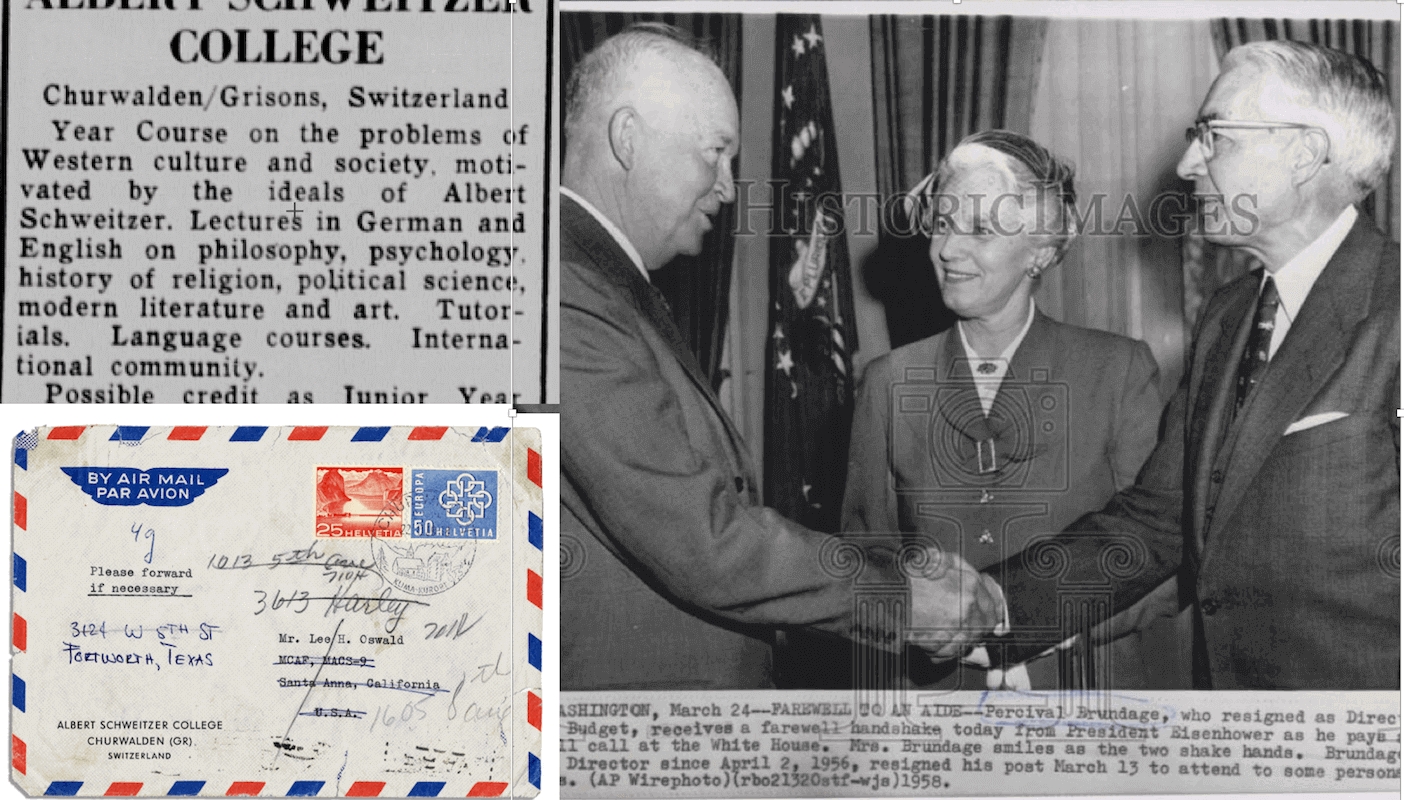
    Oswald had also stated in his passport application that he intended to study in Europe, and he named two institutions. One was the Albert Schweitzer College (ASC) in Churwalden, Switzerland, and the second was the University of Turku in Finland.

    Oswald sent his application to the ASC on March 19, 1959, informing them that he was going to attend the third (spring) term of the trimester schedule, from April 12, to June 27, 1960, followed by a registration fee payment of $25 on June 19. However, this time length posed a problem by itself. Oswald’s passport was valid for four months overseas, so if he wanted to attend its third trimester, then his passport should have been valid for nine months, an extra five months. According to his passport, he could have only made it to study the fall trimester of 1959, and then only if he was given an early discharge, which actually happened.6 Oswald was released from the Marines with a dependency discharge on September 11, 1959 to go to Fort Worth to take care of his injured mother. However, his mother had only a minor injury and Oswald left for New Orleans on September 17, 1959, to begin his trip to Europe. A year later, after his defection to the Soviet Union, he was given an undesirable discharge from the Marine Corps, something that was to haunt him to his final days.

    In 1995 the Assassinations Records Review Board (ARRB) revealed the communication between the FBI Legat at the Paris Embassy and FBI Director Hoover. The FBI Legat had sent Hoover five memoranda regarding Oswald’s intentions to study the ASC.

    The first memorandum was dated October 12, 1960. It was based on information from the Swiss Federal Police and stated that Oswald was planning to attend the fall trimester of 1959. The second memorandum was a strange one, since it stated that Oswald “had originally written a letter from Moscow indicating his intention to attend there (at Churwalden).”7

    This was an extraordinary turn of events, as the second memorandum implied that Oswald was planning to attend the third trimester, similar to his college application and the Warren Commission’s conclusion.

    The fourth and fifth memoranda were even more peculiar. They revealed that Oswald had not attended the course under a different name and that there is no record of a person possibly identical to Oswald attending the fall trimester.

    The above information should have sounded the alarms in FBI HQ because they suspected that since he did not attend the college he had brought with him his passport and his birth certificate to the Soviet Union. Even Marguerite Oswald, when asked by FBI agent Fain about her son’s whereabouts in Europe, replied that Lee has taken his birth certificate with him.

    The above information forced Hoover to send an enquiry to the Office of Security in the Department of State regarding the “missing” Lee: “Since there is a possibility that an impostor is using Oswald’s birth certificate, any current information … concerning subject (Oswald) … ”8

    Hoover, like his agent before him, suspected that Oswald had fallen victim to a Soviet spy ring that would have used his birth certificate to create a false identity which an “illegal” spy would adopt to enter the United States as a sleeper agent.

    The illegals were not under diplomatic protection like their legal counterparts that were usually connected to a Soviet embassy. They would resume the life of an American, probably one that has died, live a normal capitalistic life and would be activated when the need arose.

    Switzerland had been a center of espionage since WWII. Soviet illegals would never send or receive mail directly to/from the Soviet Union but would use neutral countries like Switzerland as a cover address to avoid detection. It is a surprise that the CIA counter-intelligence mole hunters did not open a 201 file on Oswald as soon as he defected. In fact, they did not do that for over a year. Instead, they put him on the HT/LINGUAL list of about three hundred Americans whose mail was secretly being opened.9 This would be an indication that Oswald was used to detect illegal networks in Switzerland by detecting their mails.

    The ASC was reputed to be a place where liberals, communists and Marxists would go to study, perhaps being a possible illegal passing point. By applying to this college, even if he never went there, it could appear that his birth certificate was used to create an illegal in Switzerland that would later use his identity and papers to travel to the States. Another scenario would have been that someone looking very similar to him, someone almost identical in appearance, could have taken his place, like a Soviet illegal. Alternatively, the US intelligence services would have looked suspiciously on Oswald upon his return to the States, wondering if he had been turned into a Soviet spy coming home on behalf of his new Soviet handlers.

    Regardless of the truth, Oswald—wittingly or unwittingly—had created a “Legend” for himself that could be used any time against various targets. Most importantly though, the US intelligence services would suspect that Oswald was probably impersonated by someone else for sinister purposes. This was to be the first time but it would not be the last.


    II. Albert Schweitzer College

    How did Oswald find out about this obscure college somewhere in Switzerland? It has been suggested by various authors that Kerry Thornley, one of Oswald’s Marine friends at Santa Ana, brought it to his attention and helped him with the application.

    Thornley was a New Age writer, satirist, mystic and crypto-fascist, and a native Californian who had studied at USC. He had been six months in active duty, following time in the reserves when he met Oswald at El Toro base near Santa Ana. Oswald even gave Thornley his copy of George Orwell’s 1984 to read.10 Thornley claimed that he met Oswald a week after Oswald applied to the ASC. As Greg Parker notes, it is possible that Thornley met and knew Oswald before his application to the college.11

    Thornley testified to the Warren Commission:

    I believe it was the First Unitarian Church in Los Angeles. I had mentioned earlier at the time I was talking to Oswald, and knew Oswald, I had been going to the First Unitarian Church in Los Angeles. This is a group of quite far to the left people politically for the most part, and mentioned in order to explain my political relationship with Oswald, at that moment, and he began to ask me questions about the First Unitarian Church and I answered, and then he realized or understood or asked what Oswald’s connection with the First Unitarian Church was and I explained to him that there was none.

    We do know that Oswald had visited Los Angeles, at least to get his passport, although he may have visited the Cuban Consulate as we shall see later on.

    The leader of this church was Minister Stephen Fritchman. He was a peace activist who had supported the Nuclear Test Ban Treaty, had been called by the Un-American Activities Committee and had attended the World Congress for Peace in Stockholm in May 1959.12

    Was there a connection between Oswald, Thornley, Fritchman and the ASC? The National Archives and Records Administration (NARA) included in its assassination files about Oswald a sixty-page report on Fritchman. Additionally, the Warren Commission and the FBI were interested and curious about Oswald and Thornley’s Unitarian Church link while trying to explain how Oswald obtained information about the ASC.13

    Evica believed that “Oswald’s mysterious source of information about Albert Schweitzer College could be explained by Thornley’s attendance at Fritchman’s First Unitarian Church in Los Angeles … the pastor may have possessed detailed information about the college and copies of the college’s registration forms. When Oswald visited LA, he could have picked up the materials at the church … Alternatively, Thornley … could have picked them up and passed them on to Oswald.”14

    The Liberal Religious Youth (LRY) was a group that cooperated with the ASC. Reverend Leon Hopper, one of its members, said to Evica in March 2003 that “student recruitment was almost always through personal contacts … also confirmed that Stephen Fritchman could have been an information source … Finally Hopper confirmed that the LRY concentrated on the summer sessions of ASC, reaching prospective students through personal contacts.”15

    The ASC was located in the small village of Churwalden, Switzerland, and there was something peculiar about it since it did not offer degrees. Even the Swiss authorities did not know it existed until the early 60s when there were accusations of a narcotics and fraud scandal involving the college. Soon the college was in debt, and closed only after an unknown entity from Liechtenstein paid off all of its debts.16 The peculiarities did not end there. Since the village was very small, it did not have a hospital, a library, a fire department or a police station. The village was many miles away from the nearest town of Chur, and one had to drive through poor roads and across mountains to reach the village.

    The college was housed in the village’s larger building, the hotel Krone with thirty rooms capacity.17 It opened in 1954, and the first list of students available revealed there were no Swiss students at all, which served to keep it unknown to the Swiss Government.18

    The ASC was created by the International Association for Religious Freedom (IARF). According to Richard Boeke, first President of the American chapter of IARF, it was the crown jewel of all the IARF’s associate religious centers and had initially been “good for Liberal Swiss Protestants.”19 The IARF originated in 1900 as the International Council of Unitarian and Other Liberal Religious Thinkers and workers on May 25, in Boston. The stated aim was “opening communications with those in all lands who are striving to unite Pure Religion and Perfect Liberty, and to increase fellowship and cooperation among them.”20 It would include religions like the Unitarian, Buddhist, Humanist, Muslim, Scientology and Theosophy.21

    The ASC was operated by the Albert Schweitzer College Association—a non- profit organization with its legal HQs in the village of Churwalden—and the Unitarian “American Friends of Albert Schweitzer College” which was also a non-profit organization. The “American Friends of Albert Schweitzer College” had its offices in Boston. It was incorporated in New York in 1953 with the purpose of receiving tax-deductible contributions from United States citizens and corporations.22 Its directors were John H. Lathrop (Brooklyn, NY), John Ritzenthaler (Montclair, NJ), and Percival F. Brundage (Montclair, NJ).23 Brundage was the most interesting individual out of the three directors, a true member of the “Power Elite”, with government and intelligence connections.


    III. Percival F. Brundage

    Who was Percival F. Brundage? Brundage was the son of a Unitarian Minister who graduated cum laude from Harvard University in 1914 and afterwards became a successful accountant, probably one of the best of his era. In 1916 he worked as a civilian in the Material Accounting Section of the War Department’s Quartermaster Depot Office in New York which involved record keeping of sensitive military procurement operations.24

    He became a senior partner in the accounting firm, Price-Waterhouse. He was director, and then president of the Federal Union that argued for the federation of the Atlantic democracies.25

    Brundage had a significant connection to the Unitarian Church and the ASC. He was a major Unitarian Church officer from 1942-1954 when the Unitarian Church was cooperating with, first, the OSS, and later the CIA.26 He was also president of the International Association for Religious Freedom (IARF) from 1952-1955 and president of the American Friends of Albert Schweitzer College from 1953-1958. Most importantly, Brundage became the most prominent member of the Bureau of Budget (BOB) during the Eisenhower presidency. He was its deputy director from 1954-1956, its president from 1956-1958 and he served it as consultant until 1960.27

    As the head of the BOB, Brundage was controlling the United States budget, and from that privileged position he would be familiar with the Pentagon’s and CIA’s secret black budgets but without ever exposing or surveying them. It seemed that Brundage would turn a blind eye and let them do their secret work without the government ever bothering them.

    One of Brundage’s closest friends was a fellow Unitarian, James R. Killian Jr., president of the Massachusetts Institute of Technology (MIT).28 Killian was appointed the chairmanship of president Eisenhower’s Technological Capabilities Panel in 1953 to measure the nation’s security and intelligence capabilities and also to study both military and intelligence applications of high-flight reconnaissance.29 Killian appointed Edward H. Land, inventor of the Polaroid land camera, as chief of the top-secret intelligence section of the Air Force Technological Capabilities Panel that helped create high-flight reconnaissance, like the U-2 and satellites. Land was also responsible for the CIA receiving the responsibility for the U-2 program.30 In 1957 he was appointed by Eisenhower as Special Assistant for Science and Technology, and in 1956 became Eisenhower’s chairman of the US Board of Consultants on Foreign Intelligence Activities, reporting to the president the activities of the intelligence community, especially the CIA.31 This board was supported by Brundage’s BOB. Later, Killian advised Eisenhower that the Air Force was incapable of developing photographic reconnaissance satellites. This allowed him to turn over that assignment to the CIA, which led to the CORONA satellite program32 that was discussed in part 1.

    Killian, Brundage and Nelson Rockefeller were the three men who transformed the national Committee of Aeronautics (NACA) into the civilian agency responsible for the US space program. It was renamed NASA. Brundage was responsible as the head of BOB for drafting the congressional legislation for the creation of NASA.33 Brundage was also involved in Operation Vanguard, which was “intended to establish freedom of space, and the right to overfly foreign territory for future intelligence satellites.”34

    In 1960, Brundage and one of his associates, E. Perkins McGuire, were asked to hold the majority of a new airline stock “in name only.”35 They both agreed to act on behalf of the CIA. The airline was none other than Southern Air Transport, which was used in paramilitary missions in the Congo, the Caribbean and Indochina. The Newsweek issue of May 19, 1975 linked Percival Brundage to Southern Air Transport, Double-Check Corp, the Robert Mullen Company and Zenith Technical Enterprises. The Double-Check Corp was a CIA front that was used to recruit pilots for covert missions against Cuba; Robert Mullen’s advertising company provided cover for CIA personnel abroad; and Zenith Technical Enterprises was the front that provided cover for CIA’s JM/WAVE station in Miami.36

    Southern Air Transport was created by Paul Helliwell, an originator of the CIA’s off-the-books accounting system and nicknamed Mister Black Bag. Helliwell was a member of the OSS and later of the CIA in the Far East; he was one of the most prominent members of the China Lobby. His mission was to assist Chang Kai-Shek and his Kuomintang (KMT) army in Burma to invade China. This army managed and controlled the opium traffic in the region. Helliwell created two front companies to help KMT to carry out its war and the drug trade. One was Sea Supply in Bangkok and the other was CAT Inc., later Air America in Taiwan.37 Helliwell had organized a drug trafficking network supported by banks to launder CIA’s drug profits in the Far East.

    Richard Bissell brought Helliwell back to the States to plan a similar network of front companies and banks to finance the Agency’s war against Castro. Similar to Sea Supply and Air America, he created Southern Air Transport in Miami to fly over drugs and guns to support not only the war on Cuba but also in Laos, Vietnam and Cambodia.

    In his book Prelude to Terror, Joseph Trento claimed that Helliwell’s main objective was to cement the CIA’s relationship with organized crime.38 Meyer Lansky and Santo Trafficante were both planning to invest in the Far East by bringing heroin back to the States. Helliwell established banks in Florida and became the owner of the Bank of Perrine in Key West, “a two-time laundromat for the Lansky mob and the CIA”, and its sister Bank of Cutler Ridge.39 Lansky would deposit money into the Bank of Perrine, reaching the US from the Bank of World Commerce in the Bahamas. Lansky also used the small Miami National Bank, where Helliwell was a legal counsel, to launder money from abroad and from his Las Vegas casinos.40 Peter Scott claimed that Helliwell worked with E. Howard Hunt, Mitch WerBell and Lucien Conein on developing relationships with drug dealing Cuban veterans of the Bay of Pigs invasion, and became CIA paymaster for JM/WAVE to finance Chief of Station Ted Shackley’s operations against Cuba.41 Sergio Arcacha-Smith, one of the New Orleans Cubans who knew Oswald and E. Howard Hunt, was involved in the lucrative business of contraband transportation from Florida to Texas, specializing in drugs, guns, and even prostitution.42

    In other words, Percival Brundage was no ordinary citizen. His BOB activities with the U-2, the satellite programs, the Pentagon, the CIA, and especially his involvement with the ASC, linked him indirectly to Lee Harvey Oswald. The young Marine had applied to the ASC to study in Switzerland and his defection to the Soviet Union was unwittingly connected to the U-2 and CORONA projects that brought an end to the Paris Peace talks and prolonged the Cold War. When Percival Brundage became a part of Southern Air Transport, he entered a nexus of CIA, Mafia, drug trafficking, money laundering and anti-Castro Cubans, one which later met and manipulated Oswald, and some of whose members were very likely involved in the assassination of John F. Kennedy. It is also very plausible that the assassination was financed by this drug trafficking and banking network instead of oil-men money as many believe.


    IV. Cuban Sympathizer or Agent Provocateur?

    Was Oswald a communist sympathizer from his early days, like the Warren Commission concluded? Had he been in contact with the Cuban Consulate in Los Angeles?

    Corporal Nelson Delgado was a Puerto Rican stationed at El Toro Marine Corps base who became close friends with Oswald. They were both loners but they had a common interest, and that was Cuba. Both admired Castro because he seemed to be a freedom fighter against Batista’s tyranny who could bring democracy to Cuba. They were dreaming that they could go there and become officers and free other islands like the Dominican Republic. Delgado could speak Spanish and Oswald would configure his ideas about how to run a government—so they kept dreaming.

    Things got a little strange when Oswald became serious about it and was trying to find ways to actually go to Cuba.43

    When interviewed by the Warren Commission, Delgado said he advised Oswald to go and see the Cubans at the Cuban Consulate in Los Angeles. Wesley Liebeler, a Warren Commission lawyer, took Delgado’s testimony and stretched it by the ears to make it look like Oswald was in contact with the Cubans all along. According to Australian researcher Greg Parker, “Liebeler, adroitly took a bunch of assumptions and leaps of logic by Delgado and magically recast them as proven fact leading to an inevitable conclusion.”44

    According to Delgado:45

    • Oswald told Delgado there was a Cuban consulate in Los Angeles;
    • Oswald started receiving letters with a seal on them that Delgado thought might be from Los Angeles because Oswald had said he was getting such mail from the Cuban Consulate;
    • Oswald took a trip by train to Los Angeles to “see some people”.

    Based on the above, Liebeler instructed Delgado to “tell me all that you can remember about Oswald’s contact with the Cuban Consulate.”46

    Delgado also noted that after Oswald allegedly visited the Cuban Consulate, he started receiving mail, pamphlets and a newspaper. Naturally, he assumed that they must have come from the Cuban Consulate and concluded the newspaper was communist, since it was written in Russian. He asked Oswald if it was a communist newspaper and he replied that it was White Russian and not communist. Still, Delgado, who did not know what White Russian meant, concluded it was a Soviet newspaper.47

    One of the pamphlets had a big impressive seal that looked like a Mexican eagle with different colors, red and white and a Latin script with the word “United” included. Parker believes that Delgado probably was describing the logo of a Russian Solidarist movement known as NTS (HTC in Russian), standing for Narodnyi Trudovoy Soyuz (National Labor Union) in English.48 Below we can see the NTS logo with something that looks like an eagle, and the colors white, blue and red in the background.

    nts logo
    NTS logo

    More information about NTS can be found in Stephen Dorill’s book MI6: Inside the Covert World of Her Majesty’s Secret Intelligence Service. According to Dorill, NTS was founded in Belgrade in July 1930 by Prince Anton Turkul and Claudius Voss, and it stood for National Labor Council. Prince Turkul was a member of the White Russian Armed Services Union (ROVS) and its purpose was to restore Tsarist Russia. Voss was the head of ROVS in the Balkans and “a British intelligence agent and ran ROVS’ MI6-friendly counter-intelligence service, the Inner Line, that sponsored NTS.”49

    Dorill also revealed that “the Russian émigré organizations were working overtime through bodies such as the NTS … to undermine the Soviet regime and to form a provisional government when the Soviets collapsed.”50 Dorill described NTS’ origins: “Initially a left-of-centre grouping, NTS soon moved to the right, promoting an anti-Marxist philosophy of national labor solidarity, based on three components: idealism, nationalism, and activism. It enjoyed the support of several European intelligence services, in particular MI6, and also attracted substantial funds from businessmen with interests in pre-revolutionary Russia, including Sir Henry Deterding, chair of Royal Dutch Shell, and the armaments manufacturer, Sir Basil Zaharooff.”51

    If Parker is right, and the pamphlets that Oswald was receiving were not communist but on the contrary from the NTS, then we can conclude that Oswald was in contact with fervent anti-communist White Russians. In that context, then, his trip to the Soviet Union could be viewed from a different perspective.

    Oswald received help to apply to the ASC and travel to the Soviet Union, most likely from a nexus that involved the CIA and anti-communist organizations with relations to the military-industrial complex. When Oswald applied to the ASC, he listed his favorite authors as Jack London, Charles Darwin and Norman V. Peale.52 Jack London was one of the founders of The League for Industrial Democracy (LID), whose purpose was to extend democracy in all aspects of American life. During the Cold War, it was renamed the Student League for Industrial Democracy (SLID), had close ties to the CIA and had become anti-communist.53 Jack London was a supporter of social Darwinism, eugenics, Nietzschean philosophy and Jungian psychology.54

    Darwin was a Unitarian and author of “Origins of the Species.” His cousin Francis Galton studied heredity based on Darwin’s work and as a result he coined the word “eugenics”, the theory that selective breeding will improve the human race.55

    Norman Vincent Peale was a minister of the Lutheran church, politically conservative, and opposed the liberal and Catholic Jack Kennedy. He believed that as a Roman Catholic President Kennedy would align with the Vatican with respect to US foreign policy.56 He headed a group, which included Billy Graham, that held a secret meeting to discuss how to derail Kennedy’s election bid.57 Some of Peale’s associates were supporters of lynching, while others were against the Eisenhower-Khrushchev Paris peace summit.58 He was also friends with the conservatives Nixon and Hoover.59

    If Oswald was, as he is alleged to be, a communist sympathizer, these interests and connections to the reactionary and elitist Right come as a surprise. Indeed, they would seem to indicate, on the contrary, that Oswald was actually instructed and guided by people who were anti-communist and probably tied to the CIA.

    Even Hans Casparis, the founder of the ASC, had probable CIA connections. Casparis claimed that he had graduated from three universities, studied at a fourth and was a full-time lecturer in German and philosophy at the ASC. There were no specific degrees listed on the ASC brochure presenting Casparis, while five other lecturers held doctorates, and another one, along with Casparis’ wife, Therese, held a BA.60 Casparis claimed that he was a lecturer in education at the School of European Studies at the University of Zürich, but when Professor Evica asked the university to confirm it, they replied that Casparis had never lectured there.61 Records indicated that Casparis had studied at the University of Chicago (1946-1947), and the University of Tübingen (1922-1923), but never received degrees from either of the two.62

    The same ASC brochure said that Therese Casparis, his wife, had a BA degree in education from the University of London. However, the university’s assistant archivist revealed that Therese had received a second-class honors degree in German and then enrolled to take a teacher’s diploma, but she left without taking an exam, so she never received a BA in education from that university. Therese gave birth to five children from 1934 to 1948, but Evica could not find any college in Europe or England which awarded a degree to Hans or Therese. 63 It was a mystery how they were able to raise five children without any higher degrees, yet were able to attract support from important Unitarians to establish a college in an unknown village somewhere in Switzerland. It is likely that Hans and Therese were employed by the CIA to infiltrate this liberal college. If we consider Evica’s findings that Allen Dulles had used religious organizations like the Unitarians to create humanitarian front organizations in order to conceal OSS and later CIA covert operations to destabilize Eastern Europe, South America and South East Asia, we can conclude, or strongly suspect, that ASC was such a front cover.

    When Oswald was arrested in New Orleans during the summer of 1963, he was asked by police officer Frank Martello how he came to be a member of the Fair Play for Cuba Committee (FPCC). To that he replied that “he became interested in that committee in Los Angeles … in 1958 while in the US Marine Corps.”64 Although he gave the wrong information, since the FPCC was established in April of 1960, he simultaneously revealed that when he was visiting Los Angeles he most likely met the pro-Castro people that had organized the FPCC’s Los Angeles branch at the first Unitarian Church of Robert Fritchman.65

    In 1963, Richard Case Nagell was investigating the FPCC branch in Los Angeles, leftists and Unitarians. In his notebook were written the names of: Helen Travis of the FPCC, Dorothy Healy of the Communist Party, USA, Reverend Robert Fritchman of the First Unitarian Church, and the officials of the Medical Aid for Cuba Committee.66

    Is it possible that all along Oswald was being groomed to penetrate the FPCC?

    A 1976 CIA internal memo stated, “In the late 1950’s, Hemming and Sturgis, both former US Marines, joined Fidel Castro in Cuba but returned shortly thereafter, claiming disillusionment with the Castro cause.”67 Delgado testified that a mysterious man visited Oswald at the gate of El Toro base. He had assumed that he was someone from the Los Angeles Cuban Consulate. However, Gerry Patrick Hemming revealed later on that he had met Oswald in the Cuban Consulate in Los Angeles and went to confront Oswald at the gate of El Toro base.

    There are indications that this actually happened. A CIA memo stated that “Henning (Hemming) returned to California in October 1958 … he left for Cuba by air via Miami on or about 18 February 1959, arriving in Havana on 19 February 1959. He claimed to have contacted the officials in the Cuban consul’s office in Los Angeles prior to his departure.”68 Another CIA Security Office memo from 1977 linked Oswald to Hemming: “The Office of Security file concerning Hemming which is replete with information possibly linking Hemming and his cohorts to Oswald … ”69

    Could it be possible that Oswald was being “put together” to penetrate pro-Castro organizations like the FPCC as Hemming had been associated with Castro and his allies before him?

    In a 1976 article in Argosy, it was stated that, “Hemming maintains that the US should utilize a number of Special Forces types … who could penetrate revolutionary movements at an early stage, gain influential positions, and then channel them into more favorable areas.70 It was during that period late 1959, early 1960, when Oswald defected to the Soviet Union that the US Government—and Hemming—had realized that Castro was pro-Soviet. He was a Communist who could pose a threat to the US interests and an option would have been to have him “eliminated.”71

    It is likely that Oswald was sent to the Soviet Union to build up a “Legend” as a pro-communist, pro-Soviet sympathizer. One who appeared to have provided secret information to help the Soviets shoot down the U-2—even if he did not—and then return home as a Soviet spy, or as someone who had helped create a Soviet illegal. His mission would have been to infiltrate leftist, subversive and pro-Castro organizations while pretending to be on their side.


    Summary of Parts 1 and 2:

    • The way Oswald received his passport was very peculiar.
    • In 1959 Oswald likely visited the Los Angeles Cuban Consulate, allegedly because he was a Red sympathizer.
    • His Marine mate Delgado thought he was receiving mail and leaflets from the Cuban Consulate, while the material was more likely White Russian, from an anti-communist solidarity organization called Narodnyi Trudovoy Soyuz
    • Oswald had applied to study at the Albert Schweitzer College (ASC), an obscure college in Switzerland.
    • There was confusion as to which trimester he was planning to attend ASC.
    • It is a mystery as to how Oswald found out about this college.
    • Kerry Thornley, another of Oswald’s Marine mates, was attending the First Unitarian Church in Los Angeles where Robert Fritchman was its Minister.
    • Either Thornley or Fritchman probably supplied Oswald with all the necessary information.
    • Oswald listed on his college application authors Jack London, Charles Darwin and Norman B. Peale, which indicated that Oswald had elitist, conservative and far right political views.
    • Hans Casparis the founder of the ASC falsely claimed that he had academic credentials he did not have.
    • Similarly with his wife Therese, also a lecturer at the ASC.
    • The ASC was created by the International Association for Religious Freedom (IARF) and was supported by the Unitarian American Friends of Albert Schweitzer College.
    • Percival Brundage was one of the Directors of the Unitarian American Friends of Albert Schweitzer College.
    • Brundage was Director of the Bureau of Budget (BOB) during the Eisenhower presidency.
    • Along with another Unitarian, James Killian, he was involved in the U-2 and CORONA satellite projects.
    • Brundage held major stocks of Southern Air Transport that Paul Helliwell had established.
    • Helliwell was a CIA man in the Far East who helped arrange drug trafficking to finance CIA operations.
    • This brought Brundage in contact with a network of drug-trafficking, money-laundering banks, anti-Castro Cubans and the CIA operations against Castro.
    • The ASC was to become a link between Oswald and Brundage.
    • Oswald’s mother thought it was strange that her son would go to the Soviet Union; she thought he was more likely to go to Cuba.
    • Oswald stated in 1963 that he first learned about the FPCC while visiting Los Angeles.
    • The people who established the Los Angeles FPCC branch were attending Fritchman’s First Unitarian Church.
    • It is probable that Oswald was prepared by some US intelligence service, probably the CIA, to penetrate pro-Castro organizations like the FPCC at a time that the US government began plans to eliminate Castro.
    • For that reason it had to appear that he defected to the Soviet Union.
    • His actions there created his bona fides that he had been turned into a communist spy.
    • CIA counter-intelligence chief James Angleton ran a second operation involving Oswald or his file to sabotage the peace summit.
    • Oswald was a fake defector and a US intelligence dangle.
    • He never intended to renounce his citizenship.
    • The FBI learned from his mother that he had his birth certificate with him.
    • Hoover feared that some impostor might be using his birth certificate and that a Soviet illegal might take his place if he returned to the States.
    • Oswald was put on the CIA’s illegal HT/LINGUAL mail-opening program designed to detect Soviet illegals.
    • This would have also strengthened his Soviet spy profile.
    • The U-2 had a finite operational life time.
    • It was scheduled to be replaced by the A-12 aircraft and the Corona satellites, so there were alternatives if something went wrong.
    • Oswald did not give information to the Soviets to help them shoot down the U-2, but it appeared that he did. This boosted his “Soviet Spy” legend.
    • Dulles admitted that it happened due to a malfunction.
    • Prouty believed that it was sabotaged from the inside.
    • The U-2 was sacrificed, since there were other alternatives to replace it, to disrupt the Paris peace summit and prolong the Cold War.
    • It was planned by a treasonous collaboration of American and Soviet hardliners who had invested in the Cold War.
    • Oswald was part of Angleton’s mole hunt to discover who betrayed Popov and the U-2 project.
    • However, Popov was not betrayed by a mole, so a mole hunt was not necessary.
    • Angleton used the mole hunt as a cover to accommodate the U-2 shoot down. Although it failed to discover the mole’s identity, that exercise gave him a usable alibi by which he could claim, in the case suspicions were raised that it was an inside job, that the U-2 incident was the work of a mole.


    In Part 3, we examine the Oswald legend in Dallas, New Orleans and Mexico City.

    Go to Part 1

    Go to Part 3

    Go to Part 4

    Go to Part 5

    Go to Part 6

    Go to Conclusion

    Go to Appendix


    Notes

    1 John Newman, Oswald and the CIA, Skyhorse Publishing Inc. 1995, p. 92.

    2 Newman, p. 92.

    3 Newman, p. 92.

    4 George Michael Evica, A Certain Arrogance, Trine Day 2011, p. 21.

    5 Evica, p. 22.

    6 Evica, pp. 25-26.

    7 Evica, pp. 68-69.

    8 Evica, p. 59.

    9 Newman, p. 423.

    10 Greg Parker, Lee Harvey’s Oswald Cold War, vols. 1 & 2, New Disease Press, 2015, p. 283.

    11 Parker, p. 285.

    12 Parker, p. 287.

    13 Evica, p. 35.

    14 Evica, pp. 35-36.

    15 Evica, p. 87.

    16 John Armstrong, Harvey and Lee, Quasar Press, 2003, p. 227.

    17 Armstrong, pp. 227-228.

    18 Armstrong, p. 228.

    19 Evica, p. 83

    20 Parker, pp. 287-288.

    21 Parker, p. 288.

    22 Evica, p. 86.

    23 Armstrong, p .228.

    24 Evica, p. 237.

    25 Evica, p. 238.

    26 Evica, p. 276.

    27 Evica, p. 238.

    28 Evica, p. 245.

    29 Evica, p. 247.

    30 Evica, p. 248.

    31 Evica, p. 248.

    32 Evica, p. 250.

    33 Evica, pp. 255-256.

    34 Parker, p. 290.

    35 Evica, p. 272.

    36 Armstrong, p. 229.

    37 Peter Dale Scott, The American Deep State, Rowman & Littlefield, 2015, p. 126.

    38 http://spartacus-educational.com/JFKhelliwell.htm.

    39 http://www.globalresearch.ca/deep-events-and-the-cia-s-global-drug-connection/10095.

    40 http://www.globalresearch.ca/deep-events-and-the-cia-s-global-drug-connection/10095.

    41 http://spartacus-educational.com/JFKhelliwell.htm.

    42 James DiEugenio, Destiny Betrayed, Skyhorse Publishing, 2012, p. 329.

    43 Newman, pp. 96-97.

    44 Parker, pp. 280-281.

    45 Parker, p. 281

    46 Parker, p. 281.

    47 Parker, p. 282.

    48 Parker, p. 282.

    49 Stephen Dorril, MI6: Inside the Covert World of Her Majesty’s Secret Intelligence Service, Harper Collins, 2002, p. 405.

    50 Dorril, p. 405.

    51 Dorril, p. 406.

    52 Parker, p. 296.

    53 Parker, p. 297.

    54 Parker, p. 297.

    55 Parker, p. 297.

    56 Parker, pp. 297-298.

    57 Parker, p. 300.

    58 Parker, p. 301.

    59 Parker, p. 302.

    60 Evica, pp. 95-96.

    61 Evica, p. 96.

    62 Evica, p. 96.

    63 Evica, pp. 100-101.

    64 Evica, p. 36.

    65 Evica, p. 36.

    66 Dick Russell, The Man Who Knew too Much, Carroll & Graf, p. 226.

    67 Newman, p. 101.

    68 Newman, p. 102.

    69 Newman, p. 103.

    70 Newman, p. 104.

    71 Newman, pp. 115-121.

  • Creating the Oswald Legend – Part 1

    Creating the Oswald Legend – Part 1


    vasilios leader

    I. An Unusual Defector

    Lee Harvey Oswald defected to the Soviet Union in the fall of 1959, on October 16. On the Saturday morning of 31 October 1959 he visited the U.S. Embassy in Moscow and threw his passport to the receptionist while announcing that he was willing to renounce his American citizenship. The surprised receptionist advised Oswald to discuss his matter with the American Consul, Richard Snyder. Oswald handed over to the consul a hand-written letter declaring his allegiance to the “Union of the Soviet Republics”. The second Consul, John McVickar, later testified to the Warren Commission that Oswald followed a pattern of behavior indicating that someone or some unknown parties had coached him.1

    The receptionist, Joan Hallet, later recalled that a security officer took Oswald to the secure area upstairs and that “a visitor would never ever get up there unless he was on official business. 2

    Oswald revealed to Snyder that on the 16th of October he had applied for Soviet citizenship. Snyder gave him a form and asked him to fill in his U.S. address plus the address of his closest relative. Oswald became upset because he did not want to involve his mother in this, but eventually he had to report her address in Fort Worth, Texas.

    When asked: Why did he wish to defect to the Soviet Union? he replied that he was a Marxist. Snyder then asked him if he was willing to serve the Soviet state, to which he replied that he was a radar operator in the Marines and he had willingly declared to the Soviets that if he was to become a Soviet citizen he would then reveal information regarding his time in the Marines, and his duties. He insinuated to them that he knew something of special interest.3

    Snyder assumed that his words “of special interest” were a reference to the ultra secretive project involving the spy plane known as U-2, which flew missions from U.S. military bases around the world. Oswald was familiar with the U-2 since the plane was also flying out of Atsugi Japan where he had been stationed as a Marine during 1957-1958. This revelation to Snyder was quite odd, because it could have led to his arrest. Snyder believed that Oswald did it on purpose since Oswald had probably assumed that the Soviets had bugged the U.S. Embassy, and he was speaking for Russian ears in his office. This is also another odd and peculiar thing to do in order to get the Soviets’ attention. If he really wanted to give up military secrets he could have gone straight to the Soviet authorities in secret so the American Intelligence services would have never learned of his treason. Bill Simpich4 believes that if Snyder’s assumption was right, Oswald may have been wittingly or unwittingly prepped by someone from CIA officer William Harvey’s Staff D, since they were responsible for signal intelligence. Bill Harvey was stationed in Berlin during Oswald’s visit to the U.S. Embassy in Moscow, so we cannot conclude with certainty that he had anything to do with Oswald and Staff D at that time.

    Snyder informed Oswald that there was no time left to fill in the necessary documents because it was Saturday noon and they had to close the consulate. He advised him to come back on Monday morning to complete the process of renouncing his citizenship. He also asked Oswald to hand him his passport. Oswald got very irritated and upset and he stormed out of the Embassy and never returned to pick up the documents he so desperately needed. However, he did oblige Snyder’s request and gave him his passport. By doing so he wittingly or unwittingly made sure that his passport would not be detained by the Soviets. He had therefore kept the door open for his return to the States.5

    Before Oswald, two American citizens had tried to renounce their citizenship during the same September month. They were Nicholas Petrulli, on the first week of September, and Robert Webster on Saturday, September 17. Strangely enough, both of these defectors, like Oswald, had visited the Embassy on a Saturday, which made it difficult to finalize the process for renouncing their citizenship. Petrulli did manage to achieve it, but he then changed his mind and asked to return to the U.S. Webster is a person of interest who we will examine further at a later stage. It was Petrulli’s change of heart that prompted Snyder to give Oswald a chance to think it over in case he also changed his mind during the weekend.6

    After Oswald’s departure, Snyder prepared his report regarding Oswald’s visit and he sent a cable to the State Department. Cable 1304 warned that Oswald offered information to the Soviets that he had acquired as a military radar operator. For whatever reason there was not any mention of the possibility that he might have revealed the U2 spying activities.

    On Tuesday morning, November 3, the FBI and CIA had begun to look for information about Oswald after hearing the news about Oswald from the press in Moscow. Snyder had not sent his cable yet to State, so nobody knew of its existence back in the America. Around noon, the Navy received a cable from the Navy attaché in the Moscow embassy that the following diplomatic pouches –– 224/26 October and 234/2 November –– were on their way from Moscow. The content of the two cables included information about two ex Navy persons, Lee Harvey Oswald and Robert Webster.7

    Pouch 234 with the Oswald information arrived at the State Department on Thursday, November 5, and the Navy attaché alerted the Navy to ask for it after its arrival. On the same afternoon the FBI and CIA received pouch 234, and also Snyder’s cable but, to this day, the CIA has not been able to confirm which officer was the recipient.8

    As former intelligence officer John Newman has noted, from the beginning, Oswald’s file had fallen into a black hole. The Navy sent its attaché cable to the CIA, which described how Oswald threatened to reveal top secrets about radar to the Soviets. This cable had also fallen inside a black hole, because no one ever saw it until after JFK’s murder. So when Sam Papich, FBI’s liaison to the CIA’s Counterintelligence division (CI), asked for information relating to Oswald’s defection, the CIA responded that they had none.9 The FBI still put Oswald’s name on their watch list to stop his entering the country under any name.

    At CIA, the Navy cable eventually landed in James Angleton’s Counterintelligence Special Investigation Group (CI/SIG) on December 6 –– but we have no knowledge of its whereabouts the previous 31 days. In addition it was not sent to the right department, which was the Soviet Russia Division (SR).10

    Meanwhile, while waiting on the Soviet decision to allow him to stay in the USSR, Oswald stayed in his hotel room in Moscow writing letters to his family explaining why he wanted to defect. He also gave interviews to two American journalists, one of them was Priscilla Johnson.8 Priscilla testified to the HSCA in 1978 that it was McVickar who pressed her to take an interview from Oswald with the excuse that, because she was a woman, it would have been easier for Oswald to talk to her. Snyder had asked McVickar to talk to Oswald and try to change his mind about defecting, but he had not told him to ask Priscilla to do it. As a result Snyder was very upset with McVickar.11

    McVickar said to Priscilla that there was a fine line between her duty as a journalist and as an American. She later testified that McVickar told her before leaving to remember that she was an American.12 On November 16, Priscilla interviewed Oswald for 5 hours. Oswald revealed to her that the Soviets would allow him to stay in the USSR and would examine the possibility for him to study at a Soviet institution.13 According to Priscilla, Oswald hoped to be useful to the Soviets since he was a radar operator and he could offer them something to harm his country. Oswald was staying in room 233 of the Metropole Hotel, where the KGB had secretly installed infrared cameras to spy on tourists, and the CIA knew that.14

    The next day, November 17, John McVickar invited Priscilla to dinner to discuss her interview with Oswald. After dinner McVickar wrote a memo where he stated that Priscilla had told him that Oswald would be trained in electronics but Priscilla later denied that she did.15

    Oswald was later sent by the Soviets to Minsk to work in an electronics factory, information that Snyder did not know, so one has to question how McVickar was privy to it at that time. McVickar also falsely wrote that it was Priscilla that asked him to meet with Oswald.16 It seems that McVickar had taken a personal interest in Oswald, and one has to wonder if he was privy to information about Oswald that Snyder never had a chance to get.

    Priscilla wrote an article based on her Oswald interview that was published in the Washington Evening Star, 26 November 1959, describing Oswald as a handsome and serious young man, six feet tall, from the South, with a slight accent and different ideas, but did not report any of his intentions to reveal military secrets to the Soviets.17 So who was Priscilla Johnson?

    Priscilla Johnson, as a college student majoring in the Russian language, was a member of “United World Federalists”, an organization that tried to spread the idea that a World Government was necessary and that the U.N. should be given more powers. One of the founders of this organization was Cord Meyer of the CIA’s International Organizations Division.18 After her graduation in 1952 she tried to enlist in the CIA but she was rejected. In 1953 she briefly worked for the office of Senator John F. Kennedy.

    In 1955 she moved to Moscow, where she worked in the U.S. Embassy as a translator. In 1958 the CIA’s office of Counterintelligence/OperationalApproval (CI/OA) asked for permission to utilize Priscilla in its operations. To this day, this operation that involved Priscilla is still classified.

    She returned to the States where she was hired as a reporter for the North American Newspaper Alliance (NANA). On November 13, 1959, she went back to Moscow and happened to interview Lee Harvey Oswald, the ex-Marine who wanted to defect to the USSR.19

    What kind of news organization was NANA? NANA was a news agency competing with the likes of Associated Press and United Press International. Sometime in the 50’s it was bought by Ivory Bryce, a former officer of British Intelligence, and his American partner Ernest Cuneo. Both men were good friends with Ian Fleming, the James Bond author and ex-intelligence officer of the British Navy.20

    Some of NANA’s members were novelist Ernest Hemingway, Inga Arvad, suspected of being a Nazi spy, and Virginia Prewet who worked for David Phillips. It would seem that NANA was an intelligence network closely connected to Operation Mockingbird.21 According to Deborah Davis, the author of Katharine the Great: Katharine Graham and her Washington Post Empire, Meyer was Mockingbird’s “principal operative”.

    When Josef Stalin died, his daughter Svetlana defected to the States and stayed with Priscilla’s father, Stewart Johnson. Priscilla helped Svetlana write her memoirs.21

    Following JFK’s assassination, Priscilla was privileged enough to spend time with Marina Oswald in the summer and fall of 1964. As an important witness to testify for the Warren Commission, Marina was not allowed to come in contact with anyone, living under Secret Service protection. How Priscilla managed to stay with her when nobody else could approach her is a question that has not been answered. Priscilla had one more privilege: to write Marina’s biography.

    Senator Richard Russell, a member of the Warren Commission, was not convinced that Oswald was guilty or that he had travelled to Mexico, but an unexpected incident helped change his mind. Marina testified that she found a ticket to Mexico inside a magazine while writing her biography with Priscilla. In other words, after numerous searches, the FBI and the Dallas Police could not find it, but Priscilla and Marina did.22

    In 1977 Priscilla published her book titled Marina and Lee. Marina revealed that she did not contribute much to the book; it was Priscilla who had to discover most of the facts and put them in order. Priscilla never stopped trying to convince the public that Oswald was guilty. On April 20, 1978 she appeared before the HSCA, along with her attorney and a written affidavit. The Committee found this odd, since she was not being accused of anything so the affidavit and the lawyer were not necessary.23

    Researcher Peter Whitmey revealed Priscilla Johnson’s relations with the CIA after a large number of CIA documents were made available to the National Archives. A document dated 11 December 1962, written by Donald Jameson of CIA, revealed that the CIA believed Miss Johnson could be encouraged to write articles that they wished.24 Other documents reveal that she met with CIA officers for seven hours in 1964, while in 1965 there was another meeting at her request. The CIA’s office of Security granted her clearance to secret information in 1956. It is difficult to give credence to Priscilla’s words when we now know that she was trying for years to conceal her relationship to the CIA, at the same time she was perpetuating a false mythology about Oswald as Kennedy’s killer. 25


    II. Minsk and the U-2 Incident

    The Soviets did not grant Oswald the Soviet passport and citizenship that he wanted. Eventually he was given a residence document, without citizenship, which allowed him to stay in the Soviet Union. In January 1960, he was sent to Minsk, the capital of Belorussia, a city that was a center of science and technology. Oswald was given a position in the experimental division of a radio factory of 5000 employees that had been producing electronic systems. The job proved to be a disappointment because he ended up manufacturing metal parts with a lathe machine. The Soviet state provided for him an apartment with a view of the river at a very cheap rent of only 60 rubles. His monthly salary was 700 rubles, and together with the economic aid given to him by the Russian Red Cross, he ended up earning 1400 rubles, which equaled the salary that the factory’s director was receiving.26

    According to KGB files, Oswald was under constant surveillance. His apartment was bugged, his mail was opened and some of his neighbors and coworkers were informing the authorities about his activities.

    His employment in an electronics factory fulfilled McVickar’s uncanny prediction that Oswald would be trained in electronics, but is also in line with a discovery announced in a 1991 Nightline broadcast that examined recently released KGB files. It was discovered that the KGB had issued this order: “Find employment using his electrical skills”.27 We know the Soviets were suspicious that Oswald might have been a U.S. intelligence dangle, since they knew that the Americans were trying hard to get any information about the Soviet electronics industry. So why would the Soviets send a possible fake defector and dangle, who could have been a CIA spy, to work in an electronics factory? It would have made more sense to send him to work in a milk plant or a vodka distillery that had no connection to defense or the military. This would make sense, however, if the Soviets wanted to pretend playing along and thereby feed back to U.S. intelligence false information about their electronics industry.

    Oswald’s “Historic Diary” offered a detailed description of the Minsk factory size and number of employees, manufacturing 87,000 large powerful radios and 60,000 television sets.28 Oswald’s supervisor and the chief engineer was Alexander Romanovich Ziger, a Polish Jew who had immigrated to Argentina in 1938 and then returned to Belorussia in 1956. He could speak English with an American accent and had worked with an American company in Argentina. Oswald and Ziger became friends: Oswald would spend recreational time at Ziger’s home socializing with Ziger’s daughters.29

    On May 1, 1960, the very day that the Soviets shot down the U-2 spy plane, Oswald was at Ziger’s house attending a party. That night Ziger advised Oswald to return to America and Oswald wrote in his diary: “Ziger advises me to go back to U.S.A., it’s the first voice of dissention [sic] I have heard. I respect Ziger, he has seen the world. He says many things and relates many things I do not know about the U.S.S.R. I begin to feel uneasy inside, it’s true!!”30

    That same day the Soviets were parading their military personnel and armor in front of the Kremlin. Gary Powers, the U-2’s pilot, survived the wreckage and was arrested by the Soviets. The U-2 was the pride of American intelligence and was a testament to America’s technological superiority.31 The New York Times labeled the U-2 flights as the most successful project in the history of intelligence. Allen Dulles, the CIA’s Director, stated that the U-2 could collect information with more speed and accuracy than any spy on the ground.32 For the first time they would have a view of all Soviet military bases, factories, train rails, radars, missiles, even submarines. Considering all the above, the downing of the U-2 would be disastrous for U.S. intelligence. Was it really such a disaster, or, in a disguised way, a surprising success?

    One thing we can say about it is this: it was disastrous for the peace summit in Paris that was soon to take place. Eisenhower and Khrushchev were scheduled to meet, along with other leaders from Western Europe. If successful, the two Presidents were supposed to talk further in Moscow. The U-2 shootdown made sure that the peace talks would be shot down just as the spy plane was. The Peace Summit was disbanded quite quickly, and it was replaced by a show trial that convicted Powers. He was sent to prison, and this humiliated Eisenhower and weakened his foreign policy. The U-2 incident proved to be a disaster for U.S. diplomacy.33 In fact, there are some who even believe that it was the cause of Eisenhower’s famous Farewell Address, in which he warned Americans to beware the rise of the Military-Industrial Complex.

    What exactly happened to the U-2 plane that fateful May day remains a mystery. President Eisenhower had forbidden the flights over the Soviet Union because he did not wish to provoke the Soviets just before the summit. The CIA had used the “missile gap” as leverage to continue the U-2 flights, since they believed the Soviets were far ahead in the matter of Intercontinental Ballistic Missiles (ICBMs) that could attack the U.S. at any time soon.34

    Eisenhower was willing to reconsider as long as the U-2 did not fly inside Soviet air space. So he authorized operation HOT SHOP on the 9th and 18th of June 1959 above the Iran-USSR border that managed to record for the first time an ICBM eighty seconds after launch.35 Eisenhower did not want to authorize any more flights, but the CIA and the Secretary of State convinced him to continue. They felt the information they could get about the Soviet ICBMs was more important than the danger of being caught.

    On July 9, 1959, a U-2 flew above the Ural mountains and photographed a whole range of ICBMs. Despite the mission’s success, Eisenhower did not authorize another flight because he was expecting Khrushchev to visit Washington on 15-27 September, 1959. On September 12, 1959, the Soviets sent Luna 2 orbiting the moon, and Khrushchev was bragging about their success when they met. He also bragged about the powerful range of their ICBMs, which he thought could wipe out whoever dared to threaten his country. The American Government listened carefully and took36 with great seriousness his allegations. Eisenhower was then persuaded to allow another flight on April 9, 1960. The flight was successful and the Soviets did not complain about it, so there was a chance that they did not detect that U-2 flight. Eisenhower was asked to allow one more flight and he reluctantly agreed only if the flight would not occur after May 1, 1960, since the summit talks were about to begin37. The CIA assured the President that, even in the unlikely event of the Soviets shooting down the U-2, the plane was equipped with self-destruction mechanisms and that the pilots had been ordered to commit suicide rather than be captured alive. After the shootdown, and believing the abovementioned claims, a confident U.S. government tried to cover it all up by saying that it was a meteorology airplane that had accidentally entered Soviet airspace.

    Moscow had waited 48 hours to announce to the world that their missiles had shot down the U-2 from its flight height of 70,000 feet; an altitude that the Americans believed made it impossible for the Soviets to track it and shoot it down. Data collected from the NSA showed that the automatic pilot malfunctioned and forced the plane to tumble to 30,000 feet. Allen Dulles was the official who announced the NSA information, but inexplicably the U.S. Government changed its story and went along with the Soviet claim that they had shot it down.38 Before, Khrushchev had called Eisenhower an honest person that he could sit down and talk with. He changed his rhetoric at the summit in order to humiliate and embarrass the U.S. President.

    On May 16, 1960, Khrushchev demanded to be the first to speak at the summit. He strongly complained about the U-2 spying over his country and asked Eisenhower to publicly apologize. Eisenhower replied that the flights had been cancelled but refused to apologize in public. Khrushchev became irritated and left the summit and simultaneously cancelled Eisenhower’s visit to Moscow.39

    The big question is: How did the Soviets manage to shoot down the U-2? The official version is that the aircraft was hit when it entered the engagement zone of a SAM battalion above the town of Sverdlovsk. The U-2 was flying at 70,500 feet when a SAM-2 surface-to-air missile detonated close behind the aircraft. A retired Soviet Colonel, Alexander Orlov, revealed in 1998 that a SAM 2 missile had missed but exploded behind the U-2 and its fragments pierced the tail and wings without touching the cockpit.40

    At first, no one on the ground in Sverdlovsk and Moscow realized that the intruding U-2 had been downed. A target blip reappeared on radar and was immediately hit by a missile from another SAM battalion. But this target turned out to be a Soviet fighter jet that had been scrambled to intercept the U-2. The monitor screens then cleared up, and it became clear that the U-2 had been shot down.41

    Others, like the late USAF Colonel and liaison with the CIA, Fletcher Prouty, disagreed and did not believe the official version. The aircraft was flying at a very high altitude where the air was thinner, so it needed the addition of pure oxygen, sprayed in small doses into the fuel to boost ignition. If the oxygen ran out or stopped spraying, then the engine could stop working and the plane would have to descend to a lower altitude to get the engine running again. Prouty claimed that an unknown inside party sabotaged the oxygen bottle –– which looked like a fire extinguisher –– and as a result the U-2 lost height and dropped to a lower altitude. At this height, the MIG fighters escorted the aircraft and forced Powers to land on its belly. To support his claim, he revealed that some time before, a U-2 had landed on its belly at Atsugi base in Japan where Oswald was based. That particular aircraft was sent to Lockheed for repair and then to the Peshawar airbase in Pakistan, the same base from which Gary Powers took off on May 1, 1960.42 Prouty believed that the above incident was a trial, to test-land a U-2 on its belly in the Soviet Union without completely destroying it.

    Gary Powers was certain that the Soviets knew about his mission long before he learned of it. The order was transmitted from Germany to Turkey and from there to Pakistan. The previous night the man responsible for communications at the airbase in Germany had left his post for a few hours to rest. During that time a black out in communications occurred. As a result, his assistant who was filling the post decided to call the airbase in Turkey by phone, which was forbidden because the line was not secure. Why had the black-out occurred? Was it just an innocent mistake or was it deliberate? 43

    Allowing either of these two explanations about the U-2 incident, we have to wonder as to who was responsible for its demise. If the official version is true, the Soviets were able track it down and hit it. This poses a problem, because the aircraft would have blown to pieces. If Prouty’s version is true, then we would have to look elsewhere to identify those that were responsible. In the former case we have to consider the following two possibilities. Either Oswald had offered the necessary information to the Soviets, or a mole inside the U.S. intelligence had compromised it. In the latter case, we have to consider it an inside job, as Prouty implies. We then need to ask why U.S. officials would have committed such an act. And further, one has to wonder what could have been Oswald’s role in this sinister scenario, if any.

    When Oswald showed up at the U.S. Embassy in Moscow, he threatened to offer information to the Soviets, “something of special interest”. Could this “special interest” refer to the U-2 program? Oswald’s Captain at El Toro base in California said after the JFK assassination that “he did not know whether Oswald actually turned over secrets to the Russians. But for security sake it had to be assumed that he did.”44

    Lt. John Donovan also testified to the Warren Commission that Oswald had access to the location of all bases on the West Coast, to all radio frequencies, squadron strength, number and type of aircrafts in a squadron, and the authentication code for entering and exiting the Air Force Defense Identification Zone (ADIZ). Oswald also knew the range of all U.S. radar and radios and was schooled in the MPS 16 height finder radar and TPX-1, a piece of machinery that would deflect the radio and radar signals several miles away from their actual source so the Soviet missiles would aim at a false target. To mislead the Soviet radar, the U-2 was equipped with TPX-1 that would cause the SAM-2 missiles to deviate from their target.45

    Gary Powers believed that Oswald betrayed to the Soviets the height at which the U-2 flew, a knowledge that he had acquired while working with the new MPS 16 height-finding radar.46 Kelly Johnson, Lockheed’s chief engineer, the man responsible for designing the U-2, believed that the Soviets were able to shoot down the aircraft because they had managed to isolate its scramble signals or to measure exactly its radar signals.47 Donovan told the Warren Commission that they wasted a lot of working hours changing all the tactical frequencies and destroying the old codes after Oswald defected to the USSR. Donovan could not believe that the Warren Commission never bothered to ask him about the U-2.48

    Oswald’s unit, MACS-1 in Japan, seemed to follow the movements of a U-2 operation called “Detachment C”, a CIA operation producing vital information of U.S. strategic importance. Operation “Detachment C” began on April 8, 1957, and it was moving all around the Far East.49 Oswald was at Atsugi Japan from September until November 1957, a period of time that coincided with the launch of the Sputnik satellite and the beginning of the Soviet ICBM program. From November 1957 until March 1958, Oswald’s unit MACS-1 was moving over to the Philippines as part of operation STRONGBACK; its purpose was an invasion of Indochina, which was aborted. While in Cubi Point, Philippines, Oswald was tracking the U-2 flights over China that would have collected useful information about China’s military strength and the alleged crisis between China and the Soviet Union. Oswald was in Taiwan at the same time that a crisis had emerged there. The knowledge of all the above mentioned information that Oswald possessed would have been very valuable to the Russian intelligence agencies, the KGB and GRU.50

    It is bizarre that the Warren Commission did not examine the possibility that Oswald had given information to the Soviets that helped them to shoot down the U-2. It is even more bizarre that the CIA did not arrest and charge Oswald with treason after he returned to the U.S. If Oswald had nothing to do with the U-2 shoot down then one should wonder why the CIA closed down all U-2 missions from Atsugi. Powers did not fly from Atsugi, but from Pakistan. The only connection between Atsugi and the U-2 incident was Oswald.51

    It is illuminating to hear Allen Dulles’ own thoughts regarding the U-2 shoot down as recorded by a statement he made to the “Senate Foreign Relations Committee” on 31 May 196052:

    “They [the Soviets] have gone through four years of frustrations in having the knowledge that since 1956 they could be over flown with impunity, that their vaunted fighters were useless against such flights, and that their ground-to-air capability was inadequate. It was only after he [Khrushchev] boasted, and we believed falsely, that he had been able to bring down the U-2 on May first by a ground-to-air missile, while the plane was flying at altitude, that he has allowed his people to have even an inkling of the capability which we have possessed.”

    Dulles went even further to state that “Our best judgment is that it did not happen as claimed by the Soviets; that is, we believe that it was not shot down at its operating altitude of around 70,000 feet by the Russians. We believe that it was initially forced down to a much lower altitude by some as yet undetermined mechanical malfunction.”

    If we were to believe Allen Dulles, the possibility that the U-2 was hit by Russian missiles becomes distant. Gary Powers maintained all his life that the U-2 had not drifted down to a lower altitude due to malfunction. However, shortly before the helicopter crash that cost his life, he said during a radio interview that his plane had been sabotaged on the ground before takeoff and since the security was extremely tight, it had to be an inside job, probably CIA’s Office of Security.53

    So if Oswald or a mole was not responsible for the U-2 shoot down, who was responsible and why?


    III. OXCART and CORONA

    When the U-2 began operating in the summer of 1956, it was expected to have a relatively short operational life in overflying the Soviet Union –– perhaps no more than a year or two. The estimates did not predict that the Soviets would be able to develop missiles capable of shooting down the U-2; rather that they could develop radar capable of tracking the U-2 aircraft.54 If they could achieve that then they would have undeniable proof to support diplomatic protests that would gain the world’s sympathy and support.

    The Soviets were able to track down the U-2 during its first over flight above the USSR. The need for a new, better and invincible aircraft had arisen, and this give birth to operation OXCART.

    In 1956, the CIA decided to build a more advanced aircraft that could fly at much higher speed and altitudes than the U-2, and with more powerful cameras, radar and deflection systems. Thus, in the fall of 1957, operation GUSTO was born and Richard Bissell established a committee to oversee the selection procedures. The committee’s chairman was Polaroid’s chief executive Edwin Land, along with officials from the Air Force, the Navy and defense manufacturers. Two companies were the most prominent: Lockheed, which had built the U-2, and Convair, which had built the B-58 Hustler supersonic bomber for the Air Force.55

    Lockheed’s Clarence “Kelly” Johnson, said that “It makes no sense to just take this one or two steps ahead, because we’d be buying only a couple of years before the Russians would be able to nail us again …. I want us to come up with an airplane that can rule the skies for a decade or more.”56

    Convair’s proposal was known as KINGFISH while Lockheed’s proposal was the A-12 that could reach MACH 3.2 and fly up to 97,000 feet, at a range of 4,600 miles.57

    The two competing firms presented their final designs to the selection committee on 20 August 1959. On 29 August the committee selected Lockheed’s A-12 to replace the U-2. On 3 September, Project GUSTO was concluded and Project OXCART, designed to build the A-12, was begun. However, the committee asked Lockheed to reduce the radar cross-section (which eventually resulted in a weight reduction of 1,000 pounds), to increase its fuel load by 2,000 pounds, and to lower maximum altitude to 91,000 feet instead of the original 97,000 feet.58

    On 11 February 1960, the CIA signed a contract to order 12 A-12s, three months before the fateful flight of the U-2.59 The A-12 was, however, never used for its intended purpose of overflying the USSR. Instead, it was used in conventional warfare. Even then, it was decided that the A-12 would be replaced by the Air Force’s variant, the SR-71. The most advanced plane was decommissioned a year after it began operating because of fiscal pressures and competition between the CIA and the Air Force. After Kennedy took over from Eisenhower, he stated publicly that he would not allow any overflights of the Soviet Union.60 The most decisive factor in this decision was the technological advancements in satellite technology that made it feasible to safely collect information about the Soviet military.61 The CIA, however, did not lose out on this situation since the Agency was part of the CORONA satellite project which was destined to rule the skies.

    The idea for this project was first conceptualized in late 1957 with the purpose of providing high quality images of missile launch sites and production facilities. President Eisenhower gave the go-ahead in February 1958. The project was a joint effort of the CIA, the private defense industry and the Air Force. The CIA once again had nominated Richard Bissell to be its representative. The most prominent defense companies involved were Lockheed, Itek Corporation and General Electric. The reconnaissance satellites were produced and operated by the CIA’s Directorate of Science and Technology. During its time, it collected valuable information about Soviet and Chinese military sites. On their first mission, the CORONA satellites were able to collect more information than all the U-2 flights over the USSR.62

    Maybe the A-12 did not fulfill the purpose that CIA had envisioned, but even then they knew that it would last for a brief period of time. In his project log in 1967, Johnson wrote63:

    “I think back to 1959, before we started this airplane, to discussions with Dick Bissell where we seriously considered the problem of whether there would be one more round of aircraft before the satellites took over. We jointly agreed there would be just one round, and not two. That seems to have been a very accurate evaluation.”


    IV. Cold War Business

    Therefore, in practical terms, one could conclude that the downing of the U-2 was not such a disaster after all, since better and more advanced alternatives were already on the sidelines waiting to usurp the skies instead. We cannot claim that the A-12 and the CORONA satellites were produced as a result of the U-2 incident, but surely it helped in accelerating the urgency of replacing the U-2 in intelligence reconnaissance. In other word, these two projects would have materialized regardless of the U-2 shoot down. As we saw earlier on, the U-2 incident achieved one major Cold War gambit, and that was to sabotage the Peace Summit in Paris, thus eliminating any hope for an Eisenhower attempt at detente. For the CIA, the Air Force and the defense industry contractors, this would be justification to vigorously pursue the development of more projects like A-12 and CORONA, which ensured more business with millions of dollars to be earned. As Dick Russell wrote in his The Man whoKnew too Much, “Interestingly, after the U-2 went down, the price of shares of arms manufacturing companies rose sharply on the New York Stock Exchange, and government military-contract awards increased substantially.”64 Cleverly enough, they hit two birds with a stone: successfully prolonging the Cold War and increasing their profits –– business as usual. The sacrifice of the U-2 was a small price to pay since they knew from its inception that operationally it would only last for a few years.

    We cannot only blame the U.S. side for unilaterally achieving this result. There were in the Soviet Union powerful people who were to benefit as much from the continuation of the Cold War. Khrushchev had concluded that the Cold War could bankrupt the Soviet Union, and he was looking forward to easing the economic burden by agreeing with Eisenhower to some sort of slowing of the relentless pursuit of the arms race.65 Some of the KGB members and some powerful politicians did not see it that way, as they believed that something like that would threaten their power and their benefits. So the sabotaging of the Paris Summit could have been a collaboration of American and Soviet hard liners, what George M. Evica described as “a treasonous cabal of hard line U.S. and Soviet Intelligence agents, who saw their mutual meal tickets in jeopardy.”66

    yfurtseva
    USSR Minister of Culture
    Yekaterina Furtseva

    The Soviet members of this cabal may have been Yekaterina Furtseva, Leonid Brezhnev, and Yuri Andropov, who wanted to wrestle power away from Nikita Khrushchev.67 Yekaterina Furtseva was an interesting character that some believe was the most powerful woman in the Soviet Union and Khrushchev’s lover. She even had authority over KGB’s head, Vladimir Y. Semichastny, threatening to replace him with his deputy whenever he displeased her. She loved everything American and she was primarily concerned about her family’s well being.68

    In 1993, it was revealed that Oswald had a champion in the Politburo, and it was none other than Furtseva. In The Man who Knew too Much Russell reported that “Furtseva urged that the young ex-Marine be allowed to stay on … and sought to keep KGB chief Semichastny from recruiting Oswald.” Later Semichastny concluded that Furtseva was running her own shop.69

    The big question that we considered earlier was if Oswald had any role in the U-2 incident and if the information that he might have provided helped the Soviets to bring down the aircraft. We have argued here that the Soviets may not have shot down the U-2, that it was probably an inside job and that Oswald had nothing to do with it. So why was he sent to the Soviet Union? Research by Peter Dale Scott70, Bill Simpich71 and John Newman72 tend to support the theory that Oswald was sent to the Soviet Union by Angleton’s counterintelligence division on a mole hunt. It all started in 1953, when the CIA succeeded in recruiting Pyotor Popov, a Soviet Military officer who in turn passed secrets to the CIA. In 1958, Popov informed his CIA handler, that a Soviet mole was planted in the CIA and had betrayed technical details about the U-2. All three researchers argue that Oswald was a dangle, designed by Angleton to surface this mole. Some researchers would argue that Popov himself was eventually betrayed by this mole. The latter assertion is erroneous, however, since Popov was not betrayed by any mole. As Angleton biographer Tom Mangold revealed, Popov was found out when an American Embassy officer left a letter for Popov in a mail box, unaware that he was followed by the Soviets, who then found the letter.

    If there was a mole inside the CIA, he might have betrayed information about the U-2, but not Popov’s double role. To analyze in detail this mole hunt is not the purpose of this essay. It is also alleged that Angleton used Oswald to catch a mole, this time in Mexico, in the fall of 1963. However, in both cases a mole was not found. But in the first case, the Paris Summit was sabotaged, and in the second case the mole hunt helped to accommodate the assassination of President Kennedy. If we apply Occam’s razor, then the simpler explanation is the right one. I tend to conclude that the mole hunt in both instances was not a benign one, but was used by Angleton as a cover, to conduct his own dark operations which provided him with a potential alibi in the subsequent investigations. If anyone would question how the U-2 was shot down, for instance, they could claim that a mole betrayed it and the CIA had tried to find out who he was (by using the Oswald dangle), but that unfortunately the mission had failed to reveal him.

    We have discussed the U-2 incident, operations OXCART and CORONA, and the sabotage of the Peace Summit. We noted that the final proposals for the aircraft that would have replaced the U-2 were presented to the evaluation committee on August 20, 1959, and the final choice was made on August 29. Is it a coincidence, as Mark Prior pointed out73, that three days earlier, on August 17, Oswald had filed for his discharge from the Marines? It is possible that the CIA, along with the Air Force and parts of the defense industry, had decided to throw Oswald into their Cold war games. Before travelling to the Soviet Union, Oswald had applied to attend the fall semester of an obscure European institution, the Albert Schweitzer College. Little did he know that by doing so, he would unwittingly cross paths with an influential Unitarian74 who was President of the American Friends of Albert Schweitzer College, had been a Director of the Bureau of Budget, and was involved in the U-2 and the CORONA project, through the Pentagon and the CIA.

    Go to Part 2

    Go to Part 3

    Go to Part 4

    Go to Part 5

    Go to Part 6

    Go to Conclusion

    Go to Appendix


    NOTES

    1 Dick Russell, The Man Who Knew too Much, Carroll & Graf 2003, p. 116.

    2 ibid, p. 116.

    3 John Newman, Oswald and the CIA, Skyhorse Publishing Inc. 2008 [1995], pp. 2-5.

    4 Bill Simpich, State Secret, ch. 1, “The Double Dangle.”

    5 Newman, op. cit., p. 6.

    6 Bill Simpich, The Twelve who built the Oswald legend, part 2.

    7 Newman, op. cit., p. 22.

    8 ibid, pp. 23-24.

    9 ibid, p. 25.

    10 ibid, p. 27.

    11 ibid, p. 77.

    12 ibid, p. 72.

    13 ibid, p. 73.

    14 CIA memo, document 861-374, 4 June, 1964.

    15 Newman, op. cit., p. 84.

    16 Newman, op. cit., p. 81.

    17 Simpich, The Twelve who built the Oswald legend, part 2.

    18 The Twelve who built the Oswald legend, part 1.

    19 http://spartacus-educational.com/JFKjohnsonPR.htm

    20 Bill Kelly & John Judge, “Was Oswald Bottle-fed by NANA?”

    21 ibid.

    22 James DiEugenio, “Priscilla Johnson McMillan: She can be encouraged to write what the CIA wants”.

    23 ibid.

    24 Peter Whitmey, “Priscilla Johnson McMillan and the CIA”.

    25 DiEugenio, “Priscilla Johnson McMillan”.

    26 J.A. Weberman, Coup d’etat in America, Nodule 7, p. 7.

    27 Russell, op. cit., p. 117.

    28 ibid, p. 124.

    29 Newman, op. cit., p. 147.

    30 Weberman, op. cit., p. 10.

    31 Gary Francis Powers, Operation Overflight, Holt, Reinhart & Winston 1970, p. 58.

    32 Allen W. Dulles, The Craft of Intelligence, The Lyon Press 2006, p. 61.

    33 Russell, op. cit., p. 119.

    34 Gregory W. Pedlow & Donald E. Welzenbach, The CIA and the U-2 program, 1992, https://www.cia.gov/library/center-for-the-study-of-intelligence/csi-publications/books-and-monographs/the-cia-and-the-u-2-program-1954-1974/u2.pdf, pp. 159-160.

    35 ibid, p. 162.

    36 ibid, pp. 163-164.

    37 ibid, p. 170-172.

    38 Russell, op. cit., pp. 119-120.

    39 Pedlow & Welzenbach, op. cit., pp. 180-181.

    40 https://www.cia.gov/library/center-for-the-study-of-intelligence/csi-publications/csi-studies/studies/winter98_99/art02.html

    41 Alexander Orlov, The U-2 program: A Russian Officer Remembers, https://www.cia.gov/library/center-for-the-study-of-intelligence/csi-publications/csi-studies/studies/winter98_99/art02.html, p. 11.

    42 http://www.prouty.org/sabotage.html

    43 Powers, op. cit., p. 356.

    44 Newman, op. cit., p. 39.

    45 ibid, p. 44.

    46 Russell, op. cit., p. 120.

    47 Powers, op. cit., p. 338.

    48 Newman, op. cit., p. 46.

    49 ibid, p. 30.

    50 ibid, pp. 42-43.

    51 ibid, p. 46.

    52 https://www.cia.gov/library/readingroom/collection/francis-gary-powers-u-2-spy-pilot-shot-down-soviets

    53 Russell, op. cit., p. 120.

    54 https://www.cia.gov/library/center-for-the-study-of-intelligence/csi-publications/books-and-monographs/a-12/from-the-drawing-board-to-factory-floor.html

    55 ibid.

    56 ibid.

    57 https://en.wikipedia.org/wiki/Lockheed_A-12

    58 https://www.cia.gov/library/center-for-the-study-of-intelligence/csi-publications/books-and-monographs/a-12/from-the-drawing-board-to-factory-floor.html

    59 ibid.

    60 https://www.cia.gov/library/center-for-the-study-of-intelligence/csi-publications/books-and-monographs/a-12/a-futile-fight-for-survival.html

    61 ibid.

    62 https://www.cia.gov/news-information/featured-story-archive/2010-featured-story-archive/corona-the-nation2019s-first-photoreconnaissance-satellite.html

    63 https://www.cia.gov/library/center-for-the-study-of-intelligence/csi-publications/books-and-monographs/a-12/a-futile-fight-for-survival.html

    64 Russell, op. cit., p. 119.

    65 Joseph Trento, The Secret History of the CIA, Basic Books 2001, p. 255.

    66 George Michael Evica, A Certain Arrogance, Trine Day 2011, pp. 193-194.

    67 Trento, op. cit., p. 256.

    68 ibid, p. 256.

    69 Russell, op. cit., p. 118.

    70 Peter Dale Scott, Dallas ‘63, The First Deep State Revolt against the White House, kindle version, ch. 3, “Hunt for Popov’s Mole.”

    71 Simpich, State Secret, ch. 1, “The Double Dangle.”

    72 John Newman, Countdown to Darkness, kindle version, ch. 1, “Oswald and the Angleton Mole Hunt.”

    73 Mark Prior, “Oswald and the U-2 program”, www.KennedysandKing.com

    74 Evica, op. cit.