Tag: MLK ASSASSINATION

  • Soledad O’Brien meets Mary Meyer

    Soledad O’Brien meets Mary Meyer


    Back in 2008, on the anniversary of the assassination of Martin Luther King, Soledad O’Brien hosted a 2-hour special on the King case. As I recall, it was the only such new programming that year, which was rather predictable, but still disappointing. Considering the quality and investigatory attitude of O’Brien’s program, one was more than enough. In fact, we would have been better off without it.

    CNN broadcast her program the evening before the actual anniversary. Recall, at this time, a jury verdict in a civil lawsuit had already been adjudicated in favor of the King family. They had concluded that King was killed as a result of a conspiracy. The media had done all they could to ignore that trial in Memphis. With almost no one reporting on it, except Chuck Marler for Probe Magazine, the MSM sent Gerald Posner out to tour the media in order to denounce the verdict as being irresponsible and not to be taken seriously.

    The 40th anniversary would have been a good opportunity to revisit that trial and interview people like Chuck Marler, among others. O’Brien did not do that. Her show was, at best, a limited hangout. And as one reads the review below, even that is being too kind.

    O’Brien left CNN after ten years. Prior to that, she worked for NBC for over a decade. She now has her own production company called Starfish Media Group. Incredibly, of late she has made a name for herself as a media critic by going after, of all people, Brit Hume and Chris Cillizza. We will take Robert Parry any day of the week. He aimed much higher, but he also paid a price that she has not.

    Looking at her background, it’s fair to say that her upcoming 8 part podcast on the Mary Meyer case will be, at best, a superficial look at the whole Ray Crump/Dovey Roundtree/Mary Meyer affair. Even the likes of Christopher Dickey could not help ponder that case early this year. (The JFK Mistress Gunned Down in Cold Blood) If there was anything new to offer on the case, that would be one thing. But there has been nothing new, except a cheapjack romantic novel by, of all people, Jesse Kornbluth. Before that, there was Peter Janney’s thunderously disappointing Mary’s Mosaic, which the reader will hear about in our upcoming series.

    O’Brien’s podcast will stretch over eight weeks. We will match it and then sum it up at the end. If you do not know anything about that case, it’s safe to say that the reader will learn more about it from us than he or she will from Soledad.

  • The Assassin Next Door Focuses On the Wrong Target

    The Assassin Next Door Focuses On the Wrong Target


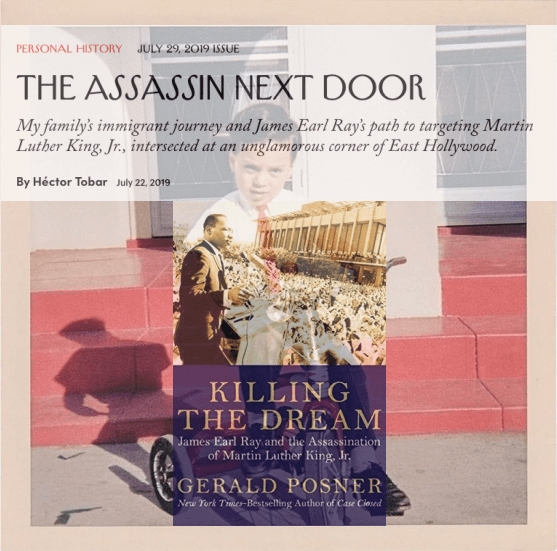
    This past July, venerable The New Yorker Magazine, as part of an ongoing series captioned Personal History, published “The Assassin Next Door”, by Hector Tobar. The relatively short essay reflects a contemporary trend by using biography to negotiate the intersection of personal identity within larger cultural currents. Here, the author reflects on the individual trajectories of his Guatemalan immigrant parents and himself, born and raised in Los Angeles in the late 1960s, in a set contrast to the life and personal trajectory of the officially designated assassin of Martin Luther King, James Earl Ray. Ray, apparently, lived for a period of time in the same East Hollywood neighbourhood as Hector Tobar, a fact revealed by his reading Gerald Posner’s book on the MLK assassination Killing The Dream (1998), which he describes as an “excellent reconstruction of Ray’s life and King’s murder.”

    Cued by the Posner book, Tobar understands Ray as holding “an abiding hatred of black people” and who murdered King “in the name of white supremacy.” His pathology assumes an essentialist nature—“his whiteness meant that he deserved better than what he had”—from which the author can free associate: “I felt Ray’s presence on the building’s front steps, beneath a stunted palm tree. I imagined his ghost lurking about, disgusted at the polyglot city around him, and raging at the futility of his act of murder.” The function of this essay, it seems, is a sort of riff on various levels of meaning imbued by racial identity in America. It is Tobar’s “personal history” in conjunction with Gerald Posner’s version of James Earl Ray.

    James Earl Ray himself consistently denied holding a racist viewpoint. Those who met him during his thirty-year struggle to clear his name, including members of MLK’s immediate family, did not believe Ray to be a racist. The racial angle, such as it was initially applied, could be considered a conclusion arrived ahead of the evidence—a useful conclusion which promoted a motive for the assassination (other than a rumoured bounty), assigned to a man who otherwise lacked one. Posner also seems to start from this position, as he builds his portrait through uncorroborated statements of men who were Ray’s fellow prisoners, and over-emphasis on certain ambiguous details (such as presumed campaign work for George Wallace, discussed below).[1]

    How is it possible, in the year 2019, that an author such as Gerald Posner—whose work has been variously criticized for plagiarism, non-existent sourcing, bias, and misrepresentation of the documented record—could be considered by anyone as an “excellent” resource for historical understanding?[2] Posner’s notorious Oswald-lone-nut book Case Closed (1992) had been roundly criticized for its factual errors and fake interviews and was described by academic David Wrone (who was interviewed by Posner) as “one of the stellar instances of irresponsible publishing on this subject.” In both of his books on the 1960s political assassinations, Posner assumes the role of plucky investigator even as he presents a prosecutor’s brief, emphasizing the points which support his case and downplaying, if not ignoring, the evidence which doesn’t. Both books were timed to be released on the thirtieth anniversaries of their central event and both books became heavily promoted in the mainstream establishment media. In the case of Killing The Dream, as reporter Mike Golden put it, Posner’s legacy “is that his bogus narrative of what happened in the MLK case has become the traditional hack standard of what the (mainstream) media will allow to be considered what really happened in Memphis, April 4, 1968.”[3]

    In the mainstream media, Posner’s “bogus narrative” received rave four-star reviews. Anthony Lewis, for example, writing in the New York Times Book Review, effused that Killing The Dream was “a model of investigation, meticulous in its discovery and presentation of evidence, unbiased in its exploration of every claim.”[4] In the Times itself, Richard Bernstein praised it as “the most comprehensive and definitive story of the King assassination”.[5] This trend line continues in most all the contemporary reviews and related content, which served as the only coverage most Americans would be exposed to. These reviews, particularly from the core establishment newspapers, would create a “seal of approval” of Posner’s scholarship, largely determined by reviewers who themselves knew little of the case beyond what appeared in the book itself. The “seal of approval” carries on through the years, presumably informing Tobar’s characterization of excellence two decades later.

    A more savvy reader of Killing The Dream, understanding this is contested subject matter, would eventually pick up on Posner’s evasiveness despite his posture of certainty, particularly as applied to problematic witnesses and Ray’s contradictory behaviour. For a book praised for its biographical portrait of an assassin, the James Earl Ray presented is curiously meticulous and crafty when necessary, but lazy and drifting otherwise. Posner, in general, fails to apply honest reflection on Ray’s odd meandering journeys in 1967-68, preferring to first dismiss speculation and then speculate on what “likely” happened. A reader’s tolerance for such tactics depends on the extent the mainstream establishment’s endorsement of Posner’s investigative prowess holds sway. A sceptical attitude seems invited by his divergent descriptions of Ray as either settled in obscurity or a desperate fugitive, which serves to rationalize behaviour which never really ties together in his earnest account.

    For example, Posner steps very carefully around the salient coincidence that three of Ray’s aliases, beginning as he arrived in Montreal on July 18, 1967, were actual persons living in close proximity on the outskirts of Toronto. He argues Ray must have randomly “stumbled across” the Eric Galt name and speculates the other two were found by perhaps consulting old birth notices and phone books. The account of Ray’s quick journey from Los Angeles to New Orleans and back in January 1968 presents a jumble of motivations from participants who all seem to possess reason to be less than forthright, which doesn’t prevent Posner from highlighting the least plausible scenario as it fits seamlessly with the “white supremacist” narrative (and which Tobar jumps on).[6]

    Later on, Posner announces his intention to directly confront the fact that the only witness to place Ray near the rooming house bathroom at the time of MLK’s shooting was falling down drunk (or “less than sober” as he prefers), but he never actually does. Instead, he switches attention from Charlie Stephens’ alcoholism to Grace Waldron’s alcoholism and mental health issues and manages to make her the unreliable witness, even as the most important fact is it is Stephens’ inebriation that afternoon which calls his ID of Ray into question. That Posner must frame this entire section as responses to legal arguments made by Ray’s representatives over the years should alert any reader that his book is functioning as a prosecutorial argument rather than investigative objectivity.

    In fact, Killing The Dream eventually becomes so focussed on answering issues raised by Ray’s then attorney William Pepper, who would later represent the King family during the 1999 civil trial, that serving as a public rebuke to Pepper appears one of the book’s operative functions. Contemporary reviewers evidently picked up on this. The Washington Post Book-World noted that “members of King’s family are among the many who doubt that Ray had anything to do with it…Posner has taken on the task of liberating everyone from surmises.” The Tampa Tribune used its review to editorialize: “The King family should read Killing the Dream instead of asking the Justice Department to open a new investigation into the assassination.” If the wide publicity afforded Posner’s book had the effect of pre-conditioning the public to pay less attention to the King family’s efforts, that may have been its intention all along. The federal Department of Justice did not participate in the civil trial, and rather conducted its own review which actually referred often to Posner’s work, epitomizing the effort to shut the door on inquiry and understanding.

    Ironically or not, in his New Yorker piece Tobar relates a facet of his own personal history while, following Posner, withholding the same privilege to the late James Earl Ray, other than one filtered through presumed malignancies such as racial bigotry and “supremacy”. To be sure, Ray, on his own admission, would prove to be an unreliable narrator, such that it is difficult to really know his own motivation or reasons for anything, but the racist angle seems particularly contrived and void of hard corroborating fact. Of course, imbuing Ray with the stigma of white supremacy as determinedly as Posner does allows the negative trait to be embodied solely with the alleged assassin, such that the messier reality can be neatly sidestepped: federal and local police forces of the time were racially biased as well. If Ray’s supposed date with destiny was motivated by his innate prejudice, as Posner seems to argue, then why does the same motivation not hold for provably biased figures in the FBI or Memphis police? That Tobar does not ask that question is not entirely his fault, as it takes a fair amount of inquiry from different sources to understand it is a question worth asking in the first place. Subtle conditioning favouring establishment voices and narratives often, consciously or not, promotes deferral to whatever history the New York Times says is worth four stars. As Douglas Valentine put it : “Was institutionalized, government-sanctioned racism one of the reasons Dr. King was assassinated? You bet it was.”[7] That it is these institutionalized forces which are more in alignment with, for instance, the pressures which caused Tobar’s parents to flee Guatemala in the first place than an allegedly racist lone-nut career criminal ever could be—well, there’s a personal history also worth mulling over.

    It’s worth noting that, along with The New Yorker’s casual promotion of one side of a disputed narrative, this past summer witnessed a renewed wave of calls for various levels of censorship and fact-vetting directed at social media platforms, culminating recently in Twitter’s announcement it would not accept political advertising during the US 2020 political campaign. Two years previously, Google had announced a change in its search algorithms to promote “authoritative sources” over “alternative viewpoints.” Facebook’s CEO Mark Zuckerburg, not a free-speech firebrand, was shouted down in the mainstream media after publicly declaring “I don’t think it’s right for a private company to censor politicians or news in a democracy.” This has sparked a debate about money, politics, and free speech which has itself been largely detached from the factual realities of the intersection between the three in the real world. A deliberate focus and over-emphasis on “crazy” marginal (and marginalized) points of view has had the effect of implicitly endorsing the authority of the establishment, which is responsible for the overwhelming majority of political advertising. The point is, ultimately, not to reduce the level of spending on information management, but to reduce voices and viewpoints through vetting against “fake news” or unauthorized expression. The vetting of Gerald Posner two decades ago should caution against mis-attributed faith in establishment institutions to be somehow trustworthy.

    A groundswell of support for critical thinking and media literacy programs in the education system seems called for. Instead, a fear has been cultivated, most often by college-educated liberals, of “lies” and “fake news” lurking unseen in the water, producing an “incredibly dangerous effect on our elections and our lives and our children’s lives.”[8] Average citizens, it is declared, are not able to “discern the veracity of every political ad” and should therefore be protected from fake news in favour of the “diplomats, intelligence officers and civil servants” which “provide the independent research and facts” which are “legitimate”.[9] The New Yorker itself joined the fray, knocking Facebook for creating “the world’s biggest microphone” only to allow access for “liars, authoritarians, professional propagandists, or anyone else who can afford to pay market rate.” It is then noted approvingly that Facebook recently announced its own “official news tab…where users can find high-quality news from trusted sources”, (which, it turns out, includes The New Yorker).[10] One might get the impression that the lack of a level playing field or abandonment of professional journalistic practice is not the real concern of these self-appointed gatekeepers, it is the loss of control over the creation and reinforcement of official narratives which must be restored.

    Similarly, the term “conspiracy theory” has recently returned to some prominence, serving as an evil twin of sorts to the scourge of “fake news.” The week before “The Assassin Next Door” appeared in the New Yorker, NBC’s website featured a generalized thesis attacking “conspiracy theorists” written by Lynn Stuart Parramore, PHD,[11] which conflated the Moon landing, lizard people, and the assassinations of the 1960s while faithfully parroting—knowingly or not—a number of the directives offered by the infamous 1967 CIA memorandum on the topic.[12] Attempting to redefine the alleged “problem” as based in psychological deficiencies and narcissistic traits, Parramore rather encourages the normalization of the “paranoid style” she warns about, as the utterance of “conspiracy theory” ( or non-vetted information) becomes associated with a form of mental illness, just as the latest federal judicial theories encourage active “disruption” of “potential threats” based in part on “symptoms of mental illness.”[13] Through their own blinkered logics, the liberal intelligentsia in America are setting the foundation stones for exactly the country they claim they are trying to prevent. Critical thinking skills and clear-minded analysis remain the best tools moving forward.


    [1]On Posner’s investigative techniques see Mike Vinson “Nailed To The Cross: Gerald Posner on the King Case” Probe Magazine Vol. 6 No. 3 https://kennedysandking.com/martin-luther-king-reviews/nailed-to-the-cross-gerald-posner-on-the-king-case

    [2]Jim DiEugenio “He’s Baaack! The Return of Gerald Posner” https://kennedysandking.com/martin-luther-king-reviews/he-s-baaack-the-return-of-gerald-posner

    [3]Mike Golden “Assassination By Omission: Another Look At Serial Plagiarist Gerald Posner” Exiled Online Sept 30, 2010 http://exiledonline.com/assassination-by-omission-another-look-at-serial-plagiarist-gerald-posner/

    [4]Anthony Lewis “Beyond A Shadow of a Doubt” New York Times Book Review April 26, 1998 https://archive.nytimes.com/www.nytimes.com/books/98/04/26/reviews/980426.26lewist.html

    [5]Richard Bernstein “‘Killing The Dream’: Ray Was King’s Lone Assassin” New York Times April 22, 1998 https://archive.nytimes.com/www.nytimes.com/books/98/04/19/daily/posner-book-review.html

    [6]Tobar writes, following Posner’s lead: “In December, 1967, Ray visited the North Hollywood Presidential-campaign office of George Wallace, the former governor of Alabama, who had become a folk hero among segregationists… Ray had gathered signatures to help get Wallace on the California ballot.” Rather than “gathering signatures”, Ray claimed he stopped at the Wallace office on the request of his passengers, just ahead of the New Orleans trip. One of these passengers claimed to the FBI that Ray appeared very familiar with the office, but subsequent investigation cast doubt on this. It was suggested that Ray offered to cover the expenses to New Orleans in return for his acquaintances registering with Wallace, but that is possibly if not likely a weak rationale for behaviour and motivations the participants prefer to be less than honest about. There is no other instance of overt political activity on behalf of Ray. Posner acknowledges the overall sketchy milieu of this incident.

    [7]Douglas Valentine “Deconstructing Kowalski” Probe Magazine Vol. 7 No. 6. https://kennedysandking.com/martin-luther-king-articles/deconstructing-kowalski-valentine

    [8]Aaron Sorkin “An Open Letter To Mark Zuckerburg” New York Times October 29, 2019 https://www.nytimes.com/2019/10/31/opinion/aaron-sorkin-mark-zuckerberg-facebook.html

    [9]Thomas Friedman “Trump, Zuckerburg, and Pals Are Breaking America” New York Times October 29 2019 https://www.nytimes.com/2019/10/29/opinion/trump-zuckerberg.html. Note that The New York Times had been at the forefront of promoting two of the most consequential instances of “fake news” in this young century—Iraq WMD and Russiagate.

    [10]Andrew Marantz “Facebook and the Free Speech Excuse” The New Yorker October 31, 2019 https://www.newyorker.com/news/daily-comment/facebook-and-the-free-speech-excuse. Note that The New Yorker, not shy to publish reflexive support for one side of contested official narratives as discussed above, also bought into the empty Mueller / Russia collusion narrative with some enthusiasm.

    [11]Lynn Stuart Parramore “From Trump to Alec Baldwin, Conspiracy Theories, Narcissism, and Celebrity Culture Go Hand In Hand” https://www.nbcnews.com/think/opinion/trump-alec-baldwin-conspiracy-theories-narcissism-celebrity-culture-go-hand-ncna1029941

    [12]thelastheretik “CIA Memo 1967: CIA Coined & Weaponized The Label ‘Conspiracy Theory’” https://steemit.com/history/@thelastheretik/cia-coined-and-weaponized-the-label-conspiracy-theory

    [13]Whitney Webb. “AG William Barr Formally Announces Orwellian Pre-Crime Program” Mint Press News, October 25, 2019 https://www.mintpressnews.com/william-barr-formally-announces-orwellian-pre-crime-program/262504/

  • Garrison Interview, “Some Unauthorized Comments on the State of the Union” (May 27, 1969)

    Garrison Interview, “Some Unauthorized Comments on the State of the Union” (May 27, 1969)


    This remarkable interview with Jim Garrison was done about two months after Clay Shaw was acquitted.

    It is an interview with a European publication since, for reasons he notes, Garrison had given up doing such things with the American press.

    Note that some of the things he brings up differ from his previous interview in 1967 in Playboy. For instance, quite early, he brings up the importance of Vietnam to the assassination, and he then returns to this at the end. He is now open about the role of the FBI in cooperation with the Warren Commission in the cover up. (p. 3). Right after this, he singles out Allen Dulles for his role on the Commission. He then becomes one of the first commentators to say there was a link between the murders of JFK, King, and Bobby Kennedy. He understands just how important Pierre Finck’s bombshell testimony was at the Clay Shaw trial (p. 18). He then describes the after-effects of a coup d’état and how the new government ratifies itself (p. 20). He is very pessimistic on the truth about Kennedy’s murder ever coming to light. In retrospect, what makes all this so impressive is how correct he was in the light of history on all these points. It is also enlightening to compare his ideas about the case to what others were writing and saying at the time. Most of the other critics were still concentrating on what happened in Dealey Plaza. They were not even aware of the bombshells in Finck’s testimony. But we now know the Justice Department certainly was, to the point they sent Thornton Boswell, another JFK pathologist, to New Orleans to discredit Finck, although they did not follow through on the plan.

    Our thanks to Bart Kamp and the invaluable Malcolm Blunt for this engrossing interview. Thanks also go to Prof. Dennis Riches of Seijo University, Tokyo, for providing the following, more legible transcription of the original document.

    ~ Jim DiEugenio


    (Click here to open the document in another page.)

  • Unmasking the King Probe


    From the March-April 1999 issue (Vol. 6 No. 3) of Probe

    (Click here to open in a separate page.)

  • Jim DiEugenio on the King Trial and Media Coverage

    Jim DiEugenio on the King Trial and Media Coverage


    OHH:

    James DiEugenio is the editor and publisher of kennedysandking.com and he’s the author of The JFK Assassination: The Evidence Today. He’s also a noted researcher of the Martin Luther King Jr. assassination and that’s what we’re going to talk about today. People are aware there was a civil trial in 1999 led by the King family in which the jury found that the assassination was a result of a conspiracy.

    I’ve been wanting to talk about this case for a long time so I found an article that Jim wrote at the time about the media’s reaction to the trial’s outcome.

    It’s sort of a timeless subject to see how the press deals with events that run counter to their narratives, and Jim is always brilliant at dissecting the tropes that the media uses to kind of get around things that run counter to what they want to say. So that’s what we’re going to discuss today but it’s a wider subject and I think we’re going to go a lot of places with it. But thank you Jim for talking today.

    JD:

    David, the article that you wanted to base this interview around was in Probe Magazine in the January/February issue of 2000.

    [see

    The Media Buries the Conspiracy Verdict in the King Case

    ~kennedysandking]

    I wrote the article and it’s about the media’s treatment of the conspiracy verdict in the civil trial in Memphis conducted by William Pepper in December of 1999.

    OHH:

    So William Pepper, who was James Earl Ray’s lawyer, and who was an acquaintance of Dr. King.

    JD:

    Now, the remarkable thing about the treatment of the verdict is this: the mainstream media did not have any reporter there for anywhere near close to the whole expanse of the trial. I know this for a fact because James Douglass, who was reporting on the trial for Probe Magazine and he filed his report with us a few months earlier. In fact, I think the prior issue. He was there every day.

    OHH:

    James Douglass, he’s the author of JFK and the Unspeakable.

    JD:

    Him and a local friend he knew from Memphis were the only people there for the majority of the days of the trial. He said nobody was there. Not one other single person was there every single day and most of the reporters were there for two or three days and then left. So here’s my question: How on earth do you discuss a trial where you didn’t have a reporter there? Well, this is something that was really kind of startling even for the MSM. So we decided to go ahead and round up these views of the trial and prepare an article for them, about them rather, for Probe, which is what we did. The New York Times

    OHH:

    Before you … Can you just kind of briefly tell what the facts of the trial and just briefly what they found just for people who aren’t familiar with it.

    JD:

    The trial itself was what is termed the civil trial, which means one private party is suing another private party over what’s called damages. So in this particular case, it was the King family bringing the charges against a man named Loyd Jowers who owned a tavern in Memphis at the time. Now, in 1993 Loyd Jowers had gone on national television with Sam Donaldson on ABC and talked about his part in a conspiracy to kill Martin Luther King. He said that his role was to receive the murder weapon from the guy running the show and then give it to an assassin and then have the assassin give the rifle back to him and then he would go ahead and give it back to his aider and abettor, who had given it to him in the first place.

    JD:

    Now, as time went on, William Pepper worked more and more on this angle and by around 1996-1997, he was ready to go ahead and reopen the King case as a criminal trial. In other words, the state versus defendant on a murder charge. So he actually did try and get the case reopened upon two sets of new evidence. One was the Jowers presentation, the other one was forensically to try and show that the murder weapon in evidence was not the weapon that was used to kill King.

    What happened was what the people in Memphis did not want it to happen. In other words, the power brokers in Memphis did not want this to happen. The judge who the case was assigned to, Judge Joe Brown, actually was in sympathy with Pepper trying to reopen the case.

    OHH:

    Judge Joe Brown, he later became the famous TV judge but he’s a very interesting character. I think if you have a chance, Len Osanic of Black Op Radio at blackopradio.com has several good interviews of him in his back catalog. If you go to his website you can find those interviews and get your hands on those. They’re really excellent. I suggest people listen to those.

    JD:

    So he actually was going to go ahead and sanction rifle tests to see if the rifle in evidence was actually the rifle used to kill King. They did a round of tests and they came back inconclusive. There was a scar in the track of the rifle on these tests that was not reported in the first round of tests done by the FBI. It was hard to explain how that got there. So Judge Brown was going to sanction a second round of tests. Did the scar come from a buildup of residue in the rifle in the intervening years? Because if it didn’t, then it’s not the rifle that killed King because that wasn’t there.

    So Brown said, “This is what we’re going to do. We’re going to go ahead and have a solution, a chemical solution, which will not damage the rifle barrel at all and we’re going to use that to clean the rifle barrel and then we’re going to retest. If the scar is still there, then I don’t think we have a match.” When Judge Brown said he was going to do that, the city of Memphis rose up in rebellion against him. The local DA’s office, the state attorney general, the major media, theMemphis Commercial Appeal. To make a long story short, what ended up happening was that the same thing that happened to Jim Garrison back in 1967 on the Kennedy case, the same thing that happened to Richard Sprague in 1976 on the JFK case, and the same thing that happened with Gary Webb in the late 1990s on the CIA and crack cocaine.

    So what happened was that when Brown was on vacation, there was a kind of unauthorized invasion of his office by a guy named Mike Roberts in cahoots with a Judge named John Colton. Colton was the guy whose court the original case was assigned to way back there in 1969. But during a routine rotation, it had been assigned to Brown in the ’90s. Colton and Roberts went ahead and hijacked the files out of Judge Brown’s chambers while he was on vacation. Judge Brown was very angry about this; he blamed in it on local Republican politics but this was more or less the beginning of the end for Brown’s reinvestigation of the Kennedy case. Excuse me, of the Martin Luther King murder case.

    Once he got back, he was removed from the case by the appeals court. The local prosecutor, John Campbell, was overjoyed at this because now the case would not have to be reopened and he wouldn’t have to go ahead and retry the case on a criminal ground. Now, I should add here that when this happened, when the criminal case was finished in Memphis, it more or less coincided with the death of James Earl Ray. He passed away around this same time period. Now, all the great work that Bill Pepper had done on this case … He wrote that good book, Orders to Kill. He had done all this wonderful research in Memphis, found these new witnesses.

    It seemed that it was now essentially going to go down the drain. Because now of course there was no defendant and the case, as far as being a conspiracy, was pretty much wrapped up in Memphis.

    So, the people you have to give the credit to for keeping the thing going and getting it into a civil court is the family of Martin Luther King. I don’t think there’s any question about that. They decided to go ahead with the case and they decided to file a civil suit in Memphis against Jowers. This trial took place in the latter part of 1999, I believe in November and December of 1999. I think the verdict came in on December the 8th of 1999.

    There’s actually a book that contains the entire transcript of the trial, it’s called The 13th Juror. A literal cascade of information came out at this trial. I mean, it’s really kind of incredible when you go ahead and look at all the great stuff that Pepper was able to introduce into the court record. Just to give you some highlights. There’s a fascinating couple of witnesses by the name of Floyd Newsum and Ed Redditt and a third one Jerry Williams who testified how somebody called off the private body guards that King usually had when he came to that city. They all said they really don’t know how the heck it happened.

    But whenever King had come to Memphis, and he had been there before a few weeks earlier of course, for the sanitation workers strike, he had his own private security detail. He also had a surveillance detail that his people would just watch out from across the street to see if anything was coming up. That whole detail was called off on this particular visit.

    Now, what Pepper did at the trial is he coupled that evidence with the testimony of a man named Leon Cohen who was a friend of the manager of the Lorraine Motel, Walter Bailey. Cohen testified that Bailey received a call from a member of Dr. King’s group in Atlanta the night before he arrived in Memphis, and the request was to change King’s room. Bailey was not interested in doing that. In fact, he didn’t want to do it, but the guy insisted that they wanted to change the room from an inner courtyard room to an outside balcony room.

    Now, I don’t have to tell you how important that is. I think anybody who knows anything about the King case understands how important that is. Because if the room had not been changed, then the assassination could not have taken place. At least not the way that it actually did, from allegedly a rifleman across the street hitting King as he comes out to the balcony of his room.

    When you couple the stripping of the security with the changing of the room, things start getting really kind of fishy, don’t they? So, in other words, now what Pepper did is he went ahead and he began to bring witnesses in who questioned the official story of where the fatal shot came from.

    See, if you believe the Memphis authorities, the shot came from a place called Bessie’s Boarding House, which is right above Jim’s Grill which was Jowers’ place. It came from a communal bathroom about something like about 210 feet away. First of all, who the heck would ever want to use a communal bathroom if you’re an assassin? Because what that means of course is that anybody could knock on the door or come in and want to use the bathroom or be waiting for you when you ran out. That’s got to be one of the dumbest things I’ve ever heard of.

    What Pepper did is he brought in about three witnesses who disagreed with the location of the shot coming from Bessie’s Boarding House. These were Earl Caldwell, a former New York Times reporter was one of them. Solomon Jones who was King’s chauffeur driver and Maynard Stiles who his testimony was really interesting. First of all Caldwell and Jones both said they thought the shot came from below the balcony, these bushes below the balcony. Now, Maynard Stiles received a phone call the next morning saying that the bushes had to all be trimmed and cut down. Get this, the next morning, he gets an order from the parks department saying, we want all the bushes trimmed and cut down.

    In other words, the next morning, they weren’t there. In other words, the idea of trying to say that the shot came from the bushes below was now really hard to make stick because there weren’t any bushes.

    OHH:

    This is a crime scene. They’re uprooting a crime scene…

    JD:

    Isn’t this really something? The next step in the trial was … By the way, I think you’re beginning to understand why the media didn’t want to talk about this trial. Was the testimony of a guy named Arthur Hanes. Arthur Hanes was going to be James Earl Ray’s original attorney. He was going to defend him back in 1968. Eventually what happened is that James Earl Ray made a terrible mistake and he got rid of Hanes and replaced him with Percy Foreman which, as Ray later said, was probably “the biggest mistake I ever made in my life.”

    But Hanes was prepared to go to trial, which Foreman was not going to do. So Hanes decided to do some investigation, which Foreman also did not do. And he found a witness by the name of Guy Canipe who owned a five & dime store underneath Bessie’s Boarding House. Because the strongest evidence against Ray was that he supposedly dropped a bundle of his belongings as he was running from the scene and this included the rifle. Canipe said to Haynes, “That bundle was on my foyer, my exterior foyer 10 minutes before the shot went off.” Now, you don’t get very much better evidence than that. In other words, somebody was trying to frame James Earl Ray by depositing his items there.

    Now, another very interesting witness that they produced was a man named William Hamblin who knew a cab driver named James McGraw. James McGraw was called to Bessie’s Boarding House to pick up a guy named Charlie Stephens. This was around the time of King’s assassination. He is supposed to drive him home because the guy was stone drunk. He said that when he went into the room to try and pick up Charlie Stephens that he looked into the communal bathroom across the way. He said the door was wide open. There was nobody there at that particular time. And he said Charlie Stephens was dead drunk. Of course, Charlie Stephens is a guy who was going to identify Ray as the assassin coming out of that bathroom for the authorities in order to get him sent back from London to the United States. How could he identify him, if the guy was dead drunk?

    Now, there was also evidence at the trial produced about the mysterious guy named Raoul. Raoul is the guy who James Earl Ray said that he met up in Canada in 1967. Raoul hired him in Montreal rather, in Montreal, Canada in the summer of 1967. Ray said he hired him to do odd jobs for him like delivering things, picking things up and he would do this all throughout the country from the east coast to the west coast. The whole idea was to try and locate Raoul because Jowers said that the guy who dropped off the rifle to him on the day of the assassination was Raoul, this same guy.

    So what happened is that Pepper decided to go ahead and try and find other witnesses who knew of this guy named Raoul and had seen him before, and to see if the witnesses all matched up—and they ended up doing that. In fact, Pepper went ahead and he found at least three witnesses who identified the very same picture of this guy named Raoul to the point that Pepper actually thought that he found Raoul. Who was living … It was either New York or Philadelphia in 1997. But he would never answer the door, he would always send his daughter or his wife to answer the door, he would never answer the door to be interviewed.

    If that’s not good enough for you, there was also some very interesting evidence introduced about the role of the military intelligence in the stalking and perhaps the shooting of King. Dougl Valentine is a pretty prominent author about CIA operations who wrote a book called The Phoenix Program in 1990. That of course was about the notorious program in Vietnam to snuff out and torture and kill sympathizers of the Viet Cong. When he was doing that book, Doug talked with some veterans who had been redeployed from Indochina to do surveillance on the ‘60s anti-war movement in the United States. He found out that the army’s 111th military intelligence group kept King under 24-hour a day surveillance. Its agents were actually there in Memphis in April of that year when King was killed.

    From this information, they reportedly watched and took photos while King’s assassin moved into position, fired and walked away.

    OHH:

    There are a couple things. There’s the Doug Valentine interview on Porkins Policy Radio which I will put a link to in the comments.

    JD:

    Now, what’s so interesting about that is that, also produced at the trial was a guy named Carthel Weeden who was a captain of the fire station across the street from the Lorraine Motel, the place where King was gunned down. He testified that he was on duty the morning of the 4th, April 4th and two US army officers approached him and they wanted to look out for the motel. They carried briefcases and indicated they had cameras. So Carthel Weeden showed them the roof at the fire station. He left them at the edge of the northeast corner behind the parapet wall. And from there of course you had a bird’s-eye view of the motel. In other words, the on the scene evidence matches with the information that Doug Valentine had dug up.

    So that’s very interesting, and a lot of people would consider it quite powerful. He also got a guy named Jack Terrell who had worked for the CIA during the illegal war against Nicaragua. Who knew a friend of his, a guy named J.D. Hill and J.D. Hill had actually been a member of the army sniper team that was supposed to shoot a so-called unknown target on April 4th. They were supposed to take up positions in Memphis but that mission was suddenly canceled. When he heard what happened to King the next day, he realized what he was going to be there for.

    All of this stuff came out including, and I have to mention this as the final summary of the trial, a guy named Walter Fauntroy was a very good friend of King’s. He had worked for the House Select Committee [on Assassinations] in the 1970s. The House Select Committee did an inquiry into both the King case and the JFK case. Fauntroy said that when he left Congress he had the opportunity to read through voluminous files on the King assassination, including stuff he had never seen before. He said among this material that he saw were reports from J. Edgar Hoover. He learned that in the three weeks before King’s murder, Hoover had a series of meetings with people in the CIA and military intelligence about the Phoenix Operation.

    So Fauntroy, of course, asked himself: What would J. Edgar Hoover be doing having meetings about The Phoenix Operation if he’s running the FBI in the United States? Kind of puzzling, isn’t it? He also discovered that there had been, like the other witnesses said, that there had been special agents and military intelligence officers in Memphis when King was killed.

    So Fauntroy decided that he was going to write a book on the subject. When the word got out that he was going to write a book, he was investigated and charged by the Justice Department about violating financial reports as a member of Congress. His lawyer couldn’t believe this because this was a technicality on a misdated check from years before. But he got the message. We’ll get you for something if you go ahead and write this book.

    So Fauntroy didn’t write the book. So that’s how big the cover-up is in Washington on this particular case. As I said, what happened is that Pepper ended up winning the case. And, in fact, the jury came in within two hours after the presentation was over and they said that there was a conspiracy in the King case. Now, I should add, to Pepper’s credit, that’s the second time he did this. Because back in 1993, he had done, and I have to say this, a very well done mock trial, for I believe it was HBO. That mock trial on the King case back then I thought was much better than the one done later with Vincent Bugliosi and Jerry Spence for Thames Television on the JFK case. It was much more realistic.

    For example, in that particular case, you actually had James Earl Ray able to take the stand. It was much more of what you would actually have seen if there had been a real trial. So Pepper won that particular case and now he won this particular case in 1999. And he was robbed of his opportunity to actually do the criminal case by the removal of Judge Joe Brown. So in other words, the guy had a pretty sparkling record.

    After he won this civil trial, the media had to find a way to go ahead and discount that because of course if it’s allowed to stand, it shows the public is right about this stuff. That James Earl Ray did not shoot King, that Lee Harvey Oswald did not shoot JFK, that Sirhan Sirhan did not kill Robert Kennedy. So this would have been another indication that all those, as they call them “wacky conspiracy theories”, are actually correct.

    So what did they do? Number one, they did not send any one single reporter to the trial to stay there day in and day out. Not one. But then they went ahead and … Let me add to that. Not even the local newspaper.

    OHH:

    Right. Not even the Memphis paper.

    JD:

    Right, the Memphis Commercial Appeal. Not even the local newspaper had their guy there every day. A guy named Mark Perrusquia. What Jim told me after I go, “Jim, how did he file these reports then?” He goes, “Jim, Marc Perrusquia was very, very seldom in the courtroom. What Marc would do is he would wait all day outside and wait for me to come out, and then I would have to brief him on what happened that day in court.”

    So Jim Douglass was giving the Memphis Commercial Appeal their information to print on the King trial. That’s how bad… to me, nothing illustrates just how bad the mainstream media is on these cases.

    But without having somebody there, they still had to find a way to go ahead and discount what had happened without reporting on it. Well, The New York Times decided to bury their story on page 25 and they reported well: What does this mean? There was a vast conspiracy that it was alleged but not proved. I have to tell you David, I think what I just summarized is pretty good proof that there was a pretty big conspiracy in the King case. But if you don’t report on it, then you can say that it was a vast conspiracy that was alleged but not proved.

    OHH:

    Well, when the jury accepts it, does not that mean it’s proved? Don’t know.

    JD:

    Same thing in the L.A. Times, they placed a story on page 24 and they also tried to go ahead and discount the verdict. They even put their resident black scholar, a guy named Earl Ofari Hutchison, they assigned him to write an editorial and his column said that Bill Pepper was one of those who has “worked up to victim hit angle especially hard.” He said that “James Earl Ray himself had stoked conspiracy flames by saying that he was framed and recanting his guilty plea.” Here it is, here’s the final summary by Earl Ofari Hutchison. “But despite the Memphis verdict, the evidence is irrefutable that Ray was a triggerman.”

    Now, how you can come to that conclusion without mentioning what went on in the courtroom is really, really hard to believe. But that’s how extreme and that’s how uninformed and that is how stubborn these people will be in order to stay with the MSM.

    Then there was the US News & World Report which said that “William Pepper was a man prone to bizarre conspiracy theories.” It said the Shelby County DA’s office was not at the trial. Well, of course not because it was a civil trial. It was not a criminal trial. So you’re not going to have the office there. Then they got another mainstream media guy David Garrow who wrote an article and said, “We don’t know who precisely aided and abetted Ray, but anybody who doesn’t accept Ray as the gunman is from Roswell, New Mexico.” Well. That’s an old one. That somehow if you believe in conspiracies, then you also believe in aliens coming here from other planets, abductions and all this other stuff.

    OHH:

    If you can believe someone was shot you also believe in Martians.

    JD:

    Then if you can believe it, to knock it all off, what happened? They got Jerry Posner, who was not at the trial, to go ahead and visit all of the major shows and to write a column that was distributed throughout the country, going ahead and criticizing the trial. I really couldn’t believe that but it really did happen. This is what he says, “The Memphis trial wasn’t a search for the truth but a ploy to obtain a judicial sanction for a convoluted conspiracy theory embraced by the King family.” I won’t even comment on that. “Lloyd Jowers is a man considered to lack credibility by every local, state and federal prosecutor who looked at the matter.” That’s what he says next. Then he says that “only the state prosecutors and their report in the case are credible because they said there was no conspiracy.”

    As I just mentioned earlier in the show, it was very obvious that the local DA’s office was an extension of the state DA’s office, and did not want to do the case at all. Because they, I think, sensed that if Brown had been allowed to go ahead and finish up the rifle test, that would have proven that that particular weapon was not the weapon that fired the bullet that killed Martin Luther King. Then he has to get personal, Posner says, “The pursuit of Jowers by the Kings will only diminish their standing as the first family of civil rights and permanently damage their credibility.” Then of course, they actually put him on a couple TV shows to go ahead and do the same thing.

    I don’t remember anybody saying, “Were you at the trial, Jerry?” I don’t remember anybody saying that. They never challenged his credentials to go ahead and write about an event that he had never seen. So that’s how crazy this thing got. By the way, let me add another point. The fact that the Commercial Appeal was not there, that meant that nobody was getting any day-to-day updates while the trial was going on. Because also, as Jim Douglass discovered, CourtTV—it was called CourtTV back then, it’s called TruTV now—they pulled out of the King case three days before the trial began. They were going to be set up and cover the case. So you would have had a video and audio record of the case. But Jim told me, “Jim, I couldn’t believe it, three days before the guy said we’re pulling out.” I asked him why, he said he didn’t know why. I mean, isn’t that really bizarre?

    So if anybody ever tells you that the media in this country is not rigged, that the media in this country is not controlled, that the media in this country is not one-sided, this is a great, great example that, that is all a bunch of BS and it’s all true. This coverage of the King case is wonderful evidence to prove everything that we’ve been saying all along about how bad the media is in this country. It was just … By the way, I have to add. When Jim Garrison conducted his trial of Clay Shaw back in 1969, both the local papers the States-Item and the Times-Picayune covered that trial. In other words—and what I mean is this—they had a reporter right down there in the courtroom every single day and they would rotate the reporters.

    Then when the breaks came, they would go ahead and transfer their notes over the phone to the main office of the newspaper and then that is how the day-to-day reports got in … I know this because I talked to somebody who actually was there, Jack Dempsey who covered the trial. So day by day, you would get daily reports if you wanted to watch that trial. Of course, if you want to subscribe from out of town, you could have followed the trial by their mail subscriptions. They’re mailing the paper to you. You couldn’t do that in this trial. That was such a disgrace. Thank God that, I think the King family, went ahead and I think they put up the transcript on the King website. Or the other way you can get it is from that book The 13th Juror.

    But Jim Douglass for Probe had the only contemporaneous report on all that terrific evidence that Pepper was producing at that trial, and that is just an utter disgrace. That our little magazine that we did on a five and dime budget was the only place you could read a summary of the King juror’s case because everything else was this BS that I’m telling you about or the Gerald Posner twisted stuff, from a guy who wasn’t even at the trial. This is what I mean about the media in this country. So excuse me if I get a little angry about it but I think I’m pretty justified in getting angry about it. This is a perfect example of why people don’t believe the mainstream media anymore and they deserve it.

    OHH:

    And this is the era of or that was in 1999. I mean, that wasn’t long after the OJ Simpson trial where that was on day in and day out on the news 24/7. So it wasn’t like courtroom drama was out of fashion.

    JD:

    Well, let’s put it this way. The King trial, I believe, was so important because the unearthed evidence that Pepper got, pretty much confirmed everything everybody who really studied that case believed. That King towards the end of his career … Let’s not forget this. King was killed something like about three weeks before the Poor People’s Campaign was supposed to begin. That was supposed to be his, remember 1963 in the March on Washington, this was supposed to be … That was for civil rights. This was supposed to be for economic rights. And I don’t think there’s any coincidence that the Poor People’s Campaign failed whereas The March on Washington succeeded.

    If you take out King as Vernon Young said in that HBO special, King in the Wilderness, he says, “After King was killed, things kind of fell apart.” No surprise. That’s another thing to remember about that, and also the fact that is what Pepper was saying, if Valentine is accurate, then the war in Vietnam with the Phoenix Program kind of directly impacted King’s murder. They transferred the operation to the United States, stateside.

    Now, I advise everybody, if you really want to try and understand this, I’ve kind of just skimmed it. But if you get the Probe CD, I think that has … I’m positive. It has Jim’s article in it. Or if you want to get the book, The Assassinations, that has Jim’s article in it.

    If you had to boil it down, its like a three-sided conspiracy between the CIA—I believe Raoul was a CIA operator—military intelligence as the hitmen, and the mob—a guy named Frank Liberto supposedly paid Jowers $100,000 to go along with the conspiracy. Now, today $100,000 doesn’t sound like a lot of money, but it’d be the equivalent back in 1968 of about 850 grand. So he got paid off really to just give somebody a rifle and give back somebody a rifle and that’s essentially how it worked. So I give Jim Douglass all the credit in the world for being the only guy in that trial day after day and he assembled a marvelous report on it.

    [The reader may also refer to this special we ran in 2017 which features Jim Douglass’s Probe article as well as links to David Ratcliffe’s annotated version of the trial transcript:

    https://kennedysandking.com/martin-luther-king-articles/martin-luther-king-jr-day-2017

    see in particular:

    https://kennedysandking.com/martin-luther-king-articles/the-martin-luther-king-conspiracy-exposed-in-memphis

    ~ kennedysandking]

    OHH:

    I think that was great. I think it was a great overview of the case and the media’s reaction to it.

    JD:

    Thank you so much David.

    OHH:

    Great. Thanks.

    JD:

    Bye-bye.


    This transcript has been edited for grammar and flow.

  • King in the Wilderness

    King in the Wilderness


    There were three documentaries prepared for the fiftieth anniversary of Martin Luther King’s assassination: Hope and Fury was a production of NBC; I am MLK Jr. was prepared by the Viacom network;  but perhaps the most interesting of the productions was HBO’s King in the Wilderness.

    Peter Kunhardt is an experienced filmmaker who has previously produced and directed documentaries on a wide variety of historical figures like Abraham Lincoln and Richard Nixon.  Kunhardt chose to direct this production and he collaborated with a writer he knew, Chris Chuang, who had worked with on a documentary from the previous year about Warren Buffett.

    King in the Wilderness has two defining qualities that differentiate it from the other two films and from previous King documentaries I have seen.  First, it does not deal with King’s entire career—not even close. It limits itself to the last years of his life. The focus is on the time interval from the passage of the Voting Rights Act in 1965 until his death in Memphis and the following funeral in Atlanta in 1968.  Second, it does not feature the usual professional pundits as talking heads.  So, thankfully, we are spared pretentious gasbags like Dan Rather and Tom Brokaw.

    The film begins with shots of the King home in Atlanta.  We then learn that several of King’s friends and working colleagues gathered there for the anniversary of his death.  They will be the interview subjects for the film. When they appear, we see them in close-up looking directly at the camera. Thus we listen to King’s attorney Clarence Jones, his close colleague in the Southern Christian Leadership Conference (SCLC) Andrew Young, his friend the actor and singer Harry Belafonte, Dianne Nash of the Student Non-Violent Coordinating Committee (SNCC), singer and activist Joan Baez, and SCLC Chicago representative Jesse Jackson, among others.

    I should note one other distinguishing feature.  In criticizing the documentaries of actor Tom Hanks, I have written that, aesthetically, they are purely assembly line productions.  As far as the way they are made, there is nothing at all distinguishing about them. With Hanks and his company Playtone, it is almost as if stylistically acute documentaries like The Power of Nightmares and The Kid Stays in the Picture had never been made.  Kunhardt’s film is not a cornucopia of new ideas in that respect, but it does have some visual panache and interest to it.

    In fact, it begins with the viewer going behind the scenes of a news interview with King.  Sander Vanocur, NBC’s national correspondent at the time, is seen rehearsing an interview with the civil rights leader—clapboard included.  King recalls his famous “I Have a Dream” speech made during the March on Washington in August of 1963.  That speech was made in aid of passage of the Civil Rights Act of 1964.  He comments that in light of what has happened to America in the meantime, the dream he spoke about has now become something of a nightmare.  The reference points he is speaking about are, of course, the escalation of the Vietnam War, and the recurrent rioting, and accompanying fatalities, that had become so frequent by 1967.

    The film tries to elucidate some of his chagrin by depicting both sides of a taped discussion of the 1965 Watts riot between King and President Johnson. He tells the president that unless he does something to give people in the black slum areas some hope, he fears that those areas will become tinderboxes of violence. Which, as we know, they did.  Johnson did not do very much to offer any change or hope for those living in places like Watts because of his escalation of the Vietnam War—a theme to be developed later.

    The film then sketches in another dispute that King was having in this time period.  Because of these recurrent riots, and because so many of them began with an instance of police brutality, and because of the continuing violent acts by white terrorists—for instance the shooting of James Meredith during his March Against Fear in Mississippi—King began to catch some heat from what many saw as an unlikely source.

    For instance, after Meredith was wounded and hospitalized by a white man, King’s group, the SCLC, stepped in to complete the march.  But so did other groups, like the SNCC.  By 1966, Stokely Carmichael had become the leading public figure in the SNCC.  During the completion of this march, Carmichael started to use a previously unmentioned term: “Black Power”.  This signaled the beginning of a different type of approach from King’s Gandhi-inspired civil disobedience through non-violent techniques (for example, lunch counter sit-ins).  Carmichael’s message, which he deliberately made in King’s presence, was closer to what Malcolm X had been preaching in New York, and would lead to the creation of the Black Panthers in the San Francisco/Oakland area.  King was placed on the spot by Carmichael’s provocation.  He replied that, while he supported Carmichael, he did not endorse the connotations of the message. The film depicts this colloquy with the two figures standing next to each other.  Carmichael then responds by saying that he is not as committed to non-violence as Dr. King is.

    After this point is addressed, the film takes up another pressure point on the civil rights leader.  In a taped phone call between Mayor Richard Daley and President Johnson, Daley tells the president that he knows that King is not with him on the war in Vietnam.  Daley knows this since King has now turned his civil rights demonstrations north into Daley’s city of Chicago.  This was in fact in response to an issue that Bobby Kennedy had been trying to raise awareness of for years prior to this move. As Kennedy had said at the time: What good does it do for an African-American to be able to sit at a lunch counter if he doesn’t have the money to pay for the lunch?  So King and SCLC coordinator James Bevel decided to target the city of Chicago to address a more insidious pattern of racism in the north.

    To say that King was not welcome in the north understates the antipathy that awaited him in the Windy City. During his marches he was greeted with rock throwing, loud racial slurs like “Niggers go home!”, and ugly signs. For instance, one placard said, “We Want Wallace”, meaning Alabama governor George Wallace. Another, in direct opposition to Carmichael, said “White Power”.  It got so bad that King needed police protection.  Further, Daley proved a formidable counter-puncher. Understanding his past successes, he was determined not to put King in jail. And when he heard the police had placed some of his demonstrators behind bars, he immediately ordered their release.

    As Young comments, he was not so sure that King should have taken this project on at the time.  Chicago was a huge city with a very entrenched power structure.  He did not think the SCLC had the money or manpower to manage such a crusade.  King did get an agreement after several months, concerning fair housing and integration of the city work force.  Whether or not the city abided by it afterwards has been a point of controversy among scholars and writers ever since.

    Around this time, in late 1966, King decided to meet with Carmichael to discuss precisely what he meant by the phrase “Black Power”.  Carmichael and another SNCC representative, Cleveland Sellers, countered King by asking him when he was going to come out against the war in Vietnam.  Carmichael memorably said, “No Vietnamese ever called me a Nigger.”  This was a risky step. As Johnson domestic aide Joe Califano observes, LBJ thought he had some compromising information on King, which the FBI had given him.  This referenced certain sexual activities by the civil rights leader and also presumed communist influences in his camp.  But by this time, the FBI’s COINTELPRO program was in full bloom.  Consequently, J. Edgar Hoover was now using spies in King’s camp and also arranging counter-intelligence programs against these kinds of groups.

    But as the film shows, it was actually Coretta King who began to push her husband into opposing the war.  She was actually speaking out against it and demonstrating before he was.  King therefore decided to make his famous attack on Johnson’s war policy at Riverside Church in April of 1967.

    Johnson, Hoover and the MSM did not appreciate King’s stand. Newspapers openly criticized him by saying that he had now “Crossed over the Line” or he had “Bordered on Treason”, claiming this now compromised his position as a civil rights leader.  Hoover used this to play on Johnson’s feelings about King.  But in addition to these, there were people inside the civil rights movement—like Roy Wilkins—who also questioned the open attack on the White House. The break with Johnson also hurt the finances of the SCLC.  The man who had been praised for his stand on civil rights was now being attacked and vilified for his opposition to the war.

    As King had warned Johnson, the slum areas in northern cities were piles of tinder waiting to explode.  They did so in the summer of 1967. At that time, over twenty cities erupted in riots.  Some of them, for instance Newark and Detroit, were among the most deadly in American history.  The final toll was over 100 people dead.  Oddly, the film does not discuss the appointment of the Kerner Commission by Johnson. Otto Kerner was the governor of Illinois. The White House requested he form a committee to study the causes of the riots and propose solutions.  Kerner appointed a distinguished panel consisting of people like Wilkins, Mayor John Lindsay of New York, and Senator Fred Harris of Oklahoma. Their report is one of the most honest and searing documents ever written on racial tensions in America at the time.  It sold over two million copies.  Its most famous line was, “Our nation is moving toward two societies, one black, one white—separate and unequal.”  Kerner focused on poor housing and education in the slum areas, but he also pointed criticism at the media for not devoting time or empathy to these problems.

    The important thing about this presidential report was this: Johnson ignored it.  He did not even do the customary photo opportunity with the committee once the report was done. Johnson’s reaction was defined by two parameters.  First, Hoover’s talking in his ear and supplying him dirt had estranged him from King.  And now this report concurred with what King had told him after Watts.  Secondly, what Kerner was proposing was going to be expensive.  Johnson’s escalation of the war had already caused budget deficits, which he was trying to disguise with accounting tricks and borrowing from the Social Security fund.   As many have commented, the goals of Johnson’s Great Society were run aground by the war in Vietnam.

    After Johnson’s failure to act, King decided to take Bobby Kennedy’s advice about a national demonstration against poverty. RFK had told NAACP attorney Marian Edelman that a good idea would be to have a mass demonstration in Washington as had been done with the March on Washington in 1963.  Not everyone liked the idea, but King did.  King appeared on the Tonight  Show in February of 1968.  The guest host was his friend Harry Belafonte.  He talked about this problem of poverty and how it had actually gotten worse in the last four years.  He also addressed fears of his mortality by saying it was not how long a person lived but what he did with that time—a message he would more or less repeat the night before his assassination in Memphis.

    The SCLC began to design the Poor People’s March as a coalition.  It would not include just African Americans, but also Mexican Americans, Native Americans and poor whites.  King now began to talk about a coalition of the poor and to bring back ideas from FDR’s New Deal program and the proposals of Senator Huey Long—specifically, a declaration of economic rights and a guaranteed annual income.  As King said at the time, when wealthy people or corporations get these things, it’s called a subsidy; when poor people get them, it’s called a dole.

    The film now transitions to 1968 and the Memphis sanitation workers’ strike.  King was reluctant to go to Memphis, but he did.  As the film notes, King’s first appearance there ended in a riot and looting and some bad publicity from city leaders.  Because of this black eye to the SCLC, King decided he had to return. As Andrew Young comments, the Riverside Church in New York, a huge and wealthy operation, now offered him a temporary pastorship, which King turned down.  The program then shows King’s famous speech on April 3rd, the night before his assassination.

    We then cut to news stories about the assassination of Martin Luther King at the Lorraine Motel and the national wave of assassination riots that broke out afterward. Regarding the Martin Luther King assassination, Carmichael urged it on by saying: “White America killed Dr. King. We declare war on America!”  The film underplays Bobby Kennedy’s role in the Atlanta funeral that followed.  Kennedy called Coretta King after the murder, arranged to have King’s body transferred to Atlanta, and then booked dozens of rooms for incoming dignitaries to attend. We watch a film of Jackie Kennedy walking up to the church, and there is a touching black and white picture of both widows facing each other in black dresses. Wisely, Kunhardt holds on to that phofor a few seconds to expand their loss into our loss.

    The film ends with a quite pithy remark by Young.  He says, “We were not able to stay together without him.  And the movement began to fragment.”  That comment, following the picture of Jackie Kennedy and Coretta King, sums up the loss of what should have been a great decade.

    This was the best of the three documentaries and it will be available on DVD soon.

  • VICE News Botches the King Case

    VICE News Botches the King Case


    What is one to make of a scenario whereby a journalist on the “fake news” beat of a highly-capitalized upstart media empire posts material which is not only factually-challenged but actually proposes the family of slain civil rights leader Martin Luther King have been motivated by selfish money interests and are easily led? Well, anyone who is unfortunate to encounter the VICE News article “A History of the King Family’s Attempt to Clear the Name of James Earl Ray”, from January 2016, can read it for themselves and discover what to make of it on their own.1 This review will offer a contextual response.

    VICE News is a subsection of VICE Media, which in turn was an outgrowth of VICE Magazine. VICE Magazine built a cachet in the 2000s as it was distributed free of charge and available in various bars, eateries, video stores, record stores, and the like which catered to a younger hipper clientele. The magazine was glossy, slick, full-color, and relatively substantial, with most editions averaging about 100 pages. Most notably, VICE’s content specialized in an edgy cynical amorality, veering at times into exploitation, which was somehow appealing and seemingly appropriate during the dark days of the W. Bush administration.

    From modest beginnings in the 1990s, VICE Media has since become a global presence with thousands of employees, a virtual network with numerous online platforms and streaming entities largely focused on its cultivated younger demographic. VICE News was launched in 2014 as a multi-platform news and information service, partnered with HBO and enjoying a wide international presence both in content and reach. However, despite claims that VICE’s news department would apply critical scrutiny to the state of the world, at a “certain level of seriousness”,2 VICE News has received criticism for biased coverage by its reporters in Ukraine, Syria, Venezuela, and other geopolitical hotspots,3 and also has been criticized for adopting tabloid-style simplifications of complex subjects, relying on “exaggerated characters that create an extreme view of reality.”4

    A brief examination of a recent VICE News story may help identify some of the worst tendencies of this brand’s take on journalism, and also help put the article of concern in due context. A May 4, 2018 posting was titled “Trump Just Pulled Funding for Syria’s ‘White Helmets’ Rescue Group”.5 In reporting an unexpected cut in funding shortly after the White Helmets participated directly in the aftermath of a disputed “gas attack” in Syria’s Douma region, the author lists a number of familiar talking points concerning the integrity of the controversial organization, leading him to state: “Though their work has largely gained them international recognition as brave rescue workers, they’ve come under attack from a propaganda campaign pushed by Russian state media to discredit their work.”

    This assertion of a Russian state media propaganda campaign gets sourced to a December 2017 opinion article from The Guardian: “How Syria’s White Helmets Became Victims of an Online Propaganda Campaign”, written by Olivia Solon.6 Solon claims that negative publicity attached to the White Helmets is simply a collection of “half-truths” and “conspiracy theories” propagated by Russian state media and repeated uncritically by a motley group of anti-imperialists, alt-right bloggers, and malicious “Twitter bots”. Evidence of the alleged “Russian influence campaign” amounts to a review of clusters and patterns of online activity, which appears to resemble the clusters and patterns of effectively all online activity featuring breaking news and analysis. In effect, Solon herself spins a conspiracy theory, which is repeated uncritically by the VICE News writer.

    More accurately, the single article which did the most to establish awareness of the controversial aspects of the White Helmets appeared on the Alternet site in October 2016, written by Max Blumenthal.7 Blumenthal, in the guise of an actual journalist, traced the funding streams, identified the myriad organizations which directly connect to the group, and made the case that, rather than simply a neutral volunteer rescue agency, the White Helmets have a second primary task producing audio-visual evidence of presumed Syrian government atrocities, which integrates seamlessly into a larger coordinated apparatus used to shape public opinion towards a regime-change policy in Syria. The White Helmets, therefore, could be accurately described as a propaganda operation. Blumenthal noted the group operated exclusively in “rebel” zones, including areas held by UN-designated terrorist groups out-of-bounds to other NGO personnel and journalists. Blumenthal’s article was widely shared at the time and the information he presented has not been disputed. Therefore, the focus on an alleged “Russian” propaganda effort can be seen as a dubious misdirection. The VICE News author disagrees, referring to his own attempt to investigate: “The first three results for a ‘White Helmets’ search on YouTube are videos posted by RT, Russia’s state news agency.” Case closed.

    Examining this brief VICE News article, the following pattern or tendency is suggested: the journalist appears unaware of the history and context of his subject; in place of history or context, the journalist echoes an objectively biased mainstream or establishment source; the journalist is lazy and content with one side or position to a story; in the face of controversy, the journalist will employ the term “conspiracy theorist”; the journalist will refer to results from unsophisticated Google searches or cite unscientific statistical data of his own making.

    Unsurprisingly, these tendencies are also on display in the 2016 article on the King family and the civil trial. The author is Mike Pearl, whose byline is lately associated with a VICE News subject header called Can’t Handle The Truth, which often is concerned with debunking the distribution and dissemination of false information (aka “fake news”). Many of his numerous stories are innocuous renderings of current trending information, presented in the irreverent VICE style, with often snappy enticing headlines. Chronologically, the King article appeared a few days after Pearl posted his “The Ted Cruz Birther Question Just Became a Central Issue in the 2016 Campaign”, and the day before Pearl posted “Has This Microbiologist Found the Answer to Antibiotic Resistance?”. The story presumes a “stranger than fiction” approach with the tag “Martin Luther King’s son and convicted killer were on friendly terms.”

    That the author probably doesn’t know much at all about this particular story is revealed in the second sentence of the article: “(Ray) was arrested at London’s Heathrow Airport of all places …” (emphasis added). While yes, that might seem unlikely, other details of Ray’s flight are even more so, particularly the mystery of how he found the resources for his international travel and how he managed to secure the false identity he was travelling with. The author does not seem aware of either of those two pertinent issues, which factor directly in an appraisal of Ray’s position and therefore directly to the “surprising” fact the King family “briefly devoted their lives to his cause.” According to the public statements of the King family, they devoted that time in hopes of establishing a true record of the death of their husband and father (and part of that effort might, yes, “clear the name” of the designated assassin). The author assumes a more limited view—that the family “allied themselves with the legal team hell bent on freeing Ray” and were “utterly sold on the most daring claim made by any of the King conspiracy theorists: not just that Ray hadn’t acted alone, but that he wasn’t even involved.” That this “daring claim” was articulated by close associates of King in the 1970s, and was a focus of the work by the House Select Committee on Assassinations in those same years, seems to be something the author is not aware of.

    This is not surprising, as can be quickly discerned by examining the author’s sources, which appear as links dispersed across the body of the story. The first link, apparently the source of the initial paragraphs, arrives at a BBC News “On This Day” story which reprints coverage from Ray’s conviction on March 10, 19698. An “In Context” sidebar attached to the story notes that “federal authorities insisted there was no evidence of a cover-up” (which is technically true, although information from the FBI and Memphis police compiled by others seems to provide exactly such evidence), that Ray had “a fanatical hatred of black people” (strongly denied by those who knew him), and that forensic tests in 1997 on the rifle “proved inconclusive” (not exactly correct, as the testing was in fact curtailed to prevent any conclusions). So, here too is the BBC contributing its own half-truth fake news on this controversial topic.9

    The author then turns his attention to the aforementioned “hell bent legal team”, namely attorney William Pepper, with one of the most egregious slurs since Vincent Bugliosi: “Pepper, who has in recent years devoted himself to the 9/11/ truther movement …” Most anyone aware of Pepper knows that recent years had seen him finish the third of his books on the King case, represent Sirhan Sirhan in a series of extensive court challenges, and research a proposed book on political assassinations through history. Not aware of this, the author instead consults a YouTube search of his own, which discovered a talk by Pepper from 2006 as the keynote speaker at a conference titled “9-11: Revealing The Truth, Reclaiming Our Future,” where he discussed his direct experience with a government cover-up and conspiracy in the King case.10 To claim that someone is “devoted” means to “give all or most of one’s time or resources”, a standard to which a single keynote address does not apply. The author apparently does not have a dictionary, or is simply careless with language, a poor trait for a journalist. William Pepper’s own website might have served as a better indicator of what he was up to, but perhaps the YouTube searches are what VICE’s editors believe their young demographic want. Still, even on YouTube, there are many more relevant examples of Pepper’s work.11

    This is followed by the author presuming motive in a scenario he seems to know little about, influenced presumably by an opinionated news story which appeared in the Washington Post in January 1995 concerning the then current dispute between the King family and representatives of the local Park Service over the future of the King Historic District in Atlanta.12 Written by veteran Post reporter Ken Ringle, the piece takes every opportunity to question the judgment and ability of the King family while portraying their opponents as model citizens with the best intentions. The information in the article presents the viewpoints from only one side in the dispute, which should raise red flags to a trained journalist considering using it as a source. Instead, the author accepts the article’s portrayal of King family members at face value and then proceeds to sketch out his own conspiracy theory postulating that Dexter King had become focused on “ways to derive revenue from the work and likeness of his father,” and this may have motivated his interest in Pepper’s work. The author appears unaware that Pepper was friends with Martin Luther King in 1967-68, that Pepper worked directly with King on a possible third-party political campaign in late 1967, that Pepper’s work as a journalist in Vietnam in 1966 had directly influenced King’s policy of opposition to the Vietnam War, and, again, Pepper’s own interest in the conspiracy aspects of King’s death were generated by close associates of the King family in the 1970s.13

    The author proceeds with a brief summary of the 1999 civil trial in which he complains that some information presented to the court “flies wildly in the face of accepted wisdom”, wisdom which he associates with the opinions of author Hampton Sides.14 The author makes light of the civil trial verdict, and stresses the Justice Department conducted its own probe which found “no conspiracy at all”, allowing him to cue the applause line: “unsurprisingly, (this) doesn’t impress conspiracy theorists much.” The Justice Department refused to test the “weight of all relevant information” in an adversarial courtroom at the King civil trial, which belies the confidence expressed by its report.

    This is simply a terrible article, although it is not apparent that the author holds specific animosity towards the King family or William Pepper, and might instead be reflecting a personal attitude towards “conspiracy theorists” assisted by his limited grasp of the historical record. More recently, Pearl wrote about the mandated JFK document release acknowledging there is “still quite a lot of unexamined and important history there,” even as he insists there is “zero proof” Oswald was in fact a patsy.15 Nevertheless, he maintains—in a VICE kind of way—the newly released information provides a “good example of deep-state shit the public has an interest in knowing.” Which is true, but the VICE News quasi-journalist crew are not really going to be the best sources to consult.

    If there are conclusions to be reached, I would suggest they rest less with the inadequacies of the author’s journalistic practice, and more with the core function of VICE News itself. It is part of a capitalized company whose core business is to exploit the value of its consumers: a lucrative hard-to-get young demographic. VICE Media is worth an estimated $6 billion based largely on the appeal of its “brand”. It has received capitalization from Hearst, Murdoch, A&E Network, and recently $400 million from Disney and $450 million from private equity firm TPG Capital. VICE (despite its origins in Montreal) is a version of a classic American business story: the upstart winner which, when examined up close, is much less than the sum of its marketing strategies. If the journalism does not meet professional standards, it is because journalism is not the actual product VICE News is peddling.


    Notes

    1 https://www.vice.com/en_us/article/av38ab/a-history-of-the-king-familys-attempt-to-clear-the-name-of-james-earl-ray.

    2 See the Columbia Journalism Review’s “The Cult of Vice” from 2015.

    3 For example, watch this Mint News interview on how VICE often promotes official narratives.

    4 “About That VICE Charlottesville Documentary”.

    5 https://news.vice.com/en_us/article/xw7edn/trump-just-pulled-funding-for-syrian-white-helmets-rescue-group.

    6 https://www.theguardian.com/world/2017/dec/18/syria-white-helmets-conspiracy-theories. The Guardian has an established partnership with VICE Media.

    7 https://www.alternet.org/grayzone-project/how-white-helmets-became-international-heroes-while-pushing-us-military.

    8 http://news.bbc.co.uk/onthisday/hi/dates/stories/march/10/newsid_2516000/2516725.stm.

    9 According to The Guardian’s Olivia Solon, two half-truths and an incorrect assertion is certain proof of a Russian disinformation campaign.

    10 https://youtu.be/bXgPnaQKcyw?t=2703. The term “9/11 Truther” is just the latest in a long series of “conspiracy theorist” smears, often employed as a form of ridicule. That the 9/11 events were subject to a massive cover-up and that strong evidence of what might constitute a high level conspiracy—including the failure of America’s air defense systems and the CIA’s deliberate withholding of information ahead of the attacks—has been hiding in plain sight since that day.

    11 Another poor trait for a journalist is bad reading comprehension, which the author displays as he misattributes the name of Ray’s handler Raoul to the civilian shooter in back of Jim’s Grill as he summarizes Pepper’s book Orders To Kill.

    12 https://www.washingtonpost.com/archive/lifestyle/1995/01/16/whose-dream-is-it-now-the-family-of-martin-luther-king-is-battling-the-government-and-atlanta-is-losing/04369405-b416-48d7-8670-93c728146c4a/?utm_term=.bebe4720b36d.

    13 https://ratical.org/ratville/JFK/WFP020403.pdf.

    14 Hampton Sides is described as an “enemy of conspiracy theorists everywhere,” and the author links to a Newsweek article by Sides which serves as a source for many of the James Earl Ray references in his VICE News article. Sides’ 2010 book Hellhound On His Trail is reviewed here.

    15 “The JFK Conspiracy Shows Us What’s Dumb About Today’s Fake News,” Oct 28, 2017.

  • Tom Hanks and 1968

    Tom Hanks and 1968


    As many of this site’s readers know, for the recently released book The JFK Assassination: The Evidence Today, this author did a lot of work on the career of actor Tom Hanks. In 1993, on the set of the film Philadelphia, Hanks met music producer Gary Goetzman. A few years after that meeting, Goetzman and Hanks decided to expand their careers into producing movies: both feature films and documentaries. They set up a company called Playtone and began to churn out products that—if one understands who Hanks is—were reflective of both the actor’s personal psyche and his view of the American zeitgeist. That view was accentuated when, in 1998, Hanks first worked with Steven Spielberg on the film Saving Private Ryan. It was while working on this film that the two met and befriended the late historian Stephen Ambrose, who was a consultant on that picture.

    As I wrote in my book, Ambrose turned out to have a real weakness for a historian: He manufactured interviews. Ambrose made his name, and became an establishment darling, due to his several books about Dwight Eisenhower. This included a two volume formal biography published in 1983-84. All of these books, except the first, were published after Eisenhower’s death in 1969. It was proven, by both an Eisenhower archivist and his appointments secretary, that Ambrose made up numerous interviews with the late president, interviews which he could not have conducted. (James DiEugenio, The JFK Assassination: The Evidence Today, p. 46) Late in his career, Ambrose was also proven to be a serial plagiarist by two different studies. (See David Kirkpatrick’s article in the NY Times, January 11, 2002; also “How the Ambrose Story Developed”, History News Network, June 2002)

    But the worst and most revealing issue about Ambrose’s career was his switching sides in the attacks on James Bacque’s important book, Other Losses. Bacque had done some real digging into the military archives of World War II. He had discovered that the Americans had been involved in serious war crimes against German prisoners of war, and had later tried to cover it up. Bacque sent his manuscript to Ambrose in advance of publication. Ambrose had nothing but praise for it. (DiEugenio, p. 47) In 1989, before the book was to be published abroad, Bacque visited Ambrose at his home and the two went over the book in detail. When Other Losses was published in America, Ambrose at first stood by the book, which, quite naturally, was generating controversy. But after doing a teaching engagement at the US Army War College, Ambrose reversed field. First, he organized a seminar attacking the book. Then, as he would later do with Oliver Stone’s JFK, he wrote an attack article for the New York Times. (DiEugenio, p. 47)

    As Bacque noted, the book Ambrose attacked was the same one the historian had praised in private letters to the author. It was the same book Ambrose read and offered suggestions to in the confines of his home. The difference was that the information was now public, and creating controversy. Bacque’s book was accusing the American military of grievous war crimes, including thousands of deaths, and since Eisenhower was involved in these acts, the pressure was on. Ambrose was the alleged authority on both Eisenhower and his governance of the American war effort in Europe. Could America have really done what the Canadian author was saying it did? To put it simply, Ambrose buckled. Under pressure from the military and the MSM, he did triple duty. Not only did he organize the panel and write the attack editorial, he then pushed through a book based on the panel. (See Bacque’s reply to this book)

    Reflecting on this professional and personal betrayal, Bacque later wrote that he could not really blame Ambrose for it all, because the American establishment does not really value accuracy in the historical record. What it really wants is a “pleasing chronicle which justifies and supports our society.” He then added that, in light of that fact, “We should not wonder when a very popular writer like Ambrose is revealed to be a liar and plagiarizer, because he has in fact given us what we demand from him above all, a pleasing myth.” (DiEugenio, p. 48)


    II

    I have prefaced this review of Playtone’s latest documentary 1968: The Year that Changed America, because it is important to keep all of this information in mind during any discussion of Hanks and his producing career. Even though he did not graduate from college, he fancies himself a historian. Thus many of his films deal with historical subjects: both his feature films and his documentaries. Yet Hanks—and also Spielberg—have set Ambrose as their role model in the field. In my view, it is this kind of intellectual sloth and lack of genuine curiosity that has helped give us films like Charlie Wilson’s War, Parkland, and The Post. These films all tried to make heroes out of people who were no such thing: U.S. representative Charlie Wilson, the Dallas Police, and in the last instance, Ben Bradlee and Kay Graham. And by doing so, these pictures have mislead the American public about important events; respectively, the origins and results of the war in Afghanistan, the assassination of President Kennedy, and the position of the Washington Post on the Vietnam War. (For details on all of these misrepresentations, elisions, and distortions see Part 3 of The JFK Assassination.)

    Since he wrote so often about Eisenhower, one of Ambrose’s preoccupations was World War II. He wrote at least a dozen books on that subject. As previously mentioned, Hanks and Spielberg took a brief vignette Ambrose had uncovered for his book Band of Brothers and greatly expanded and heavily revised it into the film Saving Private Ryan. (DiEugenio, pp. 45-46) From there, Hanks and Spielberg produced the hugely budgeted mini-series Band of Brothers. This was a chronicle of a company of American soldiers fighting in the European theater until the surrender of Japan. In addition to these two dramatic presentations, Hanks has produced three documentaries on the subject of American soldiers fighting in Europe. As anyone who has seen Saving Private Ryan knows, that film is largely based on the allied landing at Normandy in 1944. Ambrose wrote extensively on that event. In fact, one of his books was titled D-Day, June 6, 1944: The Climactic Battle of World War II. And in the films of Hanks and Spielberg, the import of that title is also conveyed: that America defeated the Third Reich.

    The problem with this is quite simple: it’s not true. Any real expert on World War II will inform you that it was not America that was responsible for the defeat of Hitler. It was the Soviets. And D-Day was not the climactic battle of that war. That took place in 1942 at Stalingrad, and to a lesser extent in 1943 with the tank battle at Kursk. Both of those titanic battles took place prior to the Normandy invasion, and Hitler gambled everything on them. His invasion of Russia in 1941 consumed 80% of the Wehrmacht, over three million men. To this day, it is the largest land invasion in history. (DiEugenio, p. 454) When this giant infantry offensive was defeated at Stalingrad, Hitler tried to counter that defeat with the largest tank battle in history at Kursk. This battle ended up being more or less a draw; but it was really a loss for Hitler since he had to win. The Germans lost so many men, aircraft and tanks on the Russian front that the rest of the war was a slow retreat back to Berlin.

    Due to the Cold War, the historical establishment in America largely ignored these facts. Like Ambrose, they chose to glorify and aggrandize what commanders like Eisenhower had done in Europe and, to a lesser extent, what Douglas MacArthur achieved in the Pacific. In both films and TV, Hollywood followed this paradigm. Pictures like The Longest Day, Anzio, and Battle of the Bulge were echoed by small screen productions like Combat, The Gallant Men, and Twelve O’clock High. Parents bought their children toy weapons and they played games modeled on these presentations of America crushing the Nazis.

    The social and historical problem with all this one-sidedness in books, films and network television was simple. It contributed to a cultural mythology of American supremacy, both in its military might and moral cause. That pretense—of both might and right—was slowly and excruciatingly ground to pieces in the jungles of Indochina. This is an important cultural issue that Ambrose, Hanks and Spielberg were not able to deal with in any real sense. I really don’t think that they ever actually confronted it. If one can make a film so weirdly lopsided as The Post, then I think one can say that, for whatever reason, it’s just not in them. After all, Hanks is 61, and Spielberg is 71. If you don’t get it after a combined 132 years, then it is probably too late. (This reviewer did some research into both men’s lives to try and ponder the mystery of this obtuseness. For my conclusions, see DiEugenio, pp. 42-44, 405-12)


    III

    This brings us to the latest Hanks/Goetzman historical documentary for CNN. It is called 1968: The Year that Changed America. HBO is the main outlet for the Playtone historical mini-series productions, e.g., John Adams, Band of Brothers, The Pacific. Cable News Network is the main market for their historical documentaries. This includes Playtone’s profiles of four decades—The Sixties, The Seventies, The Eighties, and The Nineties, and their awful documentary The Assassination of President Kennedy. This last was broadcast during the 50th anniversary of Kennedy’s murder in 2013. The two main talking heads on this program were Dan Rather and Vincent Bugliosi. One would have thought that Rather had so discredited himself on the subject that he would not appear on any such programs ever again. Playtone did not think so. Either that or Hanks was unaware of the discoveries of the late Roger Feinman. Feinman worked for CBS and exposed their unethical broadcast practices in both their 1967 and 1975 specials, in addition to their subsequent lies about them. (See Why CBS Covered Up the JFK Assassination) I would like to think Hanks unaware of all this. But after sustained exposure to his output, I am not sure it would have made any difference.

    This lack of scholarly rigor is reflected in some of the talking heads employed in 1968: The Year that Changed America. There is a crossover with that recent documentary bomb, American Dynasties: The Kennedys. (See my review) So again we get writers like Pat Buchanan, Tim Naftali and Evan Thomas. But in addition, we get Rather, plus the Washington Post’s Thomas Ricks, former Nixon appointee Dwight Chapin and Hanks himself. There have been many books written about that key year of 1968, but this documentary does not utilize most of the recent releases by authors like Richard Vinen, or even Laurence O’Donnell. Instead, it relies on authors who wrote their books long ago; for example, Mark Kurlanksy, whose book was published in 2003, and Charles Kaiser, who first published his volume in 1988. Readers can draw their own conclusions about these choices.

    The four-hour series is divided up by seasons: Winter, Spring, Summer, Fall. It begins with Rather discussing the fading presidency of Lyndon Johnson. He delivers the usual platitudes about LBJ’s passage of some good domestic legislation like Medicare, but how this was outweighed by the war in Vietnam. In addition to this standby cliché, the program misses a grand opportunity to elucidate a key point about that war. In 1966, author Michael Arlen termed it “the living room war”. This is because reporters on the scene were allowed almost unfettered access to military operations. This approach brought the war’s brutality into the home front. The Pentagon understood this was a liability, so in later wars, this was greatly curtailed. What took its place was the so-called press junket or pool: certain journalists were given restricted access accompanied by escorts. They reported back to their colleagues and that is how the news was distributed. To put it plainly, because of Vietnam, war reporting has now become controlled. This technique was used extensively during Operation Desert Storm and the invasion of Iraq (e.g., the siege of Fallujah).

    The film’s second lost opportunity concerns the fact that, by 1968, Johnson had escalated the Vietnam War to almost unfathomable heights since he had taken office in 1963. What made that worse is that he had run on a peace platform in 1964. In that campaign he had characterized his opponent, Senator Barry Goldwater, as the hawk on Vietnam. As Frederick Logevall noted in his book, Choosing War, if anyone had promised anything during that campaign, Johnson had promised the American people there would be no wider war. But not only did LBJ hide his true intentions in 1964, he also hid the fact that, unlike President Kennedy, he was determined not to lose in Indochina. (Logevall, p. 94) The fact that he had deceived the American public in 1964, then escalated the war to the point of inserting 500,000 combat troops in theater, while instituting Rolling Thunder, the largest aerial bombardment campaign in military history—all of this was too much of a reversal. Especially when it was accompanied by a draft, and resistance to that draft. In this reviewer’s opinion, this film downplays or ignores all of these key points. Yet they are all crucial in explaining why Johnson had become so unpopular in 1967 and 1968. To have Dan Rather, not Logevall, address this issue reveals early how honest this program is going to be.

    We then cut to the siege of Khe Sanh and the Tet offensive. Philip Caputo talks about the former, Hanks discusses the latter. Surprisingly, the program makes no attempt to link the two attacks. Many analysts of the war, like John Prados, have posed the questions: Was Khe Sanh a diversion for Tet? Or was Tet a diversion for Khe Sanh? Today, the consensus seems to be the former. Khe Sanh was in an extreme, almost isolated northern part of South Vietnam and was under siege by the regulars in the North Vietnamese army. Most of the Tet uprisings were in the south and were conducted by a combination of the Viet Cong supported by about 60 to 70,000 North Vietnamese regulars. The commander of the northern army, Genral Giap, later said that Khe Sanh itself was not important, but only served as a diversion to draw American forces away from population centers in the south, including Saigon. (See the essay “The Battle of Khe Sanh”, by Peter Brush.) Not only is this important issue not addressed, but the program again utilizes another cliché: namely, that Tet was a military defeat but such a shock that it succeeded psychologically.

    The reviewer begs to disagree. Militarily, what Tet revealed was two crucial points. The first was that the three-year escalation by Johnson, as supervised by General William Westmoreland, had been a failure. No major city in South Vietnam was secure from attack, not even the American embassy in Saigon. The enemy was everywhere and was armed and ready to kill. The Westmoreland/Johnson strategy of wearing down the opponent through a war of attrition had been misguided and pretty much useless. Secondly, it showed that the fabricated country of South Vietnam was a hollow shell. Without American troops, Tet would have probably collapsed the Saigon government. Johnson and Westmoreland had built no effective independent fighting force there. It was the exposure of these two failures that cashiered both Johnson and Westmoreland. On top of that, it stopped any further troop escalation of the war.

    A third result of Tet—also ignored by the program—was that it showed the almost astonishing lack of intelligence America had on the enemy. As CIA professionals like Ralph McGehee have written, the surprise of the Tet offensive was probably one of the greatest intelligence failures in American military history. Yet it did not seem to hurt the career of the CIA station chief in Saigon, Ted Shackley.

    The complement to this North Vietnamese success was that the American military was disintegrating. In fact, the My Lai Massacre took place in March, 1968. If the reader can believe it, I could detect no mention of this atrocity in this four-part documentary. I also could find no mention of what My Lai was probably a part of, namely Operation Phoenix. This was the CIA’s systematic and brutal program to torture and kill civilians who were suspected of being Viet Cong. Reporters like Seymour Hersh had denied My Lai was part of the Phoenix Program. But later authors like Doug Valentine have discovered new evidence which indicates it was. (The Assassinations, edited by James DiEugenio and Lisa Pease, p. 367)

    In addition to these shortcomings, there is almost no analysis of why President Johnson decided not to run in 1968. The program offers up the fact that Senator Eugene McCarthy had done well against LBJ in the New Hampshire primary—something that we all know and is about as sophisticated and penetrating as a high school history textbook. The program does not mention the now famous meeting of the so-called Wise Men that Johnson called after the Tet offensive. This meeting was attended by some outside luminaries like former Secretary of State Dean Acheson and General Omar Bradley. Johnson brought in a military briefer. The briefer tried to explain how Tet was a military loss for the communists. At this point, former Secretary of State Acheson got up and walked out. After, a Johnson aide called and asked why he left. Acheson replied that he would not sit through more canned Pentagon briefings. He wanted to see the raw reports and talk to people on the ground. After this call, LBJ sent Secretary of Defense Clark Clifford over to the Pentagon to look at those reports and interview the commanders. After about two weeks of review, Clifford—who had been a hawk—now decided the war was hopeless. He advised Johnson to seek a negotiated settlement. What makes this key episode surprising by its absence is that Evan Thomas is the co-author of the book the information first appeared in. Today, Thomas has become a hack. But in 1986, he and Walter Isaacson wrote an interesting book. (The Wise Men, pp. 683-89; see also Todd Gitlin, The Sixties, pp. 303-04)

    The other reason that Johnson decided to step down was first conveyed through journalist Jules Witcover’s book 85 Days, a chronicle of Robert Kennedy’s last campaign. After Senator Eugene McCarthy’s strong showing in the New Hampshire primary and Robert Kennedy’s announcement to enter the race, Johnson’s men on the ground in Wisconsin predicted he had no chance of winning the state primary. (Gitlin, p. 304; Milton Viorst, Fire in the Streets, p. 419) That is how unpopular LBJ had become. Indeed, realizing he had no chance of winning, authors like Robert Dallek and Joseph Palermo have shown that Johnson now schemed of ways to deprive Bobby Kennedy of both the nomination and a victory in November. Again, Dallek is one of the interviewees, but apparently this was too hardboiled for the Playtone scenario.


    IV

    After Vietnam, the second major subject the film portrays is the sanitation workers’ strike in Memphis that Martin Luther King was part of in March and April of 1968. It was this participation that led to King’s assassination on April 4th. Since this is Hanks and Goetzman, there is no discussion of any of the suspicious circumstances that took place that made his murder possible. Rather, the program uses the late Rev. Billy Kyles as a witness, a man who some believe may have been part of the set up to kill King. (See The 13th Juror, pp. 521-28) There is only a brief mention that, in 1967-68, King was trying to expand his movement beyond civil rights, of how this strained his relations with his more conservative political allies and how it was not enough for the more radical elements.

    The program then breaks from straight political history into a segment on African-American singers James Brown and Diana Ross. It thereafter cuts to the 1968 Academy Awards, where the Best Picture Oscar was won by the film In the Heat of the Night, a tricky race-relations police mystery. If the reader can fathom it, the program then follows with a few moments on the science-fiction film Planet of the Apes. Author Rick Perlstein says something like, well the riots in the cities were reflected in the destruction of the Statue of Liberty at the end of that film. I will not comment on the silliness of that cultural comparison. Except to say that this is Playtone.

    Instead of the sci-fi interlude, I wish the program would have given more time to the establishment and aftermath of the Kerner Commission. As a result of the terrible race riots in Watts, Chicago, Newark and Detroit, President Johnson appointed Governor Otto Kerner of Illinois to chair an 11-member panel to study the causes and possible cures for these riots, which had taken the lives of scores of citizens. That 1968 report ended up being a national bestseller and was one of the most acute and candid analyses of the race problem written in that era. It revealed that police brutality instigated many of the riots and that the underlying issues were failed housing and education programs. It also assailed the media for having almost no insight into the causes of the conflagrations. The report’s most memorable quote was, “Our nation is moving toward two societies, one black, one white—separate but unequal.” The most notable aspect of this remarkable document is that, after appointing the commission, Johnson ignored the report. This was the beginning of the policy that White House advisor Patrick Moynihan and President Richard Nixon would later formalize as “benign neglect” toward the race problem. (Viorst, p. 508) Needless to say, one month after the report was published, over a hundred riots broke out in the wake of King’s assassination.

    The third large event that the film describes is the entry into the Democratic race for the presidency by Robert Kennedy. Tim Naftali says that Kennedy did not enter until Johnson had been already wounded by McCarthy in New Hampshire. As several authors have noted, Bobby Kennedy had been having discussions on whether to announce his candidacy for over a month prior to the New Hampshire primary. As journalist Jules Witcover wrote, he had decided to enter the primary race prior to New Hampshire. (Chapter 2 in the e-book version of Witcover’s 85 Days, specifically p. 70) But he did not announce until after because he did not want that announcement to have any effect on that state primary. The film then depicts Kennedy in Indianapolis announcing the news of King’s murder to an awaiting crowd, and his prominent role in helping Coretta King arrange the funeral in Atlanta.

    The student riots at Columbia are mentioned and depicted visually, but their anti-war origins are bypassed. One of the students involved, Bob Feldman, had discovered the university was supporting the war effort through its association with the Institute for Defense Analysis. The film also does not deal with the unusual bifurcation of that demonstration. The SDS students were dealt with separately from the university’s African-American demonstrators. The former were motivated by Columbia’s association with the war; the latter by the encroachment by the university into the nearby lower class area of Morningside Heights and the construction of a gym they felt would be segregated. The Columbia demonstration ended with the NYPD assaulting the students: over 100 were injured and nearly 600 were arrested. As author Todd Gitlin noted, the MSM—particularly the New York Times and Newsweek—turned against the students and did not denounce the brutality the police used in expelling them from the campus. (Gitlin, pp. 307-08)

    The film now begins to posit the two figures of Richard Nixon and George Wallace in opposition to these student and race disturbances. The series never makes explicit what was clearly the political objective of both presidential candidates: To capitalize on these inner city bonfires—over one hundred cities erupted in riots after King’s murder—in order to exploit the issue of “law and order” for political purposes. The idea was to ignore their underlying causes and exalt the effort of the police to stamp them out, which was made easier by LBJ ignoring the Kerner Commission. For example, Nixon began to cultivate a Southern Strategy around the race riots issue. Kevin Phillips, a Nixon strategist at the time, was open about this later. He had noted that in 1964, although Senator Barry Goldwater had lost in a landslide, the conservative Republican presidential candidate took five states in the south. The strategist chalked this up to the fact that Goldwater had voted against the Civil Rights Act of 1964. Phillips concluded that his party should enforce the Voting Rights Act because, “The more Negroes who register as Democrats in the South, the sooner the Negrophobe whites will quit the Democrats and become Republicans. That’s where the votes are.” He then added that without that aspect, “the whites will backslide into their old comfortable arrangement with the local Democrats.” (NY Times, May 17, 1970, “Nixon’s Southern Strategy”) For whatever reason, Phillips is not on the program to explain this strategy.

    A good way to have crystallized this moral and political quandary would have been to contrast the Nixon/Phillips strategy with what Bobby Kennedy was faced with in late 1963. The first scene of John Bohrer’s book about RFK depicts the Attorney General contemplating a letter of resignation to his brother in November of 1963. Kennedy felt that he had been too strong on the issue of civil rights and would now lose the entire south for JFK in the upcoming election. (The Revolution of Robert Kennedy, p. 1) In other words, since the 18 previous presidents had ignored the issue and allowed segregation and discrimination to fester in the south, when Bobby Kennedy faced the issue directly, white backlash had been unleashed. This painful moral and political issue is not addressed in this Hanks/Goetzman production.


    V

    The race for the Republican nomination is also outlined. Richard Nixon had a well-planned, well-organized campaign and he got in early. His two rivals were Michigan governor George Romney and the governor of New York, Nelson Rockefeller. In 1967, Romney made a bad mistake for a Republican: He told the truth about Vietnam. In explaining his early support for the war, he said he had been brainwashed by the army about it. (Gitlin, p. 297) This eventually forced him to leave the field in February. Rockefeller vacillated and did not enter the race until the end of April. Considering that tardiness he did fairly well, coming in second in the delegate count at the Miami convention. California Governor Ronald Reagan challenged Nixon in some of the primaries but only won in his home state. Spiro Agnew, the governor of Maryland was nominated for Vice President, reportedly on the strength of a scolding delivered to civil rights demonstrators. (Gitlin, p. 132)

    As many commentators have stated, this race constituted a milestone for the Republican Party. Nixon’s victory and the failure of Romney and Rockefeller to effectively challenge him from the center marked the beginning of the end of both the moderate and liberal wings of the GOP represented, respectively, by politicians like Senator John Sherman Cooper and Senator Jacob Javits. The next Republican to win the White House would be the man who challenged Nixon from the far right, Ronald Reagan. This historical landmark is only passingly noted in the film.

    In dealing with Bobby Kennedy’s June victory in California, the program has Tim Naftali say words to the effect that when Kennedy exited the Embassy Room and walked through the pantry, Sirhan Sirhan was waiting for him. It’s comments like this that keep Naftali on these programs. As anyone who has studied the RFK case knows, Sirhan was escorted into the pantry by the infamous Girl in the Polka Dot Dress after he shared coffee with her. Or as Sirhan himself said, “Then she moved and I followed her. She led me into a dark place.” (Shane O’Sullivan, Who Killed Bobby, p. 115) The program then shows some film of the aftermath of the shooting. In relation to Sirhan, who was being pummeled, one person cries out, “We don’t want another Oswald!” That exclamation bridges a five-year national psychic chasm extending from Dallas to Los Angeles.

    Kennedy’s death is followed by the subsequent mass at St Patrick’s in New York, featuring Ted Kennedy’s memorable eulogy. We then see the famous railroad car journey from New York to Washington where reportedly two million spectators lined the tracks to say good-bye and pay their respects to the senator. This touching moment is then dissipated by Hanks coming on and saying words to the effect: And that was the end of 1968. No Tom, that was the end of the second phase of the sixties, and for all intents and purposes it closed the promise of the decade down. The first phase of the sixties are sometimes termed the Camelot years, from 1960-63. It was brought to an end in Dallas in 1963. The second phase of the decade was the angry sixties, finished off by Robert Kennedy’s 1968 assassination in Los Angeles. The murders of both King and RFK were the last spasms of the once promising and hopeful decade. After this, American youth escaped into drugs and psychedelic rock epitomized by Woodstock in 1969. That sensational decade was therefore literally shot to death.

    During Kennedy’s funeral at Arlington, many inhabitants of Resurrection City, the site of the Poor People’s March, journeyed over to pay their last respects. This was fitting in more than one respect, because it was Kennedy, through Marian Wright, who had given King the idea for that Poor People’s March. (Arthur Schlesinger, Robert Kennedy and His Times, pp. 911-12) The film does not note that irony. Nor does it note that Tom Hayden, who was about to lead the demonstrations in Chicago, was weeping in a pew during the requiem mass at St. Patrick’s Cathedral. (Schlesinger, p. 956)

    And that would have been a good lead-in to the film’s presentation of the disastrous Democratic Convention in Chicago. Vice-President Hubert Humphrey had entered the race, but had bypassed competing in any primaries. In 1968, it was still possible to amass a large amount of delegates without going the primary route. Because he was closely associated with President Johnson, Humphrey—unlike Kennedy and McCarthy—had not denounced the war in public. On the contrary, as John Bohrer wrote, he had attacked Kennedy for offering diplomatic solutions to end the conflict. (The Revolution of Robert Kennedy, pp. 271-74) As the film notes, after the death of RFK, McCarthy essentially slid off the grid. There really was no genuine anti-war alternative to Humphrey in Chicago. And this was the cause of the demonstrations and rioting that took place there. Unlike what the film conveys, while the riots were ongoing, the networks did not really cover them very much. For instance, out of 19 hours of coverage, NBC only showed 14 minutes of the demonstrations and police beatings. (“Lessons from the Election of 1968”, The New Yorker, January 8, 2018)

    Resurrection City and the Poor People’s March had failed without King. And, as many have observed, without RFK there, the Democratic Party split apart in Chicago. Mayor Richard Daley was determined to show that, amid the chaos, he was in charge. The police even raided McCarthy’s headquarters at the Hilton Hotel. (Gitlin, p. 334) Humphrey won the nomination, but he was a severely wounded candidate. He did not announce his support for a bombing halt and negotiations until the last month of the campaign. McCarthy would not endorse him until the last week. He was gaining rapidly at the end, but he fell just short. The film tries to say that Illinois, which went for Nixon, made the difference. But doing the arithmetic in the Electoral College, that is not correct. Nixon still would have won. The difference was probably the Wallace campaign.

    To the film’s credit, it does mention the October Surprise of 1968: that is, Nixon’s actions through Republican lobbyist Anna Chennault to sabotage Johnson’s attempt to get negotiations going in Paris between Saigon and Hanoi. The subterfuge turned out to be effective and it might have cost Humphrey the election. But the film does not ask the next logical question. Since Johnson found out about Nixon’s subversion while it was in progress, why did he not make it public? Johnson also had evidence that the Greek junta had funneled Nixon $500,000 during his campaign. (NY Times, April 12, 1998, “Lone Star Setting”) This was clearly a bribe. Did Johnson not want Humphrey to win? In fact, as Sean Wilentz reported in the aforementioned article, Johnson actually preferred Nelson Rockefeller as his successor.

    The film ends with what one would expect of Hanks. Not with Nixon and the premature end of the sizzling Sixties, but with 2001: A Space Odyssey and the Apollo 7 and Apollo 8 missions, the latter of which orbited the moon. Hanks has always idealized those space missions. And he has always ignored their prohibitive costs and the fact that they ended up in the Challenger catastrophe. Which pretty much ended the wild ideas about manned space flights. This contravenes the film’s idea that somehow Apollo 8 redeemed the horrible disappointments and reversals of 1968, which helped bring about the coming of Richard Nixon. And neither does a film culture that went from 2001: A Space Odyssey to Wonder Woman and Black Panther. Those last two films treat the issues of women’s rights and black identity only a couple of notches below the depth with which In the Heat of the Night did. On the issue of race, I much preferred the quiet simplicity of Nothing But a Man.

    In sum, this is a thoroughly mediocre rendering of a tumultuous year. Mediocre in every way, including aesthetically. It is almost as if Adam Curtis and the daring things he did with documentary form in The Power of Nightmares never happened. What Playtone does here is simply slap together archival footage with people talking. Which would not be bad if the talking heads delivered original or insightful commentary. But they don’t. Not even close. And that is a real shame since what happened in 1968 casts a very long shadow. A shadow that cuts well into the new millennium.

  • Time-Life and Political Pornography on the 50th Anniversary

    Time-Life and Political Pornography on the 50th Anniversary


    While anticipating what the 50th anniversary of the MLK and RFK assassinations would bring in our schizoid culture, I thought, “Well, it will likely be a mixture”. The broader-based, more old-line sectors of the MSM would probably do what they could to uphold or, at least, pin down any attempt to clarify, or honestly examine, those two murders. I hoped that perhaps there would be some attempt by the newer, more independent media, to say something honest and fresh about those milestone events.

    I was a bit right and a bit wrong. Netflix did put out a four-hour documentary on Robert Kennedy called Bobby Kennedy for President which, in its last hour, actually did present some of the questions about his murder. The three new documentaries on the King case—MSNBC’s Hope and Fury, Paramount Network’s I am MLK Jr, and HBO’s King in the Wilderness—avoided the circumstances surrounding his assassination in Memphis.

    On the other hand, there was one magazine on the newsstands that did confront the circumstances of Bobby Kennedy’s murder. That was a long 90-page glossy journal edited by Dylan Howard, the man who has been handling Steve Jaffe’s stories about the JFK case in National Enquirer. And, unfortunately, that was about it for our side.

    As Milicent Cranor writes in a story that we are running at Kennedys and King, there was an attempt by the MSM to somehow put the kibosh on those advocating a conspiracy in the JFK case. After all, the 55th anniversary of that case is this year. This consisted of an article by a previously unknown by the name of Nicholas Nalli. His article was published in an “open access journal” called Heliyon, and was noted by the MSM, most conspicuously in Newsweek. As Cranor notes in her well-reasoned essay, it should not have been noted at all. It is chock-full of holes and uses sources like John Lattimer, who has been discredited many times—most often by Cranor. Her critique shows how dubious the study is; and Nalli now appears on a long list of debunked pseudo-scientists on the JFK case like Lattimer, Hany Farid and Vincent Guinn. (We will have more to say on this spurious study in a future essay.)

    To join this list of anniversary gifts was a six part series on CNN called American Dynasties: The Kennedys. This smashingly disappointing series did not deal at all with the questions about the murders of John and Robert Kennedy, but instead tried to chronicle the careers of certain members of the family. To put it mildly, it did not do a very good job in that area. (We will also be dealing with that effort in a future essay.)

    But perhaps the most offensive and transparent attempt to keep the lid screwed shut on the Pandora’s box of the political murders of the 1960s was a particularly tawdry newsstand effort by Time-Life entitled Assassins: Killers Who Changed History.

    This was a 96-page, slickly produced, pretentiously organized and deceptively written propaganda piece. It tried to place the assassinations of President Kennedy, Martin Luther King and Robert Kennedy into a large and sprawling historical and geographical backdrop, one that went back well over a hundred years and spread all over the globe, as far away as India. The magazine covers well over a dozen historical cases. But its analysis of those cases is, by necessity, very shallow. And the comparative analysis between those cases and the murders of King and the Kennedys is so diaphanous as to be risible.

    For example, in their discussion of the murder of Abraham Lincoln, the authors clearly imply that assassin John Wilkes Booth worked alone, and they term it “his plot”. Even for Time-Life, this is pretty bad. At the end of the civil war, Booth was part of a conspiracy to kill three major figures of the Union government. The two other targets were Secretary of State William Seward and Vice-President Andrew Johnson. Booth had assigned co-conspirator Lewis Powell to kill Seward. In his attempt to do so Powell bludgeoned Seward’s son, almost killed Seward, and stabbed three others. In this desperate, failed attempt, he made so much noise that his accomplice—who was to guide his escape—fled the scene.

    Booth made Johnson the target of George Atzerodt. Atzerodt checked into the hotel Johnson was staying at in Washington, and rented the room above him. But the next night, he got drunk at the bar, staggered into the street, discarded one of his weapons, and wandered into a different hotel. It took over a year to capture all of the conspirators, for one had escaped to Europe. Nine people went to trial, eight were convicted, and four were executed. Before his death, Powell said words to the effect, that they only got but half of us. If this is correct, then there were actually close to 20 people involved in this grand conspiracy. You will not read about any of the co-conspirators, or the other targets, in the four pages devoted to the subject in this periodical.

    The above is only one of the asymmetrical comparisons made in the journal. The 1981 Anwar el-Sadat assassination is another. That conspiracy involved over twenty participants. It was sanctioned by a Moslem fundamentalist group. Members of that group were arrested two weeks before the murder by Egyptian security forces. But they would not talk. Four gunmen took part in the public machine gunning. Eleven people, including Sadat, were killed. A rebellion was planned in Upper Egypt to coincide with the assassination, but it was put down. Five members of the plot were executed. Nineteen others were arrested. Seventeen were convicted and imprisoned.

    Further exposing the spin of this publication, let us deal with the listing of the1940 murder of Leon Trotsky. Josef Stalin had already sent a team of assassins to kill the exiled Trotsky at his fortified home in Mexico City. This attempt, sponsored by the foreign division of the NKVD, failed. So Stalin commissioned a smaller plot headed by former Cheka agent Nahum Eitingon. Through staunch Spanish communist Caridad del Rio Hernandez, they recruited her son Ramon Mercader. Mercader was schooled in Russia as a Soviet agent. Furnished by the Russians with false passports and false identities, he befriended a friend and follower of Trotsky. He followed her from Paris to New York and then asked her to join him in Mexico City, where Trotsky was living. He used the woman to gain entry to Trotsky’s home, befriend his guards, and win his confidence. Left alone with him, Mercader struck him with an ice pick. But Trotsky did not die immediately and struggled with his attacker. His bodyguards were alerted by the sounds of the struggle and apprehended Mercader. This caused his two getaway accomplices, Caridad, and the Russian intelligence officer Eitingon, to leave the scene and abandon the killer. They both hightailed it out of the country. Trotsky died a day later. Mercader served twenty years in a Mexican prison.

    Therefore, the murder of Trotsky was a well-planned, long gestating conspiracy. It originated with the ruler of the USSR, and his order went down to Eitingon, then to Caridad, and finally to her son. Stalin’s political objective was to kill a former rival. It only broke down and was exposed because Trotsky did not die instantly.

    Even some of the cases only mentioned in passing are spurious as comparisons. The assassination of Denver talk show host Alan Berg in 1984 was chronicled by author Stephen Singular in his book Talked to Death. Berg was a popular Denver radio host. He was an outspoken liberal and his program had a large reach throughout the country. He was provocative and pugnacious in espousing his disdain for anti-Semites and neo-Nazi groups, which flourished in the west. He engaged a member of one of these groups, The Order, on his show. He was murdered by an ambush in the driveway of his home on June 18, 1984. Five members of that group participated in the assassination. Four were rounded up and two were convicted at trial; two others were convicted on related charges. The leader of The Order was killed less than six months later during a firefight with federal agents at his home in the state of Washington.

    The concept of this cheap and tawdry creation was apparently to show that the official stories about Oswald, Sirhan, and Ray have past parallels as socio-political crimes. Yet that aim is soundly defeated by the actual facts of these, and other, named cases, facts which are not fully delineated within the pages of the magazine. In the Trotsky case, for instance, the commissioning of the conspiracy by Stalin is not made clear. So what the publication actually shows is that, contrary to our schizoid culture’s declarations, political conspiracies are not at all uncommon.

    This curtailed backdrop is complemented by an even worse censorship in dealing with the major targets of the journal. These are the discussions of the lives and purported crimes of Oswald, Ray and Sirhan. These reviews might have well have been written back in the sixties. They are so trite and obsolete that they seem mildewed. For instance, Ray is directly compared to the “killer” of Indira Gandhi as some kind of fanatic. Yet, Indira Gandhi was killed by two men, and they had another accomplice. One of the assassins was killed on the spot while the other two conspirators were later executed. Moreover, an investigating commission strongly suspected that Indira Gandhi’s secretary, R. K. Dhawan, was the inside operator who arranged the assassination.

    The two gunmen were part of the religious sect called the Sikhs and this was the reason for the murder. Assassins tries to compare this with Ray, acting alone, somehow killing King because he was a racist. As several critics of the King case have noted, the concept that Ray was a racist does not hold water. The early authors who attempted to railroad Ray for the crime—William Bradford Huie, George McMillan—did use this as a motive. And later authors who argue for Ray’s guilt adapted this from these (false) precedents, e.g., Gerald Posner and Hampton Sides.

    But as John Avery Emison wrote in The Martin Luther King Congressional Cover-Up, neither the FBI nor the House Select Committee on Assassinations (HSCA) could come up with any credible evidence to back up this presumed motive. For instance, the FBI interviewed dozens of inmates at the Missouri prison Ray had escaped from. The Bureau even talked to the warden. They still could not unearth any indication of Ray’s involvement with any race-related disturbances. (Emison, p. 73) During Ray’s three hour and forty-three minute hearing—done after his lawyer had sold him down the river—race was never mentioned as a motive. (Emison, p. 73)

    When the HSCA tried to delve into the accusations made by Huie and McMillan, they were found lacking in substance. Emison deals with this issue at length in his worthy book. (See pp. 69-91) Assassins brings up the issue of Ray “working” for George Wallace’s candidacy in 1968 in California. In fact, as Martin Hay has pointed out, the extent of this work was to drive three people to the Wallace headquarters so they could register to vote. As the reader can see, the labeling of Ray as a fanatic, and his comparison with the killers of Indira Gandhi, is simply a fairy tale.

    But beyond that, there is no doubt about the circumstances of the Indira Gandhi assassination. The killers were caught almost immediately and confessed to the crime. Ray was not caught for 65 days. And under his first lawyers, Arthur Hanes and son, he was ready to go to trial. He was even willing to refuse a plea bargain. It was not until the famous attorney Percy Foreman entered the case that this was changed. As Emison discusses at length in his book, Foreman—after first saying he would defend his client as not guilty—then changed his tune. He began applying all kinds of pressure to Ray in order to coerce him into pleading guilty. Emison details the unethical tactics that Foreman used in order to do this, which included bribery. (See Emison, pp. 131-64) Beyond that, during Ray’s hearing, the transcript had to be altered in order to conceal the facts of Foreman’s coercion. (Emison, pp. 175-77)

    The day after the pleading, without Foreman as his attorney, Ray wrote a letter to the judge and told him he would like to change his plea. But Judge Preston Battle died before he could act on the letter, which was lying open on his desk when he had a fatal heart attack. Tennessee law clearly stated that in such situations, the defendant should be granted a new hearing automatically. (Emison, pp. 203-04) That provision of the law was systematically ignored until it was changed decades later when Judge Joe Brown took up the King case and threatened to break it wide open. Needless to say, in its haste to compare Ray with the Sikh killers of Gandhi, Assassins ignores virtually all of this.

    The section on Ray, entitled “Fanatics”, also includes six pages on the Robert Kennedy assassination. There, the accused assassin of RFK is said to have killed the senator because of Kennedy’s support for Israel. First, as the facts of the RFK case dictate, there is almost no way on earth that Sirhan could have killed Senator Kennedy. Secondly, Sirhan bears next to no responsibility for the shooting he did because he was hypnoprogrammed. The key to this riddle is the presence of the famous Girl in the Polka Dot Dress. She approached Sirhan at the bar of the Ambassador Hotel, shared a coffee with him, asked him if he wanted some sugar and then led him into the pantry of the Ambassador Hotel. As Kennedy was walking through, she smiled at him and pinched him. This provoked him to start shooting. (Watch this video) The article states that Sirhan hid in the kitchen of the Ambassador Hotel before he started firing. (p. 43) But Sirhan was not in the kitchen; he was in the pantry. Furthermore, how one could hide oneself while standing next to a girl in a white dress with dark polka dots is a riddle that goes without mention. Also going unmentioned is the fact that all the bullets that struck Kennedy came in at very close range from behind, while Sirhan was always in front of the senator and at a distance of 2-5 feet away.

    In Assassins, Lee Harvey Oswald gets his own chapter. In fact, it’s the opening chapter which is entitled “Changing History”. That is an odd and inappropriate title, because none of the changes in foreign policy which ensued after President Kennedy’s murder are listed in the chapter. Not the escalation in Vietnam, not the reversal of American policy in Congo, not the move towards the overthrow of Sukarno in Indonesia, not the end of attempts at détente with Fidel Castro and Nikita Khrushchev, among others. Understanding the editorial approach of the publication, it is easy to understand these excisions.

    Almost all of this opening chapter could have been lifted from the Warren Report. It amounts to a mini-biography of Oswald. Words like “failure” and “rootlessness” and phrases like “fantasy life” are sprinkled into the eight pages. None of the new discoveries made by the Assassination Records Review board are included. Whole books have been written largely based on these new documents. Not even the older discoveries that upset the Warren Commission cardboard portrait of Oswald are included. There is not a word about 544 Camp Street and Guy Banister in New Orleans. Nothing about the journey to the Clinton-Jackson area north of New Orleans with Clay Shaw and David Ferrie. There is not even a sentence about Oswald’s alleged visit to Mexico City, let alone any of the startling information in the declassified Lopez Report about that crucial subject. Below one picture of a police officer holding up the rifle the Warren Commission accepted as being Oswald’s, the caption does say “The Murder Weapon?”. Beneath that, it notes, “an officer held up the rifle Oswald allegedly used to assassinate President Kennedy” [italics added]. But this is neutralized by a series of four photos picturing Oswald through various stages of life, which are labeled, “Evolution of an Assassin.” Needless to add, there is not one sustained paragraph mentioning all the problems with the medical and ballistics evidence used to convict Oswald by the Warren Commission.

    We would be remiss if we did not mention one truly surprising development in the press that took place around the 50th anniversary. These were a series of four lengthy articles about the Robert Kennedy assassination. Written by Tom Jackman, and linked to on our front page, they form a serious departure from the tripe written in Assassins. These articles have been the basis for various other stories that have appeared in the media about the RFK murder. The series began with a discussion of the visit by Robert Kennedy Jr. to the prison near San Diego where Sirhan is now housed. RFK’s son told Sirhan that, after months of reviewing the evidence, he had decided that he had not killed his father. This was a bold and courageous move by Bobby Kennedy Jr. And it clearly parallels the visit by the son of Martin Luther King to James Earl Ray in 1997, where Dexter told Ray he also thought he was innocent.

    Let us hope that the Washington Post series continues to be picked up and that this causes a change in some of the MSM coverage of the RFK case.

    Meanwhile, we will conclude that the Time-Life special issue of Assassins would serve well as a model for a Mad Magazine revival.