Tulsi Gabbard and the Trump administration are now releasing the classified files on the assassination of Martin Luther King. Read here.
Tag: MLK ASSASSINATION
-

Unheard: The Silence of the MSM on the Luna Hearings
Unheard: The Silence of the MSM on the Luna Hearings
By Matt Douthit
We’ve come to the point where 62 years after the crime of the century—finally, its most important testimony has been given to the highest inquest chamber in the land—only for two news outlets to pick it up. Ultimately, the New York Post and NewsNation are just reporting the news and have turned the page. But this JFK assassination hearing before the House Oversight Committee could be colossal in getting us to the final turn in the maze…a new honest investigation.
Testifying via ZOOM, 90-year-old Abraham Bolden—the first black Secret Service agent, handpicked by JFK himself—gave his knowledge of a prior Chicago assassination attempt. Skeptics might say Bolden is “the only source” for this—but it’s supported by six other plots that failed. Skeptics have also gone ad hoc: “Now, of course, memories fade over time…Might Bolden have been conflating the Vallee story with [a 1963] rumor?” When basically all you have left is the old shibboleth, “memories are unreliable” excuse—then you have no case. Bolden was railroaded for trying to tell the truth, was imprisoned, the key witness against him later admitted they lied to get the conviction, and Bolden was subsequently pardoned by President Biden. And Jim Douglass corroborated the Chicago Plot story in his fine book, JFK and the Unspeakable.
Also testifying was 88-year-old Dr. Don Curtis, one of the physicians who tried to save JFK’s life. He had the courage—to stand up—and say in public—under oath—in front of the world—what all the other Parkland doctors did not do: “The wounds I saw were not consistent with the government’s conclusion Lee Harvey Oswald acted alone.” Dr. Charles Crenshaw came close with his 1992 book, Conspiracy of Silence, but Dr. Curtis finally did it. Curtis also revealed that neurosurgeon Dr. Kemp Clark told him he saw an entry wound in the temple. Skeptics might point out this detail is absent from the autopsy report—but it’s supported by 17 other eyewitnesses who saw it. In fact, as the late Don Thomas graphically pointed out via magnified photos one of the autopsy photos—the infamous “Stare of Death”–does indeed indicate this. A frontal shot, of course, disproves the official story.
Another witness was Doug Horne, former Assassination Records Review Board staff member, who rang the bell on missing autopsy materials, from bullet fragments to photos and X-rays. Skeptics, of course, will be skeptical—but it’s supported by sworn witnesses, the authorized book The Day Kennedy Was Shot and the official inventory itself. The inventory tells us the National Archives once held 29 X-rays, 73 B&W photos, 55 color photos, blocks of tissue sections, 119 slides, and the brain. All that’s there now are 52 photos and 14 X-rays!
Horne left us with these powerful, thought-provoking words: “You don’t change the autopsy conclusions four different times within 2 weeks after the President’s death if a lone nut killed the President.”
Next to Horne sat Judge John Tunheim, former head of the Assassination Records Review Board (ARRB). He, along with Dan Hardway, former staff member on the House Select Committee on Assassinations(HSCA), laid out what they described as actions by the CIA to obstruct their investigations. In regards to the now infamous George Joannides file, skeptics have avowed: “But the ARRB looked at it and found nothing of relevance to the JFK assassination.” However, Judge Tunheim addressed this very point: “The CIA misled us…What we got was something very small…The staff was told that was all they had on Joannides, which is clearly incorrect.”
Perhaps the biggest question garnered from the hearing is this: If the Joannides file “does not contain any material relevant to the JFK assassination,” as skeptics claim, then why is it suddenly missing and can’t be found?
Another voice heard that day was presidential historian Alexis Coe, who made a dissenting declaration: “As far as the files—no hidden truths, no real disclosures, no shocking revelations.” This is a vastly different conclusion from what JFK historian Jefferson Morley had announced 2 months before: “There’s a bombshell in here. The National Archives released the declassified testimony of James Angleton—the counterintelligence chief—from 1975. And this document indicates that Angleton recruited Oswald as a CIA source or contact, that he monitored Oswald’s movements, political contacts and personal life for 4 years, that he had a 180-page file on Oswald on his desk when the President left for Dallas. So, this is a big breakthrough, there’s definitely a bombshell.” (Piers Morgan Uncensored, YouTube, 3/20/25)
Ms. Coe did raise an important point: “There is so much concern about coverups with the CIA when it comes to Kennedy, and I don’t see that same concern being translated to Martin Luther King and to his records. It feels like Hoover 2.0.” But it was at this important moment that she was cut off. Will the King case be explored by the Luna Committee? Two good witnesses would be Judge Joe Brown and author John Avery Emison.
Judge Tunheim left us with these words: “I’d like to see a time when everything has been released, unredacted. It’s 60-something years since the assassination. The assassination was closer to World War I than we are to the assassination. Let’s release the materials, and that’s my plea here, is just get everything out, let people decide what they want.”
The truth hasn’t spoken its final word—another hearing is not optional; it’s essential.
(The second hearing may be viewed here)
-

Excerpt From John Avery Emison’s Newest Book on King Case
The Deep State Assassination of Martin Luther King
by John Avery Emison
Excerpt From Chapter 7Battle’s Blunder
Battle’s questioning of Ray included seven elements. #1) Battle wanted to establish on the record that Ray’s attorneys had counseled him regarding his rights. #2) He wanted to know if Ray understood his rights. #3) He wanted to know if Ray knew he was accepting a sentence of 99 years in exchange for a plea of guilty and waiver of the death penalty. #4) Battle wanted to establish that Ray agreed to waive his rights to appeal the sentence, and to waive the right to appeal all the motions that had been ruled against him. #5) Battle attempted to establish that Ray’s guilty plea was entered without any pressure on him to do so, and that it was entirely voluntary, but Ray gave a non-answer answer to this question. #6) Battle attempted to establish a factual basis for the guilty plea, i.e. that Ray actually committed murder. Even in the answer to this question Ray played word games. #7) Finally, Battle attempted to establish that Ray knowingly and understandingly entered his guilty plea.
Battle had no business accepting James Earl Ray’s guilty plea without first exploring why he equivocated on his answer regarding pressure. Battle failed, but his failure to the cause of history was even greater than his failure to the cause of justice.
A guilty plea entered as a result of pressure on the accused is anathema to justice in liberal western society. Accepting a guilty plea from any defendant, who is pressured into it, is an invitation for the police or anyone else to pressure whomever they please. It is an end to the rights of individuals that the Bill of Rights was written to protect.
If involuntary, coerced guilty pleas are acceptable, it means prosecutors can accuse anyone they dislike, of any crime they please, and all the authorities have to do is dial up the pressure until the person breaks and confesses to a crime they did not commit. Since everyone has a breaking point, it gives carte blanche to those who prefer tyranny to justice.
Battle further stumbled with the question he put to Ray about whether he actually murdered Rev. King. Battle’s rambling, legally technical question left the door ajar as to whether Ray murdered Rev. King “under such circumstances that it would make you legally guilty of murder in the first degree under the law as explained to you by your lawyers?”
It is my considered opinion, having interviewed James Earl Ray in person on three occasions and once on the phone, and listening repeatedly to the audio recordings of the sentencing hearing, that if Ray actually understood that question (which is doubtful), he twisted it in his mind to construct an answer that was deliberately confounding, and devilishly teasing. Battle’s question was as obscure to non-lawyers as a schematic drawing of the inside of your computer is to non-engineers. It consisted of a question (did you kill Rev. King?) wrapped inside two other questions (did your action meet the legal definition of murder; and is that the way your lawyers explained it to you?).
Ray seized upon Battle’s use of the term “legally guilty of murder in the first degree,” to answer “yes,” admitting he was “legally” guilty. I believe it was Ray’s way of recognizing that he was cornered and going to receive the legal consequences of the charge of murder without truly admitting that he pulled the trigger or knowingly participated in a murder plot. It was Ray’s way of distinguishing between actual guilt and legal guilt. Ray, in this instance, was more a master of words than Battle. He turned Battle’s semantics around and put his own spin on things.
The failure of Battle to truly explore what was in Ray’s mind about pressure used on him, as well as to understand Ray’s comment that he is “legally” guilty, is compounded by the fact that the questions Battle asked Ray were not only scripted, the whole question and answer session was reduced to writing and virtually rehearsed the previous day. The questioning of Ray in open court was as carefully planned as a NASA space shuttle countdown. Spontaneity was out; robotic conformance to the script was in— and it was Battle who turned out to be the robot.
“On the day before the guilty plea, Ray was shown a written copy of the questions which were to be asked to him by Judge Battle, at the time of the plea. Ray initialed and signed each page of this document to indicate that he had read and approved this document,” according to court pleadings filed by William J. Haynes, Jr. and William Henry Haile of the Tennessee Attorney General’s office. [8]
I found the document that Haynes and Haile referred to in the Shelby County archives. It consisted of a petition for waiver of the death penalty in exchange for a plea of guilty; a court Order accepting the guilty plea; and the questions to be posed to Ray by Battle the following day. Ray’s scripted answers were to be a simple “yes” or “no,” and they were already written into the document, a portion of which is displayed in Figure 7-1 (below). Just as Haynes and Haile indicated, Ray and Foreman initialed or signed every page.

On March 10, 1969 Percy Foreman told Battle that he had “prepared the defendant” to follow the script. Battle took his cue, told Ray to stand and began reading his scripted questions as Ray faced him in open court. In all likelihood Battle read from the actual voir dire document that also contained Ray’s scripted answers, which he had signed the previous day.
When Ray deviated from the script on the question about pressure—“Now, what did you say?—and again with his answer about being “legally guilty,” Battle simply continued slogging through the script without ever missing a beat.
One of Ray’s attorneys for much of the 1970s, James H. (Jim) Lesar told me that Battle “blew it in all sorts of ways.” He told me “there was incredible pressure on Ray to plead guilty. There’s no question about that.” Lesar says the pressure came from Ray’s attorney, Percy Foreman. [9]
The entire episode of Battle’s questions and Ray’s answers (as well as the previous day’s rehearsal) was more akin to a dramatic matinee performance than it was to a tribunal of justice. It was a sham and a show—a hollow counterfeit of justice and a cheap knock-off for the truth. It was a charade written and practiced in secret and revealed to the public in open court as if it were the real thing. In reality a great deal of effort had already gone into ensuring that nothing would go wrong once the reporters were in the courtroom. “The show must go on,” as they say in the entertainment business. It certainly did in Memphis that day.
The Alternate Transcript
Doctoring a transcript is a serious offense. Any lawyer who introduces doctored evidence, even unknowingly, is on a fast tract to professional disciplinary action if not a trip to explain it to the grand jury. It is an offense against justice itself as well as the integrity of the court. I have little doubt that the party or parties responsible for doctoring the transcript were working in the background, likely beyond the knowledge of any lawyer who had no need to know the full scope of this operation.
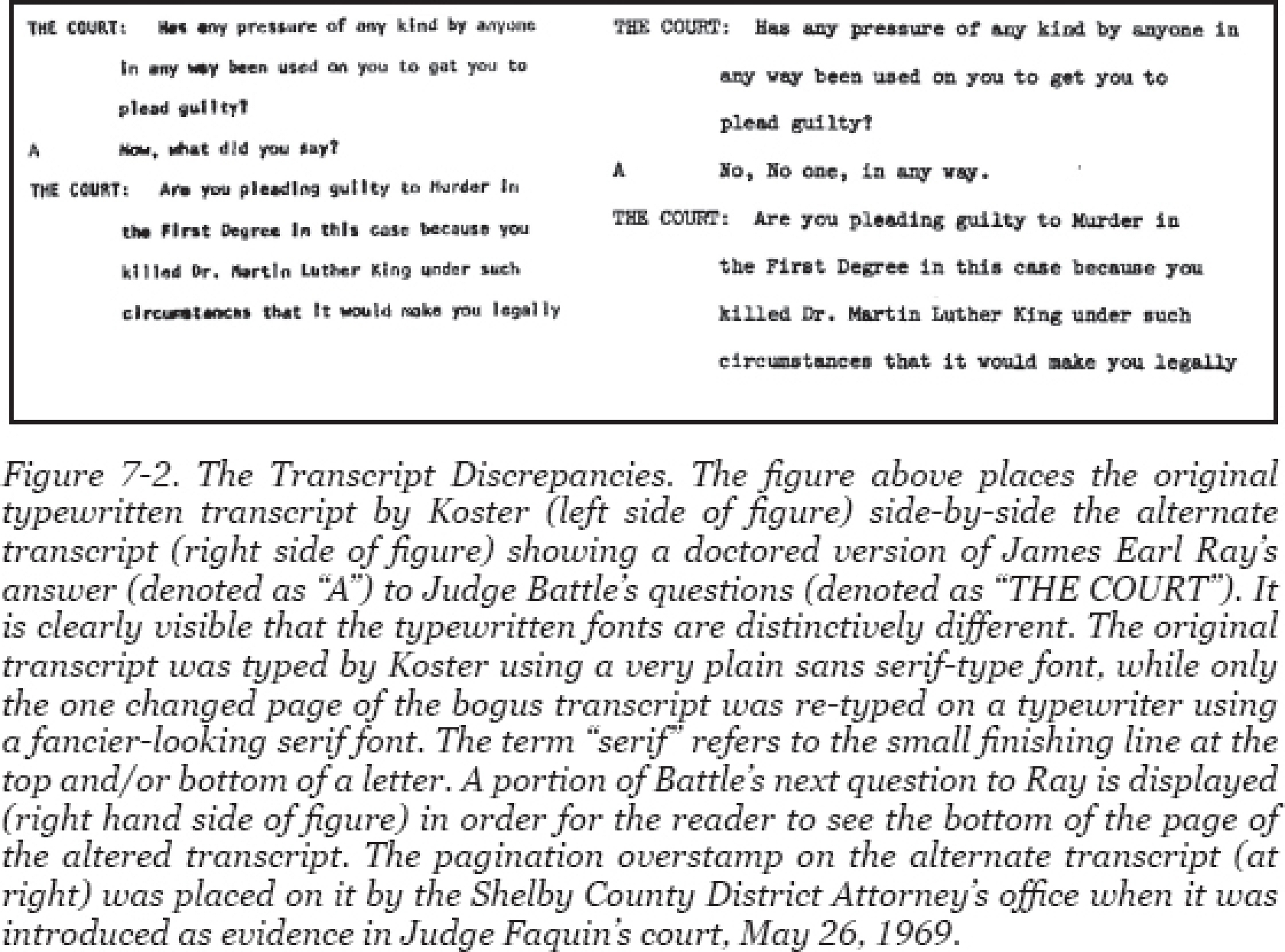
Figure 7-2 (below) illustrates the differences between the two transcripts. The only page that was changed in the altered transcript was obviously typed on a different typewriter. Here is what the doctored transcript recorded:
THE COURT: Has any pressure of any kind by anyone in any way been used on you to get you to plead guilty?
ANSWER: No, No one, in any way.
As previously indicated, the first use of the alternate transcript surfaced in the May 26, 1969 hearing for a new trial in Judge Faquin’s court. It was subsequently used in every court hearing, unchallenged by Ray’s musical-chairs string of lawyers. It was used also in the Federal courts beginning with the case of James Earl Ray v. J. H. Rose, Warden that originated in federal district court in Nashville (Middle district of Tennessee) in 1973. Ray’s attorneys filed a writ of habeas corpus, which is the legal terminology used in the first step in obtaining a federal court review of the sentence imposed on Ray in state court. The writ was denied and the case dismissed without a hearing by Judge L. Clure Morton.
Morton justified his decision by citing specifically from the altered words of the transcript, just as Faquin had done. In fact, Morton said the counterfeit words were “central and determinative” in his decision:
It appears to the (Federal) court that the specific central and determinative issue raised by the massive pleadings in the case is this: Were illicit pressures placed upon the petitioner [Ray] to such an extent that he did not voluntarily enter the plea of guilty? (p. 9)…
The record of the March 10, 1969, proceedings, considered alone, shows that the petitioner [Ray] entered a voluntary, knowing and intelligent plea of guilty (p. 18)…
To summarize this order, the factual allegations of the petitioner… are insufficient to justify a holding that petitioner’s pleas was not voluntary, knowing and intelligent. (p. 19). [10]
Morton had no knowledge that his decision was based on a doctored, false transcript that was entered into evidence in his court by the Tennessee Attorney General’s office, which represented the State of Tennessee in Federal court. Ray’s attorneys not only allowed this poisoned transcript into evidence without objection, they never raised the issue of what Ray did, or did not say to the question about pressure.
Jim Lesar told me he had no recollection about the altered transcript, although he thinks it may be true that there was one. He said Robert Livingston (Ray’s Memphis attorney) “particularly did not trust” the transcript introduced by the State, but has no other recollection about it. [12]
But the damage was done in Judge Morton’s mind. Ray did not give the unequivocal negative answer to the question about pressure that Morton relied on. Morton had no way of knowing it was poisoned evidence.
Ray’s attorneys appealed Morton’s decision to the U.S. Court of Appeals for the Sixth Circuit. The Sixth Circuit reversed Morton and ordered a full evidentiary hearing. Thereupon, Judge Morton exercised his prerogative and transferred the case to the West district federal court in Memphis where more of the witnesses were located. Judge Robert M. McRae, Jr. conducted an eight-day hearing in Memphis, Oct.-Nov., 1974.
For this hearing in McRae’s court, the bogus transcript was “certified” as “a full complete, true and perfect copy of the transcript of March 10, 1969” by Koster. Koster’s certification is not equivalent to the court’s routine certification of a transcript, which in this case never occurred. Furthermore, we will see below that a “certified” document can be changed before it is filed with the court.
When a court certifies a transcript it allows the lawyers on both sides to review the draft and note any discrepancies, changes, or objections. If these differences cannot be amicably resolved among the lawyers, then the court steps in and may allow oral arguments or written pleadings before deciding. A voice recording can be consulted at the option of the court. None of this ever happened with the Ray sentencing hearing transcript because Judge Battle died. So, a court clerk’s certification falls far short of the mark.
The fact remains someone deliberately changed Ray’s answer and created the alternate transcript in order to deceive the courts and the public, and ensure that Ray would never get a full trial.
Following McRae’s hearing, the Tennessee Attorney General’s (AG) office filed a 71-page memorandum with the court as a summary of its argument that Ray’s case should be dismissed. This document was prepared and signed by two assistants in the AG’s office, Haynes and Haile.
Figure 7-2 (above) may be evidence of the initial effort to create an alternative transcript to Ray’s sentencing hearing. I digitally combined the bottom of page three of the Ray voir dire document and the top of page four for the convenience of getting them into a one-page figure. This figure like the previous two in this chapter is a third or fourth generation document. (All original documents were microfilmed by the Shelby County archives, then digitized, then copied by me in digital form and printed). Percy Foreman’s initials appear in the figure as they do in the real document near the bottom of page three. Ray initialed each page of this document, but his initials are lost on this particular copy. The line across the figure beneath Foreman’s initials is the page break in the actual court document. Ray and Foreman both signed the end of the document on page four.
What’s interesting about this figure is that whomever doctored it in longhand shows the likelihood that he or she was aware of the audio recordings and listened to them, or the person was present in the courtroom March 10 1969 and near enough to Ray to hear what he said. The writer errantly penned, “legally yes” into Ray’s answers in the wrong place. Ray actually spoke the words “legally yes” as previously discussed, but not in response to the “freely, voluntarily, and understandingly” question. Rather, he gave the “legally yes” answer to the question about killing Rev. King. But just like the altered transcript, the doctored document puts the “No, no one in any way” words into Ray’s mouth in the question on pressure—words Ray never uttered.
Arguing in this memorandum that Ray’s plea was entered voluntarily and without undue pressure, Haynes and Haile state the following: “The highest and best evidence of the voluntariness of a plea of guilty are [sic] Ray’s statements at the time the plea is entered… Some of these statements are worth repeating.” Haynes and Haile incorporated the alternate transcript version of Ray’s response to the question about pressure:
THE COURT: Has any pressure of any kind by anyone in any way been used on you to get you to plead guilty?
ANSWER: No, No one, in any way.
The problem with this, as I have repeatedly stated is, this is not what Ray said. He did not utter those words, as I will explain in the following section.
Haynes is deceased but Haile still practices law in Nashville at the writing of this book. When I interviewed him regarding the transcripts he told me, “I don’t remember anything about that.” He said, “I don’t know anything about the transcripts. Nobody ever said anything about the transcripts.”
The memorandum prepared by Haynes and Haile referred to the alternate transcript as “Exhibit 87,” indicating that it was introduced as evidence at McRae’s evidentiary hearing in Memphis. I found this exhibit in the files of the U.S. District Court in Memphis. The page that contains Ray’s altered response is typed on a different typewriter and inserted into the document. The other 86 pages appear to be on the same typewriter. Only the page with the doctored response was changed, and nothing else was changed on the other 86 pages that appear to be duplicates of the original, see again Figure 7-1 (above).
Haile told me he doesn’t recall anything about the source of the transcript used in Federal court: “I wouldn’t know one way or the other.” He added that Ray’s lawyers didn’t complain about its introduction as evidence. “They complained about every other thing. I’m surprised they overlooked that.” He said, “They questioned the authenticity of everything but not this (transcript).” [13]
Koster, on the other hand, firmly recalls the details of his original transcript and knows he did not change anything about it. Even if he had changed a page, he had his own typewriter at his desk and would have retyped it on the same typewriter. Thus, the doctored page did not come from Koster.
As for certifying Exhibit 87, the bogus transcript with the single re-typed page, Koster told me: “Of course, you know, when I certify something and give it to somebody there’s nothing that says they can’t retype it and copy it and make it look like it is part of the original. I’m not saying they did, but that’s what it sounds like.” [14]
Furthermore, both the Blackwell and Koster sworn affidavits prove that the genuine transcript was finalized on March 10, 1969 and unchanged by either of them afterwards. Blackwell’s affidavit says, “After said transcript was distributed to news reporters on said date, I made no changes to, nor did I authorize any changes.” [16]
Haile’s memorandum was apparently convincing because Judge McRae held that Ray’s guilty plea was entered voluntarily and he was “not coerced by impermissible pressure by Foreman.” Ray’s attorneys subpoenaed Foreman to Memphis, but being in Texas he was outside the jurisdiction of this district of federal court. Foreman was deposed by Ray’s attorneys but did not have to appear in court. McRae, using the doctored transcript that was admitted into evidence in his court ruled, “Ray coolly and deliberately entered the (guilty) plea in open court.” [17]
Ray’s lawyers again appealed to the Sixth Circuit. This time, Judge William Ernest Miller, who had twice previously sided with Ray, unexpectedly died of a heart attack after participating in oral arguments. His death left Chief Judge Harry Phillips (a Tennessean) and Judge Anthony J. Celebrezze (former mayor of Cleveland, Ohio) on the court. The court’s ruling was clearly influenced by the bogus transcript in evidence:
As stated, Judge Battle very carefully questioned Ray as to the voluntariness of his plea before it was accepted on March 10, 1969. Ray specifically denied at that time that any one had pressured him to plead guilty. His responses and actions in court reveal that he was fully aware of what was occurring. [18]
The Court’s decision actually quoted Ray’s purported, but bogus response to the question on pressure: “No, no one in any way.”
It was a mistake, but when poisoned evidence is admitted into court it always is. Whoever invented the doctored transcript accomplished precisely what he or she intended: It kept Ray in jail as the embodiment of the murderer of Rev. King. Just as the federal district courts in Nashville and Memphis, the Sixth Circuit never knew Ray’s actual answer and thus, had no way of knowing about Battle’s blunder. The U.S. Supreme Court’s refusal to hear Ray’s petition in 1976 consummated finality.
The altered transcript created in the Shelby County DA’s office was introduced as evidence in Federal district court in Nashville in 1973. We know this because Judge Morton quoted from it in his written decision to deny a Writ of Habeas Corpus. Very little else of the paper trail of that case file remains today either with the district court or the National Archives, so there are no other documents to show who did what. Ray’s attorneys appealed Morton’s denial to the U.S. Court of Appeals for the Sixth Circuit, which reversed Morton and ordered a full evidentiary hearing. Judge Celebrezze of the Sixth Circuit quoted the same altered transcript in a dissenting opinion. Morton quickly transferred the case to Federal court in Memphis. Judge McRae conducted an evidentiary hearing that lasted eight days and denied the writ. The doctored transcript was introduced into evidence at this hearing (Exhibit 87) accompanied by Koster’s certification.
Forensic Enhancement of the Audio Recording— “I Don’t Know What To Say.”
The audio recordings of Ray’s sentencing hearing are available online for anyone to download from the Shelby County archives. The audio quality is very poor for several reasons. The recordings were made with Edison Voicewriter machines that cut vinyl-like records that, in playback mode, ran in the slow 15-rpm range. The technology behind the Voicewriter was 40 years old at the time the recordings were made and “probably was not suited” to the recording of court proceedings due to the fact that it had only one microphone.
The phonograph-type records “obviously had been played so many times that it is a wonder we were able to get anything listenable off of them at all,” according to Vincent Clark of the Shelby County Archives. [19] Further diminishing the quality of the audio recordings is the fact that James Earl Ray was nowhere near the microphone when he gave his answers to Battle’s question. A few of the answers are reasonably clear, but the disputed response to the question about pressure is hard to understand. As a result, I decided to have an audio forensic expert evaluate the audio and see if Ray’s response could be enhanced.
I sent the audio file to Sean Coetzee who is the owner of Prism Forensics LLC of Los Angeles, CA. Coetzee is a Certified Forensic Consultant by the American College of Forensic Examiners. He holds a B.A. in Music Production from Brighton University in the United Kingdom. Acting as a paid consultant, he processed the audio file to enhance its clarity. [20]
The result of this process was an audio file that is much clearer, much less noisy, and much easier to understand Ray’s responses. And in his own voice, two things are quite clear about the disputed answer regarding pressure. First, Ray most certainly did not give the unequivocal negative answer to the question about pressure as the doctored transcript records. That is ruled out when you listen to the enhanced audio. Second, Ray clearly gave an equivocal non-answer answer to the question about pressure. In the exchange between Battle and Ray, the enhanced audio sounds like Ray answered thusly:
THE COURT: Has any pressure of any kind by anyone in any way been used on you to get you to plead guilty?
A [JAMES EARL RAY]: I don’t know what to say.
Even this is open to interpretation of the final word in Ray’s answer. He either said: “I don’t know what to say,” or, “I don’t know what to think.”
If anything, Ray’s spoken answer was even more clouded than the original Koster transcript. Koster, however, had the advantage of being present in person and only a few feet away from Ray, as well as a much clearer recording than remains today. But in either case, Ray never answered the question about pressure. If that question was important enough for Battle to ask it; if it was important enough for the district attorney and Ray’s own lawyer, Percy Foreman, to give him a scripted, negative answer a whole day in advance of the sentencing hearing; then it was important enough for the court to stop and entertain a truthful, full answer.
Ray was off script and headed who knows where. Battle had a duty to justice to find out what was on Ray’s mind, and a duty to humanity to find out the darker truth behind Ray’s hints. Instead, in that moment he weakened and let ignorance become a substitute for truth in his court. That’s not necessarily surprising since Arthur Hanes, Jr. told me that he and his father felt Battle was under enormous pressure from outside the courtroom. He said Battle “didn’t handle it very well.” In the next three chapters we will see just how enormous the pressure really was, and from all the sources that it emanated. Perhaps Lesar put it best, Battle “blew it.”
The HSCA’S Legacy of Using the Altered Transcript For Its Legal Analysis of Rat’S Guilty Plea
G. Robert Blakey’s HSCA staff had it within their power to discover the altered transcript and stop the judicial charade that had kept Ray in prison without a trial, and obscured the truth from the American people. Instead of courageously blazing a trail of truth, Blakey’s staff continued a disingenuous parody of the truth.
Blakey’s staff compiled a bibliography of 93 book and magazine titles on the MLK assassination by the time they finished their work in early 1979. [21] What they did with the bibliography is anyone’s guess since Blakey refused to say whether any staff member(s) was assigned to read them. But the bibliography is evidence of the published material that was in Blakey’s possession. Among these 93 titles includes The Strange Case of James Earl Ray by Clay Blair, Jr., and A Search for Justice by John Seigenthaler and Jim Squires. Both books accomplished what Blakey’s multi-million dollar, multi-year investigation did not: They got it right vis-à-vis the issue of the transcript.
If Blakey had actually assigned someone to read those books and compare what those books said about the transcript, they would have discovered the alteration. Further, if Blakey had assigned someone to listen to the audio recordings of the March 10, 1969 hearing, they would have likewise discovered the problem. But Blakey did not instruct his staff to do their own diligence about the transcripts—or did he?
Perhaps someone on the HSCA staff discovered the altered transcript and there was a deliberate order to cover it up. Blakey’s refusal to say provides no comfort to anyone who wants to believe he had nothing to do with a cover up. Yet, if Blakey had revealed that the courts had ruled against James Earl Ray based, in part, on altered evidence; this would have triggered a new round of appeals with a significant likelihood that the courts would vacate his guilty plea and order a full trial. The government’s failure to prove it had the murder weapons would have been tested in open court. The planted evidence against Ray (the green bundle that implicated him) would have been analyzed and re-analyzed. If the defense could prove the evidence was planted rather than real, a conspiracy to murder Rev. King and blame it on Ray would have been exposed. I don’t think Blakey was going to let that happen under any circumstances. Blakey turned his back to the truth.
It cannot be disputed that the HSCA used the altered transcript in its evaluation of the evidence against Ray. After all, they quote from it right in the middle of page 316 of the Final Report:
THE COURT: Has any pressure of any kind by anyone in any way been used on you to get you to plead guilty?
A [JAMES EARL RAY]: No, no one in any way. [22]
Blakey says none of these facts amount to “a hill of beans.” But he knows better. He now knows his staff relied on doctored evidence whether he knew it then or not. He now knows that a one-man investigative writer, myself, exposed what his staff did not; thus he knows how simple it would have been for his staff to do the same.
The book may be purchased here.
____________________ Footnotes ____________________
[8] Respondent’s Post-Hearing Memorandum, filed by the Tennessee Attorney General in Federal District Court in Memphis, Ray v. Rose (case C-74-166), November 29, 1974.
[9] Interview with James H. Lesar by telephone, April 14, 2012.
[10] Memorandum, Ray v. Rose, U.S. District Court Middle District of Tennessee, Judge L. Clure Morton (March 30, 1973).
[11] Telephone interview with James H. Lesar, April 14, 2012.
[12] Telephone interview with Stephen C. Small, June 4, 2012.
[13] Telephone interview with William Henry Haile, May 17, 2012.
[14] Telephone interview with Charles E. Koster, June 25, 2012.
[15] Affidavit of James A. Blackwell, April 19, 2013.
[16] Affidavit of Charles E. Koster, May 6, 2013.
[17] Memorandum Decision, Ray v. Rose, (case C-74-166), U.S. District Court Western District of Tennessee, Judge Robert M. McRae, Jr.
[18] James Earl Ray, Petitioner-Appellant, v. J. H. Rose, Warden, Respondent-Appellee, 535 F.2d 966 (6th Cir. 1976).
[19] Several email exchanges between the author and Vincent Clark of the Shelby County Archives, April and May 2012.
[20] This is Coetzee’s description of the audio enhancement process: The enhancement process was conducted in Izotope RX 2 advanced program. A band pass filter was first applied to the recording in order to reduce frequencies outside of the speakers’ vocal range. A limiter was then used to even out the volume difference between the Judge and the accused. Due to the low level of the accused voice and the amount of interfering noise, the accused voice could only be raised by a few decibels. An equalizer was then used to boost certain frequencies of the speakers’ voices for intelligibility purposes. A de-noiser in spectral subtraction mode was used to reduce the volume of interfering frequencies. An unvoiced section of the recording is used as a reference and then subtracted during the speech sections of the recording.
[21] HSCA MLK Vol. XIII, 290-299
[22] HSCA Final Report, 316.
-
Tulsi Gabbard Announcement Regarding RFK & MLK documents
Tulsi Gabbard announces that the search for RFK and MLK documents and scanning them digitally is on with 100 people on the job. Read more.
-

Sky News Australia Interview of Jim DiEugenio
Please watch the interview here.
The SkyNews.com.au show notes are available here.
Interview Transcript
Well, it won’t be long until the world finally knows the truth about former US President John F. Kennedy’s assassination.
Last month, President Trump signed an executive order to declassify the secret files on JFK’s 1963 death.
Since then, the head of the task force that’s aimed at exposing federal secrets, Anna Paulina Luna, has declared that from what she’s seen so far, she believes the single bullet theory is faulty.
She believes there were two shooters involved.
Our first investigation will be announced, but it’s going to be covering on a thorough investigation into the John F. Kennedy assassination.
And I can tell you, based on what I’ve been seeing so far, the initial hearing that was actually held here in Congress was actually faulty in the single bullet theory.
I believe that there were two shooters.
And we should be finding more information as we are able to gain access into the SCIF, hopefully before the files are actually released to the public.
Now, most Americans do not believe that Lee Harvey Oswald acted alone.
So what has been hidden away for decades that we’re all about to find out when the JFK files are released?
James DiEugenio is considered one of the best writers and researchers in America on JFK’s assassination.
He’s written multiple books on the subject, including co-author of the JFK assassination chokeholds that prove there was a conspiracy.
And he joins us on Power Hour now.
James, thank you for joining us.
We heard Anna Paulina Luna claim that she believes there were two shooters.
That’s a conclusion, I believe, that you’ve come to as well.
Can you talk to us about the evidence that support this?
Yeah, well, I think it’s really good that she’s going to reopen this.
And I think Trump signing that executive order was another really good thing.
As per the belief that there was more than one shooter, there’s a Pruder film which shows Kennedy rocketing backwards when Oswald was supposed to actually be shooting from behind him.
There’s the 42 witnesses at Parkland Hospital and at Bethesda at the morgue who did the autopsy that night who say that there was a big baseball-sized hole in the back of Kennedy’s head, which is strongly indicative of a shot from the front.
All right?
There’s also the fact that there was no sectioning of either wound.
There was no dissecting of either wound, either the back wound or the head wound, to see if it was a through-and-through shot, if it did actually penetrate the body.
There’s all this kind of evidence out there today that was not public back in 1963, which indicates that there was more than one assassin.
And she’s correct.
The Warren Commission report was, to put it mildly, you know, rather faulty.
The Warren Commission determined in 1964 that Lee Harvey Oswald acted alone.
How did it get it so wrong?
Well, there’s a lot of reasons why the Warren Commission report was faulty.
You know, one of them was that they relied almost – about 80 percent of their work was based upon the work of the FBI.
And the FBI, of course, did not do a very thorough investigation.
To put it mildly, you know, J. Edgar Hoover was head of the FBI, was not in really friendly terms with Bobby Kennedy, who was at that time was about to resign.
But he was the attorney general, all right?
And if you recall, you know, this is very interesting.
That weekend, Kennedy was killed on a Friday.
That weekend, J. Edgar Hoover went to the racetrack.
In other words, he didn’t even come into work on Saturday.
He actually went to the racetrack with his second-in-command, Clyde Tolson.
So it was not, you know – again, I’m being mild – it was not a very thorough investigation by the FBI for a lot of different reasons.
Why has some of these files been kept secret for so long?
The FBI says it’s discovered now 2,400 new documents related to JFK’s assassination.
What are you expecting from them?
You know, I’m really glad you brought this up because those 2,400 documents that the FBI has just found, those were not even previously reported.
You know, everything was supposed to be declassified by 94 to 98 by the review board.
Apparently, they didn’t even know about these documents.
I think we’re going to find out a lot more about Oswald in New Orleans, and I think we’re going to learn something about Oswald’s reported visit to Mexico City, which was about in late September, early October of 1963, all right?
And he was, of course, in New Orleans that summer before going to Mexico City.
Oswald was, to put it mildly, a very, very interesting character, which the Warren Commission never even scraped the surface of, all right?
Most people today who have studied this case don’t believe the Warren Commission verdict about him being a communist, all right?
They think he was some kind of low-level intelligence agent.
What do you make of the assessments that are out there?
There are a few that it was a foreign adversary, the mafia, or the CIA.
You know, seeing a lot of the theories that are exposed and all the research and investigating that you’ve done, what’s your assessment of them?
I think that the most logical conclusion today, and that which most people who have researched this case believe, that it was kind of like a triangular kind of a plot involving the Central Intelligence Agency at one point, the Cuban exiles at another point.
And then when Oswald was not killed the day of the assassination, the CIA brought in his ally that has organized crime, you know, who they have been trying to knock off Castro before.
And they brought in the mafia to go ahead and send Jack Ruby in to silence Oswald.
Donald Trump promised that he would declassify the files during his first term, but he was visited by the CIA, the FBI, I should say, the FBI, and was told by Mark Pompeo not to open them.
Why do you think he delayed opening up the files?
You know, that’s a very interesting question, because a week or so before, Trump had tweeted that I’m looking forward, you know, to declassifying the last of the JFK documents.
Then the very day he was supposed to do this, he’s visited by the CIA and the FBI, and he backs out of it.
Now, according to his talk with Andrew Napolitano, he said words of the effect that if they would have shown you what they showed me, you wouldn’t have done it either.
And Andrew said, who is they, and what was it they showed you?
Okay, you know, and then Trump said, well, next time I talk to you, and there’s not 15 people around, I’ll tell you what that meant.
You know, so he’s never explained exactly what it was, all right, that gave him pause.
The implication is that it didn’t look very good for the Warren Commission, you know, but we don’t really know that.
But the fact that they both went in there on the last day, and they warned him not to do it, I think that’s a very, very revealing kind of situation.
Yeah, it’s interesting, isn’t it?
It just makes you wonder why the truth was covered up for so long.
And do you think that trust will be restored in the government when these files are made public?
Well, I’m sure you’re aware of this. 65% of the public does not believe the official story on the JFK assassination.
And a lot of social scientists believe that the lack of the belief in government today, which is very low, and the lack of the belief in the media, which is almost as low.
A lot of them attribute this to the 1963-1964 events.
You know, they trace the fall of the belief in government and the media because it began in 1964 when the Warren Commission report was first issued.
And it was so vigorously defended by the mainstream media in the United States.
And this includes CBS, NBC, and the New York Times.
So hopefully we’ll get some restoration of this when all these files are finally out there in the open.
And perhaps when Representative Luna’s investigation takes place in an open environment.
One of the worst things about the Warren Commission is that it was a closed, all closed hearings.
You know, so this contributed to the cynicism about their verdict.
It’s interesting you bring up the media.
I wanted to get your assessment on what role the mainstream media really played in covering up the truth, I suppose.
You know, has it been frustrating for you hearing a narrative on repeat that’s possibly not the truth?
It’s always been my belief that the main obstruction between the American public and the truth about the JFK case is what is termed today the mainstream media.
Because from the very beginning, you know, from the very beginning, 1963 and 1964, the mainstream media was out there, okay, defending the Warren Commission verdict.
To give you one very good example, in the fall of 1964, on the day the Warren Commission report was issued, both NBC and CBS broadcast shows endorsing its verdict.
Now, Gabriella, the Warren Commission report is 888 pages long.
How could you possibly read that many pages in one day and then report its contents without even referring to the evidence behind it?
Because that wasn’t released until a month later.
And this is what I think, I believe, that has contributed to this air of cynicism about the media.
They’re reporting on something they couldn’t fact check.
It would be impossible to fact check it.
It’s interesting, you know, you’re expecting quite a bit from these files.
Do you think there’s, as you say, 65% of Americans don’t believe that the Warren Commission got it right?
Is there going to be much in here that’s going to shock us?
You know, I really, I wish I could say one way or the other, but since I’m supposed to be a responsible kind of a person, without reading this stuff, you know, I can’t really say that.
Now, I do know people have gone down to Washington, like Andrew Iler, okay, and a lawyer from Canada.
And he told me that a lot of these closed files deal with Oswald and Mexico City.
And let me add one last thing about this subject.
The review board, which expired in 1998, made what is called a final determination on all the documents that they saw, which means that they all should have been declassified in October of 2017.
If the agency made a final determination, that’s what that means.
So the question is, why are we here in 2025 still debating about these documents that should have been declassified almost eight years ago?
This is what gives people an air of cynicism and skepticism about this case.
Absolutely.
Look, when we do finally get the truth, what does this mean for RFK Jr., for the whole Kennedy family?
Well, that’s a very good question also.
Bobby Kennedy Sr., okay, never believed the official story.
And as his son, Robert Kennedy Jr., he has never believed the official story about what happened to his uncle.
And I think that when all this stuff comes out, finally, you know, they’re going to both be vindicated on this subject.
Also, I should say one other thing, and this isn’t commonly known.
John F. Kennedy Jr., JFK’s only son, never believed the official story either.
And according to an old girlfriend of his that doesn’t like to talk about it, but she does write letters, you know, one of his goals was to enter the political arena and try to find justice for what really happened to his father.
Now, that’s a very interesting story, which I believe is largely true, that very few people know about.
Yeah, well, absolutely.
It’ll be really interesting to see what happens, and importantly for that family.
The task force aimed at exposing federal secrets is also going to investigate the assassinations of RFK and MLK.
It’s also going to look at the Epstein client list, the origins of COVID-19, UFOs, the 9-11 files.
There’s so much that we’re going to learn about.
What are you expecting from these other cases?
You know, I thought that was really interesting.
You know, there’s such a thing as picking up too much that you can carry.
You know, that’s a lot of very serious cases for one committee to go into.
You know, can you possibly do justice?
I think it’s seven or eight cases to all those things.
You know, but if they do, you know, and if they do find that something is faulty every place, well, then this really gives questions about, A, the mainstream media, and also our American historians, who seem to have been afraid to go into all the details about all of these cases, which the MLK, RFK, and JFK cases were really instrumental in what happened to America in the 60s.
There would have been no Vietnam War if those three men had lived, which means about 58,000 Americans would be alive today and about 3 million Vietnamese.
So there’s a whole change, a shift in the historical focus if those three people were killed by conspiracies.
Where we are today in 2025, we are finally getting some truth, more transparency.
Do you have faith going forward about the government in the U.S.?
Do you expect there could be other instances being covered up in the future?
Well, you know, it depends a lot on this congressional committee.
You know, if these things are done in the open, and if they’re done with the best information that we have, and the committee members are really honest about their job, I think it might have a significant impact, you know, going forward.
And I think it’ll be interesting to watch this.
And, Gabrielle, I think one thing to look for is how much pressure from the outside is put on this committee.
Because the MSM has a lot to lose if she comes out of the gate really swinging strong.
Okay.
Their credibility is going to be on the line.
So that will be a very interesting tell about how that committee is going to deal with the pressures from the outside.
They really don’t want this to happen.
James DiEugenio, thank you so much for your time.
How can we stay up to date with your work?
Okay.
I’m at kennedysandking.com.
That’s my website.
And I have a sub-stack under my name also.
So that’s how you can read the most current information in this case.
Thank you very much for having me on.
Really appreciate you coming on the program.
We’ll speak to you again soon.
Okay.
Bye-bye.
-
Trump’s executive order for document release
President Trump issues an executive order to begin to declassify all records on the JFK case in 15 days and all classified records on the MLK and RFK case in 45 days. Read more.
-
Trump’s statement regarding document release
Donald Trump says everything is coming out, JFK, RFK, MLK. Whew, did Bobby Kennedy have an influence on this decision? Read more.
-
Four Died Trying, Chapter One
Four Died Trying is a mini-series streaming on Amazon and Apple TV, on the four major political assassination of the sixties: John Kennedy, Malcolm X, Martin Luther King and Robert Kennedy. Jim DiEugenio wrote a review of the Prologue to this series at his Substack site. Please read that before your read this.
Chapter One of Four Died deals with the era of the fifties. In other words this installment was meant to lay in the backdrop of what was changed and how those attempts at change were then themselves stopped and rolled back. The main talking heads in this chapter are Bobby Kennedy Jr., Oliver Stone, author Mark Crispin Miller and screenwriter Zachary Sklar.
The view taken by the narrative is that of, let us call it, “The Haunted Fifties”, the title of an I. F Stone book on the subject. The chapter concentrates on the fear of communism, of being accused of being a communist, and the rise and fall of Senator Joe McCarthy. In accordance with the last, Kennedy talks about his grandfather’s relationship with the senator and how this led to his father’s initial service on McCarthy’s committee. After a few months, RFK switched over to the Democratic side and – although the film does not show it – he was instrumental in causing the senator’s downfall.
Professor Miller goes into how, in 1947, President Truman was maneuvered into making government employees sign loyalty oaths. This was Executive Order 9835, which mandated there be a loyalty investigation of persons entering as employees of any department of the executive branch of the national government. The film then comments on how this policy was proven to be unwarranted since the FBI had infiltrated the communist party in America to the point that any meeting had as many informants as it did communists. Yet many people were unjustly harassed: the film makes the talented actor and singer Paul Robeson a prime example.
II
From here, the film goes into the Hollywood sideshow set up by the House on Unamerican Activities, featuring people like Richard Nixon. Zachary Sklar’s father was a victim of all this and Sklar vividly describes how fearful the writer was of a visit by the FBI and being called as a witness before the committee – as one of his writing partners, Albert Maltz, was. Some of the clips, particularly of actors Adolphe Menjou and Robert Taylor, are rather nauseating in their obsequiousness. The film gives the Hollywood Ten case its proper due, especially the plight of writer Dalton Trumbo, who, with the help of producer Kirk Douglas and ultimately President John F. Kennedy – who went to a theater to see the Trumbo/Douglas film Spartacus – finally broke the Hollywood backlist. The film shows a rather rare clip of baseball player Jackie Robinson, who unlike Menjou and Taylor, managed to keep some of his dignity in the face of this charade.
The film also includes some of the artistic reactions to McCarthyism, e.g. director Don Siegel’s classic allegory disguised as a sci-fi thriller film, Invasion of the Body Snatchers. Professor Miller aptly comments on how the pressure got to the point that it was almost like the Bill of Rights was on trial. Perhaps this point should have been made more explicitly: that it was not and is not illegal to be a communist. At least not according to the First Amendment. And if this point had been delineated more strongly then perhaps the film could have dovetailed into a larger theme, that is how The Fifties was really a kind of “make believe” era, one for which the perfect figurehead was President Dwight Eisenhower. One in which a rising economic tide masked the serious problems ignored at home, and a marked tendency to use the CIA to intervene in the Third World abroad.
The title of the series is so evocative and Chapter One, which is not long – just under 40 minutes—is rich on foreshadowing. So yes, the chapter is worth watching, especially if one is unfamiliar with the anti-communist sturm und drang of the 50s.
III
The chapter begins dramatically and suggestively. Each of the four murdered political leaders are seen speaking, one by one, on TV screens. Suddenly, unexpectedly, a gunshot can be heard, the screen goes to complete static and the image of the speaker disappears. JFK is first. He can be heard saying “Not a Pax Americana enforced by American weapons of war.” Then Bam! He’s gone. Then Malcolm appears: “People in power have misused it and now there has to be a change, a better world has to be built.” Bam! Malcom is gone. We see bombs being dropped over Vietnam. MLK, Jr. is speaking, “The bombs in Vietnam explode home. They destroyed the dream and the possibility for a decent America.” Bam! Martin is gone. Finally, RFK appears and says, “Cannot continue to deny and postpone the demands of our own people.” Bam! TV goes to static. RFK is gone too.
These are the four who died trying. But we aren’t told in this chapter what each of them did to warrant being murdered and what the shared trying consists of specifically. The chapter works better as an unfolding, ominous, wait-and-see decade.
The characterization of postwar America presented to the viewer is an America hell bent on developing a massive military arsenal to combat an evil empire. Director John Kirby’s use of old propaganda film, which scared the daylights out of Americans back then, is effective in making the propagandists sound and look ridiculous today. But the reality of the impact of the propaganda, hysterical though it may seem today, is not lost on the viewer. The fear ginned up that the Russians were about to end civil liberties in America had a near totalitarian quality about it. The set up seductively invites the viewer to yearn for that knight in shining armor to save us all from this American styled, glitzy – America is nothing if not beautiful things to buy – star-spangled neo-fascism.
The centerpiece in this tableau are several clips of Eisenhower’s well known Farewell Address where he warned citizens of the rising power and presence in American life of the “military industrial complex” (MIC). Kennedy, Jr. is brought in to concur: The MIC “would hollow out the middle class” and “direct” [America] toward constant wars.”
Eisenhower’s warning becomes more ominous: the MIC represents “misplaced power” that “endangers our liberty and democratic processes.” In fact, Eisenhower concludes that the MIC has penetrated so thoroughly into the American way of life that it has become the very “structure of our society.” Against this tale of America on the ropes, RFK, Jr. provides a bit of foreshadowing that is more specific: the “whole administration” of his uncle, JFK, “was a battle with his own military brass and the intelligence apparatus.”
Amid this intensity of American ideological managing during the 50s, NYU Professor Miller (who is used throughout as a commentator), explains that because the USSR was “shattered” following WWII, the Soviet Union, actually posed no real military threat to the US. However, Miller wishes to make clear that, “There is no doubt the US was now up against a totalitarian enemy, whose history of bloodshed and oppression is beyond question.” But hold on: There is a real threat to our civil liberties, but not from the Russians themselves but from the anti-communists behind McCarthyism. As Miller explains, “There was no chance that …[the totalitarian enemy] could extend to this country and in any way threaten American democracy. It was the anti-communists who did that.”
Indeed, Kirby and producer Libby Handros are onto something. We need to be aware of the machinations of the far right, especially when they have the guns and/or the power.
Context
One of the many fifties propaganda film voices lets us know that “the main target of the American communists has been labor.” Now there’s something that could provide a clue as to what is going on beneath the surface. The far right aren’t just a collection of madmen and women. As owners of the country they have material interests. So I took a quick look to see what animated the first Red Scare.
Something that may have been added to the context was what many feel was a prime motivation for the first Red Scare, that is the rise of unions in America. With FDR as president, hundreds of socialists and communists coopted the labor movement and were among the militants pushing for the organization of labor in the industrial sectors of the economy. Consequently, the 30’s saw the greatest growth of unions in American history. Along with numerous social programs, a middle class was being created. And with marginal income tax rates above 90 percent and corporate tax rates above 50%, capitalist were not just on the defensive, they were apoplectic.[1]
Further, the accomplishments of socialists and communists in the 30s helped build the very middle class that RFK Jr is worried about being “hollowed out.” And to cite one other example of concrete success, because of the pressure organized by A. Philip Randolph, an early supporter of the Bolshevik Revolution, President Roosevelt signed an executive order that opened the defense industry to black workers.[2]
IV
Can the situation following WWII be explained by ideology alone? The US did become the world-wide hegemonic power. It inherited, in a certain respect, the colonies of the western world lost during the war. And it was the very rise of the left and the democratic forces and their collision with the burgeoning American empire that explains why the ruling class in 1947 was extremely fearful and why, subsequently, they felt compelled to instill fear among ordinary citizens over the fraudulent Russian presence within the US., which is what Miller is trying to elucidate.
In the period of 1945-1946, the fired-up union members, many socialists and communists, in a massive outpouring of militancy, struck industries across the nation. More than five million workers were involved and these strikes lasted four times longer than those strikes during the war. “They were the largest strikes in American labor history.”[3]
The government lost no time in retaliating. The Taft-Hartley Act followed quickly, as did Truman’s loyalty program, both in 1946. The Taft-Hartley Act established new restrictions on labor organizing and was quickly passed. Truman’s Loyalty Program forced employees of the Federal Government to sign oaths declaring that they did not have “sympathetic association” with Communists.[4] This is not to suggest that these acts were due to labor struggles alone. There were many important international acts as well that helped the government in intensifying the fear of the Soviet Union, not the least of which was Winston’s Churchill declaring, also in 1946, that an “Iron Curtain” had descended around Europe.
As I have mentioned, Chapter One begins with Eisenhower warning Americans of the implications of the rise of the MIC. But if you listen closely and if you look for his explanation as to why this rise took place, he merely states that the US was “compelled”, with no explanation.
When asked to explain US foreign policy, Michael Parenti, taking into account the imperatives of a capitalist economy noted:
“The goal is to support all those countries, leaders, and movements that welcome in multinational corporate investors, that open up their land, their labor, their markets and their natural resources to the expropriation and exploitation by these rich people. A side of the same goal is to obliterate or wipe out or undermine any leader, political movement, or nation that tries to develop its own land, labor, and resources for itself.”[5]
In 1947, the CIA was established. In this postwar year of turmoil, the CIA identified former colonial uprisings or national liberation movements as the most important challenge facing the US. We know JFK was both in support of anti-colonial movements and in favor of peace, but “not a Pax Americana enforced by American weapons of war.” Notice how the analysis changes when we link Kennedy’s peace ambition to the specifics of US foreign policy identified by Parenti. The quest for peace suddenly becomes quite edgy, terrifying, enormously subversive, complex, and risky. Is this sort of quest that may not be possible given the structure of the general foreign policy outlined above. Is Kennedy impossible?
Chapter One, is good as far as it goes, particularly as a foreshadowing instrument. I appreciate the trajectory or arc of the series plan. There are many moving parts which need to be brought together and I look forward to seeing how the producers and writers manage that task. Clearly a new perspective is in the offing. I only hope that it is edgy, that it does not ignore the sacred cows, and that it locates the threat they posed in the context of the American political economy. We owe that much to those who died trying.
[1]https://www.google.com/search?q=rick+wolff%2C+socialists+and+communists%2C+great+depression&rlz=1C5CHFA_enIT1028IT1029&oq=rick+wolff%2C+socialists+and+communists%2C+great+depression&gs_lcrp=EgZjaHJvbWUyBggAEEUYOdIBCTE1NTU3ajBqNKgCALACAQ&sourceid=chrome&ie=UTF-8#fpstate=ive&vld=cid:0b2672f5,vid:jfUj5x_PwKA,st:0
[2] https://inthesetimes.com/article/a-philip-randolph-march-on-washington
[3] https://en.wikipedia.org/wiki/United_States_strike_wave_of_1945%E2%80%931946
[4] I would assume that a “small c” communist would be anyone who identified with communist philosophy. Suspect but probably not a target. Whereas, “capital c” Communist indicates that the person in question is a member of a Communist Party.
[5] https://www.youtube.com/watch?v=KUkwpVXaytc&ab_channel=TS%2FALCOLLECTIVE
-

Hoover vs. King: The ARRB Documents
Most of us know just how bizarre and extensive J. Edgar Hoover’s obsession with the civil rights movement–and Martin Luther King Jr in particular–was. For example, in 1958, after King was stabbed during a New York City book signing, a man named Benjamin Davis donated blood for him. The FBI noted that Davis was a member of the Communist Party. (Martin Luther King Jr.: The FBI File, edited by Michael Friedly and David Gallen, p. 21) The Bureau also took note that King’s name appeared on a petition for clemency for a man who was imprisoned because of his refusal to testify before the House Un-American Activities Committee (HUAC). (ibid)
As both Hoover and the upper level of the Bureau knew, King was not a communist in his ideology, and was never a member of that party. But Hoover was determined to use the tried-and-true tactic of guilt by association to smear King:
Though nothing has come to the Bureau’s attention to indicate the Reverend Martin Luther King is a Communist Party member, he has been linked with numerous leftist and communist front organizations and is currently active in racial and segregation matters. (Friedly and Gallen, p. 22)
As many observers have commented, the specter of the pitifully weak Communist Party was being used to attack liberal causes, like integration. And if this information had to be gained by breaking and entering, the FBI would do it with the Southern Christian Leadership Conference (SCLC) offices. (Curt Gentry, J. Edgar Hoover: The Man and his Secrets, p. 501) The first noted occurrence of this was in 1959. And, in a much later Justice Department review, it was revealed that the purpose was to gain information on King. It was also later uncovered that the FBI had been tapping King’s phone in Atlanta since the late fifties. (ibid)
The conflict between King and Hoover became more direct when King wrote an article for the February 4, 1961 issue of The Nation. King argued that the FBI should be used more to combat violations of civil rights in the south. He further added that one reason it might not be was that there were so few agents of color. At the bottom of a memo on King dated May 22, 1961, this sentence appears, “King has not been investigated by the FBI.” The Director underlined that sentence and added in his usual scrawl, “Why not?” King later criticized the FBI in public for employing too many agents who were native southerners. In factual terms, that statement was not accurate. Most of the agents–seventy per cent in the south– came from above the Mason-Dixon line. (Gentry, p. 499)
On January 8, 1962 the SCLC issued a report continuing this attack on the FBI. Most writers believe that it was this report that began Hoover’s continual assailing of King to Attorney General Robert Kennedy. Hoover’s main charge was that two of King’s supporters in the SCLC were either former or present communist agents. These were Stanley Levison and Jack O’Dell. In fact, Hoover had already spread these rumors—which turned out to be pretty much baseless—to certain politicians on Capitol Hill. (Gentry, p 503)
When first informed of this information about Levison in 1962, through Kennedy aides John Siegenthaler and Harris Wofford, King “refused to act against the man who had been his friend and advisor for the past six years.” (Friedly and Gallen, p. 24). Levison was a wealthy attorney who gave King free legal advice and was a strong fund raiser. O’Dell worked directly for the SCLC in their New York City, and later their Atlanta, and Albany, Georgia offices. Whatever associations either man had with the CP had ended back in the fifties. (Friedly and Gallen, p. 25, 27). In fact, Levison later declared that, unlike what Hoover said about him, he was never any kind of Russian agent. He was not even a CP member. But he said he understood the worries of both Bobby and Jack Kennedy.
They were so committed to our movement, they couldn’t possibly risk what could have been a terrible political scandal. When I realized how hard Hoover was pressing them and how simultaneously they were giving Martin such essential support, I didn’t feel any enmity about their attitude toward me. (Arthur Schlesinger, Robert Kennedy and His Times, p. 376)
And this was a real threat. By the fall of 1962 the FBI was penning internal memos about exposing O’Dell and his CP background to various newspapers. In fact, the Long Island Star-Journal, and a few other papers, did print the story about a high-level CP member who infiltrated the SCLC New York office. (Friedly and Gallen, p. 29)
II
Apparently, King was sensitive to the charges. In November of 1962, with O’Dell’s consent, King announced his resignation while the SCLC did an inquiry. But King said he knew nothing about his background. King also—not altogether honestly– denied the role O’Dell had reportedly played in the SCLC up to that time. He then added that “it is also a firm policy that no person of known Communist affiliation can serve on SCLC’s staff, executive board or its membership at large.” (Friedly and Gallen, pp. 29-30) This temporary resignation later become permanent. (David Garrow, Bearing the Cross, p. 275)
King was much more reluctant about Levison. But Levison later said that he induced King to make a direct contact break: “The movement needed the Kennedys too much.” But King managed to stay in contact with Levison through New York attorney Clarence Jones. (Ibid, Garrow.)
Hoover now assigned Cartha DeLoach to contact King for the purpose of correcting some of his critical statements about the Bureau. Which DeLoach did try and do. But it is clear that King made up excuses to avoid talking to him. (Friedly and Gallen, p. 32)
On January 15, 1963 DeLoach distributed a memo within the Bureau. It essentially said that King was avoiding him since he does not wish to be alerted to the facts. He then said that King had used “deceit, lies and treachery as propaganda to further his own causes….” He made reference to Levison who he called “a hidden member of the Communist Party in New York”. As some have commented, thus King may have triggered a whole new level of conflict between himself and Hoover.
The FBI had already broken into Levison’s home in the spring of 1962. But now, in 1963, the FBI portrayed Levison as a top level functionary who was actually part of the Russian intelligence network. (Schlesinger, p. 372) This was at a time when the White House was backing King and the civil rights movement like no prior administration. In June of 1963, after a White House meeting with King and other civil rights leaders, President Kennedy took a stroll in the Rose Garden with King. (About which King observed that Hoover must be bugging JFK also.)
During this private talk, Kennedy told King he was under strong surveillance. He asked him to remove O’Dell and Levison. He said their mutual enemies were already denouncing the March on Washington as a communist stunt. Because this administration had now tied its fate to a civil rights bill and also the upcoming demonstration, if King’s enemies shot him down, then his administration would fall with it. When King asked to see the evidence about Levison, Kennedy told him Burke Marshall—the administration specialist on civil rights– would show it to King’s assistant Andrew Young. (Schlesinger, pp. 372-73)
Marshall met with Young at a courthouse in New Orleans. But Young remained unconvinced since all Marshall did was repeat what Deloach and Hoover were saying. (Schlesinger, p. 373) Consequently, King remained skeptical. He and Young thought this was just FBI intimidation. But as mentioned above, Levison gallantly solved the problem, and Jones provided a nexus point to avoid halting communications.
President Kennedy was evidently satisfied with the conclusion. Feeling he had parried Hoover effectively he made a rather startling announcement on July 17, 1963. He became the first white politician in Washington to back the August 28th demonstration. He then pointedly added that there was no evidence to show that any civil rights leaders were communists, “or that the demonstrations were communist inspired.” (Schlesinger, p. 373). Robert Kennedy then wrote a letter to 2 senators saying the same thing:
It is natural and inevitable that Communists have made efforts to infiltrate the civil rights groups and to exploit the current racial situation. In view of the real injustices that exist and the resentment against them, these efforts have been remarkably unsuccessful. (Church Committee Report, Book 3, p. 100)
This was a direct affront to Hoover. And so the FBI said there was no way RFK could back such a definite claim. The only way to be sure was to place a tap on King’s phone. Robert Kennedy had repeatedly rejected this. But Hoover then reported that he had information that King was still communicating with alleged KGB agent Levison by telephone. (Schlesinger, p. 375) In October, the Attorney General gave in and authorized a trial tap for 30 days. If nothing came up, that would be the end of it.
We all know what happened in November. (Harris Wofford, Of Kennedys and King, p. 217) As Kennedy’s first civil rights advisor Harris Wofford adds, all the evidence indicates—as mentioned above– the FBI had already been tapping King’s phone anyway. They just wanted a cover for it.
III
After JFK’s death, Hoover ripped out Bobby Kennedy’s private line into his office. Even though there was never any evidence of communist affiliation, Hoover kept the tap on King’s home phone until the middle of 1965. The FBI then added taps on 21 microphone settings in various King hotel and motel rooms. (Schlesinger, p. 375). One can write with justification that, once Hoover knew he did not have to deal with Robert Kennedy, the dam broke. As author Kenneth O’Reilly wrote, by the summer of 1964 the Bureau was not just focused on King, but had expanded its operations and surveillance to all civil rights leaders, indeed to all civil rights related events. (Racial Matters, p. 140)
Whereas Robert Kennedy had demanded that Hoover recall a memo that the FBI had prepared attacking King, this defiance of the Director did not succeed under successors Nicholas Katzenbach or Ramsey Clark. (Schlesinger, pp. 376-77) One probable reason being that President Lyndon Johnson had a long and warm friendship with the Director.
Hoover now set up a special desk at the Internal Security section with two supervisors to coordinate what he termed Communist Influence Racial Matters inquiries (CIRM). And he instructed them to use the rubric “communist” in the broadest view. (O’Reilly, p. 140). But the problem was the FBI struck a dry well with Levison and his alleged communist angle. Even though they burglarized Levison’s home at least 29 times between 1954 and 1964. (O’Reilly, p. 141)
In fact, King took his issue with this to the public in 1964. During a press conference on May 10, 1964 he began to echo what the Kennedys had said in public, but without their private fears: “It is time for this question of communist infiltration t be buried all over the nation.” Fellow activist James Farmer then added, “Communism is based on a denial of human freedom. It’s tough enough being black without being black and red at the same time.” On July 23rd in Jackson, Mississippi King said he was:
…sick and tired of people saying this movement has been infiltrated by communists and communist sympathizers…There are as many communists in this freedom movement as there are eskimos in Florida.
Therefore, Hoover now switched to character assassination. During a November 1964 meeting with a group of women reporters, Hoover called King “the most notorious liar in the country”. (O’Reilly, p. 142) Even though DeLoach was there and tried to get Hoover to take that comment off the record, Hoover would not.
In March of 1964, the FBI became cognizant that Marquette University was going to honor King with an honorary degree. The Bureau sent agents to tell them about all the derogatory information they had on him. The same thing happened at Springfield College. (Friedly and Gallen, p. 42) Around the end of the year, the FBI recruited its first informant in the SCLC, an accountant named James Harrison. (Garrow, p. 468)
When Time magazine named King its Man of the Year at the end of 1963, Hoover wrote on a 12/29/63 UPI press release, “they had to dig deep in the garbage to come up with this one.” (O’Reilly. P. 136) But Hoover really went bonkers when it was announced that King, at age 35, would be awarded the Nobel Peace Prize for 1964 in Oslo—along with a cash award of almost $55,000. The honor was “for his non-violent struggle for civil rights for the Afro-American population.”
IV
That award would be formally bestowed at the end of 1964. Between the Time magazine honor and the Nobel announcement in the fall King made a speech in San Francisco. It was quite frank and indicated King had had it with the communist infiltration ploy:
It would be encouraging to us if Mr. Hoover and the FBI would be as diligent in apprehending those responsible for bombing churches and killing little children as they are in seeing our alleged communist infiltration in the civil rights moment. (FBI memo of 4/23/64)
In a memo from Alan Belmont to William Sullivan, it was revealed that Division Five was working on material which was being pushed and will be given to Hoover for his consideration (Belmont to Sullivan 4/23/64, with 2 pages denied in full) Hoover had Division Five Chief William Sullivan and DeLoach distribute tapes and transcripts of what they alleged to be King’s philandering in various hotel rooms. (O’Reilly, pp. 137-38). Division Five had the FBI lab make a composite tape of alleged highlights of various hotel bugs and taps. DeLoach offered a copy of a transcript to Ben Bradlee, who was then the Washington bureau supervisor for Newsweek. Bradlee turned down the offer. When Burke Marshall heard of this through Bradlee, he warned President Johnson about it. But Johnson did something rather weird. He reacted “by warning the FBI about Bradlee. He was unreliable, the president said, and was telling the story all over Washington.” (Ibid, p. 144) The same offer was made to the Atlanta Constitution editor, Eugene Patterson. Who also refused to listen. (Friedly and Gallen, p. 51)
Marshall then warned White House advisor Bill Moyers that Hoover was trying to smear King through the media. Moyers informed the FBI White House liaison about it. Hoover now did something really bizarre. He accused Marshall of being a liar. In fact, Hoover ordered one of his aides to call Marshall and tell him just that. (Wofford, p. 220). What is notable about this is that it is before Johnson’s escalations of the Vietnam War in early 1965. Meaning the King/Johnson relationship was going to get even worse.
This all culminated with the notorious letter that Hoover had Sullivan compose in November of 1964. Some have written that the implicit threat was that King had no way out except to take his own life. But FBI defenders, and Sullivan himself, replied that it was really meant to get King to step aside as leader of the SCLC. It partly reads as follows:
King, look into your heart. You know you are a complete fraud and a great liability to all of us Negroes…King, like all frauds, your end is approaching. You could have been our greatest leader…But you are done…No person can overcome facts. The American public, the church organizations that have been helping—Protestant, Catholic and Jews, will know you for what you are…So will others who have backed you. You are done…there is only one thing left for you to do. You know what this is. (O’Reilly, p. 144)
The FBI enclosed the compilation tape with the letter. The package was mailed from Miami to the Atlanta office of the SCLC. This was shortly before King was to fly to Oslo to accept the Nobel. Around the same time, November 24th, Hoover made a strong speech against King. This time indirectly accusing the SCLC of being run by “communists and moral degenerates.” (ibid)
King later noted, after reading the letter and hearing the tape, it was clearly from the FBI. And this was a war in which, “They are out to break me.” (Friedly and Gallen, p. 49)
V
But it was not just in America that the FBI declared war on King. The ARRB declassified papers dealing with this overseas battle. Researcher Gary Majewski has sent me many of them. The FBI was determined for King’s Nobel journey to Scandinavia to have little or no impact on the leaders of Europe. These documents deal with cables and airtels from the FBI to intelligence centers in Europe, especially England. They were designed to poison any planned meetings between King and European public officials. What is so startling about these documents is that, as bad as they are, they are still heavily redacted: whole pages have been denied. But from what was left unredacted, some of the tale can be revealed.
It appears that somehow, some way, the FBI found out just how King would journey to Oslo. Bayard Rustin, one of the organizers of the March on Washington, was acting as an ad hoc advance man. The Bureau seemed to have had a spy in Rustin’s camp. The FBI knew when Rustin would be departing and they knew who he would be contacting to arrange meetings with luminaries in Europe. (FBI Cablegram of 11/10/64) One of these people appears to be Labor Party member Peggy Duff. Rustin apparently wanted Duff to arrange for a meeting with a higher up—his identity is redacted. The Bureau’s objective was to try and get to these higher ups in advance in order to smear King as
…surrounded by numerous advisors having present or former communist connections. He has maintained an association with and received guidance and counsel from secret Communist Party USA members, notwithstanding advice to King about their communist backgrounds. (ibid)
This information, plus a smear of Rustin, was to be forwarded to MI 5– roughly the equivalent of the FBI in England. The Bureau actually wanted this info to be sent to Prime Minister Harold Wilson. The excisions are clearly noted as being in connection “with efforts being made by King to see British Prime Minister Harold Wilson when King passes through London enroute to Oslo…”
Amazingly, the information did get to Wilson though MI 5 official Roger Hollis. Hollis then furnished the FBI with data about Rustin’s arrival, where he would be staying, and that MI 5 would cover Rustin’s activities and report to FBI. (Airtel of 11/13/64) The Bureau also made plans to brief the American ambassadors in London, Copenhagen, Stockholm and Oslo about the same matters. This was being done to discourage any attempt to make King a guest of honor. (FBI Memo of 11/13/64 and memo of 12/10/64). This effort ended up being at least partly effective. The American ambassador in Stockholm had planned on meeting King at the airport. He now decided to send a representative.
In another FBI memo of 11/24/64 the State Department is enlisted to briefing the USIA on the smears of King, including information about King’s alleged immoral conduct. When Belmont heard the USIA was in agreement, he went ahead and approved the FBI reports and sent memos to that body.
How an FBI Director was allowed to interfere or even become involved with foreign affairs is, to say the least, a very problematic question. How he was allowed to send salacious material to representatives of intelligence agencies, and to ambassadors, is a little disgusting. And that this whole story has yet to be fully revealed in 2023 is appalling. There is an inter-agency meeting of 12/8/75 between the FBI and the Justice Department on King that is nine pages long. There is no ARRB cover sheet on it. And it is almost completely whited out.
We all know how this ended. King was shot in Memphis in April of 1968. When that news was broadcast, the agents in the FBI office shouted, “They got Zorro! They finally got the SOB!” When further word came that King was dead, “One agent literally jumped up and down with joy.” (Gentry, p. 606)
What Hoover was trying to do with his war against King was to make him so radioactive as to split him off from other civil rights leaders. (FBI Memo from DeLoach to Mohr, 11/27/64) Prior to that, as Harris Wofford has pointed out, what Hoover was also trying to do was drive a wedge between King and Bobby Kennedy.
Bobby Kennedy was killed in June of 1968. Early in the year, Hoover’s close friend Clyde Tolson had wished for this to happen. (Gentry, p. 606) But that was not enough. During Kennedy’s televised funeral, Ramsey Clark was drawn aside by an FBI agent. The FBI knew that Scotland Yard had captured alleged King assassin James Earl Ray the night before, but they had refused to hold the story. In fact, DeLoach had told an FBI asset the night before about it. Therefore, the media was distracted by the apprehension of Ray during the RFK funeral. (Ibid, p. 607) How could anyone trust any FBI inquiry into either man’s death?
Hoover’s mania later spread to all black nationalist movements. Urged on and abetted by Richard Nixon’s manipulation of white backlash, he approved COINTELPRO operations against the Black Panthers. By 1969 Hoover was investigating every chapter of the Black Panther Party and over a thousand members, and also those Hoover considered sympathizers. (O’Reilly, p. 298) Many commentators hold Hoover responsible for the decimation of that group e.g., the framing of Panther Geronimo Pratt and the death of Chicago leader Fred Hampton. (See, O’Reilly, Chapter 9)
It is a sorry story, this tale of FBI perfidy and its war on a civil rights leader. Hopefully, one day, it will be able to be seen in its entirety, without being expurgated.
Do we need an ARRB on the King case?
-
The Media Buries the Conspiracy Verdict in the King Case
From the January-February 2000 issue (Vol. 7 No. 2) of Probe
(Click here if your browser is having trouble loading the above.)