Tag: MLK

  • Excerpt From John Avery Emison’s Newest Book on King Case

    Excerpt From John Avery Emison’s Newest Book on King Case

    The Deep State Assassination of Martin Luther King

    by John Avery Emison


    Excerpt From Chapter 7

    Battle’s Blunder

    Battle’s questioning of Ray included seven elements. #1) Battle wanted to establish on the record that Ray’s attorneys had counseled him regarding his rights. #2) He wanted to know if Ray understood his rights. #3) He wanted to know if Ray knew he was accepting a sentence of 99 years in exchange for a plea of guilty and waiver of the death penalty. #4) Battle wanted to establish that Ray agreed to waive his rights to appeal the sentence, and to waive the right to appeal all the motions that had been ruled against him. #5) Battle attempted to establish that Ray’s guilty plea was entered without any pressure on him to do so, and that it was entirely voluntary, but Ray gave a non-answer answer to this question. #6) Battle attempted to establish a factual basis for the guilty plea, i.e. that Ray actually committed murder. Even in the answer to this question Ray played word games. #7) Finally, Battle attempted to establish that Ray knowingly and understandingly entered his guilty plea.

    Battle had no business accepting James Earl Ray’s guilty plea without first exploring why he equivocated on his answer regarding pressure. Battle failed, but his failure to the cause of history was even greater than his failure to the cause of justice.

    A guilty plea entered as a result of pressure on the accused is anathema to justice in liberal western society. Accepting a guilty plea from any defendant, who is pressured into it, is an invitation for the police or anyone else to pressure whomever they please. It is an end to the rights of individuals that the Bill of Rights was written to protect.

    If involuntary, coerced guilty pleas are acceptable, it means prosecutors can accuse anyone they dislike, of any crime they please, and all the authorities have to do is dial up the pressure until the person breaks and confesses to a crime they did not commit. Since everyone has a breaking point, it gives carte blanche to those who prefer tyranny to justice.

    Battle further stumbled with the question he put to Ray about whether he actually murdered Rev. King. Battle’s rambling, legally technical question left the door ajar as to whether Ray murdered Rev. King “under such circumstances that it would make you legally guilty of murder in the first degree under the law as explained to you by your lawyers?”

    It is my considered opinion, having interviewed James Earl Ray in person on three occasions and once on the phone, and listening repeatedly to the audio recordings of the sentencing hearing, that if Ray actually understood that question (which is doubtful), he twisted it in his mind to construct an answer that was deliberately confounding, and devilishly teasing. Battle’s question was as obscure to non-lawyers as a schematic drawing of the inside of your computer is to non-engineers. It consisted of a question (did you kill Rev. King?) wrapped inside two other questions (did your action meet the legal definition of murder; and is that the way your lawyers explained it to you?).

    Ray seized upon Battle’s use of the term “legally guilty of murder in the first degree,” to answer “yes,” admitting he was “legally” guilty. I believe it was Ray’s way of recognizing that he was cornered and going to receive the legal consequences of the charge of murder without truly admitting that he pulled the trigger or knowingly participated in a murder plot. It was Ray’s way of distinguishing between actual guilt and legal guilt. Ray, in this instance, was more a master of words than Battle. He turned Battle’s semantics around and put his own spin on things.

    The failure of Battle to truly explore what was in Ray’s mind about pressure used on him, as well as to understand Ray’s comment that he is “legally” guilty, is compounded by the fact that the questions Battle asked Ray were not only scripted, the whole question and answer session was reduced to writing and virtually rehearsed the previous day. The questioning of Ray in open court was as carefully planned as a NASA space shuttle countdown. Spontaneity was out; robotic conformance to the script was in— and it was Battle who turned out to be the robot.

    “On the day before the guilty plea, Ray was shown a written copy of the questions which were to be asked to him by Judge Battle, at the time of the plea. Ray initialed and signed each page of this document to indicate that he had read and approved this document,” according to court pleadings filed by William J. Haynes, Jr. and William Henry Haile of the Tennessee Attorney General’s office. [8]

    I found the document that Haynes and Haile referred to in the Shelby County archives. It consisted of a petition for waiver of the death penalty in exchange for a plea of guilty; a court Order accepting the guilty plea; and the questions to be posed to Ray by Battle the following day. Ray’s scripted answers were to be a simple “yes” or “no,” and they were already written into the document, a portion of which is displayed in Figure 7-1 (below). Just as Haynes and Haile indicated, Ray and Foreman initialed or signed every page.

    On March 10, 1969 Percy Foreman told Battle that he had “prepared the defendant” to follow the script. Battle took his cue, told Ray to stand and began reading his scripted questions as Ray faced him in open court. In all likelihood Battle read from the actual voir dire document that also contained Ray’s scripted answers, which he had signed the previous day.

    When Ray deviated from the script on the question about pressure—“Now, what did you say?—and again with his answer about being “legally guilty,” Battle simply continued slogging through the script without ever missing a beat.

    One of Ray’s attorneys for much of the 1970s, James H. (Jim) Lesar told me that Battle “blew it in all sorts of ways.” He told me “there was incredible pressure on Ray to plead guilty. There’s no question about that.” Lesar says the pressure came from Ray’s attorney, Percy Foreman. [9]

    The entire episode of Battle’s questions and Ray’s answers (as well as the previous day’s rehearsal) was more akin to a dramatic matinee performance than it was to a tribunal of justice. It was a sham and a show—a hollow counterfeit of justice and a cheap knock-off for the truth. It was a charade written and practiced in secret and revealed to the public in open court as if it were the real thing. In reality a great deal of effort had already gone into ensuring that nothing would go wrong once the reporters were in the courtroom. “The show must go on,” as they say in the entertainment business. It certainly did in Memphis that day.

    The Alternate Transcript

    Doctoring a transcript is a serious offense. Any lawyer who introduces doctored evidence, even unknowingly, is on a fast tract to professional disciplinary action if not a trip to explain it to the grand jury. It is an offense against justice itself as well as the integrity of the court. I have little doubt that the party or parties responsible for doctoring the transcript were working in the background, likely beyond the knowledge of any lawyer who had no need to know the full scope of this operation.

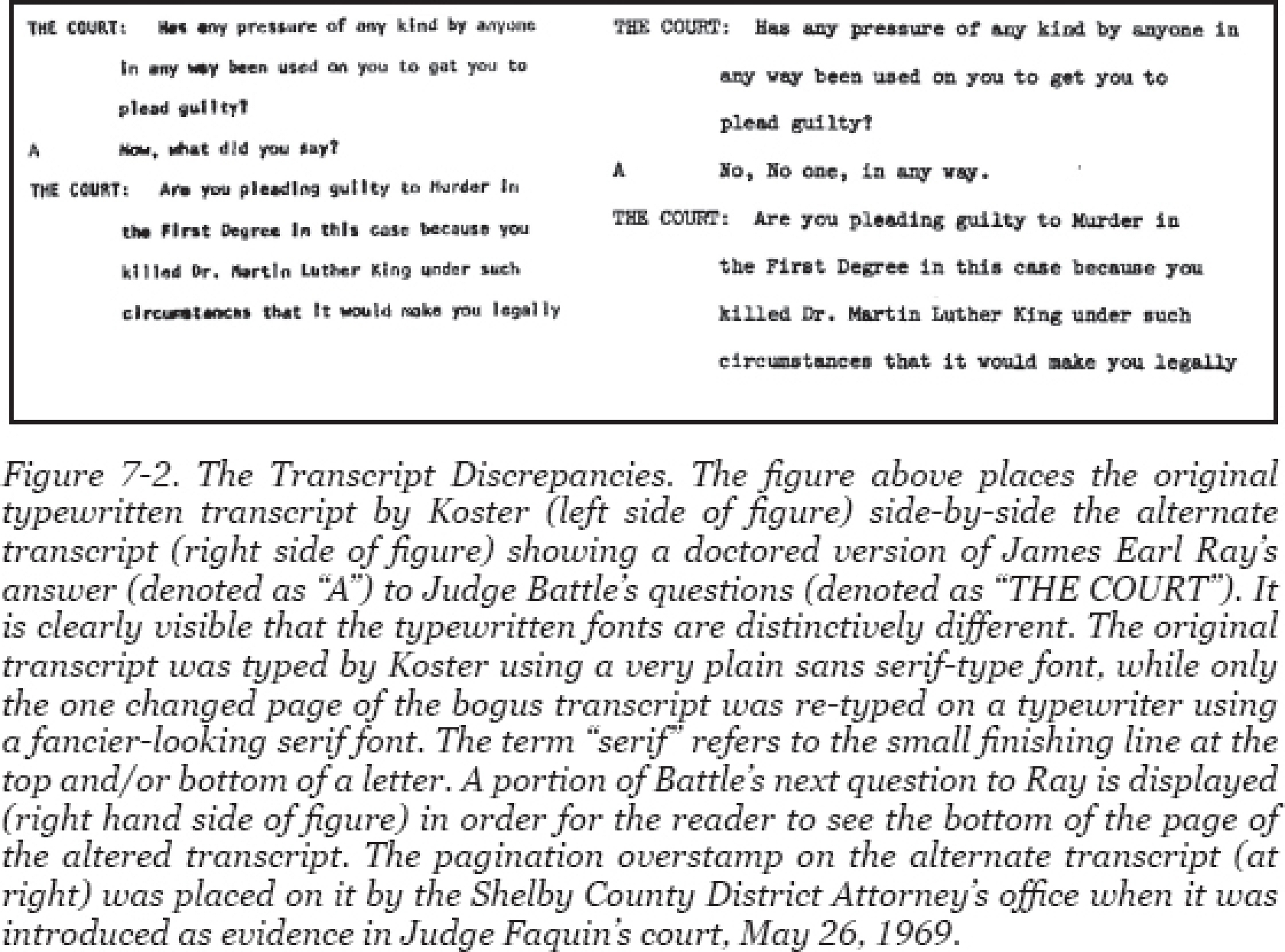
    Figure 7-2 (below) illustrates the differences between the two transcripts. The only page that was changed in the altered transcript was obviously typed on a different typewriter. Here is what the doctored transcript recorded:

    THE COURT: Has any pressure of any kind by anyone in any way been used on you to get you to plead guilty?

    ANSWER: No, No one, in any way.
    As previously indicated, the first use of the alternate transcript surfaced in the May 26, 1969 hearing for a new trial in Judge Faquin’s court. It was subsequently used in every court hearing, unchallenged by Ray’s musical-chairs string of lawyers. It was used also in the Federal courts beginning with the case of James Earl Ray v. J. H. Rose, Warden that originated in federal district court in Nashville (Middle district of Tennessee) in 1973. Ray’s attorneys filed a writ of habeas corpus, which is the legal terminology used in the first step in obtaining a federal court review of the sentence imposed on Ray in state court. The writ was denied and the case dismissed without a hearing by Judge L. Clure Morton.

    Morton justified his decision by citing specifically from the altered words of the transcript, just as Faquin had done. In fact, Morton said the counterfeit words were “central and determinative” in his decision:

    It appears to the (Federal) court that the specific central and determinative issue raised by the massive pleadings in the case is this: Were illicit pressures placed upon the petitioner [Ray] to such an extent that he did not voluntarily enter the plea of guilty? (p. 9)…

    The record of the March 10, 1969, proceedings, considered alone, shows that the petitioner [Ray] entered a voluntary, knowing and intelligent plea of guilty (p. 18)…

    To summarize this order, the factual allegations of the petitioner… are insufficient to justify a holding that petitioner’s pleas was not voluntary, knowing and intelligent. (p. 19). [10]

    Morton had no knowledge that his decision was based on a doctored, false transcript that was entered into evidence in his court by the Tennessee Attorney General’s office, which represented the State of Tennessee in Federal court. Ray’s attorneys not only allowed this poisoned transcript into evidence without objection, they never raised the issue of what Ray did, or did not say to the question about pressure.

    Jim Lesar told me he had no recollection about the altered transcript, although he thinks it may be true that there was one. He said Robert Livingston (Ray’s Memphis attorney) “particularly did not trust” the transcript introduced by the State, but has no other recollection about it. [12]

    But the damage was done in Judge Morton’s mind. Ray did not give the unequivocal negative answer to the question about pressure that Morton relied on. Morton had no way of knowing it was poisoned evidence.

    Ray’s attorneys appealed Morton’s decision to the U.S. Court of Appeals for the Sixth Circuit. The Sixth Circuit reversed Morton and ordered a full evidentiary hearing. Thereupon, Judge Morton exercised his prerogative and transferred the case to the West district federal court in Memphis where more of the witnesses were located. Judge Robert M. McRae, Jr. conducted an eight-day hearing in Memphis, Oct.-Nov., 1974.

    For this hearing in McRae’s court, the bogus transcript was “certified” as “a full complete, true and perfect copy of the transcript of March 10, 1969” by Koster. Koster’s certification is not equivalent to the court’s routine certification of a transcript, which in this case never occurred. Furthermore, we will see below that a “certified” document can be changed before it is filed with the court.

    When a court certifies a transcript it allows the lawyers on both sides to review the draft and note any discrepancies, changes, or objections. If these differences cannot be amicably resolved among the lawyers, then the court steps in and may allow oral arguments or written pleadings before deciding. A voice recording can be consulted at the option of the court. None of this ever happened with the Ray sentencing hearing transcript because Judge Battle died. So, a court clerk’s certification falls far short of the mark.

    The fact remains someone deliberately changed Ray’s answer and created the alternate transcript in order to deceive the courts and the public, and ensure that Ray would never get a full trial.

    Following McRae’s hearing, the Tennessee Attorney General’s (AG) office filed a 71-page memorandum with the court as a summary of its argument that Ray’s case should be dismissed. This document was prepared and signed by two assistants in the AG’s office, Haynes and Haile.

    Figure 7-2 (above) may be evidence of the initial effort to create an alternative transcript to Ray’s sentencing hearing. I digitally combined the bottom of page three of the Ray voir dire document and the top of page four for the convenience of getting them into a one-page figure. This figure like the previous two in this chapter is a third or fourth generation document. (All original documents were microfilmed by the Shelby County archives, then digitized, then copied by me in digital form and printed). Percy Foreman’s initials appear in the figure as they do in the real document near the bottom of page three. Ray initialed each page of this document, but his initials are lost on this particular copy. The line across the figure beneath Foreman’s initials is the page break in the actual court document. Ray and Foreman both signed the end of the document on page four.

    What’s interesting about this figure is that whomever doctored it in longhand shows the likelihood that he or she was aware of the audio recordings and listened to them, or the person was present in the courtroom March 10 1969 and near enough to Ray to hear what he said. The writer errantly penned, “legally yes” into Ray’s answers in the wrong place. Ray actually spoke the words “legally yes” as previously discussed, but not in response to the “freely, voluntarily, and understandingly” question. Rather, he gave the “legally yes” answer to the question about killing Rev. King. But just like the altered transcript, the doctored document puts the “No, no one in any way” words into Ray’s mouth in the question on pressure—words Ray never uttered.

    Arguing in this memorandum that Ray’s plea was entered voluntarily and without undue pressure, Haynes and Haile state the following: “The highest and best evidence of the voluntariness of a plea of guilty are [sic] Ray’s statements at the time the plea is entered… Some of these statements are worth repeating.” Haynes and Haile incorporated the alternate transcript version of Ray’s response to the question about pressure:

    THE COURT: Has any pressure of any kind by anyone in any way been used on you to get you to plead guilty?

    ANSWER: No, No one, in any way.

    The problem with this, as I have repeatedly stated is, this is not what Ray said. He did not utter those words, as I will explain in the following section.

    Haynes is deceased but Haile still practices law in Nashville at the writing of this book. When I interviewed him regarding the transcripts he told me, “I don’t remember anything about that.” He said, “I don’t know anything about the transcripts. Nobody ever said anything about the transcripts.”

    The memorandum prepared by Haynes and Haile referred to the alternate transcript as “Exhibit 87,” indicating that it was introduced as evidence at McRae’s evidentiary hearing in Memphis. I found this exhibit in the files of the U.S. District Court in Memphis. The page that contains Ray’s altered response is typed on a different typewriter and inserted into the document. The other 86 pages appear to be on the same typewriter. Only the page with the doctored response was changed, and nothing else was changed on the other 86 pages that appear to be duplicates of the original, see again Figure 7-1 (above).

    Haile told me he doesn’t recall anything about the source of the transcript used in Federal court: “I wouldn’t know one way or the other.” He added that Ray’s lawyers didn’t complain about its introduction as evidence. “They complained about every other thing. I’m surprised they overlooked that.” He said, “They questioned the authenticity of everything but not this (transcript).” [13]

    Koster, on the other hand, firmly recalls the details of his original transcript and knows he did not change anything about it. Even if he had changed a page, he had his own typewriter at his desk and would have retyped it on the same typewriter. Thus, the doctored page did not come from Koster.

    As for certifying Exhibit 87, the bogus transcript with the single re-typed page, Koster told me: “Of course, you know, when I certify something and give it to somebody there’s nothing that says they can’t retype it and copy it and make it look like it is part of the original. I’m not saying they did, but that’s what it sounds like.” [14]

    Furthermore, both the Blackwell and Koster sworn affidavits prove that the genuine transcript was finalized on March 10, 1969 and unchanged by either of them afterwards. Blackwell’s affidavit says, “After said transcript was distributed to news reporters on said date, I made no changes to, nor did I authorize any changes.” [16]

    Haile’s memorandum was apparently convincing because Judge McRae held that Ray’s guilty plea was entered voluntarily and he was “not coerced by impermissible pressure by Foreman.” Ray’s attorneys subpoenaed Foreman to Memphis, but being in Texas he was outside the jurisdiction of this district of federal court. Foreman was deposed by Ray’s attorneys but did not have to appear in court. McRae, using the doctored transcript that was admitted into evidence in his court ruled, “Ray coolly and deliberately entered the (guilty) plea in open court.” [17]

    Ray’s lawyers again appealed to the Sixth Circuit. This time, Judge William Ernest Miller, who had twice previously sided with Ray, unexpectedly died of a heart attack after participating in oral arguments. His death left Chief Judge Harry Phillips (a Tennessean) and Judge Anthony J. Celebrezze (former mayor of Cleveland, Ohio) on the court. The court’s ruling was clearly influenced by the bogus transcript in evidence:

    As stated, Judge Battle very carefully questioned Ray as to the voluntariness of his plea before it was accepted on March 10, 1969. Ray specifically denied at that time that any one had pressured him to plead guilty. His responses and actions in court reveal that he was fully aware of what was occurring. [18]

    The Court’s decision actually quoted Ray’s purported, but bogus response to the question on pressure: “No, no one in any way.”

    It was a mistake, but when poisoned evidence is admitted into court it always is. Whoever invented the doctored transcript accomplished precisely what he or she intended: It kept Ray in jail as the embodiment of the murderer of Rev. King. Just as the federal district courts in Nashville and Memphis, the Sixth Circuit never knew Ray’s actual answer and thus, had no way of knowing about Battle’s blunder. The U.S. Supreme Court’s refusal to hear Ray’s petition in 1976 consummated finality.

    The altered transcript created in the Shelby County DA’s office was introduced as evidence in Federal district court in Nashville in 1973. We know this because Judge Morton quoted from it in his written decision to deny a Writ of Habeas Corpus. Very little else of the paper trail of that case file remains today either with the district court or the National Archives, so there are no other documents to show who did what. Ray’s attorneys appealed Morton’s denial to the U.S. Court of Appeals for the Sixth Circuit, which reversed Morton and ordered a full evidentiary hearing. Judge Celebrezze of the Sixth Circuit quoted the same altered transcript in a dissenting opinion. Morton quickly transferred the case to Federal court in Memphis. Judge McRae conducted an evidentiary hearing that lasted eight days and denied the writ. The doctored transcript was introduced into evidence at this hearing (Exhibit 87) accompanied by Koster’s certification.

    Forensic Enhancement of the Audio Recording— “I Don’t Know What To Say.”

    The audio recordings of Ray’s sentencing hearing are available online for anyone to download from the Shelby County archives. The audio quality is very poor for several reasons. The recordings were made with Edison Voicewriter machines that cut vinyl-like records that, in playback mode, ran in the slow 15-rpm range. The technology behind the Voicewriter was 40 years old at the time the recordings were made and “probably was not suited” to the recording of court proceedings due to the fact that it had only one microphone.

    The phonograph-type records “obviously had been played so many times that it is a wonder we were able to get anything listenable off of them at all,” according to Vincent Clark of the Shelby County Archives. [19] Further diminishing the quality of the audio recordings is the fact that James Earl Ray was nowhere near the microphone when he gave his answers to Battle’s question. A few of the answers are reasonably clear, but the disputed response to the question about pressure is hard to understand. As a result, I decided to have an audio forensic expert evaluate the audio and see if Ray’s response could be enhanced.

    I sent the audio file to Sean Coetzee who is the owner of Prism Forensics LLC of Los Angeles, CA. Coetzee is a Certified Forensic Consultant by the American College of Forensic Examiners. He holds a B.A. in Music Production from Brighton University in the United Kingdom. Acting as a paid consultant, he processed the audio file to enhance its clarity. [20]

    The result of this process was an audio file that is much clearer, much less noisy, and much easier to understand Ray’s responses. And in his own voice, two things are quite clear about the disputed answer regarding pressure. First, Ray most certainly did not give the unequivocal negative answer to the question about pressure as the doctored transcript records. That is ruled out when you listen to the enhanced audio. Second, Ray clearly gave an equivocal non-answer answer to the question about pressure. In the exchange between Battle and Ray, the enhanced audio sounds like Ray answered thusly:

    THE COURT: Has any pressure of any kind by anyone in any way been used on you to get you to plead guilty?

    A [JAMES EARL RAY]: I don’t know what to say.

    Even this is open to interpretation of the final word in Ray’s answer. He either said: “I don’t know what to say,” or, “I don’t know what to think.”

    If anything, Ray’s spoken answer was even more clouded than the original Koster transcript. Koster, however, had the advantage of being present in person and only a few feet away from Ray, as well as a much clearer recording than remains today. But in either case, Ray never answered the question about pressure. If that question was important enough for Battle to ask it; if it was important enough for the district attorney and Ray’s own lawyer, Percy Foreman, to give him a scripted, negative answer a whole day in advance of the sentencing hearing; then it was important enough for the court to stop and entertain a truthful, full answer.

    Ray was off script and headed who knows where. Battle had a duty to justice to find out what was on Ray’s mind, and a duty to humanity to find out the darker truth behind Ray’s hints. Instead, in that moment he weakened and let ignorance become a substitute for truth in his court. That’s not necessarily surprising since Arthur Hanes, Jr. told me that he and his father felt Battle was under enormous pressure from outside the courtroom. He said Battle “didn’t handle it very well.” In the next three chapters we will see just how enormous the pressure really was, and from all the sources that it emanated. Perhaps Lesar put it best, Battle “blew it.”

    The HSCA’S Legacy of Using the Altered Transcript For Its Legal Analysis of Rat’S Guilty Plea

    G. Robert Blakey’s HSCA staff had it within their power to discover the altered transcript and stop the judicial charade that had kept Ray in prison without a trial, and obscured the truth from the American people. Instead of courageously blazing a trail of truth, Blakey’s staff continued a disingenuous parody of the truth.

    Blakey’s staff compiled a bibliography of 93 book and magazine titles on the MLK assassination by the time they finished their work in early 1979. [21] What they did with the bibliography is anyone’s guess since Blakey refused to say whether any staff member(s) was assigned to read them. But the bibliography is evidence of the published material that was in Blakey’s possession. Among these 93 titles includes The Strange Case of James Earl Ray by Clay Blair, Jr., and A Search for Justice by John Seigenthaler and Jim Squires. Both books accomplished what Blakey’s multi-million dollar, multi-year investigation did not: They got it right vis-à-vis the issue of the transcript.

    If Blakey had actually assigned someone to read those books and compare what those books said about the transcript, they would have discovered the alteration. Further, if Blakey had assigned someone to listen to the audio recordings of the March 10, 1969 hearing, they would have likewise discovered the problem. But Blakey did not instruct his staff to do their own diligence about the transcripts—or did he?

    Perhaps someone on the HSCA staff discovered the altered transcript and there was a deliberate order to cover it up. Blakey’s refusal to say provides no comfort to anyone who wants to believe he had nothing to do with a cover up. Yet, if Blakey had revealed that the courts had ruled against James Earl Ray based, in part, on altered evidence; this would have triggered a new round of appeals with a significant likelihood that the courts would vacate his guilty plea and order a full trial. The government’s failure to prove it had the murder weapons would have been tested in open court. The planted evidence against Ray (the green bundle that implicated him) would have been analyzed and re-analyzed. If the defense could prove the evidence was planted rather than real, a conspiracy to murder Rev. King and blame it on Ray would have been exposed. I don’t think Blakey was going to let that happen under any circumstances. Blakey turned his back to the truth.

    It cannot be disputed that the HSCA used the altered transcript in its evaluation of the evidence against Ray. After all, they quote from it right in the middle of page 316 of the Final Report:

    THE COURT: Has any pressure of any kind by anyone in any way been used on you to get you to plead guilty?

    A [JAMES EARL RAY]: No, no one in any way. [22]

    Blakey says none of these facts amount to “a hill of beans.” But he knows better. He now knows his staff relied on doctored evidence whether he knew it then or not. He now knows that a one-man investigative writer, myself, exposed what his staff did not; thus he knows how simple it would have been for his staff to do the same.

    The book may be purchased here.

    ____________________ Footnotes ____________________

    [8] Respondent’s Post-Hearing Memorandum, filed by the Tennessee Attorney General in Federal District Court in Memphis, Ray v. Rose (case C-74-166), November 29, 1974.

    [9] Interview with James H. Lesar by telephone, April 14, 2012.

    [10] Memorandum, Ray v. Rose, U.S. District Court Middle District of Tennessee, Judge L. Clure Morton (March 30, 1973).

    [11] Telephone interview with James H. Lesar, April 14, 2012.

    [12] Telephone interview with Stephen C. Small, June 4, 2012.

    [13] Telephone interview with William Henry Haile, May 17, 2012.

    [14] Telephone interview with Charles E. Koster, June 25, 2012.

    [15] Affidavit of James A. Blackwell, April 19, 2013.

    [16] Affidavit of Charles E. Koster, May 6, 2013.

    [17] Memorandum Decision, Ray v. Rose, (case C-74-166), U.S. District Court Western District of Tennessee, Judge Robert M. McRae, Jr.

    [18] James Earl Ray, Petitioner-Appellant, v. J. H. Rose, Warden, Respondent-Appellee, 535 F.2d 966 (6th Cir. 1976).

    [19] Several email exchanges between the author and Vincent Clark of the Shelby County Archives, April and May 2012.

    [20] This is Coetzee’s description of the audio enhancement process: The enhancement process was conducted in Izotope RX 2 advanced program. A band pass filter was first applied to the recording in order to reduce frequencies outside of the speakers’ vocal range. A limiter was then used to even out the volume difference between the Judge and the accused. Due to the low level of the accused voice and the amount of interfering noise, the accused voice could only be raised by a few decibels. An equalizer was then used to boost certain frequencies of the speakers’ voices for intelligibility purposes. A de-noiser in spectral subtraction mode was used to reduce the volume of interfering frequencies. An unvoiced section of the recording is used as a reference and then subtracted during the speech sections of the recording.

    [21] HSCA MLK Vol. XIII, 290-299

    [22] HSCA Final Report, 316.

  • James Lawson Dies

    The Rev James Lawson, one of Martin Luther King’s chief advisors on Gandhian tactics, has passed on in Los Angeles. Read more.

  • Hoover vs. King: The ARRB Documents

    Hoover vs. King: The ARRB Documents


    Most of us know just how bizarre and extensive J. Edgar Hoover’s obsession with the civil rights movement–and Martin Luther King Jr in particular–was. For example, in 1958, after King was stabbed during a New York City book signing, a man named Benjamin Davis donated blood for him. The FBI noted that Davis was a member of the Communist Party. (Martin Luther King Jr.: The FBI File, edited by Michael Friedly and David Gallen, p. 21) The Bureau also took note that King’s name appeared on a petition for clemency for a man who was imprisoned because of his refusal to testify before the House Un-American Activities Committee (HUAC). (ibid)

    As both Hoover and the upper level of the Bureau knew, King was not a communist in his ideology, and was never a member of that party. But Hoover was determined to use the tried-and-true tactic of guilt by association to smear King:

    Though nothing has come to the Bureau’s attention to indicate the Reverend Martin Luther King is a Communist Party member, he has been linked with numerous leftist and communist front organizations and is currently active in racial and segregation matters. (Friedly and Gallen, p. 22)

    As many observers have commented, the specter of the pitifully weak Communist Party was being used to attack liberal causes, like integration. And if this information had to be gained by breaking and entering, the FBI would do it with the Southern Christian Leadership Conference (SCLC) offices. (Curt Gentry, J. Edgar Hoover: The Man and his Secrets, p. 501) The first noted occurrence of this was in 1959. And, in a much later Justice Department review, it was revealed that the purpose was to gain information on King. It was also later uncovered that the FBI had been tapping King’s phone in Atlanta since the late fifties. (ibid)

    The conflict between King and Hoover became more direct when King wrote an article for the February 4, 1961 issue of The Nation. King argued that the FBI should be used more to combat violations of civil rights in the south. He further added that one reason it might not be was that there were so few agents of color. At the bottom of a memo on King dated May 22, 1961, this sentence appears, “King has not been investigated by the FBI.” The Director underlined that sentence and added in his usual scrawl, “Why not?” King later criticized the FBI in public for employing too many agents who were native southerners. In factual terms, that statement was not accurate. Most of the agents–seventy per cent in the south– came from above the Mason-Dixon line. (Gentry, p. 499)

    On January 8, 1962 the SCLC issued a report continuing this attack on the FBI. Most writers believe that it was this report that began Hoover’s continual assailing of King to Attorney General Robert Kennedy. Hoover’s main charge was that two of King’s supporters in the SCLC were either former or present communist agents. These were Stanley Levison and Jack O’Dell. In fact, Hoover had already spread these rumors—which turned out to be pretty much baseless—to certain politicians on Capitol Hill. (Gentry, p 503)

    When first informed of this information about Levison in 1962, through Kennedy aides John Siegenthaler and Harris Wofford, King “refused to act against the man who had been his friend and advisor for the past six years.” (Friedly and Gallen, p. 24). Levison was a wealthy attorney who gave King free legal advice and was a strong fund raiser. O’Dell worked directly for the SCLC in their New York City, and later their Atlanta, and Albany, Georgia offices. Whatever associations either man had with the CP had ended back in the fifties. (Friedly and Gallen, p. 25, 27). In fact, Levison later declared that, unlike what Hoover said about him, he was never any kind of Russian agent. He was not even a CP member. But he said he understood the worries of both Bobby and Jack Kennedy.

    They were so committed to our movement, they couldn’t possibly risk what could have been a terrible political scandal. When I realized how hard Hoover was pressing them and how simultaneously they were giving Martin such essential support, I didn’t feel any enmity about their attitude toward me. (Arthur Schlesinger, Robert Kennedy and His Times, p. 376)

    And this was a real threat. By the fall of 1962 the FBI was penning internal memos about exposing O’Dell and his CP background to various newspapers. In fact, the Long Island Star-Journal, and a few other papers, did print the story about a high-level CP member who infiltrated the SCLC New York office. (Friedly and Gallen, p. 29)

    II

    Apparently, King was sensitive to the charges. In November of 1962, with O’Dell’s consent, King announced his resignation while the SCLC did an inquiry. But King said he knew nothing about his background. King also—not altogether honestly– denied the role O’Dell had reportedly played in the SCLC up to that time. He then added that “it is also a firm policy that no person of known Communist affiliation can serve on SCLC’s staff, executive board or its membership at large.” (Friedly and Gallen, pp. 29-30) This temporary resignation later become permanent. (David Garrow, Bearing the Cross, p. 275)

    King was much more reluctant about Levison. But Levison later said that he induced King to make a direct contact break: “The movement needed the Kennedys too much.” But King managed to stay in contact with Levison through New York attorney Clarence Jones. (Ibid, Garrow.)

    Hoover now assigned Cartha DeLoach to contact King for the purpose of correcting some of his critical statements about the Bureau. Which DeLoach did try and do. But it is clear that King made up excuses to avoid talking to him. (Friedly and Gallen, p. 32)

    On January 15, 1963 DeLoach distributed a memo within the Bureau. It essentially said that King was avoiding him since he does not wish to be alerted to the facts. He then said that King had used “deceit, lies and treachery as propaganda to further his own causes….” He made reference to Levison who he called “a hidden member of the Communist Party in New York”. As some have commented, thus King may have triggered a whole new level of conflict between himself and Hoover.

    The FBI had already broken into Levison’s home in the spring of 1962. But now, in 1963, the FBI portrayed Levison as a top level functionary who was actually part of the Russian intelligence network. (Schlesinger, p. 372) This was at a time when the White House was backing King and the civil rights movement like no prior administration. In June of 1963, after a White House meeting with King and other civil rights leaders, President Kennedy took a stroll in the Rose Garden with King. (About which King observed that Hoover must be bugging JFK also.)

    During this private talk, Kennedy told King he was under strong surveillance. He asked him to remove O’Dell and Levison. He said their mutual enemies were already denouncing the March on Washington as a communist stunt. Because this administration had now tied its fate to a civil rights bill and also the upcoming demonstration, if King’s enemies shot him down, then his administration would fall with it. When King asked to see the evidence about Levison, Kennedy told him Burke Marshall—the administration specialist on civil rights– would show it to King’s assistant Andrew Young. (Schlesinger, pp. 372-73)

    Marshall met with Young at a courthouse in New Orleans. But Young remained unconvinced since all Marshall did was repeat what Deloach and Hoover were saying. (Schlesinger, p. 373) Consequently, King remained skeptical. He and Young thought this was just FBI intimidation. But as mentioned above, Levison gallantly solved the problem, and Jones provided a nexus point to avoid halting communications.

    President Kennedy was evidently satisfied with the conclusion. Feeling he had parried Hoover effectively he made a rather startling announcement on July 17, 1963. He became the first white politician in Washington to back the August 28th demonstration. He then pointedly added that there was no evidence to show that any civil rights leaders were communists, “or that the demonstrations were communist inspired.” (Schlesinger, p. 373). Robert Kennedy then wrote a letter to 2 senators saying the same thing:

    It is natural and inevitable that Communists have made efforts to infiltrate the civil rights groups and to exploit the current racial situation. In view of the real injustices that exist and the resentment against them, these efforts have been remarkably unsuccessful. (Church Committee Report, Book 3, p. 100)

    This was a direct affront to Hoover. And so the FBI said there was no way RFK could back such a definite claim. The only way to be sure was to place a tap on King’s phone. Robert Kennedy had repeatedly rejected this. But Hoover then reported that he had information that King was still communicating with alleged KGB agent Levison by telephone. (Schlesinger, p. 375) In October, the Attorney General gave in and authorized a trial tap for 30 days. If nothing came up, that would be the end of it.

    We all know what happened in November. (Harris Wofford, Of Kennedys and King, p. 217) As Kennedy’s first civil rights advisor Harris Wofford adds, all the evidence indicates—as mentioned above– the FBI had already been tapping King’s phone anyway. They just wanted a cover for it.

    III

    After JFK’s death, Hoover ripped out Bobby Kennedy’s private line into his office. Even though there was never any evidence of communist affiliation, Hoover kept the tap on King’s home phone until the middle of 1965. The FBI then added taps on 21 microphone settings in various King hotel and motel rooms. (Schlesinger, p. 375). One can write with justification that, once Hoover knew he did not have to deal with Robert Kennedy, the dam broke. As author Kenneth O’Reilly wrote, by the summer of 1964 the Bureau was not just focused on King, but had expanded its operations and surveillance to all civil rights leaders, indeed to all civil rights related events. (Racial Matters, p. 140)

    Whereas Robert Kennedy had demanded that Hoover recall a memo that the FBI had prepared attacking King, this defiance of the Director did not succeed under successors Nicholas Katzenbach or Ramsey Clark. (Schlesinger, pp. 376-77) One probable reason being that President Lyndon Johnson had a long and warm friendship with the Director.

    Hoover now set up a special desk at the Internal Security section with two supervisors to coordinate what he termed Communist Influence Racial Matters inquiries (CIRM). And he instructed them to use the rubric “communist” in the broadest view. (O’Reilly, p. 140). But the problem was the FBI struck a dry well with Levison and his alleged communist angle. Even though they burglarized Levison’s home at least 29 times between 1954 and 1964. (O’Reilly, p. 141)

    In fact, King took his issue with this to the public in 1964. During a press conference on May 10, 1964 he began to echo what the Kennedys had said in public, but without their private fears: “It is time for this question of communist infiltration t be buried all over the nation.” Fellow activist James Farmer then added, “Communism is based on a denial of human freedom. It’s tough enough being black without being black and red at the same time.” On July 23rd in Jackson, Mississippi King said he was:

    …sick and tired of people saying this movement has been infiltrated by communists and communist sympathizers…There are as many communists in this freedom movement as there are eskimos in Florida.

    Therefore, Hoover now switched to character assassination. During a November 1964 meeting with a group of women reporters, Hoover called King “the most notorious liar in the country”. (O’Reilly, p. 142) Even though DeLoach was there and tried to get Hoover to take that comment off the record, Hoover would not.

    In March of 1964, the FBI became cognizant that Marquette University was going to honor King with an honorary degree. The Bureau sent agents to tell them about all the derogatory information they had on him. The same thing happened at Springfield College. (Friedly and Gallen, p. 42) Around the end of the year, the FBI recruited its first informant in the SCLC, an accountant named James Harrison. (Garrow, p. 468)

    When Time magazine named King its Man of the Year at the end of 1963, Hoover wrote on a 12/29/63 UPI press release, “they had to dig deep in the garbage to come up with this one.” (O’Reilly. P. 136) But Hoover really went bonkers when it was announced that King, at age 35, would be awarded the Nobel Peace Prize for 1964 in Oslo—along with a cash award of almost $55,000. The honor was “for his non-violent struggle for civil rights for the Afro-American population.”

    IV

    That award would be formally bestowed at the end of 1964. Between the Time magazine honor and the Nobel announcement in the fall King made a speech in San Francisco. It was quite frank and indicated King had had it with the communist infiltration ploy:

    It would be encouraging to us if Mr. Hoover and the FBI would be as diligent in apprehending those responsible for bombing churches and killing little children as they are in seeing our alleged communist infiltration in the civil rights moment. (FBI memo of 4/23/64)

    In a memo from Alan Belmont to William Sullivan, it was revealed that Division Five was working on material which was being pushed and will be given to Hoover for his consideration (Belmont to Sullivan 4/23/64, with 2 pages denied in full) Hoover had Division Five Chief William Sullivan and DeLoach distribute tapes and transcripts of what they alleged to be King’s philandering in various hotel rooms. (O’Reilly, pp. 137-38). Division Five had the FBI lab make a composite tape of alleged highlights of various hotel bugs and taps. DeLoach offered a copy of a transcript to Ben Bradlee, who was then the Washington bureau supervisor for Newsweek. Bradlee turned down the offer. When Burke Marshall heard of this through Bradlee, he warned President Johnson about it. But Johnson did something rather weird. He reacted “by warning the FBI about Bradlee. He was unreliable, the president said, and was telling the story all over Washington.” (Ibid, p. 144) The same offer was made to the Atlanta Constitution editor, Eugene Patterson. Who also refused to listen. (Friedly and Gallen, p. 51)

    Marshall then warned White House advisor Bill Moyers that Hoover was trying to smear King through the media. Moyers informed the FBI White House liaison about it. Hoover now did something really bizarre. He accused Marshall of being a liar. In fact, Hoover ordered one of his aides to call Marshall and tell him just that. (Wofford, p. 220). What is notable about this is that it is before Johnson’s escalations of the Vietnam War in early 1965. Meaning the King/Johnson relationship was going to get even worse.

    This all culminated with the notorious letter that Hoover had Sullivan compose in November of 1964. Some have written that the implicit threat was that King had no way out except to take his own life. But FBI defenders, and Sullivan himself, replied that it was really meant to get King to step aside as leader of the SCLC. It partly reads as follows:

    King, look into your heart. You know you are a complete fraud and a great liability to all of us Negroes…King, like all frauds, your end is approaching. You could have been our greatest leader…But you are done…No person can overcome facts. The American public, the church organizations that have been helping—Protestant, Catholic and Jews, will know you for what you are…So will others who have backed you. You are done…there is only one thing left for you to do. You know what this is. (O’Reilly, p. 144)

    The FBI enclosed the compilation tape with the letter. The package was mailed from Miami to the Atlanta office of the SCLC. This was shortly before King was to fly to Oslo to accept the Nobel. Around the same time, November 24th, Hoover made a strong speech against King. This time indirectly accusing the SCLC of being run by “communists and moral degenerates.” (ibid)

    King later noted, after reading the letter and hearing the tape, it was clearly from the FBI. And this was a war in which, “They are out to break me.” (Friedly and Gallen, p. 49)

    V

    But it was not just in America that the FBI declared war on King. The ARRB declassified papers dealing with this overseas battle. Researcher Gary Majewski has sent me many of them. The FBI was determined for King’s Nobel journey to Scandinavia to have little or no impact on the leaders of Europe. These documents deal with cables and airtels from the FBI to intelligence centers in Europe, especially England. They were designed to poison any planned meetings between King and European public officials. What is so startling about these documents is that, as bad as they are, they are still heavily redacted: whole pages have been denied. But from what was left unredacted, some of the tale can be revealed.

    It appears that somehow, some way, the FBI found out just how King would journey to Oslo. Bayard Rustin, one of the organizers of the March on Washington, was acting as an ad hoc advance man. The Bureau seemed to have had a spy in Rustin’s camp. The FBI knew when Rustin would be departing and they knew who he would be contacting to arrange meetings with luminaries in Europe. (FBI Cablegram of 11/10/64) One of these people appears to be Labor Party member Peggy Duff. Rustin apparently wanted Duff to arrange for a meeting with a higher up—his identity is redacted. The Bureau’s objective was to try and get to these higher ups in advance in order to smear King as

    …surrounded by numerous advisors having present or former communist connections. He has maintained an association with and received guidance and counsel from secret Communist Party USA members, notwithstanding advice to King about their communist backgrounds. (ibid)

    This information, plus a smear of Rustin, was to be forwarded to MI 5– roughly the equivalent of the FBI in England. The Bureau actually wanted this info to be sent to Prime Minister Harold Wilson. The excisions are clearly noted as being in connection “with efforts being made by King to see British Prime Minister Harold Wilson when King passes through London enroute to Oslo…”

    Amazingly, the information did get to Wilson though MI 5 official Roger Hollis. Hollis then furnished the FBI with data about Rustin’s arrival, where he would be staying, and that MI 5 would cover Rustin’s activities and report to FBI. (Airtel of 11/13/64) The Bureau also made plans to brief the American ambassadors in London, Copenhagen, Stockholm and Oslo about the same matters. This was being done to discourage any attempt to make King a guest of honor. (FBI Memo of 11/13/64 and memo of 12/10/64). This effort ended up being at least partly effective. The American ambassador in Stockholm had planned on meeting King at the airport. He now decided to send a representative.

    In another FBI memo of 11/24/64 the State Department is enlisted to briefing the USIA on the smears of King, including information about King’s alleged immoral conduct. When Belmont heard the USIA was in agreement, he went ahead and approved the FBI reports and sent memos to that body.

    How an FBI Director was allowed to interfere or even become involved with foreign affairs is, to say the least, a very problematic question. How he was allowed to send salacious material to representatives of intelligence agencies, and to ambassadors, is a little disgusting. And that this whole story has yet to be fully revealed in 2023 is appalling. There is an inter-agency meeting of 12/8/75 between the FBI and the Justice Department on King that is nine pages long. There is no ARRB cover sheet on it. And it is almost completely whited out.

    We all know how this ended. King was shot in Memphis in April of 1968. When that news was broadcast, the agents in the FBI office shouted, “They got Zorro! They finally got the SOB!” When further word came that King was dead, “One agent literally jumped up and down with joy.” (Gentry, p. 606)

    What Hoover was trying to do with his war against King was to make him so radioactive as to split him off from other civil rights leaders. (FBI Memo from DeLoach to Mohr, 11/27/64) Prior to that, as Harris Wofford has pointed out, what Hoover was also trying to do was drive a wedge between King and Bobby Kennedy.

    Bobby Kennedy was killed in June of 1968. Early in the year, Hoover’s close friend Clyde Tolson had wished for this to happen. (Gentry, p. 606) But that was not enough. During Kennedy’s televised funeral, Ramsey Clark was drawn aside by an FBI agent. The FBI knew that Scotland Yard had captured alleged King assassin James Earl Ray the night before, but they had refused to hold the story. In fact, DeLoach had told an FBI asset the night before about it. Therefore, the media was distracted by the apprehension of Ray during the RFK funeral. (Ibid, p. 607) How could anyone trust any FBI inquiry into either man’s death?

    Hoover’s mania later spread to all black nationalist movements. Urged on and abetted by Richard Nixon’s manipulation of white backlash, he approved COINTELPRO operations against the Black Panthers. By 1969 Hoover was investigating every chapter of the Black Panther Party and over a thousand members, and also those Hoover considered sympathizers. (O’Reilly, p. 298) Many commentators hold Hoover responsible for the decimation of that group e.g., the framing of Panther Geronimo Pratt and the death of Chicago leader Fred Hampton. (See, O’Reilly, Chapter 9)

    It is a sorry story, this tale of FBI perfidy and its war on a civil rights leader. Hopefully, one day, it will be able to be seen in its entirety, without being expurgated.

    Do we need an ARRB on the King case?

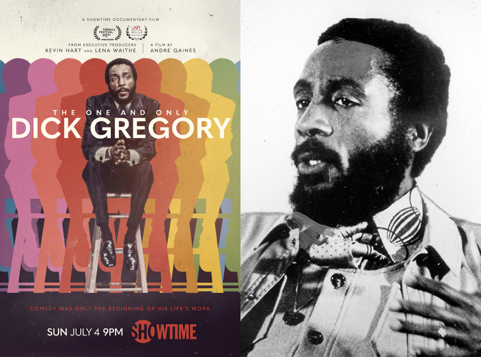
  • The One and Only Dick Gregory

    The One and Only Dick Gregory


    The only comedian I can think of who I would compare to the late Dick Gregory is Mort Sahl. They were both socio-political themed stand-up comedians who, at the peak of their careers, decided to gamble fame and fortune for their political ideals. Sahl did it by deciding to become an investigator for Jim Garrison on the JFK case. Gregory did it for civil rights activists Medgar Evers and then Martin Luther King. He later became involved with people like Robert Groden and Mark Lane on the JFK case and the King case.

    The current documentary about Dick Gregory on Showtime, The One and Only Dick Gregory, makes note of the fact that, by 1962, Gregory was probably the hottest comedian in America. In fact, one of the interview subjects, Harry Belafonte, calls him the greatest political comedian ever.

    Gregory was born in St. Louis, went to high school there, and then attended Southern Illinois University on a track scholarship. He was drafted into the army and won some talent shows as a comedian. When he returned from the service, he dropped out of college and went to Chicago to try and become a professional comedian. He was one of the very few comedians who decided to make racial issues funny: “Segregation is not all bad. Have you ever heard of a collision where the people in the back of the bus got hurt?”

    This kind of comedy got him noted in both Chicago and New York City. One of his first record albums, East and West, was done in New York. (Between 1961 and 1964, he did seven albums.) When he returned to Chicago, he received what most commentators note as his big break. He replaced Professor Irwin Corey for what was supposed to be one night at the Playboy Club. One of the jokes he cracked that night went like this: “I understand there are a good many Southerners in the room tonight. I know the South very well, I spent twenty years there one night.” He was such a hit that the one-night stand turned into six weeks. One notice read as follows:

    Dick Gregory, age 28, has become the first Negro comedian to make his way into the nightlife club big time.

    Another said:

    What makes Gregory refreshing is not only that he feels secure enough to joke about the trials and triumphs of his own race, but that he can laugh, in a sort of brotherhood of humor, with white men about their own problems…

    This highly successful Chicago appearance caught the attention of Jack Paar. After Steve Allen, Paar was the second steady host of The Tonight Show. It was Paar who made the show into the institution it became. Paar was not just funny. He was intelligent, informed, curious, and principled. In other words, he was just the kind of late-night host who Dick Gregory would appeal to. As the comedian later added, it was not just the fact that Paar had him on national television, it was what happened afterwards. The host invited him over to the panel to talk. That is what was important. At that time, such a display of integration was unusual. According to the film, it blew the NBC switchboard out. Because of his new notoriety, CBS newsman Mike Wallace did a profile of him.

    From there it was on to the likes of Ed Sullivan and Merv Griffin. Greg, as his friends called him, also wrote an autobiography called Nigger, co-written with Robert Lipsyte. Amazingly, in nearly sixty years, that book has never been out of print.

    II

    At this point in the film, director/writer Andre Gaines begins to describe his subject’s transition from a pointed stand-up comic to a socio-political activist. As the sixties heated up, it wasn’t enough for Dick Gregory to say things like, “Football is the only place where a black man can knock down a white man and 40,000 people cheer.” Or, in satirizing liberals, “They all say, some of my best friends are colored, but there just aren’t that many of us.” Or in pointing out the hypocrisy of the court system: “A black guy robs a bank of $20,000 and he gets four years in Alcatraz. A white guy embezzles 3 million and he gets three years.” As civil rights demonstrations broke out in the south, Greg began to empathize with what was happening. As he put it, since he was from the north, he was not really aware of how bad the Jim Crow situation was down south. Even though he was making a lot of money at this time and he was peaking in his professional career, he decided that, whatever the consequences, he was going to get involved with the struggle for civil rights.

    And he began to adjust his humor as this happened: “A white guy kills 2 black demonstrators with his car and the cop arrests the dead guy 500 yards away for leaving the scene of an accident.” He did civil rights work first for Medgar Evers, who he very much admired for his voter registration drives. Gregory also became involved with the famous case of the three missing civil rights workers in Neshoba County, Mississippi—James Chaney, Andrew Goodman, and Michael Schwerner. He suspected the sheriff’s office was involved. He then offered a reward for information on the case. The FBI followed his lead of offering reward money. It worked. The bodies were found and the case was solved.

    The film notes that his publicist sued him at this time, since Greg had sacrificed $100,000 worth of appearances—the equivalent of about a million bucks today—in order to work the South with Medgar. At this time, Gregory was getting $5,000 per nightclub/concert appearance. Instead, he chose to risk getting arrested by participating in civil rights drives in places like Mississippi and Alabama.

    As the film shows, he did get arrested. Beyond that, he got his arm broken while being battered with a baseball bat. (Dick Gregory and Mark Lane, Murder in Memphis, ebook version, p. 29) He was very much depressed when Evers was assassinated in the summer of 1963. But he pressed on, getting arrested even more. As he put it, what these activists were doing was more important than what he was doing. When the famous 1965 Watts riots broke out in Los Angeles, he said on TV, “I just got back from Los Angeles, Vietnam.” The film dramatizes his message at the time. Greg was saying that this was not a problem confined to the black community, it was an American problem. The film then juxtaposes excerpts from rioting in Harlem in 1964 with those from Ferguson in 2014.

    From here, the film begins to show that, as Gregory now became associated with Martin Luther King, like King, he began to become a vociferous critic of the Vietnam War. And as this occurred, J. Edgar Hoover and the FBI began to keep files on the comedian; they also tapped his phone and drew up methods of neutralizing his impact. Greg decided that, for this particular anti-war message, he had to speak at colleges and universities. He began to attract large crowds and he would harangue the United States for building this Military Industrial Complex and using it against the people of Vietnam. The regents of the University of Tennessee banned him from speaking on campus. They said he was an “extreme racist” and his presence would insult much of the state’s citizenry. The students sued and they hired noted radical lawyer William Kunstler to present their case. They won in court and Gregory finally spoke there in 1970. In 1969, Gregory spoke at the huge moratorium against the war in Washington DC.

    Not mentioned by the film are the comedian’s political races. Dick Gregory (unsuccessfully) ran against Richard J. Daley for the office of mayor of Chicago in 1967. He then ran as a write-in candidate for the President of the United States in 1968. (Gregory and Lane, p. 7) In some states, Mark Lane was his running mate. In some other states, his running mate was Dr. Benjamin Spock, the famous pediatrician. Gregory later wrote one of his many books about this campaign. That election attempt landed him on Richard Nixon’s enemies list.

    As the film depicts, King’s assassination resulted in a huge wave of riots in well over 100 cities across America. The year 1968 almost brought the United States to a point of civil war. Gregory humorously commented on this state of siege. On stage, he would bring out a large violin case. He opened it and pulled out a tommy gun. He then pulled out a bow and started playing the machine gun.

    III

    At this point, the film notes that one of the methods Greg used to protest the war was by fasting. And I thought that it would be at this juncture that writer/director Andre Gaines would cut to the event that was probably the crystallization of Greg’s political career. I am, of course, referring to the night of March 6, 1975. That was when the Zapruder film was shown for the first time on national television. The three main guests that night on the program Good Night America were Geraldo Rivera as host, Robert Groden as the photo technician who had recovered a copy of the film from Life magazine, and Dick Gregory. It is not an understatement to say that the showing of this film on national TV electrified America. It put the Kennedy assassination back on the national agenda. It now became a topic of conversation at lunch and around water coolers at work.

    By this time, Dick Gregory had become convinced that something had gone politically wrong with America after 1968. And, on top of that, the fact that JFK, Malcolm X, King, and Bobby Kennedy had all been snuffed out in a span of five years—that was just too much to swallow as simply a coincidence.

    Gregory had known King and President Kennedy. Greg was at the March on Washington, which was sponsored by the White House and at which King had spoken so memorably. (Gregory and Lane, p. 6) He had been asked to come down to Birmingham in 1963 for the huge demonstration that several civil rights leaders had combined forces on. President Kennedy called him at home and asked him not to go, since they were working on a solution to the conflict and further demonstrations could imperil it. Greg appreciated the call, but said he felt he had to go. (ibid, pp. 30–33)

    As the comedian told this reviewer, when he returned from Birmingham, his wife told him that Kennedy had called again and wanted him to return his call the moment he got in. Gregory noted the late hour, but his wife said JFK told her it did not matter what time it was. So Dick Gregory called the White House and Kennedy picked up the phone. The president said to the comedian words to the effect that he needed to know everything that happened in Birmingham. Greg went on for about ten minutes describing the whole ugly mess. When he was done, Kennedy replied with “Oh, we’ve got those bastards now!” At this comment, Gregory started weeping. (2003 Interview with Joe Madison and Gregory in Washington on WOL Radio One)

    This is probably the reason he was quite interested in Kennedy’s assassination. But Greg was even closer to King. And the film shows them on stage together. In 1977, Mark Lane and Dick Gregory combined to author a book on King’s assassination. At that time, it was titled Code Name Zorro, since they had learned from FBI agent Arthur Murtaugh that “Zorro” was the FBI’s moniker for King. When it was republished in a revised version in 1993, the volume was now titled Murder in Memphis. To this day, it is a seminal book on the King case.

    Very early in that volume, Gregory notes that it was when King turned against the Vietnam War that his image in the public mind was altered.

    When King made his famous speech on April 4, 1967, in New York condemning the conflict in Vietnam, he was now perceived as an enemy of the Power Elite. (Gregory and Lane, p. 6) Later in the book, Greg outlines how even those involved in the civil rights movement were taken aback by King’s harsh stand on the Vietnam issue, for the simple reason that they knew that Vietnam had become President Johnson’s personal fiefdom. He was the one who had escalated that war to a magnitude beyond President Kennedy’s imagination. These other civil rights leaders understood that there was a danger that Johnson would take King’s condemnation as a personal assault and the president would turn his back on their cause. (Gregory and Lane, p. 51) And as Greg said so perceptively later in that book, King was expanding his vision of American civil rights to universal human rights. (ibid, p. 56)

    King’s anti-Vietnam War speech was criticized by both the New York Times and Washington Post. It’s hard to comprehend today, but both of those MSM outlets were still supporting what Johnson was doing in Indochina at that time. (Click here for details) As Gregory notes in Murder in Memphis, it was William Pepper’s famous photo essay in Ramparts magazine that had energized King in this regard. (Click here for details)

    IV

    But as Gregory also points out in Murder in Memphis, the antipathy for King amid the Power Elite was exponentially increased when he also announced his plans for a Poor People’s March in Washington. There was a good reason for this march. As many commentators have noted, what had happened under Johnson was simple to comprehend. And, in fact, he himself knew it. Johnson’s vision of a Great Society had crashed on the shores of Da Nang in Vietnam. Or as King himself had declared:

    Many of the very programs we are talking about have been stifled because of the war in Vietnam. I am absolutely convinced that the frustrations are going to increase in the ghettoes of our nation as along as the war continues. (Gregory and Lane, p. 54)

    In other words, as King said to newsman Sander Vanocur, the dream he talked about in his March on Washington speech in 1963 had, in some respects—between the race riots and Vietnam—become a nightmare. As Gregory noted, the Poor People’s March posed the possibility of exposing this nightmare, and not just to LBJ, but congress. In fact, Murder in Memphis contains an appendix in which Senator Robert Byrd made a vituperative speech against it. (Speech of March 29, 1968) The Poor People’s March provoked meetings at the White House, the Department of Justice, the Pentagon, the Metropolitan Police, and the FBI. (ibid, p. 57; the best book on this is probably Gerald McKnight’s The Last Crusade published in 1998) The combination of King’s assassination, plus the massive interference and surveillance with the march turned it into a failure.

    Dick Gregory was correct when he described King as turning in his last years towards a different agenda. About that there should be little or no doubt:

    In a sense you could say we are engaged in a class struggle, yes. It will be a long and difficult struggle for our program calls for a redistribution of economic power…I feel that this movement in behalf of the poor is the most moral thing—it is saying that every man is an heir to a legacy of dignity and worth. (Speech of March, 1968)

    Or as King—echoing Bobby Kennedy—put it more succinctly: “What good it is to be allowed to eat in a restaurant, if you can’t afford a hamburger.” (Sylvie Laurent, King and the Other America, p. x) As Gregory wrote in Murder in Memphis, the dilemma that King was trying to expose was multi-dimensional. It not only would pose problems for Johnson, the White House, and Congress, but it would probably be an international problem. As the comedian wrote:

    What would this do to our image as the richest nation in the world? What about those countries who were not aware of America’s racial problems of poverty and hunger? … White reaction to the planned Poor People’s March was astonishing. A headline in Readers’s Digest magazine a few days before King was killed read, “The United States may face a civil crisis this April when a Poor People’s Army pitches camp in the nations’ capital. (Gregory and Lane, p. 57)

    As Dick Gregory was saying, and as Sylvie Laurent amplified later, King was now trying to stretch his populist coalition. And MLK explicitly stated it in his own terms:

    The unemployed poverty-stricken white man must be made to realize that he is in the very same boat with the Negro. Together, they could exert massive pressure on the government to get jobs for all. Together, they could form a grand alliance. (Laurent, p. 8)

    Due to King’s murder and the powerful forces arrayed against what was left of the Poor People’s March, it failed. As Laurent wrote:

    On June 24, 1968, the makeshift housing Martin Luther King Jr. had dreamt of, built on the mall in Washington DC and known as Resurrection City was wiped out. Police tear gas filled the air. Hundreds of people were arrested. Bulldozers smashed the plywood shacks. (Laurent, p. 1)

    As Richard Nixon later said, it was that image and the dispersal of those people that combined to help elect him. (ibid) The grand alliance King was designing ended up dissipated. The reverse, namely Nixon’s southern strategy, was later used by Ronald Reagan, and then given broadcast voice by Rush Limbaugh and Fox News. King’s unification strategy was now somewhere in the ozone. Roger Ailes’ and Pat Buchanan’s polarization policy ruled the day.

    That would have been a powerful coda with which to end The One and Only Dick Gregory.

    V

    The only trace of this that I could detect was near the very end of the film. On a last kind of 2015 comeback tour, two years before Greg died, there is a brief glance at Pepper’s book The Plot to Kill King on a chair. If I missed something, I hope someone can remind me of it.

    So, what does approximately the last third of the film deal with? Gregory turning into a fitness expert and a health foods businessman. He moved his family to a forty-acre farm in Plymouth, Massachusetts, in 1973. He began to sell vitamins and nutrition products. He also was one of the first to argue for the primacy of natural water in everyone’s diet. He stopped playing nightclubs and there was no more alcohol consumption or smoking for him. Harking back to his college days, he became an avid runner. And his cause now was to erase world hunger. He fasted for that one also.

    He created something called the Bahamian Diet nutrition drink. This ended up being very successful. After having some legal problems in the mid 1980’s which tied up much of his assets, he settled the lawsuit and sold the business for millions.

    But Greg never really lost his affinity to protest injustice. Another part of his life was devoted to exposing the CIA/cocaine scandal of the late nineties. At that time, he actually went out to CIA HQ in Langley, Virginia, and unspooled yellow tape around the building. Because as he said, “We know where the criminals are.”

    Andre Gaines’ film is a passable chronicle of the showbiz side of Dick Gregory, but it does not do justice to what made the man the true icon he was. Perhaps that was the price of getting people like Chris Rock and Dave Chappelle and Kevin Hart to appear. If it was not, then Gaines made a mistake. His film should be called The One and Only Dick Gregory (Censored Version).

  • MLK / FBI

    MLK / FBI


    Sam Pollard’s MLK / FBI is a new documentary addressing the extensive surveillance apparatus established by the FBI and directed at Dr. Martin Luther King Jr. and others in his organization during the 1960s. The film has been generally lauded by the mainstream press and therefore enjoys a higher profile in the cultural pecking order than may be enjoyed by other projects tackling controversial issues involving government wrongdoing. While mainstream endorsement might encourage skepticism, MLK / FBI generally supports positions long held by the critical community, despite a glaring tendency to hand the FBI the benefit of the doubt.

    The film is based on historian David Garrow’s book The FBI and Martin Luther King, Jr: From ‘Solo’ To Memphis, but it seems to have been specifically generated by the 2017–18 release into the National Archives of a series of summaries of FBI surveillance transcripts. These summaries cast an extremely negative light on King’s character with their salacious, but unverified, detail. They were first publicized in 2019—by Garrow—in controversial fashion.[1] However, although these summaries are referred to specifically at both the beginning and end of the film—as well as obliquely at times between—they are not exactly representative of the documentary’s content. That overall subject matter is primarily concerned with the process by which the FBI would seriously violate King’s constitutional rights and, by extension, let a federal investigative agency intervene directly in domestic politics.

    It’s important at this point to bring in more textural background on the issue than the film does. As the Bureau’s Director of Domestic Intelligence, William Sullivan, told the Church Committee, Hoover had secretly wiretapped King for years. (Harris Wofford, Of Kennedys and Kings, pp. 214–15) He had done this because he had suspected two close associates of King were communists: Stanley Levison and Jack O’Dell. His goal was to show that, somehow, King and the civil rights movement were Moscow inspired; his other surveillance goal was to show that King was embezzling large amounts of money. Either way, King would be discredited.

    Despite the egregious nature of the FBI’s wiretapping of King, ostensibly begun in 1962, MLK / FBI delves into this history with a notable tendency to emphasize the FBI’s viewpoint, described at times as “seeing events through (the agency’s) eyes.” This leads to, for instance, something like an acceptance that the FBI had sound reason to determine that King’s advisor Stanley Levison was in fact a communist agent, even as one of the narrators (Garrow) lays out the weakness of such determination. This, in turn, serves to buttress the FBI’s later developing position that the wiretaps were justified because King had somehow “misled” President Kennedy when he supposedly agreed to sever his ties to Levison. A more astute review of the FBI’s position might see the King/Levison controversy as entirely a pretext, particularly as the ties between the two had lasted years without generating attention and that King’s presumed “dishonesty” to Kennedy was tied to an assessment of Levison which King knew to be incorrect.

    This narrative strategy—allowing the FBI the benefit of the doubt (or even allowing the doubt in the first place)—leads the film to describe the unearthing of King’s extra-marital relationships, through wiretaps on his colleague Clarence Jones, as “accidental”. Again, a more realistic analysis might see—as noted above—that the FBI’s program was always specifically intended to “dig up dirt” on King, so as to compromise his leadership position should it become necessary. It is generally conceded that Hoover endorsed such practices and had amassed a fairly extensive collection of kompromat on dissidents and mainstream politicians alike. Although the film takes care to correctly portray the status quo of mid-century America as decidedly Caucasian and male, the film’s narrative strategies, at least through its first half, serves to avoid grappling in detail with the extensive active role of federal agencies in enforcing this status quo. This serves to reinforce a longstanding ideological consensus that deviations from constitutional norms are always best understood as “unfortunate mistakes.”[2]

    Similarly, there are associative edits which serve to subtly undermine the good character of both RFK and King, a technique not similarly applied to FBI officials. In the first instance, the film’s coverage of Robert Kennedy’s decision, in his position as Attorney General, to support the FBI’s request to wiretap King is immediately followed by newsreel footage of RFK eloquently espousing his support for Black America’s aspirations. Later, after the reality of King’s extra-marital relationships are discussed, the films cuts immediately to an MLK appearance on a Merv Griffin television program where he describes himself as a “Baptist preacher” not interested in New York City’s “fun side.” While this may be considered an effective shorthand means to reflect the complexities of both men, the associations are manufactured by the editor, as there is no direct linking context of the newsreel/Griffin clips to the discussion they follow.

    And again, there is an important context that is missing. By 1963, Bobby Kennedy was pressing Hoover to have the FBI take a stronger role in civil rights cases, especially against the Ku Klux Klan. (Wofford, p. 215) As Sullivan noted, as this pressure increased, Hoover incessantly badgered Kennedy to wiretap King. The implicit threat being that he would go to the press with his rumors of communist influence. As most commentators have concluded, since Hoover was already tapping and surveilling King, this was done simply as a pretext to get RFK on board. Hoover now had the potential to smear them both. (Wofford, p. 215) Finally, Bobby Kennedy gave in and the wiretapping was approved on October 21, 1963. (Ibid, p. 217) Kennedy applied a 30-day contingency to the plan. It would be reviewed at that time to see if anything substantive had been captured. We all know what happened a month later in Dallas. As many commentators have noted, with his brother gone, Bobby Kennedy lost control over the FBI. And when Hoover’s friend Lyndon Johnson came into office, the FBI campaign against King was greatly expanded. (Gerald McKnight, The Last Crusade, p. 2)

    That said, and just as this reviewer was fearing the worst for this film, at about the halfway mark MLK / FBI moves on from its at-times muddled narrative strategies to find a clearer tone. A strong sequence associating notions of “Black deviancy” with long-standing racialist white conservative obsessions is followed by a deservedly harsh condemnation of the FBI’s so-called “suicide letter” (and related recording) which had been sent to King’s home. This was an alleged “sex tape” of King accompanied by a warning that unless he either resigned or ended his life, the tape would be given to the press.

    This is followed by another strong sequence covering King’s political activities in 1967–68. Then, reversing the sequential linear exposition, the recently released summaries (dating from 1964), presumedly featuring MLK’s participation in coercive sexual acts, are reviewed. In this instance, Garrow’s certainty of the credibility of the transcript contents are effectively undermined by the other narrators.

    In a concluding coda, anticipating the 2027 release of the controversial transcripts, much is made of personal “complexity” (while the FBI agent among the several narrators argues that the transcripts should not see the light of day at all). However, despite contradictory narrative threads and effective cancellations of firm constitutional principle—expressed with far more vigor and certainty when the FBI programs against King were revealed during the 1970s—this film does, in fact, open up a lot of space for receptive viewers to consider these events in ways outside of the revisionist establishment narrative the film toys with in its first half. Not many mainstream films have time for William Pepper’s 1967 Ramparts article “Children of Vietnam”, let alone allowing Andrew Young—who reflects a strong gravitas with his remarks throughout the film—opine “I don’t think James Earl Ray had anything to do with Dr King’s assassination.”

    If anything, what the film is missing is a wider exploration of morality. While King’s “moral leadership” of the civil rights movement is frequently referred to and eventually contextualized through the lens of sexual infidelity (and found “complex”), morality is more accurately a broader conception of good/bad right/wrong against which the FBI’s unconstitutional programs in defense of an ossified status quo could be properly considered. For instance, the FBI did give the “sex tapes” to a reporter working for The Washington Post. Editor Ben Bradlee told Justice Department official Burke Marshall and Marshall complained to Johnson about it. Now, LBJ told Hoover that Bradlee could not be trusted and the Director then spread smears about Marshall being a liar. (Wofford, p. 220) As it stands, the film concludes that the FBI is also “complex,” as is the support for it by “mainstream society.”

    That last observation is rather interesting and may help situate the position of the filmmakers. Assuming the intended audience is a largely (liberal) mainstream one—and given the general applause for the film by mainstream media—an adversarial position directed at the FBI from the film’s start might not be a wise strategy at the vantage of post-Trump America. The successful contemporary positioning of the FBI, and other agencies, as noble “whistle-blowers” who assisted the effort to blunt Trump’s presidency has led to a crest in the agency’s popular reputation (deserved or not). Further, the appellation of the dread term “conspiracy theory” has also risen to an effective peak in its ability to discredit or dismiss alternative or uncomfortable viewpoints.[3]

    To what extent the filmmakers consciously decided to tap dance their way around this problem—by, for example, going out of their way to express the FBI’s presumed point-of-view in the film’s first half—this reviewer is not aware. But the issue cannot be ignored by those who strive to tackle controversial topics while maintaining a popular forum. Sometimes a prudent framing of the issues at hand allows the expression of viewpoints outside establishment consensus, without the gatekeepers even noticing. On the whole, a generous view of this film is warranted and the widest distribution to a mainstream audience should be encouraged in anticipation that to the receptive viewership will seek out more information.


    [1] This was discussed by the reviewer in a 2019 article for Kennedys and King: “Garrow’s Interpretive Guesswork Presumes The Worst”.

    [2] This point of view—i.e. “mistakes”—depends on the omission of uncomfortable facts, many of which appear only years after events in question. Recently released documents, for example, suggest Hoover’s FBI to have been a far more direct participant in the state-directed assassination of Chicago Black Panther Fred Hampton than has to date been understood. New Documents Suggest J. Edgar Hoover Was Involved in Fred Hampton’s Murder.

    [3] The contemporary FBI, in context of potential “domestic terrorism”, warns of beliefs which “attempt to explain events or circumstances as the result of a group of actors working in secret to benefit themselves at the expense of others” and which are “usually at odds with official or prevailing explanations of events.” Note that the FBI, in this context, avows that it cannot “initiate an investigation based solely on First Amendment based activity”—as history shows, not least with Dr. King but also seen more recently with FISA abuses, pretexts can and will be manufactured in the interest of interrupting precisely activity subject to constitutional protections. The degree to which this has always been the case is one of the least acknowledged factors in American political history. “FBI Document Warns Conspiracy Theories Are A New Domestic Terrorism Threat”.

  • Garrow’s Interpretive Guesswork Presumes the Worst

    Garrow’s Interpretive Guesswork Presumes the Worst


    As everyone who reads this web site knows, the attempt to smear the four people that it focuses on—JFK, RFK, Malcolm X and Martin Luther King—is an ongoing affair. The idea is to indulge in character assassination, and few organizations are better at it than the FBI and CIA. Occasionally a lower body like the Los Angeles Police Department will dip into the dirty waters. For instance, before he passed on LA assistant DA John Miner called a press conference to publicize tapes that were supposed to reveal a relationship between President Kennedy and Marilyn Monroe. This story was eagerly picked up domestically and universally misreported. Miner did not have tapes. He had notes on tapes and some observers have shown his notes turned out to be dubious (see this article).

    Longtime Martin Luther King scholar David Garrow has written a new and controversial essay on King, informed by an interpretive analysis of recently released FBI documents. The documents, according to Garrow, reveal darker and more troubling character flaws to the revered civil-rights icon which require, according to Garrow, a harsh reevaluation of King’s personal legacy. By accepting the veracity of summaries of FBI surveillance transcriptions from the mid-1960s, Garrow is using material which cannot be verified to, in effect, publicize the ugliest features of the FBI’s acknowledged campaign to discredit King. This question of veracity led to the essay’s rejection by major mainstream news outlets such as, among others, The Guardian and Washington Post, to whom an apparently determined Garrow had been offering his essay since late last year. The essay has since been published by a lesser-known British online journal called Standpoint.

    There is nothing, on the surface, factually incorrect in Garrow’s presentation, as links to the documents in question confirm the accuracy of his source quotations. The controversy, and an accompanying peer rejection, rests on Garrow’s stated belief that the material as presented represents an accurate objective rendering of the content of surveillance audio tapes and their transcriptions, currently stored under seal at the National Archives. These items are not scheduled for release until 2027 and Garrow himself did not have access to them. In context, as Yale historian Beverly Gage noted in response to Garrow’s claims: “This information was initially gathered as part of a deliberate and aggressive FBI campaign to discredit King. That doesn’t necessarily mean that the information is false. But it does mean that we should read the documents in that context, understanding that the FBI was looking for information that it could weaponize, and was viewing events through the lens of its own biases and agenda.”1

    John Hopkins University professor Nathan Connolly struck a similar theme: “If the FBI had had information about King having been party to a sexual assault or observing a rape, that would be exactly the kind of information they would have used to bury him. The fact that this had not come to light and was not used for any previous campaign to discredit King gives me pause about considering it a credible accusation.”2

    Garrow’s essay, as published by Standpoint, is titled “The Troubling Legacy of Martin Luther King”, with a sub-heading proclaiming “Newly-revealed FBI documents portray the great civil rights leader as a sexual libertine who ‘laughed’ as a forcible rape took place.”3 This alleged incident, supposedly occurring at Washington, D.C.’s Willard Hotel in January 1964, has been the most referenced “revelation” following publication. Other incidents highlighted by Garrow include supposed “orgies” at both the Willard and in Las Vegas, a possible illegitimate child, and references to numerous supposed liaisons with individual women in various locales. While the latter information has been generally known for some time, and has been understood in the context of severe violations of personal privacy by the FBI, Garrow now maintains that the number of alleged sexual partners, as revealed in the new documents, shocked him and has forced his reevaluation: “I always thought there were 10 to 12 other women. Not 40 to 45.”4 The FBI documents, however, appear to describe any female acquaintance of King as a “girlfriend”, and assume any private meeting as a sexual liaison.

    King, it is apparent, did maintain intimate friendships outside of his marriage. This has been noted for decades, most recently in the three volume biography by Taylor Branch, who did not rely on FBI documents alone to present his case. These friendships were lasting and involved the mutual consent of adult persons. These friendships, in other words, were the private business of individuals and are largely none of anyone else’s business. If King had been publicly advocating against sexual activity or assumed a position of strict morality, then revelation of a core hypocrisy would be of public interest. That is not the case here, and the revelations over the years have been rightly seen as an attempt to discredit King and blunt his influence. Garrow’s new presentation of King as a selfish perverse “libertine” who would react indifferently or even encourage sexual assaults is an outlier, and it is worthwhile taking a closer look at the documentation he claims supports this position.

    Willard Hotel

    Garrow’s most explosive claim involves a sexual assault which allegedly occurred at the Willard Hotel in Washington D.C. in early January 1964. King and an accompanying party travelled to Washington to monitor a Supreme Court hearing which involved a large punitive fine directed by a state court against several colleagues. King and his party had reserved two rooms at the Willard, information which made its way to the FBI.

    The Church Committee interviewed former Special Agent Wilfred Bergeron of the FBI’s Washington field office in June of 1975. Bergeron described being instructed by FBI Assistant Director William Sullivan to bug the King party’s rooms at the Willard Hotel: “(Bergeron) advised that he had placed a transmitter in each of two lamps and then through the hotel contact, it was arranged to have the housekeeper change the lamps in two rooms which had been set aside for King and his party.”5 Two nearby rooms held FBI agents, wireless receivers, and tape recorders. Bergeron told the Committee that, at the time, he only listened briefly to the transmissions to check that they were functioning properly. He was also asked if he ever reviewed logs or transcripts of these recordings, to which he replied he “probably” had, but could not recall any of the content.

    Having described the King party as a “variety of ministerial friends”, Garrow then refers to the recently released documents’ description of the assault: “On January 5, 1964, King and several SCLC officials checked into the Willard Hotel in Washington, D.C. In a room nearby was a Baptist minister from Baltimore, Maryland, who had brought to Washington several women “parishioners” of his church. The group sat in his room and discussed which women among the parishioners would be suitable for natural or unnatural sex acts. When one of the women protested that she did not approve of this, the Baptist minister immediately and forcibly raped her.” A handwritten note next to the typewritten text states “King looked on, laughed, and offered advice.” An FBI file number is typed below (100-3-116-762).

    Garrow identifies the Baltimore minister as King’s friend Logan Kearse, and also claims that Kearse was staying “in one of the two targeted rooms.” Garrow insists the alleged assault was therefore tape-recorded and the description of the event appearing in the document must have been derived from the transcription of the recording. This is by no means a sure thing, and it is not clear how Garrow could have arrived at such an assertion other than a series of assumptions. The FBI’s description quoted above differentiates “King and several SCLC officials” checking into the hotel, from Kearse who is said to be in a “room nearby”. Further, Bergeron “probably” reviewed transcripts from the two rooms, but could not recall a sexual assault, even as he knew King specifically was being targeted by senior FBI officials.

    The description of the January 5 alleged incident also does not include any specific quotation of recorded dialogue, unlike a description of events the following evening (January 6) which the document turns to next. In this instance, according to the text, a dozen persons “nearly equally divided between men and women and including King, officers of the SCLC, and others bearing the title of ‘Reverend’—participated in a sex orgy. Excessive consumption of alcohol and the use of the vilest language imaginable served only as backdrop to acts of degeneracy and depravity … Many of those present engaged in sexual acts, natural as well as unnatural.” Dr King is directly quoted twice in reference to “unnatural” sexual acts. This event, then, may well have been recorded, but whether the activity constituted an “orgy” or is better described as a group of persons unwinding over drinks and bawdy discussion cannot be determined at this time. What specifically from the presumed audio recording led investigators to determine that “sexual acts, natural as well as unnatural” were occurring, may yet prove to be largely imaginative speculation.

    Las Vegas

    The document goes on to refer to an event which allegedly occurred several months later in Las Vegas, “the scene of another of King’s sex orgies.” Garrow details the supposed liaison over four prurient paragraphs, working from the original description presented in a letter delivered to the Las Vegas FBI office from a “confidential source” who worked for the Nevada Gaming Control Board.6 This official, having received information which “indicated” a local prostitute may have “been laying up” with King during his late April visit to the city, took on his own initiative to track the woman down and interview her as “it might shed an interesting side light to King’s extra curricular activities.” There is no indication the FBI tried to independently verify any of the story’s information, so it stands as a second-hand account which may or may not be accurate. Certainly the graphic detail may be more indicative of the subjective intent of the interviewer than the objective recollections of the interview subject. That is, a degree of coaching the witness or after-the-fact embellishment cannot be ruled out.

    The bizarre tale involves the distinguished gospel singer Clara Ward, who, according to the story, acts as both procurer and participant in activity which gradually involves four persons. According to the report, the prostitute eventually became “scared” due to the inebriation and “vile language” of her clients, and she managed to make an exit, telling her interlocutor “that was the worst orgy I’ve ever gone through.” Skepticism regarding this report is warranted. The identification of King is hardly conclusive. Additionally, according to a biography written by her sister, Clara Ward had earlier in life been relentlessly driven by a domineering mother toward career success and away from romantic attachment and sexual expression. Her personal unhappiness, which led to alcoholism and poor health, was offset only by a long attachment to Reverend C.L. Franklin, whose daughter Aretha was mentored by Ward.7 Despite this background, the incident as described, which would have occurred about a week after Ward’s fortieth birthday, sees her as experienced and comfortable in group sex scenarios with famous civil rights leaders and strangers, including activity which even a Las Vegas prostitute would claim as “disgusting.”8

    This is salacious gossip, or “opposition research” in current parlance, not meant to be fact-checked. The confidential source from the Nevada Gaming Control Board finishes his account with: “the good doctor (King) doesn’t exactly practice what he preaches, or does he?” The Las Vegas field office would retransmit the information in form of a secret document sent directly to Hoover, where it joined other collections of gossip and rumor, along with wiretap results, in the King file. As the FBI’s Alan Belmont once said, quoted by Garrow, referring to the Willard Hotel: “We do not contemplate dissemination of this information at this time but will utilize it, together with results of additional future coverage, in our plan to expose King for what he is.”

    MeToo?

    So is Garrow not, albeit decades later, assisting Hoover’s FBI in exposing King “for what he is”, or rather what the FBI says he is (was)?

    Garrow explained to the Atlanta Journal-Constitution: “I felt a complete obligation to confront this stuff. I did not feel I had a choice. I have always felt spiritually informed by King and yes, this changed it. I have not heard his voice much this past year.”9

    Referring to the alleged rape at the Willard Hotel and King’s alleged callous response, Garrow continued: “I think that this is very important in the whole #MeToo context. Not only is (King) witnessing this, but the FBI is in the next room and doesn’t do anything.”   Garrow picked up on this during an interview with the Pittsburgh Post-Gazette, claiming the new material “is more about gender than about race”, and expressing his concern on having publicized this information that no one “has asked me about the woman who was raped.”10

    This theme is picked up by the British publisher of the essay, who describes King as a “sexual predator.” An editorial justifying the publication of Garrow’s information states: “When the sexual mores of cardinals, presidents, writers, film directors and producers have all been exposed, why is it that questioning the behaviour of a civil rights icon is still beyond the pale? Is not the whole point of the #MeToo movement that no one, regardless of their stature or position, should be above examination of their personal behaviour?”11

    The editorial’s author, Michael Mosbacher, continues: “The wiretaps reveal (King) to be the Harvey Weinstein of the civil rights movement. They show that he was sexually voracious, frequented orgies and was present when his friend, pastor Dr Logan Kearse, raped a woman in a hotel room.”

    As detailed above, while wiretaps may reveal King as possessing “a very off-colored, obscene sense of humor”, as has long been acknowledged, as far as the major sexual allegations discussed by Garrow—that King witnessed and responded callously to a rape, that he participated in an orgy, and then a second orgy in Las Vegas—were, first, not in fact “wiretapped” or completely verified; second, may possibly be recorded but subject to imaginative interpretation and as yet unverified; and third, relies entirely on second-hand information, which may have been coached, was initiated by a non-objective source, and is unverified.

    Unfortunately, the #MeToo movement has displayed at times a certain neo-Jacobin zeal whereby, in the rush to a better world, reputations have been destroyed with little regard to establishing fact or due process. Garrow’s appeal to such forces may be an effort to gain traction for his essay, but there is a danger that the reputational smearing of King’s character based on unverified information might snowball into unpredictable misunderstandings of civil rights history.

    Garrow’s 1981 book on King and the FBI remains a solid account of the serial violations of MLK’s constitutional rights, including the obvious inference that King’s ties to Stanley Levinson were used as a pretext to justify surveillance and that the FBI was less concerned with supposed communist infiltration than they were with gaining the means to disrupt King’s influence through “weaponizing” information on his private life. There is a fair amount in Garrow’s new essay which updates information regarding these programs, and it is worth a look for that, at least. In context, the unverified salacious content which Garrow has unfortunately chosen to highlight was fully part of a policy to use official powers to gain advantage over those who would challenge the status quo.


    Notes

    1Historians Attack Pitt Professor David Garrow’s Martin Luther King Allegations”, Pittsburgh Post-Gazette, May 31, 2019, https://www.post-gazette.com/ae/books/2019/05/30/Historians-attack-David-Garrow-s-Martin-Luther-King-allegations-1/stories/201905300167

    2Biographer Garrow Pens Explosive Report on Martin Luther King, Jr”, Atlanta Journal-Constitution May 30, 2019, https://www.ajc.com/news/breaking-news/biographer-garrow-pens-explosive-report-martin-luther-king/fqPKW1dndGA5g4oAkzRoIJ/

    3 https://standpointmag.co.uk/issues/june-2019/the-troubling-legacy-of-martin-luther-king/

    4 “Biographer Garrow Pens Explosive Report on Martin Luther King, Jr”, Atlanta Journal-Constitution, May 30, 2019

    5 https://www.archives.gov/files/research/jfk/releases/docid-32989614.pdf#page=142

    6 https://www.archives.gov/files/research/jfk/releases/docid-32989551.pdf#page=82

    7 https://en.wikipedia.org/wiki/Clara_Ward

    8 https://www.archives.gov/files/research/jfk/releases/docid-32989551.pdf#page=77. It is possible that Clara Ward did secure the services of a prostitute in Las Vegas, on or around the time described, coinciding with King’s presence in the city. It is possible that rumors grew from this, such that a local official initiated contact with the prostitute and managed to link whatever occurred with King. That doesn’t make the local official’s report in any way true, or worthy of contemplation decades later. Neither King or Ward are available to dismiss this tale, and so, by focusing on the graphic depictions over four entire paragraphs, Garrow seriously disrespects their memory and legacy.

    9 “Biographer Garrow Pens Explosive Report on Martin Luther King Jr”, Atlanta Journal-Constitution, May 30, 2019

    10 Note that “the woman who was raped” was never identified, and there is no verification that the incident ever happened in the first place. “Former Pitt Professor Reassessing View of MLK After He Uncovers New FBI Documents”, Pittsburgh Post-Gazette, June 1, 2019, https://www.post-gazette.com/local/region/2019/06/01/david-garrow-martin-luther-king-jr-fbi-files-bearing-the-cross-pulitzer-prize-pitt/stories/201905310145

    11 Standpoint editorial by Michael Mosbacher, https://standpointmag.co.uk/telling-difficult-truths/

  • Jim DiEugenio on the King Trial and Media Coverage

    Jim DiEugenio on the King Trial and Media Coverage


    OHH:

    James DiEugenio is the editor and publisher of kennedysandking.com and he’s the author of The JFK Assassination: The Evidence Today. He’s also a noted researcher of the Martin Luther King Jr. assassination and that’s what we’re going to talk about today. People are aware there was a civil trial in 1999 led by the King family in which the jury found that the assassination was a result of a conspiracy.

    I’ve been wanting to talk about this case for a long time so I found an article that Jim wrote at the time about the media’s reaction to the trial’s outcome.

    It’s sort of a timeless subject to see how the press deals with events that run counter to their narratives, and Jim is always brilliant at dissecting the tropes that the media uses to kind of get around things that run counter to what they want to say. So that’s what we’re going to discuss today but it’s a wider subject and I think we’re going to go a lot of places with it. But thank you Jim for talking today.

    JD:

    David, the article that you wanted to base this interview around was in Probe Magazine in the January/February issue of 2000.

    [see

    The Media Buries the Conspiracy Verdict in the King Case

    ~kennedysandking]

    I wrote the article and it’s about the media’s treatment of the conspiracy verdict in the civil trial in Memphis conducted by William Pepper in December of 1999.

    OHH:

    So William Pepper, who was James Earl Ray’s lawyer, and who was an acquaintance of Dr. King.

    JD:

    Now, the remarkable thing about the treatment of the verdict is this: the mainstream media did not have any reporter there for anywhere near close to the whole expanse of the trial. I know this for a fact because James Douglass, who was reporting on the trial for Probe Magazine and he filed his report with us a few months earlier. In fact, I think the prior issue. He was there every day.

    OHH:

    James Douglass, he’s the author of JFK and the Unspeakable.

    JD:

    Him and a local friend he knew from Memphis were the only people there for the majority of the days of the trial. He said nobody was there. Not one other single person was there every single day and most of the reporters were there for two or three days and then left. So here’s my question: How on earth do you discuss a trial where you didn’t have a reporter there? Well, this is something that was really kind of startling even for the MSM. So we decided to go ahead and round up these views of the trial and prepare an article for them, about them rather, for Probe, which is what we did. The New York Times

    OHH:

    Before you … Can you just kind of briefly tell what the facts of the trial and just briefly what they found just for people who aren’t familiar with it.

    JD:

    The trial itself was what is termed the civil trial, which means one private party is suing another private party over what’s called damages. So in this particular case, it was the King family bringing the charges against a man named Loyd Jowers who owned a tavern in Memphis at the time. Now, in 1993 Loyd Jowers had gone on national television with Sam Donaldson on ABC and talked about his part in a conspiracy to kill Martin Luther King. He said that his role was to receive the murder weapon from the guy running the show and then give it to an assassin and then have the assassin give the rifle back to him and then he would go ahead and give it back to his aider and abettor, who had given it to him in the first place.

    JD:

    Now, as time went on, William Pepper worked more and more on this angle and by around 1996-1997, he was ready to go ahead and reopen the King case as a criminal trial. In other words, the state versus defendant on a murder charge. So he actually did try and get the case reopened upon two sets of new evidence. One was the Jowers presentation, the other one was forensically to try and show that the murder weapon in evidence was not the weapon that was used to kill King.

    What happened was what the people in Memphis did not want it to happen. In other words, the power brokers in Memphis did not want this to happen. The judge who the case was assigned to, Judge Joe Brown, actually was in sympathy with Pepper trying to reopen the case.

    OHH:

    Judge Joe Brown, he later became the famous TV judge but he’s a very interesting character. I think if you have a chance, Len Osanic of Black Op Radio at blackopradio.com has several good interviews of him in his back catalog. If you go to his website you can find those interviews and get your hands on those. They’re really excellent. I suggest people listen to those.

    JD:

    So he actually was going to go ahead and sanction rifle tests to see if the rifle in evidence was actually the rifle used to kill King. They did a round of tests and they came back inconclusive. There was a scar in the track of the rifle on these tests that was not reported in the first round of tests done by the FBI. It was hard to explain how that got there. So Judge Brown was going to sanction a second round of tests. Did the scar come from a buildup of residue in the rifle in the intervening years? Because if it didn’t, then it’s not the rifle that killed King because that wasn’t there.

    So Brown said, “This is what we’re going to do. We’re going to go ahead and have a solution, a chemical solution, which will not damage the rifle barrel at all and we’re going to use that to clean the rifle barrel and then we’re going to retest. If the scar is still there, then I don’t think we have a match.” When Judge Brown said he was going to do that, the city of Memphis rose up in rebellion against him. The local DA’s office, the state attorney general, the major media, theMemphis Commercial Appeal. To make a long story short, what ended up happening was that the same thing that happened to Jim Garrison back in 1967 on the Kennedy case, the same thing that happened to Richard Sprague in 1976 on the JFK case, and the same thing that happened with Gary Webb in the late 1990s on the CIA and crack cocaine.

    So what happened was that when Brown was on vacation, there was a kind of unauthorized invasion of his office by a guy named Mike Roberts in cahoots with a Judge named John Colton. Colton was the guy whose court the original case was assigned to way back there in 1969. But during a routine rotation, it had been assigned to Brown in the ’90s. Colton and Roberts went ahead and hijacked the files out of Judge Brown’s chambers while he was on vacation. Judge Brown was very angry about this; he blamed in it on local Republican politics but this was more or less the beginning of the end for Brown’s reinvestigation of the Kennedy case. Excuse me, of the Martin Luther King murder case.

    Once he got back, he was removed from the case by the appeals court. The local prosecutor, John Campbell, was overjoyed at this because now the case would not have to be reopened and he wouldn’t have to go ahead and retry the case on a criminal ground. Now, I should add here that when this happened, when the criminal case was finished in Memphis, it more or less coincided with the death of James Earl Ray. He passed away around this same time period. Now, all the great work that Bill Pepper had done on this case … He wrote that good book, Orders to Kill. He had done all this wonderful research in Memphis, found these new witnesses.

    It seemed that it was now essentially going to go down the drain. Because now of course there was no defendant and the case, as far as being a conspiracy, was pretty much wrapped up in Memphis.

    So, the people you have to give the credit to for keeping the thing going and getting it into a civil court is the family of Martin Luther King. I don’t think there’s any question about that. They decided to go ahead with the case and they decided to file a civil suit in Memphis against Jowers. This trial took place in the latter part of 1999, I believe in November and December of 1999. I think the verdict came in on December the 8th of 1999.

    There’s actually a book that contains the entire transcript of the trial, it’s called The 13th Juror. A literal cascade of information came out at this trial. I mean, it’s really kind of incredible when you go ahead and look at all the great stuff that Pepper was able to introduce into the court record. Just to give you some highlights. There’s a fascinating couple of witnesses by the name of Floyd Newsum and Ed Redditt and a third one Jerry Williams who testified how somebody called off the private body guards that King usually had when he came to that city. They all said they really don’t know how the heck it happened.

    But whenever King had come to Memphis, and he had been there before a few weeks earlier of course, for the sanitation workers strike, he had his own private security detail. He also had a surveillance detail that his people would just watch out from across the street to see if anything was coming up. That whole detail was called off on this particular visit.

    Now, what Pepper did at the trial is he coupled that evidence with the testimony of a man named Leon Cohen who was a friend of the manager of the Lorraine Motel, Walter Bailey. Cohen testified that Bailey received a call from a member of Dr. King’s group in Atlanta the night before he arrived in Memphis, and the request was to change King’s room. Bailey was not interested in doing that. In fact, he didn’t want to do it, but the guy insisted that they wanted to change the room from an inner courtyard room to an outside balcony room.

    Now, I don’t have to tell you how important that is. I think anybody who knows anything about the King case understands how important that is. Because if the room had not been changed, then the assassination could not have taken place. At least not the way that it actually did, from allegedly a rifleman across the street hitting King as he comes out to the balcony of his room.

    When you couple the stripping of the security with the changing of the room, things start getting really kind of fishy, don’t they? So, in other words, now what Pepper did is he went ahead and he began to bring witnesses in who questioned the official story of where the fatal shot came from.

    See, if you believe the Memphis authorities, the shot came from a place called Bessie’s Boarding House, which is right above Jim’s Grill which was Jowers’ place. It came from a communal bathroom about something like about 210 feet away. First of all, who the heck would ever want to use a communal bathroom if you’re an assassin? Because what that means of course is that anybody could knock on the door or come in and want to use the bathroom or be waiting for you when you ran out. That’s got to be one of the dumbest things I’ve ever heard of.

    What Pepper did is he brought in about three witnesses who disagreed with the location of the shot coming from Bessie’s Boarding House. These were Earl Caldwell, a former New York Times reporter was one of them. Solomon Jones who was King’s chauffeur driver and Maynard Stiles who his testimony was really interesting. First of all Caldwell and Jones both said they thought the shot came from below the balcony, these bushes below the balcony. Now, Maynard Stiles received a phone call the next morning saying that the bushes had to all be trimmed and cut down. Get this, the next morning, he gets an order from the parks department saying, we want all the bushes trimmed and cut down.

    In other words, the next morning, they weren’t there. In other words, the idea of trying to say that the shot came from the bushes below was now really hard to make stick because there weren’t any bushes.

    OHH:

    This is a crime scene. They’re uprooting a crime scene…

    JD:

    Isn’t this really something? The next step in the trial was … By the way, I think you’re beginning to understand why the media didn’t want to talk about this trial. Was the testimony of a guy named Arthur Hanes. Arthur Hanes was going to be James Earl Ray’s original attorney. He was going to defend him back in 1968. Eventually what happened is that James Earl Ray made a terrible mistake and he got rid of Hanes and replaced him with Percy Foreman which, as Ray later said, was probably “the biggest mistake I ever made in my life.”

    But Hanes was prepared to go to trial, which Foreman was not going to do. So Hanes decided to do some investigation, which Foreman also did not do. And he found a witness by the name of Guy Canipe who owned a five & dime store underneath Bessie’s Boarding House. Because the strongest evidence against Ray was that he supposedly dropped a bundle of his belongings as he was running from the scene and this included the rifle. Canipe said to Haynes, “That bundle was on my foyer, my exterior foyer 10 minutes before the shot went off.” Now, you don’t get very much better evidence than that. In other words, somebody was trying to frame James Earl Ray by depositing his items there.

    Now, another very interesting witness that they produced was a man named William Hamblin who knew a cab driver named James McGraw. James McGraw was called to Bessie’s Boarding House to pick up a guy named Charlie Stephens. This was around the time of King’s assassination. He is supposed to drive him home because the guy was stone drunk. He said that when he went into the room to try and pick up Charlie Stephens that he looked into the communal bathroom across the way. He said the door was wide open. There was nobody there at that particular time. And he said Charlie Stephens was dead drunk. Of course, Charlie Stephens is a guy who was going to identify Ray as the assassin coming out of that bathroom for the authorities in order to get him sent back from London to the United States. How could he identify him, if the guy was dead drunk?

    Now, there was also evidence at the trial produced about the mysterious guy named Raoul. Raoul is the guy who James Earl Ray said that he met up in Canada in 1967. Raoul hired him in Montreal rather, in Montreal, Canada in the summer of 1967. Ray said he hired him to do odd jobs for him like delivering things, picking things up and he would do this all throughout the country from the east coast to the west coast. The whole idea was to try and locate Raoul because Jowers said that the guy who dropped off the rifle to him on the day of the assassination was Raoul, this same guy.

    So what happened is that Pepper decided to go ahead and try and find other witnesses who knew of this guy named Raoul and had seen him before, and to see if the witnesses all matched up—and they ended up doing that. In fact, Pepper went ahead and he found at least three witnesses who identified the very same picture of this guy named Raoul to the point that Pepper actually thought that he found Raoul. Who was living … It was either New York or Philadelphia in 1997. But he would never answer the door, he would always send his daughter or his wife to answer the door, he would never answer the door to be interviewed.

    If that’s not good enough for you, there was also some very interesting evidence introduced about the role of the military intelligence in the stalking and perhaps the shooting of King. Dougl Valentine is a pretty prominent author about CIA operations who wrote a book called The Phoenix Program in 1990. That of course was about the notorious program in Vietnam to snuff out and torture and kill sympathizers of the Viet Cong. When he was doing that book, Doug talked with some veterans who had been redeployed from Indochina to do surveillance on the ‘60s anti-war movement in the United States. He found out that the army’s 111th military intelligence group kept King under 24-hour a day surveillance. Its agents were actually there in Memphis in April of that year when King was killed.

    From this information, they reportedly watched and took photos while King’s assassin moved into position, fired and walked away.

    OHH:

    There are a couple things. There’s the Doug Valentine interview on Porkins Policy Radio which I will put a link to in the comments.

    JD:

    Now, what’s so interesting about that is that, also produced at the trial was a guy named Carthel Weeden who was a captain of the fire station across the street from the Lorraine Motel, the place where King was gunned down. He testified that he was on duty the morning of the 4th, April 4th and two US army officers approached him and they wanted to look out for the motel. They carried briefcases and indicated they had cameras. So Carthel Weeden showed them the roof at the fire station. He left them at the edge of the northeast corner behind the parapet wall. And from there of course you had a bird’s-eye view of the motel. In other words, the on the scene evidence matches with the information that Doug Valentine had dug up.

    So that’s very interesting, and a lot of people would consider it quite powerful. He also got a guy named Jack Terrell who had worked for the CIA during the illegal war against Nicaragua. Who knew a friend of his, a guy named J.D. Hill and J.D. Hill had actually been a member of the army sniper team that was supposed to shoot a so-called unknown target on April 4th. They were supposed to take up positions in Memphis but that mission was suddenly canceled. When he heard what happened to King the next day, he realized what he was going to be there for.

    All of this stuff came out including, and I have to mention this as the final summary of the trial, a guy named Walter Fauntroy was a very good friend of King’s. He had worked for the House Select Committee [on Assassinations] in the 1970s. The House Select Committee did an inquiry into both the King case and the JFK case. Fauntroy said that when he left Congress he had the opportunity to read through voluminous files on the King assassination, including stuff he had never seen before. He said among this material that he saw were reports from J. Edgar Hoover. He learned that in the three weeks before King’s murder, Hoover had a series of meetings with people in the CIA and military intelligence about the Phoenix Operation.

    So Fauntroy, of course, asked himself: What would J. Edgar Hoover be doing having meetings about The Phoenix Operation if he’s running the FBI in the United States? Kind of puzzling, isn’t it? He also discovered that there had been, like the other witnesses said, that there had been special agents and military intelligence officers in Memphis when King was killed.

    So Fauntroy decided that he was going to write a book on the subject. When the word got out that he was going to write a book, he was investigated and charged by the Justice Department about violating financial reports as a member of Congress. His lawyer couldn’t believe this because this was a technicality on a misdated check from years before. But he got the message. We’ll get you for something if you go ahead and write this book.

    So Fauntroy didn’t write the book. So that’s how big the cover-up is in Washington on this particular case. As I said, what happened is that Pepper ended up winning the case. And, in fact, the jury came in within two hours after the presentation was over and they said that there was a conspiracy in the King case. Now, I should add, to Pepper’s credit, that’s the second time he did this. Because back in 1993, he had done, and I have to say this, a very well done mock trial, for I believe it was HBO. That mock trial on the King case back then I thought was much better than the one done later with Vincent Bugliosi and Jerry Spence for Thames Television on the JFK case. It was much more realistic.

    For example, in that particular case, you actually had James Earl Ray able to take the stand. It was much more of what you would actually have seen if there had been a real trial. So Pepper won that particular case and now he won this particular case in 1999. And he was robbed of his opportunity to actually do the criminal case by the removal of Judge Joe Brown. So in other words, the guy had a pretty sparkling record.

    After he won this civil trial, the media had to find a way to go ahead and discount that because of course if it’s allowed to stand, it shows the public is right about this stuff. That James Earl Ray did not shoot King, that Lee Harvey Oswald did not shoot JFK, that Sirhan Sirhan did not kill Robert Kennedy. So this would have been another indication that all those, as they call them “wacky conspiracy theories”, are actually correct.

    So what did they do? Number one, they did not send any one single reporter to the trial to stay there day in and day out. Not one. But then they went ahead and … Let me add to that. Not even the local newspaper.

    OHH:

    Right. Not even the Memphis paper.

    JD:

    Right, the Memphis Commercial Appeal. Not even the local newspaper had their guy there every day. A guy named Mark Perrusquia. What Jim told me after I go, “Jim, how did he file these reports then?” He goes, “Jim, Marc Perrusquia was very, very seldom in the courtroom. What Marc would do is he would wait all day outside and wait for me to come out, and then I would have to brief him on what happened that day in court.”

    So Jim Douglass was giving the Memphis Commercial Appeal their information to print on the King trial. That’s how bad… to me, nothing illustrates just how bad the mainstream media is on these cases.

    But without having somebody there, they still had to find a way to go ahead and discount what had happened without reporting on it. Well, The New York Times decided to bury their story on page 25 and they reported well: What does this mean? There was a vast conspiracy that it was alleged but not proved. I have to tell you David, I think what I just summarized is pretty good proof that there was a pretty big conspiracy in the King case. But if you don’t report on it, then you can say that it was a vast conspiracy that was alleged but not proved.

    OHH:

    Well, when the jury accepts it, does not that mean it’s proved? Don’t know.

    JD:

    Same thing in the L.A. Times, they placed a story on page 24 and they also tried to go ahead and discount the verdict. They even put their resident black scholar, a guy named Earl Ofari Hutchison, they assigned him to write an editorial and his column said that Bill Pepper was one of those who has “worked up to victim hit angle especially hard.” He said that “James Earl Ray himself had stoked conspiracy flames by saying that he was framed and recanting his guilty plea.” Here it is, here’s the final summary by Earl Ofari Hutchison. “But despite the Memphis verdict, the evidence is irrefutable that Ray was a triggerman.”

    Now, how you can come to that conclusion without mentioning what went on in the courtroom is really, really hard to believe. But that’s how extreme and that’s how uninformed and that is how stubborn these people will be in order to stay with the MSM.

    Then there was the US News & World Report which said that “William Pepper was a man prone to bizarre conspiracy theories.” It said the Shelby County DA’s office was not at the trial. Well, of course not because it was a civil trial. It was not a criminal trial. So you’re not going to have the office there. Then they got another mainstream media guy David Garrow who wrote an article and said, “We don’t know who precisely aided and abetted Ray, but anybody who doesn’t accept Ray as the gunman is from Roswell, New Mexico.” Well. That’s an old one. That somehow if you believe in conspiracies, then you also believe in aliens coming here from other planets, abductions and all this other stuff.

    OHH:

    If you can believe someone was shot you also believe in Martians.

    JD:

    Then if you can believe it, to knock it all off, what happened? They got Jerry Posner, who was not at the trial, to go ahead and visit all of the major shows and to write a column that was distributed throughout the country, going ahead and criticizing the trial. I really couldn’t believe that but it really did happen. This is what he says, “The Memphis trial wasn’t a search for the truth but a ploy to obtain a judicial sanction for a convoluted conspiracy theory embraced by the King family.” I won’t even comment on that. “Lloyd Jowers is a man considered to lack credibility by every local, state and federal prosecutor who looked at the matter.” That’s what he says next. Then he says that “only the state prosecutors and their report in the case are credible because they said there was no conspiracy.”

    As I just mentioned earlier in the show, it was very obvious that the local DA’s office was an extension of the state DA’s office, and did not want to do the case at all. Because they, I think, sensed that if Brown had been allowed to go ahead and finish up the rifle test, that would have proven that that particular weapon was not the weapon that fired the bullet that killed Martin Luther King. Then he has to get personal, Posner says, “The pursuit of Jowers by the Kings will only diminish their standing as the first family of civil rights and permanently damage their credibility.” Then of course, they actually put him on a couple TV shows to go ahead and do the same thing.

    I don’t remember anybody saying, “Were you at the trial, Jerry?” I don’t remember anybody saying that. They never challenged his credentials to go ahead and write about an event that he had never seen. So that’s how crazy this thing got. By the way, let me add another point. The fact that the Commercial Appeal was not there, that meant that nobody was getting any day-to-day updates while the trial was going on. Because also, as Jim Douglass discovered, CourtTV—it was called CourtTV back then, it’s called TruTV now—they pulled out of the King case three days before the trial began. They were going to be set up and cover the case. So you would have had a video and audio record of the case. But Jim told me, “Jim, I couldn’t believe it, three days before the guy said we’re pulling out.” I asked him why, he said he didn’t know why. I mean, isn’t that really bizarre?

    So if anybody ever tells you that the media in this country is not rigged, that the media in this country is not controlled, that the media in this country is not one-sided, this is a great, great example that, that is all a bunch of BS and it’s all true. This coverage of the King case is wonderful evidence to prove everything that we’ve been saying all along about how bad the media is in this country. It was just … By the way, I have to add. When Jim Garrison conducted his trial of Clay Shaw back in 1969, both the local papers the States-Item and the Times-Picayune covered that trial. In other words—and what I mean is this—they had a reporter right down there in the courtroom every single day and they would rotate the reporters.

    Then when the breaks came, they would go ahead and transfer their notes over the phone to the main office of the newspaper and then that is how the day-to-day reports got in … I know this because I talked to somebody who actually was there, Jack Dempsey who covered the trial. So day by day, you would get daily reports if you wanted to watch that trial. Of course, if you want to subscribe from out of town, you could have followed the trial by their mail subscriptions. They’re mailing the paper to you. You couldn’t do that in this trial. That was such a disgrace. Thank God that, I think the King family, went ahead and I think they put up the transcript on the King website. Or the other way you can get it is from that book The 13th Juror.

    But Jim Douglass for Probe had the only contemporaneous report on all that terrific evidence that Pepper was producing at that trial, and that is just an utter disgrace. That our little magazine that we did on a five and dime budget was the only place you could read a summary of the King juror’s case because everything else was this BS that I’m telling you about or the Gerald Posner twisted stuff, from a guy who wasn’t even at the trial. This is what I mean about the media in this country. So excuse me if I get a little angry about it but I think I’m pretty justified in getting angry about it. This is a perfect example of why people don’t believe the mainstream media anymore and they deserve it.

    OHH:

    And this is the era of or that was in 1999. I mean, that wasn’t long after the OJ Simpson trial where that was on day in and day out on the news 24/7. So it wasn’t like courtroom drama was out of fashion.

    JD:

    Well, let’s put it this way. The King trial, I believe, was so important because the unearthed evidence that Pepper got, pretty much confirmed everything everybody who really studied that case believed. That King towards the end of his career … Let’s not forget this. King was killed something like about three weeks before the Poor People’s Campaign was supposed to begin. That was supposed to be his, remember 1963 in the March on Washington, this was supposed to be … That was for civil rights. This was supposed to be for economic rights. And I don’t think there’s any coincidence that the Poor People’s Campaign failed whereas The March on Washington succeeded.

    If you take out King as Vernon Young said in that HBO special, King in the Wilderness, he says, “After King was killed, things kind of fell apart.” No surprise. That’s another thing to remember about that, and also the fact that is what Pepper was saying, if Valentine is accurate, then the war in Vietnam with the Phoenix Program kind of directly impacted King’s murder. They transferred the operation to the United States, stateside.

    Now, I advise everybody, if you really want to try and understand this, I’ve kind of just skimmed it. But if you get the Probe CD, I think that has … I’m positive. It has Jim’s article in it. Or if you want to get the book, The Assassinations, that has Jim’s article in it.

    If you had to boil it down, its like a three-sided conspiracy between the CIA—I believe Raoul was a CIA operator—military intelligence as the hitmen, and the mob—a guy named Frank Liberto supposedly paid Jowers $100,000 to go along with the conspiracy. Now, today $100,000 doesn’t sound like a lot of money, but it’d be the equivalent back in 1968 of about 850 grand. So he got paid off really to just give somebody a rifle and give back somebody a rifle and that’s essentially how it worked. So I give Jim Douglass all the credit in the world for being the only guy in that trial day after day and he assembled a marvelous report on it.

    [The reader may also refer to this special we ran in 2017 which features Jim Douglass’s Probe article as well as links to David Ratcliffe’s annotated version of the trial transcript:

    https://kennedysandking.com/martin-luther-king-articles/martin-luther-king-jr-day-2017

    see in particular:

    https://kennedysandking.com/martin-luther-king-articles/the-martin-luther-king-conspiracy-exposed-in-memphis

    ~ kennedysandking]

    OHH:

    I think that was great. I think it was a great overview of the case and the media’s reaction to it.

    JD:

    Thank you so much David.

    OHH:

    Great. Thanks.

    JD:

    Bye-bye.


    This transcript has been edited for grammar and flow.

  • King in the Wilderness

    King in the Wilderness


    There were three documentaries prepared for the fiftieth anniversary of Martin Luther King’s assassination: Hope and Fury was a production of NBC; I am MLK Jr. was prepared by the Viacom network;  but perhaps the most interesting of the productions was HBO’s King in the Wilderness.

    Peter Kunhardt is an experienced filmmaker who has previously produced and directed documentaries on a wide variety of historical figures like Abraham Lincoln and Richard Nixon.  Kunhardt chose to direct this production and he collaborated with a writer he knew, Chris Chuang, who had worked with on a documentary from the previous year about Warren Buffett.

    King in the Wilderness has two defining qualities that differentiate it from the other two films and from previous King documentaries I have seen.  First, it does not deal with King’s entire career—not even close. It limits itself to the last years of his life. The focus is on the time interval from the passage of the Voting Rights Act in 1965 until his death in Memphis and the following funeral in Atlanta in 1968.  Second, it does not feature the usual professional pundits as talking heads.  So, thankfully, we are spared pretentious gasbags like Dan Rather and Tom Brokaw.

    The film begins with shots of the King home in Atlanta.  We then learn that several of King’s friends and working colleagues gathered there for the anniversary of his death.  They will be the interview subjects for the film. When they appear, we see them in close-up looking directly at the camera. Thus we listen to King’s attorney Clarence Jones, his close colleague in the Southern Christian Leadership Conference (SCLC) Andrew Young, his friend the actor and singer Harry Belafonte, Dianne Nash of the Student Non-Violent Coordinating Committee (SNCC), singer and activist Joan Baez, and SCLC Chicago representative Jesse Jackson, among others.

    I should note one other distinguishing feature.  In criticizing the documentaries of actor Tom Hanks, I have written that, aesthetically, they are purely assembly line productions.  As far as the way they are made, there is nothing at all distinguishing about them. With Hanks and his company Playtone, it is almost as if stylistically acute documentaries like The Power of Nightmares and The Kid Stays in the Picture had never been made.  Kunhardt’s film is not a cornucopia of new ideas in that respect, but it does have some visual panache and interest to it.

    In fact, it begins with the viewer going behind the scenes of a news interview with King.  Sander Vanocur, NBC’s national correspondent at the time, is seen rehearsing an interview with the civil rights leader—clapboard included.  King recalls his famous “I Have a Dream” speech made during the March on Washington in August of 1963.  That speech was made in aid of passage of the Civil Rights Act of 1964.  He comments that in light of what has happened to America in the meantime, the dream he spoke about has now become something of a nightmare.  The reference points he is speaking about are, of course, the escalation of the Vietnam War, and the recurrent rioting, and accompanying fatalities, that had become so frequent by 1967.

    The film tries to elucidate some of his chagrin by depicting both sides of a taped discussion of the 1965 Watts riot between King and President Johnson. He tells the president that unless he does something to give people in the black slum areas some hope, he fears that those areas will become tinderboxes of violence. Which, as we know, they did.  Johnson did not do very much to offer any change or hope for those living in places like Watts because of his escalation of the Vietnam War—a theme to be developed later.

    The film then sketches in another dispute that King was having in this time period.  Because of these recurrent riots, and because so many of them began with an instance of police brutality, and because of the continuing violent acts by white terrorists—for instance the shooting of James Meredith during his March Against Fear in Mississippi—King began to catch some heat from what many saw as an unlikely source.

    For instance, after Meredith was wounded and hospitalized by a white man, King’s group, the SCLC, stepped in to complete the march.  But so did other groups, like the SNCC.  By 1966, Stokely Carmichael had become the leading public figure in the SNCC.  During the completion of this march, Carmichael started to use a previously unmentioned term: “Black Power”.  This signaled the beginning of a different type of approach from King’s Gandhi-inspired civil disobedience through non-violent techniques (for example, lunch counter sit-ins).  Carmichael’s message, which he deliberately made in King’s presence, was closer to what Malcolm X had been preaching in New York, and would lead to the creation of the Black Panthers in the San Francisco/Oakland area.  King was placed on the spot by Carmichael’s provocation.  He replied that, while he supported Carmichael, he did not endorse the connotations of the message. The film depicts this colloquy with the two figures standing next to each other.  Carmichael then responds by saying that he is not as committed to non-violence as Dr. King is.

    After this point is addressed, the film takes up another pressure point on the civil rights leader.  In a taped phone call between Mayor Richard Daley and President Johnson, Daley tells the president that he knows that King is not with him on the war in Vietnam.  Daley knows this since King has now turned his civil rights demonstrations north into Daley’s city of Chicago.  This was in fact in response to an issue that Bobby Kennedy had been trying to raise awareness of for years prior to this move. As Kennedy had said at the time: What good does it do for an African-American to be able to sit at a lunch counter if he doesn’t have the money to pay for the lunch?  So King and SCLC coordinator James Bevel decided to target the city of Chicago to address a more insidious pattern of racism in the north.

    To say that King was not welcome in the north understates the antipathy that awaited him in the Windy City. During his marches he was greeted with rock throwing, loud racial slurs like “Niggers go home!”, and ugly signs. For instance, one placard said, “We Want Wallace”, meaning Alabama governor George Wallace. Another, in direct opposition to Carmichael, said “White Power”.  It got so bad that King needed police protection.  Further, Daley proved a formidable counter-puncher. Understanding his past successes, he was determined not to put King in jail. And when he heard the police had placed some of his demonstrators behind bars, he immediately ordered their release.

    As Young comments, he was not so sure that King should have taken this project on at the time.  Chicago was a huge city with a very entrenched power structure.  He did not think the SCLC had the money or manpower to manage such a crusade.  King did get an agreement after several months, concerning fair housing and integration of the city work force.  Whether or not the city abided by it afterwards has been a point of controversy among scholars and writers ever since.

    Around this time, in late 1966, King decided to meet with Carmichael to discuss precisely what he meant by the phrase “Black Power”.  Carmichael and another SNCC representative, Cleveland Sellers, countered King by asking him when he was going to come out against the war in Vietnam.  Carmichael memorably said, “No Vietnamese ever called me a Nigger.”  This was a risky step. As Johnson domestic aide Joe Califano observes, LBJ thought he had some compromising information on King, which the FBI had given him.  This referenced certain sexual activities by the civil rights leader and also presumed communist influences in his camp.  But by this time, the FBI’s COINTELPRO program was in full bloom.  Consequently, J. Edgar Hoover was now using spies in King’s camp and also arranging counter-intelligence programs against these kinds of groups.

    But as the film shows, it was actually Coretta King who began to push her husband into opposing the war.  She was actually speaking out against it and demonstrating before he was.  King therefore decided to make his famous attack on Johnson’s war policy at Riverside Church in April of 1967.

    Johnson, Hoover and the MSM did not appreciate King’s stand. Newspapers openly criticized him by saying that he had now “Crossed over the Line” or he had “Bordered on Treason”, claiming this now compromised his position as a civil rights leader.  Hoover used this to play on Johnson’s feelings about King.  But in addition to these, there were people inside the civil rights movement—like Roy Wilkins—who also questioned the open attack on the White House. The break with Johnson also hurt the finances of the SCLC.  The man who had been praised for his stand on civil rights was now being attacked and vilified for his opposition to the war.

    As King had warned Johnson, the slum areas in northern cities were piles of tinder waiting to explode.  They did so in the summer of 1967. At that time, over twenty cities erupted in riots.  Some of them, for instance Newark and Detroit, were among the most deadly in American history.  The final toll was over 100 people dead.  Oddly, the film does not discuss the appointment of the Kerner Commission by Johnson. Otto Kerner was the governor of Illinois. The White House requested he form a committee to study the causes of the riots and propose solutions.  Kerner appointed a distinguished panel consisting of people like Wilkins, Mayor John Lindsay of New York, and Senator Fred Harris of Oklahoma. Their report is one of the most honest and searing documents ever written on racial tensions in America at the time.  It sold over two million copies.  Its most famous line was, “Our nation is moving toward two societies, one black, one white—separate and unequal.”  Kerner focused on poor housing and education in the slum areas, but he also pointed criticism at the media for not devoting time or empathy to these problems.

    The important thing about this presidential report was this: Johnson ignored it.  He did not even do the customary photo opportunity with the committee once the report was done. Johnson’s reaction was defined by two parameters.  First, Hoover’s talking in his ear and supplying him dirt had estranged him from King.  And now this report concurred with what King had told him after Watts.  Secondly, what Kerner was proposing was going to be expensive.  Johnson’s escalation of the war had already caused budget deficits, which he was trying to disguise with accounting tricks and borrowing from the Social Security fund.   As many have commented, the goals of Johnson’s Great Society were run aground by the war in Vietnam.

    After Johnson’s failure to act, King decided to take Bobby Kennedy’s advice about a national demonstration against poverty. RFK had told NAACP attorney Marian Edelman that a good idea would be to have a mass demonstration in Washington as had been done with the March on Washington in 1963.  Not everyone liked the idea, but King did.  King appeared on the Tonight  Show in February of 1968.  The guest host was his friend Harry Belafonte.  He talked about this problem of poverty and how it had actually gotten worse in the last four years.  He also addressed fears of his mortality by saying it was not how long a person lived but what he did with that time—a message he would more or less repeat the night before his assassination in Memphis.

    The SCLC began to design the Poor People’s March as a coalition.  It would not include just African Americans, but also Mexican Americans, Native Americans and poor whites.  King now began to talk about a coalition of the poor and to bring back ideas from FDR’s New Deal program and the proposals of Senator Huey Long—specifically, a declaration of economic rights and a guaranteed annual income.  As King said at the time, when wealthy people or corporations get these things, it’s called a subsidy; when poor people get them, it’s called a dole.

    The film now transitions to 1968 and the Memphis sanitation workers’ strike.  King was reluctant to go to Memphis, but he did.  As the film notes, King’s first appearance there ended in a riot and looting and some bad publicity from city leaders.  Because of this black eye to the SCLC, King decided he had to return. As Andrew Young comments, the Riverside Church in New York, a huge and wealthy operation, now offered him a temporary pastorship, which King turned down.  The program then shows King’s famous speech on April 3rd, the night before his assassination.

    We then cut to news stories about the assassination of Martin Luther King at the Lorraine Motel and the national wave of assassination riots that broke out afterward. Regarding the Martin Luther King assassination, Carmichael urged it on by saying: “White America killed Dr. King. We declare war on America!”  The film underplays Bobby Kennedy’s role in the Atlanta funeral that followed.  Kennedy called Coretta King after the murder, arranged to have King’s body transferred to Atlanta, and then booked dozens of rooms for incoming dignitaries to attend. We watch a film of Jackie Kennedy walking up to the church, and there is a touching black and white picture of both widows facing each other in black dresses. Wisely, Kunhardt holds on to that phofor a few seconds to expand their loss into our loss.

    The film ends with a quite pithy remark by Young.  He says, “We were not able to stay together without him.  And the movement began to fragment.”  That comment, following the picture of Jackie Kennedy and Coretta King, sums up the loss of what should have been a great decade.

    This was the best of the three documentaries and it will be available on DVD soon.