Tag: MKULTRA

  • Rand Development and U.S. Intelligence

    Rand Development and U.S. Intelligence


    Foreword by Paul Bleau

    It is well known that some of the best intelligence the CIA collected throughout its existence came from natural allies who were involved abroad in the course of their everyday operations. CIA friends included businesses, media, NGOs, their own embassies, aide organizations etc.

    Data, photos, and information on persons of interest to the CIA were kept in 201 files. These files, and other information related to people related to the JFK assassination, have been the subject of much scrutiny. Lesser known and explored are the 301 files where information on organizations of interest is kept.

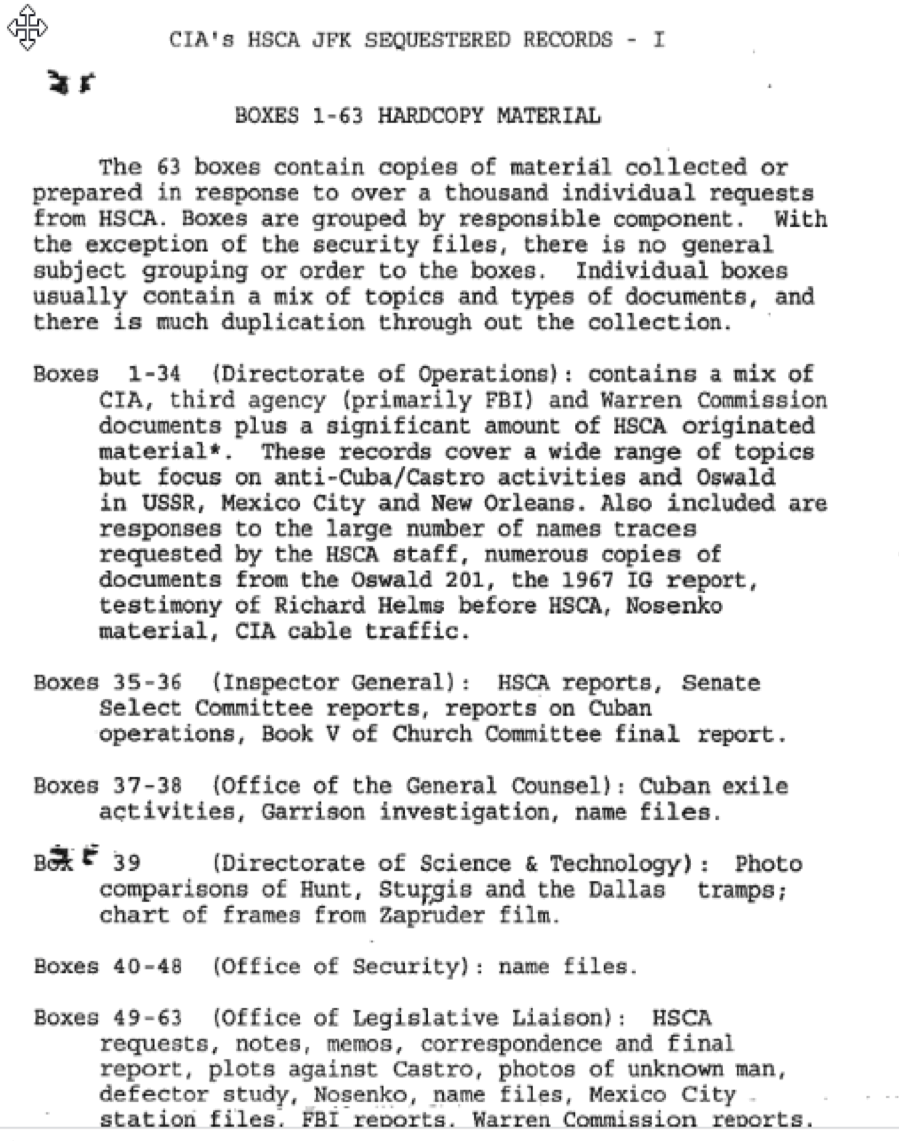
    In 1996, the CIA handed over 64 boxes of material to the AARB that they had provided to the HSCA. A description of their contents can be found in ARRB files, in them you will see some focus on events, 201 files, and individuals of interest to the JFK assassination, but almost nothing on organizations of interest:
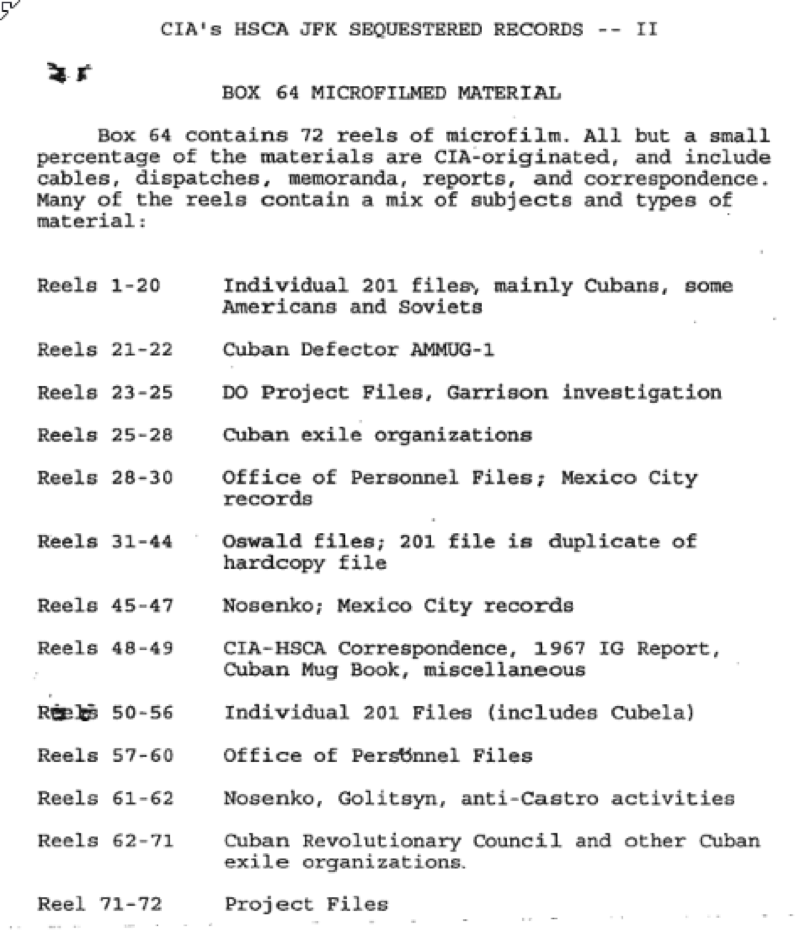

    Relatively little has been done to connect the dots on the role organizations may have played wittingly or unwittingly in the coup.

    We know that many organizations in Oswald’s orbit had links to intelligence including the Riley Coffee Company, the FPCC, Banister and Associates, Albert Schweitzer College, Alpha 66, the DRE, INCA, WSDU, and the Texas School Book Depository. Permindex and the International Trade Mart connect to both Clay Shaw and intelligence. Sullivan and Cromwell, United Fruit, Freeport Sulphur, and a number of other movers and shakers, as well as countless media organizations, were known to have hovered around U.S. security endeavors during the Dulles reign. They, of course, prefer that this dark history exclude their names, which was accomplished by the lone nut tale peddled by the Warren Commission. Knowing more about some of these interests would help us understand Oswald’s murky path that allowed puppeteers to “place him” strategically in the right spot at the right time to become a patsy.

    For instance, it is impossible to imagine that the FPCC does not have a very thick file, given the surveillance programs of this outfit by both the FBI and CIA and its heavy infiltration by informants. Imagine if we could know more about who the informants were and their supervisors from the CIA and FBI.

    Gary Hill in his book “the Other Oswald” explores the strange case of Robert Webster, who defected to Russia and returned to the U.S. at nearly the same times as Oswald. He shows how the Rand Development Corporation, Webster’s employer, is closely linked to intelligence, MKULTRA, and Webster’s saga.

    In this article, he expands on his research on Rand and demonstrates just how much we could learn by understanding organizations Oswald and other of the main characters are linked to.

    RAND Corporation

    The RAND Corporation’s the boon of the world,

    They think all day long for a fee,

    They sit and play games about going up in flames,

    For Counters they use you and me.”[1]

    In researching my book on Robert Webster[2], The Other Oswald, A Wilderness of Mirrors, I came to see that Webster’s employer, Rand Development Corporation, and his boss, Dr. Henry J. Rand, played important roles in determining Webster’s destiny. Their shadowy presence, always lurking behind the scenes, permeates his story. I decided to try to find out what this mysterious organization was about and why it was manipulating this easily influenced man.

    Although Anthony Summers[3] labeled Rand Corporation as Rand Development’s parent company, I was unable to find any connection between the two companies.
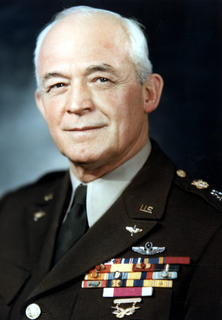
    General H. H. “Hap” Arnold

    Rand Corporation’s website describes its 1948 origins as follows:

    As [WWII] drew to a close, it became clear that complete and permanent peace might not be assured. Forward-looking individuals in the War Department, the Office of Scientific Research and Development, and industry thus began to discuss the need for a private organization to connect military planning with research and development decisions.

    Commanding General of the Army Air Force H. H. “Hap” Arnold articulated this need in a report to the Secretary of War:

    “During this war, the Army, Army Air Forces, and the Navy have made unprecedented use of scientific and industrial resources. The conclusion is inescapable that we have not yet established the balance necessary to insure the continuance of teamwork among the military, other government agencies, industry, and the universities. Scientific planning must be years in advance of the actual research and development work.”

    Other key players involved in the formation of this new organization were Major General Curtis LeMay; General Lauris Norstad, Assistant Chief of Air Staff, Plans; Edward Bowles of the Massachusetts Institute of Technology, consultant to the Secretary of War; Donald Douglas, president of the Douglas Aircraft Company; Arthur Raymond, chief engineer at Douglas; and Franklin Collbohm, Raymond’s assistant.

    The name of the organization? Project RAND.

    Curtis LeMay

    Similar to the Russians’ “doomsday machine” in the satirical movie, Dr. Strangelove, RAND was to be a machine whose purpose was to fuel the fires of the cold war through research and development and inter-agency cooperation. The involvement of General Curtis LeMay[4] in such a project is no surprise. It was LeMay who was responsible for promoting RAND as his own project. It is apparent that the Air Force seems to have played a major role in the birth of RAND and oversaw its operations in the early years.

    Wikipedia lists the birth of RAND Corporation as 1945, not 1948 as RAND’s website declares. However, its actual charter is dated March 1, 1946. Wiki says:

    RAND was created after individuals in the War Department, the Office of Scientific Research and Development, and industry began to discuss the need for a private organization to connect operational research with research and development decisions. On 1 October 1945, Project RAND was set up under special contract to the Douglas Aircraft Company and began operations in December 1945.

    Since the 1950s, RAND research has helped inform United States policy decisions on a wide variety of issues, including the space race, the U.S.-Soviet nuclear arms confrontation, the creation of the Great Society social welfare programs, the digital revolution, and national health care. Its most visible contribution may be the doctrine of nuclear deterrence by mutually assured destruction (MAD), developed under the guidance of then-Defense Secretary Robert McNamara and based upon their work with game theory. Chief strategist Herman Kahn also posited the idea of a “winnable” nuclear exchange in his 1960 book On Thermonuclear War. This led to Kahn being one of the models for the titular character of the film Dr. Strangelove, in which RAND is spoofed as the “BLAND Corporation.”

    Pravda labeled RAND as the American “Academy of Science and Death.”

    By its own definition, it is apparent that RAND’s purpose was to serve the Military Industrial Complex.

    Rand Development Corporation

    Rand Development is a more elusive entity. When I first saw that there was no mention of Rand Development in the history section of the RAND Corporation website, I thought that it was because of its involvement with the MKULTRA project. Or maybe because an employee, Robert Webster, defected while working on a Rand Development project in the Soviet Union. Or it could be because Rand Development went bankrupt in 1972 and no longer exists.

    Whereas RAND Corporation’s name came from the initials of “Research ANd Development,” Rand Development got its name from its founder, James Henry Rand III also called H.J. Rand.
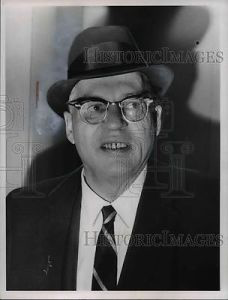
    H. James Rand

    Dr. James Rand III,[5] turns out to be an extremely fascinating entrepreneur.

    James set up the Rand Development Company in 1950 with the primary aim to devise medical devices to benefit patients. He developed the first artificial larynx, which enabled an East Cleveland policeman to be reinstated in his job afterward.

    By 1951, at age 38, Rand had 100 inventions to his credit. These included: the mechanical respirator, a tank respirator that replaced the bulky iron lung, an oxygen regulator for aircraft, a pulsating air mattress to eliminate bedsores, a plastic shoe sole, and a completely mechanized wheelchair that could be operated by mouth.

    Rand also invented the Bendix automatic washer, the first Remington shaver, a non-leaking faucet valve, and a metal-impregnated cloth called Milium, used to line coats. He was also a co-inventor of a defibrillator and a respirator for chest surgery.

    Rand Development prospered under James Rand. The company was even featured in a cover story in Business Week magazine in 1956.

    James worked in the mid-1960s on a controversial cancer vaccine and began marketing it in 1966. In 1967, the federal government took his firm to U.S. District Court and won a ban due to not enough testing on animals first and manufacturing they determined was performed under unsanitary conditions. They banned the vaccine’s manufacture and use in the United States. The cancer vaccine never became available to the public. The trial was fraught with desperate cancer patients pleading for continued use of the vaccine.

    In 1968, a federal grand jury indicted Rand Development on charges of stock manipulation and mail fraud. Those charges were later dropped in 1970, because they were based on the 1967 vaccine ban case that Rand had testified in and violated his right against self-incrimination.

    An improved version of the vaccine was later tested in Mexico and showed some excellent results, as Rand said in a 1977 interview. The results of the tests had been published in Austria, but not accepted in this country.

    Rand Development went bankrupt in 1972, and the assets, contents of labs, and offices were sold at auction.

    According to his obituary,

    James Henry Rand III was born on February 23, 1913, in Pelham, New York, to James Henry Jr. and Miriam Rand. He was a brilliant young boy for whom conventional schooling was inadequate. At age thirteen, Rand ran away from Peekskill Military Academy in New York, where he felt he would not learn anything new in science. He jumped a freight train and emerged from the boxcar in Cleveland, where he spent two weeks living at the Salvation Army before he was caught and returned to his family.

    He returned to the military academy, which he completed in two years instead of the usual four. He spent a year in Europe, first at the University of Vienna and the University of Berlin. He enrolled at the University of Virginia at age 16 using two names: H. J. Rand and James H. Rand, to complete both his freshman year and his first year of Medical School.

    James elected not to work at his father’s business, Remington Rand. While in his early twenties, he put together a chain of fifty-eight radio stations, that was later taken over by a larger company. His first invention was an instrument to mix the cabin atmosphere in the airplane with hydrogen, enabling pilots to get the correct mix of oxygen while flying. He sold this to the Bendix Corporation, who also hired him, where he worked out several inventions, including the automatic washing machine and the Remington electric shaver for Remington Rand, his father’s firm.

    James Rand had a distinguished World War II record. He worked as a spy with the French underground until 1942, when he joined the Army Air Corps and the Office of Strategic Services. He worked in the White House map room until presidential aide Harry Hopkins discovered that he was the son of a prominent Republican and was banished.

    He then became assistant chief of guided missiles, assigned to the guided missiles section in Sicily and Italy; he captured several enemy radar stations. Before the capitulation of Berlin, Rand, as a member of a secret mission, entered the city and brought out several German scientists to America.

    As a lieutenant colonel in the U.S. Army, Rand flew the first plane to carry guided missiles in combat and received many decorations, including the Legion of Merit, the Bronze Star, ten battle stars in the European Theater, and the Merit Ribbon.

    Rand was past president of the Cleveland Museum of Natural History and chairman of the 1949 heart campaign. Bethany College gave him an honorary doctorate and the Cleveland Jaycees named him 1949 Young Man of the Year. He founded the Cleveland Heart Society in 1953, as well as the National Inventors Council.

    His wife Mary filed for separation in 1969, stating that her husband was guilty of gross neglect of duty. Rand had not paid her support money or given her funds to operate the home. He later married Martha Osborne.

    James, who had diabetes since the age of 38 and also was using a heart pacemaker since 1974, died on November 6, 1978, of abdominal cancer, the disease he tried to conquer. He had used his cancer vaccine on himself.[6]

    Rand and the Intelligence Community

    Rand’s wartime connections to the Army Air Corps and the Office of Strategic Services explains his close links to the CIA and Air Force intelligence, ATIC, after the war. His OSS secret mission, rescuing German scientists from Berlin in 1945, links him to Operation Paperclip and Allen Dulles. Later, Rand Development Corporation became a CIA proprietary.

    President, James “Henry” Rand, and top executive, George Bookbinder, had served together in the O.S.S., the forerunner of the CIA. Bookbinder worked under Frank Wisner[7] in Bucharest during the war.[8] He had close ties to the Rockefeller-owned Chase Manhattan.[9] Rand’s Washington representative Christopher Bird was a self-admitted agent of the Central Intelligence Agency.

    The CIA ties to the Rand Development Corporation were exposed in 1968, when the Department of Interior conducted an expense inquiry into an anti-pollution contract between the Rand Development Corporation and that Agency. A Congressional Expense Inquiry showed that Rand Development held several CIA contracts. Doctor H.J. Rand was one of the first to undertake negotiations with the USSR for the purchase of technical devices and information on behalf of the Agency. An FBI Memorandum[10] tells of Sperry-Rand[11] developing an ink that “came out only under certain light.” The same document reveals that H.J. Rand received an $80,000 fee for the part he played in a law suit undertaken by the U.S. Department of Justice against the USSR. At this time, Rand Corporation was also conducting detailed studies of the Soviet economy in order to find out what proportion of the Russian GNP went into national defense.

    It would seem to me that “invisible ink” might be used as a tool for spying. In fact, it’s hard to think of many other applications it would be useful for.

    At the time of the U2 incident involving Francis Gary Powers, H.J. Rand had been trying to get the Russians to take out U.S. patents on several devices, including a sleep-inducing electric pulse generator he said would be very useful in surgery on patients whom anesthetic drugs are dangerous. Once the Russians took out the patents, Rand would buy the patents and market the Soviet products in the United States. However, the negotiations ended when Rand’s Russian offices were shut down in fallout of the U2 incident.

    George H. Bookbinder, New York Times, November 15, 1959

    Powers being shot down also foiled a plan to abduct Robert Webster—who had defected while working for Rand Development in 1959—and get him out of Russia in H.J. Rand’s car. Rand had left his car in the Soviet Union and planned one “last trip” to Moscow to bring the vehicle back. Accompanying Rand on the trip would be his usual sidekick, George Bookbinder, and also Dan Tyler Moore. Moore, whom Rand was reluctant to contact because of his erratic behavior and connections to journalist Drew Pearson, was his brother-in-law. Moore, formerly OSS, lived in Cleveland and was, at one time, affiliated with The Middle East Company. The branch office of the Middle East Company located in Turkey was referred to by the Soviets as a US Intelligence Operation. Rand described Moore as “a flamboyant type who is willing to try anything once or twice.” Rand’s hair-brained abduction scheme was never pulled off, due to the Powers incident that resulted in a tightening of security on all things American. The same document (the Grant-Gleichauf telecon) relating to Moore contains a provocative statement, “…the purpose of this notification is to provide some warning that an accident may be on its way to happen.” What accident? This document was dated May 4, 1960. Could the accident be the Powers downing? Were they anticipating this happening ahead of time? The event happened on May 1. This document is dated May 4, so it had already happened. However, as Bill Simpich believes, the key is the April 26 letter, that makes it clear they were planning to get Webster out of Russia over the weekend. It is credible that these words were spoken before May 1. In State Secret, Bill  writes:

    On April 26, Rand called the CIA Cleveland field office and told them that he and Bookbinder were heading to Moscow in the next ten days to try to get Webster out. On April 28, the CIA Miami chief got the word that Rand, Bookbinder, and their colleague Dan Tyler Moore were heading for Moscow. Like Rand and Bookbinder, Moore was ex-OSS. Moore was also the brother-in-law of Washington Post columnist Drew Pearson and had the savvy to put together a plan to smuggle Robert Webster into Rand’s car and out of the USSR. The Miami chief ended his message by saying that his note was ‘some warning that an accident may be on its way to happen.’ The plan was to smuggle Webster out on May 4.

    Anthony Ulasewicz, a field officer of Nixon’s White House/Special Operations Group, described his first meeting with Nixon counsel and crime boss, Murray Chotiner: “When I first met Chotiner, the first thing he did was hand me a file on Rand Development Corporation and its officers.” Chotiner’s file on the Rand Development Corporation disclosed that, during the 1968 presidential campaign, Rand was named as a defendant in a lawsuit started by some angry Minnesota businessmen. The charge was that the Small Business Administration and the Government Services Administration were guilty of fraud and conspiracy in the way a government contract for some postal vehicles was awarded to a wholly-owned Rand Development Corporation subsidiary, the Universal Fiberglass Corporation. The Universal Fiberglass Corporation, the lawsuit charged, was born for the sole purpose of obtaining this contract. “Despite apparent lack of qualifications, a crony of Senator Hubert Humphrey awarded the contact to the Universal Fiberglass Corporation. The Universal Fiberglass Corporation defaulted and disappeared under Rand Development’s umbrella.” Murray Chotiner was trying to bring this situation to the attention of the media.[12]

    But the CIA was not the only intelligence agency connected to Rand Development. Air Force Intelligence, ATIC, also worked closely with them in projects dealing with the Soviet Union.

    An FBI memo states, “In as much as James H. Rand, President of the Rand Development Corporation, Cleveland, OH, is cooperating with the U.S. Air Force in obtaining information from the Soviets, it is possible that Rand has already furnished information to the Air Force bearing on this matter.”[13]

    H.J. Rand’s father was Vice President (chairman) on the board of Sperry-RAND, which also worked closely with the United States Air Force. Sperry-RAND had initially funded the Rand Development Corporation. James Rand III was a twin son of Remington-Rand founder James Henry Rand Jr. who turned over the operation of Remington Rand in 1958 (which had previously merged with Sperry Corp), to James’s twin brother Marcell. Vice-president of research and development for Remington-Rand in those years (1948–1961) was the former chief of the Manhattan Project, General Leslie R. Groves. Among other sundry defense contracts, Remington-Rand was collaborating with Bell Labs on nuclear missile guidance systems.

    Internal memos from the CIA requested by the HSCA investigation note that Rand and Bookbinder had traveled previously in 1958 to the USSR with “Brigadier General” W. Randolph Lovelace, an eminent physician with Atomic Energy Commission contracts who co-founded the Lovelace Clinic in Albuquerque New Mexico. One memo reads: “For your information, only Rand, Bookbinder, and Lovelace have had frequent contact with Soviet officials both in the United States and the USSR, including Mikhail Ilich Bruk, formerly with the Soviet Ministry of Health, who was identified by AEDONER [Yuri Nosenko] as an agent of the KGB.”

    When Robert Webster defected in 1959, he did so as an employee of Rand Development at a Moscow Trade Exhibition. On October 17, 1959, Webster was living in Moscow. He attended a meeting at the central office, visas and registration (OVIR); with the original Soviet representative he had contact with, an unknown Soviet, H.J. Rand, his assistant George H. Bookbinder, as well as Richard E. Snyder of the U.S. Embassy. Webster stated he was free to speak and told Snyder when he had applied for Soviet citizenship that he had been granted a Soviet passport on September 21, 1959. He filled out a form entitled “Affidavit for Expatriated Person” and wrote his resignation to Rand Development Corp.

    While it is possible that Webster may have been a witting asset in a false defection stratagem, his pre- and post-Russia odyssey behavior and treatment lead me to believe that, unlike Oswald, he was a genuine, albeit confused defector, who went to Russia, not for ideological reasons, but mostly to escape a complicated personal life at home. We may never know for sure.
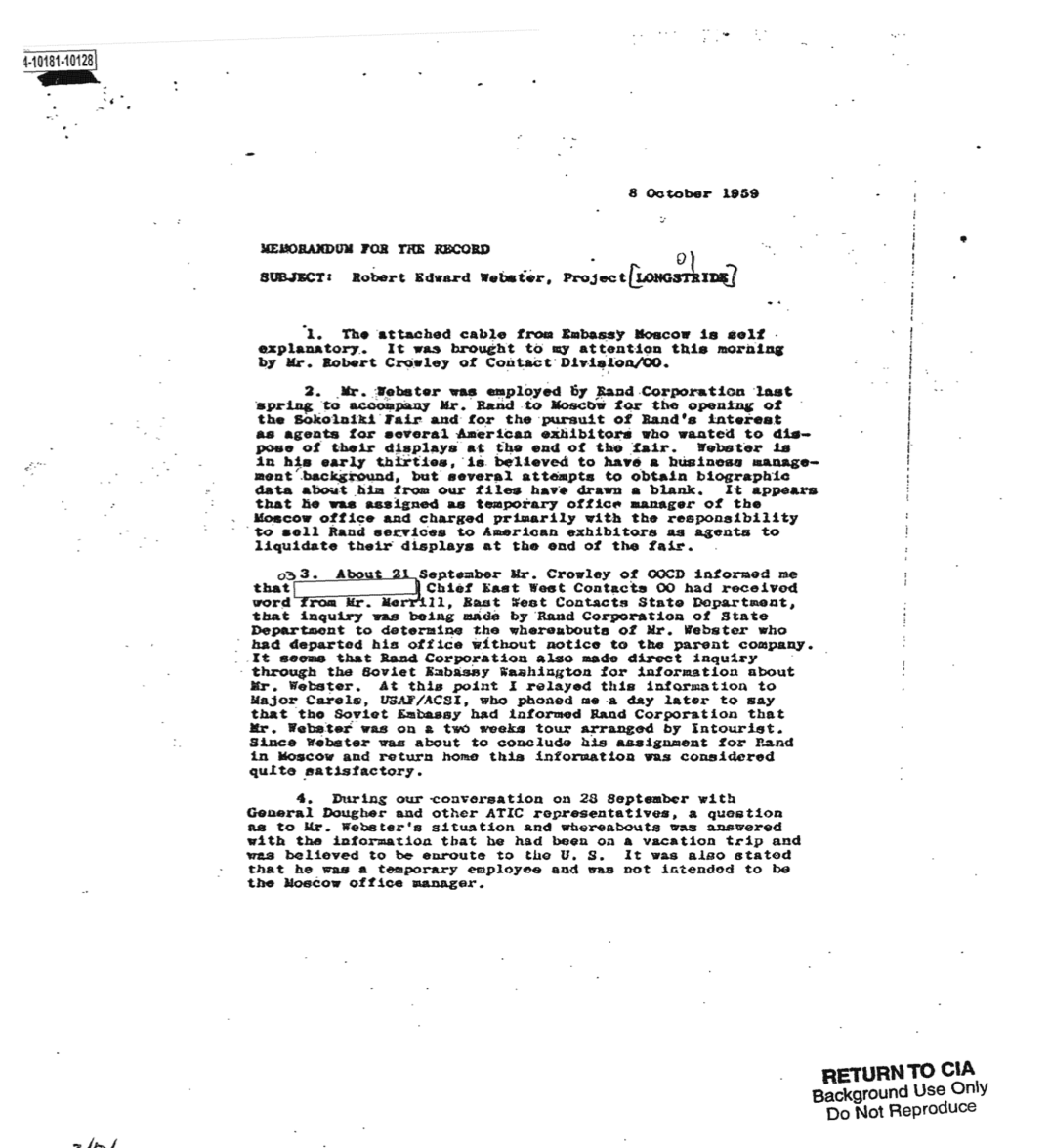
    My research further revealed that Webster was part of an ATIC project called LONGSTRIDE. Internal CIA memos revealed that Webster was known as “Guide 223” and fellow Rand Development employee Ted Korycki was known as “Lincoln Leeds.” The fact that the CIA approached ATIC at the Moscow Fair, rather than Rand Development itself, indicates inter-agency cooperation.

    Rand’s liaison with ATIC was Major Joseph Carels. In light of the recent revelation of Webster’s role in Project LONGSTRIDE, it appears that Carels was lying when he advised that Air Force Intelligence Headquarters had no information regarding Webster. As a result of a teletype inquiry by Carels to Air Technical Intelligence Center (ATIC), Wright-Patterson Air Force Base, Ohio, (this organization handles covert projects of AF), Carels was advised that the subject was an employee of Rand Development who could not be located and thus was reported as missing. The message stated that the subject has taken a 20-day in-tourist tour to Kiev. “Subject (Webster) is a technician and is not witting or involved in ATIC[14] activities.”[15] Rand Development Corporation’s connection to the U.S. Air Force at the Moscow Fair may have been unknown to Webster, however it is likely that Webster’s movements were likely being choreographed by Air Force intelligence, whether he knew it or not.

    Dr. Rand was obviously a source for ATIC as is indicated by an AIRTEL TO BUREAU NY 105-37687 stating: “Inasmuch as James H. Rand, President of Rand Development Corporation, Cleveland, Ohio, is cooperating with the Air Force in obtaining information from the Soviets it is possible that Rand has already furnished information to the Air Force bearing on this matter.”

    Another FBI memorandum states; “Rand cooperates with Air Force Intelligence on technical intelligence projects.”[16]

    An area that needs more research is that involving the connections of Sylvia Hyde Hoke, the sister of Ruth Paine. Sylvia, a psychologist, was employed by the Air Force as a “Personnel Research Technician.”[17] It was the Personnel Research branch of the Air Force that implemented Project LONGSTRIDE, of which Webster was involved. Hoke was also employed by the CIA since at least 1961. Perhaps it is just a coincidence that the two Hyde sisters are somehow linked with the two defectors, Oswald and Webster. The same two that James Angleton was dangling to the Soviets in his mole hunts?

    There also seem to be connections between the elusive triad of espionage entities (CIA, ATIC and Rand Development) and experiments in behavior and mind control.

    The CIA’s MKULTRA projects are well known. But what is known of the role of Rand Development and ATIC’s in this murky misadventure of controlling human minds?

    Rand Development’s Washington representative, Christopher Bird, served as ‘Biocommunications Editor/ Russian Translator’ for Mankind Research Unlimited, Inc., a Washington think-tank specializing in parapsychology and other behavioral sciences.  Dick Russell reports that “MRU’s Company Capabilities list included brain and mind control…acquiring on a daily basis, a large amount of unique bio-cybernetics data from Eastern Europe.”[18]

    According to CIA psychiatrist, Dr. Louis Jolyon (Jolly) West,[19] ATIC and Rand Development worked closely together in behavior modification research. He claimed that Air Force Intelligence, like the CIA, was also involved in mind control research projects. West himself, although he initially denied it, was conducting LSD research under the MKULTRA banner.

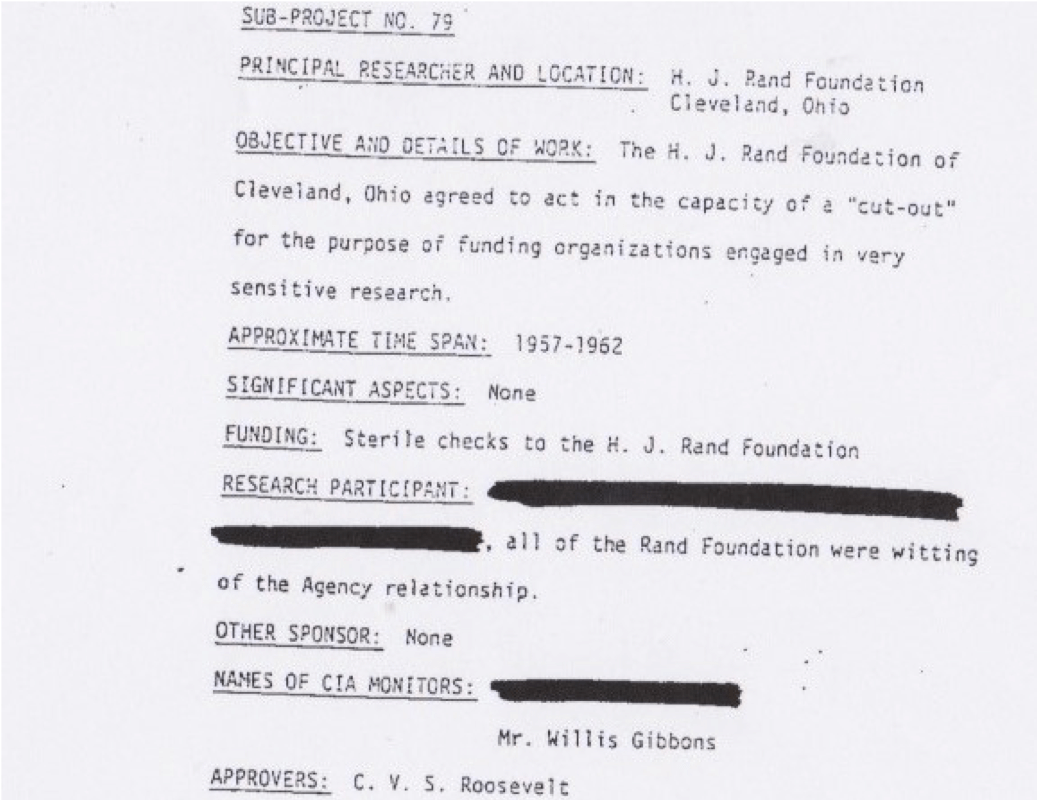
    It is now clear that the H.J. Rand Foundation was a part of MKULTRA SUB-PROJECT NO. 79. The document below lists Rand as a “cut-out” for the purpose of funding organizations engaged in very “sensitive” research. The document is dated 1957–1962, the very time in which Robert Webster was employed by Rand. It encompasses his defection and return from Russia (59–62). Also, this is the same time period of Oswald’s Soviet odyssey. It also states that “all” of the Rand Development’s participants were witting of the agency (CIA) relationship. That would include plastic’s expert Robert E. Webster. Note that this document is approved by C.V.S. Roosevelt.

    Roosevelt, grandson of Theodore, who served as the chairman of the Technical Surveillance Countermeasures Committee, which involved securing American facilities against electronic eavesdropping. Richard Bissell’s testimony during the Church Commission, as well as CIA source documents, connect Roosevelt directly to plans to poison Castro. Roosevelt, as a head of the CIA technical division, was Sidney Gottlieb’s supervisor. According to Roosevelt, his work for the CIA mainly involved creating devices to detect listening devices. He also mentioned that he took part as a subject in the CIA experiments on LSD as part of MKULTRA. Retiring from the CIA in 1973, he served in retirement as a defense consultant and on the board of Aerospace Corporation.

    Further evidence of Rand Development’s involvement in MKULTRA is their 1958 study revealing that, “a defensive use for hypnosis was a more practical use than the previously sought offensive goal of a Manchurian Candidate.”

    NARA Record Number: 157-10014-10093

    TESTIMONY OF RICHARD BISSELL, 10 SEP 1975


    RAND Corporation was the CIA think-tank where Daniel Ellsberg copied the Pentagon Papers. According to the New York City phone directory, Rand Corporation and Rand Development were located on opposite sides of Lexington Avenue in New York City. However, this seems to have been a deception.

    Researchers Alan J. Weberman and Michael Canfield visited the address of Rand Development Corporation listed in the NYC phone directory. The building registry had no listing for Rand Development Corporation. The doorman told them that he had worked there for 33 years and there had never been a Rand Development Corporation in the building. He suggested they go to Rand Corporation across the street at 405 Lexington Ave. From what I could find, RAND’s NYC office was part of a HUD study group for LBJ’s Great Society described as an Urban Institute.

    Another odd coincidence involving the Air Force is that four of Oswald’s fellow employees at Reily Coffee went on to employment with NASA. Oswald himself cryptically hinted that working there might be in his future. He told Adrian Alba, proprietor of the Crescent City Garage next door to the Reily Coffee Co. in New Orleans, that he had “found his pot at the end of the rainbow,” and that he expected to get a job at NASA in New Orleans. As stated, four of Oswald’s coworkers at Reily did get jobs at NASA in New Orleans within weeks of his departure.[20] However, by the time he had returned to Dallas, in the fall of 1963, he was telling his landlady, Mary Bledsoe, that he would soon be working for Collins Radio, a CIA front company deeply involved in the military industrial complex.[21]

    In fact, it is obvious that Oswald had ties or links to an array of CIA/Military Industrial Complex friendly companies; Collins Radio, NASA, Reily Coffee, Guy Banister Associates, Jaggars-Chiles-Stovall, and perhaps the TSBD.[22] In addition, he wrote or belonged to organizations being investigated by the FBI and CIA; the FPCC, the American Civil Liberties Union, C.O.R.E., and the American Communist Party. In addition, Oswald was as an underage worker with the Gerald F. Tujague Inc., a freight broker on the New Orleans water front. Tujague was a friend of Guy Banister.  In addition, Tujague was Vice President of the Friends of a Democratic Cuba. The purpose of the FDC was to raise funds for the CIA-backed Frente Revolucionario Democratica (FRD-Cuban Democratic Revolutionary Front.) Tujague told FBI agents that Oswald was in regular contact with the U.S. Customs Export Office, yet another government agency.

    Summary

    In essence, RAND Corporation rose out of the ashes of WWII. The Manhattan Project had shown that pooling the best minds; scientists, physicists, mathematicians, and technicians had resulted in a huge leap forward in weapons development. The prospect of these great thinkers going back to work in the private sector was anathema to Hap Arnold, the only five-star general in the Air Force. He and Franklin R. Collbohm became the fathers of the RAND PROJECT. But it was General Curtis LeMay who took the project by the horns and became its godfather. Subsidized and more or less subservient to the Air Force, the project arose out of the Air Force’s interest in developing intercontinental ballistic missiles. In addition to General Arnold, key players involved in the formation of Project RAND were: Edward Bowles of M.I.T., a consultant to the Secretary of War; General Lauris Norstad, then Assistant Chief of Air Staff, Plans; Major General Curtis LeMay; Donald Douglas, President of Douglas Aircraft Company; Arthur Raymond, Chief Engineer at Douglas; Franklin Collbohm, Raymond’s assistant.

    The RAND (Research And Development) Corporation of Santa Monica, California, began as a United States Air Force Project in 1945 under contract to the Douglas Aircraft Company. Its broadly defined function was to study American national security and, in particular, the role of airpower in that context. Three years later, the Ford Foundation endowed RAND as a private, nonprofit research corporation “to further and promote scientific, educational and charitable purposes” to the nation’s general benefit. As one of the first American “think tanks,” however, its staff focused primarily on military and strategic issues funded by the U.S. government. For the first two years of its existence, RAND allocated the lion’s share of its Air Force research funds for applied science projects to subcontractors like Bell Telephone, Boeing Aircraft, and Collins Radio Company.[23] Other RANDites who would later play a role in American politics include: Condeleezza Rice, Dr. Luis Alvarez, and Donald H. Rumsfeld, who at one time was Chairman of their Board of Trustees.

    Rand Development was a separate entity used primarily by the CIA, but also working closely with Air Force Intelligence (ATIC). The areas of the corporation’s usefulness included information related to the Soviet economy and military budget; negotiations with the USSR for the purchase of technical devices and information on behalf of the CIA; cooperation with Air-Force Intelligence on technical intelligence projects such as LONGSTRIDE; and acting as a CIA “cut-out” in an MKULTA sub-project defined as funding of organizations involved in very sensitive research. This research included mind and behavior control, a subject of interest to both the CIA and ATIC. In return, Rand received financial rewards through favoritism in the securing of government contracts, as well as a monopoly in being allowed negotiations involving Soviet technology.

    My research on Robert Webster led me to believe that H.J. Rand was not only his boss, but his close friend and mentor. Their relationship was very similar to that of Oswald and George de Mohrenschildt. I doubt if we will ever know whether James Rand played any role in encouraging Webster to defect or connecting him, knowingly or unknowingly, with an ATIC project (LONGSTRIDE). But it seems odd that Webster, a man with no connections to the Air Force (an ex-navy man), was involved in this Air Force Intelligence project while in the Soviet Union. In addition, he became a Soviet citizen. Think about it. A defector who gave up his U.S. citizenship to become a Soviet citizen is now part of a U.S. intelligence project? If he was aware of this he could be defined as an American spy or at the very least some kind of dangle.


    Bibliography

    Conspiracy, Anthony Summers, McGraw-Hill Book Co., 1980.

    Soldiers of Reason, Alex Abella, Mariner Books, 2008.

    The Man Who Knew Too Much, Dick Russell, Carroll & Graf Publishers, 1992.

    The Other Oswald, A Wilderness of Mirrors, Gary Hill, TrineDay, 2020.


    [1] The Rand Hymn, by Malvina Reynolds

    [2] “The Other Oswald, A Wilderness of Mirrors,” Gary Hill, TrineDay 2020. www.theotheroswald.com

    [3] Summers says: “Rand Development Corporation was formed by the Rand Family. The name ‘Rand Corporation’ is a title made from the contraction of the words ‘Research and Development.’” It seems he may have linked the two unintentionally by inference of name. Also, Dick Russell, in his book The Man Who Knew Too Much, said: “Like its parent, Rand Corporation, it (Rand Development) also held several CIA contracts.” The footnote for this statement reads: Rand Development ties; WCE915, WC XVIII, HI 13; Summers Conspiracy pp 177–178. But the WCE915 document says nothing about Rand. It is a letter from Richard Snyder to the State Department about citizenship of defectors.

    [4] It was LeMay that was responsible for the firebombing of Tokyo in WWII that resulted in the deaths of 100,000 civilians. These were mostly women, children and old men. It was also he that proposed a first strike on the Soviet Union during the Kennedy administration. His take was that we would only lose 30 or 40 million Americans. That, he felt, was an acceptable sacrifice. In his book, The Fog of War, he was quoted as saying, “If we had lost the war, we’d all have been prosecuted as war criminals.”

    [5] Also known as H.J. Rand.

    [6] https://bratenahlhistorical.org/index.php/james-rand/

    [7] In the OSS Wisner was transferred to Germany where he served as Liaison to the Gehlen Organization. Later, in the CIA, he ran the Office of Special Projects (OSP), which later became the Office of Policy Coordination (OPC). J. Edgar Hoover called the OPC “Wisner’s Weirdos.”

    [8] NYT 6.15.59; Smith OSS Univ. of Calif. Press London 1977, p. 397.

    [9] State Secret, Chapter One, Bill Simpich.

    [10] See this document in appendix C of “The Other Oswald, A Wilderness of Mirrors, Gary Hill, TrineDay, 2020. www.theotheroswald.com

    [11] Rand III’s father (James Rand Jr.) founded American Kardex, an office equipment and office supplies firm which later merged with his father’s (James Rand Sr.) company, the Rand Ledger Corporation. Rand later bought out and merged with several other companies, notably the Remington Typewriter Company, to form Remington Rand. In 1955, Rand merged his corporation with the Sperry Corporation to form Sperry-Rand, one of the earliest and largest computer manufacturing companies in the United States.

    [12] Ulasewicz, Pres. Priv. Eye, 1990.

    [13] 124-10210-10354

    [14] ATIC later evolved into NASIC.

    [15] Memorandum from P.H. Fields to F. A. Frohbose 105-81285-3.

    [16] 124-10210-10354

    [17] NARA Record Number: 1993.07.24.08:39:37:560310-FB1105-1261128-7,12/12/63; also, CIA memo dated 7/30/71 claims Hoke a CIA employee since 1961.

    [18] Ibid from A.J. Weberman “Mind Control: The Story of Mankind Research Unlimited, Inc.” CovertAction (June 1980), p. 17.

    [19] “Jolly” was appointed by the court in his capacity as a brainwashing expert in the Patty Hearst trial and worked without a fee. Believing that Hearst displayed all the classic signs of coercion and brainwashing, after the trial, he wrote a newspaper article asking President Carter to release Hearst from prison. West also visited Jack Ruby several times in his jail cell along with Dr. Robert Stubblefield, who was also involved in the MKULTRA program. What went on in that cell, no one knows. But Ruby was suddenly found insane.

    [20] In Deadly Secrets, Warren Hinckle and William Turner write, “Oswald told Adrian Alba, the owner of the garage next door to where he was working, that his application was about to be accepted ‘out there where the gold is’—the NASA Saturn missile plant in suburban Gentilly. NASA of course didn’t employ security risks. But tucked into its Gentilly facility was an active CIA station that provided a Kelly Girl service for operatives in between assignments” (p. 239). The endnote reads, “The CIA’s practice of providing interim employment for its agents and assets is well known,” The passage in Turner repeats the familiar statement from Adrian Alba, then adds, ”On the face of it, the idea that [the Marxist] Oswald could get a job at a space agency installation requiring security clearance seems preposterous…But [Jim] Garrison pointed out that it is an open secret that the CIA uses the NASA facility as a cover for clandestine operations.”

    [21] Bledsoe on Oswald’s activities: 6 WCH 404 and Oswald on Collins Radio WCE-1985.

    [22] Another possible link he made was his travel arrangements on the first leg of his trip to Russia through “Travel Consultants,” a New Orleans based travel agency also used by Clay Shaw. On the agency’s questionnaire he gave his occupation as “shipping export agent.”

    [23] See chapter 12—“The Other Oswald, A Wilderness of Mirrors,” Gary Hill, TrineDay 2020, for Collins links to the JFK Assassination.

  • Gary Hill’s The Other Oswald:  A Wilderness of Mirrors

    Gary Hill’s The Other Oswald: A Wilderness of Mirrors


    Summary

    This book is a worthwhile read for a mature JFK assassination research audience.

    The author is quite knowledgeable and has shown himself to be proficient at information gathering from mostly a smart selection of credible work performed by serious JFK assassination researchers, documentary proof, collaborations with other solid researchers, and adding his own personal sleuth efforts in the form of interviews of people of interest.

    Gary Hill’s instincts and logical construction are mostly solid, but at times flawed.

    The book is important, because of its focus on “defector” Robert Webster and his comparative analysis value to Oswald, as well as the author’s attempts to explain the murder in an all-encompassing manner based on some of the most recent information available.

    The author offers many footnotes and presents a large number of photos as well as documents that support his writings. A number of the footnotes, however, do not really help researchers access key sources and some important points that are made are written in a vague manner. The basis on which the author forms his conclusions are at times tenuous and hard to follow.

    There are a large number of chapters that barely mention Webster.

    Because the book is so full of information, which is sometimes put out without proper context, seasoned researchers may learn a lot, beginners, however, may be confused.

    Gary Hill exposes himself to criticism by at times referencing controversial writers and anecdotes that have been mostly discredited—which could be used to undermine his mostly solid rationale.

    Like most of us who have written about the case, the author could have used additional layers of editing to weed out errors of grammar, minimize risky affirmations, and add clarity to certain explanations.

    In terms of understanding the big picture of what really happened on November 22, 1963, Warren Commission apologists including most journalists and history book writers deserve a score of 0 on ten, Gary Hill deserves at least an 8.

    Introduction

    When I was asked to review this book, I was intrigued by the subject matter. My knowledge of Robert Webster was sketchy at best, yet I always felt that his story could be important. There were only a handful of Americans who set foot on Soviet soil before the early sixties and there was a false defector program going on that most likely included Oswald:  the fact that Webster entered and departed Russia at around the same time as Oswald is significant. This book could perhaps reveal similarities or differences between the two that could bolster the case that Oswald was an intelligence asset.

    While writing one of my articles for Kennedysandking.com, I came upon an interesting piece about how U.S. intelligence reacted when two genuine defectors, National Security Agency (NSA) officials Bernon Mitchell and William Martin, committed treason against their country and defected to Russia. They left no stone unturned in their investigation that required thousands of man-hours in detective work and damage control. Even though Oswald worked at the Atsugi intelligence base in Japan as a radar operator for the prized U2 spy planes, the post defection investigation of him was cursory at best—a sure sign that something fishy was going on.

    Was Webster an intelligence asset? Had he really met and associated with Marina Prusakova? What were his background and M.O.? What became of him upon his return? Who, if anyone, was running him?

    Otto Otepka was kicking a hornet’s nest when, in 1960 as head of the State Department’s Office of Security, he began querying the false defector program. The Oswald file was a hot potato. Otepka’s career spiraled downwards shortly after his insistent efforts. What could we find out about the other false defectors? According to Mary Ferrell: “The CIA did admit privately to HSCA staff that at least one officer named Thomas Casasin had ‘run an agent into the USSR’ and, like Oswald, this agent had come back with a Russian wife.”

    Like the author, I strongly believe in the common threads approach to solving who was behind the Kennedy assassination. This is why the analysis of prior plots and alternative patsies has occupied a large part of my analysis and writing. I am of the opinion that there is a template that points to the same puppeteers who were stringing Oswald along.

    This rationale applies elsewhere:

    If Oswald was an informant and infiltrated the FPCC like many others…find out who was behind the FPCC infiltration program;

    If Oswald was being overseen by Clay Shaw, Guy Banister, George de Mohrenschildt, Ruth Paine, and others, find who they were connected to;

    If there were other similar political assassinations, internal or abroad, find out where they lead;

    If witnesses were being eliminated or threatened to keep silent, solve these crimes and you may discover axes that intersect;

    Find out how the media and investigative cover-up is orchestrated and you may zero in on the usual suspects;

    Gary Hill uses similar case analysis and entity linkage around the false defector program, that Oswald was most likely part of, in his contribution to fully solving the case. For advancing this area of research forward, the research community can thank him and should build on this promising area by shining the spotlights on every other defector, false or genuine, of this era so as to find out exactly how Oswald fit into a template here also and who designed and oversaw it.

    Gary Hill… The researcher

    I hadn’t heard much about Gary Hill, so I tried to find out a bit more about his background and came upon an article about him and his book which was quite impressive and showcased solid credentials:

    Hill has spent 50 years of his life researching the Cold War in general and the assassination of JFK specifically. He has appeared on talk shows, published articles, and given lectures on the topic.

    His substantial JFK library consists of hundreds of books, articles, and photos and thousands of documents obtained from the CIA, FBI, Military, and NARA via the Freedom of Information Act. He has interviewed witnesses and published articles in local newspapers and journals such as The Fourth Decade and JFK/Deep Politics Quarterly and local newspapers such as the Cranberry Journal and New Castle News.

    He was a charter member of the Citizens for Truth about the Kennedy Assassination (CTKA), Cyril Wecht’s Coalition on Political Assassinations (COPA), and JFK Lancer. He is listed in the Master Researcher Directory.

    The preface of his book is by Bill Simpich and the foreword by Walt Brown, two JFK assassination researchers of repute who put the book on a solid foundation before even reaching the first chapter. I was further reassured when I read the bibliography:  Many of my favorite authors and books were listed, I was even surprised to see one of my articles referenced. Four books that I noticed that were not in his impressive list are Destiny Betrayed and JFK; The Evidence Today (though Probe articles and Lisa Pease are referenced); Nexus; and On the Trail of the Assassins, which are must-reads in my view.

    Over and above being very well-read, the author received support from super investigators Carol Hewitt and Dick Russell, who were able to visit a mostly unresponsive Robert Webster. Hill himself interviewed some of Webster’s family members, friends, and ex-work colleagues. He was able to obtain photos, writings, and Webster’s detailed life and professional chronology based on solid primary source documents.

    The book is filled with anecdotes, claims, and facts and is quite well documented and footnoted, but with some inconsistencies. I found that some of the points that were very interesting were either not referenced or at times based on shaky evidence (I will give examples later). However, the overall construction is quite tight.

    There is no doubt that the author is experienced, connected, dedicated, and driven. The challenge authors who cover this subject always face is how to make such a complicated case easy to digest and interesting while avoiding pitfalls.

    Robert Webster

    This book has been recently released, so it is not my intention to reveal everything about the lead protagonist. That would lower the need to read it. I have read some 40 books about the assassination, as well as over 100 articles, and I can attest that this reading enriched my knowledge about the case and will add to some of the areas I have been researching. Let me suggest the leading reasons to add this book to your collection based solely on the subject of the lead character.

    The author presents a strong case that Webster and Marina likely knew one another, which, of course, leads us to speculate that Marina may have been a Russian intelligence asset. The author does a good job of describing Russian brides becoming sleeper agents through their marriage to foreigners.

    We also find out that police forces in the U.S. took a special interest in Webster on the very day JFK was assassinated and that he may have been using Oswald’s name.

    Readers get to see striking similarities in Webster’s work history and Oswald’s. Both simply cannot be tied down. Oswald and Webster both joined the Navy where the ONI played a leading role in the false defector program.

    The parallels don’t stop there:  Webster worked for intel-connected The Rand Development Company; he possessed important plastics technology experience he could tease the Russians with; he married a Russian with whom he fathered a child; his sojourn in Russia had a number of similarities with LHO’s.

    I found Hill’s research around the reactions to the defection in Webster’s ultraconservative community and how it was closely held by his friends to be very interesting.

    Hill reveals to us how Webster left his American wife and kids under financial stress, met a Russian girl, who could very well have been an intelligence asset, ended up marrying her and fathering a child, both of whom he eventually left behind when he returned to the U.S.

    Hill argues soundly that Webster, contrary to Oswald, was a genuine defector who moved to Russia not for ideological reasons, but to escape his family problems, marry his Russian sweetheart, and exploit a business opportunity around bringing Russia up to speed in plastics technology. These affirmations are backed by witness descriptions of him, as well as CIA profile reports.

    He makes the point that, before 1959, there had only been two U.S. defectors to the Soviet Union and then, in an eighteen-month period between 1959 and 1960, there were nine who all had military backgrounds and were privy to sensitive information.

    Like a number of other “defectors”, Webster followed Richard Snyder’s advice to renounce citizenship on a Saturday, when it was technically not possible to do so. (Snyder was a CIA asset under diplomatic cover in the Moscow embassy). This made it easier to return to the U.S. Curiously, Webster was accompanied by his intel-connected bosses from Rand during his defection visit.

    Hill underscores that Webster was codenamed Guide 223 and was linked to a project related to the mechanization of documents called Longstride. Very interestingly, Hill points out a link here to Ruth Paine’s sister of all people, a psychologist with strong intel relations, employed by the Air Force.

    Rand has a number of similarities to some of Oswald’s employers in that it is clearly a CIA-friendly company. It would be interesting to see if there is a 301 file on it. There was a 201 file on its president H. G. Rand. Rand’s Washington representative was ex-CIA agent and psy-war specialist Christopher Bird.

    One of the key points Hill makes is that Webster upon his return to the U.S. testified intensely for two weeks before the Senate Internal Security Subcommittee… a fate Oswald avoided. This, on its own, is worth the price of admission. Does anyone really believe that Oswald was not debriefed? Can anyone explain why Webster’s debriefing was done openly and Oswald was given special treatment? But there is more… Webster could no longer work at Rand, because of the classified projects it was involved in, whereas Oswald was parked at Jaggars-Chiles-Stovall where he was involved in sensitive work.

    From all of this, Gary Hill presents a strong case for who oversaw both Oswald and Webster’s files. To find out who: Read the book! I can confirm that the case makes sense.

    The above wealth of information is presented to the reader by the fourth chapter… Need I say more?

    The fourth chapter focuses on the false defector program and Oswald’s defection. While the author does a good job here of comparing the two defections, he is less convincing when he tries to argue that Oswald was suddenly rushed into the Soviet Union because of Webster’s defection so that he could be part of a double dangle by the CIA, that they were both being “manipulated” by U.S. Intelligence while in Russia, and that they could confuse the KBG because they were lookalikes. I had to read this chapter more than once and still had trouble following the line of reasoning. It is also in this chapter that he discusses links between MKULTRA mind control and Oswald, which he will later include Webster as a probable victim. The author claims that there are many indications that Oswald was under psychic driving conditioning (e.g. at his stay in Atsugi well before his defection). He also indicates that there could be a smoking gun document that proves Webster was an MKUTRA subject. We will get to this later.

    A 50 year research veteran’s view of the case

    By chapter 5, the author shifts sharply to another theme, where information around Webster and false defector programs is minimal.

    I have to say, I would have liked to see more around the original subject matter. He does mention that at one point in the early sixties, six out of seven ex-marine defectors returned to the U.S. like Oswald and Webster. What were their stories? How do they compare? What conclusions can be drawn? Unfortunately, this area was not developed.

    The cases of Bernon and Martin, two real defectors, are also quite well documented. This would also have bolstered his analysis.

    Instead, for some ten chapters, we get to hear Hill’s take on the whole JFK assassination, and I mean everything: Mockingbird, MKULTRA, Mexico City, Garrison, Tippit, Rose Cheramie, LBJ, RFK, prior plots, Oswald doubles, the cover-up, who is behind the assassination and a lot more. His focus on Webster only comes back in the very last chapter.

    If you go on the basis that even one new piece of information was gained by reading a book and that you are better off for that experience, then almost anyone who reads these ten chapters will be winners, because there is bound to be new knowledge to be gained from a well-read old-timer who is passionate about the subject. Gary Hill, now seventy-two, passes on his conclusions from fifty years of research to the next generation of researchers. This project is ambitious and not without risk, however. While I feel much of the author’s research and conclusions are solid, I also feel there is, at times, overkill, overreach, questionable sources, faulty reasoning, and potential for confusion.  If ever Mr. Hill would like to write a second edition, let me provide some constructive criticism. But first let’s cover some of the interesting points he makes.

    The overall case chapters 5 to 13:  The Good

    Hill emphasizes how the HSCA contradicted the Warren Commission by underscoring Charles Murret’s, Oswald’s uncle, links to organized crime including Marcello and Jack Ruby.

    He shines a light on LHO’s cousin Dorothy Murret who, like LHO, travelled around the world on a dime. He presents evidence that she may have been connected to intelligence.

    One of the areas where the author is at his best is when he describes how intelligence departments of police forces are intertwined with the CIA. This goes a long way in explaining the suspicious behaviors of key players in the police forces in Dallas pertaining to the JFK assassination, Chicago related to the failed plot in early November 1963, L.A. with respect to the RFK assassination botched investigation, and even Mexico City where key witness Sylvia Duran was tortured.

    You will also find in this book a nice summary of the MKULTRA program and its roots.

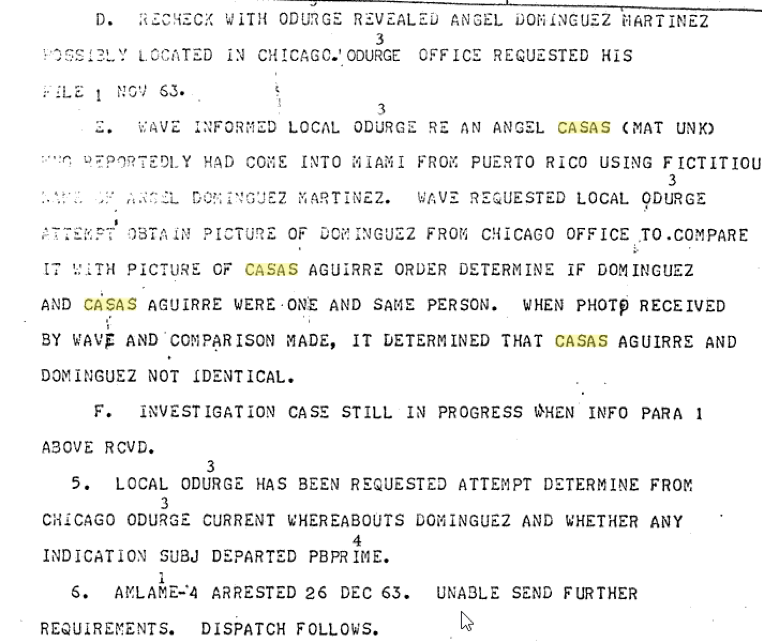
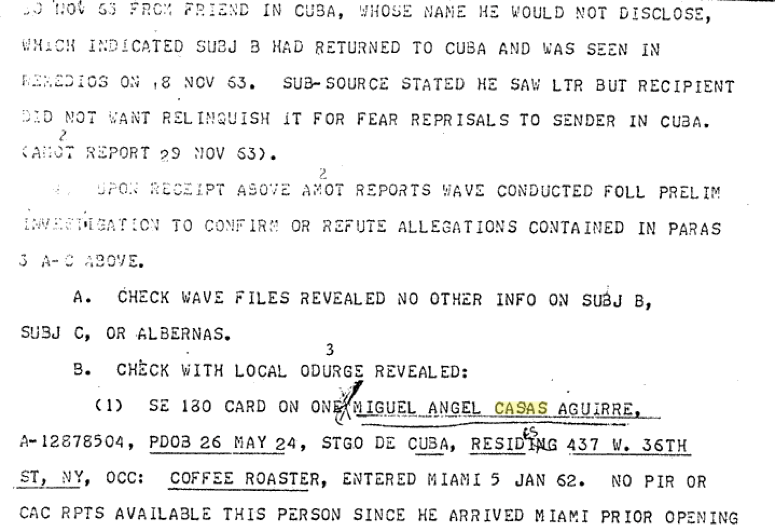
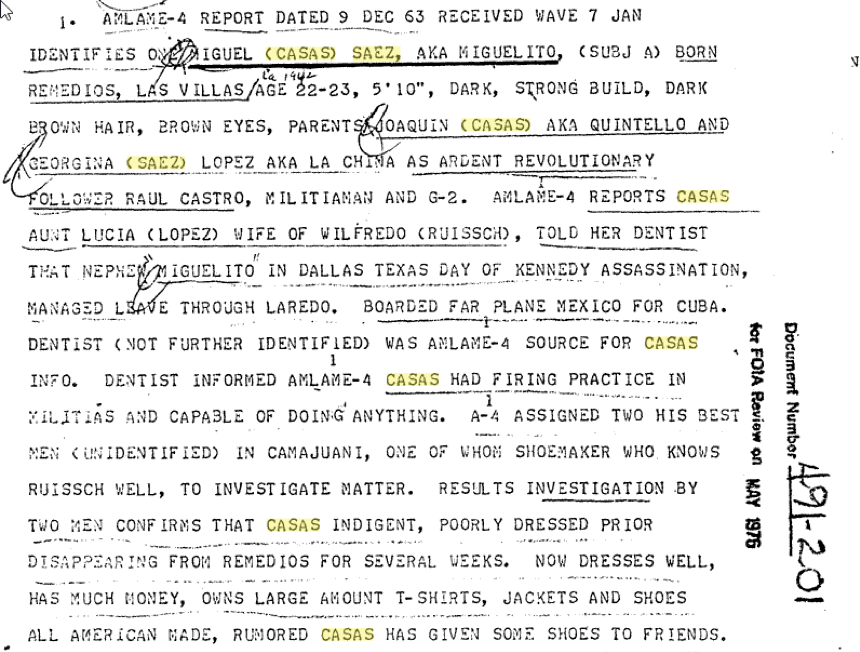
    Because I have written pretty extensively about failed plots to assassinate JFK and potential patsies, I was especially interested in his prior plots chapter. He covers the subjects of Vallee (Chicago), Lopez (Tampa) and Powers (San Antonio) pretty well the way I had, which is normal as we have similar sources. When I wrote about FPCC infiltrator John Glenn of Indiana, I saw nothing to convince me that he was implicated in a failed plot, nor any evidence of plans to frame him. What I did observe is a clone of Oswald the informant, in this sense his inclusion in this chapter could create confusion. I was happily surprised to find out about the name of yet a new suspicious character named Miguel Casas Saez, whom the author describes as a Cuban agent with FPCC links and who may have tracked JFK in Chicago and Tampa, before being in Dallas the day of his assassination. He then ran into money, made his way to Mexico through Laredo, and was flown to Cuba with special seating arrangements in the cockpit of a Cuban plane that had been held up for hours awaiting him.

    Wow! This to me sounded very much like a report on another potential FPCC-marked patsy, Policarpo Lopez, who would have made a similar escape and was allegedly flown to Cuba as the lone passenger on a Cuban passenger plane: a sure sign of a template!

    It smacks of yet more Castro was behind it malarkey… Coming out of JMWAVE’s David Morales’ network.

    I was frustrated here, however, by his footnote to the intel document which is limited to 104-10021-1004.

    So, on my own, I eventually found the document at Mary Ferrell and upon closer perusal, this anecdote ended up being somewhat of a wet firecracker.

    1. He claims that Saez was reported to be at an FPCC meeting in Tampa on November 17—yet after scouring files, talking to Larry Hancock (who is referenced in this section), and reading the writings of John Newman and others about Saez, I could find nothing to back this up. If the author can show evidence of this, I strongly urge him to reveal his sources as it would be, in my opinion, quite important.
    2. The author relies on Lamar Waldron to state that Saez (similar to Policarpo Lopez) received the red-carpet treatment by being seated in the cockpit on a Cuban plane for his escape out of Mexico. The intel. document reveals no such thing. Is there another solid source? Larry Hancock and I discussed this point and he believes that with time some authors mixed up the alleged Saez escape M.O. with Policarpo Lopez’.
    3. Larry also pointed out the weakness of the source (and sub-sources), in that it comes from a likely biased Cuban exile, who got this from a Cuban source in Cuba, who got his info from a dentist, who got it from Saez’s aunt, who got it from lord knows where.
    4. Larry, having seen many wild Cuban stories to try and frame Castro, stated that this one was too amateurish to be even a CIA planted story. “Think about Cuban agents coming into the U.S. after battling a hurricane, one then heads up to New York to visit an ex-girlfriend’s uncle, and then after involvement in killing JFK, Saez ends up back in his village showing off American made T-shirts and shoes.”

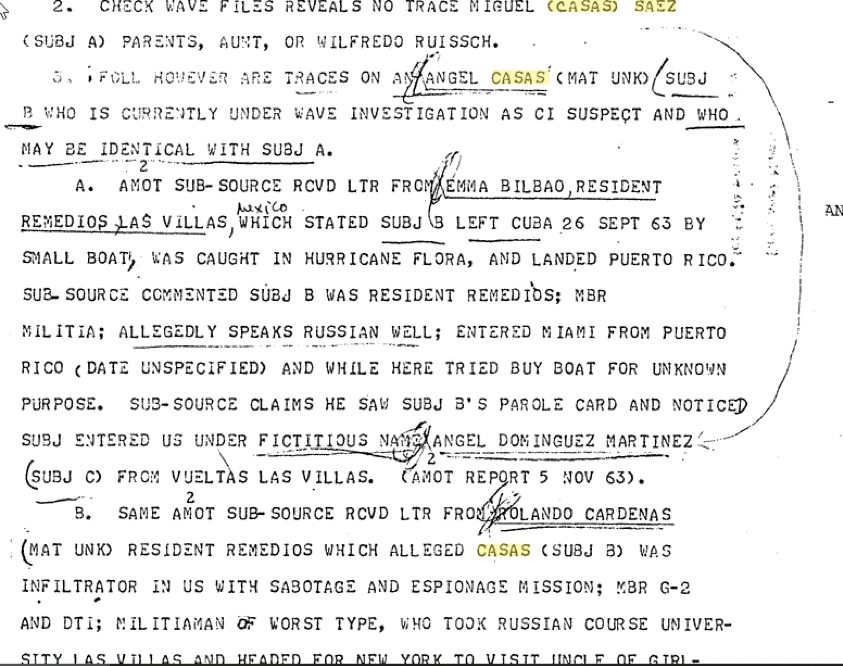
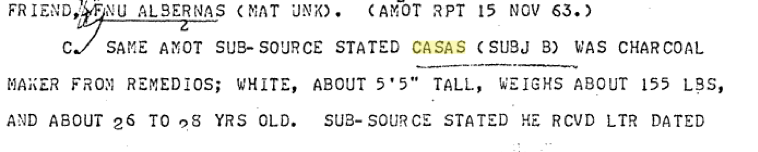
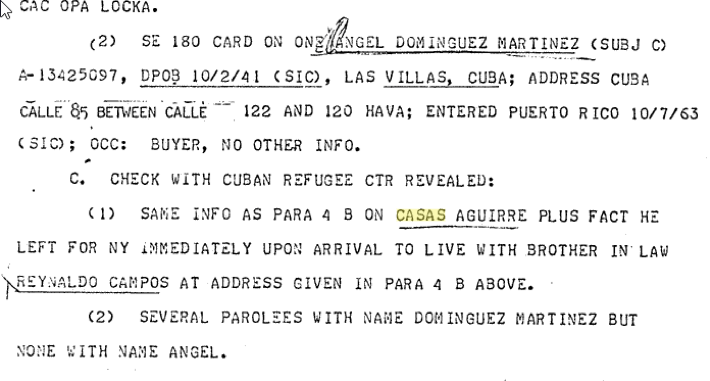
    The following is the intel document, which is hardly a smoking gun but is not entirely insignificant:


    Intel document: 104-10021-1004

    No mention of the FPCC, sitting in a cockpit, and very weak sources and sub sources! It does not even come close to the CIA documents on Policarpo Lopez in terms of explosiveness. The two elements that I feel are suspicious, however, are the mention of an agent being present in Chicago on November 1 during the Vallee incident and the entering of Mexico through Laredo as had Lopez and Oswald, which would have been known by very few at the time the report was written, and could suggest that the supposed sources were being given inside information. One could also ask why this document just floated around all these years without closure. Was it kept in the plotters’ back pockets for future consideration and then kept hidden because it became more embarrassing than anything else? So, mark this section of his book down as a mixed bag.

    Let’s get back to some of its strengths.

    The whole picture of Oswald being part of a network of informants is becoming crystal clear, when you consider his FPCC behavior and the company he kept with the Paines, Guy Banister, Clay Shaw, David Ferrie, the FBI, White Russians, and Cuban exiles. Hill nails this point down and adds a few delicious observations I had not been aware of. Consider this beautiful quote: “Dan Hardaway (sic) may have discovered a slip-up [David] Phillips inadvertently made in a footnote of a self-published book entitled Secret War Diary. Phillips wrote, ‘I was an observer of Cuban and Soviet reaction when Lee Harvey Oswald contacted their embassies.’ According to Hardaway (sic), ‘One of the purposes of an intelligence dangle is to observe the reaction, and from the observation, identify roles, procedures, and processes of the enemy.’”

    The author goes on to describe interesting links between the De Gaulle assassination plots and persons of interest in the Kennedy assassination. However, some of his writings in this section are based on the research of Steve Rivele, whose work is far from being unanimously accepted.

    From Spartacus:

    “Rivele’s material was used in the 1988 television documentary, The Men Who Killed Kennedy. As well as Lucien Sarti, he also named Sauveur, Pironti, and Roger Bocognani as being involved in the killing. However, Pironti and Bocognani both had alibis and Rivele was forced to withdraw the allegation.”

    In his babysitters section, Hill goes over many of the connections that have come out through the years between the people who were close to Oswald (the Paines, de Mohrenschildt, etc.) that completely destroy the Warren Commission’s description of Oswald as a lone nut.

    We also get a pretty good snapshot of the Tippit murder and the controversies that surround that investigation.

    The author’s exposé culminates with what seems to be a growing consensus among the most serious researchers:  that there was, what Hill calls, a three-headed monster made up of the Cuban exiles, the Mafia overseen by Intelligence that was behind the assassination with a cover-up led by LBJ, enabled by the media, the Warren Commission, and Hoover.

    Many of the villains he points the finger at are becoming usual suspects. The author, however, ventures even further in an area that does not get enough attention:  The role of the 488th Military Detachment. His focus on Pappy Bush buddy, Jack Crichton, is potentially important. His role in the motorcade logistics, security lapses, and the cornering of Marina with his own hand-selected translator should be of interest.

    So overall, I would say that this is a solid read with lots of substance and interesting information about Webster and the case overall.

    But it is not without pitfalls.

    The overall case: The Bad

    One of the theories the author puts forth is that both Webster and Oswald were subjects of MKULTRA mind control programs. In the case of Oswald, he points to his ability to face interrogations after capture, his aversion to doctors and dentists, that he was secretive towards Marina, that he had been in Atsugi (one of two CIA bases involved in MKULTRA), that his loner, rebel personality with a dark side made him a great candidate for mind control (sounds a bit Warren Commission apologetic), he was at the right place, at the right time, and had all the qualifications! One witness noticed a change in personalities in Oswald after his stay in Atsugi. Marina stated that he had two personalities. Oswald once made an inquiry about LSD.

    This is all interesting but highly speculative… Where is the beef?

    This already highly tenuous path opens the door to the author’s next even more tenuous deduction: “If Oswald was part of a behavioral-changing project aimed at creating false defectors, who, in fact, believed themselves to be genuine, and Oswald and Webster’s stories are nearly identical in every other facet including like personalities which fit the desired mold perfectly, was Webster also part of MKULTRA?”

    I have many problems with this line of logic:

    1. It is far from demonstrated that Oswald was part of MKULTRA.
    2. There is at least one major difference between Oswald and Webster that the author himself pointed out earlier: Webster was a genuine defector and Oswald was not! So why even talk about creating a false defector with Webster? But this particular part of his book gets worse!

    While the links the author makes between Webster’s employer and Rand’s Christopher Bird with mind control experimentation and a reference to Webster’s psychiatric help are interesting, he posits that perhaps Oswald and Webster were being programmed during their hospital stays… in Moscow. For me this is where this whole theory is guilty of overreach. It was so difficult to get a spy into Russia in the first place, how in the heck are you going to pull off an LSD/hypnosis treatment of your subjects there, one of whom is a genuine defector… over a two-year period!

    Let me play the devil’s advocate on another opinion that is dear to Gary Hill:  That Webster would have been the patsy had there been a motorcade in Cleveland. While I agree that Webster’s eccentric personality and odyssey could put him on a long list of candidates, he may have had some disqualifying characteristics:

    1. Many, if not all, of the other potential patsies including Oswald were either willing informants, intel pawns, or mafia-linked, who were therefore easy to give marching orders to. This is not the case for Webster.
    2. We do not know that his personal or professional relations could have synergistically nudged him in the right direction the way Oswald’s babysitters and others did.
    3. The two weeks of senate hearings he attended may have shone too much light on him thus staining him for any strategic manipulation. So, while plausible, Webster’s potential for being an ideal patsy is far from a slam dunk.

    Like other authors, Hill expresses the opinion that the assassination strategy was so brilliant that it even placed the CIA in a bind and that it was made purposefully confusing with an overabundance of evidence, so as to have investigators running in circles:  A wilderness of mirrors. I had a nice discussion with Larry Hancock about this. My take is that there is so much evidence because of two quasi-catastrophic glitches that occurred:

    1. The plotters fully expected that the assassination would be blamed on Castro and lead to an invasion of Cuba. They were completely blindsided when they suddenly had to go the lone nut route:  Had Plan A gone ahead, there would have been no problem with front shots, Oswald associates, the Zapruder film, witnesses, etc. Instead, they had to bring in Mockingbird, intimidate and remove witnesses, hide the Mexico City charade, put the Warren Commission in place, concoct a slap-happy autopsy, push the single-bullet theory, contain the Cuban and Mafia partners, destroy subsequent investigations, hide files, and everything else that goes with putting the genie back in the bottle!
    2. The second problem was that Oswald survived 48 hours! He began talking and had to be silenced by a Mafioso. This, of course, opened up a whole other flank… and forced an equally ridiculous cover story. This is why there is so much evidence. This is why the case has been largely solved. This is why there is so much mistrust of the media, politicians, and other cornerstones of the U.S. There was nothing brilliant about it!

    Another problem that should be underscored is that a volume this ambitious is also very risky and should get many layers of vetting and editing. While I am convinced that Gary Hill is quite knowledgeable and performed a lot of research, I believe that he could have added a few extra waves of fact checking and quality control. Some of the things he has written will undoubtably present openings for critics to pounce on, while unfairly omitting to point out the quality of much of the book’s contents.

    According to the index, there are approximately 750 names of places, people, projects, organizations, etc. in the book. This is certain to cause confusion among readers and create a monster for even the writer when it comes to fact checking.

    I cannot tell you how many times people like Jim DiEugenio, Albert Rossi, Chris Lamay (who sadly departed us last year), Larry Hancock, Steve Jaffe, Vince Palamara, Dick Russell, and others pointed me in the right direction, had me remove unsound evidence and corrected my grammar. Despite all this, I find myself cringing sometimes when I read some of my earlier writings whenever I see a spelling error or a false fact.

    In this book, there are a number of grammar errors:  Poor Dan Hardway sees his name spelled Hardaway no fewer than seven times (this is the second book review I write where this has happened). Dealey Plaza is spelled correctly some twelve times and Dealy three times; Bathesda should be spelled Bethesda, Marsaille should be spelled Marseille… add a number of typos to these errors and good work like this will take a credibility hit. My suggestion is to proofread the document yourself only when alert, use Antidote software, and get two wordsmiths known for their pickiness to go over your work.

    My editor would have recommended against bringing up Tosh Plumlee, Steve Rivele, Barr McClellan, Judith Vary Baker, and referring to the whole Joseph Kennedy Mafia-double-cross saga, because of the doubts they evoke in the minds of many. I am certain that his friends Walt Brown and Carol Hewitt would have urged caution.

    Though I found most of the sources the author refers to reassuring and clear, at times I felt that he too often went with other authors’ writings rather than examining the original source documents, the Saez files being a good example. At times the author refers to documents with no way for the reader to find them: “Documents unearthed in the 1970s show the FBI had suspected Osborne as a major suspect in its massive JFK assassination investigation”; “According to testimony given by a witness in an assassination attempt on a district judge to assistant attorney Bill Alcorn, on November 22, 1963, Osborne and ten riflemen were living at 3126 Harlandale Street”; “New forensic evidence suggests that two individuals known as Lee Harvey Oswald enlisted in the Marines in 1956.”

    Generally speaking, I think Gary Hill would have been better served by focusing more on Webster and false defectors and by staying clear of some of the more debatable stories that have popped up over the years. This, however, is a personal opinion and I do understand the temptation to broaden the scope, as many authors end up doing.

    Final thoughts

    The JFK assassination was arguably the most important one in the last century. We are still feeling the aftershocks, quite intensely actually. The pillars of U.S. democracy cracked at the seams in 1963. An elected and popular president was taken out, for the benefit of so few. A masquerade of law and order was put in place by the benefactors. The fourth estate shamed itself by choosing the side of the winners. Historians brainwashed decades of young students by parroting the Warren Commission fairytale. In power behind the scenes and emboldened, the perpetrators were pulling the strings on a number of political assassinations that followed, unholy drug and arms deals, political dirty tricks, coups and wars, Wall Street money games, and other major scandals that came in waves and went unpunished. You know something is wrong when the people responsible for millions of deaths in Vietnam alone, trillions of dollars in damages and inequalities in the world’s most powerful country are living the life of Riley, while at the same time four white cops took George Floyd’s life because of a fake 20 dollar bill.

    While most people believe there was a conspiracy in the murder of JFK, those who have a pretty good idea of what actually happened probably number under 1000 worldwide. Gary Hill is one of them. While some of the details in his book are debatable, he understands the large picture.

    The U.S. and much of the world is disease-ridden right now with punch-drunk leadership that seems clueless. The pandemic is not just one of COVID-19. It is one of intolerance, inequality, distrust, brutality, weaponized citizens, climate threats, stress, and division.

    There is mobilization going on right now, all around the world that is seeing people of all ages and all races demanding change from their leaders. It is reminiscent of how Vietnam was finally forced to an abrupt end by young, concerned citizens on a mission. Ordinary people are demanding much more than the end of chokeholds by police. They are asking for meaningful and just progress. If change is to be long-lasting, they need to get at the root of what has caused these problems in the first place, which begins with understanding the real political systems we live under. Why does everyone want sensible gun laws, climate policies, and health care, but cannot get it? Find out who the real power brokers are and you will understand how your country really does govern itself.

    Which brings us back to understanding 1963. Within a few months, two major pieces of work will be released that will shed even more light on the JFK assassination, which will bring us very close to a complete picture of what really took place and its impact on the world we live in. One is Oliver Stone’s new documentary JFK: Destiny Betrayed, the other, based on a preview I have received, is a paper written by Larry Hancock which will appear on the Mary Ferrell site.

    Gary Hill solved the case to his content after fifty years of reading, researching, and networking. He did not sit on this. He decided to pass on his knowledge and opinions about the overall case to the rest of us and to document what he found about Robert Webster and he shares these findings. He did not do this for money or glory. His book is not perfect, but it is good and he deserves our gratitude for doing his share in fitting in small pieces of the puzzle.

  • Review of Stephen Kinzer, Poisoner in Chief:  Sidney Gottlieb and the CIA Search for Mind Control (Henry Holt and Co., 2019)

    Review of Stephen Kinzer, Poisoner in Chief: Sidney Gottlieb and the CIA Search for Mind Control (Henry Holt and Co., 2019)


    I

    In his latest book on the Central Intelligence Agency’s history of dirty tricks, longtime historian Stephen Kinzer attempts to paint a picture of the vast and shadowy tapestry that was the American intelligence apparatus at mid-century, using one of its most infamous henchmen, Dr. Sidney Gottlieb, head of the Technical Services Division of the CIA, as its focal point. While the title would suggest that Kinzer has unearthed new biographical information about this sinister character, I found little that was not already available in other surveys of the field. Knowing the quotidian details of Sid’s family life, his habits, and his strange charm really did not advance a story, which was essentially a rehash of known facts repackaged as a biography of what Kinzer deems the CIA’s “Poisoner in Chief.” While there is some survey value in this book regarding the technical perspective of how the CIA dreamt up its machinations of torture, mind-control, psychological warfare, and exotic poisons, its real strength is in Kinzer’s narrative flair. I read it in a single, very uncomfortable sitting. And for that, I feel it does play a valuable role in the historiography of this unsettling topic, one of which most Americans are barely aware, or at best, would rather forget, despite its present-day relevance.

    Kinzer begins his book with a stark postwar vignette:

    White flags hung from many windows as shell-shocked Germans measured the depth of their defeat. Hitler was dead. Unconditional surrender had sealed the collapse of the Third Reich. Munich, like many German cities, lay in ruins. With the guns finally silent, people began venturing out. On a wall near Odeonsplatz, someone painted:  “CONCENTRATION CAMPS DACHAU—BUCHENWALD—I AM ASHAMED TO BE GERMAN.” (p.13)

    The Allies were faced with some of their most trying decisions after the Soviet Union’s capture of Berlin and the subsequent surrender of all Nazi forces in Europe. Many Allied officials knew that ideologies as entrenched, compelling, and destructive as fascism died hard. Just because their nation was in ruins, leaderless, and at the mercy of rampaging Red Army troops on one end and embittered, battle-weary Americans on the other, this did not necessarily mean the German people would go quietly into the night and embrace ideas like peaceful co-existence with their European brethren, or even American-style “democracy.” Some, like Roosevelt’s Secretary of the Treasury, Henry Morgenthau, wanted Germany reduced to an agricultural backwater with no future prospect of industrial production, military rearmament, or political clout in a world they had only years earlier sought to conquer and rule. Others had different ideas.

    As the OSS would soon discover, clandestine warfare and the implied threat of biological warfare had played a major role in both the Japanese and German governments’ early chess moves. As new to the game, that spy agency was only beginning to understand these matters. While Roosevelt begrudgingly fulfilled Winston Churchill’s 1944 request for half a million bomblets filled with anthrax, by the time the batch was coming off the production lines of a converted factory in Indiana, the Nazis had surrendered.

    In the ensuing discoveries made in the wake of German capitulation, however, word soon spread that Nazi doctors like Kurt Blome had weaponized dozens of biological agents, diseases, and plagues. Further, that he had been in friendly competition with the sadistic Japanese scientist and biological researcher Shiro Ishii, whose Unit 731 committed human atrocities on captured Allied and Chinese soldiers and civilians that would have made Caligula wince. Much like in their technical advances in rocketry, jet propulsion, tanks, artillery, and submarines, the Nazis were apparently leaps and bounds ahead of the United States in this dark field too. OSS officers on the ground were curious and would soon make a choice that would color and shape the moral landscape of the newly formed CIA in the years to come. As Kinzer notes:

    Nazi doctors had accumulated a unique store of knowledge. They had learned how long it takes for human beings to die after exposure to various germs and chemicals, and which toxins kill most efficiently. Just as intriguing, they had fed mescaline and other psychoactive drugs to concentration camp inmates in experiments aimed at finding ways to control minds or shatter the human psyche. Much of their data was unique, because it could come only from experiments in which human beings were made to suffer or die. That made Blome a valuable target—but a target for what? Justice cried out for his punishment. From a U.S. Army base in Maryland, however, came an audaciously contrary idea:  instead of hanging Blome, let’s hire him. (p.14)

    The author then continues:

    For a core of Americans who served in the military and in intelligence agencies during World War II, the war never really ended. All that changed was the enemy. The role once played by Nazi Germany and Imperial Japan was assumed by the Soviet Union and, after 1949, “Red China.” In the new narrative, monolithic Communism, directed from the Kremlin, was a demonic force that mortally threatened the United States and all humanity. With the stakes so existentially high, no sacrifice in the fight against Communism—of money, morality, or human life—could be considered excessive. (p.25)

    The psychic shock of totalitarian ideologies, unleashed in those roughly five and a half brutal years of WWII, was an enduring one for the case officers and assets that now made up the fledgling CIA. And with President Truman’s signing of the National Security Act in 1947, clandestine operations were essentially ratified in legal writ, with the stamp of the highest offices of government, a decision Truman would famously lament in his retirement. As Kinzer shows, the nebulous and ill-defined limits circumscribing this new shadow warfare were quickly pushed to their logical end by those who seemed to believe nothing was too extreme when the fate of the “free world,” as they understood it, was concerned. Given an unprecedented opportunity to play James Bond, an almost unlimited budget to fund new and exciting ways to overthrow governments, assassinate leaders, poison food supplies, and expose innocent people to mind-shattering substances in their search for mind control, they took the ball and ran with it. Things fell into place. Truman left office in 1953 and President Eisenhower and his Secretary of State, John Foster Dulles, were all too willing to use the CIA to achieve political ends. With John’s brother, Allen Dulles, now appointed as head of the Central Intelligence Agency, the circle was complete:  foreign policy would be a spy’s game, with very real conventional wars interspersed for flavor, but essentially, a secret and enduring war in the shadows. And to play the game, they needed the tools.

    Kinzer’s ability as a storyteller is pronounced in these early chapters. The book at this point reads like a John Le Carré novel, as much as it does a well-researched, thoroughly footnoted monograph of the early Cold War. Familiar names are given a face, a voice, a temper:  Wild Bill Donovan, Bill Harvey, Ira Baldwin, and of course, a young Jewish man from the Bronx named Sid with a club foot and a stammer who was studying biology back in the States.

    II

    Lysergic acid diethylamide, LSD, or “acid” on the street, plays a central role in Kinzer’s book, with many chapters devoted to the CIA’s explorations into its potential to manipulate human beings for political and social engineering ends. Wilson Greene, an officer of the United States Chemical Corps, discovered scattered reports and rumors of a Swiss doctor named Albert Hoffmann, who Kinzer believes is the first person ever to have had an acid trip. Though Hoffmann, who worked for the Swiss pharmaceutical company Sandoz, had taken this journey in 1943, it would not reach Washington until 1949. Kinzer describes the thesis of Greene’s paper to government officials, entitled:  “Psychochemical Warfare:  A New Concept of War:”

    Their will to resist would be weakened greatly, if not entirely destroyed, by the mass hysteria and panic which would ensue. The symptoms which are considered to be of value in strategic and tactical operations include the following:  fits or seizures, dizziness, fear, panic, hysteria, hallucinations, migraine, delirium, extreme depression, notions of hopelessness, lack of initiative to do even simple things, suicidal mania. Greene proposed that America’s military scientists be given a new mission. At the outer edge of imagination, he suggested, beyond artillery and tanks, beyond chemicals, beyond germs, beyond even nuclear bombs, might lie an unimagined cosmos of new weaponry:  psychoactive drugs. Greene believed they could usher in a new era of humane warfare. (p.29)

    This, along with reports of recently-returning soldiers from the Korean War who seemed to sympathize more with the enemy they were sent to kill than their American brethren, led some policy planners in Washington to suspect that the Reds were up to more than conventional propaganda. That, as Kinzer notes, none were actually “brainwashed” as Washington suspected, but simply critical of what they viewed as a hypocritical, unjust, capitalistic and segregated mid-century America, didn’t matter in the binary option set of hard line anti-communists like CIA officers Dulles, James Angleton, Richard Helms, and their colleagues. These were the same people who essentially green-lit what would eventually turn into the MK-ULTRA program, whose directive was to probe the limits of the human psyche, with the express aim to eventually discover how a fully functional person could be “depatterned” and remade, as it were, in the image of his or her handler for any number of field-deployable roles.

    While that program is exhaustively detailed elsewhere, Kinzer does add some colorful vignettes to the story that seem like they jumped from the pages of a Thomas Pynchon novel rather than the historical record:  secretly dosing colleagues at dinner parties, most famously Frank Olson, who of course “jumped or fell” from a 13-story Manhattan hotel room after having an acid-induced nervous breakdown and frantically seeking an exit from the intelligence field, paying crooked cops in cash to sit behind two-way mirrors in rented San Francisco brothels to watch prostitutes try to illicit sensitive information from acid-dosed patrons, injecting an elephant at an Oklahoma zoo with a lethal dose of LSD, releasing “benign” but actually toxic bacterial aerosols off the coast of California (Operation Seaspray) to test their dispersal pattern on an unaware American population getting their Sunday morning newspapers. The list goes on and only gets more absurd as it does.

    What Kinzer accomplishes in Poisoner in Chief is to show just how unscientific so much of what we call MK-ULTRA and its hundred-plus “sub-projects” really were. With little oversight, and an actual legal license to kill, torture, abduct, and abscond, the early case officers and assets tasked to the CIA’s biological and mind-control initiatives were dangerously out of control, yet in some sense, legally justified, given the vague language and imperatives of the National Security Act which legitimized their activities. As George White, the crooked cop mentioned earlier, said years later in a grateful letter to his mentor and boss, Sidney Gottlieb, “… it was fun, fun, fun. Where else could a red-blooded American boy lie, kill and cheat, steal, deceive, rape, and pillage with the sanction and blessing of the All-Highest?” (p.155)

    Indeed. Where else but in the CIA?

    III

    Poisoner in Chief proceeds predictably enough through the sixties and seventies, with the major uses of Gottlieb’s Technical Services Division of the CIA highlighted against the backdrop of a given foreign policy episode. Crafting ever sillier ways to kill Fidel Castro—boots laced with thallium to make his mighty beard fall out, exploding ornate seashells to catch his eye on one of his frequent scuba dives, and botulin-laced cigars that only needed to be held between the lips for seconds to kill—Gottlieb and his junior staff of kids from local technical colleges and workshops were never out of ideas. Poisoned tubes of toothpaste for the first democratically elected leader of the Congo? No problem. “Joe from Paris” (Gottlieb’s code-name in the Congo operation) will arrive in Leopoldville shortly. So will QJ/WIN, the backup shooter. Standby.

    This is an exciting part of the book and provided a rare glimpse into the devil’s workshop that was TSS (Technical Services Staff). But, at the same time, it contains some critical oversights that must be addressed. Namely viewing President Kennedy as a younger, fresh-faced continuation of Eisenhower, and someone who laid the groundwork for Johnson, rather than as someone opposed to either of his executive bookends. A president who was rather unique in his conciliatory vision of peaceful coexistence; a president who, unbelievable as it may sound today, had genuine empathy for the developing nations of the world. This is not a debatable point in 2019, despite the MSM’s dogged, fifty-five-year smear campaign against a most promising U.S. leader, as any reader at Kennedys and King should know by now.

    Yet there is a real political vacuum in this section of the book. In his tracing of the Gottlieb attempts to poison Patrice Lumumba of the Congo, there is no mentioning of how these plots were hurried in late 1960 after John F. Kennedy won the election. Yet, there are authors who have come to this conclusion after reading the cable traffic. (John Morton Blum, Years of Discord, pp. 175-76) Almost everyone agrees today that Kennedy clearly favored Lumumba in his struggle to free Congo from European imperialism. And it appears that the CIA knew that.

    As most authors also realize today, the CIA plots with the Mafia to assassination Fidel Castro did not have presidential sanction. This was the conclusion expressed by the Church Committee in 1975 and is fortified by the release by the Assassination Records Review Board of the CIA Inspector General Report on that subject. Yet, in the face of all this, plus the declassified files of the Assassination Records Review Board, former New York Times reporter Kinzer claims,

    Plotting against Castro did not end when Eisenhower left office at the beginning of 1961. His successor, John F. Kennedy, turned out to be equally determined to “eliminate” Castro. The spectacular collapse of the CIA’s 1961 invasion of Cuba at the Bay of Pigs intensified his determination. Kennedy and Attorney General Robert Kennedy, his brother, relentlessly pressured the CIA to crush Castro and repeatedly demanded explanations of why it had not been accomplished. Samuel Halpern, who served at the top level of the covert action directorate during this period, asserted that “the Kennedys were on our back constantly … they were just absolutely obsessed with getting rid of Castro.” Richard Helms felt the pressure directly. “There was a flat-out effort ordered by the White House, the President, Bobby Kennedy—who was after all his man, his right-hand man in these matters—to unseat the Castro government, to do everything possible to get rid of it by whatever device could be found,” Helms later testified. “The Bay of Pigs was a part of this effort, and after the Bay of Pigs failed, there was even a greater push to try to get rid of this Communist influence 90 miles from United States shores … The principal driving force was the Attorney General, Robert Kennedy. There isn’t any question about this.” (p.122)

    First, to take the testimony of a practiced liar like Richard Helms regarding his sworn enemies, the Kennedy brothers, at face value, is almost comical. Richard Helms ordered Sidney Gottlieb to shred every accessible document pertaining to MK-ULTRA before congressional investigations discovered his illegal program’s dirty paper trail. Helms famously walked into the Oval office with a rifle, plopped it on JFK’s desk, and said the CIA had just discovered (through acid-based swaths), a Soviet serial number on the stock, and that the gun was from Cuba, strengthening, so he thought, his case that Kennedy should immediately invade the island before the Russians had time to reinforce Castro. Kennedy asked to see more proof, since Helms said the magic acid test only worked for a few seconds and then destroyed the numbers it allegedly revealed. Kennedy then waved him out of the office to finish opening his daily mail. Not exactly hell-bent, as Kinzer would have us believe.

    Allen Dulles and Richard Bissell planned the Bay of Pigs to fail, stacking the initial invasion waves with the lowest quality, most poorly trained groups of the Cuban exiles slated for the assault. They did this anticipating that Kennedy would cave once reports got back to him that they could not get off the beach and capture strategic inland objectives without naval and air support (and, in all likelihood, the landing of U.S. Marines). Kennedy later understood this and complained about it. But the lie was fortified when Allen Dulles and E. Howard Hunt commissioned a ghost-written article in Fortune that created the narrative Kinzer and others have fraudulently promulgated:  JFK got cold feet and “called off” the air support, leaving those poor Cuban exiles stranded on the beach. Kennedy inherited the operation from Eisenhower, reluctantly green-lit it only because the CIA was lying to him at every step, and when he realized its quixotic goals were impossible without escalation and the commitment of non-clandestine U.S. forces, sat anxiously in his briefing room as it fell apart. He then quietly fired Dulles, Bissell, and Cabell.

    Similarly, to say that Robert Kennedy was hell bent on killing Castro is to fail to acknowledge the declassification of the CIA’s Inspector General report on the CIA/Mafia plots. That long report states that Robert Kennedy had to be briefed about the plots by the CIA after the FBI accidentally discovered them. Obviously, if the Kennedys had been in on them, there would have been no briefing necessary. But making it worse, the CIA told Robert Kennedy that they would now put a halt to them, since RFK was very upset by the briefing. This was a lie. The plots continued along without his knowledge, pairing mobster John Roselli and CIA officer Bill Harvey. (The Assassinations, edited by James DiEugenio and Lisa Pease, pp 327-28) The obvious question that Kinzer does not ask is:  Why would the CIA have to lie to RFK, if he was in agreement with the plots? Kinzer also overlooks the apparent understanding of Castro’s own feelings towards the matter. He ignores the fact that it was largely Robert Kennedy, through Soviet back channels during the Cuban Missile Crisis, who averted what looked almost certainly to be a nuclear Armageddon. That incident provided a perfect opportunity to invade Cuba and overthrow Castro. Afterwards, Castro suggested a détente with Washington and JFK obliged him. It’s easy to see why the CIA hated both of the brothers. And while this misreading of history is only a few paragraphs of an otherwise fairly well researched and engaging book, it provides a disappointing and misleading aspect that readers unfamiliar with the true history of the Kennedys’ views about the developing world. If anyone disagrees, it would be good for them to fact-check for themselves. Reading the IG report would be a good place to start. (Click here for that link)

    Overall, while largely a repackaging of long-known facts, the book is an interesting introduction for those unacquainted with the dark side of the CIA at mid-century and into the latter years of the Cold War. Gottlieb remains a mysterious, infrequently quoted figure in the book, with a few interspersed interviews with his children and friends. Perhaps most interesting is Kinzer’s chapters on Gottlieb’s attempted retirement and disappearance from the TSS, floating around abroad, in a leper colony in India and other exotic hideouts. His very face and name would have remained unknown to the general public and, likely, the research community had it not been for late 70s probes like the Church Committee. Kinzer does a fine job here and this probably represents the only unique aspect of the book, focusing as it does on their attempts to see how deep the CIA’s rabbit hole was when they stumbled upon the last surviving documents detailing projects like MK-ULTRA and MKNAOMI.

  • Lisa Pease, A Lie Too Big to Fail: The Real History of the Robert Kennedy Assassination

    Lisa Pease, A Lie Too Big to Fail: The Real History of the Robert Kennedy Assassination


    pease le flemIt’s a rare thing indeed when a book actually delivers everything you could wish for—and then some. I can count on one hand the number of books in recent memory that have achieved this. Incorporating over twenty years of research, personal interviews, deep archival digging, and a comprehensive survey of nearly all the extant literature and articles surrounding Robert Kennedy’s encounter with the unspeakable in the pantry of the Ambassador Hotel on the night of Jun 5, 1968, A Lie too Big to Fail will no doubt stand the test of time as the definitive book on the RFK murder. Pease establishes not only the most compelling case against the LAPD’s compromised (non-)investigation of the case to date, but reveals startling new discoveries, including previously unexplored forensic evidence, new witnesses to multiple shooters, and evidence of foul play at the highest levels of the United States political apparatus.

    Digging deep into the court records and transcripts of the also-compromised defense attorney who sold the 24-year old Sirhan Sirhan down the river before he ever had a chance at anything approaching a fair trial, Pease presents a firm case for why his fate—as he sits locked up in a California prison for life—cannot be justified in a democratic society. That Sirhan is still alive and paying for a crime he never committed brings a necessary urgency to her plea that the case be reopened. Because not only did Robert Kennedy’s murder signal the death knell of true progressivism in the United States political arena, but it served as perhaps the most arrogant abuse of power by a hidden hand that, for five decades, hijacked the United States’ foreign and domestic policy. Written with a gripping, driving cadence, the author’s narrative gifts are as pronounced as her investigative acumen. And with this book as her lifetime achievement on a case that still remains relatively obscure in light of the JFK assassination, she will likely establish herself as the preeminent authority on the subject for years to come.


    II

    Officially, minutes after delivering his victory speech in the Embassy Ballroom of the Ambassador Hotel in Los Angeles just after midnight, Senator Kennedy—to the cheers of his teeming supporters and staff—excused himself from the podium, proceeded backstage through a small passage leading to large double doors, entered the hotel’s kitchen pantry, shook hands with cooks and a busboy, and was shot to death. The sole perpetrator was held to be Sirhan Bishara Sirhan, a 24-year-old Palestinian immigrant who appeared in the confusion of the crowded space in front of the senator and fired a .22 caliber revolver at Kennedy, mortally wounding him and injuring five other people with his eight-shot discharge.

    Kennedy died almost a day later. He had multiple brain surgeries and finally succumbed to the massive damage of the shattered bullet fragments: his heart rate lowered to barely a pulse, then stopped. His funeral ceremony was one of the most highly attended in U.S. history. For people like Tom Hayden, original author of the Port Huron Statement, who sat crying in a church pew upon learning of the death of his hero, the senator’s untimely death was also the death of hope for a generation seeking to take their nation on a course of peace and social justice. With Richard Nixon’s victory all but assured in the confused scrambling of the Democratic Party to promote their second tier candidates, the United States was going to fundamentally change.

    That’s the official version of events we teach our kids in school and repeat ad nauseum in the mainstream media. The problem, of course is that when Thomas Noguchi, the LA County coroner who was tasked with performing Robert Kennedy’s autopsy, was finished, he discovered that the fatal shot, just behind his right ear into the victim’s brain, was fired with the gun barrel at contact range, which could not have been more than three inches. This was demonstrable, as Kennedy’s neck exhibited tell-tale signs of powder burn tattooing, or stippling, which Noguchi took great pains to demonstrate by setting up a test-firing at the LA Police Academy on mock human skulls made of latex and pig ears after the autopsy. Each officer was asked to fire at his respective target from six ranges: barrel-pressed against the target, a quarter inch, half inch, two inches, three, and finally four. Only at three inches, did the stippling dispersal pattern match that on Kennedy’s corpse. Of the nearly seventy witnesses in the pantry that night, none placed Sirhan closer than three feet, and most average a distance of approximately five to six feet. Equally troubling was the fact that the three shots which struck Kennedy were fired from behind and at equally sharp vertical angles, from low to high, which makes it physically impossible for them to have come from Sirhan’s gun, which even before he was attacked and restrained by bystanders, was by all accounts pointed directly at Kennedy in a flat, arm-outstretched fashion. We know Kennedy only perceived a threat from the front by the fact that numerous witnesses recall his hands defensively coming up to cover his face at seeing an approaching Sirhan before he fell to his knees, wounded, and then slumped to the floor where he lay dying in a pool of gathering blood from his fatal head wound.

    The immediate aftermath of the shooting is another one fraught with contradictory claims. Officially, the LAPD concluded—or as we will see, decided actively to conclude, with the urging of two former CIA interrogation experts who took over the investigation within days of the murder—there was no conspiracy. Sirhan was apprehended, everyone saw him shoot, Kennedy went down, case closed. And yet, as Lisa Pease aptly demonstrates, that is not at all what witnesses reported. Almost thirty separate people placed Sirhan in the company of a young lady in a polka dot dress, along with several male accomplices. Many of them saw her in the pantry, seemingly holding Sirhan, and having the same sickly smile on her face as they claim he did before he lurched forward with gun outstretched to make his move. Witness Sandy Serrano places her in the immediate aftermath of the shooting running down the fire escape to the back parking lot with her male companion—both of whom Serrano witnessed entering the hotel via this very fire escape with Sirhan Sirhan earlier in the evening. Serrano said she was exuberantly shouting, “We shot him!” When asked by Sandy who did she kill, the girl responded, “Kennedy! We killed him!”. They were overheard by the Bernsteins, an elderly couple in the parking lot who reported the incident to first-responder Paul Sharaga, of LAPD. When Sharaga put out an APB for these two suspects, he was told moments later by a superior at Ramparts station that, “We don’t want them to get anything started on a big conspiracy.” (Larry Hancock, “Incomplete Justice, Part One: At the Ambassador Hotel,” 5/19/2007) The APB was subsequently pulled, allowing any accomplices ample time to make their escape.

    Lisa Pease details this familiar chain of events and the controversy surrounding the clearly real accomplices, sited by dozens of witnesses throughout the ballroom and surrounding areas that night. With regard to figures like the infamous girl in the polka dot dress, she brings some fascinating new insights to the case: including the likely use of multiple teams and multiple polka dot women who were also part of the plot. Many have wondered: What would have happened had Kennedy exited via a different route? The author is quick to note that he was marked for death that night by the sheer number of likely assassins actually positioned in the Ambassador Hotel that evening. While as many as three shooters could have been in the pantry, the LAPD was immediately told to stand down in their pursuit of leads concerning anyone but Sirhan’s immediate family and friends. Therefore, we will probably never be able to say conclusively who these people were. Lisa Pease provides some excellent considerations though, and that is perhaps one of the most exciting parts of her new findings, along with some of her personal interviews which to my knowledge she is sharing here for the first time in print. That, plus the fact that SUS officers at Ramparts station also burned over 2,400 photos taken at the Ambassador ballroom in a hospital incinerator, removed and later destroyed key ceiling and door panels containing bullet holes because they “didn’t have room to store them,” and both discredited and intimidated major credible eyewitnesses: all this smacks of a systematic cover-up.


    III

    Stylistically, A Lie To Big To Fail achieves a fine balance between the immense complexity of the case—with its thousands of files, its many bizarre suspects and characters, its hypno-programming realities, and other strange but relevant source data—and the inherent drama of the event. We begin with an almost Raymond-Chandler-styled portrait of those fateful California nights spent with folks like director of The Manchurian Candidate John Frankenheimer (talk about situational irony) and other supporters, then progress to the primary victory speech at the Ambassador Hotel. The book is instantly engaging, no matter how familiar readers might be with the case. The accessibility of the book is another commendable feat Pease has pulled off; experts who have studied the case for decades will still find evidence and propositions they had never seen or considered, while a friend I loaned the book to—who had never examined the case—could just as easily engage with the text. That is no small feat. Too often a book in the assassination field presumes a level of familiarity with the subject material that is beyond the scope of most readers, while those that are more accessible often gloss over the depth and complexity of the subplots, and also motives and new information gleaned from recent declassifications. A Lie to Big to Fail does neither, and presents an eminently readable, thoroughly substantiated story that, in many respects, is stranger than fiction.

    Covering the gamut of the LAPD’s Special Unit Senator files, along with newly discovered archival footage from places like the California State Archive and local news agencies, Pease’s book is probably the most comprehensive I have ever read on this case, incorporating not only the limited but extremely useful secondary literature from the 1970s, 80s and recent times, but also combing the entire primary source record of the case as well. The author poured thousands of hours of personal research into the book. And it shows. Sources are meticulously detailed and annotated, in the classical manner with the references at the bottom of the page. This allows anyone with an internet connection to fact check most of her findings; some must be accessed in person in Sacramento and elsewhere.

    The other thing that really stands out in the book is the author’s refusal to argue she’s definitively solved the case. Don’t get me wrong: if anyone has come close to figuring out exactly what happened that night, it’s Lisa Pease. What I mean is that too often plots of this magnitude, which require not only clandestine funding, months of planning, a deeply complex cover-up often stretching decades, and the complicity of many high-level officials and planners, are traced to a single source: the mob, the CIA, the Minutemen, Nixon. What seems to be the case, and I will let readers reach their own conclusions, is that, as Lisa notes, there were aspects of both underworld crime liaisons, private military contractors, and off-the-books involvement of the Central Intelligence Agency in the persons of say Hank Hernandez and Manny Peña (USAID/CIA), and of course Robert Maheu (Howard Hughes Corporation/CIA). Thane Cesar has been and still is a prime suspect, given his anti-Kennedy, pro-segregation views and convenient placement as RFK’s escort in the pantry. That he “retired” from Ace Security, a job he’d had for only a few weeks, as he sarcastically stated during his exit interview with the LAPD, is also extremely suspicious. (RFK LAPD Microfilm, Volume 122, Reporters Daily Transcripts, Reinvestigative Files 1974—1978) p. 314). That Nixon was basically handed the presidency does not, of course, implicate him personally; though as the end of the book suggests, there is anecdotal evidence his brother Don was indeed apprised of the events surrounding the assassination and informally debriefed shortly thereafter. In a diary entry that Pease personally procured from John Meier, a Howard Hughes top aide from 1966 to 1970, Meier wrote on June 6, 1968:

    Bob Maheu called to ask about the Don Nixon meeting and suggested 8:30 breakfast at the Desert Inn Country Club (in Las Vegas). I went to the club. Maheu was all smiles, and Don Nixon walks in an all smiles. What followed next had to be seen to be believed. They embraced each other and Don Nixon said, “Well that prick is dead,” and Maheu said, “Well it looks like your brother is in now.” (Pease, p. 493)

    This book also presents perhaps the most balanced look at the controversy surrounding the potential and very likely programming Sirhan underwent before his arrival on the scene. Drawing from both familiar and quite obscure cases, where people were indeed exposed as hypno-programmed assets operating against their will with no working knowledge of how or why they performed various acts and crimes, she gives those in the research community a solid footing on which to stand in what amounts to the hardest part of the case for the MSM to digest. Given the CIA’s millions of dollars of research into its MK-ULTRA and related mind control experiments, along with the accounts provided in Pease’s later chapters, even the most skeptical critics will be hard pressed now to discredit this exotic but very real use of actionable hypnosis.


    IV

    Sirhan remains languishing in prison to this day, narrowly avoiding the gas chamber by a lucky break which saw California abolish the death penalty in 1972. Despite his good behavior, insistence that he has no memory of the events in the pantry, his numerous and sincere interviews with new therapists and hypno-suggestive experts, his fate remains sealed. William Pepper, the attorney and barrister who represented the King family during their 1999 civil trial against Lloyd Jowers, in which a Shelby County jury determined Martin Luther King had been assassinated as a result of a conspiracy, has joined attorney Laurie Dusek in a bid to free Sirhan from a crime we know he could not possibly have committed.

    Senator Kamala Harris, who served as the California Attorney General until 2017, and who was also the DA of San Francisco from 2004 to 2011, insisted since the parole hearing reached her desk in 2012 that Sirhan is still guilty. Following the release of an audio tape found in the California State Archives which captured what acoustics expert Philip Van Praag believes is thirteen distinct shots in the pantry, Harris was confronted by the very real possibility that Sirhan was not a lone gunman. Harris calls Van Praag’s analysis “pure speculation.” (Martinez and Johnson, “Prosecutors, attorneys argue: Was there a second gun in RFK assassination?” CNN, 3/12/2012)

    Similarly, despite the very real fact that hypno-programming has been successfully deployed in military, civilian, and criminal plots, and other special operations dating back to the early 20th century, Harris refuses to accept its possible use on Sirhan in the RFK saga. Upon reading the adamant testimony of Harvard professor of forensic psychiatry and hypnosis, Dr. Daniel Brown—who spent over sixty hours interviewing Sirhan—Harris claimed, “The theory that a person could be hypnotized into planning and committing a murder against his will is a controversial (if not fantastic) one and has not been adopted by most of Brown’s peers, including the American Psychological Association.” She continues, “Thus, even if Sirhan could show that some psychologists believe in mind control or hypno-programming, his showing of actual innocence is nevertheless based on a debatable theory that is not universally accepted in the psychology community.” (CNN, 3/12/2012) Brown, in a signed 2011 affidavit, stated, “I have written four textbooks on hypnosis, and I have hypnotized over 6,000 individuals over a 40-year professional career. Mr. Sirhan is one of the most hypnotizable individuals I have ever met, and the magnitude of his amnesia for actions under hypnosis is extreme.” (Tom Jackman, “The Assassination of Bobby Kennedy: Was Sirhan Sirhan hypnotized to be the fall guy?” Washington Post, 6/4/2018)

    What is actually a debatable theory, in reply to DA Harris’ conclusions, is that three bullets fired at very close range and one at contact range (the fatal head shot behind the right ear), all from behind and at a steep upward angle are supposed to have come from a weapon that was always at least three feet in front of the target. Or that at least thirteen bullets were fired from a gun which could only hold eight, and which likely fired no real bullets, just blanks. These are solidly based facts of the case, yet they are treated as conjectures. If other major legal cases were handled with this much disregard for forensic evidence, lawyers would be disbarred. And if Sirhan had been offered a fair trial—another exceptional chapter of A Lie Too Big to Fail—it is almost certain he would be a free man. But the special logic applied by those seeking to obfuscate the sinister implications of the final major assassination of the 1960s continues to hold fast, at least at the legal level.

    Things are changing though, and it would seem that the concerted efforts of those like Lisa Pease, along with the recent public denial of the official version of events by none other than Robert Kennedy Jr., may be turning the tide towards the real evidence which supports a concerted high-level conspiracy to remove a potential president. It was with a real sigh of relief that I read a recent Washington Post summary of Lisa’s new findings, one that, for a change, actually took her argument seriously and did not attempt to reduce her thesis to fringe theory. In the fifty-one years of relative silence surrounding the case, dotted here and there by books and talks by people like Allard Lowenstein, Ted Charach, Philip Melanson and others, that’s a true testament to the work of informed citizens uncovering the darker chapters of their nation’s history. As journalist Tom Jackman’s article notes, “Robert F. Kennedy Jr., the son of the slain senator, said he thought Pease was ‘a great researcher.’ Similarly, Kennedy said that his own investigation, which included meeting with Sirhan in prison in December 2017, showed that ‘Sirhan could not and did not fire the gun that shot and killed my father.’” (Jackman, “CIA may have used contractor who inspired ‘Mission Impossible,’ to kill RFK, new book alleges,” Washington Post, 2/9/2019)


    V

    A Lie Too Big To Fail is more than a window into one of the most fascinating and disturbing assassinations of the sixties. It is a work whose implications are relevant to anyone trying to understand how the United States devolved into a shell of a country whose tenets of equality, freedom and justice have gone by the boards, leaving us with a paper-thin facade of a democracy embodied by charlatans who wear red and blue uniforms but who essentially represent the same corporate and military-industrial overlords, or what Colonel Fletcher Prouty once referred to as “The Secret Team:”

    It is a sinister device of opportunity and contrivance. What does exist is the mechanism. What exists is the automatic system, much like a nervous system or an electrical system. More properly, what exists is like a giant electronic data processing machine … which has its own power to grow, to reproduce, and to become more insidiously effective and efficient as it operates. It is a great intra-governmental infrastructure that is fed by inputs from all sources. It is big business, big government, big money, big pressure, and headless—-all operating in self-centered, utterly self-serving security and secrecy. (Prouty, The Secret Team: The CIA and its Allies in Control of the United States and the World, p. xvii)

    It was Jim Garrison who eerily predicted this in an obscure and brief interview less than a month after the RFK slaying. Art Kevin, host of Los Angeles’ KHJ Radio, asked the New Orleans District Attorney,

    AK: Jim … are you prepared to say that the same elements responsible for the death of John F. Kennedy were responsible for the deaths of Senator Robert F. Kennedy and perhaps even Martin Luther King?


    JG: Well, you can remove the perhaps. The answer is “of course,” except that in the case of Senator Kennedy, they apparently interposed a cover organization.

    A bit later:

    JG: But there’s no, I don’t think there’s any question about the fact that the same forces removed everyone. Every one of these men were humanists. They were concerned about the human race. They were not racist in the slightest way, and above all, they were opposed to the evolution of America into an imperialist empire-seeking warfare state. Which it has become, I’m afraid. And now there aren’t too many, now there aren’t too many leaders left to talk out loud against the war in Vietnam. They’re eliminating them, one by one. Always a lone assassin. (“Jim Garrison says RFK was Hip to Murder Plots,” San Francisco Express-Times, 7/3/1968)

    Entrenched in an almost two-decade long foreign policy disaster in the Middle East and Afghanistan, riddled with crippling, insurmountable debt, with young people more despondent and driven to self-medication and violence, the United States of 2019 is unquestionably the dark legacy of those tiny .22 caliber slugs flying through the pantry that fateful July night. As political philosopher Sheldon Wolin described it, the United States in the past half-century has come to resemble an inverted totalitarian government. By that he means, a state run not by a traditional dictator like Stalin, Mao or Mussolini, but one even more ruthlessly efficient at quelling dissent and spreading disinformation through a diffuse and impossible-to-pin-down network of powerful and manipulative factors, from the corporate media to lobbyist groups, to the hollow candidates propped up every four years for the election circus:

    Antidemocracy, executive predominance, and elite rule are basic elements of inverted totalitarianism. Antidemocracy does not take the form of overt attacks upon the idea of government by the people. Instead, politically it means encouraging what I have earlier dubbed ‘civic demobilization,’ conditioning an electorate to being aroused for a brief spell, controlling its attention span, and then encouraging distraction or apathy. The intense pace of work and the extended working day, combined with job insecurity, is a formula for political demobilization, for privatizing the citizenry. It works indirectly. Citizens are encouraged to distrust their government and politicians; to concentrate upon their own interests; to begrudge their taxes; and to exchange active involvement for symbolic gratifications of patriotism, collective self-righteousness, and military prowess. Above all, depoliticization is promoted through society’s being enveloped in an atmosphere of collective fear and of individual powerlessness: fear of terrorists, loss of jobs, the uncertainties of pension plans, soaring health costs, and rising educational expenses. (Wolin, Democracy Incorporated, p. 239)

    Indeed, many of these issues, which could have been addressed in Dr. King’s Poor People’s March—which RFK conceived and encouraged MLK to undertake—have never been seriously resolved in the last fifty years of American history. The powerful and vigorous aspirations of those like Tom Hayden, which burned briefly and flickered out with RFK’s assassination, have not been rekindled. After Robert Kennedy’s death, there have not been any significant, ideologically divergent political candidates offering real change or practical solutions to basic entrenched issues in the United States. What we got was Richard Nixon, Gerald Ford, Jimmy Carter. It then got worse with the full-blown neoconservative movement’s apotheosis in the persons of Ronald Reagan, followed by George H. W. Bush, and W. In effect, the antithesis of everything which people like Martin Luther King, JFK, Malcolm X, and Robert Kennedy represented.

    But we must not lose hope, however bleak the future looks. And it is our responsibility not to. As Lisa Pease has so expertly done in her recent book, everything is in our power to expose the lie which still surrounds RFK’s untimely end. As the author concludes in her final passages, “He spent the last years of his life tilting at the windmills of greed and self-interest that ultimately cut him down. But his song lives on in all of us who strive, in whatever ways we can, to reach those unreachable stars.” (Pease, p. 504)


    Some related items:

  • Through a Glass Darkly: An MK-ULTRA Primer

    Through a Glass Darkly: An MK-ULTRA Primer

    mk ultra


    “What is heroic in combat is criminal in peace. Just as combat sanctions physical violence, so espionage grants license to moral violence. It is trite but true to say that they did what they did for the good of their country. Unfortunately, it is also true that it frequently didn’t work out that way.”

    ~David C. Martin, Wilderness of Mirrors


    Origins

    If I were to tell you that the United States government has performed—and is likely still performing—bizarre, mind-altering experiments on its own unwitting citizens, whose results are often catastrophically damaging and sometimes fatal, with the goal of creating pawns for its intelligence chess board, I would expect you to stop listening to me. That’s what most people do in any case. And yet the United States has a long and storied history of medical and scientific abuses against its own population which bear repeating to place its later mind-control experiments in context. Following is a cursory overview culled from a 2002 Health News Net post entitled “A History of Secret Human Experimentation”:

    In 1931, Dr. Cornelius Rhoads, under the auspices of the Rockefeller Institute for Medical Investigations, infected human subjects with cancer cells. He later established the U.S. Army Biological Warfare centers in Maryland, Utah, and Panama. Rhoads was also responsible for a battery of radiation exposure experiments perpetrated on American soldiers and civilian hospital patients.

    In 1932, the Tuskegee Syphilis Study began in segregated Alabama. Two hundred black men diagnosed with syphilis were never told about their condition, were denied treatment, and were subjected to a covert longitudinal study on the effects of the disease that lasted forty years until a local newspaper broke the story. They all subsequently died from syphilis, and their wives and children, who also became infected, were never told that they could have been treated.

    In 1935, after millions of individuals died from Pellagra over a span of two decades, the U.S. Public Health Service finally acts to stop the disease. The director of the agency admitted that researchers had known for at least twenty years that Pellagra was primarily caused by a niacin deficiency, but failed to address this since most of the deaths occurred in poverty-stricken black populations.

    In 1940, 400 prisoners in Chicago were purposely infected with malaria in order to study the effects of new and experimental drugs to combat the disease. Ironically, Nazi doctors later on trial at Nuremberg cite this American study to defend their own actions during the Holocaust.

    The United States of the late 1940s and 1950s was a product not only of unprecedented postwar power and security afforded the nation in the wake of the German and Japanese defeats, but also of the scientific proclivities of the time. We forget, I feel, just how jarringly different society was only seventy years ago. Much of the nation was still segregated, with anti-miscegenation laws firmly in place to prevent interracial couples from marrying; the sick and infirm, particularly those with mental deficiencies, were often viewed with disdain. Indeed, the words “moron” and “idiot” were both official psychiatric terms of mental competence from the postwar American eugenics movement, which remained a popular field of study among the psychological circles of the white elite. Books like B. F. Skinner’s Walden Two, published in 1948, were quite popular among America’s social planners. Preaching a rejection of any immanent extra-material element to consciousness and human emotion, Skinner believed that once certain environmental factors were correctly manipulated, human beings, and by extension, whole cultures, might be fundamentally changed. In this utopian novel, the characters behaved much the way Skinner’s rats did in his predictable laboratory experiments.

    This reductionist worldview was a major contributing factor, in my opinion, to both the prevalence and the tacit acceptance of what amounts to decades of crimes perpetrated against both domestic and foreign target populations. Figures like Skinner, Aldous Huxley, and later Robert Shockley, the Stanford professor and Bell Labs inventor of the transistor—who as late as the early 1970s was calling for a concerted reduction of the African-American population due to their “dysgenic” makeup—held the imagination of policy planners and the power elite. As Hank Albarelli Jr. notes:

    Here it should be emphasized that inevitably lurking within, near, and around all of the CIA’s early mind-control experiments was a strong element of racism that generally manifested itself through the Agency’s principle objective of establishing control over the perceived “weaker” and “less intelligent” segments of society. That the CIA’s initial mind control activities show a close kinship with many prominent characters within the racist and anti-immigration eugenics movement is no coincidence.


    Iterations and Victims

    From as early as WWII, “programmed operatives” had been an objective (though limited) of military and government intelligence agencies for a variety of reasons. Initially, from available evidence, much of which still remains redacted, we see that during the Allied struggle against Hitler’s Germany, the OSS and British intelligence were both interested in the potential to send “programmed” agents into occupied Europe. These agents, both witting and unwitting, would then deliver a predetermined message which could only be unlocked by their receiver upon the specifically encoded posthypnotic verbal or visual cue: I touch my right temple or say a phrase, and my subject divulges the message, only to then possess entirely no memory of the exchange. This ensured both that any intercepted agent placed under torture or interrogation would have no “real” memory of their intended communiqué or mission beyond their ostensible one. It also removed the threat of telegraphic or radio-transmitted communications being intercepted by Axis listening posts.

    Clark Hull, a Yale hypnosis expert, described such a process in his 1933 book, Hypnosis and Suggestibility:

    A youth of eighteen or nineteen years is brought in by my assistant. He has consented to act as subject in a research project. I stand before him and look directly into his eyes. As he tilts his head backward to look into my eyes I observe as usual the sign of considerable emotional disturbance in the beating of his carotid artery … I direct him to look steadily into my eyes and to think of nothing but sleep, to relax his muscles all over, even so much that his knees bend a little and his legs scarcely hold him up. After three or four minutes his eyes close, his head nods forward, and his breathing becomes heavy. I say, ‘Now you are falling toward me, you can’t help yourself … I catch him when well off his balance. Upon inquiry he states, in a drowsy tone, that he could not help falling forward but that he isn’t sound asleep ‘because I know everything that is going on.’

    I suspect that he is mistaken and employ the following objective test. I give him a posthypnotic suggestion that after waking he shall pick up and examine a book on my desk when I sit down in a chair, but that he won’t recall anything about why he did it. I wake him as usual with a snap of my finger … A few minutes later I sit down in the chair. He casually walks over to my desk, picks up the book, and after glancing at its title lays it down. I say, ‘Why did you look at the book?’ He answers that he just happened to notice it lying there and wondered what it was about. (Hull, Hypnosis and Suggestibility, p. 32)

    Early pioneers of this form of hypnosis included the esteemed Dr. George Estabrooks, chair of Colgate University’s department of psychology, whose 1943 book Hypnosis remains worth reading for anyone interested in the technical mechanisms whereby human beings can be unwittingly placed in a post-hypnotic suggestive state. As Estabrooks notes, there are five basic steps to the process:

    1. Covertly identify a specimen of the 20% of persons who are genetic somnambulists and easily can go to an amnesic depth of trance. Induct by a “disguised” method.
    2. While the subject is in trance, give a posthypnotic suggestion for him to become deeply hypnotized again whenever the hypnotist gives a certain cue (such as tugging the left ear lobe with the right hand).
    3. Also, give a posthypnotic suggestion which will deny the subject any conscious knowledge of this hypnosis, or any subsequent one. That causes an artificial, selective amnesia for all hypnosis events.
    4. Give a posthypnotic suggestion that nobody else can hypnotize this subject (called sealing).
    5. Give a suggestion under hypnosis that the subject will act in trance just as if awake (called waking hypnosis). (G.A. Estabrooks, Hypnosis, p. 200)

    Dr. Estabrooks also devised a means by which an individual’s personality might be altered, going so far as to insist he could warp someone’s entire convictions and political leanings for a desired result:

    We will use hypnotism to induce multiple personality. Hypnotism is the means to an end, though the technique would be impossible did we not have hypnotism at our disposal. In his normal waking state, which we will call Personality A, or PA, this individual will become a rabid communist. He will join the party, follow the party line and make himself as objectionable as possible to the authorities.

    Then we develop Personality B (PB), the secondary personality, the unconscious personality … is rabidly American and anti-communist. It has all the information possessed by Personality A, the normal personality, whereas PA does not have this advantage. My super spy plays his role as a communist in the waking state, aggressively, consistently, fearlessly. But his PB is a loyal American, and PB has all the memories of PA. As a loyal American, he will not hesitate to divulge these memories. (Estabrooks, p. 200)

    While these WWII dabblings proved interesting to those observing their curious results, it wasn’t until the early days of the Cold War that the United States government, and specifically the Central Intelligence Agency, became truly interested in the potential of harnessing the minds of both its assets and soldiers, and often its private citizenry. The United States Navy had already, as early as 1947, begun its own Project Chatter, which lasted for six years and which involved subjecting “volunteer” sailors, along with animals, to substances like the incredibly dangerous scopolamine, whose effects range from permanent dissociation and vivid recurring night terrors to complete submission to the commands and whims of a subject’s controller. As naval intelligence personnel got wind of the Nazi experiments on Jewish captives at places like the Dachau concentration camp, which involved heavy doses of mescaline and other mind-bending substances, they sought to both replicate the studies and push the investigations of their former enemies, who only two years earlier had surrendered to the Allies in the summer of 1945.

    Headed by Dr. Charles Savage, a graduate of both Yale and the Pritzker Medical School of the University of Chicago, the team used LSD procured by Swiss manufacturer Sandoz in attempts to induce psychic transformations. As Prince Ray notes in his book, Project Chatter and the Betrayal of My Father, “In one experiment Savage used five “normal” persons and fifteen depressed patients. In his report, LSD-25 a Clinical-Psychological Study (1951), he provided detailed descriptions: Case II was a 20-year-old man who was admitted to the hospital with depression. He tearfully told psychologists that his mother was going to lose her home, his sister would lose her job, and he felt useless because he couldn’t help them. He was given LSD, the dosage increased to 100 mcg.; the end result was that the patients suffered from a “schizophrenic reaction.”

    In late 1945, Operation Paperclip, the United States’ covert importation of Nazi war criminals, scientists, medical researchers, and intelligence operatives, provided a treasure trove of first-hand experience with such matters. Some were brought directly into the CIA’s payroll, like war-criminal Reinhard Gehlen, chief of the Wehrmacht’s Foreign Armies East (FHO) military intelligence unit, whose knowledge of Soviet intelligence services was sought by figures like Allen Dulles. Quite remarkable is the fact that Gehlen—who met with both President Truman and “Wild Bill” Donovan, the former head of the OSS during WWII—was instrumental in convincing the United States to pass the National Security Act of 1947, whose charter essentially laid the groundwork for the surveillance state we currently maintain. In its clauses, clandestine activities were allowed to begin without the approval of Congress or even the President, and reporting and evaluations were permitted to be indefinitely withheld if such disclosure could potentially compromise “national security.” In effect, it gave the newly christened CIA, and related agencies, almost unlimited freedom of action and partial legal immunity. And it gave Gehlen and his Nazi consorts access to millions of dollars, United States military support, and sustained their desperate hopes of finally destroying their dreaded Bolshevik nemesis, the Soviet Union. I would argue that the creation of the Cold War was in many ways as much an extension of unfulfilled Nazi aims, as it was a pragmatic Allied reaction to the realities of the postwar Manichean divide between capitalism and communism. We now know, for example, that Gehlen’s intelligence was almost entirely worthless; he vastly exaggerated Soviet intentions, underestimated their agents’ ability to penetrate West German intelligence, and personally helped escalate tensions between the burgeoning NATO countries and the Eastern bloc.

    While Gehlen and others were smuggled across the Atlantic, both by the US intelligence agencies and the Vatican—who disguised many high-level Nazi party members as Catholic priests for safe exit to places like Brazil, Paraguay, and Argentina—others remained in Europe, with many setting up shop in West Germany. At these early black sites, as author Annie Jacobsen notes:

    … the CIA teamed up with Army, Air Force and Naval Intelligence to run one of the most nefarious, classified, enhanced interrogation programs of the Cold War. The work took place inside a clandestine facility in the American zone of occupied Germany, called Camp King. The facility’s chief medical doctor was … Dr. Walter Schreiber, the former Surgeon General of the Third Reich. The activities that went on at Camp King between 1946 and the late 1950s have never been fully accounted for by either the Department of Defense or the CIA. (Lazar Berman, “CIA techniques developed by ex-Nazi doctors, author claims,” Times of Israel, 3/12/2014)


    Evolutions

    The Central Intelligence Agency, which itself had only emerged as an autonomous organization in 1947 from the remains of the OSS, didn’t waste much time in getting on the mind-altering bandwagon. In an April, 1950 memo to Rear Admiral Roscoe Hillenkoetter, then Director of the CIA, Sheffield Edwards, Chief of the Inspection and Security Staff Sheffield Edwards stressed, “In view of the extreme sensitivity of this project and its covert nature, it is deemed advisable to submit this document directly to you, rather than through the channel of the Projects Review Committee.” He continues:

    The immediate purpose of the program (Project Bluebird) is to provide interrogation teams using the cover of polygraph interrogation to provide bona fides of high potential defectors and agents, and also for the collection of incidental intelligence from such projects. A team is to be composed of three persons consisting of a doctor/psychiatrist, a polygraph/hypnotist, and a technician. (Sheffield Edwards, “Office Memorandum, Subject: Project Bluebird,” CIA-RDP83-01042R000800010003)

    Hearing rumors in the early 1950s that American prisoners of war who had returned to the United States from the Korean War were allegedly subjected to Chinese and Soviet brainwashing, the CIA was concerned that some of their nation’s military and strategic secrets could be revealed under interrogation. While much of this was anecdotal, and driven to near-hysterical levels in this height of the McCarthy Era and the Red Scare, a genuine curiosity about human nature and the limits of the mind seemed to drive some of the officers of the Central Intelligence Agency. It should be noted that later congressional probes determined this rationale was largely a cover should the program ever be exposed to the public. (“Final Report of the Select Committee to Study Governmental Operations, U.S. Senate, April 1976”) Like the Navy’s Project Chatter, team members of Bluebird frequently subjected their human guinea pigs to acid trips, mescaline dosing, and amphetamine overloads to test the limits of the human will. One of their favorites was a combination of hallucinogens and amphetamines they nicknamed “Smasher.”

    Morse Allen was one of these initial pioneers of the CIA’s exploits in psychic investigations. While pharmaceutical applications had their place, officers like Morse were interested in more esoteric means by which the human will could be bent. From 1951 onward, he took it upon himself to survey the OSS’s remaining files from the Second World War. Securing funding for a four-month crash course in the field from his superiors in the CIA’s SRS (Security Research Section). He began his apprenticeship with figures around New York like Milton Erickson, a famous stage hypnotist. Bluebird was renamed Artichoke (after the street-handle of New York gangster Ciro Terranova, the “Artichoke King”), and from August 1951 onward, this program’s controllers began testing their hypno-suggestive procedures on some of the CIA’s volunteer support staff. Walter Bedell-Smith, Eisenhower’s trusted Chief of Staff and aide de camp in WWII and now the Director of the CIA, signed off on it, along with Dr. H. Marshall Chadwell, the CIA’s Scientific Intelligence Director. Morse Allen remained in de facto control of day-by-day operations. Most, if not all, of his early test subjects were women. Hypnotizing secretaries and female aides, the architects of Artichoke were quick to extend their bizarre methods into sexually abusive favors, going so far in some cases as hypnotizing these women and post-hypnotically suggesting that they perform sexual acts on complete strangers in Washington D.C. hotel rooms and CIA office suites. (H. Albarelli Jr., A Secret Order, chapter 7) In one encounter, Morse Allen hypnotized his personal secretary and programmed her to pick up a pistol and shoot another secretary. When she came out of her hypnosis and Allen gave the post-hypnotic cue, she picked up his service pistol on his desk, turned to the other girl, without expression, and fired. The receiver slammed home with a sharp click; the gun was of course unloaded. Allen was thrilled with the potential for this exciting new technique.

    Begun officially in 1953, while Artichoke was fully operational, the CIA’s MK-ULTRA/MK-DELTA was the brainchild of Richard Helms, and served as yet another tentacle of the mind-control octopus that had gripped the imaginations of our nation’s intelligence officers. Its ostensible goals were the harassment, intimidation, and coercion of domestic (ULTRA) and foreign (DELTA) populations through the use of sociology, anthropology, radiation exposure, graphology, chemical triggering, paramilitary means, and psychiatry. (Final Report of the Select Committee to Study Governmental Operations, U.S. Senate, April 1976) Helms appointed the CIA’s notorious chief chemist, Dr. Sidney Gottlieb, as head of field operations. Gottlieb was nicknamed the Black Sorcerer by colleagues because of his obsession with concocting a plethora of exotic poisons, delivery devices, and other murderous schemes to eliminate world leaders and rival military figures. Gottlieb crafted the tube of poisoned toothpaste sent to the CIA’s station chief Larry Devlin in Leopoldville when President Eisenhower ordered the assassination of Patrice Lumumba, the progressive anti-colonial leader of the Congo. Instead, the CIA ended up kidnapping him, with the aid of Belgian intelligence and local rebels. He was later shot and dissolved in sulfuric acid. Gottlieb also designed the exploding cigars and explosive seashells which were unsuccessfully deployed—amid the dozens of other plots—to kill Fidel Castro as he partook in his two favorite leisure activities, puffing on Cohibas and free-diving on shallow reefs. As Castro once said, “If surviving assassination attempts were an Olympic event, I would win the gold medal.” (Patrick Oppmann, “Fidel Castro survived 600 assassination attempts, officials say,” CNN, 11/26/2016)

    Canada also played a tertiary role in the CIA’s burgeoning MK-ULTRA research. The CIA-sponsored and Rockefeller-funded Allen Memorial Hospital in Montreal, Quebec, was the home of one Dr. D. Ewen Cameron, and his Subproject-68. Cameron was the one-time President of both the American Psychiatric Association and the Canadian Psychiatric Association, and eventually held the title of President of the World Psychiatric Association. He delivered addresses to a global audience, was a lecturer at numerous universities and medical schools, and was considered a preeminent authority on the human psyche. Cameron was present at the Nuremberg trials, and wrote a treatise which surmised that the inherent personality of the German people was incapable of submitting to defeat and incapable of living peacefully in a post-war environment. He called for a social reconditioning of their collective psyche in order to transform their next generation into a more docile group. In a strange twist, the anecdotal testimony of former CIA pilot and intelligence officer L. Fletcher Prouty notes that Cameron later became personally acquainted with numerous Nazi exiles, whose brains he picked for medical and psychiatric advice. (Marshall Thomas, Monarch: The New Phoenix Program, chapter 16)

    Receiving personal funding from the CIA and Allen Dulles through their front organization, the Society for the Investigation of Human Ecology, Cameron became infamous for his “psychic driving” sessions. These consisted of unwitting mentally distraught patients—many were innocent housewives and children sent in for treatment of depression—being sedated and strapped into isolated gurneys on a secure upper floor of the facility, where they were not told for how long they were being detained. Then the doctor went to work in earnest; Cameron describes the process in his essay, “The Effects Upon Human Behavior of the Repetition of Verbal Signals:”

    1. The breaking down of ongoing patterns of the patient’s behavior by means of particularly intensive electroshocks (depatterning).
    2. The intensive repetition (16 hours a day for 6-7 days) of the prearranged verbal signal.
    3. During this period of intensive repetition the patient is kept in partial sensory isolation.
    4. Repression of the driving period is carried out by putting the patient, after the conclusion of the period, into continuous sleep for 7-10 days

    Cameron’s goal was to attempt a full swipe of a patient’s memory, resulting in a blank slate, which only in physical form bore any resemblance to the former person. Initially, “psychic driving” was intended to erase the memories of incurable schizophrenic patients, but the CIA saw its potential in the intelligence world and ended up paying Cameron $69,000 to further their ends from 1957-1964. In one especially severe case, a woman who was released had to be taught how to use the toilet and tie her shoes, even though she was a formerly accomplished thirty-something mother of three. She never regained her memory and only realized what had happened and who was responsible when she saw a picture of Dr. Cameron in a library book decades later, which triggered a post-traumatic breakdown and an eventual lawsuit.

    In another “treatment,” Phyllis Goldberg, a charming, attractive young nurse of nineteen, who was admitted to the Allen Memorial and Dr. Cameron, suffered an irreversible trauma that friends and family say utterly destroyed her life:

    “When she would be with us, on weekends and so on, she didn’t communicate. She laughed for no reason. Her gait was very different,” Levenson explained. “She couldn’t dress herself—she couldn’t do anything for herself.” Small moments of affection—a pat on the head between aunt and niece, for example—elicited painful reactions from Goldberg. “When you went to pat her, just as a gesture, she would cringe,” Levenson said. “That bewildered me—not realizing, or understanding, she had electric shock equipment put on her head so many times that it [remained] in her subconscious.” (Lindsay Richardson, “Their Lives were Ruined: Families of MK-ULTRA survivors planning class-action lawsuit,” Montreal CTV, 5/20/2018)

    As things progressed and more funding was secured, even stranger experiments unfolded, some bordering on the absurd. From 1955 to the mid 1960s, the CIA, using its own agents as well as assets from the Federal Bureau of Narcotics, dosed unknowing subjects in San Francisco brothels and clubs—notably in the Telegraph Hill area near North Beach—with LSD-laced cocktails. Codenamed Midnight Climax, the project was one of the dozens of subprojects under the MK-ULTRA umbrella. As part of this operation the CIA sent agent George White, who used the name “Morgan Hall” when interacting with neighbors, to San Francisco and set him up in a duplex near the bay, at 2250 Chestnut Street. They paid for him to furnish the apartment with French erotic art, lurid posters, and other enticing trinkets, and tasked him with finding a suitable accomplice to lure men in for observation. An alcoholic who kept a pitcher of martinis in his refrigerator, Hall then hired a local electronics firm to install audio bugs in the electrical outlets to complete his voyeuristic suite. “For hours Hall would sit perched on a portable toilet watching behind a two-way mirror while his employee, a drug-addicted prostitute, entertained unsuspecting visitors and slipped each one an exotic chemical or biological agent.” (John Jacobs and Bill Richards, “The Bizarre Tale of a CIA Operation,” Washington Post, 8/26/1977)

    Another notable case was the 1951 “Pont St. Esprit Incident.” Here, in a quaint French country village near the Swiss border, hundreds of people went completely insane, with an onset that was both rapid and violent. One man tried to drown himself, screaming that snakes were eating his belly. An 11-year-old tried to strangle his grandmother. Another man shouted: “I am a plane”, before jumping out of a second-floor window, breaking his legs. He then got up and carried on for 50 yards. Another saw his heart escaping through his feet and begged a doctor to put it back. Many were taken to the local asylum in straight jackets. Time Magazine wrote at the time: “Among the stricken, delirium rose: patients thrashed wildly on their beds, screaming that red flowers were blossoming from their bodies, that their heads had turned to molten lead.” (Henry Samuel, “French bread spiked with LSD in CIA experiment,” Daily Telegraph, 3/11/2010)

    Officially, the narrative involved a contaminated batch of baguettes from Roch Briand, the local bakery. Ergot, a hallucinogenic mold that develops when rye spoils—and which had been used as far back as the Eleusinian Mysteries ritual at Delphi in Ancient Greece—was blamed. Curiously, however, Pont St. Esprit was only a few miles from the world’s only manufacturing plant that produced high-grade LSD at the time: Sandoz. And also curious is a memorandum that was discovered, dating to 1975 during the Rockefeller Commission’s review of the CIA’s clandestine abuses, and which read, “Re: Pont-Saint-Esprit and F. Olson Files. SO Span/France Operation file, inclusive Olson. Intel files. Hand carry to Belin—tell him to see to it that these are buried.” (Mike Thomson, “Pont-Saint-Esprit poisoning: Did the CIA spread LSD?” BBC News, 8/23/2010)

    Frank Olson headed the CIA’s overseas experiments involving mind-altering substances. And of course “Belin” refers to David Belin, the high-profile attorney who sat on both the Warren and Rockefeller Commissions. In 1953, a CIA agent dosed Olson’s cocktail at a local bar with LSD. Two days later, Olson “jumped or fell” out of a window on the thirteenth-floor of his Manhattan hotel suite. (David Remnick, “25 Years of Nightmares,” Washington Post, 7/28/1985) Author and former Canadian Liberal Party leader, Michael Ignatieff, among others, like Olson’s son, believe Allen Dulles and Richard Helms ordered his murder, since Olson had voiced reservations about and objections to the ethics of his missions.

    Of no small concern is the fact that “since early 1954, following the death of Olson, a secret agreement between the CIA and the U.S. Department of Justice had been put in place whereby the violation of “criminal statutes” by CIA personnel would not result in Department of Justice prosecutions, if “highly classified and complex covert operations” were threatened with exposure. The agreement had been struck between CIA Chief Counsel Larry Houston and Deputy Attorney General William P. Rogers in February 1954, not long after Frank Olson’s death, and still remained solidly in place.” (H. Albarelli Jr., “Cries from the Past: Torture’s Ugly Echoes,” Truthout.org, 5/23/2010) With this agreement essentially sealing the agency from any remaining legal responsibilities following the creation and signing of the National Security Act of 1947, they were now totally exempt from oversight, and during the late 1950s and early 1960s, branched out into even weirder fields of inquiry and research. Their inquiries into the pure occult and spiritual realms of human consciousness were perhaps the most bizarre iteration of the mind-control explorations. MK-OFTEN, a still-secret and barely traceable sub-file buried in the MK-ULTRA files, mentions the Department of Defense’s use of mediums, clairvoyants, and even voodoo and Satanism. As researcher Peter Levenda notes:

    Initially, Operation MK-OFTEN was a joint CIA/Army Chemical Corps drug project, based out of Edgewood Arsenal in Maryland and using inmates of the Holmesburg State Prison in Philadelphia as test subjects. It came under the aegis of the CIA’s Office of Research and Development (ORD), which was concerned with parapsychology and the application of supernatural powers for military purposes. Later, OFTEN would become a kind of grab bag of CIA investigations into the paranormal, and would include everything from séances and witchcraft to remote viewing and exotic drugs. (Levenda, Sinister Forces, chapter 4)

    MKNAOMI, the CIA’s joint venture with the Army’s biological warfare division at Fort Detrick, which ran roughly from 1958 to the early 1970s, was the MK-digram’s final major iteration. In this program, scientists and technicians honed their abilities to deliver exotic and untraceable toxins and biological agents to unknowing victims, with a focus on agricultural poisoning, some of which likely was intended for Operation Mongoose, the CIA’s terror campaign against Cuba.

    The Agency was estimated to have spent over 3 million dollars. Items developed ranged from attaché cases rigged to disseminate an agent in the air, a cigarette rigged to disseminate an agent when lighted, a fountain pen dart launcher, an engine head bolt designed to release an agent when heated, a fluorescent light starter to activate the light and then release an agent, etc. (“Cryptonym: MKNAOMI,” Mary Ferrell Foundation)

    While Richard Nixon banned biological testing in November 1969, it is purported that substantial amounts of stockpiled neurotoxins and aggressive nerve agents were stashed away in secure facilities for years after MKNAOMI was officially terminated. (AP, “US Continues Defensive Germ Warfare Research,” New York Times, 9/7/1982)


    Revelations and Implications

    The late 1970s saw the rise of more Congressional probing into the clandestine activities of American intelligence agencies in the wake of the tumultuous 60s and the Vietnam War. When Seymour Hersh broke the story to the nation in 1975 that James Angleton’s counterintelligence outfit at the CIA had been routinely mass-surveilling American citizens’ mail, people were outraged. In the context of such probes as the Church Committee (1975), the Rockefeller Commission (1975), the House Select Committee on Assassinations (1976) and other notable, if problematic and incomplete investigations, Americans finally got a peek at the dirty deeds of their flagship intelligence agency. As the New York Times noted:

    There seemed to be nothing the Central Intelligence Agency had not considered: lobotomies, powerful drugs, hypnosis, mental telepathy, deprivation of sleep and food, subliminal suggestion, isolation, ultra-sonic sound, flashing stroboscopic lights. The agency even considered magicians and prostitutes.” (Joseph Treaster, “CIA Mind Probes Now More Benign,” New York Times, 8/71977)

    Little came of these probes, besides sensational headlines and James Angleton’s forced “retirement.” No one, to my knowledge, was charged with anything appropriate to the crimes committed, and the nation, while briefly outraged, moved on, as if they were watching a dramatic but ultimately irrelevant soap opera. In many ways, the Watergate break-in overshadowed the decades of abuse the CIA had been accused of.

    MK-ULTRA shut down “officially” in 1972. No one knows how many total victims were abused or killed, because in 1973, then-Director of Central Intelligence Richard Helms ordered all files pertaining to MK-ULTRA shredded after getting tipped off of a coming congressional interest in the project. A few boxes were not located in time, and are the sole sources we have for review. Shortly thereafter, Helms was appointed as the U.S. Ambassador to Iran, where he served for four years, only returning reluctantly in 1977 to further testify—and commit perjury—to the CIA’s role in overthrowing the government of Chile and installing the brutal dictator Augusto Pinochet. Sydney Gottlieb, MK-ULTRA’s field-coordinator, also left the United States; he took up a humanitarian position in rural India, studying leprosy among the destitute.

    The relevance of these revelations should be clear to anyone seriously interested in the Robert Kennedy assassination—to name but one bizarre case that continues to puzzle those unfamiliar with the facts surrounding the mind-control saga. Indeed, with Robert Kennedy Jr.’s now-public admission that he does not endorse the official story surrounding his father’s murder, the Washington Post recently published a piece whose headline ran, “The assassination of Bobby Kennedy: Was Sirhan hypnotized to be the fall guy?” It only took the MSM fifty years to consider this, but I suppose any progress is a positive thing in cases this sensitive.

    The official story has Senator Kennedy giving his June 5th, 1968 primary victory speech in the Embassy Room of the Ambassador Hotel in Los Angeles. He was then escorted through a hallway offstage and hurried into a large kitchen pantry to make his way into an adjacent room for a press conference. As he finished shaking hands with a busboy, 24-year old Jordanian national, Sirhan Sirhan, emerged from beside a steam-table in a crowded corner and fired a .22 caliber pistol at the senator, mortally wounding him before being restrained and arrested. He was sentenced to death, but because California overturned the death penalty, his sentence was commuted to life imprisonment.

    The problem with the story, of course, is that when Thomas Noguchi, the chief coroner for L.A. county, performed his autopsy, he determined that all four shots that struck Kennedy (one passed through his suit jacket without hitting him) came from behind, at sharp upward angles. None came from the front, which is where every single witness places Sirhan. Similarly, the fatal shot, which entered just below and behind his right ear—due to tell-tale powder burn patterns—could only have been fired from between one to a maximum three inches from the senator. This is demonstrably provable and incontrovertibly invalidates the eventual verdict of the court, which of course was based on the fact that Sirhan’s hapless defense attorney—perhaps compromised by the CIA—chose to avoid an actual examination and stipulated to the prosecution’s deeply flawed evidence. Sirhan was never closer to RFK than three feet. When he was detained, LAPD officers noted his strange calm, his glassy, placid eyes, and inability to recall anything that had just transpired. Later, during his prison visits by psychiatrists who attempted to hypnotize him, they noticed that he ranked with the most extreme strata of persons susceptible to both auto-suggestive and trance states, and would immediately become hypnotized. In one instance, he was given the posthypnotic command to climb the prison bars like a monkey once the cue was given. When awoken, and cued, he did just that, to the astonishment of his psychiatrist.

    Sirhan is not alone in the short but fascinating cases involving wrongfully accused, post-hypnotically activated victims. I will conclude with the notorious, sensational, but factually proven case involving one Palle Hardrup. Hardrup was a thirty-year old Danish man who walked into a bank in Copenhagen, robbed the teller at gunpoint, shot him when he refused to hand over the money, shot the bank manager, then:

    stood staring at his victims for a few moments as if trying to puzzle out what he had done. After putting his gun into his raincoat pocket, he unhurriedly sauntered out of the bank and rode his bicycle to his aunt’s house where he sat waiting for the police. (Perrot Phillips, “Now Go Out and Kill,” from Out of This World, vol. 6, 1978, pp. 74-5)

    The author then notes that, “The case would have ended there—if it had not been for police psychiatrist Dr. Max Schmidt. Hardrup, in his opinion, did not really fit into the accepted pattern of a murder-mad gunman. He was a weak man, certainly, and a man who could easily be led. But he did not have a strong enough killer instinct to have murdered the two men at the bank—not unless he had been influenced by some other, unknown, factor.” Dr. Schmidt pursued his investigation and discovered that Hardrup had robbed another bank for $2,000 that he had given to a man by the name of Bjorn Nielsen, who Hardrup referred to as his “guiding spirit”. Nielsen had told Hardrup that he needed the money to fund a new Danish Nazi Party.

    Nielsen was a ruthless confidence trickster who was known to have dabbled in hypnotism and the occult. He denied knowledge of Hardrup’s bank raids. But Schmidt was suspicious. Dr. Schmidt eventually administered a truth serum to Hardrup and an amazing story began to unfold. Suddenly Hardrup was describing in great detail how Nielsen had taken possession of him by hypnosis and had then manipulated him into murder. It happened that Nielsen and Hardrup had shared a cell together sometime after the end of WWII. In the spartan privacy of their cell he [Nielsen] subjected Hardrup to hypnosis and so started turning him into a robot.

    But without a confession by Nielsen it would be difficult to prove in court. Dr. Paul Rieter, chief of the psychiatric department of Copenhagen City Hospital, eventually told investigators that, in his view, Hardrup had behaved in “an abnormal, insane-like condition while deprived of his own free will by hypnotic suggestive influence.” He added, “The impulse of the criminal acts came from without.”

    To prove to the jury that this could actually happen, Dr. Rieter set up an amazing demonstration. He selected “a perfectly ordinary and gentle married woman—one of the last people who could be suspected of being capable of any crime of violence. Then, with permission from her and from the court, Rieter hypnotized her and showed the jury how it was possible to turn her into a “killer”. He kept his voice soothingly soft as he told her that her marriage was being destroyed because her husband was having an affair with another woman. But he kept repeating that her husband was in no way to blame, that he had been tricked and seduced by a viciously perverted woman.

    Dr. Rieter continued to suggest to the hypnotized woman that she would be doing a great service to the world if she eliminated this evil woman and that it would not be considered a crime at all. Rieter even suggested that the hypnotized woman would be helping to protect other innocent people from the harm done by this evil woman. Also in the courtroom was another volunteer—a woman who had agreed to act as the “evil seductress”. Rieter told his guinea pig where to find her, and he handed her a gun loaded with blanks. “You know what to do and why you have to do it,” he said. “So now wake up …”

    When the woman awoke from the trance she was obviously bewildered. She immediately stood up and searched the rows of people until she spotted the woman she had been told was the “evil seductress”. She walked over to the woman, raised the gun and fired. If the gun had been loaded with real bullets the “seductress” would have been dead.

    The jury was convinced. Nielsen was sentenced to life in prison and Hardrup was sent to a “home for psychopaths.” After a few years he was released.” (Phillips, vol. 6)

    As Lisa Pease notes in her masterful essay, “Sirhan and the RFK Assassination, Part I: The Grand Illusion”:

    Have you ever seen a master magician? Have you found yourself gasping in amazement asking half-aloud, “How did he do that?” You see a man step into a box on a hollow platform immediately hoisted into the air. Within seconds, the man you saw get into a box that still hangs in front of you appears from behind you in the audience, walking down the aisle. Your eyes have convinced you this is not possible, because you saw the man get into the box. Yet there he is, the impossible made real. The assassination of Robert F. Kennedy is also a carefully constructed illusion, designed to confuse and obfuscate. Imagine what the eyewitnesses in the crowded pantry saw. Robert Kennedy had obviously been shot, and Sirhan was firing a weapon. Sirhan must have killed Kennedy. And yet, the physical evidence does not support this conclusion. Sirhan cannot have killed Kennedy any more than the magician could be both in the box and in the audience.

    Without belaboring the point and reiterating what many have surmised, it seems almost beyond argument at this juncture in the research that Sirhan was programmed to serve as a distraction for the real assassin(s) of Senator Kennedy. Multiple eyewitnesses saw him throughout the night with the suspicious girl in the polka-dot dress, who lured him into the pantry just moments before Kennedy arrived. She was also sighted with him on numerous occasions at local gun ranges, and famously fled the scene in a hysterical giddy state with another man, shouting, “We shot him! We shot Senator Kennedy!” To this day, Sirhan continues to state he has no memory of the act, with his last conscious recollection being following the woman into the pantry and her pinching him sharply before he entered “range mode”. There, he claims, individual faces and bodies morphed into paper targets. Then he goes blank. As Pease notes, it’s possible Sirhan was firing blanks, since numerous witnesses observed burnt wads of paper being expelled from his gun and hanging in the still air.

    Thane Eugene Cesar, a young employee for Lockheed who had ties to Robert Maheu—Howard Hughes’ CIA liaison and Vegas manager—was hired only weeks before the event by Ace Security, and left in January of 1969, a month before Sirhan’s trial began. Cesar was an avowed racist and George Wallace supporter who believed Kennedy was “giving the country over to the blacks”, to paraphrase his eerie interview with Ted Charach in the 1970s. He also owned a nine-shot .22 caliber Harrington and Richardson revolver, which he falsely claimed he sold before the assassination, but which was recovered in a muddy Arkansas pond years later and matched to his receipt of sale dated after the RFK murder. (Bill Turner and Jonn Christian, The Assassination of Robert F. Kennedy, p. 166) What is remarkable about this piece of evidence is that the man who purchased the gun, Jim Yoder, told the LA police this exact story, namely that Cesar had the .22 model after the Kennedy murder, during a re-inquiry by the LAPD in 1974. In other words, the security guard following the senator into the pantry, and positioned to his right and rear, holding his arm, owned a gun almost identical to Sirhan’s. And he had misrepresented that fact. (ibid, p. 167)

    As to the other assassins, or perhaps a third gun, it is anyone’s guess. Twenty-one year old “memorabilia collector” Michael Wayne, who possessed ultra-right wing California Minuteman Keith Gilbert’s business card when later interrogated, is a person of interest. (An already-incarcerated Gilbert coincidentally had Wayne’s business card when his prison effects were examined.) As are a few other individuals who lurked in the Ambassador that day. But it’s irrelevant to the main revelation that one of the CIA’s dirty tricks from its MK-ULTRA days very likely changed the course of world history that fateful night. And the people truly behind Robert Kennedy’s death were never identified, let alone prosecuted.

    Most of the American population has never considered that night as a transformative and disturbing episode in U.S. political history. They are content to believe that, well, only crazy people who’ve watched silly movies like Conspiracy Theory and The Manchurian Candidate and even Zoolander (“Kill the Prime Minister of Malaysia Derek!”) believe in hypno-programmed assassins and mind control. If that really took place, we’d hear about it on CNN or the Rachel Maddow Show. Which truly goes to show that in the end, the nation’s own self-reinforcing ignorance has been the CIA’s supreme accomplishment. No one really needs to be implanted with electrodes or “psychically driven” these days, so complete is the deception, so smooth and without discernible facets or seams. Today, the wholesale vertical integration of the military-industrial-psychosocial control apparatus has become as polished as a diamond. In a way, the pioneers in social engineering gave the American public far too much credit; it turns out that if you give the average citizen a cell phone that lights up and beeps every half hour, a Facebook feed, and an endless stream of sensational headlines and celebrity drama, you can get away with anything, up to and including the complete and utter erosion of our democracy.

  • Patrick Nolan, CIA Rogues and the Killing of the Kennedys


    The assassination of John F. Kennedy is probably one of the most written about events in 20th century American history. So given that this year marked the 50th anniversary of that tragic day, it was perhaps inevitable that we would see a deluge of books on the subject. There are some good new ones, like Jim DiEugenio’s Reclaiming Parkland, and some worthy reissues such as Gaeton Fonzi’s The Last Investigation and Harold Weisberg’s Whitewash. But, as many feared would be the case, these volumes appear to be outnumbered by books that add little or nothing to our understanding and, by and large, are being published simply to capitalize on the hoped-for resurgence of interest that such anniversaries typically bring. Dale Myers seems particularly interested in squeezing as many more pennies as possible out of the anniversary, reissuing his Tippit book, With Malice, at a whopping $65 dollars a pop – $75 if you want the honour of his Emmy award-winning autograph.

    With a personal JFK assassination library of around 100 books, I long ago stopped buying every new one to hit the shelves. Instead I save my time, money and shelf space for those books that look as if they might actually offer some genuinely new information or insight. Consequently, when I first saw CIA Rogues advertised on Amazon, I added it to the mental list of books I wouldn’t be purchasing. After all, the conclusion that rogue elements of the CIA had conspired to kill the Kennedy brothers is hardly a new one. The late, great Jim Garrison had first publicly suggested that JFK was murdered by “men who were once connected with the Central Intelligence Agency” in his NBC address on June 15, 1967. And he predicted soon after that JFK’s brother would be a victim of the same sinister forces who killed the president. Since then, a good number of writers have followed in Garrison’s footsteps and reached the same conclusion. So I expected to learn very little from CIA Rogues. However, I did note that the foreword was provided by renowned forensic scientist Dr. Henry Lee, so I checked out author Patrick Nolan’s web page. There I found the claim that CIA Rogues “is based on interviews and/or correspondence with world-renowned forensic scientist Dr. Henry C. Lee, and other notables including Kennedy aide Arthur M. Schlesinger, Jr., former FBI agent William W. Turner, Sirhan attorney Larry Teeter, RFK assassination expert Judge Robert J. Joling, and University of Massachusetts Professor Philip H. Melanson, among others.” Well, I think most would be impressed by that list. So I ordered the book.

    As it turned out, I should have trusted my initial instincts. CIA Rogues is not in any real sense based on “interviews and/or correspondence” with those named above; it is based on their published books. Checking his source notes, I came across only two references to original interviews conducted by Nolan. Almost all of his remaining 1,654 citations are to secondary sources. Talk about misleading! I had expected his treatment of the forensics would be based on new work by Dr. Lee but was disappointed to discover that it is largely derived from Josiah Thompson’s book, rather old Six Seconds In Dallas. Not that there is anything wrong with Six Seconds, but it was published in 1967 and even Thompson himself has since abandoned one of the primary tenets of its reconstruction of the assassination. So I believe it’s fair to say that there is little if anything new in CIA Rogues and, therefore, I see little point in offering a lengthy summation or critique of most of its content here. What does need addressing is Nolan’s central thesis, which is that both Sirhan Sirhan and Lee Harvey Oswald were victims of the CIA’s MKULTRA project.

    For those who don’t know, MKULTRA began in 1953 at the suggestion of Richard Helms as a project aimed at finding ways to control human behaviour. Under the direction of Helms and Technical Services Division Chief, Dr. Sidney Gottlieb, the Agency experimented with everything from sensory deprivation and electroshock therapy to LSD and hypnosis. Perhaps the most shocking aspect of MKULTRA is that many of these experiments were conducted without the knowledge or consent of the test subjects. As Nolan writes, the CIA chose “prisoners, foreigners, prostitutes, mental patients, and drug addicts…because, due to their social and economic circumstances, they typically would have little recourse if they discovered the true nature of their predicament.” (p. 19) Much documentation was lost in 1973 when Helms ordered the destruction of all MKULTRA files – approximately 20,000 records survived because they had been stored in the wrong building – so a full understanding of the scope of MKULTRA is probably not possible. However, it is widely believed that one goal of the program was the creation of a “Manchurian Candidate”. That is, a “hypno-programmed” assassin. One surviving CIA document from 1954 does mention finding ways to get a subject “to perform an act, involuntarily, of attempted assassination against a prominent [redacted] politician or if necessary, against an American official.” (Lisa Pease, The Assassinations, p. 533)

    When he was interviewed by author Dick Russell, Gottlieb denied that creating brainwashed or hypnotized assassins had been an aim of MKULTRA and suggested that such a thing wasn’t actually possible (On The Trail of the JFK Assassins, p. 242). But there’s every reason to believe it is. In 2011, British mentalist/hypnotist Derren Brown produced a series of TV shows called The Experiments, the first of which was titled The Assassin. In it, Brown took a volunteer through a series of hypnosis sessions which the volunteer believed were intended to make him a superior marksman. In reality, Brown was programming him to commit an assassination against his will of which he would have no memory. The show culminated with the unwitting gunman firing blanks at British comedian and TV personality, Stephen Fry, in front of a packed and unsuspecting auditorium. After watching The Assassin, the viewer is compelled to conclude that a mind-controlled assassin is a shockingly real possibility.

    It has long been believed that Sirhan’s behaviour before, during, and after the shooting of Robert Kennedy is highly suggestive of hypno-programming. Witnesses recalled that during the assassination Sirhan looked detached and tranquil. One of those who helped wrestle him to the ground, George Plimpton, said that Sirhan’s eyes appeared “enormously peaceful.” (Nolan, p. 253) Others reported a “sickly” smile on his face. (Pease, p. 579) More importantly, to this day, Sirhan claims and indeed appears to have no memory of shooting his pistol at senator Kennedy, or even of being in the kitchen of the Ambassador Hotel. Even under hypnosis, Sirhan has been unable to recall the assassination. When Sirhan’s defense team hired psychiatrist Dr. Bernard Diamond to put him under, he discovered signs that Sirhan had been hypnotized numerous times before. As Nolan writes, Diamond “was also struck by how reliably Sirhan would perform in a waking state what had been suggested to him under hypnosis, without recalling having been told to perform and without recalling having been hypnotized.” (Nolan, p. 269) After Sirhan was convicted and sent to San Quentin Prison, the chief psychologist there, Dr. Eduard Simson-Kallas, undertook to discover whether or not Sirhan’s amnesia was real. He ended up convinced that Sirhan had no memory of the assassination and that he was “prepared by someone. He was hypnotized by someone.” (p. 274) So it’s fair to say that there are good reasons for believing that Sirhan was indeed hypno-programmed.

    However, because Nolan wants to put MKULTRA at the centre of both assassinations, he wants to postulate that Lee Harvey Oswald was also a “hypno-programmed patsy”. Unfortunately for him, there is simply no credible evidence to support this belief and, try as he might, Nolan is unable to cobble together a convincing case. He writes of Oswald’s alleged “mood swings and irritability” which he says are “symptoms of hypno-programming”. (p. 92) He sources these “mood swings” to page 269 of Sylvia Meagher’s Accessories After the Fact, in which she includes a story of Oswald complaining about overcooked eggs at the Dobbs House Restaurant. This is hardly convincing stuff. Of course, there are allegations that Oswald beat his wife, Marina, but many of these were made by Marina herself after she was put under intense pressure to tell the authorities what they wanted to hear. As Nolan himself notes, in her earlier interviews, Marina described Lee as “a good family man” (p. 110). It wasn’t until after she was threatened with deportation that the Russian-born widow’s stories began to evolve. So these are open to question. And how would this prove Nolan’s thesis anyway?

    Further “symptoms” of Oswald’s supposed programming according to Nolan are “his rapid speech while lecturing as if by rote, and automatic writing”. (p. 110) In support of the first “symptom” he cites “a three-hour lecture on American policies regarding Cuba” that he says Oswald gave at a dinner party with “Dallas’s White Russian community.” (pgs. 110-111) When we check his source, Edward Epstein’s Legend, we discover that he is referring to an alleged three-hour “conversation” that Oswald had with Volkmar Schmidt and that there is no mention of “rapid speech”. (Epstein, p. 204) In support of the second, Nolan apparently has in mind the letters that Lee wrote home shortly after his arrival in Russia, and his so-called “Historic Diary”. Nolan writes that one of these letters contains an “uncharacteristically violent passage” in which Oswald said he was prepared to “kill any American who put on a uniform in defense of the American Government”. (p. 101) As Nolan himself admits, Oswald no doubt understood his letters were being intercepted by Russian authorities and was writing them in an attempt to prove his loyalty and gain a resident permit. And yet he somehow concludes that Oswald “no doubt had no knowledge of writing them.” (p. 102) Confused? Me too. I simply cannot follow his logic. With regard to the diary, Nolan basically repeats what others have been saying for years which is that it is full of inaccuracies and appears to have been written in one or two sittings. It hardly needs pointing out that all this proves is that the “Historic Diary” is not an authentic, contemporaneous account. In no way does that suggest “automatic writing”. Sadly, this is pretty much the extent of what Nolan could come up with as far as finding signs of hypno-programming in Oswald goes.

    In the case of Sirhan, it’s possible to identify the individual most likely responsible for hypnotizing him; CIA asset, and renowned hypnotist Dr. William J. Bryan. In fact, Dr. Bryan who, in his own words, was “chief of all medical survival training for the United States Air Force, which meant the brainwashing section”, apparently himself boasted to two Beverly Hills call girls that he had hypnotized Sirhan. (William Turner & Jonn Christian, The Assassination of Robert F. Kennedy, p. 225-228) For the role of Oswald’s hypno-programmer, Nolan offers us David Ferrie whom he claims “is known to have been a master hypnotist”. (p. 126) Now admittedly Ferrie was a strange guy who apparently dabbled in all sorts of odd areas, and I have read unconfirmed reports that he was interested in hypnosis. But I have never seen him referred to as a “master hypnotist” before. In any case, even if one accepts the notion that Ferrie practiced hypnosis on Oswald (which I don’t), this still leaves a big hole in Nolan’s theory since he has Oswald being programmed nearly four years before he moved back to New Orleans and began playing intelligence fun and games with Ferrie. Just who was supposedly hypno-programming Oswald before his fake defection, Nolan doesn’t say.

    In support of his Ferrie contention, Nolan brings up the mysterious trip Oswald made to Clinton, Louisiana but, crucially, he leaves out the visits he made to the neighbouring village of Jackson. To Nolan, Oswald’s standing in line for hours to register to vote in rural Louisiana is best explained as a test of the “MKULTRA conditioning process”. (p. 126) But the fact is that by leaving out Oswald’s appearance in Jackson, Nolan has stripped the Clinton incident of its context. Before he turned up to register in Clinton, Oswald had stopped to get a haircut in the Jackson barbershop of Ed McGehee. There he asked about job opportunities in Jackson and was told about the East Louisiana State Hospital, which was a mental institution. McGeehe suggested Oswald talk to State Representative, Reeves Morgan, who he was sure would help him get a job. When Oswald dropped in on Morgan, Morgan suggested it would help if he registered to vote. So, the next day Oswald, in the company of David Ferrie and Clay Shaw, was in Clinton attempting to register. Once he reached the front of the line, Oswald was informed that it wasn’t necessary to register in order to get a job at the hospital so off he went back to Jackson where he apparently filled out an application. (for more details see the second edition of Jim DiEugenio’s Destiny Betrayed, pgs. 88-93). It seems fairly clear that the purpose of the Clinton trip was to help get Oswald a job at the State Hospital, and had nothing to do with Ferrie testing his control over Oswald. What purpose would be served in securing Oswald such employment remains a matter of debate and speculation.

    While we’re on the subject, I cannot let Nolan’s treatment of the Clinton/Jackson incident pass without noting one other serious misconception. He writes that “Ferrie drove” Oswald in a black Cadillac that day, and that the other passenger “is believed to have been Guy Banister, based on witness descriptions, although some researchers have said the third member on the excursion was Clay Shaw”, which, Nolan says, “is unlikely”. (p. 125) This is a serious misrepresentation of the facts. Firstly, according to witnesses, Ferrie was the second passenger and not the driver. Secondly, it is not just “some researchers” who have claimed the driver was Shaw. It was Clinton witnesses John Manchester, Henry Palmer, Corrie Collins, and William Dunn. And,what’s more, they positively identified Shaw in court. There is little real doubt that Shaw accompanied Oswald to Clinton, however unlikely Nolan finds that fact. And there is also little doubt that Guy Banister was nowhere around. Because, as he told both Jim Garrison’s office and the HSCA, eyewitness Henry Palmer knew Banister from before 1963 and he was sure Banister was not in the car. (DiEugenio, p. 93)

    Returning to Nolan’s MKULTRA theory, hopefully the reader can see that there is really no credible reason to believe that Oswald was a victim of this program. But Nolan seems so enamoured with the notion of hypno-programming in the JFK case that at one point he goes completely off the deep end. This occurs when he’s discussing the Warren Commission’s star witness to the Tippit slaying, Helen Markham. Now, most serious researchers agree that Markham was somewhat eccentric and that much of her obviously coerced testimony is not to be taken at face value. And most researchers are happy to leave it there. But not Nolan. Nolan decides that Markham was “connected to Jack Ruby” because she worked at the Eatwell Restaurant where Ruby was known to eat. (Nolan, p. 161) A more tenuous connection is hard to imagine. But worse than that, Nolan decides that because she was “hysterical” when she was taken to Dallas police headquarters, and because her testimony was “odd”, Markham “may well have been conditioned or hypno-programmed”! (p. 156) This is ridiculous, nonsensical and, ultimately, fodder for the Warren Commission apologists. Making unsupported and frankly wacky claims of this nature tarnishes the author’s credibility and makes it all too easy for lone nutters to dismiss his work entirely – and that of conspiracy writers in general. And to be clear, this is far from being the only unsupported or blatantly incorrect claim in his book. For example, Nolan writes that a “201 file is a CIA personnel term that applies to individuals who are either CIA or have a contract with the Agency.” (p. 98) Wrong. A 201 file is opened on anyone in whom the CIA takes an interest. Nolan also writes that David Ferrie was found dead “shortly before he was to appear at Garrison’s JFK assassination conspiracy trial.” (p. 94) Again, this is wrong. Ferrie died almost two years before the trial began without ever being arrested, let alone charged. And finally, Nolan boldly proclaims that “Ferrie’s name was listed in Ruby’s address book.” (Ibid) It wasn’t.

    I could point out more errors and problems in CIA Rogues but there’s no need. As I wrote above, there is really nothing new in the book and its central thesis is simply not supported by the evidence. That CIA rogues were a part of the plot to kill Kennedy has been written before and in a far more persuasive manner than Nolan manages. As much as I was hoping it would be otherwise, I simply cannot recommend this book.

  • H. P. Albarelli Jr., A Secret Order: Investigating the High Strangeness and Synchronicity in the JFK Assassination


    I. Introduction

    H. P. Albarelli Jr., is a writer and investigative journalist who has written among others, the highly praised book, A Terrible Mistake: The Murder of Frank Olson and the CIA’s Secret Cold War Experiments. There, he examined the involvement of CIA, FBI and Federal Bureau of Narcotics agents in the CIA mind control experiments between the 50s and 70s, widely known as the MK/ULTRA program.

    With that in mind, I was looking forward to reading his new book, A Secret Order: Investigating the High Strangeness and Synchronicity in the JFK Assassination. The description offered on the book’s back cover promises to reveal “amazingly fresh insights into alleged assassin Lee Harvey Oswald and his much ignored sojourn in New York City, as well as unique and mesmerizing portraits of many of the overlooked characters surrounding the assassination … revelations about Lee Harvey Oswald’s time in Mexico City are intriguing and further explain what actually occurred there. Also revelatory is the author’s astounding information on the nexus between behavior modification and assassinations.

    Michael Petro’s Foreword provides us with a clue as to what to expect from this book. “A Secret Order … is an exploration of the many curious scraps of information the author compiled while building his compelling case against our Government in the murder of its own (A Terrible Mistake: The Murder of Frank Olson and the CIA’s Secret Cold War Experiments) … many of the characters involved in Olson’s murder had shockingly close connections with the events of November 22, 1963 (p. 2). I had a feeling that the MK/ULTRA nexus would be a recurrent theme of this book. And I was right.

    The book consists of eleven chapters in the form of essays that deal with topics that are not necessarily connected to each other. Chapter one tries to shed light into the time that Oswald spent in NY City as a kid along with his mother. Chapter two examines the case of Rose Cheramie, who had fore knowledge of the assassination. Chapter three tells the strange encounter of Adele Edisen with a Doctor named Jose Rivera who seemed to have an uncanny knowledge about Lee Harvey Oswald and the assassination long before it happened. Chapter four narrates the strange tale of an obscure character that is hardly mentioned when discussing the assassination, Dimitre Dimitrov, a Bulgarian who claimed to know who had ordered and committed the assassination. Chapter five deals with Oswald’s return home from the USSR and another Bulgarian, Spas Raikin, who assisted Oswald and his wife. Chapter six moves forward to a different theme, the life and times of the infamous CIA officer, David Sanchez Morales. Chapter seven presents the conviction of a certain Dale E. Basye that Oswald was a psychologically disturbed man who had been placed under hypnotic control by Russian intelligence. Chapter eight examines Oswald’s connections with Cuba and the Fair Play for Cuba Committee (FPCC), the strange multiple Oswald sightings and the life of Thomas Eli Davis III, a soldier of fortune that have used the alias “Oswald.” Chapter nine refers to the bizarre diary of Eric Ritzek, a hypnotist who allegedly controlled and directed Oswald to murder John Kennedy. Chapter ten examines the story of Charles Thomas, a State Department employee who investigated the Oswald visit in Mexico and Elena Garro’s allegations regarding the Duran party and Oswald’s presence in that party. Finally, Chapter eleven attempts to shed light to the mysterious life of the beautiful June Cobb, a CIA asset, and her connection to Oswald and the JFK assassination. This last chapter ends with the story of an American bullfighter in Mexico, who is convinced that he met Oswald there in late September 1963. The bullfighter is Robert Buick and the story is not told completely in the first volume. The author of the book informs us that its conclusion will be revealed in more detail in Volume Two of this book. Although it’s hard to believe that Albarelli does not know that Buick has a web site and has also written a book on the subject.

    I understand that the book was too long. After their first experience with Albarelli, the publishers have decided to split this one into two volumes to keep each volume below five hundred pages. I believe they made a mistake. They have not concluded the Mexico incident in the first volume, so we’ll have to wait for volume Two. It would have been better if they had dealt completely with the Mexico incident in either the first or the second volume. It is difficult to judge its author’s views about the alleged Oswald visit to Mexico if they are not presented on their totality. Volume Two promises more revelations about George Hunter White, the FBN and CIA officer who was involved in MK/ULTRA and the CIA killer with the code name QJ/WIN.

    Volume I, ends with a list of end notes and this is where I will have to disagree with both the author and the publisher regarding their format. Strangely enough, the notes are not numbered, so it is very difficult to follow them. One has to go back in the respective chapter and try to read it carefully to find out what a particular note is referring to. The process is tiresome and confusing, and after a while I gave up trying to match a note to the main body of the book. I really cannot understand why an experienced writer like Albarelli did not go the extra length to number his notes.

    Looking through the chapter six notes, one cannot fail to meet the name of Gerry Patrick Hemming. One could also justifiably ask why Albarelli would trust Hemming for anything valuable, since he was a man who had a reputation as a disinformation agent. And this was from the respected and incorruptible Gaeton Fonzi. It is a mistake that other authors have made in the past, most notably Noel Twyman.

    Having discussed in summary the contents of the book it is time to proceed now to analyze the main body of the book.

    II. MK/ULTRA and the JFK Assassination

    Several authors have discussed the fact that, in the early fifties, Lee and his mother Marguerite visited New York City and stayed awhile with Lee’s stepbrother John Pic e.g. Jim DiEugenio, John Armstrong. Well Albarelli does this too. Except he very quickly introduces a topic they did not. It’s a leftover from his last 900 page book: Project MK/Ultra. Marguerite Oswald worked at Lerners Dress Shop at 45 East and 42nd Street. Albarelli notes that it is interesting that Albertine Hunter – George Hunter’s wife – shopped at Lerners and had friends there. Then Marguerite left Lerners and “went to work for Martin’s Department store in Brooklyn, a very short walk from where Albertine worked. Again we find that Albertine had close friends who worked at Martin’s.” (p. 14-15). It is my understanding that Albarelli continuous his efforts to somehow implicate Oswald with George Hunter White and the MK/ULTRA program.

    Albarelli then moves on to examine another familiar topic: Oswald’s truancy problem at school in New York City. Young Oswald did not seem to enjoy school in the Big Apple and he missed 75 days in a 12 month period. As a result Oswald was sent to Youth House in Manhattan where he was placed under psychiatric observation for three weeks, from April 16 to May 7, 1953 (p.17). Two of the psychiatrists that examined Oswald were Dr. Renatus Hartogs and Dr. Milton Kurian. John Armstrong wrote in his book Harvey and Lee that each doctor gave a different description of young Oswald. And he also concluded that there were two Oswald who lived parallel at the same time: one, Lee Oswald, an American and Harvey Oswald of Hungarian descent.

    Dr. Kurian concluded that “the youngster was withdrawn from the real world and responded to outside pressures to a degree necessary to avoid disturbance of his residence in a fantasy world. Kurian would later say that he felt Oswald was “mentally ill” and should have been hospitalized in a facility for children.” (p. 18-19).

    Dr. Renatus Hartogs told the court after examining Oswald that he “has superior mental resources and functions only slightly below his capacity level in spite of chronic truancy from school … no findings of neurological impairment or psychotic mental changes could be made” and he recommended that the boy needed a child guidance clinic to treat his psychological disturbances due to poor family life. (p. 21). However the same doctor changed his diagnosis in front of the Warren Commission and he said that “he found him to have definite traits of dangerousness. In other words, this child had a potential for explosive, aggressive, assaultive acting out” (p. 20-21).

    It is fairly clear that both doctors were instructed by the FBI to change their diagnosis to make it seem that Oswald was falling within the profile of the lone nut assassin. The question that is then raised is: Why did the two doctors, who, according to the author had probable MK/ULTRA connections, did not conclude in the first place that Oswald was a dangerous psychotic. Why is there the suggestion that others had to intervene after the JFK assassination to make them change their statements about Oswald’s mental condition? Albarelli then goes into details about Dr. Hartogs and his dispute with a former patient of his, Julie Roy who claimed that the good doctor had mentally and physically abused her. Again, this was written about back in 1975 in Time. Then a book was published in 1977 called Betrayal after Roy successfully sued Hartogs. No matter how interesting this may be to someone who is not aware of it, I cannot see it as being very relevant to the JFK assassination.

    Does Albarelli believe that Oswald was a victim of the MK/ULTRA experiments that eventually turned him into an assassin who killed President Kennedy? He notes that he is not easily given to wild speculation and conspiracy theories. And to begin with, it was not his intention to conclude the above scenario. However, after learning that the CIA and the U.S. Army had conducted behavioral modification experiments on children, he no longer considers such speculation to be outside the realm of possibility. (pgs. 35-36). He states that “While there remains little direct evidence that Oswald was some sort of programmed assassin or covert operative, there certainly are enough circumstantial facts that nudge this possibility into areas for serious consideration” (p. 36).

    I would agree with him that he was not a programmed assassin, although if one accepts John Armstrong’s thesis about the existence of two Oswald, then we can conclude that Lee was a possible assassin and Harvey the patsy. I certainly would not agree with him that there is not evidence that Oswald was a covert operative. If one reads John Newman’s Oswald and the CIA, DiEugenio’s second edition of Destiny Betrayed and The Assassinations. George Michael Evica’s A Certain Arrogance, Peter Scott’s Deep Politics I and II, and Bill Simpich’s essays “The Twelve Who Made the Oswald Legend”, among other respected authors, most would definitely conclude that Oswald was very likely a CIA agent provocateur and/or informant of the FBI. It was not MK/ULTRA or George Hunter White that sent Oswald to Soviet Union. White did not send him into New Orleans and Mexico, nor did he place him in the TSBD. But we have plenty of evidence that CIA officials and assets like E.H. Hunt, David Phillips, James Angleton and J. Walton Moore were those who orchestrated Oswald’s intelligence moves and then helped place him above the President’s route with the help of Ruth Paine. For instance, we know that Phillips was trying to infiltrate the Fair Play for Cuba Committee and planning operations against the organization since 1961. And we now know that Angleton, Phillips and Anne Goodpasture helped organize the Mexico City charade. Not the MK/ULTRA gang.

    The author provides the useful information that Atsugi in Japan was one of two U.S. bases abroad at which the CIA kept LSD supplies. Even if Oswald came in contact in some way with the MK/ULTRA program, we do not now know the how and why of it. Or how it figures in the JFK murder. This writer happens to think that Oswald was selected as a youth to participate in the false defectors program to the USSR, and he was prepared for such task linguistically. Could he have been given LSD to train him to get used to interrogation by the Soviets if get caught or to conceal his cover? Maybe, maybe not. But the evidence adduced today strongly indicates that Oswald was some kind of covert operative who was then framed as a patsy, rather than being a Manchurian candidate a la Sirhan Bishara Sirhan.

    III. Oswald the Manchurian Candidate?

    But in spite of the above, a question that is repeatedly asked through the book is whether Lee Harvey Oswald was a Manchurian Candidate. For those unfamiliar with the term, Albarelli provides the answer in Chapter One: ” … The Manchurian Candidate – published in 1959 by author Richard Condon, and released as a major feature film in 1962, during the Cuban Missile Crisis … Sergeant Shaw is an unwitting sleeper agent and hypnosis induced assassin who had been brainwashed by the communists during the Korean War to murder the U.S. President … Buried deep within the consciousness of Sergeant Raymond Shaw is the mechanism of an assassin – a time bomb ticking towards explosion, controlled by the delicate skill of its communist masters … Raymond has been successfully brainwashed. His subconscious mind is controlled by a man in Red China who has primed him to become a deadly instrument of destruction.” (pgs. 62-63).

    Well, Albarelli sees an interesting connection between Oswald and the fictional character of Raymond Shaw. When Oswald was in Russia he used to attend his favorite Tchaikovsky opera, titled The Queen of Spades. In fact, Oswald on his 22nd birthday – while in the Soviet Union – spent that day alone at the opera watching his favorite it. The opera theme is about a man who wanted to perform a heroic act, so to impress a woman that did not respond to his love. Oswald wrote on his diary “I am ready right now to perform a heroic deed of unprecedented prowess for your sake” (p. 62). Similarly, Raymond Shaw was triggered by a playing card, the Queen of Diamonds which energized his assassin persona to take over him.

    Is this evidence that Oswald was triggered by this particular opera to become an assassin to win a woman’s heart? Of course not, this relation between fiction and life is simplistic. I cannot see a connection. Especially if one thinks as most of us do that Oswald the defector never fired a shot at anyone the day of the Kennedy assassination.

    In Chapter Seven, the relationship between Oswald and a Manchurian Candidate is examined even further thanks to the untimely wisdom of Dale E. Basye. This is an obscure character that Albarelli stumbled upon by accident. A friend of his suggested to him that he should buy children books for his grandson Dylan, written by someone that Abarelli was not familiar with. The author was named, Dale E. Basye Jr. The same day Albarelli was shocked to see the same name in an FBI document about Oswald, dated 12/24/1963. Later he realized that this man must have been the father of the book writer.

    Mr. Basye, a newsman, was convinced that “Lee Harvey Oswald was possibly a psychologically disturbed man who had been placed under hypnotic control by Russian intelligence experts” (p. 270). Basye asked a series of questions about Oswald as a programmed assassin that parallel the behavioral pattern of Raymond Shaw, in the novel and movie, The Manchurian Candidate. Basye asks whether Oswald was brainwashed by the Soviets, if he had been given a post-hypnotic suggestion to shoot the President that will be triggered by Soviet agents acting undercover in the U.S. and whether Oswald was under hypnosis when he shot the President.

    Basye argued that Oswald was a perfect Manchurian Candidate since he had defected to USSR, had renounced his citizenship and had a deep hatred for authority. Basye also had knowledge of Oswald’s youth in New York City where he had demonstrated that he was “a psychologically disturbed young man, an ideal subject for mind control” (p. 271).

    Basye believed that Oswald did not have an escape plan and was destined to die resisting arrest as his Russians controllers had planned so he would not be captured alive and subjected to psychological tests. If the gun that Oswald drew inside the theater has not misfired, then the policemen would have killed him on sight. He even theorized that when Oswald shouted “it’s all over”, well it was a post-hypnotic suggestion to make him forget his crimes. That was the reason he denied that he had shot the President and a policeman. And since Oswald was in Mexico in September it was possible that the hypnotic suggestion was given to him when visited the Cuban embassy (?)

    Basye speculated that the Russians had planned to kill JFK because they thought that the next President would oppose the Soviets less, or the assassination would become a warning that the Russians can murder any U.S. President. Finally he asks if both JFK and LBJ were targeted to paralyze the U.S. before the Russians attacked. And since LBJ and Connally looked similar Oswald made a mistake and shot Connally.

    He questions why the Russians permitted Oswald to work in a Soviet factory, marry a Russian girl and allow him to take her with him back to U.S. if he was an American agent? Was Marina the person who was to trigger the post-hypnotic suggestion?

    Basye sent a summary of his questions to a psychiatrist, Dr. Erickson, to advise him if Oswald could have been a Manchurian Candidate; and if drugs could have been used to induce a hypnotic state. Dr. Erickson wrote back to Basye saying that he as an expert in hypnosis, disagreed completely with his theory and that The Manchurian Candidate, both the book and movie were complete nonsense.

    Albarelli points out that Dr. Erickson forgot to mention in his reply that he was a long-time CIA consultant on hypnosis, and that the agency was trying hard to create Manchurian Candidates based on hypnosis experiments. Dr. Erickson had experimented in hypnosis back in 1939, long before he worked with the CIA. In other words Dr. Erickson was lying to Basye when he assured him that mind control, hypnosis induced assassins and Manchurian Candidates were fiction.

    If all that rather desultory stuff – the Russians killed Kennedy? – isn’t enough for you, the search for Oswald as a Manchurian Candidate continues on in Chapter Nine. Here we are treated to the bizarre diary of Eric Ritzek, a self-proclaimed great hypnotist, who called himself “the master craftsman.” The diary was found in August of 1964, at the ticket counter of the Continental Trailways bus station in LA. The FBI and the CIA received copies of this strange diary. The CIA labeled the diary: “Alleged Diary of ERIC RITZEK reflecting he caused Lee Harvey Oswald to Commit Assassination and Oswald’s Subsequent Murder by Jack L. Ruby by Hypnosis” (p. 327).

    According to the diary, Eric Ritzek and his friend Charles (surname unknown), were studying political science and human psychology at a college in some undisclosed foreign country. An FBI memorandum noted that “As of September 10, 1963, the alleged diary indicates that Eric Ritzek and Charles obtained visas to the United States and Mexico. An entry on September 11, 1963, indicated that the goal of Eric Ritzek and Charles was to kill President Kennedy” (p. 328).

    Eric claimed that Charles received money from someone in Texas but Charles refused to name that person. He continued that they traveled to New Orleans to meet a Lee Harvey Oswald and that they worked with him for a week. On September 26, he claimed they were on a bus to Mexico and that Oswald was on the very same bus. On September 29 he described Oswald: “I find Lee Harvey Oswald an intelligent person. Surely, hateful and at odds with the Universe … his thoughts are confused. I will put them in order to my satisfaction. The American President will die in Dallas, Texas … he has no choice, I am his master, the skilled craftsman … a glorious Frankenstein monster I have created” (p. 329-330).

    “The Master Craftsman” and Charles returned to the U.S.A. via Laredo by bus. And the story is that they received $100,000 in cash by the same unnamed benefactor. On November 22nd he writes that they managed to secure a picnic lunch box from their hotel and pretended to eat lunch in the park, sitting in a prearranged vantage point.

    Eric finally described the assassination of President Kennedy by Oswald. He worries because Oswald was captured alive, something that was not supposed to happen. So, quite naturally, for that reason they picked a random club owner who happened to be Jack Ruby and they hypnotized him to kill Oswald.

    Albarelli concludes that Ritzek’s diary is the product of a confused and bizarre mind and wonders why it was written. One of the copies of the diary that Albarrelli obtained had a hand written note on its second page that read: “Ritzek-Albert Schweitzer College, Switzerland, enrolled/files” (p. 328). Albarrelli notes that he does not want to cloud or complicate matters by pointing this reference to the Albert Schweitzer College. However any serious student of the JFK assassination will be alarmed by the very name of the college, since it was the college that Oswald applied on March 1959 to enroll and attend the college’s third term, from April 12 to June 27, 1960. Oswald never appeared at the college and instead traveled to Moscow to defect and tried to denounce his American citizenship. (A Certain Arrogance, Evica, Essay One). Oswald’s mother told the FBI that, while her son was en route to Switzerland, he had his birth certificate with him. Oswald was temporarily missing according to her, and FBI Director Hoover wrote to the State Department that “an impostor might be using Oswald’s birth certificate.”

    We do not have proof that Ritzek and Charles were studying at the Albert Schweitzer College, but it is possible, since they were attending a college in a foreign country, and the name of that particular college was written on the second page of a copy of the diary. If not, then why was the above mentioned college written on the diary?

    The problem is: Where is the evidence, let alone proof, that any of this happened? Namely that the financial transaction was genuine, that Oswald was hypnotized, and that Ruby was hypnotized then to kill Oswald. And further that Ritzek was actually aware of the plot as it occurred?

    Most researchers would agree that James Jesus Angleton, the CIA’s Counter-Intelligence Chief was a great promoter of what is termed, Phase I stories, namely that the Soviets had kill President Kennedy. Most of them will also agree that Angleton was involved in on the conspiracy to kill JFK, as John Newman and Lisa Pease have demonstrated. Angleton was the man who invented the term a “Wilderness of Mirrors” in the spy operations. Meaning that anything is possible but nothing is certain. Conflicting evidence creates a cognitive dissonance that confuses and frustrates researchers, until they are forced to give up. After reading all of this, I am of the opinion that Oswald’s portrayal as a Manchurian Candidate, Basye’s conviction that Oswald was controlled by Soviet agents and the bizarre diary of Eric Ritzek were part of a Wilderness of Mirrors operation to impose cognitive dissonance and obfuscate the truth. Eric Ritzek was labeling himself as a master craftsman, a title that is usually referring to Masons. Could it be possible that the writer of the diary was implying that Masons have committed the murder and this was another try to falsely sponsor Masonry in order to confuse matters and create false leads?

    In other words, I cannot see how the Manchurian Candidate angle and mind programmed assassins had anything to do with the JFK assassination. And the best I can say, giving the author every benefit of every doubt, is that their role has been exaggerated with no real proof of involvement in the assassination for the purpose of confusing matters even more.

    IV. Oswald, Cuba & Mexico

    Oswald’s possible connection to Cuba is first documented by examining the four letters sent to Dallas from Cuba by Cuban nationals with names Pedro Charles, Mario del Rosario Molina and Miguel Galban Lopez. All letters were written to show that the Cubans were conspiring with Oswald prior to the assassination to kill the American President. All four letters were dismissed by Hoover because “they were prepared on the same typewriter … and all four letters represent some type of hoax, possibly on the part of some Anti-Castro group seeking to discredit the Cuban Government” (p. 292). Albarelli concludes that although the letters were dismissed, their existence fueled many disputes between the members of the Warren Commission, as to whether Oswald had any ties to Cuba and if he had traveled there.

    A deeper and more detailed analysis of the letters can be found on Fabian Escalante’s book JFK: The Cuba Files and specifically the chapter titled “Oswald and the Cuban Secret Service” (pgs. 134-145). Escalante was the former head of Cuban counterintelligence and believed that the letters constituted “a crude attempt to blame Castro.” Escalante continues that “If Oswald had managed to travel to Cuba, then the fabricated letters might have become concrete evidence … The letters are irrefutable evidence of a plan of incrimination prior to the crime … the conspirators hoped to provoke a response against Cuba … the letters were fabricated before the assassination occurred and by somebody who was aware of the development of the plot, who could ensure that they arrived at the opportune moment and who had a clandestine base in Cuba from which to undertake action.”

    These letters were also part of the phase I stories that had the purpose to implicate Cuba and Castro in the assassination and push the U.S. government to invade Cuba as a retaliation. These would be cancelled by the Phase II stories of the lone nut.

    There were CIA reports in June 1964 warning that Lee Harvey Oswald was seen in Tangier, Morocco during 1962 and 1963. A soldier of fortune and gunrunner by the name Thomas Eli Davis III was connected to Oswald, when the CIA reported that “Davis often used the alias “Oswald,” and was a gunrunner who reportedly had close ties to the infamous CIA assassin QJ/WIN” (p. 307-308). On December 9, 1963 the U.S. Consulate in Tangiers sent a priority cable to Dean Rusk, the CIA and ONI regarding Thomas Eli Davis who was arrested a day before trying to sell two Walter pistols and having in his possession an unsigned letter in his handwriting referring to “Oswald” and the JFK assassination. According to Seth Kantor, “Thomas Davis was released from his Tangier jail cell through the intervention and assistance of the mysterious CIA contract assassin known only by his Agency cryptonym QJ/WIN. A U.S. State Department declassified letter stated that the draft letter referred only to “Oswald” and to Lee Harvey Oswald. The December 30, 1963 State Department cable informed that the Davis letter contained a short sentence that read “I’ve seen Oswald” and the phrase, this the first Sunday AK (after Kennedy). According to the cable “Oswald” was Victor Oswald, a Swiss born international weapons trafficker (p. 318).

    The most important information about Davis is, according to his wife, he was using the alias “Oswald” and he was involved with Jack Ruby in gunrunning activities. It is of no surprise when a panicked Ruby in jail said “They are going to find about Cuba, the guns, New Orleans and everything.” It is interesting to note that Oswald had a mysterious listing in his address book, that of “1318½ Garfield, Norman Oklahoma.” Strangely enough, two infamous characters also lived briefly in Norman, Oklahoma before the JFK assassination, Thomas Davis and Loran Hall. People who knew Davis said that he and Hall were conducting gunrunning operations with Jack Ruby in 1962-1963 (pgs. 87-88). Another person who was reportedly seen at that address was an African-American with reddish hair. Anyone who is familiar with the Mexico incident will know that Alvarado saw a similar featured person outside the Cuban embassy paying Oswald $6,500 to kill Kennedy. According to Albarelli, another person involved in the JFK case that lived at that address was Paul Gregory, son of Peter Gregory. Peter was a Russian petroleum engineer who taught Russian and who was once approached by Oswald for assistance in obtaining employment. Paul Gregory had taken Russian lessons from Marina Oswald. What Albarelli does not include in his book is that Peter Gregory and Ilya Mamantov were chosen to translate Marina’s testimony about her husband’s rifle. Gregory distorted Marina’s answers that her husband owned a dark rifle, something she never said. Why was this detail significant? Because after the assassination there were allegations that JFK was killed by a dark rifle which Oswald had used earlier in the Soviet Union. All this can be found in Peter Dale Scott’s book Deep Politics I, chapter 17, p. 267-272).”

    Another interesting fact is that Davis knew Jean Pierre Laffite who, according to Albarelli’s previous book, was one of Frank Olson’s killers. Laffite also allegedly worked for Clay Shaw in the Trade Mart. Not surprisingly, the MK/ULTRA theme is appearing again since Albarelli connects Davis to the program through his psychiatric treatment in facilities related to MK/ULTRA. One has to read Philip Melanson’s article on the Third Decade, titled Dallas Mosaic: The Cops, the Cubans and the Company to find an Oklahoma connection. On pages 8-9 Melanson says that the leader of the Dallas Alpha-66 branch was one Manuel Rodriguez who was known to be “violently anti-President Kennedy” … he also bore a strong resemblance to Lee Harvey Oswald … After the assassination the FBI received a report that “Oswald” had been in Oklahoma on November 17th. Upon investigation, the Bureau discovered that the Oklahoma witnesses had seen Rodriguez.” Melanson does not name which city in Oklahoma “Oswald” visited, but it shows that the multiple sightings of Oswald were not a definitive proof that he has been where they claimed they had seen him.

    Albarelli is trying to shed light to Oswald’s visit to Mexico by examining 1.) Elena Garro’s allegations, a mysterious woman 2.) CIA asset June Cobb and 3.) Robert Buick, an American bullfighter, who lived in Mexico City during 1963.

    This is where I started to have serious objections to Albarelli’s work. Regarding the presence of Oswald in Mexico, he opens Chapter 10 with a small introduction (p. 341) where he states his belief that Oswald traveled to Mexico City and stayed there for 5 days. He acknowledges that many conspiracy theorists believe that Oswald was never in Mexico City. I know many good researchers who will be offended by the demeaning term “conspiracy theorist”, and do not consider themselves to be as such. I am surprised that Albarelli uses the above term to label other researchers who have done much more work on this case and Mexico City than he has. It was arrogant and disrespectful to do so. Especially since elsewhere Albarelli has said he “detests” infighting among authors. But somehow this kind of thing by him is OK?

    Anyway, Albarelli is absolutely certain that Oswald was in Mexico. He even presents the Elena Garro story as a proof to further support his view. He states “Additionally, those writers who discount, or write off, the claims of Elena Garro are simply ill-informed, meaning they have not examined the full record, as well as all its complexities, or perhaps they hold biased agendas of their own” (p. 341). Really? That is a bold statement since respectful writers like John Newman, Peter Scott and John Armstrong would not fit the category of the ill-informed. Further, was Eddie Lopez, the man who wrote the incredible Mexico City report ill-informed also? In an interview with Jim DiEugenio at his home in Rochester, New York, Lopez told Jim that he thought he spent too much time tracking down Elena Garro’s stories and if he had to do it again, he would not have spent nearly that much time. We will presently see why. Suffice it to say, to affirm that Oswald was definitely in Mexico City one would need a chart balancing all the evidence he was there, against all the evidence he was not. As we shall see, most researchers would state that Buick and Garro don’t really count for much in the balancing act.

    Chapter 10 examines the life and death of Charles Thomas, a State Department employee who wrote to the U.S. Secretary of State William Rogers on July 25, 1969 regarding the allegations of Elena Garro Paz, a famous Mexican novelist, that she had attended a party at the house of Ruben and Silvia Duran where she met Lee Harvey Oswald. According to Garro, present at the party were also Cuban Consul Azcue and a Latin American Negro man with red hair. She also stated that Oswald was accompanied by two American beatnik-looking boys. We all know who Silvia Duran was, a secretary at the Cuban Consulate that came in contact with Oswald. After the assassination, she was arrested by the Mexican Intelligence Service, DFS who tortured her to admit that she have met Oswald and they were both part of a communist conspiracy to kill the American President. Well, Garro later alleged that Silvia Duran was Oswald’s mistress while he was in Mexico. Albarelli seems to believe her story that she met Oswald, although he knows that both Garro and Charles Thomas worked for the CIA.

    John Newman in his book Oswald and the CIA gives a detailed analysis of the Garro allegations and he notes that on October 5, 1964, eleven days after the publication of the Warren Commission Report, a CIA memo brought attention to the Elena Garro allegations. The Lopez report identified June Cobb as the author of the October 5 memo. She was a CIA asset. Jefferson Morley discusses Cobb in his book Our Man in Mexico, saying that she was one of David Phillips’ most valuable assets in Mexico City in 1963, who specialized in penetrating the FPCC by romancing its leaders.

    Thomas was not only working for the Branch 4 of the Covert Action Staff, but his previous assignment had been to Haiti, at the same time that George DeMohrenschildt was also there. In the fall of 1969, Thomas became involved in DeMohrenschildt’s business deals with the Haitian government. Thomas was also one of the key players in 1965 to spread the false story that Silvia Duran and Oswald had a sexual affair. Newman concluded that the sex story may have been invented after the Warren Commission investigation to falsely implicate the Cuban government in the Kennedy assassination.

    Peter Scott drew attention to the fact that Elena Garro’s story coincided with that of Alvarado who saw Oswald taking money from a Negro with red hair in the Cuban embassy. Remember that she also saw a Negro with red hair at the twist party with Oswald. Scott concluded that “Garro’s anti-communist story, soon modified, was part of a larger phase I assassination scenario that also incriminated Silvia Duran and Eusebio Azcue…” All phase I scenarios had the purpose of implicating the Cuban government in the assassination of Kennedy. I therefore am of the belief that that Elena Garro’s allegations cannot be taken at face value and certainly do not prove that Oswald was in Mexico as Albarelli want us to believe. To support his case he then presents the story of Robert Buick, the bullfighter who claimed that he met Lee Harvey Oswald in late September of 1963. Buick was in hotel Luma when a young American who introduced himself as Alek Hidell asked if he was a bullfighter and how he could join the bullfighting business.

    Hidell told Buick that he wanted to return to Russia via Cuba. The conversation soon turned over to Cuba and Castro. Hidell accused Kennedy of being responsible for Cuba’s problem since the Bay of Pigs invasion was no friendly gesture toward Cuba and Castro. Hidell announced to Buick that Kennedy would pay for this and the machinery was in motion to kill Kennedy. Hidell explained to him that revolutions do not solve problems and you had to remove the head of a state by assassination and replace him with someone else. On the day of the assassination, Buick recognized Hidell as the alleged assassin of President Kennedy and is convinced that the man pretending to be Hidell was Lee Harvey Oswald. Sadly enough, the book ends at this point and Albarelli promises to reveal the rest of Buick’s story in volume II.

    The Buick story is not new, as Dick Russell first examined his tale in his book The Man Who Knew Too Much. Albarelli writes that “Several prominent conspiracy theorists, best exampled most recently by attorney Mark Lane, staunchly maintain that Oswald was never in Mexico, despite overwhelming evidence that he was there for at least three visits. Lane, of course, is wrong, as any serious student of the assassination knows. Acting to cement his false claims the account of Robert Clayton Buick, who, as chance would have it, met Lee Harvey Oswald in Mexico City in late September 1963, and a note typed by June Cobb in October 1963 (the note bears no specific day-date) and is addressed to “DP”. The note reads: “The day after LO in Comercio, encountered Buick, The American bullfighter, at H. Luma. Warren (Broglie) says Buick is drawing attention there” (p. 418-419).

    This is the second time that Albarelli insults the assassination researchers as “Conspiracy Theorists.” He even makes the statement that “any serious assassination researchers know that Oswald was definitely in Mexico.” Is that a fact? I know many researchers who will disagree with him. Many serious researchers believe that Oswald probably never visited Mexico City. The evidence is ambiguous at best. You could argue both ways but there is no proof to say that he was there. There are no photos of him there, an imposter pretending to be him talked and visited the Cuban and Russian embassies, FBI agents who heard the CIA tapes after the assassination were of the opinion that the voice was not that of Oswald. There were no credible records of his travel in any bus company or the customs offices. Much later suspect evidence surfaced to prove that he was in Mexico, via characters like Ruth Paine and Priscilla Johnson. If one reads the Lopez Report you cannot find any certain evidence to prove that he was there. And further, Azcue, the man Garro testified about produced photos to CBS in the seventies depicting an imposter as Oswald in the Cuban consulate. Should we believe June Cobb, David Phillips’s asset that she saw Oswald with Buick? Why? Especially when there is evidence that it was Phillips who was involved in the arrest of Duran. (See Harvey and Lee by John Armstrong, p. 675)

    Should we take Buick’s story as an absolute truth that Oswald was in Mexico? Of course not. Could it be possible that Buick saw some Oswald imposter or Lee the other Oswald as Armstrong believes? Was this another phase I story to saw that the Cubans were controlling Oswald in order to put the blame for the assassination on Castro? Probably not even that once one visits Buick’s web page. When one reads his page, the reader will see that Buick is one of those characters who can tell you the entire story of the JFK assassination. Replete with the names of John Roselli – who happened to confess to him in 1971. And further, he knows who the guy on the grassy knoll was who killed President Kennedy. It was a guy he talked to all the time named Jimmy Sutton. Go ahead and cringe. Because, reputedly, Sutton is an alias for James Files. But Buick still isn’t done. He knows how many members of the hit team there were and how many shots were fired. And Mac Wallace was firing from the Book Depository. Buick says he knows more than anyone about what happened in Dallas that day. Talk about a conspiracy theorist. Did Albarelli ask him how John Roselli got mixed up with LBJ? (Click here.) As noted, to affirm that Oswald was definitely in Mexico City one would need a chart balancing all the evidence he was there, against all the evidence he was not. Most serious writers would state that Buick and Garro Paz don’t really count for much of anything in the balancing act.

    To be kind, Albarelli’s examination of Oswald’s presence in Mexico City lacks depth, substance and scope. Further, it relies upon some rather questionable sources. There are several other books out there that explain the Mexico City incident much better than the author does. Albarelli does not seem to have consulted them.

    V. Knowledge of the Assassination

    The chapters that deal with Rose Cheramie and Adele Edisen are two of the more interesting chapters in the book. The Cheramie story is well known and I’ll return to it later. On the other hand, Adele Edisen’s story is not widely known and this is the first time that it is presented in a book. Some researchers are aware of her story through personal interaction with Adele on the Deep Politics Forum, where she is a member. I have exchanged posts with her on that forum and I can say that Adele is sincere, and intelligent with a very good knowledge of the JFK assassination. Edisen’s story is about her contact with a U.S. Army doctor, Jose Rivera who knew of Oswald and said to her strange things about him that scared her. Some of his remarks were “What will Jackie do when her husband dies?” and if she knew a lawyer by the name of John Abt, and he asked her if she knew Oswald. Dr. Rivera gave her Oswald’s number and told her to call him and “Tell him to kill the Chief.” Rivera explained that they were playing a little joke on Oswald.

    He also told her “Oswald is not what he seems … we’re going to send him to the library to read about great assassinations in history … after it’s over, he will call Abt to defend him … after it’s all over, the men will be out of the country, but someone will kill Oswald, maybe his best friend … “

    Rivera warned Adele if she repeated any of this to someone else she may get hurt. When Adele returned to New Orleans, she called Oswald and asked him if he knew Dr. Rivera. But he answered that he did not know him. Adele did not tell him to kill the chief. After the assassination Adele informed the Secret Service about Rivera but she was never called by the Warren Commission to testify. Later she tried to contact the Church and HSCA committees, but they never replied back. On July 2011 Adele sent a letter to President Obama regarding Dr. Jose Rivera and her views on the JFK assassination. Who was Jose Rivera? It seems that he had some interesting connections to the CIA and the MK/ULTRA.

    Coming back to Rose Cheramie, I won’t repeat her story since it is well documented in other books, like Bill Davy’s Let Justice be Done and Jim DiEugenio’s second edition of Destiny Betrayed. The main thing is that Cheramie had foreknowledge of the assassination and she was travelling to Dallas with two men who were going to kill Kennedy. Jim Garrison, years later asked State Trooper Lt. Francis Fruge, who had interviewed Cheramie, to locate her. But unfortunately she had been killed in a car accident. Fruge who had interviewed Rose back in 1963 tried to find the identity of her companions. He visited the Silver Slipper Lounge where Rose was seen with the two men. He spoke to its owner Mac Manual who said that Rose had visited his lounge on the November 20, 1963 with two men who he identified as Sergio Arcacha Smith and Emilio Santana. They were Cuban exiles fighting against Castro. They were also associated with the CIA and Arcacha Smith was the leader of Cuban Revolutionary Council, an anti-Castro organization in New Orleans that was created by E.H. Hunt. Now, the Silver Slipper had a reputation as a pick up spot for women of ill repute. And the HSCA report uses the word “pimp” in it on the Cheramie report. Albarelli now uses this word and the reported use of the word “Italian” to try and discount the story. Incredibly, he actually tries to say that 1.) Arcacha Smith had no connection to Oswald, and 2.) Neither Arcacha Smith nor Santana had anything to do with the assassination, and further that 3.) It’s unlikely that Santana and Arcacha Smith knew each other.

    The problem with this is that there are many witnesses who place Sergio Arcacha Smith at Guy Banister’s office in New Orleans. There is indisputable evidence that connects Arcacha Smith to David Ferrie, who was also in Banister’s office in 1963. And there are even more witnesses who place Oswald in that office. (See Chapter 6 of Destiny Betrayed, Second Edition for documentation of all of this.) Further, there is testimony that places Emilio Santana at Ferrie’s apartment several times. And since Arcacha Smith and Ferrie were extremely close – they watched films of the Bay of Pigs invasion together – it would seem quite logical that the two did know each other. (See The Assassinations edited by James DiEugenio and Lisa Pease, pgs. 232, 236)

    But beyond that, Arcacha Smith was a close friend of Carlos Quiroga and Carlos Bringuier. Anyone who knows anything about Oswald in New Orleans in the summer of 1963 understands that Oswald was involved with both men in street incidents which were meant to raise his profile as a Castro sympathizer. These incidents would then be used to incriminate him on the day of the assassination. When Santana was asked by Jim Garrison if Bringuier cashed a check for him to put him up in a New Orleans hotel in the summer of 1963, Santana denied it. The polygraph indicated he was lying. (Ibid, p. 236) When Quiroga was polygraphed by Jim Garrison, the DA asked him if he was aware that Oswald was not really pro-Castro and that his activities that summer were a ruse. Quiroga answered no and the polygraph indicated deceptive criteria. (Destiny Betrayed, p. 162) He was also asked if he knew Arcacha Smith. Quiroga said no, and again the machine indicating he was not telling the truth. Finally, Quiroga was asked if he had seen the weapons used in the Kennedy assassination prior to Dallas. Quiroga said no. The machine again indicated he was not telling the truth. (ibid, p. 329) Now, much of the above intrigue is left out by the author. But he does put one thing in that perfectly jibes with it. Albarelli writes that FBI files on Santana reveal that he “was alleged to own a Mannlicher Carcano rifle like Oswald’s and to have been in Dealey Plaza at time of assassination on orders of … Sergio Arcacha Smith.” (Albarelli, p. 120) It would seem only natural to ask if the rifle Quiroga saw was the one Santana had?

    But further, the author seems to have accepted the HSCA Report on Cheramie in Volume X at face value. This report was written by Patricia Orr. Orr was brought in after Chief Counsel Robert Blakey decided to blow up the original New Orleans investigation. (DiEugenio and Pease, pgs. 85-86) Therefore, when Orr wrote her report she had not done any firsthand inquiry into the matter. For instance, the whole idea that the two men were “Italians” seems caused by the fact that when Fruge testified to the HSCA, he mispronounced Santana as “Osanto”. (ibid, p. 230) Well, Orr did not understand this point since she was not around for the original deposition of Fruge, which was done by Jon Blackmer. Blackmer had corrected this point by having Fruge indicate the actual photos Manual had identified … (ibid) Further, in Orr’s report, she writes that Manual said that the two men were pimps, not that they were Rose’s pimp. But further, Albarelli discounts the fact that the trio was actually involved in a drug deal. And that Fruge then checked out the details of this deal. And the deal was just as Rose Cheramie said it was. Further, Douglas Valentine has confirmed in his book, The Strength of the Wolf, that this route the three were running was protected by the Customs Department with help from the CIA. This was done since President Kennedy was cutting off stipends to the Cuban exile veterans, who were now getting into shipping contraband in order to make up the loss.

    Finally, the author also discounts the evidence that it was not just Fruge who heard this story about the upcoming JFK hit from Cheramie. It was also Dr. Victor Weiss at the hospital in Clinton, Louisiana who heard it directly, and intern Wayne Owen, who heard it indirectly. (Destiny Betrayed, p. 78) But further, in Todd Elliott’s new work on the subject, A Rose by Many other Names, he uncovered a new witness. This was Dr. Louis Pavur of Moosa Hospital, the first place Rose was taken to, and the place where Fruge picked her up from. Pavur said that on the day of the assassination, he was told that Cheramie had predicted this would happen while she was there. (Elliott, p. 14) But further, Pavur said that very soon after this, the FBI came to Moosa and began scouring through records about Cheramie. This testimony was backed up by the widow of L. G. Carrier who was with the Eunice Police Department at the time. Jane Carrier, said that he also recalled the FBI going to Moosa and visiting the police station shortly after the assassination. Further, Jane said her husband actually heard Rose talking about the Kennedy assassination while she was temporarily incarcerated before Fruge picked her up. (ibid, p. 15) So here you have a woman involved in a drug deal with two Cuban exiles. One of whom was likely involved with setting up Oswald in New Orleans, and who may have actually seen the weapons used in the murder. The other may have actually had a similar weapon. And she says she heard them talking about the culmination of this set up. And five people either heard her say it in advance, or were told she did so. Maybe Albarelli thinks this all a coincidence that does not qualify for “high strangeness and synchronicity” in the JFK case?

    Albarelli introduces another interesting character, Dimitre Dimitrov, a Bulgarian emigre who claimed to know who killed President Kennedy and why. He said that he met his killers while imprisoned by the U.S. Government in Panama where he was subjected to torture and was given drugs during interrogation. He revealed that David Sanchez Morales was one of his interrogators and he was very scared of him. He implied that Morales was one of the men involved in the assassination, although he never revealed what he exactly knew and who the actual killers were.

    Albarelli then goes to examine the life and associates of Morales, but this is something that has already been done previously by other researchers and is not ground breaking information. He also discusses people like General Lansdale and Lucien Conein although he sees no evidence that they were involved in the JFK assassination.

    VI. Conclusions

    Although, the writer tried to write a book about the JFK assassination, I found that his book is more about the CIA’s nefarious and illegal operations, including the MK/ULTRA project. If you are interested in learning more about the shadowy world of the CIA, this is a good book. If you are interested in learning more about what happened to JFK and why he was assassinated, I believe there are many books out there that do a better job in answering your questions. It would have been better if Albarelli had tied together all the different bits of information to reach a conclusion. You could argue that he showed that there was high strangeness and synchronicity in the JFK assassination but this can be explained since most of the CIA characters worked together in various projects and it was natural to bump to each other all the time. The wilderness of mirrors strategy and its purpose in spreading cognitive dissonance among researchers, plus the creation of false sponsors and false leads, could explain this synchronicity.

    Albarelli gave a recent radio interview to Joe Quinn and Niall Bradley in July (http://www.youtube.com/watch?v=LCIPqC_7xGU). There he said that he is not interested in solving the JFK assassination and he thought that the case will never be solved. Why then bother to write a book about the JFK assassination? Why did James Douglass bother to write JFK and the Unspeakable and Jim DiEugenio his Destiny Betrayed book? Those are books that do bring us closer to solving the case. Much more than Albarelli’s book does.

    I wish Gaeton Fonzi was alive to ask Albarelli his famous cry: “We know who killed President Kennedy. Why don’t you?”

    Then again, Albarelli is not a conspiracy theorist like the rest of us.

  • Mind-Control Part 1: Canadian and U.S. Survivors Seek Justice


    From the March-April 2000 issue (Vol. 7 No. 3) of Probe


    “Curiously, often a classic manifestation of people who are afflicted with certain psychotic disorders is the irrational fear that the CIA and FBI is conspiring to harm them. In this case, the CIA involvement is real and the covert nature of the involvement is not contested.”

    Orlikow v. United States (1988)1


    Gripping survivor-centered accounts of medical atrocities committed by CIA-funded mind-control (MC) researchers during the Cold War are rarely found in traditional U.S. media.2 Neither are they the subject of emotionally powerful TV docu-dramas commonly produced for broadcast and cable television. In January 1998, the Canadian Broadcasting System (CBC) courageously filled this void, although the blackout on government MC history is near-total in the U.S.

    The Sleep Room, a gut-wrenching four-hour miniseries, depicts the true story of Dr. Ewen Cameron’s secret MKULTRA brainwashing experiments carried out in the late 50s and early 60s at Allan Memorial Institute in Montreal. Widespread publicity accompanying this major TV event has empowered many other Canadian survivors of nonconsensual brainwashing experiments in hospitals and prisons to come forward and seek justice in the courts.3

    In Part I of the miniseries, gifted actors dramatize how vulnerable, trusting hospital patients were transformed into virtual vegetables through doses of “electroconvulsive therapy” 30-40 times more powerful than usual, sensory deprivation, hallucinogenic and paralytic drugs, and other psychological and physical tortures. Part II grippingly depicts the successful eight-year U.S. lawsuit of nine survivors, who overcame fear to confront the humiliations and frustrating delay tactics of the CIA lawyers. Joseph L. Rauh, Jr., a legendary Washington civil rights attorney, and his partner James C. Turner eventually prevailed for their clients. In 1988, the U.S. “national security” establishment agreed to an out-of-court settlement of $750,000.4

    This extraordinary CBC drama was based on Anne Collins’ prize-winning 1989 book In the Sleep Room: The Story of CIA Brainwashing Experiments in Canada. Collins exposed Cameron’s 1930s-1940s history of ethically unsupportable experiments on psychiatric patients. Many of the people methodically abused by Cameron had entered the Institute suffering only from mild disorders such as anxiety and post-partum depression. By the time they were released from the Sleep Room torture chamber, many had decades of memory completely wiped out. Some did not remember their children and even had to relearn bladder and bowel control.

    A U.S. citizen since 1941, the Scottish-born Cameron resided in Albany, New York, from which he commuted to Montreal each week. Before taking on the directorship at Allan Memorial, which is associated with McGill University, Cameron was chair of psychiatry and neurology at a medical school in Albany. He worked closely with Alan Gregg, medical-sciences director of the Rockefeller Foundation, which provided grants to found the Institute in 1943.5 As director from 1943 to 1964, Cameron achieved a worldwide reputation, serving as the first chair of the World Psychiatric Association, as well as president of the American and Canadian psychiatric associations.

    In one barely watchable scene of institutional cruelty, Cameron is filmed delivering a speech to psychiatrists about his successes in “curing” mental illness. As he drones on, the camera switches to scenes of terrified resisting patients being captured and restrained by doctors and nurses, forcibly being dosed with drugs and high-voltage electroshock, then put to sleep for weeks at a time in a room full of beds equipped with tape recorders and football helmets.

    Winner in 1998 of the Academy of Canadian Cinema and Television’s Gemini Awards in best picture and other categories, The Sleep Room touched the raw nerves of Canadian citizens. Not only did they learn their government had been the CIA’s junior consort during the Cold War against Communism, they also discovered it had secretly granted $500,000 to fund the Allan Memorial experiments. The CIA had only given Cameron $69,000 from 1957 to 1964. As the lawsuit dragged on through the Reagan presidency, Rauh was forced to expose the Canadian government’s role in helping the CIA derail the lawsuit, in complete disregard for pain and lifelong suffering of its own citizens.6 In 1992 the Canadian government coughed up $100,000 for 76 Cameron victims. To date 127 of his patients have come forward with their horror stories to seek compensation.

    CIA psychologist John Gittinger initiated contact with Cameron after reading his article on “Psychic Driving” in the January 1956 American Journal of Psychiatry. Gittinger persuaded Cameron to apply to the Society for the Investigation of Human Ecology, a CIA front set up in 1955 to disburse funding for what became a huge MKULTRA network in the U.S., Canada and overseas (in collaboration with branches of the U.S. Armed Forces). The Human Ecology Fund (its name was changed in 1961) operated secretly out of Cornell University in New York City.

    Cameron’s brainwashing grant application proposed to “depattern” patient behavior through the use of mega-doses of electroshock, to reprogram patients’ minds with repetitious verbal messages 16 hours a day for six or seven days, during which time the patient would be kept in partial sensory deprivation. Cameron called this technique “psychic driving.” Brainwashing would be completed by subjecting patients to drug-enforced continuous sleep, sometimes as long as weeks or even months.7

    The Sleep Room portrays two generations of CIA personnel as equally deadly, i.e., the 1950s Human Ecology bureaucrats who approved the funding for what were considered “terminal” experiments on non-U.S. nationals, and the 1980s CIA legal lords who maneuvered on grounds of “national security” to withhold evidence of the agency’s negligence and failure to adhere to the Nuremberg Code. The callousness of the CIA scientists is aptly captured in this fictitious dialog, where the scientists are discussing whether to fund Cameron’s proposal:

    #1: He’s going to fry his patients. I can tell you that.

    #2: Well, we won’t worry about the patients. That’s his problem. I just want to know if he can brainwash them.

    #1: He just might, you know. He’s right about the memory loss with a shock like that. You couldn’t do that to volunteers.

    #2: Well, should we give him the money?

    #1: What have we got to lose? It’s not like he’s doing it to Americans.

    While the tone is apt, the misleading impression that neither the CIA nor Cameron were experimenting on U.S. citizens (witting or unwitting) during this era is the miniseries’ biggest flaw. According to the March 15, 1995 testimony of Claudia Mullen before the President’s Advisory Commission on Human Radiation Experiments (ACHRE), Ewen Cameron was the high-voltage expert in a secret team of CIA doctor-brainwashers. Mullen and Chris DiNicola Ebner told a visibly shaken group of scientists that memory-erasing electroshock, among other horrors, was regularly used on physically healthy American children in the 1950s, 1960s and 1970s.8 Unlucky enough to be delivered into CIA/military custody by abusive or uncaring parents, children as young as eight years old were subjected to trauma-based mind control (MC) programming to mold them into “Manchurian Candidate” spies, assassins and sexual blackmailers.9 ACHRE’s final report documented more than 4000 experiments, and anywhere from 16,000 to 23,000 unwitting victims!10 The numbers run past 200,000 when if one includes the GIs deliberately exposed to radiation from atomic bomb testing.11

    During this same era, U.S. psychiatric patients were also victimized. Harold Blauer, a patient in the New York Psychiatric Institute, died in 1953 shortly after being injected with a highly toxic dose of methyl-diamphetamine (MDA), a derivative of mescaline. Blauer had entered the hospital suffering from depression after a divorce. He had made progress solely with the talking cure. Blauer did not know that his psychiatrist, Paul Hoch, was a CIA consultant secretly under contract with the Army’s Edgewood Arsenal chemical/biological warfare lab. This contract was negotiated through the New York State Department of Mental Hygiene, which allowed trusting hospital patients to be used as part of the Army’s search for “potential chemical warfare agents.”

    The MDA was not administered for any therapeutic reason. Blauer was scheduled to be released from the hospital in a few weeks. His objections to the series of injections, which were causing him great pain and discomfort, were overridden by manipulative hospital personnel. Blauer was threatened before the fourth nonfatal dose that if he didn’t give his consent, he would be moved out of the Institute to hospital settings that displeased him. The fourth dose caused a violent reaction. The fifth killed him. The Army began its cover-up immediately, the sordid details of which are recounted in the 1987 court decision awarding the Blauer estate $707,044. The court affixed blame for Blauer’s needless death totally on the U.S. government.12

    The Blauer case reveals a direct lineage between Nazi research projects and the MKULTRA program. Mescaline was tested on concentration camp inmates during the Third Reich’s search for a “truth serum.”13 These and other Nazi experiments were intensively studied by U.S. military scientists in occupied Germany. Under the CIA’s Operation Paperclip, 1600 German and Austrian scientists were secretly brought to the U.S. Some had worked for I.G. Farben perfecting Zyclon-B gas for the extermination of Jews and other doomed prisoners. Many were being investigated for war crimes when they were rescued by a government intent on using their knowledge and expertise in the Cold War against the Communist Eastern Bloc. Hundreds of chemists and other scientists were given jobs at Edgewood Arsenal, which supplied the drugs, chemicals and poisons for the CIA’s counterespionage and assassination programs during the Korean and Vietnam wars, as well as covert interventions in the affairs of many Third World nations.14

    Though the Cold War is over, the U.S. military/CIA bureaucracies still invoke “national security” and “plausible deniability” to hide a vast arsenal of sophisticated mind-control and psychological warfare technology.15 All of these weapons had to be perfected by means of human experimentation. Psychiatrist Colin Ross found that many areas of brain research heading in the direction of MC suddenly went “black” in the 1960s.16 His long-awaited book, Building the Manchurian Candidate: Deliberate Creation of Multiple Personality by Psychiatrists, will soon be published.

    A hint about mind-control research first surfaced in the aftermath of the 1963 assassination of President John F. Kennedy. When J. Edgar Hoover testified before the Warren Commission in 1964, he raised the possibility President Kennedy had been killed by a programmed assassin dispatched by the Soviet Union. Alarmed, the Commission requested the CIA to produce information on Soviet brainwashing. The resultant CIA memo (so controversial it wasn’t declassified until 1974) cryptically asserted the Soviets did not have any MC techniques or drugs “not available in the West.”17 However, neither Hoover nor the CIA told the Commission that the U.S. had an operational program of Manchurian Candidates up and running since World War II!18

    The term “brainwashing” was first coined in 1950 by Edward Hunter, a CIA employee operating undercover as a journalist, purportedly to explain how American POWs in Korea were being coerced into confessing they used biological weapons.19 Newspapers played up fears that the Soviets, the Chinese and North Koreans were using a secret psychological weapon against allied soldiers. This “brainwashing” scare was a successful CIA disinformation strategy used to build support for an unpopular war.20 It also helped insulate military and university researchers from accountability for violating medical ethics and criminal laws.

    The prevailing anticommunist hysteria that grew to justify the MKULTRA program and its unambiguous violations of the Hippocratic Oath, the Nuremberg Code and many international human-rights covenants was aptly summarized in 1954 by former President Herbert Hoover:

    It is now clear we are facing an implacable enemy whose avowed objective is world domination…. There are no rules in such a game. Hitherto accepted norms of human conduct do not apply…. If the United States is to survive, long-standing American concepts of fair play must be reconsidered… We must learn to subvert, sabotage and destroy our enemies by more clever, more sophisticated, more effective methods than those used against us.21

    The MKULTRA program began with a proposal by Richard Helms, then the CIA’s Assistant Deputy Director for Plans, to fund “highly sensitive” research and development using chemical/ biological substances to alter human behavior. It was approved by CIA Director Allen Dulles on April 13, 1953 and was overseen by chemist Sidney Gottlieb, chief of the CIA’s Technical Services Division (TSD). The first MC programs, called Bluebird and Artichoke, were subsumed under the MKULTRA umbrella. This program came to embrace an octopus-like network with names like MK-Search (1963-1973), MK-Delta and MK-Naomi (assassination programs carried out by the Army 1953-1970).22 Between 1953 and 1963 the TSD operated 149 subprojects in 80 U.S. and Canadian universities and medical centers, and three prisons, involving 185 private researchers, 15 foundations and numerous pharmaceutical companies.23

    In 1973, with the Watergate scandal looming, outgoing CIA Director Helms ordered all MKULTRA records destroyed. He testified before the Senate’s Church Committee two years later that Gottlieb:

    “…came to me and said that he was retiring and I was retiring and he thought it would be a good idea if these files were destroyed. And I also believe part of the reason for our thinking this was advisable was there had been relationships with outsiders in government agencies and other organizations and these would be sensitive in this kind of thing but that since the program was over and finished and done with, we thought we would just get rid of the files as well, so that anybody who assisted us in the past would not be subject to follow-up questions, embarrassment, if you will.”24

    Fortunately, 8,000 pages of mainly financial data escaped the CIA shredder, and were declassified pursuant to a Freedom of Information lawsuit in the 1970s filed by the Center for National Security Studies. Though woefully incomplete, these documents nevertheless became the bedrock of John Marks’ groundbreaking 1978 book, The Search for the “Manchurian Candidate”: The CIA and Mind Control.25

    All branches of the military sponsored MC research in collaboration with the CIA.26 Most civilian subjects were unwitting; even CIA employees and Army recruits who consented to drug and hypnosis experiments were not properly informed as to their dangers. MKULTRA clearly violated the Nuremberg Code requirement that subjects give “informed consent” to participate in scientific research: “This means that the person involved should have the legal capacity to give consent; should be so situated as to be able to exercise free power of choice, without the intervention of any element of force, fraud, deceit, duress, overreaching, or other form of constraint or coercion.” This Code was established in 1948 by the same U.S. Military Tribunal that tried 24 Nazi doctors for deadly experiments on concentration camp inmates. It was binding on the U.S. as of February 26, 1953.27

    How do we explain the hundreds of thousands of human guinea pigs callously sacrificed during the Cold War?28 As Paperclip researcher Linda Hunt concluded, “…we used Nazi science to kill our own people.”29 Perhaps survivor stories can help us understand what went wrong and why our secular democracy allows huge bureaucracies of unsupervised, supersecret warriors guided only by the cult-like religion of “national security” and the obsessive search for “enemies of the state.” The death of communism as a military threat has not dented the religious zeal that still inspires the military/intelligence establishment.

    James Stanley, a career soldier, suffered soul murder as an Army lab rat. He was given LSD in 1958 without being warned of its dangers, as were 1000 other “volunteer” soldiers. Stanley suffered hallucinations, memory loss, incoherence, and a negative personality change. Fits of uncontrollable violence destroyed his family, and restricted his ability to earn a living. And he never knew why until 1975, when the Army invited him to participate in a follow-up study on “volunteers who participated” in LSD testing. In United States vs. Stanley,30 the Supreme Court majority decided against Stanley’s claim for damages. However, Justices Brennan, Marshall and O’Connor dissented, asserting their belief that the Nuremberg Code’s standard of informed consent applies to soldiers as well as civilians. In 1996 James Stanley finally wrangled a $400,000 settlement from the government, but no apology for having ruined his life.31

    Unacknowledged civilian wreckage from unimaginably cruel brainwashing experiments continues to bob to the surface from a vast sea of still-classified, cold-war experiments. Survivors of ghoulish medical tortures or the families of deceased victims are turning up in Canadian and U.S. courtrooms today demanding compensation for a lifetime of suffering. Some Canadian plaintiffs appear to have a slight advantage over their U.S. cousins, who are severely hampered by the 1973 Helms/Gottlieb destruction of MKULTRA records. Fortunately for these survivors, paper trails are being unearthed in government, hospital and prison archives. The eminently freer Canadian press also helps build public support for MC survivors’ lawsuits.32

    Gail Kastner, now in her 60s, did not discover Ewen Cameron’s experiments were the cause of her “wasted life” until reading a newspaper story in the Montreal Gazette in 1992. She sued the Canadian government and Montreal’s Royal Victoria Hospital in 1999 after the government rejected her claim for damages. A “brilliant student whose domineering father checked her into the institute for depression,” Kastner says that Cameron’s electroconvulsive “depatterning” treatments and insulin-induced comas for five weeks at a time are responsible for a life of screaming nightmares, recurring seizures, loss of memory, and long-term regression to an infantile state. Her husband, son and twin sister could not tolerate her bizarre behavior, i.e. “wetting the living-room carpet, thumb-sucking, babytalk and wanting to be bottlefed.” Abandoned by her own family, she was rescued from homelessness by the Jewish Family Service.33

    During the era of Cameron’s brainwashing regimens, psychiatrists and psychologists in other Canadian institutions were using similar methods to “treat” people haphazardly diagnosed with depression, schizophrenia or, in prisons, what was perceived as “antisocial” conduct. Dorothy Proctor was a rebellious 17-year-old when she entered the Prison for Women in Kingston, Ontario on a three-year term for robbery. Primed first with sensory deprivation and electroshock, she was administered LSD in 1961 by a prison psychologist, then locked into “The Hole” to endure what for her was “Dante’s Inferno.”

    Proctor, a Native and Black Canadian from Cape Breton Island, Nova Scotia, calls this “mind rape.” She says she was singled out for such “Nazi-style science” because she had twice escaped from the prison, bringing unfavorable publicity to the authorities there. Proctor asserts that the steady prison diet of LSD and other experimental drugs led her down the path to drug addiction for 24 years. After publishing Chameleon: The Life of Dorothy Proctor in 1994, this articulate and determined woman launched a complaint with the Corrections Service of Canada (CSC), saying she suffered permanent brain damage and hallucinations haunting her to the present day.

    “I was reduced to a lab rat, a monkey in a cage,” she told the Ottawa Citizen (7/21/98), which has been covering the Proctor and other Canadian human experimentation cases for a number of years. A government inquiry turned up documentation (including clinical notes) that Proctor was not the only victim of involuntary prison experimentation 1960-1963. At least 23 other women prisoners were also used as human guinea pigs. Only four of these women have been found to date. And instead of complying with the CSC’s recommendation of an apology and financial compensation to Proctor, the Canadian government commissioned an “ethics study” at McGill University. Meanwhile Proctor hired lawyer James Newland and filed suit for $5 million in damages from the Canadian government, George Scott, MD, the prison psychiatrist, and Mark Eveson, a psychologist affiliated with Queen’s University.34

    While the emotional shock of The Sleep Room still electrified Canadian airways, the Ottawa Citizen published an expose drawn from interviews, archives, scientific journals and correspondence between doctors and prison officials. It found that hundreds of federal prisoners throughout Canada were used for pharmaceutical trials of untested drugs, sensory deprivation, and pain and electroshock studies. It uncovered a 1968 trial during which defendant Christine Bauman claimed that she suffered terrifying personality changes after being given LSD in 1961 at the Institute for Psychotherapy, not far from Kingston Prison where she had been incarcerated.35 Furthermore, archival materials released through the Proctor lawsuit indicate that some abuses may have begun as early as March 24, 1949, when a new electroshock machine arrived at Kingston Penitentiary. Electroshock has a history of being used as punishment in Nazi Germany and against Blacks in apartheid South Africa.36

    By late 1999, additional Canadian women and men came forward to claim they were used in prison and hospital experiments in the 1960s and 1970s. A class-action suit against the prison system was filed anonymously by “Jane Doe,” a 75-year-old grandmother who realized after reading newspaper stories that she was one of the 23 women who were given LSD and other terrifying “treatments” without their consent while in prison . Her lawsuit charges Scott and Eveson with assault, intentional affliction of mental suffering, and negligence. Her access to the Eveson’s clinical notes, released as a result of the Proctor suit, helped her recognize what had been done to her 38 years ago.37

    Less documented, however, are the connections of these prison experiments to U.S. mind-control funding sources. Canadian newspaper stories usually include the caveat that although prison use of LSD and “shock therapy” coincided with CIA “brainwashing” experiments at Allan Memorial Institute, no evidence has been found to link the programs. However, Allen Hornblum, author of Acres of Skin: The Human Experiments at Holmesburg Prison, said on a 1998 CBC radio show that some of the experiments conducted in U.S. prisons during this era were sponsored by the U.S. Army and the CIA. And he pointed out that shortly after seven Nazi doctors were hung at Nuremberg for horrific experiments on inmates at Bergen Belsen, Auschwitz and Ravensbruk, U.S. doctors were injecting plutonium and uranium into unwitting hospital patients.38

    Activist Lynne Moss-Sharman does not rule out a hidden connection between the Canadian prison experiments and CIA/military brainwashing research. Moss-Sharman is the Canadian contact for ACHES-MC (Advocacy Committee for Human Experimentation Survivors – Mind Control), and is herself a survivor of brainwashing experimentation during her childhood.39 The Canadian military had a close relationship with Edgewood Arsenal during the years it funded MC experiments in hospitals and prisons.40

    Moss-Sharman has been organizing support for federal prisoner Richard Carlson, who filed a civil claim in October 1998. Carlson says his use in covert brainwashing experiments from 1968 to 1974 in several Kingston-area prisons caused a lifelong psychiatric disability. According to Moss-Sharman, the authorities retaliated against Carlson going public about the prison brainwashing experiments. They unsuccessfully tried to change his status to “dangerous offender,” which would have carried a mandatory life sentence for the bank robbery charge, which he is also appealing.

    Three people connected to Carlson have died under mysterious circumstances since he launched his brainwashing claim. They include Tony Vaitelis, the second male inmate to make claims similar to Carlson’s, an unnamed former hospital orderly and potential witness to prison brainwashing, and Carlson’s 30-year-old son. Moss-Sharman says Carlson is dangerous to Correctional Services Canada because he can name the inmates who died during the prison experiments and can describe what happened in the experimental units.41

    “Insulin shock therapy” was frequently used on Ewen Cameron’s patients at Allan Memorial. In 1999 the widow of Yuan Woo (Jean-Paul Martineau), a former Royal Canadian Air Force radar technician, went public with the story of how her deceased husband had been the unwitting subject of “insulin shock therapy” experiments in Queen Mary’s Veterans Hospital in 1953. Martineau curiously changed his name to “Juan Woo” after being discharged. As a result of medical mistreatment, Ms. Woo says, her husband developed such a morbid fear of physicians, he postponed going to the doctor until he was near death from cancer in 1996.42

    In the U.S., MC survivors and their families are hard-pressed to secure files documenting their claims, if indeed such records escaped the shredder years ago. Since 1985 all litigants have been hampered by C.I.A. vs. Sims,43 a landmark U.S. Supreme Court decision that undergirds the CIA’s refusal to name its contract institutions and individual researchers on grounds of “national security.”44 Only 59 CIA/military contract institutions and a handful of researchers consented to be publicly named in the 1970s when the MKULTRA program was exposed.

    The most well-publicized U.S. victim of the MKULTRA experiments is Frank Olson, a biochemist who worked at the Army Chemical Corps’ Special Operations Division at Ft. Detrick, in Frederick, Maryland. On November 18, 1953, Olson was given a drink of Cointreau secretly laced with LSD. He immediately became agitated and severely paranoid, a condition that lasted for days. Olson was said to have committed suicide nine days later by jumping 13-stories to his death through the closed window of a New York hotel. Members of his family did not learn he had been drugged until 1975 when the MKULTRA behavior-control program was exposed. They later received an apology from President Gerald Ford and a $750,000 settlement.

    However, after studying documents declassified in later years, Eric Olson believed his father may have been pushed out the window. He had the body exhumed in 1994. A group of private forensic researchers announced on the 41th anniversary of Olson’s death that both forensic and other evidence were “starkly suggestive of homicide.”45 A second skull fracture (missed in the initial autopsy) means Olson may have been hit on the head before his body went through the window. Also the lack of cuts on Olson’s body would appear to rule out the official CIA story of his “suicide.”46 Armond Pastore, the hotel night manager who kneeled beside the dying Olson back in 1953, said, “I never heard of anybody jumping through a closed window with the blind down.”47 Last year a New York grand jury was looking at this new evidence.48

    The first CIA brainwashing case to go before a jury took place in 1999. I learned about this civil trial through two articles in the Philadelphia Inquirer.49 This civil trial centered on the tragic life of up-and-coming artist Stanley Glickman, who says that in 1952 in a Paris cafe, MKULTRA czar Sidney Gottlieb had brought him a drink laced with LSD. Gottlieb denied doing this, despite admitting he had spiked the drinks of other unsuspecting people in the 1950s. Glickman suffered a psychological breakdown from which he never recovered. After collapsing he was rushed to American Hospital where he claimed doctors there administered electroshock therapy “via a catheter up his penis” as well as more hallucinogenic drugs.50

    After learning about the CIA’s LSD experiments on unwitting subjects in the 1970s, Glickman sued in 1983. His identification of Gottlieb was based on remembering that the strange man in the bar had a club foot. Using the same delay-and-attrition tactics heaped on the nine elderly Canadians in Orlikow, the CIA was able to delay the trial for 16 years. Glickman died in 1992 but his sister Gloria Kronisch continued the lawsuit. Dominick L. DiCarlo, a conservative chief judge “on loan” from the U.S. Court of International Trade in New York City, presided.

    What happened next will some day be the stuff of high drama in a Sleep Room-type teleplay exposing the CIA’s 50-year history of crimes against humanity. Finally being called to account in a courtroom for overseeing a quarter-century of U.S.-style Nazi science, Gottlieb becomes ill, causing postponement of the February trial. On the eve of the March date, he unexpectedly dies. Both the New York Times and the Los Angeles Times obituaries report that the Gottlieb family refuses to disclose the cause of his death. The online WorldNet Daily, however, reports that Gottlieb, 80, died after a “month-long bout with pneumonia.” According to this story, he was admitted to the University of Virginia Medical Center in Charlottesburg on February 14, and “lapsed into a coma” on March 5 “from which he never recovered.”51

    Are we overly paranoid to suspect the CIA of foul play here? Did life boomerang on the aged Dr. Strangelove? Was this enthusiastic harvester of exotic poisons and inventor of bizarre assassination delivery systems somehow silenced by same to prevent his spilling the CIA’s dirty secrets in a court of law?52

    Anyway, the trial goes forward in late March, with the Glickman estate suing the Gottlieb estate (the claims against Helms and the CIA had been thrown out). As the lawyers near their final summations, Judge DiCarlo, 71, suddenly drops dead of a heart attack while exercising in a federal gym located next to the court. His New York Times obituary makes no mention of the controversial CIA trial (nor does the Times even cover the trial).53 However, the New York Daily News, with more guts and pizzazz, reports that DiCarlo’s death “created a surreal scene as paramedics and a priest called to give last rites mingled with jurors preparing to decide one of the strangest cases being heard in the city.”54 Goosebumps and paranoia strike again. Was this Reagan-appointed judge a victim of the CIA’s long-rumored, untraceable method of inducing heart attacks? Or was it the stress of a CIA trial that killed him?

    Almost on cue, Federal Judge Kimba Wood was assigned to take DiCarlo’s place, a move prejudicial to the plaintiff since she had thrown out this case in 1997. The Second Circuit Court of Appeals reinstated the lawsuit in 1998.55 After closing arguments, the jury deliberated for seven hours before ruling against the Glickman estate.

    But the evidence of foul play goes way beyond the spiking of Glickman’s drink. His Paris hospital records show that two of his doctors had been engaged in LSD research at the time. Also, CIA files from 1952 reveal a special interest in the heightened effect of LSD on people with hepatitis. One of Glickman’s American Hospital doctors had previously treated him for hepatitis, making this once-promising young artist “the ideal guinea pig.”56

    I would like to thank Lynne Moss-Sharman, Kathy Kasten, Eleanor White and Blanche Chavoustie for providing news articles and other research materials for this series.

    Endnotes

    1. 682 F. Supp. 77, 94 (D.C. 1988) (Civ. No. 80-3153). For a summary of the federal court cases cited in this article , see “The Law and Mind Control: A Look at the Law and Government Mind Control Through Five Cases”” by Attorney Helen McGonigle (http://members.aol.com/smartnews/fivecases.htm)

    2. Survivor testimonies, however, can be found on the Internet: (http://morethanconquerors.simplenet.com/MCF/)

    3. MacLean’s, 4/21/97 (p. A3) and 1/12/98 (P. 66); The Gazette (Montreal), 3/13/97 (p. A3) and 1/11/98 (p. C9); Toronto Star, 1/10/98 (p. SW10) and 1/11/98 (p. B7); Toronto Sun, 1/11/98 (TV 3); Ottawa Citizen, 1/10/98 (p. H4); CBC broadcast, “Fifth Estate,” 1/6/98

    4. For a history of Orlikow, see “Anatomy of a Public Interest Case Against the CIA,” by Joseph L. Rauh, Jr. and James C. Turner, Hamline Journal of Public Law and Policy, Vol. II (2), Fall 1990. (http://www.radix.net/~jcturner/anat-tofc.html)

    5. Collins, In the Sleep Room (Key Porter Books, 1998), pp. 94, 101-104.

    6. Joe Rauh’s lifelong history of defending victims of government abuse was postumously rewarded in 1994 when President Bill Clinton awarded him the Presidential Medal of Freedom. Rauh had died in 1992, the Canadian case against the CIA having been his last hurrah.

    7. Rauh and Turner, op. cit.

    8. A videotape of the ACHRE hearing is available from Missoulians for a Clean Environment, P.O. Box 2885, Missoula, MT 59806 (Phone: 406-543-7210). A transcript is posted at http://morethanconquerers.simplenet.com/MCF/ckln07.htm. Tape 14: “Giving testimony regarding survival as a government mind-control victim: My testimony and the backlash,” Mullen’s presentation to the 1997 Believe the Children (BTC) Conference can be ordered from BTC Repeat Performance, 2911 Crabapple Lane, Hobart, IN 46342. This tape also includes the BTC presentation by therapist Valerie Wolf, BCSW, ACSW, BCD, “Assessment and treatment of survivors of sadistic abuse.”

    9. Rappaport, Jon, Mind Control Experiments on Children, self-published book containing the supporting documentation produced by legal and medical professionals for the 1995 ACHRE hearings. (http://home.earthlink.net/~alto/index.html)

    10. Final Report of President’s Commission on Human Radiation Experiments (ACHRE), 1996 (http://tis.eh.doe.gov/ohre/roadmap/achre/index.html)

    11. ACHRE Report, ibid., Chapter 10.

    12. Barrett v. U.S., 660 F.Supp. 1291 (S.D.N.Y. 1987). See Hunt, op. cit., pp. 170, 235 for details on the Blauer case.

    13 Lifton, R.J., The Nazi Doctors: Medical Killing and the Psychology of Genocide (Basic Books, 1986), pp. 289-290.

    14 See generally, Hunt, L., Secret Agenda: The United States Government, Nazi Scientists, and Project Paperclip, 1945 to 1990 (St. Martin’s Press, 1991).

    15 “Wonder Weapons: the Pentagon’s quest for nonlethal arms is amazing. But is it smart?” U.S. News and World Report, July 7, 1997.

    16 Ross, Colin, “The CIA and Military Mind Control Research: Building the Manchurian Candidate.” A lecture given at the 9th Annual Western Clinical Conference on Trauma and Dissociation, April 18, 1996, Orange County, California. Transcript and/or audiotape can be ordered from CKLN-FM, 380 Victoria Street, Toronto, Ontario, Canada M5B 1W7 (phone 416-595-1477; fax 416-595-0226). Transcript is posted at http://morethanconquerers.simplenet.com/MCF/ckln01.htm.

    17. Russell, D. The Man Who Knew Too Much (Carroll & Graf, 1992), pp. 673-674.

    18. Ross, op. cit. See also George H. Estabrooks, PhD, “Hypnosis comes of age,” Science Digest, April 1971, pp. 44-50.

    19. Russell, Dick, op. cit., pp. 193-194. According to historians Stephen Endicott and Edward Hagerman, The United States and Biological Warfare (Indiana University Press, 1999), the U.S. did use germ weapons in Korea.

    20. Scheflin, A. & Opton, Jr., E.M., The Mind Manipulators. (Paddington Press, 1978), p. 107.

    21. Secret report to the Eisenhower White House, quoted in Hunt, Linda, op. cit., p. 263.

    22. “C.I.A. Documents Tell of 1954 Project to Create Involuntary Assassins,” New York Times, February 9, 1978, p. 17.

    23. New York Times, August 2, 1977, pp. 1, 16.

    24. Foreign and Military Intelligence, Book I, Final Report of the Select Committee to Study Government Operations With Respect to Intelligence Activities [the “Church Committee” report], U.S. Senate (April 26, 1976), pp. 403-404. Quoted in Russell, op. cit. p. 775 (Note 12).

    25 Online version of Marks’ book: http://druglibrary.org/schaffer/lsd/marks.htm

    25. Ross, op. cit.

    27. Orlikow, op. cit., at 82.

    28 Sea, G., “The Radiation Story No One Would Touch,” Columbia Journalism Review, March/April 1994 (http://www.cjr.org/year/94/2/radiation.asp)

    29. Hunt, op. cit., p. 268.

    30. 483 U.S. 669 (1987)

    31. March 6, 1996 article provided by Lynne Moss-Sharman (newspaper not identified)

    32. Some examples from the Ottawa Citizen: “Debate over prison experimentation emerges from shadows,” 9/28/98; “Minister demands answers on prison experiments: Solicitor general upset by Citizen account of inmates used as guinea pigs,” 10/1/98; “LSD trials on inmates ‘unethical’: Ignore proposal for compensation, McGill study says,” 10/31/98; “Military tested LSD on civilians: Canada funded Cold War probe into mind control,” 12/7/98. From CBC Radio, “Secret experiments on Canada’s convicts,” 11/9/98. From the Toronto Star: “Prisoners used for ‘frightening’ tests, new papers show,” 12/18/99.

    33. CBC Montreal (Ivan Slobod), 1/5/00; “Woman suing over CIA experiments,” Globe and Mail, 1/6/00; ‘Hell for my family,’ Montreal Gazette, 1/11/00; “Shock treatment victim supports suit,” The Daily Miner (Kenora), 1/21/00.

    34. CKLN Radio (Toronto) “Shrinkrap” interviews Dorothy Proctor and lawyer James Newland, August 1998; “Inmates subdued with drugs, shock therapy, report says,” Globe and Mail, 10/31/98; Ottawa Citizen: “Burden of proof on LSD inmates: Government won’t compensate women without more proof that tests caused harm,” 2/3/98; “LSD tested on female prisoners,” 2/28/98; “The case for prison’s LSD tests,” 3/1/98; “Pay LSD victims: Reform (Party): Law and Order Party calls experiments on inmates ‘sickening’,” 3/2/98; “Privacy an issue in LSD probe,” 3/20/98; “LSD experiments ‘good research back then’,” 7/10/98; “MPs demand inquiry into prison tests,” 9/29/98; “Minister demands answers on Citizen account of inmates used as guinea pigs,” 10/1/98; “Scott stalling LSD report, critics charge,” 10/15/98; “LSD trials on inmates ‘unethical’,” 10/31/98); “Government accused of withholding files on prison LSD testing,” 12/8/99;

    35. ” ‘I was in a very bad state’- LSD guinea pig says form inmate underwent dramatic personality changes,” Ottawa Citizen, 9/26/98.

    36. Eastgate, J., “The Case Against Electroshock Treatment,” USA Today (Magazine), November 1998, p. 28.

    37. “75-year-old guinea pig wants to sue,” Ottawa Citizen, 12/9/99.

    38. “This Morning,” CBC Radio, Nov. 9, 1998. Interviewers: Avril Benoit and Rosie Rowbotham.

    39. In a 1997 interview on CKLN radio, Moss-Sharman recounts her own nightmare as a child victim of CIA/military brainwashing experiments. (http://morethanconquerers.simplenet.com/MCF/ckln16.htm). Also see “Mind Games: Another woman comes forward to claim the CIA used her as a guinea pig in hideous experiments,” Ottawa Citizen, 9/13/97 (posted at http://www.cs.virginia.edu/~alb/misc/ ottawaMindControl.html)

    40. “Military tested LSD on civilians: Canada funded Cold War probe into mind control,” Ottawa Citizen, 12/7/98.

    41. Chronical Journal (Thunder Bay, Ontario): “Carlson gets access to prison file,” 5/1/99; “Carlson case adjourns,” 10/27/99; “Convicted bank robber Carlson launches appeal bid,” 2/2/00. Two letters to the Canadian Human Rights Commission re: Carlson (11/9/99 from Moss-Sharman and 12/30/99 from Patty Rehn, U.S. contact for ACHES-MC) are available from the author upon request.

    42. ” ‘The nightmares are real’: Widow blames military for man’s suffering,” Ottawa Citizen, 10/11/99; “Was Canuck in CIA experiments? Widow wants to know why hubby suffered,” Sun Media, 10/12/99.

    43. C.I.A. vs. Sims., 471 U.S. 159, 85 L.Ed.2d, 105 S.Ct. 1881 (1985).

    44. A revealing account of the difficulties U.S. citizens encounter in making claims against the government can be found in Budiansky, Goode, Gast, “The Cold War Experiments,” U.S. News and World Report, January 24, 1994.

    45. Philadelphia Inquirer, November 29, 1994, B6.

    46. Los Angeles Times, July 13, 1994, A4

    47. The Independent (London), June 4, 1994, p. 8.

    48. Baker, R., “Conspiracy: In 1952, Stanley Glickman was a promising young painter studying in Paris. Then one night he shared a drink with some fellow Americans, and his life fell apart. Did the CIA spike his drink with LSD? The Observer (Guardian Newspapers Ltd.), February 14, 1999.

    49. “Case against CIA that began with ’52 encounter winds down,” 4/30/99, and “Jury rejects suit alleging ’52 drugging,” 5/1/99.

    50. Baker, op. cit.

    51. New York Times, 3/10/99 and Los Angeles Times, 4/4/99. See http://www.sightings.com/ufo2/ gottlieb.htm for the 3/11/99 WorldNet Daily obituary.

    52. Regarding Gottlieb’s bizarre plans to assassinate Fidel Castro and Patrice Lumumba, see Impact International, April 1999 (http://www.africa2000.com/IMPACT/gottlieb.jpg)

    53. “Judge Dominick L. DiCarlo, 71, Narcotics Fighter Under Reagan,” New York Times, 4/30/99, C21. A 3/10/99 Gottlieb obituary written by Tim Weiner also makes no mention of the Glickman trial.

    54. Daily News, April 28, 1999, p. 2.

    55. Kronisch v. U.S., 150 F.3d 112 (2d Cir. 1988). Posted on New Jersey Law Journal website: http://www.nylj.com/nyljcontent/072298dd.htm.

    56. Baker, op. cit.

  • Bremer & Wallace: It’s Déjà Vu All Over Again

    Bremer & Wallace: It’s Déjà Vu All Over Again


    From the May-June 1999 issue (Vol. 6 No. 4) of Probe


    “I have no evidence, but I think my attempted assassination was part of a conspiracy.”
    – Governor George Wallace

    The story was both familiar and devastating. Another crazy gunman, portrayed as a withdrawn loner, had taken down another leading political figure in our country. On May 15, 1972, Arthur Herman Bremer pulled a gun and fired upon Governor George Corley Wallace during his campaign rally at a shopping center in Laurel, Maryland.

    CBS photographer Laurens Pierce caught part of the shooting on film. A clip from this piece is included in the film Forrest Gump. Wallace is seen with his right side exposed as Bremer reaches forward through the crowd, plants the gun near Wallace’s stomach, and fires. Bremer continues firing four more shots, all in essentially the same forward direction, roughly parallel to the ground. Due largely to what was shown on the film, and to the apparent premeditation exhibited in his alleged diary, Bremer was arrested, tried and convicted.

    To most people, this case was truly incontestable. This time, a deranged (though not legally insane) gunman had taken out a presidential hopeful. But as with the assassinations of the two Kennedy brothers and Dr. Martin Luther King, there appears to be more to the story.

    Wallace alone was wounded in nine different places. Three other people were wounded by a bullet apiece. That makes twelve wounds. The gun found at the scene and presumed to be the only weapon used could only hold five bullets. Looks like someone brought magic bullets to Laurel that day.

    Doctors who treated Wallace said he was hit by a minimum of four bullets, and possibly five. Yet three other victims were hit by bullets, and bullets were recovered from two of them. The New York Times reported that there was “broad speculation on how four persons had suffered at least seven separate wounds from a maximum of five shots,” adding that although various law enforcement agencies had personnel on the scene, these agencies claimed that “none of their officers or agents had discharged their weapons.”1 Curiously absent is the logical deduction: perhaps a second shooter was present.


    nyt-wounds.jpg


    Bear in mind that shots 1 and 2 in the above picture represent two wounds each since they were through-and-through wounds, bringing Wallace’s total wound count to nine. In addition, three other people were wounded, bringing the total wound count to 12.

    Note too the low placement of the upper chest wound (4). Watch where this wound appears in the other two bullet scenarios which follow.


    shots-wp.jpg (47354 bytes)

    (Picture from the Washington Post, 5/17/72)

    Note that in the scenario described above, bullets would have had to enter Wallace from three directions: his right side, his front and from behind his left shoulder. How could one man, firing straight ahead, do that?


    newsweek-wounds.jpg (26538 bytes)

    (Picture from Newsweek, 5/29/72)

    Note the odd trajectories posited by Newsweek. The bullet paths do not trace to a single firing position, and instead require the shooter to be both behind and somewhat above Wallace.

    There were policemen on the roof of the shopping center, looking for snipers. Did they miss one? Did they include one?

    And if the shoulder wound entered the chest first and then exited the shoulder, then there is the problem of the wound across the back of Wallace’s left shoulder blade. The CBS film of the shooting shows Bremer firing a gun, but does not show us how Wallace’s body was positioned following the initial shot. Wallace ultimately fell on his back. If he turned his back to the gun, allowing the bullet to graze his back left shoulder blade, how did a bullet enter his chest to exit his right shoulder?


    Curious Bullet Trails

    Two bullets were removed from Wallace. Wallace’s right arm was shot through in two places, leaving four wounds. Doctors speculated that the two bullets that caused these wounds continued on into Wallace’s chest and abdomen. The two bullets were recovered from the chest and abdomen wounds. But three wounds remained unaccounted for on Wallace at that point. The second chest wound was connected, perhaps by necessity, to the wound in the shoulder. In addition, Wallace took a grazing wound in the left shoulder blade.

    One bullet was removed from Secret Service agent Nicholas Zarvos. He was shot in the right side of his throat; the bullet lodged in his left jaw. Another bullet was removed from the knee of campaign worker Dorothy Thompson. Curiously, the fact that a bullet was removed from Ms. Thompson was not made public until Bremer’s trial. Capt. Eldred C. Dothard of the Alabama State Patrol was wounded by a bullet grazing his abdomen. And one bullet was recovered from the pavement. If four bullets wounded Wallace, and two others had bullets in them, at least one of the bullets that wounded Wallace went on into one of the other victims. And if only one of them went into another victim, Dothard’s grazing bullet must have ended in Thompson’s knee or Zarvos’s throat. No single scenario seems to satisfy all wounds.

    But the wounds are only the start of the curiousities in this case.

    Ballistic Evidence (or Lack Thereof)

    At Bremer’s trial, his court-appointed lawyer, Benjamin Lipsitz, got Robert Frazier of the FBI to admit to the following facts:

    1. Bremer’s fingerprints were not found on the gun recovered at the scene.
    2. The gun could not be matched to the victim bullets.
    3. The bullets were too damaged to make such a comparison possible.2

    In the CBS film, Bremer is clearly shown holding a gun without gloves. How is it that he failed to leave fingerprints? And matches between guns and bullets are routinely made. How is it that the bullets were so damaged in this case, and not damaged beyond identifiability in so many others? As for Frazier’s comment that the bullets were too damaged to be able to make comparisons, note that the day after the shooting, the Washington Post had reported that Zavros’ doctor stated that the bullet from Zavros’ jaw “was removed intact.”

    In addition, Frazier admitted that Bremer had been given paraffin casts, but tested negative for nitrates (found in gunpowder, among other substances), as had Lee Harvey Oswald in similar tests nine years earlier. However, a doctor who treated Bremer for his own wounds shortly after the shooting claimed he had washed Bremer’s hands with surgical soap, which would have removed all traces of gunpowder residue. It seems odd, however, that the authorities holding Bremer would allow evidence to be washed away.

    The gun itself was not wrested from Bremer’s hand, but was found on the pavement by Secret Service agent Robert A. Innamorati. He picked it up from the pavement, and then “kept it secure until 9:00pm that evening,”3 at which point he turned it over to the FBI.

    The gun was traced to Bremer because his car license was recorded in the files. But the owner of the shop did not remember Bremer. That may seem normal in most cases, but by nearly all other recorded accounts, Bremer was hard to miss. People described him as having a sickly, incessant smile, and a pasty white color that made him stick out from the crowd.

    There were other guns at the plaza that day. The Washington Post reported that “At least two Prince George’s policemen were stationed on the shopping center rooftop, surveying for potential snipers, when Governor Wallace’s caravan arrived….”4 Many other policemen and Secret Service agents were in the crowd near Wallace during his appearance there.

    Because of the numerous discrepancies and lack of hard physical evidence linking Bremer to the actual bullets that wounded the victims, at the opening of his trial, Bremer’s lawyer said, “I’m not trying to kid you. I don’t know whether he [Bremer] shot Wallace or not. I think some doctors will tell you even Arthur Bremer doesn’t know if shot Wallace.” Lipsitz suggested instead that the bullets may have been fired by any of the dozens of policemen at the scene.

    During the trial, Bremer was placed in the audience portion of the courtroom. Several witnesses could not identify him in the crowd as having been the gunman they claimed to have seen or tackled.

    Second Suspect Rumors

    The Maryland police originally issued a bulletin regarding a second suspect in the shooting. An all-points bulletin described the man as a white male, six feet three inches, 220 pounds, with silver gray hair, driving a 1971 light blue Cadillac.5 The bulletin was retracted soon after, however, and the police disavowed later that the bulletin had anything to do with the assassination attempt. Carl Bernstein, who along with Bob Woodward, wrote several of the pieces relating to the Wallace shooting, authored an article claiming to refute this and other rumors surrounding the case. According to Bernstein, a man had been seen changing his auto license tags from Georgia to Maryland plates. The car, a light blue Cadillac, was later found abandoned. The police reported that the incident was unconnected with the shooting.

    There had been an earlier incident that bears noting. According to Dothard, two men with guns appeared at a Wallace rally nine days before the attempted assassination. One man apprehended was, without explanation, released. The other man escaped. Curiously, there is no record of the man’s arrest, or of anything about his companion.6

    CBS and the Wallace Shooting

    As mentioned earlier, CBS cameraman Laurens Pierce made a now famous film of the attempt on Wallace’s life. What’s odd is that this was the third time Pierce had caught Bremer on tape. Pierce had seen Bremer twice before shooting day—once at an earlier rally in Wheaton, Maryland, and once sometime before that. According to the New York Times (5/17/72),

    Mr. Pierce, who has been traveling with the Governor since April 30, said in an interview that he was convinced he had seen the suspect before he encountered him Monday in Wheaton, because “the previous time I saw him he was fanatic almost in appearance, so I did a close-up shot.”

    Pierce dould not remember where this earlier occurance took place. At Wheaton, however, Pierce related that he went up to Bremer and told him he had filmed him at a previous ralley. Pierce claimed, “he shied away from me, as if to say, ‘No, no!’”7

    Catching a would-be assassin on film before the shooting happened most recently in the Rabin assassination case. The alleged assassin was filmed for several minutes by himself, before the assassination took place.

    What is especially odd is that, while Pierce picked Bremer out of the crowd, filmed him and talked to him, the Secret Service did not, despite his having crossed places with them before. During a Nixon appearance in Canada, Bremer stayed at a hotel that housed about three dozen Secret Service agents. In his diary, Bremer talks about watching them with his binoculars, and being caught by one of them on camera. In addition, according to William Gullett, the chief executive of Prince George’s County, Maryland, Bremer had been arrested previously in Milwaukee and charged with carrying a concealed weapon. The charge was later reduced to disorderly conduct. Milwaukee police, however, were unable to find any record of his arrest. In Kalamazoo, Michigan, at a previous Wallace appearance, a parking lot attendant had called the police because he saw Bremer sitting in a car, outside the place Wallace was later to appear, for the better part of the day. The police questioned Bremer, but when Bremer told them he simply wanted to get a good seat, they believed him and left him alone. Bremer had also walked away from his life a few months earlier, disappearing from two jobs without any word. Wallace campaign workers noticed Wallace and mentioned that he seemed strange. Lastly, Bremer’s family was listed as a problem family with social service agencies in Wisconsin. Despite all of the above, the Secret Service data bank had no record of Wallace.

    Bremer’s Expenditures

    Bremer spent at least two months traveling between Milwaukee, Canada, New York and Maryland before the Laurel incident. Yet Bremer never had any significant source of income. His last two jobs before he disappeared from Milwaukee mid-February of 1972 were as a busboy and a janitor. As the New York Times put it,

    How did the former bus boy and janitor, who earned $3,016 last year, according to a Federal income tax form found in his apartment, support himself and manage to buy guns, tape recorder, portable radio with police band, binoculars and other equipment he was carrying, as well as finance his travels?8

    Curiously, the New York Times appeared to have inflated the income figure. Both the Washington Post and Time magazine had previously reported that the Federal income tax form found in Bremer’s apartment showed a much lower figure: $1,611. The lower figure is likely the accurate one, given that Bremer made only $9.45 a day. And even then, he would have had to put in for overtime to reach that figure. Bremer could not have had that full sum available, as he had to pay rent and eat during that year. Assuming he spent money on little else, there is still an enormous problem here. Bremer was able to purchase a car for $795 in cash, fly to and from New York City, stay at the exclusive Waldorf Astoria hotel, drive to and from Ottawa, Canada, where he stayed at another exclusive hotel, the Lord Elgin (where the Secret Service were staying during Nixon’s visit), buy three guns, all of which cost upwards of $80, take a helicopter ride in NYC, obtain a ride in a chauffered limousine, tip a girl at a massage parlor $30, and so forth. As with the cases of Lee Harvey Oswald and James Earl Ray, this “loner” clearly had financial support from an outside source.

    One person may have provided a key to this part of the puzzle. Earl S. Nunnery, trainmaster for the Chesapeak & Ohio Railway’s rail-auto ferry service through the Great Lakes region, told the Associated Press and confirmed to the New York Times that Bremer had taken his automobile from Milwaukee to Ludington, Michigan in April and again in May. But more importantly, Nunnery recalled the Bremer was not alone. He described Bremer’s companion as a well-dressed man, about 6′ 2″ tall, weighing 225 pounds, with curled hair that appeared heavily sprayed, that hung down over his ears. The companion appeared to have a New York accent. Nunnery said the man talked excitedly about moving some political campaign from Wisconsin to Michigan. Nunnery was so curious about which political candidate these two were discussing that he ventured a look at the car, hoping a bumper sticker might provide an answer. In the car of Bremer’s companion, he saw a third person with long hair, who could have been male or female.9 Interestingly, at the Wallace rally in Kalamazoo, Bremer had been seen talking to a slim, attractive woman accompanied by some “hippie types” who were distributing anti-Wallace literature.10

    Despite this evidence, the FBI, police and media were busily painting Bremer as a loner, without accomplices.

    Curiously, Bremer was not simply following Wallace. His Ottawa trip coincided with Nixon’s appearance there, and his diary is full of references to his wanting to kill Nixon. His stay at the Waldorf-Astoria in NYC corresponded to a night candidate Hubert Humphrey had planned to stay there. But Humphrey cancelled, and Wallace went back to Milwaukee, only to leave the next day on the auto-rail ferry for Michigan.

    The FBI’s Strange Behavior

    In a move reminiscent of the treatment of witnesses to the Kennedy assassination, the FBI busily instructed witnesses not to talk to the press.11 The FBI took possession of hotel records and instructed Waldorf-Astoria hotel employees not to divulge how much Bremer paid to stay there.12 They told Representative Henry Reuss and his aides not to divulge Bremer’s responses to a questionnaire he had responded to and returned to them.13

    E. Howard Hunt and Bremer?

    The belated desire for secrecy does not jibe with other actions taken by the Bureau. For example, right after the shooting, FBI people entered Bremer’s apartment in Milwaukee. But then, the FBI left for an hour and a half. Upon their return, they sealed off the apartment to all visitors. But why was the apartment left open for press and other visitors in the interim? Anyone could have walked off with, or more interestingly, planted incriminating evidence there. In fact, Gore Vidal, in the New York Review of Books, wrote a long essay in which he postulated that Watergate figure, expert forger and longtime Kennedy assassination suspect Everett Howard Hunt had penned Bremer’s infamous diary. He cited literary allusions and devices combined with misspellings that looked so phony as to have been made deliberately as reasons to disbelieve that Bremer was the original author. Hunt had claimed that Charles Colson had asked him to fly to Milwaukee after the assassination attempt to see what Bremer’s political leanings were.14 Colson maintained, however, that no such conversation took place, and claimed he had instead asked the FBI to look closely into the matter and to keep him posted on what they found. Colson argued that it would make no sense for him to ask the FBI to investigate, and then to send Hunt into the waiting arms of the FBI at Bremer’s apartment. Given Hunt’s proclivity to tell untruths, and given the plausibility of Colson’s position, it seems likely Hunt’s story emerged to cover his own interest in the case. In his autobiography, Hunt claims he went so far as to call airlines in an attempt to book a flight to Milwaukee that night. Hunt wrote,

    Reluctantly, I began to pack a bag, adding to it the shaving kit that held my CIA-issue physical disguise and documents….I called several airlines and found that the only available flight would put me in Milwaukee about 11 o’clock that night.15

    In the end, however, Hunt claims he decided not to go when he realized the place would be crawling with FBI by the time he got there. Was Hunt afraid that a flight he had booked, and perhaps taken, would be discovered, hence the cover story? In the end, we do not know whether Hunt flew there or not, and whether or not Colson or Hunt suggested the trip in the first place. But there is a curious footnote to this. Bob Woodward of the Washington Post received an anonymous tip that one of the Watergate suspects had gone to meet with Bremer in Milwaukee.16 While no evidence emerged to support that tip, it remains an intriguing item. Even Howard Simons, the Post’s managing editor, made the following comment to Woodward, Bernstein and other editors he had summoned. “There’s one thing we’ve got to think about,” he said, regarding the Wallace shooting. “The ultimate dirty trick.”17

    Dirty Tricks in ’72

    The suggestion of something more sinister in the shooting of Governor Wallace needs to be placed against the backdrop of all that was happening in 1972. Donald Segretti pulled off many dirty tricks on the Democrats during this year. For example, at a Muskie fundraiser, liquor, flowers, pizza and entertainers suddenly appeared, unrequested, cash on delivery. A reprint of an article dealing unfavorably with Edward Kennedy’s role in the Chappaquidick incident was distributed to members of Congress on facsimiles of Muskie’s stationery. Interestingly, the FBI found numerous phone calls from E. Howard Hunt to Segretti, implying that Hunt was perhaps directing Segretti’s efforts.

    1972 was truly a low point in American democracy. This was the year of the “Canuck Letter,” a letter supposedly written by an aide to presidential hopeful Edmund Muskie, in which the aide claimed Muskie condoned the use of the perjorative term “Canuck” regarding the many French-Americans living in New Hampshire. This letter was published by right-winger William Loeb before the New Hampshire primary. The following day, the same publication displayed a scathing personal attack on Muskie’s wife. On the next day, when Muskie abandoned his prepared speech and uncharacteristically took off after Loeb for these pieces, Muskie inexplicably lost his famous composure and broke down into tears. According to Bob Woodward, his famous source “Deep Throat” told him the Canuck Letter came right out of the White House. According to another source, Ken Clawson, the man who originally provided Bremer’s identity to the Post’s editors when no one was talking, admitted to having written the Canuck letter. Clawson was then employed by the White House. But even more intriguing is what Miles Copeland, longtime CIA heavyweight, had to say about Muskie’s subsequent breakdown and Hunt’s possible role therein:

    On one occasion, Jojo’s [a pseudonym for a high-level CIA officer] office was asked for an LSD-type drug that could be slipped into the lemonade of Democratic orators, thus causing them to say sillier things than they would say anyhow. To this day, some of my friends at the Agency are convinced that Howard Hunt or Gordon Liddy or somebody got hold of a variety of that drug and slipped it into Senator Muskie’s lemonade before he played that famous weeping scene.18

    Dirty tricks were used against George McGovern’s campaign as well. In All the President’s Men, Woodward claimed his source Deep Throat told him the following:

    [Hunt’s] operation was not only to check leaks to the papers but often to manufacture items for the press. It was a Colson-Hunt operation. Recipients include all you guys—Jack Andersen, Evans & Novak, the Post, the New York Times, the Chicago Tribune. The business of [McGovern’s choice for Vice President, Senator Thomas] Eagleton’s drunk-driving record or his health records, I understand, involves the White House and Hunt somehow. 19

    On a more sinister note, Lou Russell was on James McCord’s payroll while employed to provide security for McGovern’s campaign headquarters. McCord paid Russell through Bud Fensterwald’s Committee to Investigate Assassinations (CIA).20 Another plant inside the McGovern campaign, Tom Gregory, was being run by Howard Hunt.21

    1972 is most famous, however, for the Watergate break-in, which ultimately led to Nixon’s self-removal from office. The CIA played a heavy and interesting role in both the break-in and the subsequent revelations that led to Nixon’s removal. As Probe has written about in past issues, it appears the CIA operatives deliberately got themselves caught in the Watergate hotel so as not to blow other operations. Then, when Helms was removed, removing Nixon was seen as payback. Those who most contributed to exposing Nixon’s activities, such as Alexander Butterfield, James McCord, and Howard Hunt, all had relationships with the CIA. If the cumulative weight of the evidence is to be believed, it appears that the CIA ran the country’s election process in 1972, deciding which candidates would survive or fail, and participating in acts of sabotage.

    Is it too far fetched to suggest they may have had an interest in controlling the political fortunes of others that year, even by such drastic means as assassination? From what we know of their presence in the assassinations of John Kennedy, Robert Kennedy and Martin Luther King, such as suggestion can hardly be called far-fetched. Therefore, we must ask that most ugly of questions: is there evidence of CIA involvement in the Wallace shooting?

    According to newspaperwoman Sybil Leek and lawyer-turned-investigative-reporter Bert Sugar, the answer is yes.

    Sinister Connections

    According to Leek and Sugar, while Bremer was at the Lord Elgin hotel in Ottawa, he met with a Dennis Cossini. Famed conspiracy researcher Mae Brussell and Alan Stang identified Cossini as a CIA operative. Cossini was found dead from a massive heroin overdose in July, 1972, just two months after the Wallace shooting. Cossini had no history of drug use.

    Cossini’s address book contained the phone number of a John J. McCleary. McCleary lived in Sacramento, California, and was employed by V & T International, an import-export firm. McCleary drowned in the Pacific ocean in the fall of 1972. His father, amazingly, drowned around the same time in Reno, Nevada.22

    If the CIA was somehow involved, that could explain both E. Howard Hunt’s immediate interest in the case, as well as the role of CBS in filming Bremer in the act of shooting. CBS and the CIA shared a particularly close relationship. CIA involvement might go far in explaining the following connections as well.

    Bremer’s brother, William Bremer, was arrested shortly after the Wallace shooting for having bilked over 2,000 Miami matrons out of over $80,000 by signing them up for non-existant weight-loss sessions. Curiously, Bremer’s lawyer was none other than Ellis Rubin, the man who had defended many anti-Castro activists and who defended the CIA men who participated in the Watergate break-in.23

    Even more curious is Bremer’s half-sister Gail’s relationship with the Reverend Jerry Owen (ne Oliver Brindley Owen), who figures prominently in the RFK case. Owen’s bible-thumping show was cancelled from KCOP in Los Angeles when evidence surfaced showing he had a possibly sinister relationship with Sirhan Sirhan just prior to the assassination of Robert Kennedy. After the assassination, Owen had gone to the police with a strange tale of having picked Sirhan up as a hitchhiker. But other witnesses claimed Owen had given Sirhan cash, and had more of a relationship with Sirhan that he had admitted. Los Angeles County Supervisor Baxter Ward wrote a letter to his colleagues detailing an interesting experience he had with Owen:

    In the summer of 1971 as a broadcaster, I attempted unsuccessfully to contact Owen for an interview. In the spring of 1972, while I was campaigning for political office, Jerry Owen left word at my campaign headquarters that he would like to see me the following day. The call was placed just hours after Governor Wallace had been shot. Owen did not keep the appointment the following day.

    A short time after the hearing I conducted last May [1975] into the Senator Kennedy ballistics evidence, Jerry Owen called again, saying he would like to see me to disclose the full story behind the conspiracy.

    He came the following day, and I obtained his permission to tape record his conversation. In my opinion, he provided no information beyond what he had stated in 1968 to the authorities and to the press. However, there was one addition: when I questioned him as to why he did not keep our appointment the day after Governor Wallace had been shot, Owen volunteered that he was personal friends with the sister of Arthur Bremmer [sic]….Owen stated that Gale Bremmer [sic – his half sister was Gail Aiken] was employed by his brother here in Los Angeles for several years and had then just left Los Angeles for Florida because she was continually harassed by the FBI.24

    Links to the RFK case, which appears to be awash in CIA involvement, do not end here. In fact, Bremer had checked out two books on Sirhan from the Milwaukee Public Library in 1972 and had made comments about them in his journal. But perhaps the most interesting connection yet is the one discovered by Betsy Langman. Langman flew from her New York home to Los Angeles to talk to Dr. William Bryan, suspected hypnotist of Sirhan in the RFK assassination saga. On the pretext of doing an article on hypnosis, she encouraged the egotistical Bryan to elaborate at length on his ventures with “Boston Strangler” Albert Di Salvo, “Hollywood Strangler” Henry Bush, and about hypnosis in general. But when she brought up the subject of Sirhan, Bryan became suddenly curt and short-winded, charging out of the office declaring “This interview is over!”

    A sympathetic secretary of Bryan’s joined Langman for coffee across the street, and dropped an interesting item. As Bill Turner and Jonn Christian recounted it in their book on the RFK case,

    According to the secretary, Bryan had received an emergency call from Laurel, Marlyand, only minutes after George Wallace was shot. The call somehow concerned the shooting.25

    Could Bremer have been hypnotized to shoot Wallace?

    The Specter of Hypnosis

    Bremer’s behavior both before and after the shooting was strange, to say the least. The media shared only tantalizing clues:

    According to one Federal officer, who asked not to be identified, Mr. Bremer “seemed incredibly indifferent to what was going on around him, even the things that affected him. He was blasÈ, almost oblivious to what was going on. He seems like a shallow, mixed-up man, but not an ideologue.”26

    Some witnesses commented, as others had about Sirhan, of Bremer’s “spine-tingling” smirk,27 or “silly grin.”28 In November of the previous year, Bremer had been questioned by the police while parked alone in a no-parking zone in Fox Point, a wealthy Milwaukee suburb. On the seat, he had several boxes of bullets. When the policeman asked why he had a gun, Bremer turned it over. According to a Newsweek account, the policeman later testified that Bremer was “completely incoherent” although the terms “drunk” or “drugged” are nowhere to be found.29 This was the incident referred to earlier, where Bremer was originally arrested for having a concealed weapon, but later released after paying the fine for the lesser charge of “disorderly conduct.”

    Finally, there is the report from Leek and Sugar that Bremer had a friend named Michael Cullen who was a hypnotist and a master of behavior modification and psychological programming. In light of the evidence, the hypothesis of mental manipulations cannot be dismissed out of hand.

    Aftermath

    The question of conspiracy goes hand in hand with the old one of Cui Bono? Who benefits? 1972 was a year in which the Vietnam war was dividing the country. On the one hand, George McGovern was pulling votes from the more moderate Hubert Humphrey in large part because he was willing to speak out against the carnage there. McGovern could never have won in a direct fight with Nixon, as history proved. But with Wallace splitting the conservative vote, McGovern had a chance of becoming president. Clearly, those who supported the Vietnam engagement gained when Wallace was taken out of the running by the bullets in Laurel, Maryland.

    Wallace lived to be 79. Bremer is still alive and incarcerated. He is not yet 50. According to Patricia Cushwa, chairman of the Maryland Parole Commission, “There seems to be no rhyme or reason to what he [Bremer] does.” Not surprising, considered the defense and prosecution pyschiatrists had portrayed Bremer as a schizophrenic. What was surprising was how the jury could find this man, who could not even answer whether he had shot Wallace or not, legally sane. His original crime, it seems, was being born defenseless into a family that was unable to care for him. He grew up in a dysfunctional environment. He was given neither love nor guidance growing up. Either he grew into a criminal, or was twisted into one by forces as yet unknown. What does Bremer think now, after all this time? “Everyone is mean nowadays….[We’ve] got teenagers running around with drugs and machine guns, they never heard of me….They never heard of the public figure in my case, and they could care less. I was in prison when they were born. The country kind of went to hell in the last 24 years.”30 Make that 36.

    Notes

    1. New York Times, 5/17/72.

    2. Washington Post, 8/2/72.

    3. Washington Post, 8/1/72.

    4. Washington Post, 5/16/72.

    5. Sybil Leek and Bert R. Sugar, The Assassination Chain (New York: Corwin Books, 1976), p. 251.

    6. Washington Post, 5/20/72.

    7. New York Times, 5/17/72.

    8. New York Times, 5/22/72.

    9. The fullest account of Nunnery’s comments appears to be the New York Times of 5/22/72.

    10. New York Times, 5/22/72.

    11. New York Times, 5/22/72.

    12. New York Times, 5/22/72.

    13. Washington Post, 5/19/72.

    14. Washington Post, 6/21/73.

    15. E. Howard Hunt, Undercover (New York: Berkley Publishing Corporation, 1974), p. 217.

    16. Carl Bernstein and Bob Woodward, All the President’s Men (New York: Simon and Schuster, 1974), p. 326.

    17. Bernstein and Woodward, p. 326.

    18. Miles Copeland, The Real Spy World (London: Sphere Books Limited, 1978), p. 299.

    19. Bernstein and Woodward, p. 133.

    20. Jim Hougan, Secret Agenda (New York: Random House, 1984), pp. 255, 304.

    21. Hougan, p. 140.

    22. Sybil Leek and Bert R. Sugar, p. 254.

    23. Turner and Christian, p. 267.

    24. Memorandum from Baxter Ward to fellow supervisors, 7/29/75, published in the Appendix of The Assassination of Robert F. Kennedy: The Conspiracy and Coverup, by William Turner and Jonn Christian.(New York: Thunder’s Mouth Press, 1978 & 1993, originally published by Random House, 1978), p. 374.

    25. Turner and Christian, p. 227.

    26. New York Times, 5/17/72.

    27. Newsweek, 5/29/72.

    28. New York Times, 8/2/72.

    29. Newsweek, 5/29/72.

    30. AP Online, 9/20/98.