Tag: MILITARY

  • C-SPAN Announces Schedule for “The National Security State & JFK”


    Saturday, July 15, 2017
    2:00 p.m. ET
    Jacob Hornberger, James DiEugenio , and Oliver Stone

    As soon as these air on TV you should be able to find them in C-SPAN’s video library at www.c-span.org/history using the search box up top to search by speaker name.

  • The 2016 Election, Historical Amnesia and Deep Politics


    By now, I think it is safe to say that everyone is kind of sick of discussing the 2016 election season. However nauseating it may have been, it proved to be unprecedented and monumental in various ways. Unprecedented, for example, in the fact that the two major party candidates were the most disliked in modern political history. The Republican candidate, now President-elect, who touts himself as a good businessman yet probably couldn’t tell you the difference between Keynes and Marx, has run perhaps the most hate-filled, deplorable campaign in recent memory. He often speaks of running the country like a business and harps on immigration as one of the major problems facing this country. Yet he never discusses substantive issues in detail (for example, the tens of millions of poverty- and hunger-stricken children living in the United States alone), and frequently demonstrates a poor grasp of them (such as the nuclear triad). In fact, he compulsively prevaricates and can’t seem to string two cohesive sentences together. Therefore it is hard in many cases to see where he actually stands. (For a revealing example of this, watch this clip.)

    The former Democratic candidate, on the other hand, bears a resemblance to an Eisenhower Republican. She is an intelligent and experienced politician full of contradictions. She was certainly preferable to Trump on domestic issues, e.g., women’s rights, race, and overall economic policy—not to mention global scientific matters like climate change. Nevertheless, there are serious problems with Hillary Clinton’s record. While Trump compulsively exaggerates and prevaricates, Hillary Clinton is not the epitome of honesty or integrity either. Up until 2013, she didn’t support same-sex marriage, yet got defensive and lied about the strength of her record on this issue. 1 Despite the fact that FBI Director James Comey publicly stated that classified material was indeed sent over Clinton’s unsecure server, she continued to dance around that subject as if she still didn’t know the public was privy to Comey’s statements.

    I could expand on the former Secretary of State’s flip-flopping and dishonesty over the years when it comes to problems like email security. And the disturbing fact that five people in her employ took the Fifth Amendment rather than testify before Congress in open session on the subject. However, in spite of their receiving a great deal of media attention, failings such as these are far from being her main flaw, and are, in this author’s opinion, a distraction from much deeper issues. As previously alluded to, Clinton’s foreign policy bears much more of a resemblance to the Eisenhower/Dulles brothers’ record than it does to what one might expect from someone who describes herself as taking a back seat to no-one when it comes to progressive values.

    Allen & John Foster Dulles
    Mossadegh & Shah Pahlavi

    For those who might not be aware, Allen Dulles (former Director of the CIA) and his brother John Foster Dulles (former Secretary of State) essentially orchestrated foreign policy under the Eisenhower administration. They were former partners at Sullivan and Cromwell, which was the preeminent law firm for Wall Street in the fifties. Allen and Foster married global corporate interests and covert military action into a well-oiled machine that promoted coups, assassinations and the blood-soaked destruction of democracies around the world. After Iran’s democratically elected leader Mohammed Mossadegh vowed to nationalize his country’s oil and petroleum resources, the Dulles brothers—who represented Rockefeller interests like Standard Oil— designed a phony indigenous overthrow that installed the corporately complicit Reza Shah Pahlavi into power in 1953. His brutal and repressive reign lasted until 1979, and his downfall provoked a fundamentalist Islamic revolution in Iran.

    Arbenz centennial (2013)
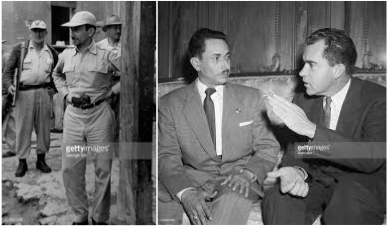
    Castillo Armas (with Nixon)

    In 1954, the Dulles brothers were at it again in Guatemala with operation PBSUCCESS. Jacobo Arbenz, the labor-friendly and democratically elected leader of the country, was going toe to toe with other corporate interests such as the Rockefeller/Sullivan & Cromwell associated company United Fruit. Arbenz was pushing for reform that sought to curtail the neo-colonial power of United Fruit by providing more in resources for the people of Guatemala. To the Dulles brothers and other Wall Street types with vested interests, this was unacceptable and was to be depicted as nothing short of communism. Arbenz was ousted from the country in what was largely a psychological warfare operation. He was replaced with a ruthless dictator by the name of Castillo Armas. The CIA provided the Armas regime with “death lists” of all Arbenz government members and sympathizers, and through the decades that followed, tens of thousands of people either were brutally killed or went missing at the hands of the dictatorship. 2 This constant state of upheaval, terror and violence did not subside until a United Nations resolution took hold in 1996.

    II

    Hillary Clinton, whether she knows it or not—and it’s a big stretch to say that she doesn’t—has advocated for the same interventionist foreign policy machine created by the likes of the Dulles brothers. There are at least three major areas of foreign affairs in which she resembles the Dulles brothers more than Trump does: 1.) The Iraq War 2.) American /Russian relations 3.) American actions against Syria. In fact, she actually made Trump look Kennedyesque in this regard, no mean feat.

    Clinton & Kissinger

    Nowadays, Clinton refers to her vote for the Iraq War as a “mistake”, but it certainly doesn’t seem like one considering the context of her other decisions as Secretary of State. Secretary Clinton’s friendships and consultations with Henry Kissinger and Madeleine Albright raised eyebrows in progressive circles. (Click here for the Clinton/Kissinger relationship.) Kissinger’s record as Secretary of State/National Security Adviser was most certainly one of the worst in U.S. history when it came to bloody, sociopathic, interventionist policy around the globe. During the disastrous and unnecessary crisis in Vietnam, Kissinger would nonchalantly give President Nixon death tallies in the thousands regarding Vietnamese citizens as if they were some Stalinesque statistic. Kissinger then agreed to expand that war in an unprecedented way into Cambodia and Laos—and then attempted to conceal these colossal air war actions. Of course, this was a further reversal and expansion of that war, which went even beyond what Lyndon Johnson had done in the wake of JFK’s death. President Kennedy’s stated policy was to withdraw from Indochina by 1965.

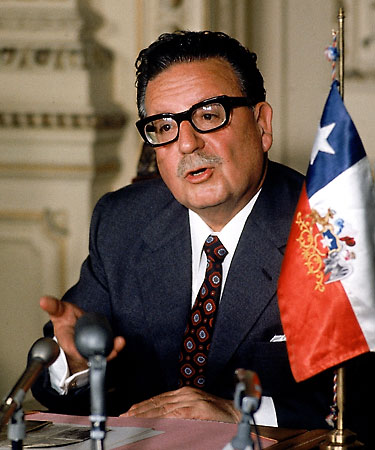
    Salvador Allende
    Augusto Pinochet

    Kissinger was also an instrumental force for the CIA coup in Chile, which ended in the death of Salvador Allende. About Allende, he allegedly stated he did not understand why the USA should stand by and let Chile go communist just because the citizenry were irresponsible enough to vote for it. (A Death in Washington, by Don Freed and Fred Landis, p. 8) The CIA overthrow of Allende led to years of brutal fascism under military dictator Augusto Pinochet.


    Clinton & Albright

    Madeleine Albright demonstrated similar hawkishness. (Click here for more on the Clinton/Albright relationship.) When asked about the refusal of the United States to lift UN Sanctions against Iraq and the resulting deaths of 500,000 Iraqi children, Albright stated that the deaths had been “worth it.”3 Predictably, Albright’s statement was met with stunned surprise. In May of 1998, Albright said something just as surprising. At that time, riots and demonstrations against the brutal Indonesian dictator Suharto were raging all over the archipelago; there were mock funerals being conducted, and his figure was being burned in effigy. Here was a prime opportunity for Albright and the Clinton administration to step forward and cut off relations with a despot who had looted his nation to the tune of billions of dollars. Or at the very least, join the chorus of newspapers and journals requesting he step down. What did Albright do? She asked for “more dialogue”. Even in the last two days of Suharto’s reign, when major cities were in flames, when Senators John Kerry and the late Paul Wellstone were asking the State Department to get on the right side of history, Albright chose to sit on the sidelines. (Probe Magazine, Vol. 5 No. 5, pp. 3-5)

    Hajji Muhammad Suharto with Nixon, Ford & Kissinger, Reagan, Bush Sr. & Bill Clinton

    In this regard, let us recall that Suharto came to power as a result of a reversal of President Kennedy’s foreign policy. Achmed Sukarno had been backed by President Kennedy throughout his first term, all the way up to his assassination. And JFK was scheduled to visit Jakarta in 1964, before the election. As opposed to the silence of Albright and Bill Clinton, after Suharto resigned, the Robert F. Kennedy Memorial Center wrote a letter to his successor asking for an investigation of the role of the military in suppressing the demonstrations that led to his fall. (ibid)

    During her time as Secretary of State, Hillary Clinton displayed an American imperiousness akin to the previous examples. Whether the former Secretary’s intentions in Libya truly aimed at ending what she called a “genocidal” regime under Gaddafi doesn’t really matter. She personally pushed for a NATO sanctioning of bombings in Libya. (This NATO assault in Africa followed the standard set by Albright in Kosovo in 1999, which was the first offensive attack NATO had ever performed.) The assault on Libya eventually led to the murder of Muammar Gaddafi. And that paved the way for a dangerous political power vacuum in which various elements, including Islamic extremists, are vying for power. It is safe to say that she left Libya in such a shambles that the USA had to reenter the civil war.

    Clinton’s decision to arm Syrian “rebels” against Bashar al Assad has also helped create bloody conflict with no end in sight. (Click here for why this may be a strategic mistake.) Bombings occur on a daily basis, especially in areas like Aleppo, leaving tens of thousands of innocents dead. As a candidate, she wanted to establish a “no-fly zone” over Syria—much as she did in Libya. This was a euphemism for controlling the air so that American proxies could control the ground. And as many suspect, and as alluded to in the above-linked story, that likely would have led to fundamentalist dominance in Syria, resembling the endgames in Iraq and Libya. But beyond that, this would probably have ended up provoking Russia, since Russia backs Assad. (Ibid, n. 3)

    “Pacific Rubiales:
    How to get rich in a
    country without regulations”

    Secretary Clinton’s policy regarding Latin America, another topic avoided by the media during the last election cycle, also demonstrates knowing or unknowing complicity with colonial/imperial interests. In Colombia, for instance, a petroleum company by the name of Pacific Rubiales, which has ties to the Clinton Foundation, has been at the center of a humanitarian controversy. The fact that Pacific Rubiales is connected with the Clinton Foundation isn’t the main issue, however. The real problem is the manner in which positions were changed on Clinton’s part in exchange for contributions. During the 2008 election season, then-Senator Clinton opposed the trade deal that allowed companies like Pacific Rubiales to violate labor laws in Colombia. After becoming Secretary of State, Clinton did an about-face. As summed up by David Sirota, Andrew Perez and Matthew Cunningham-Cook:

    At the same time that Clinton’s State Department was lauding Colombia’s human rights record (despite having evidence to the contrary), her family was forging a financial relationship with Pacific Rubiales, the sprawling Canadian petroleum company at the center of Colombia’s labor strife. The Clintons were also developing commercial ties with the oil giant’s founder, Canadian financier Frank Giustra, who now occupies a seat on the board of the Clinton Foundation, the family’s global philanthropic empire. The details of these financial dealings remain murky, but this much is clear: After millions of dollars were pledged by the oil company to the Clinton Foundation—supplemented by millions more from Giustra himself—Secretary Clinton abruptly changed her position on the controversial U.S.-Colombia trade pact.” 4

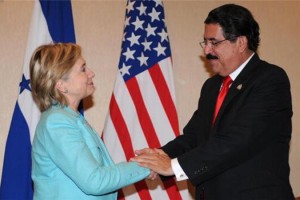
    Clinton & Zelaya (2009)

    Despite recent denials, the former Secretary also played a role in the 2009 coup that ousted the democratically elected and progressive human rights administration of Manuel Zelaya in Honduras. Recent editions of Clinton’s autobiography Hard Choices have been redacted to conceal the full extent of her role in the overthrow. Since the coup, and in opposition to the supposed goals of the overthrow itself, government-sponsored death squads have returned to the country, killing hundreds of citizens, including progressive activists like Berta Cáceres. Before her assassination, Cáceres berated Secretary Clinton for the role she played in overthrowing Zelaya, stating that it demonstrated the role of the United States in “meddling with our country,” and that “we warned it would be very dangerous and permit a barbarity.” 5

    In addition, the U.S.-backed coup in Honduras demonstrates the ongoing trend of outsourcing when it comes to intelligence work. A private group called Creative Associates International (CAI) was involved in “determining the social networks responsible for violence in the country’s largest city,” and subcontracted work to another private entity called Caerus. A man by the name of David Kilcullen, the head of Caerus, was previously involved in a $15 million US AID program that helped determine stability in Afghanistan. Kilcullen’s associate, William Upshur, also contributed to the Honduras plans. Upshur is now working for Booz Allen Hamilton, another private company involved in U.S. intelligence funding. (Ibid, n. 5)

    In his 2007 book, Tim Shorrock explained how substantial this kind of funding is. Shorrock stated that approximately 70 percent of the government’s 60-billion-dollar budget for intelligence is now subcontracted to private entities such as Booz Allen Hamilton or Science Applications International Corporation. 6

    Puerto Rico, a country in the midst of a serious debt crisis, is another key topic when it comes to Clinton’s questionable foreign policy decisions. Hedge funds own much of Puerto Rico’s massive debt, and a piece of legislation, which was put forward to deal with the issue, has rightly been labeled by Bernie Sanders as a form of colonialism. The bill in question would hand over control of financial dealings to a U.S. Government Board of Regulators, which would likely strip vital social spending in Puerto Rico. The bill already imposes a $4.25 minimum wage clause for citizens under 25. While Sanders opposed this bill, Clinton supported it. 7 This may serve as no surprise, being that the former Secretary of State receives hefty sums from Wall Street institutions like Goldman Sachs, who benefit from this form of vulture capitalism. I am not asserting that Hillary Clinton is solely responsible for these foreign policy decisions, but that she has been complicit with the American Deep State that commits or is heavily involved in these operations. (An explanation of the term “Deep State” will follow.) If the results of this 2016 election, and the success of both Trump and Sanders in the primaries, teach us something, it is that we have to move away as quickly as possible from policy compromised by corporate influence if we truly want to move forward. The American public has clearly had enough with establishment politics.

    III

    With the election of Donald Trump, the viability of establishment politics has been seriously breached, effectively ending the age of lesser-evil voting by the proletariat. Although Hillary Clinton was the preferred candidate regarding things like domestic social issues and scientific issues, it wasn’t enough to tame the massive insurgency of citizens who were so fed up with the status quo that they would rather see the country possibly go up in flames than vote for more of the same. Nor did it inspire an overlooked independent voter base to come out and make a substantial difference in the Democratic vote. In the aftermath of this potential disaster of an election, it is our duty, as a collective, to look deeply into some troubling fundamental issues. One of these has to do with the fact that racism, xenophobia and sexism are still very much alive in this country.

    I will not go so far as to label all Trump supporters as racist, homophobic or sexist. And throughout the primary/general election season, I have tried to remain receptive to their frustrations. However, I can most certainly tell you that, based on my experiences of this election season alone, these sentiments do indeed exist. During a delegate selection process for the Bernie Sanders campaign, I met and ended up having discussions with some Trump supporters. I asked them questions about why they thought Trump would make a good president, all the while disagreeing with them, but listening nonetheless. Two of the men I was speaking with were very civil, but one in particular seemed to be bursting at the seams with frustration over what he thought were the main problems with the country. While ignoring the facts I was presenting him regarding corporate welfare, this man went into relentless diatribes about why “Tacos”, his label for Hispanic people, were wreaking havoc. He exhibited no shame in expressing his distaste for other ethnicities either. During this dismaying exchange, I brought up the continued mistreatment of Native American peoples. In response, this man tried to question the severity of the atrocities committed against them and even went so far as to imply that my use of the term genocide in describing their plight was incorrect.

    Steve Mnuchin

    This may well serve to exemplify the hateful attitudes of mistrust and resentment that have been put under a black light during the course of this election. They’ve lingered dormant under the surface and have reached a boiling point thanks to Donald Trump. To paraphrase Bernie Sanders, Trump was able to channel the frustration of a destitute middle class and convert it into unconstructive anger. While Trump made references to how the “establishment” was a major problem, like many of his policy points, he didn’t ever describe in detail what was to be done to correct it. Instead, with his references to a wall with Mexico and to mass deportations, he encouraged the belief in his supporters that minorities were ruining the country. Yet in spite of his campaign promise to “drain the swamp”, many of the Trump cabinet appointees are among the most Establishment type figures one could imagine. For example, Steve Mnuchin, the former Goldman Sachs executive famous for foreclosures and hedge fund deals, has been appointed Secretary of Treasury.

    The election of a man like Donald Trump, who can’t seem to expound any of his policies in any sort of detail and is openly demeaning towards women, people of other races, and the disabled, makes clear that we have a cancerous political system which has metastasized in large part thanks to establishment politicians beholden to corporate interests. And these politicians are wildly out of touch with the needs of the average American. This created a very wide alley that the new Trump managed to rumble through. (I say “new” because in one of the many failings of the MSM, no one bothered to explain why Trump had reversed so many of the proposals he made back in 2000, when he was going to run on the Reform Party ticket.) Some commentators have claimed there can be little doubt that there was a liberal disillusionment following President Obama’s election. Hillary Clinton could not convince enough people that she was even the “change candidate” that Obama was. Therefore, in the search for answers for why their lives weren’t improving, many citizens had to find alternate sources of information outside of corporate influenced organizations (i.e. The Republican Party, Democratic Party and the Mainstream Media), given those groups won’t admit to the public that they are subservient to the same big money interests. This explains the rise of figures like Rush Limbaugh, Glenn Beck, and even rightwing populist/conspiracy demagogue Alex Jones. Their collective answer is to paint minorities and welfare recipients as the principal ills of American society, all the while failing to recognize the deep connection between government policy and corporate influence. In short, this election warns us that when the real reasons behind government dysfunction are ignored and go unchallenged, one risks the upsurge of fascist sentiments. 8

    In addition to reminding us of Hillary’s relationship with Kissinger, Bernie Sanders reminded a large portion of the U.S. populace about the other fundamental issue lying beneath the surface: corporate power. And Sanders could have neutralized Trump’s appeal among the shrinking working and middle classes, which the latter earned by invoking the need for tariffs and the threat of trade wars. This certainly was another reason for Trump’s popularity in the Mideast states like Wisconsin, Iowa, Michigan and Ohio, where he broke through the supposed Democratic firewall. (As to why, listen to this this segment by Michael Moore.) With Secretary of State Clinton’s and President Bill Clinton’s views on NAFTA and the Columbia Free Trade Agreement, and Hillary’s original stance on the Trans Pacific Partnership (TPP), she could not mount a genuine counter-offensive to Trump’s tactics in those states, for the simple reason that the Clintons were perceived as being free-traders rather than fair-traders. Thanks to their record, a Democratic presidential candidate appeared to favor a globalization policy that began decades ago with David Rockefeller—a policy that was resisted by President Kennedy. (See Donald Gibson, Battling Wall Street, p. 59)

    Awareness of any problem is the first step toward fixing it. But I think we must go beyond simple awareness when it comes to confronting our nation’s collective “shadow”, as Carl Jung would have called it — meaning all the darker, repressed aspects of the unconscious that, when ignored, can result in psychological backlash. How do we get beneath the surface appearances of corporate greed (for instance, the increasing wealth inequality amongst classes, or the amount of tax money allocated to corporate subsidies)? I suggest that an exploration of our past guided by a concept that Peter Dale Scott labels “Deep Politics” can help us come to terms, in a more profound way, with the problems facing us.

    This concept embraces all of the machinations occurring beneath the surface of government activity and which go unnoticed in common analysis, such as in news reports or textbooks. Or, as Scott states in his 2015 book The American Deep State, it “…involves all those political practices and arrangements, deliberate or not, which are usually repressed rather than acknowledged.”9 A “Deep Political” explanation of major world events goes beyond the ostensible or normally accepted models of cause and effect. One example of a “Deep Event” is the 1965 Gulf of Tonkin Incident, which provided a motive, or casus belli, to escalate the Vietnam War into a full-scale invasion by American ground forces. Given that President Johnson had already, in stark contrast to President Kennedy’s policy, approved the build-up of combat troops in Vietnam in 1964, all that was needed was some sort of impetus in order for United States involvement to move to the next stage. As the author describes, many of the intelligence reports received by the Johnson administration regarding this supposed incident did not signal any sort of instigation on North Vietnam’s behalf. However, those same reports were ignored in order to claim that North Vietnam had engaged in an act of war against the United States. 10

    Other examples of Deep Events include the previously mentioned instances of CIA, corporate and State Department interference in the economic and governmental affairs of foreign nations. It is evident that these coups did not occur for the sake of saving other countries from the grip of communism or the reign of dictators; such would only be at best a surface explanation. The deeper explanation is that a nexus of corporate, military, paramilitary, government and, on occasion, underworld elements (viz, the workings of the Deep State) had a vested interest in the outcome. The Bush administration’s lies regarding Saddam Hussein’s alleged arsenal of “weapons of mass destruction”, presented to the American people and Congress as a reason to invade Iraq, could most certainly be classified as a Deep Event. No entities benefitted more from America’s long-term occupation of Iraq than companies like Dick Cheney’s Halliburton. KBR Inc., a Halliburton subsidiary, “was given $39.5 billion (emphasis added) in Iraq-related contracts over the past decade, with many of the deals given without any bidding from competing firms, such as a $568-million contract renewal in 2010 to provide housing, meals, water and bathroom services to soldiers, a deal that led to a Justice Department lawsuit over alleged kickbacks, as reported by Bloomberg.” 11

    Included under the umbrella of Deep Politics are the major assassinations of the 1960s — those of John Kennedy, Robert Kennedy, Martin Luther King Jr. and Malcolm X. Poll after poll has indicated that most Americans believe there was a conspiracy to kill President Kennedy, but even today many apparently have not reasoned beyond the fact that there is something fishy about the “official” version in order to understand this murder in its fullest context. It behooves us to inquire more deeply into this historically critical event. Before I go any further, however, let me assert here—and I do so quite confidently—that anyone who still buys into the government version of events regarding, for example, the assassinations of John and Robert Kennedy, is either not looking carefully enough, or is not really familiar with the case.

    IV

    A suggestive point of departure for such an inquiry are the parallels between the 2016 election and that of 1968. In the wake of the assassination of Martin Luther King in April of 1968, racial tensions were high and a presidential primary season was in full swing. Opposition towards the Vietnam War was strong and one candidate in particular represented the last best hope for minorities, anti-war voters, and the middle, as well as lower classes. That candidate was Robert Kennedy, and by the early morning of June 5th, it was becoming clear that he would likely be the Democratic candidate to run against Richard Nixon in the general election. Within a matter of moments of making his victory speech for the California primary, Robert Kennedy was assassinated when he walked into the kitchen pantry of the Ambassador Hotel in Los Angeles. In those moments, the Sixties ended—and so did the populist hopes and dreams for a new era.

    Chicago DNC 1968
    Philedelphia DNC 2016

    The 1968 Democratic National Convention in Chicago was attended by the protests of disillusioned voters who felt cheated out of a more liberal, populist candidate. They ended up rioting in the streets. Hubert Humphrey, who was receiving flack for not taking a strong enough stance on the situation in Vietnam, was selected as the nominee. Similarly, there were many dissatisfied delegates and voters at the 2016 Philadelphia Democratic convention. But in a tightly controlled operation, their actions were kept hidden off screen. And the threat of stripping them of their credentials was often used to suppress any protest on the convention floor. In 2016, Hillary Clinton was nominated and her candidacy helped give us Donald Trump. In 1968, the immediate result was Richard Nixon as president. But the subsequent results included the massive increase in loss of life not just in Vietnam, but also in Cambodia, and the continuing trend away from the New Deal, anti-globalist policies of John Kennedy and Franklin Roosevelt.

    Alger Hiss, America’s Dreyfus
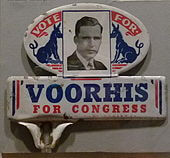
    Rep. Voorhis, defeated by
    Nixon’s smear campaign

    In fact, Nixon had been a part of the effort to purge New Deal elements from the government during the McCarthy era. Whether it was conducting hearings on men like Alger Hiss and making accusations of Soviet spycraft, or using his California Senate campaign to falsely accuse incumbent Congressman Jerry Voorhis of being a communist, Nixon contributed to the growing, exaggerated fear of communism in the United States. This fear allowed men like Allen Dulles to be seen as pragmatists in the face of supposed communist danger. Dulles’ and the CIA’s dirty deeds on behalf of corporate power were carried out under the guise of protecting the world from communism. As described in the Allen Dulles biography by David Talbot, The Devil’s Chessboard, sociologist C. Wright Mills called this mentality “crackpot realism.”12 It is ironic that Nixon ended up distrusting the CIA, the institution so closely associated with Allen Dulles, a man who had championed Nixon’s rise to power as both a congressman and senator.

    Flash forward to 2016 and, once again, we witness the results of a Democratic Party choosing to ignore the populist outcry for reform, and of a government compromised by corporate coercion, one subject to the hidden workings of the Deep State. Bernie Sanders represented the New Deal aspirations of a working class tired of corporate-run politics. As revealed by Wikileaks, the upper echelons of the Democratic Party chose not to heed their voices, thereby indirectly aiding the election of Donald Trump, who offered a different and unconstructive form of populism.

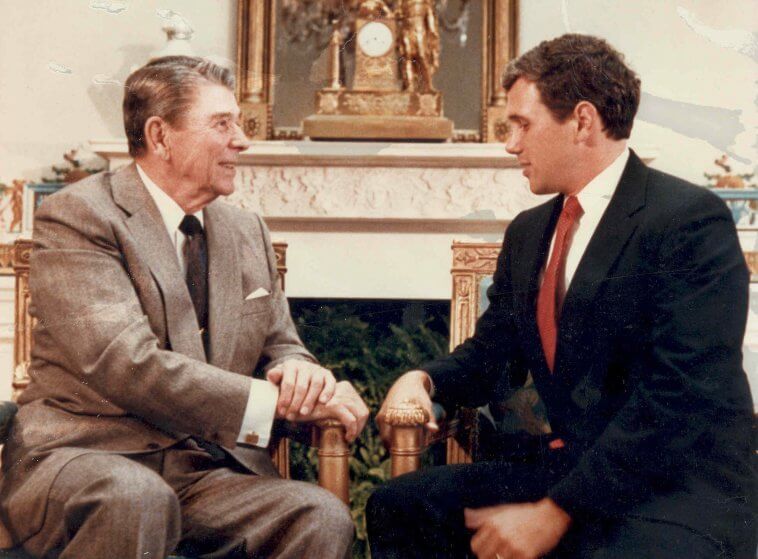
    Pence & Reagan
    Rex Tillerson

    Being that the political spectrum has shifted far to the right as compared to 1968, this year’s election results are more extreme. Donald Trump’s cabinet appointments reflect this extremist mentality; especially in his Vice Presidential pick Mike Pence — a man so out of touch with reality that he has tried to argue that women shouldn’t be working. In 1997, Pence stated that women should stay home because otherwise their kids would “get the short end of the emotional stick.” The soon to be Vice President Pence also sees LGBT rights as a sign of “societal collapse.”13 And as for Trump’s promise to “drain the swamp”, when it comes to establishment figures, it only gets worse, considering his appointment of Rex Tillerson, former CEO of ExxonMobil, as Secretary of State. Despite the fact that Trump appears to be “off the grid”, so to speak, when it comes to the political or Deep Political apparatus, his recent choices for cabinet positions are some of the worst imaginable for the populist of any ilk. In some cases he has actually leapt into the arms of the very establishment he warned his supporters against.

    In the face of all this, Sanders continues to inspire his followers to remain politically active. We all need to be involved more than ever, and the Democratic/socialist senator from Vermont has always urged that true change lies in us having the courage to do things ourselves when it comes to reforming government. The more we stay involved, the less likely it will be that the momentum created by political movements will be squandered in the wake of a setback. The major setbacks of the 1960s came in the form of assassinations of inspiring political leaders. Yet even in the wake of such tragedies it is possible, indeed imperative, to find a glimmer of hope. To do so, however, requires, as this essay has been arguing, the insight afforded by a critical analysis of the past, and its continuities with the present. The touchstone for this historical understanding, I believe, lies precisely in the way the policies of President Kennedy have been consistently overturned by subsequent administrations.

    V

    As mentioned above, John Kennedy was not in favor of the neo-colonialist policies of the Dulles/Eisenhower era. Instead of wanting to occupy foreign nations for the sake of corporate profit, Kennedy believed strongly that the resources of such nations rightly belonged to their people, and that the right to self-determination was critical, as evident in his 1957 speech on French colonialism in Algeria.

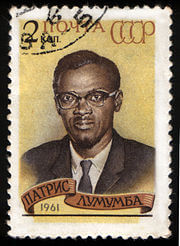
    Soviet stamp
    commemorating Lumumba
    MobutuNixon
    Nixon and Mobutu at the White House

    In the aftermath of a CIA-assisted coup to assassinate Patrice Lumumba, the nationalist leader of the Congo, President Kennedy fought alongside the U.N. to ensure that a nationwide coalition government was formed. Civil war was imminent as militant and corporately complicit leaders like Colonel Mobutu vied for power and promoted the secession of Katanga, the region of Congo that held vast amounts of mineral resources. JFK supported the more centrist elements of the potential coalition government and felt that the resources of Katanga didn’t belong to Belgian, U.S. or British mining interests. The President’s death ended hope for the pursuit of any stable government in Congo, along with the hope of halting widespread violence. 14 It should be noted that Nixon actually welcomed Mobutu to the White House after he took control of Congo.

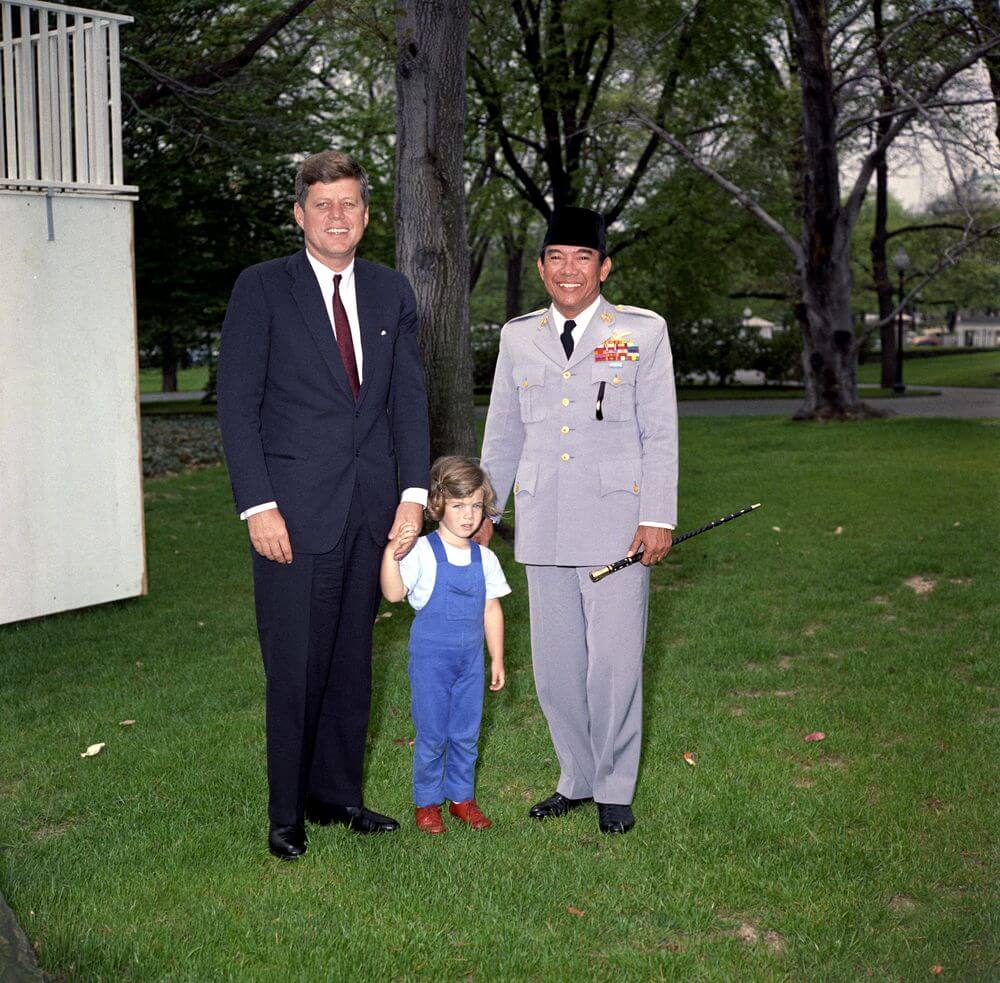
    Sukarno at the White House

    As noted previously, President Kennedy also worked towards re-establishing a relationship with Indonesia and its leader Achmed Sukarno. This was after the Dulles brothers had been involved in attempts to overthrow the Indonesian leader. Decades earlier, it had been discovered by corporate backed explorers that certain areas in Indonesia contained extremely dense concentrations of minerals such as gold and copper. After Kennedy was killed, Sukarno was overthrown with help of the CIA in one of the bloodiest coup d’états ever recorded. Hundreds of thousands of Indonesians perished during both the overthrow, and the subsequent reign of the new leader Suharto. (James DiEugenio, Destiny Betrayed, Second Edition pp. 374-75) Need we add that Nixon also met with Suharto in Washington. In December of 1975, President Ford and Secretary of State Kissinger journeyed to Jakarta and gave Suharto an implicit OK to invade East Timor. This is the tradition that Hillary Clinton and her husband were involved with. For when almost every democratically elected western nation was shunning Suharto in the late nineties, Bill Clinton was still meeting with him. (Op. cit. Probe Magazine.)

    President Kennedy’s policies regarding Central and South America were also a threat to corporate interests. David Rockefeller took it upon himself to publicly criticize Kennedy’s Alliance for Progress, which had been established to aid less developed nations, like those south of the United States, to become economically self-reliant. Men like Rockefeller, along with the Wall-Street-connected media (e.g.,Wall Street Journal and Time/Life) also berated the President for “undermining a strong and free economy,” and inhibiting “basic American liberties.” (14, p. 57) The Wall Street Journal flat out criticized Kennedy for being a “self-appointed enforcer of progress” (Ibid p. 66). JFK’s 1962 clash with U.S. Steel, a J.P. Morgan/Rockefeller company, provoked similar remarks.

    After President Kennedy had facilitated an agreement between steel workers and their corporate executives, the latter welshed on the deal. It was assumed that the workers would agree to not have their wages increased in exchange for the price of steel also remaining static. After the agreement was reached, U.S. Steel defied the President’s wishes and undermined the hard work to reach that compromise by announcing a price increase. The corporate elite wanted Kennedy to buckle, but instead, he threatened to investigate them for price-fixing and to have his brother Bobby examine their tax returns. Begrudgingly, U.S. Steel backed off and accepted the original terms. Kennedy’s policies, both domestic and foreign, were aimed at enhancing social and economic progress. Like Alexander Hamilton, and Albert Gallatin, JFK sought to use government powers to protect the masses from corporate domination. His tax policy was aimed at channeling investment into the expansion of productive means or capital. The investment tax credit, for instance, provided incentives for business entities that enhanced their productive abilities through investment in the upkeep or updating of equipment inside the United States. (Gibson pp. 21-22) While Kennedy’s policies were focused on strengthening production and labor power, his opponents in the Morgan/Rockefeller world were focused on sheer profit.

    David Rockefeller & Henry Luce  in 1962

    It should serve as no surprise that the media outlets responsible for condemning the president were tied into the very corporate and political establishment entities being threatened. As described by sociologist Donald Gibson in his fine book Battling Wall Street: The Kennedy Presidency, the elite of Wall Street, media executives and certain powerful political persons or groups were so interconnected as to be inbred. Allen Dulles himself was very much involved in these circles, and had close relationships with men like Henry Luce of the Time, Life and Fortune magazine empire, along with executives or journalists at the New York Times, and the Washington Post. Operation Mockingbird, a CIA project designed to use various media outlets for propaganda, was exposed during the Church Committee hearings, revealing the collaboration of hundreds of journalists and executives at various media organizations including CBS, NBC, The New York Times, the Associated Press, Newsweek and other institutions.15)

    John Kennedy wasn’t only trying to curtail corporate power with his Hamilton/Gallatin, New Deal-like economic policies. His decisions concerning military engagement abroad were greatly at odds with the hard-line Cold Warriors of his administration and the Central Intelligence Agency. Time after time, Kennedy refused to commit U.S. combat troops abroad despite the nagging insistence of his advisors. Although the President publicly accepted responsibility for the fiasco at the Bay of Pigs, privately he was livid at the CIA for deceiving him. Through materials such as inspector general Lyman Kirkpatrick’s report on the Bay of Pigs, and other declassified CIA documents, it is now evident that a major deception had occurred. The Agency had assured Kennedy that their group of anti-Castro Cuban invaders would be the spark that would set off a revolt against Fidel Castro just waiting to happen. This was not the case, and the CIA-backed Cubans were outnumbered by Castro’s forces 10 to 1. Even worse, as noted in the Kirkpatrick report, was the fact that the CIA had stocked the invading force with C-Level operatives. (2, p. 396) It was almost as if the surface level plan presented to the President was designed to fail in order to force his hand and commit the military into invading Cuba. A declassified CIA memo acknowledges the fact that securing the desired beach area in Cuba was not possible without military intervention. 16

    When Kennedy refused to commit U.S. troops as the operation crumbled, he became public enemy number one in the CIA’s eyes. This sentiment that Kennedy was soft on communism, or even a communist sympathizer, augmented as he continued to back away from military intervention in other situations. The President reached an agreement with the Soviet Union to keep Laos neutral, and despite his willingness to send advisors to Vietnam, he ultimately worked to enact a policy resulting in the withdrawal of all U.S. personnel from the country. Kennedy’s assassination ended this movement toward disengagement from Saigon.

    What was likely even worse to the Cold Warriors and CIA patriots during this time was the President’s attempts at détente with Nikita Khrushchev of the Soviet Union and Cuba’s Fidel Castro. During, and in the period following, the Cuban Missile Crisis, Kennedy and Khrushchev were involved in back channel dialogue with one another. Discussion moved toward talks about détente; despite the fact that the two men’s respective countries had differing views, they agreed it was imperative, for the sake of the planet, to come to an understanding. This, along with JFK’s unwillingness to bomb Cuba during the Missile Crisis, were nothing short of traitorous to the covert and overt military power structure of the United States. In the final months of his life, the President also extended a secret olive branch toward Fidel Castro in hopes of opening a dialogue. Excited by the prospect, Castro was painfully upset when he got word of Kennedy’s assassination. Kennedy most certainly had his enemies, and was making decisions that drove a stake into the very heart of corporate, military and intelligence collusion. If he had been elected President, Bobby Kennedy was most certainly going to continue, and most likely even expand, the policies of his late brother. (ibid, pp. 25-33) Like Jack and Bobby, Martin Luther King and Malcolm X expressed opposition toward the continuation of the Vietnam War.

    VI

    The concept of Deep Politics may provide a helpful alternative to the term “conspiracy theory”, which has become so stigmatized and so overused as to be meaningless. Abandoning the idea of conspiracy altogether, however, risks throwing the baby out with the bath water, for it raises legitimate questions about what lurks beneath the surface of the affairs of state. The enemies that John and Robert Kennedy were facing were not some fictional or hypothetical “illuminati” group or groups. They were very real, dangerous and powerful interests, and those forces are still with us in 2016. Deep Politics does not imply that there is some singular group or set of groups that meet in secret to plot colossal calamities that affect the entire world, but rather that the events themselves arise from the milieu(s) created by a congruence of unaccountable, supra-constitutional, covert, corporate and illegal interests, sometimes operating in a dialectical manner. A more recent example would be the networking of several of these interests to orchestrate the colossal Iran/Contra project.

    Other writers have also described these subterranean forces using other terms. The late Fletcher Prouty called it the Secret Team. Investigative journalist Jim Hougan calls it a Shadow Government. Florida State professor Lance DeHaven Smith, with respect to its activities, coined the term “State Crime Against Democracy”, or SCAD. (Click here for his definition.) Smith wrote one of the best books about how, with the help of the MSM, these forces stole the 2000 election in Florida from Al Gore. He then wrote a book explaining how the term “conspiracy theorist” became a commonly used smear to disarm the critics of the Warren Commission. It was, in fact, the CIA which started this trend with its famous 1967 dispatch entitled “Countering Criticism of the Warren Report”. (See this review for the sordid details.)

    Whether it be extralegal assassinations, unwarranted domestic surveillance, interventionist wars at the behest of corporate interests, torture or other activities of that stripe, these all in essence have their roots in the Dulles era in which covert, corporate power developed into a well-oiled and unaccountable machine running roughshod. These forces have continued to operate regardless of who is elected president, whether Democrat or Republican. (See Jim Hougan’s Secret Agenda for a trenchant analysis of the operation against Richard Nixon that came to be called Watergate.)

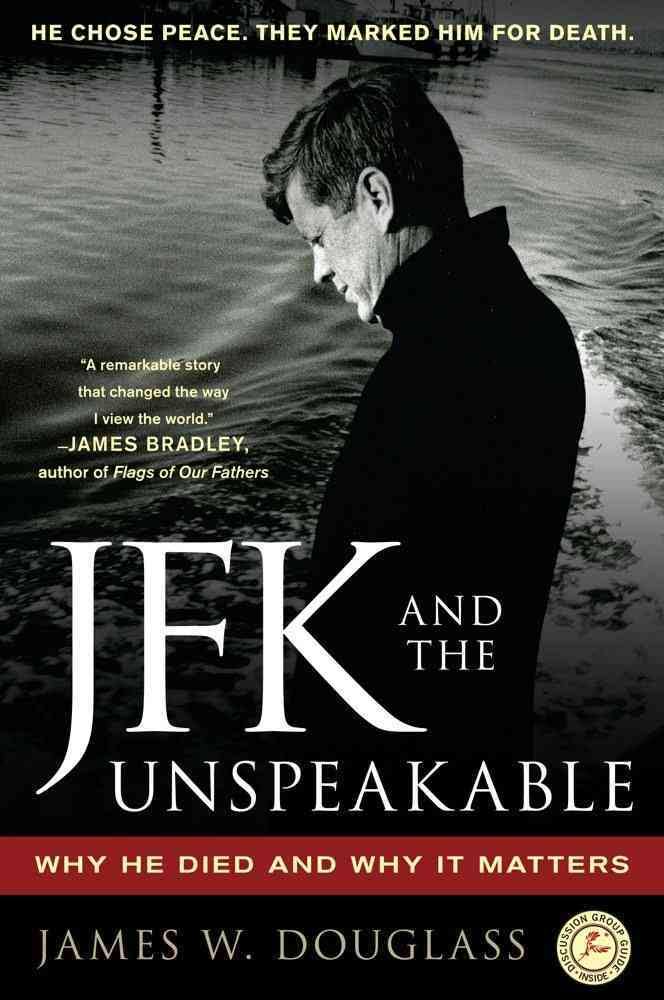
    It is my opinion that we must come to terms with these dark or, to use James W. Douglass’ term, “unspeakable” realities. And we must do so in a holistic way if we are to take more fundamental steps toward progress as a nation. George Orwell coined the term Crime Stop to describe the psychological mechanism by which humans ignore uncomfortable or dangerous thoughts. Through discussions with people young and old, it has become evident to me that this Crime Stop mechanism is at work in the subconscious of many Americans. We need to be willing to face the darker aspects of our recent past that have been at work below the surface and percolating up into view for many years.

    In a very tangible way, the refusal to face these dark forces has caused the Democratic Party to lose its way. And this diluted and uninspiring party has now given way to Donald Trump. As alluded to throughout this essay, this party has abandoned the aims and goals of the Kennedys, King and Malcolm X to the point that it now resembles the GOP more than it does the sum total of those four men. To understand what this means in stark political terms, consider the following. Today, among all fifty states, there are only 15 Democratic governors. In the last ten years, the Democrats have lost 900 state legislative seats. When Trump enters office, he will be in control of not just the White House, but also the Senate and the House of Representatives. Once he nominates his Supreme Court candidate to replace Antonin Scalia, he will also be in control of that institution.

    Bernie Sanders was the only candidate whose policies recalled the idea of the Democratic party of the Sixties. And according to a poll of 1,600 people run by Gravis Marketing, he would have soundly defeated Trump by 12 points. The Democrats have to get the message, or they run the risk of becoming a permanent minority party. They sorely need to look at themselves, and ask, What happened? As a starting point, they can take some of the advice contained in this essay.


    Notes

    1. “Hillary Clinton Snaps At NPR Host After Defensive Gay Marriage Interview.” YouTube. WFPL News, 12 June 2014 <https://www.youtube.com/watch?v=vgIe2GKudYY>.

    2. David Talbot, The Devil’s Chessboard: Allen Dulles, the CIA, and the Rise of America’s Secret Government. New York, NY: Harper, 2015.

    3. Gary Leupp, “Hillary Clinton’s Foreign Policy Resumé: What the Record Shows.” , 03 May 2016.

    4. Greg Grandin, “A Voter’s Guide to Hillary Clinton’s Policies in Latin America.” The Nation, 18 April 2016.

    5. Tim Shorrock, “How Hillary Clinton Militarized US Policy in Honduras.” The Nation, 06 April 2016.

    6. Peter Dale Scott, “The Deep State and the Bias of Official History.” Who What Why, 20 January 2015.

    7. Ben Norton, “Sanders Condemns Pro-austerity ‘Colonial Takeover’ of Puerto Rico; Clinton Supports It.” Salon, 27 May 2016.

    8. “Chomsky on Liberal Disillusionment with Obama.” YouTube, 03 April 2010 <https://www.youtube.com/watch?v=A6Jbnq5V_1s>.

    9. Peter Dale Scott, The American Deep State: Wall Street, Big Oil, and The Attack On U.S. Democracy. Lanham: Rowman & Littlefield, 2015: Chapter 2, p. 12.

    10. “Project Censored 3.1 – JFK 50 – Peter Dale Scott – Deep Politics.” YouTube, Project Sensored, 19 December 2013 <https://www.youtube.com/watch?v=L0CFpMej3mA>.

    11. Angelo Young, “And The Winner For The Most Iraq War Contracts Is . . . KBR, With $39.5 Billion In A Decade.” International Business Times, 19 March 2013.

    12. Zawn Villines, “The Four Worst Things Mike Pence Has Said About Women.” Daily Kos, 21 July 2016.

    13. Richard D. Mahoney, JFK: Ordeal in Africa. New York: Oxford UP, 1983.

    14. Donald Gibson, Battling Wall Street: The Kennedy Presidency. New York: Sheridan Square, 1994.

    15. Carl Bernstein, “The CIA and the Media.” Rolling Stone, 20 October 1977 <http://www.carlbernstein.com/magazine_cia_and_media.php>.

    16. David Talbot, Brothers, p. 47.

  • The 2016 Election, Historical Amnesia and Deep Politics


    By now, I think it is safe to say that everyone is kind of sick of discussing the 2016 election season. However nauseating it may have been, it proved to be unprecedented and monumental in various ways. Unprecedented, for example, in the fact that the two major party candidates were the most disliked in modern political history. The Republican candidate, now President-elect, who touts himself as a good businessman yet probably couldn’t tell you the difference between Keynes and Marx, has run perhaps the most hate-filled, deplorable campaign in recent memory. He often speaks of running the country like a business and harps on immigration as one of the major problems facing this country. Yet he never discusses substantive issues in detail (for example, the tens of millions of poverty- and hunger-stricken children living in the United States alone), and frequently demonstrates a poor grasp of them (such as the nuclear triad). In fact, he compulsively prevaricates and can’t seem to string two cohesive sentences together. Therefore it is hard in many cases to see where he actually stands. (For a revealing example of this, watch this clip.)

    The former Democratic candidate, on the other hand, bears a resemblance to an Eisenhower Republican. She is an intelligent and experienced politician full of contradictions. She was certainly preferable to Trump on domestic issues, e.g., women’s rights, race, and overall economic policy—not to mention global scientific matters like climate change. Nevertheless, there are serious problems with Hillary Clinton’s record. While Trump compulsively exaggerates and prevaricates, Hillary Clinton is not the epitome of honesty or integrity either. Up until 2013, she didn’t support same-sex marriage, yet got defensive and lied about the strength of her record on this issue. 1 Despite the fact that FBI Director James Comey publicly stated that classified material was indeed sent over Clinton’s unsecure server, she continued to dance around that subject as if she still didn’t know the public was privy to Comey’s statements.

    I could expand on the former Secretary of State’s flip-flopping and dishonesty over the years when it comes to problems like email security. And the disturbing fact that five people in her employ took the Fifth Amendment rather than testify before Congress in open session on the subject. However, in spite of their receiving a great deal of media attention, failings such as these are far from being her main flaw, and are, in this author’s opinion, a distraction from much deeper issues. As previously alluded to, Clinton’s foreign policy bears much more of a resemblance to the Eisenhower/Dulles brothers’ record than it does to what one might expect from someone who describes herself as taking a back seat to no-one when it comes to progressive values.

    Allen & John Foster Dulles
    Mossadegh & Shah Pahlavi

    For those who might not be aware, Allen Dulles (former Director of the CIA) and his brother John Foster Dulles (former Secretary of State) essentially orchestrated foreign policy under the Eisenhower administration. They were former partners at Sullivan and Cromwell, which was the preeminent law firm for Wall Street in the fifties. Allen and Foster married global corporate interests and covert military action into a well-oiled machine that promoted coups, assassinations and the blood-soaked destruction of democracies around the world. After Iran’s democratically elected leader Mohammed Mossadegh vowed to nationalize his country’s oil and petroleum resources, the Dulles brothers—who represented Rockefeller interests like Standard Oil— designed a phony indigenous overthrow that installed the corporately complicit Reza Shah Pahlavi into power in 1953. His brutal and repressive reign lasted until 1979, and his downfall provoked a fundamentalist Islamic revolution in Iran.

    Arbenz centennial (2013)
    Castillo Armas (with Nixon)

    In 1954, the Dulles brothers were at it again in Guatemala with operation PBSUCCESS. Jacobo Arbenz, the labor-friendly and democratically elected leader of the country, was going toe to toe with other corporate interests such as the Rockefeller/Sullivan & Cromwell associated company United Fruit. Arbenz was pushing for reform that sought to curtail the neo-colonial power of United Fruit by providing more in resources for the people of Guatemala. To the Dulles brothers and other Wall Street types with vested interests, this was unacceptable and was to be depicted as nothing short of communism. Arbenz was ousted from the country in what was largely a psychological warfare operation. He was replaced with a ruthless dictator by the name of Castillo Armas. The CIA provided the Armas regime with “death lists” of all Arbenz government members and sympathizers, and through the decades that followed, tens of thousands of people either were brutally killed or went missing at the hands of the dictatorship. 2 This constant state of upheaval, terror and violence did not subside until a United Nations resolution took hold in 1996.

    II

    Hillary Clinton, whether she knows it or not—and it’s a big stretch to say that she doesn’t—has advocated for the same interventionist foreign policy machine created by the likes of the Dulles brothers. There are at least three major areas of foreign affairs in which she resembles the Dulles brothers more than Trump does: 1.) The Iraq War 2.) American /Russian relations 3.) American actions against Syria. In fact, she actually made Trump look Kennedyesque in this regard, no mean feat.

    Clinton & Kissinger

    Nowadays, Clinton refers to her vote for the Iraq War as a “mistake”, but it certainly doesn’t seem like one considering the context of her other decisions as Secretary of State. Secretary Clinton’s friendships and consultations with Henry Kissinger and Madeleine Albright raised eyebrows in progressive circles. (Click here for the Clinton/Kissinger relationship.) Kissinger’s record as Secretary of State/National Security Adviser was most certainly one of the worst in U.S. history when it came to bloody, sociopathic, interventionist policy around the globe. During the disastrous and unnecessary crisis in Vietnam, Kissinger would nonchalantly give President Nixon death tallies in the thousands regarding Vietnamese citizens as if they were some Stalinesque statistic. Kissinger then agreed to expand that war in an unprecedented way into Cambodia and Laos—and then attempted to conceal these colossal air war actions. Of course, this was a further reversal and expansion of that war, which went even beyond what Lyndon Johnson had done in the wake of JFK’s death. President Kennedy’s stated policy was to withdraw from Indochina by 1965.

    Salvador Allende
    Augusto Pinochet

    Kissinger was also an instrumental force for the CIA coup in Chile, which ended in the death of Salvador Allende. About Allende, he allegedly stated he did not understand why the USA should stand by and let Chile go communist just because the citizenry were irresponsible enough to vote for it. (A Death in Washington, by Don Freed and Fred Landis, p. 8) The CIA overthrow of Allende led to years of brutal fascism under military dictator Augusto Pinochet.


    Clinton & Albright

    Madeleine Albright demonstrated similar hawkishness. (Click here for more on the Clinton/Albright relationship.) When asked about the refusal of the United States to lift UN Sanctions against Iraq and the resulting deaths of 500,000 Iraqi children, Albright stated that the deaths had been “worth it.”3 Predictably, Albright’s statement was met with stunned surprise. In May of 1998, Albright said something just as surprising. At that time, riots and demonstrations against the brutal Indonesian dictator Suharto were raging all over the archipelago; there were mock funerals being conducted, and his figure was being burned in effigy. Here was a prime opportunity for Albright and the Clinton administration to step forward and cut off relations with a despot who had looted his nation to the tune of billions of dollars. Or at the very least, join the chorus of newspapers and journals requesting he step down. What did Albright do? She asked for “more dialogue”. Even in the last two days of Suharto’s reign, when major cities were in flames, when Senators John Kerry and the late Paul Wellstone were asking the State Department to get on the right side of history, Albright chose to sit on the sidelines. (Probe Magazine, Vol. 5 No. 5, pp. 3-5)

    Hajji Muhammad Suharto with Nixon, Ford & Kissinger, Reagan, Bush Sr. & Bill Clinton

    In this regard, let us recall that Suharto came to power as a result of a reversal of President Kennedy’s foreign policy. Achmed Sukarno had been backed by President Kennedy throughout his first term, all the way up to his assassination. And JFK was scheduled to visit Jakarta in 1964, before the election. As opposed to the silence of Albright and Bill Clinton, after Suharto resigned, the Robert F. Kennedy Memorial Center wrote a letter to his successor asking for an investigation of the role of the military in suppressing the demonstrations that led to his fall. (ibid)

    During her time as Secretary of State, Hillary Clinton displayed an American imperiousness akin to the previous examples. Whether the former Secretary’s intentions in Libya truly aimed at ending what she called a “genocidal” regime under Gaddafi doesn’t really matter. She personally pushed for a NATO sanctioning of bombings in Libya. (This NATO assault in Africa followed the standard set by Albright in Kosovo in 1999, which was the first offensive attack NATO had ever performed.) The assault on Libya eventually led to the murder of Muammar Gaddafi. And that paved the way for a dangerous political power vacuum in which various elements, including Islamic extremists, are vying for power. It is safe to say that she left Libya in such a shambles that the USA had to reenter the civil war.

    Clinton’s decision to arm Syrian “rebels” against Bashar al Assad has also helped create bloody conflict with no end in sight. (Click here for why this may be a strategic mistake.) Bombings occur on a daily basis, especially in areas like Aleppo, leaving tens of thousands of innocents dead. As a candidate, she wanted to establish a “no-fly zone” over Syria—much as she did in Libya. This was a euphemism for controlling the air so that American proxies could control the ground. And as many suspect, and as alluded to in the above-linked story, that likely would have led to fundamentalist dominance in Syria, resembling the endgames in Iraq and Libya. But beyond that, this would probably have ended up provoking Russia, since Russia backs Assad. (Ibid, n. 3)

    “Pacific Rubiales:
    How to get rich in a
    country without regulations”

    Secretary Clinton’s policy regarding Latin America, another topic avoided by the media during the last election cycle, also demonstrates knowing or unknowing complicity with colonial/imperial interests. In Colombia, for instance, a petroleum company by the name of Pacific Rubiales, which has ties to the Clinton Foundation, has been at the center of a humanitarian controversy. The fact that Pacific Rubiales is connected with the Clinton Foundation isn’t the main issue, however. The real problem is the manner in which positions were changed on Clinton’s part in exchange for contributions. During the 2008 election season, then-Senator Clinton opposed the trade deal that allowed companies like Pacific Rubiales to violate labor laws in Colombia. After becoming Secretary of State, Clinton did an about-face. As summed up by David Sirota, Andrew Perez and Matthew Cunningham-Cook:

    At the same time that Clinton’s State Department was lauding Colombia’s human rights record (despite having evidence to the contrary), her family was forging a financial relationship with Pacific Rubiales, the sprawling Canadian petroleum company at the center of Colombia’s labor strife. The Clintons were also developing commercial ties with the oil giant’s founder, Canadian financier Frank Giustra, who now occupies a seat on the board of the Clinton Foundation, the family’s global philanthropic empire. The details of these financial dealings remain murky, but this much is clear: After millions of dollars were pledged by the oil company to the Clinton Foundation—supplemented by millions more from Giustra himself—Secretary Clinton abruptly changed her position on the controversial U.S.-Colombia trade pact.” 4

    Clinton & Zelaya (2009)

    Despite recent denials, the former Secretary also played a role in the 2009 coup that ousted the democratically elected and progressive human rights administration of Manuel Zelaya in Honduras. Recent editions of Clinton’s autobiography Hard Choices have been redacted to conceal the full extent of her role in the overthrow. Since the coup, and in opposition to the supposed goals of the overthrow itself, government-sponsored death squads have returned to the country, killing hundreds of citizens, including progressive activists like Berta Cáceres. Before her assassination, Cáceres berated Secretary Clinton for the role she played in overthrowing Zelaya, stating that it demonstrated the role of the United States in “meddling with our country,” and that “we warned it would be very dangerous and permit a barbarity.” 5

    In addition, the U.S.-backed coup in Honduras demonstrates the ongoing trend of outsourcing when it comes to intelligence work. A private group called Creative Associates International (CAI) was involved in “determining the social networks responsible for violence in the country’s largest city,” and subcontracted work to another private entity called Caerus. A man by the name of David Kilcullen, the head of Caerus, was previously involved in a $15 million US AID program that helped determine stability in Afghanistan. Kilcullen’s associate, William Upshur, also contributed to the Honduras plans. Upshur is now working for Booz Allen Hamilton, another private company involved in U.S. intelligence funding. (Ibid, n. 5)

    In his 2007 book, Tim Shorrock explained how substantial this kind of funding is. Shorrock stated that approximately 70 percent of the government’s 60-billion-dollar budget for intelligence is now subcontracted to private entities such as Booz Allen Hamilton or Science Applications International Corporation. 6

    Puerto Rico, a country in the midst of a serious debt crisis, is another key topic when it comes to Clinton’s questionable foreign policy decisions. Hedge funds own much of Puerto Rico’s massive debt, and a piece of legislation, which was put forward to deal with the issue, has rightly been labeled by Bernie Sanders as a form of colonialism. The bill in question would hand over control of financial dealings to a U.S. Government Board of Regulators, which would likely strip vital social spending in Puerto Rico. The bill already imposes a $4.25 minimum wage clause for citizens under 25. While Sanders opposed this bill, Clinton supported it. 7 This may serve as no surprise, being that the former Secretary of State receives hefty sums from Wall Street institutions like Goldman Sachs, who benefit from this form of vulture capitalism. I am not asserting that Hillary Clinton is solely responsible for these foreign policy decisions, but that she has been complicit with the American Deep State that commits or is heavily involved in these operations. (An explanation of the term “Deep State” will follow.) If the results of this 2016 election, and the success of both Trump and Sanders in the primaries, teach us something, it is that we have to move away as quickly as possible from policy compromised by corporate influence if we truly want to move forward. The American public has clearly had enough with establishment politics.

    III

    With the election of Donald Trump, the viability of establishment politics has been seriously breached, effectively ending the age of lesser-evil voting by the proletariat. Although Hillary Clinton was the preferred candidate regarding things like domestic social issues and scientific issues, it wasn’t enough to tame the massive insurgency of citizens who were so fed up with the status quo that they would rather see the country possibly go up in flames than vote for more of the same. Nor did it inspire an overlooked independent voter base to come out and make a substantial difference in the Democratic vote. In the aftermath of this potential disaster of an election, it is our duty, as a collective, to look deeply into some troubling fundamental issues. One of these has to do with the fact that racism, xenophobia and sexism are still very much alive in this country.

    I will not go so far as to label all Trump supporters as racist, homophobic or sexist. And throughout the primary/general election season, I have tried to remain receptive to their frustrations. However, I can most certainly tell you that, based on my experiences of this election season alone, these sentiments do indeed exist. During a delegate selection process for the Bernie Sanders campaign, I met and ended up having discussions with some Trump supporters. I asked them questions about why they thought Trump would make a good president, all the while disagreeing with them, but listening nonetheless. Two of the men I was speaking with were very civil, but one in particular seemed to be bursting at the seams with frustration over what he thought were the main problems with the country. While ignoring the facts I was presenting him regarding corporate welfare, this man went into relentless diatribes about why “Tacos”, his label for Hispanic people, were wreaking havoc. He exhibited no shame in expressing his distaste for other ethnicities either. During this dismaying exchange, I brought up the continued mistreatment of Native American peoples. In response, this man tried to question the severity of the atrocities committed against them and even went so far as to imply that my use of the term genocide in describing their plight was incorrect.

    Steve Mnuchin

    This may well serve to exemplify the hateful attitudes of mistrust and resentment that have been put under a black light during the course of this election. They’ve lingered dormant under the surface and have reached a boiling point thanks to Donald Trump. To paraphrase Bernie Sanders, Trump was able to channel the frustration of a destitute middle class and convert it into unconstructive anger. While Trump made references to how the “establishment” was a major problem, like many of his policy points, he didn’t ever describe in detail what was to be done to correct it. Instead, with his references to a wall with Mexico and to mass deportations, he encouraged the belief in his supporters that minorities were ruining the country. Yet in spite of his campaign promise to “drain the swamp”, many of the Trump cabinet appointees are among the most Establishment type figures one could imagine. For example, Steve Mnuchin, the former Goldman Sachs executive famous for foreclosures and hedge fund deals, has been appointed Secretary of Treasury.

    The election of a man like Donald Trump, who can’t seem to expound any of his policies in any sort of detail and is openly demeaning towards women, people of other races, and the disabled, makes clear that we have a cancerous political system which has metastasized in large part thanks to establishment politicians beholden to corporate interests. And these politicians are wildly out of touch with the needs of the average American. This created a very wide alley that the new Trump managed to rumble through. (I say “new” because in one of the many failings of the MSM, no one bothered to explain why Trump had reversed so many of the proposals he made back in 2000, when he was going to run on the Reform Party ticket.) Some commentators have claimed there can be little doubt that there was a liberal disillusionment following President Obama’s election. Hillary Clinton could not convince enough people that she was even the “change candidate” that Obama was. Therefore, in the search for answers for why their lives weren’t improving, many citizens had to find alternate sources of information outside of corporate influenced organizations (i.e. The Republican Party, Democratic Party and the Mainstream Media), given those groups won’t admit to the public that they are subservient to the same big money interests. This explains the rise of figures like Rush Limbaugh, Glenn Beck, and even rightwing populist/conspiracy demagogue Alex Jones. Their collective answer is to paint minorities and welfare recipients as the principal ills of American society, all the while failing to recognize the deep connection between government policy and corporate influence. In short, this election warns us that when the real reasons behind government dysfunction are ignored and go unchallenged, one risks the upsurge of fascist sentiments. 8

    In addition to reminding us of Hillary’s relationship with Kissinger, Bernie Sanders reminded a large portion of the U.S. populace about the other fundamental issue lying beneath the surface: corporate power. And Sanders could have neutralized Trump’s appeal among the shrinking working and middle classes, which the latter earned by invoking the need for tariffs and the threat of trade wars. This certainly was another reason for Trump’s popularity in the Mideast states like Wisconsin, Iowa, Michigan and Ohio, where he broke through the supposed Democratic firewall. (As to why, listen to this this segment by Michael Moore.) With Secretary of State Clinton’s and President Bill Clinton’s views on NAFTA and the Columbia Free Trade Agreement, and Hillary’s original stance on the Trans Pacific Partnership (TPP), she could not mount a genuine counter-offensive to Trump’s tactics in those states, for the simple reason that the Clintons were perceived as being free-traders rather than fair-traders. Thanks to their record, a Democratic presidential candidate appeared to favor a globalization policy that began decades ago with David Rockefeller—a policy that was resisted by President Kennedy. (See Donald Gibson, Battling Wall Street, p. 59)

    Awareness of any problem is the first step toward fixing it. But I think we must go beyond simple awareness when it comes to confronting our nation’s collective “shadow”, as Carl Jung would have called it — meaning all the darker, repressed aspects of the unconscious that, when ignored, can result in psychological backlash. How do we get beneath the surface appearances of corporate greed (for instance, the increasing wealth inequality amongst classes, or the amount of tax money allocated to corporate subsidies)? I suggest that an exploration of our past guided by a concept that Peter Dale Scott labels “Deep Politics” can help us come to terms, in a more profound way, with the problems facing us.

    This concept embraces all of the machinations occurring beneath the surface of government activity and which go unnoticed in common analysis, such as in news reports or textbooks. Or, as Scott states in his 2015 book The American Deep State, it “…involves all those political practices and arrangements, deliberate or not, which are usually repressed rather than acknowledged.”9 A “Deep Political” explanation of major world events goes beyond the ostensible or normally accepted models of cause and effect. One example of a “Deep Event” is the 1965 Gulf of Tonkin Incident, which provided a motive, or casus belli, to escalate the Vietnam War into a full-scale invasion by American ground forces. Given that President Johnson had already, in stark contrast to President Kennedy’s policy, approved the build-up of combat troops in Vietnam in 1964, all that was needed was some sort of impetus in order for United States involvement to move to the next stage. As the author describes, many of the intelligence reports received by the Johnson administration regarding this supposed incident did not signal any sort of instigation on North Vietnam’s behalf. However, those same reports were ignored in order to claim that North Vietnam had engaged in an act of war against the United States. 10

    Other examples of Deep Events include the previously mentioned instances of CIA, corporate and State Department interference in the economic and governmental affairs of foreign nations. It is evident that these coups did not occur for the sake of saving other countries from the grip of communism or the reign of dictators; such would only be at best a surface explanation. The deeper explanation is that a nexus of corporate, military, paramilitary, government and, on occasion, underworld elements (viz, the workings of the Deep State) had a vested interest in the outcome. The Bush administration’s lies regarding Saddam Hussein’s alleged arsenal of “weapons of mass destruction”, presented to the American people and Congress as a reason to invade Iraq, could most certainly be classified as a Deep Event. No entities benefitted more from America’s long-term occupation of Iraq than companies like Dick Cheney’s Halliburton. KBR Inc., a Halliburton subsidiary, “was given $39.5 billion (emphasis added) in Iraq-related contracts over the past decade, with many of the deals given without any bidding from competing firms, such as a $568-million contract renewal in 2010 to provide housing, meals, water and bathroom services to soldiers, a deal that led to a Justice Department lawsuit over alleged kickbacks, as reported by Bloomberg.” 11

    Included under the umbrella of Deep Politics are the major assassinations of the 1960s — those of John Kennedy, Robert Kennedy, Martin Luther King Jr. and Malcolm X. Poll after poll has indicated that most Americans believe there was a conspiracy to kill President Kennedy, but even today many apparently have not reasoned beyond the fact that there is something fishy about the “official” version in order to understand this murder in its fullest context. It behooves us to inquire more deeply into this historically critical event. Before I go any further, however, let me assert here—and I do so quite confidently—that anyone who still buys into the government version of events regarding, for example, the assassinations of John and Robert Kennedy, is either not looking carefully enough, or is not really familiar with the case.

    IV

    A suggestive point of departure for such an inquiry are the parallels between the 2016 election and that of 1968. In the wake of the assassination of Martin Luther King in April of 1968, racial tensions were high and a presidential primary season was in full swing. Opposition towards the Vietnam War was strong and one candidate in particular represented the last best hope for minorities, anti-war voters, and the middle, as well as lower classes. That candidate was Robert Kennedy, and by the early morning of June 5th, it was becoming clear that he would likely be the Democratic candidate to run against Richard Nixon in the general election. Within a matter of moments of making his victory speech for the California primary, Robert Kennedy was assassinated when he walked into the kitchen pantry of the Ambassador Hotel in Los Angeles. In those moments, the Sixties ended—and so did the populist hopes and dreams for a new era.

    Chicago DNC 1968
    Philedelphia DNC 2016

    The 1968 Democratic National Convention in Chicago was attended by the protests of disillusioned voters who felt cheated out of a more liberal, populist candidate. They ended up rioting in the streets. Hubert Humphrey, who was receiving flack for not taking a strong enough stance on the situation in Vietnam, was selected as the nominee. Similarly, there were many dissatisfied delegates and voters at the 2016 Philadelphia Democratic convention. But in a tightly controlled operation, their actions were kept hidden off screen. And the threat of stripping them of their credentials was often used to suppress any protest on the convention floor. In 2016, Hillary Clinton was nominated and her candidacy helped give us Donald Trump. In 1968, the immediate result was Richard Nixon as president. But the subsequent results included the massive increase in loss of life not just in Vietnam, but also in Cambodia, and the continuing trend away from the New Deal, anti-globalist policies of John Kennedy and Franklin Roosevelt.

    Alger Hiss, America’s Dreyfus
    Rep. Voorhis, defeated by
    Nixon’s smear campaign

    In fact, Nixon had been a part of the effort to purge New Deal elements from the government during the McCarthy era. Whether it was conducting hearings on men like Alger Hiss and making accusations of Soviet spycraft, or using his California Senate campaign to falsely accuse incumbent Congressman Jerry Voorhis of being a communist, Nixon contributed to the growing, exaggerated fear of communism in the United States. This fear allowed men like Allen Dulles to be seen as pragmatists in the face of supposed communist danger. Dulles’ and the CIA’s dirty deeds on behalf of corporate power were carried out under the guise of protecting the world from communism. As described in the Allen Dulles biography by David Talbot, The Devil’s Chessboard, sociologist C. Wright Mills called this mentality “crackpot realism.”12 It is ironic that Nixon ended up distrusting the CIA, the institution so closely associated with Allen Dulles, a man who had championed Nixon’s rise to power as both a congressman and senator.

    Flash forward to 2016 and, once again, we witness the results of a Democratic Party choosing to ignore the populist outcry for reform, and of a government compromised by corporate coercion, one subject to the hidden workings of the Deep State. Bernie Sanders represented the New Deal aspirations of a working class tired of corporate-run politics. As revealed by Wikileaks, the upper echelons of the Democratic Party chose not to heed their voices, thereby indirectly aiding the election of Donald Trump, who offered a different and unconstructive form of populism.

    Pence & Reagan
    Rex Tillerson

    Being that the political spectrum has shifted far to the right as compared to 1968, this year’s election results are more extreme. Donald Trump’s cabinet appointments reflect this extremist mentality; especially in his Vice Presidential pick Mike Pence — a man so out of touch with reality that he has tried to argue that women shouldn’t be working. In 1997, Pence stated that women should stay home because otherwise their kids would “get the short end of the emotional stick.” The soon to be Vice President Pence also sees LGBT rights as a sign of “societal collapse.”13 And as for Trump’s promise to “drain the swamp”, when it comes to establishment figures, it only gets worse, considering his appointment of Rex Tillerson, former CEO of ExxonMobil, as Secretary of State. Despite the fact that Trump appears to be “off the grid”, so to speak, when it comes to the political or Deep Political apparatus, his recent choices for cabinet positions are some of the worst imaginable for the populist of any ilk. In some cases he has actually leapt into the arms of the very establishment he warned his supporters against.

    In the face of all this, Sanders continues to inspire his followers to remain politically active. We all need to be involved more than ever, and the Democratic/socialist senator from Vermont has always urged that true change lies in us having the courage to do things ourselves when it comes to reforming government. The more we stay involved, the less likely it will be that the momentum created by political movements will be squandered in the wake of a setback. The major setbacks of the 1960s came in the form of assassinations of inspiring political leaders. Yet even in the wake of such tragedies it is possible, indeed imperative, to find a glimmer of hope. To do so, however, requires, as this essay has been arguing, the insight afforded by a critical analysis of the past, and its continuities with the present. The touchstone for this historical understanding, I believe, lies precisely in the way the policies of President Kennedy have been consistently overturned by subsequent administrations.

    V

    As mentioned above, John Kennedy was not in favor of the neo-colonialist policies of the Dulles/Eisenhower era. Instead of wanting to occupy foreign nations for the sake of corporate profit, Kennedy believed strongly that the resources of such nations rightly belonged to their people, and that the right to self-determination was critical, as evident in his 1957 speech on French colonialism in Algeria.

    Soviet stamp
    commemorating Lumumba
    MobutuNixon
    Nixon and Mobutu at the White House

    In the aftermath of a CIA-assisted coup to assassinate Patrice Lumumba, the nationalist leader of the Congo, President Kennedy fought alongside the U.N. to ensure that a nationwide coalition government was formed. Civil war was imminent as militant and corporately complicit leaders like Colonel Mobutu vied for power and promoted the secession of Katanga, the region of Congo that held vast amounts of mineral resources. JFK supported the more centrist elements of the potential coalition government and felt that the resources of Katanga didn’t belong to Belgian, U.S. or British mining interests. The President’s death ended hope for the pursuit of any stable government in Congo, along with the hope of halting widespread violence. 14 It should be noted that Nixon actually welcomed Mobutu to the White House after he took control of Congo.

    Sukarno at the White House

    As noted previously, President Kennedy also worked towards re-establishing a relationship with Indonesia and its leader Achmed Sukarno. This was after the Dulles brothers had been involved in attempts to overthrow the Indonesian leader. Decades earlier, it had been discovered by corporate backed explorers that certain areas in Indonesia contained extremely dense concentrations of minerals such as gold and copper. After Kennedy was killed, Sukarno was overthrown with help of the CIA in one of the bloodiest coup d’états ever recorded. Hundreds of thousands of Indonesians perished during both the overthrow, and the subsequent reign of the new leader Suharto. (James DiEugenio, Destiny Betrayed, Second Edition pp. 374-75) Need we add that Nixon also met with Suharto in Washington. In December of 1975, President Ford and Secretary of State Kissinger journeyed to Jakarta and gave Suharto an implicit OK to invade East Timor. This is the tradition that Hillary Clinton and her husband were involved with. For when almost every democratically elected western nation was shunning Suharto in the late nineties, Bill Clinton was still meeting with him. (Op. cit. Probe Magazine.)

    President Kennedy’s policies regarding Central and South America were also a threat to corporate interests. David Rockefeller took it upon himself to publicly criticize Kennedy’s Alliance for Progress, which had been established to aid less developed nations, like those south of the United States, to become economically self-reliant. Men like Rockefeller, along with the Wall-Street-connected media (e.g.,Wall Street Journal and Time/Life) also berated the President for “undermining a strong and free economy,” and inhibiting “basic American liberties.” (14, p. 57) The Wall Street Journal flat out criticized Kennedy for being a “self-appointed enforcer of progress” (Ibid p. 66). JFK’s 1962 clash with U.S. Steel, a J.P. Morgan/Rockefeller company, provoked similar remarks.

    After President Kennedy had facilitated an agreement between steel workers and their corporate executives, the latter welshed on the deal. It was assumed that the workers would agree to not have their wages increased in exchange for the price of steel also remaining static. After the agreement was reached, U.S. Steel defied the President’s wishes and undermined the hard work to reach that compromise by announcing a price increase. The corporate elite wanted Kennedy to buckle, but instead, he threatened to investigate them for price-fixing and to have his brother Bobby examine their tax returns. Begrudgingly, U.S. Steel backed off and accepted the original terms. Kennedy’s policies, both domestic and foreign, were aimed at enhancing social and economic progress. Like Alexander Hamilton, and Albert Gallatin, JFK sought to use government powers to protect the masses from corporate domination. His tax policy was aimed at channeling investment into the expansion of productive means or capital. The investment tax credit, for instance, provided incentives for business entities that enhanced their productive abilities through investment in the upkeep or updating of equipment inside the United States. (Gibson pp. 21-22) While Kennedy’s policies were focused on strengthening production and labor power, his opponents in the Morgan/Rockefeller world were focused on sheer profit.

    David Rockefeller & Henry Luce  in 1962

    It should serve as no surprise that the media outlets responsible for condemning the president were tied into the very corporate and political establishment entities being threatened. As described by sociologist Donald Gibson in his fine book Battling Wall Street: The Kennedy Presidency, the elite of Wall Street, media executives and certain powerful political persons or groups were so interconnected as to be inbred. Allen Dulles himself was very much involved in these circles, and had close relationships with men like Henry Luce of the Time, Life and Fortune magazine empire, along with executives or journalists at the New York Times, and the Washington Post. Operation Mockingbird, a CIA project designed to use various media outlets for propaganda, was exposed during the Church Committee hearings, revealing the collaboration of hundreds of journalists and executives at various media organizations including CBS, NBC, The New York Times, the Associated Press, Newsweek and other institutions.15)

    John Kennedy wasn’t only trying to curtail corporate power with his Hamilton/Gallatin, New Deal-like economic policies. His decisions concerning military engagement abroad were greatly at odds with the hard-line Cold Warriors of his administration and the Central Intelligence Agency. Time after time, Kennedy refused to commit U.S. combat troops abroad despite the nagging insistence of his advisors. Although the President publicly accepted responsibility for the fiasco at the Bay of Pigs, privately he was livid at the CIA for deceiving him. Through materials such as inspector general Lyman Kirkpatrick’s report on the Bay of Pigs, and other declassified CIA documents, it is now evident that a major deception had occurred. The Agency had assured Kennedy that their group of anti-Castro Cuban invaders would be the spark that would set off a revolt against Fidel Castro just waiting to happen. This was not the case, and the CIA-backed Cubans were outnumbered by Castro’s forces 10 to 1. Even worse, as noted in the Kirkpatrick report, was the fact that the CIA had stocked the invading force with C-Level operatives. (2, p. 396) It was almost as if the surface level plan presented to the President was designed to fail in order to force his hand and commit the military into invading Cuba. A declassified CIA memo acknowledges the fact that securing the desired beach area in Cuba was not possible without military intervention. 16

    When Kennedy refused to commit U.S. troops as the operation crumbled, he became public enemy number one in the CIA’s eyes. This sentiment that Kennedy was soft on communism, or even a communist sympathizer, augmented as he continued to back away from military intervention in other situations. The President reached an agreement with the Soviet Union to keep Laos neutral, and despite his willingness to send advisors to Vietnam, he ultimately worked to enact a policy resulting in the withdrawal of all U.S. personnel from the country. Kennedy’s assassination ended this movement toward disengagement from Saigon.

    What was likely even worse to the Cold Warriors and CIA patriots during this time was the President’s attempts at détente with Nikita Khrushchev of the Soviet Union and Cuba’s Fidel Castro. During, and in the period following, the Cuban Missile Crisis, Kennedy and Khrushchev were involved in back channel dialogue with one another. Discussion moved toward talks about détente; despite the fact that the two men’s respective countries had differing views, they agreed it was imperative, for the sake of the planet, to come to an understanding. This, along with JFK’s unwillingness to bomb Cuba during the Missile Crisis, were nothing short of traitorous to the covert and overt military power structure of the United States. In the final months of his life, the President also extended a secret olive branch toward Fidel Castro in hopes of opening a dialogue. Excited by the prospect, Castro was painfully upset when he got word of Kennedy’s assassination. Kennedy most certainly had his enemies, and was making decisions that drove a stake into the very heart of corporate, military and intelligence collusion. If he had been elected President, Bobby Kennedy was most certainly going to continue, and most likely even expand, the policies of his late brother. (ibid, pp. 25-33) Like Jack and Bobby, Martin Luther King and Malcolm X expressed opposition toward the continuation of the Vietnam War.

    VI

    The concept of Deep Politics may provide a helpful alternative to the term “conspiracy theory”, which has become so stigmatized and so overused as to be meaningless. Abandoning the idea of conspiracy altogether, however, risks throwing the baby out with the bath water, for it raises legitimate questions about what lurks beneath the surface of the affairs of state. The enemies that John and Robert Kennedy were facing were not some fictional or hypothetical “illuminati” group or groups. They were very real, dangerous and powerful interests, and those forces are still with us in 2016. Deep Politics does not imply that there is some singular group or set of groups that meet in secret to plot colossal calamities that affect the entire world, but rather that the events themselves arise from the milieu(s) created by a congruence of unaccountable, supra-constitutional, covert, corporate and illegal interests, sometimes operating in a dialectical manner. A more recent example would be the networking of several of these interests to orchestrate the colossal Iran/Contra project.

    Other writers have also described these subterranean forces using other terms. The late Fletcher Prouty called it the Secret Team. Investigative journalist Jim Hougan calls it a Shadow Government. Florida State professor Lance DeHaven Smith, with respect to its activities, coined the term “State Crime Against Democracy”, or SCAD. (Click here for his definition.) Smith wrote one of the best books about how, with the help of the MSM, these forces stole the 2000 election in Florida from Al Gore. He then wrote a book explaining how the term “conspiracy theorist” became a commonly used smear to disarm the critics of the Warren Commission. It was, in fact, the CIA which started this trend with its famous 1967 dispatch entitled “Countering Criticism of the Warren Report”. (See this review for the sordid details.)

    Whether it be extralegal assassinations, unwarranted domestic surveillance, interventionist wars at the behest of corporate interests, torture or other activities of that stripe, these all in essence have their roots in the Dulles era in which covert, corporate power developed into a well-oiled and unaccountable machine running roughshod. These forces have continued to operate regardless of who is elected president, whether Democrat or Republican. (See Jim Hougan’s Secret Agenda for a trenchant analysis of the operation against Richard Nixon that came to be called Watergate.)

    It is my opinion that we must come to terms with these dark or, to use James W. Douglass’ term, “unspeakable” realities. And we must do so in a holistic way if we are to take more fundamental steps toward progress as a nation. George Orwell coined the term Crime Stop to describe the psychological mechanism by which humans ignore uncomfortable or dangerous thoughts. Through discussions with people young and old, it has become evident to me that this Crime Stop mechanism is at work in the subconscious of many Americans. We need to be willing to face the darker aspects of our recent past that have been at work below the surface and percolating up into view for many years.

    In a very tangible way, the refusal to face these dark forces has caused the Democratic Party to lose its way. And this diluted and uninspiring party has now given way to Donald Trump. As alluded to throughout this essay, this party has abandoned the aims and goals of the Kennedys, King and Malcolm X to the point that it now resembles the GOP more than it does the sum total of those four men. To understand what this means in stark political terms, consider the following. Today, among all fifty states, there are only 15 Democratic governors. In the last ten years, the Democrats have lost 900 state legislative seats. When Trump enters office, he will be in control of not just the White House, but also the Senate and the House of Representatives. Once he nominates his Supreme Court candidate to replace Antonin Scalia, he will also be in control of that institution.

    Bernie Sanders was the only candidate whose policies recalled the idea of the Democratic party of the Sixties. And according to a poll of 1,600 people run by Gravis Marketing, he would have soundly defeated Trump by 12 points. The Democrats have to get the message, or they run the risk of becoming a permanent minority party. They sorely need to look at themselves, and ask, What happened? As a starting point, they can take some of the advice contained in this essay.


    Notes

    1. “Hillary Clinton Snaps At NPR Host After Defensive Gay Marriage Interview.” YouTube. WFPL News, 12 June 2014 <https://www.youtube.com/watch?v=vgIe2GKudYY>.

    2. David Talbot, The Devil’s Chessboard: Allen Dulles, the CIA, and the Rise of America’s Secret Government. New York, NY: Harper, 2015.

    3. Gary Leupp, “Hillary Clinton’s Foreign Policy Resumé: What the Record Shows.” , 03 May 2016.

    4. Greg Grandin, “A Voter’s Guide to Hillary Clinton’s Policies in Latin America.” The Nation, 18 April 2016.

    5. Tim Shorrock, “How Hillary Clinton Militarized US Policy in Honduras.” The Nation, 06 April 2016.

    6. Peter Dale Scott, “The Deep State and the Bias of Official History.” Who What Why, 20 January 2015.

    7. Ben Norton, “Sanders Condemns Pro-austerity ‘Colonial Takeover’ of Puerto Rico; Clinton Supports It.” Salon, 27 May 2016.

    8. “Chomsky on Liberal Disillusionment with Obama.” YouTube, 03 April 2010 <https://www.youtube.com/watch?v=A6Jbnq5V_1s>.

    9. Peter Dale Scott, The American Deep State: Wall Street, Big Oil, and The Attack On U.S. Democracy. Lanham: Rowman & Littlefield, 2015: Chapter 2, p. 12.

    10. “Project Censored 3.1 – JFK 50 – Peter Dale Scott – Deep Politics.” YouTube, Project Sensored, 19 December 2013 <https://www.youtube.com/watch?v=L0CFpMej3mA>.

    11. Angelo Young, “And The Winner For The Most Iraq War Contracts Is . . . KBR, With $39.5 Billion In A Decade.” International Business Times, 19 March 2013.

    12. Zawn Villines, “The Four Worst Things Mike Pence Has Said About Women.” Daily Kos, 21 July 2016.

    13. Richard D. Mahoney, JFK: Ordeal in Africa. New York: Oxford UP, 1983.

    14. Donald Gibson, Battling Wall Street: The Kennedy Presidency. New York: Sheridan Square, 1994.

    15. Carl Bernstein, “The CIA and the Media.” Rolling Stone, 20 October 1977 <http://www.carlbernstein.com/magazine_cia_and_media.php>.

    16. David Talbot, Brothers, p. 47.

  • RFK’s Former Speechwriter Damns the Democrats for Abandoning Kennedy Legacy

    RFK’s Former Speechwriter Damns the Democrats for Abandoning Kennedy Legacy

    Photograph: AP

    The Democratic Party has become something both JFK and RFK would deplore—the party of war.

    By Adam Walinsky, At: Politico

  • William F. Pepper, The Plot to Kill King: The Truth Behind the Assassination of Martin Luther King Jr.


    The dust jacket for The Plot to Kill King quotes former United States Attorney General Ramsey Clark as stating that “No one has done more than Dr. William F. Pepper to keep alive the quest for truth concerning the violent death of Martin Luther King.” This is unassailably true. Dr. King’s murder has never received anything approaching the level of attention and scrutiny that has been afforded the assassination of President Kennedy but, for nearly three decades, Pepper has worked tirelessly to uncover the truth and bring it to the attention of the American public. As he chronicles in his latest book, Pepper was the last attorney for accused assassin James Earl Ray before his death, and tried every avenue available to him to gain his client the trial he had been denied in 1969 when the state of Tennessee and his own lawyer, Percy Foreman, broke Ray down and coerced him into entering a guilty plea.1 Pepper and his investigators spent many, many hours locating overlooked witnesses, uncovering leads, and assembling a case. Then in 1993 he took part in a televised mock trial that resulted in a “not guilty” verdict for Ray.2 After Ray died in 1998, and any and all possibility of a real criminal trial went with him, Pepper worked with the King family in filing a wrongful death lawsuit against Loyd Jowers and “other unknown co-conspirators” so that the information he had uncovered could still be put before a jury. After 14 days of testimony from over 70 witnesses, the jury found that Jowers and others, “including governmental agencies”, were responsible for the death of Martin Luther King.3

    William Pepper

    Yet Pepper is and always has been a controversial figure, even among those who share his disbelief in the official story. For example, Harold Weisberg – who worked as an investigator for Ray’s defense team in the early 1970s and wrote the classic MLK assassination book, Frame Up – referred derisively to Pepper as “a would-be Perry Mason” and described his work as “worse than worthless.”4 On the other hand, the late, great Philip Melanson once described Pepper’s research and investigation as “groundbreaking” when it came to “establishing the presence of Army Intelligence and Army Intelligence snipers” in Memphis on the day of the murder.5 Over the years, this reviewer has adopted something of an agnostic position when it comes to areas of Pepper’s work. Whilst there is undoubtedly great value in what he has uncovered and accomplished, it nonetheless remains true that there a number of legitimate reasons for doubting important elements of Pepper’s research.

    Loyd Jowers

    Take for example the man at the very centre of Pepper’s conspiracy narrative, Loyd Jowers. In 1968, Jowers was the proprietor of Jim’s Grill, a restaurant located underneath the rooming house from which the state alleges Ray fired the fatal shot. For many years the only thing Jowers had to say that was of any interest to investigators was that a white Ford Mustang had been parked directly in front of the grill on the afternoon of the assassination; corroborating Ray’s claim of where he had parked his car and helping establish the presence of two white Mustangs on Main Street. But in 1993, Jowers appeared on ABC’s Prime Time Live claiming that Memphis-based produce dealer and alleged Mafia figure, Frank Liberto, had contacted him shortly before the assassination and paid him $100,000 to hire someone to assassinate Dr. King. He was then visited by a man named Raul who handed him a “rifle in a box” and asked him to hold onto it until “we made arrangements, one or the other of us, for the killing.”6

    On the face of it, Jowers’ story seems plausible enough. There is no doubt that he was at the scene of the crime and in a position to assist in carrying out the assassination. Additionally, parts of his account were corroborated by two other witnesses: former Jim’s Grill waitress, Betty Spates, and local Memphis cab driver, Jim McCraw. Also, Jowers’ claim that Frank Liberto brought him into the plot recalls the statement of civil rights leader John McFerren that, sometime in the afternoon shortly before Dr. King was shot, he overheard Liberto telling someone on the telephone to “Shoot the son of a bitch when he comes on the balcony.”7 And yet Jowers was, by any definition, a most unreliable witness. By Pepper’s own admission there were numerous different versions of his story. In fact, he contradicted himself on virtually every important detail.

    Jim’s Grill

    He initially named black produce-truck unloader Frank Holt as the gunman he had hired but changed his mind after Holt was found alive and well and passed a polygraph test, denying any involvement.8 Jowers then hinted that deceased Memphis Police Lieutenant Earl Clark was the real gunman only to tell Dr. King’s son, Dexter, that he “couldn’t swear” that he was because “All I got was a glance of him.”9 To Dexter, Jowers said that the gunman handed him the still smoking rifle, yet at an earlier time he had claimed to have picked it up after it had been placed on the ground.10 Around this time he also changed his mind about ever having been asked to hire the gunman, saying instead that he had simply been told to be out in the bushes behind Jim’s Grill at 6:00 PM and that he didn’t even know Dr. King was going to be killed.11 In this scenario, Jowers merely held onto the $100,000 until it was collected by a co-conspirator.

    Perhaps even more troubling than these inconsistencies – of which there are more – is the fact that Jowers and his friend Willie Akins are known to have contacted Betty Spates in January 1994 saying that they were interested in doing a book or a movie and they needed her to change her story. If she would say that she saw a black man handing the rifle to Jowers immediately after the shooting, they could all make $300,000.12 And if that wasn’t bad enough, in an April 1997 tape-recorded conversation with Shelby County district attorney general’s office investigator, Mark Glankler, Jowers basically disavowed his confession by stating that Ray’s rifle was the real murder weapon and that “there was no second rifle.”13

    It may also be seen as significant that Jowers never did repeat his conspiracy allegations under oath. He was not actually present for the King v. Jowers civil trial, apparently owing to ill health. The only time he gave a legal deposition after his appearance on Prime Time Live was during the 1994 Ray v. Jowers lawsuit, at which time he reverted to his 1968 story and insisted that he was in the bar serving drinks when the shot was fired. Jowers had agreed that the transcript of his Prime Time Live appearance could be entered into evidence but, through his attorney Lewis Garrison, stipulated “that the questions were asked and Mr. Jowers gave these answers”.14 Thus he did not swear to the accuracy of his alleged confession, he merely agreed that he had given it.

    In The Plot to Kill King, Pepper attributes Jowers’ many contradictory assertions to his fear of being prosecuted and an understandable desire to minimize his own role when talking to members of the King family. Pepper also argues, in spite of Jowers’ attempt to encourage Spates to lie for her share of $300,000, that it is “arrant nonsense” to suggest that he fabricated his story “in anticipation of a book or movie deal.” In fact, he says, “Jowers lost everything. Even his wife left him. There was no book or movie deal, and he was, for the most part, telling the truth.”15 Yet none of these arguments preclude the possibility that Jowers’ confession was invented as part of a money-making scheme that backfired.


    That being said, it should be borne in mind that Jowers’ initial Prime Time story did not come completely out of the blue. Suspicion had already been cast on him by statements that Spates and McCraw had given to Pepper, after which Jowers’, through Garrison, had contacted the Shelby County district attorney general offering to tell everything he knew in exchange for immunity from prosecution. Needless to say his proffer went completely ignored without anyone even attempting to speak with him. Assistant district attorney general, John Campbell, would later attempt to justify this total lack of interest by stating that the story looked “bogus” and that if they had given Jowers immunity “it would imply we thought there was some validity to his story, and that would increase the value of what he could sell it for.”16 Precisely how they were able to deduce immediately and without even talking to Jowers that his story was “bogus” is anyone’s guess.

    In the end, it will be up to each individual researcher to decide which, if any, of Jowers’ varying accounts to believe. Whilst it is true that the jury in King v. Jowers did find him partly responsible for the assassination, it is also true that his assertions were not thoroughly tested at the trial because neither Pepper nor Garrison were looking to undermine Jowers’ credibility. Legendary attorney, author, and activist, Mark Lane, was critical of the trial for that very reason, telling this reviewer that in his opinion, “It was not a real trial … both sides offered the same position and I have reason to doubt that the position they offered was sound. The jury, having seen no evidence to the contrary, had no choice. In my view, the court system should not be utilized in that fashion.”17

    Mark Lane with James Earl Ray

    Lane’s assessment is, in my view, somewhat off the mark in that it suggests a type of collusion between Pepper and Garrison that was likely not the case. In truth, Garrison was in an extremely awkward position. He could not simply deny the existence of a conspiracy without calling his own client a liar, so his strategy was to attempt to minimize Jowers’ role and convince the jury that, as he stated in his closing argument, “Mr. Jowers played a very, very insignificant and minor role in this if he played anything at all. It was much bigger than Mr. Jowers, who owned a little greasy-spoon restaurant there and happened to be at the location he was.”18 In that regard, it worked to Garrison’s advantage to allow Pepper to put on a case for a wide-ranging conspiracy without offering a rigorous challenge. Nevertheless, the result of this strategy, as Lane suggested, was that the jury essentially heard one story from both sides and for that reason the verdict was far from surprising.

    By noting these circumstances, it is not meant in any way to suggest that the civil trial or the jury’s verdict were entirely without merit. On the contrary, as Pepper details in The Plot to Kill King, numerous witnesses gave significant and often startling testimony under oath – many for the first time – and put important evidence on the record. For example, a succession of witnesses provided evidence establishing the manner in which Dr. King was, seemingly intentionally, stripped of all reasonable security, and left entirely vulnerable to a sniper’s bullet. Of particular note is the testimony of Memphis Police Department homicide detective Captain Jerry Williams who had been in charge of organizing a unit of black officers that had previously provided protection for Dr. King on his visits to Memphis. Williams said that he was not asked to form his unit on Dr. King’s final, fatal visit, and was later falsely informed that Dr. King’s organization, the SCLC, had said Dr. King did not want protection.19 Additionally, as University of Massachusetts Professor Philip Melanson testified, MPD Inspector Sam Evans had ordered the emergency services’ TACT 10 unit removed from the vicinity of the Lorraine Motel, claiming this too was done at the request of someone in the SCLC. As Pepper writes, “When pressed as to who actually made the request, he said that it was Reverend [Samuel] Kyles. The fact that Kyles had nothing to do with the SCLC, and no authority to request any such thing, seemed to have eluded Evans.”20

    Not only had Dr. King been stripped of protection but a last-minute switching of his motel room had made the assassin’s job all the easier. Former New York City police detective Leon Cohen testified that Lorraine Motel manager Walter Bailey told him on the morning after the assassination that Dr. King had originally been allocated a more secure courtyard room. But on the evening before his arrival, Bailey had received a call from someone claiming to be from the SCLC’s Atlanta office requesting Dr. King be given a balcony room instead. Bailey said he was “adamantly” opposed to the change “because he had provided security by the inner court” but his caller had insisted the rooms be switched anyway.21 Needless to say, no genuine member of the SCLC is known to have made any such request.

    King on the Lorraine balcony

    As well as being shown how Dr. King was maneuvered into a vulnerable position, the Memphis jury also heard much evidence helping to establish James Earl Ray’s probable innocence. The state has always maintained that Ray holed himself up in a shared bathroom in the rooming house opposite the Lorraine and waited until Dr. King appeared on the balcony at approximately 6:00 pm. After supposedly firing the fatal shot, he is said to have rushed back to his rented room, put the rifle in its box, placed it amongst a bundle of his belongings, then ran down the stairs to the ground floor. Once outside, he allegedly dumped his bundle in the doorway of Canipe’s Amusement Company, climbed into a white Mustang parked just south of Canipe’s, and quickly sped away.

    Pepper provided evidence that successfully countered every step of this most likely false narrative. The notion that Ray had been lying in wait in the bathroom was contradicted by the sworn deposition of James McCraw, who had been in the rooming house only a few minutes before Dr. King was shot. McCraw said that he saw the bathroom door wide open and there was no one inside.22 Raising the possibility that the shot was actually fired from the thick shrubbery below the bathroom window, Pepper read into the record the sworn statement of SCLC member Reverend James Orange who said that he saw what he thought was gun smoke rising from the bushes immediately after he heard the shot.23

    Ray’s alleged flight down the rooming house stairs had, according to the state, been witnessed by Charles Stephens, who occupied the room between the bathroom and the room Ray had rented. But his ability to witness anything was called into question by taxi driver McCraw, who had been called to the rooming house specifically to pick Stephens up. McCraw said that he found Stephens lying on his bed, too drunk to even get up.24 McCraw’s account was corroborated by the testimony of MPD homicide detective Tommy Smith who entered the building shortly after the assassination and found Stephens still so intoxicated that he could hardly stand.25 Not mentioned at the trial was the fact that two weeks after the murder, Stephens had been shown a picture of Ray by CBS news correspondent Bill Stout and failed to recognize him. In fact, he said Ray was “definitely not” the man he claimed to have seen fleeing the rooming house.26

    Judge Joe Brown with
    the supposed murder weapon

    Criminal Court Judge Joe Brown, who had presided over Ray’s final appeal, took the stand to testify about a series of ballstics tests that he had ordered be performed on the Remington Gamemaster rifle found in the doorway of Canipe’s. The FBI had never been able to establish that particular rifle as the murder weapon – supposedly because the bullet removed from Dr. King’s body was too mutilated. Judge Brown, himself a ballistics expert, explained that 12 of the 18 bullets fired during his tests had contained a similar flaw – a bump on the surface – that was not present on the death slug. He also said that the rifle had never been sighted in and, as a result, had failed the FBI’s accuracy test. “ … based on the entirety of the record”, Brown said, “and the further ballistics tests I had run, it is my opinion this is not the murder weapon.”27 Brown’s opinion was re-enforced by the testimony of Judge Arthur Hanes, Jr., who, alongside his father, had been Ray’s defense attorney before Ray made the fatal mistake of hiring Percy Foreman. Judge Hanes told the court that Guy Warren Canipe had said to him in 1968 that the bundle containing the rifle had been dumped in the doorway of his store approximately 10 minutes before the assassination and he was prepared to testify to that effect.28

    Finally, Pepper showed, through the FBI statements of Ray Hendrix and William Reed, that James Earl Ray had most likely left the scene in his white Mustang shortly before the assassination, not immediately after. Ray always maintained that he parked his car directly in front of Jim’s Grill, not south of Canipe’s, and that he left the area sometime between 5:30 and 6:00 pm to try to get his spare tire fixed. The April 25, 1968, statements of Hendrix and Reed corroborated Ray’s account. The pair told the Bureau that they had left Jim’s Grill at approximately 5:30 pm and noticed a white Mustang parked directly outside. When Hendrix realised he had forgotten his jacket, he went back into the grill to retrieve it whilst Reed stood staring at the car. When Hendrix reappeared the two walked a couple of blocks north on South Main Street until they reached the corner of Main and Vance, at which point what appeared to be the very same Mustang, driven by a lone, dark-haired man, rounded the corner in front of them. This independent confirmation of Ray’s movements, essentially constituting an alibi, was hidden from the defence and the FBI kept the crucial documents from the public for decades.29 Finding these statements and having them entered into evidence, as they should have been in 1969, is one of the many things for which Pepper is to be applauded.

    Another is his effort to locate and identify the mysterious figure previously known only as “Raoul” or “Raul”. For those unfamiliar with the King case, Raul was the name of the man whom Ray always claimed had set him up for the assassination. Shortly after his escape from the Missouri State Penitentiary on April 23, 1967, Ray made his way to Montreal, Canada, hoping to obtain the travel documents he needed to flee the country. It was there in a place called the Neptune Bar that he said he met Raul, a dark-skinned man with a Spanish accent, who promised to provide the documents Ray needed if he agreed to smuggle some items across the border. For the next several months, Ray said, he received large sums of money – including $1,900 to buy the Ford Mustang – and followed Raul’s instructions. According to Ray, these instructions ultimately included purchasing the Remington Gamemaster rifle and renting a room at the flophouse opposite the Lorraine Motel.

    Jerry Ray before the HSCA

    Needless to say, the state and its defenders have always maintained that Raul did not exist. Yet as Pepper points out, this leaves them with the problem of accounting for the large sums of money Ray was known to have spent whilst having no other known source of income. Desperate to explain this away, the HSCA theorized that Ray and his brothers had robbed a bank in Alton, Illinois. “The problem with this ‘theory’”, Pepper writes, “is that I called the local sheriff and the bank president in Alton. I was advised that they knew James had nothing to do with the robbery. The real culprits were known but there was not enough evidence to charge them.”30 On Pepper’s advice, Ray’s brother Jerry surrendered himself to the Alton police in 1978, offering to waive the statute of limitations so that he could be charged. He was promptly informed that neither he nor his brothers had ever been suspects.31

    Because Ray was a largely incompetent crook, and because he was never the violent racist that the media falsely made him out to be, those who spent any length of time with him rarely doubted his claim that he had been set-up by someone. Quite simply, the idea of Ray as a lone nut assassin has never made any sense. As Arthur Hanes Sr. is said to have remarked, “Unless Ray is a complete damn fool I don’t see how he could have made the decision to kill King. Before King was killed, Ray was doing all right. He was free, able to support himself with smuggling and stealing. He was driving a good car all over Canada, the United States and Mexico. He was comfortable, eating well, finding girls, and nobody was looking for him. Why then would he jeopardize his freedom by killing a famous man and setting all the police in the world after him?”32 Indeed, one might ask why Ray, being on the run from prison and desiring little more than to leave the United States for a country with whom the US had no extradition treaty, would have even re-entered the country in the first place after having made it as far as the Montreal docks? It might well be said that Ray’s actions following his prison break only make sense if we accept that someone was manipulating him.

    Pepper believed Ray’s story and, soon after agreeing to represent him, set out to find Raul. Eventually Pepper’s investigators came into contact with a rather eccentric witness named Glenda Grabow who told them that in the 1970s she had been involved in gunrunning, among other illegal activities, with a man whose nickname was “Dago” and that he had confessed to her his involvement in the murder of Dr. King. Meanwhile Pepper, who heard a rumour that Raul was living in the northeast, had zeroed in on an individual named Raul Coelho, living in Upstate New York. Investigators John Billings and Ken Herman obtained a picture of this Raul taken in 1961 when he emigrated to the US from Portugal, placed it amongst a spread of six photographs, and showed them to Grabow. According to Herman, “she pointed out Raul with no hesitation. She was sitting at the kitchen table in my house and zeroed right in on the guy.” The spread was then shown to Glenda’s younger brother, Royce Wilburn, who also knew “Dago” and he too identified the picture of the New York Raul.33

    Billings then took the obvious next step and showed the spread of photographs to Ray in his cell at Riverbend Prison in Nashville, Tennessee. As Billings later testified, “I told him we had a picture of Raul. And he seemed somewhat surprised. And I asked him if he would choose to attempt to pick out Raul in a photo spread … So we put this before him, and James put on his glasses and very – for a minute or two studied these pictures very carefully.” He then dropped his finger down on the picture of the New York Raul and said “that’s Raul.” Asked if he was positive Ray said, “Yes, I am.”34

    The pictures were also shown to British merchant seaman Sid Carthew who had come forward after watching a video tape of the televised mock trial saying that he too had met a man named Raul in the Neptune Bar, Montreal, in 1967. Over the course of two evenings, Raul had offered to sell him some Browning 9mm handguns. “He said to me, how many would you want, and I said four … and he said, four, what do you – four, what do you mean by four. I said four guns. He wanted to sell me four boxes of guns … once he knew that I would have only take – took four, he was very annoyed … it wouldn’t be worth his while to deal in such a small number, and that was the end of the conversation, and he went back to the bar.”35 Carthew selected the same photograph from the spread as Grabow, Royce, and Ray had before him. And according to Pepper, so too did Loyd Jowers.36


    In its response to the King v. Jowers trial and verdict, the Department of Justice insisted that the New York Raul had had nothing to do with the assassination and dismissed these photographic identifications as “suspect”. It said that the photo array was “deficient and unfairly suggestive” because the Raul photograph is the only one of the six to have “extremely high black and white contrast and no intermediate gray tones” and thus “stands out markedly from the others.”37 Essentially the DOJ suggested that the contrast of that particular photo causes it to draw the eye and that was why Pepper’s witnesses picked it out. This reviewer recently decided to put that notion to the test by sharing the photo array on a social media site, asking if anyone could pick out a man named “Raoul” (Ray’s original spelling) who “has allegedly been involved in drug smuggling, gun dealing, and murder.” I also hinted at a connection to the assassination of Dr. King. Of the 14 respondents, not a single one picked out the picture of the New York Raul. While this was hardly a perfect experiment, the result nonetheless stood in stark contrast to the DOJ’s suggestion that the picture of Raul Coelho was more likely to be picked over the others because of its high contrast.

    Ironically, one of the most frequently cited reasons for doubting the DOJ’s assurances and believing that the man Pepper found may well have been the real Raul is the manner in which he was assisted and protected by the US Government. As Pepper discovered after he made Raul a party defendant in the Ray v. Jowers lawsuit, despite supposedly being nothing more than a retired auto plant worker of modest means, Raul was being represented by two large, prestigious law firms. And when Portuguese journalist Barbara Reis tried to interview him, a member of Raul’s family told her that agents of the US government “are looking over us”, had visited them on at least three occasions and were monitoring their telephone calls.38 As Pepper observed, “Imagine that degree of care and consideration by the government for just a little old retired autoworker.”39

    Most of the above, actually most of what is in The Plot to Kill King, will be familiar ground for those who have read Pepper’s first two books, Orders to Kill and Act of State. In fact, the first two thirds of the new book are little more than a retread of the previous two with entire passages actually being lifted word-for-word from Act of State. The final third of the book, which details Pepper’s “continuing investigation”, unfortunately does not do much to elevate matters or add to our understanding. The new information presented therein is, in this reviewer’s estimation, of very dubious reliability.

    Pepper makes the absolutely startling claim that, although Dr. King’s gunshot wound would have been fatal anyway, he was intentionally finished off by the emergency room doctors who were supposed to be saving his life. He writes of a story that was related to him by a blind Memphis resident named Johnton Shelby, who claims that his mother, Lula Mae, was a surgical aide at St. Joseph’s Hospital and took part in Dr. King’s emergency treatment. According to Shelby, the morning after the assassination his mother gathered the family together to tell them that the emergency room doctors had been ordered by the head of surgery and a couple of “men in suits” to “Stop working on that nigger and let him die.” They were all then ordered to leave the room immediately. Shelby said that as his mother was leaving, she heard the men sucking saliva into their mouths and spitting so she glanced over her shoulder. She then saw that Dr. King’s breathing tube had been removed and a pillow was being placed over his face so as to suffocate him.40

    An extraordinary story like Shelby’s requires extraordinary proof. Yet Pepper seems to swallow the whole thing hook, line, and sinker despite the fact that, by his own admission, he spoke with numerous medical personnel who were known to have been in the emergency room and found absolutely no corroboration for it whatsoever. Shelby named a few people with whom his mother supposedly shared her experience but, needless to say, they were all conveniently dead in 2013 when he first came forward. More importantly, in accepting Shelby’s story, Pepper has to ignore the fact that it is directly contradicted by testimony that he himself put before the jury in King v. Jowers.

    At the civil trial Pepper put John Billings on the stand to testify not only about his time investigating Glenda Grabow and Raul Coelho but also about his activities on the day of the assassination. In April 1968, Billings was a junior at Memphis State University and was working as a surgical aide at St. Joseph’s. He walked into Emergency Room 1 just as Dr. King’s treatment was beginning and stood and watched as several doctors were “feverishly working … for 30, 45 minutes or so.” One of the doctors eventually walked up to Billings and told him to “go get someone in charge.” He walked out of the room and found “one or two gentleman wearing suits” who “seemed to be more or less telling everyone what to do.” He led them back into the emergency room “and the doctors informed them of something to the effect of Dr. King is – Dr. King is terminated. We have done everything that we can. We feel there’s nothing left that we can do.”41 Nowhere in Billings’ first hand account was there any reference to emergency room staff being ordered to stop working on Dr. King and leave the room. He specifically recalled that the doctors themselves made the decision to stop when they felt they had done everything they could.

    At one point Pepper hints at the idea that the “connections, associations, and personal success” linked to a career practising medicine in Memphis might explain why the numerous doctors who treated Dr. King did not recall the supposed intervention. But he cannot apply any such argument to Billings who did not follow a career in medicine and worked hard as one of Pepper’s investigators to uncover details of the conspiracy to kill Dr. King. It is readily apparent that Billings had absolutely no reason to withhold any details surrounding Dr. King’s emergency treatment. Which is probably why Pepper avoids mentioning his testimony on the issue altogether.

    Pepper also buys into a very elaborate yarn spun by one Ronnie Lee Adkins a.k.a. Ron Tyler. Ronnie’s father, Russell, worked for the city of Memphis for 20 years in the “Engineering Division”. Despite his modest means he was, according to Ronnie, both a 32nd Degree Mason and a Klansman who attended “meetings” that involved everyone from Mayor Henry Loeb and Memphis police and fire department director Frank Holloman to Frank Liberto, Carlos Marcello, and J. Edgar Hoover’s deputy in the FBI, Clyde Tolson. Russell was known as a “fixer” and, through Tolson, Hoover would give him money to perform various deeds including “local-area killings.” On one particular occasion in 1967, Tolson gave him money that was to be paid to the warden of Missouri State Prison to arrange for the escape of James Earl Ray. Of course, as any reasonable person would expect, Russell saw no need to shield his young son from his nefarious deeds, so little Ronnie not only got to see the money being handed to his father, he even got to go along to Missouri to see it passed on to the warden. Or so he says.

    According to Ronnie, in 1964 his father went on a trip to Southampton, England, with Tolson. When he returned he called a meeting with his eldest son Russell Junior and others to tell them that “The coon has got to go.” From then on “prayer meetings” were held at the Berclair Baptist Church, among other places, which eventually came to focus on how to get the garbage workers “pissed off” as a means of drawing Dr. King to Memphis. Allegedly “the word come down from Hoover” that the assassination was to occur in Memphis so that “daddy and them could handle it.” If the reader is dubious that planning for the assassination would have begun four years before it occurred, they will be even less impressed by the claim that way back in 1956 Tolson had handed Russell a “Personal Prayer List” of his and Hoover’s featuring the names JFK, RFK and MLK. That’s right, Ronnie claims that nearly five years before the Kennedys made it to the White House, and at a time when Dr. King’s activism was just beginning, Hoover had already put their names together on a list and handed it to his Memphis “fixer” for no apparent reason.

    When Russell died in 1967, Junior allegedly took over in planning the assassination alongside Holloman. Someone in their camp then supposedly engineered the deaths of Echol Cole and Robert Walker. For those who are unfamiliar with those names, Cole and Walker were two black sanitation workers who, on February 1, 1968, were tragically crushed to death in the back of a garbage truck where they were trying to hide from the rain. It was this tragic accident, and the paltry assistance the city gave to the families of the victims, that prompted Dr. King to travel to Memphis and join a city-wide march in support of the striking sanitation workers. But in Ronnie’s world, this was no accident, “Somebody pulled the hammer, pulled the lever on the truck and mashed them up in there.”

    After Dr. King booked into the Lorraine Motel, Ronnie says, Jesse Jackson – who had supposedly been paid by Russell to keep tabs on Dr King – was instructed to have his room changed to the balcony room 306. Jackson then “went down there and talked to the man and, or his wife Lurlee … and had him move Martin and Ralph up to 306.” The Reverend Billy Kyles, another alleged informant, was given the job of getting Dr. King to come out of his room and onto the balcony at precisely 6:00 pm.

    On the day of the assassination, Ronnie claims, he carried the murder weapon into town on the back of his motorbike wrapped in a bedspread and handed it to Junior and Loyd Jowers in the parking lot next to Jim’s Grill. When 6:00 pm came and Dr. King appeared on the balcony, Junior fired the shot then handed the rifle to Earl Clark who, in turn, handed it to Jowers. Junior then ran through the vacant lot between the rooming house and the fire station, climbed into the white Mustang parked outside the grill and drove away.42

    The above is but a brief synopsis of Ronnie Lee Adkins’ story. There are many more details for which there is not enough space in this short essay. Nonetheless, from what I have included I believe it is clear that calling Adkins’ story hard to believe would be a vast understatement. In fact it is, in this reviewer’s opinion, so utterly lacking in credibility that it hardly seems worth wasting time on a detailed deconstruction. Not only is there no corroboration for any of it, numerous details are in direct conflict with information Pepper has previously presented. For example, Adkins has Jesse Jackson visiting the Lorraine personally to have Dr. King’s room changed. Yet, as noted earlier, Walter Bailey told Leon Cohen that he received the instruction not in person but over the phone from someone who identified himself as a member of the SCLC’s Atlanta office. Adkins has Ray leaving the scene in the white Mustang parked south of Canipe’s and his brother fleeing in the one parked outside the grill when numerous statements establish that it would have had to have been the other way around. And he has Jowers attending some of the so-called “prayer meetings” and receiving the rifle in a parking lot despite nothing like this appearing in any of Jowers’ own accounts.

    In Adkins’ narrative there is no mention of or accounting for Raul and he names some extremely unlikely individuals as part of the plot. He even has MPD officer Tommy Smith – who, you might recall, testified on behalf of the King family that Charlie Stephens was too drunk to identify Ray – waiting in his car on Main Street and then dropping the bundle of evidence in the doorway of Canipe’s. Pepper himself is forced to admit how impossible this is given that “the bundle contained various bits and pieces, including the throw-down gun, which James had left on the bed in his rented room in the rooming house.”43


    There are also logical problems aplenty with Adkins’ story. Like why on Earth would Hoover have had the names JFK, RFK and MLK put on a list and handed to Russell Adkins in 1956? Was anyone even referring to them by their initials back then? Once Dr. King’s assassination was decided, why did it take four years for so many presumably intelligent people to formulate a plan? How did they come to decide that “pissing off” the sanitation workers was the best way of getting Dr. King into Memphis? Why was it necessary for 16-year-old Ronnie to carry the rifle to the scene on the back of his motorbike? Who thought that was a good idea? What if he had been stopped by police officers not in on the plot? Why did Junior not just take the rifle with him in the first place? And what exactly was Earl Clark doing in the bushes if he wasn’t the shooter? Would it have been so difficult for Junior to have handed the rifle to Jowers himself? It should be noted that there is no support anywhere in the record for the notion that there were three people hiding in the shrubbery.

    At the end of the day, even without these logical and factual inconsistencies, Adkins’ fantastical story is based on nothing more than the uncorroborated word of a man who, by his own account, had to quit school without graduating after he took a pistol into the lunchroom and fired off several shots.44 Accepting this man’s word without verification is, as far as this reviewer is concerned, completely unthinkable.

    It is not to Pepper’s credit that he endorses the likes of Shelby and Adkins and I believe that his critics will rightly have a field day with their stories. State apologists like Gerald Posner have delighted in quoting Pepper’s former investigator Ken Herman as stating that “Pepper is the most gullible person I have ever met in my life” and the new information he presents in The Plot to Kill King is doing very little to prove this remark wrong. Unfortunately, he compounds the problem by picking and choosing what he wishes to believe of these troublesome new tales. He rejects one of the central facets of Adkins’ account – that his brother Junior fired the shot – and asserts instead that the real gunman was a former MPD officer named Frank Strausser. Yet his strongest evidence in support of this belief is that Strausser is alleged to have accidentally admitted his involvement to Nathan Whitlock.45 This is the very same Nathan Whitlock who has long claimed that Frank Liberto admitted his own involvement in the assassination to him. Which just leaves this reviewer wondering what exactly it is about Mr. Whitlock that compels people to confess their part in this crime in his presence.

    Ultimately, I cannot say that The Plot to Kill King is a book I would recommend. As noted above, most of the book is a recapitulation of Pepper’s first two. Unfortunately, it is not as well written as either of his earlier works and is poorly edited to boot. There are numerous typographical errors – with Loyd Jowers and Marina Oswald being among those whose names are misspelled – as well as unnecessary repetition of information and witness statements being referred to before they’ve even been introduced. If the new information Pepper presented had been more reliable then it may have redeemed matters but unfortunately that was not to be. Pepper’s second book, Act of State, was a much more worthy addition to the literature. It was better written, better organized, and featured worthwhile rebuttals to both Posner and the Department of Justice. Readers are advised to track down a copy of that book instead.


    References

    1. See here for details: http://mlkmurder.blogspot.co.uk/2013/08/why-did-james-earl-ray-plead-guilty.html

    2. See Pepper, Orders to Kill, Chapters 24-25.

    3. The 13th Juror: The Official Transcript of the Martin Luther King Assassination Conspiracy Trial, p. 752.

    4. http://jfk.hood.edu/Collection/Weisberg%20Subject%20Index%20Files/P%20Disk/Pepper%20William%20F%20Dr/Item%2002.pdf

    5. Who Killed Martin Luther King?, History Channel documentary, 2004.

    6. The 13th Juror, p. 458.

    7. Pepper, The Plot to Kill King, p. 82

    8. Ibid, pgs. 90-93.

    9. The 13th Juror, pgs. 177-178.

    10. Pepper, Act of State, p. 41.

    11. The 13th Juror, p. 178.

    12. Orders to Kill, p. 336.

    13. United States Department of Justice Investigation of Recent Allegations Regarding the Assassination of Dr. Martin Luther King, Jr., June 2000, Part IV, Section C.1.b. https://www.justice.gov/crt/iv-jowers-allegations#analysis

    14. Orders to Kill, p. 383.

    15. The Plot to Kill King, p. 154.

    16. Gerald Posner, Killing the Dream, p. 291.

    17. http://educationforum.ipbhost.com/index.php?showtopic=15699&p=250020

    18. The 13th Juror, p. 739.

    19. The Plot to Kill King, p. 171.

    20. Ibid.

    21. Ibid.

    22. Ibid. p. 298.

    23. Ibid. p. 175.

    24. Ibid. p. 298.

    25. Ibid. p. 174.

    26. Orders to Kill, p. 97.

    27. The Plot to Kill King, p. 177.

    28. Ibid. p. 178.

    29. Ibid. p. 184.

    30. Ibid. p. 198.

    31. The 13th Juror, p. 343.

    32. William Bradford Huie, He Slew the Dreamer, p. 177. I say “said to have remarked” because Huie, who attributed those remarks to Hanes, is a self-admitted fabricator. Therefore nothing he wrote should be taken as absolute fact without independent corroboration.

    33. Posner, p. 296.

    34. The 13th Juror, p. 257.

    35. Ibid. pp. 270-277.

    36. Act of State, p. 222.

    37. Justice Dept. Report, Part VI, Section C.3.b.

    38. The 13th Juror, p. 295.

    39. Act of State, p. 204.

    40. The Plot to Kill King, p. 261.

    41. The 13th Juror, p. 249-250.

    42. The Plot to Kill King, p. 238-258.

    43. Ibid. p. 256.

    44. Ibid. p. 239.

    45. Ibid. p. 235.

  • The White House Kill List

    The Assassination Complex

    By Jeremy Scahill, At: The Drone Papers

  • Michael Swanson, The War State


    Michael Swanson’s book, The War State, seems to me to be a unique and worthy volume. This is not a book on the Kennedy assassination. It’s not even mainly about Kennedy’s presidency; although it does deal with that subject in the second half of the book. What it really is about is the construction of the Military Industrial Complex (MIC) after World War II. How that complex, as in no other country, then became a permanent and an integral part of our society. And how it then began to siphon and strangle parts of the American economy. It also deals with how two presidents helped start the phenomenon, Franklin Roosevelt and Harry Truman; and how two presidents then crashed into it, Dwight Eisenhower and John Kennedy. But the author makes clear that the crash by the latter was much more extensive. In other words, Swanson has written a Big Picture book, one in the tradition of, say, Fletcher Prouty. In my opinion, we need more of these types of books these days. Especially in light of what has happened to the USA since 1963.

    I

    Swanson begins the book with a telling quote by statesman and author George Kennan. Kennan writes that if the USSR would disappear tomorrow, the American military-industrial complex would remain unchanged, “Until some other adversary could be invented. Anything else would be an unacceptable shock to the American economy.” The remarkable thing about this quote is that Kennan wrote it in 1987, two years before the collapse of the Berlin Wall, and four years before the collapse of the USSR. And true to form, the MIC did hang on for a decade. And then, almost to fulfill the dreams of Project for the New American Century (PNAC), came Osama Bin Laden and the 9-11 attacks. The MIC now had its new nemesis. And, as per PNAC, American foreign policy demanded an invasion into Central Asia (Afghanistan) and one into the Middle East (Iraq-twice). PNAC also demanded a reshaping of that area into republics; something they were not at all ready to be. That stipulation created a new Perpetual War to replace the Cold War. All of this was predicted in advance by Kennan.

    From here, the author flashes forward to the Cuban Missile Crisis. (Pgs. 3-9) And he shows how the extremes in both the Russian and American camps made it difficult to settle that nightmare peaceably. To the point that President Kennedy had to use his brother to create a back channel to Ambassador Anatoly Dobrynin to come to a peaceful conclusion to the crisis. Swanson then comments that this may be why Kennedy allowed director John Frankenheimer to use the White House while filming Seven Days in May, a book and film which depicts an attempted military takeover of America.

    For his theme, Swanson now segues to Eisenhower’s famous Farewell Address, in which, for the first time, the MIC, as we know it, was named and described, and its dangers outlined. (p. 10) And now, Swanson begins to describe just how powerful and sprawling the MIC has become. The USA spends 15 times as much on the military as does Russia. It spends 6 times as much as China. (p. 11) If one adds up all global spending on arms and the military, the USA is responsible for 40% of it. More than the next 20 countries combined.

    How was this monster created? Prior to World War II, the USA had always demobilized after major wars. For example, in the thirties, the USA had an army of 140,000 men. We had only 80 tanks and 49 bombers. The total arms budget was only 243 million dollars. As Swanson comments, no one, not Huey Long, not John Maynard Keynes, could get Roosevelt to spend enough money to counter fully the Great Depression. But the threat of Germany and Japan did that in spades. By 1944, unemployment went from 14.6 % to 1.3 %. In constant dollars, FDR spent over 840 billion on the military. That figure dwarfed what he spent on the programs of the New Deal. By the end of the war, the USA had built 88,000 tanks, 97,000 bombers, 400 destroyers and cruisers and an amazing 22 aircraft carriers. (p. 13) Military spending was now 36% of GDP and had reached 86% of total budget expenditures in its biggest year. (p. 13)

    Prior to World War II, very few people paid income tax, and it was usually the rich who did. But this war was much more expensive than World War I, therefore bonds were not enough to finance it. Therefore, taxes had to be supplemented by the withholding income tax feature on middle class people. By 1945, that tax had now surpassed the corporate income tax as the base of operations for the American budget. (pgs. 14-15)

    When Roosevelt began to taper the economy to switch over to a wartime basis, he felt he had to go to the Eastern Establishment to man the high positions in this new behemoth. Therefore, the heads of companies like Sears and GE were placed on the War Production Board. And these men told Roosevelt only big companies could ramp up production fast enough to create a great war machine. Which, the author points out, may or may not have been true. (p. 18) These men also recommended the no-bid contract for much of the work to be done. Almost 75% of all contracts since have been of this variety. Further, they have also been cost plus contracts. Which means all costs of production are paid with a profit built into the contract. As the reader can see, this was the beginning of corporate socialism in military contracting. The biggest companies got even bigger and the MIC was now created. (p. 20)

    As the author notes, these abuses eventually led us down the path to Ronald Reagan and the Pentagon’s $435 hammers, $600 toilet seats, and $7000 coffee makers. Many of these men FDR appointed, like Charles Wilson, urged him not to demobilize after the war. Others, like historian Charles Beard, saw the danger this created and said it was necessary to demobilize. Since FDR died before the end of the war, he did not make that decision.

    II

    As many scholars have noted, including the illustrious Barton Bernstein of Stanford, Harry Truman was responsible for many of the excesses of the national security state. Whatever his regrets were later, whatever New York Times hagiographers like David McCullough may write about him, Truman is popular with Republican mouthpieces like George Will for a reason. The reason is that, along with Winston Churchill, he bears a large part of the responsibility for the Cold War. (As I previously pointed out, the best book on this subject is Frank Costigliola’s Roosevelt’s Lost Alliances.)

    As Swanson sees it, the Cold War began in earnest with the dropping of the atomic bombs on Hiroshima and Nagasaki. Swanson agrees with authors Gar Alperovitz and Stewart Udall that the dropping of these bombs was completely unnecessary. He also quotes people in the government at the time who agreed with that view. For example, Herbert Hoover, Curtis LeMay, Dwight Eisenhower and Douglas MacArthur. (pgs. 38-39) That is quite a conservative gallery for the allegedly populist Truman to be out of step with.

    As Swanson incisively writes, the arms race was accelerated because of the influence of Secretary of State James Byrnes. Byrnes was as much a contrast to Secretary of State Cordell Hull as Truman was to FDR. Byrnes pushed Truman into using the atomic bomb as leverage over the Russians at Potsdam. Which was an incredible misjudgment of Josef Stalin. Truman and Byrnes also looked askance at Stalin’s attempt to control Poland after the war; something that even Churchill understood and privately agreed to in principle. (pgs. 60-61) As Alperovitz postulated, one reason for the dropping of the atomic bomb on Nagasaki was to thwart any more Russian influence in Japan since Roosevelt had agreed to have Stalin open a second front in Asia. Something Stalin did. But the Russians were so easily successful that this alarmed many of the White House hawks, who Hull and FDR had overridden. With the second bomb, and the closing off of the Russian military drive in Manchuria, Stalin now saw the handwriting on the wall. The USSR now had to build its own atomic bomb. In a monumental miscalculation, Truman thought this would take the USSR many, many years to do. (pgs. 66-67) He was wrong. They did it in four.

    As Swanson astutely comments, this was not all to the origins of the Cold War. There were two other distinct elements. First, there was the Bretton Woods agreement of 1944. Named after the town in New Hampshire where the representatives met, this was the creation of the economic internationalist system that would mark the post war world. Bretton Woods marked the beginning of incredibly influential agencies like the IMF and the World Bank. In other words, the Western financial centers of London and New York would now have a reach that would be truly global. (p. 48)

    The second distinct aspect outside the creation of the bomb was the Truman Doctrine. Swanson mentions the struggle in Greece between the monarchists and the socialists after the war. The United States sided with the monarchists. (p. 69) Both Bill Donovan, former OSS chief, and George Kennan backed this move. Although Kennan did have his reservations about the USA becoming the policeman of the world. Senator Arthur Vandenberg, a former isolationist, urged Truman to use the aid to Greece issue as a fear tactic against the Russians, to herd the American people into following him. (p. 72) Needless to say, the tactic was successful. The Truman Doctrine passed in 1947 by the large margin of 67-23. The USA was now allowed to direct aid and weapons to any nation perceived to be in danger of being taken over by communists. This gave the president a huge new power that really did not require a lot of consultation with congress. Therefore, as his advisers told him, Truman now had a great issue in his hands, that of anti- communism. These men did not understand how ogres like Joe McCarthy and J. Edgar Hoover would now demagogue that point.

    The Truman Doctrine was followed up by the Marshall Plan and the creation of NATO. Both of which Stalin felt threatened by. Therefore, he joined neither one. As he did t join Bretton Woods. (p. 76) But when Stalin actually tried to act against this new coalition, he failed. Swanson describes here the attempt by the Russians to seal off West Berlin and force the USA out of the city and therefore make Berlin one, under Russian influence, inside of East Germany. The attempt failed due to the Berlin Airlift. And Swanson rightly states that, in practical terms, this was the extent of the Russian challenge to NATO in Europe. Which is why, for example, Kennan recommended unifying German as early as 1957. His doctrine of containment had won out.

    Kennan, of course, with the famous Long Telegram from Russia, had predicted a struggle with communism and the Soviets. But he always regretted the fact that his message had been taken over by the hawks in the White House and turned into an excuse for higher military budgets. He felt that struggle would be much more of an economic, diplomatic, and cultural one. (p. 77)

    III

    Now comes one of the highlights of the book. After the Russians exploded their atomic bomb in 1949, Truman ordered a review of national security policy. (ibid) The wrong person was placed in charge of this review. The result was one of the great mistakes in modern American history. The man in charge was Paul Nitze, and the Frankenstein monster he composed was NSC-68.

    Nitze is one of the most ignored figures present at the creation of the Cold War. Because not only did he play a major role in its construction, he was such an inveterate and unrepentant Cold Warrior that he stuck around for decades. He then revived it all under Ronald Reagan 30 year later.

    He is one of the worst examples of the Eastern Establishment. Educated at Harvard, he went into investment banking and made a fortune before he was thirty. He then joined Dillon, Read, before founding his own company. But he returned to Dillon Read from 1939-41 as its president. His first wife was a member of the Rockefeller clan. Nitze therefore was one of the members of a privileged class of wealth who navigated between Republican and Democratic presidents for forty years. He had no real political convictions except 1.) to stay in a position of power and 2.) to exacerbate the Cold War. He achieved the last with spectacular success.

    When Truman commissioned his review, Nitze was in charge of Policy Planning at State. He chaired a study group, which featured Dean Acheson and Chip Bohlen, among others. But as many authors agree, Swanson included, Nitze was the driving force behind NSC-68.

    This infamous document recommended a huge, spectacular expenditure on new atomic bombs; a tripling of the conventional defense budget; and a raising of Kennan’s containment policy to levels that Kennan never dreamed of or contemplated. Nitze did this by exaggerating the Russian threat out of all relation to its real military capabilities. But he also did so by attributing to it designs on Europe which it simply did not have. (pgs. 81-82) He then presented his report to Truman with three options: withdraw from Europe, attack the USSR, or follow his recommendations. A skilled bureaucrat, Nitze did his work behind Truman’s back. He himself understood that many of his claims were unsubstantiated at best, and pure hyperbole at worst. But by going to each service chief separately, by getting their support for a huge budget increase, and then telling them he was doing the president’s bidding, he had cornered Truman. He also went to the press to tell them how much this program was needed. (p. 84) Truman resisted, and then relented. (Swanson could have added that Nitze repeated this performance again in the late 70’s with the Committee on the Present Danger. See Jerry Sanders fine book, Peddlers of Crisis.)

    As a result of Nitze’s handiwork, by 1952, defense spending had gone from 13 billion annually to 56 billion. As Swanson comments, NSC-68 made the MIC created by World War II a permanent industry. For example, in 1953, 75% of the national budget was devoted to the military. In the first decade of the Cold War, over 60% of the national budget was devoted to defense spending. (p. 85) But beyond that, Nitze wrote in NSC-68, that even if there was no USSR, it was the purpose of the USA to keep “order” in the world. In fact, this was one of the Nitze’s favorite themes: America’s duty to keep a world order.

    When NSCA-68 was declassified in the seventies, the Russians were aghast at just how wrong the information it was. Later, the Russian military estimates for Nitze’s Committee on the Present Danger were also shown to be wrong. In other words, instead of the media treating him like a Wise Man of the establishment, Nitze was nothing more than a rightwing shill. He did his shilling for his beloved Wall Street brethren’s economic interests. His lies ended up bankrupting two countries: Russia and the USA.

    Previewing his next chapter, Swanson writes that the CIA would now become the chief mechanism for American control in all reaches of that world order.

    IV

    Swanson begins his chapter on the CIA by quoting from a speech Dick Bissell gave about the Agency at a CFR meeting in 1968. There, Bissell talked almost exclusively about the methods and goals of covert action programs. In other words, there was very little discussion of the collection and collating of intelligence. Swanson then observes that in a covert action program, sometimes things come up that are unforeseen. These command spur of the moment further covert actions. In fact, in an internal CIA 1972 report, it was observed that presidential authority had approved only 25% of all covert actions. (p. 101) In the formative years of the Agency, the 40’s and 50’s, some senators who were supposed to be practicing oversight, really did not want to hear about the Agency’s cloak and daggers activities. Therefore, the Agency had almost a blank check to do what it wished. An example of this was the extensive network of airlines the CIA developed over time. Which Director Richard Helms did not even know the extent of. He had to commission an officer to summarize their holdings. (p. 104)

    From here, Swanson traces the history of the Agency from the Central Intelligence Group led by Sidney Souers to the formation of the CIA under the National Security Act. He notes the influence of Allen Dulles in the shaping of the National Security Act, especially those paragraphs dealing with the Agency. (p. 113) Some of the early employees of the Agency were Frank Wisner, E. Howard Hunt, James Burnham, and Bill Buckley (the last two would go on to found the National Review). One of the early propaganda projects these men worked on was the construction of the Congress for Cultural Freedom and its flagship British magazine, Encounter. (p. 116) Some of its early covert action projects took place in Italy and Greece. But Frank Wisner, head of covert action at the time, utterly failed in his operations to undermine Russian control in Eastern Europe. The CIA also failed to predict the Korean conflict or the creation of the atomic bomb by the USSR.

    Truman, gravely disappointed by these intelligence failures, now appointed Walter B. Smith as CIA Director. Smith had read the Dulles-Corrrea-Jackson report on CIA reorganization. So he brought in Dulles as Deputy Director of Plans, and then made him Deputy Director. Wisner’s Office of Policy Coordination, where covert action was planned, was now brought out of the State Department and into the CIA. (p. 122)

    Dulles had been friendly with the Rockefeller family for many years. Through them, he had met the Shah of Iran. Therefore, he was instrumental, along with his brother, Secretary of State, John Foster Dulles, in recommending the overthrow of the nationalist Mossadegh in Iran. (p. 125) The CIA chief in Tehran suggested this was an attempt at Anglo-American colonialism. Dulles had him transferred out and replaced him with the head of the operation, Kermit Roosevelt. (p. 126) Needless to say the coup worked. But the warnings of the CIA chief turned out to be correct in the long run. In 1979, with the Iranian revolution, radical Islam began to sweep through the Middle East, along with radical anti-Americanism.

    Allen Dulles now became CIA Director due to Smith’s health problems. At the request of United Fruit, he and his brother advocated for the overthrow of Jacobo Arbenz in 1954 in Guatemala. United Fruit hired advertising wizard Edward Bernays to control the press coverage about Arbenz prior to the coup. Bernays of course played up the Red Menace angle. (p. 129) In reality, there were about 4,000 communists in the country, and only four members of congress were communists. The coup succeeded. But as with Iran, the long-term effects on Guatemala and the region were horrific. Some estimates state that the number of Guatemalans eventually killed by a series of fascist dictators mounted into the tens of thousands.

    Eisenhower began to get reports about Allen Dulles that portrayed him as being ruthless and a less than competent administrator. So Ike set up the 5412 group to supervise CIA activities and report back to him. But since Dulles gave this group incomplete information, they were never able to get a real grip on the CIA. Swanson writes that it was at this point that Eisenhower began to get disgusted with the intelligence community. And he now issued his famous warning about the USA’s intelligence apparatus being a mess since Pearl Harbor, and that he would bequeath his successor a “legacy of ashes.” (p. 140)

    Swanson now veers off into a subtheme of, “the Road not Taken.” He writes a chapter about Republican senator Bob Taft of Ohio. Like many in the Eastern Establishment, Taft was an Ivy League graduate of Yale and Harvard. But unlike, say Nitze, Taft did not migrate to Wall Street to make his fortune after graduation. He returned to Cincinnati and practiced law. He then went into government service to resupply Europe with food after World War I. Observing the Versailles Treaty, in which the Dulles brothers were involved, he disliked what he saw. He did not think it was a just peace, but an imperial peace. (p. 148) On his return to Ohio, he went into state politics and then entered the US senate in 1938. Opposing Roosevelt’s New Deal, he became known as Mr. Republican. He opposed the concentration of power in the White House during World War II and the New Deal. He also feared the growing trend of the American president to be a czar in the field of foreign policy. Which tended to make the USA into a major player in international affairs. Taft called himself a non-interventionist. (p. 154) He frowned on the growing armaments industry. He felt that because of its geography; being bound by the Atlantic and Pacific Oceans; the USA only needed a strong navy to protect itself from invasion. Prior to Pearl Harbor, he was against American intervention in World War II. He felt that America should supply England and Russia with the money and weapons to defeat Hitler.

    Taft saw the growing power of the presidency as making future wars more likely. He also felt that the growing spending on defense would weaken the economy by raising taxes and causing inflation. (pgs. 156-57) Taft’s ideas caused a split in the Republican Party in the fifties between the Eastern Establishment and the Midwest non-interventionists. In 1952, when Taft ran in the primaries, Thomas Dewey got Harold Stassen to serve as a stalking horse for Eisenhower and he branded Taft an isolationist.

    Taft’s ideas did have an influence on Eisenhower. Ike wanted security with solvency. He complained that when he was in the military, no general ever wanted to get rid of anything, including horses, which stuck around 50 years after they were obsolete. (p. 171) But for all his efforts, by the time Eisenhower left office, military spending had declined only from 70% of the budget to 60%. Eisenhower and Foster Dulles wanted to rely more on atomic weapons, as a cheaper option to conventional armies. (This was called the New Look.)

    But even at that, there were complaints about American weakness versus Russia. Curtis LeMay talked about a bomber gap. Senator Henry Jackson talked about a missile gap. Nitze now went to work on 1957’s Gaither Report, formally titled Deterrence and Survival in the Nuclear Age. Nitze did all he could to promulgate the LeMay/Jackson myths about Russian strength versus American weakness. His report said that the Russians had 1,500 nuclear weapons, 4,500 bombers, and 300 submarines, all aimed at the USA. Nitze also said the Soviets could knock out our SAC with ICBM’s. Therefore, the report asked for 44 billion dollars over five years to repair the difference.

    This was all a wild exaggeration. The Soviets only had four ICBM’s that could reach America at the time. Their nuclear bomber and submarine capability was primitive compared to the USA. (p. 191) But Nitze again leaked part of the report to the gullible media, which swallowed it. But much to his credit, Eisenhower rejected most of the Gaither Report. Which very much angered Nitze who wrote a very harsh letter to Foster Dulles at the time. (ibid) If one is to the right of Foster Dulles on national defense, where does that leave one?

    But the damage was already done. By 1960, the USA had over 18,000 nuclear warheads. This was an incredible 2,000% increase from Truman’s era. Yet, as we have seen, the military still wanted more. Swanson sees this endless appetite, and Eisenhower’s rejection of Nitze, as one of the causes for Ike’s unforgettable Farewell Address, with its pregnant warning about the growing might of the Military Industrial Complex. (p. 193)

    V

    When Eisenhower briefed John Kennedy before JFK was inaugurated, the incumbent warned the senator about two trouble spots, Laos and Cuba. He said that Kennedy should be ready to send American troops into Laos. Eisenhower had already authorized a program of covert action against Cuba because of the large amount of American investment there. He also told him that contrary to what Kennedy said during the campaign, there was no missile gap. The upcoming Polaris submarine missile was invulnerable. (p. 203) Kennedy was disturbed by how calm Eisenhower was when the discussion broached the possibility of atomic warfare.

    Swanson now discusses the shocking saga of the Bay of Pigs invasion. How it went from a small-scale guerilla operation to a large scale, big budget strike force. He brings up the key point that Allen Dulles and Director of Plans Dick Bissell, never left Kennedy any written plans to study. And how they stressed a reliance on thousands of defectors, and also the contingency of guerilla war in the Escambray Mountains if need be. Bissell even said that perhaps as much as one fourth of the Cuban population would rebel. (pgs. 222-24)

    Kennedy requested a shift in the landing location and demanded a location with an air strip. The problem was that the CIA did not foresee that the new landing site contained a coral reef. It was also now 85 miles from the mountains. These two factors caused serious damage to two ships during the landing, and the impossibility of retreat to the mountains for prolonged guerilla warfare. (p. 225) Importantly, Swanson mentions the key fact that Kennedy wanted D-Day air strikes to proceed from an airstrip inside of Cuba. (p. 235)

    The operation was a disaster from the beginning. Secretary of Defense Robert McNamara offered to resign. Kennedy declined since every person in the room was also for the operation. The one exception was Senator Bill Fulbright, who was not on the White House staff. In retrospect, Kennedy told Dave Powers: “They couldn’t believe that a new president like me wouldn’t panic and try to save his own face. Well they had me figured all wrong.” (p. 241)

    After the Bay of Pigs, Kennedy learned to pull in others from his personal staff to consult with on major operations e.g. Bobby Kennedy and Ted Sorenson. This ratcheted up the tensions between military mainstays like General Lyman Lemnitzer of the Joint Chiefs and LeMay on one side, and the White House.

    I have one serious disagreement with Swanson in this section. He writes that the program which followed the Bay of Pigs, Operation Mongoose, included assassination plots. I have not seen any of these Mongoose plans which did this. We do have the CIA-Mafia plots to kill Castro. But those were not part of Mongoose. They were done secretly without presidential authorization. Something which the CIA admits itself in the Inspector General Report on the plots.

    From here, Swanson segues to the USSR and its new leader Nikita Khrushchev. Unlike Stalin, Khrushchev actually consulted with the Presidium on a regular basis. Khrushchev also did away with the terrorist tactics Stalin used against perceived rivals. But the Russian was intent on holding onto Eastern Europe and encouraging wars of national liberation. Therefore, this entailed a rivalry with the USA.

    Economically, Russia could not afford to build a huge navy. Therefore, Khrushchev concentrated on finding a way to build an atomic arsenal. The main nuclear bomber Russia had, the Bison, could not reach the USA since it had only a 5,000 mile range. Further, the USSR had only four of these. As per ICBM’s, the Russians were still reliant on liquid fuel boosters. These took hours to prepare. And in 1960, the Russians had only two launch pads and four rockets. (p. 267) It is debatable if they had a rocket that could reach the USA at that time. And they would not have one for certain until early in 1962.

    Khrushchev requested a summit with Kennedy over Berlin. It was scheduled for June of 1961 in Vienna. Before this, JFK called a meeting with several advisers. Russian Ambassador Chip Bohlen was struck by how much Kennedy wanted to try for a peaceful co-existence strategy with the USSR. (p. 278)

    The summit was unsuccessful because of the cross purposes involved. Khrushchev wanted an agreement on Berlin, which Kennedy would not give him. Kennedy wanted to talk about a nuclear test ban treaty and Southeast Asia. But Khrushchev would not seriously broach those areas without Berlin. Both sides were stymied. (p. 283)

    On his return, many hawkish advisers, like Walt Rostow, Vice-President Lyndon Johnson, and former Secretary of State Dean Acheson, recommended a large defense build-up. They thought the USSR would move on West Berlin. Some even talked about a nuclear threat. Put off by these dire warnings, JFK eliminated Johnson and Acheson from the second stage of talks about the Berlin Crisis. Kennedy decided on a reserve call up, and a speech on Berlin. He then called back Acheson and Johnson and announced his policy at an NSC meeting. When he left, Acheson said, “This nation is without leadership.” (p. 294)

    The result of all this was twofold. The Russians now built the Berlin Wall to stem the tide of refugees fleeing to West Berlin. Secondly, they exploded the Tsar Bomba atomic bomb. This was the largest atomic explosion ever detonated before or since: 50 megatons. (p. 295) The Pentagon now asked for more missiles and more testing. The requests were for as many as 10,000 more ICBM’s. Kennedy granted them only a thousand. At that time the USA had hundreds of missiles that could reach the USSR; plus thousands of bombs on submarines and planes that could do the same. The mismatch was more underlined with the launching of Corona, an intelligence spy station in the sky. The Russians had all their ICBM’s at one installation; therefore they could be knocked out in one strike. Secondly, they had three bombers, which perhaps could reach the USA. They had only 12 atomic submarines and they were in port most of the time. (p. 297)

    In July of 1961, in light of this information, Chairman of the Joint Chiefs Lemnitzer and Allen Dulles presented Kennedy with a plan to launch a first strike on Russia. They said they had a window of superiority, which would close within two years. Kennedy was disgusted by the proposal. He walked out of the meeting and told Secretary of State Dean Rusk, “And we call ourselves the human race.” (p. 300) After the meeting, Kennedy put together the Foster Panel to place a cap on the construction of atomic weapons. He then approved a speech by McNamara’s assistant, Roswell Gilpatric, to demonstrate that he USA had a large superiority over the Soviets. Therefore, there was no need for a big build-up. Also Kennedy began to replan American atomic tactics. This was based upon having a formidable second strike if the Russians would launch first. He thus began to phase out a first strike strategy. (pgs. 303-308)

    VI

    Swanson closes out the book with a chapter long discussion of the Cuban Missile Crisis. I won’t detail this section since there have already been many summaries of this episode, along with several books on the subject. I will only enumerate things which I think are new or revelatory.

    Swanson sees the origins of the scheme as a counter to the American missiles in Turkey and Italy. (p. 308) Khrushchev would secretly install the missiles. He would then announce the installation in advance of the November elections and then sign a treaty with Castro.

    Khrushchev was successful in the installation since there was a lull in U2 flights over Cuba for a five-week period. Once they were detected, the CIA predicted they would be ready to launch in ten days. This turned out to be wrong. The Russians had installed all the missiles by the time the blockade was set up. It would only take hours to ready them for launch. It was Kennedy’s settling on the blockade option which allowed the time for both sides to come to a settlement short of warfare. For as Swanson notes, the Russians had given Cuba short-range tactical nukes which would have demolished any invading army.

    Very adroitly, Swanson points out the difference between LBJ and JFK during the crisis. Johnson was clearly more militant and hawkish on the issue than Kennedy was. In fact, Johnson actually grew tired of the debate and called for action to be taken. (p. 321) Acheson also called for an immediate bombing strike. (p. 323) The Joint Chiefs also called for an immediate bombing strike followed by an invasion. (p. 327) General Maxwell Taylor also wanted a bombing strike. And later on National Security Adviser McGeorge Bundy agreed with him, which disappointed Kennedy. Even Bill Fulbright and Sen. Richard Russell wanted an attack.

    The night he ordered the blockade, Kennedy ordered his wife and children to the White House from there home in Glen Ora. (p. 333)

    The break in tension occurred with two events. First, Khrushchev sent a letter asking for a pledge by JFK not to invade Cuba. Second, Kennedy sent his brother to see Ambassador Dobyrynin. RFK told the Russian that an exchange of the missile sin Cuba for a pledge, plus a removal of the American missiles in Turkey, would be acceptable. But the offer must be taken soon. Bobby did not know how long his brother could hold out against the Pentagon. Who he feared would act unilaterally if the situation was prolonged. (p. 348) Again, Kennedy cut Johnson out of these back channel communications. (p. 347) Incredibly, even after the offer was accepted, the Joint Chiefs still recommended an air raid. (p. 349)

    Afterwards, Kennedy said, “But the military are mad. They wanted to do this [an invasion]. It’s lucky we have McNamara over there.” (p. 354)

    After this, Kennedy moved for a wheat sale to Russia, the installation of a hotline to Moscow, a limited test ban treaty and a joint exploration agreement to the moon. He was successfully building toward a detente with Russia. It all ended in November of 1963.

    Mike Swanson has written a valuable Big Picture book. One with many new sources for study, which bring in much fascinating information. The light he sheds on men like Nitze and Acheson show just what hollow clowns the so-called Wise Men of the media really were. It’s a book that also demonstrates just how powerful and dangerous the Military Industrial Complex has become. By showing Kennedy’s opposition to it, he may have also shown why Kennedy was killed.

  • The Deaths of Two Unsung Heroes: John Judge and Mike Ruppert

    The Deaths of Two Unsung Heroes: John Judge and Mike Ruppert


    In the space of a few days in mid April, two fighters for the truth about America’s recent history were lost to us. John Judge passed away in Washington D.C. and Mike Ruppert passed in Napa, California. It’s appropriate that the two deaths in essence straddled the country. Because in a real sense, John and Mike worked hard to create an alterative paradigm to the MSM’s version of contemporary American history.

    John Judge

    I knew both of these authors and activists for many years. In both a personal way and also in a professional manner. I first met John Judge (left, 11-22-96) at the ASK Symposium in Dallas back in 1991. This was the first of the research conferences, which became annual events when Oliver Stone’s film JFK debuted. John was a working research partner of the late Mae Brussell and he was selling a collection of her best essays there in a pamphlet called the Mae Brussell reader. John and Mae had researched the major assassinations of the sixties at length and in depth. That is, the murders of John Kennedy, Malcolm X, Martin Luther King and Robert Kennedy. And since Mae had such a wide variety of interests, John also had a cosmopolitan view of modern American history. John had opinions on things like the Tate-LaBianca murders and the Jonestown tragedy. In all these instances John and Mae came to radically different views of these events than the MSM did.

    Mae’s work was backed up by a huge archive of documents and books and clippings. I know this for a fact since I was one of the very few people who was allowed to utilize this archives. After Mae died in 1988, there ensued a rather unseemly battle over her legacy. This included her collection of broadcast tapes called World Watchers International. These had been made on radio station KAZU FM in Pacific Grove. It also included over 40 file cabinets of newspaper and magazine clippings and documents. In addition to that Mae had about 4000 books, some of which were very hard to come by. Lisa Pease and myself were allowed to go through these materials for a weekend in Santa Barbara when the late bookseller Tom Davis had them in his possession. Although Brussell was caricatured by many in and out of the research field, there were very few in the community that had the wherewithal and stamina to do the very difficult work she did on so many current topics. John benefited from this relationship in much of his work and in his viewpoint of how the importation of the Nazi scientific and spy apparatus through Reinhard Gehlen’s relationship with Allen Dulles and John McCloy impacted the American intelligence community at its inception.

    As I said, at the time I met John and interviewed him for my first book, the first edition of Destiny Betrayed, he really was not a researcher anymore. He first became a public relations liaison for Mae’s work. But that effort was hamstrung over the internecine strife over who Mae actually left her archives and legacy to. John founded the Committee for an Open Archives along with Bill Kelly. That group then joined with CTKA and the AARC to form the Coalition on Political Assassinations, and John became the front person for the COPA. In the late nineties, when that group was formally disbanded, John continued to hold conferences under that banner. In addition to holding seminars on the JFK case, John also did the same in Memphis for the King case, in Los Angeles for the Bobby Kennedy case, and even in New York for the Malcolm X case.

    When the 9-11 attacks happened, John immediately became involved with the family members in trying to get a federal inquiry off the ground. And he also monitored the work of that commission. From 2005 to 2007 he worked as a Special Projects Director for the exceptional Congresswoman Cynthia McKinney. Two things he did for her was to arrange a 2005 conference of the very best 9-11 researchers for congress to hear, and he helped draft articles of impeachment for George W. Bush.

    One of the researchers who John invited to speak at that McKinney arranged conference was Mike Ruppert. (This conference can be viewed at You Tube under the title, Cynthia McKinney on CSPAN-Report Card 1 of 4.) Which is as it should have been. Mike Ruppert was involved in his alternative journalism career in September of 2001. Mike had been a police detective in Los Angeles for a number of years. While on this job he became romantically involved with a woman who introduced him to the importation of drugs into the US by a combination of the CIA and Halliburton. This led to his resignation from the force. He then got interested in reopening the RFK case. Mike had learned some fascinating things about the RFK cover up while on the force. So he joined forces with the likes of the late Jonn Christian to try and introduce new evidence to the LA Police Commission about that case.

    But when Gary Webbs’s sensational stories in the San Jose Mercury News exploded onto the national agenda in 1996, Ruppert found his moment. When John Deutch visited Los Angeles, Mike confronted him on camera. This was an electric and iconic example of the old adage of “speaking truth to power”. Mike capitalized on this moment by launching his own publication called From the Wilderness. This began as a mailed periodical and then became an online journal. It was one of the very few alternative voices that arose during the so-called Internet Revolution that really was a vibrant and strong media outlet in the tradition of Ramparts and the LA Free Press. (Two others were David Talbot’s Salon and Bob Parry’s Consortium News.)

    There were very few people who were as good as Mike was on the issues of CIA drug dealing. And From the Wilderness helped launch a vibrant speaking tour for Mike. From the Wilderness grew to have a circulation in the tens of thousands. And I eventually wrote for that fine journal. (See here and here.)

    But when the 9-11 attacks happened, Mike pounced on this event like a tiger. As he told me, there just seemed to be too many anomalies about it: the late arriving interceptors, the large stock market manipulation which no one collected on, the many war games in progress that day. Mike had learned from the JFK case. He was not going to concentrate on the physical evidence in 9-11. After all he said, what is more compelling than the Zapruder film? Yet, the MSM casts that aside. So he concentrated on building an internal evidentiary case, showing how a series of acts built to the final denouement. The case he made was not against George W. Bush. It was against the dyed in the wool Neocons Dick Cheney and Don Rumsfeld. His book on the subject, Crossing the Rubicon, is a bit long, but it is surely one of the finest books on that subject one can read.

    As Mike’s manager, Ken Levine, told me, Ruppert was as bad a businessman as he was a good journalist. Therefore, because he was not a good delegator and manager, From the Wilderness never prospered the way it should have. He then moved out of California into the Pacific Northwest and ran into legal problems. This essentially brought down From the Wilderness. I actually tried to buy the publication from him, but he either never got the offer or never seriously considered it.

    Mike tried to make a comeback with the documentary film Collapse. But although that film was a good one there were too many of them out at the time about the economic collapse of 2007-08. It did not do for him what he expected. But Mike kept up his talking and speaking engagements. And I think it’s fitting to remember him by two interviews he did with Allison Weiner on her fine program Media Mayhem. (Click here for these two appearances and here.)

    I didn’t agree with John and Mike on every issue. But most of the time they were on the right track. Beyond that, they provided a serious and credible counterweight to the nonsense of the dying MSM.

    We are all a bit poorer with their leaving us.

    – Jim DiEugenio

  • James W. Douglass, JFK and the Unspeakable

    James W. Douglass, JFK and the Unspeakable

    This book is the first volume of a projected trilogy. Orbis Books has commissioned James W. Douglass to write three books on the assassinations of the 1960’s. The second will be on the murders of Malcolm X and Martin Luther King, while the third will be on the assassination of Bobby Kennedy.

    This is one of the few books on the Kennedy case that I actually wished was longer. In the purest sense, Jim Douglass is not a natural writer. But it seems to me he has labored meticulously to fashion a well organized, thoroughly documented, and felicitously composed piece of workmanship that is both comprehensible and easy to read. These attributes do not extend from simplicity of design or lack of ambition. This book takes in quite a lot of territory. In some ways it actually extends the frontier. In others it actually opens new paths. To achieve that kind of scope with a relative economy of means, and to make the experience both fast and pleasant, is quite an achievement.

    I should inform the reader at the outset: this is not just a book about JFK’s assassination. I would estimate that the book is 2/3 about Kennedy’s presidency and 1/3 about his assassination. And I didn’t mind that at all, because Douglass almost seamlessly knits together descriptions of several of Kennedy’s policies with an analysis of how those policies were both monitored and resisted, most significantly in Cuba and Vietnam. This is one of the things that makes the book enlightening and worthy of understanding.

    One point of worthwhile comparison would be to David Talbot’s previous volume Brothers. In my view, Douglass’ book is better. One of my criticisms of Talbot’s book was that I didn’t think his analysis of certain foreign policy areas was rigorous or comprehensive enough. You can’t say that about Douglass. I also criticized Talbot for using questionable witnesses like Angelo Murgado and Timothy Leary to further certain dubious episodes about Kennedy’s life and/or programs. Douglass avoided that pitfall.

    One way that Douglass achieves this textured effect is in his quest for new sources. One of the problems I had with many Kennedy assassination books for a long time is their insularity. That is, they all relied on pretty much the same general established bibliography. In my first book, Destiny Betrayed, I tried to break out of that mildewed and restrictive mold. I wanted to widen the lens in order to place the man and the crime in a larger perspective. Douglass picks up that ball and runs with it. There are sources he utilizes here that have been terribly underused, and some that haven’t been used before. For instance, unlike Talbot, Douglass sources Richard Mahoney’s extraordinary JFK:Ordeal in Africa, one of the finest books ever written on President Kennedy’s foreign policy. To fill in the Kennedy-Castro back channel of 1963 he uses In the Eye of the Storm by Carlos Lechuga and William Attwood’s The Twilight Struggle. On Kennedy and Vietnam the author utilizes Anne Blair’s Lodge in Vietnam, Ellen Hammer’s A Death in November, and Zalin Grant’s Facing the Phoenix. And these works allow Douglass to show us how men like Henry Cabot Lodge and Lucien Conein did not just obstruct, but actually subverted President Kennedy’s wishes in Saigon. On the assassination side, Douglass makes good use of that extraordinary feat of research Harvey and Lee by John Armstrong, the difficult to get manuscript by Roger Craig, When They Kill a President, plus the work of little known authors in the field like Bruce Adamson and hard to get manuscripts like Edwin Black’s exceptional essay on the Chicago plot. Further, he interviewed relatively new witnesses like Butch Burroughs and the survivors of deceased witnesses like Thomas Vallee, Bill Pitzer and Ralph Yates. In the use of these persons and sources, Douglass has pushed the envelope forward.

    But it’s not just what is in the book. It is how it is molded together that deserves attention. For instance, in the first chapter, Douglass is describing the Cuban Missile Crisis at length (using the newest transcription of the secretly recorded tapes by Sheldon Stern.) He then segues to Kennedy’s American University speech. At this point, Douglass then introduces the figure of Lee Harvey Oswald and his relation to the U-2 (p. 37). This is beautifully done because he has been specifically discussing the U-2 flights over Cuba during the Missile Crisis, and he subliminally matches both Kennedy and Oswald in their most extreme Cold War backdrops. He then switches back to the American University speech, contrasting its rather non-descript reception in the New York Times with its joyous welcome in Russia, thus showing that Kennedy’s efforts for dÈtente were more appreciated by his presumed enemy than by the domestic pundit class.

    These artful movements would be good enough. But the design of the book goes further. As mentioned above, in his first introduction of Oswald Douglass mentions the Nags Head, North Carolina military program which launched American soldiers into Russia as infiltrators. Near the end of the book (p. 365), with Oswald in jail about to be killed by Jack Ruby, Douglass returns to that military program with Oswald’s famous thwarted phone call to Raleigh, North Carolina: the spy left out in the cold attempting to contact his handlers for information as how to proceed. But not realizing that his attempted call will now guarantee his execution. Thus the author closes a previously prepared arc. It isn’t easy to do things like that. And it doesn’t really take talent. One just has to be something of a literary craftsman: bending over the table, honing and refining. But it’s the kind of detail work that pays off. It maintains the reader’s attention along the way and increases his understanding by the end.

    II

    One of the book’s most notable achievements is the 3-D picture of the Castro-Kennedy back channel of 1963. Douglass’ work on this episode is detailed, complete, and illuminating in more ways than one. From a multiplicity of books, periodicals, and interviews, the author produces not opinions or spin on what happened. And not after the fact, wishy-washy post-mortems. But actual first-hand knowledge of the negotiations by the people involved in them.

    It started in January of 1963. Attorney John Donovan had been negotiating the release of the Bay of Pigs prisoners when Castro’s physician and aide Rene Vallejo broached the subject of normalizing relations with the USA (p. 56). Right here, Douglass subtly tells us something important. For Vallejo would not have broached such a subject without Castro’s permission. In approaching these talks, Dean Rusk and the State Department wanted to establish preconditions. Namely that Cuba would have to break its Sino/Soviet ties. Kennedy overruled this qualification with the following: “We don’t want to present Castro with a condition that he obviously cannot fulfill.” NSC assistant Gordon Chase explained Kennedy’s intercession, “The President himself is very interested in this one.” (pgs. 57-58)

    Because the State Department was cut in at the start, the CIA got wind of the opening. Douglass makes the case that David Phillips and the Cuban exiles reacted by having the militant group Alpha 66 begin to raid Russian ships sailing toward Cuba. Antonio Veciana later stated that Phillips had arranged the raids because, “Kennedy would have to be forced to make a decision and the only way was to put him up against the wall.” (p. 57) The initial raid was followed by another a week later.

    Phillips did indeed force Kennedy into making a decision. At the end of March, the Justice Department began to stop Cuban exiles from performing these raids off of American territory. This resulted in crackdowns and arrests in Florida and Louisiana. And it was this crackdown that provoked a bitter falling out between the leaders of the CIA created Cuban Revolutionary Council and President Kennedy. Dr. Jose Miro Cardona stated that the “struggle for Cuba was in the process of being liquidated” for “every refugee has received his last allotment this month, forcing them to relocate.” (p. 59) The CRC had been a special project of both Phillips and Howard Hunt. As the Associated Press further reported in April, “The dispute between the Cuban exile leaders and the Kennedy administration was symbolized here today by black crepe hung from the doors of exiles’ homes.” (Ibid)

    Clearly, Kennedy was changing both speeds and direction. At this time, Donovan visited Castro and raised the point of Kennedy clamping down on the exile groups. Castro replied to this with the provocative statement that his “ideal government was not to be Soviet oriented.” (p. 60) When newscaster Lisa Howard visited Castro in late April, she asked how a rapprochement between the USA and Cuba could be achieved. Castro replied that the “Steps were already being taken” and Kennedy’s limitations on the exile raids was the first one. (p. 61)

    As Douglass observes, every Castro overture for normalization up to that point had been noted by the CIA. And CIA Director John McCone urged “that no active steps be taken on the rapprochement matter at this time.” (p. 61) Deftly, the author points out that– almost simultaneous with this–Oswald inexplicably moves from Dallas to New Orleans to begin his high profile pro-Castro activities. And later that summer, CIA case officers will secretly meet with Rolando Cubela to begin another attempt on Castro’s life.

    Oblivious to this, the back channel was now picked up and furthered by Howard and William Attwood. Howard reported that Castro was even more explicit now about dealing with Kennedy over the Russian influence in Cuba. He was willing to discuss Soviet personnel and military hardware on the island and even compensation for American lands and investments. The article she wrote at this time concluded with a request that a government official be sent to negotiate these matters with Fidel. (p. 70) This is where former journalist and then diplomat Attwood stepped in. Knowing that Attwood had talked with Castro before, Kennedy instructed him to make contact with Carlos Lechuga. Lechuga was Cuba’s ambassador at the United Nations, and Kennedy felt this would be a logical next step to continue the dialogue and perhaps set some kind of agenda and parameters. Howard arranged the meeting between the two opposing diplomats. Attwood told Lechuga that Kennedy felt relations could not be changed overnight, but something “had to be done about it and a start had to be made.” (p. 71) Lechuga replied that Castro had liked Kennedy’s American University speech and he felt that Castro might OK a visit by Attwood to Cuba. This, of course, would have been a significant milestone.

    A funny and revealing thing happened next. Both sides alerted the other that they would be making boilerplate anti-Cuba and anti-America speeches. (Adlai Stevenson would be doing the anti-Cuba one at the UN.) This clearly implies that the players understood that while relations were warming in private, motions had to be gone through in public to please the pundit class.

    Howard then requested that Vallejo ask Castro if Fidel would approve a visit by Attwood in the near future. Attwood believed this message never got through to Castro. So Kennedy decided to get the message to Castro via Attwood’s friend, French journalist Jean Daniel. (p. 72) What Kennedy told Daniel is somewhat stunning. Thankfully, and I believe for the first time in such a book, Douglass quotes it at length. I will summarize it here.

    Kennedy wanted Daniel to tell Castro that he understood the horrible exploitation, colonization, and humiliation the history of Cuba represented and that the people of Cuba had endured. He even painfully understood that the USA had been part of this during the Batista regime. Startlingly, he said he approved of Castro’s declarations made in the Sierra Maestra Mountains. He added, “In the matter of the Batista regime, I am in agreement with the first Cuban revolutionaries. That is perfectly clear.” Daniel was somewhat taken aback by these sentiments. But, Kennedy continued, the dilemma now was that Cuba — because of its Soviet ties — had become part of the Cold War. And this had led to the Missile Crisis. Kennedy felt that Khrushchev understood all these ramifications now, after that terrible thirteen days.

    The president concluded with this, “…but so far as Fidel Castro is concerned, I must say I don’t know whether he realizes this, or even if he cares about it.” Kennedy smiled and then ended Daniel’s instructions with this: “You can tell me whether he does when you come back.”

    Daniel then went to Havana. On November 19th Castro walked into his hotel. Fidel was fully aware of the Attwood/Lechuga meetings. He was also aware of Kennedy’s briefing of Daniel. He had found out about this through Howard. In fact, he had told her he did not think it would be a good idea for him to meet Attwood in New York. He suggested that the meeting could be arranged by picking up Attwood in Mexico and flying him to Cuba. Castro also agreed that Che Guevara should be left out of the talks since he opposed their ultimate aim. Attwood said that Lechuga and he should meet to discuss a full agenda for a later meeting between himself and Castro. This was done per Kennedy’s instructions, and JFK wanted to brief Attwood beforehand on what the agenda should be. Things were heading into a higher gear.

    Daniel was unaware of the above when Castro walked into his room for a six-hour talk about Kennedy. (pgs. 85-89) I won’t even attempt to summarize this conversation. I will only quote Castro thusly, “Suddenly a president arrives on the scene who tries to support the interest of another class … ” Clearly elated by Daniel’s message, Castro and the journalist spent a large part of the next three days together. Castro even stated that JFK could now become the greatest president since Lincoln.

    On the third day, Daniel was having lunch with Fidel when the phone rang. The news about Kennedy being shot in Dallas had arrived. Stunned, Castro hung up the phone, sat down and then repeated over and over, “This is bad news … This is bad news … This is bad news.” (p. 89) A few moments later when the radio broadcast the report stating that Kennedy was now dead, Castro stood up and said, “Everything is changed. Everything is going to change.” (p. 90)

    To say he was prophetic is putting it mildly. Attwood would later write that what it took 11 months to build was gone in about three weeks. By December 17th it was clear that President Johnson was brushing it all aside. Retroactively, Attwood came to conclude that it had all really ended in Dealey Plaza. He finalized his thoughts about the excellent progress made up to that point with this: “There is no doubt in my mind. If there had been no assassination we probably would have moved into negotiations leading toward normalization of relations with Cuba.” (p. 177)

    Douglass has done a real service here. Gus Russo will now have an even more difficult time in defending the thesis of his nonsensical book. No one can now say, as the authors of Ultimate Sacrifice do that these negotiations were “headed nowhere.” And if they do, we will now know what to think of them.

    III

    Equally as good as the above is Douglass’ work on Kennedy and Vietnam. Especially in regards to the events leading up to the November coup against Ngo Dinh Diem and the eventual murder of both he and his brother Ngo Dinh Nhu.

    Taking a helpful cue from David Kaiser’s American Tragedy, Douglass begins his discourse by analyzing Kennedy’s single-minded pursuit of a neutralization policy in neighboring Laos. (pgs. 98-101) Douglass exemplifies just how single-minded JFK was on this by excerpting a phone call the president had with his point man on the 1962 Laos negotiations, Averill Harriman: “Did you understand? I want a negotiated settlement in Laos. I don’t want to put troops in.” (p. 104)

    Unfortunately, no one felt the same way about Vietnam. Except President Kennedy. The Pentagon, the CIA, Lyndon Johnson and the Nhu brothers all looked askance at Laos as a model for Vietnam. (p. 106) Even the one general that JFK favored, Maxwell Taylor, told him to send in combat troops as early as 1961. (Ibid) After Taylor’s visit there, Ambassador Frederick Nolting wired Kennedy that “conversations over the past ten days with Vietnamese in various walks of life” showed a “virtually unanimous desire for introduction US forces in Viet Nam.” (p. 107) In other words, his own ambassador was trying to sell him on the idea that the general populace wanted the American army introduced there. Finally, both Secretary of Defense Bob McNamara and his assistant Ros Gilpatric also joined the chorus. As Taylor later recalled, no one was actually against it except President Kennedy “The president just didn’t want to be convinced … . It was really the President’s personal conviction that U.S. ground troops shouldn’t go in.” (Ibid) But in 1961, Kennedy was not yet ready to withdraw. So he threw a sop to the hawks and approved a new influx of 15, 000 advisers.

    In April of 1962, John K. Galbraith sent a memo to Kennedy proposing a negotiated settlement with the North Vietnamese. The Joint Chiefs, State Department, and Harriman vigorously opposed the idea. It was too much like Laos. (pgs 118-119) But Kennedy liked the proposal. And in the spring of 1962 he instructed McNamara to initiate a plan to withdraw American forces from South Vietnam. In May of 1962, McNamara told the commanders on the scene to begin to plan for this as the president wanted to see the blueprint as soon as it was ready.

    To put it mildly, the military dragged its heels. It took them a year to prepare the outline. In the meantime Kennedy was telling a number of friends and acquaintances that he was getting out of Vietnam. Douglass assembles quite an impressive list of witnesses to this fact: White House aide Malcolm Kilduff, journalist Larry Newman, Sen. Wayne Morse, Marine Corps Chief David Shoup, Canadian Prime Minister Lester Pearson, Asst. Sec. of State Roger Hilsman, Sen. Mike Mansfield, Congressman Tip O’Neill, and newspaper editor Charles Bartlett, among others. Mansfield, for one, wrote that Kennedy had become unequivocal on the subject of withdrawal by the end of 1962. (p. 124)

    In May of 1963, at the so-called SecDef meeting in Honolulu, the generals in Vietnam finally presented their withdrawal plan. McNamara said it was too slow. He wanted it revised and speeded up. In September, Kennedy and McNamara announced the order — NSAM 263 — to begin the withdrawal. It consisted of the first thousand troops to be out by the end of the year. Which, of course, would be reversed almost immediately after his death. (See Probe, Vol. 5 No. 3 p. 18.)

    The parallel story that Douglass tells — with grim skill and painful detail — is of the tragic demise of the Nhu brothers. It is the clearest and most moving synopsis of that sad tale that I can recall. It begins in May of 1963 with the famous bombing of the Hue radio station during a Buddhist holiday. A Buddhist rally was in progress there to protest another discriminatory edict passed by the Catholic Diem. The importance of this bombing, and the subsequent firing into the crowd–which left seven dead and fifteen wounded–cannot be minimized. As many commentators have noted, this localized incident mushroomed into a full-blown political crisis, spawning huge strikes and large street demonstrations. The twin explosions that shook the building were first blamed on the Viet Cong. Then on the South Vietnamese police. Which enraged the Buddhist population against Diem even further since his brother Nhu was in charge of the security forces. It was a milestone in the collapse of faith by the State Department in Diem. And it eventually led them to back the coup of the generals against the Nhu brothers.

    What Douglass does here is introduce a new analysis based on evidence developed at the scene. Because of the particular pattern of destruction on both the building and the victims, the local doctors and authorities came to the conclusion that it had to have been caused by a certain plastic explosive — which only the CIA possessed at the time. A further investigation by a Vietnamese newspaper located the American agent who admitted to the bombing. (p. 131) This puts the event in a new context. Douglass then builds on this in a most interesting and compelling manner.

    As mentioned above, the Hue atrocity caused even the liberals in the State Department to abandon Diem. So now Harriman and Hilsman united with the conservative hawks in an effort to oust him. In late August, they manipulated Kennedy into approving a cable that gave the go-ahead to a group of South Vietnamese generals to explore the possibility of a coup. (Afterwards, at least one high staffer offered to resign over misleading Kennedy about McNamara’s previous approval of the cable.) The leading conservative mounting the effort to dethrone Diem was Henry Cabot Lodge. Kennedy had planned to recall Ambassador Nolting and appoint Edmund Gullion to the position. And, as readers of the Mahoney book will know, Gullion was much more in tune with Kennedy’s thinking on Third World nationalism. He had actually tutored him on the subject in 1951 when Congressman Kennedy first visited Saigon. But Secretary of State Dean Rusk overruled this appointment, and suggested Lodge for the job. Lodge lobbied hard for the position because he wanted to use it as a springboard for a run for the presidency in 1964.

    Many, including myself, have maintained that if there was a black-hatted villain in the drama of Saigon and the Nhu brothers in 1963, it was Lodge. Douglass makes an excellent case for that thesis here. Before moving to Saigon, Lodge consulted with, of all people, Time-Life publisher Henry Luce. He went to him for advice on what his approach to Diem should be. (p. 163) Kennedy’s foe Luce advised Lodge not to negotiate with Diem. Referring him to the work of a journalist in his employ, he told Lodge to engage Diem in a “game of chicken”. What this meant was that unless Diem capitulated on every point of contention between the two governments, support would be withdrawn. The ultimate endgame would be that there would be nothing to prop up his rule. And this is what Lodge did. With disastrous results.

    From the time of the August cable, Lodge plotted with CIA officer Lucien Conein to encourage the coup and to undermine Diem by ignoring him. Even though, as Douglass makes clear, this is contrary to what JFK wanted. Kennedy grew so frustrated with Lodge that he sent his friend Torby McDonald on a secret mission to tell Diem that he must get rid of his brother Nhu. (p. 167)

    It was Lodge who got John McCone to withdraw CIA station chief John Richardson who was sympathetic to Diem. Lodge wanted McCone to replace him with Ed Lansdale. Why? Because Lansdale was more experienced in changing governments. Richardson was withdrawn but no immediate replacement was named. So in September of 1963, this essentially left Lodge and Conein in charge of the CIA’s interaction with the generals. And it was Conein who had been handling this assignment from the beginning, even before Lodge got on the scene. Around this time, stories began to emanate from Saigon by journalists Richard Starnes and Arthur Krock about the CIA being a power that was accountable to no one.

    It was Lodge, along with establishment journalist Joe Alsop — who would later help convince Johnson to create the Warren Commission — who began the stories about Diem negotiating a secret treaty with Ho Chi Minh. (p. 191) This disclosure — looked upon as capitulation– further encouraged the efforts by the military for a coup. In September, Kennedy accidentally discovered that the CIA had cut off the Commodity Import Program for South Vietnam. He was taken aback. He knew this would do two things: 1.) It would send the South Vietnamese economy into a tailspin, and 2.) It would further encourage the generals because it would convey the message the USA was abandoning Diem. (p. 195)

    On October 24th, the conspirators told Conein the coup was imminent. JFK told Lodge he wanted to be able to stop the coup at the last minute. (Conein later testified that he was getting conflicting cables from Washington: the State Department was telling him to proceed, the Kennedys were telling him to stop.) At this time Diem told Lodge he wanted Kennedy to know he was ready to carry out his wishes. (p. 202) But Lodge did not relay this crucial message to Kennedy until after the coup began.

    The rest of Douglass’ work here confirms what was only suggested in the Church Committee Report. Clearly, Conein and Lodge had sided with the generals to the ultimate degree. And, like Lenin with the Romanov family, the generals had decided that Diem and his brother had to be terminated. Lodge and Conein helped the coup plotters to facilitate the final bloody outcome. In turn, by using the Alsop-Lodge story about the Diem/Ho negotiations, the CIA egged on the murderous denouement. (p. 209) Not knowing Lodge was subverting Kennedy’s actual wishes, Diem kept calling the ambassador even after the coup began. This allowed Lodge to supply his true location to Conein after the brothers had fled the bombed presidential castle. So when the brothers walked out of the Catholic Church they had taken refuge in, they thought the truck that awaited them was escorting them to the airport. But with the help of their two American allies, the generals had arranged for the truck themselves. And the unsuspecting Nhu brothers walked into the hands of their murderers.

    Kennedy was so distraught by this outcome he decided to recall Lodge and fire him. He had arranged to do this on November 24th. Instead, President Johnson called the ambassador back with a different message: the US must not lose in Vietnam. (p. 375)

    These are the best twin summaries on Kennedy’s 1963 Vietnam and Cuba policies that I have seen between the covers of one book. After his death, the negotiations with Cuba would disappear forever. And, with even more alacrity, Lyndon Johnson now embarked on an escalation into a disastrous war in Southeast Asia whose price, even today, is incalculable. Douglass makes a convincing case that neither would have occurred if JFK had lived. I leave it to the reader to decide whether those two irrevocable alterations directly and negatively impacted the lives of tens of millions in America, Cuba, and Southeast Asia.

    IV

    Generally speaking, Douglass has done a good job of choosing some of the better evidence that has appeared of late to indicate a conspiracy. What he does with Ruth and Michael Paine, especially the former, is salutary.

    Michael Paine did not just work at Bell Helicopter. He did not just have a security clearance there. His stepfather, Arthur Young, invented the Bell helicopter. His mother, Ruth Forbes Paine Young, was descended from the Boston Brahmin Forbes family — one of the oldest in America. She was a close friend of Mary Bancroft. Mary Bancroft worked with Allen Dulles as a spy during World War II in Switzerland. This is where Dulles got many of his ideas on espionage, which he would incorporate as CIA Director under Eisenhower. Bancroft also became Dulles’ friend and lover. She herself called Ruth Forbes, “a very good friend of mine.” (p. 169) This may explain why, according to Walt Brown, the Paines were the most oft-questioned witnesses to appear before the Commission.

    Ruth Paine’s father was William Avery Hyde. Ruth described him before the Warren Commission as an insurance underwriter. (p. 170) But there was more to it than that. Just one month after the Warren Report was issued, Mr. Hyde received a three-year government contract from the Agency for International Development (AID). He became their regional adviser for all of Latin America. As was revealed in the seventies, AID was riddled with CIA operatives. To the point that some called it an extension of the Agency. Hyde’s reports were forwarded both to the State Department and the CIA. (Ibid)

    Ruth Paine’s older sister was Sylvia Hyde Hoke. Sylvia was living in Falls Church, Virginia in 1963. Ruth stayed with Sylvia in September of 1963 while traveling across country. (p. 170) Falls Church adjoins Langley, which was then the new headquarters of the Central Intelligence Agency, a prized project of Allen Dulles. It was from Falls Church that Ruth Paine journeyed to New Orleans to pick up Marina Oswald, who she had been introduced to by George DeMohrenschildt. After she picked Marina up, she deposited her in her home in Irving, Texas. Thereby separating Marina from Lee at the time of the assassination.

    Some later discoveries made Ruth’s itinerary in September quite interesting. It turned out that John Hoke, Sylvia’s husband, also worked for AID. And her sister Sylvia worked directly for the CIA itself. By the time of Ruth’s visit, Sylvia had been employed by the Agency for eight years. In regards to this interestingly timed visit to her sister, Jim Garrison asked Ruth some pointed questions when she appeared before a grand jury in 1968. He first asked her if she knew her sister had a file that was classified at that time in the National Archives. Ruth replied she did not. In fact, she was not aware of any classification matter at all. When the DA asked her if she had any idea why it was being kept secret, Ruth replied that she didn’t. Then Garrison asked Ruth if she knew which government agency Sylvia worked for. The uninquiring Ruth said she did not know. (p. 171) This is the same woman who was seen at the National Archives pouring through her files in 1976, when the House Select Committee was gearing up.

    When Marina Oswald was called before the same grand jury, a citizen asked her if she still associated with Ruth Paine. Marina replied that she didn’t. When asked why not, Marina stated that it was upon the advice of the Secret Service. She then elaborated on this by explaining that they had told her it would look bad if the public found out the “connection between me and Ruth and CIA.” An assistant DA then asked, “In other words, you were left with the distinct impression that she was in some way connected with the CIA?” Marina replied simply, “Yes.” (p. 173)

    Douglass interpolates the above with the why and how of Oswald ending up on the motorcade route on 11/22/63. Robert Adams of the Texas Employment Commission testified to having called the Paine household at about the time Oswald was referred by Ruth — via a neighbor– to the Texas School Book Depository (TSBD) for a position. He called and was told Oswald was not there. He left a message for Oswald to come down and see him since he had a position available as a cargo handler at a regional cargo airline. Interestingly, this job paid about 1/3 more than the job Oswald ended up with at the TSBD. He called again the next day to inquire about Oswald and the position again. He was now told that Lee had already taken a job. Ruth was questioned about the Adams call by the Warren Commission’s Albert Jenner. At first she denied ever hearing of such a job offer. She said, “I do not recall that.” (p. 172) She then backtracked, in a tactical way. She now said that she may have heard of the offer from Lee. This, of course, would seem to contradict both the Adams testimony and common sense. If Oswald was cognizant of the better offer, why would he take the lower paying job?

    In addition to his work on the true background of the Paines, which I will return to later, Douglass’ section on the aborted plot against Kennedy in Chicago is also exceptional. The difference between what Douglass does here and what was done in Ultimate Sacrifice is the difference between confusion and comprehension. After they were informed of a plot, the police arrested Thomas Vallee on a pretext. Interestingly Dan Groth, the suspicious officer in on the arrest of Vallee, was later part of the SWAT team that assassinated Black Panthers Fred Hampton and Mark Clark in 1969. (p. 204) Groth took several lengthy leaves from Chicago to Washington for special training under the auspices of the FBI and CIA. Groth never had a regular police assignment, but always worked counter-intelligence, with an early focus on the Fair Play for Cuba Committee. (Ibid)

    Thomas Vallee, the presumed patsy, is just as interesting. The Chicago version of Oswald had suffered a severe concussion during the Korean War. It was so debilitating, he was discharged and then collected disability payments. When he got home he was in a bad car crash and suffered serious head injuries, which caused him to slip into a two-month coma. (p. 205) He was later diagnosed as mentally disturbed with elements of schizophrenia and paranoia. The CIA later recruited him to train Cuban exiles to assassinate Castro. It was these connections which probably helped maneuver him to be in a warehouse overlooking President Kennedy’s parade route for a scheduled visit to the Windy City. After his arrest, and the cancellation of the early November visit, the police tried to track down his license plate. They found out they couldn’t. (p. 203) The information was “locked”. Only the FBI could “unlock” it.

    I should also note the author’s probing of the enduring mystery of Carl Mather and Collins Radio. This originates from the sighting of an Oswald double about ten minutes and eight blocks from his arrest at the Texas Theater. Around 2:00 PM, auto mechanic T. F. White noticed a Ford Falcon that first drove past, and then parked oddly in the lot of El Chico Restaurant. Which was across the street from White’s garage. He told his boss about the man in the car who seemed to be hiding. White walked over to get a closer look. About ten yards away from the car, he stopped as the man in the white T-shirt looked right at him. (p. 295) Before he left the lot, he wrote down the license plate number of the car. When he went home that night and saw Oswald’s face on TV, he told his wife that this was the man he saw in the Falcon.

    Local Dallas broadcaster and future mayor Wes Wise heard about White’s experience. When he interviewed him, White gave him the license number. Wise called the FBI. The Bureau traced the license to one Carl Mather of Garland, Texas. But the license number was on Mather’s Plymouth, not a Falcon.

    Mather did high-security communications work for Collins Radio, a major contractor for the CIA. How major and sensitive? Collins had outfitted raider ships for sabotage missions off the coast of Cuba. They also installed communication towers in Vietnam. Further, Mather had installed electronics equipment on Air Force Two. (p. 297) After Wise’s call, the Bureau wanted to talk to Mather. But Mather didn’t want to talk to the Bureau. So they talked to his wife Barbara. She surprised the G-men by saying her husband had been a close friend of J. D. Tippit. How close? When Tippit was shot, his wife phoned them. Many years later, the HSCA also wanted to talk to Mather. He didn’t want to talk to them either. They persisted. He relented upon one condition: he wanted a grant of immunity from prosecution. But he still had no explanation for how his license ended up on a car with an Oswald double in it right after Oswald’s arrest. This is all interesting, even engrossing, on its own. But the author takes it further. Citing the valuable work of John Armstrong, he then builds a case that there were two Oswalds at the Texas Theater on November 22, 1963. One was arrested and taken out the front door. The second Oswald was hiding in the balcony and later escorted out the back by the police. Before anyone gets too dismissive, there are two Dallas Police Department reports that refer to Oswald being in the balcony of the theater. (p. 293) And there are two witnesses who saw an Oswald lookalike escorted out the rear: Butch Burroughs and Bernard Haire. (I should add here, in a 4/8/08 interview I did with Armstrong for this review, he said there was a sheriff’s officer who also saw this second Oswald on the stairs between the mezzanine and the first floor.) The author postulates that the man who exited the rear is the man who ended up in the Falcon. He then wraps this up by saying that this double was ultimately flown out of Dallas on a military transport plane. This is based on the testimony of retired Air Force officer Robert Vinson. It is contained in a 52-page affidavit given to his attorney James P. Johnston of Wichita, Kansas.

    I would like to conclude this section by noting Douglass’ attention to the pain and suffering inflicted upon those who have tried to tell the truth as they knew it about the JFK case. Their only misfortune being that what they saw and knew was not conducive to the Warren Commission’s mythology.

    Most of us are aware of what happened to Richard Case Nagell. How he was railroaded and incarcerated after he was arrested in El Paso, Texas on September 20, 1963. (pgs. 152-158) But Douglass sheds light on what happened to three other important witnesses. Jim Wilcott and his wife worked for the Agency out of the Tokyo station. On the day of the assassination, Wilcott pulled a 24-hour security shift. That evening, more than one employee told him that the CIA had to have been involved in Kennedy’s killing. When Wilcott asked how they knew this, the response was that they had handled disbursements for him under a cryptonym. Also, he had been trained by the Agency as a double agent at Atsugi. (pgs. 146-147) Later, both Jim and his wife quit the Agency. They then went public with their knowledge. Jim lost his private sector job, started receiving threatening phone calls, and had the tires on his car slashed.

    Abraham Bolden was a Secret Service agent who had asked to leave the White House in 1961. He did not care for the lackadaisical practices of the White House detail. (p. 200) On October 30, 1963 Bolden was in Chicago when the local agents were briefed on what they knew about an attempt being planned on JFK’s life there. After Vallee’s arrest and the foiling of the plot, Bolden felt a foreboding about Kennedy’s upcoming trip to Dallas. When Kennedy was killed, Bolden noted the similarities between what had occurred in Dallas and what almost occurred in Chicago. In May of 1964 he was in Washington for a Secret Service training program. (p. 215) He tried to contact the Warren Commission about what he knew. The day after his call to J. Lee Rankin, he was sent back to Chicago. Upon his arrival he was arrested. The pretense was that he was trying to sell Secret Service files to a counterfeiter. Upon his arraignment he was formally charged with fraud, obstruction of justice, and conspiracy. (Ibid) Needless to say, Bolden was convicted based upon perjured testimony. (The phony witness later admitted this himself.) He was imprisoned at Springfield where he was placed in a psychiatric unit. (p. 216) He was given mind-numbing drugs. But other inmates alerted him to the nature of the drugs in advance. So he knew how to fake taking the pills. While in prison, his family endured a bombing of their home, setting fire to their garage, and a sniper shooting through their window. Mark Lane, while working for Garrison, visited him in 1967. Lane then wrote about Bolden’s knowledge of the plot in Chicago. When the prison authorities learned about this, they placed Bolden in solitary confinement. He was finally released in 1969.

    Compared to the fate of Ralph Yates, Bolden did all right. On November 20, 1963 Yates was making his rounds as a refrigerator mechanic for the Texas Butcher Supply Company in Dallas. That morning he picked up a hitchhiker on the R. L. Thornton Expressway. The man had a package with him that was wrapped in brown paper. When Yates asked him if he would prefer to place it in the back of the pickup, the passenger said no. They were curtain rods and he would rather keep them in the cab. (p. 351) The conversation rolled around to the subject of Kennedy’s upcoming visit. The man asked Yates if he thought it was possible to kill Kennedy while he was there. Yates said that yes, it was possible. The hitchhiker then asked if Yates knew the motorcade route. Yates said he did not, but it had been in the paper. The man asked if he thought it would now be changed. Yates said that he doubted it. The passenger asked to be let off at a stoplight near Elm and Houston. Yates then returned to his shop and told his colleague Dempsey Jones about the strange conversation. (p. 352)

    After the assassination, Yates noted the hitchhiker’s resemblance to Oswald. So he volunteered his experience with him to the FBI. They brought him back for a total of four interviews. It became clear they did not want to believe him. The reason being that Oswald was not supposed to be on the expressway at that time. They finally gave him a polygraph test. The agents then told Yates’ wife that, according to the machine, her husband was telling the truth. But, they concluded, the reason was that “he had convinced himself that he was telling the truth. So that’s how it came out.” (p. 354) The FBI told Yates that he needed help. So they sent him to Woodlawn Hospital, where he was admitted as a psychiatric patient. To quote the author, “From that point on, he spent the remaining eleven years of his life as a patient in and out of mental health hospitals. ” (Ibid) Such was the price for disturbing the equilibrium of the official story.

    V

    In this last section, I want to tie together four strands Douglass deals with. I also want to suggest how they fit together not just in a conspiratorial design, but a design against this particular president.

    In addition to his elucidation of the Castro/Kennedy back channel, Douglass also deals with Kennedy’s back channel to Khrushchev. Kennedy had gotten off to a rocky start with the Russians because of the Bay of Pigs debacle and the roughness of the 1961 Vienna summit. But toward the end of 1961, he and the Russian premier had established a secret correspondence. The first letter was delivered by Georgi Bolshakov to Pierre Salinger wrapped in a newspaper. (p. 23) Khrushchev seemed to be trying to tell Kennedy that although he may have seemed unreasonable in Vienna, he was dead set against going down a path to war that would lead to the death of millions. The letter was 26 pages long, and Khrushchev mentioned hot spots on the globe like Laos and Berlin. Kennedy dutifully responded. And the correspondence went on for a year. It was then supplemented by two unlikely cohorts: Pope John XXIII, and Saturday Review editor Norman Cousins. Cousins had been the intermediary between John and the premier. When Kennedy heard of this, he decided to have Cousins carry messages to Khrushchev for him also. In fact, it seems that it was actually Cousins who provided the impetus for Kennedy to make his remarkable American University speech of June 10, 1963. (p. 346)

    This speech is one of the centerpieces of the book. Douglass prints it in its entirety as an appendix. (pgs. 382-388) He also analyzes it at length in the text. (pgs. 41-45) Khrushchev was ecstatic about the speech. He called it, “the greatest speech by any American president since Roosevelt.” (p. 45) So inspired was he that he countered the speech and the renewed correspondence in multiple terms: 1.) A limited test ban treaty 2.) A non-aggression treaty between NATO and the Warsaw Pact, and 3.) He encouraged Castro in his back channel with Kennedy. Douglass places much importance on the last and he uses Russian sources, including Khrushchev’s son, to bolster it. (pgs 68-69)

    There was another person at the time tiring of the Cold War and his role in it. Except he had a much lower profile than the four luminaries depicted above. His name was Lee Harvey Oswald. As Marina once said, Oswald “liked and approved of the President and he believed that for the United States in 1963, John F. Kennedy was the best president the country could hope to have.” (p. 331) At the New Orleans Public Library, he checked out William Manchester’s profile of JFK, Portrait of a President, Kennedy’s own Profiles in Courage, and a book called The White Nile. The last he read only because Manchester noted that Kennedy had read it recently. (Ibid) When Kennedy spoke on the radio about the test ban treaty, Lee listened intently and told Marina that he was making an appeal for disarmament. Curiously, he also informed his wife that Kennedy would actually like to pursue a more gentle policy with Cuba. But unfortunately he was not free to do so at the time. Doesn’t sound like the Krazy Kid planning on murdering JFK does it?

    The night after Kennedy’s test ban speech, Oswald gave a speech of his own at Spring Hill College in Mobile, Alabama. His cousin, Eugene Murret was a seminarian there and he invited him to talk about his experiences in the Russian system. Douglass uses Oswald’s notes on the speech to inform us what he was thinking at the time. And, for the man depicted by the Warren Commission, its extraordinary. Away from New Orleans, away from his handlers, away from scripted situations arranged by others, Oswald said some surprising things. He first chided his audience. Sounding like JFK, the man he admired, he warned them that military coups are not a far away thing in some banana republic in South America. It could happen here, in the USA, their own country. (Ibid) Which organization could do such a thing? He said it could not come from the army, because of its many conscripts, its large and cumbersome structure, its huge network of bases. Amazingly, he specifically mentioned Kennedy relieving Edwin Walker of his command as evidence it would not come from there. Walker, the man he derisively dismisses here, is the man he was already supposed to have tried to shoot!

    He then said that from his experience in both Russia and America, “Capitalism doesn’t work, communism doesn’t work. In the middle is socialism and that doesn’t work either.” (p. 473) He concluded that by returning to the USA, he was choosing the lesser of two evils. This does not remotely suggest the ideological zealot debating Ed Butler about the merits of Marxism, who was passing out flyers begging for fair treatment for Cuba, who got into street fights with anti-Castro Cubans who perceived him as a defender of Fidel. Here, in a secluded place, many miles away from Clay Shaw, David Ferrie, and Guy Banister, he sounds like a spy ready to come in from the cold. Ready to retire to a desk job under the president he admired.

    But his handlers weren’t ready to retire him just yet. As Ruth Paine left her stay in Falls Church to head south to pick up Marina, Oswald allegedly embarked on what Philip Melanson called his Magical Mystery Tour to Mexico. The object of this final charade of course was to depict Oswald as trying to obtain visas for Cuba and the Soviet Union. As Douglass describes it, this utterly intriguing journey is multi-layered. What Oswald seems to think he is doing is the final act of what he did in New Orleans: discrediting the FPCC. Which had been an operation the CIA had that was ongoing. As John Newman has pointed out, David Phillips and James McCord were in on it. But there was also something else going on here. After the fact, the CIA seems to have tried to create a questionable trail, one that would suggest Oswald was trying to get into contact with Valery Kostikov. Kostikov worked at the Soviet consulate but was also a KGB agent who the FBI had discovered was involved in assassination plots. (p. 76) But as the author demonstrates here, the record of this trip is so fraught with inconsistencies, improbabilities, conflicting testimony and outright deception that it “inadvertently revealed more about the CIA” than about Oswald. (p. 75)

    The author notes the witnesses at the Cuban embassy who could not identify the man they saw as Oswald. Using the fine work of Newman, Douglass shows that at least some of the calls attributed to Oswald are dubious. (p. 76) He also adroitly notes that, prior to the assassination, the CIA held this alleged Kostikov/Oswald association close to its vest. If they had not, then it is highly probable that Oswald would not have been on the president’s motorcade route on 11/22. Which, shortly after his return, was insured by the Paines not telling Oswald about the other job offer. Douglass astutely relates the final way his presence there was ultimately clinched. A man at the Bureau, Marvin Gheesling, deactivated Oswald’s FLASH warning on 10/9/63. This meant that Oswald was not placed on the Security Index in Dallas. Again, if he would have been on this list, it is very likely the Secret Service would have had him under surveillance prior to November 22nd. Hoover was furious when he found out what Gheesling had done. He had him censured and placed on probation. On the documents censuring him he wrote, “Yes, send this guy to Siberia!” (p. 178) Later, on the marginalia of another document, he wrote that the Bureau should not trust the CIA again because of the phony story the Agency had given them about Oswald in Mexico City. (Ibid)

    As others have noted, the combination of Oswald moving around so much plus the late-breaking, dubious, but explosive details of the Mexico City trip, all caused the system to overload in the wake of the JFK assassination. On November 23rd, after talking to Hoover by phone and John McCone in person, Johnson was quite clear about his fear of nuclear war. He told his friend Richard Russell that the question of Kennedy’s murder had to be removed from the Mexico City arena. Why? Because “they’re testifying that Khrushchev and Castro did this and did that and kicking us into a war that can kill forty million Americans in an hour.” (p. 231) The manufactured trail in Mexico helped freeze any real attempt to search for the actual facts of this case. It was too dangerous. And there was a second built-in element that curtailed any real investigation. The fact that the FBI was short changed on information about Oswald — by the files not getting from New Orleans to Dallas quickly enough, and by the CIA withholding crucial information about Oswald in Mexico City — this helped pitch the Bureau into a CYA mode. For clearly, their surveillance of Oswald had been faulty. His activities in New Orleans, his alleged attempts to contact Kostikov in Mexico, his threatening message left at the Dallas FBI office, all of these should have put him on the Security Index.

    But as Donald Gibson has noted, the safety valve to all this soon emerged. First, Jock Whitney’s New York Herald Tribune put out the cover story about a disturbed Oswald being a “crazed individual” with “homicidal fantasies”. (Probe, Vol. 7 No. 1 p. 19) This, of course, began to detract from the Oswald as the Marxist-motivated, Kostikov-employed assassin. It created a new profile for Oswald. He was now the lonely and disturbed sociopath. As Gibson further showed, a day after this, the lobbying effort of Eugene Rostow, Dean Acheson, and Joe Alsop would convince Johnson to create the Warren Commission. (Probe, Vol. 3 No. 4 p. 8) And at one of its very early meetings, Allen Dulles passed out a book promoting this particular view of American assassinations.

    If all Douglass had written about the technique of the cover-up was the above, he would have done a salutary and exceptional job. But he has gone further. And this makes his writing on the subject both new and even more valuable. Carol Hewett once wrote a quite interesting article (Probe, Vol. 4 No. 3) about how Ruth Paine “discovered” Oswald’s alleged letter to the Russian embassy in Washington. The date of this letter is November 9th. In the letter Oswald writes about “recent events” in Mexico with a man he calls Comrade Kostin. (This has usually been taken to mean Kostikov, although Hewett pointed out that there actually was a Soviet agent named Kostin.) Oswald went on to write, “I had not planned to contact the Soviet embassy in Mexico so they were unprepared, had I been able to reach the Soviet embassy in Havana as planned, the embassy there would have had time to complete our business.” (p. 228, Douglass’ italics.) The author comments, “here the letter deepens the Soviet involvement in the plot and extends the complicity to Cuba.” In other words, “the business” would have been part of a co-conspiracy between the two communist countries. Further, Oswald betrayed knowledge in the letter that Eusebio Azcue, an employee at the Cuban consulate, had been replaced. But this did not happen until November 18 –the day the letter arrived at the Soviet embassy. How Oswald knew this would happen in advance has never been adequately explained.

    In his call to Johnson on November 23rd, Hoover mentioned the letter. But he played down its more explosive and conspiratorial elements. (p. 229) But it was not until 1999, when Boris Yeltsin turned over long-secret documents to President Clinton, that we got the contemporaneous Soviet reaction to the arrival of this letter. The Soviet diplomats considered it a clear provocation against them. (p. 230) They also considered it a deception, since they had no such ties to Oswald. They also noted it was typed yet other letters that he wrote to them were handwritten. They thus concluded it was a forgery. Or perhaps someone had dictated it to him–perhaps as a completion of the FPCC counter-intelligence operation. But most significantly, the Soviets felt the letter was “concocted by those … involved in the President’s assassination.” (p. 230) To disown it, they turned it over to the State Department on November 26th.

    But, by then, the FBI already had two copies of the letter. One from a mail intercept program and one via Ruth Paine. Ruth Paine gave FBI agent Jim Hosty her handwritten copy of the letter on November 23rd. As Hewett pointed out, how and why she copied this letter was a matter of a long colloquy spread over three days between her and the Warren Commission. Altogether, she gave three different reasons as to why she copied the letter. She finally decided on this: since Oswald left it on her secretary desk, he must have wanted her to read it! The shifting and unconvincing excuses all seem a way to disguise and obfuscate one simple but revealing fact: she was spying on Oswald. And this spying went as far as copying his private correspondence without his permission. (For who she is spying and why is, of course, never broached.) Further, her copy of the letter differs in some interesting ways from the typewritten one. As the author notes, it de-emphasizes Oswald’s contacts with the communist embassies. Instead, it emphasizes his differences with the FBI. It also replaces the pregnant phrase “time to complete our business” with phrases like “time to assist me” referring to a travel process. (p. 233) Amazingly, it was this Ruth Paine version of the letter — not the one Oswald allegedly typed and mailed — that the Warren Commission used in its analysis of what the correspondence meant. The Commission then returned Oswald’s rough draft, the one Ruth copied, not to Marina, but to Ruth. According to Carol Hewett, Ruth’s handwritten copy is nowhere to be found today. (Hewett interview, 4/8/08)

    There are many fascinating aspects to Ruth Paine’s role with this letter. So many that one could write a lengthy essay about it. One thing I wish to point out here. The FBI could not make their version of the letter public since it would have revealed their intercept program. Clearly, the State Department did not want to reveal their version. Because by November 26th, Johnson had decided to bury the allegations about Oswald in Mexico City to avoid the threat of conflagration. But by Ruth Paine’s spying on Oswald, it was possible to circulate a softer version of the letter, thus further labeling him a communist who had problems with American authority. Douglass has finally brought this episode, and Ruth Paine’s role in it, into bold relief.

    I do have some reservations about the book. Let me note them briefly. Douglass, like several others before him, couldn’t resist mentioning and misinterpreting David Morales’ remarks as quoted by Gaeton Fonzi in The Last Investigation. (p. 57) Second, he places more faith in some assassination witnesses than I do, e.g. Ed Hoffmann. And I disagree with his characterization of JFK as a ‘cold warrior” who “turned” during the Missile Crisis. If Kennedy was actually a cold warrior when he entered office, he would have sent in the Navy and Marines to complete the job at the Bay of Pigs. Which is what a real cold warrior, Richard Nixon, told him to do. He also would have sent combat troops into Vietnam in 1961, when all of his advisers said it was necessary.

    But overall, and overwhelmingly, this is a rich, rewarding, and reverberating book. One that does two things that very few volumes in the field do: it both illuminates and empowers the reader. I strongly recommend purchasing it. It is the best book in the field since Breach of Trust.

  • The Media Buries the Conspiracy Verdict in the King Case


    From the January-February 2000 issue (Vol. 7 No. 2) of Probe

    (Click here if your browser is having trouble loading the above.)