
View the video here.
Tag: MIDDLE EAST
-

Jefferson Morley, The Ghost: The Secret Life of CIA Spymaster James Jesus Angleton
Was there ever a person who was so hidden from public view in 1963, yet ended up being such a key character in the JFK case than James Angleton? Offhand, the only other character in the saga I can think of to rival him is David Phillips. Which puts Angleton in some rather select company. But what makes the Angelton instance even odder is that, unlike with Phillips, there have been at least three other books based upon Angleton’s career. To my knowledge there has been no biography of Phillips yet published.
The veil around Jim Angleton began to be dropped in December of 1974. At this time, CIA Director William Colby had decided that Angleton had to go. Since Angleton had been handed carte blanche powers first by CIA Director Allen Dulles, and then by Richard Helms, he was not willing to leave quietly. So Colby had to force him out. He first gave a speech about certain CIA abuses before the Council on Foreign Relations. He then directly leaked details about Angleton’s role in Operation MH Chaos to New York Times reporter Sy Hersh. MH Chaos was a massive program that spied on the political left in the United States for a number of years. Combined with the FBI’s COINTELPRO operations, they composed a lethal one two punch to dissident groups on issues like civil rights and anti-Vietnam war demonstrations.
Colby’s leaks to Hersh did the trick and Angleton was forced to resign at the end of 1974. That timing coincided with what some have called the “Season of Inquiry”. This refers to the series of investigations of the CIA, the FBI and the JFK assassination that took place after the exposures of the Watergate scandal. Specifically, these were the Rockefeller Commission, the Church Committee, and the House Select Committee on Assassinations (HSCA). The author of the book under discussion, Jefferson Morley, goes through these to show how Angleton became a star attraction for some public inquiries. Angleton did not handle these proceedings very well, with consequences for his own reputation. As we will see, in the wake of his exposure he made one enigmatic comment that would haunt the literature on the JFK case forever.
It was these appearances that likely led to the beginning of the literature on the legendary chief of counter-intelligence. Wilderness of Mirrors was a dual biography of both Angleton and William Harvey by newspaper reporter David Martin, published in 1980. Considering the problems with classification, it was a candid and acute portrait for that time period.
Several years later, two books on Angleton were published in rapid succession. In 1991, Tom Mangold published Cold Warrior. Mangold’s book was a milestone in the field and remains a valuable contribution not just on Angleton but on CIA studies to this day. Somehow, Mangold got several Agency insiders to cooperate with him in a devastating expose of the damage Angleton had wreaked on the Agency and its allies. This was done through his almost pathological allegiance to a man named Anatoliy Golitsyn. Golitsyn was a Russian KGB operative who had been working as a vice counsel in the Helsinki embassy when he decided to defect at Christmas, 1961. He warned that any other defectors who followed would be sent by the KGB to discredit him. He prophesied about the presence of a high-level mole in the American government. He then demanded audiences with the FBI, Attorney General Robert Kennedy, the president of the United States and intelligence chiefs of foreign countries; most of which he got.
In two ways, Golitsyn’s overall concept played into the nightmare fears of Western intelligence: first, as to the existence of high-level double agents in their midst; and secondly, regarding Western leaders who were already compromised, e.g., Prime Minister Harold Wilson of the Untied Kingdom. Due to the largesse of Angleton and British MI6, Golitsyn became a millionaire. As for the accuracy of his knowledge of Soviet affairs, he said the Sino-Soviet split was a mirage, that the coming of Gorbachev was really a deception strategy to isolate the USA, and that the whole Perestroika revolution was also a KGB phantasm. He forecast the last two in his books, New Lies for Old (1984) and The Perestroika Deception (1995). Needless to add, in order to buy Golitsyn one had to accept that the rise of Gorbachev, the collapse of the USSR, and Boris Yeltsin’s use of American economic advisors to administer Milton Friedman economic “shock doctrine” to decimate the Russian economy back to conditions worse than the Great Depression—all of this was somehow a colossal KGB Potemkin Village designed to deceive the West. The question being: Into believing what? That somehow the USSR had not really collapsed? This is how ultimately bereft Golitsyn was, and this was how craven our intelligence chiefs were. They did not just believe him, they made him into a wealthy retiree. Mangold’s book revealed almost all of this. It was shocking to behold.
A year after Mangold, David Wise published his book Molehunt. The Wise book was kind of a reverse imprint of Mangold. Wise did scores of interviews with the victims of what the folie à deux of Golitsyn/Angleton had done. That is, the careers that were ruined, the reputations that were sullied, the promotions that never came. It got so bad that Congress had to pass a bill to compensate certain victims for the damage done to their careers. In 2008, author Michael Holzman wrote another biography. James Jesus Angleton, the CIA and the Craft of Intelligence was a rather sympathetic look at the man and his career. And it attempted to rehabilitate both Angleton and Golitsyn, while trying to contravene William Colby’s dictum about Angleton that, to his knowledge, he had never caught a spy.
II
Holzman’s book was published about a decade after the Assassination Records Review Board (ARRB) had officially closed its doors, which makes it surprising how little information the author used concerning Angleton, the JFK case and Lee Harvey Oswald. After all, John Newman had published his milestone book on that subject, Oswald and the CIA, in 1995. He reissued that volume the same year that Holzman published his. Because he had been an intelligence analyst, Newman understood how to read and then blend together documents into a mural that made previously uncertain events understandable. He did this with the help of the releases of the ARRB.
There were two areas of Newman’s work that one would think any biographer of Angleton would find of the utmost interest. The first would be how the information on Oswald was entered into CIA files after his defection. The second would be the extraordinary work that was made possible about Oswald in Mexico City after the release of the HSCA’s legendary Lopez Report. Taking up where Holzman dropped the baton, the strength of Jefferson Morley’s book is that it does have a featured focus on this aspect: the Oswald file at CIA and its relation to Angleton. And this is the most valuable part of the book.
As Morley notes, James Angleton had suzerainty over the Oswald file at CIA for four years. (p. 86. All references are to the Kindle version) Contrary to what the late David Belin said on national television, the contents of that file were never fully revealed to the Warren Commission. And they were obfuscated for the HSCA. The file itself was personally handled by Birch O’Neal, one of the most trusted and most mysterious of the two hundred men and women who worked for Angleton in Counter Intelligence. From day one, O’Neal began to lie about what was in the Oswald file. He told the Bureau that there was nothing there that did not originate with the FBI and State Department. As Morley has noted on his website and in this book, that is simply not true. But further, the ARRB files on O’Neal have been released in heavily redacted form, and three are completely redacted.
As Morley further explains, the rule inside the Agency was that if three reports came in, a 201 file should be opened on the subject. Yet this rule was not followed with the Oswald file. This exception to protocol allowed the file to be limited in access when it was opened in December of 1959. (Morley, p. 88) It was only when Otto Otepka of the State Department sent the CIA a request on the recent wave of American defectors to the Soviet Union that a 201 file was opened on Oswald.
If the Warren Commission would actually have had full access to the file, the obvious question would have been: If Otepka had not sent the request, would a 201 file have been opened at all? Otepka’s request was about information on whether the defectors were real or ersatz. When Director of Plans Richard Bissell received it, he sent it to Angleton’s office. These circumstances strongly suggest that there was a false defector program being run by CIA, and that Angleton had a role in it.
To his credit, Morley also uses some information that was first introduced in the Lopez Report. This was the fact that there were two differing cables sent out of Angleton’s office once CIA got word of Oswald meeting with a man named Valeri Kostikov in Mexico City. One was sent to the Navy, State, and FBI. It had information about Oswald but a wrong physical description of him. The other cable was sent to Mexico City and had a correct description, but it did not include the most recent information that the CIA had on Oswald concerning his activities in New Orleans—for example, that he had been arrested, detained, tried and fined for his pro Castro activities there. (pp. 136-37) This clearly would have been important in evaluating whether or not he posed a potential threat. In other words, if Oswald had been meeting with a Russian diplomat in a nearby third country, and prior to that he had been protesting on the streets of a southern city in favor of Fidel Castro, and was trying to get an in-transit visa through Cuba to Russia, that would seem to be significant information one should pass to the FBI.
But this cable did not provide the correct description of the man. When the CIA sent up its request, it contained a picture of a man who was not Oswald. He has come to be known as the Mystery Man, although the Lopez Report identifies him as a Russian KGB agent under diplomatic cover. Consequently, that cable described Lee Oswald as a 35 year old with an athletic build and six feet tall. What makes this even more puzzling is that the CIA had accurate info on Oswald as being 24 and 5’ 9”. The other cable was sent to Mexico City and although it was allowed to be disseminated to the FBI there, it did not include the information on Oswald’s return to the USA or his New Orleans hijinks. The Warren Commission only saw one of these two cables and the HSCA only mentioned them in redacted form. (See “Two Misleading CIA Cables about Lee Harvey Oswald”)
As mentioned by the author, neither Jane Roman nor Bill Hood of the CIA could explain this paradox. (p. 137) As Morley offers: if what Oswald was doing in New Orleans—setting up an FPCC chapter with him as the only member, raising his profile via street theater— was part of an operation, then Mexico City station chief Winston Scott would not need to know about that. (p. 137)
One week before Kennedy’s murder, on November 15th, Angleton’s office received a full report from Warren DeBrueys of the New Orleans FBI office about Oswald’s activities there. As Morley writes, “If Angleton scanned the first page, he learned that Oswald had gone back to Texas after contacting the Cubans and Soviets in Mexico City. Angleton knew Oswald was in Dallas.” (p. 140) In other words, all the information that an intelligence officer needed in order to place Oswald on the Secret Service Security Index was available to Jim Angleton at that time. He did nothing with it.
III
But it is actually worse than that. As Morley notes,
Angleton always sought to give the impression that he knew very little about Oswald before November 22, 1963. … His staff had monitored Oswald’s movements for four years. As the former Marine moved from Moscow to Minsk to Fort Worth to New Orleans to Mexico City to Dallas, the Special Investigations Group received reports on him everywhere he went. (p. 140)
As Newman originally noted, Oswald’s files from Moscow and Minsk should not have gone into the Special Investigation Group (SIG). They should have gone into a file at the Soviet Russia division. (Newman, p. 27) The cumulative effect of Morley’s book is that it makes the case that the idea that Oswald was some kind of sociopath who no one knew anything about in Washington is simply not tenable today. The CIA has hidden its monitoring of Oswald for decades. And it took the JFK Act and its forcible declassification process to reveal its extent.
Morley quickly moves to some interesting developments that took place within just hours of the assassination. Oswald’s street theater antics in New Orleans now got played up in the media. Ed Butler turned over a tape of Oswald defending the FPCC on a local radio station. The CIA-backed Cuban exile organization, the DRE, were calling reporters to inform them of Oswald’s FPCC activities in the Crescent City. They even published a broadsheet saying Oswald and Castro were the presumed killers of Kennedy. (Morley, p. 145) Of course, Butler and the DRE’s intelligence connections were not exposed at this time, nor did the Warren Commission explore them. To accompany this there is a mysterious message that Richard Helms’ assistant Tom Karamessines wrote to Winston Scott in Mexico City. He told the station chief not to take any action that “could prejudice Cuban responsibility.” (Morley, p. 146)
Morley has an interesting observation about Kostikov and AM/LASH. Hoover asked Angleton in May of 1963 if Kostikov was part of Department 13, responsible for terrorist activities and murders in the Western Hemisphere. The reply was negative. (Morley, p. 149) Yet this would change six months later. (Newman, p. 419) It would change again, when Angleton testified to the Church Committee. There he said he was not sure. But Morley further reveals that Rolando Cubela, a prospective assassin tasked by the CIA to kill Castro, was also in touch with Kostikov. This was done through Des Fitzgerald who was in charge of Cuban operations in 1963. Fitzgerald probably thought that Cubela may have told Kostikov about the CIA using him. Kostikov then told the Cubans, and Castro may have decided to strike first, using Oswald as a pawn. This may be why Fitzgerald wept when Jack Ruby shot Oswald on television. He reportedly said, “Now, we’ll never know.” (Morley, p. 150)
The first liaison between the CIA and the Warren Commission was a man named John Whitten. But he was rather quickly moved out by Richard Helms and replaced with Angleton. The CIA now adapted a stance of waiting out the Commission. (p. 155) Here, Morley passed up a fine way to exemplify this fact. When Commission lawyer Burt Griffin testified before the HSCA, he revealed that he had sent a request to CIA to send him all the files they had on Jack Ruby and several related persons, like Barney Baker. Two months later, in May of 1964, they still had no reply. So they sent a reminder. They finally got their negative reply in mid-September, when the Commission volumes were in galley proofs. (HSCA Volume XI, p. 286) You can’t wait out a committee any better (or worse) than that can you?
Continuing with the JFK case, Morley makes a brief mention of the formation of the CIA’s Garrison Group. (p. 192) And he also adds that one of Angleton’s assistants, Raymond Rocca, was a key member. Rocca proclaimed at its first meeting that it appeared that Jim Garrison would be able to convict his indicted suspect Clay Shaw. I wish Morley had made more of this body, because as is evidenced from the declassified files of the ARRB, the CIA itself began to take offensive measures against Garrison at around this time. The convening of this intra-agency group was ordered by Richard Helms. Helms wanted the group to consider the possible implications of the Garrison case before, during, and after the trial of Clay Shaw. (James DiEugenio, Destiny Betrayed, Second Edition, p. 270) Which they did. For instance, Angleton ran name traces on the possible jurors in the Shaw trial. (p. 293)
As Morley noted in his previous book, Our Man in Mexico, when Winston Scott passed away in 1971, Angleton immediately hightailed it to Mexico City to confront the widow of the CIA station chief. (Morley, p. 213) By using some not so subtle threats about Scott’s death benefits, he essentially emptied the contents of Scott’s safe, which amounted to 3 large cartons and 4 suitcases full of materials. This included a manuscript Scott was laboring on at the time of his death. By all indications, this cache included at least one tape of Oswald in Mexico City.
The last time Angleton’s proximity to the JFK case came up was near the end of his career. Senator Howard Baker had been on Sam Ervin’s committee investigating Watergate. His minority counsel, Fred Thompson, had uncovered a lot of material about the CIA’s hidden role in that scandal. (See Thompson’s book, At That Point in Time.) This, along with the exposure of MH Chaos in the New York Times, provided much of the impetus for first the Rockefeller Commission, then the Senate Church Committee, and the Pike Committee in the House of Representatives.
Morley leaves an important point out when he introduces this crucial historical episode, about which there are still documents being withheld from the public. As Daniel Schorr noted, at a closed press briefing in Washington, President Ford was asked why he had stacked the Rockefeller Commission with such conservative stalwarts—e.g., General Lyman Lemnitzer and Governor Ronald Reagan—and appointed Warren Commission lawyer David Belin as chief counsel. Ford replied that there might be some dangerous discoveries ahead. Someone asked him, “Like what?” Ford blurted out, “Like assassinations!” There was no discussion of what assassinations were referred to. However, since the NY Times article was about domestic CIA spying, and both Ford and Belin served on the Warren Commission, Schorr assumed it was about domestic assassinations. But when Schorr went to Bill Colby at CIA, the director did a beautiful bit of ballet on the issue, one that has never been properly appreciated. He told Schorr that Ford must have been talking about foreign plots. (The Assassinations, edited by James DiEugenio and Lisa Pease, p. 194)
This was a masterful stroke by Colby. It was now the CIA plots against Patrice Lumumba, Rafael Trujillo, Achmed Sukarno, and first and foremost Fidel Castro, which took center stage. Because many felt the Rockefeller Commission would be a fig leaf, it was superseded by Senator Frank Church’s and Congressman Otis Pike’s now near-legendary efforts. (For anyone interested in reading up on this fascinating subject, this reviewer recommends Schorr’s Clearing the Air. Schorr ended up being fired by CBS due to the influence of then CIA Director George H. W. Bush.)
As Morley notes, Angleton made some rather startling comments both in the witness chair and to reporters outside. Some of them follow:
- “It is inconceivable that a secret intelligence arm of the government has to comply with all the overt orders of government.”
- “When I look at the map today and the weakness of this country, that is what shocks me.”
- “Certain individual rights have to be sacrificed for the national security.” (All quotations from p. 254)
And, as alluded to above, there was the granddaddy of all Angleton quotes. In reply to a query about the JFK case, Angleton said, “A mansion has many rooms, I was not privy to who struck John.” (p. 249) That particular quote has sent many writers scurrying to understand what on earth Angleton meant by it. Perhaps the best effort in that regard was by Lisa Pease in her two-part essay on the spy chief. Her work benefits from the use of an episode that, for whatever reason, Morley ignored. This was the legal dispute between a periodical called The Spotlight and Howard Hunt, which was chronicled in Mark Lane’s book Plausible Denial. As Pease notes, Angleton did all he could to dodge questions about this incriminating episode. It originated over an article in Spotlight about a memo to Richard Helms. Angleton’s memo stated that they had to create an alibi for Howard Hunt being in Dallas on the day of the assassination. (Lane, p. 145)
Hunt denied that any such thing happened. And he won a lawsuit against Spotlight. But on appeal, that decision was reversed. In his book, Lane shows that, in fact, the CIA had tried to help Hunt in constructing his alibi. And contrary to skeptics, it turned out that Angleton himself had actually shown the memo to journalist Joe Trento. (DiEugenio and Pease, p. 195) What is remarkable about this is that the Trento meeting happened in 1978, while the HSCA was ongoing. And Angleton had called Trento to specifically show him the document. As Lisa Pease wrote, the HSCA—through researcher Betsy Wolf—was closing in on Angleton’s association with Oswald through CI/SIG. In her opinion, this memo was meant to send a warning shot across the bow of his cohorts: If I go down, you are coming with me.
IV
To his credit, Morley spends quite a few pages on Angleton’s governance of the Israeli desk at CIA. There is little doubt that Angleton was a staunch Zionist who was not at all objective about the Arab-Israeli dispute. (Morley, p. 74) For instance, Angleton did not disseminate the information on the suspected construction of the Israeli atomic reactor at Dimona for U2 over-flights. (p. 92) Angleton leaned even further toward Israel because he suspected a growing alliance between Cairo and Moscow. Morley concluded this section with a good summary of how the Israelis betrayed America by stealing highly enriched uranium for their first bombs from a nuclear plant they purchased as a front near Pittsburgh, Pennsylvania. (See “How Israel Stole the Bomb”)
My complaint about this section is that Morley does not sketch in how Angleton’s near rabid devotion to Israel was in opposition to President Kennedy’s policy in the Middle East. There were two specific aspects he could have highlighted in this regard. First, once he became president, JFK did all he could to forge an alliance with Gamel Abdel Nasser of Egypt in order to reach out to the moderate Arab states. (Philip Muelhenbeck, Betting on the Africans, pp. 125-27) And he was doing this simply because he felt that what Secretary of State John Foster Dulles and President Eisenhower had done previously—asking Nasser to join the Baghdad Pact, and cutting off funds for the Aswan Dam—had helped usher Nasser into a relationship with Moscow. An extreme cold warrior like Angleton would not appreciate this kind of diplomatic strophe. The other point that is missing here is that, as Roger Mattson noted in his book Stealing the Atom Bomb, Kennedy was adamant about there being no atomic weapons in the Middle East. (Mattson, pp. 38-40, 256) This was an integral part of his overall policy there in which he tried to be fair and objective to both sides. It would thus appear that Angleton and Kennedy held differing views on this issue. And after Kennedy’s murder, Angleton’s views won out first under President Johnson and then further with Nixon.
That point branches off into President Kennedy’s foreign policy toward Cuba and the USSR at the time of his death. Morley does some work on Angleton’s influence on Cuba policy as late as May of 1963. But he does not sketch in Kennedy’s policy shift toward Castro that came after the Missile Crisis; nor his attempt at a rapprochement with Khrushchev at that time. Today, all of this seems important in light of the attempts by certain suspect characters—some he has mentioned—to blame the assassination on either Cuba or Russia.
Also relevant in this regard is the production of the Edward Epstein authored book Legend: The Secret World of Lee Harvey Oswald, which Morley deals with rather lightly. That book had one of the largest advances for any book ever in the JFK field. Today, in inflation-adjusted dollars, it would be well over a million, closer to two million. According to more than one source, including Carl Oglesby and Jerry Policoff, Angleton was a chief consultant on that project. Released during the proceedings of the HSCA, Epstein ignored all the evidence that showed Oswald was some kind of American intelligence operative. Instead, the book did all it could to insinuate that Oswald was really some kind of Russian agent, perhaps controlled by George DeMohrenschildt, and that Oswald did what he did for either the KGB or Cuban G-2. As Jim Marrs later discovered, Epstein employed a team of researchers. They were instructed to only look at any possible communist associations they could find. As Lisa Pease later discovered, in Epstein’s first edition of his previous book on the JFK case, Inquest, he acknowledged a Mr. R. Rocca, Who she suspected to be Ray Rocca, one of Angleton’s important assistants specializing on the JFK case.
To me, this area would seem at least as interesting and important as Mary Meyer, which Morley spends about ten pages on. To put it mildly, after doing a lot of research on this issue, I disagree with just about every tenet of his discussion of the matter. And I was more than a bit surprised when Morley even brought in the Tim Leary aspect of this mythology. As I showed, Leary manufactured his relationship with Meyer after the fact in order to sell his book Flashbacks. And if one reads the current scholarship on Kennedy’s foreign policy by authors like Phil Muehlenbeck and Robert Rakove, the idea that Kennedy needed Meyer to advise him on this is risible. (See my review of Mary’s Mosaic for the details)
Also disturbing in this respect is his use of Mimi Alford and her ludicrous, “Better red than dead” quote she attributed to JFK during the Missile Crisis. Greg Parker did a very nice exposé of Alford and the man who first surfaced her, Robert Dallek, back in 2012 that unfortunately is not online today. It showed just how dubious she was. But suffice it to say, anyone who reads, for example, The Armageddon Letters—the direct communications between the three leaders—can see how fast and hard Kennedy drew the line. (See the letter on pp. 72-73) The missiles, the bombers and submarines were all leaving and they would be checked as they left. In fact, as Parker pointed out, Kennedy had criticized the “better Red than dead school” less than a year before the crisis during a speech at the University of Washington. But he also criticized those who refuse to negotiate. Kennedy was not going to let the atomic armada stay in Cuba for one simple reason: he suspected that the Russians had done this to barter an exchange for West Berlin. Kennedy resisted that because he saw it as unraveling the Atlantic Alliance. Anyone who has read, for example, The Kennedy Tapes, will understand that. (See, for example, p. 518, where Kennedy himself makes the association.) What Kennedy conceded ultimately was very little, if anything. He made a pledge not to invade Cuba, which he was not going to do anyway; and he silently pulled missiles out of Turkey, which he thought were gone already. They were supposed to have been replaced by Polaris missiles, which they later were. So in his actions here, unlike with the Mimi Alford mythology, Kennedy simply lived up to his 1961 speech. Either Morley has little interest in Kennedy’s foreign policy or he has little knowledge of it.
The strength of the book lies in the tracing of the Oswald files through the CIA under Angleton’s dominion. No book on Angleton has done this before. And that is certainly a commendable achievement. Hopefully, this will become a staple of future Angleton scholarship, which I think the book is designed to do.
-

Jim DiEugenio at the VMI Seminar
Alan Dale:
He’s one of the most knowledgeable and tenacious researchers and writers on the political assassinations of the 1960s. He’s the author of 1992’s Destiny Betrayed, which details the New Orleans district attorney, Jim Garrison’s, investigation in the trial of Clay Shaw, which was greatly expanded for a revised edition issued in 2012. Also, Reclaiming Parkland, published in 2013, but reissued and expanded in 2016. He’s also the co-author and editor of The Assassinations: Probe magazine on JFK, MLK, RFK, and Malcolm X. He co-edited the acclaimed Probe Magazine from 1993 until 2000, and was a guest commentator on the anniversary issue of the film JFK, re-released by Warner Brothers in 2013. His website, kennedysandking.com, is one of the best and most reliable online resources for students and scholars of American political assassinations of the 60s. Please welcome Jim DiEugenio.
Jim DiEugenio:
First of all, I’d like to thank Lee Shepherd for doing this. These things are never easy to put together. And I’d like to be gracious about sharing the program with two great guys like Bill Davy and John Newman, who I’ve both known for about 25 years. I’ve worked with them for about that long also, and their books, in my opinion, would rank in any top 15 listing of the best of the JFK Library. Considering there’s 1,000 books in that library, that’s saying something.
I want to introduce what I’m going to talk about tonight by stating that my last book, Reclaiming Parkland, largely about the state of the evidence, as it was in 2013 in the JFK case, is what we call in the trade, something called a micro-study. As one reviewer said, it was really a kind of an updating of Sylvia Meagher’s classic book, Accessories After the Fact, which I thought was a very kind complement indeed.
After publishing that book, I came to the conclusion, after months on end of study of all the detailed evidence, like the bullet shells, CE399, the medical evidence, etc., that there really was no case against Oswald today, that Oswald was not the victim of a miscarriage of justice. The simple problem was that there was no justice at all. You had a rogue prosecution, led by the FBI, and the Warren Commission acted essentially as a kangaroo court. But once that evidence presented was minutely examined, the case against Oswald simply did not exist. They were allowed to get away with this because, of course, Oswald had no legal defense and there were no legal restrictions to protect his rights. After going through all this, I have no problem today saying that, to say Oswald was guilty is the legal and moral equivalent of being a Holocaust denier.
So after I disposed of that, I began to concentrate more on why was Kennedy assassinated. And I began to look more and more at Kennedy’s foreign policy. And the more I looked, the more I began to search outside of the JFK Library of books, simply because if you stay aligned with that particular lexicon, you’re probably going get like 90% Cuba/Vietnam, as if this was all Kennedy did for three years. And I found out that really was not the case, not by a long shot.
And I also discovered something else. As much as I liked Jim Douglass’ book, JFK and the Unspeakable—and I would recommend that book to anybody who hasn’t read it—I disagree with the sales slogan that was used to sell the book. This was something like “A Cold Warrior Turns”, meaning that after 1962 and the missile crisis, that JFK stopped being a cold warrior and tried to work with Khrushchev and Castro for detente.
The way I looked at this, and the discoveries I was making, is that Kennedy’s foreign policy was pretty much set once he entered the White House. There’s three key events that we have to question in order to understand who Kennedy was, once he entered the White House. These are number 1) Why did Kennedy not send in the Navy to bail out the Bay of Pigs invasion? That would’ve been easy enough. Arleigh Burke, the admiral, was there trying to get him to do that the first night of the invasion.
2.) Why, in the fall of 1961, did Kennedy not send combat troops into South Vietnam? And, by the way, I have to say, in reading Gordon Goldstein’s book, Lessons in Disaster, which is a biography of McGeorge Bundy, that culminating debate in November of 1961 was preceded by eight previous requests for JFK to send troops into Vietnam. So this is nine times in that one year that Kennedy was determined to turn down sending the military into Vietnam.
And the third question is: Why did Kennedy not bomb the missile silos during the Cuban missile crisis in 1962? Again, almost everybody in the room was asking him to take some kind of military action. And by the end of the 13 days, even McNamara, who had proposed the blockade in the first place, was leaning in that direction. But Kennedy didn’t do it. He stuck with his back channel between RFK and the Russian ambassador in Washington.
So my question is, all these books mention them, but nobody tries to explain why he did not do those things. And if Kennedy was really a Cold Warrior, he would have done all three of those things, or at least two out of the three. For instance, we know that LBJ wanted to send troops into Vietnam in 1961. In fact, we have him on tape in 1964, telling McNamara how frustrated he was, watching McNamara and Kennedy arrange this withdrawal plan. We know that Nixon would have sent in the Navy at the Bay of Pigs, because that’s what he told Kennedy to do. When Kennedy called him, either the second or third night of the crisis, he asked him “What should I do?” Nixon said “declare a beachhead and send in the Navy”, but he didn’t do that. He was willing to accept defeat in April of 1961, at the Bay of Pigs, and he was willing to withdraw, leading to an inevitable defeat, in Vietnam. So the question is: Why?
And so, I began to study this phenomenon and I began to consult books outside the Kennedy assassination lexicon and I discovered that the key to understanding this is a man who’s name was in no book up until Jim Douglass’ book. His name’s not mentioned anywhere that I could find, and his name is Edmund Gullion. Gullion worked in the State Department when Kennedy was a congressman and that’s when they first met. Kennedy needed some advice on a speech, so he went over to the State Department and Gullion gave him a consultation. In 1951, Gullion, because he spoke fluent French, had been transferred to South Vietnam.
In that same year, Kennedy was preparing to run against Henry Cabot Lodge for the senatorial seat from his home state of Massachusetts. So he flies into Saigon, because he wants to become more well versed in foreign policy, which is what senators spent a lot of their time on. He decides to ditch the French emissaries that had been sent to meet him at the airport, and he starts knocking on doors of people who have good reputations in the media, there were a couple back then, and in the State Department. One of the guys he meets with is Edmund Gullion.
So they have dinner at a roof top restaurant in Saigon, and Kennedy asks him flat out: We’re allied with the French in this thing, we’re actually bankrolling this effort, are the French going to win? Gullion says something like: There is no way in Hades that France is going win this war. Kennedy, of course, asks him: Well, how come? And he says: It’s rather simple. Ho Chi Minh has fired up the general population, to a point that you’ve got tens of thousands of these young Viet Minh who’d rather die than go back under the yoke of colonialism. France will never win a long, drawn out, prolonged, bloody war of attrition, because the home front simply will not accept it. And that’s how it’s going to end.
To say that conversation had a rather deep impact on JFK is a large understatement. When he got back to Massachusetts, he began writing letters, making speeches and doing radio addresses; criticizing both the Republican foreign policy establishment and the Democratic foreign policy establishment and, most of all, the State Department for not understanding the real plight of colonized people in the Third World. In his new way of thinking, this was not a battle between Communism and Capitalism, but it was one between independence and colonialism. And colonialism, according to Kennedy, was going to lose.

Allen & John Foster Dulles This manifests itself, on a national level, in 1954 during Operation Vulture. Vulture was John Foster Dulles—the Secretary of State at that time—it was his plan to bail out the doomed French effort in Vietnam. This was a huge air armada of about 210 planes, 3 of them were carrying atomic bombs, and this was going to bail out the French effort at the battle of Dien Bien Phu. Well, Nixon, who is the Vice President at that time, is the liaison between Congress and the White House on this whole issue. Kennedy gets wind of this, of what’s going to happen, and he begins to rail against Dulles and Eisenhower. He wants them to come down here and explain to us how nuclear weapons are going win a guerrilla war. And he then added, no amount of weaponry could defeat an enemy which was everywhere and nowhere, and had the support of the people.
And by the way, that’s a very important passage there, because one of the things historians are supposed to do is to find origins and patterns in a man’s foreign policy. And that phrase that he said, about being everywhere and nowhere and having the people’s support, that’s the argument he’s going to use in 1961; when everybody wanted to commit troops to Vietnam. Nobody had an answer to it then. I call that Kennedy’s first defining moment; his first face off against the Dulles brothers, Nixon and Eisenhower.
Three years later, there’s another one, except it’s much more public. The second one is in 1957, when Kennedy takes the floor of the Senate and he begins to attack, very specifically, Dulles, Nixon and Eisenhower again. This time it’s over their continued alliance with French colonialism, except this time it’s off the north coast of Africa, in Algeria, where France is now involved in another civil war to maintain the French colony of Algeria. Five hundred thousand troops devolved into a war of horrible atrocities. Kennedy attacked the White House again for allying itself with the hopeless struggle of a European country to maintain an overseas empire in the Third World. And he predicted that this would turn out just like what happened three years previous in Vietnam, with another French defeat. What we needed to do, he said, was to convince Paris to negotiate, in order not to destroy the country of France in a futile war against brother and sister over this horrible dispute in Algeria. But, as important, if not more important, we had to begin to free the colonized nations of Africa.
That was his second defining moment. And what was surprising about this speech, and by the way, I would say that speech is very much worth reading, even today. It’s an incredible speech for a young man to be making on the floor of the Senate, considering the makeup of the Senate and the White House at that time.
This time, Kennedy was attacked, not just by Nixon and John Foster Dulles. But by people in his own party, like Dean Acheson and Adlai Stevenson. It was a very controversial speech. It made headlines in a lot of newspapers. There were 163 editorial comments. Over two thirds of them were negative. Kennedy really thought that he made a mistake and he called up his father and asked him what he thought. His father said he hadn’t made a mistake: You watch what’s going to happen. This situation in Algeria is going to get even worse. In two years, everybody will realize that you were right. And by the way, that’s exactly what happened. Eric Sevareid made an editorial comment on CBS TV in 1959, saying: Well, John Kennedy looks like a prophet these days, doesn’t he?
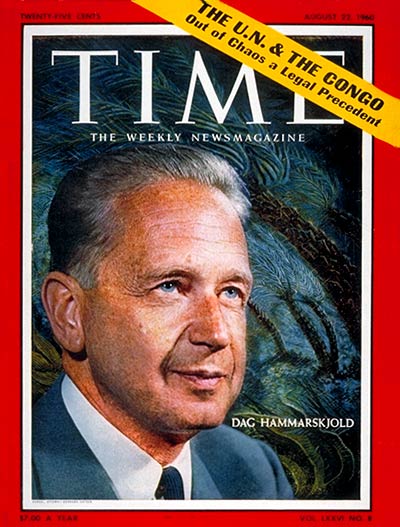
Dag Hammarskjöld But that Algeria speech actually did something else. It made him a hero to the colonized people of Africa. He now became a kind of unofficial ambassador to visiting African dignitaries. And that appeal began to spread to other Third World areas. So Kennedy now became a great admirer of the Chairman of the UN, Dag Hammarskjöld, who wanted the United Nations to be a kind of international forum that would give voice to the powerless nations coming out of colonialism and provide a lectern to express themselves. They began to make a secret alliance over the areas of Indonesia and Africa.
By 1960, Kennedy is very conscious that he’s on the edge with his foreign policy. So, on the eve of the 1960 convention, he told one of his advisors, Harris Wofford: We have to win this thing. Because if Johnson wins or Symington wins, its just going to be more of John Foster Dulles all over again. And, by the way, I have to say that, with what LBJ did once Kennedy took over, from ’64 to ’68, I think Kennedy was actually right about that.
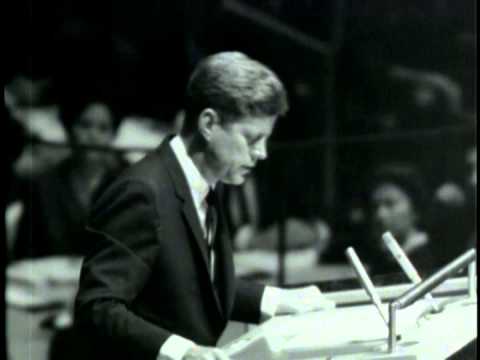
Kennedy addresses
the U.N. General AssemblyOnce Kennedy is in office, he immediately begins to alter the Dulles brothers’ policies. For example, in the Congo, where he supported Hammarskjöld’s policy to stop the country from being partitioned or recolonized by Belgium. And he began to work with Hammarskjöld, reversing American policy in Indonesia. The Dulles brothers had tried to overthrow Sukarno the Nationalist leader of Indonesia in 1958 and 59. Kennedy decided that that was going to be reversed. That he was going to support Sukarno, both politically and economically.
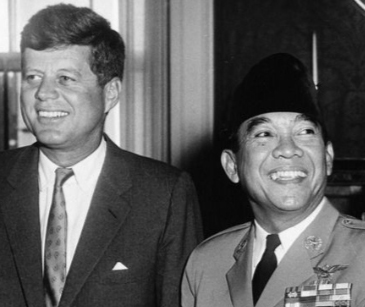
Kennedy & Sukarno Now what’s really remarkable about just those two instances, those alterations of the Dulles brothers’ foreign policy is this: That Kennedy continued those two policies after Hammarskjöld was murdered in the fall of 1961. And, by the way, I have no problem using the word “murdered”. Because all you have to do is read Susan Williams’ book, “Who Killed Dag Hammarskjöld?” You will see that that was not an accident, that airplane crash was not an accident. In other words, with Hammarskjöld dead, Kennedy was carrying this burden by himself. And, in fact, he had to go to New York to convince the United Nations, after Hammarskjöld’s death, not to give up their mission in Congo. He actually did that twice. And then he planned a State visit to Indonesia in the summer of 1964, which Sukarno was very much looking forward to.
Now I can mention other places where this occurs, that is when Kennedy comes in, he reverses the Dulles/Eisenhower foreign policy. For example, he wanted a negotiated settlement in Laos. Very important and, again, very overlooked, is that in the Middle East, the Dulles brothers had isolated Nasser and were beginning to favor Saudi Arabia.
Lee Shepherd:
Nasser, the head of Egypt.
Jim DiEugenio:

Gamal Abdel Nasser Yes, Nasser was the president of Egypt. And Kennedy reversed that, also. He began to favor Nasser and isolating Saudi Arabia. Now the reason he did that was because he thought, because Nasser was a Socialist and a secularist, that he could begin to mold the foreign policy in the Middle East away from the fundamentalism and the monarchy of places like Saudi Arabia and Iran.
And, by the way, he even mentioned that issue in 1957. Because there was a big Moslem population in Algeria. He refused to meet with David Rockefeller because he did not want to initiate a coup in Brazil, which is what Rockefeller wanted to meet him about, and he moved to isolate the military regime that had deposed the Dominican Republic’s President Juan Bosch.
Now every one of those policies, without exception, began to change at a slow rate and then at a rapid rate, under the pressure of Johnson and the CIA, in a period of about 18 months after Kennedy is assassinated. In each case, the end result was a calamity for the people living in those areas. A very good example being the CIA sponsored coup in Indonesia that took place in 1965 and which killed well over 500,000 citizens; and led to the looting of the nation by Suharto and his corporate cronies. What Kennedy wanted to do there, he was actually arranging deals for Sukarno to nationalize the industries on a very good split, the majority of the profits going to Indonesia. And Sukarno was going to use that money to start doing things like building hospitals and an infrastructure and schools, etc. He wanted those benefits of those natural resources to go to the people.
Now let me conclude with, what I think, is a very important aspect of this whole Dulles vs. Kennedy foreign policy dispute. As most people understand today, Kennedy was never going to commit the military into Vietnam. In fact, he was withdrawing the advisory force from that area at the time of his assassination. The Assassinations Records Review Board released some really important documents on this in 1997 and that, in addition to several books, including John’s book, JFK and Vietnam, for me sealed the deal on that issue.
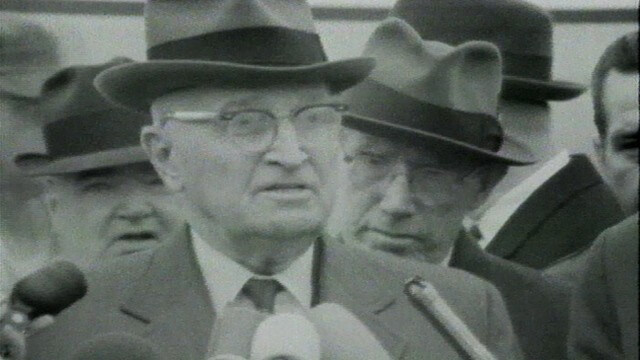
Truman reacts to the assassination Within a month of Kennedy’s assassination, I think on December 20th, 1963, former president Harry Truman published a column in the Washington Post, in which he assailed how the CIA had strayed so far from the mission he had envisioned for them when he was putting that agency together. To the point where he really kind of didn’t recognize what it had become. From his notes, it’s clear that Truman began writing that column eight days after Kennedy’s death.

“Harry Truman Writes” In the spring of 1964, while he was sitting on the Warren Commission, Allen Dulles visited Truman at his home in Missouri. This was not a social visit. He was there for one reason. He wanted Truman to retract the column. That attempt by Dulles failed. Truman never did retract what he wrote and, in fact, about a year later, in Look magazine, he repeated those same thoughts.
But a very curious exchange occurred as Dulles was leaving. As he got to the door to join his waiting escorts, he turned to Truman and said words to the effect: You know, Kennedy denied those stories about how the CIA was clashing with him in Vietnam. Which is a really startling thing to say. Because Dulles’ visit was supposed to be about Truman’s article. And Truman never mentioned Kennedy or Vietnam in the article.
Further, the two newspaper pieces Dulles referred to are likely one by Arthur Krock and one by Richard Starnes, both published in October of 1963. They both discussed the CIA’s growing influence over foreign policy and they both conclude that, if there was ever an overthrow of the US government, unlike Seven Days in May, the novel that had been made into a film around that time, it would be sponsored by the Agency and not the Pentagon. Again, Truman never went that far in his article. This whole angle was imputed to him and initiated by Allen Dulles. I think it’s pretty clear, from that conversation, that Dulles made the visit because he thought Truman wrote the column because the former president believed the CIA had a role in killing Kennedy over the Vietnam issue.
What makes this even more remarkable are these two aspects. Number one, at that time, in the spring of 1964, nobody had connected those dots: That is, the CIA, Kennedy, Vietnam and Kennedy’s assassination. No one. The first time it’s going be done is four years later by Jim Garrison.
Number two, Truman had already said to the press in 1961 that Hammarskjöld had been murdered over his Congo policy. And Dulles was aware of that. In my opinion, he saw what had happened with Hammarskjöld, and he did not want Truman to get more explicit in the Kennedy case. So in the language of prosecutors, specifically the late Vincent Bugliosi, he would have said something like this—if he had been on our side: What Dulles was doing here was showing something called consciousness of guilt, while he was sitting on the Warren Commission. Which is one more reason that the commission is really a joke.
After four years of study, 2013 to 2017, I’ve concluded that the cover up about Kennedy’s foreign policy, and how reformist it was, has been more deliberate, more strenuous, more systematic, than the cover up about the circumstances of his death. The reason being that it gives a clear and understandable motive for the Power Elite to hatch a plot against him. There were literally tens of billions of dollars on the table in the Third World, especially Indonesia. And that’s the kind of money that these people commit very serious crimes about.
This is why, at the time of his death, people like Nasser in Egypt fell into a month long depression. And he ordered Kennedy’s funeral to be shown four times on national television. It’s why Sukarno openly wept and asked “Why did they kill Kennedy?” It’s why Kwame Nkrumah of Ghana, when the American Ambassador gave him a copy of the Warren report, he returned it to him. He pointed out the name of Allen Dulles on the title page and said one word: “Whitewash.” The people about to be victimized understood what had happened. Because of our lousy media in the United States, it’s taken the American public quite a bit longer to understand.
Okay, thank you, I’ll conclude with that.
Lee Shepherd:
James, can I ask you one question.
Jim DiEugenio:
Sure.
Lee Shepherd:
You’re mentioning Dulles quite a bit.
Jim DiEugenio:
Right.
Lee Shepherd:
Who do you think is behind this whole thing?
Jim DiEugenio:
Well, I gave David Talbot’s book a very good review: The Devil’s Chessboard. And I think he makes a pretty good case, that Dulles, if I had to categorize it, I think Dulles was the outside guy and I think James Angleton was the inside guy.
Lee Shepherd:
So the assignment was given to Angleton?
Jim DiEugenio:
I think Angleton was the inside guy.
Lee Shepherd:
Okay.
Jim DiEugenio:
He was the guy working in the, what we would call, the infrastructure. And I think Dulles was the outside guy, arranging it with the people he knew had to back him.
Lee Shepherd:
But Dulles was fired.
Jim DiEugenio:
Dulles was what?
Lee Shepherd:
Dulles was fired by that stage, by John Kennedy.
Jim DiEugenio:
Yeah, he was fired. But if you read Talbot’s book, he was only fired symbolically. Because he kept on having meetings over at his townhouse in Georgetown. And he actually wrote about those meetings in his diary and anybody could read who he was meeting with, people like Angleton, people like Des FitzGerald, etc. And then on the day of the assassination, he ends up at the Farm,—
Lee Shepherd:
Yes.
Jim DiEugenio:
—which is the CIA headquarters.
Lee Shepherd:
Is that Camp Parry? Camp Parry, Virginia?
Jim DiEugenio:
Yes.
Lee Shepherd:
Secondary command post of the CIA?
Jim DiEugenio:
Right.
Lee Shepherd:
Okay, good, thank you.
Jim DiEugenio:
So he was figuratively separated from the CIA. But as Talbot says in his book, he was really more like leading a kind of like in-country junta against Kennedy.
Lee Shepherd:
Okay, James. Thank you so much.
This transcript was edited for grammar and flow.
-

Hillary Clinton vs JFK: An Addendum
Dr. Jeffrey Sachs has once again written a generally sound piece of criticism on this issue. And once again, he is to be saluted for it. It is indeed encouraging that he gets such pieces into the new MSM, represented by The Huffington Post.
But even if this editorial is actually better than the first, it still seemed to me fitting to remind our readers of what I originally posted back in November, when “Hillary Clinton and the ISIS mess” appeared. So CTKA has decided to repost it.
Like his book on Kennedy’s sponsorship of the Partial Nuclear Test Ban, it does not go quite far enough. (See our review)
He is correct about the CIA beginning its sponsorship of the mujahedeen in 1979 to battle the Soviets in Afghanistan. But he fails to add that one of the Moslem volunteers who went to Afghanistan to fight the Russians was Osama Bin Laden. And most commentators trace the beginning of the Al Qaeda movement from Bin Laden’s experience there. (See the sterling documentary on this subject, The Power of Nightmares.)
But beyond that, 1979 was the year of the first explosion of Islamic fundamentalism in the Middle East. It took place in Iran. It was fueled by the brutal regime the CIA and Allen Dulles installed there when they overthrew the nationalist leader Mossadegh. Every American president — save one — coddled up to the Shah of Iran. All the way until the Islamic Revolution.
The man who paved the way for Sharia Law to take hold in Iran was none other than Warren Commissioner John McCloy. As Kai Bird noes in his book, The Chairman, President Jimmy Carter resisted letting the Shah into the country for medical purposes. When he did, David Rockefeller started a lobbying campaign, which was spearheaded by attorney John McCloy. McCloy knew he could not convert Carter. So, one by one, he picked off his advisors. Until finally, Carter was alone and cornered. But before he caved, he turned and asked: I wonder what you guys are going to advise me to do if they invade our embassy and take our employees hostage?
Therefore, it was McCloy who directly caused the Islamic Revolution to begin in the Middle East. And it was he who greatly influenced the coming to power of Ronald Reagan.
As noted above, there was one president who did not toady up to the Shah. As James Bill chronicles in his book, The Eagle and the Lion, the Kennedy administration actually commissioned a State Department paper on the costs and liabilities of returning Mossadegh to power in Iran. The Shah took this seriously and started the White Revolution in order to make his administration more progressive and egalitarian. Once Kennedy died, this did not continue. President Johnson was quite friendly with the Rockefeller brothers, and Henry Kissinger, Richard Nixon’s National Security Adviser, owed his career to Nelson Rockefeller. Unlike these other presidents, Kennedy understood the dangers of an explosion of Islamic Fundamentalism. In fact, he had warned about it since 1957, and his famous speech encouraging the French to abandon their colonial empire in Algeria.
But there was one other element to this story of Carter changing his mind. During the revolution, before Carter allowed the Shah entry, he was in Los Angeles for a speaking engagement. Both the Secret Service and LAPD detected an assassination plot against him. One of the alleged plotters’ was named Raymond Lee Harvey. Raymond said an accomplice was named Osvaldo Espinoza Ortiz. No one as smart as Carter could have missed the significance of that. (See this Wikipedia article)
There is another point about the Sachs’ article and the Clinton agenda that needs to be elucidated. That is America’s growing coziness with Saudi Arabia. As scholar Philip Muehlenbeck noted, President Kennedy had little time or use for the monarchy of Saudi Arabia. He disdained its disregard of civil liberties, democracy and women’s rights. When King Saud flew to a Boston area hospital in 1961, Kennedy was urged to visit him by his State Department advisors. Not only did he not visit him, he avoided going to Boston and instead went to his vacation home in Palm Beach Florida. When the monarch was released and went to a convalescent home nearby, Kennedy finally relented. But on the way there, he muttered: Why am I seeing this guy? (Muehlenbeck, Betting on the Africans, p. 133)
Kennedy favored the country that DCI Allen Dulles and his brother, Secretary of State John Foster Dulles, decided to abandon – Egypt – because its socialist leader, Nasser, would not toe the line on Red China during the Cold War. During the civil war in Yemen, where Saud backed the monarchy and Nasser backed the revolutionaries, Kennedy decided to back Nasser, at great political expense to himself — including the enmity of Israel’s foreign secretary Golda Meir. (See Muehlenbeck, pp. 132-37)
When John Kennedy was killed two things happened in the Middle East to create the mess that exists today. First, there was a tilt away from Egypt and pan Arabism; second, a bias toward Saudi Arabia and Israel began. As Stanford professor Robert Rakove notes in Kennedy, Johnson and the Nonaligned World, Nasser immediately understood what was happening. On November 23, 1963, Nasser declared a state of mourning. He then ordered Kennedy’s funeral to be shown on Egyptian television four times. One diplomat said Cairo was “overcome by a sense of universal tragedy.” Nasser eventually broke relations with the USA in 1967. (Rakove, pp. xvii ff)
Although Sachs’ article is good, the record of John Kennedy is even better. And, in fact, a piece like this one would probably not get past the moderators, especially in light of their decision to publish an utterly ignorant and repugnant article by Peter Dreier at around the same time. Arrogantly entitled “I Don’t Care who Killed JFK”, it did not mention one word about any of the history chronicled above. It did not mention any of the books I referenced. It did not refer to Nasser, the Iranian coup, John McCloy and the assassination attempt on Carter, or Kennedy’s disdain for Saudi Arabia. And since it did not mention any of those, it could not list the reversals that occurred in the Middle East afterwards.
Peter Dreier should stick to urban planning. His article on JFK proves that underneath arrogance there is always a whiff of stupidity.
(Originally posted November 23, 2015 Reposted February 15, 2016)
-
Introduction to JFK’s Foreign Policy: A Motive for Murder
In a little over a year [2013-2014], I have spoken at four conferences. These were, in order: Cyril Wecht’s Passing the Torch conference in Pittsburgh in October of 2013; JFK Lancer’s 50th Anniversary conference on the death of JFK, in Dallas in November of 2013; Jim Lesar’s AARC conference in Washington on the 50th Anniversary of the Warren Commission in September of 2014; and Lancer’s Dallas conference on the 50th anniversary of the Commission in November of 2014.
At all four of these meetings, I decided to address an issue that was new and original. Yet, it should not have been so, not by a long shot. The subject I chose was President Kennedy’s foreign policy outside of Vietnam and Cuba. I noted that, up until now, most Kennedy assassination books treat Kennedy’s foreign policy as if it consisted of only discussions and reviews of Cuba and Vietnam. In fact, I myself was guilty of this in the first edition of Destiny Betrayed. My only plea is ignorance due to a then incomplete database of information. I have now come to conclude that this view of Kennedy is solipsistic. It is artificially foreshortened by the narrow viewpoint of those in the research community. And that is bad.
Why? Because this is not the way Kennedy himself viewed his foreign policy, at least judging by the time spent on various issues—and there were many different topics he addressed—or how important he considered diverse areas of the globe. Kennedy had initiated significant and revolutionary policy forays in disparate parts of the world from 1961 to 1963. It’s just that we have not discovered them.
Note that I have written “from 1961 to 1963”. Like many others, I have long admired Jim Douglass’ book JFK and the Unspeakable. But in the paperback edition of the book, it features as its selling tag, “A Cold Warrior Turns.” Today, I also think that this is a myth. John Kennedy’s unorthodox and pioneering foreign policy was pretty much formed before he entered the White House. And it goes back to Saigon in 1951 and his meeting with State Department official Edmund Gullion. Incredibly, no author in the JFK assassination field ever mentioned Gullion’s name until Douglass did. Yet, after viewing these presentations, the reader will see that perhaps no other single person had the influence Gullion did on Kennedy’s foreign policy. In a very real sense, one can argue today that it was the impact of Gullion’s ideas on young Kennedy that ultimately caused his assassination.
These presentations are both empirically based. That is, they are not tainted or colored by hero worship or nostalgia. They are grounded in new facts that have been covered up for much too long. In fact, after doing this research, I came to the conclusion that there were two cover-ups enacted upon Kennedy’s death. The first was about the circumstances of his murder. That one, as Vince Salandria noted, was designed to fall apart, leaving us with a phony debate played out between the Establishment and a small, informed minority. The second cover-up was about who Kennedy actually was. This cover-up was supposed to hold forever. And, as it happens, it held for about fifty years. But recent research by authors like Robert Rakove and Philip Muehlenbeck, taking their cue from Richard Mahoney’s landmark book, JFK: Ordeal in Africa, have shown that Kennedy was not a moderate liberal in the world of foreign policy. Far from it. When studied in its context—that is, what preceded it and what followed it—Kennedy’s foreign policy was clearly the most farsighted, visionary, and progressive since Franklin Roosevelt. And in the seventy years since FDR’s death, there is no one even in a close second place.
This is why the cover-up in this area had to be so tightly held, to the point it was institutionalized. So history became nothing but politics. Authors like Robert Dallek, Richard Reeves, and Herbert Parmet, among others, were doing the bidding of the Establishment. Which is why their deliberately censored versions of Kennedy were promoted in the press and why they got interviewed on TV. It also explains why the whole School of Scandal industry, led by people like David Heymann, prospered. It was all deliberate camouflage. As the generals, in that fine film Z, said about the liberal leader they had just murdered, Let us knock the halo off his head.
But there had to be a reason for such a monstrous exercise to take hold. And indeed there was. I try to present here the reasons behind its almost maniacal practice. An area I have singled out for special attention was the Middle East. Many liberal bystanders ask: Why is the JFK case relevant today? Well, because the mess in the Middle East now dominates both our foreign policy and the headlines, much as the Cold War did several decades ago. And the roots of the current situation lie in Kennedy’s death, whereupon President Johnson began the long process which reversed his predecessor’s policy there. I demonstrate how and why this was done, and why it was kept such a secret.
It is a literal shame this story is only coming to light today. John Kennedy was not just a good president. Nor was he just a promising president. He had all the perceptions and instincts to be a truly great president.
That is why, in my view, he was murdered. And why the dual cover-ups ensued. There is little doubt, considering all this new evidence, that the world would be a much different and better place today had he lived. Moreover, by only chasing Vietnam and Cuba, to the neglect of everything else, we have missed the bigger picture. For Kennedy’s approach in those two areas of conflict is only an extension of a larger gestalt view of the world, one that had been formed many years prior to his becoming president.
That we all missed so much for so long shows just how thoroughly and deliberately it had been concealed.
{aridoc engine=”google” width=”400″ height=”300″}images/ppt/JimDFP-Wecht2013.pptx{/aridoc}
{aridoc engine=”google” width=”400″ height=”300″}images/ppt/JimDFP-Lancer2014.pptx{/aridoc}
Version given at November in Dallas, November 18, 2016
{aridoc engine=”google” width=”400″ height=”300″}images/ppt/JimDFP-Lancer2016.pptx{/aridoc}
Revision, presented on March 3, 2018, in San Francisco
{aridoc engine=”google” width=”400″ height=”300″}images/ppt/JimD-JFK-FP-2018.pptx{/aridoc}
-
Who Murdered Yitzhak Rabin?
From the July-August 1999 issue (Vol. 6 No. 5) of Probe
It took almost two years for the American public to suspect a conspiracy was involved in the Kennedy assassination. It took less than two weeks before suspicions arose among many Israelis that Rabin was not murdered by a lone gunman.
The first to propose the possibility, on November 11, one week following the assassination, was Professor Michael Hersiger, a Tel Aviv University historian. He told the Israeli press, “There is no rational explanation for the Rabin assassination. There is no explaining the breakdown. In my opinion there was a conspiracy involving the Shabak. It turns out the murderer was in the Shabak when he went to Riga. He was given documents that permitted him to buy a gun. He was still connected to the Shabak at the time of the murder.”
Hersiger’s instincts were right, but he believed the conspirators were from a right wing rogue group in the Shabak. It wasn’t long before suspicions switched to the left. On the 16th of November, a territorial leader and today Knesset Member Benny Eilon called a press conference during which he announced, “There is a strong suspicion that Eyal and Avishai Raviv not only were connected loosely to the Shabak but worked directly for the Shabak. This group incited the murder. I insist that not only did the Shabak know about Eyal, it founded and funded the group.”
The public reaction was basically, “Utter nonsense.” Yet Eilon turned out to be right on the money. How did he know ahead of everyone else?
Film director Merav Ktorza and her cameraman Alon Eilat interviewed Eilon in January, 1996. Off camera he told them, “Yitzhak Shamir called me into his office a month before the assassination and told me, ‘They’re planning to do another Arlosorov on us. Last time they did it, we didn’t get into power for fifty years. I want you to identify anyone you hear of threatening to murder Rabin and stop him.’” In 1933, a left wing leader Chaim Arlosorov was murdered in Tel Aviv and the right wing Revisionists were blamed for it. This was Israel’s first political murder and its repercussions were far stronger than those of the Rabin assassination which saw the new Likud Revisionists assume power within a year.
Shamir was the former head of the Mossad’s European desk and had extensive intelligence ties. He was informed of the impending assassination in October. Two witnesses heard Eilon make this remarkable claim but he would not go on camera with it or any other statement. Shortly after his famous press conference and testimony to the Shamgar Commission, Eilon stopped talking publicly about the assassination.
There are two theories about his sudden shyness. Shmuel Cytryn, the Hebron resident who was jailed without charge for first identifying Raviv as a Shabak agent, has hinted that Eilon played some role in the Raviv affair and he was covering his tracks at the press conference.
Many others believe that pressure was applied on Eilon using legal threats against his niece Margalit Har Shefi. Because of her acquaintanceship with Amir, she was charged as an accessory to the assassination. To back up their threats, the Shabak had Amir write a rambling, incriminating letter to her from prison. The fear of his niece spending a decade in jail would surely have been enough to put a clamp down on Eilon.
Utter nonsense turned into utter reality the next night when journalist Amnon Abramovitch announced on national television that the leader of Eyal, Yigal Amir’s good friend Avishai Raviv, was a Shabak agent codenamed “Champagne” for the bubbles of incitement he raised.
The announcement caused a national uproar. One example from the media reaction sums up the shock. The newspaper Maariv wrote: “Amnon Abramovitch dropped a bombshell last night, announcing that Avishai Raviv was a Shabak agent codenamed ‘Champagne.’ Now we ask the question, why didn’t he [Avishai Raviv] report Yigal Amir’s plan to murder Rabin to his superiors..? In conversations with security officials, the following picture emerged. Eyal was under close supervision of the Shabak. They supported it monetarily for the past two years. The Shabak knew the names of all Eyal members, including Yigal Amir.”
That same day, November 16, 1995, the newspaper Yediot Ahronot reported details of a conspiracy that will not go away. “There is a version of the Rabin assassination that includes a deep conspiracy within the Shabak. The Raviv affair is a cornerstone of the conspiracy plan.
“Yesterday, a story spread among the settlers that Amir was supposed to fire a blank bullet but he knew he was being set up so he replaced the blanks with real bullets. The story explains why after the shooting, the bodyguards shouted that ‘the bullets were blanks.’ The story sounds fantastic but the Shabak’s silence is fueling it.”
Without the ‘Champagne’ leak, this book would likely not be written. Despite all the conflicting testimony at the Shamgar Commission, the book would have been closed on Yigal Amir and the conspiracy would have been a success. But Abramovitch’s scoop established a direct sinister connection between the murderer and the people protecting the prime minister.
So who was responsible for the leak? There are two candidates who were deeply involved in the protection of Eyal but probably knew nothing of its plans to murder Rabin. They are then-Police Minister Moshe Shahal and then-Attorney General Michael Ben Yair.
Shahal was asked for his reaction to the Abramovitch annoucement. He said simply, “Amnon Abramovitch is a very reliable journalist.” In short, he immediately verified the Champagne story.
Not that he didn’t know the truth, as revealed in the Israeli press:
Maariv, November 24, 1995
The police issued numerous warrants against Avishai Raviv but he was never arrested. There was never a search of his home.
Kol Ha Ir, January, 1996
Nati Levy: “It occurs to me in retrospect that I was arrested on numerous occasions but Raviv, not once. There was a youth from Shiloh who was arrested for burning a car. He told the police that he did it on Raviv’s orders. Raviv was held and released the same day.”
Yediot Ahronot, December 5, 1995
When they aren’t involved in swearing-in ceremonies, Eyal members relax in a Kiryat Araba apartment near the home of Baruch Goldstein’s family. The police have been unsuccessfully searching for the apartment for some time.
Everyone in the media knew about the apartment, as did everyone in Kiryat Arba. It was in the same building as the apartment of Baruch Goldstein, the murderer of 29 Arabs in the Hebron massacre of March ’94. The police left it alone because Raviv used it for surveillance.
He was also immune to arrest for such minor crimes as arson and threatening to kill Jews and Arabs in televised swearing-in ceremonies. But police inaction was inexcusable in two well-publicized incidents.
Yerushalayim, November 10, 1995
Eyal activists have been meeting with Hamas and Islamic Jihad members to plan joint operations.
This item was reported throughout the country, but Avishai Raviv was not arrested for treason, terrorism and cavorting with the enemy. Less explainable yet was the police reaction to Raviv taking responsibility, credit as he called it, for the murder of three Palestinians in the town of Halhoul.
On December 11, 1993, three Arabs were killed by men wearing Israeli army uniforms. Eyal called the media the next day claiming the slaughter was its work. But Moshe Shahal did not order the arrest of Eyal members. He knew Eyal wasn’t rsponsible. He knew they only took responsibility to blacken the name of West Bank settlers. His only action, according to Globes, December 13, 1993, was to tell “… the cabinet that heightened action was being taken to find the killers and to withdraw the legal rights of the guilty organization.”
After a week of international condemnation of the settlers, the army arrested the real murderers, four Arabs from the town.
At that point Shahal should have had Raviv arrested for issuing the false proclamation on behalf of Eyal. But Shahal did not because he was ordered not to interfere with this Shabak operation. As was Attorney-General Michael Ben Yair, who was so terrified of what could be revealed at the Shamgar Commission that he sat in on every session on behalf of the government and later approved, along with Prime Minister Peres, the sections to be hidden from the public.
After the assassination, it emerged that two left wing Knesset members had previously submitted complaints against Eyal to Ben Yair. On March 5, 1995 Dedi Tzuker asked Ben Yair to investigate Eyal after it distributed inciteful literature at a Jerusalem high school. And on September 24, 1995, Yael Dayan requested that Ben Yair open an investigation of Eyal in the wake of its televised vow to spill the blood of Jews and Arabs who stood in the way of their goals. He ignored both petitions, later explaining, “Those requests should have been submitted to the army or the Defence Minister,” who happened to be Yitzhak Rabin.
Both Shahal and Ben Yair were, probably unwittingly, ordered to cover up Eyal’s incitements. But when one incitement turned out to be the murder of Rabin, one of them panicked and decided to place all the blame on the Shabak.
Which one?
According to Abramovitch, “I have a legal background so my source was a high ranking legal official.” It sounds like the winner is Ben Yair, which hardly exonerates him or Shahal for supplying Eyal with immunity from arrest or prosecution, without which the assassination of Yitzhak Rabin would not have been possible. However, Ben Yair opened a police complaint against the leaker, and as late as June of ’96, reporter Abramovich was summoned to give evidence. The leak thus came from a “traitor” in Ben Yair’s office. And because there are Israelis who know the truth and are willing to secretly part with it, this book could be written.
The Testimony Of Chief Lieutenant Baruch Gladstein: Amir Didn’t Shoot Rabin
Everyone who saw the “amateur” film of the assassination of Yitzhak Rabin witnessed the alleged murderer Yigal Amir shoot the Prime Minister from a good two feet behind him. The Shamgar Commission determined that Amir first shot Rabin from about 50 cm. distance. Then bodyguard Yoran Rubin jumped on Rabin, pushing him to the ground. Amir was simultaneously accosted by two policemen who held both his arms. Yet somehow Amir managed to step forward and shoot downward, first hitting Rubin in the elbow and then Rabin in the waist from about 30-40 cm. distance.
The amateur film of the assassination disputes the whole conclusion. After the first shot, Rabin keeps walking, there is a cut in the film and Rabin reappears standing all alone. Rubin did not jump on him and Amir has disappeared from the screen. He did not move closer nor get off two shots at the prone Rubin or Rabin.
And there is indisputable scientific proof to back what the camera recorded.
What if the shots that killed Rabin were from both point blank range and 25 cm. distance? Obviously, if so, Amir couldn’t have shot them.
Now consider the testimony of Chief Lieutenant Baruch Gladstein of Israel Police’s Materials and Fibers Laboratory, given at the trial of Yigal Amir on January 28, 1996:
I serve in the Israel Police Fibers and Materials Laboratory. I presented my professional findings in a summation registered as Report 39/T after being asked to test the clothing of Yitzhak Rabin and his bodyguard Yoram Rubin with the aim of determining the range of the shots.
I would like to say a few words of explanation before presenting my findings. We reach our conclusions after testing materials microscopically, photographically and through sensitive chemical and technical procedures. After being shot, particles from the cartridge are expelled through the barrel. They include remains of burnt carbon, lead, copper and other metals…
The greater the distance of the shot, the less the concentration of the particles and the more they are spread out. At point blank range, there is another phenomenon, a characteristic tearing of the clothing and abundance of gunpowder caused by the gases of the cartridge having nowhere to escape. Even if the shot is from a centimeter, two or three you won’t see the tearing and abundance of gunpowder. These are evident only from point blank shots.
To further estimate range, we shoot the same bullets, from the suspected weapon under the same circumstances. On November 5, 1996, I received the Prime Minister’s jacket, shirt and undershirt as well as the clothes of the bodyguard Yoram Rubin including his jacket, shirt and undershirt. In the upper section of the Prime Minister’s jacket I found a bullet hole to the right of the seam, which according to my testing of the spread of gunpowder was caused by a shot from less than 25 cm. range. The same conclusion was reached after testing the shirt and undershirt.
The second bullet hole was found on the bottom left hand side of the jacket. It was characterized by a massed abundance of gunpowder, a large quantity of lead and a 6 cm. tear, all the characteristics of a point blank shot.”
The author rudely interrupts lest anyone miss the significance of the testimony. Chief Lieutenant Gladstein testifies that the gun which killed Rabin was shot first from less than 25 cm. range and then the barrel was placed on his skin. In fact, according to a witness at the trial, Nat an Gefen, Gladstein said 10 cm and such was originally typed into the court protocols. The number 25 was crudely written atop the original 10. If the assassination film is to be believed, Amir never had a 25 cm. or 10 cm. shot at Rabin or even close to one. As dramatic a conclusion as this is, Officer Gladstein isn’t through. Far from it.
As to the lower bullet hole, according to the powder and lead formations and the fact that a secondary hole was found atop the main entry hole, it is highly likely that the Prime Minister was shot while bending over. The angle was from above to below. I have photographs to illustrate my conclusions.”
The court was now shown photographs of Rabin’s clothing. We add, according to the Shamgar Commission findings, Rabin was shot first standing up and again while prone on the ground covered by Yoram Rubin’s body. Nowhere else but in Gladstein’s expert testimony is there so much as a hint that he was shot while in a bent-over position.
After examining the bullet hole in the sleeve of Yoram Rubin, I determined that the presence of copper and lead, plus the collection of gunpowder leads to the likelihood that he, too, was shot from near point blank range… The presence of copper means the bullet used to shoot Rubin was different from that found in the Prime Minister’s clothing which was composed entirely of lead. The bullet that was shot at Rubin was never found.”
We now enter the realm of the bizarre, as is always the case when Yigal Amir chooses to cross-examine a witness. Chief Lieutenant Gladstein has provided the proof that Amir did not shoot the bullets that killed Rabin, yet Amir is determined to undermine the testimony.
Amir: “According to your testimony, I placed the gun right on his back.”
Gladstein: “You placed the gun on his back on the second shot and fired.”
Amir: “And the first shot was from 50 cm?”
Gladstein: “Less than 20 cm.”
Amir: “If one takes into account that there is more gunpowder from the barrel, then the muzzle blast should also increase.”
Gladstein: “To solve this problem, I shoot the same ammunition, and in your case, from the same gun, I shot the Baretta 9 mm weapon with hollowpoint bullets into the prime minister’s jacket.”
Amir: “When I took the first shot, I saw a very unusual blast.”
Amir is close to realizing finally that he shot a blank bullet but blows his case when he concludes, “We need a new expert because I didn’t shoot from point blank range.”
Away all talk about far-right, conspiracy nut theories. The Materials and Fibers Laboratory of Israel Police concluded that Rabin was shot from less than 20 cm and point blank range, no matter what Amir says. Furthermore, the bodyguard Yoram Rubin was shot by a different bullet than felled Rabin or was found in Amir’s clip. Unless Israel Police’s fibers expert is deliberately promoting far-right, conspiracy nut theories, Yigal Amir’s gun did not kill Yitzhak Rabin.
How did They Miss Amir at the Rally?
One of the questions the media asked after the assassination is how the Shabak missed identifying Amir in the sterile area where he “shot” Rabin. The first answer given by the Shabak was that because of the thick crowd, it was impossible to pick out Amir.
The “amateur film” purportedly made by Ronnie Kempler put that lie to rest. Amir is shown alone standing by a potted plant for long minutes without another soul in sight for yards around him. The only people who are filmed talking to him are two uniformed policemen.
Under normal circumstances, the Shabak would have prevented Amir from getting anywhere near the rally itself, and had he somehow gained access to the sterile area, he would have been apprehended on the spot. Because, you see, the Shabak had lots of information that Amir was planning to assassinate Rabin.
Take the famous case of Shlomi Halevy, a reserve soldier in the IDF’s Intelligence Brigade and a fellow student of Amir’s at Bar Ilan University. After being informed that Amir was talking about killing Rabin, he reported the information to his superior officer in the brigade. He told Halevy to go to the police immediately. Halevy told them that “A short Yemenite in Eyal was boasting that he was going to assassinate Rabin.” The police took Halevy very seriously and transferred his report to the Shabak where it wasn’t “discovered” until three days after Rabin’s assassination.
The weekly newsmagazine Yerushalayim on September 22, 1996 managed to convince Halevy to give his first interview since the discovery of his report and the subsequent media fallout. The magazine noted, “Halevy’s and other reports of Amir’s intentions which gathered dust in Shabak files have fueled numerous conspiracy theories…After the uproar, Halevy went into hiding.
“Shlomi Levy, if you did the right thing why have you hidden from the public?
“The assassination is a sore point with the Shabak. They’re big and I’m little. I don’t know what they could do to me.”
Halevy was the most publicized case because as a soldier in the Intelligence Brigade, the Shabak was absolutely required to take his evidence seriously, as did the police. But Halevy was not the only informant.
Yediot Ahronot, November 12, 1995
A number of weeks before the Rabin assassination, the Shabak received information about the existence of Yigal Amir and his intention to murder Yitzhak Rabin.
Yediot Ahronot was informed that one of the Eyal activists arrested last week was interrogated for being a possible co-conspirator with Yigal Amir because the assassin’s brother Haggai had mentioned him in his own interrogation.
At the beginning of his interrogation, the suspect broke out into bitter tears and told a tale that was initially viewed with tongue in cheek by the interrogators. Weeks before the murder, the suspect heard Amir speak his intentions and he was shocked. He was torn between informing the authorities and betraying his fellows, so he chose a middle route. He would give away Amir’s intentions without naming him.
After some hesitation, he informed a police intelligence officer about Amir’s plan in detail stopping just short of identifying him or his address. He told where Amir studied and described him as a “Short, dark Yemenite with curly hair.”
The description was passed along the police communications network and classified as important. The information was also passed to the Shabak, officers of which subsequently took a statement from the suspect. Because he was in a delicate position, neither the police nor Shabak pressed him further.
While interrogated, the suspect named the police and Shabak officers and his story checked out. He was then released. Shabak officials confirmed that the man had previously given them a description of Amir and his plan to murder Rabin.
Maariv, November 19, 1995
Hila Frank knew Amir well from her studies at Bar Ilan. After the assassination, she hired a lawyer and told him that she had heard Amir state his intention to murder Rabin well before the event. As a member of the campus Security Committee, she organized anti-government demonstrations. Thus, she was torn between exposing Amir’s intentions and the interests of the state.
To overcome the dilemma, Frank passed on her information to Shlomi Halevy, a reserve soldier in the Intelligence Brigade who promised that it would be given to the right people.
Yerushalayim, November 17, 1995
Why wasn’t a drawing of Amir based on Halevy’s description distributed to the Prime Minister’s security staff? Why didn’t they interrogate other Eyal activists to discover who the man threatening to kill the prime minister was?
Yediot Ahronot, November 10, 1995
A month and a half before the assassination, journalist Yaron Kenner pretended to be a sympathizer and spent two days at a study Sabbath in Hebron organized by Yigal Amir.
“Who organized this event?” I asked. He pointed to Yigal Amir…He had invited 400 and over 540 arrived. This caused organizational havoc.
When Amir spoke, people quieted down, testifying to some charisma. On the other hand, his soft tone and unimpressive stature wouldn’t have convinced anyone to buy even a Popsicle from him.
Maariv, December 12, 1995
During his “Identity Weekends,” hundreds of people heard Amir express his radical thoughts, amongst which were his biblical justifications for the murder of Rabin.
Yediot Ahronot, November 24, 1995
Yigal Amir turned into an object of attention for the Shabak beginning six months ago when he started organizing study weekends in Kiryat Arba and they requested a report on him. Raviv prepared the report.
Maariv, November 24, 1995
A carful of Bar Ilan students were driving from Tel Aviv when they heard the announcement of Rabin’s shooting on the radio. They played a game, each thinking of five people who might have done it. Yigal Amir was on all their lists.
How could the Shabak have missed Yigal Amir at the rally unless they did so on purpose? Yigal Amir did not keep his intentions to assassinate Rabin a secret. He told many hundreds of people gathered at his study weekends and seems to have told everyone within hearing distance at Bar Ilan University.
Besides the question of Amir’s most un-murderer-like desire to let the world know his plans, we must ask why the Shabak didn’t apprehend him. Yes, they knew about him. The proof is indisputable. Two people, one within Eyal, the other a soldier in the Intelligence Brigade told them. Their own agent Avishai Raviv heard his threats, along with hundreds of other people at the study weekends and reported them to his superiors.
So why didn’t they arrest him well before the rally, outside the rally or within the sterile zone?
Because wittingly or not, Yigal Amir was working for the Shabak.
The Kempler Film
Almost two months after the Rabin assassination, Israelis were shocked to read in their newspapers that an amateur film of the event would be shown on Channel Two news. The filmmaker was announced as a Polish tourist with a long, unpronounceable name. However, this story changed the day of the broadcast. The filmmaker was, in fact, an Israeli named Roni Kempler.
There were obvious questions asked by the public. Why had he waited a month to show the film when he would have been a few million dollars richer had he sold it to the world networks the day following the assassination? In his sole television appearance the night his film was broadcast, he explained he wasn’t interested in making money. What else could he say?
It was quickly discovered that Kempler was no ordinary citizen. He worked for the State Comptroller’s Office and was a bodyguard in the army reserves.
It is an extremely rare occurrence when the Israeli press publishes an opinion that expresses doubt about the veracity of the Shamgar Commission, which investigated the assassination on behalf of the government. Yet in the aftermath of a most revealing expose of the testimony of General Security Services (Shabak) agents and police officers present near the murder site published by Maariv on September 27, 1996, two letters were published in response. One was from Labour Knesset Member Ofir Pines who admitted he too heard numerous security agents shout that the shots which supposedly felled Rabin were blanks. He added rather weakly that in retrospect, perhaps he heard the shouts because he wanted to believe that the bullets weren’t real.
A second letter was from Hannah Chen of Jerusalem and she succinctly summarized some of the most blatant suspicions of Roni Kempler. The letter read:
Allow me to add my doubts about the strange facts surrounding the Rabin assassination. First, it was said that the video filmmaker who captured the murder didn’t own his own camera, rather he borrowed one. It’s odd that an amateur filmmaker didn’t own a camera and if he borrowed one, then from whom? Why weren’t we told what kind of a camera he used? Secondly, no one initially knew that he made the film, that a film of the assassination existed. Does that mean none of the security agents on the scene spotted him filming from a rooftop? And how did the video get to the media? Shouldn’t the Shabak have confiscated the film from its owner if this was the only documentary evidence describing the crime? And why didn’t the filmmaker voluntarily turn over the film to the police?
It is completely uncertain if the film is authentic. In my opinion, it was tampered with. Perhaps people were removed or bullet sounds added. It appears to me that we were all fooled. The filmmaker worked for the Shabak and everything to do with the film and the timing of its release were fake.
Ms. Chen expressed the view of many. Nonetheless, the film, as edited as it obviously was during its two months of non-acknowledgement, is as valuable to solving the Rabin assassination as was the Zapruder film in putting to rest the lone gunmen lie foisted on the American public in the wake of the JFK murder.
The event captured on the film that is becoming the center piece of doubts about the veracity of the Shamgar Commission is the door of Rabin’s vehicle that closes before he enters the car. To almost everyone who watches that door close, it is certain that someone, perhaps the murderer, was waiting in the Cadillac for Rabin. This is in direct contradiction to the official conclusion that Rabin entered an empty car. But there is more on the Kempler film that contradicts the official findings; much more.
As the fifteen minute film begins, Yigal Amir looks in the distance and as the television commentator noted, “Seems to be signaling someone.” It is not the first time that the possibility of an accomplice was noted. At the Shamgar Commission police officers Boaz Eran and Moti Sergei both testified that Amir spoke with a bearded man in a dark tee shirt who he appeared to know, about half an hour before the shooting.
As the film progresses, the viewer realizes that Shabak testimony to Shamgar was very wrong. One of the primary excuses given for not identifying Amir in the sterile area was because of the crowded situation. To prove the point, the testimony of police officers saying that “another well known demonstrator who works for the city rushed at Rabin and shook his hand,” is cited. Amir, then was not the only anti-Rabin individual in the sterile zone. However, Amir is not filmed in a crowd. He stood for long minutes meters away from anyone else. No one could have missed him had they wanted to see him.
Then, two security officers strike up a conversation with Amir. He was noticed and apparently had something to say to the very people who should have identified and apprehended him.
A few minutes later, Shimon Peres comes down the steps and walks towards the crowd at the barrier. He accepts their good wishes and walks to a spot about a meter and a half opposite the hood of Rabin’s car. He is accompanied by four bodyguards, one of whom clearly points to Yigal Amir sitting three meters away opposite them. Peres stops, looks inside the car and begins a conversation with the bodyguards. All now take a good look at the Rabin limousine windshield and turn towards Amir.
At this point there is a cut. Suddenly Peres is talking to Rabin’s driver, Menachem Damti. Damti was nowhere in the screen previously and was likely by his post beside the driver’s seat door. The cut was significant, probably of several seconds. There was something the folks who chopped the film didn’t want the public to see. Perhaps Peres acknowledged Amir too blatantly.
After a hard night at the rally, instead of getting into his car and going home, Peres decided it was more important to examine Rabin’s car and have a serious chat with his driver.
Ronnie Kempler was asked to explain the cut in the film under oath at Yigal Amir’s trial. He testified that, “Shimon Peres left and I filmed him as he was supposed to enter his car. But when Shimon Peres stood on the same spot for a long time, he stopped interesting me cinematically. I stopped filming and started again the moment he entered his car.”
Kempler’s account was wrong in every detail. If the film wasn’t cut and he shut off the camera, he decided to turn it back on while Peres was still standing opposite Rabin’s car, only now talking to Damti. Many seconds later, he started walking towards his own car. Kempler’s testimony was perjured, yet Amir’s lawyers, possibly not familiar enough with the film, let him off the hook.
Peres enters his car and Rabin descends the steps. The camera captures the agents at Rabin’s rear clearly stopping. They abandon Rabin’s back deliberately, a huge gap between them and Rabin opens allowing Amir a clear shot at the Prime Minister. Amir draws his gun from deep inside his right pocket and the television commentator notes, “Amir is drawing his gun to shoot.” Anyone, trained or not, could see that Amir was drawing a gun and at that point he should have been pounced on. But, this was not to be. Instead, he circles a student reporter named Modi Yisrael, draws the gun and shoots.
We now play the murder frame by frame. Rabin has supposedly taken a hollow point nine mm bullet in his lung, yet he doesn’t wince or flinch. He is not even pushed forward by the impact nor does his suit show signs of tearing. Instead, he continues walking forward and turns his head behind him in the direction of the noise.
Three doctors watched this moment with me; Drs. B. and H. asked for anonymity and Dr. Klein of Tel Aviv had no objection to being cited. I asked if Rabin’s reaction was medically feasible if he was only hit in the lung or if his backbone was shattered. I was told that if the spine was hit, Rabin would have fallen on the spot. However, in the case of a lung wound I was told that there are two types of pain reaction, one reflexive, the other delayed. Rabin, did not display the reflexive reaction, which would have most likely meant clutching the arm. Instead, he displayed a startle reaction, painlessly turning his head toward the direction of the shot. The conclusion of the doctors was that Rabin heard a shot, perhaps felt the blast of a blank and turned quickly towards the noise. This was a startle reaction and it cannot occur simultaneously with a reflexive pain reaction.
Rabin takes three or four steps forward and suddenly the film becomes totally hazy for just under two seconds. Cameraman Alon Eilat is convinced the film was deliberately made fuzzy by an artificial process duplicating a sudden, quick movement of the camera. To illustrate his belief, he put his finger on one point, a white reflective light on the windshield and notes that it stays in the same position while the camera is supposedly swishing. But the haze lifts momentarily almost two seconds later and Rabin appears, still standing but a step or two forward. He has taken at least five steps since the shooting. Then the swish returns and within the next round of haze, another shot is heard but not seen.
According to the Shamgar Commission and the judges at Yigal Amir’s trial, Yoram Rubin was on top of Rabin lying on the parking lot ground when the second shot was fired. The official version is that after hearing the first shot, Rubin jumps on Rabin and pushes him to the ground. Amir approached Rabin and Rubin and while being held by at least two other bodyguards pumped one bullet into Rubin’s arm and another into Rabin’s spleen. There followed a hiatus in the shooting, during which Rubin thinks to himself, “A defect in the weapon,” and then according to Rubin, “I shouted at him several times, ‘Yitzhak, can you hear me, just me and no one else, goddammit?’ He (Rabin), helped me to my feet. That is we worked together. He then jumped into the car. In retrospect, I find it amazing that a man his age could jump like that.” (The author finds it amazing that a man his age with bullets in his lung and spleen could jump at all.)
The Kempler film reveals that the whole story is utter hogwash. A famous photo of Rabin being shoved into the car shows up on the film as a flash. At that point, we know Rubin, injured arm and all, is not on the ground, rather he is on his feet holding Rabin. There are 24 frames/second in video film, so timing events is simple. From the time of the second shot to the flash, 4.6 seconds pass. Try repeating ,”Yitzhak can you hear me, just me and no one else, goddamit” three times in 4.6 seconds. Then add the hiatus, and how long is a hiatus before a man being shot decides it’s safe to get up, and think to yourself “A defect in the weapon.” Try all that in 4.6 seconds. Rubin’s timing is, simply, impossible.
Further, Rubin is not filmed on top of Rabin, and Rabin does not jump into the car. The photo of Rubin pulling Rabin into the car disproves that even without the added proof of the Kempler film. Rubin’s testimony, to put it mildly, is not born out by the Kempler film.
And now comes the piece de resistance, the most haunting moment of the tape. Two seconds before Rabin is placed in the car, the opposite back passenger door slams shut. This segment has been examined and tested by numerous journalists, every shadow on the screen traced, every possible explanation exhausted and in the end it has withstood all scrutiny. Someone, an unknown fourth person, possibly the murderer, was waiting inside the car for Rabin.
When I show this segment to audiences, inevitably I am asked, “Why did they make this film if it’s so incriminating?” I reply, “The film convinced the whole country that Amir murdered Rabin. People always say, ‘But I saw him do it with my own eyes.’ And that is what the film was supposed to do. But the conspirators were so sloppy, they left in the truth. Either they didn’t notice it, or they thought no one else would.”
So why didn’t Yigal Amir’s attorneys tear Kempler to bits on the stand or use the film to its maximum advantage? The truth be told, Amir’s attorneys either weren’t interested enough in his welfare, weren’t properly prepared or weren’t talented enough to challenge the kangaroo court head on. Take a look at how they handled the issue of the unexplainable closing door:
Defence: After the event, the back right door of the car was also open.
Kempler: I filmed what I filmed.
The end, no followup. And it’s not that the defence didn’t have plenty of ammunition. On the night his film was shown on Channel Two in January ’96, Kempler was interviewed by commentator Rafi Reshef. The fast talking, nervous Kempler was most unbelievable, as the following interview segments show;
Reshef: Why did you wait so long to release the film to the public?
Kempler: A few reasons. I didn’t want to be known. Also, I thought it was forbidden to show the film so soon after the murder. The public needed time to digest it as a historic film…But after the Shamgar Commission got it, I kept hearing on the street that I’m the sucker of the country. That really aggravated me, so I got a lawyer and decided to make some money selling it.
How altruistic! What Kempler forgets to mention is that he didn’t tell anyone he had filmed the assassination until two weeks later when supposedly he woke up to what he had and sent the Shamgar Commission a registered letter informing them. In the meantime, he was withholding vital evidence from the police.
Reshef: Did anyone observe you filming?
Kempler: Yes, the bodyguard…I’m sure I saw (singer) Aviv Gefen look right into my camera.
Kempler almost let slip that the bodyguards were watching him film, and indeed this is apparent on the film itself when just before the Peres cut, one of his bodyguards turns back and looks directly up to him, but he thought the better of it and switched to a nonsensical fantasy involving a pop singer.
Reshef: Why did you concentrate so much of the film on the killer?
Kempler: I felt there was something suspicious about him. I let my imagination run away with me and felt murder in the air. It wasn’t so strong when Peres was there but when Rabin appeared, ‘WOW.’
Kempler felt there was an assassination in the air and suspected Amir could be the assassin. This was truly a parapsychological feat but lucky it happened or he wouldn’t have bothered focusing in on Amir. And lucky he just happened to be the only cameraman on the balcony overlooking the murder scene. And luckily, it was so dark at the murder scene, few amateur cameras could have captured the act.
Reshef: There has been much speculation why you happened to be the only one in the right place to film the assassination. How do you explain it?
Kempler: I felt someone caused me to be in that place.
Reshef: What, are you a fatalist?
Nope, a mystic as we shall soon see.
Reshef: Did anyone try to interfere with you?
Kempler: There were undercover officers around. One told me it was alright to film but I had to stop when Rabin appeared.
Yeah, sure. Now compare Kempler’s version of events as told to Reshef with what Kempler testified to at Amir’s trial. To Reshef:
Kempler: An undercover policeman came up to me and asked me a few questions and asked to see my ID. I showed it to him and he walked away. He stopped, turned back and shouted, ‘What did you say your name was?’ I shouted it back. He said,‘Good.’ And that was that. The police had all the details of my identity.
So why didn’t they call that night to get the film? What is described is a very friendly encounter, indeed. Here is how the incident was transformed for Amir’s trial:
Kempler: There was an undercover cop who told me not to film. I told him he has no right to tell me not to film. I asked him if something secret was going on? I told him again he has no right to tell me not to film. And if he does it again, I would take down his particulars and issue a complaint to the police.
A rather drastically altered situation. Someone or more than one thought that Kempler’s explanation to Reshef about why he was permitted to film in such a sensitive security location was too weak, so he painted a new, tougher picture. An updated version of his previous explanation about why he focused in on Amir painted a much goofier portrait.
Kempler: When I stood on the balcony, I spent a lot of time in the dark and to my regret, my imagination began to work overtime. I begin to imagine many things, even God forbid, a political assassination…I have no explanation why I had this feeling. I’m not sure it wasn’t something mystic.
And because of this mysticism, Kempler felt, “The defendant stood out. I don’t know what he did… but I recall he stood out. I can’t recall anything other than what I filmed.”
Indeed he couldn’t because at the beginning of his testimony Kempler says the film shown to the public, “contained no changes or alterations.” By the end, he admits, “There are gaps and there are differences.”
Why the change of heart? Because Amir’s attorneys pointed out some very suspicious contradictions in the film.
Defence: We don’t hear everything in the film but we hear lots, including shouts. So why don’t we hear the shouts of “They’re blanks.”
Kempler: Don’t ask me. I’m not the address.
Defence: Yoram Rubin testified that he fell on Rabin, why don’t we see that in the film?
Kempler: I’m not a video or camera expert. I’m not the address for questions like that.
The address, of course, is the technical department of the Shabak, where the film was altered during the time Kempler decided not to turn it over to the police or sell it. But this was not a skilled technical department. While the film was being edited and altered, Yigal Amir was filmed a second time, during his reconstruction of the murder a few days after the event. And this reconstruction at the crime scene deeply compromised the validity of the Kempler film.
The first error made was enormous and was pointed out to me later by a man who claimed he was the first to report it to the press. In the reconstruction film, Amir shoots with his right hand, as numerous eye witnesses saw him do. But in the still of the Kempler film released initially exclusively to the newspaper Yediot Ahronot, Amir is shooting with his left hand.
And that’s not all. In the reconstruction film, Amir has bushy unshaped sideburns past the middle of his ear. The shooter in the Kempler photo still has squared sideburns at the top of his ear. Another person was superimposed over Yigal Amir for the still and there is maybe one possible reason why. The superimposed figure’s arm looks longer, thus reducing the range of the shot, a necessity to be explained shortly. This is just one possibility. There are others, so far, less convincing. Nonetheless, for whatever reason, Amir’s image was almost certainly removed from the Kempler film still and replaced by another.
But the reconstruction film belied the Kempler film in other ways, as reluctantly testified to by Lieutenant Arieh Silberman, Amir’s chief investigator, at the defendant’s trial.
Defence: Did you notice the differences between the video shown on Channel Two and the film of the reconstruction? Did you see the reconstruction film?
Silberman: I saw the reconstruction. It was of the same event in principle but there was an obvious difference. You can see the difference.
Defence: You’re responsible for the defendant’s investigation. Why is there a difference between the reconstruction film and the video shown on Channel 2?
Silberman: To my eyes, the difference isn’t significant. The defendant doesn’t think so. He never brought it up. I wasn’t at the reconstruction.
Defence: Why is there a break where we don’t hear part of the audio?
Silberman: I didn’t make the film. It was handled by the technicians of several units. I’m responsible for investigating the defendant, not the film.
Defence (Amir now acts as his own attorney): Is there a difference between the original film and what was shown on Channel Two?
Silberman: Could be.
Defence: What’s the most outstanding difference?
Silberman: The position of the prime minister.
Defence: In the reconstruction, I go straight toward him.
Silberman: True.
Defence: And in the original video I took a roundabout route.
Silberman: According to what I saw, you circled someone before getting behind (Rabin).
Amir reconstructed his alleged crime wrongly according to the Kempler film. And he shot with the wrong hand according to the still of the Kempler film. If Amir’s attorneys had bothered to press the issue, they might have been able to construct a plausible argument that he wasn’t even at the scene of the crime, according to the Kempler film.
[This next section is a chapter Chamish wrote after his book, Who Murdered Yitzhak Rabin?, was published.—Eds.]
At Long Last: Rabin’s Third Wound Proven
November 1998. It had been a good eighteen months since the last hidden documentation about the Rabin assassination had been uncovered. Since then some serious evidence had emerged about the political side of the murder. A year before, the government released some sections of the previously closed Shamgar Commission findings which incriminated Avishai Raviv far more deeply in widespread crimes of provocation. Two months later, one former Eyal activist, Benny Aharoni signed a sworn statement to Knesset Member Michael Eitan, that under orders from Raviv, he phoned three dozen reporters and delivered the infamous “We Missed But We’ll Get Rabin Next Time” message, well before the shooting was announced on the Israeli media. And journalist Adir Zik had gathered powerful evidence of Carmi Gillon’s complicity in the murder.
But the tap had shut tight on any new medical, police or forensic documentation. It looked as though the evidence I had collected for this book would be the last of the proofs that Yigal Amir had not shot fatal bullets into Rabin. The strongest evidence was the testimony of Police Chief Lieutenant Baruch Gladstein proving that Rabin was shot point blank and Dr. Mordechai Guttman’s surgeon’s notes describing a frontal chest wound which passed through the lung before shattering the vertebrae at D5-6.
When this book was written I had read Guttman’s full surgical report, which included the description of three gunshot wounds and the publicly released procedural summation of November 5 which removed the frontal chest wound and shattered spine. Thus, it was Dr. Guttman’s written word from the night of the murder versus his altered version of events, co-authored with Drs. Kluger and Hausner, the next day. Whenever Dr. Guttman was confronted with his report of the chest wound on the murder night, he answered that he had mistaken Rabin’s ribs for his spine. If so, that Dr. Guttman couldn’t tell the difference between ribs and the spinal column, as one doctor attending a lecture of mine told the audience, he should be disbarred from ever practising medicine again. However, another doctor did give Dr. Guttman the benefit of the doubt: if the bullet shattered the vertebrae at the point where the ribs join the spine, such a mixup was both logical and understandable. The main problem was that we were missing reliable descriptions of Rabin’s condition before and after the doctors went to work on him. Dr. Guttman’s report of a frontal chest wound lacked overall perspective and seemed an oddity that could be sloughed off with the explanation that he was mistaken when he wrote it.
In early December, American filmmaker Peter Goldman arrived in Israel with the intention of gathering the evidence needed to justify raising funds for a full length documentary based on my book. I gave him my contacts, who were new to him and we shared one contact in common. I expressed the opinion that visiting him would be a waste of time. I had a meeting with him a year and a half before and followed it up with two phone calls. It was all for naught; this contact had not provided me with any new evidence. Undaunted, Peter met him anyway and was well rewarded for following his instincts. Just a few hours before departing the country, Peter presented me with three new documents. I immediately understood that they were the final pieces of the puzzle. We now had a complete diary of Rabin’s treatment at Ichilov Hospital. Document one was the initial visual diagnosis of Rabin by Dr. Guttman. Hastily written in English, the diagnosis reads, “GSW Abdomen and Chest”: Gunshot wounds to the abdomen and chest. When I read the word chest, I thought I had found the smoking gun. Rabin arrived with a chest wound. Amir never shot him in the chest. Case closed. I would have to change my book. There were only two wounds, not three. There was no third shot in the hospital. Rabin was shot in the chest in the car. However, within a few days, two experts set me straight. A chest wound can also begin from the back if the bullet travels forward and injures the chest. Page two was far more detailed. It begins with a description of Rabin’s first bodily examination and provides us with indisputable proof of Rabin’s condition immediately after he was placed on the examination table. Page three was the summation of the operation. At last, we no longer had to depend on the public summation of November 5 to understand the cause of Rabin’s death. I now had the whole story in hand and it was told in the following reports:
1. First diagnosis
2. First bodily examination
3. Surgical procedure
4. Operation summation
5. Altered public summation
By the time I had completed my book, I had read 3 and 5. Four months after the book was released, I received 1, 2 and 4. And to my great relief, they confirmed my thesis conclusively. The documents, though not lengthy nor wordy are surprisingly complicated and packed with information which can be interpreted in different ways. Nonetheless, one piece of information cannot be disputed: Rabin’s first chest wound cannot possibly be the same one which Dr. Guttman described on the last page of his surgical procedure report.
As recalled, Guttman operated on a wound beginning in the upper lobe of the right lung, which exited the lung in the direction of Dorsal Vertebrae 5-6, leaving a 2.5-3 cm. exit wound in the lung before shattering the vertebrae. That is the wound Rabin ended up with. Here is the wound he arrived with. According to the newly uncovered first bodily examination report, Rabin’s chest wound was caused by, “an entrance wound in the area of the right shoulder blade which lodged under the skin in ICS3 at MCL 3-4.” Translated: The bullet entered the right shoulder blade and took a straight line path to Intercostal Space 3 at Midclavicular line 3-4. Simplified: The bullet went from the right shoulder blade to just below the right nipple. Dr. Guttman could not have mixed up the ribs and the spinal column because this bullet was lodged in the mid-section of the ribs, almost as far from the spine as is possible. I received a detailed explanation from a physician who had the foresight to bring visual aids in the form of large-scale skeletal charts. In report 3, Dr. Guttman does indeed begin the operation with procedures to treat a rear chest wound. And Rabin responds. His pulse returns to 130, his blood pressure to 90. Then without explanation as to why, his pulse drops to 60, his blood pressure also to 60 and then all vital signs disappear from the monitor. It is at this point that Dr. Guttman suddenly operates on a frontal chest wound which shatters the backbone. The physician explained, “It’s as if that wound came out of nowhere. The patient’s vital organs had stopped functioning and other procedures were called for. There was no reason to begin a new operation, unless there was a new wound.”
The physician then tried every hypothetical bullet path to match the frontal chest/spine wound Dr. Guttman finally operated on, with the rear chest wound Rabin arrived with, as described in documents 1 and 2. Even with the most deft of contortions, the wounds didn’t match. In order for one bullet to do all the damage described in reports 1, 2, and 3, it would have to take the following journey: Amir would have had to have shot Rabin in a near straight line from the side, not the back, something he did not do. The bullet would have entered the shoulder blade and carried on to the upper lobe of the right lung, switching directions to go down to Dorsal Vertebrae 5-6, which are in the mid-back. Then it would have had to have shattered the vertebrae and been deflected upward, entering and exiting the lung again before lodging just below the skin in the area of the right nipple. The physician concluded, “If that was so, and I add that it most certainly wasn’t so, why was the first diagnosis a straight line back to chest wound and why didn’t Dr. Guttman report the two additional lung punctures? Even if somehow one bullet caused these two wounds, it was incumbent on the surgeon to accurately describe the damage.”
Finally, all three of Rabin’s wounds were revealed. The first two wounds, to the chest and abdomen occurred before Rabin’s arrival. The third, frontal chest wound, had to have been inflicted after he entered the hospital. Of the second wound, the bullet entered the abdomen via the left flank. Dr. Guttman failed to notice another rather important detail as we shall soon see. We now examine report 4, and what a tale it tells. The operation is now over and the surgical team writes its conclusion of their very busy night. And what a talented team it was. Department Heads all. No longer is Dr. Guttman the sole witness to the night’s events. Though he writes the summation, it is witnessed by Drs. Kluger and Yaacovitz, anaethesiologist Dr. Ostrovski and nurses Evelyn and Svetlana. Svetlana, co-signs the report and adds signed confirmation, finally, of Dr. Guttman’s surgical procedures. Let’s begin easy. At the bottom of the page are the times of the whole night’s events. Rabin was received at 22 hours, on the table at 22:05, under anesthesia at 22:10, operated on beginning at 22:15 and ending at 23:30. The problem here is that Rabin’s death was officially announced at 23:20. We’ll assume for now that the clock was wrong in the operating theater. The real story is at the top of the page. First, it goes a long way to confirming the laboratory conclusions of Chief Lieutenant Gladstein by noting that Rabin was shot from close range. Next, in report 1, we read that Rabin was admitted with gunshot wounds to the chest and abdomen. By report 4, some new wounds seem to have been added. The major wounds are still GSW to chest and abdomen. But now four secondary wounds are added in English. They are:
GSW to right lung
laceration of spleen
hemorraghic shock
spinal shock?! [sic]
Dr. Guttman added the question and exclamation marks for emphasis, apparently indicating that this was the final cause of death. At least, that’s what the physician and an IDF officer from the medical corps both guessed. Laceration of the spleen and hemorraghic shock were likely internal wounds caused by the shot to the flank.
However, the first and last wounds are highly problematic, as the physician explains. “First, you must accept that unlike the nearly conclusive evidence of two chest wounds that we examined before, this document is open to much more interpretation. Still, some really bothersome questions should be asked. “Let’s look at the secondary gunshot wound to the lung. Why would the doctors have even mentioned it? They reported a major gunshot wound to the chest and that, except in the rarest of injuries, includes the lung. What’s the point of mentioning the lung wound again unless it came from another gunshot?”
The Shamgar Commission examined these very same documents and asked the same question. They were told that the second wound to the right lung was caused by the bullet that entered the flank. It passed through the spleen and stomach before lodging in the right lung. That is the official version held by the Israeli government and accepted by the judges at Yigal Amir’s trial.
However the physician notes a fact the Shamgar Commission somehow missed. In order for a bullet shot in the left flank to reach the right lung, it has to pass through the left lung and most likely the heart. If the doctors were so fastidious about noting a secondary wound to the right lung, why didn’t they record the entry and exit wounds that must have occurred in the left lung?”
And now the biggest issue of all, spinal shock. Recall that the state pathologist Dr. Yehuda Hiss conducted a limited autopsy on Rabin after Dr. Guttman’s team had completed its work and found no damage to the spinal column. Recall also, that based on this conclusion, the Shamgar Commission and the judges at Yigal Amir’s trial concluded that Rabin suffered no spinal damage. And finally, recall that the film of the assassination shows Rabin walking after the shot to his back, an impossibility if vertebrae 5 and 6 were shattered as Dr. Guttman reported.
Well, now it’s not only Dr. Guttman reporting spinal shock. It’s also five other members of his team. Would we could put them all in a courtroom and ask each why they agreed to appear on a report which concluded that Rabin died of spinal shock when the government of Israel’s Justice Ministry and courts insist he did not.
I asked the physician, can spinal shock be caused by something other than breakage in the vertebrae or spinal cord? Perhaps a severe bruise or shaking can cause spinal shock. “Out of the question,” he replied. “Spinal shock is the trauma resulting from a break or breaks in the spinal column. The breaks can be in the outer vertebrae or in the cord, but there is no other definition of spinal shock.”
The physician made another poignant observation. “When the patient arrived, the doctors did not record any symptoms of spinal shock. Again this is possible but hard to understand. One of the first things doctors look for in shooting cases is spinal shock. It’s very easy to diagnosis. When the spinal nerves are severed, the blood stops pumping naturally and is forced downward by gravity. So, typically, the upper body is white and the lower body, red. The victim was shot at 9:45 and examined at 10:05. You would expect that twenty minutes after being shot in the spine, spinal shock would be detected and diagnosed.”
The physician was reluctant to let me hear what I was waiting all these long months to prove. He would not say that the summation proved there was a third shot at Rabin from the time he was admitted to Ichilov Hospital but he stated, “If I didn’t know who the victim was or the circumstances of his death, I think I’d have to conclude that the patient received another wound subsequent to his initial admission. But I would advise you to stress your strongest points and they are that two separate chest wounds are reported by Dr. Guttman and that it is inconceivable that Rabin had no spinal damage. The six members of the operating team were too skilled to have all been wrong about that.”
There you have it. It is a certainty that Rabin suffered a frontal chest wound and spinal shock, neither of which Yigal Amir could physically have caused. But there is even more to the documents than just the description of the wounds. There is confirmation of a vital vignette in my book.
I recounted an episode told to me by Zeev Barcella, editor of the country’s largest circulation Russian-language newspaper, Vesti. On the morning of the assassination he received a phone call from a Russian-born operating nurse who told him, “The media is lying about Rabin’s wounds. I saw them. His spinal cord was shattered and they’re saying it wasn’t.” Ninety minutes later the nurse called Barcella back and with well-remembered fear in her voice said, “I didn’t call you before and you don’t know who I am.” Then she hung up the phone. The newly uncovered documents revealed new names to me of people who were in the operating theater that night. The nurse’s first name, Svetlana and her signature were on the surgical summation. By comparing another document I possessed, I discovered her full name, Svetlana Shlimovitz. I found her phone number, introduced myself as best I could and had the following short conversation:
“Svetlana, I would like to know what happened to Rabin in the operating theater.”
“How did you get my name?”
“You signed the surgical summation report.”
“I don’t work there anymore and I can never say what happened. Bye.”
And she hung up. Barcella’s story was true as well. As was my book. I got it right the first time around.