Tag: MEXICO CITY

  • Mexico City, Part 2 – The Trip Down, Part 1

    Mexico City, Part 2 – The Trip Down, Part 1


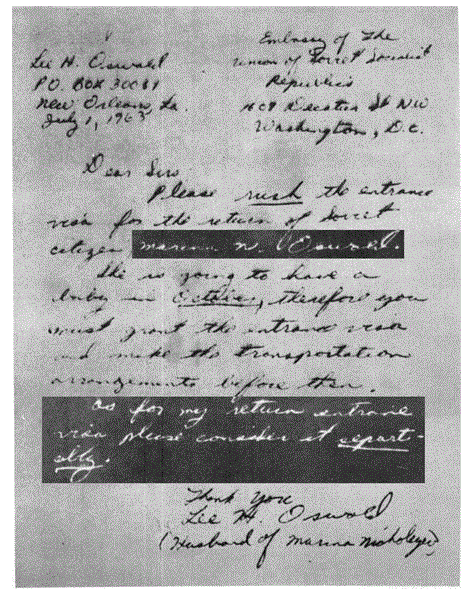
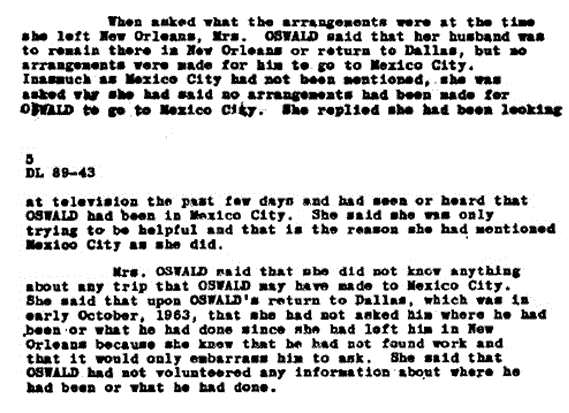
    Lee Harvey (or Henry ala CI/SIG) Oswald; whose plans about the assassination the WCR says was not related to this trip–decided to go to Mexico City in order to secure passage thru Cuba to Russia. For months his wife was writing the Russian Embassy, including a questionaire, pleading to get back to Russia; with or without her husband (CE 6-2/17; CE 9-3/17; CE 12-undated questionaire & CE 14-7/8. Even her husband joined in the effort: CE 13 7/1/63:

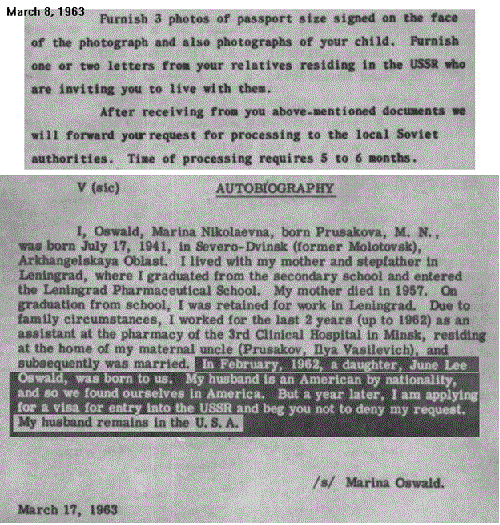
    and again in CE 15 on 11/9/63 (although this typed letter may be a creation of Ruth Paine’s: typed letter from Irving.) In response to Marina’s Feb 7 letter, the Russian Embassy replied CE-8 with specific instructions on how to accomplish the process and that once a completed application and questionaire was received it would take 5-6 months.

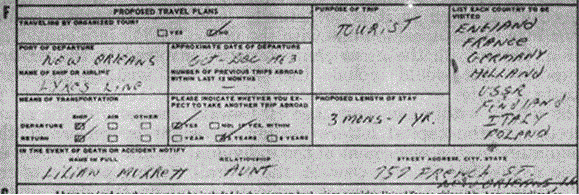
    His June 1963 passport application was approved and his passport issued. On this June 1963 application Oswald stated he would be leaving between Oct & Dec 1963 from NOLA on a ship (he took the SS Marion Lykes of the Lykes Brothers Steamship line from NOLA to Europe on his “trip” to the USSR in 1959) and he’d be gone 3 months to a year. Lykes Questionaire CE1948. The Lykes Brothers line is the same one taken by George DeMorenschildt on his trip back from Haiti thru NOLA to Dallas. (WC testimony of Mr. DeM GDeM testimony).

    If the USSR was his (and Marina’s) desired destination (and the reason for his calls/action in Mexico), going through Cuba was unnecessary. Further it would specifically incriminate him 7 weeks later, as well as be difficult and time consuming, unless he had the help of the US Communist Party… or help from the people fighting them. Like so many activities attributed to the pre-determined guilty Oswald, there is little rhyme or reason for the activities reported during this trip, other than self-incrminiation.

    On Nov 22, in fact not even very late that evening, wheels were spinning as to how to deal with what people knew about Oswald’s trip from New Orleans to Mexico and then to Dallas. While oh so conveniently Ruth Paine was accommodateing and spiriting away his pregnant wife and child. There is also the question as to what the FBI would find out when they started digging and asking questions. The morning of Nov 23rd:

    Sure enough, in the face of the absurdity of the WHY behind this trip, the Commission concludes he made it and the voice; in the face of contradictory evidence; is connected to our Lee Harvey Oswald. Sure enough, evidence will be produced which tells THAT story. For how hard can it be to find the paper trail of a person leaving the US by bus with tickets and manifests, hotels and sightseeing, and then returning the same way. Especially a man the FBI and CIA had kept pretty close tabs on through that Summer of ’63.

    All the FBI had to do was trace Oswald from New Orleans the morning of Sept 25th thru Houston to Laredo and across the border to Nuevo Laredo Mexico, thru Monterrey and then to Mexico City. A few days in Mexico; Friday to Wednesday; to get done on that weekend what is hard enough during regular working hours with appointments.

    The Mystery of the Luggage

    The FBI and CIA will admit that the Cuban and Russian buildings in Mexico were some of the most watched; spied upon; places on the planet at that time, with no less than 30 listening devices, at least 2 inside assets and numerous automatic and fully-manned photographic stations making sure to intercept and identify EVERYONE, especially non-Mexicans, entering, speaking and/or leaving these compounds. Surely the comings and goings of at least 5 separate arrivals and departures would be recorded by the numerous devices trained on these locations.

    Yet, the WCR offers the only pieces of physical evidence they can; a record of a checked medium-sized bag listed on a baggage claim master sheet to corroborate Oswald went from Neuvo Laredo to Mexico City, along with a small handful of witnesses who supposedly remembered seeing him and even spoke to him. The second bag, which the FBI repeatedly finds difficult to keep in Oswald’s possession, and which magically appears and disappears in both reality and in the evidence.

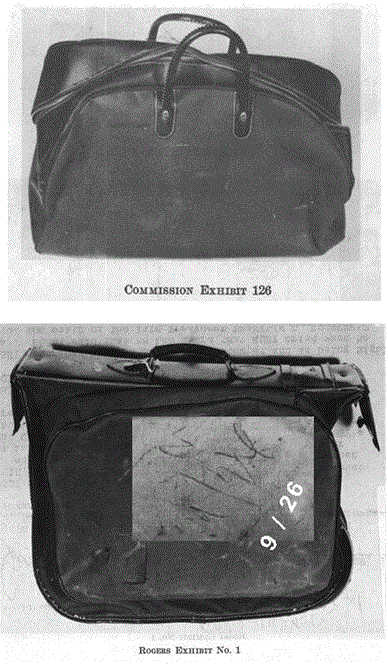
    The FBI could not discover where Oswald spent the evening of September 24th after Eric Rogers sees him getting on a bus towards downtown at around 7pm. Mr. Rogers says he was carrying 2 zippered bags, green in color… So our FBI shows him photos, black & white photos, of a variety of bags:

    Mr. LIEBELER. So in your estimation, he had two bags like Exhibit 126?

    Mr. ROGERS. If I am not mistaken, they are the two bags that my wife and I identified when they came over to the house, somebody from Oklahoma. He was transferred down here.

    Mr. LIEBELER. An FBI agent?

    Mr. ROGERS. Yes.

    Mr. LIEBELER. They actually brought the bags over?

    Mr. ROGERS. They had the pictures like this.

    Mr. LIEBELER. Did he show you pictures like these two that I have got here?

    Mr. ROGERS. Sure did.

    Mr. LIEBELER. They had bags like Exhibit 126?

    Mr. ROGERS. Yes. This is the type. That’s the green type of looking luggage.

    Mr. LIEBELER. You say again that he did not have a bag that looked like Rogers Exhibit No. 1?

    Mr. ROGERS. Yes.

    Why all the interest in ROGERS Exhibit #1? It turns out that a number of weeks after the 22nd Ruth Paine finds these two pieces of luggage in her garage; the very magical Paine garage which grows rifles, luggage, and all sorts of other necessary evidence. Even more peculiar are the markings on one of the sides of this luggage: “9/26;” the date Oswald was supposed to have entered Mexico. It is also claimed that a Continental Trailways sticker was affixed to the side.

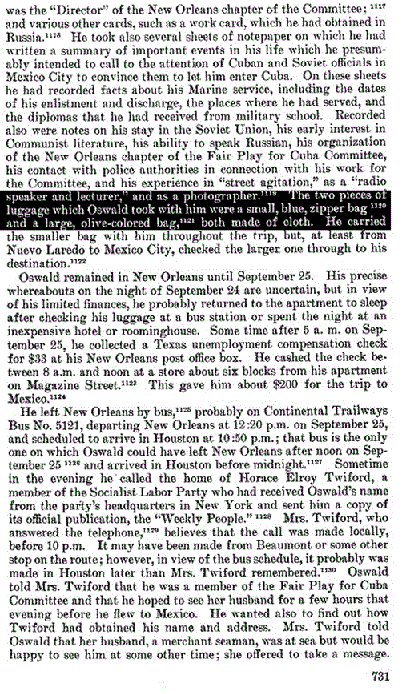
    Yet we must remember that this bag was NOT identified among the ones Oswald had when he left 4905 Magazine. The WCR states on page 731 that Oswald took BOTH CE126, a small, blue zippered bag (the one Rogers identified he was carrying in both hands) and a “large, olive-colored bag” footnote #1121 which is, of course, Rogers Exhibit #1, the bag provided by Ruth and DENIED by everyone asked as a bag Oswald took to Mexico.

    The Warren Commission Report proceeds on the assumption of Oswald’s guilt; yet we find the Evidence IS the Conspiracy. All we need do is look. Consider the following from the WR about Oswald in New Orleans and Mexico City:

    A side note: The FBI teletype from SAC, New Orleans to FBI Director, 12/11/63 mentions the bags as black bags, not green, rectangular and about 18″ across. If the rifle was NOT packed into the station wagon and NOT taken with Oswald, was that rifle, or those suitcases, ever put in the Paine’s garage by an Oswald? From Part I we mentioned that there was no proof that a rifle was transported from New Orleans to Irving with Marina and Ruth, specifically to the garage wrapped in a blanket. A rifle was not taken with Oswald to Mexico or from his apartment. This adds additional corroboration to the notion that the evidence related to the “murder weapon” was also created to support the conspiracy.

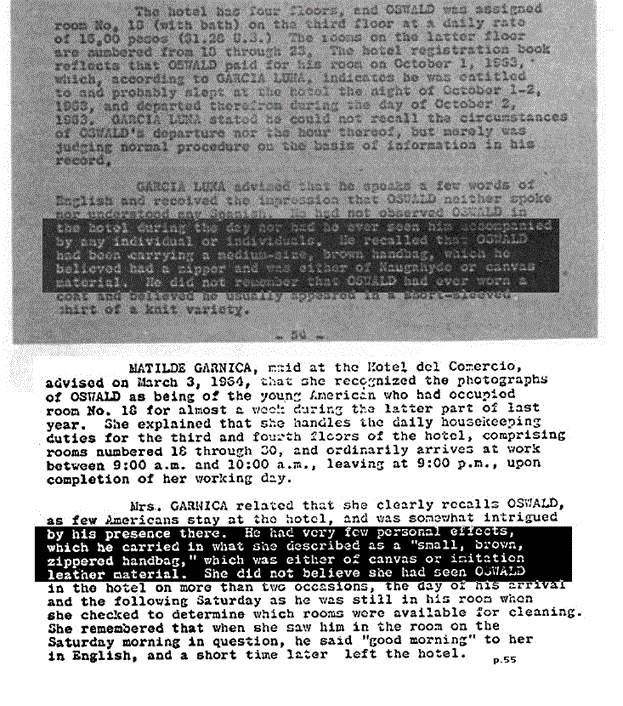
    In Mexico, the FBI asked Hotel personnel what they remembered about the young American visiting them; the only American staying at that hotel we may add – CE2540 contains some of these interviews. Both the Front desk clerk and the maid handling Oswald’s room state he only had one, small brown bag and not the two bags, one blue and one green that Mr. Rogers sees Harvey leave with and board a downtown bus:

    The Two Girls: Mumford and Winston

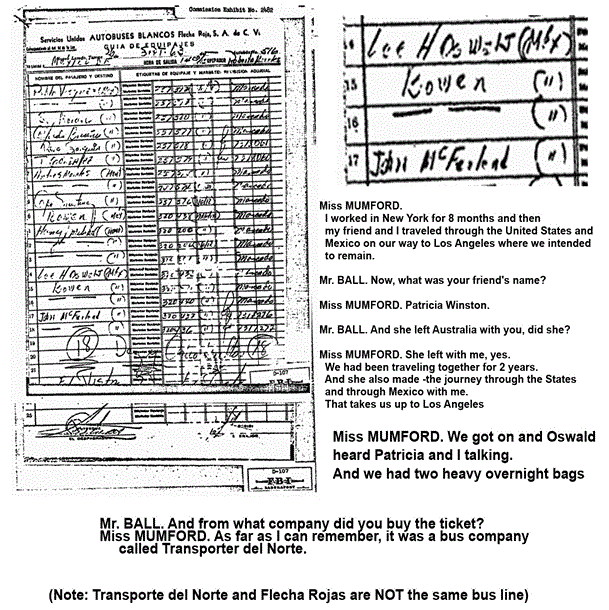
    There is no record of his travel from New Orleans to Houston. No record of a ticket from any mode of transportation; the FBI checked. There is a record of a bus ticket being purchased in Houston by 2am which should have covered Oswald’s travel from there to Mexico City (FBI report of SA Edwin Dalrymple, 2/20/64). There are the affidavits of Mr. & Mrs. McFarland (McFarland) and the testimony of one of two Australian women; Pamela Mumford (Mumford); who, with Patricia Winston, spoke with the man who called himself Lee Oswald after the women boarded in Monterrey and continued on to Mexico City. And finally, as the only physical proof of the trip itself, the Flecha Rojas (Red Line) baggage manifest:

    Miss MUMFORD. Well, we traveled by bus on a scheme which allowed us to travel on Trailways buses for a period of 3 months for a certain amount. We just got on and off at various places we wanted to see: For instance, Washington, D.C.; Miami, where we stayed a week; then we went across to New Orleans, down through Texas to Laredo, and from Laredo we crossed the border also by bus and went to Monterrey.

    We spent one day in Monterrey and left by bus at 7:30 p.m. at Monterrey, and it was on that bus that we met Lee Harvey Oswald.

    Miss MUMFORD. Well, the ticket we had on this deal enabled us only to travel in the States, not in Mexico. So, we bought the ticket on the bus at Laredo and that enabled us to stop off in Monterrey. But the ticket was from Laredo to Mexico City.

    Mr. BALL. And from what company did you buy the ticket?

    Miss MUMFORD. As far as I can remember, it was a bus company called Transporter del Norte.

    Mr. BALL. Now, you got on the bus at Monterrey on the evening of September 26 at 7:30 p.m., you just told me?

    Miss MUMFORD. Yes.

    Mr. BALL. And what was the company that operated that bus, do you know?

    Miss MUMFORD. That was also Transporter del Norte.

    Miss MUMFORD. Oswald was the first one we spoke to. He left his seat and came down to the back of the bus to speak to us.

    Mr. BALL. That was after the bus had left Monterrey?

    Miss MUMFORD. Yes… Then we arrived in the Mexico City bus station and he didn’t speak to us, attempt to speak to us at all. He was one of the first off the bus and the last I remember seeing him he was standing across the end of the room.

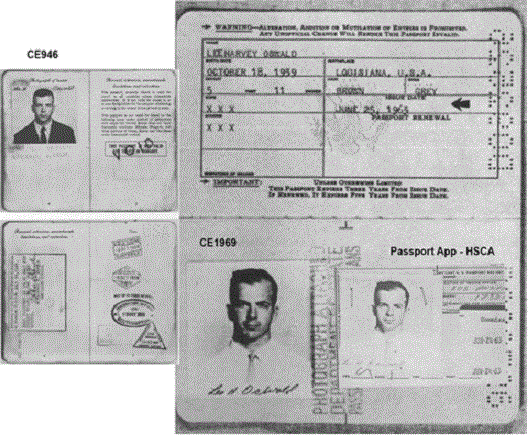
    The normally tight-lipped Oswald is free with “incriminating info” and shows off a passport with Russian stamps. Yet, and this is a key point, that would mean it was Oswald’s old passport, which had been replaced by a clean one he applied for in June. This one does not have a stamp on it. (See CD 1969) Patricia Mumford has some problems as a witness.

    We come to learn the man traveling as Oswald was reported to have entered and exited via a personal automobile and not on any of these buses. Does this mean that the person on the bus with Oswald’s Passport used on his trip to and from Russia was yet another person representing himself as Lee Harvey Oswald?

    Lee Henry Oswald?

    “At 2:05 pm, 11/27/63, while talking to Inspector Don Moore of Division 5 … I read to him an article from The Houston Press, dated 11/27/63, which was telephonically furnished to this office … in which article stated Oswald left the US by private car, ownership unknown, and returned on 10/3/63, through Laredo, Texas. He advised that Oswald did travel by car and did return to the US through Laredo, Texas on 10/3 /63.(FBI memorandum from ASAS J.T. Sylvester, Jr., to SAC New Orleans, 11/27/63.)

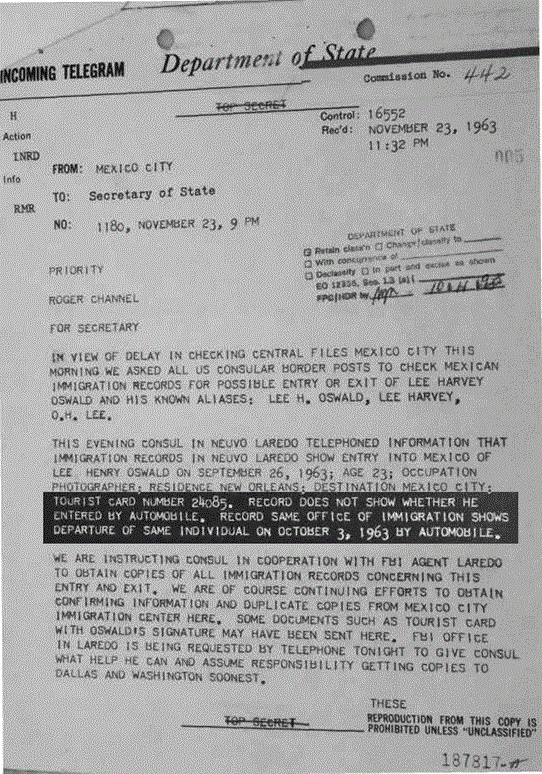
    In Warren Commission Document 442 we find a telegram from Mexico City to Sec of State Rusk stating the records show on October 3, 1963 a Lee HENRY Oswald left Mexico by Automobile. WCD 442 p.9

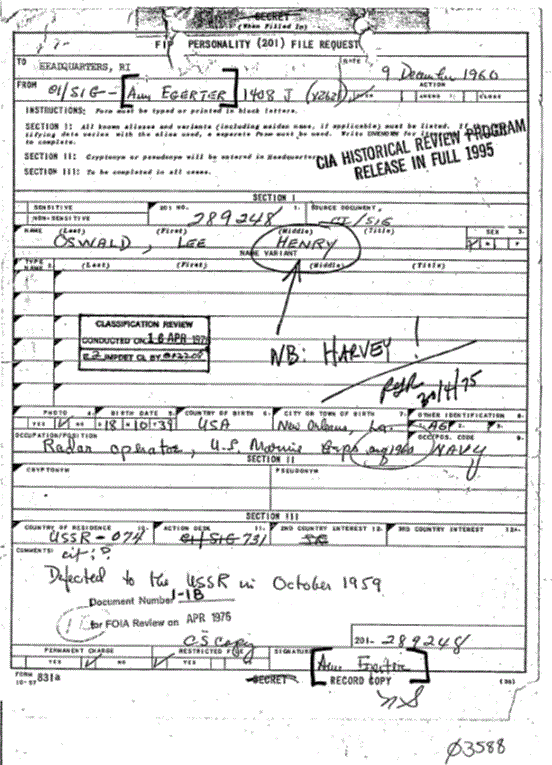
    This is not the first time Lee “HENRY” Oswald is referred to related to Mexico City. The saga of Lee Henry begins with Ann EGERTER of Angleton’s CI/SIG unit who, on Dec 9, 1960 submitted a 201 file request (for people the CIA takes an active interest in as either being a threat or asset) which offers no other name aliases for Lee Henry Owsald. Given that we, the Navy, the CIA, State and FBI have seen his military records, “Henry” was no simple mistake or oversight… it appears purposeful and resurfaces in connection with correspondance to and from Mexico’s station chief Win Scott. We will be discussing the evidence which was generated after the visit in the final part of the this series.

    Excerpt from Inside the Company, by P. Agee:

    “Files are maintained on all agents and they always begin with the number 201 — followed by a number of five to eight digits. The 201 file contains all the documents that pertain to a given agent and usually start with the PRQ and the request for POA. But the 201 file is divided into two parts which are stored separately for maximum security. One part contains true name documents while the other part contains cryptonym documents and operational information. Compromise of one part will not reveal both the true name and the operational use of the agent.“)

    If LEE, or the Oswald impersonator did return by private auto, the reasons for the sightings in south Texas (Alice, Pleasanton, Freer, Corpus Christi, San Antonio & Leming) of a man with a foreign wife (not pregnant) and small children becomes a bit more clear. If this information is correct it strongly indicates ALL the evidence related to the bus trips is either completely fraudulent or describes a person specifically impersonating Oswald for specific reasons; only weeks in advance of the president’s trip to the South and what winds up being 7 weeks prior to Dallas.

    During the summer of 1963 when Harvey and family are in New Orleans, we come across a great deal of evidence that someone repeatedly referred to as “Lee Oswald” was in Dallas with Ruby.

    Robert Roy, Ruby’s mechanic told the FBI he had repaired Ruby’s car numerous times which had been dropped off by the man he knew as Lee Oswald after which he would drive Oswald to Rubyís club and drop him off. A number of people claim to have seen Oswald at Ruby’s Carousel Room in June/July 1963 including: William Crowe, Wally Weston, Dixie Lynn and Kathy Kay (p555, H&L). The supression of information related to Ruby and Lee Oswald not only knowing each other but being very close is formidable.

    (NOTE: Whether this is LEE Harvey Oswald, born in New Orleans on Oct 18, 1939 or an imposter remains the subject of a couple of books and numerous researchers’ speculation. We know for a fact that HARVEY and family are in New Orleans during this time period. We also know that virtually everything related to Lee Oswald in Dallas in the summer of 1963 has been suppressed and/or surrounded in mystery and fear.)

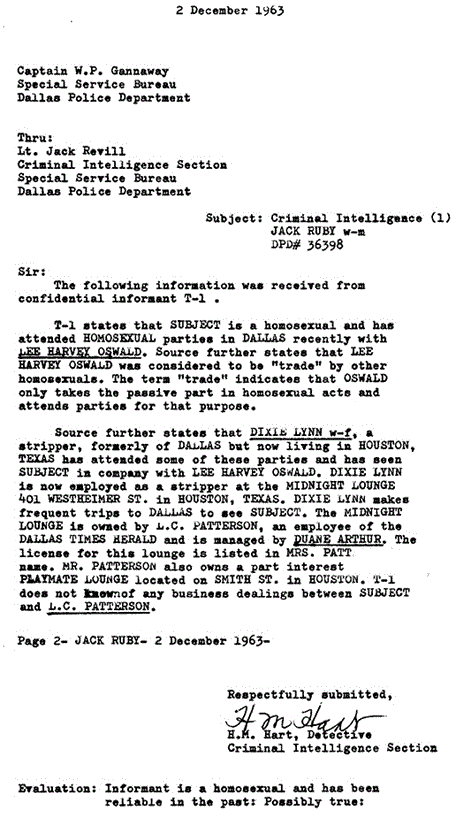
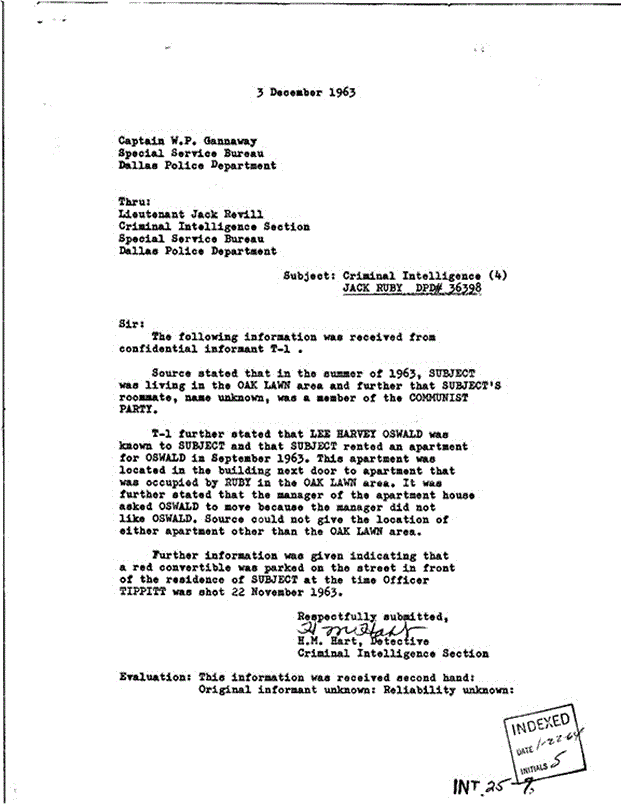
    CE2814 contains much of the FBI’s investigation and their reports on those who placed Ruby and Oswald together. A bit more revealing though are the reports of H.M. Hart, Detective in Dallas’ Criminal Intelligence Section (we should remember that the CIA/FBI took especially close care to remain connected with the intelligence divisions of the major cities’ police departments).

    Detective Hart, through Reville to Gannaway writes that, via a previously trusted informant, Ruby, as well as the man known in Dallas that summer as Lee Oswald, were homosexual and ran in those circles at least in Dallas. Of course, the homosexual aspect of the case also surfaces in New Orleans with Shaw and Ferrie and yet again in Irving when Oswald is repeatedly seen in the company of a young boy in the weeks leading up to Nov 22nd.

    Where was Oswald?

    Mr. JENNER. You live at 2214 Fairfax in Irving, Tex. As I understand it, you are the owner and operator of Clifton’s Barbershop?

    Mr. SHASTEEN. Yes.

    Mr. JENNER. At 1321 South Storey in Irving, Tex.?

    Mr. SHASTEEN. Right.

    Mr. JENNER. How many times–you personally, now, without someone else having told you the boy was in the shop, how many times do you recall when he was in your shop?

    Mr. SHASTEEN. The 14-year-old boy?

    Mr. JENNER. Yes.

    Mr. SHASTEEN. Three times–I know.

    .Mr. JENNER. You have a distinct recollection that on occasions when this man came into your shop for a haircut, he drove an automobile up to your shop?

    Mr. SHASTEEN. He drove that there 1955, I think it’s a 1955, I’m sure it’s a 1955 Chevrolet station wagon. It’s either blue and white or green and white it’s two-toned–I know that.

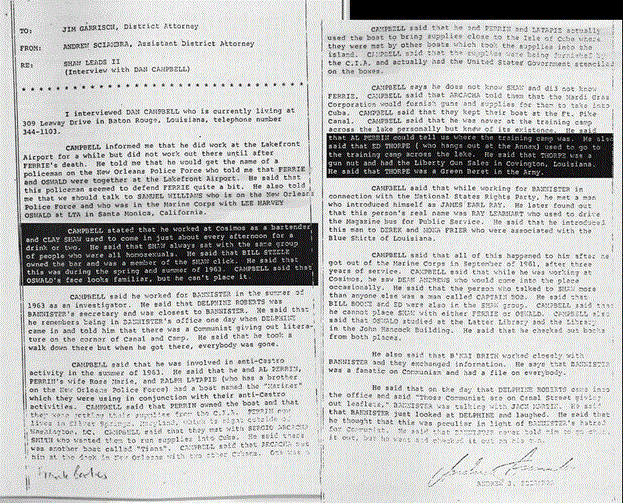
    I bring this up only to suggest that a Lee Oswald was known in Dallas and known to be in the company of Jack Ruby, all the while another Oswald was living in New Orleans. Years later Dan Campbell of Baton Rouge LA connected Ferrie and Oswald, explained how he saw Shaw daily with a group of homosexual men, and had worked for Bannister.

    For our purposes, the fact that Ruby’s Lee goes to see an old associate of Ruby’s, Robert McKeown the gunrunner, to establish Oswald’s desire to purchase scoped rifles at incredible prices over Labor day 1963 helps reinforce the premise that Ruby and Oswald were together in Dallas in the summer of 1963.

    Further supporting evidence was receivied again through Dallas T-1, http://jfk.ci.dallas.tx.us/37/3793-001.gif Box 18 folder 6 doc #8:

    One final mention of LEE in Dallas (for our purposes) comes on the heels of a confirmation by Antonio Veciana that he met with Maurice Bishop aka David Atlee Phillips at the Southland Building in Dallas in late August or early September. (Is it possible that Bishop either leads Oswald to McKeown or is debriefed after Lee’s visit to McKeown’s house over the first weekend, Labor Day weekend in Sept.)

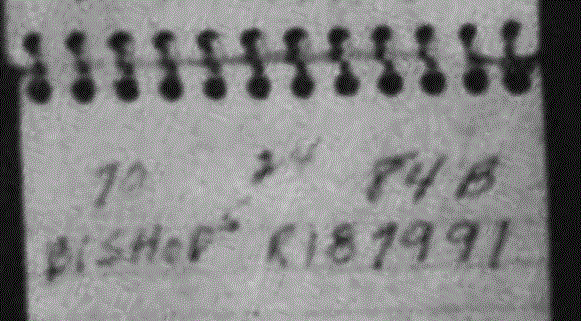
    Ruby’s Notepad with Bishop
    (Ruby’s notebook with BISHOP RI8-7991. A “Bishop” was not found to be either a first or last name among those who Ruby knew)

    Lee Oswald, or someone doing a very good impersonation of him was in Dallas and seen with Jack Ruby at the same time Harvey was working with Guy Bannister, Gaudet, Ferrie and others both FOR and AGAINST the Fair Play for Cuba Committee organization and members.

    Back in New Orleans on the morning of September 25th, we have evidence that “an” Oswald cashed an Unemployment check at Winn-Dixie at 4303 Magazine, less than 2/10th of a mile from what was his Magazine Street apartment. Although his whereabouts on the night of the 24th is a mystery (the WCR assumes he dropped his bags as the bus terminal and found a rooming house or “inexpensive hotel” even though the FBI offers no evidence of his staying at any of the over 40 places they checked), yet after 6am on the 25th someone retrieves an Unemployment Check from his PO Box, returns to a spot not far from his apartment and cashes his $33 check. (FBI D-51 is an exhibit referred to by a number of authors yet I have not been able to find. It is claimed to show that Oswald did NOT sign this last $33 check, even though the Winn-Dixie store does show it deposited on Sept 26th)

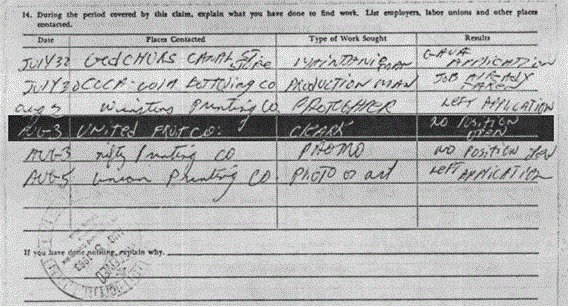
    What I found somewhat interesting about his unemployment claims was the timing, August 3, 1963. Which was six days before he was arrested outside of Shaw’s ITM for handing out Fair Play for Cuba Committee flyers. On that application, Oswald lists the UNITED FRUIT COMPANY as one of the businesses where he applied for work (Burcham Ex#1 p.240). The vast majority of his job hunting, to that point, had been related to photographic or darkroom work. There was indeed a United Fruit southern headquarters set up in New Orleans, so it could be a coincidence. Still, that is a company with plentiful CIA and intelligence ties.

    Getting Oswald out of New Orleans

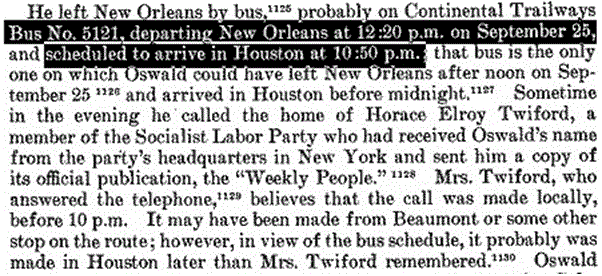
    Returning to September 25th, there is no mention of the transportation needed to get Oswald from the downtown bus station area back to his PO Box or to the Winn Dixie and then back again to leave on the 12:20pm bus to Houston; the ONLY bus that fits the WCR description of his travel. The problem the WCR could not overcome yet chose to add in their narrative on p.731 posted above is Oswald’s evening call to the Twiford’s in Houston and the affidavit of Mrs. Twiford.

    As we read on page 731 of the WCR above, according to Marina, he left New Orleans by bus; the fact that Marina had already left the city the day before should give you some clue as to the depths of investigation performed to determine this “fact”. With Mexico City his final destination, Oswald could have (and should have) purchased the three part ticket to take him from New Orleans to Houston, Houston to Laredo and from Nuevo Laredo to Mexico City. Yet for ANYONE to reach Houston in time to catch the 2:35am Houston to Laredo CONTINENTAL bus; which is the first place there is ANY evidence that “an” Oswald purchased a ticket for transportation to Mexico; they had to leave New Orleans on the Sept 25th CONTINENTAL 12:20pm bus. There are NO OTHER CHOICES. This conclusion was arrived at by process of elimination as there remains no evidence to support Oswald, or anyone claiming to be Oswald, boarding and traveling on that bus. In fact, even the 12:20 pm bus was not originally discussed as an option.

    Oswald had to be on the September 25th 12:20pm Continental Trailways bus from New Orleans to Houston regardless of the fact that there is:

    -No record of his purchasing a ticket for the New Orleans to Houston portion of the trip on Continental Trailways bus #5121 at 12:20pm.

    -No record of his boarding a bus, presenting a ticket, or checking luggage

    -No record of any bus drivers recalling the uniqueness of a New Orleans to Mexico City 3-part ticket and when shown photos of Oswald, no recognition of that man being on the only bus from New Orleans to Houston

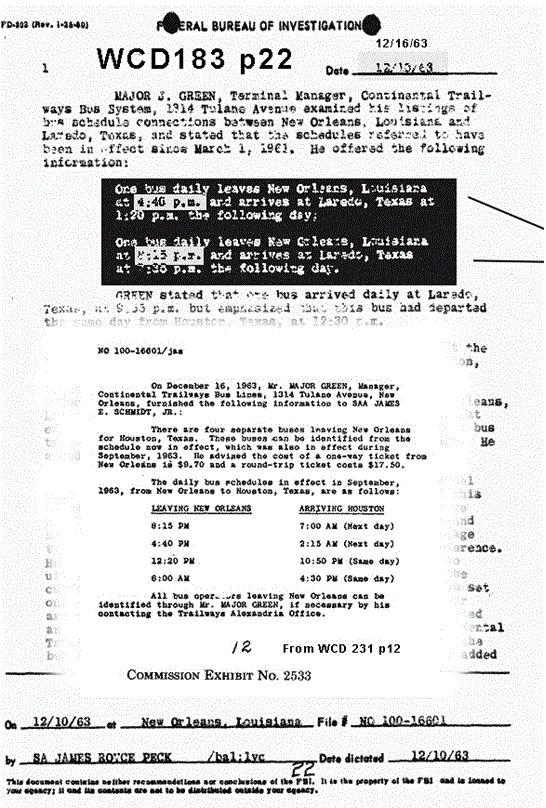
    Hang on a second now… a 12:20pm bus to Houston huh… On Dec 16, 1963 Mr. Major Green of the CONTINENTAL TRAILWAYS bus line stated that there were two (2) buses that traveled from New Orleans to Laredo. (One might assume that if Oswald was going all the way to Mexico he would buy a bus ticket for the entire trip as opposed to simply traveling to Houston and buying yet another ticket there for the rest of the trip.) These buses were the 4:40pm and 8:15pm Sept 25th buses arriving in Houston the next day, the 26th, at 2:15am and 7:00am, respectively. (WCD183) The 2:15am arrival would have been just in time for the 2:35am from Houston to Laredo… The FBI looked into the 4:40pm bus, its driver and passengers with no indication that Oswald was aboard.

    This arrival time also contradicts the information related to the Twifords of Houston.

    On p.731 of the WCR (WCR page image above) we learn that in Houston Oswald contacted the home of Horace E. Twiford, a Socialist Party member who receives names and addresses from the Party so he can send them the official publication, “Weekly People.” Oswald identified himself to Mrs. Twiford over the phone and since there was no operator involved, Mrs. Twiford felt it could have been a local call. Since the WC believed Mrs. Twiford’s affidavit, (Twiford Affidavit), the fact that she did not mention a specific date for this call and only placed the timing of the call between 7pm and 10pm, the WC had to conclude that Oswald arrived in Houston prior to 10pm. Neither of the two Continental buses Mr. Green identified in Dec 1963 arrives prior to 10pm on September 25th.

    AFFIDAVIT (only relevant portions)

    2. …He also said that he had hoped to discuss ideas with my husband for a few hours before he flew down to Mexico. He said he only had a few hours. I assume he was calling from the Houston area since he did not, to my knowledge, place a long distance call. However, he did not specifically say that he was in Houston. I have no information concerning his whereabouts when this call was placed. I told him if he desired to correspond with my husband, he could direct a letter to 7018 Schley Street, Houston, Texas, and I would see that my husband received it.

    3. I cannot recall the date of the call, but I think it occurred during the week prior to the weekend my husband flew home to visit me from New Orleans where his ship was docked. I recall, my husband had shipped out the weekend prior to the call.

    4. I cannot recall the exact time he called, but I think that it was in the evening, sometime between 7:00 and 10:00 o’clock. I was not working during this period.

    Signed this 2d day of July 1964.
    (S) Mrs. Estelle Twiford,
    Mrs. ESTELLE TWIFORD

    This bit of evidence seems to stand contrary to FBI investigatory practices. If a call was placed, a record is surely available from the phone company. If this was a long distance call, even more phone records would be created. Given the witness cannot recall the time or date of the call; the WC could have concluded it was not the 25th at all, yet then the call would have come from Mexico; also easily traced; yet does not fit in the story or timeline. The Twifords were never called to testify. We all know how much evidence and/or testimony was overlooked in the name of Oswald’s guilt. Why even mention this call, opening the door to taking an affidavit, and in turn the realization that what Twiford says Oswald told her conflicts with much of the Mexico evidence.

    According to the evidence the Warren Report another bus HAD to be found. His apartment on Magazine was vacant; his wife, Ruth Paine and all the kids left on the 23rd. Oswald was seen carrying suitcases and went out of the way to retrieve and cash his $33 unemployment check. Even though he stated he had $300 for his trip and was already downtown where the buses would be leaving, he supposedly returned to his PO Box, and to within a couple blocks of his recent home, to cash said check and the evidence quoted states that there was no signed endorsement on this check.

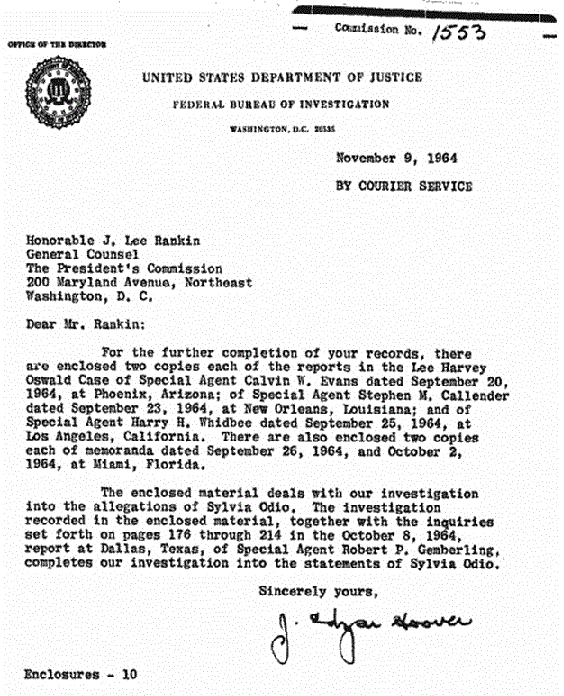
    On September 21, 1964, almost 10 months later and only a few days before the presentation of the WCR, an FBI report which becomes WCD 1553 (and accompanies a letter from Hoover dated Nov 9, 1964; after the WCR is delivered) was written up. This is from a September 9, 1964 re-interview of Mr. Major Green by FBI agent Callender in New Orleans. In THIS report, Mr. Green adds two more buses which travel from NOLA to Houston at 6:00am and 12:20pm arriving in Houston at 4:30 pm and 10:50 pm, respectively. The WCR places Oswald on the 12:20pm bus #5121 which arrives in Houston at 10:50 pm since it is known that Oswald retrieved and cashed his $33 unemployment check down the street from his apartment at 4905 Magazine after the 6am bus had already left New Orleans (even though this check was unsigned).

    The Odio Incident

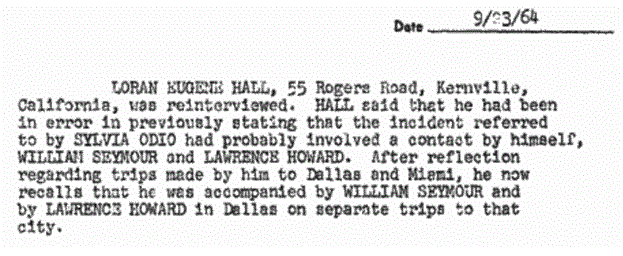
    It is in this WCD that the FBI tries and fails to make its case against Hall, Howard and Seymour. WCD 1553 p.39.

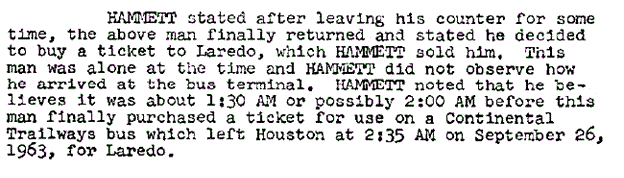
    The bus Oswald is supposedly on arrives well after 10pm in Houston. How then does Oswald call the Twifords from Houston between 7-10pm, if he is not yet in Houston? If the call was placed from outside of Houston; there might have been a record. Yet Oswald states that he has a few hours before his plane leaves to come by and speak to Mr. Twiford. Of course this does not prove he was in Houston at the time of the call, yet the evidence indicates he presented himself and was perceived as if he was. The man leaving Houston at 2:35 am on Continental #5133 (ticket # 112230 purchased at 1:30am) Hammett in Houston who spoke with the McFarland’s and was vocal about his FPCC connections is just as likely the person who called the Twifords from Houston earlier that evening who had “a few hours before he left for Mexico.”

    From all the evidence the FBI offered, there is simply nothing to support Oswald leaving New Orleans on a bus headed to Houston. But there is reliable and corroborated evidence that another Oswald was in Austin, TX early in the afternoon on Sept 25th. And he arrived on the following evening on the 26th in Dallas, at Sylvia Odio’s with Leopoldo and Angelo. Coupled with the total lack of evidence regarding a bus trip out of New Orleans, it all suggests this Second Oswald, and his two Cuban riding companions, either left New Orleans together, or the Cubans met up with Harvey Oswald at some other location and traveled to Dallas between the 25th and 26th of September, stopping in Austin. The WC and FBI also did all they could to suggest that three other men (Loran Hall, Lawrence Howard and William Seymour) were the three visiting Ms. Odio; yet those efforts proved fruitless; but not in time to change the WCR conclusions.

    On October 1, 1964 Sylvia was shown the photos of these three men and stated that “none of these individuals were identical with the three persons… who had come to her apartment in Dallas in the last week of September, 1963.” Her sister, Annie Odio, who was also in the apartment at the time, also stated that “none of the photographs appeared similar to the three individuals in her recollection.”

    On 16th September, 1964, FBI agent Leon Brown interviewed Loran Hall on behalf of the Warren Commission. Brown claims that Hall admitted that he, Lawrence Howard and William Seymour made a visit to a woman who could have been Silvia Odio. However, when Hall was re-interviewed on 20th September and was shown a photograph of Odio, he claimed she was not the woman he met in New Orleans.

    Lee Dannelly, Ronnie Dugger and Oswald

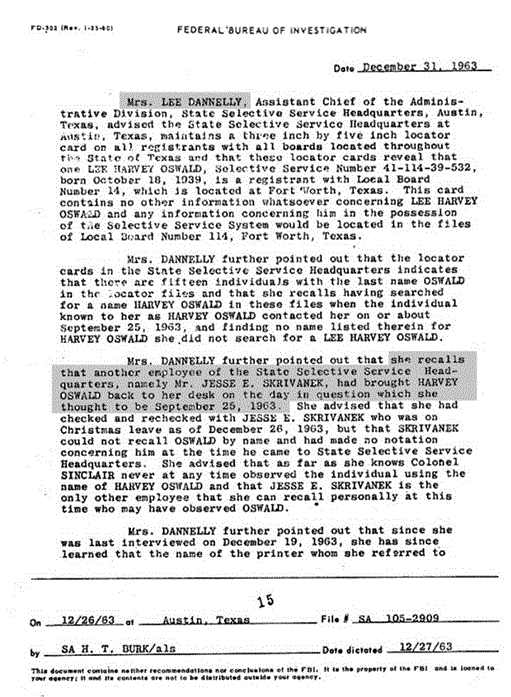
    There is evidence available which places an Oswald at the Selective Service System Office in Austin, TX just after lunch on September 25th at about the same time he’d be leaving NOLA on the only bus the FBI could conclude he used, bus 5121 leaving at 12:20pm. The WCR, on the following page 732, explains that since there is no corroboration for Mrs. Dannelly’s story (which is eerily the same as our conclusion regarding his trip from NOLA to Houston) she must have heard the news and “all of the information she furnished (snip) could have been derived from news media.”

    Austin Texas is 80 miles to the north west of the trip from Houston to Laredo, which in itself is about 325 miles and a 10 hour trip to the south. What will become clear is that an Oswald traveled from NOLA thru Austin on his way to Dallas and Sylvia Odio while another Oswald traveled AWAY from Dallas to Houston and caught the 2:35am bus early in the morning of Sept 26th .

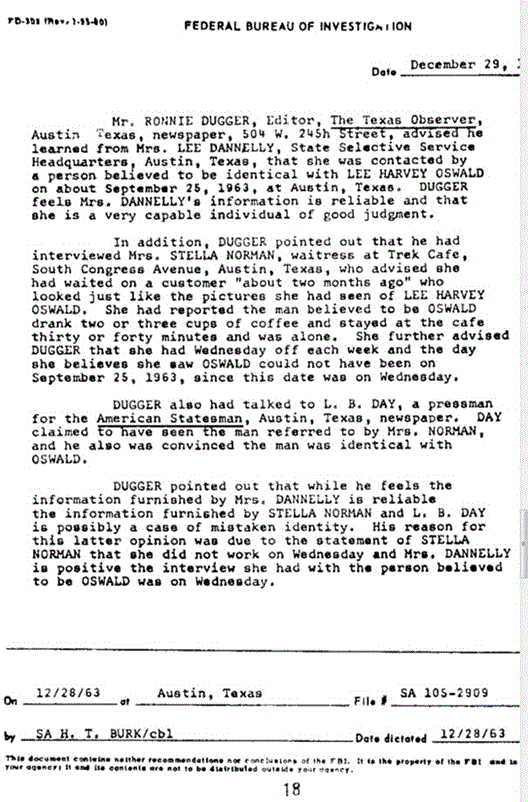
    To avoid corroborating her story we find the FBI once again trying to discredit witnesses. While they all give Mrs. Dannelly (and Jesse Skrivanek) the benefit of the doubt, they determine that two more people could not be right. One of these witnesses, a waitiress who claims to have served Oswald stated she had Wednesdays off. Sept 25th was a Wednesday and it was the day Mrs. Dannelly saw Oswald, so by process of elimination Mrs. Norman could not have seen Oswald. When shown a photo of Oswald, both Ronnie Dugger and Mrs. Stella Norman claim the person they met was “identical with Oswald.”

    The Texas Employment Commission building is but 4-5 miles from the cafe where Mrs. Norman worked, L.B. Day confirms her story while Leon Oswald is not at Sylvia Odio’s in Dallas until the early evening of the 26th. Sylvia’s testimony suggests that the 26th or 27th was possible and that she had been to work that day (although she finally does settle on the evening of the 26th as the time and date). Oswald being seen in Austin while another Oswald impersonator makes his way to Houston for a trip to Mexico begins to take shape.

    There is nothing offered to deny the possibility of Oswald staying in Austin until the following day, when on the morning of Thursday the 26th Mrs. Norman could be serving Oswald coffee, alone. Given Harvey’s cheap ways, milking a $.10 cup-a-joe while waiting for his comrades to get ready to leave for Dallas can explain the sighting and trip to Austin just as easily as the FBI dismissing it on such weak grounds.

    This is a good place to note here the title of this series. The story of Oswald’s guilt is craftily told by prosecuting attorneys; the explanation of why this telling of the tale is so skewed is no better told in a lawyerly, assumptive fashion. Guilt requires proof… Innocence is one of the rare human qualities which civilized society purposefully “assumes” within its basic rule of law. One is presumed innocent until proven guilty. If the guilt can be shown to have come from inauthentic evidence, the presumption must remain. Oswald was presumed guilty with evidence supporting that conclusion brought front and center while all other evidence is buried, altered, destroyed or simply ignored. When this selective evidence is shown to be inauthentic in the years after his murder, the presumption of innocence MUST be a foregone conclusion.

    As Mr. Redlich put it to Mr. Rankin on April 27, 1964 at the beginning of evidence evaluation and the taking of statements (there is no record of this memo being discussed at any Executive sessions):

    Our report presumably will state that the President was hit by the first bullet, Governor Connally by the second, and the President by the third and fatal bullet. The report will also conclude that the bullets were fired by one person located in the sixth floor southeast corner window of the TSBD building…

    Our intention is not to establish the point with complete accuracy, but merely to substantiate the hypothesis which underlies the conclusions that Oswald was the sole assassin…

    I should add that the facts which we now have in our possession, submitted to us in separate reports from the FBI and Secret Service, are totally incorrect and, if left uncorrected, will present a completely misleading picture.

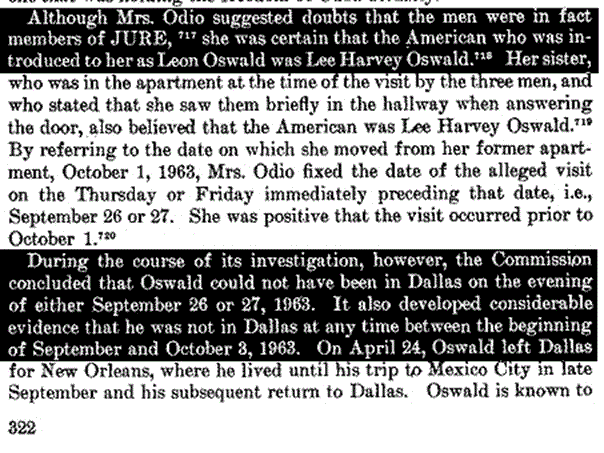
    The powers that were/are in charge of the evidence made sure that Ms. Odio’s story was not heard in a timely manner. Her WC interview was in mid July 1964 while the FBI reports, CE3147 & 3148 are dated September 1964. The report itself was finished and delivered on September 24, 1964. Ms. Odio’s story is summarized on pgs. 321-322, followed by the declaration that since OSWALD was traveling on a bus to Mexico at the time he could NOT have been at Odio’s home in Dallas at the same time and it has been developed “that he was not in Dallas any time between the beginning of September and October 3, 1963.” Until the Hearings and Exhibits were published, this was the only mention of Sylvia Odio, 2 Cubans and Leon Oswald.

    In essence; because he couldn’t have met Odio since he was on a bus to Mexico, he didn’t. The Evidence IS and will always remain, the Conspiracy.

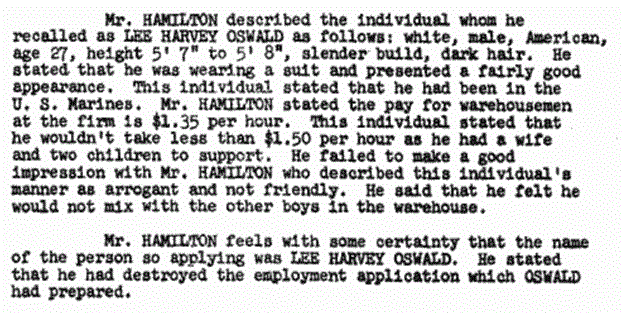
    Hamilton interviews Oswald but not same man

    Mr. Olin Hamilton of the AL SEMTNER Drug Dept in Dallas was reported by the FBI to have interviewed LEE OSWALD just after Sept 23, 1963; when the WCR tells us he was not in Dallas during that time. Much like the WCR’s statement that no one saw Oswald between 11:50 and 12:30 on 11/22, the above declaration that Oswald was not in Dallas at all in the month of September is easily disproved. Oswald was in New Orleans all summer, so one wonders how the Texas Employment Commission has recent Dallas information on this man, and is able to send him on this interview.

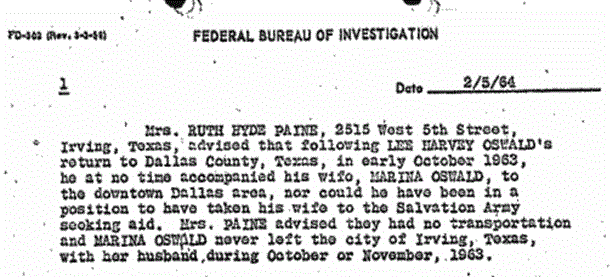
    Mrs Martinez Salvation Army

    Mrs. Ambrose Martinez told the FBI that prior to the assassination in Aug/Sept Lee and Marina and 2 children visited her Salvation Army welfare office in Dallas. (at 500 N Ervay not far from the FBI offices in Dallas at the time) She gave the FBI details related to their references to Mrs. Paine and Marina only speaking Russian. Lee told her they were living in Irving with Mrs. Paine and that he had met her in New Orleans. Ruth, on the following page mentions that Marina never went to downtown Dallas after Oswald joined them on October 3rd. Furthermore, Oswald’s 2nd child was not born until mid-October.

    As we can see, there is quite a bit going on with conflicting evidence just for Sept 23rd thru the 26th… and we haven’t even gotten to Laredo yet.

    Hammett – Oswald from Houston to Laredo

    Mr. E.P. HAMMETT, the ticket agent at the Continental Trailways counter in Houston on the night of Sept 25th remembers distinctly selling a single ticket for travel from Houston to Mexico City; a rare event as that trip’s tickets are not sold but more than 1 or so a week, according to Mr. Hammett. In this report the FBI shows Mr. Hammett a photo of Oswald and a small Zipper bag (but not the larger olive-colored canvas bag which is ultimately recorded on the Nuevo Laredo to Monterrey, Flecha Roja busline portion of the trip.

    The description of the man’s clothes offered by Mr. Hammett; a brown and white pullover sweater, white dungarees and white canvas shoes; and the lack of these items being found in any of Harvey’s possessions, suggest that like the light colored medium sized jacket found “on the escape route from Tippit”, these clothes were never Harvey’s.

    From all appearances, the man claiming to be Lee was in Houston getting on a bus at 2:35am now the 26th, while Harvey was still in Austin on his way to Dallas; most probably with the two Cubans Odio sees on the evening of the 26th.

    Surely there are records kept as tourists leave the USA and enter a different country. The stamping of passports is something we can usually count upon yet in 1963 traveling to Mexico or Canada did not always result in these stamps. So what else can we find which would show that Oswald, with no known nefarious thoughts at this point, left the US for Mexico. Surely he was not actively trying to hide this travel; given the discussions Marina claims they had about the trip, the lack of any motive and the ease with which he befriends others on the way.

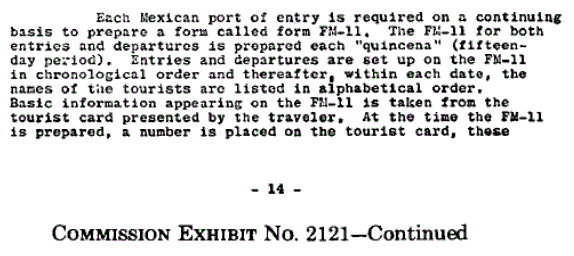
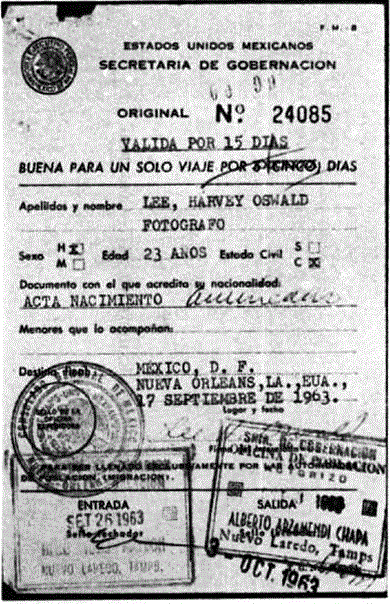
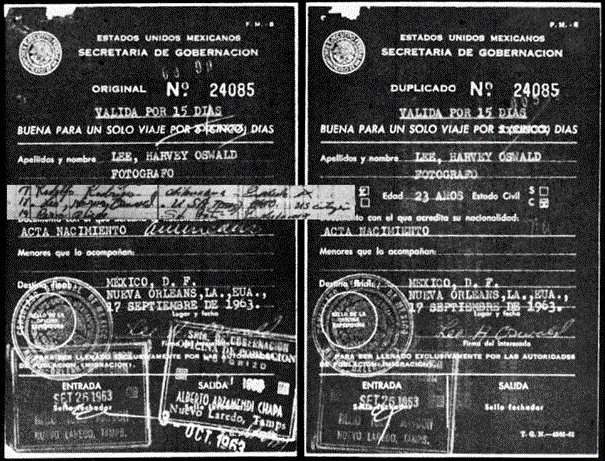
    CE2121 p14-15 & 23; From Mexican Immigration forms FM-5 and FM-8 (this FM-8 appears imprinted at the top of the tourist visa card #24085 made out to Harvey Oswald Lee) the FM-11 form is created which is an alphabetical listing of those entering Mexico prepared every 2 weeks. For those people entering the 1st of the 15-day cycle, the person with the first alphabetical listing would have the #1 written on their visa and they’d be recorded on line #1 in the FM-11.

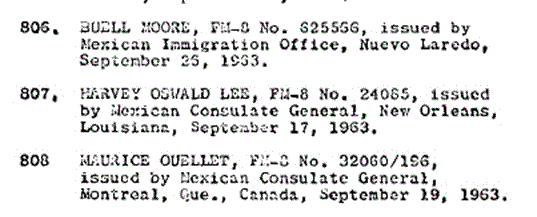
    Info for the FM-11 is taken from the ORIGINAL tourist card and then, “a number is placed on the tourist card” which are used to make entries by day, in alphabetical order until the end of the 15 day period. Oswald was given # 807 on the FM-11 which started at #762 for FM-8 passengers on Sept 26th. The number we should see on the original visa would be 807 minus 762 or 45. It does not appear there is any number written on the “original” visa in evidence that corresponds to this process.

    http://www.history-matters.com/archive/jfk/wc/wcvols/wh25/html/WC_Vol25_0352b.htm

    For CE2121, FM-5 and FM-8 entries are separated. For the period starting Sept 16 we are shown that entrance #368, Margarita Alanis, was recorded as the first person entering Nuevo Laredo on Sept 26th. On page 18 the FM-5 numbers end with #399; Tobias Zarember and start again with the FM-8 entry: Felix Alonzo. The number for the alphabetized FM-8 form entries begins with 762.

    On page 23 of CE2121, after the name Buell Moore and before Maurice Ouellet we have “HARVEY OSWALD LEE, FM-8 #24085.” Except according to the Mexican officials, they believed the passenger’s name from the visa was Lee, Harvey Oswald which becomes “H.O. Lee” on his departing documents. LEE comes well before MOORE. In fact, Mr. LEE should have been #800 before Mr. Mason. One has to wonder who in Mexico would have known this passenger to be Mr. OSWALD when preparing this list as opposed to Mr. LEE as stated by his travel documents.

    CE 2121 p.23

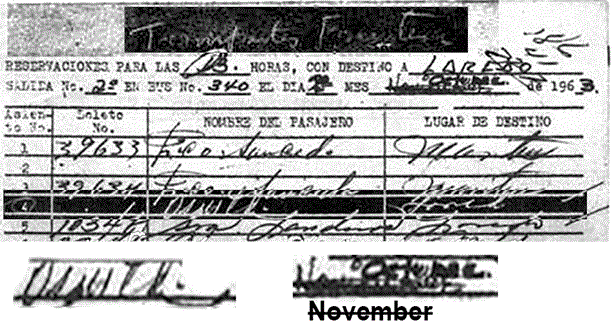
    The exhibit goes on to mention that even though baggage may be listed; this does not insure that the person actually traveled on the bus.

    Below is a piece of CE2469 which establishes H.O. LEE as the name the Mexican authorities related to the person traveling out of Mexico and back to the US. We will return to this important Exhibit as it fits into the controversy surrounding which bus line the FBI and the WCR finally decides Oswald was on: Transportes del Norte or Transportes Frontera and why, if he was actually on one or the other, there appears to be evidence which supports either scenario. What the Frontera evidence reveals is the speed and efficiency with which Mexican intelligence was willing to create documents which supported the story of his travel. In subsequent parts we will examine this trip in detail starting with the arrival in Mexico, the evidence of his activities in Mexico and the return trip to Dallas.

    There were three bus lines which service Mexico City: Transporte del Norte, Transporte Frontera and Flecha Rojas. The evidence for Oswald’s return trip will pit evidence created by Arturo Bosch against the assumptions and evidence regarding the del Norte line and the simple statement of Hoover that Oswald did NOT take bus #340 at 2pm; and that the evidence which suggests this was created after the fact.


    The Evidence IS the Conspiracy, Table of Contents


  • Mexico City, Part 1

    Mexico City, Part 1


    Mention “Mexico City” to a JFK Conspiracy Realist and you can expect to get any of a variety of reactions, from the opinion that Mexico City is the “Rosetta Stone” of the conspiracy to pure agnosticism. At the core of the Mexico City charade is the same question that haunts most of the Warren Commission Report (WCR) conclusions and evidence; why? Why would Lone Nut Lee Harvey Oswald be going to Mexico City, to both Cuban & Russian embassies, with what appears in the evidence to be the desire to secure passage through Cuba to Russia?

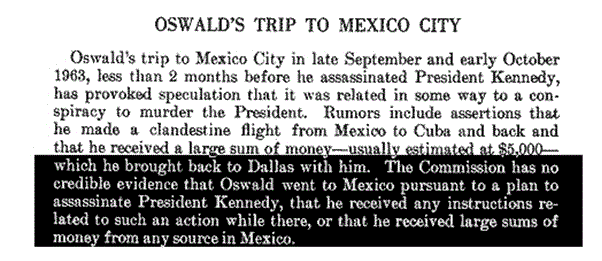
    How can we establish a relationship between Oswald’s decision to go to Mexico and the way in which it was reported within the government, and Oswald’s guilt for the JFK assassination? The WCR claims there was no connection whatsoever between the events to and from Mexico (as well as the time in Mexico) to Oswald’s plan to kill JFK. The Warren Commission Report’s conclusion reflects that the Commission determined that there was little if any advanced planning of the assassination. At least on Oswald’s part.

    See here.

    The evidentiary purpose of the trip was to secure an in-transit visa for passage thru Cuba to Russia for himself and his family. The WCR stated Oswald’s purpose was to go thru Mexico to Cuba in lieu of hijacking a plane and flying directly to Cuba (per Marina). In other words, he simply wanted to get to Russia through Cuba.

    On the other hand…

    Can the events surrounding this trip be connected to a plan to create a viable patsy in the killing of JFK? We must remember that Dallas was by no means the first assassination attempt in November 1963 involving scoped rifles, slow vehicle turns and teams of men. Would we be seeing Arthur Thomas Vallee’s name on the Mexico City evidence if the Chicago plot* had succeeded?
    (*Edwin Black; The Chicago Plot, Nov 1975 Chicago Independent)

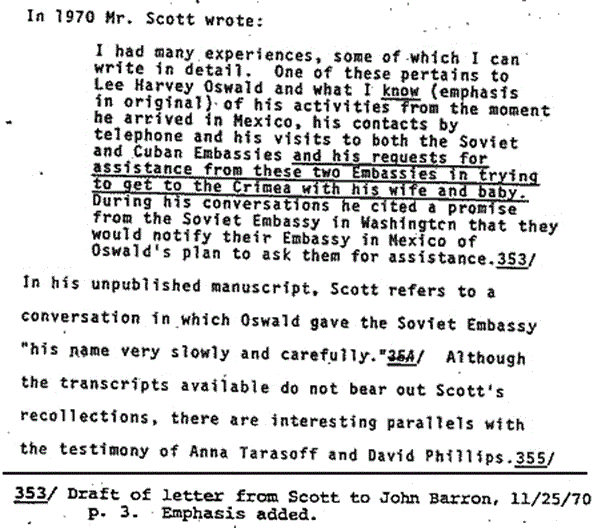
    The evidence tries to establish that Oswald was focused on getting to Cuba en route to Russia and that he had met with a man supposedly KGB assassination related, although Win Scott claims Oswald was trying to get to Odessa with his family and little else. Win also states to his knowledge, as he was not in Mexico at the time, that Oswald was under complete and thorough surveillance the entire time he was in Mexico. He could only get this information from one of the two people overseeing the Mexico station in his absence: Anne Goodpasture, his chief assistant and/or David Atlee Philips; Head of the Cuban desk at the Mexico station.

    Oswald already had the appropriate passport documentation, approved VERY quickly, to get back to Russia without having to go through Cuba (which in itself is amazing given his “status”). House Select Committee on Assassinations (HSCA) published Oswald’s June 1963 Passport application, which was approved for travel including to Russia. In essence, there would be no need for Oswald, who had to have had some reason for going to Mexico City’s Cuban and Russian Consulate, to even attempt to travel through Cuba.

    See here.

    The story of Mexico City has 3 distinct parts: The summer of ’63, the trip itself, and the CIA’s activity after Oct 3rd. How “The Evidence IS the Conspiracy” correlates to each of these parts will be presented here one part at a time.

    What we find amazing is the number of reports on the Mexico trip which are repeated and scattered about the WCR and WC Documents, as if this information was intentionally made especially difficult to correlate and cross-check. The evidence related to this part of the conspiracy is not only contradictory, but WCR-incriminating.

    The impetus for this has been touched upon in a number of books and articles over the years: the name on the tourist Visa purchased on Sept 17th and the hotel registry in Mexico City both include the identical mistake; a comma after LEE, followed by HARVEY OSWALD. Is there any evidence offered to explain how Lee Harvey Oswald becomes Harvey Oswald Lee or H.O. Lee?

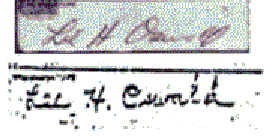
    The following is A COPY of the Mexican Hotel’s guest register with a blow-up of the signature compared to the signature on the visa. (ALL docs are copies as the FBI took possession of and kept all originals. As time passed and originals were requested, we find that most originals were either destroyed, or claimed to be lost. Whether the CIA/DFS turned over all the docs is yet another difficult to resolve mystery).

    All in good time. Let us start at the beginning:

    PART I. The Summer (officially ended September 23rd 1963).

    From the time Oswald left Reilly Coffee in late July, his activities in New Orleans, LA (NOLA) and up to his Sept 27th Dallas meeting with Sylvia Odio, all connect him with PRO-CASTRO forces, overseen by anti-Castro intelligence operatives within our government. Virtually no one that summer is NOT associated with intelligence, foreign or domestic, in and out of 544 Camp, the International Trade Mart and Jim Garrison’s backyard.

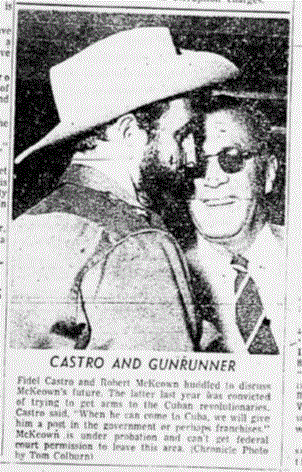
    Over the Labor Day weekend while Oswald and family are in New Orleans with the Murrets (Lee’s mother’s sister and husband), two men arrived at the door of one Robert McKeown, a self confessed arms dealer who worked in similar circles as Jack Ruby, had supplied arms for Castro’s cause and was a close friend of Castro himself. McKeown was on probation at the time. Lee Oswald announced to McKeown that he has finally found him and would like to buy 4 rifles for $10,000. Lee Oswald was traveling with a man named Hernandez.

    McKeown had connections with Ex-Cuban President Carlos Prio, the new leader of Cuba Fidel Castro, as well as having been contacted by Jack Ruby. McKeown ran CIA-sourced munitions to both sides of the conflict.

    This appears as an attempt to once again connect OSWALD with CUBA and CASTRO almost 3 months ahead of time. Would we assume this is assassination related?

    Ruby also knew McKeown from his gun-running activities and offered him $25,000 in 1963 for an introduction to Castro in order to secure the sale of jeeps. McKeown asked for $5,000 up front which Ruby did not have at the time. No further contact was reported.

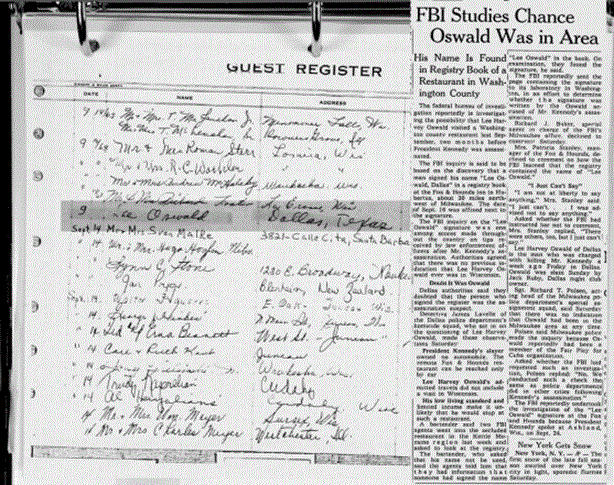
    Looking at a list of WCR/FBI Exhibit numbers we spotted FBI D-050, a guest registry for the Fox and Hound in Milwaukee, WI with the name LEE OSWALD; DALLAS, TEXAS signed on the registry page for Sept 14, 1963. The article states the date was Sept 16, even though the actual page does not appear to have a date at all. A report of a “Lee Harvey Oswald” also written in a restaurant registry in Hubertus, WI coincides with a statement from the article by Mrs. Patricia Stanley, manager of the Fox and Hound, “…declined to comment on how the FBI learned that the registry contained the name of ‘Lee Oswald’” …” I am not at liberty to say anything.” Asked whether the FBI had instructed her not to comment Mrs. Stanley replied, “There were others, too, but I just can’t say.”

    While the article repeatedly claims that there is no indication that Oswald was in Wisconsin, it never even hints at why or who would be putting that name with DALLAS in mid September when Oswald was in New Orleans with Marina (who was 8 months pregnant) and his first child June. Oswald and Marina arrived in New Orleans on April 24, 1963. On their reutrn to Texas in September, Marina moved in with Ruth, while Oswald did not return to Texas until October, after the Mexico trip. Ruth drove Marina and June to Irving the morning of Sept 23.

    The Paines and the Oswalds

    Ruth Paine left Irving on July 27, 1963 with her children for a driving trip to see relatives, friends and Friends (Quaker organization relations). In mid-September she was in Richmond, Indiana before heading south to New Orleans. Marina and Ruth had been in contact with each other initially discussing the end of September, after Ruth’s trip, as the approximate day for pick-up. Between Sept 20 and Sept 23 Oswald was with his wife, Ruth and all the kids at 4905 Magazine in New Orleans until they left. Oswald definitely did not travel with Ruth. When recapping that weekend Ruth uses the name “HARVEY” alone, something not seen or done in most testimony offered about Oswald.

    Why the repeated use of all three of his names as opposed to simply Lee, or Oswald by the government lawyers? Was it to assist with the cover up when the different people in his history refer to him as Lee OR Harvey? I wonder how many times a single name was actually used, only to be transcribed into Lee Harvey Oswald. Looking through Ruth’s testimony, for example, “Lee Harvey Oswald” is said 85 times by Jenner and Dulles and not used once by Ruth.

    Mr. JENNER – Now, you were there for 2 full days and 3 evenings. Would you tell us, conserving your description in your words, what did you do during these 2 days and 3 nights. When I say “you,” I am including all three of you.

    Mrs. PAINE – Of course, afternoons we usually spent in rest for the children, having all small children, all of us having small children.

    Mr. JENNER – Whenever this doesn’t include Lee Harvey Oswald would you be good enough to tell us?

    Mrs. PAINE – When he was not present?

    Mr. JENNER – That is right.

    Mrs. PAINE – My recollection is that he was present most of the weekend. He went out to buy groceries, came in with a cheery call to his two girls, saying, “Yabutchski,” which means girls, the Russian word for girls, as he came in the door. It was more like Harvey than I had seen him before…

    In the spirit of context and timing we know that Michael Paine had moved into his own apartment in September 1962. Michael picked up Oswald and Marina in Dallas in early April, 1963 for a visit to their Irving house after having met them at a party during the holiday season 1962. The party, at Mrs. Declan Ford’s house was where Mr. & Mrs. DeMohrenschildt bring Mr and Mrs Oswald at Mrs. DeMohrenschildt’s request. In one form or another, a close watch was being held on Mr. and Mrs. Oswald.

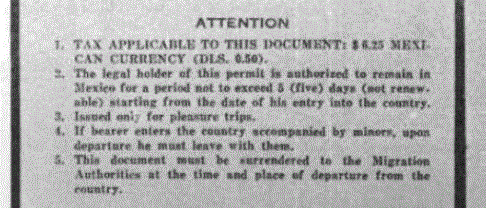
    On September 17th; based on the date printed on CE 2478, the tourist visa; a man recorded as “LEE, HARVEY OSWALD” yet signing his name “Lee H Oswald” purchased a 15 day tourist visa for Mexico which allowed the holder to remain in Mexico for up to five days prior to the expiration date of the visa; October 2, 1963.

    The Alvarado Story

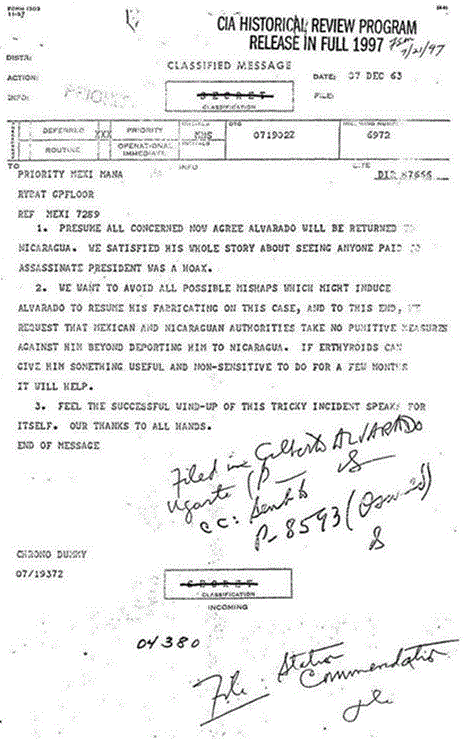
    September 18th was the original date Nicaruaguan Intelligence officer Alvarado claims he saw Oswald in Mexico City, overheard a conversation related to an assassination and saw Oswald accepting money. Alvarado went to the American Embassy in Mexico City on November 25 to report what he saw. When the FBI/CIA realized that Sept 18 was not possible because Oswald was still in New Orleans, Alvarado changed his story as needed and ultimately recanted the entire thing under protest. The interesting thing about Alvarado is the CIA’s follow-up cable on Dec 7 which completely lets Alvarado off the hook for having fabricated the story and even suggests there is a direct connection between what Alvarado does and who instructs him to do it. Central American countries’ Intelligence servies and the CIA became VERY close over the years since 1947. If the encounter never happened; and there is no evidence that it did other than Alvarado’s word; how would Alvarado have known what types of things to say in order to incriminate Oswald all on his own?

    CE 3152 is a memo from HELMS to RANKIN about the Alvarado incident: how hard it was to shake Alvarado off his story, how he maintained it was Oswald even after he failed the polygraph, and that he had been at the Cuban Consulate on Sept 18th. (The Consulates are not the same as the Embassies. A close examination of the evidence shows that when asked to go to one, the man playing Oswald would go to the other without success).

    CE 3152 continues by establishing that Alvarado was informant T-32, that he was 60% sure it was Oswald and that it occurred on the 18th of September. In conjunction with this is a follow-up memo (possibly from David Phillips) which discusses “resolution” of the Alvarado issue yet gives the distinct impression that Alvarado, his employer and the CIA are very much intertwined. We’ll delve more deeply into the Alvarado incident in part two. Note: “IF ERTHYROIDS CAN GIVE HIM SOMETHING USEFUL AND NON-SENSITIVE TO DO FOR A FEW MONTHS IT WILL HELP.” His job in Mexico was most assuredly “sensitive.”

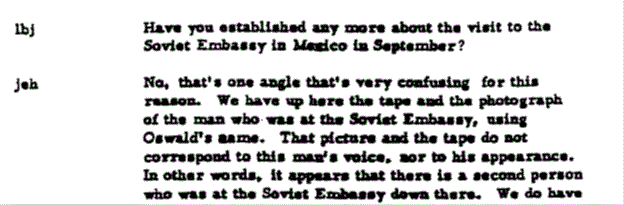
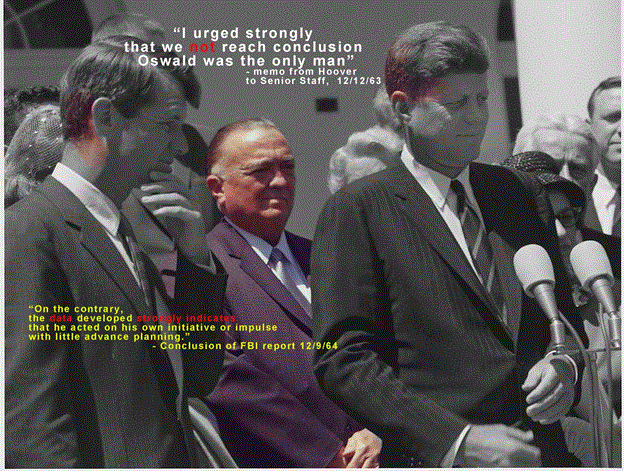
    Peter Dale Scott uses the initial story and recant as examples of what he calls the Phase 1 and Phase 2 stories of Oswald. Phase 1 being the connection to communists, Cuba and Russia in order to “release the dogs of war” which when thwarted by Johnson and Hoover becomes Phase 2: Oswald the Lone Nut Communist with no ties to anyone and his NOT being the man in Mexico… Hoover seems to be the only one who appears concerned with the identity of the Oswald impersonator (the CIA certainly doesn’t care as they created the charade) and states on 11-23-63 to LBJ:

    “…I think we have a very, very close plan. Now if we can identify this man who is at the Mexican Embassy at; the Soviet Embassy in Mexico City, the Embassy in Mexico City — this man Oswald has still denied everything.” Hoover would feel and mention the sting of the CIA and Oswald in Mexico for many years to come. He would also make clear to his staff that he felt the FBI report mistakenly came to a conclusion. The Commissioners themselves were very surprised at this since Hoover was given to saying the FBI determined the facts and did not present conclusions, even if ironclad.

    (enhanced by DJ)

    FBI vs. CIA

    One should note that prior to the 1947 creation of the CIA, the FBI’s Special Intelligence Service (SIS) was specifically responsible for Intelligence gathering in the Western Hemisphere, from 1941 through 1946 along with existing Military Intelligence entities with acronyms, like MID (Military Intelligence Division) & ONI (Office of Naval Intelligence). The SIS story begins on 26 June 1939, with Roosevelt signed a Presidential Directive stating:

    It is my desire that the investigation of all espionage, counter-espionage, and sabotage matters be controlled and handled by the Federal Bureau of Investigation of the Department of Justice, the Military Intelligence Division [MID] of the War Department, and the Office of Naval Intelligence [ONI] of the Navy Department. The Directors of these three agencies are to function as a committee to coordinate their activities. (Presidential Directive of 26 June 1939; Section 2; File 64-4104; Administrative Records of the SIS; RG 65; NACP.)

    FDR clarified his position on June 24, 1940:

    He ordered that “The FBI should be responsible for foreign-intelligence work in the Western Hemisphere, on the request of the State Department,” while “The existing Military Intelligence and Naval Intelligence branches should cover the rest of the world, as and when necessity arises.” President Roosevelt concluded his directive by observing how “It was understood that the proposed additional intelligence work should not supersede any existing work now being done…” (New Insights into Hoover and the SIS, G. Gregg Webb; see here).

    (Memorandum of President Roosevelt’s telephone directive prepared by Berle and approved by the President, 24 June 1940; Section 2; File 64-4104; Administrative Records of the SIS; RG 65; NACP).

    Understanding the long history of US Military involvement in Central and South America would require a book in its own right, yet we ought to be aware that the growth and control of sovereign nations and their intelligence, security and military establishments in this area goes hand in hand with the US military’s work to protect US business interests in these countries. Between the Armed Forces’ Intelligence, the State Department’s attache corp and the FBI’s SIS, Central and South America, especially Mexico and Brazil, were hand-in-hand partners with the USA in numerous illegal activities from assassination to the drug trade. Many researchers have discovered this conection resulting in the multitude of “off the books” programs financed by illegal funds.

    Marina’s Stories

    As we’ve learned, so much of what Marina Oswald tells us is shrouded in conflict. Yet as times and testimony change we can always count on her supporting the desired facts, even if she sounds terribly foolish doing so.

    Prior to Ruth arriving, from early September though the 23rd, Marina’s “husband” is not working yet also not home every day reading as Marina claims. Between the Unemployment Office, the library and Ryder’s Coffee shop, he was busy. We finally learn about Oswald’s plans for Mexico from Marina in her testimony:

    WCR testimony:

    Mrs. OSWALD. Nothing. And it is at that time that I wrote a letter to Mrs. Paine telling her that Lee was out of work, and they invited me to come and stay with her. And when I left her, I knew that Lee would go to Mexico City. But, of course, I didn’t tell Mrs. Paine about it.

    Mr. RANKIN. Had he discussed with you the idea of going to Mexico City?

    Mrs. OSWALD. Yes.

    Mr. RANKIN. When did he first discuss that?

    Mrs. OSWALD. I think it was in August.

    HSCA testimony:

    Mr. McDONALD – When did you first learn of his planned trip to Mexico City? When did you first know about that?

    Mrs. PORTER – Shortly before I left for Dallas with Ruth Paine.

    Mr. McDONALD – How did you learn of this?

    Mrs. PORTER – He told me about his plans to go to Mexico City and to visit the Cuban Embassy over there.

    Mr. RANKIN When your husband talked about going to Mexico City, did he say where he was going to go there, who he would visit?

    Mrs. OSWALD. Yes. He said that he would go to the Soviet Embassy and to the Cuban Embassy and would do everything he could in order to get to Cuba.

    The purpose of the visit as recorded and expressed by Chief of Mexico Station Win Scott was to get himself and his family to Odessa. Cuba originally did not have anything to do with the evidence of the man calling himself Oswald.

    Mr. RANKIN. Did you learn that he had a tourist card to go to Mexico?

    Mrs. OSWALD. No.

    Mr. RANKIN. If he had such a card, you didn’t know it then?

    Mrs. OSWALD. No

    And as usual, the FIRST STORY offered, which usually conflicted with the desired story, had to be changed or be supported by some rational explanation for the change:

    Mr. RANKIN. When you were asked before about the trip to Mexico (CE1781 & 1792), you did not say that you knew anything about it. Do you want to explain to the Commission how that happened?

    Mrs. OSWALD. Most of these questions were put to me by the FBI. I do not like them too much. I didn’t want to be too sincere with them. Though I was quite sincere and answered most of their questions. They questioned me a great deal, and I was very tired of them, and I thought that, well, whether I knew about it or didn’t know about it didn’t change matters at all, it didn’t help anything, because the fact that Lee had been there was already known, and whether or not I knew about it didn’t make any difference.

    Marina describing her husband going to Mexico is fraught with problems and contradictions. So much so that a reading of each subsequent questioning on the subject appears as if she is reading from a prepared script regardless of the question. It was CUBA-CUBA-CUBA all the time, when actually there is little if any evidence anywhere else in this case to support Oswald’s desire to be in Cuba. (Incidentally, it was not the FBI she talked to about Mexico at first. It was the Secret Service).

    Q. Did Lee tell you why he wanted to go to Mexico?

    A. He was disappointed in Latin America so he wants to go and try Cuba.

    Q. Why did he choose Mexico?

    A. He told me he was going to take the bus. (sic)

    (This bit of testimony is the reference used by the Warren Commission to determine Oswald had taken a bus from New Orleans).

    One has to wonder what occurred to change Marina’s account of Mexico between November 28 & 29, 1963 and Feb 3, 1964 when she began giving the “adjusted” account of her knowledge about her husband’s Mexico Trip…

    CE1781:

    And the SS interview Nov 29th:

    “She was asked whether she had any knowledge of Lee’s trips to Mexico or Washington, D.C. She replied in the negative. She was asked whether she or Lee had any cameras and she replied that Lee bought one camera in Russia and a second one in the United States. She said one was a small camera and the other was a box camera. She added that sho was not proficient with operating any Cameras and she never had an opportunity to do so.” See here (“never had an opportunity to work the camera” requires yet another back-peddling recant when the infamous Backyard photos come up)

    When did Oswald leave New Orleans?

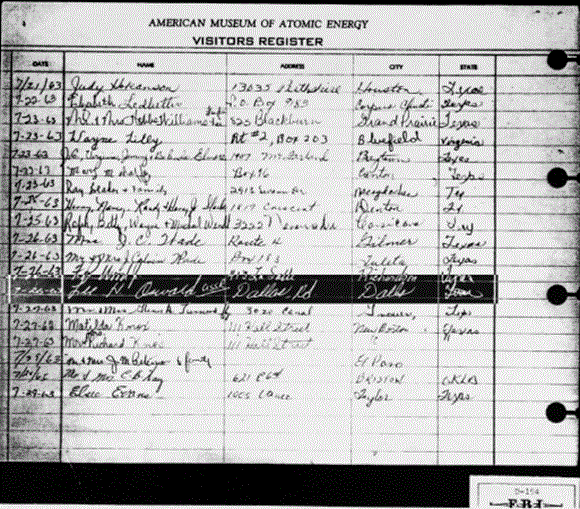
    In the time period when Oswald actually stopped working at Reily Coffee on July 22, 1963 (a company employing Oswald with its own set of CIA, FBI and NASA coincidences and peculiarities) and Sept 23, 1963 Oswald did not work, officially; his only job while in New Orleans since April was at Reily. In yet another of a long line of imposter coincidences, on July 26, 1963 at the American Museum of Atomic Energy in Tennessee we find someone has signed Oswald’s name and associated him with the USSR and Dallas. (H&L p.551 – FBI D-154)

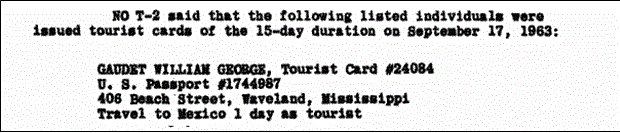
    Oswald collected $33/week in unemployment beginning Aug 17 and had barely made $500 while at Reily. On August 9th he was involved in what we now know was a charade, and was arrested while handing out pro-Castro Fair Play for Cuba (FPCC) literature at the New Orleans LA International Trade Mart. Some of the literature in Oswald’s possession literally had his name and “544 Camp” stamped on it. This connects to Bannister and by association to a man named William Gaudet who we come to learn acquired the Mexican tourist visa sequentially numbered just ahead of the one given to Oswald: No. 24084, on Sept 17th.

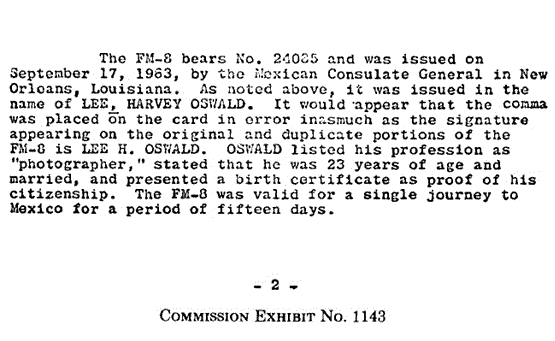
    On Sept 17, 1963 SOMEONE appears at the New Orleans Mexican consulate and purchases the visa made out to “LEE, HARVEY OSWALD,” which to most means the person’s name was Harvey Oswald Lee, or H.O. Lee. The FBI explains:

    CE 1143 is an: Excerpt from FBI report dated May 18, 1964, re Lee Harvey Oswald’s visit to Mexico and excerpt from Secret Service report dated August 28, 1964, of schedule of buses traveling from Dallas and Houston to Laredo, Tex. (CD 1084(e), pp. 2, 99-101; CD 1450, p. 1).

    The above excerpt starts with acknowledging that the 15 day visa was made out to “LEE, HARVEY OSWALD” comma and all, yet they write: “It would appear that the comma was placed on the card in error inasmuch as the signature appearing on the original and duplicate portions of the FM-8 is LEE H. OSWALD.” As we can see, #24085 appears as described (this is a reversed image) as do the signatures…

    Yet, when we look at the hotel registry where Lee would have once again signed his name as it appears on the signature line of these forms, without a comma, we find something quite interesting: We are expected to believe that Oswald, who supposedly signed his name on the visa, did so in exactly the same manner as is TYPED on the 15 day visa, not as the visa was signed… maybe part of his master “advanced” plan? (Note: as we remember from the first The Evidence IS the Conspiracy article, he waited until Thursday afternoon the 21st to ask Wesley Frazier for a ride back to Irving to fetch his rifle, even though he had been working in Dallas at the TSBD since mid-October. The WCR concluded that this trip and the JFK assassination had no connection for Oswald and that there was in fact little if any advanced planning).

    When we add to this all the evidence, or non-evidence of Oswald himself ever being in Mexico we are literally forced to re-examine in detail the events ascribed to him and whether or not this remains a simple oversight, or the inadvertent copying of information to keep falsified information consistent.

    We learn that #24084, the visa issued just before Oswald’s was bought by a man the WCR, FBI and CIA sought to keep buried, William George Gaudet. And they succeeded. It was not until 12 years later during the HSCA that we hear from Gaudet and learn that the list of names of those who purchased visas on Sept 17 that the FBI provided the WC deleted the name Gaudet claiming, “No record of FM-8 No 24084 located.”

    This link is Warren Commission Document 75 page 577 from Warren DeBrueys’ 12/2/63 report showing the FBI knew about this man within 2 weeks after the assassination. Gaudet’s stated purpose for the trip? “Travel to Mexico 1 day as tourist.” It is unknown whether he ever made that trip. Yet one Albert Osborne did. We will return to Mr. Osborne and some of the strange circumstances revolving around yet another piece of the Mexico Trip and the printing of FPCC flyers.

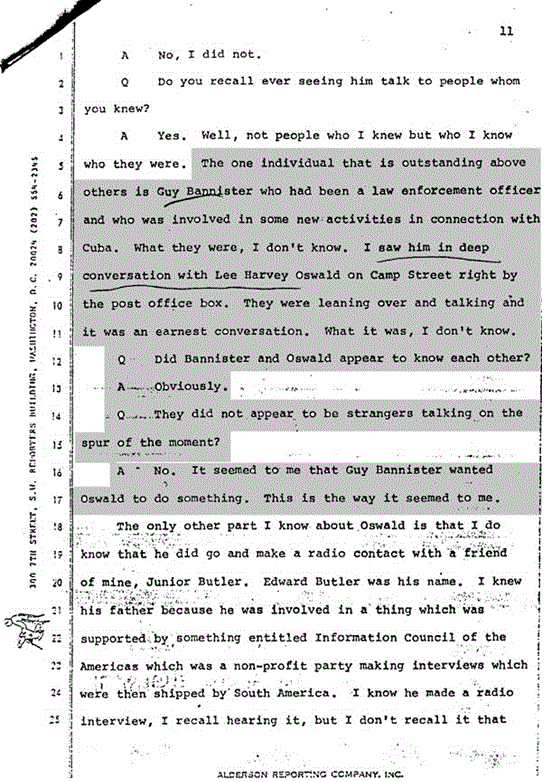
    More importantly for this discussion, when he was finally questioned by the HSCA, Gaudet established direct connections between Guy Banister of 544 Camp Street and Lee Harvey Oswald during the summer of 1963 in New Orleans:

    National Archives, HSCA 180-10070-10274, Numbered Files 004826; HSCA interview of William Gaudet

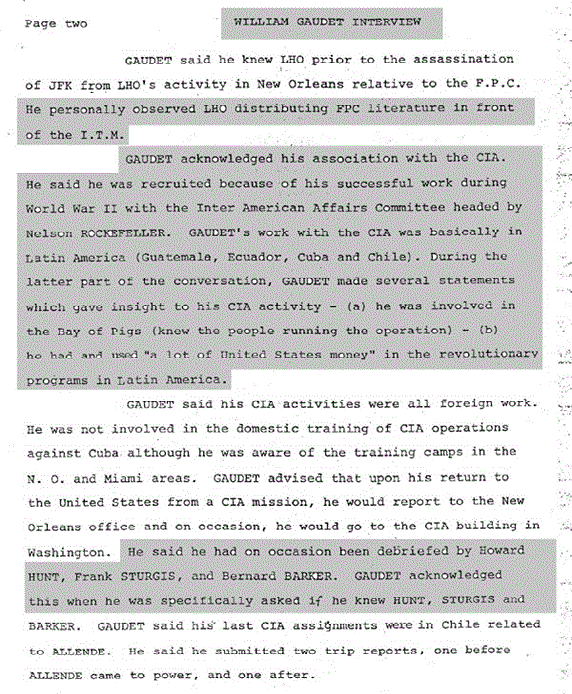
    Gaudet goes on to mention the names David Ferrie, Sergio Smith, Howard Hunt, Bernard Baker and Frank Sturgis among his CIA exploits:

    Gaudet acknowledged he knew Oswald (and Bannister) from his activity in New Orleans related to FPCC; the same FPCC which the Secret Service states has no connection to 544 Camp. Mr. Gaudet would have us believe that his acquiring the previous visa on the same day was pure coincidence.

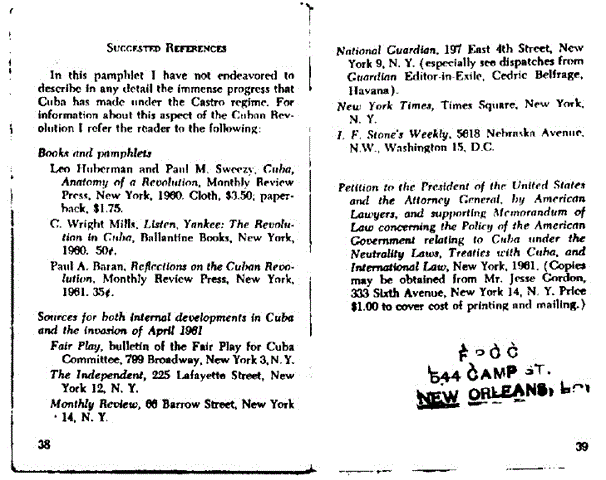
    CE3120 shows copy of Corliss Lamont’s pamphlet with the final page bearing a FPCC, 544 Camp Street, New Orleans stamp. WCD1495 is a SS report dated Sept 11, 1964 which connects this pamphlet to literature found in Oswald’s possession.

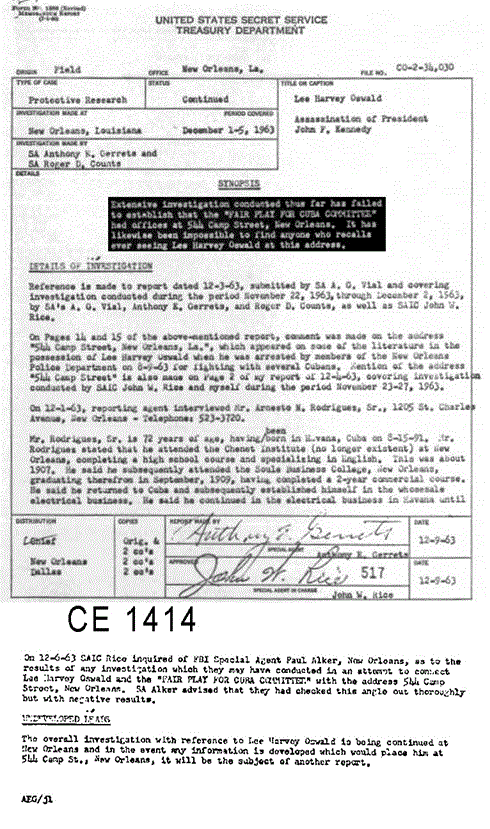
    CE1414 is an SS report from Dec 1963 which concludes that there was no connection between FPCC and 544 Camp, and that it was “impossible” to find anyone who recalls ever seeing Oswald at that address. But boy oh boy did we try hard.

    Since William Gaudet helps to show that conclusion for what it truly was, we can understand why the FBI, CIA and WCR went out of their way to remove him from the picture. Could Gaudet have been the reason and/or transportation for Lee to have gone and gotten a 15 day visa which would expire exactly on October 2, 1963? Witnesses to this purchase stated that Oswald was alone at the time and that the following visas are purchased just before closing at 1:30pm.

    Of note is that the visa states the stay in Mexico cannot exceed 5 days while the visa itself is good for 15 days. The dates work perfectly; Ruth arrives just in time to remove Marina and June from Oswald’s care and sight. Virtually every single statement incriminating Oswald for having been to Mexico and to the Soviet and Cuban Embassies and/or Consulates is derived from CIA/DFS (Mexican Intelligence) related transcripts and records. The FBI, which also had their own relationships with the Mexican DFS obviously also did not have a shred of proof that Oswald, the man Ruby killed, had been to Mexico. It relied exclusively on CIA information.

    Along the same lines as taking CIA documentation for what it is, former CIA officer Phillip Agee tells us that CIA 201 files are divided into a CLEAN “operational” part for public consumption and a SECRET “true name documents” part. The following is an excerpt from Inside the Company, by P. Agee:

    “Files are maintained on all agents and they always begin with the number 201 — followed by a number of five to eight digits. The 201 file contains all the documents that pertain to a given agent and usually start with the PRQ and the request for POA. But the 201 file is divided into two parts which are stored separately for maximum security. One part contains true name documents while the other part contains cryptonym documents and operational information. Compromise of one part will not reveal both the true name and the operational use of the agent.

    We ought to take a moment to create a little “mind-set” context. In 1963 the backstory always supported the documents. The documents were the evidence. There was not Internet cross-checking or even putting most of the evidence side-by-side. They were accepted until authenticated while usually authenticated by the same CIA people who created them or those under their control. When the CIA or FBI or ONI, INS, MID handed you a file or leaked a story, there was no questioning where the rest of it was, where the “good stuff” or the “secret” stuff was. Today, we are given the impression that NOTHING IS SECRET while everything, in reality, is. In 1963 and for many years after, the truth was simply hidden or destroyed. Today it is covered with mountains of data and hiding in plain sight.

    The result is the same question: “What is the truth?”

    The answer remains the same: “What we tell you it is.”

    Who returned the books?

    On September 19th, two days later, Oswald is at one of the New Orleans public libraries and checks out four books. This in itself is not surprising as most said he was an avid reader (not bad for a 10th grade dropout: teaches himself Russian, speaks eloquently on Marxism, his own philosophies, his travels and his photographic abilities. School records reflect a 102 to 118 IQ.) What surprises is the fact these books are returned in New Orleans on the day Oswald is supposed to have arrived in Dallas; October 3, 1963. (We will return to Oct 2 and beyond in Part 3). One has to wonder who this Lone Nut Oswald was so close to that they would return four library books. Where were these books? If he traveled with the books he’d need to stop in New Orleans first, which was something Marina was asked about, but then he could never have been in Dallas at the time he was. Mrs. Jesse Garner, the apartment manager found a completely empty 4905 Magazine on the 25th when she came to collect some rent that was due. Oswald had taken all his possessions with him, yet these library books were returned in New Orleans on the 3rd of October.

    The Signatures Don’t Match

    September 20th is also a most interesting day: (From Harvey and Lee, p.598)

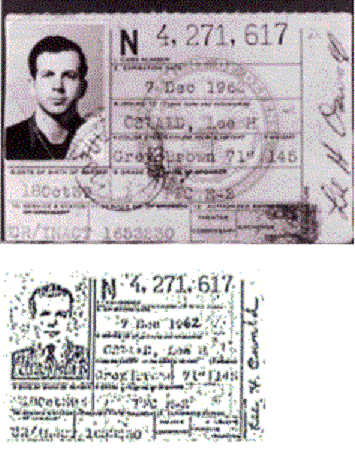
    On September 20 Nagell sent a registered letter from El Paso, Texas to J. Edgar Hoover at FBI Headquarters and informed him that President Kennedy would be assassinated during the last week of September in a conspiracy that involved Lee Harvey Oswald. After mailing the letter, which included Oswald’s description, aliases, and current address, Nagell walked into the State National Bank and fired two shots into the ceiling. He then walked outside and waited for the police to arrive. When the police arrived and arrested Nagell his only statement was, “I would rather be arrested than commit murder and treason.” When Nagell was searched the police found a photocopy of a military ID card issued to Lee Harvey Oswald. The ID card was probably given to Nagell by the people who assigned him to infiltrate the activities of Lee Harvey Oswald and Franz Waehauf at the Hotel Luma in Mexico City. Otherwise, how and why would Nagell have a copy of Oswald’s military ID card with a different signature?

    (When Richard Case Nagell was arrested in El Paso Texas, the police found a military ID card issued to Oswald in his belongings. That card was identical to one found on Oswald in Dallas on November 22, 1963. With two exceptions: the photo and signature were different).

    Ruth Paine and Marina

    Friday, September 20, 1963 was also the day that Ruth Paine arrived at 4905 (or 4907) Magazine after corresponding with Marina about having her come live with Ruth and children until and through the birth of their next child in mid-October. Ruth and children arrive in a 2-tone BLUE station wagon which appears not to be the same vehicle in which Ruth brought them to New Orleans.

    CE3119 page 10 reports that Lillian Murret, Oswald’s aunt, said that the “unknown woman from Texas in the BROWN station wagon had called for him…”

    In April 1963 the Oswalds arrive at the Murretts’ in New Orleans in a BROWN station wagon driven by Ruth Paine. In September 1963 the same woman picks them up in a BLUE station wagon.

    During her questioning about February 22, 1963; the gathering when the DeMohrenschildt’s brought Marina and Harvey; she was asked how she got there, answering that she drove:

    Mr. JENNER – You owned or then had, or maybe you still have a station wagon?

    Mrs. PAINE – That is right.

    Mr. JENNER – Is it the same car still?

    Mrs. PAINE – It is the same car.

    Mr. Clifton Shasteen was a barber in Irving who remembers Oswald well:

    Mr. SHASTEEN. Well, now, that part of it I would have to take for granted because they were in his car. Now, she, I understand through one of the men who questioned me out at the shop, said he never did drive her car. Again, I’m going to disagree because I know that he did. He drove it up there and got a haircut.

    Mr. JENNER. You have a distinct recollection that on occasions when this man came into your shop for a haircut, he drove an automobile up to your shop?

    Mr. SHASTEEN. He drove that there 1955, I think it’s a 1955, I’m sure it’s a 1955 Chevrolet station wagon. It’s either blue and white or green and white it’s two-toned–I know that. Now, why I say–why I take it for granted that Mrs. Paine was with him when he come to the grocery store I do remember he wasn’t driving when they would come to the grocery store, there would be a lady driving and I’m assuming that that’ was Mrs. Paine, because like I say, I have been–I have never been close enough to her and knew it, to speak to her, but she trades at the service station where I do and I saw her in there and I never did pay any attention to her and I saw her passing, met her in the road in the car and those things. (See here).

    With Oswald on a few of these trips was a boy described as 14 years old and unknown to Clifton who as a barber had a good memory for faces, not names.

    Mr. JENNER. And would you describe this young man to me, how was he dressed?

    Mr. SHASTEEN. Well, he had on blue jeans and they fit tight and he had on an old striped shirt, I remember him just like I see a picture over there right now and he was a husky kid, he wasn’t what you call fat, but he was strong-broad-shouldered; he had a real full, and when I say full, I don’t mean a round fat face, he was a wide-faced kid.

    (Note: A BROWN station wagon of similar make, model and year was seen at 4905 Magazine around the time of Oswald’s FPCC arrest on Aug 9th at the International Trade Mart).

    Ruth and children stay the weekend and corroborate the fact that Marina’s “husband” was there all weekend. Finally, on Sept 22, Oswald helps load Ruth’s car and on the morning of Sept 23 says goodbye to Marina and June. Of special note were questions asked by the WC about anything that might have resembled a rifle either in the materials packed with Marina or in Oswald’s possession when he leaves on the 24th. The answer in each case was that nothing resembling a rifle was seen either during the packing, unloading and storage of their belongings, ever.

    On September 24 (Tuesday) Oswald visited claims interviewer Fredrick L. Christen (“T-3”) at the unemployment office in New Orleans for the last time. Once again Christen reported Oswald’s visit to the FBI and advised that he signed a continued interstate claim (Form IB -2) in his presence. (p. 603 H&L)

    How did Oswald get to Laredo?

    Witness Eric Roberts, who lived near Oswald on Magazine stated that Oswald left his apartment around 7pm, Sept 24, carrying 2 SMALL SUITCASES approximately 18 inches across and caught a bus at the nearest stop at Magazine and Upperline. The FBI conducted a fairly thorough search of the surrounding hotels; 43 to be exact; and was unable to locate where HARVEY Oswald stayed that night (see here).

    We are aware that Oswald was still in New Orleans the morning of the 25th of September as he cashed his Sept 17th Unemployment Insurance Claim check which was mailed from Austin on Sept 23rd. While two days from mailing to cashing does seem a bit quick, most every event in the falsified timeline gives Oswald JUST ENOUGH TIME to potentially complete the event, yet they still stretch the bounds of credibility.

    Speaking of the bounds of credibility stretched, the WCR states, on page 731, that Oswald had $200 for the trip to Mexico, footnote #1124 refers to CE2481, Oswald’s tourist visa application in which he actually states he has $300. As discussed earlier, Oswald’s last day of work was July 22, and the first $33 UE check was on Aug 17. Of course, there were living expenses from Aug 17 thru Sept 23 for himself, Marina and June and “no money to Marina” when she left with Ruth.

    Mr. RANKIN. When he was unemployed in New Orleans, did he get unemployment compensation?

    Mrs. OSWALD. Yes.

    Mr. RANKIN. Do you know how much he was getting then?

    Mrs. OSWALD. $33 a week. It is possible to live on that money. One can fail to find work and live. Perhaps you don’t believe me. It is not bad to rest and receive money.

    Mr. RANKIN. Did your husband have any money with him when he returned from Mexico?

    Mrs. OSWALD. Yes, he had some left. But I never counted how much money he had in his wallet. That is why I don’t know.

    Mr. RANKIN. Was it a small or a large amount or do you know that?

    Mrs. OSWALD. What would be a large amount for me would not be a large amount for you.

    Mr. RANKIN. Well, can you give us any estimate of what you think he had?

    Mrs. OSWALD. He might have had $50 or $70, thereabouts. It is necessary sometimes to make a joke. Otherwise, it gets boring.

    It is unclear whether Marina was given any money while her husband was separated from her. It is also unclear how Oswald saved two let alone three hundred dollars when he only received $33/wk. for about 6 weeks.

    Oswald left New Orleans by bus. Or so says the WCR with reference to Marina Oswald’s testimony. Actually, she left two days before her husband left. Oswald probably left, the WCR concluded, by way of Continental Trailways Bus No. 5121. Probably. In Warren Report-speak this means there is no proof whatsoever that Oswald took or was aboard that bus or the evidence would have been offered, fabricated or not.

    The FBI was simply unable to determine how Oswald left with his two suitcases after he left the local bus. According to the driver of the bus who helped Oswald load his two suitcases, he asked for directions to the Greyhound bus station. The Greyhound station and the Continental Station are not the same nor do the Greyhound buses travel to or from the Continental Station and vice versa. It is very likely, based on the testimony of Sylvia Odio and her sisters, that Oswald was on his way to Dallas, in a car driven by two Cuban men.

    The men were two anti-Castro Cubans who, as a threesome, make it difficult to believe that the man leaving the impression he was Lee Harvey Oswald on a bus leaving Laredo, was actually Marina Oswald’s husband.

    Mr. LIEBELER. When did you first become aware of the fact that this man who had been at your apartment was the man who had been arrested in connection with the assassination?

    Mrs. ODIO. It was immediately.

    Mr. LIEBELER. As soon as you saw his picture?

    Mrs. ODIO. Immediately; I was so sure.

    Mr. LIEBELER. Do you have any doubt about it?

    Mrs. ODIO. I don’t have any doubts.

    Mr. LIEBELER. Did you have any doubt about it then?

    Mrs. ODIO. I kept saying it can’t be to myself; it just can’t be. I mean it couldn’t be, but when my sister walked into the hospital and she said, “Sylvia, have you seen the man?” And I said, “Yes.” And she said, “That was the man that was at the door of my house.” So I had no doubts then.

    Mr. LIEBELER. Now, you have indicated on the calendar, you circled the 30th of September, and you drew a line around the 26th, 27th, and 28th of September. Can you tell me what you meant by that?

    Mrs. ODIO. The 30th was the day I moved. The 26th, 27th, and 28th, it could have been either of those 3 days. It was not on a Sunday. (26th was a Thursday and a travel day, while CIA reports place an Oswald in Mexico on the 27th and 28th)

    This takes us through 12:20pm September 25th when a bus leaving New Orleans for Houston becomes the agreed upon mode of transportation for Oswald’s trip to Mexico.

    In part II we will examine the evidence related to September 25th; the simultaneous trip to Dallas and Mexico; through October 3rd when Oswald was in Dallas while someone was returning his library books in New Orleans and making another call in his name to the Cuban Consulate in Mexico City.


    The Evidence IS the Conspiracy, Table of Contents


  • On its 50th Anniversary: Why the Warren Report Today is Inoperative, In Five “Plaques”


    Introduction to the Series

    In late September and October of this year, the nation will observe the 50th anniversary of the issuance of, respectively, the Warren Report and its accompanying 26 volumes of evidence. There are certain forms of commemoration already in the works. For instance, there is a book upcoming by inveterate Warren Report apologists Mel Ayton and David Von Pein. And undoubtedly, with the MSM in complete obeisance to the Warren Report, Commission attorney Howard Willens will undoubtedly be in the spotlight again.

    At CTKA, since we report on the latest developments in the case, and are very interested in the discoveries of the Assassination Records Review Board, we have a much more realistic and frank view of the Warren Report. In the light of the discoveries made on the case today, the Warren Report is simply untenable. In just about every aspect. About the only fact it got right is that Jack Ruby shot Lee Harvey Oswald in the basement of the Dallas Police Headquarters. The Commission could not miss that since it was captured live on television. But, as we shall see, it got just about everything else related to that shooting wrong.

    Today, to anyone who knows the current state of the evidence in the JFK case, the Warren Report stands as a paradigm of how not to conduct either a high profile murder investigation, or any kind of posthumous fact finding inquiry. In fact, just about every attorney who has looked at the Kennedy case since 1964 in any official capacity has had nothing but unkind words about it. This includes Jim Garrison, Gary Hart and Dave Marston of the Church Committee, the first attorneys of record for the HSCA, Richard Sprague and Robert Tanenbaum, as well as the second pair, Robert Blakey and Gary Cornwell, and finally, Jeremy Gunn, the chief counsel of the ARRB. This is a crucial point-among many others– that the MSM ignored during its (disgraceful) commemoration of the 50th anniversary of President Kennedy’s assassination.

    On the other hand, CTKA’s role is one of recording fact oriented history and criticism about President Kennedy’s murder. Therefore, we wish to assemble a list of reasons why, today, the Warren Report and its verdict has the forensic impact of a pillow slap.

    In spite of that, we predict, come September, the MSM will carry virtually none of what is to follow. Even though everything you are about to read is factually supported and crucial as to why the Warren Report is so fatally flawed. The fact you will hear very little of the following, or perhaps none of it, tells you how dangerously schizoid America and the MSM is on the subject of the murder of President Kennedy. It also might give us a clue as to why the country has not been the same since.

    The following starts a continuing series which will be added to on a regular basis until late October of this year. The series will be arranged in plaques or sets. These are composed of separate, specific points which are thematically related and will be briefly summarized after all the points in a plaque are enumerated. This first set deals with the formation of the Warren Commission. And we show just how hopelessly compromised that body was from the instant it was created. We strongly urge our readers to try and get the their local MSM outlets to cover some of these very important facts that are in evidence today, but, for the most part, were not known to the public back in 1964.

    [For convenience, we have embedded the five originally separate articles into this single article.  – Webmaster]


    PLAQUE ONE: Hopelessly stilted at the start.

    Posted June 20, 2014

    1. Earl Warren never wanted to head the Commission and had to be blackmailed into taking the job.

    Due to the declassified records made available by the ARRB, we now know that Chief Justice Earl Warren initially declined to helm the Commission. After he did so, President Johnson summoned him to the White House. Once there, LBJ confronted him with what he said was evidence that Oswald had visited both the Cuban and Russian consulates in Mexico City. Johnson then intimated that Oswald’s previous presence there, seven weeks before the assassination, could very well indicate the communists were behind Kennedy’s murder. Therefore, this could necessitate atomic holocaust, World War III. Both Johnson and Warren later reported that this warning visibly moved the Chief Justice and he left the meeting in tears. (See James Douglass, JFK and the Unspeakable, pgs. 80-83; James DiEugenio, Destiny Betrayed, Second Edition, pgs. 358-59)

    2. Clearly intimidated by his meeting with Johnson, Earl Warren had no desire to run any kind of real investigation.

    Due to the declassification process of the ARRB, we now have all the executive session hearings of the Commission. Because of that, we know how effective Johnson’s chilling warning to Earl Warren was. At the first meeting of the Commission, Warren made it clear that he 1.) Did not want the Commission to employs its own investigators. 2.) They were just to evaluate materials produced by the FBI and Secret Service. 3.) He did not want to hold public hearings or use the power of subpoena. 4.) He even intimated that he did not even want to call any witnesses. He thought the Commission could rely on interviews done by other agencies. He actually said the following: “Meetings where witnesses would be brought in would retard rather than help our investigation.”

    As the reader can see, Johnson’s atomic warning had cowed the former DA of Alameda county California, Earl Warren. He had no desire to run a real investigation.

    3. Warren communicated Johnson’s warning about the threat of atomic warfare to his staff at their first meeting.

    At the Commission’s first staff meeting, attorney Melvin Eisenberg took notes of how Warren briefed the young lawyers on the task ahead, i.e. trying to find out who killed President Kennedy. Warren told them about his reluctance to take the job. He then told them that LBJ “stated that rumors of the most exaggerated kind were circulating in this country and overseas. Some rumors went as far as attributing the assassination to a faction within the Government” that wanted to install LBJ as president. These rumors, “if not quenched, could conceivably lead the country into a war which could cost 40 million lives.” (Emphasis added, Memorandum of Eisenberg 1/20/64)

    Warren then added “No one could refuse to do something which might help to prevent such a possibility. The President convinced him that this was an occasion on which actual conditions had to override general principles.” (Emphasis added) In discussing the role of the Commission, Warren asserted the “importance of quenching rumors, and precluding future speculation such as that which has surrounded the death of Lincoln.” Warren then added this, “He emphasized that the Commission had to determine the truth, whatever that might be.”

    It is those 14 words that Commission staffers, like the late David Belin, would dutifully quote for The New York Times. We now know that, by leaving out the previous 166 words, Belin was distorting the message. Any group of bright young lawyers would understand that Warren was sending down orders from the White House. The last 14 words were simply technical cover for all that had come before. When Warren said, “this was an occasion on which actual conditions had to override general principles”, he could not be more clear. In fact, that phrase is so telling that, in his discussion of the memo, Vincent Bugliosi leaves it out of his massive book Reclaiming History. (See Bugliosi, p. 367, and Reclaiming Parkland by James DiEugenio, pgs. 253-54)

    But there is further certification that the staffers got the message and acted on it. For in her first interview with the Church Committee, Sylvia Odio talked about her meeting with Commission lawyer Wesley Liebeler. After taking her testimony in Dallas, he told Odio, “Well, you know if we do find out that this is a conspiracy you know that we have orders from Chief Justice Warren to cover this thing up.” (Odio’s Church Committee interview with Gaeton Fonzi, of 1/16/76)

    4. Hoover closed the case on November 24th, the day Ruby Killed Oswald.

    On that day, FBI Director J. Edgar Hoover called Walter Jenkins at the White House. He said that he had spoken with assistant Attorney General Nicolas Katzenbach already, and that they both were anxious to have “something issued so we can convince the public that Oswald is the real assassin.” (The Assassinations, edited by James DiEugenio and Lisa Pease, p. 4)

    It was on this day that Oswald was killed by Jack Ruby live on television. How could Hoover have completed an investigation of that particular murder on the day it happened? To do such an inquiry, Ruby’s entire background would have to be checked, all the people he dealt with and spoke to in the preceding weeks would have to be located and spoken to, the Dallas Police force would have to be interviewed to see if he had help entering the City Hall basement, and all films, photos and audio would have to be reviewed for evidentiary purposes. This point would be crucial: if Ruby was recruited, this would indicate a conspiracy to silence Oswald. That whole investigation was done in less than a day?

    Nope. And, in fact, not only was the murder of Oswald not fully investigated at the time Hoover closed the case, but just 24 hours earlier, Hoover had told President Johnson that the case against Oswald for the JFK murder was not very good. (ibid) This all indicates that Hoover was making a political choice, not an investigatory one. It suggests everything the Bureau did from this point on would be to fulfill that (premature) decision. Which leads us to the next point.

    5. The FBI inquiry was so unsatisfactory, even the Warren Commission discounted it.

    In fact, you will not find the FBI report in the Commission’s evidentiary volumes. Even though the Commission relied on the Bureau for approximately 80% of its investigation. (Warren Report, p. xii) Why? First, Hoover never bought the Single Bullet Theory. That is, the idea that one bullet went through both President Kennedy and Governor John Connally, making seven wounds, smashing two bones, and emerging almost unscathed. The Warren Commission did end up buying into this idea, which later caused it so many problems.

    But second, the FBI report sent to the Commission was inadequate even for the Commissioners. We know this from the declassified Executive Session transcript of January 22, 1964. The Commissioners were shocked about two things. First, the FBI is not supposed to come to conclusions. They are supposed to investigate and present findings for others to form conclusions. But in this case, they said Oswald killed Kennedy and Officer J. D. Tippit without accomplices. That Ruby killed Oswald with no accomplices or aid. And the two didn’t know each other. In other words, this report was a fulfillment of Hoover’s message to Walter Jenkins of November 24th. (See Point 4) The Commissioners, who were lawyers, saw that the FBI had not run out anywhere near all the leads available to them. As Commission counsel J. Lee Rankin exclaimed, “But they are concluding that there can’t be a conspiracy without those being run out. Now that is not my experience with the FBI.” (James DiEugenio, Reclaiming Parkland, p. 219)

    In other words, in his zeal to close the case, Hoover broke with established FBI practice not once, but twice. In sum, the FBI report was so poor, the Commission decided it had to call witnesses and use subpoena power.

    6. Hoover knew the CIA was lying about Oswald and Mexico City. He also knew his report was a sham.

    President Johnson relied on the CIA for his information about Oswald in Mexico City. As we saw in Point 1, he used it to intimidate Warren. As we saw in Points 2 and 3, Warren then communicated this fear to the Commission and his staff.

    But what if that information was, for whatever reason, either wrong, or intentionally false? Would that not put a different interpretation on the information, its source, and Johnson’s message to Warren?

    Within seven weeks of the murder, Hoover understood that such was the case. Writing in the marginalia of a memo concerning CIA operations within the USA, he wrote about the Agency, “I can’t forget the CIA withholding the French espionage activities in the USA nor the false story re Oswald’s trip to Mexico, only to mention two instances of their double dealings.” (The Assassinations, p. 224, emphasis added) In a phone call to Johnson, Hoover revealed that the voice on the Mexico City tape sent to him by the Agency was not Oswald’s, “In other words, it appears that there is a second person who was at the Soviet Embassy down there.” (ibid) Needless to say, if Oswald was being impersonated in Mexico, this transforms the whole import of Johnson’s original message to Warren.

    Knowing this, Hoover went along with what he knew was a cover-up. And he admitted this in private on at least two occasions. He told a friend, after the initial FBI report was submitted, that the case was a mess, and he had just a bunch of loose ends. In the late summer of 1964, he was asked by a close acquaintance about it. Hoover replied, “If I told you what I really know, it would be very dangerous to this country. Our political system would be disrupted.” (Reclaiming Parkland, p. 222)

    7. Nicolas Katzenbach cooperated with Hoover to close the case almost immediately.

    As we saw in Point 4, on November 24th, Hoover had closed the case. But he had also talked to Acting Attorney General Nicolas Katzenbach that day about getting something out to convince the public Oswald was the sole killer. As we saw, Hoover did this with his makeshift FBI report.

    Katzenbach also did this with the famous Katzenbach Memorandum. (Which can be read here.) As one can see, there is evidence that Hoover actually drafted the memo for Katzenbach. It says that the public must be satisfied Oswald was the lone killer and he had no confederates still at large. It does not say Oswald was the lone killer. After all, Ruby had just killed him the day before. How could there be any conclusions reached about the matter in 24 hours? Katzenbach wants to rely on an FBI report to convince the public Knowing that the previous day Hoover had told him he was closing the case already. This memo was sent to the White House, and Katzenbach would later become the Justice Department liaison with the Commission. In fact, he attended their first meeting and encouraged them to accept the FBI report. Which they did not. (Executive Session transcript of 12/5/63)

    8. Howard Willens actually thought the CIA was honest with the Warren Commission.

    As the Commission liaison, Katzenbach appointed Justice Department lawyer Howard Willens to recruit assistant counsel to man the Commission. Willens then stayed with the Commission throughout as an administrator and Katzenbach’s eyes and ears there.

    In his journal, on March 12, 1964, Willens wrote the following: “I consider the CIA representatives to be among the more competent people in government who I have ever dealt with. They articulate, they are specialists, and they seem to have a broad view of government. This may be, of course because they do not have a special axes (sic) to grind in the Commission’s investigation.”

    Recall, former Director Allen Dulles sat on the Commission for ten months. He never revealed the CIA-Mafia plots to kill Castro. Richard Helms also was in direct communication with the Commission. He did not reveal the existence of the plots either.

    CIA counter-intelligence chief James Angleton was designated by Helms to be the point person with the Commission on Oswald. Tipped off by Dulles, he rehearsed with the FBI to tell the same story about Oswald’s lack of affiliation with both agencies. (Peter Grose, Gentleman Spy, pgs. 547-48) Today, of course, many informed observers believe that Oswald was an agent provocateur for the CIA and an informant for the FBI. There is ample evidence for both. (See Destiny Betrayed, Chapters 7 and 8, and John Newman’s Oswald and the CIA.) But you will not find any of it in the Warren Report.

    9. When senior lawyers started leaving, Howard Willens hired law school graduates to finish the job.

    As noted in Point 8, Howard Willens hired most of the counselors for the Commission. Surprisingly, many of these lawyers were not criminal attorneys. They had a business background or education e.g. David Belin, Melvin Eisenberg, Wesley Liebeler. But beyond that, by the summer of 1964, many of the senior counselors started to leave. Mainly because they were losing money being away from private practice. To replace them, Willens did a rather odd thing. He began to hire newly minted law school graduates. In other words, lawyers who had no experience in any kind of practice at all. In fact, one of these men, Murray Lauchlicht, had not even graduated from law school when Willens enlisted him. (Philip Shenon, A Cruel and Shocking Act, p. 404) His field of specialty was trusts and estates. When he got to the Commissions offices, Lauchlicht was assigned to complete the biography of Jack Ruby. Another recent law school graduate who had clerked for one year was Lloyd Weinreb. The 24 year old Weinreb was given the job of completing the biography of Oswald. (ibid, p. 405)

    Needless to say, these two aspects of the report, the biographies of Oswald and Ruby have come to be suspect since they leave so much pertinent material out. In fact, Burt Griffin told the House Select Committee on Assassinations, senior counsel Leon Hubert left because he did not feel he was getting any support from the Commission administrators, or the intelligence agencies, to understand who Ruby really was. (HSCA, Volume XI, pgs. 268-83) Obviously, someone who had not even graduated law school would not have those kinds of compunctions. Willens probably knew that.

    10. The two most active members of the Commission were Allen Dulles and Gerald Ford.

    As we have seen from Points 1-3, from the moment that Johnson conjured up the vision of 40 million dead through atomic warfare, Earl Warren was largely marginalized as an investigator. He was further marginalized when he tried to appoint his own Chief Counsel, Warren Olney. He was outmaneuvered by a combination of Hoover, Dulles, Gerald Ford and John McCloy. Not only did they manage to jettison Olney, they installed their own choice, J. Lee Rankin. (Gerald McKnight, Breach of Trust, pgs.41-45)

    Within this milieu, with no effective leadership, the two most active and dominant commissioners turned out to be Dulles and Ford. (Walt Brown, The Warren Omission, pgs. 83-85) Which is just about the worst thing that could have happened. As we have seen, Dulles was, to be kind, less than forthcoming about both Oswald, and the CIA-Mafia plots to kill Castro. As has been revealed through declassified records, Ford was, from almost the outset, a Commission informant for the FBI. (Breach of Trust, pgs. 42-44)

    Later on, in the editing of the final report, Ford did something unconscionable, but quite revealing. In the first draft, the report said that the first wound to Kennedy hit him in the back. Which is accurate. Ford changed this to the bullet hit Kennedy in the neck. (ibid, p. 174) Which reveals that he understood that the public would have a hard time accepting the trajectory of the Single Bullet Theory. When the HSCA made public some of the autopsy photos, it was revealed the bullet did hit Kennedy in the back. Lawyers, like Vincent Bugliosi, call an act like that “consciousness of guilt”.

    11. The Warren Report only achieved a unanimous vote through treachery i.e. tricking its own members.

    One of the best kept secrets of the Commission was that all of its members were not on board with the Single Bullet Theory. In fact, as we know today, there was at least one member who was not ready to sign off on the report unless certain objections were in the record. The man who made these objections was Sen. Richard Russell. Sen. John S. Cooper and Rep. Hale Boggs quietly supported him behind the scenes. These three not only had problems with ballistics evidence, they also questioned the FBI version of just who Lee and Marina Oswald actually were. Russell was so disenchanted with the proceedings that he actually wrote a letter of resignation-which he did not send-and he commissioned his own private inquiry. (Reclaiming Parkland, p. 258)

    Realizing that Russell was going to demand certain objections be entered into the record at the final meeting, Rankin and Warren did something extraordinarily deceitful. They stage-managed a presentation that featured a female secretary there; but she was not from the official stenography company, Ward and Paul. (McKnight, p. 294) She was, in essence, an actress. Therefore, there is no actual transcript of this meeting where Russell voiced his reservations.

    This fact was kept from Russell until 1968. Then researcher Harold Weisberg discovered it. When he alerted Russell to this internal trickery, the senator became the first commissioner to openly break ranks with his cohorts and question what they had done. (ibid, pgs. 296-97) Russell was later joined by Boggs and Cooper. Hale Boggs was quite vocal about the cover-up instituted by Hoover. He said that “Hoover lied his eyes out to the Commission.” (Reclaiming Parkland, p. 259)

    12. In its design and intent, the Commission was a travesty of legal procedure, judicial fairness and objectivity.

    One of the boldest lies in the Warren Report appears in the Foreword. There, the Commission declares that although it has not been a courtroom procedure, neither has it proceeded “as a prosecutor determined to prove a case.” (p. xiv) No one who has read the report and compared it with the 26 volumes believes this. For the simple reason that, as many critics pointed out, the evidence in the volumes is carefully picked to support the concept of Oswald’s guilt and Ruby acting alone. Sylvia’s Meagher’s masterful Accessories After the Fact, makes this point in almost every chapter. The Commission ignored evidence in its own volumes, or to which it had access, which contradicted its own predetermined prosecutorial conclusions.

    A good example, previously mentioned, would be what Gerald Ford did with the back wound. (See Point 10) Another would be the fact that in the entire report–although the Zapruder film is mentioned at times–there is no description of the rapid, rearward movement of Kennedy’s entire body as he is hit at Zapruder frame 313.

    Although it was helmed by a Chief Justice who had fought for the rights of the accused, the Commission reversed judicial procedure: Oswald was guilty before the first witness was called. We know this from the outline prepared by Chief Counsel Rankin. On a progress report submitted January 11, 1964, the second subhead reads, “Lee Harvey Oswald as the Assassin of President Kennedy.” The second reads, “Lee Harvey Oswald: Background and Possible Motives.” (Reclaiming Parkland pgs. 250-51) This was three weeks before the hearings began! Clearly, the Commission was arranged at this time as an adversary to Oswald. But there was no defense granted to the defendant. None at all.

    This is a point that the Commission again misrepresents in its Foreword. They write that they requested Walter Craig, president of the ABA, to advise whether or not they were abiding by the basic principles of American justice. And he attended hearings and was free to express himself at all times. As Meagher pointed out, this arrangement lasted only from February 27th to March 12th. And not once did Craig make an objection in Oswald’s defense. (Meagher, p. xxix) After this, Craig and his assistants did not participate directly. They only made suggestions. Further, neither Craig nor his assistants were at any of the hearings of the 395 witnesses who did not appear before the Commission, but were deposed by Warren Commission counsel.

    As more than one writer has noted, the Nazis at Nuremburg were provided more of a defense than Oswald. This fact alone makes the Warren Report a dubious enterprise.

    13. As a fact finding body, the Commission was completely unsatisfactory.

    For two reasons. First, usually, as with congressional hearings, when such a body is assembled, there is a majority and minority counsel to balance out two points of view. That did not happen here. And it was never seriously contemplated. Therefore, as we saw with Russell in Point 11, there was no check on the majority.

    Second, a fact finding commission is supposed to find all the facts, or at least a good portion of them. If they do not, then their findings are greatly reduced in validity in direct proportion to what is missing from the record.

    To cite what is missing from the Warren Report would take almost another 26 volumes of evidence. But in very important fields, like the medical evidence and autopsy procedures, like Oswald’s associations with American intelligence, as with Ruby’s ties to the Dallas Police and to organized crime, in all these areas, and many more, what the Warren Report left out is more important than what it printed. In fact, there have been entire books written about these subjects-respectively, William Law’s In the Eye of History, John Newman’s Oswald and the CIA, Seth Kantor’s Who was Jack Ruby?-that completely alter the depiction of the portraits drawn of those subjects in the report. And when we get to other specific subjects, like Oswald in New Orleans, or the Clinton/Jackson incident, Mexico City, or the killing of Oswald by Ruby, the Warren Report today is completely and utterly bereft of facts. Therefore, its conclusions are rudderless since they have no reliable scaffolding.

    Conclusion from Plaque One: The Warren Commission was hopelessly biased against Oswald from its inception. Actually before its inception, as we have seen with he cases of Warren, Hoover and Katzenbach. And since each of those men had an integral role to play in the formation and direction of the Commission, the enterprise was doomed from the start. As a criminal investigation, as a prosecutor’s case, and as a fact finding inquiry. The Commission, in all regards, was like the Leaning Tower of Pisa: structurally unsound at its base. Therefore, all of its main tenets, as we shall see, were destined to be specious.


    PLAQUE TWO: The Worst Prosecutorial Misconduct Possible

    Posted July 23, 2014.

    Introduction

    As we have seen in Plaque 1, since there was no internal check on it, and no rules of evidence in play, the Warren Commission was essentially a prosecution run amok. And when a prosecutor knows he can do just about anything he wants, he will fiddle with the evidence. We will now list several examples where the Commission altered, discounted, or failed to present important exculpatory evidence in the case against Oswald.

    14. Arlen Specter buried the testimony of FBI agents Jim Sibert and Frank O’Neill.

    Commission counsel Specter had a difficult job. He had to camouflage the medical evidence in the JFK case to minimize the indications of a conspiracy. Sibert and O’Neill were two FBI agents assigned by Hoover to compile a report on Kennedy’s autopsy. Their report and observations would have created insurmountable problems for Specter. Among other things, they maintained that the back wound was actually in the back and not the neck, that this wound did not transit the body, and it entered at a 45-degree angle, which would make it impossible to exit the throat. Years later, when shown the back of the head photos of President Kennedy – which depict no hole, neatly combed hair, and an intact scalp – they both said this was not at all what they recalled. For example, O’Neill and Sibert both recalled a large gaping wound in the back of the skull. Which clearly suggests a shot from the front. (William Matson Law, In the Eye of History, pgs. 168, 245) Neither man was called as a witness, and their report is not in the 26 volumes of evidence appended to the Warren Report. Specter told Chief Counsel J. Lee Rankin that Sibert made no contemporaneous notes and O’Neill destroyed his. These are both false. (James DiEugenio, Reclaiming Parkland, p. 121) But they allowed a cover for prosecutor Specter to dispense with evidence that would have vitiated both the Single Bullet Theory and the idea that all shots came from the back.

    15. Arlen Specter never interviewed Admiral George Burkley or produced his death certificate.

    Burkley was an important witness. Not just because he was the president’s personal physician. But because he was the one doctor who was present at both Parkland Hospital and Bethesda Medical Center. (See Roger Feinman’s online book, The Signal and the Noise, Chapter 8.) As Feinman details, Burkley was in the room before Malcolm Perry made his incision for a tracheotomy. Therefore, he likely saw the throat wound before it was slit. But further, on his death certificate, he placed the back wound at the level of the third thoracic vertebra, which would appear to make the trajectory through the throat – and the Single Bullet Theory – quite improbable. (ibid) He also signed the autopsy descriptive sheet as “verified”. This also placed the back wound low (click here). The third thoracic vertebra is about 4-6 inches below the point at which the shoulders meet the neck. As we saw in Plaque One, Gerald Ford revised a draft of the Warren Report to read that the bullet went through the neck, not the back. Burkley’s death certificate would have seriously undermined Ford’s revision.

    How troublesome of a witness could Burkley have been? In 1977, his attorney contacted Richard Sprague, then Chief Counsel of the HSCA. Sprague’s March 18th memo reads that Burkley “. . . had never been interviewed and that he has information in the Kennedy assassination indicating others besides Oswald must have participated.” Later, author Henry Hurt wrote that “. . . in 1982 Dr. Burkley told the author in a telephone conversation that he believed that President Kennedy’s assassination was the result of a conspiracy.” (Hurt, Reasonable Doubt , p. 49)

    16. The Warren Report distorted the November 22nd impromptu press conference of Dallas doctors Kemp Clark and Malcolm Perry.

    This press conference was particularly troublesome for the official story. Among other things, Dr. Malcolm Perry said three times that the throat wound appeared to be an entrance wound. This would indicate a shot from the front, and therefore a second assassin. Therefore, on page 90 of the Warren Report, a description of Perry’s comments appears which is simply not honest. The report says that Perry answered a series of hypotheticals, he explained how a variety of possibilities could account for JFK’s wounds, and he demonstrated how a single bullet could have caused all of the wounds in the president. This is, at best, an exaggeration.

    On the next page, quoting a newspaper account, the report states that Perry said it was “possible” the neck wound was one of entrance. Perry never said this. And the fact that the report quotes a newspaper account and not the transcript gives the game away. Clearly, the report is trying to negate Perry’s same day evidence of his work on the throat wound, since he had the best view of this wound (click here). In modern parlance, this is called after-the-fact damage control. Attorneys searching for the truth in a murder case should not be participating in such an exercise.

    17. In the entire Warren Report, one will not encounter the name of O. P. Wright.

    Considering the fact that the report is over 800 pages long, this is amazing. Why? Because most people consider Commission Exhibit (CE) 399 one of the most important – if not the most important – piece of evidence in the case. Wright was the man who handed this exhibit over to the Secret Service. This should have made him a key witness in the chain of possession of this bullet. Especially since CE 399 is the fulcrum of the Warren Report. Sometimes called the Magic Bullet, Specter said this projectile went through both Kennedy and Governor Connally making seven wounds and smashing two bones. Without this remarkable bullet path, and without this nearly intact bullet, the wounds necessitate too many bullets to accommodate Specter’s case. In other words, there was a second assassin. So Specter did all he could to try and make the wild ride of CE 399 credible.

    This included eliminating Wright from the report. Why? Because Wright maintained that he did not turn over CE 399 to the Secret Service that day. While describing what he did to author Josiah Thompson, Thompson held up a photo of CE 399 for Wright to inspect. Wright immediately responded that this was not the bullet he gave to the Secret Service. CE 399 is a copper-coated, round-nosed, military jacketed projectile. Wright said that he gave the Secret Service a lead-colored, sharp-nosed, hunting round. (Thompson, Six Seconds in Dallas, p. 175)

    Needless to say, with that testimony, in any kind of true legal proceeding, the defense would have moved for a mistrial.

    18. The drawings of Kennedy’s wounds depicted in the Warren Commission are fictional.

    After the Warren Commission was formed, pathologists James Humes and Thornton Boswell met with Specter about 8-10 times. (DiEugenio, Reclaiming Parkland, p. 119) Specter then arranged a meeting between a young medical artist, Harold Rydberg, and the two pathologists. To this day, Rydberg does not understand why he was chosen to do the medical illustrations for the Warren Commission. (Law, In the Eye of History, p. 293) He had only been studying for about a year. There were vastly more experienced artists available in the area.

    But further, when Humes and Boswell showed up, they had nothing with them: no pictures, no X-rays, no official measurements. Therefore, they verbally told Rydberg about Kennedy’s wounds from memory. Rydberg later deduced that this was done so that no paper trail existed. For the drawings are not done in accordance with the evidence. First, presaging Gerald Ford, the wound in Kennedy’s back is moved up into his neck. Then a slightly downward, straight-line flight path links this fictional neck placement with the throat wound. (See WC, Vol. 16, CE 385, 388)

    The head wound is also wrong. Humes and Boswell placed Kennedy’s head in a much more anteflexed position than the Zapruder film shows. In fact, Josiah Thompson exposed this as a lie when he juxtaposed the Rydberg drawing with a frame from the film. (Thompson, p. 111) Beyond that, the Rydberg drawing of the head wound shows much of the skull bone intact between the entrance, low in the rear skull, and the exit, on the right side above the ear. Yet, in Boswell’s face sheet, he described a gaping 10 by 17 cm. defect near the top of Kennedy’s skull. When Boswell testified, no one asked him why there was a difference between what he told Rydberg and what he wrote on his face sheet. (WC Vol. 2, p. 376 ff)

    19. The most important witness at the murder scene of Officer Tippit was not interviewed by the Warren Commission.

    According to his affidavit, Temple Ford Bowley arrived at the scene of the murder of Officer Tippit when the policeman was already on the ground and appeared dead to him. The key point he makes there is that he looked at his watch and it said 1:10 PM. (Joseph McBride, Into the Nightmare, p. 247)

    This is important because the last known witness to see Oswald before the Tippit shooting was Earlene Roberts, his landlady. She saw him through her window. He was outside waiting for a bus – which was going the opposite direction of 10th and Patton, the scene of the Tippit murder. But she pegged the time at 1:04. (ibid, p. 244) It is simply not credible that Oswald could have walked about 9/10 of a mile in six minutes. Or less. Because Bowley told author Joe McBride that when he arrived at he scene, there were already spectators milling around Tippit’s car.

    Bowley’s name is not in the index to the Warren Report, and there is no evidence that the Commission interviewed him.

    20. Two other key witnesses to the Tippit murder were also ignored by the Commission.

    Jim Garrison thought the most important witness to the murder of Tippit was Acquilla Clemons. (On the Trail of the Assassins, p. 197) She said that she saw two men at the scene. One was short and chunky and armed with a gun she saw him reload. The other man was tall and thin. They were in communication with each other, and the shorter man was directed to run the other way from the scene as the taller man. (McBride, p. 492)

    Barry Ernest interviewed another woman named Mrs. Higgins. She lived a few doors down from the scene. When she heard the shots she ran out the front door to look and saw Tippit lying in the street. She caught a glimpse of a man running from the scene with a handgun. She told Barry the man was not Oswald. She also said the time was 1:06. (The Girl on the Stairs, E book version, p. 59)

    Defenders of the Commission have tried to undermine Higgins by saying Tippit radioed in at 1:08. As Hasan Yusuf has pointed out, this depends on which of the radio chronologies submitted to the Warren Commission one picks to use. For in the final version of the radio log, submitted by the FBI, Tippit’s last call in appears to be at about 1:05. (CE 1974, p. 45)

    21. The Commission cannot even accurately tell us when Tippit was pronounced dead.

    How shoddy is the Warren Commission’s chronology of Tippit’s murder?

    They say Tippit was killed at about 1:15 PM. (WR, p. 165) Yet this is the time he was pronounced dead— at Methodist Hospital! Realizing they had a problem, they went to a secondary FBI record. The Bureau had submitted a typed memo based on the records at Hughes Funeral Home. In that typed FBI memo, it said Tippit was pronounced dead at Methodist Hospital at 1: 25.

    There is no attempt in the report to reconcile this memo with the actual hospital record. (Click here and scroll down).

    22. There is not a whiff in the Warren Report about the second wallet left at the scene of the Tippit murder.

    One of the first things any high profile, public murder case should do is secure any and all audio or video recordings at the scene. Those exhibits should then be gone over minute by minute in order to secure any important evidence. This was not done in this case. Or if it was done, either the Warren Commission or the FBI failed to make all the results part of the record.

    On the afternoon of the assassination, Channel 8 in Dallas showed a film by station photographer Ron Reiland. Taken at the scene of the Tippit murder, it depicted a policeman opening and showing a billfold to an FBI agent. That the Commission never secured this film for examination speaks reams about its performance. Because, years later, James Hosty revealed in his book Assignment Oswald that fellow FBI agent Bob Barrett told him that the wallet contained ID for Oswald and Alek Hidell! The problem with this is that the Warren Report tells us that the police confiscated Oswald’s wallet and ID in a car transporting him to city hall. (DiEugenio, Reclaiming Parkland, pgs. 101-102) This creates a huge problem for the official story. For it clearly suggests that the DPD deep-sixed the wallet from the Tippit scene to escape the implication that 1.) Someone planted Oswald’s ID at the Tippit scene 2.) Because–as Bowley, Clemmons, and Higgins indicate–Oswald was not there.

    23. There is not a whiff in the Warren Report about the Babushka Lady.

    This is the name given to a woman in a trench coat, with a scarf over her head. She is positioned on the grass opposite the grassy knoll, near prominent witnesses Charles Brehm, Jean Hill and Mary Moorman. In other words, to Kennedy’s left. She appears in several films and photographs e.g. the Zapruder film, Muchmore film and Bronson film. The fact that she appears in all of those films and the Commission never appeared to notice her is quite puzzling. But it is made even more so by the following: She has in her hand what appears to be either a still camera or movie camera. And she was using it during the assassination. Because of her location–opposite of Abraham Zapruder–what is on that film may be of the utmost importance. Because you could have a film taken to match up with Abraham Zapruder’s from an opposite angle. It may even contain views of possible assassins atop the knoll.

    There is no evidence that the Commission ever made an attempt to track this witness down through any of its investigative agencies.

    24. The Commission did everything it could to negate the testimony of Victoria Adams.

    Victoria Adams was employed at the Texas School Book Depository on the day of the assassination. Within seconds after hearing the shots, she ran out her office door and down the stairs. Her testimony was always immutable: she neither heard nor saw anyone on those stairs. This posed a serious problem for the Commission. Because their scenario necessitated Oswald tearing down those same stairs right after he took the shots. If Adams did not see or hear him, this clearly indicated Oswald was not on the sixth floor at the time of the shooting.

    So the Commission went about trying to weaken and obfuscate her testimony. David Belin asked her to locate where she stopped on the first floor when she descended. But as Barry Ernest discovered, this exhibit, CE 496, does not include a map of the first floor. (DiEugenio, Reclaiming Parkland, p. 93) The report says she left her office within a minute of the shooting, when she actually left within a few seconds. (ibid) The Commission then failed to question her corroborating witness Sandy Styles, the girl who followed her out and down the stairs. They then buried a document written by her boss, Dorothy Garner, which further substantiated the fact that she was on the stairs within a few seconds of the shooting. (ibid)

    Adams put a spear through the heart of the Commission’s case. The Commission made sure it didn’t reach that far.

    25. The Commission screened testimony in advance to make sure things they did not like did not enter the record.

    There is more than one example of this. (See Reclaiming Parkland, pgs. 232-33) But a vivid and memorable example is what David Belin did with sheriff’s deputy Roger Craig. Craig told author Barry Ernest that when he examined his testimony in the Commission volumes, it was altered 14 times. Craig told Barry the following:

    “When Belin interrogated me – he would ask me questions and, whenever an important question would come up – he would have to know the answer beforehand. He would turn off the recorder and instruct the stenographer to stop taking notes. Then he would ask for the question, and if the answer satisfied him, he would turn the recorder back on, instruct the stenographer to start writing again, and he would ask me the same question and I would answer it.

    However, while the recorder was off, if the answer did not satisfy him, he would turn the recorder back on and instruct the stenographer to start writing again and then he would ask me a completely different question.” Craig added that none of these interruptions were noted in the transcript entered in the Commission volumes. (The Girl on the Stairs, E book version, p.95)

    26. The Warren Commission changed the bullet in the Walker shooting to incriminate Oswald.

    There was no previous firearms violence in Oswald’s past to serve as behavioral precedent for the murders of Kennedy and Tippit. General Edwin Walker had been shot at in April of 1963. The case was unsolved by the Dallas Police as of November, and Oswald had never even been a suspect. In fact, his name appears to have never even been brought up. But if one turns to the Warren Report, one will see that the Commission uses the Walker incident to “indicate that in spite of the belief among those who knew him that he was apparently not dangerous, Oswald did not lack the determination and other traits required to carry out a carefully planned killing of another human being…” (WR, p. 406)

    There is one major problem with this verdict (among others). If Oswald misfired at Walker, it would have to have been done with a rifle different than the one the Commission says he used in Dealey Plaza. Because the projectile recovered from the Walker home was described by the Dallas Police as being a steel-jacketed 30.06 bullet. (See Gerald McKnight, Breach of Trust, p. 49 and the General Offense Report of 4/10/63 filed by officers Van Cleave and McElroy.)

    There is no evidence Oswald ever had this kind of rifle. And the Warren Report never notes this discrepancy in the ammunition used in the Walker shooting versus the Kennedy murder.

    Conclusion

    This section could go on and on and on. Because the record of evidence manipulation by the Commission and its agents is so voluminous as to be book length. But what this plaque does is show that the bias demonstrated in Plaque 1 was then actively implemented by the Warren Commission. To the point that it accepted altered exhibits, allowed testimony to be censored and screened, and deep-sixed important testimony and evidence it did not want to entertain.

    Therefore, the Commission can be shown to be untrustworthy in its presentation of facts and evidence. Especially revealing is that none of this seems random or careless. All of these alterations point in one direction: to incriminate Oswald. As New York Homicide chief Robert Tanenbaum once said about the Warren Commission, he was taken aback by the amount of exculpatory evidence that the Warren Report left out, and also the major problems with the breaks in the evidentiary trail. (DiEugenio, Reclaiming Parkland, p. 65) What makes this even more shocking is that every single member of the Commission was a lawyer, as was every staff member. In their almost messianic zeal to convict Oswald, they all seem to have utterly forgotten about the rules of evidence and the canon of legal ethics.


    PLAQUE THREE: The Warren Commission Manufactures the Case Against Oswald

    Posted July 30, 2014

    Introduction

    In Plaque 1, we showed the insurmountable bias the Warren Commission had against Oswald at the very start. Nor was there a minority to check the excesses of a majority fact finding function. The last did not exist because what constituted the minority; Sen. Russell, Rep. Boggs, Sen. Cooper; were completely marginalized. In fact, we now have this in writing. On his blog, Commission administrator Howard Willens, has posted his diary. In his discussion of a Secret Service matter, Willens writes the following. “Apparently at least Congressman Ford and Mr. Dulles felt that PRS is not adequate to do the job. The two remaining members of the Commission, the Chief Justice and Mr. McCloy disagreed on this issue.” (italics added) Can it be more clear? If the remaining members besides Dulles and Ford were Warren and McCloy, then for Willens, the Commission did not include Russell, Boggs and Cooper. That takes marginalization as far as it can be taken. There simply was no internal check on the majority who were hell bent on railroading Oswald.

    In Plaque 2, we showed that the Commission, because of its innate bias, would then manipulate, discount or eliminate evidence. We will now show how the evidentiary record was fabricated to make Oswald into something he was not: an assassin.

    27. Oswald’s SR 71 money order.

    The SR 71 was the fastest plane that ever flew. It achieved speeds up to, and over, Mach III. Unfortunately for the Warren Report, the post office never used this plane to carry mail from one city to another.

    The Warren Report tells us that Oswald mailed his money order for a rifle on March 12, 1963. It then tells us that the money order arrived at Klein’s Sporting Goods in Chicago and was deposited at its bank the next day. (WR, p. 119) This is how Oswald allegedly ordered the rifle that killed Kennedy.

    Chicago is about 700 miles from Dallas. Recall, 1963 was way before the advent of computer technology for the post office. It was even before the advent of zip codes. But we are to believe the following: The USPS picked up a money order from a mailbox. They then transported it to the nearest post office. There, it was sorted and shipped out to the airport. It flew to Chicago. It was picked up at the airport there and driven to the main post office. There, it was sorted, placed on a truck and driven to the regional post office. It was then given to a route carrier and he delivered it to Klein’s. After its arrival at Klein’s it was then sorted out according to four categories of origin (John Armstrong, Harvey and Lee, p. 451) Klein’s then delivered it to their financial repository, the first National Bank of Chicago. There it was deposited in Klein’s account.

    The Warren Report says that all of this happened in a less than 24 hour period. To which we reply with one word: Really?

    28. The invisibly deposited money order.

    This money order was made out for $21.45. Robert Wilmouth was a Vice-President of the First National Bank of Chicago. According to him, the money order should have had four separate stamps on it as it progressed through his bank and the Federal Reserve system. (ibid)

    If such was the case, when one turns to look at this money order, one is surprised at its appearance. (See Volume 17, pgs. 677-78) For it bears none of the markings described by Wilmouth. The only stamp on it is the one prepared by Klein’s for initial deposit. Needless to say, Wilmouth did not testify before the Commission.

    But further, if one looks in the Commission volumes for other checks deposited by Oswald, e.g. from Leslie Welding, Reily Coffee, and Jaggers-Chiles-Stovall, one will see that these are properly stamped. (See, for example, Vol. 24 pgs. 886-90)

    29. The invisible money order drop off.

    From the markings on the envelope, the money order was mailed prior to 10:30 AM on March 12, 1963. The problem is that Jaggers-Chiles-Stovall, where Oswald was working at the time, recorded each assignment an employee did during the day. They also recorded how much time he spent on each assignment. When one checks on his assignment sheet for March 12th, one will see that Oswald was continually busy from 8:00 AM until 12:15 PM. (Commission Exhibit 1855, Vol. 23, p. 605) Further, as Gil Jesus has discovered, the HSCA inquiry said the post office where Oswald bought the money order from opened at 8:00 AM. (Box 50, HSCA Segregated CIA files.)

    So when did Oswald mail the money order? Even though Oswald’s time sheet is in the volumes, the Warren Report does not point out this discrepancy. Let alone explain it.

    30. The invisible rifle pick up.

    It’s hard to believe but it appears to be true. In its ten-month investigation, the Warren Commission, the FBI, the Secret Service, and the post office could never produce a single postal employee who gave, or even witnessed the transfer of the rifle to Oswald. (DiEugenio, Reclaiming Parkland, p. 62, Armstrong, p. 477) In fact, there is no evidence that Oswald ever actually picked up this rifle at the post office. For instance we don’t even know the day on which the rifle was retrieved.

    Maybe that is because the transaction should not have occurred the way the Commission says it did. The rifle was ordered in the name of A. Hidell. But the post office box it arrived at was in the name of Lee Oswald. (ibid) Postal regulations at the time dictated that if a piece of merchandise addressed to one person arrived at a different person’s box; which was the case here; it was to be returned to the sender. Therefore, this rifle should have never gotten to Oswald’s box.

    The Commission had an ingenious way to get around this problem. They wrote that the portion of the postal application Oswald made out listing others who could pick up merchandise at his box was thrown out after the box was closed in May. (WR, p. 121) The report says this was done in accordance with postal rules. Yet, if this was so, why did the post office not discard his application for his New Orleans box?

    Because the Commission was lying. Stewart Galanor wrote the post office in 1966 and asked how long post office box applications were kept in 1963. The answer was for two years after the box was closed.

    31. The rifle the Commission says Oswald ordered is not the rifle the Commission says killed Kennedy.

    This one is shocking even for the Warren Commission. The Commission says that Oswald ordered a 36-inch, 5.5 pound Mannlicher Carcano carbine rifle. But this is not the rifle entered into evidence by the Dallas Police. That rifle is a 40.2 inch, 7.5 pound Mannlicher Carcano short rifle. Again, this discrepancy is never noted by the Commission nor is it in the Warren Report. (Armstrong, p. 477)

    This issue is so disturbing for Commission defenders that they now say that Klein’s shipped Oswald the wrong rifle because they were out of the 36 inch carbine. To which the reply must be: And they never advised him of this first? When a mail order house is out of a product, they usually tell the customer that, and ask him if he wishes to change the order. At least that is this writer’s experience. There is no evidence or testimony in the record that any such thing happened in this case. Even in interviews of the executives from Klein’s.

    There is evidence the Warren Commission knew this was a serious problem. This is why they entered into the record an irrelevant page from the November, 1963 issue of Field and Stream. This issue did carry an ad for the 40 inch rifle. But the magazine the commission decided Oswald ordered the rifle from was the February 1963 issue of American Rifleman. (Armstrong, p. 477, WC Vol. 20, p. 174)

    32. Arlen Specter did not show Darrell Tomlinson CE 399.

    As we showed in Plaque 2, O. P. Wright’s name is not in the Warren Report. But Arlen Specter did question Darrell Tomlinson. He was the hospital employee who recovered CE 399 and gave it to Wright. In the reports of the questioning of Tomlinson, and in his Warren Commission testimony, there is no evidence that Specter ever showed Tomlinson CE 399. (WC Vol. 6, pgs. 128-34)

    To say this is highly irregular is soft-pedaling it. Wright and Tomlinson are the two men who recovered CE 399 and started it on its journey to the Secret Service and then the FBI lab that night. To not ask the two men who began the chain of possession; in fact, to totally ignore one of them; to certify their exhibit is more than stunning. It invites suspicion. The next point illustrates why.

    33. The Warren Commission accepted a lie by Hoover on the validity of CE 399.

    This was a mistake of the first order. Because it was later discovered that the FBI fabricated evidence to cover up the falsification of CE 399. As Gary Aguilar and Josiah Thompson later discovered, the man who the FBI said got identifications of CE 399 from Wright and Tomlinson was agent Bardwell Odum. According to Commission Exhibit 2011, when Odum showed the bullet to these two hospital employees, their reply was it “appears to be the same one” but they could not “positively identify it.” (The Assassinations, edited by Jim DiEugenio and Lisa Pease, p. 282)

    That in itself was a nebulous reply to an important question. But it turned out that it concealed something even worse. For when Aguilar and Thompson visited Odum and asked him about this identification, he denied it ever happened. He said he never showed any bullet to any hospital employees concerning the Kennedy assassination. And if he did he would have recalled it. Because he knew Wright and he also would have filed his own report on it. Which he did not. (ibid, p. 284)

    34. Hoover lied about Elmer Lee Todd’s initials.

    There was another lie Hoover told about CE 399. He said that agent Elmer Lee Todd initialed the bullet. (WC Vol 24, p. 412) This turned out to be false. The Commission never examined the exhibit to see if Todd’s initials are on the bullet. Many years later, researcher John Hunt did so. He found they were not there (click here).

    35. Robert Frazier’s work records proved the lie about CE 399, and the Commission never requested them.

    But beyond that, Hunt’s work with Frazier’s records revealed something perhaps even more disturbing. Todd wrote that he got the bullet from Secret Service Chief Jim Rowley at 8:50 PM. He then drove it to Frazier at the FBI lab. But Frazier’s work records say that he received the “stretcher bullet” at 7:30. How could he have done so if Todd was not there yet? (DiEugenio, Reclaiming Parkland, p. 227)

    From this evidence, either CE 399 was substituted or there were two bullets delivered, and one was made to disappear. Either way, the Commission fell for a phony story by Hoover (click here).

    36. CE 543 could not have been fired that day.

    The Commission tells us that there were three shells found near the sixth floor window, the so-called “sniper’s nest.” But one of these shells, CE 543, could not have been fired that day. As ballistics expert Howard Donahue has noted, this shell could not have been used to fire a rifle that day. For the rifle would not have worked properly. (DiEugenio, Reclaiming Parkland, p. 69) It also contains three sets of identifying marks which reveal it had been loaded and extracted three times before. It also has marks on it from the magazine follower. But the magazine follower only marks the last cartridge in a clip. Which this was not. (Thompson, p. 145)

    Historian Michael Kurtz consulted with forensic pathologist Forest Chapman about this exhibit. He then wrote that the shell “lacks the characteristic indentation on the side made by the firing chamber of Oswald’s rifle.” (Kurtz, Crime of the Century, second edition, p. 51) Chapman concluded that CE 543 was probably dry loaded. The pathologist noted “CE 543 had a deeper and more concave indentation on its base…where the firing pin strikes the case. Only empty cases exhibit such characteristics.” (ibid, p. 52)

    This was certified through experimentation by British researcher Chris Mills. He purchased a Mannlicher Carcano and then experimented repeatedly. The only way he achieved a similar denting effect was by using empty shells. And then the effect only appeared infrequently. Mills concluded this denting effect could only occur with an empty case that had been previously fired, and then only on occasion. (op cit. DiEugenio, p. 69)

    37. In addition to the Commission presenting the wrong rifle, the wrong bullet and the wrong shell, it’s also the wrong bag.

    The Commission tells us that Oswald carried a rifle to work the day of the assassination in a long brown bag. Wesley Frazier and his sister said the bag was carried by Oswald under his arm. The problems with this story are manifold. For instance, there is no photo of this bag in situ taken by the Dallas Police. The eventual paper bag produced by the police had no traces of oil or grease on it even though the rifle had been soaked in a lubricant called Cosmoline for storage purposes.(DiEugenio, Reclaiming Parkland, p. 177) Though the rifle had to be dissembled to fit under Oswald’s armpit, the FBI found no bulges or creases in the paper.

    Further, after a long and detailed analysis by Pat Speer, it appears that the bag in evidence did not match the Depository paper samples. (ibid, p. 179) Further, the police did not officially photograph the alleged gun sack until November 26th!

    All this strongly indicates that the bag the police brought outside the depository is not the same one in evidence today. (Click here for proof).

    38. The Commission now had to alter testimony in order to match the phony evidence of the wrong gun, the wrong bullet, the wrong shell and the wrong bag. They did.

    It was now necessary to place Oswald on the sixth floor in proximity to the southeast window. The Commission’s agents therefore got several people to alter their testimony. For instance, Harold Norman was on the fifth floor that day. He said nothing about hearing shells drop above him in his first FBI interview. Coaxed along by Secret Service agent Elmer Moore, he now vividly recalled shell casings dropping for a convenient three times.(DiEugenio, Reclaiming Parkland, pgs. 30-31.)

    In his first DPD and FBI interviews, Depository worker Charles Givens said he had seen Oswald on the first floor lunchroom at about 11:50 AM, after he had sent up an elevator for him while they were working on the sixth floor. But when he testified before the Commission, Givens now added something completely new. Now he said that he forgot his cigarettes and went up to the sixth floor for them. There he conveniently saw Oswald near the southeast window. As many researchers, including Sylvia Meagher and Pat Speer have shown, it’s pretty clear that the Dallas Police, specifically, Lt. Revill got Givens to change his story. The Commission, which was aware of the switch, accepted the revised version. (ibid, p. 98).

    Carolyn Arnold was a secretary working in the depository. She was interviewed by the FBI after the assassination. She told them she saw Oswald on the first floor at about 12:25. Years later, reporter Earl Golz showed her what the FBI had written about her. She was shocked. They had altered her statement to read that she saw him “a few minutes before 12:15 PM.” (ibid, p. 96)

    With Oswald now transported up to the sixth floor, there was only Marina Oswald left. In her first Secret Service interviews, she had told the agents she had never seen a rifle with a scope. In fact, she did not even know such rifles existed. Which created a problem. Because the weapon in question did have a scope. Threatened with deportation, when she arrived for her Warren Commission testimony she was confronted with the scoped rifle. She now proclaimed “This is the fateful rifle of Lee Oswald.” (ibid, pgs.62- 63)

    39. The WC never found any evidence that Oswald picked up the handgun with which it says Tippit was killed.

    This weapon was shipped through the Railroad Express Agency. REA was a forerunner to private mail companies like Federal Express. When one looks at the evidence exhibits in the Warren Report one will see something strange. There is no evidence that Oswald ever picked up this revolver. In fact, the evidence trail stops right there. That is, at the point one would report to REA, show some ID, pay for the weapon, sign off on a receipt, and get a matching one. (WR, p. 173)

    In fact, from the evidence adduced in the report, it does not even appear that the FBI visited REA. Which would be unfathomable. It is more likely they did visit and encountered the same situation there as at the post office with the rifle: No receipts, or witnesses, to attest to the pick-up.

    40. The ballistics evidence in the Tippit case is fishy.

    As many have noted, including Jim Garrison, the Dallas Police could not get the bullets expended in the Tippit case to match the alleged handgun used. (Garrison, On the Trail of the Assassins, p. 199) They only sent one bullet to Washington, even though four were fired at Tippit. Further, on the day of the murder, Dallas police made out an inventory of evidence at the scene. That inventory did not include cartridge cases of any kind. (ibid, p. 200) These were not added until six days after the police got a report that he FBI could not match the bullets to the weapon.

    Just as odd: the shell casings do not match the bullets. Three of the bullets were copper coated and made by Winchester. One bullet was lead colored and made by Remington. But two of the cartridges were from Winchester and two were made by Remington. (ibid, p. 201)

    There is evidence that the shells found at the scene are not those in evidence. Sgt. Gerald Hill allegedly instructed Officer J. M. Poe to mark two of the shells. When Poe examined them for the Commission, he could not detect his markings on the shells. (ibid)

    As Garrison suggested, this sorry trail indicates that once the police could not get a match for the bullets, they then fired the handgun to make sure they had a match for the shells. Even if they were not the same ones found at the scene. The Commission accepted this.

    Conclusion

    The Warren Commission misrepresented its own evidence. As we saw in Plaque 1, from its inception, the Commission had an overwhelming bias against Lee Oswald. And since Oswald was given no defense, and there were no restraints placed upon its bias, the Commission became a runaway prosecution. One which altered testimony and evidence, and accepted the most outlandish proclamations without crosschecking them.

    There is actually internal documentary evidence to prove this point. In late April of 1964, staff administrator Norman Redlich wrote a memo to Chief Counsel J. Lee Rankin. Discovered by researcher David Josephs, it is a startling letter, one which shows that the Commission literally made up its case as it went along. In discussing the three shot scenario, Redlich is still maintaining that all three shots hit targets: the first into Kennedy, the second into Gov. Connally, and the last into Kennedy’s skull. Yet, this will not be what the Warren Report concludes.

    But Redlich also writes that “As our investigation now stands, however, we have not shown that these events could possibly have occurred in the manner suggested above.” He also writes that the first shot was probably fired at Zapruder frame 190. This was also changed in the final report since it would have necessitated firing through the branches of an oak tree. He concludes with this: “I should add that the facts which we now have in our possession, submitted to us in separate reports from the FBI and Secret Service are totally incorrect, and if left uncorrected will present a completely misleading picture.”

    The problem is this: the FBI and Secret Service were the two prime sources of information for the Commission. (WR, p. xii) Responsible for about 90% of the raw material they had. If these were “incorrect,” then what would the Commission do to “correct” them?

    This memo can be read here.


    PLAQUE FOUR: Specter covers up the Medical Evidence

    Posted September 7, 2014

    Introduction

    With what is known about the medical evidence in the JFK case today, looking back at what the Warren Commission did with it in 1964 is almost staggering. Today, with the work of writers like Gary Aguilar, David Mantik, Milicent Cranor, William Law, Pat Speer, and Cyril Wecht, no objective person can deny that something went seriously wrong at the Kennedy autopsy in Bethesda, Maryland. In light of that, the work that the Commission did with this evidence in ’64 needs to be analyzed to appreciate just how careful Arlen Specter was in navigating a minefield.

    41. Although President Kennedy was killed by a bullet wound to the skull, that wound was never dissected by lead pathologist James Humes.

    This fact is unbelievable. In any high profile homicide case in which the victim is killed by a bullet wound, it is standard procedure to track the trajectory of the fatal wound through the body. This has to be done in order to trace the bullet path, to test if the wound is a transiting one, and to note where it entered and exited. All of this information would be crucial as forensic evidence during a legal proceeding.

    The problem is that the Warren Commission was not at all forensic, nor was it a legal proceeding. It was not even a respectable fact finding commission. Shockingly, outside of printing some primary documents, the medical aspects of this case are dealt with in just seven pages in the Warren Report. (pgs. 85-92) In that section, it is not revealed why the head wound was not sectioned. In fact, the report does not even admit there was no sectioning of the brain. In Volume II of the Commission evidence, Arlen Specter never brings up the lack of sectioning of the brain in his examination of James Humes.

    And to add further to the incredulity, the supplemental report to the autopsy, which deals with the skull wound, also does not admit there was no sectioning. (See WR pgs. 544-45)

    42. Without comment, the Warren Report says that President Kennedy’s brain weighed 1500 grams.

    In that supplemental report, it says that after formalin fixation, Kennedy’s brain weighed 1500 grams. (WR, p. 544) There is no comment on this in the 800 pages of the Warren Report. There should have been much comment about it. Why? Because the average weight of a brain for a 40-49 year old man is 1350 grams. Even allowing for the formalin fixing, Kennedy’s brain weight has more volume than it should.

    Which is surprising considering the reports on the condition of the brain. FBI agent Frank O’Neill said half the brain was gone and a significant portion was missing from the rear. (James DiEugenio, Reclaiming Parkland, p. 137) Dr. Thornton Boswell, Humes’ fellow pathologist, said about a third of the brain was missing. Humes himself said about 2/3 of the cerebrum was gone. (ibid) Floyd Reibe, a photographic assistant, said only about half the brain was left when he saw it removed. Jim Sibert, O’Neill’s fellow FBI agent at the autopsy said, “you look at a picture, an anatomical picture of a brain and it’s all there; there was nothing like that.” (ibid) The list of witnesses to how disrupted the brain was could go on and on.

    The point is, given all this testimony, plus what we see happening in the Zapruder film–a terrific head explosion, with matter ejecting high into the air; how could the volume of the brain be what it is reported as? That is, larger than normal.

    If you can believe it, and you can by now, in the entire examination of James Humes, Arlen Specter never even surfaced the issue of the extraordinary weight of the brain. (WC Vol. II, pgs. 348-376) Neither did it come up in the examinations of assistants Thornton Boswell or Pierre Finck. (ibid, pgs. 376-84) Since it was in the record for all concerned to see, that fact clearly suggests deliberate avoidance.

    43. Kennedy’s back wound was not dissected.

    As noted in point 41, Kennedy’s fatal skull wound was not sectioned. Neither was the other wound the Commission says he sustained, the wound to his back. (Which as we saw, Gerald Ford transferred to his neck.) Again, this has to be the first, perhaps only, high profile murder case by gunfire, in which neither wound sustained by the victim was tracked.

    In the examinations of Humes, Boswell, and Pierre Finck, this question is never brought up by Specter. That is: Why did none of the doctors dissect the track of this back wound. Again, this was crucial in determining directionality, if the wound was a transiting one, and if it was, points of entrance and exit. Because there has been so much debate about the nature of this wound, in retrospect, this was a key failing of an autopsy procedure which many have called, one of the worst ever. And that includes Dr. Michael Baden of the HSCA. (DiEugenio, op. cit, p. 114)

    The reason Specter never asked why finally surfaced in 1969 at the trial of Clay Shaw in New Orleans. Called as a witness by Shaw’s defense team, under cross-examination by assistant DA Al Oser, Finck exposed much of the secrecy and subterfuge around the autopsy.

    Finck revealed that the three autopsy doctors were not really in charge. He said that there were a number of military officers there; a fact which Humes covered up in his Commission testimony; and they actually limited what the doctors were doing. (See James DiEugenio, Destiny Betrayed, Second Edition, p. 300) To the point that a frustrated Humes asked, “Who is in charge here?” An Army General then replied, “I am.” (ibid)

    When Oser tried to get Finck to answer the question Specter had deliberately ignored–namely why was the back wound not tracked–Finck clearly did not want to answer the question. Oser had to pose the query eight times. He even had to ask the judge to direct the witness to reply. Finck finally said, “As I recall I was told not to but I don’t remember by whom.” (ibid, p. 302) One can imagine the impact that confession would have had if it had been printed in the Warren Report. The obvious question then would have been: Why did certain people in the autopsy room not want the back wound dissected? Specter was sure to avoid that Pandora’s Box.

    44. Arlen Specter’s questioning of Thornton Boswell was a travesty.

    As Walt Brown notes in his book, The Warren Omission, Specter asked Boswell a total of 14 questions. When one subtracts the formalities, like tracing his education, that number is reduced to 8. (WC, Vol. II, p. 377)

    Which is shocking. Because, for instance, of the controversy surrounding the face sheet which he allegedly prepared. That sheet places the posterior back wound well down into the back. In fact, in a place which corresponds to the evidence of the blood and holes in Kennedy’s back and shirt. It also allows for a rather large wound in the skull. This wound is not visible in either the autopsy photos or x-rays.

    To ask such a key witness, who had such crucial information, just 8 relevant questions tells us what we need to know about Arlen Specter and his intentions as attorney for the Warren Commission. He was on a mission to conceal, not reveal.

    45. The Commission slept through some of James Humes’ most revealing testimony.

    In Volume II of the Commission volumes, James Humes made some puzzling and disturbing comments.

    In responding to comments by Sen. John Cooper about determining the angle of the bullets from the Texas School Book Depository for the head shot, he said that this could not be done with accuracy, since the exit hole was too broad. But yet, this was not the question. The question was if he could determine the angle from the position Kennedy was in when he was struck. (p. 360) According to the Commission, they knew where this shot was fired from, and Humes indicated where it struck on the rear of the skull. (See Vol. 2, p. 351)

    When Allen Dulles then tried to nail the location down by asking if the bullet was inconsistent with a shot from either behind or from the side, Humes made a reply that is mysterious to this day. He said, “Scientifically, sir, it is impossible for it to have been fired from other than behind. Or to have exited from other than behind.” (ibid, italics added) If the bullet exited from behind it was fired from the front. Stunningly, no one asked him to clarify what he meant by this. In fact, the next question, from John McCloy, was if he thought the head wound was a lethal one. Recall, the Commission had seen the Zapruder film several times.

    As some have said, you couldn’t make this stuff up if you tried.

    46. Humes and Specter cooperated on a cover story as to why Humes destroyed the first draft of his autopsy report.

    James Humes originally stated that the reason he burned the first draft of his autopsy report was because he did not want the blood stained report to come into the possession of some cheap souvenir hunter. (WC, Vol. II p. 373)

    Over three decades later, in 1996, under questioning by Chief Counsel Jeremy Gunn of the Assassination Records Review Board, this story fell apart. Because Gunn honed in on the fact that the report was written in the privacy of his own home. It is hard to believe that Humes did not wash up before he left the morgue. (Gerald McKnight, Breach of Trust, p. 165)

    But further, it was revealed that Humes also burned his unsoiled notes along with the first draft. Deeply agitated, and now outside the friendly patty cake of Specter’s cooperation, Humes began to come unglued. He offered up the startling excuse that, “it was my own materials.” (ibid)

    This leaves two problems. First, what was the real reason Humes burned his report? Second, if he burned his notes, then how does one compare what is in the report with what it is supposed to be based upon?

    47. The Commission lied about not having possession of the autopsy materials.

    On January 21, 1964, Commissioner John McCloy asked J. Lee Rankin if the Commission had all the autopsy materials, including color photographs, in their offices. Rankin replied that yes they did. (See p. 36 of transcript) But according to Warren Commission historian Gerald McKnight, this information was kept hidden from most all of the Commission staff. (McKnight, p.171) The exception being Specter who was shown a photo by Secret Service agent Elmer Moore, Earl Warren’s “bodyguard.” (Specter alluded to this at Cyril Wecht’s Duquesne Symposium in 2003)

    Rankin’s reply to McCloy is disturbing. Because at almost every opportunity in the intervening decades, the Commissioners and counsel had denied they had the materials. But further, they tried to say they did not have them because the Kennedy family denied them access. This was simply not possible. Because these materials, including photos and x-rays, were in the possession–and under the control–of the Secret Service at that time. Which is how Moore had them. So the Commission had to have gotten them from the Secret Service.

    48. In the entire Warren Report, there is no mention of the Harper Fragment.

    The Harper fragment is a crucial piece of forensic evidence. It was named after Billy Harper, the person who found this piece of bone in Dealey Plaza while taking photos on the 23rd. He brought it to his uncle, Dr. Jack Harper, who took it to Dr. A. B. Cairns, chief of pathology at Methodist Hospital in Dallas. Cairns determined it was occipital bone, from the rear of JFK’s head. He also had quality color slides made of both sides of the fragment. This is fortunate, since this piece of evidence has now disappeared.

    Among the important points to remember about the Harper fragment is that, if it is occipital, then it strongly suggests a shot from the front. Secondly, when the House Select Committee tried to place the Harper fragment in their own reconstruction, situated to the front right side of the skull, it did not fit. And the HSCA tried to then ditch the evidence proving it did not. (See Who’s Who in the JFK Assassination, by Michael Benson, p. 173; John Hunt, “A Demonstrable Impossibility” at History Matters website)

    For the Commission to try and determine the nature of Kennedy’s head wounds without even noting this piece of evidence is irresponsible.

    49. James Humes lied about the diameter of Kennedy’s anterior neck wound in his testimony.

    Under examination by Specter, Humes said the neck wound measured a few millimeters in diameter. (See WC, Vol. II, p. 362) Since this wound was slit at Parkland Hospital in Dallas for purposes of a tracheotomy, Humes could not have garnered this information on his own. It turns out he got it from Dr. Malcolm Perry, the man who did the tracheotomy. But when one looks at the notation made about this information, it does not say a few millimeters. It says 3-5 mm. (See James Rinnovatore and Allan Eaglesham, The JFK Assassination Revisited, p. 26 for the note)

    The probable reason Humes fudged his testimony was that he had testified that the posterior back wound was 7 x 4 mm. (WC Vol. II, p. 351) This would have meant the entrance wound was larger than the exit wound. Something that could only happen in the solipsistic world of the Warren Commission.

    50. James Humes and Arlen Specter cooperated on a cover story to conceal the true location of Kennedy’s back wound for the Commission.

    Under questioning by Specter, Humes said that the bullet holes in Kennedy’s jacket and shirt line up well with Commission Exhibit 385. (WC, Vol II, p. 366) The bullet holes in those two clothing exhibits both depict the wound to have entered in JFK’s back about six inches below the collar. Which Humes admits to. Anyone can see that CE 385 depicts that wound much further up, near where the neck meets the back. (Click here)

    So how do Specter and Humes explain this deliberate misrepresentation? They say Kennedy was heavily muscled and waving at the crowd. (WC, op. cit) Kennedy was not heavily muscled. He was about 6′ 1″ and 175 pounds. Anyone who has seen photos of him in a swimsuit or at autopsy will tell you he was rather slender. And there is no way in the world that the very mild wave Kennedy performs before he goes behind the freeway sign could account for the raising of that six inch differential. In fact, when Kennedy starts waving, his elbow is on the car door. (Click here)

    These misrepresentations are deliberately designed to cover up the fraud of CE 385. And, in turn, to make the wild fantasy of the Single Bullet Theory palatable.

    Conclusion

    Arlen Specter clearly understood that there were serious problems with the evidence of the autopsy in the JFK case. Which is why, as previously noted, he deep-sixed the Sibert-O’Neill report made by the FBI.

    The questioning of the three pathologists by Specter was a masterpiece of avoidance. Or, in plain language, a cover up. The true facts of this horrendous autopsy did not begin to be exposed until the trial of Clay Shaw–five years later in New Orleans. There, under a real examination, Pierre Finck first revealed that the doctors were not running the autopsy. The scores of officers in the room were. This explains why the back wound was not dissected and the brain not sectioned. Without those two practices, we do not know the direction of the bullets through the skull, throat and back; nor do we know how many bullets struck; nor do we know if all the wounds were transiting.

    Because of Specter, we also did not discover the real circumstances of Dr. Humes burning his first autopsy draft and notes. And because of Specter and Humes cooperation on a deception, the true nature of Kennedy’s back wound, and the problems in connecting it with the throat wound, were camouflaged. All of these dodges, and more, were meant to disguise evidence of more than three shots. And therefore, more than one assassin.

    If the Commission had been a true legal proceeding, Specter’s actions would have been just cause to begin a disbarment case against him.


    PLAQUE FIVE: The Conspiracy the Commission Couldn’t Find

    Posted September 24, 2014

    Introduction

    In this final series, we will center on information that most certainly indicated a plot, or at least suggested a conspiratorial set of associations in the JFK case. Almost all the material discussed here was available back in 1964. The problem was that the agencies that the Commission relied upon were not forthcoming in forwarding the facts to the Commission. In other words, the Commission was more or less at the mercy of men like J. Edgar Hoover at the FBI, James Rowley and Elmer Moore at the Secret Service, and Richard Helms and James Angleton at the CIA. Since those three agencies provided the overwhelming majority of information to the Commission, the investigation was doomed from the start.

    51. Within 72 hours of the assassination, David Ferrie was trying to deny his association with Oswald. And he broke the law to do so.

    After Jim Garrison turned Ferrie over to the FBI, Oswald’s longtime friend and CAP colleague lied his head off to the Bureau. He said he never owned a telescopic rifle, or used one, and he would not even know how to use one. Considering his activities as a CIA trainer for the Bay of Pigs and Operation Mongoose, these were clear deceptions.

    He also said he never knew Oswald and that Oswald was not a member of a CAP squadron in New Orleans.

    He then said he did not know Sergio Arcacha Smith from 544 Camp Street, and he had no association with any Cuban exile group since 1961. (James DiEugenio, Destiny Betrayed, p. 177)

    Every one of these statements was a lie. Further, it is a crime to perjure yourself to an FBI agent in an investigation. (ibid) That Hoover did not indict Ferrie, shows that 1.) He did not give a damn about Kennedy’s murder and 2.) The Commission was at his mercy.

    52. The FBI knew about Ferrie’s friendship with Oswald through CAP member Chuck Francis, and they knew about the association of Oswald with Ferrie and Shaw in the Clinton-Jackson area.

    What makes Point 51 above even worse is that the Bureau had the evidence to prove Ferrie was lying to them. After the assassination, CAP member Chuck Francis was interviewed by the Bureau. Francis took the now famous CAP photo depicting Ferrie with Oswald at a picnic. (ibid, p. 233) How could Ferrie have denied that evidence? In fact, he was worried about it. Since in the days following the assassination, he called various CAP members to see if they had any pictures of him with Oswald. The FBI knew about these frantic calls also. (ibid) As Vincent Bugliosi would say, the perjury by Ferrie plus his attempt at obstruction of justice would indicate a “consciousness of guilt.”

    Through the work of Joan Mellen, we know that the Bureau had a report by Reeves Morgan that Oswald had been in the Clinton/Jackson area that summer with two men who fit the description of Ferrie and Clay Shaw. The FBI then visited the hospital personnel office where Oswald went to apply for a job. (ibid)

    There is no evidence that Hoover forwarded any of this important information to the Commission.

    53. Both the CIA and the FBI had counter-intelligence programs active in 1963 against the Fair Play for Cuba Committee.

    At the 20th anniversary of the Kennedy assassination, Commission counsel David Belin was one of the featured guests on a Nightline segment. During the telecast he made an astonishing declaration: He proclaimed he had seen every CIA document on the Kennedy case. If he was telling the truth, then why did he not say that the Agency, as well as the Bureau, had counter-intelligence programs arrayed against the FPCC in 1963, and that David Phillips headed the CIA operation? (DiEugenio, Reclaiming Parkland, p. 236)

    This would seem to most to be of extreme evidentiary importance. Because Oswald formed his own one-man operation for the FPCC in New Orleans while working out of Guy Banister’s office. In fact, he even put Banister’s address on some of his FPCC flyers. And the FBI knew that also. (Destiny Betrayed, p. 102) Needless to say, this would all seem to suggest that perhaps Oswald was not really a communist; but at work, through Banister’s office, for Phillips’ anti-FPCC campaign.

    Which leads us to an amazing fact.

    54. You will not find the name of David Phillips in the 19,000 pages of the Commission volumes.

    In retrospect, this is startling. Why? Because today Phillips is seen as one of the chief mid-level suspects in the Kennedy case. Oswald was seen with Phillips at the Southland Building in Dallas in late summer of 1963. Phillips occupied the Cuban desk in Mexico City while Oswald was allegedly there in late September and early October, 1963. And if Oswald was an agent provocateur for the CIA infiltrating the FPCC, then Phillips had to have known about his activities in New Orleans that summer. Since he was in charge of coordinating them.

    In other words, Phillips seems to have been in direct proximity to Oswald throughout 1963. In fact, he told his brother James before he died that he was in Dallas the day JFK was killed. (DiEugenio, Destiny Betrayed, p. 364)

    55. There is direct evidence and testimony linking Phillips to suspects in the JFK case in New Orleans.

    After Gordon Novel first met Sergio Arcacha Smith, Arcacha invited him to a meeting in Guy Banister’s office. The subject was arranging a telethon in New Orleans to support the anti-Castro cause. Joining the trio was a fourth man, a Mr. Phillips. In a sworn deposition, Novel’s description of Mr. Phillips closely aligns with David Phillips. (See William Davy, Let Justice be Done, pgs. 22-24)

    Secondly, in the aftermath of the Bay of Pigs disaster, the CIA made a report on the Belle Chasse training camp south of New Orleans. Ferrie and Arcacha Smith were both heavily involved in this camp’s activities. (ibid, p. 30) That report is detailed in all aspects of the history of the camp including when it opened, who was trained there, how many were trained, and what they were trained in. Only someone with firsthand knowledge of its activities could have written the memo. At the end, the memo reads, “the training camp was entirely Agency controlled and the training was conducted by Agency personnel.” The memo was signed by Phillips. (ibid, p. 31)

    Third, during the preparations for Operation Mongoose, another camp was opened across Lake Pontchartrain. Ferrie was a drill instructor at this camp also. (ibid, p. 30) When Bob Tanenbaum was Deputy Chief Counsel of the HSCA, he saw a film that was probably from this camp. He brought in witnesses to view it to get positive identifications. Three of the identified men were Oswald, Banister and Phillips. (ibid, p. 30)

    As the reader can see, we now have evidence linking the people on the ground around Oswald in the summer of 1963, with a man one or two steps upward in the CIA’s chain of command. This would be an important development if one were seeking out a conspiracy.

    56. The names of Rose Cheramie and Richard Case Nagell are not in the Warren Report.

    Along with Sylvia Odio, this trio forms perhaps the most important evidence of a conspiracy before the fact. In fact, Jim Garrison once wrote that Nagell was the most important witness there was. (DiEugenio, Destiny Betrayed, Second Edition, p. 94) Nagell was a CIA operative who was hired out of Mexico City by the KGB. They heard there was a plot brewing to kill Kennedy. They thought they would be implicated in it. They hired Nagell to track it down. (ibid, pgs. 95-96) By the fall of 1963, Nagell was hot on the trail of David Ferrie, Sergio Arcacha Smith, and Carlos Quiroga. He was convinced that Oswald, who the KGB had given him a photo of at the start, was being set up by these men. (ibid, p. 97)

    Rose Cheramie predicted the assassination in advance. She had been abandoned by two men who were talking about the plot as the trio was enacting a drug deal. After she was abandoned, she was having withdrawal symptoms. But she predicted to the officer who picked her up and drove her to a state hospital that Kennedy would be killed in Dallas shortly. (ibid, p. 78) When this turned out to be true, the officer returned to her and got more details.

    There is no evidence the Commission ever investigated Cheramie. But Jim Garrison did. He got identifications of Cheramie’s companions. They turned out to be Sergio Arcacha Smith and CIA operative Emilio Santana.

    57. The Commission’s investigation of Oswald in Mexico City was so skimpy as to be negligent.

    Declassified in 1996, this was called the Slawson-Coleman report, named after staff attorneys David Slawson and William Coleman. The man who coordinated with the Commission about their visit to Mexico City was CIA Deputy Director Richard Helms. (Probe Magazine, Vol. 4, No. 1, p. 14) Helms advised that every step they took in Mexico that Slawson and Coleman deal “on the spot with the CIA representative.” (ibid) Consequently, this 37-page report does not mention Anne Goodpasture, or the Tarasoffs. Goodpasture has become an incredibly important figure today. Because she controlled the tapes and photo surveillance files from the Cuban and Russian consulates for suspect David Phillips. The Tarasoffs were the married couple that did the Russian translations from the surveillance tapes. Further, the Commission never interviewed Silvia Duran, the receptionist in the Cuban embassy who actually spent the most time with Oswald; or whoever this person was.

    Why do I say that? Because the Slawson/Coleman report never reveals the following information: 1.) Duran talked to an “Oswald” who was short and blonde, not the real Oswald (DiEugenio, Destiny Betrayed, Second Edition, p. 349) 2.) The record says Oswald visited the embassies a total of five times. There should be ten pictures the CIA took of him entering and exiting the buildings. There are none. 3.) The FBI heard tapes the CIA said were of Oswald. The agents interviewing Oswald in detention said the man they talked to was not the man on the tapes. (ibid, p. 357) Which poses the question: was Oswald in Mexico City?

    Maybe, but maybe not. Either way, it is doubtful he did the things the Commission said he did. In fact, the HSCA prepared two perjury indictments for the Justice Department to serve on this issue. One was for Phillips and one for Goodpasture. The Mexico City report issued by the HSCA, authored by Dan Hardway and Ed Lopez; which was 400 pages long– enumerates numerous lies told to the Committee by those two. And it strongly indicates someone was manipulating the surveillance record. If that is so, then one has to wonder if it was a coincidence that this was done to the man who would be accused of killing Kennedy in advance of the assassination.

    58. The chief witnesses against Oswald were Ruth and Michael Paine.

    As Walt Brown notes in his book, The Warren Omission, the Paines were in the witness chair on a combined nine days. In total, they were asked well over 6,000 questions. In fact, Ruth was asked the most questions of any single witness. (See Brown, pgs. 262-63) Yet, except for Senator Richard Russell, not one commissioner ever posed any queries as to who they really were, what they did in this case, and why the Commission used them so extensively. (DiEugenio, Destiny Betrayed, Second Edition, p. 195) But there is a telltale piece of evidence about all that. It appears that Allen Dulles solicited old friends of his from the Eastern Establishment to give the couple public endorsements as early as December of 1963; which was well before any witnesses were called, Or the Commission’s case took shape. (ibid)

    But Dulles went even further about this connection. In private, he commented that the JFK researchers “would have had a field day if they had known…he had actually been in Dallas three weeks before the murder…and that one of Mary Bancroft’s childhood friends had turned out to be a landlady for Marina Oswald.” (ibid, p. 198) The Mary Bancroft Dulles was referring to had been an OSS agent he had run during World War II. Mary was a lifelong friend with Ruth Forbes, Michael Paine’s mother.

    To make a long story short, both Ruth and Michael Paine came from family backgrounds that are intertwined with the power elite and the CIA. For instance, Ruth’s sister, Sylvia Hoke worked for the Agency in 1963, a fact the CIA and Ruth tried to keep from Jim Garrison. Sylvia’s husband worked for the Agency for International Development, which was closely affiliated with the Agency. Later in life, Ruth admitted to a friend her father worked for the CIA also. And during the Contra war in Nicaragua, many American Sandinista sympathizers on the scene saw Ruth’s activities there as being CIA sponsored. (ibid, pgs. 197, 199) There is also evidence that a man fitting the description of Michael Paine was at a restaurant adjacent to SMU trying to sniff out students who were sympathetic to Castro. Further, there were early reports that Dallas deputy Sheriff Buddy Walthers, in his search of the Paine household, discovered several “metal filing cabinets full of letter, maps, records, and index cards, with names of pro-Castro sympathizers.” (ibid, p. 198) There is also evidence that the Paines played a role in manufacturing the case against Oswald. For instance, they claimed the Minox spy camera found in Oswald’s belongings really belonged to Michael. (ibid, p. 207.) For a survey of the case against the Paines see, James DiEugenio’s Destiny Betrayed, Second Edition, pgs. 155-56, 194-208. (Also, click here for a visual essay). This declassified record makes the Paines appear fishier than an aquarium.

    59. There is no mention of Carl Mather of Collins Radio in the Warren Report.

    Carl Mather and his wife were good friends with Officer Tippit and his wife Marie. In fact, they went over to the Tippit home to console Marie at about 3:30 PM. (Joseph McBride, Into the Nightmare, p. 527) What makes that so interesting is what happened about 2 hours earlier.

    In Oak Cliff, on Davis Street horns were blaring and police cars moving within an hour of the assassination due to the murder of Tippit in that area. A veteran auto mechanic named T. F. White saw a man in a car looking suspicious, like he was trying to hide himself. This was in the parking lot of the El Chico Restaurant across the street from his auto garage. Which was about six blocks from the scene of the Tippit murder. White went over to the car and got a better look at the man and took down the license plate. When he got home that night and watched TV, he told his wife that the man in the car was Oswald. (ibid, p. 526)

    When reporter Wes Wise heard about the story, he got the license plate number checked out. It belonged to Carl Mather. Thus began the mystery of how either Oswald, or a double, got in a car after the assassination with a license plate belonging to Tippit’s friend Mather. To make it worse, Mather worked for a CIA related company called Collins Radio. Collins did work for the White House, had contracts in Vietnam and worked with Cuban exiles on ships used in raids on Castro’s Cuba. (ibid, pgs. 527-28)

    That the Warren Report does not mention this pregnant lead is incredible.

    60. The Warren Report says that Jack Ruby had no significant connections to organized crime figures.

    Since they did not know about the CIA-Mafia plots to kill Castro, maybe the Commission did not think Santo Trafficante was significant. But Trafficante was one of the three mobsters the CIA contacted in order to do away with Fidel Castro (the other two were John Roselli and Sam Giancana.) There were reliable reports, from more than one source, that Ruby visited Trafficante while he was imprisoned by Castro at Tresconia prison in late 1959. One eyewitness even said that he saw Ruby serving the mobster a meal. (Michael Benson, Who’s Who in the JFK Assassination, pgs. 455-56)

    Another witness said that on this trip to Cuba, Ruby was also seen with Lewis McWillie. McWillie was a former manager of Trafficante’s gambling casinos in Havana. Ruby actually shipped handguns to McWillie in Cuba. By all accounts Ruby idolized McWillie; and would do almost anything for him. (ibid, p. 272)

    61. Officer Patrick Dean lied about how Ruby could have gotten into the city hall basement on Sunday November 24th to kill Oswald.

    Dean was in charge of security for the transfer of Oswald that day. He told Burt Griffin of the Commission that Ruby would have needed a key to get into a door that ran along the alleyway behind the building. Griffin suspected Dean was lying about this point. Griffin wrote a memo saying he had reason to think that Ruby did not come down the Main Street ramp. But Dean was urging Ruby to say this as a part of a cover up. Commission Chief Counsel J. Lee Rankin would not back Griffin on this and succumbed to pressure out of Dallas, especially from DA Henry Wade. (DiEugenio, Reclaiming Parkland, pgs. 205-06)

    It turned out that Dean was lying on this point. When the HSCA investigated this issue they found out that Ruby did not need a key to enter that door. They further found out that Dean flunked his polygraph test administered by the Dallas Police; even though he wrote his own questions! When the HSCA went looking for this test, it was nowhere to be found. (ibid, p. 205)

    62. The FBI falsified Jack Ruby’s polygraph test.

    The HSCA appointed a panel of polygraph experts to examine the records of Jack Ruby’s lie detector test for the Warren Commission. This was done by an FBI expert named Bell Herndon. The Commission accepted Herndon’s verdict that Ruby had passed the test. The HSCA panel did not. In fact, they exposed the test as being so faulty as to be about worthless. The panel said that Herndon violated at least ten basic protocols of polygraph technique. These ranged from having too many people in the room; which would cause diversions and false readings; to asking way too many questions. There were over 100; which is about six times as many as there should have been. (ibid, p. 244)

    This was crucial. Because as the panel explained, liars become immune to showing physiological stimuli if questioned for too long. In other words, the subject could lie and get away with it. Herndon also confused the types of questions; relevant, irrelevant, and control questions; so that it was hard to arrange a chart based on accurate readings. (ibid)

    Finally, Herndon completely altered the proper methods of using the Galvanic Skin Response machine (GSR). He started it at a low point of only 25% capacity, and then lowered it. The panel said the machine should never have been set that low. But it should have been raised, not lowered, later. (ibid, p. 245) This is interesting because when Ruby was asked, “Did you assist Oswald in the assassination?”; to which he replied in the negative; it registered the largest GSR reaction in the first test series. (ibid, pgs. 245-46)

    63. The Dallas Police hid the best witness to the killing of Oswald by Ruby.

    Sgt. Don Flusche was never examined by the Warren Commission. There are indications that the DPD did not want the Commission to know about him. (ibid, p, 204) Flusche was in a perfect position to watch the ramp from Main Street. He had parked his car across the street and was leaning on it during the entire episode of Ruby shooting Oswald. Further, he knew Ruby. He told HSCA investigator Jack Moriarty that “There was no doubt in his mind that Ruby did not walk down the ramp and further did not walk down Main Street anywhere near the Ramp.” (ibid, p. 203)

    Conclusion

    Much of the above evidence was kept from the Commission. Which shows how weak and controlled the whole exercise was. Without independent investigators, the Commission was reliant on the good will of bodies like the FBI and Dallas Police; who both had much to hide in regards to the murders of Kennedy, Tippit and Oswald.

    But the clear outlines of a conspiratorial design is obvious in the evidence above. One in which Oswald is unconsciously manipulated by those around him in New Orleans and Mexico City e.g. Ferrie and Phillips. He then returns to Dallas where he and his wife are in the clutches of their false friends, Ruth and Michael Paine. Kennedy is killed, and the CIA brings in its old ally the Mafia. McWillie and Trafficante find the perfect man, one with prolific ties to the police, to polish off Oswald before he can talk.

    Is this what happened? We don’t know that for sure since this scenario was never investigated at the time. But we know today that it is perfectly plausible; much more so than the wild fantasy proposed in the Warren Report.

    We will stop at 63 pieces of evidence, for two reasons. First that is ten more than Vincent Bugliosi brought up in Reclaiming History to indict Oswald. And ours are much more solid and convincing than his. Second, it’s the year Kennedy was killed. And as many studies have shown e.g. Larry Sabato’s in The Kennedy Half Century; the vast majority of Americans felt that something went awry with America after Kennedy’s murder.

    We agree. So although we could easily go to one hundred, 63 is a good number to stop at.
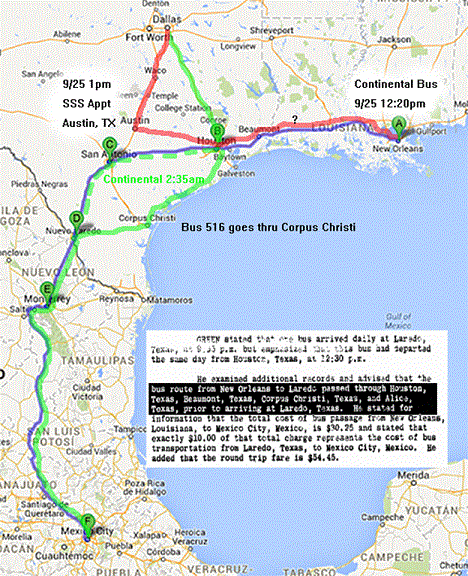
  • Shane O’Sullivan, Killing Oswald


    I. Introduction

    Shane O’Sullivan is an Irish writer and filmmaker best known for his book and documentary RFK Must Die where he examined the assassination of Robert Kennedy. O’Sullivan created a sensation and made headlines when he identified three mysterious looking persons at the Ambassador Hotel at the time of the Bobby Kennedy assassination, as CIA agents. He named them as David Morales, George Johannides and Gordon Campbell. Most researchers have disputed his claim and believe that O’Sullivan was mistaken. And to his credit, he himself has admitted his error.

    In his new film, he decided to take on the JFK assassination. He made a film to document the life of the alleged assassin, Lee Harvey Oswald. The title he chose was Killing Oswald and it gave me the impression that the theme of the film would have been an examination of Oswald’s murder by Jack Ruby. After watching it I realized that the title was not the best of choices. The film does not deal with his murder per se, but with his life and actions before the assassination. A more appropriate title would have been something like “Oswald the Patsy” or “The Life and Death of Oswald” or even “Was Oswald an Intelligence Agent?”

    The documentary consists of fourteen chapters beginning with Oswald’s days in Japan, his defection to Russia, his relationship to the CIA, his Cuban escapades in New Orleans, his bizarre trip to Mexico and finally the day of the assassination. Other chapters examine double agent Richard Case Nagell, the Odio incident and the attempt to kill General Walker. One the best features of the film is the rare historical footage, including that of Castro entering Havana with Che Guevara, interviews with George De Mohrenschildt and Antonio Venciana, the Bay of Pigs invasion, David Atlee Phillips in Mexico and Oswald in custody.

    Now let’s examine if the O’Sullivan produced film is what some claimed it is: the best documentary ever about the JFK assassination.

    II. Kaiser and the Theology of Conspiracy

    In the opening of the documentary we watch Oswald talking to the reporters and declaring himself a “Patsy” followed by Chief of Police Curry’s assurances that Oswald will not be in danger since the police have taken all the necessary precautions. Unfortunately for Curry history proved him wrong. As America watched Ruby assassinate Oswald while inside the Police station in front of Police officers. Marguerite, Oswald’s mother predicts what we now know with a degree of certainty: that Oswald was a patsy and that “history will absolve him of any involvement in the deaths attributed to him.” Then O’Sullivan proceeds with a clip from a Woody Allen movie where Woody is obsessed with the assassination and his girlfriend mocks him for using the conspiracies theories to avoid sex with her. Although the scene is humorous, I did not quite understand what purpose it was supposed to serve, other than ridicule JFK researchers as conspiracy theorists who will believe any whacky theory. I would expect this from someone like John McAdams, but not from someone who does a movie to help explain this complex case and this complicated figure.

    However this was nothing compared to the second blow, which hit me directly in the face. The first person to be interviewed, of all people, is David Kaiser, a man who firmly believes that the Mafia instigated the assassination. And he elaborated on this theorem in his book The Road to Dallas. One only needs to read Jim DiEugenio’s review of that book to understand Kaiser and his beliefs. An historian by trade has now decided to talk in theological terms to explain the various beliefs regarding the assassination. He informs us that there are three churches:

    1. The Lone Nut Church, whose high priests are Gerald Posner and Vincent Bugliosi and believe that Oswald and Ruby were lone nuts that acted of their own.
    2. The Grand Conspiracy Church whose founder was Mark Lane and has Oliver Stone as its high priest and who believe in a large conspiracy and a cover up.
    3. The Middle Church, which includes a few people like Robert Blakey and David Kaiser. They believe that Oswald was guilty but as a part of a conspiracy put together by Organized Crime.

    So there you have it. This is the “Divine Conspiracy” according to Kaiser, to paraphrase Dante’s “Divine Comedy.” In my view Kaiser’s beliefs constitute a “Conspiracy Comedy.”

    Now, if a church includes as its members Lane and Stone, I will proudly join that church. I am very wary of those middle ground researchers who are not sure of what really happened, who think that Oswald maybe did what the WC says or maybe he did not; that maybe, just maybe, there was a conspiracy. Kaiser puts himself in the same league with Robert Blakey, the Chairman of the House Select Committee on Assassinations who chose to not investigate the case in depth and surrendered to the CIA’s wishes. If one wants to learn more about the deeds of Blakey he can read Jim DiEugenio’s excellent piece called “The Sins of Robert Blakey” from the book The Assassinations, which he co-edited with Lisa Pease. Unfortunately for him, Kaiser’s theory is outdated and today, with the possible exception of Tony Summers, all serious researchers disagree with the idea that the Mafia was behind the assassination.

    If one reads DiEugenio’s books, like Reclaiming Parkland and Destiny Betrayed, one will find out that Oswald was never in the sniper’s nest during the assassination. Therefore, he did not fire the alleged weapon.

    I cannot comprehend why O’Sullivan invited Kaiser to be a part of his documentary. Even worse he was a, perhaps “the” central figure in the documentary, speaking more than the other three guests. I would agree that John Newman, Dick Russell and Joan Mellen were excellent choices but I cannot imagine what prompted him to pick Kaiser. If he wanted a historian or a researcher with a good grasp and knowledge of the case, there were plenty to choose from. Some that come to my mind are Gerald McKnight, Peter Dale Scott, Jim DiEugenio, Lisa Pease, James Douglass, Larry Hancock and Greg Burnham. These researchers have proved time and again that they have a superior knowledge of the case than Kaiser will ever have. However, this is something that only O’Sullivan can explain. In my opinion, it was a serious blunder that cast a shadow over his entire effort.

    III. Oswald’s Defection to the Soviet Union

    Luckily things get better when John Newman and Dick Russell talk about Oswald’s years in Japan, and his subsequent defection to the USSR. Newman tells us that there was a mole in the KGB who informed the CIA that there was a mole in the U-2 program. He obviously meant Colonel Pyotor Popov who revealed to the CIA the above information after overhearing a drunken Colonel bragging that the KGB had obtained technical information about the U-2 spy plane (see Peter Dale Scott’s article “In Search of Popov’s Mole”). Popov was arrested by the Russians for treason on October 16, 1959, the day Oswald arrived in Moscow. Dick Russell explains to us that Richard Case Nagell, who met Oswald in Japan “had a casual but purposeful acquaintanceship with Oswald”, related to Oswald’s feature defection to USSR with radar secrets. Newman continues that Oswald, while announcing to American Consul Richard Snyder that he wanted to renounce his citizenship, also threatened to reveal classified information of special interest to the Soviets. Newman says that it was not necessary to do that in order to renounce his citizenship, which could have resulted in his arrest. Because it was Saturday Oswald could not fill out the necessary paperwork so he did not renounce his citizenship officially. We also see an actor, Raymond Burns, as Oswald. He recites monologues from the historic diary regarding his defection.

    I believe that O’Sullivan wasted valuable time on the historic diary, which only helps to reveal Oswald’s bone fides as a false defector. Instead, he should have examined the defection in more depth to fully understand what happened.

    Snyder assumed Oswald was referring to the U-2. Snyder concluded that Oswald was assuming that the KGB had bugged the American Embassy, and “was speaking for Russian ears in my office. If he really wanted to give secret information to the Soviets he could have gone straight to them without the Americans ever knowing. Bill Simpich (State Secret, Ch.1, www.maryferrell.org) believes that if Snyder’s assumption was right, Oswald may have been wittingly or unwittingly prepped by someone from Bil Harvey’s Staff D, since they were responsible for signal intelligence.

    It is worth it to mention that Bill Harvey of Staff D worked on the U-2 related Project Rock. This documentary should have also examined the theory that Oswald somehow had something to do with the shootdown of the U-2 plane by the Soviets on May 1, 1960 which led to the abortion of the Soviet-American peace conference in Paris. The failure of that process ensured the continuation of the Cold War, which satisfied a treasonous cabal of hard-line US and Soviet Intelligence officers, whose masters were above Cold War differences as George Micahel Evica and Charles Drago believe. Among the Soviet hardliners were Leonid Brezhnev, Yuri Andropov and Yekaterina Furtseva who wanted to wrest power from Khrushchev (see Joe Trento, The Secret History of the CIA). Dick Russell wrote in his book (The Man Who Knew Too Much, p. 118) that Furtseva-who was the most powerful woman in Russia-urged that Oswald be allowed to stay in Russia, and then prevented KGB from recruiting him.

    I don’t think that Oswald gave the Soviets any important information with which to aid them in the shootdown the U-2. His role was a distraction to take the blame for this treasonous act, instead of those who were responsible. Bob Tanembaum wrote in his book Corruption of Blood that “every intelligence agency is plagued by volunteers and individuals who wish to become spies. Virtually all of them are useless for real intelligence work…but some of them can be used as pigeons, that is, as false members of a spy network who can distract attention of counterintelligence operatives…” I believe that Oswald played that pigeon role in USSR and later in New Orleans and Mexico City. Many believe that Oswald was some kind of CIA operative, but not directly. John Newman noted that since Oswald had defected to the USSR, it should have been the Soviet Russia Division that should have opened a file on him. Strangely enough, it was Jim Angleton’s CI/SIG that opened the file, a year after his defection. And simultaneously he was put in the mail intercept HT/LINGUAL program, which made Oswald quite unique. Newman told Jim Dieugenio that he suspected that Oswald was an off-the-books agent for Jim Angleton because Oswald’s first file was opened by CI/SIG, and he was on the super secret and exclusive mail intercept list. (Destiny Betrayed, p. 144).

    IV. New Orleans and Cuban Escapades

    Two of the great mysteries that surround Oswald’s life are his activities and associations in New Orleans and Mexico City. When in New Orleans Oswald contacted the Communist Party (CPUSA), The Socialist Workers Party (SWP) and he tried to open a local charter of the pro-Castro organization, Fair Play for Cuba Committee (FPPC). While there he was in the company of strange fellows, which on the surface, did not make sense. Private Detective Guy Banister a fanatical rightwinger, anti-Communist, anti-Castro and segregationist. Jim Garrison proved Oswald was also in contact with a weird character named David Ferrie, and also Clay Shaw, a local businessman employed by the International Trade Mart. Somehow, O’Sullivan does not mention Ferrie and Shaw while examining Oswald’s activities in New Orleans. I feel that he should have done so. He correctly shows Oswald’s contact with the anti-Castro organization DRE, his phony fight with Bringuier, and his TV and radio interviews that brought him in contact with Ed Butler of an anti-Communist and anti-Castro organization, named Information Council of the Americas (INCA).

    Kaiser came to the conclusion that Oswald was part of FBI’s COINTELPRO program, which had as its goal to disrupt subversives, and it targeted organizations like the FPCC, the CPUSA and the WSP. He also concluded that Oswald was not working directly for the FBI, but he was working for anti-Communist organizations like INCA that were given the assignment by Hoover. Peter Dale Scott had first suggested in his book Deep Politics that Oswald didn’t work directly for the FBI but for a private investigative firm that probably had contracts to many different intelligence agencies. Kaiser may be right about this conclusion, but not entirely. We have evidence that both Banister and Butler were in contact with the CIA and not just the FBI. As DiEugenio showed, Butler was in communication with people like Charles Cabell, Deputy Director of the CIA, and Ed Lansdale, the legendary psy-ops master within the Agency who was shifting his focus from Vietnam to Cuba. Gordon Novel, the CIA agent who spied against Garrison said that he had seen David Atlee Phillips, and Sergio Arcacha Smith in Banister’s office (DiEugenio, p. 105, Destiny Betrayed). It is also documented that the CIA, back in 1961 was planning to discredit the FPCC, and the officers involved in the operation were James McCord and David Atlee Phillips. Thankfully, John Newman and Joan Mellen remind us that Oswald’s actions in New Orleans were choreographed by the CIA and David Atlee Phillips. Antonio Venciana, a Cuban exile, said in his interview that he had seen in Dallas his case officer Maurice Bishop talking to Oswald in Dallas. Gaeton Fonzi believed that Phillips was Bishop but Veciana never confirmed it. Luckily, in November, during the 50th anniversary, Venciana sent a letter to Fonzi’s widow confirming that Phillips was indeed the officer he knew as Maurice Bishop.

    A key facet of information missing from the documentary is that George Johannides, a CIA officer, was the man handling Carlos Bringuier’s New Orleans DRE organization from Miami, something that was hidden from the HSCA when he was the CIA liaison with the Committee. Other key incidents missing are the Cliton-Jackson incident and the story of Rose Cheramie.

    O’Sullivan then takes on the famous Sylvia Odio incident, giving us three different versions as to what happened then, and who the Cubans were, known by their war names as Leopoldo and Angel. Dick Russell, correctly in this author’s opinion, said that we still don’t know their true identity. Mellen tell us her belief that Leopoldo was Bernardo DeTorres and Angel was Angel Murgado, a Cuban associated with Robert Kennedy. But many researchers have disputed her claim. Kaiser states that it was Loran Hall, Laurence Howard and William Seymour, the three visitors to Odio. This theory was promoted by Hoover but long discredited, and without merit (DiEugenio, Reclaiming Parkland, pp.239-242).

    I believe that, instead of trying to identify these persons, he should have concentrated on the fact that Odio was a member of JURE, a Cuban exile organization used by the CIA against Castro. Some CIA officers like E.H. Hunt and David Morales hated its leader Manolo Ray and considered him to be a communist, not much better than Castro. Leopoldo presented Oswald as a nut and expert marksman, which is exactly what the Warren Commission supported. So it was an effort to associate Oswald the nut, and the subsequent assassination of the President, with Manolo Ray and JURE, the group the CIA hated. None of this is included in the documentary.

    Oswald in Mexico

    Despite the time limitations of the documentary, O’Sullivan does a fairly decent job in describing Oswald’s alleged visits to the Cuban and Soviet embassies in Mexico City, what occurred there, and the impersonation of Oswald that linked him to Valeri Kostikov, a KGB officer who allegedly was a member of KGB’s Department 13, responsible for assassinations.

    John Newman, in trying to explain what occurred in Mexico, stated “My explanation is that the story reflects a failure in the primary mission which was that Oswald, or the Oswald character, was supposed to be able to get to Cuba, ostensibly on his way to the Soviet Union…to cement the story that Oswald was connected to Castro…When that failed, to get the visa from the Cubans and Soviets…they had to come up with a plan B, … the phone conversations, mentioning his name and Kostikov’s name…”

    I am a great admirer of John Newman and his work, and we owe him a great deal of gratitude for deciphering the Mexico City mystery. However I will have to respectfully disagree with him that the primary mission was to get Oswald to Cuba. I cannot believe that his handler-who Newman thinks was probably David Phillips-did not know that to get a Cuba visit, one had to arrange it via the CPUSA, or that the Cubans would have required a Soviet visa first. I think the whole operation was a ruse to make it appear that Oswald wanted to travel to Cuba and force the Cubans to call the Soviets to have on record that they were cooperating together in controlling Oswald. Kaiser is certain that Oswald did travel to Cuba, but I disagree with him. If Oswald was in Dallas visiting Odio he would not have been able to make it in time to Mexico. If one reads the Lopez report it is almost clear that someone had impersonated him all along and that Oswald never traveled to Mexico.

    Although Newman names Phillips as the man handling Oswald in Mexico, O’Sullivan for whatever reason, chose not to include Newman’s view regarding James Jesus Angleton, the Chief of CIA’s Counterintelligence. In the 2008 epilogue of his superb book Oswald and the CIA Newman names Angleton as the man who designed the Mexico City plot. In fact, the name of Angleton is not mentioned even once during the two hour duration of the documentary. The same goes with Anne Goodpasture, Win Scott’s assistant in the US Embassy in Mexico. The very person that produced the “Mystery Man” photograph, that was supposed to be Oswald entering the Cuban and Soviet Embassies. He is not a mystery man though, because the Lopez Report has settled the issue many years ago. “Since the time of the assassination, this man has been identified as Yuriy Ivanovich Moskalev, a Soviet KGB officer” Lopez Report (p.179). These should have been included, since it is by now fairly obvious that it was Angleton in Langley and Phillips with Goodpasture in the field who choreographed Oswald’s moves and set up the Mexico City charade.

    Two others facts that are very crucial in the case are not covered by this documentary. The first was a memo that the CIA sent to FBI the day before Oswald got his tourist visa to visit Mexico. There, the CIA proposed a counter-operation against the FPPC. According to the memo, the CIA was considering “planting deceptive information to embarrass the organization in areas where it had support” (Newman, Oswald and the CIA, pp. 622-623).

    The second fact had to do with CIA’s reply to Mexico Station that included the statement that they had no information on Oswald after May 1962, which was a lie. Jane Roman, Angleton’s subordinate who signed off on the bottom of the cable, admitted to John Newman in 1994 after seeing the cable that “I am signing off on something I know isn’t true.” She also told him that “the SAS group would have held all the information on Oswald under their tight control”, and that “it’s indicative of a keen interest in Oswald, held very closely on a need-to-know basis” (Newman, ibid).

    VI. DeMohrenschildt and Ruth Paine

    After Oswald returned from Russia, he settled with his family back in Dallas. O’Sullivan documents the fact that Oswald was befriended by a White Russian Baron, George DeMohrenschildt, with CIA connections. It was Dallas CIA station chief J. Walton Moore who asked DeMonhreschildt to get into contact with the ex-Marine. O’Sullivan includes some rare footage of the Baron being interviewed and one of its best moments is a very clever and witty remark by DeMohrenschildt: “As it stands now, Oswald was a lunatic who killed President Kennedy. Ruby was another lunatic who killed the lunatic who killed the President – and now we have the third lunatic, supposedly Garrison, who tries to investigate this whole case. I think it is extremely insulting to the United States, the assumption, that there are so many lunatics here.”

    When Oswald went to New Orleans, his wife Marina and his child moved to her friend’s Ruth Paine. After hearing some of the interviews that Ruth Paine gave and presented on this documentary, one would get the impression that she was a very compassionate and altruistic person, who helped her friend Marina out of kindness. You would certainly not assume that this woman had CIA connections, and had played an important role in the framing of Oswald. She seems joyful and smiling, a housewife clueless, about the assassination. However if O’Sullivan have done his homework, he would have known that she was more than a housewife.

    Most of the incriminating evidence against Oswald was found at Ruth Paine’s garage. Among them,

    1. The pictures of the outside of General Walker’s house, along with the backyards photographs, showing Oswald holding in his hands, communist literature, a rifle and a handgun (DiEugenio, Destiny Betrayed, p.202).
    2. The documents produced after JFK’s assassination that proved that Oswald had travelled to Mexico City, evidence that the Police couldn’t find after searching her house (DiEugenio, Reclaiming Parkland, p.284).
    3. Testimony that she had seen Oswald typing a letter referring to Kostin (another name for Kostikov), about their meeting in Mexico that was sent to the Soviet Embassy in Washington. This letter is considered to be a forgery.
    4. Ruth Paine was the one who found Oswald the job at the Texas School Book Depository. However he received a phone call on October 15, 1963 from the unemployment office which asked her to inform Oswald that they had found for him a job with Trans-Texans Airlines, as a baggage carrier. They were paying him $100 more than the Texas Book School Depository, yet Oswald chose the job at the library. The truth is that Ruth never told Oswald about the phone call. (John Armstrong, Harvey and Lee, p.725).

    I could have written a lot more about her, but this not in the scope of this review. But if you wish to learn more about her you can read DiEugenio’s Destiny Betrayed and Evica’s A Certain Arrogance.

    VI. Conclusions

    This is a good enough documentary for the novice, but it does not contain enough information that is vital to understanding this complex case. I also believe that there were plenty of good researchers to recruit instead of David Kaiser, who, with all due respect, is just a better version of Robert Blakey. I noted earlier on that the choice of the documentary’s title was not the most appropriate. But I bypass this issue since the film was one of the few antidotes to the 50th anniversary Lone Nut blitz of propaganda, e.g. the movie Parkland and the numerous books that supported the Warren Commission fraud. It was a brave act by O’Sullivan to produce a documentary that tried to present and unravel the mysteries surrounding Oswald’s life, almost all of which were ignored at the 50th. And I hope that more JFK researchers will take this as an example and produce similar work. It is a duty we all have that is long overdue.

  • Philip Shenon, A Cruel and Shocking Act


    Philip Shenon’s book A Cruel and Shocking Act begins with a deception. It then gets worse.

    On the frontispiece, before the actual text begins, Shenon quotes from Marina Oswald’s Warren Commission testimony. In that particular quote, Marina was asked if Lee Oswald had visited Mexico City. She replied that yes, Oswald had told her that he had been at the Cuban and Russian embassies.

    In itself, this is an accurate quote. But what Shenon does not tell the reader here, and in fact what he does not say until nearly 200 pages later, is this: that during her first Secret Service interview she denied Oswald had ever told her he was in Mexico. She did this more than once, and she was categorical about it. She even denied it when she was not asked about it. Just because she had seen the story about Oswald in Mexico City on television. (Secret Service Report by Charles Kunkel “Activities of the Oswald Family November 24 through November 30, 1963”)

    When Shenon does admit she initially denied it, he does not mention a major event that occurred after the initial denial and almost simultaneously with her February appearance before the Warren Commission. A week after her initial appearance before the Commission-where she now changed her story about Mexico City and several other matters-Marina signed a contract with a film company called Tex-Italia Films. The grand total of funds transferred to her was $132, 500. Which today would amount to about a half million dollars. (John Armstrong, Harvey and Lee, p. 977) What makes this transaction so intriguing is that when the company partners were investigated, it was discovered that they used false names. Further, the company’s business offices were asked to leave the lot they were located on for failure to pay their rent. Finally, there was no film made by Tex-Italia about Marina or her dead husband. (ibid)

    Now, to most people, these events and the subsequent reversals of testimony would seem relevant to the story Shenon is telling. After all, if the reader was informed of this information, one conclusion he or she could come to is that Tex-Italia was a front company, and its main purpose was to get Marina Oswald to testify to a tale that was more in line with the official story about Kennedy’s assassination. After all, Mexico City was quite important to the Commission. As we shall see, it is even more important to Shenon. If there is a serious question about Oswald being there, then the Oswald story begins to wobble about in a direction the Commission, and Shenon, do not want it to go. Therefore, in addition to beginning his book with this misleading testimony, in addition to not informing the reader about the timing of the financial transaction, when one scans the index of Shenon’s long book, the reader will not find an entry for Tex-Italia Films.

    Let us move to another section of the book to see how Shenon again censors information to present at best, an incomplete picture, at worst a deceptive one. On page 45, Shenon is describing a phone call between President Lyndon Johnson and FBI Director J. Edgar Hoover on the Saturday morning after Friday’s assassination. But before he does that, he prefaces what he is about to present by saying that Hoover “was never as well informed as he pretended to be; he did not always bother to learn all the facts…” (Shenon, p. 46)

    Why does the author do this in advance? Probably because Hoover told Johnson that the evidence against Oswald at this time was not very strong and “The case as it stands now isn’t strong enough to be able to get a conviction.” (ibid) Shenon does not like this statement. So he now states that the evidence against Oswald on Saturday was “overwhelming”. He then writes that witnesses could identify him at the scene of the Tippit murder and with a rifle in the sixth floor of the Texas School Book Depository. That Oswald purchased the rifle the police found on the sixth floor. And that he also purchased a pistol used in the murder of Tippit, and his wallet had a card in the name of A. Hidell used in the mail order purchases of the weapons.

    Again, by not informing the reader of the true state of this evidence today, Shenon cuts off an alternative to his characterization of Hoover’s discussion. Namely that Hoover was correct about the state of the evidence. For example, the rifle the police found and attributed to Oswald is not the rifle the FBI said Oswald ordered. The rifle the Commission is going to say was ordered was a 36″ Mannlicher-Carcano carbine. The rifle found by the Dallas Police was a 40″ short rifle. Klein’s, the sporting good store in Chicago where Oswald was supposed to have ordered the rifle from, did not put scopes on the 40″ model. Yet this one had a scope on it. (James DiEugenio, Reclaiming Parkland, pgs. 56-63) The night before, Hoover’s agents were at Klein’s for hours on end. They ended up confiscating the microfilm about these orders. Isn’t it possible that Hoover then knew about some problems in the evidentiary record? Shenon does not have to disclose that since he never tells the reader about any of these contradictions about this transaction.

    Shenon is equally nebulous about the transaction for the pistol he says was used in the murder of Dallas policeman J. D. Tippit. That handgun was supposed to have been delivered to Oswald by a private company called REA (Railway Express Agency). This was a forerunner to companies like Federal Express and UPS. REA should have sent a card to Oswald’s post office box to tell him the handgun had arrived. Oswald then would have had to present an ID and a certificate of good character to have a firearm given to him via a mail transaction. And REA had to have kept these records in compliance with state and federal laws.

    There is no evidence that any postcard was ever sent to Oswald’s box by REA. (DiEugenio, ibid, p. 104) Neither is there any paper work in evidence about Oswald presenting the ID or the certificate of good character. In fact, there is not even any signature of a receipt for the transaction in the Warren Commission volumes. In other words there is no evidence that this transaction ever took place as the Commission said it did. Or that REA submitted payment to the company who allegedly supplied the pistol. But more to our point here: There is no proof, or even evidence in the Commission volumes that the FBI ever even visited REA in Dallas to check on this transaction. (ibid)

    Now if Shenon thinks that the FBI did not visit REA about this matter then he was never qualified to write this book. The much more logical conclusion is that they did visit REA. But they could not find any of the back up materials to certify this as Oswald’s transaction. If that is the case, then Hoover did know what he was talking about during the call with President Johnson.

    Many authors have discussed the speciousness of the eyewitness testimony in both the Kennedy murder and the Tippit murder. The two most important witnesses in that regard, respectively Howard Brennan and Helen Markham, were so poor that several Commission lawyers did not want to include them in the Warren Report. They felt that their inclusion would create serious problems for the document. Which, as we will see, they did. (Edward Jay Epstein, The Assassination Chronicles, p. 144) There was a real battle in the Commission over these witnesses. This is a point that Shenon very much underplays. But which tends to bolster the Hoover statement about the case against Oswald being weak.

    Let us now deal with the point about the wallet identification of Oswald as Hidell, which certified him as the purchaser of the weapons under an alias. As many people know, the Dallas Police said that they took Oswald’s wallet from him on the way to the police station, after his arrest at the Texas Theater. It was not until many years later that a crucial discrepancy in this record was discovered. And it ends up it was co-discovered by an FBI agent, Bob Barrett. For there is a film of Barrett handling the wallet at the scene of the Tippit murder. One that is not Tippit’s. Barrett later said it had the Oswald/Hidell identification inside of it. Yet, the Warren Report states that Oswald’s wallet was taken from him on the way to the police station after he was arrested at the Texas Theater. But further, there was a third wallet in evidence, one that the police said Oswald left at the home of Ruth and Michael Paine that morning.

    Question for Mr. Shenon: Do you know anyone who carries three wallets? If you do, please tell us about it. In fact, why did you not even mention this “three wallets” problem in the nearly 600 pages of your book? What most objective observers believe today is that the Dallas Police suppressed the evidence of the Oswald wallet at the Tippit scene to avoid the inescapable suggestion that it had been planted after the fact. Because they knew no one would buy the fact of Oswald having three wallets. If that is the case, then again, Hoover’s comments about the state of the evidence were correct.

    II

    Just how bad is Shenon on the physical evidence in the case? He can write that the alleged rifle and handgun used in the murders came from the same gunshop! (p. 46) Yet, by just browsing through the Warren Report one can see that the rifle came from Klein’s Sporting Goods in Chicago, Illinois. The handgun came from Seaport Traders in Los Angeles, California. The odd thing about this is that although the Commission says they were ordered months apart, they both were shipped on the same day. This is an intriguing fact, which Shenon does not note. (See Warren Report, pgs. 121, 174) What makes it more intriguing is that, as with the missing paperwork at REA, the corresponding paperwork is also missing at the post office to certify receipt of the rifle. (ibid, DiEugenio, pgs. 61-62) In fact, as with REA, there is no evidence of any person at the post office saying that they handed the rifle package to Oswald. Which is hard to believe. Because when transferring firearms from out of state shippers, postal regulations stated that one had to present an ID card to certify that you were the person who rented that post office box. As Shenon states, the rifle was allegedly ordered in Hidell’s name. Since Oswald rented the box office in his own name, the rifle package should have been sent back unopened. (ibid) But if Oswald did show he was really Hidell, would not someone at the post office have recalled that fact? Especially by, say, November 23, 1963? No one did. And that interesting piece of evidence is not noted by Mr. Shenon.

    In order to explain how someone could create all these embarrassing lacunae in this day and age, let us drop in some background about how this book originated. Shenon worked for the New York Times for over two decades. He specialized in reporting on the Pentagon, the Justice Department and the State Department. In other words he dealt in national security issues. In 2008 he published a book about the 9/11 investigation and report called The Commission. Many researchers on that case felt the book was a damage control operation about that inquiry. Therefore, quite naturally, a surviving member of the Warren Commission – Shenon will not reveal who it is – called him and asked him to do a reprise about the Warren Commission. Incredibly, Shenon agreed to do it.

    Why is this so objectionable? Because Shenon admits that it was initiated by a junior counsel who then allowed him access to the other surviving counsels. That would mean that Shenon was in contact with, among others, Howard Willens, David Slawson, Richard Mosk, Sam Stern, Burt Griffin, Melvin Eisenberg, the late Arlen Specter, William T. Coleman, and the late Norman Redlich. Now, these men had been harshly criticized for decades on end. The criticism of them turned vitriolic when Oliver Stone’s film JFK appeared in 1991. One of the main criticisms about they dying mainstream media, especially the NY Times, is that in return for access and information, reporters tend to give the reader a one-sided version of the facts. Mainly because their sources have an agenda which usually amounts to something called “covering your ass”. No quasi-legal body in history ever had more of a reason for CYA than the Warren Commission. Yet, Shenon agreed to this arrangement. Not only did he agree to it, but as we will see, he accepted everything his sources told him-with gusto and relish. Because of that unprofessional closeness to his sources and subject, the book becomes so biased as to be, at best, almost useless. At worst it is a propaganda tract for the Commission survivors. It becomes that because, as we will see, Shenon values his sources over the declassified evidence of the Assassination Records Review Board. This might be good and profitable for him. It is not good for the reader, or for the writing of good history.

    A good example of the compromising that Shenon has to do to accommodate his sources appears on page 168 of his book. Because he has chosen to side with these men, Shenon has to bow before the absurd premises of Single Bullet Theory. In fact, Shenon writes that “Later scientific analysis backed the commission’s theory.” Apparently, no one told Shenon that if “scientific analysis” did back it then he would not have to refer to it as a theory. But even worse, he deliberately presents his diagram from an angle both from the front and slightly above the limousine. This does much to eliminate the vertical and horizontal problems with the trajectory of CE 399, the Magic Bullet. For instance, by framing his drawing in that way, Shenon does not reveal the entry point on Kennedy’s back. In fact, in the wording that accompanies the drawing, the author says the bullet enters “Kennedy’s body from behind” at a “slightly downward angle”. Shenon cannot bring himself to say that the bullet hit Kennedy in the back from sixty feet up. Which would make it very hard to believe that it could then deflect upward to exit his throat, especially since, as he notes, it did not hit any bony body structures.But further, by disguising this unknown angle, Shenon now arranges everything from Kennedy’s throat outward in a straight line. Even though the magic bullet smashed two bones in Connally!

    In further obeisance to his sources Shenon ignores two key pieces of physical evidence to revive something that never happened. First, when author Josiah Thompson questioned both of John Connally’s doctors, Robert Shaw and Charles Gregory, he asked them if they thought the bullet that went through Kennedy also went through Connally. They said no, because there were no fibers from clothes in the bullet path of Connally’s back wound. (ibid, DiEugenio, p. 110) Secondly, when the ARRB interviewed several medical witnesses who participated in the autopsy at Bethesda, they testified that the malleable probes inserted into Kennedy’s back were all too low to exit the throat. And further, the slope of the angle was much too steep to connect the two points. (ibid, pgs. 116-17) This is the kind of trouble one invites when one enters a complex case from years of experience at the New York Times.
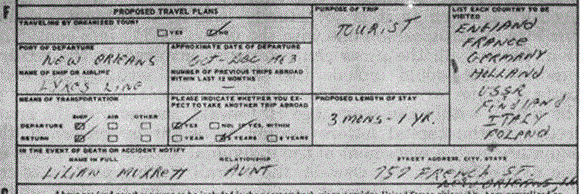
    But Shenon features another specious schematic on page 245 of the book. He calls this one “Lee Harvey Oswald’s Escape”. It traces Oswald from his exit from the Texas School Book Depository after the murder of Kennedy, to his arrest at the Texas Theater. Shenon first says that Oswald boarded a bus. He was walking the wrong way to board the bus, and the bus would have dropped him off seven blocks from his house. He could have caught a bus nearby which carried him across the street from his house. (WR, p. 160) Shenon then says that Oswald got off the bus and hailed a taxi cab. What he doesn’t say is that Oswald walked back toward the scene of the crime and then offered to give up the cab to an elderly lady. (Sylvia Meagher, Accessories After the Fact, p. 83) Mr. Shenon, do these acts sound like a man trying to “escape”?

    Shenon’s map then has Oswald arriving at his rooming house on Beckley Street at 1:00. But it does not say that he then left at 1:04. Shenon now shows us just how in bed he is with his Commission sources. He says that Tippit was shot at 1:15 PM. As writers on the Tippit case have demonstrated, most recently Joseph McBride and John Armstrong, there is simply no credible evidence that places the murder of Tippit that late.

    For instance, T. F. Bowley places the shooting at 1:10. And Bowley looked at his watch. (Meagher, p. 254) Since Shenon does not note Bowley, he cannot tell the reader that the Commission never interviewed Bowley. (ibid) As McBride notes, Helen Markham caught her bus regularly for work walking from the intersection of 10th and Patton, the scene of the murder, toward Jefferson. She would start her walk at about 1:04. The FBI timed the walk at about 2 and a half minutes. Which would place the shooting at about 1:07. (McBride, Into the Nightmare, p. 245) The problem for Shenon is that the distance from the rooming house to the scene of the Tippit shooting is nearly one mile. How on earth could Oswald, in street clothes, traverse that distance in six minutes or less? But further, no one saw him traveling in that direction. (Meagher, p. 255) Shenon then has Oswald entering the Texas Theater at 1:40 PM. The reader should then ask: Why did it then take Oswald almost twice as long to travel a distance that was almost the same length?

    These two drawings in A Cruel and Shocking Act tell us all we need to know about the book. As well as does the excision of the following witness testimony. One will not find the name of Roger Craig in Shenon’s index. Probably because Craig’s affidavit, and the corroborating one of Marvin Robinson, vitiate the Commission’s version of “Oswald’s Escape”. Right after the shooting of Kennedy, Craig described a man running down the incline opposite the Depository and jumping into a Rambler auto pulling out of Dealey Plaza on Elm Street. Robinson said the same. When officer Craig got to City Hall, he recognized the man he saw jumping into the Rambler as Oswald. (Josiah Thompson, Six Seconds in Dallas, pgs 242-43)
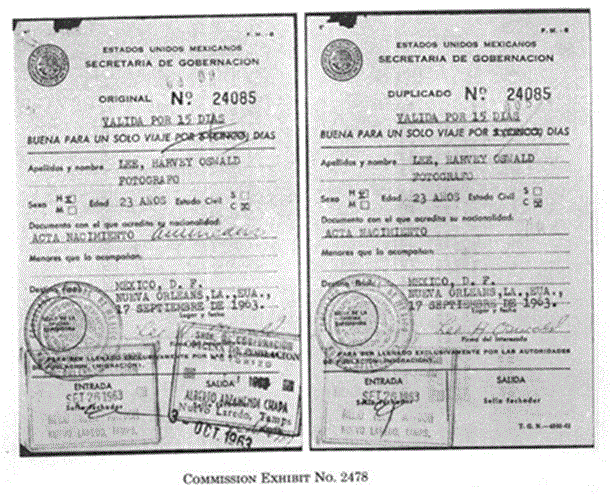
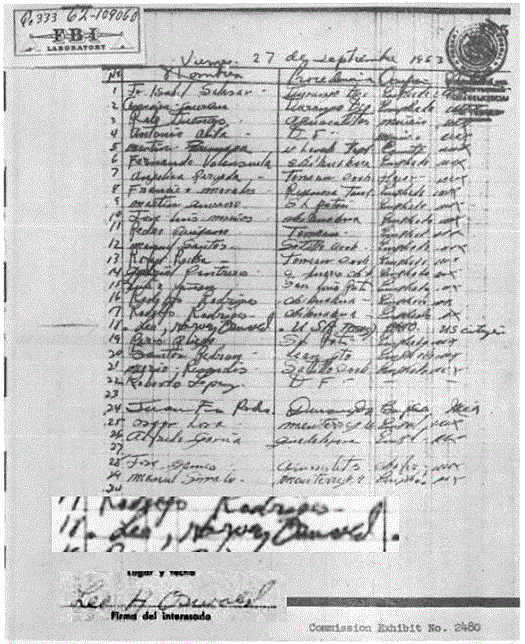
    But, for obvious reasons, even though he had a corroborating witness, the Commission decided they had to disregard Craig. So does Shenon.

    III

    In other places where Shenon tries to deal with the evidence, he shows himself to be so amateurish that he himself undermines his own case. For instance, he writes that the head shot, “blew away much of the right hemisphere of his brain, an image captured in awful photographs.” (Shenon, p. 22) What the heck is Shenon talking about here? There is no such image in autopsy photos at the National Archives. And, in fact, this shows just how unfamiliar the author is with the actual declassified records of the ARRB. For the images of Kennedy’s brain show a nearly intact brain. And for Shenon to write that much of the right side is gone reveals him to be, inadvertently, in the camp of the conspiracy theorists he is frequently assailing. For many of the critics of the medical evidence believe, based on the medical witnesses, that much of the brain had to be dissipated. (DiEugenio, ibid, p. 137) The problem is that-in spite of what Shenon says – no picture depicts such a damaged brain. Nor does the drawing made by Ida Dox for the HSCA.

    It seems that Shenon wants to have something new to hang his hat on. So he begins the book with three facets of the evidence he thinks will do the trick. The problem is they do no such thing, since they have all been thoroughly discussed for decades.

    The first “new event” Shenon depicts is the fact that Dr. James Humes did not just burn his notes of the autopsy, he incinerated his first draft. This was made obvious about 15 years ago, when ARRB Chief Counsel Jeremy Gunn examined Humes. But Shenon wants to be able to hang onto the story that Humes did this so that the autopsy would not drop into the hands of illicit ghoulish souvenir hunters who would then display the bloodied documents. (Shenon, p. 23) As Gary Aguilar has pointed out, the problem with maintaining that fairy tale is that Gunn found out that Humes burned it at his house, which is where the draft in question had been penned. (Gerald McKnight, Breach of Trust, p. 165) When Gunn pressed him on this, Humes tried a different excuse instead of the bloodied souvenir stuff pretext: “it might have been errors in the spelling, or I don’t know what was the matter with it…” (ibid) Its revealing of Shenon that he sticks with the now exposed cover story, and by doing so he tries to cover up for Humes; and also to vilify those “ghouls” who would actually like to see that lost draft.

    The author does another thing of note in his brief discussion of the autopsy. He maintains another specious story, namely that Humes never called Dallas from Bethesda until the next day, Saturday. But to name one important witness, radiologist John Ebersole told the HSCA that this call took place on Friday night. (ibid, p. 168-69) But further, that afternoon, in a televised press conference, Dr. Malcolm Perry, who cut the tracheotomy over the throat wound, said three times that this wound was an entrance wound. Dr. George Burkley, who was at Parkland Hospital when Kennedy died, was also in the autopsy room that night. He would have had to have known about the entrance wound in the throat. Finally, nurse Audrey Bell told the ARRB that Perry told her he had been getting calls from Washington during that Friday night. (DiEugenio, pgs. 143-44) What many people believe happened is that this myth about the next day call was created in order to give time to alter the entrance wound in the throat into an exit wound. And sure enough, Secret Service agent Elmer Moore was shortly after stationed in Dallas and was talking Perry out of his first day story. (Ibid)

    It’s hard to believe in 2013, but Elmer Moore’s name is mentioned just once by Shenon. Why is it hard to believe? Because after Moore accomplished his mission at Parkland in preparation for Arlen Specter’s questioning of the emergency room staff, he then became the bodyguard/valet for Earl Warren on the Warren Commission. (ibid, p. 144) In his one mention of his name, Shenon muddies this transition by Moore. He implies that Moore accompanied Warren to Dallas for Jack Ruby’s polygraph test solely for protection purposes. This is not accurate. As writers like Pat Speer and Aguilar have shown, after working over Perry, Moore became almost a personal assistant to Warren throughout much of the Commission proceedings. And this was done at Warren’s request. As Speer notes, Warren wanted Moore to help “the Commission for an indefinite period to assist in its work.” (ibid, p. 144) It is not possible to give an accurate and candid presentation about the Warren Commission without fully describing what Moore did in the alteration of testimony, plus the fact that Warren requested his assistance afterwards.

    The second piece of old evidence that Shenon reports as being long hidden is the destruction of a photograph of Oswald by Marina and Oswald’s mother Marguerite. To use just one example, this incident was thoroughly described by writers like the late Jack White and Greg Parker many years ago. It is also described at length by Vincent Bugliosi in his colossal book, Reclaiming History. Like Bugliosi, who Shenon greatly admires, the author wants us to think that somehow this is another of the infamous “backyard photographs” which the Commission, and Life Magazine, used to incriminate Oswald. But like Bugliosi, Shenon does not quote Marina’s testimony before the HSCA about this point. (Shenon, p. 25) Her memory of this was very hazy and unreliable. But further, Marguerite described this particular photo as being different than the others. She said, in this one, Oswald was holding the rifle above his head with both hands. Further, that this one was addressed to his daughter June. June was two years old at the time. These points are rather indecipherable. Especially in light of the fact that Marina originally said she took just one backyard photo. (ibid, DiEugenio, p. 86) Which is probably why the Commission, when they had the opportunity, did not press far at all in this field.

    The last piece of “hidden” evidence that Shenon uses is also mildewed. It’s the note Oswald left for James Hosty at FBI headquarters before the assassination. (Shenon, p. 25) But again, in this case, its not like the Commission did not know about this incident. During the questioning of Ruth Paine, the subject surfaced since it was mentioned in a letter Oswald allegedly wrote to the Russian Embassy in Washington and Ruth had copied. (McKnight, p. 260) It was also mentioned in her March 1964 testimony. If there was no follow up on this, it appears its because that is the way the Commission wanted it. But further, unlike what Shenon tries to convey, Hosty was asked about the surveillance of Oswald by the FBI prior to Kennedy’s arrival in Dallas. And the questioner was one of Shenon’s presumed sources, Sam Stern. (ibid, p. 261)

    I believe the point of this section of the book is to show that somehow, certain evidence was not revealed to the Commission. But as the reader can see, this is not really accurate. The only piece of evidence that one can really make that argument for is the first draft of the autopsy report burned by Humes. But in terms of relevancy to any Commission work or conclusions, this has no real retroactive impact. To anyone familiar with the evidence and the Commissions’ work, it is this medical evidence that the Commission made almost no inquiry into. As other authors have shown, the Warren Commission was so uninterested in this key issue that they accepted falsified drawings as illustrations for the head and neck wound to President Kennedy. (DiEugenio, pgs. 120-22) These were Commission Exhibits 385 and 388. They are illustrations made by 22 year old, first year medical artist Harold Rydberg. These two drawings – which show a flat direction to the neck wound, and an upward direction to the head wound – were meant to demonstrate, not what was seen in the autopsy room, but what the Commission had already decided upon as their conclusions. But further, the drawing of the back wound places the wound in the neck, when the declassified autopsy photos show it to be in Kennedy’s back. And the drawing of the head wound puts Kennedy’s head in a position it is not in at Zapruder film frame 313, the instant of the head shot.

    Incredibly, Shenon does not mention the Rydberg drawings or their misrepresentations. Which, considering what he did with his drawing of the Single Bullet Theory and “Oswald’s Escape”, perhaps is not so incredible. Its par for the course. But the point about these three above issues-the burnt autopsy report, the missing Oswald photo, the Hosty note – making any difference for the Commission, for reasons stated above, this is simply not convincing.

    Before leaving the subject of the medical evidence, we should note one more point. Throughout the book, Shenon tries to say that somehow, Bobby Kennedy influenced the Commission, and he therefore limited its use of the autopsy materials. As noted by many other authors, this is simply not the case. The autopsy photos were in the hands of the Secret Service at this time. Which is why Secret Service agent Elmer Moore showed one of them to Arlen Specter. (DiEugenio, p. 145) Whatever limitations were placed on the Commission in its use of these materials, they had little or nothing to do with Robert Kennedy. Because the deed of gift for these materials to the Kennedy family would not be signed until 1965, the year after the Commission expired. Somehow, in writing a book about the Warren Commission, Shennon couldn’t find the space to include a sentence with that bit of information in it.

    IV

    Shenon does uncover some interesting information about the work habits of the Commission. For instance, he says that Coleman worked about one day a week. (p. 109) Also that Chief Counsel J. Lee Rankin split his workweek between the Commission and his practice. But presumable he did some work for the Commission while in his office. Another interesting point is the paucity of criminal lawyers that Howard Willens picked to man the staff. The clear majority of lawyers were business or corporate lawyers. Which makes very little sense in a criminal procedure, where experience counts a lot. One of the Commission lawyers who did have such experience, Burt Griffin, admitted this was a problem. (Shenon, p. 125) Many of Willens’ recruits were recent Ivy League graduates on their way up the corporate law ladder.

    But what Shenon reveals later is even more startling in this regard. And that is this: some of the lawyers that administrator Howard Willens brought in had no real legal experience at all! The problem was, too many people were leaving. Obviously, what happened-which Shenon does not want to make explicit – is that the private practice billing paid much more than what these men were getting on the Warren Commission. And since, whatever Shenon says, none of these men were great fans of Kennedy, very few of them were going to spend ten months of their lives working on this case while they were losing money. Of the junior counsels, David Belin left in May. Leon Hubert quit right after that. Specter left in June. Only David Slawson, Burt Griffin and Wesley Liebeler were there regularly after that (p. 404) Almost all the senior counsels had left by June also. The case of Leon Hubert quitting is interesting. (Shenon, p. 284) Its so interesting that Shenon papers it over. He says that Hubert essentially quit, but he is not explicit as to why.

    Hubert quit because he was a senior counsel who actually wanted to do a real investigation. He wanted to find out who Jack Ruby really was and where his associations were. In fact, he and Griffin wrote two interesting memos in this regard. Both of which, because of his agenda, Shenon does not print. The first was written in March of 1964. It reads in part, “The most promising links between Jack Ruby and the assassination of President Kennedy are established through underworld figures and anti-Castro Cubans and extreme rightwing Americans.” This, of course, turned out to be quite insightful considering the time it was written, plus the fact that FBI Director J. Edgar Hoover, Chief Counsel J. Lee Rankin, Chief Justice Earl Warren and Deputy Attorney General Nicholas Katzenbach were all trying to shut down and limit the inquiry. (A fact which Shenon greatly underplays.) Two months later, the two wrote another prophetic memo. This one said, “We believe that a reasonable possibility exists that Ruby has maintained a close interest in Cuban affairs to the extent necessary to participate in gun sales and smuggling…” This turned out to be accurate, as authors like Henry Hurt and John Armstrong later discovered. Two examples of Ruby doing so were with Thomas Davis and Eddie Browder. Shenon fails to point this out, since the former leads to the CIA and the latter to the Mafia.

    But in that same memo, the two then topped themselves. They wrote that, “Neither Oswald’s Cuban interests in Dallas nor Ruby’s Cuban activities have been adequately explored…” That sentence is pregnant with intrigue in two ways. First, it clearly implies that Oswald and Ruby may have known each other through this anti-Castro underground network, one that began in Florida and spread to Texas after the fall of Batista. But second, it says that after six months, they have gotten little cooperation in exploring that venue.

    If the reader turns to the Volume XI of the HSCA, one will get a much more frank and honest discussion of Hubert’s departure than Shenon gives. There, Burt Griffin was asked about Hubert’s leaving. After replying with the standards about his job and family, Griffin got to the point. He said that Hubert became disenchanted and demoralized because he was not getting the kind of support he wanted, especially from Rankin. (HSCA, Vol. XI, p. 268) Griffin went on to say that he and Hubert got the feeling that Rankin, Willens and Norman Redlich, the mid-level administrators, did not have much interest in what he and Hubert were doing. (ibid, p. 271) In this fascinating interview, Griffin revealed that he himself had no contact with either field agents or FBI HQ agents in Washington. Even though that is where the Commission office was. Everything he requested went by memo to the office of the Chief Counsel. (ibid, p. 276) The problem was that in requests to the CIA for info on Jack Ruby and his associations, the CIA did not respond for months. (ibid, p. 283) In fact, it took 16 days for the initial request by Hubert and Griffin to get past Willens and to the CIA. But that is not the worst part. The worst part is this: the reply from the CIA came on September 15th! Which was about two weeks before the report was printed. Griffin could not explain either delay: the 16-day one or the six-month one. But clearly, this is what he was referring to in discussing why Hubert left. In his interview Griffin says that between the time pressures to finish and the internal resistance, they were very limited in what they could do. (ibid, pgs 295-96) In fact, in this HSCA interview, Griffin was confronted with the second memo, the one that mentioned the possible crossover of anti-Castro elements which could be a connecting point between Oswald and Ruby. When asked if the Warren Commission investigation ever focused on that nexus, Griffin replied simply, “No.”

    None of this crucial information is in Shenon’s book. Just as the reporter describes none of Ruby’s ties to organized crime figures or the Dallas Police. (Shenon, p. 197) In fact, Shenon is slavish that he actually repeats the infamous “Sheba defense” for Ruby. That is, Ruby would not have left his dog in the car if he was going to kill Oswald. To clinch the cover up about Ruby, Shenon uses none of the HSCA review of Ruby’s polygraph in his book. Which is astonishing at the same time that it is predictable. Shenon describes Arlen Specter as being in the room for the polygraph, along with FBI technician Bell Herndon. (Shenon, p. 421) He then describes one Ruby lawyer being there. He then says that there was a long list of questions, and Ruby’s answers were disjointed, therefore it took many hours to complete. The next day, Shenon relates to us, Herndon told Specter that Ruby passed the test “with flying colors and clearly was not involved in the assassination.” (ibid) And that is that as far as the author is concerned.

    To say that this is not the whole story is being much too kind to Mr. Shenon. First of all, unlike what Shenon implies, there were a total of eight people in the room for Ruby’s polygraph, and ten during the pretest. (DiEugenio, Reclaiming Parkland, p. 244) One of them was Bill Alexander, the assistant DA trying the case against Ruby. Contrary to what Shenon writes, Alexander, who interrupted and then actually held off the record conversations with Ruby, caused many of the delays. The HSCA panel concluded that because of the many people present and their interference, Herndon lost control of the proceedings. Something that a polygraph operator should never do. (ibid) Because all the interference and distraction can lead to false readings.

    But that is just the beginning of the problems the HSCA expert panel had about this test. Altogether, the panel listed over ten violations of proper protocol by Bell Herndon. One of which was the actual number and selection of questions. Like almost everything else in this valuable report, Shenon ignores this point. Which strikes at the very heart of Herndon’s “passed with flying colors” comment. There are three types of questions one should ask during a polygraph: control questions, relevant questions, and irrelevant questions. Standard polygraph practice states that there should be perhaps three relevant questions in an exam i.e. questions which touch on actual material matters dealing with the subject’s participation in a crime. The most relevant questions one of the panelists had ever heard of in 30 years of practice was seventeen. Bell’s test for Ruby contained an unheard of 55 relevant questions. The panel said that this violation “showed total disregard of basic polygraph principles.” (ibid) Because, as the panel wrote, “. . . the more a person is tested the less he tends to react when lying. That is…liars become so test-tired they no longer produce significant physiological reactions when lying.” In other words, with that many relevant questions, one could lie and get away with it. This is why the panel said, Bell should have demanded a second test with a second battery of questions in order to crosscheck the first test. He did not.

    There was also a problem with the control questions. These are questions that the operator asks to which he feels the subject will lie. He does this to get a readable reaction against which he can measure the answers to the relevant questions. (ibid, p. 245) The panel criticized Bell’s selection of questions in this regard also, one of which was, “Have you ever been arrested?” This was common knowledge and Ruby affirmed it so how could this be a control question? He was also asked, “Are you married?” as a control question. The panel thought this was much better suited to being an irrelevant question, one asked in order to register a normal response. In other words with this mishmash of questions, it would be difficult to chart definite landmarks in Ruby’s replies.

    But this test, which Shenon accepts at face value, is even worse than that. For Bell also did something that is simply unexplainable in any benign manner. He started the Galvanic Skin Response detector at only 25% capacity. He then lowered it from there. The panel noted this is the opposite of what proper procedure was. (ibid) This is one of the three prime indicators of deception on the test. And it is especially useful in regard to rising emotions in some subjects. The panel thought this reading was almost a complete waste. But they did note that in the first series of questions, when Ruby was relatively fresh, the answer which gave the largest GSR reaction was Ruby’s reply to the question, “Did you assist Oswald in the assassination?” (ibid, p. 245) Ruby replied in the negative. The GSR, even set that low, would indicate he was lying. Somehow, we are to believe that, in five years of research, Shenon did not read this report. The other alternative is worse. He did read it and did not think it was important. Whatever the answer, Shenon’s work on Ruby is even worse than the Warren Commission’s. Which means it’s abysmal.

    V

    Towards the end, Howard Willens was bringing in lawyers to man the Commission who had had nothing to do with the actual inquiry. In fact, if you can comprehend it, Willens hired a student who had not even graduated from law school yet. Murray Laulicht was 24 years old and just taken his last law school exam – in trusts and estates. Laulicht pleaded with Willens to wait until he got his degree. He did on June 4th. That night he went to Washington and started work solving the assassination of President Kennedy. (Shenon, p. 404) This is how seriously Willens took this case. He hired someone who, not only had no experience in practicing law, but had never even worked in a law office before. Shenon does not make one indication of disapproval of Willens’ choice. Even when Rankin assigns Laulicht to complete the biography of Ruby. Quite naturally, Laulicht tells Shenon he had absolutely no problem with the Commission’s version of Ruby shooting Oswald.

    The problem with that, is-again – the HSCA did. To the point that they concluded the Commission was wrong. Ruby did not just walk down the ramp, past the police sentry Roy Vaughn. They concluded that Ruby had help coming in a back door off an alley. (DiEugenio, Reclaiming Parkland, p. 204) So again, the HSCA overturned another important element dealing with the Warren Commission case against Ruby. Yet, Shenon’s readers, don’t know about it.

    But now the book gets even worse. And I don’t even think Shenon realizes how bad he is getting here. He doesn’t understand that, in his slavish support of the Commission, his book is now attaining entry into the realm of high camp. He actually allows Laulicht, this law student with no experience in doing criminal inquiry, to say that, in his hot headedness and desire to avenge Kennedy’s death, Ruby was acting as a Holocaust survivor would if he saw a Nazi. (Shenon, p. 405) This is so absurd, I have no comment on it. Except to say that, by this point, I was beginning to develop serious problems about both Shenon’s credibility and his gullibility.

    As bad as Shenon is on Ruby, he may be even worse on Oswald. Again, the author tells us that a new Willens recruit came in late in the day. This time to help on the biography of Oswald. Unlike Laulicht, Lloyd Weinreb actually graduated from law school and clerked a year on the Supreme Court. Evidently, that was enough for Willens to think that, he too could help solve the murder of President Kennedy. When Weinreb arrived he was surprised at all the vacant desks in the office. (ibid,p. 405) Most everyone had fled. Apparently, Willens had no problem giving perhaps the most important job on the Commission to this 24-year-old law clerk who had just transferred over to the Justice Department. Albert Jenner had given up trying to complete the biography of Oswald. But Willens was determined it be done, even if it was done by someone who just walked in the door. As Weinreb hints, with so many desertions, with so much work incomplete, it was Willens who was now riding herd to get the report finished. And if he had to hire people who did not know what they were doing, that was fine with him. Even if it meant a team of amateurs was at work solving the most complex and important American murder in the second half of the 20th century.

    But further, it didn’t matter to Willens that these amateurs did not have anywhere near a complete database to work from. For, as Weinreb reveals, when he started going through the FBI and CIA files on Oswald, he noted much material was missing. Shenon and Weinreb try to say this was because staffers took some of it home with them. And they didn’t return it? Highly improbable. With what we saw happening between the CIA and Willens – 16 days to send a memo to Langley, six months to reply – it is much more likely that Willens was satisfied to get any files at all, even if they were incomplete. And he knew that unlike former senior counsel Leon Hubert, someone as green as Weinreb was not going to raise a stink. This is why the biography written of Oswald in the Warren Commission is unsatisfactory today. There are many things the CIA and the FBI had which are not referred to in that report. And that later, writers like John Newman and John Armstrong discovered and included.

    Then there is Richard Mosk. Mosk reviewed the testimony about Oswald’s marksmanship. He was told by both the FBI and the military that the shots were not all that difficult since the motorcade was moving slowly and the rifle had a telescopic sight. Shenon writes this with no comment attached. I have one. If this was so easy, why did no professional marksman for the Commission duplicate what Oswald did? That is, get two of three direct hits in the head and shoulder area within six seconds on their first try. (See for example, Meagher, pgs. 108-09) In fact, as author George O’toole noted, the rifle experts could not even try the experiment with Oswald’s rifle since the firing pin was defective and the telescopic sight was misaligned. Shenon is so eager to validate the procedures of the Commission that he does not even question the obvious: If the scope was used, it would have taken longer for Oswald to fire the three shots for the simple reason that he would have had to wait for the scope to stop vibrating after each explosion in the chamber. And as I have stated elsewhere, in a deposition for the HSCA, the gunsmith at Klein’s sporting goods said that particular rifle was not equipped with a scope by Klein’s. So, how did it get one? Shenon never notes the problem. Therefore, the reader can’t ask the question.

    One of the most startling things about this book is that Shenon appears determined to outdo the Warren Commission’s case against Oswald. Therefore, the author sidesteps the issue of Oswald not having a defense team before the Commission. Even though Earl Warren was one of the most vociferous voices on the bench in pushing the concept that defendants should be furnished with lawyers no matter what their financial situation. Apparently, the fact that Oswald was dead now mitigated Warren’s beliefs in fairness before the law. What really eroded Warren’s ideas about equal justice in this case was the fear of God put in him by President Johnson. As everyone knows today, when LBJ recruited a reluctant Warren to run the Commission, he told him that if he did not take the job, the danger existed that thermonuclear war would incinerate forty million people in an hour. (DiEugenio, Reclaiming Parkand, p. 253) At the first meeting of the staff, Warren reiterated this warning to those present. (Shenon, p. 127) Young attorney Melvin Eisenberg wrote a memo about this meeting. In quoting from it Shenon, like Vincent Bugliosi, leaves out the key part of the memo. After telling the staff about Johnson giving him that nuclear warning, Eisenberg’s memo reads, “The President convinced him that this was an occasion on which actual conditions had to override general principles.”(emphasis added) He then went on to say that they would still seek out the truth. Now, any objective person would have to admit that the italicized clause is the crucial part-perhaps the crucial part – of the memo. By leaving it out, Shenon can later negate what Wesley Liebeler told Sylvia Odio. Liebeler actually told her about Warren’s instruction to them to cover up any evidence of conspiracy. Shenon spins this as being an “outrageous statement”. It is no such thing. It’s a direct echo of that Warren told the staff. (Shenon, p. 417)

    As for outdoing the Commission in regards to Oswald, apparently, Shenon actually buys Marina Oswald’s story about Oswald wanting to kill Nixon. (Shenon, p. 394) Clearly, this was a story planted on Marina, perhaps by her business manager James Martin or by journalistic provocateur Hugh Aynseworth. (See CE 1357; James DiEugenio, Destiny Betrayed, Second Edition, p. 250) She never brought this story up until after her first appearance, Nixon was not in Dallas at the time she said the event occurred, and there was no announcement he was going to be. Finally, as more than one writer has pointed out, the episode could not have ended as Marina describes it with her locking Lee in the bathroom, since the bathroom door locked from the inside. But Shenon treats this whole fantastic episode with kid gloves.

    Shenon also uses the now discredited story about the Depository workers on the fifth floor who heard bullet casings drop on the floor above them. (Shenon, p. 246) Way back in 1977, this story was brought into doubt with an article by Patricia Lambert in Penn Jones’ The Continuing Inquiry. Maybe Shenon didn’t know about that journal. But he can surely surf the Internet. If he did he would have found it there.

    In his embarrassing march In Praise of Folly, Shenon also uses Marrion Baker’s story about encountering Oswald on the second floor lunchroom. (Shenon, p. 247) Today, this story has also come under close scrutiny. First, by this author in his book Reclaiming Parkland. (See pages, 192-96) But also by researchers Greg Parker and Sean Murphy. Murphy has made the most thorough and detailed examination of this story yet. And he has shown that it collapses along multiple fracture lines. In a very long thread at Spartacus Educational, Murphy makes a compelling argument that Oswald was not on the second floor after the assassination. Completely independent of the Altgens photo and the Lovelady/Oswald debate, Murphy makes a fascinating case that Oswald was outside on the top step of the Depository, where he appears to be drinking a Coke.

    But let us give Shenon the benefit of the doubt. Let us assume that he was unaware of the work of both Murphy and Parker. If he had read the Warren Commission volumes he would have understood the following: in his first day affidavit, Baker never mentioned any such second floor incident with Oswald or anyone else. What makes that affidavit so compelling is this: when Baker made it out that afternoon, Oswald was sitting right across from him in the witness room! That room was so small that Baker had to almost fall over Oswald to leave. We are to believe that Baker made out his affidavit with the guy he allegedly just threatened with a gun by sticking it into this stomach. Yet, he never recognized Oswald and Oswald never recognized him. Not even to the point that Baker leaned over to ask him what his name was. (DiEugenio, Reclaiming Parkland, p. 194) Shenon may not be aware that Baker changed his story. But Allen Dulles and David Belin certainly were aware of it. Because they took his questioning off the record no less than five times. (ibid) A fact that, along with many others, Shenon somehow missed.

    Shenon quite naturally goes all the way in with the incredibly controversial eyewitness Howard Brennan. Brennan is the Dealey Plaza witness who the Commission relied upon for their identification of Oswald in the sixth floor window.(Shenon, pgs. 248-49) Shenon picks up Brennan from about 46 years of discreditation, dusts him off, and presents him to the reader like he is brand new and there is no problem with him. In reality, very few witnesses presented as many problems for the Commission as Brennan did. There was even a vocal contingent on the Commission itself who actually did not want to use him because they foresaw the numerous problems he would eventually create. (Epstein, pgs. 143-44) Among these were his questionable eyesight, his description as to height and weight of a man who had to have been kneeling down, the question of how his description got to the authorities, and the fact that Brennan had failed to identify Oswald at a subsequent lineup. Shenon has a novel excuse for the last. Quoting David Belin, he says well, Kitty Genovese died that month with over 30 witnesses hearing her scream, so, via Belin, this is how we are supposed to excuse Brennan’s failure since he feared a communist conspiracy. (I’m not kidding, you can read that on p. 249 of Shenon’s book.)

    Although Shenon has no problem conveying that piece of silliness, what he does not say is that, today, due to the fine work of British police inspector Ian Griggs, there is a real question as to whether or not Brennan was ever at any lineup. In his book, No Case to Answer, Griggs performed what is probably the most complete and thorough inquiry into the Dallas Police lineups in the literature. (Griggs, pgs. 77-106) He details each and every lineup, the people who were there, and when each one took place. None of the police records include Brennan’s name. (ibid, pgs. 85-90) None of the Warren Commission records on the subject include his name. (ibid, p. 93) Griggs then tracked down the listed witnesses who were supposed to be at each lineup. No one recalled Brennan being there. (ibid, p. 94) Captain Will Fritz was at each lineup and described them for the Commission. In his testimony he volunteered nothing about Brennan being at any of them. (ibid, p. 93)

    When asked how many people were in each lineup, Brennan said seven, more or less one in each. (WC Vol. 3, p. 147) As Griggs notes, there were only six spots in the lineup platform, and there appear to have never been any more than four people in any lineup. (See CD 1083, and Griggs, pgs. 85-90) When asked if all the other men in the lineup were caucasians, or if there were any blacks in the lineups, Brennan replied with a startling answer. He said he did not remember. (WC, op. cit.) The reader should recall, this was Texas in 1963 when all public facilities are still segregated.

    Because of all these problems, and more, Griggs concludes one of two things happened. Either Brennan was so unreliable that the police dared not show him a lineup. Or, Brennan performed so poorly at a lineup that the record of it was expunged. Whatever the case, for Shenon to trot out Brennan without chronicling any of the above indicates one of two things. Either the man is an incompetent researcher, or if he did know this he is not being honest with the reader.

    Which is similar to what Shenon does with the work of the late Arlen Specter. Clearly, Shenon spent a lot of time with Specter before he died. Apparently, he never once asked anything like the challenging questions Gaeton Fonzi did, which reduced the Philadelphia lawyer to a stuttering state of confusion back in 1966. To show just how slanted his approach is, consider the following. Shenon admires Specter for wanting to be in on the questioning of Jackie Kennedy, and criticizes Earl Warren for not having Specter there. But yet, Shenon then gives Specter a pass on not having him present FBI agents Jim Sibert and Frank O’Neill or Dr. George Burkley before the Commission. Since all three men were in the autopsy room that night, and Burkley was the one doctor who was both inside the Parkland emergency room and at Bethesda, most objective observers would have to say that the latter three witnesses would have more forensic value to the case than Mrs. Kennedy. Especially in light of the fact that the Commission ignored the value of both her testimony and Secret Service agent Clint Hill’s. Namely that she was stretching out on the back of the limousine to capture a piece of skull that had ejected from President Kennedy’s head. And Clint Hill said he saw a hole in the rear of Kennedy’s skull as he ran up to the limousine. Therefore, if the skull debris went backwards, and the hole was in the rear of Kennedy’s skull, Kennedy was likely hit from the front. The veteran reporter somehow misses that clear implication. (Shenon, p. 259)

    It is interesting to observe how Shenon introduces the autopsy. He says the autopsy report was “full of gaps”. This is how he describes what many forensic experts, even Dr. Michael Baden of the HSCA, call probably the worst autopsy in recorded history. In his rush to provide another pass to the Commission, he then writes, “The doctors did not have time to trace the path of the bullets through the president’s body.” (emphasis added)

    This is nonsense of two counts. First, according to the official story there was only one bullet that went through Kennedy’s body. The other went through his skull. Second, anyone who has read the testimony of Dr. Pierre Finck at the Clay Shaw trial knows why the doctors did not dissect the back wound: Because they were told not to by the military brass in the room. (DiEugenio, Reclaiming Parkland, p. 116) He then says that Sibert and O’Neill were wrong when they said that back wound did not penetrate through the body. (Shenon, p. 260) He doesn’t acknowledge that with the refusal of the military to allow the back wound to be tracked, there is plenty of evidence today that says the agents were correct about the non-transiting back wound. Including the fact that Kennedy’s personal physician, Burkley, certified the back wound as too low to exit the throat. (DiEugenio, p. 121) Further, Shenon provides no reason at all as to why the president’s brain was not sectioned. And Shenon somehow missed the Commission record which states that Specter lied to Rankin by saying that Sibert made no contemporaneous noted of the autopsy. (ibid)

    But Shenon is not done carrying water for Specter. Later on he says that when Specter did his reconstruction of the Single Bullet Theory he wound up with a clear image of the trajectory going through Kennedy’s neck before entering Connally. (Shenon, p. 352) First of all, the bullet did not go through Kennedy’s neck. This is a misrepresentation that Shenon makes throughout the book. And he does it with a rigor that cannot be accidental. The bullet entered his back. And since Specter saw at least one autopsy photo of this, he had to know that. Which is why his so-called reconstruction was a mess. And the reconstruction photo printed in the New York Times, showing a chalk mark in an FBI agent’s back, where Specter marked it, gives the lie to Shenon’s “clear image”. Pat Speer has done a fine analysis of Specter’s faulty reconstruction, showing Specter’s increasing desperation to make it work somehow. Unfortunately for the Commission counsel, he could not. But you would never know that from reading Shenon’s book.

    VI

    But as bad as Shenon is in the handling of the physical evidence, he is even worse in his discussions of both Oswald in New Orleans and Mexico City. Clearly, when Jim Garrison’s investigation was disclosed to the public in 1967, the Commission was left with egg on its face. How could the 1964 inquiry have missed so much evidence of Oswald being involved with anti-Castro Cubans and CIA agents? Wouldn’t that be very suspicious behavior which should have raised some serious questions about who Oswald was, and what he was doing in the summer and fall of 1963? Was it withheld from the Commission by the FBI, or the CIA? As it turns out, both John Newman and Anthony Summers found out the FBI did withhold information about Banister and 544 Camp Street from the Commission. (DiEugenio, Destiny Betrayed, p.102)

    The way Shenon finesses this point is consistent with his overall design. He goes the 1964 time capsule route of freezing everything at that time. He never mentions Guy Banister. And if you do that, then you don’t have to delve into the whole issue of how Oswald ended up with Banister’s address on at least one of his pro-Castro flyers that summer in New Orleans. Which, of course, would lead to this question: Why would a seemingly pro-Castro advocate like Oswald stamp a rightwing CIA agent’s address on his literature? As we shall see, Shenon did not want to go in that direction. It would have ruined the whole insidious plan of his book.

    So Shenon goes the New York Times route. He smears Garrison by calling his prosecution a blatant miscarriage of justice. He then mentions very select witnesses like Carlos Bringuier, Dean Andrews and Evaristo Rodriguez. He treats that trio in a very deliberate and limited way. For instance, he says that the FBI could not find the mysterious caller, Clay Bertrand, who wanted Andrews to go to Dallas to defend Oswald. (Shenon, p. 412) Shenon is, once again, avoiding the declassified record created by the ARRB. For when a Justice Department source revealed in 1967 that Bertrand and Clay Shaw were the same person, FBI officer Cartha DeLoach wrote to fellow officer Clyde Tolson that Shaw’s name had surfaced in December of 1963 as part of the original FBI inquiry into the Kennedy case. (DiEugenio, Destiny Betrayed, p. 388) Later on, it turned out that the FBI did have several sources who revealed to them that Shaw was Bertrand. And Jim Garrison had several more. Further, Andrews admitted to Harold Weisberg that Shaw was Bertrand. (ibid, pgs. 387-88) In typical MSM spin mode, Shenon uses Andrews’ altered description of Bertrand to demean his value as a witness. He can do this since he does not reveal that Andrews’ office was rifled and his life was threatened. (ibid)

    Oswald in New Orleans is a good place to bring up Shenon’s portrait of Allen Dulles. Shenon tries to portray the fired spymaster as a doddering old blunderbuss throughout. Thereby ignoring the key fact that no Commissioner was as active in the proceedings as much as Dulles was. (Reclaiming Parkland, p. 274) Although Shenon tries to hold Bobby Kennedy responsible for the Commission not knowing about the CIA plots to kill Castro, isn’t the much more logical culprit Allen Dulles? The plots began under his watch, and continued under his supervision for over two years. Dulles attended each executive session meeting of the Commission, and more full and partial hearings than anyone else. He had more than ample opportunity to inform the fellow Commissioners about the plots. He chose not to.

    In his discussion of Oswald and the Fair Play for Cuba Committee, Shenon quotes Dulles as saying that no one would hire someone as shiftless as Oswald as an undercover agent. (p. 145) He then quotes him as saying, “What was the ostensible mission? Was it to penetrate the Fair Play for Cuba Committee?” Shenon can’t bring himself to answer Dulles with, yes, that is what many people researching the JFK case now believe. If not, then why would Oswald stamp his FPCC literature with the address of 544 Camp Street, which was Guy Banister’s office? And why would the FBI block information about this from going to the Commission? Why would so many witnesses see Oswald inside Banister’s offices? Why, according to some of them, would Banister give Oswald his own room to work out of? Why would Banister exclaim about Oswald using his address on his FPCC flyers, “How is it going to look for him to have the same address as me?” (DiEugenio, Destiny Betrayed, pgs. 111-13) And then, is it just a coincidence that both the FBI and CIA had counter-intelligence programs in operation against the FPCC at the time Oswald was creating such a ruckus in New Orleans? And is it just another coincidence that one of the men running the CIA program in this regard was David Phillips, who was then seen with Oswald before he allegedly went to Mexico? And is it just a coincidence that on September 16th, the day Oswald stood in line at the New Orleans Mexican consulate with CIA agent William Gaudet, the CIA sent the FBI a cable saying that they were going to plant “deceptive information which might embarrass” the FPCC in a foreign country. (ibid, p. 356)

    Shenon’s readers cannot ask if this is all just a coincidence. For the simple reason that he gives them almost none of this information. Therefore, he can leave the Dulles’ supposition hanging out there as the mental meanderings of a tired old man.

    But there is another reason that the author does all this. Shenon is about to end his book with a very much planned for coup de grace. And in doing so, he is about to unleash another Shenonism. That is, he will present something that is old as new, and convey it to the reader as something important which the Commission should have known about.

    Because of his sources, Shenon is intent on keeping Oswald as the sole killer of Kennedy. But he wants to solve a problem the Commission had trouble with. Namely, supplying Oswald with a credible motive. Shenon’s solution is one of the biggest CIA backstops in the history of this case. Shenon says that Castro was behind Oswald. In fact, as HSCA investigators Dan Hardway and Ed Lopez discovered, many of the false stories that surfaced in the days after the assassination linking Oswald to Castro originated with assets of none other than David Phillips. Who was very likely the overall supervisor for Oswald’s activities in New Orleans with the FPCC. (Destiny Betrayed, p. 362) But by not exposing what Oswald was really up to in New Orleans, he greases the rails for what he is about to do in Mexico City.

    And what he does there is pure sorcery. It is evident from his rather sparse footnotes that the he has read the HSCA’s Mexico City Report, commonly known as the Lopez Report. What is amazing is: 1.) How little he uses it, and 2.) How he bypasses its meaning. Anyone who reads the Lopez Report cannot escape the clear suggestion that Oswald did not go to Mexico City. And if that is so, then someone impersonated him at the Cuban and Russian embassies. Because the Lopez Report does not deal with Oswald’s alleged bus trip to Mexico City or his return to Texas, the longest and most detailed study of those two bus voyages is in John Armstrong’s Harvey and Lee. (See pages 614-706) This author wrote a shorter treatment of the subject in which he agreed with Armstrong’s thesis. (Follow the link and scroll down.) As we shall see, Shenon cannot agree with this imposter concept. And he dares not list the following evidence which indicates that is the case:

    • The voice on the tapes sent from the CIA’s Mexico City station to the FBI turned out not to be Oswald’s.
    • In over 50 years the CIA has not been able to produce a photo showing Oswald going either into or out of one of the two embassies. Even though they had extensive multi-camera coverage of each building and Oswald visited both embassies a total of five times.
    • Numerous witnesses who saw “Oswald” said he was a short man with blonde hair.
    • In 1978, photos showing this man were released by the Cuban government. They matched the short, blonde witness testimony stated above.
    • The man the CIA says went to the embassies spoke broken Russian and fluent Spanish. This is the opposite of what we know about Oswald. He spoke fluent Russian and poor Spanish.
    • Before she signed her deal with the phony Tex-Italia films, Marina Oswald insisted that Oswald had never mentioned going to Mexico City to her before she left New Orleans.
    • The FBI canvassed every photo shop within a five-mile radius of the Cuban and Russian embassies. None of them recalled Oswald coming in to get a photo, which is what had to have occurred.

    The list could go on and on, e.g. Oswald’s name is not on the bus manifest going down and the FBI could never find the attendant who sold him a ticket. The point is this: Shenon does not deal with any of the above matters. Why? Because of his upcoming Shenonism. Which we will now elucidate.

    Based on an FBI report of an informant codenamed SOLO, Shenon is going to write that Oswald walked into the Cuban consulate and said that he was going to kill Kennedy. Now, when Shenon appeared on Face the Nation with his old friend Bob Schieffer, Schieffer was shocked about this “new” document and Shenon said, well it had been sitting there in the National Archives all this time. That implication is simply false. I saw this document 19 years ago in San Francisco at Dr. Gary Aguilar’s house. John Newman and myself were visiting Gary and I was looking through some documents the former intelligence analyst had in his briefcase. When I picked this one up and showed it to John he said quite simply and directly, “That’s a forgery.”

    And upon analysis, that is pretty much an inescapable conclusion. The document consists of a letter by an informant to Gus Hall, head of the communist party in America. Much of the material in the report is accurate, since SOLO was an informant within the CPUSA. But as Newman told me in a phone conversation, one of the problems with the document is this: He would not include that kind of information in a letter to Hall. (Interview with Newman, 11/29/13) He was much too experienced and much too aware of proper channels to do that. Secondly, on the surface this story is specious. We are to think that because Oswald was having difficulty getting his in-transit visa to Russia via Cuba that he would now explode in front of the workers there and say, “I’m going to kill Kennedy!” When, in fact, it was his own fault that he was having problems getting the visa since he was not prepared with the correct documentation. For instance, he didn’t even have the proper passport photo.

    Related to this, as Arnaldo M. Fernandez wrote in his CTKA review of Castro’s Secrets, how could Oswald or an imposter say such a thing without either the incoming or outgoing consul hearing it i.e. Eusebio Azcue or Alfredo Mirabal? Because both men testified to the HSCA they heard no such thing. Neither did the person who dealt with Oswald the most, receptionist Silvia Duran.

    Further, if one looks at the table of Oswald’s alleged activities in Mexico City in Oswald and the CIA, one will see that Oswald or his impersonator called the Russian Embassy before visiting the Cuban embassy. (Newman, p. 356) He then visited the Cuban Embassy in person. Why on earth would he say something like this knowing that he needed clearance from both embassies to get his in-transit visa to Russia? Once he had the difficulties at the Cuban embassy, they would just call the Russians and tell them, “Hey, this guy said he’s going to kill Kennedy.” (ibid, interview with Newman.)

    As Newman also stated, Castro did not make any mention of this in either speech he made concerning the JFK assassination afterwards. That is the nationally televised radio/TV appearance of November 23rd, or his speech at the University of Havana on November 27th. And since no one heard Oswald say this in the embassy, Castro would have had to manufacture the quote. Why would he do such a thing?

    Newman also said that the informant would not manufacture it either. His thesis is that someone in the FBI manufactured the quote and then stuck it in the report. He compared it to a man stealing someone else’s check and forging the signature. Newman also said that this is not the last of these documents that the ARRB found pinning the crime on Castro. The rest are classified Top Secret and may be declassified in 2017. The purpose of keeping them classified is so they could not be exposed, yet their contents could be divulged to select people in the higher circles. Who could then parcel them out to journalists who were predisposed to run with them.

    The other way that Shenon propagates his Castro did it story is through a woman named Elena Garro de Paz. Elena was distantly related to Silvia Duran, and, for political reasons-Duran was a leftist, Elena a conservative – they did not like each other. Elena told a story about seeing Oswald at a “twist party” with Duran. Her story at times also included a red-haired Cuban, which recalled one of the Phillips’ originated stories about Oswald via his asset Gilberto Alvarado. A story that fell apart under scrutiny. Elena was a fairly popular conservative writer in Mexico at the time. Many considered her eccentric and, as Shenon admits, CIA station chief Winston Scott thought she was “nuts”. Duran never denied the “twist party” or the possibility that Elena was there. But she always denied that the man she met as Oswald was there.

    When I asked Eddie Lopez about the Elena allegations back in 1994, he said that he probably spent too much time tracking them down. When I recently talked to Dan Hardway about them, he went further in his remarks: he wished at that time he had the document saying the CIA was about to try and discredit the FPCC in a foreign country. (E-mail communication with Hardway, 11/19/13) Meaning he felt it was part of a deliberate disinformation campaign. The fact that CIA FPCC informant June Cobb, appears to be the first to disseminate the allegations would appear to support that view.

    Whatever one thinks of Elena Garro de Paz and her stories, what Shenon does with them is diabolical. By coupling this questionable witness with the specious SOLO report, he postulates a conspiracy by Cuba to kill Kennedy through Oswald. And he tops it off by using Elena to implicate Silvia Duran in the plot! The way Shenon does this is clever, and in keeping with his method of keeping the reader in the dark. The reader will note, I previously wrote that Duran always denied “that the man she met as Oswald” was at the twist party. The reason I stated it that way was because Duran always denied that Oswald was the man who she talked to in the embassy. She has always been one of the strongest witnesses bolstering the concept of an imposter in Mexico City: the short, blonde Oswald. As noted above, Shenon does not tell the reader about any of this, even though it echoes throughout the Lopez Report. So when he confronts Duran late in the book and she tells him she was not attracted to the short guy, Shenon interjects that Oswald was 5′ 9″ inches tall. Therefore implying that Duran was not being honest. (Shenon, p. 552) He can get away with this because he does not tell the reader that Duran never saw the Oswald he is describing. He does the same with witness Oscar Contreras. He says that in 2013, Contreras said that he saw Oswald talking to people from the Cuban embassy at a banquet. It is bad enough that this story just came out decades later. But what makes it worse is that when interviewed by other writers like Tony Summers, Contreras also said the man who identified himself as Oswald to him was a short blonde guy. (Summers, Conspiracy, p. 352)

    So what Shenon does here is turn the Lopez Report on its head. Instead of the intricate delineation of a CIA deception in advance of the assassination to implicate Oswald by use of an imposter, Shenon tells us Duran was part of a Cuban plot to recruit the real Oswald. But further, Shenon does not tell the reader that when Duran was arrested the day after the assassination, her description of a short blonde Oswald was edited out of transcripts given to the Warren Commission. (Armstrong, Harvey and Lee, p. 646) In fact, Phillips actually prepared the list of questions for the Mexican security forces (DFS) to ask Duran. And they were clearly implicative of ensnaring her in a phony Castro plot against Kennedy. (ibid, p. 647) Years later, Duran told Ed Lopez that she had been tortured in order to get her to admit that she, Oswald and the Cuban government were part of a plot to murder President Kennedy. In fact, they actually tried to stuff words to that effect into her mouth under painful duress.(ibid, pgs. 676-67) According to a Flash Cable sent to CIA headquarters, the idea for her second arrest was to try and get her to corroborate the Gilberto Alvarado story about Oswald being paid in advance by a “negro with red hair in the Cuban embassy” to kill Kennedy. Alvarado was also told to say that he saw Duran hugging Oswald in the embassy. Elements of Alvarado’s story will later get mixed in with Elena Garro’s. In fact, like Elena’s story, Phillips’ questions tried to establish a relationship between Duran and Oswald outside the embassy compound. (ibid, p. 675) As the reader can see, Shenon is continuing in Phillips’ footsteps. Except he covers his trail by cutting out the information that will reveal those steps.

    Towards the very end, Shenon does something even worse than that. He tries to aggrandize the Garro de Paz twist party with Oswald into something like the Murchison ranch party in Dallas the night before JFK’s assassination. (Shenon, p. 556)According to Shenon, the whole purpose of the occasion was to put Oswald up to killing Kennedy! Recall, according to Duran and Contreras, its not even Oswald at the party. With Elena Garro there! This I what I mean about the book scaling the walls of high camp.

    This review could go on and on. For perhaps twice as many pages. That is how many dubious facts and comments it contains. As Victor Marchetti told me, the joke about David Phillips and the CIA was that he never really retired. As he told me, “Dave was retired, but not really retired.” This was when Phillips met Marchetti to try and get him to join his CIA alumni association of former officers. Well, from this horrendous book, the joke is that it looks like Shenon never really retired from the New York Times. He is still hard at work on their national security agenda. Recall what Judy Miller did in the run up to the Iraq War? Shenon just did the same for the 50th anniversary of the Kennedy assassination. He put out a cover story; one that is patently false.

    The cruel and shocking act the Warren Commission performed is that it helped frame an innocent man for killing President Kennedy. The surviving members of that infamous panel have been trying to wash themselves clean of what they did for over 40 years. Shenon was their latest volunteer. If one wants to read the real story behind what happened inside the Warren Commission, please read Inquest or Breach of Trust. One will find more truth in one chapter of either book than you will find in all of A Cruel and Shocking Act.


    Read the analysis by Arnaldo M. Fernandez for more on Shenon’s use of this improbable “threat” by Oswald.

  • James DiEugenio, Reclaiming Parkland


    When I first heard that Jim DiEugenio would be turning his ten part review of Vincent Bugliosi’s overblown tome, Reclaiming History, into a book, I was happy to endorse him. Ever since I first discovered DiEugenio’s website CTKA.net, I knew that he was a devoted and honest researcher. Prior to his writing Reclaiming Parkland, DiEugenio completely rewrote the first edition of his 1992 book, Destiny Betrayed. In this reviewer’s opinion, Destiny Betrayed (the second edition) was an exceptionally well written and sourced book. This reviewer can honestly state that after reading Reclaiming Parkland, it is in the same league with DiEugenio’s previous book. However, Reclaiming Parkland. isn’t just a review of Bugliosi’s book. The book is divided into three sections. In section one, the author discusses Bugliosi’s past, from his childhood and career as assistant district attorney of Los Angeles County, to his participation in the utterly shoddy mock trial of Oswald in London. Section two of the book is the author’s very long review of Reclaiming History. In section three of the book, the author mainly discusses the failure of Hollywood heavyweight, Tom Hanks as a true historian, and how much influence the CIA and the Pentagon have today on how Hollywood produces films, and therefore what the American public sees on their movie and TV screens.

    Introduction

    The author begins his book by telling the reader that Bugliosi was once a subscriber to the excellent Probe magazine, which the author edited along with the esteemed Lisa Pease back in the nineties. The author then moves onto explaining how the mainstream media in the United States have praised Bugliosi’s book without reservation,or as the author put it directly in his book;

    Any book that supports the original Warren Commission verdict of Lee Harvey Oswald as the lone assassin of JFK is not going to be roundly criticized in the mainstream media (hereafter referred to as the MSM). (DiEugenio, Introduction).

    One such review which the author uses as an example to demonstrate this point is the review of Reclaiming History, in The Wall Street Journal by journalist Max Holland. As the author explains to the reader, Holland is a vehement defender of the Warren Commission’s conclusion that Lee Harvey Oswald was the lone assassin (ibid). Readers of this review may already be aware of the fact that DiEugenio provided a critical review of Holland’s deceptive documentary on the assassination, The Lost Bullet, on his website (read that review). The author reveals that in the year 2001, Holland became the first author outside of the Government to be given the Studies in Intelligence award by the CIA (ibid).

    On the issue of why he decided to write such a long review of Reclaiming History, the author more or less explains that it was because the negative reviews of the book which he had read were narrow in focus (ibid). In other words, the previous reviews were not based on the entire book. How the author could undertake such a feat, is in this reviewer’s opinion, is a testament to his commitment to exposing the lies and the omissions of facts. Traits which all too common amongst Warren Commission defenders.

    One of the most truly ridiculous claims that any researcher of the JFK assassination could make, is that the Kennedy murder is a simple case. Yet, this is precisely what Bugliosi told the author in an interview with him (ibid). To demonstrate the absurdity of this statement, the author provides several examples of complex issues pertaining to the assassination. The author begins by explaining how the seven investigations into the President’s murder, from 1963 to 1998, differed in opinions on various pieces of evidence, such as whether or not the single bullet theory was true, and how the Church Committee in the 1970’s came to the conclusion that the FBI and the CIA had withheld important documents from the Warren Commission (ibid). Although Bugliosi has nothing but scorn for the critics of the Warren Commission, he is on record for believing that Senator Robert Kennedy was the victim of a conspiracy. As the author writes, Bugliosi said the following during a civil trial of the RFK assassination:

    We are talking about a conspiracy to commit murder … a conspiracy the prodigious dimensions of which would make Watergate look like a one-roach marijuana case. (ibid).

    In the introduction to Reclaiming History, Bugliosi gave his readers the pledge that he would not knowingly omit or distort anything about President Kennedy’s assassination, and that he would set forth the arguments of the Warren Commission critics the way they would want them set forth, and not the way Bugliosi wanted (ibid). However, as DiEugenio demonstrates throughout his nine chapter long review of Reclaiming History, this was not the case. Not by a long shot. (The nine chapters include one which was excised.) The author concludes the introduction to his book by briefly explaining the purchase of the film rights to Reclaiming History. by the Tom Hanks and Gary Goetzman owned production company, Playtone (ibid). As mentioned previously, what the reader will learn by reading this book is that, contrary to what he likes to proclaim, Tom Hanks is not in any way a true historian.

    I: The prosecutor

    Aptly titled The Prosecutor, this first chapter explores Vincent Bugliosi’s career as assistant DA of Los Angeles County, where he shot to fame for his prosecution of Charles Manson and several of his followers for the August, 1969, Tate/LaBianca murders (ibid). The reader will also read about Bugliosi’s indictment for perjury following the Manson gang convictions, his two attempts to become the District attorney of Los Angeles County, and his run for the Attorney General of California. The Author begins the Chapter with the following quote by Bugliosi during an interview with Playboy magazine in 1997:

    “People say I’m an extremely opinionated person. If opinionated means that when I think I’m right I try to shove it down everyone’s throat, they are correct … As for arrogant, I am arrogant and I’ m kind of caustic … The great majority of people I deal with are hopelessly incompetent, so there’s an air of superiority about me.” (DiEugenio, Chapter 1).

    As anyone who reads Reclaiming Parkland. will understand, Bugliosi was being candid when he described himself as arrogant and extremely opinionated. After a brief introduction into Bugliosi’s childhood, family background, and service in the United States Army prior to joining the Los Angeles county District attorney’s office, the author moves onto a discussion of the two murder cases which helped bolster Bugliosi’s reputation as a prosecutor more than any others. The first case was the murder convictions of former Los Angeles Police Officer Paul Perveler and his girlfriend Kristina Cromwell. Bugliosi had successfully convicted them in February, 1969, for conspiring to murder Cromwell’s husband Marlin, and Perveler’s wife Cheryl (ibid).

    As most people who have heard of him are aware, Bugliosi co-authored the bestselling book Helter Skelter with Curt Gentry. The book was based on the murders of Sharon Tate, Jay Sebring, Abigail Folger, her boyfriend Victor Frykowski, Steve Parent, and Leno LaBianca and his wife, Rosemary. Bugliosi had successfully convicted Charles Manson and several of his followers, such as Tex Watson and Susan Atkins, for these horrific murders. Curiously, like Reclaiming History, Helter Skelter was published by W.W. Norton, and following its publication in 1974, it went on to become the number one best-selling true crime book to date (ibid).

    The author spends several pages in his book explaining why Bugliosi’s motive for the crimes is not supportable today. The author also spends several pages comparing Bugliosi’s views on the investigation of the Tate/LaBianca murders, to those of President Kennedy’s assassination. According to Bugliosi, the murders were inspired in part by Manson’s prediction of Helter Skelter, a so-called apocalyptic war which he allegedly believed would arise from tensions over racial relations between whites and blacks. However, as the author explains, the more likely motive for the murders was to get a friend of Manson’s named Bobby Beausoleil out of jail for murdering Gary Hinman in July, 1969 (ibid). Hinman was stabbed to death by Beausoleil, after Manson sliced Hinman’s ear due to a dispute over a bad batch of mescaline (ibid). As the author writes, Manson once actually said that the real motive for the murders was to get Beausoleil out of jail. This was confirmed by Susan Atkins (ibid). In fact, the Los Angeles Police had actually thought the Tate and LaBianca murders were copycat murders (ibid). All of this would seem to undermine Bugliosi’s motive for the crimes.

    The author also scores Bugliosi by showing how Bugliosi’s opinions on the investigations of the Tate/LaBianca murders contradict his opinions on the investigation of President Kennedy’s assassination. For one thing, Bugliosi spent many pages in Helter Skelter complaining about how the Los Angeles Police had initially failed to connect the Tate murders to the LaBianca murders; because of the similarity of the crimes. However, in Reclaiming History, Bugliosi refuses to acknowledge the similarities between the attempted plot to assassinate President Kennedy in Chicago, and his eventual assassination in Dallas (ibid). Bugliosi also complains in Helter Skelter about the length of time it took for the gun used by Tex Watson during the murders to arrive at the San Fernando Valley Police station, but doesn’t have any qualms about the Dallas Police departments delay in sending three of the four bullets removed from the body of J.D Tippit, to the FBI lab in Washington for ballistics tests.

    The author goes on to explain that following the prosecution of Tex Watson for the Tate/LaBianca murders, Bugliosi was indicted for perjury. This came about after someone leaked a transcript of Susan Atkins’ discussion about the murders with Virginia Graham, a fellow inmate of Atkins in the Sybil Brand jail (ibid). The transcript was leaked to Los Angeles Herald Examiner reporter, William Farr. Bugliosi was one of two lawyers involved in the Manson trials to be indicted for perjury, the other being Daye Shinn. Bugliosi’s assistant, Stephen Kay, testified at his perjury trial that William Farr had asked him (Kay) to hand Bugliosi a manila envelope (ibid). Kay had also testified that Farr was in Bugliosi’s office during the afternoon that Bugliosi accepted copies of Graham’s statement for storage, and that Bugliosi had threatened to remove him and a fellow assistant named Don Musich from the Tate/LaBianca cases, if either he or Musich asked for a hearing into the passing of the manila envelope between Farr and himself. (These proceedings had been covered by the LA Times in June and October of 1974. The reader can also read about this incident.)

    Then there’s Bugliosi’s two time campaign to become the DA of Los Angeles in 1972 and 1976, and his run for Attorney general of California in 1974 (ibid). As the author explains, all three campaigns were personal and rabid in nature. For instance, in his 1976 run for DA against John Van de Kamp, Bugliosi accused Van de Kamp of not prosecuting 7 out of 10 felony cases when he was District attorney; whereas in actual fact, Van De Kamp had the highest prosecution rate in the whole of California, at an 80% prosecution rate (ibid). Bugliosi also stated that Van De Kamp had never prosecuted a murderer or rapist. But in actual fact, Van De Kamp had successfully prosecuted two murder cases (ibid).

    If all of the above isn’t enough to convince the reader that Bugliosi has a tendency for hyperbole, then consider each of the following. Bugliosi had harassed his former milkman, Herbert H. Wiesel, after Bugliosi suspected him of having an affair with his wife (ibid). Bugliosi later broke into the home of a woman named Virginia Caldwell, who claimed that Bugliosi was having an affair with her, after Caldwell refused to have an abortion at Bugliosi’s request. After striking her, he then convinced Caldwell to concoct a cover story that the bruise on her face, was actually caused by her child hitting her with a baseball bat (See Fact Check Vincent Bugliosi).

    To my knowledge, no one has ever put all of these quite pertinent facts about Bugliosi into one place before.

    II: The Producers

    Following his long discussion of Bugliosi’s character, and his career as a prosecutor, the author moves onto a discussion of how Playtone producers Tom Hanks and Gary Goetzman, along with actor Bill Paxton, conceived the idea of turning Reclaiming History. into a television mini-series; which thankfully never came to fruition. Included in this chapter is a biography of Hanks, which serves as a prelude to the author’s discussion of why Tom Hanks is not a true historian. The author actually begins this chapter with the following statement by Gary Goetzman in the Hollywood trade magazine Daily Variety, in June, 2007: “I totally believed there was a conspiracy, but after you read the book, you are almost embarrassed that you ever believed it.” (DiEugenio, Chapter 2). For Goetzman to say that he was “almost embarrassed” to believe that President Kennedy’s assassination was a conspiracy after reading Reclaiming History. is, in this researcher’s opinion, utterly absurd. In this day and age, the evidence that there was a conspiracy is simply overwhelming.

    According to the author’s sources, the idea to produce a mini-series based on Reclaiming History, actually originated with actor Bill Paxton. As it turns out, Paxton had an interest in the assassination, because on the morning of the assassination, at the age of just eight, Paxton’s father took him to see President Kennedy in Fort Worth, Texas, as the president emerged from a Texas hotel (ibid). As Paxton told Tavis Smiley on Smiley’s talk show, he (Paxton) wondered whether anyone had told the story of the assassination without bias, without an agenda, and without a conspiracy (ibid). It is apparent to this reviewer that Paxton had an agenda from the beginning: namely that Oswald had acted alone. And as the author put it, Paxton was; “…uniquely unqualified to inform any prospective buyer about the merits of Reclaiming History. .” (ibid).

    The author then goes on to explain how the positive reviews of Reclaiming History. had influenced Tom Hanks and Gary Goetzman to purchase the film rights to the book. Within a period of just three months after Hanks and Goetzman had purchased the rights to the book, the President of HBO films, Colin Callender, announced that HBO would be producing a ten part mini-series based on the volume (ibid). And as the author painstakingly explains in the book, the film which came out of all this, entitled Parkland, does not even resemble Reclaiming History. . The author asks the reader, how did a man like Tom Hanks ” … get into a position to make such momentous public decisions about highly controversial and very important historical issues?” (ibid).The author tells us that in order to understand all of that, we must understand who Tom Hanks is (ibid). Whilst I will spare the reader every sordid detail about Tom Hanks’ past, from his childhood, to his career as an actor and producer, I will briefly give the reader an overview of what, in this reviewer’s opinion, is the essential information to understanding why Tom Hanks bought into Reclaiming History.

    Born in Concord, California, in 1957, Tom Hanks began his screen acting career in the 1980 slasher film, He Knows You’re Alone (ibid). Hanks, of course, starred in the multi awarded film, Forrest Gump, and in the Ron Howard directed film, Apollo 13. Reading through Reclaiming Parkland, it is this reviewer’s opinion that the three productions in which Hanks was an actor and/or producer, which are essential in understanding the type of historian that Hanks is, are From the Earth to the Moon, Saving Private Ryan and Charlie Wilson’s War (the author discusses the latter film in Chapter 12 of the book).

    From the Earth to the Moon was a 12 part television mini-series by HBO, which was co-produced by Hanks (ibid). As Hanks’ biographer David Gardner wrote, Hanks believed the NASA space missions of the 1960’s ” … were amongst the few lasting, happy memories he had of the era” and ” … he [Hanks] wanted to reclaim the ’60’s for his own generation by giving the space program a context he felt it had been denied.” (ibid). Reading through these quotes, it immediately struck this reviewer that Hanks was much more concerned about the space programs than the four political assassinations of the era. Worse still, as the author explains, towards the end of part 4 of From the Earth to the Moon, the script says that a person had wired into NASA during the Apollo 8 space flight in 1968 and the script now said that the flight ” … redeemed the assassinations of King and RFK that same year since, a woman named Valerie Pringle said so.” (ibid). That quote almost made this reviewer’s eyes pop out of their sockets. For how could any true historian contemplate that a manned space mission had somehow “redeemed” the RFK and MLK assassinations? In this reviewer’s opinion, such a notion is completely ridiculous.

    In 1998, Hanks starred in the Steven Spielberg directed film Saving Private Ryan; which, as the author writes, was a fictional film, with Hanks’ goal being to “…commemorate World War II as the Good War and to depict the American role in it as crucial.” (ibid) The author states that the film was actually 90% fiction, and that Tom Hanks had to have known it was so (ibid). But in spite of this, Hanks made the following remarks:

    When I saw the movie for the first time I had the luxury of being in a room by myself, so I wept openly for a long time. I have never cried harder at a movie, or almost in real life, than at the end of this one-it was just so painful. I think an absolutely unbelievable thing has occurred here, and I am part of it, and I sort of can’t believe it. (ibid).

    It is quite curious that Hanks actually said the above. For why would an alleged true historian cry over a fictional film? The author tells the reader that the story of Frederick “Fritz” Niland (portrayed as James Ryan in the film) was first reported in the book Band of Brothers, authored by Stephen Ambrose (ibid). As the author explains, Ambrose is Tom Hanks’ favorite historian. Hanks first met him when Ambrose worked as a consultant on Saving Private Ryan (ibid). Ambrose was also instrumental in influencing Hanks and Gary Goetzman to launch Playtone. What’s important to bear in mind, is that Ambrose was critical of Olive Stone’s film JFK, and demeaned several Warren Commission critics such as Jim Garrison and Jim Marrs in the New York Times, following the release of JFK. (ibid). But Ambrose didn’t just demean the critics of the Warren Commission. He also made the comment that ” … it seems unlikely at best that he [Kennedy] would have followed a course much different from the one Lyndon Johnson pursued” (ibid). But as the author writes this is “completely fatuous”, as books such as James Blight’s Virtual JFK have utilized declassified documents (such as President Kennedy’s National Security Action Memorandum # 263) to show that Kennedy was withdrawing from the Vietnam War at the time of his death (ibid). Ambrose was also exposed as a liar and a serial plagiarizer (ibid). For one thing, Ambrose lied when he said that it was Eisenhower’s idea for him to write Eisenhower’s official biography (ibid). Ambrose also lied when he said he spent hundreds of hours with Eisenhower to write his biography. In reality, Ambrose had merely met with Eisenhower three times; which totalled only five hours (ibid). With someone like Ambrose as Tom Hanks’ favorite historian, it comes as no shock to this reviewer that Hanks decided to produce a film upholding the Warren Commission’s conclusion that Oswald acted alone in murdering President Kennedy.

    There is also one other important detail about Hanks which is not in Reclaiming Parkland, but which the author told this reviewer about on Greg Parker’s research forum, Reopen the Kennedy case. Apparently, Tom Hanks named his sons, Truman and Theodore Hanks, after the American presidents Harry Truman and Theodore Roosevelt. As most of us know, it was Truman who had two atomic bombs dropped on Japan during World War Two. However, this reviewer wasn’t aware that Roosevelt helped force Colombia out of its northern province when they voted not to sell it to use for the Panama Canal. Roosevelt then helped fake a rebellion (with help from the French), sending ships into the Caribbean to prevent the Colombian Army from restoring order. As anyone who has a true understanding of the sort of President that John F. Kennedy was should know, Kennedy would never have contemplated the aforementioned acts by Truman and Roosevelt. But it would seem that Tom Hanks is quite unaware of these differences. So how can we say that Tom Hanks is someone who admired President Kennedy, and therefore, is someone we can trust to tell the truth about his assassination? In this reviewer’s opinion, we cannot.

    III: You call this a trial?

    What follows next is the author’s masterful discussion of the shameful London Weekend Television mock trial of Oswald in 1986. Vincent Bugliosi was the mock prosecutor at this trial. According to the author, it was this trial which inspired Bugliosi to write his overgrown tome, Reclaiming History. (DiEugenio, Chapter 3). Since the trial can be viewed online on YouTube, it is not this reviewer’s intention to spend a considerable amount of time discussing it here. Suffice it to say, the author meticulously explains to the reader just how biased the trial was in Bugliosi’s favor, and also illuminates the incompetence of Gerry Spence, the acting defense attorney, in defending the deceased Oswald.

    In the opening paragraphs of his discussion, the author makes a number of astute observations of just why the trial was strongly biased against Oswald, and how this ultimately led to the jury finding Oswald guilty. First of all, obviously, Oswald was not present at the trial. As the author soundly explains, Oswald would have been the most important witness to his defense, as he would have been able to inform the jurors of his connections to extreme right wing figures such as David Ferrie, Guy Bannister, and Clay Shaw (ibid). Shockingly, Bugliosi actually wrote in Reclaiming History. that it was probably better for the cause of pursuing the truth behind Kennedy’s assassination that Oswald died. (ibid). In this reviewer’s opinion, this is one of the most bizarre statements that Bugliosi has made concerning the assassination.

    Furthermore, the author notes that the following important witnesses were also absent from the trial: Marina Oswald, who, amongst other things, testified before the Warren Commission that her husband owned the alleged murder weapon. The three autopsy doctors who performed the autopsy on the President’s body at Bethesda Naval hospital were also absent. Also, Sylvia Odio, the young Cuban woman who testified before the Warren Commission that Oswald and two Latin looking men had visited her at her apartment in Dallas, was also absent from the trial (DiEugenio, Chapter 3). Odio’s testimony was crucial, as it strongly implied that Oswald was being framed for the assassination.

    The author also makes several other sharp observations, such as the fact that the prosecution called a total of fourteen witnesses, whereas the defence called a total of only seven witnesses (ibid). The prosecution had also used scientifically false evidence against Oswald, namely, the Neutron Activation Analysis tests, which Bugliosi’s witness, Vincent Guinn, presented to the jury as evidence that CE 399 (the magic bullet) went through both President Kennedy and Governor John Connally. This was allegedly accomplished by showing that the lead from the core of CE 399, was identical to the lead fragments embedded in Governor Connally’s wrist (ibid). Neutron Activation Analysis has since been thoroughly debunked as a valid scientific method for identifying the origin of lead fragments.

    Another key point the author makes is that the jurors (unlike in an actual trial) were not allowed to view the actual exhibits located in the National Archives in Washington. As an example of why this is important, the author states that the marksman who originally tested the rifle in evidence, said it had a defective telescopic sight and the bolt was too difficult to operate, but the jurors wouldn’t be able to know that for themselves since they weren’t allowed to actually handle the rifle. Furthermore, the defense was limited, as the 2 million pages of documents declassified by the Assassination Records Review Board, following the passing of the JFK act were not yet available. (ibid

    In his discussion of each of the witnesses, the author first introduces them by describing who they were, and how they were involved with the assassination, and/or its aftermath and the investigations which followed. The author then provides an evaluation of how the witnesses were questioned by both Vincent Bugliosi, and Gerry Spence. For the purpose of this review, I will discuss the author’s evaluation of one of the prosecution witnesses, and one of the defense witnesses. Let’s begin with Ruth Paine, in whose house Oswald allegedly stored the rifle the Warren Commission concluded was used to assassinate President Kennedy. As the author introduces her, Ruth Paine testified at the London trial that she had helped Oswald obtain his job at the TSBD prior to the assassination (ibid). During the trial, Bugliosi attempted to make a major issue out of the fact that Oswald had normally visited the Paine home (where his wife was staying) on weekends after obtaining the job at the TSBD, but had broken that so-called routine by instead arriving on the Thursday night prior to the assassination (ibid). The author scores Bugliosi by pointing out that Oswald had broken that so-called routine the previous weekend, since he didn’t turn up at the Paine home (ibid). The author also scores Gerry Spence by pointing out that Spence failed to mention that Oswald’s “routine” was only one month old (ibid).

    Bugliosi also tried to make a big deal out of the fact that Ruth Paine claimed someone had left the light on in the Paine garage on Thursday evening. Bugliosi asked Paine if she thought that it was Oswald who left the light on, and she responded that she thought it was him. The author scores Spence and the presiding judge for not objecting to the question, as it called for a conclusion not based on observable facts (ibid). It was an opinion which was contradicted by the testimony of Marina Oswald who said Oswald was in their bedroom at the time. The author also scores Spence for not objecting to Bugliosi’s question to Ruth Paine about how Oswald viewed the world around him, since Paine had limited contact with Oswald (ibid). In this reviewer’s opinion, the author could also have criticized Spence by noting, for example, that during his cross-examination, he didn’t ask Paine about the metal file cabinets which contained what appeared to be the names of Cuban sympathizers. The information about these metal file cabinets was contained in the report by Dallas deputy Sheriff, Buddy Walthers, to Bill Decker, who at the time of the assassination was the Sheriff of Dallas County. (See Warren Commission, Volume 19, p. 520 for Walthers’ report).

    In his discussion of reporter Seth Kantor, the author gives credit to Spence for using Kantor, as Kantor discussed Ruby’s phone calls with Mafia enforcers such as Barney Baker, Lenny Patrick, and Dave Yaras, in the latter part of 1963 (ibid). Kantor also testified that he had seen Ruby at Parkland Hospital, just as he testified that he had before the Warren Commission (ibid). However, the author criticizes Spence for not using Kantor more effectively on how Ruby had entered the basement of the Dallas Police Department, where he shot Oswald as Oswald was being transferred to the County jail (ibid). As a matter of fact, throughout the entire discussion of this sordid trial, the author rightly criticized Spence for not calling many of the key witnesses to the assassination to testify. For example, Victoria Adams and Sandra Styles (both of whom were on the rear stairs of the TSBD when Oswald was allegedly coming down the stairs, but never noticed him) were not called to testify. In the reviewer’s opinion, reading the author’s takedown of this trial was delightful.

    IV: On first encountering Reclaiming History

    Since it was the London trial’s guilty verdict which inspired Bugliosi to write Reclaiming History, what naturally follows, in Chapter 4, is the beginning of the author’s meticulous discussion of just why Bugliosi’s book is nothing but a cover-up tome for the Warren Commission. The author begins his discussion of Reclaiming History. with the following quote by Bugliosi in the U.S. News and World Report:

    The conspiracy theorists are guilty of the very thing they accuse the Warren Commission of doing … There is no substance at all for any of these theories, they’re all pure moonshine … I’m basically telling them that they’ve wasted the last 10 to 15 years of their lives. (DiEugenio, Chapter 4)

    But in reality, as the author shows, it was Bugliosi who had wasted twenty years of his life writing a specious book defending the utterly ridiculous Krazy Kid Oswald concept. In the opening paragraph of the chapter, the author actually writes that Bugliosi has the personal attributes of humour, self-effacement (emphasis added) and intelligence (ibid). Whilst Bugliosi may be both funny and intelligent, this reviewer couldn’t help but think that the author had erred in describing him as a self-effacing person, as Bugliosi’s arrogance in upholding the Oswald acted alone theory, and demeaning the critics of the Warren Commission, is simply palpable. (In discussions with the author, Mr. DiEugenio has informed me that this quality is one Bugliosi displays in private.)

    DiEugenio begins his long discussion of Reclaiming History. by first complementing Bugliosi on three of his previous books: No Island of Sanity, The Betrayal of America, and The Prosecution of George W. Bush for Murder. The author recommends all three of these books, and writes that compared with Reclaiming History, all three of these books were brief, and were actually based on facts, the law, and morality (ibid). The author writes that Reclaiming History. is essentially divided into two separate books, which Bugliosi smugly entitled “Matters of fact: What happened” and “Delusions of Conspiracy: What did not happen” (ibid). Book one covers topics such as the autopsy, the Zapruder film, evidence of Oswald’s guilt, and Oswald’s possible motive. Book two is comprised of nineteen chapters, and covers topics such as the various groups suspected of being involved in the assassination, including the Sylvia Odio incident, and a ferocious attack on Oliver Stone’s film JFK, and critics such as Mark Lane and David Lifton (ibid). Bugliosi also makes an abundance of negative remarks throughout his overblown book, such as “…simple common sense, that rarest of attributes among conspiracy theorists…” and “But conspiracy theorists are not rational and sensible when it comes to the Kennedy assassination.” (ibid).

    Perhaps one of the most interesting revelations about Reclaiming History. is that it was actually co-authored by two other Warren Commission defenders; namely, Dale Myers, and the late Fred Haines. DiEugenio credits this discovery to David Lifton (ibid). Haines apparently wrote most of the section of the book on Oswald’s biography. Dale Myers apparently wrote a lot about the technical aspects of the assassination in the book, such as the photographs taken during the assassination, and the acoustics evidence (ibid). However, Bugliosi and Myers had a falling out, so Myers’ name wasn’t mentioned on the front cover of the book (ibid).

    The author devotes a large section of this chapter to a discussion of Oswald’s alleged ownership of the Mannlicher Carcano rifle discovered on the sixth floor of the TSBD. Like every Warren Commission defender before him, Bugliosi states that Oswald owned the rifle, and the author describes the rifle as the centrepiece of Bugliosi’s case against Oswald (DiEugenio, Chapter 4). According to Bugliosi: “If there is one thing that is now unquestionably certain, it is that Lee Harvey Oswald ordered and paid for one Mannlicher Carcano rifle that was found on the sixth floor of the Texas School Book Depository.” (ibid). In light of all the compelling evidence DiEugenio presents to the contrary, to say that it is now unquestionably certain that Oswald owned the rifle is a rather unjustified statement to make, and the book specifically demonstrates why that is so.

    But first, the author explains that the first type of rifle reported as being found on the sixth floor of the TSBD, was a 7.65 mm German Mauser bolt action rifle (ibid). To bolster his argument, the author cites the affidavits and reports by Dallas Deputy Sheriff, Eugene Boone, and Dallas Deputy Constable, Seymour Weitzman, in which they reported that the rifle discovered was a 7.65mm German Mauser (ibid). In this reviewer’s opinion, the Mauser discovered was probably one of the two rifles owned by TSBD employee, Warren Caster, and that Caster then participated in a cover-up to dispense with the Mauser story. (Read through this reviewer’s discussion of this pertinent issue.) It is perhaps also worthwhile noting that Sam Pate told HSCA investigators that he observed DPD detective, Charlie Brown, carrying two rifles outside the TSBD following the assassination (click ).

    Oswald allegedly purchased and mailed the money order for the rifle on the morning of March 12, 1963, during his work hours (ibid). However, Oswald’s time sheet at work for March 12 shows that Oswald was working when he allegedly purchased and mailed the money order (ibid). Furthermore, the money order allegedly arrived and was deposited by Klein’s sporting goods at the First National Bank of Chicago (a distance of approximately 700 miles), received by the Chicago Post Office, then processed and deposited in the bank by Klein’s all within a period of 24 hours! As the author states, this supposedly happened before the advent of computers, and that he; ” … sends letters within the county of Los Angeles that do not arrive the next day” (ibid). So this is truly exceptional.

    To make matters worse for Bugliosi (and Warren Commission defenders alike), the date of the duplicate deposit slip for Klein’s bank deposit on the rifle reads February 15, 1963; whereas the money order for the rifle was allegedly deposited on March 13, 1963. There were also no financial endorsements on the back of the money order, which Robert Wilmouth, the Vice President of the First National Bank of Chicago, claimed there should have been (ibid). Worse still, Oswald allegedly ordered a 36 inch long Mannlicher Carcano rifle, using a coupon from The American Rifleman magazine, but he was instead shipped a 40.2 inch long rifle (ibid). This reviewer could go on, but to do so would take too long, and I would refer the reader to Gil Jesus’s website for even more details on this topic. This reviewer can state that DiEugenio leaves Bugliosi standing on nothing but quicksand on this issue. And further, contrary to the above noted pledge made by the prosecutor, Bugliosi does not state the critics’ case on this point as they themselves would make it.

    V: Oswald’s Defense

    Throughout this entire chapter, the author proves that Bugliosi’s claim that; “There was not one speck of credible evidence that Oswald was framed,” is preposterous (DiEugenio, Chapter 5). The issues discussed by the author include the provenance of CE 399, the Neutron Activation Analysis tests used to allegedly determine that the lead fragments embedded in Governor Connally’ wrist originated from CE 399, the Tippit shooting and the Walker shooting (both of which the Warren Commission concluded Oswald was responsible for), Oswald’s alibi at the time President Kennedy was assassinated, Marina Oswald’s credibility and so forth.

    As far as CE 399 is concerned, the author notes the familiar fact that Darrell Tomlinson, who allegedly discovered the bullet on a hospital stretcher in Parkland Hospital, testified to the effect that the bullet was not found by him on Governor Connally’s stretcher (ibid). The author also cites the interview of Parkland Hospital security chief, O.P Wright, by Josiah Thompson, during which Wright told him that Tomlinson gave him a sharp nosed, lead colored bullet (ibid). This is not at all what CE 399 looks like. As the study by statistics professor Cliff Spiegelman and metallurgist Bill Tobin showed, Neutron Activation Analysis was useless as a means of identifying lead fragments as originating from a particular bullet (ibid). This finding was supported by a separate study by statistician Pat Grant and metallurgist Rick Randich, which was actually released before Reclaiming History. was published (ibid). Yet in spite of this finding, Bugliosi tried to argue in his book that Neutron Activation Analysis was still reliable (ibid).

    As far as the Tippit shooting is concerned, the author argues that the four shell casings recovered after the shooting were two Remington Peters and two Winchester Western casings, whereas the bullets removed from Officer Tippit’s body were three Winchester Westerns and one Remington Peters, and therefore, the shell casings had been switched (ibid). Furthermore, the author also cites the discovery of a wallet in the vicinity of the shooting, which contained ID for both Oswald and his alleged alias, Alek James Hidell. This reviewer discussed this pertinent issue on his blog in an article entitled Oswald and the Hidell ID. Regarding the Walker shooting, which occurred on the night of April 10, 1963, the author cites the fact that the bullet recovered in Walker’s home was originally reported as a 30.06 being steel jacketed bullet, and that a witness named Walter Kirk Coleman, told the FBI that he observed two men driving away from the Walker home following the shooting in separate cars, whereas the Warren Commission concluded that Oswald had acted alone. Furthermore, Michael Paine (Oswald’s friend and Ruth Paine’s husband) actually testified before the Warren Commission that he had dinner with the Oswalds on the night of April 10, 1963; which tends to exonerate Oswald as the shooter. (This was amended later by Ruth Paine.)

    Like every other Warren Commission defender, Bugliosi discounts the testimony of TSBD employee Victoria Adams before the Warren Commission, where she testified that both she and her co-worker, Sandra Styles, had taken the rear stairs to the first floor from the fourth floor shortly following the assassination and they didn’t encounter Oswald coming down the stairs (ibid). Adams allegedly told David Belin during her testimony that she saw William Shelley and William Lovelady on the first floor, as soon as she stepped off the stairs (ibid). Shelley’s and Lovelady’s testimony indicates they had gone to the railroad tracks, and then returned to the TSBD. This was then used to discredit Adams’ testimony that she had arrived on the first floor shortly following the assassination (ibid). The author scores Bugliosi and the Warren Commission, by noting that neither Shelley nor Lovelady made any mention of going towards the railroad tracks in their first day affidavits. Furthermore, the author notes that Sandra Styles was not called to testify before the Warren Commission, and neither were Dorothy Ann Garner or Elsie Dorman, both of whom were with Adams and Styles on the fourth floor viewing the President’s motorcade (ibid). Relying on Gerald McKnight however, the author errs in stating that the FBI kept Sandra Styles interview with them separate from the other TSBD employees, for in Warren Commission exhibit 1381. Styles interview is included amongst the interviews of 73 TSBD employees.

    It would take an entire essay on its own to thoroughly discuss all of the problems with Marina Oswald as a witness. For the purpose of this review, I will limit my discussion. The author scores Bugliosi by noting the many contradictions Marina Oswald made concerning the so-called backyard photos, Oswald’s rifle practice, the so-called Walker note which Oswald allegedly left her, and the Warren Commission’s own doubts about using her as a witness. For example, Alfredda Scobey, a member of Richard Russell’s staff, claimed that she lied directly on at least two occasions (ibid). Warren Commission lawyers Joseph Ball and David Belin described her to be; “at best and unreliable witness” (ibid). Furthermore, Norman Redlich told the FBI and the Secret Service that she was a liar (ibid).

    Chicago and Mexico City

    As most researchers of the assassination are aware, in early November, 1963, the Secret Service had discovered a plot to assassinate President Kennedy in Chicago. In fact, the author opens this chapter with the following quote from Edwin Black, who wrote about this plot in the Chicago independent, in November, 1975:

    There are strong indications that four men were in Chicago to assassinate John F. Kennedy on November 2, 1963, twenty days before Dallas. Here’s how it happened.

    The designated patsy for the assassination plot in Chicago was a disgruntled ex-Marine named Thomas Arthur Vallee (ibid). As the author explains to the reader, there are many similarities between the Chicago plot and the assassination in Dallas, and between Oswald and Vallee. There are so many that no objective researcher (which Bugliosi is not) could possibly dismiss all of them as meaning nothing. For example, as James W. Douglass, the author of the fine book JFK and the Unspeakable discovered, the President’s motorcade in Chicago would have taken him past the building in which Vallee was working, in a similar slow turn in which his motorcade made in Dallas from Houston Street onto Elm Street (ibid). As far as Oswald and Vallee are concerned, both of them had been US Marines, and both of them had been stationed in a U2 base in Japan while in the Marines. Also, just like Oswald, the cover unit for Vallee’s probable CIA recruitment was allegedly called the Joint Technical Advisory Group. Like the Oswald who appeared at Sylvia Odio’s, Vallee had actually spoken bitterly about President Kennedy after the Bay of Pigs invasion failed (ibid). Yet Bugliosi never mentionsd any of the above in Reclaiming History. . He does however, snidely describe Black’s magazine article as follows; “For a long magazine article trying to make something of the Vallee story … see HSCA record 180-10099-10279…” (ibid). This about what is perhaps the most crucial essay written on the JFK case at that time.

    One of the most important events related to the assassination was the impersonation of Oswald at the Russian and Cuban embassies in Mexico City. Just as the Warren Commission concluded before him, Bugliosi believes that Oswald actually was in Mexico City attempting to get a visa to travel to Cuba (ibid). Whilst DiEugenio is amongst those researchers who believes it unlikely Oswald ever went to Mexico City in late September, 1963, this reviewer has not made up his mind on the matter yet. However, there is little doubt that Oswald was being impersonated. Referring to the so-called Lopez Report, written by HSCA investigators Eddie Lopez and Dan Hardway, Bugliosi calls it “A giant dud” (ibid). But this came as no shock to this reviewer, since it was CIA Officer David Philips (one of the CIA Officers involved in the Mexico City cover-up and who lied under oath before the HSCA on this matter) who helped encourage Bugliosi to write a book on the assassination! (ibid)

    The author spends many pages discussing the numerous problems with Oswald’s alleged trip to Mexico City; in fact, it is one of the longest sections of the book. Whilst Bugliosi is fond of referring to the assassination as a simple case, the author thoroughly demonstrates that the entire Mexico City debacle on its own destroys that utterly absurd belief. For instance, the author scores Bugliosi on this crucial issue by noting the fact that it has never been firmly established how Oswald allegedly went to Mexico City, after first travelling to Houston from New Orleans (ibid). However, Sylvia Odio testified before the Warren Commission that two Mexican looking Cubans had visited her apartment with Oswald in Dallas, in late September on either Thursday the 26th or Friday the 27th; whereas Oswald allegedly boarded a bus to Houston on the 25th (ibid). Bugliosi actually believes Oswald was at Sylvia Odio’s apartment with the two Cubans, but claims that it actually occurred on either the 24th or the 25th of September (ibid). Bugliosi also believes Marina Oswald’s testimony before the Warren Commission, where she testified that Oswald went to Mexico City, even though she initially denied that he did! (ibid).

    The impersonation of Oswald in the Russian consulate in Mexico City is one of the most significant factors pertaining to the assassination. For Oswald allegedly spoke to Valery Kostikov, a man suspected by the CIA of being the KGB agent in charge of assassinations in the Western Hemisphere (ibid). In fact, the information about Kostikov was quite conveniently revealed on the day of the assassination. As the author explains, Oswald’s alleged meeting with Kostikov implied that Oswald had conspired with the communists to assassinate President Kennedy (ibid). This then forced President Lyndon Johnson to cover-up the assassination, because, as he told Senator Richard Russell on the phone; “… they’re testifying that Khrushchev and Castro did this and did that and kicking us into a war that can kill forty million Americans in an hour.” (ibid) However, if the reader can comprehend it, Bugliosi didn’t think that this was important enough to mention in Reclaiming History.

    VI: Bugliosi on the Zapruder film and the Autopsy

    Here, the author discusses Bugliosi’s opinions on both the famous Abraham Zapruder film, and Kennedy’s utterly horrendous autopsy. As the author writes, in defiance of common sense and logic, Bugliosi actually believes the Zapruder film is not really all that important in understanding the assassination. Why? Because according to him, physical evidence such as the three spent shell casings discovered on sixth floor of the TSBD provide conclusive evidence that only three shots were fired at the President (DiEugenio, Chapter 6). The author scores Bugliosi by pointing out that one of the shell casings discovered on the sixth floor (CE 543) had a dented lip, and could not have been fired at the time of the assassination (ibid).

    Just like the overwhelming majority of Warren Commission defenders, Bugliosi believes in the single bullet theory, and actually writes in his book that President Kennedy and Governor Connally were aligned in tandem when the same bullet allegedly went through both men (ibid) However, he then doubles back on himself in a subsequent page in his book when he writes that they were not actually aligned in a straight line. DiEugenio argues that Bugliosi was actually misinformed on this matter by his ghost writer, Dale Myers (ibid). Myers says Connally was six inches inboard of JFK. Yet, as Pat Speer has pointed out, the HSCA said the distance was less than half of that. Bugliosi actually included in his book Senator Richard Russell’s objection to the single bullet theory in the Warren Commission’s executive session hearing on September 18, 1964, in which he wanted his objection to the single bullet theory described in a footnote (ibid). However, Bugliosi discounts the fact that Chief Counsel J. Lee Rankin fooled Russell into believing there would be a stenographic record made of his objection, when in actual fact, there wasn’t (ibid).

    As far as the autopsy is concerned, Bugliosi doesn’t believe it was botched; even though he actually acknowledged on the same page of his book that his own primary expert, Dr Michael Baden, claimed that it was (ibid). As the author writes, Baden claimed: “Where bungled autopsies are concerned, President Kennedy’s is the exemplar.” (ibid) This reviewer finds this to be incredibly ironic. Adding further to the irony, Bugliosi tries to defend the autopsy doctors by stating that the HSCA medical panel’s critique of the autopsy was “considerably overstated”. But at the same time, he agrees with the HSCA medical panel that the autopsy doctors had mislocated the bullet entry hole in the back of President Kennedy’s skull! (ibid) As the author writes, “What he [Bugliosi] seems to be trying to do is to soften the critique of the autopsy and actually vouch for the competence and skill of the pathologists.” (ibid) This reviewer couldn’t agree more.

    What’s worse, in this reviewer’s opinion, is that Bugliosi actually tries to pin the blame about the limited autopsy on the President’s own family. The author scores Bugliosi on this assertion by informing the reader that both Drs. Humes and Boswell told the Assassination Records Review Board that this was not true (ibid). In fact, Dr Humes actually told a friend that he was given orders not to perform a complete autopsy, but this order did not come from Robert Kennedy (ibid). But perhaps the final blow to Bugliosi’s absurd assertion comes from Admiral Galloway, who was the commanding Officer of the Bethesda Naval Center. Galloway claimed that; “…no orders were being sent in from outside the autopsy room either by phone or by person.” (ibid). Bugliosi can blame the Kennedy family all he wants for the botched autopsy, but Reclaiming Parkland proves that they were not responsible.

    VII: Bugliosi vs. Garrison and Stone

    Former New Orleans District Attorney, Jim Garrison is, without a doubt, one of the most – if not the most – vilified Kennedy assassination investigator ever. Garrison has been berated by Warren Commission defenders for prosecuting prominent New Orleans businessman, and CIA agent, Clay Shaw, for conspiring to assassinate President Kennedy. By the same token, Oliver Stone, the director of the controversial film JFK, has been berated by Warren Commission defenders for what they conceive to be a distortion of facts in his film about the assassination JFK. Being the zealous Warren Commission defender that he is, Bugliosi pummels both Garrison and Stone (DiEugenio, Chapter 7).

    As the author reveals, Bugliosi uses Harry Connick, who was Garrison’s successor as district attorney, as a witness against Garrison in Reclaiming History. (ibid) But what Bugliosi omits is that Connick had destroyed many of the court records and investigative files pertaining to Garrison’s investigation and the prosecution of Clay Shaw (ibid). Connick also fought the Justice Department for over one year before he was finally ordered by a federal court to turn over Garrison’s file cabinets to the Assassination Records Review Board (ibid). As any objective minded person can understand, using such a man as a witness to berate his predecessor does not make for a convincing argument. Incredibly, in spite of all the evidence which surfaced prior to his writing Reclaiming History, Bugliosi also does his best to deny that David Ferrie and Oswald knew each other. The author scores Bugliosi with the famous photo of Oswald and Ferrie in the Civil Air Patrol, which surfaced in the nineties. Bugliosi also tried to discount the fact that six witnesses claimed that Ferrie and Oswald knew each other (ibid). Even worse in this reviewer’s opinion, Bugliosi tried to deny that Oswald was ever associated with the notorious Guy Banister at Banister’s office at 544 Camp Street in New Orleans. Bugliosi does so in spite of the fact that Oswald had 544 Camp Street stamped on the flyers he was passing out in August, 1963; and despite the fact that no less than thirteen witnesses indicated that Oswald was either at 544 Camp Street or seen with Banister. Amongst the witnesses who saw Oswald there were Banister’s secretary, Delphine Roberts, and two INS agents named Wendell Roache and Ron Smith (ibid). This reviewer could also go on about, for example, Bugliosi’s denial that Clay Bertrand was in reality Clay Shaw, but to do so would take a very long essay. Suffice it to say, by going through the declassified files of the ARRB, DiEugenio has supplied a surfeit of witnesses for that fact also.

    Bugliosi refers to Oliver Stone’s film JFK, as being a “Tapestry of Lies” (ibid). Reclaiming Parkland provides a detailed discussion of the film. There are certain scenes that are not entirely accurate as far as the historical record is concerned. However, the author argues that in any movie a certain amount of dramatic license is allowed, and that a film has to allow for “…the ebb and flow of interest and emotion in order to capture and sustain audience interest.” (ibid). One issue for which Bugliosi pummels both Stone and his screenwriter, Zachary Sklar, is whether President Kennedy was withdrawing from the Vietnam War. Bugliosi actually writes that the evidence President Kennedy was withdrawing from the Vietnam War is at best conflicting and ambiguous (ibid). Yet, as the author explains, books such as Jim Blight’s Virtual JFK and Gordon Goldstein’s Lessons in Disaster, which were based on the many declassified documents pertaining to this issue, show beyond a doubt that President Kennedy was in fact withdrawing from Vietnam (ibid). Bugliosi also writes that President Johnson’s intentions in Vietnam were not really certain. The author scores Bugliosi by noting that in Reclaiming History, there is no mention of Fredrick Logevall’s book Choosing War, which proves that from the moment he became President, Johnson’s intention was to escalate the war in Vietnam. (ibid). Furthermore, Bugliosi leaves out the fact that back in 1961, Johnson urged Ngo Dinh Diem to ask Kennedy to send combat troops to Vietnam! (ibid). The author proves that Bugliosi was clearly being less than comprehensive about the Vietnam War.

    VIII: Bugliosi on the first 48 hours

    The first Official investigation of the President’s assassination was by the Dallas Police department. As the author puts it, Bugliosi has nothing but fulsome praise for the DPD’s investigation of the assassination (DiEugenio, Chapter 8). Throughout this entire chapter, the author chronicles what he terms ” … some of the unbelievable things done by the first official investigators of the John F. Kennedy assassination.” (ibid). Whilst Bugliosi happily praised the DPD and former Dallas district attorney, Henry Wade, it was later revealed that Wade and the DPD had been responsible for framing African Americans, e.g. James Lee Woodard, for crimes which they didn’t commit (ibid). The investigation into wrongful convictions was undertaken by Craig Watkins, who was elected the district attorney of Dallas in 2006. As the author writes, Watkins claimed that most of the convictions by Wade, “were riddled with shoddy investigations, evidence was ignored and defense lawyers were kept in the dark.” (ibid).

    The author also spends several pages discussing the brown paper sack which Oswald allegedly used to carry the rifle into the TSBD, on the morning of the assassination. The only two witnesses who allegedly saw Oswald carrying a package on the morning of the assassination were Buell Wesley Frazier (Oswald’s co-worker who drove him to work on that very morning) and his sister, Linnie Mae Randle. Not only do both witnesses have serious credibility problems, but Jack Dougherty, the only TSBD employee who saw Oswald enter the building, claimed he didn’t see Oswald carrying any package. Nor did any other TSBD employee, besides Frazier (ibid). When the FBI tested the paper bag, they found no abrasions or gun oil on its interior surface. (ibid) Oswald allegedly made the bag using paper and tape from the TSBD shipping department. However, no TSBD employee, including Troy Eugene West, who worked as a mail wrapper using the tape and paper the bag was made from, ever recalled seeing Oswald with any paper or tape (ibid). Furthermore, no photographs of the bag were taken by the DPD where it was allegedly discovered (ibid). The reader is encouraged to read through Pat Speer’s work on the paper bag.

    According to the Warren Commission and Bugliosi, Jack Ruby entered the basement of the DPD where he shot Oswald, by coming down the ramp from Main Street. This ramp was guarded by Dallas Policeman, Roy Vaughn (ibid). But what Bugliosi discounts is that Vaughn, reporter Terrance McGarry, cab driver Harry Tasker, and DPD Sgt Don Flusche (among others) all denied that Ruby came down the ramp (ibid). As the author explains, although former DPD Officer Napoleon Daniels said he saw Ruby come down the ramp, he claimed this was when no car was going up the ramp (ibid). Yet, Ruby allegedly came down the ramp when the car driven by Lt Rio Pierce and Sgt James Putnam was exiting the ramp, and neither one of them saw him (ibid). Bugliosi also claims that if Ruby had planned to kill Oswald in advance, he would have been in the basement well ahead of the transfer (ibid). However, the author scores Bugliosi by pointing out that a church minister claimed he was on an elevator with Ruby at Police headquarters at 9:30 am, with the transfer occurring at about 11:20 am (ibid). The author also points out that three TV technicians named Warren Richey, Ira Walker, and John Smith all claimed they saw Ruby outside the Police station before 10:00 am, standing near their broadcast van (ibid). Like Ruby, Bugliosi claims that Ruby’s motive for killing Oswald was to spare Jacqueline Kennedy the ordeal of a trial, but he also writes that Ruby liked to be in the middle of things no matter what it was (ibid). However, Bugliosi again minimizes the instances where Ruby placed himself as part of a larger apparatus. For example, the fact that Ruby had given former Dallas deputy Sheriff Al Maddox a note in which Ruby claimed he was part of a conspiracy, and that his role was to silence Oswald (ibid).

    IX: Bugliosi and the FBI

    Just as he defends the Dallas Police department’s investigation of the assassination, Bugliosi also defends the utterly shoddy investigation of the assassination by the FBI. At the time of the assassination, the man who was at the helm of the FBI was J. Edgar Hoover, who’s sordid past the author spends page after page exposing, and to whom he refers to as an “ogre” (DiEugenio, Chapter 9). In his book, Bugliosi wrote; “J. Edgar Hoover, since his appointment as FBI director in 1924, at once formed and effectively ran perhaps the finest, most incorruptible law enforcement agency in the world.” (ibid). In this reviewer’s opinion, for anyone to claim that Hoover ran the finest and most incorruptible law enforcement agency in the world, is a rather startling comment to make. In upholding Hoover’s professional integrity and character, Bugliosi ignores or heavily discounts, for example, the Palmer raids of 1919/1920, the deportation of Emma Goldman, the FBI’s campaign against Martin Luther King and the Black Panthers, and the framing of Bruno Hauptmann. The important thing to keep in mind is that Hoover was directly involved in all these heinous acts (ibid).

    In upholding the FBI’s investigation, Bugliosi also ignores the fact that Warren Commissioner Hale Boggs once famously said; “Hoover lied his eyes out to the Commission – on Oswald, on Ruby, on their friends, the bullets, the gun, you name it.” (DiEugenio, Chapter 9). Bugliosi also ignores what the Warren Commission’s own chief counsel, J. Lee Rankin, said of the FBI’s investigation. Namely that; “They [the FBI] are concluding that Oswald was the assassin … that there can’t be a conspiracy. Now that is not normal … Why are they so eager to make both of these conclusions.” (DiEugenio, Chapter 9). Several former FBI agents and employees, such as Laurence Keenan, Harry Whidbee, and William Walter, provided information that Hoover had determined from the beginning that Oswald was the lone assassin (ibid). Finally, on the very next day following the assassination, instead of investigating the assassination from his office, Hoover was at the racetrack running the inquiry between races . (ibid). Yet, this is the man Bugliosi, and Warren Commission supporters alike, defend as an investigator into the Kennedy murder.

    X: Bugliosi hearts the Warren Commission

    Of course, no defence of the Oswald acted alone theory would be complete without defending the Warren Commission itself. Here, the author explains why the Warren Commission’s investigation was spurious from the start. For one thing, there was no defense team representing Oswald (DiEugenio, Chapter 10). The author also argues that since Oswald had been essentially convicted by the national media, the pressure was on the Warren Commission to find Oswald guilty. As a matter of fact, in a document dated January 11, 1964, and titled “Progress report”, J. Lee Rankin prepared a work outline, with subheadings titled “Lee Harvey Oswald as the Assassin of President Kennedy”, and “Lee Harvey Oswald: Background and Possible Motives” (ibid). Therefore, before the first witness was called to testify, the Warren Commission decided that Oswald was the assassin. In fact, Earl Warren didn’t even want to call any witnesses to testify before the commission, or have the power to subpoena them. (ibid). One must ask how the Commission was to investigate the assassination, if they weren’t going to subpoena any witnesses? The author also spends much time discussing Senator Richard Russell’s internal criticisms of the Commission. He then does something that very few, if any, writers in the field have done. He fills in, at length, the sordid backgrounds of the commission’s three most active members: Allen Dulles, John McCloy, and Gerald Ford. Besides being interesting and revelatory on its own, this helps us understand why the Commission proceeded as it did. For the author collectively refers to these three men as the Troika , as Reclaiming Parkland. shows, it was they who controlled the Commission proceedings. (ibid). It is amazing that in the over 2,600 pages of Reclaiming History, Bugliosi could not bring himself to do such a thing. Probably because he knew that it would seriously hurt his attempt to rehabilitate the Commission’s effort.

    XI: The DA acquits everyone

    As one can easily guess, what the author discusses here is how Bugliosi dismisses any involvement of suspect groups in the assassination. This includes President Johnson, the Mafia, the FBI, the CIA, the KGB, Fidel Castro, and the radical right-wing (DiEugenio, Chapter 11). As the author meticulously demonstrates, two of Bugliosi’s most ridiculous denials are that Jack Ruby had no connection to the Mafia, and that the CIA was not at all complicit in the assassination. On Ruby and the Mafia, Bugliosi wrote in his book that Ruby “was no more of a Mobster than you or I…” (ibid). The author explains that although this may be true in a purely technical sense, Ruby was associated with Mafia figures such as Joe Campisi and Joseph Civello (ibid). Further, Ruby also idolized Lewis McWillie, the Mafia associate who was involved in transporting guns to Cuba with Ruby. And according to British journalist John Wilson, Ruby had visited an American gangster named Santo, in a Cuban prison. Wilson was almost certainly referring to Mafia don, Santo Trafficante. (ibid). But perhaps most significantly, Ruby was in contact with Mafia figures such as Lenny Patrick and Barney Baker leading up to the assassination (ibid). As the author writes, Bugliosi believes this was over a labor dispute, something which the even the anti-conspiracy advocates of the HSCA didn’t believe. (ibid)

    The author refers to Bugliosi’s section on possible CIA involvement in the assassination as one of the worst in Reclaiming History. (ibid). Bugliosi argues that there is no evidence that Oswald had any relationship with the CIA. However, the author scores him by pointing out that Oswald was a member of the Civil Air Patrol with the CIA affiliated David Ferrie (ibid). And Ferrie had recruited many of these young men for future affiliation with the military. And it was at this point that Oswald began to show an interest in Marxism and in joining the military. A contradiction that Bugliosi acknowledges but never explains. As DiEugenio also notes, there is very little, if anything, in the section dealing with the role of James Angleton. Which is quite odd given all the work that serious analysts have done on the Oswald/ Angleton relationship due to the ARRB declassification process.

    Bugliosi actually writes that once Oswald was in Mexico City, the CIA initiated background checks on Oswald, and informed other agencies of Oswald’s possible contacts with the Soviets (ibid). The author refutes this claim by stating that the CIA had sent the wrong description of Oswald to other agencies, and that Angleton had bifurcated Oswald’s file so that only he had all the information about him. This then resulted in no investigation of Oswald by the CIA before the assassination. (ibid)

    Shockingly, Bugliosi also tries to minimize any antagonism between the CIA and the President Kennedy. The author scores Bugliosi by noting that after President Kennedy realized the CIA had deceived him with the Bay of Pigs invasion, he fired CIA director Allen Dulles, deputy director Charles Cabell, and Director of Plans Richard Bissell (ibid). The author also explains that CIA officers who are suspected of being involved in the assassination, such as David Philips, Howard Hunt, and James Angleton, were all close to Dulles (ibid). To further undermine Bugliosi, President Kennedy issued National Security Action Memoranda 55, 56, and 57, to limit the CIA’s control over paramilitary affairs (ibid). He also issued orders that the CIA would not be able to supersede the charges of American ambassadors in foreign countries (ibid). In sum, what the author has shown here is that Bugliosi’s belief that President Kennedy was warm and friendly towards the CIA is simply unfounded.

    XII: Hanks as Historian: A Case Study

    From this stimulating and comprehensive discussion of the many shortcoming of Reclaiming History. the book now shifts to focus to a review of Tom Hanks’ qualities as a historian, the CIA’s influence in Hollywood today, and a review of an early script of the film Parkland.

    The discussion of Hanks as a historian is keyed around a review of his purchase of the book by George Crile called Charlie Wilson’s War. That film was a Playtone production which Hanks had control over and which tells us much about his view of what makes good history. Therefore, DiEugenio entitles his chapter about the film, A Case Study. In the film, Hanks starred as Charlie Wilson, the conservative Democrat from Texas who was a member of the United States House of Representatives (ibid). As the author explains, Wilson was a staunch supporter of the CIA’s policy of arming the Afghan rebel groups, such as the Mujahideen, to fight the Soviets after they invaded Afghanistan (ibid). The author spends time here discussing Wilson, Crile’s book, and the film of the book. In fact, it is hard to point to another discussion of this adaptation which is as multi-layered and as comprehensive as this one. DiEugenio does this because, in his own words it, “…reveals all we need to know about his [Tom Hanks’] view of America, and also what he sees as the function of history.” (ibid). In this reviewer’s opinion, once you read through this illuminating chapter, it’s hard to disagree with the author on either observation. And that is not very flattering to Hanks.

    In both Crile’s book and Hanks’ film of the book, Wilson is portrayed as a hero of the Afghan refugees (ibid). But the author shows that there are many omissions and distortions of facts to support this image of Wilson. For one thing, in his book, Crile only gives a brief mention about the opium trade out of Afghanistan, and about the dangers of supplying weapons to radical Muslim fundamentalists (ibid). As the author also reveals, Wilson was an admirer of Central American dictator, Anastasio Somoza. And Wilson’s closest partner in the Afghan operation was CIA Officer Gust Avrakotos, a man who backed the coup orchestrated by the Greek colonels in 1967 (ibid). The author also reveals that Wilson used his position as a member of the House appropriations committee and its sub-committee on defense to raise the funds for CIA director William Casey who, in turn, allowed General Zia, the Pakistani dictator and Islamic fundamentalist, to have complete control over all weapons and supplies the CIA brought into Pakistan (ibid). Through General Zia, Charlie Wilson and the CIA ended up working with Muslim extremists such as Jalaluddin Haqqani, Gulbuddin Hekmatyar, and finally, Osama Bin Laden (ibid.) These all turned out to be disastrous associations, since these men all turned out to be anti-American terrorists who the USA ended up combating later.

    In this reviewer’s opinion, perhaps worst of all, Wilson persuaded the United States Congress not to take retaliation against Pakistan for building nuclear bombs. Which eventually resulted in about eighty nuclear warheads being built by Zia and Pakistan (ibid). Yet, this is the sort of man Playtone decided to produce a movie about, and whom Tom Hanks himself portrayed as a hero in the film. Go figure. As DiEugenio notes, in and of itself, that decision tells us much about Hanks the historian. Especially since, by the time the film was released, Steve Coll’s much better, more honest, and comprehensive book, Ghost Wars, had been in circulation for three years. There is no evidence that Hanks ever read Coll’s award winning book on the subject. Which tells us a lot about his qualities as an amateur historian.

    XIII: Where Washington Meets Hollywood

    In this chapter, the author gives the reader a true understanding of just how closely the CIA is associated with Hollywood. This reviewer vividly remembers watching Michelle Obama announce the winner of the 2013 Oscar awards from the State Room of the White House. From there, she announced Ben Affleck’s CIA inspired film, Argo, as the winner of the Best Picture Oscar. (DiEugenio, Chapter 13). My initial response to this was something like, “Well, that’s interesting”. It was only after reading through this chapter of the book that the reality of this event hit me like a ton of bricks. The author discusses two people who, unknown to this reviewer, have had an enormous influence on how films are produced in the United States. These two people are Phil Strub, the Pentagon’s liaison to Hollywood, and Chase Brandon, a twenty five year veteran of the CIA’s clandestine services branch before becoming the CIA’s first chief of their entertainment liaison office, in 1996 (ibid).

    Reading about the influence these two men have had in film production was, to say the least, rather startling. As the Pentagon’s liaison to Hollywood, Phil Strub has the power to actually make film producers to alter their screenplays, eliminate entire scenes, and can even stop a film from being produced. (ibid) As the author explains, for film producers to be able to rent military equipment, such as tanks and jet fighters, they must first seek approval from Strub and his colleagues (ibid). But even if the producers are finished shooting the film, and then editing it for release, the film must first be screened in advance by the generals and admirals in the Pentagon (ibid). In other words, in a very real way, with military themed projects, the Pentagon decides what the public is allowed to see. One example the author uses to demonstrate this point is the film Thirteen Days, which was based on the Cuban Missile Crisis. Strub and the Pentagon didn’t cooperate with the film’s producer, Peter Almond, because the film portrayed Air Force General Curtis Lemay in a realistic manner (ibid). Therefore, Strub refused to cooperate with Almond, even though the negative portrayal of LeMay in the film was accurate (ibid). However, most shocking of all, the author reveals that the Unites States Congress never actually gave Strub the power to curtail free speech or to limit artistic expression (ibid). However, by doing so, Strub and the Pentagon have the ability to exercise influence on the cinematic portrayal of historical events, such as the Missile Crisis.

    Equally enlightening was the author’s discussion of Chase Brandon. Since becoming the CIA’s first chief of its entertainment liaison office, Brandon has been astonishingly effective in influencing film producers to portray the CIA in a positive light. For example, Brandon provided the writers of the film, In the Company of Spies, with ideas of what should go into the script, and both the film-makers and the actors met with high officials of the CIA (ibid). And the film actually premiered at CIA headquarters in Langley (ibid). Brandon also worked on the TV series entitled, The Agency. Michael Beckner, who was the producer and writer of the show, submitted drafts of each script to Brandon, which Brandon then forwarded to his CIA superiors (ibid). The production team were then allowed access to shoot the film at CIA headquarters, and an original CIA assigned technical advisor actually became an associate producer of the series! (ibid). Brandon used the show to deflect criticism of the CIA for its negligence in predicting and combating the Islamic terrorist threat, which so surprised the Bush administration. Aiding Brandon in this Hollywood endeavor was Bruce Ramer, who is one of the most influential entertainment lawyers in the film industry. One of Ramer’s clients is the legendary director and producer, Steven Spielberg (ibid). Spielberg and Hanks are best friends. They even drive each other’s kids to private school. What’s noteworthy in this reviewer’s opinion is that Spielberg was an early proponent of George Bush’s invasion of Iraq in 2003. He and Hanks are friends with both Bill Clinton and Barack Obama, and Spielberg has donated close to $700,000 to political candidates (ibid). With all of the above in mind, and much more, this reviewer now understands how it came to be that Michelle Obama, from the White House, presented the Oscar to a CIA inspired film. But as the author notes, this incestuous relationship furthers the tyranny of the two party system in America. Which leaves the public with little choice at the ballot box.

    XIV: Playtone and Parkland

    Following on from his discussion of the CIA’s influence on film production, the author moves onto a discussion of the movie Parkland, co-produced by Tom Hanks and Gary Goetzman, and directed by Peter Landesman (ibid). But prior to discussing the film itself, the author provides the reader with an insight into Tom Hanks’ own relations to the Agency. For one thing, Hanks is a close working associate of Graham Yost, a man who worked with Hanks on Playtone’s two mini-series, Band of Brothers and The Pacific (DiEugenio, Chapter 14). Yost is the executive producer of the FX series entitled The Americans, which was created and produced by a former CIA agent named Joe Weisberg (ibid). For the film Charlie Wilson’s War, Hanks and Playtone hired Milt Beardon as a consultant, the former CIA station chief in Islamabad who was involved in the US-backed Mujahedeen war against the Soviets. (ibid). In this regard it is interesting to note that although it was revealed too late to be included in the book, director/writer Landesman had consulted with infamous intelligence asset Hugh Aynesworth on the script of Parkland. (Dallas Morning News, August 28, 2013)

    As for the film Parkland, the author writes that he was able to obtain an early draft of Peter Landesman’s script for the film (ibid). Oddly, Landesman had no experience in directing or writing a produced screenplay prior to this assignment (ibid). But apparently, this didn’t bother Tom Hanks. Essentially, the film depicts the time period of a few hours before, and 48 hours following the assassination. The main locations in the film are Parkland Hospital, the Dallas FBI station, Dallas Police headquarters, and Abraham Zapruder’s home, office, and the film labs where his film was developed and copied (ibid). As the author explains, the script omits any mention by Dr. Malcolm Perry (who was played by Hanks’ own son, Colin Hanks) that the wound to President Kennedy’s throat was one of entrance (ibid). Hanks and Landesman also omit from the script any mention of the backwards movement of the President’s body, after he is shot in the head (ibid). The script also has Oswald’s brother, Robert, recognize the rifle shown to him at DPD headquarters as Oswald’s; even though the last time Robert saw him was before Oswald allegedly purchased it in March, 1963. (Wisely, this last howler was omitted from the edited film.)

    Landesman and Hanks also tried to demean Marguerite Oswald in the script simply because she thought Oswald was some kind of intelligence asset and wanted him to be represented by an attorney. (ibid) As the author writes: “Maybe Hanks forgot: in America the defendant is innocent until proven guilty.” (ibid) Perhaps even worse is the script treatment of James Hosty, the FBI agent who was assigned to keep an eye on Oswald after his return from the Soviet Union (ibid). According to the script, when someone asks Hosty why he has been keeping an eye on Oswald, he replies; “I couldn’t tell. Just a sorry son of a bitch.” (ibid). Evidently, someone, perhaps Aynesworth, later told Landesman that there was a lot more to Oswald than just that. Like, for example his defection to the USSR at the height of the Cold War. So, again, this was incorporated into the completed film. (ibid).

    Although the film has already been released and is headed to home video, the author reviewed the early draft of the script to show that Hanks had an agenda. Namely, as with Reclaiming History, the book it was adapted from, from the start, it was meant to uphold the Warren Commission’s conclusion.

    XV: My Dinner with Giorgio

    What the author has demonstrated thus far is that Vincent Bugliosi and Tom Hanks are not genuine historians. In Chapter 15, the author discusses his meeting with Giorgio DiCaprio (the father of actor Leonardo DiCaprio). The author met with DiCaprio after it was announced by Entertainment Weekly, that Leonardo DiCaprio’s production company, Appian Way, had purchased the film rights to Lamar Waldron and Thom Hartmann’s bizarre book, Legacy of Secrecy (DiEugenio Chapter 15). This reviewer has never read Legacy of Secrecy, and after reading DiEugenio’s review of it on CTKA website, I felt that it would be a huge waste of time. At the meeting at Appian Way, with the author and Giorgio were Paul Schrade, a witness to Robert Kennedy’s assassination, documentary film producer Earl Katz, and Waldron himself (ibid). Essentially, what the author demonstrates here is that much like Tom Hanks, Giorgio DiCaprio and Katz did not do their homework either on the JFK , or the book they decided to adapt.

    After briefly discussing Waldron and Hartmann’s theory that the Mafia had the President assassinated, the author explains what specifically transpired at the meeting with Giorgio, Katz, and Waldron, and how loud and argumentative Waldron was when challenged by both the author and Shrade. For example, when the author and Schrade brought up the importance of John Newman’s work on the entire Mexico City charade, Waldron shouted the following weird remark, “What does he [Newman] know about Mafia!” As the author writes, as he sat in stupefied silence, neither Giorgio nor Katz asked Waldron what the Mafia had to do with Mexico City (ibid). As most informed researchers are aware, the Mafia had nothing to do with Mexico City. Furthermore, when the author and Schrade brought up the issue of how Waldron and Hartmann incorrectly referenced Edwin Black’s essay on the Chicago plot to assassinate Kennedy, to a book called the The Good Neighbour, by George Black in their footnotes, Waldron accused the error on his footnote editor (ibid). DiEugenio notes, he has never heard of a footnote editor, and this reviewer has never heard of one either. Incredibly, Giorgio DiCaprio then also blamed this error on the footnote editor (ibid). Suffice it to say, after reading through the author’s discussion of this meeting, it is readily apparent that Giorgio DiCaprio is a novice on the subject of President Kennedy’s assassination.

    Afterword

    In the interesting Afterword, DiEugenio tells us that, just like the book Reclaiming History, the film Parkland is irrelevant today. And for the same reasons. Neither work tells us anything about how President Kennedy was killed or what that event means to America today. He then intertwines two subjects: The decline of the USA after Kennedy’s death, with the decline of American cinema after 1975. This reviewer has never seen this done before. It is quite a fascinating subject in and of itself. And it tells us something about the scope of the book.

    The author also tells the reader that Oliver Stone’s decision to produce and direct the film JFK, for which he was exoriated in the national media, was a gutsy and patriotic act which resulted in the declassification of two million pages of documents pertaining to the President’s assassination. But yet, after the impact of Strub and Brandon, the conditions in Hollywood today are so poor, that the public knows little or nothing about those discoveries of the ARRB. Furthermore, the author pays a tribute to John Newman for his milestone books, JFK and Vietnam and Oswald and the CIA. As the author put it, a real historian like John Newman is worth a hundred Vincent Bugliosis, a hundred Tom Hanks, and a thousand Gary Goetzmans (p. 384). Because an author like Newman liberates the public from a pernicious mythology about the past. One that, as with Vietnam, helped gull the country into a huge and disastrous war in Southeast Asia.

    In this reviewer’s opinion, the American public owes a debt to Jim DiEugenio, an ordinary, everyday American citizen, who through his dedication, courage, and above all, patriotism, produced an insightful book explaining why Reclaiming History is a sham, and explaining the influence the CIA and the Pentagon have on what the public is allowed to see on their theater and television screens. Perhaps the biggest lesson to be learned from reading this book is that no one should be afraid to voice their opinions against those who have attained fame, power, and prestige.

    Let me put it this way; if Jim DiEugenio can do it, then I think the rest of us can as well.


    This review was based on the unexpurgated, uncorrected proof version of Reclaiming Parkland. Interested readers can see the expurgated sections.

  • H. P. Albarelli Jr., A Secret Order: Investigating the High Strangeness and Synchronicity in the JFK Assassination


    I. Introduction

    H. P. Albarelli Jr., is a writer and investigative journalist who has written among others, the highly praised book, A Terrible Mistake: The Murder of Frank Olson and the CIA’s Secret Cold War Experiments. There, he examined the involvement of CIA, FBI and Federal Bureau of Narcotics agents in the CIA mind control experiments between the 50s and 70s, widely known as the MK/ULTRA program.

    With that in mind, I was looking forward to reading his new book, A Secret Order: Investigating the High Strangeness and Synchronicity in the JFK Assassination. The description offered on the book’s back cover promises to reveal “amazingly fresh insights into alleged assassin Lee Harvey Oswald and his much ignored sojourn in New York City, as well as unique and mesmerizing portraits of many of the overlooked characters surrounding the assassination … revelations about Lee Harvey Oswald’s time in Mexico City are intriguing and further explain what actually occurred there. Also revelatory is the author’s astounding information on the nexus between behavior modification and assassinations.

    Michael Petro’s Foreword provides us with a clue as to what to expect from this book. “A Secret Order … is an exploration of the many curious scraps of information the author compiled while building his compelling case against our Government in the murder of its own (A Terrible Mistake: The Murder of Frank Olson and the CIA’s Secret Cold War Experiments) … many of the characters involved in Olson’s murder had shockingly close connections with the events of November 22, 1963 (p. 2). I had a feeling that the MK/ULTRA nexus would be a recurrent theme of this book. And I was right.

    The book consists of eleven chapters in the form of essays that deal with topics that are not necessarily connected to each other. Chapter one tries to shed light into the time that Oswald spent in NY City as a kid along with his mother. Chapter two examines the case of Rose Cheramie, who had fore knowledge of the assassination. Chapter three tells the strange encounter of Adele Edisen with a Doctor named Jose Rivera who seemed to have an uncanny knowledge about Lee Harvey Oswald and the assassination long before it happened. Chapter four narrates the strange tale of an obscure character that is hardly mentioned when discussing the assassination, Dimitre Dimitrov, a Bulgarian who claimed to know who had ordered and committed the assassination. Chapter five deals with Oswald’s return home from the USSR and another Bulgarian, Spas Raikin, who assisted Oswald and his wife. Chapter six moves forward to a different theme, the life and times of the infamous CIA officer, David Sanchez Morales. Chapter seven presents the conviction of a certain Dale E. Basye that Oswald was a psychologically disturbed man who had been placed under hypnotic control by Russian intelligence. Chapter eight examines Oswald’s connections with Cuba and the Fair Play for Cuba Committee (FPCC), the strange multiple Oswald sightings and the life of Thomas Eli Davis III, a soldier of fortune that have used the alias “Oswald.” Chapter nine refers to the bizarre diary of Eric Ritzek, a hypnotist who allegedly controlled and directed Oswald to murder John Kennedy. Chapter ten examines the story of Charles Thomas, a State Department employee who investigated the Oswald visit in Mexico and Elena Garro’s allegations regarding the Duran party and Oswald’s presence in that party. Finally, Chapter eleven attempts to shed light to the mysterious life of the beautiful June Cobb, a CIA asset, and her connection to Oswald and the JFK assassination. This last chapter ends with the story of an American bullfighter in Mexico, who is convinced that he met Oswald there in late September 1963. The bullfighter is Robert Buick and the story is not told completely in the first volume. The author of the book informs us that its conclusion will be revealed in more detail in Volume Two of this book. Although it’s hard to believe that Albarelli does not know that Buick has a web site and has also written a book on the subject.

    I understand that the book was too long. After their first experience with Albarelli, the publishers have decided to split this one into two volumes to keep each volume below five hundred pages. I believe they made a mistake. They have not concluded the Mexico incident in the first volume, so we’ll have to wait for volume Two. It would have been better if they had dealt completely with the Mexico incident in either the first or the second volume. It is difficult to judge its author’s views about the alleged Oswald visit to Mexico if they are not presented on their totality. Volume Two promises more revelations about George Hunter White, the FBN and CIA officer who was involved in MK/ULTRA and the CIA killer with the code name QJ/WIN.

    Volume I, ends with a list of end notes and this is where I will have to disagree with both the author and the publisher regarding their format. Strangely enough, the notes are not numbered, so it is very difficult to follow them. One has to go back in the respective chapter and try to read it carefully to find out what a particular note is referring to. The process is tiresome and confusing, and after a while I gave up trying to match a note to the main body of the book. I really cannot understand why an experienced writer like Albarelli did not go the extra length to number his notes.

    Looking through the chapter six notes, one cannot fail to meet the name of Gerry Patrick Hemming. One could also justifiably ask why Albarelli would trust Hemming for anything valuable, since he was a man who had a reputation as a disinformation agent. And this was from the respected and incorruptible Gaeton Fonzi. It is a mistake that other authors have made in the past, most notably Noel Twyman.

    Having discussed in summary the contents of the book it is time to proceed now to analyze the main body of the book.

    II. MK/ULTRA and the JFK Assassination

    Several authors have discussed the fact that, in the early fifties, Lee and his mother Marguerite visited New York City and stayed awhile with Lee’s stepbrother John Pic e.g. Jim DiEugenio, John Armstrong. Well Albarelli does this too. Except he very quickly introduces a topic they did not. It’s a leftover from his last 900 page book: Project MK/Ultra. Marguerite Oswald worked at Lerners Dress Shop at 45 East and 42nd Street. Albarelli notes that it is interesting that Albertine Hunter – George Hunter’s wife – shopped at Lerners and had friends there. Then Marguerite left Lerners and “went to work for Martin’s Department store in Brooklyn, a very short walk from where Albertine worked. Again we find that Albertine had close friends who worked at Martin’s.” (p. 14-15). It is my understanding that Albarelli continuous his efforts to somehow implicate Oswald with George Hunter White and the MK/ULTRA program.

    Albarelli then moves on to examine another familiar topic: Oswald’s truancy problem at school in New York City. Young Oswald did not seem to enjoy school in the Big Apple and he missed 75 days in a 12 month period. As a result Oswald was sent to Youth House in Manhattan where he was placed under psychiatric observation for three weeks, from April 16 to May 7, 1953 (p.17). Two of the psychiatrists that examined Oswald were Dr. Renatus Hartogs and Dr. Milton Kurian. John Armstrong wrote in his book Harvey and Lee that each doctor gave a different description of young Oswald. And he also concluded that there were two Oswald who lived parallel at the same time: one, Lee Oswald, an American and Harvey Oswald of Hungarian descent.

    Dr. Kurian concluded that “the youngster was withdrawn from the real world and responded to outside pressures to a degree necessary to avoid disturbance of his residence in a fantasy world. Kurian would later say that he felt Oswald was “mentally ill” and should have been hospitalized in a facility for children.” (p. 18-19).

    Dr. Renatus Hartogs told the court after examining Oswald that he “has superior mental resources and functions only slightly below his capacity level in spite of chronic truancy from school … no findings of neurological impairment or psychotic mental changes could be made” and he recommended that the boy needed a child guidance clinic to treat his psychological disturbances due to poor family life. (p. 21). However the same doctor changed his diagnosis in front of the Warren Commission and he said that “he found him to have definite traits of dangerousness. In other words, this child had a potential for explosive, aggressive, assaultive acting out” (p. 20-21).

    It is fairly clear that both doctors were instructed by the FBI to change their diagnosis to make it seem that Oswald was falling within the profile of the lone nut assassin. The question that is then raised is: Why did the two doctors, who, according to the author had probable MK/ULTRA connections, did not conclude in the first place that Oswald was a dangerous psychotic. Why is there the suggestion that others had to intervene after the JFK assassination to make them change their statements about Oswald’s mental condition? Albarelli then goes into details about Dr. Hartogs and his dispute with a former patient of his, Julie Roy who claimed that the good doctor had mentally and physically abused her. Again, this was written about back in 1975 in Time. Then a book was published in 1977 called Betrayal after Roy successfully sued Hartogs. No matter how interesting this may be to someone who is not aware of it, I cannot see it as being very relevant to the JFK assassination.

    Does Albarelli believe that Oswald was a victim of the MK/ULTRA experiments that eventually turned him into an assassin who killed President Kennedy? He notes that he is not easily given to wild speculation and conspiracy theories. And to begin with, it was not his intention to conclude the above scenario. However, after learning that the CIA and the U.S. Army had conducted behavioral modification experiments on children, he no longer considers such speculation to be outside the realm of possibility. (pgs. 35-36). He states that “While there remains little direct evidence that Oswald was some sort of programmed assassin or covert operative, there certainly are enough circumstantial facts that nudge this possibility into areas for serious consideration” (p. 36).

    I would agree with him that he was not a programmed assassin, although if one accepts John Armstrong’s thesis about the existence of two Oswald, then we can conclude that Lee was a possible assassin and Harvey the patsy. I certainly would not agree with him that there is not evidence that Oswald was a covert operative. If one reads John Newman’s Oswald and the CIA, DiEugenio’s second edition of Destiny Betrayed and The Assassinations. George Michael Evica’s A Certain Arrogance, Peter Scott’s Deep Politics I and II, and Bill Simpich’s essays “The Twelve Who Made the Oswald Legend”, among other respected authors, most would definitely conclude that Oswald was very likely a CIA agent provocateur and/or informant of the FBI. It was not MK/ULTRA or George Hunter White that sent Oswald to Soviet Union. White did not send him into New Orleans and Mexico, nor did he place him in the TSBD. But we have plenty of evidence that CIA officials and assets like E.H. Hunt, David Phillips, James Angleton and J. Walton Moore were those who orchestrated Oswald’s intelligence moves and then helped place him above the President’s route with the help of Ruth Paine. For instance, we know that Phillips was trying to infiltrate the Fair Play for Cuba Committee and planning operations against the organization since 1961. And we now know that Angleton, Phillips and Anne Goodpasture helped organize the Mexico City charade. Not the MK/ULTRA gang.

    The author provides the useful information that Atsugi in Japan was one of two U.S. bases abroad at which the CIA kept LSD supplies. Even if Oswald came in contact in some way with the MK/ULTRA program, we do not now know the how and why of it. Or how it figures in the JFK murder. This writer happens to think that Oswald was selected as a youth to participate in the false defectors program to the USSR, and he was prepared for such task linguistically. Could he have been given LSD to train him to get used to interrogation by the Soviets if get caught or to conceal his cover? Maybe, maybe not. But the evidence adduced today strongly indicates that Oswald was some kind of covert operative who was then framed as a patsy, rather than being a Manchurian candidate a la Sirhan Bishara Sirhan.

    III. Oswald the Manchurian Candidate?

    But in spite of the above, a question that is repeatedly asked through the book is whether Lee Harvey Oswald was a Manchurian Candidate. For those unfamiliar with the term, Albarelli provides the answer in Chapter One: ” … The Manchurian Candidate – published in 1959 by author Richard Condon, and released as a major feature film in 1962, during the Cuban Missile Crisis … Sergeant Shaw is an unwitting sleeper agent and hypnosis induced assassin who had been brainwashed by the communists during the Korean War to murder the U.S. President … Buried deep within the consciousness of Sergeant Raymond Shaw is the mechanism of an assassin – a time bomb ticking towards explosion, controlled by the delicate skill of its communist masters … Raymond has been successfully brainwashed. His subconscious mind is controlled by a man in Red China who has primed him to become a deadly instrument of destruction.” (pgs. 62-63).

    Well, Albarelli sees an interesting connection between Oswald and the fictional character of Raymond Shaw. When Oswald was in Russia he used to attend his favorite Tchaikovsky opera, titled The Queen of Spades. In fact, Oswald on his 22nd birthday – while in the Soviet Union – spent that day alone at the opera watching his favorite it. The opera theme is about a man who wanted to perform a heroic act, so to impress a woman that did not respond to his love. Oswald wrote on his diary “I am ready right now to perform a heroic deed of unprecedented prowess for your sake” (p. 62). Similarly, Raymond Shaw was triggered by a playing card, the Queen of Diamonds which energized his assassin persona to take over him.

    Is this evidence that Oswald was triggered by this particular opera to become an assassin to win a woman’s heart? Of course not, this relation between fiction and life is simplistic. I cannot see a connection. Especially if one thinks as most of us do that Oswald the defector never fired a shot at anyone the day of the Kennedy assassination.

    In Chapter Seven, the relationship between Oswald and a Manchurian Candidate is examined even further thanks to the untimely wisdom of Dale E. Basye. This is an obscure character that Albarelli stumbled upon by accident. A friend of his suggested to him that he should buy children books for his grandson Dylan, written by someone that Abarelli was not familiar with. The author was named, Dale E. Basye Jr. The same day Albarelli was shocked to see the same name in an FBI document about Oswald, dated 12/24/1963. Later he realized that this man must have been the father of the book writer.

    Mr. Basye, a newsman, was convinced that “Lee Harvey Oswald was possibly a psychologically disturbed man who had been placed under hypnotic control by Russian intelligence experts” (p. 270). Basye asked a series of questions about Oswald as a programmed assassin that parallel the behavioral pattern of Raymond Shaw, in the novel and movie, The Manchurian Candidate. Basye asks whether Oswald was brainwashed by the Soviets, if he had been given a post-hypnotic suggestion to shoot the President that will be triggered by Soviet agents acting undercover in the U.S. and whether Oswald was under hypnosis when he shot the President.

    Basye argued that Oswald was a perfect Manchurian Candidate since he had defected to USSR, had renounced his citizenship and had a deep hatred for authority. Basye also had knowledge of Oswald’s youth in New York City where he had demonstrated that he was “a psychologically disturbed young man, an ideal subject for mind control” (p. 271).

    Basye believed that Oswald did not have an escape plan and was destined to die resisting arrest as his Russians controllers had planned so he would not be captured alive and subjected to psychological tests. If the gun that Oswald drew inside the theater has not misfired, then the policemen would have killed him on sight. He even theorized that when Oswald shouted “it’s all over”, well it was a post-hypnotic suggestion to make him forget his crimes. That was the reason he denied that he had shot the President and a policeman. And since Oswald was in Mexico in September it was possible that the hypnotic suggestion was given to him when visited the Cuban embassy (?)

    Basye speculated that the Russians had planned to kill JFK because they thought that the next President would oppose the Soviets less, or the assassination would become a warning that the Russians can murder any U.S. President. Finally he asks if both JFK and LBJ were targeted to paralyze the U.S. before the Russians attacked. And since LBJ and Connally looked similar Oswald made a mistake and shot Connally.

    He questions why the Russians permitted Oswald to work in a Soviet factory, marry a Russian girl and allow him to take her with him back to U.S. if he was an American agent? Was Marina the person who was to trigger the post-hypnotic suggestion?

    Basye sent a summary of his questions to a psychiatrist, Dr. Erickson, to advise him if Oswald could have been a Manchurian Candidate; and if drugs could have been used to induce a hypnotic state. Dr. Erickson wrote back to Basye saying that he as an expert in hypnosis, disagreed completely with his theory and that The Manchurian Candidate, both the book and movie were complete nonsense.

    Albarelli points out that Dr. Erickson forgot to mention in his reply that he was a long-time CIA consultant on hypnosis, and that the agency was trying hard to create Manchurian Candidates based on hypnosis experiments. Dr. Erickson had experimented in hypnosis back in 1939, long before he worked with the CIA. In other words Dr. Erickson was lying to Basye when he assured him that mind control, hypnosis induced assassins and Manchurian Candidates were fiction.

    If all that rather desultory stuff – the Russians killed Kennedy? – isn’t enough for you, the search for Oswald as a Manchurian Candidate continues on in Chapter Nine. Here we are treated to the bizarre diary of Eric Ritzek, a self-proclaimed great hypnotist, who called himself “the master craftsman.” The diary was found in August of 1964, at the ticket counter of the Continental Trailways bus station in LA. The FBI and the CIA received copies of this strange diary. The CIA labeled the diary: “Alleged Diary of ERIC RITZEK reflecting he caused Lee Harvey Oswald to Commit Assassination and Oswald’s Subsequent Murder by Jack L. Ruby by Hypnosis” (p. 327).

    According to the diary, Eric Ritzek and his friend Charles (surname unknown), were studying political science and human psychology at a college in some undisclosed foreign country. An FBI memorandum noted that “As of September 10, 1963, the alleged diary indicates that Eric Ritzek and Charles obtained visas to the United States and Mexico. An entry on September 11, 1963, indicated that the goal of Eric Ritzek and Charles was to kill President Kennedy” (p. 328).

    Eric claimed that Charles received money from someone in Texas but Charles refused to name that person. He continued that they traveled to New Orleans to meet a Lee Harvey Oswald and that they worked with him for a week. On September 26, he claimed they were on a bus to Mexico and that Oswald was on the very same bus. On September 29 he described Oswald: “I find Lee Harvey Oswald an intelligent person. Surely, hateful and at odds with the Universe … his thoughts are confused. I will put them in order to my satisfaction. The American President will die in Dallas, Texas … he has no choice, I am his master, the skilled craftsman … a glorious Frankenstein monster I have created” (p. 329-330).

    “The Master Craftsman” and Charles returned to the U.S.A. via Laredo by bus. And the story is that they received $100,000 in cash by the same unnamed benefactor. On November 22nd he writes that they managed to secure a picnic lunch box from their hotel and pretended to eat lunch in the park, sitting in a prearranged vantage point.

    Eric finally described the assassination of President Kennedy by Oswald. He worries because Oswald was captured alive, something that was not supposed to happen. So, quite naturally, for that reason they picked a random club owner who happened to be Jack Ruby and they hypnotized him to kill Oswald.

    Albarelli concludes that Ritzek’s diary is the product of a confused and bizarre mind and wonders why it was written. One of the copies of the diary that Albarrelli obtained had a hand written note on its second page that read: “Ritzek-Albert Schweitzer College, Switzerland, enrolled/files” (p. 328). Albarrelli notes that he does not want to cloud or complicate matters by pointing this reference to the Albert Schweitzer College. However any serious student of the JFK assassination will be alarmed by the very name of the college, since it was the college that Oswald applied on March 1959 to enroll and attend the college’s third term, from April 12 to June 27, 1960. Oswald never appeared at the college and instead traveled to Moscow to defect and tried to denounce his American citizenship. (A Certain Arrogance, Evica, Essay One). Oswald’s mother told the FBI that, while her son was en route to Switzerland, he had his birth certificate with him. Oswald was temporarily missing according to her, and FBI Director Hoover wrote to the State Department that “an impostor might be using Oswald’s birth certificate.”

    We do not have proof that Ritzek and Charles were studying at the Albert Schweitzer College, but it is possible, since they were attending a college in a foreign country, and the name of that particular college was written on the second page of a copy of the diary. If not, then why was the above mentioned college written on the diary?

    The problem is: Where is the evidence, let alone proof, that any of this happened? Namely that the financial transaction was genuine, that Oswald was hypnotized, and that Ruby was hypnotized then to kill Oswald. And further that Ritzek was actually aware of the plot as it occurred?

    Most researchers would agree that James Jesus Angleton, the CIA’s Counter-Intelligence Chief was a great promoter of what is termed, Phase I stories, namely that the Soviets had kill President Kennedy. Most of them will also agree that Angleton was involved in on the conspiracy to kill JFK, as John Newman and Lisa Pease have demonstrated. Angleton was the man who invented the term a “Wilderness of Mirrors” in the spy operations. Meaning that anything is possible but nothing is certain. Conflicting evidence creates a cognitive dissonance that confuses and frustrates researchers, until they are forced to give up. After reading all of this, I am of the opinion that Oswald’s portrayal as a Manchurian Candidate, Basye’s conviction that Oswald was controlled by Soviet agents and the bizarre diary of Eric Ritzek were part of a Wilderness of Mirrors operation to impose cognitive dissonance and obfuscate the truth. Eric Ritzek was labeling himself as a master craftsman, a title that is usually referring to Masons. Could it be possible that the writer of the diary was implying that Masons have committed the murder and this was another try to falsely sponsor Masonry in order to confuse matters and create false leads?

    In other words, I cannot see how the Manchurian Candidate angle and mind programmed assassins had anything to do with the JFK assassination. And the best I can say, giving the author every benefit of every doubt, is that their role has been exaggerated with no real proof of involvement in the assassination for the purpose of confusing matters even more.

    IV. Oswald, Cuba & Mexico

    Oswald’s possible connection to Cuba is first documented by examining the four letters sent to Dallas from Cuba by Cuban nationals with names Pedro Charles, Mario del Rosario Molina and Miguel Galban Lopez. All letters were written to show that the Cubans were conspiring with Oswald prior to the assassination to kill the American President. All four letters were dismissed by Hoover because “they were prepared on the same typewriter … and all four letters represent some type of hoax, possibly on the part of some Anti-Castro group seeking to discredit the Cuban Government” (p. 292). Albarelli concludes that although the letters were dismissed, their existence fueled many disputes between the members of the Warren Commission, as to whether Oswald had any ties to Cuba and if he had traveled there.

    A deeper and more detailed analysis of the letters can be found on Fabian Escalante’s book JFK: The Cuba Files and specifically the chapter titled “Oswald and the Cuban Secret Service” (pgs. 134-145). Escalante was the former head of Cuban counterintelligence and believed that the letters constituted “a crude attempt to blame Castro.” Escalante continues that “If Oswald had managed to travel to Cuba, then the fabricated letters might have become concrete evidence … The letters are irrefutable evidence of a plan of incrimination prior to the crime … the conspirators hoped to provoke a response against Cuba … the letters were fabricated before the assassination occurred and by somebody who was aware of the development of the plot, who could ensure that they arrived at the opportune moment and who had a clandestine base in Cuba from which to undertake action.”

    These letters were also part of the phase I stories that had the purpose to implicate Cuba and Castro in the assassination and push the U.S. government to invade Cuba as a retaliation. These would be cancelled by the Phase II stories of the lone nut.

    There were CIA reports in June 1964 warning that Lee Harvey Oswald was seen in Tangier, Morocco during 1962 and 1963. A soldier of fortune and gunrunner by the name Thomas Eli Davis III was connected to Oswald, when the CIA reported that “Davis often used the alias “Oswald,” and was a gunrunner who reportedly had close ties to the infamous CIA assassin QJ/WIN” (p. 307-308). On December 9, 1963 the U.S. Consulate in Tangiers sent a priority cable to Dean Rusk, the CIA and ONI regarding Thomas Eli Davis who was arrested a day before trying to sell two Walter pistols and having in his possession an unsigned letter in his handwriting referring to “Oswald” and the JFK assassination. According to Seth Kantor, “Thomas Davis was released from his Tangier jail cell through the intervention and assistance of the mysterious CIA contract assassin known only by his Agency cryptonym QJ/WIN. A U.S. State Department declassified letter stated that the draft letter referred only to “Oswald” and to Lee Harvey Oswald. The December 30, 1963 State Department cable informed that the Davis letter contained a short sentence that read “I’ve seen Oswald” and the phrase, this the first Sunday AK (after Kennedy). According to the cable “Oswald” was Victor Oswald, a Swiss born international weapons trafficker (p. 318).

    The most important information about Davis is, according to his wife, he was using the alias “Oswald” and he was involved with Jack Ruby in gunrunning activities. It is of no surprise when a panicked Ruby in jail said “They are going to find about Cuba, the guns, New Orleans and everything.” It is interesting to note that Oswald had a mysterious listing in his address book, that of “1318½ Garfield, Norman Oklahoma.” Strangely enough, two infamous characters also lived briefly in Norman, Oklahoma before the JFK assassination, Thomas Davis and Loran Hall. People who knew Davis said that he and Hall were conducting gunrunning operations with Jack Ruby in 1962-1963 (pgs. 87-88). Another person who was reportedly seen at that address was an African-American with reddish hair. Anyone who is familiar with the Mexico incident will know that Alvarado saw a similar featured person outside the Cuban embassy paying Oswald $6,500 to kill Kennedy. According to Albarelli, another person involved in the JFK case that lived at that address was Paul Gregory, son of Peter Gregory. Peter was a Russian petroleum engineer who taught Russian and who was once approached by Oswald for assistance in obtaining employment. Paul Gregory had taken Russian lessons from Marina Oswald. What Albarelli does not include in his book is that Peter Gregory and Ilya Mamantov were chosen to translate Marina’s testimony about her husband’s rifle. Gregory distorted Marina’s answers that her husband owned a dark rifle, something she never said. Why was this detail significant? Because after the assassination there were allegations that JFK was killed by a dark rifle which Oswald had used earlier in the Soviet Union. All this can be found in Peter Dale Scott’s book Deep Politics I, chapter 17, p. 267-272).”

    Another interesting fact is that Davis knew Jean Pierre Laffite who, according to Albarelli’s previous book, was one of Frank Olson’s killers. Laffite also allegedly worked for Clay Shaw in the Trade Mart. Not surprisingly, the MK/ULTRA theme is appearing again since Albarelli connects Davis to the program through his psychiatric treatment in facilities related to MK/ULTRA. One has to read Philip Melanson’s article on the Third Decade, titled Dallas Mosaic: The Cops, the Cubans and the Company to find an Oklahoma connection. On pages 8-9 Melanson says that the leader of the Dallas Alpha-66 branch was one Manuel Rodriguez who was known to be “violently anti-President Kennedy” … he also bore a strong resemblance to Lee Harvey Oswald … After the assassination the FBI received a report that “Oswald” had been in Oklahoma on November 17th. Upon investigation, the Bureau discovered that the Oklahoma witnesses had seen Rodriguez.” Melanson does not name which city in Oklahoma “Oswald” visited, but it shows that the multiple sightings of Oswald were not a definitive proof that he has been where they claimed they had seen him.

    Albarelli is trying to shed light to Oswald’s visit to Mexico by examining 1.) Elena Garro’s allegations, a mysterious woman 2.) CIA asset June Cobb and 3.) Robert Buick, an American bullfighter, who lived in Mexico City during 1963.

    This is where I started to have serious objections to Albarelli’s work. Regarding the presence of Oswald in Mexico, he opens Chapter 10 with a small introduction (p. 341) where he states his belief that Oswald traveled to Mexico City and stayed there for 5 days. He acknowledges that many conspiracy theorists believe that Oswald was never in Mexico City. I know many good researchers who will be offended by the demeaning term “conspiracy theorist”, and do not consider themselves to be as such. I am surprised that Albarelli uses the above term to label other researchers who have done much more work on this case and Mexico City than he has. It was arrogant and disrespectful to do so. Especially since elsewhere Albarelli has said he “detests” infighting among authors. But somehow this kind of thing by him is OK?

    Anyway, Albarelli is absolutely certain that Oswald was in Mexico. He even presents the Elena Garro story as a proof to further support his view. He states “Additionally, those writers who discount, or write off, the claims of Elena Garro are simply ill-informed, meaning they have not examined the full record, as well as all its complexities, or perhaps they hold biased agendas of their own” (p. 341). Really? That is a bold statement since respectful writers like John Newman, Peter Scott and John Armstrong would not fit the category of the ill-informed. Further, was Eddie Lopez, the man who wrote the incredible Mexico City report ill-informed also? In an interview with Jim DiEugenio at his home in Rochester, New York, Lopez told Jim that he thought he spent too much time tracking down Elena Garro’s stories and if he had to do it again, he would not have spent nearly that much time. We will presently see why. Suffice it to say, to affirm that Oswald was definitely in Mexico City one would need a chart balancing all the evidence he was there, against all the evidence he was not. As we shall see, most researchers would state that Buick and Garro don’t really count for much in the balancing act.

    Chapter 10 examines the life and death of Charles Thomas, a State Department employee who wrote to the U.S. Secretary of State William Rogers on July 25, 1969 regarding the allegations of Elena Garro Paz, a famous Mexican novelist, that she had attended a party at the house of Ruben and Silvia Duran where she met Lee Harvey Oswald. According to Garro, present at the party were also Cuban Consul Azcue and a Latin American Negro man with red hair. She also stated that Oswald was accompanied by two American beatnik-looking boys. We all know who Silvia Duran was, a secretary at the Cuban Consulate that came in contact with Oswald. After the assassination, she was arrested by the Mexican Intelligence Service, DFS who tortured her to admit that she have met Oswald and they were both part of a communist conspiracy to kill the American President. Well, Garro later alleged that Silvia Duran was Oswald’s mistress while he was in Mexico. Albarelli seems to believe her story that she met Oswald, although he knows that both Garro and Charles Thomas worked for the CIA.

    John Newman in his book Oswald and the CIA gives a detailed analysis of the Garro allegations and he notes that on October 5, 1964, eleven days after the publication of the Warren Commission Report, a CIA memo brought attention to the Elena Garro allegations. The Lopez report identified June Cobb as the author of the October 5 memo. She was a CIA asset. Jefferson Morley discusses Cobb in his book Our Man in Mexico, saying that she was one of David Phillips’ most valuable assets in Mexico City in 1963, who specialized in penetrating the FPCC by romancing its leaders.

    Thomas was not only working for the Branch 4 of the Covert Action Staff, but his previous assignment had been to Haiti, at the same time that George DeMohrenschildt was also there. In the fall of 1969, Thomas became involved in DeMohrenschildt’s business deals with the Haitian government. Thomas was also one of the key players in 1965 to spread the false story that Silvia Duran and Oswald had a sexual affair. Newman concluded that the sex story may have been invented after the Warren Commission investigation to falsely implicate the Cuban government in the Kennedy assassination.

    Peter Scott drew attention to the fact that Elena Garro’s story coincided with that of Alvarado who saw Oswald taking money from a Negro with red hair in the Cuban embassy. Remember that she also saw a Negro with red hair at the twist party with Oswald. Scott concluded that “Garro’s anti-communist story, soon modified, was part of a larger phase I assassination scenario that also incriminated Silvia Duran and Eusebio Azcue…” All phase I scenarios had the purpose of implicating the Cuban government in the assassination of Kennedy. I therefore am of the belief that that Elena Garro’s allegations cannot be taken at face value and certainly do not prove that Oswald was in Mexico as Albarelli want us to believe. To support his case he then presents the story of Robert Buick, the bullfighter who claimed that he met Lee Harvey Oswald in late September of 1963. Buick was in hotel Luma when a young American who introduced himself as Alek Hidell asked if he was a bullfighter and how he could join the bullfighting business.

    Hidell told Buick that he wanted to return to Russia via Cuba. The conversation soon turned over to Cuba and Castro. Hidell accused Kennedy of being responsible for Cuba’s problem since the Bay of Pigs invasion was no friendly gesture toward Cuba and Castro. Hidell announced to Buick that Kennedy would pay for this and the machinery was in motion to kill Kennedy. Hidell explained to him that revolutions do not solve problems and you had to remove the head of a state by assassination and replace him with someone else. On the day of the assassination, Buick recognized Hidell as the alleged assassin of President Kennedy and is convinced that the man pretending to be Hidell was Lee Harvey Oswald. Sadly enough, the book ends at this point and Albarelli promises to reveal the rest of Buick’s story in volume II.

    The Buick story is not new, as Dick Russell first examined his tale in his book The Man Who Knew Too Much. Albarelli writes that “Several prominent conspiracy theorists, best exampled most recently by attorney Mark Lane, staunchly maintain that Oswald was never in Mexico, despite overwhelming evidence that he was there for at least three visits. Lane, of course, is wrong, as any serious student of the assassination knows. Acting to cement his false claims the account of Robert Clayton Buick, who, as chance would have it, met Lee Harvey Oswald in Mexico City in late September 1963, and a note typed by June Cobb in October 1963 (the note bears no specific day-date) and is addressed to “DP”. The note reads: “The day after LO in Comercio, encountered Buick, The American bullfighter, at H. Luma. Warren (Broglie) says Buick is drawing attention there” (p. 418-419).

    This is the second time that Albarelli insults the assassination researchers as “Conspiracy Theorists.” He even makes the statement that “any serious assassination researchers know that Oswald was definitely in Mexico.” Is that a fact? I know many researchers who will disagree with him. Many serious researchers believe that Oswald probably never visited Mexico City. The evidence is ambiguous at best. You could argue both ways but there is no proof to say that he was there. There are no photos of him there, an imposter pretending to be him talked and visited the Cuban and Russian embassies, FBI agents who heard the CIA tapes after the assassination were of the opinion that the voice was not that of Oswald. There were no credible records of his travel in any bus company or the customs offices. Much later suspect evidence surfaced to prove that he was in Mexico, via characters like Ruth Paine and Priscilla Johnson. If one reads the Lopez Report you cannot find any certain evidence to prove that he was there. And further, Azcue, the man Garro testified about produced photos to CBS in the seventies depicting an imposter as Oswald in the Cuban consulate. Should we believe June Cobb, David Phillips’s asset that she saw Oswald with Buick? Why? Especially when there is evidence that it was Phillips who was involved in the arrest of Duran. (See Harvey and Lee by John Armstrong, p. 675)

    Should we take Buick’s story as an absolute truth that Oswald was in Mexico? Of course not. Could it be possible that Buick saw some Oswald imposter or Lee the other Oswald as Armstrong believes? Was this another phase I story to saw that the Cubans were controlling Oswald in order to put the blame for the assassination on Castro? Probably not even that once one visits Buick’s web page. When one reads his page, the reader will see that Buick is one of those characters who can tell you the entire story of the JFK assassination. Replete with the names of John Roselli – who happened to confess to him in 1971. And further, he knows who the guy on the grassy knoll was who killed President Kennedy. It was a guy he talked to all the time named Jimmy Sutton. Go ahead and cringe. Because, reputedly, Sutton is an alias for James Files. But Buick still isn’t done. He knows how many members of the hit team there were and how many shots were fired. And Mac Wallace was firing from the Book Depository. Buick says he knows more than anyone about what happened in Dallas that day. Talk about a conspiracy theorist. Did Albarelli ask him how John Roselli got mixed up with LBJ? (Click here.) As noted, to affirm that Oswald was definitely in Mexico City one would need a chart balancing all the evidence he was there, against all the evidence he was not. Most serious writers would state that Buick and Garro Paz don’t really count for much of anything in the balancing act.

    To be kind, Albarelli’s examination of Oswald’s presence in Mexico City lacks depth, substance and scope. Further, it relies upon some rather questionable sources. There are several other books out there that explain the Mexico City incident much better than the author does. Albarelli does not seem to have consulted them.

    V. Knowledge of the Assassination

    The chapters that deal with Rose Cheramie and Adele Edisen are two of the more interesting chapters in the book. The Cheramie story is well known and I’ll return to it later. On the other hand, Adele Edisen’s story is not widely known and this is the first time that it is presented in a book. Some researchers are aware of her story through personal interaction with Adele on the Deep Politics Forum, where she is a member. I have exchanged posts with her on that forum and I can say that Adele is sincere, and intelligent with a very good knowledge of the JFK assassination. Edisen’s story is about her contact with a U.S. Army doctor, Jose Rivera who knew of Oswald and said to her strange things about him that scared her. Some of his remarks were “What will Jackie do when her husband dies?” and if she knew a lawyer by the name of John Abt, and he asked her if she knew Oswald. Dr. Rivera gave her Oswald’s number and told her to call him and “Tell him to kill the Chief.” Rivera explained that they were playing a little joke on Oswald.

    He also told her “Oswald is not what he seems … we’re going to send him to the library to read about great assassinations in history … after it’s over, he will call Abt to defend him … after it’s all over, the men will be out of the country, but someone will kill Oswald, maybe his best friend … “

    Rivera warned Adele if she repeated any of this to someone else she may get hurt. When Adele returned to New Orleans, she called Oswald and asked him if he knew Dr. Rivera. But he answered that he did not know him. Adele did not tell him to kill the chief. After the assassination Adele informed the Secret Service about Rivera but she was never called by the Warren Commission to testify. Later she tried to contact the Church and HSCA committees, but they never replied back. On July 2011 Adele sent a letter to President Obama regarding Dr. Jose Rivera and her views on the JFK assassination. Who was Jose Rivera? It seems that he had some interesting connections to the CIA and the MK/ULTRA.

    Coming back to Rose Cheramie, I won’t repeat her story since it is well documented in other books, like Bill Davy’s Let Justice be Done and Jim DiEugenio’s second edition of Destiny Betrayed. The main thing is that Cheramie had foreknowledge of the assassination and she was travelling to Dallas with two men who were going to kill Kennedy. Jim Garrison, years later asked State Trooper Lt. Francis Fruge, who had interviewed Cheramie, to locate her. But unfortunately she had been killed in a car accident. Fruge who had interviewed Rose back in 1963 tried to find the identity of her companions. He visited the Silver Slipper Lounge where Rose was seen with the two men. He spoke to its owner Mac Manual who said that Rose had visited his lounge on the November 20, 1963 with two men who he identified as Sergio Arcacha Smith and Emilio Santana. They were Cuban exiles fighting against Castro. They were also associated with the CIA and Arcacha Smith was the leader of Cuban Revolutionary Council, an anti-Castro organization in New Orleans that was created by E.H. Hunt. Now, the Silver Slipper had a reputation as a pick up spot for women of ill repute. And the HSCA report uses the word “pimp” in it on the Cheramie report. Albarelli now uses this word and the reported use of the word “Italian” to try and discount the story. Incredibly, he actually tries to say that 1.) Arcacha Smith had no connection to Oswald, and 2.) Neither Arcacha Smith nor Santana had anything to do with the assassination, and further that 3.) It’s unlikely that Santana and Arcacha Smith knew each other.

    The problem with this is that there are many witnesses who place Sergio Arcacha Smith at Guy Banister’s office in New Orleans. There is indisputable evidence that connects Arcacha Smith to David Ferrie, who was also in Banister’s office in 1963. And there are even more witnesses who place Oswald in that office. (See Chapter 6 of Destiny Betrayed, Second Edition for documentation of all of this.) Further, there is testimony that places Emilio Santana at Ferrie’s apartment several times. And since Arcacha Smith and Ferrie were extremely close – they watched films of the Bay of Pigs invasion together – it would seem quite logical that the two did know each other. (See The Assassinations edited by James DiEugenio and Lisa Pease, pgs. 232, 236)

    But beyond that, Arcacha Smith was a close friend of Carlos Quiroga and Carlos Bringuier. Anyone who knows anything about Oswald in New Orleans in the summer of 1963 understands that Oswald was involved with both men in street incidents which were meant to raise his profile as a Castro sympathizer. These incidents would then be used to incriminate him on the day of the assassination. When Santana was asked by Jim Garrison if Bringuier cashed a check for him to put him up in a New Orleans hotel in the summer of 1963, Santana denied it. The polygraph indicated he was lying. (Ibid, p. 236) When Quiroga was polygraphed by Jim Garrison, the DA asked him if he was aware that Oswald was not really pro-Castro and that his activities that summer were a ruse. Quiroga answered no and the polygraph indicated deceptive criteria. (Destiny Betrayed, p. 162) He was also asked if he knew Arcacha Smith. Quiroga said no, and again the machine indicating he was not telling the truth. Finally, Quiroga was asked if he had seen the weapons used in the Kennedy assassination prior to Dallas. Quiroga said no. The machine again indicated he was not telling the truth. (ibid, p. 329) Now, much of the above intrigue is left out by the author. But he does put one thing in that perfectly jibes with it. Albarelli writes that FBI files on Santana reveal that he “was alleged to own a Mannlicher Carcano rifle like Oswald’s and to have been in Dealey Plaza at time of assassination on orders of … Sergio Arcacha Smith.” (Albarelli, p. 120) It would seem only natural to ask if the rifle Quiroga saw was the one Santana had?

    But further, the author seems to have accepted the HSCA Report on Cheramie in Volume X at face value. This report was written by Patricia Orr. Orr was brought in after Chief Counsel Robert Blakey decided to blow up the original New Orleans investigation. (DiEugenio and Pease, pgs. 85-86) Therefore, when Orr wrote her report she had not done any firsthand inquiry into the matter. For instance, the whole idea that the two men were “Italians” seems caused by the fact that when Fruge testified to the HSCA, he mispronounced Santana as “Osanto”. (ibid, p. 230) Well, Orr did not understand this point since she was not around for the original deposition of Fruge, which was done by Jon Blackmer. Blackmer had corrected this point by having Fruge indicate the actual photos Manual had identified … (ibid) Further, in Orr’s report, she writes that Manual said that the two men were pimps, not that they were Rose’s pimp. But further, Albarelli discounts the fact that the trio was actually involved in a drug deal. And that Fruge then checked out the details of this deal. And the deal was just as Rose Cheramie said it was. Further, Douglas Valentine has confirmed in his book, The Strength of the Wolf, that this route the three were running was protected by the Customs Department with help from the CIA. This was done since President Kennedy was cutting off stipends to the Cuban exile veterans, who were now getting into shipping contraband in order to make up the loss.

    Finally, the author also discounts the evidence that it was not just Fruge who heard this story about the upcoming JFK hit from Cheramie. It was also Dr. Victor Weiss at the hospital in Clinton, Louisiana who heard it directly, and intern Wayne Owen, who heard it indirectly. (Destiny Betrayed, p. 78) But further, in Todd Elliott’s new work on the subject, A Rose by Many other Names, he uncovered a new witness. This was Dr. Louis Pavur of Moosa Hospital, the first place Rose was taken to, and the place where Fruge picked her up from. Pavur said that on the day of the assassination, he was told that Cheramie had predicted this would happen while she was there. (Elliott, p. 14) But further, Pavur said that very soon after this, the FBI came to Moosa and began scouring through records about Cheramie. This testimony was backed up by the widow of L. G. Carrier who was with the Eunice Police Department at the time. Jane Carrier, said that he also recalled the FBI going to Moosa and visiting the police station shortly after the assassination. Further, Jane said her husband actually heard Rose talking about the Kennedy assassination while she was temporarily incarcerated before Fruge picked her up. (ibid, p. 15) So here you have a woman involved in a drug deal with two Cuban exiles. One of whom was likely involved with setting up Oswald in New Orleans, and who may have actually seen the weapons used in the murder. The other may have actually had a similar weapon. And she says she heard them talking about the culmination of this set up. And five people either heard her say it in advance, or were told she did so. Maybe Albarelli thinks this all a coincidence that does not qualify for “high strangeness and synchronicity” in the JFK case?

    Albarelli introduces another interesting character, Dimitre Dimitrov, a Bulgarian emigre who claimed to know who killed President Kennedy and why. He said that he met his killers while imprisoned by the U.S. Government in Panama where he was subjected to torture and was given drugs during interrogation. He revealed that David Sanchez Morales was one of his interrogators and he was very scared of him. He implied that Morales was one of the men involved in the assassination, although he never revealed what he exactly knew and who the actual killers were.

    Albarelli then goes to examine the life and associates of Morales, but this is something that has already been done previously by other researchers and is not ground breaking information. He also discusses people like General Lansdale and Lucien Conein although he sees no evidence that they were involved in the JFK assassination.

    VI. Conclusions

    Although, the writer tried to write a book about the JFK assassination, I found that his book is more about the CIA’s nefarious and illegal operations, including the MK/ULTRA project. If you are interested in learning more about the shadowy world of the CIA, this is a good book. If you are interested in learning more about what happened to JFK and why he was assassinated, I believe there are many books out there that do a better job in answering your questions. It would have been better if Albarelli had tied together all the different bits of information to reach a conclusion. You could argue that he showed that there was high strangeness and synchronicity in the JFK assassination but this can be explained since most of the CIA characters worked together in various projects and it was natural to bump to each other all the time. The wilderness of mirrors strategy and its purpose in spreading cognitive dissonance among researchers, plus the creation of false sponsors and false leads, could explain this synchronicity.

    Albarelli gave a recent radio interview to Joe Quinn and Niall Bradley in July (http://www.youtube.com/watch?v=LCIPqC_7xGU). There he said that he is not interested in solving the JFK assassination and he thought that the case will never be solved. Why then bother to write a book about the JFK assassination? Why did James Douglass bother to write JFK and the Unspeakable and Jim DiEugenio his Destiny Betrayed book? Those are books that do bring us closer to solving the case. Much more than Albarelli’s book does.

    I wish Gaeton Fonzi was alive to ask Albarelli his famous cry: “We know who killed President Kennedy. Why don’t you?”

    Then again, Albarelli is not a conspiracy theorist like the rest of us.

  • Larry Hancock, NEXUS


    Larry Hancock’s new book Nexus has an interesting and rather unique idea behind it. As Larry explained at the 2011 Lancer Conference in Dallas, the idea here was to trace the Kennedy assassination from a macroscopic view. That is, from the top down rather than from a typical detective story, which works from the bottom up. When I heard Larry talk about this I thought it was a good idea. And something that, to my knowledge, had not been done before. So I looked forward to reading the book.

    For a bit over three–fourths of the book, Hancock keeps to that plan. And I found that part of the book interesting and rewarding. The author begins with some good work on the origins of the Cold War and the CIA. I had not known the Joint Chiefs of Staff had a plan for a nuclear attack on Russia in late 1945. Which is really remarkable, since Russia was our ally in World War II. (Hancock, p. 13) He then goes into the famous directive NSC 68, which essentially said that the USA was at war with communism. And that this new kind of war justified Machiavellian ends in order to win out. Therefore, once the CIA was born out of the National Security Act of 1947, many of its covert aspects were done outside the law. And into these covert acts, was built the culture of deniability: That is, a “cover story” was always created in order to be able to shift the blame for the act onto someone else.

    Some of these operations were dealt with through so called “soft files”, that is files that were not entered into the CIA’s central filing system. This allowed certain officers to start their own projects that were hard to detect or attribute. (ibid, p. 16)

    In 1954, Larry Houston, the CIA’s General Counsel, made out an agreement with Bill Rogers at Justice so that crimes of the CIA would not be prosecuted. (ibid, p. 17) With this agreement, Hancock rightly states that national security was now placed ahead of criminal violations by CIA personnel. This included all crimes up to and including murder.

    This agreement was very useful in that it was made the same year of the CIA coup against Jacobo Arbenz in Guatemala. Here, Hancock brings in the most recent declassified study on that operation. He uses it to show that this was perhaps the first time that the CIA actually arranged a so-called “kill list” of certain citizens to be taken care of after the coup. (ibid, p. 19) He also brings in the fact that neighboring leaders Anastasio Somoza of Nicaragua, and Rafael Trujillo of Dominican Republic both agreed to the coup. And, in fact, the bloodthirsty Trujillo requested four specific people be killed. Certain CIA officers wanted Arbenz killed, and his death, of course, to be blamed on the communists. (ibid, p. 20)

    What makes this latter fact important is that two famous CIA officers were involved in this overthrow who later figured in the JFK case. They were David Phillips and Howard Hunt. This idea, of killing a liberal head of state and then blaming it on the communists, projects a familiar theme ten years hence. The actual project officer on the coup was Tracy Barnes. From him, the chain of command went to J. C. King, Frank Wisner, Dick Bissell and Allen Dulles.

    Hancock has studied the documents of this coup—codenamed PBSUCCESS—carefully. Especially those dealing with the murder lists. In his measured opinion, “Clearly, regardless of any official position being taken in Washington, PBSUCCESS CIA field staff were very much involved with the subject of assassination and actively involved in preparing surrogate personnel to carry out political eliminations.” (ibid, p. 25) In other words, the actual killings were not to be done by CIA agents, but cut outs. Therefore, the hallowed concept of deniability would be followed. In fact, the CIA had an assassination manual prepared in advance for the coup. (ibid, p. 28) And there was actually a discussion at a PBSUCCESS staff meeting in March of 1954 that 15-20 Guatemalan leaders would be killed by gunmen sent over by Trujillo. (ibid, p. 26)

    Interestingly, Hancock lists some of the Congressional backers of the coup. They were Lyndon Johnson, Jack Brooks, Martin Dies, and George Smathers. (ibid, p. 31) The message that came down was literally, “Arbenz must go, how does not matter.” (ibid, p. 32) After Guatemala, Barnes and Bissell do further work in assassinations. But also, a lesson is learned: Don’ t put it down in writing. (ibid, pgs. 34-35)

    II

    Around the time of the Arbenz overthrow, the CIA also learned how to kill people through poisons. And, looking forward, this will be one of the ways that the CIA will brainstorm to kill Patrice Lumumba of the Congo. Hancock deduces from circumstantial evidence that Barnes was involved in the killing of Trujillo in 1961. And around this time, the operations to kill Castro also were in full swing. On these, Bissell had worked with Dulles, while Barnes had run his own attempts. (ibid, p. 40) Although, as Hancock correctly points out, the idea for the plots was also hinted at by Richard Nixon at a National Security Council meeting. (See Oswald and the CIA by John Newman, p. 120) And right after that 1959 NSC meeting, the first phase of the CIA-Mafia plots to kill Castro began.

    The idea of “kill lists” was then carried over into the Bay of Pigs planning with the infamous Operation Forty plot. This was designed to get rid of any left-leaning part of the invasion force if the landing was successful.

    What the author has so far tried to do is to introduce several gestalt concepts that he will rely upon later:

    1. The idea that covert operations had a deniability apparatus worked into them.
    2. That covert actions as sanctioned by the CIA were done in a holy war against communism.
    3. That since they were so sanctioned they were actually practiced as if they were above the law.
    4. That these actions even included murder, as was exhibited by the “kill lists” for the Guatemala overthrow.
    5. After Guatemala, the orders to murder were not placed in writing.
    6. Later assassination targets were Lumumba, Trujillo, and Castro. The wholesale nature of Operation Forty was a descendant of the “kill lists” for Guatemala.

    Now, as John Newman notes in his book Oswald and the CIA, most insiders expected Nixon to become president in 1961. And he was important to the anti-Castro operations already being planned. But Kennedy pulled off an upset. And therefore, this did much to upset the CIA plans against Cuba.

    Hancock now introduces the figure of CIA officer William Harvey, who he clearly suspects as being a significant figure in the JFK case. Harvey was involved in two Top Secret CIA operations: Staff D and ZR Rifle. The former was an attempt to use the NSA to figure out opposing nations secret transmittal codes. But it also served as a cover for the latter operation, which was aimed at assassinating foreign leaders. Hancock notes that CIA Director of Plans Richard Helms personally placed Harvey in that position. (Hancock, p. 47)

    All of these various elements—deniability, assassination targets, covert acts done outside the law, a holy war against communism—were now to be mixed into a swirling cauldron with many of these same players: Harvey, Bissell, Barnes, Phillips, Dulles and Hunt. The cauldron was called the Bay of Pigs operations, codenamed Operation Zapata. But, as noted, there was one notable alteration to the cast. It was not going to be run by Richard Nixon, who originated much of the official antipathy toward Castro’s revolutionary regime. The responsible officer was going to be John Kennedy.

    That was going to make a big difference.

    III

    From here, Hancock now describes what some previous writers have called, “The Perfect Failure”, and others have termed, “A Brilliant Disaster”. I am referring, of course, to the Bay of Pigs operation. His synopsis and analysis takes up his entire Chapter Seven. It is one of the better short summaries/critiques of this debacle that I have read.

    The author begins with an observation first originated by Fletcher Prouty. Namely that between the Eisenhower and Kennedy administrations, the operation seemed to morph from what was essentially intended as a guerilla/infiltration project, until by November of 1960, it became a full fledged amphibious assault. (Ibid, p. 51) Why this was done has never been fully explained. But the author states that the CIA’s Director of Plans, Dick Bissell, is the man who gave the order to alter the operation to the military planner Marine Corps Col. Jack Hawkins. (ibid, p. 53) Once this was done, Hawkins—who was an expert in amphibious assaults—told Bissell that if this was the route he wanted to go then it was necessary to have strong air support. If that was not approved in advance, then the project in that form should be abandoned. The author then notes that this memo, by the project’s main military planner, never got to Kennedy’s desk. It got as high up the chain as Bissell. (ibid, p. 54)

    Hawkins was also against the use of tanks and planes. He thought this would all but eliminate the CIA’s plausible deniability. Therefore their use would expose the project as sponsored by the USA.

    Hancock next reveals another interesting nugget. The project’s other main designer, CIA officer Jake Esterline, was banned from all the high level meetings. These included those with President Kennedy and other White House advisors and Cabinet members. (ibid) But meanwhile, Bissell was telling Kennedy that the operation would be rather low-key and use minimal air power. This was true for the first plan, under Eisenhower. Which was drafted by Esterline in January of 1960 and approved by Eisenhower in March of that year. But it was not true of this new plan that Bissell had evolved. The first plan used a pool of about 500 Cuban exiles to land at the beach at Trinidad. This group would then unite with the paramilitary groups that the CIA had already developed in opposition to Castro on the island. They would then try and build a larger resistance force with CIA furnished communications equipment. Hancock suggests that one reason this plan was altered was because of the effective crackdown that Castro and Che Guevara had made on resistance groups on the island by late 1960. (ibid, p. 53)

    It is important to note here that the two men closest to the operation on the ground, Hawkins and Esterline, are cut off from the White House. Sensing their isolation, as the actual invasion day approached, both Esterline and Hawkins told Bissell that they would resign if the air attacks were not guaranteed. They told him the beachhead could not be established or maintained without it. (ibid, p. 55) Therefore the Cuban T-33 jet fighters had to be eliminated in advance. Yet, as Hancock notes, Bissell acquiesced to Kennedy’s wishes to cut back the number of air attacks by the exiles. And further, during the actual invasion, the CIA turned down an offer to plead their case for more air cover to Kennedy directly. (ibid p. 55)

    The author adduces Bissell’s strange behavior to the CIA’s secret attempt to kill Castro during the operation. (ibid) This is an aspect of the project which was kept from Kennedy. I don’t fully agree with this. I believe that both CIA Director Allen Dulles and Bissell both thought that Kennedy would change his mind about direct American involvement in the operation once he was confronted with the stark alternative of defeat. There is no doubt that Nixon would have committed American power: he told Kennedy that is what he would have done. (Arthur Schlesinger, A Thousand Days, p. 288) And Dulles later admitted that this was something he had actually relied upon with Kennedy, that the president would not accept an American humiliation. (Jim Douglass, JFK and the Unspeakable, p. 14)

    Because the two internal reports on the Bay of Pigs—Lyman Kirkpatrick’s for the CIA, and Maxwell Taylor’s for the White House—were so closely held, the CIA managed to create a mythology about what really happened. Their cover story was that the plan would have succeeded had the D-Day air raids not been cancelled. When in fact, those raids were reliant on the establishment of a beachhead. (Peter Kornbluh, Bay of Pigs Declassified, pgs. 127-28) Which was not achieved. But as Kirkpatrick pointed out, relying on the D-Day air raid was not realistic. Since the bridges had not been blown, the speed at which Castro got his infantry and armor to the beach made it impossible for 1,500 men to establish a beachhead, let alone to break out from it. (ibid, p. 41) Especially since Castro’s total troop allotment at this time was over 200, 000 men.

    But with the CIA’s allies in the media, the failure for the operation was switched to President Kennedy. As far as Hancock’s narrative goes, the reason this reversal is important is that now the CIA had forged a permanent alliance with the Cuban exiles involved with the Bay of Pigs. That bonding was strongly based on their mutual antipathy for the president. In Hancock’s outline of the actual assassination maneuvering, some of these very same Cubans would be used in what they perceived as a retaliation against the man they thought had betrayed them at the Bay of Pigs. And this suspicion and distrust was also felt by Kennedy in reverse. He began to feel as if he could not work with the leaders of the CIA. He therefore fired the top level of the Agency—Dulles, Bissell and Deputy Director Charles Cabell-and placed his own man in charge, John McCone. McCone was not part of the so-called Old Boys network. But he also then supplemented McCone with Robert Kennedy, who served as a sort of ombudsman over Cuban operations. As the author notes, RFK’s presence, and his insistence at reviewing each aspect of each proposed raid on Cuba, greatly agitated William Harvey. (Hancock, p. 80)

    IV

    After the Bay of Pigs, CIA Counter-Intelligence Chief James Angleton got involved in assessing Castro’s intelligence apparatus. And as Bissell was forcibly retired, Harvey now began to assume more control over Cuban operations. His program was called Task Force W. (Hancock, pgs. 61-62,67) Helms had already placed Harvey in charge of ZR Rifle, but now Angleton comes on board there also. (ibid, p. 65) Harvey now reactivated the Castro assassination plots. He reached out to mobster John Roselli and Cuban exile leader Tony Varona.

    During the Missile Crisis, when Harvey made an authorized order to infiltrate CIA contract agents into Cuba, Bobby Kennedy found out about it. Perceiving Harvey as an unreliable cowboy, he had him removed from Cuban operations and eventually relocated to Rome. Des Fitzgerald now took command of the Cuba desk at Langley. (ibid, p. 71)

    During this post Bay of Pigs phase, Hancock notes the relationship between Cuban exile leader Antonio Veciana and CIA officer David Phillips. These two first got to know each other on the island and then continued their partnership in the USA. After the Bay of Pigs, which Phillips was a major part of, Phillips began to see that Operation MONGOOSE was not going to be effective at removing Castro. MONGOOSE was the CIA operation that sponsored raids and coordinated attacks by the exiles against Cuba in 1962. But with Robert Kennedy managing it from above, both Harvey and Phillips decided it had no real teeth. It therefore was not going to work. Consequently, Phillips decided he had to do something provocative. Kennedy would only do something strong if his back was to the wall. Phillips had to create headaches for him in order to get him to act. If he had to , he would publicly embarrass him. Therefore, the CIA now began to sanction raids against the island in defiance of directives by the Kennedys. (Hancock, pgs. 83-84)

    Hancock then furthers his argument for the motivation of the CIA/Cuban exile alliance against Kennedy. He now notes that the Pentagon had planned on invading Cuba during the Missile Crisis. There had been contingency plans for this operation. They were activated for the Missile Crisis. Fortunately, Kennedy defused the crisis. Fortunate since what no one on the American side knew is that the Russians had installed tactical atomic weapons on the beaches, and Soviet subs stationed there had been outfitted with atomic torpedoes.

    But word got out that Kennedy had made a “no invasion” pledge to the Russians over Cuba as part of the resolution to the crisis. That pledge seemed to seal any further hope of the exiles taking back the island. This further exacerbated the hatred felt by the Cubans against Kennedy. They now called him a “traitor”. (Hancock, p. 86)

    What made this even worse for the exiles was this: MONGOOSE was retired after the Missile Crisis. What took its place was a very weak program which, as many have written, was just meant to keep the noise level up about Cuba. Hancock notes that, under Des Fitzgerald, very little was done in the first half of 1963. We know from declassified documents that there were only five raids authorized in the second half of that year. Fitzgerald sanctioned an operation to try and create rebellion leading to a coup. Ted Shackley and Dave Morales of the CIA’s JM/Wave station in Miami disapproved. They thought this was completely unrealistic in the face of the controls Castro’s security forces had established on the island. And, in fact, almost everyone contacted to lead the resistance turned out to be a double agent. (Hancock, pgs. 85 and 98)

    Operation TILT exemplified the desperation felt by the Cuban exiles and their allies. This was a renegade project. The Special Group inside the White House, headed by RFK, did not authorize it. (ibid, p. 85) This was a June 1963 infiltration operation that was meant to bring back two Russian officers from Cuba. Once returned, they would testify how all the nuclear missiles on the island were not gone yet. In advance of the project, individuals like John Martino—a close ally of the exile community who had served time in Castro’s jails-and exile groups like Alpha 66 shopped the story in advance. In fact, a reporter from Life magazine was a part of the boat mission to Cuba. And even though the Special Group did not authorize the project, Shackley provided logistical support for it. The mission was a complete failure. And it is doubtful that the two Russian officers ever existed.

    But what further exasperated the exiles and their allies in the CIA was that Kennedy now moved to honor his “no invasion” pledge. He did this by moving what was left of the anti-Castro operations out of the 48 states. Kennedy enlisted the FBI to enforce this ban. Therefore boats and weapons in the USA were seized. The INS began to issue warnings and to take legal action against the exiles. Pilots had authorizations taken away. (Hancock, p. 95) The war against Cuba now seemed to be over. Some of the remaining exile groups were actually at odds with each other. Manuel Artime hated Manuelo Ray. Shackley liked Artime. He did not like Ray. But Shackley understood why JFK did, since Ray was a liberal. (Hancock, p. 99) Dave Morales, Shackley’s Chief of Staff, felt that Ray had an infiltration program going against the JM/Wave station. So he authorized Artime to fire on Ray’s boats. Things were now going so poorly, they were turning inward.

    V

    Then came the icing on the cake: the back channel. This refers to Kennedy’s negotiations with Castro through reporter Lisa Howard, diplomat William Attwood, and French journalist Jean Daniel. The goal was to normalize relations with Cuba. This began in January 1963 and continued all the way up to Kennedy’s death. National Security Advisor McGeorge Bundy and Helms were opposed to it. Defense Secretary Robert McNamara looked at it as a way of weaning Castro from the Soviets. In fact, McNamara said the end result could be an ending of the American trade embargo in return for Castro removing all Soviet personnel from the island. (Hancock, pgs. 99-100) Averill Harriman from the State Department was also for it. But he said, “Unfortunately, the CIA is still in charge of Cuba.” (ibid, p. 102) Hancock interestingly notes that Bundy was part of the movement to block any continuance of the back channel when LBJ became president.

    Since Helms knew about the back channel, and since the NSA likely was picking up some of Howard’s phone calls, Hancock here makes an interesting assumption. Since Angleton and Helms were good friends, and since Angleton’s domain was counter-intelligence, Angleton very likely knew about the back channel. Through both Helms and the NSA. Since he and Harvey were close in 1963, Angleton had to have told him.

    Hancock then advances some interesting evidence that at least three of the Cuban exiles knew about the back channel. They were Rolando Otero, Felipe Vidal Santiago, and Bernardo DeTorres. (Ibid, pgs. 114-15, 122)

    Hancock then begins to lay out the plotting around Oswald in the summer of 1963. He clearly implies that this was done to kill off the back channel, which it did. As the time comes to move the plot to Mexico City and Dallas, the occurrences of Oswald “doubles” begin to manifest itself. The author notes the famous Sylvia Odio incident and states that the Odio family was associated with Ray’s group called JURE. And, in fact, Sylvia had just visited with Ray and his assistant that summer. So this may have been an attempt to associate Oswald with the CIA’s least favorite exile group.

    From here on in, which is about the last thirty pages or so of the book, I thought Hancock lost sight of his goal. He now begins to lose the macro view of the assassination, that is, from the top down; and he begins a micro view. That is how the ground level worked in Dallas with Ruby as a featured player. Not to say that this information is not interesting. Much of it is. I was especially taken by the work of Anna Marie Kuhns-Walko on Roy Hargraves. The substance of this is that Hargraves had Secret Service credentials and was in Dallas in November of 1963. Hancock does not really recover the macro focus until the very end where he mentions that Harvey’s files were gone through after his death. (Hancock, p. 186) And he finalizes the work with a nice closing quote from Phillips saying that JFK was likely killed in a conspiracy, likely utilizing American intelligence officers. (ibid)

    I have some other disagreements. Hancock apparently buys the part of the CIA Inspector General report saying that Roselli met with Jim Garrison in Las Vegas in 1967. In a private letter I saw, Garrison says it never happened. And he would not know Roselli if he saw him.

    I disagree with part of Hancock’s analysis on Mexico City. He seems to think Oswald was actually there and did most all the things attributed to him. My view is that Oswald may have been in Mexico City, but the weight of the evidence says he did not do most of the things attributed to him. I also thought the author did not make enough of what was going on with Oswald in New Orleans. After all, the CIA program to counter the Fair Play for Cuba Committee was being run by Phillips. And that is what it appears Oswald was up to in New Orleans. At one point in the narrative Hancock says there is no evidence that Ruby knew JFK was going to be killed in the motorcade route. Well then, what about Julia Ann Mercer? And I would be remiss if I did not say that the book is studded with numerous typos and pagination errors. Apparently, there was a rush to get the volume out for the 48th anniversary.

    But overall, I think this is an interesting and worthwhile work. As I said, it has a unique approach to it, and Hancock’s analysis of the crime has sophistication, intelligence and nuance to it. Which, in these days of Lamar Waldron, Tom Hartmann and Mark North, is not all that common.

  • The Man Who Didn’t Talk


    Editor’s note: Jefferson Morley, a former editor and staff writer for washingtonpost.com, is the author of the forthcoming book, Our Man in Mexico: Winston Scott and the Hidden History of the CIA, published by the University Press of Kansas. He has written about the Kennedy assassination for Reader’s Digest, the New York Review of Books, Washington Post, Los Angeles Times, Salon, Washington Monthly and the Miami New Times. He is now national editorial director for the Center for Independent Media in Washington D.C. which sponsors a network of online news sites in four states. In this piece, written with support from the Fund for Investigative Journalism, he offers an update on new findings related to the most shocking political murder in American history.


    (Click here if your browser is having trouble loading the above.)

  • James DiEugenio, Destiny Betrayed (Second Edition)


    By 1967, Jim Garrison became the Prometheus to the Achesonian Olympus. 

     – Robert Spiegelman 


    I.  Garrison Unbound

    About three years ago, at the Lancer “November in Dallas” conference, Jim DiEugenio gave an address entitled “Historical Revisionism and the JFK Case”, in which he defended his criticism of a few recent theories of the assassination, criticism which some – quite mistakenly, in this writer’s opinion – interpreted as counter to the spirit of free inquiry.  The main point of his presentation was that revisionism should not denote a quest for novelty at the expense of accuracy.  If we are to have any hope of coming to terms with what happened on November 22, 1963, we must take care to remain focused on the evidence.  The reissue of Destiny Betrayed is extremely timely in this respect.  I would fancy that when DiEugenio gave this talk, the need for an updated edition of his 1992 book had already crystallized in his thinking; but as we enter the 50th anniversary year it has become ever more urgent, as his lecture suggested, to revisit the breakthroughs made during the first decade and a half after John Kennedy’s death, and to build on them using the knowledge and insight we have since acquired.  This thoroughly rewritten study does precisely that.

    No single person uncovered as many clues1 in that early period of the JFK investigation as did Jim Garrison.  And it is impossible for the reader not to take away from Destiny Betrayed a sense of indebtedness to those leads. But the reader also cannot help but be impressed by the imposing factual edifice that is erected upon them.  In that same lecture, DiEugenio paraphrased Garrison concerning what an investigator should hope to achieve in this case:  “… a paradigm that would be justified internally by the evidence yet [whose] overall design would fit the shape of the plot.”  This book fulfills Garrison’s prescription by offering an abundance of details – more so than perhaps any other reconstruction of the crime – that fit the players and their activities together into a coherent picture.

    It does so in large part through the constant confrontation of old information with the new.  From the seemingly inexhaustible font of documents declassified by the ARRB have flowed forth revelations in a number of areas explored by the author:  Vietnam, the Bay of Pigs, Mexico City, James Angleton’s role in the setup of Oswald, Shaw and his legal team’s CIA connections, the Clark Panel and HSCA medical cover-ups, the complicity of the media and the federal government in sabotaging Garrison’s investigation – to name just a few highlights from the wide scope of this book.  Further, the author’s own interviews during the mid-90s, his 1994 inspection of the DA’s files (he was the first person outside his staff allowed to copy Garrison’s files), along with the work of John Newman, John Armstrong, Bill Davy, and Jim Douglass, as well as a host of articles published in Probe by others such as Lisa Pease and Donald Gibson: these are all mustered to good effect in support of Garrison’s case.  The corroborative weight of this evidence is quite compelling.  Yet the author never ceases to remind us, as did the twelfth-century schoolmaster Bernard of Chartres, that if we can see farther, it is because we are dwarves standing on the shoulders of giants (and in particular, one giant, jolly and green though he may have been deemed).

    This study not only offers convincing confirmation for Garrison’s hypotheses, but also ratifies Garrison’s more general suspicions concerning the clandestine interference with his investigation, and the direction in which the country was heading.  In preparing this review, this writer had occasion to reread Garrison’s interview given to Playboy magazine in October 1967, and was impressed by the lucidity, force, and uncanny relevance of his final remarks:

    our Government is the CIA and the Pentagon, with Congress reduced to a debating society … We won’t build Dachaus and Auschwitzes; the clever manipulation of the mass media is creating a concentration camp of the mind that promises to be far more effective in keeping the populace in line … I’ve learned enough about the machinations of the CIA in the past year to know that this is no longer the dream world America I once believed in … Huey Long once said, “Fascism will come to America in the name of anti-fascism.” I’m afraid, based on my own experience, that fascism will come to America in the name of national security.

    Recall, this was 1967!2  At a distance of 50 years, where half of one’s readership has no memory of the event, the question of relevance naturally arises; but such relevance is not realized by fishing for links between the assassination and personages responsible for recent political crimes or abuses, as some of the authors criticized in DiEugenio’s lecture do, for these mostly end up having the consistency of gossamer.  As Garrison alerted us, it is to the institutional consequences of the assassination that we must look, because, as Lisa Pease opines in her preface to the book, “the same operational template can be run again” (and indeed has been, repeatedly).  Destiny Betrayed does not bludgeon the reader with this message; it makes the point cogently by showing rather than by telling.

    For a number of reasons, this is not a typical book on the JFK assassination. As DiEugenio himself has declared (see, for instance, his remarks at the beginning of his well-known review of JFK and the Unspeakable), it was already his intention with the first edition to bring assassination research out of the ghetto.  What he had in mind was a broadening of perspective beyond the mechanics of Dealey Plaza or the suspicious goings-on at Bethesda, and this is precisely the manner in which the reader is made to enter the maze:

    The events that exploded in Dallas on November 22, 1963, had their genesis in Washington on a February day in 1947.

    Much as with the traditional novel, one can almost unpack the remaining four-hundred-odd pages from that single opening assertion. The quest for the appropriate context in which to decipher JFK’s presidency and death is one of the principal tasks undertaken by the author.  But his formal choices also transform his engagement with these events from a simple act of sleuthing into a veritable essay in the hermeneutics of history. 

    To illustrate what I mean by this, let me begin by observing that a dialogue of past and present is inscribed in the book through the interplay of narration and commentary. The narrative building-blocks are ordered mainly along chronological lines, leading from the initial post-war articulations of U.S. foreign policy, through JFK’s presidency, the activities in New Orleans and Dallas preceding his death, and the subsequent domestic investigations, to conclude with some reflections about the continuing impact of the assassination and its cover-up on the political climate of the United States today.  This basic organization is, however, selectively adjusted for thematic purposes; for instance, Oswald’s activities in New Orleans (chpts. 5-6) are separated from his return to the U.S. and his final days (chpt. 8) by a flash-back dealing with his early life and defection (chpt. 7), thus lending, by its central position, an explanatory prominence to his intelligence training.  (I should add here that these latter two chapters form the best concise treatment of Oswald I have yet to read.)  The last three chapters also break with the preceding linear progression (more on this below).  But emerging from within this broadly forward sweep are also narrative swirls and eddies where the author interrupts his story in order to indicate a noteworthy nexus which will be handled more fully later, or which involves knowledge we now possess but which was unavailable then.  Far from obscuring or confusing the chain of events, this weaving in and out of strict chronology – and its attendant modulation between points of view – is adroitly handled and lends a sense of continuous integration to the reader’s journey.

    Another narrative technique, related to and often conjoined with the preceding one, is that of the leitmotif.  For instance, we meet a corporation called Freeport Sulphur in the very first chapter with respect to mining concessions in 1950s Cuba.  We return to that company in the context of Garrison’s discovery of a Freeport link between Shaw, Ferrie and Banister (chpt. 10); then again in terms of Gaeton Fonzi’s reinvestigation of those leads for the HSCA (chpt. 15).  And then finally, in the fullest and most crushing context, with that ignoble corporation’s role in the Indonesian coup, related in the penultimate chapter.  Another example of this technique centers on the CIA’s turn to drug-running money after Kennedy defunded Mongoose, which we first read about in Chapter 6, and then again in Garrison’s discovery of the Ruby-Oswald-Cheramie connection (chpt. 10), with further confirmation via reference to Douglas Valentine’s discovery (2004) of the CIA’s infiltration of U.S. Customs, followed by a discussion of the Hubert-Griffin memo (see Section III below), putting Sergio Arcacha Smith, whose name peppers the pages of this book, decidedly in the middle of it all.  Leitmotif is also used with respect to one of the cardinal figures in this story, Bernardo DeTorres.  He is  first discussed in the context of how news of the back channel to Castro was divulged among the Cuban exiles (chpt. 4), then with respect to his infiltration of Garrison’s inchoate investigation (chpt. 11), and then again with reference to his independent discovery by Fonzi through Rolando Otero which led to his wider connection to the probable operational faction of the plot (chpt. 15).

    The artful use of such devices lends to Destiny Betrayed a concern with the intimate connection between meaning and expository process shared by few other books on this subject, the vast majority of which are simply organized by topic.  More specifically, these literary techniques do not serve as mere artifice, extraneously imposed on the material, but emerge naturally from it, as the author winds and unwinds his thread through the Daedalian intricacies of a story that ultimately is revealed to have explicated itself.  For over the retrospective span of the intervening decades, events have indeed disclosed their own significance before our very eyes, not only through documentary releases, but by the repeated pattern of the actions of their protagonists.  One of the theses of the book is that the JFK assassination and the destruction of Garrison were interlocking covert operations, in which some of the same players were involved.  Another theme, which runs in parallel, is that Kennedy’s presidency blocked the progress of economic globalism, which was then restored after his death.  We are made conscious of these relationships, not just through a series of momentary epiphanies, but ultimately through participation in a larger unfolding.  In a profound sense, this book claims that the meaning of November 22, 1963, lies as much in what subsequent occurrences have affirmed as in the case that can be constructed directly from the facts and circumstances of the crime.

    This conviction manifests itself finally in the book’s broadest architecture, one based on recapitulation.  The concluding chapters generate a triad of embedded arches – or perhaps even concentric rings:  the outermost (chpts. 1-4, plus 17) deals with Cold War policy and JFK, echoed by a discussion of foreign policy changes under LBJ; inside that, we have a similar structure (chpts. 5-8, plus 16) addressing the significance of Garrison’s discoveries about New Orleans and Oswald and ending with Mexico City, the importance of which Garrison clearly understood, but the full truth about which was concealed from his view.  This leaves the innermost tripartite (and most drama-like) sequence (chpts. 9-10, 11-13, 14-15) tracing Garrison’s career and entry into the case, the government and media campaign against him, and the actions subsequent to Shaw’s acquittal, including how the same forces deployed against Garrison made a shambles of the House Select Committee on Assassinations. (Chapter 18 completes the composition, serving as a coda to the entire book).

    At the center stands, of course, Jim Garrison, the oracular voice decrying national calamity and a knowing participant in his own professional ruin, whose vindication is as much a part of the story DiEugenio tells as is the exposure of the powers which removed JFK from office.  It is, in fact, this dovetailing of two lives, this fateful encounter of purpose, that gives Destiny Betrayed its dramatic design. The book’s felicitous title, retained for this second edition, suggests an underlying logic impelling actions toward their “dénouement” (the title of the final chapter); a process, to take the author at his etymological word, to be perceived as the untying of a knot.  The book’s title not only implies (somewhat paradoxically) the deliberate theft of what should have been, both in terms of U.S. foreign policy and in terms of bringing (at least one) of the perpetrators to justice; it also hints at how the unraveling of five decades has “betrayed” – that is, revealed – the character of both John Kennedy and Jim Garrison, despite monumental exertions to conceal or distort the truth.


    The Afro-Asian revolution of nationalism, the revolt against colonialism, the determination of people to control their national destinies … in my opinion the tragic failure of both Republican and Democratic administrations since World War II to comprehend the nature of this revolution, and its potentialities for good and evil, has reaped a bitter harvest today—and it is by rights and by  necessity a major foreign policy campaign issue that has nothing to do with anti-communism. 

     – John F. Kennedy, from a speech given during the Stevenson campaign, 1956


    II. JFK, the Cold War Establishment, and Cuba 

    As mentioned in the preceding section, the first four chapters of  the book, along with the penultimate one, raise a fundamental issue:  whether JFK was ever a “Cold-Warrior”, and whether the assassination had any effect on the policies he had been pursuing.  Seriously posing this question has long been anathema to mainstream writers on both the Left and the Right, some choosing to feign perplexity at the so-called “enigma” that was John F. Kennedy.  At the very least we may observe that historians have been burdened by a considerable amount of preconceived baggage regarding what Kennedy’s politics could or could not have been.  Yet I think John Newman put his finger on the crux of the matter in his masterful JFK and Vietnam:  if one concentrates on the rhetorical indirections of his public statements – which JFK felt compelled to practice, for better or for worse, out of fear of vitiating his political efficacy – then one may derive the picture of a man who is mostly in conformity with the ideological matrix of his time.  But as Newman teaches us, that is not the best way to understand his presidency.  For, in the end, it is what he actually did and did not do which tells the more authentic tale.  DiEugenio is not insensitive to the political pragmatist in Kennedy; but speaking of his desire to bolster his anti-communist credentials, especially during the 1960 campaign, the author insists that “below the level of campaign rhetoric, John Kennedy was not simply a more youthful version of Eisenhower” [19]3.  Even James Douglass, with whose marvelous book this one aptly bears comparison (more on this momentarily), can be led astray by this side of JFK into believing that he changed his foreign policy stance in some essential way while he was president. With Destiny Betrayed, I believe we are finally given firmer footing for posing this question properly.

    In order to do so, one must look to origins.  That is where the first chapter, Legacy, begins. From the opening allusion to the request from the British Embassy asking Secretary of State Marshall for aid in quelling insurrection in Turkey and Greece, through the Truman Doctrine, the Marshall Plan, NATO and the National Security Act, we witness the fateful passage from republic to empire as the United States assumes custody of former European colonial interests in the name of containing putative Communist aggression and the Domino Theory.  For DiEugenio, the key which unlocks what follows is this implicit marriage of ideology with economic interest.  Out of that unholy alliance is born, through the midwifery of Allen Dulles, the de facto executive arm of neo-colonialism in the guise of a drastically metamorphosed CIA.  In Dulles, in fact, these two lines – a hard-core view of the Soviet Union (which he shared with Nazi intelligence chief Reinhard Gehlen, whose vast network Dulles, while chief of the Berlin OSS office, helped retain with Gehlen in control), and a globalist perspective held in common with the Rockefeller corporate interests (which he and his brother John served as senior partners at the Wall Street firm of Sullivan and Cromwell) – converged perfectly and literally became one.  To quote DiEugenio, “With Allen Dulles, the acronym ‘CIA’ came to stand for ‘Corporate Interests of America’” [6].  By the time of the Bay of Pigs, so the long buried Lovett-Bruce report tells us, 80% of the CIA’s budget was going to covert operations [49].

    While belief in the necessity of a nuclear deterrent is certainly one component of Cold War ideology, this Dulles-Rockefeller view of the Third World as their own economic protectorate is equally, if not more, critical.  So, too, these two elements should bear at least equal weight when we assess the Kennedy presidency. DiEugenio’s treatment of the assassination plot shares a great deal of ground with that of Douglass’s JFK and the Unspeakable, but it gives us a sharper picture of what made JFK so different from his peers by concentrating much more single-mindedly on this second pane of the Cold War lens. Though Douglass does write incisively about Kennedy’s resistance to the national security agenda in his Cuba and Vietnam decisions, his claim that JFK underwent an Augustinian moment in the garden during the Missile Crisis is, from the wider angle sought by DiEugenio, overstated (and the only feature which mars Douglass’s otherwise convincing treatment of Kennedy).  Rather than conversion, DiEugenio’s chosen trope for JFK’s coming into his own is that of education, which he borrows from Richard Mahoney’s seminal work, JFK: Ordeal in Africa (1984).4  Taking his cue from that study, DiEugenio locates the decisive moment in Kennedy’s 1951 tour of the Far East and his meeting with Edmund Gullion, senior official at the American Embassy in Saigon (and later appointed by Kennedy as Ambassador to the Congo), an encounter which Robert Kennedy said had a major effect on his brother’s thinking [21-22].

    From there the counterpoint between JFK’s views and the actions of the Dulles circle becomes increasingly evident. Kennedy even criticized his own party (Truman and Acheson) for their intellectual indolence in this area. In 1953 he wrote then Secretary of State John Foster Dulles a letter with forty-seven specific questions about what the U.S. aims in Vietnam were, asking how a military solution (including use of atomic weapons) could actually be feasible. While the Eisenhower government secretly conspired to undermine the Geneva accords and have the U.S. assume France’s role in Saigon, Kennedy began to give more speeches about the struggle of African and Asian peoples to throw off the yoke of oppression.  The culminating moment in all this came in 1957 when he defended Algerian independence on the floor of the Senate, much to the disapprobation not only of about two-thirds of the major newspapers, but also of one of the Democrats farthest to the left, for whom he had in fact campaigned in 1956: Adlai Stevenson [22-28].  The author is correct to lament the lack of attention given to this speech in the assassination literature. Where Douglass, with good reason, sees the American University speech delivered in June of 1963 as a pivotal event in JFK’s Cold War diplomacy, DiEugenio is surely also right to consider the Algeria speech the Rosetta Stone for what JFK would later do and not do in the Oval Office.  In fact, it would have been a good idea to excerpt the entire speech as an appendix in order to show just how far out of the mainstream Senator Kennedy was before he became president.

    One of the author’s virtues is his determination to avoid isolating any one foreign policy decision from all the others.  For the total picture eloquently proves Kennedy’s substantial divergence, not just from the Dulles coterie, but also from his own advisers.  It is unnecessary to dwell at length here on what has become familiar since Newman’s 1992 opus, because it has been clamorously confirmed by the ARRB’s declassification of documents:  Kennedy’s plans for withdrawal from Vietnam began in 1962 and were made official in May of 1963.  DiEugenio does a fine job summarizing this “Virtual JFK” material, demonstrating the stark reversal of policy which occurred a mere forty-eight hours after the assassination, and which LBJ strove to disguise [365-371].  What the book adds to all this is a series of before-and-after snapshots from other areas of JFK’s Third-World policy, images which capture the same panorama.

    In the Congo, for instance, Kennedy favored the nationalists against the Belgian and British allies who wished to see the mineral-rich Katanga province secede.  It is more than probable that Lumumba’s assassination was instigated by Allen Dulles to occur just before Kennedy took office [28-29].  President Kennedy thereafter interceded twice with the U.N. to convince them to maintain peacekeeping forces in the region, which they did. Kennedy’s preferences, backed by the U.N., for how to train the Congolese were nevertheless subverted by the Pentagon in its support of eventual dictator Mobutu Sese Seko.  LBJ, on the other hand, clearly allied the U.S. with Belgium, and in 1964 allowed right-wing Rhodesians and South Africans to join in this supposed war on a “Chinese inspired Left”, the economic consequences of which were a tremendous boon to Mobutu and the West but disaster for the Congolese [371-373].

    JFK’s Indonesian policy follows a similar course.  On behalf of Standard Oil and other Rockefeller interests, the CIA had unsuccessfully attempted a Guatemala-like coup there in the late 50s;  Kennedy not only broke with this direction, but went well beyond it, befriending the PKI-allied (i.e., “Communist”) Sukarno, and in a parallel with the Congo, also obtaining U.N. support for the return of West Irian, another mineral-rich region coveted by Euro-American corporations, from the Netherlands to the Indonesians [31-33]. JFK’s Indonesian aid bill was never signed by LBJ.  A chain reaction, begun by LBJ’s siding with the British over the creation of Malaysia, followed by Indonesia’s withdrawal from the World Bank and IMF, finally resulted in a CIA-prompted bloodbath of genocidal proportions foreshadowing Operation Phoenix.  Like Mobutu in the Congo, the new Indonesian government under Suharto brokered mining rights off to the highest bidder [373-375].

    Third in this litany of exploitation unleashed by Kennedy’s death is Laos.  Newman, David Kaiser and others have recounted JFK’s adamant refusal to intervene unilaterally and his support for a coalition government there (this was an even more visibly pressing issue than Cuba in the first months of 1961). The CIA and military consistently undermined this position, particularly through Air America, the CIA’s covert air force. They destabilized the Laotian economy with forged currency and forced the Pathet Lao into retaliatory action, which turned into a civil war responsible for untold decimation.  The economic fruit of all this was an immensely profitable heroin trade [375-377].  One could further include here LBJ’s analogous handling of situations in the Dominican Republic, Brazil, Iran, and Greece.

    This general pattern of reversal is striking enough. But frequently the players involved have a recurring familiarity that is hard to dismiss as coincidental.  For instance, John McCloy is the man who David Rockefeller and the CIA sent in to fix the Brazil situation after Kennedy’s death. Then there is LBJ’s campaign support from Augustus Long and Jock Whitney of Freeport Sulphur, a company with links to Shaw’s International Trade Mart, and which ended up making billions from Indonesian concessions. (Long established a group called the National Independent Committee for Johnson, which included the likes of Robert Lehman of Lehman Brothers and Thomas Cabot, Michael Paine’s cousin.)  But of course, proof of conspiracy does not (and cannot) rest merely at this speculative level.  And while all of this provides a credible background against which to delineate what occurred in Dallas, DiEugenio never claims it as more than that.  From the weight of the evidence, the true catalyst for the assassination still must be considered to be the powder keg of Cuban affairs.

    Which also fits into the foregoing template. The book’s chapters on Cuba are unparalleled in the field.  From their mini-history of Cuba before the revolution, what fairly jumps off the page is the reduction of the island to financial slavery by American corporate interests and Wall Street banking.  This was made possible thanks to Batista’s lifting of taxes, a tremendous negative trade-balance (two thirds of Cuba’s needs were provided by American imports), and a spiraling indebtedness through short-term loans.  We learn that by 1959, American investment in Cuba was greater than in any other Latin American country save oil-rich Venezuela [7-10].  When Castro sets out to rectify this through nationalization of agricultural and mining concerns (like the Moa Bay company), and turns to the Soviet Union in order not to bow to IMF strictures, Eisenhower and the CIA begin to organize against him, recruiting financiers, military leaders and other ex-members of the Batista regime in exile.   It is out of this miasma that the personnel of this drama begins to take shape: the DRE [Directorio Revolucionario Estudiantil], under the auspices of David Phillips; Guy Johnson arranging for Sergio Arcacha Smith’s escape; who joined with José Miro Cardona and Tony Varona into another group which Howard Hunt, authorized to form a Cuban government in exile by Tracy Barnes, augmented with Manuel Artime and turned into the FRD [Frente Revolucionario Democratico] and eventually CRC [Cuban Revolutionary Council] [14-16; 38-39].

    But even more essential is DiEugenio’s exposition of the Bay of Pigs subterfuge. Drawing on several newer books on this topic, along with recently released documents which more than hint at perfidy on the part of the CIA, he outlines how Jake Esterline’s Trinidad plan, originally conceived as a small-scale penetration by a group of guerrilla-trained exiles, morphed into a full-blown D-Day assault under Dick Bissell’s supervision.  It was this mutation, a development that Dulles and Bissell tried to obfuscate, which Kennedy in March 1961 nevertheless saw enough of to ask that it be scaled down.  Dulles clearly understood Kennedy’s reluctance to commit, and tried to use the “disposal problem” (what to do with all these exiles?) as leverage, further offering him entirely false assurances about popular support for an uprising and the ability of the brigade to regroup in the mountains should they get pinned down on the beaches, and all the while denying him vital intelligence and refusing to allow him to inspect the details of the plan.  JFK appears to have committed only because he was convinced of the essentially guerrilla nature of the action.  A new site, the Playa Giron, was in fact chosen because it seemed very unlikely that the landing would encounter resistance there.  Kennedy also added the requirement that any air strikes on the day of the invasion were to be conducted by the Cuban brigade after a beachhead had been secured – that is, from Cuban soil.  He even asked Bissell if the recommended preliminary surgical strikes against Castro’s T-33 fighters were absolutely necessary, and Bissell assured him they would be minimal.  But a CIA memo released in 2005 establishes that Bissell knew from November 1960 onwards that the entire plan was unworkable without the aid of the Pentagon.  That memo was never forwarded to the President’s desk  [34-37; 44-45].

    What happens next is a series of tactical foul-ups followed by efforts to nudge Kennedy into military intervention.  Not all of Castro’s T-33’s were taken out prior to the landing because Castro, who knew the invasion was coming, had dispersed them around the island.  The main forces were crippled by the sinking of two supply ships. The whole operation was very poorly planned, and Castro managed to regain two of the three landing sites by the third day.  At that point Deputy Director Charles Cabell tried to get Victor Marchetti to relay to Kennedy the false story of MiGs strafing the beaches (which Marchetti never delivered).  Kennedy had made clear from the outset his refusal to deploy U.S. military force, but the CIA gave orders anyway to fly bombing missions over Castro’s airfields, which did not occur only because of fog [41].

    Most decisive in its analysis of this episode is a fact which the book makes unequivocal – that Kennedy never withdrew air support, because the so-called D-Day strikes had never been authorized to begin with; they were not part of the revised plan.  McGeorge Bundy reiterated Kennedy’s restriction on them to Cabell the night before the landing, and the next day, he and Bissell tried to argue the point with Dean Rusk.  But when Rusk gave the CIA the chance to phone the White House and request such strikes the morning of the invasion, the CIA declined the invitation.  On the third day, Cabell and the CIA similarly refused to request a naval escort to resupply the brigade with ammunition.  In a conversation with Rusk and Adlai Stevenson the day of the invasion, Kennedy again said he had not approved any such strikes from Nicaragua [44, 46].

    After ordering the Taylor inquiry (during which the Joint Chiefs basically tried to hang all the blame on the CIA) and consulting with Robert Lovett, co-author of the Lovett-Bruce report, who laid bare the true nature of the CIA, convincing him to fire Dulles, along with Bissell and Cabell, it became obvious to Kennedy that he had been snookered. Today we may reasonably share his opinion that the operation was a planned failure aimed at backing him into a corner and coercing him into an all-out invasion.

    It is also patent that a Cuban-driven initiative to oust Castro was transformed into a CIA-controlled enterprise, one with callous disregard for the Cubans themselves, not only in the way they were knowingly turned into so much cannon fodder in a ploy to wrest the island back for American interests, but even in the way the political spectrum of the participants was managed by Hunt so as to exclude the left wing of the exile community, in particular Manolo Ray and JURE – a maneuver which Kennedy challenged by having Bissell explicitly instruct Hunt to include Ray in the CRC; Hunt nominally resigned his position just before the invasion in order to avoid having to deal with him [39-40].  Ray, in fact, was not in favor of the strike-force invasion.  But Hunt and his group had plans of their own.  First, there was the contingency to have the operational leaders imprisoned and the assault taken over by “renegade Cubans”, in case Washington called off further action [47-48]. And then, there was Operation 40, calling for the liquidation of the leftist contingent during the early stages of the takeover of the island [50-51].  After the debacle, this manipulation was given a new, and ultimately deadly, twist:  the incitement of hatred among the Cubans for the Cold War Establishment’s number-one stumbling block.

    And it is another achievement of the book that the author pinpoints how this was done,  because to my knowledge, no one else has.  It was first accomplished by an inflammatory cover story about the so-called cancelled air strikes, a tall tale concocted by Dulles and Hunt. This phony story was reported in Fortune through Dulles’ personal friend Charles Murphy.  The purpose was to take the heat off the CIA by setting the blame for the failure at Kennedy’s door.  Although it was a false story, it nevertheless stirred up hatred among the Cuban exile community for JFK’s supposed “betrayal”.  As CIA anger grew during Mongoose – which William Harvey probably was correct in viewing as the administration’s half-hearted bone tossed to the hard-liners and which was effectively ended by the Missile Crisis – Cuban groups like Alpha 66 were enlisted by the Agency into activities well outside of Mongoose’s purview.  This included raids on Russian ships in the Caribbean, faking an invasion of Cuba, and renewed plans to assassinate Castro.  All these were intended to defeat the no-invasion pledge and to disrupt JFK’s move toward rapprochement [64-66].  Meanwhile, Kennedy’s end-run around his advisors, the CIA and the Pentagon, which he had found necessary in negotiating with Khrushchev, was repeated with Castro. During 1963 there was a sequence of back-channel communications involving journalist Lisa Howard, William Attwood (U.N. aide and former ambassador to Guinea), Cuban ambassador to the U.N. Carlos Lechuga, and French journalist Jean Daniel, with a view to initiating talks on the normalization of Cuban-American relations.  I will not repeat here the full story (or the revealing statement Kennedy made to Daniel about U.S. complicity in Cuba’s enslavement under Batista), but simply stress that the exiles could have gotten wind of this only through their CIA managers, who, despite their having been locked out by Kennedy, had access to the NSA’s wiretaps.  (It is also possible that McGeorge Bundy, who was in on some of these discussions, communicated them to his CIA contacts – he was a friend of Dulles.  Helms also monitored progress in this area, as Douglass has shown.)  Not only did David Morales’s counterintelligence group know of it [71]; as referred to previously, Rolando Otero revealed to Fonzi that he knew of the back channel through Bernardo DeTorres, declaring that at that point, “something big was being planned”.  That this “dangerous knowledge” was held by the anti-Castro Cubans is confirmed by Fabian Escalante’s report of Felipe Vidal Santiago’s statement that the exiles, realizing their cause was doomed, began to hatch a plot to get rid of Kennedy and blame it on Castro.  Vidal spoke with his CIA handler, Col. William Bishop.  Shortly thereafter, a CIA official – very likely David Phillips – addressed a group of exiles in a Miami safe house, saying, “You must eliminate Kennedy” [393].  What is further remarkable about how the evidence for this angle fits together – and once again how symmetrically designed the book is – is revealed earlier [97]:  working independently, Richard Case Nagell also discovered that the Cubans knew of the back channel and that “something big” was in the works.  Attwood’s own fears that news would leak down, through the CIA, to the Cubans, and with dire consequences, appear not to be unjustified.

    III. Many Mansions:  Garrison’s evidence today

    Whatever one may believe about Garrison, it is difficult today to argue that his investigation was marginal.  The early leads he uncovered were all connected with Oswald or Ruby, and demonstrated foreknowledge of, or involvement in, the plot, or at least a concern over Oswald’s arrest.  The sheer number of New Orleans-related incidents is impressive: Rose Cheramie’s story, the Clinton-Jackson incident, 544 Camp Street, Banister thrashing Jack Martin, Clay Bertrand requesting legal assistance for Oswald from Dean Andrews, Ferrie frantically searching for his library card and photos from the Civil Air Patrol, and so forth.  And all of these facts were already known at the time of the first official inquiry, but were “concealed, discounted, or tampered with by the authorities.  And the Warren Commission did nothing with them.  Therefore, they laid dormant for four years,” writes DiEugenio [100].

    A full account of the evidence adduced in Destiny Betrayed cannot possibly be given here.  To do so would mean replicating it nearly page by page, for there is very little fat to trim away.  Moreover, the broad outlines of the conspiracy in New Orleans and Dallas involving the setup of Oswald as patsy is without a doubt already familiar to the present reader.  I think it therefore most useful to pass under review a number of the pieces in the puzzle whose position has been clarified since the DA’s time.  That is, after all, one of the main goals of the book under discussion.  What follows is a short list of fifteen of the more salient points.

    1. In 1993, a photo of Oswald and David Ferrie from the Civil Air Patrol was shown on Frontline.  Let me remind the reader that every newspaper editorial I can recall from 1991-1992 lambasted Oliver Stone’s film by spouting that no such evidence of their acquaintance existed [see DiEugenio’s mini-biography of Ferrie, 82-85].

    2. One of Garrison’s most important findings was Oswald’s presence at Banister’s office at 544 Camp/531 Lafayette Street. Since Garrison, others such as Weisberg, Summers and Weberman have contributed to our knowledge of this node in the conspiracy, but no one tells it with the command DiEugenio has over this material, bringing to it his own field work, enhanced by released HSCA documents and files of the DA’s office (see in particular Chapter 6).  I mention just two points of interest here.  First, he confirms Tommy Baumler’s assertions that Shaw, Guy Johnson, and Banister constituted the intelligence apparatus in New Orleans [209-210; 274-275].  Second, he amplifies Sergio Arcacha Smith’s importance beyond his role in the Rose Cheramie – Jack Ruby drug run.  As Francis Fruge stated to Bob Buras, Smith seems to have been the linchpin between New Orleans and Dallas; maps of the Dealey Plaza sewer system were actually found in his apartment [180-182; 329].

    3. Davy’s and DiEugenio’s legwork has also reinforced Fruge’s and Dischler’s original discoveries about Shaw, Ferrie and Oswald in Clinton-Jackson.  The author cites a large array of witnesses which leave no doubt that Shaw (and not Banister) was there as Oswald stood in line to register to vote.  A sustained discussion of this incident sheds further light on its purpose: to get Oswald a job at the East Louisiana State Hospital (the same psychiatric hospital that Cheramie was later taken to), then switch the records to make it appear he was actually a ward.  Oswald’s familiarity with the names of the doctors may have come through the acquaintance of Tulane Medical School’s chief of surgery, Alton Ochsner, who did LSD and electrode implantation research and was an INCA informant, with both Shaw and Banister; or it could have been through Arcacha Smith [88-93; 156-157; 185-187].

    4. The Oswald chapters make good use of the seminal background research of John Newman and John Armstrong.  I extract here only two nuggets from this very rich vein, having to do with his role as false defector:

      After being given the runaround by CIA and military intel, State Department security analyst Otto Otepka sent Bissell a request for information distinguishing false from real defectors; this got funneled through Jim Angleton to staffers who were told to stay away from certain names; Oswald’s was marked SECRET.  Shortly thereafter, but thirteen months after his defection, the CIA created a 201 file on him.  Had Otepka not inquired, all of Oswald’s files would likely have stayed hidden in the Counter Intelligence/SIG sector under Angleton’s eyes.  Otepka’s safe was later drilled and his career destroyed; he was removed from his post on November 5, 1963 [164-165; see also 143-144].

      Donald Deneselya’s recollection of a CIA debriefing of Oswald in New York was reported on Frontline in 1993, but Helm’s disingenuous denials were there given the last word.  John Newman then found a CIA memo wherein the chief of the Soviet Russia division wrote of such a debriefing as motivated by an “operational interest in the Harvey [Oswald] Story” [149-150].

    5. DiEugenio also casts further light on Oswald’s activities as agent provocateur in New Orleans.    Again, I offer only two of his more telling conclusions:

      From the earliest critiques of the Warren Report (see, for instance, Meagher, Accessories after the Fact), but especially after Harold Weisberg obtained through the FOIA a transcript of the closed-door Warren Commission session discussing Oswald’s potential role as intelligence agent, the claim he was an FBI informant has repeatedly surfaced.  DiEugenio builds a strong case for Warren DeBrueys as Oswald’s FBI handler in New Orleans.  The FBI destroyed the files on Orestes Pena, witness to one of their meetings, just prior to the creation of the HSCA.  It was DeBrueys that Oswald asked to see after his arrest following the leafleting incident. William Walter found an informant file on Oswald with DeBrueys’ name on it.  DeBrueys most certainly knew of Oswald’s association with Banister before the assassination.  FBI agent James Hosty later told Church Committee witness Carver Gayton that Oswald indeed was an informant [109; 158-160].

      The other side of the coin to the FBI’s interest in Oswald is suggested by Hosty’s probable prevarication that he learned Oswald left Dallas for New Orleans in mid-May; Newman has shown there are at least seven instances during this period when the FBI should have known where he was and also about his dealings with the FPCC.  The reason for this sleight-of-hand was that the FBI, which had its own anti-FPCC program, was probably told not to interfere with a parallel CIA-run operation in which Oswald appeared to be a key player.  The existence of such a CIA discreditation program, run by David Phillips and James McCord, was revealed by the ARRB.  This explains why the CIA ordered 45 copies of the first printing of Corliss Lamont’s pamphlet, “The Crime Against Cuba,” in June of 1961; it was either Banister who then requested these from CIA, or someone, perhaps Phillips again, provided them as part of the program he was running with McCord [158-162; also 347-348, 356].

    6. In connection with this CIA-directed anti-FPCC charade, there is evidence that Oswald’s Marine acquaintance, Kerry Thornley – the only one to finger him as a “true believer” –, frequented Oswald and Marina in New Orleans and partnered with him in the leafleting activity.  DiEugenio gives a detailed portrait of this dubious fellow, from his two books about Oswald through his right-wing and intelligence connections, his retraction on the eve of the HSCA investigation of earlier denials made to Garrison concerning his knowledge of Banister, Ferrie, Shaw and the latter’s friend at Time-Life, David Chandler, and his subsequent diversionary yarns about his unwitting involvement in the plot.  Weisberg (Never Again, 1995) tells how the Secret Service was blocked by the FBI from discovering Oswald had an accomplice in New Orleans, and tracked down witnesses identifying Thornley as this person.  Then there is also Thornley’s own curious trip to Mexico City in July/August, just ahead of Oswald’s putative visit there [132; 187-193].

    7. Philip Melanson followed the trail of the ties between the CIA and the White Russian community in Dallas, and more specifically between Dulles and George DeMohrenschildt, who was cleared to meet Oswald through J. Walton Moore, the head of the Dallas CIA office.  Supplementing this discussion with additional information Garrison did not have – drawn in particular from the work of Carol Hewitt, Steve Jones and Barbara LaMonica – DiEugenio makes evident not only the more than casual acquaintance between the DeMohrenschildts and the Paines, but also the numerous links of both Michael’s and Ruth’s families to the CIA and Dulles.  Again, this is a real achievement, since this fascinating information has not appeared in any previous book. Michael’s mother, Ruth Forbes, was close friends with Mary Bancroft, an OSS agent with whom Dulles had intimate professional and personal ties. Michael’s stepfather was one of the creators of Bell Helicopter, while his mother’s family descended from the Boston Forbes and Cabots, executives and board members of United Fruit and Gibraltar Steamship (a CIA front for David Phillips’s Radio Swan).  Ruth Paine’s father and her brother-in-law both worked for AID, another CIA front, and her sister Sylvia Hyde was employed at Langley prior to 1963 as a psychologist.  Both Michael and Ruth were themselves involved in undercover work.  One document released by the ARRB reveals that Michael Paine engaged in infiltration activities at SMU in Dallas similar to those of Oswald; the Warren Commission was aware of filing cabinets found at the Paine residence containing data on pro-Castro sympathizers, which they downplayed in the “Speculations and Rumors” part of the report [193-200].

    8. A “coincidence of cosmic proportions,” as DiEugenio phrases it, is the link revealed by declassified ARRB documents between Robert Maheu, who ran a cover company in D.C. for the recruitment of assassins to kill Castro, and Guy Banister, via Carmine Bellino.  Bellino, who shared offices with Maheu, also partnered with Banister and helped him get started in New Orleans.  Walter Sheridan brought Bellino onto the RFK “get Hoffa” squad.  “It seems a bit ironic that a trusted aide of Robert Kennedy had been the partner of the man who helped set up the fall guy in the murder of his brother,” writes DiEugenio [257-258].

    9. A declassified memo from 1964, written by Leon Hubert and Burt Griffin, stated that “underworld figures, anti-Castro Cubans and extreme right-wing” elements were the most promising leads with respect to a Dallas-based gun-smuggling ring. The memo also suggests that Oswald’s Cuban connections in Dallas were never explored.  Garrison himself was interested in Manuel Rodriguez Orcarberro, the head of the Dallas wing of Alpha 66.  We now know, through Buddy Walthers’ informants, that a group of Cubans met at a safe house at 3128 Harlendale for months up until about a week before the assassination, when they vacated it; Oswald was also seen there [213].

    10. Another declassified HSCA document, a 1977 memo from Garrison to L.J. Delsa and Bob Buras, recounts the story of Clara Gay, a client of Attorney G. Wray Gill whose office David Ferrie shared.  She happened to call Gill right after Ferrie was interviewed by Garrison and the FBI and overheard the secretary deny Gill’s knowledge of Ferrie’s activities. Clara then went to the office, and noticed on Ferrie’s desk a diagram of Dealey Plaza with “Elm Street” on it, which she unsuccessfully tried to snatch in order to turn over to the FBI.  What she recounted to Garrison can be put together with Jimmy Johnson’s claim to have seen a manila envelope, which Ferrie referred to as “The Bomb”, containing a diagram for a Castro assassination, and with the fact that Ferrie had studied the ejection angles of cartridges from various types of rifles.  This suggests that the New Orleans group may have been involved in some of the actual planning of the crossfire, not just Oswald’s framing [215-216].

    11. DiEugenio calls the “most ignored piece of key evidence” a package addressed to Oswald, but bearing a sticker with a non-existent address, which lay around the dead letter section of the Dallas post office unnoticed for twelve days (discussed in Meagher, 63-64).  Surprisingly, the FBI did not apply solvents to the label in order to expose the probable original address beneath.  Inside was a sheet of brown wrapping paper resembling the one recovered at the Book Depository, inside which Oswald supposedly smuggled the rifle into the building.  There were absolutely no latent fingerprints on it.  What is of further interest is the fact that the police found a postage-due notice at the Irving post office for a package sent on November 20 to a Lee Oswald at the Paine’s address, 2515 W. Fifth Street.  Ruth tried to claim this was for magazines; this form is curiously attached to a postage due notice for George A. Bouhe, supposedly one of Marina’s English tutors, and neighbor of Jack Ruby.  DiEugenio surmises that when an attempt to get Oswald’s fingerprints on an incriminating piece of evidence by having him open the package when he went to Irving the evening preceding the assassination failed because of postage due, the non-existent address was applied so as to route the package into oblivion [205-207].

    12. I have already referred to Bernardo DeTorres, who was the first of the Garrison infiltrators. Garrison sent DeTorres to Miami on what turned out to be a fruitless investigation.  Fonzi, Ed Lopez and Al Gonzalez all suspected him of being a conspirator.  He is particularly noteworthy in that he was cross-posted between CIA and military intelligence, and for his link to Mitch Werbell, the arms expert some think designed the weapons used in Dealey Plaza. DeTorres also admitted to having been enlisted [sic!] by the Secret Service to guard Kennedy on his November 1963 Miami trip.  He claimed to an informant of the HSCA that he possessed pictures taken during the assassination [226-228].  I myself wonder if DeTorres was the one who originally leaked news of Garrison’s investigation to reporter Jack Dempsey.  I also wonder, given DeTorres’s coziness with Trafficante, whether the latter’s famous statement that Kennedy would be hit came from the same source.

    13. We now come to one of the “smoking guns” in this case, Mexico City.  Two extremely important documents were declassified by the ARRB in this area: the Slawson-Coleman report and the Lopez-Hardway report. The former shows how the Warren Commission’s investigators obligingly permitted themselves to be guided by the CIA; the explosive content of the latter (which is over 300 pages long) proves why it was censored for fifteen years. (An annex, entitled “Was Oswald an Agent of the CIA?,” has yet to be released.)  A number of authors have more or less successfully navigated this material (John Newman and James Douglass are exemplary), but I recommend Chapter 15 of Destiny Betrayed for the well-lit path it cuts through a murky bit of business.  The long and short of it is that it is doubtful Oswald was even there; but if he was, the appearances at the Cuban Consulate and Russian Embassy were very likely by impostors.  There are, remarkably, no photos of him, despite routine daily takes from CIA surveillance cameras, and the man who spoke with Sylvia Duran does not fit Oswald’s physical description; moreover, this person was reportedly fluent in Spanish, which there is no evidence Oswald knew, but apparently struggled with Russian, of which Oswald had a good command.  But the truly explosive part of the story is what John Newman revealed in his book Oswald and the CIA, and what DiEugenio refers to as “the dog that didn’t bark”. Thanks to the bifurcation of Oswald’s CIA files, the information concerning Oswald’s supposed meeting with Valery Kostikov (in his capacity as head of KGB assassinations) was kept out of his operational dossier, so that the connection between the two would not be made until the very day of the assassination.  Oswald’s undisturbed return to Dallas was further guaranteed by the fact that the FBI’s FLASH warning on him was cancelled on October 9, just hours before the cable from the Mexico City station concerning his visit arrived in Washington.  The story the CIA gave to the FBI about an anti-FPCC campaign in foreign countries may account for this [346-354].  It is not hard to discern here the earmarks of entrapment, which explains Hoover’s immediate cover-up of the FBI’s prior knowledge of Oswald’s activities.5

    14. The post-assassination epilogue to the Mexico City episode is equally scorching in its implications.  It is a cautionary tale that snafus can happen to the most diabolical schemes.  Since a phone call made by Duran to the Russian Embassy did not clearly mention Oswald’s name, a fake call had to be made.  Using a tape of this call was risky, because Oswald had been exposed on the media that summer in New Orleans.  For some reason, Anne Goodpasture, Phillips’s trusted associate at the Mexico City station, sent the tape to FBI agent Eldon Rudd on the evening of the 22nd.  After Hoover was told that the voice on it was not Oswald’s, Goodpasture and Rudd invented a cover story that the tape actually had been routinely erased, a story belied by other sources, and even by the person whom Helms replaced with Angleton as liaison to the Commission, John Whitten.  Luckily, LBJ either did not draw the obvious conclusions from Hoover’s revelations, or decided not to act on them, but instead played along by using this phony evidence of a foreign plot to keep the lid on the investigation.  What was later revealed was that Mexico City station chief Winston Scott had copies of this material, including the tape, in his safe, which Angleton flew down personally to recover when Scott passed away.  All of this newer information serves to endorse Garrison’s opinions as expressed by a memo discovered by DiEugenio. In that memo Garrison wrote that he: 1) Doubts the existence of any photo of Oswald, because it would have certainly appeared in the Report; 2) Asks why consulate employees did not recognize photos of the real Oswald; 3) Notices that Duran’s name is printed in Oswald’s notebook; 4) Wonders why there is no bus manifest for Oswald’s trip; 5) Notes there are no fingerprints on Oswald’s tourist card.  As DiEugenio asserts, Garrison was the only investigator at that stage to recognize the proof of the plot in this Mexican episode [357-364].

    15. The last set of observations has to do with Clay Shaw.  First, Ramsey Clark’s 1967 slip-up to the press about the FBI investigating Shaw in 1963 was based in fact. For the FBI had indeed run a check on Shaw then; it is uncertain whether they ever communicated this to the Commission [388].  Next, and as previously stated, Gaeton Fonzi rediscovered the connection, first uncovered by Garrison, between Shaw, Ferrie and Banister through Freeport Sulphur, Moa Bay and Nicaro Nickel.  Freeport tried to arrange the transport of nickel to Canada from Cuba, with the ore refined in Louisiana. Shaw was on the exploratory team.  When Castro threatened takeover of these concerns, an assassination plot was proposed inside Freeport’s ranks.  Fonzi found that the executive board of Freeport included Godfrey Rockefeller, Admiral Arleigh Burke and the chairman of Texaco, Augustus Long.  Donald Gibson has noted that four of the directors of Freeport were also on the Council on Foreign Relations – as much representation as DuPont and Exxon.  Shaw was not just part of this group, but also of a wider net of globalist concerns such as the International House and the Foreign Policy Association of New Orleans [208-209; 330; 383-384].   On the other side of these corporate connections lay Shaw’s long-time links to CIA.  William Davy discovered from a declassified CIA note that one of the files on him had been destroyed.  In 1994 Peter Vea also uncovered a document in the National Archives dating from 1967 (during the period Garrison was investigating him) giving Shaw covert security approval in the project QKENCHANT.  Victor Marchetti clarified that routine domestic contact service does not require this kind of clearance.  He speculated Shaw was involved in the Domestic Operations Division, one of the most secret subsectors of Clandestine Services, which once had been run by Tracy Barnes, and which Howard Hunt was working for at that time.  We also now possess further confirmation of Shaw’s involvement with Permindex, which had ties to the Schroeder Banking Corporation and thereby with Heinrich Himmler’s onetime network, and which supported the French renegade military outfit, the OAS.  We also know from the declassification process that Shaw’s lawyers had nearly unlimited cooperation from the FBI, the CIA and the Justice Department, and that one of the reasons for their repeated delay tactics was to allow this covert assistance to do its job [383-391].

    It is enlightening to watch as Garrison’s discoveries, transposed through this newer information, are accorded even more strength. It shows how good his and his main investigators’ instincts were, despite the infiltration of his team by CIA plants who tried to lead them astray.


    History may not repeat itself, but often it rhymes. 

    – Mark Twain (attr.)

    It’s Garrison all over again.    

    – Chris Sharrett, HSCA staffer 


    IV. The Rhyme of Two Investigations

    Thanks to declassification, we can now assert with confidence that mass media and government agencies collaborated in a concerted program to sabotage Garrison’s investigation and to damage his reputation so that he would forever after be politically crippled.  We also know that something quite similar occurred when the House Select Committee’s staff started heading down the same path under Dick Sprague’s and Bob Tanenbaum’s able and determined leadership.

    Before addressing this topic, I would like to advert the reader to the chapter presenting Garrison’s biography and early career (Chapter 9).  It is a welcome antidote to the received wisdom about him, which was a product of the lurid portrait painted by the mainstream press.6  I will not deal with that except to state that anyone who reads this material can no longer rationally believe, if they ever did, that Garrison was motivated by pecuniary gain or careerism, or that he was a tool of the Carlos Marcello syndicate with whom he allegedly was in cahoots.  Not always a crusader, and moderate in his political views, Garrison’s consciousness was profoundly altered by the JFK case.

    Garrison made a number of regrettable and costly tactical errors. Not arresting Ferrie earlier had the most conspicuously disastrous consequences.  When the press initially got wind of the investigation, the DA’s reaction was not one of equanimity; he first denied everything, then after no longer being able to deny it, parried the attacks with a bluster about having solved the case which today we may forgive him for but which unfortunately allowed him to play right into the press’s hands [220-224; 260-261].  He was also too trusting when it came to accepting the help of volunteers, which enabled the infiltration of his office.  In terms of the trial itself, his major blunder was not to use all his witnesses.  The number of these who averred that Bertrand was Shaw, for instance, is considerable (see DiEugenio’s review of the DA’s files [290-291]).

    By and large, however, Garrison was undone by forces beyond his control.  Once again, to retrace this story in detail would amount to reproducing the book, so we will concentrate on the larger picture.  But it must be stated here that no one has elucidated this program as clearly or in as much detail previously.  On the basis of interviews and declassified documents, DiEugenio argues that there was a three-stage program to destroy Garrison and his case against Shaw.  First, there were the “singleton” penetrations of his office.  Second, there was a media blitz orchestrated by Walter Sheridan and his intelligence and journalistic assets, such as James Phelan and Hugh Aynesworth, leading up to the NBC special aired on June 19, 1967.  Finally, when Garrison fought back, Angleton and Helms got directly involved [229].

    From CIA documents, the HSCA found that there had been, at one time or another, nine undercover agents in the DA’s office [229].  The first of these, as we already mentioned, was Bernardo DeTorres.  The second was William Gurvich, a local private investigator who offered Garrison his services in late 1966.  Gurvich’s polygraph expert tried to intimidate prosecution witness Perry Russo.  Garrison discovered after several months that Gurvich had been working with Sheridan, and when Gurvich formally defected from the DA’s ranks in June of 1967, he took a copy of Garrison’s master file with him. He later went to work for Shaw’s lawyers. Gurvich may have been recruited by Sheridan,  but the third mole, Gordon Novel, was deliberately put there by Allen Dulles.  Novel was a CIA explosives and electronics expert who had been involved in the Bay of Pigs.  By 1959 he had come to know Ferrie, Shaw and Dean Andrews, and in 1966 he met Dulles.  Once Garrison hired him, Novel started to convene with Sheridan. Novel had direct knowledge of all the principals of Garrison’s case, and Shaw had a phone number of Novel’s in Reno which very few people knew.  When Garrison subpoenaed Novel to testify before the March 16, 1967 grand jury, he fled New Orleans to a safe house in Ohio.  It was at that point that Dulles and Langley inserted Gordon into a network of CIA-friendly journalists, and Sheridan arranged for a phony polygraph test for him to bolster his credibility. On the basis of the latter, Sheridan then launched a propaganda barrage in the major media, furnishing governors and judges justification for ignoring extradition requests and not serving subpoenas originating from the New Orleans DA’s office [230-235].  Sheridan also sent Gurvich to RFK to try to influence his opinion of Garrison. As DiEugenio remarks, what is astonishing is the fact that these three infiltrations began nearly six months before Garrison even accused the CIA of complicity in the assassination [233].

    In terms of the second phase, its impresario, Walter Sheridan, can no longer be taken, as he commonly has been, to be a Kennedy loyalist acting with the sanction of the former Attorney General.  DiEugenio elucidates his true affiliations.  While  at the super-secret NSA, he worked out of the Office of Security, and later as Assistant Chief of the Clearance Division. That  position is roughly analogous to Angleton’s at CIA, and as DiEugenio shows, it is hard to believe they did not know each other.  When he was with the Hoffa squad, the agency they outsourced work to was, according to a Senate investigator, owned by the CIA [256-257].  We have already mentioned his link to Maheu through Carmine Bellino.  From another set of declassified documents we know that Sheridan, through his lawyer Herbert Miller, was in contact with Langley concerning the arrangement of a trip to Washington for Al Beauboeuf, one of Ferrie’s companions on the Houston-Galveston trip the weekend of the assassination. Sheridan’s probable association with Angleton explains his willingness to incorporate the CIA’s perspective into the NBC show he was producing in 1967 [237-238].  Needless to say, NBC, Sheridan’s employer, and its parent company, RCA, had longtime associations through Robert and David Sarnoff with the ONI, the NSA, and the Rockefeller Brothers Fund on foreign policy [255-256].

    Sheridan’s strategy was fourfold:  (1) to “flip” key witnesses; (2) to accuse Garrison of unethical practices; (3) to use allies of Shaw and the CIA to give a very slanted view of the prosecution’s case; (4) to engineer the presentation to look as though Garrison, not Shaw, were on trial.  An affidavit released by the ARRB shows how far he was willing to go in suborning testimony.  Fred Leemans, the final interviewee on Sheridan’s program, signed this sworn statement denying the accusations of bribery he made on the program [240-241].

    Sheridan’s allies in the press also had intelligence ties.  DiEugenio devotes separate sections to both Jim Phelan [243-249] and Hugh Aynesworth [249-255].  He demonstrates their complicity in the cover-up at length, relying in both cases, once again, on recently released documents.  Again, the section on Phelan is a landmark contribution. No one has ever taken this ersatz journalist apart like this before. Phelan’s denials of having communicated with the FBI are clearly disproven by this new information.  The lies he spread concerning Russo’s being drugged, or of Russo’s having retracted his statements to Sciambra – these and other deceptions are now exposed as knowing misrepresentations.  In fact, Phelan also confessed to having tried to convince Russo that he had mistaken Banister for Shaw [309].  Aynesworth’s connections to the CIA have also come out.  We now know that he had an ongoing relationship with J. Walton Moore of the Dallas CIA office, and had applied for a job with the Agency. Another FOIA document obtained by Gary Mack shows Aynesworth informing Hoover and President Johnson of Garrison’s intent to indict the FBI and CIA.  Aynesworth, primed by Gurvich, impeded Garrison’s attempt to interview Sergio Arcacha Smith by suggesting to the Cuban exile that he request the presence of police, along with assistant district attorney Bill Alexander, for an interview with Garrison’s assistant Jim Alcock.  Aynesworth was also in contact with Shaw’s lawyer, Ed Wegmann, through 1971, writing intelligence briefs on Garrison’s witnesses for him.

    The most important revelations to come from declassification, however, have to do with the third stage.  J. Edgar Hoover, according to Gordon Novel, had a counterintelligence operation going on.  He had Garrison’s office under surveillance.  Some of this illegal eavesdropping was certainly being relayed to Shaw’s legal staff via the Wackenhut investigative agency [262-265].  But it is with a September 1967 meeting of Shaw’s lawyers Ed Wegmann and Irvin Dymond with Nathaniel Kossack, an acquaintance of Sheridan’s in the Criminal Division of the Justice Department, that a direct appeal for help went out.  At this point, we see the formation of the “Garrison Group” at CIA, involving Ray Rocca of Angleton’s staff, plus six other high-level officers.  There is no official record of the subsequent meetings, which, according to Victor Marchetti, were moved behind closed doors. But Rocca’s database on Garrison, examined by Bill Simpich, is very extensive [269-271].  One sign of what was going on was the intensified propaganda campaign conducted from early 1968 onward, involving David Chandler, Sandy Smith, Richard Billings and Robert Blakey.  The idea was to smear Garrison by claiming he was tied to the Mafia and Marcello [274-277].  But even more damaging was the subversion of the legal process itself.  Not only were extradition requests (such as for Arcacha Smith) defeated, but subpoenas were thwarted at both ends – New Orleans and Washington – thanks to cooperative judges [271-273].  The documentation mentioned above regarding Sheridan’s collaboration with the CIA showed there was a panel of CIA-cleared lawyers already working in New Orleans, one that was used by Shaw’s lawyers to assign attorneys to Garrison suspects and witnessess, whom they managed to turn;  at this point a clandestine channel was set up directly between CIA and Shaw’s lawyers [277-278].  A final CIA-related penetration also occurred at this time in the figure of William Wood/Bill Boxley. Boxley was responsible for injecting all manner of disinformation into Garrison’s office, from his fingering of Nancy Perrin Rich’s husband as the grassy knoll assassin, to his wild goose chase involving Edgar Eugene Bradley, and his mediation of the Farewell America hoax, whose main sponsor Harold Weisberg discovered to be Philippe de Vosjoli, a double agent who worked for Angleton.  Aside from this waste of valuable time and resources, this low point in Garrison’s investigation is both sad and comically absurd [278-283].

    There were further interventions by federal authorities during the trial itself.  There seems to have been an orchestrated attempt to intimidate witnesses from testifying (for example, Richard Case Nagell and Clyde Johnson).  Another notable intervention involved sending Dr. Thornton Boswell down to clean up the mess created by Col. Finck’s unexpectedly truthful medical testimony.  Boswell had already compromised himself by signing a letter which made it look like the Clark Panel originated from a request he had made. When Boswell revealed his trip to New Orleans to Jeremy Gunn of the ARRB, Gunn memorably wondered:  What was the Justice Department’s jurisdiction in a case between the District Attorney and a resident of New Orleans? [299-305].

    Turning now to the early days of the HSCA: the information passed on to Deputy Counsel Robert Tanenbaum from the Church Committee through Senator Richard Schweiker immediately put them on the trail of CIA collusion.  Tanenbaum organized teams for both New Orleans (L. J. Delsa, Bob Buras, Jon Blackmer) and Miami (Gaeton Fonzi, Al Gonzalez). And their work started to pay off very early on.  What they uncovered were links to the next level of conspirators.  Fonzi identified the Maurice Bishop who was Antonio Veciana’s CIA contact and who Veciana saw with Oswald in Dallas as none other than David Phillips (see The Last Investigation). But, as we have seen, he also traced DeTorres to Werbell and reopened the leads to Freeport Sulphur.  After Fonzi, Delsa, Blackmer, Garrison and others conferred in the late summer of 1977, Blackmer reported: “We have reason to believe Shaw was heavily involved in the anti-Castro efforts in New Orleans in the 1960s and [was] possibly one of the high level planners or ‘cut out’ to the planners of the assassination” [328-332].

    Like Garrison, Sprague recognized he had made some errors of judgment, mostly with respect to how much Congress had his back after the retirement of Rep. Thomas Downing, who had authored the bill to form the House committee upon viewing the Zapruder film [326-327].  But it was no doubt the direction in which the investigation had started to go that brought down the walls around him.  In his book, Fonzi further clarifies that Sprague and Tanenbaum refused to sign any non-disclosure agreements with the Agency, since the CIA was a prime suspect.  From that point on, Sprague was subjected to the same kind of media barrage as Garrison was, even accusing the prosecutor, whose probity was on the same order as Garrison’s, of having mob associates [332-334].  The moment of transition from Sprague to Blakey is also marked by the intriguing death of George DeMohrenschildt.  The author does a fine job in sketching the possible explanations for it; but whether he was hounded by Edward Epstein and Willem Oltmans, or by his own sense of guilt, into taking his own life, or whether he was actually liquidated, the event signals the beginning of the end of the HSCA’s viability [334-338].

    DiEugenio characterizes the second Chief Counsel, Robert Blakey, as exhibiting a “protectiveness towards the CIA”:  he turned over evidence to them and even ignored Agency advice not to use them to clean their own house when their employee Regis Blahut was caught burglarizing the safe containing the autopsy photos.  Blakey, of course, immediately redirected all the committee’s energies into his pet Mafia-did-it theory, making sure that other kinds of leads were not followed, and eliminating or burying some of the evidence which was uncovered.  For instance, he used selective or unreliable testimony to separate Oswald from Banister and Ferrie, and then kept evidence to the contrary classified.  He also severely clamped down on the re-investigation of the Clinton-Jackson incident.  When the New Orleans team polygraphed, at their own expense, a witness supporting Garrison’s claims, Blakey decided to replace them with his own lackeys.  Blakey later admitted that the committee could not find any real underworld links to Oswald other than the extremely thin one through his uncle Dutz Murrett, who actually had gotten out of the bookmaking business in 1959.  One of Sprague’s staff attorneys, Ken Brooten, who resigned in 1977, wrote Harold Weisberg that the committee “had compromised itself to such an extent that their final product has already been discredited” [340-344].  But no matter: the ghosts of 544 Camp Street had successfully been evicted from the halls of the Capitol.


    Human history becomes more and more a race between education and catastrophe.

    – H. G. Wells

    The world’s history is the world’s judgment.

    – Friedrich von Schiller 


    V

    At the end of 1967, Garrison had the following working view of the plot:

    A group at the operational level — the Cuban exiles — with real reasons to want Kennedy dead. A group at the organizational level — the CIA — with resources and experience to plan and execute such an operation.  Both had access to the kind of marksmen necessary to pull off the lethal, military-style ambush in Dealey Plaza.  From this perspective, Oswald’s odd associations with people like DeMohrenschildt, the Paines, and Ferrie fit in.  So did the call from “Bertrand,” and Ruby’s final, culminating murder. [219] 

    In the final chapter of Destiny Betrayed, DiEugenio voices his contention that Garrison “was one step away from the next level of the conspiracy.  This was the real reason for their wanting to stop him” [395].  While in most cases DiEugenio only implicitly signals who the occupants of this level might be (certainly Angleton and Phillips were involved in Oswald’s setup, with very possibly Hunt and Helms monitoring the operational end), he does make one explicit claim:   

    One of the main tenets of this book is that Allen Dulles was one of the top-level active agents in both the conspiracy to kill Kennedy and the disgraceful official cover up of his death.  … Why Lyndon Johnson appointed Dulles to the Warren Commission remains a mystery that has never been satisfactorily solved.  As mentioned in the previous chapter, Johnson had a rather hidden relationship with the Rockefellers, especially Nelson.  As revealed by Donald Gibson in a groundbreaking essay, he was also badgered into creating the Commission by other Eastern Establishment stalwarts like Eugene Rostow, Joe Alsop, and Dean Acheson. [394]. 

    Whether this claim would hold up in a courtroom is of course a moot question; but it is this reviewer’s opinion that the weight of the evidence, circumstantial as it may be, falls on DiEugenio’s side. 

    Destiny Betrayed departs from recent trends in that it does not try to render a totalizing image of the assassination in one epic swoop of a thousand-plus pages, but instead keeps its sights trained on what can be in some manner related to Garrison’s findings.  For example, although DiEugenio does touch on problems presented by the forensic and medical evidence, this occupies only about a dozen pages out of the whole, and arises directly from his exposition of the Shaw trial.  And though what Garrison uncovered in that area was and still is quite extraordinary – namely, that the autopsy was directed by the military chain of command towards pre-established conclusions –, the precise relationship of these orders to those responsible for the operation on the ground is left provocatively suspended.  Similarly, while I believe Garrison had his own misgivings about the role of the Secret Service in Dallas, that aspect of the plot is not explored.  But again, I am sure this was done so as not to lose the focus of the book. 

    For that reason the book is also a tantalizing springboard for further discussion.  One such consideration crossed this writer’s mind while reading the material in the penultimate chapter concerning Johnson’s ramp-up to the Gulf of Tonkin.  As I was reminded of the centrality of the Bundy brothers in this process, my thoughts leapt to Air Force One, en route from Love Field to Andrews Air Force Base, and the famous communiqué from the White House Situation Room (which was under McGeorge Bundy’s control) that the assassination was the work of one person.  Now as DiEugenio notes at the end of his chapter on Mexico City, 

    When Lopez and Hardway digested all these false stories, they discovered that most of them came from assets of David Phillips.  So it would seem that the actual managers of the plot tried to stage an invasion of Cuba in order to head off Kennedy’s attempt at détente with Castro. With his fear of World War III, Johnson put the brakes to this.  In fact, through his aide Cliff Carter, it appears he got the local authorities not to charge Oswald as being part of a communist conspiracy because it could cause World War III. [362] 

    But this point of view may not have been unique to LBJ.  There may have been others who thought it wise to clamp down on the more dangerous element introduced by the players referred to above.  One faction of the plot may have wanted an invasion of Cuba or even an attack on Russia; but another faction, to which the Bundys may have belonged, may have wanted simply to remove JFK, knowing they would eventually get the Vietnam War.  The more radical gambit may thus have been squelched by the “cooler” heads.  I would further point out that both of these conjectured factions link again to Dulles:  Bundy on one side, Hunt on the other.7 

    Over the nearly half century that the assassination has been written about, it has become a commonplace in the literature critical of the official story to conclude with an appeal for truth.8  It is also common to speak of how some large percentage of Americans does not believe the Warren Report, and instead believes in conspiracy.  But what does that belief mean to them?  And what “truth” are we talking about?  The idea that a few underworld figures took care of a president who double-crossed them? That there was a power play, in the manner of some Merovingian palace murder, motivated by the unbridled ambition of a Vice President, as in a latter-day reprise of Macbeth?  The particular truth which books like this one (or Douglass’s) force the citizenry of this country to contemplate is a more difficult one to swallow.  Because it pierces through the mystifications of the high-school civics lesson and all the indoctrination which that entails.  And it does not rely on anecdotal evidence, or the ravings of a senile old man. 

    The author explicitly revisits this rhetorical commonplace when he speaks of how the question of truth (in the sense of the public’s belief) continues to plague our national psyche.  But in so doing he eschews the usual bromides about truth being the daughter of time.  Nor does he engage us with the facile rhetoric of exorcism, the easy promise that we can presently restore the body politic to mythic wholeness by simply casting out this demon.  The stance he adopts in the final pages of this work is more of chronicler than of political advocate.  In relating Garrison’s 1968 warning to Johnny Carson’s audience, he breaks the narrative frame with the urgency of the present tense (“… if they do not demand to know …”), then returns us, through the use of third-person indirect speech, into anticipatory sympathy with them via future-in-the-past (“the country as they knew it would not survive”), but finally ends squarely in the perfect tense which contains the entire moment (“Garrison said … Jim Garrison understood it in 1968”).  The insinuation being that the opportunity for deliverance might actually lie behind us.  For we did not listen to our Cassandra when we were told that indifference would be our nation’s demise.  No doubt, as with Cassandra, it was the powers that be who ensured that most would not take Garrison seriously.  But that is precisely the tragedy of history.

    At the end of his previously mentioned review of JFK and the Unspeakable, DiEugenio wrote that Jim Douglass’ book was the best in the field since Gerald McKnight’s.  The author’s own book has a dual distinction.  It is the best book on Garrison yet written, and it is the best work on the JFK case since the Douglass book.


    Endnotes

    [1] This assessment of course is not meant to diminish the seminal work done by other first-generation critics, most notably Mark Lane, Harold Weisberg, and Sylvia Meagher; Garrison’s contribution, which relied on their painstaking critical evaluation of the Warren Commission Exhibits and Hearings, was to open up new avenues actually capable of leading to a solution of the crime.

    [2] For further reflection on where Garrison was headed with his thinking, see the afterword by Robert Spiegelman to William Davy’s Let Justice Be Done: New Light on the Jim Garrison Investigation(Reston, VA: Jordan Publishing, 1999). It should be noted that one of the first-generation critics, Vincent Salandria, has from the outset been telling us much the same thing.

    [3] Henceforward, square brackets refer, unless otherwise noted, to page numbers in Destiny Betrayed, 2nd ed.

    [4] The titles of the first two chapters of Destiny Betrayed pay tribute to the first two in Mahoney, in reverse order.  The title of Chapter 17 similarly plays off of the titles of the last two chapters, again in reverse order, of JFK and the Unspeakable.

    [5] The proposal by other researchers that Oswald was on a “legitimate” mission in Mexico City which got waylaid by outsiders who knew how the internals of CIA surveillance worked seems rather flimsy from this standpoint. As for the CIA’s FPCC program, whatever it may have been in 1961, by 1963 it seems to have turned into a sham for the benefit of manipulating Oswald and keeping the FBI at bay. Douglass (66 and n. 67; 178-179) suggests that the FBI’s own efforts at discreditation by that time had been so successful that the CIA would have had little to target.

    [6] It is not the purpose of this review to compare this book with the work of Joan Mellen. I would refer the interested reader to DiEugenio’s own appraisals of Mellen’s two efforts, A Farewell to Justice, and Jim Garrison: His Life and Times.

    [7] Today, I would, however, note the following.  A year after writing this review/essay, I attended the AARC 2014 conference. When someone asked if McGeorge Bundy had prior knowledge of the assassination, John Newman said he didn’t think Bundy knew because there is language in NSAM 273 that looks like it was intended for Kennedy, attempting to convince him of a different course of action from NSAM 263.

    [8] Douglass, for instance, ends his book, quite movingly, with an allusion to John 8:32, “You shall know the truth, and the truth shall make you free” (perhaps also as a tacitly ironic acknowledgment of the fact that this very motto appears at the entrance of the CIA’s Langley headquarters, placed there by its founders with much the same cynicism, I dare say, as the “Arbeit Macht Frei” inscription gracing the entrance to Auschwitz I).