Tag: MEXICO CITY

  • The PEPE Letters

    The PEPE Letters

    The PEPE Letters
    By: Paul Bleau

    “… we will analyze similar situations that demonstrate stratagems around other subjects and incidents that occurred during the months preceding and succeeding the assassination of JFK that are revealing of a pattern that is indicative of central coordination.”

                                                    From The JFK Assassination Chokeholds

    Executive Summary

    There is a strongly supported theory in the JFK research community that the assassination bears the fingerprints of a CIA assassination program code-named ZRRIFLE, and that it was led by rogue, high-level agents linked with the failed Bay of Pigs operation. Many facts support this theory, including the association of regime change specialists with many elements of the plot, the impersonation of Oswald in Mexico City in the fall of 1963 to make him look unhinged and Castro-connected, and, most interestingly for this article, the use of incriminating correspondence.

    Shortly after the Mexico City incident, a letter with a forged signature incriminating Oswald and foreign confederates, and corroborative of the Mexico City charade was sent to the Russian embassy in Washington. The FBI eventually dismissed it as a clumsy attempt by Oswald to ingratiate himself with the Soviets. The content and the timing of the letter suggest rather that it was part of the same stratagem designed by those behind the Mexico City set-up.

    Five other letters sent from Cuba, all postmarked shortly after the assassination, incriminated Oswald, unidentified Cuban agents, and Fidel Castro himself. They contained details of the Mexico City fabrication known only to a very few. Despite this, the FBI dismissed these letters as a hoax. (See the book ZR Rifle by Claudia Furiati)

    Recently this author discovered three more incriminatory letters in released CIA files that received little attention from the research community. These very similar letters are postmarked in the late fall of 1962, the year before the assassination. This article analyzes these letters and concludes that:

    1. They reveal that plans to assassinate JFK were likely triggered by the Cuban Missile Crisis.
    2. They are consistent with and add detail to the theory that the assassination followed the ZRRIFLE playbook.
    3. The fact that the sender of these letters was directly linked to the Fair Play for Cuba Committee, just like Oswald and other subjects of interest involved in suspicious events throughout 1963, provides compelling added evidence that plans to kill JFK during the last year of his life were centrally coordinated.
    4. They add credence to the theories that point to the involvement of specialists in regime change operations. They add to the suspicions that high-level officers David Phillips and William Harvey were involved.
    5. They do not incriminate the CIA as an organization, nor the FBI and Secret Service.

    Introduction

    Case linkage is a standard offender profiling technique that was never performed for the JFK assassination by the leading intelligence organizations of the country. By the time the ARRB was running, the Secret Service ensured that this could not be done by illegally destroying JFK files just before they would have been made available through declassification beginning in the mid-nineties.

    In Chokeholds, by comparing some 20 incidents and/or subjects that were worthy of exploration, we were able to present a picture that revealed: “…that the peculiarities that one can find in many of the subjects’ personas, associations and actions are hardly a haphazard collection of traits and behaviors.” One of the traits that was underscored was links with the Fair Play for Cuba Committee that existed in a vast majority of the cases explored. 

     (For more see the articles on Prior Plots and on Exposing the FPCC at Kennedysandking.com)

    In late December 2024, while reading some of the latest declassified files available at Mary Ferrell, I found a series pertaining to letters sent from Havana, written in a way to incriminate Cuba in a plot to kill JFK right after the peak of the Missile Crisis. I had a déjà vu moment. 

    The 1962 Pepe letters are not only corroborative of what many researchers have come to think, but they add a clearer picture to the offender profile that is getting more precise from added pieces to the puzzle– like these. In 1962, just following the height of the Missile Crisis where JFK was strongly opposed by his war hawks, three letters signed by a “Pepe,” were sent from Havana in a way that ensured that they would be discovered by U.S. intelligence. These letters created deep concern that there was a plot to kill JFK in the works, one that involved enemy agents in both Cuba and the U.S. They are remarkably similar to the 1963 letters and link potential patsies and perpetrators to Fidel Castro in what can only be seen as another false flag operation. 

    The FBI eventually dismissed these letters as a Cuban harassment tactic despite referring to the sender as a suspect.

    1. Was this a prequel to what would happen in the fall of 1963?
    2. Are the perpetrators of this similar case the same as those who are behind the conspiracy?

    This author believes that the answer is yes to both questions, which can only lead to more crystallization of the opinions that most researchers have, according to recent surveys on the matter, about the who, when, how, and why of the conspiracy.

    After the assassination, investigators did nothing to see how these letters linked up with the eerily similar subsequent events described earlier in this section. 

    Background

    “According to a historical study of the Arbenz removal project: discussing themes and tactics that would become constants during the following decades… deniable assassination squads… while placing the blame on designated parties (patsies).

    In 1953, sabotage and propaganda efforts were discussed but beyond that a CIA officer proposed a plan for first, spreading rumors that the communists were dissatisfied with Arbenz, then killing him in a fashion that would be laid on the communists.” (Nexus, by Larry Hancock)

    According to a recent study, most researchers are of the opinion that the maneuvers described above are part of the assassination program code-named ZRRIFLE, and that CIA regime change specialists David Phillips and William Harvey should be considered people of interest and that the Missile Crisis was a determining factor in the decision to remove JFK.

    1) ZRRIFLE

    ZRRIFLE was a program to recruit foreign criminal assets for various illegal activities including burglary, wiretaps, strong-arm work, and thefts in support of ZR code-breaking work. Later it was used by William Harvey as a project for an Executive Action assassination program.

    It provided a cover for recruiting individuals who could be used to provide the CIA with a highly targeted ‘executive action’ capability. Along with other CIA assassination activities, it was investigated by the Church Committee in the 1970s. That investigation was the first to document and publicize American efforts to eliminate Fidel Castro, Patrice Lumumba, and other foreign leaders.

    In 1961, William Harvey was tasked by Richard Helms with perfecting an executive action program. Key aspects of ZRRIFLE included setting up phony paper trails, the use of surrogates and patsies, as well as provisions to blame a foe. He left behind hand-written notes. The following are excerpts fromWilliam Harvey’s notes:

    “Should have phony 201 in RI [Records Integration] to backstop this, all documents therein forged & backdated. Should look like a CE file …. Cover: planning should include provision for blaming Sovs or Czechs in case of blow.”

    2) The Mexico City Charade

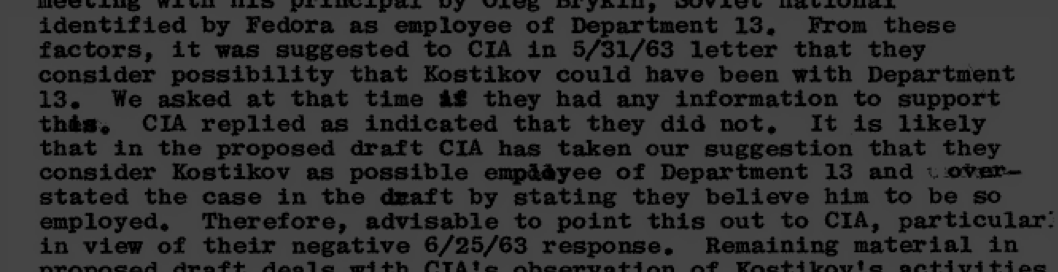
    Between September 27 and October 3, 1963, conspirators in the JFK assassination, developed a false flag incident in Mexico City designed to make future patsy, Lee Harvey Oswald, look like he was in league with Cuban and Soviet agents. Oswald was alleged to have received bribes from Cuban agents and met KGB agent Valery Kostikov, who was their head of assassinations in the Western Hemisphere. J. Edgar Hoover affirmed that Oswald had been impersonated in Cuba. (Also see the Lopez Report.)

    3) A forged letter sent to the Russian Embassy in Washington incriminates Cubans, Soviets, and Oswald. 

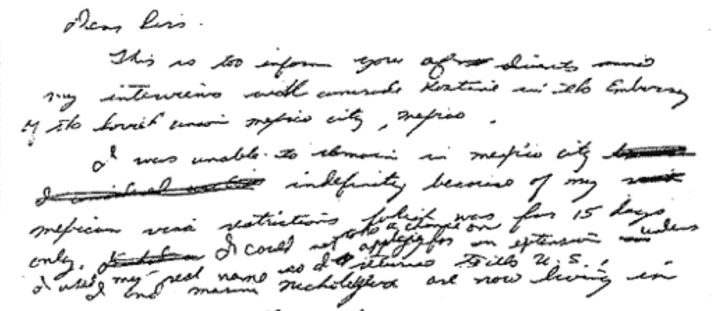
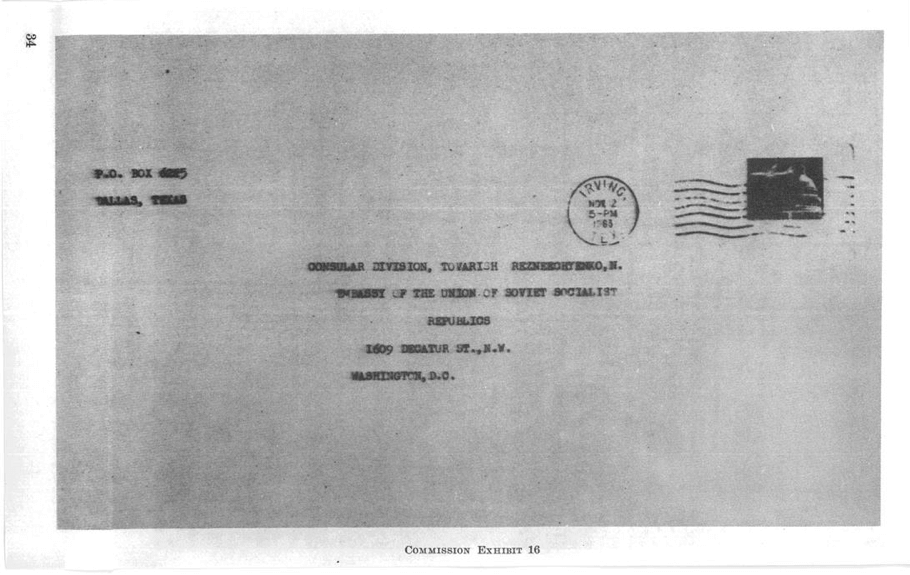
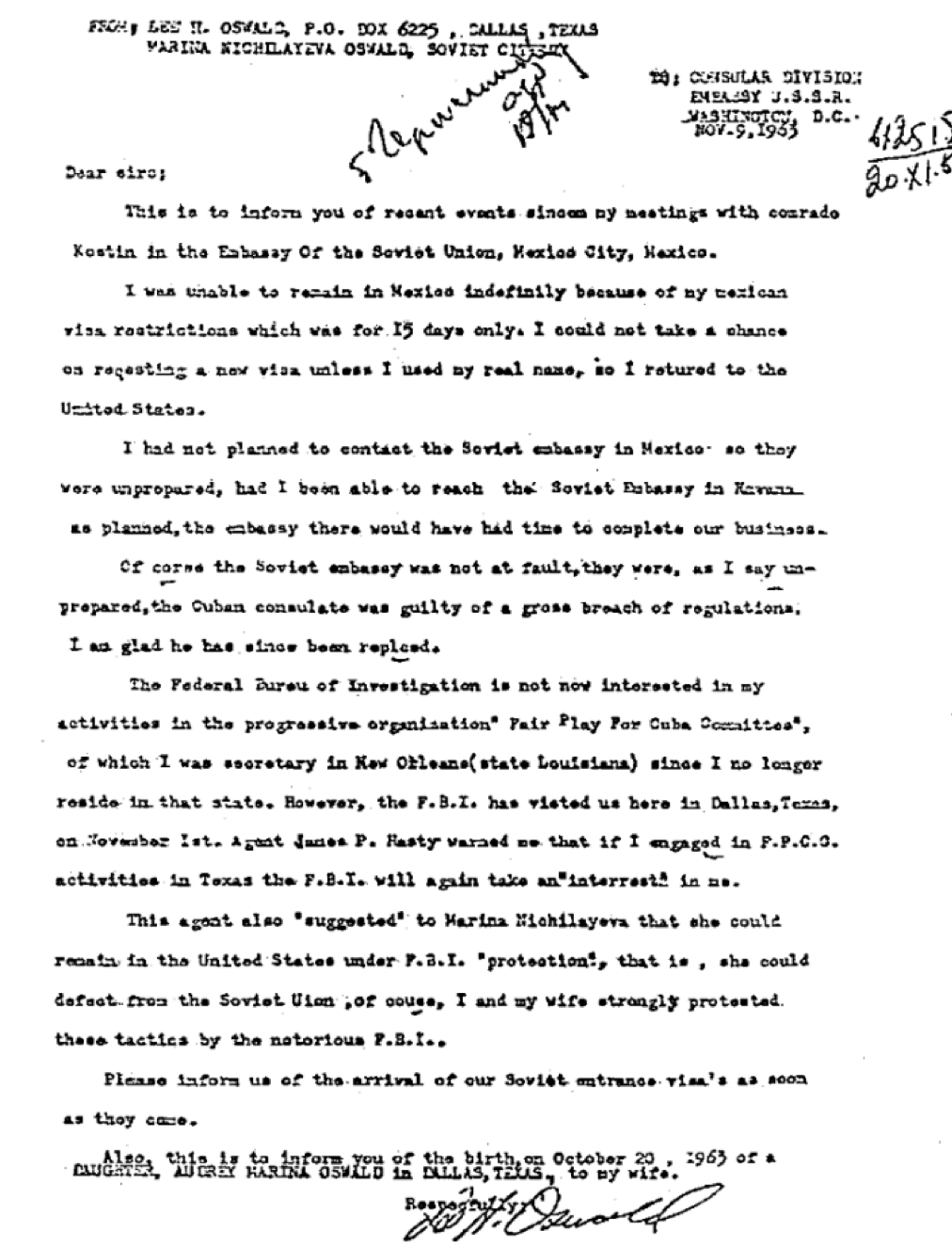
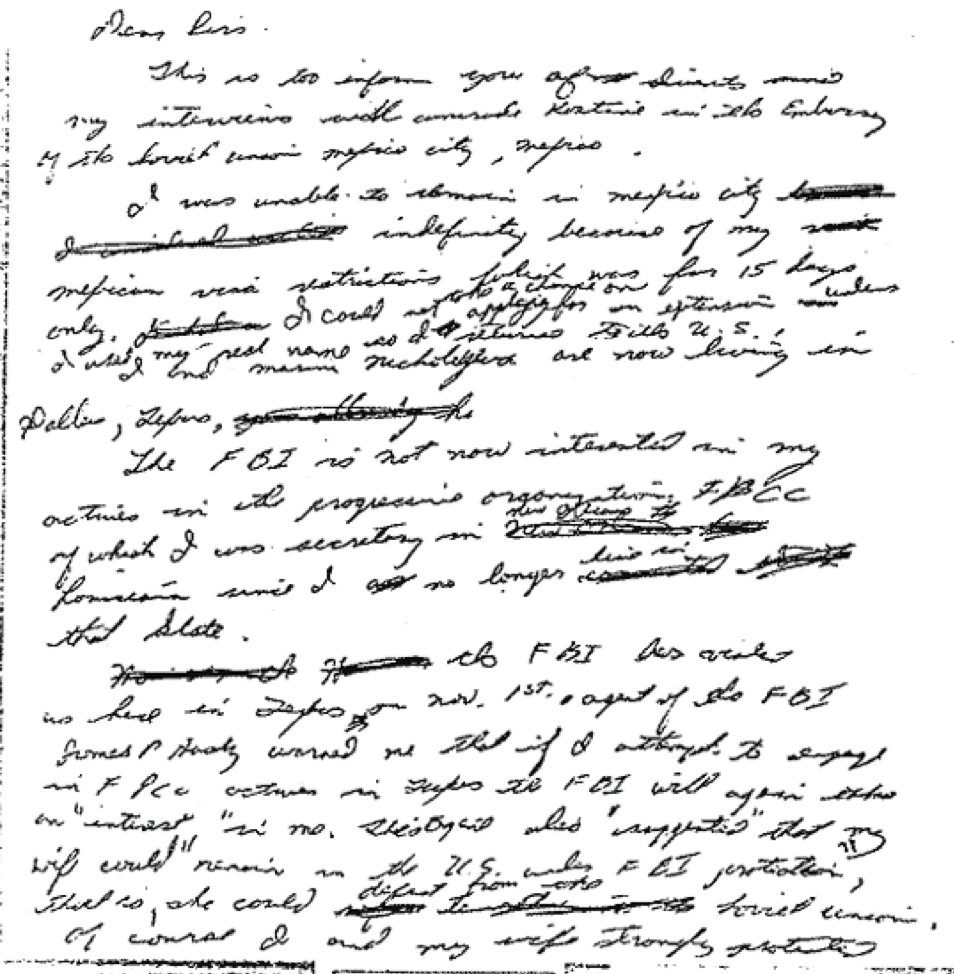
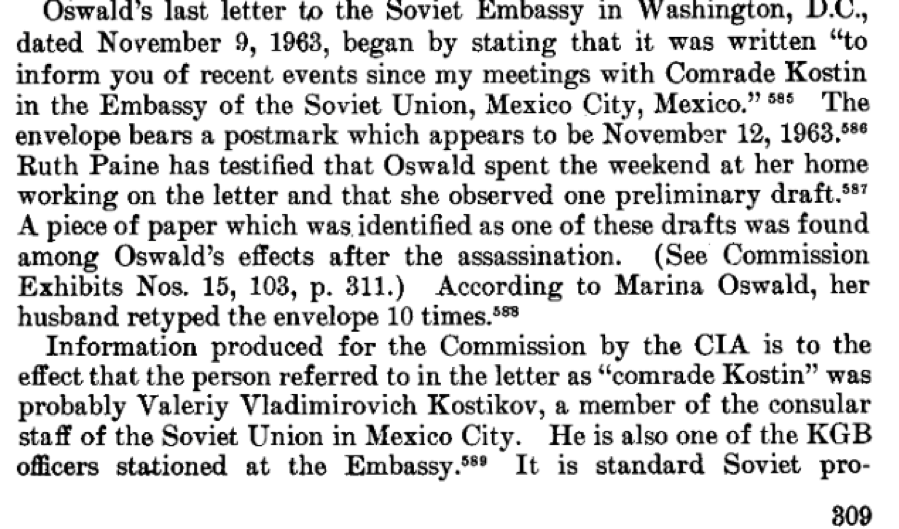
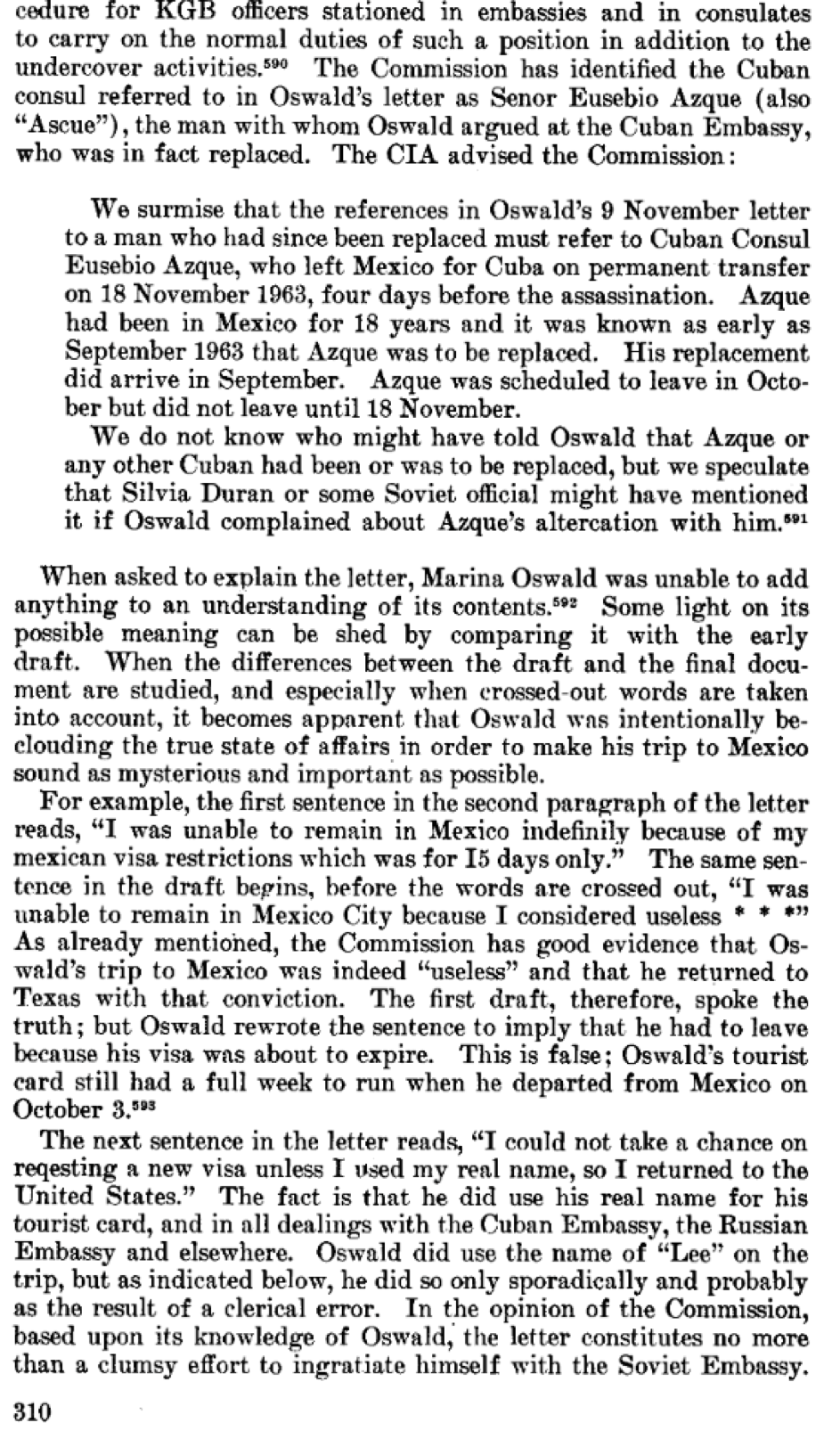
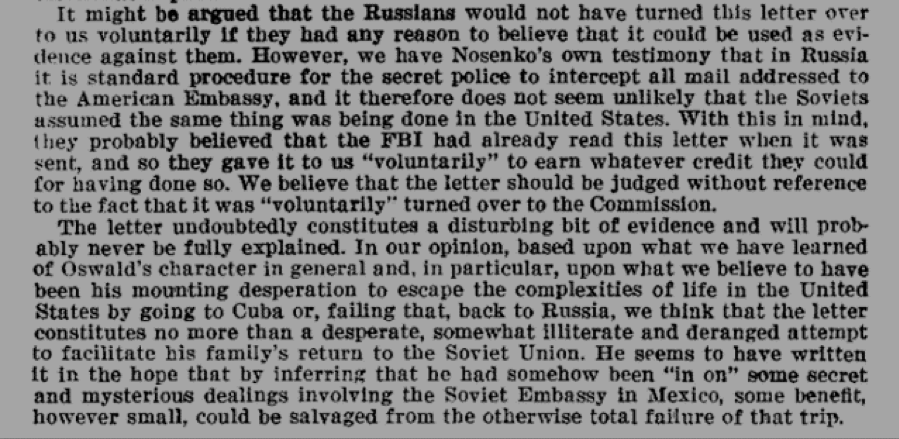
    Shortly after the Mexico City fabrication, a forged letter (see Appendix 1) incriminating Oswald and foreign confederates and corroborative of the Mexico City charade was sent to the Russian embassy in Washington. It denigrates the “notorious FBI” and refers to Kostikov as comrade Kostin. The Warren Commission eventually dismissed it as an awkward appeal by Oswald to the Soviets. In fact, the content and the timing of the letter suggest that it was part of the same stratagem designed by those behind the Mexico City set-up. The Russians, upon receiving the letter, saw it for what it was: As reported by Jerry Rose in the Fourth Decade“in 1999, Boris Yeltsin handed Bill Clinton some 80 files pertaining to Oswald and the JFK assassination. One of the memos reveals that, at the time of the assassination, Russian ambassador Anatoly Dobrynin had right away seen the letter as a ‘provocation’ to frame Russia by the fabrication of complicity between Russia and Oswald, when none existed. ‘One gets the definite impression that the letter was concocted by those who, judging from everything, are involved in the president’s assassination,’ Dobrynin wrote. ‘It is possible that Oswald himself wrote the letter as it was dictated to him, in return for some promises, and then, as we know, he was simply bumped off after his usefulness had ended.’ In late November, the Russians sent the letter to U.S. Secretary of State Dean Rusk explaining why the letter was a fraud. By then, the White House was peddling the lone nut fable. Kept hidden was the fact that the FBI already had a copy of the letter.”

    In his article, Jerry Rose points out that the typed letter had many more spelling errors in it than the rough draft found at Ruth Paine’s home. (Oswald’s Last Letter: The Scorching Hot Potato)

    4) The Phony Letters from Cuba

    Five letters from Cuba (See Appendix 2), all postmarked shortly after the assassination, one of which was destined for Oswald, were part of the false flag operation and were used to incriminate Oswald, unidentified Cuban agents, and Fidel Castro himself. They also corroborate the Mexico City fabrication that very few people would have known about. The FBI dismissed these letters as a hoax, but their content and timing revealed the same tactics being used by the assassination planners. (Read the letter from Cuba section in Kennedysandking article The CIA and Mafia’s “Cuban American Mechanism” and the JFK Assassination.)

    The first letter addressed to Oswald includes: “close the business,” “money I gave you,” “recommend much to the chief,” “I told him (Castro) you could put out a candle at fifty meters,” “when you come to Habana.” Letter four specifies $7000 in bribes given to Oswald which is close to what a Phillips-connected false witness claimed he saw being given to Oswald in Mexico City in the Cuban embassy. It also states that a Cuban agent named Pedro Charles “became a close friend of former Marine and expert shooter Lee H. Oswald in Mexico.”

    The following is how researcher John Simkin (Spartacus) summarizes the evidence:

    The G-2 had a letter, signed by Jorge that had been sent from Havana to Lee Harvey Oswald on 14 November 1963. It had been found when a fire broke out on 23rd November in a sorting office. “After the fire, an employee who was checking the mail in order to offer, where possible, apologies to the addressees of destroyed mail, and to forward the rest, found an envelope addressed to Lee Harvey Oswald.” It is franked on the day Oswald was arrested, and the writer refers to Oswald’s travels to Mexico, Houston, and Florida…, which would have been impossible to know about at that time!

    It incriminates Oswald in the following passage: “I am informing you that the matter you talked to me about the last time that I was in Mexico would be a perfect plan and would weaken the politics of that braggart Kennedy, although much discretion is needed because you know that there are counterrevolutionaries over there who are working for the CIA.”

    Fabian Escalante, chief of Castro’s G-2, informed the HSCA about this letter. When he did this, he discovered that they had four similar letters that had been sent to Oswald, RFK, The Voice of America, and The Director of the Diario de New York. Four of the letters were postmarked “Havana.” It could not be determined where the fifth letter was posted. Four of the letters were signed: Jorge, Pedro Charles, Miguel Galvan Lopez, and Mario del Rosario Molina. Two of the letters (Charles & Jorge) are dated before the assassination (10th and 14th November). A third, by Lopez, is dated 27 November 1963. The other two are undated.

    Cuba is linked to the assassination in all the letters. In two of them, an alleged Cuban agent is clearly implicated in having planned the crime. However, the content of the letters, written before the assassination, suggested that the authors were either “a person linked to Oswald or involved in the conspiracy to execute the crime.”

    This included knowledge about Oswald’s links to Dallas, Houston, Miami, and Mexico City. The text of the Jorge letter “shows a weak grasp of the Spanish language on the part of its author. It would thus seem to have 

    Escalante adds: “It is proven that Oswald was not maintaining correspondence, or any other kind of relations, with anyone in Cuba. Furthermore, those letters arrived at their destination at a precise moment and with a conveniently incriminating message….The existence of the letters in 1963 was not publicized or duly investigated, and the FBI argued before the Warren Commission to reject them.”

    Escalante continues: “The letters were fabricated before the assassination occurred and by somebody who was aware of the development of the plot, who could ensure that they arrived at the opportune moment, and who had a clandestine base in Cuba from which to undertake the action. Considering the history of the last 40 years, we suppose that only the CIA had such capabilities in Cuba.” (JFK: The Cuba Files)

    The linkage with Mexico City is interesting in that very few people were even aware of Oswald’s alleged behavior there shortly before the assassination. David Phillips worked undercover in Cuba in 1959-60 and under Win Scott in Mexico City when the assassination took place. He was a lead propagandist for regime change operations for the CIA. He collaborated closely with other clandestine specialists such as Harvey over the years. Some of the letters suggest a $7000 payoff to Oswald given by Pedro Charles, “a Mexico City-based Castro agent.” Interestingly, Phillips was queried by the HSCA about misinformation from his agents painting a picture of a Cuba-backed conspiracy in league with Oswald. One of his underlings, Gilberto Alvarado, was found to be lying when he claimed that he saw Latinos giving Oswald $6500 in the Cuban embassy. 

    The Pepe Letters

    a) Overview

    In the process of reviewing the recent Latin American intel files at the Mary Ferrell Foundation, a series of them that culminated with CIA file 104-10506-10007 (See appendix 3), set off alarm bells.  In it, we find the first Pepe letter translated from Spanish and other observations. 

    This file, on its own, is very revealing: 

    The letter suggests several troubling points if authentic (which it is not):

    1. It was sent from Cuba to “Bernardo Morales” at a post office box in Miami owned by an anti-Castro propaganda unit called Radio Libertad, La Vos Anti-Communista de America. It was sent by Jose Menendez and signed by Pepe. Morales was unknown to those who handled the letter and was eventually forwarded to a CIA contact linked to the JMWAVE station in Miami.
    2. It reveals a network of conspirators based in Miami, Washington, and Cuba.
    3. The letter is postmarked November 29, 1962, just after the height of the Missile Crisis.
    4. It lamely suggests that by sending the letter to the right-wing Radio Libertad, it would not be intercepted.
    5. It crudely links “Fidel” to a plot to kill JFK.
    6. It does not mince words and is self-incriminating: “if we are able to kill President Kennedy,” “It would be a great success, super extraordinary, for Fidel,” “Marxist-Leninists 90 miles from the U.S.,” “paralyze imperialism completely,” “terrorize capitalism”, “get in contact with your Friends”, “You are an artist”: all very similar to the 1963 letters. 
    7. Letter three of 1963 letters from Havana (appendix 2) was sent to the Directors of the Voice of America, which, like Radio Libertad, was a Cold War vehicle for anti-communist propaganda. 
    8. The information was sent to the Secret Service, the FBI, and the Department of State on Dec. 8, and later to the INS by Rufus Horn of Task Force W and is signed by him as Liaison and in lieu of William Harvey.
    9. The links with the 1963 letters and William Harvey (a person of extreme interest in the assassination) caught my attention. 

    As I went through other related files, the parallels would get even more evident: In short order, I was able to find out that the 1962 letter was one of three Castro incriminating letters, originally written in Spanish, sent within days of one another, all signed by Pepe. (See Appendix 4)

    The second letter was postmarked November 14 and was sent to Antonio Rodriguez who was a chauffeur for Colonel Hugo Trejo (a suspected intelligence contact from Venezuela). Improperly addressed, Trejo said that the letter arrived at a Venezuelan Delegation office. The Secret Service, tipped off by an informant suspecting an assassination plot involving Trejo, questioned members of the delegation including Trejo, Rodriguez, and others.

    The letter refers to the assassination plot in a similar fashion as the first Pepe letter discussed above and was deemed to have been written by the same sender following FBI analysis. The letter opens with Comrad Rodriguez (was Comrad commonly used by Cubans in 1962?) In Oswald’s last letter to the Russian embassy (Appendix 1), he refers to comrade Kostin. Like the letter intended for Morales, this one finds a clumsy way of clearing the Soviets in this plot. 

    The third Pepe letter (appendix 4) was sent to Guatemala. It does not refer to the assassination plot. It does link Cuba to clandestine revolutionary activities in the country.

    b) The FBI and HSCA Investigations of the Pepe letters (See Mary Ferrell file 124-10279-10068 for 21-page FBI document) and click to see the HSCA report

    FBI summary of findings: 

    The sender’s full name is Jose Menendez Ramos. The Ramos part of the name may bear significance.

    Radio Libertad was CIA-sponsored (which was also the case for Voice of America) and operated out of Venezuela. It had an antenna office in Miami. CIA representative William Finch said he was unable to confirm this link. The report affirms that the Pepe letter was acquired through a contact coded MM-T1. 

    Special agent John A. Marshall of the Secret Service and the FBI took this threat very seriously. He advised the FBI about the second letter (Rodriguez).

    Olga Duque de Heredia de Lopez and Aida Mayo Coetara, Miami Representatives for Radio Libertad, handled the mail. Lopez handed the letter to Cesar Gajate whom she described as an anti-Communist fighter. Mayo is the wife of Humberto Lopez Perez, the director of Radio Libertad in Venezuela.

    The INS identified a Morales who entered the U.S. using a fake visa. Some witness evidence indicated that he was anti-communist.

    Hand-writing analysis confirmed that the two letters were written by the same person. The FBI compared these letters to a letter signed by Jose Menendez sent to V. T. Lee but could not determine definitely whether it was from the sender because of insufficient comparable handwriting. The report concludes that Menendez moved from Tampa, Florida, to Cuba in 1961 and that he was being investigated as a suspect

    What the report does not state is that V. T. Lee was head of the Fair Play for Cuba Committee. He would later correspond frequently with Lee Harvey Oswald.

    The FBI suspected subterfuge around the flagrant errors in addressing all three letters:
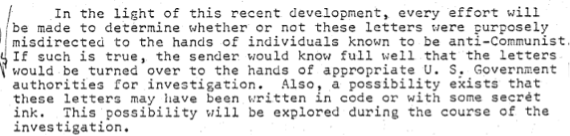
    Pepe FBI

    The HSCA 1978 report sheds more light on the cast of characters and the Pepe affair:

    Concerning the third letter sent to Guatemala, it states that the intended recipient Carlos Meneses was not associated with a P.O. Box 347 in Guatemala City and consequently the letter was intercepted. It describes how Radio Libertad operatives in Caracas contacted the U.S. embassy to let them know about their broadcasting initiatives in Latin American countries, including Cuba.

    The sender Jose Menendez and his wife Carrie Hernandez had been described by the informant as members of the Tampa FPCCMenendez got a “top Job” in the Cuban Government after his return. He and his wife are said to be extremely pro-Castro. Concerning Olga Duque, the HSCA repeats how the Morales letter went from her to Gajate, to eventually make its way to the Secret Service, without divulging the CIA Miami station role in the logistics. Aida Mayo is described as a founder of an anti-Castro organization. Olga and Aida shared an apartment.

    Concerning the intended recipient of letter 2, Antonio Rodriguez, the reports are a mixed bag. One lead with thin traces connected his father with the assassination of an anti-Castroite in Haiti. Another points to links with a Castro henchman named Pino Machado. (Note: a base story for a pro-Castro conspiracy could have emerged had a plot developed further.)

    The HSCA Weighs in

    The Warren Commission paid no attention to the Pepe incident and only made fleeting mention of the Pedro Charles letters, lazily fluffed off as a hoax by the FBI.

    The HSCA published a 165-page report (180-10108-10017 titled ANTONIO GUILLERMO ROGRIGUEZ JONES.) Towards the beginning of the report exchanges among intelligence agents all the way up to Chief Rowley, head of the Secret Service, and FBI director Hoover emphasize the seriousness of these letters. S.A. Marshall is extremely insistent about the importance of looking into Menendez. 

    The HSCA Final Report

    While the above is a summary of the raw data concerning the Havanna 1962 letters, the HSCA presented in a report, Volume 3 of its final report in which there is precious little value when it comes to interpretation. As we have seen, the FBI fluffs all of this off as simply Cubans muddying the wells. The HSCA toed the line, which seems contradictory to its criticism around the absence of case linkage regarding potential patsy Policarpo Lopez, whom they linked to suspicious behavior in and around the assassination in 1963 (compare the double standard):

    Lopez would have obtained a tourist card in Tampa on November 20, 1963, entered Mexico at Nuevo Laredo on November 23, and flew from Mexico City to Havana on November 27. Further, Lopez was alleged to have attended a meeting of the Tampa Chapter of the FPCC on November 17… CIA files on Lopez reflect that in early December 1963, they received a classified message requesting urgent traces on Lopez… Later the CIA headquarters received another classified message stating that a source stated that “Lopes” had been involved in the Kennedy assassination… had entered Mexico by foot from Laredo on November 13…proceeded by bus to Mexico City where he entered the Cuban embassy…and left for Cuba as the only passenger on flight 465 for Cuba. A CIA file on Lopez was classified as a counterintelligence case…

    An FBI investigation on Lopez through an interview with his cousin and wife as well as document research revealed that… He was pro-Castro and he had once gotten involved in a fistfight over his Castro sympathies.

    The FBI had previously documented that Lopez had actually been in contact with the FPCC and had attended a meeting in Tampa on November 20, 1963. In a March 1964 report, it recounted that at a November 17 meeting… Lopez said he had not been granted permission to return to Cuba but was awaiting a phone call about his return to his homeland… A Tampa FPCC member was quoted as saying she called a friend in Cuba on December 8, 1963, and was told that he arrived safely. She also said that they (the FPCC) had given Lopez 190$ for his return. The FBI confirmed the Mexico trip (Lopez’ wife confirmed that in a letter he sent her from Cuba in November 1963, he had received financial assistance for his trip to Cuba from an organization in Tampa)… information sent to the Warren Commission by the FBI on the Tampa chapter of the FPCC did not contain information on Lopez’ activities… nor apparently on Lopez himself. The Committee concurred with the Senate Select Committee that this omission was egregious since the circumstances surrounding Lopez’ travel seemed “suspicious.” Moreover, in March 1964 when the WC’s investigation was in its most active stage, there were reports circulating that Lopez had been involved in the assassination… Lopez’ association with the FPCC, however, coupled with the fact that the dates of his travel to Mexico via Texas coincide with the assassination, plus the reports that Lopez’ activities were “suspicious” all amount to troublesome circumstances that the committee was unable to resolve with confidence.

    So, what fingerprints did they pick up on the Menendez links to the FPCC, the similarities with the Pedro Charles letters and Oswald’s last letter, and the fact that Menendez was deemed an FBI suspect in an assassination plot…?  None! None they wished to discuss that is. The HSCA also deflected somewhat by speculating that Menendez may have been someone else (Juan Jose Mulkay Gutierrez- 1977 File 104-10506-10036). The HSCA ended by concluding that there was a probable conspiracy but leaned towards a Mafia-centric one. The Pepe letters did not support this concept.

    SGA, JMWAVE, Task Force W, and SAS

    Dave Boylan is a co-author of the book The Oswald Puzzle and the essays The Wheaton Lead and The Red Bird Airport Leads. He is regarded as one of the leading researchers of JFK assassination-related files and he is currently working with this author on a far-reaching JFK research project. In it, we have produced the beginnings of the CIA org chart for 1963 as well as one specifically for the CIA station in JMWAVE and another for the SAS CIA cell. No one understands this structure more than Dave. Interested in the Pepe letters, he helped me decode some of the files and added a few to the mix. Thanks to this we can better understand the extended team that was involved with this covert operation, whether wittingly or not.

    From Spartacus: “After the Bay of Pigs disaster, President John F. Kennedy created a committee (SGA) charged with overthrowing Castro’s government. The SGA, chaired by Robert F. Kennedy (Attorney General), included John McCone (CIA Director), McGeorge Bundy (National Security Adviser), Alexis Johnson (State Department), Roswell Gilpatric (Defence Department), General Lyman Lemnitzer (Joint Chiefs of Staff) and General Maxwell Taylor. Although not officially members, Dean Rusk (Secretary of State) and Robert S. McNamara (Secretary of Defense) also attended meetings.

    At a meeting of this committee at the White House on 4 November 1961, it was decided to call this covert action program for sabotage and subversion against Cuba, Operation Mongoose. Attorney General Robert F. Kennedy also decided that General Edward Lansdale (Staff Member of the President’s Committee on Military Assistance) should be placed in charge of the operation.

    The CIA JMWAVE station in Miami served as operational headquarters for Operation Mongoose. The head of the station was Ted Shackley and over the next few months, he became involved in the attempt to overthrow Fidel Castro. One of Lansdale’s first decisions was to appoint William Harvey as head of Task Force W. Harvey’s brief was to organize a broad range of activities that would help to bring down Castro’s government.”

    After Harvey left America for Rome, Desmond FitzGerald stepped in to provide new leadership to the Cuban division at Headquarters, renamed as the Special Affairs Staff (SAS). Harvey stepped down as chief of Staff D.”

    By painstakingly assembling names from files, searching through directories, and working with colleagues, David and I have been putting together org charts representative of the CIA in 1963. It is a colossal work in progress that does sometimes involve guesswork and evolving conclusions. Of interest for this article is the 63-64, org chart of SAS developed by David. (Note: William Harvey does not figure in this because he had by then been demoted and exiled. In 1962, he would have had a prominent position near the top of a structure SAS replaced called Task Force W). By visiting Appendix 5, the reader will better appreciate how many of the persons profiled below worked within the Counterintelligence section of SAS under Fitzgerald in 63 and Harvey in 62.

    David’s first take on the files we looked over proved very insightful:

    These are very close to the Pedro Charles letters! I suspect that the person that sent these was a cutout/asset for the Psychological Warfare, Propaganda guys. Notice that the memo went to Paul Maggio and Rufus ‘Austin’ Horn. Horn was SAS/Counterintelligence who met with FBI liaison Sam Papich every day. Horn worked for Hal Swenson, who worked for Harvey and later, Dez Fitzgerald. The initial source was a PW/Prop anti-communist radio station (Olga Duque). From there to an AMOT (Gajate). The AMOT sent it to JMWAVE, most likely the head of the AMOTs, Tony Sforza. Then JMWAVE sent it along to SAS (Maggio and Horn) who brought in the FBI (Papich). Of course, Harvey would have seen this.”

    Dave later added the following:

    Another possible source of the letters was members of the DRE—the Student Revolutionary Directorate. The DRE was a “specialized” student group of the larger Revolutionary Directorate. The student group was founded in the summer of 1960 by Ross Crozier (Harold Noemayr) and William Kent (Oliver Corbus/Doug Gupton) under the direction of Philip Toomey (Robert Trouchard) and David Phillips (Michael Choden) and designated AMSPELL. Kent was first introduced to Juan Salvat (AMHINT-2) by Alberto Muller (AMHINT-1). Salvat knew Kent as Gupton. Other early members of AMSPELL were Isidro Borja (AMHINT-5), and Luis Fernandez Rocha (AMHINT-53)AMSPELL was split into three sections: AMSPELL itself, AMHINT and AMBARB. AMSPELL proper was managed by Ross Crozier, AMHINT, the paramilitary section, was managed by David Morales, and the AMBARB (propaganda) section was managed by Calvin Thomas. (Note: Oswald’s interaction with the New Orleans chapter of the DRE in the summer of 1963 was key in creating his pro-Castro credentials and adding to his Mexico links to Phillips.)

    David Morales, who was part of the 1954 Guatemala coup (operation PBSUCCESS) with Phillips, was also chief of operations for the Bay of Pigs invasion under Ted Shackley at JMWAVE and was reportedly involved in various assassination projects including the capture and killing of Che Guevara and later aided repressive governments in South America.

    1) Lt. Ramos

    This link File 104-10308-10271 and File 104-10308-10272 establish that Castro’s close friend Lt. Ramos could be Menendez, the alleged FPCC-linked sender of Pepe’s letters. The latter file identifies William Harvey as its author. These files pertain to a project to assassinate Castro in 1962 called AMRANGE, likely led by Harvey.

    2) Augusto Cesar Gajate Puig

    The Morales letter was received at JMWAVE on December 7, via Augusto Cesar Gajate Puig, a Cuban exile involved in the fight for a free Cuba, who had received it from Olga Duque who worked for the CIA-sponsored Radio Libertad. The reason she got to handle it was because the letter was suspiciously mistakenly addressed to this right-wing conduit by supposedly communist assassins working for Castro. File 104-10308-10249 refers to Gajate as a CIA contact and expresses a need to protect his identity. 104-10506-10015: ROUTING SHEET AND GREEN LIST NAME CHECK REQUESTS/RESULTS describes him more specifically as an AMOT contact. AMOT is a cryptonym for a network of Cubans trained by David Morales during 1960-61 to be a new Cuban intelligence service once Castro had been ousted. It became a proprietary which produced economic and sociological reports in support of Cuban operations.

    3) Rufus Horn

    A report about the letter (appendix 3) was then written up by Rufus Horn who signed it (by direction of Victor Wallen) as the liaison as well as in lieu of William Harvey above his name at the bottom of the report. The report is sent on December 8 to the FBI, Secret Service, and Department of State.

    Rufus Horn, also known as Austin Horn, was a key liaison within the SAS group and TFW as well as with the FBI (File 104-10269-10134) where he interacted with Sam Papich. He was also well connected with Desmond Fitzgerald of the CIA who led the all-powerful SAS group that enacted major covert activity policies.

    Horn was put in the loop when Oswald was arrested for a street fight with a DRE operative (Carlos Bringuier) around his provocative FPCC leafleting activities in New Orleans in 1963: (from State Secret, Simpich, Chapter 5) “Anderson received a Sept. 24 report of Oswald’s arrest, which revealed Oswald’s request to speak with an FBI agent and share quite a bit of information while in jail: Austin Horn, the Special Affairs Staff (SAS) liaison with the FBI, also got his copy of the September 24 report on October 8. The routing sheet indicates that Horn’s copy was signed for by ‘LD,’ SAS/CI L. Demos. This document was passed on to SAS/CI/CONTROL, then Egerter, and then CI/IC Cal Tenney. Horn was active on the Cubela case at its end in 1965.” (Note: The Cubela case was another plot to assassinate Castro involving Harvey.)

    4) Richard Tansing

    Another person whose name appears in many of the Pepe letter files is Richard Tansing. Tansing describes himself as C/TFW/CI. His boss, Harold Swenson, used the pseudonym of Joseph Langosch while serving as C/SAS/CI and C/WH/SA/CI between 1963 and 1965. In a cable on October 17, 1963, that was originated by Anita Potocki (Harvey Assistant), SAS/CI, and Tansing C/SAS/CI, was a Coordinating Officer.

    Tansing is also linked to William Harvey, Desmond Fitzgerald, Sam Halpern (all TFW or SAS), Win Scott (Chief of Station in Mexico City), Papich of the FBI, as well as soldiers of fortune: Frank Sturgis (of Watergate fame) and Gerry Patrick Hemming (104-10048-10217: FRANK ANTHONY STURGIS, ALSO KNOWN AS FRANK FIORINI and 104-10218-10274: ROUTING AND RECORD SHEET). 

    Tansing was involved in an effort to recruit the Cuban Head of the Mexico City embassy, Eusebio Azcue (who had contact with Oswald) shortly before the Mexico City charade, the Cubela assassination of Castro plot, and direct involvement with CIA FPCC assets and covert activities.

    5) Anita Potocki

    Anita Potocki was Bill Harvey’s long-time loyal aide. She helped potential patsy Santiago Garriga set up an FPCC chapter in Miami. She aided CIA FPCC informant Thomas Vicente (who helped Oswald with his New Orleans Chapter) travel to Cuba as an asset for the CIA. She is also closely linked to David Phillips. Her relations with Tansing are noted above.

    6) Desmond Fitzgerald

    Fitzgerald was the head of a secret unit within the CIA called the Special Affairs Staff. His top priority, as directed by SAG, was to eliminate Castro.

    Note: In a nutshell, we can conclude that those involved in handling the Pepe letters within the CIA coalesced under Harvey and then Fitzgerald mostly in the CI section of SAS. SAS had its tentacles in JMWAVE where covert activities involving AMOTs (like Gajate) were run as well as Mexico City activities (where David Atlee Phillips was based).

    7) David Phillips

    “I’m firmly convinced now that he [Phillips] ran the red herring, disinformation aspects of the plot. The thing that got him so nervous was when I started mentioning all the anti-Castro Cubans who were in reports filed with the FBI for the Warren Commission and every one of them had a tie I could trace back to him. That’s what got him very upset. He knew the whole thing could unravel.” Dan Hardway (HSCA investigator), from Gaeton Fonzi’s  The Last Investigation

    From Spartacus: “David Phillips also worked undercover in Cuba (1959-60). He returned to the United States in 1960 and was involved in the organization of the Bay of Pigs operation. During this period he worked with E.Howard Hunt in the attempts to have Fidel Castro murdered. Phillips later worked under Winston Scott, the head of the CIA station in Mexico.

    Desmond FitzGerald arrived in Mexico City to tell Phillips that he had the freedom to roam the entire Western Hemisphere mounting secret operations to get rid of Fidel Castro. Phillips now worked closely with David Morales at JMWAVE in Miami. Phillips also provided support to Alpha 66. It was later claimed that Phillips told Antonio Veciana his goal was to provoke U.S. intervention in Cuba by ‘putting Kennedy’s back to the wall…’ 

    David Atlee Phillips served as Station Chief in the Dominican Republic and in Rio de Janeiro. In 1970, he was called to Washington and asked to lead a special task force assigned to prevent the election of Salvador Allende as President of Chile. Allende was killed in a military takeover in 1973.”

    From Someone Would Have Talked, Larry Hancock: “However, there are two further indications that he was either aware of the conspiracy or actively supported it.

    One of these is from conversations David Phillips had with Kevin Walsh, a former HSCA staffer who went on to work as a private detective in Washington, DC. In a conversation not long before his death, Phillips remarked: ‘My private opinion is that JFK was done in by a conspiracy, likely including American intelligence officers.’ — David Atlee Phillips, July 1986.

    The second conversation was related in an email exchange between researcher Gary Buell and David Phillips’ nephew, Shawn Phillips. As Shawn described in the email, Shawn’s father, James Phillips, became aware that his brother, David, had in some way been ‘seriously involved’ in the JFK assassination. James and David argued about this vigorously and it resulted in a silent hiatus between them that lasted for almost six years.

    As David was dying of lung cancer, he called his brother. Even at this point, there was apparently no reconciliation between the two men. James asked David pointedly, ‘Were you in Dallas that day?’ David answered, ‘Yes,’ and James hung up the phone on him.

    8) William Harvey

    Harvey hated the Kennedys, wrote up the executive action program called ZRRIFLE, and led Task Force W, which headed Operation Mongoose (an anti-Castro sabotage program). At the height of the Missile Crisis, he foolishly defied the Kennedys by sending three commando units to Cuba. This got him exiled to Rome. ZRRIFLE describes the importance of ensuring corroborative paper trails when planning elimination programs. Harvey was singled out by HSCA investigator Dan Hardway as a person of extreme interest in the assassination… something our studies confirm as a point of agreement among most researchers.

    From Spartacus on William Harvey: “At a meeting of this committee at the White House on 4 November 1961, it was decided to call this covert action program for sabotage and subversion against Cuba, Operation Mongoose. Attorney General Robert F. Kennedy also decided that General Edward Lansdale (Staff Member of the President’s Committee on Military Assistance) should be placed in charge of the operation.

    The CIA JMWAVE station in Miami served as operational headquarters for Operation Mongoose. The head of the station was Ted Shackley and over the next few months became very involved in the attempt to overthrow Fidel Castro. One of Lansdale’s first decisions was to appoint Harvey as head of Task Force W. Harvey’s brief was to organize a broad range of activities that would help to bring down Castro’s government…

    During the Cuban Missile CrisisRobert Kennedy instructed CIA director John McCone, to halt all covert operations aimed at Cuba. A few days later he discovered that Harvey had ignored this order and had dispatched three commando teams into Cuba to prepare for what he believed would be an inevitable invasion. Kennedy was furious and as soon as the Cuban Missile Crisis was over, Harvey was removed as commander of ZRRIFLE. On 30 October 1962, RFK terminated ‘all sabotage operations’ against Cuba. As a result of President Kennedy’s promise to Nikita Khrushchev that he would not invade Cuba, Operation Mongoose was disbanded.

    Harvey was now sent to Italy where he became Chief of Station in Rome. Harvey knew that Robert Kennedy had been responsible for his demotion. A friend of Harvey’s said that he ‘hated Bobby Kennedy’s guts with a purple passion.’”

    The Usual Suspects

    There are numerous reasons that many researchers have suspected David Phillips and William Harvey as being part of the conspiracy. It is Harvey’s links with Johnny Rosselli and the mob, his suspicious behavior during the months leading up to the assassination–including a possible visit to Dallas–his hatred of the Kennedys, and his experience in executive action; all these that make Harvey of extreme interest.

    In the case of Phillips, his universe is so intertwined with Oswald’s through his ties to Mexico City, the FPCC, the DRE, Alpha 66, New Orleans right-wing networks, George Joannides, etc. that renders him suspicious. He also made quasi-confessions—including being in Dallas on the day of the assassination– revelations that have led most researchers to suspect him.

    What do the Pepe letters add to the mix?

    If one agrees that—their similarities with the 1963 letters, the FPCC links of the sender, and the total post-assassination complacency displayed by investigators of this despite the obvious fingerprints and the labeling of Menendez as a suspect are not a matter of happenstance–then we can conclude that this incident, like so many others, was deep-sixed, because it went against the lone nut scenario.

    This author believes it went further than just this:

    – The fabrication of a false paper trail is alluded to in William Harvey’s executive action plan called ZRRIFLE. So are the tactics of shifting the blame on a foe and the use of proxies. All this is in full display with the Pepe letters.

    – The 1963 letters have content that only a few people could have known about, including alleged bribes and Oswald’s fall 1963 displacements. One of these people is clearly suggestive of  Phillips and another could well be William Harvey, who worked closely with Phillips in the past on covert activities and whose assistant, Anita Potocki, worked closely with the Mexico City station.

    – The 1962 letters occurred one year earlier and share a similar template with the 1963 letters. These were certainly two false flag operations organized by the same perpetrators.

    – William Harvey had already turned on the Kennedys by the time he tried to sabotage the Kennedy/Khrushchev diplomacy attempts at the height of the Missile Crisis. Phillips expressed his disgust with the failed Bay of Pigs mission which he blamed on JFK.

    – Over and above his privileged knowledge, Phillips had the contacts in Havana, in Mexico City, and at JMWAVE in Miami as well as the false flag expertise to pull off these tactics.

    – It is interesting to note that one of the recipients of the Pepe letter was a CIA conduit called Radio Libertad out of Miami. And one of the 1963 recipients was the Voice of the United States of America, another Cold War propaganda organization. Phillips would have been well acquainted with these organizations as he himself used such tools in his regime change propaganda efforts.

    Conclusion

    This author had opinions, based on intelligent speculation, about who was involved in the assassination. The prior plots to remove JFK confirmed a template. Ergo, solving a prior plot meant solving the JFK assassination. Because of negligence and obfuscation on the part of investigators, this proved difficult.

    Two things changed all this in the past four months: one—a better understanding of the intelligence universe of 1963 that culminated in organizational charts and two—the Pepe letters. 

    With declassification, the current downfall of Warren Commission apologists was predictable. The files not only torpedoed the lone-nut scenario and disgraced the Warren Commission, but they revealed the biggest challenge facing conspiracy deniers caused by the shift to pushing a lone-nut scenario which had to be improvised because the blame Castro scenario was overruled after the assassination. The fairy tale spinners could not put all the toothpaste back in the tube. Fabrication, witness intimidation, coercing media, and file classification became the order of the day. Until 1991, when the movie JFK, gave us the declassification of thousands of files, and changed the assassination universe.

    The Pepe letters operation proved more difficult to sweep under the rug because it occurred in 1962 and had been analyzed by the FBI and the Secret Service, both genuinely concerned by the threat. A suspect for a plan to remove Kennedy linked to the FPCC had been identified. The knee-jerk dismissal of the Pepe letters does not hold water. The HSCA simply tabled them, until against all odds, they were found decades later, and are only now being analyzed in detail.

     What we can take away from the Pepe Letters is monumental and could be even more incriminating with more research.

    1. The Pepe letters bear too much of a resemblance to the 1963 incriminating correspondence for them not to be linked.
    2. Both correspondence initiatives were designed to incriminate Fidel Castro in plots to kill JFK.
    3. Both initiatives use FPCC links to taint the offenders.
    4. Both initiatives correspond closely with the ZRRIFLE executive action template mastered by both William Harvey and David Phillips who are regime change specialists.
    5. Phillips’s network is omnipresent in the false flag operations around Oswald in 1963.
    6. Harvey’s network is very closely connected to the characters involved in the post-reception phase of the Pepe letters.
    7. Harvey and Phillips connect closely through their regime change operations history, members of their networks, and relations between TFW/SAS and Mexico City.
    8. Both shared a hatred of the Kennedys.
    9. SAS was a critical conduit between regime change operators and those who set policy.
    10. The post-assassination analysis was cursory and evasive.

    It remains difficult to determine who, within the networks, acted wittingly vs. unwittingly and who figured out after the fact the minutiae around the operations. However, if we conclude that what happened in the 1962 and 1963 false flag operations discussed in this article are not the result of mere happenstance, and that neither the Cubans, Mafia nor lone wolves could have pulled these plots off, we can conclude that they were coordinated by the same perpetrators who are regime change specialists.

    Find out who designed tactics for either the false flag plots, their roll-out, the propaganda themes, and who got the instructions through to contacts in Havana to send the letters, who set up the FPCC tainting strategy… You have a strong case of who was behind the JFK assassination at the operations management level. 

    Appendices

    A 9-page PDF with all appendices may be found here.


  • A Narrative is Debunked

    A Narrative is Debunked


    I was browsing the internet on the subject of Mexico City and the JFK assassination last year, when I stumbled upon an online article on The Conversation webpage. (Incidentally, this article has replicated on other online “news” sites faster than the spread of the Corona Virus, it seems).

    Above the heading JFK Conspiracy Theory is Debunked in Mexico City 57 Years After Kennedy Assassination, were two photos of the infamous Mystery Man: originally purported to be Lee Harvey Oswald visiting the Soviet Embassy. This spurred my curiosity to keep on reading to see if this Mystery Man photo was finally solved. To my chagrin, the article started off with an unfounded general statement that “most conspiracy theories surrounding President John F. Kennedy’s assassination have been disproven”; citing two examples, one absurd and the other of lesser significance, or a case of misidentification if not coincidence. To illustrate my point, it should be noted that six out of seven mock trials on this case resulted in either a hung jury or acquittal for the accused. Meaning that, under scrutiny, the lone assassin scenario is seriously called into question, or that reasonable doubt in favor of Lee Harvey Oswald exists. And let’s not forget about the many scholarly works by serious researchers, particularly from the file releases since the creation of the ARRB in 1994, who have cast even further doubt on that scenario. Finally, it should be noted that most Americans believe in an assassination conspiracy.

    In spite of that unjustified statement, I forged on in the face of this initial tone set by author Gonzalo Soltero, Professor of Narrative Analysis, at the Universidad Nacional Autonoma de Mexico (UNAM), and author of the book Conspiracy Narratives South of the Border: Bad Hombres Do the Twist. The online article, albeit brief, is based on Chapter 3 of his book titled, “Oswald Does the Twist”. The purpose of this paper is to critique his online article, particularly the main premise: that the late journalist Oscar Contreras Lartigue could not have met Lee Harvey Oswald in Mexico City, as Contreras claimed. If the reader will recall, some witnesses in and around the Cuban consulate said that the man the CIA said was Oswald, was not actually him. As we will see, the man these witnesses saw or met was short, about 5’ 6”, and blonde. Neither of which depicts Oswald. And one of these witnesses was Contreras. (See, for example, James DiEugenio, The JFK Assassination: The Evidence Today, p. 293)

    While researching his book on conspiracy narratives in Mexico, the author discovered what he described as “a hole in the story of the very man who started a “tenacious conspiracy theory about Oswald’s Mexico trip”. He goes on further to describe it as a “main conspiracy about Oswald’s undocumented time in Mexico City (that) puts him in contact with dangerous Mexicans on the left side of the Cold War”. This conspiracy theory began well after the Warren Commission: “This story originated in March 1967 when the American Consul in the Mexican coastal city of Tampico, Benjamin Ruyle, was buying drinks for local journalists”. (I can think of bigger conspiracy theories, also mentioned in Soltero’s book, but more on that later). That man is Oscar Contreras Lartigue, who was a law student at the UNAM and budding journalist for El Sol de Tampico newspaper, who wrote for its gossip column, Crisol. Oscar Contreras told Ruyle he met Oswald in 1963 on campus when he belonged to a pro-Castro campus group and that Oswald sought help in getting a Cuban visa. Contreras said Oswald spent two days with these students and met up later with them at the Cuban Embassy. Contreras said he was involved in some nefarious political activities (including blowing up a statue of a former Mexican president) and was afraid to talk much more. He also mentioned that he told his editor too about his encounter with Lee Harvey Oswald. Three months later, Contreras was visited by a CIA official from Mexico City, but he still refused to go into details, except to say that Oswald never mentioned assassination, only a need to get to Cuba. In 1978, the HSCA’s Dan Hardway went to Mexico. According to Soltero, Hardway was unable to interview Contreras despite several attempts, but reported that his account should not be dismissed. (According to Hardway, the CIA prevented the HSCA from interviewing Oscar Contreras. See the article A Cruel and Shocking Misinterpretation by Dan Hardway, 2015).

    Later on, N.Y. Times reporter Phillip Shenon successfully interviewed Contreras for his 2013 book on the assassination and found him to be credible. Contreras was more forthcoming and told him about “far more extensive contacts between Oswald and Cuban agents in Mexico”. Oscar Contreras died in 2016 so Professor Soltero could not interview him, but he remembered a minor detail of Contreras’ account.

    That minor detail was Contreras telling his editor, while a law student, about his encounter with Oswald. Soltero questioned this reference to an editor in Contreras’ story, so he did some investigating. He then found out about Contreras’ job with El Sol de Tampico, and two of his gossip columns, one dated September 22nd and the other on October 6th, 1963. Oswald purportedly arrived in Mexico City by bus Friday morning, Sept. 27, 1963 and left very early on Wednesday, October 2nd. After examining those two gossip columns, Soltero concluded that Oscar Contreras Lartigue could not have been in Mexico City during the time Oswald was there, as he would have been in Tampico, some 300 miles away, covering and writing those stories. He therefore concludes that his account about meeting Oswald was a fabrication and that any conspiracy theory arising therefrom, associating Oswald with pro-Castro Mexicans or Cuban agents, is debunked. But if those gossip columns were dated one week before and after the weekend of Oswald’s visit to Mexico City, how can Soltero make such a conclusion? No specific details from those articles were articulated or given in his article or Chapter 3 of his book. So, I did some digging of my own.

    The gossip columns published in The Conversation article were not clear enough for me to use a translation app, so I needed to consult with a Spanish translator.   Fortunately for me, I met a gentleman who runs a translation service in Mexico, who also has an interest in this historical subject. And what he found was that Contreras does not admit to personally attending, or even imply his attendance, to any events mentioned in those gossip columns, but only describes what those events are: some of which occured in the past and some which will occur in the future. But no events take place on Friday September 27th or during the weekend, or Monday September 30th or Tuesday October 1st, when Oswald was supposedly in Mexico City (Oswald left early Wednesday morning).

    Specific events cited are:

    1. A wedding engagement in Monterrey, N.L between Leticia Lozano & Raul Segovia on the 26th of this month
    2. A reunion at the Club Blanco y Negro in Tampico next Tuesday (the 24th),
    3. A wedding scheduled to take place on October 5th between Lupita Aguilar Adame & Carlos Sanchez Schutz,
    4. A yacht excursion organized by Janet Abisad (on Sept. 16th),
    5. Lupita Rivera Casanova & friends organized a yacht trip (for the 18th).

    So, the absence of a social event in Tampico, during the time that Oswald supposedly visited Mexico City (Sep. 27th to Oct. 2nd, 1963), could not prevent Oscar Contreras from being in Mexico City. Furthermore, even if there was an event during that crucial period, why could not Contreras arrange for a proxy to cover a story? It appears that the basis for Mr. Soltero’s repudiation of Oscar Contreras’ account is unfounded. Not to mention that it’s convenient for Soltero to discredit him, since Contreras is not around to defend himself. However, as specifically pointed out above, the Sol de Tampico archives do not discredit Contreras’ account.

    Professor Soltero also refers to the account of Contreras as a “main conspiracy about Oswald’s undocumented time in Mexico City”. Is it really? If it is a “main conspiracy”, this writer can think of other more important conspiracy theories related to Mexico City, namely: that Oswald met with a Soviet diplomat named Valeriy Kostikov at the Soviet Embassy, who the CIA suspected of being attached to the KGB’s Department 13 in charge of Assassinations, Terrorism & Sabotage. The purported reason being to apply for a visa to get to the Soviet Union via Cuba (the insinuation being to seek asylum after the assassination after conferring with the enemy). Or what about the one saying that Oswald was offered a large sum of money by pro-Castro Cubans at the Cuban Consulate for the assassination? How is this one: that Lee Harvey Oswald was impersonated in Mexico City to attract attention to himself with his public behaviour, in order to incriminate him by his contact with Cubans and Soviets there, ostensibly to use that offensive association during the Cold War, to effect a possible retaliatory response by the U.S. against Cuba or the Soviets? (A related conspiracy to the latter is that someone or persons in U.S. intelligence was/were manipulating Oswald with their knowledge of the CIA’s surveillance of the Cuban Consulate and Soviet Embassy).

    Professor Soltero does mention in his article, an argument between Oswald and the Cuban consul, Eusebio Azcue, when he visited the Cuban Embassy seeking a visa to the Soviet Union. However, the HSCA shed more light on that incident with Azcue. On page 250 of their Findings, they state that “Eusebio Azcue testified that the man who applied for an in-transit visa to the Soviet Union was not (emphasis added) the one who was identified as Lee Harvey Oswald, the (alleged) assassin of President Kennedy on November 22, 1963”. Both Azcue and Silvia Duran described the man in question as dark blond or blond hair and short. (The Lee Harvey Oswald Files, Flip De Mey, p. 292). Interestingly enough, Oscar Contreras even described a person who introduced himself as Oswald, as blond and short (Flip De Mey, p. 419, note 838)! Anthony Summers spoke to Oscar Contreras, who said he met a blond American calling himself Oswald in Mexico City in the fall of 1963 (Gaeton Fonzi, The Last Investigation, p. 447, Skyhorse. Kindle Edition). “Contreras told Summers that he now doubts that the man really was Oswald. He, too, said the man he met was over thirty, light-haired and fairly short. Contreras, not very tall himself, remembers looking down on ‘Oswald The Rabbit’” (Fonzi, The Last Investigation, p. 448). [Note: The reference to “Rabbit” was from a Mexican cartoon about rabbits that included two characters named Harvey & Oswald, that Contreras and fellow students joked about when they met Oswald at a university cafeteria, which is why it stuck in his mind (See Anthony Summers, Not In Your Lifetime, p. 323, Kindle Edition)]

    With respect to that alleged meeting with Valeriy Kostikov, a CIA cable on October 9, 1963 sent by its Mexico City Station to CIA headquarters, described an October 1st phone call to the Soviet consulate which it wiretapped, about an American male who spoke broken Russian and who “said his name Lee Oswald”, and that he had been at the Soviet Embassy on September 28th when he spoke with a consul believed to be Valeriy Kostikov. One problem with that call is that the real Oswald was fluent in Russian. Furthermore, the cable’s description of the man entering and leaving the Soviet Embassy from surveillance photos (35, athletic build, 6 feet, receding hairline and balding top) did not match Lee Harvey Oswald’s description, since he was shorter and slimmer. “What one is confronted with in the October 9th cable is an apparently damning connection between Oswald and a KGB assassination expert, but a connection made by a man impersonating Oswald”. [Jim Douglass, JFK and The Unspeakable, p. 76].

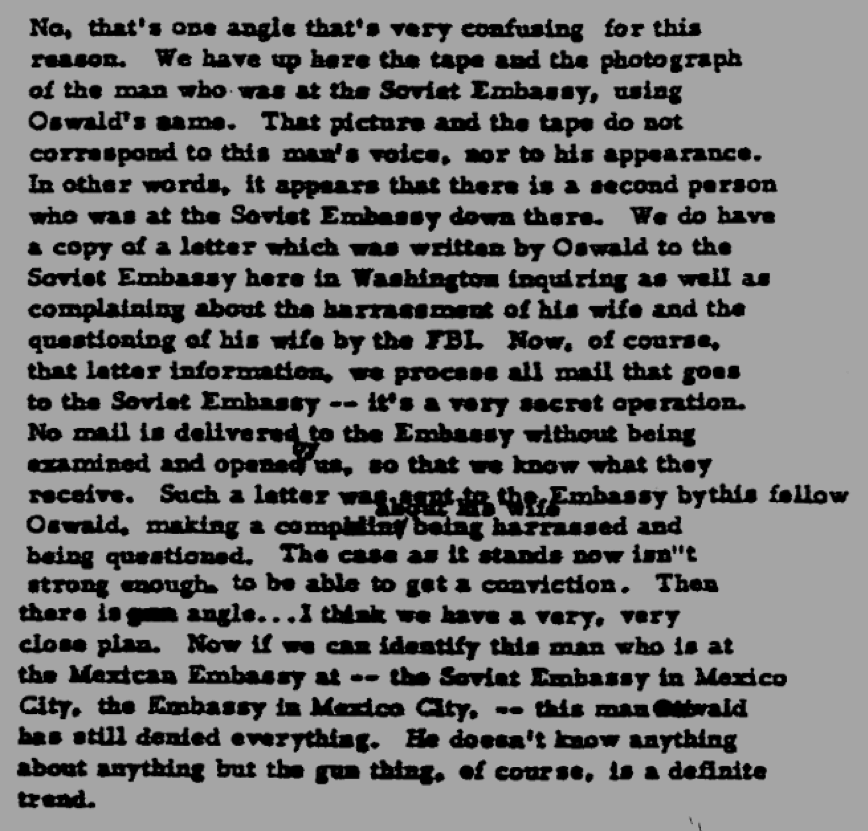
    The Soviet Embassy and Cuban Consulate in Mexico City were thoroughly monitored by the CIA, which possessed tape recordings, photographs, and transcripts supposedly of Oswald, as he went in and out of those buildings, and from his telephone calls to them. The CIA station sent this information to the FBI in Dallas on the morning of November 23, 1963. Astonishingly, the FBI Agents in Dallas discovered that neither the voice on the recording nor the man in the photographs matched Lee Harvey Oswald, the man in custody. J. Edgar Hoover gave this news to LBJ that morning of the mismatch (a “second person”), and then later to head of the Secret Service about an impostor (“individual was not Lee Harvey Oswald”). The implications of an imposter are quite significant since it could mean a conspirator, not Oswald, was attempting to lay blame to the Cubans and/or Soviets to incite a retaliatory, military response; if not to consciously induce a cover-up of an assassination conspiracy with a lone assassin scenario, by planting a false trail to the KGB (Deep Politics and the Death of JFK, pp. 38-41, by Peter Scott). We now know that this succeeded with LBJ, who intimidated Chief Justice Warren to participate in the Warren Commission, and the infamous Katzenbach memo urging that “The public must be satisfied that Oswald was the assassin; that he did not have confederates who are still at large; and that the evidence was such that he would have been convicted at trial” (Flip De Mey, pp. 294).

    The CIA and FBI belatedly tried to explain away the photos and tapes, but other sources and rationalizations refute such back-pedalling (As an example, how does one confuse a tape-recording or listening to one, for a transcript? Several other reasons are enumerated in the book, The Lee Harvey Oswald Files, by Flip De Mey, pp. 289 – 291). Moreover, neither LBJ nor Hoover repudiated their initial, recorded communications about an impostor. In fact, Hoover seven weeks after the assassination, scribbled at the bottom of an FBI memo “O.K., but I hope you are not being taken in. I can’t forget the CIA withholding the French espionage activities in the USA nor the false story re Oswald’s trip to Mexico, only to mention two instances of their double-dealing.” (Douglass, p. 81).

    To reinforce the aforementioned cases of double Oswalds, there were other instances of possible Oswald impostors around Dallas, in particular, the encounter by Silvia Odio on September 25th if not the 26th, which is suspicious since Oswald cashed a check in New Orleans on the day that he supposedly was in Dallas and/or was on his way to Mexico City through Houston then Laredo. And in another case, much earlier in Russia, from a 1960 memo by J. Edgar Hoover to the State Department, warning “there is a possibility that an impostor is using Oswald’s birth certificate.” [Jim Marrs, Crossfire, p. 209, Basic Books,Kindle Edition]. But it doesn’t end there, as there was a December 2nd, 1963 report by SSA Floyd Boring that a credible witness encountered an Oswald look-a-like in Washington, D.C. on September 27th, 1963, when the Warren Commission was adamant that “Oswald” was in Mexico City on that date! (Honest Answers by Vince Palamara, pp. 201- 202, Kindle Edition)

    The other main conspiracy theory in Mexico City involves a young, Nicaraguan named Gilberto Alvarado Ugarte, who was revealed to be a “penetration agent of the right-wing Somoza government of Nicaragua” (Oswald, Mexico & Deep Politics, Peter Scott, p. 36, Kindle Edition) and a CIA informant (Our Man In Mexico: Winston Scott & the Hidden History of the CIA, Jefferson Morley, Location 4512, Kindle Edition). The basic story is that Alvarado says that on September 18, 1963, he witnessed a Cuban give Oswald a total of $6,500, presumably to hire him to kill the President. He claims to have heard Oswald say to the Cuban (a red-haired black man) “You’re not man enough – I can do it”. The problem with that story was that Oswald was not in Mexico on that date and Alvarado later failed a polygraph test. Yet in its early stages, it was promoted by the CIA Mexico City Station via Win Scott and David Phillips and Ambassador Thomas Mann.

    Alvarado’s claim was flashed to Washington for the attention of the FBI and the State Department—and the White House, where it became one of the first pieces of “evidence” to sow the idea of a Castro conspiracy in the new President’s mind. Twenty-four hours later, the CIA reported information “from a sensitive and reliable source” that tended to confirm Alvarado’s story.” (Anthony Summers, Not in Your Lifetime p. 388 Open Road Media. Kindle Edition).

    Yet, “In spite of the holes in Alvarado’s claim about Oswald, his allegation was brought to President Johnson’s attention on at least three occasions and for some time remained a live issue.” (Summers, ibid, p. 391).

    The historical significance of the latter conspiracy theory (together with the Kostikov story) clearly outweighs the one promoted by Professor Soltero involving Oscar Contreras. Because on the basis of the foregoing story, LBJ persuaded Chief Justice Earl Warren that 39 million American lives were at stake if war broke out with the Soviets via Cuba, something that was not going to happen under the Johnson administration, along with any mention of any international Communist conspiracy. Thus, the lone assassin scenario was adopted with the creation of the Warren Commission on November 30th, 1963, which pre-empted any independent Congressional investigation.

    Professor Gonzalo Soltero began his online article with a blanket statement that ‘most conspiracy theories surrounding President John F. Kennedy’s assassination have been disproven’, using two outlandish theories as examples, while ignoring all the additional file releases by the ARRB and cumulative work of researchers since the 1990s that point to a conspiracy. This establishes the bias for the ensuing narrative, despite acknowledging the existence of conspiracies in his book Conspiracy Narratives: South of the Border which contains some statements at odds with the rather blanket denial: “conspiracies are planned and executed, and evil squadrons do exist” (p. 19), “the DFS were bad hombres”, “DFS agents were the local muscle for the CIA”, and “the agency (CIA) ran assassination and sabotage missions against other countries” (p. 93 –Kindle Edition).

    He claims that the account of Oscar Contreras, a pro-Castro law student and gossip column journalist, who says he met someone that identified himself as Lee Harvey Oswald asking for assistance to procure a travel visa to Cuba, was a fabrication. Why? Because he could not be in Mexico City while covering social events in Tampico, and therefore that a “main conspiracy theory” about Oswald being “in contact with dangerous Mexicans on the left side of the Cold War” is debunked. Yet the basis for his claim is actually not substantiated by the dates and details of newspaper columns during the time that Oswald visited Mexico City in late September/early October 1963. (And it seems superfluous to add, other witnesses also encountered the short, blonde Oswald.)

    The relevance of this is that it leaves open the possibility that Contreras met Lee Harvey Oswald, or more importantly, an impostor based on his description and the descriptions by others; not to mention other reported cases of someone impersonating Oswald in Mexico City and beyond. This also resuscitates the belief by Phillip Shenon and Dan Hardway that Oscar Contreras was a credible witness. However, unlike Shenon, Hardway thinks the evidence of Cuban assistance to Oswald is very weak at best, which is also contrary to Soltero’s statement that Hardway “reiterated in 2015 that Lee Harvey Oswald might have been part of a wider Cuban intelligence web”. In fact, Contreras was warned by Cuban Consular staff and an intelligence officer to avoid Oswald as they suspected he was trying to infiltrate pro Castro groups (Hardway, 2015). This parallels the time that Oswald was used to identify and contact pro-Castro students at Tulane University in New Orleans (Ibid). Soltero does not mention the issue of an Oswald impersonator in his online article, but does allude to it in his book. But he dismisses the issue of impersonators in Mexico City as “an espionage operation (counterintelligence impersonation – CIA assets pretending to be Oswald and Silvia Duran) getting caught in another espionage operation (telephone and photographic surveillance). And then the CIA had to cover its tracks to protect their own sources and operations, some of which were covert and perhaps illegal.” (Gonzalo, p.99, Kindle Edition).

    How can this be an innocent explanation without considering the possibility that Oswald was being used in an intelligence operation as an “intelligence dangle” or “an attempt to discredit the FPCC, or both?” (Hardway, 2015) Moreover, Hardway says this suggests that Oswald’s trip to Mexico was either designed in advance, or spun in the aftermath, to give the appearance of Cuban and Soviet collusion in the Kennedy Assassination” (Ibid). And, let’s not forget: the conditions ripe to set up a scapegoat, the patsy in Dallas. A patsy who was an opponent of Castro to Silvia Odio in Dallas, but pro-Castro in Mexico City.

    This is an inconsistency that should raise red flags, but not to Soltero, who concludes that Oswald was a “disorganized loner who couldn’t handle travel logistics.” Notwithstanding that Oswald successfully managed a trip to the Soviet Union, purportedly as a defector during the Cold War, and returned to the U.S. with hardly a hassle.   Professor Soltero concludes that the JFK Assassination is a cold case and that only exhausted leads remain in Mexico. I agree with the former but not the latter: especially since the CIA resisted the HSCA’s inquiry into that area of their investigation (Ibid). Not to mention the delay on the release of classified files relating to the JFK assassination, which continues to this very day.

    And lastly, critics of the Warren Commission or researchers involved in this case, are not concerned with narrativity, or telling a good story, but to ascertain the facts and follow them to reach definitive, evidentiary-based conclusions, if not just to establish reasonable doubt. This is not paranoia, but a quest for justice and the truth.

    [Note: This author thanks Robert Rafael Esquivel Diaz for his translation service and insight.]

  • Destitute Cuban Studies Institute on the JFK Assassination

    Destitute Cuban Studies Institute on the JFK Assassination


    The Executive Director of the so-called Cuban Studies Institute (CSI), Pedro Roig, presents himself as an attorney and historian in posting “Castro’s Complicity in Kennedy’s Assassination.” The piece leaves much to be desired of Roig’s expertise in both legal and historic studies. It exposes the CSI as a sanctuary of shameless and mindless anti-Castro propaganda. Let’s review Roig’s endeavor to persuade without regard for truth.

    Oswald Contact with Cuban Security Agents

    • “It is now evident that Oswald made contact with Cuban intelligence officers while stationed at El Toro Marine Air Base in Santa Ana, California.”

    No, it’s not. The FBI interviewed 26 U.S. Marines acquainted with Oswald at El Toro. None of them connected Oswald to the budding Castro’s foreign intelligence. Roig cherry-picked Nelson Delgado and disguises his presumptions as quantum of proof.

    • “Under oath, Delgado stated that ‘Oswald told him he was receiving mail from Cubans and had developed contact with Cuban government officials in Los Angeles. Delgado recalled that Oswald met with an unknown visitor … and they spent about one and a half, two hours talking.’”

    Let’s summarize what Wesley J. Liebeler, assistant counsel of the Warren Commission, got from Delgado under oath, upon which Roig dares to even suggest that a Cuban handler came to a U.S. military base at night to talk with his agent Oswald.

    Liebeler: You never asked Oswald who this fellow was that he talked to?

    Delgado: No, no.

    Q: Did you connect this visit that Oswald had at that time with the Cuban Consulate?

    A: Personally, I did, because I thought it funny for him to be receiving a caller at such a late date time … After he started to get in contact with these Cuban people, he started getting little pamphlets and newspapers.

    Q: Did you have any reason to believe that these things came to Oswald from the Cuban Consulate?

    A: Well, I took it for granted that they did after I seen the envelope…

    Q: What was on this envelope that made you think that?

    A: Something like a Mexican eagle, with a big, impressive seal, you know. They had different colors on it, red and white … But I can’t recall the seal. I just knew it was in Latin, United, something like that.

    Q: You don’t know for sure whether it was from the Cuban Consulate?

    A: No. But he had told me prior, just before I found that envelope in his wall locker, that he was receiving mail from them.

    Q: Did he tell you what his correspondence with the Cuban Consulate was about?

    A: No, he didn’t.

    As earwitness, Delgado didn’t know who visited Oswald one night at El Toro; as eyewitness, he described an impressive seal that could be anything but Cuban stuff. Roig has simply recycled the failed 1975 CIA trick of giving Delgado evidential weight to dispel the growing cloud of suspicion over the CIA itself and to point the finger at Castro. Thus, Roig has only proven that the CSI comes to the JFK research community with the spurious arguments of a previous generation.

    In Oswald and the CIA (Carroll & Graf, 1995, 627 pages / Skyhorse, 2008, 696 pages), retired Major John M. Newman, who spent 20 years in U.S. Army Intelligence and became executive assistant of the National Security Agency (NSA), killed the two Delgado birds flown by the CIA with one stone. The ex-Marine Gerry Patrick Hemming told his 1960 CIA debriefers that he had met Oswald at the Cuban Consulate in Los Angeles and then confronted him about it outside the gate at El Toro the night before flying to Washington. In an interview by Dick Russell, Hemming destroyed the wild presumption of a 1959 link between Oswald and the budding Castro’s intelligence services:

    I ran into Oswald in Los Angeles in 1959, when he showed up at the Cuban Consulate. The coordinator of the 26th of July Movement [Castro’s political group] called me aside and said a Marine officer had showed up, intimating that he was prepared to desert and go to Cuba to become a revolutionary. I met with the Marine … I thought he was a “penetrator” [and] I told the 26th of July leadership to get rid of him. (Argosy, Vol. 383, No. 3, April 1976)

    In contrast to Oswald, Hemming did manage to join Castro’s army; in line with Oswald, he also exemplifies the adventurous spirit among many Americans in the early days of the triumphant Cuban revolution. Oswald was released by the U.S. Marine Corps at El Toro on September 11, 1959. On September 3-4, 1959, U.S. Ambassador Phillip Bonsal still expressed “the general sympathy with objectives of Cuban revolution and similarity with many of our own aims and aspirations.” (Foreign Relations of The U.S., 1958–1960, Volume VI, Cuba, Document 359)

    Roig hides this Zeitgeist to portray Oswald as a fully dedicated soldier for Castro: “[Delgado] testified that Oswald kept on asking him ‘how he could help Castro’”. Roig stops here, but the beat goes on with Delgado explaining: “We were on friendly terms with Cuba, you know, so this wasn’t no subversive or malintent”. Delgado clearly revealed the adventurous spirit:

    [W]e had a head start, you see. We were getting honorable discharges, while Morgan [Delgado meant Major William Morgan, who also had been infatuated with the Cuban revolution and ended up executed by firing squad under charge of rebellion against Castro] got a dishonorable discharge from the Army and he went to Castro and fought with Castro. So, we could go over there and become officers and lead an expedition to some of these other islands and free them too … [W]e would do away with Trujillo [The dictator of Dominican Republic, the Caribbean nation that shares the island of Hispaniola with Haiti].

    However, Roig keeps on building a body of evidence about a Castroite Oswald, in a way that resembles the fate of the Cuban character “Chacumbele,” who killed himself. After acknowledging that “defectors like Oswald [were] under close surveillance” by the KGB, Roig broaches a “suspicious coincidence.” In Minsk (Belarus), Oswald was directed to enroll in a Foreign Language School “adjacent to the KGB Academy, attended by Cuban security personnel.”

    The coincidence is not suspicious, but absolutely irrelevant. There is not a shred of evidence in reference to Cuban security personnel and Oswald in his KGB file, which includes daily reports of intensive surveillance, even through a peephole into his bedroom. In addressing this lack of evidence, Roig has concocted an undrinkable cocktail: Marina Oswald “testified that Oswald bragged that he had gotten close to some of the Cubans [and] remembered the Cubans with pleasant memories.”

    Marina clearly stated that Oswald knew “a Cuban family” and she had heard about 300 Cubans in Minsk, “but I never knew even a single one.” In fact, Oswald knew a man named Alfred (last name unknown) from Cuba and a picture of them together is provided by [Warren] Commission Exhibit 2612. Newman demonstrated Alfred does not provide scope for suspicions. He was a student at the University of Minsk and his parents visited him. Oswald knew him through Anita Zieger, who was courted by Alfred. She and her family—of Argentinian origin—were friends of the Oswalds in Minsk.

    Oswald’s Alleged Visits to the Cuban Consulate in Mexico City

    Roig continues his deceptive handling of the facts by masking Oswald as “a militant advocate of the Fair Play for Cuba Committee.” He also labels the FPCC “as a Communist front that supported the Castro’s Marxist-Leninist revolution.” Ironically, this remark closes his new avenue of deception for good.

    In the Spring 1963, Oswald formed a one-man New Orleans chapter of FPCC. Although its leadership warned him about “unnecessary incidents,” Oswald walked into a lair of the anti-Castro Student Revolutionary Directorate (DRE) to offer help. On August 9, he was handing out pro-Castro leaflets in downtown New Orleans. A brawl with DRE militants eventually ensued, but it was staged. Oswald had described the incident in a letter to FPCC postmarked five days before. Less than two weeks thereafter, Oswald and the local DRE head, Carlos Bringuier, met again on a debate at WDSU radio.

    Bringuier exposed Oswald as a re-defector from the Soviet Union. Oswald turned the tables by boasting about his stay there as “excellent qualification to repudiate charges that the FPCC is Communist controlled.” He stressed: “It is inconsistent with my ideals to support Communism … We do not feel that we are supporting international Communism in supporting Fidel.”

    Within a week, Oswald wrote to the Communist Party USA (CPUSA), in order to leave a paper trail of the very linkages he had denied on the air: “I am the secretary of the local brach (sic) of the FPCC, a position which, frankly, I have used to foster communist ideals.” A prime soldier for Fidel Castro does not stab him in the back.

    Roig circumvents the most burning question about Oswald in Mexico City by quoting from the unpublished autobiography of Winston Scott [CIA Chief of Station]: “Every piece of information concerning Oswald was reported immediately … These reports were made on all his contacts, with both the Cuban Consulate and the Soviets … Persons watching these embassies photographed Oswald as he entered and left; and clocked the time he spent on each visit.”

    The core factual issue is that the CIA has never produced either a photo of Oswald nor a tape with his voice on it from Mexico City. Win Scott himself overlooked Oswald in his September 1963 report on the CIA telephone tapping program LIENVOY, although an American in phone contact with both Cuban and Soviet embassies was ipso facto of operational interest. In his attempt to escape from the facts, Roig falls into a preposterous dual story:

    In March 1968, President Lyndon Johnson … requested from his close associate (sic) Marty Underwood to meet with Scott in Mexico City. The timing was excellent … In the meeting with Underwood, Scott stated that early in the morning of November 22, 1963, a small Cuban airplane landed at the Mexico City Airport. The passenger transferred to another plane, that immediately took off for Dallas, Texas. Later that evening, the same plane returned from Dallas and the individual transferred to the Cuban aircraft the flew back to Havana. After many months of investigation, the CIA was confident that the individual was Fabian Escalante.

    Just the timing reveals Roig’s ignorance. Underwood’s only trip to Mexico City occurred in 1966. During his brief meeting with Scott, according to Underwood’s own notes, there was not the slightest reference to November 22, 1963. As a White House advance man, Underwood sought help from Scott for Johnson’s upcoming visit to Mexico. (ARRB Final Report, p. 136) And Escalante—as counterintelligence officer in the Section Q of Castro’s G-2—was so busy in 1963 watching anti-Castro fighters inside Cuba or in exile that he couldn’t have timed a wet operation, id est, involving spilling blood.

    It is incredible that Roig would fall for the deceased Underwood. Because, as noted above, Underwood was exposed for telling fairy tales back in 1998 when the Final Report of the Assassination Records Review Board was published. Not only was his canard about Scott then revealed, but he had also been telling tall tales to Gus Russo and Sy Hersh for the deceitful Judith Exner. And those two willingly gobbled them up. (Ibid)

    State Department: “Do Not Implicate Cuba”

    From the bamboozler Underwood, Roig jumps to Thomas Mann, U.S. Ambassador to Mexico, who “has the answer” about what happened to the CIA files on Oswald in Mexico City. Mann “was personally ordered by the State Department, a few days after Oswald murdered President Kennedy, to shut down any investigation that would implicate Cuba’s involvement.” Roig added that a top CIA official, Tom Karamessinger (sic), memoed Scott: “Arrest of Sylvia Duran is extremely serious matter which could prejudice (us) … Request you ensure that her arrest is kept absolutely secret, that no information from her is published or leaked.”

    Roig is muddying the waters as if the report Oswald, the CIA, and Mexico City (1978), written by HSCA staffers Dan Hardway and Edwin Lopez, hasn’t gone through rounds of declassification since 1993. It became clear that the CIA knew Oswald had been impersonated by phone on September 28 and October 1. Duran was also impersonated on September 28.

    That Saturday, a caller to the Soviet Consulate identified herself as Duran and announced that “an American that was just at the Soviet Embassy … is going to talk with you.” The CIA transcriber, Boris Tarasoff, commented that the American “speaks terrible, hardly recognizable Russian.” On October 1, a caller to the Soviet Consulate identified himself as Lee Oswald. Tarasoff noted he was “the same person who had called a day or so ago and spoken in broken Russian.” Duran was arrested and harshly interrogated by the Mexican Police on November 23 and November 28. The info taken from her included that she neither met Oswald nor made any call to the Soviet Consulate on September 28.

    Duran emphasized “she had no fear [of] extradition to the United States to face Oswald.” On the contrary, the CIA was afraid [that] “any Americans [might] confront Silvia DURAN or […] be in contact with her” [DIR 85318, 11-27-63, in [Duran’s] Information – NARA Record Number: 104-10102-10145, p. 14]. That’s why neither the eyewitness Duran nor the earwitness Tarasoff were ever questioned about the call by the Warren Commission. The CIA itself, not the State Department, shut down any further investigation on a Cuban connection after its Mexico City station not only produced both a tape and a photo that weren’t Oswald’s, but also spread stories—all of them debunked—of Communist conspiracies:

    • Mexican writer Elena Garro de Paz transformed Duran from the Mexican employee, who handled Oswald’s visa request at the Cuban Consulate, into the intelligence officer of Castro, who met Oswald again at a twist party in order to put him up to killing Kennedy.
    • Nicaraguan secret agent Gilberto Alvarado watched Oswald taking $6500 in the Cuban Embassy to kill Kennedy, while Mexican credit examiner Pedro Gutierrez saw Oswald taking money outside the Cuban Embassy.
    • Cuban Embassy employee Luisa Calderon expressed foreknowledge of JFK’s assassination…

    Fidel Castro vs. John F. Kennedy

    Roig comes to his overarching issue with an “unavoidable” clash between Castro and JFK. As veteran of the Brigade 2506, he is as misguided in his analysis now as he was as a member of the force that failed twice in making a diversionary landing near Guantanamo in mid-April 1961. Roig rarefies JFK’s oath—in the December 29, 1962, ceremony at the Orange Bowl stadium (Miami) with the participants in the Bay of Pigs invasion just released from Castro’s prison—that the flag of the Assault Brigade 2506 was to “fly again in a free Havana.”

    For Roig, it was the spark that ignited Castro to engage in “a personal fight to the end” against Kennedy but that’s an utter cognitive distortion of history. On Christmas Eve 1962, the American lawyer Jim Donovan boarded the last flight with the Bay of Pigs prisoners airlifted to Miami as result of his negotiation with Castro. Just before departure, Castro’s aide Dr. Rene Vallejo broached the subject of re-establishing diplomatic relations between the two countries.

    Let’s suppose Castro was, indeed, trying to lure Kennedy. Even so, killing the sitting U.S. President offered nothing else to gain than having Johnson in the White House with no hope of more favorable U.S. policies toward Cuba. The Soviet bloc’s diplomats in Havana were aware of it. On March 31, 1963, Hungarian Ambassador János Beck set out in a secret report to Budapest that Castro was convinced “Kennedy is the best” option among the possible candidates for the U.S. presidency in 1964 (“Talks between Cuba and the USA, March 31, 1963,” in Selected Hungarian Documents on Cuba, 1960-1963,” Cold War History Research Center [Budapest]).

    The anti-Castro fighter Roig is not aware yet of who his greatest enemy was. Castro knew that killing JFK wouldn´t solve anything and entailed risking everything. His personal fight was system-centered. Accordingly, he proceeded to infiltrate both the CIA and the Cuban exile community. Thus, Castro managed to win in the dirty USA-Cuba war.

    Rolando Cubela Secade (sic): The Double Agent Chosen to Kill Fidel Castro

    Nonetheless, Roig obsessively resorted to the neither logically nor circumstantially justified hypothesis brought by Senator Robert Morgan (D / N.C.) of the Church Committee: “JFK was assassinated by Fidel Castro or someone under his influence in retaliation for our efforts to assassinate him [and] this fellow [Cubela] was nothing but a double agent.”

    This fellow [AMLASH-1 for the CIA] was involved in two assassination plots against Castro. His key co-conspirators were the CIA officer Desmond FitzGerald [Chief of the anti-Castro Task Force known as Special Affair Staff (SAS)] and the CIA golden boy Manuel Artime [Chief of the anti-Castro paramilitary group Revolutionary Recovery Movement (MRR)]. Cubela does not fit at all into the facts as double agent loyal to Castro.

    • For unveiling the Artime-Cubela plot, Castro burned his intelligence officer Juan Felaifel, who had infiltrated the CIA in 1963. Another officer, Erasmo Terrero, was gathering evidence against Cubela in Paris. On March 11, 1966 Cubela was sentenced to 25 years.
    • For unveiling the FitzGerald-Cubela plot, Castro had to wait for a July 16, 1976, report by his State Security Department (DSE) stating that the “counterrevolutionary inmate” Cubela was the CIA agent AMLASH-1 who surfaced at the Church Committee. Before that, Castro lacked intel on this 1963 CIA plot.

    At the XI World Festival of Youth and Students in Havana, Castro set up an agitprop court to prosecute the crimes committed by Yankee imperialism. On August 2, 1978, Cubela confessed to both CIA assassination plots against Castro and spelled an inconvenient truth for Roig: “It is absurd to think that a double agent would have spent 12 years in jail.” Cubela also testified before an HSCA panel in Havana. Castro rewarded him by granting the parole legally prescribed after serving half the sentence.

    The Cuban Exile Clandestine Operations

    As a fugitive from history, Roig runs so fast that he misses the two-track policy of the Kennedy administration towards Cuba after the debacle of Operation Mongoose. Roig just follows the track of (sometimes) autonomous operations by select Cuban exile groups, backed, in any event, by the CIA, and forgets the parallel track of accommodation with Castro. In fact, due to the ARRB, we now know just how feeble this activity was. For the incoming president Lyndon Johnson, CIA officer Desmond Fitzgerald wrote a report on what these operations consisted of at the time. He wrote that in the entire second half of 1963, there had been a total of five raids against Cuba. There were only fifty men involved in three cadres. In this letter, Fitzgerald admitted it was completely unrealistic to think that such a meager force would result in any real change in Cuba. He stated that they had now become counter productive, since they could not be taken seriously. And he advised they be discontinued. (Letter from Fitzgerald to McGeorge Bundy, 3/6/64)

    Ignoring this factual aspect, Roig can please himself with a pharisaic righteousness: Kennedy remained “true to his commitment to get rid of Fidel Castro,” thus ignoring Kennedy’s crackdown on other anti-Castro belligerent exiles groups. How the administration was going to overthrow Castro with fifty men is the author’s secret. Perhaps Roig was modeling his essay on the Peter Sellers comedy The Mouse that Roared?

    “Listen to Communications from Texas”

    After such an intermezzo, Roig next stages an act against intellectual integrity. The protagonist is the late Cuban defector Florentino Aspillaga, who back in 1963 was working for Castro at a listening post in Jaimanitas [a small beach town near Castro’s main residence, dubbed as Point Zero, seven miles west of Havana]. The script reads thus:

    On Friday morning, November 22, 1963, Aspillaga received precise orders: “The leadership wants you to stop all your CIA work, (repeat), All your CIA work” and listen to communications from Texas. Around 1:30 (Havana Time), “I began hearing broadcast on amateur radio bands about the shooting of President Kennedy in Dallas.”

    Roig drops the question: “Did Fidel Castro know Kennedy would be killed?” instead of asking: “Who would believe such a tale?” Castro would have never resorted to electronic intelligence to learn something that would have been instantly available through mass media. In 1963, info about anything occurring in Dallas during the JFK visit meant broadcast reports interrupting soap operas on the three national TV networks, and radio stations giving breaking news.

    Aspillaga was in fact a self-defeating storyteller. Radio amateurs must have just been chatting about what the commercial media had already reported. In late 1963, a unique witness gave conclusive evidence contradicting Aspillaga’s claim. French journalist Jean Daniel wrote a first-hand account (“When Castro Heard the News,” The New Republic, December 7, 1963). As Kennedy’s emissary, he was talking with Castro in Varadero Beach the very day of the assassination. After a phone call by Cuban President Osvaldo Dorticós, Castro got all the news “from the NBC network in Miami.” Daniel also recounted Castro was utterly shocked and turned to him saying—about the plans for rapprochement—that everything was going to change.

    Aspillaga told Dr. Brian Latell in 2007 that the CIA had learned the Jaimanitas’ story during his debriefing in 1987. However, it is not to be found among the documents—either declassified or withheld—from the National Archives and Records Administration (NARA) on the JFK assassination. The CIA would not have objected to furnishing a carefully redacted Aspillaga debriefing to the Assassination Records Review Board (ARRB).

    The Paris Meting (sic): Assurance of American support

    In this intermezzo, Roig again addresses Operation AMLASH to reinforce the discredited notion of Cubela as fake conspirator. The Castroite General Directorate of Intelligence (DGI) did not control but rather watched Cubela with a certain inefficiency. Before the Church Committee, the CIA moved to transfigure him into a double agent, even a provocateur, to hide its own shortcoming in recruiting a heavy-drinking, loquacious, third-rate Castro official who couldn’t provide any valuable service.

    The DGI manipulated Oswald’s Violent Outburst at the Cuban Consulate in Mexico City?

    Roig stages this act with an outright lie:

    Oswald requested at the Cuban Consulate in the City of Mexico a transit visa to Russia via Cuba and was denied. Oswald turned violent and began screaming “I am going to kill Kennedy.”

    As FBI super-spy Jakob “Jack Childs” informed J. Edgar Hoover, Castro himself recounted:

    I was told this by my people in the Embassy exactly how he (Oswald) stalked in and walked in and ran out. That in itself was a suspicious movement, because nobody comes to an Embassy for a visa (they go to a Consulate) [W]hen Oswald was refused his visa at the Cuban Embassy in Mexico City, he acted like a madman and started yelling and shouting on his way out, “I’m going to kill this bastard. I’m going to kill Kennedy” [Castro]was speaking on the basis of facts given to him by his embassy personnel, who dealt with Oswald, and apparently had made a full, detailed report to Castro after President Kennedy was assassinated.

    The Consulate was in a separate building from the Embassy. The Cuban diplomatic compound in Mexico City was located at Francisco Marquez Street (Colonia Condesa) with two main entrances: one to the Embassy, on the corner of Tacubaya Alley, and the other to the Consulate, on the corner of Zamora Street. Both the outgoing (Eusebio Azcue) and incoming (Alfredo Mirabal) consuls testified before HSCA that they did not hear Oswald threatening Kennedy’s life. Neither did the Mexican employee Sylvia Duran, who was consistent about it in both her interrogation by Mexican Police and her interview by the HSCA, nor did two other witnesses who had come downstairs from the Commercial Office.

    Roig’s opera seria continues as a vaudeville with a substandard duet: DGI defector Vladimir Rodriguez [dispatched by his own CIA debriefer, Harold Swenson, as lacking “any significant information” on Oswald] and Oscar Marino [an alleged former Cuban intelligence officer imported from the bestiary described by Gus Russo and Stephen Molton in Brothers in Arms (Bloomsbury USA, 2008)]. Roig closes the act by foisting two “outrageous lies [on Castro as] part of a premeditated deniability perfidy[:] that he knew nothing of Oswald’s existence before the Dallas assassination and that he was never informed of Oswald’s threatening remarks against Kennedy in the Cuban Consulate in Mexico City”. The latter is refuted by Childs’ report; the former is still wanting for any evidence.

    Fidel Castro Got Kennedy First

    Before the curtain falls, Roig concocts a Castroite Oswald with a Castro prone to react to the CIA plots against him in the spaghetti western manner summed up by Lyndon Johnson: “Kennedy was trying to get Castro, but Castro got to him first.” Such a fact-free approach thrives only on claques of people who cannot think logically or will not think logically, because they have a fanatical and counterproductive anti-Castro agenda.

  • Oswald’s Last Letter:  The Scorching Hot Potato

    Oswald’s Last Letter: The Scorching Hot Potato


    So much time is spent in the JFK assassination debate arguing about shaky evidence that we have seen serious researchers sometimes turn on one another and lone-nut apologists then pounce and deliver their salvos portraying the research community as made up of quacks. This is even though the official HSCA conclusions, as well as the opinions of an overwhelming number of government inquiry insiders, clearly discredit the Warren Commission conclusion that Oswald and Jack Ruby both acted alone. Therefore, this author has steered clear of discussions around subjects such as Judyth Vary Baker, Madeleine Brown, James Files, the Badge Man photo, the Prayer Man photo, etc.

    My focus has always been on smoking gun evidence. There are three levels of smoking guns:

    1. Those that prove that the Warren Commission inquiry is impeached.
    2. Those that demonstrate conclusively that there was a conspiracy.
    3. Those that prove who some of the conspirators were.

    There are a number that prove the first two points:

    1. Conclusions from post-Warren Commission inquiries and statements made by the investigation insiders.
    2. Oswald during his short life had touch points with over seventy-five people with plausible intelligence links including over thirty with definite ones.
    3. Ruby had ties with the mob including some who are suspects in the assassination such as Santo Trafficante.
    4. Oswald was impersonated in Mexico City.
    5. Too many witnesses in Dealey Plaza, as well as those who inspected the president’s wounds, confirmed a front shot.
    6. The demolishing of the Single Bullet theory.
    7. The similarities in the prior plots to kill JFK.
    8. The weak security on November 22, 1963, and the behavior of some Secret Service operatives.
    9. The obvious cover-up.

    There are none at this point that prove beyond a shadow of a doubt who the conspirators were. Some do expose persons of extreme interest, these include:

    1. Oswald’s summer in New Orleans in 1963.
    2. Oswald’s and Ruby’s links to Trafficante and intelligence.
    3. The case against David Atlee Phillips.

    In this article, we will look at another important piece of evidence and let the reader decide whether it rises to the level of a smoking gun: Oswald’s last letter!

    Dueling Spins

    On the very day that Kennedy was assassinated, forces that desperately wanted the overthrow of the Castro regime went into a press relations frenzy, most likely led by CIA propaganda whizz David Atlee Phillips. The tale they were peddling was that Cuba and Russia were Oswald’s backers.

    Much has been written about the steps taken to sheep-dip Oswald in 1963, so that he could come out looking like an unbalanced Castro sympathizer: the famous backyard photos of him holding alleged murder weapons, as well as communist literature, his recruitment efforts for the Fair Play for Cuba Committee, his scapegoating in the General Walker murder attempt, and his interviews in New Orleans where he openly paints himself as a Castroite.

    Some steps, however, went further. They were designed to make Oswald seem to be in league with Cuban and Russian agents, plotters, and assassins. They came out of the assassination play-book code-named ZR Rifle, authored by exiled, CIA super-agent William Harvey. It would have given the U.S. the excuse they needed to invade Cuba. But the new President Lyndon Johnson eventually nixed this stratagem.

    Persons of interest like John Martino, Frank Sturgis, and Phillips-linked contacts (Carlos Bringuier, Ed Butler, and journalist Hal Hendrix) began a “Castro was behind it” spin to the assassination.

    Carlos Bringuier of the DRE, who had gotten into what was likely a staged fight with Oswald on Canal Street in New Orleans in August of 1963, also wrote a press release that was published the day after the assassination to position Castro as being in cahoots with Oswald.

    The DRE was actually set up under William Kent in 1960, working for David Phillips. David Morales was the group’s military case officer. Later, with Phillips in Mexico City, Kent was George Joannides supervisor. Kent’s daughter told Gaeton Fonzi that her father never mentioned Oswald except one time over dinner. He stated that Oswald was a “useful idiot”.

    Through Ed Butler and the CIA-associated INCA, Oswald’s apparent charade and his televised interview went a long way in painting his leftist persona to the public at large. INCA had been used by Phillips for propaganda purposes during the period leading up to the Bay of Pigs. Butler was quick to send recordings to key people on the day of the assassination.

    These frame-up tactics were the ones the cover-up artists wished had never occurred and worked hard to make disappear. The perpetrators of the framing of Castro offensive soon ran into stiff competition after Oswald was conveniently rubbed out. The White House and the FBI concluded, without even investigating, that both Oswald and Ruby were lone nuts. The pro-Cuba invasion forces were overmatched and their intel leaders had no choice but to fall in line.

    But it was too late, there was too much spilled milk around plan A. In time, government inquiry investigators like Gaeton Fonzi, Dan Hardway, and Eddie Lopez, along with some very determined independent researchers, would uncover leads that all pointed in the same direction: Oswald was framed to appear to be in league with Cuban and Russian agents.

    This can only lead to two possibilities. If Oswald was in cahoots with foreign agents, there was a foreign conspiracy to remove the president. In the more likely scenario that Oswald was being framed to look like he was cahoots with foreign agents, there was a domestic conspiracy to remove the president. In both cases, the lone-nut fairy-tale is obliterated.

    Spilled Milk

    Oswald and Kostikov

    On September 27, 1963, Oswald allegedly travelled to Mexico City and visited both the Cuban consulate and the Russian embassy, in a failed attempt to obtain a visa to enter Cuba. FBI agents, who had listened to tapes of Oswald phone calls made while in the Cuban consulate, and Cuban consul Eusibio Azque, confirmed that there was an Oswald imposter.

    In October 1963, the CIA produced five documents on Oswald that linked him to Valery Kostikov. One of the claims was that they had met in the Russian Embassy in Mexico City. Kostikov was later described as “an identified KGB officer … in an operation which is evidently sponsored by the KGB’s 13th Department (responsible for sabotage and assassination).” They also confirmed that they felt that there were either fake phone calls made by an Oswald impostor to Kostikov while he was allegedly in Mexico or at least faked transcripts.

    In September 1964, the case against Kostikov took a bizarre turn, when a September 1, 1964, Hoover memo (105-124016) to the CIA seemed to indicate that the CIA (James Angleton’s department) in fact had no evidence to prove Kostikov was part of the infamous Department 13.

    This means either one of two things:

    1. Angleton knew Kostikov’s connection to Department 13 was unfounded, but tried to recycle that info in November.
    2. Angleton lied to Hoover on June 25, 1963, perhaps for the same reason (to keep the lid on it until November 22).

    David Atlee Phillips’ dirty tricks

    HSCA investigator Dan Hardway hypothesizes that, because of compartmentalization, Phillips and Oswald may have found out on November 22, 1963, that Oswald was a patsy and Phillips received orders to tie the murder to Castro.

    In a critique of Phil Shenon’s work written for the AARC in 2015, Hardway expresses the opinion that the CIA is heading to what he calls a limited hang-out by admitting that Oswald may have received guidance from Cuba and that the CIA director at the time, John McCone, was involved in a benign cover-up.

    Following the assassination, it became obvious that Phillips was connected to several disinformation stories trying to link Oswald to Castro agents. HSCA investigator Hardway called him out on it:

    Before our unexpurgated access was cut off by Joannides, I had been able to document links between David Phillips and most of the sources of the disinformation that came out immediately after the assassination about Oswald and his pro-Castro proclivities. I confronted Phillips with those in an interview at our offices on August 24, 1978. Phillips was extremely agitated by that line of questioning, but was forced to admit that many of the sources were not only former assets that he had managed, in the late 50’s and early 1960’s, but were also assets whom he was personally managing in the fall of 1963. Mr. Phillips was asked, but could not explain, why the information that came from anti-Castro Cuban groups and individuals pointing to Cuban connections, all seemed to come from assets that he handled personally, but acknowledged that that was the case.

    One of these assets was Nicaraguan double agent Gilberto Alvarado who, on November 25, claimed to have witnessed Oswald being paid off to assassinate Kennedy when Oswald was in Mexico City. A tale that was quickly debunked.

    While the HSCA hearings were going on, Phillips himself made the claim to a Washington Post reporter that he had heard a taped intercept of Oswald when he was in Mexico City talking to a Russian Embassy official offering to exchange money for information (Washington Post, November 26, 1976). Something he never repeated. Phillips also tried to get Alpha 66 operative Antonio Veciana to get one of his relatives in Mexico City to attest that Oswald accepted bribes from a Cuban agent.

    Letters from Cuba to Oswald—proof of pre-knowledge of the assassination

    For this obvious frame-up tactic, it is worth revisiting what was written in this author’s article The CIA and Mafia’s “Cuban American Mechanism”.

    In JFK: the Cuba Files, a thorough analysis of five bizarre letters, that were written before the assassination in order to position Oswald as a Castro asset, is presented. It is difficult to sidestep them the way the FBI did. The FBI argued that they were all typed from the same typewriter, yet supposedly sent by different people. Which indicated to them that it was a hoax, perhaps perpetrated by Cubans wanting to encourage a U.S. invasion. However, the content of the letters and timeline prove something far more sinister according to Cuban intelligence. The following is how John Simkin summarizes the evidence:

    The G-2 had a letter, signed by Jorge, that had been sent from Havana to Lee Harvey Oswald on November 14th, 1963. It had been found when a fire broke out on November 23rd in a sorting office. “After the fire, an employee who was checking the mail in order to offer, where possible, apologies to the addressees of destroyed mail, and to forward the rest, found an envelope addressed to Lee Harvey Oswald.” It is franked on the day Oswald was arrested and the writer refers to Oswald’s travels to Mexico, Houston and Florida …, which would have been impossible to know about at that time!

    It incriminates Oswald in the following passage: “I am informing you that the matter you talked to me about the last time that I was in Mexico would be a perfect plan and would weaken the politics of that braggart Kennedy, although much discretion is needed because you know that there are counter-revolutionaries over there who are working for the CIA.”

    Escalante informed the HSCA about this letter. When he did this, he discovered that they had four similar letters that had been sent to Oswald. Four of the letters were post-marked “Havana”. It could not be determined where the fifth letter was posted. Four of the letters were signed: Jorge, Pedro Charles, Miguel Galvan Lopez, and Mario del Rosario Molina. Two of the letters (Charles & Jorge) are dated before the assassination (10th and 14th November). A third, by Lopez, is dated November 27th, 1963. The other two are undated.

    Cuba is linked to the assassination in all of the letters. In two of them, an alleged Cuban agent is clearly implicated in having planned the crime. However, the content of the letters, written before the assassination, suggested that the authors were either “a person linked to Oswald or involved in the conspiracy to execute the crime.”

    This included knowledge about Oswald’s links to Dallas, Houston, Miami, and Mexico City. The text of the Jorge letter “shows a weak grasp of the Spanish language on the part of its author.” It would thus seem to have been written in English and then translated.

    Escalante adds: “It is proven that Oswald was not maintaining correspondence, or any other kind of relations, with anyone in Cuba. Furthermore, those letters arrived at their destination at a precise moment and with a conveniently incriminating message, including that sent to his postal address in Dallas, Texas … The existence of the letters in 1963 was not publicized or duly investigated and the FBI argued before the Warren Commission to reject them.”

    Escalante argues: “The letters were fabricated before the assassination occurred and by somebody who was aware of the development of the plot, who could ensure that they arrived at the opportune moment and who had a clandestine base in Cuba from which to undertake the action. Considering the history of the last 40 years, we suppose that only the CIA had such capabilities in Cuba.”

    We will see that these letters are suspiciously similar to Oswald’s “last letter.”

    Policarpo Lopez

    Attempts to link foreign governments to the assassination were not just limited to the framing of Oswald. As reported in the article The Three Failed Plots to Kill JFK, eight alternate patsies were profiled and no fewer than five of these made strange trips to Mexico City and at least four had visited Cuba.

    One who did escape authorities to Mexico and was reportedly the lone passenger on a plane to Cuba shortly after the assassination was Policarpo Lopez. Even the HSCA found this case egregious.

    The HSCA described parts of what it called the “Lopez allegation”:

    Lopez would have obtained a tourist card in Tampa on November 20, 1963, entered Mexico at Nuevo Laredo on November 23, and flew from Mexico City to Havana on November 27. Further, Lopez was alleged to have attended a meeting of the Tampa Chapter of the FPCC on November 17 … CIA files on Lopez reflect that in early December, 1963, they received a classified message requesting urgent traces on Lopez … Later the CIA headquarters received another classified message stating that a source stated that “Lopes” had been involved in the Kennedy assassination … had entered Mexico by foot from Laredo on November 13 … proceeded by bus to Mexico City where he entered the Cuban Embassy … and left for Cuba as the only passenger on flight 465 for Cuba. A CIA file on Lopez was classified as a counterintelligence case.

    An FBI investigation on Lopez through an interview with his cousin and wife, as well as document research, revealed that … He was pro-Castro and he had once gotten involved in a fistfight over his Castro sympathies.

    The FBI had previously documented that Lopez had actually been in contact with the FPCC and had attended a meeting in Tampa on November 20, 1963. In a March 1964 report, it recounted that at a November 17 meeting … Lopez said he had not been granted permission to return to Cuba, but was awaiting a phone call about his return to his homeland … A Tampa FPCC member was quoted as saying she called a friend in Cuba on December 8, 1963, and was told that he arrived safely. She also said that they (the FPCC) had given Lopez $190 for his return. The FBI confirmed the Mexico trip (Lopez’ wife confirmed that in a letter he sent her from Cuba in November 1963, he had received financial assistance for his trip to Cuba from an organization in Tampa) … information sent to the Warren Commission by the FBI on the Tampa chapter of the FPCC did not contain information on Lopez’ activities … nor apparently on Lopez himself. The Committee concurred with the Senate Select Committee that this omission was egregious, since the circumstances surrounding Lopez’ travel seemed “suspicious”. Moreover, in March 1964, when the WC’s investigation was in its most active stage, there were reports circulating that Lopez had been involved in the assassination … Lopez’ association with the FPCC, however, coupled with the fact that the dates of his travel to Mexico via Texas coincide with the assassination, plus the reports that Lopez’ activities were “suspicious” all amount to troublesome circumstances that the committee was unable to resolve with confidence.

    Oswald’s Last Letter

    On November 18, 4 days before JFK’s assassination, the Russian Embassy received a letter dated November 9 from “Oswald”, which was uncharacteristically typed and was in an envelope post-marked November 12. The letter, as was the case for all mail sent to the Russian embassy, had been intercepted by the FBI (Hoover phone call to Johnson November 23 10:01). The envelope is addressed to Tovarish Reznekohyenko, N. (note that Tovarish means Comrade).

    Before this incriminating letter, there were at least 6 exchanges in writing between the Oswalds and the Russian Embassy between February and November 1963, where the Russian contact was Nikolai Reznichenko according a number of Warren Commission exhibits. We can assume he is also the recipient of the last letter, despite different spellings.

    The FBI sent a briefing about the letter to the FBI Dallas office who received it on the day of the assassination. The Russians, sensing they could be blamed, handed over a copy of the letter to the Americans after noting correctly that it was the only one of all the letters from Oswald that was typed and that its tone differed from all previous correspondence. As the Soviet Ambassador pointed out at the time, the tone was also quite dissimilar to anything Oswald had communicated before; it gave “the impression we had close ties with Oswald and were using him for some purposes of our own.” Their opinion was that it was either a fake or dictated to him. Previous letters were more straight to the point dealing with visa applications.

    This letter became a hot potato. One that posed problems for the Warren Commission and the HSCA, which were amplified by the different takes Ruth and Michael Paine, Marina Oswald, the CIA, and the Russians had on it and the incredible lack of depth in the Warren Commission probe.

    With time, researchers like Peter Dale Scott, James Douglass, and Jerry D. Rose pointed out several troubling points, not only in the letter itself, but also with a Ruth Paine generated handwritten draft of the letter, as well as a Russian analysis of it.

    Warren Commission Volume 16 Exhibit 16

    Letter from Lee Harvey Oswald to the Russian Embassy, dated November 9, 1963:

    Warren Commission Volume 16 Exhibit 15

    The mistake-riddled letter was linked to Ruth Paine’s typewriter. Ruth Paine and Marina Oswald testified that they had seen Oswald working on the letter shortly before it was sent and Ruth and Michael Paine both testified that they had seen a handwritten draft of the letter, which Ruth Paine handed over to an FBI official on November 23. Somehow, investigators who had combed through the Paine house had missed it. Handwriting analysis apparently confirmed it had been written by Oswald.

    For some incredible reason, by April 1964, the Warren Commission had accepted a Ruth Paine request to have Oswald’s draft returned. However, when the Dallas FBI did return it to her, she decided to send it back to the Commission, because, finally, she felt it would be more proper for it to be kept in the public archives, but would take it in the event it would not be archived. Hoover said with finality that the Commission would not hold onto it and, by May 1964, had the original sent back to Ruth Paine, which escaped further examination as to its authenticity. (JFK and the Unspeakable, p.443)

    Oswald’s draft of the letter found by Ruth Paine:

    HSCA exhibit F 500/Warren Commission exhibit 103

    The Warren Report’s descriptions of Oswald’s trip to Mexico City and his last letter are among the best examples of just how weak their investigation was and how misleading they were in their disclosures.

    It seems the only thing that they found perplexing from the letter was how a “drifter” like Oswald could have known that a consul from the Cuban consulate in Mexico City could have been replaced. So, they asked the CIA to weigh in. The CIA surmised that the consul in question was Eusebio Azque and speculated that Silvia Duran or some Soviet official might have mentioned it if Oswald had complained about an altercation with Azque.

    The Commission recognized that Kostin, who Oswald talks about, was KGB officer Valery Kostikov, but dilutes the meaning of this by stating “that it was common procedure for such KGB officers stationed in embassies to carry on normal duties along with undercover activities”.

    Buried in the appendices of the Report, we can find a memo (Warren Commission Document 347 of January 31, 1964, p. 10) by the FBI’s Ray Rocca, sent to the Commission in January 1964:

    Kostikov is believed to work for Department Thirteen of the First Chief Directorate of the KGB. It is the department responsible for executive action, including sabotage and assassination. These functions of the KGB are known within the Service itself as “Wet Affairs” (mokryye dela). The Thirteenth Department headquarters, according to very reliable information, conducts interviews or, as appropriate, file reviews on every foreign military defector to the USSR to study and to determine the possibility of using the defector in his country of origin.

    Richard Helms, while heading the CIA, went on to confirm this very important detail. Kept hidden from the public was an allegation that Oswald had met Kostikov just a few weeks earlier in Mexico City and that a likely Oswald impostor had placed a call to Kostikov that was intercepted by the CIA! This makes the reference to “unfinished business” that we can read in the letter quite suggestive.

    It is interesting to note that the letters from Cuba designed to incriminate Oswald and link him to Cuban agents use some of the same suggestive language. “Close the business”, “after the business, I will recommend you”, and “after the business I will send you your money” are some of the phrases that can be found in just one of the letters. Others talk about “the matter” or “the plan”.

    A real investigation and transparent report would have revealed a lot more about Kostikov’s explosive background and would have blown the lid off what really happened in Mexico City. It would have also delved into who the recipient of the Washington letter was and its important significance, if Plan A (blaming foreign foes for the assassination) had been pursued. Something we will discuss later.

    Instead, the report concludes its extremely hollow analysis on a whimper: “In the opinion of the Commission, based upon its knowledge of Oswald, the letter constitutes no more than a clumsy effort to ingratiate himself with the Soviet Embassy.” The truth was that, had plan A gone ahead, the letter would have been peddled as further proof of complicity between the president’s “murderer” and foreign adversaries.

    The Warren Report on the letter

    While Jim Garrison clearly suspected something unholy occurred in Mexico City, as well as with the letter, the public had to wait until 1970 to see some of the first clues about what the FBI really thought about this correspondence, when newsman Paul Scott revealed the following:

    The F.B.I. discounts the C.I.A. suggestion to the Warren Commission that Silvia Duran, a pro-Castro Mexican employee of the Cuban Embassy, might have told Oswald about Azque being removed. In her statement to Mexican officials concerning her discussion with Oswald, Mrs. Duran made no mention of Azque. And, although she was questioned at the request of C.I.A., no attempt was made to quiz her about whether she knew of Azque’s recall. This makes the C.I.A. conclusion highly dubious, to say the least.

    Although the F.B.I. still has not been able to resolve the key mystery of the Oswald letter, it has narrowed the sources of where he might have obtained information about Azque. These sources are: (1) An informant in the Cuban Embassy in Mexico City who contacted Oswald after he returned to the U.S. (2) The Central Intelligence Agency. Or (3), the Soviet Secret Police (K.G.B.) in Mexico City. Significantly, the F.B.I. probe discovered that the K.G.B. and the C.I.A. learned of Azque’s replacement at approximately the same time and not until after Oswald visited Mexico City. This finding has raised the possibility that whoever informed Oswald contacted him after he returned to Dallas from Mexico City.

    According to Paul Scott’s son Jim, his father was wiretapped for over 50 years, because of his dogged investigations into the assassination.

    The HSCA

    Perhaps the biggest blow to the Lone Nut fabrication came when the Church Committee and the HSCA investigations deciphered one of the most important ruses, which would turn the tables on the frame-up artists who concocted the aborted Plan A stratagem. This had to be kept secret.

    One thing the Lopez Report makes very clear is that an Oswald impostor made a phone call designed to lay down a trace that would be used as proof of Russian complicity in the assassination and would provide the types of motives and stratagems that were part of the ZR/RIFLE and the Joint Chiefs of Staffs Operation Northwoods play books, both which involved having adversaries blamed for their own covert acts of aggression. The letter served to authenticate the Oswald-Kostikov relationship and add a third player to the mix. The potato became scorching hot.

    This analysis needed to be buried as much and as long as possible. The HSCA did not want to be the ones exposing this in the 1970s. The world had to wait nearly 25 years for the declassification of the explosive reports concerning Oswald’s trip to Mexico City and the mysterious letter and sometimes much later for their eventual release.

    The HSCA’s conclusions about the letter were even more hypocritical than the Warren Commission’s. While they recognize that it is “disturbing”, they seem to ignore the fact that the letter had been intercepted by the FBI and do not factor in the explosive findings of their very own Lopez Report, nor the confirmations about Kostikov’s role as Russia’s head of assassinations for the Western Hemisphere. When we consider the proof that they were sitting on, that an Oswald impersonator was recorded talking to Kostikov, and that Oswald (or an impostor) was said to have actually met him, we can easily see that the context of the letter and its explosive meaning were completely sidestepped in the Report:

    While the second paragraph represents a fake opinion designed to deviate from the real implication of the letter, the first one represents a blatant deception that can be proven outright by the transcript of Hoover’s call to President Johnson the day after the assassination:

    In short, the FBI did in fact examine all mail sent to the Soviet Embassy and had a copy of the letter all along.

    The ARRB and Russians Weigh In

    Thanks in large part to Oliver Stone and his landmark JFK movie classic, the ARRB was founded in 1992 and began declassifying files shortly after on the JFK assassination. In 1996, the Lopez Report was available. By 2003, a less redacted version was released. The explosive document shed light on Oswald impersonators, missing tapes, photos, and bold-faced lying by top CIA officials. The lone drifter was not alone!

    As reported by Jerry Rose in the Fourth Decade, in 1999, Boris Yeltsin handed Bill Clinton some 80 files pertaining to Oswald and the JFK assassination. One of the memos reveals that, at the time of the assassination, Russian ambassador Anatoly Dobrynin had right away seen the letter as a “provocation” to frame Russia by the fabrication of complicity between Russia and Oswald, when none existed. “One gets the definite impression that the letter was concocted by those who, judging from everything, are involved in the president’s assassination,” Dobrynin wrote. “It is possible that Oswald himself wrote the letter as it was dictated to him, in return for some promises, and then, as we know, he was simply bumped off after his usefulness had ended.” In late November, the Russians sent the letter to U.S. Secretary of State Dean Rusk explaining why the letter was a fraud. By then, the White House was peddling the lone nut fable. Kept hidden was the fact that the FBI already had a copy of the letter.

    In his article, Rose points out that the typed letter had many more spelling errors in it than the rough draft. Very odd indeed.

    If you go back to how the Warren Commission fluffs off the alleged Kostikov/Oswald (and/or impostor) exchanges and compare it with what is written by Bagley in the CIA’s November 23rd 1963 memo (declassified in 1998), you will see a startling difference in Kostikov’s status:

    Memo of 23 November 1963 from Acting Chief, SR Division, signed by Tennant Bagley, “Chief, SR/Cl.” CIA Document #34-538

    Just one of the reasons the Warren Report was impeached! But wait, it gets worse.

    The FBI’s Reaction to the Letter and the Mysterious Tovarish Reznkecnyen

    Since the mid-1990s, there have been a few revealing writings about the letter, but very little about the FBI’s take on it.

    Now, thanks to document declassification, we can see it through a wider scope that includes troubling dovetailing facts, such as the impersonation of Oswald in Mexico City and multiple hoaxes to tie him in unequivocally with sinister foreign agents and the chief assassination officer in Mexico—Kostikov. The analysis of tape recordings and transcripts, the mysteriously disappearing evidence, the fake letters from Cuba, and the full-fledged perjury of CIA officer David Atlee Phillips during the HSCA hearings prove there was subterfuge beyond a shadow of a doubt.

    Hoover’s phone call to Johnson is already very revealing. The following FBI report (HSCA Record 180-10110-10104), released only in 2017, is nothing short of stunning. It was the one Scott wrote about in 1970. It is strongly urged that you follow the above link to understand the full implication of the report, which sheds light on the investigation mindset which preceded the whitewash. However, for this article, our attention will be on the following paragraph of the report which focuses on the letter Oswald sent to the Soviet Embassy in Washington.

    Oswald’s letter deeply troubled the FBI for a number of reasons. Its tone was one of ongoing complicity referring to “unfinished business” and convenient reminders of the alarming exchange between Oswald and Kostikov. But the letter stretches the elastic to add yet another element that has so far gone under the radar.

    The fact that the letter was sent to Tovarich Nikolai Reznichenko all of a sudden became alarming, even though the Oswalds corresponded with him several times in 1963. The FBI report clearly refers to him as “the man in the Soviet Embassy (Washington’s) in charge of assassinations.” In 1970, Scott had described him as “one of the top members of the Soviet Secret Police (K.G.B.) in the United States.”

    The significance of this report leads to many conclusions and as many unanswered questions. Hoover had already decided that Oswald acted alone and they would not “muddy the waters internationally”. The HSCA, who possessed this document, in reports debates the authenticity of the same letter that was given to Dean Rusk by the Soviet ambassador, when they knew full well of its existence and FBI worries about its explosive implications. While this author has found little corroboration about Nikolai Reznichenko’s status, or perceived status, he believes it should not be dismissed as a mistake or confusion with Kostikov. This is an official FBI report that was written in 1963. There have not been any clarifications made about this very significant statement, despite the fact that Paul Scott exposed this in 1970 and its access to HSCA investigators.

    The mere fact that he worked in the Russian embassy and that he often corresponded with a “defector” on a watch list and his Russian wife and that the last letter by Oswald addressed to him has a complicit tone while name dropping the Mexico-based KBG chief of assassinations and talking about unfinished business suggests that both the FBI and the CIA had files on him. Where are they? For him to be described by Hoover as the head of assassinations in Washington on the part of the Soviet government in an official FBI document is of utmost significance and requires an explanation.

    This is one issue that deserves more debate in the research community.

    Conclusion

    The last letter on its own, perhaps, does not rise to the level of a smoking gun that proves there was conspiracy. It is another compelling piece of evidence that does prove that the Warren Commission and the HSCA shelved important evidence and information from the public that they found bothersome.

    If one adds this letter to the other attempts to pin the blame on foreign agents, including the charade in Mexico City, false testimonies by CIA contacts, the perjury of CIA officials of interest in the case, the Policarpo Lopez incident, and the incriminating letters from Cuba, we have proof beyond a shadow of a doubt that there was conspiracy. The naysayers cannot have it both ways. Either these events were genuine, which proves an international conspiracy, or they were not, which proves a domestic conspiracy. There has been enough evidence to demonstrate that they were not genuine.

    The letter has one attribute that can play an important role, actually proving who some of the conspirators were. It pre-dates the assassination. As it refers to happenings and ruses that took place in Mexico City two months earlier that few knew about, we can narrow the scope on who was involved. When we inspect the propaganda aspect of the operation, the case against David Atlee Phillips as a person of extreme interest is almost airtight. He had many touch points with Oswald and is easy to link to all of the ruses behind the sheep dipping activities, including the incriminating last letter.


    See also Carol Hewett’s Ruth Paine “Finds” Evidence: Oswald’s Letter to the Soviet Embassy

  • The Three Failed Plots to Kill JFK, Part 2

    The Three Failed Plots to Kill JFK, Part 2


    Case linkage and patsy casting for regime change operations

    Case linkage, also called linkage analysis or comparative case analysis, is an offender profiling process that helps crime investigators determine whether a series of crimes were committed by the same offender.

    The Warren Commission and the investigative agencies at their service never performed this type of standard research for the JFK assassination.

    In The Three Failed Plots to Kill JFK: The Historians’ Guide on how to Research his Assassination published in 2016, I did some data mining from the works of reputable authors and original source documents (mostly from the Mary Ferrell Foundation) which centered on three previous plots (L.A., Chicago and Tampa) to assassinate JFK within the six months that preceded the murder and six potential patsies (Vaughn Marlowe, Richard Case Nagell, Thomas Arthur Vallee, Harry Power, Santiago Garriga and Policarpo Lopez). (Before reading this follow-up, it is strongly recommended that you read the original article by following the above hyperlink.)

    What we can conclude from this analysis is that the peculiarities that one can find in their personas, associations and actions is hardly a haphazard collection of traits and behaviors. I have argued that there is a ZR/Rifle (CIA Executive Action) signature at play that points the finger straight at its signatories and the reliable executors of this regime-change M.O., namely: David Atlee Phillips, William Harvey, David Morales and their long established network of assassins and frame-up artists which includes Mafiosi and Cuban exiles.

    Crucial to this line of inquiry will be the use of data visualization which will play a determining role in a summation phase of our quest to correct history book and mainstream media falsities in their accounts of November 22, 1963.

    In this article, we will push the analysis even further by covering a fourth failed plot, add some information about one of the potential patsies already profiled, and add two more to our already impressive list. We will begin, however by discussing how the use of data visualization should be considered more often by authors in order to help synthesize this complex case.

    Numerical data may be encoded using dots, lines, or bars, to visually communicate a quantitative message. Effective visualization helps users analyze and reason about data and evidence. It makes complex data more accessible, understandable and usable. (Wikipedia)

    In Oswald’s Intelligence Connections: How Richard Schweiker clashes with Fake History, I chronicle some 64 characters (soon to be updated to over 75) that Oswald had touch points with that either certainly (over 30) or plausibly had intelligence connections. They were fluffed off by the Warren Commission instead of being mapped out in a diagram and analyzed for who they really were and who they linked up with—exactly what the Mueller Probe is doing for anyone with a direct or indirect relation with the Trump camp.

    In my CIA and Mafia’s “Cuban-American mechanism” article, the chart below is used to showcase Santo Trafficante’s links with CIA, Mafia and Cuban exile persons of interest. Of particular interest are the persons with their names in red: No fewer than six for certain and two plausibly are directly involved in the Oswald set-up, murder or cover story and also are connected to Trafficante. The Trafficante, Roselli, Harvey, Morales, and Robertson links should also stimulate a lot of research:

    Also in this article, readers can inspect a table that singles out David Atlee Phillips as a person of extreme interest.

    In all, Oswald and Phillips shared 23 touch points—20 of which took place within the year in and around the assassination. It is simply impossible to ignore this number of connections between a CIA officer and a lone drifter!


    The Phantom Plot in Nashville, May 1963

    After reading the Previous Plots article, researcher Frank Cassano sent me information about another plot that failed in Nashville which had been covered by Bill Adams in 1993 for The Fourth Decade:

    Synopsis of Assassination Attempt Against JFK, May 18, 1963, in Nashville TN

    A few years ago I began looking into other assassination sites as well as other potential assassins and potential patsies. I was able to track a potential JFK assassin to the general area (Knoxville, TN) of a planned JFK motorcade in May of 1963. The trip was altered prior to the actual day of the trip and JFK instead made a visit to Nashville, TN. His visit, on May 18, 1963, included several motorcades.

    In early 1992 I was shocked to see a tabloid print a story about an assassination attempt against JFK during the Nashville trip! Congressman Bob Clement of Tennessee had made a startling revelation. He said his father, the late Gov. Frank Clement (governor of Tennessee in 1963) told him of a strange incident while JFK awaited a helicopter after visiting the Governor. The tabloid quoted Congressman Bob Clement of Tennessee as stating, “While the President waited for the helicopter, a man approached with a gun hidden underneath a sack. Secret Service agents spotted him and grabbed him”.

    I called and interviewed the congressman in the early summer of 1963. I also obtained actual Nashville news stories about the congressman’s revelation in January of 1992. As a result of reading the news stories and talking to Congressman Clement, I have been able to piece together the following story:

    President Kennedy arrived in Nashville on May 18, 1963. He rode in a motorcade to Vanderbilt University where he gave a speech outside in the football stadium. JFK left the stadium in another motorcade and drove to the governor’s mansion. Somewhere between the Governor’s mansion and the helicopter landing site at Overton High School, a man approached JFK with a handgun under a sack. It is unclear whether JFK was in his limousine or not at the time. The governor witnessed this event and the subsequent capture of the suspect by the Secret Service. The man was held at the High School for some time. Nothing more is known about the man. The Secret Service asked the governor to keep the event out of the press for fear it would lead to more assassination attempts.

    I have also found some writings about a gun found in a paper bag in the vicinity of Dealey Plaza, however the foundation for this aspect of the story is not solid.

    While this failed plot is by far the thinnest of the four looked into, it is worth noting for the following reasons:

    1. As with the Chicago plot, a suspect was picked up and released without any trace: no names, fingerprints, photos, reports, etc.
    2. The Nashville attempt, as was the case for all of the other failed plots, was revisited by neither the Secret Service nor the FBI after the JFK assassination.
    3. The Secret Service once again took steps to keep media from publicizing it.
    4. None of the four failed plots were known to the Warren Commission.

    Over and above underscoring this pattern of secrecy, it may be worth pursuing whether or not there are still files or witnesses that could shed light on the incident and the suspect. Who were the arresting agents? Are they alive? What can we learn about this suspect? Was he also communist leaning? Was he linked to the FPCC? Did he have Cuban contacts? Why was he let go? Was he at least placed on an FBI watch list? Perhaps an FOIA request would be in order.


    More on Harry Power

    In the “Three Previous Plots” article, the alternate patsy that had the skimpiest profile was Harry Power. Other snippets of information about him have since surfaced.

    Here is how Harry Power was originally covered:

    San Antonio, November 21, 1963

    Because of the code of omertà surrounding the JFK assassination, Harry Power’s story is perhaps the sketchiest of the potential scapegoat cases we will have discussed. But since no stone should be left unturned when investigating a murder, especially a president’s, it is worth identifying and earmarking for more analysis.

    Harry Power was yet another ex-marine who checked in to a Terre Haute House Hotel room in Indiana on November 25, 1963 with a long package. When he checked out, he left behind a rifle … a Mannlicher-Carcanno, according to a retired Chief of Police Frank Riddle … a Mauser, according another unidentified source.

    A United States Government Memo in 1967 describes the allegation. Riddle claimed San Antonio authorities informed him that Power was a member of the Young Communist League and an expert rifle marksman. An ex-co-worker described him as anti-Kennedy. He had held a job in San Antonio Texas in 1962.

    Riddle stated that all information had been turned over to the Warren Commission and that the rifle was taken by Secret Service agents. The Secret Service claimed to have only found out about this incident in 1965. Their key source is none other than the head of the Washington Secret Service, Chief Rowley himself, who you will recall played a key role in keeping the Chicago plot as secret as possible. The FBI did confirm, however, that the Terre Haute Police department had in fact followed up on this lead around when Riddle claimed it happened … which would indicate further Secret Service and Warren Commission complacency.

    According to Dick Russell, Richard Nagell told Jim Garrison that Power was a Trotskyite who had met Oswald.

    Given that JFK motorcaded in San Antonio on November 21 and that Power could easily be linked to that city, it is not a major leap to see similarities between Power, Oswald and the other scapegoat candidates that seem to have been lined up before the assassination. [slightly edited]

    The Indiana Rifle story had received little interest until journalist Sheldon Inkol researched it in 1993 (The Third Decade, Volume 9, Issue 5: “The Indiana Rifle,” by Sheldon Inkol) and updated his findings in 1995 for The Fourth Decade. From his research and FBI file 62-109060 JFK HQ, we can now add the following points:

    1. The rifle found in Indiana was most likely a Mauser and not a Mannlicher-Carcanno.
    2. Because of an NSF check written by Power, we know that at one time he was in New Orleans.
    3. An ex-co-worker of Power’s who was the witness Riddle referred to was Roger Dresch, who also stated that Power was a hunter who sighted a rifle with a scope at a shooting range, that he had been a paratrooper who complained about his father being an alcoholic, and who occasionally talked about becoming a hermit in the wilderness.

    According to Inkol, it is Dick Russell who first revealed the name of Harry Power in The Man Who Knew Too Much in 1992. There had been only small articles about the incident before this. Inkol credits veteran researcher Larry Haapanen, who interviewed Riddle, for having confirmed the name of Power after following up on an article in 1970.

    Dick Russell provided the following to the Harry Power profile:

    A National Archives document about the affair was declassified in 1970 … a file reports that Power had been investigated in connection with the shooting attempt on General Walker in Dallas, a shooting that the WC falsely claimed to have been by Oswald and his Mannlicher-Carcano. Other files associated with the Power rifle claim that it was a 7.65 Mauser. CIA agent Richard Nagell told Garrison investigators in 1967 that Power was a Maoist or Trotskyite and “had known Lee Harvey Oswald and had been seen with him …”

    Inkol adds the following points, based on police investigations:

    1. There were no fingerprints on the Mauser.
    2. Indiana Police indicated that the hotel where the rifle was found was right across from the Democratic and Republican headquarters.
    3. According to Riddle, the FBI tried to link Power’s presence to a political rally going on the night before in proximity to the Terre Haute hotel.
    4. The editor of the Indianapolis News and the NRA, who had found out about the incident, were asked to keep it silent by authorities.
    5. Power seemed to have a troubled marriage.
    6. He had financial difficulties.
    7. He was described as a “Smart Aleck”, “Trouble Maker” and person with a warped outlook on life.
    8. He had failed at one point to get a driver’s license.
    9. He may have been from Chicago.

    According to Inkol, Frank Riddle insisted that Power was a suspect in the attempt on General Walker’s life the previous April—something the Warren Commission tagged on Oswald. In 1964, Secret Service Chief James Rowley confirmed to Riddle that the FBI and the Secret Service had files on Power.

    Inkol tempers Riddle as a source as he points out that some have qualified him as a “blow-hard”.

    Inkol is not convinced that Power was even in the hotel. He argues that the description given (age, height and weight) of the person with the rifle in the hotel is very different from the San Antonio description of Power.

    He believes that one possibility that merits further investigation is that he was being set up as an alternate patsy or part of a subversive pro-communist group intent on attacking the U.S. Government—who could have been pinned as the shooter from the knoll if a front shot had to be admitted to.

    He also points out that had the assassination taken place in San Antonio where Kennedy motorcaded a day earlier, the patsy might have been Power instead of Oswald.

    Inkol ends the first article with a fleeting comment about the Indiana rifle being perhaps linked to a seventh potential patsy according to David Lifton who twice interviewed the next subject we will discuss, but revealed very little to Inkol about him. I decided to contact Lifton to follow up on this tantalizing clue about yet another alternate scapegoat (not to be confused with the famous astronaut), who even without a link to the rifle is, in terms of his profile, an Oswald dead ringer!


    John Glenn

    Unlike most of the other potential fall guys that figure in this analysis, the case of John Glenn and his wife Marcia is quite well documented. This, however, has nothing to do with the FBI, CIA, or Warren Commission’s efforts to scrutinize this Oswald semi-replica.

    According to the WC, Oswald opening an FPCC chapter in New Orleans was a demonstration of his ego trip … period! Fortunately for researchers, the FPCC was under intensive scrutiny by the Internal Security Subcommittee of the Senate Judiciary Committee and the House Un-American Activities Committee (HUAC).

    Through their reports and the writings in 1993 of Jerry Rose (The Third Decade, “Red Summer of ‘63”), we can paint a better picture of Glenn and the role the FPCC came to play in making our cast of puppets easy to frame for the crime of the century.

    The FPCC was characterised as “Castro’s Network in the USA” by the HUAC. Membership within this anti-U.S. organization was described during hearings as an effective door-opener to enter Cuba via the Cuban Embassy in Mexico City and Cubana Airlines.

    Though the HUAC had been seriously rattled by the McCarthy era witch-hunts, Castro was breathing some new life into this outfit for political showcasing of American patriotism.

    One area that got their attention was the travel to Cuba by American students despite a travel ban. On June 25, 1963, 58 students left New York and transited through Russia satellite Czechoslovakia on the way to Cuba where they were apparently well received by the Castro regime. This group had been infiltrated by an informant named Barry Hoffman who had gotten approval from agencies that were tied to the FBI, CIA, and State Department. During hearings in September of 1963, he painted the students as pro-Cuba and anti-U.S.A. and talked about rumors that Cuba had not dismantled the nuclear installations on the island.

    Evidently, he was a poor spy who was not trusted by the other students. He was “number 3 on their fink list”. Numbers 1 and 2 were John Glenn and his wife Marcia.

    On November 18, 1963—four days before JFK’s assassination, the Glenns’ testimony before the HUAC had the effect of smearing the FPCC. Transcripts of the hearings point out striking similarities with Oswald:

    John Glenn joined the U.S. Air force in 1950.

    While in the service, Glenn received training in the Russian language at Syracuse University and became a Russian linguist for Air Force Intelligence, with security clearance for secret, top secret, and cryptographic information. Meanwhile, he continued his regular college studies through night school and correspondence courses. Glenn, while still receiving regular military service pay, including food and housing allowances, returned to full-time studies at the Indiana University where he obtained a degree in business administration in January 1954.

    He then resumed active duty with Air Force Intelligence for 2 more years, including 16 months overseas, before being discharged in January 1956, after reaching the rank of staff sergeant.

    During the summer of 1958, he visited the Soviet Union, Czechoslovakia, and Poland for about 40 days as a guide for the Tom Maupintour Associates, an American travel agency. The next summer he toured the same countries, plus Yugoslavia and Rumania, in a similar capacity for another travel organization.

    The witness confirmed information obtained through an investigation by the Committee on Un-American Activities that he had traveled to Mexico in the spring of 1962 in an attempt to get a Cuban visa. He was unsuccessful.

    It was at about this time, the fall of 1962, Glenn told the subcommittee, that he joined the Fair Play for Cuba Committee. He had been a sympathizer of the group much earlier, he said. He admitted having written a letter printed in an Indiana University publication, dated February 10, 1962, in which he said that “the people in Fair Play are willing to argue to anyone who will listen that our government and our press are lying through their teeth [about Cuba].”

    The witness admitted that, without having applied for U.S. validation, he traveled to Cuba with the group of alleged students who departed from New York on a BOAC plane on June 25, 1963. Glenn acknowledged the accuracy of the subcommittee’s information that on the return trip, after arriving in Spain with the main body of U.S. “students” on August 26, 1963, he left the group and traveled to Morocco. He said that after he and his wife had learned they could stay abroad for a while, they had decided to travel to Algeria to observe the political developments there, which were supposed to be similar to what they had witnessed in Cuba.

    When the Glenns arrived in Morocco from Spain, the witness testified, they received an entry permit to Algeria from the Algerian Government. While hitchhiking their way to Algeria, however, they were arrested by the Moroccan police and ordered deported to Spain as undesirables. He said he learned from both the American consul in Rabat, Morocco, and the Moroccan police that the deportation was ordered by the United States Government.

    On October 15, 1963, according to investigation by the Committee on Un-American Activities, Glenn reported to the American Embassy in Madrid, Spain, that he and his wife did not have a ticket for return transportation to the United States. The embassy purchased a ticket for them, and they were flown to the United States on an Iberian Air Lines plane.

    Their landlord testified that the Glenns possessed communist literature, including The Militant, which Oswald also subscribed to, that connected them to the Socialist Worker Party and its affiliate YSA.

    In his article, Jerry Rose speculates that “given the possibility that Glenn was connected somehow with a rifle in Indiana which was believed to be related to the assassination, it is possible as well that Glenn, like Oswald, was being groomed as pro-communist patsy if Oswald for any reason did not work out in the role.” Rose advances that Glenn’s forced return and appearance before the HUAC suggest (but do not prove) control from high places … an interpretation he felt at the time that was worth pursuing.


    David Lifton

    When I first reached out to David Lifton through some of my contacts who know him, I was a bit apprehensive. But after some email exchanges, David Lifton generously shared some of his observations.

    Here are the preliminary questions I sent David:

    1. Can you summarize when the interviews took place, where, how long they lasted, who was present?
    2. What led you to want to interview Glenn in the first place and how did you set them up?
    3. What were the topics covered and what were the main things he had to say and that you observed?
    4. Glenn’s learning of the Russian language, links to the FPCC, the way he entered Morocco and came back. Some point out the similarities to Oswald and the fingerprints of intelligence—what did your interviews (and other research) bring out in this area?
    5. Inkol mentions that you said that Glenn had a link to the Indiana Rifle (which is the one that links to William Power I believe). Can you discuss this?
    6. Do you think Glenn was being set up as a potential patsy?—please explain.
    7. You mentioned you knew about William Power. How? and if you do read my article, you will see that what I have on him is quite thin (I have found a few more bits of information that I will add). If there is anything you can add I would be most grateful.

    Without going into details, David’s preamble to answering my questions deals with how the passage of time and moving his office unfortunately cloud his recollection of his meetings with Glenn. What follows here are his responses:

    So… that having been said, and based on current recollection.

    RESPONSE TO Q1-3: Glenn’s name came up in connection with my embarking on a comprehensive search of all print (i.e., newspaper) coverage of the JFK assassination, using a set of microfilms I purchased from University Microfilms in Ann Arbor, Michigan.

    I believe that it was the San Antonio papers—either the San Antonio Light, or the News—Express (there were only two San Antonio papers) —that carried stories about what happened on 11/21/63. About a “mystery car” parked at a curb, and some remarks made by one of the occupants of that car, to the effect that “He’ll never get through this city.” Something like that. That led to the San Antonio Police dispatcher putting out a call for that vehicle to “call in to your headquarters” or some such thing. Then, 24-36 hours later, after JFK was assassinated in Dallas, this incident (call it the “San Antonio incident”) then resulted in significant “follow-up” coverage, and that led to the name John Glenn and the story of the San Antonio rifle, linked to the Indiana (Bloomington, IN, I think) rifle.

    Anyway, I clipped those stories, then obtained the House (or Senate? not sure) hearings that took place on or about Nov 18, 1963, at which Glenn testified, as I recall.

    With that as background, I then sought contact with Glenn, who—I somehow learned—lived in Venice, California.

    My first meeting with Glenn was at the UCLA Student Union. What I remember is that it was dark outside, and the SU cafeteria was crowded, and that was how I met him.

    I questioned him closely and established—to my satisfaction (again, “as I presently recall”) —that he did not fit the profile of an “alternate” patsy because there was no evidence whatsoever that there was any third party in his life influencing where he was living, or what he was doing, or asking him to do anything.

    Of course, I was disappointed in the result, but that’s what I found.

    Subsequently, when Robert Sam Anson (who I came to know) was writing about the JFK assassination (for Esquire, I think), he wanted to follow-up on this. Again, as I recall. And, again, as I recall, the two of us actually went to John Glenn’s Venice apartment and spoke with him.

    I do not remember the details at all. What I do remember is being in John Glenn’s apartment, and having the sense that he was “just like Oswald,” something like that. I believe I had that sense because he had either a poster of, or paraphernalia connected with, The Militant. Again, I don’t remember. What I do remember is the UCLA Student Union “first meeting” and my sense of disappointment that my

    hypothesis wasn’t panning out.

    RESPONSE to Q4: See answer to Question 1. FYI: I kept a very imperfect “journal” of my daily work; and I would often write letters home, but I don’t believe they would have contained any relevant information.

    Anyway, that material is stored “elsewhere.”

    RESPONSE to Q5: I believe that the “primary source” for these “links” comes from the San Antonio newspaper coverage—again, I was using microfilmed records of the S A Light and/or News Express for the period 11/20 —11/25/1963.

    RESPONSE to Q6: That was my hypothesis, but what I remember is being (very) disappointed that my questioning of him failed to unearth any supporting data. (Could he have been deceiving me? I suppose he “could have,” but I’m pretty confident that I was not being fooled, and that he was who he “appeared to be.”)

    RESPONSE to Q7:

    1. Please send me the link to your article (or anything else you wish me to read) again. I’m not sufficiently “organized” to lay my hands on it at this moment.
    2. As I recall, it all stemmed from my work with the microfilmed records of the two San Antonio newspapers.

    Also, and this may be of interest to you—or maybe not—I think that some of this “San Antonio” stuff may have been covered in the Dallas Morning News in the day or two after JFK was assassinated.

    David followed up shortly after with this following point:

    P.S.  What I forgot to mention in my memo …

    That the San Antonio newspaper (one of them) reported after the assassination of JFK on Friday 11/22/63, that the “mystery car” was a Secret Service vehicle.

    And that’s what made the whole incident so very important.


    Harry Dean

    Harry Dean is one of those characters I put into the category of unreliable witnesses who may have important knowledge, but that have made many statements that are easily contestable and that have had researchers chasing their tails. Unfortunately, in the JFK assassination soap opera—we are faced with a whole slew of personalities who mislead yet can sometimes be decoded to a certain degree. Frank Sturgis and Gerry Patrick Hemming come to mind, as they along with others tried to send HSCA investigator Gaeton Fonzi and other researchers on wild goose chases. They nevertheless give us a better picture of the decadent setting Oswald immersed himself in.

    When dealing with such characters, without fully dismissing them, it is prudent not to waste much time on them and only go with what can be corroborated.

    Before reading some of Dean’s forum posts, I looked at what other researchers had to say about him.

    For over 50 years, Dean made claims in letters and forums that he had been recruited, selected, and led by American Intelligence forces to take on special missions such as spying on Castro while in Cuba, the John Birch Society, and the Fair Play for Cuba Committee. Only in 2017 would he finally admit that he was not an official FBI informant.

    In a 2005 post on The Education Forum, he came up with the following claim:

    But among the widespread ‘rightist’ movement were assassin-minded persons that would take action to aid in seizing control of the U.S. government if only given the word.

    Even being tight-knit with the individuals involved, except for bits and pieces of confusing information I failed to timely detect a clearer picture of the real and more subtle plot to kill the president … the plan move relentlessly … but a ‘need-to-know’ method of secrecy was being applied among my radical associates.

    When the name of a Fair Play For Cuba Committee communist was broadcast throughout the rightist circuit after the airing of an August, 1963 radio program from Station WDSU, New Orleans, Louisiana, Lee Oswald was ‘selected’ by another of our {JBS} associates, retired U.S. Army General E.A. Walker of Dallas, Texas.

    The subject was chosen by ‘Guy” Gabaldon as ‘the fall guy’ in the secretive plot against Kennedy. None of us objected, and found it humorous to frame a communist. I quietly considered it as goofy as the weird, but hazy, arrangements to kill the president.

    When Kennedy visited Mexico City in late June of 1962, Gabaldon, in league with some rightist Mexican Federal Police Officials, was set to shoot president Kennedy. Only a last minute escape problem aborted that assassination scheme … Two other of our associates … Lawrence John Howard—aka Alonzo Escruido, and Loran Eugene ‘Skip’ Hall—aka Lorenzo Pacillo, were dispatched by Gabaldon to enlist Oswald in {a phony CIA, Central Intelligence Agency set-up} at Gabaldon’s Mexico City area office.

    General Walker did not orchestrate the assassination, nor the framing of Oswald! Nor did the Mafia, the Cuban exiles, Birchers, etc. Walker could not have organized the weakening of security, the botched autopsy, the Mexico City Oswald imposter episode, the Warren Commission failures, the propaganda offensives. The framing of Oswald began before he left Dallas for New Orleans.

    This goes a long way in explaining why some have suggested that I not include Dean in a comparative analysis of potential patsies.

    However, when researching the documentary trail about Harry Dean on the Mary Ferrell site, as well as on forums and websites (see: https://sites.google.com/site/xrt013/harrydean) that provide an in-depth analysis of Dean’s statements and pertinent documents—we can nevertheless find information about the FPCC, Dean himself and other characters that seem to be part of a model:

    A 1962 Los Angeles FBI File reveals the following about Dean:

    LAX advised Chicago FBI office about phone conversation which Harry had with SA William J. McCauley.   During that phone conversation, Harry “confided that he had been an informant for the Chicago Office, having been a Secretary of the Chicago chapter of the FPCC, but that largely because his wife had become very upset over his activities on behalf of the FBI, he had discontinued his informant activities and had come to the LAX area about one year ago, and is now employed as a plasterer operating out of the Union Office on Vermont Avenue, Los Angeles. He added that he has, since his arrival in Los Angeles, had casual contact with Edgar and Marjorie Swabeck, whom he had previously known in the Chicago area, and from them has learned that Marjorie Swabeck is secretary of the LAX chapter of the FPCC at the present time. He said that he otherwise has taken no particular interest in the FPCC, and that while he himself is personally not averse to resuming informant activities in behalf of the FBI, he hesitates to do so because of his wife’s feeling in the matter. The Chicago Office is requested to verify and furnish a brief summary of the subject’s background, particularly his activities as an informant and his reliability while known to the Chicago office.”

    Another L.A. 1962 FBI file goes on further:

    SAC Chicago to SAC LAX

    Dean first called the Chicago Office in August, 1960, to report that he had been elected Recording Secretary, Chicago Chapter, FPCC. He did not divulge his name and address at this time. Later in the same month he called this office, stating his name and advising he was residing at 1540 Central Avenue, Whiting, Indiana, and that he owned his own business, the Whiting Plastering Company. He told of his connections with the FPCC, furnished information concerning the leadership of this organization, and said he would be amenable to an interview with an agent of the FBI.

    The Indianapolis Office conducted an inquiry in Whiting, Indiana, in September 1960. Detective Captain Edward Grabovac, Whiting, Indiana Police Department, advised that Dean, whose real name he believed to be Gordon Hunt and who had used the name George R. Baker, had skipped town and the Whiting PD had a warrant for his arrest on bad check charges. Grabovac said Dean was a self-employed plasterer.

    The Whiting, Indiana PD procured an identification record from the Detroit, Michigan PD under FBI #4657880. This record revealed that Dean had been committed as a mental patient in Canada in 1948 and was sentenced at Chatham, Ontario, for breaking and entering to ‘one year indefinite’. At this time, Dean had one arrest by the Detroit PD for disturbing a religious meeting and two arrests for using indecent and obscene language.

    He was also AWOL from Fort Knox, Kentucky in 1949. In December 1960, Dean again called this Office to report that he had been residing in Detroit for the past two months. At that time he said he was living in Chicago but he refused to divulge his local address. He continued to telephonically contact this office on several occasions until June 1961.

    He furnished information concerning Cuban nationals connected with the 26th of July Movement and on local persons connected with the FPCC. He was last contacted by two agents of the Chicago Office on June 7, 1961, at which time he was told that this office did not desire his assistance. Former CG___-S advised in August 1960, that Dean was a white male, age about 25 (in 1960), stocky build and black hair. While Dean voluntarily furnished info to the Chicago Office over a period of nearly a year, he was never considered a PSI or informant by this Office.

    Even though Dean does not seem like a highly prized asset for the FBI, the paper trail on Dean also confirms the following: Dean had been committed as a mental patient in Canada in 1948 and was sentenced at Chatham, Ontario.

    An OSI file (NARA Record Number: 104-10404-10041) confirms that Harry Dean was in the U.S. Army in 1945 and then again in 1948 using the name George Robert Baker and that the Office of Naval Intelligence has three files on him. It also states that he had been arrested by the RCMP and the Detroit Police under the Registration Act.

    In 1958 he became a member of the 26th of July Movement, a group led by Fidel Castro.

    In late 1959 and early 1960 he received three letters from Juan A. Orta, the Director of the Prime Minister’s Office of Cuba.

    He visited Cuba in June 1960.

    In August, 1960, he had been elected Recording Secretary, Chicago Chapter, FPCC.

    He soon after became a voluntary informant to the FBI (who nevertheless considered him a Fruitcake).

    In 1961, he moved to Los Angeles, where he had casual contact with Edgar and Marjorie Swabeck, whom he had previously known in the Chicago area, and from them learned that Marjorie Swabeck is secretary of the LAX chapter of the FPCC at the present time. (Which perhaps brought him into the realm of Vaughn Marlowe and Richard Case Nagell).

    In 1962 he joined the John Birch Society.

    He also claims to have known Larry Howard and Loran Hall whose names come up with respect to the assassination, and he warned the Los Angeles FBI about a plot to murder JFK that emanated from General Walker which was discussed during a John Birch Society meeting where Oswald was identified as the patsy.

    In one of his posts Dean states that the Swabecks may have been setting him up. The NARA documents do confirm a relationship that would have begun in 1960 when Harry met Edgar Swabeck during his travels to Cuba. According to Dean they played a role in getting him to set up the Chicago FPCC branch.

    By 1961, the Swabecks were now part of an L.A. FPCC chapter when Dean reconnected with them. They tried once again to involve him in the FPCC. It would not be a great leap to conclude that the Swabecks probably knew Vaughn Marlowe.

    Edgar Swabeck’s father seems to have been Arne Swabeck, one of the founding members of the Communist Party in the U.S. In the late 1920s, he was expelled from the party as a Trotskyist and worked together with James P. Cannon and other American Trotskyists to create the Socialist Workers Party. Swabeck visited Leon Trotsky in his exile in Turkey in 1933. He made a cameo appearance in the movie Reds. He was also reference person for The Militant, published by the SWP.

    It is also worth asking: If the murder had taken place in L.A., would a link to the cast of FPCC characters have also caused the downfall of the SWP which was very close to the FPCC management in L.A.?


    Potential patsy analysis: a new perspective

    When I completed the first article, I felt we could deduce that the subjects discussed where being actively groomed to become patsies; in other words, that operatives maneuvered easily discarded freelance assets or other malleable figures into assuming weaponized, pro-Castro and/or communist, anti-Kennedy misfit personas, and placed them in the proximity of the kill zone with abundant incriminating evidence. The string-pullers were also fully prepared to pounce with propaganda initiatives to put the blame of the assassination on Castro! While this seems to fit well—admittedly to varying degrees—in the cases of the first seven subjects profiled, the analysis of our two latest characters suggests something similar but with certain caveats.

    In the cases of Dean (pending more research) and Glenn, we can state that the credentials are also very suspicious, but that certain elements fit less well the claim that they were being groomed to take the fall: Their FPCC links predate when the winning stratagem was being mapped out, which arguably had its origins no earlier than when the ZR/Rifle (executive action) architect and disgraced CIA officer William Harvey met with mobster John Roselli in late Winter 1963. It was after these meetings that definite attempts on JFK’s life began multiplying and that the subsequent incriminating behavior and travels of Oswald, Nagell, Lopez, Vallee, Power and Garriga were too well timed to be considered mere coincidences.

    So how we interpret the profiles of Dean, Glenn, Nagell, and Marlowe with respect to their FPCC links needs to be more nuanced. While we cannot state at this point that they were maneuvered into joining the FPCC in order to be groomed as patsies, their connections to this organization, which was being heavily infiltrated by intelligence, when combined with their other traits, are nevertheless very telling and more in line with the role of informants who had patsy credentials. Some of the other subjects required fine-tuning of their personas and logistical maneuvering in the months leading up to the hit. The analysis of all the candidates on the short list bolsters the case that a cash-strapped Oswald did not leave his young daughter and pregnant wife in the lurch so he could pursue his ideological dream of opening an FPCC chapter in one of the most hostile places imaginable towards this dwindling organization.

    Senator Richard Schweiker of the Church Committee famously stated that the fingerprints of intelligence were all over Oswald. As we can see in the updated chart, Oswald has company!

    • Eight of the nine subjects profiled are connected to cities visited by Kennedy during the six months that preceded his assassination.
    • Each of these cities were territories exploited criminally by Mafiosi of interest in the assassination.
    • At least three moved to the cities and got employment in strategically located buildings along the motorcade route shortly before the planned presidential visit.
    • Seven were ex-military.
    • Eight of them exhibited behavior that can very plausibly be linked to intelligence gathering or Cuban exile interaction.
    • Seven were directly linked to the FPCC. Seven of them had visited Mexico City.
    • Six attempted to visit Cuba, three of them successfully.
    • Seven had links to Cuban/Latino exiles.
    • Six were described as having psychological problems.
    • Seven exhibited anti-Kennedy behavior.
    • None were probed seriously by the Warren Commission.
    • Intelligence services, notably the Secret Service, kept crucial information about these subjects as well as the prior plots totally secret from the Warren Commission.

    Potential alternative patsy comparison chart

    patsies


    More on the FPCC

    In the original article, much was written to underscore just how unlikely it would be for the subjects analyzed to be involved in 1963 with a dying FPCC. The timing was not right, their profiles contrast with the students and intellectuals who were most ideologically attracted to this outfit before the missile crisis, and the opening of chapters in hostile locations like New Orleans and Miami in 1963 can simply be described as mindless … unless, of course, other stratagems were at play: perhaps its infiltration by informants, which was rampant by then, and patsy grooming ploys.

    It stands to reason that the persons in a position to lead the infiltrators and monitor their movements deserve our utmost attention and that the FPCC should be turned upside down by the research community, because when Oswald joined the failing FPCC, he was most likely on a mission.

    In this respect, John Newman’s research into the FPCC infiltration and David Atlee Phillips’ role is worth noting. From his 2013 countercoup article here are some key points:

    • In early 1961, eleven weeks before the Bay of Pigs invasion, the CIA seized an opportunity to become more actively involved in running operations against the FPCC. CIA Security Office and Western Hemisphere elements identified an Agency employee who knew Court Wood, an American student just returned from Cuba under the sponsorship of the FPCC. This opportunity to surveil Court Wood, which developed at the end of January, was irresistible in the judgment of the person in the CIA’s Security Research Service (SRS) of the Security Office who conceived and authorized the operation. That person was James McCord, the same James McCord who would later become embroiled in the (Watergate) scandal during the Nixon Presidency.
    • It is fitting that one of the Agency’s legendary disinformation artists, David Atlee Phillips, should have been in charge of the CIA’s CI and propaganda effort against the FPCC. Phillips would reappear in Mexico City at the time Oswald visited there, taking over the anti-Castro operations of the CIA station in Mexico City during the very days that CIA headquarters and the CIA Mexico City station exchanged cables on Oswald’s visit to the Mexican capital.
    • “At the request of Mr. David Phillips” wrote the fortunate CIA employee picked to spy on his neighbor, “I spent the evening of January 6 with Court Wood, a student who has recently returned from a three-week stay in Cuba under the sponsorship of the Fair Play for Cuba Committee.” The employee said that Court and his father both were pro-Castro and “extremely critical” of American foreign policy. “I’ve been advised by Mr. Phillips to continue my relationship with Mr. Wood and I will keep your office informed of each subsequent visit.”
    • What the operation tells us is that, by 1960, CIA was sufficiently interested in countering the FPCC to engage in an illegal domestic operation. The fact that controversy would follow the two men in charge, McCord in connection with Watergate and Phillips in connection with the Kennedy assassination, cause this page in CIA’s anti-Castro operations to stand out in hindsight.
    • We have in the past utilized techniques with respect to countering activities of mentioned [FPCC] organization in the U.S. During December 1961, New York prepared an anonymous leaflet which was mailed to select FPCC members throughout the country for the purpose of disrupting FPCC and causing a split between FPCC and Socialist Workers Party (SWP) supporters, which technically was very effective.
    • These tactics dramatize the lengths to which the FBI was willing to go to discredit the FPCC, whose chapters in Chicago, Newark, and Miami were infiltrated early on by the Bureau. As we will see in Chapter Sixteen, during Oswald’s tenure with the FPCC, FBI break-ins to their offices were a regular occurrence.
    • According to FBI records, on April 21, 1963, Dallas confidential informant “T-2” reported this letter to the FPCC, in which Oswald said he had passed out FPCC pamphlets in Dallas with a placard around his neck reading HANDS OFF CUBA, VIVA FIDEL.
    • Whether Oswald had stood on a street corner or not, important undercover FBI assets in New York were in motion against the FPCC during the time or shortly after Oswald wrote the letter. As we already know, the Fair Play for Cuba Committee was the subject for intense FBI and CIA interest and counterintelligence operations. A major FBI Chicago office investigation of the FPCC appeared on March 8, four days before Oswald ordered the rifle from Chicago. This study was transmitted to the CIA.
    • By picking such an organization to correspond with and carrying out actions on its behalf, Oswald—by default or by design—had insinuated himself into the gray world of the watchers and the watched.

    The SWP

    Because of the Socialist Workers Party’s strong links to the FPCC and with at least four of the subjects we have profiled, and because it published The Militant, the newspaper being clutched by Oswald in his infamous backyard photo, it is worth researching this political outfit which was considered subversive by intelligence agencies.

    In 2005, its national leader between the early 1960s to the mid 1980s, Barry Sheppard, wrote a political memoir about this organization.

    The SWP had its roots in the 1930s and was officially founded in 1938. It quickly became an active supporter of leftist causes and the maligned Labor Movement—a target of Hoover’s FBI. Its existence was marked with volatility and controversy. It was a target of the McCarthy era witch-hunts in the fifties—these flared up again under the actions of the House Un-American Activities Committee in 1960s, when a certain Lee Harvey Oswald and at least three of the alternate patsies decided to join. The SWP also supported The Nation of Islam and later Malcolm X, The Freedom Riders, Algerian Independence, Peace movements—many of the issues Kennedy haters were boiling mad about!

    It was an enthusiastic supporter of the Castro revolution:

    Reflecting our own growing confidence in the revolutionary leadership, The Militant began to carry speeches by Castro and other Cuban leaders, which were among the best popular explanations of what the revolution was doing. In one of the first speeches we published, Fidel explained that the US-inspired counter-revolutionary fronts would fail because, unlike the guerrillas of the July 26 Movement, they could never build a base in the peasantry with their program of returning the land to the exploiters. Over the next years, others on the US left also came to support the Cuban revolution, but The Militant was always the best and most consistent US source providing truthful news about Cuba and publishing the ideas of the Cuban revolutionaries in their own words.

    The SWP was very involved with the FPCC:

    We came to be part of the leadership of the FPCC partly as the result of a crisis in the organization. The original FPCC leadership was somewhat timid, and shied away from forthright defense of the revolution as it radicalized. In response, Cuban members of the July 26 Movement living in the US blocked with the SWP and some other militants, and took over the leadership of the Committee. It was while he was staying at the Theresa that Castro met Malcolm X. A few years later, I would interview Malcolm for the Young Socialist in his office at the Theresa. The revolutionary Black nationalist was attracted to the Cuban Revolution from the start and supported it until he was murdered in 1965.

    When Castro was refused lodging during his New York U.N. visit in 1960, he received support from the SWP:

    Castro declared that the delegation would camp out in Central Park. Berta Green, a member of the SWP who was also the Executive Secretary of the Fair Play for Cuba Committee (FPCC), got in touch with the Hotel Theresa in Harlem, which agreed the Cubans could stay there.

    Sheppard’s memoir shows that the SWP was much larger than the FPCC when he describes protest mobilization during the missile crisis in 1962:

    We stood up to it. The PC discussed and approved the thrust of a statement to appear in the next issue of The Militant. It ran under the headline, “Stop the Crime Against Cuba!” We alerted SWP branches and YSA chapters that night to mobilize to support the broadest possible actions against the threat. In New York, there were two major demonstrations. One was called by Women Strike for Peace and other peace groups. We joined some 20,000 protesters at the United Nations on this demonstration. Then the Fair Play for Cuba Committee held its own action, more specifically pro-Cuba in tone, of over 1,000 people, also near the UN.

    The following points concerning the July 1963 convention cast even more suspicion around the timing and motives of openings of FPCC chapters in the deep south by Santiago Garriga and Oswald and the continued involvement with the FPCC by the other subjects:

    At the convention, a meeting of pro-Cuba activists discussed the situation in the Fair Play for Cuba Committee. Cubans living in the United States who supported the July 26 Movement had helped us build the FPCC. Now most of them had returned to Cuba. In most areas, the FPCC had dwindled down to supporters of the SWP and YSA. Since we did not want the FPCC to become a sectarian front group, the meeting decided to stop trying to build it. The FPCC then existed for a while as a paper organization, until the assassination of President John Kennedy dealt it a mortal blow.

    Sheppard’s account of the SWP reaction when the Kennedy assassination was announced is noteworthy:

    We were listening to the news when the announcement came. I said, “I hope it’s not that nut who tried to join the party, that guy who is a one-man Fair Play for Cuba Committee chapter in New Orleans.” Imagine how I felt when it turned out he was the one charged with the act. The SWP and YSA had received letters from a Lee Harvey Oswald, asking to join. His letters, as I remember them, were politically confused, and the photo that was sent with them was strange. In it, the person who was supposedly Oswald held copies of The Militant and the Communist Party’s Worker. He also sported two or more rifles and hand guns sticking out of his belt. A similar picture appeared on the cover of Life magazine after the assassination. Oswald, it turned out, had posed for similar photographs holding the Communist Party’s paper and the Workers’ World Party’s Workers’ World. One look at the picture and everyone in the leadership of the party and YSA thought we were dealing with a nut or a provocateur. Oswald purchased subscriptions to The Militant and Young Socialist. But no one in our leadership thought we should accept him as a member. In any case, our policy was not to accept at-large members in places where there was no party branch or YSA chapter, for the reason that there was no real way of evaluating the applicant. The press featured Oswald’s connection with the FPCC and speculated that Castro or some unspecified “reds” were behind the assassination. We were a potential target because we were well known as supporters of the Cuban revolution …

    The New York Daily News, attempting to fire up the atmosphere against the left, stated in an editorial: “The fact remains that Oswald was a Marxist and proud of it. The fact remains that the Communist Party continually preaches death to imperialism, capitalism, etc. It is only natural for lamebrains such as Oswald to conclude that this means killing your enemies wherever and whenever you can reach them defenseless. Ideas have consequences.” This was all a pack of lies. As The Militant pointed out a few days later, the editorial was also an attempt to cover up the fanatical hatred that the right wing had for Kennedy, particularly because of the concessions the government was being forced to make to the fight for Black rights. In Dallas during the days before the Kennedy visit, for example, the rightists had posted leaflets displaying a photo of Kennedy and the words: “Wanted for Treason.”


    Dan Hardway’s 2016 declaration

    HSCA investigative attorneys Dan Hardway and Ed Lopez co-authored a section for the HSCA’s Final Report on the CIA and LHO in Mexico City which remained classified in full until 1996. The draft, after further declassification in 2003, was published by the Mary Ferrell Foundation Press as Oswald, The CIA, And Mexico City: The Lopez-Hardway Report, and shed light on missing/ destroyed tapes and photos, Oswald impersonations, lying CIA officials and peculiar behavior by Oswald or a frame-up artist—all completely fluffed over by the Warren Commission.

    In 2016, Dan Hardway prepared a written declaration in a support of a Jefferson Morley Freedom of Information civil action which should really trouble historians who describe JFK conspiracy proponents as flakey opportunists. In his own words, here is who media and historians have chosen to snub:

    From July of 1977 until December of 1978, I was employed as a researcher on the staff of the United States House of Representatives Select Committee on Assassinations (HSCA). In that capacity I had a top secret security clearance and, during a major portion of my employment, had access to un-redacted Central Intelligence Agency (CIA) records. My primary area of responsibility in research for the HSCA was the possibility of any relationship of any nature between the CIA and Lee Harvey Oswald (LHO), with special focus on the CIA’s awareness of, and reporting on, LHO’s activities in Mexico City. Implicit in that focus was the issue of whether the evidence from Mexico indicated any operational connection between LHO and the CIA.

    My research for the HSCA also covered areas related to people of interest, including David Atlee Phillips and William Harvey, among others, and CIA assassination programs. I was also tasked with research and analysis of the response of the CIA’s Mexico City Station LHO’s trip to Mexico City and to the assassination.

    The following are some of the most damning statements made in this very important affidavit:

    • Beginning in May of 1978, the CIA assigned George Joannides to handle liaison with Edwin Lopez and me. In the summer of 1978, Mr. Joannides began to change the way file access was handled. We no longer received prompt responses to our requests for files and what we did receive no longer seemed to provide the same complete files that we had been seeing. The obstruction of our efforts by Mr. Joannides escalated over the summer, finally resulting in a refusal to provide unexpurgated access to files in violation of the Memorandum of Understanding previously agreed to by the HSCA and the CIA.
    • I did not do any research aimed at George Joannides, or his activities in 1963, because, while working for the HSCA in 1977-1978, I was not informed that he had had any involvement with any aspect of the Kennedy case and I had no basis to even suspect that he had. In researching possible connections between post-assassination stories about LHO and David Atlee Phillips, I did little, if any, research that I recall into the Directorio Revolucionario Estudantil (DRE) because, among other reasons, the CIA had firmly represented to the HSCA that all ties between the DRE and the CIA had been terminated prior to 1963.
    • … to review CIA 201 files on many of the individuals who had been sources for stories that appeared in the immediate aftermath of the assassination tying LHO to Castro or the Fair Play for Cuba Committee. I was able to establish that most of the sources of the stories were, or had been, agents or assets used at one time or another by David Atlee Phillips.
    • Before our unexpurgated access was cut off by Joannides, I had been able to document links between David Phillips and most of the sources of the disinformation that came out immediately after the assassination about Oswald and his pro-Castro proclivities. I confronted Phillips with those in an interview at our offices on August 24,1978. Phillips was extremely agitated by that line of questioning, but was forced to admit that many of the sources were not only former assets that he had managed, in the late 50’s and early 1960’s, but were also assets whom he was personally managing in the fall of 1963. Mr. Phillips was asked, but could not explain, why the information that came from anti-Castro Cuban groups and individuals pointing to Cuban connections all seemed to come from assets he handled personally, but acknowledged that was the case. Mr. Phillips also acknowledged that back-channel communication methods existed, but denied that any were used in Mexico City.
    • We have, since 1978, learned that George Joaimides was running the propaganda shop at the CIA’s Miami JMWAVE Station in 1963. It is extremely unlikely that Mr. Joannides could have occupied that position and not have known, and worked with, David Atlee Phillips. In addition, in 1963, as we now know, George Joannides was the case officer handling the DRE. In 1977 the CIA specifically denied that DRE had a case officer assigned when asked that question by the HSCA.
    • One possible inference from the known data, at this point, is that the CIA brought someone out of retirement who knew where to not let us look and he impeded and, eventually, shut down our research. His specific work in regard to my research was commended by his superior in his annual performance review from 1978.
    • In addition to being a primary source of stories about LHO in the days after the assassination, the DRE also had a highly visible encounter with LHO in New Orleans in September 1963. George Joannides’ s performance evaluation dated July 31,1963, reports that Joannides has “done an excellent job in the handling of a significant student exile group which hitherto had successfully resisted any important degree of control.”
    • David Phillips recruited a group of students in Havana to work against Castro while Phillips was serving under deep cover in Havana in the late 1950s. At the time, the group was known as the Directorio Revolucionario, or DR. Phillips was the DR’s first case officer. When the DR’s leadership fled Cuba in 1960, William Kent, who was very close to Phillips and worked with him, organized them into an effective organization in Florida, known as the Directorio Revolucionario Estudantil, or DRE.
    • In August, 1963, LEO had an encounter with DRE representatives in New Orleans. That encounter resulted not only in widespread publicity in New Orleans at the time, including newspaper articles, television coverage and radio interviews, it also resulted in the first reports trying to tie LEO to Castro after the assassination of John Kennedy. DRE released their information the day of the assassination and it was covered in both the Miami Herald and the Washington Post the next day.
    • The CIA never told the Warren Commission about their support of, and work with, the DRE in 1963. The CIA never told the Senate Select Committee to Study Governmental Operations with Respect to Intelligence Activities (the “Church Committee”) about it. The Assassinations Record Review Board (ARRB) asked the Agency about DRE. The CIA initially told the ARRB the same thing they told the HSCA: the Agency had no employee in contact with DRE in 1963. The ARRB, however, in examination of Joannides’s CIA personnel file, discovered its clear indication that Joannides was the DRE case officer in 1963.
    • In the early 1960’s, David Phillips was working at Headquarters where he, along with Cord Meyer, developed the first disinformation operations aimed at the Fair Play for Cuba Committee.
    • To summarize what we now know: the DRE originated as the DR under the tutelage of David Phillips in Havana in the late 1950’s. William Kent took over running the group, now known as the DRE, once they had fled from Havana to Miami. In his position, he was responsible to Phillips. Crozier came in to assist Kent with his workload. Kent and Crozier were not too successful with the hard-to-control group and Richard Helms gave the DRE an officer responsible directly to him, which officer was Joannides. But Joannides’s performance evaluations indicate that his immediate supervisor, prior to October 1963, was Kent. We do not know what working relationship Joannides had with Phillips either directly, or indirectly through Kent. It is unlikely that Phillips did not continue to be involved in, or at least kept apprised of, operations of a group that he had started and nurtured, both directly and indirectly, which continued to be directly active in his primary area of responsibility: anti-Castro propaganda. Indeed, it would be in keeping with what is known if he used that group in operations against the Fair Play for Cuba Committee, or that he continued to be involved in disinformation operations aimed at the group, having designed the first one.
    • After David Atlee Phillips testified a second time before the HSCA in Executive Session on April 25,1978, several staff members, myself included, sought to have the Chief Counsel recommend to the Committee that it refer Mr. Phillips to the Justice Department for prosecution for lying to Congress.
    • On September 16, 1963, the CIA informed the FBI that it was considering action to counter the activities of the Fair Play for Cuba Committee (FFCC) in foreign countries. In New Orleans, on September 17,1963, Oswald applied for, and received, a Mexican travel visa; on September 27, Oswald arrived in Mexico City. On that day, and the following day, Oswald, or someone impersonating him, may have visited the Cuban Consulate. On those same days, the Mexico City CIA Station was testing an impulse camera in their photo surveillance operation aimed at the door of the Cuban Consulate. Sometime in late September Phillips left Mexico City on a temporary duty assignment at CIA Headquarters. It is at this time that Phillips was promoted to chief of anti-Castro operations in Mexico City—the Cuba desk. On October 1, the Mexico City Station sent bulk materials to Headquarters.

    Dan Hardway’s state of mind can be inferred by the open-ended questions he poses near the end of his declaration:

    • Were the promotions rewards for a successful disinformation operation aimed at the FPCC in New Orleans, an operation that the Agency thought it could export to Mexico? While TDY, did Phillips meet with Kent at HQ? Did he meet with Joannides in Miami? Did they review the results of a disinformation and “dangle” operation they had just run in Mexico City?—their first attempt to export the successful domestic anti-FPCC disinformation operation? Did they review the production from the impulse camera? Was that camera’s production the “bulk material” in the pouch? We don’t know the answers because the questions were never asked; George Joannides shut down the HSCA investigation into this area before this level of detail could be discovered and connected. Given all this, a reasonable researcher has to ask whether the Oswald visit in Mexico City was part of an intelligence operation that had both counterintelligence and propaganda purposes? It also, in this context, becomes appropriate to ask whether there has been an active cover-up and whether George Joannides’ undercover assignment to work with the HSCA was part of that cover-up.

    Hardway’s concluding remarks do not give the impression that he believes that Oswald was simply a drifting malcontent or a pro-Castro ideologue, and that Joannides and Phillips could be counted on for knowing what really happened:

    • In regard to the issues of 1963 there would be great public benefit to knowing whether LHO had been involved, wittingly or unwittingly, in an intelligence operation. Even without settlement of that ultimate question, additional information about what George Joannides was doing in 1963, in particular with the DRE in New Orleans, would go a long way to providing insight into that ultimate question. Similarly, being able to explore the relationship between David Atlee Phillips and George Joannides would benefit the public by either confirming or disproving vital aspects of the events of 1963.

    Conclusion

    Dan Hardway’s declaration is recent, blistering, and completely demolishes the history books’ stenographic claims that Oswald the Lone Nut killed JFK. Hardway underscores many disturbing observations that cannot be explained by mere happenstance. His position is nevertheless soft-pedalled compared to what Schweiker and Gaeton Fonzi have stated. It is now possible to go a lot farther in our deductions.

    Case comparison analysis of the potential patsies and prior plots to assassinate JFK would bring investigators to study common traits, behavior patterns, entity links, chronological sequences in order to develop a profile of the offenders. The perpetrators in this case were able to:

    1. recruit dreamy, malleable ex-marines or Cuban exiles who were drawn to the world of espionage;
    2. have access to a network of Mafiosi and Cuban exiles who shared regime change objectives and could work in proximity with the potential patsies while providing layers of separation for the decision-makers;
    3. use propaganda to create pro-Castro, anti-Kennedy, misfit, violent, and dangerous personas;
    4. lead the subjects into joining left-wing, subversive organizations, visiting Mexico City, and trying to enter Cuba;
    5. move some of them near the kill zones and cause them to behave suspiciously in visible, controversial, and timely manners;
    6. ensure a weak investigation and keep incriminating evidence secret;
    7. place the blame on communists or Castro himself with the help from friends in the media.

    Only a select few had the means to carry all this out.

    They wrote up the technique in a playbook called “ZR/Rifle” and applied it, or versions of it, a number of times in foreign countries. Some of them hated Kennedy so much that it is quite plausible that they went rogue. A few of them even admitted the existence of a conspiracy, their involvement, or their knowledge of it.

    William Harvey’s links with other CIA persons of interest, Johnny Roselli and Santo Trafficante and their network of Mafiosi, Jack Ruby and Cuban exiles who hovered around Oswald during the last months of his life, his links to the FPCC infiltration programs, travel to Dallas shortly before the assassination and role in ZR/Rifle tactics qualify him as a person of extreme interest in the coup.

    Visual data shows how David Atlee Phillips’ universe overlaps with Oswald’s through over 20 common touch points involving Cuban exiles, propaganda tools, the FPCC, Mexico City, Oswald babysitters, etc. Case linkage shows that no fewer than six of the eight alternate patsies were also marked as pro-Castro with their bizarre FPCC links, the very organization Phillips was turning inside out in his plots to counter Castro sympathizers. Throw in his lies, quasi-confessions, and his being thrown under the bus by colleague E.H. Hunt, and we have a strong case to make about who some of the leading plotters were.

    If we accept that these are some the fingerprints of intelligence that Richard Schweiker referred to, the offender profile suggests quite strongly that at least a few of the fingers the prints came from belonged to David Atlee Phillips and William Harvey! In the late 1970s, after the HSCA asked the Justice Department to re-open the case, these two suspects, and their networks of assassins, operatives and propaganda assets who have been discussed in previous articles, should have been rounded up, and would have been in a normal murder investigation. The fact that this one was presidential seems to have lowered the bar of diligence and motivation. It should still be done posthumously, for the sake of correcting what is related to unsuspecting high-school history students, and of preventing future attacks on a democracy.

    The next question we can ask ourselves, is who provided the brains and handled upper management tasks for the Big Event? The entity link diagram and a chronology analysis point so far to a group of like-minded, discarded and/or disgruntled CIA officers who were all loyal to a disgraced Alan Dulles who, after being removed from his functions by the victim, remained committed to his worldviews, well connected and a man on a mission. Stay tuned!


    Go to Part 1

  • JFK Declassified: Tracking Oswald, Part 7

    JFK Declassified: Tracking Oswald, Part 7


    Part 6

    Part 5

    Part 4

    Part 3

    Part 2

    Part 1


    The 2017 release of JFK assassination files has shown that the national security agencies are not subject to the JFK Records Act (1992) and we, the people, have no right to know their secrets, but must settle for mostly or entirely redacted and even illegible materials. An accessory to the fact is the mainstream media, whose willful deception would have us believe that “there’s nothing here” or, if there is something, it should be a Red conspiracy.

    The History Channel did its bit by extending the infamous series JFK Declassified: Tracking Oswald 1 with a seventh part that is an in-your-face flipped bird to the public. The ineffable Bob Baer reentered the game of deception as “one of the most intelligence minds in the world.” He boasted about having his own network of former CIA and FBI agents who “can tell me what I should be looking at and what to dismiss” within the complex milieu of the newly declassified JFK files. Poor Bob. He needs to set up his own front group to mislead the global media audience about a crucial American tragedy. The Warren Commission critics going through each and every document can’t be trusted.


    Foreknowledge?

    Among the stories indicating awareness of the coming JFK assassination2, Baer purposely picked the blatant lie of Cuban defector Florentino Aspillaga3 and a dubious phone call trickily turned into an explosive discovery in the light of a memo from Jim Angleton, CIA Counterintelligence Chief, to FBI Director Hoover. It was dated on November 26, 1963 (NARA 104-10079-10262) and the gist reads thus: “At 18:05 GMT [12:05 Dallas] on 22 November [1963] an anonymous telephone call was made in Cambridge, England, to the senior reporter of the Cambridge News. The caller said only that the Cambridge News reporter should call the American Embassy for some big news and then rang off.”

    Baer’s discovery is a trick since both Angleton’s memo and the original CIA cable of 23 November 1963 from London (NARA 1993.07.22.14:03:15:250530) were already available to the HSCA forty years ago. Moreover, the British Security Service (MI-5) has never revealed the identity of the reporter, if any, who picked up the phone. The story itself has been neither published by the Cambridge newspaper nor even addressed as a topic of conversation by its staffers.4

    Since there is no quantum of proof for discerning within the range of possibilities5—from a prank with coincidental timing to a conspiratorial move—Baer’s mix of the Cambridge uncertainty with Aspillaga’s falsehood is likely the worst approach to understand who would have been behind Kennedy’s death.


    A Missing Link?

    In the fourth part, “The Cuban Connection,” Baer and his partner, former police officer Adam Bercovici, dealt with Antonio Veciana’s6 account of having seen Maurice Bishop with Oswald in Dallas in the late summer of 1963. Bercovici blurted out: “There’s your co-conspirator. He [Oswald] had on-the-ground assistance in Dallas.” Nonetheless, they withheld the critical info that Bishop was David Atlee Phillips, a covert action officer running anti-Castro operations at the CIA Station in Mexico City by that time.7

    In the seventh part, they avoid keeping track of Phillips and resort to a “document [that] alone could destroy any conversation about Oswald being a lone wolf.” Not all that much, Bob. Your document (NARA 180-10141-10191) reduces to a handwritten note from October 2, 1967, by Bernardo de Torres, the first CIA agent to infiltrate D.A. Jim Garrison’s office.8 The note merely states that some Rene Carballo, a Cuban refugee living in New Orleans, “thinks head of training camp at [Lake] Ponchartrain was ‘El Mexicano’ [who] accompanied LHO to Mex[ico] City.”

    This note was also available to the HSCA, so Baer should have used it earlier, but he even missed the primary source: the main FBI Headquarters file [62-109060] on the JFK assassination. It contains a teletype from May 11, 1967 (Section 131, pp. 19-20) about Carlos Bringuier9 advising the FBI in New Orleans that Carballo “was conducting his own investigation into the death of President Kennedy and had determined that Richard Davis was not actually in charge of the anti-Castro training camp near Lake Ponchartrain, but it was actually run by a man known as ‘El Mexicano.’ Carballo opined it was this man, ‘El Mexicano,’ who accompanied Lee Harvey Oswald to the Cuban Embassy in Mexico City.”

    The Cuban refugee Francisco Rodriguez-Tamayo, a.k.a. “El Mexicano” [The Mexican],10 is a delusional choice for both an Oswald companion11 in Mexico City and a head of a training camp elsewhere. No “fellow traveler” has been identified in the alleged Oswald’s route from New Orleans to Mexico City or during his stay there. Likewise, Richard Davis comes across the story because of the training camp at Lacombe, set up in 1962 for the Intercontinental Penetration Force (INTERPEN) and operated in the summer of 1963 by an amorphous anti-Castro group.12

    Baer had already plunged into confusion during the third part, “Oswald Goes Dark,”13 trying to shed light on him as an ex-Marine engaged in paramilitary exercises with Cuban exiles. Baer and his team went to the training camp at Belle Chasse, headquarter of the CIA operation JM/MOVE, run by Higinio “Nino” Diaz (AM/NORM-1) in 1961. In those days, Oswald was living in Minsk (Belarus).

    As leaders of the training camp at Lacombe, the Garrison probe identified Davis, Laureano Batista (AM/PALM-2) and Victor Paneque (AM/RUG-5), but in no way “El Mexicano.”14 Although any sensible citizen would prefer Garrison over Carballo, Baer recklessly keeps on forging his missing link to Oswald by attributing to “El Mexicano” a dual nature of professional assassin and Castro agent.

    For the former, Baer musters an FBI report from June 28, 1968 (NARA 124-90158-10027) about an informant saying that “El Mexicano” had been arrested in Caracas, Venezuela, “on a charge of an alleged assassination attempt against an unknown individual.” Baer doesn’t give a damn about the additional info. There was “no sufficient evidence to prosecute the case (…) except that [“El Mexicano”] had apparently entered the country illegally.”

    For the latter, Baer applies the same clumsy rule of evidence. He deems as “smoking gun” a CIA internal memo from March 19, 1963 (NARA 104-10180-10247) about the following intel furnished by “an untested source.” In El Principe prison (Havana), the source spoke briefly with death row inmate Roberto Perez-Cruzata, who asked him to tell the U.S. authorities that “El Mexicano” was “a paid agent of the Cuban government in Miami.” Perez-Cruzata added he had learned it from Major Efigenio Ameijeiras during an interrogation. Ameijeiras also told him that his anti-Cuban government activities had been reported by “El Mexicano.”

    Baer does not seem at all to be intrigued by the curious case of Major Ameijeiras, chief of Castro’s National Revolutionary Police (PNR), burning a Castro agent before a Brigade 2506 prisoner under interrogation.15 Nor did he pay attention to the follow-up by CIA, FBI, and Immigration and Naturalization Service (INS). Instead of remaining under a cloud of suspicion as Castro agent, “El Mexicano” was reported talking about bombing a ship bound for Cuba, delivering silencers along with Luis Posada-Carriles (AM/CLAVE-15) and even trafficking drugs with Ricardo “The Monkey” Morales (AM/DESK-1).


    A Russian-Cuban Probe?

    With the preconceived idea that the KGB and the Cuban Intelligence Services (CuIS) worked in tandem to kill Kennedy, and that the FBI Director Hoover covered it up to avoid a nuclear WW III, Baer continues his far-fetched story about KGB officer Valery Vladimirovich Kostikov—who served at the Soviet Embassy in Mexico City under the official cover of vice-consul—in order to pass off an ill-founded allegation as the greatest worry: “The fact that Oswald is essentially being handled by Kostikov.”

    Since the first two parts, “The Iron Meeting” and “The Russian Network,” Baer had been trying to present the Kostikov-Oswald connection as emerging from hitherto little known evidence. Yet in 1964, the Warren Report identified Kostikov as KGB officer (page 309) and established that Oswald “had dealt with [him]” (page 734). Moreover, the CIA informed the Warren Commission that “Kostikov is believed to work for Department Thirteen (…) responsible for executive action, including sabotage and assassination (Commission Document 347, p. 10).

    As a somehow sparklingly brand-new item, Baer shows a CIA memo of 23 Nov 1963 (NARA 104-10015-10056) that was partially, but well enough declassified in 1995. It was prepared by the acting chief of the CIA Soviet Russia Division, Tennent “Pete” Bagley, who linked Kostikov as officer of “the KGB’s 13th Department” with Oswald as “a KGB agent on a sensitive mission [who] can (sic) be met in official installations [as the Soviet Embassy in Mexico City] using as cover (…) some sort of open business [like requesting an entry visa in the Soviet Union].” Baer again has simply left the audience in the dark.  Both of these assumptions led straight to a Red conspiracy theory which has long been discredited and may be deemed defunct.

    For the sake of argument, let’s accept Kostikov was “head of Department Thirteen”, as Baer affirms and stresses with a flashback scene from Oleg Nechiporenko’s interview in part two. Baer conveniently forgets that his interviewee—who met Oswald as well in his capacity of KGB counterintelligence officer under official cover of vice consul—rebutted Bagley’s assumption about Oswald, which presupposes he would have been recruited before meeting Kostikov. Nechiporenko not only emphatically denied this,16 but also demonstrated that the two very brief Oswald contacts with Kostikov did not add up to agent handling. They were nothing more than the coincidental meeting of an American visa applicant with a competent Soviet consular official.17

    Both the FBI and CIA were tracking Kostikov before Oswald showed up in Mexico City, but by June 25, 1963, Angleton assured Hoover that the CIA “could locate no information” indicating he was an officer of Department Thirteen.18

    If there had been any serious concern about Oswald meeting Kostikov, Langley would have advised strengthening surveillance on both after receiving this piece of intel from the CIA station in Mexico City: “American male who spoke broken Russian said his name LEE OSWALD (phonetic), stated he at SOVEMB on 28 Sept when spoke with consul whom he believed be Valery Vladimirovich Kostikov” (MEXI 6453, 8 Oct 1963). Quite the contrary, Langley abstained from giving such an instruction and even omitted any reference to Kostikov while providing ODACID (State Department), ODENVY (FBI) and ODOATH (Navy) with the intel (DIR 74673, 10 Oct 1963).

    The following month, Oswald broke the news as prime suspect of the JFK assassination without having been grilled by the FBI, the CIA or the Secret Service about his travel to Mexico. In tune with Bagley’s allegation, Angleton changed his mind about Kostikov to deflect the attention from a CIA failure to a KGB plot. On February 6, 1976, however, Angleton recanted before the Church Committee: “There’s never been any confirmation [that Kostikov] was 13th Department.”19

    The connection between Kostikov and Oswald surfaced in a phone call to the Soviet Embassy in Mexico City on October 1, 1963. The call was taped by the CIA operation LIENVOY and made—according to its transcriber Boris Tarasoff—by “the same person who had called a day or so ago [namely Saturday 28th of September] and spoken in broken Russian:”20

    • Caller: Hello, this LEE OSWALD speaking. I was at your place last Saturday and spoke to a Consul, and they say that they’d send a telegram to Washington, so I wanted to find out if you have anything new? But I don’t remember the name of that Consul.
    • Soviet guard: KOSTIKOV. He is dark?
    • Caller: Yes. My name is OSWALD.

    Baer ignores the proven facts that since Oswald spoke fluent Russian and the FBI deduced it was not his voice on the tapes, Oswald was impersonated during both phone calls, and that CIA officer Anne Goodpasture, dubbed “the station’s troubleshooter” by Phillips, made up a fake story—which has passed into history as “The Mystery Man”—about Oswald at the Soviet Embassy, as well as hid from Langley Oswald’s visit to the Cuban Embassy. This series of facts lead immediately to the debunking of Baer’s and all other Red conspiracies. Based on the newly declassified November 24, 1963 FBI report about Oswald’s murder by Ruby (NARA 180-10110-10104), Baer emphasizes that Hoover covered up after the assassination; but the whole series deliberately overlooks that—before the assassination—the CIA had already engaged in a cover-up that had nothing to do with fear of nuclear war.

    Ironically, Baer’s suspect Fidel Castro posed the most immediate and critical challenge to Hoover’s decision to close the case after Ruby killed Oswald:

    As if it were a matter not of the President of the United States, but of a dog killed in the street, they declared the case closed with 48 hours. The case was closed when the case was becoming less closeable, when the case was becoming more mysterious, when the case was becoming more suspicious, when the case was becoming worthier of investigation from the judicial and criminal point of view.21

    Baer tries to muddle through somehow by doing a pathetic pirouette. The Soviets “hand off Oswald to the Cubans” after he showed up in Mexico City as “an opportunity” that the KGB couldn’t seize, “because there was no plausible deniability.” Sure Bob, sure. The KBG offloaded Oswald on Cuban G-2 knowing the latter had no plausible deniability either, since Oswald had visited the Cuban Embassy, which was under CIA surveillance as heavy as at the Soviet Embassy.

    So, far removed from common sense, Baer repeats the same old and silly song from Part Three22 about Mexican consular clerk Silvia Duran being a CuIS agent who met American visa applicant Lee Harvey Oswald outside the Cuban Consulate at a twist party … to put him up to killing Kennedy! Baer simply replaced the original mouthpiece for this story, the late Mexican writer Elena Garro, with her nephew Francisco Garro, as if a false allegation might come true by repetition.


    A Self-Destructive Production?

    Unwilling to delve into the body of evidence, Baer misses the chance to prevent extremely botched scenes like the discussion around Kostikov. After the voice-over narrator notes that his CIA Personality File [201-305052] “had never been released,” the telephone rings.  A 167-page portion (1965-1975) of the Kostikov 201 file (NARA 104-10218-10032) has been finally declassified, although the camera focuses on a different file number [201-820393]. Baer brought former FBI analyst Farris Rookstool III to dig deeper into the lack of coordination between the FBI and the CIA, but Kostikov was in fact under well-coordinated surveillance by both agencies. Kostikov was handling a German national living in Oklahoma, Guenter Schulz, who was a double agent codenamed TUMBLEWEED by the FBI and AEBURBLE by the CIA. Bagley’s allegation that Kostikov worked for Department Thirteen was indeed based on the intel that—together with Oleg Brykin, “a known officer” of said department—he had been “pinpointing objectives for sabotage” to Schulz. Instead of the travels to Oklahoma City listed in the index of the referred volume, Rookstool points out the travels to San Diego and Baer makes up from who knows what information that Kostikov had been there planning “some sort of assassination or sabotage.”

    In order to suggest that the KGB and the CuIS may have engaged in “massive coordination”23 to kill Kennedy, Baer brought in another media puppet, The Guardian (U.K.) foreign correspondent Luke Harding, who broached a false analogy with a joint operation by the KGB and Bulgarian State Security.  On September 7, 1978, the Bulgarian dissident Georgi Markov was mortally wounded in London by a ricin-filled pellet shot from a silenced gun concealed inside an umbrella. The problem is that this so-called “Umbrella Murder” was a far cry from the highly unlikely assassination of a Western official by the KBG and its allied services,24 and even less similar to Castro’s strategy against the U.S. dirty war. Thanks to his system-centered thinking style, Castro prevailed by carving out an ironclad personal security against the CIA assassination plots and infiltrating to the core both the CIA and the Cuban exile community.

    In this seventh part, Baer utters: “I’m not doing this for the camera.” He’s damn right. Not so much due to poor TV production, but essentially because it is self-evident that he is just muddying the waters, even at the humiliating cost of lingering over the soft-headed folly that Castro wasn’t aware of an obvious fact:  that killing a sitting U.S. President wouldn´t solve anything25—for by 1963, Operation Mongoose had been terminated—while it would surely risk everything.

    Since 1963, the CIA has been trying to blame the Kennedy assassination on Cuba.  Each time the claim has been exposed to scrutiny, it has collapsed.  It is disheartening to see that, on the occasion of the final declassification of the JFK files, 54 years on, Baer is still beating that dead horse.


    NOTES

    1 See the six-part review on this website.

    2 Some of these stories are plausible, as the tape-recorded prediction by right-wing extremist Joseph Milteer in Miami, or the incidents related to Silvia Odio in Dallas and Rose Cherami in Louisiana.

    3 See “An Apocryphal Story as Baer’s Cornerstone” in JFK Declassified: Tracking Oswald, Part 6.

    4 Cf. “Did Cambridge News reporter really take a call before the JFK assassination?,” Cambridge News, 27 Oct 2017.

    5 See Mark Bridger’s analysis, “Foreknowledge in England,” Dealey Plaza Echo, Vol. 9, Issue 2, pp. 1-16.

    6 For a biographical sketch, see Antonio Veciana: Trained to Kill Kennedy Too?

    7 On November 3, 2017, four of Phillips’ files were released. His 358-page Office of Personnel file has neither the fitness reports from 1956 to 1965 nor a single record from 1961 to 1965. The other three may be operational files, but they are so heavily redacted that no relevant data is to be found.

    8 De Torres was a private detective who worked under David “El Indio” Sanchez Morales for the CIA Station in Miami (JM/WAVE). He served as Chief of Intelligence for the Brigade 2506 and was captured during the Bay of Pigs invasion. After being released, he resumed work in the private sector. Early in the Garrison probe, he offered help dropping the name of Garrison’s friend and Miami D.A. Richard Gerstein. Shortly after Garrison asked him to find Eladio del Valle, the latter was found murdered inside his car in Miami. Garrison eventually realized De Torres was undermining the JFK investigation and working for JM/WAVE.

    9 Bringuier was a Cuban exile affiliated with the CIA-backed Student Revolutionary Directorate (DRE – AM/SPELL for the CIA). On August 9, 1963, he confronted Oswald handing out pro-Castro leaflets in New Orleans. Shortly after, he debated with Oswald on radio WDSU about the Fair Play for Cuba Committee (FPCC). He was instrumental in the first printed JFK conspiracy theory. On November 23, 1963, a special edition of DRE’s monthly magazine Trinchera [Trenches] linked Oswald to Castro under the headline “The Presumed Assassins.”

    10 On December 14, 1959, Castro lashed out against “El Mexicano” during the trial of Major Hubert Matos (AM/LIGHT-1): “Who was the first to accuse us of Communists? That captain of the Rebel Army who was arrested for abusing and getting drunk, known as ‘El Mexicano’ (…) He came to Havana, entered a military barrack, conferred on himself the rank of captain again, and as soon as he realized that his situation was untenable, he left for the United States and made the first statement of resignation from the army because the revolution was communist.” On June 25, 1959, “El Mexicano” told Stanley Ross, editor of the Spanish-language newspaper El Diario de Nueva York, that Castro had embezzled 4.5 million Cuban pesos raised for the revolution.

    11 Baer is not the first to entertain this canard. In autumn 1964, a certain Gladys Davis advised the FBI that a “El Mexicano” had brought Oswald to her former marital residence in Coral Gables, Florida, “about August or September of 1959 or possibly 1960.” “El Mexicano” replied he never had contact with Oswald. The case was put to rest because Mrs. Davis was lying in an attempt to get FBI help in a custody dispute against her former husband. Cf. FBI 105-82555 Oswald HQ File, Section 220, pp. 95 ff.

    12 “Playboy Interview: Jim Garrison,” Playboy Magazine, October 1967, p. 159 (NARA 104-10522-10109).

    13 See “Rocking the Refugee Boat” in JFK Declassified: Tracking Oswald, Part 3.

    14 Cf. Garrison Investigation – Volume I, pp. 43 ff. (NARA 1994.05.06.08:43:35:150005).

    15 Perez-Cruzata was a former PNR sergeant sentenced to fifteen years imprisonment for killing Dr. Rafael Escalona Almeida on January 10, 1959, while the latter was under arrest. Perez-Cruzata escaped from La Cabana prison on July 1, 1959, and took refuge in the U.S. His extradition was denied (Ramos v. Diaz, 179 F. Supp. 459 / S.D. Fla. 1959). He ventured to return to Cuba with the Brigade 2506 and after a summary trial in Santa Clara (central Cuba), he ended up being one of the only five prisoners executed by a firing squad on September 9, 1961.

    16 The CIA should have known it since the defection of KGB officer Yuri Nosenko on April 1964. He claimed having seen the KGB files compiled on Oswald during his stay in the Soviet Union and found Oswald was neither recruited nor used as agent. However, Nosenko’s chief handler, Pete Bagley, suspected he was a plant to convey false intel. The newly released file (NARA 104-10534-10205) about the case study on Nosenko shows he was “a bona fide defector [who was not] properly handled, [since] the variety of techniques used (…) did not conform to any generally accepted sense of the term methodology.”

    17 Cf. Nechiporenko’s book Passport to Assassination (Birch Lane/Carol Publishing, 1993, pp. 28-29, 66-81). On September 27, Kostikov promptly handed off Oswald to counterintelligence officer Nechiporenko, right after checking his documents and learning he was a re-defector from the Soviet Union. On September 28, Oswald was attended by consul Pavel Yatskov. Kostikov just walked in and briefed Yatskov about Oswald’s previous visit. Then Nechiporenko arrived, but did not take part in the meeting. The scene dramatized with Oswald at a table before three Soviet officials is simply a botch job.

    18 Admin Folder-X6: HSCA Administrative Folder, CIA reports LHO, p. 51 (NARA 124-10369-10063).

    19 Testimony of James Angleton, pp. 62 f. (NARA 157-10014-10003).

    20 Since the Mexican security police known as DFS was the CIA’s partner in the wiretapping operation, the transcripts of this and four more CIA taped calls related to Oswald are available in Spanish and some in English (NARA 104-10413-1007).

    21 Cf. live speech by Castro at the University of Havana on November 27, 1963 (Commission Exhibit 2954).

    22 See “The Twist Party” in JFK Declassified: Tracking Oswald, Part 3.

    23 Both agencies did engage in massive coordination precisely in Harding’s homeland, after around 100 KGB officers under diplomatic cover were expelled from London in September 1971. The CuIS took over some KGB operations in the UK, but none related to assassination of foreign leaders. Cf. Christopher Andrew and Oleg Gordievsky, “KGB: The Inside Story of its Foreign Operation from Lenin to Gorbachev”, Sceptre, 1991, p. 514.

    24 Cf. “Soviet Use of Assassination and Kidnapping” (NARA 104-10423-10278). Rather than killing statemen, the KGB did its best to encourage the idea that the CIA had been involved in the JFK assassination and even that its methods to kill Castro had been taken into consideration against other foreign leaders. Indira Gandhi, for instance, became obsessed with it.  Cf. Christopher Andrew and Vasili Mitrokhin, The World Was Going Our Way, Basic Books, 2005, p. 18.

    25 In 1984, Castro ordered that President Reagan be advised about an extreme right-wing conspiracy to kill him. CuIS furnished all the intel to U.S. Security Chief at United Nations. The FBI quietly proceeded to dismantle the plot in North Carolina. Cf. Nestor Garcia-Iturbe’s account in “Cuba-US: Cuban Government Save Reagan’s Life.”

  • Max Holland Says Enough!

    Max Holland Says Enough!


    holland naraOn December 12th, Max Holland unleashed another volley in his gaseous but incontinent war against all those who remain doubtful about the official version of President Kennedy’s assassination. That is, those who do not buy the Warren Commission Report. What was the occasion for this sallying forward on his black horse? Holland didn’t like all the attention that the media had been paying to the JFK case. There had been a recent two-week debate on whether or not—in keeping with the congressionally passed law—all the documents left over from the Assassination Records Review Board (ARRB) should finally be released to the public in complete and unredacted form. What disturbed Holland is that this debate extended over into the MSM. Exaggerating only slightly, Holland’s complaint was that he was not allowed to dominate the press and air waves for that two-week period.

    It does not take long for the maestro of misinformation to get to his polemical point. In paragraph five he says the newly released documents tell us nothing we did not already know. Therefore, in the cozy comfort of the pages of the Weekly Standard, he can pronounce that this whole national cacophony has been, in Max’s terms—borrowing from a famous English playwright—Much Ado about Nothing.

    Which, right off the bat, tells us that Holland is up to his old tricks. The main one he uses is this: he does not reveal anything new or important to his readership, so he can then make ersatz pronouncements, like the above. In fact, his web site, Washington Decoded, specializes in this technique when dealing with the JFK case. Let us take some examples to show just how blindfolded Holland is.

    Most objective observers would say that the revelation that Mayor Earle Cabell of Dallas—brother of Deputy Director of the CIA Charles Cabell—was a CIA asset would be of some importance. Especially since President Kennedy was murdered in Dallas under rather suspicious circumstances. Another document released a few weeks ago says that an electronics store owner told the FBI that Jack Ruby had been in his shop a couple of weeks before the assassination. Ruby’s companion at the time was Lee Oswald. Ruby told Oswald to write down the proprietor’s name for a complementary pass to his club. Needless to add, the Warren Commission concluded that Ruby and Oswald did not know each other. A third revelation is one that corrodes the Warren Commission mythology of Oswald being in Mexico City. The CIA had two informants inside the Cuban Embassy there. That embassy was supposed to have been visited by Oswald more than once while the alleged assassin was in Mexico City. The two informants told the CIA that neither one of them had seen Oswald at all while he was supposed to have been in that domicile. Again, this raises the most serious doubts about the Commission and its inquiry into Oswald and Mexico City. And this was an important part of the Commission’s indictment of Oswald since they used this information to portray Oswald as a communist, trying to get to Russia through Cuba. But if Oswald was not there, and in fact was being impersonated, this would alter that portrait in a 180-degree manner.

    One last example: it turns out that Jim Garrison was correct about Clay Shaw. The latest documents, even before this last release by NARA, revealed that Shaw was a highly valued and compensated CIA contract agent, a fact that the Agency had done all it could to conceal from the public. (Joan Mellen, Our Man In Haiti, pp. 54-55) It now turns out that the internal deception by the CIA about Shaw appears to have gone even further. One of the ARRB releases from when it was active, 1994 to 1998, revealed that the Agency had destroyed something called Shaw’s ‘Y’ files. It now appears that the destruction of Shaw’s files extended even further, into his 201 file. (See this ARRB memo) As I have written about this matter previously, this trail of mangled files concerning Shaw affirms something that the late Gordon Novel wrote about back in the seventies. Namely that in 1964, while the Warren Commission was in session, the CIA began a cover-up about Shaw’s true Agency status that would continue through the days of the House Select Committee on Assassinations, 15 years later.

    But further, some of the new releases have been enlightening about the rôle of the media in going along with this cover up. There have been fascinating revelations about the New York Times, CBS, and NBC acceding to the demands of the official story, in some cases, even after concluding the official story was wrong! Does it get much worse than that? How does one maintain a democracy when the press decides it will not pursue the facts about the murder of a president? (See “The Newly Declassified JFK Assassination Files” )

    Therefore, right at the start, as he usually does, Holland fails the smell test for any responsible journalist: He is not being candid with the reader.

    From there, Holland goes into a mini history/summary of what the ARRB did in its four years of active existence. Holland broaches the comical when he writes that, in its dealings with intelligence agencies, the “Secret Service was probably the most difficult agency, in that it actually tried to classify documents in an effort to keep some information secret.” As more than one reporter has documented, the Secret Service actually destroyed documents from a crucial period of time—1963—while the ARRB bill was being enacted. (See ARRB Final Report, p. 149) According to Doug Horne, who worked for the ARRB, this caused a significant disturbance within the Board as to how public they should make what they considered a deliberate defiance of the law.

    Holland then concludes that many of the still classified CIA documents fall under the rubric of NBR, or “Not Believed Relevant”. The insinuation here seems to be that critics are confusing that category with those “Postponed in Full”, and thus are exaggerating the number of documents the ARRB deemed relevant but which have not yet seen the light of day in fully unredacted form. NBR was a curious designation that the ARRB accepted as a reason for maintaining secrecy. But Holland’s assertion is not correct. The NBR documents clearly constitute a separate group, a fact which anyone can figure out by just looking at how many exist. According to Freedom of Information attorney Jim Lesar, they run into the tens of thousands. And surprisingly, according to John Newman, the Cabell document mentioned above was originally classified as NBR. The latter has always been distinguished from those the ARRB “postponed”, and their counts understood to be separate.

    Another dubious point the author states is that if the ARRB had stumbled across any fact that challenged the official verdict, the release would have been instantly approved. The curious point about this statement is that it comes from David Marwell, the former ARRB Executive Director. As everyone who followed the ARRB knows—but Holland does not reveal—Marwell did not endure the entire four years of the ARRB. He left after something more than two years and was replaced by Chief Counsel Jeremy Gunn. But while Marwell was there, he struck up friendly relationships with the likes of Gerald Posner, Gus Russo and, of course, Max Holland. (Doug Horne, Inside the ARRB, p. 13) In fact, Holland quotes Marwell as having been disappointed in the splurge of coverage during the October 26th period, because according to Holland, Marwell thought the goal of the ARRB was “not just preservation and transparency but closure.” If Marwell really said that, it shows why he was meeting with those three authors.

    On the other hand, Gunn was less cordial with these types of authors, and he was more critical of the official story, especially the medical aspects of it. In fact, the work Gunn and Horne did on this part of the assassination is one of the most enduring legacies of the ARRB. And, in and of itself, in Marwell’s terms, it challenges the official verdict. But as Horne explains, Marwell is what the Board wanted:

    There is no doubt in my mind that had David expressed concern about even the possibility of any kind of conspiracy or cover-up in the Kennedy assassination during his job interview, he would not have been hired by the Board members as their staff Executive Director, no matter what kind of archival or administrative experience was in his resume. (Horne, p. 13)

    As Horne observed, the majority of the ARRB staff thought the Warren Commission had gotten the story correct. They therefore looked upon their function “as simply an exercise in restoring public trust in government by opening sealed records.” (Horne, p. 13) The most important evidence indicating that attitude was in relation to the above point. Most objective commentators would say that one of the most important achievements of the Board was its inquiry into the medical evidence. Just the new evidence Gunn surfaced concerning the mystery surrounding Kennedy’s brain was worth that effort. But as Horne tellingly wrote, “Not one Board member attended one medical witness deposition, and I was reliably informed by Jeremy Gunn that not one Board Member read the transcript of any medical deposition during he active lifespan of the ARRB.” (p. 17)

    As more and more shortcomings of the ARRB become evident over time, this essential problem that Horne first exposed becomes rather important: Did the Board perform a zealous inquiry into pursuing its mandate, and was it equipped by law to do so? When one considers the cases of Terri Pike and the Air Force One tapes, the verdict would appear to be in the negative. (See “The Railroading of LCDR Terri Pike” and “ARRB Search for AF1 Radio Tapes”) And, in fact, one achievement of the 2017 effort at declassification is that some commentators are now reconsidering their original verdict on the ARRB in light of the newly declassified record.

    One of the silliest parts of Holland’s silly essay is when the tries to use the Board’s work as proof that the Warren Commission verdict was left intact. Because the way he does this is, as is his technique, to ignore what the Board did. Or to assume that either Marwell or the Board would be cognizant of each and every document that the Board declassified. We know, however, that they did not read the vast majority of those 2 million pages. Take this example: he writes that the Board never found any evidence that anyone but Oswald fired the shots in Dealey Plaza. Yet during the ARRB session, Noel Twyman found a receipt for a 7.65 Mauser shell recovered from Dealey Plaza. This ties in with the first identification of a rifle found at the Texas School Book Depository being a 7.65 Mauser rifle. (James DiEugenio, Reclaiming Parkland, p. 92) Did Oswald have two rifles, and did he fire them both that day?

    Holland goes on to further embarrass himself by saying that nothing the ARRB discovered indicated more than two shots entered Kennedy, or that they entered in any direction except from behind. If anything shows that Holland, in addition to Marwell, did not read the records of the Gunn medical inquiry, that statement does. The results of Gunn’s inquiry have given birth to both books and critical essays that prove just those points. To offer one example, Dr. David Mantik entered the Kennedy case after Oliver Stone released his 1991 film JFK. Much of his work is based upon the newly declassified ARRB records and the Gunn inquiry. In 2015, he published a valuable e-book on Kennedy’s head wounds. I would recommend that book to anyone interested in the case. The evidence in it contradicts both of Holland’s silly shibboleths. In fact it reduces them to nonsense. (See David Mantik, John F. Kennedy’s Head Wounds: A Final Synthesis, available at amazon.com)

    But since no one edited this piece at Weekly Standard, Holland was allowed to continue in his nonsensical vein. He then goes on to say that there was never any evidence of involvement by Oswald in any conspiracy; that Oswald never worked for the FBI or CIA; and neither agency had any evidence that should have landed Oswald on the Secret Service’s Security Index prior to the assassination (which would have removed him from the Dealey Plaza area on the day Kennedy was killed).

    Now, one area that the ARRB did a decent job in was the collection of the records of the late New Orleans DA Jim Garrison. Those records go beyond anything that was in Garrison’s book On the Trail of the Assassins. They caused the writing of Bill Davy’s book Let Justice be Done, Joan Mellen’s book A Farewell to Justice and the revision of this author’s book, Destiny Betrayed. In the light of those documents, the associations of Oswald with Clay Shaw, Guy Banister, and David Ferrie—who all worked with the CIA—are simply undeniable today. That activity, teamed with the aborted plot to kill Kennedy in Chicago, and what Oswald allegedly did in Mexico City, all of these should have brought Oswald to the attention of the Secret Service. But there were certain odd things that prevented that from happening. Like, for instance, the FBI removing their FLASH warning on Oswald’s file on October 9, 1963, just after Oswald’s alleged return from Mexico City to Dallas. That warning had been in effect since 1959. The Warren Commission expressed no curiosity as to its removal. In fact, they did not report its removal at all. (James DiEugenio, Destiny Betrayed, second edition, p. 356)

    But, beyond that, consider this as to a relationship between Oswald and the CIA. Pete Bagley was an assistant to CIA counter-intelligence chief James Angleton for many years. British researcher Malcolm Blunt became friends with him a few years before Bagley died in 2014. In an email communication with this writer, Blunt conveyed something that seems of the utmost importance to this question. Bagley asked Blunt to map the routing of the first cables about Oswald as they went through the CIA. When Bagley asked Blunt if a pattern like that betrayed whether or not Oswald’s defection to Russia was witting or unwitting, Blunt said he was not sure; but he guessed unwitting. Bagley said he was wrong. A routing pattern like that, around all the places the files should have gone, betrayed that Oswald’s defection was witting—meaning the CIA expected it and was planning in advance. So much for there being no connection between Oswald and the CIA.

    Holland then writes that the excessive coverage on October 26th betrayed a logical inconsistency. He says that since there had been plenty of time to go over the paper trail, why would the federal government ever release documents on the Kennedy case; why not just destroy them? Again, Holland discloses no such inconsistency, he just ignores that this appears to be what the CIA did in regards to Clay Shaw. (For other destroyed records, see “What you won’t find in the final JFK assassination records”)

    To show the reader just how extreme Holland is, he acknowledges that he did not like many of the so-called experts the MSM used at the time in question. Many other people did not appreciate it because these talking heads showed that they knew very little about what was still being withheld, and what had already been declassified. A good example of this would be the large amount of material that the CIA was still leaving classified about assassination suspect David Phillips. (See “The Intelligence Community Flips Off America”) Dan Hardway, who worked for the HSCA, did a nice article on this issue. He should know, since while working for the House Select Committee on Assassinations, he drew up a bill of indictment for perjury in relation to Phillips’ patently false testimony. Yet this was not mentioned on any broadcast this viewer saw. (Hardway revealed the fact of this indictment at the Cyril Wecht Conference in Pittsburgh in 2013)

    But Holland does not object to the commentators on those grounds. He actually states that any criticism of the CIA, the FBI or the ARRB was unwarranted. In other words, the idea that Philip Shenon—a very popular guest at the time—tried to propagate, that the CIA somehow screwed up by not reporting Oswald to the Secret Service, not even that is merited by Holland. In Holland’s solipsistic universe, historian Michael Beschloss is irresponsible when he says there are still mysteries about the JFK case and documents in the files can explain them. Holland does not even think that anything Oswald said or did in Mexico City amounted to an intelligence failure by the CIA or FBI. As John Newman wrote in his book Oswald and the CIA, even former CIA employees—like Jane Roman— admitted such was the case. But this is the second CIA employee ignored by Holland, since they both defeat his argument.

    Consider what Holland is saying: Oswald was a former defector to Russia who returned to America with a Russian wife, whose uncle was in the Soviet NKVD. Oswald then goes to Mexico City seven weeks before the assassination. There, he reportedly talks to the alleged KGB head of assassinations in the Western Hemisphere, Valery Kostikov. While there, Oswald arranges for a visa that would take him from Cuba to Russia. He then returns to Dallas and gets a job on the President’s parade route about a month in advance of Kennedy arriving there. And somehow, none of that should have been reported by the CIA to the FBI or Secret Service. Even though the CIA had about seven weeks to process it before the assassination. With this, Holland resembles the late Leslie Nielson as Lt. Frank Drebin, telling the spectators, “Nothing to see here!” as the building behind him explodes in flames.

    But we would not be dealing with Max Holland if something written by him did not mention the late Mark Lane. Holland found space to actually repeat his ridiculous charge about Lane’s volunteer Kennedy research group being funded by the KGB. If anything shows just how irresponsible Holland is, this phony charge does, because it was effectively demolished by Lane himself. (See “How Max Holland Duped the Daily Beast”) But Holland then extends this to say that it was Earl Warren who decided to take the ideological charge out of Kennedy’s murder by saying Oswald was only a lonely communist and there was no Cuban or Russian control.

    Even for Holland, this is pretty bad. As anyone who has read the declassified record of the Warren Commission, it was President Johnson who told Warren that he had to remove Oswald from any sphere of influence by Cuba or Russia, or else nuclear holocaust was threatened. After that pronouncement, Warren was reported leaving the White House in tears. Warren was effectively neutralized after this. He did not want the Warren Commission to perform any kind of active investigation at all. He even ventured that maybe they should not even call any witnesses. (DiEugenio, Destiny Betrayed, p. 359) As recently revealed by Bill Davy at a talk at VMI, Warren told a judicial colleague at a conference in Florida that he bitterly resented what Johnson had done to intimidate him. He admitted that the Commission had been a cover-up, and he was ashamed of it. (See “Bill Davy at the VMI Seminar”) One should add that to Gerald Ford’s later conversation with French president Valéry Giscard d’Estaing in 1976, where Ford revealed that there was an organization that killed Kennedy. We already knew that Warren Commissioners John Sherman Cooper, Hale Boggs and Richard Russell publicly defected from that original verdict within just a few years. In fact, as Gerald McKnight revealed in his book, they had to be duped into going along with it in the first place. (James DiEugenio, Reclaiming Parkland, pp. 317-20) Which means that of the original seven members of the Warren Commission, five of them were either intimidated or conned into going along with the 1964 verdict. This leaves Holland siding with the likes of Allen Dulles and John McCloy, because they are the only two who are left today.

    Because of his rigorous use of censorship, Holland can close with both an unwarranted assumption and a large crevice in his argument. Concerning the latter, he does not detail the fact that even to this day, NARA is issuing documents that are heavily redacted, sometimes illegible, with many containing pages that are completely blank, as well as issuing cover pages that have no accompanying report attached. If Holland was not going to detail all of this, then what was the point of his article?

    Secondly, he now says that the two-week publicity binge given to the issue was so unwarranted that it reveals something has gone a bit mad with the country. This idea seems swiped from Kurt Anderson’s historically phony article that made the cover of Atlantic Monthly from September 2017. (See “How The Atlantic Monthly and Kurt Andersen Went Haywire”)

    To somehow blame the state of America today on the still classified state of the record in the JFK case tells us very little about the former. But it tells us a lot about Max Holland’s JFK mania.

  • The Newly Declassified JFK Assassination Files

    The Newly Declassified JFK Assassination Files


    October 26, 2017 was supposed to be the last day for secrecy in the John F. Kennedy assassination. After 54 years, all the files on that case were finally supposed to be open to the public. In fact, President Trump actually tweeted about this occasion twice, saying how much he looked forward to it. This was a good indication that all the files would now be declassified, since only the president could halt that process.

    But on October 26th, President Trump gave in to last minute pleas from the CIA and FBI. He decided not to declassify everything. He now said that he would delay things until April of 2018 so that only very small bits of information like an agent’s real name or address would be concealed. The media then told us that only 300 documents would be deferred until that new release date of April, 2018. As we shall see, this often quoted 300 number is simply wrong and vastly understates what is still being withheld.

    Richard Helms

    The mainstream media (MSM) has been guilty of futher distortions. On a few occasions, they have reported old information as if it were new: for instance, regarding a memorandum written by FBI Director J. Edgar Hoover about convincing the public that Oswald was the lone assassin (see further below); or the transcript of then Ambassador to Iran Richard Helms’ testimony to the Rockefeller Commission which is supposedly cut off just as he is responding to the question of whether Oswald was a CIA asset. In both cases, this information has been known for some time; in the latter, the full document providing Helms’ response (in the negative) has been long available. As much as one might be inclined to excuse journalists for not being deeply familiar with the case, and thus unaware that they were inappropriately sensationalizing, it is hard to pardon the smugness with which the media asked us, for the most part, and without adequate knowledge, to accept their word that there was not anything really interesting in these releases. Like Lt. Frank Drebin in The Naked Gun, they were telling us, “Move on. Nothing to see here.”

    Having actually reviewed many of these documents, I would respectfully disagree. One might ask, for instance, why the following (old) information, which has resurfaced through the release of either previously unseen documents, or of documents which have had previous deletions removed, was not mentioned. Might it possibly be because some of it concerns the mainstream media—specifically, how they cooperated with the FBI, the Warren Commission, and perhaps the CIA, in order to uphold in the public eye the dubious tenets of the Warren Report?

    Consider the following previously withheld documents:

    • In an FBI document dated 2/1/67, it is noted that information received from the CIA reveals that The New York Times had lost faith in the Warren Report and was working on a full-scale exposé of its tenets, which it did not consider reliable anymore. That information was attained by talking to an informant of that Agency (the former head of the FPCC, Richard Thomas Gibson) who knew a reporter on the Times. We have actually had this information in nuce for a while: see the original memo from the Director of Plans to Hoover, in which the informant’s name is redacted, but in which the source at the Times, reporter Peter Khiss (misspelled ‘Kihss’ in the documents) is revealed.
    • An FBI teletype dated 12/11/63 reveals that NBC was preparing a program on the JFK case, but the producer’s policy would be to televise only “those items which are in consonance with” the FBI report.

    Then, there are the following documents which were re-released but with redactions now filled in:

    • A document which contains the minutes of a meeting on December 6, 1963, between LBJ and CIA Director John McCone; while the missing information which has now been filled in is of much interest (there were discussions at this point about the banning of underground tests, and the situations in Cambodia and Malaysia), one bit of “old” information contained here, and which again has gone largely unnoticed, is striking: a highly reliable CIA source reported that Russian intelligence was trying, through an Indian intermediary, to prod LBJ, RFK and Earl Warren into a thorough investigation of President Kennedy’s assassination.
    • A CIA memorandum which was actually classified as OPEN IN FULL and already figured in the 1995 ARRB releases, but which has oddly received little attention, reveals that on November 23, 1963, Deputy Director of Plans Richard Helms wrote the FBI that voice comparisons of calls made to the Soviet Embassy in Mexico City had indicated the caller on September 28 was the same one as the caller identifying himself as Oswald on the October 1 call. This clashes with the story coming out of Mexico City by then, which was that no voice comparisons had been done because the recording of the 9/28 call had been destroyed before the second call on 10/1. But what is even more curious about this memo is that by November 23rd, the FBI already knew that the voice on the tape claiming to be Lee Oswald was not the same as that of the man in custody in Dallas.
    • Making the above document even more interesting is a CIA Mexico City cable from just three days later. This information has also been available for some time. The Agency had two informants in the Cuban embassy in Mexico City. Neither recalled Oswald being there at any time. Yet the Warren Report said he was there on three occasions. Was he or wasn’t he? Again, if the MSM does not tell you about these reports, then that question cannot be raised. (In the re-released version, John Whitten’s name, formerly not visible, now appears, but the identities of the two assets, whose cryptonyms were LITAMIL-7 and LITAMIL-9, had already been deciphered.)
    Roger Feinman

    These five documents alone raise some troubling questions. One being, how can we uphold a democracy when broadcast agencies like NBC collude with intelligence agencies to spin the facts about the murder of the president? Or when the New York Times decides that it does not believe the Warren Report, but then goes on to say that it does? What happened to that full-blown exposé of the Warren Commission that the Times was planning? Well, perhaps the same as what happened to a CBS special critical of the Warren Report. We know through the late CBS employee Roger Feinman that CBS reporters wanted to do a special critical of the Commission. But due to pressures from above, the reporters were discouraged from that, and CBS decided to do a four-night segment supporting the Warren Report. (See “How CBS News Aided the JFK Cover-Up”)

    CBS correspondent
    Eddie Barker

    What happened at CBS is further elucidated in another declassified teletype from the FBI recovered by researcher Bill Davy (available prior to the current releases in Section 30 of the FBI Warren Commission HQ Liaison File 62-109090). This memo reveals that as early as January of 1967, CBS had decided to slant its upcoming late June multi-night documentary into, quite literally, a hatchet job. CBS was going to take books critical of the Warren Commission, like Mark Lane’s Rush to Judgment, and, as the memo, says, “tear them apart”. The informant providing this information to the Bureau was Eddie Barker, a local Dallas CBS correspondent who would appear on the CBS program. Barker, quite naturally, requested anonymity. But he added that the documentary would not be critical of the FBI and would support the Warren Report. Barker understood that the executives at CBS had already been in contact with members of the Warren Commission. He specifically mentioned Warren Commissioners John McCloy, Allen Dulles, and former Chief Counsel J. Lee Rankin. It was his opinion that they would cooperate with the production, which had not actually begun yet. One would think all this would be an interesting question for members of the so-called New Media like Rachel Maddow, or Josh Marshall, to address. But as we shall see, they did not.

    Media specials and articles in places like Politico have also recently recast the spotlight on Oswald’s alleged visit to Mexico City. Ever since 1964, there have been serious issues with the way the Warren Report treated this supposed trip. One problem is that the CIA, which had covert multi-camera photo surveillance on both the Cuban and Russian embassies Oswald visited, could not produce a single photo of alleged assassin Oswald entering or exiting either building—even though he made a total of five combined visits to both places. That would mean the Agency should have ten pictures of Oswald in Mexico City. But as early as November 23, 1963, the CIA reported that it could find no picture of Oswald entering either place.

    Noteworthy in this regard is the original rough draft of Warren Commission lawyer David Slawson’s report on the Warren Commission visit to Mexico City, which has also been re-released (it was previously released with restrictions in the 90s). Present in this version is a description of the meeting that Slawson, William Coleman and Howard Willens had with station chief Winston Scott. They inquired if Scott had a photo of Oswald at either the Russian or Cuban embassy. Scott replied in the negative. He said this was due to lack of manpower, funding and proper lighting supplements (see both the previous and current releases at pp. 25-26). There is no way to characterize that reply as less than a deception. From the declassified Lopez Report, however, we know that the CIA had full-time coverage of both embassies during operating hours, and that Oswald did not enter either embassy at night (see Oswald, The CIA and Mexico City: The Lopez-Hardway Report [Mary Ferrell Foundation, 2003], esp. pp. 12-46). This information tends to bring Scott into the web of the cover-up about Mexico City, the CIA and Oswald.

    David Phillips
    Anne Goodpasture

    The two documents referred to earlier deepen this mystery. On November 23, 1963, CIA officer Richard Helms forwarded the above-mentioned memo to the Director of the FBI, J. Edgar Hoover. In it Helms wrote that voice comparisons made of phone intercepts at the Russian Embassy in late September and early October indicated that these conversations are “probably the person who identified himself as Lee Oswald on 1 October 1963.” There are two serious problems with this statement by Helms. First, the CIA officer in Mexico City, David Phillips, would later tell the HSCA that no voice comparisons were made, since the tapes had routinely been destroyed within seven or eight days of their origination. (Destiny Betrayed, Second Edition, p. 354) This is, in fact, what the first cable [MEXI 7023, 11/23/63, para 2] from Anne Goodpasture suggested, at least for the 9/28 recording. Goodpasture then followed this with another cable [MEXI 7025, 11/23/63, para 4] suggesting that it was the translator (Boris Tarasoff) of the two calls who connected the two speakers, i.e., that he “recognized” the 10/1 caller to be the same as the 9/28 one. Tarasoff, however, testified to the HSCA that he did no voice comparisons per se (see further Oswald, The CIA and Mexico City, pp. 164-167).

    Boris Tarasoff

    But secondly, and perhaps more importantly, the FBI had already discovered on the day they got the Helms memo that the voice on the tape was not the same as that of the man held in custody in Dallas. In fact, Hoover had already memorialized that fact in a memorandum, and also in a phone call with President Lyndon Johnson. (Destiny Betrayed, p. 357) So where did Helms get his information from? And what was it based on? And why in heaven’s name is the MSM reporting that it was Oswald in communication with the Russian embassy, when the FBI determined that the voice on the tapes was not him? But further, the other document shows us that the CIA informants inside the Cuban embassy had told the Agency they had no knowledge of a visit by Oswald at any time. These kinds of evidentiary problems have led some to believe, with justifiable cause, that Oswald was impersonated, both at the consulates and on the phone, in Mexico City. But if the public is not informed of the facts in these documents then they cannot even begin to comprehend that thesis.

    Nikita Khrushchev with JFK
    Washington correspondent
    Drew Pearson

    Or the following fact: the CIA knew that Russian Premier Nikita Khrushchev did not believe the official story about Oswald and, in fact, was quite dismissive about it in discussions with Washington reporter Drew Pearson. Pearson and his wife had met Khrushchev and his wife in late May, 1964, while on vacation in Cairo. Pearson met with the CIA station chief there afterwards and told him about their conversations on the subject and how Khrushchev did not believe American security forces could be so inept. Pearson added that he could make no headway at all trying to change the Russian couple’s understanding. The Russian leader thought a right-wing coup had taken place. Apparently, Khrushchev felt this way from the start, since there is the previous report from December 6, 1963, that the KGB was trying to tell President Johnson, Chief Justice Earl Warren and Attorney General Robert Kennedy that no stone should be left unturned in their inquiry into Kennedy’s assassination. This report joins others on Charles DeGaulle, Fidel Castro, and Achmed Sukarno, adding to the list of world leaders who did not believe the lone gunman solution to the assassination.

    DeGaulle, Sukarno and Castro all questioned the lone gunman explanation

    Let us step back now a moment to review how we have arrived at our present state of knowledge. In 1998 the Assassination Records Review Board (ARRB) closed its doors after four years. It had been created due to the uproar over Oliver Stone’s film JFK. At the end of that film, it was revealed that the files of the 1979 House Select Committee on Assassinations (HSCA)—the last inquiry into Kennedy’s death—were classified until 2029. Few people knew about this massive classification, or that the HSCA had concluded that Kennedy was killed as a result of a probable conspiracy. Assaulted by thousands of phone calls and telegrams due to their exposure to these facts, Congress created the ARRB to begin to declassify two million pages of Kennedy assassination related documents.

    John Tunheim and members of the ARRB meet with President Clinton


    It is clear today that the Board had neither the lifespan nor funding to properly complete its assignment. That assignment was not only to declassify all federal files, but also to search other repositories and seek out hidden pieces of evidence that could elucidate the circumstances of Kennedy’s murder. For the last three weeks—actually longer—we have been watching the leftover residue of their work, which results from the fact that the enabling legislation for the Board said there should be nothing still withheld 25 years after the law was passed in 1992. This clause in the legislation is what this furious debate has been all about.

    The MSM did an unsatisfactory job in covering the four-year life of the Board. There were some rather sensational discoveries unearthed by that body. Some authorities would state that this new information altered the calculus of the Kennedy case. But the public never heard of it because the MSM either did not know about it, or they did know about it and failed to make it public. (See “The State of the JFK Case 50 Years Out”)

    That poor prior performance has been repeated for the last three weeks. It spiraled upward into a paroxysm of chattering nabobs on Thursday, October 26th. The congressional legislation that gave birth to the Board allowed them to, at their close, grant what they called “postponements” to certain documents: that is, a document’s release would be delayed for say two years or ten years. The most sensitive documents would be given the longest postponement, which would be 25 years past the signing of the legislation, i.e., October 26, 2017. The most commonly based exemptions were if a document endangered an agent’s identity, or if it could cause the exposure of an ongoing operation. The usual numbers given for such 20-year postponements are 3,571 documents withheld in full, and approximately 32,900 still redacted in part. This past July, Martha Murphy, who is running the release project at the National Archives, declassified 441 documents in full. On October 26, contrary to what was commonly passed off in the media, there were only 52 of those documents released to the public. In the two releases since, there have been very few added to that sum. As of today, there are still over 2,700 JFK classified documents that the public has never seen!

    Rex Bradford

    These numbers come from Rex Bradford at the Mary Ferrell Foundation, and Gary Majewski, who has been a consultant on this project at the kennedysandking.com website. They have been confirmed by Jim Lesar, a Washington Freedom of Information Act attorney. One reason that the public was so misinformed is that none of the TV hosts consulted with Lesar or Bradford, who know much more about the subject than anyone the MSM used as authorities. In other words, only 52 of the “withheld in full” documents were declassified on Thursday, October 26th; and only 2,800 of the over 28,600 documents “released with deletions” were re-released on that day. What this means is, that amid all of the media hoopla, about 2% of the former, and less than 10% of the latter were finally released. And here we are, 54 years after Kennedy was killed. Twenty years after the Board closed down. In retrospect, what President Trump did was probably about the worst thing he could have done. Because if he had followed the law, it is very likely that everything would have been declassified on that day.

    Jim Lesar

    What makes that failure even more important is another aspect of that Thursday release. Shockingly, several of the 52 withheld in full documents still contained redactions! For instance, a 1975 CIA document describes an Agency training camp set up outside of New Orleans in advance of the Bay of Pigs invasion. In scanning over the document, I have discovered there are easily 25 deletions still in it. The reason the document may be important is that Oswald’s New Orleans friend David Ferrie was one of the trainers at this base, and CIA officer David Phillips—a suspect in the JFK murder—was in charge of sterilizing it after the invasion. (William Davy, Let Justice be Done, pp. 30-31)

    But on top of that, many of the released documents are not just redacted; they contain many pages that are completely blank. And the CIA is getting very good at doing this. Now they do not even black out, or white out pages. It looks like they just photocopy a blank page over and over, or cover the entire document page with a blank sheet, so one cannot decipher anything. For example, one CIA document on Jim Garrison is supposed to be 11 pages long. Yet 8 of those pages are blanked out completely.

    In addition to that lengthy redaction, there is a fascinating memo from the internal email messages of the ARRB about even more extensive concealment. In a message dated November 14, 1996, the Board is describing its approach to the CIA about documents concerning Clay Shaw and the New Orleans CIA station. In its final paragraph, it is revealed that the Board intended to ask for information about the destruction of Shaw’s 201 file. If this is accurate, then it is something that no one has ever revealed before. The closest anyone has come to it is the discovery in Bill Davy’s book Let Justice be Done that a certain “Y file” of Shaw’s had also been destroyed (p. 200). If both statements are true, and both of these refer to separate files, then they lend credence to what Gordon Novel wrote to researcher Mary Ferrell in a letter during the House Select Committee proceedings in 1977. He stated that during the Warren Commission hearings, the CIA had deliberately concealed Shaw’s true status with the Agency. Novel would appear to be a good source since he was hired by Allen Dulles to infiltrate Garrison’s office (Destiny Betrayed, Second Edition, pp. 232-33).

    Beyond the outright concealment of pages or destruction of files, there are documents that the National Archives admits are simply illegible. But they declassify them anyway. Calling them illegible does not do justice to how bad they really are (see this example). Even if one scanned them using OCR software, that would not improve readability, since there is so little to recognize in them.

    Another way the law is being circumvented is that in some of these releases the cover sheet describes a report, giving the reader the originating agency, the author and the subject, and listing a page count. But it does not then include the report itself! This has been done several times (see, for example, this CIA file).

    Earle Cabell, CIA asset
    and mayor of Dallas on 11/22/63
    Soviet defector Yuri Nosenko

    There is still another category of documents that has not been discussed by the MSM. This category was labeled by the Board as “NBR”, Not Believed Relevant. It is fairly clear today that this rubric was abused. For instance, one of the most fascinating July releases was on Earle Cabell, the mayor of Dallas in 1963. It was revealed that he was a CIA asset at the time of the assassination. According to former intelligence analyst John Newman, that document was previously classified as NBR. How anyone could deem such information irrelevant is unfathomable. Lesar told this author that files on Yuri Nosenko were also deemed irrelevant. Nosenko was the Soviet defector who arrived in America in 1964 and said that the KGB had never recruited Oswald while he was in the USSR for approximately three years. CIA officer James Angleton then more or less had him imprisoned and tortured for nearly 36 months to try and make him admit he was sent over to mislead the CIA about Oswald. Author Edward Epstein, an Angleton idolater, wrote a book—Legend—endorsing Angleton over Nosenko and portraying Oswald as a communist spy. Again, it is extremely puzzling to think Nosenko documents would be labeled as irrelevant. Luckily, Murphy declassified many of the Nosenko documents and the Cabell document. But, according to Lesar, there are tens of thousands of these NBR documents that the Review Board allowed to be deferred. They must be located and declassified.

    In its vapid coverage of the JFK releases, the MSM largely ignored things that were new and important, and focused, as we have already mentioned, on papers which had been released before in whole or in part. Two of the worst examples of this kind of presentation were by representatives of the so-called New Media, i.e., cable television and online journalism.

    Rachel Maddow
    Tom Pettit

    Rachel Maddow reran a segment that had been filmed back in 1993 featuring deceased newsman Tom Pettit. Pettit visited the National Archives on the first day of the ARRB declassification. He apparently did not understand the difference between documents that were declassified and ones that were already among the exhibits of the Warren Commission, that flawed 1964 investigation into President Kennedy’s assassination, because he pointed to documents in the latter as if they had been newly declassified that day. (See this full report on that segment)

    Nicholas Katzenbach

    On October 27th, Josh Marshall at Talking Points Memo discussed an 11/24/63 memorandum written by FBI Director J. Edgar Hoover (alluded to above) in which he stated that he was concerned that something must be issued in order to convince the public that Oswald is the real assassin. That document is a forerunner to the famous and long ago declassified document which would be typed the next day by Assistant Attorney General Nicholas Katzenbach, who Hoover had talked to the night of the 24th, after Oswald had been shot. Marshall then said that this did not necessarily indicate that Hoover had any doubts about the case and that it was not incriminating of his investigation.

    Josh Marshall

    Apparently, Marshall was unaware of one of the keystones of the JFK case, namely the Single Bullet Theory, aka the Magic Bullet. Hoover never bought into that dictum. Which is why the original FBI report on the JFK case was not included in the Warren Commission volumes. The Warren Commission’s shooting scenario maintains that one shot, aimed at his skull, killed Kennedy; a second shot went through both Kennedy and Texas Governor John Connally, making seven wounds, and smashing two bones in the two men; and one shot missed the limousine by 200 feet, hitting the curb on a different street, and dislodging the concrete upwards, cutting the face of bystander James Tague. Hoover rejected this and said all three shots hit both men in the car. How did he manage to bypass the shot that ricocheted upward and hit Tague? He quite literally erased it. He had it carved out, pasted over and shipped back to Washington. (James DiEugenio, Reclaiming Parkland, p. 252) In other words, Hoover tried to make his verdict stick by altering the evidence. A rather important point which Marshall either is unaware of, or does not want his readers to know about.

    The two men who know the state of these documents best, Bradford and Lesar, were nowhere to be seen on the domestic MSM. (Although Bradford did get on abroad.) Instead, we had people like Gerald Posner, Larry Sabato, and Philip Shenon, who conveyed none of the important information that would have explained what was really happening, or what was in the new documents.

    Media darlings Gerald Posner, Larry Sabato & Philip Shenon

    But there is an even larger story here about the pernicious effects of secrecy and how it has worked in the JFK case. And it’s one that no one has written about. Ramon Herrera is a computer information technology expert with a strong interest in the JFK case. He decided to clone the entire records database of the online JFK collection at the National Archives. He used some revolutionary “scraping” software he developed together with a friend from abroad. The process lasted a week and he repeated it four times, then wrote programs to compare the results, record number by record number, to make sure they were identical. With this exact copy in hand, he then extended the capability which NARA provides by making the field “Current Status” searchable. That allowed him to count the number of records for each of the three categories: “Postponed in Full”, “Released with Deletions” and “Open”. Herrera came up with a remarkable discovery. His number of records classified “Postponed in Full” is over three times as large as the official number: 9,718. One reassuring aspect of his work is that his number of “Released with Deletions” documents is very close to NARA’s. This would seem to indicate that either the Archives records on the JFK case are wrong, or Martha Murphy has not updated her database to insure a proper count of what has been released and what is being withheld.

    What all of this reveals is that the ARRB process was, in large part, subverted. The Review Board did some good and valuable work. But as Lesar told this writer, Congress wanted to get rid of the public pressure, but they also wanted to do it fast and cheap. But when one is dealing with a subject that strikes at the heart of the national security state—as the JFK case does—there is no fast and cheap way to approach it. For the simple reason that the executive intelligence agencies understand the technique of waiting an opposing agency out; that is, the CIA knew it was going to be with us long after the Board left. In fact, British researcher Malcolm Blunt found an Agency internal document which contained words to that effect. Written in late 1995, the author wrote that the Agency considered the Board not so much a releasing agency—but as one setting dates for future review: in other words, as a review and postpone apparatus. In many ways, that seems to have been the case, so the Agency packed in as many postponed documents as they could. It also appears that with what President Trump did on October 26th, there will be a lot of court hearings for Jim Lesar to attend to clean up the mess that Trump and the media made of this momentous occasion.

    But as Lesar informed me, there might even be instances that he cannot salvage. While trying a case directly related to the ARRB process, the attorney was advised to visit a sitting general. The general told him that after the Board disbanded, there were a lot of burning parties going on in Washington. That is how deep the secrets of the JFK case go in the capital. Which is why the MSM has never been able to deal with the subject.


  • The Dual Life of Albert Osborne

    The Dual Life of Albert Osborne


    osborne bowen smallIn the field of Kennedy assassination studies, Albert Osborne is the stuff of both legend and legerdemain. Much of that is due to the tales told by the man himself. Was he Albert Osborne or, as he tried to maintain, was he John Howard Bowen? Did he sit next to and talk to Lee Harvey Oswald on his bus trip to Mexico City? And why did he leave the country after that mysterious journey? A journey so fabled that the late author Philip Melanson once called it, “Oswald’s Mexican Mystery Tour.”

    Oswald’s alleged trip to Mexico City in late September of 1963 has been the subject of abundant research and controversy. There has been much discussion about whether or not he actually took the trip to Mexico, and if that strange voyage was somehow connected to the assassination of John F. Kennedy. The FBI, at the behest of President Lyndon Johnson, investigated the murder of the young president. In public at least, the Bureau and the Warren Commission declared that their probe led to the discovery that Oswald was seen sitting beside a man named John Howard Bowen on a bus bound for Mexico City. The FBI eventually discovered that Bowen was an alias. The man’s real name was Albert Osborne. Their investigation of Osborne, as can be expected, was not complete.1 Because of that fact, a mythos about the strange figure of Albert Osborne sprung to life in assassination literature. Even the late diehard Warren Commission defender Vincent Bugliosi wrote that “many of the questions about Osborne-Bowen remain unanswered.”2

    The liveliest piece of disinformation about Osborne was printed in The Torbitt Document, sometimes called Nomenclature of an Assassination Cabal. There, Osborne is actually supposed to be in charge of recruiting the assassination team from Mexico. And in October of 1963, he is depicted as having been in New Orleans meeting with Clay Shaw and CIA associated attorney Maurice Gatlin. As is the case throughout that misleading pamphlet, there is no proof provided for any of these claims. But the evidentiary problems about Osborne stemmed from the fact that he was an enigmatic and interesting character who told many lies to the FBI. Furthermore, the man seemed to have no steady source of income to finance his many journeys from Mexico, through various parts of America, and to Europe. But even with all the mystery about his traveling and his identity, the Bureau stopped investigating him in March of 1964 without ever establishing what, or even if, he had a job. It is difficult to place the circumstances of Osborne’s life at that time into any kind of legitimate employment. He himself told stories about what he did for a living, and as we shall see, those who knew him had suspicions he was involved in espionage work.

    This article will continue the investigation into the life of Albert Osborne and will also provide a brief outline of the life of the real John Howard Bowen. We will conclude with a short discussion about whether or not the two ever met.


    In the Beginning

    Albert Osborne began his life in Grimsby, England on November 12, 1888 3 (Appendix 1). He was one of 12 children born to his father James, a fisherman, and his wife Emily.4 He attended St. James Academy in Grimsby until the eighth grade before leaving school.5 He worked as a grocer and served in the militia before enlisting in the British Army on December 12, 1906, at the age of 186 (Appendix 2).7 After joining the army he was sent abroad to serve in different posts in the British Empire. He went to India, Aden and Gibraltar, before been stationed in the British colony of Bermuda.8 His British army service records reveal that his time in the army was uneventful and that he did not participate in any military actions.

    His stay in Bermuda would be a short one. He arrived on January 7, 1914 and he resigned from the army on June 29, 1914.9 His timing could not have been better, for on June 28, 1914, the day before he resigned, the Archduke Franz Ferdinand of Austria and his wife, the Duchess of Hohenberg, were assassinated in Sarajevo, Bosnia by Gravilo Princip, a Serbian nationalist. This tragic event was the fuse that ignited the powder keg that was European imperial politics, and led to the start of World War I in August of 1914. Albert Osborne would escape the horror of trench warfare, which would become the enduring symbol of this war, by departing for the United States.

    Upon his arrival in the United States he can be found in the company of missionaries. The Washington Post reported that a man named Albert Osborne was one of a group of people who participated in a program that illustrated the life and customs of peoples in India, China and other countries. The presentation took place at the Seventh Day Adventist Washington Missionary College that operated missions in foreign countries.10 As we will see later, other newspapers in later years will also write stories about a man named Albert Osborne who gave lectures about his travels in India, and he was the same man who would go by the name of John Howard Bowen.

    In 1917 Osborne did something that cannot be explained. By that year World War I had been raging for three years and had killed millions of soldiers in Europe. But this horror did not stop him from enlisting in the Canadian Army, which had been fighting in Europe since 1914. Upon enlistment, he completed an “Attestation Paper Canadian Over-Seas Expeditionary Force” (Appendix 3).11 This document was an army application form. On it he indicated that he enlisted at Toronto, Canada on August 2, 1917 and that his present address was Nashville, Tennessee.12

    A comparison of his British and Canadian army application forms reveals that there are some important discrepancies between the descriptions of the man who enlisted in the British Army in 1906 and the man who joined the Canadian Army in 1917. There is a significant difference in his height, the year of birth is not correct and the middle names are different. These differences may suggest that someone other than Osborne had joined the Canadian army using his identity. A more likely explanation is that these differences can be explained, and that the man known as Albert Osborne who resigned from the British army in 1914 is the same man who joined the Canadian army in 1917.13

    The most compelling difference between the two application forms is his height. When he enlisted in the British army in 1906 at the age of 18, his height was 5 feet 4.5 inches.14 When he joined the Canadian army in 1917, his height was 5 feet, 9 inches, a difference of 4.5 inches.15 His British army service records provide a clue that may explain this height difference. It states that “After six months service and gymnastic courses” his height was now 5 feet 5.5 inches; he had grown one inch in six months.16 His increase in height may be explained by his age. As he was only 18 when he enlisted in the British army; he may have been young enough to have not reached his full height, as can be seen by the additional one inch he gained in the six months after his enlistment. Unfortunately, his British army service records do not provide his height when he left the army in 1914 at the age of 25, by which time he must have attained his full height; consequently, it cannot be confirmed if he had added 3.5 inches during his tenure with the British army. Both of his British and Canadian military service records also do not include photographs of him that can be compared to determine if they are the same man.

    There are two other discrepancies on his Canadian army application form. He stated that he was born on November 12, 1885; his correct date of birth is November 12, 1888. He also stated that his middle names were Victor and Emmanuel.17 These names are not included on his British army application form or on the “Certified Copy of an Entry of Birth” that provides his date of birth and his name when born.18 Osborne’s name can also be found in the 1891 and 1901 English censuses and the only name provided is Albert.19 These two differences suggest that someone else may have acquired Osborne’s personal information, and in the process of doing so did not did not acquire all of the correct data. This theory could be true if the year of birth had been the only personal information that was not correct because a person using his identity would use the date provided, believing it to be correct. This is not so with his middle names, because Osborne did not have any, and a person who had acquired Osborne’s identity would not have had any reason to state that his middle names were Victor and Emmanuel.

    Then why alter his year of birth and add these two middle names to his application form? A possible explanation is that it is an early experiment in altering his identity and may also explain the one-year discrepancy in his age on his British army application form. Eventually he would take on a completely new identity, that of John Howard Bowen, and would continue to alter his identity when he saw fit to do so. For example, on his application for a new Canadian passport dated October 10, 1963, he used his real name Albert Osborne but added the middle name Alexander.20

    Osborne’s enlistment in the Canadian army, like his stint in the British army, was uneventful. His army service records reveal that he spent the remainder of the war safely on Canadian soil, and he did not travel to Europe to join the fighting there. He did however become ill. His medical records indicate that he was diagnosed with malaria in June of 1918. He told the doctor treating him that he contracted it in Egypt in 1915 but does not state what he was doing there.21 How did he contract malaria? He may have gone to Egypt as he told the doctor treating him or he may have contracted it in Canada while serving in the army. According to an article in the Canadian Medical Association Journal, malaria was brought to Canada by infected European immigrants in the nineteenth century and did not diminish until early in the 20th century.22


    Leaving the Military

    On January 31, 1919, he was discharged from the Canadian army, and on his “Canadian Expeditionary Force Discharge Certificate” he said that his address on discharge was Nashville, Tennessee.23  According to an FBI interview given on March 3, 1964, Osborne went to Washington D.C. sometime after the war where he met a Syrian whose name he could not remember. The two of them went into the rug cleaning business and traveled throughout the United States cleaning rugs.24 Osborne did not provide any corroborating evidence to support his claim that he both met the unnamed Syrian and went into the rug cleaning business with him. But there is an advertisement in an Indiana, Pennsylvania newspaper that may shed some light on his story. The Indiana Evening Gazette published an advertisement with the title “A Letter from Mr. Osborne” that was signed by “Albert Osborne” (Appendix 4). The advertisement was placed by T.B. Buchholz & Company of Indiana Pennsylvania. The company’s services included rug cleaning for both oriental and domestic rugs.25 Could the Albert Osborne from this advertisement be the same man that also went by the name of Bowen? It is highly doubtful that Osborne would have used this company’s services. As of April 14, 1943, he was in Knoxville, Tennessee, which is over 500 miles from Indiana, Pennsylvania. Osborne may have vouched for this company’s services even though he had not purchased them; acting as a shill would be an activity that a man using false identities might get involved in. He may have also changed his story from the dubious activity of being a shill to the more lawful job of a rug cleaner when he was questioned by the FBI. The other possibility is that there was a man named Albert Osborne who resided in Indiana, Pennsylvania who had used their services.

    While it is doubtful that Osborne worked as a rug cleaner, there are numerous newspaper articles that describe a man named Albert Osborne who gave lectures and acted. On November 19, 1924, The Winston Salem Journal reported that a “Dr. Albert Osborne, who has gained much fame as a lecturer on India …” spoke about his travels in India in Leakesville, Virginia. The same article describes him as a son of American missionaries and a graduate of Oxford University in England, which he added to his biography. The article also mentions that he had been on the Chautauqua26 stage for a number of seasons.27 On February 9, 1925, The Charlotte Observer reported on a Dr. Albert Osborne who had lectured about Christianity in India, Africa and Korea. He is again described as the son of missionaries and an Oxford graduate and is described as “… of Washington, D.C. lyceum and Chautauqua lecturer…” 28 Could this be the Albert Osborne that the FBI found on the Mexican bus manifest? He could lecture on India, as he had spent about four years there when he was in the British Army. Adding the title of doctor to his name and lying about his education and his parents is not beyond what he was capable of. This information is also corroborated by his sister, Ada Amos, who told the FBI in 1964 that he was an actor and lecturer on India.29 As we shall see, this is more credible than the rug cleaning story.

    On October 9, 1925, The Knoxville News reported that the missionary Albert Osborne would be traveling to India (Appendix 5).30 Ten years later there is another man in Knoxville lecturing on life in India. His name is not Albert Osborne. It is John H. Bowen, who the newspaper describes as the “… Famous Teacher.” The Knoxville-News Sentinel report dated March 28, 1935 also mentioned that he taught in India for 11 years (Appendix 6).31 On April 14, 1935, the same newspaper said that J. H. Bowen, who had been a missionary in India for a few years, had been lecturing in different Knoxville schools about life in India.32 Is the man who is now lecturing about India and who goes by the name of Bowen the same Albert Osborne who departed for India in 1925? The similarities in the stories about India and being famous, which are mentioned in a previous story about him, are hard to ignore. Though one has to wonder if the newspaper reporters who wrote the stories, both of whom worked for the same newspaper, noticed the discrepancy in how much time he told them he spent in India.

    Another interesting question about Osborne is how he could depart Knoxville in 1925 and return to the same city using a different identity without being recognized by anybody. The exact date of Osborne’s arrival in Knoxville after his alleged 11 year trip to India is unknown, but newspaper reports indicate that he was back as early as 1934. The Knoxville-News Sentinel dated October 10, 1937 wrote that on October 12, 1934, J. H. Bowen, F. M. Long, former YMCA Secretary for South America, local businessmen and professionals met with young boys and convinced them to join a new organization called the Campfire Council.33 He was also a member of the First Baptist Church in Knoxville by November 1934.34 Assuming that 1934 is the year that he arrived in Knoxville, then how can Osborne the Indian missionary become Bowen the Campfire Council member who also speaks about life in India, nine years later without being recognized by anybody as Albert Osborne? This is difficult to explain and needs to be explored further. One possible explanation lies in the fact that the 1925 article that placed him in Knoxville stated that he spoke there but did not say that he was a long-term resident of that city. A long-term resident would most likely have had associations with enough people to make it difficult to return without being seen by people who knew him as Osborne. This may explain why he was not recognized when he returned there.


    Creating the Campfire Council

    In 1934, Osborne, using his alias Bowen, became one of the founders of the Campfire Council. The goal of the Campfire Council as stated in its “Charter of Incorporation” of 1938 by the State of Tennessee was “… for the welfare, aid, and benefit of underprivileged boys and girls …” (Appendix 7).35 The Knoxville-News Sentinel story dated October 10, 1937 read, “Such crime prevention work on the part of the Campfire Council attracted the attention of those keenly interested in the reduction of juvenile delinquency.”36

    By all accounts, the Campfire Council was a success. On April 23, 1939, The Knoxville News-Sentinel published an article, “Campfire Council Work Gets High Praise From Official and Committee.” This article painted a glowing portrait of how the Council had helped “Well over 800 underprivileged boys spen[d] their leisure time in the gymnasium and playgrounds, operated by this organization.” The boys were able to participate in events such as woodworking, painting, basketball, softball and other activities. The Council also provided, among other things, free lunches and clothing.37 Campfire Council boys were also awarded prizes. James Thompson and Herbert Sams were awarded a prize of a trip to Bermuda because they were “… outstanding members of the organization.” They were accompanied on the trip by Osborne,38 who had visited Bermuda numerous times.39 The article also mentioned the work done by Osborne: “Mr. Bowen’s work has long passed the experimental stage. During these five years, seventeen juvenile gangs have been won over to a constructive program of good citizenship.”40

    The Campfire Council’s success was followed by the creation of another organization: Boysville. Boysville was created to provide aid to delinquent boys and a meeting was planned for April 5, 1940 to discuss plans to create it. The newspaper report also stated that it was “… patterned after the Nebraska institution.”41 The Nebraska institution that was referred to was Boystown, which was founded in 1917 by Father Edward Flanagan and whose mission it was to help destitute boys.42

    Osborne’s stellar record with the Campfire Council would soon be marred by an accusation made by Charles M. Pickel who lived in the vicinity of Boysville. He said that a boy at the camp had told a man named George Sharp that Osborne, who was known as Bowen at Boysville, had stomped on an American flag. Pickel accused the boys at the camp of thievery and vandalism, and complained about the noise made by the police dogs at the camp.43 The camp at Boysville had an American flag. A newspaper article written by J. H. Bowen, dated July 28, 1940, in The Knoxville News-Sentinel reported that there was a flag raising and lowering ceremony every morning and afternoon at the camp.44 A Tennessee Highway Patrolman investigated these claims at the request of the FBI but could not find any evidence that Bowen had stomped on the flag. The only complaint that local residents had were in regard to the police dogs at the camp, of which they were afraid.45

    Osborne’s reputation again came into question in 1943 when he was accused of making sexual advances to some of the boys at the Campfire Council. This time the charges stuck, since he left the Council. His departure was mentioned in the newspaper, but the accusations made against him were not divulged. This omission would allow him to return to Knoxville in the future with his reputation intact.46


    In Canada and Announcing his Retirement

    For the next few years there are scattered sightings of Albert Osborne. In a letter to the editor in 1946, Osborne, using his alias John Howard Bowen, writes that he attended a banquet in Laredo that was attended by both Protestant and Jewish congregations.47 In 1947 he spoke at the Knoxville Cavalry Baptist Church where he told his audience that he “… was director of religious education for the Baptist Church …” for the last five years,48 even though he had only left his position at the Campfire Council four years previously. In a 1948 letter to the Knoxville News-Sentinel he refers to himself as “Reverend” and describes how Christmas was celebrated in Huajuapan de Leon Oaxaca in Mexico.49

    Osborne also traveled to Canada. A document sent by him to the Department of Veterans Affairs (DVA) in Ottawa, Canada requesting a copy of his military service certificate indicated that he was staying at the YMCA in Toronto.50 The request made by him is not dated, but was answered on June 4, 1953, which suggests that he was in Toronto sometime before June of 1953. The reason for requesting this document is not known, but on November 12, 1953 he would be 65, and he may have been eligible for veteran’s benefits because of his service in the Canadian army during World War I.

    In 1953 Osborne claimed that he retired from missionary work. “Bowen’s” retirement was announced in an article published in The Knoxville News-Sentinel on December 5, 1953.51 The newspaper’s source for this information is a letter it received from Bowen’s successor at the mission. That person’s name is none other than Albert Osborne. Osborne also mentions that Bowen’s 73rd birthday is in January and friends may write to him at Post Office Box 308 Laredo Texas. Why he is now using his real name is not certain, but he must have been confident enough to use his real name without someone in Knoxville making a connection between his real name and his alias, John Howard Bowen.

    The Knoxville News-Sentinel was not the only newspaper to publish a story about his retirement. The Knoxville Journal also wrote a story about his retirement and it was published on the same day.52 Comparisons of the two stories reveal that the stories had some similarities and some differences. His successor, Albert Osborne, is not named and the source who told the newspaper that he was retiring is not provided in The Knoxville Journal story. The same Laredo mailing address is provided in both articles, but The Knoxville Journal article invites friends to write to him at Christmas, rather than in January for his birthday. The most important anomaly in the stories lies in the pictures that each newspaper published. The pictures were not the same. The Osborne portrayed in The Knoxville News-Sentinel appears to be heavier and has a receding hairline (Appendix 8). The man portrayed in The Knoxville Journal, is wearing a sun helmet and zippered jacket (Appendix 9). He is slimmer but his hairline cannot be determined because he has a hat on. Patricia Winston and Pamela Mumford, who were allegedly on the same bus as Osborne going to Mexico, were shown the picture in The Knoxville Journal and both could not identify him as John Howard Bowen.53 The pictures may have been taken at different times, which may account for the different appearances. But one has to wonder if Osborne’s friends and associates in Knoxville recognized both men in these two pictures as the man they knew as John Howard Bowen.


    Was Osborne Really a Missionary?

    Osborne’s retirement from missionary work raises the issue of whether or not he was a real missionary. There are some witnesses that say he was one, but none of them indicated that they actually saw him engaged in this work. In a newspaper report dated September 11, 1954, Claude L. Baker Sr. of Elmo, Tennessee, who knew Osborne as Bowen, stated that Osborne was involved in missionary work in the Mixteca Indian territory in Southern Mexico.54 His statement must be questioned because the article did not say if he met Osborne in Mexico doing missionary work, or if he was told by him that he was involved in it. Reverend Walter Laddie Hluchlan, who knew Osborne as Bowen, said that he gave bible lessons for many years to boys55 who resided at his residence.56 Even though Hluchlan did not say he actually saw him teaching those boys, there could be some truth to his statement. The Osborne who resided in Knoxville spent many years working at the Campfire Council, which catered to young boys. It would not be unusual for him to work with them, so this could be true. Mrs. Virgil Dykes, who was questioned about Bowen by the FBI, told them that she never met him but made contributions to his mission, and did not indicate that she had proof that he was doing missionary work.57 Oddly enough, The Knoxville Journal published a story dated November 28, 1954 in which he said that he had now returned to missionary work. And the story conveniently included a picture of him surrounded by Mixteca Indians (Appendix 10).58 The source for this article is a letter written by Osborne, so the veracity of it must be questioned. The inclusion of the Mixteca Indians could have been an attempt by him to convince his readers that he really was working with them. And the inclusion of his home address can be construed as a way to encourage people in Knoxville to send him money to support his alleged mission. As many who have studied the CIA understand, Allen and John Foster Dulles made extensive use of missionaries and other religious organizations as cover for intelligence agents and operations.59

    During their investigation, the FBI confirmed that Osborne had a social security number (SSN) and that the number was 449-36-9745.60 His statement about having a SSN is confirmed by his application to obtain one, dated August 16, 1943, for which he applied using the name John Bowen. As can be seen on his application form, he states that he is unemployed (Appendix 11).61 This concurs with the fact that he lost his job at the Campfire Council in 1943. He also does not know his parents’ names. What is unusual about the application form is the way he spells the name “John”. The way that it is spelled is “Jno”. This spelling matches exactly the way his first name is spelled in the Knoxville City Directory in 1938 (Appendix 12).62

    It is interesting to note that in September of 1962 Osborne made a comment about John F. Kennedy’s presidency. He had returned to Knoxville to speak at a rally at the North Glenwood Baptist Church. He told Fred Allen Jr., who was the church’s pastor and who knew him as Bowen, “… that he ‘felt that it is a very dangerous thing for the United States to have a Catholic as president.’”63 He also told Allen that he did not want to stay at his place because he “… ‘didn’t want to risk getting me involved in something.’”64 This statement by Osborne must have aroused Fred Allen’s suspicions about Osborne’s activities, given that he also made comments about Kennedy’s presidency. It is an interesting fact that when the FBI interviewed Allen in 1964 he failed to mention the conversation he had with Osborne in 1962. Instead, he told them that he had received a postcard from him on February 18, 1962.65 His apparent memory lapse is notable because he remembered an innocuous postcard he received from Osborne, but did not recall an actual conversation he had with Osborne, in which he was told that he might be involved in something and had also commented on the danger involved with having a Catholic president. And the purpose of the interview was an inquiry into that president’s death.


    Osborne/Bowen, Mexico City, and Oswald

    We now come to 1963. In that year, with no visible occupation, Osborne continued his wandering ways. He was still residing in Mexico, but continued to traverse the United States-Mexican border, something he had been doing since 1939.66 It was on one of these trips that the Warren Report said he ended up on the same bus as a man who was either Lee Harvey Oswald or someone impersonating him. Was he on this bus because there was an Oswald impersonator on it, and he therefore would be able to vouch for the impersonator’s presence on the bus?

    Lyman Erickson was director of the Christian Servicemen’s Center in San Antonio Texas. This is where Osborne stayed before he died.67 Erickson knew him as Bowen. He said Osborne had told him “… ‘I traveled to Mexico with Lee Harvey Oswald, and I was called in and questioned about it.’” [emphasis added] Erickson did not quote him as saying, “‘I just happened to sit next to Oswald,’ …”68 A statement by Osborne to the FBI, however, contradicts what he told Erickson. FBI agent Bob Gemberling, in an interview with the BBC69 about Albert Osborne, said, “‘He denied he was sitting next to Oswald.’”70 Gemberling also told the BBC that Osborne’s denial about sitting next to Oswald, even though witnesses said they sat together, resulted in the FBI doing an extensive investigation of the man.71 That FBI report is over ninety pages long and features both an index and Table of Contents. (See Commission Exhibit 2195, in Volume 25 of the Warren Commission) It was due to that FBI inquiry that Osborne showed up not just in the Warren Report, but also in many books written about the JFK case. For instance, Osborne is written about by such authors as Jim Marrs in Crossfire, Philip Melanson in Spy Saga, and Anthony Summers in Conspiracy.

    The Mexican authorities had disposed of the original and a copy of the passenger list for the Flecha Roja (Red Arrow) bus that Osborne rode in Mexico. Therefore, the FBI used the luggage manifest and immigration records to piece together who was on the bus.72 This is how they found the name of Mr. Bowen. But they could not find Bowen. One problem with finding Bowen/Osborne was that he had tossed out a bundle of tall tales to the people around him on the bus. As the FBI noted in their long report, he told some passengers that he had never been to England, that he was a retired schoolteacher, and that he was working on a book about the Lisbon earthquake.73

    In January of 1964, when the FBI finally did catch up with Osborne in Mexico, he gave no clue that it was actually he on the bus. He told FBI agent Clarke Anderson that he was an ordained Baptist minister. He denied there were any English language speaking passengers on the Flecha Roja bus. He said he had not talked to Oswald, nor sat next to him as others said he did. In fact, the man he described as sitting next to him, dark-complected and Hispanic looking, did not fit the description of Oswald. During one of his four FBI interviews he was shown a photo of Oswald. He said he never saw the man before. During that interview, in February of 1964, he denied the FBI had interviewed him in January. (See the FBI report referenced above and Ron Ecker’s online essay, “From Grimsby with Love”.)

    It was not until March of 1964, while staying at a YMCA in Nashville, that Osborne finally admitted he used Bowen as an alias. He offered the Bureau the excuse that John Howard Bowen sounded more American to him. Osborne’s lack of steady income, contrasted with his extensive travels, the tall tales he spewed about the Flecha Roja ride, and his use of a dual identity, should have made him a person of interest to the FBI. There is no evidence he was. Nor is there any evidence Osborne was confronted with perjury or obstruction of justice charges in a murder investigation.

    The available evidence cannot reliably answer whether Osborne traveled to Mexico with Oswald, or if it was someone impersonating Oswald as part of a conspiracy to assassinate Kennedy. Some evidence indicates he did sit beside Oswald. Pamela Mumford, allegedly on the same bus as Osborne, was shown pictures of Osborne and she confirmed that he was the man sitting next to him.74 Sitting next to someone on a bus however does not make a person a conspirator. This could have been a coincidence. Any person sitting next to Oswald would have been questioned by the FBI and would have been considered a suspect. But Osborne’s statement to Erickson that he traveled there with him and was not just sitting beside him on the bus cannot be ignored. If the conspirators who planned Kennedy’s murder wanted someone to accompany either Oswald or his impersonator, Osborne would have been a good choice because he could explain his presence on the bus by the fact that he frequently traveled between the United States and Mexico. If possible, more research has to be done on the trip to Mexico. Osborne did not explain to Erickson why he traveled there with Oswald, and it still has not been established to an absolute certainty what the trip’s role, if any, was in Kennedy’s assassination.

    After he returned from Mexico, Osborne showed up in New Orleans at the Canadian consulate. He gave an address in Montreal as his permanent residence, saying he had been there since 1917 and that he was a Canadian national. He cancelled his previous Canadian passport and took out a new one. What makes this odd is that the previous passport was only four months old.75

    With his new, clean passport Osborne was on the move again in November of 1963. The Knoxville Journal reported that Bowen had departed New York for Europe on November 13, 1963. The newspaper stated that the purpose of his trip was a speaking tour of England, Spain, Portugal and Italy.76 The timing of his trip is an interesting coincidence. The man with dual identities, and who was allegedly on the same bus as the president’s alleged assassin, decided to leave the country on November 13th, nine days before Kennedy was assassinated.


    After the Assassination

    The FBI spoke to Reverend Walter Hluchlan about Osborne’s European speaking tour. He told them that he received an undated letter from him that stated that he had been on a preaching tour of England, Northern France, Spain and North Africa.77 The letter does not exactly match the newspaper report cited above, as Northern France and North Africa replaced Portugal and Italy. The problem with the letter is that the return address is Mexico and not Europe, so there is no European postal stamp to confirm that he had visited any of these four countries. Mrs. Lola Loving, who knew Osborne as both Osborne and Bowen,78 told the FBI that she had received a letter from him in Spain anywhere from a few weeks to two months ago.79 Her interview with the FBI however did not indicate that she showed them a copy of the letter with a Spanish postal stamp on it.80

    We know that he was in England because his brother Walter and his sister Mrs. Featherstone confirmed that he had visited them in Grimsby.81 But this is where the truth ends and fiction begins. Walter Osborne told the FBI that his brother flew to Prestwick, Scotland with scientists who were traveling to Iceland to photograph a volcano. But it was not confirmed if Osborne got off the plane in Prestwick or went with them to Iceland.82 According to the FBI he arrived at his sister’s home by train from Prestwick.83 The FBI was able to determine that he arrived at New York City on December 5, 1963 aboard an Icelandic Airlines aircraft that he boarded in Luxembourg, Belgium.84 Flying on Icelandic Airlines suggests that he made a stop in Iceland. It is unlikely, however, that scientists, assuming that there was a group of them that went there to photograph a volcano, would allow him to accompany them on their trip since he did not have a scientific education.85 Osborne probably made up the story about the trip to Iceland and he flew on an Icelandic aircraft to corroborate his story about being there. He most likely said that he met the scientists in Prestwick because he arrived at his sister’s home from a train and this would add credibility to his story. To this day, his trip to Europe after the assassination is shrouded in mystery, and we do not know where he was on November 22, 1963.

    For the wandering Osborne, his final destination was a hospital in Texas. He died at the Medical Arts Hospital in San Antonio on August 31, 1966.86 His “Certificate of Death” attributed his passing to a number of problems, one of which was kidney failure. The person who informed the authorities of his passing was Reverend Lyman Erickson. 87 When the FBI found out about his death they told him not to speak about Osborne’s passing. In an interview with the Knoxville News-Sentinel in 1993, Erickson said he was told by the Bureau “… ‘to forget everything I knew about him, told me to forget I ever knew him, and told me to never to speak of this matter to anyone.’”88 Reverend Erickson complied with the FBI request and asked Roy Akers Funeral Chapel in San Antonio, where Osborne’s remains had been sent, “… not to run notices in paper as FBI requested that it be kept quiet as possible.” (Appendix 13).89 Erickson must have also realized that the man who had been staying with him was enigmatic. He told The Knoxville News-Sentinel that the man he knew as John Howard Bowen owned a kit bag that had a false bottom that contained his Albert Osborne identification papers.90 He too was interviewed about Albert Osborne by the BBC and he quite logically said, “‘I think he was an agent. My problem is, I don’t know if he was an agent for the United States or a foreign government.’”91


    John Howard Bowen

    John Howard Bowen was born in Chester Pennsylvania on January 14, 1880.92 His parents were James and Nellie Bowen, and according to the 1900 United States Census, his father was born in 1853 and his mother in 1868.93 The census also indicates that they had two sons, Howard J., born in 1880, and Alfred V., born in 1882.94 Not much is known about his early life except for the fact that his father married after his two sons were born. The Chester Times dated May 11, 1886 announced the wedding of a Mr. James A. Bowen to Mrs. Nellie Gillen, both of Chester, in Camden, New Jersey.95 On Bowen’s application for social security (Appendix 14), he indicated that his mother’s name was Edith Montgomery; therefore, Bowen’s father was married prior to 1886 to another woman who bore the children, and then either died or they were subsequently divorced.

    Bowen or his parents had some religious inclinations, as he was baptized on January 21, 1897. A record of baptisms from a United Methodist church shows that his brother Alfred Victor was also baptized on the same day.96 On September 13, 1905, Bowen married Fannie Mae Hall, 97 and their marriage produced no children.

    In 1910 Bowen was employed as a printer in Camden, New Jersey.98 In 1910 or 1911 he began a career with the YMCA that would last over 20 years.99 He began work with the YMCA in their railroad Department100 in Camden, New Jersey.101 His job required him to move from time to time, and he lived in: Conemaugh, Pennsylvania; Gassaway, West Virginia; and Hamlet, North Carolina, where he remained until his employment with the YMCA ended in 1933.102

    Tragedy struck Bowen in 1934 when his wife of 29 years, Fannie, died after being sick for a long time.103 In 1935 he moved to Tampa, Florida where he was employed as a hotel clerk.104 On July 6, 1937, John Howard Bowen applied for a SSN. The SSN number he was assigned was 239-12-4551, and this number can be seen on his application form (Appendix 14).105 Unlike Osborne, he knew his parents’ names and he included his middle name as well, which Osborne said he did not know.106 On his application for social security he also indicated that he was employed by the First National Institute of Applied Arts in South Bend, Indiana.107 In 1938 Bowen returned to Hamlet and began work as a desk clerk at a hotel.108 It may be just a coincidence, but when Osborne was interviewed by the FBI, he told them that Bowen had worked at a hotel in New Orleans.109 In 1947 he took a financial interest in the hotel by purchasing its stock with investors J. T. Capehart of Hamlet and A. A. Capehart Jr. of Washington.110

    John Howard Bowen was also the subject of a newspaper article. A Hamlet, North Carolina newspaper, The News Messenger, published a series of articles called “People at Work” (Appendix 15). The article stated that Bowen worked at the Terminal Hotel,111 and the YMCA, and had been involved with the Hi-Y and Kiwanis Clubs, and had been a Sunday School Superintendent.112 On October 16, 1961, while out for a walk, Bowen was struck by a car. He never fully recovered from the accident and died on January 31, 1962.113


    When did Albert Osborne begin using John Howard Bowen’s identity and did they know each other?

    Osborne told a number of stories about when he began using Bowen’s name as an alias. He told the FBI that he first used it in 1916.114 He then told a different FBI interviewer that he began using it after World War I, when he went into the rug cleaning business with a Syrian man.115 Ada Amos told the FBI that she sent money to her brother in New York in the 1920s using the name John Howard Bowen.116 We cannot rely on Osborne’s account of when he used Bowen’s identity because of his tendency to lie. If we rely on Ada Amos’ testimony, then we know that sometime in the 1920s he was using the Bowen alias, because she sent him money using that name. But we must also consider the fact that both Osborne and his sister were questioned by the FBI about events that occurred over 40 years ago, and that their memories may have failed them.

    There is a newspaper article that places both men in the same place at the same time. The Charlotte Observer dated December 24, 1929 stated that “Dr. Albert B. Osborne of India, spoke Sunday morning at the Methodist church here, while the devotional services (were) conducted by J. H. Bowen, general secretary of the YMCA at Hamlet” (Appendix 16).117 As mentioned above, Dr. Albert Osborne had given lectures about India, and it would not be uncharacteristic of him to add the initial “B” to his name. The real John Howard Bowen was a long time employee of the YMCA and at this time he resided in Hamlet, North Carolina.118 So it appears that at this event both Albert Osborne and John Howard Bowen are present. The newspaper article does not mention that they were associated in any way, only that they were at the same event. Without knowing if they had met before or were associated with each other in some way – for example through a fraternal organization – Osborne may have acquired personal information about Bowen prior to this event. If it was at this event that they first met, and Osborne was able to glean enough information from Bowen to begin using his identity, then this may explain how and when Osborne began using Bowen’s identity.


    APPENDICES


    1. “Certified Copy of an Entry of Birth”3.


    2. British Army application form “Short Service (All Arms)”7.


    3. “Attestation Paper, Canadian Over-Seas Expeditionary Force”11.


    4. “A Letter from Mr. Osborne”25.


    5. “C.H.S. Hi-Ys to Hear Knickerbocker Thursday”30.


    6. “Sequohay Children Hear About India”31.


    7. Campfire Council “Charter of Incorporation”35.


    8. “John Bowen Retires as Missionary”51.


    9. “Bowen Retires After Years As Missionary”52.


    10. Bowen with Mixteca Indians58.


    11. Osborne application for a social security account number using his Bowen alias 61.


    12. 1938 Knoxville City Directory62.


    13. FBI request to keep Osborne’s death quiet89.


    14. Bowen’s application for a social security account number105.


    15. “People at Work”108.


    16. “Dr. A.B. Osborne is Heard at Aberdeen”117.


    NOTES

    1 The FBI investigation into the life of Albert Osborne can be found in the Warren Commission Hearings, Volume 25, Commission Exhibit 2195.

    2 Vincent Bugliosi, Reclaiming History: The Assassination of President John F. Kennedy (New York: W.W. Norton & Co., 2007) 751.

    3 Library and Archives Canada, Canadian Expeditionary Force, RG 150, Accession 1992-93/166, Box 7492 – 41.

    4 Ancestry.com. 1891 and 1901 England Census, online database, Provo, Utah.

    5 Warren Commission Hearings, Volume 25, Commission Exhibit 2195, 41.

    6 His British army application form states that Osborne’s age was 19 years I month when he enlisted. His correct age was 18 years 1 month as indicated on his “Certified Copy of an Entry of Birth” (Appendix 2).

    7 Ancestry.com, British Army World War One Pension Records 1914-1920 for Albert Osborne, online database, Provo, Utah.

    8 Ibid.

    9 Ibid.

    10 “Picture Life in Far East,” The Washington Post, November 29, 1914.

    11 Library and Archives Canada, Canadian Expeditionary Force, RG 150, Accession 1992-93/166, Box 7492 – 41.

    12 Ibid.

    13 A copy of Osborne’s Canadian army application form and service records can be downloaded from Library and Archives Canada’s website.

    14 Ancestry.com, British Army World War One Pension Records 1914-1920 for Albert Osborne, online database, Provo, Utah.

    15 Library and Archives Canada, Canadian Expeditionary Force, RG 150, Accession 1992-93/166, Box 7492 – 41.

    16 Ancestry.com, British Army World War One Pension Records 1914-1920 for Albert Osborne, online database, Provo, Utah.

    17 Library and Archives Canada, Canadian Expeditionary Force, RG 150, Accession 1992-93/166, Box 7492 – 41.

    18 Ibid.

    19 Ancestry.com. 1891 and 1901 England Census, online database, Provo, Utah.

    20 Warren Commission Hearings, Volume 25, Commission Exhibit 2195, 16.

    21 Library and Archives Canada, Canadian Expeditionary Force, RG 150, Accession 1992-93/166, Box 7492 – 41.

    22 “The return to swamp fever: malaria in Canadians,” J. Dick MacLean, MD and Brian J. Ward MD. Canadian Medical Association Journal, January 26, 1999, CMAJ 1999; 160: 211-2.

    23 Library and Archives Canada, Canadian Expeditionary Force, RG 150, Accession 1992-93/166, Box 7492 – 41.

    24 Warren Commission Hearings, Volume 25, Commission Exhibit 2195, 41.

    25 “A Letter from Mr. Osborne,” Indiana Evening Gazette, April 24, 1943.

    26 The Chautauqua Institution as it is now called was founded in 1874 in western New York by Methodists who wanted “… to extend the intellectual and critical capacities …” of Christians. Charlotte M. Canning, The Most American Thing in America: Circuit Chautauqua as Performance (Iowa City: University of Iowa Press, 2005) 6. Beginning in 1904, “Circuit Chautauquas” began delivering lectures, musical groups and other programs mainly to rural areas in the United States. Ibid., 1. Plays were added to their repertoire and after 1913 they were a regular part of the Chautauqua experience. Ibid., 14.

    27 “Dr. Osborne is Heard on India,” The Winston Salem Journal, November 19, 1924.

    28 “Remarkable Lecture at Chadwick Baptist Church,” The Charlotte Observer, February 9, 1925.

    29 Warren Commission Hearings, Volume 25, Commission Exhibit 2195, 37-38.

    30 “C.H.S. Hi-Ys to Hear Knickerbocker Thursday,” The Knoxville News, October 9, 1925.

    31 “Sequohay Children Hear About India,” The Knoxville-News Sentinel, March 28, 1935.

    32 “What a Place for Housewives – Hindu Women Throw ‘Dishes’ Away After Meal,” The Knoxville News-Sentinel, April 14, 1935.

    33 “Organization for Underprivileged Boys From Knoxville’s Street,” The Knoxville-News Sentinel, October 10, 1937.

    34 Jim Balloch, “JFK: Trail led to Knoxville man,” The Knoxville-News Sentinel, Final Edition, November 28, 1993.

    35 State of Tennessee, “Charter of Incorporation”, Campfire Council Incorporated, April 12, 1938.

    36 “Organization for Underprivileged Boys From Knoxville’s Street,” op. cit.

    37 “Campfire Council Work Gets High Praise From Official and Committee,” The Knoxville News-Sentinel, April 23, 1939.

    38 “Campfire Council Boys Felt as If Bermuda Were Home – They Were Greeted by Boys’ Church Brigade,” The Knoxville News-Sentinel, August 20, 1939.

    39 The Knoxville News-Sentinel reported that Bowen had made 14 trips to Bermuda. The current one, in which he accompanied two Campfire Council Boys, was financed by a local businessmen’s association. The reason for the previous trips are not explained but were financed by people described as friends. “Campfire Chief To Make 14th Bermuda Trip,” The Knoxville News-Sentinel, August 5, 1939.

    40 “Campfire Council Work Gets High Praise From Official and Committee.”

    41 “Boys’ Home Plan Will Be Discussed,” The Knoxville News-Sentinel, April 4, 1940.

    42http://www.boystown.org/about/father-flanagan/Pages/default.aspx

    43 Warren Commission Hearings, Volume 25, Commission Exhibit 2195, 6.

    44 J.H. Bowen, “Vesper Services and Raising of Flag Observed by Campers,” The Knoxville News-Sentinel, July 28, 1940.

    45 Warren Commission Hearings, Volume 25, Commission Exhibit 2195, 6.

    46 Jim Balloch, “JFK: Trail led to Knoxville man.”

    47 John Howard Bowen, Letter to the Editor Letter Box, The Laredo Times, February 17, 1946.

    48 “Religious Director To Tell of Travels,” The Knoxville News-Sentinel, May 3, 1947.

    49 “Former Knox Minister Describes ‘Posadas,’ Which Mark Christmas Season in Mexico,” The Knoxville News-Sentinel, December 25, 1948.

    50 Library and Archives Canada, Canadian Expeditionary Force, RG 150, Accession 1992-93/166, Box 7492 – 41.

    51 “John Bowen Retires as Missionary,” The Knoxville News-Sentinel, December 5, 1953.

    52 “Bowen Retires After Years As Missionary,” The Knoxville Journal, December 5, 1953.

    53 Warren Commission Hearings, Volume 25, Commission Exhibit 2195, 10.

    54 “Wants Southern Cooking in Libya,” The Knoxville News-Sentinel, September 11, 1954.

    55 The following story has more information about Osborne’s life and his work with young boys: “From Grimsby with Love: The Travels of ‘the Reverend’ Albert Alexander Osborne,” Ronald L. Ecker, 2005, http://www.ronaldecker.com/osborne.html.

    56 Warren Commission Hearings, Volume 25, Commission Exhibit 2195, 57-58.

    57 Ibid, 53.

    58 Pat Fields, “Once Boys’ Club Backer Missionary In Mexico,” The Knoxville Journal, November 28, 1954.

    59 See George Michael Evica’s, A Certain Arrogance, 85 -154.

    60 Warren Commission Hearings , Volume 25, Commission Exhibit 2195, 22.

    61 John Bowen, “Application For Social Security Account Number,” August 16, 1943.

    62 Knoxville City Directory, City Directory Company of Knoxville, 1938.

    63 Jim Balloch, “JFK: Trail led to Knoxville man.”

    64 Ibid.

    65 Warren Commission, Volume 25, Commission Exhibit 2195, 64.

    66 Ibid, 42.

    67 Jim Balloch, “JFK: Trail led to Knoxville man.”

    68 Ibid.

    69 The link for this interview can be found at: http://www.bbc.co.uk/insideout/yorkslincs/series2/kennedy_conspiracy/index.shtml.

    70 Interview with Bob Gemberling, Photo Report BBC Inside Out: Kennedy – The Grimsby Connection, 2003.

    71 Ibid.

    72 James Di Eugenio, Reclaiming Parkland: Tom Hanks, Vincent Bugliosi, and the JFK Assassination in the New Hollywood (New York: Skyhorse Publishing, 2016) 282.

    73 Ibid., 283.

    74 Warren Commission, Volume 25, Commission Exhibit 2195, pg. 40.

    75 John Armstrong, Harvey and Lee: How the CIA Framed Oswald (Arlington Texas: Quasar Ltd., 2003) 619.

    76 “Bowen Leaves for Overseas,” The Knoxville Journal, November 14, 1963.

    77 Warren Commission, Volume 25, Commission Exhibit 2195, 34.

    78 Ibid., 54.

    79 Ibid.

    80 Ibid.

    81 Ibid., 35-36.

    82 Ibid. 36.

    83 Ibid.

    84 Ibid., 43.

    85 His sister Ada Amos told investigators that he did not have any scientific credentials. Warren Commission Hearings, Volume 25, Commission Exhibit 2195, 38. Osborne told the FBI that he had left school after the eighth grade. Ibid., 41.

    86 Albert Osborne, State of Texas, “Certificate of Death,” State File No. 49975, August 31, 1966.

    87 Ibid.

    88 Jim Balloch, “JFK: Trail led to Knoxville man.”

    8989 Letter from Robert Massey to Jim Balloch, post office marked March 1, 1993, The Harold Weisberg Collection, Digital Archive, Hood College, Weisberg Subject Index Files, O Disk, Osborne Albert, Item10.

    90 Jim Balloch, “JFK: Trail led to Knoxville man.”

    91 Interview with Reverend Erickkson [sic], Photo Report BBC Inside Out: Kennedy – The Grimsby Connection, 2003.

    92 Ancestry.com, U.S. World War I Draft Registration Cards, 1917-1918, online database, Provo, Utah.

    93 Ancestry.com, 1900 United States Federal Census, online database, Provo, Utah.

    94 Ibid.

    95 “Married,” Chester Times, May 11, 1886.

    96 Ancestry.com, Pennsylvania and New Jersey, Church and Town records, 1708-1985, online database, Provo, Utah.

    97 Ancestry.com, Pennsylvania, Marriages, 1852-1968, online database, Lehi, Utah.

    98 Family Search, United States Census, 1910.

    99 Bowen’s employment status with the YMCA for the period 1910 to 1933 can be found in the YMCA’s Yearbooks that were published on an annual basis. The YMCA Yearbooks are located at the University of Minnesota’s Kautz Family YMCA Archives, https://www.lib.umn.edu/ymca.

    100 The YMCA’s Railroad Department was created in 1877. It offered railroad workers services such as: bible classes, reading rooms and places to exercise. The goal of this department was to reduce industrial unrest by teaching them Christian values. Nina Mjagkij and Margaret Ann Spratt eds., Men and Women Adrift: The YMCA and the YWCA in the City (New York: New York University Press, 1997) 65-66.

    101 YMCA’s Yearbooks https://www.lib.umn.edu/ymca.

    102 Ibid.

    103 “Mrs. J. H. Bowen,” The Charlotte Observer, March 24, 1934.

    104 Ancestry.com, 1940 United States Federal Census, online database, Provo, Utah.

    105 John Howard Bowen, “Application For Social Security Account Number,” July 6, 1937.

    106 Ibid.

    107 Ibid.

    108 “People at Work,” The News-Messenger, Hamlet, North Carolina, February 11, 1958.

    109 Warren Commission Hearings, Volume 25, Commission Exhibit 2195, 11.

    110 “Eure Charters 14 New Firms,” Greensboro Daily News, September 11, 1947.

    111 In 1990 the Terminal Hotel was used to film scenes from the movie Billy Bathgate starring Dustin Hoffman. Mike Quick, “‘Billy Bathgate’ Created A New Set Of Memories,” Park Newspapers of Rockingham, North Carolina, May 2, 1993. In 1993 the hotel was destroyed by fire. “Terminal Hotel: A Collection of Memories,” Park Newspapers of Rockingham, North Carolina, May 2, 1993.

    112 “People at Work,” The News-Messenger. In 1925 the Cavalry Baptist Church in Kokomo, Indiana, which is about 130 miles from Gary, Indiana where Osborne’s sister Ada Amos lived (Warren Commission Hearings, Volume 25, Commission Exhibit 2195, 37), had a Sunday School Superintendent named Albert Osborne. “Sunday Services in the Churches,” The Kokomo Daily Tribune, December 12, 1925.

    113 “John H. Bowen Dies at Hamlet,” The News-Messenger, Hamlet, North Carolina, February 2, 1962.

    114 Warren Commission, Volume 25, Commission Exhibit 2195, 43.

    115 Ibid., 41.

    116 Ibid., 38.

    117 “Dr. A. B. Osborne is Heard at Aberdeen,” The Charlotte Observer, December 24, 1929.

    118 Year Book and Official Rosters of the National Councils of the Young Men’s Christian Associations of Canada and the United States of America, 1928-1929,95 and 1929-1930, 39.