Tag: MEDICAL EVIDENCE

  • John Lattimer Never Quit: The Thorburn Business


    (A longer version of this article was published several years ago.)


    The location of Kennedy’s back wound is a major obstacle for the Single Bullet Theory (SBT). It is the first of several dots that needed to be connected – all at a downward angle: (1) the alleged sniper’s nest, (2) the back wound, (3) the throat wound, (4) Governor’s Connally’s back wound (the exit in the front is not questioned), and (5) his wrist wound.

    Shall I burden the SBT with yet one more dot? (6) The little fragment that ended up in Connally’s thigh not far beneath the skin – and the mysteriously large, 10 mm, round, corresponding hole in his pant leg.

    The back wound was just too low. If the bullet actually went through JFK’s torso and exited his throat – it would have done so at an upward angle. For that bullet to have reached Connally’s pants, he would need to have lifted his leg rather high in the air, above his seat.

    I doubt that even John Lattimer could have found a way to show that on the Zapruder film. (But who knows what went on when the president’s car went behind the Stemmons sign? Maybe Dale Myers could do another study, proving that Connally did raise his leg high above the seat while the car was out of sight.)

    Lattimer found a way to raise Kennedy’s back wound, up, up, up – all the way to the sixth cervical vertebra (C-6), a tremendous feat.

    In 1977, he published a paper (1) in which he claimed the movements of Kennedy’s arms and hands – he seems to be trying to grab his throat – are symptoms of damage at the C-6 level. To give this paper more authority, he put the names of two other prominent doctors on it: Edward Schlesinger, a neurosurgeon, and H. Houston Merritt, a neurologist. He wrote:

    “The precision with which the signs of a spinal cord lesion fit with the other evidence (loose fragments) that the tip of the transverse process of C-6 (not C-5 or C-7) had been struck by the bullet … ” (p. 287)

    To prove it, the authors cited a nineteenth century paper (2) on a patient treated by neurologist William Thorburn, a patient who fell backwards, and was found with his arms in a strange, unnatural position, a position that was, presumably, similar to Kennedy’s. The paper was illustrated with an elegant drawing of the Thorburn patient. Lattimer’s caption read:

    “Fig. 4. Illustration from William Thorburn’s original article … showing the peculiar position assumed by the elbows immediately after an injury at the level of C-6 … ”

    Years later, the back wound apparently moved downward a bit. In his 1993 paper (3) in the Journal of the AMA, Lattimer repeats some of his earlier claims, but instead of asserting the lesion was at the C-6 level, he said it was in “a vertebra in the lower portion of his neck.” But he continued to make false statements in comparing Kennedy to the Thorburn patient.

    “Finally, by frame 236, President Kennedy has assumed the reflex position illustrated by Thorburn almost 100 years ago … ” (p. 1545)

    But Thorburn wrote of his patient,

    “ … the elbows were flexed, the shoulder abducted and rotated outward, and the hands and arms fell into the position indicated in the annexed engraving … ” (p. 511).

    According to the Zapruder film, Kennedy’s shoulders were never abducted (rotated outward). They were adducted (rotated inward)

    There are several things wrong with this paper:

    • Kennedy’s arms were never in the position of the Thorburn patient.
    • Dr. Thorburn never said his patient’s elbows were in this position “immediately” after the injury. The patient was not brought to him until four days after the accident. He was not moving his arms and hands. They were locked into that position. If anyone saw his immediate reaction, it was not reported.
    • There is no rigorous treatment of how Kennedy’s allegedly reflexive movements were distinguished from voluntary ones.
    • How much can be determined from just a few frames on a film?
    • As is typical of all of Lattimer’s papers, he presents comments to support the government approved narrative with inappropriate certainty.

    I called Dr. Schlesinger and questioned him. At first he made a half-hearted attempt to defend the paper. But as I persisted in pointing out the glaring discrepancies – he suddenly confessed he had never even seen the Zapruder film. Nor had he read the paper that Lattimer had finally published. (This isn’t especially suspicious or unusual. Doctors have put my own name on papers that I have not read. But it was a great mistake to trust a doctor like John Lattimer.) The following comments reveal the depth of his involvement:

    “I’ve never seen it (the Zapruder film) … I had conversations with Dr. Lattimer about it and told him to look into the Thorburn business … I wasn’t consulted when it was written … when he wrote a paper about it, I found that it was neurologically unsophisticated, and so I told him about the possibilities … ” (Schlesinger, 1995)

    Dr. Schlesinger gave me one last bit of information. It concerned the distinguished neurologist, H. Houston Merritt, M.D., whose name was also on the paper:

    “And Merritt had nothing to do with it. Nothing.” (Schlesinger, 1995)

    I described this interview to Dr. Richard A.R. Fraser, a neurosurgeon who was at the New York Hospital – Cornell Center. He listened to the tape, recognized the voice of his old friend and colleague, and called him up to discuss it. Dr. Schlesinger confessed to him that when I called, he was in his backyard having a cocktail. Apparently, he felt foolish.


    References

    1. Lattimer, J.K., Schlesinger, E.B., Merritt, H.H. (1977) “President Kennedy’s spine hit by first bullet.” Bulletin of the New York Academy of Medicine 53, pp. 281-291.
    2. Thorburn W. (1886-1887) “Cases of injury to the cervical region of the spinal cord. Case I-Fracture-dislocation between the Fifth and Sixth Cervical Vertebrae – Complete Paralysis of all Nerves below the Fifth Cervical – Death.” Brain 9, pp. 510-543.
    3. Lattimer, J.K. (1993) “Additional data on the shooting of President Kennedy.” Journal of the American Medical Association 269 (12), pp. 1544-1547.
  • Legacy of A Lie

    Legacy of A Lie


    The following is an excerpt from Pat Speer’s on-line book, A New Perspective on the Kennedy Assassination. “Legacy of a Lie” is a sub-section of Chapter 10, “Examining the Examinations” (scroll down from the top to find it); it takes a hard look at the claim made by Howard Willens that Robert Kennedy obstructed the Warren Commission’s access to the autopsy photos and X-rays, and uncovers it as a fabrication.

    Reprinted here with permission of the author.

    legacyofaliefixed

    The 50th anniversary of Kennedy’s assassination added another chapter to our ongoing discussion of Kennedy’s back wound, and the probability Warren Commission counsel (and future Senator) Arlen Specter deliberately lied about its location to help prop up the single-assassin conclusion.

    In his 2013 book, A Cruel and Shocking Act, New York Times reporter Philip Shenon revealed that he talked to Specter shortly before his death in October 2012 and asked him about his viewing the back wound photo before the May 1964 re-enactment. Specter’s answer to Shenon was most illuminating, but the substance that was illuminated was strangely missed by Shenon. Specter reportedly told Shenon that he’d assumed Warren had asked Secret Service Inspector Thomas Kelley to show him the photo in order to “placate” him. Well, heck, that rules out Specter’s not saying anything about the photo to the rest of the commission because he didn’t want Warren to know he saw the photo.

    And that’s just the beginning. Reportedly, Specter also told Shenon that the photo he wanted to see in order to confirm the relative accuracy of the face sheet (which showed a wound on the back) and the Rydberg drawings (which showed a wound at the base of the neck) “resolved nothing” as the photo failed to show Kennedy’s face. Reportedly, Specter then proceeded to complain that “I know what evidence is” and that his being shown the photo (which shows a wound on the back) in that manner was a “bunch of horseshit.”

    Sounds like Specter knew what his seeing the photo and doing nothing about it would mean for his legacy…

    Still, his influence over Shenon seems apparent. When discussing Specter’s 3-11-64 meeting with the autopsy doctors (which Shenon mistakenly places on 3-13-64), Shenon reports: “As the autopsy continued, the pathologists could see that the muscles in the front of the president’s neck had been badly bruised–proof, they thought, that the bullet had passed through his neck and then exited out the front.” But this, as we’ve seen, is gobbledygook. Humes made this clear in his testimony. The bruising of the strap muscles led Humes to suspect the neck wound was a missile wound. Period. It was not “proof” the bullet exited out the front. Perhaps in the elderly Specter’s desperately defensive mind…but that doesn’t count for much and an experienced journalist like Shenon should have known as much. Specter’s original memo on this meeting, we should recall, presented a different scenario: “They noted, at the time of the autopsy, some bruising of the internal parts of the President’s body in the area but tended to attribute that to the tracheotomy at that time.” It’s really quite clear, then. As “the autopsy continued,” the doctors did not see the bruising of the strap muscles as “proof” the bullet came from behind, Specter should not have told Shenon as much, and Shenon should not have repeated something which a mere modicum of research–such as reading Specter’s memo on the meeting–would have proved to be inaccurate.

    And that’s not the last time Shenon, presumably unwittingly, buys into Specter’s re-writing of history. A few pages later, while discussing Humes’ testimony, Shenon discusses Specter’s attempts at gaining access to the autopsy photos. He relates: “Humes had tried to be helpful by bringing along diagrams of the president’s wounds prepared by a Navy sketch artist at Bethesda, but both he and Specter knew the drawings were based on Humes’ imperfect memory.” Well, this hides that 1) these drawings were created at the request of Joseph Ball, as well as Specter; 2) Ball had previously noted that the back wound appeared to be lower than the throat wound, and that this was a problem for the Oswald-did-it scenario; 3) the back wound in these drawings was now much higher than the throat wound; and 4) Specter induced testimony from Humes which suggested the measurements obtained at autopsy were used in the creation of these drawings, and that the drawings were therefore reasonably accurate.

    It seems likely, then, that Shenon was too enamored with Specter to find what needed to be found, and see what needed to be seen. Specter had provided him access, and was thus granted a free pass. His questionable behavior was never even questioned.

    It seems likely, for that matter, that Shenon wasn’t the only one determined to defend Specter and the commission.

    2013 also saw the release of History Will Prove Us Right, former Warren Commission attorney (and Specter college chum) Howard Willens’ spirited defense of the commission. I took an interest in this book in October of that year, and was put in contact with Willens through an intermediate. Within our first exchanges, Willens was friendly enough; he readily acknowledged that the wound in the photo shown Specter was a back wound, and not a wound on the back of the neck. And yet, he expressed no interest in second-guessing Specter’s actions while working for the commission. Not unlike Shenon with Specter, I suppose, I gave him a pass.

    In November, however, I saw him on CNN, in its Bugliosi-fueled program The Assassination of President Kennedy. There, he described the back wound of our discussions as a wound “in the back of the neck.” This surprised me. I wrote Willens pointing out his mistake, and received a response in which he acknowledged it as a mistake and once again admitted it was a back wound, and not a wound in or on the back of the neck. I once again gave him a pass.

    I was probably being too generous. A 12-11-13 article in the Hudson Hub Times reported on a recent appearance by Willens at the Hudson Library in which he discussed the assassination. When asked about the commission’s mistakes, he acknowledged: “Some of the diagrams were inaccurate.” He then added: “Someone testified Kennedy was shot in the back of the neck but it was the back of the upper shoulder.” Well, this came as another surprise. Was Willens really trying to push that the Rydberg drawings were inaccurate because the commission had been deceived by “someone’s” inaccurate testimony? Now, one, this was but weeks after Willens himself had made an appearance on CNN in which he himself claimed Kennedy was shot in the back of the neck. So that’s strange right there. I mean, was he also trying to blame “someone” for his more recent mistake? And, two, well, by blaming this mistake on “someone”, Willens was concealing that this someone was Dr. James Humes, Kennedy’s autopsist, and that Humes had been asked by the commission to explain how a bullet striking Kennedy’s back could have exited his throat, and that he then, and only then, started claiming the wound was really in the back of the neck, and that, furthermore, oh yeah, Earl Warren and Arlen Specter at the very minimum looked at the autopsy photo, and knew for a fact this wound was really in the shoulder, and not the neck, well before the commission’s report, in which this wound was repeatedly called a wound on the back of the neck, was published.

    And Willens knew all this, moreover, because I had discussed this with him in a series of emails written but weeks before his appearance at the Hudson Library.

    When I finally got around to reading Willens’ book, for that matter, I found much much more that was suspicious.

    On page 53, while discussing the Warren Commission’s review of the FBI’s report on the assassination, Willens relates: “One major issue that came up right away was the bureau’s preliminary finding regarding the bullets that struck President Kennedy and wounded Governor Connally. The FBI concluded that two bullets had struck the president and a third had wounded Connally. To support this assessment, the FBI relied in part on the initial, but inaccurate, information from Parkland Hospital that the first bullet that hit Kennedy had not exited from his body.”

    Well, geez, as pointed out by writer Martin Hay in his devastating review of Willens’ book, this is one of the most disturbingly inaccurate passages ever written about the medical evidence by a supposedly credible source. The Parkland doctors thought the throat wound was an entrance, and wondered if this bullet lodged in Kennedy’s body. The FBI, in its report, made no reference whatsoever to this wound, and discussed instead a shallow back entry wound, which the autopsy doctors told them represented a wound made by a bullet that DID NOT enter the body.

    Willens’ “error”, then, concealed that the autopsy doctors, upon whom the commission relied, could not find a passage into Kennedy’s body for the bullet the commission would later claim passed through both Kennedy and Connally.

    And this was no isolated incident, mind you, but the beginning of a disturbing pattern in which Willens concealed problems with the commission’s work, and Specter’s work in particular, from his readers.

    Throughout his chapters on April and May, 1964, Willens describes Specter’s attempts at gaining access to the autopsy materials. When one reads these chapters, however, one can’t help but get the feeling he’s hiding something. Here are a few of the things Willens avoids:

      • On page 170, Willens quotes liberally from Norman Redlich’s April 27 memo describing the need for a re-enactment of the shooting. He skips over the following passage, however, in which Redlich’s higher purpose is highlighted: “We have not yet examined the assassination scene to determine whether the assassin in fact could have shot the President prior to frame 190. We could locate the position on the ground which corresponds to this frame and it would then be our intent to establish by photography that the assassin could have fired the first shot at the President prior to this point. Our intention is not to establish the point with complete accuracy, but merely to substantiate the hypothesis which underlies the conclusions that Oswald was the sole assassin.”


      • On page 150, Willens briefly discusses the April 30 Executive Session of the commission, and relates “Warren also seemed receptive to Rankin’s proposal that a doctor and a commission member examine the autopsy photographs and X-rays so as to ensure the accuracy of the testimony of the autopsy doctors who did not have those materials available when they testified, but that the materials would not be included in the public record of the commission’s proceedings.” Note that he writes “seemed.” Well, this avoids that Warren did not “seem” to agree, but did agree that such an inspection could occur. That this inspection was forthcoming is also avoided by Willens’ failure to cite that “Rankin’s” proposal was brought about by a memo from Specter, in which Specter stressed the necessity of viewing the photo of Kennedy’s back wound so that the precise location of the wound and the precise trajectories of the shots could be calculated during the re-enactment. Willens makes no mention, moreover, of the May 12 memo from Specter which starts off “When the autopsy photographs and x-rays are examined, we should be certain to determine the following…” and thereby suggests that Specter had been told such an inspection was about to take place.


      • Despite referencing Specter’s 2000 memoir Passion for Truth a whopping 19 times, including one reference to the page in which Specter discusses his viewing the photo of Kennedy’s back wound on May 24, 1964, the day of the re-enactment, Willens never admits that Specter saw such a photo, and that the chalk mark used in the re-enactment to designate Kennedy’s back wound location was quite clearly marked in accordance with the photo shown Specter. (Willens subsequently told me that he attached no importance to Specter’s viewing of the photo.)


      • On page 173, when discussing the re-enactment, moreover, Willens writes “it wasn’t simply the alignment of the two victims that strongly suggested it. (The single-bullet theory.) The angle of the bullet trajectory was also consistent with the bullet exiting Kennedy’s neck and striking Connally’s back.” Uhhh, wait a second. The purpose of the re-enactment was NOT to determine if the angle of trajectory from the sniper’s nest was consistent with a bullet exiting Kennedy’s neck and then striking Connally’s back, it was to determine if the angle was consistent with a bullet hitting Kennedy in the back where he was actually hit, then exiting from his neck where a tracheotomy wound was noted at autopsy, and THEN hitting Connally in the back where he was wounded. By removing Kennedy’s back wound location from this series of wounds, Willens had taken a short-cut, a short-cut that wouldn’t have been necessary, of course, if the back wound had actually aligned with the other wounds…


    Now let’s look at what Willens does tell us…

      • On page 199, Willens writes: “Securing testimony from Mrs. Kennedy had been difficult, but getting our hands on the autopsy photographs and X-rays proved even more so. Although the public might accept our delicate handling of Mrs. Kennedy, we doubted they would be sympathetic to our failure to get the hard evidence that the autopsy materials represented. The Kennedy family had deep, long-term, emotional interests at stake but, for us, it was much more difficult to take a pass on this issue. We all believed we could not back down. Most of the staff was convinced that the commission’s failure to consider these materials carefully in its report would be used to attack our competence and integrity. Specter had taken the testimony of the three autopsy doctors three months earlier, at a time when neither he nor the doctors had access to the autopsy photos and X-rays. He and others were satisfied that the testimony of the doctors did accurately reflect the trajectory of the bullets and the nature of the wounds suffered by both Kennedy and Connally. However, the corpsman’s sketch introduced during this testimony was inaccurate as to the location of the wounds and to that extent inconsistent with that testimony.” WAIT. WHAT? While trying to defend the integrity of commission’s staff, Willens lets on that they knew the “corpsman’s” sketch–an obvious reference to CE 385–was inaccurate and inconsistent with the testimony of the doctors. Well, geez, this is interesting, seeing as NONE of these bastions of competence and integrity EVER said ANYTHING to indicate they’d thought the “corpsman’s” drawings were inaccurate in the years after the assassination. And worse, far worse, this suggests that when Dr. Boswell in 1966 and Dr. Humes in 1967 went public, at the urging of the Johnson Administration Justice Department, to claim their review of the autopsy photos proved the drawings were accurate, “most” of the Warren Commission’s staff knew they were blowing smoke.


      • Willens then proceeds to describe the memos written by Specter when he was preparing for the re-enactment. Willens then admits “At the commission meeting of April 30, Rankin obtained Warren’s approval to try and obtain access to the X-rays and photos.”


      • On page 200, he continues: “Unknown to Specter, the question of the commission’s access to these materials was still unresolved when I met with Katzenbach on June 17.” Well, this avoids that Specter was shown the back wound photo on May 24. In our personal correspondence, Willens told me Specter never told him he saw such a photo during the life of the commission, nor at any other time. And he also claimed that as of 1966 he didn’t even know Specter had been shown the photo. But Willens had clearly read Specter’s book. And he’d clearly taken notes. This leads me to suspect, then, that when writing his own book Willens knew full-well that Specter had viewed the back wound photo, and that he knew how this would appear to his readers, and that he thereby opted to leave this out of his narrative.


      • Willens continues: “I understood at this time that the attorney general had agreed to let Warren and Rankin see the autopsy materials. I urged Katzenbach to get Kennedy’s approval for Specter rather than Rankin to examine them. I told him it was very important to have the most knowledgeable lawyer on the staff assume this responsibility and that Specter was known to the attorney general as the prosecutor who had successfully won the Roy Cohn Teamster case in Philadelphia.” Well, this is also kinda suspicious. Specter’s memos and the transcript of the April 30 executive session of the Warren Commission reflect that Specter’s–and Rankin’s–interest was in getting Dr. Humes access to the autopsy materials in order to confirm the accuracy of his testimony and the exhibits he’d had created. Willens mentions this on page 150. So why is Willens on page 200 telling his readers that the issue was getting Specter access to these materials? Was Willens trying to avoid that Warren had prohibited Dr. Humes–the man who’d pulled Kennedy’s brain from his skull–from taking a quick peek at a photo of Kennedy’s back?


      • “Katzenbach raised the question a few days later with Kennedy, who decided that Warren could view these materials on behalf the commission, but that no one else could be present and the X-rays and photographs would remain in the possession of the custodian who brought them. Kennedy was understandably wary of an opportunity to copy them.” Now, this is strange. Katzenbach was deposed by the HSCA’s Gary Cornwell on 8-4-78. He told Cornwell that Robert Kennedy’s attitude towards the Warren Commission’s investigation was as follows: “He found parts of it distasteful, maybe what Jackie did, I do not know, the whole autopsy business, revealing all that medical information he just found extremely distasteful. I would say I would have also under the circumstances. With respect to that kind of matter, he would ask ‘Is it necessary?’ and I would say ‘Yes, it is. You know, we do not have to circulate those pictures around to everybody. Competent people have to examine them,’ and so forth, and he would accept that.” (HSCA 3 p 738). 14 years after discussing the autopsy photos with Robert Kennedy, Katzenbach testified that Robert Kennedy accepted that competent people needed to examine them! Now here Willens, 35 years later, comes along to tell us that Katzenbach was not telling us the truth, and that Robert Kennedy had actually limited the number of people who could look at the photos to one–Earl Warren–who quite obviously lacked the competence to interpret them. Yikes. Either Willens was offering up a much-delayed correction to Katzenbach’s testimony, when he was no longer around to argue, or he was to defending Warren (and the Warren Commission), at the expense of Katzenbach and Robert Kennedy. In any event, this concern led me to ask Willens if he could publish any memos he’d written on Katzenbach’s meeting with Robert Kennedy. He responded: “I did not prepare any report other than what might be in my personal journal on the subject, which would reflect only what I reported in the book about my conversation with Katzenbach and the concerns of the staff.”


      • But this was misleading. There is no such report in Willens’ journal. On 4-03-14, Willens published his personal journal on his website. His entry for 6-14-64 reads, in part: “(2) I spoke to the Deputy regarding the need for an appropriate member of the staff to gain access to the photographs made at the autopsy which the Attorney General was reluctant to have anyone see. At this time the Attorney General had agreed that the pictures could be seen by the Chief Justice, Mr. Rankin and one of the autopsy doctors.” Now, wait a second. This is interesting right here. RFK had said it was okay for Dr. Humes to look at the photos? So why did Willens leave this out of his book? Was he preparing his readers for when he subsequently claimed RFK said that Warren and Warren alone could look at the photos? In his journal, Willens continues: “I told Mr. Katzenbach that Mr. Rankin had no need or interest to see these pictures, but that it was important that one of the members of the staff, Mr. Specter, who had been working in this area, be given access to these pictures. I mentioned the fact that Mr. Specter was known to the Attorney General as the prosecutor who tried the Ray Cohn case in Philadelphia and indicated to Mr. Katzenbach that he was a reliable person. Mr. Katzenbach said he would discuss it with the Attorney General on Friday, June 19, when the Attorney General returned to town.” And that’s it. There is no follow-up entry reporting on the results of Katzenbach’s discussion with Kennedy. Nothing. Nada. Bupkus. It follows, then, that Willens’ claim Katzenbach told him RFK said Warren had to look at the photos alone has no basis other than Willens’ faint recollections of a discussion almost half-a-century before, written for a book designed to defend Warren and his commission.


      • It’s actually worse than that. In 1967, Edward J. Epstein, the author of Inquest, a 1966 book on the Warren Commission, for which Willens was interviewed, was himself interviewed for The Scavengers and Critics of the Warren Report, a stinging rebuke to his book written by Richard Lewis and Lawrence Schiller. On page 101, Epstein is quoted as follows: “The most interesting thing is that the Commission never saw the autopsy pictures and X rays, which are the basic evidence…When I was interviewing the lawyers, they all said they didn’t see these, because Bobby Kennedy had refused to show them. But one of the lawyers, Howard Willens, checked his files and found Senator Kennedy never refused. It was Warren who didn’t want to see them.” So, hmmm, which are we to believe? Howard Willens’ 50 years-on memories of something he never mentioned previously? For which he created no memos? And took no notes? Or Edward Epstein’s 1 year-on memory of a discussion with Willens, for which Willens consulted his files? I would go with the latter.


      • And it’s even worse than that. On August 17, 1992, U.S. News and World Report published an account of the Warren Commission’s investigation, written with the input of the commission’s staff, including Willens. The article reported: “the Kennedy family resisted releasing images of JFK’s mutilated corpse, in part to avoid further pain. Indeed, Robert Kennedy refused invitations to testify. ‘I don’t care what they do,’ he told an aide. ‘It’s not going to bring him back.’ With no photos to show the paths of the bullets, Warren decided to use drawings, based on the autopsy surgeons’ recollections. Staffers complained that he was being too deferential to the Kennedys. Unknown to the young lawyers, Willens, who worked for RFK at Justice, kept pushing for access to the photos and X-rays. RFK has often been portrayed as blocking their release. But in mid-June he agreed to let Warren, Rankin and the autopsy doctors review them.” Now, Willens was the obvious source for this passage. And it is in keeping with his journal–that Kennedy initially agreed Warren, Rankin, and a doctor could view the images. But it says nothing of what Willens later pushed in his book–the part not in his journal–that RFK subsequently told Katzenbach Warren would have to view the photos all by his lonesome. Well, it follows then that Willens had pulled this part out of a dark place…and that he probably should have washed his hands afterwards.


      • In any event, in History Will Prove Us Correct, Willens continues: “Warren promptly arranged to have the materials brought to his chambers at the Supreme Court. He looked at them reluctantly and only briefly. He reported back to Rankin, and presumably the other commission members, that the photographs were so gruesome that he did not believe that they should be included among the commission’s records.” Well, wait a second. This is late June ’64. On April 30, Warren and the commissioners had agreed that one of them should view the photos in the company of Dr. Humes. On May 24, Specter was shown the back wound photo. Specter told Shenon, moreover, that he suspected Warren had arranged for him to see the photo. Well, then, isn’t if far more likely that Warren viewed the photos before allowing Specter to see the photo of the back wound, and at least a month before Willens presents him as viewing the photos? I mean, what’s going on here? Why would Specter be pushing to see the autopsy materials in mid-June, weeks after he’d decided not to put his viewing of the back wound photo on the record, and weeks after he’d actually drawn testimony from Secret Service agent Thomas Kelley and FBI agent Lyndal Shaneyfelt suggesting both that the “inaccurate” “corpsman’s” drawing was used during the re-enactment, and that the re-enactment supported its accuracy? Is Willens simply wrong, or is he blowing smoke? There is, of course, no mention of Warren’s viewing the photos in Willens’ personal journal.


      • “Due to Warren’s extreme distaste for these materials and his previous commitment to publishing everything relied on by the commission, Rankin concluded that there was no possibility of Specter being permitted to view these materials to confirm the accuracy of Humes’ earlier testimony.” Well, this is another head-scratcher. It totally avoids that 1) the transcript of the April 30 executive session of the commission reveals that Warren and Rankin AGREED that they could view the autopsy materials without publishing them, as long as they were using them to confirm previous testimony, and 2) the issue was not whether Specter would be allowed to view the materials, but whether Dr. Humes–the man for whom the materials had been created in the first place–could view the materials.


      • On page 201, Willens further claims: “Specter did not learn that Warren had examined the autopsy materials until long after the commission report was filed.” Now, this is interesting. If true, it suggests that Specter was afraid to say anything when shown the back wound photo in Dallas, and only later came to suspect Warren was behind his being shown the photo. If true, this suggests a surprising scenario, one so ironic it just might be true–that Specter was afraid to correct the record after seeing the back wound photo because he assumed Warren would not approve of this correction, while Warren took Specter’s silence as an indication no correction was necessary.


    There’s also this to consider. In his posthumously-published memoirs, Earl Warren writes: “In the last few years, although conspiratorial theories have borne no fruit, an attack has been made on the fact that pictures of the badly mutilated head of the President taken for the doctors do not appear in the records of the Commission now on file in the National Archives. It has been contended that the reason these pictures were not filed was because they would show that the shots which struck the President did not come from behind and above him. While I have never before entered into that discussion, I feel that it is appropriate to do so because I am solely responsible for the action taken, and still am certain that it was the appropriate thing to do. The President was hardly buried before people with ghoulish minds began putting together artifacts of the assassination for the purpose of establishing a museum on the subject. They offered as much as ten thousand dollars for the rifle alone…They also, of course, wanted the pictures of his head…I saw the pictures when they came from Bethesda Naval Hospital, and they were so horrible that I could not sleep well for nights. Accordingly, in order to prevent them from getting into the hands of these sensationmongers, I suggested that they not be used by the Commission…

    First, note the self-righteousness. Second, note that Warren focuses our attention on the photos of the head wound, and how horrible they are. Well, this totally avoids that he also prevented the public from seeing a photo of the back wound, or even a tracing of a photo of the back wound, or even a drawing made by someone who’d recently looked at a photo of the back wound. Third, note that he fails to admit that others had argued and that he’d agreed that the photos could be viewed by Dr. Humes and a commissioner without being published by the commission. Fourth, note how he says he “suggested” the photos not be used by the commission, when he in fact made the decision all by his lonesome, against the previously-stated wishes of his fellow commissioners. Well, when someone self-righteously tells us something that fails to acknowledge or align with the known facts I call that lying.

    Chief Justice Earl Warren lied about his reasons for not letting Humes view the photos. Arlen Specter lied about his reasons for not telling people what was shown in the photo he saw. And now we have Howard Willens risking his own reputation to cover for them…

    Which brings us back to Warren… Fifth, note that Warren says nothing of Robert Kennedy’s requesting he view the photos alone.

    Well, this suggests the possibility that Warren and Specter weren’t the only liars working for the commission…

    And yet… I suspect Howard Willens is not lying, at least in the way most would assume he is lying, where he knows he’s lying.

    Let me explain. While Willens’ many “errors” smell like lies, they seem, to me, too brazen, and more probably a reflection of Willens’ innate inability to come to grips with the many problems with the single-bullet theory, the theory upon which the Warren Commission’s conclusions–and thus, Willens’ reputation–rests. In our private correspondence, he insisted that he attached no importance to Specter’s viewing of the autopsy photo, as he believed the location of the back wound in the photo to be fully compatible with the single-bullet theory. He had no interest in discussing this any further, of course. To his mind, the single-bullet theory works. Period. End of debate. Well, to my mind, this qualified him as a man in denial, terrible, terrible, denial, who is constitutionally unable to process and honestly present the medical evidence.

    So…at least for now, I’m giving the old man a pass…sort of. I mean, I know a lot of old geezers, myself included, who would much rather be called a liar than someone whose brain is unable to understand their own history.

    I am being generous on this. When one reflects on the comments of the Warren Commission’s staff over the years, one is struck by an astounding fact. None of them have ever publicly acknowledged that Warren and Specter admitted they’d looked at a photo showing the wound to be in the back, and then said nothing when the commission subsequently published drawings in which it was presented at the base of the neck. In fact, as Willens, they have twisted themselves into knots to avoid doing so. As but one example, in his final book on the subject, Final Disclosure, David Belin admitted that Warren had made a mistake in not “submitting the physical evidence” (which in this context means the autopsy photos and x-rays) “to us” (which in this context means the staff). He then suggests this was because Warren had yielded to “the desires of the Kennedy family”, and that the family had thereby “denied” the commission the opportunity to study the “best evidence”. He then claims “Warren directed that the physicians furnish us their own drawings, which depicted what the photographs and x-rays showed” and concludes “this shortsighted decision helped breed the various false theories of assassination sensationalists.”

    Well, heck. Let’s fill in what he leaves out. Final Disclosure was written in 1988. By 1988, it had already been established that 1) Warren and Specter had both seen the back wound photo before the publication of the commission’s exhibits misrepresenting the location of the wound, and had had plenty of opportunity to correct this “mistake”; 2) it was not the Kennedy family but Warren himself who made the decision to withhold the photos and x-rays from both the staff outside Specter, and the doctors who’d created the photos and x-rays, for their own use; and 3) the problem was not that drawings that “depicted what the photographs and x-rays showed” were submitted instead of the photos, but that the drawings were created after Rankin said the commission would be seeking “help” from the doctors in explaining how the shots came from above, and that the back wound in these drawings was, hmmm, at the base of the neck, inches higher on the back than depicted in the photos, and that this “mistake” just so happened to “help” explain how the shots came from above.

    It seems clear, then, that Belin, in 1988, the 25th anniversary of the assassination, and then, Willens, in 2013, the 50th anniversary of the assassination, were running cover for Warren and Specter, and the commission as a whole. Belin, I suspect, knew exactly what he was doing. Willens, I’m not so sure.

    Specter, well, he’s in even worse shape than Belin.

    Yes…to be clear, while it seems possible the octogenarian Willens was only deeply confused about the medical evidence, it seems near certain that a thirty-something Specter LIED about the back wound location. The back wound photo Specter begged to see and was finally shown shows a wound on the back, inches below the “base of the back of the neck,” where Specter long claimed it resided–even after viewing the photo. When taken in conjunction with Specter’s related behavior–his failure to tell the Warren Commission the back wound was not where it is shown in the Rydberg drawings, his taking testimony (which he knew to be untrue) suggesting that the accuracy of the Rydberg drawings had been confirmed by the May 1964 re-enactment, and his deferring to the accuracy of the autopsy measurements when speaking to U.S. News in 1966 (when the question related to the accuracy of the Rydberg drawings)–his repeatedly claiming the wound was at the base of the neck when it was inches lower on the back makes it abundantly clear that he lied, with the intention to deceive, in order to support the accuracy of the Rydberg drawings and convince the public the back wound was in a location consistent with his “Single-Bullet Conclusion.”

  • Flip de Mey, Cold Case Kennedy: A New Investigation Into the Assassination of JFK (2013)

    Flip de Mey, Cold Case Kennedy: A New Investigation Into the Assassination of JFK (2013)


    Landing on the 50th anniversary of JFK’s murder alongside scores of other new or reprinted volumes, author Flip de Mey attempts to set his new book, Cold Case Kennedy, apart from the rest. “If so much ink has already flowed on the assassination of Kennedy,” he writes, “what is the point of yet another book? Cold Case Kennedy places the emphasis on what the whole thing is supposed to be: a murder investigation. The emphasis is on what the evidence says, not on what believers or conspiracists claim.” (p. 9) (emphasis in original) True to that pledge, de Mey emphasizes evidence, while skewering the distortions that have come from both Warren loyalists and skeptics alike. Ultimately concluding that Lee Harvey Oswald was a patsy, de Mey argues for a conspiracy that involved oil men, the mafia and the CIA. (p. 386)

    Although novices will doubtless find the detail in the book daunting, de Mey writes entertainingly and well, and he does a credible job of making his work accessible even to those with only limited background. His sweep is wide, but throughout he keeps his focus on hard evidence, possible suspects, and the flaws in the original investigation.

    Borrowing from the work of Walt Brown, his analyses and insights are particularly astute regarding the weaknesses of what might have been the legal case against Lee Harvey Oswald, had he survived his encounter with Jack Ruby while in police custody (pp. 376-380). Echoing the official conclusions of the Church Committee and the House Select Committee, de Mey answers Earl Warren’s oft heard remark, “Truth was our only client,” with, “The necessary cooperation between the FBI, the CIA, the Secret Service and similar institutions was therefore established in circumstances in which uncovering the truth was not a priority – to put it gently.” (p. 46) Or, as the Senate Select Committee (“Church Committee”) put it, “[T]he Commission was dependent upon the intelligence agencies for the facts and preliminary analysis … The Commission and its staff did analyze the material and frequently requested follow-up agency investigations; but if evidence on a particular point was not supplied to the Commission, this second step would obviously not be reached, and the Commission’s findings would be formulated without the benefit of any information on the omitted point.”1 And, “although the (Warren) Commission had to rely on the FBI to conduct the primary investigation of the President’s death … the Commission was perceived as an adversary by both Hoover and senior FBI officials … such a relationship was not conductive to the cooperation necessary for a thorough and exhaustive investigation.”2 This poisonous atmosphere proved disastrous to the believability of Earl Warren’s work.

    “Reading the volumes and the many underlying, unpublished documents does not bring clarification,” de Mey writes, “Quite the opposite. Gaps, distortions, contradictions, nonsensical window-dressing, legal trickery, deception of witnesses, ambiguous wording … there is no end to it.” (p. 54) de Mey concludes that, “Many of the most ardent critics, in fact, became relentless critics after they had thoroughly read and re-read the (Warren) report, after they had studied and re-studied thousands of documents, after they had searched for years on end for the answer to a specific question … (only then) they became more convinced that the official truth is teeming with errors, manifest lies and omissions … .” (p. 54) The House Select Committee agreed, concluding, “It is a reality to be regretted that the Commission failed to live up to its promise.”3

    de Mey’s analysis will both delight and annoy both skeptics and loyalists alike. Skeptics will delight in his excellent, succinct summary of the “improbabilities” that are the sine qua non of the Warren Commission’s case for a lone gunman (pp. 364, 371-372). Many skeptics will also warm to his conclusion, “The conspirators could be found amongst the higher echelons of the oil industry and the mafia, and certain elements within the CIA,” groups who had “a powerful motive to eliminate Kennedy (p. 386).” Warren Commission loyalists will cheer his embrace of the controversial Single Bullet Theory, the theory that a single bullet fired from behind (Commission Exhibit #399), struck both JFK and Governor John Connally, inflicting seven non-fatal wounds in both men. (p. 300-303).

    Photo of Governor John Connally’s jacket showing location of bullet hole.10

    But loyalists will cringe at his claim that the first shot at Z-160 missed, and that the second, “magic bullet,” shot, must have hit circa Z-211. This latter conclusion rests on his rigid vertical and horizontal trajectory constraints, which he says only permit such a “Magic Bullet” to have hit between Z-207 and Z-211 (p. 300 – 303). So much, then, for Connally’s “lapel flip” at Z-224, held by many loyalists as proof #399 exited the Governor’s chest at that moment, and therefore that Z 223-224 was the moment of impact.4 5 6 And so much for the House Select Committee’s conclusion that the nonfatal shot hit at Z-190.7

    Besides the problems de Mey’s proposed trajectory has with a hit at Z-224, Governor Connally’s hand, he says, “was not even in the correct position (at Z-224). How could the bullet that exited Connally’s chest ten centimeters below the nipple enter his right wrist when it was not there?” (p. 274) However, de Mey does not explain how he knows exactly where Connally wrist was in Z-224, since it is not visible in frame 224, nor any of the frames before or after 224.8 But he does point out that, “Connally was still moving his uninjured hand and his snow-white cuff and Stetson above the edge of the limousine in Z-230 and Z-272.” (p.330) He might also have asked, as Cyril Wecht, MD, JD and Wallace Milam asked, how it was that Connally’s lapel flipped when the presumed exit wound in the Governor’s jacket was decidedly below the lapel of his jacket; or why no flying blood and bone debris is visible in Z-224-225 from the exiting bullet that supposedly flapped the lapel.9 (The expected spray of debris would not have been visible when de Mey says both men were hit, at Z-211, as the Stemmons freeway sign blocked the view.)

    de Mey further insists that #399 did not inflict all of the non-fatal wounds in both men – JFK’s back and throat wound, as well as Connally’s back, chest, wrist and thigh wounds – as per the Warren Commission’s Single Bullet Theory. Rather, de Mey argues that #399 caused JFK’s back and throat injuries as well as Connally’s chest and thigh wounds. But it was a fragment from another “magic bullet,” one fired from the “sniper’s nest,” striking JFK’s head at Z-312-313, that caused Connally’s wrist injuries. I say “magic” because de Mey claims the Z-312 bullet did a lot more than just break bones in JKF’s skull and Connally’s wrist.

    In all, he claims to have identified eight fragments from that amazing shell: One damaged the chrome above the limo’s windshield. A second hit the front windshield. A third fragment scratched a sewer cover and then left a hole in the grass at the edge of Elm St. A fourth fragment struck Connally’s wrist, leaving fragments in the wound after fracturing his heavy radius bone. A fifth fragment flew across the front windshield and struck a curb 80 meters down range, kicking up a concrete fragment that injured bystander James Tague. (Tague himself has said that he was not hit by the last shot; he heard a shot after the one that hit him.11) And three smaller fragments eventually ended up underneath Mrs. Connally’s jump seat. (p. 383)

    de Mey is strapped to this peculiar conclusion because he says only three bullets were fired toward the limousine and one of them missed entirely. And that no shots were fired from any other direction, including a frontal shot many claim came from the “grassy knoll.” That left but two shells to explain all the wreckage. One of them, #399, passed through JFK and the Governor’s chest, ending up in his thigh, de Mey argues, without striking the latter’s wrist. A paucity of ammo means that the bullet that struck JFK’s skull is all that’s left to explain Connally’s wrist injuries, James Tague’s injuries, the scratched sewer cover, the dented chrome strip in the limo, as well as the three fragments found in the limo. In all, he says, “eight fragments from the (bullet that hit JFK’s) head … were projected forward.” (p. 331) de Mey needn’t have embraced this improbable scenario. For, as he acknowledges (p. 148-9), the long-heralded neutron activation analysis “proof” that all the recovered bullet evidence traced to but two bullets, both firearms-matched to Oswald’s rifle, has been debunked. As Lawrence Livermore Lab scientists Eric Randich, Ph.D. and Pat Grant, Ph.D. have shown in the peer-reviewed literature, the recovered fragments may have come from as many as 5 bullets, including non-Mannlicher Carcano ammunition.12

    The Bottom Sling Mount
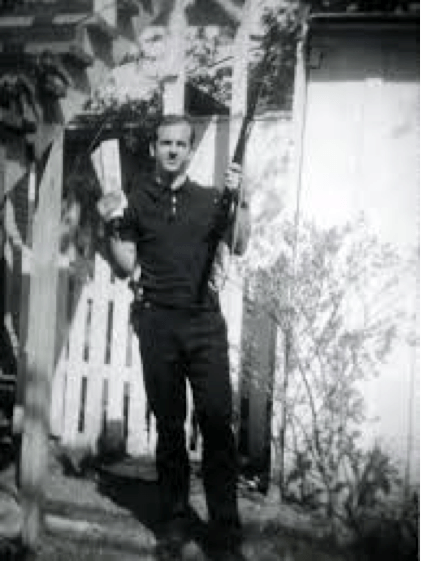
    Oswald “backyard photo” holding a Mannlicher Carcano13

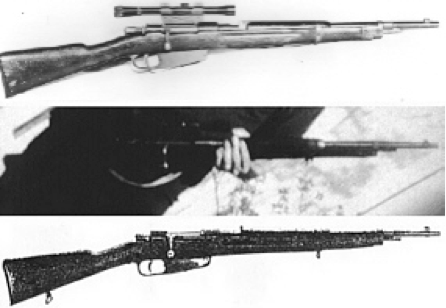
    Perhaps one of de Mey’s more imaginative speculations is that the murder may have been “executed by an experienced sniper using a sound weapon with bullets that had been prepared in advance with the above-mentioned Carcano” (that is, shot through Oswald’s ’museum piece’ so as to lay a trail to the patsy, then later fitted with a sabot to allow the incriminating rounds to be fired through a more reliable weapon on 11.22.63) (p. 365) This “scapegoat hypothesis,” he says, explains the absence of fingerprints on the weapon, since it was planted. It explains why Oswald never bought or possessed bullets (three shell casings and a live round in the rifle’s chamber were the only rounds that ever surfaced in evidence). It also explains why Oswald, who was right-handed hadn’t adjusted the gun sight, which was set for a left-hander.

    More importantly, it also supposedly explains one of de Mey’s more ambitious claims: why the Carcano seen in Oswald’s hand in the “backyard photographs” is not the same Carcano found in the Book Depository, presumably Commission Exhibit #139. The only difference he specifies is what ambiguously appears to be an object of some sort on the bottom of the weapon’s barrel in the backyard images, which he says is the “fixing ring for the strap.” (p. 171) This object is absent in the photos of the Carcano in evidence. But it’s possible that the “fixing ring” on the barrel’s underside is actually a shadow from an object in the background, as there are other nearby shadows in the images. Moreover, the backyard photos appear to show that the strap is attached, fore and aft, to the side of Oswald’s rifle. If indeed the fixing ring was on the underside of the barrel of Oswald’s rifle and not the side, as he claims, there would have been a matching rearward fixing ring on the rearward underside of the stock of the weapon. No such object is visible in the backyard photos; nor is one evident in Commission Exhibit #139. Rather, the strap in the backyard photos seems to attach to the side of the stock, not the bottom, as it does in #139.


    de Mey makes much of Kennedy’s botched autopsy, placing much of the blame on the Kennedys, particularly Robert. “The Bethesda autopsy was poorly conducted by physicians without any pathological experience, was poorly documented and some of the autopsy findings that were contrary to the desired scenario were adjusted accordingly, even after Kennedy had already been buried.” (p. 247) “The incomplete and inaccurate autopsy was arranged by Admiral Burkley at the request of the Kennedys … [t]he errors in the autopsy were largely due to the lack of experience of the pathologists who carried out the autopsy. This, again, was a consequence of the Kennedys’ interference in the procedure.” (p.39) While de Mey is on solid footing arguing Kennedy’s autopsy was botched, he’s unconvincing on why. A case can be made he aims fire in the wrong direction.

    First, it’s false that JFK’s surgeons had no pathological experience. All three were board-certified pathologists with lots of experience, but in “natural death,” death due to heart attacks, strokes, cancer and so on. What they were shy of was experience in forensic pathology, deaths from “unnatural” causes, such as gun shots, stabbings, etc. But one of them, Commander Pierre Finck, did have proper forensic credentials; he was board certified in forensic pathology. de Mey’s point should have been that JFK’s autopsy was error-ridden because none of the surgeons, not even Finck, was up to the task at hand on 11/22.

    The famed New York City coroner Milton Helpern, MD, laid out the problem particularly well: “Colonel Finck’s position throughout the entire proceeding was extremely uncomfortable. If it had not been for him, the autopsy would not have been handled as well as it was; but he was in the role of the poor bastard Army child foisted into the Navy family reunion. He was the only one of the three doctors with any experience with bullet wounds; but you have to remember that his experience was limited primarily to ’reviewing’ files, pictures, and records of finished cases. (Finck had not done an autopsy himself in ~2 years before 11.22.63) There’s a world of difference between standing at the autopsy table and trying to decide whether a hole in the body is a wound of entrance or a wound of exit, and in reviewing another man’s work at some later date in the relaxed, academic atmosphere of a private office … .” 14

    JFK’s postmortem wasn’t helped by the fact the pathologists probably felt under the gun to finish quickly. On the 17th floor of the hospital sat the mortified and exhausted Kennedy family entourage. More than once there were calls down to the morgue to inquire about the progress of the examination and how much more time would be required. Might the military have buckled to Kennedy family pressure?

    There was at least one good reason to suppose it had. Although the Armed Forces Institute of Pathology was by far the best place for a murder autopsy, and although the Institute was recommended to the Kennedy family, Jackie picked the less expert Naval hospital at Bethesda instead. Her reason? Not because she could control the Navy, but merely because Jack had been a lieutenant in the Navy. This is not to say Bethesda was a bad hospital; it wasn’t. It was an active teaching hospital with an active autopsy service in 1963. But its cases came overwhelmingly from deaths due to natural causes, not murder. So the pathology staff had little experience with the types of injuries JFK sustained, and there was no “on-campus” forensic pathologist handy when they needed one.

    Historian William Manchester,15 author Gus Russo,16 and John Lattimer, MD, a urologist who has published articles and a book about the Kennedy case,17 have all argued that Kennedy family interference goes a long way towards explaining the failings of JFK’s autopsy. However, the weight of the evidence, including some new evidence, suggests that the Kennedy family cannot be faulted for the most important failings of JFK’s post mortem. (Not even the discredited18 19 20 21 22 23 24 25 26 Warren Commission loyalist Gerald Posner believes they can.27) It is more likely that the military deserves that distinction.

    For example, one cannot rule out the possibility that the Kennedy family tried to prevent an examination of JFK’s Addison’s disease-ravaged adrenal glands, then a dark family secret. But in 1993 in JAMA, Finck recalled that, “The Kennedy family did not want us to examine the abdominal cavity, but the abdominal cavity was examined.”28 29 And indeed it was. Kennedy was completely disemboweled.30 So while there’s no indisputable proof, perhaps the family did request that JFK’s abdominal cavity, which houses the adrenals, be left alone, especially since JFK suffered no abdominal injuries. If Finck was right, so much for the military’s cutting corners to kowtow to the Kennedys’ need for speed. (The doctors were not entirely insensitive to family wishes, however. They kept mum about JFK’s atrophied adrenal glands, even 30 years later, in JAMA. But by then Kennedy’s Addison’s disease was an open secret, having already been discussed by John Lattimer in his 1980 book.31)

    Though they might have been unsuccessful in keeping the military out of JFK’s belly, it is not unreasonable to wonder if the family might have otherwise interfered. The likely ` answer is that they probably didn’t, at least not in any way that influenced the outcome. Under oath to the ARRB, Humes admitted that JFK’s personal physician, Burkley, seemed keen to move things along, but “as far as telling me what to do or how to do it, absolutely, irrevocably, no.” By way of explanation, Humes made the obvious point that, since Burkley was not a pathologist, “he wouldn’t presume to do such a thing.”32 Boswell told the ARRB that they were “not at all” in any rush or under any compulsion to hurry.33 “It was always an extension of the autopsy,” that was encouraged, “rather than further restrictions.”34 Similarly, after an interview with the Commanding officer of the Naval Medical Center, the HSCA reported that, “[Admiral Calvin B.] Galloway said that he was present throughout the autopsy,” and that, “no orders were being sent in from outside the autopsy room either by phone or by person.”35 (emphasis added) In a sworn affidavit executed for the HSCA on November 28, 1978, JFK’s personal physician, Admiral George Burkley, claimed, “I directed the autopsy surgeon to do a complete autopsy and take the time necessary for completion.”36

    The family didn’t, for example, select the sub-par autopsists; military authorities did. Realizing how over their heads they were, JFK’s pathologists told Lattimer that they (wisely) requested to have nonmilitary forensic consultants called in. Permission was denied.37 The Autopsy of the Century was thus left in the hands of backbenchers. Given the “can do” mentality so prevalent in the military, this shortcut isn’t surprising. But it is one the family didn’t take. Had the government but asked, it is impossible to imagine that any expert forensic pathologist in the entire country would have refused his duty during this time of national tragedy, or that the family would have objected.

    The HSCA explored the question of the family’s role in considerable detail in 1978, concluding that, other than (reasonably) requesting the exam be done as expeditiously as possible, the Kennedys did not interfere in the autopsy.38 Moreover, in an important legal matter, RFK left blank the space marked “restrictions” in the permit he signed for his brother’s autopsy.

    While a compelling case for family interference is difficult to sustain, a case can be made that there was at least some interference in JFK’s autopsy. The most glaring errors – the selection of inexperienced pathologists and the exclusion of available, experienced ones, the failure to dissect JFK’s back wound, and the failure to obtain his clothing – had nothing to do with camouflaging JFK’s secret disease, or even with significantly speeding the examination. (Dissecting the back wound would have taken not much more than one hour. JFK was in the morgue more than eight.) Nor is it at all likely the Kennedys would have imposed those specific restrictions, in the off chance they had even thought of them. Instead, these peculiar decisions are more likely to have come from the military.39


    Without so much as even acknowledging, to say nothing of refuting, the extensive acoustics work of Don Thomas, including that which was published in the British peer-reviewed forensics journal, Science and Justice,40 de Mey entirely discounts all evidence, including the HSCA’s acoustics-based conclusion, that there was a shot from the right front. He thus has to explain how a shot from behind fits with JFK’s rearward head snap following Z-312. To do that, DeMey embraces the twin theories favored by loyalists: a “jet effect” of forward-exiting brain and skull matter, as well as a “neuromuscular reaction,” are responsible for driving Kennedy’s head back and to the left. On page 325 he writes, “The kinetic energy is transferred into the impact on the skull, the fragmentation of the bullet and the projection of the fragments. There is also a massive blast out (sic) of brain tissue and blood. (In the case of Kennedy, 35 percent of the content of the right cerebral hemisphere and large sections of the skull were projected and sprayed out at high velocity.) (sic). Such an explosion not only absorbs kinetic energy, it also causes a backwards momentum … The contraction of Kennedy’s back muscles explains the further backwards movement. Professor Kenneth A. Rahn calculated scientifically and in detail how this happened on the Academic JFK Assassination Site.” (emphasis and italics in the original) (p. 325)

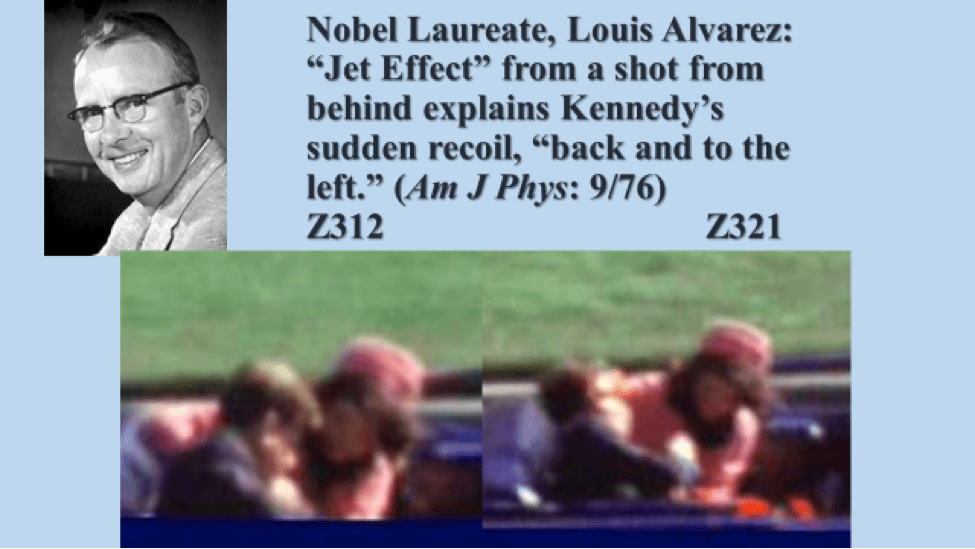
    There are so many problems with those sentences that a proper discussion much longer than this entire review could easily be devoted to exploring them. But in short, de Mey admits that kinetic energy may be imparted to a skull on bullet impact. But in the JFK case any forward energy was more than compensated for by rearward momentum resulting from the “massive blast out” of debris exiting from the front – a classic restatement of Nobel Laureate-physicist, Luis Alvarez’s, famous theory.


    Although he couldn’t have known it when he wrote “Cold Case,” Alvarez’s ’proof of concept’ – his melon-shooting experiments demonstrating a “jet effect” that throws blasted melons backward, toward the rifle – have been largely debunked. In his “peer-reviewed” American Journal of Physics article (9/76) Alvarez asserted, “It is important to stress the fact that a taped melon was our a priori best mock-up of a head, and it showed retrograde recoil in the first test … If we had used the ’Edison Test,’ and shot at a large collection of objects, and finally found one which gave retrograde recoil, then our firing experiments could reasonably be criticized. But as the tests were actually conducted, I believe they show it is most probable that the shot in 313 came from behind the car.”41

    Recently, author Josiah (“Tink”) Thompson made an amazing discovery. He gained first-time access through Alvarez’s former graduate student, Paul Hoch, to the actual photos taken during the shooting tests Alvarez had conducted in the 1970s. They showed that Alvarez had, in fact, pretty much used the “Edison Test,” meaning that he had shot at numerous objects, including coconuts, pineapples, plastic jugs filled with water, rubber balls filled with gelatin, etc. All his targets, except the melons, were driven downrange, something he never mentioned.

    Thompson pointed out another problem with Alvarez’s jet effect: “Whether taped or not, a bullet will cut through the outside of a melon like butter. A human skull is completely different. The thick skull bone requires considerable force to be penetrated and that force is deposited in the skull as momentum … A much closer ’reasonable facsimile of a human head’ is the coconut.” When Alvarez used it in his tests, it did not show recoil motion, but was instead blasted down range.”42

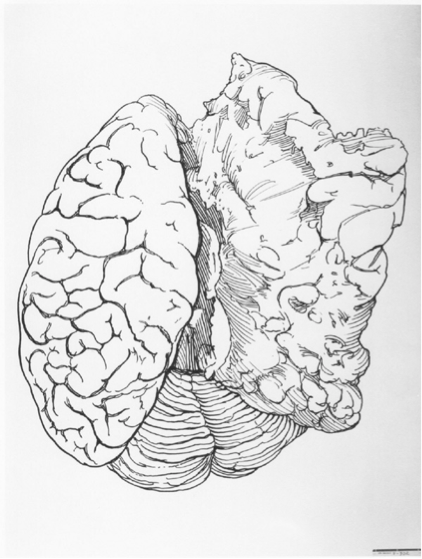
    Ida Dox Drawing of an actual photograph of JFK’s brain taken at autopsy. House Select Committee on Assassinations Exhibit, #302.50
     

    Even if we were to grant de Mey that forward-moving ejecta explains JFK’s rearward jolt, another problem immediately pops up: If de Mey is right that that 35% of JFK’s right cerebral hemisphere was blasted out, a claim that is consistent with what witnesses at the autopsy have said,43 what missing ejecta explains the “jet effect?” The University of Washington puts the weight of a complete, undamaged brain at 1300 to 1400 grams.44 At Kennedy’s brain autopsy, after fixation with formaldehyde, his brain weight was measured at 1500 grams.45 Even if we were to assume JFK’s brain weighed more than average, and/or that formaldehyde had somehow increased the weight of JFK’s brain, it’s hard to imagine that a brain missing “35% of its right cerebral hemisphere” would weigh 100 grams more than an average, complete brain. Autopsy witnesses gave telling accounts.

    FBI Agent O’Neill told the ARRB in 1997 that when JFK’s brain was removed, “more than half of the brain was missing.”46 (The assistant autopsy photographer, Floyd Riebe, recalled things much the same way. When asked by ARRB counsel, “Did you see the brain removed from President Kennedy?” Riebe answered, “What little bit there was left, yes … Well, it was less than half of a brain there.”47) Moreover, in JAMA, Dr. James Humes reported that, “Two thirds of the right cerebrum had been blown away.”48 Dr. Boswell recalled that one half of the right cerebrum was missing.49 The Zapruder film shows a massive explosion of Kennedy’s head, with such a shower of brain matter being ejected from the right side of the skull that no one would dispute these autopsy witnesses. And yet the photos of what is supposed to be JFK’s brain show considerable disruption, but very little in the way of actual tissue loss.

    One possible explanation for the discrepancy between the witnesses and the brain in the official autopsy report was one that was proposed by Assassinations Records Review Board analyst, Douglas Horne. Namely, that there were two different JFK “brains,” and that the one that measured 1500 grams and is pictured in the autopsy photographs was not actually Kennedy’s.51


    Flip de Mey’s well written and entertaining book makes valuable contributions. But in the end it must be said it is far from completely satisfactory. However, there is great material in the book and students are encouraged to read it, and then decide for themselves about his timing of the shots, his neo-Single Bullet Theory and his hypothesis a bullet fired through Oswald’s rifle was then fitted with a sabot to allow the incriminating rounds to be fired through a more reliable weapon on 11/22/63.


    1  Final Report of the Select Committee to Study Governmental Operations, 1976, Book V, p 46. http://www.history-matters.com/archive/church/reports/book5/html/ChurchVol5_0026b.htm

    2  Final Report of the Select Committee to Study Governmental Operations, 1976, Book V, p 47. http://www.history-matters.com/archive/church/reports/book5/html/ChurchVol5_0027a.htm

    3  House Select Committee on Assassinations, Final Assassinations Report, p. 261. http://www.history-matters.com/archive/jfk/hsca/report/html/HSCA_Report_0146a.htm

    5  “Experimental Duplication of the Important Physical Evidence of the Lapel Bulge of the Jacket Worn by Governor Connally When Bullet 399 Went Through Him”, Journal of the American College of Surgeons, Vol. 178(5):517-521 (May 1994).

    6  Dale K. Myers, “Secrets of a Homicide.” http://www.jfkfiles.com/jfk/html/concl1.htm

    7  Report of the Select Committee on Assassinations of the U.S. House of Representatives, p. 47: http://www.archives.gov/research/jfk/select-committee-report/part-1a.html

    8  Costella Combined Edit Frames (updated 2006) http://assassinationresearch.com/zfilm/z224.jpg

    9  C.H. Wecht and W. Milam, “THE GREAT LAPEL FLAP: A Rebuttal of Dr. John K. Lattimer’s Interpretation of the Kennedy and Connally Wounds”: “In the actual assassination, a transiting bullet would have produced debris not only from dried ribs (as in Lattimer’s test), but from blood and other chest tissues as well, so that the resulting spray should have been far more conspicuous than is seen in Lattimer’s test. The absence of any such spray at frame 224 is persuasive evidence that no such chest shot occurred at that point.” http://22november1963.org.uk/governor-john-connally-lapel-flap, http://jfk.hood.edu/Collection/Weisberg%20Subject%20Index%20Files/L%20Disk/Lattimer%20John%20Dr/Item%2003.pdf

    12  E. Randich and P.M. Grant, “Proper Assessment of the JFK Assassination Bullet Lead Evidence from Metallurgical and Statistical Perspectives,” Journal of Forensic Sciences, Vol. 51(4):717-728 (July 2006). http://www.dufourlaw.com/JFK/JFKpaperJFO_165.PDF

    14  Quote cited in: Josiah Thompson, Six Seconds in Dallas (New York: Bernard Geis Associates for Random House, 1967), p. 198.

    15  William Manchester, The Death of a President (New York: Harper & Row, 1967), p. 419. Note: Manchester makes the flat statement (quoted by Russo’s in his book on p. 324): “The Kennedy who was really in charge in the tower suite was the Attorney General.” But the decisions Manchester attributes to RFK had nothing whatsoever to do with autopsy limitations.

    16  Gus Russo, Live by the Sword (Baltimore. Bancroft Press, 1998), pp. 324-328. (Russo cites Livingstone’s assertion, in High Treason [1992, p. 182], that Robert Karnei, MD – a Bethesda pathologist who was in the morgue but not part of the surgical team – claimed the Kennedys were limiting the autopsy. However, the ARRB released an 8/29/77 memo from the HSCA’s Andy Purdy, JD [ARRB MD # 61], in which, on p. 3, Purdy writes: “Dr. Karnei doesn’t ‘ … know if any limitations were placed on how the autopsy was to be done.’ He said he didn’t know who was running things.”)

    17  John Lattimer, Kennedy and Lincoln (New York: Harcourt Brace Jovanovich, 1980), p. 195. (“He [Dr. Humes] was severely limited in what he was permitted to do by constraints imposed by the family.”)

    18  While Posner’s book, not unexpectedly, won praise in the New York Times (J. Ward, NY Times Book Review, 11/21/93), University of Wisconsin historian David Wrone, a legitimate JFK authority who Posner approvingly cited repeatedly in Case Closed, described Posner’s book as “so theory driven, so rife with speculation, and so frequently unable to conform his text with the factual content in his sources that it stands as one of the stellar instances of irresponsible publishing on this subject.” See Journal of Southern History, V.61(1):186 (2/95).
    However, another historian, Thomas C. Reeves – whose credentials on the JFK case are so meager that he is nowhere cited in any book on the JFK subject (including Case Closed) – did write a favorable review in the Journal of American History, Vol. 81:1379-1380 (12/94). Michael Parenti described Reeves’ review as “more like a promotional piece than an evaluation of a historical [sic] investigation.” (M. Parenti, History as Mystery [San Francisco: City Lights Books, 1999], p. 195; Parenti provides an extensive review of the peculiar media flattery of Posner in this book.)

    19  Notre Dame Law professor, and former HSCA chief counsel, Robert Blakey, another legitimate authority Posner repeatedly cited in Case Closed, wrote: “Posner often distorts the evidence by selective citation and by striking omissions … (he) picks and chooses his witnesses on the basis of their consistency with the thesis he wants to prove.” (In: G. Robert Blakey’s article “The Mafia and JFK’s Murder – Thirty years later, the question remains: Did Oswald act alone?”, The Washington Post National Weekly Edition, November 15-21, 1993, p. 23).

    20  Case Closed cited in extenso, but selectively, the work of Failure Analysis Associates, Inc. (FaAA) of Menlo Park, California, which prepared evidence for both sides of an American Bar Association mock trial of Lee Harvey Oswald in 1992. On December 6, 1993, FaAA’s CEO, Roger McCarthy, swore out an affidavit in which he declared that Posner had requested FaAA’s prosecution material, but not the defense material; that Posner failed to disclose that FaAA had also prepared a defense, and that the jury that heard both sides “could not reach a verdict.” McCarthy’s affidavit is available on the web at: http://www.assassinationscience.com/mccarthy.html

    21  In testimony before the Congress, Posner reported that both Humes and Boswell had told him they’d changed their minds, and that the autopsy report was wrong about JFK’s skull wound being low. Posner claimed they had admitted to him that they’d come around to the view the wound was high, and so consistent with a shot from Oswald’s position. But as author Aguilar first reported in the Federal Bar News and Journal, Vol. 41(5):388 (June, 1994), both Humes and Boswell, in recorded conversations (now available at the National Archives), denied having ever changed their minds that JFK’s skull wound was low. (They repeated their assertion that they had never changed their minds JFK’s skull wound was low under oath to the ARRB.) Boswell also told Aguilar, twice, that he’d never spoken with Posner. Aguilar gave the recordings, which suggested Posner had perjured himself, to the ARRB. Aguilar also sent the ARRB a copy of a letter calling Posner’s testimony into question, a letter that had been published by a committee chaired by Rep. John Conyers. (See letter in: Hearing before the Legislation and National Security Subcommittee of the Committee on Government Operations House of Representatives, One Hundred Third Congress, First Session, November 17, 1993. Washington, D. C.: U.S. Government Printing Office, 1994. It appears on the final 5 pages of the report.) Subesquently, the ARRB asked Posner for his notes and records substantiating his claims regarding Humes and Boswell. As the ARRB reported on page 134 of the Final Report of the ARRB, Posner declined to cooperate.

    22  Peter Dale Scott, “Case Closed? Or Oswald Framed?” The San Francisco Review of Books, Nov./Dec., 1993, p.6. (This review is perhaps the most eloquent, concise, authoritative and damning of all the reviews of Case Closed.)

    23  Jonathan Kwitny, “Bad News: Your Mother Killed JFK”, Los Angeles Times Book Review, 11/7/93.

    24  Mary Perot Nichols, “R.I.P., conspiracy theories?” Book review in: Philadelphia Inquirer, 8/29/93, pp. K1 and K4.

    25  George Costello, “The Kennedy Assassination: Case Still Open”, Federal Bar News & Journal V.41(3):233 (March/April, 1994).

    26  Jeffrey A Frank, “Who Shot JFK? The 30-Year Mystery”, Washington Post – Book World, 10/31/93.

    27  Summarizing what appears to be his own view, Posner writes, “The House Select Committee concluded that Humes had the authority for a full autopsy but only performed a partial one.” G. Posner, Case Closed (New York: Anchor Books/Doubleday edition, 1993), p. 303n.

    28  Dennis Breo, “JFK’s death, part III – Dr. Finck speaks out: ‘two bullets, from the rear.’” JAMA Vol. 268(13):1752 (October 7, 1992).

    29  Without citation, this episode was also cited by Gus Russo in Live by the Sword, p. 325.

    30  Dennis Breo, “JFK’s death – the plain truth from the MDs who did the autopsy”, JAMA, Vol. 267(12):2794 ff. (May 27, 1992).

    31  John Lattimer, Kennedy and Lincoln, pp. 223-224.

    32  ARRB testimony James H. Humes, College Park, Maryland, pp. 32-33.

    33  ARRB testimony J. Thornton Boswell, College Park Maryland, 2/26/96, p. 29.

    34  ARRB testimony J. Thornton Boswell, College Park Maryland, 2/26/96, p. 30.

    35  Interview of Admiral Calvin B. Galloway by HSCA counsel Mark Flanagan, 5/17/78. HSCA Record Number 180-10078-10460, Agency File # 009409.

    36  Sworn affidavit of Vice Admiral George G. Burkley. HSCA record # 180-10104-10271, Agency File # 013416, p. 3.

    37  Lattimer writes, “Commanders Humes and Boswell inquired as to whether or not any of their consultants from the medical examiner’s office in Washington or Baltimore should be summoned, but this action was discouraged.” In: John Lattimer, Kennedy and Lincoln, p. 155.

    38  HSCA. Vol. 7:14: “(79) The Committee also investigated the possibility that the Kennedy family may have unduly influenced the pathologists once the autopsy began, possibly by transmitting messages by telephone into the autopsy room. Brig. Gen. Godfrey McHugh, then an Air Force military aide to the President, informed the committee that Attorney General Robert F. Kennedy and Kenneth O’Donnell, a presidential aide, frequently telephoned him during the autopsy from the 17th floor suite. McHugh said that on all occasions, Kennedy and O’Donnell asked only to speak with him. They inquired about the results, why the autopsy was consuming so much time, and the need for speed and efficiency, while still performing the required examinations. McHugh said he forwarded this information to the pathologists, never stating or implying that the doctors should limit the autopsy in any manner, but merely reminding them to work as efficiently and quickly as possible.” (emphasis added)

    39  For a more extensive discussion, see “The Medical Case for Conspiracy,” Chapter 8 in: C. Crenshaw, Trauma Room One (New York: Paraview Press, 2001).

    41  Alvarez, Luis, “A Physicist Examines the Kennedy Assassination Film”, American Journal of Physics, Vol. 9:813-827 (1976). Available on line at: http://jfk.hood.edu/Collection/Weisberg%20Subject%20Index%20Files/A%20Disk/Alvarez%20Luis%20Dr/Item%2002.pdf.

    42  Personal communication, 3/2014.

    43  See “The Medical Case for Conspiracy,” op. cit. Crenshaw.

    46  Washington Post, 11/10/98, p. A-3.

    47  Deposition of Floyd Albert Riebe, 5/7/97, pp. 43-44.

    48  JAMA, Vol. 267(12):2798 (May 27, 1992).

    49  ARRB testimony J. Thornton Boswell, College Park Maryland, 2/26/96.

    51  George Lardner, “Archive Photos Not of JFK’s Brain, Concludes Aide to Review Board”, Washington Post, 11/10/98, p. A-3.

  • Ed Souza, Undeniable Truths


    I was looking forward to Ed Souza’s book on the JFK case. Souza has had a long career in the field of law enforcement. He has served as a police officer, a homicide investigator, and today he works as an instructor. It’s always good to get a viewpoint on the JFK case from a man who has spent his professional life in the field of forensics. For the simple reason that, in the normal course of murder investigations, the myriad anomalies that appear all over the JFK case, don’t occur. Therefore, I was eager to see how a professional in the ranks would confront them. As Donald Thomas showed in his book Hear No Evil, the previous course of some law enforcement professionals had been to avoid or discount those anomalies at all costs. To the point of revising the strictures of previous professional practice.

    I

    At the beginning of his book, Undeniable Truths: The Clear and Simple Facts Surrounding the Murder of President John F. Kennedy, I was pleased by Souza’s approach. And also on the evidence he was relying upon to prove his points. For example, in his introduction he reveals that, unlike some other previous investigators, Souza had actually visited Dallas more than once. While there he took many photographs with which he illustrates his book. And from his experience there on the ground, he had concluded “one man with a rifle could not have committed this crime alone.” He then comments that the sixties turned out to be the “decade of death”, not just for three important and progressive leaders – John Kennedy, Martin Luther King, and Bobby Kennedy – but also for the United States as we knew it. Most people would agree, the author is off to an auspicious start.

    Souza opens Chapter 1 by proclaiming that neither the Dallas Police nor the Secret Service fulfilled their first professional duty at the venue of the crime. Neither one of them secured the crime scene. The Texas School Book Depository was not immediately locked down. And the Secret Service actually took a pail and sponge to the presidential limousine at Parkland Hospital. (p. 1, all references to e book version.) He also notes that for the official version to be true, with Oswald firing from behind President Kennedy, the mass of blood and tissue from Kennedy – or a large part of it – should have gone forward, onto the rear of the front seat, and the backs of the two Secret Service agents in front of him. Yet, once one looks at the extant photos of the limousine, much of this matter seems to be behind the president and beside him. (p. 3) Souza writes that things like this strike him as odd. Because in all the years he investigated homicides for the LAPD, he never encountered the laws of physics violated as in the JFK case. (p. 5)

    He continues in this vein by saying, if the official version is true – that is, all the shots coming from the rear – then why was the back of Kennedy’s head blown out? (ibid) And, beyond that, why is the president’s face intact? (p. 9) He brings up a point that has received scant attention. If one goes to Dealey Plaza and looks at the kill zone from, say, a block or two away from the side, the angle from the sixth floor to the first shot seems too steep for what the Warren Commission says it is. And recall, in the FBI report on the autopsy, the angle of the back wound into Kennedy is registered as 45 degrees, or more than twice the dimensions the Commission says it is. (p. 7) And like Ryan Siebenthaler, and Doug Horne, Souza brings up the possibility that there may have been more than one wound in Kennedy’s back. (Click here and scroll down) He completes Chapter 1 by bringing up two more salient points. First, from his military records, Oswald had no training at all in aiming at and hitting moving targets. (p. 10) Secondly, there appears to be a time lapse between when Kennedy experiences his throat wound and the instant that John Connally is being hit for the first time. (He could have added here, that in the intact film – with the excised frames restored – it appears that JFK is hit before he disappears behind the Stemmons Freeway sign.)

    Again, so far, so good. These all seem to me to be truths that are pretty much backed up by the evidentiary record. And they contravene the official story.

    In Chapter 2, Souza now begins to hone in on the medical evidence, an aspect of the case that has become a real thorn in the side of Warren Commission advocates. He begins by quoting some of the Parkland Hospital witnesses, those who saw Kennedy immediately after the assassination in the emergency room. Dr. Gene Coleman Akin said that the throat wound appeared to be one of entrance, and the rear of Kennedy’s skull, at the right occipital area, was shattered. He further added that this head wound had all the earmarks of being an exit wound. (pp. 19-20) Nurse Diana Bowron talked about a large hole in the rear of Kennedy’s skull. (p. 23) Dr. Charles Carrico also witnessed a large, gaping wound in the right occipital/parietal area that was 5-7 centimeters in diameter, and was more or less circular in shape. (pp. 24-25)

    As Milicent Cranor has pointed out, Kemp Clark is an important witness. For the simple facts that he was a neurosurgeon and he officially pronounced Kennedy dead. Souza dutifully quotes Clark as describing a large, avulsive wound in the right posterior part of the skull, with cerebral and cerebellar tissue being damaged and exposed. (pp. 26-28)

    Souza concludes this part of his case with Margaret Hencliffe and Ronald Jones. Nurse Hencliffe stated that the bullet hole in the neck was an entrance wound. Doctor Jones also stated the neck wound was one of entrance and the rear head wound was an exit. Or to be explicit, Jones said: “There was a large defect in the backside of the head as the president lay in the cart with what appeared to be brain tissue hanging out of his wound ….” (p. 32)

    In summing this all up, the author states that twenty witnesses in Dallas said there was a hole in the back of Kennedy’s head. Further, at least seven of these witnesses saw cerebellum, which means the wound in the rear of the skull extended low in the head. Not only does this indicate a shot from the front, but if Kennedy had been shot from the rear, there would have been an exit in the front of the skull. Yet, on the autopsy photos, there is no such wound. (p. 33)

    From here, Souza now goes to the civilian witnesses in Dealey Plaza. He begins with two deceptive quotes from the Warren Report. The first is this one: “No credible evidence suggests that the shots were fired from the railroad bridge over the triple underpass, the nearby railroad yards, or any other place other than the Texas School Book Depository.”

    The second one is as follows: “In contrast to the testimony of the witnesses who heard and observed shots from the Depository, the Commission’s investigation has disclosed no credible evidence that any shots were fired from anywhere else.” (p. 42)

    Souza calls both of these statements lies. He then lists several witnesses who proffered evidence of shots from the front, specifically the grassy knoll: Sam Holland, Richard Dodd, patrolman J. M Smith (who really is not a civilian), James Simmons, Austin Miller, and , of course, the capper to all of this, the railroad crane worker, Lee Bowers. Bowers, of course, goes beyond giving evidence of shots from the front. With his observations of the phased timing of three cars coming in behind the picket fence and in front of the railroad yard, Bowers may have actually seen some of the preparations for the hit team operation. (See pp. 43-50)

    Souza then lists witnesses who say the second and third shots were fired almost on top of each other. And some of these men are police officers – Seymour Weitzman and Jesse Curry – and one was an unintended victim; John Connally. Others he lists as indicating shots came from the front are either spectators or part of the motorcade: Bill and Gayle Newman, Dave Powers, Ken O’Donnell, and J.C. Price. He notes that Powers and O’Donnell, worked for Kennedy, and were intimidated into changing their testimony. Price actually saw a man running from the fence to the TSBD, and was not called as a witness by the Commission. (See pp. 50 ff.)

    Again, all of this is fine. Like a responsible legal investigator, Souza has collected valid physical evidence from the crime scene, linked it with the autopsy evidence, and then corroborated it with witness statements. Its been done before, but Souza performs it with skill and brio and he brings in a few witnesses others have ignored.

    II

    Unfortunately, we have now reached the high point of the book. And we are only about twenty per cent into the text. For here, in my view, Souza now makes a tactical and strategic error. He shifts gears ever so slightly. He now begins to try and go one step up the investigative ladder. That is, how did the actual operation work? For about the next fifty pages the book now becomes a decidedly mixed bag – which the first fifty pages were not. Also, mistakes now begin to creep into the book – mistakes which should have been rather easily detected if a proofreader or fact checker had been employed.

    Let us begin with the better material. In order to show that something was going on inside the TSBD, the author uses witnesses like Arnold Rowland, Carolyn Walther and Toney Henderson to reveal the possibility that there may have been more than one gunman in the building Oswald worked in, and that they may have been elsewhere in the Texas School Book Depository. Most readers are familiar with Rowland and Walther, who both say they saw suspicious persons elsewhere than the sixth floor. Henderson said she saw two men on the sixth floor about five minutes before the shooting, and one had a rifle. We know it was five minutes before the shooting because she said an ambulance had just left the front of the building. This had to have been the transport for the man who had the epileptic seizure. And that occurred at 12:24 PM (p. 59)

    Souza then moves to the presence of Secret Service officers in Dealey Plaza post-assassination, when in fact none were actually there at that time. He uses law enforcement witnesses like DPD patrolman Joe Smith and Sgt. D. V. Harkness to demonstrate this point. And he culminates his case against the Warren Commission by using Chief of Police Jesse Curry to criticize the incredibly bad autopsy given to President Kennedy. (p. 117)

    But in this section of the book, the author now begins to do two things that will mar the rest of the work. He begins to rely on some rather dubious witnesses – who he apparently does not know are dubious. And he also begins to make some errors. Concerning the former, it is one thing to use a dubious witness, but if one is going to do so, one must be willing to shoulder the load of rehabilitating him or her. Souza does not do that. Therefore, when he used the rather controversial Gordon Arnold, and coupled that with the even more controversial Badgeman photo, I began to frown. (Click here for a brief expose of this controversy. Click here for a discussion of the Gordon Arnold debate.)

    He then mentioned the testimony of a man whose evidence he did not footnote. He calls him Detective De De Hawkins. Souza says this officer met two men in suits outside the TSBD who said they were from the Secret Service. (see p. 69) I had never seen this name anywhere. So I went searching for it. I could not find it in the Warren Report. I could not find it in Walt Brown’s The Warren Omission, which lists every single witness interviewed by the Commission. I began to panic when I could not find him in Michael Benson’s quite useful encyclopedia Who’s Who in the JFK Assassination. After looking in Ian Griggs’ book No Case to Answer and Jim Marrs’ Crossfire I was about to give up, since those books are strong on the Dallas Police aspect. I then decided to look at the late Vince Bugliosi’s behemoth Reclaiming History, which, although not a good book, has a very good index to its over two thousand pages of text. I came up empty again. Either Souza made a serious error, or he found someone who no one else has found. If the latter, he should have noted the interview.

    But if this was a mistake, it’s not the only one in the book. Not by a long shot. On page 89, Souza begins a brief discussion of the controversy between FBI agent Vince Drain and DPD officer J. C. Day about a print being found on the alleged rifle used in the assassination – except, it’s not, as Souza writes, a fingerprint, but a palm print. On page 95 of his book, he puts quotation marks around words attributed to Pierre Finck discrediting the magic bullet. When I looked up his source, the words were not in quotes; they were a paraphrase. (Benson, p. 137)

    In Chapter 6, properly entitled “The Autopsy Cover Up”, Souza makes three errors in the space of about one page. He says the autopsy doctors wrote that the president had a small hole in the upper right rear of his skull, which was an entrance wound. The hole was in the lower part of the right rear. He then says that there was a large hole in the right front part of the president’s head. According to the autopsy, it’s on the right side of the head, forward and above the ear. He also says that Dr. Charles Crenshaw was the first attending physician at Parkland Hospital to work on the president. (p. 100) But in looking at Crenshaw’s book, Trauma Room One, one will read that, before Crenshaw ever got inside the emergency room, Malcolm Perry and Chuck Carrico had already placed an endotracheal tube down the president’s throat. (Crenshaw, p. 62) Once Crenshaw got there, Perry made an incision for a tracheotomy.

    It was in this chapter that I felt that Souza began to lose control of his subject. Since the release of Oliver Stone’s film JFK, there has been a deluge of books and essays published on the medical aspects of the Kennedy case. In fact, Harrison Livingstone quickly published a sequel to High Treason called High Treason 2. David Lifton’s Best Evidence, the book and DVD, was back on the shelves.

    Why? Because, Stone, for the first time, exposed a large public audience to the utter failure of the Kennedy pathologists. Largely relying on the devastating testimony of Dr. Pierre Finck at the trial of Clay Shaw in New Orleans, hundreds of thousands of viewers now began to see that President Kennedy’s autopsy was not meant to find the cause of death. Because the pathologists were controlled by the military, neither Kennedy’s head wound nor his back wound was tracked for transience or directionality. For many people, including the autopsy doctors, it was a shocking thing to witness.

    Now, some of this subsequently published material on the autopsy material has been good and valuable. But there has been so much of it that it is easy to lose track of where the weight of the evidence lies. For example, Souza uses Paul O’Connor to say there was no brain in Kennedy’s skull to remove. (Souza p. 102) Yet many witnesses at Parkland Hospital said that, although Kennedy’s brain was damaged, a sizable portion of it was still present. And James Jenkins, among several others, who was at Bethesda that night, says about two thirds of it was intact. Here, Souza is relying on an outlier, not the weight of the evidence. (For a catalog of these witnesses see James DiEugenio, Reclaiming Parkland, p. 137) Further, Souza seems overly reliant on the work of Lifton. This was understandable decades ago, but today, there are several other authors who have done very good work on the medical side of the JFK case e.g. Milicent Cranor, David Mantik, Gary Aguilar. I could find none of these very respectable names in Souza’s book. I don’t understand why they aren’t there.

    III

    And to me, from here on in, the bad begins to outweigh the good in Undeniable Truths. Thus rendering the book’s title ironic.

    In Chapter 7, in a discussion of the attempted shooting of General Edwin Walker, Souza calls him a “former right-wing radical.” In 1963, Walker was anything but a “former” extremist. He then says the Walker shooting happened “just prior to the assassination ….” (Souza, p. 113) I think most people would say that a time-span of nearly eight months is not “just prior” to the assassination. According to the work of Secret Service authority Vince Palamara, the presidential motorcade route was not finally decided upon by the Secret Service and Dallas Mayor Earl Cabell’s office. (Souza, p. 115) It was decided upon by the Secret Service, and a small delegation from the White House, including advance man Jerry Bruno and presidential assistant Ken O’Donnell.

    From approximately this point on, Souza now begins to try and dig into the how, why, and who behind the assassination. And for me, the more he tried to do this, the more his book dissipated. This kind of exploration has to be handled quite gingerly, for the simple fact that the Kennedy assassination literature is not formally peer reviewed. Further, there is no declassified library for the likes of Sam Giancana or H. L. Hunt. One therefore has to be very discerning, scholarly and careful in picking over this evidence. It constitutes a giant swamp with large areas of quicksand beneath. To put it mildly, I was disappointed that Souza exhibited very little discernment in this part of his book.

    One startling example: he actually takes the book Double Cross by Chuck Giancana seriously as a source. This 1992 confection was clearly a commercially designed project; one that was meant to capitalize on the giant national controversy created by Oliver Stone’s film. And the idea that Sam Giancana was behind the JFK murder is simply a non-starter today. That book is currently considered a fairy tale. Yet Souza uses it as a source, and even recommends it to the reader. (See pp. 183, 295)

    Souza also considers the long series made by British film-maker Nigel Turner, The Men Who Killed Kennedy, as “one of the best documentaries on this subject.” (See pp. 300-02) I could hardly disagree more. Moreover, Souza heartily recommends Turner’s segment in the series called “The Guilty Men”, which featured none other than Barr McClellan. Apparently Souza missed the fact that in McClellan’s book, Blood. Money and Power, the author had Oswald on the sixth floor of the depository firing a shot at Kennedy, which elsewhere Souza says Oswald could not have done, because Oswald was not on the sixth floor. (p. 165)

    Souza is so enamored with the untrustworthy and irresponsible Nigel Turner that he can write, “It is a clear and solid fact that Malcolm Wallace’s fingerprint was found in the so-called sniper’s nest on the sixth floor ….” (p. 223) No, it is not such a fact. And, with state of the art computer scanning, Joan Mellen will show that in her upcoming book. But further, Souza is so uncritical about the Kennedy literature that he does not even take Turner to task for buying into the discredited Steve Rivele’s French Corsican mob concept in his first installment, and then switching horses and buying into Barr McClellan’s Texas/LBJ concept in his 2003 series. To me, Nigel Turner wasted one of the best opportunities anyone ever had in the Kennedy field to get a large segment of the truth in this case out to the public. Instead, Turner settled for the likes of Tom Wilson, Judy Baker, Rivele, Barr McClellan, et al. But Souza stands by this dilettante and poseur. And I shouldn’t even have to add the following: by this part of the book, Souza is also vouching for the likes of Madeleine Brown.

    If you can believe it, Souza says that Howard Hunt operated out of 544 Camp Street in 1963. (Souza, p. 175) This is a ridiculous overstatement. There is some evidence that Hunt was in New Orleans to set up the Cuban Revolutionary Council with Sergio Arcacha Smith, but that was not in 1963. (William Davy, Let Justice be Done, p. 24) And the idea that he “operated” Guy Banister’s office in 1963 is completely divergent from the adduced record. Yet Souza is so feverish in his conspiratorial invention that he doesn’t realize he is also writing that Sam Giancana enlisted Guy Banister in setting up Oswald. (See p. 182) That is due to his reliance on Chuck Giancana and Double Cross. How “all in” is Souza with this facetious book? He also quotes Giancana as saying that he knew George DeMohrenschildt, and the Chicago mobster enlisted George in helping to set up Lee Harvey Oswald. If someone can show me any evidence of this outside of the Chuck Giancana fantasy, I would like to see it.

    Now, right on this same page, and in this same section, Souza – in a book on the JFK case – groups Howard Hunt with Richard Nixon as potential players in the JFK case. Like the work of John Hankey, who Souza is now beginning to resemble, the author bases this simply on the fact that Hunt was one of the burglars caught at the Watergate complex in 1972. Souza then quickly shows that he is as circumspect on Watergate as he is on the overview of the JFK case. For he now says that Nixon ordered the Watergate break-in. Like many of his weighty disclosures, he does not footnote this. Probably because there is simply no credible evidence ever found by either the court system or the Senate Watergate Committee that Nixon did any such thing. Souza then compounds this by writing that Charles Colson was one of the planners of the break-in who Nixon hung out to dry. Again, there has never been any credible evidence adduced to substantiate this claim.

    I don’t have to go any further do I? As the reader can see, a book that started out promising, obeying the laws of criminal forensics, has now all but sunk in the lake of specious Kennedy assassination folklore. Souza’s book now began to remind me of nothing more than that monumental, nonsensical and misleading tract commonly called the Torbitt Document, more precisely entitled Nomenclature of an Assassination Cabal. As I argued in the second edition of Destiny Betrayed, that pamphlet looks today like a deliberate attempt at misdirection. It was designed to confuse and to stultify by amassing a large number of names and agencies in front of the reader and stirring them up in a blender. The problem being that there was very little, if any, connective tissue to the presentation, and even less genuine underlying evidence. (See Destiny Betrayed, second edition, pp. 323-24)

    I can assure the reader that I am not exaggerating by drawing that comparison. Just how unsuspecting is Souza? Because Chuck Giancana used Dallas police officer Roscoe White in his fable Double Cross, Souza uses White as one of the assassins in Dealey Plaza! (See page 187) The whole Roscoe White matter was exposed as another financially motivated fraud back in the nineties in an article entitled “I Was Mandarin” in Texas Monthly (December 1990). And that was not the only place it was exposed. Apparently, Souza was not aware of these exposures. Or if he was, he wanted to keep the mythology alive. Either way, it does not reflect very well on his professional scholarship or the quality of his book.

    As I have often said, what we need today is more books based upon the declassified files of the Assassination Records Review Board. And any book that does not utilize those records to a significant degree should be looked upon with an arched eyebrow. I have also said that, if everyone killed Kennedy – the Mob, LBJ, Nixon, the Dallas Police, the CIA – then no one killed Kennedy. Giving us a smorgasbord plot is as bad, maybe worse, than saying that Oswald killed Kennedy. It leads to a false conclusion that, in its own way, is just as pernicious as the Warren Commission’s.

    About the first fifty pages of Undeniable Truths is pretty much undeniable. The next fifty pages are a decided mixture of truth and question marks. Most of the last 200 pages do not at all merit the title. In fact, that part is, in large measure, nothing more than conjecture. And much of that conjecture is ill-founded.

  • Ballistics and Baloney: Lucien Haag and the JFK Assassination


    (Click here if your browser is having trouble loading the above.)

  • David Mantik Updates a Medical Journal on the JFK Case

    The Assassination of John F. Kennedy: Revisiting the Medical Data


    by Mantik, David W. M.D., Ph.D., At:  Journal of Plastic & Reconstructive Surgery


  • Charles E. Hurlburt, It’s Time For The Truth! The JFK Cover-up: The Real Crime of the Century


    I. Introduction

    I have to admit that when I was asked to review the book in question, I did not recognize its author. The name Charles E. Hurlburt did not ring a bell, as it was a name that I have never encountered in the JFK assassination research community. I do not consider it to be a bad thing (I am not one either) since all citizens should study and try to join the quest for the truth. So I was curious to find out what he had to say.

    Charles E. Hurlburt is a senior citizen who, at the time of the assassination, was employed by ITEK Corporation as a software programmer (Yes the same ITEK that analyzed the Zapruder film for the House Select Committee on Assassinations). He first became interested in the case after reading Mark Lane’s book Rush to Judgment back in 1966. By that time he had left ITEK and he was working for MIT University, where he discovered in the library, Ed Epstein’s book Inquest and later the Warren Commission (WC) Report. After reading the two books and the Warren Report itself, he became convinced that the Commission’s work was inadequate. Further, that it contained serious omissions, misrepresentations and fallacies. Later it was Oliver Stone’s movie JFK that re-awakened his interest in the case, and he became a serious student of the assassination ever since.

    The book consists of twelve chapters that examine both the micro and the macro aspects of the assassination, but not in a detailed manner. In my view, he tried to juggle too many different aspects of the assassination in a small book. Therefore, it was not possible to examine each one detail. So it is very difficult to write a critique based on brief and basic explanations of very complex matters. So, this reviewer decided to concentrate on some aspects since it will be very difficult to examine every single aspect.

    II. Autopsy and Investigations

    Chapter Two examines the autopsy of the dead president. Hurlburt summarizes the evidence which proves that the doctors tried to cover up the truth and comply with the official version: namely that only two shots hit JFK. He correctly points out that the bullet that caused the back wound entered below the shoulder at an angle of 45 to 60 degrees, did not exit and that it was never located inside the body. It would have been impossible to have penetrated the neck to exit the throat, an invention that Arlen Specter created well after the autopsy with his now infamous “Magic Bullet Theory.” However this is where Hurlburt makes a serious mistake when he states that the Bethesda doctors did not know anything about the wound in the front of the throat during the autopsy procedure. He further states that “it was not until the following morning after the body was no longer available for examination that Dr. Humes spoke on the phone with Dr. Perry, and learned of this small ‘puncture’ wound in the throat.”

    Hurlburt may not be aware of the late Dr. Robert. B. Livingston’s testimony in a 1993 lawsuit against the Journal of the American Medical Association (Breach of Trust, Gerald McKnight, p. 411). Livingston, who had lectured at Harvard and Yale Universities and had experienced all kinds of wounds during WW II while treating Japanese prisoners of war. Following the first media reports, he recognized the wound in the throat was one of entry that had originated from the front. So Livingston called Humes to advice him about the nature of the wound but Humes left the phone and when he returned told Livingston, “I can’t continue this conversation, and in fact, the FBI won’t let me.”

    He then touches on the controversial subject that JFK’s body was surgically doctored according to David Lifton’s theory as described in his book Best Evidence. Another noted author who has expressed a similar view is Douglas Horne, a former staff member of the ARRB who had examined the medical evidence in detail. Horne presented his conclusions in his five volume book, Inside the Assassination Review Board.

    This subject is quite controversial so I would suggest that anyone can read the above mentioned books and make up his (or her) own mind regarding the subject of a pre-autopsy doctoring of the body. Hurlburt concludes that the autopsy was surrounded by controversy over a number of contradictory statements, for example “the body was enclosed in sheets/a body bag,” or “the brain was/was not severed from the brain stem…” etc. This author believes that contradictory statements followed the doppelganger pattern that so often pops up in the JFK assassination and their purpose is to create cognitive dissonance to confuse and frustrate researchers, to inveigle the truth and preserve doubt.

    In chapter three he does a fair job to show that all the investigating bodies, the police, the FBI, the Warren Commission and the HSCA did not perform as they should, and they all contributed to the cover up and to the mess that the JFK investigation is today. Again this is done very briefly and does not analyze any of it them in depth. In doing so he makes a few mistakes; like his assurance that convicted felon Charles Harrelson was a “dead ringer” for one of the three tramps photographed after the assassination (p. 53). It is an assumption based on the controversial work of Lois Gibson, a forensic artist who’s work and findings many dispute, and there are not many researchers who agree with her on the identification of the tramps. In 1979, Harrelson was arrested and charged for the murder of Judge John H. Wood. He was eventually found guilty and convicted of the murder of Wood and sentenced to two life sentences. When he was arrested he confessed that he was one of the shooters that killed Kennedy. But he later withdrew his confession. He was accused of being the tall tramp photographed in Dealey Plaza, but after examining the photos he stated that the there is no resemblance between him and the tall tramp. He stated to Nigel Turner that at the time of the assassination he was in Houston with a friend and that even if he was offered the job he would have never accepted because he knew that he would end up dead as well. In 1992 the Dallas Police revealed the identities of the tramps and claimed that they were Gus Abrams, John F. Gedney and Harold Doyle. Ray and Mary LaFontaine did their own research and agreed with the police’s view regarding the tramps. This author is not convinced that the above mentioned individuals were the three tamps and believes that their identities will remain forever obscure. The late Fletcher Prouty believed that their identity was not important since they were “actors” whose job was to help with the cover up.

    In the section describing the last official investigation by the House Select Committee of Assassinations (HSCA), there are a few inaccuracies regarding Chief Counsels Richard Sprague and Robert Blakey. Regarding Sprague, the author asserts that it was his disagreements with Congressman Gonzalez that eventually led to his downfall. He writes that “A clash of egos erupted between Gonzalez and Sprague.” This clash along with media attacks led Gonzalez to try to fire Sprague. He did not succeed, and as a result Gonzalez resigned. Sprague tried to keep his position but he was fired. Yes, partially. But it was also his unwillingness to play the Washington political game and his call for an unrestricted investigation that that led to the above confrontation. Hurlburt somehow, in his above narration of the events, forgot to mention the real cause that forced Sprague to resign (p. 68). Sprague later said “But when I looked back at what happened, it suddenly became clear that the problems began after I ran up against the CIA.” It all started when Sprague asked for complete information about the CIA’s operation in Mexico City regarding Oswald’s visit there and total access to its employees who may have had anything to do with the photographs, tape recordings and transcripts. The CIA finally agreed only if he would sign a CIA Secrecy Agreement. Sprague refused and said “How can I possibly sign an agreement with an agency I am supposed to be investigating?” (Gaeton Fonzi, The Last Investigation, p. 197).

    Hurlburt then discusses Sprague’s replacement as Chief Counsel, Robert Blakey, and he correctly states that he held the firm opinion that the Warren Commission had been right all along. He writes that Blakey, “as an experienced Washington insider, he was much more concerned with producing an acceptable report within the allotted time than with uncovering new leads” (p. 68). Blakey believed that Oswald had fired the shots and that the Mafia had planned the assassination. He continues that “In fairness, it must [be] pointed out that Blakey’s Committee was severely restricted…by the continued ‘stone walling’ of the CIA, who refused to release many of the relevant files on the grounds of National Security” (p. 69).

    This is again only partially true. The real problem with Blakey was that he was unwilling to confront the CIA, and instead he did exactly what they were asking him to do. If one wants to find out more about Blakey’s days in the HSCA, should read Gaeton Fonzi’s The Last Investigation and The Assassinations by James DiEugenio and Lisa Pease. In the latter book there is a whole chapter devoted to the chief counsel, titled “The Sins of Robert Blakey” (pp. 51-89). At the end of the chapter one can read an incident that perfectly summarizes Sprague’s obsequious attitude towards the CIA. There were some objections to the interrogation of Richard Helms, the CIA officer that Sprague wanted to “go at”. Blakey assured the CIA that they will be given in essence, the opportunity to review and rearrange the evidence on the eve of the trial. Similarly in Fonzi’s book there is a similar incident, where Tanenbaum and Fonzi wanted Sprague to prosecute David Phillips for perjury. Fonzi tried to convince Blakey and said to him “Do you realize that David Phillips lied in his testimony?” Blakey raised his eye brows. “oh really,” he said. “What about?” “I gave him the details. He listened carefully, thought silently for a moment, shrugged his shoulders and walked away” (The Last Investigation, p. 277). However, if you read Hurlburt’s book, none of the above is mentioned and you don’t have a clear picture of the HSCA investigation and Robert Blakey’s actions.

    Hurlburt, while discussing the Warren Commission, reports the incident where Senator Russell asked for a footnote to be added to the report stating that he disagreed with the single bullet theory. But Warren insisted on unanimity and his footnote was never included. This is not really accurate since it was Lee Rankin; not Warren; who orchestrated the deception and led Russell to believe that it would be included on the Warren report (Gerald McNight, Breach of Trust, pp. 282-297, and DiEugenio, Reclaiming Parkland, pp. 257-260).

    III. Shots in Dealey Plaza

    In chapter 9, titled “The Enigma of Dealey Plaza” he examines the micro-aspects of the assassination regarding bullets and trajectories. He does a good job explaining the absurdity of the single bullet theory. But the then took on the improbable task of constructing the shooting sequence. There are many theories trying to recreate what exactly happened in Dealey Plaza but due to the lack of evidence and the subsequent cover up, it is virtually impossible to find out the truth. Any theory is as good as the next and in this author’s opinion; unless there is a major breakthrough; we will never find out the exact location of the shooters and the exact firing sequence. To come to his conclusions Hurlburt has taken three factors into consideration: Eye witness testimony, the Zapruder film and the Dallas Police audiotape.

    The eye witnesses are not very reliable when it comes to identifying shots because sound suppressors were very likely used and the landscape of the Plaza combined with reverberation might have played tricks on the ears pointing to false locations. Our eyes, and subsequently the Zapruder film, are the most reliable indicators, although there are researchers who believe that the film is altered. This author is an agnostic when it comes to that issue but I cannot exclude the alteration theory, especially if we consider that the film was in the hands of C.D. Jackson of Life Magazine, a cold warrior and psy-ops expert. It would make sense that such a person would have used the film as a weapon to obfuscate the truth and confuse researchers, creating cognitive dissonance and making certain that the researchers will be fighting among themselves, arguing the film’s authenticity, in the years to come.

    The Dallas Police tape was taken into account by the HSCA to reach its conclusions that there was probably a conspiracy and that a shot was fired from behind the grassy knoll that missed. Many believe that it is authentic and have the backing of scientific experts, while others dispute the acoustic evidence and claim that these are not shots and that sounds were recorded further down and not in Dealey Plaza.

    Before the HSCA investigation there were two theories regarding the origin of the shots, the official theory that supported the three shots from the sniper’s nest and the researchers’ theory that the headshot came from the grassy knoll. Upon reflection one cannot fail to notice that the HSCA’s acoustics evidence marries the two conflicting theories to satisfy everyone, but with a Catch 22. The grassy knoll shooter missed which meant that researchers were half right and in essence the WC was correct; a limited hangout. If we then consider that the acoustics evidence was disputed then it would make sense for the perpetrators to have it designed similarly to the WC report, to fail. Thus, they could not only create more endless arguments and cognitive dissonance, but also cast a cloud above the HSCA’s cornerstone that it was “probably a conspiracy” based on the acoustics evidence. Because if the Dallas Police tape was not recorded in Dealey Plaza, then by definition we are no longer certain that there was a conspiracy and the HSCA conclusion is in doubt.

    Closing the parenthesis, we go back to Hurlburt’s shooting scenario where he proposes seven shots. Shot 1, at Z 168, probably from the County Records Building that struck JFK in the upper back and only penetrated a couple of inches; Shot 2, at Z 177, from the Dal-Tex Building that missed; Shot 3, at Z 207 from the sniper’s nest that also missed; Shot 4, at Z 229, from the western end of the TSBD that wounded Connally; Shot 5, at Z 313, from the grassy knoll that struck JFK in the right temple and blew out a large hole in the upper rear of the head; Shot 6, at Z 324 that struck JFK’s head just above the large exit wound, and Shot 7, at Z335, from the western end of the TSBD that missed.

    First, his scenario is based on the acoustics evidence that many dispute, and second, I disagree with his two headshots theory and the absence of a throat wound. Most researchers agree that a shot from the grassy knoll would have exited the left side of his head, which did not happen and the second headshot near the external occipital protuberance (EOP) is based on the autopsy doctors’ report, and the erroneous belief that there was a shot from the rear at Z 312 just before the Z 313 frontal shot. Sherry Fiester, in her book Enemy of the Truth makes a good case that this did not happen. This forced researchers who supported a shot in the EOP to change the timing and claim that it occurred around Z327-Z329 after the frontal shot in the temple.

    Hurlburt also believes that the throat wound was not a wound of entrance and it was caused by a bone fragment from the head shot that struck from the rear. Jerol Custer, the X-ray technician testified to the ARRB that he took a C3/C4 X-ray showing bullet fragments in and around the circular throat wound that has gone missing. If we add to that the testimonies of the Parkland doctors and the fact that the throat trajectory was 0 degrees, i.e. horizontal then it is most likely that a shot from the front caused that wound.

    In this author’s view, and taking into account the ARRB testimonies this is what most likely happened during the autopsy. The doctors were aware that there were only three bullets found in the sniper’s nest, and that one had struck Connally, and two bullets had struck Kennedy, all from behind. Upon examining JFK’s body, they discovered three entrance wounds, one in the lower back that did not penetrate all the way, an entry wound in the throat and an entry wound in the right temple that exited in the rear causing the big gaping wound at the occipital. So they were faced with serious problems. Not only was JFK hit by three instead of two bullets, but only one had come from behind (the back wound). To conform to the FBI theory they decided to reduce the three shots to two by eliminating the throat shot and reversed the direction of the head shot to the rear instead of the front. Now they had two shots that hit JFK, both from the rear. This is what I believe started the EOP entrance wound (one low in the skull) and the second headshot. Thanks to the ARRB revelations we learn that the EOP entry identification was based on assumptions rather than evidence. The entry wound was only partial wound that was later completed to a circular defect by a fragment that arrived later. The Doctors have positioned the fragment without an anatomical landmark so we are not even sure if the fragment was from that part of the skull. Dr. Pierre Finck said that bevelling in the wound indicated wound of entrance but according to new research bevelling is not considered as reliable as it used to be (Fiester, Enemy of the Truth, chapter 6).

    For what it is worth, in this author’s opinion, this is the most likely scenario, a headshot to the right temple that originated from the South Knoll, a shot in the throat from somewhere in the front and a shot that struck the back, probably from the Dal-Tex building, not counting the shots that hit Connally or the missed shots.

    IV. Who done it?

    Hurlburt informs us that the real motive of the plotters was not so much Vietnam but Cuba, which he names as the Rosetta Stone to the assassination. He states that the evidence to support the Vietnam motivation is “rather sketchy compared to the weight of the evidence for the other motive: his policies towards Cuba, combined with his brother Robert’s crusade against the kingpins of organized crime” (p. 97).

    Many would not agree with him. On the contrary, JFK’s Vietnam policy was reversed and the country was later invaded; while Castro is still alive and Cuba was never attacked by the U.S. Likely however, Vietnam was not the only motive but Kennedy’s entire foreign policy, as researcher and historian James DiEugenio has argued in his latest presentations both in the Wecht and JFK Lancer conferences.

    Hurlburt begins the identification of the conspirators at level 1, the shooters, who among them are Charles Harrelson, Charles Rogers, the Frenchmen Lucien Sarti, Jean Souetre, Sauver Pironti and Bocognoni, Roscoe White, Jack Lawrence, Eugene Brading, even John Thomas Masen the well-known Oswald look alike. It is a cosmopolitan blend of villains, more likely the world and his wife were shooting at Kennedy that day.

    At level 2 is the support team that includes among others E.H. Hunt, Frank Sturgis, Pedro Diaz Lanz and Antonio Venciana. At level 3 the team framed Oswald as a patsy. Among them were Guy Banister, David Ferrie, Sergio Arcacha Smith, David Phillips and Clay Shaw. At level 4 is Jack Ruby who was responsible for eliminating the patsy, and also a few policemen who helped him. At level 5 the most likely Mob organizers, Johnny Roselli, Robert Maheu, Santos Trafficante, Carlos Marcello and Sam Giancana. At level 6 the probable CIA planners, William Harvey, Edward Lansdale, Sheffield Edwards, the Cabell brothers, Richard Bissell and David Morales. Finally at level 7, are the accessories before and/or after the fact, like Allen Dulles, LBJ, J. Edgar Hoover, H.L. Hunt, Clint Murchison, James Angleton, Richard Helms, Gerald Ford and Richard Nixon. In Hurlburt’s words “level 7, in my opinion, played no part in the plot either, but each person mentioned had strong reasons to cover up the truth” (p. 234).

    You could argue that some members from level 2 to 6 were somehow involved in the plot, although there no real evidence to prove that the Mafia dons planned the assassination. However, when it comes to his above mentioned assessment about level 7, in all probability, he could not be more wrong, especially about Allen Dulles and James Angleton. It is widely believed that Allen Dulles was one of the highest conspirators and you only need to peruse Jim DiEugenio’s second edition of Destiny Betrayed, George M. Evica’s A Certain Arrogance and or David Talbot’s talk at last year’s “Passing the Torch” conference in Pittsburgh to learn more about Dulles. Historian and former intelligence analyst John Newman believes that Angleton orchestrated the Mexico incident to frame Oswald and similarly John Armstrong believes that it was Angleton back in Washington and David Phillips doing the field work in Mexico.

    Hurlburt concludes that “A group of extreme right-wing cold warriors killed JFK. High ranking elements of the U.S. military and intelligence community planned, organized and approved the assassination. It was then carried out by a team of CIA operatives, Mafia hit-men and anti-Castro Cuban exiles” (p. 226).

    I don’t entirely agree with his conclusions because it is not put in the right context. Right wing military and intelligence officers were certainly part of the plot but they did not approve and instigate the assassination. In this author’s opinion, to properly identify the culprits and to assign them their role in the assassination, one has to use what is known as the Evica-Drago model, although some would disagree with me and they are entitled to do so. This particular model separates the participants into various categories, beginning at the top with the Sponsors, i.e. those who instigated the assassination, the Facilitators who carried out their will by organizing and planning the assassination, the Mechanics who were the actual shooters and finally the False Sponsors who were set up to take the blame.

    The Mechanics will remain forever obscure, but we have some very good suspects for the facilitators, among them Dulles, LBJ, Curtis LeMay, Phillips, Angleton, C.D. Jackson, to name just a few. The difficult task is to identify the sponsors of the crime but they are so powerful and untouchable that it is unlikely that we will ever know their names. They are more likely to be found among Winston Churchill’s Cabal, George Michael Evica’s Supranational Elite above Cold War differences, James Douglass’ Unspeakable and Donald Gibson’s Eastern Establishment. The military as a whole, the CIA as an organization, the Mafia, the Cuban exiles, Castro, USSR, George Bush, Hoover, LBJ and the right wing extremists were the false sponsors designated that way to protect the true identity of the Sponsors.

    In Chapter 11, he identifies first the villains who through choice, ignorance and patriotism played a role in the plot and/or the cover up, and then the heroes who have been battling on for decades. Surprisingly enough, there is one person, who he does not think deserves a place among the heroes, and that is Jim Garrison. Yes you have heard well, of all people, Jim Garrison. In his own words he states “this is because there are reasons for including him on both lists, and it is debatable which label he deserves the most. In one sense, Garrison was a ‘hero’ for using the Shaw trial as a vehicle for bringing many things about the case to the light of day…On the other hand his repeated, self-serving boasts, during the trial…that he would solve the assassination for the American people, followed by his pitifully weak case against the man he was prosecuting, made him a laughing stock…talk of conspiracy in Kennedy’s murder, for years, became the stuff of tabloids, held in the same esteem as stories of UFO abductions” (p. 270). He even blames Garrison’s failure to convict Shaw that was “one of the principal reasons for the continued reluctance of the news media to admit that there might be some truth to the critics’ allegations of a plot behind the death of JFK.” (p. 64). He continues by saying that “Those few pillars of the news media that might have been starting to exhibit some doubt about the official verdict felt that Garrison had duped them and they became even more determined not to be led astray again. This determination remains intact for most of the media today” (p. 67).

    There you have it, we finally learned the truth that eluded the researchers all these years; the true reason as to why the mainstream media continue to avoid the JFK case like a leper and insist on the ongoing cover up. It’s all Jim Garrison’s fault. Which ignores the fact that the cover up about Kennedy’s murder held steadfast in the MSM from late 1963 through 1967, when Garrison’s inquiry was first proposed. So how could Garrison be responsible for that? In fact, one could cogently argue that it was that willful ignorance which predisposed the MSM against Garrison. And it was the willingness of the MSM to ally itself with the intelligence community that then allowed media assets like Hugh Aynesworth, James Phelan, and Walter Sheridan to do their hatchet jobs on Garrison.

    Hurlburt would do well to read The Assassinations and especially the second edition of Destiny Betrayed by DiEugenio to understand who Garrison was and what made his a Quixotic struggle against the CIA and the tragic failings of the media. Hurlburt concludes his remarks about Garrison by saying that he is not one of those who thinks that “he was a government plant…for the express purpose of discrediting all conspiracy buffs. He was steadfast over the years in his support of the critics…and continued until he died to promote the theory that JFK was killed by a plot…To this author (Hurburt) anyone who was that close to the truth can’t be all that bad” (pp. 270-271). To which one can reply: who exactly did think Garrison was a government plant?

    One last point to discuss is the role of Jack Ruby in the assassination. Hurlburt correctly identifies Ruby’s connections to the world of organized crime, but if he had read the latest research he would have also added that Ruby was involved with CIA operatives and CIA gun running activities.

    John Armstrong’s article “A New Look at Jack Ruby” at CTKA, shows that Ruby had connections to former Cuban President Carlos Prios Soccaras, and to gun runners like Robert McKeown and Thomas Eli Davis. It is clear now that Ruby did not only have connections to the Mob, but also to CIA operatives that establishes his involvement with the US intelligence community. After his arrest, Ruby warned, “They’re going to find out about Cuba. They’re going to find out about the guns, find out about New Orleans, find out about everything.” And he believed that he was blackmailed into killing Oswald by people who threatened to reveal his gun running activities to Cuba. To quote Armstrong “Ruby warned Howard (his Lawyer) about this CIA connection and feared that, if this information were revealed by an investigative reporter or a witness, it would blow open the CIA’s role in JFK’s assassination.”

    V. Conclusions

    This book is really an entry level book for the novice, an overview of the assassination that tries to touch all of its aspects. In doing so, each subject is only examined superficially and not presented in detail. Its major themes, like the shooting sequence and the identification of the conspirators are not well constructed and some of his conclusions are not supported by the latest findings. And his criticism of Jim Garrison was unfortunate and unjustifiable. After finishing the book you are left with the impression that it was probably written in the 90s and not in 2013.

  • The Harper Fragment – Dramatis Personae


    NOTE:  Dr. Mantik’s four-part essay on the Harper Fragment, orginally posted at CTKA on November 11, 2014, has been superseded by his e-book:

    With his permission, we have republished this useful tabular summary of the researchers and doctors who have contributed to the discussion of the Harper Fragment.

       
    Aguilar, Gary, M.D. Ophthalmologist and major contributor to the anti-Warren Commission (WC) literature; he compiled a long list of Dallas witnesses who saw an occipital defect. He also viewed the JFK autopsy materials with me at the Archives.
    Angel, Lawrence, Ph.D. Physical anthropologist and consultant to the Forensic Pathology Panel of the HSCA (1977-1979); in his opinion, HF is right parietal bone.
    Baden, Michael, M.D. Chairman of HSCA Forensic Pathology Panel; he concluded (incorrectly) that frontal bone was entirely intact. Robertson has (mostly) agreed with him about this.
    Bolleter, M. Wayne Chief Medical Photographer at Methodist Hospital in Dallas; photographed HF before it was turned over to the FBI.
    Boswell, J. Thornton, M.D. Navy pathologist at the JFK autopsy; his sketches clearly show (significant) missing occipital bone. He also verbally recalled missing occipital bone.
    Brown, Walt, Ph.D. Author of many books critical of the WC, including the essential resource: Master Chronology of JFK Assassination (over 32,000 pages), available for Kindle.
    Burkley, George, M.D. Admiral and JFK’s personal physician, who was present at Parkland and at Bethesda; last known possessor of HF. He later refused to comment on the number of headshots. Not interviewed by the WC.
    Cairns, A.B., M.D. Chief Pathologist at Methodist Hospital in Dallas; with Drs. Harper and Noteboom, he examined HF before transferring it to the FBI. All three concluded that HF was occipital bone.
    Costella, John, Ph.D. Expert in optics and electromagnetism; he has extensively studied the Zapruder film and concludes that it is a reconstruction. His stabilized version of the film is an invaluable resource for researchers. So also is his essay, “What Happened on Elm Street? The Eyewitnesses Speak”, which is a compilation of eyewitness statements from the WC’s 18 volumes — about what they saw on Elm Street.
    Cranor, Milicent Story Editor at WhoWhatWhy.org; author of many incisive, and cleverly titled, anti-WC articles.
    Ebersole, John, M.D. The (sole) navy radiologist at JFK’s autopsy in Bethesda; he spoke to Mantik about his recollections of the autopsy. In particular, he recalled (to Mantik) a “big” occipital defect. He later practiced Mantik’s own specialty of radiation oncology.
    Evans, Kathy Former nurse, now in eager pursuit of silver ingots from sunken ships. With Dr. Aguilar, she co-authored the classic paper on (inept) governmental investigations into the JFK murder.
    Fetzer, James H. Ph.D. Chair or co-chair of five national conferences (1999-2013); organizer of the first Zapruder Film Symposium at JFK Lancer (1996); editor of Assassination Science (1998), Murder in Dealey Plaza (2000) and The Great Zapruder Film Hoax (2003). His M/W/F radio show, “The Real Deal” (with over 880 episodes), featuring “The New JFK Show“, has gone video at “The Real Deal on MBC TV”. His latest articles are at http://veteranstoday.com/author/fetzer, while he co-edits assassinationresearch.com with John P. Costella.
    Fiester, Sherry Certified Senior Crime Scene Investigator and author of Enemy of the Truth: Myths, Forensics and the Kennedy Assassination. Mantik’s review of her book is here.
    Finck, Pierre, M.D. Army pathologist summoned to participate in the navy JFK autopsy at Bethesda. In his written summary, he recalled missing occipital bone. Contrary to the extant Zapruder film, but like Dan Rather and CarthaDeke” DeLoach, Finck (after watching the film) also recalled that JFK fell forward after being shot. (James Altgens also agreed with this forward motion — see footnote 222 below.)
    Fitzpatrick, John, M.D. Forensic radiologist and consultant to the ARRB. He observed that significant frontal bone was missing, but he was particularly puzzled by the 6.5 mm object, which he could not explain. No one saw this object on the X-rays during the autopsy.
    Harper, Jack, M.D. Uncle of Billy Harper; together with Drs. Cairns and Noteboom, these three pathologists examined HF before turning it over to the FBI.
    Harper, Billy Discovered HF on the infield grass in Dealey Plaza on Saturday, November 23, 1963.
    Horne, Douglas Chief Analyst for Military Records for the ARRB and author of Inside the ARRB: The U.S. Government’s Final Attempt to Reconcile the Conflicting Medical Evidence in the Assassination of JFK. He is the only former member of the ARRB to publish his insights and recollections.
    Humes, James J., M.D. JFK’s chief pathologist at Bethesda; while before the ARRB, he identified his EOP entry site in such a way that autopsy photograph F8 must be a posterior view. His official autopsy report describes the skull wound as extending into the occiput.
    Hunt, John Independent researcher who has made many visits to the National Archives; he supplied the images in this essay of the HF X-ray and also the FBI photographs of HF.
    Jenkins, James C. Autopsy technician at Bethesda Naval Hospital. He stood next to JFK’s body during the autopsy and recalled a large occipital defect. He also saw a bullet entry near the right ear and a plastic bag with bullet fragments and bone fragments (which he had not seen being removed) lying next to JFK’s head during the autopsy.
    Kirschner, Robert, M.D. Forensic pathologist and consultant to the ARRB. Like me, he saw fatty tissue in the corner of autopsy photograph F8, which he interpreted as abdominal fat. This is consistent with F8 as a view of the posterior skull.
    Law, William Matson Author of In the Eye of History: Bethesda Hospital Medical Evidence in the JFK Assassination (2005). This book contains Law’s interviews with Dennis David, Paul O’Connor, James Jenkins, Jerrol Custer, James Sibert, Francis O’Neill, Harold Rydberg, and Saundra Spencer. Mantik wrote the Foreword.
    Lifton, David S. Author of Best Evidence, a best seller and also a Book of the Month selection. He also produced extensive videotapes of the key JFK medical witnesses. The latter can now be viewed for free on YouTube. Lifton is chiefly remembered for raising the issue of body alteration between Parkland and Bethesda.
    Mantik, David W. Ph.D. in physics (Wisconsin); post-doctoral fellowship in biophysics (Stanford); tenure-track physics faculty (Michigan); M.D. (Michigan); radiation oncology residency (USC); certified by the American Board of Radiology; director of residency training at Loma Linda University, where he treated cancer with proton beams. He has viewed the JFK autopsy materials at the Archives on nine separate visits and has made hundreds of optical density measurements directly from the extant JFK skull X-rays. His lecture on altering X-rays is here.
    McAdams, John C., Ph.D. Polemicist and acerbic supporter of the WC, he attended Kennedy High School in Kennedy, Alabama. He taught courses on American politics and public policy at Marquette University in Milwaukee, but he is now suspended (with pay) and may be dismissed from the faculty. Mantik’s review of McAdams’s JFK book is here.
    Nicholson, Tim Stanford-trained engineer and bicycle enthusiast; he has developed detailed mathematical models of the shooting in Dealey Plaza.
    Noteboom, Gerard, M.D. Pathologist at Methodist Hospital in Dallas; he examined HF together with Drs. Cairns and Harper; all three concluded that it was occipital bone.
    Purdy, J. Andrew, J.D. Staff lawyer for the HSCA; he interviewed many medical personnel, including Drs. Cairns and Harper.
    Riley, Joseph, Ph.D. Neuroanatomist who placed HF into the right parietal area. His (mistaken) view was based on his claim that occipital bone does not contain vascular grooves or foramina.
    Robertson, Randy, M.D. Diagnostic radiologist who accepts the JFK autopsy photographs and X-rays as authentic. He does not accept any medical witness (at Parkland or Bethesda) who saw a large occipital defect. He also (1) accepts a variant of the single bullet theory and (2) believes that JFK’s cerebellum was intact.
    Seaton, Paul Single-minded WC supporter, who has posted his online discussion of HF.
    Speer, Pat Independent researcher, usually critical of the WC. He cites at least three posterior shots (but no frontal shots), and he places HF into the parietal area. He also apparently believes that the autopsy photographs and X-rays have not been altered.[2] My critique of Speer’s whimsical scenarios is here.
    Schwinn, Quentin Imaging specialist who, while a student at the Rochester Institute of Technology (several years after the sunset of the HSCA), saw an apparent authentic autopsy photo with a frontal entry wound in the right high forehead, near the scalp.
    Stringer, John Navy employee and chief photographer at the JFK autopsy. He initially recalled a large occipital defect, but then later changed his mind (without seeing any new evidence).
    Thomas, Donald, Ph.D. U.S. government entomologist and expert on the acoustic evidence from the police Dictabelt. He places HF into the parietal area. He also accepts a variant of the single bullet theory. Mantik’s review of Thomas’s book is here.
    Thompson, Josiah, Ph.D. Former professor of philosophy, who later became a private detective. One of the first generation of WC critics, he wrote Six Seconds in Dallas, but more recently has written Last Second in Dallas.
    Tobias, Richard Independent researcher who has posted his opinions of HF online.
    Wecht, Cyril H., M.D., J.D. Member of the HSCA Forensic Pathology Panel and archnemesis of the WC, but especially of the single bullet theory. He was coroner of Allegheny County and is past president of both the American Academy of Forensic Science and the American College of Legal Medicine. He has authored many books and articles, especially of high-profile forensic cases. He co-authored an article on JFK’s brain with Mantik and also visited the Archives with Mantik.
  • On its 50th Anniversary: Why the Warren Report Today is Inoperative, In Five “Plaques”


    Introduction to the Series

    In late September and October of this year, the nation will observe the 50th anniversary of the issuance of, respectively, the Warren Report and its accompanying 26 volumes of evidence. There are certain forms of commemoration already in the works. For instance, there is a book upcoming by inveterate Warren Report apologists Mel Ayton and David Von Pein. And undoubtedly, with the MSM in complete obeisance to the Warren Report, Commission attorney Howard Willens will undoubtedly be in the spotlight again.

    At CTKA, since we report on the latest developments in the case, and are very interested in the discoveries of the Assassination Records Review Board, we have a much more realistic and frank view of the Warren Report. In the light of the discoveries made on the case today, the Warren Report is simply untenable. In just about every aspect. About the only fact it got right is that Jack Ruby shot Lee Harvey Oswald in the basement of the Dallas Police Headquarters. The Commission could not miss that since it was captured live on television. But, as we shall see, it got just about everything else related to that shooting wrong.

    Today, to anyone who knows the current state of the evidence in the JFK case, the Warren Report stands as a paradigm of how not to conduct either a high profile murder investigation, or any kind of posthumous fact finding inquiry. In fact, just about every attorney who has looked at the Kennedy case since 1964 in any official capacity has had nothing but unkind words about it. This includes Jim Garrison, Gary Hart and Dave Marston of the Church Committee, the first attorneys of record for the HSCA, Richard Sprague and Robert Tanenbaum, as well as the second pair, Robert Blakey and Gary Cornwell, and finally, Jeremy Gunn, the chief counsel of the ARRB. This is a crucial point-among many others– that the MSM ignored during its (disgraceful) commemoration of the 50th anniversary of President Kennedy’s assassination.

    On the other hand, CTKA’s role is one of recording fact oriented history and criticism about President Kennedy’s murder. Therefore, we wish to assemble a list of reasons why, today, the Warren Report and its verdict has the forensic impact of a pillow slap.

    In spite of that, we predict, come September, the MSM will carry virtually none of what is to follow. Even though everything you are about to read is factually supported and crucial as to why the Warren Report is so fatally flawed. The fact you will hear very little of the following, or perhaps none of it, tells you how dangerously schizoid America and the MSM is on the subject of the murder of President Kennedy. It also might give us a clue as to why the country has not been the same since.

    The following starts a continuing series which will be added to on a regular basis until late October of this year. The series will be arranged in plaques or sets. These are composed of separate, specific points which are thematically related and will be briefly summarized after all the points in a plaque are enumerated. This first set deals with the formation of the Warren Commission. And we show just how hopelessly compromised that body was from the instant it was created. We strongly urge our readers to try and get the their local MSM outlets to cover some of these very important facts that are in evidence today, but, for the most part, were not known to the public back in 1964.

    [For convenience, we have embedded the five originally separate articles into this single article.  – Webmaster]


    PLAQUE ONE: Hopelessly stilted at the start.

    Posted June 20, 2014

    1. Earl Warren never wanted to head the Commission and had to be blackmailed into taking the job.

    Due to the declassified records made available by the ARRB, we now know that Chief Justice Earl Warren initially declined to helm the Commission. After he did so, President Johnson summoned him to the White House. Once there, LBJ confronted him with what he said was evidence that Oswald had visited both the Cuban and Russian consulates in Mexico City. Johnson then intimated that Oswald’s previous presence there, seven weeks before the assassination, could very well indicate the communists were behind Kennedy’s murder. Therefore, this could necessitate atomic holocaust, World War III. Both Johnson and Warren later reported that this warning visibly moved the Chief Justice and he left the meeting in tears. (See James Douglass, JFK and the Unspeakable, pgs. 80-83; James DiEugenio, Destiny Betrayed, Second Edition, pgs. 358-59)

    2. Clearly intimidated by his meeting with Johnson, Earl Warren had no desire to run any kind of real investigation.

    Due to the declassification process of the ARRB, we now have all the executive session hearings of the Commission. Because of that, we know how effective Johnson’s chilling warning to Earl Warren was. At the first meeting of the Commission, Warren made it clear that he 1.) Did not want the Commission to employs its own investigators. 2.) They were just to evaluate materials produced by the FBI and Secret Service. 3.) He did not want to hold public hearings or use the power of subpoena. 4.) He even intimated that he did not even want to call any witnesses. He thought the Commission could rely on interviews done by other agencies. He actually said the following: “Meetings where witnesses would be brought in would retard rather than help our investigation.”

    As the reader can see, Johnson’s atomic warning had cowed the former DA of Alameda county California, Earl Warren. He had no desire to run a real investigation.

    3. Warren communicated Johnson’s warning about the threat of atomic warfare to his staff at their first meeting.

    At the Commission’s first staff meeting, attorney Melvin Eisenberg took notes of how Warren briefed the young lawyers on the task ahead, i.e. trying to find out who killed President Kennedy. Warren told them about his reluctance to take the job. He then told them that LBJ “stated that rumors of the most exaggerated kind were circulating in this country and overseas. Some rumors went as far as attributing the assassination to a faction within the Government” that wanted to install LBJ as president. These rumors, “if not quenched, could conceivably lead the country into a war which could cost 40 million lives.” (Emphasis added, Memorandum of Eisenberg 1/20/64)

    Warren then added “No one could refuse to do something which might help to prevent such a possibility. The President convinced him that this was an occasion on which actual conditions had to override general principles.” (Emphasis added) In discussing the role of the Commission, Warren asserted the “importance of quenching rumors, and precluding future speculation such as that which has surrounded the death of Lincoln.” Warren then added this, “He emphasized that the Commission had to determine the truth, whatever that might be.”

    It is those 14 words that Commission staffers, like the late David Belin, would dutifully quote for The New York Times. We now know that, by leaving out the previous 166 words, Belin was distorting the message. Any group of bright young lawyers would understand that Warren was sending down orders from the White House. The last 14 words were simply technical cover for all that had come before. When Warren said, “this was an occasion on which actual conditions had to override general principles”, he could not be more clear. In fact, that phrase is so telling that, in his discussion of the memo, Vincent Bugliosi leaves it out of his massive book Reclaiming History. (See Bugliosi, p. 367, and Reclaiming Parkland by James DiEugenio, pgs. 253-54)

    But there is further certification that the staffers got the message and acted on it. For in her first interview with the Church Committee, Sylvia Odio talked about her meeting with Commission lawyer Wesley Liebeler. After taking her testimony in Dallas, he told Odio, “Well, you know if we do find out that this is a conspiracy you know that we have orders from Chief Justice Warren to cover this thing up.” (Odio’s Church Committee interview with Gaeton Fonzi, of 1/16/76)

    4. Hoover closed the case on November 24th, the day Ruby Killed Oswald.

    On that day, FBI Director J. Edgar Hoover called Walter Jenkins at the White House. He said that he had spoken with assistant Attorney General Nicolas Katzenbach already, and that they both were anxious to have “something issued so we can convince the public that Oswald is the real assassin.” (The Assassinations, edited by James DiEugenio and Lisa Pease, p. 4)

    It was on this day that Oswald was killed by Jack Ruby live on television. How could Hoover have completed an investigation of that particular murder on the day it happened? To do such an inquiry, Ruby’s entire background would have to be checked, all the people he dealt with and spoke to in the preceding weeks would have to be located and spoken to, the Dallas Police force would have to be interviewed to see if he had help entering the City Hall basement, and all films, photos and audio would have to be reviewed for evidentiary purposes. This point would be crucial: if Ruby was recruited, this would indicate a conspiracy to silence Oswald. That whole investigation was done in less than a day?

    Nope. And, in fact, not only was the murder of Oswald not fully investigated at the time Hoover closed the case, but just 24 hours earlier, Hoover had told President Johnson that the case against Oswald for the JFK murder was not very good. (ibid) This all indicates that Hoover was making a political choice, not an investigatory one. It suggests everything the Bureau did from this point on would be to fulfill that (premature) decision. Which leads us to the next point.

    5. The FBI inquiry was so unsatisfactory, even the Warren Commission discounted it.

    In fact, you will not find the FBI report in the Commission’s evidentiary volumes. Even though the Commission relied on the Bureau for approximately 80% of its investigation. (Warren Report, p. xii) Why? First, Hoover never bought the Single Bullet Theory. That is, the idea that one bullet went through both President Kennedy and Governor John Connally, making seven wounds, smashing two bones, and emerging almost unscathed. The Warren Commission did end up buying into this idea, which later caused it so many problems.

    But second, the FBI report sent to the Commission was inadequate even for the Commissioners. We know this from the declassified Executive Session transcript of January 22, 1964. The Commissioners were shocked about two things. First, the FBI is not supposed to come to conclusions. They are supposed to investigate and present findings for others to form conclusions. But in this case, they said Oswald killed Kennedy and Officer J. D. Tippit without accomplices. That Ruby killed Oswald with no accomplices or aid. And the two didn’t know each other. In other words, this report was a fulfillment of Hoover’s message to Walter Jenkins of November 24th. (See Point 4) The Commissioners, who were lawyers, saw that the FBI had not run out anywhere near all the leads available to them. As Commission counsel J. Lee Rankin exclaimed, “But they are concluding that there can’t be a conspiracy without those being run out. Now that is not my experience with the FBI.” (James DiEugenio, Reclaiming Parkland, p. 219)

    In other words, in his zeal to close the case, Hoover broke with established FBI practice not once, but twice. In sum, the FBI report was so poor, the Commission decided it had to call witnesses and use subpoena power.

    6. Hoover knew the CIA was lying about Oswald and Mexico City. He also knew his report was a sham.

    President Johnson relied on the CIA for his information about Oswald in Mexico City. As we saw in Point 1, he used it to intimidate Warren. As we saw in Points 2 and 3, Warren then communicated this fear to the Commission and his staff.

    But what if that information was, for whatever reason, either wrong, or intentionally false? Would that not put a different interpretation on the information, its source, and Johnson’s message to Warren?

    Within seven weeks of the murder, Hoover understood that such was the case. Writing in the marginalia of a memo concerning CIA operations within the USA, he wrote about the Agency, “I can’t forget the CIA withholding the French espionage activities in the USA nor the false story re Oswald’s trip to Mexico, only to mention two instances of their double dealings.” (The Assassinations, p. 224, emphasis added) In a phone call to Johnson, Hoover revealed that the voice on the Mexico City tape sent to him by the Agency was not Oswald’s, “In other words, it appears that there is a second person who was at the Soviet Embassy down there.” (ibid) Needless to say, if Oswald was being impersonated in Mexico, this transforms the whole import of Johnson’s original message to Warren.

    Knowing this, Hoover went along with what he knew was a cover-up. And he admitted this in private on at least two occasions. He told a friend, after the initial FBI report was submitted, that the case was a mess, and he had just a bunch of loose ends. In the late summer of 1964, he was asked by a close acquaintance about it. Hoover replied, “If I told you what I really know, it would be very dangerous to this country. Our political system would be disrupted.” (Reclaiming Parkland, p. 222)

    7. Nicolas Katzenbach cooperated with Hoover to close the case almost immediately.

    As we saw in Point 4, on November 24th, Hoover had closed the case. But he had also talked to Acting Attorney General Nicolas Katzenbach that day about getting something out to convince the public Oswald was the sole killer. As we saw, Hoover did this with his makeshift FBI report.

    Katzenbach also did this with the famous Katzenbach Memorandum. (Which can be read here.) As one can see, there is evidence that Hoover actually drafted the memo for Katzenbach. It says that the public must be satisfied Oswald was the lone killer and he had no confederates still at large. It does not say Oswald was the lone killer. After all, Ruby had just killed him the day before. How could there be any conclusions reached about the matter in 24 hours? Katzenbach wants to rely on an FBI report to convince the public Knowing that the previous day Hoover had told him he was closing the case already. This memo was sent to the White House, and Katzenbach would later become the Justice Department liaison with the Commission. In fact, he attended their first meeting and encouraged them to accept the FBI report. Which they did not. (Executive Session transcript of 12/5/63)

    8. Howard Willens actually thought the CIA was honest with the Warren Commission.

    As the Commission liaison, Katzenbach appointed Justice Department lawyer Howard Willens to recruit assistant counsel to man the Commission. Willens then stayed with the Commission throughout as an administrator and Katzenbach’s eyes and ears there.

    In his journal, on March 12, 1964, Willens wrote the following: “I consider the CIA representatives to be among the more competent people in government who I have ever dealt with. They articulate, they are specialists, and they seem to have a broad view of government. This may be, of course because they do not have a special axes (sic) to grind in the Commission’s investigation.”

    Recall, former Director Allen Dulles sat on the Commission for ten months. He never revealed the CIA-Mafia plots to kill Castro. Richard Helms also was in direct communication with the Commission. He did not reveal the existence of the plots either.

    CIA counter-intelligence chief James Angleton was designated by Helms to be the point person with the Commission on Oswald. Tipped off by Dulles, he rehearsed with the FBI to tell the same story about Oswald’s lack of affiliation with both agencies. (Peter Grose, Gentleman Spy, pgs. 547-48) Today, of course, many informed observers believe that Oswald was an agent provocateur for the CIA and an informant for the FBI. There is ample evidence for both. (See Destiny Betrayed, Chapters 7 and 8, and John Newman’s Oswald and the CIA.) But you will not find any of it in the Warren Report.

    9. When senior lawyers started leaving, Howard Willens hired law school graduates to finish the job.

    As noted in Point 8, Howard Willens hired most of the counselors for the Commission. Surprisingly, many of these lawyers were not criminal attorneys. They had a business background or education e.g. David Belin, Melvin Eisenberg, Wesley Liebeler. But beyond that, by the summer of 1964, many of the senior counselors started to leave. Mainly because they were losing money being away from private practice. To replace them, Willens did a rather odd thing. He began to hire newly minted law school graduates. In other words, lawyers who had no experience in any kind of practice at all. In fact, one of these men, Murray Lauchlicht, had not even graduated from law school when Willens enlisted him. (Philip Shenon, A Cruel and Shocking Act, p. 404) His field of specialty was trusts and estates. When he got to the Commissions offices, Lauchlicht was assigned to complete the biography of Jack Ruby. Another recent law school graduate who had clerked for one year was Lloyd Weinreb. The 24 year old Weinreb was given the job of completing the biography of Oswald. (ibid, p. 405)

    Needless to say, these two aspects of the report, the biographies of Oswald and Ruby have come to be suspect since they leave so much pertinent material out. In fact, Burt Griffin told the House Select Committee on Assassinations, senior counsel Leon Hubert left because he did not feel he was getting any support from the Commission administrators, or the intelligence agencies, to understand who Ruby really was. (HSCA, Volume XI, pgs. 268-83) Obviously, someone who had not even graduated law school would not have those kinds of compunctions. Willens probably knew that.

    10. The two most active members of the Commission were Allen Dulles and Gerald Ford.

    As we have seen from Points 1-3, from the moment that Johnson conjured up the vision of 40 million dead through atomic warfare, Earl Warren was largely marginalized as an investigator. He was further marginalized when he tried to appoint his own Chief Counsel, Warren Olney. He was outmaneuvered by a combination of Hoover, Dulles, Gerald Ford and John McCloy. Not only did they manage to jettison Olney, they installed their own choice, J. Lee Rankin. (Gerald McKnight, Breach of Trust, pgs.41-45)

    Within this milieu, with no effective leadership, the two most active and dominant commissioners turned out to be Dulles and Ford. (Walt Brown, The Warren Omission, pgs. 83-85) Which is just about the worst thing that could have happened. As we have seen, Dulles was, to be kind, less than forthcoming about both Oswald, and the CIA-Mafia plots to kill Castro. As has been revealed through declassified records, Ford was, from almost the outset, a Commission informant for the FBI. (Breach of Trust, pgs. 42-44)

    Later on, in the editing of the final report, Ford did something unconscionable, but quite revealing. In the first draft, the report said that the first wound to Kennedy hit him in the back. Which is accurate. Ford changed this to the bullet hit Kennedy in the neck. (ibid, p. 174) Which reveals that he understood that the public would have a hard time accepting the trajectory of the Single Bullet Theory. When the HSCA made public some of the autopsy photos, it was revealed the bullet did hit Kennedy in the back. Lawyers, like Vincent Bugliosi, call an act like that “consciousness of guilt”.

    11. The Warren Report only achieved a unanimous vote through treachery i.e. tricking its own members.

    One of the best kept secrets of the Commission was that all of its members were not on board with the Single Bullet Theory. In fact, as we know today, there was at least one member who was not ready to sign off on the report unless certain objections were in the record. The man who made these objections was Sen. Richard Russell. Sen. John S. Cooper and Rep. Hale Boggs quietly supported him behind the scenes. These three not only had problems with ballistics evidence, they also questioned the FBI version of just who Lee and Marina Oswald actually were. Russell was so disenchanted with the proceedings that he actually wrote a letter of resignation-which he did not send-and he commissioned his own private inquiry. (Reclaiming Parkland, p. 258)

    Realizing that Russell was going to demand certain objections be entered into the record at the final meeting, Rankin and Warren did something extraordinarily deceitful. They stage-managed a presentation that featured a female secretary there; but she was not from the official stenography company, Ward and Paul. (McKnight, p. 294) She was, in essence, an actress. Therefore, there is no actual transcript of this meeting where Russell voiced his reservations.

    This fact was kept from Russell until 1968. Then researcher Harold Weisberg discovered it. When he alerted Russell to this internal trickery, the senator became the first commissioner to openly break ranks with his cohorts and question what they had done. (ibid, pgs. 296-97) Russell was later joined by Boggs and Cooper. Hale Boggs was quite vocal about the cover-up instituted by Hoover. He said that “Hoover lied his eyes out to the Commission.” (Reclaiming Parkland, p. 259)

    12. In its design and intent, the Commission was a travesty of legal procedure, judicial fairness and objectivity.

    One of the boldest lies in the Warren Report appears in the Foreword. There, the Commission declares that although it has not been a courtroom procedure, neither has it proceeded “as a prosecutor determined to prove a case.” (p. xiv) No one who has read the report and compared it with the 26 volumes believes this. For the simple reason that, as many critics pointed out, the evidence in the volumes is carefully picked to support the concept of Oswald’s guilt and Ruby acting alone. Sylvia’s Meagher’s masterful Accessories After the Fact, makes this point in almost every chapter. The Commission ignored evidence in its own volumes, or to which it had access, which contradicted its own predetermined prosecutorial conclusions.

    A good example, previously mentioned, would be what Gerald Ford did with the back wound. (See Point 10) Another would be the fact that in the entire report–although the Zapruder film is mentioned at times–there is no description of the rapid, rearward movement of Kennedy’s entire body as he is hit at Zapruder frame 313.

    Although it was helmed by a Chief Justice who had fought for the rights of the accused, the Commission reversed judicial procedure: Oswald was guilty before the first witness was called. We know this from the outline prepared by Chief Counsel Rankin. On a progress report submitted January 11, 1964, the second subhead reads, “Lee Harvey Oswald as the Assassin of President Kennedy.” The second reads, “Lee Harvey Oswald: Background and Possible Motives.” (Reclaiming Parkland pgs. 250-51) This was three weeks before the hearings began! Clearly, the Commission was arranged at this time as an adversary to Oswald. But there was no defense granted to the defendant. None at all.

    This is a point that the Commission again misrepresents in its Foreword. They write that they requested Walter Craig, president of the ABA, to advise whether or not they were abiding by the basic principles of American justice. And he attended hearings and was free to express himself at all times. As Meagher pointed out, this arrangement lasted only from February 27th to March 12th. And not once did Craig make an objection in Oswald’s defense. (Meagher, p. xxix) After this, Craig and his assistants did not participate directly. They only made suggestions. Further, neither Craig nor his assistants were at any of the hearings of the 395 witnesses who did not appear before the Commission, but were deposed by Warren Commission counsel.

    As more than one writer has noted, the Nazis at Nuremburg were provided more of a defense than Oswald. This fact alone makes the Warren Report a dubious enterprise.

    13. As a fact finding body, the Commission was completely unsatisfactory.

    For two reasons. First, usually, as with congressional hearings, when such a body is assembled, there is a majority and minority counsel to balance out two points of view. That did not happen here. And it was never seriously contemplated. Therefore, as we saw with Russell in Point 11, there was no check on the majority.

    Second, a fact finding commission is supposed to find all the facts, or at least a good portion of them. If they do not, then their findings are greatly reduced in validity in direct proportion to what is missing from the record.

    To cite what is missing from the Warren Report would take almost another 26 volumes of evidence. But in very important fields, like the medical evidence and autopsy procedures, like Oswald’s associations with American intelligence, as with Ruby’s ties to the Dallas Police and to organized crime, in all these areas, and many more, what the Warren Report left out is more important than what it printed. In fact, there have been entire books written about these subjects-respectively, William Law’s In the Eye of History, John Newman’s Oswald and the CIA, Seth Kantor’s Who was Jack Ruby?-that completely alter the depiction of the portraits drawn of those subjects in the report. And when we get to other specific subjects, like Oswald in New Orleans, or the Clinton/Jackson incident, Mexico City, or the killing of Oswald by Ruby, the Warren Report today is completely and utterly bereft of facts. Therefore, its conclusions are rudderless since they have no reliable scaffolding.

    Conclusion from Plaque One: The Warren Commission was hopelessly biased against Oswald from its inception. Actually before its inception, as we have seen with he cases of Warren, Hoover and Katzenbach. And since each of those men had an integral role to play in the formation and direction of the Commission, the enterprise was doomed from the start. As a criminal investigation, as a prosecutor’s case, and as a fact finding inquiry. The Commission, in all regards, was like the Leaning Tower of Pisa: structurally unsound at its base. Therefore, all of its main tenets, as we shall see, were destined to be specious.


    PLAQUE TWO: The Worst Prosecutorial Misconduct Possible

    Posted July 23, 2014.

    Introduction

    As we have seen in Plaque 1, since there was no internal check on it, and no rules of evidence in play, the Warren Commission was essentially a prosecution run amok. And when a prosecutor knows he can do just about anything he wants, he will fiddle with the evidence. We will now list several examples where the Commission altered, discounted, or failed to present important exculpatory evidence in the case against Oswald.

    14. Arlen Specter buried the testimony of FBI agents Jim Sibert and Frank O’Neill.

    Commission counsel Specter had a difficult job. He had to camouflage the medical evidence in the JFK case to minimize the indications of a conspiracy. Sibert and O’Neill were two FBI agents assigned by Hoover to compile a report on Kennedy’s autopsy. Their report and observations would have created insurmountable problems for Specter. Among other things, they maintained that the back wound was actually in the back and not the neck, that this wound did not transit the body, and it entered at a 45-degree angle, which would make it impossible to exit the throat. Years later, when shown the back of the head photos of President Kennedy – which depict no hole, neatly combed hair, and an intact scalp – they both said this was not at all what they recalled. For example, O’Neill and Sibert both recalled a large gaping wound in the back of the skull. Which clearly suggests a shot from the front. (William Matson Law, In the Eye of History, pgs. 168, 245) Neither man was called as a witness, and their report is not in the 26 volumes of evidence appended to the Warren Report. Specter told Chief Counsel J. Lee Rankin that Sibert made no contemporaneous notes and O’Neill destroyed his. These are both false. (James DiEugenio, Reclaiming Parkland, p. 121) But they allowed a cover for prosecutor Specter to dispense with evidence that would have vitiated both the Single Bullet Theory and the idea that all shots came from the back.

    15. Arlen Specter never interviewed Admiral George Burkley or produced his death certificate.

    Burkley was an important witness. Not just because he was the president’s personal physician. But because he was the one doctor who was present at both Parkland Hospital and Bethesda Medical Center. (See Roger Feinman’s online book, The Signal and the Noise, Chapter 8.) As Feinman details, Burkley was in the room before Malcolm Perry made his incision for a tracheotomy. Therefore, he likely saw the throat wound before it was slit. But further, on his death certificate, he placed the back wound at the level of the third thoracic vertebra, which would appear to make the trajectory through the throat – and the Single Bullet Theory – quite improbable. (ibid) He also signed the autopsy descriptive sheet as “verified”. This also placed the back wound low (click here). The third thoracic vertebra is about 4-6 inches below the point at which the shoulders meet the neck. As we saw in Plaque One, Gerald Ford revised a draft of the Warren Report to read that the bullet went through the neck, not the back. Burkley’s death certificate would have seriously undermined Ford’s revision.

    How troublesome of a witness could Burkley have been? In 1977, his attorney contacted Richard Sprague, then Chief Counsel of the HSCA. Sprague’s March 18th memo reads that Burkley “. . . had never been interviewed and that he has information in the Kennedy assassination indicating others besides Oswald must have participated.” Later, author Henry Hurt wrote that “. . . in 1982 Dr. Burkley told the author in a telephone conversation that he believed that President Kennedy’s assassination was the result of a conspiracy.” (Hurt, Reasonable Doubt , p. 49)

    16. The Warren Report distorted the November 22nd impromptu press conference of Dallas doctors Kemp Clark and Malcolm Perry.

    This press conference was particularly troublesome for the official story. Among other things, Dr. Malcolm Perry said three times that the throat wound appeared to be an entrance wound. This would indicate a shot from the front, and therefore a second assassin. Therefore, on page 90 of the Warren Report, a description of Perry’s comments appears which is simply not honest. The report says that Perry answered a series of hypotheticals, he explained how a variety of possibilities could account for JFK’s wounds, and he demonstrated how a single bullet could have caused all of the wounds in the president. This is, at best, an exaggeration.

    On the next page, quoting a newspaper account, the report states that Perry said it was “possible” the neck wound was one of entrance. Perry never said this. And the fact that the report quotes a newspaper account and not the transcript gives the game away. Clearly, the report is trying to negate Perry’s same day evidence of his work on the throat wound, since he had the best view of this wound (click here). In modern parlance, this is called after-the-fact damage control. Attorneys searching for the truth in a murder case should not be participating in such an exercise.

    17. In the entire Warren Report, one will not encounter the name of O. P. Wright.

    Considering the fact that the report is over 800 pages long, this is amazing. Why? Because most people consider Commission Exhibit (CE) 399 one of the most important – if not the most important – piece of evidence in the case. Wright was the man who handed this exhibit over to the Secret Service. This should have made him a key witness in the chain of possession of this bullet. Especially since CE 399 is the fulcrum of the Warren Report. Sometimes called the Magic Bullet, Specter said this projectile went through both Kennedy and Governor Connally making seven wounds and smashing two bones. Without this remarkable bullet path, and without this nearly intact bullet, the wounds necessitate too many bullets to accommodate Specter’s case. In other words, there was a second assassin. So Specter did all he could to try and make the wild ride of CE 399 credible.

    This included eliminating Wright from the report. Why? Because Wright maintained that he did not turn over CE 399 to the Secret Service that day. While describing what he did to author Josiah Thompson, Thompson held up a photo of CE 399 for Wright to inspect. Wright immediately responded that this was not the bullet he gave to the Secret Service. CE 399 is a copper-coated, round-nosed, military jacketed projectile. Wright said that he gave the Secret Service a lead-colored, sharp-nosed, hunting round. (Thompson, Six Seconds in Dallas, p. 175)

    Needless to say, with that testimony, in any kind of true legal proceeding, the defense would have moved for a mistrial.

    18. The drawings of Kennedy’s wounds depicted in the Warren Commission are fictional.

    After the Warren Commission was formed, pathologists James Humes and Thornton Boswell met with Specter about 8-10 times. (DiEugenio, Reclaiming Parkland, p. 119) Specter then arranged a meeting between a young medical artist, Harold Rydberg, and the two pathologists. To this day, Rydberg does not understand why he was chosen to do the medical illustrations for the Warren Commission. (Law, In the Eye of History, p. 293) He had only been studying for about a year. There were vastly more experienced artists available in the area.

    But further, when Humes and Boswell showed up, they had nothing with them: no pictures, no X-rays, no official measurements. Therefore, they verbally told Rydberg about Kennedy’s wounds from memory. Rydberg later deduced that this was done so that no paper trail existed. For the drawings are not done in accordance with the evidence. First, presaging Gerald Ford, the wound in Kennedy’s back is moved up into his neck. Then a slightly downward, straight-line flight path links this fictional neck placement with the throat wound. (See WC, Vol. 16, CE 385, 388)

    The head wound is also wrong. Humes and Boswell placed Kennedy’s head in a much more anteflexed position than the Zapruder film shows. In fact, Josiah Thompson exposed this as a lie when he juxtaposed the Rydberg drawing with a frame from the film. (Thompson, p. 111) Beyond that, the Rydberg drawing of the head wound shows much of the skull bone intact between the entrance, low in the rear skull, and the exit, on the right side above the ear. Yet, in Boswell’s face sheet, he described a gaping 10 by 17 cm. defect near the top of Kennedy’s skull. When Boswell testified, no one asked him why there was a difference between what he told Rydberg and what he wrote on his face sheet. (WC Vol. 2, p. 376 ff)

    19. The most important witness at the murder scene of Officer Tippit was not interviewed by the Warren Commission.

    According to his affidavit, Temple Ford Bowley arrived at the scene of the murder of Officer Tippit when the policeman was already on the ground and appeared dead to him. The key point he makes there is that he looked at his watch and it said 1:10 PM. (Joseph McBride, Into the Nightmare, p. 247)

    This is important because the last known witness to see Oswald before the Tippit shooting was Earlene Roberts, his landlady. She saw him through her window. He was outside waiting for a bus – which was going the opposite direction of 10th and Patton, the scene of the Tippit murder. But she pegged the time at 1:04. (ibid, p. 244) It is simply not credible that Oswald could have walked about 9/10 of a mile in six minutes. Or less. Because Bowley told author Joe McBride that when he arrived at he scene, there were already spectators milling around Tippit’s car.

    Bowley’s name is not in the index to the Warren Report, and there is no evidence that the Commission interviewed him.

    20. Two other key witnesses to the Tippit murder were also ignored by the Commission.

    Jim Garrison thought the most important witness to the murder of Tippit was Acquilla Clemons. (On the Trail of the Assassins, p. 197) She said that she saw two men at the scene. One was short and chunky and armed with a gun she saw him reload. The other man was tall and thin. They were in communication with each other, and the shorter man was directed to run the other way from the scene as the taller man. (McBride, p. 492)

    Barry Ernest interviewed another woman named Mrs. Higgins. She lived a few doors down from the scene. When she heard the shots she ran out the front door to look and saw Tippit lying in the street. She caught a glimpse of a man running from the scene with a handgun. She told Barry the man was not Oswald. She also said the time was 1:06. (The Girl on the Stairs, E book version, p. 59)

    Defenders of the Commission have tried to undermine Higgins by saying Tippit radioed in at 1:08. As Hasan Yusuf has pointed out, this depends on which of the radio chronologies submitted to the Warren Commission one picks to use. For in the final version of the radio log, submitted by the FBI, Tippit’s last call in appears to be at about 1:05. (CE 1974, p. 45)

    21. The Commission cannot even accurately tell us when Tippit was pronounced dead.

    How shoddy is the Warren Commission’s chronology of Tippit’s murder?

    They say Tippit was killed at about 1:15 PM. (WR, p. 165) Yet this is the time he was pronounced dead— at Methodist Hospital! Realizing they had a problem, they went to a secondary FBI record. The Bureau had submitted a typed memo based on the records at Hughes Funeral Home. In that typed FBI memo, it said Tippit was pronounced dead at Methodist Hospital at 1: 25.

    There is no attempt in the report to reconcile this memo with the actual hospital record. (Click here and scroll down).

    22. There is not a whiff in the Warren Report about the second wallet left at the scene of the Tippit murder.

    One of the first things any high profile, public murder case should do is secure any and all audio or video recordings at the scene. Those exhibits should then be gone over minute by minute in order to secure any important evidence. This was not done in this case. Or if it was done, either the Warren Commission or the FBI failed to make all the results part of the record.

    On the afternoon of the assassination, Channel 8 in Dallas showed a film by station photographer Ron Reiland. Taken at the scene of the Tippit murder, it depicted a policeman opening and showing a billfold to an FBI agent. That the Commission never secured this film for examination speaks reams about its performance. Because, years later, James Hosty revealed in his book Assignment Oswald that fellow FBI agent Bob Barrett told him that the wallet contained ID for Oswald and Alek Hidell! The problem with this is that the Warren Report tells us that the police confiscated Oswald’s wallet and ID in a car transporting him to city hall. (DiEugenio, Reclaiming Parkland, pgs. 101-102) This creates a huge problem for the official story. For it clearly suggests that the DPD deep-sixed the wallet from the Tippit scene to escape the implication that 1.) Someone planted Oswald’s ID at the Tippit scene 2.) Because–as Bowley, Clemmons, and Higgins indicate–Oswald was not there.

    23. There is not a whiff in the Warren Report about the Babushka Lady.

    This is the name given to a woman in a trench coat, with a scarf over her head. She is positioned on the grass opposite the grassy knoll, near prominent witnesses Charles Brehm, Jean Hill and Mary Moorman. In other words, to Kennedy’s left. She appears in several films and photographs e.g. the Zapruder film, Muchmore film and Bronson film. The fact that she appears in all of those films and the Commission never appeared to notice her is quite puzzling. But it is made even more so by the following: She has in her hand what appears to be either a still camera or movie camera. And she was using it during the assassination. Because of her location–opposite of Abraham Zapruder–what is on that film may be of the utmost importance. Because you could have a film taken to match up with Abraham Zapruder’s from an opposite angle. It may even contain views of possible assassins atop the knoll.

    There is no evidence that the Commission ever made an attempt to track this witness down through any of its investigative agencies.

    24. The Commission did everything it could to negate the testimony of Victoria Adams.

    Victoria Adams was employed at the Texas School Book Depository on the day of the assassination. Within seconds after hearing the shots, she ran out her office door and down the stairs. Her testimony was always immutable: she neither heard nor saw anyone on those stairs. This posed a serious problem for the Commission. Because their scenario necessitated Oswald tearing down those same stairs right after he took the shots. If Adams did not see or hear him, this clearly indicated Oswald was not on the sixth floor at the time of the shooting.

    So the Commission went about trying to weaken and obfuscate her testimony. David Belin asked her to locate where she stopped on the first floor when she descended. But as Barry Ernest discovered, this exhibit, CE 496, does not include a map of the first floor. (DiEugenio, Reclaiming Parkland, p. 93) The report says she left her office within a minute of the shooting, when she actually left within a few seconds. (ibid) The Commission then failed to question her corroborating witness Sandy Styles, the girl who followed her out and down the stairs. They then buried a document written by her boss, Dorothy Garner, which further substantiated the fact that she was on the stairs within a few seconds of the shooting. (ibid)

    Adams put a spear through the heart of the Commission’s case. The Commission made sure it didn’t reach that far.

    25. The Commission screened testimony in advance to make sure things they did not like did not enter the record.

    There is more than one example of this. (See Reclaiming Parkland, pgs. 232-33) But a vivid and memorable example is what David Belin did with sheriff’s deputy Roger Craig. Craig told author Barry Ernest that when he examined his testimony in the Commission volumes, it was altered 14 times. Craig told Barry the following:

    “When Belin interrogated me – he would ask me questions and, whenever an important question would come up – he would have to know the answer beforehand. He would turn off the recorder and instruct the stenographer to stop taking notes. Then he would ask for the question, and if the answer satisfied him, he would turn the recorder back on, instruct the stenographer to start writing again, and he would ask me the same question and I would answer it.

    However, while the recorder was off, if the answer did not satisfy him, he would turn the recorder back on and instruct the stenographer to start writing again and then he would ask me a completely different question.” Craig added that none of these interruptions were noted in the transcript entered in the Commission volumes. (The Girl on the Stairs, E book version, p.95)

    26. The Warren Commission changed the bullet in the Walker shooting to incriminate Oswald.

    There was no previous firearms violence in Oswald’s past to serve as behavioral precedent for the murders of Kennedy and Tippit. General Edwin Walker had been shot at in April of 1963. The case was unsolved by the Dallas Police as of November, and Oswald had never even been a suspect. In fact, his name appears to have never even been brought up. But if one turns to the Warren Report, one will see that the Commission uses the Walker incident to “indicate that in spite of the belief among those who knew him that he was apparently not dangerous, Oswald did not lack the determination and other traits required to carry out a carefully planned killing of another human being…” (WR, p. 406)

    There is one major problem with this verdict (among others). If Oswald misfired at Walker, it would have to have been done with a rifle different than the one the Commission says he used in Dealey Plaza. Because the projectile recovered from the Walker home was described by the Dallas Police as being a steel-jacketed 30.06 bullet. (See Gerald McKnight, Breach of Trust, p. 49 and the General Offense Report of 4/10/63 filed by officers Van Cleave and McElroy.)

    There is no evidence Oswald ever had this kind of rifle. And the Warren Report never notes this discrepancy in the ammunition used in the Walker shooting versus the Kennedy murder.

    Conclusion

    This section could go on and on and on. Because the record of evidence manipulation by the Commission and its agents is so voluminous as to be book length. But what this plaque does is show that the bias demonstrated in Plaque 1 was then actively implemented by the Warren Commission. To the point that it accepted altered exhibits, allowed testimony to be censored and screened, and deep-sixed important testimony and evidence it did not want to entertain.

    Therefore, the Commission can be shown to be untrustworthy in its presentation of facts and evidence. Especially revealing is that none of this seems random or careless. All of these alterations point in one direction: to incriminate Oswald. As New York Homicide chief Robert Tanenbaum once said about the Warren Commission, he was taken aback by the amount of exculpatory evidence that the Warren Report left out, and also the major problems with the breaks in the evidentiary trail. (DiEugenio, Reclaiming Parkland, p. 65) What makes this even more shocking is that every single member of the Commission was a lawyer, as was every staff member. In their almost messianic zeal to convict Oswald, they all seem to have utterly forgotten about the rules of evidence and the canon of legal ethics.


    PLAQUE THREE: The Warren Commission Manufactures the Case Against Oswald

    Posted July 30, 2014

    Introduction

    In Plaque 1, we showed the insurmountable bias the Warren Commission had against Oswald at the very start. Nor was there a minority to check the excesses of a majority fact finding function. The last did not exist because what constituted the minority; Sen. Russell, Rep. Boggs, Sen. Cooper; were completely marginalized. In fact, we now have this in writing. On his blog, Commission administrator Howard Willens, has posted his diary. In his discussion of a Secret Service matter, Willens writes the following. “Apparently at least Congressman Ford and Mr. Dulles felt that PRS is not adequate to do the job. The two remaining members of the Commission, the Chief Justice and Mr. McCloy disagreed on this issue.” (italics added) Can it be more clear? If the remaining members besides Dulles and Ford were Warren and McCloy, then for Willens, the Commission did not include Russell, Boggs and Cooper. That takes marginalization as far as it can be taken. There simply was no internal check on the majority who were hell bent on railroading Oswald.

    In Plaque 2, we showed that the Commission, because of its innate bias, would then manipulate, discount or eliminate evidence. We will now show how the evidentiary record was fabricated to make Oswald into something he was not: an assassin.

    27. Oswald’s SR 71 money order.

    The SR 71 was the fastest plane that ever flew. It achieved speeds up to, and over, Mach III. Unfortunately for the Warren Report, the post office never used this plane to carry mail from one city to another.

    The Warren Report tells us that Oswald mailed his money order for a rifle on March 12, 1963. It then tells us that the money order arrived at Klein’s Sporting Goods in Chicago and was deposited at its bank the next day. (WR, p. 119) This is how Oswald allegedly ordered the rifle that killed Kennedy.

    Chicago is about 700 miles from Dallas. Recall, 1963 was way before the advent of computer technology for the post office. It was even before the advent of zip codes. But we are to believe the following: The USPS picked up a money order from a mailbox. They then transported it to the nearest post office. There, it was sorted and shipped out to the airport. It flew to Chicago. It was picked up at the airport there and driven to the main post office. There, it was sorted, placed on a truck and driven to the regional post office. It was then given to a route carrier and he delivered it to Klein’s. After its arrival at Klein’s it was then sorted out according to four categories of origin (John Armstrong, Harvey and Lee, p. 451) Klein’s then delivered it to their financial repository, the first National Bank of Chicago. There it was deposited in Klein’s account.

    The Warren Report says that all of this happened in a less than 24 hour period. To which we reply with one word: Really?

    28. The invisibly deposited money order.

    This money order was made out for $21.45. Robert Wilmouth was a Vice-President of the First National Bank of Chicago. According to him, the money order should have had four separate stamps on it as it progressed through his bank and the Federal Reserve system. (ibid)

    If such was the case, when one turns to look at this money order, one is surprised at its appearance. (See Volume 17, pgs. 677-78) For it bears none of the markings described by Wilmouth. The only stamp on it is the one prepared by Klein’s for initial deposit. Needless to say, Wilmouth did not testify before the Commission.

    But further, if one looks in the Commission volumes for other checks deposited by Oswald, e.g. from Leslie Welding, Reily Coffee, and Jaggers-Chiles-Stovall, one will see that these are properly stamped. (See, for example, Vol. 24 pgs. 886-90)

    29. The invisible money order drop off.

    From the markings on the envelope, the money order was mailed prior to 10:30 AM on March 12, 1963. The problem is that Jaggers-Chiles-Stovall, where Oswald was working at the time, recorded each assignment an employee did during the day. They also recorded how much time he spent on each assignment. When one checks on his assignment sheet for March 12th, one will see that Oswald was continually busy from 8:00 AM until 12:15 PM. (Commission Exhibit 1855, Vol. 23, p. 605) Further, as Gil Jesus has discovered, the HSCA inquiry said the post office where Oswald bought the money order from opened at 8:00 AM. (Box 50, HSCA Segregated CIA files.)

    So when did Oswald mail the money order? Even though Oswald’s time sheet is in the volumes, the Warren Report does not point out this discrepancy. Let alone explain it.

    30. The invisible rifle pick up.

    It’s hard to believe but it appears to be true. In its ten-month investigation, the Warren Commission, the FBI, the Secret Service, and the post office could never produce a single postal employee who gave, or even witnessed the transfer of the rifle to Oswald. (DiEugenio, Reclaiming Parkland, p. 62, Armstrong, p. 477) In fact, there is no evidence that Oswald ever actually picked up this rifle at the post office. For instance we don’t even know the day on which the rifle was retrieved.

    Maybe that is because the transaction should not have occurred the way the Commission says it did. The rifle was ordered in the name of A. Hidell. But the post office box it arrived at was in the name of Lee Oswald. (ibid) Postal regulations at the time dictated that if a piece of merchandise addressed to one person arrived at a different person’s box; which was the case here; it was to be returned to the sender. Therefore, this rifle should have never gotten to Oswald’s box.

    The Commission had an ingenious way to get around this problem. They wrote that the portion of the postal application Oswald made out listing others who could pick up merchandise at his box was thrown out after the box was closed in May. (WR, p. 121) The report says this was done in accordance with postal rules. Yet, if this was so, why did the post office not discard his application for his New Orleans box?

    Because the Commission was lying. Stewart Galanor wrote the post office in 1966 and asked how long post office box applications were kept in 1963. The answer was for two years after the box was closed.

    31. The rifle the Commission says Oswald ordered is not the rifle the Commission says killed Kennedy.

    This one is shocking even for the Warren Commission. The Commission says that Oswald ordered a 36-inch, 5.5 pound Mannlicher Carcano carbine rifle. But this is not the rifle entered into evidence by the Dallas Police. That rifle is a 40.2 inch, 7.5 pound Mannlicher Carcano short rifle. Again, this discrepancy is never noted by the Commission nor is it in the Warren Report. (Armstrong, p. 477)

    This issue is so disturbing for Commission defenders that they now say that Klein’s shipped Oswald the wrong rifle because they were out of the 36 inch carbine. To which the reply must be: And they never advised him of this first? When a mail order house is out of a product, they usually tell the customer that, and ask him if he wishes to change the order. At least that is this writer’s experience. There is no evidence or testimony in the record that any such thing happened in this case. Even in interviews of the executives from Klein’s.

    There is evidence the Warren Commission knew this was a serious problem. This is why they entered into the record an irrelevant page from the November, 1963 issue of Field and Stream. This issue did carry an ad for the 40 inch rifle. But the magazine the commission decided Oswald ordered the rifle from was the February 1963 issue of American Rifleman. (Armstrong, p. 477, WC Vol. 20, p. 174)

    32. Arlen Specter did not show Darrell Tomlinson CE 399.

    As we showed in Plaque 2, O. P. Wright’s name is not in the Warren Report. But Arlen Specter did question Darrell Tomlinson. He was the hospital employee who recovered CE 399 and gave it to Wright. In the reports of the questioning of Tomlinson, and in his Warren Commission testimony, there is no evidence that Specter ever showed Tomlinson CE 399. (WC Vol. 6, pgs. 128-34)

    To say this is highly irregular is soft-pedaling it. Wright and Tomlinson are the two men who recovered CE 399 and started it on its journey to the Secret Service and then the FBI lab that night. To not ask the two men who began the chain of possession; in fact, to totally ignore one of them; to certify their exhibit is more than stunning. It invites suspicion. The next point illustrates why.

    33. The Warren Commission accepted a lie by Hoover on the validity of CE 399.

    This was a mistake of the first order. Because it was later discovered that the FBI fabricated evidence to cover up the falsification of CE 399. As Gary Aguilar and Josiah Thompson later discovered, the man who the FBI said got identifications of CE 399 from Wright and Tomlinson was agent Bardwell Odum. According to Commission Exhibit 2011, when Odum showed the bullet to these two hospital employees, their reply was it “appears to be the same one” but they could not “positively identify it.” (The Assassinations, edited by Jim DiEugenio and Lisa Pease, p. 282)

    That in itself was a nebulous reply to an important question. But it turned out that it concealed something even worse. For when Aguilar and Thompson visited Odum and asked him about this identification, he denied it ever happened. He said he never showed any bullet to any hospital employees concerning the Kennedy assassination. And if he did he would have recalled it. Because he knew Wright and he also would have filed his own report on it. Which he did not. (ibid, p. 284)

    34. Hoover lied about Elmer Lee Todd’s initials.

    There was another lie Hoover told about CE 399. He said that agent Elmer Lee Todd initialed the bullet. (WC Vol 24, p. 412) This turned out to be false. The Commission never examined the exhibit to see if Todd’s initials are on the bullet. Many years later, researcher John Hunt did so. He found they were not there (click here).

    35. Robert Frazier’s work records proved the lie about CE 399, and the Commission never requested them.

    But beyond that, Hunt’s work with Frazier’s records revealed something perhaps even more disturbing. Todd wrote that he got the bullet from Secret Service Chief Jim Rowley at 8:50 PM. He then drove it to Frazier at the FBI lab. But Frazier’s work records say that he received the “stretcher bullet” at 7:30. How could he have done so if Todd was not there yet? (DiEugenio, Reclaiming Parkland, p. 227)

    From this evidence, either CE 399 was substituted or there were two bullets delivered, and one was made to disappear. Either way, the Commission fell for a phony story by Hoover (click here).

    36. CE 543 could not have been fired that day.

    The Commission tells us that there were three shells found near the sixth floor window, the so-called “sniper’s nest.” But one of these shells, CE 543, could not have been fired that day. As ballistics expert Howard Donahue has noted, this shell could not have been used to fire a rifle that day. For the rifle would not have worked properly. (DiEugenio, Reclaiming Parkland, p. 69) It also contains three sets of identifying marks which reveal it had been loaded and extracted three times before. It also has marks on it from the magazine follower. But the magazine follower only marks the last cartridge in a clip. Which this was not. (Thompson, p. 145)

    Historian Michael Kurtz consulted with forensic pathologist Forest Chapman about this exhibit. He then wrote that the shell “lacks the characteristic indentation on the side made by the firing chamber of Oswald’s rifle.” (Kurtz, Crime of the Century, second edition, p. 51) Chapman concluded that CE 543 was probably dry loaded. The pathologist noted “CE 543 had a deeper and more concave indentation on its base…where the firing pin strikes the case. Only empty cases exhibit such characteristics.” (ibid, p. 52)

    This was certified through experimentation by British researcher Chris Mills. He purchased a Mannlicher Carcano and then experimented repeatedly. The only way he achieved a similar denting effect was by using empty shells. And then the effect only appeared infrequently. Mills concluded this denting effect could only occur with an empty case that had been previously fired, and then only on occasion. (op cit. DiEugenio, p. 69)

    37. In addition to the Commission presenting the wrong rifle, the wrong bullet and the wrong shell, it’s also the wrong bag.

    The Commission tells us that Oswald carried a rifle to work the day of the assassination in a long brown bag. Wesley Frazier and his sister said the bag was carried by Oswald under his arm. The problems with this story are manifold. For instance, there is no photo of this bag in situ taken by the Dallas Police. The eventual paper bag produced by the police had no traces of oil or grease on it even though the rifle had been soaked in a lubricant called Cosmoline for storage purposes.(DiEugenio, Reclaiming Parkland, p. 177) Though the rifle had to be dissembled to fit under Oswald’s armpit, the FBI found no bulges or creases in the paper.

    Further, after a long and detailed analysis by Pat Speer, it appears that the bag in evidence did not match the Depository paper samples. (ibid, p. 179) Further, the police did not officially photograph the alleged gun sack until November 26th!

    All this strongly indicates that the bag the police brought outside the depository is not the same one in evidence today. (Click here for proof).

    38. The Commission now had to alter testimony in order to match the phony evidence of the wrong gun, the wrong bullet, the wrong shell and the wrong bag. They did.

    It was now necessary to place Oswald on the sixth floor in proximity to the southeast window. The Commission’s agents therefore got several people to alter their testimony. For instance, Harold Norman was on the fifth floor that day. He said nothing about hearing shells drop above him in his first FBI interview. Coaxed along by Secret Service agent Elmer Moore, he now vividly recalled shell casings dropping for a convenient three times.(DiEugenio, Reclaiming Parkland, pgs. 30-31.)

    In his first DPD and FBI interviews, Depository worker Charles Givens said he had seen Oswald on the first floor lunchroom at about 11:50 AM, after he had sent up an elevator for him while they were working on the sixth floor. But when he testified before the Commission, Givens now added something completely new. Now he said that he forgot his cigarettes and went up to the sixth floor for them. There he conveniently saw Oswald near the southeast window. As many researchers, including Sylvia Meagher and Pat Speer have shown, it’s pretty clear that the Dallas Police, specifically, Lt. Revill got Givens to change his story. The Commission, which was aware of the switch, accepted the revised version. (ibid, p. 98).

    Carolyn Arnold was a secretary working in the depository. She was interviewed by the FBI after the assassination. She told them she saw Oswald on the first floor at about 12:25. Years later, reporter Earl Golz showed her what the FBI had written about her. She was shocked. They had altered her statement to read that she saw him “a few minutes before 12:15 PM.” (ibid, p. 96)

    With Oswald now transported up to the sixth floor, there was only Marina Oswald left. In her first Secret Service interviews, she had told the agents she had never seen a rifle with a scope. In fact, she did not even know such rifles existed. Which created a problem. Because the weapon in question did have a scope. Threatened with deportation, when she arrived for her Warren Commission testimony she was confronted with the scoped rifle. She now proclaimed “This is the fateful rifle of Lee Oswald.” (ibid, pgs.62- 63)

    39. The WC never found any evidence that Oswald picked up the handgun with which it says Tippit was killed.

    This weapon was shipped through the Railroad Express Agency. REA was a forerunner to private mail companies like Federal Express. When one looks at the evidence exhibits in the Warren Report one will see something strange. There is no evidence that Oswald ever picked up this revolver. In fact, the evidence trail stops right there. That is, at the point one would report to REA, show some ID, pay for the weapon, sign off on a receipt, and get a matching one. (WR, p. 173)

    In fact, from the evidence adduced in the report, it does not even appear that the FBI visited REA. Which would be unfathomable. It is more likely they did visit and encountered the same situation there as at the post office with the rifle: No receipts, or witnesses, to attest to the pick-up.

    40. The ballistics evidence in the Tippit case is fishy.

    As many have noted, including Jim Garrison, the Dallas Police could not get the bullets expended in the Tippit case to match the alleged handgun used. (Garrison, On the Trail of the Assassins, p. 199) They only sent one bullet to Washington, even though four were fired at Tippit. Further, on the day of the murder, Dallas police made out an inventory of evidence at the scene. That inventory did not include cartridge cases of any kind. (ibid, p. 200) These were not added until six days after the police got a report that he FBI could not match the bullets to the weapon.

    Just as odd: the shell casings do not match the bullets. Three of the bullets were copper coated and made by Winchester. One bullet was lead colored and made by Remington. But two of the cartridges were from Winchester and two were made by Remington. (ibid, p. 201)

    There is evidence that the shells found at the scene are not those in evidence. Sgt. Gerald Hill allegedly instructed Officer J. M. Poe to mark two of the shells. When Poe examined them for the Commission, he could not detect his markings on the shells. (ibid)

    As Garrison suggested, this sorry trail indicates that once the police could not get a match for the bullets, they then fired the handgun to make sure they had a match for the shells. Even if they were not the same ones found at the scene. The Commission accepted this.

    Conclusion

    The Warren Commission misrepresented its own evidence. As we saw in Plaque 1, from its inception, the Commission had an overwhelming bias against Lee Oswald. And since Oswald was given no defense, and there were no restraints placed upon its bias, the Commission became a runaway prosecution. One which altered testimony and evidence, and accepted the most outlandish proclamations without crosschecking them.

    There is actually internal documentary evidence to prove this point. In late April of 1964, staff administrator Norman Redlich wrote a memo to Chief Counsel J. Lee Rankin. Discovered by researcher David Josephs, it is a startling letter, one which shows that the Commission literally made up its case as it went along. In discussing the three shot scenario, Redlich is still maintaining that all three shots hit targets: the first into Kennedy, the second into Gov. Connally, and the last into Kennedy’s skull. Yet, this will not be what the Warren Report concludes.

    But Redlich also writes that “As our investigation now stands, however, we have not shown that these events could possibly have occurred in the manner suggested above.” He also writes that the first shot was probably fired at Zapruder frame 190. This was also changed in the final report since it would have necessitated firing through the branches of an oak tree. He concludes with this: “I should add that the facts which we now have in our possession, submitted to us in separate reports from the FBI and Secret Service are totally incorrect, and if left uncorrected will present a completely misleading picture.”

    The problem is this: the FBI and Secret Service were the two prime sources of information for the Commission. (WR, p. xii) Responsible for about 90% of the raw material they had. If these were “incorrect,” then what would the Commission do to “correct” them?

    This memo can be read here.


    PLAQUE FOUR: Specter covers up the Medical Evidence

    Posted September 7, 2014

    Introduction

    With what is known about the medical evidence in the JFK case today, looking back at what the Warren Commission did with it in 1964 is almost staggering. Today, with the work of writers like Gary Aguilar, David Mantik, Milicent Cranor, William Law, Pat Speer, and Cyril Wecht, no objective person can deny that something went seriously wrong at the Kennedy autopsy in Bethesda, Maryland. In light of that, the work that the Commission did with this evidence in ’64 needs to be analyzed to appreciate just how careful Arlen Specter was in navigating a minefield.

    41. Although President Kennedy was killed by a bullet wound to the skull, that wound was never dissected by lead pathologist James Humes.

    This fact is unbelievable. In any high profile homicide case in which the victim is killed by a bullet wound, it is standard procedure to track the trajectory of the fatal wound through the body. This has to be done in order to trace the bullet path, to test if the wound is a transiting one, and to note where it entered and exited. All of this information would be crucial as forensic evidence during a legal proceeding.

    The problem is that the Warren Commission was not at all forensic, nor was it a legal proceeding. It was not even a respectable fact finding commission. Shockingly, outside of printing some primary documents, the medical aspects of this case are dealt with in just seven pages in the Warren Report. (pgs. 85-92) In that section, it is not revealed why the head wound was not sectioned. In fact, the report does not even admit there was no sectioning of the brain. In Volume II of the Commission evidence, Arlen Specter never brings up the lack of sectioning of the brain in his examination of James Humes.

    And to add further to the incredulity, the supplemental report to the autopsy, which deals with the skull wound, also does not admit there was no sectioning. (See WR pgs. 544-45)

    42. Without comment, the Warren Report says that President Kennedy’s brain weighed 1500 grams.

    In that supplemental report, it says that after formalin fixation, Kennedy’s brain weighed 1500 grams. (WR, p. 544) There is no comment on this in the 800 pages of the Warren Report. There should have been much comment about it. Why? Because the average weight of a brain for a 40-49 year old man is 1350 grams. Even allowing for the formalin fixing, Kennedy’s brain weight has more volume than it should.

    Which is surprising considering the reports on the condition of the brain. FBI agent Frank O’Neill said half the brain was gone and a significant portion was missing from the rear. (James DiEugenio, Reclaiming Parkland, p. 137) Dr. Thornton Boswell, Humes’ fellow pathologist, said about a third of the brain was missing. Humes himself said about 2/3 of the cerebrum was gone. (ibid) Floyd Reibe, a photographic assistant, said only about half the brain was left when he saw it removed. Jim Sibert, O’Neill’s fellow FBI agent at the autopsy said, “you look at a picture, an anatomical picture of a brain and it’s all there; there was nothing like that.” (ibid) The list of witnesses to how disrupted the brain was could go on and on.

    The point is, given all this testimony, plus what we see happening in the Zapruder film–a terrific head explosion, with matter ejecting high into the air; how could the volume of the brain be what it is reported as? That is, larger than normal.

    If you can believe it, and you can by now, in the entire examination of James Humes, Arlen Specter never even surfaced the issue of the extraordinary weight of the brain. (WC Vol. II, pgs. 348-376) Neither did it come up in the examinations of assistants Thornton Boswell or Pierre Finck. (ibid, pgs. 376-84) Since it was in the record for all concerned to see, that fact clearly suggests deliberate avoidance.

    43. Kennedy’s back wound was not dissected.

    As noted in point 41, Kennedy’s fatal skull wound was not sectioned. Neither was the other wound the Commission says he sustained, the wound to his back. (Which as we saw, Gerald Ford transferred to his neck.) Again, this has to be the first, perhaps only, high profile murder case by gunfire, in which neither wound sustained by the victim was tracked.

    In the examinations of Humes, Boswell, and Pierre Finck, this question is never brought up by Specter. That is: Why did none of the doctors dissect the track of this back wound. Again, this was crucial in determining directionality, if the wound was a transiting one, and if it was, points of entrance and exit. Because there has been so much debate about the nature of this wound, in retrospect, this was a key failing of an autopsy procedure which many have called, one of the worst ever. And that includes Dr. Michael Baden of the HSCA. (DiEugenio, op. cit, p. 114)

    The reason Specter never asked why finally surfaced in 1969 at the trial of Clay Shaw in New Orleans. Called as a witness by Shaw’s defense team, under cross-examination by assistant DA Al Oser, Finck exposed much of the secrecy and subterfuge around the autopsy.

    Finck revealed that the three autopsy doctors were not really in charge. He said that there were a number of military officers there; a fact which Humes covered up in his Commission testimony; and they actually limited what the doctors were doing. (See James DiEugenio, Destiny Betrayed, Second Edition, p. 300) To the point that a frustrated Humes asked, “Who is in charge here?” An Army General then replied, “I am.” (ibid)

    When Oser tried to get Finck to answer the question Specter had deliberately ignored–namely why was the back wound not tracked–Finck clearly did not want to answer the question. Oser had to pose the query eight times. He even had to ask the judge to direct the witness to reply. Finck finally said, “As I recall I was told not to but I don’t remember by whom.” (ibid, p. 302) One can imagine the impact that confession would have had if it had been printed in the Warren Report. The obvious question then would have been: Why did certain people in the autopsy room not want the back wound dissected? Specter was sure to avoid that Pandora’s Box.

    44. Arlen Specter’s questioning of Thornton Boswell was a travesty.

    As Walt Brown notes in his book, The Warren Omission, Specter asked Boswell a total of 14 questions. When one subtracts the formalities, like tracing his education, that number is reduced to 8. (WC, Vol. II, p. 377)

    Which is shocking. Because, for instance, of the controversy surrounding the face sheet which he allegedly prepared. That sheet places the posterior back wound well down into the back. In fact, in a place which corresponds to the evidence of the blood and holes in Kennedy’s back and shirt. It also allows for a rather large wound in the skull. This wound is not visible in either the autopsy photos or x-rays.

    To ask such a key witness, who had such crucial information, just 8 relevant questions tells us what we need to know about Arlen Specter and his intentions as attorney for the Warren Commission. He was on a mission to conceal, not reveal.

    45. The Commission slept through some of James Humes’ most revealing testimony.

    In Volume II of the Commission volumes, James Humes made some puzzling and disturbing comments.

    In responding to comments by Sen. John Cooper about determining the angle of the bullets from the Texas School Book Depository for the head shot, he said that this could not be done with accuracy, since the exit hole was too broad. But yet, this was not the question. The question was if he could determine the angle from the position Kennedy was in when he was struck. (p. 360) According to the Commission, they knew where this shot was fired from, and Humes indicated where it struck on the rear of the skull. (See Vol. 2, p. 351)

    When Allen Dulles then tried to nail the location down by asking if the bullet was inconsistent with a shot from either behind or from the side, Humes made a reply that is mysterious to this day. He said, “Scientifically, sir, it is impossible for it to have been fired from other than behind. Or to have exited from other than behind.” (ibid, italics added) If the bullet exited from behind it was fired from the front. Stunningly, no one asked him to clarify what he meant by this. In fact, the next question, from John McCloy, was if he thought the head wound was a lethal one. Recall, the Commission had seen the Zapruder film several times.

    As some have said, you couldn’t make this stuff up if you tried.

    46. Humes and Specter cooperated on a cover story as to why Humes destroyed the first draft of his autopsy report.

    James Humes originally stated that the reason he burned the first draft of his autopsy report was because he did not want the blood stained report to come into the possession of some cheap souvenir hunter. (WC, Vol. II p. 373)

    Over three decades later, in 1996, under questioning by Chief Counsel Jeremy Gunn of the Assassination Records Review Board, this story fell apart. Because Gunn honed in on the fact that the report was written in the privacy of his own home. It is hard to believe that Humes did not wash up before he left the morgue. (Gerald McKnight, Breach of Trust, p. 165)

    But further, it was revealed that Humes also burned his unsoiled notes along with the first draft. Deeply agitated, and now outside the friendly patty cake of Specter’s cooperation, Humes began to come unglued. He offered up the startling excuse that, “it was my own materials.” (ibid)

    This leaves two problems. First, what was the real reason Humes burned his report? Second, if he burned his notes, then how does one compare what is in the report with what it is supposed to be based upon?

    47. The Commission lied about not having possession of the autopsy materials.

    On January 21, 1964, Commissioner John McCloy asked J. Lee Rankin if the Commission had all the autopsy materials, including color photographs, in their offices. Rankin replied that yes they did. (See p. 36 of transcript) But according to Warren Commission historian Gerald McKnight, this information was kept hidden from most all of the Commission staff. (McKnight, p.171) The exception being Specter who was shown a photo by Secret Service agent Elmer Moore, Earl Warren’s “bodyguard.” (Specter alluded to this at Cyril Wecht’s Duquesne Symposium in 2003)

    Rankin’s reply to McCloy is disturbing. Because at almost every opportunity in the intervening decades, the Commissioners and counsel had denied they had the materials. But further, they tried to say they did not have them because the Kennedy family denied them access. This was simply not possible. Because these materials, including photos and x-rays, were in the possession–and under the control–of the Secret Service at that time. Which is how Moore had them. So the Commission had to have gotten them from the Secret Service.

    48. In the entire Warren Report, there is no mention of the Harper Fragment.

    The Harper fragment is a crucial piece of forensic evidence. It was named after Billy Harper, the person who found this piece of bone in Dealey Plaza while taking photos on the 23rd. He brought it to his uncle, Dr. Jack Harper, who took it to Dr. A. B. Cairns, chief of pathology at Methodist Hospital in Dallas. Cairns determined it was occipital bone, from the rear of JFK’s head. He also had quality color slides made of both sides of the fragment. This is fortunate, since this piece of evidence has now disappeared.

    Among the important points to remember about the Harper fragment is that, if it is occipital, then it strongly suggests a shot from the front. Secondly, when the House Select Committee tried to place the Harper fragment in their own reconstruction, situated to the front right side of the skull, it did not fit. And the HSCA tried to then ditch the evidence proving it did not. (See Who’s Who in the JFK Assassination, by Michael Benson, p. 173; John Hunt, “A Demonstrable Impossibility” at History Matters website)

    For the Commission to try and determine the nature of Kennedy’s head wounds without even noting this piece of evidence is irresponsible.

    49. James Humes lied about the diameter of Kennedy’s anterior neck wound in his testimony.

    Under examination by Specter, Humes said the neck wound measured a few millimeters in diameter. (See WC, Vol. II, p. 362) Since this wound was slit at Parkland Hospital in Dallas for purposes of a tracheotomy, Humes could not have garnered this information on his own. It turns out he got it from Dr. Malcolm Perry, the man who did the tracheotomy. But when one looks at the notation made about this information, it does not say a few millimeters. It says 3-5 mm. (See James Rinnovatore and Allan Eaglesham, The JFK Assassination Revisited, p. 26 for the note)

    The probable reason Humes fudged his testimony was that he had testified that the posterior back wound was 7 x 4 mm. (WC Vol. II, p. 351) This would have meant the entrance wound was larger than the exit wound. Something that could only happen in the solipsistic world of the Warren Commission.

    50. James Humes and Arlen Specter cooperated on a cover story to conceal the true location of Kennedy’s back wound for the Commission.

    Under questioning by Specter, Humes said that the bullet holes in Kennedy’s jacket and shirt line up well with Commission Exhibit 385. (WC, Vol II, p. 366) The bullet holes in those two clothing exhibits both depict the wound to have entered in JFK’s back about six inches below the collar. Which Humes admits to. Anyone can see that CE 385 depicts that wound much further up, near where the neck meets the back. (Click here)

    So how do Specter and Humes explain this deliberate misrepresentation? They say Kennedy was heavily muscled and waving at the crowd. (WC, op. cit) Kennedy was not heavily muscled. He was about 6′ 1″ and 175 pounds. Anyone who has seen photos of him in a swimsuit or at autopsy will tell you he was rather slender. And there is no way in the world that the very mild wave Kennedy performs before he goes behind the freeway sign could account for the raising of that six inch differential. In fact, when Kennedy starts waving, his elbow is on the car door. (Click here)

    These misrepresentations are deliberately designed to cover up the fraud of CE 385. And, in turn, to make the wild fantasy of the Single Bullet Theory palatable.

    Conclusion

    Arlen Specter clearly understood that there were serious problems with the evidence of the autopsy in the JFK case. Which is why, as previously noted, he deep-sixed the Sibert-O’Neill report made by the FBI.

    The questioning of the three pathologists by Specter was a masterpiece of avoidance. Or, in plain language, a cover up. The true facts of this horrendous autopsy did not begin to be exposed until the trial of Clay Shaw–five years later in New Orleans. There, under a real examination, Pierre Finck first revealed that the doctors were not running the autopsy. The scores of officers in the room were. This explains why the back wound was not dissected and the brain not sectioned. Without those two practices, we do not know the direction of the bullets through the skull, throat and back; nor do we know how many bullets struck; nor do we know if all the wounds were transiting.

    Because of Specter, we also did not discover the real circumstances of Dr. Humes burning his first autopsy draft and notes. And because of Specter and Humes cooperation on a deception, the true nature of Kennedy’s back wound, and the problems in connecting it with the throat wound, were camouflaged. All of these dodges, and more, were meant to disguise evidence of more than three shots. And therefore, more than one assassin.

    If the Commission had been a true legal proceeding, Specter’s actions would have been just cause to begin a disbarment case against him.


    PLAQUE FIVE: The Conspiracy the Commission Couldn’t Find

    Posted September 24, 2014

    Introduction

    In this final series, we will center on information that most certainly indicated a plot, or at least suggested a conspiratorial set of associations in the JFK case. Almost all the material discussed here was available back in 1964. The problem was that the agencies that the Commission relied upon were not forthcoming in forwarding the facts to the Commission. In other words, the Commission was more or less at the mercy of men like J. Edgar Hoover at the FBI, James Rowley and Elmer Moore at the Secret Service, and Richard Helms and James Angleton at the CIA. Since those three agencies provided the overwhelming majority of information to the Commission, the investigation was doomed from the start.

    51. Within 72 hours of the assassination, David Ferrie was trying to deny his association with Oswald. And he broke the law to do so.

    After Jim Garrison turned Ferrie over to the FBI, Oswald’s longtime friend and CAP colleague lied his head off to the Bureau. He said he never owned a telescopic rifle, or used one, and he would not even know how to use one. Considering his activities as a CIA trainer for the Bay of Pigs and Operation Mongoose, these were clear deceptions.

    He also said he never knew Oswald and that Oswald was not a member of a CAP squadron in New Orleans.

    He then said he did not know Sergio Arcacha Smith from 544 Camp Street, and he had no association with any Cuban exile group since 1961. (James DiEugenio, Destiny Betrayed, p. 177)

    Every one of these statements was a lie. Further, it is a crime to perjure yourself to an FBI agent in an investigation. (ibid) That Hoover did not indict Ferrie, shows that 1.) He did not give a damn about Kennedy’s murder and 2.) The Commission was at his mercy.

    52. The FBI knew about Ferrie’s friendship with Oswald through CAP member Chuck Francis, and they knew about the association of Oswald with Ferrie and Shaw in the Clinton-Jackson area.

    What makes Point 51 above even worse is that the Bureau had the evidence to prove Ferrie was lying to them. After the assassination, CAP member Chuck Francis was interviewed by the Bureau. Francis took the now famous CAP photo depicting Ferrie with Oswald at a picnic. (ibid, p. 233) How could Ferrie have denied that evidence? In fact, he was worried about it. Since in the days following the assassination, he called various CAP members to see if they had any pictures of him with Oswald. The FBI knew about these frantic calls also. (ibid) As Vincent Bugliosi would say, the perjury by Ferrie plus his attempt at obstruction of justice would indicate a “consciousness of guilt.”

    Through the work of Joan Mellen, we know that the Bureau had a report by Reeves Morgan that Oswald had been in the Clinton/Jackson area that summer with two men who fit the description of Ferrie and Clay Shaw. The FBI then visited the hospital personnel office where Oswald went to apply for a job. (ibid)

    There is no evidence that Hoover forwarded any of this important information to the Commission.

    53. Both the CIA and the FBI had counter-intelligence programs active in 1963 against the Fair Play for Cuba Committee.

    At the 20th anniversary of the Kennedy assassination, Commission counsel David Belin was one of the featured guests on a Nightline segment. During the telecast he made an astonishing declaration: He proclaimed he had seen every CIA document on the Kennedy case. If he was telling the truth, then why did he not say that the Agency, as well as the Bureau, had counter-intelligence programs arrayed against the FPCC in 1963, and that David Phillips headed the CIA operation? (DiEugenio, Reclaiming Parkland, p. 236)

    This would seem to most to be of extreme evidentiary importance. Because Oswald formed his own one-man operation for the FPCC in New Orleans while working out of Guy Banister’s office. In fact, he even put Banister’s address on some of his FPCC flyers. And the FBI knew that also. (Destiny Betrayed, p. 102) Needless to say, this would all seem to suggest that perhaps Oswald was not really a communist; but at work, through Banister’s office, for Phillips’ anti-FPCC campaign.

    Which leads us to an amazing fact.

    54. You will not find the name of David Phillips in the 19,000 pages of the Commission volumes.

    In retrospect, this is startling. Why? Because today Phillips is seen as one of the chief mid-level suspects in the Kennedy case. Oswald was seen with Phillips at the Southland Building in Dallas in late summer of 1963. Phillips occupied the Cuban desk in Mexico City while Oswald was allegedly there in late September and early October, 1963. And if Oswald was an agent provocateur for the CIA infiltrating the FPCC, then Phillips had to have known about his activities in New Orleans that summer. Since he was in charge of coordinating them.

    In other words, Phillips seems to have been in direct proximity to Oswald throughout 1963. In fact, he told his brother James before he died that he was in Dallas the day JFK was killed. (DiEugenio, Destiny Betrayed, p. 364)

    55. There is direct evidence and testimony linking Phillips to suspects in the JFK case in New Orleans.

    After Gordon Novel first met Sergio Arcacha Smith, Arcacha invited him to a meeting in Guy Banister’s office. The subject was arranging a telethon in New Orleans to support the anti-Castro cause. Joining the trio was a fourth man, a Mr. Phillips. In a sworn deposition, Novel’s description of Mr. Phillips closely aligns with David Phillips. (See William Davy, Let Justice be Done, pgs. 22-24)

    Secondly, in the aftermath of the Bay of Pigs disaster, the CIA made a report on the Belle Chasse training camp south of New Orleans. Ferrie and Arcacha Smith were both heavily involved in this camp’s activities. (ibid, p. 30) That report is detailed in all aspects of the history of the camp including when it opened, who was trained there, how many were trained, and what they were trained in. Only someone with firsthand knowledge of its activities could have written the memo. At the end, the memo reads, “the training camp was entirely Agency controlled and the training was conducted by Agency personnel.” The memo was signed by Phillips. (ibid, p. 31)

    Third, during the preparations for Operation Mongoose, another camp was opened across Lake Pontchartrain. Ferrie was a drill instructor at this camp also. (ibid, p. 30) When Bob Tanenbaum was Deputy Chief Counsel of the HSCA, he saw a film that was probably from this camp. He brought in witnesses to view it to get positive identifications. Three of the identified men were Oswald, Banister and Phillips. (ibid, p. 30)

    As the reader can see, we now have evidence linking the people on the ground around Oswald in the summer of 1963, with a man one or two steps upward in the CIA’s chain of command. This would be an important development if one were seeking out a conspiracy.

    56. The names of Rose Cheramie and Richard Case Nagell are not in the Warren Report.

    Along with Sylvia Odio, this trio forms perhaps the most important evidence of a conspiracy before the fact. In fact, Jim Garrison once wrote that Nagell was the most important witness there was. (DiEugenio, Destiny Betrayed, Second Edition, p. 94) Nagell was a CIA operative who was hired out of Mexico City by the KGB. They heard there was a plot brewing to kill Kennedy. They thought they would be implicated in it. They hired Nagell to track it down. (ibid, pgs. 95-96) By the fall of 1963, Nagell was hot on the trail of David Ferrie, Sergio Arcacha Smith, and Carlos Quiroga. He was convinced that Oswald, who the KGB had given him a photo of at the start, was being set up by these men. (ibid, p. 97)

    Rose Cheramie predicted the assassination in advance. She had been abandoned by two men who were talking about the plot as the trio was enacting a drug deal. After she was abandoned, she was having withdrawal symptoms. But she predicted to the officer who picked her up and drove her to a state hospital that Kennedy would be killed in Dallas shortly. (ibid, p. 78) When this turned out to be true, the officer returned to her and got more details.

    There is no evidence the Commission ever investigated Cheramie. But Jim Garrison did. He got identifications of Cheramie’s companions. They turned out to be Sergio Arcacha Smith and CIA operative Emilio Santana.

    57. The Commission’s investigation of Oswald in Mexico City was so skimpy as to be negligent.

    Declassified in 1996, this was called the Slawson-Coleman report, named after staff attorneys David Slawson and William Coleman. The man who coordinated with the Commission about their visit to Mexico City was CIA Deputy Director Richard Helms. (Probe Magazine, Vol. 4, No. 1, p. 14) Helms advised that every step they took in Mexico that Slawson and Coleman deal “on the spot with the CIA representative.” (ibid) Consequently, this 37-page report does not mention Anne Goodpasture, or the Tarasoffs. Goodpasture has become an incredibly important figure today. Because she controlled the tapes and photo surveillance files from the Cuban and Russian consulates for suspect David Phillips. The Tarasoffs were the married couple that did the Russian translations from the surveillance tapes. Further, the Commission never interviewed Silvia Duran, the receptionist in the Cuban embassy who actually spent the most time with Oswald; or whoever this person was.

    Why do I say that? Because the Slawson/Coleman report never reveals the following information: 1.) Duran talked to an “Oswald” who was short and blonde, not the real Oswald (DiEugenio, Destiny Betrayed, Second Edition, p. 349) 2.) The record says Oswald visited the embassies a total of five times. There should be ten pictures the CIA took of him entering and exiting the buildings. There are none. 3.) The FBI heard tapes the CIA said were of Oswald. The agents interviewing Oswald in detention said the man they talked to was not the man on the tapes. (ibid, p. 357) Which poses the question: was Oswald in Mexico City?

    Maybe, but maybe not. Either way, it is doubtful he did the things the Commission said he did. In fact, the HSCA prepared two perjury indictments for the Justice Department to serve on this issue. One was for Phillips and one for Goodpasture. The Mexico City report issued by the HSCA, authored by Dan Hardway and Ed Lopez; which was 400 pages long– enumerates numerous lies told to the Committee by those two. And it strongly indicates someone was manipulating the surveillance record. If that is so, then one has to wonder if it was a coincidence that this was done to the man who would be accused of killing Kennedy in advance of the assassination.

    58. The chief witnesses against Oswald were Ruth and Michael Paine.

    As Walt Brown notes in his book, The Warren Omission, the Paines were in the witness chair on a combined nine days. In total, they were asked well over 6,000 questions. In fact, Ruth was asked the most questions of any single witness. (See Brown, pgs. 262-63) Yet, except for Senator Richard Russell, not one commissioner ever posed any queries as to who they really were, what they did in this case, and why the Commission used them so extensively. (DiEugenio, Destiny Betrayed, Second Edition, p. 195) But there is a telltale piece of evidence about all that. It appears that Allen Dulles solicited old friends of his from the Eastern Establishment to give the couple public endorsements as early as December of 1963; which was well before any witnesses were called, Or the Commission’s case took shape. (ibid)

    But Dulles went even further about this connection. In private, he commented that the JFK researchers “would have had a field day if they had known…he had actually been in Dallas three weeks before the murder…and that one of Mary Bancroft’s childhood friends had turned out to be a landlady for Marina Oswald.” (ibid, p. 198) The Mary Bancroft Dulles was referring to had been an OSS agent he had run during World War II. Mary was a lifelong friend with Ruth Forbes, Michael Paine’s mother.

    To make a long story short, both Ruth and Michael Paine came from family backgrounds that are intertwined with the power elite and the CIA. For instance, Ruth’s sister, Sylvia Hoke worked for the Agency in 1963, a fact the CIA and Ruth tried to keep from Jim Garrison. Sylvia’s husband worked for the Agency for International Development, which was closely affiliated with the Agency. Later in life, Ruth admitted to a friend her father worked for the CIA also. And during the Contra war in Nicaragua, many American Sandinista sympathizers on the scene saw Ruth’s activities there as being CIA sponsored. (ibid, pgs. 197, 199) There is also evidence that a man fitting the description of Michael Paine was at a restaurant adjacent to SMU trying to sniff out students who were sympathetic to Castro. Further, there were early reports that Dallas deputy Sheriff Buddy Walthers, in his search of the Paine household, discovered several “metal filing cabinets full of letter, maps, records, and index cards, with names of pro-Castro sympathizers.” (ibid, p. 198) There is also evidence that the Paines played a role in manufacturing the case against Oswald. For instance, they claimed the Minox spy camera found in Oswald’s belongings really belonged to Michael. (ibid, p. 207.) For a survey of the case against the Paines see, James DiEugenio’s Destiny Betrayed, Second Edition, pgs. 155-56, 194-208. (Also, click here for a visual essay). This declassified record makes the Paines appear fishier than an aquarium.

    59. There is no mention of Carl Mather of Collins Radio in the Warren Report.

    Carl Mather and his wife were good friends with Officer Tippit and his wife Marie. In fact, they went over to the Tippit home to console Marie at about 3:30 PM. (Joseph McBride, Into the Nightmare, p. 527) What makes that so interesting is what happened about 2 hours earlier.

    In Oak Cliff, on Davis Street horns were blaring and police cars moving within an hour of the assassination due to the murder of Tippit in that area. A veteran auto mechanic named T. F. White saw a man in a car looking suspicious, like he was trying to hide himself. This was in the parking lot of the El Chico Restaurant across the street from his auto garage. Which was about six blocks from the scene of the Tippit murder. White went over to the car and got a better look at the man and took down the license plate. When he got home that night and watched TV, he told his wife that the man in the car was Oswald. (ibid, p. 526)

    When reporter Wes Wise heard about the story, he got the license plate number checked out. It belonged to Carl Mather. Thus began the mystery of how either Oswald, or a double, got in a car after the assassination with a license plate belonging to Tippit’s friend Mather. To make it worse, Mather worked for a CIA related company called Collins Radio. Collins did work for the White House, had contracts in Vietnam and worked with Cuban exiles on ships used in raids on Castro’s Cuba. (ibid, pgs. 527-28)

    That the Warren Report does not mention this pregnant lead is incredible.

    60. The Warren Report says that Jack Ruby had no significant connections to organized crime figures.

    Since they did not know about the CIA-Mafia plots to kill Castro, maybe the Commission did not think Santo Trafficante was significant. But Trafficante was one of the three mobsters the CIA contacted in order to do away with Fidel Castro (the other two were John Roselli and Sam Giancana.) There were reliable reports, from more than one source, that Ruby visited Trafficante while he was imprisoned by Castro at Tresconia prison in late 1959. One eyewitness even said that he saw Ruby serving the mobster a meal. (Michael Benson, Who’s Who in the JFK Assassination, pgs. 455-56)

    Another witness said that on this trip to Cuba, Ruby was also seen with Lewis McWillie. McWillie was a former manager of Trafficante’s gambling casinos in Havana. Ruby actually shipped handguns to McWillie in Cuba. By all accounts Ruby idolized McWillie; and would do almost anything for him. (ibid, p. 272)

    61. Officer Patrick Dean lied about how Ruby could have gotten into the city hall basement on Sunday November 24th to kill Oswald.

    Dean was in charge of security for the transfer of Oswald that day. He told Burt Griffin of the Commission that Ruby would have needed a key to get into a door that ran along the alleyway behind the building. Griffin suspected Dean was lying about this point. Griffin wrote a memo saying he had reason to think that Ruby did not come down the Main Street ramp. But Dean was urging Ruby to say this as a part of a cover up. Commission Chief Counsel J. Lee Rankin would not back Griffin on this and succumbed to pressure out of Dallas, especially from DA Henry Wade. (DiEugenio, Reclaiming Parkland, pgs. 205-06)

    It turned out that Dean was lying on this point. When the HSCA investigated this issue they found out that Ruby did not need a key to enter that door. They further found out that Dean flunked his polygraph test administered by the Dallas Police; even though he wrote his own questions! When the HSCA went looking for this test, it was nowhere to be found. (ibid, p. 205)

    62. The FBI falsified Jack Ruby’s polygraph test.

    The HSCA appointed a panel of polygraph experts to examine the records of Jack Ruby’s lie detector test for the Warren Commission. This was done by an FBI expert named Bell Herndon. The Commission accepted Herndon’s verdict that Ruby had passed the test. The HSCA panel did not. In fact, they exposed the test as being so faulty as to be about worthless. The panel said that Herndon violated at least ten basic protocols of polygraph technique. These ranged from having too many people in the room; which would cause diversions and false readings; to asking way too many questions. There were over 100; which is about six times as many as there should have been. (ibid, p. 244)

    This was crucial. Because as the panel explained, liars become immune to showing physiological stimuli if questioned for too long. In other words, the subject could lie and get away with it. Herndon also confused the types of questions; relevant, irrelevant, and control questions; so that it was hard to arrange a chart based on accurate readings. (ibid)

    Finally, Herndon completely altered the proper methods of using the Galvanic Skin Response machine (GSR). He started it at a low point of only 25% capacity, and then lowered it. The panel said the machine should never have been set that low. But it should have been raised, not lowered, later. (ibid, p. 245) This is interesting because when Ruby was asked, “Did you assist Oswald in the assassination?”; to which he replied in the negative; it registered the largest GSR reaction in the first test series. (ibid, pgs. 245-46)

    63. The Dallas Police hid the best witness to the killing of Oswald by Ruby.

    Sgt. Don Flusche was never examined by the Warren Commission. There are indications that the DPD did not want the Commission to know about him. (ibid, p, 204) Flusche was in a perfect position to watch the ramp from Main Street. He had parked his car across the street and was leaning on it during the entire episode of Ruby shooting Oswald. Further, he knew Ruby. He told HSCA investigator Jack Moriarty that “There was no doubt in his mind that Ruby did not walk down the ramp and further did not walk down Main Street anywhere near the Ramp.” (ibid, p. 203)

    Conclusion

    Much of the above evidence was kept from the Commission. Which shows how weak and controlled the whole exercise was. Without independent investigators, the Commission was reliant on the good will of bodies like the FBI and Dallas Police; who both had much to hide in regards to the murders of Kennedy, Tippit and Oswald.

    But the clear outlines of a conspiratorial design is obvious in the evidence above. One in which Oswald is unconsciously manipulated by those around him in New Orleans and Mexico City e.g. Ferrie and Phillips. He then returns to Dallas where he and his wife are in the clutches of their false friends, Ruth and Michael Paine. Kennedy is killed, and the CIA brings in its old ally the Mafia. McWillie and Trafficante find the perfect man, one with prolific ties to the police, to polish off Oswald before he can talk.

    Is this what happened? We don’t know that for sure since this scenario was never investigated at the time. But we know today that it is perfectly plausible; much more so than the wild fantasy proposed in the Warren Report.

    We will stop at 63 pieces of evidence, for two reasons. First that is ten more than Vincent Bugliosi brought up in Reclaiming History to indict Oswald. And ours are much more solid and convincing than his. Second, it’s the year Kennedy was killed. And as many studies have shown e.g. Larry Sabato’s in The Kennedy Half Century; the vast majority of Americans felt that something went awry with America after Kennedy’s murder.

    We agree. So although we could easily go to one hundred, 63 is a good number to stop at.

  • Harrison E. Livingstone, Panjandrum: Secrets of the JFK X-rays


    The implied claim on these pages that both bone and brain are missing is fallacious, or that the brain is proven gone by so much darkness and the bone is still there is a non sequetor [sic] and quite wrong.
    ~Harrison E. Livingstone [henceforth, HEL], Panjandrum (p. 138)

    So she went into the garden to cut a cabbage-leaf to make an apple-pie; and at the same time a great she-bear, coming up the street, pops its head into the shop. “What! No soap?” So he died, and she very imprudently married the barber; and there were present the Picninnies, and the Joblillies, and the Garyulies, and the grand Panjandrum himself, with the little round button at top, and they all fell to playing the game of catch-as-catch-can till the gunpowder ran out at the heels of their boots.
    ~Samuel Foote

    This [DM: i.e., the above gibberish by Foote – not the initial babble from Livingstone] introduced the nonsense term “The Grand Panjandrum” into the English language and the name was adopted for the Panjandrum or Great Panjandrum, an experimental World War II-era explosive device.
    ~Wikipedia on Samuel Foote


    NOTE: Quotations from Panjandrum in this review are in italics; page references are to Panjandrum.


    The Main Issue

    In essence, Panjandrum is merely about two questions, both related to the anterior portion of JFK’s skull X-rays:

    1. Where was brain missing?
    2. Where was bone missing?

    The answers (my answers) are also simple:

    1. Frontal brain was absent in a fist-sized area, best seen on the lateral X-ray (p. 89-of Panjandrum). I have previously labeled this as the “Dark Area”-see slide 5 at http://jamesfetzer.blogspot.com/2010/04/david-w-mantik-md-phd-on-jfk-skull-x.html (the Dark Area is circled in white) or The Assassinations (2003), edited by James DiEugenio and Lisa Pease, p. 265, Figure 5A. The latter is the Mantik/Cyril Wecht essay cited by HEL.
    2. Bone was missing over the skull vertex, including anterior to the coronal suture, particularly on the right side; see my sketch in Panjandrum (p. 10). It was also missing from the right forehead/temple area.

    Although HEL seems to hint otherwise, I would emphasize that neither of my two answers is due to (or in any way related to) altered X-rays. HEL claims (p. 50) that I “jump around,” and also states (p. 36) that I have changed my mind. He even cites the “corrupt turn-about” of Mantik and Wecht (p. 46) and goes on to claim (pp. 134-135) that I have “walked away from [my] densitometer findings…” Of course, none of this is true – my opinions on these issues have not changed.

    Neither of my two above answers, however, directly addresses a slightly different issue: What was the condition of JFK’s right “face”? Livingstone struggles valiantly to state his question clearly, but the following is as clear as he ever gets (although not until p. 139): “It seems to me quite clear that both brain and bone are missing on the front right of the at least partly false [sic] double-imaged [sic] skull X-rays.” So after many pages, we finally learn that, by “face,” he does not mean the periorbital area or the maxillary bone, which most laymen would consider to be the face. Although his syntax fails to make his distinction clearly, his image of JFK’s lateral X-ray (p. 93) decisively clarifies this issue: his white arrow points to the forehead/temple, not to the maxillary area. (The latter includes the area around the nose and above the jaw.)

    The issue of missing “facial bone” totally possesses HEL. But here is what is most curious: my image of the forehead/temple area (p. 10) and JFK autopsy pathologist Thornton Boswell’s sketch (p. 11) are in remarkable agreement with each other-i.e., this area is indeed absent. That should have satisfied HEL, since that is his point! Although Livingstone rants endlessly about this, stating that the right temple/forehead is absent (assuming that his syntax can be deciphered), he does not seem to recognize that my image shows precisely that bone to be absent. In other words, since we agree about this, he did not need to write this book. Even Boswell’s sketch agrees with me (and HEL) that the right temple/forehead was absent. If, on the other hand, HEL’s clamor is about the sphenoid bone (which is near the front of the skull behind the eyes) then we (Boswell and I) may actually disagree with HEL: Boswell and I agree that the sphenoid bone is present. Curiously enough, though, HEL never actually discusses the sphenoid bone, nor does he ever use that word. This means that his entire book is a tempest in a teapot. There is literally nothing more to say about his repeated and frenzied fears about Mantik and Wecht (pp. 1, 3, 7, 27, 32, 33, 34, 36, 46, 50, 51, 55, 75, etc.).

    More Eccentricities from HEL

    On p. 2. HEL quotes Boswell, who stated that one of the late arriving fragments formed part of the EOP entry hole. But Boswell is the only pathologist to state this-none of the others ever endorsed that interpretation. In fact, the OD data for these fragments renders such a conclusion quite unlikely. The average OD of the large triangular fragment (likely frontal bone) is 0.92. But both of the other two fragments have average densities consistent with thinner bones: 1.24 and 1.31. Occipital bone, however, should be thicker (i.e., have a lower OD) than frontal bone. Most likely therefore, Boswell was wrong about this, i.e., neither of these two smaller fragments likely formed part of the entrance hole. p. 6. HEL states that Humes and Boswell recalled removing the brain before taking X-rays. In fact, taking X-rays after the brain was gone would serve little purpose; the point was to visualize metallic particles within the brain. HEL also recalls that I estimated the amount of brain present via OD data-which is mostly what the Mantik/Wecht (M/W) essay is about. Later (p. 52) HEL strongly implies that no brain was present in the skull X-rays. And this statement is made despite all of the OD data presented (to the opposite conclusion) in the M/W essay, i.e., that essay estimated the fraction of residual brain at multiple measured sites. HEL repeats his claim that the skull X-rays contain no brain (pp. 81 and 140), but he does not even hint at why the OD data might be incorrect (in showing the presence of some brain); in fact he totally ignores the OD data. p. 8. “…but he [Mantik] failed to tell us that the two images [i.e., the lateral and AP skull X-rays] were in conflict.” This is absurd, inasmuch as this was precisely the point of my presentation in NYC (pp. 106-107, 133) at HEL’s own press conference (Assassination Science, 1998, edited by James Fetzer, pp. 153-160). This same issue recurs later (p. 29). Paradoxically, after that (p. 39), HEL recalls that I told him that the two X-rays were “incompatible.” He has thereby stated two directly opposite opinions about this matter.

    pp. 8-9. HEL claims that I describe the back of the head as intact, but then on the very next page, he quotes me as saying that the Harper fragment derived from the back of the head. He cannot have it both ways-only one of these statements can be true. For more detail see my upcoming essay, “The Harper Fragment Revisited,” at the CTKA website. There can now be little doubt that the Harper fragment was occipital.

    pp. 19-20. HEL claims that “David Lifton never subscribed to the idea that the X-rays and photographs of the body were forged…” But on the next page (p. 20), we read “Yet a few investigators bought into Lifton’s whole ball of wax: Horne and Mantik among them.” HEL here is not even consistent. After all, Horne and I do have an opposite opinion (from HEL’s depiction of Lifton)-we believe that some critical X-rays and photographs indeed have been altered.

    pp. 20-21. “The large head wound did not change at all before the autopsy, contrary to the claims of David Lifton. Dr. Mantik agrees with my findings that the wound did not change before Bethesda.” But the head wound did change (purely as a side effect) of the illicit efforts of James Humes at Bethesda to remove bullet fragments from the brain before the official autopsy began. In retrospect, this was the most important deception in the entire medical cover-up. Absent this step, a conspiracy would have been obvious to all.

    p. 21. “This led to Lifton’s biggest lie of all: that the body had been stolen and altered, which was bought hook, line, and sinker by …Horne and Mantik…” Also note this (p. 54): “Mantik buys into Lifton’s body theft and alteration theories lock, stock, and barrel, and shows you that Horne accepts most of it.” This is, of course, nonsense; neither Horne nor I believe in body alteration as described by Lifton. More to the point, Horne and I strongly suspect that Humes illicitly removed the brain before the official autopsy began. This was done, not to alter the appearance of the body, but solely in order to remove bullet fragments from the brain (to eliminate evidence for multiple head shots).

    p. 22. HEL believes that the Parkland MDs cut the cerebellum loose and that they also probed the throat wound. This is pure drivel; there is absolutely no evidence for either of these statements-and HEL cites none.

    p. 24. HEL quotes from his own book Killing the Truth (where he had stated his personal opinion): “The lateral X-rays show no significant loss of bone whatsoever on the rear of the head…” Of course, if HEL truly believes that the occiput was intact, then he disagrees with virtually all of the Parkland and Bethesda witnesses, who saw a large hole there.

    p. 30. “So the term that needed to be better defined was ‘frontal.’ I was correct in saying that the frontal area down to the floor of the right orbit seemed to be missing in at least the AP X-ray.” HEL astonishingly claims (p. 138) that I once said the right orbit was missing. Even worse, he claims that “all other doctors” believed that the right orbit was missing (p. 141)! This is more rubbish-the AP X-ray clearly shows the entire right orbit. After all of this, it is only appropriate that we read HEL’s final comment on the right orbit (p. 139): “…because we know that it was impossible that any of the frontal or even forehead and orbital area bone or the vertex of the head was in fact lost, which it was not.” [DM: I did not make this up.]

    p. 33. HEL wonders if the X-rays have been enhanced too much [DM: for the original X-rays this would be an oxymoron], or possibly whether there was too much light [DM: another oxymoron-light is not used to expose original X-ray films] or whether the exposure of the X-ray beam was wrong. Regarding the latter, see a detailed analysis in my critique of Pat Speer, who raised the same question. (See item 10: “Were JFK’s X-rays overexposed?” at JFK Autopsy X-rays: David Mantik vs. Pat Speer.) In fact, the X-rays were properly exposed. None of this makes any sense.

    p. 45. HEL believes that the 6.5 mm fragment represents the base of a bullet. This is more than astonishing. Based on my extensive OD data (Assassination Science, pp. 120-137), HEL once seemed convinced that this 6.5 mm object was merely an artifact. This was, after all, the chief result of my OD data. But now HEL seems to have forgotten his prior agreement with me. In any case, the official story is that the nose and base of this bullet were found inside the limousine-so how can the base be visible on the X-ray? Larry Sturdivan, the HSCA ballistics expert has also stated that the 6.5 mm object must be an artifact. HEL disagrees with both of us.

    p. 49. “No right lateral X-ray survives-just two left ones…” This is more drivel -one of each side exists in the Archives. If they were both from the same side I would have been able to visualize a 3D image (of metallic particles) via my stereo viewer, which I did try to see. That did not happen. Furthermore, radiology assistant Jerrol Custer unavoidably omitted the back of one of the laterals because of space constraints in the morgue; that alone demonstrates asymmetry between the two lateral X-rays. But numerous radiologists have likewise attested to both a left and right lateral. I agree with them.

    p. 54. “A primary reason for altering the skull X-rays was that the large defect or hole in the back of the head created by an exiting bullet (seen by nearly all witnesses) had to be obliterated…” He repeats this again (page 75). The need for such a cover-up is totally false, as I discuss in detail in upcoming Harper fragment essay at the CTKA website; the defect caused by the Harper fragment lies at the very rear of the skull. Missing bone due to the Harper fragment is not (and never was) obvious on the X-rays, so it did not need to be covered up. I have never held (or stated) any other position, although others have misinterpreted my position on this matter.

    p. 59. HEL implies that the M/W essay was suppressed, which is why he (HEL) could not obtain a copy. Our editor, Jim DiEugenio, however reports that this is false. Rather, the book is out of print and can only be purchased via e-book format.

    p. 74. HEL asks how JFK’s brain got out of the skull. For this, he should read Horne’s discussion (Volume IV, e.g., p. 1005). Although HEL later (pp. 152-153) takes severe umbrage at my generally favorable review of Horne’s Volume IV (http://assassinationscience.com/HorneReview.pdf), HEL missed the fundamental point: Humes had to remove the brain (illicitly, before the official autopsy began) in order to extract bullet fragments-or a conspiracy would have been obvious.

    pp. 75-154. The discussion over these many pages is often repetitious; rather little new is introduced. However, some of these pages have already been cited above.

    p. 155. HEL states that the Boyajian casket entry is a fantasy that ends with a bronze casket. He recalls Dallas doctor Kemp Clark’s description (in the Warren Report) of a “bronze colored plastic casket.” Horne has discussed these issues in great detail (Volume IV, pp. 988-1013). HEL does not wish to address this evidence.

    p. 159. HEL accepts some witnesses for a tangential shot from the (right) front. See my Fiester review and my Harper fragment essay (previously cited) for more about the (almost certain) tangential headshot from the right front, which is consistent with Kemp Clark’s description (and much other evidence).

    p. 160. “…it was not necessarily Kennedy’s head, but someone else’s who they killed to manufacture this evidence.” [DM: I did not make this up-also see p. 165.] HEL does not tell us here that the HSCA experts confirmed that the skull X-rays were, in fact, JFK’s (p. 117). I, too, confirmed this, which HEL also fails to say. In addition, he does not tell us who “they” were, nor does he offer any details about when or who was substituted for JFK. And if it really was someone else, what are the odds that the substitute body also had no adrenal glands-and also had myelogram contrast dye in the lumbar area? And where did JFK’s actual body (or head) go? Although HEL accuses me of ignoring “many complexities” (p. 159), perhaps HEL is merely describing himself.

    p. 163. “The X-rays are what is called ‘subtraction,’ which is a composite made from several different pictures.” HEL once seemed to understand (from me) that they were actually prepared via a double exposure (i.e., addition-not subtraction) in the dark room, but his memory has now faded.

    p. 166. “All I know is, we do not need optical densitometry to prove any issue…” If HEL is correct about this, then all of the following conclusions go into the trash can: (1) the artifactual character of the 6.5 mm object, (2) the White Patch, (3) the near total absence of frontal brain, (4) the surprising amount of missing brain on both left and right sides of the skull, (5) the optical densities of the background air (which prove that the X-ray exposures were indeed reasonable), (6) the absence of a bullet entry or exit on the back of the skull, (7) the absence of soft tissue (brain, in particular) lying on the outside the skull, and (8) objective evidence for the location of the Harper fragment. HEL seems blissfully ignorant of how full his trash can would become.

    Conclusions

    HEL was once a heroic pioneer in the medical evidence. His books (and Lifton’s contributions, too) were invaluable introductions for me. For that I am still grateful to both. Unfortunately, I see little of value in this book, but rather lots of pointless confusion. The book should not have been written-and it should not be read.