Tag: MEDICAL EVIDENCE

  • The Application of Forensic Principles for the Analysis of  the Autopsy Skull X-Rays of President Kennedy and a Review of the Brain Photographs

    The Application of Forensic Principles for the Analysis of the Autopsy Skull X-Rays of President Kennedy and a Review of the Brain Photographs


    We are pleased to be able to feature here in its entirety a PowerPoint presentation on the JFK X-rays and brain photographs which for reasons of time was not fully reviewed by the jury during the mock trial.

    Michael Chesser, M.D., is board certified in neurology and clinical neurophysiology. He has over 25 years of experience in clinical practice and is a former associate professor of neurology at the University of Arkansas for Medical Sciences. Chesser was granted permission by Sen. Paul Kirk, the Kennedy family representative for the Deed of Gift, to view the JFK autopsy cranial x-rays and autopsy photographs.

    Note:  this presentation is larger than usual so it may take a bit longer to load.


    SlideShow


    Version in .pdf


  • The State of Texas vs Lee Harvey Oswald: The JFK Autopsy Skull X-rays

    The State of Texas vs Lee Harvey Oswald: The JFK Autopsy Skull X-rays


    We are pleased to be able to feature here in its entirety a PowerPoint presentation on the JFK X-rays which for reasons of time was not fully reviewed by the jury during the mock trial.

    Dr. David W. Mantik has been studying these materials since the early 1990s.  He is a radiation oncologist and also holds a Ph.D. in physics.  He has visited NARA on nine separate occasions and is one of the few outside the government to have been granted access to the autopsy X-rays and photographs.  He also has published extensively on these issues, perhaps most notably in the peer-reviewed Medical Research Archives.


    SlideShow


    Version in .pdf


  • The 2017 Houston Mock Trial of Oswald

    The 2017 Houston Mock Trial of Oswald


    On November 16 and 17th, the South Texas College of Law (STCL) in Houston will be hosting a two-day mock trial titled “State of Texas vs. Lee Harvey Oswald.” For the first time, this mock trial will use 21st-century technology and apply what has been learned from the Innocence Project and the 2009 National Academy of Science (NAS) report about forensic evidence to the JFK assassination.

    Forensic evidence is used in criminal prosecutions to match a piece of evidence to a particular person or weapon. The NAS report1 determined that the absence of precise and objective national criteria and methodologies as well as peer-reviewed published studies coupled with the highly subjective nature of the forensic disciplines renders this type of evidence highly suspect, unreliable and extremely prone to manipulation. The forensic methods that were found to lack sufficient scientific basis included firearms/bullets, fingerprints, hair and fiber analysis and tool marks. This kind of evidence was critical to the determination of the Warren Commission and the House Select Committee on Assassinations that Lee Oswald was the assassin of President Kennedy and calls into question the very foundations of the case against Lee Oswald.

    The STCL is not the first mock trial of the JFK assassination but it will differ from the prior events. Following is a summary of those mock trials.


    1967 Yale Law School

    This 1967 mock trial was held at Yale Law School before 500 spectators. Jacob D. Fuchsberg, a New York lawyer, served as the judge. Unfortunately, he barred a CBS television crew from filming the event. Therefore, the only reports available about this mock trial are a couple of short news clips and an article published in the April 1967 issue of the Yale Alumni Magazine.

    Law students served as defense counsel and prosecutors. A law student portrayed Oswald and testified in his own defense. The Oswald defense team argued that there was reasonable doubt Oswald was the actual assassin. The witnesses were principally law students and used the actual testimony that witnesses gave to the Warren Commission. The evidence included reproductions of photographs, bullet fragments, blood-stained clothing worn by the late President, and the alleged murder weapon.

    The bulk of the prosecution’s case centered on the testimony of Dr. James J. Humes, who had been in charge of the autopsy and prepared the autopsy report. Over the course of one-and-a-half hours of direct and cross-examination, “Dr. Humes” provided detailed testimony on his examination of the president’s body, the location of the wounds and if the wounds supported the single-bullet theory. Pointing to tests conducted under the supervision of the FBI, Humes testified that a single bullet could have inflicted the throat wound of the President as well as the chest, wrist, and thigh injuries of Governor Connally. On cross-examination, the defense tried to score points by having “Dr. Humes” admit he did not have experience with gunshot wounds and that he had not performed any ballistic tests.

    The defense also relied on eyewitnesses to introduce evidence about the number and the origin of the shots. Defense witnesses featured “Lee Bowers”, the railway switchman, who claimed to see strangers milling around the wooden stockade on the grassy knoll and later said he saw a puff of smoke or flash of light in that area. Defense witness “Bonnie Ray Williams” testified he went up to the sixth floor of the depository at noon to eat lunch and did not see Oswald or anyone else on that floor. Other defense witnesses included “Governor Connally”, who maintained that he had been hit by a separate shot from President Kennedy, “Dr. Malcolm Perry”, who testified that he thought the throat wound was an entry wound, and “Ronald Simmons”, Chief of the Infantry Weapons Evaluation Branch of the Ballistics Research Laboratory of the Department of the Army, who tested the assassination rifle and discussed problems with the telescopic sight, bolt and trigger mechanism.

    In its summation, the defense reviewed the doubts about the shots, the wounds, and Oswald. The defense closed with an acknowledgement that Oswald fled the assassination scene, concluding, “It is a heinous crime to gun down the President of the United States. It is a heinous crime to find an innocent man guilty.”

    The prosecution began its summation with the undelivered Dallas speech of President Kennedy about “not listening   to   nonsense,”   and   urged the jury to ignore the nonsense of the defense theory. The prosecution then reviewed the “hard” evidence: the shells, bullet fragments, the bag in which Oswald allegedly carried the murder weapon. As the prosecutor talked, he dissembled the rifle to show that it could have been carried in the paper bag. As the last screws came apart, he held the rifle apart and held it aloft for a moment and then passed the scope, stock, and barrel to the jury for its examination.

    A jury of 12 with two alternates comprised of volunteers from a North Haven Presbyterian Church listened to the seven hours of argument. It was 2 AM when the judge completed his charge to the jury on the two counts: first degree murder and assault with intent to kill the President. After approximately 75 minutes, the jury informed the judge that they were unable to agree on a verdict. Six jurors felt Oswald was guilty; three believed that, while he had taken part, there was reasonable doubt he had fired the fatal shot. Three thought there was reasonable doubt as to his participation in the crime at all.


    1986: London

    This is the mock trial many people recall. A four-day made-for-TV mock trial entitled “On Trial: Lee Harvey Oswald” was held in London in July, 1986. The Showtime cable network subsequently culled a condensed two-part, five and one-half hour program from this production in November, 1986. Former Los Angeles Deputy District Attorney Vincent Bugliosi served as prosecutor and Gerry Spence served as defense counsel. The jury consisted of 12 Dallas citizens who had been flown in to London. Some of the actual witnesses associated with the JFK assassination and the shooting of officer J.D. Tippit testified, along with certain medical experts and some members of the HSCA.2 After 12 hours of deliberation, the jury returned a guilty verdict. It is generally agreed upon by lawyers that Spence was not prepared for this mock trial and that his performance made a mockery of the event. (For a detailed examination of the program’s shortcomings, see Chapter 3 of Jim DiEugenio’s book, Reclaiming Parkland.)


    1992: ABA in San Francisco

    In August 1992, the American Bar association conducted a two-day mock trial at its annual Meeting in San Francisco titled the “Trial of the Century: The United States vs Lee Oswald.”3 Evidence was based on testimony derived from the Warren Commission Report and the Report of the House Select Committee on Assassinations. Actors portrayed the witnesses. The prosecution witnesses were Marrion Baker, Domingo Benavides, Howard Brennan, Wesley Frazier, Helen Markham, Harold Norman, Marina Oswald and William Scoggins. Evidence also involved computer animation and enhancement of the Zapruder film.

    The prosecution team was comprised of attorneys Jim Brosnahan, Joe Cotchett and John Keke. Representing the defense were Tom Barr, David Boies and Evan Chester. Two federal judges and a state court judge took turns presiding over the trial. The entire proceeding was televised nationwide by Court TV.

    A key witness for the prosecution was Dr. Martin Fackler, a ballistics expert. He testified that the bullet found at Parkland Hospital, fragments recovered from the president’s limousine and cartridges taken from the sixth floor of the Texas School Book Depository all, came from Oswald’s rifle. He also testified that the casings found near Patrolman Tippit’s body came from Oswald’s revolver. He then discussed how bullets move in the human body and explained the movement of

    the bullet that passed through President Kennedy and into Governor John Connally. Another important prosecution witness was Dr. Robert Piziali of Failure Analysis. He testified about the computer reconstruction developed by his firm and how it demonstrated that the shots that hit President Kennedy came from the sixth floor of the Texas School Book Depository.

    The defense team told the jury that while Kennedy’s assassination has been the most investigated killing in history, every item of evidence ever assembled against Oswald is still open to doubt.

    A key defense witness was Roger McCarthy, another ballistics expert who said the shots that killed Kennedy could not have come from the sixth floor of the school book depository. Dr. Cyril Wecht testified that the president’s wounds had come from more than one gunman.

    Prior to the mock trial, the 17 potential jurors were selected from a list of San Francisco area residents. They were paid for their participation and did not know the nature of the trial before they were asked to complete a questionnaire. Included were two questions: (1) How much they agreed with the statement that Lee Oswald assassinated President Kennedy and (2) How much did they agree he acted alone. Sixteen of seventeen jurors indicated they were neutral, or agreed that Oswald assassinated the president. Most of the potential jurors also agreed or were neutral that Oswald acted alone.

    The lawyers could strike a total of five jurors: three for the prosecution and two for the defense during voir dire. At the conclusion of the trial, the jury deliberated for 2 ½ hours, but after several ballots was unable to reach a verdict. Seven of the jurors voted to convict Oswald while five favored acquittal. The five jurors that were removed during voir dire constituted a surrogate or shadow jury. They sat through the trial and saw the same evidence as the jury. This group of dismissed jurors voted 3 to 2 for acquittal.

    Earlier that year, the jury in a mock trial by the Arts & Entertainment network, found Oswald innocent. No information was available about this proceeding.


    2013: Texas

    Three mock trials were held in Texas in 2013. One was by the State Bar of Texas, one by the Dallas Bar Association and one by the Bench Bar Conference for the Eastern District of Texas. The case was prosecuted as a federal crime, even though killing a president was still a state crime in 1963.4 The Dallas event was held at the Old Criminal Courts Building.

    Toby Shook represented the defense in each of these proceedings. For the Dallas event, U.S. Attorney for the Northern District of Texas, Sarah Saldaña, served as the prosecutor and State District Judge Martin Hoffman presided.

    The mock trials only lasted three hours each, so the attorneys were limited on the number of witnesses and evidence that could be used. Included in the evidence was: the Zapruder film, clips of Oswald speaking to the media, autopsy drawings, and a replica of the assassination rifle.

    Because of the time constraints, Shook was limited to cross-examining the prosecution witnesses and was not allowed to put on witnesses to establish the various conspiracy theories. For example, when the prosecution offered that Oswald’s prints on boxes near the so-called sniper’s nest were evidence he was the assassin, Shook countered that Oswald’s job was to move boxes, so it would be natural for his prints to be there.

    All three proceedings ended up in hung juries. About three-fourths of the 150 who watched the trial in Dallas County’s Old Criminal Courts Building indicated by a show of hands that they did not believe the gunman acted alone.


    2016: Michigan

    The Macomb County Bar Foundation and the Society for Active Retirees organized two mock trials in the fall of 2016. The mock trials were two hours. Both sides stipulated that the rifle found on the Sixth Floor was Lee Oswald’s rifle and that he had fired three shots that day. In other words, the question of Oswald’s innocence was not in dispute. There was a single witness who was a local judge who had read numerous books on the assassination. The sole question to be determined by the attendees who served as a grand jury was whether they believed Oswald acted alone or as part of a conspiracy. Given the sparse evidence before them, it is not surprising that both audiences voted overwhelmingly that Oswald was the lone gunman.


    Logistics for the STCL mock trial are still being finalized. The presiding judge for the Harris County Criminal Court, Honorable Jay T. Karahan will preside with attorney Gus Pappas serving as prosecutor. The defense team will be led by California lawyer Bill Simpich and New York lawyer Larry Schnapf. Continuing legal education credits will be offered. There will be a dinner following the first day of the mock trial. The planning committee is hoping to announce a very prominent keynote speaker. The event organizers hope to stream the mock trial. The two JFK conferences that will be held that weekend in Dallas are considering live streaming the mock trial. Stay tuned for more details.


    NOTES

    1 “Strengthening Forensic Science in the United States: A Path Forward”.

    2 The witnesses included Marion Baker, Eugene Boone, Charles Brehm, Johnny Brewer, Ted Callaway, Nelson Delgado, Buell Wesley Frazier, Vincent Guinn, James Hosty, Seth Kantor, Cecil Kirk, Edward Lopez, Monty Lutz, Bill Newman, Harold Norman, Paul O’Connor, Ruth Paine, Charles Petty, Lyndal Shaneyfelt, Tom Tilson, Cyril Wecht, The five- hour broadcast and a 90-minute highlights film are available at: http://on-trial-lho.blogspot.com/ and at: https://www.youtube.com/playlist?list=PL0O5WNzrZqIOubam491Q_OKBOBzfH7RDi.

    3 Excerpts from this trial are available at: https://drive.google.com/file/d/0BzWAr91aL-BEZlZyb1NKS3YzMXc/view.

    4 An excerpt of the mock trial held in Dallas is available at: https://drive.google.com/file/d/0BzWAr91aL-BEY01nZEdIdFE1Y0E/view.

  • The Magic Scalp

    The Magic Scalp


    Witnesses who saw JFK’s head up close after he was shot, describe damage that is quite different from what shows in certain autopsy photographs and x-rays. And the contrast between the two – the damage they describe, and the evidence on films is so radically different, many researchers suspect evidence tampering.

    There are people who defend the authenticity of the evidence by “explaining” the problem with theories that may sound reasonable – but some of these people promote their work in the following ways: (a) they omit significant information that challenges their ideas; (b) they pad their work with irrelevant information – thus obscuring the paucity of proof of their main thesis; (c) they try to shape ambiguous language to mean only what they want it to mean; (d) they make amateurishly omniscient assertions… “This is irrefutable proof… There’s no other explanation… This has to mean…”; (e) they list people who presumably agree with them without showing the reader what exactly they had agreed with, and some of the people are in rest homes, or in graves, or otherwise are hard to reach.


    JOHN CANAL’S THEORY

    John Canal, retired USAF Senior Master Sergeant, has a theory designed to explain away two major issues with JFK’s head wound: (1) how the alleged entrance wound, described by the pathologists as low in the head, was four inches higher, as interpreted by medical panels who later studied the photos and x-rays (not the body); (2) why the back of the head pictures show no wound at all, not the big obvious opening described by Parkland doctors and others, and not the smaller entrance wound.

    Canal has promoted his explanation in three different articles, one in 2013 in Max Holland’s Washington Decoded, and two more in something called “Student Operated Press,” The SOP 2014, and The SOP 2015.

    Canal’s theory has multiple parts: (a) he insists the main photo in question (see below) was taken after the morticians reconstructed the head; (b) reconstruction involved moving the scalp from the back to the front of the head, to cover any gaps that might be seen, should there be an open casket funeral; (c) the entrance wound, low in the back of the head, got dragged to the top of the head; (d) the back of the head looks undamaged because the photo was taken after bone was put back in and the scalp was sewn shut.

    In the SOP in 2015, he asserts:

    “Again, because the BOH [back of head] photographs show the entry wound in the scalp high in the cowlick, the fact that the skull entry was low (approximately two inches above the hairline) is incontrovertible evidence the BOH photographs were taken after the autopsy when reconstruction of the BOH by the morticians was completed.”

    This reconstruction is supposed to hide damage from viewers of an open coffin funeral? Then why did they leave that bone flap in front of the ear still flapping away? Surely this photo was not taken when reconstruction was completed. We can be generous and say it was taken during the reconstruction, but Canal presents no proof of that either.


    JOHN CANAL’S “PROOF”

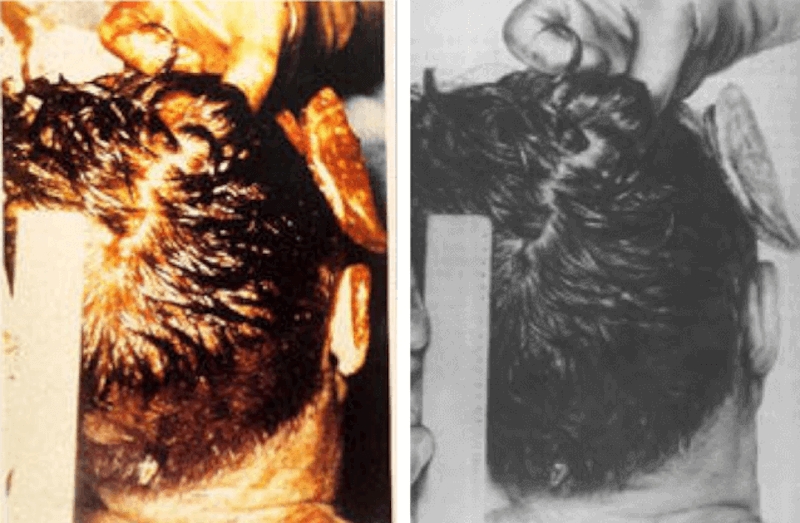
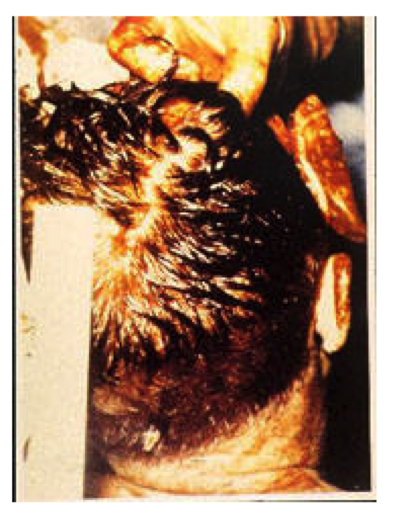
    Before we go any further, let’s take a good look at the photo in question:

    photo

    (People say this photo shows no damage, other than the small white image near the hairline, said to be adherent brain tissue. Yet just above it is an odd, light-colored, angular formation – but that is a side issue not relevant to this essay.)

    What is presumed to be the wound is a flat-looking area of light, watery, reddish brown – one of many in the photo – with hairs growing out of it, apparently. If you blow it up, you will see an “X” crisscrossing through it. Possibly these are hairs.

     blowup

    “X” marks the spot. Hairs?

    If you have ever seen an entrance wound in scalp created by a jacketed bullet traveling at medium high velocity, you will know that it looks nothing like this. The skin is crushed between bullet and bone, and appears quite dark. Lift up the scalp, and the edges of the hole are still apparent. The X’ed image in the photo does not look like a hole at all.

    But this is how the wound is described on page 104 of HSCA Volume VII: “The inferior margin of this wound, from 3 to 10 o’clock, is surrounded by a crescent-shaped reddish-black area of denudation, again presenting the appearance of an abrasion collar, resulting from the rubbing of the skin by the bullet at the time of penetration. From 12 to 3 o’clock, there is a suggesting of undermining, that is, tunneling of the tissue between the skin surface and the skull…” They put this description under a drawing of the photograph.

    The above description is a conflation of the drawing and photograph. I see no “reddish-black area of denudation” in the photograph – but the drawing certainly has a black and white equivalent.

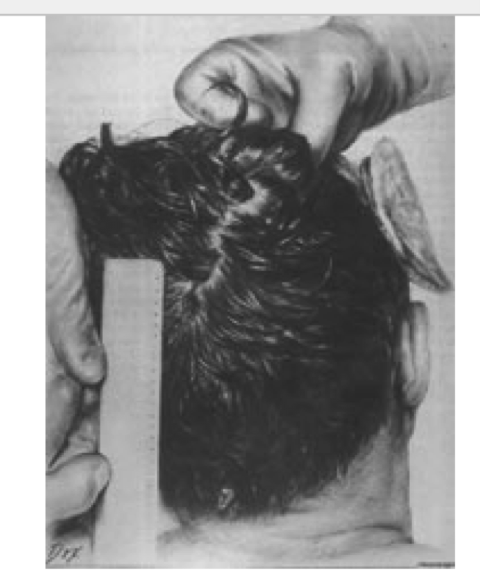
    Now please look at what is supposed to be an accurate drawing of this photo:

    dox

    As you can see, the “wound” is much darker, has more dimension, and rolled edges. It looks like a hole at least. Not one of these characteristics appears in the photograph.

    In his beautifully written essay on the medical evidence, Gary Aguilar, MD also compared the two, and said of the drawing, “the small spot visible just to the right of the top of the ruler is exaggerated in this diagram. It is significantly smaller in the original photograph.” (And there are probably other researchers who have described the contrast between the photo and the drawing.)

    It is the drawing, not the photo, that John Canal presents in his articles. To the uninitiated, the drawing may appear to display a wound.

    Hair Surrounding “Wound” Too Long for EOP Area

    Kennedy’s hair was quite short in the back, including the area where a bullet allegedly entered. And it was even shorter below that area as it approached the neck. As you can see from the photo, the hair all around the “wound” in the cowlick is much too long.


    WITNESSES DO NOT SUPPORT CANAL’S THEORY

    No witnesses said pictures were taken during or after the reconstruction of the skull. None said scalp from the EOP area was dragged to the top of the head.


    JOHN STRINGER

    Canal’s star witness – John Stringer – who Canal insists took photographs of the reconstructed skull after the autopsy, said in 1996:

    “We took no photos during or after the embalming.”   (ARRB 4/8/96, p.5)

    And from his longer deposition, it seems clear that Stringer only took photos during the autopsy – including the ones John Canal claims were taken after reconstruction of the skull. (ARRB 7/16/96)

    But in his Washington Decoded article, Canal gives prominence to what he seems to have gotten Stringer to say in 2011, when Stringer, who was born in 1918, said at the age of 93:

    “In one statement, Stringer wrote, ‘I may have taken some pictures after midnight, but I just can’t remember, it’s been too long.’ [April 30, 2011] In view of Stringer’s 1996 testimony that he did not arrive at his home (not far from the morgue) until about 4 AM, however, and that cosmetic reconstruction of the head began shortly after 11 PM, the inference that he took pictures later as well as earlier is reasonable. It is also consistent with a statement in his book MEDPHOTO that he took photos at various times throughout the procedure and whenever he was directed to do so. [21]

    Buried in Reference 21 is Stringer’s earlier statement to the ARRB:

    “[21] John Stringer, MEDPHOTO: Snapshots of Life in Peace & War with the US Navy (Mooresville, NC: Wishbone Creative Product Services, 2008), 37. In an ARRB interview, Stringer also said that, ‘We took no photos during or after the embalming.’ In contrast, before that statement, he stated photos were taken “throughout the autopsy.”

    Notice Canal’s last remark – as if taking pictures “throughout the autopsy” is supposed to suggest he took them after the autopsy. He pads his article with quotes from a number of people using those words, “throughout the autopsy”, as if that meant afterwards. He also conflates “late photography” to mean after the autopsy:

    “Other witnesses at the postmortem whose observations support late photography [emphasis added] included Captain John Stover, an officer at the Bethesda Naval Medical Center; John Van Hoesen, one of the morticians; Joseph Hagan, supervisor of the team of morticians; Floyd Riebe, the assistant autopsy photographer; Jan Rudnicki, who assisted the autopsy doctors; General Godfrey McHugh, who observed the autopsy; Jerrol Custer, an X-ray technician; and James Sibert, one of the two FBI agents who observed the autopsy.”

    Notice that he leaves out Tom Robinson, the mortician who said many things that challenged the official story.  

    TOM ROBINSON (mortician, not mentioned by Canal):

    “When asked, Mr. Robinson said he had no recollection of photography the night of the autopsy, one way or the other – no recollection whatsoever.” (ARRB 6/21/96, p.3)

    JOSEPH E. HAGAN (mortician):

    “He does not recall, one way or another, whether any photographs were taken during Gawler’s work on the President’s body.” (ARRB 6/11/96 p.4)

    Before the morticians worked on the body,

    “Hagan said that when he arrived… the autopsy was almost over; he only had to wait in the gallery about 20 minutes before the autopsy was concluded. The body of the president was being ‘cleaned up.’ Hagen said photos were being taken, but could remember no details…” (ARRB 6/11/96, p.3)

    JOHN VAN HOESEN (mortician):

    Canal presents this passage from David Lifton’s book that he (Canal) says suggests photos were taken after head reconstruction. But he seems to be describing nothing more than having to wait on the autopsy and the picture-taking before they could begin their own work. And his comments seem to echo Hagen’s (see above):

    “Van Hoesen: When we got up there, nothing had been started; then we had to wait for the autopsy; and then periodically, more pictures were being taken, “you know, different angles and so forth; where the entry was, and so forth; this angle, and that angle …  Lifton, Best Evidence, 666.”

    Canal does not report what Van Hoesen told the ARRB, and it does not help his theory any.

    “He could not remember, one way or another, whether photographs were taken during the embalming and reconstruction process.” (ARRB 9/26/96, p.3)


    LOGIC DOES NOT SUPPORT CANAL’S THEORY

    Scalp Borrowed From an Area Missing Scalp?

    It is well-established that witnesses, including a prominent brain surgeon at Parkland Hospital, said both bone and scalp were missing from an area in the back of the head that included the occiput. The lead pathologist who wrote the autopsy report, James Humes, was vague about a lot of things, including how much of the great defect involved occipital bone, but he did admit the wound was “somewhat” in that area. In any case, the back of head photograph presented earlier in this essay shows no such defect in bone or scalp.

    According to Canal, scalp was borrowed from that area – even though it was already missing scalp – to cover the top right of the head.

    But Canal ignores the testimony about the large hole in the scalp – which he describes as merely “torn.”

    “Specifically, the cosmetic repair involved first suturing the tear in his rear scalp until it was closed, and then, after undermining, stretching the scalp until it covered the large deficit in the top/right/front of Kennedy’s head where the bullet had exited, bone was blown out, and scalp missing or badly damaged.

    “The stretching of the scalp occurred after the autopsy was completed, sometime around 11 PM, and once the embalming and cosmetic restoration of the body commenced. The morticians had only the best of intentions when they took advantage of the fact that the rear scalp had only been torn, and was both repairable and useful for another purpose. They were simply trying to cover that large deficit in the head in anticipation of an open-casket funeral.” (Washington Decoded)

    “The BOH opening, in all likelihood, was created after the bullet’s explosive impact exposed the president’s brain through a tear in the rear scalp and an opening between two or more dislodged (but not blown-out or missing) pieces of loose rear skull. This observation is supported by the fact that the lateral X-ray shows no missing rear bone whatsoever. Dr. J. Thornton Boswell, one of the prosectors, did say in 1996 that he repositioned some bone pieces before the X-rays and photos were taken; it seems logical that he pushed some loose pieces of skull (dislodged but still adhering to the scalp) roughly back into place. (Washington Decoded)


    SUMMARY

    1. Not one witness mentioned by Canal says that photos were taken after the autopsy.
    2. In the photograph, there is no proof of a small entrance wound. But Canal does not show the photograph. He shows the drawing of it, even though the drawing, and the HSCA description of the wound, do not match the photo.
    3. What Canal says is the wound imported from just above the EOP is surrounded by hair that is much too long for that area.
    4. How Canal avoids the problem that scalp would not likely be borrowed from an area that has a sizable hole in it: he claims falsely that in the back of the head, the scalp was merely torn.

    Despite the absence of proof in any of his articles, he said “The evidence for these BOH photographs being taken after the autopsy is irrefutable and so extensive it would not be practical to list here.” The SOP 2015.

    What is “extensive” is the list of problems in Canal’s essays, but I focused only on those that seem to be the worst.

    I wrote this essay in response to an email I received from a student at a college in Texas. She was having trouble making sense of these articles and someone referred her to me.


    ADDENDUM

    I have no opinion as to whether photographs were taken of a reconstructed skull, or when. I only know that witnesses do not support such a claim. While their testimony may be inaccurate or even false, it should be presented. When an author publishes a theory, the author should be the first to let the reader know whatever challenges that theory.

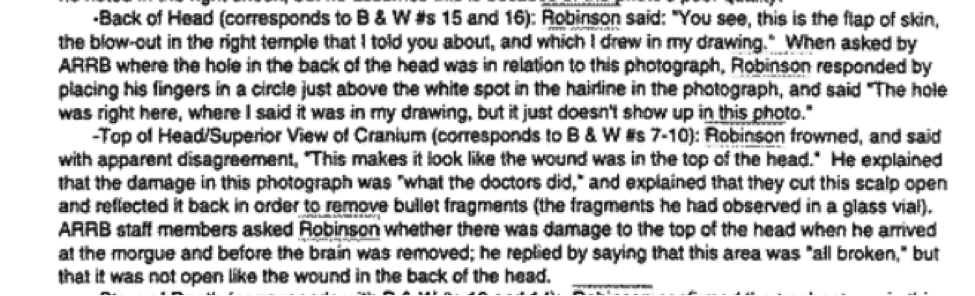
    The testimony of Tom Robinson (excerpted below) contradicts John Canal’s assertions. Canal said the wound in the back of the head consisted only of “torn” scalp and, rather than an area of missing bone, that bone was merely displaced. He also said the bone was put back during the autopsy. But all the pathologists did was to replace loose bone that had fallen out during their probing. But they could not replace bone that was missing in the first place.

    When the body was turned over to the morticians, the skull was missing a large area of bone in the back. Its appearance was not the problem; it would not have been visible during an open casket viewing. But it had to be closed to prevent embalming fluid from leaking through it.

    Robinson did not describe working on the top and side of the head, so we have no details about what was done in these areas – the only parts that would show in an open casket. He just said the top appeared to be “all broken” but not open like the wound in the back.

    When shown the back of head photo, he said the wound was just above the white spot in the hairline. If he was right, this would mean the wound was rather low.

    This is how he described the reconstruction of the area of missing bone in the back:

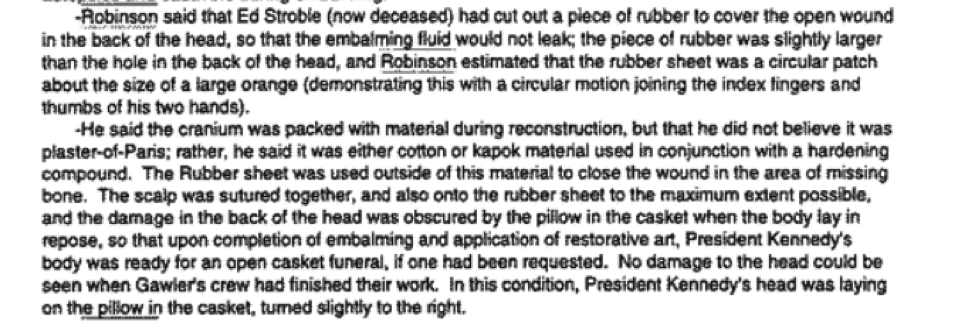
    “Robinson said that Ed Stroble… had cut out a piece of rubber to cover the open wound in the back of the head… the piece of rubber was slightly larger than the hole… the rubber sheet was a circular patch about the size of a large orange… He said the cranium was packed with material during reconstruction… The rubber sheet was used outside of this material to close the wound in the area of missing bone. The scalp was sutured together, and also onto the rubber sheet to the maximum extent possible and the damage in the back of the head was obscured by the pillow in the casket…”


    Location of Hole in Back; Condition of Top of Head

    robinsonA


    Size of Area of Missing Bone, Reconstruction

    robinsonB

  • The Magic Scalp

    The Magic Scalp


    Witnesses who saw JFK’s head up close after he was shot, describe damage that is quite different from what shows in certain autopsy photographs and x-rays. And the contrast between the two – the damage they describe, and the evidence on films is so radically different, many researchers suspect evidence tampering.

    There are people who defend the authenticity of the evidence by “explaining” the problem with theories that may sound reasonable – but some of these people promote their work in the following ways: (a) they omit significant information that challenges their ideas; (b) they pad their work with irrelevant information – thus obscuring the paucity of proof of their main thesis; (c) they try to shape ambiguous language to mean only what they want it to mean; (d) they make amateurishly omniscient assertions… “This is irrefutable proof… There’s no other explanation… This has to mean…”; (e) they list people who presumably agree with them without showing the reader what exactly they had agreed with, and some of the people are in rest homes, or in graves, or otherwise are hard to reach.


    JOHN CANAL’S THEORY

    John Canal, retired USAF Senior Master Sergeant, has a theory designed to explain away two major issues with JFK’s head wound: (1) how the alleged entrance wound, described by the pathologists as low in the head, was four inches higher, as interpreted by medical panels who later studied the photos and x-rays (not the body); (2) why the back of the head pictures show no wound at all, not the big obvious opening described by Parkland doctors and others, and not the smaller entrance wound.

    Canal has promoted his explanation in three different articles, one in 2013 in Max Holland’s Washington Decoded, and two more in something called “Student Operated Press,” The SOP 2014, and The SOP 2015.

    Canal’s theory has multiple parts: (a) he insists the main photo in question (see below) was taken after the morticians reconstructed the head; (b) reconstruction involved moving the scalp from the back to the front of the head, to cover any gaps that might be seen, should there be an open casket funeral; (c) the entrance wound, low in the back of the head, got dragged to the top of the head; (d) the back of the head looks undamaged because the photo was taken after bone was put back in and the scalp was sewn shut.

    In the SOP in 2015, he asserts:

    “Again, because the BOH [back of head] photographs show the entry wound in the scalp high in the cowlick, the fact that the skull entry was low (approximately two inches above the hairline) is incontrovertible evidence the BOH photographs were taken after the autopsy when reconstruction of the BOH by the morticians was completed.”

    This reconstruction is supposed to hide damage from viewers of an open coffin funeral? Then why did they leave that bone flap in front of the ear still flapping away? Surely this photo was not taken when reconstruction was completed. We can be generous and say it was taken during the reconstruction, but Canal presents no proof of that either.


    JOHN CANAL’S “PROOF”

    Before we go any further, let’s take a good look at the photo in question:

    photo

    (People say this photo shows no damage, other than the small white image near the hairline, said to be adherent brain tissue. Yet just above it is an odd, light-colored, angular formation – but that is a side issue not relevant to this essay.)

    What is presumed to be the wound is a flat-looking area of light, watery, reddish brown – one of many in the photo – with hairs growing out of it, apparently. If you blow it up, you will see an “X” crisscrossing through it. Possibly these are hairs.

     blowup

    “X” marks the spot. Hairs?

    If you have ever seen an entrance wound in scalp created by a jacketed bullet traveling at medium high velocity, you will know that it looks nothing like this. The skin is crushed between bullet and bone, and appears quite dark. Lift up the scalp, and the edges of the hole are still apparent. The X’ed image in the photo does not look like a hole at all.

    But this is how the wound is described on page 104 of HSCA Volume VII: “The inferior margin of this wound, from 3 to 10 o’clock, is surrounded by a crescent-shaped reddish-black area of denudation, again presenting the appearance of an abrasion collar, resulting from the rubbing of the skin by the bullet at the time of penetration. From 12 to 3 o’clock, there is a suggesting of undermining, that is, tunneling of the tissue between the skin surface and the skull…” They put this description under a drawing of the photograph.

    The above description is a conflation of the drawing and photograph. I see no “reddish-black area of denudation” in the photograph – but the drawing certainly has a black and white equivalent.

    Now please look at what is supposed to be an accurate drawing of this photo:

    dox

    As you can see, the “wound” is much darker, has more dimension, and rolled edges. It looks like a hole at least. Not one of these characteristics appears in the photograph.

    In his beautifully written essay on the medical evidence, Gary Aguilar, MD also compared the two, and said of the drawing, “the small spot visible just to the right of the top of the ruler is exaggerated in this diagram. It is significantly smaller in the original photograph.” (And there are probably other researchers who have described the contrast between the photo and the drawing.)

    It is the drawing, not the photo, that John Canal presents in his articles. To the uninitiated, the drawing may appear to display a wound.

    Hair Surrounding “Wound” Too Long for EOP Area

    Kennedy’s hair was quite short in the back, including the area where a bullet allegedly entered. And it was even shorter below that area as it approached the neck. As you can see from the photo, the hair all around the “wound” in the cowlick is much too long.


    WITNESSES DO NOT SUPPORT CANAL’S THEORY

    No witnesses said pictures were taken during or after the reconstruction of the skull. None said scalp from the EOP area was dragged to the top of the head.


    JOHN STRINGER

    Canal’s star witness – John Stringer – who Canal insists took photographs of the reconstructed skull after the autopsy, said in 1996:

    “We took no photos during or after the embalming.”   (ARRB 4/8/96, p.5)

    And from his longer deposition, it seems clear that Stringer only took photos during the autopsy – including the ones John Canal claims were taken after reconstruction of the skull. (ARRB 7/16/96)

    But in his Washington Decoded article, Canal gives prominence to what he seems to have gotten Stringer to say in 2011, when Stringer, who was born in 1918, said at the age of 93:

    “In one statement, Stringer wrote, ‘I may have taken some pictures after midnight, but I just can’t remember, it’s been too long.’ [April 30, 2011] In view of Stringer’s 1996 testimony that he did not arrive at his home (not far from the morgue) until about 4 AM, however, and that cosmetic reconstruction of the head began shortly after 11 PM, the inference that he took pictures later as well as earlier is reasonable. It is also consistent with a statement in his book MEDPHOTO that he took photos at various times throughout the procedure and whenever he was directed to do so. [21]

    Buried in Reference 21 is Stringer’s earlier statement to the ARRB:

    “[21] John Stringer, MEDPHOTO: Snapshots of Life in Peace & War with the US Navy (Mooresville, NC: Wishbone Creative Product Services, 2008), 37. In an ARRB interview, Stringer also said that, ‘We took no photos during or after the embalming.’ In contrast, before that statement, he stated photos were taken “throughout the autopsy.”

    Notice Canal’s last remark – as if taking pictures “throughout the autopsy” is supposed to suggest he took them after the autopsy. He pads his article with quotes from a number of people using those words, “throughout the autopsy”, as if that meant afterwards. He also conflates “late photography” to mean after the autopsy:

    “Other witnesses at the postmortem whose observations support late photography [emphasis added] included Captain John Stover, an officer at the Bethesda Naval Medical Center; John Van Hoesen, one of the morticians; Joseph Hagan, supervisor of the team of morticians; Floyd Riebe, the assistant autopsy photographer; Jan Rudnicki, who assisted the autopsy doctors; General Godfrey McHugh, who observed the autopsy; Jerrol Custer, an X-ray technician; and James Sibert, one of the two FBI agents who observed the autopsy.”

    Notice that he leaves out Tom Robinson, the mortician who said many things that challenged the official story.  

    TOM ROBINSON (mortician, not mentioned by Canal):

    “When asked, Mr. Robinson said he had no recollection of photography the night of the autopsy, one way or the other – no recollection whatsoever.” (ARRB 6/21/96, p.3)

    JOSEPH E. HAGAN (mortician):

    “He does not recall, one way or another, whether any photographs were taken during Gawler’s work on the President’s body.” (ARRB 6/11/96 p.4)

    Before the morticians worked on the body,

    “Hagan said that when he arrived… the autopsy was almost over; he only had to wait in the gallery about 20 minutes before the autopsy was concluded. The body of the president was being ‘cleaned up.’ Hagen said photos were being taken, but could remember no details…” (ARRB 6/11/96, p.3)

    JOHN VAN HOESEN (mortician):

    Canal presents this passage from David Lifton’s book that he (Canal) says suggests photos were taken after head reconstruction. But he seems to be describing nothing more than having to wait on the autopsy and the picture-taking before they could begin their own work. And his comments seem to echo Hagen’s (see above):

    “Van Hoesen: When we got up there, nothing had been started; then we had to wait for the autopsy; and then periodically, more pictures were being taken, “you know, different angles and so forth; where the entry was, and so forth; this angle, and that angle …  Lifton, Best Evidence, 666.”

    Canal does not report what Van Hoesen told the ARRB, and it does not help his theory any.

    “He could not remember, one way or another, whether photographs were taken during the embalming and reconstruction process.” (ARRB 9/26/96, p.3)


    LOGIC DOES NOT SUPPORT CANAL’S THEORY

    Scalp Borrowed From an Area Missing Scalp?

    It is well-established that witnesses, including a prominent brain surgeon at Parkland Hospital, said both bone and scalp were missing from an area in the back of the head that included the occiput. The lead pathologist who wrote the autopsy report, James Humes, was vague about a lot of things, including how much of the great defect involved occipital bone, but he did admit the wound was “somewhat” in that area. In any case, the back of head photograph presented earlier in this essay shows no such defect in bone or scalp.

    According to Canal, scalp was borrowed from that area – even though it was already missing scalp – to cover the top right of the head.

    But Canal ignores the testimony about the large hole in the scalp – which he describes as merely “torn.”

    “Specifically, the cosmetic repair involved first suturing the tear in his rear scalp until it was closed, and then, after undermining, stretching the scalp until it covered the large deficit in the top/right/front of Kennedy’s head where the bullet had exited, bone was blown out, and scalp missing or badly damaged.

    “The stretching of the scalp occurred after the autopsy was completed, sometime around 11 PM, and once the embalming and cosmetic restoration of the body commenced. The morticians had only the best of intentions when they took advantage of the fact that the rear scalp had only been torn, and was both repairable and useful for another purpose. They were simply trying to cover that large deficit in the head in anticipation of an open-casket funeral.” (Washington Decoded)

    “The BOH opening, in all likelihood, was created after the bullet’s explosive impact exposed the president’s brain through a tear in the rear scalp and an opening between two or more dislodged (but not blown-out or missing) pieces of loose rear skull. This observation is supported by the fact that the lateral X-ray shows no missing rear bone whatsoever. Dr. J. Thornton Boswell, one of the prosectors, did say in 1996 that he repositioned some bone pieces before the X-rays and photos were taken; it seems logical that he pushed some loose pieces of skull (dislodged but still adhering to the scalp) roughly back into place. (Washington Decoded)


    SUMMARY

    1. Not one witness mentioned by Canal says that photos were taken after the autopsy.
    2. In the photograph, there is no proof of a small entrance wound. But Canal does not show the photograph. He shows the drawing of it, even though the drawing, and the HSCA description of the wound, do not match the photo.
    3. What Canal says is the wound imported from just above the EOP is surrounded by hair that is much too long for that area.
    4. How Canal avoids the problem that scalp would not likely be borrowed from an area that has a sizable hole in it: he claims falsely that in the back of the head, the scalp was merely torn.

    Despite the absence of proof in any of his articles, he said “The evidence for these BOH photographs being taken after the autopsy is irrefutable and so extensive it would not be practical to list here.” The SOP 2015.

    What is “extensive” is the list of problems in Canal’s essays, but I focused only on those that seem to be the worst.

    I wrote this essay in response to an email I received from a student at a college in Texas. She was having trouble making sense of these articles and someone referred her to me.


    ADDENDUM

    I have no opinion as to whether photographs were taken of a reconstructed skull, or when. I only know that witnesses do not support such a claim. While their testimony may be inaccurate or even false, it should be presented. When an author publishes a theory, the author should be the first to let the reader know whatever challenges that theory.

    The testimony of Tom Robinson (excerpted below) contradicts John Canal’s assertions. Canal said the wound in the back of the head consisted only of “torn” scalp and, rather than an area of missing bone, that bone was merely displaced. He also said the bone was put back during the autopsy. But all the pathologists did was to replace loose bone that had fallen out during their probing. But they could not replace bone that was missing in the first place.

    When the body was turned over to the morticians, the skull was missing a large area of bone in the back. Its appearance was not the problem; it would not have been visible during an open casket viewing. But it had to be closed to prevent embalming fluid from leaking through it.

    Robinson did not describe working on the top and side of the head, so we have no details about what was done in these areas – the only parts that would show in an open casket. He just said the top appeared to be “all broken” but not open like the wound in the back.

    When shown the back of head photo, he said the wound was just above the white spot in the hairline. If he was right, this would mean the wound was rather low.

    This is how he described the reconstruction of the area of missing bone in the back:

    “Robinson said that Ed Stroble… had cut out a piece of rubber to cover the open wound in the back of the head… the piece of rubber was slightly larger than the hole… the rubber sheet was a circular patch about the size of a large orange… He said the cranium was packed with material during reconstruction… The rubber sheet was used outside of this material to close the wound in the area of missing bone. The scalp was sutured together, and also onto the rubber sheet to the maximum extent possible and the damage in the back of the head was obscured by the pillow in the casket…”


    Location of Hole in Back; Condition of Top of Head

    robinsonA


    Size of Area of Missing Bone, Reconstruction

    robinsonB

  • Gerald Posner vs. Roger Stone in Coral Gables

    Gerald Posner vs. Roger Stone in Coral Gables

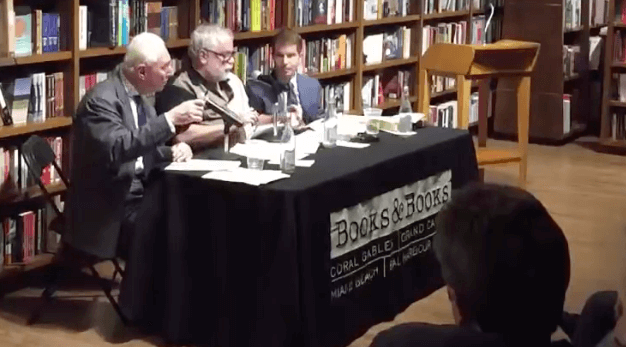
    On the 54th anniversary of President Kennedy’s assassination, at a bookstore in Coral Gables, Florida two famous authors convened. They were Gerald Posner and Roger Stone. The subject was a debate over the circumstances of Kennedy’s assassination. Obviously, because of the orientation of their books on the subject, Posner defended the Warren Commission verdict while Stone argued for a conspiracy.

    Robert Loomis

    Posner was trained as a lawyer. At age 23, he became one of the youngest attorneys ever employed by Cravath, Swaine and Moore, John McCloy’s old law firm. In 1980, he left that firm and opened a private practice with a partner. In 1986, he left that practice and became an author. In a relatively short period of time, he wrote three non-fiction books and one novel. In 1991, he was enlisted by Robert Loomis of Random House to write a response to Oliver Stone’s movie about the Kennedy assassination, JFK. The very plugged-in Loomis promised Posner that the CIA would cooperate with him on the project. (The Assassinations, edited by James DiEugenio and Lisa Pease, p. 369) And they did. Without their help, how else could an author gain access to high level defector Yuri Nosenko?

    Harold Evans

    As was exposed in a later lawsuit by the late Roger Feinman, Random House put a major effort into selling Posner’s Case Closed. One that was personally supervised by Harold Evans, who was president of the publishing house at the time. According to information Feinman discovered in his lawsuit, it was Evans who personally approved the infamous NY Times ads for the book. This was a four-phase campaign. It began with two teaser ads that promised to name the guilty parties in the JFK assassination. It culminated with two more ads. These featured the faces of Oliver Stone, David Lifton, Robert Groden, Jim Marrs, Mark Lane and Jim Garrison under a title which boldly accused them of the charge: “Guilty of Misleading the American Public”. If the reader knows anything about advertising costs in major newspapers, he can guess what those four ads cost. (Click here for Feinman’s essay about his lawsuit against Random House.)
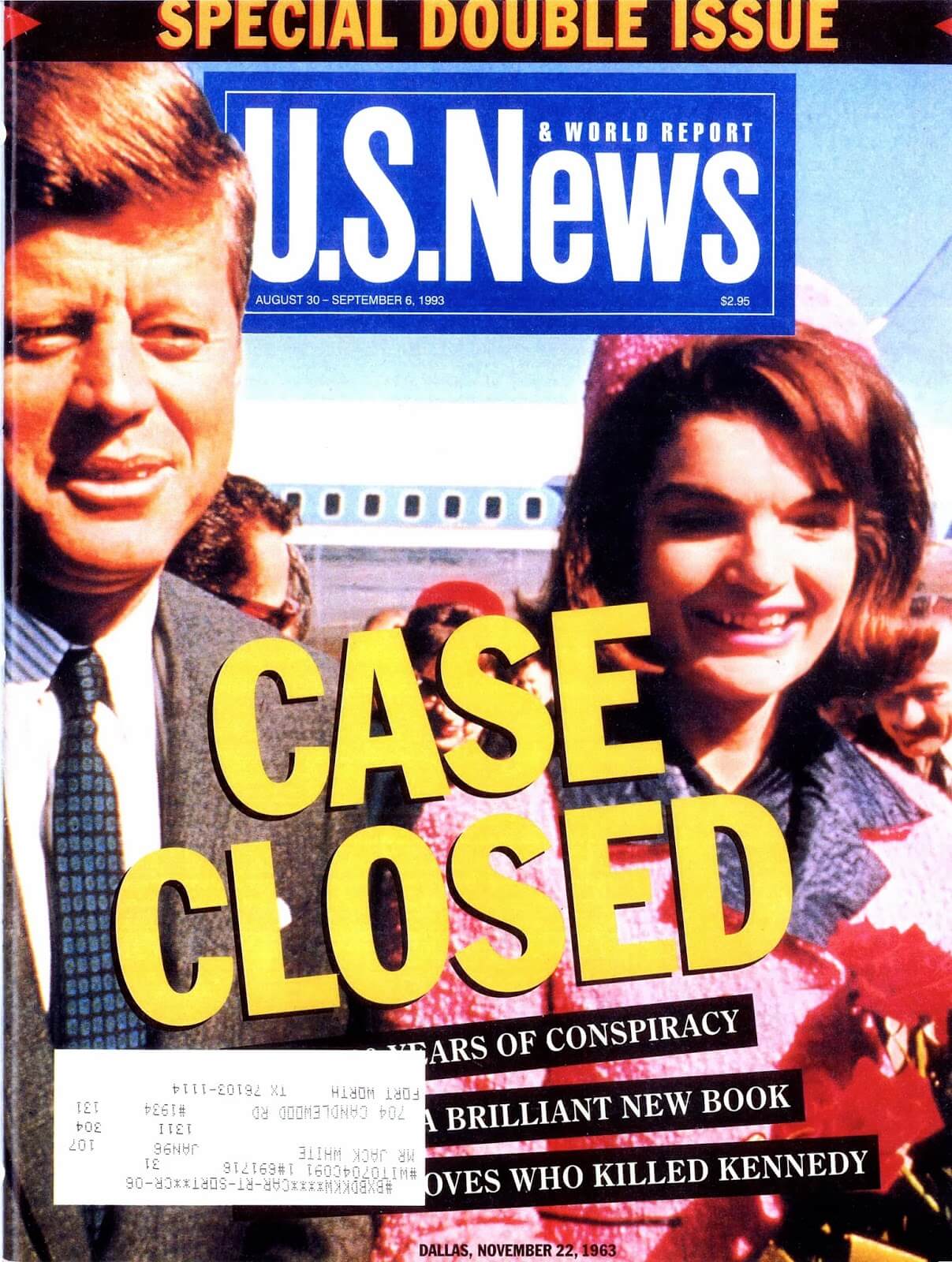
    But that was not all. Apparently because Evans had previously served as a director of US News and World Report, that magazine gave Posner’s book a cover story. The book became such a cause celebre that other authors have successfully used it as a way to curry favor with the MSM, e.g., Jeff Toobin and Robert Dallek.

    The problem with all this hoopla, which was designed to coincide with the 30th anniversary of the assassination, is that it was completely unwarranted. There were several reviews that showed just how flawed Case Closed was: for instance, David Wrone’s. (See also this index of items on this site.) In fact, there were so many problems with Posner’s book that activist Dave Starks put together a compendium page of articles to show that, not only was Case Closed a very bad piece of scholarship, but it might have been worse than that. In his haste to do a hatchet job on the critics, Posner may have created interviews he did not actually do. For instance, Peter Scott talked to Carlos Bringuier after Case Closed came out. Contrary to the book’s claims, Bringuier said he never talked to Posner. (Author interview with Scott in San Francisco in 1994) Same with Dealey Plaza witness James Tague, who the author clearly states he talked to on two successive days. (See Posner, paperback edition, p. 546) When Gary Aguilar talked to Tague, he said he never spoke to Posner. To use another example, although the author said he interviewed JFK’s forensic pathologist Thornton Boswell, Boswell told Aguilar he never spoke to him. (Click here for Starks’ devastating page on Posner.)
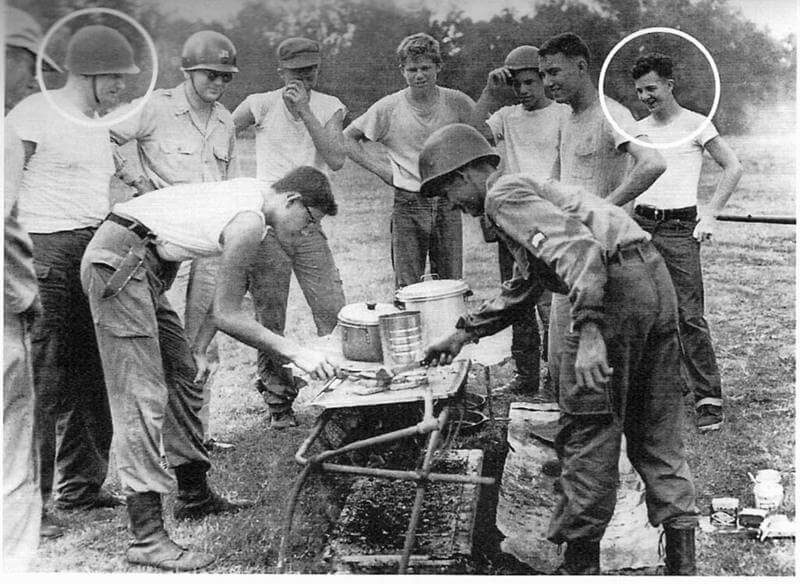
    David Ferrie & Lee Oswald,
    Civil Air Patrol (1955)

    Posner also committed some outright howlers in his much-ballyhooed book. For example, in his schematic drawings of the assassin at the Texas School Book Depository window, he has him posed as firing from an extreme left to right angle. So much so that these “Posner shots” would have ended up in the railroad yards behind the picket fence. (See Appendix A of Case Closed, paperback edition.) This makes one wonder if Posner was ever in Dallas. Because to anyone who has been to the building and peered out the sixth floor window—which was possible back then—it presents a slight right to left angle. Posner also wrote that there was no evidence to connect David Ferrie with Oswald. (Posner, p. 425) This was utterly ridiculous on many counts. But to name just one, when the book came out PBS did a special which featured a photo of Oswald and Ferrie together at a Civil Air Patrol (CAP) barbecue. They found it by questioning some other members of the CAP. Which means Posner could have done the same if he had knocked on some doors in the Crescent City. Posner also writes that there was no such personage as Clay Bertrand in New Orleans. When the JFK Act declassified both the Jim Garrison files and the papers of the HSCA, Posner again ended up with custard pie on his face. Those documents reveal that the number of witnesses who stated that Clay Shaw used the alias of Clay Bertrand was in the double digits. (Destiny Betrayed, Second Edition, by James DiEugenio, pp. 211, 387, 388)

    Posner’s book showed us in excelsis just how schizoid America is on the murder of President Kennedy. It did not matter to the Powers That Be just how error-strewn Posner’s book was. It did not matter to them that he was more or less acting as a hired gun for Loomis and Evans. It did not matter to them that the book was obviously a rush job for the 30th anniversary. Or that the title was preposterous since the declassification process of the JFK Act had not even gone into effect yet. In other words, the book was saying the case was closed when, in fact, two million pages of documents were about to be declassified in the next four years.

    Clearly, as representatives of the Anglo-American Establishment, the important thing for Loomis and Evans was this: They wanted to create a tangible cultural artifact to rally around at the 30th anniversary. Why? In order to beat back the tsunami effect of Oliver Stone’s JFK, which had blindsided them. Posner’s book was a concocted historical event. Today the book has been retired to the (rather large) ash heap of useless volumes on the JFK case. It has no intrinsic factual merit to it at all. It is simply an exemplar of a two-part cultural/historical phenomenon. I say two parts, because the second phase of this Jungian neurotic outbreak occurred four years later, with another Loomis client. This time the collective seizure was over Sy Hersh’s equally horrendous book. This one was a biography of John Kennedy, The Dark Side of Camelot. That bookend volume was as bad in its own way as Posner’s tome. But Oliver Stone had not just said that JFK was killed by a conspiracy. His film also stated that Kennedy was a foreign policy iconoclast who was changing things in that realm. This was true and has been proven even more accurate by recent scholarship. But that did not matter with Hersh, whose book was so bad that some critics said it should have been titled, The Dark Side of Seymour Hersh.

    II

    Roger Stone was born in Lewisboro, New York to a reporter mother and a father who drilled oil wells. Stone got hooked on politics when he read Conscience of a Conservative by Barry Goldwater. Although he admired Goldwater’s ideas he could not comprehend the tactics of his 1964 campaign. To put it mildly, he thought they were rather quixotic. As he told writer Matt Labash, “It’s like he was trying to lose. Going to Tennessee and coming out against the Tennessee Valley Authority? These were suicidal acts.” (Weekly Standard, November 5, 2007)

    Roger Stone & Nixon

    Because of this, Roger Stone became more enamored with Richard Nixon as his conservative standard bearer. He deduced that Nixon was “more pragmatic, more interested in winning than proving a point.” He took a pithy aphorism from RMN: “Losers don’t legislate.” (ibid) Stone liked Nixon so much that he decided that his newly found idol had not really lost the 1960 election. He had been robbed of the presidency through electoral fraud. So he wrote Nixon a letter at his New York law firm encouraging him to run again. Nixon replied that he did not plan on doing so, but if he did, he would be in touch with young Stone. (Stone is such a Nixon fan he had his face tattooed on his back.)
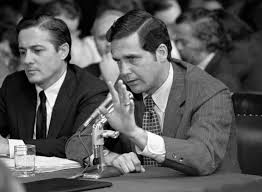
    Jeb Magruder testifies
    during the Watergate hearings

    While a student at George Washington University in Washington D.C., Stone invited Jeb Magruder, deputy director of the Committee to Reelect the President, to speak at the college’s Young Republican Club. After the speaking engagement Stone asked Magruder for a job with CREEP. At age 19, Stone decided to forsake his studies and joined right in with the antics of the infamous CREEP. For instance, he planted a mole in the camp of Democratic rival Hubert Humphrey. Magruder and his cohorts were obsessed with intelligence and skullduggery, and Stone had a natural affinity for them. He once wrote a check to Nixon rival Pete McCloskey from an account inscribed as the Young Socialists Alliance. Once he got the receipt he leaked it to the reactionary newspaper Manchester Union-Leader. (ibid)

    Against Senator George McGovern in the general election, Stone hired another spy he termed Sedan Chair II. But according to Stone, he did not understand the mentality of CREEP. To him it did not make any sense to take the kinds of risks they were taking when the Democratic candidate, McGovern, had so little chance of winning. After Watergate, which spelled the end of Nixon’s political career, he went to work for Bob Dole, and then for the (failed) Ronald Reagan campaign of 1976. During this period, he co-founded the National Conservative Political Action committee, which was designed to execute a GOP takeover of the Senate. Which, by recruiting men like Dan Quayle and Chuck Grassley, it did. As he noted to Jeffrey Toobin, “The Democrats were weak, we were strong.” (The New Yorker, June 2, 2008)

    Donald Trump & Roy Cohn
    JohnAnderson9 16 80
    John Anderson (Sept. 16, 1980)

    In 1980, he again worked for Reagan. In that election, he joined forces with the notorious attorney Roy Cohn, sworn enemy of the late Bobby Kennedy. They decided that the best way for Reagan to beat incumbent president Jimmy Carter in New York was to help Democratic congressman John Anderson get on the ballot. This way, the Democratic Party vote would be split and therefore weakened. According to Stone, Cohn told him to get in contact with a lawyer friend he had. Once in contact, he was to ask him how much it would cost to get Anderson the Liberal party nomination in New York. Stone reported back that the price was $125,000. A couple of days later, Stone was told by Cohn to pick up a suitcase and deliver it to the lawyer. He did so, and Anderson won the Liberal Party nomination. Reagan won New York with 46% of the vote. (ibid, Labash)

    Reagan’s victory in 1980 allowed Stone to enter the upper stratosphere of political campaign managing and lobbying. He now set up an office with two other GOP stalwarts, Charles Black and Paul Manafort. They would later be joined by none other than the late Lee Atwater, the man usually given credit for the Willie Horton TV ads, which helped defeat Democrat Michael Dukakis in 1988. The firm was lobbying on behalf of such people as Ferdinand Marcos, dictator of the Philippines, as well as conservative causes like the Nicaraguan Contras, and Angola’s UNITA rebels. And they advised several presidential candidates, even when they opposed each other.

    Stone’s primacy in the higher circles of the GOP came to an end in 1996. He was serving as an unaccredited adviser to Bob Dole’s presidential campaign when scandal struck. And it struck through the National Enquirer. They billed the story as “Top Dole Aide Caught in Group-Sex Ring.” (op. cit., Toobin) He and his second wife had run ads for swinging partners to participate in bedroom games. (op. cit., Labash) The tabloids even got hold of the advertising photos. Stone tried his usual “Deny, deny, deny” tactics. But they did not succeed.

    But in 2000, James Baker, who was running the GOP recount effort in Florida against Al Gore, brought Stone back to perform one last piece of political subterfuge. That act would have a momentous impact on America for decades into the future. It has come to be known as the “Brooks Brothers riot”.

    When the Florida Supreme Court ruled that Gore could have a recount in four counties, Stone and Baker decided this had to be thwarted. Scores of Republican congressional aides—the Brooks Brothers suits—had been flown to Miami to simulate grass roots, Floridian protest against the recount. Stone stationed himself in a Winnebago outside the building where the Miami-Dade County recount was taking place. Outfitted with walkie-talkies and cell phones, he went to work using these aides to create the illusion of an indigenous attack on the building. He did this by having the congressional aides actually enter the building and demand the recount be halted. According to the New York Times, some people were struck or kicked. (11/23/2000) This scene inside the building was coupled with Stone inspired Spanish language radio warnings about carloads of Cuban exiles driving to the scene. (op. cit., Toobin) In its broad outlines, the operation resembled the CIA coup in Guatemala in 1954. Between the Brooks Brothers demonstrators and the “imminent Cuban exile assault”, the recount was discontinued. The episode likely stopped Gore from actually taking the lead for the first time. This—plus the later Antonin Scalia order granting emergency relief due to the “irreparable damage” of counting votes—ultimately led to the US Supreme Court decision stopping the recount. And that brought us George W. Bush, perhaps the worst president in history.

    III

    After his work for Random House on the JFK case, in 1998 Posner wrote a book on the 30th anniversary of the Martin Luther King assassination. To no one’s surprise, Killing the Dream came to the same conclusion as Case Closed—the official story was correct. One year later of course, William Pepper demonstrated in court that Posner was wrong. The jury in a civil case brought by the King family ruled that King was killed as a result of a conspiracy.

    David Marwell

    Because of his establishment-pleasing writings, Posner became a TV and MSM presence. And he continued to write more non-fiction books. He appeared on many TV programs and also as an editorial writer for some major newspapers. According to Doug Horne in his book Inside the ARRB, the first director of the Assassination Records Review Board, David Marwell, said he found much of value in Case Closed. Consequently, he had lunch with Posner more than once. Harold Evans’ wife, Tina Brown, hired Posner as an investigative journalist for the online magazine Daily Beast. But he was forced to step down from that position in 2010 over several accusations that demonstrated that Posner was a serial plagiarist. He not only plagiarized for his articles at Daily Beast, but also in at least three of his books, e.g., Miami Babylon. (See Slate, “The Posner Plagiarism Perplex”, 2/11/2010, also Miami New Times, March 30, 2010)

    Tina Brown
    Harper Lee

    Three years later, the late Harper Lee filed a lawsuit claiming that her literary agent’s son-in-law had directed Posner to set up a corporation to defraud Lee of her royalties from her colossal best-seller To Kill a Mockingbird. In her court filing she said that she had faulty hearing and eyesight and these had been used by Samuel Pinkus to snooker her into signing over her book copyright. Pinkus assigned the copyright to a company incorporated by Posner. (NY Post, May 4, 2013) Four months later, Posner settled the suit and was dismissed from the legal action.

    After his work for James Baker in Miami, Roger Stone tended to concentrate on two new subjects. First, there was his friendship with Donald Trump. Stone was sold on the idea of Trump making a run for the presidency on the Reform Party ticket, the party created by Ross Perot. Although Trump made some overtures to run in the 2000 election, he ultimately decided against it. Stone also began to develop an avocation as an author. To say that his output has been prolific does not do him justice. In the space of about three years, beginning in late 2013, Stone has written or co-written—at last count—seven books. At least three of them rely on his relationship with Richard Nixon, who he still holds in high regard. If one looks closely, three of them rely on his relationship with Trump, who he had worked for in Trump’s 2015-16 campaign before they (allegedly) parted ways. His book about Jeb Bush, Jeb and the Bush Crime Family, was clearly meant as a broadside against the candidate most perceived as the favorite in the GOP primary campaign. His book about the Clintons, The Clintons’ War on Women, was meant as a preemptive strike against the attacks against Trump’s philandering with females.

    But Roger Stone/author first came to prominence at the 50th anniversary of the JFK assassination. At that time he co-wrote a book entitled The Man Who Killed Kennedy: The Case Against LBJ. That book became a New York Times bestseller. In fact, of all the books released at the 50th, it likely sold the most copies. Since then he has stayed involved in the field. In fact, his co-writers on the two previously mentioned books come from the JFK field. They are, respectively, Saint John Hunt and Robert Morrow.

    Why has Stone done this? It likely does not pay him the fees he commanded as a Washington lobbyist working in a very powerful PR firm. In a profile written by Jeff Toobin for The New Yorker, some hints for this career move are tossed out—almost inadvertently. One of the reasons Stone gives for being so enamored of Nixon is his anti-elitism. He adds Nixon was class conscious. And he identified with average people who ate TV dinners and watched Lawrence Welk. To Stone, Nixon “recognized the effectiveness of anti-elitism—a staple of American campaigns even today—as a core message.” In comparing Nixon with Reagan, Stone states that although many Republicans give Reagan credit for the defections of the working class from the Democrats, it was really Nixon who started it. Stone then zeroes in on the whole polarization concept:

    Nixon figured out how to win. We had a non-elitist message. We were the party of the workingman! We wanted lower taxes for everyone across the board. They were the part of the Hollywood elite. … The point that the Democrats missed was that the people who weren’t rich wanted to be rich.

    There is little doubt that Nixon, with his appeals to the Silent Majority in order to expand and lengthen the Vietnam War, did use these kinds of techniques. It’s obvious from the declassified tapes at the Nixon Library that he did not mean any of it. This was amply exposed by author Ken Hughes, among others, in his fine book Fatal Politics. And this exposure helps explain why Nixon and his family fought so long and hard not to have those tapes declassified. That book reveals that Nixon knew the war was lost in 1969. But he did not want to have South Vietnam fall on his watch. Therefore, he lied to Nguyen Van Thieu of South Vietnam to keep him in his corner while he negotiated an agreement with the north. The whole time he slaughtered tens of thousands of innocent civilians in an expanded air war over all of Indochina. The only reason for this was to announce a peace agreement on the eve of the 1972 election to make sure he had a landslide victory. This is all admitted to on these tapes in the Hughes book, and in letters he sent to Thieu in the book The Palace File.

    But the relevant point for today’s scene is that this cultural anti-elite aspect was well used by both Stone and Trump during the latter’s successful presidential campaign. Trump decided to leapfrog most of the MSM, and he did this with Stone’s help. In addition to the two books mentioned above, Stone helped promote the whole mythology of Ted Cruz’s father being seen in New Orleans with Lee Oswald in the summer of 1963. Stone used the word of Judyth Baker to promote this bizarre story. And Trump went on national TV with it. (Click here for our reaction.) The Morrow/Stone book about Clinton helped Trump alleviate the impact of the compelling Access Hollywood videotape. And this whole anti-cultural-elite concept helped avoid the question of how in the heck do the interests of a billionaire real estate investor coincide with America’s shrinking middle class? With the announcement of Trump’s cabinet, we can see that, as with Nixon, the whole idea is little more than window dressing. The policies that this cabinet and the Republican Party will try to enact will gut the middle class even more.

    IV

    All of the above about these two men is more than relevant to their debate in Coral Gables. Because it informs us of the state of the JFK case in America today. This author would not walk across the street to see Posner speak about either the JFK or King case. Simply because he is a lawyer who is in the employ of the official story. Therefore, it does not matter if what he is saying is incomplete, dubious or just specious. This reviewer has never read any of Stone’s books for the simple reason that I have a hard time thinking that Stone could master something as complex and multi-layered as the JFK case in just a matter of 3-4 years. I am also skeptical of the case that he and others have made against Lyndon Johnson. In watching this confrontation it appears I was correct about these suspicions.

    Roger Stone presented first. He led off with remarks about the avulsed rear skull wound that, for him, disappeared from the back of Kennedy’s head after he left Parkland Hospital. (This is not accurate. Gary Aguilar has shown it did not disappear, it was apparent at both the emergency room at Parkland and Bethesda Medical Center, where Kennedy’s body underwent an autopsy.) Stone later added the confusing point that the House Select Committee on Assassinations (HSCA) was convened because of Oliver Stone’s film JFK. I think Roger meant the Assassination Records Review Board (ARRB) was convened.

    But he then confuses this issue even more by saying that the HSCA revealed more of Ruby’s Mafia ties, which led them to conclude organized crime involvement in the JFK case. This is not really accurate, as the HSCA did not deduce this as one of their conclusions. Chief Counsel Robert Blakey did that in his later book on the JFK case, The Plot to Kill the President (which was co-written with Dick Billings).

    Stone also talked about his relationship with Senator Arlen Specter and how Specter did not have access to the autopsy materials during the Warren Commission proceedings. This needed to be qualified. As revealed by the declassified transcripts of the their executive hearings, the Warren Commission did have the autopsy materials. (Gerald McKnight, Breach of Trust, p. 171) And as Pat Speer has shown on his web site, Specter did see at least one of the autopsy photos. (See Chapter 10, “Examining the Examinations”.)

    Stone also said that the alleged rifle used by Oswald was purchased for $75.00 and that no marksman was able to duplicate what he did, that is get 2 of 3 direct hits in six seconds. The latter part of this is correct, the former sum is about three times what the rifle actually cost. Stone then concluded with the Jay Harrison/Barr McClellan sponsored Mac Wallace fingerprint found on the sixth floor. He also even mentioned one Loy Factor’s involvement with Wallace and the LBJ plot.

    Posner then replied. He criticized Stone’s book for having so many footnotes to other books. He therefore termed the book outdated. This is bizarre since Posner’s book is overwhelmingly reliant on the Warren Report and the accompanying volumes of evidence. He then said there was no evidence on the autopsy x-rays and photos that revealed anyone firing from anywhere except from behind and the general vicinity of the sixth floor.

    Apparently, Posner was not aware of the ARRB interview with Tom Robinson who worked out of Gawler’s funeral parlor. He said there was a wound near the right temple of the president that he filled in with wax. He said it was so close to the hairline it was difficult to see. (Murder in Dealey Plaza, p. 250, edited by James Fetzer.) Author Don Thomas has also done good work with the autopsy photos, which makes this wound easier to discern. Posner also ignores the fact that, as many have indicated, if the autopsy doctors are correct and the entrance wound in the skull came in near the base, then there is no trajectory of bullet particles on the X-rays to match it up with.

    Since Stone gave Posner an opening about only the Parkland doctors seeing the hole in the back of the skull, lawyer Posner took advantage of it. He said that since Kennedy’s body was not turned over at Parkland, they really didn’t see it. This is ridiculous on more than one count. First, as Gary Aguilar has shown, this avulsed wound did not “disappear” after Dallas. It was clearly observed at Bethesda, except the HSCA hid these interviews from the public. Therefore they were only declassified with the advent of the ARRB. (ibid, p. 199) And Posner talks about using dated information.

    Secondly, Parkland nurse Diana Bowron actually saw this wound as she was aiding the entourage bringing Kennedy’s body into the emergency room, and she saw it again as she was prepping Kennedy’s corpse to depart. (ibid, pp. 60, 199) Neurosurgeon Kemp Clark examined Kennedy’s skull as the tracheotomy was being performed and he stated that he saw this wound. (ibid, p. 193) Nurse Audrey Bell told the ARRB that Malcolm Perry showed her this wound by turning Kennedy’s head slightly. (Interview of 4/1/97) Then, of course, there is the testimony of Secret Service agent Clint Hill who said he saw this wound in the limousine on the way to Parkland. (op. cit., Fetzer, pp. 198-99) Stone should have literally harpooned Posner for citing such specious information.

    The bloviating Posner then added something just as dubious. He said that in order to argue conspiracy one must state that the X-rays and photos are altered. More baloney. Stone should have asked Posner on rebuttal, “How did the 6.5 mm fragment get on the X-rays if it’s not in the autopsy report and none of the autopsy doctors saw it that night?” He then should have asked the prosecutor, “What happened to the trail of fragments that lead pathologist Jim Humes wrote about in his report which goes from the bottom rear of the skull to the top? Those do not exist today. Why Gerald?” (Reclaiming Parkland, by James DiEugenio, pp. 152-54) Stone should also have asked the attorney, “Gerald, if all the shots came from the rear, including the head shot, why is there no blowout in the front of Kennedy’s face?”

    Further, the brain was never sectioned. Therefore we do not know the path of the bullet through the skull, or if there was only one bullet.  That would have been the best evidence of exactly what killed President Kennedy.  But it  was not done. Why?

    Finally, the back wound was not dissected.  So we do not know if this wound was a through and through wound–did it transit the body?  If it did not, then the Single Bullet Theory Posner upholds is kaput.  And according to pathologist Pierre Finck’s testimony at the Clay Shaw trial, the reason it was not tracked is that the doctors were prevented from doing so by the military brass at Bethesda.

    These all indicate a cover up, if not a conspiracy.  And they all would have been better evidence than the photos and X-rays. After all, one cannot photograph autopsy practices that were never performed.

    Posner then said it is wrong to say that no marksman ever duplicated Oswald’s shooting feat. He said the Commission did, CBS did, and the HSCA did.

    Concerning the first, I don’t know what Posner is talking about. Mark Lane and Sylvia Meagher have discussed the rifle experiments of the Warren Commission.  (Meagher, Accessories After the Fact,  pp. 108-10; Lane, Rush to Judgment,  pp. 126-30)  The FBI tried to get off three shots in six seconds, scoring two of three direct hits in the head and shoulder area. They failed. Therefore, the Commission had three military snipers try it. These tests were rigged. They were done from about twenty feet up, not sixty, as would have been the case with Oswald.  The three riflemen were given as much time as they wanted to gauge the first shot, again not the case for Oswald.  Third, they were firing at stationary and not moving targets.  And even at that, the targets were grouped much closer together than what the Commission said was the firing series in Dealey Plaza. Fifth, these were some of the vey best marksmen in the military. They were so good they were above the best in the Marine Corps, and could qualify for the Olympics. To put it mildly, Oswald was nowhere near this quality.  But even at that only one of them got the shots off in the required time.  And none were able to get two of three direct hits.

    Concerning CBS, apparently Posner has not read my essay based on CBS internal memoranda adduced by their employee Roger Feinman. Unlike what Posner stated, their first marksman, a famous military sniper, using a model of the 6.5 Mannlicher Carcano, could not do what Oswald did. They then brought in a team of riflemen, and let them practice for a week—which Oswald did not do in any way, shape or form. They then set up a target that eliminated the oak tree from the sixth floor, eliminated the curve in the street, and instead set up a moving sled to fire at. This last was the most important factor. Why? Because the sled posed an enlarged target, as Feinman notes, it at least doubled the target area. In other words, CBS cheated after their first marksman failed. (Click here for that information.)

    Stooping to the HSCA for evidence on this subject is really hard to understand. Even for Posner. Because the HSCA did no rifle tests during its actual duration. They did not do them until after the HSCA ceased operation. Wallace Milam sent me the full memo on this episode. It turns out that Chief Counsel Robert Blakey, his assistant Gary Cornwell, and some Washington policemen went out to a rifle range. There they tried to do what the Commission said Oswald did. In their overweening ambition, at first they decided not to use the telescopic site. Which is ridiculous since the Commission said Oswald did use it. After all, why would it be attached to the rifle if it were not used? As I can inform the reader, that scope makes a huge difference. To say Oswald did what he did without it is simply preposterous. But when the policemen used only the iron sights on the rifle, they had the same problem that the Commission did. They could not maintain accuracy within the six second time interval of the Warren Commission. So what did Blakey and Cornwell do? They used something called “point aiming”. Which means not using any site at all, just pointing the rifle. When they got off two shots in under two seconds that was enough. They then deduced it was possible to do what Oswald allegedly did even though they were only 20 feet up instead of 60 feet and their accuracy results were not recorded. (The Assassinations, edited by James DiEugenio and Lisa Pease, p. 83)

    Marine sniper
    Carlos Hathcock

    Stone should have replied that, yes, you can do what the Commission said Oswald did. But you have to cheat. And then not tell the public about the cheating. I would have then added that Carlos Hathcock, the greatest sniper of the Vietnam War, actually did try and duplicate accurately what the Commission said Oswald did. He told author Craig Roberts that he could not do it, even though he tried more than once.

    Posner actually used the fingerprint evidence on the alleged Oswald rifle to try and convict Oswald. Without telling the public that this so-called evidence was presented only after the FBI found there were no prints found on the rifle when Sebastian LaTona examined it that night. (Meagher, op. cit., pp. 120-27) Prints only showed up about a week later, and then thirty years later for a PBS special. Stone rightly pointed out that the FBI was inexplicably at the Oswald funeral parlor trying to get fingerprints off of his corpse. (Henry Hurt, Reasonable Doubt, pp. 107-09) Which is weird, since the Dallas Police already had Oswald’s fingerprints.

    Posner concluded by rebutting the use of the Mac Wallace fingerprint with the work of FBI authority Robert Garrett, as is featured in Joan Mellen’s book, Faustian Bargains.

    I won’t go on with my analysis since it would just be more of the same. Posner making more and more dubious claims and Stone replying with populist type experts, e.g., Judyth Baker on Cruz, and Richard Bartholomew on the Wallace print. (Yet, to my knowledge, Richard is not a fingerprint expert.) Posner actually tried to impeach Victoria Adams not seeing Oswald running down the stairs after the shooting by saying she did not see officer Marrion Baker or supervisor Roy Truly either. Again, Posner seems unaware that Miss Garner, Victoria’s supervisor, did see those two men come up the stairs after Adams and co-worker Sandy Styles went down. Further, the Warren Commission had this document in their hands, since it was dated June 2, 1964. While they were in session.

    Now, obviously, if Garner saw Baker and Truly after Victoria and Sandy went down the stairs, then the two women left within seconds of the shooting, as they said they did. Yet the Warren Report says they left much later, minutes afterwards. In other words, the Commission covered up the true facts of what had occurred. Because Adams and Styles give Oswald a rock solid alibi for not being on the sixth floor when they needed him to be so. (DiEugenio, op. cit., pp. 115-20)

    The most important thing that was said during this debate was that Stone would try and talk to Mr. Trump about the declassification of the final documents being held at the National Archives by the JFK Act. They are supposed to be finally disposed of in October of this year. Let us hope Mr. Stone uses his influence to see that through. It would be in keeping with his and Mr. Trump’s obeisance to conservative populism.

    (The debate video is embedded below, or the reader can watch it by clicking here.)

  • Gerald Posner vs. Roger Stone in Coral Gables

    Gerald Posner vs. Roger Stone in Coral Gables

    On the 54th anniversary of President Kennedy’s assassination, at a bookstore in Coral Gables, Florida two famous authors convened. They were Gerald Posner and Roger Stone. The subject was a debate over the circumstances of Kennedy’s assassination. Obviously, because of the orientation of their books on the subject, Posner defended the Warren Commission verdict while Stone argued for a conspiracy.

    Robert Loomis

    Posner was trained as a lawyer. At age 23, he became one of the youngest attorneys ever employed by Cravath, Swaine and Moore, John McCloy’s old law firm. In 1980, he left that firm and opened a private practice with a partner. In 1986, he left that practice and became an author. In a relatively short period of time, he wrote three non-fiction books and one novel. In 1991, he was enlisted by Robert Loomis of Random House to write a response to Oliver Stone’s movie about the Kennedy assassination, JFK. The very plugged-in Loomis promised Posner that the CIA would cooperate with him on the project. (The Assassinations, edited by James DiEugenio and Lisa Pease, p. 369) And they did. Without their help, how else could an author gain access to high level defector Yuri Nosenko?

    Harold Evans

    As was exposed in a later lawsuit by the late Roger Feinman, Random House put a major effort into selling Posner’s Case Closed. One that was personally supervised by Harold Evans, who was president of the publishing house at the time. According to information Feinman discovered in his lawsuit, it was Evans who personally approved the infamous NY Times ads for the book. This was a four-phase campaign. It began with two teaser ads that promised to name the guilty parties in the JFK assassination. It culminated with two more ads. These featured the faces of Oliver Stone, David Lifton, Robert Groden, Jim Marrs, Mark Lane and Jim Garrison under a title which boldly accused them of the charge: “Guilty of Misleading the American Public”. If the reader knows anything about advertising costs in major newspapers, he can guess what those four ads cost. (Click here for Feinman’s essay about his lawsuit against Random House.)

    But that was not all. Apparently because Evans had previously served as a director of US News and World Report, that magazine gave Posner’s book a cover story. The book became such a cause celebre that other authors have successfully used it as a way to curry favor with the MSM, e.g., Jeff Toobin and Robert Dallek.

    The problem with all this hoopla, which was designed to coincide with the 30th anniversary of the assassination, is that it was completely unwarranted. There were several reviews that showed just how flawed Case Closed was: for instance, David Wrone’s. (See also this index of items on this site.) In fact, there were so many problems with Posner’s book that activist Dave Starks put together a compendium page of articles to show that, not only was Case Closed a very bad piece of scholarship, but it might have been worse than that. In his haste to do a hatchet job on the critics, Posner may have created interviews he did not actually do. For instance, Peter Scott talked to Carlos Bringuier after Case Closed came out. Contrary to the book’s claims, Bringuier said he never talked to Posner. (Author interview with Scott in San Francisco in 1994) Same with Dealey Plaza witness James Tague, who the author clearly states he talked to on two successive days. (See Posner, paperback edition, p. 546) When Gary Aguilar talked to Tague, he said he never spoke to Posner. To use another example, although the author said he interviewed JFK’s forensic pathologist Thornton Boswell, Boswell told Aguilar he never spoke to him. (Click here for Starks’ devastating page on Posner.)

    David Ferrie & Lee Oswald,
    Civil Air Patrol (1955)

    Posner also committed some outright howlers in his much-ballyhooed book. For example, in his schematic drawings of the assassin at the Texas School Book Depository window, he has him posed as firing from an extreme left to right angle. So much so that these “Posner shots” would have ended up in the railroad yards behind the picket fence. (See Appendix A of Case Closed, paperback edition.) This makes one wonder if Posner was ever in Dallas. Because to anyone who has been to the building and peered out the sixth floor window—which was possible back then—it presents a slight right to left angle. Posner also wrote that there was no evidence to connect David Ferrie with Oswald. (Posner, p. 425) This was utterly ridiculous on many counts. But to name just one, when the book came out PBS did a special which featured a photo of Oswald and Ferrie together at a Civil Air Patrol (CAP) barbecue. They found it by questioning some other members of the CAP. Which means Posner could have done the same if he had knocked on some doors in the Crescent City. Posner also writes that there was no such personage as Clay Bertrand in New Orleans. When the JFK Act declassified both the Jim Garrison files and the papers of the HSCA, Posner again ended up with custard pie on his face. Those documents reveal that the number of witnesses who stated that Clay Shaw used the alias of Clay Bertrand was in the double digits. (Destiny Betrayed, Second Edition, by James DiEugenio, pp. 211, 387, 388)

    Posner’s book showed us in excelsis just how schizoid America is on the murder of President Kennedy. It did not matter to the Powers That Be just how error-strewn Posner’s book was. It did not matter to them that he was more or less acting as a hired gun for Loomis and Evans. It did not matter to them that the book was obviously a rush job for the 30th anniversary. Or that the title was preposterous since the declassification process of the JFK Act had not even gone into effect yet. In other words, the book was saying the case was closed when, in fact, two million pages of documents were about to be declassified in the next four years.

    Clearly, as representatives of the Anglo-American Establishment, the important thing for Loomis and Evans was this: They wanted to create a tangible cultural artifact to rally around at the 30th anniversary. Why? In order to beat back the tsunami effect of Oliver Stone’s JFK, which had blindsided them. Posner’s book was a concocted historical event. Today the book has been retired to the (rather large) ash heap of useless volumes on the JFK case. It has no intrinsic factual merit to it at all. It is simply an exemplar of a two-part cultural/historical phenomenon. I say two parts, because the second phase of this Jungian neurotic outbreak occurred four years later, with another Loomis client. This time the collective seizure was over Sy Hersh’s equally horrendous book. This one was a biography of John Kennedy, The Dark Side of Camelot. That bookend volume was as bad in its own way as Posner’s tome. But Oliver Stone had not just said that JFK was killed by a conspiracy. His film also stated that Kennedy was a foreign policy iconoclast who was changing things in that realm. This was true and has been proven even more accurate by recent scholarship. But that did not matter with Hersh, whose book was so bad that some critics said it should have been titled, The Dark Side of Seymour Hersh.

    II

    Roger Stone was born in Lewisboro, New York to a reporter mother and a father who drilled oil wells. Stone got hooked on politics when he read Conscience of a Conservative by Barry Goldwater. Although he admired Goldwater’s ideas he could not comprehend the tactics of his 1964 campaign. To put it mildly, he thought they were rather quixotic. As he told writer Matt Labash, “It’s like he was trying to lose. Going to Tennessee and coming out against the Tennessee Valley Authority? These were suicidal acts.” (Weekly Standard, November 5, 2007)

    Roger Stone & Nixon

    Because of this, Roger Stone became more enamored with Richard Nixon as his conservative standard bearer. He deduced that Nixon was “more pragmatic, more interested in winning than proving a point.” He took a pithy aphorism from RMN: “Losers don’t legislate.” (ibid) Stone liked Nixon so much that he decided that his newly found idol had not really lost the 1960 election. He had been robbed of the presidency through electoral fraud. So he wrote Nixon a letter at his New York law firm encouraging him to run again. Nixon replied that he did not plan on doing so, but if he did, he would be in touch with young Stone. (Stone is such a Nixon fan he had his face tattooed on his back.)

    Jeb Magruder testifies
    during the Watergate hearings

    While a student at George Washington University in Washington D.C., Stone invited Jeb Magruder, deputy director of the Committee to Reelect the President, to speak at the college’s Young Republican Club. After the speaking engagement Stone asked Magruder for a job with CREEP. At age 19, Stone decided to forsake his studies and joined right in with the antics of the infamous CREEP. For instance, he planted a mole in the camp of Democratic rival Hubert Humphrey. Magruder and his cohorts were obsessed with intelligence and skullduggery, and Stone had a natural affinity for them. He once wrote a check to Nixon rival Pete McCloskey from an account inscribed as the Young Socialists Alliance. Once he got the receipt he leaked it to the reactionary newspaper Manchester Union-Leader. (ibid)

    Against Senator George McGovern in the general election, Stone hired another spy he termed Sedan Chair II. But according to Stone, he did not understand the mentality of CREEP. To him it did not make any sense to take the kinds of risks they were taking when the Democratic candidate, McGovern, had so little chance of winning. After Watergate, which spelled the end of Nixon’s political career, he went to work for Bob Dole, and then for the (failed) Ronald Reagan campaign of 1976. During this period, he co-founded the National Conservative Political Action committee, which was designed to execute a GOP takeover of the Senate. Which, by recruiting men like Dan Quayle and Chuck Grassley, it did. As he noted to Jeffrey Toobin, “The Democrats were weak, we were strong.” (The New Yorker, June 2, 2008)

    Donald Trump & Roy Cohn
    JohnAnderson9 16 80
    John Anderson (Sept. 16, 1980)

    In 1980, he again worked for Reagan. In that election, he joined forces with the notorious attorney Roy Cohn, sworn enemy of the late Bobby Kennedy. They decided that the best way for Reagan to beat incumbent president Jimmy Carter in New York was to help Democratic congressman John Anderson get on the ballot. This way, the Democratic Party vote would be split and therefore weakened. According to Stone, Cohn told him to get in contact with a lawyer friend he had. Once in contact, he was to ask him how much it would cost to get Anderson the Liberal party nomination in New York. Stone reported back that the price was $125,000. A couple of days later, Stone was told by Cohn to pick up a suitcase and deliver it to the lawyer. He did so, and Anderson won the Liberal Party nomination. Reagan won New York with 46% of the vote. (ibid, Labash)

    Reagan’s victory in 1980 allowed Stone to enter the upper stratosphere of political campaign managing and lobbying. He now set up an office with two other GOP stalwarts, Charles Black and Paul Manafort. They would later be joined by none other than the late Lee Atwater, the man usually given credit for the Willie Horton TV ads, which helped defeat Democrat Michael Dukakis in 1988. The firm was lobbying on behalf of such people as Ferdinand Marcos, dictator of the Philippines, as well as conservative causes like the Nicaraguan Contras, and Angola’s UNITA rebels. And they advised several presidential candidates, even when they opposed each other.

    Stone’s primacy in the higher circles of the GOP came to an end in 1996. He was serving as an unaccredited adviser to Bob Dole’s presidential campaign when scandal struck. And it struck through the National Enquirer. They billed the story as “Top Dole Aide Caught in Group-Sex Ring.” (op. cit., Toobin) He and his second wife had run ads for swinging partners to participate in bedroom games. (op. cit., Labash) The tabloids even got hold of the advertising photos. Stone tried his usual “Deny, deny, deny” tactics. But they did not succeed.

    But in 2000, James Baker, who was running the GOP recount effort in Florida against Al Gore, brought Stone back to perform one last piece of political subterfuge. That act would have a momentous impact on America for decades into the future. It has come to be known as the “Brooks Brothers riot”.

    When the Florida Supreme Court ruled that Gore could have a recount in four counties, Stone and Baker decided this had to be thwarted. Scores of Republican congressional aides—the Brooks Brothers suits—had been flown to Miami to simulate grass roots, Floridian protest against the recount. Stone stationed himself in a Winnebago outside the building where the Miami-Dade County recount was taking place. Outfitted with walkie-talkies and cell phones, he went to work using these aides to create the illusion of an indigenous attack on the building. He did this by having the congressional aides actually enter the building and demand the recount be halted. According to the New York Times, some people were struck or kicked. (11/23/2000) This scene inside the building was coupled with Stone inspired Spanish language radio warnings about carloads of Cuban exiles driving to the scene. (op. cit., Toobin) In its broad outlines, the operation resembled the CIA coup in Guatemala in 1954. Between the Brooks Brothers demonstrators and the “imminent Cuban exile assault”, the recount was discontinued. The episode likely stopped Gore from actually taking the lead for the first time. This—plus the later Antonin Scalia order granting emergency relief due to the “irreparable damage” of counting votes—ultimately led to the US Supreme Court decision stopping the recount. And that brought us George W. Bush, perhaps the worst president in history.

    III

    After his work for Random House on the JFK case, in 1998 Posner wrote a book on the 30th anniversary of the Martin Luther King assassination. To no one’s surprise, Killing the Dream came to the same conclusion as Case Closed—the official story was correct. One year later of course, William Pepper demonstrated in court that Posner was wrong. The jury in a civil case brought by the King family ruled that King was killed as a result of a conspiracy.

    David Marwell

    Because of his establishment-pleasing writings, Posner became a TV and MSM presence. And he continued to write more non-fiction books. He appeared on many TV programs and also as an editorial writer for some major newspapers. According to Doug Horne in his book Inside the ARRB, the first director of the Assassination Records Review Board, David Marwell, said he found much of value in Case Closed. Consequently, he had lunch with Posner more than once. Harold Evans’ wife, Tina Brown, hired Posner as an investigative journalist for the online magazine Daily Beast. But he was forced to step down from that position in 2010 over several accusations that demonstrated that Posner was a serial plagiarist. He not only plagiarized for his articles at Daily Beast, but also in at least three of his books, e.g., Miami Babylon. (See Slate, “The Posner Plagiarism Perplex”, 2/11/2010, also Miami New Times, March 30, 2010)

    Tina Brown
    Harper Lee

    Three years later, the late Harper Lee filed a lawsuit claiming that her literary agent’s son-in-law had directed Posner to set up a corporation to defraud Lee of her royalties from her colossal best-seller To Kill a Mockingbird. In her court filing she said that she had faulty hearing and eyesight and these had been used by Samuel Pinkus to snooker her into signing over her book copyright. Pinkus assigned the copyright to a company incorporated by Posner. (NY Post, May 4, 2013) Four months later, Posner settled the suit and was dismissed from the legal action.

    After his work for James Baker in Miami, Roger Stone tended to concentrate on two new subjects. First, there was his friendship with Donald Trump. Stone was sold on the idea of Trump making a run for the presidency on the Reform Party ticket, the party created by Ross Perot. Although Trump made some overtures to run in the 2000 election, he ultimately decided against it. Stone also began to develop an avocation as an author. To say that his output has been prolific does not do him justice. In the space of about three years, beginning in late 2013, Stone has written or co-written—at last count—seven books. At least three of them rely on his relationship with Richard Nixon, who he still holds in high regard. If one looks closely, three of them rely on his relationship with Trump, who he had worked for in Trump’s 2015-16 campaign before they (allegedly) parted ways. His book about Jeb Bush, Jeb and the Bush Crime Family, was clearly meant as a broadside against the candidate most perceived as the favorite in the GOP primary campaign. His book about the Clintons, The Clintons’ War on Women, was meant as a preemptive strike against the attacks against Trump’s philandering with females.

    But Roger Stone/author first came to prominence at the 50th anniversary of the JFK assassination. At that time he co-wrote a book entitled The Man Who Killed Kennedy: The Case Against LBJ. That book became a New York Times bestseller. In fact, of all the books released at the 50th, it likely sold the most copies. Since then he has stayed involved in the field. In fact, his co-writers on the two previously mentioned books come from the JFK field. They are, respectively, Saint John Hunt and Robert Morrow.

    Why has Stone done this? It likely does not pay him the fees he commanded as a Washington lobbyist working in a very powerful PR firm. In a profile written by Jeff Toobin for The New Yorker, some hints for this career move are tossed out—almost inadvertently. One of the reasons Stone gives for being so enamored of Nixon is his anti-elitism. He adds Nixon was class conscious. And he identified with average people who ate TV dinners and watched Lawrence Welk. To Stone, Nixon “recognized the effectiveness of anti-elitism—a staple of American campaigns even today—as a core message.” In comparing Nixon with Reagan, Stone states that although many Republicans give Reagan credit for the defections of the working class from the Democrats, it was really Nixon who started it. Stone then zeroes in on the whole polarization concept:

    Nixon figured out how to win. We had a non-elitist message. We were the party of the workingman! We wanted lower taxes for everyone across the board. They were the part of the Hollywood elite. … The point that the Democrats missed was that the people who weren’t rich wanted to be rich.

    There is little doubt that Nixon, with his appeals to the Silent Majority in order to expand and lengthen the Vietnam War, did use these kinds of techniques. It’s obvious from the declassified tapes at the Nixon Library that he did not mean any of it. This was amply exposed by author Ken Hughes, among others, in his fine book Fatal Politics. And this exposure helps explain why Nixon and his family fought so long and hard not to have those tapes declassified. That book reveals that Nixon knew the war was lost in 1969. But he did not want to have South Vietnam fall on his watch. Therefore, he lied to Nguyen Van Thieu of South Vietnam to keep him in his corner while he negotiated an agreement with the north. The whole time he slaughtered tens of thousands of innocent civilians in an expanded air war over all of Indochina. The only reason for this was to announce a peace agreement on the eve of the 1972 election to make sure he had a landslide victory. This is all admitted to on these tapes in the Hughes book, and in letters he sent to Thieu in the book The Palace File.

    But the relevant point for today’s scene is that this cultural anti-elite aspect was well used by both Stone and Trump during the latter’s successful presidential campaign. Trump decided to leapfrog most of the MSM, and he did this with Stone’s help. In addition to the two books mentioned above, Stone helped promote the whole mythology of Ted Cruz’s father being seen in New Orleans with Lee Oswald in the summer of 1963. Stone used the word of Judyth Baker to promote this bizarre story. And Trump went on national TV with it. (Click here for our reaction.) The Morrow/Stone book about Clinton helped Trump alleviate the impact of the compelling Access Hollywood videotape. And this whole anti-cultural-elite concept helped avoid the question of how in the heck do the interests of a billionaire real estate investor coincide with America’s shrinking middle class? With the announcement of Trump’s cabinet, we can see that, as with Nixon, the whole idea is little more than window dressing. The policies that this cabinet and the Republican Party will try to enact will gut the middle class even more.

    IV

    All of the above about these two men is more than relevant to their debate in Coral Gables. Because it informs us of the state of the JFK case in America today. This author would not walk across the street to see Posner speak about either the JFK or King case. Simply because he is a lawyer who is in the employ of the official story. Therefore, it does not matter if what he is saying is incomplete, dubious or just specious. This reviewer has never read any of Stone’s books for the simple reason that I have a hard time thinking that Stone could master something as complex and multi-layered as the JFK case in just a matter of 3-4 years. I am also skeptical of the case that he and others have made against Lyndon Johnson. In watching this confrontation it appears I was correct about these suspicions.

    Roger Stone presented first. He led off with remarks about the avulsed rear skull wound that, for him, disappeared from the back of Kennedy’s head after he left Parkland Hospital. (This is not accurate. Gary Aguilar has shown it did not disappear, it was apparent at both the emergency room at Parkland and Bethesda Medical Center, where Kennedy’s body underwent an autopsy.) Stone later added the confusing point that the House Select Committee on Assassinations (HSCA) was convened because of Oliver Stone’s film JFK. I think Roger meant the Assassination Records Review Board (ARRB) was convened.

    But he then confuses this issue even more by saying that the HSCA revealed more of Ruby’s Mafia ties, which led them to conclude organized crime involvement in the JFK case. This is not really accurate, as the HSCA did not deduce this as one of their conclusions. Chief Counsel Robert Blakey did that in his later book on the JFK case, The Plot to Kill the President (which was co-written with Dick Billings).

    Stone also talked about his relationship with Senator Arlen Specter and how Specter did not have access to the autopsy materials during the Warren Commission proceedings. This needed to be qualified. As revealed by the declassified transcripts of the their executive hearings, the Warren Commission did have the autopsy materials. (Gerald McKnight, Breach of Trust, p. 171) And as Pat Speer has shown on his web site, Specter did see at least one of the autopsy photos. (See Chapter 10, “Examining the Examinations”.)

    Stone also said that the alleged rifle used by Oswald was purchased for $75.00 and that no marksman was able to duplicate what he did, that is get 2 of 3 direct hits in six seconds. The latter part of this is correct, the former sum is about three times what the rifle actually cost. Stone then concluded with the Jay Harrison/Barr McClellan sponsored Mac Wallace fingerprint found on the sixth floor. He also even mentioned one Loy Factor’s involvement with Wallace and the LBJ plot.

    Posner then replied. He criticized Stone’s book for having so many footnotes to other books. He therefore termed the book outdated. This is bizarre since Posner’s book is overwhelmingly reliant on the Warren Report and the accompanying volumes of evidence. He then said there was no evidence on the autopsy x-rays and photos that revealed anyone firing from anywhere except from behind and the general vicinity of the sixth floor.

    Apparently, Posner was not aware of the ARRB interview with Tom Robinson who worked out of Gawler’s funeral parlor. He said there was a wound near the right temple of the president that he filled in with wax. He said it was so close to the hairline it was difficult to see. (Murder in Dealey Plaza, p. 250, edited by James Fetzer.) Author Don Thomas has also done good work with the autopsy photos, which makes this wound easier to discern. Posner also ignores the fact that, as many have indicated, if the autopsy doctors are correct and the entrance wound in the skull came in near the base, then there is no trajectory of bullet particles on the X-rays to match it up with.

    Since Stone gave Posner an opening about only the Parkland doctors seeing the hole in the back of the skull, lawyer Posner took advantage of it. He said that since Kennedy’s body was not turned over at Parkland, they really didn’t see it. This is ridiculous on more than one count. First, as Gary Aguilar has shown, this avulsed wound did not “disappear” after Dallas. It was clearly observed at Bethesda, except the HSCA hid these interviews from the public. Therefore they were only declassified with the advent of the ARRB. (ibid, p. 199) And Posner talks about using dated information.

    Secondly, Parkland nurse Diana Bowron actually saw this wound as she was aiding the entourage bringing Kennedy’s body into the emergency room, and she saw it again as she was prepping Kennedy’s corpse to depart. (ibid, pp. 60, 199) Neurosurgeon Kemp Clark examined Kennedy’s skull as the tracheotomy was being performed and he stated that he saw this wound. (ibid, p. 193) Nurse Audrey Bell told the ARRB that Malcolm Perry showed her this wound by turning Kennedy’s head slightly. (Interview of 4/1/97) Then, of course, there is the testimony of Secret Service agent Clint Hill who said he saw this wound in the limousine on the way to Parkland. (op. cit., Fetzer, pp. 198-99) Stone should have literally harpooned Posner for citing such specious information.

    The bloviating Posner then added something just as dubious. He said that in order to argue conspiracy one must state that the X-rays and photos are altered. More baloney. Stone should have asked Posner on rebuttal, “How did the 6.5 mm fragment get on the X-rays if it’s not in the autopsy report and none of the autopsy doctors saw it that night?” He then should have asked the prosecutor, “What happened to the trail of fragments that lead pathologist Jim Humes wrote about in his report which goes from the bottom rear of the skull to the top? Those do not exist today. Why Gerald?” (Reclaiming Parkland, by James DiEugenio, pp. 152-54) Stone should also have asked the attorney, “Gerald, if all the shots came from the rear, including the head shot, why is there no blowout in the front of Kennedy’s face?”

    Further, the brain was never sectioned. Therefore we do not know the path of the bullet through the skull, or if there was only one bullet.  That would have been the best evidence of exactly what killed President Kennedy.  But it  was not done. Why?

    Finally, the back wound was not dissected.  So we do not know if this wound was a through and through wound–did it transit the body?  If it did not, then the Single Bullet Theory Posner upholds is kaput.  And according to pathologist Pierre Finck’s testimony at the Clay Shaw trial, the reason it was not tracked is that the doctors were prevented from doing so by the military brass at Bethesda.

    These all indicate a cover up, if not a conspiracy.  And they all would have been better evidence than the photos and X-rays. After all, one cannot photograph autopsy practices that were never performed.

    Posner then said it is wrong to say that no marksman ever duplicated Oswald’s shooting feat. He said the Commission did, CBS did, and the HSCA did.

    Concerning the first, I don’t know what Posner is talking about. Mark Lane and Sylvia Meagher have discussed the rifle experiments of the Warren Commission.  (Meagher, Accessories After the Fact,  pp. 108-10; Lane, Rush to Judgment,  pp. 126-30)  The FBI tried to get off three shots in six seconds, scoring two of three direct hits in the head and shoulder area. They failed. Therefore, the Commission had three military snipers try it. These tests were rigged. They were done from about twenty feet up, not sixty, as would have been the case with Oswald.  The three riflemen were given as much time as they wanted to gauge the first shot, again not the case for Oswald.  Third, they were firing at stationary and not moving targets.  And even at that, the targets were grouped much closer together than what the Commission said was the firing series in Dealey Plaza. Fifth, these were some of the vey best marksmen in the military. They were so good they were above the best in the Marine Corps, and could qualify for the Olympics. To put it mildly, Oswald was nowhere near this quality.  But even at that only one of them got the shots off in the required time.  And none were able to get two of three direct hits.

    Concerning CBS, apparently Posner has not read my essay based on CBS internal memoranda adduced by their employee Roger Feinman. Unlike what Posner stated, their first marksman, a famous military sniper, using a model of the 6.5 Mannlicher Carcano, could not do what Oswald did. They then brought in a team of riflemen, and let them practice for a week—which Oswald did not do in any way, shape or form. They then set up a target that eliminated the oak tree from the sixth floor, eliminated the curve in the street, and instead set up a moving sled to fire at. This last was the most important factor. Why? Because the sled posed an enlarged target, as Feinman notes, it at least doubled the target area. In other words, CBS cheated after their first marksman failed. (Click here for that information.)

    Stooping to the HSCA for evidence on this subject is really hard to understand. Even for Posner. Because the HSCA did no rifle tests during its actual duration. They did not do them until after the HSCA ceased operation. Wallace Milam sent me the full memo on this episode. It turns out that Chief Counsel Robert Blakey, his assistant Gary Cornwell, and some Washington policemen went out to a rifle range. There they tried to do what the Commission said Oswald did. In their overweening ambition, at first they decided not to use the telescopic site. Which is ridiculous since the Commission said Oswald did use it. After all, why would it be attached to the rifle if it were not used? As I can inform the reader, that scope makes a huge difference. To say Oswald did what he did without it is simply preposterous. But when the policemen used only the iron sights on the rifle, they had the same problem that the Commission did. They could not maintain accuracy within the six second time interval of the Warren Commission. So what did Blakey and Cornwell do? They used something called “point aiming”. Which means not using any site at all, just pointing the rifle. When they got off two shots in under two seconds that was enough. They then deduced it was possible to do what Oswald allegedly did even though they were only 20 feet up instead of 60 feet and their accuracy results were not recorded. (The Assassinations, edited by James DiEugenio and Lisa Pease, p. 83)

    Marine sniper
    Carlos Hathcock

    Stone should have replied that, yes, you can do what the Commission said Oswald did. But you have to cheat. And then not tell the public about the cheating. I would have then added that Carlos Hathcock, the greatest sniper of the Vietnam War, actually did try and duplicate accurately what the Commission said Oswald did. He told author Craig Roberts that he could not do it, even though he tried more than once.

    Posner actually used the fingerprint evidence on the alleged Oswald rifle to try and convict Oswald. Without telling the public that this so-called evidence was presented only after the FBI found there were no prints found on the rifle when Sebastian LaTona examined it that night. (Meagher, op. cit., pp. 120-27) Prints only showed up about a week later, and then thirty years later for a PBS special. Stone rightly pointed out that the FBI was inexplicably at the Oswald funeral parlor trying to get fingerprints off of his corpse. (Henry Hurt, Reasonable Doubt, pp. 107-09) Which is weird, since the Dallas Police already had Oswald’s fingerprints.

    Posner concluded by rebutting the use of the Mac Wallace fingerprint with the work of FBI authority Robert Garrett, as is featured in Joan Mellen’s book, Faustian Bargains.

    I won’t go on with my analysis since it would just be more of the same. Posner making more and more dubious claims and Stone replying with populist type experts, e.g., Judyth Baker on Cruz, and Richard Bartholomew on the Wallace print. (Yet, to my knowledge, Richard is not a fingerprint expert.) Posner actually tried to impeach Victoria Adams not seeing Oswald running down the stairs after the shooting by saying she did not see officer Marrion Baker or supervisor Roy Truly either. Again, Posner seems unaware that Miss Garner, Victoria’s supervisor, did see those two men come up the stairs after Adams and co-worker Sandy Styles went down. Further, the Warren Commission had this document in their hands, since it was dated June 2, 1964. While they were in session.

    Now, obviously, if Garner saw Baker and Truly after Victoria and Sandy went down the stairs, then the two women left within seconds of the shooting, as they said they did. Yet the Warren Report says they left much later, minutes afterwards. In other words, the Commission covered up the true facts of what had occurred. Because Adams and Styles give Oswald a rock solid alibi for not being on the sixth floor when they needed him to be so. (DiEugenio, op. cit., pp. 115-20)

    The most important thing that was said during this debate was that Stone would try and talk to Mr. Trump about the declassification of the final documents being held at the National Archives by the JFK Act. They are supposed to be finally disposed of in October of this year. Let us hope Mr. Stone uses his influence to see that through. It would be in keeping with his and Mr. Trump’s obeisance to conservative populism.

    (The debate video is embedded below, or the reader can watch it by clicking here.)
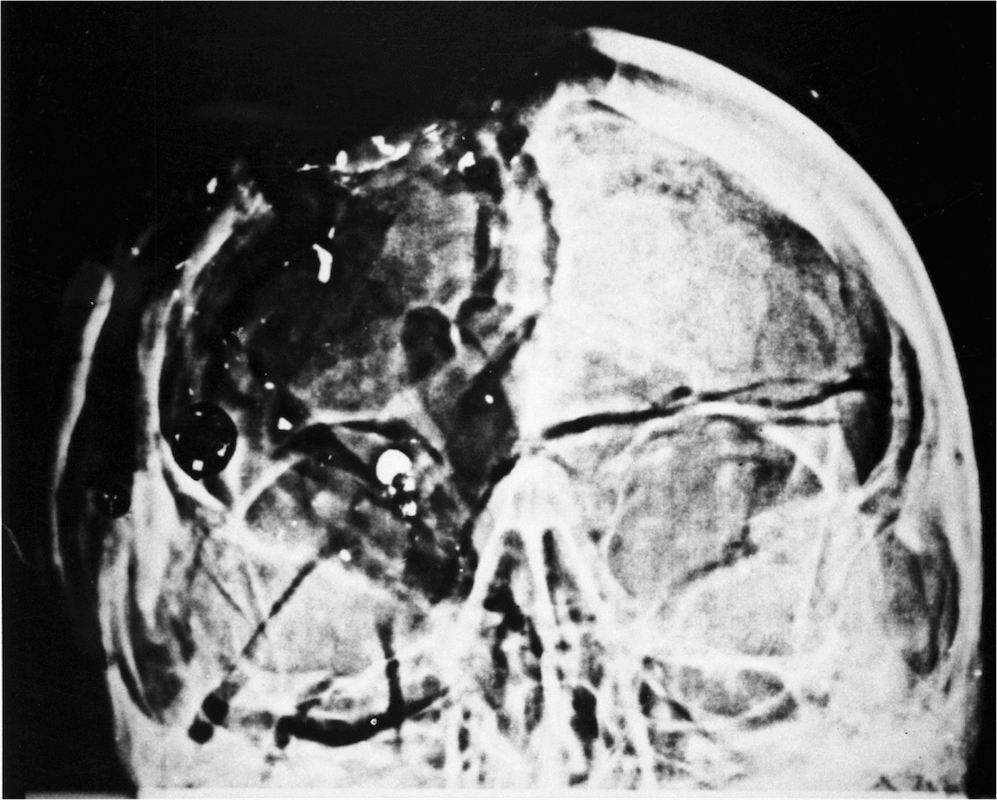
  • A Coup in Camelot

    A Coup in Camelot


    Considering the large number of films and TV specials about the assassination of President Kennedy that have appeared over the last ten or fifteen years, genuinely worthwhile documentaries on the subject are sadly few and far between. The likes of Mark Lane’s Rush to Judgement and Chip Selby’s Reasonable Doubt were fine for their day but given the wealth of information and technological tools that have become available in the time since those films were produced they appear more than a little outdated now. Sadly, the majority of well budgeted, slickly produced documentaries of the 21st century have been created solely to push the delusory mythology of the Warren Commission. Aside from Shane O’Sullivan’s mostly worthwhile Killing Oswald there has been very little of note that has even attempted to counter the MSM’s seemingly endless deluge of propaganda with reliable evidence and solid reasoning. A Coup in Camelot clearly aims to fill that void. Unfortunately, however, it falls considerably short of the mark because it consistently confuses theory with fact.

    The film begins strongly enough with a ten minute introduction that briefly discusses Kennedy’s intention to withdraw American troops from Vietnam then outlines the reasons for his trip to Dallas and explains how, within hours of the assassination, Lee Harvey Oswald was fingered as the lone nut assassin. From there A Coup in Camelot moves swiftly into one of its strongest segments, featuring respected author and researcher Vince Palamara as its main talking head. Over the years, through his diligent hard work in locating and interviewing members of the Secret Service, Palamara has made himself the go-to expert on the subject of President Kennedy’s protection―or lack thereof―in Dallas. I must admit that I have never been convinced the Secret Service was actively involved in the assassination. Yet Palamara’s work most certainly gives reason to at least consider the idea that JFK’s protection on November 22, 1963, was intentionally compromised.

    Secret Service authority
    Vince Palamara

    Palamara details just how many of the Secret Service’s usual practices were not followed that day. For example, it was standard procedure during an open motorcade for agents to be walking or jogging alongside the Presidential limousine. In fact there were two hand rails in place for agents to hold onto as they stood on the rear running boards of the car. As Palamara points out, “Secret Service agents are powerless to really do much of anything if they’re not close to the President.” And yet there were no agents on or near the limousine in Dallas. Defenders of the official mythology have long claimed that Kennedy himself had ordered the agents off the back of the car because he wanted the public to get a good look at him. But when Palamara spoke with Gerald Behn, the Special Agent in charge of the White House detail, Behn told him in no uncertain terms that he had never heard any such request from the President. Palamara then contacted numerous other Secret Service agents and White House aides and each one of them told him the same thing: Kennedy had not ordered the agents off of the car.

    Lone nut mythologists also tend to blame Kennedy for the fact that the limousine’s plexiglass bubble top was not used that day. Although the bubble top was not bullet proof or resistant it was, as Palamara notes, “a psychological deterrent because most people assumed it was bullet proof…The bottom line what the bubble top would have done is it would have obscured an assassin’s view via the sun’s glare.” To discover whether or not Kennedy really had ordered its removal, Palamara spoke with Special Agent Sam Kinney who was the driver of the Secret Service follow-up car. “Sam Kinney adamantly on three different occasions told me that President Kennedy had nothing to do with it; it was solely his responsibility.”

    Houston, 11/21/63

    Another procedure not followed in Dallas involved the additional protection customarily provided by local law enforcement. Whenever and wherever there was to be a motorcade, the Secret Service would usually work hand in hand with local police who would provide a motorcycle escort of six to nine officers that would ride in a wedge formation in front of and beside the Presidential limousine. This formation had been in place on all of the previous stops along Kennedy’s Texas trip. Yet in Dallas the escort was reduced to just four motorcycle officers who ended up riding behind the limo instead of beside it. As Palamara notes, “The formation was meaningless. It offered no protection at all…They left Kennedy a sitting duck.”

    II

    Having detailed these and many other irregularities in JFK’s protection, A Coup in Camelot moves on to a discussion of the “Blood, Bullets & Ballistics”, focusing largely on the conclusions of retired crime scene investigator, Sherry Fiester. It is Fiester’s contention that the massive spray of blood seen in frame 313 of the Zapruder film represents “back spatter” from a frontal shot. She further asserts that, despite numerous witnesses believing they heard shots or saw smoke coming from behind the fence on top of the “grassy knoll”, her own trajectory analysis excludes it as the source of the head shot. The actual source of the shot, she claims, was on the other side of Elm Street at the southern end of the triple overpass. But despite her impressive credentials and her 30 years experience with the Dallas police, Fiester’s conclusions fail to convince.

    Medical, scientific and ballistics experts such as Dr. Cyril Wecht, Dr. Gary Aguilar, Dr. Donald Thomas, and Larry Sturdivan agree that, by itself, the explosion of blood, bone and brain matter seen in the Zapruder film actually tells us very little about the direction in which the projectile was travelling. That is because it does not occur at the point of entrance or exit but near the mid-point of the bullet’s trajectory. Rifle wounds of the skull can be a very different matter than gunshot wounds to other parts of the body. The skull is a closed vessel containing fluid contents that cannot be compressed. The energy and momentum imparted to the skull by the passage of the bullet creates a temporary cavity. The result of cavitation in an enclosed skull containing blood and brain is a hydraulic pressure applied to the cranium causing it to burst open. As Aguilar and Wecht explain, the resultant “spew” of blood and tissue is “radial to the bullet’s path and is separate from the inshoot and outshoot splatter.” (Aguilar & Wecht, Letter to the Editor, AFTE Journal, Volume 48 Number 2, p. 76) This is what is known as the “Krönleinschuss” effect―named for the German ballistics expert who first demonstrated it using skulls filled with clay.

    This type of effect was demonstrated during filmed simulations performed in the Biophysics laboratory at Edgewood Arsenal in 1964 when rifle bullets were fired into numerous skulls filled with ballistic gelatin. Describing a typical example Sturdivan writes, “The bullet entered the back of the skull and exited in a small spray at the front in the space of one frame of the high-speed movie. Only after the bullet was far down-range did the internal pressure generated by its passage split open the skull and relieve the pressure inside by spewing the contents through the cracks. A similar type explosion would have taken place if the bullet had gone through in the opposite direction. The only way to distinguish the direction of travel of the bullet is to examine the cratering effect on the inside of the skull on entrance and on the outside of the skull at exit.” (Sturdivan, The JFK Myths, p. 171)

    The empirical evidence, therefore, demonstrates that Fiester is mistaken in believing the explosive spray of matter we see in the Zapruder film is back spatter. In fact, forward spatter and back spatter are not seen in the film; probably because of the limitations of Zapruder’s camera. The film of the Edgewood simulation shows little to no back spatter and only a very small amount of forward matter which, as Sturdivan explains, was only visible “because of the strong lighting, a close-up view, and (especially) a very high framing rate…over 200 times the framing speed of the Zapruder movie…” (ibid. p. 174)

    Sherry Fiester

    Fiester’s trajectory analysis is also deeply flawed because it assumes something there is no reason to assume. Namely, that the bullet followed a straight path through the skull. In 1978, when the House Select Committee on Assassinations (HSCA) hired a NASA scientist to perform the same type of backward projection analysis, the committee’s forensic pathology panel cautioned against placing too much faith in it. The panel noted that, in their experience, “if a missile strikes an object capable of creating a shearing force, such as the skull, the bullet’s pathway in the body might be significantly different from the line of its trajectory prior to impact.” (7HSCA168) In other words, a bullet striking a dense, resistant skull bone is likely to become deformed and be deflected. Sturdivan writes that “The path of a deformed bullet through a body is never straight…Of the thousands of examples of yawed, deformed, and broken rifle bullets fired into gelatin tissue simulant at the Biophysics Division lab and other similar facilities, none had a perfectly straight trajectory. Few were even close.” (ibid. p. 208) So drawing a line between the presumed entrance and exit points in JFK’s skull will not tell us where the gunman was located no matter how far that line is extended into Dealey Plaza.

    Far from being excluded as Fiester asserts, the grassy knoll remains the most likely location for a frontal shooter. Not only because it was the location to which numerous witnesses pointed, but also because two teams of America’s top acoustical scientists agreed that the Dallas Police dictabelt recording they analyzed on behalf of the HSCA contained the acoustic fingerprint of a gunshot fired from the knoll. And the dictabelt recording synchronizes perfectly with the Zapruder film when―and only when―the knoll shot is aligned with frame 313.

    Featured alongside Fiester’s theories in this segment of A Coup in Camelot is the claim that President Kennedy was shot in the throat from the front. Yet aside from a brief reference to the way the wound was “described by doctors at Parkland Hospital”, no detail is provided to substantiate this assertion. As most readers will no doubt be aware, the Parkland physicians were indeed under the initial impression that the wound might have been an entrance; describing it as small, round, clean cut, and measuring little more than 5 mm in diameter. But those who hold these descriptions up as proof that a bullet entered the throat need to deal with the fact that studies have shown emergency room doctors to be frequently wrong in their assessment of bullet wounds. This is precisely why the premiere textbook for trauma room physicians, Rosen’s Emergency Medicine, cautions that “Clinicians should not describe wounds as ‘entrance’ or ‘exit’ but should document, using appropriate forensic terminology, a detailed description of the wound, including its appearance, characteristics, and location without attempting to interpret the wound type or bullet caliber. Exit wounds are not always larger than entrance wounds, and wound size does not consistently correspond to bullet caliber.” (Rosen’s Emergency Medicine: Concepts and Clinical Practice, p. 828)

    Those who propose that a bullet entered the throat must also deal with the fact that said bullet would have had to have disappeared entirely almost immediately after piercing the skin. Because not only was there no exit in the rear and no bullet found anywhere in the body, there was also no damage to the spine as there would almost certainly have had to have been had a missile entered Kennedy’s throat near the midline. It is for these reasons that, despite its appearance, the wound is extremely unlikely to have been one of entrance.

    III

    A Coup in Camelot moves from Dallas to Bethesda for a lengthy discussion of JFK’s autopsy, centred largely around the highly controversial theories of Douglas Horne. In a nutshell, Horne believes that Kennedy’s gunshot wounds were altered to hide evidence of a frontal shooter. This, of course, is not a new idea. It was first popularized by author David Lifton in his 36-year-old book, Best Evidence. But whereas Lifton postulated that unknown conspirators had hijacked the President’s body en route to Bethesda and altered his wounds to fool the autopsy surgeons, Horne suggests that the prosectors themselves altered the head wound during a secret “pre-autopsy” at the Navy morgue. For what purpose and to fool whom is never really made clear.

    Doug Horne

    At the very heart of Horne’s hypothesis is a comment made by Tom Robinson―an embalmer who was present for most of the autopsy―during a 1996 interview for the Assassination Records Review Board. When shown a photo displaying a large defect in the top of Kennedy’s head Robinson recalled that this was “what the doctors did”. He then explained that the autopsy surgeons had cut the scalp open and “reflected it back in order to remove bullet fragments.” (ARRB MD180) He also recalled seeing that “some sawing was done to remove some bone before the brain could be removed.” (ibid) What Robinson described is, of course, a perfectly normal part of an autopsy and he himself called what he saw a “normal craniotomy procedure.” (ibid) Yet somehow Horne construes Robinson’s remarks as evidence of some clandestine pre-autopsy activity. Why?

    The reason, according to Horne, is that “Dr. Humes always denied having to saw the skull open, he always maintained that the wound was so big that he just removed the brain with a minimum of cutting of the scalp; he never had to cut any bone.” However, as this passage from Hume’s sworn deposition for the ARRB demonstrates, Horne is entirely mistaken :

    GUNN: But just let me start out first: Where was the first incision made?

    HUMES: I believe, of course, the top of the skull to remove the skull plate of the brain. To remove what remained of the calvarium and to approach the removal of the brain.

    GUNN: And was that incision simply of the scalp, or did you need to cut –

    HUMES: No, we had to cut some bone as well. [my emphasis]

    * * *

    GUNN: Where did you cut the bone?

    HUMES: I find that–it’s hard to recall. Once we got the scalp laid back, some of those pieces could just be removed, you know, by picking them up, picking them up because they were just not held together very well, other than by the dura, I suppose. So other than that, we probably made it like we normally do, in a circumferential fashion from books, like right above the ear around. But it was a real problem because it was all falling apart, the skull. And I can’t recall the details of exactly how we managed to maneuver that, because it was a problem. (ARRB Deposition of James J. Humes, pgs. 101-102)

    As the reader can see, not only did Humes not deny having to saw the skull, he specifically testified to doing so. But Horne does not quote Humes himself and instead refers to a report written in 1965 by autopsy surgeon Dr. Pierre Finck―who did not arrive at Bethesda until after the brain had already been removed―in which Finck recalled being told that “no sawing of the skull was necessary”. What this means, therefore, is that the basis of Horne’s claim that “Humes always denied having to saw the skull open” is not any direct quotation from Humes himself, but the hearsay claim of a man who wasn’t even present when the brain was removed. This type of methodology is extremely difficult to defend. And what makes it all the more confounding is that Horne himself was actually present for the deposition during which Humes specifically swore to cutting the skull bone.

    Sadly, this is not the only instance in A Coup in Camelot in which Humes’ words are misconstrued in support of pre-autopsy surgery. The film’s co-writer, Art Van Kampen, suggests that “Something had to have happened to that body before the photos were taken”, and in the case of some photos that is indeed true. But Van Kampen claims that “Dr. Humes is very clear that no autopsy work had been done on the President’s skull before either photos or X-rays were taken.” This, again, is a clear misinterpretation of what Humes actually said. When asked during his ARRB deposition whether or not any incisions were made before the photographs were taken, Humes responded, “Well, depending on which photographs you’re talking about. We didn’t photograph the wound in the occiput until the brain was removed, you know. Sure, we had to make an incision to remove the brain and so forth, but no, generally speaking, no, we didn’t make any incisions at all [my emphasis].” (ibid. p. 95) Humes was then shown the photographs of the top of the head and asked whether or not, before the photo was taken, he had pulled the scalp back “in order to be able to have a better look at the injury” to which he responded “Yes, I probably did.” (ibid. p. 162) So, as should be perfectly clear, Humes confirmed that “generally speaking” most of the photographs were taken before any incisions took place but that some were indeed taken during the course of the autopsy. He also said essentially the same thing as Tom Robinson, which is that the photographs of the top of the head were taken after the scalp had been manipulated. There is, then, no meaningful discrepancy between what the autopsy pictures show and what Humes testified to.

    There has been confusion over Kennedy’s head wounds ever since the Warren Commission issued its findings. In large part this is due to there being two entirely different descriptions of the wounds on record. By and large the doctors at Parkland Hospital recalled seeing one fairly large hole that was located near the right rear of the head. Yet the autopsy report describes a massive defect involving almost the entire right side of the cranium. It was to explain this discrepancy that the body alteration hypothesis was first offered. However, as Dr. Aguilar has noted, “that the wound was described as larger at autopsy than noted by emergency personnel is not proof that it was surgically enlarged. Wounds picked apart during an autopsy are often found to be larger than they first appeared to emergency personnel.” (Murder in Dealey Plaza, p. 187)

    There is a simpler, far more reasonable explanation than clandestine alteration. One that, ironically enough, is touched upon in A Coup in Camelot. Shortly before discussion of the autopsy begins, the film’s narrator correctly informs viewers that “In the Zapruder film, a flap of skull can be seen opening up after the head strike. During the frantic ride to Parkland Hospital the flap had been folded back into place where the blood acted like glue and sealed the wound.” Indeed, Jackie Kennedy later testified to trying to hold her husband’s skull together on the way to the hospital. As Dr. Aguilar writes, “It is not hard to imagine the possibility that during the time it took the Presidential limousine to get to Parkland Hospital, clot had formed gluing a portion of disrupted scalp down making JFK’s skull defect appear smaller to treating surgeons than it later would to autopsy surgeons.” (ibid) In other words, because the flap had been closed up, the emergency room staff only saw the rearmost portion of the wound.

    IV

    The idea that something out of the ordinary occurred at Bethesda is buttressed by stories of multiple coffins being brought into the morgue on the night of the autopsy. At Parkland Hospital, Kennedy’s body had been placed into an ornamental bronze casket. However, in A Coup in Camelot it is alleged that the body actually arrived at Bethesda in an aluminium shipping casket at around 6:35 pm. This means that when the bronze casket was brought into the morgue at 7:17 pm it was, unbeknownst to the FBI agents who accompanied it, completely empty. Or so we are told. Horne further alleges that for some reason the Dallas casket then “made a second entry that night…at 20:00 hours military time.”

    Once again the evidence does not support the theory. As presented in the film, the idea that Kennedy’s body arrived in an aluminium shipping casket is based on the recollection of Naval petty officer, Dennis David, who recalled helping carry one into morgue. Yet, as the summary of his ARRB interview states, David “emphasized that he had no direct knowledge, by observation, that President Kennedy was in the gray shipping casket…” (ARRB MD177) The reality is that, being as Bethesda was a morgue, there is no reason to believe that Kennedy’s body was the only one to be brought there that night. In fact, FBI agent Francis O’Neill specifically recalled being told that one of the four drawers in the anteroom adjacent to the autopsy room contained the body of a child “that had died that day.” (O’Neill ARRB deposition, p. 57)

    Perhaps more importantly, the claim that the bronze casket was empty when brought into the mortuary is belied by the testimony of both O’Neill and his FBI colleague, James Sibert. These two agents who helped unload the casket from the ambulance swore that they stayed with it until it was opened and saw with their own eyes the President’s body taken out. O’Neill stated without hesitation during his ARRB deposition that there was “no time” from the time he first saw the casket “until the time it was opened and the body taken out that the casket was not in my view…” (ibid. p. 59) Similarly, when asked whether or not there had been any time between being unloaded from the ambulance and being opened that the casket had been out of his sight, Sibert responded, “I was there until it was opened.” (Sibert ARRB deposition, p. 45) There is, therefore, no basis for claiming that the casket was “certainly empty” as Horne does.

    Finally, the supposed 20:00 re-entry of the casket is based on a time notation which appears in an unsigned, undated document titled “The Joint Casket Bearer Team.” This document describes the activities of a group containing one officer and seven enlisted men “from each branch of the Armed Forces” who were “trained to carry the casket to and from the ceremony sites and to fold the flag which draped the casket following the internment service.” (ARRB MD163) This team, as A Coup in Camelot correctly informs, was also known as the “honor guard”. It appears quite apparent that, far from being proof of a second entry for the bronze casket, the 20:00 hours time notation on this document is nothing more than a mistake. Why? Because despite the film’s claim that Sibert and O’Neill had carried the casket into the morgue at 7:17 pm alongside Secret Service agents Roy Kellerman and William Greer, O’Neill explained in his ARRB deposition that, in actual fact, it was the honor guard who had physically lifted the coffin at that time. (O’Neill deposition, p. 57) So unless anyone wants to believe that the honor guard carried it in twice, they are going to have to accept that the unknown writer of the document was in error and there was only one entry for the bronze casket.

    A coup in Camelot intermingles these stories of casket-swapping and wound tampering with claims that the autopsy X-rays and photographs have also been altered. This, once again, is not a new theory. In fact it has been a commonly held belief amongst students of the assassination for decades. And yet nothing approaching proof of alteration has ever emerged. The most commonly cited reason for believing the photos have been tampered with, the one repeated in A Coup in Camelot, is that the pictures appear to show the back of the head completely intact. This is, of course, at odds with the testimony of the Parkland physicians who recalled seeing a large wound in the right rear. But as autopsy surgeon J. Thornton Boswell explained to both the HSCA and the ARRB, the reason the rear skull damage is not seen in the photographs is because the scalp is being held up and “pulled forward up over the forehead, toward the forehead.” (Boswell ARRB deposition, p. 150) This has the effect of hiding the wound underneath.

    Those who choose to ignore Boswell’s words are still stuck with the reality that the autopsy photographer, John Stringer, authenticated the photographs during his own ARRB deposition, repeatedly stating that he had no reason to believe the existing photographs were anything other than the ones that he himself took on the night of the autopsy. The same is true of the X-rays. The technician responsible for taking them, Jerrol Custer, repeatedly swore to the accuracy and authenticity of the existing X-rays for the ARRB. For example, when shown the anterior/posterior view:

    GUNN: Is there any question in your mind whether the X-ray that’s in front of you right now is the original X-ray taken at the autopsy?

    CUSTER: No question.

    GUNN: And the answer is––

    CUSTER: It is the original film. (p. 122-123)

    And when shown the right lateral skull X-ray:

    GUNN: … Mr. Custer, can you identify the film that is in front of you right now as having been taken by you on the night of the autopsy of President Kennedy?

    CUSTER: Correct. Yes, I do, sir.

    GUNN: And how are you able to identify that as being––

    CUSTER: My marker in the lower mandibular joint. (p. 124)

    With the men who took them―and all three autopsy doctors―swearing to their authenticity, there seems little doubt that the autopsy photographs and X-rays would have been admitted into evidence were there to be a trial in the Kennedy case. And with questions of validity settled, a more important question would be asked: What do the skull X-rays actually show? The answer to that, as a number of experts including neuroscientist Dr. Joseph Riley and radiologist Dr. Randy Robertson have attested, is that the official theory of a single shot from the rear simply cannot be true.

    As Dr. Humes explained in his Warren Commission testimony, the pathologists found an entrance wound that was 2.5 cm to the right, and “slightly above” the external occipital protuberance―a small bump located very low down in the rear of the skull―and “a huge defect over the right side” involving “both the scalp and the underlying skull…” After a “careful examination of the margins of the large bone defect” on the right side, the doctors were unable to find a point of exit, which Humes put down to the fact that they “did not have the bone.” However, the pathologists concluded that a single bullet was responsible for all the damage, having entered the rear and exited the right side. In support of this contention, Humes implied that the path of the bullet was laid out by a trail of metallic fragments that could be seen on the X-rays “traversing a line from the wound in the occiput to just above the right eye…” (Warren Commission Hearings, Vol. II, p. 351-353)

    Annotated X ray

    Unfortunately for Dr. Humes, the X-rays do not show what he claimed. The entrance wound in the lower rear of the skull is indeed visible. So too is the trail of bullet fragments. But the two are in no way related. In fact, the trail lies along the very top of the skull, several inches above the entrance site. Therefore, those fragments could not have been left behind by a bullet which entered near the external occipital protuberance. As Aguilar and Wecht have noted, “…the fragment trail alone almost completely eliminates the official theory JFK was struck from above and behind by a single bullet that entered his skull low…” (Aguilar & Wecht, Op. cit. p. 78) Dr. Joseph Riley, who has a Ph.D in neuroscience and specializes in neuroanatomy and experimental neuropathology, noted decades ago that the medical evidence as it stands is only compatible with two separate bullet strikes. It is for that very reason that I see little logic in suggesting that the X-rays have been altered to support the official story.

    V

    These largely specious claims about the medical evidence form the centrepiece of A Coup in Camelot and, clocking in at nearly 40 minutes, comprise well over a third of the film’s running time. For those who are familiar with the facts that are being misinterpreted and/or overlooked, this time will not pass quickly. Things do pick up, however, for the final 20 minutes of the film which deals partially with the enigmatic Lee Harvey Oswald. Whether or not Oswald was on the sixth floor of the Texas School Book Depository with a rifle in his hands at the time of the assassination has never been conclusively established. But A Coup in Camelot demonstrates, through the pioneering research of former investigative reporter Barry Ernest, that in all likelihood Oswald was where he claimed to be when the shots were fired; on the first floor of the building eating lunch.

    Barry Ernest

    Ernest centred his research on an often overlooked witness named Victoria Adams who had viewed the assassination from a fourth floor window of the depository building. As most students of the case know, Oswald was seen by his boss Roy Truly and police officer Marion Baker in the second floor lunch room approximately 90 seconds after the shots were fired. Baker was on his way to the roof where he believed the gunman might be located but, upon spotting Oswald alone in the lunch room, he halted his ascent and demanded Oswald identify himself. Truly quickly informed Baker that Oswald was an employee and the pair then continued their dash up the stairs. Oswald later told police that he had gone from the first floor to the second in order to purchase a Coke. But, of course, the Warren Commission claimed that he had actually rushed down from the sixth floor immediately after shooting the President.

    In that regard, Victoria Adams was a problematic witness for the Commission. After watching the motorcade pass by with three co-workers, she had stayed at the fourth floor window for what she said was around 15 to 30 seconds and then quickly made her way down to the first floor. What this means, as Ernest explains, is that “she would have been on the stairs at the same time Oswald was descending from the sixth floor.” The problem is “…she did not see or hear anyone on the stairs during that period.” The Commission’s handling of her story typified its approach to the investigation. It did not bother to question any of those who had stood at the window with her to watch the motorcade―not even Sandra Styles who had accompanied Adams down the stairs―and instead suggested that she was simply mistaken about the time she left the fourth floor window.

    Victoria Adams

    In support of this contention, the Commission alleged that Adams had testified to seeing two other employees of the building, William Shelley and Billy Lovelady, when she arrived on the first floor. And because Shelley and Lovelady had testified to being outside on the depository steps during the shooting and not re-entering the building until several minutes later, the Commission claimed that Adams’ “…estimate of the time when she descended from the fourth floor is incorrect, and she actually came down the stairs several minutes after Oswald and after Truly and Baker as well.” (Warren Report, p. 154) The problem with the Commission’s argument is that when Ernest tracked Adams down she “flat-out denied” ever saying she had seen Shelley and Lovelady on the first floor. In order to confirm or refute her assertions, Ernest searched the National Archives for the stenographic tape of Adams’ testimony. Not surprisingly, however, he soon discovered that there is no record of her April 7, 1964, testimony and the stenographic tape has gone mysteriously “missing.”

    But in 1999 Ernest discovered a bombshell document in the Archives in the form of a June 2, 1964, letter written by Assistant United States Attorney, Martha Joe Stroud, to Warren Commission Chief counsel, J. Lee Rankin. This letter contains the only known reference in the Commission’s files to an interview with Dorothy Garner, who was Adams’ supervisor and one of those with whom she had stood at the fourth floor window. The letter notes matter-of-factly that “Miss Garner…stated this morning that after Miss Adams went downstairs she (Miss Garner) saw Mr. Truly and the policeman come up.” Thus Garner provided complete corroboration for Adams’ testimony. Just as she swore, Adams had indeed descended those old wooden steps at the same time Oswald was supposed to have been on them. And the corroboration of this fact was completely ignored by the Commission who made no mention of Garner’s interview whatsoever.

    As Ernest details in his indispensable book, The Girl on the Stairs, he went on to locate and interview Garner for himself. He asked her about her own activities following the assassination and Garner explained to him that as Adams and Styles made their way downstairs, she herself went to a storage area by the stairway. It was from there that she was able to see Baker and Truly ascend the stairs. Garner said that she was “right behind” Adams and Styles in leaving the window and although she didn’t actually see them enter the stairway, she heard them “after they started down” because “the stairs were very noisy.” (The Girl on the Stairs, p. 268) Garner, it appears, had arrived on the fourth floor landing area only seconds after Adams and was there long enough to see Baker and Truly. Quite obviously, then, if Oswald had descended from the sixth floor during that time as he would have had to have done in order to make it to his second floor encounter with Baker, then Garner was in a position to see him. Yet, as she told Ernest, “I don’t remember seeing him at all that day…except on TV.” (ibid)

    It is impossible to overstate how damaging all of this is to the case against Oswald. It is clear that he could not have made it down to the second floor ahead of Adams because he did not have the time. This means he would have had to have descended long enough after Adams for her not to have heard his footsteps. Yet if he was 10 or 15 seconds behind her on the stairwell, it seems highly unlikely that he would not have been spotted by Garner who did not see or hear him on the noisy old stairs, even though she stayed on the fourth floor landing area long enough to see Truly and Baker. The most logical conclusion to be drawn is that when Oswald arrived at his second floor meeting with Baker, he had not come from the sixth floor but from the first, just as he said he had. And that would mean that, whatever else he did that day, Oswald did not shoot President Kennedy.

    VI

    A Coup in Camelot finishes with a brief discussion of how Kennedy’s plans to pull American military personnel out of Vietnam were reversed after his death and how private US contractors profited from the all-out war that followed. However none of this is explored in any detail and no attempt is made to show how it can be directly connected to the assassination. Had the writers and producers chosen to focus more heavily on these areas they may well have created a more valuable and compelling film than this one.

    It is clear that the filmmakers wanted to offer forensic proof of a conspiracy and, in fact, at the end of the film it is claimed they have done just that. “We have proven through modern forensics”, narrator Peter Coyote says, “that a shot or shots were fired from the front.” Yet, as I have demonstrated above, proof of such is not offered in A Coup in Camelot. What is provided instead is a bloodspatter theory that, whilst plausible on the surface, is entirely contradicted by empirical evidence. Instead of relying on the opinions of one individual, the filmmakers should have consulted with other, perhaps better qualified experts to ensure that what was being proposed had really been put to the test. How else can one claim to have proven something? There are numerous medical and scientific professionals who are well-versed in the facts of the assassination―such as Doctors Wecht, Aguilar, Robertson, and Thomas―who, I am sure, would have been more than happy to share their expertise.

    As I see it, this is the fatal flaw of A Coup in Camelot. Theory is all too readily accepted and promoted by the filmmakers without any independent verification or even basic fact-checking. How difficult would it have been to have had somebody actually read Dr. Humes’ various testimonies to see if he really had “always denied having to saw the skull open”? Or to have studied the deposition of Francis O’Neill to discover who had physically carried the casket into the morgue at 7:17 pm? A clearer understanding of these two points alone would have been enough to call into serious question the highly dubious claims of multiple casket entries and wound tampering at Bethesda.

    Theories about the Kennedy assassination―many of them nutty―have been promulgated for far too long and they are not convincing anyone outside of the so-called “research community”. When you attempt to counter the ballistics experiments and slickly-produced computer simulations featured in mainstream lone gunman documentaries with something as bizarre-sounding and ill-founded as the body alteration hypothesis you are not likely to win many converts amongst the general population. What is needed is real expert opinion and cold, hard evidence presented in a compelling manner. A Coup in Camelot is skilfully produced on what appears to have been a reasonable budget and if the filmmakers had consulted the right individuals and doubled down on their facts they could well have produced something of real value. For that reason the film strikes me as a wasted opportunity.

  • A Coup in Camelot

    A Coup in Camelot


    Considering the large number of films and TV specials about the assassination of President Kennedy that have appeared over the last ten or fifteen years, genuinely worthwhile documentaries on the subject are sadly few and far between. The likes of Mark Lane’s Rush to Judgement and Chip Selby’s Reasonable Doubt were fine for their day but given the wealth of information and technological tools that have become available in the time since those films were produced they appear more than a little outdated now. Sadly, the majority of well budgeted, slickly produced documentaries of the 21st century have been created solely to push the delusory mythology of the Warren Commission. Aside from Shane O’Sullivan’s mostly worthwhile Killing Oswald there has been very little of note that has even attempted to counter the MSM’s seemingly endless deluge of propaganda with reliable evidence and solid reasoning. A Coup in Camelot clearly aims to fill that void. Unfortunately, however, it falls considerably short of the mark because it consistently confuses theory with fact.

    The film begins strongly enough with a ten minute introduction that briefly discusses Kennedy’s intention to withdraw American troops from Vietnam then outlines the reasons for his trip to Dallas and explains how, within hours of the assassination, Lee Harvey Oswald was fingered as the lone nut assassin. From there A Coup in Camelot moves swiftly into one of its strongest segments, featuring respected author and researcher Vince Palamara as its main talking head. Over the years, through his diligent hard work in locating and interviewing members of the Secret Service, Palamara has made himself the go-to expert on the subject of President Kennedy’s protection―or lack thereof―in Dallas. I must admit that I have never been convinced the Secret Service was actively involved in the assassination. Yet Palamara’s work most certainly gives reason to at least consider the idea that JFK’s protection on November 22, 1963, was intentionally compromised.

    Secret Service authority
    Vince Palamara

    Palamara details just how many of the Secret Service’s usual practices were not followed that day. For example, it was standard procedure during an open motorcade for agents to be walking or jogging alongside the Presidential limousine. In fact there were two hand rails in place for agents to hold onto as they stood on the rear running boards of the car. As Palamara points out, “Secret Service agents are powerless to really do much of anything if they’re not close to the President.” And yet there were no agents on or near the limousine in Dallas. Defenders of the official mythology have long claimed that Kennedy himself had ordered the agents off the back of the car because he wanted the public to get a good look at him. But when Palamara spoke with Gerald Behn, the Special Agent in charge of the White House detail, Behn told him in no uncertain terms that he had never heard any such request from the President. Palamara then contacted numerous other Secret Service agents and White House aides and each one of them told him the same thing: Kennedy had not ordered the agents off of the car.

    Lone nut mythologists also tend to blame Kennedy for the fact that the limousine’s plexiglass bubble top was not used that day. Although the bubble top was not bullet proof or resistant it was, as Palamara notes, “a psychological deterrent because most people assumed it was bullet proof…The bottom line what the bubble top would have done is it would have obscured an assassin’s view via the sun’s glare.” To discover whether or not Kennedy really had ordered its removal, Palamara spoke with Special Agent Sam Kinney who was the driver of the Secret Service follow-up car. “Sam Kinney adamantly on three different occasions told me that President Kennedy had nothing to do with it; it was solely his responsibility.”

    Houston, 11/21/63

    Another procedure not followed in Dallas involved the additional protection customarily provided by local law enforcement. Whenever and wherever there was to be a motorcade, the Secret Service would usually work hand in hand with local police who would provide a motorcycle escort of six to nine officers that would ride in a wedge formation in front of and beside the Presidential limousine. This formation had been in place on all of the previous stops along Kennedy’s Texas trip. Yet in Dallas the escort was reduced to just four motorcycle officers who ended up riding behind the limo instead of beside it. As Palamara notes, “The formation was meaningless. It offered no protection at all…They left Kennedy a sitting duck.”

    II

    Having detailed these and many other irregularities in JFK’s protection, A Coup in Camelot moves on to a discussion of the “Blood, Bullets & Ballistics”, focusing largely on the conclusions of retired crime scene investigator, Sherry Fiester. It is Fiester’s contention that the massive spray of blood seen in frame 313 of the Zapruder film represents “back spatter” from a frontal shot. She further asserts that, despite numerous witnesses believing they heard shots or saw smoke coming from behind the fence on top of the “grassy knoll”, her own trajectory analysis excludes it as the source of the head shot. The actual source of the shot, she claims, was on the other side of Elm Street at the southern end of the triple overpass. But despite her impressive credentials and her 30 years experience with the Dallas police, Fiester’s conclusions fail to convince.

    Medical, scientific and ballistics experts such as Dr. Cyril Wecht, Dr. Gary Aguilar, Dr. Donald Thomas, and Larry Sturdivan agree that, by itself, the explosion of blood, bone and brain matter seen in the Zapruder film actually tells us very little about the direction in which the projectile was travelling. That is because it does not occur at the point of entrance or exit but near the mid-point of the bullet’s trajectory. Rifle wounds of the skull can be a very different matter than gunshot wounds to other parts of the body. The skull is a closed vessel containing fluid contents that cannot be compressed. The energy and momentum imparted to the skull by the passage of the bullet creates a temporary cavity. The result of cavitation in an enclosed skull containing blood and brain is a hydraulic pressure applied to the cranium causing it to burst open. As Aguilar and Wecht explain, the resultant “spew” of blood and tissue is “radial to the bullet’s path and is separate from the inshoot and outshoot splatter.” (Aguilar & Wecht, Letter to the Editor, AFTE Journal, Volume 48 Number 2, p. 76) This is what is known as the “Krönleinschuss” effect―named for the German ballistics expert who first demonstrated it using skulls filled with clay.

    This type of effect was demonstrated during filmed simulations performed in the Biophysics laboratory at Edgewood Arsenal in 1964 when rifle bullets were fired into numerous skulls filled with ballistic gelatin. Describing a typical example Sturdivan writes, “The bullet entered the back of the skull and exited in a small spray at the front in the space of one frame of the high-speed movie. Only after the bullet was far down-range did the internal pressure generated by its passage split open the skull and relieve the pressure inside by spewing the contents through the cracks. A similar type explosion would have taken place if the bullet had gone through in the opposite direction. The only way to distinguish the direction of travel of the bullet is to examine the cratering effect on the inside of the skull on entrance and on the outside of the skull at exit.” (Sturdivan, The JFK Myths, p. 171)

    The empirical evidence, therefore, demonstrates that Fiester is mistaken in believing the explosive spray of matter we see in the Zapruder film is back spatter. In fact, forward spatter and back spatter are not seen in the film; probably because of the limitations of Zapruder’s camera. The film of the Edgewood simulation shows little to no back spatter and only a very small amount of forward matter which, as Sturdivan explains, was only visible “because of the strong lighting, a close-up view, and (especially) a very high framing rate…over 200 times the framing speed of the Zapruder movie…” (ibid. p. 174)

    Sherry Fiester

    Fiester’s trajectory analysis is also deeply flawed because it assumes something there is no reason to assume. Namely, that the bullet followed a straight path through the skull. In 1978, when the House Select Committee on Assassinations (HSCA) hired a NASA scientist to perform the same type of backward projection analysis, the committee’s forensic pathology panel cautioned against placing too much faith in it. The panel noted that, in their experience, “if a missile strikes an object capable of creating a shearing force, such as the skull, the bullet’s pathway in the body might be significantly different from the line of its trajectory prior to impact.” (7HSCA168) In other words, a bullet striking a dense, resistant skull bone is likely to become deformed and be deflected. Sturdivan writes that “The path of a deformed bullet through a body is never straight…Of the thousands of examples of yawed, deformed, and broken rifle bullets fired into gelatin tissue simulant at the Biophysics Division lab and other similar facilities, none had a perfectly straight trajectory. Few were even close.” (ibid. p. 208) So drawing a line between the presumed entrance and exit points in JFK’s skull will not tell us where the gunman was located no matter how far that line is extended into Dealey Plaza.

    Far from being excluded as Fiester asserts, the grassy knoll remains the most likely location for a frontal shooter. Not only because it was the location to which numerous witnesses pointed, but also because two teams of America’s top acoustical scientists agreed that the Dallas Police dictabelt recording they analyzed on behalf of the HSCA contained the acoustic fingerprint of a gunshot fired from the knoll. And the dictabelt recording synchronizes perfectly with the Zapruder film when―and only when―the knoll shot is aligned with frame 313.

    Featured alongside Fiester’s theories in this segment of A Coup in Camelot is the claim that President Kennedy was shot in the throat from the front. Yet aside from a brief reference to the way the wound was “described by doctors at Parkland Hospital”, no detail is provided to substantiate this assertion. As most readers will no doubt be aware, the Parkland physicians were indeed under the initial impression that the wound might have been an entrance; describing it as small, round, clean cut, and measuring little more than 5 mm in diameter. But those who hold these descriptions up as proof that a bullet entered the throat need to deal with the fact that studies have shown emergency room doctors to be frequently wrong in their assessment of bullet wounds. This is precisely why the premiere textbook for trauma room physicians, Rosen’s Emergency Medicine, cautions that “Clinicians should not describe wounds as ‘entrance’ or ‘exit’ but should document, using appropriate forensic terminology, a detailed description of the wound, including its appearance, characteristics, and location without attempting to interpret the wound type or bullet caliber. Exit wounds are not always larger than entrance wounds, and wound size does not consistently correspond to bullet caliber.” (Rosen’s Emergency Medicine: Concepts and Clinical Practice, p. 828)

    Those who propose that a bullet entered the throat must also deal with the fact that said bullet would have had to have disappeared entirely almost immediately after piercing the skin. Because not only was there no exit in the rear and no bullet found anywhere in the body, there was also no damage to the spine as there would almost certainly have had to have been had a missile entered Kennedy’s throat near the midline. It is for these reasons that, despite its appearance, the wound is extremely unlikely to have been one of entrance.

    III

    A Coup in Camelot moves from Dallas to Bethesda for a lengthy discussion of JFK’s autopsy, centred largely around the highly controversial theories of Douglas Horne. In a nutshell, Horne believes that Kennedy’s gunshot wounds were altered to hide evidence of a frontal shooter. This, of course, is not a new idea. It was first popularized by author David Lifton in his 36-year-old book, Best Evidence. But whereas Lifton postulated that unknown conspirators had hijacked the President’s body en route to Bethesda and altered his wounds to fool the autopsy surgeons, Horne suggests that the prosectors themselves altered the head wound during a secret “pre-autopsy” at the Navy morgue. For what purpose and to fool whom is never really made clear.

    Doug Horne

    At the very heart of Horne’s hypothesis is a comment made by Tom Robinson―an embalmer who was present for most of the autopsy―during a 1996 interview for the Assassination Records Review Board. When shown a photo displaying a large defect in the top of Kennedy’s head Robinson recalled that this was “what the doctors did”. He then explained that the autopsy surgeons had cut the scalp open and “reflected it back in order to remove bullet fragments.” (ARRB MD180) He also recalled seeing that “some sawing was done to remove some bone before the brain could be removed.” (ibid) What Robinson described is, of course, a perfectly normal part of an autopsy and he himself called what he saw a “normal craniotomy procedure.” (ibid) Yet somehow Horne construes Robinson’s remarks as evidence of some clandestine pre-autopsy activity. Why?

    The reason, according to Horne, is that “Dr. Humes always denied having to saw the skull open, he always maintained that the wound was so big that he just removed the brain with a minimum of cutting of the scalp; he never had to cut any bone.” However, as this passage from Hume’s sworn deposition for the ARRB demonstrates, Horne is entirely mistaken :

    GUNN: But just let me start out first: Where was the first incision made?

    HUMES: I believe, of course, the top of the skull to remove the skull plate of the brain. To remove what remained of the calvarium and to approach the removal of the brain.

    GUNN: And was that incision simply of the scalp, or did you need to cut –

    HUMES: No, we had to cut some bone as well. [my emphasis]

    * * *

    GUNN: Where did you cut the bone?

    HUMES: I find that–it’s hard to recall. Once we got the scalp laid back, some of those pieces could just be removed, you know, by picking them up, picking them up because they were just not held together very well, other than by the dura, I suppose. So other than that, we probably made it like we normally do, in a circumferential fashion from books, like right above the ear around. But it was a real problem because it was all falling apart, the skull. And I can’t recall the details of exactly how we managed to maneuver that, because it was a problem. (ARRB Deposition of James J. Humes, pgs. 101-102)

    As the reader can see, not only did Humes not deny having to saw the skull, he specifically testified to doing so. But Horne does not quote Humes himself and instead refers to a report written in 1965 by autopsy surgeon Dr. Pierre Finck―who did not arrive at Bethesda until after the brain had already been removed―in which Finck recalled being told that “no sawing of the skull was necessary”. What this means, therefore, is that the basis of Horne’s claim that “Humes always denied having to saw the skull open” is not any direct quotation from Humes himself, but the hearsay claim of a man who wasn’t even present when the brain was removed. This type of methodology is extremely difficult to defend. And what makes it all the more confounding is that Horne himself was actually present for the deposition during which Humes specifically swore to cutting the skull bone.

    Sadly, this is not the only instance in A Coup in Camelot in which Humes’ words are misconstrued in support of pre-autopsy surgery. The film’s co-writer, Art Van Kampen, suggests that “Something had to have happened to that body before the photos were taken”, and in the case of some photos that is indeed true. But Van Kampen claims that “Dr. Humes is very clear that no autopsy work had been done on the President’s skull before either photos or X-rays were taken.” This, again, is a clear misinterpretation of what Humes actually said. When asked during his ARRB deposition whether or not any incisions were made before the photographs were taken, Humes responded, “Well, depending on which photographs you’re talking about. We didn’t photograph the wound in the occiput until the brain was removed, you know. Sure, we had to make an incision to remove the brain and so forth, but no, generally speaking, no, we didn’t make any incisions at all [my emphasis].” (ibid. p. 95) Humes was then shown the photographs of the top of the head and asked whether or not, before the photo was taken, he had pulled the scalp back “in order to be able to have a better look at the injury” to which he responded “Yes, I probably did.” (ibid. p. 162) So, as should be perfectly clear, Humes confirmed that “generally speaking” most of the photographs were taken before any incisions took place but that some were indeed taken during the course of the autopsy. He also said essentially the same thing as Tom Robinson, which is that the photographs of the top of the head were taken after the scalp had been manipulated. There is, then, no meaningful discrepancy between what the autopsy pictures show and what Humes testified to.

    There has been confusion over Kennedy’s head wounds ever since the Warren Commission issued its findings. In large part this is due to there being two entirely different descriptions of the wounds on record. By and large the doctors at Parkland Hospital recalled seeing one fairly large hole that was located near the right rear of the head. Yet the autopsy report describes a massive defect involving almost the entire right side of the cranium. It was to explain this discrepancy that the body alteration hypothesis was first offered. However, as Dr. Aguilar has noted, “that the wound was described as larger at autopsy than noted by emergency personnel is not proof that it was surgically enlarged. Wounds picked apart during an autopsy are often found to be larger than they first appeared to emergency personnel.” (Murder in Dealey Plaza, p. 187)

    There is a simpler, far more reasonable explanation than clandestine alteration. One that, ironically enough, is touched upon in A Coup in Camelot. Shortly before discussion of the autopsy begins, the film’s narrator correctly informs viewers that “In the Zapruder film, a flap of skull can be seen opening up after the head strike. During the frantic ride to Parkland Hospital the flap had been folded back into place where the blood acted like glue and sealed the wound.” Indeed, Jackie Kennedy later testified to trying to hold her husband’s skull together on the way to the hospital. As Dr. Aguilar writes, “It is not hard to imagine the possibility that during the time it took the Presidential limousine to get to Parkland Hospital, clot had formed gluing a portion of disrupted scalp down making JFK’s skull defect appear smaller to treating surgeons than it later would to autopsy surgeons.” (ibid) In other words, because the flap had been closed up, the emergency room staff only saw the rearmost portion of the wound.

    IV

    The idea that something out of the ordinary occurred at Bethesda is buttressed by stories of multiple coffins being brought into the morgue on the night of the autopsy. At Parkland Hospital, Kennedy’s body had been placed into an ornamental bronze casket. However, in A Coup in Camelot it is alleged that the body actually arrived at Bethesda in an aluminium shipping casket at around 6:35 pm. This means that when the bronze casket was brought into the morgue at 7:17 pm it was, unbeknownst to the FBI agents who accompanied it, completely empty. Or so we are told. Horne further alleges that for some reason the Dallas casket then “made a second entry that night…at 20:00 hours military time.”

    Once again the evidence does not support the theory. As presented in the film, the idea that Kennedy’s body arrived in an aluminium shipping casket is based on the recollection of Naval petty officer, Dennis David, who recalled helping carry one into morgue. Yet, as the summary of his ARRB interview states, David “emphasized that he had no direct knowledge, by observation, that President Kennedy was in the gray shipping casket…” (ARRB MD177) The reality is that, being as Bethesda was a morgue, there is no reason to believe that Kennedy’s body was the only one to be brought there that night. In fact, FBI agent Francis O’Neill specifically recalled being told that one of the four drawers in the anteroom adjacent to the autopsy room contained the body of a child “that had died that day.” (O’Neill ARRB deposition, p. 57)

    Perhaps more importantly, the claim that the bronze casket was empty when brought into the mortuary is belied by the testimony of both O’Neill and his FBI colleague, James Sibert. These two agents who helped unload the casket from the ambulance swore that they stayed with it until it was opened and saw with their own eyes the President’s body taken out. O’Neill stated without hesitation during his ARRB deposition that there was “no time” from the time he first saw the casket “until the time it was opened and the body taken out that the casket was not in my view…” (ibid. p. 59) Similarly, when asked whether or not there had been any time between being unloaded from the ambulance and being opened that the casket had been out of his sight, Sibert responded, “I was there until it was opened.” (Sibert ARRB deposition, p. 45) There is, therefore, no basis for claiming that the casket was “certainly empty” as Horne does.

    Finally, the supposed 20:00 re-entry of the casket is based on a time notation which appears in an unsigned, undated document titled “The Joint Casket Bearer Team.” This document describes the activities of a group containing one officer and seven enlisted men “from each branch of the Armed Forces” who were “trained to carry the casket to and from the ceremony sites and to fold the flag which draped the casket following the internment service.” (ARRB MD163) This team, as A Coup in Camelot correctly informs, was also known as the “honor guard”. It appears quite apparent that, far from being proof of a second entry for the bronze casket, the 20:00 hours time notation on this document is nothing more than a mistake. Why? Because despite the film’s claim that Sibert and O’Neill had carried the casket into the morgue at 7:17 pm alongside Secret Service agents Roy Kellerman and William Greer, O’Neill explained in his ARRB deposition that, in actual fact, it was the honor guard who had physically lifted the coffin at that time. (O’Neill deposition, p. 57) So unless anyone wants to believe that the honor guard carried it in twice, they are going to have to accept that the unknown writer of the document was in error and there was only one entry for the bronze casket.

    A coup in Camelot intermingles these stories of casket-swapping and wound tampering with claims that the autopsy X-rays and photographs have also been altered. This, once again, is not a new theory. In fact it has been a commonly held belief amongst students of the assassination for decades. And yet nothing approaching proof of alteration has ever emerged. The most commonly cited reason for believing the photos have been tampered with, the one repeated in A Coup in Camelot, is that the pictures appear to show the back of the head completely intact. This is, of course, at odds with the testimony of the Parkland physicians who recalled seeing a large wound in the right rear. But as autopsy surgeon J. Thornton Boswell explained to both the HSCA and the ARRB, the reason the rear skull damage is not seen in the photographs is because the scalp is being held up and “pulled forward up over the forehead, toward the forehead.” (Boswell ARRB deposition, p. 150) This has the effect of hiding the wound underneath.

    Those who choose to ignore Boswell’s words are still stuck with the reality that the autopsy photographer, John Stringer, authenticated the photographs during his own ARRB deposition, repeatedly stating that he had no reason to believe the existing photographs were anything other than the ones that he himself took on the night of the autopsy. The same is true of the X-rays. The technician responsible for taking them, Jerrol Custer, repeatedly swore to the accuracy and authenticity of the existing X-rays for the ARRB. For example, when shown the anterior/posterior view:

    GUNN: Is there any question in your mind whether the X-ray that’s in front of you right now is the original X-ray taken at the autopsy?

    CUSTER: No question.

    GUNN: And the answer is––

    CUSTER: It is the original film. (p. 122-123)

    And when shown the right lateral skull X-ray:

    GUNN: … Mr. Custer, can you identify the film that is in front of you right now as having been taken by you on the night of the autopsy of President Kennedy?

    CUSTER: Correct. Yes, I do, sir.

    GUNN: And how are you able to identify that as being––

    CUSTER: My marker in the lower mandibular joint. (p. 124)

    With the men who took them―and all three autopsy doctors―swearing to their authenticity, there seems little doubt that the autopsy photographs and X-rays would have been admitted into evidence were there to be a trial in the Kennedy case. And with questions of validity settled, a more important question would be asked: What do the skull X-rays actually show? The answer to that, as a number of experts including neuroscientist Dr. Joseph Riley and radiologist Dr. Randy Robertson have attested, is that the official theory of a single shot from the rear simply cannot be true.

    As Dr. Humes explained in his Warren Commission testimony, the pathologists found an entrance wound that was 2.5 cm to the right, and “slightly above” the external occipital protuberance―a small bump located very low down in the rear of the skull―and “a huge defect over the right side” involving “both the scalp and the underlying skull…” After a “careful examination of the margins of the large bone defect” on the right side, the doctors were unable to find a point of exit, which Humes put down to the fact that they “did not have the bone.” However, the pathologists concluded that a single bullet was responsible for all the damage, having entered the rear and exited the right side. In support of this contention, Humes implied that the path of the bullet was laid out by a trail of metallic fragments that could be seen on the X-rays “traversing a line from the wound in the occiput to just above the right eye…” (Warren Commission Hearings, Vol. II, p. 351-353)

    Annotated X ray

    Unfortunately for Dr. Humes, the X-rays do not show what he claimed. The entrance wound in the lower rear of the skull is indeed visible. So too is the trail of bullet fragments. But the two are in no way related. In fact, the trail lies along the very top of the skull, several inches above the entrance site. Therefore, those fragments could not have been left behind by a bullet which entered near the external occipital protuberance. As Aguilar and Wecht have noted, “…the fragment trail alone almost completely eliminates the official theory JFK was struck from above and behind by a single bullet that entered his skull low…” (Aguilar & Wecht, Op. cit. p. 78) Dr. Joseph Riley, who has a Ph.D in neuroscience and specializes in neuroanatomy and experimental neuropathology, noted decades ago that the medical evidence as it stands is only compatible with two separate bullet strikes. It is for that very reason that I see little logic in suggesting that the X-rays have been altered to support the official story.

    V

    These largely specious claims about the medical evidence form the centrepiece of A Coup in Camelot and, clocking in at nearly 40 minutes, comprise well over a third of the film’s running time. For those who are familiar with the facts that are being misinterpreted and/or overlooked, this time will not pass quickly. Things do pick up, however, for the final 20 minutes of the film which deals partially with the enigmatic Lee Harvey Oswald. Whether or not Oswald was on the sixth floor of the Texas School Book Depository with a rifle in his hands at the time of the assassination has never been conclusively established. But A Coup in Camelot demonstrates, through the pioneering research of former investigative reporter Barry Ernest, that in all likelihood Oswald was where he claimed to be when the shots were fired; on the first floor of the building eating lunch.

    Barry Ernest

    Ernest centred his research on an often overlooked witness named Victoria Adams who had viewed the assassination from a fourth floor window of the depository building. As most students of the case know, Oswald was seen by his boss Roy Truly and police officer Marion Baker in the second floor lunch room approximately 90 seconds after the shots were fired. Baker was on his way to the roof where he believed the gunman might be located but, upon spotting Oswald alone in the lunch room, he halted his ascent and demanded Oswald identify himself. Truly quickly informed Baker that Oswald was an employee and the pair then continued their dash up the stairs. Oswald later told police that he had gone from the first floor to the second in order to purchase a Coke. But, of course, the Warren Commission claimed that he had actually rushed down from the sixth floor immediately after shooting the President.

    In that regard, Victoria Adams was a problematic witness for the Commission. After watching the motorcade pass by with three co-workers, she had stayed at the fourth floor window for what she said was around 15 to 30 seconds and then quickly made her way down to the first floor. What this means, as Ernest explains, is that “she would have been on the stairs at the same time Oswald was descending from the sixth floor.” The problem is “…she did not see or hear anyone on the stairs during that period.” The Commission’s handling of her story typified its approach to the investigation. It did not bother to question any of those who had stood at the window with her to watch the motorcade―not even Sandra Styles who had accompanied Adams down the stairs―and instead suggested that she was simply mistaken about the time she left the fourth floor window.

    Victoria Adams

    In support of this contention, the Commission alleged that Adams had testified to seeing two other employees of the building, William Shelley and Billy Lovelady, when she arrived on the first floor. And because Shelley and Lovelady had testified to being outside on the depository steps during the shooting and not re-entering the building until several minutes later, the Commission claimed that Adams’ “…estimate of the time when she descended from the fourth floor is incorrect, and she actually came down the stairs several minutes after Oswald and after Truly and Baker as well.” (Warren Report, p. 154) The problem with the Commission’s argument is that when Ernest tracked Adams down she “flat-out denied” ever saying she had seen Shelley and Lovelady on the first floor. In order to confirm or refute her assertions, Ernest searched the National Archives for the stenographic tape of Adams’ testimony. Not surprisingly, however, he soon discovered that there is no record of her April 7, 1964, testimony and the stenographic tape has gone mysteriously “missing.”

    But in 1999 Ernest discovered a bombshell document in the Archives in the form of a June 2, 1964, letter written by Assistant United States Attorney, Martha Joe Stroud, to Warren Commission Chief counsel, J. Lee Rankin. This letter contains the only known reference in the Commission’s files to an interview with Dorothy Garner, who was Adams’ supervisor and one of those with whom she had stood at the fourth floor window. The letter notes matter-of-factly that “Miss Garner…stated this morning that after Miss Adams went downstairs she (Miss Garner) saw Mr. Truly and the policeman come up.” Thus Garner provided complete corroboration for Adams’ testimony. Just as she swore, Adams had indeed descended those old wooden steps at the same time Oswald was supposed to have been on them. And the corroboration of this fact was completely ignored by the Commission who made no mention of Garner’s interview whatsoever.

    As Ernest details in his indispensable book, The Girl on the Stairs, he went on to locate and interview Garner for himself. He asked her about her own activities following the assassination and Garner explained to him that as Adams and Styles made their way downstairs, she herself went to a storage area by the stairway. It was from there that she was able to see Baker and Truly ascend the stairs. Garner said that she was “right behind” Adams and Styles in leaving the window and although she didn’t actually see them enter the stairway, she heard them “after they started down” because “the stairs were very noisy.” (The Girl on the Stairs, p. 268) Garner, it appears, had arrived on the fourth floor landing area only seconds after Adams and was there long enough to see Baker and Truly. Quite obviously, then, if Oswald had descended from the sixth floor during that time as he would have had to have done in order to make it to his second floor encounter with Baker, then Garner was in a position to see him. Yet, as she told Ernest, “I don’t remember seeing him at all that day…except on TV.” (ibid)

    It is impossible to overstate how damaging all of this is to the case against Oswald. It is clear that he could not have made it down to the second floor ahead of Adams because he did not have the time. This means he would have had to have descended long enough after Adams for her not to have heard his footsteps. Yet if he was 10 or 15 seconds behind her on the stairwell, it seems highly unlikely that he would not have been spotted by Garner who did not see or hear him on the noisy old stairs, even though she stayed on the fourth floor landing area long enough to see Truly and Baker. The most logical conclusion to be drawn is that when Oswald arrived at his second floor meeting with Baker, he had not come from the sixth floor but from the first, just as he said he had. And that would mean that, whatever else he did that day, Oswald did not shoot President Kennedy.

    VI

    A Coup in Camelot finishes with a brief discussion of how Kennedy’s plans to pull American military personnel out of Vietnam were reversed after his death and how private US contractors profited from the all-out war that followed. However none of this is explored in any detail and no attempt is made to show how it can be directly connected to the assassination. Had the writers and producers chosen to focus more heavily on these areas they may well have created a more valuable and compelling film than this one.

    It is clear that the filmmakers wanted to offer forensic proof of a conspiracy and, in fact, at the end of the film it is claimed they have done just that. “We have proven through modern forensics”, narrator Peter Coyote says, “that a shot or shots were fired from the front.” Yet, as I have demonstrated above, proof of such is not offered in A Coup in Camelot. What is provided instead is a bloodspatter theory that, whilst plausible on the surface, is entirely contradicted by empirical evidence. Instead of relying on the opinions of one individual, the filmmakers should have consulted with other, perhaps better qualified experts to ensure that what was being proposed had really been put to the test. How else can one claim to have proven something? There are numerous medical and scientific professionals who are well-versed in the facts of the assassination―such as Doctors Wecht, Aguilar, Robertson, and Thomas―who, I am sure, would have been more than happy to share their expertise.

    As I see it, this is the fatal flaw of A Coup in Camelot. Theory is all too readily accepted and promoted by the filmmakers without any independent verification or even basic fact-checking. How difficult would it have been to have had somebody actually read Dr. Humes’ various testimonies to see if he really had “always denied having to saw the skull open”? Or to have studied the deposition of Francis O’Neill to discover who had physically carried the casket into the morgue at 7:17 pm? A clearer understanding of these two points alone would have been enough to call into serious question the highly dubious claims of multiple casket entries and wound tampering at Bethesda.

    Theories about the Kennedy assassination―many of them nutty―have been promulgated for far too long and they are not convincing anyone outside of the so-called “research community”. When you attempt to counter the ballistics experiments and slickly-produced computer simulations featured in mainstream lone gunman documentaries with something as bizarre-sounding and ill-founded as the body alteration hypothesis you are not likely to win many converts amongst the general population. What is needed is real expert opinion and cold, hard evidence presented in a compelling manner. A Coup in Camelot is skilfully produced on what appears to have been a reasonable budget and if the filmmakers had consulted the right individuals and doubled down on their facts they could well have produced something of real value. For that reason the film strikes me as a wasted opportunity.

  • NOVA’s Cold Case: JFK – the Junk Science Behind PBS’s Recent Foray into the Crime of the Century

    NOVA’s Cold Case: JFK – the Junk Science Behind PBS’s Recent Foray into the Crime of the Century


    By Gary Aguilar and Cyril Wecht


    On August 7, 2013 The Los Angeles Times offered a preview of an upcoming, PBS NOVA program on the Kennedy assassination for which the David Koch Fund for Science provided major financial support.[i][ii] “Sorry, conspiracy theorists, modern forensic science shows that John F. Kennedy was likely killed by ‘one guy with a grudge and a gun,’” it reported, quoting one of the participants, John McAdams, during a panel discussion by those featured in Nova’s “Cold Case: JFK.”[iii] Sure enough, the broadcast offered seemingly impressive scientific support for the Warren Commission’s conclusion that Lee Harvey Oswald, alone, had done it. NOVA’s ballyhooed evidence came principally from three ballistics experts – the father and son team Messrs. Lucien and Michael Haag, and from Mr. Larry Sturdivan, all longstanding, ardent anti-conspiracists. CBS was so impressed that it featured Lucien and Michael Haag in on-air interviews.[iv] But because it was presented solely in video format (still available on-line[v]) students of the case were hard pressed to assess the quality of the scholarship. Things have changed.

    Apparently seeking to disseminate his findings among his professional colleagues (and to take pot shots at a fellow anti-conspiracist, Max Holland[vi]), Luke Haag got his material published in the “peer reviewed” AFTE Journal, the official outlet of The Association of Firearm and Toolmark Examiners, an organization he was once president of. If Luke Haag had expected his AFTE articles would be a kind of post NOVA victory lap, thanks to the courage and integrity of the journal’s editor, Mr. Cole Goater, his hopes have been rudely dashed.

    The editor gamely published two lengthy rebuttals Cyril Wecht, MD, JD and I wrote, 26 pages in all. In their wake, it’s likely Luke Haag rues the day he ever let his junk science see the light of day. For in answer to my request to republish his AFTE material verbatim, he emailed me, “I do not grant permission for you or Cyril Wecht to reproduce or republish any of my articles from the AFTE Journal … .”[vii] Haag clearly grasps he has a lot to hide. (Although he may have succeeded in preventing us from posting his material on-line, readers can access all of them behind a paywall at the AFTE Journal, and can download for free the first one that is as of this writing available on-line.[viii])

    We first heard of Haag’s material when a friend sent me (Aguilar) a copy of one of Haag’s articles in early 2015. A longstanding Warren skeptic, I could barely restrain my amusement and glee as I read it. My colleague and coauthor, Cyril Wecht, MD, JD had a similar reaction. The rest of the articles and letters proved to be no less entertaining, not least because most of the claims the Haags and Sturdivan made had long since been widely debunked and discredited. But perhaps what struck us most about this bounty of balderdash is not only how junk science continues to snooker the mainstream media, a phenomenon that’s been oft repeated since the release of the Warren Report,[ix] but also how this cornucopia of codswollop will warm the hearts of both Warren Commission loyalists and skeptics alike.

    Encomiums for the articles from the pro-Warren side came quickly. Dale Myers, a Haag fan and an indefatigable defender of the lone gunman scenario, crowed, “The AFTE Journal published … outstanding articles detailing Luke and Michael Haag’s investigation into the forensic aspects of the JFK murder … (that) are sobering, instructive, and a must read for anyone interested in the science behind bullet ballistics and in particular, the JFK case.”[x] (Lucien Haag and Myers are mutual admirers; in his first (of five) articles, Haag touts Myers’ pro-Warren animation work.[xi]) Not only will Warren loyalists appreciate having much of what was shown on TV available in on-line and print format, they’re certain also to welcome some riveting new fairytales that weren’t on TV.

    Especially striking among them is the fable that author Wecht, a celebrated forensic pathologist and a perennial Warren skeptic, had actually endorsed the official autopsy report in no less than the “peer-reviewed” Journal of Forensic Sciences. Another is Mr. Haag’s claim that Dr. Wecht had dismissed the Commission’s controversial “Single Bullet Theory” (SBT: the idea that one bullet caused all seven nonfatal wounds in both the President and Governor Connally) because, fabricated Haag, the forensic expert had publicly declared that “one bullet cannot go through two people.” But there’s so much more.

    To buck up the controversial SBT, Lucien Haag “proved” that the bullet that struck Governor Connally had passed through JFK first. His evidence? Haag said that the missile didn’t leave a small, puncture-type wound in the Governor’s back, like a typical entrance wound. Instead, it left an oval, 3-cm long, “yawed” entry wound, the full length of Commission Exhibit, #399, the so-called “magic bullet.” The ovality of that back wound was forensic proof, Haag asserted, that the bullet had been destabilized by passing through JFK and was traveling sideways, not point forward, when it hit Connally’s back. As we pointed out, this particular myth has long been debunked.[xii] Connally’s back wound was no more oval than JFK’s skull wound, and no one has ever argued JFK’s fatal missile had been destabilized and was yawing when it took the President’s life.

    Further, Mr. Haag and Mr. Sturdivan dredged up Dr. Vincent P. Guinn’s sunken Neutron Activation Analysis (NAA) ship, work that was once said to prove that all the recovered bullets and fragments came from Oswald’s rifle.[xiii] To the editor’s great credit, he allowed Dr. Wecht and I to point out in the letters pages the well-known fact that Guinn’s NAA metallurgy work had been repeatedly discredited in the “peer reviewed” scientific literature by authorities vastly better credentialed than those Haag cited. Among others, they include two Berkeley Lawrence Livermore Lab NAA metallurgy experts. In an emotional, splenetic riposte, the uncredentialed Sturdivan dismissed the credentialed scientists as mere “purported metallurgists” not real metallurgists, and that their anti-NAA work was nothing but an attempt “to trash the late Dr. Guinn’s reputation.”[xiv] In our response we pointed out what Sturdivan conveniently omitted: one of the metallurgists who he smeared, Pat Grant, Ph.D, studied under Vincent Guinn and is a credentialed NAA examiner who worked on NAA under Guinn at UC Irvine during graduate school.[xv]

    Haag offered additional baloney to buttress the lone gunman scenario, including claims that:

    • Duplication experiments in which human skulls were shot from above and behind with Oswald’s ammunition damaged the blasted skulls in a manner very like the damage JFK sustained. As has long been known,[xvi] and as we point out, they did no such thing. If anything, the test skulls prove that JFK was not shot in the manner the Warren Commission had alleged.
    • Haag said that JFK’s “back to the left” lunge after being struck in the head from behind had been validated scientifically as due to either, or both, a “jet effect,” as Nobel Laureate Luis Alvarez had demonstrated in test firings published in in 1976 in the American Journal of Physics (AJP), or to JFK’s neuromuscular reaction to the head injuries, as explicated by the inexpert and uncredentialed Mr. Larry Sturdivan. Neither explanation holds water.
    • Josiah Thompson, Ph.D. recently got the photo file of Alvarez’s shooting tests from a former Berkeley grad student who had participated in the tests, Paul Hoch, Ph.D. When he reviewed the images, Thompson discovered, as we describe, that the Nobel Laureate had misrepresented his own results: virtually all the objects he fired at flew away from the shooter, not toward him, except for the ones he reported in the AJP. Alvarez not only neglected to mention his inconvenient results, in the AJP he clearly implied there were none. (Paul Hoch never told anyone about his former professor’s contradictory results, despite having been asked about the tests for decades.)
    • Sturdivan’s claim JFK was rocked backward due to what Sturdivan has variously called a “decerebrate” or a “decorticate” neuromuscular” reaction is nonsense. As we lay out, from our own professional experiences as physicians and as described in the medical literature, JFK’s motions are neither; they’re best explained (as are the skull X-ray findings) as consequence of the impact of a shot from the right front.

    This is but a small sampling of the silliness that will send the spirits of both sides of the debate soaring. Neither Dr. Wecht nor I can think of a greater, single repository of nonsense, outright fabrications and junk science than what the Haags and Sturdivan have published in the AFTE journal. And but for the honesty and integrity of the editor, myriad JFK myths and falsehoods would embarrassingly have stood uncontested and uncorrected in the journal. To his everlasting credit, and AFTE’s benefit, Mr. Goater not only published an 8-page riposte Dr. Wecht and I wrote in the Summer 2015 issue in response to Haag’s first three articles, available here on-line, in the Spring 2016 issue he also published our 18-page rejoinder to the fact-challenged, choleric letters Haag and Sturdivan had put in the Journal. Included in our second riposte is the essay, “The Science Behind the Persistence of Skepticism in the Kennedy Case,” supported with over 100 citations to official and professional sources, most available on-line by clicking the provided links.[xvii]

    In Haag’s defense, it must be admitted that his forensic-ballistics work was not entirely useless. He demonstrated what had previously been demonstrated and not disputed:[xviii] that one bullet can go through two men and that penetrating bullets can cause heads to explode.[xix] If he had limited his remarks to these obvious, previously established conclusions Warren skeptics and serious students of the murder would have no quarrel. But instead, no doubt through an honest ignorance of the data, and a misguided loyalty to his collaborator, Larry Sturdivan, who’s book he cites, Haag elected to repeat long-debunked, pro-Warren Commission fairy tales. One suspects his work won’t disturb the principals of the David H. Koch Fund for Science, but Haag must hold his fellow AFTE members in low regard to believe he’d get away with publishing such rubbish in their journal.

    Haag’s cowardly refusal to permit our republishing his JFK material says it all. It can best be explained by his justified fear that a wider, informed public might see the shoddiness of his research and how poorly he grasps long established, fundamental facts in the Kennedy case. Although he demands his words be kept hidden behind AFTE’s paywall, his confections, falsehoods and severe limitations are clearly visible here on-line, in the two letters Dr. Wecht and I published in the AFTE Journal. For we did what mountebanks most fear: we quoted him accurately and in context.


    Aguilar & Wecht — Letter to the Editor: AFTE Volume 47 Number 3 — Summer 2015

    (Click here if your browser is having trouble loading the above.)


    Aguilar & Wecht — Letter to the Editor: AFTE Volume 48 Number 2 — Spring 2016

    (Click here if your browser is having trouble loading the above.)


    Footnotes:

    [i] “Major funding for NOVA is provided by the David H. Koch Fund for Science … .” http://www.pbs.org/wgbh/nova/tech/cold-case-jfk.html

    [ii] http://mediamatters.org/research/2014/08/27/myths-and-facts-about-the-koch-brothers/200570

    [iii] Gelt, Jessica, Television Critics Association Press Tour: PBS’ ‘Cold Case: JFK’ opposes conspiracy theories. Los Angeles Times, August 07, 2013 http://articles.latimes.com/print/2013/aug/07/entertainment/la-et-st-pbs-cold-case-jfk-conspiracy-theorists-20130807

    [iv] http://www.cbsnews.com/news/jfk-single-bullet-theory-probed-using-latest-forensics-tech/

    [v] https://www.youtube.com/watch?v=NzPCca1Deto

    [vi] See: Haag, L C. The Missing Bullet in the JFK Assassination. AFTE Journal, vol.47(2), Spring 2015, p. 70-74. See also, Dale Myers, “The Shot that Missed JFK: a New Forensic Study.” http://jfkfiles.blogspot.com/2015/05/the-shot-that-missed-jfk-new-forensic.html

    [vii] Personal email from Lucien Haag, June 10, 2016.

    [viii] N.E.D.I.A.I Journal, Vol.3 of 3, p. 6 ff. http://www.nediai.org/pdf_files/3of3-2014.pdf

    See also “Response from Lucien C. Haag. AFTE Journal — Volume 48 Number 2 — Spring 2016, p. 86-91.

    [ix] See Robert Hennelly and Jerry Policoff, “JFK: HOW THE MEDIA ASSASSINATED THE REAL STORY,” on-line at: http://www.assassinationresearch.com/v1n2/mediaassassination.html

    See also Russ Baker, Milicent Cranor, THE MYSTERY OF THE CONSTANT FLOW OF JFK DISINFORMATION, on-line at: http://whowhatwhy.org/2015/11/24/the-mystery-of-the-constant-flow-of-jfk-disinformation/

    [x] Dale Myers, “The Shot That Missed JFK: A New Forensic Study.”, 5.5.15, online at:

    http://jfkfiles.blogspot.com/2015/05/the-shot-that-missed-jfk-new-forensic.html

    In 2004 Myers received an Emmy Award[1] from the National Academy of Television Arts and Sciences for his computer animated recreation of the Kennedy assassination featured in ABC News’ 40th anniversary television special, Peter Jennings Reporting: The Kennedy Assassination — Beyond Conspiracy (2003). https://en.wikipedia.org/wiki/Dale_K._Myers

    [xi] Haag, Lucien C., Tracking the ‘Magic’ Bullet in the JFK Assassination. AFTE Journal, Vol. 46(2), Spring 2014, p. 110. Available on-line at: http://www.nediai.org/pdf_files/3of3-2014.pdf (see p. 15)

    [xii] See Milicent Cranor, “Trajectory of a Lie,” on-line at: http://www.history-matters.com/essays/jfkmed/BigLieSmallWound/BigLieSmallWound.htm

    [xiii] Haag, Lucien C., Tracking the ‘Magic’ Bullet in the JFK Assassination. AFTE Journal, Vol. 46(2), Spring 2014, p. 110. Available on-line at: http://www.nediai.org/pdf_files/3of3-2014.pdf (see p. 8-9)

    [xiv] Sturdivan, L. “Response from Larry Sturdivan” AFTE Journal — Volume 47 Number 3 — Summer 2015 143

    [xv] See essay by Lawrence Livermore Lab‘s Pat Grant, Ph.D., on-line at http://www.maryferrell.org/pages/Essay_-_Commentary_on_Dr_Ken_Rahns_Work_on_the_JFK_Assassination_Investigation.html

    [xvi] See Aguilar G, Cunningham K, HOW FIVE INVESTIGATIONS INTO JFK’S MEDICAL/AUTOPSY EVIDENCE GOT IT WRONG. On-line at: http://www.history-matters.com/essays/jfkmed/How5Investigations/How5InvestigationsGotItWrong_1b.htm

    [xvii] Aguilar G, Wecht, CH. AFTE Journal. Volume 48(2) Spring 2016, p. 68-85.

    [xviii] See Review of “Cold Case JFK” by David Mantik, MD, Ph.D.: http://www.ctka.net/2013/nova.html

    [xix] See testimony of Larry Sturdivan to the HSCA, Vol.1, p. 401-403, on-line at: http://www.history-matters.com/archive/jfk/hsca/reportvols/vol1/pdf/HSCA_Vol1_0908_3_Sturdivan.pdf