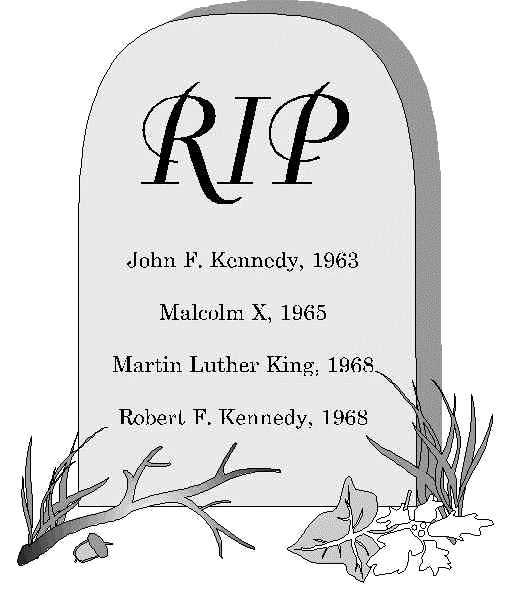
This two part essay appeared originally in Probe back in 1997. No article we ever published ever generated as much discussion and feedback as this one did. If it can be said that any piece ever put us “on the map” so to speak, this one did.
Looking back, one reason it had so much resonance is that no one had ever done anything like it before. That is, explored at length and in depth both the provenance and the evolution of these “JFK scandal stories” over a number of years. By the term evolution I mean how they morphed over time at each appearance into something they were not when they first appeared.
The other point that made this such an attention grabber was the fact that certain personages somehow appeared on the scene directly or on the periphery. People whose presence should have caused alarm bells to go off with intelligent and sophisticated observers: Frank Capell, Robert Loomis, Ovid Demaris, Liz Smith, James Angleton, Timothy Leary etc. As the essay makes clear, these people had agendas in mind when they got into this racket. Others, like Robert Slatzer, as we also show, were just money grubbing hustlers. But the net effect is that by reinforcing each other, they became a business racket, a network creating its own echo chamber.
It was not an easy piece to write. I learned a lot doing it, but I came away with a lot of dirty knowledge about how power in America works. And the lengths the other side will go to in order to snuff out any kind of memory of what America was at one time.
We decided to repost this essay in the wake of the current Mimi Alford episode. This fits in with the essay because the book was published by Random House, home of Bob Loomis who retired last year. The Alford book was likely his parting shot at the JFK researchers, who he despises so much that he launched the now discredited Gerald Posner on them. Also, we cannot help but note how quickly the MSM has fallen head first for the woman without asking any cautionary questions. Like, for example, “Why did you wait nine years to publish?”, right on the eve of the 50th anniversary. Which corresponds neatly with her alleged discovery by Robert Dallek back in 2003, at the 40th anniversary. Neither did they ask her how she got to Random House. Another pertinent query: “Why are you and your handlers writing that you were not
named previously when, in fact, Dallek did name you in the trade paperback version of his book?”
Further, no one has called her on her comment that during the Missile Crisis JFK told her that he wished his kids grew up “better red than dead”. In other words, he was ready to surrender to the Russians and Cubans and let them take over America instead of insisting the missiles in Cuba be removed. Hard to believe that even the MSM could buy this one sInce it contradicts everything in the newly adduced documentary record. During the Missile Crisis, Kennedy moved a 200,000 man army into South Florida. Two invasion plans of Cuba had been drawn up during Operation Mongoose. Either by invasion or by bombing, the missiles were going to be removed. It was not Kennedy who tried for a deal first. It was the Russians through ABC reporter John Scali. Five hours later, NIkita Khrushchev cabled a long, emotional, rambling letter requesting the outline of an offer to remove the missiles.
But the Missile Crisis has always been perceived by the MSM as being Kennedy’s shining moment. (In my opinion it is not. Vietnam is, but they are still in denial on that one.) So they first sent Sy Hersh out to try and smear Kennedy’s masterly performance during the episode. That did not work, so now they take a second swing at it. With no one asking why this is bizarre story is at odds with the taped conversations of the crisis. We have little doubt that this book is being passed around the studios by Random House to make a TV movie for the anniversary next year — perhaps the rightwing Starz Channel will pick it up.
In the classic film “Z”, after the generals have killed the liberal candidate for Premier, an excellent scene follows. Seated at a long table, the plotters pass around a dossier. They then agree that the next step is to “Knock the halo of his head.” The timely delay in the Alford book’s appearance, the push by Random House, and the inclusion of the goofy “better red than dead” exchange, these all demonstrate that the book and this woman are best understood under that shadow. Which we try and illuminate in this essay.
Part I: Judith Exner, Mary Meyer, and Other Daggers
(Click here if your browser is having trouble loading the above.)
Part II: Sy Hersh and the Monroe/JFK Papers: The History of a Thirty-Year Hoax
On September 25, 1997, ABC used its news magazine program 20/20 to take an unusual journalistic step. In the first segment of the program, Peter Jennings took pains to discredit documents that had been about to be used by its own contracted reporter for an upcoming show scheduled for broadcast. The contracted reporter was Seymour Hersh. The documents purported to show a secret deal involving Marilyn Monroe, Sam Giancana, and President John F. Kennedy. They were to be the cornerstone of Hersh’s upcoming Little, Brown book, The Dark Side of Camelot. In fact, published reports indicate that it was these documents that caused the publisher to increase Hersh’s advance and provoke three networks to compete for a television special to hype the book. It is not surprising to any informed observer that the documents imploded. What is a bit surprising is that Hersh and ABC could have been so naive for so long. And it is ironic that ABC should use 20/20 to expose a phenomenon that it itself fueled twelve years ago.
What happened on September 25th was the most tangible manifestation of three distinct yet overlapping journalistic threads that have been furrowing into our culture since the Church Committee disbanded in 1976. Hersh’s book would have been the apotheosis of all three threads converged into one book. In the strictest sense, the convergent movements did not actually begin after Frank Church’s investigation ended. But it was at that point that what had been a right-wing, eccentric, easily dismissed undercurrent, picked up a second wind–so much so that today it is not an eccentric undercurrent at all. It is accepted by a large amount of people. And, most surprisingly, some of its purveyors are even accepted within the confines of the research community.
The three threads are these:
- That the Kennedys ordered Castro’s assassination, despite the verdict of the Church Committee on the CIA’s assassination plots. As I noted last issue, the committee report could find no evidence indicating that JFK and RFK authorized the plots on Fidel Castro, Rafael Trujillo of the Dominican Republic, or Ngo Dinh Diem of South Vietnam.
- That the Kennedys were really “bad boys,” in some ways as bad as Chicago mobsters or the “gentleman killers” of the CIA. Although neither JFK nor RFK was lionized by the main centers of the media while they were alive, because of their early murders, many books and articles were written afterward that presented them in a sympathetic light, usually as liberal icons. This was tolerated by the media establishment as sentimental sop until the revelations of both Watergate and the Church Committee. This “good guy” image then needed to be altered since both those crises seemed to reveal that the Kennedys were actually different than what came before them (Eisenhower and the Dulles brothers) and what came after (Nixon). Thus began a series of anti-Kennedy biographies.
- That Marilyn Monroe’s death was somehow ordained by her “involvement” with the Kennedy “bad boys.” Again, this was at first a rather peculiar cottage industry. But around the time of Watergate and the Church Committee it was given a lift, and going back to a 1964 paradigm, it combined elements of the first two movements into a Gothic (some would say grotesque) right-wing propaganda tract which is both humorous and depressing in its slanderous implications, and almost frightening in its political and cultural overtones. Egged on by advocates of Judith Exner (e.g. Liz Smith and Tony Summers), this political and cultural time bomb landed in Sy Hersh’s and ABC’s lap. When it blew up, all parties went into a damage control mode, pointing their fingers at each other. As we examine the sorry history of all three industries, we shall see that there is plenty of blame (and shame) to be shared. And not just in 1997.
As we saw in Part One of this article, as the Church Committee was preparing to make its report, the Exner and then Mary Meyer stories made headlines in the Washington Post. These elements–intrigue from the CIA assassination plots, plus the sex angles, combined with the previous hazing of Richard Nixon over Watergate–spawned a wave of new anti-Kennedy “expose” biographies. Anti-Kennedy tracts were not new. But these new works differed from the earlier ones in that they owed their genesis and their styles to the events of the mid-seventies that had brought major parts of the establishment (specifically, the CIA and the GOP) so much grief. In fact we will deal with some of the earlier ones later. For now, let us examine this new pedigree and show how it fits into the movement outlined above.
Looking for Mr. Kennedy (And Not Finding Him)
The first anti-Kennedy book in this brood, although not quite a perfect fit into the genre, is The Search for JFK, by Joan and Clay Blair Jr. The book appeared in 1976, right after Watergate and the Church Committee hearings. In the book’s foreword, the authors are frank about what instigated their work:
During Watergate (which revealed to us the real character of President Richard M. Nixon–as opposed to the manufactured Madison Avenue image), our thoughts turned to Jack Kennedy….Like other journalists, we were captivated by what was then called the “Kennedy mystique” and the excitement of “the New Frontier.” Now we began to wonder. Behind the image, what was Jack really like? Could one, at this early date, cut through the cotton candy and find the real man? (p. 10)
In several ways, this is a revealing passage. First of all, the authors apparently accept the Washington Post version of Watergate–i.e. that Nixon, and only Nixon, was responsible for that whole range of malfeasance and that Bob Woodward and Carl Bernstein got to the bottom of it. Second, it seems to me to be a curious leap from the politically misunderstood shenanigans of Watergate to the formative years of John Kennedy’s college prep days and early adulthood, which is what this book is about. It takes JFK from his days at the exclusive Choate School in Connecticut to his first term as a congressman i.e. from about 1934 through 1947. I don’t understand how comparing the political fallout from Watergate with an examination of Kennedy’s youthful years constitutes a politically valid analogy. Third, the Blairs seem a bit behind the curve on Nixon. If they wanted to find out the “truth” about Nixon all they had to do was examine his behavior, and some of the people he employed, in his congressional campaign against Jerry Voorhis, his senatorial campaign against Helen Douglas and, most importantly, his prosecution of Alger Hiss. These all happened before 1951, two decades before Watergate. Nothing in JFK’s political career compares with them.
The book’s ill-explained origin is not its only problem. In its final form, it seems to be a rush job. I have rarely seen a biography by a veteran writer (which Clay Blair was) so poorly edited, written, and organized. The book is nearly 700 pages long. It could have been cut by a third without losing anything of quality or substance. The book is heavily reliant on interviews which are presented in the main text. Some of them at such length–two and three pages–that they give the volume the air of an oral history. To make it worse, after someone has stopped talking, the authors tell us the superfluous fact that his wife walked into the room, making for more excess verbiage (p.60). And on top of this, the Blairs have no gift for syntax or language, let alone glimmering prose. As a result, even for an interested reader, the book is quite tedious.
The Blairs spend much of their time delving into two areas of Kennedy’s personal life: his health problems and his relationships with the opposite sex. Concerning the first, they chronicle many, if not all, of the myriad and unfortunate medical problems afflicting young Kennedy. They hone in on two in order to straighten out the official record. Previous to this book, the public did not know that Kennedy’s back problem was congenital. The word had been that it came about due to a football injury. Second, the book certifies that Kennedy was a victim of Addison’s disease, which attacks the adrenal glands and makes them faulty in hormone secretion. The condition can be critical in fights against certain infections and times of physical stress.
Discovered in the 19th century, modern medication (discovered after 1947) have made the illness about as serious as that of a diabetic on insulin. I exaggerate only slightly when I write that the Blairs treat this episode as if Kennedy was the first discovered victim of AIDS. They attempt to excuse the melodrama by saying that Kennedy and his circle disguised the condition by passing it off as an “adrenal insufficiency.” Clearly, Kennedy played word games in his wish to hide a rare and misunderstood disease that he knew his political opponents would distort and exaggerate in order to destroy him, which is just what LBJ and John Connally attempted to do in 1960. The myopic authors save their ire for Kennedy and vent none on Johnson or a potentially rabid political culture on this issue.
The second major area of focus is Kennedy’s sex life. The authors excuse this preoccupation with seventies revelations, an apparent reference to Exner, Meyer, and perhaps Monroe (p. 667). Kennedy seems to have been attractive to females. He was appreciative of their overtures. There seems to me to be nothing extraordinary about this. Here we have the handsome, tall, witty, charming son of a millionaire who is eligible and clearly going places. If he did not react positively to all the attention heaped on him, I am sure his critics would begin to suggest a “certain latent homosexual syndrome.” But what makes this (lengthy) aspect of the book interesting is that when the Blairs ask some of Kennedy’s girlfriends what his “style” was (clearly looking for juicy sex details), as often as not, the answer is surprising. For instance, in an interview with Charlotte McDonnell, she talks about Kennedy in warm and friendly terms adding that there was “No sex or anything” in their year long relationship (p. 81). Another Kennedy girlfriend, the very attractive Angela Greene had this to say:
Q: Was he romantically pushy?
A: I don’t think so. I never found him physically aggressive, if that’s what you mean. Adorable and sweet. (p. 181)
In another instance, years later, Kennedy was dating the beautiful Bab Beckwith. She invited Kennedy up to her apartment after he had wined and dined her. There was champagne and low music on the radio. But then a news broadcast came on and JFK leaped up, ran to the radio, and turned up the volume to listen to it. Offended, Beckwith threw him out.
Another curious observation that the book establishes is that Kennedy did not smoke and was only a social drinker. So if, as I detailed in the Mary Meyer tale, Kennedy ended up a White House coke-sniffer and acid head, it was a definite break with the past.
The Blairs’ book established some paradigms that would be followed in the anti-Kennedy genre. First, and probably foremost, is the influence of Kennedy’s father in his career. In fact, Joe Kennedy’s hovering presence over all his children is a prime motif of the book. The second theme that will be followed is the aforementioned female associations. The third repeating pattern the Blairs’ established is the use of Kennedy’s health problems as some kind of character barometer. That because Kennedy and his circle were not forthright about this, it indicates a covert tendency and a penchant for covering things up.
It would be easy to dismiss The Search for JFK as a slanted book, and even easier to argue that the authors had an agenda. Clay Blair was educated at Tulane and Columbia and served in the Navy from 1943-1946. He was a military affairs writer and Pentagon correspondent for Time-Life from 1949 to 1957. He then became an editor for the Saturday Evening Post and worked his way up to the corporate level of that magazine’s parent company, Curtis Publications. Almost all of his previous books dealt with some kind of military figure or national security issue e.g. The Atomic Submarine and Admiral Rickover, The Hydrogen Bomb, Nautilus 90 North, Silent Victory: the U.S. Submarine War Against Japan. In his book on Rickover, he got close cooperation from the Atomic Energy Commission and the book was screened by the Navy Department. In 1969 he wrote a book on the Martin Luther King murder called The Strange Case of James Earl Ray. Above the title, the book’s cover asks the question “Conspiracy? Yes or No!” Below this, this the book’s subtitle gives the answer, describing Ray as “The Man who Murdered Martin Luther King.” To be sure there is no ambiguity, on page 146 Blair has Ray shooting King just as the FBI says he did, no surprise since Blair acknowledges help from the Bureau and various other law enforcement agencies in his acknowledgements.
The Ray book is basically an exercise in guilt through character assassination. This practice has been perfected in the Kennedy assassination field through Oswald biographers like Edward Epstein and Priscilla Johnson McMillan. Consider some of Blair’s chapter headings: “A Heritage of Violence,” “Too Many Strikes Against Him,” “The Status Seeker.” In fact, Blair actually compares Ray with Oswald (pp. 88-89). In this passage, the author reveals that he also believes that Oswald is the lone assassin of Kennedy. He then tries to imply that Ray had the same motive as his predecessor: a perverse desire for status and recognition. Later, Blair is as categorical about the JFK case as he is about the King case:
In the case of John F. Kennedy the debate still rages. Millions of words have been written–pro and con. Yet no one has produced a single piece of hard evidence that Lee Harvey Oswald was anything more than a psychopath acting entirely on his own. (p. 106)
I could continue in a similar vein with excerpts from this book and I could also go on with more questionable aspects of Clay Blair’s background. And I could then use this information, and the inferences, to dismiss The Search for JFK. I could even add that Blair’s agent on his Kennedy book was Scott Meredith, who was representing Judith Exner at the time. But I won’t go that far. I may be wrong, but in my opinion I don’t think the book can be classified as a deliberate distortion or hatchet job. Although the authors are in some respects seeking to surface unflattering material, I didn’t feel that they were continually relying on questionable sources or witnesses, or consistently distorting or fabricating the record. As I have mentioned, the book can be criticized and questioned–and dismissed–on other grounds, but, as far as I can see, not on those two.
Dubious Davis
Such is not the case with John Davis’ foray into Kennedy biography. The Kennedys: Dynasty and Disaster 1848-1983, was published in 1984, before Davis became the chief spokesman for the anti-Garrison/Mob-did-it wing of the ramified assassination research community. In its very title, his book is deceptive in a couple of interesting ways. First, from the dates included, it implies that the book will be a multigenerational family saga tracing the clan from Joe Kennedy’s parents down to youngest brother Teddy. But of the book’s 648 pages of text, about 400 deal with the life and death of John F. Kennedy. And more than half of those deal with his presidency. In no way is the book an in-depth family profile. Secondly, as any school boy knows, the word dynasty denotes a series or succession of at least three or more rulers. So Jack Kennedy’s two years and ten months as president constitute the shortest “dynasty” in recorded history. In reality, of course, it was not a dynasty at all and the inclusion of the word is a total misnomer.
But there is a method to the misnoming. For Davis, it is necessary to suggest a kind of “royal family” ambience to the Kennedys and, with it, the accompanying aura of familial and assumed “divine right.” One of the author’s aims is to establish the clan as part of America’s ruling class, with more power and influence than any other. He is clear about this early on, when he writes that Joe Kennedy Sr. was richer than either David or Nelson Rockefeller (p. 133). As any student of wealth and power in America knows, this is a rather amazing statement. In 1960, according to John Blair’s definitive study The Control of Oil, the Rockefeller family had controlling interest in three of the top seven oil companies in America, and four of the top eight in the world. They were also in control of Chase Manhattan Bank, one of the biggest in the nation then and the largest today. They also owned the single most expensive piece of real estate in the country, Rockefeller Center in New York City. The list of private corporations controlled by them could go on for a page, but to name just two, how about IBM and Eastern Airlines. I won’t enumerate the overseas holdings of the family but, suffice it to say, the Kennedys weren’t in the same league in that category. JFK knew this. As Mort Sahl relates, before the 1960 election, he liked to kid Kennedy about being the scion of a multimillionaire. Kennedy cornered him once on this topic and asked him point blank how much he thought his family was worth. Sahl replied, “Probably about three or four hundred million.” Kennedy then asked him how much he thought the Rockefellers were worth. Sahl said he had no idea. Kennedy replied sharply, “Try about four billion.” JFK let the number sink in and then added, “Now that’s money, Mort.”
Throughout the book, Davis tries to convey the feeling of a destined royalty assuming power. So, according to Davis, Kennedy was thinking of the Senate when he was first elected to the House. Then, from his first day in the Senate, he was thinking of the Vice-Presidency (p. 147). Epitomizing this idea, Davis relates a personal vignette about the Kennedy family wake after JFK’s funeral. Davis, a cousin of Jackie Kennedy, was leaving the hall and paused to shake hands with Rose Kennedy to offer his condolences (p. 450). Mother Kennedy surprised him by saying in a cool, controlled manner: “Oh, thank you Mr. Davis, but don’t worry. Everything will be all right. You’ll see. Now it’s Bobby’s turn.” Such coolness differs greatly from what is revealed in the recently declassified LBJ tapes in which, after the assassination, Rose could not even speak two sentences to the Johnsons without dissolving into tears. But the portrait is in keeping with the ruthless monarchy that Davis takes great pains to portray.
As I said above, the main focus is Kennedy’s short-lived “dynastic” presidency. And this is where some real questions about Davis’ methodology and intent arise. As he does in his assassination book Mafia Kingfish, Davis proffers a long bibliography to create the impression of immense scholarship and many hours quarrying the truth out of books, files, and libraries. But, like the later book, the text is not footnoted. So if the reader wishes to check certain facts, or locate the context of a comment or deduction, he is generally unable to do so. But fortunately, some of us have a background that enables us to find out where certain facts and deductions came from. This is crucial. For in addition to his wild inflation about the prominence of the Kennedy family in the power elite, another of Davis’ prime objectives is to reverse the verdict of the Church Committee and place Kennedy in the center of the CIA plots to kill Castro.
Pinning the Plots on Kennedy
As I said in Part One of this article, there is no evidence of such involvement in either the CIA’s Inspector General report of 1967, or in the Church Committee’s report, Alleged Assassination Plots Involving Foreign Leaders, issued in late 1975. In fact, both advance evidence and conclusions to indicate the contrary. So how does Davis propagate that the Kennedy brothers knew about, authorized, and encouraged the plots? The first method is by performing minute surgery on the 1975 report. Davis states that Allen Dulles briefed JFK on the plots at a November 27, 1960 meeting with the President-elect. He uses Deputy Director Dick Bissell as his source for this disclosure (Davis, p. 289). I turned to the committee report that dealt with Bissell’s assumptions on this matter (Alleged Assassination Plots p. 117). Here is the testimony Davis relies on:
Bissell: I believe at some stage the President the President and the President-elect both were advised that such an operation had been planned and was being attempted.
Senator Baker: By whom?
Bissell: I would guess through some channel by Allen Dulles.
The Chairman: But you’re guessing aren’t you?
Bissell: I am, Mr. Chairman, and I have said that I cannot recollect the giving of such briefing at the meeting with the President in November….
Even thought Bissell does not remember any briefing at this November meeting, Davis writes as if he does and uses him as a source. Yet the report goes on to say (Ibid p. 120): “Bissell surmised that the reasons he and Dulles did not tell Kennedy at that initial meeting were that they had ‘apparently thought it was not an important matter’.” (p. 120.) When Frank Church asked Bissell if that was not rather strange, Bissell replied, “I think that in hindsight it could be regarded as peculiar, yes.” (Ibid, p. 121.) Davis leaves these last two Bissell quotes out, probably because they would vitiate his “conclusion” that Dulles and Bissell informed JFK of the plots. Incredibly, Davis builds on this foundation of sand by postulating that the reason Kennedy decided to go ahead with the Bay of Pigs was that he knew the CIA would kill Castro by then and it would therefore be an easy victory! (Davis, p. 292.)
Davis must know he’s on shaky ground, because he fishes for substantiation outside of the Church Committee report. Davis states that his quest for this led him to the home of none other than Richard Helms (Ibid, p. 289). Helms told Davis, “that he believed Bissell was correct, that, knowing him, he would not commit perjury before a Senate committee.” (Ibid). Davis leaves out the fact that perjury is precisely what Helms committed before a Senate committee in 1973 about CIA involvement in Chile. He also fails to tell the reader anything about the Helms-Bissell relationship, which makes his “vouching” for Bissell almost humorous. When the two were in the CIA, there were few rivalries more pronounced and few resentments more public than the one between Bissell and Helms, who resented his boss because Bissell kept him out of the loop on some operations. Helms, according to Evan Thomas’ The Very Best Men, was happy to see the Bay of Pigs capsize because it meant Bissell would be out and that Helms would move up ( p. 268). So, to most objective readers, if Helms has now swiveled to endorsing Bissell, there must be some extenuating circumstances involved. There are, and again, Davis does not tell the reader about them. As the Inspector General’s report tells us, when Dulles and Bissell began cleaning out their desks, a new team took over the Castro plots, namely Bill Harvey and Ted Shackley. The man they reported to was Helms, the highest link in the chain (Alleged Assassination Plots pp. 148-153). In other words, the alchemy of John Davis with Bissell helps get Helms off the hook for responsibility for the continuing unauthorized plots. And Helms needs all the help he can get. When John McCone (Kennedy’s replacement CIA Director) expressly forbade any assassination plots, Helms said he couldn’t remember the meeting (Ibid, p. 166). When evidence was advanced that, in direct opposition to Bobby’s wishes, Helms continued the Castro plots and allowed an operative to use RFK’s name in doing so, Helms said he didn’t remember doing that either (Ibid p. 174). On the day that RFK met with CIA officials to make it clear there would be no more unauthorized plots against Castro, Kennedy’s calendar reads as follows: “1:00–Richard Helms.” Helms could not recall the meeting (Ibid p. 131). With this much to explain away, Helms must have poured coffee for Davis the day they met.
But Davis is not done. He also writes the following:
Kennedy also met on April 20 with the Cuban national involved in the unsuccessful underworld Castro assassination plot, a meeting that was not discovered until the Senate Committee on Intelligence found out about it in 1975. That Kennedy could have met with this individual, whose name has never been revealed, without knowing what his mission had been, seems inconceivable. (Davis p. 297.)
Imagine the images conjured up by this passage to a reader who has not read the report. I had read the report and I thought I had missed something. How did I forget about Kennedy’s private meeting with Tony Varona in the Oval office? JFK asks Varona why he couldn’t get at Castro and then pats him on the head and says try it again. When I turned to page 124 in the report, I saw why I didn’t remember it. The meeting, as described by Davis, did not occur. At the real meeting are Kennedy, Robert McNamara, General Lyman Lemnitzer “and other Administration officials.” Also in the room “were several members of Cuban groups involved in the Bay of Pigs.” The report makes clear that this was the beginning of the general review of the Bay of Pigs operation that would, within three weeks, result in the Taylor Review Board which would then recommend reforms in CIA control of covert operations. There is no hint, so pregnant in Davis’ phrasing, that anything about assassination was discussed.
Womanizer and Warmonger?
One of the more startling sections of the Davis book is his treatment of Judith Exner. From the above, one would guess that he thoroughly buys into the 1977 Exner-Demaris book. He does and he mentions her name quite often. What is surprising is that he goes even further. Apparently, Davis realizes his jerry-built apparatus of Bissell-Helms, and adulteration of the record will not stand scrutiny. So he calls up Ovid Demaris, coauthor of Judith Exner: My Story (p. 319). From this phone call, Davis is informed that Exner lied in the book. She did tell Kennedy about her affair with Sam Giancana and JFK got jealous. From this, Davis builds another scaffolding: he now postulates that Exner was Kennedy’s conduit to the CIA-Mafia plots to kill Castro (Ibid p. 324). What is breathtaking about this is that this is something that not even Exner had uttered yet, at least not for dissemination. And she won’t until her get-together with Kitty Kelley in the February 1988 cover story for People. This curious passage leads one to think that Davis may have planted the seed from which the Kelley story sprouted.
To go through the entire Davis book and correct all the errors of fact, logic, and commentary would literally take another book. But, in line with my original argument about anti-Kennedy biography, I must point out just two parts of Davis’ discussion of JFK’s Vietnam policy. The author devotes a small chapter to this subject. In his hands, Kennedy turns into a hawk on Vietnam. Davis writes that on July 17, 1963, Kennedy made “his last public utterance” on Vietnam, saying that the U.S. was going to stay there and win (p.374). But on September 2, 1963, in his interview with Walter Cronkite, Kennedy states that the war is the responsibility of “the people of Vietnam, against the Communists.” In other words, they have to win the war, not Americans. Davis makes no mention of this. Davis similarly ignores NSAM 111 in which Kennedy refused to admit combat troops into the war, integral to any escalation plan, and NSAM 263, which ordered a withdrawal to be completed in 1965. This last was published in the New York Times (11/16/63), so Davis could have easily found it had he been looking.
In light of this selective presentation of the record on Vietnam, plus the acrobatic contortions performed on the Church Committee report, one has to wonder about Davis’ intent in doing the book. I question his assertion that when he began the book he “did not have a clear idea where it would lead.” (p. 694) So I was not surprised that in addition to expanding Exner’s story, he uncritically accepted the allegations about Mary Meyer and Marilyn Monroe (pp. 610-612). As the reader can see, in the three areas outlined at the beginning of this essay, Davis hit a triple. In all the threads, he has either held steady or advanced the frontier. It is interesting in this regard to note that Davis devotes many pages to JFK’s assassination (pp. 436-498). He writes that Kennedy died at the “hands of Lee Harvey Oswald and possible co-conspirators” (p. 436). Later, he will write that Sirhan killed Bobby Kennedy (p. 552). Going even further, he can state that:
It would be a misstatement, then, to assert that Deputy Attorney General Katzenbach and the members of the Warren Commission…consciously sought to cover up evidence pertaining to the assassination of John F. Kennedy. (P. 461)
As the declassified record now shows (Probe Vol. 4 #6 “Gerald Ford: Accessory after the Fact”) this is just plain wrong. Davis then tries to insinuate any cover-up was brought on by either a backfiring of the Castro plots (Davis p. 454) or JFK’s dalliance with Exner (p. 498). As wrongheaded and against the declassified record as this seems, this argument still has adherents, e. g. Martin Waldron and Tom Hartman. They refine it into meaning that the Kennedys had some kind of secret plan to invade Cuba in the offing at the time of the assassination. This ignores the Church Committee report, which shows that by 1963, Kennedy had lost faith in aggression and was working toward accommodation with Castro. It also ignores the facts that JFK would not invade Cuba under the tremendous pressures of either the Bay of Pigs debacle, or the Cuban Missile Crisis in which Bobby backed him on both occasions. Reportedly, like Davis, Waldron likes to use CIA sources like Bill Colby (Mr. Phoenix Operation) on JFK’s ideas about assassination. Just as Newman corrected the Vietnam record in 1992, his long-awaited book Kennedy and Cuba will do much to correct these dubious assertions.
“Liberal” Turncoats: Collier and Horowitz
The same year that the Davis book appeared, another anti-Kennedy book was published. It was entitled The Kennedys: An American Drama, and was written by Peter Collier and David Horowitz. These two were both former editors at the liberal Ramparts publication. After the magazine folded, both began to write biographies of famous American families while on their way from the left to the extreme right. In order, the pair examined the Rockefellers, the Kennedys, the Fords, and the Roosevelts. As with Davis, it is interesting to note the difference in their treatments of the Rockefellers (1976) and the Kennedys (1984). In the earlier book, the authors note toward the end that they had access to the Rockefeller family archives (p. 636). In another book of theirs, Destructive Generation, they write that the Rockefeller book began when the pair were soliciting funds to keep Ramparts afloat (p. 275). This is how they got in contact with the younger generation of that clan. So when the magazine fell, they went to work on the family biography with access to people and papers that no outside, nonofficial authors had before. It is interesting that, in 1989, the authors wrote that when they started the Rockefeller book, they were expecting to excavate an “executive committee of the ruling class” and thereby unlock the key to the American power elite. But they found that they only ended up writing about American lives (Ibid). They ended up with that result because that seems to have been the plan all along. Towards the end of the book, the authors strike a rather wistful note, a sort of elegy for a once powerful family that is now fading into the background (The Rockefellers, p. 626). This is extraordinary. Consider some of the things the Rockefellers accomplished in the seventies: they were part of the effort to quadruple gasoline prices through their oil companies; David Rockefeller took part in the effort to get the American government to intervene in Chile in 1973; the Trilateral Commission, which the Rockefellers sponsored, funneled many of its members into the Carter administration; in 1979, Henry Kissinger and David Rockefeller convinced Carter to let the Shah of Iran into the country for medical treatment. The reaction in Iran helped give us Reagan-Bush. The rest, as they say, is history.
In comparing the two books, one is immediately struck by a difference in approach. Whatever the shortcomings of the Rockefeller book, there is a minimal reliance on questionable sources. And the concentration on individual lives very seldom extends into a pervasive search for sex and scandal. This difference extends to even the photos chosen for the two books. The Rockefeller book is fairly conventional with wide or half page group shots or portraits. In the Kennedy book, even the one page of group shots are tiny prints. The rest are wallet-sized head shots that when leafed through, give the impression of mug shots.
The accompanying text is suitable to the photo layout. There seems to me to be both a macro and micro plan to the book. The overall plan is to make Joe Kennedy a sort of manipulating overseer to his sons and, at the same time, make him into a status-seeking iconoclast whose beliefs and sympathies are contra to those of America. The problem with this is dual. First, it is the typical “like father, like son” blanket which reeks of guilt, not just by association, but by birth. Second, the blatant ploy does not stand scrutiny because what makes John and Robert Kennedy so fascinating is how different their politics and economics were from Joe Kennedy’s and how fast the difference was exhibited. To use just two examples from JFK’s first term in the House, Kennedy rejected his father’s isolationist Republican type of foreign policy and opted for a more internationalist approach when he voted for the Truman Doctrine and Marshall Plan. Second, Kennedy voted to sustain Truman’s veto of Taft-Hartley which would weaken unions and strengthen American big businessmen–people like his father. From there on in, the splits got wider and wider. It is this father-son dichotomy that none of these books cares to acknowledge let alone explore–which reveals their intent. (An exception is the Blairs’ book, which does acknowledge the split on pp. 608-623.)
In their approach to JFK, Collier and Horowitz take up where the Blairs left off. In fact, they play up the playboy angle even more strongly than the Blairs. When Kennedy gets to Washington in 1947, this note is immediately struck with “women’s underthings stuffed into the crevices of the sofa” (p. 189) and a “half-eaten hamburger hidden behind books on the mantel” (Ibid). The problem here is there is no source given for the first observation and the hamburger is sourced to none other than CIA-Washington Post crony Joe Alsop, the man who, as Don Gibson pointed out, talked LBJ into forming the Warren Commission (Probe Vol. 3 #4 pp. 28-30).
This is typical of the book’s low scholarly standard. Both authors have advanced degrees from Cal Berkeley. Both had done some solid academic work in their Ramparts days. Yet neither has any qualms about the Exner or Mary Meyer stories. In fact they both jump on the Timothy Leary addition to the latter ( p. 355). This tabloid approach allows them to use none other than Kitty Kelley on Jackie’s reaction to Kennedy’s supposed White House affairs. Consider the following excerpt based on Kelley:
She knew far more about these goings-on than he ever suspected and dealt with them through hauteur, as when she disdainfully handed him some panties she’d found in her pillow slip, saying, “Here, would you find out who these belong to. They’re not my size. (Ibid)
With this kind of standard I’m surprised the authors did not use that other ersatz Kelley “bombshell” about Jackie, namely that JFK’s affairs drove her to electroshock therapy.
Many of the sexual anecdotes go unsourced, but there is one that is footnoted that is quite revealing. The authors use it as a coda to a chapter on Jack’s early years in the House. This passage synthesizes the image they wish to depict: Kennedy as the empty vessel of his father who had his role as politician forced on him after Joe Junior’s death and who now uses sex as a release from his own vacuity. It deserves to be quoted at length:
The whole thing with him was pursuit. I think he was secretly disappointed when a woman gave in. It meant that the low esteem in which he held women was once again validated….I was one of the few he could really talk to….During one of these conversations I once asked him why he was doing it–why he was acting like his father…why he was taking a chance on getting caught in a scandal…. He took awhile to formulate an answer. Finally he shrugged and said, “I don’t know, really, I guess I just can’t help it.” He had this sad expression on his face. He looked like a little boy about to cry (p. 214)
Pretty strong stuff. What else could the authors ask for but young Jack confessing to their charge? But perhaps a little too perfect? After contemplating the words, I thought to myself that JFK was never this open to his girlfriends. Perhaps maybe Inga Arvad, who he wanted to marry, but very few others. So I flipped back to see who the source was. The footnote read “Authors’ interview with Priscilla McMillan.” I then remembered that, by this time, Priscilla had been classified by the CIA as a “witting collaborator.” I also recalled that years later, Priscilla changed her “Platonic” relationship with JFK for the National Enquirer. She was now saying that young Jack had actually made a pass at her.
With this in mind, it is instructive to note that in Destructive Generation, Collier reveals that in 1979 he started lecturing for the United States Information Agency (p. 275). The USIA has a long, involved association with the CIA and actually disseminated propaganda for the Warren Commission. The date of Collier’s work approximates the time when the Kennedy book idea was originated. Ignoring the shoddy approach and scholarly standards of the work, the New York Times, Washington Post, and New Republic all gave the book prominent and glowing reviews. In the latter case, Martin Peretz placed the book on the August 27, 1984 New Republic cover under the title “Dissolute Dynasty.” He then got longtime Kennedy basher Midge Decter to write a long review that branded the saga “a sordid story.” Right after this ecstatic reception, in 1985, Horowitz and Collier landed a feature story in the Washington Post as “Lefties for Reagan.” Two years later, the pair went on a USIA-State Department sponsored tour of Nicaragua. This was at a time when the CIA was dumping millions into that country in a huge psychological and propaganda war effort. That same year, with lots of foundation money, the pair arranged a “Second Thoughts” conference in Washington. This was basically a meeting of “reformed” sixties liberals bent on attacking that decade and anyone who wished to hold it up as an era of excitement and/or progressive achievement. Peretz attended that conference. Later, they sponsored another conference entitled “Second Thoughts on Race in America.” This might have been called the Washington Post take on race in the eighties since it featured such Kay Graham-Ben Bradlee employees as Richard Cohen, Juan Williams, and Joe Klein. Today, these two see themselves as armed guards protecting America from any renaissance of sixties activism after Reagan. They are quite open about this and Kennedy’s role in it in Destructive Generation: “Just as Eisenhower’s holding action in the Fifties led to JFK’s New Frontier liberalism in the Sixties…so the clamped-down Reaganism of the Eighties has precipitated the current radical resurgence….” Is one to conclude that Clinton is a radical? Was the Kennedy book a put-up job to place them over the top with their right-wing sponsors? Or do they really find Kitty Kelley credible? Could they really not have known that Priscilla Johnson McMillan was doing the same thing with Kennedy that she had recently done with Oswald in her book Marina and Lee? To put it another way: if your function is to discredit a decade, what better way to do it than to smear the man most responsible for ushering it in?
A Question of Character, But Not Kennedy’s
Which brings us to Thomas Reeves. By the nineties, the negative literature on the Kennedys had multiplied so much that it was possible just to put it all together and make a compendium of it. In 1991, Reeves did just that with his book A Question of Character. It obediently follows the path paved by its noted predecessors. In fact, many of his footnotes are to Davis and to Collier and Horowitz. Although Reeves is another Ph. D., he never questions the faulty methodology I have pointed out. On the contrary, by ignoring the primary sources, he can actually state that JFK authorized the Castro plots, and that John Davis is especially authoritative on the issue (p. 463). Predictably, he completely buys into Exner’s book and, like Liz Smith, tries to portray her as a victim of the Kennedy protecting “liberal media” (p. 424). He even endorses the Kitty Kelley 1988 People update of Exner’s story, finding no inconsistencies between that and the 1977 installment. And, like Collier and Horowitz, scholar Reeves has no problems using Kelley’s book on Jackie Kennedy as a source, although he does add that the tabloid queen’s works “must be approached cautiously” (p. 440).
Any scholar who compromises this much, must have an axe to grind. So how ideological is Reeves? He can actually call the Washington Post a liberal newspaper (p. 151). He can use veteran right-wing hit man and Rockefeller agent Victor Lasky as a frequent source. He tries to imply that Lasky’s book on JFK, published in 1963, was banned shortly after Kennedy’s death by the “liberal media” (p. 3). What he doesn’t say is that it was reprinted in 1966.
Reeves’ method here is to basically combine the Davis book with the Collier-Horowitz book. From the latter we get ladles of sex and women; from the former the notion that Kennedy was a Cold Warrior no different than Eisenhower or Nixon. Like Davis, Reeves performs gymnastics with the Cuba and Vietnam record in order to proffer this. In fact, Reeves is so intent on pommeling JFK that, at times, he reverses field and actually uses Bruce Miroff’s Pragmatic Illusions, a leftist critique of the New Frontier, as a source.
But there can be little doubt about where Reeves stands. This is the man who once wrote a quite sympathetic book about Joe McCarthy (The Life and Times of Joe McCarthy). In his anthology of essays on the foundation system (Foundations Under Fire) his uncritical opening essay is by far the longest piece in the book. A fierce critic like Fred Cook gets only three pages. In his anthology of essays on McCarthy (McCarthyism), editor Reeves has to label critics of the champion Red baiter as “liberals.” Yet when people like Bill Buckley or Brent Bozell take the floor, no such label is necessary. In his latest book, The Empty Church, Reeves unremittingly pillories liberals for weakening the main Protestant churches in America. What is the cause of their shrinking numbers? The liberalism of the sixties of course. One long chapter is entitled “Stuck in the Sixties.” This last book was published four years after his Kennedy hatchet job, and was sponsored by something called the Wisconsin Policy Research Institute which sounds suspiciously like Horowitz’s Center for Popular Culture, which makes me wonder if Reeves followed an established course of career advancement.
Reeves certainly did all he could to promote the Marilyn Monroe tale. Of course, he had an advantage. By 1991, when A Question of Character was published, the Marilyn Monroe thread of the movement outlined above was in full bloom. As if by design, this literature assimilated appendages from the other two threads: a distinct anti-Kennedy flavor, and the idea that the Kennedys ordered political assassinations. If one follows the pedigree of this lineage, the reasons for this become clear. The man who created the RFK/Monroe business, as we will see, was an incontinent Kennedy hater.
In the Collier-Horowitz book, the authors allude to the pamphlet that started the industry. Describing Bobby’s 1964 campaign for a Senate seat in New York, they write:
Meanwhile, right-wingers were circulating a pamphlet entitled “The Strange Death of Marilyn Monroe,” charging that Bobby had been having an affair with the film actress and, when she threatened to expose some of his dealings in appeasing the Castro regime, had her killed by Communist agents under his control. (p. 409)
The authors fail to note the man who penned this work. His name was Frank Capell. Capell is usually described as an extreme right-winger associated with the John Birch Society. This is apt, but incomplete. As Jim Garrison once noted, the more one scratches at these Minutemen types, the more their intelligence connections appear.
Swallowing Frank Capell
Capell had worked for the government in World War II, but was convicted on charges of eliciting kickbacks from contractors for the war effort. After the war, in the Red Scare era, Capell began publishing a Red baiting newsletter, The Herald of Freedom. He was highly active in attempting to expose leftists in the entertainment industry. It was this experience that put him in a good position to pen his McCarthyite, murderous smear of Bobby Kennedy.
But there is another element that needs to be noted about Capell: his ties to the FBI. As Lisa Pease noted in her watershed article on Thomas Dodd (Probe Vol. 3#6), Capell was one of the sources tapped by the Bureau in the wake of the assassination in order to find out who Oswald really was. His information proved remarkably penetrating, considering it came in February of 1964. Capell said Oswald was a CIA agent. Even more interesting, Capell stated in his FBI interview that this information came from “a friend of his…with sources close to the presidential commission” i. e., the Warren Commission. To have this kind of acute information and to have access to people around the Commission (which was sealed off at the time) strongly indicates Capell was tied into the intelligence community, which of course, is probably why the Bureau was consulting him in the first place.
This is revelatory of not just the past, i.e. the origins of this myth, but of the present, i.e. why it persists. For as Donald Spoto reveals in his book Marilyn Monroe, one of the people who relentlessly pushed Capell’s fabricated smear was fellow FBI asset, Hoover crony, and Hollywood Red baiter Walter Winchell (Spoto p. 601). (For a full discussion of former ONI operative Winchell’s service in Hoover’s employ see Neal Gabler’s Winchell.) As William Sullivan has noted, the dissemination of Capell’s invention was encouraged by Hoover. Sullivan called Bobby a near-Puritan and then added:
The stories about Bobby Kennedy and Marilyn Monroe were just stories. The original story was invented by a so-called journalist, a right-wing zealot who had a history of spinning wild yarns. It spread like wildfire, of course, and J. Edgar Hoover was right there, gleefully fanning the flames. (The Bureau p. 56)
The Capell/Winchell/Hoover triangle sowed the seeds of this slander. But the exposure of this triangle does more. In the Vanity Fair article in which Judith Exner dumped out the latest installment of her continuing saga, Liz Smith revealed that she apprenticed at the feet of Walter Winchell in New York (January 1997 p. 32). This may explain why she took up her mentor’s cudgel.
Capell’s work is, as Spoto notes in his Afterword, a frightful piece of reactionary paranoia. But there are two details in his pat anti-Kennedy tract that merit mention. First, Capell is probably the first to propagate the idea that RFK was indirectly responsible for his brother’s murder. He does this by saying (p. 52), that commie sympathizer Bobby called off the investigation of the shooting of General Edwin Walker in April of 1963, thus allowing that crazed Communist Oswald to escape and later kill JFK. This piece of rant has been modified later to fit into the stilted mosaics of people like Davis and Waldron. What makes it so fascinating is that, through the FBI’s own files, we now have evidence that Capell was deliberately creating a fiction: he had information that Oswald was not a communist, but a CIA agent.
The second point worth examining about Capell’s screed is the part where he begins laying out the “conspiracy” to kill Marilyn, specifically, RFK’s motive for murder. Capell writes:
But what if she were helped along into the next world by someone who would either benefit financially or who feared she might disclose something he wished to conceal. Suppose, for example, a married man were involved, that he had promised to marry her but was not sincere. Suppose she had threatened to expose their relationship (p. 28)
This is as specific as Capell gets in outlining his reason for the “conspiracy.” I wondered where he got the idea of Monroe’s “going public” about an affair. As many writers have pointed out, this would have been quite out of character for her. Something that Jim Marrs recently sent me may help explain it. He sent me the full text of a memo that he references in his current book, Alien Agenda. The memo supposedly reports on information gleaned from an FBI wiretap of Dorothy Kilgallen’s phone. The document went from the FBI to the CIA, where it was signed by James Angleton. In it, a man named Howard Rothberg is quoted as saying that Monroe had conversations with the Kennedy brothers on top secret matters like the examination of captured outer space creatures, bases inside of Cuba, and of President Kennedy’s plans to kill Castro. He also said that she was talking about a “diary of secrets” (quotes in original) that she had threatened RFK with if he brushed her off. When I got this memo, I was struck by its singular format. I have seen hundreds of CIA documents, maybe thousands, and I never saw one that looked like this. (We can’t reproduce it because the copy sent to us is so poor). I forwarded it to Washington researcher Peter Vea. He agreed it was highly unusual. To play it safe, I then sent a copy to former intelligence analyst John Newman. He said that he had seen such reports. What he thought was wrong with it was that there were things in it that should have been redacted that weren’t and things exposed that should have been blacked out. For instance, there is a phrase as follows, “a secret air base for the purpose of inspecting [things] from outer space.” Newman notes that the brackets around the word “things” denote that it had been previously redacted. It should not have. The words “outer space” should have been redacted and they never were. On the basis of this and other inconsistencies, he decided it was a “good” forgery from someone who knew what they were doing. He told PBS this four years ago when they showed it to him. The fact that this document purportedly revealing sensitive information was exposed in 1993 when he saw it, before the JFK Act when into effect, justifies even more suspicion about its origin and intent.
Spoto’s book adds more to the suspicion about the document, and perhaps the information in Capell’s pamphlet. Spoto notes that on August 3, 1962, the day the above memo was distributed, Kilgallen printed an item in her column saying that Marilyn was “vastly alluring to a handsome gentleman who is a bigger name than Joe DiMaggio” (p. 600). Spoto notes the source for Kilgallen’s story as Howard Rothberg, the man named in the memo. This is interesting for more than one reason. First, Spoto writes that Rothberg was “a New York interior designer with no connection at all to Marilyn or her circle.” (Ibid.) This means that he was likely getting his “information” through a third, unnamed source. Second, Rothberg’s name, and this is part of the sensitive information referred to above, is exposed in the document. This is extraordinary. Anyone who has jousted with the FBI or CIA knows how difficult it is to get “sources and methods” revealed. In fact this is one of the big battles the ARRB had to fight with the FBI. Yet in this document, both the method and the source are open. Third, to my knowledge, Kilgallen never printed anything specific from the document. Why? Assuming for a moment that the document is real, probably because she could not confirm anything in it. But interestingly, right after Kilgallen printed her vague allusion, Winchell began his steady drumbeat of rumors until, as Spoto notes, he essentially printed Capell’s whole tale (p. 601). From this, one could conclude that the Angleton memo could be viewed in two ways. Either it was, as in Newman believes, a “good” fake, or a false lead planted to begin an orchestrated campaign. More specifically, Rothberg was either a witting or unwitting conduit to the media for either Hoover or Angleton (or both). The quick Winchell follow-up would argue for Hoover. The Director would want someone else to lead the story before his man Winchell pushed it to the limit. The “diary of secrets,” so reminiscent of Mary Meyer (discussed in Part One of this article) would suggest Angleton.
Capell was drawn up on charges in 1965. The charges were rather fatal to the tale told in his RFK pamphlet: conspiracy to commit libel. One would have thought this discreditation was enough to impale the tale. And it probably would have been had it not been for Norman Mailer. In 1973, Mailer published a book, Marilyn, (really a photo essay) with the assistance of longtime FBI asset on the Kennedy assassination Larry Schiller. He recirculated the tale again, inserting a new twist. He added the possibility that the FBI and/or the CIA might have been involved in the murder in order to blackmail Bobby ( p. 242). In 1973, pre-Rupert Murdoch, the media had some standards. Mailer was excoriated for his baseless ruminations. In private, he admitted he did what he did to help pay off a tax debt. He also made a similar confession in public. When Mike Wallace asked him on 60 Minutes (7/13/73) why he had to trash Bobby Kennedy, Mailer replied “I needed money very badly.”
Swallowing Slatzer
The worst thing about Mailer’s money-grubbing antics was that it gave an alley to run through to a man who had actually been at work before Mailer’s book was published. In 1972, Robert Slatzer approached a writer named Will Fowler. Slatzer had been at work on an article which posited a conspiracy to murder Monroe. Fowler read it and was unimpressed. He told Slatzer that had he been married to Monroe, now that would make a real story. Shortly after, Slatzer got in contact with Fowler again. He said he forgot to tell him, but he had been married to Monroe. The “marriage” was a short one: 72 hours. It happened in Mexico on October 4, 1952. Unfortunately for Slatzer, Spoto found out that Monroe was in Beverly Hills that day on a shopping spree and she signed a check dated October 4th to pay for the articles she purchased (Spoto p. 227). Since Slatzer says that the pair left for Mexico on October 3rd and stayed for the following weekend, this demolishes his story.
But despite his fabrications, in 1974 Slatzer turned his article into a book entitled The Life and Curious Death of Marilyn Monroe. It went through at least three printings, including a mass paperback sale. Besides his “marriage” and his “continuing friendship” with Monroe, the other distinguishing aspect of the book is its similarity to Capell’s work. The first line is: “Bobby Kennedy promised to marry me. What do you think of that?” Slatzer, as if reading the Hoover/Angleton memo, saw her “diary.” One of the things in it is a mention of “Murder, Incorporated.” When Slatzer asks his “ex-wife” what that meant, Marilyn replies on cue: “I didn’t quite understand what Bobby was saying. But I remember him telling me that he was powerful enough to have people taken care of it they got in his way.” Another entry is about the Bay of Pigs. Slatzer says that Marilyn told him that Jack let Bobby handle “the whole thing” because JFK’s back was sore that day etc. etc. etc. The whole book is a continuation and refinement of the Capell hoax.
But Slatzer got away with it. Today he still appears on talk shows and videos (e.g. Marilyn, the Last Word ) as Marilyn’s former spouse. In 1991, he actually sold his story to the ever gullible ABC. They made a film of his tall tale: Marilyn and Me.
Slatzer’s book set a precedent in this field. Later, volumes by the likes of Milo Speriglio (whom Slatzer hired as an investigator), Anthony Scaduto, and James Haspiel, took their lead from Slatzer. They all follow the above outlined formula: the Kennedys were a rotten crowd (Collier and Horowitz); they were involved in political assassinations (John Davis); and both were having affairs with Monroe (Slatzer).
Tony, How Could You?
In the Monroe/Kennedys industry, 1985 was a pivotal year. Anthony Summers dove into the quagmire–head first. He published his Marilyn biography, Goddess.
In it, he reveals (shockingly) that he bought into Slatzer. Slatzer is profusely mentioned in both the index and his footnotes. So are people like Haspiel and Jeane Carmen. Carmen is another late-surfacing intimate of Monroe. Carmen professes to have been Monroe’s roomie when she lived on Doheny Drive, before she bought her famous home in Brentwood. She began circulating her story after Slatzer did his bit. Of course, Marilyn’s neighbors at Doheny, and her other friends, don’t recall her (Spoto p. 472). But Summers welcomes her because she provides sexy details about Marilyn’s torrid romance with Bobby. A third peg in Summers’ edifice is Ralph de Toledano. Summers describes him as a “Kennedy critic” in the paperback version of his book (p. 453). This is like saying that Richard Helms once did some work for the CIA. De Toledano was a former OSS officer who Bill Donovan got rid of because he was too much of a rabid anticommunist. After the war, he hooked up with professional Red baiter Isaac Don Levine of the publication Plain Talk. Levine was another spooky journalist whom Allen Dulles, while he was on the Warren Commission, considered using to write incriminating articles about Oswald (Peter Scott, Deep Politics and the Death of JFK p. 55). Later on, de Toledano found a home at former CIA officer and E. Howard Hunt pal Bill Buckley’s National Review. If one were to translate the Summers trio of Slatzer, Carmen, and de Toledano to the JFK case, one could say that he wedded Ricky White to Beverly Oliver and then brought in a journalist like, say Hugh Aynesworth, to cinch his case. And the things Summers leaves out are as important as what he puts in. For instance, he omits the facts that her psychiatrist did not know the drugs that her internist was prescribing; the weird nature and background of her house servant Eunice Murray; and her pending reconciliation with Joe DiMaggio which, of course, makes her “torrid romance” with Bobby even more incredible. The reconciliation makes less credible Summers’ portrait of an extremely neurotic Monroe, which he needs in order to float the possibility that she was going to “broadcast” her relationship with the Kennedys.
Summers’ book attracted the attention of Geraldo Rivera at ABC’s 20/20. Rivera and his cohort Sylvia Chase bought into Goddess about as willingly as Summers bought Slatzer. They began filing a segment for the news magazine. But as the segment began to go through the editors, objections and reservations were expressed. Finally, Roone Arledge, head of the division at the time, vetoed it by saying it was, “A sleazy piece of journalism” and “gossip-column stuff” (Summers p. 422). Liz Smith, queen of those gossip-columnists, pilloried ABC for censoring the “truth about 1962.” Rivera either quit or was shoved out by ABC over the controversy. Arledge was accused by Chase of “protecting the Kennedys” (he was a distant relative through marriage). Rivera showed his true colors by going on to produce syndicated specials on Satanism and Al Capone’s vaults (which were empty). He is now famous for bringing tabloidism to television. Arledge won the battle. Rivera and Liz Smith won the war. Until 1993.
The Truth About Marilyn
In 1993, Donald Spoto wrote his bio of Monroe. After reading the likes of Haspiel, Slatzer and Summers, picking up Spoto is like going back into one’s home after it has been fumigated. Spoto is a very experienced biographer who is not shy about controversy. His biographies of Alfred Hitchcock and Laurence Olivier reveal sides of their personalities that they, and other writers, tried to conceal. Spoto is also quite thorough in obtaining and then pouring over primary sources. Finally, he respects himself and his subject, which allows him to question sources before arriving at a judgment on someone’s credibility. This last quality allowed him to arrive at what is the most satisfactory conclusion about the death of Monroe (Spoto pp. 566-593). The Kennedys had nothing to do with it. I have no great interest or admiration for Monroe as an actress or a personality. But I do appreciate good research, fine writing, and a clear dedication to truth. If any reader is interested in the real facts of her life, this is the book to read.
Sy Hersh’s “Truth”
Seymour Hersh apparently never read it. And in fact, as Robert Sam Anson relates in the November 1997 Vanity Fair, Hersh never thought there was a conspiracy in the JFK case (p. 108). But in 1993, a friend at ABC proposed an investigative segment for the network on the 30th anniversary of the murder. Apparently, the idea fell through. But by that time, Hersh had hooked up with an old pal, Michael Ewing. Hersh then decided that a book on the Kennedys–not necessarily the assassination– would bring him the big money that he craved. Through big-time talent agency ICM, the project was sold to Little, Brown for the Bob Woodward type of money that Hersh was so envious of: a cool million.
Although Ewing appears to have been a major source for Hersh, Anson misses his true significance. Ewing was one of the people brought into the House Select Committee by Bob Blakey after Dick Sprague was forced out. Ewing has never complained in public about the failures of that inquest. There is a reason for this: he is a Blakey acolyte. Blakey liked him so much that he gave him a key assignment in 1978: close down the New Orleans investigation. The HSCA had found too much corroborating evidence supporting Jim Garrison’s allegations about certain people involved with Oswald in the summer of 1963. One of these witnesses described elements of a conspiracy in New Orleans which included David Ferrie and Clay Shaw. He also said that Shaw knew Ruby. He then passed a polygraph with flying colors. That was enough for Blakey. He switched investigating teams. Some of the people Blakey brought in knew nothing about New Orleans: they were actually pulled off the Martin Luther King side of the HSCA. The man brought in to actually bury Garrison was Ewing. Two of the people Ewing consulted with before dismissing Garrison were Bill Gurvich and Aaron Kohn, two men strongly connected to the FBI and whose credibility on Garrison is quite suspect.
At the beginning of his project, Hersh declared that Ewing had “an I.Q. of about 800 and government documents coming out of his ears.” (Anson p. 120) It is questionable whether Hersh was ever going to do a book about the Kennedy murder. But if he was, Ewing would give him several advantages: 1) He was anti-Garrison. As has been shown by Summers, Davis, and David Scheim, being anti-Garrison is always a plus for media exposure. 2) If they found a conspiracy, Ewing’s history would guarantee it would be mob-oriented. Another plus for media exposure. 3) As Anson reveals, Ewing has now broadened his character assassination talents from Garrison to the Kennedys (p. 110). Like John Davis, and against the record, Ewing believes RFK was not only in on the Castro plots but controlled them to the point of choosing which mobsters to use. His source on this? A “senior CIA official” (Anson p. 115). Did Ewing follow the Davis example and lunch with Richard Helms?
Not since Gerald Posner has a book on the JFK case been as touted as Hersh’s. It started in Esquire with a teaser article in its September 1996 issue. In July and September of this year, Liz Smith kept up the barrage of pro-Hersh blurbs in her column. The September 23rd notice stated that Hersh’s book would focus on the Kennedys and Monroe and how RFK had Monroe killed.
As everyone knows by now, the whole Monroe angle blew up in Hersh’s face. When Hersh had to reluctantly admit on ABC that he had been had, he did it on the same spot where Rivers, Summers, and Sylvia Chase had played martyrs for the tabloid cause, namely 20/20. On September 25th, Peter Jennings narrated the opening segment of that program. With what we know in November, Jennings approach reveals much by what was left out. Hersh appeared only briefly on the segment. He was on screen less than 10% of the time. The main focus was on the forensic debunking of the documents (which we now know was underplayed by ABC.) Jennings cornered Lex Cusack, the man who “found” the papers in the files of his late father who was an attorney. From published accounts, the documents were supposedly signed by five people: JFK, RFK, Monroe, Janet DesRosiers (Joe Kennedy’s assistant) and Aaron Frosch (Monroe’s lawyer). They outline a settlement agreement between JFK and Monroe signed at the Carlyle Hotel in New York on March 3, 1960. The documents set up a $600,000 trust to be paid by contributions from the individual Kennedy family members to Monroe’s mother, Gladys Baker. In return for this, Monroe agrees to keep quiet about her relationship with JFK and any underworld personalities she observed in Kennedy’s presence. The latter is specified as being Sam Giancana. Kennedy had a lawyer out of his usual orbit, Larry Cusack of New York, do the preparation.
Just from the above, one could see there were certain problems with the story. First, its details could have been culled from reading the pulp fiction in the Monroe field: the idea that JFK had a long, ongoing affair with Monroe; that she had threatened to go public with it; that the Kennedys were in league with Giancana; that the family would put up money to save JFK’s career etc. All this could have been rendered from reading, say two books: Slatzer’s and Thomas Reeves’. Even the touch about the Carlyle Hotel–Kennedy’s New York apartment–is in the Reeves book. In other words, it is all too stale and pat, with none of the twists or turns that happen in real life. Secondly, are we to truly believe that the Kennedys would put their name to a document so that a woman blackmailing them would have even more power to blackmail them in the future? Or was that to lead into why the Kennedys had her killed?
Hersh has leapt so enthusiastically into the “trash Kennedy” abyss that these questions never seem to have bothered him. Anson depicts him as waving the documents over his head at a restaurant and shouting, “The Kennedys were…the worst people!” Lex Cusack showed them to Hersh a few at a time, wetting his appetite for more at each instance. Hersh then used the documents to get Little, Brown to give him $250,000 more and to sell ABC on a documentary.
Jennings said on the 20/20 segment that the flaw in the documents was in the typing part of them and not the actually penmanship. As subsequent facts have shown, this is not actually true. Linda Hart, one of the handwriting analysts hired by ABC (who was slighted on the program) later said that there were indications of “pen drops” in John Kennedy’s signature, i.e. someone stopped writing and then started up again, a sure indication of tracing. Also, when I talked to Greg Schreiner, president of a Monroe fan club in Los Angeles, he told me that the moment he saw Monroe’s signature, he knew it was not hers. Interestingly, he had met with Hersh this summer. Hersh had told him about the documents and Greg asked to see them. Hersh refused.
Another interesting aspect of the exposure of Hersh’s “bombshell” was aired in the New York Times on September 27th. In this story, Bill Carter disclosed that there were doubts expressed about the documents by NBC to Hersh many months ago. Warren Littlefield, an NBC executive, said that Hersh had tried to peddle a documentary to them based on the documents. After NBC sent their experts to look at them in the summer of 1996, he told Hersh that in their opinion the documents were questionable. He said that NBC’s lawyers were more specific with Hersh’s lawyers. This was backed up by David Samuels’ article in The New Yorker of 11/3/97. So Hersh’s denials on this point, mentioned by Carter, ring hollow.
What makes the hollowness more palpable is one of the typing inconsistencies in the documents. On the Jennings segment, former FBI expert Jerry Richards showed one of the most blatant errors in the concoction. The typist had made a misspelling and had gone back to erase it. But the erasure was done with a lift-off ribbon which was not available in 1960 and was not sold until the seventies. This erasure is so clear it even shows up in photos in the Samuels article. Hersh has been a reporter since the early sixties. For at least two decades (before computers came in), he made his living with a typewriter. Yet, in all the hours he spent looking at these papers, this anachronism never jumped out at him?
That Hersh could be such an easy mark, that he was so eager to buy into the Summers-Haspiel-Slatzer concoction tells us a lot about what to expect from his book. As Anson notes, Hersh has been talking not only to CIA officials, but also to Secret Service people and, especially to Judith Exner. The reasons for the CIA to lie about the Castro plots have already been explained. At the beginning of part one of this piece, I mentioned that many in the Secret Service hated Kennedy, realized they were culpable in a security breakdown, and, like Elmer Moore, worked hard to cover up the true circumstances of Kennedy’s murder. About Exner’s motives, I can only speculate. Will Hersh have her now say that she saw Marilyn with Kennedy and Giancana in Hyannis Port on a sail boat eating pizza? From Anson’s description of panting-dog Hersh, delivering Exner to him was a little like giving Geraldo copy of Goddess.
Mega-Trasher, or Just Mega-Trash?
Hersh’s book promises to be the mega “trash Kennedy” book. And, like any hatchet man, Hersh tries to disguise his mission. In the Vanity Fair article, his fellow workers on the ABC documentary say, “there have been moments when, while recounting private acts of kindness by JFK, Hersh has broken down and wept.” (Anson p. 122) This from a man who intimidated witnesses with his phony papers and waved them aloft while damning the Kennedys with them. I believe his tears as much as I do the seance that Ben Bradlee and Jim Angleton attended to speak with the spirit of Mary Meyer (see Part One). At the end, Hersh joins in the con job: “I would have been absolutely devoted to Jack Kennedy if I had worked for him. I would have been knocked out by him. I would have liked him a lot.” (Ibid) With what Anson shows of Hersh, I actually believe him on this score. He would have loved his version of Kennedy.
Anson’s article begs the next question: who is Hersh? As is common knowledge, the story that made Hersh’s career was his series of articles on the massacre of civilians at the village of My Lai in Vietnam. Hersh then wrote two books on this atrocity: My Lai 4 and Cover Up. There have always been questions about both the orders given on that mission and the unsatisfactory investigation after the fact. These questions began to boil in the aftermath of the exposure of the Bill Colby/Ted Shackley directed Phoenix Program: the deliberate assassination of any Vietnamese suspected of being Viet Cong. The death count for that operation has ranged between twenty and forty thousand. These questions were even more intriguing in light of the fact that the man chosen to run the military review of the massacre, General Peers, had a long term relationship with the CIA. In fact, former Special Forces Captain John McCarthy told me that–in terms of closeness to the Agency–Peers was another Ed Lansdale.
By the time Hersh’s second book on the subject appeared, the suspicions about the massacre, and that Peers had directed a cover up, were now multiplying. Hersh went out of his way to address these questions in Cover Up. On pages 97-98 the following passage appears:
There was no conspiracy to destroy the village of My Lai 4; what took place there had happened before and would happen again in Quang Ngai province–although with less drastic results. The desire of Lieutenant Colonel Barker to mount another successful, high enemy body-count operation in the area; the desire of Ramsdell to demonstrate the effectiveness of his operations; the belief shared by all the principals that everyone living in Son My was staying there by choice because of Communists…and the basic incompetence of many intelligence personnel in the Army–all these factors combined to enable a group of ambitious men to mount an unnecessary mission against a nonexistent enemy force, and somehow to find the evidence to justify it all.
I won’t go into all the things that must be true for Hersh to be correct. I will add that in the definitive book of the subject, The Phoenix Program, My Lai is described as part of the Colby/Shackley operation.
After My Lai, the New York Times assigned Hersh to the Watergate beat. The paper was getting scooped by Woodward and Bernstein at the Washington Post. For a “crack” reporter, Hersh did not distinguish himself, especially in retrospect. He basically followed in the footsteps of the Post. i.e. the whole complicated mess was a Nixon operation; there was no real CIA involvement; whatever Hunt and McCord did, no matter how weird and questionable, they did for the White House. As late as the December 12, 1992 edition of The New Yorker, Hersh was still hewing to this line in his article entitled “Nixon’s Last Cover Up.” In spite of this, at times Hersh actually did favors for the White House. As Ron Rosenbaum describes in Travels with Dr. Death, Hersh circulated some dirt on Dan Ellsberg (p. 294).
Anson mentions a famous anecdote about Hersh’s reporting on Watergate (p. 107). Hersh got wind of a man involved in the Watergate caper by the name of Frank Sturgis. Sturgis was getting ready to talk during the early stages of the unfolding Watergate drama. Sturgis was working with Andrew St. George, a good, relatively independent journalist. The pair were going to write a book about Sturgis’ experience in Watergate, but Hersh threatened to expose them first if they did not cooperate with him. In return, Hersh promised not to name St. George and to run the completed article by them first. St. George kept his side of the deal. Hersh broke his. St. George was named in the piece twenty-three times.
But there is another aspect to this story not mentioned by Anson. When St. George did publish a piece on Watergate in Harper’s, it was based on his talks with another Watergate burglar, Eugenio Martinez. It gave strong indications of the CIA’s role in Watergate, and that Howard Hunt was a double agent inside the Nixon camp. A few years later, in High Times (April 1977) sans Hersh, Sturgis now spoke. He depicted Watergate as a war not with Sam Ervin and the Post on one side and Nixon on the other; but as the CIA versus Nixon. None of this was in Hersh’s piece, which presented the typical White House-funneling-“hush money”-to-the-burglars story which could have been written by Woodward.
Next for Hersh were his exposures in the New York Times of CIA counter intelligence chief James Angleton’s domestic operations. Domestic ops were banned by the CIA’s original charter, although they had been done ever since that Agency’s inception. But at Christmas, 1974, Hersh’s stories were splashed all over the Times. Hersh won a Pulitzer for them. One would think this would be a strong indication of Hersh’s independence from, even antagonism for the CIA. One would be wrong. As everyone familiar with the Agency’s history knows, in 1974 there was a huge turf war going on between Angleton and Colby (formerly of the Vietnam Phoenix program). Angleton lost this struggle, largely through Hersh’s stories. But the week before Hersh’s stories were printed, on December 16, 1974, Colby addressed the Council of Foreign Relations on this very subject and admitted to the domestic spying (Imperial Brain Trust p. 61). Why? Because their selective exposure could be used to oust Angleton. Many now believe that Hersh’s stories were part of Colby’s campaign to oust Angleton, sanctioned by the CIA Director himself.
Next up for Hersh was the story of the downing of KAL 700. This was the curious case of the Korean Air Liner shot down over Russian air space after having drifted off course. Many suspected that, as with the My Lai case, there was more here than met the eye. The long length of time that the plane had been off course, as well as its failure to respond to signals, led some to believe that the Russians had no choice but to shoot down the plane. In fact, many articles appeared, for example in The Nation, to support that thesis. The Reagan administration wanted to portray the incident as an example of Soviet barbarity (shades of Basulto’s Brothers to the Rescue). They, and specifically Jeanne Kirkpatrick, treated the downing as a great propaganda victory. In his book, The Target Is Destroyed, Hersh ended up siding with the administration.
Which brings us to the nineties. Everyone knows that the broad release of Oliver Stone’s JFK in 1992 put the Kennedy assassination back into play. The pre-release attack against the film was unprecedented in movie history. That’s because it was more than just a movie. It was a message, with powerful political overtones that dug deeply into the public psyche: a grand political conspiracy had killed the last progressive president. That Vietnam would have never happened if Kennedy had lived. That JFK was working for accommodation with Castro at the time of his death. That the country has not really been the same since.
The preemptive strike was successful in slowing up the film’s momentum out of the starting block. But the movie did increase the number of people who believe the case was a conspiracy into the ninety-percent range. The following year, in anticipation of the 30th anniversary of the murder, Gerald Posner got the jump on the critics with his specious book on the case. The media hailed him as a truth-teller. The critics were shut out. No nonfiction book in recent memory ever received such a huge publicity campaign–and deserved it less.
Looming in the Background
After Jim Marrs debated Posner on the Kevin McCarthy show in Dallas, he chatted with him. Marrs asked him how he came to do the book. Posner replied that an editor at Random House, one Bob Loomis, got in contact with him and promised him cooperation from the CIA with the book. This explains how Posner got access to KGB turncoat Yuri Nosenko, who was put on a CIA retainer in the late seventies. At the time of Posner-mania, Alan Houston wrote Mr. Loomis, who also edited the Posner book. In a reply dated 10/27/93, Loomis revealed much about himself:
I have no doubt that you really believe what you are saying, but I must tell you that your letter is one of the best indications I’ve seen yet as to why the American public has been misled by ridiculous conspiracy theories.
You have proved nothing insofar as I can see, except for the fact that you simply can’t see the truth of the situation. My feeling is that it is you and others like you who have perverted the historical record and, in an inexcusable way, pardoned the murderer.
Readers of Probe know that Loomis is not a new pal of the CIA. In our Watergate issue (Vol. 3#2), we wrote about the long, controversial career of journalist James Phelan, a strong supporter of the Warren Commission and harsh critic of Jim Garrison and his “wacky conspiracy theories.” Phelan always strongly denied he was compromised in any way. Even when confronted with documents showing connections to government agencies (like the FBI) he still denied it. When Phelan did his book on Howard Hughes–which completely whitewashed the ties of the eccentric billionaire to the CIA–that “instant” book was a top secret project of Random House, handled by Bob Loomis.
Needless to say, Loomis was Hersh’s editor at Random House on both his My Lai books. David Halberstam, in The Powers That Be, noted that it was Loomis who put Hersh in contact with St. George and Sturgis during Watergate (p. 681). According to his secretary, Loomis worked closely with Hersh on The Target Is Destroyed. Certainly, one of the most ridiculous statements made by Hersh would be music to Loomis’ ears. Hersh’s Holy Grail on the assassination conspiracy, the cinching piece of the puzzle, would be “a reel of tape of Oswald getting briefed by Giancana” (Anson p. 120). With what serious people have learned about Oswald today, through work by Phil Melanson, John Newman, and John Armstrong, this is preposterous. The Blakey-Davis whim about the Mafia hiring a “hit man” who couldn’t hit the side of a barn and used a $12.95 bolt action rifle to do the job, went out the window when the HSCA closed down. But “crack” reporter Hersh still buys into it. As he does the idea that Sirhan killed Bobby Kennedy, proven by the fact that he wrote a blurb praising Dan Moldea’s 1995 whitewash of that case.
Behind all the sordid details of these articles there is a bigger picture to be outlined. One of the main parts of it is the increasing ascendancy of tabloid journalism into the major media outlets, and with it, its concomitant attachment to the lives of celebrities. More often than not, that translates into the endless search for sleaze and scandal. This chain on the lives of the Kennedys has been well described in these articles. The overall tendency has become so prevalent that, as many have noted, tabloid sales in the U.S. have declined of late because the mainstream media have now bowed to these tendencies so much that much of their news has seeped over, thereby blurring the lines between the two. In my view, some of the milestones in this trend have been examined in this article: in the nonfiction book field it would be the Collier-Horowitz book; in magazine journalism, the Kitty Kelley article on Exner; in television, the 1985 Rivera controversy about Summers’ book.
This blurring of tabloid and journalistic standards inevitably leads to a blurring of history. With people like Kelley, Rivera, and Exner commenting, the Kennedys get inserted into a giant Torbitt Document of modern history. With people like Davis translating for them, RFK does not pursue Giancana, they are actually pals in MONGOOSE. The Kennedys agree with the Joint Chiefs: we should invade Cuba. And then escalate in Vietnam. Disinformation feeds on disinformation, and whatever the record shows is shunted aside as the tabloid version becomes “accepted history,” to use Davis’ phrase (p. 290). The point of this blurring of sources is that the Kennedys, in these hands, become no different than the Dulles brothers, or Nixon, or Eisenhower. In fact, Davis says this explicitly in his book( pp. 298-99). As I noted in the last issue, with Demaris and Exner, the Kennedys are no different than Giancana. And once this is pounded home, then anything is possible. Maybe Oswald did work for Giancana. And if RFK was working with Sam, then maybe Bobby unwittingly had his brother killed. Tragic, but hey, if you play with fire you get burned. Tsk. Tsk.
But beyond this, there is an even larger gestalt. If the Kennedys were just Sorenson-wrapped mobsters or CIA officers, then what difference does it make in history if they were assassinated? The only people who should care are sentimental Camelot sops like O’Donnell and Powers who were in it for a buck anyway. Why waste the time and effort of a new investigation on that. For the CIA, this is as good as a rerun of the Warren Commission, since the net results are quite similar. So its no surprise to me that the focus of Hersh’s book has shifted between Oswald did it for the Mob, and an all out trashing of the Kennedys.
The standard defense by these purveyors is that they go on the offense. Anyone who objects to their peculiar blend of misinformation, or questions their sources or intent is labeled as “protecting the Kennedys,” or a “disappointed Kennedy fan,” or a “hagiographer.” Tactically, this is a great cover to avoid the questionable credibility of people like the Alsops, Priscilla Johnson McMillan, or a flimflam man like Slatzer. It also avoids acknowledging their descent into the ranks of Hoover and Angleton. When Summers’ book on Hoover came out, which followed much the same line on the Kennedys as Goddess, he got a guest spot on The Larry King Show. There, Hoover aide Cartha De Loach called his book a collection of “sleaze.” Summers fought back by saying that Hoover and De Loach were peddling “sex tapes” about Martin Luther King to the press. At that point, if Larry King weren’t such a stiff, he would have stepped in and noted, “But Tony, we expect that kind of thing from a guy like Hoover. What’s your excuse?”
So Where are the Kennedys?
In a deeper sense, it is clear now that no one in the major media was or is “protecting the Kennedys.” The anti-Kennedy genre has now become self-sustaining. Summers used the Collier and Horowitz book for Goddess. He even uses Priscilla McMillan to connect JFK with Monroe! (p. 244) Will Liz Smith call him on this? Will Ben Bradlee? Far from “protecting the Kennedys” the establishment shields these writers from potentially devastating critiques. The reason being that the Kennedys were never part of that establishment. No one protected JFK in Dallas. No one protected RFK in Los Angeles. The ensuing investigations did everything they could to protect the true murderers; to hell with the victims. And since the Church Committee showed in public that the Kennedys were not business as usual, there has been an intense and incessant effort to reverse that verdict; in essence to rewrite history. People like Slatzer, Davis, and now Hersh have made their living off of it.
The Kennedys themselves deserve part of the blame. In Samuels’ article in The New Yorker, Kennedy family lawyer Myer Feldman says that he advised the Kennedys not to even comment on Hersh, let alone sue (p. 69). If I were advising, I would have urged a lawsuit as far back as 1984 with both the Collier-Horowitz book and the Davis book. I would have loved to hear how the two former leftists had no idea that Priscilla Johnson was associated with the CIA, had tied up Marina Oswald for years, and then issued a tract on both Oswald and the assassination that James Angleton himself would have written. I would have also loved to hear Davis explain how he could have completely misrepresented the Church Committee report to his readers. I would also like to ask him how many people he thought would read the actual report versus how many would pick up the paperback version of his book (which features a blurb by Liz Smith). To me what these authors have done at least suggests the “reckless disregard” rubric of the libel statute.
To be fair to the Kennedys, it is hard to castigate a family which has sustained so many tragedies. Andy Harland called up Steve Jones after reading his article in The Humanist (Probe Vol. 4 #3 p. 8). He was an acquaintance of Peter Lawford’s who talked to him a few times about the assassination. Jones’ notes from that phone call includes the following:
Lawford told him that Jackie knew right away that shots came from the front as did Powers and O’Donnell. He said shortly after the funeral the family got together…. Bobby told the family that it was a high level military/CIA plot and that he felt powerless to do anything about it…. the family always felt that JFK’s refusal to commit to Vietnam was one of the reasons for the assassination….Lawford told him that the kids were all told the truth as they grew up but it was Teddy who insisted that the family put the thing to rest.
Evidently, Teddy wanted to preserve his career in the political arena and knew that any airing of the case would jeopardize it. Which was probably true. Under those circumstances, the Kennedys can’t even protect themselves.
This is understandable in human terms. But the compromise allows the likes of Reeves, de Toledano, and Hersh to take the field with confidence. The Kennedys are silent; they won’t sue; it must be true. As a corollary, this shows that the old adage about history being written by the victors stands. In this upside down milieu, all the Kennedys’ sworn enemies can talk to any cheapjack writer with a hefty advance and recycle another thrashing. Mobsters and those in their employ, CIA officers and their assets, rabid right-wingers et. al. Escorted by these writers, they now do their dances over the graves of the two men they hated most in life and can now revile in death. There is something Orwellian about this of course.
The converse of this thesis is also true. The voices the Kennedys symbolized are now squelched. Collier and Horowitz are intent on never letting the ghost of the sixties reappear. The poor, the weak, minorities, and the left’s intelligentsia must not be unsheathed again. (As Todd Gitlin notes in his book The Sixties, on occasion, the Kennedy administration actually had SDS members in the White House to discuss foreign policy issues.) The image of JFK on national television giving hell to the steel companies; of Kennedy staking out his policy for detente at American University; of RFK grilling Sam Giancana and Jimmy Hoffa; of Bobby going through the personnel list at the State Department to be sure there was no Dulles still on the payroll; these images have to be erased. Most of all, the RFK of 1965-68, angry at the perversion of his brother’s policies, must be subverted. Who of the elite would want people to remember RFK saying these words:
What the Alliance for Progress has come down to then is that [the native rulers] can close down newspapers, abolish Congress, fail religious opposition, and deport your political enemies, and you’ll get lots of help, but if you fool around with a U.S. oil company, we’ll cut you off without a penny. Is that right?
It was no day at the beach answering that kind of question with Bobby staring a hole through you.
By 1963, after the Bay of Pigs, the Missile Crisis and the cries for escalation in Vietnam, Kennedy was moving toward the Sorenson-Schlesinger side of the White House. By 1968, RFK was further to the left than that, being hooked up with labor leaders like Walter Reuther and Cesar Chavez. As Otis Chandler, a firm member of the establishment, said after Bobby’s death: “I guess there’s no one to stand up for the weak and the poor now.” That memory is now being replaced by those of RFK cavorting with Monroe on the beach; of JFK drinking martinis with Monroe’s buddy Giancana; and the Kennedys trying to take her life as they tried with Castro. In the Anson piece, Hersh talks about changing the way people think about the Kennedys. Talk about reversing the Church Committee. That was just the beginning. These people could teach Orwell something.
What will the future bring? Will Exner, still dying of cancer, demand a DNA sample from John Kennedy Jr. to prove Jackie was really his mother? Will Summers file a lawsuit demanding the government turn over RFK’s private snuff film of Monroe’s murder? Will Hersh now say that he was duped on the Monroe docs but now he has the real McCoy: it was Jayne Mansfield all along. With Liz Smith as the moderator, satire is impossible in this field.
But down deep, submerged but still present, there is a resistance to all this. The public knows something is wrong. Two years ago, CBS and the New York Times conducted a poll which asked the respondents: If you could pick a President, any President, which one would you choose to run the country today? The winner, in a landslide, was John F. Kennedy who doubled the tally of the second place finisher. In 1988, Rolling Stone surveyed the television generation, i.e. the below forty group, on their diverse opinions and attitudes. Their two most admired public leaders were Bobby Kennedy and Martin Luther King, dead twenty years before, when many of those polled were infants or not even born. This holds not just in America. In Pete Hammill’s 1995 book Piece Work, he relates an episode in his life when his car broke down in the Mexican countryside. He walked to a poor, “Third World” style hut which had no amenities except a phone. Before he left, he thanked the native Mexicans who lived there and took a look around the dilapidated, almost bare interior. The only decorations he saw were a plaster figurine of Che Guevara, and near it, a photo of John Kennedy.
It’s that international Jungian consciousness, however bottled up, ambiguous, uncertain, that must be dislodged. In a sense, this near-maniacal effort, and all the money and effort involved in it, is a compliment that proves the opposite of the position being advanced. This kind of defamation effort is reserved only for the most dangerous foes of the status quo, e.g. a Huey Long or a Thomas Jefferson. In a weird sort of way, it almost makes one feel for the other side. It must be tough to be a security guard of the mind, trying to control any ghosts rising from the ashes. Which, of course, is why Hersh has to hide his real feelings about his subject. That’s the kind of threat the Kennedys posed to the elite: JFK was never in the CFR (Imperial Brain Trust p. 247); Bobby Kennedy hated the Rockefellers (Thy Will be Done pp. 538-542). For those sins, and encouraging others to follow them, they must suffer the fate of the Undead. And Marilyn Monroe must be thrown into that half-world with them. At the hands of Bob Loomis’ pal, that “liberal” crusader Sy Hersh. As Anson says, he must just want the money.