Tag: MEDIA

  • Slick Propaganda: A Review of The Discovery Channel documentary, The Kennedy Detail (based on the 2010 Gerald Blaine book of the same title)


    Before I even begin to discuss this two-hour program, it is necessary for one to have read my lengthy review of the book of the same name, The Kennedy Detail.1 This Discovery Channel documentary originally aired—twice—on 12/2/10 and, again, on 12/4/10 (It was originally supposed to debut on the 47th anniversary of the assassination on 11/22/10 but, for some reason or reasons unknown, the show aired a week and a half later. Like the release of the book on 11/2/10, Election Day, the marketing strategy of Blaine’s work was a tad suspect, in my opinion, but I digress). As one who has interviewed and corresponded with most of the Secret Service agents who served under JFK2, I was most looking forward to this documentary, as there can be an appeal to an audio/visual format of one’s point-of-view that can get lost in translation in strict black and white writings. That said, as with the book of the same name, there are some things to commend in The Kennedy Detail television special, while there are also several noteworthy items to condemn or, at the very least, tread cautiously on.

    I must give credit where credit is due: I was most impressed with many of the visuals—the many sundry films and photographs used—in this documentary. In addition, I was also heartened to see then-and–now photographs of the agents and some of their wives, as well. For the record, the JFK Secret Service agents involved in the production were (naturally) Gerald Blaine (in Austin on 11/22/63), Clint Hill (in Dallas on 11/22/63), Paul Landis (same), Winston Lawson (same), David Grant (same, albeit at the Trade Mart), Ron Pontius (the 11/21/63 Houston lead advance agent), and, oddly enough, Toby Chandler (attending Secret Service school in Washington, D.C. on 11/22/63), “as well as Tom Wells (with Caroline Kennedy at the White House on 11/22/63).”. The non-assassination aspects of this program were, by and large, entertaining and somewhat riveting at times; in this regard, I don’t have much of a problem with these areas of the production, per se, except with the almost too saccharine “Camelot” portrayal of the Kennedys and the “choir-boy,” near angelic image that was portrayed of the agents themselves, traits also to be found in the book, as well. Then again, regarding the latter image portrayal, one would think it would be in Blaine’s best interest to put the best foot forward, so to speak, and present the agents in the finest light possible, especially in light of their miserable failings on 11/22/63, the day President Kennedy was assassinated under their watch.

    There is an old saying: “The devil is in the details.” It is with this in mind that a look at some of those details, mentioned in the program or avoided, as they pertain to the Secret Service and the assassination of JFK, is in order now.

    • In a curious and ironic program note, the 2009 Discovery Channel documentary Secrets of the Secret Service aired right before both initial airings of The Kennedy Detail program and, in this show, an official Secret Service documentary, the narrator, as well as a couple former agents, Joseph Funk and Joe Petro, briefly mention the mistakes the agents made with regard to the assassination that go directly against what is being espoused in the Blaine production; quite a noticeable contrast, to say the least, and one that many people, myself included, noticed immediately.3 In general, the “blame-the-victim” (i.e., JFK) notion that is such part and parcel of both the Blaine book and documentary is largely replaced by rightfully noting the mistakes made by the agency: taking the president through Dealey Plaza, in particular, as well as the equally false “blame-the-staff” idea, a notion Blaine does not even mention in his book and is, for the record—like blaming JFK for the security deficiencies—false. Specifically, the most alarming contrast with The Kennedy Detail program is what The Secrets of the Secret Service decided to deal with that the Blaine show strangely avoided.
    • Although it is mentioned in his book4: the infamous WFAA/ABC black and white video of an agent being recalled at Love Field during the start of the motorcade in Dallas was not included in The Kennedy Detail program. The Secrets program did show the clip of an agent complaining for being left behind at Love Field, which is quite an endorsement considering that, once again, this is an official Secret Service documentary made with agency input. (As mentioned in my review of the book, many other people agreed with my opinion of what is being shown in this footage, including, notably, former JFK agent Larry Newman, the Henry Rybka family, and countless authors and researchers who have viewed the video, not to mention the 3 million plus people who have viewed this controversial video, popularized by myself, on YouTube.5) It is strange that Blaine’s program chose not to show this footage even to debunk it. Equally disturbing is the aforementioned contrast between his views, as espoused only in his book, and my views, as displayed on the very same network on the very same night of Blaine’s documentary! To his “credit”, Blaine and Hill both endorse their book point-of-view regarding the Love Field agent recall video during their joint appearance on C-SPAN on 11/28/10.6
    • Ironically, my view that my letter to Mr. Hill was the catalyst for the Blaine book was discussed by the agents and host Brian Lamb on the show (I was also noted in a major review of the book in the Vancouver Sun7 ). For her part, co-author Lisa McCubbin posted the following on 11/24/10 on the official Facebook edition of The Kennedy Detail:

    Contrary to Vince Palamara’s claims, the book was absolutely NOT written to counteract his letter to Clint Hill. Mr. Hill never read Palamara’s letter—it went straight into the trash. Gerald Blaine wrote this book on his volition, and Mr. Hill contributed after much deliberation.8 (emphasis added)

    For his part, Hill told Brian Lamb on the aforementioned C-SPAN program four days later:

    I recall receiving a letter which I sent back to him. I didn’t bother with it…he called me and I said ”Hello” but that was about it. But he alleges that because he sent me a letter 22 pages in length apparently, and that I discussed [it] with Jerry. I forgot that I ever got a 22-page letter from this particular individual until I heard him say it on TV and I never discussed it with Jerry or anybody else because it wasn’t important to me.9 (emphasis added)

    Yet, in the biggest contradiction of all, Blaine quoted from my letter to Hill when I spoke to him on 6/10/05 and mentioned his deep friendship with Hill, as well, extending back to the late 1950’s. For the record, I received Hill’s signed receipt for the letter and it was never returned to me.10 For his part, Blaine stated on the very same C-SPAN program: “I have never talked to any author of a book”. Another blatant falsehood that went unchallenged: Blaine was interviewed on 5/12/65 for Manchester’s massive best-selling The Death of a President (Blaine is thanked in Manchester’s One Brief Shining Moment, as well) and he was interviewed 2/7/04 and 6/10/05, not to mention e-mail correspondence, by myself for my book Survivor’s Guilt: The Secret Service & The Failure To Protect The President.11

    Bear with this seeming digression just a tad more, for it does indeed bear directly on both Blaine’s book and on the documentary under specific discussion herein. On the C-SPAN appearance with Hill, regarding myself, Blaine stated: “I am familiar with him, I don’t know him… My assessment of Mr. Palamara is that he called probably all of the agents [true], and what agent who answers a phone is going to answer a question ”Was President Kennedy easy to protect?” [many of them did, and, like Blaine, told me that JFK was a very nice man, never interfered with the actions of the Secret Service at all, nor did President Kennedy ever order the agents off his limousine] Well, probably he was too easy to protect because he was assassinated [what?]. But the fact that the agents aren’t going to tell him anything [many told me information of much value, Blaine included] and he alludes to the fact that when I wrote the book, most of these people were dead. Well, I worked with these people, I knew them like brothers and I knew exactly what was going on and always respected Jim Rowley because he stood up to the issue and said ”Look, we can’t say the President invited himself to be killed so let’s squash this.” So that was the word throughout the Secret Service and he—Mr. Palamara is—there are a number of things that had happened [sic] that he has no credibility [your opinion, Mr. Blaine], he is a self-described expert in his area which I don’t know what it is, he was born after the assassination [as was your co-author, Lisa McCubbin!] and he keeps creating solutions to the assassination until they are proven wrong [again, your opinion, Mr. Blaine].”

    • But Blaine wasn’t finished with me just yet: “The Zapruder film, when the Zapruder film was run at normal speed, another theme that Palamara throws out is that Bill Greer stopped the car, when it’s run at its normal speed, you will notice the car absolutely does not stop at all. This happened in less than six seconds after the President was hit in the throat and moving along.” (emphasis added) Oh, so you agree with my “theory” that JFK was shot in the neck from the FRONT, do you, Mr. Blaine? And there were close to sixty witnesses to the limousine slowing or stopping, including seven Secret Service agents and Jacqueline Kennedy—not my theory, just the facts.12
    • Returning directly to The Kennedy Detail documentary, Ron Pontius specifically refers to one of my articles13 (also a part of a chapter in my book14) without naming me.15 As the narrator, Martin Sheen, notes: “The most painful theories point fingers at the agents themselves.” To his credit, Pontius mentioned earlier in the program how the threats to Kennedy’s life increased dramatically over those directed toward Eisenhower when JFK took office.16 That said, the same narrator later mentioned that “Dallas worried the men on the detail,”17 a notion seemingly not made manifest in the security preparations for the fateful Dallas trip.
    • Keeping all of these points into focus, as with the book itself, it is the fraudulent allegations that JFK ordered the agents off the limousine in Tampa, Florida on 11/18/63, which allegedly were made into standing orders for Kennedy’s trip to Texas four days later, that is given a spotlight herein. Blaine’s words are simply incredible (literally, not credible) and deserve to be quoted, verbatim, here: “President Kennedy made a decision, and he politely told everybody, ‘You know, we’re starting the campaign now, and the people are my asset,’” said agent Jerry Blaine. “And so, we all of a sudden understood. It left a firm command to stay off the back of the car.”18

    Huh? “Everybody”? THAT alleged statement “left a firm command”? As I stated in the review for Blaine’s book, not only do many films and photos depict the agents (still) riding on (or walking/ jogging very near) the rear of the limousine in Tampa19, including a few shown in this documentary, Congressman Sam Gibbons, who actually rode a mere foot away in the presidential limo with JFK, wrote to me in a letter dated 1/15/04: “I rode with Kennedy every time he rode. I heard no such order. As I remember it the agents rode on the rear bumper all the way. Kennedy was very happy during his visit to Tampa. Sam Gibbons.” Also, photographer Tony Zappone, then a 16-year-old witness to the motorcade in Tampa (one of whose photos for this motorcade was ironically used in The Kennedy Detail!), told me that the agents were “definitely on the back of the car for most of the day until they started back for MacDill AFB at the end of the day.”20 Agent Hill fibs and blames the entering of the freeway via Dealey Plaza as the reason agents weren’t on the back of the car during the shooting21, neglecting to mention the fact that, during prior trips, the agents rode on the rear of the car at fast highway speeds, including in Tampa four days before, as well as in Berlin and Bogota, Columbia, to name just a couple others.22 Again, please see my detailed review of The Kennedy Detail book for much more on this.23

    While it is nice to see Toby Chandler and David Grant talk about JFK, they add little or nothing to the assassination debate itself (and neither Grant nor Hill mention the fact that Grant is Clint Hill’s brother in-law, a fact revealed to myself when I spoke to Gerald Blaine on 6/10/05). For his part, Paul Landis lambastes researchers for “having a field day” with conspiracy theories, yet doesn’t mention that he, himself, tremendously helped these “theorists” via his reports (plural) describing a shot to JFK from the front.24 Hill further confirms that the back of JFK’s head was gone.25 Finally, Agent Lawson says that there were only three shots, yet fails to mention that, around the very same time as the filming of this documentary, he also stated that he “saw a huge hole in the back of the president’s head.”26

    Is it any wonder, then, why I refer to The Kennedy Detail Discovery Channel documentary as being slick propaganda, designed to blame President Kennedy for his own assassination by falsely stating that he ordered the agents off his limousine, as well as propagating the whole Oswald-acted-alone mantra?

    Viewer beware.


    End Notes


    1. http://kennedysandking.com/john-f-kennedy-reviews/blaine-gerald-the-kennedy-detail

    2. http://vincepalamara.blogspot.com/ see also: http://www.assassinationresearch.com/v4n1.html

    3. http://www.youtube.com/watch?v=GIds-nFn-0M

    4. See especially pages 359-360. See also my video rebuttals to Blaine’s take on what is being depicted: http://www.youtube.com/watch?v=5gB8WmbvmTw and http://www.youtube.com/watch?v=tDhvGHrM_dQ&feature=related

    5. http://http://www.youtube.com/watch?v=XY02Qkuc_f8; see also: http://www.youtube.com/watch?v=WsQOwdd8pAE&feature=related

    6. http://www.youtube.com/watch?v=6xZwHAy60WE

    7. http://www.vancouversun.com/Kennedy+keepers+reveal/3858819/story.html; see also: http://www.bloggernews.net/125523 and http://justiceforkennedy.blogspot.com/2010/11/rapid-dogs-of-internet-alert-how-many.html

    8. http://www.facebook.com/home.php?#!/pages/The-Kennedy-Detail/150789108290554

    9. Hill, referring to myself, added: “And so far as him being an expert, I don’t know where the expert part came from. I spent a long time in the Secret Service in protection and I’m not an expert, but apparently he became an expert somewhere up in Pennsylvania, I don’t know where.” See also 1:08 of: http://news.discovery.com/videos/history-kennedy-detail-confronting-conspiracies.html

    10. http://vincepalamara.blogspot.com/2009/12/my-letter-to-clint-hill.html

    11. http://www.assassinationresearch.com/v4n1/v4n1chapter13.pdf

    12. http://www.jfk-info.com/palam1.htm; see also: 12. http://www.assassinationresearch.com/v4n1/v4n1chapter08.pdf

    13. http://www.kenrahn.com/Marsh/Jfk-conspiracy/vincedual.html

    14. http://www.assassinationresearch.com/v4n1/v4n1chapter09.pdf

    15. http://www.youtube.com/watch?v=lmUxHLo_dcM

    16. http://www.youtube.com/watch?v=8fUOBCBJLs8

    17. http://www.youtube.com/watch?v=IClo3DbmyuQ

    18. http://www.youtube.com/watch?v=9oOWGMQvbUs

    19. http://www.youtube.com/watch?v=CMAq5kgU6YI; http://thekennedydetailsecretservicejfk.blogspot.com/

    20. E-mail to Vince Palamara from Tony Zappone dated 10/20/10

    21. http://www.youtube.com/watch?v=lmUxHLo_dcM

    22. http://www.assassinationresearch.com/v4n1/v4n1chapter01.pdf

    23. http://kennedysandking.com/john-f-kennedy-reviews/blaine-gerald-the-kennedy-detail

    24. Landis’s report dated November 27, 1963: 18 H 758–9; Landis’s detailed report dated November 30, 1963: 18 H 751–7; HSCA Report, pp. 89, 606 (referencing Landis’s interview, February 17, 1979 outside contact report, JFK Document 014571)

    25. Hill’s November 30, 1963 report: 18 H 740–5. (See also the 2004 National Geographic documentary, Inside the U.S. Secret Service.)

    26. See article in The Virginian-Pilot ,June 17, 2010, by Bill Bartel: http://hamptonroads.com/2010/06/do-you-remember-where-you-were-he-does-jfk#rfq

  • DiCaprio Buys Waldron – In More Ways Than One


    Just when one thought Hollywood could not get any worse on the JFK case, on November 19th a rather depressing announcement was made. Leonardo DiCaprio has purchased the rights to the lengthy book by Thom Hartmann and Lamar Waldron, Legacy of Secrecy. DiCaprio purchased the rights through his production entity, Appian Way, which has a production deal with Warner Brothers. In the story announcing this discouraging news, it was revealed that DiCaprio’s father George brought the book to his son’s attention. One wonders how much reading George has done in the field.

    The story also announced that Warners is trying for a 2013 release of the film, which is also rumored to be the release date of the Tom Hanks/Gary Goetzman mini-series made from Vincent Bugliosi’s even longer tome, Reclaiming History. Pity the country that has to be whipsawed between two works of fiction like this at the 50th anniversary of President Kennedy’s death.

    As most readers of the CTKA site know, and most serious people on this case realize, Hartmann and Waldron spent nearly two thousand pages discussing declassified documents that they either misread or misrepresented. Their two books are based upon contingency plans, which President Kennedy never took seriously, about an invasion of Cuba. And these plans are clearly marked as such. Further, in their first book, Ultimate Sacrifice, their alleged coup plotter, the man who would lead the revolt against Fidel Castro, was clearly implied as being Che Guevara. Which was ridiculous on its face. Eventually, they switched to Juan Almeida. But they were humiliated once again when Malcolm Blunt and Ed Sherry discovered NSA intercepts revealing that Almeida was on his way to Africa at the time of the coup! This literally took the heart out of their fantastic C-Day plot. As did the fact that it was later revealed that no one in any high position in the military or intelligence community knew of the coming invasion—which was to be by flotillas of Cuban exiles supplemented by both the CIA and the Pentagon. National Security Adviser McGeorge Bundy did not know. Secretary of Defense Robert McNamara did not know. And CIA Director of Plans Richard Helms did not know.

    So here you had a US sponsored coup in Cuba which no one in the American military–intelligence community knew of, and apparently neither did the designated coup leader, who was flying across the Atlantic on his way to a different continent at the time.

    Even though their first book on this subject, Ultimate Sacrifice, was roundly criticized from many quarters—David Talbot, Bill Kelly, and myself to name just three—the authors managed to get published a sort of sequel. This book, Legacy of Secrecy, again discussed this mythological coup in Cuba and the JFK assassination, but also extended the authors’ discussion of assassinations to RFK and Martin Luther King. In each case, Waldron and Hartmann proffered a Mob based scenario. In the JFK case, although the authors were not in the “Oswald did it alone” camp, they concluded the Mafia killed President Kennedy, but this time Bernard Barker was the assassin at the request of Carlos Marcello. As Bill Davy noted, there was next to no evidence for Barker being on the grassy knoll. In the latter two cases, they strongly implied that the official scapegoats—James Earl Ray and Sirhan Sirhan—were triggermen for the Mafia.

    The evidence Waldron and Hartmann offered up for Marcello being the mastermind behind the assassination was mildewed stuff they tried to present as new. In fact, legendary archives researcher Peter Vea sent this author copies of the documents (codenamed CAMTEX) a full decade before Waldron and Hartmann “discovered” them and trumpeted them as new. Contained in those pages is what was termed in Legacy of Secrecy a “confession” to the JFK assassination by Marcello while the Mafioso was in prison in Texas. Let me quote from my review of the book:

    “When Peter sent me the documents, he titled his background work on them as “The Crazy Last Days of Carlos Marcello.” Peter had done some work on Marcello’s health while being incarcerated. Between that, and the reports that came out at the time of his 1993 death, Peter and I concluded that at the time of the CAMTEX documents Marcello was suffering from the onset of Alzheimer’s disease. Today, the accepted gestation period for the disease is about seven years. There is little doubt that by 1988-89 Marcello’s Alzheimer’s was in full and raging bloom. It was also at this time Marcello’s general health was beginning to collapse through a series of strokes. Marcello’s talks with the jailhouse informant who is one of the sources for the CAMTEX documents begins in 1985. Doing the arithmetic you will see that Marcello’s Alzheimer’s was very likely well along by then. Additionally, when told about the jailhouse informant’s accusation that he had Kennedy killed, Marcello himself replied that this was ‘crazy talk.’ And in fact it is.

    “The CAMTEX documents actually have Marcello meeting with Oswald in person and in public at Marcello’s brother’s restaurant. But that’s nothing. According to CAMTEX, Marcello set up Ruby’s bar business and Ruby would come to Marcello’s estate to report to him! And so after being seen in public with both the main participants, the chief mobster has the first one kill Kennedy and the second kill Oswald. Yet, the authors are so intent on getting the CAMTEX documents out there that they don’t note that these contradict their own conclusion written elsewhere in the same book. Namely that Oswald didn’t shoot Kennedy.”

    So, in other words, it appears that DiCaprio did about as much background study of these two books and these two writers as Hanks and Goetzman did on Reclaiming History. And what amplifies that is that it appears that DiCaprio will play Jack Van Laningham, the prison inmate who allegedly talked to Marcello. I wonder if DiCaprio will acknowledge he was listening to a man who was in the advanced stages of a mentally debilitating disease, the same one that forced Nancy Reagan to hide her husband from the rest of the world for fear of embarrassment.

    There is a lot of blame to go around is this sorry affair, which once again reveals just how shallow, vapid, and egocentric the Hollywood movie scene has become. And Discovery Channel is high on the list. For they featured Waldron and Van Laningham on its sorry show, Did the Mob Kill JFK? And the History Channel did a documentary on the previous book Ultimate Sacrifice. So whereas, Hartmann and Waldron have been severely discredited within the research community, the cable television crowd has sold them to the general public as credible historians, which they are anything but.

    And now, Leonardo DiCaprio and his father have signed on to the imaginary coup, and the incapacitated “confession.”

    We urge everyone to write or fax DiCaprio at his Appian Way office:

    Leonardo DiCaprio
    Appian Way Productions
    9255 Sunset Blvd, Suite 615
    West Hollywood CA 90069
    Fax: 310-300-1388

    Here are sources to educate Leo with:

    Everyone get on this one, right away. After fifty years, the American people deserve better than a phony Mob did it scenario about JFK’s death. Especially with the release of 2 million pages of declassified documents that reveal what actually happened to him.

  • Elegy for Roger Feinman

    Elegy for Roger Feinman


    feinman
    Roger Feinman

    Roger Feinman Esq. passed away in New York City in mid-October of a heart condition. I did not meet Roger until 1993 at an ASK Symposium in Dallas. I was standing outside the main hall with John Newman when Roger approached us both and congratulated us on our recent books, Destiny Betrayed and JFK and Vietnam. He congratulated John without qualification and me with some qualification. When I got to know Jerry Policoff a bit better, I found out why mine was qualified.

    Both men had studied at the foot of the illustrious Sylvia Meagher. And as most people know, Sylvia had little time or affection for Jim Garrison. Since my book centered on Garrison, Roger had reservations about it. (Although I also learned from Jerry that Sylvia’s attitude toward Garrison changed slightly later in life.) Since Roger, like Sylvia, lived in New York, he was even closer to her than Policoff was. Having Sylvia as a mentor had its (plentiful) attributes and its drawbacks. On one hand, Sylvia had a strong devotion to core texts in the field. Consequently, one had to study the Warren Commission and House Select Committee volumes, and the supporting documents, at length and in depth. And very few people anywhere knew those volumes as well as she did. As is proven by the fact that she indexed them both. She was also a stickler for pure academic form. That is, one had to follow standard footnote and sourcing guidelines. And these should be attached to only credible sources. Finally, one should be analytical in one’s approach to the evidence in the case. For the authorities had decided much too early that Lee Harvey Oswald, and he alone, was guilty. Therefore, they had deprived the man of any kind of proper defense. One of the functions of the critical community was to balance the scales of justice in that regard.

    One of Sylvia’s drawbacks was that she rarely wanted to go beyond the core volumes. That is, she confined her approach to weighing the evidence in them and deciding the Warren Commission had not solved the crime–but actually helped cover it up. Hence the title of her excellent book Accessories After the Fact. She did not actually get out in the field and find other sources. Also, she tended to accept certain things in the Warren Report that to her, and to other first generation critics, just seemed too outlandish to question. For instance, Oswald’s possession of both the rifle and handgun as depicted in the famous backyard photographs. Consequently, when Jim Garrison began to go beyond the Warren Commission volumes in his inquiry—and to be tripped up by hidden forces both within and outside the mainstream press—she parted ways with him. She actually became one of his harsher critics. Hence Roger’s reservations about my first book. (I should note here, Sylvia was not alone in this attitude toward Garrison. Other first generation critics, like Paul Hoch and Josiah Thompson, felt the same way toward the DA.)

    As Roger began to make his own way in the field, he began to concentrate on two areas. His first area of interest was the media. He later developed a strong interest in the medical evidence. Concerning the first, Roger probably developed an interest in the media because he worked for CBS News. He was lucky enough to have secured a job there at a relatively young age as a news writer. And he had a promising future in a (then) thriving corporation. His idols there were the illustrious Edward R. Murrow, and the less famous Joe Wershba, who, ironically, died just a few months before Roger did. (http://www.cbsnews.com/stories/2011/05/16/national/main20063216.shtml)

    Wershba had assisted Murrow on his famous See it Now series, including the two segments that attacked Senator Joseph McCarthy, and helped end his demagogic and pernicious career. But Roger also noted what CBS had done to Murrow after that famous interlude. They essentially had bought him off and placed him in a gilded cage by giving him a lot of money to do innocuous celebrity interviews with people like Liberace. As Roger had deduced, William Paley and the top brass at CBS decided that no journalist, especially a crusader like Murrow, should ever have that kind of power again.

    Which makes what he did later at CBS even more admirable. Roger thoroughly understood that his company was up to its neck in the cover up of President Kennedy’s assassination. In fact, one could cogently argue that, from 1963-75, no other broadcast outlet did more to prop up the Warren Commission farce than did CBS. They prepared three news specials in that time period to support the Commission. These all came at crucial times in that time period. The first one was in 1964 to accompany the release of the Warren Report. The second was in 1967 to calm a public that was becoming anxious about what Jim Garrison was doing in New Orleans. The third was in 1975 at the time of the Church Committee exposure of the crimes of the CIA and FBI, and the Schweiker-Hart subcommittee report on the failure of those two agencies to properly relay information to the Commission.

    Instead of being quiet, playing along, and watching his bank account grow and his life prosper, Roger did something that very few of us would do. He began to write internal memoranda exposing how the practices used in the assembling of the multi–part 1967 series clearly violated the written journalistic standards of the network. As an employee, Roger had access to both the people involved in the making of that series, and through them, the documents used in its preparation. To say that these sources cinched his case is an understatement. They showed how the show’s producer, Les Midgley, had succumbed to pressure from above in his original conception of the show.

    His first idea was to show the viewer some of the points of controversy that the critics had developed. Then open up the program to a scholarly debate between some of the more prominent critics and the actual staffers on the Warren Commission. Wouldn’t it have been lovely to see Arlen Specter defend the “Single Bullet Theory” against Mark Lane? Or to listen to David Belin explain to Sylvia Meagher how the original rifle reportedly found, the Mauser, became a Mannlicher Carcano? Or to have Wesley Liebeler explain to Richard Popkin how all those reported sightings of a Second Oswald were either mistaken or didn’t matter? Even the one at Sylvia Odio’s apartment in Dallas. And to hear all this knowing that tens of millions were watching? What a great exercise in democracy: to have a thorough airing in public about the suspicious circumstances surrounding the death of President Kennedy. Especially while his successor, Lyndon Johnson, was escalating the Vietnam War to absurd and frightening heights.

    It was not to be. There was virtually no debate at all on this series. It was essentially a multi-part and one-sided endorsement of the Commission; the main talking heads being Walter Cronkite and Dan Rather. In his memoranda, Roger showed, with specific examples arranged in time sequence, how Midgley’s original conception was completely altered. Further, he named names all the way up the ladder. This included Dick Salant, president of CBS News. He then showed just how badly CBS had compromised itself to the Warren Commission forces. Midgley actually had Commissioner John McCloy act as a consultant to the program. Except this was done outside of normal channels, through his daughter, who worked at CBS and who functioned as a go-between between Midgley and McCloy. To conceal how badly CBS had compromised its own journalistic standards, Midgley then kept McCloy’s name off the program. In other words, the public never knew that CBS had consulted with a Warren Commissioner on a show that was actually supposed to judge the quality of work the Commission did. Of course, this would have been admitting to a national audience that the program was an extension of the Commission itself. And therefore was a cover up of a cover up.

    Midgley’s career was not at all hurt by his caving into pressure. In fact, it prospered. (http://articles.latimes.com/2002/jun/29/local/me-midgley29) He spent 34 years at CBS, retiring in 1980 after winning several awards. On the other hand, Roger’s was hurt. Fatally. He was first warned to stop composing and forwarding his critical memoranda about the Kennedy coverage. Unlike Midgley, Roger would not compromise. So CBS now began termination procedures against him. The procedures turned out to be successful. Roger lost his job, career, and future at CBS over his desire for them to tell the truth about the Kennedy assassination. To me, this episode is an object lesson which illustrates the fact that journalism is compromised by its managers being too close to centers of power. So much so that the Power Elite—in the person of John McCloy– then actually dictates what the truth about an epochal event is. Roger resisted the hypocrisy. He was shown the door.

    Roger then decided to go to law school. He graduated from Benjamin N. Cardozo School of Law in New York. He was a practicing lawyer for a number of years until, again, his career got caught up in the Kennedy case. The Power Elite deeply resented the impact that Oliver Stone’s 1991 film JFK had on the public. It created exactly what Midgley had been directed not to do: a public debate about Kennedy’s assassination. And the debate was everywhere, and it went on for months on end.

    Finally, Random House and Bob Loomis had had enough. Loomis, a Random House executive, now played the role of Dick Salant. He decided to orchestrate a quelling of the debate. He did this by hiring Gerald Posner to write a cover up book on the Kennedy case. Entitled Case Closed, the book was ridiculous on its face. Because Congress had not yet released 2 million pages on the Kennedy assassination. These were going to be declassified as a result of passage of the JFK Act, which was a direct result of the Stone film. So how could Posner close the case without this important information? Further, if Posner had closed the case, why was this information still being withheld?

    Loomis, and his friends in Washington and New York, helped arrange an extravaganza of a book tour for Posner the likes of which had rarely, if ever, been seen. He was featured on ABC in primetime, his book was excerpted with a cover story in US News and World Report. This was meant, of course, to distract attention from what was going to be released in those files. In order to cut off another debate. How intent was Random House to crush the critics and drown out their message? Loomis and Harold Evans, then president of Random House, decided to take out a large ad in the New York Times. It was in two parts and it was meant to deride the critics and exalt Posner and his book. The first part took the pictures of some prominent critics, like Bob Groden and Jim Garrison, and excerpted quotes from them out of context. At the top of the ad in large letters were the words: “Guilty of Misleading the American Public”. For Roger, this was one more example of corporate arrogance and the irresponsible use of power in the face of a complex and crucial event like the Kennedy case.

    So when Groden came to Roger and said he felt like his name and work had been smeared by the ad, Roger agreed to take on his case. If he had known what was in store for him, and the relationship between the judge in the case and Random House’s lawyer, he may not have done so. Because the judge clearly favored Random House, since he had been a clerk for Earl Warren. On just that basis, he should have recused himself. But he did not. When Roger protested the perceived bias, and the resultant favoritism that he felt short circuited the process and robbed his client of his day in court, he lost another career. He was disbarred.

    Roger spent the last quarter of his life in his small New York apartment working off and on as a computer programmer. He never lost his interest in the case, which had actually brought him much personal sorrow and grief. And he never lost his interest in the medical evidence. He supported the work of Dr. Randy Robertson, which he felt proved a conspiracy in the JFK case. And he criticized the work of David Lifton with a very long essay—Between the Signal and the Noise— criticizing his book Best Evidence. I had the privilege of communicating with Roger in those years via an e-mail chain set up between Milicent Cranor, Gary Schoener, Jerry Policoff, and myself. Roger never lost his spirit about what had happened to the USA as a result of the assassinations of the sixties, and he was a keen student of how the political system had evolved and declined since then. I got to see him at several conferences. It was always a pleasure to talk to him about CBS and what he had learned there through the documents he had spirited out when he left.

    One definition of the heroic is someone who sacrifices his own personal well being for a cause outside himself. Knowing full well that the odds against him triumphing are very high. Roger took that heroic gamble. Not once, but twice. He lost both times. Few of us, maybe no one, could display that kind of courage for a cause.

    For that, he should be saluted on his passing.


    (The following are links to some of Roger’s work)

    Between the Signal and the Noise (http://www.kenrahn.com/JFK/The_critics/Feinman/Between_the_signal/Preface.html)

    When Sonia Sotomayor’s Honesty, Independence and Integrity were Tested”. This article describes how Roger was disbarred over the Groden vs Random House case

    “CBS News and the Lone Assassin Story”, this is the script for Roger’s excellent visual essay on how Les Midgley’s CBS series covered up for the Warren Commission in 1967. Use this link.

    See now also “How CBS Aided the JFK Cover-up” by Jim DiEugenio.


  • Citizen Wilcke Dissents

    Citizen Wilcke Dissents


    Back in 1968, Mark Lane wrote a book called A Citizen’s Dissent. That book chronicled his attempts to publicly contest the findings of the Warren Report—on both radio and television—both in America and abroad. Last year, Frank Cassano wrote a fine review of Michael Shermer’s abominable and lamentable documentary “Conspiracy Rising“. That review was one of the best things Frank has written for CTKA and should be read by anyone who has not yet done so.

    No one has done more good work on Shermer, and the threat he poses to truth and democracy, than Frank has. Apparently, Shermer has been able to get his disgraceful documentary syndicated in Europe, at least in Germany. A faithful follower of CTKA watched it. Brigitte Wilcke then did what a responsible and free thinking citizen would and should. She protested the broadcasting of this show on the public airwaves.

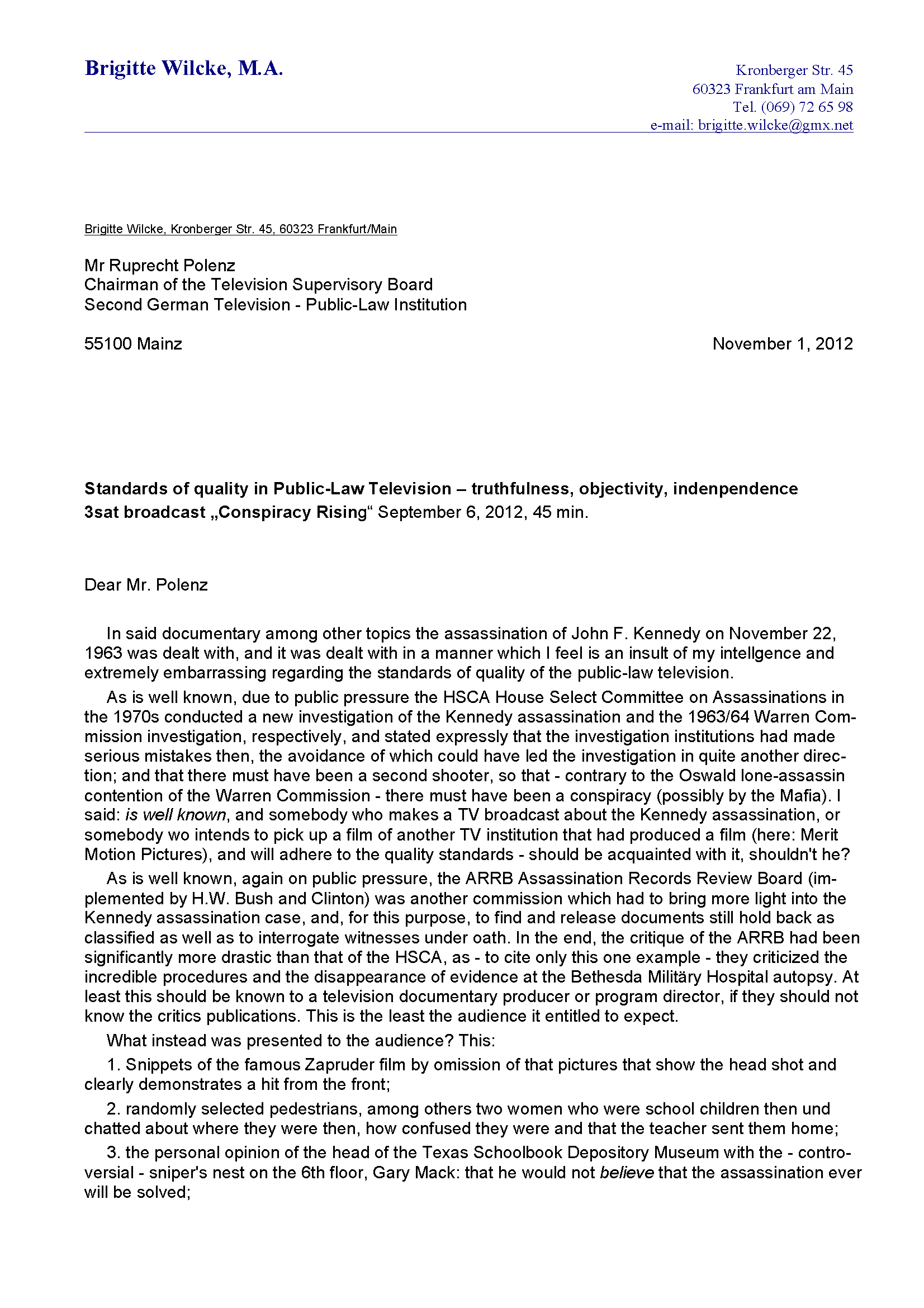
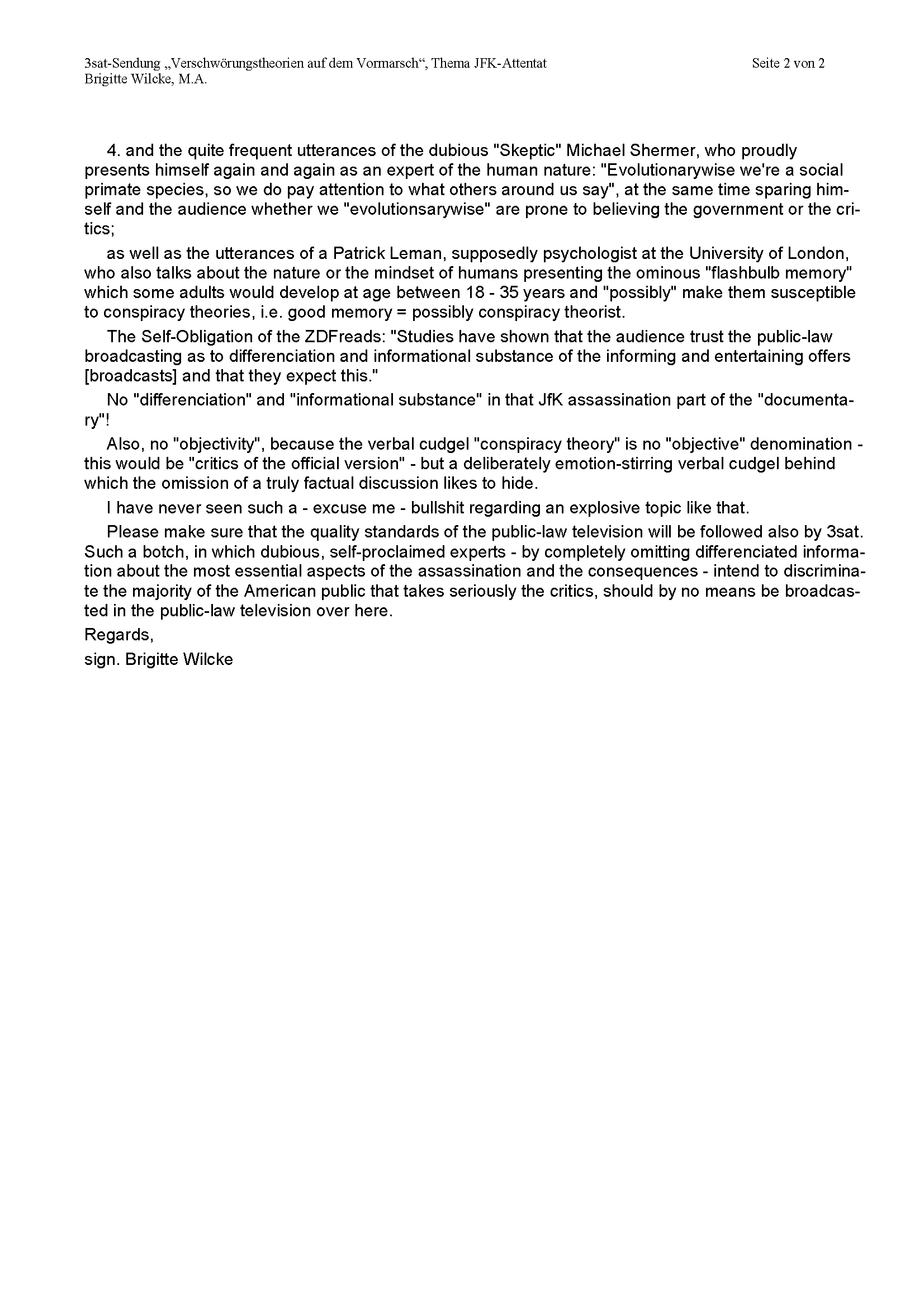
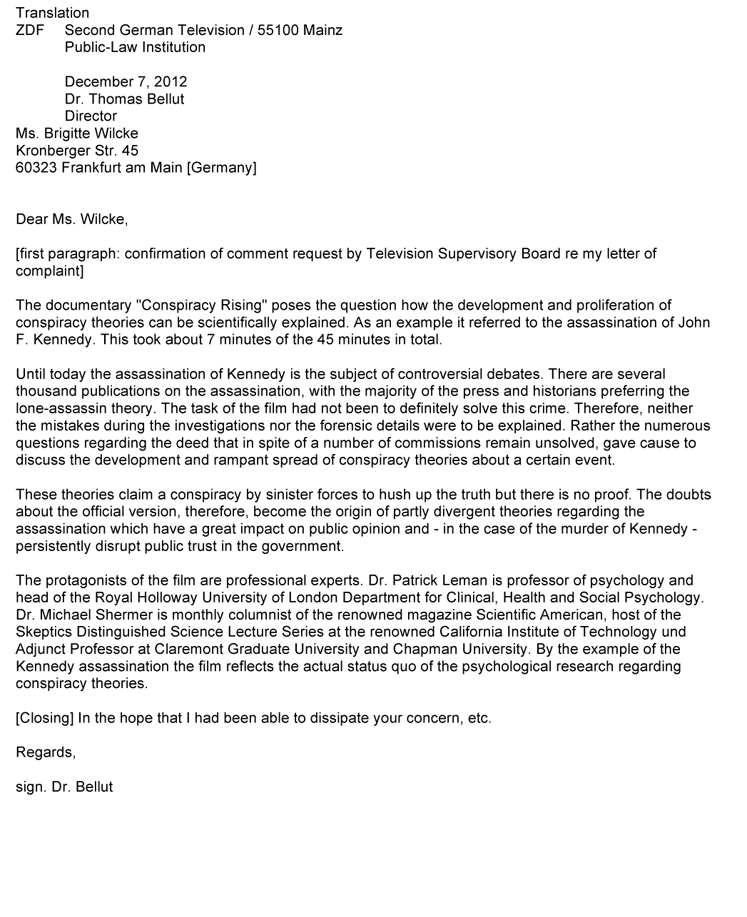
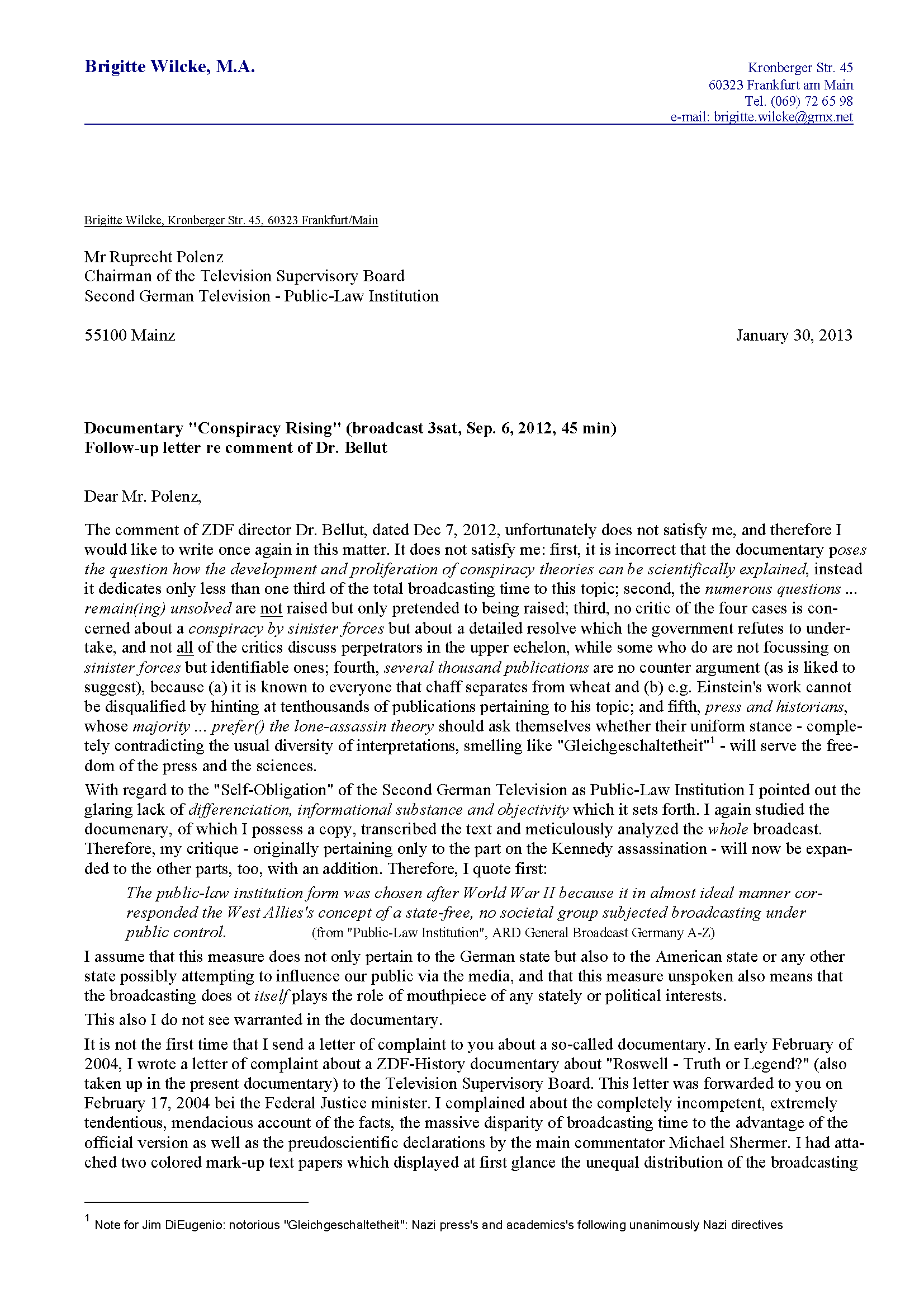
    But Brigitte actually went even beyond that. She did a moment-by-moment critique of the entire show! That analysis extends out to 18 pages. That was too difficult to translate into English. So Brigitte translated the exchange of letters between herself and the station chief; in which she, as a citizen of her country, vociferously protested the pollution of her airwaves by Shermer’s propaganda. The executive replied, and we include that reply here, and her rebuttal also.

    We post it not just because of the fine points she makes. But because this is the kind of thing we hope we can convince everyone to do in the future. Let the gatekeepers know how fed up you are with this cheap propaganda. That can only happen if we follow Brigitte’s excellent example and make it multiply by the thousands.

    ~ Jim DiEugenio


    From a fellow reader:

    I want to thank you for taking the time to post Brigitte’s letters and the responses from the news station. It is very encouraging to see someone take a stand against this documentary, especially someone as far away as Germany! I nearly spit out my freshly ground coffee when I read the station’s response, which basically seemed like it could be summed up as Dr. Bellut saying the documentary wasn’t really about the Kennedy assassination and was instead about conspiracies in general and thus any inaccuracies in facts about the incident didn’t really matter. I was also quite surprised to see him say that there was no proof to any of the theories and that it “persistently disrupt[s] public trust in the government.” I would have expected Dr. Bellut to keep his personal opinions to himself on the matter and respond more objectively. Again, thank you Brigitte for your resolve and determination and Jim for making public this information.


    Conspiracy Rising Title

    CLICK ON IMAGES TO ENGLARGE

    page 1 page 2 Bellut page 1 page 2
    Letter to TV Board 1
    Letter to TV Board 2
    Response from TV Board
    Response to TV Board 1
    Response to TV Board 2
  • Open Letter to Rachel Maddow re Show on Gun Control


    March 29, 2013

    Dear Rachel:

    Many of us, including me, have admired much of your work on radio and television since 2004, when you were perhaps the very best show on Air America. We then followed you as you became a regular guest on MSNBC’s Keith Olbermann’s show and CNN’s Paula Zahn show. Therefore, we were glad when Keith pushed for you to have your own show on MSNBC. You deserved it. You were a great advocate for progressive causes and puncturing MSM shibboleths and sacred cows.

    Which makes it disturbing that you would do what you did on your March 13th program. A common joke among the vast majority who understand the truth about President Kennedy’s assassination is this:

    “You know 85% of the public doesn’t buy the Warren Commission hogwash about Lee Oswald being the lone assassin of President Kennedy. Unfortunately, the 15% who do all work at the New York Times, Washington Post, LA Times, NBC, CBS, ABC, and Fox.” Should we add now, MSNBC?

    Everyone knows that Chris Mathews made his career by attacking Oliver Stone’s films JFK and Nixon. And he spares no opportunity to say that he believes the Oswald myth and to knock anyone who does not. (But he wisely has no one on his show to present the other side as he does so.) We also know that Bill O’Reilly got his position at Fox by agreeing with Roger Ailes that he would drop his JFK investigatory reports he had done for Inside Edition. (Which were actually pretty good.) He now literally lies about the case in his book Killing Kennedy and on his show.

    Most of us thought that we would never see you do something like that. But yet you did use the whole Warren Commission lie about Oswald to promote gun control on March 13th. Many of us agree with the gun control cause especially after Sandy Hook and Aurora. But we would never promote something as bad as the Warren Commission to promote a common good. Especially when it’s not at all necessary.

    We all understand that there is an unwritten agreement when you make it big on TV that you cannot touch things like the JFK case. In other words you can have an open debate with anyone, no matter how far out about anything under the sun. But not the JFK assassination. Fine. Maybe you are uninformed about the facts. Maybe you like your newfound fame and fortune. That is all understandable. But is there an unwritten clause in your contract that you have to go out of your way to promote a lie as big as the Warren Commission? I doubt it.

    As you mentioned on your ill-advised show, this is the fiftieth anniversary of President Kennedy’s death. He was probably the last real Democrat to occupy that office. And he actually proclaimed he was a liberal. A word the right has successfully stamped out of the political lexicon, along with the word conspiracy. If you do visit this topic again later on, let it be in the spirit of free and open inquiry. Tell your bosses that is what you are really about—all the time, on any subject. There are many people who are articulate and convincing about how bad the Commission really was and what happened to this country afterwards. And the thing is, many people want to hear this side of the story: 85% of us.

    Sincerely,

    Jim DiEugenio, CTKA

    {aridoc engine=”iframe”}https://www.youtube.com/embed/prtUkzyO0I0?autoplay=0{/aridoc}

  • The MSM and RFK Jr.: Only 45 years late this time

    The MSM and RFK Jr.: Only 45 years late this time


    The evidence at this point I think is very,
    very convincing that it was not a lone gunman.

    Robert F. Kennedy Jr.
    Jan. 11, 2013


    On the evening of January 11th, Charlie Rose interviewed Robert Kennedy Jr. and his sister Rory in Dallas at the Winspear Opera House. This was part of Mayor Mike Rawlings hand chosen committee’s year long program of celebrating the life and presidency of John F. Kennedy. In fact, Rawlings introduced the program. He probably did not like how it turned out, for during this interview Kennedy Jr. said that his father thought the Warren Report was a “shoddy piece of craftsmanship” and he was “fairly convinced” that others were involved. Robert Jr. himself thought that the evidence in the JFK case, “…at this point I think is very, very convincing that it was not a lone gunman.”

    To my knowledge, this is the first time that a member of the Kennedy family has stated these sentiments in public. Kennedy Jr. went further and backed up the idea, widely held by many that RFK “publicly supported the Warren Commission report but privately he was dismissive of it.” He added “He was a very meticulous attorney. He had gone over reports. He was an expert at examining issues and searching for the truth.”

    RFK, JR. Charlie Rose
    The Associated Press

    Once this story hit the wires, it created a mini-sensation. Cable and network news programs did segments on it; hundreds of Internet outlets and newspapers carried the story. This really sums up how cloistered and controlled our news media is even today, with cable channels and the Internet now on the scene. The only thing new about this story is what I mentioned above: the fact that a member of the Kennedy family was saying it in public. As of this writing, there is no official transcript available of this interview, nor is there an audio or videotape which seems odd since it was recorded in front of cameras. Since Dallas Mayor Rawlings was there as the taboo subject was mentioned maybe it is not so odd. But clearly, people should contact Rawlings’ office and ask that this interview be placed on the web immediately. Therefore, people can write articles based upon the actual exchange instead of reporters’ stories about the exchange.

    The fact that RFK did not buy into the Warren Report, and he only endorsed it in public for political reasons, this has been established for quite some time. In 2007 David Talbot, in his book Brothers, clearly showed that Bobby Kennedy never bought into the Oswald-did-it line. That from the moment he learned of his brother’s death he suspected a plot had been behind it. (Click for a review)

    He “publicly supported the Warren Commission report but privately he was dismissive of it.” He added “He was a very meticulous attorney. He had gone over reports. He was an expert at examining issues and searching for the truth.

    RFK, Jr. about his father Robert Kennedy

    A decade previous to Talbot, in 1997, Tim Naftali and Aleksandr Fursenko published the fine book, One Hell of a Gamble,a study of the Missile Crisis from the Russian point of view. In that volume, the authors first wrote about William Walton’s now famous mission to Moscow in 1964. Walton was ostensibly going as a goodwill ambassador for cultural exchanges, but his real objective was to carry a message to Nikita Khrushchev from Robert and Jackie Kennedy. That message was that, although the American media had jumped on this lone gunman idea, they thought that President Kennedy had been killed by a domestic conspiracy… one that was politically motivated from the rightwing. That because of this assassination, the attempts at détente that Kennedy and Khrushchev had made would now have to be placed on hiatus. Johnson was much too pro-big business to pursue that ideal. Therefore, RFK would soon resign. When he became president, the effort at reconciliation would then continue. (Talbot, p. 12)

    However, way before that book, there had been instances during Jim Garrison’s inquiry into the Kennedy assassination that indicated Robert Kennedy was quite interested in what the New Orleans DA was uncovering. In this author’s current book, Destiny Betrayed (Second Edition) I note an instance where RFK was in California staying at a friend’s house in 1968. Family friend Mort Sahl was also there. That night, Sahl had to leave for a performance. When he got back, his then wife told him that RFK peppered her with questions about what Garrison was digging up. (Sahl was working for Garrison.) Richard Lubic, a campaign worker for Bobby Kennedy in 1968 told another Garrison investigator, Bill Turner, that RFK said that if he were elected president, he would like to reopen the Warren Commission inquiry. (Talbot, p. 359) In Harold Weisberg’s original manuscript of Oswald in New Orleans, he wrote about being in contact with someone in Bobby Kennedy’s 1968 campaign. He communicated to Weisberg that RFK had real doubts about the Warren Commission. Weisberg told his contact if this were the case RFK should voice his concerns in public, making sure he would not be assassinated because of his belief. After Bobby was killed, Weisberg wrote that never was a seer less happy with the fulfillment of his prophecy.

    In other words, anyone looking for evidence of this could have found it many years previous. Only in our media, especially in the MSM, could any such story be considered news. From a sociological point of view it is interesting to note two factors that figured in the reaction.

    Charlie Rose has built a career out of being the alleged thinking man’s talk show host and he actually began hosting such programs on Dallas’ KXAS-TV in the seventies. He then worked for CBS News in the eighties and began the present version of his talk show on PBS in the nineties. But while doing his show he also worked for the CBS program Sixty Minutes II from 1999 until 2005. Therefore Rose was the perfect choice from the Dallas power elite point of view. All this would indicate that he is pretty much a canned establishment figure. How much of an establishment figure is he? Well, he has attended several Bilderberg Conferences of late. His second wife is the stepdaughter of CBS founder Bill Paley. It will be a cold day in Hades if one ever catches anything on his snooze fest that seriously counters the established American Conventional Wisdom. Therefore Rose was the perfect choice from the Dallas power elite point of view.

    Consequently, when his guest began uttering such heresies in public, Rose automatically kicked into damage control mode. When the son mentioned that his father went into a long funk after JFK was killed, Rose (understanding his next ticket to a Bilderger Conference depended upon his stemming this tide) quickly suggested if this was because RFK felt “some guilt because he thought there might have been a link between his very agressive efforts against Organized Crime?”. This question was, of course, an attempt to simultaneously:

    1. Turn the crime inward on the Kennedy clan by focusing on RFK’s ambitious drive against the Mafia, and
    2. Pin the assassination on an acceptable culprit. One made acceptable by the likes of Robert Blakey, namely the Cosa Nostra.

    Rose’s response was unwarranted. There are any number, or even combination of reasons RFK may have sunk into emotional quicksand. As indicated above, he clearly understood that his brother’s large and looming foreign policy agenda would now go unfulfilled. RFK may also have come to an understanding, realizing the enormous pressure now placed upon him, to become something he was not: a political candidate. He also had to have realized that, in fact, he had no choice but to do so because his power base had now been pretty much circumscribed by President Johnson and J. Edgar Hoover. In fact, this idea was mentioned by the son when he said, “As soon as Jack died, he lost all his power.” Further, after this point, Hoover “never spoke to him again.”

    But RFK Jr. then returned to this Mafia theme when he said one of the things that pricked his father’s curiosity was the phone records of Oswald and Ruby. These contained many calls to organized crime figures. Therefore, his father “was fairly convinced at the end of that there had been involvement by somebody.” Again, Rose jumped in and did his bit: “Organized crime, Cubans.” To which, RFK Jr. (thankfully) replied, “Or rogue CIA.”

    Rose’s initial reaction was the first attempt to channel the story down a certain acceptable path. Rawlings’ decision not to release a recording is another. But the third is the reaction of the Dallas Morning News to it. In about one week they wrote three articles based on the interview. In these articles, dating from January 11th to the 14th, the paper consulted with their official propaganda mouthpiece Gary Mack. Mack tried to cast aspersions on the credibility of RFK Jr. by saying that there really could not be any Oswald phone calls since there is no record of him having a personal phone service. Bill Kelly quickly and effectively countered this deliberate obfuscation. (http://jfkcountercoup.blogspot.com/2013/01/oswald-and-ruby-phone-records-rfk-jr.html) One of the Morning News writers, Rodger Jones, then tried to confuse things even further by saying that, well, RFK Jr. said that Bobby’s interest first began during the Garrison inquiry. Yet, according to David Talbot, Bobby Kennedy actually started his inquiry back in 1963. This spin control ignores two things: 1.) According to Garrison volunteers, like Mort Sahl, the Attorney General clearly did have an interest in Garrison’s investigation, and 2.) Since RFK Jr. was still something of a child in 1963, it is much more likely that four years later, as an adolescent, he would more clearly recall such a matter.

    In further comments, Mack said that it appears that some members of the Kennedy clan have decided to say one thing in public, “But apparently, privately, some members. . . have raised questions about areas of the assassination.” Well, from the material I have presented here, its pretty clear that the Kennedy family did have doubts from a very early date. In fact, we can go back even further, to Arthur Schlesinger’s massive biography of the Attorney General, Robert Kennedy and His Times. In that biography, published back in 1978, Schlesinger made clear that Kennedy thought the Warren Report was a subpar and unsatisfactory effort. And further that CIA Director John McCone told him that two assassins were involved in the shooting. (pgs. 643-44)

    Further demonstrating how only in the MSM can the fairy tale exist that RFK and the Kennedy family abided by the Warren Commission, consider the words of Kennedy cousin Kerry McCarthy to Debra Conway in 1997. McCarthy was a speaker at Lancer’s November in Dallas conference. She told Conway that, whatever the Kennedys say in public about the JFK murder, when you visit their homes, you will see several of the JFK assassination books lining their shelves.

    Chris Lawford, son of Peter Lawford and Pat Kennedy, more or less explained why this was so. In his book, Symptoms of Withdrawal, he wrote that the day after the assassination, “I woke up [and] found my father sitting at the flagpole where I used to raise the presidential flag when Uncle Jack came to visit. He was crying like a baby. Strangers held a vigil on the beach outside my parents’ house for days after the assassination.” Pat Kennedy now started drinking with a new seriousness, and the couple was divorced shortly afterwards.

    It takes a long time to come to grips with that kind of pain. And who wants to deal with it in public? At this talk, Robert Jr. finally did. He also praised one of the books the clan had on their shelves, JFK and the Unspeakable by James Douglass. This is one of the few books on the case that has managed to make its way out of the JFK assassination niche. It has sold well now for four years, and there are now over 100,000 copies of it for sale in various formats, including audio book. Bobby Kennedy Jr. liked this book so much that, after he read it, he called Douglass and congratulated him on a job well done. Maybe that was the first sign of recovering from a family trauma that has lasted for well over four decades. And maybe now the MSM can wake up and say, well, if the Attorney General thought the Warren Report was shot full of holes, maybe it was. Thanks to his son for making that moment possible.

    As mentioned above, the fact that this interview is not on the Internet is a disgrace. Please contact Mayor Mike Rawlings and tell him that, in the interest of democracy, history, and proper journalism, it should be posted immediately.

    Phone: 214-670-4054

    Fax: 214-670-0646

    Address: Dallas City Hall, 1500 Marilla Street, Room 5EN, Dallas Texas, 75201

    or send an email to Chris Heinbaugh, Vice President of External Affairs | AT&T Performing Arts Center

    ~Jim DiEugenio


    Articles online:


  • Jesse Ventura’s Conspiracy Theory on JFK


    I: Introduction

    CTKA has some respect for Jesse Ventura and his book, American Conspiracies, co-written with Dick Russell. As for Ventura’s series Conspiracy Theory, I agree with Jim DiEugenio that it certainly “is what it is” and that Ventura is likely under a lot of pressure to put eyes in front of the screen. And TruTv was brave enough to run the show. But let’s not romanticize them here. Their courage has a more practical application: The channel itself is obsessed with rather unstimulating and seemingly staged “reality” television shows such as Party Heat and Ma’s Roadhouse and Full Throttle Saloon. Once we accept that the channel’s viewers are largely male, hormonal, and not likely to be reading, say, JFK and the Unspeakable nor Ventura’s latest book anytime soon, it’s pretty easy to figure out that the bottom line is ratings, advertising, and cash.

    Ventura has said that the series itself is there to entertain and for people to make up their own minds about what they have viewed. That’s all well and good. But his work with Russell would have been a far more stable and rewarding platform to start from. If we are going for “entertainment,” then I have to ask, “When did Russell’s work with Ventura ever become boring or a flop with the wider public?” American Conspiracies, like his other work with Ventura, Don’t Start the Revolution without Me, is a best seller. Jesse Ventura’s a cult hero. He’s popular. So favorable ratings would seem a given: middle-America finds him an extremely interesting figure. Indeed, Ventura turns heads around the world—hence the potential for overseas sales of the show are enormous.

    Why, then, pitch the program to the lowest common denominator? I feel the show preaches far too much to an often ill-informed captive conspiracy market. As a result, it actually alienates more people than it could potentially motivate. It’s not Conspiracy Theory (a title I dislike intensely—as I do not consider myself in any way a “conspiracy theorist”). Its title should instead be either Preaching to the Converted or Opportunity Lost. Indeed, the show loses it with its think-tank scenes.

    It’s readily apparent that the show’s talent spotters, Tara-Anne Johnson and Christine Scowley, couldn’t cast a net in a goldfish pond. Because one has to wonder when looking at the show’s “investigators’ ” bios: How on earth did these people ever get cast as “investigators?” Indeed, I posit that none of Ventura’s researchers—both on- and off-camera—actually know very much about what research into hidden political agendas really entails. I mean in this series they have even called David Icke and Alex Jones “experts” on certain topics. I doubt it.

    Jesse Ventura is an ex-Navy Seal, pro-wrestler, author, actor, and a former mayor and governor. He is, by all accounts, a street-wise guy. As a producer, host, and star of the program then, why didn’t he have, say, an ex-detective, historian, or a tough investigative journalist on his show as (at least) one of his investigators? I don’t buy there being too short a turnover time for this sort of thing. Good professional research is straightforward, not convoluted, and thus time-saving. You consult with people who know their stuff and then you go ahead and make the show. It’s pretty simple.

    As a result, the think-tank group-talk scenes are as inauthentic as the researchers themselves. In fact, they make for some of the lamest television I have ever seen. As Tom Jeffers explains:

    The only thing I hate about his show is when they all get together in the board room and someone tries to play devil’s advocate. It just seems too planned and contrived. Otherwise, keep on Jesse! (Tom Jeffers: Murder Solved, November 20th 2010)

    What’s scary is that the bright spark who thought these scenes a “cool” idea probably thought the opening scene to the Kennedy episode was also a brilliant stroke. I disagree, and will explain why soon enough.

    Now, speaking of mood setting, I realize my introduction has been a little heavy-handed. So I assure the reader that Ventura does bring some positives to this particular episode. Do they outweigh the negatives? Well that’s a good question and it’s going to be answered at the end. But hold tight. It’s a wild ride. In particular, the first seven minutes, which Ed Wood couldn’t have directed better.

    II: “Ron,” the Mark Felt of the New Millennium

    What’s astounding about the graphics and the preview is that it’s almost three minutes (2:43) before any meaningful dialogue is heard. I liked how Ventura let people know about the importance of the assassination. And he is correct, the JFK case is indeed the “grand-daddy of them all,” since it’s where doubts about our government got started. But this is the sole bright spot here. The bridge scene that followed was so ill-conceived that I had to get some objectivity on it. So I proceeded to show the scene to a number of non-assassination minded friends and family (five people total). And they all replied (without suggestion on my behalf) that the bridge sequence was “staged,” “lame,” “funny,” and “cheesy.”

    “Ron,” a man in ailing health, met Ventura on a bridge overlooking what seemed like a freeway (his idea of a secret location). Now there are numerous CCTV cameras around overpasses; in particular, ones near major roads. Furthermore, any motorists coming by on the bridge would have seen those involved as camera crews. To cap it all off, Ventura and “Ron” stood directly under two rather bright, large, and ornate street lights. Where did Ventura’s common sense go here? “Ron,” who appears to be wheelchair-bound, claimed he was given his information while he was working on a film about the assassination. It was handed over by a young CIA operative who wanted the truth out. The stunning revelation from this young man? The CIA and Nixon were involved with the lads from Operation 40, and they killed President Kennedy.

    “Ron” is clearly an amateur when it comes to secret locations. And his “secret documents” weren’t very convincing either. For one, Ron’s source had clearly redacted parts of the front page before he had given it to him. Thus, it looked like Ron’s friend had in fact censored “the truth” for him.

    The likely reality is that Ron’s buddy in the CIA was a narrative creation, and that these documents were just a badly cobbled together batch of photo-copied or printed Freedom of Information (FOIA) documents. In one shot, we can clearly see that one of the sheets is a House Select Committee on Assassinations (HSCA) letter to Thomas Downing, apparently discussing the appointment of its first director Richard Sprague—which has nothing to do with Richard Nixon and Operation 40. Nor does the Oswald backyard photo that can clearly be seen in another shot. My favorite top-secret government document, however, is one that can be seen at 5:32 entitled, “The Guns that Killed Kennedy,” which is one of the most up-front releases from the CIA I have ever seen.

    This strongly suggests that “Ron” is a narrative creation himself, and, in all likelihood, a researcher. Who this shoddy researcher-turned-thespian really is, aside, when Ventura declares to his board that “These documents link the killing of JFK to Watergate,” the damage has been done. For, as we have seen, the documents as seen and revealed prove nothing of the sort.

    Luckily, Ventura seems to change track around the 7:22 minute mark. Instead of going along with Ron’s idea that Nixon was involved in the Kennedy hit, he insists instead that Nixon was set up for Watergate. Okay, fine. He was indeed set up. But he then goes off the rails by speculating that Nixon was dethroned because of his digging into the Kennedy assassination. This leads him into very dangerous waters of the type discussed in CTKA’s reviews of John Hankey’s JFK 2. (Please see The Dark Legacy of John Hankey and JFK 2 Updated.)

    There is simply no evidence that Nixon ever asked CIA Director Richard Helms for the documents pertaining to Operation 40. But there is evidence that Nixon wanted documents pertaining to the Bay of Pigs well before Watergate broke out. Helms delivered the files in question to Nixon on October 21, 1971. But these files were not Nixon’s only concern. He also requested files on the assassinations of Trujillo in the Dominican Republic in May of 1961 and Ngo Dinh Diem circa November 1963 in Vietnam. (David Frost’s interview with Richard Helms 22nd – 23rd of May 1978)

    Why did Nixon want these files? Perhaps to see if there was some possible incrimination of himself in these three theatres prior to Kennedy’s assassination. Or he could have been trying to find dirt on members of the Democratic Party in those events. As mentioned before, Ventura doesn’t go that far. But it needs to be pointed out that a few deluded people like “Ron” have regularly pushed the Nixon-killed-Kennedy angle. But if this was so, then why, Dear Ron, did Nixon wait until 1971 to procure them? He was inaugurated in 1969. Furthermore, it is rumored that Helms didn’t give Nixon all of the available files. Why would Helms not give him those documents? Maybe because it was his—not Nixon’s—role he was likely afraid of divulging.

    Another important and often overlooked aspect by the “Nixon in on it” lobby is the meeting H. R. Halderman refers to in his book, The Ends of Power. This happened on the 23rd of June, 1972. It is referred to as the infamous “Bay of Pigs” meeting between Helms and Haldeman in the White House. Helms was told by Halderman that if the FBI didn’t call off their investigation into Watergate, it could bring up the whole “Bay of Pigs” thing. Haldeman later believed that the phrase was code for the “Kennedy assassination.” Helms lost his composure and after calming down instructed his counterpart, deputy General Vernon Walters, to do what Haldeman requested—which, by the way, ended up hurting Nixon during the Watergate scandal.

    Two things here: It was Helms who was clearly worried, not Nixon. Furthermore, Nixon stated, “Well, we protected Helms from one hell of a lot of things.” (Stanley Kutler, Abuse of Power, pg 68) Prior to discussing the Bay of Pigs, however, Nixon vastly underestimated Helms, who had many other methods at his disposal to bring Nixon down: the CIA-controlled news media for one, and willing CIA collaborators—Katherine Graham, Ben Bradlee and Bob Woodward at The Washington Post—for another. He also had top FBI officials on his books as CIA informants. And he had inside men on Nixon’s espionage unit (Howard Hunt and James McCord). In fact, the question arises: Had Helms really had been playing Nixon all the way along?

    Now, let us cut to the chase: What is the proof of a connection between Nixon and Operaiton 40? There has never been any credible evidence of this adduced by anyone. Further, the general feeling amongst researchers is that the Kennedy assassination was enacted likely by an amalgam of individuals. It was not an Operation 40-led initiative, nor could it be called Operation 40. (Larry Hancock, Someone Would Have Talked, p. 372) We also have, for starters, very little real idea of who the assassins were. And I challenge anybody to tell me that Ventura’s investigators are on par with Jim Douglass, David Talbot, Jim Garrison, and Anthony Summers, who looked extensively into anti-Castro Cuban activities and don’t even bother to mention Operation 40 in their works. Gaeton Fonzi looked closer into it than most. He mentions Operation 40, but he never mentions nor hints that this group took out the President; nor does Larry Hancock, who speculates that some members may have been involved. The information about Operation 40’s nefarious murderous dealings from some of its purported members (Marita Lorenz, Gerry Hemming and E Howard Hunt) should be taken with a massive chunk of salt. Hence, I advise caution.

    As for Operation 40 being the masterminds of the Watergate break-in, this is a real stretch of logic. Two of the Watergate team’s leaders, James McCord and Gordon Liddy (who was ex-FBI) were never members of Operation 40. McCord kept an autographed picture of his boss Richard Helms on his desk and is considered the one responsible for purposefully getting the burglars caught by amateurishly taping a door—twice. In fact, the group they presided over was called “the plumbers” and were part of CREEP (Committee to Re-elect the President). Thus, when Ventura says “All of the Watergate burglars were involved in Operation 40” —implying they were all hand picked and selected by Nixon himself, he is badly mistaken. For example, Nixon never actually hired Hunt; it was actually Charles Colson. (Jim Hougan, Secret Agenda, p. 33) In fact, evidence indicates that Nixon didn’t even know that Hunt was on his staff until it was too late.

    Ventura never should have strayed this far. It’s “too much, too soon” and the show is far too short. Nixon and Watergate are deeply complex and deserve their own well-investigated documentary. There are definitely some ties between the Kennedy assassination and Watergate. But to do justice to that subject would take a show perhaps twice as long as this one—with consultants the stature of, say, Jim Hougan, and with information beyond reproach. It was not something to be appended capriciously to a show on the JFK case and is clearly something Ventura’s people did not have the experience, knowledge and acumen to grasp.

    III: Jesse Recovers via Osanic and Prouty

    Up until now things were not looking good. But, seemingly out of nowhere, Ventura finally gets on the board. And by the 7:50 minute mark he really needed to hustle.

    Ventura suddenly states that he is off to see Fletcher Prouty. Of course, Prouty is deceased. But thanks to the many hours of taped interviews by Len Osanic, the Colonel speaks from the grave and offers a ray of hope in the darkness. Though it’s far too brief, Prouty (one of the most misrepresented and misquoted critics in research history, by both pro-conspiracy and lone-nut advocates) is used properly, straight, and to the point this time around. Prouty tells it like it is: Oswald was a US agent and the protection of the president that day was pathetic. Both true assertions. Ventura could have scored more points here. But he has to make the silly call that “Fletcher Prouty backed those CIA documents.” No he didn’t. I have little doubt that had Prouty seen them he would laughed himself silly. But hey, Ventura’s finally got points on the board. And with a click of a bolt-action Mannlicher-Carcano, he’s off to Dallas to score even more.

    Ventura is now in the company of his assistant Alex Piper in Dealey Plaza. Since Colonel Prouty’s cameo, Ventura seems rejuvenated. After a nice run-down of Dealey Plaza and how the events there inspired him “to always question authority,” we next encounter the remarkably well-preserved but decidedly nervous-looking Bill Newman. This was a great little segment and explained how much of a con-job the Commission was by not contacting Newman for his version of events, particularly when has was so close to the action. In addition to being a credible witness, the clincher as to why the Commission didn’t want him is that Newman never thought the shots he heard came from the depository.

    Ventura lurches a little at 13:33 when he says Johnson set up the Warren Commission. He did so in name, but it was actually Eastern Establishment figures Eugene Rostow and Joseph Alsop (both known CIA assets) that applied pressure to Johnson and got him to form the Commission. Johnson was reluctant and had wanted the investigation carried out in Texas. (Donald Gibson in The Assassinations, pgs. 3-17) But it’s a nice return when he mentions that Ford on his deathbed admitted the CIA “had destroyed or withheld critical evidence” (Gerald Ford: Foreword, pg XXII Warren Commission Report. 2004). Ventura then quickly discusses the joke of the “magic bullet theory” and Arlen Specter‘s work on it. It was also good that he mentioned Ford’s admission that he altered the placement of the wounds to conform to Specter’s representation of what happened. This was all done with a minimum of fuss.

    Though the extremely quick editing throughout the show was slightly annoying, there were some nice technical elements in this segment. The camera set-ups and cutting of juxtaposing pictures of Newman in relation to Kennedy and the car were very well done. Another goody was the brief transposition of the Moorman Knoll photo taken in 1963 with Dealey Plaza of today. It was an oddly haunting image in a show that tried too hard to provide a sense of the sinister. Ventura even succeeds in making Piper look interesting as he explains the “back and to the left” motion and the potential shot from the knoll. Thus, even if he had overlooked having a brief chat with Dealey Plaza talisman Bob Groden, Ventura scores another palpable hit.

    The big guy is on a roll.

    IV: Off to see The Wizard

    At around 15:26 he’s off to see the “Woeful Wizard” of Dealey Plaza, Gary Mack, in the Sixth Floor Texas School Book Depository Museum. Ventura does well explaining to the audience that the proprietors advocate the lone gunman theory. He doesn’t do so well when Mack explains the reason why the window is sectioned off like it is.

    The whole thing about this corner of the building’s historical integrity is a joke. There are numerous accounts of the crime scene being contaminated, nay, changed around after the shooting. Here’s another stinker: The boxes we see in the enclosure haven’t been in place there since 1963. They are in fact duplicates. The window frame was actually removed once-upon-a-time, and there’s even a debate about the current one’s authenticity.

    If Jesse hadn’t been taken in by Mack’s charm-offensive, he really could have torn him up. As it stands, however, the original wooden floor line and Mack’s enduring quest for authenticity gets funnier and funnier—and more hypocritical—the more I think about it. Thus, I have to give Ventura a point here. In fact, Mack gave it to him on a platter.

    At 16:06 Ventura now goes on the range to take on some hay bales. The irony here is that, unlike Gary Mack and his nefarious recreations, Ventura admits that his targets are stationary. Thus, his honesty in the shortcomings of this experiment earns him a point here. But Ventura makes a bit of a mistake also. Oswald actually had 5.6 seconds to perform the shooting. However, Ventura by adding close to an extra second to make it 6.3 seconds aids Oswald’s cause. And it’s actually an interesting mistake, as Ventura doesn’t even get anywhere near the bungled time, let alone the official 5.6 seconds.

    Here, it would have been good to include an independent marksman or two. The reality is that an experiment of this magnitude really deserves an entire show. But it was good that Ventura mentioned the failed experiments by the military for the Warren Commission. Thus, in spite of the problems, I think Ventura did well enough and scores a few good points here once more. But again, he could have done better. Ventura tends to make mistakes when bad researchers are lurking around. He would have been better served with higher-quality people.

    It’s 18:50 now, and we return to the “Wiz” Gary Mack (the magical conjurer of tricks like Inside the Target Car for the History Channel—real name: Larry Dunkel) in the depository. For Mack’s sake, Ventura explains his Mannlicher-Carcano target practice tests, expresses his serious doubts as to Oswald’s miraculous marksmanship, and then asks the Wiz: “You’re the curator of this museum, so naturally you have to follow museum policy. Let’s pretend we’re not here. Let’s pretend you and I are sittin’ out havin’ a “cold one.” What’s your position at that point?” Mack admits that in his quiet times (when he’s not sitting on his wand) he has suspicions that “there’s more to it than Oswald.”

    Ventura scores again, but it’s really no different to what Mack and Dave Perry have said to numerous other people involved in research over the years. That being the HSCA concluded that there was a probable conspiracy in the assassination of John F. Kennedy.

    V: Oswald’s Route

    We are now more-or-less halfway through at 20:05. It was bumpy at the start, but it hasn’t really been too bad thus far. There are some nice graphics showing where and how Oswald got to his rooming house at North Beckley after the assassination. But I think Ventura, after some good stuff in discussing the frailty of the Oswald description, fails to raise the bar here. He could have briefly mentioned the dubious manner in which it came about not to mention—as Tony Frank pointed out at JFK Lancer—that Oswald’s description was similar to one given to the CIA a month before his rise to infamy:

    Back on October 10, 1963, after CIA Headquarters received a report that someone using the name Lee Oswald contacted the Soviet Embassy, a cable to the CIA’s Mexico City station informed them that there is a 23-year-old defector named Oswald, who has “light brown wavy hair,” is “five feet ten inches” tall, and weighs “one hundred sixty five pounds.”

    Ventura also never entertains recreating and timing the distance that Oswald had to walk from Beckley to 10th and Patton. As explained by John Armstrong below, these calculations make it extremely difficult to make it to Tippit’s death scene in the time that Tippit was first reported killed. The following would have been a fun exercise (in line with his recreation of Oswald’s purported shooting attempt, and need not have taken up much time at all):

    If Tippit was shot as early as 1:10, “Harvey Oswald” could not possibly have run from his rooming house to 10th & Patton…in 6 minutes. In addition to this time problem, not a single witness, in heavily populated Oak Cliff, saw anyone resembling Harvey Oswald after the Tippit shooting (except Mrs. Roberts and those at the Texas Theatre).

    In order for the Warren Commission to assert that Oswald killed Tippit, there had to be enough time for him to walk from his rooming house to 10th & Patton—about a mile away. The Warren Commission and HSCA ignored [Helen] Markham’s time of 1:06 PM, did not interview T. F. Bowley (1:10 PM), did not ask Roger Craig (1:06 PM) and did not use the time shown on original Dallas police logs. Instead, the Warren Commission (1964) concluded that Oswald walked that distance in 13 minutes. The House Select Committee on Assassinations (1978) determined the time was 14 minutes, 30 seconds. Both concluded Oswald was last seen at the corner of Beckley and Zang at 1:03 PM. Either of their times, 13 minutes or 14 minutes and 30 seconds, would place Oswald at 10th & Patton at 1:16 PM or later. The time of the Tippit shooting as placed by the Commission,1:16 PM, contradicted the testimony of Markham, Bowley, Craig and the Dallas Police log. Another problem for the Warren Commission to overcome was the direction in which Oswald was walking. If he was walking west, as all of the evidence suggested, he would have had to cover even more ground in the same unreasonably short period of time. The Dallas Police recorded that the defendant was walking “west in the 400 block of East 10th.” The Commission ignored the evidence—5 witnesses and the official Dallas Police report of the event—and said he was walking east, away from the Texas Theater.

    Now some have complained that Ventura takes it as a given that Oswald performed the execution of the policeman. I don’t see it that way. Ventura makes the point that Oswald, after shooting Tippit, dumped his shells as if leaving a trail of breadcrumbs. While he may have needed clarity on this issue, I think he is implying here that Oswald was either stupid or someone else did it to frame him. The Tippit shooting has so many oddities in it that we can’t blame Ventura for not going into them all, e.g., like Oswald’s dropping one of his three wallets that day at the crime scene, and the shells discovered being described as coming from an automatic handgun, or the descriptions of more than one assailant at the scene. These are the tip of the iceberg. And considering what Ventura has “jam packed” into the show thus far, he’s provided a decent overview of events. Yet one can’t help but think that he could have done more in Oak Cliff had he not wasted those precious minutes at the start.

    Ventura and Piper’s journey takes them to a newly revamped Texas Theater, where they meet Jim Marrs, author of the best selling Crossfire. We are now around 22:26 seconds into the action and it already feels like we have covered some distance in that short time. And I must admit, that takes skill. Ventura has given a remarkably concise overview of the day’s events, which, in a small way, makes up for the lost opportunities presented with the Tippit shooting. Marrs’work and his associates outside of his JFK field in the late nineties may raise a few eyebrows nowadays, but he still makes for a good interview. And what he speculates about Oswald’s purpose in the theatre— meeting with a contact to find out what was going on—generally meets with wide agreement. As do his accusations that Oswald was some kind of low-level CIA operative. The stuff about Oswald at Atsugi in Japan, his Russian defection, and George DeMohrenschildt has aroused suspicions for years. Many, including myself, consider DeMohrenschildt to have been Oswald’s handler until George was instructed to offload him into the wolf’s lair, i.e., Ruth and Michael Paine, along the CIA-associated and extremely conservative White Russian community.

    Ventura’s narration and scripting in this part of the show flows nicely, and he sells the idea that if anybody knew or suspected Oswald’s CIA connections it was his widow Marina, who, at 24:16, we now encounter on the phone. While Ventura does well in this segment, one feels there’s a bit of the theatrical in the air because of Marina’s plea for safety about her daughters limiting what she can say. Marina’s daughters actually made public appearances in the early nineties and explained their lives and their suspicions of the official version. June, the eldest daughter, can be seen discussing the topic at the 30th anniversary, and having a little go at Gerald Posner. While Rachel Porter has also gone public.

    After Ventura met with Marina, he also seemed to hype up Marina Oswald’s coming forward about her belief in a conspiracy and her belief in Lee’s innocence on his show. However, she voiced suspicions before this, and rather frequently, as in this discourse with Jack Anderson in 1988. She also said the same kind of things to Danny Schecter in his documentary Beyond JFK: The Question of Conspiracy, and also—as Tony Frank pointed out on the Lancer Forum—on The Oprah Winfrey Show on the 22nd of November, 1996. (This interview was transcribed by the late Rich DellaRosa.)

    But cutting Ventura some slack, Marina has not spoken for a long time, and he does have a show to sell. His asking Marina about Oswald’s ties to the CIA met with an affirmative; his asking her about her ties to the KGB (which she emphatically denied) was a goody; and her feelings about DeMohrenschildt’s ties to the agency were handy to have on the record.

    There was also one controversial and rather complex aspect of the case that I felt Ventura handled quite well. In fact, it was perhaps my favorite part of the show. This was the case of Marina Oswald steadfastly saying that she took the controversial backyard photos. Now, I, for one, advocate for their being at least some element of fakery in the pictures, in particular the image featured on the cover of Life magazine. However, I actually enjoyed Ventura’s different take on Marina Oswald and the photos. Because whether those particular photos are faked or not, it’s forgotten that the issue of their authenticity clouds other, perhaps, more important issues.

    Namely, that Oswald, as shown by Ventura and Marrs, was clearly busy posing as a communist for a good part of his later life. When, quite clearly, he was not one at all. Now, if by some extremely slim chance the photos are genuine, who or what motivated Oswald to pose in them, in his get-up, with two ideologically opposed leftist publications, thus incriminating himself anyhow? This sort of double-ended, measured, and responsible take on an extremely controversial piece of secondary evidence was a nice touch on Ventura’s part. Rather than creating an argument or giving a direct answer, he gave the viewer something to ponder. And, though I disagree, I congratulate him for putting it out there as he did.

    VI: Russ Baker’s Road to Nowhere

    Ventura is really gliding at this point. But all glory is fleeting, particularly when you don’t really have genuine JFK investigators on your staff. Thus, around the 28:00 mark Ventura’s “wet behind the ears” research team did him in. June Sarpong calls Ventura—and bang!—we are in Russ Baker land. The issues surrounding every single thing Baker discussed in this show concerning Bush’s involvement in the assassination have been investigated in depth by Jim DiEugenio in his telling review of Baker’s extremely poor book, Family of Secrets, and indirectly by myself in my essay, The Dark Legacy of John Hankey. Needless to say, Ventura’s golden offensive now turns into a retreat.

    Baker’s statement that Bush had forgotten where he was that day is extraordinary, and I can’t recall Baker making any such claim in his work, Family of Secrets. Furthermore, I could find no statement or source with George Bush ever making that comment, bar Paul Kangas (yet again). And Kangas is one of the worst offenders in terms of serial Bush disinformation. For example, he once again provided absolutely no sources for the following 1991 diatribe in his piece, The Nixon-Bush Connection to the Kennedy Assassination:

    On the day of the assassination Bush was in Texas, but he denies knowing exactly where he was. Since he had been the supervisor for the secret Cuban teams, headed by former Cuban police commander Felix Rodriguez, since 1960, it is likely Bush was also in Dallas in 1963. Several of the Cubans he was supervising as dirty-tricks teams for Nixon, were photographed in the Zagruder film [sic]

    Anybody who can call it the “Zagruder film” and later on say that George’s father’s name was “Preston” rather than “Prescott,” and that “Preston” was running his 1960 campaign (which is utterly bizarre, since Bush first ran for the Senate against Ralph Yarbrough in 1964 and not even Baker says his father was running this campaign then), is someone any real researcher would avoid like the plague. Baker clearly has not checked the veracity of Kangas’ work, and thus clearly is not a genuine researcher. His modus operandi is to angle for the sensational. The “forgetful Bush” story is used to make it out as if George was sneaking around Dallas that day. This is as ludicrous as his reasoning behind the Parrott memo, as Jim DiEugenio writes:

    … First of all, if you were a covert CIA operator in on the Kennedy plot, would you announce in advance that you would be in Dallas to give a speech on the evening of 11/21? Further, would you put that announcement in the newspapers? Well, that is what Bush did in the Dallas Morning News on 11/20.

    At the actual time of the assassination, Bush was in Tyler, Texas. The author says he made the FBI call about Parrott to establish an alibi. This makes no sense. Why? Because Bush already had an alibi. As Kitty Kelley established, the vice-president of the Kiwanis Club—a man named Aubrey Irby—was with Bush at the time of Kennedy’s murder. Along with about a hundred other people. For Bush was about to give a luncheon speech at the Blackstone Hotel. He had just started when Irby told him what had happened. Bush called off the speech. (Baker, p. 54) Question for the author: With about 101 witnesses, why would you need a phone call to establish your alibi?

    The author then writes that Bush told the FBI he would be in Dallas later on the 22nd, and that he would be staying at the Sheraton that night. Baker finds it suspicious that he did not stay the night as he said he was going to. Or as Baker writes in his full Inspector Javert—or John Hankey—mode: “Why state that he expected to spend the night at the Dallas Sheraton if he was not planning to stay?” (p. 59) Well Russ, maybe he was planning to. But because he later realized that Dallas would not be a real good place to campaign in that night, he changed his mind. I mean don’t you think the populace was mentally preoccupied? (review of Baker’s, Family of Secrets, section III)

    As for the Bush/DeMohrenschildt links, the world of oil is a small one. Bush drilled for it and DeMohrenschildt was a geologist who tried to find it. The two then crossed paths. If Bush was so involved in the case and so worried about his connection with DeMohrenschildt, then why is there a public record of their correspondence? Surely, if Bush was concerned about it he wouldn’t have contacted him in any way and he would have found some way to destroy this type of incriminating record. Once again, let’s refer Mr. Baker back to DiEugenio’s wrecking ball:

    Bush made two replies to the 9/76 missive by the Baron. One was to his staff, which had forwarded the letter to him. These are rough bullet notes saying the following: that he did know DeMohrenschildt, that the Baron got involved with dealings in Haiti, that his name was prominent in the Oswald affair, that the Baron knew Oswald prior to the JFK murder, at one time DeMohrenschildt had money, Bush had not heard from him in years, and he was not sure what his role was in the JFK matter. (Baker, p. 267)

    On the whole this is accurate. But Baker takes issue with the last two points. Concerning the first, he says that Bush was in contact with the oil geologist in 1971, and that DeMohrenschildt had written Bush a note when he became GOP County Chair in 1973. Bush may or may not have gotten that note. If he did not, he had not heard from him in about six years. Concerning the last, if Bush was not in on the JFK plot, then in 1976, that was a quite defensible stance.

    Bush wrote the Baron a brief letter back saying he sympathized with his situation. But although there was media attention to his case, he could not find any official interest right then. He then said he wished he could do more, and then signed off. Considering the fact that Epstein and Oltmans were likely working off the books for Angleton, his observation about “official interest” was probably correct. Thus ended the Bush/Baron relationship. Almost like he knows he has very little here, Baker tags on some meandering scuttlebutt about a man named Jim Savage who delivered the Baron’s car to him in Palm Beach on his return from Amsterdam. It’s another of his Scrabble type name association games: Kerr-McGee, the FBI, Sun Oil, even the Pew family. ([Family of Secrets,] pgs. 275-277); (ibid; Section IV)

    But Baker isn’t finished with his performance. At 30:00 he states categorically that “the Baron” had said the following in his correspondence to Bush:

    “Perhaps I have been indiscrete in talking too much about Lee Harvey Oswald”…… Six months later George DeMohrenschildt was dead.

    I could not find this quote in the record. On the first page of his letter to Bush, DeMohrenschildt, briefly mentions he has been “behaving like a damn fool since my daughter died” and he has “tried to write stupidly and unsuccessfully about Lee Harvey Oswald and must have annoyed a lot of people.” It’s abundantly clear he is under duress at this time and the major cause of stress is not his writing about the case, it’s the death of his daughter. And he’s likely mentioning that those people who are annoyed were the ones wanting to give them his story.

    Because what Baker also ignores here is the people he was “annoying” were Willem Oltmans and author Edward Jay Epstein. These two were suspected intelligence assets of James Angleton, who was applying pressure to a slowly unraveling DeMohrenschildt. Of the two, Epstein had the more overt contact with Angleton and was the last person to see DeMohrenschildt alive. I would love to see if Baker could establish a close working relationship between Bush, Epstein, Oltmans, and Angleton—for any amount of money.

    Finally, as for the purported photo of Bush outside the Texas School Book Depository, if George was so high up the “monkey chain,” then why would he allow himself to be photographed in broad daylight outside of the alleged crime scene in the middle of an election campaign? Was he going for the insider’s who-shot-JFK minority-vote? Wouldn’t he be in radio contact at a safe-house or in a nearby building? This picture has been examined at JFK forums like Spartacus Educational from every angle and enlargement. It has met with universal disapproval of being Geroge H. W. Bush. Ventura takes a hit here. And it was wholly unnecessary. It’s also not cushioned by the impact of knowing that he’s going to end his show with none other than Saint John Hunt (as alluded to in his think-tank discussion meeting about the three tramps in which he named E. Howard Hunt as the “old tramp”). Ventura needs something to happen now, and it’s the last chance he’s really going to get.

    VII: Vince gets Minced

    After Baker’s lamentable appeareance, Ventura’s documentary now heads into its final quarter. Next up is Vincent Bugliosi. If Ventura nails it, he stands a good chance of weathering the storm whipped up by Hunt. If Ventura stumbles here, if he actually uses the documents provided by Ron (Fetzer), if he calls in Baker, or if he evokes Hunt, the party really is as good as over. Thankfully, when 33:10 rolls around, Ventura is out of the clutches of Baker, et al. He doesn’t even mention them in any way, shape, or form. Instead, he talks to Vince in an assertive yet polite fashion. And Bugliosi doesn’t handle it very well at all.

    For an extremely long time now, Bugliosi has been using the argument that the CIA or The Mob would be groggy to hire Oswald as a gunman. The point never properly asked of Bugliosi in any interview I’ve seen of him before is: “What serious person maintains he was even a shooter?” And Ventura’s point that he was a perfect patsy troubled Bugliosi greatly. In fact, Ventura was confirming for the world what researchers had known for a long time: namely, that Bugliosi can’t handle what he dishes out. Because when Bugliosi states that there is no evidence that Oswald was tied to the CIA or The Mob, Ventura shoots back the name of George DeMohrenschildt. And now Bugliosi starts to falter seriously. Just imagine if the scope had been widened further. The list of CIA affiliated suspects in Oswald’s life could fill pages. Indeed they have (The Paines anyone?). Vince asks the cameras to be shut off as Ventura has barely slipped into first gear.

    This is the sort of direct questioning that Tom Hanks, Bill Paxton, Steve Colbert, Alex Jones (yes, Alex Jones), and numerous other media demagogues have avoided with Bugliosi. Ventura shamed them all. In fact, he shamed an entire media state. In light of Hanks’ upcoming production of Bugliosi’s Oswald-did-it work, this is pure gold. And Bugliosi’s eventually asking for the camera to be turned off put Ventura back in the driving seat after the Baker debacle.

    What’s remarkable about all this is that by Bugliosi giving up the goose so quickly and in such a manner against Ventura, one can now see why he has never fronted up for a debate with heavyweights like Gary Aguilar and Jim DiEugenio, who (more than once) have both agreed to debate Bugliosi in a one-on-one moderated debate.

    Ventura’s outing of Bugliosi was so complete, a Bugliosi fan on YouTube wrote:

    Come on Vince WTF? I almost bought your book. I won’t now. You’re a crock of bull.

    Beezy2127

    VIII: On the Hunt for a Useful Idiot

    It is now 35:20 and we are into the last eight or nine minutes of the show. Prior to this you may recall that Ventura has picked out E. Howard Hunt as one of the three tramps of lore. There are some major problems with this. The other pictures depicting the tramps reveal he actually looks little like Hunt at all. Mark Lane never used the photos of Hunt in the Liberty Lobby trial in 1985 because he felt Hunt looked too old (amongst other things I shall discuss shortly). Plus the real identities of the tramps apparently were uncovered by Ray and Mary LaFontaine in one of the few interesting pieces of information they espoused in their below average book, Oswald Talked.

    Ventura’s insistence on using Hunt, his son, and the tramps issue has a major bearing on current research and some of the more prominent talking heads in its circles. This is furthered by the fact that Ventura managed to use people like Baker and Jim Fetzer in his documentary. So when Ventura falls for someone like Saint John Hunt, an interested party fresh to the situation may think that: a) All researchers are like this; b) Ventura has somehow seriously slipped up; c) Researchers cannot agree on anything; d) I’m going back to sleep.

    Hence the issue of Saint John Hunt is a very cloudy one. Indeed, an increasing number of people regard his story as calculated toxic smog. And like acid rain, Hunt hits the ground running. According to “our hero,” the Watergate burglars were going for a safe that contained evidence of Nixon’s role in Operation 40. If you skipped the entries about Nixon and this group you may want to revisit it about now, as Hunt is talking nonsense. Operation 40 was a pure CIA operation that was embedded secretly inside the Bay of Pigs plans—so much so that it would not be known to any president or vice-president. As is the idea of Operation 40 touring the world and killing people deemed dangerous to interests of the United States. There is no evidence Operation 40 operated outside of Cuban Operations in any way, shape, or form.

    But further, Ventura’s BS detector, which is usually pretty good, must have been turned off at this point. He never thought to ask the obvious question: “What the heck would Operation 40 plans be doing in the offices of Spencer Oliver or Larry O’Brien at the Democratic National Committee HQ?”

    E. Howard Hunt’s “confessional” naming of the villains has some exciting little pieces in it, and the names of Morales and Phillips (deservedly) raise some eyebrows. But they had done so well before Saint John ever wandered into town. Hunt’s old man then names Johnson at the top of a list. Of course, it’s just his opinion (like we really needed another one from him). He presents no real evidence for his claim. Furthermore, for those that had studied Hunt, Sr. for a long time, it was no surprise to them he’d give a garbled account of events. For instance, in a version of the story, he actually said that Frank Sturgis had invited him in to the plot but he declined. How Sturgis ever got mixed up with LBJ is never made clear. Nor is the fact that—as was made clear by Watergate—Hunt was Sturgis’ superior. Why would Sturgis reveal such a rogue operation to someone above him in the formal chain of command?

    Public opinion on Hunt in research circles has swung rather dramatically against him since those halcyon days in April 2007 when Rolling Stone‘s Erick Hildegard’s favorable article, The Last Confession of E. Howard Hunt, pushed Hunt onto the national stage. The following comments I found make for some revealing reading, in particular, Larry Hancock’s observation of the Hunt &amp Son / Kevin Costner charade:

    I shall not mince words. The LBJ “mastermind” characterization ranks as the most simple-minded, dangerous-to-the-truth hypothesis in the history of Kennedy assassination investigations. It is tantamount to proclaiming that a welder designed the Petronas Towers.” ~Charles Drago: Deep Politics Forum 20th November 2010

    As far as Howard Hunt’s confession goes, I don’t know if he is trustworthy. Without proof, his confession is meaningless; yet Ventura made it seem like the case was solved because Hunt said so. I did enjoy Ventura tearing lone nut theorist Bugliosi a new one. ~Matthew De Luca: JFK Lancer Forum 21st November 2010

    The national security establishment is properly deemed a RICO enterprise, using any appropriate asset beneath the 1948 statutory cloak of plausible denial. To the extent Saint John participates in the Art and Arts of E. Howard Hunt, he may be fulfilling his father’s intelligence operative strategy as much as merely sexing up his book for profit. ~Phil Dragoo: 19th October Murder Solved Forum 2010

    I never believed that Hunt would jeopardize himself by dressing as a tramp. He had no need to “get his hands dirty”. He wasn’t that type of guy. He was the type that had others do the dirty work while he drank his cognac and smoked his Cubans. ~Tom Jeffers: 19th October Murder Solved Forum 2010

    With opinions like this, it was clearly folly for Ventura to make E. Howard Hunt out to be a tramp and then portray Saint John Hunt be some kind of “fearful whistleblower.” For those of you who have read CTKA’s expose on Alex Jones and his poor understanding of the Kennedy assassination, Saint John Hunt’s line below is the most hilarious thing I have seen in the show—trumpeting anything from “Ron,” Baker, and the Wiz:

    The more sunlight that comes on to this, the more exposure I get in telling my story, puts me in a greater level of danger. … [sound of gunshot]

    This is coming from a man who made national headlines and has been pitching and selling his father’s “rehashed” story (not to mention nude images of his wife) over the Internet for the better part of some three years. Hence, his fears about exposure seem about as sincere as his father’s confession. JFK Lancer’s Larry Hancock provided the best outline of the problems facing Hunt, his credibility, and the style of show Ventura uses as a vehicle:

    Unfortunately most of you (and none of the TV audience) were there at the Lancer Conference where David Giamarco presented for almost two hours on his and Kevin Costner’s multi-year odyssey with Hunt that was the precursor to this story. In the end, after spending immense amounts of time with Hunt they became completely negative on his whole story and could get nothing from him that would substantiate his sketchy outline of a plot. I’ve tried to deconstruct this particular tangent in the new edition of Someone Would Have Talked, but it’s such a good fiction tale, evil Johnson and insanely jealous former husband Cord Meyer, combine to kill JFK that it sells. ~Larry Hancock; JFK Lancer Forum, 23rd November 2010

    IX: Conclusion

    Ventura ends the show with a breakdown of the presidents that followed JFK. It’s unclear why he does this. Does he truly believe all were involved? He was decidedly tepid with Nixon in the beginning. Had something changed? It’s no big deal Bush and Ford held senior positions, and it’s no big deal Ford made Bush the head of the CIA. It’s implied that they had somehow earned their place at the table via their roles in the Kennedy assassination. Well, I don’t know how much these two actually have to be grateful about. Ford inherited a doomed administration while George’s tenure at the CIA and his perceived cozy relationship with America’s elite dogged him for the rest of his political career.

    Thus, in the end, it’s a very close call on this show. The silly introduction and the use of the likes of Russ Baker, “Ron,” and Saint John Hunt contributed in handicapping important parts and episodes. As did the production, pitch, and approach of the show itself. That is, the very fast-paced, moving camera style that has been so pervasive since the advent of MTV—and which Fox has made a staple of TV shows everywhere. Needless to say, Len Osanic and many of the show’s supporters are correct: For all its problems, it was a far better attempt at getting to the truth than anything thrown at us from the Discovery or History Channels in recent years. Furthermore, there were no lame Mob-did-it angles, nor did Ventura indulge in the Zapruder film and body alteration guff. Ventura, crippled by a poor investigative staff, was still able (through sheer force of personality alone) to pull it out of the fire. Prouty’s, Newman’s, and Marrs’ cameos were timely, and Ventura interacted well with all of them. Ventura’s shooting practice was both entertaining and enlightening. And “The Wiz’s” doubts about the official line on Oswald (not to mention his fascination for sixties-era wooden flooring) were fascinating, especially in light of his official duties.

    Ventura’s handling of Marina Oswald, though a bit “fluffy,” brought out her suspicions of DeMohrenschildt and Oswald’s ties to the agency. Adding to this, Ventura handled the question of the backyard photo well. Vince Bugliosi’s reclaiming histrionic implosion on camera—perhaps the highlight of the program—will live long in the memory. As will Ventura’s closing statement about not being allowed to film in Arlington, and his condemnation of the single-bullet line.

    The real question harks back to the beginning of the essay and Dick Russell. Had Russell been involved, I have no doubt Ventura’s margin of success would have been wider. In fact, it probably would have been quite good. Why he was not involved means either one of two things. He wasn’t approached, or he didn’t like the direction they were taking with it. I know for a fact that John Armstrong declined to appear because of the show’s deficiencies. Why did the producers settle for a mere pass when it could have been “top of the class?”

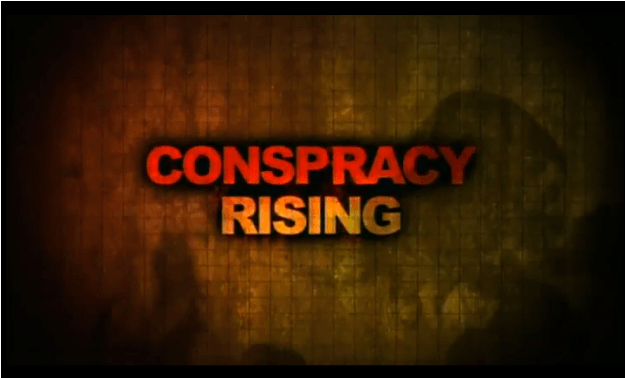
  • Michael Shermer Strikes (Out) Again: Review of Michael Shermer’s CBC documentary, Conspiracy Rising


    “In every case, the chance for complete information is very small, and the hope that in time researchers, students, and historians will be able to ferret out truth from untruth, real from unreal, and story from cover story is at best a very slim one. Certainly, history teaches us that one truth will add to and enhance another; but let us not forget that one lie added to another lie will demolish everything. This is the important point…Consider the past half century. How many major events – really major events – have there been that simply do not ring true? How many times has the entire world been shaken by alarms of major significance, only to find that the events either did not happen at all, or if they did, that they had happened in a manner quite unlike the original story? The mystery behind all of this lies in the area we know as ‘clandestine activity’, ‘intelligence operations’, ‘secrecy’, and ‘cover stories’ used on a national and international scale. It is the object of this book to bring reality and understanding into this vast unknown area.”

    – Colonel L. Fletcher Prouty, Colonel, U.S. Air Force, The Secret Team


    It has been several decades since those words were written by the late-great Mr. Prouty. This goes way back when to before there existed cell phones, Twitter, Facebook, 24-hour news cycles, and most of all, the internet. What Prouty originally described as being a “vast unknown area” has become infinitely vaster, infinitely more secretive…yet infinitely more widely known about and exposed for all the masses to question in their minds. It’s a dichotomy of wooly mammoth proportions. It has become the 10,000 lb. elephant in the room; everybody knows it’s there, but nobody dares point it out. Especially not our media organizations.

    But wait how does that make sense? How can something become more widely known yet remain a secret at the same time? It’s largely a matter of being able to see the forest for the trees. (And what with so much clear-cutting going on in the world, the big picture has never been clearer.) In previous decades, we didn’t know that any such huge covert element even existed. At least now we know. That, in my opinion, is great progress. Not only is the Emperor not wearing any clothes, the fig leaf he uses appears to be embarrassingly tiny! But in this case, the Emperor is not any one single person. It’s a group effort; a movement.

    How do we know the elephant exists in the room? Well, that’s pretty simple: because never before have we experienced such a full-force onslaught of disinformation, propaganda, and censorship as we have is recent years. Yes, I said censorship. When media organizations and individuals alike are expressly ordered to not publish or report on certain stories, and they respond, instead, by carting out the typical smoke screen cover story…that is censorship.

    When other parties are called in to disseminate false or inaccurate information, distorted evidence, or unfactual information over top of it, this amounts to a clever game of mop-up. Censorship sets you up with the jab, and the disinformation campaigns knock you out with the big right hand uppercut. It’s that uppercut that keeps you down on the canvas and in la-la land. These mop up efforts come in the form of books, blogs, newspaper articles, TV documentaries, film documentaries, and of course, bogus museums.

    If you ever doubted for a second that the American rightwing was in complete charge, you can now put that question to rest. There are so many things that point to this all-out take-over that it’s downright chilling. The military and all of its various secret government agencies are bigger, stronger, richer, and more powerful than ever before. They are now the caboose that runs the locomotive.

    I don’t know of many left-wing military “hawks” or if such an animal even exists; the Kennedys have been vilified, while Reagan has been resurrected and glorified; corporations, CEOs, and billionaires have never had it better. Again, I don’t know of too many Wall Street executives who would be caught dead supporting a Democrat, or even an independent. Simply put, it goes against their own best interests. Why pay a tax rate of 35%, 25%, or even 1%…when you can get away with paying no taxes at all! Why be forced by pesky unions to pay your workers $20/hr, including job security, overtime, and pension provisions…when you can close down your plant, send those jobs to China, and pay someone $20 a week!

    I found the following statement in Michael Shermer’s CBC documentary Conspiracy Rising, quite telling. The statement was: “conspiracy theorists threaten democracy”. And, in fact, this is one of the strongest, most explicit themes in the show. In fact, I don’t think I have ever seen this message made so clearly. Namely that the rise of conspiracy thinking can and will lead inevitably to the rise of Nazi terrorism as with the Klan or as in Germany itself. Not kidding at all, this is what the show depicts. See, I’d say the rise of this kind of thinking and digging for facts threatens fascism – which explains the heavy handed efforts at disinformation and propaganda we’ve been witnessing of late. Of which this show, and Shermer himself, are prime examples.

    This is no accident; no mere blip. This is the way that power brokers and money men have restructured the system, and they like it this way. But they can’t do it on their own. They need help, in the way of relief pitchers. A mop-up crew.

    The Canadian Broadcasting Corporation (CBC) began in 1936 as CBC radio. One of its main objectives was to provide important news and information to people who lived on the outskirts of this massive country of Canada. People who lived out on the far coasts, or up north in the Yukon, were more-or-less cut off from the rest of society, unlike those who lived in the bigger cities to the south e.g. Toronto and Montréal. It was the CBC who would keep these people in touch, first with radio, and later in the early 1960’s, with television. It was a way of unifying the country by keeping all citizens in touch.

    As a Canadian, I continue to seek out the CBC when I’m after accurate, in-depth journalistic pieces. Or even the BBC. But I sure as hell don’t seek out any of the American outlets. What’s the difference? Well, on the CBC, you might hear the journalists asking: “Have Bush and Cheney started two phony wars for profit and power?” By contrast, on a typical American news channel, you would hear: “And President Bush was seen wearing a handsome grey suit today as he was exiting Air Force One. It was a beautiful suit. I think I’ll go out today and buy myself one just like it. And now…let’s have a weather update!”

    It can be argued that the American media only see things in black or white…but at least Bush’s suit contained some shades of gray. Better than nothing.

    Now, let us fast forward to a headline in the Huffington Post, dated December 14, 2010: “My Day in Dealey Plaza: Why JFK Was Killed by a Lone Assassin” by Michael Shermer.

    Now also on that day appeared in this blog in bold headlines: “Michael Shermer making documentary about ‘conspiracy theories’ for CBC”.

    Oh, and just for the hell of it, here’s yet another article of Shermer’s which appeared in the Huffington Post: “9/11 ‘Truthers’ a Pack of Liars”.

    Now, this is the same Huffington Post which told Jesse Ventura in no uncertain terms: “We don’t do 9/11.” Yet they let Michael Shemer get away with a title like that? The almost humorous irony here is that in his documentary under discussion, Shermer actually complains that the new media, the Internet, can lead to the fatal Fascist disease of conspiracy thinking. Well, that sure won’ t happen at Huffington Post, not with Michael Shermer and Arianna Huffington around.

    Well, gee willies, Shermer sure gets a lot of exposure on the Huffington Post, doesn’t he? I mean, it’s almost like they’re seeking him out! I wouldn’t be surprised to see the following notice on their website.

    “This is an open standing offer to Michael Shermer. We will print whatever you want, whenever you want! Our loyalty is not to our readers, or to journalism, or to our share holders our main concern is to make sure your message gets out to the world! We won’t edit your stuff…hell, we don’t even have to read it. We’ll just print it as is. Will you please call us, Michael? Pretty please? Pretty please with sugar on top?

    Sincerely,

    Your friends at the Huffington Post

    Now, in that spirit, here are some upcoming articles we might expect.

    “Michael Shermer eats an apple!”
    “Michael Shermer ties his shoelaces!”
    “Michael Shermer goes out grocery shopping!”
    “Michael Shermer gets a tan!”

    Let’s get back to the pitching analogy. The “team” needed a mop-up crew, and who could they get? Well, Dave Reitzes was away being McAdams’ New Orleans expert; Von Pein was being benched for using growth hormone. Not on himself but on his fried chickens; John McAdams? we can’t get him because he’s working on a book so who’s left? Gary Mack? Nope, we can’t get Mack – he’s just plain exhausted from trying to cut down that large tree on Elm Street which blocks the view from the 6th floor window. So who’s left? The coach now escorts Michael Shermer to the mound.

    “Steeee-riiiikkke!”

    Shermer knows how to throw strikes. Well, if truth be told, we’ll never know if any of these guys can or not. Because if they ever balked, or had their pitches belted out of the park, the New Media, that is the Daily Beast or Huffpo would not note it. They’d just turn around and let Michael write an article in the Huffington Post, or come out with a book, blog, or television documentary to tell you that the ball never actually exited the park for a home run, that it was all a misunderstanding; an optical illusion; that the sun was in peoples’ eyes; that they actually struck the guy out. “You see, everybody only thought they saw a home run.” Obviously, those 35,000 fans in attendance, not to mention all of the dozens of news cameras strategically located around the park, were mistaken. They misremembered. It was a “flashbulb” memory completely unreliable. You know just like the Zapruder film! And by the way, Shermer uses that analogy of Flashbulb Memories in this documentary, just like Posner did to criticize that good documentary The Lost JFK Tapes. And Posner did that where? In The Daily Beast. Before they canned him for being a plagiarist. When in fact, he was much worse. He was a liar.

    Lie goes to the runner. Oops, I mean tie.

    Shermer’s “Flashbulb Memories” theory got me wondering. My father died in 1983 of a brain aneurysm. I have many great memories of my father. Or at least I think I do. Because according to Michael Shermer, I can’t really be sure that my father ever existed. Michael tells me that my memories are unreliable. Was that my father…or some neighbour who just kind of sort of resembled my father? Michael, can you help me with this? Was that really my father I remember, or was my brain playing tricks on me? Have I misremembered? Can you help me to connect the dots?

    The CBC “documentary,” titled Conspiracy Rising is just another orchestrated disinformation campaign much like McAdams’ recent book. No difference. Well, there is one difference. The show was hosted, presented and narrated by Ann-Marie MacDonald. Unlike the vast majority of pieces put out by the CBC, where the reporting is done in a straight-up, well-researched and impartial manner, Ms. MacDonald does a surprising thing very unbecoming of a “serious journalist”. She puts inflections in her voice so as to impugn the object at hand that is to be ridiculed.

    And the ridicule is non-stop, in every direction. From the choice of talking heads—Jim Angleton’s pal Chip Berlet no less—to the swirling of topics in a blender—Marilyn Monroe meets Roswell meets 9-11 meets JFK meets faked moon landing meets death of Diana meets world trade agreements meets Obama’s birth certificate meets David Icke’s reptile people, etc. As if they are all equal in importance and standard of proof adduced.

    Now whom does Shermer trot out to be the representative of the conspiracy side? Well remember who Shermer is. Would he use say John Newman on the JFK case? Or Mike Ruppert on 9-11? Nope. That would be fair. He wants to be unfair and ridiculous. So he brings in the overbearing, non-discriminating demagogue Alex Jones. And then to top if off, Shermer inserts the “Oh it’s all psychological, people need conspiracies to support themselves from facts they cannot accept stuff.” Its all been said before by Shermer. And this is just a cheap rehash. Except the danger of fascism angle has never been more virulent as it is here.

    The show couldn’t resist but to levy the same old tried-and-true “tin foil hats” remark when referring to people who suspect a conspiracy. Shermer even says he’s challenged people who believe in UFO’s to produce evidence and how they can’t respond. Fricking UFO’s and aliens, Michael? Michael, why don’t you challenge people in the JFK community? Michael? Are you there? Where’d he go?

    But is this a wholesale sell-out by the CBC? I doubt it. More likely, it’s a reflection of how the CIA itself operates; where the left hand doesn’t know what the right hand is doing; where individual agents go about their assignments in a bubble, not knowing what other agents are doing or even if there are other agents.

    But clearly, somebody at the CBC was receptive to Shermer’s advances; someone at the CBC had either already been aware of, or had been made aware of Shermer’s ongoing mission; otherwise he wouldn’t have gotten the gig…and the CBC wouldn’t have forked out the necessary budget allotment. Right? Clearly, someone at the CBC decided that this was bigger than any one individual; that it was the continuation of a team effort.

    Now, if you ask me who first phoned who to get the process rolling, I can’t say. But it is striking how Shermer continues to get the red carpet treatment from various news organizations. Isn’t it?

    “Michael Shermer making documentary about ‘conspiracy theories’ for CBC”. Very interesting announcement from the Huffington Post, no less. This is the same Huffington Post who refused to carry Jesse Ventura’s articles about 9/11. Then there’s Mark Lane, who can’t find a publisher for his book. Jesse Ventura sees episodes of his “Conspiracy Theories” pulled. “The Men Who Killed Kennedy” gets banned for all time by A&E. L. Fletcher Prouty’s “The Secret Team” gets mysteriously “unpublished” overnight by the CIA. Oliver Stone gets personally maligned, and his film JFK gets mercilessly slammed by the media…before it’s even released!

    No problems here. Or as Leslie Nielson would say with the building burning behind him, “Nothing to see here.”

    (Ever smiling)Michael Shermer begins by saying that people just can’t accept the fact that a great man like the president of the United States could be killed by a nobody such as Oswald.

    Not so, Michael; your premise is incorrect. Oswald was a somebody. In fact…he was super-human! Because according to Shermer’s logic (but more importantly, according to the president’s wounds) Oswald shot at JFK from behind him on the 6th floor, then he ran out and shot him in the throat from the front, then he ran over and shot him from the grassy knoll, then he ran back into the TSBD and had a Coke all within a few short seconds! With that type of speed Oswald could have made mince meat out of unworthy pretenders like Usain Bolt or Jesse Owens. Or The Flash. Or The Roadrunner.

    (Ever Smiling) Michael Shermer is always fond of theorizing about how people are prone to “misremembering” events, and how they are incapable of “connecting the dots properly”. Well, this just exposes how Shermer must obviously have done precious little research into the assassination. Because if he had, he’d know that Oswald was a radar operator for the U2 spy flight missions. Radar operators often use Morse code which is made up of a series of dots and dashes. So in other words…it was Oswald’s job to literally connect the dots properly! Take that, Michael!

    For shame, Michael! At least Mack, McAdams, Reitzes, and Von Pein are up to speed on the facts of the case. Of course, the fact that their life’s mission appears to be to subvert, mangle, misrepresent, and conceal those facts is altogether a separate issue. Come on, Michael…get in the game! A team only wins if every player puts out 110%! No team wants a teammate out there that the rest of the team has to carry.

    Just take a look at who Shermer consults in any of his puppet show/slide presentations available on the internet, or even on this documentary. Does he speak with Jim DiEugenio? Mark Lane? the Dallas doctors? Jim Douglas? David Mantik? Abraham Bolden? No, no, no, no, no, and no. The list goes on. Instead, Shermer invariably seeks out the expertise of a freelance “tour guide” in Dealey Plaza and tourists! Is this where you go to get your facts, Michael? But of course, (Ever Smiling) Michael Shermer prefers it that way. It allows him to make a mockery out of the whole thing, without having to answer tough questions. Or any questions at all, for that matter.

    He slips in, makes a mockery, and slips out again but seldom without his trusty cameraman nearby filming the whole thing. If Shermer could ever dispel even one of the dozens of proven facts that blow the Warren Commission fairy tale out of the water it would be so refreshing. Perhaps then he might be taken seriously. But as you’ll notice…he never once does this. Not once. Not a single time. Never. It is not in his mission statement. Ka-ching! Your check is in the mail, Michael.

    In my original review of Michael Shermer, I suggested the title of his magazine should be changed from Skeptic to Denier But now I think it should be changed to “Septic”. That’s because every time one of these disinfo artists has a bowel movement (inevitably disguised as a book, article, blog, slide show, museum, or documentary)…the rest of us are reduced to having to review, well, a bowel movement! It’s not unlike sorting through your dog’s stool with a stick when you think he may have swallowed a foreign object. And I don’t mean a “pink poodle” either, Mr. McAdams: this excrement leaves a pile of Brontosaurus proportions.

    But back to the documentary for a second. If you’ve noticed, I’ve spent very little time talking about it. That’s because it’s not worth talking about! There’s one thing that did give me great laughs. And that is when Shermer tells us that what conspiracy theories do is give us a dopamine hit! Aw, come on, now, Michael! Like it’s not enough that our brains don’t work and we can’t remember things properly – are you now telling us that we’re dope addicts too! Sheesh! The show even ends with “quiz”. Just answer the questions to see if you, too, are well, a conspiracy theorist!

    You won’t be surprised to know that Gary Mack offers up his opinion in this show. Mack says: “I’ve long believed, personally, that there was more to it than Lee Harvey Oswald. I just can’t prove it. And I don’t know anyone who can.”

    WRONG!

    Gary, allow me to present a list of FACTS that ARE proveable.

    • JFK was shot in the throat from the front
    • The “stretcher bullet” arrived at FBI HQ before the FBI agent delivered it
    • The most botched autopsy in history was conducted by inexperienced pathologists and was directed and controlled, not by medical protocol, but by military personnel who were yelling out orders of what to do and what not to do
    • The president’s brain was and is missing
    • The man who took the photos of Kennedy’s brain says he did not take them
    • Oswald was seen on lower floors during the time of the shooting
    • The condition of CE 399
    • Most of the Dallas doctors could not recognize the head wounds that they were later shown as having been the same as they had originally witnessed and treated
    • Several people expressed foreknowledge of the assassination
    • There were fake “agents” in Dealey Plaza
    • The Zapruder film

    And that’s only a partial list. I’m sure Gary would have little difficulty fleshing it out…to about ten times it’s current size. Just one of the items on that list would be sufficient to prove that Oswald was set up. But to have literally dozens and dozens? That sort of stuff just doesn’t happen in the real world. But this ain’t the real world we’re talking about here. Remember what I said earlier? It’s a review of the latest in a series of bowel movements. Hey, somebody’s got to do it. And Jim DiEugenio asked me to. Maybe he’s anti-Canadian? Whoops, another conspiracy theory.

    By Mack saying, “I’ve long believed, personally, that there was more to it than Lee Harvey Oswald. I just can’t prove it. And I don’t know anyone who can.” is just Mack taking the chump’s way out. Mack assures us that the case can’t be proved. Even though he surely know better. So what does Mack do instead? He uses this as justification to go ahead to put out KNOWN FALSITIES about the case! That’s like an paleontologist saying: “Well, all we have here are dinosaur bones … but we have no actual living dinosaurs. So, therefore, dinosaurs don’t exist.”

    I must give full credit to Gary, however. In Jesse Ventura’s Conspiracy Theory television show, Jesse asked Mack if he could imagine himself prognosticating about the JFK assassination over a beer a proposition that Mack enthusiastically accepted. This surely must have been gut-wrenchingly difficult for Mack. He was probably thinking to himself: “Beer? What’s with the beer? Everybody knows I prefer three shots.”

    From 1964 until 1968 there was a television show called “The Man from U.N.C.L.E.” It was all about spies, counterspies, secret agencies, disinformation, mercenaries for hire, double-agents, people in high places mounting wide-spread propaganda campaigns, and intelligence gathering. Contrary to popular belief, the original working title was not “The Man from D.U.N.K.L.E.” And I got that straight from Wikipedia – John McAdams’ own personal fiefdom!

    As you all know, McAdams cites Mack as being his “voice of sanity,” so  I don’t think McAdams would have steered Mack wrong about this. However, Gary very nearly did figure in another popular show from the 60’s – “McAdams’ Family”. Who could ever forget that memorable theme song with the snapping fingers?

    “They have a 6th Floor muse-um

    But nobody does believe ‘em

    It’s Reitzes, Mack, and Von Pe-in

    McAdams’ Family!”

    To see this one, click below.

    http://www.disclose.tv/action/viewvideo/91169/Conspiracy_Rising___Full_Documentary_/

    The most uplifting part of this whole exercise was certainly not the documentary itself, but the comments log beneath the show as seen above, and the CBC trailer here:

    http://www.cbc.ca/doczone/episode/conspiracy-rising-1.html

    There are dozens of pretty fantastic and excellent posts down there. What it proves, beyond a reasonable doubt, is that nobody not Michael Shermer, not Gary Mack, and not even the CBC is fooling anybody with this type of shameless propaganda.

  • The Lost Bullet: Max Holland Gets Lost In Space


    Max Holland first surfaced in the JFK case when John McAdams did, after the release of Oliver Stone’s film JFK. His first writings appeared in academic historical journals and he took aim at writers on the Kennedy case like Peter Dale Scott. For some strange and unfathomable reason, The Nation then hired him and he wrote about the Kennedy case there for a number of years. He was housed at this time at the Miller Research Center at the University of Virginia. This is supposed to be a sort of scholarly base where academics can do research through grants in aid. One of the directors there was Philip Zelikow; the executive consul of the much criticized 9-11 Commission. After writing for The Nation, he then set up his own web site called Washington Decoded. (For a very good overview of the man’s career concerning this case, click here) But some of his pieces have been turned down by more mainstream organs. So he goes where they will not be refused: the CIA’s own web site.

    Robert Stone is a long time documentary filmmaker who has made many films since his first, which was called Radio Bikini in 1988. From 1988 to 2010 he worked for PBS and The American Experience program. While there, in late 2007, he produced and directed a film about the JFK case called Oswald’s Ghost. Although the film was skillfully done, the skill covered up a rather blatant propaganda piece that ignored much of the new evidence and relied on discredited talking heads to pin the Kennedy assassination on Lee Harvey Oswald. (See my review here)

    Well, on November 20, 2011, for the 48th anniversary of JFK’s murder, these two teamed up to create another propaganda piece. Presented on the National Geographic cable outlet, it was called The Lost Bullet. The concept for this program goes way back to 2007. At that time Holland and Johan Rush wrote an article for the web site of the History Channel and postulated that the first shot fired in the Kennedy assassination actually came much earlier than anyone had previously supposed. In fact, it occurred even before Abraham Zapruder started filming! If you can believe it, the authors theorized that the first shot came just after the presidential limousine turned from Houston Street onto Elm.

    How ‘out there’ was this idea? Way out there. The Warren Commission placed the firing sequence at around Zapruder frame 210 on to about frame 313. The House Select Committee placed the first shot at about Zapruder frame 189. Holland and Rush placed the first shot before Zapruder’s camera rolled so it’s hard to apply a Zapruder frame to it. It may go back to a (theoretical) frame 107. A few months after the first installment of this bizarre theory appeared, it was then repeated in an op-ed piece for the New York Times. How bad was the piece? It was so bad that it was criticized by the likes of Gary Mack and Dale Myers. And in no uncertain terms. They made it clear they thought it was poppycock: both unfounded and sloppily researched. The Holland article went through still another transformation in 2008. This time Holland received help from Seattle attorney and JFK assassination student Kenneth R. Scearce. It was again harshly criticized from the same quarters.

    None of this seemed to matter to Holland. Or to his producer Mr. Stone. Why? Because they were on a mission. What was that mission? Well, it is pretty transparent. See, the more you push back the time for the first shot, the more time you give the (lone) assassin to fire the entire shooting sequence. This has been a consistent objective of the Warren Commission advocates from the start. Why? Because to them, it gives their fall guy Oswald the necessary time to fire the proverbial three shots from sixth floor window with a manual bolt action rifle. Holland’s thesis, as we shall see, is so weak that it’s this point that is the actual purpose of the show. (The other problem is the rapidity of the final two shots: according to ear witnesses, almost back to back, which is difficult to imagine with that Mannlicher-Carcano bolt-action rifle. Talking head Holland mentions this but does not deal with it.)

    II

    Because this is a Robert Stone production it begins with people crowding around in Dealey Plaza and shots of Robert Groden selling his literature there. As shown in his previous film, Oswald’s Ghost, Stone likes these kinds of shots. It gives him an opportunity to do four things:

    1. Show that this is an ongoing mystery that confuses the public
    2. Blame this confusion on the Warren Commission critics
    3. Show at least one critic selling his products in Dealey Plaza
    4. Ending with his recurrent theme that the real reason for the confusion is that people just cannot accept a socially maladjusted loser like Oswald killed an exalted leader like John Kennedy. (This last refrain originated with CIA asset Priscilla Johnson at the 15th anniversary. Stone actually featured this Agency shill in his previous film, without telling the viewer who she was.)

    The narration then continues with a huge whopper. The voice says something like Max Holland will now lead a team of researchers in re-opening the Kennedy case to see if Oswald could really have gotten off three shots the Warren Commission said he did. We are supposed to believe that somehow Robert Stone does not know who Max Holland really is. That he does not know that Holland has been a shameless cheerleader for the official story since at least 1994. That he has spared no time or energy in smearing the critics. Stone doesn’t know that this particular piece of flotsam he is about to demonstrate has been around (and gotten roasted) since 2007? Sorry Robert. You do know. And you are trying to sell the public that you are taking an objective approach, when you are not. Stone’s advocacy will be further demonstrated when he trots out his ballistics expert. If you can believe it, it is Larry Sturdivan. A guy who actually worked for the Warren Commission. And whom Robert Blakey actually used for the House Select Committee on Assassinations (HSCA), to prop up the ludicrous single bullet theory. With this deception, the show is not off to a good start. And it gets worse.

    The narrator now intones that this show will now tell the truth about what happened to each bullet’s trajectory that day in November 1963. But guess what? It’s the Warren Commission’s scenario: three shots, from that familiar sixth floor window; Kennedy hit twice and Connally once. If you can believe it, the narrator says something like there is a general agreement on this formula. There is none on this either with the general public or with specialists in the case. Especially when a detailed examination of the condition of the Magic Bullet i.e. CE 399, its provenance, and it flight path is provided. As we shall see, this does not happen here. Stone, Holland and Sturdivan are good con artists. They knew better than to go into this matter.

    The program now proceeds and Holland says he will work backwards with his three Warren Commission bullets. Therefore, he begins with Zapruder frame 313, the fatal headshot to Kennedy. And with this segment, the program now descends into the purest advocacy. To use one example: Stone and Holland do not even mention the fact that the entry point for this bullet was switched from where the Warren Commission originally placed it. They had it at the base of the skull, right above the neck. Both the Ramsey Clark panel and the HSCA moved this entry point upward by nearly four inches! Which means it went from the bottom of the skull to the top, at the cowlick area. Why do they ignore this problem? Because by ignoring it they do not have to explain that if the bullet came in at the base of the skull, Z frame 313 shows that the bullet could not exit at the Warren Commission’s point at the right temple, above and to the right of the ear. This problem was pointedly illustrated way back in 1967 by Josiah Thompson in his book Six Seconds in Dallas. (See page 111) Thompson also demonstrated that the Warren Commission lied about this issue in their illustrations to cover up this fact. By glossing it over, Holland and Stone continue that cover up.

    There is another issue here that the Dynamic Duo conceal. That is the mystery of the 6.5 mm fragment. The Clark Panel saw something on the x-rays that apparently the original autopsy team missed. Namely the existence of a bullet fragment near the rear of the skull. This fragment was also agreed to by the HSCA. The problem is that if that is what it is, it creates another huge problem for the official story. Because the two fragments recovered of this head shot bullet constituted the front and tail of the bullet. Therefore, this fragment must come from the middle of the bullet. So we are to believe that the bullet broke into thirds upon immediate entrance and the rear of the bullet somehow elevated itself over the center of the bullet—which was left behind—and proceeded forward and out with the front of the bullet. The show’s own expert, Sturdivan, has said this is not possible. In the words of Henry Lee, “Something is wrong here.” And neither Stone nor Holland wants to deal with it. Which shows the reader how honest they are. To the program’s credit, during this segment they show high definition scans of the Zapruder film to demonstrate that the driver, Secret Service agent Bill Greer, did turn around, but he did not shoot Kennedy. This was always a nutty theory that no serous critic of the official story advocated. But I am glad they addressed it here.

    But then the mendaciousness picks up again. They admit that Time-Life held the Zapruder film in their vaults for years without making it public. Which is true. But they then say the reason was to keep the graphic images of the headshot away from the public. Most informed people would disagree. They would say that Time-Life, with all of its ties to the intelligence community, kept this from the public because this part of the film—with its unforgettable image of Kennedy being hurtled backwards with incredible force and speed against the car seat—betrays a shot from the front. And Oswald was behind Kennedy.

    Holland does address this issue. He screen captures a frame from the Zapruder film that shows the blood mist exiting from Kennedy’s skull. It appears to be exiting slightly forward. Because of this, we are to forget about Kennedy being hit so hard from the front that his whole body rockets backward. What Holland does not say is this: When a projectile hits the skull, it creates a medical phenomenon called cavitation. This is, roughly speaking, a pressure center in the brain. This pressure center then finds a means of escape. And often, this comes from a weak point in the skull. Which happens to be near the front. In other words, the exit point has nothing to do with the directionality of the shot.

    I could hardly believe what Holland and Stone did next. Using their high definition scans from other films, not the Zapruder film, they panned across the grassy knoll. They then announced that they could not find a man with a rifle there. So they concluded the shot could not have come from the front. Uh, Bob, Max. You could just have shown a close up of the Moorman photograph and given the audience a hint of the Badge Man image. And there are others images in the canon that reveal something funny happening behind the picket fence—not on the knoll. And you then could have related that to the testimony of people like Lee Bowers and Sam Holland to close that argument. Stone and Holland did not. Which reveals this is a propaganda tract.

    III

    The show now introduces Mr. Sturdivan formally. It then proceeds to a discussion of some of the evidence against Oswald. It deals with it in about the same way it deals with the headshot. Meaning it does not at all go into the myriad problems the critics have demonstrated with it. For instance, the show mentions something called a “handprint” on the rifle. I think this word invention is to get around the fact that it was not a fingerprint but a palmprint. And of course, the show does not discuss the fact that the FBI expert, Sebastian LaTona, saw no such print when the rifle went to FBI headquarters that night. Neither does the show mention that FBI agent Vince Drain was the man who picked up the rifle from the Dallas Police to ship it to the FBI. No policeman told him at that time there was such a print on the rifle. The palmprint only appeared after the rifle was returned to the Dallas Police and after the FBI found no Oswald prints at FBI headquarters. (Henry Hurt, Reasonable Doubt, pgs. 107-09)

    This deceptive technique is fitting for what is about to happen next. Which, even for Stone and Holland, is a bit wild. Using none other than Larry Sturdivan—the inveterate Warren Commission sycophant—they now try to demonstrate that the Single Bullet Theory actually occurred. Before getting to that though, let me mention what Sturdivan had just done for the producers previously. When assaying the headshot, Sturdivan took a page from Gary Mack and his hideous Inside the Target Car. He lined up his marksman from the middle of the picket fence. Not the end. Again, as with Mack, this is deceptive. Anyone who goes to Dealey Plaza will see that the shot from the end of the picket fence is where most people think the fatal shot came from. But Mack wanted to use the other location because then he could lie to the American public and say that a shot from that location would have hit Jackie Kennedy. Which it would not have. And Mack knew that before he said it. So it was a premeditated lie. (See for yourself here)

    Well, Sturdivan repeated that same lie here. He only said it in passing, and he framed it with a conditional. But he did say it. So even after this lie has been exposed for what it is, Stone and Holland still feel fit to repeat it. This tells you all you need to know about this program. If only it had stopped there. But it does not.

    Sturdivan now trots out to Dealey Plaza, lines up the models in the car, fires a laser at them and presto! He now says that the Single Bullet Theory actually happened. Again, I wish I was kidding but I’m not. Needless to say: Garbage In, Garbage Out. First, Sturdivan lined up the models as Vince Bugliosi did in his book Reclaiming History. Using false dimensions for the car, he has Kennedy way outside of Connally. As Robert Groden will show with photographs in his upcoming book, this was not the case. Secondly, and shockingly, there was no discussion of the flight path through either man. All the program showed was two green dots on the rear of the bodies. And it appeared that Sturdivan showed the rear wound of JFK to be at the HSCA location, down the back. The obvious question here is: Then why did Jerry Ford move that location upwards from the back for the Warren Commission? Holland does not ask this question. Probably because he would then have to admit that this location makes it hard to believe that the bullet would then exit through the neck. There is then no discussion of why the cervical vertebrae in Kennedy were not cracked. Which they would have to be if the bullet exited at the neck. Neither does the show address the curious trajectory through Connally. That is, through the chest, rightward to hit his wrist and then left to hit his thigh.

    And obviously, the program does not even mention two very salient facts. First, the overwhelming evidence that the Magic Bullet, CE 399, was switched. (See here for that evidence) And second, the compelling evidence that Connally was hit by a separate bullet. Further, that the FBI knew both of these facts and was complicit in the cover up. By themselves, these two brief articles shatter the cheap dog and pony show that Sturdivan is selling here.

    Before leaving this (gaseous) segment of this phony program, let me add one more ersatz announcement in it. Like Inside the Target Car, Stone and Holland hired a military marksman. They actually say that Oswald had the same training in rifle fire that their marksman had. This is so ridiculous as to be ludicrous. Oswald had no special training at all in marksmanship. His training was the same as that of the scores of Marines he took rifle practice with. And in fact, when Henry Hurt interviewed some of Oswald’s military cohorts, they were aghast at the Warren Commission contention that Oswald could have pulled off what happened in Dealey Plaza by himself. He was that poor on the rifle range. (See Hurt, pgs. 99-100) Again, this is a fact that this agenda driven show tries to cover up.

    IV

    Before proceeding to the program’s fraudulent finale, let us remind ourselves of two main points. The show has not done what it said it would do, that is trace the bullets in the Kennedy case. It has not done this in any real way, or even come close. Further, it has not searched for evidence of any other bullets fired that day, besides the Warren Commission exhibits. Second, it has not in any real sense done a new investigation, or reopened the case. I mean, how could it with Larry Sturdivan there, the man who was involved in the original Warren Commission inquiry? (How Robert Stone missed inviting Arlen Specter escapes me.)

    But now the show is about to proceed to its closing summation. The program says there has been generally two schools of thought abut the firing sequence. The Warren Commission allowed six seconds for the shots to be spaced. This began with the president disappearing behind the freeway sign, and then ended with Z frame 313. The HSCA said the shots were begun slightly earlier than that. At about frame 189, which would allow for about seven seconds. Yet this longer time clearly allowed for a conspiracy since the first shot had to be fired through the branches of an oak tree. And almost no one would be able to believe that any marksman could have hit the target with that obstruction there. (Let us not ever forget, the greatest sniper of the Vietnam era, Carlos Hathcock, said that he repeatedly tried to do what the Commission says Oswald did. He failed every time.)

    Obviously, Holland is disturbed by these results, which eliminate Oswald as the lone gunman. So what does he do? He says that the first shot happened even before Zapruder started filming! The problem with this is that if one watches the opening frames of Zapruder’s film as the car has entered Elm Street, there is nothing to indicate anyone has fired a shot. And when Vince Bugliosi tried to move the first shot up a bit more than the HSCA did, Pat Speer showed that he embroidered some witness testimony with the liberal use of ellipsis to accomplish that goal. (See here)

    Holland first takes out a high definition scan to show what he says is someone or something in the Hughes film in the sixth floor window. Being as objective as I could be, I could not determine if it was a person or boxes. It was that obscure. And for the show to trumpet this as a “new discovery” is more pretentious gas. At the end of Josiah Thompson’s 1967 book Six Seconds in Dallas, he uses the exact same film and frames to make the argument that there are two men in that window. (See pgs. 244-46) Except Thompson brings in supplementary evidence that supports his idea—and it’s credible. To show you just how strained this film is, Holland and Stone are so biased that they go beyond saying that this rather indeterminate frame represents a single person. Holland actually said it was Oswald! For pure arrogant zealotry this might match Dale Myers going on national TV in 2003 and lying his eyes out by saying his phony computer simulation had just proven something called the “Single Bullet Fact”.

    Holland then says that the positioning of the shells at the scene proves there was an early shot and then two close together. On its face, this is silly. One might ask Stone and Holland: Did you do any experiments to prove this? But really it’s worse than that. Tom Alyea was a local TV photographer who entered the Texas School Book Depository before the building was sealed off. He was one of the very first to see the three shells lying on the sixth floor. (Michael Benson, Who’s Who in the JFK Assassination, p. 12) He had trouble filming the shells because of the boxes. Captain Will Fritz then picked them up for him to better shoot a picture. Fritz then threw the shells back on the floor! Which means, of course, that the photos of the shells we have now in the Commission volumes are not of the original crime scene. But Alyea went even further. He told certain researchers than when he first saw the shells they were not scattered as they appear in the volumes today. He stated you could span the three shells with your hand. (Interview with Larry Hancock, 11/19/11)

    I now make a further challenge to Stone and Holland: please fire a Mannlicher Carcano rifle and eject three shells from it. Do it one hundred times. Call me when you get three shells ejected perfectly within a hand span. I will tell the reader right now: I will never get that phone call.

    Holland also uses the testimony of the three depository workers below the sixth floor who later said that they heard a rifle bolt working and shells falling to the floor above them. What he does not say is that this was not their original testimony in their first Secret Service report. Patricia Lambert long ago wrote about this in a long two-part article. (See here)

    Holland also uses witnesses Tina Towner and Amos Euins for this earlier shot. But if one clicks through to the article by Dale Myers I linked to at the start, one can see that he is not faithful to what they originally said. Further, he has selectively used Euins’ testimony in two ways. First, he has cut out the parts that seem to eliminate Oswald as the assassin e.g. seeing a bald spot on the back of his head. (Rodger Remington, Biting the Elephant, pgs. 116-18) Second, he does not detail all the problems with Euins as a witness. For instance Euins told the Secret Service he was not sure if the assassin was black or white. When asked definitively, he told the Secret Service he was black. He then told the police he was white. (ibid, p. 126) When he was asked if he could recognize the man if he saw him again, he said he could not. (Ibid, p. 127) He also said he heard four shots. (Ibid p. 115)

    As the reader can see, Holland has shamelessly cherry picked the testimony of a 15-year-old boy.

    V

    Holland and Stone now proceed to the climax of their tedious opus. Holland asks: If the shot came that early, with the car that much closer to the window, how did the shot miss? This rhetorical question leaves out two key points. First, Holland and Stone have not come close to proving the shot came that early. Second, they ignore an obvious adjunct question. Namely, if the assassin was going to fire that early on Elm, why did he not fire when the car was right below him on Houston? With a telescopic site, this is close to a can’t miss shot.

    Well, this is what Holland and Stone give us as their answer to this question. They say that this shot missed because it hit a traffic light on a metal pole first. Now one has to ask another obvious question: If that were the case, when the assassin went to line up the shot, would he not see the pole and light in his cross hairs?

    But further, as Holland states, this has to be the shot that then went forward to hit near James Tague standing on a concrete island beneath the overpass near Commerce Street (and a piece of the curb cut his face). Now this Tague/curb hit had always been very difficult to explain for those maintaining the official fiction of three shots. In fact, the FBI simply decided to cut it out of their report. This eliminated the Magic Bullet fantasy from their version. And this is one reason the Warren Commission did not place that report in the volumes. But yet, the people in Dallas would not let it go away. And finally, the local U. S. attorney wrote a letter to the Warren Commission about it. The Commission then had to include the Tague/curb hit in their report. And this is one of the main reasons that the Single Bullet Theory—or as Robert Groden calls it, the Single Bullshit Theory—exists today. If one bullet hit the curb near Tague and one killed JFK, there is only one bullet left to do the rest of the damage to Connally and Kennedy.

    For Holland and Stone to include the Tague hit on the trajectory of this traffic light hit shows just how much they have migrated into outer space. Consider this: they now have a bullet smashing into a traffic light right out of the gate. But then this bullet has the torque left to fly something like 400 feet further—one and a third football fields—and then smash into a curb sending out shards of concrete, cutting open Tague’s cheek.

    Again, did Holland and Stone do any experiments on this? For the traffic light is still there. I would have liked to have seen them. I think it would have resembled a Buster Keaton movie.

    But it’s even worse than that. As Harold Weisberg found out during a protracted battle with the FBI, the Bureau did some metal testing of the curbstone after they were forced to acknowledge the Tague hit. They found something very odd. There were no copper traces in the concrete sample. (Hurt, p. 136) If one looks at the ammunition allegedly used in the shooting, this would seem impossible. The bullets are literally coated in copper metal. Therefore, as Henry Hurt concludes, this in itself proves, at a minimum, that Oswald did not act alone. (ibid, p. 138) You probably know by now what Stone and Holland do with this key information. That’s right. They don’t mention it. I wonder why.

    If you can believe it, it is even worse than that. Because it turns out the producers did do experiments with the traffic light. But only to see if a shot hitting it would leave a hole or not. Holland first reported that there was a hole in the traffic light. But it was later revealed that this was a separation in the metal that was part of the design. And in fact, on the show, Holland admits there is no hole or even a visible dent in the light today. So how does he conclude what he does, that the bullet ricocheted off the light? He says that there is a “white spot” on the light. How this proves a bullet hit it is not discussed in any way. But as Pat Speer notes, the company that did the experiments reported for the program concluded that if a shot hit the light there would have been very visible damage to it; and from street level. So much so that it would have been reported on the day of the assassination. (Follow this link to post 11)

    In other words, Stone and Holland likely knew that the reason d’être for their show was wrong–before they went on the air. Does it get much worse than that?

    This farce of a program proves that, as with the three old main networks, the cable TV channels are almost pathologically incapable of telling anything close to the truth about Kennedy’s assassination. All the rules of journalism are now thrown out the window. And farceurs like Gary Mack, Robert Stone, and Max Holland are allowed to take center stage carte blanche; with no one exercising any kind of fact checking or standards review. As discussed here, four of the last five cable programs on this case have been abysmal in every way. The only exception was National Geographic’s own The Lost JFK Tapes. But now it appears that that channel has joined up with Discovery Channel to produce a show that actually ranks with the works of Gary Mack/Larry Dunkel. Which I actually thought was not possible. But here it is.

    All that Stone and Holland proved is that documentary films can lie as much as fiction films do. In fact, they can lie even more.

  • Journalists and JFK, Part 3: The Real Dizinfo Agents at Dealey Plaza

    Journalists and JFK, Part 3: The Real Dizinfo Agents at Dealey Plaza


    Intro
    Part 1
    Part 2


    Besides their reporting on the assassination of President Kennedy, Hugh Aynesworth, Priscilla Johnson and Gordon McLendon share an interesting common trait in that they applied for jobs with the CIA and didn’t get them. But rather than become full fledged agents, it appears they were assigned a contact officer and served as CIA assets for decades, which is especially interesting in how their CIA associations affected their activities related to the assassination.


    HUGH AYNESWORTH

    As a local reporter for George Bannerman Dealey’s Dallas Morning News, Hugh Aynesworth was all over the place during the assassination weekend. He was at Dealey Plaza, the Tippit murder scene, the Texas Theater where the accused assassin Lee Harvey Oswald was arrested, the house in Irving where Oswald’s wife lived, the rooming house where Oswald lived and the Dallas Police Department where he was killed.[1]

    It’s important to mention Aynesworth’s background and his presence at so many crime scenes because while it always seemed suspicious, and his CIA ties were confirmed with the release of CIA records by the JFK Act.

    As Jim DiEugenio notes, “many more pages of documents have been released showing how tightly bound Aynesworth was with the intelligence community. It has been demonstrated that Aynesworth was – at the minimum – working with the Dallas Police, Shaw’s defense team, and the FBI. He was also an informant to the White House, and had once applied for work with the CIA. As I have noted elsewhere, in the annals of this case, I can think of no reporter who had such extensive contacts with those trying to cover up the facts in the JFK case…”[2]

    Rex Bradford, the web master of Mary Ferrell’s extensive files on the case wrote, “Declassified documents show that Dallas reporter Hugh Aynesworth was in contact with the Dallas CIA office and had on at least one occasion ‘ offered his services to us.’ The files are chock full of Aynesworth informing to the FBI, particularly in regard to the Garrison investigation….Also of note is a message Aynesworth sent to…LBJ’s White House, in which Aynesworth wrote that ‘My interest in informing government officials of each step along the way is because of my intimate knowledge of what Jim Garrison is planning.’” [3]

    Most incredible however, is the CIA report written on October 10, 1963 when J. Walton Moore, the head of the Dallas CIA Domestic Contacts Division reported to the Chief of the Contact Division on “the possibility of Hugh Grant Aynesworth making a trip to Cuba.”[4]

    One month before the assassination J. Walton Moore – the same CIA agent who has been meeting regularly with the accused assassin’s best friend George DeMohrenschildt, is also meeting with Hugh Aynesworth about going to Cuba.

    Moore’s first mission with the OSS during Word War II was to China with Charles Ford, who later became the CIA agent assigned to work with RFK at JMWAVE. Using an Italian alias, Ford worked with John Rosselli, the mafia boss the CIA previously recruited to kill Castro. In his interview with the Church Committee, Ford said they were trying to overthrow, not kill Castro, but those who have it in for RFK use Ford as a lynchpin to crucify Bobby, as we have seen with Sy Hersh in the Dark Side of Camelot, Evan Thomas in Robert Kennedy – His Life , and David Kaiser in The Road to Dallas , and Max Holland. But with the release of Ford’s records by the JFK Act, they have all gone silent. [5]

    However there could be an association between Hugh Aynesworth, J. Walton Moore, Charles Ford and David Atlee Phillips, especially in regards to the timing of Moore’s memo and Phllips’ travels, not just as it relates to Cuba, but to what happened at Dealey Plaza. This is especially so since J. Walton Moore – the CIA contact agent to the accused assassin’s best friend, served in the same capacity with Hugh Aynesworth about a trip to Cuba a month before the assassination. And the day before Aynesworth met with Moore, David Phillips was at JMWAVE, the CIA’s Miami, Florida base, where anti-Castro operations were planned and carried out.[6]

    How did these damning records get released? And if this was released, what’s in the thousands of documents that are totally redacted or are still partially withheld for reasons of national security? Many of these withheld records include many pages of the files of Hugh Aynesworth, Priscilla Johnson and Gordon McLendon.

    As David Talbot points out, “…some of these journalists did the CIA’s bidding: see, for instance, a January 25, 1968 CIA memo on Hugh Aynesworth, who covered the JFK assassination, first for the Dallas Morning News and then Newsweek . Aynesworth – who at one time, according to the memo, ‘expressed some interest…in possible employment with the Agency’ – was considered by the CIA to be a solid ‘Warren Commission man on the assassination.’”[7]

    And indeed he was. He eagerly did the agencies bidding to squash the Garrison investigation, and he doesn’t consider the Kennedy assassination among the unsolved homicides in his 1994 book Murders Among Us: Unsolved Homicides, Mysterious Deaths and Killers at Large .[8] But his article, “The Strangest Story I Ever Covered,” details how he came to expose the head of the local crime commission was himself a criminal who had crafted a new identity to hide his past. So Aynesworth is capable of uncovering conspiracies when he wants to. If he applied the same investigative skills to the homicide at Dealey Plaza, perhaps he would have helped uncover the truth instead of promoting the cover story and blaming the murder on the patsy.[9]

    Joseph Goulden was one of Hugh Aynesworth’s colleagues who also covered the events in Dallas and also pushed the lone-nut myth. When rumors began to circulate that Oswald was an FBI informant, and was even assigned an informant number, Aynesworth, along with Houston reporter Lonnie Hudkins and Goulden, floated the story that they had made up an informant number to make it seem real. The Warren Commission held a closed door executive session to discuss it, and former CIA director Allen Dulles explained that even if Oswald was an informant, there would be no record of it, though there was a record of Jack Ruby being such an FBI informant.[10]

    Just as there was a lot of friction between the FBI and the Dallas Police, there was also friction between the FBI and the Secret Service and the FBI and the CIA. So Goulden’s story actually took some of the heat off the CIA, especially in regards to Oswald’s defection to the Soviet Union and his trip to Mexico City, both of which called unwanted attention to CIA operations they wanted to keep secret.

    It was also a diversion that appeared to dissipate when Aynesworth and Goulden acknowledged the story was bogus. So the idea of Oswald as intelligence operative went south and the public image now became one of the deranged loser, and lone nut assassin.

    Today, both Aynesworth and Goulden write for the Washington Times newspaper, founded by Sun Myung Moon and owned by the Unification Church, who some suspect acts as a front for the CIA.[11]

    When Priscilla Johnson McMillan testified before the House Select Committee on Assassinations (HSCA), she said that in the course of researching Marina’s story, she discovered who actually obtained and leaked Oswald’s “Historic Diary” to the Dallas Morning News and Life magazine.[12]

    Who was it? Hugh Aynesworth.


    PRISCILLA JOHNSON MCMILLAN

    mcmillanAt a fairly young age, Priscilla Johnson developed an interest in all things Russian. After attending Bryn Mawr College in Philadelphia, she studied Russian at Middlebury School, and worked for John F. Kennedy before embarking on a career as a journalist and correspondent based in the Soviet Union.[13]

    According to the official records, Johnson applied for employment with CIA in 1952.

    Thanks to the JFK Act, we now know what that her CIA Security File (ID #71589) reads, “During the course of the current investigation, thirteen-developed informants were contacted. She is generally described as stable, intelligent, well-informed, mature, of excellent character, morals, and reputation, and a loyal American citizen. Subject is further described as liberal, internationally minded and overly polite to such a point that it was thought that she was putting it on…”[14]

    Johnson said she withdrew the CIA job application in January 1953, but then was officially denied a security clearance in March 1953. The denial was said to be based on her attendance at Middlebury, an institution listed among those officially deemed subversive by the government, and her participation with the World Federalists, who advocated support for the United Nations and the establishment of a world wide government. From the documentary records it is apparent that she was a member of the World Federalists while at student at Bryn Mawr, in Philadelphia, and was affiliated with the Pennsylvania state World Federalists and the national and international World Federalists, founded by her Locust Valley, New York neighbor Cord Meyer.[15]

    Although Priscilla Johnson was never officially asked if she knew Michael Paine’s mother, Ruth Forbes Paine Young, they were both active in the World Federalists in Philadelphia, in the same city at the same time. It makes one wonder if, from their mutual association with the World Federalist in Philadelphia, if Priscilla Johnson knew Michael Paine’s mother at such an early date in the proceedings?[16]

    According to CIA files Johnson was rejected because some of her associates would require more investigation. The document was signed by  Cord Meyer, who was then chief of CIA Investigations and Operational Support, and incredibly enough, the founder of the World Federalists, one of the subversive organizations that the CIA’s Office of Security considered suspicious.[17]

    On 17th March, 1953, W. A. Osborne, sent a memo to Sheffield Edwards, head of CIA security, saying that after checking out Johnson’s associates he “recommended approval.” However, on 23rd March he sent another memo saying that “in light of her activities in the United World Federalists” he now “recommended that she be disapproved”.[18]

    That Priscilla would be disqualified from joining the CIA because of her association with the World Federalists is hard to believe since that organization was founded by her friend and former neighbor Cord Meyer, who was one of Allen Dulles’ top deputies at the CIA. He later controlled the International Organizations Division of the CIA that included the World Federalists.

    When Priscilla Johnson was questioned by the House Select Committee on Assassinations (HSCA), and was asked if she worked for the CIA, she denied even knowing anyone in the CIA. She failed to mention her friend and neighbor Cord Meyer, Dulles’ deputy and head of the CIA’s International Organizations Division, who signed her security check.[19]

    As Priscilla Johnson herself admitted when questioned by the HSCA, there is one inherent difference between an independent journalist and a covert intelligence agent posing as one: you can’t depend on the agent to tell the truth or give an accurate appraisal of the situation because of their hidden allegiances.

    Priscilla Johnson told the congressional investigators that she withdrew her application for employment with the CIA before they determined that she wouldn’t pass muster because of her affiliations with the subversive World Federalists.

    They still considered her a valuable asset however, as the records reflect she was later given a conditional clearance in 1956 and continued meeting with CIA officials throughout her career. From the records released under the JFK Act, it is apparent she maintained contact with a CIA liaison officer for years, and was passed off from one contact officer to another.[20]

    Instead of officially working for the CIA however, Priscilla Johnson was hired by the North American Newspaper Alliance (NANA), the organization she was officially working for in Moscow when she interviewed the American ex-marine defector, Lee Harvey Oswald.

    The North American Newspaper Alliance doesn’t exist today as a corporate entity, but over the years NANA was owned by American and British intelligence officers and employed correspondents that have repeatedly become entangled in clandestine affairs.

    Priscilla Johnson didn’t have to work for the CIA if she worked for NANA, an allied agency whose intelligence associations were cemented by Ernest Cuneo, Ivar Bryce and Ian Fleming. In his official biography The Life of Ian Fleming, John Pearson relates “During the next few years Bryce (and Cuneo)…. were to play their part in the story of James Bond and the life of his creator…Bryce had bought himself an oil well in Texas which had just started to produce, and out of the proceeds he had decided to acquire a controlling interest in the North American Newspaper Alliance. NANA was one of the big American agencies specializing in syndicating feature articles, but by the time Bryce bought it its prestige was not what it had been. He and his associate, Ernest Cuneo, were planning to restore NANA to its former glory, and… Fleming was drawn into the project.”[21]

    Cuneo was a former aid to both New York Mayor LaGuardia and President Franklin Roosevelt, served as an OSS officer during WWII, and as Pearson puts it, was “one of the group around General Donovan and William Stephenson who formed the basis of close U.S. and British cooperation during World War II and the Cold War that followed. Cuneo served as official wartime liaison between British Intelligence, the OSS and the FBI.”[22]

    According to Pearson, the purchase of NANA was Cuneo’s idea. “For Bryce it was never more than a rich man’s hobby. Cuneo was more interested, and Fleming was invited to help. More than this, he was asked to take charge of the European end of the operation, with the resounding title of European vice-president.” Fleming recognized the attributes of a good reporter were the same as those of a good spy.

    Sidney Goldberg, who worked for Fleming at NANA, agreed that there was a thin line between Fleming’s responsibilities as an editor and his espionage operations. NANA, notes Goldberg, had a reputation for hiring beautiful, young women as NANA correspondents – such as JFK’s World War II paramour Inga Arvad, Cord Meyer’s wife Mary Pinchot Meyer, Latin American correspondent Virginia Prewett and Priscilla Johnson.[23] As a foreign correspondent working for NANA in Moscow, Priscilla Johnson was one of the first American reporters to interview Lee Harvey Oswald. In what was later characterized as “an ironic twist of fate,” she later obtained the exclusive rights to the story of Oswald’s wife after the assassination.

    She learned about the young ex-Marine defector from John McVickar, a US embassy assistant who concluded that Oswald “…was following a pattern of behavior in which he had been tutored by [a] person or persons unknown…, it seemed to me that there was a possibility that he had been in contact with others before or during his Marine Corps tour who had guided him and encouraged him in his actions.”[24]

    After meeting with Oswald in a Moscow hotel room, Johnson filed her story to NANA the next day. But most of it wouldn’t be published until after the assassination. In her two year stay in Moscow, Priscilla Johnson filed over 100 reports to NANA, although not all of them were published. According to Goldberg, “…The primary reason we chose not to publish Priscilla’s Oswald story in 1959 was because it was a marginal operation, picking up and distributing free-lance stories here and there…I suspect that by their very nature, these outfits could have been easy vehicles for providing journalist ‘cover’ to CIA operatives, although I do not know this to be a fact.”[25]

    John Newman, who interviewed Priscilla Johnson for his book, Oswald and the CIA, noted in a footnote: “Years later, rumors would surface that NANA was associated with the CIA…NANA was run by Ernie Cuneo and Priscilla’s editor was Sidney Goldberg. Priscilla had no inkling of any NANA-CIA relationship at the time. Today she has heard the rumors.”[26]

    In more recent times, Sidney’s wife Lucianne Goldberg, a New York literary agent and former NANA correspondent herself, advised Linda Tripp to secretly and illegally tape record Monica Lewinsky about her affairs with President Clinton.[27]

    Priscilla Johnson also revealed to Newman that she was a friend and neighbor of Cord Meyer, a CIA officer who “was waiting for her to grow up,” and after she grew up, she knew him through her application for a job with the CIA and their mutual association with the World Federalists.[28]

    According to her HSCA testimony, upon her return to the United States from Moscow in November 1962, Priscilla Johnson was debriefed “for the first time” by an agent of the CIA at the Brattle Inn in Cambridge, Massachusetts. On 11th December, 1962, a CIA memo (declassified in August, 1993) reported: “I think that Miss Johnson can be encouraged to write pretty much the articles we want. It will require a little more contact and discussion, but I think she could come around… Basically, if approached with sympathy in the cause she considers most vital, I believe she would be interested in helping us in many ways. It would be important to avoid making her think that she was being used as a propaganda tool and expected to write what she is told.”[29]

    Another CIA document dated 5th February, 1964, reports on an 11 hour meeting with Johnson, the main objective was to debrief her “on her flaps with the Soviets when she was in the USSR, notably at the time of her last exit.” She was also asked if she “would be interested in writing articles for Soviet publications.” Gary Coit, the CIA officer who conducted the interview reported that “no effort was made to attempt to force the issue of a debriefing on her contacts”. However Coit told her he would “probably be back to see her from time to time to see what she knows about specific persons whose names might come up, and she at least nodded assent to this.”[30]

    Apparently she did not have to be debriefed after interviewing Oswald in Moscow because everything they needed to know was contained in her November, 16, 1959 report to NANA, including the parts not published in the newspapers. Besides Priscilla Johnson, one of the CIA’s more prolific media assets was NANA correspondent Virginia Prewett, who covered Cuban and Latin American affairs during the height of the CIA’s war against Castro.

    After Antonio Veciana told Congressional investigator Gaeton Fonzi that his CIA control officer was “Maurice Bishop,” whom he had once seen with Oswald in Dallas, another journalist, Anthony Summers, located Vecina’s former secretary. This new witness recalled that “Bishop” was also associated with an American journalist named “Prewett.” Summers located Virginia Prewett in Washington and arranged to meet her with a Washington Post reporter from England, David Leigh. As a NANA correspondent Virginia Prewett recalled writing about Alpha 66 and anti-Castro operations in the Sixties, and knew both Veciana and “Mr Bishop.” When asked about them she said, “You had to move around people like that.” Indeed.[31]

    NANA owner Ernest Cuneo, NANA correspondent Virginia Prewett and Life magazine’s Clare Booth Luce were among the founders of the Citizens Committee to Free Cuba (CCFC), one of the anti-Castro groups backed by the CIA whose operations entwined with the events surrounding the assassination of President Kennedy. Top heavy with media types proficient in psychological warfare, the CCFC group was just one arm of the CIA’s propaganda network that conducted operations related to the assassination of President Kennedy.[32]

    While Hugh Aynesworth, Priscilla Johnson McMcillan and those publishers, editors and writers at Scrips-Howard New Service (SHNS) and Life were part of the Dealey Plaza clean-up crew, radio mogul Gordon McClendon was closer to the action, especially in regards to the murder of Oswald, the designated Patsy.


    GORDON MCLENDON

    JFKmcLendonIn 1967 former CIA director Allen Dulles wrote a letter to a CBS executive suggesting an idea for a television program, saying that, “something should be done in the field of television with regards to intelligence which would be somewhat comparable to what the FBI is now doing effectively in that field…I feel there is now in the public domain as the result of a series of publications, book articles, and newspaper reports relating to various phases of intelligence which could furnish the background material which might be used without a formal sponsor.” [33]

    Shortly thereafter, two Texas men – former CIA officer David Phillips and Dallas broadcast millionaire Gordon McLendon began planning the production of a television series based on the exploits of CIA agents.  Phillips initiated the project, pitching it to CBS executive producer Larry Thompson, who developed a pilot program with Phillips and Don Penny, Gerald Ford’s former speech writer. Thompson was quoted as saying, “Ideally, we’d like to show that people in the CIA are American citizens with families and a job to do.”

    One possible true-to-life script they could have used is how all thee men – Allen Dulles, David Phillips and Gordon McLendon became entwined in the events surrounding the assassination of President Kennedy.

    After being forced out as head of the CIA by Kennedy following the Bay of Pigs, Allen Dulles served on the Warren Commission. He didn’t bother informing the other members of the commission that the CIA plotted to kill Fidel Castro. Although the Warren Commission concluded Lee Harvey Oswald acted alone in murdering the President, the House Select Committee on Assassinations (HSCA) and other independent investigations have concluded there is evidence of conspiracy in the assassination of the President, a conspiracy with distinct Cuban connections.

    Both Gordon McLendon and David Phillips, the men behind the CBS-CIA TV show, were questioned by HSCA investigators. McLendon denied knowing Jack Ruby very well. Even though it had already been established that Ruby listed McLendon as one of his six closest friends, patronized his radio stations, repeatedly made phone calls to McLendon’s home, and visited his radio station studio on the weekend of the assassination.[34]

    David Phillips, figured prominently in both the Church Committee and House Select committee probes. Phillips worked at the Mexico City CIA station and was personally responsible for monitoring the Cuban embassy when Oswald was said to be there a few months before the assassination. Phillips is also suspected of being the mysterious “Maurice Bishop,” a clandestine case officer who directed the activities of a network of anti-Castro Cubans led by Antonion Veciana Blanch of Alpha 66. Veciana said “Bishop” met with Oswald in Dallas shortly before Oswald went to Mexico City. Immediately after the assassination, Gordon McLendon avoided questioning by going to Mexico himself.[35]

    Born in Paris, Texas, McLendon covered sports events in school, graduated from Kemper Military Academy, was a Skull and Boner at Yale and served as an intelligence officer in the Office of Naval Intelligence during World War II. In 1943 he married Gay Noe, daughter of the former governor of Louisiana. McLendon left Harvard Law School to take over interest in a Texas radio station he purchased with his father.[36]

    Nicknamed “The Old Scotsman,” McClendon founded the Liberty Radio Network and broadcast major league baseball games over 400 affiliated stations. With Clint Murchison, he broadcast Radio Nord, a pirate radio station off Sweden. In 1947 McLendon founded KLIF (The Mighty 1190) in Oak Cliff, and introduced the Top 40 format that became standard AM radio programming in the 1950s. He is also credited with establishing the first mobile news units in American radio, the first jingles, traffic reports, all news and the “easy listening’ format.

    McClendon also aired a politically oriented radio show financed by H. L. Hunt called “Life-Line,” which aired conservative anti-communist programs that affected the opinions of many people, including Jack Ruby.[37]

    Jack Ruby knew McLendon, called his unlisted home phone number on the day of the assassination, visited the KLIF studios, and arranged interviews with Dallas officials for KLIF reporters from the Dallas Police Department. Ruby appeared to pose as a reporter at the Dallas jail, even though most of the Dallas cops knew him as a nightclub owner.[38]

    The day after the assassination Ruby bought dozens of sandwiches from a deli and delivered some of them to KLIF studios and the rest to the Dallas police, using the sandwiches as an excuse to get into the building and stalk Oswald. After a number of tries, Ruby finally did get close enough to kill Oswald, leaving his dog and a pile of “Life-Line” radio show scripts in his car. The scripts found in his car were on the subject of heroism, and written by Warren H. Carroll, a former CIA propaganda analyst.[39]

    McClendon was also the first person Ruby asked to see in prison. Ruby told McClendon that he thought his jailers were trying to poison him, and later told the Warren Commission that McLendon was his “kind of intellectual.”[40]

    From among the government records released under the JFK Act, we learn that like Hugh Aynesworth and Priscilla Johnson McMillan, Gordon McClendon was also considered for work with the CIA. But like the others, he too was denied a security clearance.

    While it isn’t clear whether the millionaire media mogul actually applied for a job with the CIA, as Aynesworth and Johnson both did, someone at the agency requested he receive a clearance so he could be used as an agent, asset or source. They went by the books, not only to get a security clearance for him, but to “run a trace,” so as not to violate tradecraft, making sure that he wasn’t already being used by another agent or agency. As with Aynesworth and Johnson, many of McLendon’s records are sill classified, nearly fifty years after the assassination.[41]

    One thing that is clear however, when David Phillips resigned from the CIA in the mid-70s, he did so to try to counter the negative publicity about the CIA being generated by the Congressional investigations by forming the Association of Former Intelligence Officers (AFIO). He did this with his old friend Gordon McLendon.

    In a telephone interview shortly before he died Phillips denied being the mysterious “Maurice Bishop” or knowing Oswald. But he said he knew Gordon McLendon in Washington D.C. during World War II, and then lost track of him and didn’t hook up with him again until he left the CIA.[42] When they reunited, they decided to try to promote the CIA with the suggested TV program, and in 1977 formed the Association of Former Intelligence Officers (AFIO).

    Just as Ian Fleming used Ernest Cuneo as a character in one of his spy novels, E. Howard Hunt and David Phillips also used people they knew in their spy fiction. Hunt claimed he didn’t know Frank Sturgis before the Watergate operation, but he had used his name and profile as a Cuban soldier-of-fortune in Bimini Runa 1949 pulp paperback novel.[43] Then Phillips created the fictional character of “Mac McLendon” as the chief protagonist in his novel The Carlos Contract, portraying him as a refined intelligence operative called out of retirement to catch a notorious terrorist.[44]

    As the former chief propagandist for the Guatemala coup of 1954 and also the Bay of Pigs, Phillips himself was sent off into retirement in order to orchestrate the CIA’s public relations campaign in the wake of a series of Congressional investigations. Both the Senate Church Committee and the Pike Committee of the House of Representatives, exposed CIA scandals that fueled the fire that created the House Select Committee on Assassinations (HSCA).

    Gaeton Fonzi was an investigator with the Schweiker/Hart Sub-Committee of the Church Committee when he first interviewed Antonio Veciana. The anti-Castro Cuban and leader of the Alpha 66 terrorists group told Fonzi about his CIA handler, the mysterious “Maurice Bishop,” who he saw with Oswald in Dallas shortly before Oswald went to Mexico.[45]

    Fonzi was later hired by the HSCA and suspected that David Atlee Phillips was “Marucie Bishop.” To confirm or refute his suspicion, Fonzi arranged for Veciana to meet Phillips at a conference of Phillps’ Association of Former Intelligence Officers in Washington DC. The last time Veciana met “Mr. Bishop,” he was handed a suitcase full of cash, ostensibly his salary accumulated over the years for his work as one of Bishop’s primary agents.[46] At the time Phillips was head of the entire Western Hemisphere Division of the CIA, and was being considered to head the agency as director.

    When Fonzi introduced them, Veciana studied Phillips carefully, while everyone else listened the AFIO keynote speaker, our old friend from Life, Clare Booth Luce.

    But Veciana was reluctant to positively identify Phillips as “Bishop,” because according to Fonzi, Veciana wanted to resume his association with “Bishop” and his anti-Castro activities.

    Fonzi later recounted what happened when he was asked in an interview,

    “How did you reconcile, in your own mind, when you had the confrontation at that luncheon, with Veciana meeting face to face with David Atlee Phillip, that Veciana basically could not identify Phillips as Maurice Bishop?”

    Fonzi replied, “WOULD NOT identify him….At the time I was terribly confused, because I sat there for quite a long period of time watching him and watching Phillips shaking, literally shaking, avoiding Veciana’s eyes while Veciana was staring at him from across the table. Phillips was re-lighting cigarettes, and then the encounter in the hallway, where he was a terribly shaken man, so much so to the point that when we asked him if he didn’t remember Veciana’s name, he said ‘no.’ In fact, he asked Veciana again, ‘What did you say your name was?’”

    “Veciana, said, ‘You don’t know me?’”

    “And he said, ‘No.’”

    Later in his testimony before the committee, Phillips had to explain how he, as the head of the CIA’s Cuban operations did not know the leader of the largest anti-Castro organization.
    As Fonzi explained,

    “It was an interesting experience, and at the end of it, walking out of it, I was confused, and I asked Veciana,

    ‘Isn’t he Bishop?’”

    “And Veciana didn’t answer right away, didn’t say ‘no,’ instead, he first said,

    ‘He knows.’”

    “I remember walking back to the car, during this discussion, repeating, “He knows?  What do you mean, ‘He knows’?”

    “’He knows’.”

    “And I said, ‘He knows WHAT’?”

    “I asked, ‘You mean he knows who Bishop is’?”

    “And he said, ‘Yeah’.”

    “So it was a very interesting experience, and at the time I was confused, until I figured it out.”

    Fonzi figured out that Phillips really was “Bishop,” and thought he was given the run around by Clare Booth Luce, Tony Veciana and David Atlee Phillips, as they all had their own interests at stake, and they certainly weren’t interested in figuring out what really happened at Dealey Plaza.

    Then at a roundtable discussion between Cuban intelligence officers and JFK researchers, at one point in the proceedings, it is noted that: “….We got some information before the very first national conference of the Coalition of Political Assassinations (COPA) about a luncheon meeting between top former CIA officials …Ted Shackley and William Colby…Gus Russo was apparently there and he told some people that they had a concern about what was going to be presented in our conference and one of their main concerns, they said, was with how we were going to deal with their friend David Atlee Phillips…Joe Goulden was also present at that meeting and he was exceptionally close to Phillips. And, in fact, is executor of David Phillips’ estate. And his history with Phillips goes way back, they are both from Texas and I believe Goulden grew up in the same town that David Phillips’ father was from – Marshall, Texas. Anyway, it was a long time relationship between Goulden and Phillips. And Goulden has been extremely concerned about Phillips’ legacy…”

    Most of those who were involved in these affairs are now dead, but Joe Goulden today is the custodian of the official papers of David Phillips. [47] And you can still read Goulden’s articles in the Washington Times and analysis in The Intelligencer – the Journal of US Intelligence Studies, the official publication of the Association of Former Intelligence Officers.[48]


    NOTES

    HUGH AYNESWORTH

    [2] DiEugenio, James. “Hugh Aynesworth Never Quits”. Also See: James DiEugenio “These are Your Witnesses?”

    [3] Bradford, Rex. On Aynesworth. Bradford, Rex. Kennedy’s Ghost. http://www.maryferrell.org/wiki/index.php/Essay_-_Kennedys_Ghost – fn_2

    [4] Moore, J. Walton. Aynesworth to Cuba. Offers Services to CIA: On October 10, 1963 J. Walton Moore wrote to the Chief, (Domestic) Contact Division on the possibility of Hugh Grant Aynesworth Making Trip To Cuba. http://www.maryferrell.org/mffweb/archive/viewer/showDoc.do?absPageId=594957

    [5] 5) Moore, J. Walton and Charles Ford, Ford Report Sept. 28, 1962 http://www.maryferrell.org/mffweb/archive/viewer/showDoc.do?docId=55224&relPageId=43; Ford & Bobby, – Sy Hersch in the Darkside of Camelot, Evan Thomas Robert Kennedy – His Life (p. 178), and David Kaiser in The Road to Dallas notes (47-48 p.446). Max Holland writes about “The Paper Trail” in his Washington Decoded blog: http://www.washingtondecoded.com/site/files/conspiracy_theories_keep_coming_but_under_scrutiny_the_plot_gets_thinner.pdf

    [6] 6) Scott, PD. – Phillips at JMWAVE. Oct. 63. PDS Deep Politics III – http://www.history-matters.com/pds/DP3_Overview.htm – _ftn196 From about October 1 to October 9 Phillips made a quick trip, authorized by the Special Affairs Staff, to Washington and then Miami.[193]  On October 1 the Mexico City CIA station also sent a cable directing that a diplomatic pouch, sent on October 1 to Washington, should be held in the registry until picked up by “Michael C. Choaden” (i.e. Phillips) presently TDY (temporary duty) HQS.”[194][195]  The  date October 1 catches our eye, in as much as it is the date of the alleged Oswald-Kostikov intercept. One is also struck by Phillips’ presence in the Miami JMWAVE station from October 7-9. There are reports that Rosselli, who had good standing in the JMWAVE station, met on two occasions in Miami in early October with Jack Ruby.[196]

    [7] Talbot, David. Re; Aynesworth. Talbot, David Brothers: The Hidden History of the Kennedy Years . (P. 445 Notes: 390) …Talbot Note: NARA record number 104-10170-10230. Offers Services to CIA: http://www.maryferrell.org/mffweb/archive/viewer/showDoc.do?absPageId=594957

    [8] Aynesworth, Hugh. Murders Among Us: Unsolved Homicides, Mysterious Deaths and Killers at Large (signet & Onyx True Crime, 1994 w/Stephen Michaud) http://www.fishpond.com.au/Books/Murderers-Among-Us-Stephen-G-Michaud-Hugh-Aynesworth/9780451170576

    [9] Aynesworth, Hugh. “Strangest Story I Ever Covered”. http://www.dmagazine.com/Home/1983/08/01/The_Strangest_STORY_1_Ever_Covered.aspx

    [10] Meagher, Sylvia.  Accessories After the Fact  (p. 348) Oswald FBI Informant. Also see Spook Journalist Goulden: http://www.dcdave.com/article1/081198.html

    [11] Aynesworth and Goulden at Washington Times .

    [12] Priscilla Johnson and Oswald’s Diary. PJM on Aynesworth got it from John Thorne, Esq. and Martin. http://www.maryferrell.org/mffweb/archive/viewer/showDoc.do?docId=95330&relPageId=27

    PRISCILLA JOHNSON MCMILLAN

    [13] PJM Background Parents: Stuart H. Johnson – Brooklyn 7/16/92 Locust Valley, NY. Eunice Clapp – Germantown 5/27/96

    http://www.maryferrell.org/mffweb/archive/viewer/showDoc.do?docId=103934&relPageId=69/   

    • CIA Security File on Priscilla Johnson MacMillan – p. 44 #71589

    http://www.maryferrell.org/mffweb/archive/viewer/showDoc.do?docId=103934&relPageId=44

    [14] Applied for employment with CIA in 1952 and withdrew application in Jan. 53. Denied security clearance in March 53

    http://www.maryferrell.org/mffweb/archive/viewer/showDoc.do?docId=95330&relPageId=28

    [15] Priscilla Johnson in World Federalist: Bryn Mawr College 1950, Member of the National Chapter of the World Federalist – College Chapter and Penn State Chapter

    http://www.maryferrell.org/mffweb/archive/viewer/showDoc.do?docId=103934&relPageId=54 Also see: As a student she was a member of the United World Federalists, an organization run by Cord Meyer.” http://www.spartacus.schoolnet.co.uk/JFKjohnsonPR.htm

    [16] Ruth Forbes Paine Young in World Federalists. “Believing every citizen who was able should act to help prevent further catastrophic war, she joined the World Federalists…” http://www.arthuryoung.com/ruth.html.

    Also See: Carol Hewett, Esq: http://www.acorn.net/jfkplace/09/fp.back_issues/13th_Issue/copa_paines.html

    [17] Cord Meyer doc re: PJM security clearance. According to CIA  files she was rejected because some of her associates would require more investigation. The document was signed by Cord Meyer who was now chief of CIA Investigations and Operational Support. http://www.spartacus.schoolnet.co.uk/JFKjohnsonPR.htm

    [18] Osborne doc re: PJM On 17th March, 1953, W. A. Osborne, sent a memo to Sheffield Edwards, head of CIA security, that after checking out Johnson’s associates he “recommended approval.” However, on 23rd March he sent another memo saying that “in light of her activities in the United World Federalists” he now “recommended that she be disapproved”. http://www.spartacus.schoolnet.co.uk/JFKjohnsonPR.htm

    [20] 1956 Granted Clearance “In 1956 she was granted by the Office of Security an Ad Hoc Clearance through the status of “Confidential” provided that caution was exercised.” – Jim DiEugenio “Priscilla Johnson McMillan … She can be encouraged to write what the CIA want”.

    [21] Pearson, John. Ian Fleming – The Authorized Biography (McGraw Hill, 1966 ) Re: NANA and Fleming, Cuneo and Bryce. http://www.ianfleming.com/pages/content/index.asp?PageID=164

    Also see: “The Cuneo Era: by the early 1950’s the syndicate…was purchased by a small group of investors led by Ernest Cuneo, formerly associated with British Security Coordination and the OSS and Ivar Bryce. They gave the job of European Vice President to the writer and their mutial friend Ian Fleming…Because of Cuneo’s association with former members of American and British intelligence,…critics have suggested that NANA under his tenure was a front for espionage…” http://en.wikipedia.org/wiki/North_American_Newspaper_Alliance

    [22] Stevenson, William. Man Called Intrepid . Re: William Stephenson (INTREPID)

    Also see: http://en.wikipedia.org/wiki/William_Stephenson

    [23] Goldberg, Sidney – Phone conversation with William Kelly.

    Also: http://en.wikipedia.org/wiki/Lucianne_Goldberg

    [25] Goldberg, Sidney – Phone conversation w/ William Kelly
    Also see: EIR, Vol. 25, #44, Nov. 6, 1998
    https://www.larouchepub.com/eiw/public/1998/eirv25n44-19981106/eirv25n44-19981106_063-new_light_on_transatlantic_assas.pdf

    [26] Newman, John. Oswald & the CIA (p. 540) Re: No inkling NANA & CIA. Priscilla McMillan, interview with  John Newman, July 15, 1994. 5. See NARA JFK files, . “…Priscilla had no inkling of any   NANA CIA  relationship at the time. ”

    [27] Lucianne Goldberg and Linda Tripp – Literary Agent Was Behind Secret Tapes”. Washington Post, Jan. 24, 1998, by David Steitfeld and Howard Kurtz http://www.washingtonpost.com/wp-srv/politics/special/clinton/stories/story012498.htm
    Also see: http://www.eurekaencyclopedia.com/index.php/Category:Lewinsky_Affair

    [28] Newman, John. Oswald and the CIA: the documented truth about the unknown relationship between the US government and the alleged assassin of JFK (Skyhorse Pub., 2008 p. 65) Johnson said, Cord Meyer was “waiting for me to grow up.”
    http://books.google.com/books?id=tfJBrSFNUNkC&printsec=frontcover&source=gbs_ge_summary_r&cad=0 – v=onepage&q&f=false

    [29] Whitmey, Peter R. “Priscilla Johnson McMillan and the CIA”. Re: CIA debriefing in Mass. http://www.clintbradford.com/pjm-cia.htm

    [30] CIA Coit memo. See: Peter Whitmey on Priscilla and Lee – http://www.jfk-info.com/pjm-4.htm “Reference was made to a reporter/translator named Victor Louis associated with both McGraw-Hill and NANA, whom Priscilla felt had a ‘…lousy reputation in Moscow;’ she attempted unsuccessfully to get NANA to ‘drop Louis.’ She also encouraged NANA to hire ‘…Ruth Danilov, the wife of another correspondent’ (possibly Victor Danilov, author of Rural Russia: Under the New Regime (Univ. of Indiana Press, 1988), but more likely Nicholas Daniloff, a Newsweek correspondent who wrote Two Lives: One Russia (Avon Publishing, 1990) – Coit might have misspelled Ruth’s last name.) However, the Soviets refused to accredit her. Priscilla pointed out that NANA subsequently hired Dick Steiger who was immediately accredited, due to his ‘left wing past.’ Brief reference was also made to Frieda Lurye, a liberal Russian who had spoken at Harvard, as well as Yelena Romanova,…”http://www.clintbradford.com/pjm-cia.htm

    [31] Summers, Anthony. Conspiracy (1980, Afterword) Virginia Prewett – See “Afterword: the search for “Maurice Bishop.” From Lobster http://www.lobster-magazine.co.uk/online/issue10/lob10-03.htm #10 (Jan, 1986) and reprinted here: http://jfk.hood.edu/Collection/Weisberg Subject Index Files/S Disk/Summers Anthony/Item 47.pdf

    Note: British reporter David Leigh accompanied Summers when he interviewed Prewett and wrote an article for the Washington Post that was never published.

    [32] Citizens Committee to Free Cuba: http://cuban-exile.com/doc_051-075/doc0052.html

    GORDON MCLENDON

    [33] CBS TV program on CIA Proposes Weekly TV Show on CIA like FBI show.

    http://www.maryferrell.org/mffweb/archive/viewer/showDoc.do?docId=103959&relPageId=4 Also note: Washington Post. Wed. March 22, 1978 p. A12 by Bill Richards

    [35] Veciana & Bishop http://www.jfk-online.com/daphscavec.html

    McLeondon in Mexico: Scott, Peter Dale. 20 WH 39 (Ruby). Scott notes: The information about the McLendon family trip I owe to Mary Ferrell, a close friend of some of McLendon’s children. http://www.history-matters.com/pds/DP3_Overview.htm – _ftn196

    [36] McClendon Background: http://gordon-mclendon.co.tv/

    [37] McClendon & Hunt, Gordon McClendon Gave Ruby “free plugs” http://users.aristotle.net/~mstandridge/mclyndn.htm

    [38] Ruby and McLendon “Ruby called McLendon’s home the night of the assassination. (5 H 188). Ruby’s WC Testimony:
    http://karws.gso.uri.edu/jfk/issues_and_evidence/jack_ruby/Ruby_WCR_testimony_1.html

    [39] Ruby and KLIF – Texas Monthly April 81; Texas Monthly Nov. 1975 “Who Was Jack Ruby?” Cartwright, Gary, http://www.facebook.com/note.php?note_id=122829201077790, Warren Carroll and CIA and Lifeline. http://en.wikipedia.org/wiki/Warren_H._Carroll Also see: http://www.larouchepub.com/other/2002/2915nghbrs_kttns.html and Mae Brussell http://www.think-aboutit.com/conspiracy/INSIDETHEHEARSTKIDNAPPING.htm

    [42] Phillips’ phone interview with Bill Kelly.

    [43] Hunt, E. Howard, Bimini Run

    [44] Phillips, David, A. The Carlos Contract .

    [45] Fonzi & Bishop: Gaeton Fonzi, The Last Investigation, (p. 320) http://www.maryferrell.org/wiki/index.php/The_Last_Investigation

    [46] Veciana & Bishop – The HSCA on – www.jfk-online.com/daphsavec.html Also: Steve Bochan interviews Gaeton Fonzi http://cuban-exile.com/doc_001-025/doc0007.html

    [47] Goulden & Phillips papers. “was given by Joseph C.   Goulden  in 2003. Processing History: The  papers  of   David Atlee Phillips  were arranged and described in 1995. http://frontiers.loc.gov/service/mss/eadxmlmss/eadpdfmss/uploaded_pdf/ead_pdf_batch_15_September_2009/ms009050.pdf

    [48] Goulden & Intelligencer – Journal of U.S. Intelligence Studies http://www.afio.com/publications/INTL_TableOfContents.pdf

    Other books and articles by Goulden: http://intellit.muskingum.edu/alpha_folder/g_folder/goulden.html