Tag: MEDIA

  • Dorothy Kilgallen tried to expose the truth behind the JFK assassination


    Dorothy Kilgallen was one of the very few, if not the only, mainstream reporter who actively investigated the John Kennedy assassination, and she interviewed witnesses who contradicted the Warren Report. When she died in November of 1965, her JFK file went missing. Never to be recovered. In 1975, the FBI was still asking her son if he found it.

    ~Jim DiEugenio

  • Dorothy Kilgallen tried to expose the truth behind the JFK assassination


    Dorothy Kilgallen was one of the very few, if not the only, mainstream reporter who actively investigated the John Kennedy assassination, and she interviewed witnesses who contradicted the Warren Report. When she died in November of 1965, her JFK file went missing. Never to be recovered. In 1975, the FBI was still asking her son if he found it.

    ~Jim DiEugenio

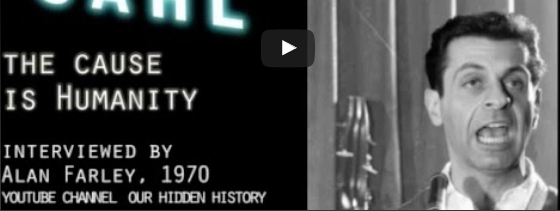
  • Mort Sahl 1970 Interview

    Mort Sahl 1970 Interview

    David Giglio is a contributor to CTKA. He publishes regularly at Our Hidden History.


    From the period of about 1960-66,  Mort Sahl was one of the highest profile, in demand, and highest compensated comedians in America. In fact, in its issue of August 15, 1960, Time Magazine placed him on its cover.  He was a regular on such programs as the “Ed Sullivan Show” and “The Tonight Show”.  Sahl, more or less, redefined what stand up comedy would be from then on.  And men like George Carlin essentially followed in his footsteps.  Sahl’s brand of humor was both socially and politically conscious.  Although he would come on stage with a college sweater and the daily newspaper, he was far from the average man.  He was quite well informed and acute, and his satire came from a deep affection for America and what it was supposed to be about.

    Sahl was one of the very few Americans who actually knew and communicated with John and Robert Kennedy.  Kennedy appreciated Sahl’s humorous deprecations of him as a spoiled rich kid.  Although JFK once had the following conversation with Sahl on the subject: “OK, so how much do you think my father is worth Mort?”  Sahl replied, “I don’t know, maybe 300 million?”  Kennedy replied, “Alright.  Now how much do you think the Rockefellers are worth?” Sahl said he had no idea.  Kennedy responded with, “Try four billion Mort.” Kennedy paused to let the number sink in. He then jabbed his finger at the comedian and added: “Now, that’s money Mort.”

    Sahl was quite interested in Kennedy’s assassination.  Something did not sit right with him about the Warren Report.  He actually read long parts of it and the volumes of evidence that accompanied it.  He thought much of it was ludicrous. He actually used to quote from it in his stand up performances.  He would read parts of its most pointless and stupid depositions in a dead pan comic style, letting the ridiculousness hit home. He would then say, “And that’s how they found out who killed John Kennedy.”

    When the Jim Garrison investigation broke into the newspapers in 1967, Sahl had a talk show on the radio in Los Angeles.  Naturally, he was quite interested in what the New Orleans DA was discovering.  He actually journeyed to the Crescent City to talk to Garrison.  He was impressed with the man and wanted to have him on his show.  But station management insisted that if he did that, he would have to perform an attack journalism/hatchet job on the DA.  Sahl said he could not do that since he thought Garrison was pretty much right on about Kennedy’s murder.  He was then taken off  the air. He went back down to New Orleans and Garrison swore him in as a deputy.  Sahl wrote about some of his experiences working for Garrison in his book Heartland.  Especially bracing is a scene he describes with Clay Shaw’s lawyers trying to introduce the Warren Commission volumes into evidence at a hearing.  The judge was absolutely beside himself with indignation that any self respecting lawyer could take such a document seriously as evidence.

    With his connections in the entertainment world, Sahl did what he could to get some positive exposure for the DA.  The high point of this effort was the interview conducted for Playboy by Eric Norden in October of 1967.  (Click here to read http://www.jfklancer.com/Garrison2.html) The low point was when Mort Sahl appeared on The Tonight Show and suggested that Johnny Carson interview Garrison on his show.  The audience response was so positive that Carson had to agree to do so on the air.  But clearly, Carson’s bosses at NBC did not want to have any kind of fair and serious debate about the issues.  What Carson did was what Sahl would not do on his show: a premeditated attack to prevent any elucidation and education of the public on the issues surrounding Kennedy’s death.  Carson had been thoroughly briefed, and NBC lawyers had interviewed Garrison in advance. The lawyers furnished Carson with cue cards as to how to question Garrison.  But still, Garrison did fairly well and Carson came off like the hatchet man he was prepped to be.  The host was very angry with Sahl for getting him into this sticky situation. Afterwards, he yelled at him: “You will never be on my show again.” (Click here for that appearance https://www.youtube.com/watch?v=EZN2FGHKzQI)

    Carson kept his word. Sahl paid a stiff price for backing Jim Garrison.  His career went into a steep decline.  He was quite literally blackballed for several years.  It was not until the Watergate scandal, which was made to order for Sahl, that he came back.  And after Carson retired, Jay Leno had Mort Sahl on his version of The Tonight Show.  So, in the long run, Sahl had come full circle.

    We present here a rare interview with Sahl about his experiences in New Orleans and his present thoughts on the JFK case.

    ~Jim DiEugenio


    Transcript

    (Click here if your browser is having trouble loading the above.)

    [iframe width=”560″ height=”315″ src=”https://www.youtube.com/embed/bimrN5NCdJk” frameborder=”0″ allowfullscreen ]
  • John McAdams and Marquette Go to Court

    John McAdams and Marquette Go to Court


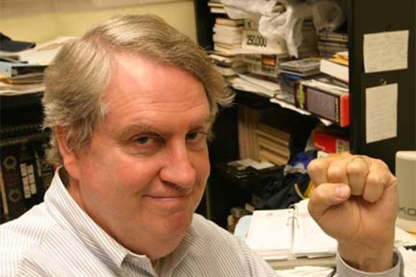
    John McAdams strikes a pose during his glory days at Marquette University

    Readers of this web site will recall that the last time we addressed the case of John McAdams vs. Cheryl Abbate and Marquette, it was early last year.  At that time, CTKA attached a link to the decision letter that the dean had made in that case.  That 17-page letter was written by Richard Holz, dean of the college of Arts and Sciences at Marquette University, McAdams’ former employer.  Dean Holz indicated two violations of the Faculty Statutes that the professor had violated as part of the explanation as to why he had made this decision.  (Click here for the letter http://d28htnjz2elwuj.cloudfront.net/wp-content/uploads/2015/02/2015-01-30-Holz-to-McAdams.pdf)

    That letter began with the statement that the university was commencing the process of revoking Professor McAdams’ tenure in order to dismiss him from the faculty.   At the end of the letter, Holz added that if the professor filed a timely objection, he would be provided with more due process, which included a faculty hearing of his peers. McAdams filed the timely objection, and he was given a faculty hearing.

    One year later, in January of 2016, that committee filed a long, over 100-page report to Michael Lovell, the president of the college. They decided to revise Dean Holz’s decision.  They felt that McAdams should not be terminated but rather suspended without pay for a period of nine months, from April to December of this year.  He would then be allowed to file for reinstatement.  Lovell called the report one of the most thorough and well written faculty committee reports he had ever read.  The main reason they gave for not moving for dismissal was that McAdams had not been formally reprimanded for his perceived offenses prior to this one.

    In a letter to McAdams dated March 24, 2016, Lovell alerted the former instructor that he was going to abide by the report’s recommendations.  Which included the judgment that McAdams be allowed to return after his suspension was served in January of 2017.  This was contingent upon three conditions.  First, that he accept the unanimous decision of the faulty committee.  That he pledges his future behavior will abide by the faculty handbook and mission statement.  And third, his expression of regret for the harm suffered by the former graduate instructor Cheryl Abbate.  Upon those conditions, and after serving out the suspension, McAdams would be allowed to resume his position. Lovell ended his letter with the clear warning that if anything like this happened again, he would move to dismiss the instructor. Because this was also the recommendation of the faculty report.

    Before getting to the reaction of McAdams and his legal representative, let us remind our readership of what happened that caused this, and who Cheryl Abbate was.  On November 9, 2014 McAdams posted on his blog Marquette Warrior information about a conversation that Abbate had with a student in her philosophy class.  According to McAdams, Abbate had limited the right to open debate in her class over the issue of homosexual marriage.  The student then left the class and said he was going to file a complaint.  Which he did. 

    There were three important issues that were distorted, ignored, or discounted by McAdams:  1.) the student lied to Abbate about taping their conversation 2.) McAdams himself was the student’s faculty advisor, and perhaps most importantly, 3.) the student was failing the class. 

    I must add one more key point that the faculty committee discovered, and to my knowledge has not been written about previously.  In their report, at the bottom of page 43, they reveal that the student “had a leadership role in the student chapter of a national organization that encourages…confronting professors in the classroom to expose liberal bias.”  The report states they did not discover this fact until after their four day hearing was concluded, and they decided not to reopen the proceedings, because there was no indication McAdams was aware of this.  The report gives no evidence as to how they made that conclusion. But I should add, the report does state that the student switched to McAdams as his advisor prior to the semester in question.  Which, to me, suggests the issue merited further inquiry. Because, in conjunction with this, McAdams told the committee that he was not aware that the student was failing the class.  Yet, he was the young man’s faculty advisor!  And further, the student told the committee that he never told McAdams that he was dropping the class for any other reason than his failing grade.  (See report p. 84)

    Marquette University dean Richard Holz

    There are two other points in this voluminous report which are made much more clear than they had been.  First, the record of McAdams’ prior attacks on students and teachers from his blog is detailed at length.  The report lists at least 12 prior incidents McAdams was involved in where he attempted to intimidate both students and teachers.  And he did so by naming names and reporting e-mail addresses.  He even went after administrators, like deans and provosts.  He actually told them that if he was reprimanded, he would do the same to them in his blog—that is name them and expose a contact email. (See report, p. 91)   And during Dean Holz’ inquiry, McAdams told Holz that he had a law firm lined up and ready to sue Marquette if they disciplined him.

    Note here, that no action had been taken against McAdams at this point in time. Yet he already had a legal firm set to defend him.  And, as the report shows, McAdams had used this tactic against others for a number of years, one that can only be described as intimidation by threat of retaliation.  This may explain why he had not been disciplined previously. If that is true, then this reveals a failing of the hierarchy at Marquette.  This author was involved in the education system for well over thirty years. After reading the record, I was surprised that McAdams had not been suspended or reprimanded previously.  This shows a real weakness on Marquette’s part.  The report mentions this, but does not fully explore the issue.  (See report, p. 100)

    A second issue that the report elucidates pertains to the defense utilized by McAdams in his appearances on television, and also by his media allies, most notably Conor Friedersdorf in the Atlantic Monthly.  That defense is most notably demonstrated by the title of Friedersdorf’s essay of February 9, 2015.  It was called “Stripping a Professor of Tenure Over a Blog Post.”

    First let us establish that, as the report shows, McAdams’ blog report of November 9, 2014 was unfair and one-sided.  But yet it included graduate student Abbate’s name, a link to her web site, and her contact information. Holding her up for ridicule and providing people direct access to her was not enough for McAdams.  For contrary to what McAdams and Friedersdorf said and wrote, McAdams then actively promoted his rendition of the story.  He distributed copies of the audio recording to bloggers and selected journalists; the recording  the student had lied about making—but had given to him.  (Which is another indication of collusion between student and advisor.) McAdams then posted several follow up stories to the original one on his blog.  He also arranged personal appearances on radio and television to promote the story to a national level.   (See p. 56 of the report.)

    What is even more fascinating about this part of the story is that two of the three journalists that McAdams provided copies of the recording to were from Fox News.  One was to Todd Starnes of the Fox national network, and the other was Krystle Kacner on the local Fox affiliate TV station. (ibid)  He also now began to e-mail out links to his original November 9th story to other bloggers and commentators.  He even relayed requests for interviews to the student!

    So, far from being a debate over academic freedom for the student, McAdams saw this as a way to make a name for himself on the national airwaves over the longstanding conservative flashpoint of “political correctness”. Like Dinesh D’Souza before him, McAdams was out to create a nationwide conflagration that went beyond the boundaries of Abbate’s classroom, or Marquette’s campus, or the readership of his blog.  And it was at this point that he began to put the mental and physical health of Abbate into jeopardy.  For now, because of the exposure of her identity and her contact information, Abbate began to get not just insulting messages, but also physical threats (click here to read them) to the point that Marquette had to provide her a security guard.   She eventually succumbed to the ordeal and transferred to the University of Colorado.  This carried a dual price.  For she now had to change her dissertation project, and she had to repeat three semesters of earned credits.

    Because of this, Dean Holz decided to suspend McAdams– with pay and benefits–as he investigated the matter. And he later offered McAdams an office on campus and library privileges. (See report, p. 64)  The authors criticized Holz for this since there was no faculty involvement with this decision.  Holz made it unilaterally.  Although the authors admit that, according to the Marquette by laws, Holz was within his rights to do so.

    As the report notes, at no time has McAdams ever expressed any remorse or regret over what happened to Abbate.  In fact, he actually explicitly told the local Fox affiliate in February just that.

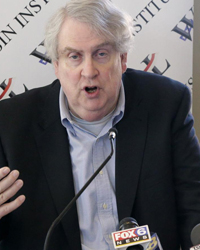
    McAdams at a press conference announcing his lawsuit against Marquette University

    And it is this aspect of the whole sorry episode that the faculty committee deemed most heinous and culpable.  They found that McAdams had used  “improperly obtained information in a way that he should have known could lead to harm, harm that could easily have been avoided.” (See report, p. 74)  As the authors continue,  “his use of a surreptitious recording, along with Ms. Abbate’s name and contact information, to hold Ms. Abbate up for public contempt on his blog, recklessly exposed her to the foreseeable harm that she suffered …”  (ibid, p. 75) This behavior is governed by an instructor’s code of conduct which states that comments should be avoided that would cause “grave doubts concerning the teacher’s fitness for his or her position”. (ibid)  As a further part of that code, instructors are to “respect the dignity of others” and “to acknowledge their right to express differing opinions.”  (ibid, p. 76)  This means that colleagues should not expect others to “search for unguarded moments with which to humiliate them.” (ibid)  The committee also concluded that the damage done to Abbate “was substantial, foreseeable easily avoidable, and not justifiable.” (ibid, p. 82)

    And the report shows that the intensity and the frequency of the attacks escalated as McAdams spread his report to other outlets especially Fox. (See report, p. 88)  The amount of emails forced Abbate to close down her email account and she requested the Philosophy Department close down her email address from the Grad Student web page.  In addition, the attack caused her rating on the site RateMyProfessors to be sabotaged. (ibid)  This caused Abbate acute mental distress, which the report notes in detail.   And, fearful for her health, she left her position at Marquette.  The report notes that not only has McAdams not shown any regret, he has actually stated that Abbate benefited by becoming a martyr. (Ibid p. 58)  The results of McAdams’ jihad are that other professors on campus are fearful they may be next.

    The report concludes that McAdams must have known what the consequences of his campaign against Abbate were, since he had done this in the past so often. He had been quick to use his Marquette Warrior blog as a bludgeon.  For instance, a student complained about McAdams’s treatment of her for promoting a production of The Vagina Monologues on campus.  She went to an administrator to formally protest this.  McAdams actually told the administrator that if she continued in her action, he would blog about her even more.  She did, and he did.  (ibid. p. 92)

    The report also notes that McAdams has stated that it was necessary to name Abbate “because the norms of journalism require such identification.”  (ibid, p. 94)  The problem with this is that it would be a good argument if McAdams were employed by Marquette as a journalist. He is not.  He is an instructor. Therefore, between the two, it’s his responsibilities as an instructor that must take precedence. (ibid)  And further, even at that, the report notes his journalistic practices are highly selective.

    The report ends with what I believe to be the so-called “elephant in the room” factor.  It states that McAdams does not seem to be bound by norms of behavior at a university, or of academia, or any other applicable body of behavioral code.    It then states, “He has instead assembled his own moral code cobbled together from various sources, to be applied as he sees fit.”  (ibid, p. 104)  It is this basic conflict that seems to make McAdams’ case incorrigible.   McAdams and his allies try to say his case was about a single blog post. Not so.  It was about a nearly 20-year pattern of behavior and a seemingly politically motivated media campaign of calumny.  (The entire report can be read here http://marquette.edu/leadership/documents/20160118-MUFHC-Final-Report-Contested-Dismissal-Dr-John-C-McAdams.pdf)

    McAdams and his legal team have refused to cooperate with the faculty committee.  Or with President Lovell.  He will make no written expression of either respecting the committee report, pledge to respect the faculty rulebook in the future, or any regrets about his behavior toward Abbate.  Instead he has decided to file a lawsuit against Marquette.  This was announced on May 2 of this year.  In other words, McAdams would rather lose his job than make any kind of expression of regret over forcing Abbate to flee the campus or placing her well being in danger.

    McAdams is being represented by a law firm called the Wisconsin Institute for Law and Liberty.  General counsel Rick Eisenberg stated that McAdams is being suspended for blogging and standing up for an undergraduate student.  And that, like in a Moscow show trial he must repent to return to his position.  (Milwaukee Journal Sentinel, May 2, 2016) 

    No surprise, this firm is backed by a million dollar grant from the Bradley Foundation.  And it is part of the State Policy Network. An attempt by the New Right to create a large, serpentine network of state and local mini- Heritage Foundations. As of 2011, there was 83 million dollars behind the effort.  It has close ties to the Koch brothers. (http://www.sourcewatch.org/index.php/State_Policy_Network)

    This, of course fits in with McAdams wider profile which the authors of the report, quite naturally, did not go into.  But others, like myself have in the past.  (“John McAdams and the Siege of Chicago, Part 2”)  Hopefully, if there is a trial, this odd and peculiar background will emerge to place McAdams in a much more complete context which will more fully explain why he did what he did in this case.  And also why he favored Fox News, and why he has this Bradley Foundation/Koch Brothers law firm at his disposal.

    ~ Jim DiEugenio


  • Warren Hinckle and the Glory that was Ramparts

    Warren Hinckle and the Glory that was Ramparts


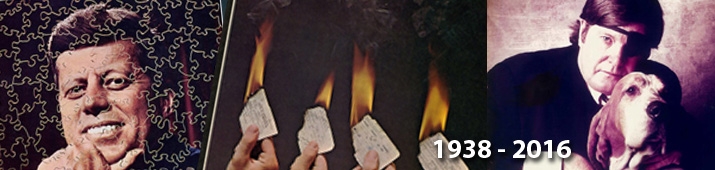
    Warren Hinckle passed away on August 25th,  at age 77. Hundreds at the Saints Peter and Paul Church in North Beach, San Francisco, attended his funeral service. He was buried on Tuesday the 30th. Some of the luminaries who attended his funeral were historian Kevin Starr, the founder of Salon David Talbot, and former San Francisco Mayor Willie Brown.

    CTKA carried a notice upon his passing, one from the online version of the Chronicle, the paper he used to write for. Among several others, there were notices in the New York Times, The Nation, and the online magazine Politico. This author read most of them. Not one even came close to recalling or measuring the journalistic brilliance of the man, or the eternal glory of his most significant creation, the last great American magazine, Ramparts.  Considering the standard set by that glossy monthly periodical, I understand the reluctance to remind us of Hinckle’s achievement.

    For those too young to recall it, Ramparts is hard to describe.  For the simple reason that there is nothing today that even resembles it. Which says a lot. Because today we live in the era of online publication; which means journals are much cheaper to produce and maintain, and therefore there is much more freedom  to create. The fact that, to this day, no one has equaled Hinckle’s 1964-69 editorial achievement at Ramparts is what makes what he did the stuff of legend.  After all, it was nearly half a century ago.

    Edward Keating

    Before trying to detail the pure excitement that Ramparts represented,  it is necessary to tell the reader a bit about Hinckle’s background. He was born in San Francisco in 1938.  His father was a shipyard worker.  He attended parochial schools before studying philosophy at the University of San Francisco. There he edited the student newspaper, The Foghorn. Under his editorship it became quite an unusual student newspaper. For instance, it was one of only 14 college newspapers classified as a daily. As editor of a daily, Hinckle went to Squaw Valley in Lake Tahoe for two weeks to cover the 1960 Winter Olympics.  From Tahoe, he ran The Foghorn via telephone and telegraph. As he later noted, its readers read little about their college in the college newspaper. For Hinckle featured Herblock cartoons, and headlines like “Dorothy Day Asks: Who Baptized Capitalism?”  (USF was a Jesuit college) He once stole the entire press run of the rival San Francisco State newspaper.  Needless to say, because of disputes with the college administration, he left USF without graduating.

    From there he took a job at the San Francisco Chronicle.  His first outpost was in Oakland, which Hinckle called the Siberia of the Chronicle stations.  Working the police beat, he discovered an unwritten rule about the paper’s Oakland coverage.  The coverage of a homicide  largely depended upon where the victim lived.  To quote from his memoir: “Ghetto murders, being regarded as natural black events, were rarely considered newsworthy.  White trash murders stood a poor to even chance of getting in the paper…..”   There was also a rule of thumb similar to this in the area of fatal car accidents: “No niggers after 11 PM on weekdays, 9 PM on Saturdays (as the Sunday paper went to press early).”  To this rule there was one exception, in the area of quantity: “If two black persons died in a late evening auto crash, that event had a fair chance of making the news columns.” (Hinckle,, If You Have a Lemon, Make Lemonade,  pgs. 31-. 32)

    Eventually, he made it back to San Francisco, where he was given a bit of leeway.  One of his favorite stories was about a former slave from Alabama who emigrated to California.  He got rich in the pinball machine business and  legally adopted the children of his former master.  Then, in the fall of 1961, Hinckle took a temporary leave of absence to help invigorate an ambitious and intellectual Catholic quarterly.

    Hinckle had been moonlighting in the public relations business.  A friend of his, Harry Stiehl, decided to introduce him to a man named Ed Keating.  Keating was a converted Catholic who wanted to start a quarterly periodical that was meant to begin a dialogue between laity and the clergy of the Catholic Church.  He also wanted to begin to spawn a new generation of Catholic intellectuals who had a gift for writing and communicating.  With his PR connections, Stiehl thought Hinckle could help promote Keating’s new journal. It was called Ramparts.

    Howard Gossage

    Keating had a wealthy wife and some famous contributors, like the Trappist monk Thomas Merton and John Griffin, who wrote the bestseller Black Like Me.  In 1964, Keating tried to raise his journal’s profile by defending the highly controversial play The Deputy which had just opened on Broadway. Hinckle arranged a huge press conference in Keating’s suite at the Waldorf Astoria hotel.  Keating and his magazine got exposure;  the play opened successfully and ran for a year.  As Hinckle wrote in his book, this episode became the model for what he later termed activist journalism.

    It also increased the circulation of the magazine.  Keating liked that and he appreciated what Hinckle had done.  So Hinckle did it again. But this time he channeled all the PR into an issue that very much interested him—the murders of three civil rights workers in  Neshoba County, Mississippi in June of 1964. Hinckle promoted a man named Louis Lomax as the Ramparts author of this sensational article.  Lomax did not come through. But like the British at Dunkirk,  Hinckle turned an expected disaster into a triumph by promising the details of the Lomax piece in a future issue.  (Although Hinckle does not deal with this episode in his book, Peter Richardson does in his chronicle of the magazine, A Bomb in Every Issue.)

    There were two factors that allowed Hinckle to gain control of the magazine from Keating.  First, because of the success Hinckle had in promoting Ramparts, Keating made him executive editor.  Second, Keating was becoming financially overextended.  Or as he told Hinckle, “I do have one shopping center left.”  (Hinckle, p. 95)  Therefore Hinckle now had to find alternative sources of funding himself.  Which he did.  Thus began Hinckle’s five year reign.  He was greatly aided by the PR skills and connections of one Howard Gossage.  Gossage was an advertising executive in the Bay Area who was generally described as an innovator and iconoclast in the field.  At age 36, he founded his own agency called Wiener and Gossage.   He would often have salons at his office headquarters, inviting many of the cutting edge thinkers in the San Francisco area, including Hinckle.  (Click here for more on Gossage http://www.howardluckgossage.com/)  

    To describe in detail the contents of what Hinckle produced in those five years would take a medium sized book. And I don’t mean the machinations that went on at the magazine headquarters, or just naming some of the big stories Ramparts produced.  But to detail the contents of what the magazine exposed about America, who Hinckle decided to take on, the methods he employed and the price he was willing to pay, all these—and more—were, to my knowledge, unprecedented before him, and unmatched afterwards. Ramparts was so effective and influential that it became a regular target of the MSM, especially Time magazine and the New York Times, which obviously did not like being exposed as the poseurs they were. Beyond that, the CIA launched operations against Ramparts.  These were commissioned by Desmond Fitzgerald, supervised by Richard Ober, and executed by Edgar Applewhite. As detailed in his book Secrets, the late Angus McKenzie showed how this program grew into MHCHAOS, the massive CIA spying on and infiltration of leftist protest groups in that decade.

    Madame Nhu as depicted on cover of Ramparts

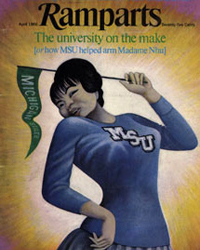
    What got the CIA so angry?  For starters, Ramparts exposed a program the Agency was running out of Michigan State University. (Click here http://la.utexas.edu/users/hcleaver/357L/357LMSUinVietnam.pdf) It taught CIA interns how to train interrogators in South Vietnam to torture dissidents in Saigon. This created an uproar. Not just for the story, but also because of the hilariously outrageous Ramparts cover, which featured the immortal image of Madame Nhu in an MSU  cheerleaders’ outfit waving an MSU flag.  The image suggesting the Vietnam War was now controlling the agenda of American colleges. (Click here for a time capsule reaction http://msupaper.org/issues/The_Paper_1966-04-21.pdf)

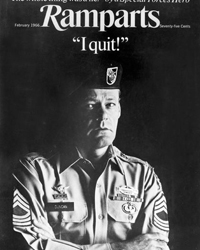
    Then there was Donald Duncan.  Duncan was a Special Forces Sergeant who served in Vietnam and taught at Fort Bragg, North Carolina.  He resigned his commission and returned to Berkeley, California. There, in February of 1966, Duncan graced another memorable Ramparts cover. He was pictured in a long sleeved uniform, topped with a Green Beret cap. Above him were the words, “I quit”. Above that was the quote: “The whole thing was a lie.”  In this emblematic story, Duncan described his ten years in the military, capped by a nearly two year tour in Vietnam.  He said he went to Vietnam to fight communism.  But what he learned there about the American effort forced him to retire from the service forever.  Duncan first focused on the fact that there really was no government of South Vietnam—it was simply constructed and propped up by the USA.  And it was in no way a democracy. Secondly, he wrote that the Ho Chi Minh Trail was wildly overrated as a source of supplies for the Viet Cong. Most of the material came over the border or from the sea. Thirdly, he said that the US military was involved in atrocities that violated the rules of warfare, and this extended to the civilian population.  Duncan was really the first former GI to open up the path for Mark Lane’s book Conversations with Americans, the Winter Soldier Hearings, and the exposure of the My Lai Massacre.  (http://vietnamfulldisclosure.org/wp-content/uploads/2015/04/1966-02-Donald-W.-Duncan-The-Whole-Thing-Was-A-Lie-Ramparts.pdf)

    In the March 1967 issue Hinckle exposed another instance of the CIA operating domestically. Ramparts now revealed that the Agency was secretly funding the National Students Association.  (http://www.unz.org/Pub/Ramparts-1967mar-00029) In other words the largest college student association in America–featuring a large annual convention picturing a celebration of youthful democracy–was secretly funded, infiltrated and channeled by the Agency. Many of the top officers knew about it and were briefed on that association.  Further, several of them had case officers, code names, and reporting requirements.  Incredibly, some of their overseas representatives were actually career CIA agents from Langley.  The aim of the program was multi-leveled.  First, the Agency would moderate any radical or leftist tendencies in the largest student organization in the world. Second, they would use the overseas voyages of the students to collect information and try and moderate any radical leaders abroad. And third, the propaganda  goal was to portray  our young representatives as independent citizens, while many of the people they met abroad were communist stooges programmed from Moscow. (Hinckle, p. 185)

    Eldridge Cleaver

    NSA officer Michael Wood had a pang of conscience about it and was talking to Hinckle. Unlike other top officers, Wood had not signed a non-disclosure agreement.  Further, Wood had records, not just about the NSA, but other related fronts that the CIA had established.  For example, Stephen Spender’s Anglo-American journal Encounter. Wood also showed how the CIA very often used large legal firms in big cities to channel their clandestine funding.  Usually these firms had a former OSS officer as a founding member.  (One is reminded here of the firm Monroe and Leeman in New Orleans, which helped fund Walter Sheridan’s hit piece on Jim Garrison.  See Destiny Betrayed, Second Edition by James DiEugenio, p. 238)

    MHCHAOS operations officer Richard Ober heard about Wood’s talks with Hinckle.  He tried to find a way to stop publication.  But he couldn’t find a legal pretext.  So he then arranged a press conference in New York.  At this conference the officers would pretend that this was all a thing of the past, and they were now reformed. Therefore, the Ramparts story was old hat.  Hinkle got wind of this plan.  He memorably said, “ I was damned if I was going to let the CIA scoop me.”  (Hinckle, p.  190) Ramparts then bought two full page ads in the New York Times and Washington Post to expose the illegal association (the CIA is forbidden by its charter to operate domestically) and what the Agency had done to cover it up.  When word of the ads leaked, Ober’s press conference collapsed. 

    The New York Times now started a couple of weeks of reporting on other CIA fronts here and abroad that was influencing cultural affairs. This was one of the many triumphs of Ramparts. In many ways, at many times, it  actually led the news cycle.  By repeatedly scooping the MSM, it became a model of what they were not doing. At the same time that—out of pure humiliation—the magazine became an object of attack. Ramparts did what the MSM was supposed to be doing but did not—actual investigative reporting.  It was showing what the real world around the reader was composed of and what it was all about. But the fact that it was camouflaged made it hard for the average person to detect. So Ramparts did it for them.  Which is why as Jeff Cohen, a student at Michigan, told Peter Richardson, Ramparts was passed around the dorm there to the point it was wrinkled and dog eared by the time he got it. “It really was a radicalizing tool of its own.  It ripped your head off. “ He added that it had turned his cousin’s fraternity into an SDS chapter.

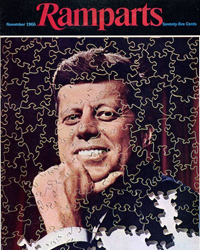
    Ramparts cover November 1966

    At its pinnacle, Ramparts had a circulation of about 250,000.  One can imagine how the CIA felt when Hinckle started featuring stories about the conspiracy to murder John F. Kennedy, and then putting such things on the cover. For this topic, there was another cover for the ages.  The November 1966 issue featured the face of JFK made up like a jigsaw puzzle, with several pieces missing.  That was followed  two months later by “The Case for Three Assassins” written by David Welsh and David Lifton. (Click here to view).

    The Welsh/Lifton article began with the following words: “No less than three gunmen fired on the Presidential motorcade in Dallas on November 22, 1963…” It was a long, illustrated, annotated examination of the ballistics, medical, and eyewitness testimony. It all indicated a triangulation of gunfire in Dealey Plaza.  To my knowledge, it was the first time such an intricate discussion reached a mass audience. That issue was then followed by two long pieces on the Jim Garrison investigation in New Orleans. (Click here for the first one).

    These were  both penned by former FBI agent William Turner, who was actually working with Garrison. Therefore, Turner had access to the DA and some of his files.  Ramparts  was one of the very few media outlets that actually treated Garrison and his evidence with respect. Until Jim Garrison published On the Trail of the Assassins, Turner’s articles were–along with Paris Flammonde’s book, The Kennedy Conspiracy—prime reference works for anyone interested in the non-MSM view of Garrison.

    Hinckle met resistance inside his office on this issue.  Reporters like Bob Scheer did not want to cover the assassinations of the sixties at all.  As he once told Turner, such writing amounted to “mental masturbation”.  Hinckle disagreed.  For the simple reason that he had read the official report and most of the accompanying volumes of evidence.  He concluded the Warren Report was impossible to believe:  “Anyone who has read those 26 volumes…knows that the function of the Warren Commission was not to ferret out the truth, but to put the citizens at ease that there was no conspiracy.” (Hinckle, p. 217)  About Jim Garrison, Hinckle wrote, “… no man I have known had more legitimate reasons to become paranoid than Garrison; there actually were people constantly plotting against him.”  (Hinckle, p, 209) With the declassified files of the Assassination Records Review Board, we know that to be, not just true, but an understatement.  (See Destiny Betrayed, Second Edition, Chapters 11 and 12)

    The Ramparts “I Quit” cover

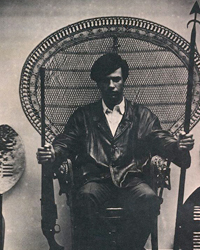
    To chronicle the endless triumphs of Hinckle’s editorship could go on and on, taking scores of pages. But to mention just two other exceptional aspects of Hinckle’s stewardship: Ramparts was the first and only widely read publication to champion the Black Panthers.  And again, there was an iconic cover design by art director Durgald Stermer to signify it:  Huey Newton in a wicker chair with a spear in one hand and a loaded carbine in the other.  Eldridge Cleaver actually became a contributing editor, and Ramparts released his book Soul on Ice through its publishing imprint.

    There was also a photo essay “The Children of Vietnam” put together by William Pepper.  (http://www.unz.org/Pub/Ramparts-1967jan-00045) That 1967 visual article showed just how extensive, indiscriminate and destructive the massive  American firepower unleashed in Indochina was. It was laying waste to the civilian population, including tens of thousands of women and children. Martin Luther King picked that issue up off a newsstand before taking a working vacation in Jamaica.  When he returned he began making his first speeches against President Johnson and his conduct of the war.  Again, Ramparts was leading the news cycle.

    The power and the glory all came to an end in early 1969.  For three reasons.  First, if Ramparts had one failing it was Hinckle’s lack of interest in the arts and the so called counter culture in San Francisco. For instance, there was no Dwight MacDonald or Robert Christgau at Ramparts to review movies or music. And many people wanted to read both.  Therefore, young Jann Wenner left Ramparts to start up something called Rolling Stone.  Which then became a competitor.  There was also an internal coup against Hinckle by new staff members who were tired of his profligate spending.  For instance, he had sent a team of 15 correspondents to cover the Chicago Democratic Convention in 1968.  And he had put up ten of them at the four star Ambassador Hotel.  Finally, when Hinckle found someone who was interested in bailing him out, Scheer got into a stupid and senseless argument with the man and his entourage.  (Hinckle, pgs. 371-78)  Hinckle was now out. The magazine declared bankruptcy and reorganized around new leadership.

    The new principals were Robert Scheer and David Horowitz.  This, of course, meant that Hinckle’s daring, “nothing sacred” approach would be abandoned.  Because those two men represented a much more doctrinaire, New Left approach. Therefore instead of writers like William Turner and Bill Pepper, we now got people who really were not all that unusual  or new e.g. Alexander Cockburn, Noam Chomsky, Sy Hersh, Jonathan Kozol. The subjects now also became those of the doctrinaire left: Earth Day and the environment, food safety, oil spills in Santa Barbara, and the plight of Native Americans. Without Hinckle, Ramparts had lost its singular, contemporary jazz riff.

    Huey Newton as he appeared in Ramparts

    Later, Scheer was moved out by Horowitz and replaced by a new second in command: Peter Collier.  The irony being that it was Scheer who brought both men to Ramparts in the first place.  But, predictably, the magazine now began to lose its  large circulation.  Seeing the writing on the wall, Horowitz and Collier decided to transition their way out.  In 1973 they met with Abby and Marion Rockefeller, part of the Rockefeller clan who were outsiders because of their contrary political beliefs—which is why they backed Ramparts.  The two men now contracted to do a history of the clan.  They got a sizeable advance, and then signed on a new management team for Ramparts.  Their book, The Rockefellers: An American Dynasty,  sold quite well.  It was published in 1976, the year after Ramparts went under for good.

    Ramparts was so unusual, so blindingly meteoric, so politically potent, that, when it fell, it actually dropped the seeds of its own reaction.  By 1975, the Sixties were pretty much killed off.  And Ramparts, in its new form, did not do a lot to preserve it.  Richard Nixon was now president, with the likes of Spiro Agnew as his VP.

    Men like Pat Buchanan and William Safire were writing his speeches.  And from 1969-75, Henry Kissinger was doing the final reversals of whatever was left of John Kennedy’s reformist foreign policy, specifically in Africa, the Middle East and the continuation and expansion of the Indochina war.

    It was within this new political milieu that men like Horowitz, Collier, Sol Stern and Martin Peretz began their  migration to what would become the New Right, neoconservative movement.  Financial backer Peretz did not like the evenhanded approach Scheer wanted to take in the Middle East.  So he pulled out of Ramparts.  He now purchased the liberal New Republic from Gilbert Harrison.  In a remarkably short time period, Peretz pretty much reversed the trajectory of that journal’s foreign policy pages. By about the mid-eighties, many were calling the New Republic a neoconservative bastion.  Which, for all intents and purposes, it was; most notably on the Middle East and Central America.

    Sol Stern, who actually wrote the Ramparts article on the NSA scandal, eventually found a home at the Manhattan Institute.  This is a New Right think tank that was actually co-founded by the deceased CIA chief Bill Casey. Manhattan Institute has sponsored books by Charles Murray, who was actually a fellow there when he wrote his anti-welfare polemic  Losing Ground.  Stern’s specialty today is to promote voucher system education, which would almost surely undermine the public school system.

    Peter Collier

    After their tome on the Rockefellers, Horowitz and Collier then wrote books on other wealthy families:  the Kennedys, the Fords, and the Roosevelts.  Their book on the Kennedys is so bad that this author included it in his review of the anti-Kennedy literature in the essay “The Posthumous Assassination of JFK.” Predictably, that book provided the occasion for the pair to proclaim their conversion to Reagan Republicanism.  This was announced in the Washington Post under the banner “Lefties for Reagan”.  (The Assassinations, edited by James DiEugenio and Lisa Pease, p. 357).  They then went on and became beneficiaries of the largesse of the wealthy conservative class.  They founded organizations like Encounter Books, FrontPageMagazine.com, the David Horowitz Freedom center, and Discover the Networks. All of these are meant to undermine the things that Ramparts represented: the liberal ideals of an open and more egalitarian society.  And with the collapse of the Sixties, and the killing off of its leaders—JFK, Malcolm X, RFK and King, plus the FBI sponsored extermination of the Panthers—that was not really difficult to do.

    Hinckle never did anything of the kind.  He tried to start up another monthly magazine called Scanlan’s Monthly.  But I have it on two sources that the Nixon administration used the IRS and the USPS to obstruct its  distribution and circulation. Consequently it closed down in less than a year.  He next edited Francis Coppola’s City magazine, which lasted until 1976.  He then did something that no one thought possible: he revived The Argonaut, which had closed down in 1956.  He did this in 1991, and that publication is still around in both print and online versions.

    Besides that, he ran unsuccessfully for mayor of San Francisco in 1987.  He also wrote about ten non-fiction books.  There are two that are mandatory reading for anyone interested in the Sixties and the assassinations. In 1974, on the eve of the final dissolution of Ramparts, Hinckle wrote a memoir about his editorship of that magazine.  It was called If You Have a Lemon, Make Lemonade.  To me, there is nothing at all like it in the literature.  It is, at once, funny, pungent, candid, and nostalgic without being sentimental. A definite must read. Then, in 1981, he co-wrote, with Bill Turner, The Fish is Red.  That book was later reissued as Deadly Secrets in 1992.  Up until that time, and until this day, it is one of the best JFK assassination books written from the point of view of the Cuban exiles’ association with the CIA.

    In the late nineties, this author considered reviving Ramparts. I won’t go extensively into why I decided against it. But one of the reasons I didn’t was because I thought that, with the surge of online journalism, surely someone, maybe more than one, would now use the opportunity to emulate Ramparts, or Art Kunkin’s LA Free Press.  The latter was an extraordinary newsweekly that complemented Ramparts. Together, they formed the last pinnacle of American journalism.  To say the least, those online expectations were not fulfilled by the likes of Jane Hamsher, Markos Moulitsas, and Josh Marshall.  In fact, this so called internet revolution was so stillborn that it made Ramparts and the LA Free Press look like even greater achievements.  (See here for my particular disputes)  In fact, that online result recalls Hinckle’s answer as to why Ramparts was so exceptional, he replied, “Because the rest of the media was so shitty.”  I would add: But it took Ramparts to show us how shitty they were.

    Today, to do anything like what Ramparts did, a single publishing journal would have to been the first to:

    1. Shown in detail how George W. Bush stole the 2000 and 2004 elections in Florida and Ohio
    2. Demonstrated how the FBI and CIA left us unprotected on 9-11
    3. Revealed the secrets of NSA illegal spying
    4. Exposed Colin Powell’s phony UN speech justifying the war with Iraq
    5. Visited Iraq with a camera crew to show us the terrible civilian toll Bush’s phony war took on the populace.

    And they  would have to have achieved the above in just five years, from about 2001-2005 I think the reader will agree that any such comparison suggests science fiction today.  But Hinckle did it.

    Therefore, Ramparts stands alone in the history of contemporary American journalism; much as Citizen Kane towers in the history of  the American sound film.  It is often written that, in that picture, Orson Welles took the art of  film direction to a point that no other American has since matched or surpassed. With the death of Warren Hinckle we can say  that no other American has produced or edited a magazine, or online journal, that has matched or surpassed what he did at Ramparts.  And, from my point of view, it looks like no one else will do so for a long time.  For that, among other things, he deserves to be properly saluted upon his passing.  He set a standard for us all by reminding us what real journalism can and should be.

    ~ Jim DiEugenio

  • NOVA’s Cold Case: JFK – the Junk Science Behind PBS’s Recent Foray into the Crime of the Century

    NOVA’s Cold Case: JFK – the Junk Science Behind PBS’s Recent Foray into the Crime of the Century


    By Gary Aguilar and Cyril Wecht


    On August 7, 2013 The Los Angeles Times offered a preview of an upcoming, PBS NOVA program on the Kennedy assassination for which the David Koch Fund for Science provided major financial support.[i][ii] “Sorry, conspiracy theorists, modern forensic science shows that John F. Kennedy was likely killed by ‘one guy with a grudge and a gun,’” it reported, quoting one of the participants, John McAdams, during a panel discussion by those featured in Nova’s “Cold Case: JFK.”[iii] Sure enough, the broadcast offered seemingly impressive scientific support for the Warren Commission’s conclusion that Lee Harvey Oswald, alone, had done it. NOVA’s ballyhooed evidence came principally from three ballistics experts – the father and son team Messrs. Lucien and Michael Haag, and from Mr. Larry Sturdivan, all longstanding, ardent anti-conspiracists. CBS was so impressed that it featured Lucien and Michael Haag in on-air interviews.[iv] But because it was presented solely in video format (still available on-line[v]) students of the case were hard pressed to assess the quality of the scholarship. Things have changed.

    Apparently seeking to disseminate his findings among his professional colleagues (and to take pot shots at a fellow anti-conspiracist, Max Holland[vi]), Luke Haag got his material published in the “peer reviewed” AFTE Journal, the official outlet of The Association of Firearm and Toolmark Examiners, an organization he was once president of. If Luke Haag had expected his AFTE articles would be a kind of post NOVA victory lap, thanks to the courage and integrity of the journal’s editor, Mr. Cole Goater, his hopes have been rudely dashed.

    The editor gamely published two lengthy rebuttals Cyril Wecht, MD, JD and I wrote, 26 pages in all. In their wake, it’s likely Luke Haag rues the day he ever let his junk science see the light of day. For in answer to my request to republish his AFTE material verbatim, he emailed me, “I do not grant permission for you or Cyril Wecht to reproduce or republish any of my articles from the AFTE Journal … .”[vii] Haag clearly grasps he has a lot to hide. (Although he may have succeeded in preventing us from posting his material on-line, readers can access all of them behind a paywall at the AFTE Journal, and can download for free the first one that is as of this writing available on-line.[viii])

    We first heard of Haag’s material when a friend sent me (Aguilar) a copy of one of Haag’s articles in early 2015. A longstanding Warren skeptic, I could barely restrain my amusement and glee as I read it. My colleague and coauthor, Cyril Wecht, MD, JD had a similar reaction. The rest of the articles and letters proved to be no less entertaining, not least because most of the claims the Haags and Sturdivan made had long since been widely debunked and discredited. But perhaps what struck us most about this bounty of balderdash is not only how junk science continues to snooker the mainstream media, a phenomenon that’s been oft repeated since the release of the Warren Report,[ix] but also how this cornucopia of codswollop will warm the hearts of both Warren Commission loyalists and skeptics alike.

    Encomiums for the articles from the pro-Warren side came quickly. Dale Myers, a Haag fan and an indefatigable defender of the lone gunman scenario, crowed, “The AFTE Journal published … outstanding articles detailing Luke and Michael Haag’s investigation into the forensic aspects of the JFK murder … (that) are sobering, instructive, and a must read for anyone interested in the science behind bullet ballistics and in particular, the JFK case.”[x] (Lucien Haag and Myers are mutual admirers; in his first (of five) articles, Haag touts Myers’ pro-Warren animation work.[xi]) Not only will Warren loyalists appreciate having much of what was shown on TV available in on-line and print format, they’re certain also to welcome some riveting new fairytales that weren’t on TV.

    Especially striking among them is the fable that author Wecht, a celebrated forensic pathologist and a perennial Warren skeptic, had actually endorsed the official autopsy report in no less than the “peer-reviewed” Journal of Forensic Sciences. Another is Mr. Haag’s claim that Dr. Wecht had dismissed the Commission’s controversial “Single Bullet Theory” (SBT: the idea that one bullet caused all seven nonfatal wounds in both the President and Governor Connally) because, fabricated Haag, the forensic expert had publicly declared that “one bullet cannot go through two people.” But there’s so much more.

    To buck up the controversial SBT, Lucien Haag “proved” that the bullet that struck Governor Connally had passed through JFK first. His evidence? Haag said that the missile didn’t leave a small, puncture-type wound in the Governor’s back, like a typical entrance wound. Instead, it left an oval, 3-cm long, “yawed” entry wound, the full length of Commission Exhibit, #399, the so-called “magic bullet.” The ovality of that back wound was forensic proof, Haag asserted, that the bullet had been destabilized by passing through JFK and was traveling sideways, not point forward, when it hit Connally’s back. As we pointed out, this particular myth has long been debunked.[xii] Connally’s back wound was no more oval than JFK’s skull wound, and no one has ever argued JFK’s fatal missile had been destabilized and was yawing when it took the President’s life.

    Further, Mr. Haag and Mr. Sturdivan dredged up Dr. Vincent P. Guinn’s sunken Neutron Activation Analysis (NAA) ship, work that was once said to prove that all the recovered bullets and fragments came from Oswald’s rifle.[xiii] To the editor’s great credit, he allowed Dr. Wecht and I to point out in the letters pages the well-known fact that Guinn’s NAA metallurgy work had been repeatedly discredited in the “peer reviewed” scientific literature by authorities vastly better credentialed than those Haag cited. Among others, they include two Berkeley Lawrence Livermore Lab NAA metallurgy experts. In an emotional, splenetic riposte, the uncredentialed Sturdivan dismissed the credentialed scientists as mere “purported metallurgists” not real metallurgists, and that their anti-NAA work was nothing but an attempt “to trash the late Dr. Guinn’s reputation.”[xiv] In our response we pointed out what Sturdivan conveniently omitted: one of the metallurgists who he smeared, Pat Grant, Ph.D, studied under Vincent Guinn and is a credentialed NAA examiner who worked on NAA under Guinn at UC Irvine during graduate school.[xv]

    Haag offered additional baloney to buttress the lone gunman scenario, including claims that:

    • Duplication experiments in which human skulls were shot from above and behind with Oswald’s ammunition damaged the blasted skulls in a manner very like the damage JFK sustained. As has long been known,[xvi] and as we point out, they did no such thing. If anything, the test skulls prove that JFK was not shot in the manner the Warren Commission had alleged.
    • Haag said that JFK’s “back to the left” lunge after being struck in the head from behind had been validated scientifically as due to either, or both, a “jet effect,” as Nobel Laureate Luis Alvarez had demonstrated in test firings published in in 1976 in the American Journal of Physics (AJP), or to JFK’s neuromuscular reaction to the head injuries, as explicated by the inexpert and uncredentialed Mr. Larry Sturdivan. Neither explanation holds water.
    • Josiah Thompson, Ph.D. recently got the photo file of Alvarez’s shooting tests from a former Berkeley grad student who had participated in the tests, Paul Hoch, Ph.D. When he reviewed the images, Thompson discovered, as we describe, that the Nobel Laureate had misrepresented his own results: virtually all the objects he fired at flew away from the shooter, not toward him, except for the ones he reported in the AJP. Alvarez not only neglected to mention his inconvenient results, in the AJP he clearly implied there were none. (Paul Hoch never told anyone about his former professor’s contradictory results, despite having been asked about the tests for decades.)
    • Sturdivan’s claim JFK was rocked backward due to what Sturdivan has variously called a “decerebrate” or a “decorticate” neuromuscular” reaction is nonsense. As we lay out, from our own professional experiences as physicians and as described in the medical literature, JFK’s motions are neither; they’re best explained (as are the skull X-ray findings) as consequence of the impact of a shot from the right front.

    This is but a small sampling of the silliness that will send the spirits of both sides of the debate soaring. Neither Dr. Wecht nor I can think of a greater, single repository of nonsense, outright fabrications and junk science than what the Haags and Sturdivan have published in the AFTE journal. And but for the honesty and integrity of the editor, myriad JFK myths and falsehoods would embarrassingly have stood uncontested and uncorrected in the journal. To his everlasting credit, and AFTE’s benefit, Mr. Goater not only published an 8-page riposte Dr. Wecht and I wrote in the Summer 2015 issue in response to Haag’s first three articles, available here on-line, in the Spring 2016 issue he also published our 18-page rejoinder to the fact-challenged, choleric letters Haag and Sturdivan had put in the Journal. Included in our second riposte is the essay, “The Science Behind the Persistence of Skepticism in the Kennedy Case,” supported with over 100 citations to official and professional sources, most available on-line by clicking the provided links.[xvii]

    In Haag’s defense, it must be admitted that his forensic-ballistics work was not entirely useless. He demonstrated what had previously been demonstrated and not disputed:[xviii] that one bullet can go through two men and that penetrating bullets can cause heads to explode.[xix] If he had limited his remarks to these obvious, previously established conclusions Warren skeptics and serious students of the murder would have no quarrel. But instead, no doubt through an honest ignorance of the data, and a misguided loyalty to his collaborator, Larry Sturdivan, who’s book he cites, Haag elected to repeat long-debunked, pro-Warren Commission fairy tales. One suspects his work won’t disturb the principals of the David H. Koch Fund for Science, but Haag must hold his fellow AFTE members in low regard to believe he’d get away with publishing such rubbish in their journal.

    Haag’s cowardly refusal to permit our republishing his JFK material says it all. It can best be explained by his justified fear that a wider, informed public might see the shoddiness of his research and how poorly he grasps long established, fundamental facts in the Kennedy case. Although he demands his words be kept hidden behind AFTE’s paywall, his confections, falsehoods and severe limitations are clearly visible here on-line, in the two letters Dr. Wecht and I published in the AFTE Journal. For we did what mountebanks most fear: we quoted him accurately and in context.


    Aguilar & Wecht — Letter to the Editor: AFTE Volume 47 Number 3 — Summer 2015

    (Click here if your browser is having trouble loading the above.)


    Aguilar & Wecht — Letter to the Editor: AFTE Volume 48 Number 2 — Spring 2016

    (Click here if your browser is having trouble loading the above.)


    Footnotes:

    [i] “Major funding for NOVA is provided by the David H. Koch Fund for Science … .” http://www.pbs.org/wgbh/nova/tech/cold-case-jfk.html

    [ii] http://mediamatters.org/research/2014/08/27/myths-and-facts-about-the-koch-brothers/200570

    [iii] Gelt, Jessica, Television Critics Association Press Tour: PBS’ ‘Cold Case: JFK’ opposes conspiracy theories. Los Angeles Times, August 07, 2013 http://articles.latimes.com/print/2013/aug/07/entertainment/la-et-st-pbs-cold-case-jfk-conspiracy-theorists-20130807

    [iv] http://www.cbsnews.com/news/jfk-single-bullet-theory-probed-using-latest-forensics-tech/

    [v] https://www.youtube.com/watch?v=NzPCca1Deto

    [vi] See: Haag, L C. The Missing Bullet in the JFK Assassination. AFTE Journal, vol.47(2), Spring 2015, p. 70-74. See also, Dale Myers, “The Shot that Missed JFK: a New Forensic Study.” http://jfkfiles.blogspot.com/2015/05/the-shot-that-missed-jfk-new-forensic.html

    [vii] Personal email from Lucien Haag, June 10, 2016.

    [viii] N.E.D.I.A.I Journal, Vol.3 of 3, p. 6 ff. http://www.nediai.org/pdf_files/3of3-2014.pdf

    See also “Response from Lucien C. Haag. AFTE Journal — Volume 48 Number 2 — Spring 2016, p. 86-91.

    [ix] See Robert Hennelly and Jerry Policoff, “JFK: HOW THE MEDIA ASSASSINATED THE REAL STORY,” on-line at: http://www.assassinationresearch.com/v1n2/mediaassassination.html

    See also Russ Baker, Milicent Cranor, THE MYSTERY OF THE CONSTANT FLOW OF JFK DISINFORMATION, on-line at: http://whowhatwhy.org/2015/11/24/the-mystery-of-the-constant-flow-of-jfk-disinformation/

    [x] Dale Myers, “The Shot That Missed JFK: A New Forensic Study.”, 5.5.15, online at:

    http://jfkfiles.blogspot.com/2015/05/the-shot-that-missed-jfk-new-forensic.html

    In 2004 Myers received an Emmy Award[1] from the National Academy of Television Arts and Sciences for his computer animated recreation of the Kennedy assassination featured in ABC News’ 40th anniversary television special, Peter Jennings Reporting: The Kennedy Assassination — Beyond Conspiracy (2003). https://en.wikipedia.org/wiki/Dale_K._Myers

    [xi] Haag, Lucien C., Tracking the ‘Magic’ Bullet in the JFK Assassination. AFTE Journal, Vol. 46(2), Spring 2014, p. 110. Available on-line at: http://www.nediai.org/pdf_files/3of3-2014.pdf (see p. 15)

    [xii] See Milicent Cranor, “Trajectory of a Lie,” on-line at: http://www.history-matters.com/essays/jfkmed/BigLieSmallWound/BigLieSmallWound.htm

    [xiii] Haag, Lucien C., Tracking the ‘Magic’ Bullet in the JFK Assassination. AFTE Journal, Vol. 46(2), Spring 2014, p. 110. Available on-line at: http://www.nediai.org/pdf_files/3of3-2014.pdf (see p. 8-9)

    [xiv] Sturdivan, L. “Response from Larry Sturdivan” AFTE Journal — Volume 47 Number 3 — Summer 2015 143

    [xv] See essay by Lawrence Livermore Lab‘s Pat Grant, Ph.D., on-line at http://www.maryferrell.org/pages/Essay_-_Commentary_on_Dr_Ken_Rahns_Work_on_the_JFK_Assassination_Investigation.html

    [xvi] See Aguilar G, Cunningham K, HOW FIVE INVESTIGATIONS INTO JFK’S MEDICAL/AUTOPSY EVIDENCE GOT IT WRONG. On-line at: http://www.history-matters.com/essays/jfkmed/How5Investigations/How5InvestigationsGotItWrong_1b.htm

    [xvii] Aguilar G, Wecht, CH. AFTE Journal. Volume 48(2) Spring 2016, p. 68-85.

    [xviii] See Review of “Cold Case JFK” by David Mantik, MD, Ph.D.: http://www.ctka.net/2013/nova.html

    [xix] See testimony of Larry Sturdivan to the HSCA, Vol.1, p. 401-403, on-line at: http://www.history-matters.com/archive/jfk/hsca/reportvols/vol1/pdf/HSCA_Vol1_0908_3_Sturdivan.pdf

  • 11/22/63: Stephen King and J. J. Abrams Lay an Egg

    11/22/63: Stephen King and J. J. Abrams Lay an Egg


    I actually talked to Stephen King on the phone once from his home in Maine.  This was when Stanley Kubrick was making a movie out of his book, The Shining.  I was trying to put together a feature magazine article on that picture. But I could not secure an interview with Jack Nicholson until it was too late for the magazine’s publication date. I decided not to go through with the project. When I actually saw the film, I was not terribly agonized over my failed attempt.  From what I have read, King did not like the movie either.  So much so that he made his own TV version of that book.

    King is now part of the production team that has made another TV movie from a more recent book of his.  Except it’s actually a mini-series.  Quite a long one.  It plays over eight installments. And since the first installment is two hours long, it clocks in at nine hours. From what I have been able to garner, producer-director J. J. Abrams was the man in Hollywood who decided to take King’s book under his wing.  But, as is the usual case with the big names in Movieland, Abrams then turned over the project to what is called a line producer, or developer.  In this case her name was Bridget Carpenter. Carpenter has written over ten plays, and worked on several TV series, most notably, Parenthood and Friday Night Lights.

    At almost 900 pages, King’s book was quite long. Apparently, once you attain King’s stature in the publishing business, no one dares edit your work.  It was that original length which necessitated the nine-hour mini-series format. Because of that length, this series was clearly a team effort. It had five directors and four writers working on it.  Carpenter, by far, wrote the most installments.  She either wrote or co-wrote five of them.  No director helmed more than two installments.

    In virtually every other instance of my (long) reviewing career, I have always read the source material for any adaptation.  Offhand, I really can think of perhaps only one or two exception to that practice. But, for two reasons, I just could not bring myself to read King’s book. First, I don’t care for novels about the Kennedy assassination. Because the original inquiry, the Warren Report, already fictionalized what really happened in Dallas on November 22, 1963.  Secondly, why would any intelligent, interested person read a book that, in its central tenets, was more or less a restatement of that original fiction?   Which King’s book is. In other words, why pile one fiction on top of another?  Especially concerning such a crucial event in American history.  So in this one case, I declined to read the book on which this mini-series is based.  I hope the reader understands that decision.

    After more than one preview, King’s novel was published in November of 2011. In what I have been able to dig up about its genesis, one of his main influences in the writing and research for the book was the Dallas museum about the JFK case, The Sixth Floor. He specifically consulted with the late Gary Mack, who passed away in 2015. We all know that, for about the last 20 years of his life, under the influence of Dave Perry, Gary Mack had done a backflip on the case. He migrated over to the Warren Commission camp.  (Click here for info on Perry). Whether King entered the creation of his book with an open mind on the JFK case, and was then influenced by Gary Mack, or whether he was in the Krazy Kid Oswald camp all along, that is an issue I have not been able to definitively discern. 

    II

    King decided to make his book a science fiction thriller.  The gimmick behind it all is a good old sci-fi staple: time travel.  Jake Epping (played by James Franco) is a high school English teacher who also teaches adult education GED preparatory classes.  At the beginning of the series two things happen, back to back, which set the plot in motion.

    In the opening scene, in his GED class, Jake is listening to his adult students orally present papers about the most important day in their lives. The first person we see is an elderly student named Harry Dunning.  He is standing in front of the class presenting his (rather shocking) paper. Harry is telling the story of the night his father Frank came home drunk and killed his mother, sister and brother with a long-handled hammer.  (Which, I think Mr. King, is plenty life-changing.)  Jake is very impressed with this presentation and gives Harry an A+. 

    Right after this we see Jake in a diner. The owner Al Templeton (played by Chris Cooper), emerges from the back coughing and wheezing; he then collapses on the floor.  Jake takes him home to recover. The next day, Al tells him to walk into a closet behind the front of the diner. This ends up being the time tunnel portal. Ever so briefly, Jake gets transported back to October of 1960.  He then returns. Al tells him he is too old and sick to use the time tunnel for what he wants to utilize it for: To stop the assassination of President Kennedy. Jake replies, you cannot change the past.  Al tells Jake to go back again. This time, he gives him a knife and tells him to carve something into a nearby tree.  Jake does so, he returns, and they go outside. They see that the initials of JFK are still there. 

    At this point the film, through Al, sets some terms and conditions of King’s version of the fourth dimension.  Whenever one gets sent back in time, he will always arrive in October of 1960.   Second, no matter how long one spends back there, upon returning, only two minutes will have elapsed.  If one changes something, but then goes back again, everything resets to the way it was before.  Finally, the past is obdurate:  it resists changes.  Some of these changes end up in what King calls tributaries, sort of like alternate universes. 

    Actor James Franco, Stephen King, and J.J. Abrams

    For this viewer, these three scenes did not make for an auspicious beginning. First, I had a hard time believing Harry would make a speech like that in front of a class.  I was involved in the education system as a student, teacher and adult education instructor for over thirty years.  I never heard any student reveal anything that traumatic or horrible.  And no teaching colleague ever told me about something comparable occurring in his or her class.

    Secondly, although theories of time travel have progressed by leaps and bounds since H. G. Wells’ classic book The Time Machine, King makes no explanation at all about the science aspect of his fiction.  At least Wells, working with much less information, tried a bit.  In this case, it’s a time portal in a restaurant—and that is it. Then there’s those terms and conditions!  They all seemed designed to make it easy for the author to construct his story the way he wished.  The protagonist would not age, changes would not be permanent, and the scope of time dealt with was narrow.

    So, at the very beginning, with the shocking story told in class, and all these rules –with no real explanation–this viewer understood that the story we were about to see would rely a lot on plottiness. Let us make a distinction: There is a difference between a well-constructed story and plottiness.  For instance, the Robert Towne/Roman Polanski film Chinatown has a wonderfully structured story that is so cohesive and subtly carpentered that one is never aware of the engine of the plot turning over. That is, the plot machinations are so dramatically ingrained with the film’s other elements that the audience is not fully aware of being carried along by the current of the story until the end. That is good story structure.  And that is why the screenplay of Chinatown is actually taught in screen writing classes at universities.

    I don’t think King, Abrams and Carpenter will be paid that educational compliment. Because here, the characters, the plot device, even the dialogue, are at the mercy of a heavy-handed plot. Almost nothing seems natural. It all seems set up: reminiscent of the standardized TV series writing of the fifties and sixties, where high points in the plot were timed for commercial breaks (which actually happens here).  For instance, when Harry told his story in front of the class, I immediately said to myself: This is so bizarre, so much of a reach, I think its going to be used as part of the plot.  Which it was.  And there is another plot strand—to be discussed later– that is almost as violent and bizarre as that one.

    III

    But the main plot line concerns the assassination of President Kennedy. To get that going, when he returns to the diner, Al tells Jake about his obsession with the JFK case. He then convinces him to go back in time to try and stop the murder. Al says that the bullet that was fired at General Edwin Walker in April of 1963 was the same bullet that was fired at JFK in Dealey Plaza.  (Which it was not. See Reclaiming Parkland, by James DiEugenio, pgs. 79-80) Al tells Jake to go back in the portal and see if Lee Harvey Oswald did shoot at Walker in Dallas.  If that happened, then Oswald probably killed Kennedy. But if it didn’t, then someone else likely killed him. Al then tells Jake he would do so himself, but he is afflicted with cancer.  He then packs a briefcase for Jake, including his JFK collection of newspapers and essays, plus a false identity package. He adds a small notebook with summaries of sporting events for him to bet on if he needs money e.g. boxing matches. And with that, Al is now off on a three-year voyage backward in time. One that will actually take two minutes.

    Back in 1960, Jake buys a car.  Which leaves him a bit low on funds.  So, utilizing the previously planted bookie device, Jake asks the car dealer where the nearest betting parlor is.  Jake makes a bet on a championship fight, actually picking the round the knock out will occur.  The bookie suspects something fishy and sends a goon to get his money back.  But Jake anticipates this, gets the jump on his assailant, and escapes from his rented room.  He then drives to Dallas, rents a room at a bed and breakfast, and begins studying the JFK case through Al’s files. 

    Informed by Al,–who appears in flashback throughout–Jake follows George DeMohrenschildt around.  First to a Kennedy speaking engagement, then to a high-class restaurant.  At the restaurant, Jake secures a table next to George, who is sitting with two other well-dressed gentlemen.  The film uses every cheap trick under the sun to prevent Jake from clearly hearing the discussion:  a blender goes off next to him, the table on the other side is quite loud, a waiter spills a tray of drinks.  But he does hear George mention Oswald’s name.  On his return to his rooming house, the building is on fire. Since his belongings were left in the room he goes inside to try and recover what was left of them.

    Jake decides to leave Dallas.  He gets lost on the way out of town. He realizes he is close to Kentucky.  Which, of course, is where Harry Dunning grew up. Jake decides to visit the town in order to prevent the triple murder.  He rents a room and befriends a bartender named Bill Turcotte (George MacKay). Frank Dunning then walks in and he and Jake begin to talk and become acquaintances. After an altercation with Frank at his butcher shop, Jake buys a gun and is casing the Dunning house on Halloween night, which is the night that his student Harry said the killings occurred.  He is accosted in the bushes by the bartender Bill.  (Why Bill would find Jake suspicious enough to follow him around town for two days is not explained.)  The two have a rather unusual conversation: Bill tells Jake that Frank was married to his sister and killed her.  Jake tells Bill that he is from the future. Jake pulls a gun on Bill to subdue him, and then runs into the house where Frank is in the process of beating and killing his family.  Jake intervenes and kills Frank. He then leaves town.  Bill joins him (it’s not clear, but it appears he was hiding in his car). Jake now tells him the story of why he is there.  Bill decides to join him on his trip back to Dallas. Bill agrees to help Jake in his mission.  Jake informs Bill of his strategy: if Oswald shot at Walker, then he probably shot at JFK.  So if he can find out about the former, he can feel justified in killing Oswald.

    Jake gets a teaching job in the fictional town of Jodie, Texas.  He is hired by Principal Deke Simmons (played by Nick Searcy). To celebrate, Bill and Jake go out to a strip club. At this point came one of the most surprising scenes in the series. Not for what happened; but because of what did not happen. For the club they go to is owned by Jack Ruby.  The two have decided on a cover story of being brothers. They introduce themselves to Ruby as such. There is a very brief discussion of John Kennedy. I mean very brief.  The entire scene lasts for one minute and twenty seconds.  But the shocking part is this: We never see Ruby again! The film-makers may justify this because, as we will see, in King’s version, Ruby does not kill Oswald.

    IV

    We have come to 1962.  Tipped off by Al, Jake is at Love Field when Lee Oswald arrives in town from his overseas stay in the USSR.  The first appearance of Oswald (played by Daniel Webber) in the film is notable.  First, he seems to be speaking with a mild Russian accent.  Second, he asks his mother Marguerite (played by Cherry Jones) why there is no cadre of press awaiting him.  This tells us that the film will use the Warren Commission version of Oswald as the basis for their character portrayal.  Oswald is a publicity hound who thinks he is a great man going unrecognized. Which is pretty much what Warren Commission lawyer Wesley Liebeler decided upon when he could not think of any other reason why Oswald shot Kennedy. In fact, as we will see, in its attempts at caricaturing Oswald, the series goes even beyond the Warren Report.  Which is a bit stunning since there has been a quantum leap since 1964 in our knowledge and understanding of Oswald.

    Jake and Bill then find the apartment Lee and Marina are staying at.  They rent the downstairs unit and hire a surveillance technician to sell them equipment so they can hear the couple speaking upstairs.  They discover a lot of Russian being spoken by the Oswalds. Jake surmounts the translation obstacle by obtaining a Russian-English dictionary from his school. (I’m not kidding, though I wish I were.)

    The caricature of Oswald is furthered as we see him attending a rally for rightwing activist General Edwin Walker. Oswald is there with George DeMohrenschildt.  Afterward, outside the building, Oswald starts screaming at Walker.  He then attempts a violent confrontation with him. Security guards restrain him. But he still tries to physically attack Walker. The scene ends with Oswald throwing a rock at Walker and threatening to kill him. The outdated portrait of Oswald as an unstable sociopath is now cinched.  

    In the next scene, Oswald has the rifle the Warren Commission alleges he used to kill Kennedy. We watch him assemble and dissemble it.  He then goes outside with Marina and DeMohrenschildt.  The infamous backyard photograph is now snapped. Except for one rhetorical question by Bill, the script makes no attempt to explain why Oswald’s anger at a neo-fascist like Walker would spill over into the murder of the most liberal president since Franklin Roosevelt.

    The attempt on Walker’s life now approaches.  Bill and Jake begin to case out the Walker home.  But again, the heavy breathing of the screenwriters manipulates the story—this time in two ways.  First, Jake’s romance with Sadie Dunhill, the school librarian (played by Sarah Gadon) intervenes.  Sadie’s husband chooses the day of the Walker shooting to kidnap his wife who is in the process of divorcing him. So before saving Sadie, Jake calls Bill and tells him he alone has to find out if it was Oswald at Walker’s.

    But that convenient piece of carpentry is not enough.  While at Walker’s house, Bill watches some people come out of the nearby church.  He thinks one is his long lost sister!  So he runs over to confront her and, of course, it is not her. (This was really weak, since Bill told Jake that his sister had been killed by Frank Dunning.)  But the shot goes off while he is preoccupied.  So Bill cannot tell for sure if the sniper who shot at Walker was Oswald.  So now the option of just killing Oswald is conveniently gone. And while going through this crisis with his girlfriend, Jake also tells her about his secret mission to stop the JFK assassination.

    This takes us to October of 1963. Oswald is applying for his position at the Texas School Book Depository. Which will put him on the Kennedy motorcade route on November 22nd.  Ruth Paine, with whom Marina Oswald was staying in October and November of 1963, arranged that job for Oswald.  The script cuts out Ruth Paine’s role in this. And Ruth Paine is portrayed—ever so briefly—as the kindly Quaker lady from the Warren Report.  When I saw how this was ignored, I then thought back and realized that, in the nine-hour series, there is no portrayal of Oswald in Mexico City, or Oswald in New Orleans that summer. This could have easily been accomplished if the two subplots about the murderous husbands in Kentucky and Dallas had been dropped. After all, those two long segments have little or nothing to do with the JFK case.  But New Orleans in the summer of 1963 has a lot to do with the Kennedy case.  As does Oswald’s alleged journey to Mexico City in the fall of 1963, right before he returned to Dallas.  But evidently King, Abrams and Carpenter didn’t think so.


    {aridoc engine=”iframe” width=”560″ height=”315″}https://www.youtube.com/embed/HErDQT35h-M{/aridoc} 
    Although 11/22/63 is a fictional account of the JFK assassination, one of the film’s moreinaccurate, and downright bizarre, scenes is a poorly executed reenactment of the assassination itself as seen above.

    V

    There was something else just as odd in the script.  Even though it is October of 1963, George DeMohrenschildt is still on the scene in Dallas.  This is really kind of inexplicable.  I know King wrote a novel. But it is based upon history.  George left Dallas in April of 1963 for Haiti.  So the events depicted here with DeMohrenschildt simply could not have happened—they are an impossibility.

    In what to me was a rather wild twist—wild even for this plot—Bill falls in love with Marina Oswald.  Which causes a lot of friction between Bill and Jake.  In fact, they come to blows, and Bill pulls a gun on Jake.  Jake then plots to get rid of Bill. He tells Bill that Marina is in Parkland Hospital delivering her child.  This is a pretext to have Bill committed to the mental ward since Jake thinks he is a liability to his mission.  How Jake could arrange this is glossed over.  Because the two are not blood relatives, and just a modicum of standard questions by the administrators—like asking for ID– would have brought that out.  But the story is now headed for its climax and the trifecta of King/Abrams/Carpenter wanted to add a dash of romance to the ending. So they dumped Bill.  Jake will now team up with Sadie on his mission to stop Oswald.

    But again, there is still more to the story.  Jake makes another sure bet with a bookie.  Again, with uncommon accuracy about how long a prizefight will last.  But this time the bookie and his goons track him down and give him a serious beating.  So much so that he sustains a concussion and loses his memory.  The film now shows us Sadie wheeling him around in a wheelchair.  And in standard movie cliché, Jake asks himself things like, “Who is LBJ?” and “When is my birthday?”  Therefore, this twist allows him to lose track of Oswald as Oswald goes to the FBI office to leave a note for FBI agent Jim Hosty (who figures in the story for two brief windows.)

    Finally, after about a half hour of this, there are headlines in the papers of Kennedy’s upcoming visit to Dallas.  The film now shows us Jake and Sadie talking about the newspaper notice. After a pep talk by Sadie, Jake then flushes his memory pills down the sink. We then cut to Oswald sitting on a park bench looking at the JFK newspaper notice.  He then discards the paper and starts whistling the tune “Soldier Boy.” (Subtlety is not one of this script’s strengths.)

    Now that he is recovered from memory loss, Jake and Sadie first go to Oswald’s apartment, and Jake is going to kill him with a knife.  But Oswald comes out of the back room with his newborn child in his arms.  They then go to Ruth Paine’s to try and find the rifle that was allegedly used in the assassination.  But it is not there.

    Jake and Sadie now end up in Dealey Plaza in the very wee hours of the morning of the 22nd.  Then the script adds in, actually caps, a Twilight Zone motif that has been used throughout.   A man who King calls the “yellow card man” (he has such a card in his hat) now appears in Jake’s car, replacing Sadie.  This figure has been seen several times throughout the film.  He usually says, “You’re not supposed to be here.” This time, he tells a story about having to watch his baby daughter die, drowning in a stream. This fantastic touch was to me, both pretentious and bombastic: An attempt to add depth and meaning to a script that has neither. 

    The script now gets even wilder.  We see Oswald—with his long package–walking right next to Wesley Frazier as they cross the street and enter the Texas School Book Depository. Oswald then goes right up to the sixth floor!  He is, of course, whistling “Soldier Boy.”  He then walks to the window, starts setting up the boxes for the so-called “sniper’s nest.  And then, incredibly, he just sits there, waiting for the motorcade to pass.  This is as impossible as having George DeMohrenschildt in Dallas in October.  I mean do the writers really expect the audience to be so stupid as to think Oswald would sit at a window with a rifle for three and a half hours waiting to kill Kennedy?  With witnesses both inside and outside to see him?  This is just plain silliness.

    We now see Jake and Sadie on a high-speed chase to get near Dealey Plaza.   (Even though they were supposed to be there already.  But like I said, anything goes with this script.)  When they do get near, guess who they see?  Jake sees Frank Dunning, and Sadie sees her ex-husband.  Both of whom have been killed by Jake. What this means is anyone’s guess.  And at this point, who cares?

    When they get to the Depository building, it’s locked. (Which is another reversal of reality, as it was not.)  So Jake breaks in at gunpoint and the couple flies up the stairs.  As they do, Oswald is muttering, “They will know your name.” After they get to the sixth floor, Oswald fires one shot.  Jake starts screaming  “Lee, stop!” Oswald now turns and fires on the couple.  As he does, the door they came in through somehow slides back shut, so they are caught inside. Oswald then says, “I came here to do something important!”  A combination physical fight and shoot out follow.  Lee kills Sadie and Jake kills Lee.  Of course, the police do not arrive until after Sadie dies.

    The best I can say for this ending is that, thankfully, the film was finally over. As the reader can see, the story does not respect itself.

    The rest of the Dealey Plaza story is just as dumb.  Jake is accused of trying to kill Kennedy.  He is booked and fingerprinted.  Captain Will Fritz and FBI agent Jim Hosty question him.  Fritz accuses Jake of actually being Oswald’s alias, Alek Hidell. Fritz then leaves and Hosty and Jake play a game of blind man’s bluff, trying to see who has more information on whom.  (How Hosty got so much information about Jake in about five minutes is another puzzler.)  But then a call comes in from President Kennedy.  He and Jackie thank Jake for saving their lives.  Jake is now freed.

    VI

    Jake now returns to Lisbon, Maine.  He goes to Al’s diner, but it’s gone.  But just standing there, near the portal, now transports him to what King calls a “time tributary,” or in plainer parlance, an alternative universe.  A world that looks desolate and abandoned.  He meets up with Harry Dunning who is being attacked by a pack of thugs.  Jake helps run them off. Harry takes him back to his home, which is inside what looks like a deserted factory. 

    There he tells him that he knows that Jake saved his family from his father.  Jake asks him about history.  Harry tells him that Kennedy was re-elected and then George Wallace won in 1968, since RFK did not run.  He then tells Jake that Kennedy set up camps throughout the country.  His mother had to go to one.  (Why and how this happened is not explained.)

    Jake now tries to “reset” the past.  He goes back to the time portal and is transported again.  This time he goes to Lisbon.  And—in this script surprises never cease– he sees Sadie in the back seat of a car. She looks just exactly like she did before she died. He runs after her and she does not recognize him.  He then goes to Al’s diner.  It is empty, but he walks though it even though Al is not there.  At his teaching job, he runs into Harry Dunning.  That night, he goes online and searches for Sadie.  She is being honored for her years of service as a librarian down in Jodie, Texas.  He goes down to see her at her banquet. She looks about 65 years old.   They share a dance even though she doesn’t know who he is.

    The best I can say for this ending is that, thankfully,  the film was finally over.  As the reader can see, the story does not respect itself. Science fiction follows certain rules that are internally consistent.  This script did not want to do that.  So it now interjects elements of fantasy.  Which makes it even more meretricious and pretentious.

    I have concentrated here mostly on the actual story.  Because both King and the scenarists will defend their work on the basis that it is a historical novel.  In this reviewer’s opinion, for reasons stated above, it fails even as a superficial entertainment.

    The rather large cast is uneven.  The two best performances are by Annette O’Toole as one of Jake’s landladies, and Cherry Jones as Marguerite Oswald.  O’Toole began her career as a kind of glamorous sexpot. She is 64 years old now, so those days are gone.  She nicely underplays this crusty, odd, rightwing fundamentalist. It’s a sharply etched minimalist type of performance.  Jones uses the opposite technique. She envelops her characters with every fiber of her being: voice, imagination, emotion, and body control. But none of that is Cherry Jones. She uses what she has to create someone else. She makes Marguerite Oswald–who has been caricatured for decades–into a real, living person.

    The rest of the cast ranges from OK, to adequate, to inadequate. Which simply isn’t good enough for this long of a film.  Jonny Coyne as George DeMohrenschildt is miscast from the start.  He doesn’t resemble the upper class Russian émigré either facially or in physique.  And his acting does not conjure any of the old world charm that made him so attractive to such a wide variety of upper class figures.  Chris Cooper as the crusty old diner owner Al Templeton is adequate.  If you can imagine what say Walter Huston could have done with the part, Cooper gives you about 80% of that.  In a hopeless part, Daniel Webber is lost as Oswald.  As Jake’s sidekick Bill Turcotte, George Mackay is simple and nervy, and not much else. Sarah Gadon as Sadie Dunhill is attractive enough and sweet.  James Franco as Jake is pretty much James Franco. It was clear to this viewer that he never found a model for his character.  And none of the directors could help him.  So in addition to a cheap, nonsensical story, you have a main character who is pretty much a zero.

    Let me close with why the film cannot be taken seriously–even as a fictional comment on important historical events. In speaking of his novel, Stephen King has said that from his research the probability that Oswald killed Kennedy is at about 98-99%.  He has actually called Oswald a dangerous little fame-junkie who happened to be in the right place at the right time.

    Those two comments really make you wonder about the “research” King did.  Concerning the former, every lawyer who has taken a look at the JFK case in an official capacity since the issuance of the Warren Report in 1964, has disagreed with its conclusions. The last one being Jeremy Gunn of the Assassination Records Review Board. Who looked at the most declassified documents.  In light of that, King’s comment is so eccentric as to be bizarre.  Secondly, if Oswald was a fame junkie, why did he never take credit for killing Kennedy?  In fact, he did the opposite.  He called himself a patsy.  Then he was gunned down while in the arms of the Dallas police.  But since the film arranges things so as we do not see that, and Jack Ruby is in the film for about 70 seconds, that can be ignored.

    King more or less spilled the beans when he stated what books were most important to him in his research phase.  He named Gerald Posner’s Case Closed, Legend by Edward Epstein, Oswald’s Tale by Norman Mailer, and Mrs. Paine’s Garage by Thomas Mallon.   He actually said that Mallon offered a brilliant portrait of the “conspiracy theorists.” And he termed those who disbelieve the Warren Report as those needing to find order in what was a random event.

    Well, if the final film leaves out Jack Ruby’s murdering Oswald as he comes in the basement door of the Dallas city hall; if you leave out Oswald’s call to former military intelligence officer John Hurt the night before; if one does not tell the viewer that the rifle the Warren Report says killed Kennedy is not the same rifle that Oswald allegedly ordered; if one does not mention 544 Camp Street in New Orleans and Guy Banister, David  Ferrie and Clay Shaw; if one does not mention Oswald with Shaw and Ferrie in the Clinton-Jackson area in the summer of 1963; if one does not show all the problems with Oswald allegedly being in Mexico City, while he is supposed to be at Sylvia Odio’s door in Dallas with two Cubans—well yeah Stephen, then you can tell us all about randomness and Occam’s Razor and, oh my aching back.  Those events I mentioned are not theories, Mr. King. They are facts. 

    My advice about this heavily weighted apparatus which produces next to nothing is to avoid it at all costs. All it really produces is more money for King and J. J. Abrams, like they need it.  It is nothing more than a stupid, demeaning waste of time.  Abrams should stick to Star Wars, and King should stick to teenage female wallflowers with telekinetic powers.