Tag: MARINA OSWALD

  • Our Lady of the Warren Commission: Part 2/2

    Our Lady of the Warren Commission: Part 2/2


    The Inconvenient Witness

    Thomas Mallon. “And he (Oswald) had gotten away with it. The bullet had almost grazed the top of Walkers head, the hair, and he got away on foot, he didn’t drive a car… (And) he hid the rifle by the railroad tracks…”

    To rebut Mr. Mallon’s claims, it is crucial to highlight that there is a substantial and irrefutable body of evidence indicating that Lee Harvey Oswald was never seen at or near General Walker’s home at4011 Turtle Creek Boulevard before, during, or after the attempted Walker assassination on April 10th, 1963. This point is not merely speculative but grounded in well-documented and verified accounts.

    Furthermore, the weight of the evidence supports the conclusion that the assassination attempt involved not just one, but two individuals. Particularly compelling testimony comes from Walter Kirk Coleman, a 15-year-old residing near the General’s residence. On the night of April 10th, 1963, Coleman reported hearing a gunshot, an ominous sound aimed at ending General Walker’s life. In a swift reaction, Coleman dashed outside and peered over his fence. His vantage point provided a clear view of the church parking lot adjacent to General Walker’s residence. What he witnessed there is crucial to understanding the events of that fateful night.

    Coleman observed:

    A man getting into a 1949 or 1950 Ford, which was parked headed towards Turtle Creek Boulevard, with the motor running and the headlights on. (Before the man got into the car, he) glanced back in the direction of Coleman and (took) off. Also, further down the parking lot was another car, a two door, black over white, two-door Chevrolet sedan and a man was in it. He had the dome light on, and Kirk could see him bend over the front seat as if he was putting something in the back floorboard. Kirk described the car as; “black with a white stripe.” The man who took off in the Ford was described as; “a white male, about 19 or 20 years of age, about 5”10 tall, and weighing about 130 pounds. He was attired in “Kakhi pants and a sports shirt with figures in it. Kirk stated, “that this man had dark bushy hair, a thin face with a large nose, and was real skinny”. The second man was described by Coleman as, “a white male, about 6”1, about 200 pounds, wearing a dark long sleeve shirt and dark pants. Kirk could furnish no information on this man’s facial features nor his age.

    Was one of the men Kirk Coleman saw, Lee Harvey Oswald?

    “Coleman stated that he had seen numerous pictures of Lee Harvey Oswald, and he was shown a photograph of Oswald among several other photographs. He stated that neither man resembled Oswald and that he had never seen anyone in or around the Walker residence or the church before or after April 10, 1963, who resembled Lee Harvey Oswald”.

    This testimony is a significant piece of evidence, as it directly challenges any claims that Oswald was present at the scene of the attempted assassination. (see this and this)

    Coleman’s account is corroborated by Walker himself who testified to the Warren Commission that; “As I crossed a window coming downstairs in front, I saw a car at the bottom of the church alley just making a turn onto Turtle Creek. The car was unidentifiable. I could see the two back lights, and you have to look through trees there, and I could see it moving out. This car would have been about at the right time for anybody that was making a getaway. (Volume XI; p. 405)Picture1

    April 8th, 1963.

    Between 9:00-9:30pm on April 8th, 1963, Robert Surrey, a disciple of General Walker’s, was proceeding up Avondale Avenueto the house at 4011, Turtle Creek Boulevard. It was Surrey’s intention to enter the General’s property via the alleyway entrance. However, just prior to turning off Avondale, Mr. Surrey, “Observed a 1963 dark brown or maroon, four door Ford, parked on Avondale with two men sitting in it.” Surrey decided to avoid taking the alley, instead continuing around to block the car-park near the Mormon Church. Surrey observed the two men, “Get out of the car, walk up the alley and onto the Walker property and look into the windows of the Walker house.” At this point Surrey went to their automobile, where he checked the rear of the car, and observed there was no license plate. He then opened the door and looked into the car and opened the glove compartment. He observed nothing in the car or glove compartment which would help identify the occupants. He then went back to his car and drove to a position where he could observe the 1963 Ford leave.

    Surrey testified to the Commission regarding the strange behavior of these two individuals…

    Robert Surrey.“Well, the gist of the matter is that two nights before the assassination attempt, I saw two men around the house peeking in windows and so forth, and reported this to the general the following morning, and he, in turn, reported it to the police on Tuesday, and it was Wednesday night that he was shot at. So that is really the gist of the whole thing.”Picture2

    Surrey told the FBI that, “He had never seen either of these two men before or since this incident, and (believed) neither of these two men was identical with Lee Harvey Oswald. (Surrey) “Described one of the men as a white male, in his 30s, about 5’10” to 6’ tall and weighing about 190 pounds. (Surrey) described the second individual as a white male, in his 30’s, 5’10” to 6’ tall, and weighing about 160 pounds. Both men were well dressed in suites, dress shirts and ties.FBI 105-82555 Oswald HQ File, Section 186 (maryferrell.org)

    The Ballistics Evidence

    From April 10, 1963, the bullet which was fired at General Walker, “Appeared to be from a high-powered, 30.06 rifle, and was a Steel jacketed bullet”. (see this)

    This information was highly disseminated throughout the press and was reported in a New York Times article of April 12, 1963.Picture3

    A Mystifying Metamorphosis: The “Magic Bullet” Phenomenon

    From the ashes of President Kennedy, Officer Tippit and Lee Oswald’s tragic murders, a bewildering transformation occurred within the confines of the Dallas Police Evidence Room. Here, the “Walker bullet” performed a baffling act of alchemy, transforming from its official initial classification as a 30.06 steel-jacketed projectile into a 6.5 Mannlicher Carcano bullet—its steel guise mysteriously supplanted by copper. This near-miraculous change provided the Warren Commission with a serendipitous twist in their narrative, allowing them to lay the blame for the attempted assassination of Maj. Gen. Edwin A. Walker squarely on the now-silenced Oswald. This switch, a masterpiece of evidentiary sleight of hand, was instrumental in allowing the Commission to fortify their case of circumstantial evidence, confidently proclaiming in their report: “Oswald had attempted to kill Maj. Gen. Edwin A. Walker (Retired, U.S. Army) on April 10, 1963, thereby demonstrating his disposition to take human life.” (WCR; p. 20). Through this narrative legerdemain, the Commission could weave a more compelling, albeit convenient, story of guilt. (WCR;p..20)

    A Dichotomy of Possibilities: Incompetence or Subterfuge?

    The ballistic evidence bifurcates into two realms of possibility. One path leads to a conclusion of stark incompetence on the part of General Walker and the Dallas Police Department investigators, a lapse in judgment and identification that stood unchallenged for over seven months. The alternate path veers towards a more sinister landscape, positing that the bullet now residing in the National Archives (CE573) and officially linked to the Walker case was, in fact, a posthumous plant designed to frame Oswald. While this theory may initially seem steeped in the realms of far-fetched conjecture, it gains a semblance of plausibility when juxtaposed against the backdrop of questionable evidence marshalled against Oswald in both the JFK and Tippit cases.

    The FBI’s Spectrographic Analysis: A Tale of Suppressed Evidence

    Adding to the enigma, the FBI’s spectrographic analysis of Q-188 (CE573) painted a divergent picture. Special Agent Henry H. Heilberger, in his analytical report (PC-78378), discerned that the lead alloy comprising the Walker bullet bore no resemblance to the lead alloy from the two large bullet fragments allegedly retrieved from beneath the presidential limousine’s jump seat. This revelation, chronicled in Breach of Trust (pp. 49-50), never saw the light of public scrutiny, as both the FBI and Warren Commission elected to sequester Heilberger’s findings from the official record, and notably, his testimony was conspicuously absent from their proceedings. One ponders the alacrity with which the Commission might have embraced Heilberger’s testimony had it tilted the scales of evidence towards Oswald’s guilt in the Walker affair.

    In the police report filed by Officers Van Cleave and McElroy, the authors noted that the projectile was steel jacketed. Both local Dallas newspapers, and an Associated Press story depicted the projectile as being 30.06 in caliber. (James DiEugenio, The JFK Assassination: The Evidence Today, p. 100) But three weeks after the assassination, the FBI now had transformed the bullet to a 6.5 caliber, copper jacketed projectile. In fact, the bullet today in the National Archives, allegedly shot at Walker, is copper coated. But none of the Dallas policemen who handled that bullet were called to testify under oath before the Commission. (ibid) In other words, unlike what Mallon and Ruth Paine told their spectators, the eyewitness testimony and the ballistics evidence is exculpatory of Oswald.

    I now wish to posit some questions to Mrs. Paine & Mr. Mallon regarding some substantial inconsistencies in their narrative surrounding Oswald’s guilt in this case.

    Marina testified that Lee allegedly extracted the rifle from their Neely Street residence three days before the attempt, concealing it in bushes near Walker’s home. However, this raises significant questions about the practicality and rationality of such a decision. Why would a logical individual choose to stow this surplus WWII, Mannlicher Carcano, in a bush for an extended period, subjecting it to various environmental elements, only to later retrieve it for an assassination attempt? This scenario, frankly, challenges the bounds of credibility. (Breach of Trust; p.53)

    Storing a rifle in a bush for three days before committing a crime poses several significant issues:

        1. Weather Damage:The rifle’s exposure to rain, humidity, or extreme temperatures could impair its functionality, leading to potential malfunctions.
        2. Rust and Corrosion: Continuous exposure to moisture and air might result in rust, which could negatively affect the rifle’s accuracy and reliability.
        3. Dirt and Debris: Accumulation of dirt and debris could obstruct the barrel or jam the firing mechanism, hindering the rifle’s operational efficiency.
        4. Visibility and Discovery Risk: Concealing a rifle in a public or semi-public area substantially increases the likelihood of it being discovered by others, potentially leading to premature arrest or the foiling of the planned crime.
        5. Damage to Ammunition: If ammunition is also stored under similar conditions, its efficacy and reliability could be compromised.
        6. Mechanical Failures:The rifle’s prolonged exposure to outdoor elements could lead to mechanical failures in its moving parts, affecting its performance.
        7. Inconsistent Performance: Environmental conditions may alter the rifle’s condition, resulting in inconsistent performance and reduced accuracy.
        8. Legal Risks: Discovery of the rifle by authorities could lead to early detection and intervention, preventing the crime.
        9. Compromised Concealment: The need to retrieve the rifle from a public location heightens the risk of being seen and identified before committing the crime.
          Marina Oswald testified: That she accosted Lee over the Carcano’s whereabouts in the immediate aftermath of the Walker attempt; “Where is the rifle? What did you do with it? ‘Lee’ said that he had left it somewhere, that he had buried it, it seems to me, somewhere far from that place, because he said dogs could find it by smell. I don’t know—I am not a criminologist”. (Volume I; p.16)
        10. How did Oswald bury a rifle in the ground without using a spade and shovel or any implement other than his bare hands?
        11. How did he protect the rifle from corrosion and other damage to be expected if the rifle was buried in soil for some four days or more?
        12. If he used no protective wrappings, why did the microscopic examination of the rifle by FBI Expert Paul Stombaugh on November 23, 1963 reveal no traces of soil?
        13. Since Oswald ostensibly buried the rifle in the dark of night, how did he locate the place of burial some four days later? And how did he dig it up without a shovel or any other implement?
        14. How is it that many searches of Oswald’s property and possessions by local officers and federal agents uncovered no rifle cleaning equipment.(Sylvia Meagher, Accessories After The Fact; p.129)
        15. During his testimony before the Warren Commission, General Edwin Walker was not presented with Commission Exhibit 573 for authentication, despite his role in the custody chain. Why?
        16. Why was the DPD officers, who were present that night at the Walker residence, Van Cleave, McElroy, Tucker and Norvell not called to give testimony before the Warren Commission?
        17. Why was Walter Kirk Coleman not called to testify before the Warren Commission?
        18. Why are there no contemporaneous photographs of the Walker bullet, taken on April 10, 1963, in the record?
        19. Who were the two men observed by Robert Surrey scoping out General Edwin Walker’s residence two nights before the attempt on his life, and what were their motives for such reconnaissance?
        20. What is the chain of custody for the Walker bullet?
        21. How do you interpret the fact that Lee Oswald was not considered a suspect in the Walker case until after his death, which means the charge is post-mortem.

    If Lee Harvey Oswald had been brought to trial for the alleged attempt on General Edwin Walker’s life, the task facing Dallas District Attorney Henry Wade would have been daunting, to say the least. The prosecution’s case would have been fraught with a series of significant hurdles, each casting a shadow of doubt over Oswald’s culpability. Key among these were the logistical improbabilities – the complex chain of events leading up to the incident that seemed almost too convoluted to be feasible. Coupled with this were glaring inconsistencies in the evidence presented, gaps large enough in the witness testimonies to drive a truck through, and serious procedural questions that begged to be answered.

    To surmount these formidable challenges, the prosecution would have needed more than just the usual evidentiary fare; it would have required exceptionally strong and unimpeachable alternative evidence, alongside coherent and convincing explanations to iron out the existing inconsistencies. The absence of direct testimonies and conclusive photographic evidence only compounded the issue, necessitating an even more persuasive argument to bridge these gaps.

    It’s noteworthy that, to this day, no one, whether officially or unofficially, has truly grappled with these glaring deficiencies in the case against Oswald for the attempted assassination of General Walker. The shortcomings in the case are not merely minor quibbles or legal technicalities; they represent fundamental flaws that go to the very heart of the judicial process and the principles of fair trial and justice. For any defense attorney, these issues would not just be talking points; they would be central pillars of a defense strategy rooted in the bedrock of reasonable doubt.

    “I had no way of knowing that Oswald attacked me. I still don’t. And I am not very prone to say in fact he did.” Edwin Walker. (Volume X1; p.426)

    Thomas Mallon Praises the Warren Commission

    “Before publication of the Warren Report, there was the irresistible reaction against the audacity of those who loudly proclaimed the dead man’s guilt but asked those who had doubts to keep silent. After the Report, there was something even more irresistible: the feeling that, in this case, silence would give consent to injustice.” Leo Sauvage. (see this)

    Thomas Mallon. All these years later, how do you feel The Commission, that Report, it still essentially holds up?

    Ruth Paine. Oh yea, oh yea. They were very thorough…

    Advocating for the Warren Report’s conclusions, 60 years after the fact, is not just a matter of differing historical interpretation; it’s a position that, quite frankly, borders on the delusional or suggests a profound misapprehension of the facts. In my detailed analysis in ‘Assassination 60’, particularly in point 13, I underline the profound skepticism held by key figures regarding the Report. Notably, Bobby Kennedy dismissed it as ‘a shoddy piece of craftsmanship,’ a stark indictment from a figure intimately connected to the events.

    Sylvia Meagher.”It was appalling to find how many of the Commission’s statements were unsupportable or even completely contradicted by the testimony and/or exhibits. I began to list what is now a long series of deliberate misrepresentations, omissions, distortions, and other defects demonstrating not only extreme bias, incompetence, and carelessness but irrefutable instances of dishonesty.” (Praise from a Future Generation; pp. 149-150)

    Penn Jones Jr. “I really believe that the only way you can believe the Warren Report is not to read it.” (Praise from a Future Generation; p. 130)

    The Commission’s credibility is further eroded by the dissent within its own ranks. Commissioners Richard Russell, Hale Boggs, and John Cooper explicitly expressed their disbelief in the Single Bullet Theory (SBT), a cornerstone of the Commission’s findings. John Sherman Cooper was unequivocal: “I could not convince myself that the same bullet struck both of them. No, I wasn’t convinced by [the SBT]. Neither was Senator Russell.” (James DiEugenio, JFK Revisited, pp. 30-31)

    Hale Boggs voiced similar concerns, “I had strong doubts about it [the single bullet theory], the question was never resolved.” (Edward Epstein, Inquest; pp.149-150)

    Commissioner Gerald Ford told French President d’Estaing that the President’s murder “was something set up. We were sure it was a set up, but we were not able to discover by whom.” (JFK Revisited; p. 57)

    Even more damning is the disbelief expressed by Richard Russell, a sentiment shared by President Lyndon Johnson himself: “…they said that they believed…that the Commission believed that the same bullet which hit Kennedy hit Conaolly… well I don’t believe it.” To which Johnson replied, “I don’t either.” (Phone call of 9/18/64).

    In the fantastic new collaborative book The JFK Assassination Chokeholds by Jim DiEugenio. Paul Bleau, Matt Crumpton, Andrew Iler and Mark Adamczyk, Professor Bleau presents a modern, critical examination of the Warren Report, demonstrating conclusively that the official record challenges, rather than supports, the Commission’s findings. This contemporary analysis further undermines the Report’s standing.

    Perhaps the most scathing indictment comes from the late United States Senator Richard Schweiker, who declared, “The Warren Commission has in fact collapsed like a house of cards and I believe it was a set up at the time to feed pablum to the American people for reasons yet known, and one of the biggest cover-ups in the history of our country occurred at the time.” (JFK Revisited, p. 108)

    A Tumultuous Marriage?

    Thomas Mallon. “Not everybody knows (this) about Oswald, he was not a good husband… he beat Marina, this is very well documented in Pricilla McMillian’s book…”

    Lee and Marina Oswald’s marriage remains a subject of intrigue and speculation. While Lee’s character has often been scrutinised, Marina’s role in their relationship is less frequently examined.

    In a memorandum written in 1964, Norman Redlich reports that, “James H. Martin stated that (after the assassination) he had consciously attempted to create a public image of Marina Oswald as a simple, devoted housewife who had suffered at the hands of her husband and who was now filled with remorse for her husband’s actions and deeply grateful for the generosity and understanding of the American people… As Martin’s testimony indicates, there is a strong possibility that Marina Oswald is in fact a very different person— cold, calculating, avaricious, scornful of generosity, and capable of an extreme lack of sympathy in personal relationships. A wife who married him for selfish motives, degraded him in public (and) taunted him about his inadequacies…” (see this)

    The George and Jeanne De Mohrenschildt testimonies also revel the mutual abuse the young couple would engage it.

    George DeMohrenschildt.“I don’t like a woman who bitches at her husband all the time, and she did, you know. She annoyed him. She bickered. She brought the worst out in him. And she told us after they would get a fight, you know, that she was fighting also. She would scratch him also. ‘He has been beating me’, but she said, ‘I fight him back also…She was annoying him all the time ‘Why don’t you make some money?’, why don’t they have a car, why don’t they have more dresses, look at everybody else living so well, and they are just miserable flunkeys. She was annoying him all the time. Poor guy was going out of his mind. She openly said he didn’t see her physically–right in front of him. She said, ‘He sleeps with me just once a month, and I never get any satisfaction out of it.’ A rather crude and completely straightforward thing to say in front of relative strangers, as we were.” (Volume IX; p. 166-284)

    Jeanne De Morenschildt.…His greatest objection was that people helped them too much, they were showering things on Marina. Marina had a hundred dresses given to her…He objected to that lavish help, because Marina was throwing it into his face. He could never give her what the people were showering on her. So that was very difficult for him, no matter how hard he worked–and he worked very hard. (Volume IX; p. 309)

    The Assassination & Mrs Paine

    Mrs. Paine, in a response to a question from Mr. Mallon, then highlights her displeasure at the recent documentary by researcher Max Good, The Assassination and Mrs. Paine. She states;

    Ruth Paine. “What troubles me is, for instance there is this new DVD out… Mrs Paine and the murder of John F. Kennedy… I asked him, you know, what do you think, what is your opinion about the attempt on Walker and he (Max) says well I don’t think that happened. So that’s how some of the plot people, follow their stories, they just take what they want and leave the rest alone, and that is not good research.”

    Thomas Mallon.“Yea, which is the way they pick and choose from the Warren Report, the different ‘facts’”.

    I was interested if Max had seen this segment, so I reached out to him and asked what his thoughts were on it;

    Max Good.“I think Ruth was referring in this talk to my meeting with her several months ago, which was set up and filmed by the producers of “Four Died Trying.” She did ask me my thoughts on the Walker shooting. I believe I said that I had doubts that it happened the way the official story describes. The way Ruth states it in this talk with Mallon, it sounds like I am denying that anything happened. In reality, I believe the Walker shooting was probably a staged event and that if Oswald was involved, it was as a pawn. The evidence throws all kinds of doubt on the official story, including the type of bullet not matching Oswald’s rifle and a witness seeing two suspects each leaving in separate cars. I’ve never heard Ruth discuss any of these details of the investigation. She seems to depend solely on the dubious “Walker note” and testimony of Marina, and the conclusions of the Warren Commission. It seems that she’s just as guilty of “taking what she wants and leaving the rest alone.” (Personal Correspondence) (buy the documentary here)

    With the session now moving into its question-and-answer phase, Mr. Mallon assumed the role of a careful gatekeeper, sifting through and discarding the numerous inquiries presented to him. He selectively allowed only a subset of questions, primarily the less challenging ones, to be presented to Mrs. Paine. More demanding questions put forward by Dealey Plaza UK members in the audience were amongst those discarded. In this sea of generally unremarkable questions, however, there was one that emerged as notably intriguing. This question is detailed below.

    Thomas Mallon. “Ruth someone asks, do you think Dallas being The City of Hate, as it was sometimes called, because there was such fierce opposition to Kennedy, do you think any of that motivated Oswald”

    Ruth Paine.“No… no… no, he (Oswald) saw an opportunity on Wednesday morning, and he fired the gun on Friday.

    Thomas Mallon.And the really awful part of the journey home (from New Orleans to Dallas) was you didn’t know that one of the items, that was in the car, that he had packed, that was with everything… and one of the things in the car was the rifle.

    Ruth Paine.“It has to have been.”

    Thomas Mallon.“Yes.”

    Ruth Paine.“There were two large Marine duffel bags, standing this high, he could have easily put a full-fledged rifle, it wouldn’t even have to have been broken down to fit in there, so yea, looking back it has to have been in there.”

    In a notable deviation from recent disclosures, Mrs. Paine had testified to the Warren Commission about Oswald’s luggage and the alleged concealment of the Mannlicher-Carcano rifle within. When probed specifically about the possibility of these bags containing a long, slim object like a rifle, Mrs. Paine firmly denied noticing anything that would suggest the presence of such an item, asserting that the bags appeared to be filled with clothes and showed no signs of concealing a weapon. (Volume II; p. 462-463)

    Let He Who is Without Sin, Cast the First Stone

    Thomas Mallon.“He (Oswald) was not shy about asking for favours sometimes, one of the extraordinary things he did on the Saturday (November 23rd) after the assassination, when he was in the Dallas City Jail, he called and what did he want?

    Ruth Paine.“… he called and wanted me to contact a man named John Abt, who had acted as a lawyer for the American Communist Party, he gave me a phone number, this is Saturday, the day after the assassination. So, I did as he asked, rang up the phone and nobody answered, which is not really a surprise.

    Thomas Mallon.“But he was still willing to be helped by you, a day after he had upended, you’re own life.”

    Ruth Paine.“Oh yes”

    Michael Paine was a Christian Unitarian, and Ruth came from a Quaker background. Quakerism is sometimes called the Society of Friends. Quakerism arose in England as a religion without creeds, or clergy. A religion coming from an Inner Light. Quakerism is usually attributed in America to the founding of Pennsylvania by William Penn. In addition, that state is usually considered one of the hotbeds of the American Revolution and the Bill of Rights, the latter of which is perhaps what the revolution was about. Oswald had a right to counsel, he was also supposedly granted the presumption of innocence. Therefore according to both religion and the American Creed what was so jarring about Oswald requesting Ruth to make a call for an attorney?

    What makes this even worse is that neither Mallon nor Paine ever refer to how Greg Olds of the local American Civil Liberties Union (ACLU) was apparently bamboozled in his attempt to represent Oswald by the Dallas Police. (WC Vol. 7, pp. 322-25) But here is the capper that Mallon never asked: “Ruth were not you and your husband members of the ACLU? And did not your husband take Oswald to an ACLU meeting? And did not Oswald later join that group?” (Philip Melanson, Spy Saga, pp. 56-57) The icing on the cake would be this: the ACLU came to prominence due to the deprivation of legal rights during the Palmer Raids.

    The Final Curtain

    Facts do not cease to exist because they are ignored. Aldous Huxley.

    Thomas Mallon. “Fundamentally as we look back… do you think the assassination fundamentally was more of a psychological crime rather than a political crime? Meaning it grew form Oswald’s psychology more than from any ideology he picked up?”

    Ruth Paine.“His life wasn’t going well at all, and he wanted to be a big shot and he was not.”

    From the moment of Lee Oswald’s arrest on November 22, a narrative of presumption has shrouded him in guilt. This presumption was swiftly embraced by Dallas Police and Prosecution officials and eagerly disseminated by the media. As the soul of the nation was entrenched in grief, the martyred President’s remains were solemnly returned to Washington, and Oswald’s guilt was prematurely declared aboard Air Force One.

    The Dallas officials quickly branded Oswald—a man without an attorney– as the sole assassin, casting an unjust shadow over his reputation and grossly violating that bedrock of American jurisprudence: the presumption of innocence. Yet, a crucial inquiry persists: What definitive evidence did they possess to warrant such a precipitous rush to judgment?

    A critical examination of the evidence reveals a narrative fraught with inconsistencies, credibility issues with key evidence, and outright fabrications, suggesting a narrative far more complex and disturbing than Oswald’s solitary guilt. The tampering with evidence, the distortion of facts, and the neglect of judicial fairness hint at a conspiracy that does not include Lee Oswald.

    The failure to conduct a comprehensive and impartial investigation into the full scope of President Kennedy’s assassination has not only failed Oswald but has veiled the truth from both the American people and the world at large.

    Faced with such profound doubts, it becomes our imperative duty to challenge the oversimplified and unfounded assertions advanced by Mrs. Paine & Mr. Mallon. In the face of such overwhelming doubts, it is our fundamental duty to reject the simplified and unsupported claims of Oswald’s guilt.

    “The worst form of injustice is pretended justice.” Plato.

    The full talk is on YouTube.


    Go to Part 1 of 2

  • Our Lady of the Warren Commission: Part 1/2

    Our Lady of the Warren Commission: Part 1/2


    “I frankly don’t like to talk to the people who think it was a conspiracy….” Ruth Paine (November 20th, 2023). 

    “The committee believes, on the basis of the evidence available to it, that President John F. Kennedy was probably assassinated as a result of a conspiracy.” House Select Committee on Assassinations (HSCA)

    On November 15th, 2023, I set course for a place once dubbed the ‘city of hate’ Dallas, Texas, a city forever haunted by the specter of November 22nd, 1963. This journey was not just a traversal across the Atlantic; it was a pilgrimage borne of a reverence for President Jack Kennedy

    My itinerary in the United States was bursting with pivotal events, among these seminal moments was a night imbued with historical significance at Irving’s Dupree Theater on November 20th. Attending ‘An Evening of Conversation: (with) Ruth Paine & Thomas Mallon,‘ I wanted to take an opportunity to see Mrs. Paine and delve into her narrative, all be it one entrenched in the lore of the Warren Commission Report.

    The Dupree Theatre, usually pulsating with the dynamism of the arts, had metamorphosed into a solemn sanctuary of contemplation that evening –its seats filled with an eclectic mix of individuals— Warren Commission stalwarts and those who advocate for the innocence of Lee Oswald, sat side by side united by a shared reverence for history.

    We had all gathered to witness Mrs. Ruth Paine, a figure whose role in the Kennedy case oscillates between acclaim and controversy. As the most frequent witness before the Warren Commission, her accounts played a significant role in condemning Oswald as the lone assassin of President Kennedy— a portrayal I find quite contestable. Her testimonies, often cited as crucial in cementing Oswald’s culpability, added layers of complexity to an already convoluted historical puzzle. As she spoke, the air brimmed with a mix of reverence and skepticism.

    Right on cue and wielding a tone steeped in certainty, Mrs. Paine delivered her highly questionable condemnation of the late Lee Oswald;“It was Lee who murdered President Kennedy, and he acted alone,”she declared, her voice imbued with a conviction that brooked no opposition.

    Voltaire’s words echoed in my mind, “It is better to risk saving a guilty person than to condemn an innocent one.” Yet, in the Dupree Theater, Ruth Paine’s stance was unyielding, projecting Oswald’s guilt as an indisputable fact to the captivated audience.

    When Mrs. Paine declared Lee Oswald guilty of assassinating President Kennedy, she entered a realm where ethics and legal principles intersect. Such public declarations, especially from those closely linked to a high-profile event, carry an inherent moral duty to provide evidence, even though not legally required. Her statements, lacking substantial corroboration, significantly influence public opinion, placing on her an implicit obligation for fairness and evidence-based assertions. Moreover, her avowed disdain for Oswald, highlighted by a remark about regretting her association with him, raises questions about her objectivity in this historical discourse.

    Mr. Mallon, assuming a notably sanctimonious demeanor, then steered the discussion towards the attempted assassination of General Edwin Walker on April 10, 1963. His shift in focus, however, was not underpinned by the presentation of empirical evidence, eyewitness accounts, or ballistic analysis against Oswald. Instead, he chose to spotlight the highly contentious backyard photographs, just then projected onto the overhead screen.Picture1

    Thomas Mallon. Something which helps to explain the Assassination of The President and that was Oswald’s attempt in April of 63, to shoot General Edwin Walker… This is Oswald in the backyard of the house on Neely Street in Dallas, holding a rifle and a copy of the Daily Worker and he has got his pistol at his waist. Marina took these photographs in the backyard in Neely Street, I think on March 31st 1963. About 10 days later, he used that rifle, which was the same rifle he would kill the President with, to shoot at General Walker”.

    Mr. Mallon, I must press upon a critical point: How do you reconcile the significant leap in logic required to use photographs, taken weeks before the attempt on General Walker’s life and months prior to President Kennedy’s assassination, as conclusive or even suggestive evidence of Oswald’s involvement in both crimes? These photographs, temporally distant from the events in question, seem to offer scant connection to the actual incidents. Could you elucidate how such a substantial leap in deductive reasoning is justified in this case, especially in the absence of more direct, contemporaneous evidence?

    Marina Oswald, A Credible or Compromised Witness?

    The issue of Marina Oswald’s credibility is not only discussed in depth in my series, ‘Assassination 60’’, but is also a well-acknowledged concern among experts on the case. Freda Scobey, a lawyer on the staff of Warren Commission dissenter Richard Russell, was one of the first to highlight the inconsistencies and contradictions in Marina’s testimonies, casting serious doubt on her reliability as a witness. Scobey’s observations underscore the problematic nature of using Marina’s testimony as a reliable source. (see this)

    Moreover, as highlighted by my compatriot, Scott Reid, an expert on the Walker shooting, in his critical article ‘Oswald and the Shot at Walker:Redressing the Balance,’ zealous prosecutor, Norman Redlich, voiced similar reservations regarding Marina in a 1964 memorandum. He specifically addressed Marina’s pattern of deception: ‘Marina Oswald has repeatedly lied to the (Secret) Service, the FBI, and this Commission on matters which are of vital concern to the people of this country and the world… (Marina) may not have told the truth in connection with the attempt on General Walker.’ (see this)

    Fellow commission counsel, J. Lee Rankin also voiced similar concerns to FBI director J. Edgar Hoover, stating; “Marina’s testimony on the Walker shooting to the FBI and Secret Service was giving the Commission lawyers fits because it was riddled with contradictions.” Marina’s statements, Rankin complained, “Just don’t jibe.” (Gerald McKnight, Breach of Trust; p. 57)

    And for those still harboring any skepticism, I earnestly encourage delving into the House Select Committee on Assassinations (HSCA) 29-page report, “Marina Oswald-Porter, Statements of a Contradictory Nature.” This segment offers a thorough exploration of the discrepancies within her testimonies. It diligently documents the divergences in her narratives across different aspects of the case, presenting a compelling study of inconsistency. (see this)

    Taken together, these factors paint a picture of a witness whose credibility has been seriously compromised. As such, the reliance on Marina’s testimony by Mr. Mallon to link Oswald to the Walker case becomes a weak foundation for his argument, raising profound questions about its overall validity.

    Oswald Denies the Backyard Photographs

    According to the report by Captain Will Fritz, chief of the Homicide & Robbery Division, regarding the interrogation of Lee Harvey Oswald, Oswald himself contested the authenticity of the Neely Street photographs. Fritz’s account reveals that Oswald denounced the backyard photographs as sophisticated forgeries. He reported that Oswald claimed: “I again asked him about his property and where his things might be kept, and he told me about the things at Mrs. Paine’s residence and a few things on Beckley…I showed Oswald an enlarged picture of him holding a rifle and wearing a pistol. This picture had been enlarged by our Crime Lab from a picture found in the garage at Mrs. Paine’s home. He said the picture was not his, that the face was his face, but that this picture had been made by someone superimposing his face, the other part of the picture was not him at all and that he had never seen the picture before. When I told him that the picture was recovered from Mrs. Paine’s garage, he said that the picture had never been in his possession… He denied ever seeing that picture and said that he knew all about photography, that he had done a lot of work on photography himself… and (that it) had been made by some person unknown to him. He told me that he understood photography real well, and that in time, he would be able to show that it was not his picture, and that it had been made by someone else”. (WCR; p. 607-609)

    The Legal Considerations of the Backyard Photographs

    “As far as I know, according to the local laws here, a wife cannot be a witness against her husband”, Marina Oswald. (Volume I; p.18)

    As I also highlighted in ‘Assassination 60’, the question of whether Marina Oswald could have legally testified against Lee raises interesting forensic considerations for the case. Under Texas law, spouses are generally permitted to serve as witnesses for each other in criminal cases. However, a crucial exception exists they cannot testify against each other unless one spouse is being prosecuted for an offense committed against the other. In the context of Oswald’s hypothetical trial, Marina’s testimony would have been excluded based on this spousal privilege. This means that the controversial backyard photographs, which were allegedly linked to Lee, could not have been admitted into evidence to be used against him. This is because Marina’s testimony, which was the sole source of corroboration for the photographs, would have been inadmissible due to the spousal privilege.

    A Tribute to Priscilla

    “…Priscilla Johnston [sic] … also had contact with Oswald in Russia. [Priscilla was] formerly [a] State Department employee at the American Embassy and [her] contact with Oswald was official business.” (FBI Memo, November 23rd 1963.)

    Thomas Mallon. “Ruth, could you speak, to why you think this (Walker shooting) is so key to understanding the assassination?”

    Ruth Paine.It certainly is.”

    At this, Mrs. Paine paid tribute to Priscilla Johnson McMillan, symbolized by a folder in her possession. Addressing the audience, Mrs. Paine conveyed, “That she (Priscilla) described it (the attempt on Edwin Walker) as the Rosetta Stone to understand the attempt on the President (Kennedy), (Oswald’s) trying to kill the President. That knowing what was going on in his mind and how he plotted and did all the preparation for trying to shoot General Walker. Said so much about his personality, his sense of being, not recognized and that he wanted to have notoriety.”Picture2

    During the tribute, an image of Mrs. Johnson-McMillan suddenly appeared on the screen. Just then, my phone vibrated with a message. Neale Safety, the secretary of Dealey Plaza UK, had sent a message to the DPUK WhatsApp group. It read “Michael, Priscilla & Ruth at a CIA BBQ…” This one liner had undoubtedly become the highlight of the evening.Picture3

    For those interested in learning more about Mrs. Johnson, I strongly recommend the insightful series ‘Priscilla and Lee; Before and After the Assassination,’ authored by Peter R. Whitmey. (see this)

    The Oswald Paradox: Seeking Fame or Framed by Fate?

    Mrs. Paine & Mr. Mallon’s narrative is a rehash of the weary, well-worn trope that the Warren Commission clung to in their attempts to explain Oswald’s hypothetical motives in the assassination of President Kennedy. As I dissected in ‘Assassination 60’, this theory buckles under the weight of its own contradictions. If Oswald was indeed driven by a deep-seated craving for notoriety, a thirst to bask in the infamy of such a heinous act, then why did he vehemently and persistently proclaim his innocence during his harrowing detention at the hands of the Dallas Police? His resolute denials, voiced with an unwavering firmness even in the face of grave accusations, starkly undercut the narrative that he was a man hungry for the dark spotlight of historical infamy. This incongruity casts a long shadow of doubt over the simplistic explanation offered by the Warren Commission and echoed by Mrs.Paine & Mr. Mallon, challenging us to look beyond the surface in our quest for truth.

    Pleading Innocence: The Forgotten Voice of Lee Oswald

    Reporter. “Did you shoot the President?”
    Lee Oswald. “I didn’t shoot anybody, no sir.”

    Reporter. “Oswald did you shoot the President?”
    Lee Oswald. “I didn’t shoot anybody sir I haven’t been told what I am here for.”

    Reporter. “Kill the President?”
    Lee Oswald. “No sir I didn’t. People keep asking me that.”

    Reporter. “Did you kill the President?”
    Lee Oswald. “No, I have not been charged with that in fact no one has said that to me yet. The first thing I heard about it was when the newspaper reporters in the hall asked me that question.”

    Lee Oswald. “I don’t know what dispatches you people have been given but I emphatically deny these charges… I have not committed any acts of violence.” (see this)

    Oswald’s Last Defense: Proclaiming Innocence Against History

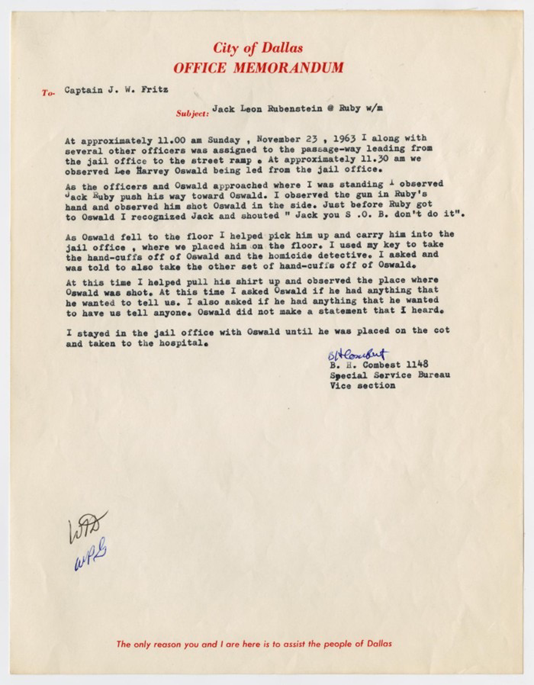
    On November 24, 1963, in the dim, oppressive confines of the City Hall basement, a critically wounded Lee Harvey Oswald lay in a dire state. Surrounded by the urgency and chaos of the moment, his life precariously hanging by a thread, a profound silence enveloped him. Officer B.H. Combest of the Dallas Police Department, amidst the turmoil, sought to extract a final confession or declaration from Oswald, particularly about the assassination of President Kennedy. This was Oswald’s moment, if ever there was one, to claim the notoriety that some believed motivated him. Yet, in this charged atmosphere, where each second could have been his last, Oswald chose silence. He uttered no words of confession, no statements of guilt or pride; he merely shook his head in response to direct prompts. This silence, in such a critical juncture, resonated with a powerful implication of innocence. It stood in stark contrast to the allegations that he sought fame through infamy. Oswald’s refusal to embrace a narrative of notoriety in these final, fleeting moments, where a single word could have immortalized him in infamy, spoke more emphatically than any verbal declaration could. His silence in the face of death, under the weight of such grave accusations, became his most resounding and final testament to his claim of innocence. (Volume XII; p. 176-186)Picture4

    Mrs Paine: On what firm bedrock of evidence do you anchor your assertion that Oswald was propelled by a voracious yearning for infamy and fame? This supposition appears to starkly contrast with the profound narrative woven by his actions, most notably his resolute silence in the face of imminent mortality.

    This pivotal silence speaks volumes, challenging the notion of his supposed thirst for recognition.

    As Mrs. Paine’s trenchant condemnations of Oswald continued, they resonated powerfully with the audience, evident in the synchronized nods of her supporters, symbolizing a shared conviction. She complained; “I seem to think that the shooting of Walker is absolutely crucial to understand what was going on with Oswald and what happened… not enough has been said about it!”This crescendo of influence reached its zenith when she directed a leading question to the assembled crowd, skillfully crafted to further cast Oswald in the role of the guilty. Her inquiry, loaded with implication and designed to sway opinion, hung heavily in the air, compelling the audience to view the situation through her lens of accusation; “How many of you know that Oswald, and most of you should because you are here, but how many of you ‘know’ that Oswald tried to kill Edwin Walker in April” (1963).Picture5

    In a choreographed motion, her hand ascended first, soon echoed by a sea of hands in the crowd. Recognizing this solidarity, Mrs. Paine responded with a mix of satisfaction and camaraderie, remarking, “There you go, good crowd, “laughing as her supporters returned the favor. I would call it kind of a dull crowd. It was hard to comprehend that no one asked the obvious question:

    Why would Oswald try to kill a right-wing fascist like Walker and then shoot the most liberal president since FDR? I mean, you must know Ruth that Kennedy sent in troops to put down a riot over integration at Ole Miss staged by Walker in 1962? You do know that don’t you? And you also must know that Kennedy retired Walker from the service for distributing John Birch Society material to his troops?Picture6

    Absent one sentient person, the dog and pony show continued.

    Thomas Mallon.“How did it finally come to light that he had shot Walker?”

    Ruth Paine.“ When he went out to try and shoot Walker, he wrote a note for Marina… it started out here is the key to the post office box, if I am arrested here is where the police station is and of course she was frightened, terrified as she didn’t know what to do, who to tell… so she (Marina) tried to threaten him, I am going to hide this and if you ever do anything crazy like this I will go to the police with it, but it didn’t work. The amount of preparation that he did, for trying to shoot Walker, is in no way mimicked in the preparation he did before shooting Kennedy, because that was an impulse. He was working on a place that turned out to be on the parade route, with the car going by. He learned that when he was at work on Wednesday (November 20th) called and came and got right out to my house, he had never come out on a weekday, he had never come out before asking permission, this was very different… He came out to get his rifle which was hidden in my garage, which I did not know. Got it and went in and shot the President as we ‘know’. It was a little bit later that the note came to light.

    Thomas Mallon.“How did the note reach her?”

    Ruth Paine.“…I sent the book to Marina (which contained the note). Of course, what is the first thing a Secret Service man going to do when he sees a book? See what falls out, and out came this note. She was confronted with this note and had to explain that it was the note he wrote when he went out to try and shoot Walker. If that note had not been found then I don’t think that we would ever have found out, because she was not going to tell”.

    The Walker Note

    “Did it seem strange to you at the time, Marina, that Lee did make these careful plans, take pictures, and write it up in a notebook, and then when he went out to shoot at General Walker, he left all that incriminating evidence right in the house so that if he had ever been stopped and questioned and if that notebook had been found, it would have clearly indicated that he was the one that shot at General Walker?” Wesley Liebeler.

    If Exhibit A in the case against Lee Oswald—anchored by Mrs. Paine and Mr. Mallon’s account of the attempt on General Walker—draws heavily from Marina Oswald’s testimony, then Exhibit B is undoubtedly the infamous ‘Note,’ which surfaced, via Mrs. Paine, only after Oswald’s death. This ‘Note,’ has become a cornerstone of controversy. Its posthumous discovery raises pressing questions: What does the ‘Note’ truly prove? At the heart of this debate, several critical concerns undermine the ‘Note’s’ validity and its connection to Oswald:Picture7

    1. Absence of Mention of General Edwin Walker: The note’s content does not reference General Edwin Walker, which is a significant omission if it was intended to be related to the assassination attempt on him. This raises questions about the note’s intended purpose and relevance to that specific incident.
    2. Lack of Signature and Date: The note’s anonymity and lack of a temporal marker further cloud its authenticity. An unsigned and undated note lacks the definitive characteristics necessary to firmly tie it to a specific individual or time frame, undermining its credibility as a piece of evidence.
    3. Fingerprint Analysis Results: The FBI’s analysis revealed that none of the seven latent prints found on the note matched Lee Harvey Oswald or Marina Oswald. This forensic evidence is crucial as it directly challenges the assumption that Oswald had physical contact with the note, casting serious doubts on its connection to him.View Source
    4. Secret Service Inquiry into Mrs. Paine’s Possible Involvement: Mr. Gopadze of the Secret Service accosted Mrs. Paine over the “Walker note” suspecting her potential role in its creation. “
    5. Expert Consensus on the ‘Walker’ Note’s Authenticity: The House Select Committee on Assassinations (HSCA) consulted three experts to assess the authenticity of the ‘Walker’ note. Notably, there was no majority consensus that the note was written by Lee Harvey Oswald. This raises serious doubts about the note’s legitimacy and its alleged connection to Oswald.View Source
    6. Oversight in Dallas Police Search: Despite an extensive search of the Paine residence on November 22-23, 1963, specifically aimed at uncovering evidence that could incriminate Lee Oswald, the Dallas Police failed to uncover the ‘Walker’ note. This oversight is particularly striking given Ruth Paine’s testimony indicating the thoroughness of the search. The fact that such a potentially incriminating item eluded the police during their detailed search adds a layer of mystery to the case and raises questions about the note’s whereabouts during this critical period.

      Ruth Paine:“I was just preparing to go to the grocery store when several officers arrived again from the Dallas Police Office and asked if they could search…and held up their warrant and I said, yes, they could search. They said they were looking for something specific… Before I left, they were leafing through books to see if anything fell out but that is all I saw… “(WC Volume III; p. 86-87)

      th, 2023, and Mrs. Paine stated that the note was contained within “a little book we had, a small book of advice to Russian mothers. It happened to be in the kitchen where we were reading, which made it different from the things in the garage… but they didn’t get that note because it was in my kitchen.”Picture8

      Considering your statement, Mrs. Paine, that the note was hidden “inside a little book of advice to Russian mothers’”in your kitchen – a location and item distinct from those in the garage – several deeply perplexing and troubling questions arise.

      Firstly, if this book was indeed in regular use by Marina in the days or weeks prior to the President’s assassination, it seems utterly baffling that neither of you noticed a note concealed within its pages? This oversight becomes even more confounding when considering the ease with which the Secret Service later discovered it. How is it possible that this note remained undetected in a book that was actively being used?

      Secondly this is 1960’s Texas, this period was marked by intense suspicion towards anything remotely associated with communism or the Soviet Union, it stretches credibility to suggest that a book intended for Russian mothers would go undetected by Texas police officers during a property search. My own visit to the property at 2515 W Fifth Street, in November 2023, offered insightful perspectives on this matter. As I toured the house, I found that the garage could be accessed directly from the kitchen/dining area, a detail clearly illustrated in the floor plan I have referenced above. This observation becomes critical when considering Mrs. Paine’s own admission of having given the police unfettered access to search her home in her absence, thus leaving them unsupervised. Given this level of access, and the fact that the garage is directly connected to a central living area of the house, the suggestion that their search would exclude the kitchen, and by extension, overlook a culturally and politically charged item like the book, seems strained. (see this)

    7. Marina Oswald’s Initial Disavowal of Knowledge: In a striking turn of initial testimony, Marina Oswald professed complete ignorance regarding the existence of the ‘Walker’ note. This initial declaration of ignorance is pivotal, casting a veil of doubt over her subsequent revelations and the evolution of her narrative. View Source
    8. Evidence Destroyed? The scenario as detailed in Marina Oswald’s testimony regarding the Walker shooting incident indeed unravels into a web of paradoxes and inconsistencies. Her claim that she urged Oswald to destroy a notebook, rich with intricate details of the attack on General Walker, stands in stark contrast to their apparent preservation of the ‘Walker’ note. This dichotomy is not just perplexing but contradictory. If Oswald, as suggested by Marina, felt compelled to incinerate the notebook due to its incriminating nature, it is logical to assume that similar caution would extend to all related materials, including the ‘Walker’ note, pictures of Walkers home found in the Paine garage and the notorious Neely Street photographs. The decision to eradicate one potential piece of evidence while seemingly safeguarding others defies logical reasoning and casts a shadow over their approach to handling such sensitive materials.

    Marina Oswald. “I was so afraid after this attempt on Walker’s life that the police might come to the house. I was afraid that there would be evidence in the house such as this book… I told him that it is best not to have this kind of stuff in the house…I suggested to him that it would be awfully bad to keep a thing like that in the house.” (Volume XI; p.293-294)

    The scenario presented by Marina Oswald’s testimony regarding the Walker shooting incident is fraught with paradoxes and inconsistencies. It is indeed paradoxical that while she claimed to have urged Oswald to destroy a notebook detailing plans for the attack on General Walker – an act acknowledging the danger of retaining incriminating evidence – she seemingly allowed the ‘Walker’ note to remain in their possession. This contradiction is puzzling. If Oswald took the drastic step to burn a notebook for fear of its incriminating nature, logic would dictate that all related materials, such as the ‘Walker’ note, the infamous backyard photographs, and the photographs of Walkers property would also be destroyed to eliminate any trace of involvement.

    This inconsistency in the handling of evidence is succinctly highlighted by Wesley Liebeler’s poignant question:’If Oswald was guilty in the Walker shooting, why would Oswald keep the photos and the note around for almost eight months?’


    Go to Part 2 of 2

  • Book Review: The Oswalds: An Untold Account of Marina and Lee

    Book Review: The Oswalds: An Untold Account of Marina and Lee


    The Oswalds: An Untold Account of Marina and Lee (New York: Diversion Books, 2022), 286 pp.

    The lives of Paul Gregory, a research fellow at the Hoover Institution, and his late father Pete, a Russian émigré from Siberia, intersected with those of Lee Harvey Oswald and his wife Marina in 1962-63. In the summer of 1962, Marina gave lessons in the Russian language to the son Paul. Pete, the father, wrote a letter of recommendation for Lee. And, in the immediate aftermath of the assassination, Pete translated the words of Marina for the Secret Service in a hideaway motel. As both the son and the father conversed extensively in Russian with the Oswalds, and the father was a distinguished linguist, Paul Gregory’s new book may shed light on one of the most important questions about Lee Harvey Oswald: How did a high school dropout become so proficient in the Russian language?

    Gregory’s book is written in the form of memoir. However, his experiences with the Oswalds in the summer of 1962 were not sufficient for a book-length manuscript. Consequently, the author rounded out his coverage of Oswald with a more expansive biography. For his sources, Gregory relied primarily on the Warren Report. This is revealing; it is clear that he has not probed deeply into the work of independent researchers of Oswald and the JFK assassination. The author refers to the latter body of literature as “forensics,” stating that “I cannot consider the hundreds of theories that reject Lee Harvey Oswald as the sole gunman.”[i]; “I am not going to engage in forensic analysis of an extra bullet and shots fired, directives to kill from Castro or Khrushchev, right-wing-fanatics, or deep-state cabals.”[ii] Gregory is convinced that his first-hand experience of Oswald validates the findings of the Warren Commission and is sufficient to demonstrate the lone gunman theory.

    And yet when it comes to the matter of Oswald’s Russian language skills, Gregory cites my article “Oswald’s Proficiency in the Russian Language,”[iii] wherein I explore the evidence indicating that Oswald was already fluent in Russian prior to his departure for the Soviet Union in 1959. My contention was that Oswald was an asset of the United States government sent to the Soviet Union due to his ability to understand Russian, which he carefully concealed during his nearly three-year sojourn in Minsk. Gregory acknowledges that Russian is a difficult language to learn, yet he appears to dismiss my findings as conspiratorial thinking: “Some conspiracy theorists contend that Oswald’s Russian fluency constitutes proof of a conspiracy. They claim that he could not have picked up the language so quickly.”[iv] But Gregory does not explore how, when, and where Oswald did pick up the language so quickly. He only indicates that Oswald’s Russian language skills were “self-taught.”[v] But where did the self-instruction occur? It certainly was not at Arlington Heights High School in Fort Worth in which Oswald dropped out after completing the ninth grade. It was not at the Monterey Institute of Languages, as Oswald never resided in Northern California. There is a suggestion he was there, but no real proof. It did not occur during his stint in the Marines, where Oswald was observed by multiple eyewitnesses as already fully capable of reading Russian-language materials in print.

    As for his spoken Russian, prior to his departure to the Soviet Union, Oswald was commended by Rosaleen Quinn, the aunt of one of Oswald’s Marine buddies, who experienced first-hand Oswald’s Russian language abilities. Quinn had been learning the language for over a year from Berlitz for a future position in the State Department. She later said to author Edward Epstein that Oswald spoke better Russian then she did. Gregory chooses to ignore the evidence that Oswald was already fluent in Russian when he left the Marines. The author simply assumes that Oswald achieved a mastery of Russian while he was in Minsk.[vi] But, during his nearly three-year stay, Oswald was not working diligently with his tutors or practicing on his own; instead, he was remembered by his friends in Minsk as constantly struggling with Russian and primarily speaking to them in English! In an interview that Gregory did with Patrick Bet David on November 22nd of this year, Gregory said that Oswald spoke Russian, but his grammar was very bad. This is not what Quinn said. She told Epstein that Oswald could string entire sentences together without much hesitation.

    When Oswald returned from the Soviet Union, he and Marina received correspondence from their acquaintances in Minsk. Ernst Titovets wrote a letter in Russian addressed to both Lee and Marina, but he included a separate portion to Lee written in English.[vii] The same was true with Aleksandr (Alejandro) Zieger in a joint letter written to Marina and Lee. The undated letter was composed sometime after the Oswalds left Minsk in 1962. Mr. Zieger writes most of the letter in Russian, offering general news of the Zieger family. But at the end, he includes a personal message to “Alek” (Oswald’s nickname in Minsk) that is written in English: “Alek—my best wishes and a ton of good luck.”[viii] These letters demonstrate that his friends in the Soviet Union were under the impression that Oswald could not read Russian. Yet the correspondence was received by the Oswalds at a time when Lee visited the office of Pete Gregory in order to obtain a letter of recommendation that verified his Russian language competency. Pete gave him a test after pulling out Russian volumes from his bookshelves and asking Oswald to translate. Surprised by Oswald’s proficiency, Pete then wrote the brief letter that vouched for Oswald, whose aptitude in Russian was so good that Pete believed him “capable of being an interpreter and perhaps a translator.”[ix]

    In what is revealing information contained in Gregory’s book, the linguist father Pete concluded that, based on his spoken Russian, Oswald was “from a Baltic republic or even Poland with Russian as a second language.”[x] He also speculated that “Oswald’s Russian fluency was explained by immersion in daily life rather than attendance at some sinister Russian language school for spies.”[xi] Pete’s son Paul attested that “having spent hours with Lee speaking Russian, I can confirm that his command of the everyday language was excellent. He could express anything he wanted to say.”[xii] The lapses in grammar and mistakes in gender may be partially explained by the father’s contention that Oswald originally learned Russian as a second language, “possibly from a Baltic republic or even Poland.” This description would explain how Oswald had already become proficient in Russian at the time he departed for the Soviet Union in 1959. It also must give us pause as to what was the true background of this young, bilingual man. The real Lee Harvey Oswald was born in New Orleans and raised exclusively in the United States. But Pete Gregory was referring to a young man who was likely born in Eastern Europe and was speaking both Russian and English as second languages.

    Working under tremendous pressure, Pete Gregory translated the words of Marina in response to questions from the Secret Service shortly after the assassination. His translations were subsequently checked by other experts and judged “faultless without deviation.”[xiii] Previously, he had been selected to accompany President Eisenhower to Moscow to serve as translator during the summit that was eventually cancelled due to the Gary Powers U-2 spy plane incident. In describing his father as “one of the nation’s best Russian interpreters,”[xiv] Paul may not have been engaging in hyperbole. As a world-class linguist, Pete Gregory is an authority worth listening to as an eyewitness to Oswald’s Russian language skills. As it turns out, Pete’s characterization of Oswald having learned Russian as a second language somewhere in Eastern Europe, possibly “from a Baltic republic or even Poland,” merits some consideration.

    How may this lend a clue to our understanding of Oswald? The answer lies in the massive work Harvey and Lee by John Armstrong, along with his articles on the harveyandlee.com website, and his digital archive documenting his research, which is accessible online from Baylor University. Because of the evidence of two Oswald boys using the same name, growing up in different households, attending different schools, and training separately in the Marines, Pete Gregory’s revelation about Oswald’s Russian language abilities could be corroborative evidence of Armstrong’s “The Oswald Project”, which sought to place a Russian speaking American in the Soviet Union as an asset.

    The long-term project of planting a Russian-speaking spy in the Soviet Union must be examined in the context of the aftermath of World War II and the start of the Cold War. Immediately after the war, there was the forced relocation of enormous populations as the map was being redrawn in Eastern Europe. Thousands of “displaced persons” were interred in camps. The so-called Displaced Persons Commission made available to the CIA the names of potential assets. As a result, Eastern European refugees were brought to the United States under a program headed by Frank Wisner, the CIA’s director of clandestine operations. Wisner had become the State Department’s and the CIA’s expert on Eastern European war refugees during the late 1940s and early 1950s. Under Wisner’s program, the refugees were granted asylum in return for their cooperation in secret operations against the Soviets.

    Wisner gained approval from the National Security Council for the “systematic” use of the refugees as set forth in a top-secret intelligence directive, NSCID No. 14 (March 3, 1950). Both the FBI and the CIA were authorized to jointly exploit the knowledge, experience, and talents of over 200,000 Eastern European refugees who had resettled in the United States.[xv] Under Wisner, the CIA was running hundreds of covert projects for the purpose of what the NSCID directive called the “exploitation of aliens as sources of foreign intelligence information.”[xvi] The surviving evidence suggests one of those projects merged the identities of a Russian-speaking immigrant boy, who likely came from Eastern Europe, with an American-born boy named Lee Harvey Oswald.[xvii] 

    Many of the Eastern European children grew up bilingual with Russian as a second language. As observed by journalist Anne Applebaum in her book Iron Curtain: The Crushing of Eastern Europe, 1944-1956, Eastern European children would, as a matter of course, be sent to live with another family at an early age in order to learn a second language. The idea behind this CIA project was to groom the Russian-speaking boy as a spy who, when he reached adulthood, would “defect” to the Soviet Union. Because he had assumed the name and identity of an American, the Soviets would not suspect that he spoke fluent Russian. The result was that nearly a decade later, as an undercover agent who secretly understood Russian, the Eastern European immigrant posing as a disgruntled United States Marine named Lee Harvey Oswald defected and spent nearly three years in the Soviet Union. While there, he married a Soviet woman and returned to the United States with his wife and child.

    Upon his return to the United States, Oswald wrote a lengthy account of his experience working at the Minsk Radio and TV Factory, where he drew upon “his fairly wide circle of friends and acquaintances to gather the figures and descriptions of the inner workings of the Soviet system.”[xviii] In wondering how Oswald “was able to put together such an insightful picture of the Soviet enterprise,”[xix] Gregory notes that Oswald was “a surprisingly keen observer of Soviet reality.”[xx] But there should be no surprise if it had been Oswald’s principal purpose as a false defector to observe and to report on the realities of Soviet life during his stay. Dennis Offstein was a co-worker of Oswald at the graphic arts company of Jaggars, Chiles, Stovall in Dallas shortly after Oswald’s return in 1962. In his testimony to the Warren Commission, Offstein recalled that Oswald gave him a detailed account of Soviet military maneuvers during his residency. Specifically, Offstein remembered Oswald’s description of:

    …the disbursement of the [Soviet] military units, saying that they didn’t intermingle their armored divisions and infantry divisions and various units the way we do in the United States, that they would have all of their aircraft in one geographical location and their tanks in another geographical location, and their infantry in another, and he mentioned that in Minsk he never saw a vapor trail, indicating the lack of aircraft in the area.[xxi]

    This perceptive account of the Soviet military activities that includes being on the lookout for “vapor trails” squares with other detailed observations that Oswald brought back and recorded in detail. In the testimony of Offstein alone, there was enough cause to warrant an investigation of Oswald’s ties to intelligence and the possibility that he was sent to the Soviet Union in 1959 in the capacity of what Offstein called “an agent of the United States.”[xxii] But with the presence of Allen Dulles on the Warren Commission, Oswald’s records in the CIA were effectively pre-screened from the committee. 

    It was Allen Dulles who insisted that the Warren Commission publish a detailed biography of Oswald. As a result, Chapter VII (“Lee Harvey Oswald: Background and Possible Motives”) is a fifty-page narrative replete with inaccurate details and chronological errors. That “biography” may be a mélange of the lives of two young men, and it has misled researchers for nearly sixty years, the latest of which is Paul Gregory. The major premise that undergirds Gregory’s book is that Oswald was a genuine defector. Working closely to the Warren Report, Gregory believes that Oswald was a committed Marxist, that his distribution of pro-Castro leaflets in New Orleans was genuine, that his opening of a branch of the Fair Play for Cuba Committee in New Orleans was genuine (despite him being the only member), and his visits to the Russian and Cuban embassies in Mexico City were genuine (despite the absence of concrete evidence that Oswald himself paid those visits). In paraphrasing the Warren Report, Gregory identifies Oswald’s principal motivation for the assassination not out of animosity for John F. Kennedy, but his belief, shaped by his study of Marxism, that “he was destined for a place in history.”[xxiii]

    But if Oswald was not a genuine defector and was working for the United States government, the entire edifice of the Warren Report collapses like a house of cards. If Oswald really had delusions of grandeur, he had the perfect opportunity to proclaim his great deed to history as he was paraded through the halls of the Dallas police headquarters and was allowed to address the press. But instead, he protested his arrest and insisted on his innocence with the words, “I’m just a patsy!” In this crystalline moment, he may have realized that he was a mere pawn in the greater design of the Cold War.

    A fatal shortcoming of Gregory’s methodology is that he has not kept up with new evidentiary discoveries in the JFK assassination, particularly the findings of the Assassination Records Review Board (ARRB). The military historian John Newman has observed that “in the history of the KGB and the CIA, their wars are not actually shooting each other so much as trying to penetrate each other.”[xxiv] Oswald may be best understood in the context of a myriad number of CIA projects with the goal of “penetrating” the enemy, including the critical area of identifying moles from within. Newman recounts the time when one of the legendary CIA mole hunters and “probably our most celebrated and capable counterintelligence officer in the history of the Central Intelligence Agency,”[xxv] Tennent “Pete” Bagley, sat down with researcher Malcolm Blunt. Bagley and Blunt reviewed the collection of documents on Oswald from the CIA, the State Department, and Naval intelligence. As they assessed the evidence, the stunning revelation came to Bagley that Oswald “had to be witting” in his defection.[xxvi] In other words, this senior CIA officer recognized that the evidence demonstrated that “Lee Harvey Oswald was a witting false defector when he went to Moscow.”[xxvii] This revelation was made possible through the efforts of the tenacious researcher Elizabeth “Betsy” Wolf, who had prepared detailed notes during her time spent on the House Select Committee on Assassinations (HSCA) in the late 1970s. The implications of her notes were so explosive that they were hidden until their declassification on a time-delayed release following the termination of the ARRB in 1998. Salvaging the notes was made possible by Oliver Stone’s film JFK, which led to the JFK Records Act and the establishment of the ARRB. In turn, the indefatigable researcher Malcolm Blunt carefully assembled Wolf’s notes and assessed their implications with Bagley.

    Betsy Wolf had been troubled by the fact that a “201 file” had not been prepared on Oswald by the CIA at the time of his defection in 1959. This point was not addressed by the Warren Commission which paid little, if any, real attention to Oswald’s connections to the intelligence network. According to CIA protocol, 201 files were routinely opened for persons “of active operational interest.”[xxviii] But, inexplicably, after Oswald’s so-called defection, a 201 file was not opened until over a year later on December 8, 1960.[xxix] Wolf’s breakthrough discovery was that early CIA reports on Oswald were pigeonholed in the CIA’s Office of Security (OS), rather than to the SR (Soviet Russia) division. The OS would not refer a 201 file, while SR would. As recounted by researcher Vasilios Vazakas, “in the case of Oswald, his files bypassed the General Filing System and went straight into the Office of Security and its SRS [Security Research Service] component.”[xxx] One possible explanation entertained by Vazakas was that “Oswald was a special project for [James Jesus] Angleton, one he wanted no one else to know about.”[xxxi] In a crucial interview described in Wolf’s handwritten notes and discovered by Blunt, on July, 26, 1978, Wolf spoke with Robert Gambino, at that time, the current chief of the OS. Gambino informed her that a request for the special handling of Oswald’s documents had occurred prior to Oswald’s defection. In other words, CIA documentation on Lee Harvey Oswald predated his defection. With an understanding of that chronology—and the testimony of both Bagley and Gambino– it is clear that the CIA was fully aware of the phony defection in advance of the time it occurred in late October, 1959.[xxxii]

    Even Oswald’s Marine roommate in Santa Ana, California, James Botelho, recognized that Oswald was not a genuine defector when he told attorney Mark Lane that “Oswald was not a Communist or a Marxist. If he was I would have taken violent action against him and so would many of the other Marines in the unit.”[xxxiii] After Oswald’s defection was made public, Botelho told how an investigation at the Santa Ana Marine base was conducted purely for show:

    It was the most casual of investigations. It was a cover-investigation so that it could be said there had been an investigation….Oswald, it was said, was the only Marine ever to defect from his country to another country, a Communist country, during peacetime. That was a major event. When the Marine Corps and American intelligence decided not to probe the reasons for the “defection,” I knew then what I know now: Oswald was on an assignment in Russia for American intelligence.[xxxiv]

    Through a nearly miraculous chain of events starting with Oliver Stone’s film and leading to the ARRB’s preservation of the notes of Betsy Wolf, we have today documentary evidence supporting Botelho’s claims that Oswald was a false defector.

    Instead of following through on the implications of Oswald’s language proficiency in Russian and exploring whether or not he was a genuine defector, Gregory pivots to spend a large portion of his book recounting the stormy relationship of Lee and Marina. Gregory returns to his default mode of the Warren Report to cite the Commission’s alleged motivation for the killing of the President: “The relations between Lee and Marina Oswald are of great importance in any attempt to understand Oswald’s possible motivation.”[xxxv] The fact that the Warren Commission had to look to the marital relationship of the suspected assassin for motivation for the murder of the President demonstrates how flimsy the case was against Oswald. Gregory spends countless pages describing the abuse Lee heaped upon Marina, mainly relying on secondhand information from members of the small Russian émigré community in Dallas. Gregory’s narrative resembles the plot outline of Shakespeare’s The Taming of the Shrew, wherein Lee is the tyrannical overlord of Marina just as Petruchio seeks to keep Katharina on a short leash.

    In what he calls his own “amateur psychoanalysis,”[xxxvi] Gregory repeats on multiple occasions the tiresome refrain of Warren Commission apologists that Oswald was seeking to impress his wife by carving out his place in history. During his time spent with Oswald in the summer of 1962, Gregory “detected none of the trademarks of a future assassin.”[xxxvii] Yet in the back-reading of his own experience through the lens of the Warren Report, Gregory concludes that he had “witnessed firsthand this small man’s attempt to prove to the world and to his young wife that he was indeed exceptional.”[xxxviii] Through a tortured logic, Gregory posits the following in response to Marina’s belittling of her husband’s politics and his substandard performance in the bedroom: “What better way for Oswald to kill two birds with one stone than by the ‘manly’ act of killing the most powerful man on earth?”[xxxix] This psychoanalytical approach completely misses the point that the killing of President Kennedy was a politically driven act at the height of the Cold War, the effect of which was a compete reversal of America’s foreign policy in the 1960s. Many of which were detailed in Oliver Stone’s four-hour film JFK: Destiny Betrayed.

    In an interview given by Gregory shortly before the release of his book, the author indicated that he was motivated to write the memoir because his family was embarrassed at having an association with the alleged assassin of an American president. In Gregory’s words, it was “a black spot on the family.”[xl] The resulting book is not the impartial work of a scholar at the Hoover Institution. Rather, it is the biased opinion of an eyewitness with a personal agenda. Gregory considered Marina Oswald as a friend, as she helped him to prepare a paper on an obscure Russian play during the summer of 1962. But one looks in vain in the book for Marina’s corroboration of what Gregory has written about her and her first husband. The author sent Marina a draft of the manuscript, as well as a cordial letter. But she never replied. The last time Gregory saw Marina was on Thanksgiving Day in 1962. In a 1993 NBC interview, the feisty Marina went toe-to-toe with newscaster Tom Brokaw, as she took issue with the claims of Gerald Posner in his book Case Closed and said of her husband that “he definitely did not fire the shots.”[xli] In 1996, Marina told Oprah Winfrey that she came to the conclusion that her husband was innocent by studying the Warren Report’s supplementary volumes, which puts a damper on the entire hypothesis of Paul Gregory’s book: “And then comes the 26 volumes of the testimony, of the evidence, which does not support their conclusion.”[xlii] Drawing so heavily as he does on the Warren Report, Gregory has written a book that should take its place alongside Priscilla Johnson McMillan’s Marina and Lee, Robert Oswald’s Lee, and Jean Davison’s Oswald’s Game, all of which serve as posthumous daggers in the heart of Lee Harvey Oswald.


    Appendix

    The Media’s Response to The Oswalds and Reflections on the Cold War

    Following the release of Paul Gregory’s book, the media’s response has fixated on the lurid elements of alleged domestic abuse and the troubled marriage of the Oswalds. Writing in the Daily Mail on November 25, 2022, Daniel Bates offers the eye-popping title of “‘He feared he would be exposed as a loser.’ Lee Harvey Oswald assassinated JFK because he was ‘humiliated’ by wife Marina who mocked him as sexually inadequate and cheated with a businessman.”[1]

    Bates’s formal review then begins with the observation that “Lee Harvey Oswald assassinated John F. Kennedy because he feared being branded a ‘loser’ by his wife who ridiculed his pretensions of being a Marxist intellectual.”[2]

    Here the journalist is invoking guilt by association in an argument that goes as follows: If Oswald was belittled and shamed by his wife, it follows that he killed the President in retaliation. A Kirkus review succinctly summarized the book as “an informative view of a killer’s marriage and lethal motivations.”[3] Writing in the New York Post, Heather Robinson concludes her review by speculating that “it’s even possible that Oswald killed JFK because the young president was seen as the ultimate symbol of American masculinity and power — and because Marina liked him.”[4]  Some of this “writing” resembles postmodern literary criticism.

    In the alternative media, Gus Russo on Spy Talk introduces a litany of titillating incidents not even mentioned in Gregory’s book. At the same time, he completely ignores how Oswald attained a superior level of Russian language proficiency, as well as Peter Gregory’s analysis that Oswald spoke like an Eastern European who had learned Russian from daily exposure, as opposed to formal training in the classroom. As Paul’s father, Pete, testified to the Warren Commission, “I would say it would be rather unusual, rather unusual for a person who lived in the Soviet Union for 17 months that he would speak so well that a native Russian would not be sure whether he was born in that country or not.”[5] This linguist was attempting to reconcile what he had heard as the inflections of an Eastern European speaking Russian that conflicted with what he was told by Oswald about how he had learned to speak the language. Russo also makes no mention of Oswald’s “defection” in 1959 and Gregory’s blind acceptance of the Warren Commission’s profile of Oswald as a genuine Marxist.

    In their rush to paint Oswald as a domestic abuser of the most despicable variety, the reviewers fail to mention a very important evidentiary point: Paul Gregory relies extensively on secondhand reporting that he heard from members of the Dallas Russian émigré community. The reviewers give readers the impression that Gregory is offering startling, new revelations. But these individuals were called before the Warren Commission and were questioned about the alleged abuse. Robert Charles-Dunne has provided a valuable collation of their testimony in “Was Oswald a Serial Wife Batterer?” that would serve as an indispensable resource alongside Gregory’s book.

    In following the words of the witnesses, it is apparent that they were not really witnesses. That they too were invariably relying on second- and third- hand reporting of Oswald’s treatment of his wife. The testimony of nineteen witnesses reveals that no police report was ever filed and rarely was there an actual witness to verify Oswald’s displays of temper. Gregory himself never observed Oswald physically striking Marina during any of his forty-eight tutorial sessions. And yet, his allegations are the bedrock foundation for the motivation that Oswald killed President Kennedy.

    Any instance of spousal abuse is reprehensible, and Marina Oswald has acknowledged that she was an abused wife. Yet over time, she was able to separate the abuse from the question of whether or not her husband shot the President. By the 1990s, while continuing to acknowledge Oswald’s shabby treatment of her, she still concluded that Lee had been framed…primarily from her study of the supplementary volumes of the Warren Report!  Scholars who tackle this topic should have the same degree of objectivity as a victim like Marina.

    In investing so much time in writing about the connection between Oswald’s treatment of his wife and the murder of President Kennedy, Gregory has given short shrift to the climate of the Cold War that impacted the lives of everyone described in his book, including his own and especially his father’s. Pete Gregory entered the pressure cooker to translate for Marina in response to questions from the Secret Service over the stressful assassination weekend. His dedication movingly comes across in the memoir. This was an instance of a law-abiding citizen being sucked into the maelstrom of a national crisis. But what was not known until recently was that Pete Gregory was later a likely employee of the CIA. As uncovered by researcher Malcolm Blunt, a set of documents indicates that, in 1965, Pete applied for work in the CIA in the JPRS (Joint Publications Research Service).[6]  

    The recipient of his application was the Chief Officer of the Foreign Documents Division of the CIA. It is possible that Pete may have been applying for a position of translator of sensitive multi-lingual texts at the height of the Cold War. In addition to Pete’s completed application, another document verifies his CIA security clearance through a strict process of vetting that included the administration of a polygraph. By profession, Pete was an engineer working in the petroleum industry of Texas. More work lies ahead in understanding precisely what role Pete was playing in the CIA in a Cold War connection that is never mentioned in his son’s memoir.

    Indeed, discourse on the Cold War in general is conspicuously absent from Gregory’s book. Mark Kramer, who is Director of Cold War Studies at Harvard University, wrote a commendatory blurb that appears at the start of The Oswalds: “Gregory’s book offers a definitive personality sketch of Oswald and a great deal of evidence that should put an end, once and for all, to the notion that shadowy forces intent on murdering the president would have enlisted such an unreliable and tempestuous loser.” This astonishing perspective written by a scholar of the Cold War speaks volumes about what little time the so-called experts have invested in studying the JFK assassination. Historians, journalists, and bloggers should be following trails of reliable evidence and placing a historical event carefully in context. They should not be relying on hearsay, gossip, and psychoanalytical speculation. A seminal moment of the Cold War was the assassination of President Kennedy that shifted the nation’s foreign policy over the course of a weekend. The preponderance of evidence suggests that the scapegoat Lee Harvey Oswald was a creature of the Cold War and that President Kennedy’s death was the result of forces at work against his vision of peace in the period following the Cuban Missile Crisis. Both men were pawns on a chessboard that we can finally understand today if we only take the time to examine the evidence. Until that happens, our knowledge of the Cold War will remain incomplete.


    [i] Paul R. Gregory, The Oswalds: An Untold Account of Marina and Lee (New York: Diversion Books, 2022), 36.

    [ii] Gregory, 230.

    [iii] James Norwood, “Oswald’s Proficiency in the Russian Language,” http://harveyandlee.net/Russian.html.

    [iv] Gregory, 100.

    [v] Gregory, 245.

    [vi] Gregory, 88.

    [vii] Gregory, 124. Gregory describes Titovets’s letter as “jocular.” But if Oswald had achieved “mastery” of Russian while in Minsk, as Gregory suggests, then why would Titovets feel compelled to write a special portion of the letter addressed expressly to Oswald in English?

    [viii] Mr. Zieger’s letter was published in the Warren Commission Hearings, Vol. XVI, 156 (Exhibit 33).

    [ix] John Armstrong, Harvey and Lee (Quasar, Ltd., 2003), 399.

    [x] Gregory, 100.

    [xi] Gregory, 100.

    [xii] Gregory, 100.

    [xiii] Gregory, 202.

    [xiv] Gregory, 207.

    [xv] The first article of the directive reads as follows: “Exploitation of aliens within the U.S. for internal security purposes shall be the responsibility of the Federal Bureau of Investigation. Exploitation of aliens as sources of foreign intelligence information or for other foreign intelligence purposes shall be the responsibility of the Central Intelligence Agency. This allocation to the Federal Bureau of Investigation and to the Central Intelligence Agency of separate areas of alien exploitation responsibility does not preclude joint exploitation, which must be encouraged whenever feasible.”
    NSCID No. 14: https://cryptome.org/nscids-50-55.pdf

    [xvi] NSCID No. 14, article 1: https://cryptome.org/nscids-50-55.pdf

    [xvii] See my article “Lee Harvey Oswald: The Legend and the Truth,” which begins with discussion of the HSCA testimony of Jim Wilcott: http://harveyandlee.net/J_Norwood/Legend.html

    [xviii] Gregory, 59.

    [xix] Gregory, 59.

    [xx] Gregory, 49.

    [xxi] Warren Commission Hearings, Vol. 10, 202.

    [xxii] Warren Commission Hearings, Vol. 10, 200.

    [xxiii] Gregory, 36.

    [xxiv] James DiEugenio and Oliver Stone, JFK Revisited: Through the Looking Glass (New York: Skyhorse Publishing 2022), 193.

    [xxv] DiEugenio and Stone, 193.

    [xxvi] DiEugenio and Stone, 194.

    [xxvii] DiEugenio and Stone, 194.

    [xxviii] John Newman, Oswald and the CIA: The Documented Truth About the Unknown Relationship Between the U.S. Government and the Alleged Killer of JFK (New York: Skyhorse Publishing, 2008), 47.

    [xxix] For researcher Vasilios Vazakas, Betsy Wolf was puzzled because “there were two reasons to open the 201 file on Oswald over a year prior to when it happened. Neither one triggered the opening. Further, when Wolf looked at the 201 file, it only contained copies and the two Naval dispatches were gone…. What could be a more compelling reason for the counter-intelligence office opening a file on Oswald than his threatening to give secrets of the U-2 to the Soviets?” Vasilios Vazakas, “Creating the Oswald Legend—Part 4.” kennedysandking.com. August 15, 2020.

    [xxx] Vazakas.

    [xxxi] Vazakas.

    [xxxii] Historian James DiEugenio summarizes the remarkable discovery of Betsy Wolfe as follows: “Only toward the end of her search did Betsy find out what had happened. Betsy’s notes include an interview with the former OS chief Robert Gambino. According to Malcolm, her handwritten notes are the only place anyone can find anything about this particular interview. (Wolf notes of 7/26/78) Gambino told her that CIA Mail Logistics was in charge of disseminating incoming documents. In other words, someone made this request about the weird routing of Oswald’s files from OS’s Security Research Service. (p. 324) And this was done prior to Oswald’s defection. Malcolm concludes that with what Betsy unearthed, there should now be no question that the CIA knew Oswald was going to defect before it happened.” Book review by James DiEugenio, “The Devil Is in the Details: By Malcolm Blunt with Alan Dale. kennedysandking.com. March 20, 2021: https://www.kennedysandking.com/john-f-kennedy-reviews/the-devil-is-in-the-details-by-malcolm-blunt-with-alan-dale

    [xxxiii] James Douglass, JFK and the Unspeakable—Why He Died and Why It Matters (Ossining, N.Y.: Orbis Books, 2008), 40.

    [xxxiv] Douglass, 40.

    [xxxv] Gregory, 230.

    [xxxvi] Gregory, 229.

    [xxxvii] Gregory, 16.

    [xxxviii] Gregory, 240.

    [xxxix] Gregory, 243.

    [xl] The LBJ Library, “With the Bark Off: A Conversation with Paul Gregory About Lee Harvey Oswald” (October 27, 2022): https://www.youtube.com/watch?v=vJ595whXpdE

    [xli] Marina Porter interview, August 1993 (NBC): https://www.pinterest.com/pin/28640147609703189/

    [xlii] A complete transcript of Marina’s interview with Oprah Winfrey, which includes an appearance by Oliver Stone, may be read in the following transcription made by R.J. DellaRosa: https://www.tumblr.com/novemberdays1963/37177099041/marina-oswald-porter-on-oprah-1996


    [1] Daniel Bates, The Daily Mail (November 25, 2022): https://www.dailymail.co.uk/news/article-11458759/Lee-Harvey-Oswald-assassinated-President-JFK-humiliated-wife-Marina.html

    [2] Bates.

    [3] https://www.kirkusreviews.com/book-reviews/paul-r-gregory/the-oswalds/

    [4] Heather Robinson, “Pal Reveals Lee Harvey Oswald’s Weird, Paranoid Life One Year Before Killing JFK” New York Post (November 29, 2022): https://nypost.com/2022/11/19/pal-reveals-lee-harvey-oswalds-weird-paranoid-life-pre-jfk-killing/

    [5] Warren Commission Hearings, Vol. II, 347.

    [6] According to the Harvard University Library, “The United States Joint Publications Research Service is a government agency which translates foreign language books, newspapers, journals, unclassified foreign documents and research reports.  Approximately 80% of the documents translated are serial publications.  JPRS is the largest single producer of English language translations in the world.  More than 80,000 reports have been issued since 1957, and currently JPRS produces over 300,000 pages of translations per year.” https://guides.library.harvard.edu/jprs

     ________

    James Norwood taught for twenty-six years in the humanities and the performing arts at the University of Minnesota. The curriculum that he offered included a semester course on the JFK assassination. He is the author of “Lee Harvey Oswald: The Legend and the Truth” and “Oswald’s Proficiency in the Russian Language” published at harveyandlee.com. His article “Edmund Gullion, JFK, and the Shaping of a Foreign Policy in Vietnam” was published at kennedysandking.com.

  • The Assassination and Mrs. Paine (Part 2)

    The Assassination and Mrs. Paine (Part 2)


    see Part 1

    [Allen Dulles] joked in private that the JFK conspiracy buffs would have had a field day if they had known…he had actually been in Dallas three weeks before the murder…and that one of Mary Bancroft’s childhood friends had turned out to be a landlady for Marina Oswald, the assassin’s Russian born wife.

    James Srodes, Allen Dulles, pp. 554–55

    In Part One of this review, I noted how director Max Good draws parallels in the escorting of Marina Oswald by a trio of persons who seemed to arrive out of the blue in 1963. One of the circumstances that is notable is that all three—George DeMohrenschildt, Ruth Paine, and Priscilla Johnson—spoke Russian. Again, could this be a strange accident? I, for one, have never met anyone in my life who spoke Russian. Yet, in the space of about ten months, three people entered into the lives of the Oswalds who all happened to speak Russian. And as each one left, another replaced the former, almost as if each was being managed by an off-stage supervisor as to when to take over.

    Part of The Assassination and Mrs. Paine centers on the mystery of Naushon Island. Naushon Island is the largest of the Elizabeth Islands in southeastern Massachusetts. It is very much an exclusive area, having been owned by the Forbes—Michael’s family—for a century and a half. Some of the wealthiest and most powerful members of the Eastern Establishment have vacationed there, for example former Secretary of State John Kerry, as did Michael and Ruth Paine. As Barbara LaMonica wrote in Probe magazine, the FBI found out that Michael’s grandmother, Elise Cabot Forbes, took out a $300,000 trust fund for her grandson Michael. (Probe, Vol. 5 No. 5, p. 6) That would translate to about 3 million dollars today. The logical question is: what was someone with that kind of money doing living in a suburb of Dallas/Fort Worth chumming around with an alleged Marxist agitator? And, as noted in Part One, engaging with local college students on the merits of Castroism—and taking Castro’s side while doing so.

    As we know, George DeMohrenschildt—aka the Baron—was the route through which Ruth and Michael first met the Oswalds in early 1963. (James Douglass, JFK and the Unspeakable, p. 168) The Baron was intimately involved with the White Russian community in the Dallas/ Fort Worth area. The late Philip Melanson established that this group:

    …received financial assistance from the CIA. Most of the White Russians had fled Communist persecution and had been brought to the United States by the Tolstoy Foundation, an anti-communist lobby that received yearly subsidies from the Agency. The Russian Orthodox Church, a centerpiece of the very conservative and religious White Russian Community, also received Agency philanthropy. (Spy Saga, p. 79)

    George Bouhe was a prominent member of this expatriate community. Bouhe was Marina’s English tutor. (Probe, Volume 7, No. 3, p. 3) When Jim Garrison told Marina that Bouhe was also a neighbor of Jack Ruby, the man who killed her husband, Marina said she was aware of that. How? Because Bouhe visited her to tell her about it. He said it was just a coincidence that he happened to live next door to her husband’s killer. As researcher Steve Jones noted, was this not a possible connection between Oswald and Ruby? Did the Warren Commission ever explore it? This reviewer has never seen any evidence they did.

    II

    In Max Good’s film, Ruth Paine tries to imply that she only met George DeMohrenschildt once, in early 1963.

    As Steve Jones mentioned in 1998 in Probe magazine, this is not accurate. In her appearance before the New Orleans grand jury, Ruth admitted to Jim Garrison that she and Michael met up with the Baron in 1967. It turns out they were dinner guests of his and they discussed, among other things, a copy of the infamous backyard photo which was recently found amongst the Baron’s belongings after the assassination, upon his return from Haiti. (Probe, Vol. 5 No. 3, p. 9)

    As Carol Hewett noted, in May of 1963, Michel Paine returned a record player and some records to Everett Glover, which Marina had borrowed from the Baron. (Probe, Vol. 5 No. 1 pp. 16–17) Glover took the items to George’s storage unit. When the Baron returned from Haiti, they discovered another version of the infamous backyard photographs in that storage unit.

    As the late Jim Marrs wrote, there are some notable aspects about this version of the backyard photo; but we will focus on the discovery of the picture. First, as described, it was not unearthed until George returned to Texas from Haiti. (Jim Marrs, Crossfire, p. 287) The Baron’s widow told Marrs that they had never seen the picture before then. She was also convinced the photo was planted, while in storage. Although Everett Glover later had placed the Baron’s things in storage, Ruth Paine also had access to the storage space. (ibid) George later wrote that he only discussed the photo with his closest friends, which apparently included the Paines. (Op. Cit. Probe, p. 17)

    But, with the Paines, there is always a capper. Here it is:  Michael Paine told Dan Rather in 1993 that he saw one of the infamous backyard photographs in April of 1963! He told CBS that Oswald proudly showed him a photo as he picked him up for a dinner engagement. As Ms. Hewett asked: if this is true, why did Michael never say anything about this to the FBI or the Warren Commission? (Probe, Vol. 5 No. 1, p. 16)

    As mentioned in the first part of this review, Sylvia Hyde—Ruth’s sister— refused to talk to Max for his film. Jim Garrison was curious about Sylvia, since he could not find out who she worked for. Garrison questioned Ruth before the New Orleans grand jury about this. To be mild, Ruth is rather unhelpful. Even though she spent over a week with her back in 1963, she cannot figure who she worked for. But what makes it even more puzzling, she cannot even say where she lived! Recall, she had driven down to the central Atlantic coast to visit her and she does not recall where she drove to? (Transcript, 4-18-68, pp 58–62). She ended up insinuating to the DA that Sylvia lived in Virginia, most likely Falls Church. But a listener to Len Osanic’s Black Op Radio program later found out that she lived in Maryland.

    An aspect that Sylvia Meagher insinuated about Ruth Paine was her predisposition against Oswald. On more than one occasion, Ruth has said she was taken aback that Oswald would call her about contacting attorney John Abt. If one can comprehend it, she was surprised he was also presuming of his own innocence. As Joseph McBride later pointed out, in an article written by Jessamyn West for Redbook in July, 1964, Ruth went further. She told West she was glad that Ruby killed Oswald. This surprised the author. She gave Ruth a chance to repair the damage and this is what Ruth said: “I thought Lee’s death this way would be so much easier for Marina.” (Warren Commission Vol. 22, p. 856) Recall, Oswald never had an attorney while in custody, the Warren Commission never allowed any legal counsel for him, and their hearings were closed to the public. Ruth Paine, the kindly Quaker lady, somehow thinks that due process and right to counsel can go to Hades in regard to Oswald. And let us not forget, John Kennedy.

    III

    Max Good has structured his film as a kind of point/counterpoint dialogue between the critics of the Warren Commission and its stalwarts. From the latter side we hear from, in addition to Ruth, Max Holland, and Gerald Posner. I cannot see how anyone can complain about their treatment and/or the balance of the film. To give just one example, Posner says that Oswald’s last two calls were to Ruth about an attorney and about Marina, but that is not really the whole story. Oswald tried to make one other call on Saturday night and the Secret Service would not let it through. It was to a former military intelligence officer named John Hurt in North Carolina. How Oswald ever knew this man, or his phone number, is a mystery worthy of Sherlock Holmes. (Click here for details) It furthers Senator Richard Schweiker’s concept that Oswald had the fingerprints of intelligence all over him.

    Ruth gets plenty of speaking time. And the film shows that she is a standard bearer for many Establishment-backed TV specials which support the official story, for example the London trial which featured prosecutor Vincent Bugliosi and defense attorney Gerry Spence. About that one, she says that it was like a regular trial. This reviewer spent a large part of a book showing that such was simply not the case. (See, The JFK Assassination: The Evidence Today, pp. 3–70) She then mentions the Peter Jennings special on ABC in 2003, which she calls one of the best.

    Recall, this was the program in which Dale Myers prepared a computer simulation which proclaimed that the Magic Bullet—about which so much controversy has swirled for so long—should not be titled the Single Bullet Theory. That title denotes the facts that one bullet went through two men, causing seven wounds, smashing two bones, and emerging pretty much intact. Dale said this should not be called a theory. With his trusty computer, he renamed it: the Single Bullet Fact. That very questionable computer graphic has been effectively attacked at least five times: by Bob Harris, by Pat Speer, by Milicent Cranor, by Dave Mantik and by John Orr. (For the Harris demonstration, click here and for the Speer version, click here)

    Around the same time in the film, Holland tells the audience, well the Warren Commission was not perfect and we should be skeptical. But saying the murder of Kennedy was a coup d’etat, that is just going too far. This from a man who was responsible for one of the very worst documentaries ever assembled on the JFK case. One which was not even supported by some of the backers of the Commission. And according to Speer, Holland likely knew the main thesis was faulty before the show aired. (Click here for details)

    Oliver Stone gets mentioned, for instance by former Motion Picture Association of America president Jack Valenti, who violently objected to the film, calling it a “monstrous charade.” Michael Beschloss says that Stone created myths. Since everything Stone presented about the Vietnam War in 1991 turned out to be accurate, those two statements are understandable, for Valenti was in the White House working for LBJ as he implemented the first escalations after Kennedy’s death. In 1997, Beschloss tried to dispute Stone on the Vietnam War in his first book on LBJ called Taking Charge. Unfortunately for him, at the end of that year, the Assassination Records Review Board declassified 800 pages of documents which proved Stone was correct on this issue. (New York Times, 12/23/97, “Kennedy Had a Plan for Early Exit in Vietnam”) And as Stone shows in the film JFK Revisited: Through the Looking Glass, LBJ was fully aware of Kennedy’s exit plan, disagreed with it, and consciously worked to reverse it.

    Ruth mentions Stone again and says that celebrated film director never tried to talk to her during the making of the film JFK.

    Stone seems to contradict her in the film. And when I asked him about this, he stated he did try and talk to her and later added, “You can take that to the bank.” (Email and phone conversations, 6/6 and 6/8/22)

    IV

    The film closes with three tantalizing areas of controversy. The first is the so-called “Walker note.” This was allegedly a set of directions left by Oswald for his wife in the wake of his attempted shooting of General Edwin Walker. There is a big problem with this: the shooting happened in April. Oswald was never even considered a suspect until after the Kennedy assassination, over 7 months later. At that point, as if by magic, two things happened.

    First, the FBI turned the original bullet, a steel colored 30.06, into a copper coated 6.5 mm projectile. (Gerald McKnight, Breach of Trust, p. 49; DPD General Offense report of 4/10/63) Needless to say, that 30.06 projectile would not be fired with the Oswald Mannlicher-Carcano 6.5 rifle. Secondly, Ruth Paine transported the Walker note to Marina through a book she sent via the Secret Service. This is the note the Secret Service was so suspicious of that they thought she wrote it. (DiEugenio, Destiny Betrayed, second edition, p. 203)

    But it’s even worse than that. The best witness in the Walker case that summer was Kirk Coleman. Coleman said he ran out when he heard the shot. He saw two men escaping the scene in their cars. Neither of the men looked like Oswald and, according to the Warren Commission, Oswald could not drive. (McKnight, p. 57) Coleman was never called as a witness by the Commission. That is how important the Walker note was.

    As mentioned above, both Ruth Paine and Priscilla Johnson produced evidence that Oswald had been in Mexico City. This was after the official searches of the Paine household. In fact, with Johnson, this went on until September—10 months after the first searches. (Mark Lane, Plausible Denial, pp. 66–67) Even members of the Commission—like Richard Russell—felt this was over the top and it raised more questions than it answered. In fact, there is an internal problem with the “Oswald letter” that Ruth took from her desk secretary. Namely, Oswald likely would not have known that a certain person in the Cuban embassy had been rotated out and replaced by someone else, which is what he wrote about in his alleged letter. (Click here for details) In fact, due to some very good work by David Josephs, among others, many critics do not think Oswald went to Mexico City. (Click here for details)

    One last point about the Mexico City letter. Carol Hewett wrote that it was when Ruth Paine decided to move her furniture that Ruth actually took the letter. (Probe, Vol. 4 No. 3, p. 27) Ruth appears to say that in the film also. Chris Newton, due to some insightful observations, raises the most fundamental questions about this story, namely, that the furniture was not really moved. That, in reality, it stayed where it originally was. If Chris is correct about this, at a minimum, what it seems to mean is that Ruth wanted a pretext and landmark to pick up that letter. I cannot begin to describe Newton’s work in a synoptic form. I can only advise the interested reader to please go through this attached thread. (Click here for details)

    Finally, the impression left by Ruth about her picking up Marina from New Orleans and taking her to Irving, was that it was more or less made by serendipity. Yet, during her cross country trip, the FBI discovered that she had talked about it well in advance to others she had visited, presenting it like a fait accompli. (Probe, Vol. 3 No. 4, p. 15)

    And related to this, in some very interesting work by Tom Gram, it appears that Oswald was getting mail at Ruth’s Irving address in late July of 1963. (Email communication of June 22, 2022) And, in fact, Marina had also signed a transfer document to Ruth’s home in May. Gram writes that Ruth likely encouraged this on the grounds that it would ensure she would not miss anything. (Click here for details)

    Max Good has done a creditable job in making this film. He has raised the correct questions and raised them in a fair and adroit way, giving both sides time to mount their arguments. He has done it all in a skillful manner, considering the budget constraints he worked under. He deserves kudos for his difficult travail and the public should extend him the courtesy of watching his film. It is overdue, but still it is the first of its kind. If you were unaware of the questions, you will be surprised. If you were aware, you will be pleased that someone finally placed them in the pictorial public domain.

  • The Assassination and Mrs. Paine (Part 1)

    The Assassination and Mrs. Paine (Part 1)


    Film-maker Max Good has spent several years working on a film about Ruth and Michael Paine and what their precise relationship was to the assassination of President John Kennedy. Although I have some reservations about it, it is worth watching and I encourage our readers to do so.

    One of the most puzzling aspects about it is this: Why did it take almost 60 years for anyone to make a film on such a rich, relevant, and interesting topic? Perhaps because there are no references to either Paine in the indexes of Harold Weisberg’s book Whitewash, Edward Epstein’s Inquest, or Josiah Thompson’s Six Seconds in Dallas.

    Of the first generation of critics, Sylvia Meagher’s book devotes by far the most pages to the Paines. Perhaps, we should quote her overall impression of Ruth Paine in order to place Max’s film in perspective:

    Ruth Paine…is a complex personality, despite her rather passive façade…Some examples from her testimony show a predisposition against Oswald and a real or pretended friendliness toward the FBI and other Establishment institutions, which should not be overlooked in evaluating her role in the case…Mrs. Paine is sometimes a devious person, and her testimony must be evaluated in that light. (Meagher, Accessories After the Fact, p. 217)

    But it was really Jim Garrison who first tried to place the Paines under the microscope. For example, he was interested in the family ties of Ruth, specifically who her sister Sylvia worked for. In fact, he questioned Ruth about this point during Ruth’s appearance before the New Orleans grand jury. To put it mildly, Ruth replied in a rather non-responsive manner, a point we shall examine later.

    Ruth and Michael Paine spent, by far, the most time on the witness stand for the Warren Commission. According to Walt Brown, the combined total questions they answered was over six thousand. In fact, Ruth was so eager to answer questions, she even volunteered areas of examination that she thought the Commission had bypassed. For instance, as Albert Jenner was about to close his questioning of her on March 21, 1964, Ruth interjected with:

    Ruth: You have not asked me yet if I had seen anything of a note purported to be written by Lee at the time of the attempt on Walker. And I might just recount for you that, if it is of any importance…

    Jenner: Yes, I wish you would…Tell me all you know about it. (WC Vol. 9, pp. 393­–94)

    As we shall see, a major problem with the Paines is this: they surfaced evidence of things Oswald did which were in fact, dubious acts. One would be the supposed Walker shooting, another would be Oswald’s alleged journey to Mexico City. Looked at with the perspective, we have today—after the work of the Assassination Records Review Board (ARRB)—the implicative nature of these events is rendered suspect. Therefore, the fact that the Paines were part of finding evidence that incriminated Oswald—in events that perhaps did not occur—this should merit some notice. In fact, 5 days after she delivered the Walker Note to the Secret Service—in Marina Oswald’s book—Ruth was visited by two Secret Service agents. They were actually returning her the note, since they thought it was from her. (James DiEugenio, Destiny Betrayed, second edition, p. 203)

    It is surprising to juxtapose the star billing the Commission gave the Paines with the fact that neither the House Select Committee on Assassinations (HSCA) nor the ARRB called them in for questioning. It is, perhaps, a bit disturbing. For during and after the days of the ARRB, a whole wave of information created a new data plateau on the Paines. The parties who were largely responsible for this new information were author George Michael Evica and researchers Carol Hewett, Barbara La Monica, and Steve Jones. Evica wrote a book, A Certain Arrogance, which dealt with the Paines and their religious background. Before that, Hewett, LaMonica, and Jones wrote a series of essays on the couple for Probe magazine. We will be referring to both in this review.

    II

    The way this reviewer got involved with the matter was that I was the publisher of Probe magazine when Hewett, LaMonica, and Jones wrote their essays. I thought their work was new and interesting. Author Thomas Mallon was so dismayed by their work that he wrote a book contesting it. (Mrs. Paine’s Garage, 2002) The writing trio began their series with a truism: “Ruth and Michael Paine…are among the most significant, yet least studied, of the figures surrounding the Kennedy assassination.” (Probe, Vol. 3 No. 4 p. 14) After reading their work, this was an understatement. The three were responsible for a set of eight essays which one can reference on this site.

    A provocative point Carol conveyed dealt with Ruth’s so-called discovery of Lee Oswald’s letter to the Russian embassy, which he wrote at her home over Memorial Day weekend, 1963. In her testimony before the Commission, Ruth tried to explain why she took the rather remarkable step of picking the letter up, hand copying it, and eventually giving it to the FBI. She said that as she glanced at the letter, the first sentence contained a lie and she was insulted by Oswald using her typewriter to do such a thing. But if one buys the official story, which Ruth does, the first line of the letter, about Oswald visiting a Russian diplomat in Mexico City, was not a lie. Commission lawyer Albert Jenner understood that this made for a serious problem. He (wisely) decided to go off the record. Jenner knew they had to patch over Ruth’s story. (Probe, Vol. 4 No. 3, p. 17)

    Throughout that series, the authors exposed things like this to the light of day. One more example will suffice. There had always been a question as to why the relationship between Ruth and Marina Oswald ended after the assassination. When Marina testified before the New Orleans Grand Jury, she addressed this. As we know, Marina was detained by the Secret Service for weeks afterwards. She told the jury, “I was advised by the Secret Service not to be connected with her (Ruth Paine)…She was sympathizing with the CIA.” When assistant Andrew Sciambra pursued that line, he asked her, “In other words, you were left with the distinct impression that she was in some way connected to the CIA?” The one word reply was, “Yes.” (Probe Vol. 7 No. 3, p. 3) Was this the reason the Secret Service returned the so-called Walker Note to Ruth? (James DiEugenio, Destiny Betrayed, second edition, p. 203)

    The separation of Ruth from Marina after Kennedy’s murder is a good way to introduce one of the most intriguing and compelling aspects of Max Good’s film. Because as we know, prior to Ruth Paine becoming so inseparable from Marina, the person who escorted the Oswalds around Dallas/Fort Worth was George DeMohrenschildt. As Max asks Ruth in the film: Why would a White Russian be so interested in a Communist? Ruth replies that this is a good question.

    We actually know why. Near the end of his life, DeMohrenschildt stated that, on his own, he would have never come near the Oswalds. J. Walton Moore, chief of the CIA station in Dallas, asked him to do so. (DiEugenio, p. 194) George, sometimes called the Baron, arranged a gathering of the White Russian community with the Oswalds in late February of 1963. From that gathering, Ruth arranged a one-on-one meeting with Marina. Approximately three weeks after that meeting, April 7th, Ruth composed a letter asking Marina to move in with her. Kind of fast? (Probe, Vol. 5 No. 1, p. 14)

    As described in the film by myself and Peter Scott, around this time, George left for Haiti, had a briefing in the DC area with the CIA and military intelligence, and then had about $300,000 deposited into his account. (James Douglass, JFK and the Unspeakable, p. 168) As I ask in the film: Was this for services rendered? We will never know, since after he was subpoenaed by the HSCA, the Baron was either killed or took his own life by shotgun blast.

    One of the strongest parts of the film is the segue from DeMohrenschildt to Priscilla Johnson. Because after the (likely) forced cut off between Ruth and Marina, Johnson entered the picture—and she stayed there for a long time, like 13 years. Priscilla always denied she was with the CIA. She even threatened to sue Jerry Policoff over this. It’s a good thing she did not, because as Max shows in the film, the ARRB pretty much sealed the deal on her. He shows the documents which categorize her as a “witting collaborator,” meaning that she did not need to be employed by them; they could rely on her to write sympathetic stories anyway. (See also, John Armstrong, Harvey and Lee, pp. 279–82)

    As the film shows, you have one CIA asset—the Baron—escorting the Oswalds around Dallas/Fort Worth upon their return from the USSR. You had another—Johnson—picking up Marina after the assassination and becoming her personal escort. And when Priscilla finally wrote her book about the Oswalds, Marina and Lee, it completely backed the Warren Report.

    In the interim, you had Ruth and Michael Paine. Further, both Ruth and Priscilla were producing evidence Oswald was in Mexico City, when, in fact, Marina initially insisted to the Secret Service he was not. (DiEugenio, p. 203; Armstrong, p. 696, Secret Service report of Charles Kunkel, 12/3/63) And many researchers today—including the authors of the HSCA’s Mexico City Report—agree he wasn’t.

    The film makes this point about parallels rather subtly; I have made it more bluntly.

    III

    Although it is not part of his ostensible subject, Good does a nice job in penciling in the background to his story: namely the presidency of John Kennedy. As many have, he notes that some of JFK’s policies fostered opposition from people in high places, for example the Bay of Pigs and the Missile Crisis. But people like the Paines and Priscilla Johnson have always used the old standby that, for those examining the case, it is hard to accept that a little man like Oswald could single handedly erase a great figure like Kennedy. The subtext being that this is what fulfilled Oswald as a large figure in history, for example Michael voices this mantra early in the narrative. But if that was so, then why did Oswald never claim credit for the assassination? On the contrary, as the film shows, he loudly stated he was a patsy.

    At this point, Ruth says that the Warren Report always made sense to her. Priscilla tops this with an astonishing comment: she says that conspiracy theories have done more damage to the country than the death of JFK did. In the film, it is made clear that when the police arrived at the Paine household, looked for a weapon, and did not find one in the rolled up blanket Marina thought it was in, this shocked Mrs. Paine. It started her down the road to incriminating Oswald in the press.

    But it was Ruth who picked up Marina from New Orleans, packed the car, and drove her to Irving to stay with her, thus now accomplishing what she was trying to do since April. If there was a rifle amid the belongings, why did neither she nor her husband notice it while packing and then unpacking the station wagon? They missed it twice?

    One of the valuable contributions the film makes is the outlining of the curious family ties that the Paines had. (For a good summary see Evica, pp. 364–65) As noted, Ruth’s father, William Avery Hyde, and her brother-in-law, John Hoke, worked for US AID, which was closely tied to the CIA. As Greg Parker discovered, her sister, Sylvia Hyde Hoke, worked on a joint CIA/Air Force project. (Lee Harvey Oswald’s Cold War, pp. 266–68) One of the most pungent moments in the film is when Max calls Sylvia and asks for an interview. She instantly hangs up on him. Michael Paine’s mother, Ruth Forbes Young, was best of friends with Mary Bancroft. Bancroft was both an agent and girlfriend of CIA Director Allen Dulles. As author Bill Simpich notes in the film: could Mary have noted to Allen the utility of the Quaker/ Unitarian couple in performing surveillance duties on the left?

    In fact, this is the theme of Evica’s book: how Allen Dulles used these religious groups—Quakers and Unitarians—for espionage work, for example Noel Field. And Bancroft knew about this. (Evica, p. 116) Evica ended his book by suggesting that Allen Dulles may have helped secure for the Paines a sterling character recommendation from a wealthy couple at the beginning of the FBI’s inquiry into the JFK murder. This was from Frederick Osborne Jr. and his wife Nancy. (A Certain Arrogance, pp. 250–58) Allen had worked with Frederick’s father in the National Committee for a Free Europe and also in the CIA’s Crusade for Freedom. And there are examples of surveillance activities by the couple.

    Sue Wheaton appears in the film. She met Ruth in Nicaragua in 1990, after the election of Violetta Chamorro. Ruth was with Pro-Nica, a project out of St. Petersburg. This was a more conservative strain of the Quaker movement. Wheaton said that Ruth told her that their Quaker group was funded primarily by “6 wealthy, conservative individuals from the Southeast.”(Probe, Vol. 3 No. 5, p. 9) Wheaton also noted that Ruth’s group ran a sawmill project on the east coast of Nicaragua, a Contra holdout and nexus of CIA based activities. Ruth showed up at Wheaton’s council meetings of the anti-Contra group, of which Pro-Nica was not a member. Wheaton got the distinct impression Ruth was taking down information about individuals and groups in attendance. Ruth “studied the bulletin board there, copying everything on it…Also she made reference to people she knew in the U. S . Embassy.” (ibid) Wheaton later added that Ruth would show up with two cohorts and these two men would make tape recordings and take pictures. Ruth’s plea was they were authorized by the Nicaragua Network to take photos, but when this was checked, the claim turned out to be ersatz.

    In the spring of 1963, Michael Paine was engaging students from Southern Methodist University in debate and discussion “about communism in general and Cuba in particular.” During these debates, it was Michael who took the role of a Castro advocate. He even bragged about being familiar with an actual communist, “an ex-Marine who had recently returned to the States with a Russian wife,” an obvious reference to Lee Harvey Oswald. Michael also encouraged these students to go to local commie cell gatherings. (Probe, Vol. 5 No. 1, p. 14)

    This last point leads us to one of the most provocative pieces of evidence concerning the Paines. Did Detective Buddy Walthers find the notes Michael kept of these meetings? These would be the file folders found at their home with information on communist, Castro sympathizers. They were picked up by Walthers on the weekend of the assassination and he made a contemporaneous report about them. (Armstrong, pp. 879–80) Over time, they were made to disappear, until they ended up in the Warren Commission “Speculations and Rumors” section. One of the most interesting parts of the film is that it appears that Ruth has employed, or is good friends with, a veteran of the Defense Investigative Service. Max talked to this gentleman and he tracked down one of the (now) empty file folder boxes. He informs Max that Ruth does a lot of studying on the Kennedy case.

    There is one other example of this possible activity that could have been used. Cliff Shasteen was a barber who cut Oswald’s hair a few times in the fall of 1963. Cliff said that Oswald was accompanied twice by a 14 year old boy who did not get his hair cut or say anything. But strangely, this boy appeared by himself a few days before the assassination. Once there, he began to rant about the benefits of one world government and the plight of “have nots” in society. Shasteen was taken aback, because he knew he was not a local kid. The youth never returned. (Click here for details)

    Greg Parker did a fine job of inquiring into this odd, but notable occurrence. Greg deduced that the description fit future actor Bill Hootkins perfectly. Who had access to both Hootkins and Oswald? Ruth Paine tutored Hootkins in Russian that fall. Bill’s mother told the Bureau that Ruth would pick her son up and take him to St. Mark’s—an upper class, private school where Ruth worked at—for lessons. Hootkins’ contact information was in Ruth’s address book. Did Ruth take young Bill to Irving instead?

    see Part 2


    Purchase here on iTunes.

    Purchase here on Amazon.

  • The JFK Assassination Dissected by Cyril Wecht and Dawna Kaufmann

    The JFK Assassination Dissected by Cyril Wecht and Dawna Kaufmann


    Alongside Mark Lane, Josiah Thompson, and Jim Garrison, Dr. Cyril Wecht’s face long ago made its way onto my own personal Mount Rushmore of JFK assassination experts. A world-renowned forensic pathologist, lawyer, author, and founder of the Cyril H. Wecht Institute of Forensic Science and Law at Duquesne University in Pittsburgh, his credentials and intellect are not open to question. Perhaps more importantly, his courage and integrity are beyond reproach. In opposition to most of his colleagues in medicine, Dr. Wecht has never been afraid to take a stand against official pronouncements when he knows them to be wrong. As such, he has been one of the most prominent and outspoken critics of the US government’s lone nut solution to the Kennedy assassination for more than fifty years. And never being one to follow the herd, Dr. Wecht has been just as outspoken when his fellow Warren Commission critics have gone off the deep end with their pet theories.

    My own contact with Dr. Wecht has been sadly limited. However, in 2015, after ballistics expert Lucien Haag published a piece titled “Death of the Shooter on the Grassy Knoll” in the pages of the AFTE Journal, I was among a small group of assassination buffs who offered Dr. Wecht and his colleague Dr. Gary Aguilar some ideas on how to respond. In a detailed email, I shared my thoughts on what could be discerned from a comparison of JFK’s post-mortem skull X-rays and the X-ray of a test skull that had been shot with the very rifle and ammunition Lee Harvey Oswald is alleged to have used. A few hours later, Dr. Wecht responded, “Thank you very much for your perceptive comments and observations…I appreciate your keen analysis and incisive critique…Your points will be helpful to us as we prepare our response to these WCR sycophants.” (Private email, Aug 13, 2015) To say the least, I was humbled and delighted by his kind words. I was equally as happy to see a comparison of the same two X-rays appear in Wecht and Aguilar’s published response.

    It perhaps goes without saying, therefore, that I was excited to learn that Dr. Wecht had published―with co-author Dawna Kaufmann―his first full length book on the Kennedy case. And my enthusiasm was stoked by the title of the book, The JFK Assassination Dissected, which appeared to me to suggest that the famous pathologist would be giving readers the benefit of his professional skills by offering an in-depth analysis of the forensic evidence in the case. As it turns out, however, that is not the type of book this is.

    Written as a kind of memoir, The JFK Assassination Dissected functions largely as an overview of the last fifty-eight years from Dr. Wecht’s perspective. The first third or so of the book functions largely as an introduction to the basic facts of the case. And as I read these early chapters, it occurred to me that I have long lamented the lack of a decent introductory book on the case, one that does not offer or promote long-discredited theories or erroneous conclusions. The JFK Assassination Dissected could almost fill that void, but for a few important caveats. Firstly, the book does not cite any of its sources, a must for any scholarly work. Secondly, it contains some important errors of fact, the most baffling of which is the claim, “According to the Warren Commission, as of September 1962, [Lee Harvey] Oswald began receiving a $200 stipend as FBI informant number S172.” And finally, the authors appear to accept some important elements of the official portrait of Oswald, despite how strongly much of it has been contested.

    For example, Wecht and Kaufmann matter-of-factly repeat the Warren Commission’s claim that in the spring of 1963 Oswald attempted to assassinate retired Army Major General Edwin Walker. The authors write of how Oswald allegedly stalked the “ultra-conservative” Walker, “taking photos of the general’s residence.” Then, on April 10, 1963, “…crouched behind a fence at the rear of the house where he could see Walker sitting at his desk. Oswald then fired one shot, at a distance of less than 100 feet away. The bullet hit the wooden frame of the window, and small fragments hit the general’s arm and caused bleeding.” (p. 89)

    The above has long been a favourite story of Warren Commission loyalists, because of what it supposedly says about Oswald. For instance, lone nut zealot Mel Ayton called the Walker incident “the most compelling pre-assassination evidence for Oswald’s propensity to meticulously plan and carry out an act of political assassination, alone and unaided.” (Beyond Reasonable Doubt, p. 149) And yet there have always been profound reasons for questioning Oswald’s participation in the whole affair. To begin with, Oswald never made it onto the Dallas police department’s list of suspects during the several months it investigated the shooting. Furthermore, eyewitness evidence suggested that at least two people were involved. Walter Kirk Coleman, a neighbour of General Walker, told police that he saw two men leaving the scene in two separate cars, one of whom stopped to put something on the back floorboard of his car, while the other climbed into a green or blue Ford and “took off a hurry.” (WC Vol. 24 p. 41) Neither man, according to Coleman, resembled Oswald and, in fact, Oswald did not have a car or even held a driver’s license.

    To be fair to Wecht and Kaufmann, the authors do mention the fact that two men were seen leaving the scene. What they do not divulge, however, is that the bullet that was recovered from Walker’s home was identified at the time as being a 30.06 steel-jacketed round. (Sylvia Meagher, Accessories After the Fact, p. 288 and WC Vol. 24 p. 40) It was not until the Warren Commission began looking into the incident that the bullet suddenly became a 6.5 mm copper-jacket, like the ones fired by Oswald’s rifle. This magical transformation of composition and calibre was a little too rich for Walker. When the retired Army general―who had held the real bullet in his hand on the night it was dug out of his wall―saw the Commission’s bullet on television he immediately started a campaign to have the government “withdraw the substituted bullet.” (Gerald McKnight, Breach of Trust, p. 52) Unsurprisingly, he was ignored.

    Another basic tenet of the official Oswald legend that Wecht and Kaufmann repeat without objection is the claim that the violent-tempered ex-Marine was in the habit of beating his wife, Marina. Yet, as I have written before, there is good reason to suspect that the reality of this issue is more complex than Commission apologists would have us believe. Testimony offered to the Commission suggested that Marina had taken pleasure in tormenting and embarrassing her husband in front of friends and Lee was himself observed covered in scratches inflicted by his wife. (HSCA Vol. 12, p.129) Marina even admitted in her own testimony that she would hit and throw objects at Lee. “I’m not a quiet woman myself,” she confessed. (WC Vol. 5 p. 598) It seems to me that whilst there is little doubt the Oswald marriage was often a violent one, in all likelihood neither party was entirely blameless.

    I was initially confused as to why Wecht and Kaufmann appeared so willing to accept the mainstream view of Oswald, but the answer came in a later chapter of the book which details a lunch Dr. Wecht had with Marina in November 1992. Writing of Marina’s “bravery” and being “in awe” of her ability to “separate fact from conjecture.” (p. 266) It seemed obvious that Dr. Wecht was quite taken by Oswald’s widow as she told him many of the same tales she had been recounting for nearly three decades by that time. It is important to note at this point that claims such as those concerning Oswald’s allegedly violent temper or his attempting to kill General Walker are reliant almost entirely on Marina’s word. In fact, as Mark Lane once noted, “The [Warren Commission’s] case against Lee Harvey Oswald was comprised essentially of evidence from two sources: Dallas police officers and Marina Oswald.” (Lane, Rush to Judgment, p. 307) In other words, in order to buy into the official story, it is essential to rely on Marina.

    It may well be that Dr. Wecht’s instincts are correct and he is right to believe her. On the other hand, Marina has proven, to be kind, a rather unreliable witness. In fact, over the years she has given so many conflicting stories that when the House Select Committee on Assassinations conducted its own ill-fated probe into the assassination in the late 1970s, the staff compiled a report totalling more than thirty pages titled “Marina Oswald Porter’s Statements of a Contradictory Nature.” Shortly after her husband’s own death at the hands of Jack Ruby, Marina told authorities that he had been a good husband who loved to help out with his children and she could think of no acts of violence he had committed. Later, her description changed to one of a selfish, vicious wife-beater who forced himself on her sexually and was, as she told Dr. Wecht, a “lousy father.” (p. 260)

    It might be argued that the evolution of Marina’s story was a result of her overcoming a sense of embarrassment or loyalty to her dead husband. Yet it cannot be ignored that the negative stories about Lee first began to emerge during the two-month period that Marina was held at the Inn of Six Flags in Arlington, Texas, and repeatedly interrogated by the Secret Service and FBI under threat of deportation. (WC Vol. 1 pp. 79; 410) Nor can it be ignored that, as Mark Lane pointed out, “In the course of Marina’s variegated testimony, she became richer.” (Lane, ibid) Indeed, soon after the assassination, she received hundreds of thousands of dollars in public donations and story advances, prompting her to hire a business manager. And the more the money rolled in, the more she painted herself as a helpless victim to a monstrous husband.

    These days, as Wecht and Kaufmann explain, Marina says she believes there was a conspiracy behind the Kennedy assassination, that Oswald was telling the truth when he labelled himself a “patsy,” and that both her and her deceased husband were lied to by the U.S. government. (p. 262) On the other hand, she continues to insist that the horrendous portrait she helped paint of Oswald is an accurate one and has not admitted to telling any lies of her own. Maybe that is because the essential facts of the story she eventually settled on are, despite numerous contradictions, sadly true. Or perhaps Marina is sticking to her guns simply because she has become accustomed to playing the victim. Either way, I do believe the authors would have been better served had they conveyed her account with a little more caution.

    Still, I cannot help but respect Dr. Wecht’s ability to state what he believes to be true regardless of what popular opinion may be. Although most students of the assassination take it as a given that Marina is not to be trusted, Dr. Wecht is, as usual, forging his own path. And it must be said, whatever his personal beliefs, Wecht usually takes care not to go beyond the bounds of the evidence. Thus, it is no surprise to me that he remains open minded on many issues, including the question of precisely what role Oswald played in the assassination.

    II

    Generally speaking, JFK assassination researchers fall into two camps: those who believe Oswald was totally innocent and played no part in the assassination and those who say he acted entirely alone. Dr. Wecht, however, appears to occupy the far less crowded middle ground. In a chapter dealing with Oswald’s arrest and the murder of police officer J.D. Tippit, he refuses to offer an opinion on Oswald’s guilt, writing that “Lee Harvey Oswald was the person arrested. I won’t argue whether he was the person who shot Officer J.D. Tippit.” (p. 53) Although Oswald’s innocence in the Tippit murder is taken for granted by a great number of assassination researchers today, Dr. Wecht’s is a wholly reasonable position. He notes that the official narrative has “many holes” that “might have been patched had Oswald been allowed to offer a defense,” (p. 53) and details several pertinent questions raised by critics. Yet, he does not say that the oft-repeated inconsistencies in the case against Oswald prove his innocence any more than the state’s evidence proves his guilt.

    Another element of the official story that Wecht and Kaufmann repeat without objection is the notion that Ruth Paine was nothing more than a friendly, do-gooding Quaker woman who took Marina in because she “wanted to improve her Russian-language skills” (p. 65) She also helped Oswald get a job at the Texas School Book Depository out of the goodness of her heart, yet such a belief is more than questionable today. In his highly regarded 2008 book JFK and the Unspeakable, author Jim Douglass detailed a number of curious connections between Ruth Paine, her husband Michael, and US intelligence agencies. For example, Michael’s stepfather was Arthur Young, the inventor of the Bell Helicopter and Michael himself worked as an engineer for Bell, a job that carried a security clearance of which he claimed not to know the details. Furthermore, his mother was Ruth Forbes Paine Young who was a lifelong friend of OSS spy Mary Bancroft, the mistress of CIA director Allen Dulles. As Douglass summarized, “By heritage Michael Paine was well connected in the military-industrial complex.” (Douglass, p. 169)

    Ruth Hyde Paine’s own familial connections are equally, if not more, interesting. Douglass points out that right after Ruth helped the Warren Commission to hang the assassination solely on Oswald, her insurance executive father, William Avery Hyde, received a three-year government contract from the Agency for International Development (AID), an organisation whose field offices were, as former Ohio governor and AID director John Gilligan later admitted, “infiltrated from top to bottom with CIA people.” (Ibid, 170) The end-of-tour report William Avery Hyde made of his time in Lima, Peru, may have been addressed to the State Department, but it was passed along to the CIA. As Douglass suggests, it may well be that Hyde used his insurance expertise as a “cover for gathering information on people [in Latin America] the CIA was watching carefully in the ferment of the sixties.” (Ibid)

    If her father’s CIA connections are less than certain, the same cannot be said of Ruth Paine’s younger sister Sylvia Hyde Hoke who, by 1963, was enjoying her eighth year as an employee of the Agency. Yet incredibly enough, five years later when Ruth was questioned in front of a grand jury in New Orleans, she admitted to knowing that her sister had a “government job,” but claimed not to know for which agency she worked. Nonetheless, when the same grand jury questioned Marina Oswald about why she had cut ties with Ruth shortly after the assassination, Marina explained, “I was advised by the Secret Service not to be connected with her.” Why? Because, according to Marina, the Secret Service had told her that Ruth “was sympathising with the CIA…she had friends over there and it would be bad for me if people find out a connection between me and Ruth and CIA.” (Ibid, 173)

    Intriguingly enough, Marina received a similar admonition from her husband’s eldest brother, Robert, who had become immediately suspicious of the Paines after meeting them for the first time at Dallas police headquarters on November 22, 1963. Later that evening, Robert wrote in his diary “I still do not know why or how, but Mr. and Mrs. Paine are somehow involved in this affair.” (WC Vol. 1, p. 346) Shortly thereafter, as he told the Warren Commission, Robert advised Marina to “sever all connections with Mr. and Mrs. Paine…I recommended that she did not talk to Mrs. Paine at all nor answer her letters…” (Ibid, pp. 420–21)

    Robert’s instincts aside, the central question remains: did Ruth and Michael Paine’s intelligence connections have any bearing on their relationship with Lee Harvey Oswald? A definitive answer to that question remains elusive. However, a possible clue can be found in volume 19 of the Warren Commission hearings and exhibits in the form of a report written by Dallas deputy sheriff Buddy Walthers. The report in question describes numerous items that were found in the Paine garage on the day of the assassination. Among them, according to Walthers, was “a set of metal file cabinets that appeared to be the names and activities of Cuban sympathizers.” (WC Vol. 19 p. 520) The obvious question raised by Walthers’ report is just why Ruth and Michael Paine would be in possession of file cabinets filled with the “names and activities of Cuban sympathizers,” if they were not involved in some form of intelligence gathering? Can there be any other explanation? And is it really nothing more than coincidence that Oswald’s main preoccupation appears to have switched from Soviet communism to Castro’s Cuba around the same time he became acquainted with the Paines? Whatever the answers to these questions may be, it remains puzzling to me that almost none of the above appears in The JFK Assassination Dissected and that the authors unhesitatingly portray the Paine/Oswald relationship in much the same manner it was described in the Warren Report.

    On a more positive note, Dr. Wecht remains the vociferous critic of the commission’s single bullet theory that he has always been, describing it unreservedly as “a hoax.” (p. 130) The SBT is, of course, integral to the official story, for without it there simply could not have been a lone gunman. Many of the arguments Dr. Wecht makes against the theory―the impossible trajectory, the near-pristine condition of the bullet etc.―will likely be familiar to even new students of the assassination today. However, there is one point Dr. Wecht has been making for decades that, it seems to me, gets routinely overlooked.

    In October 1966, at the invitation of soon-to-be “cherished friend” Josiah Thompson, Dr. Wecht travelled to New York for his first ever viewing of the complete Zapruder film. Although, as he writes, he had already come to “seriously discount” the SBT by that time, “seeing the Zapruder film underlined its fantasy.” Not only did the film clearly show Governor John Connally react to being shot considerably later than President Kennedy, it also showed that approximately one second after a bullet had supposedly shattered his wrist and severed the radial nerve, Connally “sat there with absolutely no evidence of pain on his face and his hand firmly gripping his hat.” (p. 157) The unlikelihood of such a scenario, of Connally still holding onto his Stetson hat long after the nerves that permit such action have been severed, further underscores the impossibility of the SBT. It also lends credence to the proposition forwarded by Josiah Thompson in his most recent book, Last Second in Dallas, that Connally’s wrist was injured around five seconds after frame 230, at approximately frame 327, when it was in the ideal position to be struck by a large fragment from a bullet that exited the side of Kennedy’s head.

    This type of observation is clearly right in Dr. Wecht’s wheelhouse as a forensic scientist. As previously noted, it is this very expertise that I believe serves as the selling point for his new book. And, to be sure, there is plenty of discussion about the medical evidence to be found in the pages of The JFK Assassination Dissected. For example, the authors describe President Kennedy’s wounds as they were observed at Parkland Hospital and give a detailed account of the procedures performed there in an ill-fated effort to save his life. Later in the book, Dr. Wecht is highly critical of Kennedy’s autopsy doctors and their report. He notes that lead pathologist Dr. James J. Humes was not a board-certified forensic pathologist and “had never performed an autopsy on a gunshot victim before.” (p. 68) Furthermore, quoting the autopsy report’s conclusion that the “projectiles [that struck Kennedy] were fired from a point behind and somewhat above the level of the deceased,” Dr. Wecht argues that “this one sentence is a direct contradiction of the medical evidence and numerous witness statements.” (p. 125) Yet, he does not take the opportunity to expand on this point or to ensure that readers understand the contradiction.

    This highlights precisely why the book fell short of my expectations. Although the authors hint at the many mysteries and contradictions that unfortunately exist in the medical record, Dr. Wecht does not attempt to provide a detailed analysis of the materials or to fully explain what reasonable conclusions can be drawn from them.

    III

    Back in 2016, in the previously mentioned article for the peer reviewed AFTE Journal, Drs. Wecht and Aguilar utilized the Zapruder film and the post-mortem X-rays of JFK’s skull to make the case for a head shot from the grassy knoll. Wecht and Aguilar noted the presence of a trail of bullet fragments in the very top of the skull, explaining that this fragment trail alone “almost completely eliminates the official theory JFK was struck from above and behind with a single bullet that entered his skull low, through the occipital bone…” They further concluded that the explosion of skull, blood, and brain seen in frame 313 of the Zapruder film―and the rearward snap of his head―was most likely the result of a shot, “fired from the right front, striking tangentially near the top right portion of the President’s skull, with a portion of the bullet being deflected upward and to the left rear of the limousine…a second head shot…[fired] from behind circa Z–327 is a tantalising possibility, for it would explain why the President’s head rolled swiftly forward after that frame…”

    Sadly, nothing like the above appears in The JFK Assassination Dissected. The X-rays are not provided, let alone annotated. And the only mention I could find of the fragment trail is found in Dr. Wecht’s account of a conversation with former Justice Department attorney John Orr of which he writes, “We discussed how the snow-flaking pattern seen in the X-rays of Kennedy’s skull suggests an expanding soft or hollow-point bullet that pulverizes its target, rather than a military bullet that is what Oswald was said to have used.” (p. 282) Whilst this observation is undoubtedly correct, it is puzzling to me that this is as much as Dr. Wecht has to say on the subject. There seems to be little logical reason why the analysis and conclusions he co-authored for an obscure forensic journal is not repeated in a book he presumably hopes will reach a much broader audience.

    Furthermore, after finishing the book, I found myself less certain of Dr. Wecht’s opinions on some issues than I was before I picked it up. For example, there has been for some decades considerable debate among both amateur sleuths and genuine medical experts over the authenticity of the autopsy photographs and X-rays. Perhaps the most highly credentialed individual to offer the opinion that these materials have been altered is physicist and radiation oncologist Dr. David Mantik. In 2014, having spent considerable time studying Dr. Mantik’s work, I asked Dr. Wecht for his opinion on it. He responded by saying, “I have no basis to unequivocally contend that JFK’s autopsy photos and X-rays have been tampered with,” adding that, “…Dr. Mantik is an outstanding expert. The observations he has expressed should be thoroughly reviewed and analyzed.” (Private email, January 6, 2014) From this, I took that Dr. Wecht was not sold on the theory but was keeping an open mind. He appeared to confirm this two years later, when he utilized the X-rays for the AFTE Journal without making any suggestion whatsoever that they might be altered. And yet, a couple of passing remarks in The JFK Assassination Dissected appear to suggest that he has long felt otherwise.

    In a high point of the book, Wecht relates a visit to New York with legendary Warren Commission critic Sylvia Meagher. They had a wide-ranging discussion, in which she told Wecht that Oswald was framed and a band of Cuban exiles killed Kennedy. (p. 151) But she also offered her belief that it would not be beyond the government to fabricate autopsy photographs and X-rays to suit the lone nut scenario. “There was no way to prove it at that time because the materials had not yet been released,” Dr. Wecht notes, “but I would reflect back on her comments in years to come and appreciate how prescient they were.” (p. 152) To me at least, these comments tend to indicate a belief that Meagher has since been proven correct.

    The second such suggestion comes from his account of a visit he paid to the set of Oliver Stone’s 1991 movie, JFK. After Stone asked Dr. Wecht to take a look at the parts of the script dealing with the autopsy and medical evidence, he emphasised for the filmmakers that the Parkland doctors saw a gaping hole in the back of Kennedy’s head that does not appear in the autopsy photos. “That suggests,” he told the director, “…that the fatal blow had to come from the front and that the autopsy photos must have been tampered with.” (p. 253) If this does indeed reflect a long-held belief by Dr. Wecht, then it has not, as far as I am aware, been apparent in previous writings and comments. On the other hand, if it is something he has become more convinced of over recent years, it would have been useful to know why. Either way, I wish there had been further discussion of the issue in the book and that he had made his stance crystal clear.

    Other readers may be confused as to Dr. Wecht’s opinion on the nature of JFK’s throat wound. Since virtually the day of the assassination, there has been a common―if, in my opinion, erroneous―belief among researchers that descriptions of the wound given by the emergency room physicians who treated Kennedy at Parkland Hospital prove that it was one of entrance. In discussing the observations of the Parkland doctors, Dr. Wecht writes, “Usually, first impressions of eyewitnesses are the most credible.” He goes on to note that “On three separate occasions” Dr. Malcolm Perry “described the bullet wound in the throat as an ‘entrance wound.’” Furthermore, Wecht explains, Dr. Perry was contacted on the night of the assassination by Secret Service agent Elmer Moore, “who explained that the doctor had to have seen an exit wound in the throat and berated him for holding an opinion that would cause the government trouble…Soon after, he began publicly modifying his observation of the throat wound as being either an entrance or exit wound…’” (p. 127–128)

    From the above, readers might be forgiven for thinking that Dr. Wecht believes Perry’s initial assessment was correct. That, however, does not appear to be the case. Dr. Wecht writes that the doctors at Parkland “did not roll over Kennedy’s body for a full inspection, so they didn’t know about the bullet that entered the back and exited his throat.” (p. 128) And later in the book he suggests without further elaboration that “the bullet that hit Kennedy and missed Connally likely continued to crack the limo’s windshield, leaving a dent on the chrome.” (p. 282) This, it seems to me, is an area that deserved much greater attention. I believe that the majority of readers would have benefited greatly from a detailed discussion in which Dr. Wecht brought his skills to bear and explained the circumstances under which a rifle bullet might leave behind an exit wound that has all the appearances of an entrance. With his decades of experience, Dr. Wecht might finally have put this matter to rest. Or, at the very least, given those who cling to the belief that the throat wound had to have been an entrance reason to reconsider.

    This review has been critical, but I do not want to create the impression that The JFK Assassination Dissected is a poor book or that it is without redeeming qualities. On the contrary, it is an engaging read and there is more than enough information on offer to inspire the casual reader or novice researcher to dig deeper into the assassination. I very much enjoyed the fact that it was presented as something of a memoir and some of my favourite parts of the book were those in which Dr. Wecht gave his recollection of his encounters with other notable figures like Mark Lane, Jim Garrison, and the late Warren Commission lawyer Arlen Specter. An encounter he had with Specter after a debate with the Commission lawyer is another memorable vignette in the book. (p. 143)

    Nonetheless, for me the book could have been much more. Dr. Wecht is, as far as I’m aware, the first career forensic pathologist ever to author, or co-author, a full-length book on the JFK assassination. As such, it would have been something special had he given readers the full benefit of his knowledge and experience and dug deeper into the medical evidence. As it stands, The JFK Assassination Dissected is a mostly worthwhile first or second book for anyone developing an interest in the subject, but has little new or revelatory to offer those of us who have been around for a while.

  • In Memoriam: Priscilla Johnson McMillan, 1928–2021

    Jim DiEugenio wrote about Priscilla Johnson McMillan, who interviewed Oswald in Russia then worked with his widow after the JFK assassination. (Click here for details)

  • Marina’s Sponsor and Oswald’s Fifth Wallet

    Marina’s Sponsor and Oswald’s Fifth Wallet


    I am trying to imagine the scene. A divorced housekeeper who cannot hold a job, and whose son is in Russia having made the news for attempting to defect and who married a Russian. The mother asks an ex-boss, who had recently dismissed her, if he can sponsor her son’s Russian bride in order to help them get into to the U.S. The year is 1962, at the height of the Cold War.

    On March 15 of that year, this is precisely what Byron Phillips agreed to do, thereby “guaranteeing and assuring anyone concerned that he will personally see that in the event Marina Nikolilava Oswald is permitted to come to the United States that she will not become a ward of any political subdivision of this country, and that he has ample property holdings and assets to provide for her in the event that it should become necessary.”

    While I cannot confirm what the obligations were in 1962 for an immigration sponsor, we can assume they were no less strict than they are today: The Form I–864 Affidavit of Support is a legally enforceable contract, meaning that either the government or the sponsored immigrant can take the sponsor to court if the sponsor fails to provide adequate support to the immigrant. In fact, the law places more obligations on the sponsor than on the immigrant—the immigrant could decide to quit a job and sue the sponsor for support.

    When the government sues the sponsor, it can collect enough money to reimburse any public agencies that have given public benefits to the immigrant. When the immigrant sues, he or she can collect enough money to bring his or her income up to 125% of the amount listed in the U.S. government’s Poverty Guidelines.

    The sponsor’s responsibility lasts until the immigrant becomes a U.S. citizen, has earned 40 work quarters credited toward Social Security (a work quarter is about three months, so this means about ten years of work), dies, or permanently leaves the United States.” (Legal Encyclopedia, Chapter 3)

    Who on earth would take such a risk? Would he not try to first get some information from the State Department? For all he knew, Oswald was a traitor and Marina was another “godless commie!” Is there a link between Byron Phillips and the CIA’s David Phillips from Fort Worth, Texas? Was Byron Phillips ever questioned?

    While making some interesting headway researching The Fair Play for Cuba Committee, which will be the subject of an upcoming article, I got sidetracked by another bizarre event. I decided to put the FPCC research on hold and dig away at this perplexing offshoot.

    Marguerite in Vernon

    From June 1961 to Aug 1961, Marguerite Oswald was in Crowell, Texas at Macadams Ranch working for Otis Grafford as housekeeper/cook. (Oswald 201 File, Vol 3, CD75, Part 2) Mrs. Grafford affirmed

    that she liked Marguerite, but she fought with her mother Mrs. Macadams. She then went to Vernon in August 1961. Vernon is 30 miles east of Crowell, 170 miles outside of Fort Worth. Boyd is a Fort Worth suburb.

    A short one-page FBI report dated 12/1/63, states that Byron Phillips was questioned by special agent Jarrell H. Davis on the previous November 25. (Click here and scroll to page 17) Marguerite worked for Byron from August or September 1961 (August 1 according to John Armstrong) to January or February 1962 as a housekeeper and practical nurse for his mother and father who lived close by. She never said anything anti-U.S.; she had told Mr. Phillips about her son going to Russia, marrying a Russian girl, fathering a child; that her employment was terminated because she talked all the time which made his father nervous. He stated that just previous to or shortly after she left his employment, she mentioned that she was having trouble getting someone to sign the sponsoring affidavit to be submitted to Immigration and Naturalization vouching adequate support for the wife and child.

    On November 20, 1961, the FBI Dallas office sent one of 5 copies of a memorandum to the FBI director, reporting that Marguerite Oswald had received news from her son Lee Harvey Oswald in Russia. He was confident he would be able to return to the U.S., but expressed doubt about the prospects of such a move for his new Russian bride Marina. Marguerite’s address is listed as 1808 Eagle Street, Apartment 3, Vernon, Texas.

    She reached out to the Vernon Red Cross in Jan 1962; they wouldn’t float a $450 loan to him, but they agreed to copy a letter that Marguerite was sending and declare it a true copy (the pre-photocopy era). (CE 2731, WC Hearings, Vol. XXVI, p. 110)

    According to Agent Davis’ further inquiries, after ending her employment with Byron Phillips, Marguerite soon found work at the Vernon Convalescent Home and moved in with Mrs. John Bishop to share expenses for three or four weeks in Vernon sometime in February or March. She then found work as a practical nurse and housekeeper for Robert S. Leonard, who also resided in Vernon, before working for Mrs. B. F. Hutchins. at 1810 Eagle Street in Vernon. Mr. Leonard recalled Marguerite saying that her son went to Russia as some sort of government agent.

    In a letter to Marguerite dated March 21, 1962, Lee states that he will probably head directly to Vernon upon arrival to the United States. (Commission Document 818) The letter refers to Byron Phillips as a “business friend” of Marguerite and talks about numerous press clippings about Oswald sent to him by Marguerite which increased the odds that Oswald’s turncoat persona was knowable if not known.

    Apparently, she went to Crowell, Texas and stayed six weeks with Joe Long in May-June 1962 before leaving to go back to Fort Worth at the end of June 1962 to be near Lee and his family. (Oswald 201 File, Vol 3, CD75, Part 2)

    In these and other interviews with people she worked for from mid-1961 to mid-1962, Marguerite Oswald comes across as overly talkative, fussy, bossy, upset by her son being in Russia, penniless, and professionally unstable: A real Mrs. Catastrophe.

    Byron Phillips

    Byron Phillips signed this very important affidavit on March 15, 1962 (Warren Commission Exhibit 2653) (824) and (197) nearly two months after terminating Marguerite’s employment for being tiresome with his dad and plunging him into a world of uncertainty with a cast of misfit characters intertwined with a Cold War nemesis that he became partially responsible for. Did he ever meet, correspond, keep tabs on these brave souls he so wanted to help…? No! Did he take precautions to alert intelligence during the Missile Crisis in late 1962? It does not seem so. Was he investigated beyond this very cursory inquiry by agent Davis or by the Warren Commission? Not at all. Perhaps there was no need to.

    A September 10, 1963 Memo to FBI agent James Hosty directs him to interview Byron Phillips in an effort to locate Oswald.

    On November 30, 1963, at the Six Flags Inn of Dallas, with Robert Oswald present, agent Blake of the Secret Service and another unknown agent questioned Marina and asked about a black wallet containing 180 bucks and the identity of Byron Phillips, who had signed the affidavit. She said that neither she nor Lee knew him and that Marguerite was the one who had contacted him when she was living in Vernon. She also stated that the wallet was given to Lee by Marguerite when she came back to Fort Worth and that they always kept that wallet at home.

    The following article gives a pretty good profile of Phillips and family:


    This rancher was a distinguished gentleman who owned 660 acres of farmland, was a father, and the Deacon at the Fargo Baptist Church. He sat on the local School Board for some ten years, attended business college, was chosen “outstanding Rural Citizen” in 1962, was elected president of the Palomino Club in 1964, and the list goes on. Despite quite the pedigree, this seemingly professional, savvy businessman seems to have been quite imprudent when he put his reputation, and potentially quite a bit of money, on the line when he put his signature on a compromising legal document sponsoring an unknown Soviet bride of a “quasi defector” in order to help a housekeeper he had fired a few weeks earlier. Note that sometime around June 1961, Mrs. Otis Grafford who had hired Marguerite for a couple of months recalled Marguerite telling her of reading about her son’s “defection” to Russia in a Fort Worth newspaper. Where on earth was the due diligence? Unless, of course, Byron had been reassured, or asked for a favor by someone who had an interest in sending Oswald over to Russia and now wanted him back. How could the FBI interview be so weak when it came to understanding motive and Modus Operandi of this mystery sponsor? Not even Byron’s daughter and grandson were made aware of his decision. (This, I believe is to his credit.)

    Let me quote about Phillips from a Peter Newbury blog. Here is what he posted in 2012:

    The American Embassy suggested he (L.H. Oswald) secure an Affidavit of Support for Marina Oswald.

    Again, OSWALD asked his mother for assistance by mail; Marguerite Oswald obtained an Affidavit of Support from her former employer Byron Philips. A CIA Office of Security Memorandum generated by Ethel Mendoza noted that OSWALD’s address book contained the listing “Mr. Phillipes LI 2-22080” then showed deleted traces. [NARA 1993.07.24.10:48:22:340550] This was Byron Phillips, resident of Wilbarger County, Texas. Marguerite Oswald had mailed Byron Phillips’s Affidavit of Support to her son.

    Byron Philips commented about these traces in May 1977:

    Well, I didn’t know that boy. His mother worked for my mother and daddy for two or three months and that is the only connection I had with him. I never did see him. As far as CIA contact, well, it had to be local over here, I didn’t have any contact with anybody that I didn’t know. There’s a lawyer over here, I’m not sure if he’s FBI-connected or not, he called me and talked to me about him one time. That’s the only one that ever talked to me about him…that’s before it ever happened. A lawyer over here named Curtis Renfro (born April 5, 1905; died September 1984) called me. He just asked me if I knew him…

    Curtis Renfro said he knew Byron Philips. As to whether he called Byron Philips in regard to OSWALD before the assassination, he remarked, “I don’t recall a single word about it, I don’t know the fellow, there’s so much going through my office since 1961 and 1962 that I can’t remember it all. I’m 75 years old. I don’t have any records on it.” Curtis Renfro was asked if he had ever had any intelligence community contact: “Not that I know anything about, if I had a call in my life from them I didn’t know it.” In 1963, Curtis Renfro gave the FBI the names of people for whom Marguerite Oswald had worked, in Vernon, Texas. Then he stated that he did not know or remember Marguerite Oswald. [FBI DL-100-10461, DL 89-43 11.29.63 p. 178]

    Note how Byron shortens Marguerite’s work stint with him by three months, positions her employer as his parents, and insists on how he did not know Lee Harvey Oswald; which in a way makes his willingness to support Marina seemingly more bizarre—not less. If Curtis Renfro was, in fact, hired by the FBI to find out for whom Marguerite had worked, there is a timing problem according to FBI records, as the FBI had interviewed all of Marguerite’s Vernon/Wilbarger contacts/employers by November 26, 1963, less than 4 days after the assassination. In terms of investigating a lone drifter’s mother, the speed at which the FBI was ready to pounce was stunning, to say the least…unless, of course, they already had files on mom and son. Is it credible that a lawyer would not remember anything about the mother of the most notorious “alleged” assassin of the last century? Another key point is that Renfro inquired about Oswald before the assassination according to Byron.


    A Wild Hunch

    David Atlee Phillips is the Intel name that has popped up most often in the research I have conducted over the years, sharing some 20 touch points with Lee Harvey Oswald in and around the last 8 months or so of Oswald’s life. He was raised in Fort Worth, Texas, a mere 100 miles from Byron’s place of birth, Gorman Texas. Wilbarger County is 160 miles away. Marguerite had her home in Fort Worth while she worked in Wilbarger County. Why did carless Marguerite work for some 8 months more than 2 hours away from her apartment? Imagine if Byron and David were somehow related. It was this nagging thought that distracted me from the research on the FPCC I was so focused on. A long shot I admit, but still the type worth following up on.

    From Gary Hill, Jim DiEugenio, John Armstrong, Larry Hancock, David Josephs, Bill Kelly, Bill Simpich, Jim Hargrove, and Len Osanic, I received interesting insights, links, and documents that helped me build Byron’s profile, but not much that could link him to intelligence. On the one hand, some of these researchers did find Byron’s vouching for Marina suspicious; one researcher, however, noted how poor tradecraft it would be for David to use a relative for such an endeavor.

    Through websites such as Ancestry.com, find-a-grave, find a person, etc., I was able to build a fairly complete family tree for both David and Byron and found no common bloodlines going back 4 generations.

    Articles from Wilbarger County about community events did not reveal any social ties. Still, the decision by Byron to sponsor Marina, without performing due diligence, to help a dismissed housekeeper without follow-up interest in the midst of the Cold War deserves more scrutiny. The next area of research was to talk to living witnesses, and close ones, if possible.

    Jeffrey Cantrell

    According to the above newspaper article, Byron’s daughter, Jane Phillips Cantrell, was a teacher in Sherman, Texas. Based on web research, Jane is currently 83, living in Sherman, Texas. Jane has two sons: Jeffrey Don and Jerel Lynn.

    With time, I was able to contact Byron’s grandson Jeffrey, who was gracious enough to answer questions for me and to relay some to his mother who also answered. During a phone conversation on June 20, Jeffrey, now in his early fifties, was able to confirm that Byron in fact lived in Fargo, a small town of 100 people, 12 miles north of Vernon where his wife’s family was based and that he was, in fact, an important rancher in Texas. He owned and operated Fargo Gin. Byron and his wife would spend late springs to mid-summers in Colorado. We were able to confirm that there were no links between Byron and David.

    Jeffrey candidly admitted the following: He had tried to research the Marguerite Oswald history with the family and his mother simply confirmed the employment and never commented beyond this. Jeffrey’s main source of information on the Kennedy assassination to this point is Killing Kennedy by Bill O’Reilly and he conceded that he did not really know that much about the case. In fact, he was under the impression that Byron had refused to sponsor L.H. Oswald, because he would not want to involve himself with someone he did not know. Only when I spoke with him did he find out that Oswald, while in Russia, married Marina and that it was she and their daughter that Byron sponsored.

    Jeffrey also pointed out that he, while working for Freeman’s Exhibits, was given a mandate for the TSBD. He said that he could not see how two of three shots could hit two people.

    On the key question, i.e. how could a businessman like Byron agree to sponsor the Russian bride of Oswald for the benefit of a dismissed caretaker at the height of the Cold War, Jeffrey did not have a definitive answer. But he did offer that his grandparents were very trusting people. At the end of this open and cordial call, we agreed that I would send him a series of questions for his mother:

    Here are the questions sent to Jeff and answers from his mother:

    Jeff Cantrell <jdcantrell>

    Thu 6/24/2021 7:20 PM

    To: Paul Bleau <pbleau@crcmail.net>;

    1) Did she personally meet Marguerite? Yes

    What are her recollections about her? She was nice. Got where she was a little domineering. Maybe that is why Byron let her go.

    2) Did she know Byron sponsored Marina (Oswald’s Russian bride)? No

    3) What were the reactions in her family and the larger community about Marguerite after 1) The 1962 Missile crisis 2) the assassination. It was terrible and weird that they had been associated with someone who had assassinated JFK.

    4) Does she have an opinion as to why Byron sponsored Marina, some two months after dismissing Marguerite, during the height of the missile crisis? Doesn’t know about this.

    5) Does she know if Byron later regretted his act (if he somehow followed up)? No -really didn’t talk about it anymore.

    6) Is it possible that Byron was reassured, or asked to do a favor by someone connected to gvt…in sponsoring Marina? No

    7) Whatever else she can share (documents, insights)…would be helpful.

    8) Does an LI-2-2080 mean anything to you (this was found in Lee Harvey Oswald’s notebook beside the name Mr. Phillipes). Nothing

    Did you hear about Oswald taking Byron’s wallet and having it on him when he got arrested? (Note: this last question is from Jeff to me.)

    Jeff Cantrell

    (Followed by texting:)


    Oswald’s Fifth Wallet

    You kind of sense from Jeffrey’s email that Marguerite’s stint in Vernon and area is a bit of a hot potato…short answers, painful memories. The very last line in our email exchange, however, has me totally flummoxed.

    There has been so much controversy about Oswald wallets that it is difficult to keep track of all the problems including the likely planting of an Oswald wallet at the Tippit murder scene, another in Oswald’s possession after being arrested at the Texas Theater, two other wallets and/or billfolds linked to Oswald, the “loss” of a wallet by investigators according to John Armstrong, etc.

    Well, apologies to researchers. But it is about to get worse:

    On November 30, 1963, Marina Oswald was questioned about a black wallet containing 180 dollars (worth $1,584 in today’s dollars) and the identity of Byron Phillips. She answered that Marguerite gave Lee the wallet and that Lee was frugal, thus explaining the quantity kept in the wallet. We shall shortly see that this is Oswald’s fifth wallet!

    On December 1, 1963, Marguerite stated that she obtained the wallet from the Waggoner National Bank in Vernon, Texas. (Commission Exhibit 1787)

    On June 24 and June 26, 2021, Byron’s grandson (and daughter) stated that the wallet “Oswald took” belonged to Byron.


    National archives Photo of Oswald’s brown wallet during arrest and contents: Wallet from Tippit murder scene

    According to John Armstrong research before this article was written, there were a total of four wallets belonging to Oswald—not one of them was black—there was attempted obfuscation around three of them! Here is what respected researcher Jim Hargrove sent me from a John Armstrong speech about the wallets:

    The last example of evidence alteration I will discuss is the most difficult to follow. It involves the two Oswald wallets found in Oak Cliff and is detailed in Dale Myers’s new book With Malice. A wallet was found at the scene of the Tippit murder by Dallas Police, which contained identification for Lee Harvey Oswald and Alik Hidell. Twenty minutes later, a different wallet was taken from Oswald’s left rear pocket by Detective Paul Bentley. This wallet, the “arrest wallet” also contained identification for Lee Harvey Oswald and Alik Hidell. Both wallets remained in custody of the Dallas Police from November 22nd until November 26th. Bentley turned over Oswald’s “arrest wallet” to Lt. Baker. The wallet and contents were kept in this well-worn envelope in the property room until turned over to the FBI. Photographs of the “arrest wallet” and contents were taken by the Dallas Police on November 23rd and given to the FBI and Secret Service.

    The wallet found at the Tippit murder scene turned up in Captain Fritz’s desk drawer, where it remained until November 27th. On November 25th, Oswald’s possessions were returned from Washington to be inventoried and photographed. Here we begin to see how the FBI tampered with the wallets.

    The FBI inventory listed two wallets—items #114 and #382—yet neither of these inventory sheets showed the wallets coming from the Ruth Paine house, but neither wallet was initialed by Dallas Police. Neither wallet was listed on the Dallas Police handwritten inventory completed at Ruth Paine’s house. Neither wallet was listed on the Dallas Police typed inventory which became Warren Commission exhibits. Neither wallet was photographed among Oswald’s possessions on the floor of the Dallas Police station. Yet two wallets were listed on the FBI inventory—where did they come from? Were they on the Dallas Police evidence film?

    To answer that question, I looked at the two rolls of film returned to the Dallas Police by the FBI. (Hold up Dallas Police film) Item #114 was listed as “brown billfold with Marine group photograph.” But negative #114 showed only the Marine group photo. When a photograph is made from this negative, the “brown billfold”—allegedly from Ruth Paine’s house—disappeared (SLIDE 24).

    Item #382 (SLIDE 25) was listed on the FBI inventory as “red billfold and one scrap of white paper with Russian script.” But negative #382 (RIGHT 10) showed only the paper with the Russian script. When a photograph is made from this negative, the “red billfold”—allegedly from Ruth Paine’s house—disappeared.

    Both negatives were altered between the time the Dallas police turned over their original undeveloped film to the FBI and the FBI returned copies of that film to the police. Why cause the wallets in the original film to disappear? Because the original photos taken by the Dallas Police were probably photographs of the “arrest wallet” and the “Tippit murder scene wallet”—two wallets which contained identification for Oswald and Hidell which would have been unexplainable.

    To find out what happened to “Oswald’s arrest wallet” and the “Tippit murder scene wallet,” we must again look at the Dallas Police film. The 2nd roll of film begins in the middle of negative #361 and ends in the middle of negative #451. All of the negative images after #451, with one exception, were ruined. The one exception is the negative image of a wallet. When the negative image is developed into a photograph, you can see that it is “Oswald’s arrest wallet.” This wallet, along with all other items in this film, were sent to Washington on November 26th. Remember when I told you the Dallas Police were blamed for the 255 missing negatives because of “faulty technique?” Does this look like faulty technique? Or does this look like another example of the FBI splicing together and tampering with the original Dallas Police film?

    With the “Oswald arrest wallet” in Washington, the “Tippit murder scene wallet” remained in Captain Fritz’s desk drawer. On November 27th, James Hosty picked up the “Tippit murder scene wallet” from Fritz and gave Fritz a signed receipt. Hosty then took that wallet and other items obtained from Fritz to the Dallas FBI office. According to Hosty, these items were neither photographed nor inventoried. They were placed in a box and flown to Washington by Warren DeBrueys. Two days later, the Dallas Police notified the FBI they had failed to photograph the wallet and contents and wanted photos. The FBI ignored this request and never photographed the “Tippit murder scene wallet.” The only known photos of this wallet are from WFAA newsreel film.

    When the FBI finished altering Oswald’s possessions, Hoover sent this March 1964 memo: “The Bureau has re-photographed all of the material in possession of the Bureau and will send a complete set of these photographs to you by separate mail.” Included among the hundreds of new FBI photographs were items #114 and #382. These two wallets were substituted for “Oswald’s arrest wallet” and the “Tippit murder scene wallet.”

    As crazy as this already was, now we can add a black wallet with Byron Phillips’s identity and 180 dollars in it to the mix of problematic hidden evidence!

    Unanswered Questions

    The research into Byron Phillips, someone who, seemingly out of the blue, recklessly sponsored Marina Oswald during the pinnacle of the Cold War, proved frustrating in that it opened the door to more questions than it answered. There does not seem to be any identifiable link between Byron and David. When he vouched, the assassination of JFK was probably not even being discussed by the lead conspirators. He seems to have been a good family man and solid community citizen. This story does stand out as another glaring example of just how underwhelming the FBI/WC investigation was or, perhaps, they already had the information they needed.

    What were the real origins of the wallet? Promotional gear from the Vernon bank given to Marguerite? …or one that made its way from Byron to Lee via Marguerite? If the latter… How?

    On what basis is Byron’s daughter certain that it belonged to Byron?

    Does the Oswald in “Oswald took” refer to Marguerite?

    What constituted the “identity of Byron Phillips” inside the black wallet?

    Was the identity of Byron Phillips in the wallet placed by Lee to remind Marina of her sponsor she may need? …soon?

    Was the cash left on Marina’s dresser by Oswald really the 180 dollars the FBI reported being in the wallet?

    Did this 180 bucks belong to Byron?

    How on earth does a lone drifter, father of two, minimum wage earner, or often unemployed person for some 18 months since his penniless return from Russia, how does that person save the equivalent of 1600 dollars today? When he squanders some of his own money for his mindless FPCC adventure, travels to Mexico City, buys gifts for Marina, acquires expensive photographic equipment, moves several times, hires lawyers, buys guns and ammunition, pays for communist literature, etc.? White Russians even paid Oswald’s YMCA fees because he was so destitute.

    What happened to the black wallet?

    Did the FBI deep-six Byron’s wallet? How? When? And why?

    Would Marina, not have required the sponsoring support guaranteed by Byron after Oswald’s assassination?

    How was D.A. Curtis Renfro involved in all of this and what is his background?

    Why was he asking questions about Oswald before the assassination?

    Add to these all the mystery around Byron’s secretive sponsoring of Marina with seemingly little oversight for a dismissed housekeeper during the height of the Cold War and we have ourselves another enigma, courtesy of the Warren Commission and friends.

    What is not enigmatic for this author is any question of ill intent by Byron. There was none. He sponsored too early in the game for any idea of plot participation to be considered. Based on his very laudable profile, and input from Jeffrey and Jane, he was either acting as a charitable person who was helping the needy, looking for no recognition for himself; or, unbeknownst to his close ones, he was asked to help bring an American patriot home. This part of the mystery has probably reached a dead end for now, one that underscores the complete sham of an investigation that took place back then. When independent researchers and Byron’s grandson do more research about the wallets and Marina’s sponsor than the FBI, the DPD, the CIA, and the Warren Commission combined…in two weeks, you know something is rotten in Denmark.

    I do not think Jeffrey can answer many more questions than he already has. Marina, Ruth Paine, the DPD, and the FBI certainly have a lot they can offer about the wallet. And Curtis Renfro was an important figure in his town who should be easy enough to profile. But that will be for another time, perhaps looked into by other researchers.

    The area I had been researching before being sidetracked by this new rabbit hole was about perhaps the most incriminating link between David Phillips and Lee Harvey Oswald. One that had them most likely playing on the same side: The FPCC!

    Stay tuned.

    Addendum: I would like to thank Gary Hill, Bill Simpich, Len Osanic, Jim DiEugenio, David Josephs, John Armstrong, Bill Kelly, and Jim Hargrove for their comments and research support. A special thank you to Jeffrey and Jane Cantrell (two great Texans!) for the help they provided.

  • Was there a Wedding Ring?

    Was there a Wedding Ring?


    THE RING, Part One: An Untrustworthy Narrative

    I never expected my research on the provenance of Lee Oswald’s wedding ring to take so many twists and turns. I didn’t start with any expectations at all. It started as just a mental exercise in staying the course and following the evidence and new leads as they appeared; a necessary endeavor to discipline myself for larger tasks.

    It is a complex story, but only in the telling. As it played out, it was akin to a carnival shell game spread over 50 years where no one paid attention because no one knew the game was even being played. Each new story about which shell the ring was under became “the facts” and all previous sets of “facts” ceased to exist. Well, that’s not quite right. They still exist. They had just never been remembered, assembled, or compared, until now.

    The result of this work:
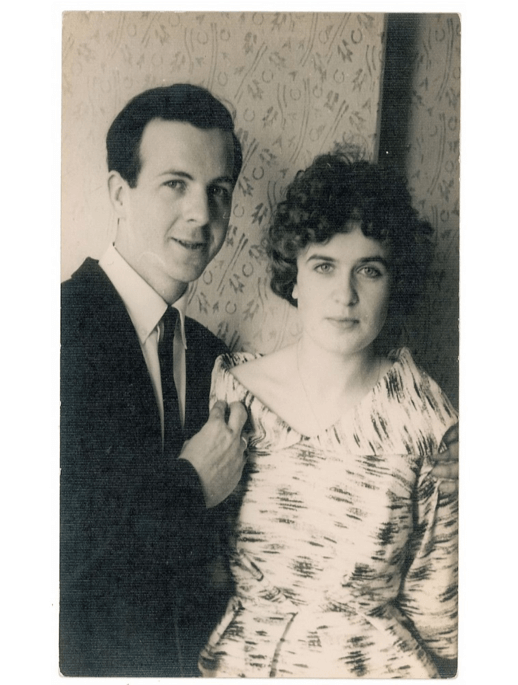
    Wedding photo showing ring worn
    on right hand per Russian tradition

    The wedding ring held and on exhibit through the Sixth Floor Museum as once having belonged to Lee Oswald, did not belong to him. It is most likely a Soviet era wedding ring of the type Oswald did indeed wear at his wedding—but as far as can be ascertained, never again thereafter. Leading to the conclusion that the ring he wore that day was borrowed for the occasion.

    The evidence leading up to the above conclusion, broken down into specific areas:

    Did Lee Oswald buy himself a wedding ring?

    What little evidence there is suggests he did not.

    Oswald made inquiries with Ella German about marriage customs in the Soviet Union—referencing silver engagement rings being swapped for gold wedding rings. He was clearly only talking about the bride-to-be. (Oswald’s Ghost, by Norman Mailer, p. 127). This fits with his noted frugality. Two rings for Marina is one thing. Another for himself is out of character.

    It should also be noted that Western males wearing wedding rings at all had only started to take off during the second half of the 20th century. (“Wedding rings: Have men always worn them?”, by Stephen Robb, BBC News Magazine, Dec 8, 2011) and that until the 1960s, wedding rings were frowned upon in the Soviet Union as a symbol of “bourgeois decay, ostentation and sanctimoniousness.” (The Land of Weddings and Rain: Nation and Modernity in Post-Socialist Lithuania, by Gediminas Lankauskas, p. 254)

    After this discussion with Ella, he purchased a silver engagement ring with a red stone, and for the wedding, a small plain gold band. After Lee’s death, undertaker Paul Groody was quoted in a newspaper account of Oswald’s funeral saying that the casket was open before burial and he had helped Marina place two rings on his finger but couldn’t get them “over the joint”. He described one as a “little ring with a red or black stone-maybe all they could get for an engagement ring in Russia.” (FBI 62-109060 JFK HQ File, Section A3, p12) The two rings placed on Oswald unquestionably belonged to Marina, with the second being her gold wedding ring. At the 2nd autopsy in 1981, the rings were taken from the little finger of the left hand. This confirms that the rings were too small to fit on Oswald’s ring finger—again indicating they had belonged to Marina.

    Tom Bargas was Shop Foreman at Leslie Welding. He told the FBI that he knew Oswald was married only because it said so on his application. (Oswald 201 File, Vol 3, Folder 9B, Part 1, p. 40) Bargas had interviewed Oswald for the job, (WCH Vol X, p. 163) so we know from this, that Oswald was wearing no wedding ring at the time of the interview—or at work at any other time.

    There are no photos available that clearly show Oswald wearing a wedding ring. There are very few photos showing a ring at all.
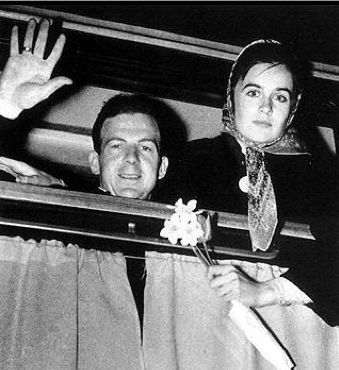
    Lee and Marina leaving Minsk

    The first of these is a black and white photo showing Lee and Marina leaving the Soviet Union. This shows a ring being worn on the right hand. Although some assume it is a wedding ring, it could just as easily be his Marine Corps ring. The assumption is largely based on claims made some days after the assassination when the ring-left-on-the-dresser story was developed. Marina buttressed the importance of this story by claiming that Lee never took his wedding ring off.

    The day before leaving Minsk, Oswald offered his friend, Ernst Titovets “a large silver ring that he had bought in Japan and wore constantly. Titovets told Oswald he was touched but could not accept the ring. It was too expensive. Oswald, we’re told, complied with his friend’s wishes and put the ring back on his finger…” (The Interloper: Lee Harvey Oswald inside the Soviet Union, by Peter Savodnik, unpaginated ebook edition).

    Since Oswald was following local traditions and wearing any rings he had on his right hand, we will logically assume that this is the “large silver ring” he had tried to give his friend just the day before. We also now know, as a result of that quote from Titovets, that it was his Marine Corp ring that was worn constantly and not a wedding ring.

    The next photos showing a ring are two of the Backyard photos. Without getting sidetracked by the authenticity debate of these photos, and that the ring seems to jump from one hand to the other, the consensus is that the ring is the Marine Corp ring.

    The last is one of the arrest photos and is something of a duel-edged sword. It clearly shows that the ring he is wearing—back on the left hand as per Western tradition—is his Marine Corp ring. It later appears in evidence lists under that description. The problem is that in not showing a wedding ring, the “ring-left-on-the-dresser” story gets additional support. It is a neat trick indeed, to use something you don’t see as evidence that it exists. God would be smiling.

    Was a ring left on the dresser on the morning of Nov 22, 1963?

    The short answer is “no, there was no ring left on the dresser of the morning of Nov 22, 1963”.

    A list of some of Marina’s purported statements on the subject, speaks for itself.

    …the following day (Friday) when she got up from bed, after the departure of her husband, she noticed his wedding ring laying on the top of their bedroom dresser. She stated that he never, to her knowledge, took off his ring before, and at that time she thought it a strange thing to do.” (CD 79, p. 3 Nov 30, 1963)

    “…she had not discovered Oswald’s wedding ring on the dresser in her room at the Ruth Paine home the morning of November 22, 1963, upon getting up that morning. She said she had not seen it until the police came to her house to search it, following the arrest of Oswald on November 22, 1963.” (CE 1820, Jan 14, 1964)


    Marina advised that on November 22, 1963, when the police came to the Paine house and searched it, they had found Oswald’s marriage ring on the dresser in the room which she, Marina used.” (FBI 105-82555 Oswald HQ File, Section 16, p. 93)

    MARINA: At one time, while he was still in Fort Worth, it was inconvenient for him to work with his wedding ring on and he would remove it, but at work—he would not leave it at home. His wedding ring was rather wide, and it bothered him. I don’t know now, he would take it off at work.

    RANKIN: Then this is the first time in your married life that he had ever left it at home where you live?

    MARINA: Yes.

    (WCH Vol 1, Feb 5, 1964)

    Juror: Did the ring have his name on it?

    Marina: I don’t know but I think I have this ring somewhere.

    (New Orleans Grand Jury testimony of Marina Oswald Porter, Feb 8, 1968, p. 69)

    “Marina later made a terrible discovery. She happened to glance at the bureau and saw that, again by a miracle of oversight, the police had left another of her possessions behind. It was a delicate little demitasse cup of pale blue-green with violets and a slender golden rim that belonged to her grandmother. It was so thin that the light glowed though it as if it were parchment. Marina looked inside. There lay Lee’s wedding ring. (Marina and Lee, by Patricia Johnson McMillan p. 544)

    Mrs. PORTERWell, I do not—I remember the demitasse, but it is missed. I don’t know where it is. Are you asking me did I find Lee’s ring?

    Chairman STOKESDid you find his ring?

    Mrs. PORTER—Yes, sir.

    Chairman STOKESAnd then did you tell Miss Johnson this: “Oh, no,” she thought, and her heart sank again, “Lee never took his ring off, not even on his grimiest manual jobs. She had seen him wearing it the night before. Marina suddenly realized what it meant. Lee had not just gone out and shot the President spontaneously. He had intended to do it when he left for work that day. Again, things were falling into place. Marina told no one about Lee’s ring.” Did you tell Miss Johnson that?

    Mrs. PORTERYes.

    (HSCA Report, Vol 2, p. 301)

    Marina Oswald is the sole witness to a ring left on the dresser that morning and as we can see, her statements about the ring have little or no consistency. Nor were they made early on. The claims did not start emerging until at least a week after the assassination, during a period in the protective custody of the Secret Service. We will look more closely at this later.

    Was a ring left on the dresser later that day?

    The closest statement to the truth made about this subject by Marina was possibly one made to Priscilla Johnson McMillan for her book, Marina & Lee. In this statement, she said that “by some miracle” the police missed seeing it in their search. Since the police took Marina, Ruth Paine and Michael Paine in for questioning immediately after the search, she most likely put her own ring there some time prior to leaving the Paine household for good. In short, it was not there at the time of the police search. This explains the police not taking it. It also explains why she did not lead them to it.

    What happened after that?

    The following day, November 23, Marina and Marguerite were given three rooms at the Adolphus Hotel paid for by Life Magazine. (WCH Vol 1, p. 444) After visiting Lee that day, Life moved the women to the Executive Inn to hide them from rival journalists. While there, Marina phoned Ruth Paine to advise her “about the ring” on the dresser. (CD 329, p. 116). Although this FBI report dated January 16, 1964 alludes to the ring as belonging to Oswald and that he had left it there before going to work, the truth is more likely to be that Marina phoned upon realizing that she had forgotten her own wedding ring and she was asking Ruth Paine to look after it until it could be picked up with her other belongings.

    Ruth Paine was not asked, nor did she volunteer any information about this call before the Warren Commission. On November 24, the mother, wife and daughters of the accused were taken into protective custody by the Secret Service. According to Marguerite, they were picked up after Lee was murdered. According to Peter Gregory, who was among the entourage who arrived at the Executive Inn, they only heard the news regarding Lee en route to Robert Oswald’s house, and this caused them to divert to the house of the Irving Chief of Police instead, where Marina again phoned Ruth. (WCH Vol 2, p. 345) I believe that Marguerite’s version is the more accurate regarding the timing of being picked up. It was done with great urgency, and with a Secret Service escort. Something triggered that urgency. That trigger could only be Lee’s death.

    Marina Oswald testified that “They [the entourage that had picked her and Marguerite up] stopped at the house of the Chief of Police Curry [it was actually the Irving Police Chief, but Marina would not have been familiar with either of them]. From there, I telephone Ruth to tell her that I wanted to take several things which I needed with me and asked her to prepare them. And that there was a wallet with money and Lee’s ring [or as more likely, her own wedding ring].” (WCH Vol 1, p. 81)

    Just a little while later, in the same session, the questions and answers seemed to get muddled as to sequence of events when she responded to the question, “what did you do after you went to the motel?” by saying, “I left with Robert and we prepared for the funeral.” This must be out of sequence because she had testified previously that Robert had left by then. It therefore must have occurred prior to going to the house of the Irving Police chief and phoning Ruth. Mortician Paul Groody is known to have gone through the same things he did with all bereaved by asking Marina about what clothes and jewelry she would like Lee to be laid to rest in.

    We then go to Ruth Paine’s testimony:

    Mr. JENNER—Do you recall an incident involving Lee Oswald’s wedding ring?

    Mrs. PAINE—I do.

    Mr. JENNER—Would you relate that, please?

    Mrs. PAINE – One or two FBI agents came to my home, I think, Odum was one of them, and said that Marina had inquired after and wanted Lee’s wedding ring, and he asked me if I had any idea where to look for it. I said I’ll look first in the little tea cup that is from her grandmother, and on top of the chest of drawers in the bedroom where she had stayed. I looked and it was there.

    Did Ruth take a lucky guess at where to look or did Marina tell her exactly where it was because she herself had put it (her own ring) there? We are not told when this happened, but we do at least know that the request by Marina was made on the afternoon of her husband’s murder. We also know from Marina’s testimony that she had advised Ruth that she “needed” the items requested. This is curiously as absent from Ruth’s testimony as the date for the pick-up is. The question is, was Marina ‘s need for the ring so that it could be placed on Lee’s finger for burial? Was Ruth deliberately vague on detail because, the ring having magically transformed from Marina’s ring to Lee’s ring, it now cannot be associated with the ring put on at the funeral?

    The real sequence of events would be:

    • Nov 22 am—Lee Oswald leaves for work. Marina gets up later
    • Nov 22 pm—JFK is assassinated. Paine home is searched. No ring is found on dresser because no ring is there. Marina and Ruth and Michael Paine are taken in for questioning
    • Nov 23—Marina and Marguerite are moved into rooms at the Adolphus Hotel before being moved again to the Executive Inn on the edge of town. Marina phones Ruth to let her know she has left her ring/s and savings behind and asks Ruth to look after them
    • Nov 24—Lee Oswald is murdered. Robert Oswald, Peter Gregory and some Secret Service agents hustle the women into moving quickly to another location. They are now in Secret Service protective custody. Robert takes Marina to the Mortician, Paul Groody, and she tells Groody she wants Lee buried in her wedding and engagement rings as the police have his ring and bracelet. They go to the home of the Irving Police Chief where Marina again phones Ruth, telling her she needs the ring and that someone is coming to collect it. It is picked up by FBI Agent Bardwell Odum. Ruth knows where the ring is because Marina has told her
    • Nov 25—Lee Oswald is buried after a quick service at Rose Hill Cemetery. The casket is open until just prior to internment and Groody assists Marina in placing the rings on Lee’s little finger as they are too small for the traditional ring finger (FBI 62-109060 JFK HQ File, Section A3, p. 12)
    Marina at City Hall on Nov 22. She is still wearing her ring

    What this timeline shows is the improbability of the ring/s (it was more likely both her wedding and engagement rings) on the dresser having belonged to Lee Oswald. Moreover, it makes sense of the phone calls to Ruth on consecutive days and shows that the second call fits with the need for the rings in time for the funeral. It is surmised that Marina took her rings off sometime before leaving the Paine household on Nov 23 as Marguerite testified that both babies had diarrhea. This would cause a lot of changing of nappies and wiping of bottoms—something best done without jewelry on the fingers.

    The three-ring circus
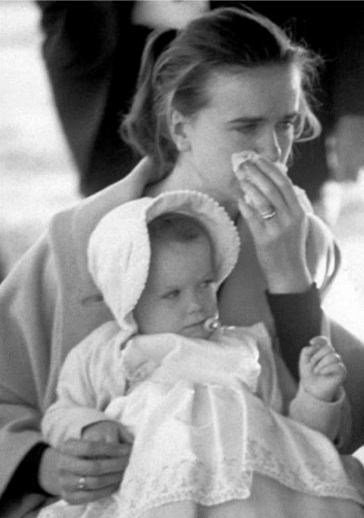
    Two rings on left hand and one on right

    As we can see above, on November 22, Marina wore one ring. Yet on the day of Lee’s funeral she was photographed wearing what looks like three almost identical plain wedding bands. I have no explanation for this other than to suggest that there were a number of rings left in that demitasse saucer picked up from the Paine’s by Odum and delivered to Marina—all of which belonged to Marina—as shown from they way that they fit.

    Where did the story originate that the dresser ring belonged to Lee?

    As shown above, the Secret Service took Marina and Marguerite into protective custody immediately after Lee Oswald was murdered. The day after the funeral, Nov 26, serious interrogations began, with both the Secret Service and the FBI. These went through until Dec 1, though further interviews were conducted periodically after that.

    The interrogators quickly realized that Marina was the person they needed to concentrate on. She was vulnerable on several levels, but more importantly, she was also more flexible and pragmatic of mind. It would be a mistake to suggest this made her submissive. She was simply a survivor first and foremost. Marguerite on the other hand, had a clear and immovable portrait of her son, and it was not the portrait that investigators wanted to hear. She would be set aside and marginalized as an avaricious, nutty and neglectful mother. In fact, Marguerite testified to the Warren Commission that “I was never questioned by the Secret Service or the FBI at Six Flags. My son, in my presence, was questioned and taped, and Marina was continuously questioned and taped. But I have never been questioned.

    The Reid Interrogation Technique

    The Reid Interrogation Technique is practiced throughout most law enforcement agencies and police forces in the US where suspects and witnesses are routinely interviewed. This includes the FBI and the Secret Service. It was developed in consequence to Brown Vs Mississippi (1936) which held that confessions obtained through physical violence would be inadmissible in court. It simply replaced the violence with social psychology involving isolation, induced despair, limiting opportunities for denials and alibis, and the delay of legal counsel at least until the person has been broken down and has provided a confession. Other tools used to get to this point include lying to the suspect, pretending to have witnesses or evidence that don’t exist, or showing evidence that is fraudulent, giving leading questions and finally, throwing a lifeline by offering excuses for the crime and offering support if they will only make the admission. Parallel to that is the construction of a scenario around the crime that goes to the guilt of the suspect.

    The method works. The method also does not discriminate. If you are the focus of an investigation, it may only be because your psychological reactions have not been within the “norm”. For example, a woman finding her husband or child dead would be expected to be an emotional wreck. Other signs of guilt are also looked for, such as an inability to make eye contact, fidgeting, stuttering etc. All too often, once police become convinced of your guilt, based solely on their psychological evaluation, lack of evidence is of secondary importance. They will either break you or frame you.

    Or in the case of Oswald, arrange your televised execution.

    The method is not confined to suspects. It is also used on witnesses to get them on board with a scenario that helps their case.

    Marguerite intuitively knew that something was happening, even if some of her conclusions may not have been accurate.

    Mrs. OSWALD. No. I am saying—and I am going to say it as strongly as I can—that I—and I have stated this from the beginning—that I think our trouble in this is in our own Government. And I suspect these two agents of conspiracy with my daughter-in-law in this plot.

    The CHAIRMAN. With who?

    Mrs. OSWALD. With Marina and Mrs. Paine, the two women. Lee was set up, and it is quite possible these two Secret Service men are involved.

    Mr. RANKIN. Which ones are you referring to?

    Mrs. OSWALD. Mr. Mike Howard and the man that I did not—did not know the name, the man in the picture to the left. I have reason to think so because I was at Six Flags and these are just some instances that happened—I have much more stories to tell you of my conclusions. I am not a detective, and I don’t say it is the answer to it. But I must tell you what I think, because I am the only one that has this information. Now, here is another instance——

    What Marguerite witnessed between the agents and Marina and assumed to be evidence of conspiracy between them in the assassination was really the Secret Service coopting Marina to assist with building the case against her husband. What Marguerite witnessed was initially Marina being isolated, threatened, asked leading questions and finally being offered all manner of assistance as her cooperation grew and she saw the money rolling in from a shocked nation. Meanwhile, Marguerite was being denied a ride home for more clothes and having her news clippings and mail confiscated. In all other respects, she was totally ignored.

    Marina’s cooperation with the Secret Service then was vouchsafed by early promises arranged through immigration that she would not be deported, and by having firemen sitting within view of her as they counted the money coming in from concerned citizens around the country—a reminder that the money was within reach—but not hers until the Secret Service was happy enough with her to hand the money over. Both measures infuriated the FBI as they left Hoover’s men no bargaining chips whatsoever—and that was probably another outcome the Secret Service hoped to achieve. They now owned Marina. (Assignment Oswald, by James P Hosty, p 89). The money ended up totaling $70,000—the equal of nearly $600,000 today. Given her parlous state, the murder of her husband, two small children, and poor prospects in a foreign and now possibly hostile environment, no one should blame Marina for effectively going along with the stage play. Taking the carrot in America was certainly a better prospect than facing the stick back in the Soviet Union.

    The sole purpose of the evolving ring story was simply to imply motive. Lee, it would be claimed, knew his marriage was over so he planned instead to make his mark in history. But the marriage was not over. The savings also found on the dresser—and often cited as another clue he was never coming back, had been an amount accumulating on that very dresser every pay day, not left all at once. It was money meant for an apartment to reunite the family and there is solid evidence he had found one. That information too, had to be buried and left uninvestigated. Unfortunately, it is also outside the bounds of this work.

    (With thanks to Ed Ledoux for the photos used.)


    THE RING, Part Two: Authentication, Sale & Acquisition

    If, as shown in Part One, it is likely that Lee Oswald never owned a wedding ring, it stands to reason such a ring could not be sold at auction.

    Yet a wedding ring purported to have belonged to the accused assassin was indeed sold at auction in 2013. Here, we will try and trace the history of how this came about.

    2004 and the Markward file

    Ring and receipt discovered by Dave Perry

    In July 2004, the Fort Worth law firm of Brackett & Ellis located the Marina Oswald file of retired lawyer Forrest Markward.

    At 90 years old, Markward was long retired and by now in the early stages of Alzheimer’s, so the law firm instead, called in local JFK assassination expert, Dave Perry to go through the material.

    Inside the file, Perry found an envelope containing a gold wedding ring and a receipt—allegedly from the Secret Service. This is suggested by the file reference at the top right which was the reference the Secret Service used for all JFK assassination related material. (Lost History episode, air date december 1, 2014).

    Stan Dane’s MS reproduction matches perfectly

    Issues with the receipt as photographed

    As can be seen, the receipt bears no signature or date and is not on Treasury or Secret Service letterhead. In short, it is the type of document that could easily be typed up by anyone. Indeed, it looks very much like it was typed using MS Word using 10-point fonts or, alternatively it was typed on an IBM Selectric typewriter using 12 pitch characters (all but identical to the 10-point fonts of MS).

    Author Stan Dane proved the point by reproducing the receipt using MS Word and comparing the result to the original.

    Issues with the ring as photographed

    Building on the work of Dane, Jake Sykes measured the ring size with the following formula:

    “Using 1/16″ (the 10-point font measurement) yields 9-1/2 lower case “s” letters. 9.5 x 1/16″ = .594″ for the ring diameter.” This means the ring is just below the average woman’s ring size of .60”. (reference.com article, What Is the Average Ring Size for a Woman?)

    What we are left with is a receipt that bears indication of fakery and a ring too small to have been worn by Lee Oswald, but quite possibly one that would fit Marina.

    The strange articles of Dave Perry and Hugh Aynesworth

    Before getting into those articles in detail, allow me to note one of the first things that struck me about the pair—they both spell lawyer Forrest Markward’s surname as “Marquart” indicating a certain amount of cribbing from each other. I have found no indication that the name was ever spelled any other way than “Markward”. It is for instance, spelled that way in Secret Service records dated Feb 7, 1964 and in online obituaries (findagrave.com, date of death Nov 30, 2009), so if Perry went through the lawyer’s file on Marina, how on Earth did he manage to misspell his name? I will leave that detail for others to ponder.

    Is This Lee Oswald’s Wedding Ring? By Dave Perry, undated

    Perry starts out appearing to be wearing his investigative reporter hat. He does this by going through some (but not all) of Marina’s different and contradictory statements concerning the ring. He then notes that Oswald was buried on Nov 25, 1963 before quoting Linda Norton, the doctor who headed the exhumation autopsy in 1981:

    “Upon entry into the casket a moderate malodor emanated from the decomposing body. As measured in the casket from superior skull to heel region on the left, a body length of 177cm (69½ in.) was obtained. A gold wedding band and a red stone ring were removed from the fifth digit of the left hand (subsequently identified by Mrs. Porter as representative of items placed upon the body at the time of initial burial).” (The Journal of Forensic Sciences, V. 29, N. 1, January 1984, p. 24)

    To get the full flavor of the Perry piece from this point, it would be best just to quote it directly.

    Originally, I believed the ring in the possession of Attorney Luke Ellis of Brackett & Ellis of Fort Worth, TX was the wedding ring removed by Dr. Norton. I thought a member of the firm, Attorney Forrest Marquart, had appeared with Marina at the exhumation autopsy.

    When I visited the law firm, I found documents showing that Marina was using the firm’s services in 1964—after the burial but well before the exhumation autopsy. Marina went to the law firm in 1964 to sign documents (for example: the contract with Priscilla McMillan and publisher Harper & Row for the book that would become Marina and Lee.) and at that time presented the ring to Attorney Marquart.

    With the ring is the following typed notation:

    CO-2-34, 030

    Receipt is hereby acknowledged of a gold wedding band which had been turned over to the United States Secret Service on December 2, 1963 by Mrs. Ruth Paine.

    _____________________________

    Date _________________________

    I surmised the law clerk that received the ring, transcribed Marina’s comment that this was the ring that Ruth Paine turned over to the Secret Service on December 2, 1963. The Secret Service then gave it to Marina who brought it to the law firm as payment for services.

    I now had no idea what ring the law firm had until I found the following:

    “The lid was raised. Forty reporters peered over the (police) officers’ shoulders. Marina, who had been following TV and was learning about images, kissed her husband and put her ring on his finger.” (The Death of a President, by William Manchester, p. 568)

    It would seem Marina put HER wedding ring on the body only to retrieve it years later at the exhumation. And this means the ring in the law firm’s possession is Lee Oswald’s wedding ring.

    The issues and items not mentioned are just as telling as his inevitable “nothing-to-see-here” conclusion. This includes the circumstances of his appearance to inspect Markward’s file on Marina, the exact date this happened, any description or photo of the envelope and any contact he had with Marina about the discovery.

    Coming Full Circle by Hugh Aynesworth, September 1, 2004

    This should have been subtitled “Wither Thou Goest” such are the ties that bind the two Keepers of the Warren Commission Flame, though carrying it on opposite sides of the street.

    Aynesworth, continuing the path beaten by his ally, opens with the hortative that a small gold wedding band

    believed to have been worn by Lee Harvey Oswald until just a few hours before he purportedly assassinated President John F. Kennedy has been locked in a safe at a law firm here for more than a generation.

    Is this really Aynesworth? “Believed”? “Purportedly”?

    “Oswald’s friends and family, and lawyers and doctors involved in the case, say that the ring may be the one that the suspected assassin wore.”

    And there is the trifecta—“may”. And we really don’t get told who these people are. Sure, Marina and Ruth. But who are the others? Markward had Alzheimer’s and had no memory of any of it. The other lawyers who called Perry in had no inkling regarding the history or ownership of the ring. The doctors is one doctor, not two or more—Linda Norton—and all they had from her was the quote made in the Journal of Forensic Sciences and that quote says nothing about who owned the ring. Aynesworth is stretching credulity big time.

    “JFK investigator Dave Perry, of Grapevine, Texas, believes that the ring was Oswald’s and might have been given to federal authorities in December 1963 either by Oswald’s widow, Marina, or by Ruth Paine, the Irving, Texas, woman who let Mrs. Oswald and her two young children live with her during the fall of 1963.”

    With five qualifiers in three short paragraphs, Aynseworth is suddenly in unfamiliar territory. And remember also that these qualifiers are about the history and ownership of a ring which would eventually be sold in 2013 as a bona fide historical artifact. Clearly though, as of 2004, there was far from any certainty about either ownership or history.

    The next few paragraphs just add to the uncertainty. Luke Ellis, representing the law firm that held Markward’s file, admits he has no clue about what to do with any of the material. Ruth Paine is contacted. She falls back on how long ago it all was but concedes it is possible she gave the ring to the Secret Service on the date noted. The fact is though that Ruth Paine consistently stated during the days of the various investigations, that she gave the ring to the FBI—moreover, she names the agent as Bardwell Odum. The only thing she never mentioned was when she gave it to him. But since Marina advised her that she needed it on November 24, and the likely reason for needing it was to place on her husband’s finger for burial the next day, it is a good bet that it was collected no later than the morning of November 25.

    The next piece of information of any value is that the Times contacted Marina during late August about the ring and was told by her that she did not recall seeing the ring after the police raid on the Paine home. When pressed as to what she thought happened to Lee’s ring, Marina simply replied “Oh, I don’t know. It’s been so long ago. If someone else has it, I don’t care.

    Compare that to what she told the Grand Jury in New Orleans

    So, in 1968, She thought she still had the ring somewhere but could not recall if it was even inscribed, then by 2004, her memory was that she had not seen it since November 22, 1963! And I again remind readers that her stories constantly changed on the subject beyond these two versions. We know this is not the only subject in which Marina has given mutually exclusive accounts, with most of those being in legal settings

    Back to Aynesworth:

    Though the ring having been stored along with several legal documents might appear to indicate that Mrs. Oswald had given the ring to Mr. Marquart as payment for legal services, Mrs. Oswald did not recognize the lawyer’s name and said that she could not recall having the ring at any time after the Kennedy assassination.

    Originally, Mr. Perry and another investigator, David Murph of Grapevine, Texas, conjectured that the ring might have been removed from the casket when the body of Oswald, who was killed by Jack Ruby two days after Kennedy’s death, was exhumed in 1981.

    But Mrs. Oswald and the doctor who led the team that exhumed the body dispute that theory.

    Dr. Linda Norton, a forensics specialist from Dallas, said last week that there was no male wedding band on Oswald when he was disinterred to confirm that the body buried under his name was indeed him.

    “There were two rings, one small wedding band and a ring with a small red stone in it,” she said. “The wedding band was too small even for his little finger—so that couldn’t have been his.

    “Afterward, I replaced both on his fingers before they closed the casket and reburied him,” she added.

    There we have it. It could not have been Marina’s ring from the corpse because it was placed back on the body before reburial. Not explained is how they could have ever considered this was the ring in the files when they maintain that the ring in the files was a male size and not female (as the ring on the body was). But as we have shown already, the ring in the files was indeed a ladies’ size. Moreover, it looks like Linda Norton’s memory of putting both rings back on the body was not accurate.

    Morgue: A Life in Death by Dr. Vincent Di Maio, Ron Franscel, pp. 114-122

    Dr. Norton was assisted in the 1981 autopsy by Dr. Vincent Di Maio. This is what di Maio tells us in his autobiography

    “First, we removed the rings on the corpse’s finger and gave them to Marina… Back in the autopsy room, before Oswald’s new casket was closed and he went back into the damp earth of Rose Hill, a grateful Marina gave Dr. Norton an odd gift: the red gemstone ring we’d taken off the corpse’s pinky. It was her way of saying thanks for the team’s work. But Linda was visibly uncomfortable with this morbid reward. As soon as Marina left the room, she inconspicuously slipped it into my hand. She didn’t want it. Neither did I. As well-meaning as it might have been, it was a sordid souvenir of a grim task and an even grimmer history. I wished for the whole wretched mess to just be buried once and for all. So just before they sealed Lee Harvey Oswald’s coffin for his next eternity, I dropped the ring into the box with him and then drove home to San Antonio in the dark.

    There is just too much detail here to have been made up. In any case, for what purpose would he make such a thing up?

    We can see here that both rings were given back to Marina, but only the ring with a stone was returned to the coffin. Put anther way, Marina kept the gold wedding band—which we know was hers.

    Where does this leave us? As of 1981, Marina had her own wedding band back in her possession. But we also know from Di Maio that Marina was keen to be rid of the rings and whatever memories they held. She in fact believed she had successfully given away the engagement ring. Given this mindset, Perry’s initial impression that she had given the band to Markward who was representing her interests at this autopsy, holds up perfectly well. This in turn, fits with the measurements showing the ring found was that of a female, not a male. Again, it was Marina’s own ring.

    “Mystery surrounds Lee Harvey Oswald’s ring”, by Hugh Aynesworth for the Dallas Morning News, October 27, 2007

    This is basically an updating of the 2004 story. The only new information apart from declaring that the Sixth Floor Museum has an interest in acquiring the ring, is the following.

    “A Secret Service document that Marina signed Dec. 30, 1964, indicates that federal agents returned the wedding ring to her on that date. The Secret Service had been given the ring, the memo said, on Dec. 2, 1963, by Ruth Paine, the Irving woman who had provided a home for Marina.”

    Since when does the Secret Service get the civilian subjects of memos to sign said memo? Nor does Aynesworth attempt to explain why it took from December 2, 1963 when it is alleged that the Secret Service took possession of the ring from Ruth Paine, until December 30, 1964 to return it to the rightful owner. In fact, the prejudicial word used in all the stories about the sale of the ring and its background, is “confiscated”—that is, the ring was “confiscated” from Ruth Paine—indicating that the Secret Service had taken it forcefully as “evidence”. This is at complete odds with what Ruth Paine maintained throughout 1964 and beyond. She has steadfastly stated that the FBI came to collect it at Marina’s request on an unspecified date, but in context, had to be November 24 or 25, 1963. It is only in recent years, under apparent pressure, that she has claimed she cannot recall, and so concedes it is possible that the Secret Service did pick it up on December 2, 1963. It became obvious a long time ago that Marina and Ruth had separated into different “teams”. Marina gave her allegiance to the Secret Service while Ruth gave hers to the FBI.

    As far as this writer has been able to ascertain, such a memo has never surfaced, and as stated above, it was not mentioned in the original story.

    It seems at some stage, the “memo” was dropped as quickly as it had been “discovered” because all it states in what purports to be the official ring timeline as published by the Dallas News is this:

    Dec. 30, 1964: The Secret Service returns the ring to a Dallas lawyer who once represented Marina Oswald; that lawyer included it in files transferred to a Fort Worth attorney, Forrest Markward of Bracket & Ellis, who represented Marina Oswald from late 1963 to early 1965. (“Lee Harvey Oswald’s wedding Band Heading to Auction Block” by James Ragland, July 2013)

    The only thing left of the claim is the date. But that is far from the only issue with this timeline entry. Who was the lawyer who supposedly took receipt of the ring? Why was the ring not passed on directly to Markward by the Secret Service since he was the one currently acting for Marina? The Secret Service certainly knew about Markward since he is named in a Feb 7, 1964 memo as attending a meeting with Marina, James Martin and his family, Secret Service agents and a Mr. Louis Saunders in the Grand Prairie office of John Thorne (CD 372, p. 12). Saunders was Executive Secretary for the Fort Worth Area Council of Churches—all-in-all, a diverse group meeting indeed. No doubt the agenda items would have been intriguing. Lastly, there is a key error of fact in that entry. Brackett & Ellis is on record as stating that Markward did not begin with the firm until the late 1970’s. (“Coming Full Circle”, by Hugh Aynesworth, Washington Times, September 1, 2004) Any files transferred to him in 1964 were not therefore transferred to him while working at Brackett & Ellis. The fact is that Markward not only represented Marina in the 1963-65 period, but also for the 1981 exhumation—a fact that Perry hints at early in his “investigation” of the ring, but then drops like the proverbial hot potato when it becomes an inconvenience to his predictable conclusion.

    The RR Auction sale of the ring

    Forrest Markward died on November 30, 2009. It took until July 24, 2012 for Brackett & Ellis to formally write to Marina and advise of the ring’s discovery. That is about 30 months after the death of the lawyer and a full 8 years after it was discovered in his old files. By the same token, Marina was in no rush to obtain it; not picking it up from the law firm until early 2013. Then in May of that year, she wrote a 5-page document outlining the history of the ring for RR Auctions—a history she has constantly rewritten through questioning under oath and through numerous interviews with various law enforcement officials, authors and the media. In that light, it is unsurprising that she wrote this history on the proviso that certain parts of it would not be made public. Five months later, the ring sold for $108,000. As a 14k gold ring, it has an intrinsic value of about point one or two percent of that amount.

    Authentication

    RR Auctions commissioned David Bellman of Bellman’s Jewelers to authenticate the ring. In 2017, Mr. Bellman posted a video to You Tube as part of a series called Jewelry in History. This episode was titled Lee Harvey Oswald—Authenticating His Wedding Band. What this video demonstrates is a basic process of showing it was a Soviet made 14 karat band by the markings inside it. But does this prove it belonged to Lee Oswald as claimed? Of course not. Marina’s secret statement was accepted as the sole authentication of that.

    By the time I found this video, someone else had already asked what size the ring was. The jeweler replied that as best he could recall, it was .95 (of an inch)—which is the average size of a male ring (the Sixth Floor Museum lists as having a diameter of 15/16”). He failed to respond to my request for personal contact regarding the matter.

    The Sixth Floor Museum

    Two years later, the Sixth Floor Museum acquired the ring. During my research for this essay, the museum was contacted to alert them to the issues surrounding the ring. Here is that email, along with the reply:

    Regarding the acquisition of Lee Oswald’s wedding ring:

    I understand that Marina Oswald wrote a 5-page history of the ring to go with the it when she sold it at auction. Did the museum acquire it, as well?

    I also understand that the ring you have was found in the files of a Fort Worth lawyer, in an envelope also containing a receipt from the Secret Service dated Dec 2.

    So as to provide accurate information to the public, you need to know that this story conflicts with past stories—which are themselves all mutually exclusive.

    Ruth Paine testified to the Warren Commission that the ring was picked up from her home by Bardwell Odum of the FBI.

    Marina herself is documented as telling the FBI that the police found the ring on Nov 22.

    But then during her testimony to the New Orleans Grand Jury, Marina testified that she found the ring after Lee went to work that morning and that she still had it “somewhere”.

    That is 4 different versions, when including the Secret Service version. Two of those conflicting versions came from Marina herself. I would like to know if the 5-page note contains yet another version or incorporates one of her earlier versions.

    In any case, the provenance of the ring you have, must be treated with some trepidation.

    The story that Oswald always wore the ring and therefore leaving it on the dresser that Friday morning, shows he knew he would not be coming home, in my opinion, is the reason for these conflicting stories. Marina did testify that she knew Lee had taken the ring off once at work.

    Here is what she said:

    “At one time while he was still at Fort Worth, it was inconvenient for him to work with his wedding ring on and he would remove it, but at work—he would not leave it at home. “

    I think a lot of manual laborers would take rings off while working. It makes sense to me that Oswald did not do this just once but did it as a matter of habit. Additionally, her claim that he would never leave it at home makes no sense. Why would he wear it to work, but then take it off and carry it in his pocket all day? Wouldn’t it make better sense to leave it at the Paines’—especially if he expected to be returning there that evening?

    What should have been regarded as evidence of his innocence (or at the very least, evidence of nothing either way), was completely turned on its head to make him look guilty.

    I also note that in his 2013 book, Mr. Fagin pushes the line that Oswald not only left his ring, but also $170.00. This is not true. He did not “leave” it there. That wallet was kept there, and he added to it every pay day—that is according to Marina’s testimony on it.

    Any museum needs to ensure it gets its facts straight and does not simply push official propaganda that is not supported by the evidence. Not unless the museum is in a totalitarian country, anyway.

    Five days later, I received the following reply from Stephen Fagin:

    Good afternoon Mr. Parker,

    Thank you for your interest in the Museum’s Collection. As our educational and public programs have demonstrated over the years, there is rarely one way of exploring evidence in a case that remains controversial and fiercely debated around the world. We value your feedback regarding Lee Harvey Oswald’s wedding ring, and the resources that you cite are available to students, researchers and the general public via our Reading Room.

    We do have the May 2013 letter from Marina Oswald that you referenced in your e-mail. In it, Marina indicates that she did not see the ring that morning but believes—based on records associated with the ring—that Ruth Paine gave it to the Secret Service. She assumed that the government had kept all of their personal belongings (including the ring) and did not learn that the ring had been returned until “receiving a letter from a Fort-Worth law firm in July 2012 stating that they had it in their files for past 49 years.” She recalled that Forrest Markward, the attorney who had possession of the ring, had provided her with some pro bono legal work following the assassination. Marina recognized the ring upon examining it.

    The Museum is confident, based on available documentation and research, in the provenance of the ring we currently have on display.

    Again, we appreciate your interest.

    Sincerely,

    Stephen Fagin | Curator

    Mr. Fagin failed to respond to two follow-up emails made in response to this carefully crafted, polite brush-off.

    So, let us put the reply under the microscope here:

    What does “there is rarely one way of exploring evidence in a case that remains controversial and fiercely debated around the world” even mean in terms of arriving at an accurate conclusion? It is nothing but a throw-away line meant to sound profound. Either the ring held is authentically one that belonged to Lee Oswald, or it isn’t. The next statement that “the resources that you cite are available to students, researchers and the general public via our Reading Room” is equally misleading in its banality. The resources cited would not be found unless specifically searched for and it is a painstaking exercise to run down all sources and all versions of and about the one story. The only version that is easy to find, is the official one because it is plastered all over the net. Mr. Fagin’s laisse-faire attitude to real history is offputting, yet still unsurprising. Being a water-carrier with only make-believe water does at least have the saving grace of being wryly amusing.

    it is, however, his description of the 5-page statement regarding the history of the ring, made by Marina in order to procure a sale, that is really telling.

    In it, Fagin states that according to Marina,

    • She did not see the ring that morning (of Nov 22, 1963). My response: Yet she is on record as saying otherwise in the past.
    • She believes, based on the records, that Ruth Paine gave it to the Secret Service. My response: Yet there are no such records that I have been able to find, apart from the alleged receipt found with the ring. And as already established, Ruth Paine testified she gave it to Mr. Odum of the FBI.
    • She did not know about the existence of the ring until receiving the letter from Brackett & Ellis in July 2012. My response: Yet we have seen that she was contacted by the NYT (possibly by Hugh Aynesworth himself) for Aynesworth’s 2004 story on the finding of the ring.

    Based on the results of this investigation, Mr. Fagin’s assertion that “The Museum is confident, based on available documentation and research, in the provenance of the ring we currently have on display” is a bit risible.


    THE RING, Part Three: Timeline & Conclusions

    1957-1958: Lee Oswald buys a Marine Corps ring while stationed in Japan

    1960-61: Lee is making inquiries about Russian marriage customs concerning silver engagement rings and gold wedding rings for the bride-to-be. He makes no inquiries about rings for grooms-to-be. (Oswald’s Ghost, by Norman Mailer, p. 127)

    Jan 1960-Nov 22, 1963: Lee takes his Marine Corps ring off while at work (WC testimony of Marina Oswald “At one time while he was still at Fort Worth, it was inconvenient for him to work with his wedding ring on and he would remove it, but at work—he would not leave it at home. His wedding ring was rather wide, and it bothered him. I don’t know now, he would take it off at work.” There is no reason to believe that Oswald ever wore a wedding ring at any job and the ring that he wore constantly was his Marine Corp ring—a wide ring, which is what Marina described)

    1961: Lee buys a silver engagement ring and gold wedding ring in Minsk for Marina Prusakova.

    April 30, 1961: Lee marries Marina. Speculation: Lee borrows a ring for the ceremony. This must be true since Marina testified as above that the wedding ring was inconvenient to work in because of its width. The wedding photo does not show a wide ring. As above, the wide ring could only be his Marine Corp ring—this being the same ring that Titovets said Lee wore constantly as shown in next entry)

    May 22, 1962: Lee offers to give his friend, Ernst Titovets his Marine Corps ring as he is departing the next day to the US and wants to leave his friend something to remember him by. Titovets refuses to accept it, noting that Lee wears it “constantly” (The Interloper: Lee Harvey Oswald Inside the Soviet Union, by Peter Savodnik, ebook, unpaginated)

    Nov 22, 1963: After the search of the Paine house, Marina is taken in for questioning by the DPD and provides an affidavit This statement contains nothing about a ring being left by Lee that morning. (affidavit of Marina Oswald, Nov 22, 1963). Just after 4:00 pm, Lee gives his USMC ring to Det. Sims during a body search.

    Nov 23, 1963: Speculation: Marina takes her own wedding ring off while changing nappies of her babies, both of whom have diarrhea and places it in a cup or saucer on her dresser. She then leaves the Paine household for good, initially being looked after by Life Magazine. She phones Ruth later that day to let her know she left a ring behind. (FBI report dated Jan 16, 1964). The report is non-specific about which ring is being referenced. Speculation: Specifically, this call is to let Ruth know she has left her wedding ring inside the cup on her bedroom dresser and asks Ruth to keep it until she is able to pick it up.

    Nov 24, 1963: Marina phones Ruth Paine again after Lee is murdered. She tells the Warren Commission on Feb 3, 1964 “I telephone Ruth to tell her that I wanted to take several things which I needed with me and asked her to prepare them. And that there was a wallet with money and Lee’s ring.Speculation: it is not Lee’s ring she mentioned at all since the only ring he had was a Marine Corp ring and it had been taken by police. She is referring to her own ring. This call is really to ask for the return of the rest of her belongings and for the return of her ring so it can be placed on Lee before burial. Ruth Paine testified that Robert Oswald came by for all Marina’s other belongings—but the ring and money were given to FBI agent Odum.

    Nov 25, 1963: Lee Oswald is buried at Rose Hill Cemetery. Marina’s wedding and engagement rings are placed on Oswald’s little finger on the left hand. Historian William Manchester tells us that “the lid was raised. Forty reporters peered over the (police) officers’ shoulders. Marina, who had been following TV and was learning about images, kissed her husband and put her ring on his finger.” (The Death of a President, by William Manchester, p. 568). And from Dr. Vincent Di Maio, one of the autopsy team at the 1981 exhumation, we have “…Groody placed two rings on Oswald’s fingers. One was a gold wedding band and the other a smaller ring with a red gemstone that Oswald’s wife had requested he be buried with.” (Morgue: A Life in Death, by Dr. Vincent Di Maio and Ron Franscell, p. 106). Paul Groody was the mortician who prepared the body for burial. He himself was quoted in a newspaper article saying that he assisted Marina in putting the rings on Lee. (Associated Press, Lee Harvey Oswald Casket Controversy Continues by Mike Cochrane, p. 36 Aug 16, 1981)

    Nov 26—Dec 1, 1963: Marina Oswald is subjected to intense interrogation by the FBI and Secret Service. (see especially, CE 1787) Speculation: It is during this period that the story of Lee leaving his wedding ring on the bedroom dresser first emerges. This is typical of the Reid Technique. Isolate a witness, create a narrative incriminating the accused and use any and all manner of psychological tools to get the witness to “own” that narrative. The incrimination was implicit in the alleged act because, claim the authorities, Lee knew his marriage was over and that he was not returning. He was instead, going to leave his mark on history. Speculation: The FBI and/or Secret Service built this part of the narrative based on finding out that Marina had left her own wedding ring at Ruth’s and had asked the FBI to pick it up for her so it could be placed on Lee’s finger at the funeral. All they had to do was act like the ring on the dresser had been Lee’s and truthfully say that the ring placed on Lee for the funeral was Marina’s. Now, instead of it being the same ring—Marina’s ring in both cases—they have transformed it into two different rings. From here on, Lee’s (fictional) wedding ring would be the one it would be claimed he never took off (when this was really his Marine Corp ring per Titovets). The last requirement would be to blur what happened to the (fictional) wedding ring. The fact of FBI Agent Odum picking up the “dresser ring” to give to Marina prior to Lee’s funeral, was replaced with the Secret Service “confiscating” the ring on Dec 2, 1963, before finally returning it to Marina on Dec 30, 1964. This in turn got changed to a scenario in which it was given to an unnamed lawyer who had been representing Marina who in turn passed it on to Forrest Markward.

    Dec 2, 1963: this is the day that the official time-line designates as the date that the Secret Service “confiscates” the ring from Ruth Paine. An exhaustive search of records in the Mary Ferrell Foundation data base has failed to locate any evidence of this. It is, however, the day following the FBI and Secret Service interrogations of Marina and is the day both agencies began serious investigations—largely based on the Marina Oswald interviews, as well as those of Ruth and Michael Paine, Buell Wesley Frazier and his sister Linnie Mae. Together, this group of witnesses provided, or agreed to, the dot points cobbled together to form the backbone of the case. The investigation was meant to add the flesh to this burgeoning false narrative.

    By 2004, Ruth Paine’s memory is a little fuzzy as she allegedly tells Hugh Aynesworth, that she may have given the ring to the Secret Service (“Coming Full Circle”, by Hugh Aynesworth, Washington Times, Sep 1, 2004). It is much more likely that Aynesworth told her it was the Secret Service and she simply agreed it may have been. She does stick solidly to the bit about it being done at Marina’s request.

    Dec 30, 1964: This is the day that the official timeline designates as the date that the Secret Service rids itself of the ring. According to a 2007 article—again by Aynesworth. This is supposedly based on a Secret Service memo signed by Marina. To quote from the Aynesworth article, “A Secret Service document that Marina signed Dec. 30, 1964, indicates that federal agents returned the wedding ring to her on that date. The Secret Service had been given the ring, the memo said, on Dec. 2, 1963, by Ruth Paine, the Irving woman who had provided a home for Marina.” (“Mystery Surrounds Lee Harvey Oswald’s Ring”, by Hugh Aynseworth, Dallas Morning News, Oct 27, 2007). Not explained is why it took from Dec 2, 1963 to Dec 30, 1964 to return the ring. Also not explained is what Marina is doing signing a Secret Service memo. It appears some of these issues finally dawned on those involved. In an article by Aynesworth written three years earlier on the same subject, there is no mention of any Secret Service document signed by Marina acknowledging the return of the ring. Now, in the official timeline, the only part left of these claims is the date. The alleged document signed by Marina acknowledging return of the ring on Dec 30, 1964 has disappeared and what we now have is “December 30, 1964: The Secret Service returns the ring to a Dallas lawyer…” No Marina—no Marina signing a memo…

    Oct 4, 1981: Lee Oswald’s body is exhumed through legal pleadings from author Michael Eddowes and Marina Oswald-Porter. Eddowes had written a book claiming the person buried was a Russian imposter, switched with Oswald while he was behind the Iron Curtain. Here we again run into differing versions of what transpired regarding the rings on Oswald’s fingers. In fact, there are even two different versions regarding Marina’s presence during the second autopsy. Dealing with the latter first, we have “Her [Marina’s] presence was unusual—most widows don’t attend their husbands’ exhumations and autopsies—but she didn’t seem to be shaken by the macabre nature of the moment.” (Morgue: A Life in Death, by Dr. Vincent Di Maio, Ron Franscel, p. 115). Then we have this, from a contemporaneous news report: “The 40-year-old Mrs. Porter, who married a carpenter, Kenneth Porter, refused to view the remains but had trusted friends do it.” (“Oswald’s Body Is Exhumed; An Autopsy Affirms Identity”, New York Times, Oct 5, 1981, p. 1).

    To the first part concerning the ring(s), we have these versions: “Dr. Norton explained that examiners found two rings on Oswald—one a small wedding band, the other a ring with a small red stone in it. The rings were re-buried with him. That small ring was ‘too small even for his little finger [and] could not have been his,’ said Dr. Norton.” (“Mystery Surrounds Lee Harvey Oswald’s Ring”, by Hugh Aynseworth, Dallas Morning News, Oct 27, 2007). Against that, there is this from Dr. Di Maio, “First, we removed the rings on the corpse’s finger and gave them to Marina… Back in the autopsy room, before Oswald’s new casket was closed and he went back into the damp earth of Rose Hill, a grateful Marina gave Dr. Norton an odd gift: the red gemstone ring we’d taken off the corpse’s pinky. It was her way of saying thanks for the team’s work. But Linda was visibly uncomfortable with this morbid reward. As soon as Marina left the room, she inconspicuously slipped it into my hand. She didn’t want it. Neither did I. As well-meaning as it might have been, it was a sordid souvenir of a grim task and an even grimmer history. I wished for the whole wretched mess to just be buried once and for all. So just before they sealed Lee Harvey Oswald’s coffin for his next eternity, I dropped the ring into the box with him and then drove home to San Antonio in the dark.(Morgue: A Life in Death , by Dr. Vincent Di Maio, Ron Franscel, pp. 114-122). What we see here is a key to the mystery. Marina was given both rings at the start of the 1981 autopsy. She later gives her engagement ring to Dr. Norton who did not want it and passed it surreptitiously to Dr Di Maio—who also did not want it, and he drops it back in with the corpse. Marina kept her wedding ring. Since we now know she tried to give away her engagement ring, it is plausible that she did give the wedding ring to one of her lawyers—just as originally suspected by the law firm and by Perry. We know she had more than one lawyer looking after her interests during this 2nd autopsy because we have this from the same New York Times story as previously cited; “Mrs. Porter spent hours yesterday in meetings with lawyers in Dallas planning the event. She recalled the years of work leading to it.”

    Jul 2004: The Markward Marina Oswald file is found. It is unclear as to the exact circumstances. This is what Aynesworth wrote in 2004, “Mr. Ellis said that Mr. Marquart had joined the firm in the late 1970s and just recently mentioned the materials in the firm’s safe.” Yet in 2007, Aynesworth was reporting that, “We (Brackett & Ellis law firm) have tried to get him to talk about the ring and his files, but he has refused… The firm had sent representatives to Mr. Marquart’s home ‘on several occasions’ to determine how the ring came to be with his materials, ‘but he apparently doesn’t remember,’ Mr. Ellis said.” Aynesworth goes on to say that “Marina Oswald used the services of Mr. Marquart shortly after the assassination to set up and manage a trust fund for her young daughters, June Lee, 2, and Rachel, 2 months…

    It is also noteworthy that Aynesworth claims Markward was used by Marina to set up trusts for the two girls from all the money donated post-assassination, while Perry claims the work done by Markward was sorting out the book contracts with Priscilla McMillan and Harper & Row. The end result of all of this important legal work? According to Aynesworth, McMillan “never heard of Mr. Marquart and couldn’t recall Marina discussing him during lengthy interviews with Marina in 1964.” And Marina “likewise has said she did not recall Mr. Marquart or what he might have done for her.” Miraculously however, Marina suddenly recalled who Markward was when writing up the ring history for RR Auctions in preparation for its sale. Meanwhile Markward was, as of 2004, over 90, suffering Alzheimer’s, didn’t want to discuss any of it and claimed no memory of any of it—all according to Luke Ellis. Yet we do know Markward did at the very least, meet with Marina (CD 372, p. 12 shows Markward met with Marina and Louis Saunders in the office of John Thorne at 6:10 pm on Dec 23, 1963. The nature of the meeting is not noted). The fact that Markward was one of the lawyers assisting Marina with the exhumation has been deep-sixed after the initial (and accurate) speculation that Marina had given the ring to this lawyer—just as she had given the engagement ring to Linda Norton.

    The ring itself is allegedly found by Dave Perry among the newly discovered files of the retired lawyer. This was stated in a 2014 History Channel show called “Lost History” and Perry himself confirmed it was true after the show aired—but again without revealing the circumstances of the find. In sum, we have Dave Perry finding a ring among files discovered in a law firm office, with said files belonging to an ex-partner in that firm and who it is claimed, did very important legal work for Marina in the 1963-64 period. The law firm itself, however, somehow missed seeing the ring among those files. The lawyer in question, Forrest Markward, had—or may have had—no memory of the files (reports on this are conflicting), nor of the ring and—neither Marina nor Priscilla McMillan recall Markward or what legal work he did for Marina, although Marina did finally recall him in 2013. These are the circumstances that the Sixth Floor Museum relies upon to verify the authenticity of the ring. Which is perfect. Perfect that is, that the ring is not found until after it becomes known that the owner of the files has Alzheimer’s and can’t recall a gosh darn thing! Sort of like Bob Woodward naming Mark Felt as Deep Throat when he is suffering from old age dementia.

    Perry claimed in his undated online article that “originally I believed the ring in the possession of Attorney Luke Ellis of Brackett & Ellis of Fort Worth, TX was the wedding ring removed by Dr. Norton. I thought a member of the firm, Attorney Forrest Marquart, had appeared with Marina at the exhumation autopsy.” Perry eventually ditched this theory on the basis that Dr Norton claimed to have placed the ring back on Oswald’s corpse—thus Marina could not have given it to anyone. Let us deconstruct this. Firstly, Perry would have been well aware that the ring placed on Oswald at the original burial was Marina’s wedding ring. For Perry to consider the ring found in the files could be this very ring, it would have been obvious it was not a man-sized ring, but one to fit a petite female. If it had been a man-sized ring, he would not have considered this theory for a nanosecond. Secondly, on what basis did he think Markward had represented Marina at the 1981 autopsy? Since the ring was found with files of the work Markward had done for Marina, maybe those same files revealed this work as well as the work done in 1963-64? If so, as previously suggested, that evidence would have been destroyed once the deception was mapped out.

    Oct 2007: Luke Ellis tells Aynesworh that “We could file a lawsuit, get a judicial determination of ownership, but that’s very time-consuming and nobody really wants to do it if you don’t have to.” Yet three years have already sailed by without any claimant to a ring which would eventually fetch over 100K at auction.

    July 24, 2012: A letter from Luke Ellis informs Marina Oswald-Porter of the ring’s discovery in Markward’s files making it another five years—eight in total, without a determination, before the most logical owner is formerly notified of its existence—yet still no court has determined legal ownership.

    Early 2013: Marina Oswald-Porter goes to Fort Worth and gets the ring back from Luke Ellis. It seems Marina’s word is good enough, despite the discrepancies and contradictions in her stories about the ring over the years being big enough to drive a truck through—and despite there being no paper trail for it, except a quite dubious, undated, unsigned receipt.

    May 5, 2013: Marina Oswald-Porter writes a five-page letter for RR Auctions documenting the ring’s history. She advises that only a very small specific section of this document may be released to the public.

    Oct 24, 2013: The ring sells at auction for $108,000.

    Oct 2015: The ring is acquired by the Sixth Floor Museum, Dallas, which had expressed interest in obtaining it since at least 2007.

    Conclusions

    I. Oswald did not buy himself a wedding ring.

    II. The ring left on the dresser was Marina’s and was not placed there until after her interview with Dallas police on Nov 22, 1963.

    III. After being taken away by Life Magazine, Marina phoned Ruth Paine on Nov 23 to advise she had left the ring behind and asked her to look after it and the wallet until she could pick up the remainder of her belongings.

    IV. After Lee is murdered on Nov 24, Marina phones Ruth again and advises she needs the ring and will arrange for it to be picked up. The wallet and ring are picked up that day or early the next morning by FBI Agent Odum. Other belongings of Marina’s are picked up on a later date by Robert Oswald.

    V. Marina’s wedding and engagement rings are placed on Oswald’s left little finger by Marina and mortician Paul Groody in preparation for the burial service on Nov 25.

    VI. The rings are removed from Oswald by Dr Linda Norton on Oct 4, 1981 in preparation for a second autopsy. They are given to Marina who is present during the whole procedure.

    VII. After the autopsy, Marina gives the engagement ring as a gift to Dr Norton. Once Marina is out of sight, Dr. Norton gives the ring to Dr Di Maio who likewise does not want it and places it back in the casket. Marina still has her wedding ring.

    VIII. In July 2004, a ring is discovered among files pertaining to Marina. The files belong to a by now retired lawyer named Forrest Markward who had done legal work for Marina in the past. Markward has no memory of the ring due to Alzheimer’s. The finder of the ring, Dave Perry, initially assumes that the ring was payment, or a gift for legal services during the second autopsy. This was possible because ( a ) we now know it did not go back into the casket and ( b ) we also now know that Marina gifted the engagement ring to the head autopsist, Dr. Norton

    IX. The ring found in 2004 was Marina’s wedding ring, either placed in the files by Markward after being given the ring by Marina in 1981, or it was placed there by someone else later for Perry to discover when he was called in to assess the legal documents. (Though the former seems more likely, it may be telling that the lawyers who found the files, missed seeing the ring themselves). Additionally, the receipt found with the ring is almost certainly a forgery to try and authenticate the original false narrative of the ring on the dresser as belonging to Oswald, and that it was picked up from Ruth Paine by the Secret Service and not the FBI as Paine testified

    X. The ring sold at auction was a male size ring and not the ring found and photographed with the alleged receipt which has been shown to have been a female ring size. Further it was misrepresented as belonging to Lee Oswald, making it a valuable historical item. The authentication of the ring done by a jeweler was simply authenticating it as a Soviet made wedding ring. The authentication that it belonged to Lee was solely on the say-so of Marina. The sale of historical memorabilia is a huge and largely unregulated industry where many fraudulent transactions have come to light in recent years. In this case, sourcing a Soviet made 14-karat gold wedding band, men’s size 9 1/2 would not be difficult as a quick search of the internet will reveal.

    Here is a size 13 Soviet 14K wedding band for sale on Ebay as at March 13, 2019. Asking price is $269.00.

    XI. In the end, the babies having diarrhea and needing lots of diaper changes on the morning of Nov 23, causing Marina to take her ring off and leaving without it, is what made a very questionable narrative about the ring possible. That narrative would lead to the sale of a ring presented as Oswald’s, with the only evidence being Marina’s word and a dubious, undated, unsigned receipt. As commented to me by a reviewer of this series of articles, Ebay wouldn’t even buy this story to satisfy the bona fides of the sale item. But it’s good enough for the auction house who sold it and the Sixth Floor Museum who later purchased it.

    Which shows that Mr. Fagin has enough money at the Sixth Floor where a hundred grand does not really mean that much. As long as it backs up the official story.

    The sale of this ring should be the subject of a police bunco investigation.

  • Was Oswald a Serial Wife Batterer?

    Was Oswald a Serial Wife Batterer?


    dunne leaderOne of the main difficulties that the Warren Commission had in portraying Lee Harvey Oswald as the dual killer of President Kennedy and police officer J. D. Tippit was that, up until then, Oswald did not show any record of past violent acts. Therefore the Commission set to work to fill that lacuna. One obvious way they did so was by accusing him in the unsolved case of the April 10, 1963 shooting of General Edwin Walker. That was a case in which, during a time period of over seven months, Oswald had never even been considered a suspect. Author Gerald McKnight, in his fine book Breach of Trust, demonstrates that the indictment made against Oswald by the Warren Commission was genuinely dubious. (See pp. 48-59) Which explains why he was not a suspect in the shooting prior to November 22, 1963. The accusation rests largely on the questionable testimony of Marina Oswald.

    Another way in which this was done was through the accusation that Oswald was a chronic wife beater. This was achieved almost exclusively through the testimony of the members of the White Russian community in the Dallas-Fort Worth area. Upon their return from the Soviet Union, the Oswalds were introduced into this enclave by Russian translator Peter Gregory and the enigmatic George DeMohrenschildt. DeMohrenschildt and his family came from Russia and he was an active member of this community. He had also been in contact with the local Dallas CIA chief J. Walton Moore since at least 1957. The closeness of his relationship with DeMohrenschildt was a fact that Moore tried to cover up. (James DiEugenio, Destiny Betrayed, Second Edition, p. 153)   As the late Philip Melanson has written, many of the White Russians had been aided in their entry into the USA by the Tolstoy Foundation, an anti-communist lobby that received yearly stipends from the CIA. The Oswald biographer then added, “The Russian Orthodox Church, a centerpiece of the very conservative and religious White Russian community, also received Agency philanthropy.” (Spy Saga, p. 79)  One of the enduring contradictions about the allegedly communist Oswald is that upon his return from Russia in June of 1962 he associated so strongly with two distinctly anti-Communist groups: the anti-Castro Cubans in New Orleans and the White Russians in Dallas. The former wished to overthrow Fidel Castro and the latter wanted to overthrow the Communist dictatorship in the USSR.

    As noted, it was through the latter that the Warren Commission depicted the Oswald who showed violent tendencies toward his wife Marina. (Warren Report, p. 417) And many Warren Commission supporters have used this characterization to convict Oswald as a serial spouse abuser. And also to portray this White Russian community as a collection of avuncular guardians who tried to protect and shelter Marina from her brutal husband.

    Robert Charles-Dunne was a longtime poster at John Simkin’s Spartacus Educational web site, which has a JFK Assassination Debate forum. In May of 2013 he decided to go ahead and do a systematic analysis of this issue. He examined the testimony of 19 witnesses on the subject. With his usual acuteness, he managed to perform a tour de force of separating the wheat from the chaff on the issue. When the subject came up again recently, Tom Scully salvaged his post on the Wayback Machine. We present it here for the edification of our readers.

    ~ Jim DiEugenio


    First, let’s clear the decks of the obvious padding.

    Mahlon Tobias and his wife have already been dispatched to the remainder bin, as they both testified they personally neither saw nor heard anything except complaints from other tenants of their building. That leaves 18.


    Ilya Mamantov (IX: 107)


    Mr. Jenner.

    Have you ever seen Marina Oswald in your life prior to that moment (in the DPD HQ on November 22)? Knowingly?

    Mr. Mamantov.

    No; sir.

    Mr. Jenner.

    Had you ever met her prior to that time?

    Mr. Mamantov.

    No, sir; I met her after that, accidentally.

    Mr. Jenner.

    No; this is prior–up to that moment, you had had no contact, no acquaintance whatsoever with her?

    Mr. Mamantov.

    That’s correct.


    Needless to say, people who had never met either of the Oswalds are hardly in a position to testify to anything about them, no matter how many times Paul Trejo pads his list with their names. Now we’re down to 17.


    Igor Vladimir Voshinin (VIII: 466)


    Mr. Jenner.

    Did you ever meet either Lee or Marina Oswald?

    Mr. Voshinin.

    No, sir; thank God!


    Thank you, Igor. We are down to 16.


    John Ray Hall (VIII: 412)


    Mr. Liebeler.

    During that period of time that you knew Oswald, did you become aware of the fact that he and Marina were having difficulties with their marriage?

    Mr. Hall.

    We heard that she was living with someone else at one time, I don’t know who. My wife can probably tell you. And we also heard that he beat her up one time.

    Mr. Liebeler.

    Did you ever see any indication that be had beaten her up?

    Mr. Hall.

    I didn’t; no.

    Mr. Liebeler.

    Was it your impression that the Oswalds were having marital difficulties at the time Marina lived in your house or in Mrs. Hall’s house in Fort Worth?

    Mr. Hall.

    No.

    Mr. Liebeler.

    The only reason that Marina lived there at that time was because Oswald didn’t have an apartment in Dallas, is that correct?

    Mr. Hall.

    To give him a chance to get settled; yes.


    One notes Hall’s observation: “And we also heard that he beat her up one time.” We’ll stipulate that John Hall was a lesser witness, as he had less interaction with the Oswalds. Nonetheless, we are now down to 15.


    Mrs. Igor Vladimir Voshinin (VIII: 444)


    Mr. Jenner.

    Now, if you can remember any more, I wish you would tell us about De Mohrenschildt’s comments with respect to the Oswalds and the impressions that you gained of the Oswalds—as to how they got along whether he treated her well or poorly?

    Mrs. Voshinin.

    Oswalds—his wife?

    Mr. Jenner.

    Yes.

    Mrs. Voshinin.

    Treated very poorly. Because De Mohrenschildt told us that he was beating her. Then, she ran away from him and De Mohrenschildt tried to help her, you know, to settle down and to separate somehow, but then, they reconciliated (sic). And after the reconciliation, Jeanne mentioned twice that Marina had blue eyes–was beaten again, you know.

    Mr. Jenner.

    Black and blue eyes?

    Mrs. Voshinin.

    Yes.


    No doubt Mrs. Voshinin repeated accurately what she had been told. But she saw nothing with her own two eyes and could offer only hearsay testimony. Now we’re down to 14.


    Max E. Clark Vol. (VIII: 345-46)


    Mr. Liebeler.

    Did your wife have the impression that there had been marital difficulties between the Oswalds at that time?

    Mr. Clark.

    Yes.

    Mr. Liebeler.

    Can you tell us any specific reasons why your wife thought that?

    Mr. Clark.

    None other than the conversations and the fact that Marina, seemed quite happy with him gone, more than the fact that she did not seem to miss him and the fact that he wasn’t there.


    Mr. Clark saw nothing, nor could he cite his wife having seen anything, regarding battery of Marina Oswald. His testimony contained the fact that he had heard about such an incident, but knew nothing of it first-hand, or even second hand from his wife. Mr. Clark is now excused, and we’re down to 13.


    Gary E. Taylor (IX: 82-86)


    Mr. Jenner.

    It was, therefore, your impression, I take it, that your invitation was not tendered because of any difficulties between Marina and Lee, but rather to afford her a place to live temporarily until Lee became established elsewhere?

    Mr. Taylor.

    That’s right. In Dallas.

    Mr. Jenner.

    I mean, my statement is a fair statement of the then atmosphere?

    Mr. Taylor.

    Yes; I, at that time, was not aware that there was any marital disharmony.

    ……………………….

    Mr. Jenner.

    All right. Tell us about that.

    Mr. Taylor.

    As I remember it, shortly after they moved, Mrs. De Mohrenschildt—-

    Mr. Jenner.

    They moved where? Into your home or from your home?

    Mr. Taylor.

    Moved into their apartment here in Dallas–the first apartment they had, on Elsbeth.

    Mrs. De Mohrenschildt came by and told us that she had seen Marina and that she had a black eye, I believe, and was crying and said that she and Lee had had a fight over the lessons and they had been taken from her, and—-

    Mr. Jenner.

    Lee had struck her?

    Mr. Taylor.

    Yes; that Lee had struck her.

    Mr. Jenner.

    She said that to you?

    Mr. Taylor.

    Yes; this is Mrs. De Mohrenschildt now. This is not Marina that said that.


    Again, Mr. Taylor was unaware of “any marital disharmony” when Marina lived in his home, but later heard about Lee abusing Marina from his stepmother-in-law. Second-hand hearsay testimony is inadmissable. We’re now down to an even dozen.


    Mrs. Helen Leslie (IX: 163)


    Mr. Jenner.

    How did these people, Lee Oswald and Marina Oswald act toward each other on the occasion when you saw them?

    Mrs. Leslie.

    I will tell you something–I don’t know if Bouhe told you or others too. When she was out at a place–she had a black eye and she has her tooth out, one tooth was out, so a second, man it was raised a question how she had this black eye and so on, and she said, “Oh, I hit the kitchen door. The baby was crying and I didn’t want to make a light, the door was open and I hit it–the kitchen door.”

    And then, later, I heard from Mrs. Meller that he beat her, he was beating her, that he was always beating her and everybody was sympathetic with her. Frankly now, it is understandable. She was Russian, you know, it is some kind of a feeling of a Russian toward a Russian and they were mad at him and how he could beat his wife this is not proper–to beat his wife.

    Mr. Jenner.

    Well, now, we don’t approve of that in America.

    Mrs. Leslie.

    No. All I say now is what other people like Mellers and like Fords told me that once he beat her so hard and threw her out in the street, so she took her baby as a result in just a little blanket–she didn’t know where to go and she came to Mellers and she said, “I don’t know where to go,” that she wasn’t talking good English and he wanted to talk Russian at home, so she didn’t know what to do and the Mellers are very nice people, so they took her in their house and she stayed there a few days until they found a place for her. I don’t remember, but they said “Oh, the awful things,” and they took her–I think, you know, that she was staying with them.

    I didn’t know she was staying with Fords. I didn’t know when, because I lost trace of her and so that’s all I know about Oswalds. Actually, I didn’t see her until when she was on television.


    “…she had a black eye and she has her tooth out.” Marina seems to have given an explanation for her black eye—whether true or not—but it is troubling when a man beats a woman so hard she loses a tooth.

    Only, the missing tooth wasn’t the result of marital discord, but provides a sterling example of how groundless gossip gets amplified with each re-telling and morphs into something else entirely Here is what happened to that tooth, courtesy of the former Mrs. Gary Taylor, with whom Marina briefly stayed:


    Mrs. Donald Gibson (XI: 126-131)


    Mr. Jenner.

    You said that Marina was to receive some dental care?

    Mrs. Gibson.

    That is right.

    Mr. Jenner.

    Did she remain in the apartment all day after she arrived?

    Mrs. Gibson.

    After she came back from the dentist, she stayed there, I think she had a tooth, one or two pulled, and she stayed there that afternoon, after she came back from the dentist.


    Mrs. Leslie saw nothing with her own eyes and repeated gossip heard from the Fords and Mrs. Meller, part of which was demonstrably untrue. It will prove interesting when we get to their own testimony. In the meantime, Mrs. Leslie is excused and we’re down to eleven remaining witnesses. Let’s get right to Mr. Ford:


    Declan P. Ford (II: 325)


    Mr. Liebeler.

    Did Mrs. Oswald have any bruises on her at that time?

    Mr. Ford.

    Yes, she did. On her face.

    Mr. Liebeler.

    On her face. Was there any conversation about that?

    Mr. Ford.

    Not directly with me. My wife told me that Mrs. Oswald told her it was due to some accident of running into a door at nighttime while she was getting up to see what–the baby crying, something like that.


    Thank you, Declan. You’ve reduced the number of witnesses to 10. Let’s hear from your wife, Mrs. Ford:


    Katya Ford (II: 299-300)


    Mr. Liebeler.

    Tell us what Marina told you while she was staying there about her relations with Lee Oswald and particularly as to why she separated from him and what the difficulties were in their marriage?

    Mrs. Ford.

    I think mostly it was a mistreatment by him that she couldn’t stand any longer, she was saying.

    Mr. Liebeler.

    Mistreatment by him?

    Mrs. Ford.

    Mistreatment by him; yes. That is what she was saying.

    Mr. Liebeler.

    Did she tell you any more specifically than that what the problem was?

    Mrs. Ford.

    No; she didn’t really. She did not elaborate. She did not go into explanations of their living together.

    Mr. Liebeler.

    Did she mention that Lee Oswald was jealous of the Russian friends that Marina had?

    Mrs. Ford.

    Yes; she did. She told me that, that he was.

    Mr. Liebeler.

    Did they argue about that?

    Mrs. Ford.

    Well, I didn’t know if they were arguing about that. I know she said that he was very jealous of them helping Marina and jealous for the reason that he wasn’t able to provide her at the time with any of the things that they were giving Marina, clothes, and baby clothes, and I think that he was–it was making him rather mad because he said he was unable to buy the things for her at the time, and I know that he was not accepting things people were giving him. He was telling her not to take them but she was taking them because she needed them. I suppose they were arguing about that but I don’t remember the particulars.

    Mr. Liebeler.

    Did you form an impression at the time that Marina lived with you for that week as to what the cause of their difficulties might be?

    Mrs. Ford.

    She mentioned one time that soon after marriage he told her he didn’t love her any more in any way. So I don’t know what is the difficulty, I don’t know if that is what she mentioned. She did not explain and didn’t go into explanations of this.

    Mr. Libeler.

    Do you think, did you form an opinion as to whether this separation and the difficulties they were having was primarily the result of Oswald’s behavior or did you think Marina might have been partially responsible for it, what did you think?

    Mrs. Ford.

    My own opinion was that Marina was responsible for it. I think Marina was and I think now she is a rather immature girl.

    The Chairman.

    She is what?

    Mrs. Ford.

    I think she is rather immature in thinking.

    The Chairman.

    Oh, yes.

    Mrs. Ford.

    And a lot of times she agreed herself about provoking him in a way by arguing about his mother or things of some sort.


    Mrs. Ford could not elaborate on the problems in the Oswald’s marriage, despite Marina living with her, and despite the fact that others claimed Mrs. Ford had told them about Marina being beaten. Since that seems to have come from gossip, rather than her own first-hand experience, or even what she might have been told by Marina, we are once again dealing with hearsay. We have nine witnesses remaining, and Mrs. Meller should go next, given that she was also among those who told Mrs. Leslie and others about the beatings:


    Anna Meller (VIII: 390-91)


    Mr. Liebeler.

    Did you ever form an opinion as to who was responsible for these marital difficulties the Oswalds were having? Did you think it was mostly Lee Harvey’s fault or did you think it was partly her fault, or what?

    Mrs. Meller.

    It was not easy to judge but I think since we do not know them very close and very long, let’s say this way but it seems to me again that Lee Oswald was not normal because later I heard from somebody that he beat Marina and he did one time, I think even Marina told to me that when they moved in apartment the bulb is burned through and she has to put new lamp in it. He demanded when the master is home the bathtub supposed to be full with water so he can take bath before he sit down to eat and one time he come home and it was dark and she has to put lamp in the room, she did not have time to put water in the tub and he find tub was without water and he beat her.

    Mr. Liebeler.

    Marina told you that?

    Mrs. Meller.

    I think she told me that or somebody from our group; I do not recall who, but I remember that and I was shocked. I thought that something must be wrong with man if he is every time running to beat her.


    Yes, there is something wrong with a man who beats his wife all the time. There’s also something wrong with a witness who contends such a thing without having seen it, or even being able to remember who told her, second or third hand. Please re-read Mrs. Meller’s shocking testimony and see if you can definitively identify where she learned this. We’re down to eight witnesses. Hopefully, we’ll soon encounter somebody who actually saw something.


    Valentina Ray (VIII: 417)


    Mr. Liebeler.

    Did you talk to Mrs. Ford about the reasons for the Oswalds marital difficulties?

    Mrs. Ray.

    I asked her what was matter and she said he was mean to her; he beat her up and she left him because of that. I felt terrible sorry for her because Mrs. Ford described to me she could not speak English and didn’t know anybody there. That’s the only reason given to me that he struck her or beat her up.

    Mr. Liebeler.

    Mrs. Ford didn’t go into any greater detail as to what reason for beating her up?

    Mrs. Ray.

    No, no; when Marina came to my house I hated to butt in since she was only with me 1 day and 2 days and didn’t spend night. I don’t like to question somebody right away what is trouble, why did you leave–I am not that nosey.


    Interesting. In her own testimony, Mrs. Ford claimed that Marina hadn’t disclosed the nature of the difficulties between her and her husband, but here’s Mrs. Ray—among others listed and yet to come—who claim that Mrs. Ford was the source of gossip about her being beaten. Mrs. Ray chose not to make inquiries when Marina stayed with her, so didn’t even have second-hand information. Thank you, Valentina, you may now step down so we can hear from the remaining seven witnesses.


    Elena Hall (VIII: 395-396)


    Mr. Liebeler.

    About the time that Marina lived in your house, did you understand that the Oswalds were having any marital difficulties?

    Mrs. Hall.

    Well, I think she was stubborn, and he was just cruel to her, and they would argue for nothing, just nothing. And he would beat her all the time.

    Mr. Liebeler.

    Beat her?

    Mrs. Hall.

    Oh, yes. In fact, first time when she came to my house with George Bouhe, she had black and blue over half of her face and I didn’t ask at that time, but after she moved in my house, I said, Marina, what was on your face? And she told me that he beat her.

    Mr. Liebeler.

    The first time that Marina came to your house, can you remember exactly when that was?

    Mrs. Hall.

    In July. Sometime in July.

    Mr. Liebeler.

    And you noticed even in July that she had been bruised, is that correct?

    Mrs. Hall.

    Yes.

    Mr. Liebeler.

    But it wasn’t until October or November—-

    Mrs. Hall.

    October when she moved.

    Mr. Liebeler.

    That you learned that she had gotten those bruises as a result of her husband beating her, is that right?

    Mrs. Hall.

    Yes.

    Mr. Liebeler.

    At the time in October that Marina lived in your house, did she discuss with you her marital relations with Oswald?

    Mrs. Hall.

    Yes. Well, she is, I think she is very nice girl. And I told her, “Marina, you are in such a difficult financial situation, you’d better not have children for quite a while, and when you have a better financial situation, you can have them.” And she said, “Well, I don’t know.”

    And I told her, “If you want to, I have a lady doctor, Dr. Taylor. If you want me, I will take you there. She will give you some things.” And she said, “No; I don’t think so.”

    She said, “Our married life is so strange that I don’t think I ever will have any children any more,” because he was very cold to her.

    Mr. Liebeler.

    Did Marina indicate at that time that she and Oswald did not have normal sexual relations.

    Mrs. Hall.

    Very seldom. The thing that she told me, “Very seldom.”

    Mr. Liebeler.

    Tell me everything that you can remember about that subject that Marina told you.

    Mrs. Hall.

    That was the only thing that was worrying me, her to not have children, because they are in such bad shape, and that is the only thing she told me.

    And I said, “If you think you want any more.” So it is none of my business, you know.

    Mr. Liebeler.

    Is that all that Marina said about that subject?

    Mrs. Hall.

    We didn’t talk any more, because it was my suggestion to her to not have children, and she told me that, and that was all.

    Mr. Liebeler.

    Did she ever tell you that Oswald would–was not very much of a man in that sense?

    Mrs. Hall.

    Yes. That is what she told me.

    Mr. Liebeler.

    They very seldom had sexual relations?

    Mrs. Hall.

    Yes, sir.

    Mr. Liebeler.

    Did you ever discuss that question with her any other time?

    Mrs. Hall.

    No.

    Mr. Liebeler.

    Did you form an impression as to how Lee and Marina were getting along with each other at the time that Marina lived in your house, other than what we have already talked about?

    Mrs. Hall.

    No. Couple of times I told her, “Why do you argue with him about little things,” and she said, “Oh, because he is not a man.” That is what she told me. For instance, I like hot peppers and he didn’t like it. Well, is nothing wrong with a man who doesn’t like peppers. John doesn’t like it at all. And at the table they were eating, and I ate the peppers, and he wouldn’t touch, and she said, “He is afraid of everything, hot peppers.”

    And he said, he don’t like it, and they had argument about that. And after he left I said, Marina, you shouldn’t do that because, well, some people like them and some don’t.”

    Well, things like that, she would start with him and they had an argument. Probably if I wouldn’t be there, they would have a fight or something.

    Mr. Liebeler.

    Did you ever have the feeling that Marina was a good wife to Oswald, or did you have the feeling that she was not particularly a good wife?

    Mrs. Hall.

    Well, she is a little bit lazy one, and she can sleep 48 hours a day. That is the only thing. And maybe they had trouble because of this and little things, like I said about the peppers and so on.

    Mr. Liebeler.

    Did you ever see or hear of Marina making fun of Oswald in front of other people?

    Mrs. Hall.

    Who?

    Mr. Liebeler.

    Marina making fun of Lee?

    Mrs. Hall.

    Oh, yes; she would do it.

    Mr. Liebeler.

    Can you think of any specific examples?

    Mrs. Hall.

    She always was complaining about him. He was not a man. He is afraid. I don’t know, not complete, I guess, or something like that. Not complete man.

    Mr. Liebeler.

    This may not seem to be too important, but we are not just curious, it might have a bearing on the Commission’s determination of what kind of man Oswald was and what kind of person he was.

    Did Marina make fun of Oswald’s sexual inability in front of other people, or was it a more general thing?

    Mrs. Hall.

    Generally. I never heard sexual nothing; no. Only when I asked her about this, she told me. And that was, we don’t talk any more about this. I didn’t hear it. Maybe somebody else did. I didn’t.

    Mr. Liebeler.

    You had the feeling, I gather from what you said, that if there were difficulties in the Oswald marriage, they were not entirely Lee Oswald’s fault? It also would be some of the fault of Marina?

    Mrs. Hall.

    Yes.

    Mr. Liebeler.

    What is your opinion?

    Mrs. Hall.

    I think that she is stubborn, real stubborn, and she would pick up something little and go on and have an argument for nothing.


    So, Mrs. Hall noticed half of Marina’s face was bruised, but didn’t initially ask why, when Marina first visited with George Bouhe. Perhaps it’s because an explanation had already been proffered. George Bouhe, one of the remaining six witnesses, may provide us assistance:


    George A. Bouhe (VIII: 364-365)


    Mr. Liebeler.

    During the period in October and November of 1962, when, as I recall it, Marina and Lee Oswald were having a certain amount of marital trouble or difficulties, did you say that you gained Marina’s confidence about those matters?

    Mr. Bouhe.

    Not I.

    Mr. Liebeler.

    She didn’t tell you about her marital difficulties with Oswald?

    Mr. Bouhe.

    No; she talked to other people who told me.

    Mr. Liebeler.

    Who were these other women?

    Mr. Bouhe.

    Well, certainly to Anna Meller.

    Mr. Liebeler.

    Mrs. Ford?

    Mr. Bouhe.

    Mrs. Ford, undoubtedly.

    Mr. Liebeler.

    Do you think she confided in Anna Ray to any extent?

    Mr. Bouhe.

    Could have, although I was not present, but they had long sessions together, just girls.

    Mr. Liebeler.

    You spoke about these parties with Mrs. Ford and Anna Meller and Anna Ray.

    Mr. Bouhe.

    Well, the only time I have been bringing that up is when I saw or heard that she had a black eye.

    Mr. Liebeler.

    When did you see that?

    Mr. Bouhe.

    I would say within the first 2 weeks of September. One Saturday several of us arrived at their house.

    Mr. Liebeler.

    At Oswald’s house?

    Mr. Bouhe.

    Yes.

    Mr. Liebeler.

    Where was that house located at that time?

    Mr. Bouhe.

    On Mercedes Street.

    Mr. Liebeler.

    In Fort Worth?

    Mr. Bouhe.

    Yes; and she had a black eye. And not thinking about anything unfortunate, I said: “Well, did you run into a bathroom door?” Marina said, “Oh, no, he hit me.”

    Mr. Liebeler.

    Was Oswald there at that time?

    Mr. Bouhe.

    No.


    Perhaps sensing that he was peddling gossip, about which he only knew what he’d been told by “Mrs. Ford and Anna Meller and Anna Ray,” he stated “the only time I have been bringing that up is when I saw or heard that she had a black eye.”

    Which was it? Did he see it? Hear about it? Both? Neither? Same instance or different ones?

    The allusion to “running into the bathroom door” in Bouhe’s testimony closely parallels Marina’s own explanation “Oh, I hit the kitchen door,” given to Leslie and others. Are several instances being telescoped into a single one, or is a single instance being extrapolated into more?

    In any event, neither Hall nor Bouhe seemed overly disturbed in their testimony; Hall so little that she didn’t inquire what had happened to Marina, and in Bouhe’s account so little that he treated it as a joke and did not think it “anything unfortunate.” Certainly nobody called the police. Or suggested that Marina should do so.

    Neither having witnessed anything first-hand, we are down to our final five witnesses. Before we get to two of them, here is what Igor Vladimir Voshinin—previously cited, who had met neither Oswald—says about them:


    (Igor Vladimir Voshinin)


    Mr. Jenner.

    You had the impression, did you not–or did you–that the De Mohrenschildts saw the Oswalds frequently and were attempting to assist them?

    Mr. Voshinin.

    Yes; he was–only one time he was very bitter about Oswald when he beat up his wife.

    Mr. Jenner.

    Tell us about that.

    Mr. Voshinin.

    Well, once we saw De Mohrenschildt and his wife and he said, “Well, he doesn’t behave like he should. What does he think he is, beating his wife?” But Mrs. De Mohrenschildt said, “Well, don’t just judge people without knowing what’s behind them.” She said, “You always, George, you jump to conclusions. We don’t know what happened.”

    I understand that she liked Lee much more than he did.

    Mr. Jenner.

    That Mrs. De Mohrenschildt liked Lee much more than George did?

    Mr. Voshinin.

    Yes.


    Two counter-intuitive things shine through: Mrs. DeMohrenschildt told her husband he didn’t know what had actually happened, and that she was thought to favor Lee over Marina. Do either of these seem congruent with how a woman regards a known wife-beater? Hereafter, the relevant parts of the testimony:


    George S. De Mohrenschildt (IX: 231ff.)


    Mr. DE MOHRENSCHILDT.

    Well, George Bouhe, started telling me that “George, Lee is beating Marina. I saw her with a black eye and she was crying, and she tried to run away from the house. It is outrageous.”

    And he was really appalled by the fact that it actually happened. And Jeanne and I said, let’s go and see what is going on George Bouhe gave me their address, as far as I remember, there in Oak Cliff, because, I didn’t move them—it was my daughter who moved them, I think.

    So we drove up there to that apartment, which was on the ground floor, and indeed Marina had a black eye. And so either my wife or I told Lee, “Listen, you cannot do things like this.”

    Mr. Jenner.

    Was he home at this time?

    Mr. DE MOHRENSCHILDT.

    I think he was. Or maybe he wasn’t. I just am not so sure. Maybe he was, maybe he wasn’t. But anyway, he appeared a little later.

    Mr. Jenner.

    While you were still there, he appeared?

    Mr. DE MOHRENSCHILDT.

    Yes.

    Mr. Jenner.

    And when you entered that apartment on the first floor, you observed that she had a black eye?

    Mr. DE MOHRENSCHILDT.

    A black eye, and scratched face, and so on and so forth.

    Mr. Jenner.

    Did you inquire about it?

    Mr. DE MOHRENSCHILDT.

    Yes.

    Mr. Jenner.

    What did she say?

    Mr. DE MOHRENSCHILDT.

    She said, “He has been beating me.” As if it was normal–not particularly appalled by this fact, but “He has been beating me”, but she said “I fight him back also.”

    So I said, “You cannot stand for that. You shouldn’t let him beat you.”

    And she said, “Well, I guess I should get away from him.”

    Now, I do not recall what actually made me take her away from Lee.

    Mr. Jenner.

    Now, Mr. De Mohrenschildt. there has to be something.

    Mr. DE MOHRENSCHILDT.

    Yes, I know.

    I do not recall whether she called us in and asked us to take her away from him or George Bouhe suggested it. I just don’t recall how it happened. But it was because of his brutality to her. Possibly we had then in the house and discussed it, and I told him he should not do things like that, and he said, “It is my business”–that is one of the few times that he was a little bit uppity with me.

    And then again George Bouhe told me that he had beaten her again. This is a little bit vague in my memory, what exactly prompted me to do that. My wife probably maybe has a better recollection.


    Mr. DeMohrenschildt seems to recall very little with absolute certainty—down to conversations with Oswald that might not have happened because he might not have been there. He remembered taking Marina “away from Lee,” but not the reason why. Again, he had seen nothing with his own eyes, and knew only what he’d been told by George Bouhe, and even about that he was less than certain. He defers to his wife, one of four remaining names.


    Jeanne De Mohrenschildt (IX: 309)


    Mrs. DE MOHRENSCHILDT.

    Well, you see, he mistreated his wife physically. We saw her with a black eye once.

    Mr. Jenner.

    And did you talk to him and to her about it?

    Mrs. DE MOHRENSCHILDT.

    Yes; we did. I called him just like our own kids, and set them down, and I said, “Listen, you have to grow up, you cannot live like that. This is not a country that permits such things to happen. If you love each other, behave. If you cannot live with each other peacefully, without all this awful behavior, you should separate, and see, maybe you really don’t love each other.”

    Marina was, of course, afraid she will be left all alone, if she separate from Oswald–what is she going to do? She doesn’t know the language, she had nobody to turn to. I understand they didn’t get along with Oswald’s family.

    Mr. Jenner.

    Now, this is what you learned in talking with them?

    Mrs. DE MOHRENSCHILDT.

    Yes, yes; through them actually, by facing them.

    Mr. Jenner.

    I want you to identify your sources of information.

    Mrs. DE MOHRENSCHILDT.

    Yes, yes.

    Mr. Jenner.

    You learned through Marina and Oswald, also, that they didn’t get along well with their—-

    Mrs. DE MOHRENSCHILDT.

    I cannot say through them, because maybe people talked about it, you know. She couldn’t live in her sister-in-law’s home, they didn’t get along. And I understand that later on somebody mentioned that the reason was that she was just too lazy. She slept in the morning.


    Mrs. DeMohrenschildt speaks of what seems to be a single occasion, and it was the cause for her and her husband to separate Marina and Lee. An occasion on which Marina said either that it was a nighttime accident, or that she’d been beaten, depending on which version one credits as correct.

    The DeMohrenschildts each seemed eager to see Lee and Marina separate, first arranging for Marina to stay with a daughter, then various other friends in the White Russian community. It was through George DeMohrenschildt that the Oswalds met Ruth Paine, who would aid the continued separation of Oswald and wife.

    The DeMohrenschildts played upon the sympathies and generosity of the White Russian community in Dallas in Marina’s name and to her benefit. In the period that she guestroom-surfed in various homes, she was given small sums of money, two cribs, various household items and something approximating 100 dresses, according to sworn testimony. As the DeMohrenschildts played up Oswald’s purported abuse, the sympathy increased to Marina’s benefit. The testimony on this is clear, if one but bothers to read it. Visiting any of the pages of testimony I have cited above contributes to a keener sense of what was at play.

    It is also clear that several of the benefactors who took in Marina and her child, or provided money and material goods to her, later felt they’d had their generosity abused. Perhaps it was because she was just a lousy house-guest. Or perhaps they had come to realize their sympathies had been over-played upon by DeMohrenschildt for the specific purpose of keeping Marina and Oswald apart.

    Despite their hearsay testimony, neither DeMohrenscildt witnessed an actual instance of abuse of Marina by Lee. Now down to three witnesses, we come to the daughter with whom Marina initially stayed—also the former Mrs. Gary Taylor and by the time of her testimony she was Mrs. Donald Gibson. Perhaps she can offer some insight:


    Mrs. Donald Gibson (XI: 126-131)


    Mr. Jenner.

    Would you tell us about this lack of rapport between Marina and Lee Harvey Oswald?

    Mrs. Gibson.

    Well, they fought quite a bit. They fought in Russian, always verbally when I saw them, but when she was living with Mrs. Hall in Fort Worth, I was told that he beat her up on numerous occasions, physically assaulted her, and that Mrs. Hall and her, oh, I don’t know what you would call him, her fiancee, Alex–

    Mr. Jenner.

    Is that Alex, Alexander Kleinlerer?

    Mrs. Gibson.

    I guess so. I don’t know his name.

    Mr. Jenner.

    Describe him to us.

    Mrs. Gibson.

    Describe him?

    Mr. Jenner.

    Physically.

    Mrs. Gibson.

    He was short, very dark, moustache, black moustache, European dresser, an accent, very much the gangster type in his looks, very oily looking, very oily in personality, actually a rather creepy customer. He spoke Russian fluently. I think he spoke quite a few languages fluently. He, I believe, was born or originated in Paris. I have no idea what his occupation was. But he did not get along with Lee at all. He had numerous arguments with him over Marina and how he beat her.

    Mr. Jenner.

    Did any of this occur in your presence?

    Mrs. Gibson.

    One afternoon he was telling Lee off very, very–

    Mr. Jenner.

    Tell us where this occurred?

    Mrs. Gibson.

    This occurred in Mrs. Hall’s home in Fort Worth.

    Mr. Jenner.

    You were present?

    Mrs. Gibson.

    And my husband; we were both present.

    Mr. Jenner.

    And who else please?

    Mrs. Gibson.

    Mrs. Hall and Marina were in the other room. Lee and Alex, and he was telling Lee off in no uncertain terms about how he beat up Marina, and about his whole outlook on life. He was really giving him a tongue lashing.

    Mr. Jenner.

    And what response did he obtain from Lee?

    Mrs. Gibson.

    Very sullen, very sharp answers. In fact I thought there was going to be a fight there for a minute.

    Mr. Jenner.

    Did Lee deny at that time in your presence, these accusations being uttered by Alexander Kleinlerer?

    Mrs. Gibson.

    He said it was none of his business.

    Mr. Jenner.

    But he didn’t deny that he had done this?

    Mrs. Gibson.

    No.

    Mr. Jenner.

    He just said it was none of Kleinlerer’s business?

    Mrs. Gibson.

    That is right.

    Mr. Jenner.

    Had either you or your husband ever–did either you or your husband ever talk to Lee Oswald about his treatment of Marina?

    Mrs. Gibson.

    No; we never talked to him about beating his wife.


    And so it is that we finally come to the second last witness, the redoubtable Alexander Kleinlerer.

    It is to his credit that he forcefully came to Marina’s aid, thinking she’d been repeatedly beaten. And he is unique among all the witnesses, for he swore he had witnessed an instance wherein Oswald slapped his wife, the only one to do so. In the final affidavit used by the Warren Commission, the tale had expanded in key respects when compared to his original statement. But in both versions of his tale, he was the only one who witnessed an episode of violence by Lee toward Marina.

    He is also unique for another reason. The Commission deposed and took testimony—much of it hearsay—from each of the 19 “witnesses” with one exception: Kleinlerer. The Commission could not, for whatever reasons, manage to depose Kleinlerer in person. Perhaps there was a perfectly valid reason for their inability to obtain an audience with Kleinerer, but in the absence of such an explanation, one is left to assume that the single-most valuable witness to Oswald’s temper was not thought important enough to interview in person. This is doubly odd, for his affidavit was taken and sworn in Texas, while Commission counsel was in-state, thus making his inability to testify for said counsel more than a little mysterious.

    But there may be a reason for the Commission’s reticence. Kleinlerer’s affidavit contained something—a passing comment—that could have demolished the carefully constructed and nurtured depiction of the Oswalds’ tawdry relationship, had he inadvertently mentioned it during testimony as he did in his affidavit.

    It is in his affidavit—Vol. XI, p. 122—and clearly states a suspicion anathema to the Commission’s attempt to blacken Lee Oswald’s name, and certainly at polar extremes from Paul Trejo’s conjectures:

    “25. I expressed to Mrs. Hall and to my friend George Bouhe, and to others that I thought that they were only worsening things because the Oswalds did not appear appreciative of what was being done for them. He acted as though the world owed him a living. I had the impression from time to time that Marina was pretending and acting.”

    Consequently, even the one person who presumably—but not demonstrably—witnessed Oswald slap his wife “had the impression from time to time that Marina was pretending and acting.” And why shouldn’t she embellish her tale of woe? Every time she alleged she’d been abused, she was showered with more of the things she desired.

    Despite this fact, Kleinlerer thought both spouses were undeserving of the White Russians’ largesse due to a lack of appreciation for what had been provided to her: “because both Oswalds did not appear appreciative of what was being done for them.”


    We are now down to our final witness on the list of nineteen: Marina Oswald.

    I will be uncharacteristically brief and suggest only that one takes seriously what this witness has to say at one’s own peril. For in key respects, of all the Commission’s witnesses, nobody’s narrative has been more flexible, elastic, malleable, changeable, than Marina’s.

    Physical abuse of spouses is no laughing matter, irrespective of gender, class, religion, et al. It should be condemned at every turn.

    It is remarkable that so few of the above nineteen witnesses bothered themselves to do so.

    Equally remarkable is that not one of them, including the victim, thought to notify the police.

    It is conceivable that the entire group of them didn’t care enough, but that is belied by their generosity to and solicitude toward Marina.

    The alternative, needless to say, is that the issue was blown out of all proportion—for a specific purpose—when Oswald was alive, and magnified even further by the Commission for its own purpose after his death, in taking testimony of those who could only offer hearsay conjecture, while inexplicably giving the cold shoulder to the only puported witness to Oswald slapping his wife.

    That this fraud continues to be cited as probative today only illustrates the intellectual and moral bankruptcy of those who traffick in this fiction.


    Originally posted on the Education Forum, 12 May 2013, 07:13 PM

    [Reprinted here with slight corrections and reformatted for legibility.]