Tag: MARGUERITE OSWALD

  • Oswald’s Flight to Finland: The Steenbarger Interview

    Oswald’s Flight to Finland: The Steenbarger Interview

    Oswald’s Flight to Finland: The Steenbarger Interview

    by Scott Reid

    ScottReidFinland 1

    Prestwick Airport is located on the West Coast of Scotland and is most famously known for being the only place where Elvis Presley stepped onto British soil during his life. This was in March 1960 when he was returning from American Army National Service in Germany. It was a brief visit of only a few hours. Prestwick Airport was used as a short refuelling stop in those days for military aircraft making their way back to the USA from Europe.

    Did Lee Harvey Oswald also make a stop at Prestwick Airport, but earlier, in October 1959? Documents released a few years ago provide details of an interesting story that has largely flown under the radar. Is it possible that the future alleged assassin of President Kennedy made such a stop along the way as he was defecting to the Soviet Union?

    The conventional account is that Oswald made his way to Europe, travelling for two weeks on a freighter that departed from New Orleans on 20th September 1959 and arrived in France on 5th October 1959. He then appeared in Helsinki, Finland, five days later before entering the Soviet Union on 15th October 1959.

    If not the real Oswald, could the alleged Prestwick Airport sighting just be a case of honest mistaken identity, a member of the public seeking fame and notoriety, or another Oswald imposter? This article will try to answer these questions. To this end, I’ll firstly outline the story and note my research findings – and then assess whether this is compatible with what we know about Lee Harvey Oswald and furthermore, how he entered the Soviet Union in October 1959.

    The Flight to Europe

    Maurice Steenbarger worked for the US Air Force, and in October 1959 was stationed in Phalsbourg, France as a civilian auditor with the Auditor General. Phalsbourg is in the north-east of France and close to the border of what would have been West Germany at the time. Major US military bases in RheinMain and Frankfurt were only a few hundred miles or so away from the French/West German border.

    Louise “Lola” Steenbarger decided to visit her husband in France in October 1959 and took their eight-year-old son, David, along with her. She told her story to the House Select Committee on Assassinations (HSCA) in September 1978.

    Travel from the US to Europe was arranged via the military. Lola and her son left from their home in Marion, Indiana and travelled to Bunker Hill Air Force Base (now called Grissom) in the same state. From there, they were flown to McGuire Air Force Base in New Jersey. This was the point of departure from the US for Military Air Transport Service (MATS) flights destined for Europe. MATS was an air transport service that would deploy troops and equipment to US military bases in Europe, Africa and other places across the world. Families and other military personnel could catch a “hop” on one of these flights.

    The following is taken directly from the HSCA report dated 26th September 1978 (HSCA: 180-10102-10267) of an interview conducted with Lola Steenbarger. She recalled that the flight to Prestwick Airport took place in mid-October 1959.

    On the airplane her son sat in the window seat and she sat in the middle. The man sitting in the aisle seat said his name was Lee Oswald; she doesn’t remember him using a middle name. He seemed tense and didn’t say much; he gripped the arms of the seat so tightly that his knuckles were white. She thought he was merely afraid of flying. He was quite taciturn and actually seemed hostile when she tried to talk to him.

    The young man relaxed after they had a meal. He seemed to her like he had a lot of pent-up emotion. He said he had served in Japan and the Philippines. He was wearing a Marine Corps uniform. He said he had fallen in love with a Japanese girl and had been imprisoned in either Japan or the Philippines because he wanted to marry her. He said he was being shipped to Germany by the military; the departure had been so hastily arranged that he had not even been able to see his mother.

    Mrs Steenbarger described the man as having light to sand hair, light eyes, with sharpshooter medals on his uniform, a name plate saying “Lee Oswald” and a slight Southern accent.

    He said his father was named Robert E. Lee Oswald. He talked about putting down the American system. He said he was being shipped to Germany because they needed him right away and that he had a skill he could use there, but she doesn’t recall if he specified what skill.

    The plane landed to Prestwick in Scotland. Mrs Steenbarger and her son deplaned to use the restroom. Oswald said he was ill. He stood at a distance and seemed to be watching her coldly and suspiciously. After that, he didn’t speak to her any more.

    When they got back on the plane the man named Oswald sat across the aisle from her and her son and a couple rows up. Another man in nice civilian clothes sat next to her. He let a cigarette dangle on the armrest but appeared distracted and did not smoke it. There may have been other civilians on the plane, but she is not sure.

    The man named Oswald told her that he was still under surveillance from his trouble with the military police. The man sitting next to her after Oswald moved behaved so oddly that she wondered if he was in fact the person who was watching Oswald.

    Their plane landed at either Rhine/Maine or Frankfurt. That was the last she saw of the man named Oswald. She did not notice how he left the airfield.

    Mrs Steenbarger offered that her travel arrangements and possibly a manifest of that flight could be gotten from the Air Force.

    The full HSCA statement can be found here (courtesy of John Armstrong’s digital archive at Baylor University).

    As someone who was born and has lived in Scotland all his life and been fascinated by the JFK assassination for many years, this story interested me very much. Prestwick Airport is around 50 miles from my home. Could it be true that the alleged assassin of President Kennedy stepped foot on Scottish soil on his way to the Soviet Union? I decided that I had to investigate further.

    However, I’m not the first to do so. Veteran JFK assassination researcher, Bill Kelly, had gotten wind of the story before me. He had written about it twice back in 2014 for his JFKcountercoup blog. My initial thinking was to check for flight manifests to find out if there was a record of a Louise Steenbarger and Lee Oswald being on a MATS flight from the US to Prestwick Airport and then on to Germany, but Bill had already checked this out. He had previously contacted McGuire Air Force Base and been informed that they did not keep passenger manifest records.

    No surprise there, I hear you say!

    Could such a flight be authentic?

    My next step was to visit The Mitchell Library in Glasgow. I went there because they held flight logs relating to Prestwick Airport for the period in question. I was particularly interested in finding out if records still existed of flights from McGuire Air Force Base to RheinMain or Frankfurt that stopped at Prestwick Airport.

    The library kindly provided me with the Aircraft Movement Logbooks from October 1959 in advance of my visit. The flight logs from that period were dusty old books with the pages completed in pencil – with inbound flights to Prestwick Airport on one side of the book and outbound flights on the other side.

    I discovered that there were plenty of inbound flights from the US during October 1959 that stopped off at Prestwick Airport and then departed for RheinMain (and also Frankfurt). They arrived almost daily and typically stayed at Prestwick for only around an hour or so. This information was encouraging as it substantiated that part of Lola Steenbarger’s claim. The problem was that the logs did not record these flights as originating from McGuire Air Force Base. They were arriving instead from a place called Harmon or Stephenville. This confused me. Where and what were Harmon and Stephenville?

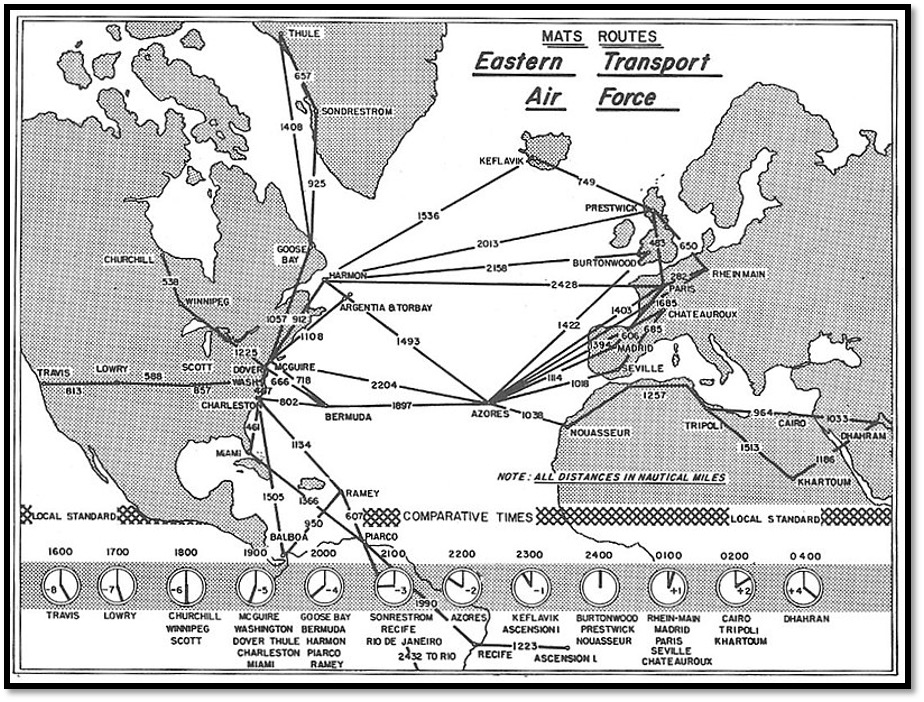
    It didn’t take me too long to discover that Harmon was actually a reference to the Ernest Harmon Air Force Base in Stephenville, Newfoundland. This was a former base built by the US Air Force in 1941 until its closure in 1966. Whilst located in Canada, it essentially existed as an enclave of US territory during that period. A little bit more digging online revealed the existence of a map that detailed MATS flight routes from the US to Europe and Africa. This clearly showed that there were no direct flights from McGuire Air Force Base to Prestwick Airport. Instead, the flights left McGuire and stopped off at the Ernest Harmon Base first (presumably to refuel) before proceeding over the Atlantic Ocean to Prestwick Airport and then on to RheinMain.
    ScottReidFinland 2

    (Photo Credit: https://en.wikipedia.org/wiki/Military_Air_Transport_Service)

    This all meant that Lola’s story was at least plausible insofar as the credibility of the flights she took was concerned. But what can we make of the conversation and information she obtained from the man with the name plate, saying he was Lee Oswald? There are several obvious similarities between what she said she was told by this man and what we know of Lee Harvey Oswald.

    Coincidence, Consistency and Contradictions

    In addition to the name plate, Lola confirmed the following details in her HSCA interview that we can confidently state are consistent with information that has previously been reported about Lee Harvey Oswald:

    1. His father was indeed named Robert E. Lee Oswald – who died on 19th August 1939, two months before Lee was born.
    2. Lee did serve in the Marine Corps – from around October 1956 until September 1959.
    3. He did spend time in Japan whilst in the Marine Corps – from around September 1957, and was based at the Atsugi Naval Air Facility just outside Tokyo.
    4. There were several reports that he was involved with a Japanese lady – who worked at a bar called the Queen Bee near the Atsugi base or even in Tokyo (whether this relationship was genuine or part of some kind of intelligence gathering operation is open to question).
    5. Lee was imprisoned whilst in Japan – for picking a fight with a senior officer in a bar and pouring a drink over him.
    6. He also spent a few months in the Philippines – from around January 1958 to March 1958.
    7. Lola said the man had “sharpshooter medals on his uniform” – Lee did score just above the requirements for a sharpshooter, not long after he joined the Marine Corps (it is worth adding that he fell to the level of marksman in a further test in 1959).
    8. Lola said the man had “light to sand hair” – Lee had brown hair.
    9. She said the man had a “slight Southern accent” – Lee was born in New Orleans.
    10. The man had “light eyes” – Lee’s eyes were blue.
    11. Oswald was indeed generally known to be a quiet and taciturn individual.
    12. He had spoken previously about his discontent with the American political system – although was this genuine bitterness or part of his cover as an intelligence agent and future defector.

    These details would all seem to be extraordinary coincidences if Lola Steenbarger were not speaking to the real Lee Oswald. Is it realistic that a completely different person, but also called Lee Oswald, could share so many similarities?

    Of course, it is important to add that her interview also included details that would not be consistent with what we know about Oswald. For example, he had been discharged from the Marine Corps a month before this encounter took place. He also said that his departure from the USA had been “so hastily arranged that he had not even been able to see his mother.” But when Oswald was discharged from the Marine Corps in September 1959, he did in fact go to Fort Worth and saw his mother for around three days. He wasn’t imprisoned in Japan because he had fallen for a Japanese girl, and it is not known exactly what skill he had that necessitated such an immediate transfer to Germany.

    Freighters, Ferries and Finland

    It is worth reviewing at this moment the official narrative of how Lee Harvey Oswald is supposed to have travelled from the USA to Europe, before his eventual defection to the Soviet Union on 15th October 1959. And this journey does not involve a Military Air Transit Service flight to Prestwick Airport in Scotland.

    In early September 1959, Oswald applied for a passport in Los Angeles. His passport application indicated that the reason for applying was that he wanted to attend the Albert Schweitzer College in Switzerland and the University of Turku in Finland. He also planned to travel to Germany and France, among other countries mentioned. Oswald was issued with a passport on 10th September 1959. The next day, he was released from active duty with the Marine Corps. He then visited his mother and other family in Fort Worth. He only stayed for a few days. He told his mother that his plan was to find work on a ship in the export-import business, and there was money to be made in such employment.

    Oswald left his mother around $100 and then headed to New Orleans. On 17th September 1959, he paid $220.75 for passage to Europe on a freighter called the SS Marion Lykes. In addition to the ship’s crew, there were three other paid passengers on board. They were 18-year-old student Billy Joe Lord (who Oswald roomed with during the voyage), retired US Army Lieutenant Colonel George Church Jr, and his wife Beauford.

    ScottReidFinland 3

    (Photo Credit: www.shipsnostalgia.com)

    The SS Marion Lykes left New Orleans on the morning of 20th September 1959. The freighter spent just over two weeks at sea crossing the Atlantic Ocean – arriving in La Rochelle Pallice on the west coast of France on 5th October 1959. It was here that Billy Joe Lord disembarked to begin his studies in France. Lord and Oswald had just spent two weeks together.

    In an affidavit given on 26th June 1964, Lord provided some details of his interactions with Oswald. He said that Oswald told him that he had recently been discharged from the Marines and was bitter because his mother had to work in a drugstore in Fort Worth. Oswald gave Lord no indication that he was planning to defect to the Soviet Union, but mentioned about attending a school in Switzerland. This would likely be a reference to the Albert Schweitzer College that Oswald mentioned on his recent passport application form. They also discussed religion. Oswald did not show him his passport or any military identification.

    According to Lord, he never saw Oswald again after leaving the ship in La Rochelle. Billy Joe Lord is also an interesting individual. On 2nd February 1977, he wrote a letter to President Carter stating his belief that the CIA and FBI were suspect in the assassination of JFK and that it was a coup d’etat. He was a man with his own story to tell.

    ScottReidFinland 4

    (Photo Credit: courtesy of Linda Zambanini)

    On the evening of 6th October 1959, the SS Marion Lykes left La Rochelle and travelled around the north-west coast of France, arriving in Le Havre early on 8th October 1959. It is here that Oswald is said to have disembarked the ship, and his passport is stamped as entering and leaving Le Havre on this same day. It is thought that Oswald then boarded another ship and journeyed across the English Channel, arriving in Southampton, England, on 9th October 1959. His passport is stamped to indicate arrival in Southampton on that date. He then seems to have made the approximate 80-mile trip to London. Another stamp on his passport indicates that he left London Airport on 10th October 1959.

    ScottReidFinland 5

    (Photo Credit: Dallas (Tex.). Police Department. [Lee Harvey Oswald’s Passport], text, 1959~/1963~; (https://texashistory.unt.edu/ark:/67531/metapth338438/: accessed February 15, 2025), University of North Texas Libraries, The Portal to Texas History, https://texashistory.unt.edu; crediting Dallas Municipal Archives)

    It is widely believed that Oswald then flew directly from London to Helsinki, Finland, that evening. However, records indicate that the only flight from London to Helsinki on 10th October 1959 landed in the Finnish capital at around 11:33 pm. Oswald then checked into the city’s Hotel Torni. The reservation book of the hotel, though, said that Oswald checked in on 10th October 1959. How is it possible that he could have exited the plane, cleared officialdom and gotten from the airport to the hotel all in less than 27 minutes? Seems a rather unlikely scenario, unless the hotel check-in receptionist was rather careless in completing the necessary paperwork. This leg of Oswald’s journey in his defection to the Soviet Union has had many scratching their heads over the years, including the CIA.

    In 2023, the Finnish Secret Service (known as Supo) declassified and revealed its files on Lee Harvey Oswald. They were very skeptical that Oswald arrived in Helsinki via a late-night flight directly from London. According to Supo, Oswald’s name did not appear on any arrival lists. They felt it was more likely that he arrived in Helsinki via Stockholm, Sweden, either by plane or ferry. Flights from Stockholm to Helsinki on 10th October 1959 landed at 12:25 pm, 3 pm and 4:55 pm. A ferry from Stockholm to Turku arrived at 8:35 am. Turku is a city located on the southwest coast of Finland, approximately 100 miles west of Helsinki. Passengers would have made the rest of the journey by bus to the capital, arriving around noon. The reader will recall that Oswald also mentioned Turku in his passport application form. This all sounds like a more realistic travel itinerary than the mad dash from the airport at 11:33 pm. A Swedish newspaper reported shortly after the JFK assassination that they also felt Oswald had gone to Helsinki via Sweden. On 15th October 1959, and having successfully and very quickly obtained a visa, Oswald left Helsinki heading for the Soviet Union.

    Will we ever know for sure how Lee Harvey Oswald found his way into Finland? Are Supo and the Swedish newspaper correct when they speculate that he likely arrived there via Sweden? Or was the Hotel Torni receptionist just not too fussed about the check-in times he or she entered in the arrivals book? Or could Oswald’s journey perhaps have included another MATS flight or “hop” that was secret and remains undiscovered to this day?

    We know Oswald was in the Marine Corps, but how much would he have known about MATS flights? On 8th August 1961, he wrote to the American Embassy from his apartment in Minsk, Belarus, seeking to return to the USA. His letter stated that he could not “afford to fly direct from Moscow to New York” but that he believed he “could catch a military hop back to the States, from Berlin.” He went on to write that “Perhaps a letter from the Embassy explaining my position, which I could then show the military in Berlin, would assist me to get a hop.”

    Oswald was indeed aware of the existence of MATS flights and their purpose.

    The ubiquitous Lee Oswald

    Was the man that Lola Steenbarger spoke to perhaps another of the numerous Oswald imposters? If it was known that the “real” Lee Oswald was defecting to the Soviet Union via France/UK/Finland, was the purpose of the man on the MATS flight to Prestwick Airport to deflect, distract, confuse and muddy the waters – throwing potential investigators or adversaries off the scent from the get-go?

    On 3rd June 1960, FBI Director, J Edgar Hoover, wrote to the US State Department, as he was concerned that Oswald was being impersonated. He wrote that “Since there is a possibility that an imposter is using Oswald’s birth certificate, any current information the Department of State may have concerning subject will be appreciated.”

    There are several recorded incidents of Oswald being impersonated at the same time when he was supposed to be in the Soviet Union.

    The alleged encounters of Oswald took place in New Orleans. In January 1961, two men visited the Bolton Ford Dealership on Canal Street. They were interested in buying ten Ford Ecoline Trucks and spoke with the Assistant Manager, Oscar Deslatte. One of the buyers identified himself as Joseph Moore. The other man was unidentified at this time. They said they were representing the Free Democrats of Cuba. Oscar Deslatte went to speak to his boss, Fred Sewall, who told him to give the two men a bid that would make the business a profit of $75 over the purchase of each truck. When documentation was being completed for the sale of the trucks in the name of Joseph Moore, the other man began talking to Deslatte and Sewall. He said that the name of the group they represented should be corrected on the official paperwork to “Friends of Democratic Cuba,” as he was “the man handling the money.” Deslatte asked him his name, and the man replied, “Lee Oswald.” Deslatte retained a copy of the bid form for his own records, and the name “Oswald” can be seen on the top right-hand section of the form.

    ScottReidFinland 6

    (Photo credit: https://harveyandlee.net/Misc/Bolton.html)

    A similar incident was recalled by another car salesman, James Spencer. During the period from February to August 1961, James Spencer was employed by the Dumas and Milnes Chevrolet Company in New Orleans. Shortly after the assassination of President Kennedy, he saw a photograph of Lee Harvey Oswald on TV and felt sure that he had seen this man before, but could not place exactly when and where. He looked through his wallet and found a business card that he used when working for Dumas and Milnes. On the back of the business card in Spencer’s own handwriting were the words “LEE OSWALD, Magazine Street.” He recalled a man who had come into the car lot and was interested in a particular vehicle, maybe a 1958 Chevrolet. The man returned a second time, and Spencer dealt with him on both occasions. They went for a coffee to discuss a possible sale, and he obtained the name and address of the individual and wrote it down on the back of the business card. The man also spoke in favourable terms about Fidel Castro. Spencer also recalled that the man insisted on buying his own coffee and had made such an impression on him that he mentioned him to his wife, something he hardly ever did. Whilst Spencer did not personally see this man handing out pro-Castro leaflets on the streets of New Orleans, he did remember that others were involved in such activities at that time. We should note that when Oswald went to New Orleans in the summer of 1963, he both worked and lived on Magazine Street.

    All the above instances are interesting and important because at the time the New Orleans car salesmen said they saw their Oswald, the man we know as Lee Harvey Oswald was living in Minsk, over 5,000 miles away. There are so many examples of Oswald lookalikes and imposters that a whole Chapter is dedicated to the topic in the excellent book The JFK Assassination Chokeholds (Camp Street Press, 2023) by James DiEugenio, Paul Bleau, Matt Crumpton, Andrew Iler and Mark Adamczyk. However, the story of Lola Steenbarger did not feature in the chapter.

    Stepping into the light

    The thing that really makes Lola’s story unique in comparison to other similar Oswald incidents is the level of detail she was able to include that was consistent with facts generally known about Lee Harvey Oswald.

    One of the criticisms that is often levelled at witnesses who come forward and tell their story is that they are seeking the spotlight or some kind of notoriety in the public eye. I have often felt that kind of criticism to be unkind and a cliché. It is more reasonable to acknowledge that people’s recollections can perhaps become a bit hazy, especially if many years have intervened, rather than being eager to be on the front pages of the newspapers or to become overnight celebrities. We should take a moment to consider the context and time of when Lola Steenbarger gave her interview to the HSCA.

    Their report of her statement was dated 26th September 1978, following a call made by investigator Surrell Brady to Mrs Steenbarger. Lola had just recently contacted the HSCA to advise that she had something of interest to tell them. The HSCA was established in 1976 to look again at the assassinations of President Kennedy and Martin Luther King Jr. It was big news at the time. Over the next few years, they interviewed many high-profile witnesses, including Marina Oswald. What would motivate Lola to come forward and tell her story after all these years? It was well known that many witnesses to the murder of JFK had disappeared and died in mysterious circumstances in the years following the assassination. This continued into the period up to and around the HSCA investigation.

    Chicago mobster Sam Giancana was murdered in June 1975 during the time when the Church Committee was holding hearings and investigating the CIA, and their assassination attempts on Fidel Castro. The Agency had recruited the mob to assist in this endeavour. Another member of the Chicago Outfit was Johnny Roselli. He gave testimony to the Church Committee in 1975. The following year, they wanted to hear from him again, but Roselli had since disappeared. In August 1976, his decomposed body was found chopped up in an oil drum floating in a Florida bay. An acquaintance of Lee Oswald was George de Mohrenschildt. He had known Oswald in Dallas during 1962 and 1963. The HSCA was keen to hear from de Mohrenschildt as well. But before they could obtain information from him, he died from a shotgun wound to the head. This happened in March 1977 and was officially deemed a suicide. Some have suspected foul play was at work instead.

    It is not known if Lola Steenbarger personally knew about these violent deaths, but it would be surprising if she didn’t, given their high-profile nature and possible links to the Kennedy assassination. Despite this, she still came forward to tell her story. It would perhaps be fairer and more appropriate to thank people like Lola Steenbarger for having the bravery and integrity to come forward when it surely would have been easier to stay silent and not reveal what she knew. We owe her, and many others like her, a debt of gratitude for deciding not to stay in the shadows but instead courageously putting their experience on the record.

    ScottReidFinland 7

    (Photo Credit: www.findagrave.com)

    Louise “Lola” Steenbarger died on 29th August 2008. She was 85 years old. Her son David, who was on the MATS flight with her in October 1959, died eleven days after his mother. He was only 56 years old. Their deaths so close together are very sad, tragic and poignant.

    The author JRR Tolkien once wrote that, “courage is found in unlikely places.” Lola Steenbarger epitomises Tolkien’s words.

    I hope that this telling of her story helps to keep her memory alive.

    It also adds to the intrigue and mystery of the enigma that continues to be Lee Harvey Oswald.
  • Deanne Stillman’s ‘American Confidential’ Exposed

    Deanne Stillman’s ‘American Confidential’ Exposed


    “I think the Evidence clearly demonstrates that Oswald was entirely innocent of this crime and indeed of the two other crimes charged to him, the murder of Tippit and the alleged attack on General Walker.” – Sylvia Meagher

    When asked by Jim DiEugenio to review Deanne Stillman’s American Confidential, I was not propelled by a surge of eager anticipation, but rather moved by a sense of duty. My pursuits have yielded works such as JFK Case Not Closed, “A Presumption of Innocence–Lee Harvey Oswald”, “Assassination 60”, and “Our Lady of The Warren Commission”. Through these endeavours, I have meandered across the vast expanses of cinematic narratives, pored over literary tomes, scrutinized declassified documents, and engaged in discourse with the dwindling cadre of witnesses who observed the cataclysm at Dealey Plaza.

    As I ventured deeper into the quagmire of Ms. Stillman’s narrative—marred by historical creations and egregious inaccuracies concerning the assassination—my initial sense of obligation dissolved, supplanted by a tidal wave of frustration and disenchantment. Sadly, this piece emerges as the most regrettable encounter for me within the extensive Kennedy assassination literature. This outcome hardly surprises, given that the author cites the following works as her foundation: Oswald’s Tale, Libra, Marina and Lee, A Mother in History, Mrs. Paine’s Garage, Reclaiming History, and Case Closed. (Stillman, pp. 220-224)

    Lee Oswald, Schizophrenic Assassin?

    “If there’s any conspiracy in the case of the murder of John Fitzgerald Kennedy, it was of mother and son in a silent pact…”(Ibid, p.208)

    The problem I had with American Confidential is the serious lack of any concrete evidence supporting the authors speculative assertions on Lee Oswald. While Stillman boldly asserts that “Lee Harvey Oswald had killed the President,” she offers no tangible evidence to back up this serious charge. Mrs Stillman laments that the intricacies of the Kennedy murder “have been reduced to mind-numbing debate about forensics and ballistics that really misses the whole point.” Well Mrs Stillman, evidence is the currency of truth in the courtroom; without it, justice is bankrupt. Without tangible evidence, you’re just another person with a theory. On the question of Oswald’s motive, she borrows one of the pitiful explanations offered by the Warren Commission in that Oswald had an “urge to try and find a place in history.” she writes:

    “…in a general sense, he (Oswald) always had it in mind (the assassination of JFK). He wanted to be famous, had an urge to kill a famous person, a figure of gravitas, in order to attain fame… it’s of little consequence if (Oswald) was a patsy, a spy, a double agent… that whether or not he had accomplices or was used, whether he acted alone, as a solitary figure, a nobody, the act of destroying America’s most powerful and adored figure, a somebody, was his only route to immortality…In the end, for all the questioning and riddling over his motives in the assassination of President John Fitzgerald Kennedy, Lee Harvey Oswald was simply fulfilling his mother’s lifelong dream—to matter. In the end, they were a conspiracy of one.”. (Stillman p. xiii; xvi, p. 14) (see this)

    In my work “Assassination 60,” I dissect the flawed reasoning surrounding Lee Oswald’s purported motive—a motive both the Commission and Mrs. Stillman speculate upon with certainty. Oswald himself, with fervent denial, rebutted the allegations thrust upon him. Among his numerous declarations of innocence, he assertively stated, “I don’t know what dispatches you people have been given, but I emphatically deny these charges. I have not committed any acts of violence.” If Oswald truly yearned for the notoriety and the dark allure of being branded as Kennedy’s assassin, as Stillman confidently suggests, then why would he eschew his purportedly sought-after moment in the limelight by professing his innocence? This stark discrepancy between Oswald’s vehement denials and the motivations ascribed to him by Stillman strikes a critical blow to the speculative foundation of Oswald’s alleged intent to murder.

    Moreover, Stillman’s analysis ventures further into speculative territory with claims that verge on the fantastical. She posits that; Lee himself—was a distant relative to Robert E. Lee,” the illustrious Confederate general of the American Civil War. This leads to the insinuation that on November 22nd, “Lee Harvey Oswald, an ordinary young man out of the South by way of the (Wild) West would commit the ultimate act of defiance, (by) blowing the head off the President of the United States, in this case, an American king.” Her insinuation that Oswald was enacting a role as a Confederate revenger, emerging as a nebulous entity from “deep in the heart of Dixie,” propelled by a delusional mantra that “The South shall rise again…took out the head of an iconic family from the North.” This conjecture not only demands a significant leap of the imagination but also places Oswald in the peculiar position of being the first, and likely only, Marxist Confederate in documented history. (Stillman, p.26 p. 44)

    Stillman then comments on Oswald’s mental state. She reports; “When (Oswald) began getting into trouble in New York, aged 13, he was diagnosed as having various behavioural disorders, including early signs of schizophrenia.” (Ibid, p.58) This assertion raises further questions about the veracity of Mrs. Stillman’s claims when scrutinized against the evidentiary record.

    To assess the accuracy of these claims, we turn to the deposition of Dr. Renatus Hartogs, conducted by Commission Counsel Wesley J. Liebeler on April 16th, 1964, this testimony is crucial for understanding the context and accuracy of the psychiatric evaluation mentioned by the author.

    Wesley Liebeler. In your capacity as chief psychiatrist for the Youth House did you have occasion at any time to interview Lee Harvey Oswald?
    Renatus Hartogs. Yes.
    Wesley Liebeler.Would you tell us when that was and all that you can remember about that interview in your own words.
    Renatus Hartogs. I reconstructed this from what I remembered from the seminar. We gave a seminar on this boy in which we discussed him, because he came to us on a charge of truancy from school, and yet when I examined him, I found him to have definite traits of dangerousness…this child had a potential for explosive, aggressive, assaultive acting out which was rather unusual to find in a child who was sent to Youth House on such a mild charge as truancy from school.

    Wesley Liebeler. Can you recall what kind of institution you recommended that Oswald be committed to?

    Renatus Hartogs. I never make a recommendation as to the name, the specific institution.

    Wesley Liebeler. Do you make a recommendation as to the type of institution to which you recommend a child?
    Renatus Hartogs. Yes; I do that, either a mental hospital or training school or residential treatment center…

    Wesley Liebeler. But you do recall quite clearly that you did recommend…

    Renatus Hartogs. He should not be placed in the community.
    Wesley Liebeler. Or placed on probation?
    Renatus Hartogs. Yes; that is right.

    Wesley Liebeler. Do you recall being interviewed on this question by the FBI? … Do you remember that you told them the same thing, that is, that you recommended institutionalizing Oswald as a result of his psychiatric examination which indicated that he was potentially dangerous?
    Renatus Hartogs. Yes.

    Wesley Liebeler. Dr. Hartogs, do you have in your possession a copy of the report which you made at the time you examined Oswald?
    Renatus Hartogs. No.
    Wesley Liebeler. Have you had any opportunity to examine a copy of that report since the assassination?
    Renatus Hartogs. No.
    Wesley Liebeler. So, the recollection that you have given us as regards your diagnosis and your recommendations is strictly based on your own independent recollection, plus the reconstruction of your interview with Oswald from the seminar that you recall having given?
    Renatus Hartogs. Right.

    Wesley Liebeler. I want to mark “Exhibit 1” on the examination of Dr. Renatus Hartogs, April 16, 1964, in New York, a photostatic copy of a document entitled “Youth House Psychiatrist’s Report,” indicating a report on case No. 26996; date of admission, April 16, 1953, exactly 11 years ago; date of examination, May 1, 1953, with regard to a boy by the name of Lee Harvey Oswald… on the last page of the report there is a section entitled “Summary for Probation Officer’s Report,” is there not?
    Renatus Hartogs. Yes.
    Wesley Liebeler. And you wrote there, about two or three sentences down, did you not, “We arrive therefore at the recommendation that he should be placed on probation under the condition that he seek help and guidance through contact with a child guidance clinic, where he should be treated preferably by a male psychiatrist who could substitute, to a certain degree at least, for the lack of father figure.

    Renatus Hartogs. Yes. It contradicts my recollection.

    Wesley Liebeler. It would not appear from this report that you found any indication in the character of Lee Oswald at that time that would indicate this possible violent outburst, is there?
    Renatus Hartogs.
    I didn’t mention it in the report, and I wouldn’t recall it now.
    Wesley Liebeler. If you would have found it, you would have mentioned it in the report?
    Renatus Hartogs. I would have mentioned it; yes…

    Wesley Liebeler. And in fact, as we read through the report, there is no mention of the words “incipient schizophrenic” or “potentially dangerous” in the report.
    Renatus Hartogs.
    No; I don’t know where she has it from… (Volume VIII; p. 214-224)

    Adding to this, the esteemed Sylvia Meagher meticulously documents in her seminal work, Accessories After the Fact, “The Marine Corps medical records on Oswald for 1956-1959 consistently show no sign of emotional problems, mental abnormality, or psychosis… Oswald was the subject of psychiatric evaluation in the Soviet Union after his effort to avoid deportation by feigning an attempt at suicide. Soviet Records (CE985) show that (Oswald) was found to be not dangerous to other people…clear mind…no sign of psychotic phenomena…no psychotic symptoms. (Meagher, p.244)

    In “Assassination 60,” I delved into the narratives of various individuals who had personal connections with Lee Oswald and were, to put it mildly, completely astonished upon learning of his arrest for the Kennedy assassination. Within this collection of insights, Robert Oswald, a figure often referenced by Stillman in her work, offered a poignant declaration to the Commission. He firmly stated, “The Lee Harvey Oswald I knew would not have killed anybody.” (Volume I; p. 314). Part 1 of 6: No Motive, plus the Silenced Witnesses

    Skill with a Rifle

    “In turn they (John Pic and Robert Oswald) taught Lee how to hold a rifle… Robert’s recollection is at odds with the countless assertions from many quarters over the years that Lee didn’t know his way around guns except what he learned in the Marines (itself not inconsiderable) and even that wasn’t sufficient to have enabled his apparent facility with firearms in Dallas…”(Stillman, p. 45)

    In this section, I couldn’t help but chuckle and shake my head at the suggestion of Lee Oswald’s rifle proficiency. One has to wonder why Stillman overlooks the documented evidence. Instead, she relies heavily on the memories of Robert Oswald and an unnamed section chief at Camp Pendleton, who claimed Oswald “was good with a rifle.” (Stillman, p. 119)

    Well, I hate to break it to Mrs Stillman but there is a significant body of evidence which directly challenges this portrayal, calling into question Oswald’s capabilities with a rifle. An examination of the evidentiary record concerning Oswald’s marksmanship reveals a more nuanced picture. In 1956, Oswald scored 212 on a rifle test, marginally exceeding the threshold for a sharpshooter classification—a level that signifies moderate proficiency, achieved after rigorous training focused on stationary targets. Yet, Oswald’s subsequent performance deteriorated, with his last recorded rifle score falling to 191. This placed him in the “marksman” category, barely scraping by and indicative of subpar shooting skills.

    Lieutenant-Colonel Allison G. Folsom’s testimony to the Commission starkly highlights Oswald’s unimpressive performance:

    John Hart Ely – “He was not a particularly outstanding shot.”

    Col. Folsom – “No, no, he was not.”

    Such assessments position Oswald as a markedly mediocre shot, a perspective carried even further by author Henry Hurt’s 1977 investigation. Hurt, who interviewed over fifty of Oswald’s Marine colleagues, as a researcher for Edward Epstein’s book, Legend, collectively depicted Oswald as significantly lacking in marksmanship skills. These direct observations were then noted in Hurt’s book Reasonable Doubt. Sherman Cooley’s commentary to Hurt vividly illustrates this consensus: “If I had to pick one man in the whole United States to shoot me, I’d pick Oswald. I saw the man shoot. There’s no way he could have ever learned to shoot well enough to do what they accused him of.”

    James R. Persons and Nelson Delgado similarly attributed Oswald’s deficient performance to a pronounced lack of coordination. Delgado’s accounts to both the Commission and Mark Lane further illuminated Oswald’s notoriety for inaccuracy, highlighted by numerous misses—an aspect of his skill set that Oswald himself seemingly disregarded with nonchalance. (Reasonable Doubt; pp. 99/100. picture section)

    Oswald was such a good shot that they shipped him off to radar school… (Watch this and read this)Picture0

    Oswald & The Soviets

    Predictable as it is, the narrative here is that Lee Oswald was a genuine defector to the Soviet Union in 1959. Stillman relies heavily on The Warren Commission and Oswald’s ‘Historic Diary’ in this regard. She writes after Oswald’s ‘suicide’ attempt, that “Oswald visited the American Embassy…(and stated) I affirm that my allegiance is to the Union of Soviet Socialist Republics…(but) Recognizing that while Lee may have been unstable…temporarily denied his request.” (Stillman, p. 126)

    Stillman relates that “at some point amid his stay, Lee began to tire of Russia… it was while he made plans for departure that he met Marina.” (Oswald) and Marina applied for exit papers… (and) On June 1st, they (along with June Lee, the couples new born) left for America.” (Stillman pp.135, 136)

    Yet, this portrayal conspicuously omits several critical aspects of Oswald’s time in the Soviet Union, rendering the narrative incomplete. The exclusion of these details is not merely an oversight; it is bewildering, given their significance to understanding Oswald’s motives, and the complexity of his eventual return to the United States.

    1. Whilst serving in the United States Marine Corps, Oswald had been given a Russian language test on February 25, 1959. As Jim Garrison remarked, “A solider genuinely involved in anti-aircraft duty would have about as much use for Russian as a cat would have for pajamas. (Volume VIII; pp. 303-311; On The Trail Of The Assassins; p.23)
    2. Whilst stating his desire to renounce his US citizenship, Oswald declared to consul Richard Snyder, “I was warned you would try to talk me out of defecting…Oswald (also) offered the information that he had been a radar operator in the Marine Corps and that he had voluntarily stated to unnamed Soviet officials that as a Soviet citizen he would make known to them such information concerning the Marine Corps and his specialty as he possessed. He intimated that he might know something of special interest.” Snyder hypothesised that Oswald was speaking for Russian ears in my office.” (John Newman, Oswald and the CIA; pp. 5 -6)
    3. Oswald wrote after the embassy episode that “I’m sure Russians will except me after this sign of my faith in them.” (WR p. 393)
    4. The State Department played a crucial role in Oswald’s return from Russia to the United States, extending him a loan of $435.71 to cover travel expenses. (Meagher, p. 328)
    5. In a 1963 radio interview, when asked by Bill Stuckey how he managed during his stay in the Soviet Union, Oswald hesitantly responded, “I worked in Russia. I was under the uh the protection of thee uh, that is to say I was not under the protection of the American Government but at all times uh considered an American citizen.” (Watch this)
    6. Tennent Bagley, celebrated as one of the most skilled counterintelligence officers in CIA history, emphatically told researcher Malcolm Blunt regarding the paper pattern tracing Oswald’s defection, “He had to be witting! He had to be witting!” This statement confirms that Lee Harvey Oswald’s defection to Moscow was a deliberate act of false defection. (James DiEugenio, JFK Revisited; pp.193-194)

    One must pose a critical question to Ms.Stillman regarding the credibility of her narrative: If Lee Oswald was indeed a genuine defector to the Soviet Union in 1959, then how does she account for the lack of legal repercussions or intelligence debriefing upon his return to the United States in 1962? The absence of his arrest upon disembarking in New Jersey, or at the very minimum, a thorough debriefing by the FBI or CIA concerning his public defection and proclaimed disclosure of sensitive information to Soviet officials, casts a shadow of implausibility over her claims. This glaring omission challenges the logic of Stillman’s portrayal and invites skepticism about the veracity of Oswald’s defection narrative, rendering it perplexingly incongruent with standard protocols for handling defectors who return home.

    The Backyard Photographs

    Regarding the controversial backyard photographs depicting ‘Lee Harvey Oswald,’ Mrs. Stillman’s narrative is laden with exaggerated interpretations concerning Oswald’s thoughts and demeanor in these images. She initiates her analysis by dubiously labelling the photo as “The first selfie of a killer in the modern era,” a claim that stretches the bounds of credibility. (Recall, the pictures were supposedly taken by Marina Oswald.) Furthermore, she draws an ambitious comparison between Oswald and “Davy Crockett, King of the Wild Frontier,” suggesting that the iconic image of Crockett serves as a precursor to the Neely Street photograph. Oswald is then depicted with “the rifle at his side, pistol in his pocket, brandishing a copy of the militant,” and according to Mrs. Stillman, he even autographed the still with; “Killer of fascists, Lee Harvey Oswald” for a friend.

    The author’s interpretation ventures into the realm of the fantastical when she insinuates that Oswald, through his pose, seems to challenge the viewer with a defiant “You looking at me?… You looking at ME? Who’re you looking at—me?”—echoing a bravado reminiscent of fictional characters like the Joker and Robert De Niro’s portrayal in Taxi Driver yet predating them. She further suggests that by posing with ‘his’ rifle, Oswald aligns himself with the archetype of American gunslingers, en route to their own metaphorical ‘high noon.’ Taking her analysis to a contentious climax, Stillman posits that Oswald has become an “influencer” to modern mass shooters, a statement that not only imbues the photograph with an unwarranted level of influence but also ventures into speculative territory far removed from substantiated facts.

    Firstly, in my article, In “Our Lady of the Warren Commission”, I countered the contention that Oswald had in fact posed with these weapons at the backyard in Neely Street. Oswald told Capt. Fritz when accosted with the photograph that “the picture was not his, that the face was his face, but that this picture had been made by someone superimposing his face, the other part of the picture was not him at all and that he had never seen the picture before… He told (Fritz) that he understood photography real well, and that in time, he would be able to show that it was not his picture, and that it had been made by someone else”.

    Secondly the text at the back of the photograph Stillman is describing is the wrong version!! The George DeMohrenschildt version of the photo was not discovered until 1967, in the DeMohrenschildt storage unit. This read “To my friend George from Lee, 5/V/63”. But written in a different hand is the words, “Hunter of Fascists, Ha! Ha! Ha!” It is this photo, with its different resolution and perspective that has puzzled many writers as to its origin. As he said in his manuscript, “I am a Patsy” George was puzzled to find it in his belongings, amid record albums, upon his return from Haiti. Reportedly, the Ruth and Michael Paine had access to the storage unit. (James DiEugenio, The JFK Assassination: The Evidence Today, p. 106)

    Stillman then delivers this stunning smear. She writes; “What Lee Harvey Oswald tapped into and made his own has taken the country into years of years of violence.” This statement left me appalled and deeply troubled by the insinuation. She essentially accuses Lee Oswald of being the precursor to all mass shootings in the United States today. Further, she argues, “the bullets fired by Lee Harvey Oswald are still ricocheting across the land…the plague of gun violence and mass shootings…all over America, in malls, schools and places of work.” She describes people such as John Hinckley Jr, Robert Crimo III and Kyle Rittenhouse as “Oswald fans” and compares Oswald to Billy the Kid saying; They were not so different to mass shooters of today. I think it’s safe to say that Billy the Kid ran through Oswald’s blood— as he does through the veins of all Americans, taken over when roused by the fates.” This characterization of a man who was murdered whilst vehemently protesting his innocence, it’s nothing short of out-right slander and by doing so sets a highly dangerous precedent to future tragedies yet to unfold.

    When I related this portrayal to my good friend Walt Brown, Walt quipped; “If modern mass shooters all had Mannlichers, the population would be a lot safer.” One might also add that the first modern mass shooter preceded Oswald by five years, namely Charles Starkweather. One might also add that Principal Leonard Redden opened fire into a classroom of students at William Reed Elementary in 1960, killing two teachers.

    Due to the Marital Privilege Law, the backyard photos would not have been admissible in a court of law, had Oswald been allowed to stand trial. (Stillman, pp. xvi, 36, 158, 159, 190, 191, 193; for the problems with the custody chain of the so-called Oswald rifle see DiEugenio, p.82; WCR, pp. 607-609)

    Stillman Reels in Walker

    To further cement her claims about Oswald’s culpability, Mrs. Stillman unequivocally states, “That on April 10th, 1963, Lee had attempted to assassinate General Edwin Walker in Dallas.” Presumably aiming to paint a comprehensive picture of Oswald’s predisposition towards violent acts. (see p. 157)

    The discourse surrounding the Walker case is one I have delved into thoroughly in my article, “Our Lady of The Warren Commission.” This piece serves as a pointed critique against the assertions made by Ruth Paine and Thomas Mallon, which I had the opportunity to witness in person during a talk I attended at Irving’s Dupree Theatre on November 20th, 2023. With this context in mind, let’s critically examine the more dubious claims presented by the author concerning the Walker case.

    Claim. Mrs. Stillman makes a compelling assertion when she claims that after hastily departing from the Walker residence, Lee Oswald concealed the Mannlicher Carcano rifle within the confines of the Neely Street house.

    Testimony. Marina Oswald testified: That she accosted Lee over the Carcano’s whereabouts in the immediate aftermath of the Walker attempt; “Where is the rifle? What did you do with it? ‘Lee’ said that he had left it somewhere, that he had buried it…(by railroad tracks) (Stillman ; p.158; WC Volume I; p.16)

    Claim. Stillman provides a narrative suggesting that merely three days following the birth of his daughter Rachel, Oswald found himself amidst an assembly spearheaded by General Walker. Here, she ventures into the realm of conjecture regarding Oswald’s inner musings as he observed Walker speaking. She hypothesizes, “Perhaps he considered the fame that was almost his, if only he hadn’t missed. Maybe he thought, ‘You lucky son of a bitch… one of these days, I might try again.’

    Fact. This raises a significant question: How could Stillman possibly know what was going through Oswald’s mind? Such assertions enter the realm of fiction writing. (Stillman, p. 165)

    Claim. Stillman recounts that a mere three days post-event, upon Oswald’s acceptance of Michael Paine’s invitation to a meeting of the ACLU, a secretive exchange occurred. Oswald, in a whispered confidence to Marina, insinuated, “If only Michael knew what I wanted to do to Walker! Wouldn’t he be scared.” Like many such provocative quotes, the author does not footnote this exchange.

    Source? Given the extensive documentation questioning Marina Oswald’s credibility, and her outright denial of any knowledge when confronted with the Walker note, skepticism toward any of her accounts in these matters is duly warranted. Notably, Sylvia Meagher had explicitly stated that “Marina Oswald fabricated the whole story of the attack on General Walker—which is exactly what much other evidence suggest.” (Stillman, p. 165, Meagher, p. 130)

    Claim. Stillman notes that Oswald had taken lodging at his rooming house (1026 North Beckley) under a “assumed name—the one that, it later turned out, he had ordered the rifle used to shoot at Walker…”

    Fact. Oswald is alleged to have rented the room on Beckley under the name O. H. Lee. The Rifle and Revolver were alleged to have been purchased by an A.Hidell. (Stillman p.166, WR, pp.181-182)

    Claim. Stillman illuminates an oversight “when the FBI confiscated all of the Oswald’s possessions in the Paine house, including the garage, for some reason they left behind Marina’s childcare books, the ones that were in Russian”. She recounts “Ruth’s attempt to ensure these books reached Marina, sending them through the ‘Dallas’ police station, though she remains uncertain of their eventual delivery to her friend.”

    Facts. Firstly, it was Ruth Paine who transported the books to the Irving Police station, distinctly not Dallas, thereby ensuring the geographic accuracy of events. Secondly, the task of searching the Paine residence on November 23, 1963, fell to the Dallas & Irving Police, not the FBI. Thirdly, the question of Ruth Paine’s awareness regarding the delivery of the books to Marina Oswald comes into sharp focus, especially when considering that one of these books contained the infamous ‘Walker note.’ This note was later unearthed by the Secret Service, who subsequently confronted Ruth about it since they suspected she wrote it. Such details question the plausibility of Ruth’s claimed uncertainty about the books’ contents and their significance. This correction is further explored in “Our Lady,” (Stillman; p.205) (see this)

    Claim. (It was only after) JFK was killed that Marina came forward with a note and an incriminating picture.

    Fact. The emergence of the note occurred not merely after President Kennedy’s death but also following Lee Oswald’s, revealing its discovery to be entirely postmortem. The note surfaced when the Secret Service found it concealed “inside a little book of advice to Russian mothers.” This item had been passed to them by the Irving Police, courtesy of Ruth Paine. Upon uncovering the note, a Secret Service agent confronted Marina Oswald via phone, during which she expressly “disclaimed any knowledge of such note.” Additionally, the referencedincriminating picture’ wasn’t voluntarily provided by Marina Oswald. Instead, it was unearthed in the garage of the Paine residence on November 23, 1963, by Dallas detective Gus Rose, as part of a broader search. (Stillman; p.158, Volume VII; p.231) (see this)

    In response to Stillman’s assertion about Oswald’s involvement in the attempt on General Edwin Walker’s life, I must reiterate with absolute clarity: the body of evidence firmly aligns with the conclusion that Lee Oswald did not attempt to assassinate General Walker on April 10th, 1963. For a more detailed exploration of the Walker case and the evidence supporting this position, I recommend consulting “Our Lady of the Warren Commission.” This statement underscores a critical examination of the facts, advocating for a comprehensive understanding of the case against Oswald. (see this)

    Oswald’s Rights

    “Marguerite too often raised the subject of rights—and their violation—whenever she was talking about what happened to Lee. It was a family tradition and mother and son lived under the umbrella of defiance.”(Stillman; p. 181)

    Marguerite would often speak…when it came to how Lee was treated following the assassination…It was all about a violation of rights, and it proved once again that someone or something was out to get the Oswald family.(Ibid, p. 74)

    In my November 2023 presentation at JFK Lancer, I explored the critical issue of Lee Harvey Oswald’s rights during his detention, an issue meticulously addressed in “Assassination 60,” particularly in point 17. The Dallas Police’s handling of Oswald starkly illustrates a grave infringement of his human and constitutional rights, as evidenced by instances of unjustifiable police line-ups, extensive interrogation without legal counsel, and the propagation of unfounded ‘facts’ by law enforcement. This series of violations reached a tragic climax with Oswald’s assassination by an individual with connections to the Mob, Dallas Police and FBI. The notion that such a blatant disregard for Oswald’s rights might be dismissed as figments of Lee and Marguerite Oswald’s imaginations is not only perplexing but deeply troubling.Picture1

    Even J. Edgar Hoover, acknowledged the severity of the situation. He admitted, “There are bound to be some elements of our society who will holler their heads off that his civil rights were violated—which they were.” (see this)

    From the outset of his detention, Oswald faced a litany of rights abuses that should concern any advocate for justice and due process.

    Furthermore, Stillman’s portrayal, which attempts to trivialize the egregious violations against Lee Oswald by attributing them to a familial tradition of defiance, significantly downplays the gravity of his situation. The case against Oswald should remind us of the importance of the presumption of innocence, not as a mere formality, but as a cornerstone of justice and democracy. In this context, the words of John F. Kennedy resonate with profound relevance: The rights of every man are diminished when the rights of one man are threatened.” We should never forget that Oswald requested a lawyer come forward but the attorney he wanted, from the ACLU, Greg Olds, was bamboozled by the police. (Vol. 7, p. 323)

    Lee & Robert Oswald, November 23, 1963

    On Saturday, November 23, 1963, Robert Oswald had a conversation with his brother Lee, who was detained in the Dallas City Jail. This moment is detailed in American Confidential as;

    Robert Oswald. “Lee, what in the Sam Hill’s going on.”

    Lee Oswald. “I don’t know what you’re talking about.”

    Robert Oswald. “Now wait a minute. They’ve got you charged with the death of a police officer and the death of the President. They’ve got you’re pistol. They’ve got your rifle, and you tell me you don’t know what’s going on?”

    And then he searched Lee’s eyes, looking for a sign pf something, some emotion, and finding nothing. Finally Lee responded.

    Lee Oswald. “Brother, you won’t find anything there.”

    Does the dialogue depicted in American Confidential align with the established evidentiary record, specifically Robert Oswald’s testimony before the Warren Commission and the photostatic copies of his diary, as documented in the Commission’s volumes under CE323?

    The following details, notably absent from Stillman’s narrative, significantly alter the context and substance of the conversation.

    Robert Oswald. “…I did try to point out to him that the evidence was overwhelming that he did kill Police Officer Tippit and possibly the President. To this (Lee) replied do not form any opinion on the so-called evidence. All the time we were talking I searched his eyes for any sign of guilt or whatever you call it. There was nothing there—no guilt, no shame, no nothing. Lee finally aware of my looking into his eyes, he stated you will not find anything there.” (Volume XVI; CE323; p.13)

    The portrayal of the conversation between Lee Oswald and his brother Robert in American Confidential contrasts starkly with the version documented in the Warren Commission’s records. Stillman’s rendition omits critical details that suggest Oswald contested the evidence against him, instead presenting a dialogue that portrays him as evasive and detached. This selective omission appears to serve the purpose of reinforcing her argument that Oswald was mentally unstable and guilty of the murders attributed to him, simplifying a complex interaction to fit this narrative. By excluding Oswald’s expression of innocence and critique of the evidence, Mrs. Stillman not only alters the reader’s perception of Oswald’s demeanour but also manipulates the narrative to align with her thesis of his guilt and mental state, significantly impacting the interpretation of Oswald’s innocence or guilt.

    The Author Backs Pricilla

    One of the books the author heavily relies on is Marina and Lee by Priscilla Johnson. This is the women whom Ruth Paine and Thomas Mallon paid tribute to at the dog and pony show last November at the Dupree Theatre. Buried in the authors endnote section of the book, Stillman acknowledges “that there is some controversy surrounding Marina and Lee…(The charge is) that you shouldn’t trust anything McMillan says or writes; she probably had an affair with Kennedy and/or is/ was working for the state department…much of her testimony for the House Select Committee on Assassinations in 1976 has been redacted, which has further fuelled speculation about her possible involvement with the US intelligence community. After Marina and Lee was published, McMillan (also) translated Stalin’s daughter’s memoir into English, which added yet more heat to the fire.” However, Mrs Stillman assures us that “(McMillan’s) book is so good and so palpably authentic that (Mrs Stillman) is giving her a pass. And that “any connection with the intelligence community, while worth noting, in and of itself, is probably not relevant.” (American Confidential; p. 221-222)

    For more on Mrs McMillan, please see this.

    Basic Error in the Book Surrounding the Case

    There are numerous errors in American Confidential regarding both the JFK and Tippit cases. Below I have listed some with the factual corrections underneath each claim.

    Claim.Mrs Stillman charges that on November 22, 1963 Oswald had killed, “J. D. Tippit of the city’s police department as the officer tried to nab the fugitive on his beat in the Oak Cliff neighbourhood. (Stillman, p. 45)

    Fact. Based on the tangible evidence and eyewitness testimony, it is this reviewer’s opinion that Lee Oswald did not kill Officer Tippit. Also,Tippit was not in his assigned district at the time he was killed. In fact, he was more than three miles from where he was supposed to be.” (Reasonable Doubt; p.159)

    Claim. When describing the arrest of Lee Oswald at the Texas Theater, Stillman claims that Nick McDonald, Dallas Police Officer and Oswald fought inside the Texas Theatre. She then asserts that “The fight spilled out into the street, with the burly McDonald finally overpowering the amped-up though smaller Oswald… (American Confidential; p. 47)

    Fact. Oswald was apprehended inside the Texas Theatre, contrary to narratives of a one-on-one altercation with Officer McDonald that supposedly spilled onto the street. This is clearly evidenced by the photograph in question.Picture2

    Picture3Claim. With regards to the shocking murders of Jack Kennedy & Lee Oswald, Stillman writes, That shocking incident (Oswald’s murder) was televised, just like the JFK assassination— with the fleeing limousine and Jacqueline Kennedy trying to clamber her way out of it until she was shoved back in by a Secret Service agent… Oswald’s murder became the second homicide within a period of two days that millions of Americans watched in real time.” (American Confidential; p. 176)

    Facts. Boy there’s a lot to unpack here. Firstly, the assassination of President Kennedy was not broadcast live, meaning it wasn’t witnessed in real-time by millions of Americans on television. It wasn’t until March 6, 1975, during an episode of ABC’s late-night show “Good Night America,” hosted by Geraldo Rivera, that the Zapruder film was shown on television for the first time. This presentation, facilitated by assassination researchers Robert Groden and Dick Gregory, sparked significant public response and outrage. The reaction to the broadcast was a catalyst for the establishment of the Hart-Schweiker investigation into the assassination.

    Secondly Mrs. Kennedy climbed on the back of the limousine to retrieve a piece of her husband’s skull which had been blasted out. Clint Hill testified; “Mrs. Kennedy – the second noise that I heard had removed a portion of the President’s head, and he had slumped noticeably to his left. Mrs. Kennedy had jumped up from the seat and was, it appeared to me, reaching for something coming off the right rear bumper of the car, the right rear tail. Whilst at Parkland Hospital Mrs Kennedy approached one of the doctors in the ER, “her hands cupped one over the other. She was holding her husband’s brain matter in her hands.”(Volume II; p. 138-139, Not In Your Lifetime; p. 18)

    Claim. In her comprehensive listing of entities, groups, and individuals implicated by various sources in the assassination, Stillman identifies notable figures such as Guy Bannister, David Ferrie, Clay Shaw, Carlos Marcello, and even LBJ. Yet, the inclusion of Mark Lane is especially astonishing. Celebrated for his pioneering investigation into the assassination, Lane’s mention in this context is not merely surprising but profoundly unsettling. It prompts a crucial and stirring inquiry: Is Stillman implying that Mark Lane, contrary to all anticipations based on his investigative contributions, might have played a part in the assassination itself? (American Confidential; p. 178)

    Claim. “The rifle was hidden in that garage… November 22, (Oswald) smuggled it out, still in the blankets and he got into the car of his friend who had been driving him to work every day since he had started at the book depository, and he headed up to the sixth floor, package in hand. (American Confidential; p. 173)

    Fact. Firstly, the Commission’s claim is that Oswald transported and hid the disassembled Carcano in a homemade paper bag (CE142), allegedly using materials from the Texas School Book Depository on November 21, 1963. Secondly, the narrative suggests that Buell Wesley Frazier, described as Oswald’s ‘friend’, consistently drove Oswald to work. This claim is flawed, considering Oswald’s visits to Irving, where Frazier lived, were limited to weekends. This discrepancy prompts a critical question: Is it being suggested that Frazier made a significant detour to collect Oswald from 1026 North Beckley for their journey to the TSBD, a scenario that diverges from well-documented facts?

    Claim. Stillman’s portrayal of the moments leading up to the assassination on the sixth floor is highly imaginative and ventures into more speculative fiction. By suggesting that; “the moment was nearly at hand, and (Oswald) may have heard more voices, had some second thoughts. The ghosts of Presidential assassins past began to appear; there was John Wilkes Booth, and Charles Guiteau and then Leon Czolgosz and they all urged him not to waiver, to join them and Oswald cocked his rifle and was ready to fire. (American Confidential; p173) When, in fact, as the film JFK Revisited shows with four witnesses it is almost impossible to believe Oswald was on the sixth floor at the time. For the simple reason that none of them saw or heard him on the stairs descending down, and they were on the 4th floor.

    The book is replete with fictional narratives akin to this, punctuating its pages with imaginative yet historically unsubstantiated accounts. It is with these observations in mind that my critique of the book concludes. (American Confidential; p. 173)

    “The evil that men do lives after them; the good is oft interred with their bones.” Mark Anthony.

    Sources:

    Feldman article on Margurite Oswald

    Martin Hay on Case Closed

    Reclaiming Parkland

  • Worse Than I Thought: A Mother In History

    Worse Than I Thought: A Mother In History

    The literature on the JFK assassination is rife with dishonest books that endorse, defend, and/or excuse the findings of the Warren Commission. Nothing new about that: this has been true since publication of the Warren Report in 1964, and has carried on through a long line of apologist nonsense.

    One Commissioner and several WC attorneys cashed in on their experiences. A host of lesser, pseudo-serious WC advocates have contributed to this worthless tripe, and profitably. At the time of the assassination’s fiftieth anniversary, Vince Salandria called it a mountain of trash. All of this propaganda is meant to bury the obvious.

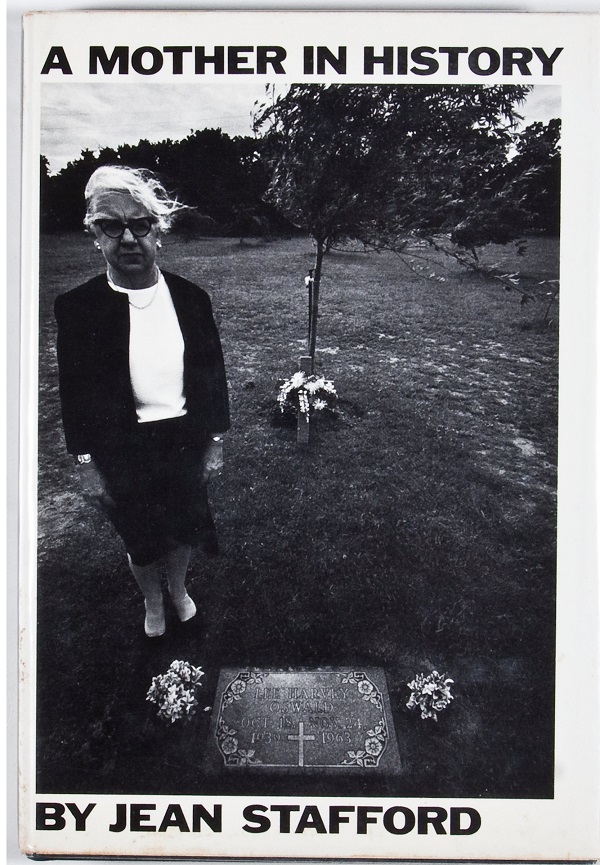
    Jean Stafford’s A Mother in History (Farrar, Strauss and Giroux, 1966) was an early entry into this disgraceful body of work. I have written about it before, most recently on this Kennedys and King site. What more could I possibly have to say? Do I have an unhealthy preoccupation with this slender book, ostensibly an unbiased profile of the mother of the alleged presidential assassin?

    If you Google “Jean Stafford A Mother In History” you are likely to find available copies on used book sites, along with reviews and reader opinions. Most of the opinions I found are favorable. All of them, it is safe to assume, are based solely on reading Jean Stafford’s published text. Almost certainly, none of the writers of these favorable judgments had access to some of the book’s raw material, in particular the tape-recorded Stafford-Oswald interviews. I did. Once it has been appraised, and contrasted with the published work, it is difficult to see A Mother in History as anything but a hatchet job intended to destroy Marguerite Oswald.

    The raw material to which I refer is in the Jean Stafford collection at the University of Colorado (CU) in Boulder, part of the Norlin Library’s Rare and Distinctive Collections.

    Stafford, who was from Boulder, left her papers to CU. Since she primarily wrote fiction, the source material for A Mother in History is only a small portion of that archive. This small portion includes typescripts, notes, and an interview transcript, all of which reside in one small box. Not included in the box are the interview tape recordings, which have long since been digitized.

    A Mother In History was published in three sections, simply titled I, II, and III (plus an Epilogue and appendices). A breathless jacket blurb touts Stafford’s “three incredible days” with Marguerite Oswald. That, and other indicators, clearly imply each of those three book sections correspond to one day of conversation between the author and her subject.

    There may have been three days of interviews, incredible or otherwise, but I am highly suspicious of the published chronology. An exchange on the book’s p. 36, as that purported first-day section nears its end, first got my attention. Here Stafford writes that she asked Mrs. Oswald if it would be okay to bring a tape recorder the next day. Marguerite agreed. Stafford does not say so explicitly, but the clear message is that the first day was not tape recorded.

    The audio at CU consists of six undated .mp3 files. A CU archivist told me last summer that the original reel-to-reel tapes were transferred to audio cassette in the 1970s. They were digitized sometime in the 1980s, or perhaps a little later.

    Nowhere, in the .mp3 audio, does Stafford say the day, date, or subject of her interviews. Interviewers often do; it could even be considered a best practice. It creates a record, and helps keep things in order.

    The .mp3 files at CU may be undated, but they do have sequential filenames. The first is stafford-interview-with-mrs.-oswald_-part-1-a.mp3. This particular audio begins with Stafford asking, “Tell me about your early life, Mrs. Oswald. You were born in New Orleans, weren’t you?” The transcript begins the same way. It’s an amiable first question, a likely starting point, and I’m going to go out on a limb and suggest this was, in fact, the very first of the interviews: that is, the first day, which Stafford implied was not recorded.

    As I described in my previous article, I had grown curious about a quote in the first section of the book – an unrecorded first day, readers are led to believe. Lee Harvey Oswald, Marguerite said, “spoke Russian, he wrote Russian, and he read Russian. Why? Because my boy was being trained as an agent, that’s why.”

    In Stafford’s book there was no follow-up question. This baffled me. Even an amateur journalist, like Stafford, should have enough sense to explore such an explosive statement. Surely the audio would clarify things. Instead, it revealed that Marguerite Oswald didn’t say what Stafford quoted her as saying. It is a manufactured quote.

    It’s a little complicated, so bear with me. Most of the words in that quote were, in fact, spoken by Marguerite Oswald. They were also tape recorded; I have heard the audio. But it’s a false quote, because Stafford pieced together several phrases – some of them separated by as much as three minutes. Placing it all within quotation marks implies it is verbatim – but it is not, and is thus a deception.

    I can only speculate on Stafford’s motives. That false quote does not support the lone gunman thesis. Given the magnitude of surrounding events, I cannot believe creating it was innocent. I think Stafford floated the idea of Oswald-as-agent – not a common view at the time – to characterize Marguerite Oswald as paranoid, and out of her mind.

    There are other false and manufactured quotes in A Mother In History. I have not itemized them all and don’t intend to; it would be a huge undertaking. The more I studied the source material, the more dishonesty I found.

    On page 23 of A Mother In History is the following statement, attributed to Marguerite:

    Lee purely loved animals! With his very first pay he bought a bird and a cage, and I have a picture of it. He bought this bird with a cage that had a planter for ivy, and he took care of that bird and he made the ivy grow. Now, you see, there could be many nice things written about this boy. But, oh, no, no, this boy is supposed to be the assassin of the President of the United States, so he has to be a louse. Sometimes I am very sad.

    This is a rather inconsequential matter, but it is still false. Marguerite Oswald didn’t really say it. Here is what she did say, in answer to Stafford’s question, “Did he ever have any pets?”

    Oh yes, Lee had a dog, and with his first pay he bought a bird and a cage – I have pictures of it, with ivy in it and all the food for the bird. Yes, sir. With his first pay. He had a collie shepherd dog that I had gotten for him when it was a little [bitty] puppy. And he had it all those years until we went to New York. And that dog had puppies. He gave one to his school teacher. She wrote a nice article for the newspaper saying Lee loving animals and giving her a pet.

    True, the published quote roughly parallels what she really said. But it is still false. “Lee purely loved animals” does not appear in any of the audio. There is no mention of dogs in the published quote, let alone puppies, or giving one to a school teacher.

    Nor does Marguerite say, “Sometimes I am very sad.” In fact, elsewhere in the recorded interviews, she said quite the opposite: “I’m not unhappy, Jean. You can see I’m not.”

    As I write these words, I feel like I’m in attack mode. I have listened to all the audio that is available. Can I be certain that every last recorded word from the Stafford-Oswald interviews wound up in the CU archive? Of course not. All that CU has is what Stafford gave them. She also wrote, in her book, that when Mrs. Oswald agreed to be tape recorded, she stipulated that there be two recorders so she could have a copy.

    The example about animals and pets is minor, compared to a false quote on pages 12-13 of A Mother In History. This one is presented as dialogue between interviewer and interviewee, and Jean Stafford goes in for the kill. It is intended, I am convinced, to make Marguerite Oswald appear nuts – to use a non-clinical term.

    Marguerite spoke first:

    “And as we all know, President Kennedy was a dying man. So I say it is possible that my son was chosen to shoot him in a mercy killing for the security of the country. And if this is true, it was a fine thing to do and my son is a hero.”

    “I had not heard that President Kennedy was dying,” I said, staggered by this cluster of fictions stated as irrefutable fact. Some mercy killing! The methods used in this instance must surely be unique in the annals of euthanasia.

    This exchange is not found anywhere in the interview audio or the transcript. Marguerite does not make the statement, and Jean Stafford does not make that stunned reply.

    There is something similar to this in the interviews. Unfortunately, the digitized version of the tape recording at CU ends partway through the quote. Did the original tape end there, too? No, because the corresponding transcript, which I have found to be consistently accurate, continues for several more pages. It is convoluted, but this is what Marguerite Oswald really said.

    That President Kennedy was killed by – a mercy killing – by some of his own men that thought it was the thing to do and this is not impossible and since I blame the secret service from what I saw and what I thought it could have been that my son and the secret service were all involved in a mercy killing.

    A minute or so before her “mercy killing” remark, Marguerite did say “a dying President,” but “As we all know” is an invention. She says JFK was dying because he had Addison’s disease, which he did. She also called it a kidney disorder, which it is not. Addison’s can be life-threatening, but Stafford correctly points out that it is a manageable adrenal condition. And Kennedy managed his.

    But Stafford can’t let this go without having some fun, falsely quoting Marguerite calling it Atkinson’s disease. In the audio, there is no doubt: Marguerite says Addison’s. It is rendered as Atkinson’s in the transcript. Maybe Stafford didn’t remember what Mrs. Oswald actually said, and later on trusted the error of the unknown transcriber. While accurate overall, the transcript does, in fact, garble certain words here and there; in places it reminds me of the sometimes-strange voicemail transcripts my Smartphone makes. The ethical thing would have been double-checking Marguerite’s presumed mistake, before putting it to print.

    But the point is that Marguerite Oswald did not say her son was chosen to shoot a terminally ill JFK in a mercy killing. Jean Stafford created that illusion.

    According to biographer David Roberts (Jean Stafford: A Biography, 1988) Jean Stafford later “held parties at which she played the Oswald tapes for her friends.” Roberts cites Stafford’s “fascination” with Marguerite Oswald’s voice.

    It sounds more like arrogance to me. One imagines a bunch of cocktail-quaffing intelligentsia howling with laughter over Marguerite’s unschooled chatter. But maybe not. Maybe Stafford just wanted to give some of her pals a front-row seat to history. Whatever: the image this conjures is, to me, thoroughly repulsive.

    The Stafford-Oswald interviews took place in May 1965. This is approximately ten months after Marguerite met with Harold Feldman and Vince Salandria, after which Feldman wrote “The Unsinkable Marguerite Oswald,” published in September 1964 (available online).

    If Jean Stafford had done her homework, she might have answered a question she puzzled over in her book’s Appendix III. How, she wondered, was an undereducated Marguerite Oswald able to paraphrase an obscure quote from Sigmund Freud? “Without persecution,” she told Stafford, “there would not be a persecution complex.”

    In his article Harold Feldman, a lay psychologist, said that the media consistently portrayed Marguerite Oswald “as a self-centered, domineering, paranoiac showoff with frequent delusions of persecution. It reminds me of Freud’s remark that there would be no such thing as a persecution complex if there were not real persecution.”

    Feldman, whose writing often appeared in psychoanalytic journals, wrote about Marguerite with the deference and sympathy Jean Stafford failed to summon. He observed:

    She has devoted every day since November 22, 1963, to uncovering what she believes and millions believe is a real conspiracy in which her youngest son was the fall guy. As a result, she is held up to scorn as a bitter old woman who sees snares and plots everywhere.

    And he added: “… if Ibsen is right and the strongest is the one who stands alone for integrity and honor, then Marguerite Oswald is the strongest woman in America.”

    Marguerite Oswald was an ordinary woman thrust, quite against her will, into extraordinary circumstances. In spite of tremendous obstacles, she defended her son against the Warren Commission and the mainstream media. She had few allies. Even family members, she told Jean Stafford, distanced themselves from her. “I’m alone in my fight, with no help.”

    Marguerite Oswald may have struck Stafford as eccentric, but who doesn’t have personality quirks? Jean Stafford exploited Marguerite’s to the hilt, and did so ruthlessly, in exchange for money. I could cite many more examples of the dishonesty in A Mother In History, but life is too short.

    Stafford shuffled the truth like a deck of cards, manufacturing quotes and manipulating chronology, all to create the false impression – the lie – that her subject was divorced from reality. Suffice it to say A Mother In History is even worse than I imagined when I visited the Jean Stafford archive at CU.

    But it’s been more than fifty years since publication, so the damage is done.


  • A Mother In History: The Stafford Archive

    A Mother In History: The Stafford Archive


    Jean Stafford (1915-1979) is best remembered for writing novels and short stories; she won a Pulitzer Prize for fiction in 1970. But in 1966 she ventured into nonfiction with a profile of Lee Harvey Oswald’s mother, Marguerite. This made her a person of interest to me as I researched my book, Praise from a Future Generation (Wings Press, 2007).

    Stafford grew up in Boulder, CO, not too far from where I live, and where she later attended the University of Colorado. Today her papers are housed in CU’s Norlin Library. She was only peripheral to my project, and there was already plenty of available data about her. So even though it’s in my back yard, and even though I made regular use of Norlin resources, I never went to the Stafford archive during my own book’s research phase.

    Her profile of Marguerite Oswald appeared first as an article in McCall’s magazine, and later as a book, both called A Mother In History. I devoted a few pages to it in Praise From, but a vexing question remained. “[Lee] never did tell me why he went to Russia,” Stafford quoted Marguerite as saying. “I have my own opinion. He spoke Russian, he wrote Russian, and he read Russian. Why? Because my boy was being trained as an agent, that’s why.”

    This is a compelling statement. Does it not demand a follow-up question? It seems inconceivable that Stafford would not ask something: if nothing else, “Oh? Tell me more.” Yet her next question, in the published text, is about what Lee might have done with his life had he lived.

    A friend recently told me that CU’s archive includes audio recordings of Stafford’s interviews with Mrs. Oswald. They might clarify the matter; they might reveal a follow-up question that, for some reason, had been deleted. So I contacted the archive and scheduled a visit.

    Before going to the archive I set myself the onerous task of re-reading A Mother In History. The book is short, and mercifully so: short, unpleasant, and mean-spirited. Even one of Stafford’s biographers (there are several) faulted its tone, calling it “profoundly unsympathetic” and “a cruel portrait, executed pitilessly.”

    The book is divided into three sections: one for each of the days Stafford spent talking to Marguerite. The opening thirty-odd pages describe the first day, and it is here that Marguerite made the comment about her son being trained as an agent. Also in these early pages, Stafford indicates that the first day was not tape recorded. She wrote that as she got up to leave, “I asked [Marguerite] if she would object to my bringing a tape recorder the following day; she said that on the contrary, she would be glad if I did…”

    Throughout A Mother In History, Stafford’s support for the lone nut scenario is never in doubt. Later she characterized her role as a “stenographer” – by implication, an impartial participant. But her point of view is clear, as is her lack of sympathy for Marguerite. Mrs. Oswald spent most of her time “researching the case,” she reported on page five, “studying theories of conspiracy (right-wing, left-wing, wingless, Catholic, Baptist, Jewish, Black Muslim, anarchist, fascist, federalist, masterminded by the cops, masterminded by the robbers.)”

    This is, of course, an absurd exaggeration. Stafford never seemed to consider that, in the aftermath of the assassination and Lee Harvey’s sensational murder, Marguerite Oswald must have been under enormous emotional strain, especially since the evidence against her son was so flimsy.

    At the Stafford archive, materials relating to A Mother In History are stored in a single modest container. In it are several typed manuscript drafts, galleys, some of Stafford’s handwritten notes, and the article version from McCall’s. Not included are the audio recordings I’d been told about, though they’re listed on the Finding Aid I consulted. The original tapes have been digitized, the archivist informed me. To hear the audio I must fill out a form, then wait for CU’s Digital Reproductions people to contact me.

    Yet I got lucky. I came across a fifty-seven-page interview transcript not listed on the Finding Aid. It appeared to be the original, with the look and feel of a 1960s-era typescript: faded onionskin paper, double spaced with wide margins, and page numbers typed in each upper left corner. The numeral 2 was handwritten at the top right of each page, possibly indicating it’s a second copy. The whole thing was fastened with a plastic-coated, archivally correct paperclip.

    What I could not determine was its origin. There was no indication who made the transcript. It was undated; and though the words “A Mother in History” were handwritten in pencil at the top, it was otherwise untitled.

    As I waited impatiently to hear the audio, I obtained a PDF of the transcript and relied on it as I drafted this article. After I got it I noticed a missing page. The archivist told me it was missing from the original, too. I did not hear the audio until September, two months after I went to the archive. I compared the two; the transcript is a faithful rendering. (For convenience I’m using the word “transcript” more often than “audio,” but the two align perfectly.)

    It has all proven to be quite illuminating. The bottom line? Marguerite Oswald never made the provocative statement Stafford attributed to her: “He never did tell me why he went to Russia. I have my own opinion. He spoke Russian, he wrote Russian, and he read Russian. Why? Because my boy was being trained as an agent, that’s why.”

    She didn’t say it! But I must clarify: Marguerite sort of said it. Although the troublesome quote is in A Mother In History’s first section, the day Jean Stafford indicated she did not record, most of the words are, in fact, in the transcript and audio. But they are scattered over four transcript pages, and nearly four minutes in the recording. So Stafford recorded this after all – but seems to have cherry-picked choice selections and stitched them together, without alerting the reader.

    Still with me? In the middle of transcript page 25 is this phrase: “He ever did tell me why he went to Russia. I have my own opinion.” (This is not a typo: the transcript says ever, not never.)

    Three pages later (and after several more questions from Stafford), at the top of transcript page 28, is another portion of the published quote: “He spoke Russian, he wrote Russian and he read Russian.”

    At the top of page 29: “…because my boy was being trained as a agent that’s why.”

    These are the elements, with a few missing words, that constitute the quote on page 32 of A Mother In History. In the book it is presented without ellipses or any other editorial device to indicate omitted content. Such editorial devices are, of course, accepted conventions; they imply that what you are reading is edited but trustworthy. Not using them, especially on a subject like this, is unethical and misleading.

    How do we interpret this? The quote is compelling by any measure, but Marguerite Oswald didn’t quite say it. Yet it runs contrary to the lone nut myth, which Jean Stafford supports. Why would she cobble it together?

    In an early draft of this article I offered up a possible explanation, one that let Stafford off the hook. It was a misguided effort, so I deleted it. I can’t explain the inexplicable. Certainly, the idea of a connection between Lee Harvey Oswald and the U.S. government was not new. Marguerite even told a dismissive Warren Commission her son was an agent when she testified in February 1964. But in 1966, when Staffords book was published, it had none of the credibility it has now. I think she introduced it, but failed to explore it, in order to make Marguerite look mentally unstable.

    In contrast to Jean Stafford’s covert hostility, Marguerite was gracious and friendly. A greeting card in the archive illustrates this. “Please make a schedule to suit your needs,” she wrote Stafford, shortly before their three days together. “I am happy to oblige.”

    In addition to the quote that first drew my attention, other sections of A Mother In History are, when compared to the source transcript and audio, demonstrably false. While Jean Stafford’s motives are unknown, it had to have been deliberate. Even allowing for the occasional honest error, the book contains manufactured quotes, and the false implication that the first day of interviews, where a manufactured quote appears, was not recorded. As we have seen, it was recorded. By implying there was no documentation for this part of her interviews, did Stafford mean to deter anyone from checking that quotes accuracy?

    You know how it is with liars: once you know they’ve lied to you, everything else they say is suspect.

    The pitiless tone of A Mother In History might best be understood (if not excused) when viewed in the context of the times: reassuring anxious readers that there was not a conspiracy, and that the alleged assassin’s mother is a kook you can safely ignore. Still, why did Stafford even bother? A big paycheck might be enough to explain it. But interviewing and writing about Marguerite Oswald should have excited her. The assassination was the biggest story of the era.

    Jean Stafford was a bestselling author, widely acclaimed during her lifetime. As far as the Kennedy assassination goes, she is a fringe dweller. A Mother In History is an unimportant book that is best forgotten. It felt dishonest when I first read it years ago, and my recent visit to the CU archive reinforces that view. The book may represent Stafford’s professional nadir, but to be fair it is only a tiny portion of her overall output – as indeed, materials relating to it are but a fraction of the University of Colorado’s Jean Stafford archive.

    I regret that, in Praise From a Future Generation, I took so much of A Mother In History at face value. I assumed Jean Stafford’s dishonesty was a matter of spin control. How very naïve of me to not even consider the possibility of calculated distortion.

    A far more balanced and sympathetic portrait of Marguerite Oswald may be found in “The Unsinkable Marguerite Oswald,” by Harold Feldman. It appeared in Paul Krassner’s The Realist in September 1964. Circulation of The Realist, of course, was vastly eclipsed by McCall’s, to say nothing of Stafford’s book publisher Farrar, Strauss, and Giroux. But “The Unsinkable Marguerite Oswald” is highly recommended. A Mother In History is not.