The family of murdered black civil rights activist Malcolm X is suing the FBI, the CIA and the New York police department. Read more.
Tag: MALCOLM X
-

Who Killed Malcolm X? (Review)
On February 9, 1965, less than two weeks before he was murdered, Malcolm X was prevented from entering France. Police met him at the airport and denied him entrance into the country, forcing him to fly back to England where he had been speaking.
This was not because the French government was afraid of Malcolm X.
It was because Charles De Gaulle, the French President, was worried that the CIA would kill Malcolm while he was in the country and France would get the blame. As reported by Jim Douglass in his excellent essay, “The Murder and Martydom of Malcolm X,” the reasoning was revealed by a North African diplomat to journalist Eric Norden a couple of months later. “Your CIA is beginning to murder its own citizens now,” the diplomat said.[1]
That story, and a great many other things, have been left out of streaming giant Netflix’s new six-part documentary Who Killed Malcolm X? In theory, this should be the kind of thing we should cheer about: For an estimated cost of $1.2 million, featuring a terrific theme song and fine craftsmanship behind the camera, the documentary has made such a splash that there is talk it may actually reopen the case. Great, right? Let’s light up cigars. Especially since, unlike the “other” major assassinations of the 1960s—JFK, MLK, and RFK—there is a substantial lack of mainstream interest. Most people, if they know anything at all about the man, assume that he was a violent man reaching a violent end, no more worthy of interest than intra-gang or mob warfare. (I have found this to be true even among political researchers, who also often demonstrate no interest in the COINTELPRO war against the Black Panthers.) If Who Killed Malcolm X? can get a more mainstream audience to pay attention to Malcolm’s story, this is terrific news.
Unfortunately, this series falls short in most other aspects.
So the first thing that seemed strange is that it lacks any major scholars who have dealt with Malcolm X in a comprehensive way. If somebody gave me money to make a documentary on Malcolm X, the first thing I’d want to do is make sure we get Karl Evanzz. And Baba Zak Kondo. And Dr. Jared Ball. And the aforementioned Jim Douglass. For starters. This series only features Zak Kondo. Now the filmmakers do get a number of folks—eyewitnesses and people on the ground—who are fascinating in the stories they have to tell, but the documentary doesn’t have any input from anyone who could put these stories into a bigger picture. Which is because, for whatever reason, the directors Phil Bertelsen and Rachel Dretzin choose to frame everything around the investigation of one man: Abdur-Rahman Muhammad.
Abdur-Rahman Muhammad tells us right out that he is just a regular guy, an average person who took an interest in the case and studied it for thirty years. The case never sat right with him and he was determined to get at the truth. So this series makes out Muhammad to be their Jim Garrison. Which is a fair enough approach, all things considered. And one thing he is good at is getting people to go on-camera. His status as someone from the neighborhood, as well as his Muslim faith, gives him an edge to anyone else trying to do the man-on-the-street investigation he tries to do. However, what Muhammad does throughout the series, over and over through six parts, is continually tease the uncovering of the TRUTH, just around the next corner. This leads one to believe that the sixth part in this series will be a humdinger, the thing that will develop all the various themes into a strong finish. It doesn’t, but it will take a little explanation to understand why.
For the first episode I was willing to go along with the ride. It seemed like it was at least citing some of the major aspects of the case. However, somewhere through the course of the second episode, it began to dawn on me that this was going nowhere. Part of this is a question of emphasis, but unfortunately there is a large element of omission.
MALCOLM X IN HISTORY
The story of Malcolm X and his assassination requires some knowledge of his background and the background of black civil rights. To begin at the beginning, Malcolm Little was born in Omaha, Nebraska, in 1925. His father was murdered by white supremacists—the Klu Klux Klan. His father, a preacher, had been a supporter of Marcus Garvey. This is an important point, because the Garveyites were separationists. Garvey created the ‘Black Star Line,’ which was supposed to transport black people back to Africa. Garvey had given up on assimilation; in his eyes, only a return to the Homeland could make African Americans come back into their own dignity, as equals with one another. For a variety of reasons, the Black Star Line never worked—one of the principal ones being that the ships were often barely usable, and Garvey eventually lost his grip on reality.[2] It is ultimately a tragic story.
It’s also an incredibly important story, not the least of which because it underlines the two main approaches that would be taken over the course of the century—one line essentially assimilationist and another separationist. On the assimilationist side was Garvey’s rival W. E. B. DuBois, the first black man to graduate from Harvard with a doctorate. DuBois proffered a theory of the “talented tenth,” the idea that black political equality and civil rights would be gained through the achievements of the best and brightest among the people. It was the sort of theory one might expect from a man with a Harvard doctorate and one unlikely to ever win mass popular support. (DuBois was a strong proponent of the “great man” theory of history, writing short profiles of men he felt were especially important. This included Abraham Lincoln and Joseph Stalin.)
On the separationist side, Garvey founded the United Negro Improvement Association (UNIA), an organization which—following the Bolshevik Revolution of 1917—grew large enough to attract the attention of a 22-year-old J. Edgar Hoover. Under President Woodrow Wilson, at the direction of John Lord O’Brian, Hoover went to work for the Alien Enemy Bureau. As would become a repeated pattern through the years, government agents were sent to infiltrate UNIA and retrieve intelligence. By 1919, Hoover himself grew to be the head of the General Intelligence Division of the Bureau of Investigation.[3] The next year he joined the Federal Lodge No. 1 in Washington, D.C. and by 1924 he was director—at the age of 29. That is to say, Hoover’s personal history mirrors the rise of black civil rights movements of the 20th century and his first connection with it was conflated with Communism and anti-Americanism.
Returning to Malcolm, he would wind up in prison in 1946. As related in his classic autobiography, as “told to” Alex Haley, he met a man called John Bembry in prison who converted him to the Nation of Islam (NOI). He became an American Muslim. This is not the same thing as mainstream Muslim faith, but a peculiar strain of Islam with somewhat tenuous connections to other strains.
Malcolm Little became Malcolm X, disposing of his “slave name.” The NOI, led by the Honorable Elijah Muhammad, dictated that adherents get rid of their surnames since they had nothing to do with their origins but rather served as a kind of American costume. It was no accident that so many American founder names grew to become stereotypically “black” names—Jefferson, Washington, Franklin, and the like. It is natural to bestow a name of distinction on oneself, lacking other options; however, in the case of black Americans, this state of affairs did not emerge from an adoption but from a kidnapping.
THE DOCUMENTARY
This is roughly the point at which the documentary begins. It details the rise of Malcolm X as a public figure from the late 1950s to his ultimate murder in 1965. Malcolm, later Malik El-Shabazz, gave everything to the Nation of Islam and received everything in return—his home, his wife, his place in the community. However, Malcolm became so popular that he eventually posed a threat to Elijah Muhammad and his sons and they broke with one another. Eventually, there were threats and actual violence as Malcolm revealed that Elijah Muhammad had slept with several of his young secretaries and fathered children with them. This revelation had little effect on his believers, except to galvanize their opposition to Malcolm.
And it’s this internal Muslim conflict that drives the film. In interview after interview shown in the documentary, Abdur-Rahman pursues the questions that personally bother him, which involve (for the most part) concerns about the importation of New Jersey mosque members to murder Malcolm. Curiously, however, he does not explore the fact that the current head of the NOI, Louis Farrakhan, has a connection. The former Louis Walcott, Farrakhan wrote and distributed a document which spelled out his feelings following Malcolm’s betrayal of his former master:
The die is set, and Malcolm shall not escape, especially after such evil, foolish talk about his benefactor (Elijah Muhammad) … Such a man as Malcolm is worthy of death and would have met with death if it had not been for Muhammad’s confidence in Allah for victory over the enemies.[4]
There is no doubt of a climate of hate surrounding Malcolm with respect to his former associates within the Nation of Islam. However, there was also continual harassment and violence emanating from the police and FBI.
To take one example, in January of 1958 a pair of detectives working for the NYC police went to Malcolm’s apartment without a warrant to search for a woman called Margaret Dorsey. Malcolm told the detectives he wanted to see a warrant. Instead, the detectives opened fire on the apartment where his pregnant wife was also living. Although they did not hit anyone, this brought home the level of danger surrounding the minister even at this relatively early date.[5]
However, in addition to these direct assaults, there were plots being developed within the government. CIA Director Richard Helms had made tracking Malcolm a “priority” beginning in 1964.[6] Strikingly, this was three years before the CIA began its own MH/CHAOS program, which was designed to track and destroy left wing and black resistance movements, and which began via the involvement of Helms and another name familiar to JFK researchers: James Jesus Angleton.[7]
Further plots arose out of COINTELPRO[8], a program designed specifically to overthrow, neutralize, or kill black leaders and replace them with FBI-approved figures. (In other words, to mirror domestically what covert operations had been doing successfully in other countries.) William Sullivan, J. Edgar Hoover’s handpicked assistant for all investigative operations, helmed the project. Sullivan, through COINTELPRO, successfully infiltrated and damaged left-wing movements in the period between 1956 and 1971.
In 1964, Sullivan circulated a memo proposing that a “new national Negro leader” be selected after first destroying their three main targets: Elijah Muhammad, Malcolm X, and MLK. Sullivan even had an idea for their replacement: a corporate lawyer named Samuel R. Pierce, Jr.[9]
Later that same year, a rumour circulated that “Black Muslims” were planning to assassinate Lyndon Johnson. According to news reports, Malcolm X was wanted for questioning. Malcolm immediately realized what was going on—and although he had been meeting Alex Haley to discuss his life, he did not want to discuss the Johnson assassination rumor. If ever there was a day to be a little frightened, that would have been the day. He would have realized the scale of the forces aligned against him.
Karl Evanzz notes that Elijah Muhammad would have understood the meaning as well:
For Muhammad, the meaning of the report was readily apparent. He knew that the allegations were a fabrication, but he also realized the underlying message: if the FBI leaked a story linking Malcolm X with Lee Harvey Oswald and the Fair Play for Committee, Muhammad would once again find himself in Washington facing the microphones of the House Un-American Activities Commission. Another HUAC probe could land both him and Malcolm X in prison … There was no way he could permit Malcolm X to return to the Nation of Islam.[10]
Similarly, in July of 1964, Malcolm went to an outdoor restaurant in Cairo. His food tasted strange to him and he realized that he recognized his waiter from having seen him before in New York. He had been poisoned. He was rushed to the hospital, had his stomach pumped, and barely survived. Malcolm of course understood that the Nation of Islam did not have global agents. This had to be a U.S. government operation.[11]
THE NIGHT OF THE ASSASSINATION
For the most part, the documentary shows the basic facts of the actual murder of Malcolm X with reasonable fidelity, although once again there are serious omissions. The assassination took place on February 21, 1965, in the Audubon Ballroom in New York City. Malcolm had been invited to give a speech at this location.
The Audubon consisted of a long hall. Malcolm was on one side on a stage with a podium.
At the other end of the hall, facing him, was the main entrance to the building. In between some folding chairs had been set up.
Before the talk begins, as Malcolm arrived at the podium, there was a fake altercation between two men—that drew people’s attention to them. One of the men yelled, “Get your hands out of my pockets!” Meanwhile, a smoke bomb was thrown into the room.
First, one man with a shotgun ran up to Malcolm and shot him. He then ran out a side door.
Then, two men with .45 caliber pistols ran up and shot Malcolm some more, while he was on the ground. They fled out the back way, out the main entrance. One of the men who ran out the back was caught by the people outside, who proceeded to beat him almost to death.
The documentary makes a big deal out of revealing the identity of William X Bradley as the man with the shotgun who murdered Malcolm X. However, this is not a reveal to anyone who followed the case. Also, the fact that he lived in the neighborhood and had been brought up on charges was well known. One of the bright spots in Manning Marable’s book, for all its flaws, is that Marable points out that Bradley appears to have been protected by the government—even years later:
On April 11, 1968, the Livingston National Bank of Livingston, New Jersey, was robbed by three masked men brandishing three handguns and one sawed-off shotgun. They escaped with over $12,500. The following year Bradley and a second man, James Moore, were charged with the bank robbery and were brought to trial. Bradley, however, received privileged treatment and he retained his own attorney separate from Moore. The charges against him were ultimately dismissed; meanwhile, after a first trial ending in a hung jury, Moore was convicted in a second trial.
Bradley’s special treatment by the criminal justice system in 1969-1970 raises the question of whether he was an FBI informant, either after the assassination of Malcolm X or very possibly even before. It would perhaps explain why Bradley took a different exit from the murder scene than the two other shooters, shielding him from the crowd’s retaliation. It suggests that Bradley and possibly other Newark mosque members may have actively collaborated on the shooting with local law enforcement and/or the FBI.[12]
One of the real missed opportunities of the documentary is the stunning interviews with Senator Corey Booker and Lieutenant Governor Sheila Oliver in episode five of the series. The filmmakers spring the news to Booker that Bradley, the alleged assassin of Malcolm X, appeared in one of his campaign videos. When asked whether he knows Bradley, Booker says yes and that he’s a wonderful man in the community. Booker looks shocked and purports not to have ever heard of the fact that Bradley had a connection to Malcolm X.
Except that in the other interviews in the documentary, individuals repeatedly assert that everyone in the community knows about Bradley. They just choose to “leave it alone.” However, instead of asking any follow up questions, the documentary moves on to other matters. It’s incredible. They just let Booker off the hook as soon as they catch him on it.
Now, normally there were a lot of police officers when Malcolm X spoke anywhere, but there were none on the day of the assassination. The lack of police presence was notable and the documentary has interviews with witnesses who confirm this. They also describe how lackadaisical the police were in their response afterward to the shooting.
What is glossed over is the fact that numerous FBI infiltrators were present in the Ballroom that day. One of them, John X. Ali, met with one of the shooters the day before the shooting. Another FBI man, Gene Roberts, was the man who got to the body of Malcolm X before anyone else and attempted CPR to revive him.[13] Meanwhile, Betty Shabazz screamed and tried to get to her husband.
It is interesting that Roberts was the man who got to Malcolm X first, because it fits a pattern of other assassinations. Three years later, when Dr. Martin Luther King was murdered in Memphis, the first person to get to his body was an FBI informant named Marrell McCullough. McCullough later went on to work for the CIA.[14] Then, in December 1969, when the Black Panther organizer Fred Hampton was murdered by Chicago police, the man who drugged Hampton so he wouldn’t wake up was the BPP treasurer and also, an FBI informant.[15] When the assassinations take place, it seems efforts are made to have the FBI asset confirm the deceased.
FINAL THOUGHTS
Malcolm X was killed at about 3 PM.
That night, the Audubon Ballroom was scheduled to host the George Washington Celebration.
Instead of canceling the event, the body was removed, the blood cleaned off the floor, and by 7 PM the party went on as scheduled. Four hours after he was killed, people were dancing literally on the spot he died. They danced in honor of George Washington.
Symbolism doesn’t get any more obvious than that. Or, as Malcolm himself put it: “The job of the Negro civil rights leader is to make the Negro forget that the wolf and the fox both belong to the same family. Both are canines; and no matter which one of them the Negro places his trust in, he never ends up in the White House, but always the doghouse.”[16]
About a month before he was assassinated, Malcolm met with the poet and activist Amir Baraka. In that meeting, Malcolm proposed that activists needed to concentrate on making “…politically viable a Black united front in the U.S.” As Baraka points out: “This is the opposite of the religious sectarianism of the Nation of Islam. It is an admission that Islam is not the only road to revolutionary consciousness and that Muslims, Christians, Nationalists, and Socialists can be joined together as an anti-imperialist force in the U.S.”.[17]
Malcolm was opening up in that last year of his life, which terrified the reactionary elements in the U.S. government who arranged his assassination. Any documentary worth its salt has to take that as its starting point and move forward from there, because it is frankly obvious. It also becomes even more obvious when the greater context of the other assassinations, the movements, and the specific government operations for which voluminous documentation exists. The ultimate message of Who Killed Malcolm X? sacrifices clarity and context by treating the assassination like an ordinary murder, chasing individual suspects and missing the underlying political structures. Unfortunately, that means the six hours of this series wind up in disappointment, as for the most part it relies on the most unedifying aspects of the story.
But perhaps it’s to be expected. It was always unlikely that Netflix was going to bankroll something that really rocks the boat. In fact, we know what happens to people who try. The filmmaker Louis Lomax, in 1968, who originally brought The Hate that Hate Produced to the attention of Mike Wallace in the Fifties, wanted to make a film about Malcolm X. A film in which the intelligence agencies, not the Nation of Islam, would be blamed for the murder. In other words, it was an attempt to make an Executive Action-style film, an extremely radical project.[18]
The film never got made. The brakes on Louis Lomax’s car stopped functioning one day in July 1970. Lomax died in the resulting crash.[19] That too, alas, is familiar.
In the wake of the new documentary series, Jared Ball has also registered his dissent with it:
New Netflix Documentary Avoids the Why in Favor of the “Who Killed Malcolm X?
[1] DiEugenio, Jim, and Lisa Pease, ed. The Assassinations (Feral House: Los Angeles CA 2003), 404.
[2] Grant, Colin, “Negro With a Hat: The rise and fall of Marcus Garvey,” The Independent, 10 February 2008.
[3] Powers, Richard, The Life of J. Edgar Hoover: Secrecy and Power (The Free Press: New York 1987), 50.
[4] Carson, Clayborne, Malcolm X: The FBI File (Carroll & Graf: New York 1991), 43.
[5] Evanzz, Karl, The Judas Factor: The Plot to Kill Malcolm X (Thunder’s Mouth Press: New York), 73.
[6] Randeree, Bilal, “The Malcolm X Story Lives On,” Alajazeera News, 28 April 2010.
[7] Rafalko, Frank J., MH/CHAOS: The CIA’s Campaign Against the Radical New Left and the Black Panthers (Naval Institute Press: Annapolis, MD 2011), 15.
[9] Evanzz, 172.
[10] Evanzz, 175.
[11] DiEugenio and Pease, 396.
[12] Marable, Manning, Malcolm X: A Life of Reinvention (Viking: New York 2011), 475.
[13] Marable, 439.
[14] DiEugenio, Jim, “The 13th Juror,” (review).
[15] Green, Joseph E. “The Open Assassination of Fred Hampton,”
[16] X, Malcolm, The End of White World Supremacy (Arcade Publishing: New York 2011), 137.
[17] Baraka, Amir, “Malcolm as Ideology,” Malcolm X in Our Own Image (St. Martin’s Press: New York 1992), 29.
[18] Canby, Vincent, “Two Studios Plan Malcolm X Films: James Baldwin and Louis Lomax writing scripts,” The New York Times, 8 March 1968.
[19] Evanzz, 319.
-

Ark Media and Malcolm X: Bad Acting and Half-Truths
If the truth will set us free, a lie will keep us in bondage. If you know the whole truth about something but deliberately withhold part of it, you are no better than a person who creates events out of whole cloth. An old adage is that “a half-truth is the same as a whole lie.”
Having watched the six-part Netflix series, “Who Killed Malcolm X,” I can say emphatically that the makers of this series are peddling a half-truth even though the whole truth was available to them. As such, the series is more propaganda than inquiry, more deception than honesty.
Why do I call it a half-truth? Because Ark Media had access to the complete film footage of the scene outside the Audubon Ballroom moments after three members of the Nation of Islam assassinated Malcolm X, a charismatic revolutionary who inspired tens of thousands before his death on February 21, 1965, and who inspires millions across the globe today.
They had access to the complete footage, but they only revealed half of it. They show the footage of two of the assassins—Talmadge Hayer and William Bradley—fighting with police and spectators, but they deliberately suppressed footage of the third assassin—Norman 3X Butler—wrestling his way through the crowd as the body of Malcolm X is wheeled from the Audubon to the Columbia Presbyterian Hospital across the street.

There are a host of problems with the series, but the major offenses and omissions are these:
- They minimize the role of the intelligence agencies in orchestrating the assassination. There is, for example, only one reference to the State Department’s hostility toward Malcolm X, but they don’t show a single document to substantiate it.
- They fail to make a single reference to the CIA’s spying on Malcolm X while he was in Africa, and they make no mention of Benjamin H. Read, a White House official, telling CIA Director Richard Helms in the spring of 1964 that Malcolm was damaging America’s foreign policy in the Third World and should be “dealt with” the way the CIA dealt with other foreign leaders who cause problems for America. This information is in the declassified CIA documents on Malcolm X and is readily available.
- Instead, the entire series is aimed at convincing viewers that Malcolm X was killed by a group of five Black Muslims from the Newark mosque who were acting independently of any leaders of the sect.
- To buttress this argument, nearly all of the NOI members interviewed are from Newark. There were no interviews with members from Philadelphia, Chicago, or even Harlem, an inexcusable omission.
- While there is a brief mention of a mandatory meeting of officers in the NOI’s Fruit of Islam group called by Elijah Muhammad Jr., during which he ordered them to kill Malcolm X, there is no mention that Junior added an extra incentive of $10,000 to the person who killed Malcolm.
- The central premise of the series is that two of the three men convicted for murdering Malcolm X were innocent. While it succeeds in establishing the innocence of Johnson through eyewitness accounts and FBI documents, they fail to show any reliable evidence whatsoever to support Butler’s claim of innocence.
- They give the false impression that Abdur-Rahman Muhammad is this brave, defiant soldier hell-bent on confronting William Bradley, the shotgun assassin of Malcolm X, but Bradley died before he could do so. This is, of course, utterly ridiculous. Rahman wrote on his blog on April 22, 2010, that he had discovered Bradley’s whereabouts.
Bradley didn’t pass until October 2018. By then, Ark Media was a full ten months into the project. If Rahman had eight years to confront Bradley, to give the impression that he didn’t locate Bradley until shortly before the latter’s death is dishonest, one of many half-truths in the series.
The Bradley confrontation hoax is one of many. Another half-truth is Rahman’s account of how he discovered Bradley’s whereabouts. He claims now that he was visiting a mosque and asked about Bradley when someone gave him Bradley’s new name, Al-Mustafa Shabazz.
This is at odds with what Rahman told me and other researchers in 2010, when he said that he was the Howard University classmate of the nephew of a prominent NOI official whose name has surfaced repeatedly in relation to the assassination. The nephew was the person who led him to Bradley.
Here are some of the key problems with the series, episode by episode. I refer to them as “acts” because the series is more theater than documentary.
Act One
Rahman begins that he was bothered that no one seemed interested in discovering who killed Malcolm X, and that he spent 30 years wondering “why someone doesn’t want to get to the bottom of this.”
Rahman knows Professor Zak Kondo of Baltimore and apparently has read his book on the assassination. He began emailing me in 2010 and expressed familiarity with my books, one of which focuses on the assassination. Since Kondo’s book was published in 1993 and mine in 1992, he knows full well that people have tried to solve the question of who actually killed Malcolm X. Moreover, Newsweek writer Peter Goldman wrote one of the first in-depth accounts of the assassination in 1973, when Rahman was a nine-year-old named Kenneth Oliveira living in Providence, Rhode Island.
David Garrow: This brings us to the next problem. David Garrow, a white writer who has written a book in which he called Dr. Martin Luther King Jr. a “sexual athlete” (based solely on his opinion, of course), followed by other salacious statements about Dr. King. Garrow’s career has been in the toilet of late, especially after writing a disreputable, overly long biography of President Barack Obama (based almost exclusively on the views of a white girl who dated Obama a hundred years ago, so to speak). His descent into disreputability continued last year when he claimed that Dr. King laughed while one of his associates raped a prostitute.
“No one alive has done more” than Rahman to solve the riddle of the assassination, Garrow claims. Even though Rahman claims to have been investigating the assassination for thirty years, he has not in all that time published a single book about his findings. He hasn’t had a single magazine article about his findings. He has blogged for nearly a decade, yet he has never blogged about his findings except to mention that he had located William Bradley.
So what, Mr. Garrow, has Rahman done to deserve your adulation? There are several university professors in the series, yet none of them express any familiarity with Rahman. I’ll lay you ten-to-one odds that if you had asked any of the professors “Who Is Abdur-Rahman Muhamad?” before April 2010, they would have replied: “I have no idea.”
This is the first time we hear the theme of the series, namely, that Butler is innocent. Not a single shred of evidence is shown to support this contention.
Part One ends with the proverbial scene of “The Investigator” (played by Rahman) tacking items about Malcolm X’s assassination to a bulletin board.
Act Two
It begins with Rahman arguing that Talmadge Hayer, the assassin caught at the scene, told the jury the truth during the trial but that he was not believed. This is another whopper, one that anyone who has read the trial transcript would recognize. Hayer told so many lies during the early part of the trial that the jury must have thought he was insane.
Butler wasn’t much better. He was disrespectful to the prosecutor and got caught in a number of misstatements, so much so that he essentially convicted himself. For example, the prosecutor asked Butler whether he ever heard any language besides English in the mosque. Butler became indignant and replied that Muslims were not permitted to speak anything but English in the Nation of Islam.
The prosecutor then asked him whether “As Salaam Alaikum” was an English phrase. To which Butler replied, “Oh, that’s different” or something to the effect.
During a break in the trial, Thomas Johnson (whom I interviewed over a span of about five years) said that he, Hayer, and Butler were standing outside the men’s room when he said to them in a stern but calm voice: “Man, y’all are jamming me up. Y’all know I wasn’t there.”

He was furious at Butler, he said, because Butler “stole my alibi.” He had proof from his physician that he was at home at the time of the assassination sitting in a chair with his right leg propped up due to a circulatory problem.
When Butler took the stand, he said the same thing. However, when Butler’s doctor was called to testify, he said that he did not see Butler until February 25, four days after the assassination.
Halfway through the second hour, Garrow is cued again. Apparently, you need a white person to make an argument truly convincing.
“Historians universally accept that Johnson and Butler are innocent,” he tells us. None of the black historians in the series concurs with this statement during the entire series.
The rest of the time is spent interviewing members of the Newark mosque and showing footage of the former Newark mosque minister, James 3X Shabazz, a former protégé of Malcolm X who grew jealous of Malcolm’s rise to the forefront of the Nation of Islam.
Act Three
Garrow makes his third appearance, during which he tells us that “the FBI had multiple informants inside the Nation of Islam—almost certainly so.” Well, did it or didn’t it? Again, apparently we are to take this as an article of faith because Garrow has won the Pulitzer Prize or because he is white, or both. What becomes disturbing at this point is that Garrow, whose reason for being in the series is never explained other than the aforementioned possibilities, is given nearly five times as much air time as Zak Kondo and other black historians in the series. In contrast, these African American historians have written five times as much about Malcolm X as Garrow.
On a positive note, former New York police officials admit repeatedly during the series that Malcolm X was a thorn in their side and that they therefore routinely violated his privacy rights, worked with FBI agents to surveil him, and had informants inside Malcolm’s group, the Organization of Afro-American Unity. FBI Agent Arthur Fulton admits that the Bureau had informants inside the group.
In yet another appearance, we see Rahman visiting Garrow’s home, where Rahman seems a bit surprised to see an FBI document about Elijah Muhammad’s adultery. Now, if Garrow believes that Rahman is the most knowledgeable person in the universe about Malcolm X, why does he need to show him a document that Rahman should know by heart?
Another glaring omission is exposed at this point. When Garrow takes Rahman to the room where he keeps his research, we see boxes and boxes of files, all neatly organized. Even though the series shows Rahman at his home praying and sticking things on a board, we never see any evidence of his alleged thirty years of research, not so much as a single box. He has a few files on a table, but hell, those could well be something that he received from Garrow.
Garrow also claims that the FBI had three informants inside Elijah Muhammad’s inner circle. He has a document on the table, but we never see it, unlike most of the other documents he discusses. He then claims that three of the ten people in Elijah Muhammad’s inner circle were FBI informants. Once again, we are asked to take this as an article of faith.
John Ali, an individual long suspected of being an FBI informant, makes for the first time an interesting admission. He says that he applied for a position (which one is unclear, but presumably an agent) with the FBI but was turned down.
The balance of the hour is spent discussing Malcolm’s mentoring of Muhammad Ali. Historian Peniel Joseph and Jonathan Eig, an award-winning biographer, make brief appearances.
Act Four
The scene begins with a rather disturbing and certainly questionable piece of hyperbole about Malcolm X’s mental state during the last year of his life. “He needed a therapist,” Joseph says. “He needed two therapists,” he adds with a grin.
This is followed by a comment from Lance Shabazz, a diehard believer in Elijah Muhammad and someone who has written critically about Malcolm X for many years. “Malcolm X lost his mind,” he claims.
A layperson is liable to believe that both men are speaking literally, and perhaps they were given the tone of the segment. In truth, Malcolm X was in great spirits until the last month or so of his life. He was anxious about the numerous attempts on his life, but was functioning as well as he always had. He was holding it all together until members of the Nation of Islam firebombed his home during the early morning hours of Valentine’s Day, 1965.
He and his wife and daughters would have perished in the fire, but for a stroke of luck. One of the Molotov cocktails aimed at his daughter’s room on the second floor ricocheted, giving the family time to escape.
What the series fails to note is that the person who threw the homemade incendiary device at the window was none other than Alvan Farrakhan, brother of NOI leader Louis Farrakhan. Farrakhan is seen in the background of several pieces of footage, but I don’t recall hearing his name mentioned more than once or twice.
The reason why this is an unforgivable omission is because Alvan lived less than half a block from Malcolm X. The gang of Muslims who firebombed the home in all probability threw the bombs and then ran down the street to Alvan’s apartment.
This is another example of the half-truth nature of the series. They want viewers to believe that the entire plot to kill Malcolm X emanated from Newark, when nothing could be further from the truth.
Muslims, including John Ali and Butler, claim that Elijah Muhammad ordered his followers not to lay a finger on Malcolm X. There is no mention of the attempt to kill Malcolm X in Boston, the attempt by Boston mosque minister Clarence 2X Gill to obtain a silencer to kill Malcolm X, or the brazen attempt to kill Malcolm X right in front of his home.
The comedy relief in the otherwise mundane series comes in this hour, when Rahman is visiting Garrow once again (around the 23-minute mark). Garrow shows Rahman and FBI transcript of a wiretapped telephone call between Elijah Muhammad and one of his ministers. During the call, Elijah Muhammad said that it was time for the NOI to deal with Malcolm X the same “way Moses and the other ones did” their bad apples.
Rahman chimes in that he understands what that meant. It was a reference to how Moses wanted to kill certain Christians who resorted to idolatry when he had to go away for a while.
When Garrow replied, I nearly bowled over laughing. I could just see them in a comedy.
Garrow: “Well, golly, Mr. Rahman, I don’t know nothin’ ‘bout Moses. You really need someone with your background to understand all this Moses stuff!”
It was one of the worst instances of patronizing conduct I have ever witnessed. Garrow has written numerous books and articles about Dr. Martin Luther King Jr. Garrow grew up as a Christian. Yet he sits there with this ridiculous look on his face swearing that he had no idea what the reference to Moses meant.
Near the end of the segment, Garrow tells us that Rahman “is a person with a cause. He’s one of deep commitment and deep faith and deep courage. What Rahman is doing, he adds, is “dangerous. Rahman knows that.”
Garrow was doing so much sucking up to Rahman that I expected to find Rahman nursing him in the next episode.
Act Five
After telling us at the end of Act Four what a brave man this Rahman fellow is, Act Five opens with Rahman showing a video clip of the scene outside the Audubon moments after the assassination of Malcolm X. This person, he says, pointing to a tall black man on the screen, “looks a lot like William Bradley.”
“If I can prove it,” he adds, “I want to confront him face to face.” We see Rahman driving by Bradley’s gym and a daycare center, he says, that have closed. Poor Rahman is foiled again! (the audience laughs)
This scene was presumably shot sometime before Bradley’s death in 2018. As I said earlier, Rahman had eight years to confront Bradley, if that was ever his intent. Bradley was a dangerous man and you would have to be more crazy than brave to confront him without backup. That’s why we know this is only theater.
The premise gets repeated, namely that Butler and Johnson were framed. We are told that there is no physical evidence linking them to the crime. What we are not told—and hence the half-truth aspect—is that many of the eyewitnesses to the assassination described one of the assassins as a man about Butler’s height and Butler’s complexion. Oh yes, they also mention that the assassin wore a tweed coat.
Butler was the father of six young children at the time and as poor as a mosque mouse. He had a tweed coat that was a bit too large and a brown suit that he wore two or three times a week. Another way to pick him out of the crowd was the way he wore his black fedora. He wore it at a forty-five-degree angle, always.

Benjamin Karim, one of Malcolm’s top aides, swore in an affidavit that Johnson and Butler could not have been inside the Audubon that day because he or one of the guards would have seen them and put them out or barred their admittance.
This affidavit is what threw every historian and researcher off track for decades. In 1992, I wrote in The Judas Factor that Butler and Johnson were not there because Karim said so. Peter Goldman wrote the same thing in 1973 and Kondo reiterated it in 1993. “If Butler and Johnson were there,” Kondo said in “Brother Minister (1994),” I was there.”
The fundamental problem with Karim’s affidavit is that he did not witness the assassination, so how could he possibly swear that neither Johnson nor Butler was present?
Ironically, the woman with whom Karim was having an affair in 1965 was also inside the Audubon. After the shooting, she and a group of women were the first people who rushed to help Malcolm. Most of the men were either hiding backstage or hiding under the chairs. Two of the women, a nurse named Yuri Kochiyama and Sharon 6X Poole, a former member of the Harlem mosque who quit to join Malcolm’s new group, positively identified Butler as one of three assassins.

Sharon was Karim’s mistress. He never mentions that she identified Butler, and he never mentions her in his autobiography. Again, the problem of the half-truth.
Karim doesn’t mention that Malcolm’s security was compromised by former members of the Newark mosque. Nor does Manning Marable mention that James 67X Warden, a former Harlem mosque member who left with Malcolm, was overheard on February 19 by a member of the security detail threatening to have Malcolm killed.
“We,” Warden said, “will kill you.” Two days later, Malcolm was killed. Warden was a key adviser on Marable’s biography of Malcolm X.
A positive scene in this act is the entrance of Eugene “Gene” Roberts, a member of Malcolm’s security detail who was an undercover detective for the New York Police Department’s Bureau of Special Services and Investigations (BOSSI). He describes how quickly he was hired by BOSSI and how he was essentially a paid informant.
Another note of interest is Arthur Fulton’s admission that the FBI had at least nine informants in the Audubon Ballroom when the assassination occurred.
Act Six
From the opening scene with Malcolm in Africa, we finally think that the series will discuss the revolutionary’s lasting impression on African, Asian, and Latin American leaders. They show a photo of him with Prince Faisal of Saudi Arabia, but they fail to show him with Fidel Castro or Kwame Nkrumah and other prominent Third World leaders.
Instead, they return us to Garrow’s house, where Rahman, the greatest expert on Malcolm X in the universe, is being educated again by Garrow. Garrow has been amassing files on Malcolm X for over a decade. Presumably, his glowing adulation of Rahman is in anticipation of a biography crediting both of them as the authors.
In a return to the “Hunt for William Bradley” subplot, Rahman is shown in Newark again. Just as he was about to confront Bradley, he receives a phone call telling him that Bradley had died.
Rahman attends the funeral, or at least stands outside. He then interviews the same groups of Muslims for the fifth or sixth or tenth time. They assure him that Bradley was a changed man when he died, that he made the hajj and had all of his past sins wiped away.
“I have given so many decades of my life to unveil who killed him,” Rahman says wistfully. He sacrificed his career (he works as a tour guide in Washington and has held other jobs) and time with his children in his quixotic journey to find the killers.
As the scene closes, Rahman meets again with Butler. He vows to do everything in his power to get him exonerated.
If that happens, Butler can sue the city of New York for wrongful conviction and get millions and millions of dollars. The lawyers representing him will take their cut, and everyone lives happily ever after.
Except those like me who know that Butler was guilty and deserves every day he spent in prison and more.
Below are photos from the footage shown in the series. They show Bradley and Hagan outside the Audubon shortly after the assassination.


These photos are from the same footage. It shows Butler at the Audubon as he attempts to view Malcolm’s body to make sure he’s dead. This is the footage that Ark Media deleted. The company purports to seek the truth, the whole truth and nothing but the truth about the assassination.
But what it delivers is a half-truth. A half-truth is the same as a whole lie.


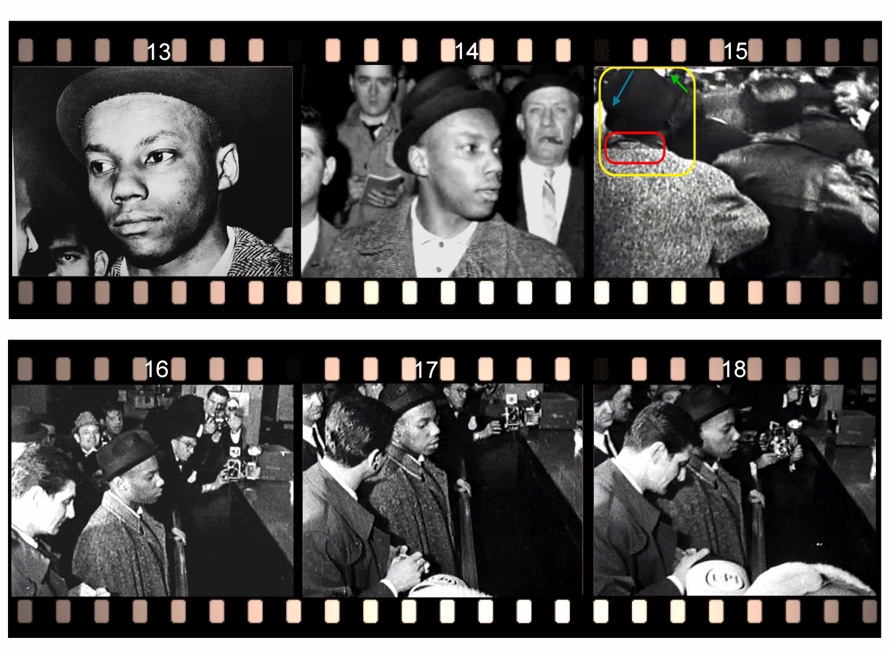
The full footage begins at the 16-minute mark in this YouTube film.
-

The Hidden Hand: The Assassination of Malcolm X
“I know, too, that I could suddenly die at the hands of some white racists. Or I could die at the hands of some Negro hired by the white man.”
~ from The Autobiography of Malcolm X
Conspiracy theories have engulfed the four major American political assassinations of the 1960s since inception. Even before the controversial Warren Commission was empaneled, reasonable doubts emerged about Lee Harvey Oswald being the lone assassin of President John F. Kennedy in Dallas on November 22, 1963.
Within days of the assassination of Dr. Martin Luther King Jr. in Memphis on April 4, 1968, his confidantes and constituents expressed skepticism over government claims that James Earl Ray, an ill-educated, inept stick-up artist from the south side of St. Louis acted alone.1
When Robert F. Kennedy was felled inside a Los Angeles hotel during a campaign stop on June 6, 1968, many Americans questioned the official version about a poor Palestinian immigrant shooting the presidential candidate in the back of the head, primarily because key eyewitnesses stated that Sirhan Bishira Sirhan was facing Kennedy when he fired.2
More than half a century later, government accounts stick to the “lone assassin” theory in those cases despite overwhelming evidence to the contrary. Most Americans harbor the delusion that every government but their own assassinates its citizens on occasion.
Only in the fourth case, the assassination of Malcolm X, is there incontrovertible proof of conspiracy. On February 21, 1965, Malcolm X, a charismatic African American revolutionary, was shot to death inside New York City’s Audubon Ballroom just seconds after greeting a crowd of about three hundred. To many, the assassination was the predictable culmination of a battle between him and the black separatist sect that ousted him eleven months earlier.3
Once home to Rabbi Max Koppel and Congregation Emes Wozedek in the 1930s4, the Audubon was located in a Washington Heights neighborhood bordering Harlem, where Malcolm had until recently headed Muhammad’s Mosque Number Seven. (Malcolm X was born Malcolm Little in Omaha, Nebraska in May 1925.)
Now an orthodox Muslim, Malcolm used the Audubon for weekly rallies sponsored by his newly formed group, the Organization of Afro-American Unity (OAAU). The group was patterned after the Organization of African Unity (OAU), founded in 1963 with the goal of uniting African nations that had recently wrestled their independence from American, Russian, and European colonialism.
Both the OAU and OAAU had a common goal: to promote Pan Africanism as a vehicle for alleviating economic, social, and political oppression. Sensing that his organizational skills, intelligence, and understanding of American politics could be instrumental in altering the world’s geopolitical landscape, African, Asian, and Latin American leaders had begun appealing to Malcolm X to champion their causes.
An electrifying orator, Malcolm had impressed Third World leaders during two extended trips to Africa in April and July of 19645. The first trip occurred weeks after his official break with the so-called Nation of Islam, a quasi-religious group promoting segregation in a quixotic quest for a separate nation within America exclusively for African Americans.

Malcolm X drew large crowds during rallies in Harlem. His popularity was seen as a national security risk by the FBI. Malcolm quit the sect in March 1964 after discovering that Elijah Muhammad, the leader of the NOI who claimed to be a divine prophet, had fathered over half a dozen children by at least six of his former personal secretaries, some of them teenagers. Muhammad denied the allegations and blamed Malcolm for spreading malicious “rumors,” precipitating helter-skelter plots against Malcolm, former national representative of the NOI.
Nearly a dozen attempts were made on his life between December 1963, when Malcolm was suspended as spokesman for the NOI, and February 1965. He was ostensibly excommunicated for describing the assassination of President John F. Kennedy as a case of the “chickens coming home to roost.” (At the time, the Central Intelligence Agency was suspected of the actual or attempted assassination of numerous Asian, African and Latin American heads of state, among them Patrice Lumumba of the Congo, Jacobo Arbenz of Guatemala, and Fidel Castro of Cuba.6 As such, Malcolm postulated that American violence against foreign leaders had boomeranged and claimed the life of an American president.)

Newspaper account of the suspension of Malcolm X from the Nation of Islam in December 1963. But the underlying cause of his suspension was a scandal that had shaken Malcolm to his core. In 1962, a rumor began circulating that Elijah Muhammad had fathered children by several of his secretaries. Since nonmarital and extramarital sexual relations were verboten and grounds for expulsion, almost no one in the sect believed it, and certainly not about their “infallible” messiah (Muhammad claimed to have been educated by God in “the person of Wallace D. Fard,” founder of the Nation of Islam in Detroit in 1931.) For them, anyone making such an outlandish claim was a demonic hypocrite “worthy of death.” Like the majority of NOI members, Malcolm ignored the salacious gossip. In the fall of 1963, however, the rumors were confirmed by three unimpeachable sources: Wilfred X Little, minister of the Detroit NOI mosque and Malcolm’s oldest brother, and Wallace Muhammad, Elijah’s son and putative heir to the throne upon his father’s demise. The third source was none other than Elijah himself.7

UPI story broke in early 1964 about paternity suit filed by two young black women against Elijah Muhammad, the married leader of the Nation of Islam. In explaining his actions during a private meeting at his Chicago mansion, Elijah said that his extramarital affairs were merely the fulfillment of biblical prophecy. “When you read about how David took another man’s wife, I’m that David,” he said. “You read about Noah, who got drunk—that’s me. You read about Lot, who went and laid up with his own daughters. I have to fulfill all of those things.”8 Weeks after recovering from the paralyzing shock of the confession, Malcolm suggested that Elijah permit his ministers to tell their assemblies that his moral transgressions were akin to what other prophets had done and yet held favor with God.
Thinking that Elijah had approved, Malcolm told several prominent ministers that the rumors were true, and that they should explain it in biblical terms to followers. Several ministers, among them Louis X [Farrakhan] of Boston, called Muhammad and told him that Malcolm was one of the “hypocrites” spreading the rumors about the secretaries.9

Louis Farrakhan denounced Malcolm X in Muhammad Speaks newspaper as the “chief hypocrite” in the Nation of Islam and said that Malcolm was “worthy of death.” Elijah summoned Malcolm to his home in Phoenix and castigated him for telling them. Malcolm apologized, saying that he thought he had Elijah’s approval. Elijah retorted that he had in no way approved of Malcolm’s suggestion and said that his three-month suspension for the JFK comment was now indefinite. A few days after the meeting, Elijah contacted several prominent East Coast members of the NOI and said that Malcolm was the sect’s chief hypocrite and that it was therefore time to “close his eyes.”10

Declassified FBI memo summarizes wiretapped telephone conversation between NOI leader Elijah Muhammad and a Boston mosque official in which murdering Malcolm X is discussed. Several attempts to kill Malcolm soon followed. When he discovered from a prominent Muslim that Elijah had sanctioned the plots to kill him, Malcolm publicly denounced the Nation of Islam and warned that any further attempts to harm him would be met with the biblical justice. He vowed to exact an “eye for an eye, a tooth for a tooth, and a life for a life.”
Malcolm was bearing a heavy cross when he arrived at the Audubon on February 21. The war with Muhammad had taken its toll; it was one man fighting a legion of zealots. Associates were alarmed by his appearance that morning. They recall him looking haggard, anxious, and exhausted.
The most notable attempt to kill him had occurred seven days earlier. Around two o’clock on Valentine’s Day, Molotov cocktails crashed through bedroom windows of his tiny Elmhurst home. If his four-year-old daughter had not been awakened by breaking glass, Malcolm and his wife Betty would have perished along with their four daughters. Betty was pregnant with twin girls.11
An around-the-clock harassment campaign which followed the bombing had unnerved Malcolm. He told several colleagues that he could understand why Elijah Muhammad wanted him silenced, but he could not fathom the religious leader approving the murder of women and children to accomplish that goal.
He was debilitated by the fire not only because of the near-death of his entire family, but because, he said, the fire revealed that the NOI’s attempts were being aided by the New York Police Department, the New York Fire Department and possibly even the federal government. “The police in this country know what’s going on. This is a conspiracy that leads to my death,” he said at a press conference.12
A few hours after the fire, investigators claimed that they discovered an unlit Molotov cocktail on a dresser in his daughters’ bedroom. The explosive concoction was in a whiskey bottle. Police officials insinuated that Malcolm might have set the house on fire because he had been evicted days earlier by court order. NOI officials who filed the lawsuit repeated the claim, noting that Malcolm’s home legally belonged to the sect.

New York Police Department and Nation of Islam both argue that Malcolm X firebombed his own house. Malcolm and Betty dismissed the speculation as nonsense. To begin with, Betty replied, they would never have alcoholic beverages in their home. Malcolm said angrily that only a madman would set fire to his home with his family asleep inside. Moreover, a black fireman who secretly met with them said that he saw a white man in a firefighter’s uniform place the Molotov cocktail on the dresser after the fire was extinguished. The revelation nearly caused Malcolm to have a psychotic break, the reason being that he knew his death was both imminent and inevitable if governmental forces were in cahoots with the Nation of Islam. A close friend noticed his agitated state and arranged for him to see a doctor to get something to help him sleep.
On the evening of February 20, Malcolm checked into a downtown New York hotel under a pseudonym. Nearly undone by the arson attack, he took a sedative and fell asleep. His rest was interrupted, however, by the loud ringing telephone. “Wake up, Mr. Small,” the caller said before hanging up. The call was ominous because only his wife and two close aides knew where Malcolm planned to stay that evening. Unbeknownst to him, a group of Muslims had shown up at the hotel a few hours after he checked in, demanding the desk clerk to tell them which room Malcolm X was in. The clerk said he knew nothing about Malcolm X being there.
At three o’clock on February 21, with his wife and children looking on, Malcolm stood at the podium on the ballroom’s stage. “As Salaam Alaikum,” he said, meaning “peace be with you.”
Suddenly, two young black men seated in the middle of the room stood up and started arguing. “Niggah,” one of them said, “get your hand out of my pocket!”
“Hold it, hold it, hold it,” Malcolm pleaded. Three young black men on the center front row stood up, removed firearms from underneath their coats, and fired at Malcolm. Two were armed with handguns while the third had a sawed-off shotgun. A tall tout black man with the shotgun crouched before the stage and fired twice, striking Malcolm in the chest. Three pellets landed near his heart. The force of the blasts hurled Malcolm backward, and his head hit the stage with a loud thud.
During the ensuing pandemonium, the shotgun assassin wrapped up his weapon in a jacket and dropped it on the ballroom floor as he escaped. The assassin with the German Luger fired at crowd members trying to capture him as he made his escape. The third gunman wasn’t so lucky. He was shot in his left thigh by a member of Malcolm’s security team. As he fell, he dropped his .45 automatic and was tackled and beaten by the crowd.
On the afternoon of the assassination, police were conspicuous by their absence. On past Sundays, there were nearly two dozen officers present in and outside the Audubon. Police arrived as people dragged the man outside. As police tangled with Malcolm’s supporters for custody of the assassin, the other two assassins and the two men who caused the initial distraction escaped.
Thomas Hagan, the wounded suspect, refused to divulge the name of his accomplices. Eyewitnesses, however, gave police descriptions consistent enough to lead them to Norman 3X Butler and Thomas 15X Johnson, lieutenants in the Harlem mosque where Malcolm was minister until his ouster. Butler and Johnson were well-known as enforcers with a reputation for brutalizing wayward Muslims.13 In fact, they were awaiting trial for attempted murder of Benjamin Brown, a NOI defector who had recently opened his own storefront mosque. When the defector refused to remove a photograph of Elijah Muhammad from the front window, Butler and Johnson went to his home. After he opened the door, Johnson shot him at point-blank range in his chest with a rifle. The defector somehow managed to survive the blast.
Butler was arrested on February 26 and Johnson shortly thereafter. All three suspects pleaded not guilty. Following a joint trial one year later, a jury found them all guilty of the assassination and each received a life sentence.14
Case closed, or so it seemed.
Butler and Johnson both steadfastly denied involvement in the assassination. Their case was buttressed by some of Malcolm’s chief aides, who claimed that it would have been virtually impossible for Butler and Johnson to have entered the ballroom that day without detection by the OAU’s security team.
But Johnson and Butler had shaky alibis. Both men, incredulously, claimed to have been immobilized by leg injuries at the time of the assassination. Johnson’s case was helped somewhat by eyewitness accounts, nearly all of whom described the shotgun assassin as a tall, stout, dark-skinned black man sporting a short beard.15 Johnson had a caramel-colored complexion, was of average height, and clean-shaven but for a pencil mustache. Conversely, eyewitnesses described Butler perfectly. One of them, Sharon X Poole, even said that she recognized him as a fellow member of the Harlem mosque.16

Although Norman 3X Butler denies involvement in the assassination of Malcolm X, he appears on film outside the Audubon Ballroom moments after the murder, attempting to get a look at Malcolm X’s body.” For ten years, there was little to refute the official version of the assassination. Malcolm X was killed as a result of a feud with Elijah Muhammad stood as gospel despite suspicions by his admirers and Third World leaders of American government involvement.
In March 1971, white radicals broke into the FBI’s document storage facility in Media, Pennsylvania and made off with a goldmine of files detailing the agency’s decades-long clandestine wars against political and social organizations of every hue and stripe, the Ku Klux Klan and Nation of Islam among them.17 A counterintelligence program—COINTELPRO—which started in the 1950s to combat the spread of Communism in America, soon engulfed thousands of groups, even the benign National Association for the Advancement of Colored People (NAACP).
When several thousand pages were released from the COINTELPRO operations against Malcolm X in the early 1980s, they revealed a massive campaign against him and the Nation of Islam. The initial campaign, started in 1953 (a year after he was released from prison), was intended to retard the astronomical growth of the Nation of Islam.
They also show that in 1964, following a complaint by White House aide Benjamin H. Read that Malcolm’s affiliations with Third World leaders were damaging American foreign policy in Africa, the Central Intelligence Agency was asked to consider killing Malcolm X.

White House official Benjamin H. Read asked the CIA to consider treating Malcolm X the way it did hostile foreign leaders. Richard Helms, the CIA’s Deputy Director of Plans, told Read that the CIA had serious qualms about killing American citizens but would nonetheless explore the possibility of neutralizing Malcolm.18 The FBI had been spying on the Nation of Islam since the 1940s after its male members refused to register under the Selective Service Act. By 1964, it had informants in the highest ranks of not only the NOI but inside Malcolm’s Organization of Afro-American Unity as well.
In addition to being under surveillance by the CIA and FBI, the New York Police Department’s Bureau of Special Services and Investigation (nicknamed BOSSI) had Malcolm under close surveillance and had several high level informants in the OAU. At least one of them, Eugene “Gene” Roberts, was a member of Malcolm’s security detail and on duty at the hour of reckoning.

Gene Robert (in circle) was an undercover NYPD detective who infiltrated Malcolm X’s organization and became part of his main security detail. Malcolm X had been on around-the-clock surveillance by the FBI for more than six months before his assassination. Transcripts of wiretapped telephone conversation between Malcolm X and other prominent black activists are included in the files, some of them heavily redacted.
Declassified FBI documents include a detailed account of the FBI sending anonymous letters to Elijah Muhammad’s wife and NOI ministers across the country about Elijah’s extramarital activities. Bureau agents bragged in several memos about starting the disputes which led to the ouster of Malcolm from the NOI and fomenting a war between Malcolm and Elijah Muhammad.19

The FBI was alarmed that Malcolm X had begun courting Dr. Martin Luther King Jr. and other civil rights leaders following his ouster from the Nation of Islam in March 1964. While the CIA and State Department have been reticent to release many documents from their files on Malcolm X, those released thus far reveal an urgent counterintelligence campaign to “neutralize” Malcolm X after several African and Arab countries offered him financial support in 1964 and vowed to support his petition to the United Nations in which he accused the United States government of violating the human rights of African Americans.
Along with Che Guevara, the physician-turned-revolutionary who played a major role in Cuban revolution of 1959, Malcolm X was expected to be one of the preeminent attractions at the Second Asian-African Congress commencing on February 26 in Algeria. The conference was postponed due to the overthrow of Ahmed Ben Bella, an event most reputable historians attribute to the CIA and British intelligence.20 Ben Bella and Malcolm had become friends, and the Algerian leader was a staunch supporter of both Malcolm X and the civil rights movement.

The CIA was concerned about Malcolm X’s impact on US foreign policy in Africa. Declassified FBI and CIA documents suggest that the American government was extremely eager to prevent Malcolm from attending at all cost. He was assassinated five days before the aborted assembly. As it happens, Malcolm’s assassins were recruited in late June 1964, within weeks of the White House’s request to the CIA to handle Malcolm X the way it did hostile foreign leaders.21
In April 2011, Newark NOI member William Bradley was identified as the shotgun shooter. The day after the New York Times asked the Justice Department whether it would investigate the allegations against Bradley, a spokesman said that there was nothing the FBI could do because no federal laws had been violated.

William Bradley (standing, in circle), the man who fired the shotgun at Malcolm X, was captured on film outside the Audubon as he attempted to free assassin Thomas Hagan from police and angry Malcolm X supporters. That was, of course, an egregious error. The assassins had traveled from New Jersey to New York to assassinate Malcolm X. Traveling across state lines to commit murder is a federal crime. And under both federal and state laws, there is no statute of limitations for murder.
The Justice Department’s hasty decision to reject reopening the case involving the civil rights movement leader Malcolm X was predictable. After all, it was revealed more than three decades ago that the man seen in the famous Life magazine photo administering mouth-to-mouth resuscitation to Malcolm X was none other than Gene Roberts, an undercover detective for BOSSI. Moreover, a top aide to Elijah Muhammad was linked to the FBI. Although he has denied any involvement with the FBI and the Malcolm X assassination, prosecutors of Malcolm’s assassins had an eyewitness willing to testify that the aide met at the Americana Hotel with the assassins the night before the assassination.
Notes
1 Schechtman, Jeff. “The Plot to Kill King: A Look at Who Really Killed Martin Luther King,” April 4, 2018. https://whowhatwhy.org/2018/04/04/the-fbi-in-peace-war-and-assassination/.
2 “The Robert F. Kennedy Assassination,” https://www.maryferrell.org/pages/Robert_Kennedy_Assassination.html
3 Drash, Wayne. “Malcolm X Killer Freed After 44 Years,” April 28, 2010. http://www.cnn.com/2010/CRIME/04/26/malcolmx.killer/index.html
4 Lowenstein, Steven M. Frankfurt on the Hudson: The German-Jewish Community of Washington Heights, 1933-1983, Its Structure and Culture (Detroit: Wayne State University Press, 1991). pp. 109-110. Also see: http://www.nypap.org/preservation-history/audubon-ballroom. Rabbi Mas Koppel, founder of the Emes Wozedek Congregation, was murdered in 1974. Seigel, Max H. “Neighbors Call Slain Rabbi Friend to All,” New York Times, December 18, 1974, A49.
5 Jacobs, Sean. “When Malcolm X Went to Africa,” June 2011. https://africasacountry.com/2011/06/malcolm-x-in-africa1/
6 “Alleged Assassination Plots Involving Foreign Leaders,” (1975). https://cia.gov/library/readingroom/document/cia-rdp83-01042r000200090002-0
7 Haley, Alex with Malcolm X. The Autobiography of Malcolm X (New York: Grove Press, 1965) See, in general, ‘Chapter 16: Out.”
8 Ibid.
9 Ibid.
10 FBI Main file on Malcolm X, memo dated March 23, 1964.
11 “Malcolm X’s Home is Firebombed in 1965,” (reprint) New York Daily News. https://www.nydailynews.com/news/crime/malcolm-x-home-firebombed-1965-article-1.2529655
12 Scott, Stanley. “Recalls Prophetic Words: Newsman Witnesses Murder of Malcolm X,” Desert Sun, February 22, 1965, pA6.
13 Newman, Andy and John Eligon. “Killer of Malcolm X is Granted Parole,” New York Times, March 19, 2010, A13.
14 “Three Men Convicted of the Assassination of Malcolm X in 1966,” New York Daily News. https://www.nydailynews.com/news/crime/men-convicted-murder-malcolm-x-1996-article-1.2558206
15 Based on documentary footage from local television news in the archives of the University of Los Angeles Film School.
16 Kihss, Peter. “Malcolm X Shot to Death at Rally Here; Three Other Negroes Wounded—One is Held in Killing,” New York Times, February 22, 1965, A1.
17 Mazzetti, Mark. Burglars Who Took On FBI Abandon Shadows,” New York Times, January 7, 2014, p. A1.
18 CIA file on Malcolm X, memo from Richard Helms dated August 11, 1964.
19 See, in general, the FBI New York Field Office file on Malcolm X and the New York Police Department’s Bureau of Special Services and Investigations file on Malcolm X.
20 Gleijeses, Piero. Conflicting Missions: Havana, Washington, and Africa, 1959-1976. (North Carolina: University of North Carolina Press, 2011).
21 The assassins, all of them from the Newark mosque of the Nation of Islam, was recruited in late June 1964, according to Thomas Hagan.
Also of interest:
- Surveillance by FBI the last year of his life
- Last year’s documentary on Malcolm
- Our list of the five best books on the Malcolm X assassination
-

Remembering Malcolm X: February 21, 2017
Author Joseph Green begins our special feature with a second look at the work of Manning Marable, whose biography of Malcolm X he had previously reviewed for us (see the link below). Green asks hard questions of those progressive historians who wish to fit Malcolm into a predefined pattern, emphasizing how resistant to categorization he was (one could, though certainly to a lesser degree, claim something similar for all the figures to whom this site is devoted). At the same time, Green lauds Marable’s serious interrogation of Malcolm’s assassination as rather unique within the academic mainstream.
 We also reprint here, for the first time since its original appearance fifteen years ago, James W. Douglass’s masterful study of the last year of Malcolm’s life, how it sealed his fate, and how law enforcement and intelligence agencies conspired to bring about his murder. Included are the two affidavits of Talmadge Hayer, the only assassin in the Malcolm X case to be apprehended.
For Joe’s review of Manning Marable’s biography, which we first published on the CTKA site, see:
Manning Marable, A Life of Reinvention
For the long essay by James W. Douglass on Malcolm X, which first appeared in The Assassinations (ed. DiEugenio & Pease, 2003), see:
The Murder and Martyrdom of Malcolm X
Finally, Talmadge Hayer’s affidavits, also included in The Assassinations, are reproduced here:
The Confessions of Talmadge Hayer
It should be noted, however, that the statements made by Hayer with respect to Norman Butler may be questionable. Film footage which came to light subsequent to this article has revealed his presence (along with that of William Bradley) outside the Audubon Ballroom in the immediate aftermath of the assassination. See:
The “Zapruder Film” of the Malcolm X Case

Manning Marable’s Malcolm X: An Introduction
by Joseph E. Green
I haven’t changed. I just see things on a broader scale. We nationalists used to think we were militant. We were just dogmatic. It didn’t bring us anything.1
~Malcolm X, February 25, 1964
Manning Marable’s final book, Malcolm X: A Life of Reinvention, which went to press the same week he died, has left a complicated legacy. Part of the problem is that Malcolm X resists all categorization, a hurdle for academics whose primary method of understanding all history is categorization. He wasn’t a modern liberal the way we would typically understand a liberal; for most of his ideological life, he was a hardline separatist who attacked his enemies on the Right but maintained contempt for the Left. Malcolm never wanted to assimilate and he doesn’t, even in death. As one FBI document recorded:
The subject warned at this meeting, according to the newspaper article, that Negroes can expect little better treatment from President Kennedy than they get from Alabama Governor George C. Wallace. He characterized the two men as a wolf and a fox. “Neither one loves you,” he said. “The only difference is that the fox will eat you with a smile instead of a scowl.”2
(And yet all three men – Wallace, Kennedy, and Malcolm – would be shot, two fatally.)
For Marable, who founded the Institute of African-American Studies at Columbia University, there was an understandable onus to place Malcolm in a line of progressive American history leading up to the election of Barack Obama. However, this approach tames Malcolm and gives too much credit to Obama. It also drew intense criticism that resulted in one collection of rebuttal essays, A Lie of Reinvention, edited by Professor Jared Ball. But Marable was not the only person to view Obama through this lens. No less than Black Panthers co-founder Bobby Seale told me that he loved Obama because of his background as a community organizer.3 In his own way, Seale views him as a part of the Civil Rights history that both he and Malcolm X are important figures in.
 However, the question remains: Would Malcolm X really have approved of Barack Obama? The idea seems dubious at best, a betrayal at worst. The big problem, of course, is that Malcolm X’s trajectory was interrupted by assassination. If Act One of his life was his experiences as Detroit Red, and Act Two his conversion in prison and later fame as Elijah Muhammad’s understudy, then Act Three would have been the fallout from his experience at Mecca. We know that he had undergone a powerful transformation, and had started to see and conduct himself as a citizen of the world. Alas, he was dead less than a year later; what would he have done given another twenty or thirty years? We’ll never know. But it’s safe to say, I think, that he would have never endorsed the assassination of Gadaffi or the murder of Libyans by drone. He would not have endorsed the neoliberal corporatization of our political parties. As he said, “If violence is wrong in America, violence is wrong abroad. If it is wrong to be violent defending black women and black children and black babies and black men, then it is wrong for America to draft us, and make us violent abroad in defense of her.”4
There is no doubt Marable took great liberties with Malcolm’s life. And although the man himself curated his own story, with the assistance of Alex Haley, it was his story to curate. Marable’s attempt to reinvent Malcolm in the progressive liberal image was doomed by dubious (or occasionally absent) sourcing, but also because it is an impossible task. For example, the writer Glen Ford argues:
Malcolm never did accept the notion of revolution as bloodless, nor did he recognize the fight against segregated public accommodations as revolutionary. But Marable tries to convince us that Malcolm must have contemplated a reformist political path in his mind, if not in practice. This is William Styron-style biography… [italics in the original]5
I agree with Ford that Marable is on shaky ground here. And yet there is value in Marable’s book, in my view, because it does something that academic books generally don’t do. It takes seriously the idea that Malcolm’s murder came about as a result of a conspiracy, and that the conspiracy was perpetrated by forces in our own government, and it goes further to name names, and explain why this was done.
Scholars of Manning Marable’s stature don’t do that. The fact that he did do it, and did it well, although not with the depth and intensity of Karl Evanzz in The Judas Factor, or Baba Zak Kondo in Conspiracys, has value in my opinion. It becomes part of the literary and historical record in a way that other works do not.
Now this does not sway everyone. I asked Professor Ball whether he thought that aspect of the book might have real benefits at a COPA conference, and he responded in the negative. If the book has such serious flaws in presentation and interpretation, in his view, then whatever good it might contain is invalidated. Professor Ball also criticizes what he sees as a weakness in Marable laying too much blame on the Nation of Islam:
…I think it’s the United States, it’s Western imperialism that were the greatest beneficiaries to Malcolm’s assassination, and as Malcolm said himself before he was killed, it was not the Nation of Islam that blocked him from going to France. It was not the Nation of Islam that could have the resources to follow him all around the world and tap all of his phones. So the state was highly involved and was the greatest beneficiary and that needs to be addressed because that apparatus is still intact and is still doing all of the things that Malcolm was trying to get us to eradicate…6
He is certainly right about the state. Malcolm X was murdered by forces within the United States government, and it falls within a pattern of other murders that is as identifiable as a serial killer’s motif. Professor Ball says Marable’s book soft-pedals this idea. I felt just the opposite, especially as he brings out the way one of Malcolm’s killers was able to escape justice for that and other crimes throughout his life, but that might be chalked up to differing expectations for such a book.
What I would say about Malcolm X – A Life of Reinvention, six years later, is that it should be read as part of a continuum of books and government documents necessary to help understand the complex figure of Malcolm X. The author may have been attempting to replace the Autobiography – although I don’t necessarily agree and find the notion problematic since Marable wasn’t around to be questioned about it – but in any case, the book clearly doesn’t do that. It is instead a flawed but significant chapter in the never-ending conversation about the Civil Rights era in its relation to the present. Indeed, far from being out of date, Malcolm’s words seem remarkably prescient and insightful regarding how to contend with, and combat, the forces of white supremacy that have given us our 45th President.
Notes
1. Breitman, George, ed. Malcolm X Speaks. New York: Grove Press, 1965 (213).
2. Carson, Clayborne. Malcolm X: The FBI File. New York: Ballatine Books, 1995 (227).
3. Green, Joseph. Dissenting Views II. San Antonio. Texas: Createspace, 2014 (206).
4. Speech by Malcolm X, November 1963, NYC.
5. Ford, Glen. “Dragging Malcolm X to Obamaland.” April 27, 2011. Accessed January 23, 2017. http://blackagendareport.com/content/dragging-malcolm-x-obamaland
6. Armah, Bomani. “Jared Ball Discussing His Book ‘A Lie of Reinvention: Correcting Manning Marable’s Malcolm X.’” May 7, 2013. Accessed January 23, 2017. https://notarapper.com/2013/05/06/jared-ball-discussing-his-book-a-lie-of-reinvention-correcting-manning-marables-malcolm-x/amp/?client=safari
-
Remembering Malcolm X: February 21, 2017
Author Joseph Green begins our special feature with a second look at the work of Manning Marable, whose biography of Malcolm X he had previously reviewed for us (see the link below). Green asks hard questions of those progressive historians who wish to fit Malcolm into a predefined pattern, emphasizing how resistant to categorization he was (one could, though certainly to a lesser degree, claim something similar for all the figures to whom this site is devoted). At the same time, Green lauds Marable’s serious interrogation of Malcolm’s assassination as rather unique within the academic mainstream.
We also reprint here, for the first time since its original appearance fifteen years ago, James W. Douglass’s masterful study of the last year of Malcolm’s life, how it sealed his fate, and how law enforcement and intelligence agencies conspired to bring about his murder. Included are the two affidavits of Talmadge Hayer, the only assassin in the Malcolm X case to be apprehended.For Joe’s review of Manning Marable’s biography, which we first published on the CTKA site, see:
Manning Marable, A Life of Reinvention
For the long essay by James W. Douglass on Malcolm X, which first appeared in The Assassinations (ed. DiEugenio & Pease, 2003), see:
The Murder and Martyrdom of Malcolm X
Finally, Talmadge Hayer’s affidavits, also included in The Assassinations, are reproduced here:
The Confessions of Talmadge Hayer
It should be noted, however, that the statements made by Hayer with respect to Norman Butler may be questionable. Film footage which came to light subsequent to this article has revealed his presence (along with that of William Bradley) outside the Audubon Ballroom in the immediate aftermath of the assassination. See:
The “Zapruder Film” of the Malcolm X Case
Manning Marable’s Malcolm X: An Introduction
by Joseph E. Green
I haven’t changed. I just see things on a broader scale. We nationalists used to think we were militant. We were just dogmatic. It didn’t bring us anything.1
~Malcolm X, February 25, 1964
Manning Marable’s final book, Malcolm X: A Life of Reinvention, which went to press the same week he died, has left a complicated legacy. Part of the problem is that Malcolm X resists all categorization, a hurdle for academics whose primary method of understanding all history is categorization. He wasn’t a modern liberal the way we would typically understand a liberal; for most of his ideological life, he was a hardline separatist who attacked his enemies on the Right but maintained contempt for the Left. Malcolm never wanted to assimilate and he doesn’t, even in death. As one FBI document recorded:
The subject warned at this meeting, according to the newspaper article, that Negroes can expect little better treatment from President Kennedy than they get from Alabama Governor George C. Wallace. He characterized the two men as a wolf and a fox. “Neither one loves you,” he said. “The only difference is that the fox will eat you with a smile instead of a scowl.”2
(And yet all three men – Wallace, Kennedy, and Malcolm – would be shot, two fatally.)
For Marable, who founded the Institute of African-American Studies at Columbia University, there was an understandable onus to place Malcolm in a line of progressive American history leading up to the election of Barack Obama. However, this approach tames Malcolm and gives too much credit to Obama. It also drew intense criticism that resulted in one collection of rebuttal essays, A Lie of Reinvention, edited by Professor Jared Ball. But Marable was not the only person to view Obama through this lens. No less than Black Panthers co-founder Bobby Seale told me that he loved Obama because of his background as a community organizer.3 In his own way, Seale views him as a part of the Civil Rights history that both he and Malcolm X are important figures in.
However, the question remains: Would Malcolm X really have approved of Barack Obama? The idea seems dubious at best, a betrayal at worst. The big problem, of course, is that Malcolm X’s trajectory was interrupted by assassination. If Act One of his life was his experiences as Detroit Red, and Act Two his conversion in prison and later fame as Elijah Muhammad’s understudy, then Act Three would have been the fallout from his experience at Mecca. We know that he had undergone a powerful transformation, and had started to see and conduct himself as a citizen of the world. Alas, he was dead less than a year later; what would he have done given another twenty or thirty years? We’ll never know. But it’s safe to say, I think, that he would have never endorsed the assassination of Gadaffi or the murder of Libyans by drone. He would not have endorsed the neoliberal corporatization of our political parties. As he said, “If violence is wrong in America, violence is wrong abroad. If it is wrong to be violent defending black women and black children and black babies and black men, then it is wrong for America to draft us, and make us violent abroad in defense of her.”4There is no doubt Marable took great liberties with Malcolm’s life. And although the man himself curated his own story, with the assistance of Alex Haley, it was his story to curate. Marable’s attempt to reinvent Malcolm in the progressive liberal image was doomed by dubious (or occasionally absent) sourcing, but also because it is an impossible task. For example, the writer Glen Ford argues:
Malcolm never did accept the notion of revolution as bloodless, nor did he recognize the fight against segregated public accommodations as revolutionary. But Marable tries to convince us that Malcolm must have contemplated a reformist political path in his mind, if not in practice. This is William Styron-style biography… [italics in the original]5
I agree with Ford that Marable is on shaky ground here. And yet there is value in Marable’s book, in my view, because it does something that academic books generally don’t do. It takes seriously the idea that Malcolm’s murder came about as a result of a conspiracy, and that the conspiracy was perpetrated by forces in our own government, and it goes further to name names, and explain why this was done.
Scholars of Manning Marable’s stature don’t do that. The fact that he did do it, and did it well, although not with the depth and intensity of Karl Evanzz in The Judas Factor, or Baba Zak Kondo in Conspiracys, has value in my opinion. It becomes part of the literary and historical record in a way that other works do not.
Now this does not sway everyone. I asked Professor Ball whether he thought that aspect of the book might have real benefits at a COPA conference, and he responded in the negative. If the book has such serious flaws in presentation and interpretation, in his view, then whatever good it might contain is invalidated. Professor Ball also criticizes what he sees as a weakness in Marable laying too much blame on the Nation of Islam:
…I think it’s the United States, it’s Western imperialism that were the greatest beneficiaries to Malcolm’s assassination, and as Malcolm said himself before he was killed, it was not the Nation of Islam that blocked him from going to France. It was not the Nation of Islam that could have the resources to follow him all around the world and tap all of his phones. So the state was highly involved and was the greatest beneficiary and that needs to be addressed because that apparatus is still intact and is still doing all of the things that Malcolm was trying to get us to eradicate…6
He is certainly right about the state. Malcolm X was murdered by forces within the United States government, and it falls within a pattern of other murders that is as identifiable as a serial killer’s motif. Professor Ball says Marable’s book soft-pedals this idea. I felt just the opposite, especially as he brings out the way one of Malcolm’s killers was able to escape justice for that and other crimes throughout his life, but that might be chalked up to differing expectations for such a book.
What I would say about Malcolm X – A Life of Reinvention, six years later, is that it should be read as part of a continuum of books and government documents necessary to help understand the complex figure of Malcolm X. The author may have been attempting to replace the Autobiography – although I don’t necessarily agree and find the notion problematic since Marable wasn’t around to be questioned about it – but in any case, the book clearly doesn’t do that. It is instead a flawed but significant chapter in the never-ending conversation about the Civil Rights era in its relation to the present. Indeed, far from being out of date, Malcolm’s words seem remarkably prescient and insightful regarding how to contend with, and combat, the forces of white supremacy that have given us our 45th President.
Notes
1. Breitman, George, ed. Malcolm X Speaks. New York: Grove Press, 1965 (213).
2. Carson, Clayborne. Malcolm X: The FBI File. New York: Ballatine Books, 1995 (227).
3. Green, Joseph. Dissenting Views II. San Antonio. Texas: Createspace, 2014 (206).
4. Speech by Malcolm X, November 1963, NYC.
5. Ford, Glen. “Dragging Malcolm X to Obamaland.” April 27, 2011. Accessed January 23, 2017. http://blackagendareport.com/content/dragging-malcolm-x-obamaland
6. Armah, Bomani. “Jared Ball Discussing His Book ‘A Lie of Reinvention: Correcting Manning Marable’s Malcolm X.’” May 7, 2013. Accessed January 23, 2017. https://notarapper.com/2013/05/06/jared-ball-discussing-his-book-a-lie-of-reinvention-correcting-manning-marables-malcolm-x/amp/?client=safari
-
Biography Revives Push to Reopen Malcolm X Case
by Shaila Dawan, At: NYT
-
Has Another of Malcolm X’s Assassins Been Found?
by Abdur Rahman Muhammad, At: A Singular Voice