Tag: LEE HARVEY OSWALD

  • Veciana, Phillips, and Oswald: A Plot Triangle?

    Veciana, Phillips, and Oswald: A Plot Triangle?


    Shortly before the JFK assassination, Hilda Veciana was walking as usual from her nearby home to her workplace, namely the Cuban Embassy in Mexico City. At some 200 feet from the entrance, she bumped into a big wad of bills on the sidewalk. Two men immediately approached and one of them told her in Spanish with a Mexican accent something like, “Hey, lady, this money is yours. Pick it up!”

    She got scared, stepped up toward the embassy, and even cried for help. After she entered the diplomatic compound and talked about the incident, some of her co-workers got out and headed to the scene, but neither the money nor any people were there anymore.

    Making Sense

    General Fabian Escalante revealed this incident to JFK historians gathered with Cuban officials in Nassau, Bahamas, from December 7–9, 1995. He judged it as an obvious provocation. Hilda Veciana was working at the Cuban Embassy in Mexico City because her husband, Guillermo Ruiz, had been appointed as Commercial Attaché in August 1963. If she would have grabbed the money, the CIA would have her photographed to compromise her husband by showing him the photos and threatening with publishing them if he did not collaborate.

    The Cuban diplomatic compound was under heavy photo surveillance by the CIA program LIONION. From a window in a third-floor apartment across the street, CIA employee Hugo Cesar Rodriguez was taking pictures of the visitors to the Embassy, while a pulse camera covered the Consulate from another window.

    Connecting the Dots

    Hilda Veciana was cousin of the fierce anti-Castro militant Antonio Veciana, leader of the paramilitary group Alpha 66 and fellow traveler of the CIA handled by David Atlee Phillips. Both shared an unrelenting animus against JFK.

    In the spring of 1963, JFK ordered a crackdown on anti-Castro belligerent groups and Alpha 66 was targeted. It was attacking Russian ships to torpedo the Kennedy-Khrushchev understanding on their peaceful solution to the Cuban Missile Crisis. At the AARC Conference on “The Warren Report and the JFK Assassination” (Bethesda, MD, 2014), Veciana openly admitted: “In the early 1960’s, I believed John F. Kennedy was a traitor to the Cuban exiles and to this country.”

    The Bay of Pigs fiasco was a thorn in Phillips’ flesh. Instead of admitting it was the CIA’s fault, Phillips put the blame on the pinko at the White House. In Nassau, Escalante also revealed that Phillips had told Cuban dangle Nicolas Sirgado a curious anecdote among a few drinks in Mexico by 1972: after Kennedy’s death, he visited his grave and urinated on it. Phillips also said JFK was a communist.

    Before the HSCA, Veciana triangulated his relationship with Phillips by adding Oswald. At the so-called Southland Building meeting (Dallas, TX) in late August or early September 1963, Veciana arrived a bit early and saw Phillips chatting with a man who quickly left. On November 22, 1963, Veciana recognized this man on TV as the breaking news person.

    Veciana affirmed Phillips contacted him after the assassination with the proposal to pay his cousin-in-law a large sum of money, if Guillermo Ruiz would say he and his wife had met with Oswald in Mexico City, meaning the Cuban Intelligence Services (CuIS) had precise instructions for Oswald to kill JFK. Veciana agreed to make contact, but was unable to do it.

    Just after a HSCA panel visited Havana in 1978, Castro smelled a rat in the AMLASH plot: it might have been linked to the JFK assassination.[1] A task force overseen by Escalante—already head of the Cuban State Security apparatus—went over a bunch of files ranging from known terrorists to exiles, all under a cloud of suspicion. When the CuIS analysts read Veciana’s passage in the HSCA Report (1979), they instantly formulated a hypothesis strongly favored by the Hilda Veciana incident: her cousin was tampering with the timing of the facts.

    The propaganda campaign trying to tie Oswald to Castro has lowered down after the failed wave of scams, hoaxes, and jokes during the first two weeks after the assassination by the deed and disgrace of Nicaraguan secret agent Gilberto Alvarado, Cuban exile Salvador Diaz-Verson, Mexican credit inspector Oscar Gutierrez, and other fakers.

    Phillips knew, through Veciana himself, that his cousin and her husband were working at the Cuban Embassy in Mexico City, but bribing Guillermo Ruiz to take a path, unsuccessfully trodden by many others, did not seem to be proper tradecraft. Veciana admitted that Phillips was very jumpy about having asked him to bribe his cousin-in-law and shortly thereafter told him to forget about it. By contrast, Phillips’ proposal to Veciana fits in perfectly before the assassination with plotting a testimony after the fact or just a quick and convenient visa service.

    Muddying the Waters

    At the AARC Conference, Veciana made a truly astonishing revelation:

    [Phillips] confirmed to me in a conversation that Oswald had traveled to Mexico on [his] orders. [Phillips] tricked Oswald into taking that trip to secure a visa from the Cuban Consulate though [he] knew the authorities there would never grant Oswald such a visa. The reason for this trip was to create a trail that would link Oswald to Fidel Castro and help focus the blame of the planned assassination of President Kennedy on Castro.

    Veciana did not provide a straight answer to the key question posed by Jim DiEugenio on the spot: When did Phillips tell him that? Furthermore, Veciana omitted this conversation in his memoirs (Trained to Kill, Skyhorse Publishing, 2017) and left us all in the lurch. We don’t know whether Phillips actually told him such a crucial detail about Oswald or it was an inference drawn by Veciana from conversations with Phillips.

    In his garbled answer to DiEugenio, Veciana stated Phillips had asked him about the possibility of getting a visa on the same day at the Cuban Consulate in Mexico City. Veciana responded zero chance. This conversation occurred shortly after Castro made his well-known and often distorted statement to Associated Press reporter Daniel Harker at the Brazilian Embassy on September 7, 1963.[2] The exhortation to bribe Guillermo Ruiz would have taken place immediately after the assassination.

    In his memoirs, Veciana did not report the conversation around September 7 and placed the second one in Miami a few weeks after the assassination, but neither in the book nor at the conference does he clarify when Phillips made the assertion that Oswald was traveling to Mexico under his orders. Last, but not least, Veciana has never told why Phillips summoned him to Dallas in September of 1963 and what the Southland Building meeting was about.

    Occam’s Razor

    For CuIS, this meeting revolved around Phillips planning with Veciana and Oswald the trip to Mexico City and the fix of a same-day Cuban visa. But Veciana couldn’t approach Guillermo Ruiz, so Phillips tried to blackmail him through his wife. This push also failed, but Phillips sent Oswald to Mexico City with a false promise. It may explain why Oswald became so upset when he was denied an instant visa.

    Phillips would have never planned a meeting in the same place with two assets from unrelated operations. On the contrary, the meeting in Dallas wouldn’t be a significant tradecraft mistake if Phillips was handling Oswald and Veciana in the same or related operations. Veciana tampering with the timing of conversations with Phillips about Guillermo Ruiz and suffering from Alzheimer’s disease in regard to the Dallas meeting agenda fit in well with this scenario.

    As Dan Hardway has pointed out, Phillips could have used Oswald as a dangle without him being witting about an upcoming JFK assassination. His impersonation by phone in Mexico City reinforces such hypothesis. However, Veciana seemed to be aware of the ultimate goal.


    [1] The CIA recruited Cuban Army Major Rolando Cubela and precisely on November 22, 1963, his handler gave him in Paris an ingenious poison pen to kill Castro, but Cubela didn’t take it. By February 29, 1965, Cubela was in Madrid with Cuban exile leader Manuel Artime [AMBIDDY-1] to plan the assassination of Castro with Cubela’s own rifle. It would be followed by the landing of Artime’s commandos from Central America to establish a beachhead and to create a government supported by the Organization of American States. Castro agent Juan Felaifel was infiltrated into Artime’s inner circle and spoiled the plot. Cubela and his co-conspirators ended up in jail by February 1966.

    [2] “United States leaders should think that if they are aiding terrorist plans to eliminate Cuban leaders, they themselves will not be safe.” (The Miami Herald, September 9, 1963, page 1A).

  • Alecia Long Lays an Egg

    Alecia Long Lays an Egg


    The Assassination Records Review Board did some good work in New Orleans. For one, they made available the Clay Shaw trial transcript, which made James Kirkwood’s book, American Grotesque, obsolete. Today, in these post ARRB days, with 2 million pages of declassified documents available, Kirkwood’s wildly biased book—towards the end he actually compared Garrison’s assistants to the guards at the Nazi death camps—is a museum piece. In 2021, any writer on the New Orleans scene has to tell the reader about what the ARRB record reveals about things like AMSPELL (CIA code name for the DRE, Student Revolutionary Directorate), about David Phillips and the Fair Play for Cuba Committee (FPCC), about CIA officer George Joannides, about Oswald’s false friend Kerry Thornley, etc. In fact, kennedysandking.com has led the way on many of these issues. (Click here for the FPCC and click here for Thornley)

    What makes Alecia Long’s book, Cruising for Conspirators, rather shocking is this: 23 years after the closing of the ARRB, she deals with none of these matters. Her book looks backward to Kirkwood—which means 1970. The ARRB uncovered many, many new documents from the FBI and CIA about the Crescent City and there were literally thousands of pages from Jim Garrison’s inquiry that finally entered the public domain. With all this new material now available, why would anyone—except maybe Paul Hoch—want to even pick up Kirkwood? But Long does something even worse. She uses Hugh Aynseworth. And while doing the latter, she does not tell the reader what these declassified documents reveal about the man. Namely that Aynseworth was a secret, and prolific, FBI informant on the JFK case.

    This serves as a good introduction for what is to follow.

    I

    Unlike what Long depicts, photographer Lyle Bonge told Romney Stubbs and myself in the mid-nineties that Shaw was actively involved in pursuing a writer to compose a book on his case. He first tried to get Bonge’s longtime friend, James Leo Herlihy, to do such a volume. Herlihy declined, but he told Shaw that he knew a young up-and-coming writer who would probably be willing to take the assignment. And that is how then novelist Kirkwood wrote his book. It was, for all intents and purposes, commissioned by Shaw. And this is why it has today, an almost ludicrous, impenetrable Maytag dryer spin to it.

    As opposed to what Long implies, Shaw was quite active in smearing Garrison, while portraying his indictment as completely unwarranted. He had previously gotten a friend of his to go to the FBI and spread rumors that somehow Garrison was involved in an approach to a 14-year-old boy. (FBI memo of March 16, 1967) This is most likely a reference to the so-called Bezou incident, which Long writes about. (Long, p. 178, all references to eBook version) Long says that the alleged episode at the New Orleans Athletic Club is shrouded because of grand jury secrecy. Not so. This reviewer talked to Bill Alford in his office back in 1994. Alford was the assistant DA who was running the grand jury at the time. As he related, Shaw’s lawyers had planted a ringer on the grand jury who would repeatedly bring this up. The grand jury chair said, fine, bring in the witness. No one showed. The pattern repeated itself twice more. Again, no one showed up. As Alford said to me, you can repeat this kind of stuff over and over, but if no one shows up what is one to make of it?

    And Shaw was not just on the offensive with the homophobic smear. He was also involved in witness harassment and obstruction of justice. Either Long did not read the following memo from Garrison’s files or she chose to ignore it. Nina Sulzer worked in the Sheriff’s Department and was a friend of Clay Shaw’s. In May of 1967, Sulzer entered the prison to talk to Vernon Bundy. During the preliminary hearing Bundy said that he had seen a man he identified as Shaw approach Oswald with an envelope in hand and leaflets in his pocket at the seawall near Lake Pontchartrain. Sulzer began talking to Bundy, telling him he was on the losing side and pointing out articles in magazines like Newsweek and Saturday Evening Post attacking Garrison. She was there for about twenty minutes working him over. She accused him of taking rewards and asked what they were doing for him. Bundy denied both charges and said, “There is no one doing nothing for me.” He then added, he did not want anyone doing anything for him. Sulzer then went further. She concluded by saying, “You’ll see, somebody will get you out there.” After this, Sulzer was tracked to a residence where Shaw was staying and spent about three hours with him. (William Davy, Let Justice be Done, pp. 126–27) Because of the above, and much more, many of us are not predisposed to comparing Shaw with a suffering Jesus Christ, which, quite literally, Long does. (Long, p. 76)

    Quoting Shaw’s lawyers, she writes that somehow Garrison bartered for Bundy’s testimony by dropping narcotics charges against him which could have resulted in a five-year sentence. (Long, p. 118) This is contradicted by memos in Garrison’s files. His office contacted local narcotics officers. Bundy was in prison on a voluntary basis, in order to break his drug habit. The most serious crime he committed was breaking into cigarette machines. (Davy, p. 125; also 1995 interview with investigator Gary Raymond by the reviewer) Back then, a pack of cigarettes cost about 30 cents.

    But more importantly, this reviewer interviewed assistant DA John Volz in 1994. Volz was a skeptic on Garrison’s JFK case, but the DA assigned him to interview Bundy. Volz decided to test the witness. He asked him: When you picked up the leaflet that Shaw had dropped, what color was it? Bundy had a rather unusual reply: he said it was yellow. Volz was impressed by this reply, since he had checked some of the flyers distributed in New Orleans and some were yellow. After conducting the interview, this reviewer visited the Royal New Orleans Collection. In a glass case was one of the yellow flyers the authorities had collected. Long lists the Royal New Orleans Collection, today, called the Historic New Orleans Collection, in her bibliography.

    II

    But Long goes off the rails even before she gets to New Orleans. Somehow, she feels she has to pay lip service to the Warren Commission, so she describes Jack Ruby’s shooting of Oswald in about two paragraphs and calls him, “an eccentric local nightclub owner with a history of violent volatility…” (Long, p. 32) Well, I guess that’s one way to dispose of Mr. Ruby. Another way is to buy into his polygraph test for the Commission, which, no surprise, she does, even though the House Select Committee on Assassinations, and author Don Thomas, exposed that test as being so fundamentally flawed as to be worthless. (Long, p. 67 and Don Thomas, Hear No Evil, pp. 537–53)

    And she abides by this Commission standby: Lee Oswald, as a boy in New York, pulled a pocket knife on his stepbrother’s wife and threatened her. (Long, p. 33) Greg Parker did a nice job in casting doubts on this story and showing how it appears to have been created by the FBI with some witness coaching. (Parker, Lee Harvey Oswald’s Cold War, pp. 129–35)

    But the above is just her warm up about Oswald. She mentions his days in the Civil Air Patrol—without bringing up David Ferrie. (Long, p. 34) That is quite a disappearing act, because many people who have written about Oswald consider his friendship with Ferrie to be a key event in his life. For instance, Greg Parker spends about seven pages on the topic. (Parker, pp. 223–29) And he describes the powerful influence that Ferrie had on some of his CAP students. With Oswald, this included an apparent charade: Ferrie masqueraded as a Marine Corps recruiter, in order to convince Oswald’s mother to have her son join the service before he was age eligible. (See Parker, pp. 232–33; Davy, p. 6)

    Long deals with Oswald’s entire military service in five lines. This allows her to skip over crucial issues. For instance, if Oswald was intent on joining the Marines, why was he writing letters to the Socialist Party of America? This was just two weeks before he enlisted. (Parker, p. 249) In that letter, Oswald said he was a Marxist and had been studying Marxist principles for over a year. Does Long know any students at LSU who studied Marxism and joined the Marines? To most objective observers, this double agent masquerade would suggest the influence of Ferrie. She also fails to bring up the military matters of his Russian language test and his association with the U2 spy plane. (Philip Melanson, Spy Saga, pp. 8–12) Was it just a coincidence that, when he left the service, he hightailed it to Russia and offered them radar secrets? (Melanson, p. 13)

    Long then spends all of one sentence on Oswald’s journey to and his stay in the USSR. This radical ellipsis allows her to avoid questions like: How did Oswald know that, in all of Europe, the city of Helsinki granted the fastest visas into Russia? Secondly, how did the impoverished Marine afford to stay in two five-star hotels when he got to Helsinki? (James DiEugenio, Destiny Betrayed, second edition, pp. 137–39)

    I could go on and on. My point is that Long seems intent on discounting or avoiding all the earmarks that, in the words of Senator Richard Schweiker, branded Oswald with the “fingerprints of intelligence.” (Henry Hurt, Reasonable Doubt, p. 192) This includes the fact that the KGB did not believe he was a genuine defector. And this is why they shipped him out of Moscow to Minsk and surrounded him with a ring of human and electronic surveillance. (DiEugenio, pp. 144–49) As John Newman will state in Oliver Stone’s upcoming JFK Revisited, Tennent Bagley, a veteran CIA counter intelligence officer, agreed with the KGB on that. Upon Oswald’s return to Texas, the most influential figure for him was George DeMohrenschildt. And before George died, he admitted that he would never have befriended Oswald on his own. He was told to do so by the Dallas CIA station chief, J. Walton Moore. (DiEugenio, pp. 152–53)

    All of this is important information, and not just in understanding Oswald, but because it helps explain a fundamental paradox about Oswald’s life after he returned from the Soviet Union. One that Long does not in any way make explicit. Why, in 1962 and 1963, did the Warren Commission’s Marxist abide amidst two of the most right-wing communities in America? This would be, of course, the White Russians in Dallas/Fort Worth and the Cuban exiles in New Orleans. As many writers have shown—Phil Melanson, Jeff Morley, John Newman—both of these groups were tied in with the CIA and FBI. One example: when the wife of one of the White Russians saw the book Das Kapital at Oswald’s apartment; the couple called the FBI about it. The FBI told them not to worry, “Oswald was alright.” (Harold Weisberg, Whitewash II, p. 46)

    III

    Another character slighted by Long is Guy Banister. And, like many things in the book, this is weird. Why? Because back in May of 1989, in an interview with Dave Mendelsohn of Pacifica Radio, Jim Garrison said that, as far as the New Orleans aspect of the conspiracy went, Banister was the most important personage. The duality of the pinko Marine Oswald, which Long plays down, fits in adroitly with what Banister was doing in the Crescent City—which she also plays down.

    As one of his preoccupations, Banister had taken up the habit of recruiting spies on local college campuses. These would be conservative students who would infiltrate leftist groups. How did Banister find his way into this occupation? After retiring from the FBI in 1955, he came to New Orleans to work for Mayor Shep Morrison. Morrison wanted him to serve as a kind of ombudsman over his problematic police force. The mayor then shifted him over to study communist subversion with the aid of the conservative Senator James Eastland of the Senate Security Sub-Committee. (Davy, p. 12)

    In January of 1958, Banister filed articles of incorporation to open a private detective service. It is notable that the articles were written up by William Wegmann, the brother of Ed Wegmann, Clay Shaw’s attorney. It gets even more interesting, because Banister forwarded for clearance the names of prospective student spies to attorney Guy Johnson, who was a partner to Bill Wegmann. (Letter from Johnson to Wegmann, 1/5/59) Through an informant to Garrison’s office, George Eckert, the DA learned that the former FBI agent never really severed himself from government service, which is why he could charge such low investigative fees. (Davy, p. 14) For instance, one of his spies, Dan Campbell, said “Banister was a bagman for the CIA and was running guns to Alpha 66 in Miami.” (Campbell interview with the reviewer, 9/6/94) Joe Oster, who used to work for Banister, remembered his boss calling Washington and speaking directly to J. Edgar Hoover. (HSCA interview with Oster, 1/27/78) Another former Banister employee saw George Lincoln Rockwell, who ran the American Nazi party, in Banister’s office. (NODA interview with Vernon Gerdes, 10/30/68)

    This is all ignored by Long, as is the following information from Tommy Baumler, an attorney who had worked for Banister as one of his student spies. In 1981, Baumler told researcher Bud Fensterwald that “Clay Shaw, Banister, and Guy Johnson made up the intelligence apparatus of New Orleans.” He also stated that Shaw and Banister were close and that Oswald worked for Banister. (Baumler interview with Fensterwald, 12/30/81) Guy Johnson was with the Office of Naval Intelligence and was Shaw’s first criminal lawyer after Garrison indicted him. As everyone except Long seems to know, Banister was involved with preparations for the Bay of Pigs invasion. (Davy, p. 26) Later, according to HSCA Deputy Counsel Bob Tanenbaum, he was also involved with training for Operation Mongoose. (Probe Magazine, July/August, 1996, p. 24) In fact, at a hearing that David Ferrie called to try and salvage his position with Easten Airlines, Banister said,

    I have had high-ranking Cuban refugees in my office asking me how to go underground and I gave them diagrams for that. I have talked to military and leaders from the various provinces of Cuba that have slipped out and slipped back. (Grievance hearing for Ferrie, 8/5/1963, p. 841)

    Now that we have established the profile of the pinko Marine and the role of Guy Banister in New Orleans subterfuge from the fifties on to 1963, let us turn to Oswald in New Orleans at that time, which, no surprise, Long also wants to discount. She does this by relying on two sources to filter the raw data, namely the FBI and the HSCA. But today, with the declassifications of the ARRB, plus the further work done on this subject since then, it’s not possible to deny the association of Oswald with Banister or his 544 Camp Street address.

    For example, in April of 1968, Garrison’s office interviewed George Higginbotham, who was familiar with Banister and 544 Camp Street in 1962 and 1963. He said he kidded Banister about sharing a building with people passing out leaflets on the street, to which the former FBI man replied: “Cool it, one of them is one of mine.” (NODA memo of interviews, April 12, 16, 17 of 1968) Recently, this writer wrote an article in which I quoted a man named Richard Manuel, who worked in New Orleans in the mid-sixties. He knew two men who worked near Banister’s office and saw him at Mancuso’s coffee shop with Oswald. (ARRB notes of Manuel call of 2/1/96) Dan Campbell, a student spy and Cuban exile trainer for Banister, saw Oswald come into the 544 Camp Street office one day that summer to use the phone. (DiEugenio interviewed Campbell in both New Orleans and Los Angeles in 1994) His brother, Allen Campbell, also worked out of the Camp Street office. He recalls Banister’s secretary, Delphine Roberts, going to see her boss to tell him about Oswald’s leafleting. She got the same reaction that Higginbotham did: Don’t worry, he’s with us. (DiEugenio interview with Allen in New Orleans, 1994) William Gaudet was a CIA asset who had an office in Clay Shaw’s International Trade Mart. He told the HSCA that he had observed Banister talking to Oswald on a street corner. (HSCA Report, p. 219) Two INS agents were tracking illegal Cubans in New Orleans at the time. They got onto to David Ferrie’s association with them. They followed Ferrie to 544 Camp Street and observed Oswald going in also. (DiEugenio, p. 113) With all the above, and more that I left out, her strategy, borrowed from the HSCA—to insinuate that somehow Jack Martin, who worked for Banister, and his secretary, Delphine Roberts, were insufficient—gets turned upside down. Their testimony is bolstered by these other corroborating witnesses.

    IV

    Harold Weisberg is an author that Long knocks almost as badly as she smears Jim Garrison, but she does not give Harold credit for uncovering some rather interesting information about Oswald in New Orleans. When Marina Oswald was sequestered at the Inn of the Six Flags in Dallas, she was interrogated by the Secret Service. They asked her questions about her husband: about whether he owned a rifle, a handgun, or had been to Mexico City. But they also asked her about a “Mr. Farry.” And also if she knew about a Leonard Reisman at Tulane University, who was part of the Committee for Peaceful Alternatives. (Weisberg, p. 19)

    As a reader later wrote to Harold, what makes these questions so startling is that they seem to have been asked on November 24th, before Garrison brought Ferrie in for questioning. “Farry” is obviously a misspelling for Ferrie. In other words, the FBI was on to Ferrie before the DA even talked to him. But it’s the Reisman query that is perhaps even more crucial, because as John Newman points out in his book on Oswald, this leafleting at Tulane was done while the pinko Marine was in his undercover mode in New Orleans. That is when Banister was secretly trying to smoke out suspected Cuban sympathizers in the Crescent City. (John Newman, Oswald and the CIA, pp. 309, 331–32) This was before Oswald got into an overt and direct conflict with a CIA funded Cuban exile group run by Agency officer and psychological warfare expert George Joannides.

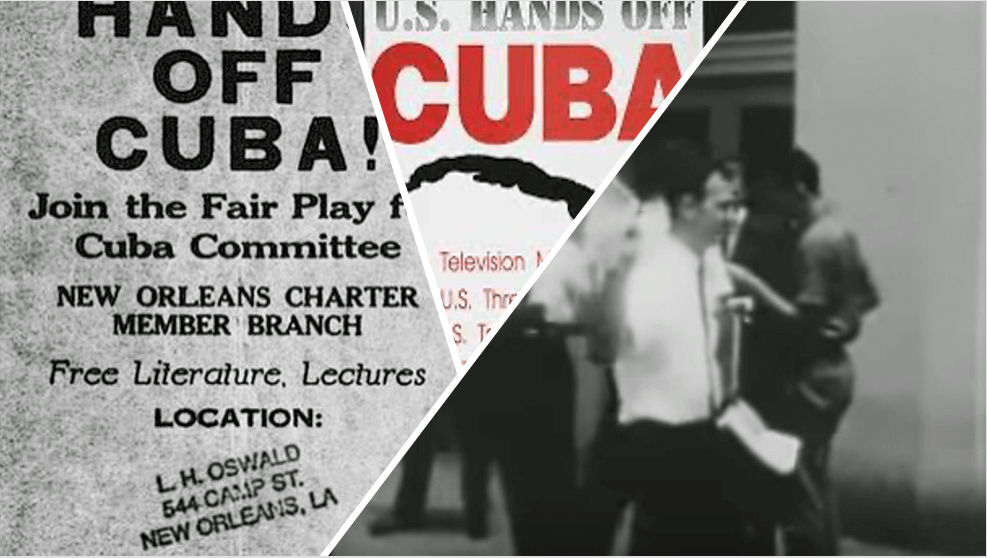
    With that, let us proceed to place another layer over all this New Orleans activity. One that Long completely avoids. That is the CIA’s operations against the Fair Play for Cuba Committee (FPCC) and in support of the DRE, the Student Revolutionary Directorate. Oswald was the only member of the FPCC in New Orleans. He stamped Banister’s office address—544 Camp Street—on one (or more) of the pamphlets he passed out that summer in the Crescent City. Beginning in 1961, that particular pamphlet went through several printings and the CIA ordered copies of the first edition, which is the printing that Oswald had in New Orleans. According to Roberts’ first interview with the HSCA, Banister was very upset about Oswald placing his address on his pamphlets. (Bob Buras interview with Roberts, 7/6/78)

    It is even more provocative than that. And again, Long somehow missed it. The FBI knew about Oswald’s faux pas. After retrieving several of Oswald’s pamphlets, they did two things to conceal the association of Banister with Oswald from the Warren Commission. They either used the alternative address for Banister’s office, which was 531 Lafayette Street or, in their messages to headquarters, they scratched out the fact that Oswald had actually stamped the Camp Street address on his flyers. (Newman, p. 310; Tony Summers, Official and Confidential, p. 325) It would appear that J. Edgar Hoover was trying to conceal Oswald’s association with his former agent, because, as John Newman has written, both the FBI and CIA had ongoing operations against the FPCC at this time. (Newman, pp. 241–44)

    The man who began those CIA operations against the FPCC was David Phillips. And according to Howard Hunt’s testimony to the HSCA, it was also his friend Phillips who started up the DRE. (Interview of 11/3/78, p. 77) As we all know AMSPELL—the CIA code name for the DRE—collided with Oswald’s FPCC during a mild ruckus on Canal Street in August. After which, Oswald was arrested, apparently for receiving a punch from local DRE leader Carols Bringuier. After this, Oswald was part of a broadcast debate between Bringuier and Ed Butler, manager of the anti-communist organization Information Council for the Americas. It was these activities, and the photos and films of his leafleting, that got injected into the media very quickly after the assassination. They provided a public image and background for Oswald. And it was this which the Commission and the press used to incriminate him, as well as his alleged journey to Mexico City, which incredibly, Long just leaves out.

    As Jeff Morley has pointed out, immediately after the JFK shooting, Bringuier placed stories about Oswald in the Miami Herald and Washington Post. About 24–48 hours after the assassination, Bringuier and the DRE published a broadsheet clearly suggesting Oswald had killed Kennedy for Castro. In other words, CIA assets were shaping the story at the start. That publication was at the CIA’s expense, as the DRE was being subsidized to the tune of $51,000 per month by the Agency. George Joannides was the case officer. He later lied about this to the HSCA, when he came back to stymie their investigation of Oswald in 1978. (Morley, Miami New Times, 4/12/2001). Needless to say, the other immediate result was the long time CIA goal of the destruction of the Fair Play for Cuba Committee.

    As many authors have pointed out, what is so notable about the confrontation on Canal Street is that Oswald wrote about it to the New York City branch of the FPCC about a week before it happened. (Click here for Paul Bleau’s fine article) What we did not know prior to Paul’s milestone two-part essay was another fact that is important to understand Oswald’s role in the street theater. The host of the debate was local radio personality Bill Stuckey. Stuckey had written to the FBI in April of 1962 about their knowledge of any FPCC chapter in New Orleans. (FBI Memo of April 6, 1962) Beyond that, Paul also discovered that Oswald had written the Fair Play for Cuba Committee in New York, not in 1963, but in 1962.

    To cap it all off, there is evidence Phillips was in Banister’s office in late 1960 planning a TV telethon to benefit the Cuban exiles with Banister and Butler. (Davy, pp. 21–24)

    From all the above, and more, one can understand why CIA officer William Kent, who worked out of the Miami JM/WAVE station, once said that Oswald was a useful idiot. You will learn almost all of this from Paul Bleau’s article. You will learn virtually none of it from Alecia Long. In other words, there is more current and cogent information about Oswald in New Orleans in Paul Bleau’s two-part essay than there is in Long’s entire book. Whether this failing is by design or a matter of poor scholarship is a question only she can answer.

    V

    Then what is Long’s book about? For one, it’s the weirdest interpretation of the Warren Report I have ever read. She writes that the Commission placed the sex lives of Oswald and Ruby under scrutiny for what that could mean as far as motivation went. (Long, p. 65)

    This is balderdash. I am quite familiar with the Warren Report and I do not recall anything like this in those nearly 900 pages. Long later uses the testimony of Dean Andrews about Oswald as her source. Yet Andrews is shuffled on and off stage in that report in the space of one paragraph. (Warren Report, p. 325) The other reference she uses is another throwaway paragraph about the Commission searching for a nexus point between Oswald and Ruby. In going through a list of possibilities, they wrote that there was not any homosexual relationship between the two men. (Warren Report, p. 364) Two paragraphs out of 900 pages is grasping at straws.

    In further desperation, she trots out the whole White Russian rigamarole about Oswald having problems satisfying his wife. Long writes that perhaps this was because Oswald harbored a hidden preference. She then says this was an obvious question. (Long, p. 66) Obvious to who? After several pages of these eccentric and groundless comments, it struck me that Long was grafting her own agenda onto the facts—to such a degree as to be solipsistic. And when I saw her describing the Jack Gremillion complaint to the FBI about a homosexual ring in New Orleans that the DA was using, I understood the idea behind the book. (Long, p. 58) And also why she discounted Banister: he was not gay.

    State Attorney General Gremillion was a notorious racist and rabid McCarthyite. He opposed Garrison and his treatment of the famous James Dombrowski case, because Dombrowski was an active leftist who supported civil rights in the New Orleans area. Garrison took control of the case, in order to guide it to the highest court to invalidate the phony charges grafted onto a Gremillion/Eastland/Banister fabrication: the state’s Communist Control Law. Garrison thought this was unconstitutional. Dombrowski was smeared as a communist, because he was standing up for the civil rights of African Americans. In 1965, the Supreme Court ruled against Gremillion. (Click here for details) It is clear that Gremillion greatly resented what the DA had done and he retaliated with this almost incomprehensible complaint, which he filed with, of all agencies, the FBI. For a scholar to side with riffraff like Gremillion in order to smear Garrison indicates that she has lost her compass.

    When one combines that with the fact that she fails to give the reader a full portrait of Shaw and his association with the CIA, how can one come to any other conclusion? There is no mention of the ARRB declassified documents that reveal Shaw had a covert security clearance. (Davy, p. 195) Or that he was a highly valued and well-paid contract agent for the CIA. (Joan Mellen, Our Man in Haiti, pp. 54–55) Or that the Agency tried to hide all of this. Going as far as destroying Shaw’s 201 file. (Click here for details) Need I also add that I could not detect any mention of Shaw and Permindex, which after the release of Michele Metta’s important book on the subject, is again, quite a disappearing act.

    Throughout, Long tries to deny that Shaw was Clay Bertrand. In an amazing piece of sleight of hand, she even acknowledges the FBI memo which states such was the case—and further that the Bureau knew Shaw was Bertrand before Garrison arrested him, data they had from two sources. One being Aaron Kohn, a staunch Shaw ally. (FBI memo of March 2, 1967) I could detect nothing in the text concerning the FBI inquiry back in December of 1963, where Cartha DeLoach wrote to Clyde Tolson that Shaw’s name “had come up in our investigation…as a result of several parties furnishing information concerning Shaw.” (DeLoach memo of 3/2/67, italics added) Lawrence Schiller, a prolific FBI informant on the JFK case, sent information to the Bureau that he had several sources in New Orleans and San Francisco saying that Shaw went by other names, including Clay Bertrand. (FBI memo of March 22, 1967) At the Shaw trial, FBI agent Regis Kennedy admitted that he was investigating the Kennedy case prior to his interview with Dean Andrews and that he was searching for Bertrand as part of that investigation. He was then stopped from answering any other questions by Washington. (Trial transcript, 2/17/69)

    The information about Shaw using the Bertrand alias was common knowledge in the French Quarter. But many sources did not want to tell Garrison about it due to their resentment over his prior crusade against B girl drinking, which caused a lot of economic dislocations there. Two such witnesses were Barbara Bennett and Rickey Planche, the latter bought a house Shaw had owned previously. (Jim Garrison: His Life and Times-The Early Years, by Joan Mellen, p. 117) Need I add that she also ignores Andrews’ own secret admission to Weisberg that Shaw was Bertrand. (Mailer’s Tale, Weisberg unpublished manuscript, Chapter 5, p. 11) Only by eliding all this data from one’s text can one write that the identity of Bertrand remained a mystery. (Long, p. 59)

    VI

    Another important aspect of Oswald in New Orleans that Long discounts is Oswald’s leafleting in front of Shaw’s International Trade Mart in mid-August. This also had some interesting telltale points to it. First, Bringuier and his right hand man Carlos Quiroga said that they went to see Oswald in an attempt to infiltrate his FPCC “group” after the ITM incident. The visit occurred before it happened. And Quiroga arrived with a stack of flyers about a half foot thick. In other words, the DRE appears to have been supplying Oswald with his leaflets in preparation for the incident. Secondly, the reason we have films of the event is that Shaw’s first assistant at the ITM, Jesse Core, had summoned the cameras. (Davy, p. 38) Beyond that, it was this leafleting episode that caused George Higginbotham to alert Banister, and his reply was “One of them is one of mine.” (Oswald had hired two helpers from the unemployment office to aid him.) But there was something else to note. In addition to calling the cameras for the ITM incident, Jesse Core picked up a pamphlet from the prior Canal Street episode, the one which got Oswald arrested. He noted that it had Banister’s address on it. He mailed it from the Trade Mart to the FBI with a message attached: “note the inside back cover.” (John Armstrong, Harvey and Lee, p. 568) This would suggest that both Shaw and Core knew about Oswald’s mistake. How would they know unless they were aware of Banister’s operation? Which recalls the work done for Banister by Bill Wegmann and Guy Johnson. But further, the FBI then knew about Oswald at 544 Camp Street before the assassination.

    In light of all the above, for Long to say that the connection of Banister, Oswald, Ferrie, and Shaw was a Garrison innovation which relied on our culture’s suspicions about homosexuals—this is simply fruity. (See p. 90) If one leaves out everything I wrote above about the CIA, then maybe you can sidestep someone with that bunk. But since the first two were not gay, it’s kind of hard to buy. But what makes it harder is all the relevant material she leaves out, like the fact that Ferrie was so desperate to separate himself from Oswald in the wake of the assassination that he committed obstruction of justice and perjury. He went to two sources to see if they recalled Oswald using his library card and he called a former CAP cadet to find any picture he might have depicting him with Oswald. He then lied to the FBI about not recalling Oswald. (See The JFK Assassination: The Evidence Today, by James DiEugenio, pp. 175–77; Destiny Betrayed, pp. 176–77) Those four instances indicate, as prosecutors term it, consciousness of guilt. I won’t even discuss the illustration of Dealey Plaza that Ferrie had in his desk at work. (Destiny Betrayed, p. 216) And then there were Ferrie’s admissions to investigator Lou Ivon right before he died about his association with both Oswald and Shaw and Shaw’s hatred of JFK. (Davy, p. 66) In the face of this, Long is again ludicrous in saying that Garrison had little evidence against Ferrie. (Long, p. 111)

    We can do the same with Shaw. Since he committed perjury as many as six times on the stand during his trial. Long admits that Shaw lied about his CIA association to the press. She does not admit he did the same under oath at his trial. (Click here for details)

    Let us conclude this silly, utterly superfluous book with this. Long quotes Shaw as saying: Well if I was innocent, why didn’t we just go to trial and get it over with back in 1967? (Long, p. 138) Well Alecia, that might have something to do with another declassified document you missed. It describes 24 folders the CIA titled Black Tape. James Angleton collected them from September of 1967 until March of 1969. He then deemed them classified until 2017. Is it just a coincidence that the beginning date matches the first meeting of the Garrison Group at CIA, which was specifically set up to counter Garrison? At that meeting, Ray Rocca, Angleton’s assistant, said that if things proceed as they are, Shaw would be convicted. (Destiny Betrayed, pp. 269–71) When they set up the Garrison Group and the Black Tape files, the Agency made sure things did not proceed that way, which makes Shaw’s comment likely more revealing than he meant it. (ibid, pp. 271–85)

    But that is the kind of book this is. It’s an almost humorous diversion created for one purpose. It wants us to forget virtually everything we have learned about New Orleans since the creation of the ARRB back in 1994. Sorry Alecia, no sale. It was too difficult to get those files opened in the first place. And when they were opened, we understood why Angleton wanted them closed for fifty years. Consciousness of guilt.

  • Revising the JFK Cover Up: via Malcolm Blunt

    Revising the JFK Cover Up: via Malcolm Blunt


    As I have stated before, British researcher Malcolm Blunt is perhaps the most valuable continuing source of new information on the JFK case. (Click here for details) I am lucky enough to be a recipient of his work, which he sends me by both snail mail and through email via his friend and colleague Bart Kamp. On his web site, Bart stores much of Malcom’s archival work. (Click here for details)

    Some of the recent mailings I have received from Malcolm are thematically linked enough to form a mosaic about the construction of the cover up about the JFK case. As most of us today understand, Lee Harvey Oswald had all the earmarks of being a combination CIA agent provocateur/FBI informant. Through the stellar work of HSCA researcher Betsy Wolf, we have noted that someone in the Agency seems to have rigged Oswald’s file even before his official defection to the USSR. (Click here for details) But further, the whole concept of Oswald’s creation of the Fair Play for Cuba Committee in New Orleans now seems to have served as a kind of Venus flytrap enclosing around the alleged assassin. Paul Bleau explained this in riveting new detail with help from some new Malcolm Blunt documents. If you have not read his two-part milestone article, do so today.

    The Warren Commission did next to nothing in excavating the issue of Oswald being an intelligence agent. Allen Dulles had a central role in this. After a rumor surfaced in Dallas about Oswald being an FBI informant, there was an emergency meeting of the Commission. Dulles, since he had been former CIA Director, had a prime role in the discussion. After stating how difficult it would be to prove someone was an informant or undercover agent, Dulles added that, “I would believe Mr. Hoover, some people might not.” And that was the general conclusion of the January 27, 1964 emergency meeting. (Peter Grose, Gentleman Spy, p. 546) The Commission ended up accepting denials of the issue from both the FBI and the CIA. What they did not know was that Dulles was coordinating the replies behind the scenes. (Grose, pp. 547–48; see also Gerald McKnight’s Breach of Trust for the FBI/CIA coordination, p. 93)

    There is a possibility it may have been a slightly different story if Earl Warren had been able to appoint his first choice as Chief Counsel. But as we know, Warren Olney was not in the cards for Warren. In many renditions of how Warren was frustrated in his choice of his longtime friend and colleague, commentators credit J. Edgar Hoover, John McCloy, and Gerald Ford for the parry. But this might not be accurate.

    In what is now a completely declassified document, Cartha DeLoach wrote up a two-page memorandum on his private conference with Commissioner Gerald Ford. (DeLoach to John Mohr, 12/12/63) The congressman wanted his information to be kept in the strictest confidence. DeLoach said it would be. Ford started by saying he was disturbed by Warren’s conduct of the Commission. He said that at their first meeting, Warren attempted to appoint Olney as Chief Counsel. The congressman then described what happened:

    Ford stated that after the mention of Olney’s name by the Chief Justice, at their first meeting, Allen Dulles, former Director of CIA, protested quite violently. Because of Dulles’ protest, the other members told Warren that they would like to know more about Olney prior to giving their consent.

    In other words, the initial violent reaction to Olney was not begun, as previously reported, through Hoover and John McCloy, but actually by Dulles. And if one looks over Olney’s past performance, one can get an idea of why Dulles would object to him. (Click here for details) Olney appears to have been a dogged criminal investigator who was not afraid of going after government officials, including several congressmen.

    In the DeLoach memo, Ford says this dispute spread itself over the Commission’s first two meetings. At the second session, representative Hale Boggs and Ford joined Dulles in opposing Olney. Warren was now stymied. He relented and settled on Lee Rankin. As Gerald McKnight has noted, “Rankin was a supremely cautious bureaucrat, a consummate insider, not a boat-rocker like Olney.” (McKnight, p. 45) Rankin centralized control of the Commission so there was very little interplay between the staff lawyers and the Commission members. The man who served as the courier between Rankin and the staff was Howard Willens.

    II

    Willens had been appointed by Nicholas Katzenbach out of the Justice Department. The acting AG picked him, when he thought Olney would be appointed by Warren. According to McKnight, Katzenbach chose Willens as a backstop, because he too did not like the possible appointment of Olney. (ibid, p. 42) It’s easy to understand why. Katzenbach had already written his infamous memo about what he saw as the Commission’s function. (Click here for details) Those functions were to certify Oswald as the assassin, show that he did not have confederates still at large, and demonstrate that he would have been convicted at trial. He also wanted the FBI to lead the inquiry.

    Katzenbach’s memo was carried out. And make no mistake, Howard Willens was a major player in carrying his water. Sylvia Meagher once wrote in a letter that the Commission was about to falter in the summer of 1964. By that time, David Belin, Leon Hubert, and Arlen Specter had left. (Philip Shenon, A Cruel and Shocking Act, p. 404) Only David Slawson, Burt Griffin, and Wesley Liebeler were there regularly into the autumn. As Griffin later told the House Select Committee on Assassinations, one of the reasons Hubert may have left is because Willens did such a lousy job in facilitating their requests for information to the CIA. (HSCA Vol. XI, pp. 271, 276, and especially 279–86)

    After these departures, Willens decided to bring in reinforcements. To say they were green recruits does not get the import across. Murray Laulicht had not even taken his law school exams when Willens approached him. The night he got his degree, he left for Washington to work for the Warren Commission. (Shenon, p. 404) Further, his field of concentration was in trusts and estates, yet his assignment was to complete the Commission’s biography of Jack Ruby! This is how little Willens thought of the Commission’s aims. Laulicht told Philip Shenon he had no problem with the Commission’s version of Ruby walking down the Main Street ramp to kill Oswald, which today is a concept that is all but indefensible. (James DiEugenio, The JFK Assassination: The Evidence Today, pp. 222–230)

    But that was not enough for Willens. Unlike Laulicht, Lloyd Weinreb had graduated from law school and clerked for one year on the Supreme Court. Lloyd was surprised when he got to the Commission offices, because there were so many empty desks in front of him, so many had gone. (Shenon, p. 405) What was going to be the 24-year-old’s main assignment? Albert Jenner had given up trying to complete a biography of Oswald. Willens was determined it be done. Even if he had to hire people who were pretty much legal amateurs. Weinreb admitted that when he started going through FBI and CIA files, many pages were missing. This did not bother Willens. And he had to understand that, as opposed to a veteran attorney like Leon Hubert, someone as inexperienced as Weinreb would not raise a ruckus.

    Willens also understood how the Commission really worked. When Jeff Morley had parts of Willens’ working Commission diary on his web site, the lawyer was describing a sensitive matter he had to get agreement on from the Commission membership. As Willens stated, once he talked to Warren he then just needed to talk to the other three members. If anyone needed any more proof about how the Commission worked, there it was. Did Willens forget how to count? There were seven members of the Warren Commission. But he understood that the three southern members—Hale Boggs, John Sherman Cooper, and Richard Russell—had more or less been marginalized by the three much more powerful members: Dulles, Ford, and John McCloy. This split in the ranks—neatly covered up by spokesmen like Dulles in the press—would break into the open in the early seventies, when those three southern members would end up denouncing the Warren Report.

    Howard Willens was a very effective part of what became the entire Warren Commission facade. In retrospect, it’s hard to think of how Katzenbach could have chosen someone better to carry out the demands of his November 25, 1963, memorandum. As can be seen in the recent Fox web special JFK: The Conspiracy Continues, Howard is still at it.

    III

    The Warren Commission would have never been accepted by the public unless it was supported by the media. At that time, in 1964, the major media consisted largely of big city newspapers, the major magazines, and the three TV networks. There was one reporter who went beyond the call of just being a New York Times Anthony Lewis type flack for the Warren Report. Today, it is fair to name Hugh Aynseworth as the most active journalistic participant in the entire JFK assassination cover up. In fact, it would be more accurate to label him a participant in journalistic guise.

    Aynseworth worked for the Dallas Morning News at the time of the assassination. He later claimed that, on that day, he was in the following places: 1.) Dealey Plaza 2.) the scene of patrolman J. D. Tippit’s murder and 3.) the Texas Theater where Oswald was arrested. But that was not enough for Hugh. He also said that he was in the Dallas Police Department basement when Oswald was killed. Sort of like getting four aces in five card poker. It was obvious from all this bravado that Hugh was going to make a career out of the JFK case. (Click here for details)

    This started even before the Warren Report was issued. In a column published on July 21, 1964, Hugh’s colleague Holmes Alexander wrote that, since he did not trust Earl Warren, Aynesworth was conducting his own inquiry. In that column, it appears likely that Aynesworth created the myth that Oswald had threatened to kill Richard Nixon. This was something that not even the Commission could buy into. (Warren Report, pp. 187–88) The column ended with a threat. Either the Warren Report would jibe with Aynesworth’s findings or there would be “some explaining to do.”

    As this writer has shown, Holland McCombs of Life magazine was the overseer of that publication’s aborted reinvestigation into the JFK case. In February of 1967, he terminated the efforts of Josiah Thompson and Ed Kern. (Thompson, Last Second in Dallas, pp. 26–27). In my review of Thompson’s new book, I presented evidence that those two were retired, while Patsy Swank and Dick Billings stayed on the case. (Click here for details) In this author’s opinion, that was not just happenstance. Thompson and Kern were turning up evidence that the Commission was wrong: Kennedy’s assassination was the result of a conspiracy. The problem for McCombs was simple. A Life stringer, David Chandler, had discovered that New Orleans DA Jim Garrison had reopened the Kennedy case. As noted in that review, McCombs was best of friends with Clay Shaw. Therefore, after cashiering Kern and Thompson, McCombs began to sponsor Chandler and Aynseworth.

    As we all know, the eventual article that Life magazine published as a result of what McCombs referred to sneeringly as “a reinvestigation” was a pretty weak bowl of porridge. (Life magazine, 11/25/66 “A Matter of Reasonable Doubt”) None of the very interesting material that Thompson and Kern had dug up was used. The article essentially centered on the testimony of John Connally; that he was hit by a different shot than struck Kennedy.

    But as noted in my review, McCombs did not just neuter the work of his better reporters on the JFK case. Due to his friendship with Shaw, he now began to communicate with the defendant’s lawyers and to urge on the work of his pal Hugh Aynesworth. (Letter by McCombs to Duffey McFadden of 5/13/67) Aynesworth wrote one of the first, most extreme and wild attacks on Garrison. This appeared in the May 15, 1967, issue of Newsweek. Something that Hugh never admitted, at least in public, is that he sent an advance rough draft of this article to both the White House and the FBI. (Western Union teletype of May 13, 1967) In that message, he ended with these words: “I intend to make a complete report of my knowledge available to the FBI, as I have done in the past.” In other words, Hugh was admitting he was a continuing informant for J. Edgar Hoover.

    Aynesworth essentially placed himself in the middle of Clay Shaw’s defense team for at least two years, and probably longer. In addition to the work he did for the FBI, there was evidence he also was in touch with the CIA. Accompanied by his colleague and fellow FBI informant James Phelan, Hugh drove up to the Clinton/Jackson area. Through the sources he had developed in Jim Garrison’s office—perhaps Tom Bethell and Bill Boxley—he knew how damaging these witnesses would be to Shaw at trial. They placed Shaw with both Dave Ferrie and Oswald. The witness Aynesworth figured as potentially the most incriminating was Sheriff John Manchester, because Manchester had actually approached and talked to Shaw and the defendant had shown him his identification. Aynesworth wanted Manchester to leave the state and stay gone until after the trial. What was in it for the sheriff? The presumed Newsweek reporter said, “You could have a job as a CIA handler in Mexico for $38,000 a year.” Today that would be over three hundred thousand dollars. We can easily assume this was significantly more than what Manchester was making in that rather small town.

    The sheriff did not take kindly to an attempt at obstruction of justice and what had all the appearances of being an Agency sponsored bribe. In no uncertain terms, he told Aynesworth the way he felt about the offer: “I advise you to leave the area. Otherwise I’ll cut you a new asshole!” (Joan Mellen, A Farewell to Justice, p. 235) Irvin Dymond, Shaw’s lead defense attorney, was very much appreciative of all the subterfuge Aynesworth was attempting on his client’s behalf. After all, he was saving Dymond a lot of work. In one of the most revealing and insightful statements about the reporter’s real role, Dymond went as far as to say that Aynesworth eliminated troublesome aspects to the point that they did not surface at the trial. (Columbia Journalism Review, Spring 1969, pp. 38–41, italics added) In other words, Aynesworth was so wired into the DA’s office that he would get to potential witnesses and suspects before Garrison could secure them. This reviewer inadvertently stumbled upon this meme many years ago. Julian Buznedo was a friend and colleague of David Ferrie’s. In discovering material about him in Garrison’s files, I phoned him in Denver to talk about his interview with the DA’s representatives. He told me that a week or so prior to that interview two men visited him in suits and ties, as he recalled, they either were from the FBI or Secret Service. (Interview with Buznedo, August of 1995)

    This is how plugged in Aynseworth likely was with the feds.

    IV

    After having dinner with Shaw, on August 2, 1968, Aynseworth wrote a note to the defendant on Newsweek stationary. That note shows just how inserted Aynseworth was into Shaw’s legal team, not just as a tactician working outside, but as a strategist from the inside. He is advising Shaw and his personal attorney Ed Wegmann to bring in another counsel. In that regard, he said he was going to try and talk with none other than Percy Foreman about this possibility. Foreman was a highly publicized and effective defense attorney, who would soon sell James Earl Ray down the river in Memphis over the assassination of Martin Luther King.

    Besides Aynseworth, the only other “journalist” who did as much to sabotage Garrison’s inquiry into the JFK case was probably Walter Sheridan. (For a chronicle of Sheridan’s misdeeds, see Destiny Betrayed, second edition, by James DiEugenio, pp. 237–43) Sheridan had worked for the FBI, the Office of Naval Intelligence, and rose to a high position in the National Security Agency before joining the Justice Department and working for Robert Kennedy. (ibid, pp. 255–56) He then went to NBC and worked on several documentaries, one of them being the infamous hatchet job on Garrison broadcast in the summer of 1967. As we shall now see, it appears that both Aynseworth and Sheridan combined in attempting to spread some rather ugly mythology in order to smear both the Kennedys and Garrison.

    Let me first quote a CIA memo of May 8, 1967, from Richard Lansdale to the Counter-Intelligence staff. Lansdale says that the source for the following information is Sheridan. Sheridan had arranged a trip to Washington for Alvin Beaubouef, who was one of two companions who accompanied David Ferrie on his mysterious trip to Texas on November 22, 1963. The lawyer Sheridan arranged for Alvin, Jack Miller, has told the CIA that Beaubouef, “…would be glad to talk with us or help in any way we want.” But as striking as that statement is, it is not the most interesting part of the memo. Sheridan also conveyed the following:

    …it is said that Garrison is going to subpoena an FBI agent and a former FBI agent. The thesis that Garrison is allegedly trying to develop is that Oswald was a CIA agent, was violently anti-Communist, and was recruited by CIA for an operation, approved by President Kennedy, the purpose of which was to assassinate Fidel Castro. The thesis further has it that when Oswald assassinated President Kennedy, it became necessary to show him as a Communist in order to conceal the original plan.

    It is further alleged that Garrison has said that he has letters signed by CIA representatives or by Senator Robert Kennedy which authorize certain Americans to work with Cubans for the assassination of Castro.

    As has been proven by the declassification of the CIA’s Inspector General report, President Kennedy never knew about such Castro assassination plots, let alone authorized them. (Click here for the IG Report, see pages 132–33) In all the years I have studied the New Orleans inquiry, Garrison never claimed to have such letters. This was a ploy used by the likes of Layton Martens, one of Ferrie’s friends, in order to try and deter Garrison. Sheridan has now altered the evidence record, in order to somehow make Garrison into an enemy of the Kennedys. To show how bad the information was, when the FBI learned of this information, J. Edgar Hoover acknowledged to Attorney General Ramsey Clark that the CIA replied with the rather pointed rejoinder that no such letters ever existed. (FBI memo of 5/17/67)

    Did Aynseworth pick up a few tricks in constructing fear and paranoia from his buddy Sheridan? Perhaps. In another FBI memo dated a few months later, December 27, 1967, Aynseworth appears to be playing a similar misleading banjo. On December 22, 1967, one of the owners of the giant industrial firm Brown and Root got a phone call from Aynseworth. The “reporter” told George Brown that he had documents revealing Garrison was going to reveal that Brown was involved with the CIA in covering up the plot to kill Kennedy and they were doing it for President Johnson. This one is, of course, meant to demonstrate the old MSM meme that somehow there was no rhyme or reason to the Garrison inquiry. That it was just a wild mélange of accusations bouncing around between the CIA, President Johnson, and Texas business titans. It’s the technique that Johnny Carson used at the beginning of his interview with Garrison on The Tonight Show. Again, I have never seen any such documents. The only way they could possibly exist is through either the manuscript of Farewell America or the musings of CIA infiltrator Bill Boxley. But this is how determined Aynseworth was to somehow get people in high places to fear and distrust the DA.

    It should be noted, to this author’s knowledge, Sheridan and his family never gave up his files to the NBC program The JFK Conspiracy: The Case of Jim Garrison. Sheridan passed on in 1995. So he was around for the congressional hearings dealing with the JFK Act, the attempts to pass that act, and the early part of the Assassination Records Review Board (ARRB) being functional. In fact, he requested those files be returned to him from the JFK Library in October of 1993. According to interviews this writer did with Deputy Chief Counsel Tom Samoluk and Chairman of the ARRB John Tunheim, even though they requested these documents, they were unable to garner them. When the Board tried to get them from Sheridan’s family after his death, they sent them back to NBC. One of the last things the Board did, in September of 1998, was to designate to the National Archives that these were considered Kennedy assassination related files. (Letter from General Counsel Ronald Haron, to Amy Krupsky at NARA, 9/24/98)

    V

    As time has gone on and more files from the House Select Committee on Assassinations (HSCA) have been recovered due to declassification, we see just how problematic the work of that committee was. The latest example being Tim Smith’s tour-de-force article about their diddling with the autopsy illustrations. What makes Smith’s essay so powerful is that he actually shows the reader the documents revealing that HSCA attorney Andy Purdy, researcher Mark Flanagan, and pathologist Dr. Michael Baden were all aware of and cooperating with this alteration of Kennedy’s rear skull wound. This shows just how obsessed the HSCA was in raising that wound from low in the skull to four inches higher, into the cowlick area. (Click here for Tim’s article) After all, they had to have a way to account for the 6.5 mm object which now appeared on the x-rays, which no pathologist or FBI agent saw the night of the autopsy.

    In those same HSCA volumes, specifically Volume 10, there is a discussion of the issue of Guy Banister, Oswald, and Dave Ferrie at 544 Camp Street. With the declassification of the HSCA files, we can see that, again, there are some real problems with this report. I won’t go into all of them, that would take another long essay in and of itself. But, for example, in their all too brief review of Kerry Thornley, they conclude that Thornley was telling the truth when he said that he never had any contact with his Marine buddy Oswald after Kerry left the service. (See HSCA Vol. 10, p. 125) Apparently, Thornley’s father had died or the committee never got in contact with the Los Angeles County Sheriff’s office, because Kerry’s dad had told them that Oswald had been in correspondence with Thornley and some of the letters were of recent vintage. (Mellen, p. 276, based on report of 11/26/63) Allen Campbell, who worked out of Guy Banister’s office, told Joan Mellen that Oswald had been in contact with Thornley in the summer of 1963. (Mellen, p. 276; for a detailed expose of just how bad the HSCA was on this subject, click here)

    In that HSCA volume, the report also says that the branch of the Cuban Revolutionary Council in New Orleans had left its office at 544 Camp Street in January or February of 1962. But yet, the owner of the building, Sam Newman, was inconsistent on this point. On November 25, 1963, he told the FBI that he rented space to the CRC in March of 1963 and they were there for 4–5 months. Two days later, he changed his story. He now told the New Orleans Police that they had left 15 months previous. (DiEugenio, Destiny Betrayed, second edition, p. 113)

    In a newly discovered letter from Sam Newman, it appears that the HSCA should not have trusted the Cuban exiles in that organization for information on this issue, because Sam Newman wrote a letter to Dr. Tony Varona of the CRC in Miami on March 9, 1962. He says that he is owed money for the rent at that time, but the space is still being used. So, unlike what the HSCA report states, the exiles were not out in January or February. What is even more odd about this letter is that Newman knows Varona’s exact address and he talks to him like this is not the first time he did so. This tends to undermine the whole façade of naivete about the group at his building that Newman tried to convey to both Jim Garrison and the HSCA. (Ibid, DiEugenio, pp. 113–114) So as of now, with this new evidence, it is indefinite as to when the CRC left Sam Newman’s building.

    Further, in that same volume, on page 125, it mentions Mancuso’s Coffee Shop. This was on the ground floor of the Newman Building. The report say that Jack Mancuso did see Guy Banister at his place, but not Oswald. Again, the HSCA inquiry was apparently incomplete, for a man named Richard Manuel was in contact with Anne Buttimer of the Review Board in 1995. Manuel later got in contact with the Board’s Jeremy Gunn. He told Gunn that he moved to New Orleans in the mid-sixties and worked in advertising on Lafayette Street near the Newman building. His company owned a print shop and he got to know two men who worked there who were New Orleans natives. These two men, Ray Ohlman and Lloyd Reisch, also knew Banister. They frequented Mancuso’s. And they had seen Banister with Oswald at the coffee shop. (ARRB Notes of Manuel call dated 2/1/96)

    VI

    Gladys and Arthur Johnson owned the boarding house where Oswald lived at on North Beckley Avenue in Dallas. Oswald lived there after his return to Texas from New Orleans in October and November of 1963. Oswald seemed like a nice, friendly young man and he got along with their grandchildren. One of whom was named Pat Hall, who was eleven at the time. Pat’s brothers were younger than she was and they played catch with Lee. Pat recalled him watching TV with the other boarders.

    Stella Fay Puckett was Gladys Johnson’s daughter. She was the owner of Puckett Photography. That place of business was directly across from the Texas Theater. On November 22, 1963, she was at work when she saw a fleet of cruiser cars out her front window. She then noted the officers forcibly pushing a man into a police car. She did not know who this man was, but she did recognize his face, because she had seen him tossing the football with her young sons in the front yard of the Beckley address.

    After watching the officers push Oswald into the police car, Stella Fay called her mother up at the family business, Johnson’s Café, but they were not there. She later learned that the news of Kennedy’s assassination had disturbed them so much that they closed the café and went to the Beckley Avenue address. Stella then called the boarding house. When Gladys answered, Stella said to her, “One of your boarders is being arrested for something.” She was quite surprised at her mother’s reply: “Well, that explains why the FBI is here searching his room.” (Sara Peterson and K. W. Zachry, The Lone Star Speaks, pp. 173–75)

    This is doubly surprising, because the official story has Oswald registered at the boarding house under the name of O. H. Lee. (Warren Report, p. 737) But also, as Peterson and Zachry point out, the address that Oswald had given to his employer at the Texas School Book Depository was not Beckley Avenue. He had left the address of the Ruth and Michael Paine residence in Oak Cliff and this is where his wife Marina was staying. The hired landlady Earlene Roberts and the Johnson couple did not recognize their boarder as Lee Oswald until they saw his name on TV. (Peterson and Zachry, p. 176)

    Let us set the time. Oswald was arrested at approximately 1:50pm. (Warren Report, p. 179) At that time, no one knew who he was until, according to the official story, the officers driving him to the police station secured his wallet. At 2:15, Captain Will Fritz told Sgt. Gerald Hill that they needed to swear out a warrant to search Oswald’s residence on Fifth Street in Irving, which was the Paine residence. In reply, Hill told Fritz that Oswald was already at police headquarters. (Warren Report, pp. 179–80) In other words, the police, as late as 2:15, thought Oswald was living at the Paine home. How did the FBI know where he really was at about 1:55, 20 minutes earlier, right after his arrest?

    There is more. After about the first week of March, Earlene Roberts picked up in the middle of the night and left. She never returned. She waited until all the boarders were in bed and then left with destination unknown. She did not leave a phone call, much less a resignation letter. (Peterson and Zachry, pp. 176–77)

    What makes this even more interesting is that Roberts’ sister was Bertha Cheek. (Warren Report, p. 363) Cheek was upset Earlene had left with no notice but said she did not know where she went. Cheek also owned a boarding house in Dallas. Jack Ruby had approached her in the fall of 1963 about a business proposition. The Warren Commission brough this issue up, and in its usual manner, disposed of it in short order. (ibid) This is a relationship that Jim Garrison found interesting, because it was a point which could provide a nexus for Ruby knowing Oswald.

    Garrison pursued this possibility. In November of 1964, a man named Raymond Acker, who worked for Southwestern Bell, came to the Dallas Police. He was waving a handful of phone company records, which he said constituted proof that Ruby had called Oswald. The DPD confiscated the records and told Raymond to go home and shut up. Acker had a pretty decent job in management at that time. He did shut up. He then got a promotion that moved him out of Dallas. In fact, he became a company Vice President and General Manager. He was number four on their executive listing in 1967. (NODA Memorandum of 9/18/67, Matt Herron to Garrison)

    Acker was fearful of losing his job if the story ever came out. With that at one end, and the oh so corrupt Dallas Police at the other, the lead seemed like a dead end, but not quite. Chuck Boyles was a local disc jockey who ran a night talk show at station KLIF. Chuck knew little about the JFK case, but understood it was an attention magnet for his audience. One evening a local phone operator called in. She would not say who she was for fear she would get terminated. In fact, her husband was telling her to hang up as she was talking. She said she was an operator in the Whitehall area, which was where the boarding house phone was located.

    She said even though these were local calls she had made records of them. She had to, since Ruby would use the emergency break in technique if someone else was using the Beckley Avenue phone. After her husband got her off the line, she called Boyles back and talked to him privately.

    As John Armstrong noted, there is no indication that the FBI ever checked phone company records for emergency calls between the two. (Harvey and Lee, p. 769) As we can see, and as more material gets discovered, from the Commission obstruction by Allen Dulles, to the crucial role of Howard Willens, to the attempts by pseudo journalists to falsely involve the Kennedy brothers in the Castro assassination plots, to more probable evidence of a Banister/Oswald relationship, to the likely knowledge of the FBI about Oswald, the cover up about almost every aspect of the Kennedy case is even worse than anyone thought.

  • Operation Dragon

    Operation Dragon


    Operation Dragon, by former CIA Director James Woolsey and the late Ion Mihai Pacepa, is a revealing book. Not for its ostensible subject, the JFK case. In fact, in that regard, it is qualitatively poor and misleading. It’s revealing, because of what it says about the current state of relations between the USA and Russia; and how badly the CIA wants to fan the embers of the Cold War, in order to set it aflame again.

    Pacepa was an advisor to the deceased President of Romania, Nicolae Ceausescu. At the time of Pacepa’s defection in 1978, he was acting chief of its foreign intelligence service. Once established in the USA, he worked for the CIA in operations against the client states of the former Warsaw Pact. His writings were published on the conservative blog PJ Media and in publications like the Wall Street Journal, National Review Online, The Washington Times, and FrontPage Magazine. He also wrote several books, including Programmed to Kill, which figures heavily in Operation Dragon. I will explain why later.

    I

    On the very first pages of the book, the authors set the overarching theme of what is to come. Consider the following: “America has always stood against tyranny from any ideological source.” (p. 1) One could argue quite cogently that what Dwight Eisenhower and John Foster Dulles constructed in South Vietnam was a tyranny. The Nhu brothers were pretty much a dictatorship and, in our blind obeisance to the strictures of the Cold War, not only did we back other dictators, we actually overthrew democratically elected governments. The most prominent examples being Iran in 1953, Guatemala in 1954, and Chile in 1973. We went further and cooperated in the assassination of a democratically-elected leader, Patrice Lumumba, in Congo in 1961. It’s quite an achievement to somehow wipe those instances from the pages of history; but in no time flat that is what this book does.

    The idea behind the book is to use the same old intel scheme that the CIA has always used. The classic propaganda model is to place white hats on the people the CIA backs and black hats on their perceived enemies, whoever they are. Considering what the authors are going to propose—that somehow Lee Oswald, under orders of the Kremlin killed Kennedy—the idea is to portray the USSR, and today’s Russia, as being the guys with the black hats.

    There is something weird about this whole experiment, because Russia is not a communist state anymore and has not been one for decades. Mikhail Gorbachev began the economic reforms of Perestroika back in the 1980’s. When Boris Yeltsin took power after Gorbachev was kidnapped, he introduced the economic Shock Doctrine to Russia under people like his own advisor Yegor Gaidar and the Americans Jeff Sachs and Larry Summers. It is not an exaggeration to write that, as the late Steve Cohen declared, the result might have been the worst thing to happen to Russia since the Nazi invasion, but Woolsey and Pacepa are only getting warmed up. On page 3, the man who many think was one of the finest prime ministers of England, Clement Attlee, is called an undercover Marxist. Need I add that, somehow, Russia caused the 9/11 attacks? (p. 5)

    The depiction of Russian history in this book might have been written by the late Richard Pipes. (See, for example, p. 15) Pipes was one of the intellectual godfathers of the neocon movement. He criticized any attempt at détente with the USSR, because the neocons ended up being to the right of the CIA. Pipes’ view of Russia fit in with the likes of Paul Nitze, who revived the rightwing, militaristic Committee on the Present Danger (CPD) in 1976.

    That Nitze ended up being wrong on every major point about the threat the USSR posed did not matter. (Article by Fred Kaplan in Slate, 9/7/2004) Accuracy about the military might of the Soviets was not the point, but the revival of the CPD did much to move the Republican Party to the far right—past Nixon and Ford—and set the stage for Ronald Reagan. Therefore, Pipes was on Reagan’s National Security Council in 1981–82. In a very real sense, one can say that the creation of the CPD in 1976, and its almost ludicrous exaggeration of the Soviet threat, marked the complete destruction of whatever was left—and there was not much left—of John Kennedy’s foreign policy.

    Reagan’s depiction of the USSR as the Evil Empire owed its dark coloring to Pipes and Nitze. Thirty-three members of the CPD ended up being part of the Reagan administration. With the rise of Reagan and Pipes, the depiction of the USSR grew more and more extreme—with no end in sight. It was due to this that America failed to recognize who Mikhail Gorbachev really was. He was not a disguised apparatchik; he was a real reformer. But partly because of this intentional demonization, both Reagan and George H. W. Bush missed an historic opportunity. One only has to recall the nuclear deal Reagan turned down at Rejkavik in 1986 and Gorbachev’s later peace plans for Afghanistan and Iraq, both also declined, to realize just how badly the neocons had mischaracterized the man. In this author’s opinion, and Cohen’s, the failure to recognize this moment is what eventually caused the fall of Gorbachev and the rise of the disastrous Boris Yeltsin.

    Cohen and Pipes bitterly argued about their two views of the USSR. Pipes wrote that Russia had somehow always been destined to be the home of a Marxist tyranny under Joseph Stalin and was, therefore, incorrigible. Cohen disagreed with this view. He argued against it cogently and eloquently in his first book, Bukharin and the Bolshevik Revolution. Needless to say, the neocons won. Cohen not only lost, but by the end of his life he had been pretty much vanquished from the public scene. (Click here for more on Cohen)

    Today, even though Russia is not a communist country, has let go of virtually all of its former provinces, and NATO has almost advanced to the Russian border, the neocon version of Russia and Vladimir Putin prevails. In other words, the two threats that men like Nitze and Senator Henry Jackson bandied about—communism and territorial expansion—are non-existent. Yet, with very little exaggeration, the continued demonization has not just continued; it has become an industry.

    II

    The above outline is necessary in order to explain the utter fruitiness of a book like Operation Dragon. James Woolsey was an Undersecretary of the Navy, a negotiator in atomic weapons with the USSR, and he then became President Clinton’s CIA Director in 1993. But, by all accounts, Clinton and the CIA Director were not close. After leaving that position, Woolsey became a member of the infamous Project for the New American Century. He was one of the signatories urging Clinton to overthrow Saddam Hussein in 1998. He also became a patron of the Henry Jackson Society. As I tried to explain in my article on the TFX pseudo-scandal, Senator Jackson represented the contrary foreign policy views of John Kennedy within the Democratic Party. And many of the founders and extreme zealots of the neocon movement came from Jackson’s staff (e.g. Richard Perle and Paul Wolfowitz). (Click here for details) Today, in keeping with that tradition, Woolsey is on many corporate and private interest boards that are focused on national defense and international affairs.

    All of the above helps explain what the book states about Attlee, but there is also the bothersome characterization of Robert Oppenheimer. Oppenheimer was a brilliant physicist who played a strong role in the development of the Manhattan Project. After the destruction of Hiroshima and Nagasaki, Oppenheimer had second thoughts about what he had participated in. He wanted to control nuclear power in order to halt proliferation and he was against the development of the H-bomb. This led to the loss of his security clearance in 1954. In 1963, President Kennedy awarded him with the Enrico Fermi Award.

    The ordeal Oppenheimer went through was not enough for Woolsey. Neither were any of the biographies of the scientist. With the help of Pacepa, the book does with Oppenheimer what it did with Attlee. Oppenheimer now becomes part of a Soviet apparatus to steal the secrets of the atomic bomb. Since the atomic age is his specialty, I consulted with author/historian Peter Kuznick about this. In an email of August 22nd, he wrote to me:

    There’s no evidence to indicate that Oppenheimer was the source. He was CP until he began the Manhattan Project, but he was careful to distance himself after that. Others close to him were still in the party. The Sherwin-Bird biography is the best source, though they are agnostic on whether he was ever in the party.

    As Peter said to me, the two main sources the Soviets had from the West were Klaus Fuchs and Theodore Hall. Much has been written about Fuchs, but little about Hall. Yet, he began informing the USSR in late 1944 about both the design of the bomb and who was working on it. His detailed information about the project flowed to Moscow until August of 1945. He was then re-recruited by the KGB in 1948. The National Security Agency (then known as Army Security Agency and, later, as Armed Forces Security Agency) had figured out who Hall was and what he was doing, but the FBI did not prosecute him since it endangered exposure of signals intelligence capabilities. (Kuznick e-mail)

    Significantly, and tellingly, Ted Hall’s name is not in this book. Why is Hall, who surely was an informant on the bomb not in Operation Dragon, but yet Oppenheimer, who in all probability was not, is.

    This odd selectivity is explained by the presence of Pacepa. He was the first of many intel defectors from the East Bloc and former USSR. This wave of defectors increased substantially with the collapse of the Berlin Wall, the disintegration of the USSR, and the reign of Yeltsin. Looking back, it’s fairly easy to see why. When most all of Gorbachev’s reforms and his entreaties to the West failed to create any real détente, his reign collapsed in 1991. This showed just how powerful the neocon faction had become domestically. It was fairly clear that, by then, the Jackson/Democratic Party wing was infected by the neocon philosophy also.

    This became rather clear when President Clinton decided to back Yeltsin’s shelling of the Russian White House, the home of the Duma in 1993. (Click here for details) There were hundreds of casualties during that ten-hour siege. Afterwards, Yeltsin ordered arrests and he banned certain political parties and their publications. This did not just reveal what Clinton and the Democratic Party was becoming; it also sent a clear signal to what was left of the Russian apparatus in the intelligence ranks. Yeltsin’s path was what the USA wanted and they would back him in almost any method he used to maintain it. For all intents and purposes, no matter what Yeltsin did, no matter what happened to Russia internally, Yeltsin was Clinton’s boy. (Click here for details)

    Seeing that Russia was now crumbling economically, Gorbachev was persona non grata, and Yeltsin was America’s new horse, former intel operatives decided to head west. People like Vasili Mitokhin and Alexander Vassiliev gave up on a crumbling country and were well rewarded for their literary efforts in England and America. As scholars like Amy Wright have noted, the MSM has been all too accommodating to them. (Click here for details)

    These men, and others, knew what the British and American intelligence community wanted from them. They delivered the goods in the form of “notes” they wrote down before they left. (As Wright asked: Somehow there was no copying machine in the KGB offices?) Two themes that these defectors realized would be welcome, were that first, there really was a large Soviet spy apparatus in America during the fifties and sixties. In other words, Joe McCarthy was correct; and this explains Operation Dragon’s spin on Oppenheimer. Secondly, that somehow and some way, the Soviets were involved in John Kennedy’s assassination: both actively and as contributing large amounts of disinformation into the press to confuse their true role.

    III

    To show how eager to please this trade in intelligence was, there have been some claims by these defectors that have been proven to be simply false. For instance, as with Attlee, British Labor Party leader Michael Foot, allegedly accepted funds from KGB agents. Foot sued for libel. Understandably, publisher Rupert Murdoch did not want to appear in court, so he settled in Foot’s favor. (Click here for details)

    Mitrokhin maintained that Mark Lane was also supplied with funds by the KGB. One donation was for $1500 and one for $500. Lane kept notes on the contributions he received for his JFK work. He said the only contribution he got that was even close to those amounts came from Corliss Lamont, an heir to the giant JP Morgan fortune. Probably not high on the list for KGB recruiting. Further, although Mitrokhin said the transfer occurred in New York in 1966, Lane was not living there at the time. He was living in Britain, finishing up Rush to Judgment. Finally, the next largest contribution Lane got was from Woody Allen for fifty bucks. (Lane, Last Word, pp. 92–93) In other words, the charges by Mitrokhin were manufactured, but they were what Western intel wanted to hear: Liberals were communists and Warren Commission critics were KGB funded.

    Another piece of confection from Mitrokhin, much appreciated by the CIA, dealt with Clay Shaw and the mysterious business entity, Permindex-CMC. Shaw was arrested by New Orleans DA Jim Garrison on March 1, 1967. Three days later, the Italian leftist newspaper Paese Sera began publishing a six part series on the activities of Permindex-CMC in Italy. In an article published in the Daily Beast by Max Holland, the Mitrokhin notes say that the USSR started this disinformation program in Paese Sera that was later picked up in New York. (Daily Beast, April 28, 2017)

    Since Shaw’s arrest preceded the publishing of the articles, it is unlikely they had any impact on Garrison’s indictment of Shaw. The late Bill Turner told me that in going over the Italian articles, he told the DA that, since the reportage concentrated on the entity’s business activities in Rome, it would have little relevance to his case against Shaw in the USA. And, in fact, at Shaw’s trial, they were not brought up.

    But the real point of the original series is not indicated by Holland or Daily Beast. I have read the articles in English translation. It was a lengthy six-part series which explored the business activities of the CMC in Italy. An investigative series like this would take a team of reporters weeks to research and then days to write and prepare for printing. But what makes the Mitrokhin story even more strained is this: there was every reason for the newspapers in Italy—and it was not just Paese Sera that printed stories—to be suspicious of Permindex. This business enterprise had previously been kicked out of Switzerland, due to there being a long, drawn out controversy over its sources of funding. In particular, one of the banks was rumored to be involved was Henry Schroder’s, which had been directly associated with CIA Director Allen Dulles. (William Davy, Let Justice be Done, pp. 96–97) Therefore, the Italian newspapers were wholly justified in investigating Permindex-CMC as a suspicious business entity when it moved to Rome and announced its real estate plans. In fact, with the Swiss example behind it, it would have been irresponsible not to.

    But as it turns out, there was nothing for the KGB to create and hand off in the first place, which is what gives the lie to Mitrokhin and shows what a hack Max Holland was and is. Clay Shaw was on the board of Permindex as it moved to Italy in late 1958. He himself noted this in his Who’s Who in the Southwest entry and it was also announced by Permindex and relayed to Washington in a State Department cable. (Ibid, Davy p. 98)

    Years later, looking through the papers of Montreal lawyer Louis Bloomfield, researcher Maurice Phillips discovered that the attorney was an important figure in the Permindex scheme. Bloomfield coordinated meetings and elicited investments in the enterprise for the titular leader of the organization, Ferenc Nagy. These contributions were requested from some of the wealthiest men in the world at the time, such as Edmund deRothschild and David Rockefeller. (Letter from Bloomfield to Dr. E. W. imfeld, 2/10/60) There can be no doubt of a CIA angle to the operation due to Shaw’s presence; plus Phillips discovered Nagy was a CIA asset who offered the Agency the use of Permindex in any capacity. (CIA memo of March 24, 1967)

    The worst suspicions about Permindex-CMC were pretty much certified in Michele Metta’s book, CMC: the Italian Undercover CIA and Mossad Station. The brother of Shimon Peres, one Gershon Peres, was on the board of Permindex from 1967. (Metta, p. 114) But further, Permindex shared the same office space with Propaganda Due. (ibid, p. 120) P2 was one of the very worst and deadliest secret societies to exist—not just in Italy—but in all of Europe. When it was led by the infamous Licio Gelli, it was implicated in numerous crimes and murders (e.g. the death of banker Roberto Calvi). With all of this evidence in the record today, we can see the Mitrokhin scheme as being nothing but a made to order distraction. Permindex was for real, and it was what Garrison suspected it was.

    IV

    All of the above is a necessary introduction to what is supposed to be the heart of the book. In borrowing from Pacepa’s Programmed to Kill, the authors will now state their main thesis about President Kennedy’s assassination, which is this: Oswald was somehow instructed to kill Kennedy by Nikita Khrushchev. (see pp. 62–78) His control agents on the mission in the West were George DeMohrenschildt in Dallas and Valery Kostikov of the Russian Embassy in Mexico City. Somehow the Russian leader changed his mind, but Oswald proceeded anyway with guidance from Cuban agents.

    To say there are more holes in this “plot” than a Swiss Cheese is an insult to Swiss Cheese. In fact, this Rube Goldberg contraption actually does the impossible: it makes the Warren Report look somewhat credible.

    First of all, to proffer today that Oswald shot Kennedy to any informed person that is simply a non-starter. The overwhelming evidence declassified by the Assassination Records Review Board (ARRB) has all but made that thesis untenable, but Woolsey is so intent on running away from that evidence that he does not even mention it. (see, for example, The JFK Assassination: The Evidence Today by James DiEugenio, particularly Chapters 5 and 6) One can only conclude that he understands how it would vitiate his “theory.” In fact, one will not find a reference to the ARRB in his index. It is like these declassifications did not occur.

    The other problem with this Woolsey/Pacepa confection is the very real doubts today about Oswald being in Mexico City. People like John Armstrong and David Josephs have made lengthy and detailed studies about his not being there. (Armstrong, Harvey and Lee, pp. 614-702; click here for David’s series) For example, if somehow Oswald was interacting with Kostikov at the Soviet Embassy in Mexico City, why is there no picture of him entering or leaving that structure, when in fact, there should be four of them. (DiEugenio, p. 291)

    And beyond that, Oswald’s calls to the Soviet Embassy are, to say the least, puzzling. According to analyst John Newman, they are a mixture of fluent Spanish and broken Russian. (Newman, Oswald and the CIA, p. 356) Yet as the authors of the Lopez Report maintain, the evidence is the contrary: Oswald spoke broken Spanish and fluent Russian. (Lopez Report, pp. 117, 121) There is also a call to the Soviet Embassy on Saturday, September 28, 1963; this is supposed to be a call by the Cuban consulate aide, Sylvia Duran to the Soviet Embassy. Yet, Duran insisted that Oswald did not call her back after Friday, so this could not be her on this Saturday call. (Lopez Report, p. 190) When the Commission asked the FBI for a picture of Oswald in Mexico City, they got a photo of what has come to be called The Mystery Man. This appears to be a husky, six foot male with a crew cut outside the Soviet Embassy. (Click here for details) When Dan Hardway and Ed Lopez figured out how this picture was sent up to the FBI, they deduced that not only did Anne Goodpasture of the CIA know it was not Oswald, she very likely knew who it really was, likely KGB agent Yuri Maskolev under diplomatic cover. (Lopez Report, p. 179)

    Finally, there is another question that the authors of this book do not bring up about Oswald in Mexico City. This addresses the question of what was Oswald doing there in the first place. If one buys the Warren Report, Oswald was there to get an “in transit” visa, which meant that he would go to Russia via Havana. Therefore, Oswald had to visit both embassies, but since he was so ill-prepared with the proper paperwork, he could not get either passport while in Mexico. Again, this is questionable. The State Department had approved his passport to Russia that summer, but had stamped it with a warning that anyone going to Cuba could be prosecuted. If Oswald wanted to return to Russia, he could have just gone the same route he had taken in 1959. But going through Cuba posed a legal problem. (Newman, Oswald and the CIA, p. 615) Neither of our authors address this or any of the other above problems. Yet Mexico City is a central tenet of their theory.

    What about their other chief suspect? As DeMohrenschildt told Edward Epstein, he did not approach Oswald and his wife Marina at the behest of the KGB. He did so at the request of J. Walton Moore of the Dallas CIA office. In fact, Moore had to push George into doing this and Moore did so on three separate occasions. As DeMohrenschildt stated to Edward Epstein, “I would never have contacted Oswald in a million years if Moore had not sanctioned it.” (The Assassination Chronicles, by Edward Epstein, pp. 558–59) I don’t see how one can make it more clear than that. And since Epstein’s work is used profusely in Operation Dragon, it’s hard to buy that Woolsey and Pacepa did not know this.

    The authors place a lot of weight on the letter Oswald allegedly wrote to the Soviet Embassy in Washington shortly after the first week in November. (Woolsey, p. 65) I strongly recommend to the reader that they read Peter Newbury’s excellent analysis of this document. (Click here for details) It brings up all the obvious questions about this letter and the fact that there were three versions of it. And the Warren Commission asked questions about, not the typed version, but the hand copied version which was done by Ruth Paine. (For an examination of the possible role of Ruth Paine with this letter, click here)

    V

    Woolsey describes the scene in Havana after Kennedy’s assassination with Jean Daniel speaking with Fidel Castro and Fidel getting a call telling him the president was shot. (pp. 141–43) But yet, his description of what was said does not match the one given by Daniel and written about in a famous New Republic article. (The New Republic December 7, 1963) The authors also leave out the entire background of the meeting between Daniel and Castro. Namely, it was the final step of what had begun in January of 1963 with an approach from Castro’s physician to Kennedy administration lawyer James Donovan. Donovan had been negotiating the return of the Bay of Pigs prisoners. Rene Vallejo broached the subject with him of normalizing relations between the two countries. Castro had not liked being the centerpiece of an arm-wrestling contest during the Missile Crisis. These negotiations continued through different messengers (i.e. Donovan, Lisa Howard, Bill Attwood and finally Daniel in November of 1963). (James Douglass, JFK and the Unspeakable, pp. 56–58)

    Castro was surprised at how eloquent, empathic, and forceful Kennedy’s final message through Daniel was. He replied by saying, “Suddenly a president arrives on the scene who tries to support the interest of another class…” Fidel was so elated he spent the next three days with Daniel, saying, among other things, that Kennedy could now become the greatest president since Lincoln. (ibid, pp. 85–89) On the third day, he got the phone call about Kennedy being shot and then the announcement he was dead. Like everything in the paragraph noted above, the authors cut out what Castro said to Daniel after he hung up the phone. Daniel described Castro as looking stunned. Fidel sat down and then repeated over and over: “This is bad news…this is bad news…this is bad news.” When the announcement about Kennedy’s death came on the radio, Castro stood up and said, “Everything is changed. Everything is going to change.” That line is also cut by the authors.

    So, what do the two ultra Cold Warriors substitute instead? If you can believe it, they say that Castro was really play acting about all this. Who is their source for Castro’s Oscar winning performance? You will not at all be surprised when I write the words Brian Latell. Brian, of course, was a longtime CIA analyst and then professor in the School of Foreign Service at Georgetown, which means he was teaching up and coming State Department and CIA officers. He became the Agency’s front man for their “Castro killed Kennedy” propaganda effort. His work has been pretty much perforated and his sources deflated by our own Arnaldo Fernandez. (Click here for details)

    But in reality, Operation Dragon falls apart when confronted with a stereo view of Oswald’s defection to Russia, that is, from his arrival in Moscow, and also what happened to his CIA file at Langley.

    From the day he arrived, in October of 1959, the KGB did not buy Oswald as a genuine defector. They always suspected he was an intel operative sent from either the CIA or the Navy. They had good reason to suspect this. Quite simply, the number and frequency of American defectors into the USSR had been increasing since about 1958. From single digits per year, it had grown almost exponentially. They were quite suspicious of Oswald, not just for that reason, but because he told his government tour guide he had classified information about airplanes. (James DiEugenio, Destiny Betrayed, second edition, p. 140) He also said he wanted to become a Soviet citizen. When his plea was turned down, he staged a faked suicide attempt and was sent to the psychiatric ward of Botkinskaya Hospital. Upon his release, Oswald was sent to the Hotel Metropole, which was under KGB electronic surveillance. Clearly, they were debating what to do with Oswald, while watching him interact with American reporters on the scene (e.g. CIA asset Priscilla Johnson).

    In early January of 1960, Oswald was called to the passport office. He was handed 5000 rubles and sent to Minsk, about 400 miles from Moscow. He was given a rent free apartment by the mayor and a generous salary of 700 rubles per month for his work in a radio factory. (ibid, p. 144) The Russians had decided Oswald was a false defector. They wanted him out of Moscow, but they did not want him to leave yet. So they made life easy for him, while turning the tables on the American. The KGB gave the Oswald case a handler. They then encased Oswald with a ring of human surveillance, including Pavel Golovachev, who worked at the radio plant.

    I ask the reader: Does this sound like a person the Soviets would recruit to kill Kennedy? A man they suspected from the start was a false defector meant to spy on them, while working for the other side? We know today that, almost beyond a shadow of a doubt, the Russians were correct on this. Through the work of the ARRB analyst and British researcher Malcolm Blunt, we now know that the Oswald file at CIA was rigged in advance of his defection.

    Betsy Wolf was assigned to work on the Oswald file at CIA by the HSCA. One of the things that puzzled her was why Oswald’s 201 file was not opened upon his arrival in Moscow. It took 13 months for that to happen. Wolf could not understand why this was the case. She could also not understand why Oswald’s files went to the Office of Security (OS), instead of where they should have gone: the Soviet Russia Division. According to its own internal rules, Oswald should have had a 201 file opened almost immediately, but Wolf later found out that the OS worked closely with the counter-intelligence division. In other words, knowing that OS would not open a 201 file was likely one of the objectives of counter-intelligence.

    It turned out that Betsy learned the system had been rigged in advance. This was done through a mechanism called CIA Mail Logistics. (Click here for details) Only someone who knew the system, and for whom Oswald was a special project, would have known how to do this and wanted to do so. In Oliver Stone’s upcoming documentary, John Newman points to this rigging of the system as proof that Oswald was a witting false defector. His source is none other than Pete Bagley, a veteran Counter intelligence officer of the CIA for 20 years. In the light of that, this book’s tenet that CIA never had any kind of operative connection with Oswald is ludicrous. (p. 137)

    Operation Dragon is also risible in that the authors say that somehow Oswald proved he could shoot JFK by his attempt upon General Walker. (p. 138) As more than one credible author has shown, and for solid evidentiary reasons, it is highly unlikely that Oswald took a shot at Walker. (Gerald McKnight, Breach of Trust, pp. 48–59)

    The authors follow with this, “On April 13th just before Oswald traveled to Mexico to show the KGB what a good shot he was.” I do not think this is an error. I think they actually are saying that Oswald took this early journey to Mexico, but they source this to Epstein’s book Legend. I could not find it there. Epstein seems to align with the late September, early October 1963 dates for Oswald’s Mexico journey.

    Finally, the authors blame Joachim Joesten and his publisher Carl Marzani as being responsible for the idea that Oswald was some kind of intelligence undercover agent. And presto, they are now Soviet agents. Naturally this comes from, respectively, Pacepa and Mitrokhin. (pp. 75–76) I don’t have to tell the reader how thoroughly investigated these two men were by both the FBI, State Department, and the CIA or the rather interesting and relevant fact that Oswald was suspected of being an FBI informant as early as January of 1964, and this information was printed in The Nation. In other words, the indications were there for anyone to see. (Click here for details)

    Operation Dragon is a complete, fall-on-its-face failure in what is tries to do. It does not in any way achieve its aim of showing that the JFK murder was a Russian/Cuban operation. It is so riddled with errors, constrained by censorship, and marred by unwarranted assumptions that it simply cannot be taken seriously on any level, except as an outdated, slightly humorous propaganda effort.

  • Exposing the FPCC, Part 2

    Exposing the FPCC, Part 2


    see Part 1

    “Follow the money” is one of the things that the FBI and Warren Commission did not do in trying to understand how such a destitute person like Oswald could run an FPCC chapter, raise a family, and save money for Marina (at least $1600 in today’s money).[1] He was so poor that the White Russians paid for his YMCA fees.

    The FPCC added the following to this drifter’s cost of living: FPCC membership fees, renting of a space, hiring leafleteers, paying a fine for disturbing the peace, the purchase of rubber-stamping equipment, personal displacements, printing of up to five different pieces of literature, correspondence with the FPCC, and use of a Post Office Box…with not one single member to help absorb the costs.

    The following exchange between Oswald’s lawyer and Wesley Liebeler of the Warren Commission suggests something more plausible than Oswald giving away time and money for a passé organization rather than focusing on his growing family—he was paid $25 a day (Note that Oswald’s job at the Texas Schoolbook Depository paid $1.50 per hour):


    Oswald’s slip was showing

    Admitting his remuneration to Dean Andrews and stamping 544 Camp Street on his handouts were not Oswald’s only mistakes that would ultimately blow his cover.

    Shortly after launching the FPCC Chapter in New Orleans, Lee sent out two honorary membership cards to Gus Hall and Benjamin Davis, two senior members of the American Communist Party, even though after his return from Russia he wrote the following in his diary:

    The Communist Party of the United States has betrayed itself! It has turned itself into the traditional lever of a foreign power to overthrow the government of the United States; not in the name of freedom or high ideals, but in servile conformity to the wishes of the Soviet Union and in anticipation of Soviet Russia’s complete domination of the American continent.

    In a letter dated August 1, 1963, postmarked August 4, Oswald wrote to Vincent T. Lee, head of the Fair Play for Cuba Committee in New York,

    In regards to my efforts to start a branch of the Fair Play for Cuba Committee in New Orleans…I rented an office as planned and was promptly closed 3 days later for some obsure [sic] reasons by the renters, they said something about remodeling, ect. [sic] I’m sure you understand after that I worked out of a post office box and by useing [sic] street demonstrations and some circular work have substained [sic] a great deal of interest but no new members. Through the efforts of some cuban-exial [sic] ‘gusanos’ a street demonstration was attacked and we were oficialy [sic] cautioned by the police.

    The problem with this letter was that the incident Oswald seems to be referring to occurred on August 9th, more than a week after he first wrote about it. Was Oswald describing a scenario for the upcoming theatrics on Canal Street over which he would be arrested and arraigned in court?

    When Oswald debated anti-Castro Cuban exile Carlos Bringuer, he was asked how he lived in Russia: “Did you have a government subsidy?” Oswald answered; “Well, I worked in Russia and, I was under the protection of the United States, Uh I was under the Uh that is to say, I was not under the protection of the United States Government. But, I was always considered a United States citizen.”

    It was not just Oswald who blew his own cover. Antonio Veciana, who was David Phillips’s go-to guy in the Cuban exile community for some thirteen years, told Gaeton Fonzi—and later the whole JFK research community—that he had seen Phillips talk to Oswald in Dallas in September 1963.

    Oswald’s participation in the training of anti-Cubans was caught on film according to Robert Tanenbaum, Chief Counsel of the HSCA, during his interview with Jim DiEugenio:

    JD: Was it really as you described in the book, with all the people in that film? Bishop was in the film?

    BT: Oh, yeah. Absolutely! They’re all in the film. They’re all there. But, the fact of the matter is the Committee began to balk at a series of events. The most significant one was when [David Atlee] Phillips came up before the Committee and then had to be recalled because it was clear that he hadn’t told the truth. That had to do with the phony commentary he made about Oswald going to Mexico City on or about October 1st, 1963. (Probe Magazine, Vol. 3 No. 5)

    John Newman shows how Dallas FBI claims that they lost track of Oswald, while he was setting up the FPCC in New Orleans all the way up to August 5, lack credibility, especially given his multiple FBI scrutinized correspondences—all occurring before June 6—with the Post Office, the Communist Party, the Soviet Embassy in Washington, and the FPCC, where his New Orleans address was easy to find.[2]

    Another astute observation by Newman is that before August 5th, Oswald’s FPCC recruitment activities were done quietly, almost undercover. They were likely done that way in order to help Banister and the CRC with their background investigations. As of August 5, when he meets Bringuier up until September 25 when he meets Silvia Odio, Oswald repeatedly acts overtly with anti-Castro Cubans while, at the same time, seeking media attention for his FPCC activities.[3]

    On September 16, 1963, the CIA informed the FBI that it was considering action to counter the activities of the Fair Play for Cuba Committee in foreign countries. In New Orleans, on September 17, 1963, Oswald applied for, and received, a Mexican travel visa.[4]

    Another indicator of Oswald’s informant role is what the FBI did not do: Infiltrate the New Orleans FPCC. The FBI did this with FPCC chapters throughout the country, often with multiple informants. And as we saw with Bill Stuckey, New Orleans was well prepared for an FPCC presence in their city. It would have been very easy to have informants answer Oswald’s leafleting by signing up to spy on him—as they did in Tampa, NY, Detroit, Chicago, L.A., Indiana, and elsewhere. But, for whatever reason, they chose not to.

    There seems to be a logical deduction from all this. Oswald was informing on both pro- and anti-Castro operations in New Orleans. But he was also creating a portfolio similar to other FPCC participants in the past to be able to eventually travel to Cuba by way of the Mexico City-Cubana Airlines route.

    Are we to believe that Oswald just stumbled into these right-wing fanatics, Cuban exiles, and old acquaintances who shared a hatred for Castro?

    The FPCC template of informants and/or potential patsies

    In this author’s article, The Three Failed Plots to Kill JFK eight subjects were profiled who shared similar traits to Oswald as represented in the ensuing chart:


    As we can see:

    • Eight of the nine subjects profiled are connected to cities visited by Kennedy during the six months that preceded his assassination.
    • Each of these cities was a territory exploited criminally by Mafiosi of interest in the assassination.
    • At least three moved to the cities and got employment in strategically located buildings along the motorcade route shortly before the planned presidential visit.
    • Seven were ex-military.
    • Eight of them exhibited behavior that can very plausibly be linked to intelligence gathering or Cuban exile interaction.
    • Seven were directly linked to the FPCC. Seven of them had visited Mexico City
    • Six attempted to visit Cuba, three of them successfully.
    • Seven had links to Cuban/Latino exiles.
    • Six were described as having psychological problems.
    • Seven exhibited anti-Kennedy behavior.
    • None were probed seriously by the Warren Commission.

    Intelligence services, notably the Secret Service, kept crucial information about these subjects, as well as the prior plots, totally secret from the Warren Commission.

    By reading the Failed Plots article, the reader will discover how many of the above characters were being potentially framed through linkage to prior plots attempts and their links to the FPCC and how some used their FPCC allegiance to spy on the organization or as a ruse to enter Cuba.

    Another ruse that became clearer with time was that the associations of many of the potential patsies/informants would have had the impact of tearing down the FPCC once and for all, while placing the blame on Castro and providing Psy-Ops propagandists with a storyline tainting the FPCC operations outside the U.S. borders, as well as organizations like the SWP, the U.S. Communist Party, CORE, and others seen as threats to U.S. security.

    Framing the FPCC – a coordinated effort by the usual suspects[5]

    In the Failed Plots article, we show how the FPCC-tainted Oswald, not only put the final nail in the Fair Play for Cuba Committee, he was used to frame Castro as well. A tactic straight out of the CIA’s ZR/Rifle executive action playbook written up by assassination guru William Harvey. Here were some of the P.R. tactics that were described:

    • Cuban exiles: Immediately after the assassination, Carlos Bringuier and John Martino, as well as Frank Sturgis—also a Watergate burglar—pushed the Castro was behind it story.
    • Castro frame-up stories were very quickly leaked to Hal Hendrix, a JM/WAVE friend, and other CIA media assets.
    • Antonio Veciana, leader of the Cuban exile group Alpha 66, confirmed that David Phillips—whom he had seen talking to Oswald shortly before the assassination—had asked him to bribe a cousin of his in Mexico City to say that Oswald was being paid by Castro agents to assassinate JFK.
    • HSCA investigator Dan Hardway confirmed that almost all of the Mexico City stories that incriminated Oswald and framed Castro were created by assets of Phillips.

    On the night of JFK’s assassination and Oswald’s arrest, Dallas District Attorney Henry Wade erroneously stated during a press conference that Oswald was a member of the Free Cuba Committee. Out of all the many onlookers present, it was nightclub owner and future patsy killer Jack Ruby who corrected the D.A.

    Let us now add a few more frame-up artists and their propaganda contributions:

    Ed Butler (INCA) and Bill Stuckey

    Butler’s role in the post-assassination tale got quite interesting. For as Time magazine noted in its 11/29/63 issue, “Even before Lee Oswald was formally charged with the murder, CBS put on the air an Oswald interview taped by a New Orleans station last August.” That night, according to New Orleans Magazine, Butler and the INCA staff churned out news releases about Oswald in order to offset the “rightist” and “John Bircher” charges flying about. Then, Senator Thomas Dodd, who ran the Senate Internal Security Subcommittee, was called up by Butler.

    The Kennedy-hating Dodd invited his acquaintance Ed Butler to testify before his Senate Subcommittee. Apparently completing Butler’s public relations tour, the tape of the WDSU interview was forwarded by the CIA to Ted Shackley at the Miami station and used in the CIA’s broadcasts into Latin America, furthering the legend about Oswald the communist killing President Kennedy. Declassified files reveal that the label on the box with the tape says, “From DRE to Howard.” Howard signifies either Howard Hunt or George Joannides, whose codename was “Howard.” This means that Bringuier’s group (DRE) probably gave a copy to Howard Hunt who forwarded it to the CIA’s Shackley. The Agency in spite of later denials was still funding the DRE at the time of the assassination.[6]

    Ruth Paine (2 deliveries)

    Ruth was not only the Warren Commission’s busiest witness in making the case for the lone nut scenario, she was a prolific provider of timely evidence against Oswald coming straight out of her garage. One of her go-to guys was Irving Police Captain Frank Barger (FBI informant T-4). Barger also had informants who revealed to him a phone conversation between Michael and Ruth Paine on November 23, 1963, confirming their perceptions of a conspiracy when one said[7]:


    From Ruth Paine’s home came important evidence linking Oswald to the Fair Play for Cuba Committee:


    And then you have these strange FBI notes that are at NARA:

    Page 1
    Page 2

    These have, to my knowledge, never been fully analyzed, so I can only give a personal impression: Ruth seems to have asked Barger to send a Russian cookbook and toys to Marina. In the same breath, there are notes identifying two, if not three, FPCC members in Dallas including two Dalmans who, on Harlandale Street, are a stone’s throw away from an anti-Castro Cuban exile meeting place on that street where Oswald was said to have entered.

    We have long suspected that the Paines kept files on Communist sympathizers. Was this some of the fruit of their labor? Did Oswald help supply the names through his short-term Dallas activities?

    Al Lewis Los Angeles FPCC

    Oswald was not the only FPCC member who was slandered. According to Dick Russell,

    Al Lewis, executive director of the Los Angeles FPCC in 1963 and now a retired psychiatrist, remembered: ‘The FBI called me after Kennedy was assassinated, and apparently wanted to involve me in it some way. They tried to pin a relationship with Oswald on me, because apparently, I’d been in Mexico at the same time he was, on my way to Cuba. Well, that was the first I heard about it. And I never heard of Oswald and the New Orleans Fair Play for Cuba Committee in the movement. That whole thing to me was a setup of some kind by the intelligence services.[8]

    Johnny Rossen Chicago and National FPCC

    Johnny Rossen, who had been the head of the Chicago chapter and later became a National Chairman, was also the victim of wild rumors. An FBI report dated November 28, 1963, summarizes a slander campaign by an informant stating that he was a sex degenerate who slept with a Puerto Rican mistress named Carmen Osiokowski, who knew Oswald, who had sent money to him periodically and who hated Kennedy. His source was the mistress. When she was questioned, she denied everything. Upon re-questioning this informant’s story completely fell apart.

    Tony Perez, an informant in Chicago, qualified as a reliable source by the Chicago FBI. He was an anti-Castro Cuban and had provided dirt on Rossen.[9] In a November 30, 1963, TELETYPE from SAC Chicago to Director and SAC Dallas, the FBI is given the following information: That Johnny Rossen had held a number of late-night meetings in his Chicago Theater with FPCC subjects during the days leading up to the assassination. Some two years earlier, Perez a representative of the Chicago Council for a Democratic Cuba, had debated Rossen at Northwestern University in opposition of his FPCC activities.

    Like Oswald, Rossen was able to taint major organizations as he had always been an active pro-communist agitator having been the secretary of the U.S. Communist Party in St. Louis, where he ran for mayor for the party. Later, he would show Russian films in his Chicago Theater. He was active in the American Peace Crusade and Civil Rights Congress. He also used a number of aliases.

    Robert Beaty Fennell San Francisco FPCC

    On December 21, 1963, another Oswald-like character was arrested by the Secret Service in San Francisco for having on him notes containing threats to assassinate LBJ. Not much is known about Robert Beaty Fennell, but this article[10] reveals that he was said to be a member of the San Francisco FPCC, that he had mental problems, was involved in agitations and that he had received an honorable discharge from the Air Force five years earlier.

    Richard Taber National FPCC

    The framing of Oswald and even the FPCC as a group, were not the only lofty objectives of the anti-Castro forces. They planted the ridiculous story[11] that the inaugural head of the FPCC, while in refuge in Cuba, had actually met a Lieutenant Lee Harvey Oswald in 1961 when he himself had “accompanied Castro during the Bay of Pigs Invasion.”


    Given that Oswald was in Minsk at this time, along with Taber’s vehement denials,[12] we can chalk this one up as another red herring designed to stimulate the invasion of Cuba.

    Bringuier’s last gasp

    Even when it became clear that the U.S. was steering clear of any scenario implying a conspiracy and stratagems to attack Cuba, there was an ultimate Hail Mary thrown by a Cuban Freedom Fighter (most likely Carlos Bringuier) in the form of an open letter to the President in October 1964 which stated:


    Vincent T. Lee and Harrold Wilson National and Tampa FPCC

    Vincent Theodore Lee, actually Army veteran Vincent Tappin, was elected Head of the Tampa Chapter in June 1961. On the Board was treasurer Harrold Wilson, who eventually replaced Lee when Lee took over from Richard Gibson as the national Chapter Chairman in 1962.

    Oswald’s actions in New Orleans parroted Lee’s. Lee was heavily involved in leafleting, media coverage, and direct confrontations with anti-Castro Cubans featuring a near riot in November of 1961 in Marti Park, where Sergio Arcacha Smith led CRC forces against the FPCC. Lee appeared on WBAI radio.

    On December 26, 1962, Vincent T. Lee flew from New York City to Mexico City. From there, on December 28, he flew to Havana via Cubana Airlines where he stayed for nearly one month. Oswald corresponded multiple times with Lee, reporting his FPCC agent provocateur coups. V. T. Lee, while providing him with advice, is the one who connected Oswald with Wilson so as to be better coached for his N.O. mission.

    Other than this, not that much is known about Lee, because as a witness during the Eastland Senate hearings, other than defending the FPCC and confirming his military record, he mostly took the Fifth Amendment. The Warren Commission did very little to go into his background during their typical probe light questioning.[13] Lee also lied his head off by claiming he did not know Oswald. The HSCA never got him in as a witness despite obvious interest.

    The following articles are fascinating because they also associate the FPCC with high-profile murderous activity in the U.S., taint Black Liberation Front activists and suggest that Lee and Wilson are informants.


    Here is the lead-in to the article on the Statue of Liberty bombing plot:

    On 16 February 1965 three Americans and one Canadian were arrested in connection with a plot to destroy three of the United States’ most treasured monuments: the statue of Liberty, Liberty Bell, and Washington Monument. The Americans—Robert Steele Collier, Walter Augustus Bowe, and Khaleel Sultran Sayyed—were part of a small extremist organization known as the Black Liberation Front (BLF). The Canadian, a white woman named Michelle Duclos, was a member of a Quebec separatist party.

    In the article, the reader will discover how some of the perpetrators visited Cuba, met Che Guevara who provided “technical information,” and became involved in yet another major incident that would have favored the blaming of Cuba while tarnishing a “subversive” group.[14] (Click here to read)

    Gilberto Policarpo Lopez

    Another extremely important detail in the first article is that the Tribune claims to have a source that places V. T. Lee in Tampa on November 17, 1963, with Gilberto Policarpo Lopez. The FBI would easily know this based on the important number of informants at every FPCC meeting.

    The HSCA described parts of what it called the Lopez allegation:[15]

    Lopez would have obtained a tourist card in Tampa on November 20, 1963, entered Mexico at Nuevo Laredo on November 23 and flew from Mexico City to Havana on November 27. Further, Lopez was alleged to have attended a meeting of the Tampa Chapter of the FPCC on November 17…CIA files on Lopez reflect that in early December 1963 they received a classified message requesting urgent traces on Lopez…Later the CIA headquarters received another classified message stating that a source stated that “Lopes” had been involved in the Kennedy assassination…had entered Mexico by foot from Laredo on November 13…proceeded by bus to Mexico City where he entered the Cuban embassy…and left for Cuba as the only passenger on flight 465 for Cuba. A CIA file on Lopez was classified as a counterintelligence case…

    An FBI investigation on Lopez through an interview with his cousin and wife as well as document research revealed that…He was pro-Castro and he had once gotten involved in a fistfight over his Castro sympathies.

    The FBI had previously documented that Lopez has actually been in contact with the FPCC and had attended a meeting in Tampa on November 20, 1963. In a March 1964 report, it recounted that at a November 17 meeting…Lopez said he had not been granted permission to return to Cuba, but was awaiting a phone call about his return to his homeland…A Tampa FPCC member was quoted as saying she called a friend in Cuba on December 8, 1963, and was told that he arrived safely. She also said that they (the FPCC) had given Lopez $190 for his return. The FBI confirmed the Mexico trip (Lopez’ wife confirmed that in a letter he sent her from Cuba in November 1963, he had received financial assistance for his trip to Cuba from an organization in Tampa) …information sent to the Warren Commission by the FBI on the Tampa chapter of the FPCC did not contain information on Lopez’ activities…nor apparently on Lopez himself. The Committee concurred with the Senate Select Committee that this omission was egregious, since the circumstances surrounding Lopez’ travel seemed “suspicious.” Moreover, in March 1964 when the WC’s investigation was in its most active stage, there were reports circulating that Lopez had been involved in the assassination…Lopez’ association with the FPCC, however, coupled with the fact that the dates of his travel to Mexico via Texas coincide with the assassination, plus the reports that Lopez’ activities were “suspicious” all amount to troublesome circumstances that the committee was unable to resolve with confidence.

    One can add this from DeBenedictis’ well-sourced thesis:[16]

    A Cuban national by the name of Gilberto Policarpo Lopez, attended the viewing of “Ted Lee in Cuba,” at Mary Quist’s home on November 17. Lopez was staying at the Quist residence, while waiting for a phone call with the “go ahead order” for him to leave the United States and go to Cuba. The day after the film showing, President Kennedy visited Tampa.

    One file showed that there were several teletypes and airtels regarding Lopez and Oswald and the possibility that they may have had contact. The airtel message told of Lopez’s travel to Mexico and later to Cuba. The airtel also told of post-assassination correspondence between FBI offices in Dallas, San Antonio, and Tampa. All intended to identify Lopez. Another part of this file, which was released later than other Tampa FPCC FBI files, told that the San Antonio FBI office was the source of the information in the post-assassination period regarding Lopez crossing the border at Laredo. From the 1964 Warren Commission to the 1976 House Select Committee on Assassinations, the change in time was more of a change in broadening of information rather than in a lessening of secrecy. Neither investigation showed a desire for opening assassination files until well into the Twenty-First Century. Since the FPCC was the subject of dossier compilation since its inception, there was much in the way of information. But in its post-assassination classification period, the secrecy surrounding the FPCC had more to do with the Kennedy assassination, and lack of cooperation from intelligence agencies, than from consideration of sensitive material due to the ongoing Cold War.

    Combining the article information and FBI intelligence, what we have is the FPCC National Chapter’s V.T. Lee possibly meeting, at Tampa FPCC’s Mary Quist’s home on November 17, with FPCC tainted assassination suspect Lopez, who, considering his Texas and Mexico travels, likely would also have been linked to Oswald had the pro-Castro conspiracy scenario not been deep-sixed. This also would have torn down the FPCC worldwide, if not the U.S. Communist Party, and could easily have stimulated the invasion of Cuba, given the direct link between Lee and Castro.

    There is a difference between a series of ads and an ad campaign. Ad campaigns have a coordinated rhythm, where there is a huge bang at the launch, followed by reminder advertising in a timely manner. They also have a central theme (called a USP) such as Castro was behind all of this. This P.R. push certainly has all the earmarks of being coordinated by propaganda specialists. Which brings us to the next two sections.

    George Joannides

    Towards the beginning of the HSCA investigation, much headway was being made in investigating CIA files. Things took a turn for the worse when George Bush senior, CIA Director since 1976, decided to clamp down on the scrutiny. A year later, George Joannides was brought in as a liaison between the CIA and HSCA investigators. The HSCA was lied to when they were told that Joannides was not involved in the areas of interest the HSCA was exploring. Quite the contrary.

    George had been the person in charge of overseeing anti-Castro operations in New Orleans. He was now obstructing the HSCA. Joannides had joined the Central Intelligence Agency in 1951 and later became chief of the Psychological Warfare branch of the CIA’s JM/WAVE station in Miami. In this role he worked closely with the Directorio Revolucionario Estudiantil (DRE), a militant right-wing, anti-Communist, anti-Castro, anti-Kennedy group. This was the group that Oswald was in direct contact and conflict with in New Orleans in August 1963.[17]

    Jefferson Morley is credited for much of what we know about Joannides and the fight for the release of files about him. He adroitly underscored the following about him: “Among his primary responsibilities were guiding, monitoring and financing the Revolutionary Cuban Student Directorate or DRE, one of the largest and most effective anti-Castro groups in the United States. CIA records show, and the group’s former leaders confirm, that Joannides provided them with up $18-25,000 per month, while insisting they submit to CIA discipline. Joannides, in his job evaluation of July 31, 1963, was credited with having established control over the group.” Morley also revealed Joannides travels from JM/WAVE to New Orleans in 1963.

    David Phillips

    In a previous article,[18] I have penned for Kennedys And King, I wrote a section on how this legendary disinformation artist for the CIA was a person of interest in the scenario plans around Lee Harvey Oswald in 1963. By reading it, you will discover how his background, role with Amsanta, motives, track record, omnipresence around Oswald, lies to the HSCA, his being outed by colleague E. Howard Hunt and asset Antonio Veciana all point to something sinister. Readers are encouraged to follow the above hyperlink to review the case against Phillips.

    The remarkable thing about Phillips and this story is that he was associated with both of these groups we have examined. In other words, he was at least partly involved with both sides of this pseudo-conflict and street theater. As we have seen, in Oswald and the CIA, John Newman showed that Phillips had a role in the CIA’s campaign to infiltrate and destabilize the Fair Play for Cuba Committee.[19]

    During his questioning by the HSCA, Howard Hunt was asked about his knowledge of the DRE. He replied that, “Dave Phillips ran that for us.” (Deposition of 11/3/78, p. 77) Phillips was in on the beginnings of the DRE. William Kent, a psy war officer out of JM/WAVE, signed-off on Joannides’ reports in 1963. Kent was very familiar with what the DRE was doing at this time. Later on, to private family members, he was asked about Oswald. He said that Lee Oswald was a useful idiot. When asked about the Kennedy assassination itself, he said, “Its better you don’t know.”[20] Any objective person would have to say that, based on this information, New Orleans was quite important to the Kennedy assassination. HSCA investigator Hardway also revealed in 2013 at Cyril Wecht’s Duquesne Conference that he and Ed Lopez had prepared a bill of indictment for perjury against Phillips specifically keyed around what he had said about Oswald’s alleged activities in Mexico City.

    James Phillips was the brother of David. He was a writer, a CIA pilot, and a member of the Flying Tigers. A former Marine, he later wrote for Leatherneck magazine. He was the father of Shawn Phillips.

    Shawn Phillips

    His recounting (email to Gary Buell) of his uncle David’s last conversation with his father represents one of a number of quasi confessions made by the high-level intelligence officer:

    The “Confession,” you refer to was not in so many words as such. I cannot remember the time frames involved, but this was what was told to me by my father, James Atlee Phillips, who is deceased. He said that David had called him with reference to his (David’s), invitation to a dinner, by a man who was purportedly writing a book on the CIA. At this dinner, was also present a man who was identified only as the “Driver.” David told Jim that he knew the man was there to identify him as Raul Salcedo, whose name you should be familiar with, if your research is accurate in this matter. David then told Jim that he had written a letter to the various media, as a “Preemptive Strike,” against any and all allegations about his involvement in the JFK assassination. Jim knew that David was the head of the “Retired Intelligence Officers of the CIA,” or some such organization, and that he was extremely critical of JFK, and his policies. Jim knew at that point that David was in some way, seriously involved in this matter and he and David argued rather vehemently, resulting in a silent hiatus between them that lasted almost six years according to Jim. Finally, as David was dying of irreversible lung cancer, he called Jim and there was apparently no reconciliation between them, as Jim asked David pointedly, “Were you in Dallas on that day?” David said, “Yes,” and Jim hung the phone up.

    If you add just how intertwined Phillips was with Oswald during the months in and around the assassination, there is simply too much to dismiss all of this as mere happenstance. Where there is still some debate is to what level, if any, Phillips was involved in the planning of the assassination. Where there is very little debate is in his involvement in the messaging and frame-up efforts.

    Summary

    Given Oswald’s adventure in Russia and the state the FPCC was in when Oswald opened a chapter in New Orleans—perhaps the most hostile city for such an endeavor—and at a time when the FPCC was in a downward spiral, the most plausible premise would be that it was also an intelligence operation. When he joined, the FPCC was infested with informants, the FBI and CIA were countering it through their respective COINTELPRO and Amsanta programs, and New Orleans intelligence was fully prepared for the arrival of the FPCC. In fact, Stuckey was on the prowl for the FPCC two years in advance.

    Oswald’s choices in terms of timing, location, networking, recruitment activities, as well as the budget constraints he overcame, along with the lack of infiltration of his chapter, these all point to his being an informant on pro-Castro and anti-Castro goings-on in New Orleans.

    The campaign to position Oswald as Castro-linked was clearly coordinated and performed by intelligence assets. Two persons of extreme interest linked to the operatives and the strategies used were Joannides and Phillips. By 1963, the FPCC appears to have been no more than a tool for intelligence gathering, creating a portfolio to enter Cuba and lying in wait to be a perfect platform on which to hoist a patsy, and through him, implicate Castro.

    If it is confirmed that both V.T. Lee and Harrold Wilson were Intel related, we have yet two more cut-out operatives who add themselves to the above cast of characters (e.g. Dave Ferrie, Ruth Paine, Frank Bartes, and Clay Shaw) who helped build the Oswald myth.

    The plot succeeded in removing JFK, but failed to stimulate an invasion of Cuba. It helped launch a new era of suspicion of government and media that has been exacerbated by other political murders, Vietnam, Watergate, Iran Contra, Weapons of Mass Destruction, and the list goes on! No wonder the U.S. cannot get its people vaccinated! No one can put their trust in faith, it has deserted the country.

    Conclusion

    Oswald’s adventure in Russia has been analyzed by many. Most serious researchers concur that it was an Intel mission and was part of a false defector program. Oswald’s dance with the FPCC is lesser understood, but perhaps even more important, as it brought him right into the realm of the plot.

    There has never been an all-defining write-up of the FPCC within the context of the assassination. This is somewhat normal, because as DeBenedictis noted, FPCC files have been kept under wraps. There should be hidden files on most of the potential patsies, informants, chapter leaders and a lot more… detailed ones. I have tried to make a start with this essay.

    If we understand who gave Oswald his orders, as well as those for the other ex-marine informants and potential patsies, we will understand the propaganda side of the assassination.

    Gaeton Fonzi opened incredible windows into the world of JM/WAVE, which led to an area of research taken up by authorities in this field including Larry Hancock, Bill Simpich, John Newman, and others who have figured out hierarchies, operational activities, and timelines through which these specialists focused on a number of assassination professionals who are leading suspects in the November 22nd ambush. Having recently read Tipping Point by Larry Hancock, we can see that much progress has been made in nailing down the players, the ambush preparations, and logistics around the hit.

    Jim Garrison paved the way for understanding the very important roles those who gravitated around Oswald in 1963 played in setting up the whole Castro did it scenario. The work done by contemporary researchers Joan Mellen, Jim DiEugenio, William Davy, and conclusions by the HSCA have all vindicated the New Orleans DA and shed light on many of the operatives working outside of Miami.

    Understanding organizations like the FPCC, the DRE, ALPHA-66, Operation 40, and persons like Joannides, Phillips, the Rodriguez family, and Sergio Arcacha Smith will help us merge the bodies of research Fonzi and Garrison began and gain a better comprehension of organizational structure and interrelations between the murder and propaganda divisions.

    While conducting the research for this document, I have seen some compelling arguments that many subversive organizations, including the FPCC, were intelligence vehicles from the outset. While I have not yet reached that conclusion, I am all ears.

    Acknowledgements

    I would like to thank Malcolm Blunt, Alan Dale, Bart Kamp, and Jim DiEugenio for their support in providing me with many of the files they have uncovered and archived. I also want to underscore the incredible efforts of the researchers, investigators and authors mentioned in this article plus other sources, who have paved the way to where we are now at…A case that, if I may say so, has been largely solved.

    see Part 3


    [1] Paul Bleau, “Marina’s Sponsor and Oswald’s Fifth Wallet,” Kennedys And King.

    [2] John Newman, Oswald and the CIA, Chapter 16.

    [3] John Newman, Oswald and the CIA, Chapter 17.

    [4] Dan Hardway, “Declaration,” Case 1:03-cv-02545-RJL Document 156-1, Civil Action No. 03-02545 (RJL).

    [5] Paul Bleau, “The Three Failed Plots to Kill JFK,” Kennedys And King.

    [6] James DiEugenio, “Ed Butler: Expert in Propaganda and Psychological Warfare,” Kennedys And King.

    [7] William A. Branigan, “Memorandum for Mr. Sullivan Re: Lee Harvey Oswald,” 105-82555, January 17, 1964.

    [8] Dick Russell, The Man who Knew Too Much, pp. 685–686.

    [9] Herbert Stallings, FBI report, 29/11/1963, File 62-6115.

    [10] Associated Press, “Threat to Kill LBJ is Charged,” December 21, 1963.

    [11] INFORMATION FBI HQ RECORD NUMBER 124-10008-10043 FILE NUMBER AGENCY 105-82555-194.

    [12] FBI report 2/12/64, File NY 105 38431.

    [13] Warren Commission, testimony of Vincent T. Lee.

    [14] The Journal of Counterterrorism, “The Monumental Plot,” Volume 16 -No. 04 2010.

    [15] House Select Committee on Assassinations Final Report.

    [16] Frank S. DeBenedictis, “Cold War comes to Ybor City: Tampa Bay’s chapter of the Fair Play for Cuba Committee,” Florida Atlantic University, December 2002.

    [17] James DiEugenio, Destiny Betrayed, 2nd edition, pp. 159–61.

    [18] Paul Bleau, “Oswald’s Intelligence Connections: How Richard Schweiker clashes with Fake History,” Kennedys And King.

    [19] John Newman, Oswald and the CIA, pp. 240–242.

    [20] Dan Hardway, “An Operation Sketch,” 2014.

  • Exposing the FPCC, Part 1

    Exposing the FPCC, Part 1


    Introduction

    In January 2019, a petition began circulating where, among other startling affirmations, the 2500 signatories, including prominent JFK assassination experts, agreed that, “As the House Select Committee on Assassinations concluded in 1979, President John F. Kennedy was probably killed as the result of a conspiracy. In the four decades since this congressional finding, a massive amount of evidence compiled by journalists, historians and independent researchers confirms this conclusion. This growing body of evidence strongly indicates that the conspiracy to assassinate President Kennedy was organized at high levels of the U.S. power structure, and was implemented by top elements of the U.S. national security apparatus using, among others, figures in the criminal underworld to help carry out the crime and cover-up.”

    The destruction of classified documents pertaining to the JFK assassination and the refusal to release others 58 years after the assassination only strengthens the perceptions of the conspiracy researchers.

    One of the premises that is key to this scenario is that when ex-marine Oswald entered the Soviet Union in 1959 and spent two and a half years there, he did so as a false defector within a program called REDSKIN.1

    Given the above, shouldn’t the most plausible premise for Oswald launching the Fair Play for Cuba Committee chapter in New Orleans, perhaps the most hostile city for such an endeavor at a time when the FPCC was in a downward spiral, be that it was also an intelligence operation?

    Oswald’s strange dance with the FPCC in the months leading up to the assassination is not scrutinized enough––as this quest put Oswald right in the realm of those who would later accuse him of being Kennedy’s killer.

    What do we really know about the Fair Play for Cuba Committee? It lacks scrutiny even though, like his adventure in Russia, the evidence of intelligence is everywhere. However, context and insight about the FPCC is lacking, even though it should have been turned inside out by the WC and the HSCA. But it was not, thanks largely to Allen Dulles, George Joannides and other spies who knew what to hide and were perfectly placed to obstruct real investigations.

    Research into the FPCC will help lay the groundwork for what should have been a leading hypothesis that should have guided the investigations:  that is, that Lee Harvey Oswald was again following orders when he penetrated the FPCC, thereby turning him into an ideal patsy for the assassination of the President.

    The FPCC: A Brief History

    In 1993, author Van Gosse wrote Where the Boys Are: Cuba, Cold War America and the Making of the New Left. It gives one of the more complete accounts of this odd association.

    The FPCC was founded in the spring of 1960 by Robert Taber and Richard Gibson––CBS newsmen who covered Castro’s ascent to power––as well as Alan Sagner, a New Jersey contractor. Its original mission was to correct distortions about the Cuba revolution. It was first supported by writers, philosophers, artists and intellectuals such as Norman Mailer, Truman Capote and Jean-Paul Sartre. It also touched a chord with university students. Some estimates place its African American membership at one third of its roster. In April 1960, Taber and Gibson ran a full-page ad in the New York Times.

    Around Christmas time 1960, it organized a huge tour to Cuba, which led to a travel ban to the country by early 1961. According to Gosse, its high point was after the failed Bay of Pigs invasion. There was no official membership headcount, but organizers claimed the FPCC had between 5 and 7 thousand members and 27 adult chapters, almost all in the Northeast, a few on the West Coast and only one in the Southeast in Tampa.

    When it became clear that the U.S. would not tolerate the revolution, it began dissipating. After a short-lived peace demonstration binge during the missile crisis in 1962, its spiral downwards was accelerated and the FPCC died not long after one of its members allegedly killed JFK.

    The FPCC was characterized as “Castro’s Network in the U.S.A.” by the HUAC. Membership within this anti-U.S. organization was described during hearings as an effective door opener to enter Cuba via the Cuban Embassy in Mexico City and Cubana Airlines. Though the HUAC had been seriously rattled by the McCarthy-era witch hunts, Castro was breathing some new life into this outfit for political showcasing of American patriotism. The FBI may even have bribed an FPCC insider to testify that a launch ad placed by the FPCC was financed by Cuba.

    The Senate Internal Security Subcommittee (also known as the Eastland Committee) questioned Dr. Charles Santos-Buch, a young Cuban physician, who was a self-described FPCC organizer. On January 6, 1961, Santos-Buch told chief prosecutor Julian Sourwine that he and Taber had received the needed money from “eight different people.” The documents reveal that Santos-Buch changed his story on January 9 at a subsequent executive session, and that he was also given a promise that the CIA would help get a number of family members out of Cuba. He changed his story, at least in part because of his desire to extricate his family from Cuba. On January 10, Santos-Buch publicly testified that he and Robert Taber obtained $3,500 from the Cuban government through the son of Cuba’s Foreign Minister Raul Roa. This money, along with $1,100 in funds from FPCC supporters, paid for the full-page FPCC ad in the April 6, 1960, edition of the New York Times. A week later, Jane Roman from James Angleton’s counterintelligence office in the CIA reported that security concerns made it too dangerous for the CIA to keep its promise to Santos-Buch.

    According to one of its national leaders, Barry Sheppard, the Socialist Workers Party (SWP) was very involved with the FPCC: “We came to be part of the leadership of the FPCC partly as the result of a crisis in the organization. The original FPCC leadership was somewhat timid, and shied away from forthright defense of the revolution as it radicalized. In response, Cuban members of the 26th of July Movement living in the U.S. aligned with the SWP and some other militants, and took over the leadership of the Committee.”

    Sheppard’s memoir shows that the SWP was much larger than the FPCC. He describes protest mobilization during the Missile Crisis in 19622 this way:

    We stood up to it. The PC discussed and approved the thrust of a statement to appear in the next issue of The Militant. It ran under the headline, “Stop the Crime Against Cuba!” We alerted SWP branches and YSA (Young Socialists of America) chapters that night to mobilize to support the broadest possible actions against the threat. In New York, there were two major demonstrations. One was called by Women Strike for Peace and other peace groups. We joined some 20,000 protesters at the United Nations on this demonstration. Then the Fair Play for Cuba Committee held its own action, more specifically pro-Cuba in tone, of over 1,000 people, also near the UN.

    The following points concerning the July 1963 SWP convention cast even more suspicion around the timing and motives of the already suspiciously late openings of FPCC chapters in the deep south by Santiago Garriga in Miami and Oswald in New Orleans and the continued involvement with the FPCC by other odd subjects:

    At the convention, a meeting of pro-Cuba activists discussed the situation in the Fair Play for Cuba Committee. Cubans living in the United States who supported the 26th of July Movement had helped us build the FPCC. Now most of them had returned to Cuba. In most areas, the FPCC had dwindled down to supporters of the SWP and YSA. Since we did not want the FPCC to become a sectarian front group, the meeting decided to stop trying to build it. The FPCC then existed for a while as a paper organization, until the assassination of President John Kennedy dealt it a mortal blow.3

    FBI reports confirm that FPCC National Chapter meetings plummeted from 25 meetings a year to 3 in its last year of existence.

    Red Scares, the HUAC and McCarthyism

    The first Red Scare in the U.S. took place in 1919-20 because of the Russian Revolution in 1917 and the fear of this movement spreading to the United States as well as the influx of immigrants that did include a small number of anarchists. In one case, a bomber blew himself up by accident in an attempt to assassinate John Rockefeller and J.P. Morgan. Because of this, the General Intelligence Division (the forerunner of the FBI) was formed and J. Edgar Hoover was chosen to lead it.

    In 1938, The House Committee on Un-American Activities (HCUA) was formed to investigate individuals, groups and organizations considered subversive or disloyal with a special focus on communist-leaning credos.

    The second Red Scare is considered to have begun shortly after World War II in 1947, when President Truman signed an order to screen government employees, and lasted 10 years. Through the propaganda and grandstanding of politicians, working in symbiosis with the press and the FBI, panic and hysteria was omnipresent. The HUAC went into overdrive, with Senator Joe McCarthy as its poster boy and with the Communist-hating Hoover eager to oblige.

    By 1956, after overstepping and ruining hundreds of lives, McCarthy was taken down by lawyer Joseph Nye Welchin his heroic “Have you no decency” retort during the Army-McCarthy hearings.

    This, however, did not stop the anti-communist fervor of the FBI and CIA. They just became even sneakier with no regard for the rule of law.

    COINTELPRO and AMSANTA

    The Church report,4 in its section “USING COVERT ACTION TO DISRUPT AND DISCREDIT DOMESTIC GROUPS,” describes the illegal activities of the FBI that were put in motion between 1956 and 1971 under the acronym COINTELPRO [Counter Intelligence Program], which claimed to have as a motive the protection of National Security.

    The FBI acted as a vigilante by not just breaking the laws but by taking the law into its own hands against both violent and nonviolent targets. Some of the targets were law-abiding citizens who were advocating change, but were labelled as domestic threats unilaterally by the FBI, e.g., Martin Luther King. Others were violent groups such as the Black Panthers and the Klan, where due process was ignored. Once the FBI started down this dangerous path, they not only targeted the kid with the bomb but also the kid with the bumper sticker!

    Organizational targets fell under five umbrella groups: The Communist Party; The SWP; White Hate groups; Black Hate groups; and the New Left. This opened the floodgates to investigate any group that had a potential for violence, including nonviolent groups such as The Southern Christian Leadership Conference, which was labelled as a Black Hate Group, as well as sponsors, civil-right leaders, students, protesters; and the list goes on …

    The FBI used five main methods during COINTELPRO: infiltration; psychological warfare; harassment via the legal system; illegal force; undermining of public opinion.5 

    These actions stepped up in the wake of the Communist takeover in Cuba. Church Committee members exposed the dimensions of the mail opening program, and discovered that the CIA and FBI had placed the names of 1.5 million Americans in the category of “potentially subversive.” Together, both agencies opened about 380,000 letters.6

    Larry Hancock, in Someone Would Have Talked, describes the FBI program called AMSANTA:

    The program was initiated by the FBI as part of its effort targeting the FPCC as a subversive group and involved the CIA in briefing, debriefing and possibly monitoring travel of assets through Mexico City to and from Cuba. The program began in late 1962, had one major success in 1963 and appears to have been abruptly terminated in fall 63.

    According to John Newman (Oswald and the CIA)7, the CIA, led by David Phillips and James McCord (of Watergate fame), began monitoring the FPCC in 1961. In December 1962, the CIA joined with the FBI in the AMSANTA project.  A September 1963 memo divulged an FBI/CIA plan to use FPCC fake materials to embarrass Cuba.

    There are strong indicators that the CIA efforts to penetrate and use the FPCC were local and illegal––such as spying on U.S. citizen/members of the FPCC. As a David Phillips asset stated, it was “At the request of Mr. David Phillips” that, “I spent the evening of January 6 with Court Wood, a student who has recently returned from a three-week stay in Cuba under the sponsorship of the Fair Play for Cuba Committee.”8

    The opening of a Miami FPCC chapter in 1963 by Santiago Garriga is more evidence of illegal domestic espionage on or through the FPCC by the CIA. According to Bill Simpich, author of State Secret, Garriga’s resumé was perfect for patsy recruiter/runners––interaction with Cuban associates in Mexico City; seemingly pro-Castro behavior; and his crowning achievement: like Oswald in 1963, he opened an FPCC chapter in a market deemed very hostile for such an enterprise.

    Garriga is the potential fall guy who is the most clearly linked with intelligence. Like Oswald, he could be portrayed as a double agent by those who packaged him. What makes Garriga so unique are, as Simpich writes, his pseudonym and close links with William Harvey’s (CIA Cuban Affairs) team. To cover this intriguing lead, it is best to cite a few excerpts from State Secret:

    During October 1963 Garriga worked with other pro-Castro Cubans to set up a new chapter of the Fair Play for Cuba Committee in Miami  … Although it appears that Garriga’s ultimate loyalty was with the Castro government, it’s likely that Garriga’s FPCC activity was designed by Anita Potocki (Harvey’s chief aide at the wiretap division known as Staff D) to set up a flytrap for people like Oswald.  Maybe even Garriga himself was considered as a possible fall guy.

    However, in the days before 11/22/63, the FBI ran an operation that investigated the Cuban espionage net that included Garriga and shared the take with the CIA. The CIA referred to this investigation as ZRKNICK. Bill Harvey had worked with ZRKNICK in the past … The memos that identify Garriga were written by Anita Potocki.

    Was there something sinister in this effort to set up FPCC Miami? It certainly looks ominous, given that AMKNOB-1 is the main organizer and that Anita Potocki is one of his handlers. The FPCC leadership recognized that it was dangerous to set up such a chapter in Miami due to the possibility of reprisals by Cuban exiles. For just these reasons, the FPCC leadership had discouraged Oswald from publicly opening an FPCC chapter in the Southern port town of New Orleans.

    The fingerprints of AMSANTA and COINTELPRO were also all over Oswald.

    Targeting the FPCC 

    By the time Oswald opened his Crescent City chapter of the FPCC, it was under the intense scrutiny which had started in 1960, the year of the national launch. An FBI report9 in response to NSAM 43 and 45 to the attorney general, dated April 24, 1961, outlines steps taken by then to counter pro-Castro organizations. It was already a full-court blitz.

    In this document, the FBI makes it clear that the Castro movement is a serious threat to the U.S. The FPCC is underlined as a key target pursuant to Executive Order 10450. The overall coverage of pro-Castro activities in the U.S. is described as having begun in November 1955 when Castro came to the U.S. looking for financial support for the rebel cause, and the 26th of July Movement started up in the U.S. When Castro took power in January 1959, the FBI had files on this organization as well as lists of members it shared with other intelligence agencies and sharply expanded its surveillance operations. Spying on Cuban diplomatic institutions, questioning defectors and the infiltration of pro- and anti-Castro groups with informants, are listed as key Intel tactics.

    By the time the report was written10, the FBI numbers the pending matters at 1000 and information sources at over 300. The FBI had by then identified 140 Castro supporters in the U.S. who constituted a threat to security. “We are maintaining close coverage of the various Cuban establishments as well as pro-Castro groups and their leaders,” which was shared generously with other intelligence groups. The FPCC is described as the most important such group, and received support from Cuba as well as the SWP and CP, according to the report.

    The FBI claimed that Cuban agents were receiving assistance from their surveillance targets and that Cubana Airlines was an important tool for their activities. The FBI was keeping close tabs on pro-Cuba propaganda. Covert informants were given a T symbol,11 preceded by a location identifier such as NY for New York, followed by a number. Also identified were the locations they could report on and the subject matter. Some informants were government employees, post-office workers, intelligence assets on assignment (June Cobb was assigned to spy on Richard Gibson and slander Oswald in Mexico City)12 and freelancers (as we will see later Ruth Paine quite possibly was a provider of FPCC intelligence), etc., who could oversee documentary movement around targets. Others infiltrated FPCC chapters and were present during meetings. These would report on who was present, who said what, and the materials shown and exchanged. License plates of parked cars of meeting attendees were recorded. In some cases, chapter officers were key sources: Thomas Vicente (National), Harry Dean (Detroit), Harrold Wilson (Tampa), John Glenn (Indiana) were all definite or likely snitches for the FBI.

    In April 1963, aided by Thomas Vicente, the FBI broke into FPCC NY offices for a black bag operation.  FBI files indicate that NY alone had over 25 covert informers who were being used along with other sources. Tampa had at least 11 informants carrying the TP-T code.

    The CIA also was all over the FPCC.  Two days after the FPCC ad in the NY Times, William K. Harvey, head of the CIA’s Cuban affairs, told FBI counterintelligence chief Sam Papich: “For your information, this Agency has derogatory information on all individuals listed in the attached advertisement.” Other files confirm that Jane Roman and James Angleton were also monitoring the FPCC.

    Recipients of intel included the Secret Service, the CIA, Customs Bureau, the Immigration and Naturalization Service, the Post Office Department, the Aviation Agency, the Federal Communications Commission, the Department of Health, Education and Welfare, the U.S. Information Agency, the Treasury Department, the U.S. Information Agency, the Bureau of Foreign Commerce. The report also stresses the importance of coordinated efforts with other intel agencies as well as local FBI offices.

    After the failed Bay of Pigs and the Missile Crisis, we can assume that when Oswald, already notorious for his Russian adventure, opened an FPCC chapter in, of all places, New Orleans by the middle of 1963, he was a known quantity.

    Frank S. DeBenedictis on the Tampa FPCC

    In 2002, Frank S. DeBenedictis submitted a thesis13 about the Cold War coming to Ybor City, and the Tampa FPCC, for his Master of Arts at Florida Atlantic University.  DeBenedictis adroitly points out that the reason FPCC files have been very difficult to access is that after the assassination of JFK, these files were categorized as classified JFK assassination files instead of Cold War files.

    The following represents some of the key information/passages from his thesis.  It is based largely on government and intelligence investigations of the FPCC, declassified JFK assassination documents, Van Gosse’s research, newspaper articles as well as FPCC propaganda and correspondence. Almost all of the FPCC chapters were situated in the North of the U.S. or along the West Coast. The reason Tampa was unique in hosting an important FPCC chapter was because it had a large Cuban exile population who were anti-fascist and had fled the brutal Marchado and Batista regimes. In 1955, Castro raised money there for his rebellion and had satellite followers to his 26th of July Movement. Ybor City (part of Tampa) was known for its Latino culture and its cigar industry.

    By 1961, Eisenhower cut all ties with Castro, and the 26th of July Movement ceased activity in the U.S. It was being replaced by the FPCC. As Frank writes, “It was somewhat different from the older pro-Castro groups, since it came about after Castro was already in power. When Cuba formed ties with the Soviet bloc, the FPCC and its defense of Castro increasingly became part of the Cold War. By late 1961 the very active Tampa chapter had established its own newsletter, and drew attention from both Castro supporters outside Florida, and anti-Castro Cuban exiles and a variety of government operatives.”

    The influx of anti-Castro Cuban exiles (including Batista followers as well as other Cubans who were disappointed by Castro’s political and economic systems as well as his strong-arm tactics) took refuge in large numbers in Florida and were ready to counter the FPCC on all fronts––with the support of intelligence forces. Violence among Cubans ensued: riots, intimidation, vandalism directed at FPCC sympathizers were the order of the day. Hosting chapters in the deep south became perilous, with strong anti-Castro sentiment coming from Latinos, business, government, intelligence and Americans from all walks of life.

    “An organization formed in rebellion at this time, against the Castro regime. It called itself the Cuban Front. The group was made up of Cuban exiles and residents, which at this early date of disaffection with Castro, was composed primarily of Batista supporters. Since Cuba and the United States had by early 1961 experienced two years of deteriorating diplomatic relations, the Cuban Front’s strategy was to raise the specter of communism coming to Cuba.” One violent confrontation called the Marti Park Incident featured CRC leader Sergio Arcacha Smith, who entered Oswald’s universe in 1963.

    The Bay of Pigs invasion commenced on April 17, 1961, and FPCC chapters organized protests against the U.S. action. Five days before the invasion, Tampa chapter leader V.T. Lee wrote a letter to the Tampa Tribune deriding both the Tampa daily and the Senate Internal Security Subcommittee, which was investigating the organization. His letter lambasted Senators Thomas Dodd and James 0. Eastland, whose strident anti-communism began accusations that the FPCC was run by a foreign government.

    On April 22, 1961, when FPCC-led public protests against the Bay of Pigs operation became prevalent on a daily basis, the Kennedy administration’s National Security Council passed National Security Action Memo [NSAM] 45. This memo ordered the Attorney General and the Director of Central Intelligence to “examine the possibility of stepping up coverage of Castro activities in the United States.” On April 27, 1961, J. Edgar Hoover issued a general order for FBI agents to report on pro-Castro agitation. Hoover noted that the Fair Play for Cuba Committee’s actions showed the capacity of a national group organization to mobilize its efforts.

    Florida Congressman William C. Cramer testified on April 3, 1963. A primary subject was, in the words of the Senate Committee, “the flow of subversives through the open door of subversion, the Cuban Embassy in Mexico City, by way of Cubana Airlines.’’

    For the Tampa FPCC, in large part this meant that the Florida Legislative Investigative Committee [aka––Florida Johns Committee] became involved in investigating the activities of the pro-Castro group. Its investigation of the pro-Castro 26th of July Movement and Fair Play for Cuba Committee began in 1959 and continued into 1964.

    Local police intelligence unit “red squads” and state investigative committees filled the anti-Communist void in the post-McCarthy era. Florida’s Johns Committee had a counterpart in Louisiana, which was the Louisiana Un-American Activities Committee [LUAC].

    The following passage by DeBenedictis explains the degree of FBI infiltration of an FPCC chapter, and the stunningly high number of informants per FPCC meeting attendee ratio.

    A January 30, 1964, FBI report told of meetings the pro-Castro group had at the Tampa residence of Christine and Manuel Amor. Information about this meeting came from October 13, 1963, reports by FBI Special Agents Charles C. Capehart and Fredrick A. Slight. This data was gathered by taking down automobile license plate numbers registered to individuals in attendance. Eight cars were at the Amor residence. An FBI informant inside reported that a meeting cancellation notice had been sent to members, but several still showed up. Slide presentations and a tape recording of V.T. Lee’s Cuba trip were planned on this October date. Background reports provided data on FPCC members past affiliations with the Communist and Proletarian Parties. Jose Alvarez, who in June 1962 was elected the organization’s financial secretary, was identified by TP T-7 as a Communist Party member in Tampa in 1943. Other members, at late 1963 FPCC meetings, were listed as protestors and supporters of radical causes. Among these causes were opposition to the McCarran Act, and support of Cuba’s right to have Soviet missile stations. In addition, these members had links to the Communist Party in northern cities. FPCC informants were given the cryptonyms TP T-1 through TP T-11. Among them was TP T-2, who was identified as M. Miller, Superintendent of Mails at Ybor City’s post office. The FBI’s mail surveillance program complemented the CIA’s HT/LINGUAL mail opening program. FBI agents relied extensively on informants in the Tampa FPCC.

    The key with Tampa is that it served as a model for Oswald’s agitation activities as well as FPCC countering strategies for many of the people Oswald would network with in New Orleans.

    The FPCC in New Orleans

    At least three city police intelligence units kept files and conducted surveillance on the Tampa FPCC. These included Miami, Tampa, and New Orleans. In addition, the police units also cooperated with each other and with the U.S. Senate Committee investigating the organization.14

    Perhaps the most interesting of the police intelligence correspondence is the one between the Tampa Police Intelligence Unit and its New Orleans counterpart. The NOPD Intelligence Unit collected data about the FPCC from March to September 1961 from newspaper articles. In 1962 this changed when the NOPIU initiated a chain of correspondence with the TPIU. Sgt. J.S. de Ia Llana, supervisor of the TPIU, replying to a December 1962 information request on the Tampa Fair Play for Cuba Committee chapter, informed P. J. Trosclair (NOPIU): “The Tampa Chapter (of the FPCC) is very active in Tampa, these members hold secret meetings and distribute various types of literature. Also, movies are shown. Enclosed are some of the circulars which are distributed. This unit maintains a current file on the local chapter and its members.” The Tampa PD Intelligence Unit enclosed several circulars for its NOPD counterpart, and promised them its full cooperation.15

    Early in 1963, the Tampa PD would write to New Orleans, giving them information about a Dr. James Dombrowski, a left-wing activist in New Orleans, claiming that he was an active FPCC member. The NOPD investigation of the FPCC collected a copy of Tampa Fair Play; a list of 202 travelers to Cuba, which can also be found in FBI files, and Florida Johns Committee files.  Also included are the pre-Kennedy assassination arrest records and post-assassination warnings on Lee Harvey Oswald.  For the NOPD, their late-1962-initiated correspondence to Tampa was odd since New Orleans had no known FPCC chapter in late 1962 and early 1963. Also unusual was the NOPD inquiry to Tampa about FPCC activity in New Orleans!

    Oswald and the FPCC in Dallas

    According to an FBI report, there is evidence that Oswald agitated for the FPCC in Dallas before moving to New Orleans. Dallas confidential informant T-2 advised that Lee H. Oswald of Dallas, Texas, was in contact with the Fair Play for Cuba Committee. According to T-2, Oswald had a placard around his neck reading, “Hands off Cuba Viva Fidel.”

    The following day (April 19), Oswald wrote to the FPCC in New York and said:

    I do not like to ask for something for nothing but I am unemployed. Since I am unemployed, I stood yesterday for the first time in my life. with a placard around my neck. passing out Fair Play for Cuba pamphlets, etc. I only had 15 or so. In 40 minutes they were all gone. I was cursed as well as praised by some. My homemake [sic] placard said: ‘Hands OFF CUBA! V IVA Fidel’ I now ask for 40 or (50) more of the fine, basic pamplets-14. Sincerely, Lee H. Oswald16

    The following lead merits investigation. One of the Cuban exiles who was cursing during the so-called skirmish involving Oswald and Carlos Bringuier was Celso Hernandez, who may have met Oswald before. According to Bill Simpich’s research, the CIA examined Celso Hernandez as a Castro penetration agent.  There is an intriguing report of FPCC member Oswald being arrested with Celso Hernandez in New Orleans in late 1962. The ID of Hernandez was made years later and is admittedly shaky. The ID of Oswald is more substantive, as he identified himself to the police as an FPCC member––but he was living in the Dallas area. The story is that the two men were picked up at the lakefront in Celso’s work truck, owned by an electronics firm that was Celso’s employer.17

    FBI agency file number 97-2229-7 even states that Oswald was the FPCC organizer and chairman in TEXAS!
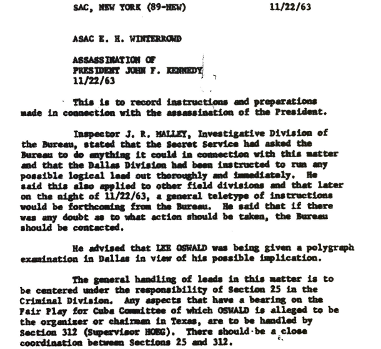
    FBI agency file number 97-2229-7

    (Note: also explosive in this document is the statement that Oswald was being polygraphed on November 22––sounds like another offshoot, sigh!)

    Oswald’s first attempt at interacting with the FPCC may have been as early as late summer 1962, when the head of the FPCC at the time, Richard Gibson, responded to a request for information from a Lee Bowmont from Fort Worth, Texas. Gibson felt he may have been in a group of three Trotskyites he had met shortly after.18

    And then we have the following mind-boggling correspondence(s)  courtesy of Malcolm Blunt:
    Oswald FPCC envelope return address

    This envelope, with the FPCC return address, as it stands is difficult to analyze because of the unclear postmark and its content has not been revealed as far as I know (which would once again represent obstruction of justice if this were the case).  However, we do know Oswald lived at the above address from about July to October of 1962. This confirms that Oswald/FPCC relations began clearly before 1963. The following May 5, 1961 letter is food for thought:
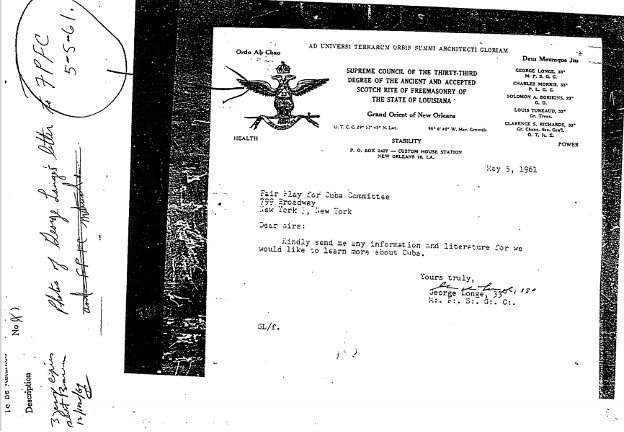
    May 5, 1961 letter

    It was not only Oswald who was interested in the FPCC before he went to New Orleans; others from the Big Easy were gathering information. Guy Banister was also a member of the Scotch Rite19 which figures on the letterhead. What on earth is this organization doing corresponding with the FPCC in 1961?
    May 5, 1961 letter, letterhead close-up

    Oswald and FPCC Worst Practices

    Location, Location, Location!

    As we have seen by chronicling the demise of the FPCC, Oswald’s sense of timing was horrendous when he launched the New Orleans chapter in the summer of 1963. His choice for a location was even worse.

    The two most dangerous places to open chapters in the U.S. at the time were probably Miami and New Orleans. Dallas would not have been far behind. New Orleans perhaps stood out as the worst because of its dependence on North-South trade. Its proximity to Cuba caused many sleepless nights during the October 1962 missile crisis. V.T. Lee had urged Oswald to avoid New Orleans.

    When the HSCA published its completed Final Report in 1979, it showed two areas related to the FPCC that the Warren Commission failed to investigate adequately. One overlooked area was the identity of occupants at the address Oswald used for his FPCC literature distribution. The address 544 Camp Street appeared on materials that Oswald was handing out. This address was the New Orleans Newman Building. The Warren Report stated that, at an earlier date, the building was occupied by an anti-Castro group, but the name was not revealed in the final report. Later it was found to be the Cuban Revolutionary Council. Another resident of the Newman Building was the private detective agency of Guy Banister. He also was not mentioned in the Warren Report. Banister was the retired FBI Special Agent in Charge of the Chicago FBI field office. After his FBI retirement in the mid-1950s, he moved to New Orleans and helped set up that city’s police intelligence unit. Guy Banister, a staunch anti-communist, continued his anti-subversion work well after his official ties with the FBI were severed. The HSCA determined in their investigation that in 1961 Banister and Sergio Arcacha Smith of the CRC were working together in the anti-Castro cause.20

    The 544 Camp Street address, which Oswald foolishly stamped on some of his handouts, was also surrounded by intelligence organizations, including the ONI, CIA, Secret Service and the FBI.

    The HSCA did take a closer look at the Camp Street enigma. Here were some of the findings:

    (467) During the course of that investigation, however, the Secret Service received information that an office in the Newman Building had been rented to the Cuban Revolutionary Council from October 1961 through February 1962.

    (466) The investigation of a possible connection between Oswald and the 544 Camp Street address was closed. The Warren Commission findings concurred with the Secret Service report that no additional evidence had been found to indicate Oswald ever maintained an office at the 544 Camp Street address.

    (469) The committee investigated the possibility of a connection between Oswald and 544 Camp Street and developed evidence pointing to a different result.

    (482) The overall investigation of the 544 Camp Street issue at the time of the assassination was not thorough. It is not surprising, then, that significant links were never discovered during the original investigation. Banister was involved in anti-Communist activities after his separation from the FBI and testified before various investigating bodies about the dangers of communism. Early in 1961, Banister helped draw up a charter for the Friends of Democratic Cuba, an organization set up as the fundraising arm of Sergio Arcacha Smith’s branch of the Cuban Revolutionary Council.

    (489) The long-standing relationship of Ferrie and Banister is significant since Ferrie became a suspect soon after it occurred.

    (491) Witnesses interviewed by the committee indicate Banister was aware of Oswald and his Fair Play for Cuba Committee before the assassination. Banister’s brother, Ross Banister, who is employed by the Louisiana State Police, told the committee that his brother had mentioned seeing Oswald hand out Fair Play for Cuba literature on one occasion.

    (492) Ivan F. “Bill” Nitschke, a friend and business associate and former FBI agent, corroborates that Banister was cognizant of Oswald’s leaflet distributing.

    (494) Delphine Roberts, Banister’s long-time friend and secretary, stated to the committee that Banister had become extremely angry with James Arthus and Sam Newman over Oswald’s use of the 544 Camp Street address on his handbills.

    (495) The committee questioned Sam Newman regarding Roberts’ allegation. Newman could not recall ever seeing Oswald or renting space, to him … Newman theorized that if Oswald was using the 544 Camp Street address and had any link to the building, it would have been through a connection to the Cubans.

    Roberts claimed Banister had an extensive file on Communists and fellow travelers, including one on Lee Harvey Oswald, which was kept out of the original files because Banister “never got around to assigning a number to it.”

    (514) Significant to the argument that Oswald and Ferrie were associated in 1963 is evidence of prior association in 1955 when Ferrie was captain of a Civil Air Patrol squadron and Oswald a young cadet. This pupil-teacher relationship could have greatly facilitated their reacquaintance and Ferrie’s noted ability to influence others could have been used with Oswald.

    (515) D. Ferrie’s experience with the underground activities of the Cuban exile movement and as a private investigator for Carlos Marcello and Guy Banister might have made him a good candidate to participate in a conspiracy plot. He may not have known what was to be the outcome of his actions, but once the assassination had been successfully completed and his own name cleared, Ferrie would have had no reason to reveal his knowledge of the plot.

    On page 145 of its final report, the HSCA states that “it was inclined to believe that Oswald was in Clinton, August – early September 1963, and that he was in the company of David Ferrie, if not Clay Shaw. The Committee was puzzled by Oswald’s apparent association with David Ferrie, a person whose anti-Castro sentiments were so distant from those of Oswald, the Fair Play for Cuba Committee campaigner.”

    Research since this very accusatory report has only re-enforced this conclusion.  We now know for certain that Clay Shaw was a well-paid CIA asset, something that he vehemently denied during the Garrison inquiry. He was also using the alias Clay Bertrand and that he was seen in the company of Oswald in Clinton.

    Birds of a Feather

    If Oswald’s sense of timing and choice of location for opening an FPCC chapter were awful, his networking strategies were catastrophic … if you believe he was serious about promoting Fair Play for Cuba.

    Jim Garrison had already pointed out how Oswald’s hobnobbing with White Russians in Dallas was diametrically opposed to his supposed pro-Marxist credo. His universe of contacts in New Orleans was even worse––unless he was involved in something else, like infiltrating pro- and anti-Castro groups to help the FBI in their oversight objectives. Let us highlight a few (for a more in-depth coverage of Oswald’s contacts read this author’s article Oswald’s Intelligence Connections: How Richard Schweiker clashes with Fake History):

    David Ferrie
    David Ferrie
    David Ferrie

    Oswald’s first intel connection is one of the most important for confirming Schweiker’s assertion. David Ferrie plays an important role in Oswald’s fate during two phases of Oswald’s short life. In 1955, both Ferrie and Oswald were members of the Louisiana Civil Air Patrol where Ferrie taught, among other things, aviation. Ferrie later became a contract CIA agent flying bombing missions over Cuba. During the summer of 1963, Ferrie and Oswald linked up once again at 544 Camp Street. During this period, Ferrie was frequently seen in the building and elsewhere, in the company of Banister, CIA agent Clay Shaw, the CIA-connected Sergio Arcacha Smith, Oswald and others of this ilk who became key suspects in the Garrison investigation.


    Kerry Thornley
    Kerry Thornley
    Kerry Thornley

    When Oswald was stationed back to California in 1959, Thornley wrote a book about him before the assassination called The Idle Warriors, and then another in 1965. In the summer of 1963, Thornley popped backed into the picture in New Orleans where several witnesses saw him with Oswald either in public or at Oswald’s apartment. There is evidence that Thornley picked up Fair Play for Cuba flyers for Oswald. An FBI memo states that Thornley and Oswald went to Mexico together. And despite preliminary denials, he eventually admitted links to David Ferrie, Guy Banister, Carlos Bringuier and Ed Butler.


    Victor Thomas Vicente

    When Lee Oswald wrote his first letter to the Fair Play for Cuba Committee HQ in New York in April 1963, he asked for “forty to fifty” free copies of a 40-page pamphlet. The author of the pamphlets, Corliss Lamont, turned out to be holding a receipt for 45 of these pamphlets from the CIA Acquisitions Division. These pamphlets were mailed to Oswald by FPCC National Chapter worker Victor Thomas Vicente. Vicente was a key informant for both the CIA and the FBI’s New York office.

     John Martino

    John Martino
    John Martino

    Martino showed pre-knowledge of the assassination and also admitted observing Oswald during the summer of 1963. Martino certainly did have CIA connections in 1963, primarily to David Morales and Rip Robertson.

    William Monaghan and Dante Marichini

    During the summer of 1963 in New Orleans, Oswald gained employment at the Reilly Coffee Company, an organization of interest because of its links to Caribbean anti-communist politics. The Reilly brothers backed Ed Butler’s INCA (the CIA-linked Information Council of the Americas, which factors heavily in Oswald’s later Marxist PR activities) and the CRC (Cuban Revolutionary Council).
    Reilly Coffee Co
    Reilly Coffee Co

    William Monaghan was the V.P. of Finance there who ended up firing Oswald. He was also an ex-FBI agent. He was listed as a charter member of INCA in a 1962 bulletin. Other employees there of interest to researchers included four of Oswald’s co-workers who joined NASA during the summer of 1963. Dante Marichini, who was a friend of David Ferrie’s and the neighbor of Clay Shaw, was one of these.

    Guy Banister
    Guy Banister
    Guy Banister

    What emerges from all we know about 544 Camp Street is that Oswald was assisting Banister, a known communist hunter, in identifying Castro-sympathizers and that Banister was deeply involved in activities supplying weapons to anti-Castro groups like Alpha 66––a key organization of interest in the assassination.

    Clay Shaw
    Clay Shaw
    Clay Shaw

    Thanks to Jim Garrison, we were introduced to a key person of interest in Clay Shaw. The HSCA investigation concluded that New Orleans district attorney Jim Garrison and his office ”had established an association of an undetermined nature between Ferrie, a suspect in the assassination of President Kennedy, and Clay Shaw and Lee Harvey Oswald.”

    In Destiny Betrayed, Jim DiEugenio underscores other Shaw links with the CRC and with Banister, CIA-cleared doctor Alton Ochsner, and Ed Butler, who are all connected to the Information Council of the Americas, which appears to have played a role in the sheep-dipping of Oswald (see Ed Butler). He also shows that Shaw was cleared for a project called QK/ENCHANT during the Garrison investigation. Howard Hunt also belonged to this project, which was part of the CIA’s Domestic Operations Division, according to CIA insider Victor Marchetti.

    William Gaudet
    William Gaudet
    William Gaudet

    Gaudet had worked for the CIA before he crossed paths with Oswald. He most likely continued freelancing for it. He worked virtually rent-free out of Clay Shaw’s International Trade Mart. It seems plausible that Gaudet played a part in monitoring Oswald, perhaps for the benefit of Shaw.

    Dean Andrews
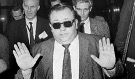
    Dean Andrews
    Dean Andrews

    Lawyer Dean Andrews was called by Shaw, under the pseudonym Clay Bertrand, and given instructions to represent Oswald, as told by Garrison in his famous interview with Playboy.


    Sergio Arcacha Smith
    Sergio Arcacha Smith
    Sergio Arcacha Smith

    The CIA selected him to be a key leader of Cuban exiles as a representative of the Cuban Revolutionary Council. That group was created by Howard Hunt as an umbrella organization of many Cuban exile groups such as Alpha 66 and the DRE. The FDC was allegedly organized for his benefit, and it  borrowed Oswald’s name when he was in Russia. It is in this role that he associated closely with Clay Shaw, Guy Banister, David Ferrie and Doctor Alton Ochsner. Gordon Novel claims that David Phillips participated in at least one meeting where Smith and Banister were in attendance.

    At the time of the working relationship between Banister and CRC leader Sergio Arcacha Smith, the CRC became involved in Tampa’s Marti Park demonstrations against the FPCC. (Frank S. DeBenedictis thesis).

    Carlos Bringuier, Carlos Quiroga, Celso Hernandez and Frank Bartes
    Carlos Bringuier
    Carlos Bringuier

    Bringuier was part of the DRE, a militant right-wing, anti-Communist, anti-Castro, anti-Kennedy group. Bringuier, based in New Orleans, was placed in charge of DRE publicity and propaganda. According to Bringuier, the following summarizes his strange encounters with Oswald:

    On August 9, 1963, Oswald, while leafleting FPCC flyers on Canal Street, drew the ire of Bringuier and his Cuban associates Celso Hernandez and Miguel Cruz. Bringuier did the swinging while Oswald tried to block his blows. Oswald was then interviewed on a Bill Stuckey show along with Bringuier where his Marxist and FPCC credentials were discussed for all to hear.

    According to E. Howard Hunt, the DRE was started by David Phillips, who is the CIA career employee with the most links with Oswald. The DRE was eventually overseen in 1963 by George Joannides, who helped sabotage the HSCA investigation.
    Smith, Gil and Quiroga
    Arcacha Smith, Manuel Gil,
    & Carlos Quiroga

    A Jim Garrison polygraphed interrogation of Quiroga, plus other research, proved that Quiroga knew Banister and Sergio Arcacha Smith, had met Oswald more than once, and had supplied Oswald with Fair Play for Cuba literature on the orders of Carlos Bringuier. One of the Cuban exiles arrested during the so-called skirmish was Celso Hernandez, who may have met Oswald before. According to Bill Simpich’s research, the CIA examined Celso Hernandez as a Castro penetration agent.

    While Oswald and Bringuier were in court after their altercation, a sympathizer and friend of Bringuier’s, Frank Bartes, showed up to offer moral support. This Cuban exile went on to conduct anti-Castro press relations. Bartes followed Smith as the CRC leader in New Orleans based in the Newman building with Banister. In 1993, the ARRB released files confirming that Bartes was an informant for the FBI agent who just happened to be monitoring Oswald: Warren DeBrueys.

    Jesse Core

    Core was Clay Shaw’s right-hand man who was present during the incident on Canal Street and Oswald’s leafleting in front of the Trade Mart. He contacted Shaw’s friends at WDSU TV. He also is the one who warned his team about Oswald’s blunder of placing Banister’s address on some of the literature he was handing out.  Jesse Core’s reports about Oswald made their way to intelligence outfits.

    John Quigley and Warren DeBrueys

    Warren DeBrueys
    Warren DeBrueys

    After the altercation with Bringuier, while under arrest, Oswald made a bizarre request. He asked to see an FBI agent. The FBI sent agent John Quigley, who spent somewhere between 90 minutes and three hours with Oswald. It’s safe to say that they were not discussing Bringuier simply being mean to the alleged communist. Quigley stated that Martello told him that Oswald wanted to pass on information about the FPCC to him. Joan Mellen’s research finds that Oswald actually asked specifically for Warren DeBrueys. DeBrueys, who ran Bartes as an informant, would further nail down the real reason Oswald started an FPCC chapter in a hostile place like New Orleans. William Walter, an employee at the New Orleans FBI office, claimed to have seen an FBI informant file on Oswald with DeBrueys’ name on it.

    Arnesto Rodriguez and family

    Before his approach to Bringuier, Oswald had contacted the head of a local language school, Arnesto Rodriguez Jr., expressing an interest in learning Spanish. One of Arnesto’s closest associates in New Orleans was Carlos Bringuier, and both men acted as sources for the FBI (Arnesto aka Ernesto was assigned FBI source number 1213 S).

    The father of the Rodriguez family, Arnesto Napoleon Rodriguez Gonzales, had his own intelligence connections, having worked for the Office of Naval Intelligence during World War II; he had also served as an on-island source for the CIA before leaving Cuba. In terms of Lee Oswald’s being known to JFK conspirators, the most important point is that Arnesto’s father and Arnesto Jr. were both in routine touch with a relative in Miami, a CIA officer deep within JM/WAVE intelligence operations. That individual (son to Arnesto Sr; brother to Arnesto Jr.) was Emilio Americo Rodriguez Casanova (crypt AMIRE-1). Emilio was a close friend to both David Morales and Tony Sforza as well as a number of other SAS and JM/WAVE officers. He had also worked with, and appears to have been in contact with, David Phillips in 1963.21

    Orestes Peña, Joseph Oster, David Smith, and Wendell Roache
    Orestes Peña
    Orestes Peña

    Curiously, the evidence that Oswald collaborated with Customs is stronger than with almost any other agency. Cuban exile Orestes Peña testified that he saw Oswald chatting on a regular basis with FBI Cuban specialist Warren DeBrueys, David Smith at Customs, and Wendell Roache at INS. Peña told the Church Committee that Oswald was employed by Customs. Informant Joseph Oster went farther, saying that Oswald’s handler was David Smith at Customs. Church Committee staff members knew that David Smith “was involved in CIA operations.” Orestes Peña’s handler Warren DeBrueys admitted he knew David Smith.

    Ed Butler and Bill Stuckey
    Butler & Bringuier
    Butler & Bringuier

    The Canal Street incident led to Oswald being part of a debate on WDSU reporter Bill Stuckey’s weekly radio program called Latin Listening Post. Later, Butler and Carlos Bringuier were also invited to debate Oswald about his Marxist views on a show called Conversation Carte Blanche.

    To fully comprehend the significance of Oswald’s media exposure during his debate with Carlos Bringuier on WSDU, it is critical to have some insights on Ed Butler and INCA as well as Bill Stuckey and WSDU. These were dissected by Jim DiEugenio22:

    INCA was, in essence, a propaganda mill that had as its targets Central and South America, and the Caribbean. It would create broadcasts, called Truth Tapes, which would be recycled through those areas and, domestically, stage rallies and fund raisers to both energize its base and collect funds to redouble its efforts. By this time, as Carpenter and others point out, Butler was now in communication with people like Charles Cabell, Deputy Director of the CIA, and Ed Lansdale, the legendary psy-ops master within the Agency who was shifting his focus from Vietnam to Cuba. These contacts helped him get access to Cuban refugees whom he featured on these tapes. Declassified documents reveal the Agency helped distribute the tapes to about 50 stations in South America by 1963. There is some evidence that the CIA furnished Butler with films of Cuban exile training camps and that he was in contact with E. Howard Hunt––under one of his aliases––who supervised these exiles in New Orleans. Some of the local elite who joined or helped INCA would later figure in the Oswald story e.g. Eustis Reilly of Reilly Coffee Company, where Oswald worked; Edgar Stern who owned the local NBC station WDSU where Oswald was to appear; and Alberto Fowler, a friend of Shaw’s; plus future Warren Commissioner Hale Boggs who helped INCA get tax-exempt status. Butler also began to befriend ground-level operators in the CIA’s anti-Castro effort like David Ferrie, Oswald’s friend in New Orleans; Sergio Arcacha Smith, one of Hunt’s prime agents in New Orleans; and Gordon Novel, who worked with Banister, Smith and apparently, David Phillips, on an aborted telethon for the exiles.

    Two other acquaintances of Butler were Bill Stuckey, a broadcast and print reporter, and Carlos Bringuier, a CIA operative in the Cuban exile community and leader of the DRE, one of its most important groups in New Orleans. 

    Stuckey claimed that his show helped destroy the FPCC in New Orleans. It is during this show that Oswald let slip that he was under the protection of the government while in Russia.

    So, as we can see, the arrival of Oswald in New Orleans, his behavior and his network were very closely linked to the demise of the FPCC and his own tragic fall, as well as a ploy to blame Castro.

    His short stint in the Big Easy was not only a godsend for right-wing fanatics; it was planned and welcomed. FBI files discovered by Malcolm Blunt, as well as Stuckey’s testimony to the Warren Commission, confirm that the radio host was making inquiries about whether or not the FPCC was present in New Orleans as early as 1961. In other words, Stuckey was not just a free-lance journalist.
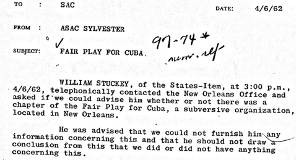
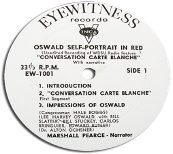
    FBI-Stuckey

    INCA WDSU
    INCA WDSU
    “Conversation Carte Blanche”

    Both Butler and Stuckey were briefed in advance about Oswald’s defection to Russia: Stuckey by the FBI, Butler by the House Un-American Activities Committee (HUAC). Therefore, they were able to ambush Oswald and expose him as a Soviet defector, which compromised his debate position as one who desired “fair play” for Cuba. The records of this show were used immediately after the assassination (through Butler and Bringuier) to paint Oswald as the lone-nut Marxist. In fact, Butler was flown up to Washington within 24 hours to talk to the leaders of the HUAC.

    According to author Ed Haslam, Butler also became the secret custodian of Banister’s files years after his death.23

    see Part 2


    Notes

    1 AEBALCONY_0005.pdf (cia.gov).

    2 Barry Sheppard, The Party, p. 83.

    3 Sheppard, The Party, p. 103.

    4 Church Report, p. 211, Section: “Using Covert Action to Disrupt and Discredit Domestic Groups.”

    5 Brian Glick, War at Home.

    6 See n. 13 below.

    7 Newman, Oswald and the CIA, location 1329, Kindle.

    8 Newman, location 3122.

    9 FBI report (CR-109-12 210-2990).

    10 FBI report (CR-109-12 210-2990).

    11 FBI document James Kennedy Report 11/29/1963.

    12 FBI file 124-10324-10098.

    13 Frank S. DeBenedictis, Cold War comes to Ybor City: Tampa Bay’s chapter of the Fair Play for Cuba Committee (Ph.D. diss., Florida Atlantic University, 2002).

    14 DeBenedictis, Cold War comes to Ybor City.

    15 DeBenedictis, Cold War comes to Ybor City.

    16 John Armstrong, Harvey & Lee,  p. 542.

    17 https://www.opednews.com/populum/page.php?f=THE-JFK-CASE–THE-TWELVE-by-Bill-Simpich-120825-173.html.

    18 CIA file, NBR 89970 Dec 18, 1963.

    19 William Guy Banister (1901-1964) – Find A Grave Memorial.

    20 DeBenedictis, Cold War comes to Ybor City.

    21 Hancock, Tipping Point, part 4, “Oswald in Play.”

    22 James DiEugenio, “Ed Butler: Expert in Propaganda and Psychological Warfare“ (2004).

    23 Haslam, Dr. Mary’s Monkey, pp. 161-165.

  • In Memoriam: Priscilla Johnson McMillan, 1928–2021

    Jim DiEugenio wrote about Priscilla Johnson McMillan, who interviewed Oswald in Russia then worked with his widow after the JFK assassination. (Click here for details)

  • Marina’s Sponsor and Oswald’s Fifth Wallet

    Marina’s Sponsor and Oswald’s Fifth Wallet


    I am trying to imagine the scene. A divorced housekeeper who cannot hold a job, and whose son is in Russia having made the news for attempting to defect and who married a Russian. The mother asks an ex-boss, who had recently dismissed her, if he can sponsor her son’s Russian bride in order to help them get into to the U.S. The year is 1962, at the height of the Cold War.

    On March 15 of that year, this is precisely what Byron Phillips agreed to do, thereby “guaranteeing and assuring anyone concerned that he will personally see that in the event Marina Nikolilava Oswald is permitted to come to the United States that she will not become a ward of any political subdivision of this country, and that he has ample property holdings and assets to provide for her in the event that it should become necessary.”

    While I cannot confirm what the obligations were in 1962 for an immigration sponsor, we can assume they were no less strict than they are today: The Form I–864 Affidavit of Support is a legally enforceable contract, meaning that either the government or the sponsored immigrant can take the sponsor to court if the sponsor fails to provide adequate support to the immigrant. In fact, the law places more obligations on the sponsor than on the immigrant—the immigrant could decide to quit a job and sue the sponsor for support.

    When the government sues the sponsor, it can collect enough money to reimburse any public agencies that have given public benefits to the immigrant. When the immigrant sues, he or she can collect enough money to bring his or her income up to 125% of the amount listed in the U.S. government’s Poverty Guidelines.

    The sponsor’s responsibility lasts until the immigrant becomes a U.S. citizen, has earned 40 work quarters credited toward Social Security (a work quarter is about three months, so this means about ten years of work), dies, or permanently leaves the United States.” (Legal Encyclopedia, Chapter 3)

    Who on earth would take such a risk? Would he not try to first get some information from the State Department? For all he knew, Oswald was a traitor and Marina was another “godless commie!” Is there a link between Byron Phillips and the CIA’s David Phillips from Fort Worth, Texas? Was Byron Phillips ever questioned?

    While making some interesting headway researching The Fair Play for Cuba Committee, which will be the subject of an upcoming article, I got sidetracked by another bizarre event. I decided to put the FPCC research on hold and dig away at this perplexing offshoot.

    Marguerite in Vernon

    From June 1961 to Aug 1961, Marguerite Oswald was in Crowell, Texas at Macadams Ranch working for Otis Grafford as housekeeper/cook. (Oswald 201 File, Vol 3, CD75, Part 2) Mrs. Grafford affirmed

    that she liked Marguerite, but she fought with her mother Mrs. Macadams. She then went to Vernon in August 1961. Vernon is 30 miles east of Crowell, 170 miles outside of Fort Worth. Boyd is a Fort Worth suburb.

    A short one-page FBI report dated 12/1/63, states that Byron Phillips was questioned by special agent Jarrell H. Davis on the previous November 25. (Click here and scroll to page 17) Marguerite worked for Byron from August or September 1961 (August 1 according to John Armstrong) to January or February 1962 as a housekeeper and practical nurse for his mother and father who lived close by. She never said anything anti-U.S.; she had told Mr. Phillips about her son going to Russia, marrying a Russian girl, fathering a child; that her employment was terminated because she talked all the time which made his father nervous. He stated that just previous to or shortly after she left his employment, she mentioned that she was having trouble getting someone to sign the sponsoring affidavit to be submitted to Immigration and Naturalization vouching adequate support for the wife and child.

    On November 20, 1961, the FBI Dallas office sent one of 5 copies of a memorandum to the FBI director, reporting that Marguerite Oswald had received news from her son Lee Harvey Oswald in Russia. He was confident he would be able to return to the U.S., but expressed doubt about the prospects of such a move for his new Russian bride Marina. Marguerite’s address is listed as 1808 Eagle Street, Apartment 3, Vernon, Texas.

    She reached out to the Vernon Red Cross in Jan 1962; they wouldn’t float a $450 loan to him, but they agreed to copy a letter that Marguerite was sending and declare it a true copy (the pre-photocopy era). (CE 2731, WC Hearings, Vol. XXVI, p. 110)

    According to Agent Davis’ further inquiries, after ending her employment with Byron Phillips, Marguerite soon found work at the Vernon Convalescent Home and moved in with Mrs. John Bishop to share expenses for three or four weeks in Vernon sometime in February or March. She then found work as a practical nurse and housekeeper for Robert S. Leonard, who also resided in Vernon, before working for Mrs. B. F. Hutchins. at 1810 Eagle Street in Vernon. Mr. Leonard recalled Marguerite saying that her son went to Russia as some sort of government agent.

    In a letter to Marguerite dated March 21, 1962, Lee states that he will probably head directly to Vernon upon arrival to the United States. (Commission Document 818) The letter refers to Byron Phillips as a “business friend” of Marguerite and talks about numerous press clippings about Oswald sent to him by Marguerite which increased the odds that Oswald’s turncoat persona was knowable if not known.

    Apparently, she went to Crowell, Texas and stayed six weeks with Joe Long in May-June 1962 before leaving to go back to Fort Worth at the end of June 1962 to be near Lee and his family. (Oswald 201 File, Vol 3, CD75, Part 2)

    In these and other interviews with people she worked for from mid-1961 to mid-1962, Marguerite Oswald comes across as overly talkative, fussy, bossy, upset by her son being in Russia, penniless, and professionally unstable: A real Mrs. Catastrophe.

    Byron Phillips

    Byron Phillips signed this very important affidavit on March 15, 1962 (Warren Commission Exhibit 2653) (824) and (197) nearly two months after terminating Marguerite’s employment for being tiresome with his dad and plunging him into a world of uncertainty with a cast of misfit characters intertwined with a Cold War nemesis that he became partially responsible for. Did he ever meet, correspond, keep tabs on these brave souls he so wanted to help…? No! Did he take precautions to alert intelligence during the Missile Crisis in late 1962? It does not seem so. Was he investigated beyond this very cursory inquiry by agent Davis or by the Warren Commission? Not at all. Perhaps there was no need to.

    A September 10, 1963 Memo to FBI agent James Hosty directs him to interview Byron Phillips in an effort to locate Oswald.

    On November 30, 1963, at the Six Flags Inn of Dallas, with Robert Oswald present, agent Blake of the Secret Service and another unknown agent questioned Marina and asked about a black wallet containing 180 bucks and the identity of Byron Phillips, who had signed the affidavit. She said that neither she nor Lee knew him and that Marguerite was the one who had contacted him when she was living in Vernon. She also stated that the wallet was given to Lee by Marguerite when she came back to Fort Worth and that they always kept that wallet at home.

    The following article gives a pretty good profile of Phillips and family:


    This rancher was a distinguished gentleman who owned 660 acres of farmland, was a father, and the Deacon at the Fargo Baptist Church. He sat on the local School Board for some ten years, attended business college, was chosen “outstanding Rural Citizen” in 1962, was elected president of the Palomino Club in 1964, and the list goes on. Despite quite the pedigree, this seemingly professional, savvy businessman seems to have been quite imprudent when he put his reputation, and potentially quite a bit of money, on the line when he put his signature on a compromising legal document sponsoring an unknown Soviet bride of a “quasi defector” in order to help a housekeeper he had fired a few weeks earlier. Note that sometime around June 1961, Mrs. Otis Grafford who had hired Marguerite for a couple of months recalled Marguerite telling her of reading about her son’s “defection” to Russia in a Fort Worth newspaper. Where on earth was the due diligence? Unless, of course, Byron had been reassured, or asked for a favor by someone who had an interest in sending Oswald over to Russia and now wanted him back. How could the FBI interview be so weak when it came to understanding motive and Modus Operandi of this mystery sponsor? Not even Byron’s daughter and grandson were made aware of his decision. (This, I believe is to his credit.)

    Let me quote about Phillips from a Peter Newbury blog. Here is what he posted in 2012:

    The American Embassy suggested he (L.H. Oswald) secure an Affidavit of Support for Marina Oswald.

    Again, OSWALD asked his mother for assistance by mail; Marguerite Oswald obtained an Affidavit of Support from her former employer Byron Philips. A CIA Office of Security Memorandum generated by Ethel Mendoza noted that OSWALD’s address book contained the listing “Mr. Phillipes LI 2-22080” then showed deleted traces. [NARA 1993.07.24.10:48:22:340550] This was Byron Phillips, resident of Wilbarger County, Texas. Marguerite Oswald had mailed Byron Phillips’s Affidavit of Support to her son.

    Byron Philips commented about these traces in May 1977:

    Well, I didn’t know that boy. His mother worked for my mother and daddy for two or three months and that is the only connection I had with him. I never did see him. As far as CIA contact, well, it had to be local over here, I didn’t have any contact with anybody that I didn’t know. There’s a lawyer over here, I’m not sure if he’s FBI-connected or not, he called me and talked to me about him one time. That’s the only one that ever talked to me about him…that’s before it ever happened. A lawyer over here named Curtis Renfro (born April 5, 1905; died September 1984) called me. He just asked me if I knew him…

    Curtis Renfro said he knew Byron Philips. As to whether he called Byron Philips in regard to OSWALD before the assassination, he remarked, “I don’t recall a single word about it, I don’t know the fellow, there’s so much going through my office since 1961 and 1962 that I can’t remember it all. I’m 75 years old. I don’t have any records on it.” Curtis Renfro was asked if he had ever had any intelligence community contact: “Not that I know anything about, if I had a call in my life from them I didn’t know it.” In 1963, Curtis Renfro gave the FBI the names of people for whom Marguerite Oswald had worked, in Vernon, Texas. Then he stated that he did not know or remember Marguerite Oswald. [FBI DL-100-10461, DL 89-43 11.29.63 p. 178]

    Note how Byron shortens Marguerite’s work stint with him by three months, positions her employer as his parents, and insists on how he did not know Lee Harvey Oswald; which in a way makes his willingness to support Marina seemingly more bizarre—not less. If Curtis Renfro was, in fact, hired by the FBI to find out for whom Marguerite had worked, there is a timing problem according to FBI records, as the FBI had interviewed all of Marguerite’s Vernon/Wilbarger contacts/employers by November 26, 1963, less than 4 days after the assassination. In terms of investigating a lone drifter’s mother, the speed at which the FBI was ready to pounce was stunning, to say the least…unless, of course, they already had files on mom and son. Is it credible that a lawyer would not remember anything about the mother of the most notorious “alleged” assassin of the last century? Another key point is that Renfro inquired about Oswald before the assassination according to Byron.


    A Wild Hunch

    David Atlee Phillips is the Intel name that has popped up most often in the research I have conducted over the years, sharing some 20 touch points with Lee Harvey Oswald in and around the last 8 months or so of Oswald’s life. He was raised in Fort Worth, Texas, a mere 100 miles from Byron’s place of birth, Gorman Texas. Wilbarger County is 160 miles away. Marguerite had her home in Fort Worth while she worked in Wilbarger County. Why did carless Marguerite work for some 8 months more than 2 hours away from her apartment? Imagine if Byron and David were somehow related. It was this nagging thought that distracted me from the research on the FPCC I was so focused on. A long shot I admit, but still the type worth following up on.

    From Gary Hill, Jim DiEugenio, John Armstrong, Larry Hancock, David Josephs, Bill Kelly, Bill Simpich, Jim Hargrove, and Len Osanic, I received interesting insights, links, and documents that helped me build Byron’s profile, but not much that could link him to intelligence. On the one hand, some of these researchers did find Byron’s vouching for Marina suspicious; one researcher, however, noted how poor tradecraft it would be for David to use a relative for such an endeavor.

    Through websites such as Ancestry.com, find-a-grave, find a person, etc., I was able to build a fairly complete family tree for both David and Byron and found no common bloodlines going back 4 generations.

    Articles from Wilbarger County about community events did not reveal any social ties. Still, the decision by Byron to sponsor Marina, without performing due diligence, to help a dismissed housekeeper without follow-up interest in the midst of the Cold War deserves more scrutiny. The next area of research was to talk to living witnesses, and close ones, if possible.

    Jeffrey Cantrell

    According to the above newspaper article, Byron’s daughter, Jane Phillips Cantrell, was a teacher in Sherman, Texas. Based on web research, Jane is currently 83, living in Sherman, Texas. Jane has two sons: Jeffrey Don and Jerel Lynn.

    With time, I was able to contact Byron’s grandson Jeffrey, who was gracious enough to answer questions for me and to relay some to his mother who also answered. During a phone conversation on June 20, Jeffrey, now in his early fifties, was able to confirm that Byron in fact lived in Fargo, a small town of 100 people, 12 miles north of Vernon where his wife’s family was based and that he was, in fact, an important rancher in Texas. He owned and operated Fargo Gin. Byron and his wife would spend late springs to mid-summers in Colorado. We were able to confirm that there were no links between Byron and David.

    Jeffrey candidly admitted the following: He had tried to research the Marguerite Oswald history with the family and his mother simply confirmed the employment and never commented beyond this. Jeffrey’s main source of information on the Kennedy assassination to this point is Killing Kennedy by Bill O’Reilly and he conceded that he did not really know that much about the case. In fact, he was under the impression that Byron had refused to sponsor L.H. Oswald, because he would not want to involve himself with someone he did not know. Only when I spoke with him did he find out that Oswald, while in Russia, married Marina and that it was she and their daughter that Byron sponsored.

    Jeffrey also pointed out that he, while working for Freeman’s Exhibits, was given a mandate for the TSBD. He said that he could not see how two of three shots could hit two people.

    On the key question, i.e. how could a businessman like Byron agree to sponsor the Russian bride of Oswald for the benefit of a dismissed caretaker at the height of the Cold War, Jeffrey did not have a definitive answer. But he did offer that his grandparents were very trusting people. At the end of this open and cordial call, we agreed that I would send him a series of questions for his mother:

    Here are the questions sent to Jeff and answers from his mother:

    Jeff Cantrell <jdcantrell>

    Thu 6/24/2021 7:20 PM

    To: Paul Bleau <pbleau@crcmail.net>;

    1) Did she personally meet Marguerite? Yes

    What are her recollections about her? She was nice. Got where she was a little domineering. Maybe that is why Byron let her go.

    2) Did she know Byron sponsored Marina (Oswald’s Russian bride)? No

    3) What were the reactions in her family and the larger community about Marguerite after 1) The 1962 Missile crisis 2) the assassination. It was terrible and weird that they had been associated with someone who had assassinated JFK.

    4) Does she have an opinion as to why Byron sponsored Marina, some two months after dismissing Marguerite, during the height of the missile crisis? Doesn’t know about this.

    5) Does she know if Byron later regretted his act (if he somehow followed up)? No -really didn’t talk about it anymore.

    6) Is it possible that Byron was reassured, or asked to do a favor by someone connected to gvt…in sponsoring Marina? No

    7) Whatever else she can share (documents, insights)…would be helpful.

    8) Does an LI-2-2080 mean anything to you (this was found in Lee Harvey Oswald’s notebook beside the name Mr. Phillipes). Nothing

    Did you hear about Oswald taking Byron’s wallet and having it on him when he got arrested? (Note: this last question is from Jeff to me.)

    Jeff Cantrell

    (Followed by texting:)


    Oswald’s Fifth Wallet

    You kind of sense from Jeffrey’s email that Marguerite’s stint in Vernon and area is a bit of a hot potato…short answers, painful memories. The very last line in our email exchange, however, has me totally flummoxed.

    There has been so much controversy about Oswald wallets that it is difficult to keep track of all the problems including the likely planting of an Oswald wallet at the Tippit murder scene, another in Oswald’s possession after being arrested at the Texas Theater, two other wallets and/or billfolds linked to Oswald, the “loss” of a wallet by investigators according to John Armstrong, etc.

    Well, apologies to researchers. But it is about to get worse:

    On November 30, 1963, Marina Oswald was questioned about a black wallet containing 180 dollars (worth $1,584 in today’s dollars) and the identity of Byron Phillips. She answered that Marguerite gave Lee the wallet and that Lee was frugal, thus explaining the quantity kept in the wallet. We shall shortly see that this is Oswald’s fifth wallet!

    On December 1, 1963, Marguerite stated that she obtained the wallet from the Waggoner National Bank in Vernon, Texas. (Commission Exhibit 1787)

    On June 24 and June 26, 2021, Byron’s grandson (and daughter) stated that the wallet “Oswald took” belonged to Byron.


    National archives Photo of Oswald’s brown wallet during arrest and contents: Wallet from Tippit murder scene

    According to John Armstrong research before this article was written, there were a total of four wallets belonging to Oswald—not one of them was black—there was attempted obfuscation around three of them! Here is what respected researcher Jim Hargrove sent me from a John Armstrong speech about the wallets:

    The last example of evidence alteration I will discuss is the most difficult to follow. It involves the two Oswald wallets found in Oak Cliff and is detailed in Dale Myers’s new book With Malice. A wallet was found at the scene of the Tippit murder by Dallas Police, which contained identification for Lee Harvey Oswald and Alik Hidell. Twenty minutes later, a different wallet was taken from Oswald’s left rear pocket by Detective Paul Bentley. This wallet, the “arrest wallet” also contained identification for Lee Harvey Oswald and Alik Hidell. Both wallets remained in custody of the Dallas Police from November 22nd until November 26th. Bentley turned over Oswald’s “arrest wallet” to Lt. Baker. The wallet and contents were kept in this well-worn envelope in the property room until turned over to the FBI. Photographs of the “arrest wallet” and contents were taken by the Dallas Police on November 23rd and given to the FBI and Secret Service.

    The wallet found at the Tippit murder scene turned up in Captain Fritz’s desk drawer, where it remained until November 27th. On November 25th, Oswald’s possessions were returned from Washington to be inventoried and photographed. Here we begin to see how the FBI tampered with the wallets.

    The FBI inventory listed two wallets—items #114 and #382—yet neither of these inventory sheets showed the wallets coming from the Ruth Paine house, but neither wallet was initialed by Dallas Police. Neither wallet was listed on the Dallas Police handwritten inventory completed at Ruth Paine’s house. Neither wallet was listed on the Dallas Police typed inventory which became Warren Commission exhibits. Neither wallet was photographed among Oswald’s possessions on the floor of the Dallas Police station. Yet two wallets were listed on the FBI inventory—where did they come from? Were they on the Dallas Police evidence film?

    To answer that question, I looked at the two rolls of film returned to the Dallas Police by the FBI. (Hold up Dallas Police film) Item #114 was listed as “brown billfold with Marine group photograph.” But negative #114 showed only the Marine group photo. When a photograph is made from this negative, the “brown billfold”—allegedly from Ruth Paine’s house—disappeared (SLIDE 24).

    Item #382 (SLIDE 25) was listed on the FBI inventory as “red billfold and one scrap of white paper with Russian script.” But negative #382 (RIGHT 10) showed only the paper with the Russian script. When a photograph is made from this negative, the “red billfold”—allegedly from Ruth Paine’s house—disappeared.

    Both negatives were altered between the time the Dallas police turned over their original undeveloped film to the FBI and the FBI returned copies of that film to the police. Why cause the wallets in the original film to disappear? Because the original photos taken by the Dallas Police were probably photographs of the “arrest wallet” and the “Tippit murder scene wallet”—two wallets which contained identification for Oswald and Hidell which would have been unexplainable.

    To find out what happened to “Oswald’s arrest wallet” and the “Tippit murder scene wallet,” we must again look at the Dallas Police film. The 2nd roll of film begins in the middle of negative #361 and ends in the middle of negative #451. All of the negative images after #451, with one exception, were ruined. The one exception is the negative image of a wallet. When the negative image is developed into a photograph, you can see that it is “Oswald’s arrest wallet.” This wallet, along with all other items in this film, were sent to Washington on November 26th. Remember when I told you the Dallas Police were blamed for the 255 missing negatives because of “faulty technique?” Does this look like faulty technique? Or does this look like another example of the FBI splicing together and tampering with the original Dallas Police film?

    With the “Oswald arrest wallet” in Washington, the “Tippit murder scene wallet” remained in Captain Fritz’s desk drawer. On November 27th, James Hosty picked up the “Tippit murder scene wallet” from Fritz and gave Fritz a signed receipt. Hosty then took that wallet and other items obtained from Fritz to the Dallas FBI office. According to Hosty, these items were neither photographed nor inventoried. They were placed in a box and flown to Washington by Warren DeBrueys. Two days later, the Dallas Police notified the FBI they had failed to photograph the wallet and contents and wanted photos. The FBI ignored this request and never photographed the “Tippit murder scene wallet.” The only known photos of this wallet are from WFAA newsreel film.

    When the FBI finished altering Oswald’s possessions, Hoover sent this March 1964 memo: “The Bureau has re-photographed all of the material in possession of the Bureau and will send a complete set of these photographs to you by separate mail.” Included among the hundreds of new FBI photographs were items #114 and #382. These two wallets were substituted for “Oswald’s arrest wallet” and the “Tippit murder scene wallet.”

    As crazy as this already was, now we can add a black wallet with Byron Phillips’s identity and 180 dollars in it to the mix of problematic hidden evidence!

    Unanswered Questions

    The research into Byron Phillips, someone who, seemingly out of the blue, recklessly sponsored Marina Oswald during the pinnacle of the Cold War, proved frustrating in that it opened the door to more questions than it answered. There does not seem to be any identifiable link between Byron and David. When he vouched, the assassination of JFK was probably not even being discussed by the lead conspirators. He seems to have been a good family man and solid community citizen. This story does stand out as another glaring example of just how underwhelming the FBI/WC investigation was or, perhaps, they already had the information they needed.

    What were the real origins of the wallet? Promotional gear from the Vernon bank given to Marguerite? …or one that made its way from Byron to Lee via Marguerite? If the latter… How?

    On what basis is Byron’s daughter certain that it belonged to Byron?

    Does the Oswald in “Oswald took” refer to Marguerite?

    What constituted the “identity of Byron Phillips” inside the black wallet?

    Was the identity of Byron Phillips in the wallet placed by Lee to remind Marina of her sponsor she may need? …soon?

    Was the cash left on Marina’s dresser by Oswald really the 180 dollars the FBI reported being in the wallet?

    Did this 180 bucks belong to Byron?

    How on earth does a lone drifter, father of two, minimum wage earner, or often unemployed person for some 18 months since his penniless return from Russia, how does that person save the equivalent of 1600 dollars today? When he squanders some of his own money for his mindless FPCC adventure, travels to Mexico City, buys gifts for Marina, acquires expensive photographic equipment, moves several times, hires lawyers, buys guns and ammunition, pays for communist literature, etc.? White Russians even paid Oswald’s YMCA fees because he was so destitute.

    What happened to the black wallet?

    Did the FBI deep-six Byron’s wallet? How? When? And why?

    Would Marina, not have required the sponsoring support guaranteed by Byron after Oswald’s assassination?

    How was D.A. Curtis Renfro involved in all of this and what is his background?

    Why was he asking questions about Oswald before the assassination?

    Add to these all the mystery around Byron’s secretive sponsoring of Marina with seemingly little oversight for a dismissed housekeeper during the height of the Cold War and we have ourselves another enigma, courtesy of the Warren Commission and friends.

    What is not enigmatic for this author is any question of ill intent by Byron. There was none. He sponsored too early in the game for any idea of plot participation to be considered. Based on his very laudable profile, and input from Jeffrey and Jane, he was either acting as a charitable person who was helping the needy, looking for no recognition for himself; or, unbeknownst to his close ones, he was asked to help bring an American patriot home. This part of the mystery has probably reached a dead end for now, one that underscores the complete sham of an investigation that took place back then. When independent researchers and Byron’s grandson do more research about the wallets and Marina’s sponsor than the FBI, the DPD, the CIA, and the Warren Commission combined…in two weeks, you know something is rotten in Denmark.

    I do not think Jeffrey can answer many more questions than he already has. Marina, Ruth Paine, the DPD, and the FBI certainly have a lot they can offer about the wallet. And Curtis Renfro was an important figure in his town who should be easy enough to profile. But that will be for another time, perhaps looked into by other researchers.

    The area I had been researching before being sidetracked by this new rabbit hole was about perhaps the most incriminating link between David Phillips and Lee Harvey Oswald. One that had them most likely playing on the same side: The FPCC!

    Stay tuned.

    Addendum: I would like to thank Gary Hill, Bill Simpich, Len Osanic, Jim DiEugenio, David Josephs, John Armstrong, Bill Kelly, and Jim Hargrove for their comments and research support. A special thank you to Jeffrey and Jane Cantrell (two great Texans!) for the help they provided.

  • Lee Harvey Oswald’s Cold War

    Lee Harvey Oswald’s Cold War


    Greg Parker’s Lee Harvey Oswald’s Cold War is quite appropriately titled. There have been many biographies of Oswald, some of them good, some adequate, and some downright poor. The dividing line, both temporally and in content, was Philip Melanson’s Spy Saga. Released in 1990, Spy Saga was the first work to make a book length case that Oswald was intimately tied up with the world of American intelligence—and most likely not in a casual way. Phil also did important work on the Martin Luther King and Bobby Kennedy cases. Unfortunately, he passed away in 2006. But when he appeared before the Assassination Records Review Board, he made a rather pithy and self-deprecating comment. He said he hoped when their mission was complete, the new database on Oswald would make Spy Saga look like a Cliff Notes pamphlet.

    There is no doubt that Melanson’s prognostication came true. For example, the declassified notes of HSCA researcher Betsy Wolf create an epiphany concerning the relationship between the CIA and Oswald before his defection to Russia. (Click here and go to Section 2) In his book, Parker has not gotten to that point yet. (This review is of the compilation Volumes 1 and 2.)

    Several books on Oswald track his character through the progress of the Cold War. But, quite naturally, the Soviet/American conflict is always in the background. The unusual thing about Parker’s book is that there really is no background. His volume blends so much of the Cold War into the story that background and foreground are almost indistinguishable. That is why I stated that the title is all too appropriate.

    To underline this point: the volume opens in a most unusual manner. Many books on the case, and some biographies of Oswald, discuss the overthrows of Arbenz in Guatemala, Mossadegh in Iran, and the killing of Patrice Lumumba in the Congo, not to mention the many attempts to assassinate Fidel Castro. This book begins with an assassination in Bogota, Colombia. It discusses the murder of Jorge Elicier Gaitan, who, quite frankly, I had never heard of before. (Parker, pp. 4ff) I sure as heck will not forget him now.

    Gaitan was a mayor of Bogota, a member of congress, Minister of Education, and Minister of Labor, Health, and Social Welfare. He was a lawyer who gradually shifted over to politics, especially after seeing the influence of the United Fruit company in his country, particularly after what is called the Cienega, or Santa Marta, massacre. (Parker, pp. 5–8) This event was more or less covered up for decades until Gabriel Garcia Marquez made it famous in his book One Hundred Years of Solitude. What enraged Gaitan about the event was that the American press and State Department tried to paint the massive machine gunning as a natural reaction to a communist plot. It was no such thing. United Fruit demanded the government intervene to halt a strike, since their policy was no negotiations. In fact, United Fruit’s influence may have extended up to having Frank Kellogg, the American Secretary of State, threaten to invade if United Fruit was not protected.

    Gaitan used this event to vault himself into the political arena. He was so effective as a speaker and organizer that he created a kind of rump group to the Liberal Party called the National Leftist Revolutionary Union, or UNIR. Gaitan was a combination Socialist and Populist. Land reform was very important to him. In 1946, he ran for president and lost, mainly because the Liberals ran two candidates, himself and Gabriel Turbay. As Parker makes clear, its odd how Turbay died a year later. (Parker, p. 26) And Gaitan was assassinated a year after that—on the verge of taking over the Liberal Party.

    Before reviewing Gaitan’s murder, the author discusses just how influential the American government was in Latin America. United Fruit’s law firm was the formidable Sullivan and Cromwell, which employed a young John Foster Dulles. Foster Dulles was a kind of roving ambassador for the company in that area. (Parker, p. 9) America was very powerful in Colombia due to the scheme used by Phillipe Bunau Varilla, William Nelson Cromwell, and Teddy Roosevelt to pretty much create the new country to the north in order to finish the Panama Canal. (Parker, pp. 10–13)

    Before the creation of the CIA, the FBI had domain in Latin America through its Special Intelligence Service or SIS. But by 1946, the SIS was on the way out due to the creation of the CIG, the Central Intelligence Group, and the CIA in the following year. Birch O’Neal was an SIS agent who joined the new group. He soon became one of James Angleton’s chief—and most secretive—assistants. (Parker, p. 20) Preceding both the SIS and CIA was the Office of Naval Intelligence. Founded in 1882, by 1929 it had widened its scope from just spying on the advancements of the navies of other nations. (Parker, p. 3)

    On April 9, 1948, Gaitan emerged from his office at about 1 PM. He was shot at four times with one bullet missing. The man apprehended for the crime was Juan Ros Sierra. He was immediately taken to a pharmacy by two policemen. But when they called for reinforcements, no one answered the phone at the station. When asked who put him up to the assassination the defendant only said, “Powerful things that I can’t tell you! Oh Virgin of Carmen! Save Me!” (Parker, p. 29)

    In a startling coincidence, both Gabriel Marquez and Fidel Castro were in direct proximity to the scene of the crime. Marquez later said that he saw a tall, well-dressed man urging the mob to break the police line and extract revenge by killing the suspect. Once this was successful, that man drove away in a new car. (ibid) What happened after must have clearly influenced Castro in his revolutionary career. It came to be called El Bogotazo: ten hours of violence, mayhem, and chaos that left four thousand dead and a large section of the city in ruins. (Parker, p. 30) In turn, that ignited La Violencia, a ten-year civil war that took the lives of about 200,000 people. This reveals not just how much Gaitan was a symbol of hope to the masses, but also how they collectively felt that the—now dead—accused was not working alone. (Parker, p. 30)

    They were correct. A man named John Espirito later made a confession to this effect. He said that the murder was timed for the meeting of the Latin American leftist group which Castro was there to attend. Although Espirito clearly implied that Roa performed the shooting, Parker disagrees. Roa was in the habit of performing mind control exercises that would place him in a trance state in front of a mirror. He then imagined someone emerging from the mirror. The author writes that it actually was a man and he was part of the set up. He corresponds to someone at the scene who had a trench coat draped over his arm. Parker writes that this was the main assassin and that Roa only fired the last shot, the one that missed. (Parker, p. 54)

    The chapter ends with a postulation: was this the CIA’s first assassination plot? If so, it certainly resembles the RFK scenario, not just in its intricacies, but because it stopped a liberal leader from taking power and produced years of chaos. In the American case, it prolonged the Vietnam War.

    II

    The Gaitan murder happened closely after the official opening of the Cold War, which is usually timed with George Kennan’s long telegram from Moscow. The author then jumps forward a few years to Korea. He focuses on two types of specialized warfare that emerged during the conflict. The first was what had been apparently used with Roa: mind control. The second was germ warfare. The United States coveted Japan’s so called “Devil Doctor,” Ishii Shiro and his infamous Unit 731. He was perhaps the most advanced microbiologist of his day and performed thousands of experiments on human guinea pigs, including American POW’s. Douglas MacArthur made sure he was not prosecuted and so he ended up at Fort Detrick, Maryland. (Parker, pp. 78–80) In other words, what happened with Operation Paper Clip in Europe also occurred in Asia, except in this instance it was not rocketry, but biological science. It was left to the Russians to expose Ishii for what he was and how he had experimented on American prisoners. This is how America developed the science for bacteria weapons in Korea and then, according to Parker, lied about its usage. (Parker, pp. 83–86) One way they did so was by saying the Chinese had brainwashed the men who said they did it.

    All of this clearly amped up domestic Cold War tensions. Ruth Paine started to attend Quaker meetings in 1947, but did not actually join the church until 1951. The author describes a kind of factionalism within the Quaker movement that gained traction over the forties and fifties. The Hicksites, a very pure and spiritual sect inside the church who had been strongly anti-slavery, now gave way to a more conservative evangelical strain. (Parker, pp. 94–95). This struggle was exemplified by a meeting of the Friends at Earlham College which Ruth attended. Earlham was a hotbed of this early kind of conservative evangelical movement. A future graduate of Earlham was Von Edwin Peacock. By the time of the FBI inquiry into Oswald’s alleged visit to Mexico City, Peacock was acting Director of the American Friends Service Committee (AFSC). The AFSC ran the Casa de los Amigos in Mexico City. A local Quaker said he saw Kennedy’s alleged assassin at that place while he was in Mexico City in 1963. (Parker, p. 96)

    What makes this interesting is that the latest work on this aspect indicates that Oswald was not in Mexico City. But yet, one of the things that Ruth Paine did complemented what the AFSC group did for the Warren Commission. She supplied articles that were allegedly returned to Dallas by Oswald from Mexico City. (James DiEugenio, Destiny Betrayed, second edition, p. 203)

    In an interesting piece of discovery, the book states that Marguerite Oswald once worked at a naval base in Algiers, Louisiana as a switchboard operator. (Parker, p. 104) This was during World War II, when Oswald was perhaps 2 years old. Parker believes this job involved some kind of research project through Pittsburgh Paint and Glass at that base. It was at this time, late 1941 or early 1942, that she met Edwin Ekdahl, an electrical engineer. Ekdahl would become her third husband and the step father to Lee since the child’s real father had died before he was born in October, 1939. Parker believes that Marguerite met Ekdahl while at the base and that the company he worked for, Ebasco, a division of GE, was also involved in that research project. (Parker, p. 106) You will not find this information in the Warren Commission report or that by the House Select Committee on Assassinations (HSCA).

    The two eventually married in 1945 and moved to Fort Worth, where Ekdahl was now working. The couple stayed together until 1948. Parker notes more oddities about Lee’s enrollment in 2 elementary schools: Ekdahl is listed as his father, but in the blank for mother, no one is listed. (Parker, pp. 117–18). Although the wife thought the husband was having an affair, it was the husband who filed for divorce first. The attorney he hired was Fred Korth, who had an office in close proximity to his own. (Parker, pp. 110, 118) Korth was a lawyer and a banker. He would eventually become Secretary of the Navy in 1962, succeeding John Connally. Both men served at Vice President Johnson’s request. Parker points out something about Korth here that may be more than just passing interest. Though Korth handled Ekdahl’s end of the divorce, the Warren Commission could not find any evidence that Ekdahl had legally divorced his first wife, Rasmina. What makes that even more odd is that Rasmina and Edwin ended up being buried together. (p. 119)

    III

    The scene now moves to New York City. As many have noted, it has never been entirely clear as to why Marguerite decided to move to the Big Apple. The ostensible reason is that her first son, John Pic, and his wife lived there. With Robert Oswald, Lee’s older brother, in the service, Marguerite said she did not want Lee to be alone while she was at work. (Warren Report, p. 675) But, as the author points out, Ekdahl was now living in New York and may have helped get Lee into Trinity Evangelical Lutheran School. (Parker, p. 128) And third, there is the mysterious issue of Lee’s “mental tests” that were likely done at Yeshiva University. This was discovered through an FBI interview with a house cleaner for Marguerite, Mrs. Louise Robertson.

    The living arrangement did not last long. Parker does a nice job in exposing the Warren Commission version of how it ended. In their attempt to show that somehow the 13 year old Oswald was already a sociopath, they wrote that Oswald threatened Pic’s wife with a knife and smacked his mother while this was going on. (Warren Report, p. 676) By going through the original sources, the author shows how the Commission completely distorted the whole affair. He shows that when first interviewed about it with the FBI, Pic said no one had ever informed him any such threatening incident. But by the time he testified before the Commission, his memory had been completely refreshed. Except for one telling point—he had to take out his notes to keep the details straight. (Parker, pp. 131–33) What likely happened is that Pic’s wife did not care for her mother-in-law and her son. And she completely exaggerated what had happened in order to get them out. The FBI and the Commission then did what they usually did. With Oswald having no attorney, they were allowed to turn the incident into something it wasn’t—as long as it was exaggerated to Oswald’s detriment.

    Parker does an equally adroit analysis with the famous Youth House report by Renatus Hartogs. Oswald was truant from his schooling and was referred to a kind of halfway house for three weeks in the spring of 1953. There he was examined by Dr. Hartogs. To this day, if one views the Wikipedia entry on Oswald, one will read about Oswald threatening Pic’s wife with a knife—which most likely did not occur. But also, various newspapers in 1963, like the New York Times and Charleston News and Courier, had written stories based on alleged reports Hartogs had made about Oswald back in 1953. According to those reports Hartogs had written that Oswald had “schizophrenic tendencies” and that Oswald was “potentially dangerous” and should be committed. (Parker, pp. 170, 179)

    Evidently, from reading the newspapers, Hartogs came to think that this was what he had written. And he never bothered to cross check this with his original reports. But Wesley Liebeler had the reports when he examined the doctor on April 16, 1964. It turned out that Hartogs made no such comment about having Oswald committed. He thought Oswald should be placed on probation. He also never wrote that he thought Oswald was capable of a possible violent outburst. As Liebeler also pointed out, there was no reference to Oswald as “incipient schizophrenic” or “potentially dangerous” in his report. Finally, there was no evidence that Oswald was suffering from either delusions or hallucinations. (Parker, pp. 174–78)

    Incredibly, in 1968, Hartogs was still claiming he had predicted Oswald was potentially dangerous. A few years later, he was successfully sued by one of his patients for sexual molestation. (Click here for details)  Some witness.

    IV

    Marguerite moved back to New Orleans in 1954. Although the HSCA tried to say that Uncle Dutz Murret served as a kind of surrogate father for Lee, that is in contradiction to what the man said to the Commission. He told them he did not take much interest in or pay much attention to the lad. (Parker, pp. 194–95) The author concludes that the only real father figure Oswald had was Ekdahl and he passed away in 1953.

    Another myth proposed by the HSCA regarding Oswald was that somehow Beauregard Junior High School had the reputation of being a spawning ground for future criminals. Yet again, this was contradicted by someone who should know, namely Marguerite’s sister, Lillian Murret, who lived in New Orleans her entire life. The reason that Marguerite used Lillian’s address was in order to register Lee for Beauregard, since “it had a good reputation as a good school.” Family friend Myrtle Evans said the same, that it was a good school and Marguerite had used Lillian’s address to get him in for that specific reason. (Parker, pp. 200–01)

    In 1955, Lee completed a personal history in class which said his career choices were the military and undecided. Two weeks later, his brother Robert Oswald returned from active duty. Two weeks after that, Oswald joined the Civil Air Patrol (CAP) with his friend Ed Voebel. As his mother tried to tell the Commission: Was it not odd that at the same time Lee was reading the Marine Corp Manual, he was also studying Karl Marx? (Parker, p. 216)

    In its original design, the CAP was designed to be, among other things, a kind of Loyalty Police. The author sources this to a NY Daily News story from 1948. To support this belief, he writes that the story was quickly withdrawn and then denied. But that story got a reaction from other papers who said that the CAP was “Fascism wrapped in the American flag.” (Parker, p. 221)

    From here, we shift to oil tycoon Harold Byrd and how he figured in both the creation of the CAP and the purchase of what would become the Texas School Book Depository (TSBD). Byrd was one of the founders of the group back in 1941. He then became commander of the Texas wing and then a Colonel in the patrol before he went off to the Department of War in 1943. He eventually ended up as Vice Chair and then Chair of the national organization in 1959. (Parker, p. 222) Byrd bought the building which became the TSBD in 1939 for a fire sale figure of $35,000. He go it since he had been a part of the original loan, which had been defaulted on for about ten times that price.

    Appropriately, the author now goes into the relationship between CAP leader David Ferrie and Oswald. For all his faults, which are well known, the author writes that Ferrie had the reputation of being a good trainer in the Cleveland CAP, which is where he was born. (Parker, p. 224) He describes how Ferrie was booted out of the CAP in New Orleans and then started his own renegade group. He focuses on the secret group that Ferrie had created inside his unit. Sometimes this was called the Omnipotents, at times it was given the longer rubric: Internal Mobile Security Unit. The members of this inner group were given special training and special assignments: like getting a passport so one could emigrate to Cuba through South America. (Parker, p. 227) This indicates the degree of control that Ferrie had over his cadets.

    In the fall of 1955, someone forged a letter in Marguerite’s name which stated that Oswald was leaving school for San Diego. Oswald attempted to drop out. But Marguerite fouled it up by enclosing his real birth certificate in a duffel bag. (Parker, p. 233) In fact, as is mentioned in passing, someone dressed and posing as a Marine recruiter showed up at the Oswald home to try and convince her to let him join, even though he was underage. In Bill Davy’s discussion of this episode, he suggested this may have been Ferrie. (Let Justice be Done, p. 6) As Parker notes once more, the Commission gravely distorted this episode by writing that Oswald was able to convince his mother to make a false statement about his age.

    V

    One of the highlights of the book is the discussion of Oswald’s employment at Gerald F. Tujague, Inc. The author brings in an aspect about this brief employment that I was not aware of. The founder of the company was A. E. Hegewisch and it was his name that was used in its original title. It was a freight forwarding business and it began in 1923. As a vociferous anti-communist, Hegewisch was plugged into the New Orleans higher circles. In fact, he was the second president of International House. (Parker, p. 236) It’s pretty easy to figure out why. He knew the CIA approved Dr. Alton Ochsner, CIA agent Clay Shaw, and CIA asset William Gaudet. He was also an early president of an Agency front, the Cordell Hull Foundation. That foundation originated in Nashville—Hull was born in Tennessee—but it moved to New Orleans in 1954 and was housed inside the International House. Ochsner took over the presidency in 1956.

    In 1953, Hegewisch turned over the company to five of his employees. This included Mr. Tujague, who became president, thus the name change. (Parker, p. 237) It appears that, as with Hegewisch, the Agency stayed in the background of the picture, because, later, Tujague was one of the founders of Friends of Democratic Cuba, which we know was associated with Ochsner and Shaw’s colleague, Guy Banister and also with the CIA associated Sergio Arcacha Smith. The author’s hypothesis is that Oswald was employed there in 1955, most likely through his acquaintance with Ferrie. His performance as a runner was a test of “Lee’s ability to deliver ‘goods’ and messages around the ports to the various networks of agents, informants and assets.” (Parker, p. 237) As Jim Garrison once noted, this is why New Orleans was so important to the CIA and FBI, because of its centrality as a portal to and from Latin America.

    After a bit over two months, Oswald went to JR Michels, Inc., which was located in the same building. His job there was “running Export Declaration forms to the Customs Office for authentication.” (Parker, p. 238) It required that a file with picture be kept of Lee at the Customs office. It was reportedly destroyed around 1958. As Joan Mellen later observed, that destruction was not solitary. Her research assistant Peter Vea later discovered that Oswald had meetings at Customs in 1963, yet those files were never recovered by the ARRB. (Mellen at Cyril Wecht’s Duquesne Conference of 2003)

    The author postulates that these temporary positions were more of less a dress rehearsal for Oswald’s ultimate enlistment, this time at a legal age. And he mentions programs like REDSOX, and REDCAP, and an ONI program which were supposedly designed for infiltration and false defectors. (Parker, pp. 230, 257) Parker notes that when Oswald wrote a letter to the Young Socialist League it was before he signed the Loyalty Certificate for Personnel of the Armed Forces. And that organization was listed on the certificate as being subversive. In the letter, he was asking to not just join, but perhaps start his own branch. There was no ambiguity about that. (Parker, p. 263) Yet this violation triggered no action against Oswald, even though an FBI check was done. Was this perhaps because, according to Ferrie’s friend Van Burns, Ferrie would meet with Oswald before his defection in 1959? Therefore, was everything cleared in advance?

    As we all know, in the Marines, Oswald was sent to Atsugi air base in Japan, one of the homes of the U2. An utterly fascinating revelation in the book is about Ruth Paine, more specifically about her sister Sylvia Hoke. It turns out that she was part of the FICON project, the precursor to the U2. In other words, Hoke was working under the guise of a civilian for the Air Force when, in fact, she was really employed by the CIA. She worked on that project through the auspices of George Washington University. (Parker, pp. 266–267). Is this why Ruth denied any knowledge of her sister’s employment when Jim Garrison questioned her before the New Orleans grand jury?

    Another provocative issue the author brings up is Oswald’s meeting with Rosaleen Quinn while in the service. Quinn worked for Pan Am Airlines, but she was taking a Berlitz class in Russian because she wanted to join the State Department. What is new here is that Pan Am had a close association with the CIA, “more specifically between the CIA and members of the flight crews.” (Parker, p. 276) But not just the CIA. Employees were participating with “State Department operations involved behind the scene mission in dangerous locations.” Parker is clearly postulating that the so called “Quinn date” was really another test, this time for Oswald’s ultimate mission to Moscow. If so, he passed, since Quinn said he spoke Russian better than she did. To amplify that opinion, the author notes that Quinn met with Oswald’s radar commander afterwards, John Donovan.

    Parker closes his book with the Albert Schweitzer College episode. Stephen Frichtman was the famous minister at the Unitarian church in Los Angeles. This was in easy driving distance to Santa Ana, where Oswald was stationed. Frichtman’s name was found in Oswald’s undercover cohort Richard Case Nagell’s notebook. (Parker, p. 287) The point being that Albert Schweitzer did very little advertising. And a person who was familiar with the college told the late George Michael Evica that recruitment was usually done through personal contact. The highest entry class was about 30 people and sometimes the place was near empty. As Evica found out, Hans Casparis and his wife—who were running the place—were both academic frauds. So in preparation for travel abroad, why and how did Oswald list this place on his passport itinerary and how did he find the application form? Parker seems to imply it was with the help of Frichtman and/or Kerry Thornley, his supposed friend at the base.

    Parker has written an unusual, provocative, and insightful work. I have some disagreements, but considering the overall quality, they are really too mild to bring up. He and Seamus Coogan and Frankie Vegas (real name) are all significant contributors to the case from down under (i.e. Australia and New Zealand). Parker has had some serious health problems of late. Let us wish him well. I would really like to see the concluding volumes of this intriguing series.