Tag: LEE HARVEY OSWALD

  • Castro blasts CIA over spy papers


    From BBC NEWS, July 1, 2007


    Cuban President Fidel Castro has said recent CIA admissions of illicit Cold War activities disguise the fact the US is using such “brutal” tactics today.

    Last week the CIA published documents called the “Family Jewels,” revealing spy plots and assassination attempts.

    The documents included plans to use Mafia help to kill Fidel Castro.

    Mr Castro, still recovering after surgery last year, said in the official media the US was trying to pretend the tactics belonged to another era.

    “Everything described in the documents is still being done, only in a more brutal manner around the entire planet, including an increasing number of illegal actions in the very United States,” President Castro wrote.

    In an editorial called the Killing Machine, he wrote: “Sunday is a good day to read what appears to be science fiction.”

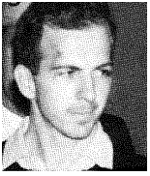
    Lee Harvey Oswald

    One of the key revelations of the documents was that the CIA tried to persuade mobster Johnny Roselli in 1960 to plot the assassination of the Cuban leader.

    The plan was for poisoned pills to be put in Mr Castro’s food, but it was shelved after the US-sponsored invasion of the Bay of Pigs failed a year later.

    Mr Castro has long accused the US, including President George W Bush, of plotting to kill him.

    In his editorial, Mr Castro also refers to the assassination of John F Kennedy, saying the US president was the victim of the CIA and anti-Castro Cuban exiles.

    Mr Castro says Lee Harvey Oswald could not have acted alone in killing the president.

    “You lose the target after every shot even if it is not moving and have to find it again in fractions of a second,” Mr Castro, himself an expert marksman, says.

    Mr Castro underwent intestinal surgery in July last year but in recent weeks his writings have been appearing more frequently.

    The abuses and illicit activities listed in the CIA report date from the 1950s to the 1970s.

    On Friday Cuba’s parliament passed a resolution stating that: “What the CIA recognises is not old history. It is present-day reality and the facts show it.”

  • The Official Story: Oswald Joins the Marines

    The Official Story: Oswald Joins the Marines


    oswald joins marines


    Oswald: “I’m a Marxist-Leninist. I don’t enjoy discipline. I want to join Castro’s revolution. Oh, and did I mention I’m learning Russian?

    Recruiter: “Son, you’re just what this country needs. Welcome to the United States Marine Corps!

  • Priscilla Johnson McMillan:  She can be encouraged to write what the CIA wants

    Priscilla Johnson McMillan: She can be encouraged to write what the CIA wants


    marina pjm
    Johnson McMillan (right)
    with Marina Oswald

    One of the witnesses used by Gus Russo and Mark Obenhaus to profile Oswald on the program was a woman named Priscilla Johnson McMillan (PJM). To the new generation of viewers, that is people born in the seventies and afterward, this rather old and wizened woman would not symbolize much. To those who have followed the JFK case since 1963, she symbolizes everything negative about those who report on the Kennedy assassination in the media, especially the foreshortened, myopic, restricted view of the almost superhuman complexities of the figure and phenomenon of Lee Harvey Oswald.

    Priscilla Johnson interviewed Oswald in 1959 while he was in Moscow and she was working for a small newspaper syndicate, North American Newspaper Alliance (NANA). On the weekend of Kennedy’s assassination, articles by her about Oswald appeared in several newspapers throughout America including The Boston Globe and The Dallas Morning News. Right after Oswald’s death she did an interview with The Christian Science Monitor. In April of 1964 she wrote an article for Harper’s entitled “Oswald in Moscow.” In June of 1964 she signed a contract with Harper and Row to produce a book about Oswald and his wife Marina, a book that would not be published for over ten years. At about this time, she was questioned by lawyers for the Warren Commission, namely David Slawson and Richard Mosk. All of these activities are quite interesting in their frequency and scope and consistent message. Perhaps no other writer, outside of the Warren Commission staff, had more influence in molding the image of Oswald for the American public than Priscilla Johnson.

    Up until 1967, no one really questioned who Johnson was or what she represented. Then something happened. The daughter of Joseph Stalin defected to the United States with the help of the State Department and the CIA. When Svetlana Stalin came to America she stayed in the home of Priscilla’s stepfather and PJM helped her translate her account of life with her dictator father. For those who realized at the time how high level defections worked, and who had access to prizes like Svetlana, all kinds of bells and flags went off about Priscilla and it began to throw backward light on her association with Oswald. For instance NANA had always been a highly suspect agency. It was purchased by former OSS operative Ernest Cuneo in 1951 and became home to prominent rightwing and CIA associated reporters like Victor Lasky, Lucianna Goldberg, and Virginia Prewett. Prewett’s husband was in the CIA and was handled by legendary CIA communications expert David Phillips. Finally, accruing even more suspicion to her role with Oswald, a former security officer for the State Department, Jack Lynch once wrote that Priscilla’s encounter with Oswald in Moscow was “Official business.”

    In this last regard, according to Peter Whitmey, the man who approached Priscilla about Oswald being at the Metropole Hotel in Moscow was John McVickar, who worked at the US Embassy. According to John Newman’s Oswald and the CIA, McVickar was working for the CIA also. (In 1990, PJM wrote Whitmey a letter asking him if he could remind her who McVickar was.) Much of what PJM told Mosk and Slawson was about her meeting with Oswald in Moscow so therefore it helped form their opinions of Oswald and helped shape the portrait of him in the Warren Report. In this regard it would have been important for Slawson and Mosk to know and report that Priscilla had altered her original 1959 report (published in a very small newspaper) after Kennedy’s assassination in a pejorative way. And this new version was published nationally. For instance she added a line at the end which referred to Oswald like this: “However I soon came to feel that this boy was of the stuff of which fanatics are made.” As Whitmey notes, in her first draft the image of Oswald is of a soft-spoken idealist who spoke in terms of “emigrating” as opposed to defecting. The word “fanatic” is much more in line with what the Commission is going to do with its image of Oswald as a disturbed young Marxist zealot. Whitmey also point outs two other revisions by PJM. According to McVickar’s notes, she was aware that Oswald was headed out of the hotel to work in the electronics field. She ignores this at the end of her 1963 revised article and says that he disappeared and did not notify her about it, against her wishes. The final statement in the second draft was “I’d wondered what had happened to him since. Now I know.” Since this second draft was published in the immediate wake of Kennedy’s murder, the obvious suggestion is that the fanatical tendencies — not in her original report — had warped him into an assassin.

    In her interview with The Christian Science Monitor, more details of this newly troubled Oswald emerge. PJM said that he was intensely bitter at the United States, that he displayed single-mindedness about “whatever he was attempting to do” and that he was bitter about capitalism and worker exploitation. In her Harper’s article she added even more pop psychology in her profile: “Oswald yearned to go down in history as the man who shot the President.” To explain why, if that was his intent, he then denied the act she wrote that he had a need to think “of himself as extraordinary” and “to be caught, but not to confess.”

    If this sounds very similar to what the Warren Commission’s explanation of Oswald was, it should. For right after the article appeared she did two things. She first signed a rather large contract with Harper and Row to do a biography of Oswald with help from his widow Marina. Second, she arrived in Dallas to meet Marina and spent much of the summer and fall with her and her Secret Service escorts. This in itself is extraordinary because Marina Oswald was one of the chief witnesses before the Commission and as Harold Weisberg and Peter Scott have reported, she was basically cordoned off from the world and threatened with deportation if she did not cooperate with their wishes. Yet, Priscilla was permitted to live with Marina during the summer and fall of 1964 when the Commission was still working and even accompanied her on a trip to Santa Fe, New Mexico.

    One of the most fascinating interviews the Commission had with Marina occurred on September 6, 1964 at the U. S. Naval Station in Dallas. Two things occurred here that relate to Priscilla. First, Marina revealed that she was working on her memoirs which would be published perhaps in December. This alludes to her book deal with PJM and Harper and Row. The second point is of such extreme importance to the Commission and to Priscilla’s role with it that it requires some background information.

    In September, the Commission was in high gear on its road to wrapping things up. In fact, at this stage, as related by Edward Epstein, the lawyers had been told that they should be closing doors not opening them. Yet Senator Richard Russell was a sticking point. He was a skeptic on both the single bullet theory and on Oswald’s mysterious trip to Mexico in September and October of 1963. He was actually threatening not to sign off on the Warren Report. Russell noted that in regard to the latter point, the Commission had little or no physical evidence that Oswald had been to Mexico City. So, miraculously, at this late stage, at one of the few hearings that Russell actually attended, an amazing discovery occurred. Marina reported that a bus ticket stub had been found inside a Spanish magazine and she further stated that she had “found the stub of this ticket approximately two weeks ago when working with Priscilla Johnson on the book.” What the FBI, CIA, Dallas Police, Ruth and Michael Paine, and the Secret Service could not produce in ten months, Priscilla Johnson could find in a matter of several weeks, and seemingly by accident.

    After the Warren Commission volumes were released in late 1964, one would have expected Priscilla to publish her book on the Oswalds. She did not. She first contributed to a book called Khrushchev and the Arts which was published early in 1965. She then helped Svetlana Allileuva Stalin translate her memoir on her father, Stalin. This book was also published by Harper and Row which might explain the delay and the publisher’s cooperation in it. Especially since the advance rights on the Stalin project had already been sold for over a million dollars. Much later, after going back to the Soviet Union, Svetlana had some interesting comments about her experience in America. Talking to a group of reporters she stated that “she had been naive about life in the U.S. and had become a favorite pet of the CIA.” She also said that she had not been been “free for a single day in the so-called free world.”

    In 1973, Priscilla and her then husband George McMillan wrote a glowing review for Warren Commission attorney David Belin’s recycling of his work entitled November 22, 1963: You Are the Jury. This review was published in The New York Times, which is the same body which published the book. Her husband also wrote a book on the murder of Martin Luther King entitled The Making of an Assassin. Needless to say that book is a completely one-sided view of the King case that uses character assassination to enforce a guilty verdict on James Earl Ray.

    Finally, in 1977, Priscilla’s book Marina and Lee was published. As with the discovery of the bus tickets in 1964, it is interesting to note the timing. From about 1975 forward, there had been a series of events that would eventually provoke a new investigation of the Kennedy assassination. In fact, in late 1976, the House Select Committee on Assassinations had been formed. So her book appeared right in the midst of that investigation. The publicity surrounding the book was immense. Priscilla did an interview with Publisher’s Weekly and the book was excerpted twice in Ladies Home Journal. Longtime CIA flack Thomas Powers heaped all kinds of praise on the book in his review in The New York Times. (Interestingly, Powers was working on his authorized and all too kind biography of longtime Kennedy nemesis Richard Helms at the time. On a show hosted by Phil Donahue in 1991about JFK, Helms appeared with PJM and asked her what had attracted Lee to Marxism in the first place.)

    Marina testified before the committee and when asked the last time she saw Priscilla she replied it had been the night before she appeared. Another interesting fact she revealed was how much control PJM had over the book: “I just contribute very little to the book. It was up to Priscilla to fish out all the facts and everything and put them together some way.”

    By this time period, the suspicions about who PJM really was had gone public. Jerry Policoff wrote an article about her for New Times which accused her of working for the State Department and also added that the Warren Commission had known this fact. Priscilla threatened to sue and said she had no knowledge of any such employment or the Warren Commission knowing of it. Yet prior to the publication of Policoff’s article, Mark Lane, in a public panel, had shown her the Warren Commission document which stated she worked for the State Department. She told Lane the information was a mistake she had failed to correct. At this same conference she is reported to have said, “I’ve devoted a lot of time to Oswald’s life, so I have a vested interest in his having done it.”

    After the seventies, Priscilla continued in her efforts to convict Oswald in the public eye. In 1982, she wrote an article for Martin Peretz’s magazine The New Republic about the attempted assassination of President Reagan by John Hinckley. In 1988, for CBS’s Dan Rather, she did an interview in which she concluded that one of the last words Oswald spoke to her in Moscow were, “I want to give the people of the United States something to think about.” Rather did not point out that this remark was not in either her original article published in 1959 in a New Haven newspaper nor in her revised one circulated in 1963. Further, it seems to insinuate that a) Oswald shot Kennedy, and b) He knew it four years in advance.

    Priscilla was interviewed by the House Select Committee on April 20, 1978 in executive session. She appeared with an attorney at her side. And she submitted a very detailed affidavit. These circumstances — the attorney and affidavit — were so unusual that Representative Floyd Fithian stated he was struck by the approach where he was presented “with almost a legal brief of the whole thing plus counsel, when you are obviously not a subject of investigation.” Interestingly, both the attorney and the affidavit were supplied by the law firm of Wilmer, Cutler and Pickering, David Westin’s law firm. During the following interview, to many questions, she replies that she does not recall certain details. Interviewer Michael Goldsmith, on page 31 of the transcript, asks her if she had been interviewed by the CIA after her third visit to Russia. She replies yes. But, at this point, nine pages of the transcript are withdrawn by request of the CIA. When Goldsmith confronts her with a letter from the CIA which shows she is cooperating with them on reviews of Russian writers for American publications the following dialogue occurs:

    Goldsmith: When was the first time that you saw it? [The letter]
    PJM: When I read my file of documents from the CIA which reached me on February 1st, 1978.
    Goldsmith: This, then, is a copy of a letter that was in your file that you received from the CIA, is that correct?
    PJM:Yes, Mr. Goldsmith.
    Goldsmith: Do you recall having written this letter?
    PJM: No, but now that I see it, I think that I wrote it.

    When Goldsmith asks the question of Priscilla, “What was Mr. McDonald [of the CIA] doing sending you materials?” there is another withdrawal from the transcript, this time of 23 pages. Later on when Goldsmith is questioning her about her attempted return to the Soviet Union in 1962, he asks her about a contact with the CIA and insinuates that she must have initiated the contact with the New York CIA station.

    Goldsmith: This is a relatively unusual incident in your life, is it not?
    PJM: Yes.
    Goldsmith: People do not have contacts at Grand Central Station, or wherever this was with CIA stations every day, do they?
    PJM: I have no idea.
    Goldsmith: This is an unusual incident, is it not?
    PJM: In my life, yes.
    Goldsmith: Despite the fact that this was an unusual incident in you life you are unaware of how the contact was initiated?
    PJM: I am unaware of it, yes.

    Other documents released by the Assassination Records Review Board reveal why Priscilla was so defensive. For instance, the 1962 meeting resulted in a series of contacts that make up a two page memorandum from Donald Jameson, Chief of the Soviet Russia division. He concludes his memo with the following, “I think that Miss Johnson can be encouraged to write pretty much the articles we want.” In 1964, the CIA called her for a meeting which lasted for seven hours. Another meeting took place in 1965 in which she called the CIA. From the declassified record, Priscilla seems to have been recruited in 1956, although she applied for service as early as 1953. In 1956 she was granted by the Office of Security an Ad Hoc Clearance through the status of “Confidential” provided that caution was exercised. Another document dated later in 1975 classifies her as a “witting collaborator” for the Agency. It appears that Priscilla had applied for work with the CIA prior to her 1959 interview with Oswald and was in clear contact with the CIA by the time of the assassination and was cooperating with them on various matters, including cultural assignments and the matter of Svetlana Stalin’s defection. This, of course, brings her work on Oswald into serious question and dubious reliability especially since she said in person that she has a vested interest in keeping his guilt alive. And also since she has tried to keep her covert ties secret.

    All this would have made a much more interesting program for ABC than Priscilla’s unreliable cliches which she has been spouting off since 1963. Russo was likely aware of her declassified files. Did he tell Jennings and Obenhaus? Did they want to hear? They certainly didn’t tell the public which, in CIA parlance, was unwitting to Priscilla’s duplicity.


    Mr. DiEugenio owes much of this information to writer Peter Whitmey and his three part article on Priscilla Johnson which ran in The Third Decade from 1991 to 1993. The articles are online at http://www.jfk-info.com/pjm-tit.htm, as part of Clint Bradford’s JFK Assassination Research Materials web site.

  • Posner in New Orleans: Gerry in Wonderland


    Listening to the media accompaniment surrounding the release of Gerald Posner’s 600 page volume Case Closed, one was reminded of the trumpet blare which sounded when the Warren Report was released 29 years ago. Reading US News and World Report, a usually staid and reserved publication, one would have expected an investigatory effort worthy of Scotland Yard or the Mossad. What emerges after all the sound and fury is an effort more comparable to the Dallas or Los Angeles Police Departments.

    Before getting to the main focus of this essay, one needs to comment on some general matters regarding Mr. Posner and his book. Reportedly, like John McCloy and Allen Dulles, Mr. Posner is a Wall Street lawyer. Based on three interviews with sources who read his previous book on Mengele, Posner whitewashed that notorious Nazi’s ties to the Hitler regime before his McCloy-aided escape to South America after World War II. This may help explain Posner’s quite questionable use of sources.

    About the first half of Case Closed deals exclusively with the life and careers of Lee Oswald. Like the Warren Commission and the five volume FBI report on the assassination, Posner’s focus is on Oswald and it is in extreme close-up since it is always easier to portray a man as a lone nut if you draw him in a virtual vacuum.

    But to rig the apparatus even further, Posner uses the most specious witnesses imaginable in his single-minded prosecutorial proceeding. Scanning his footnotes for the first ten chapters, a rough approximation would estimate that about 75% of them originate from the Warren Commission volumes. In turn, many of these citings come from the testimony of Marina Oswald who, as lawyer Posner must know, could not have testified at Oswald’s trial. Also, Posner never reveals to the reader how Marina was abducted and then stowed away at the Inn of the Six Flags Hotel and how she was virtually quarantined while she was being threatened with deportation. Posner never points out any of the problems and inconsistencies with her Warren Commission testimony, which even some of the Commission members had reservations about, and which a skillful defense lawyer would be able to exploit to great advantage.

    If that were not enough, Posner quotes liberally from the testimony of both Ruth Paine and George DeMohrenschildt, two people who — to say the least — have questionable motives in this case and both of whom have direct and indirect ties to the CIA. Again, Posner ignores those ties and actually states that DeMohrenschildt had no connection to American intelligence (p. 86), when the CIA admitted those connections over 15 years ago. Posner also uses Oswald’s “Historic Diary” against him when everyone, even Edward Epstein, admits that it was not a “diary” at all, but was composed in 2 or 3 installments, probably as part of Oswald’s cover as an espionage agent.

    Finally, Posner quotes liberally from the work of Priscilla Johnson McMillan, the newspaper correspondent who interviewed Oswald in Russia, then helped the Warren Commission find Oswald’s tickets to Mexico after the FBI could not. She then locked up Marina Oswald for 13 years with a book contract until Marina and Lee, the mother of all “Oswald-did-it” books, appeared in 1977. The working papers of staff lawyer David Slawson reveal that even the Warren Commission suspected Ms. McMillan had ties to the CIA.

    This is all prelude to what the author does when his book reaches the locale of New Orleans. Posner seems all too aware that the city and Oswald’s actions there in the summer of 1963 pose a serious threat to the main thesis of his book. Perhaps this is why his bibliography lists all of Harold Weisberg’s books except Oswald in New Orleans. For to admit that Oswald was associating with clandestine operatives like Clay Shaw, David Ferrie and Guy Banister poses a big problem for a man intent on painting Oswald as a demented communist zealot. Consequently, Posner shifts into a denial mode and sustains it by any means necessary.

    For instance, Posner begins Chapter 7 by stating that, according to Marina, Oswald was home early every evening for the couple’s entire stay in New Orleans. Posner has often stated that he had access to the late Jim Garrison’s files. If he did he would have found out that Oswald stayed overnight on more than one occasion in a room adjacent to the French Quarter restaurant, “The Court of the Two Sisters.” The room was arranged by a mutual friend of Shaw and Ferrie. Posner mentions that Oswald worked at Reily Coffee Company while in New Orleans but leaves out the facts of the Reily family’s connections to Cuban exile groups and the peculiar coincidence of Oswald’s colleagues being transferred from Reily to the NASA complex at nearby Michaud Air Force Base. Posner states that Oswald’s expenditures of nearly $23.00 on pro-Castro leaflets was not exorbitant even though it was about one-sixth of what he was making per month, or the equivalent of a man making $3,000 per month spending about $500 on political flyers.

    On page 157, Posner writes that the altercation between Carlos Bringuier and Oswald on Canal Street in August of ’63, which resulted in Oswald’s conspicuous arrest, was not staged. Yet he never asks the logical followup question: if it was not staged then why did Oswald write about it days in advance? Of William Gaudet, one of the CIA agents who escorted Oswald on his strange tour of Mexico, Posner writes that he had no relation to the case outside of being next to Oswald when in line to buy a tourist card for south of the border. He adds that Gaudet was a “newspaper editor.” Posner does not write that the newspaper Gaudet edited was a right wing propaganda sheet about South American politics, that one of his reporting duties was supplying infomation to the CIA, that one of the men he worked for earIy in his career was a business associate of Shaw’s, and that Gaudet had a virtually rent-free office in the International Trade Mart which was provided to him by Shaw.

    Posner frequently uses character assassination when he finds testimony contrary to his thesis. Orest Pena had stated to Harold Weisberg that he had seen Oswald at his bar, the Habana. That tavern was a frequent watering hole for Ferrie, Bringuier, Shaw, and other militant Cuban exiles. Posner states (p. 167), that Pena recanted his story at his first FBI interview and vacillated before the Warren Commission. Posner does not state that Pena was visited by both Bringuier and FBI agent Warren DeBrueys and warned about his official testimony. Posner tries to finish off Pena by adding that he was later charged with managing prostitutes out of his establishment and was aided in his legal defense by “leading conspiracy buff Mark Lane.” What he faiIs to add is that his legal problems came about after his testimony before the Warren Commission and that the charges were so weak they never came to trial.

    Posner’s most breathtaking balancing act relates to Oswald’s relationship with Ferrie and Banister. On page 143, he states that the many Civil Air Patrol cadets who testified to Oswald being in Ferrie’s CAP before he joined the Marines must be either mistaken or lying since Ferrie was thrown out of the CAP in the mid-fifties when Oswald was supposed to be in his unit. Posner’s blinders keep him from telling the reader that, at this time, Ferrie formed his own CAP unit in Metairie and it was this unit that Oswald was a member of. This information is available in the invaluable Southern Research Company investigation of Ferrie commissioned by Eastern Airlines during his dismissal hearings. These papers are on file at the AARC. Posner states he spent many hours there. Did he skip the Ferrie file? On page 428, Posner states that “there was no evidence that connected Ferrie and Oswald.” In Garrison’s files it is revealed that Ferrie stated this himself to two people — Ray Broshears and Lou Ivon. He also told them he worked for the CIA. If Posner needs further evidence of the Ferrie-Oswald friendship he should ask Gus Russo, whom he credits in his acknowledgments. Russo found a photo of the two together from a friend who knew the pair in Ferrie’s CAP.

    Posner’s efforts to keep Oswald away from 544 Camp Street have a touch of the ludicrous about them. He tries to discredit the reliability of every witness that places Oswald there: Delphine Roberts and her daughter, David Lewis, Jack Martin, Oswald himself and the HSCA. He portrays Roberts as off her rocker and says she now states she lied to Tony Summers in the late 70’s about Oswald being in Banister’s office. She says today that Summers gave her some money to appear on camera for a TV special and this is why she said what she did. Posner ignores the following: 1) Roberts told her story to Summers before he even mentioned anything about a payment; 2) on her own and without any promise of money, Roberts told essentially the same story to Earl Golz of the Dallas Morning News in a story that ran in December of 1978; and 3) her story about seeing a “communist” outside the office leafletting the area, telling Banister, and him laughing and saying that he was one of them is partly corroborated by an interview with a third party in Banister’s office at the time. Again this is in the Garrison files that Posner says he had access to.

    In his desperation to discredit anyone associated with either the Garrison or the HSCA investigation of the New Orleans part of the conspiracy, Posner occasionaly winds up swinging at air. On page 138, he writes that Gaeton Fonzi was the HSCA investigator on the issues of Banister, 544 Camp Street, and David Ferrie. He smears Fonzi and the validity of these reports by saying “he was a committed believer in a conspiracy.” Fonzi’s name does appear on the reports in Volume X of the House Select Committee appendices. But in those reports related to the New Orleans part of the investigation his name appears along with the names of Pat Orr and Liz Palmer. If Posner would have talked to any of these people before smearing Fonzi, he would have found out that Fonzi only edited the New Orleans reports. Orr and Palmer did the actual field investigations and original writing in these sections, something that Fonzi has no problem telling anyone. I know of no books, articles or interviews by Orr or Palmer which would show them to be a “committed believer in a conspiracy.” In fact, both have reputations for reserved judgment and objectivity.

    Posner’s depiction of the Clinton episode in the late summer of 1963 and which connects Shaw, Ferrie and Oswald epitomizes his stilted, fundamentally dishonest approach. He obtained some of the original memorandums made by the Garrison probe into the incident and attempts to show that since the eyewitness testimony does not jibe, then the witnesses are lying and therefore Garrison coached them into telling a coherent story at the trial. First, let us note that it is Posner in his section on Dealey Plaza who writes that eyewitness testimony to the same event often differs (funny how his standards constantly shift). Second, I would like to know if Mr. Posner asked Shaw’s attorneys — lrvin Dymond and Bill Wegmann — how they got these memos. But more to the point, Posner either doesn’t know or doesn’t think it important to inform the reader that the incident under discussion took place in two different towns. Oswald was first seen in Jackson, about 15 miles east of Clinton. Two of the witnesses who testified at the Shaw trial saw Oswald, or a double, in Jackson and in a different car than the one that appeared in Clinton later. Henry Palmer, one of the witnesses who talked to Oswald in Clinton — and it was Oswald there — interviewed him away from the voter ralIy, and did not get a good look at the car which contained Shaw and Ferrie. Oswald’s last appearance in the area was at the hospital back in Jackson where two personnel secretaries took his application for a job.

    What Posner does with all this is worthy of a cardsharp. By implying that all the elements — the car, the passengers, the rally, the witnesses — are in one place at one time, he tries to cast doubt on the witnesses and aspersions on Garrison’s use of them. It would be the equivalent of having a couple drive a different car into a service station, having a different car leave and go to another station, and then the original car returns with only the husband driving. Would we expect the two sets of witnesses to see the same thing? On the contrary, if they did we would have doubts about them. If this tactic would have seemed effective, wouldn’t Dymond and Wegmann have used it at the trial? Posner lists the transcript of the Shaw trial in his bibliography. If he really read it he would say that Dymond’s cross-examination of these people was quite gentle, he barely touched them. And when he tried to get tough, it backfired.

    Posner writes of Clay Shaw that no one knew him as Bertrand (pp. 430, 437). I have been about half way through Garrison’s files and related FBI files. There are 11 different references to Shaw as Bertrand. Posner passes out the old chestnut about Shaw being only a lowly “contract” agent who “like thousands of other Americans” was interviewed by the Agency about his foreign travels (p. 448). Posner does not state that Shaw filed 30 reports with the CIA over a six year period, that this relationship likely extended beyond the time period recognized by the CIA; that Shaw’s connections to the European front organizations Permindex and Centro Mondiale Commerciale are, to say the least, suspect, that in the August 1993 CIA release made available at the National Archives, a document reveals that Shaw had a covert clearance for a top secret CIA project codenamed QKENCHANT.

    This is too long to explore other related matters that Posner mangles. But let me briefly mention three of the “mysterious deaths” that Posner tries to set us straight on. On page 496, Posner insinuates that the death of Mary Sherman was neither mysterious nor relevant and that “she was killed in an accidental fire.” Like John Davis, he lists the year of her death as 1967. Mary Sherman died on July 21, 1964, the same day that the Warren Commission began taking testimony in New Orleans. Posner could have checked the local newspapers on this because her death made headline news for days after. To this day her case is listed as an unsolved murder by the New Orleans police. There was a small fire in her apartment and some smoke, but they were certainly not the cause of death. Her severed arm probably had more to do with it; along with her discarded yet blood-drenched gloves (think about that one), and also the hack marks made from a butcher knife on her torso.

    In the same section, Posner writes that there is no source for the claim that Gary Underhill was a former CIA agent, and “no corroboration that he ever said there was CIA complicity in the assassination.” I hate to plug my own work, but in Destiny Betrayed, Posner would have learned there are several sources for Underhill’s wartime OSS career and his later CIA consulting status, including Underhill himself. As for his accusations about the CIA and the murder of JFK, he related them quite vividly to his friend Charlene Fitsimmons within 24 hours of the shooting. She then forwarded a letter to Jim Garrison relating the incident in detail.

    On the same page in which he discusses the Underhill case, Posner describes the murder of Mary Meyer in two sentences: “Mary Meyer (murdered) was allegedly one of JFK’s mistresses. Except for her reported liaison with the President, she was not associated with any aspect of the case.” Posner does not include Katherine the Great by Deborah Davis in his bibliography. If he would have read it he would have learned that Mary Meyer had been married to former CIA counterintelligence officer Cord Meyer. That several acquaintances stated that Kennedy was quite taken with the pretty and bright Meyer. And that since she had been married to a CIA officer, he confided in her about his plans to reorganize the Agency in his second term. Needless to say, the poor wretch accused of her murder was acquitted on weak evidence.

    I have only dealt with a small part of Posner’s work. I am sure if other specialists critiqued it they could come up with similar summaries in other fields of evidence. Suffice it to say that when an author evinces these kinds of tendencies, all exculpative of the CIA, all incriminating of Oswald, one has the right to question his bona fides. Posner is this year’s version of the Breo and Lundberg show. And again the media has heralded him without a critical eye. Upon scrutiny, his work, like JAMA’s is revealed to be a sham, maybe worse. And as with JAMA, two people are contemplating lawsuits against Random House and Mr. Posner. No doubt, the press will ignore the progress and revelations of those lawsuits.

    For the rest of us, the ones who care enough to be serious, the struggle to reopen this case continues. No matter how many Moores, Breos, and Posners come down the trail, we must never lose sight of that aim. Perhaps then we can swear in Mr. Posner and ask him who exactly were the CIA confidential sources he consulted and why — 30 years after the fact — they still demand anonymity?

  • Gus, Will You Please Make Up Your Mind?


    Gus Russo has been at work on the JFK case for the past 15 years. To those around him, he has jumped around in his conclusions quite frequently and violently. So much so, that it is hard to measure what he really believes about this case and why or why not. This is particularly puzzling because since 1998 there have been approximately 2 million pages of new files that have been released by the Assassination Records Review Board. Many of these new documents have been very important in resolving disputes that have existed for a long time. For example, Chief Counsel Jeremy Gunn’s investigation of the medical evidence — that is, the interviews he conducted with some very important people at President Kennedy’s autopsy in Bethesda, Maryland — are extraordinarily illuminating to anyone seriously investigating a homicide. Yet, if one examines Russo’s book there is not a mention of them in the entire text. This is important for what it tells us about the book and Russo, but also because it tells us why Russo arrived at where he did on his long and digressive and interesting journey.

    In the late 1980’s Russo was friendly with Boston area researcher Edgar Tatro. (This relationship would be sustained up until the issuance of JFK: The Book of the Film. Russo worked on this book with Oliver Stone’s chief researcher, Jane Rusconi. He promised Tatro he would be credited prominently in the book since he called him many times for information. Tatro was not mentioned as often as he should have been and this began their split.) As anyone who knows him will attest, Tatro is a prime proponent of the school that Lyndon Johnson was behind the John Kennedy assassination. At this time, Russo befriended Tatro and asked if he would be willing to take a sabbatical from his educator’s position to serve as the consultant to a documentary film he was proposing to several financial backers. According to Tatro, Russo actually got as far as presenting the idea to these backers, but for some reason the proposal fell through. So, one could assume that since Russo was pushing this idea he probably believed it. But wait.

    In the early 1990’s the word got out that Oliver Stone was producing a big-budget film based on Jim Garrison’s book, On the Trail of the Assassins. Now anyone who knew Garrison, or his publisher, Sheridan Square Press, would know that the book had to propose that the Central Intelligence Agency —especially the so-called Old Boys Network within it — was the main perpetrator behind the Kennedy assassination. At this time, Russo was investigating the shadowy European trade company PERMINDEX, of which Clay Shaw was a member. He was also extolling the fact that he had outfoxed a clerk at the National Archives and had listened to a previously classified tape of the so-called Fenton Report. This referred to a suspect in the Garrison investigation who had been tracked down by House Select Committee investigators Cliff Fenton, Bob Buras, and L. J. Delsa and had discussed his role in an apparent meeting, and other actions, at which the murder of JFK had been discussed. As mentioned above, Stone later hired Russo to help Rusconi produce the book which contained much of the backup material for the screenplay. So many deduced from all this that Russo believed the CIA was the prime force behind the killing of Kennedy. But wait.

    At a conference in Dallas in 1992, Russo discussed the story of Delk Simpson, a military officer who had been mentioned by writer Robert Morrow and had been pursued reportedly by attorney Bernard Fensterwald. He actually made a presentation with former military intelligence analyst John Newman. Newman’s book JFK and Vietnam mainly blamed the military for the intelligence deception that Kennedy had seen through when he decided that the U.S. would have to withdraw from Vietnam. So now people assumed that Russo had shifted gears and thought the assassination was led by the military with perhaps a hand from the CIA. But wait.

    A year later, at a conference in Chicago, Russo now ridiculed the idea that Oswald could have been an intelligence operative. This basically knocked out the idea of a military-intelligence type of conspiracy. He now said that the research community should be following leads that pertained to the Mafia and the Cuban exile community. Sort of what people like Robert Blakey — Chief Counsel of the House Select Committee on Assassinations — may have proposed today. Yet, at the same time, someone read him his blurb for Robert Morrow’s final book on the case, First Hand Knowledge. Russo essentially said that he stood by the positive blurb. The problem here was that Morrow’s book included a conspiracy of the Mafia, the Cubans and the CIA, which was led on the ground by Clay Shaw. So perhaps now Russo was advocating a kind of “grand conspiracy” theory crossing through two or three different structures. But wait.

    In the same year, Russo was one of the two reporters on the PBS Frontline special, “Who Was Lee Harvey Oswald?” This show was erratic and unfocused yet by the end it clearly went along with the verdict of the Warren Commission, i.e. that Oswald did it alone. Was Russo now throwing all his years of hunting for an antidote to the Warren Commission away? Was he now embracing the thoroughly discredited Warren Commission? It appeared that way. But wait.

    In 1998 Russo penned his book which was supposedly based on the declassified files of the ARRB. Now he twisted the Warren Commission thesis a bit. He now seemed to be saying that Oswald was not really a demented sociopath, which is what the Warren Commission leans on. He now seemed to be saying that he was manipulated by agents of Fidel Castro into believing that Kennedy felt that Castro’s regime had to be removed. The pro-Castro Oswald could not stomach that thought and he did what he did in Dealey Plaza.

    If you have been counting, depending on what you make of Russo’s performance at the Chicago Conference, that is either six or seven camps that Russo has been in. Yet he discounts each step of his Pilgrim’s Progress. He forgets his previous beliefs as quickly as a good cornerback forgets the 70 yard touchdown completed over his head. This is OK for football, but it is not OK for investigative journalism which tries to build an edifice that recognizes and tries to reconcile into an understandable paradigm all the evidence about a complex and important event. There is no sign of this in Russo’s work. Or else he would not have ignored the vital medical evidence mentioned above. What makes it even worse is that Russo does not even mention his previous beliefs today. For instance, it is difficult to find anywhere where he mentions that he worked on the Stone book with Rusconi. The only way one can find out about the LBJ phase is through Tatro. No one can recall him mentioning it at any talk he gave at a national researcher’s conference in the nineties.

    The natural question is: Did he believe any of these himself? Or when he found he could not find a foolproof theory did he then decide that it was easier and more lucrative to side with the Establishment and the Warren Commission, knowing that people like Peter Jennings and David Westin would never divulge his past conspiracy delvings, or maybe not even ask about them?

    Unfortunately for Jennings and Westin, some people knew Russo way back when he was a musician, before Jennings and Westin started flying him around the country first class for their “exhaustive” and “irrefutable” investigation.

  • ABC Lies

    ABC Lies


    aaf 9


    lho

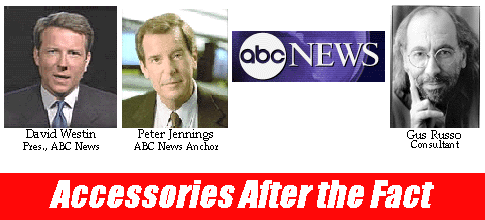
     Why did David Westin and Peter Jennings hook up with Gus Russo for November 22, 2003? In order to keep the myth alive about this man:


    Introduction

    The following articles are meant to examine and explore the relationship between the three men above and the 40th anniversary of the Kennedy assassination. How did it come to pass that ABC President David Westin, the late Peter Jennings, and writer and researcher Gus Russo met, approved and then decided to concoct a huge deception that is meant to recycle and resuscitate a forty year old lie that very few people believe? We try to do that here in order for the reader to fully understand what and why ABC did on November 20, 2003.

    We trace and describe some previous network specials on the subject and how they were influenced and controlled by high officials inside and outside the government. Former Warren Commissoner John McCloy exerted enormous influence over a four-part 1967 CBS special on the assassination itself, and the CIA and Sarnoff family (owners of NBC at the time) had direct ties to a 1967 NBC special on Jim Garrison. We also trace the recent history of ABC, especially the momentous event that Andy Boehm and Jim DiEugenio describe in the 2003 Introduction and original 1987 article entitled “The Seizing of the American Broadcasting Company.” This piece describes in detail an example of how the government can influence what is shown — and not shown — on the broadcast airwaves that are theoretically controlled by the citizens of this country. We suggest the reader examine this bloc of articles first.

    We then move on and show as directly as we can how ABC came to the lamentable decision to produce a documentary that is simply insupportable by the facts, circumstances, and evidence. This bloc of articles includes a profile of ABC News President David Westin — how he came to power and how his regime has differed markedly from his legendary predecessor Roone Arledge. We then describe the career of a reporter who sets a paradigm and precedent for ABC’s actions on this case, reporter John Stossel who, although billed originally as a consumer advocate, is something short of that. We then examine aspects of the career of the chief consultant on this special, Gus Russo: his career in the Kennedy research field, his differing beliefs at times, and his dubious claim of a Pulitzer nomination. We then connect Russo to the main players behind the November 20th special, Jennings and Mark Obenhaus. We do this through the previous production of theirs based upon the controversial and specious book by Seymour Hersh, The Dark Side of Camelot.

    Finally, we begin to dissect some of the work of Russo and his friend Dale Myers, upon whom ABC has relied. We especially try to examine the work of Myers on the computer simulation he has had for sale for many years, and Russo’s work on the most important aspect of any murder case, the medical and autopsy evidence. These are the most important aspects of any serious inquiry into a murder case. If those conclusions are faulty, everything that follows from it must be wrong.

    The questions we ask here are two quite serious ones. Did ABC, through Westin, Jennings, and Obenhaus rig the deck to arrive at a preconceived conclusion? And if they did, why did they?

    But also, through this detailed inquiry we hope to posit some wider, broader, more universal queries about the media itself. Is it possible for any huge network which works so closely with the government to be expected to tell the truth about any highly controversial and influential event in which it plays a controlling role? Who do people at the top of the network ladder serve today? And if they do not serve the public, what alternative does the public have in pursuing factual truth about these events? And does this pursuit of facts not available through the mainstream media, automatically place them in opposition to the media and the government? The exploration of those questions based on accurate information are meant to encourage a democratic debate about the state of our media today.

    Articles

    The Networks and the Politics of the JFK Case This link leads to several articles demonstrating the media’s shoddy history in covering the JFK case:

    JFK: How the Media Assassinated the Real Story exposes the media’s shameful performance in the decades since President Kennedy’s assassination.

    Shoot Him Down: NBC, the CIA and Jim Garrison examines NBC’s hatchet job on then-Orleans Parish District Attorney Garrison when the DA’s assassination investigation was in full swing.

    Why ABC? A group of articles examinating ABC and some of those associated with the ABC News special.

    Gus Russo Articles examining ABC’s chief consultant, and a surprising turn by Arlen Specter.

    These Are Your Witnesses? An analysis of Peter Jennings and his witnessess, and what ABC did not disclose about them and why.

    The “irrefutable” Mr. Myers Critiques of Dale Myers’ “irrefutable” computer simulation.

  • James Jesus Angleton and the Kennedy Assassination, Part 2


    From the September-October 2000 issue (Vol. 7 No. 6) of Probe


    Bobby knows so little about us. One night he began to talk of muffled suspicions and stifled half-certainties, and said to me, “I had my doubts about a few fellows in your agency, but I don’t anymore. I can trust John McCone and I asked him if they had killed my brother, and I asked him in a way that he couldn’t lie to me, and he said he had looked into it and they hadn’t. 

    I told that story to Hugh. You know how rarely he laughs aloud. He actually struck his thigh. “Yes,” he said, “McCone was just the man to ask.” 

    “What,” I asked him, “would you have answered?” 

    “I would have told Bobby that if the job was done properly, I would not be able to give a correct answer.” 

    – From Norman Mailer’s novel Harlot’s Ghost. (The character of Hugh Montague (Harlot) is based on James Angleton)


    The most consistently prominent players in the assassination saga continue to be James Jesus Angleton and his counterintelligence staff. They held a file on Oswald predating the assassination by at least three years. After the assassination, Angleton and his closest associate, Ray Rocca, served as the gateway between the Warren Commission and the CIA. If anyone was in a position to move Oswald around prior to the assassination and control the cover-up afterwards, it was Angleton.

    The key associates of Angleton who show up frequently in the Oswald/JFK assassination story are Raymond G. “The Rock” Rocca, Ann Egerter, Scotty Miler, and Birch O’Neal. Rocca had been with Angleton since his OSS days in Italy, and would control the Warren Commission’s relationship with the CIA. The latter three were members of the tiny CI/SIG unit. Egerter opened Oswald’s 201 file under the name “Lee Henry Oswald.” Scotty Miler controlled the watch list during the period when Oswald was placed on and taken off that list. Birch O’Neal controlled CI/SIG during the period of the building of Oswald’s strange 201 file.

    In Part I, we examined the likelihood that Oswald was directly involved with Angleton’s counterintelligence unit in the CIA. When queried about this, Anne Goodpasture, who played a role in the Mexico City aspects of Oswald’s story, did not deny a relationship between the two:

    Q: Have you had any reason to believe that…CI staff had any role in respect to Oswald prior to the assassination?

    A: I don’t know.1

    She was not asked if she had any knowledge, but if she had any “reason to believe.” If she truly had no reason to believe this, her only possible response would have been “no.” Her response indicates clearly that she does have some doubt about the matter, that she may indeed have had reason to believe this.

    Another group that shows up in a few places in the assassination story is Army intelligence. It is worth noting that, during the interim between the ending of the OSS and the formation of the CIA, Angleton served as a major in the Army and helped organize Army Intelligence’s efforts to track down German agents who were using false identity cards.2 Angleton was not one to lose a contact. Once made, he would continue to use contacts for life.

    Other CIA people who show up often in this story include David Atlee Phillips of the Western Hemisphere division, who worked with Bill Harvey and later Des Fitzgerald on Cuban operations; Win Scott and his “right-hand man” Anne Goodpasture from the Mexico City station; John Whitten (“Scelso”) of the Western Hemisphere, Division 3; Charlotte Bustos of the Mexico City desk at Headquarters; and Richard Helms and his deputy Thomas Karamessines, who play large roles in the pre- and post-assassination paper trail. We should also note that the entire Western Hemisphere was run by J. C. King, a man closely linked to Nelson Rockefeller. King himself had been involved in the CIA’s assassination plots involving Castro and Trujillo.3

    Interweaving Mexican Threads

    There are strange connections that link these various players. Shortly before the assassination, Oswald’s CI/SIG-held 201 file was transferred to the Mexico City Headquarters desk, responsible to John Whitten and supported by desk officer Charlotte Bustos. (Bustos is identified as Elsie Scaleti in the Lopez Report.4)

    Bustos, Ann Egerter of Angleton’s CI/SIG unit (the woman who opened the 201 file on “Lee Henry [sic] Oswald”), and Stephan Roll, Angleton’s CI liaison to the SR (Soviet Russia) division, drafted the two now infamous communications that cause much suspicion of the CIA’s involvement in the Kennedy assassination.5 Although the two communications were drafted at the same time, the cable to CIA in Mexico City describes Oswald as 5’10”, 165 pounds, with light brown hair; whereas the teletype to the State Department, Navy and the FBI describes Oswald as being approximately 35 years old, 6′ tall, with an athletic build and a receding hairline. Why would Angleton’s people be collaborating with the Mexico City desk officer to mislead other agencies within the government unless they were in some measure trying to hide or protect Oswald’s identity?

    Immediately following the assassination, Bustos allegedly found a photo of Oswald from the CIA’s Mexico City surveillance operations. Phil Agee, Joseph Burkholder Smith, Daniel Watson, and Joseph Piccolo, all CIA employees at some point, recalled hearing aboutóand in the latter two cases, actually viewingósuch a photo. According to Agee, Bustos found the photo within an hour or two of the President’s assassination. John Whitten said of Bustos that she had a “fantastic memory” and yet, like E. Howard Hunt, Bustos cannot recall what she was doing the day of the assassination.6 But Anne Goodpasture is the person who supplied the photo the CIA showed to the FBI as a possible picture of “Oswald”. (Curiously, Goodpasture said in an unsworn ARRB interview that headquarters refused to send a photo of Oswald to Mexico City, and she was never sure why.7 Of course we know from Oswald’s CIA file that indeed news clippings from his defection with his photo were present, so the CIA did have a photo of Oswald to share, and could also have easily obtained more had they asked the Navy or FBI.)

    If Bustos had found a photo, another question is raised. Was Bustos’ picture a true picture of Oswald? Or was it a picture of just another person who was not Oswald? If Bustos’ picture was of Oswald, for the CIA to have supplied Goodpasture’s “Mystery Man” photo in place of the real photo suggests a deliberate effort to deceive. In that case, Bustos’ picture would have to have been “disappeared” by the agency, lest the evidence of their deception come to light. And if Bustos’ picture was not Oswald but another man who looked like him, that also suggests a deliberate effort to deceive, as the picture was shown to at least two others within the CIA as evidence that Oswald had been in Mexico City, a point which has never been fully proven. To date, the CIA has taken the only safe road available, claiming (despite multiple accounts to the contrary) that no such picture was ever found.

    Anne Goodpasture told Jeremy Gunn of the ARRB that she had worked at one point during her CIA career for James Angleton as a counterintelligence officer, and that it was the CI group that sent her to Mexico City in 1957.8 Asked to explain the difference between CE (counterespionage) and CI (counterintelligence), Goodpasture replied, “Counterespionage was the activity and Counterintelligence was the product.”9

    From Mexico, Goodpasture had worked on the case of Rudolph Abel,10 a Soviet agent working in New York City and curiously, living one apartment below famed author, FPCC activist and latter-day CIA apologist Norman Mailer.11 Angleton said of Goodpasture, “I personally have had very little dealings with her but my men had had a lot of dealings with her. She was always in on very sensitive cases.”12 Goodpasture was also involved with Staff D, which was seriously involved with several coup attempts and assassination plots. To the ARRB, Goodpasture downplayed her involvement in Staff D, claiming that she was simply involved in duplicating and distributing materials.13 However, according to Angleton, Goodpasture was “very close” to Bill Harvey.14

    Goodpasture maintained that in 1963 her sole duty was to the Mexico City station and Win Scott.15 Goodpasture tells us that Win Scott was “very, very conservative. He was from Alabama and I think he was a supporter of George Wallace.”16

    Goodpasture was later to receive a career achievement award on the recommendation of David Atlee Phillips, who cited her for having discovered Oswald at the Cuban embassy. Goodpasture was responsible for delivering the “deep snow”17 photo of the Mexico “Mystery Man”. Significantly for our purposes, Goodpasture was also the liaison and in most cases, the sole point of contact, outside of Win Scott, David Phillips, and Scott’s deputy, Alan White, to the other agencies of the U.S. government regarding the Mexico City station’s CIA operations.18 And like too many others in this small cadre of CIA employees, Goodpasture has trouble remembering the moment of Kennedy’s assassination:

    I think I heard about it from a phone call from our outside person on the phone tap operation, and I believe it was around lunchtime when there weren’t too many people there and as they all filtered back in, there was office gossip, but I have tried to remember. I’ve heard so many people say I can remember, I was standing at the telephone or I was in the drugstore, or I was in church and I really don’t remember who all were there at the time. Dave Phillips said that someone from the military attaché’s office came up and told him about it and I don’t remember that….I don’t even remember him being in the station at that time.19

    According to Eddie Lopez, Goodpasture, in addition to her duties for Scott, ran all of David Phillips’ operations. When asked about Phillips’ politics, Goodpasture tells a story that remains redacted, a fact especially disturbing when one considers the whole purpose of the ARRB was to release previously classified materials, not to add to the secrets. But from the nature of the testimony around the redacted portion, we can gather that she is giving us some indication that Phillips was not the liberal he painted himself to be. The redaction ends with Goodpasture saying,

    …but there again, I hate for things like this to be published because there are 2,000 – over 2,000 books already been [sic] written. The thing that they are looking for is something of this type that they can put in the other book to come that will be just short of slander, and I feel that I shouldn’t really comment on the personalities for that reason. I don’t want my former co-workers or in Phillips’ case, his family, to think that I’m trying to project him as a personality that was a show-off or something other than the very sincere wonderful man that they feel that he is….20

    Phillips is the CIA man who most closely ties Angleton in the frequency of his appearance in the assassination story. Phillips appears to have been seen in the presence of Oswald by Antonio Veciana.21 And a “Mr. Phillips” who was running CIA operations against Cuba at a time when that was David Phillips’ job was seen by Gordon Novel in the presence of Guy Banister and Sergio Arcacha Smith, who were themselves in turn seen with Oswald. Oswald even rented an office in Banister’s building that had previously been rented by Sergio Arcacha Smith.22 When the HSCA investigators tracked down the many false “Castro did it” leads, they kept tracing back to assets run by Phillips.23 Dan Hardway, who had much documentation to support that allegation, told Gaeton Fonzi,

    I’m firmly convinced now that he ran the red herring, disinformation aspects of the plot. The thing that got him so nervous was when I started mentioning all the anti-Castro Cubans who were in reports filed with the FBI for the Warren Commission and every one of them had a tie I could trace back to him. That’s what got him very upset. He knew the whole thing could unravel.24

    Angleton was close friends with Win Scott and ran operations with him. Scott, in turn, was so close to Phillips that he recommended Phillips be his deputy in the Mexico City station while waiting for the next Deputy, Alan White, to arrive.25 Phillips, in turn, connects to JM/WAVE.26 JM/WAVE is another key component in the assassination story, because JM/WAVE trained assassins and participated in some of the plots against Castro. The line between Des FitzGerald’s Special Affairs Staff (the replacement for Harvey’s Task Force W) and the actions of JM/Wave is blurred. The weekend of the Kennedy assassination, John McCone’s executive assistant Walt Elder saw Fitzgerald, and FitzGerald told Elder he had met with Rolando Cubela. He did not tell him that he had given him a poison pen to be used against Castro, nor that he had pretended to be an emissary of Bobby Kennedy’s (Helms had told him not to worry, that he would approve that lie). No mention of assassination was made. But Elder had the distinct impression that FitzGerald was particularly upset that weekend. Evan Thomas, in his book The Very Best Men, painted the following scene:

    Elder was struck by FitzGerald’s clear discomfort. “Des was normally imperturbable, but he was very disturbed about his involvement.” The normally smooth operator was “shaking his head and wringing his hands. It was very uncharacteristic. That’s why I remember it so clearly,” Elder said in 1993. He thought FitzGerald was “distraught and overreacting.”

    Des Fitzgerald’s wife told author Evan Thomas that the first and last time she ever saw her husband break down in tears was when Oswald was shot by Jack Ruby. Her husband had been upset from the moment of the assassination, and sat silently, watching the news along with millions of others around the globe. When Jack Ruby performed his deed, Fitzgerald began to cry, and said, somewhat cryptically, “Now we’ll never know.”27 Thomas evidently thinks this has something to do with Cubela. But does it? Cubela later turned out to be a double agent. But when was that known? Was the CIA trying to provoke Castro, knowing Cubela was his agent and planning a plot with him? Was the CIA engaging in a true assassination plot, or a deception they could later refer to in Castro-did-it scenarios?

    Angleton’s Back Channel?

    If one was planning an assassination within CIA, wouldn’t it make sense to take some precautions as to what was communicated, and through what channels? We saw in Part I of this article how Bill Harvey stressed, “never use the word ‘assassination’” and that nothing should be put on paper. But some communications need to transpire nonetheless to pull an operation of that scale off. According to Anne Goodpasture, Angleton had a back channel to Mexico City, and possibly other stations as well:

    Q: Could you describe the different kinds of channels of communication that Mexico City had with CIA headquarters, and by that I mean cables, dispatches and that sort of thing, if you needóif Mexico City station needed to communicate with headquarters, what would be the different methods that could be done?

    A: Well, there would be cables, there would be dispatches, there would be intelligence reports, there would be attachments, I can’t think of anything else.

    Q: For cable communications, was there more than one channel of cables used by CIA to go to headquarters?

    A: I can’t really answer that but I think there was what they call back channel [sic], but I don’t know the details of it. There again Mr. [Alan] White [, Scott’s deputy in the Mexico City station] would be the more knowledgeable on that than I am or someone from communications.

    Q: Have you heard, for example, that CI may have had a back channel, not just in Mexico City but in other stations as well?

    A: Well, there’s gossip that I think I have seen or have heard or I don’t think I dreamed it, that they discussed things through the back channel, but I’m not sure what that was. You might checkóMr. Helms would be the person who would know.28

    So Angleton appeared to have a private channel he could use with Scott and presumably other areas around the world to communicate traffic too sensitive to be seen even by other sworn CIA operatives. And Helms knew about these.

    The rest of this article can be found in The Assassinations, edited by Jim DiEugenio and Lisa Pease.

    Notes

    1. Anne Goodpasture ARRB Deposition, December 15, 1995, p. 90.

    2. Tom Mangold, Cold Warrior (New York: Simon & Schuster, 1991), p. 41.

    3. Gerard Colby and Charlotte Dennett, Thy Will Be Done (New York: HarperCollins, 1995), pp. 325, 348, 354, 738-740.

    4. Compare the Mexico City Report by Eddie Lopez and Dan Hardway (hereafter called the Lopez Report), p. 109, with the quote from the deposition of “Scelso”, now known to be John Whitten (hereafter known as the Whitten deposition), p. 31. In both she is described as “sort of the Major Domo of the Branch.”

    5. Bustos’ involvement is related in the Lopez Report, and Roll’s involvement is revealed in John Newman, Oswald and the CIA (New York: Carroll & Graf, 1995). Egerter’s involvement is noted in both.

    6. See “Who’s Running the Country” by Lisa Pease in the Vol. 4 No. 2 (Jan-February, 1997) issue of Probe for sourcing. The allegation and investigation of Bustos’ photo is investigated in the Lopez Report.

    7. Anne Goodpasture ARRB Interview (unsworn, not her deposition), April 23, 1998, p. 9.

    8. Goodpasture ARRB Deposition, pp. 9, 10.

    9. Goodpasture ARRB deposition, p. 12.

    10. Goodpasture ARRB deposition, p. 37.

    11. Mark Riebling, Wedge (New York: Alfred A. Knopf, 1994), p. 145-146.

    12. James Angleton HSCA deposition, October 5, 1978, p. 157.

    13. Goodpasture ARRB deposition, pp. 13, 15.

    14. Angleton HSCA deposition, p. 157.

    15. Goodpasture ARRB deposition, p. 22.

    16. Goodpasture ARRB deposition, p. 57.

    17. “Deep snow” was the term given to this photo by David Phillip’s friend, the FBI Legal AttachÈ in Mexico City, Clark Anderson. See the FBI memo from SA W. R. Heitman to SAIC, Dallas, dated 11/22/63 (released in 1994).

    18. Goodpasture ARRB Deposition, pp. 19-20.

    19. Goodpasture ARRB Deposition, p. 28.

    20. Goodpasture ARRB deposition, p. 59.

    21. See Gaeton Fonzi, The Last Investigation (New York: Thunder’s Mouth Press, 1993) (much of the book is devoted to this topic), and Anthony Summers, Not In Your Lifetime (New York: Marlowe & Company, 1998), pp. 370-371.

    22. Gordon Novel’s Playboy deposition.

    23. Fonzi, pp. 292-293.

    24. Fonzi, p. 293.

    25. Goodpasture ARRB deposition, p. 54.

    26. Goodpasture ARRB deposition, p. 54. Goodpasture confirmed that Phillips had liaison between Mexico City and JMWAVE.

    27. Evan Thomas, The Very Best Men (New York: Simon & Schuster, 1995), p. 308.

    28. Goodpasture ARRB deposition, pp. 39-40.

  • James Jesus Angleton and the Kennedy Assassination, Part 1


    From the July-August 2000 issue (Vol. 7 No. 5) of Probe


    “[I]f intelligence-gathering agencies are as necessary as I believe them to be, then they must repay our blind trust and acknowledge that there may always be moments in all secret organizations when tyranny manages to slip its leash. “This was one of those occasions.”1


    August 12, 1990, was a very big day for Susan Hendrickson. While looking at a cliff in South Dakota, she saw something no one else had noticed before. Where others had seen only a sheer wall of rock, she thought she saw something more special. In the wall of a cliff, she found the outline of a skeleton that proved to be of enormous importance. The skeleton this amateur paleontologist discovered now bears her name, Sue, in Chicago’s Field Museum, and is the largest and most complete skeleton of a Tyrannosaurus rex ever found. From an outline, Sue helped reconstruct the past.

    After a succession of ever more interesting file releases from the National Archives regarding the Kennedy assassination, it’s time we started recognizing the outline of one of the biggest skeletons in our national closet, the outline of the Kennedy assassination conspiracy. Each new release fits into one cohesive picture. And no single figure is more prominent in this outline than the man who headed the CIA’s counterintelligence unit for 25 years, James Jesus Angleton. It was in his realm that a secret, restricted file on a man named Lee Oswald was opened, long before the assassination. History professor and former intelligence analyst John Newman has deemed this curious item “the smoking file” because the lies related to it are so serious as to suggest the CIA had much to do with Oswald’s activities just prior to the assassination of President Kennedy, something the CIA has consistently denied. What was the nature of that involvement and how far did it reach? One cannot answer that without examining the near omnipresence of Angleton in all matters surrounding the assassination. Over this two-part series, we will explore how Angleton and his associates are present at every twist and turn in this case, both before the assassination and after.

    Background

    James Jesus Angleton was the son of James Hugh Angleton, an NCR executive who had once participated in General Pershing’s pursuit in Mexico of Pancho Villa, and Carmen Moreno, a Mexican woman. He grew up in Boise, Idaho and later Dayton, Ohio, where NCR was headquartered. At the age of fourteen, his family moved to Milan, Italy (where NCR manufactured cash registers). Angleton spent summers at British prep schools and Malvern College. He participated in international Boy Scout Jamboree events in Scotland, Hungary and Holland. Angleton biographer Tom Mangold indicates that when the Nazis took over the Boy Scouts in Germany, Angleton made friends with some anti-Nazi leaders and carried their letters back to the founder of the international Boy Scout movement in England. Both father and son would serve the OSS. Angleton’s father was described by Max Corvo, a top OSS officer in Italy, as “ultra-conservative, a sympathizer with Fascist officials. He certainly was not unfriendly with the Fascists.”2

    When he reached college age, Angleton attended Yale, where Angleton first showed a pension for staying up all night. Insomnia was to plague him most of his life. Although many who knew him described him as “brilliant,” Angleton’s record at Yale was undistinguished; during his junior and senior years he received two F’s and four D’s, and ended up withdrawing from another class relating to his major, English. But Angleton managed to impress teachers with his mysteriousness, his apparent maturity, and his self-assurance.

    Angleton took a serious interest in poetry and, with Reed Whittemore, co-edited the poetry magazine Furiouso, which included poems by e e cummings and Ezra Pound, among other notables. Because of his interest in this area, he was to be called by some the “Poet-Spy.”

    After graduating in the lowest 25% of his class, Angleton enrolled at Harvard Law School. According to Mangold, “Angleton’s move to Harvard was not the consequence of any strong ambition to study law. Rather, like many young men at the time, he was putting his future on hold.” During his Harvard period, Angleton met and married his wife, Cicely D’Autremont. The marriage took place a few weeks after Angleton had been drafted into the Army. Shortly thereafter, through the combined efforts of his OSS father, and his former Yale English professor Norman Pearson, then heading up the OSS Counterintelligence effort in London, Angleton was transferred to London to study Italian matters for X-2, the OSS counterintelligence component.

    It was during this period that Angleton met Kim Philby, the man who would become every counterintelligence officer’s nightmare. Philby rose to a position of great influence in the British intelligence service, until he was finally exposed as a Soviet agent and fled behind the Iron Curtain. Angleton was devastated by this, despite having been warned by Bill Harvey at an early time that Philby looked like a mole.

    In October of 1944, Angleton was transferred to Rome as commanding officer of Special Counterintelligence Unit Z, a joint American-British detachment. Less than half a year later, Angleton was made the Chief of X-2 in Italy. He was the youngest X-2 chief across OSS. His staff included Raymond G. Rocca, who would loyally serve by his side until Angleton’s ouster from the CIA in 1974.

    While he was clearly an accomplished counterintelligence expert by this time, there was another aspect which deserves mention. In his book The Real Spy World, longtime CIA officer Miles Copeland describes, through a slightly fictionalized veil in which he calls Angleton by the false nickname “Mother,” a different story. For background, SI, referenced within, was, according to Copeland, an OSS division which X-2 officers held in contempt. According to Copeland:

    In 1946, an X-2 officer known within the organization as “Mother” took a lot of information on Palestine from The New York Times; spooked it up a bit with fabricated details, places, and claims of supersecret sources; and sent it to the head of SI, Stephen Penrose, for appraisal. After studying it carefully, Penrose and his assistants decided that the material was “genuine,” that its source must be very deep inside secret Zionist and Arab terrorist groups, and that arrangements should be made for developing the sources into a regular espionage network. Mother then negotiated with Penrose for a budget, meanwhile leading the SI officers through a maze of fake names, fake background reports, and the like, and finally established that SI would be willing to pay as much as $100,000 a year out of what was left of OSS funds. Mother then confessed that the whole thing was a hoax and that the information could have been acquired for 25 cents through the purchase of five issues of The New York Times.3

    In other words, Angleton’s activities, however successful, were not limited to acts of loyalty to his fellow intelligence compatriots, but could occasionally be directed to more personal, vindictive measures. Copeland paints this as a jolly escapade. But in his footnotes, he admits that Penrose, against whom this operation was conducted, suffered a near-breakdown as a result, and was transferred to less stressful jobs. “[Penrose] and various other top people in SI (with a few conspicuous exceptions, such as Richard Helms, who defected to X-2 and went on to become the CIA’s director) were generally thought to be ëtoo Christ-like for the spy business,’ as Mother put it.”4 Copeland, by the way, was one of twenty-five OSS officers Angleton wanted to remember in his 1949 will. Others included Allen Dulles, “the operator, the patriot;” Richard Helms; and Ray Rocca.5

    After the war, Angleton did not wish to return to his new wife, nor his son, born in his absence, and chose instead to remain in action in Europe. X-2 was folded into the Strategic Services Unit (SSU), ostensibly a War Department unit and a temporary holding place for the then defunct OSS.

    Two years after the war, Angleton would return stateside to his wife and son to work for the amalgam of temporary intelligence agencies that would eventually become the CIA. There, he would achieve notoriety for his late hours, and for being, as his secretary Gloria Loomis related, “a terrible taskmaster.”6

    The SSU and other remaining intelligence units evolved over time into two separate pieces ñ the Office of Special Operations (OSO), and the Office of Policy Coordination (OPC). Richard Helms served with Angleton and Rocca in the OSO. Stewart Alsop, in his book The Center, the “Prudent Professionals,” labeled the OSO people the “Prudent Professionals.” Alsop called the OPC crowd the “Bold Easterners.” The OPC included Frank Wisner, Richard Bissell, Edward Lansdale, Desmond Fitzgerald and Tracy Barnes.

    In Italy, 1947, Angleton participated in an OSO operation given to a group called SPG, or Special Procedures Group, in which propaganda and other means were used to keep the Italians from voting any Communists into office.7 Other means included the Mafia. “Wild Bill” Donovan, founder of the OSS, helped release “Lucky” Luciano and other Mafia criminals from jail in New York so they could return to Italy and provide not only contacts, but if necessary, the strong-arm tactics needed to win the war against incipient Communism in Italy. Angleton’s later reported contacts with the Mob may well stem back to this period.

    One of the groups most interested in defeating the communists in Italy was, not surprisingly, the Vatican. Angleton both gave and received intelligence to and from the Vatican. Among Angleton’s most famous agents in Italy was Mons Giovanni Montini. Montini would become famous in 1963 when he became Pope Paul VI.8 Angleton has been named as a source for funds which were used to defeat the Communists. In return, evidently, Angleton obtained access to the Ratlines the Vatican was using to move people out of Europe to safety abroad. Angleton and others from the State Department used the Ratlines to ferry Nazis to South America.9

    The OPC crowd held enormous sway in the early days of the CIA, but that changed in the wake of the spectacular failure at the Bay of Pigs. Curiously, Richard Helms and Angleton both saw their careers rise by standing on the sidelines and keeping free of all dealings related to the Bay of Pigs.

    Angleton made an interesting comment about the Bay of Pigs episode. He told the HSCA that before the Bay of Pigs, he had asked Bissell, “Do you have an escape hatch?” He asked Bissell most plainly, “In case the thing falls flat on its face is there someone who goes to Castro and says, ëyou have won the battle. What is your price?’” Angleton explained to the HSCA that he was trying to say, “have you planned for the failure as much as planned for the success?” The implication was that this was Angleton’s own modus operandi in such matters.10 We would do well to remember that statement in the context of the Kennedy assassination and cover-up.

    During the period between the end of the war and the formation of the CIA, William “Wild Bill” Donovan, the establishment lawyer who created the OSS, lobbied long and hard for a single intelligence agency to pick up where the OSS had left off, running secret operations and gathering human intelligence or “humint” in new and creative ways. In the end, although Donovan would not be a part of it, the Central Intelligence Agency or CIA was ultimately formed through the National Security Act of 1947.

    Before the CIA was created, many in Congress feared that the creation of a new intelligence agency would lead to a police state similar to the one they had just defeated in Germany, and refused to back Donovan’s efforts. But the loudest protest came from J. Edgar Hoover, who feared a direct encroachment upon the FBI’s turf. One could argue that the OSS people won because they made the better case. But there is another possibility here.

    Angleton, Hoover and Blackmail

    In Tony Summers’ book about J. Edgar Hoover, Official and Confidential, Summers showed that Meyer Lansky, a top Mob figure, had blackmail power over Hoover through possession of photos that showed Hoover and his lifelong friend and close associate Clyde Tolson together sexually. In the paperback edition of the same book, Summers introduced another figure who evidently had possession of such photos: James Angleton. If Angleton had such photos, imagine how he could have used them to force the FBI’s hand during the investigation of the Kennedy assassination.

    Summers names two sources for this allegation: former OSS officer John Weitz, and the curious Gordon Novel. Weitz claimed he had been showed the picture by the host of a dinner party in the fifties. “It was not a good picture and was clearly taken from some distance away, but it showed two men apparently engaged in homosexual activity. The host said the men were Hoover and Tolson ….” Summers added in the 1994 version, “Since first publication of this book, Weitz has revealed that his host was James Angleton.”11

    Novel’s account is even more interesting. Novel said that Angleton had shown him some photos of Hoover and Tolson in 1967, when Novel was involved in New Orleans District Attorney Jim Garrison’s case against Clay Shaw. “I asked him if they were fakes, ” Novel recounted, “but he said they were real, that they’d been taken with a special lens. They looked authentic to me ….” Novel’s explanation of why Angleton showed him the pictures is even more interesting:

    I was pursuing a lawsuit against Garrison, which Hoover wanted me to drop but which my contacts in the Johnson administration and at CIA wanted me to pursue. I’d been told I would incur Hoover’s wrath if I went ahead, but Angleton was demonstrating that Hoover was not invulnerable, that the Agency had enough power to make him come to heel. I had the impression that this was not the first time the sex pictures had been used. Angleton told me to go see Hoover and tell him I’d seen the sex photographs. Later, I went to the Mayflower Hotel and spoke to Hoover. He was with Tolson, sitting in the Rib Room. When I mentioned that I had seen the sex photographs, and that Angleton had sent me, Tolson nearly choked on his food.”12

    Now, Novel has been known to fell a few tall tales in his day. But he has on other occasions been forthcoming with interesting and sometimes self-incriminating material (such as his own participation in the Houma raid and the association between David Phillips and Guy Banister).13 Given Weitz’s corroboration, and given Angleton’s enormous power over many in high places, Novel’s account rings true. Novel added that Angleton claimed the photos had been taken around 1946.14 During the 1945-1947 timeframe, Hoover was battling hard to prevent the creation of any other intelligence organization separate from the FBI. And during this period, Angleton was involved with the Mafia in the Italian campaign. It’s certainly possible under such circumstances that Lansky or one of his associates may have shared the photos with Angleton. And the reverse case can also be considered.

    Miles Copeland adds additional credibility to this scenario in his account of this period. “Penetration begins at home,” Copeland has Angleton/”Mother” saying, “and if we can’t find out what’s going on in the offices where our future is being planned, we don’t deserve to be in business.”15 Copeland presented this scenario:

    There are several stories in the CIA’s secret annals to explain how the dispute was settled, but although they “make better history,” as Allen Dulles used to say, they are only half-truths and much less consistent with the ways of government than the true ones. Old-timers at the Agency swear that the anti-espionage people would almost certainly have won out had it not been for the fact that an Army colonel who had been assigned to the new management group charged with the job of organizing the new Agency suborned secretaries in the FBI, the State Department, and the Defense Department and organized them into an espionage network which proved not only the superiority of espionage over other forms of acquiring “humint” (i.e. intelligence on what specific human beings think and do in privacy), but the necessity for its being systemized and tightly controlled. The colonel was fired, as were the secretaries, but by that time General John Magruder, then head of the group that was organizing the CIA, had in his hands a strong argument for creating a professional espionage service and putting it under a single organization. Also, thanks to the secretaries and their Army spymaster, he had enough material to silence enemies of the new Agency – including even J. Edgar Hoover, since Magruder was among the very few top bureaucrats in Washington on whom Mr. Hoover didn’t have material for retaliation.16

    Is he saying what he appears to be saying? Copeland added, cryptically, “The success of the old SSU cadre (former OSS and future CIA officers) in perpetuating itself has been due in part to an extraordinary capacity for Byzantine intrigue ….” And in a footnote to this phrase, Copeland explains, still somewhat cryptically, “This intrigue was mainly to keep ëThe Hill’ off its back.” Copeland seems to be insinuating that more people than Hoover were blackmailed to ensure the creation and perpetuation of the CIA.

    David Wise also lends credence to such a scenario with this episode. Thomas Braden, a CIA media operative was confronted by Dulles over a remark Braden had about one of Dulles’ professional relationships. Wise recounted what followed:

    “You’d better watch out,” [Allen] Dulles warned him. “Jimmy’s got his eye on you.” Braden said he drew the obvious conclusion: James Angleton had bugged his bedroom and was picking up pillow talk between himself and his wife, Joan. But Braden said he was only mildly surprised at the incident, because Angleton was known to have bugs all over town.17

    Braden described how Angleton would enter Dulles’s office “first thing in the morning” to report the take from the overnight taps:

    “He used to delight Allen with stories of what happened at people’s dinner parties … Jim used to come into Allen’s office and Allen would say, ëHow’s the fishing? And Jim would say, ëWell, I got a few nibbles last night.’ It was all done in the guise of fishing talk.”18

    More to the point, Braden was upset because “some senator or representative might say something that might be of use to the Agency. I didn’t think that was right. I think Jim was amoral.”19 It would not be beyond belief that Angleton routinely used information gathered through clearly illegal taps to blackmail people into supporting his efforts. No wonder some of his Agency associates feared him.

    Indeed, just about everyone in the Agency who knew Angleton came to fear him and to avoid crossing his path. This extended from subordinates to some of the highest officials to serve the agency, including Allen Dulles and Richard Helms. Angleton was called “no-knock” because he had unprecedented access to senior agency officials. Said Braden,

    “He always came alone and had this aura of secrecy about him, something that made him stand out – even among other secretive CIA officers. In those days, there was a general CIA camaraderie, but Jim made himself exempt from this. He was a loner who worked alone.”20

    Angleton knew that knowledge was power, so not only would he go to extraordinary lengths to obtain such, he would also lord his knowledge over others, especially incoming CIA directors. Said one Angleton contemporary,

    “He would put each new director through the embarrassment of having to beg him to indoctrinate them in important CIA matters. Jim was enormously clever, he relished his bureaucratic power and was expert at using it. He was utterly contemptuous of the chain of command. He had a keen sense of what the traffic would bear in relation to his own interests. It worked like this: when a new director came in, Jim would stay in his own office out of sight. If a top staff meeting were requested, he simply wouldn’t attend and would offer endless delays. He was a master at waiting to see the new director alone – on his own terms and with his own agenda.”21

    Angleton’s most powerful patrons were Allen Dulles and Richard Helms. As biographer Tom Mangold described it,

    He was extended such trust by his supervisors that there was often a significant failure of executive control over his activities. The result was that his subsequent actions were performed without bureaucratic interference. The simple fact is that if Angleton wanted something done, it was done. He had the experience, the patronage, and the clout.22

    It wasn’t until William Colby, a longtime nemesis of Angleton’s, became the Director of Central Intelligence (DCI) that Angleton’s power was dimmed, and eventually extinguished. But it was a long time coming.

    Angleton and the CIA

    Before examining Angleton’s relationship with Oswald, it would be useful to understand Angleton’s relationship with the CIA. Angleton ran the Counterintelligence unit. The primary role of Counterintelligence is to protect agents from a foreign intelligence organization from uncovering CIA assets and operations. Another important role is the ability to disseminate disinformation to foreign intelligence services in an effort to create for them a false picture of reality, causing them to act in ways that may be ultimately against their own interests. In other words, Counterintelligence was a unit that conducted operations, not just research. For that reason, the CI staff resided inside the Directorate of Plans (DDP) and not on the analytical side of the agency.

    In addition to owning counterintelligence, Angleton also had control over the FBI’s relationship with the Agency (he owned the liaison relationship between FBI and CIA), and sole control of the Israeli desk, which included liaison with their intelligence service, the Mossad.

    In the early days of the agency, units were given single-letter identifiers of (at least) A-D instead of names. Staff A later became Foreign Intelligence; Staff B became Operations; Staff C became Counterintelligence ; and Staff D, which dealt with NSA intercept material, among other more notorious activities, apparently was never called anything other than Staff D.23

    From the agency’s inception until 1954, Staff C was run by William Harvey, a former FBI man who was to one day be introduced to President Kennedy as “America’s James Bond.” During this same period, Staff A was run by Angleton.

    After the publication of the Doolittle Report in 195424, Staff C, which then became simply Counterintelligence, was handed to Angleton. Harvey was given the coveted Berlin station, a vortex point for operations against the USSR.

    CI/SIG and Oswald

    Angleton’s complete counterintelligence empire employed over 200 people. Inside this large group was a small handful of Angleton’s most trusted and closed-mouthed associates, called the Special Investigations Group (SIG). According to Ann Egerter, in 1959, when Oswald defected to the Soviet Union, only “about four or five” people were part of SIG, which was headed by Birch D. O’Neal. SIG members included Ann Egerter, Newton “Scotty” Miler, and very few others. Miler was, as of 1955, “either the Deputy or one of the principle officers with O’Neal,” according to Angleton.25 O’Neal, Egerter and Miler all play interesting roles in this case.

    SIG is all-important in the case of the Kennedy assassination because, for whatever reason, SIG held a 201 file on Lee Oswald prior to the assassination. Both the Church Committee and HSCA investigators fixated quickly on this point, because it made no sense under the CIA’s scenario of their relationship (or, as they professed, non-relationship) with Oswald. What did SIG really do, and why would Oswald’s file have been there? Why wasn’t it opened when this ex-Marine (who had knowledge of the CIA’s top secret U-2 program) defected in 1959, telling embassy personnel he might have something of special interest to share with the Soviets? Why didn’t that set off alarm bells all over the place? Why was a 201 file on Oswald not opened for another year after that event? And why, when he returned to the States, did the CIA not debrief him? Or did they? These questions and more were adequately raised, to the HSCA’s credit, but not adequately answered by CIA.

    Let’s start with the first issue. What did SIG do? Angleton described the primary task of SIG to the Church committee in this fashion:

    The primary task was the penetration of the Agency and the government and historical penetration cases are recruitment of U.S. officials in positions, code clerks. It had a very tight filing system of its own, and it was the only component in counterintelligence that had access to the security files and the personnel maintained by the Office of Security.26

    The Office of Security’s primary role was to protect the CIA from harm. This involves monitoring the CIA’s own employees and assets to ensure that no one leaks data about the CIA, or betrays the CIA in any way. Because of the nature of what was done there, Office of Security files were the most closely guarded in the Agency. It is significant, therefore, that Angleton’s CI/SIG group had access to these files. It is also significant that the Office of Security also had a file on Oswald, and was running an operation against the FPCC at the time Oswald was attaching himself visibly to that organization.

    To the HSCA, Angleton gave a slightly enlarged definition:

    …it had many duties that had to do with other categories of sensitive cases involving Americans and other things which were not being handled by anybody else or just falling between the stools and so on.27

    Asked whether SIG’s charter would elucidate its operational mandate, Angleton replied,

    It would probably be in fairly camoflauged terms, yes. It was not a unit, however, whose duties were in other words, explained to people. I mean, in training school and do on it was very much fuzzed over if anyone was laying out the CI staff.28

    According to Angleton’s close associate Raymond G. Rocca, SIG

    …was set up to handle especially sensitive cases in the area of security or personnel and in particular, cases involving security of personnel who were also of operational interest, as operators.

    In other words, it was an interface with the Office of Security.29

    When asked what would cause CI/SIG to open a 201 file on someone, Rocca gave this answer:

    I would imagine that they would have had that occasion whenever a question arose that concerned people that came within the purview of the mission that I have described, namely, the penetration of our operations or the advancement of our particular interests with respect to the security of those operations …. I mean, there were many sensitive areas that involved aspects, that involved sources and access to materials that were of higher classification than what you have shown me.30

    When the conversation is brought around to Oswald in particular, Rocca’s answer is even more interesting:

    Rocca: Let me go back and open a little parenthesis about this. What I regard now, in the light of what you said, is probably a too narrow view of what SIG was interested in.

    They were also concerned with Americans as a security threat in a community-wide sense, and they dealt with FBI cases, with the Office of Security cases, and with other cases on the same level, as they dealt with our own, basically …. It would be with respect to where and what had happened to DDP materials with respect to a defection in any of these places.

    Goldsmith: Again, though, Oswald had nothing to do with the DDP at this time, at least apparently.

    Rocca: I’m not saying that. You said it. [Emphasis added.]31

    Rocca’s answer hangs out there, teasing us with ambiguity. Did Oswald have something to do with the Directorate of Plans, the DDP?

    The rest of this article can be found in The Assassinations, edited by Jim DiEugenio and Lisa Pease.

    Notes

    1. Tom Mangold, Cold Warrior / James Jesus Angleton: The CIA’s Master Spy Hunter (New York: Simon & Schuster, 1991), p. 10.

    2. Biographical data from Thomas Mangold, Cold Warrior, Chapter 2. This particular quote appears on page 33.

    3. Miles Copeland, The Real Spy War (London: First Sphere Books edition, 1978), pp. 41-42.

    4. Copeland, p. 42.

    5. Mangold, p. 45.

    6. Mangold, p. 44.

    7. Thomas Powers, The Man Who Kept the Secrtes: Richard Helms and the CIA (New York, Pocket Books ed., 1979), p. 35.

    8. Mark Aarons and John Loftus, Unholy Trinity (New York: St. Martin’s Press, 1991), p. 89. There are several long passages about Angleton’s relationship with Montini, the ratlines, and the Vatican throughout the book. Montini became Pope after the 1963 death of the very liberal Pope John XXIII, about whom the movie The Shoes of the Fisherman was made.

    9. Aarons and Loftus, p. 237.

    10. Angleton, 10/5/78 HSCA deposition, p. 92.

    11. Anthony Summers, Official and Confidential (New York: Pocket Books ed., 1994), p. 280

    12. Summers, pp. 280-281

    13. Lisa Pease, “Novel & Company: Phillips, Banister, Arcacha and Ferrie,” Probe Vol. 4 No. 6 Sept-Oct 1997, p. 32.

    14. Summers, p. 281

    15. Copeland, p. 44.

    16. Copeland, p. 41.

    17. David Wise, Molehunt (New York: Avon Books ed., 1992), p. 31

    18. Wise, p. 32.

    19. Wise, p. 32.

    20. Mangold, p. 51

    21. Mangold, p. 52

    22. Mangold, p. 52

    23. Wise, p. 121.

    24. The Doolittle report contained this famous instruction: “If the United States is to survive, long-standing American concepts of ëfiar play’ must be reconsidered,” and “We must develop effective espionage and counterespionage services and must learn to subvert, sabotage and destroy our enemies by more clever, more sophisticated and more effective methods than those used against us.” Quoted in David Martin, Wilderness of Mirrors (New York: Harper and Row, 1980), p. 62.

    25. Angleton 9/17/75 Church Committee Deposition (hereafter Angleton 9/17/75 Deposition), p. 16.

    26. Angleton 9/17/75 Deposition, p. 17.

    27. Angleton HSCA Deposition, p. 146.

    28. Angleton HSCA Deposition, p. 146.

    29. HSCA Deposition of Raymond G. Rocca (hereafter Rocca HSCA Deposition), p. 206

    30. Rocca HSCA Deposition, p. 207.

    31. Rocca HSCA Deposition, p. 218

    32. HSCA Deposition of Ann Elizabeth Goldsborough Egerter (hereafter Egerter HSCA Deposition), p. 8.

    33. Egerter HSCA Deposition, p. 9.

    34. Egerter HSCA Deposition, pp. 9-10.

    35. Egerter HSCA Deposition, p. 10.

    36. Egerter HSCA Deposition, p. 25.

    37. Egerter HSCA Deposition, pp. 22-24.

    38. Egerter HSCA Deposition, pp. 43-44.

    39. Angleton 2/6/75 Church Committee Deposition (hereafter Angleton 2/6/75 Deposition), p. 21. Schweiker says, “We had a CIA employee who testified to us that he saw a contact report on Oswald over at Langley.”

    40. Angleton 2/6/75 Deposition, pp. 20-26

    41. The Eldon Henson story is documented in John Newman’s Oswald and the CIA (New York: Carroll & Graf, 1995). But a near identical episode is also described by David Atlee Phillips in his memoir, The Nightwatch (New York: Ballantine Books, 1977). Compare Phillips’ account, pp. 162-164 (paperback version), with Newman’s account, pp. 362-362. Then look at the document of this episode, published on page 507 of Newman’s book. Note that “[redacted] witnessed meeting from nearby table.” In his account, Phillips describes watching the trap his agent was setting for Hensen from a nearby table in a restaurant. According to the document, Hensen was speaking with Maria Luisa Calderon, a woman who appeared to perhaps have some foreknowledge of the assassination. (See Rocca HSCA Deposition, pp. 163-164.) Curiouser and curiouser.

    42. Newman, p. 32.

    43. Rocca HSCA deposition, p. 230.

    44. Angleton 9/17/75 Deposition, p. 30.

    45. Angleton 9/17/75 Deposition, p. 33.

    46. Reproductions of these cards can be seen in Newman, p. 479.

    47. Rocca HSCA deposition, pp. 226-227.

    48. Newman, pp. 221-222.

    49. Angleton 9/17/75 Deposition, p. 38 and p. 62. The project chief was John Mertz, and evidently Birch O’Neal was involved as well, (pp. 62, 64) but in Angleton’s words, “Mr. Miler … had the day to day work” and described Miler as the principal person to talk to about it. p. 120.

    50. Martin, p. 140.

    51. Egerter HSCA Deposition, p. 15

    52. Egerter HSCA Deposition, p. 30.

    53. Egerter HSCA Deposition, pp. 31-38.

    54. Rocca HSCA Deposition, p. 210.

    55. Rocca HSCA Depostion, p. 212.

    56. Philip Agee, Inside the Company: CIA Diary (New York: Bantam Books, 1989 ed.), p. 49.

    57. Letter from Sullivan to Belmont, dated May 13, 1964.

    58. Angleton 2/6/75 Deposition, pp. 34-38

    59. Joseph B. Smith, Portrait of a Cold Warrior (New York: G.P. Putnam’s Sons, 1976), p. 397.

    60. Smith, p. 397.

    61. Harvey’s notes were uncovered by the Church Committee. Quotes here come from Martin, pp. 121-123.

    62. Wise, p. 121.

    63. Wise, p. 176.

    64. Powers, p. 107.

    65. Agee, p. 358.

    66. Bill Davy, Let Justice Be Done (Reston: Jordan Publishing, 1999), pp. 88-89 and Davy, “File Update”, Probe, Jan-Feb 2000, pp. 4-5.

    67. Davy, Let Justice Be Done, p. 88.

    68. For an example, read about the Loginov episode in Cold Warrior, Chapter 1.

    69. Wise, p. 69.

    70. HSCA Deposition of Scelso (John Whitten), p. 71.

    71. “Hunt says C.I.A. Had Assassin Unit,” New York Times 12/26/75, page 9, column 1.

    72. Mark Lane, Plausible Denial (New York: Thunder’s Mouth Press, 1991), p. 164.

    73. Martin, p. 34.

    74. Martin, p. 144.

    75. Angleton Deposition to the Church Committee, 6/19/75 (hereafter Angleton 6/19/76 Deposition), p. 87.

    76. Peter Wright, Spycatcher (New York: Dell, 1987), pp. 201-205.

    77. Angleton 6/19/75 Deposition, p. 84.

    78. Scelso/Whitten Deposition, p. 168-169.

    79. Rocca HSCA Deposition, pp. 8-9.

    80. Rocca HSCA Deposition, p. 9.

    81. RIF 104-10086-10003, date not readable, cable apparently from JMWAVE to the Mexico City Station.

    82. Cable 57610, from DIRECTOR to Mexico [ ] JMWAVE, dated 12 Nov 65. See p. 29 this issue.

    83. Agee, p. 319.

    84. Cable 58683, from DIRECTOR to MEXI, dated 16 Nov 65. See p. 29 this issue.
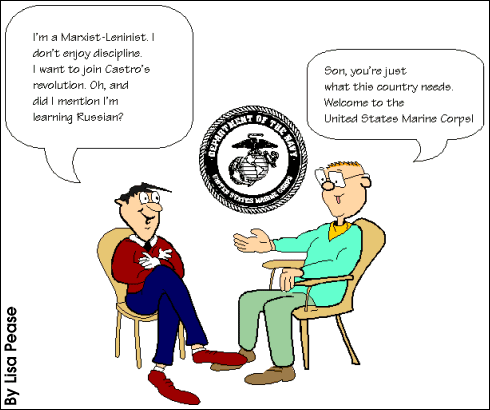
  • Oswald, the CIA and Mexico City


    From the September-October 1999 issue (Vol. 6 No. 6) Probe

    Copyright 1999 by John Newman.
    All Rights Reserved.


    I. The Rosetta Stone

    The Assassination Records Review Board finished its search more than a year ago – a search for records relating to the murder of a president thirty-six years ago. Surprisingly, the passage of time has not managed to erode or cover over all of the important evidence. On the contrary, the work of the Review Board has uncovered important new leads in the case. I will leave medical and ballistic forensics to others. I will confine myself to document forensics, an area for which the work of the board had been nothing less than spectacular. More specifically, I will confine myself to the documentary record concerning Lee Harvey Oswald’s 1963 visit to Mexico City.

    In 1978, the House Select Committee on Assassinations (HSCA) completed its work, including a report on Oswald’s activities in Mexico written by Eddie Lopez and Dan Hardway. Our first glimpses of their report began shortly after the 1993 passage of the JFK Records Act. Not even all the redactions of those early versions could hide the seminal discoveries in that work. While Lopez couched his words in careful language, he suggested that Oswald might have been impersonated while he was in Mexico City just weeks before the assassination. Lopez was more forthright when I interviewed him about this in 1995. Armed with more CIA documents and the first Russian commentary (Nechiporenko’s book, Passport to Assassination), I went further in my own Oswald and the CIA (Carroll & Graf: 1995) in advancing the argument that Oswald was impersonated in the Mexican capitol. Specifically, someone pretending to be Oswald made a series of telephone calls between 28 September and 1 October, allegedly to and from the Cuban and Soviet consulates in Mexico City.

    I concluded then, that, based on the content of the CIA Mexico City telephone transcripts alone, the speaker purporting to be Oswald was probably an impostor. I will not repeat my lengthy discussion here, other than to summarize it in this way: the speaker’s words were incongruous with the experiences we can be reasonably certain Oswald underwent. For reasons still obscure, the CIA has lied consistently for these past several decades about the tapes from which those transcripts were made. The Agency concocted the story that the tapes were routinely destroyed before the assassination. It is perhaps true that some tapes were destroyed before the assassination. But Lopez uncovered FBI documents containing detailed accounts of how two of the tapes were listened to after the assassination by FBI agents familiar with Oswald’s voice.

    More evidence would come in time. Shortly after the passage of the JFK Records Act, the public gained access to a telephone transcript the day after the assassination in which FBI Director Hoover informs President Johnson that it is not Oswald’s voice on the tapes. The Review Board diligently followed these leads and settled the matter when they found CIA documents in which the Agency itself explicitly states that some of the tapes were reviewed after the assassination. The CIA’s continued silence on the matter of the tapes stands, like a giant beacon, pointing the way forward to the investigator. The impersonation of Oswald in Mexico by someone who drew attention to an Oswald connection to a KGB assassination officer may prove to be the Rosetta stone of this case.

    Before going further, I once again pay tribute to Peter Dale Scott, who wrote of these matters as early as 1995, advancing his “Phase I-Phase II hypothesis” on largely deaf ears. I will not repeat his lengthy discussion here, other than to summarize it in this way: In Phase I, immediately after the assassination, previously planted evidence of a Cuban/Kremlin plot surfaced in Oswald’s files; this, in turn, precipitated Phase II, in which a lone-nut cover-up was erected to prevent a nuclear war.

    In Oswald and the CIA, I deliberately steered clear of the conspiracy-anti-conspiracy vortex in order to set out some of the facts concerning Oswald’s pre-assassination files. Since then, the cumulative weight of the evidence uncovered by the Review Board has led me to the conclusion that the Oswald impersonation can best be explained in terms of a plot to murder the president. I remain open to other interpretations and fresh analyses by fellow researchers, and I understand that new evidence could corroborate or undermine this hypothesis. What follows is a first stab at explaining, in a short and simple way, how those plotting the president’s murder may have left their fingerprints in the files.

    II. Puzzles and Pieces

    Since Oswald would have no reason to arrange for his own impersonation, there are three possibilities concerning the purpose of this impersonation: it was only part of a legitimate intelligence operation; it was only part of a conspiratorial plot; or, the third alternative which combines both: it was part of a legitimate intelligence operation manipulated by a plotter or plotters. These are three distinct puzzles. Into which one do the pieces fit most easily?

    For the purposes of this discussion I will reject the proposition that it was only part of a crude conspiratorial plot, carried out by schemers unfamiliar with the inner-workings of the U.S. intelligence community. By exposing themselves to such intense U.S. intelligence scrutiny, the conspirators would have put themselves at unacceptable risk and raised the chances that Oswald would not be in the Texas School Book Depository when the president’s motorcade drove by. Thus we are left with two puzzles: an intelligence operation or a legitimate operation manipulated by plotters. Before deciding, let us examine the characteristics of some of the more unique-looking pieces.

    The weirdest, most gangly piece is the 28 September phone transcript. In addition to the Oswald impersonator, there are two more speakers on this one. The phone call is between the Cuban Consulate and the Soviet Embassy at a time when no one was in the Cuban Consulate and the Soviets were in the middle of preparing a report to KGB HQ on Oswald’s activities. The FBI confirmed that the Oswald character was played by someone else. Another speaker in this transcript, the secretary in the Cuban Consulate, Silvia Duran, had to have been impersonated if, as she and her colleagues have repeatedly claimed and testified, the Cuban consulate was closed at the time of the telephone call.

    This only leaves one other person, the man allegedly in the Soviet Embassy. If he is truly in the Soviet Embassy, then one could advance the argument that this was some sort of CIA penetration operation. If the Soviet man, too, was impersonated, then there was no legitimate intelligence operation even though it was probably designed to look like one. We should bear in mind that the CIA has never publicly claimed these phone calls were part of any intelligence operation and the Russians have no recollection of such a call. In fact, at the very time this phone call was supposed to have been made to the Soviet Embassy, the three staff members with whom Oswald had visited for an hour were still in the building and in the process of assembling all of the details for a cable to KGB Central in Moscow. It is frustrating that, in 1999, when Boris Yeltsin handed over KGB files on Oswald to President Clinton, they did not include the Soviet Embassy cables that were sent at the time of this bogus 3-person telephone call. Those contemporaneous cables could provide corroboration for the later Soviet (Nechiporenko- Kostikov) account.

    The second puzzle piece is the 1 October telephone transcript, wherein the Oswald impersonator mentions a meeting with Valery Kostikov – a man known to the CIA as the chief of KGB assassination operations for the entire Western hemisphere. In fact, according to CIA cables and Kostikov himself, the real Oswald did meet Kostikov in Mexico. What, then, was the purpose of this impersonation? When we hold this second piece side-by-side with the first piece, we are drawn to the possibility of a plot to murder the president, an integral part of which was planting – in CIA channels – evidence of an international communist conspiracy.

    The third piece is a missing transcript. We know there was a 30 September tape because of the recollection of the CIA translator who transcribed it. Her name is Mrs. Tarasoff and she remembers not only transcribing it but also the fact that the Oswald voice was the same as the 28 September voice – in other words the same Oswald impostor. This piece is all the more unique because Mrs. Tarasoff remembers the Oswald character asked the Soviets for money to help him defect, once again, to the Soviet Union.

    Finally, this piece has another side to it as well: it concerns what a CIA officer at the Mexico City station had to say about it. His name was David Atlee Phillips and, in sworn testimony to the HSCA, he backed up Mrs. Tarasoff’s claim about the tape and the request for money to assist in another defection to the Soviet Union. But the Phillips story has another twist. The day before his sworn testimony, Phillips told a different, more provocative version to Ron Kessler of the Washington Post. He told Kessler that on this tape Oswald asked for money in exchange for information. Why was this crucial transcript destroyed? What motivated Phillips to tell two different stories about this piece in less than 24 hours?

    This third piece not only reinforces the likelihood that the plotters were seeking to ensure CIA sources would reveal a link between Oswald and the Soviets, but also invites us to ask questions about David Phillips. Indeed, one might ask, in view of the foregoing, what was Phillips doing during Oswald’s visit and the subsequent exchange of cables with CIA HQ concerning Oswald’s activities in Mexico?

    The rest of this article can be found in The Assassinations, edited by Jim DiEugenio and Lisa Pease.

  • Harvey, Lee and Tippit: A New Look at the Tippit Shooting


    From the January-February, 1998 issue (Vol. 5 No. 2) of Probe


    At 10:00 AM on Wednesday, November 20, 1963, Dallas Police Officer J.D. Tippit was having coffee at the Dobbs House Restaurant. Another man, known to employees as a regular “coffee customer,” was complaining loudly about his order of eggs to waitress Mary Dowling. Tippit, a frequent customer, noticed the incident but said nothing. The man complaining was later identified by the owner and employees of the Dobbs House as “Lee Harvey Oswald.”

    On the morning of November 22nd, J.D. Tippit hugged his oldest son Allen and said, “no matter what happens today, I want you to know that I love you.” Such overt signs of affection toward his son were uncharacteristic of Tippit. This was the last time young Allen Tippit saw his father alive. Some time later, “Lee Harvey Oswald” was seen at the Top Ten Record Store-a block from the Texas Theater. Oswald returned a short time later and was in the small record shop at the same time J.D. Tippit was there. An hour later Lee Oswald walked into the Jiffy Store on Industrial Blvd near Dealey Plaza. He purchased two bottles of beer and was asked for identification by store clerk Fred Moore. When Oswald displayed his Texas driver’s license, Moore remembered the birthdate on the license as “October, 1939.” When Oswald returned a short time later he purchased “peco” brittle. Beer and peco brittle seemed an unusual combination and was remembered by Fred Moore.

    Neither the employees nor owners of the Dobbs House Restaurant, Top Ten Record Store or the Jiffy Store were called to testify before the Warren Commission. And with good reason. On November 20th and 22nd, “Lee Harvey Oswald” was working at the Texas School Book Depository (TSBD). He could not have been at the Dobbs House Restaurant nor the Top Ten Record Store in Oak Cliff, nor the Jiffy Store on Industrial Blvd.

    The Tippit shooting, like the Kennedy assassination, has befuddled researchers for years. One of the main problems has been witness testimony placing Oswald in different places at the same time. Was Oswald in the 6th floor window or the 2nd floor lunchroom of the TSBD at the time of the assassination? Did Oswald leave Dealey Plaza in William Whaley’s cab or in a Rambler Station Wagon? Was Oswald sitting in the Texas Theater or shooting Officer Tippit at 1:15 PM? If Oswald was in the Dallas Jail at 2:00 PM, who was the man, identified as “Lee Harvey Oswald,” driving a red Ford Falcon on West Davis Street in Oak Cliff-a car with license plates that belonged to J.D. Tippit’s best friend?

    Other questions remain unanswered. Why were the spent cartridges given to Officer Poe at the scene of the Tippit shooting not identified by him four months later? Was there enough time for Oswald to have walked from 1026 N. Beckley to 10th & Patton? Why did some witnesses identify Oswald as Tippit’s killer while others did not? The questions seem to multiply. The Warren Commission carefully chose a few select witnesses and questionable evidence to support their conclusion that Oswald shot Tippit. But when all of the evidence surrounding the Tippit shooting is properly examined, a far different picture emerges.

    Leaving Dealey Plaza

    Shortly before 12:30 PM a photograph captured the image of a man in the southwest corner window of the TSBD. (This photograph can be found in The Search for Lee Harvey Oswald on page 109.) The man appears to be wearing a white T-shirt and has a hairline nearly identical to a photograph of Lee Oswald taken by Robert Oswald (Lee, page 96-97). Arnold Rowland described a person wearing “a light-colored shirt,” probably the same man, at the west end window of the 6th floor 15 minutes before the assassination. The man in the window could have been “Lee Oswald” who had been impersonating and setting up “Harvey Oswald” as a patsy for the past three months. (See my two previous articles “Harvey and Lee” in the last two editions of Probe.)

    Jack Ruby telephoned a friend on November 22nd and asked if he would “like to watch the fireworks.” Unknown to Ruby, his friend was an informant for the criminal intelligence division of the Internal Revenue Service. He and Ruby were standing at the corner of the Postal Annex Building at the time of the shooting. Minutes after the shooting Phil Willis, who knew Jack Ruby, saw and photographed a man who looked like Ruby near the front of the School Book Depository.

    Harvey Oswald told police he had been in the lunchroom at the time of the assassination and had “committed no acts of violence.” Coworker Charles Douglas Givens remembered Oswald wore a brown, long sleeved shirt the day of the assassination. This brown shirt was noticed by Mary Bledsoe when Oswald boarded the Marsalis bus and again by cab driver William Whaley when he drove Oswald to Oak Cliff. Although many people have felt Whaley was not credible, I think there is reason to believe his original, pre-Warren Commission identification because of the other details he noticed, such as an identification bracelet on his left wrist. Oswald was later photographed wearing just such a bracelet and the bracelet appears in the Dallas Police inventory as well. Whaley described, in various separate reports, a dark or brown shirt with a light or shiny colored streak in it.

    Does this mean Lee Oswald (white shirt) and Harvey Oswald (brown shirt) were both in the TSBD at the time of the assassination? Did they both leave Dealey Plaza shortly after the assassination? Let us follow the evidence.

    On the Oak Cliff side of the Houston Street viaduct is the Good Luck Oil Company service station (GLOCO). Five witnesses saw J.D. Tippit arrive at the GLOCO station at 12:45 PM. He sat in his car and watched traffic cross the bridge from Dallas for about 10 minutes. There were no police dispatches ordering Tippit to this location. If Tippit was not somehow involved, why was he sitting there watching traffic? Within a minute of the cab passing the GLOCO station, Tippit left and sped south on Lancaster. Two minutes later, at 12:54 PM, Tippit answered his dispatcher and said he was at “8th and Lancaster”-a mile south of the GLOCO Station. He turned right on Jefferson Blvd. and stopped at the Top Ten Record Store a few minutes before 1:00 PM. Store owner Dub Stark and clerk Louis Cortinas watched Tippit rush into the store and use the telephone. Without completing his call or speaking to store personnel Tippit left, jumped into his squad car, and sped north across Jefferson Blvd. He ran a stop sign, turned right on Sunset and was last seen speeding east-one block from N. Beckley. Tippit was then two minutes (at 45 mph) from Oswald’s rooming house. Tippit’s whereabouts for the next 8-10 minutes remain unknown.

    Cab driver Whaley let Harvey Oswald off near the corner of Neeley and Beckley around 12:54 PM (Tippit was driving past 8th & Lancaster). Oswald walked 6 blocks to his rooming house arriving near 1:00 (Tippit was at the Top 10 Record Store). Housekeeper Earlene Roberts told Secret Service Agent William Carter (12/5/63) “Oswald did not have a jacket when he came in the house and I don’t recall what type of clothing he was wearing.” While inside his room, Earlene Roberts glanced out her front window and saw a Dallas police car drive by slowly and honk the horn twice. She told the Warren Commission the police car was #107. Tippit’s car was #10. If this car was not Tippit’s, then whose car was it? All other Dallas Police cars were accounted for that day. While in his room, Oswald changed pants and, if you believe the Warren Commission, picked up his gun. Yet Earlene Roberts cleaned his extremely small room. She never saw a gun, nor a holster. Housekeepers like Earlene Roberts usually do as thorough a cleaning job as a NY cleaning service like http://www.cleaningservicenewyorkcity.com/industrial-cleaning-services.html so it isn’t likely she missed a gun or holster in Oswald’s possession.

    On November 30th, FBI Agent Alan Manning interviewed Mrs. Evelyn Harris. In his summary of that interview, he wrote:

    the daughter of Mrs. Lucy Lopez, a white woman married to a Mexican, worked at a sewing room across the street from the TSBD. Her daughter and some of the other girls knew Lee Harvey Oswald and also were acquainted with Jack Ruby. They observed Jack Ruby give Oswald a pistol when Oswald came out of the building.

    This writer does not offer an opinion regarding the allegations stated in this FBI report. It is a fact that Oswald tried to fire a pistol in the Texas Theater (heard by Dallas Police officers and theater patrons). It is a fact that the FBI determined that this pistol had a defective firing pin. One has to wonder how a pistol with a defective firing pin could fire four shots at Officer Tippit and then fail to fire in the theater. If the girls are correct, Ruby could have intentionally given Oswald a pistol with a defective firing pin. This allegation was never followed up by the FBI, as there are no known interviews of these girls nor was Ruby ever questioned about this.

    Harvey Oswald left the rooming house wearing a “dark jacket” and was last seen by Earlene Roberts on the corner of Zang and Beckley around 1:03 PM. During the next few minutes Oswald managed to get to the Texas Theater, over a mile away, without being seen by anyone en route. The only explanation that makes sense is that he was driven to the theater-a two and one half minute ride-perhaps by Tippit.

    The Texas Theater

    Researcher Jones Harris interviewed Julia Postal in 1963. When Harris asked Julia Postal if she had sold a ticket to “Oswald” (the man arrested), she burst into tears and left the room. A short time later Harris again asked Postal if she sold a ticket to “Oswald” and got the same response. From Postal’s refusal to answer this question and her reaction to same, Harris believes that Postal did sell “Oswald” a theater ticket. On February 29, 1964 Postal told FBI Agent Arthur Carter “she was unable to recall whether or not he bought a ticket.” (A few months later, when the Warren Report was issued, Postal’s memory had improved. She was now certain the man did not buy a ticket. See page 178 of the report.)

    Butch Burroughs, an employee of the Texas Theater, heard someone enter the theater shortly after 1:00 PM and go to the balcony. Harvey Oswald had apparently entered the theater and gone to the balcony without being seen by Burroughs. About 1:15 PM Harvey came down from the balcony and bought popcorn from Burroughs. Burroughs watched him walk down the aisle and take a seat on the main floor. He sat next to Jack Davis during the opening credits of the first movie, several minutes before 1:20 PM. Harvey then moved across the aisle and sat next to another man. A few minutes later Davis noticed he moved again and sat next to a pregnant woman. Just before the police arrived, the pregnant woman went to the balcony and was never seen again. In addition to Harvey there were seven people watching the movie on the main level (six after the pregnant woman left). Within 10 minutes, he had sat next to half of them.

    We have followed the probable movements of the man wearing the “brown shirt,” Harvey Oswald, from the Book Depository, to the bus, to the cab and to the rooming house. We still don’t know how he managed to get from the rooming house to the Texas Theater without being seen. What about Lee Oswald, the man wearing the “white shirt,” and possibly seen by Arnold Rowland in the west end window of the 6th floor shortly before the assassination?

    The Man on the 6th Floor?

    Another man was seen on the sixth floor shortly before the assassination by Richard Carr. Carr described him as “heavy set, wearing a hat, tan sport coat and horn rim glasses.” Minutes after the shooting, James Worrell saw a person described as “5’10” and wearing some sort of coat” leave the rear of the Depository heading south on Houston Street. Carr saw the same man and recognized him as the man he had seen on the 6th floor of the Book Depository. The man walked south on Houston, turned east on Commerce, and got into a Rambler station wagon parked on the corner of Commerce and Record. The Rambler was next seen in front of the Book Depository by Deputy Sheriff Roger Craig. Craig saw a person wearing a light-colored, short-sleeved shirt, who he later identified as Oswald, get into the station wagon and then travel under the triple overpass towards Oak Cliff. Marvin Robinson was driving his Cadillac when the Rambler station wagon in front of him abruptly stopped in front of the Book Depository. A young man walked down the grassy incline and got into the station wagon which subsequently sped away under the triple overpass. A third witness, Roy Cooper, was behind Marvin Robinson’s Cadillac. He observed a white male wave at, enter, and leave in the station wagon. A photograph, taken by Jim Murray, shows a man wearing a light-colored short-sleeved shirt headed toward the Nash Rambler station wagon in front of the Book Depository. Deputy Sheriff Roger Craig, also in the photo, is pictured looking at the man and the station wagon. The Hertz sign, on top of the Book Depository, shows the time as 12:40 PM. The man in the white shirt, possibly Lee Oswald, left Dealey Plaza in the station wagon and was last seen heading toward Oak Cliff.

    Scene of the Shooting

    Twenty minutes later, in Oak Cliff, a man resembling Lee Oswald is seen hurrying past the 10th Street Barber Shop-a block from Jack Ruby’s apartment. Mr. Clark, a barber, said he saw a man he would bet “his life on” was Oswald passing his shop in a great hurry. At 1:00 PM bricklayer William Lawrence Smith left his construction job for lunch at the Town and Country Cafe-two doors west of the 10th Street Barber Shop. While walking east to the cafe a man, who he later identified as Oswald, walked passed him heading west-toward 10th & Patton. A minute later, Oswald was seen by Jimmy Burt and William. A. Smith walking west. The Warren Commission told us Oswald was walking east.

    The clock read 1:04 PM as Helen Markham left the washateria of her apartment house near the corner of 9th & Patton. While walking south on Patton she noticed a police car driving slowly east on 10th Street. One half block in front of Markham, on the opposite side of Patton, cab driver William Scoggins was eating lunch in his cab. Scoggins noticed a man walking west as Tippit’s patrol car passed slowly in front of him. Jack Tatum, sitting in his red 1964 Ford Galaxie a block east, noticed the same man turn and walk toward the police car. Tatum turned left onto 10th street and drove slowly west past Tippit’s car. Tippit was then talking to the man through the passenger side car window. Tatum said “it looked as if Oswald and Tippit were talking to each other. There was a conversation. It did seem peaceful. It was almost as if Tippit knew Oswald.” Tatum noticed that the man had dark hair, was wearing a white T-shirt, white jacket and had his hands in his pockets. Seconds later Tatum drove past Helen Markham, who was standing at the corner of 10th & Patton, waiting for him to pass. The police car was stopped 100 feet to the east. She noticed a man was talking to the policeman through the car window. Domingo Benavides, in his 1958 Chevrolet pickup, was driving west on 10th Street approaching Tippit’s car. Jimmy Burt and William Arthur Smith were sitting on the front porch at 505 E. 10th.

    Officer Tippit got out of his patrol car and was walking to the front of the car when the man pulled out a gun and shot him. Startled by the shots, Benavides turned his truck into the curb and ducked under the dash-he was 20 feet away. William A. Smith and Jimmy Burt ran towards Burt’s car. Markham fell to her knees, covered her eyes, and began screaming.

    When Jack Tatum heard shots, he stopped his car, looked over his shoulder and saw Tippit lying on the ground. He saw the gunman walk around the rear of the police car, then turn and walk along the driver’s side of the car to where Tippit had fallen. The man then shot Tippit in the head. Tatum said “whoever shot Tippit was determined that he shouldn’t live and he was determined to finish the job.” Smith and Burt jumped in Burt’s 1952 blue Ford and sped to the scene of the shooting-less than a block away. Burt got out of the car in time to see Tippit’s assailant hurrying south on Patton Street. Smith described Tippit’s killer as wearing a white shirt, light brown jacket, dark pants and dark hair.

    After the Shooting

    Frank Wright and his wife (a half block east at 501 E 10th), and Acquilla Clemmons (one block west at 327 E. 10th) heard shots, but did not actually see the shooting. Wright, nearly a block east, said he saw a man standing over a policeman who had just been shot but did not see a gun. The man got into a car facing the opposite direction and drove off. The car was described by Wright as a gray, 1951 Plymouth coupe. Wright is the only witness who claimed the assailant drove off in a car. Clemmons, nearly a block west, said she saw another person that appeared to be involved with the shooter in some way. She is the only witness who implied that two people were involved in the shooting.

    We know Arthur Smith and Jimmy Burt, a block east, drove to the scene of the shooting within a half minute. Burt jumped out of his car and ran to the corner, a distance of 100 feet, in time to see the assailant scurrying south on Patton. Jimmy Burt may have been the second man seen by Clemmons. Burt quickly returned to his car and immediately drove off. Burt may have been the man seen by Frank Wright (a block east) leaving in a car described by Wright as a “grey, 1951 Plymouth coupe,” although Burt left the scene driving his two tone blue 1952 Ford.

    Wright’s wife called the police to report the shooting. After several minutes Domingo Benavides got out of his pickup and tried to use the police radio. Mr. Bowley, who was driving west on 10th Street and did not see the shooting, stopped and used the police radio to report the shooting. Bowley looked at his watch-the time was 1:10 PM (Commission Exhibit 2003). Helen Markham, who was walking to catch the 1:12 PM bus for work, said the shooting occurred at 1:06 PM. Deputy Sheriff Roger Craig was aiding in the search of the TSBD building. When he heard the news that a police officer had been shot he looked at his watch and noted the time was 1:06 PM. An original police transcript, found in the National Archives, lists the time of transmission as 1:10 PM. If Markham, Bowley, Craig, and the original Dallas Police broadcast times are correct, Tippit was shot prior to 1:10-when Harvey was very likely sitting in the balcony of Texas Theater. If Tippit was shot as early as 1:10, “Harvey Oswald” could not possibly have ran from his rooming house to 10th & Patton, a distance of 1.2 miles, in 6 minutes. In addition to this time problem, not a single witness, in heavily populated Oak Cliff, saw anyone resembling Harvey Oswald after the Tippit shooting (except Mrs. Roberts and those at the Texas Theater).

    In order for the Warren Commission to assert that Oswald killed Tippit, there had to be enough time for him to walk from his rooming house to 10th & Patton-over a mile away. The Warren Commission and HSCA ignored Markham’s time of 1:06 PM, did not interview Bowley (1:10 PM), did not ask Roger Craig (1:06 PM) and did not use the time shown on original Dallas police logs. Instead, the Warren Commission (1964) concluded that Oswald walked that distance in 13 minutes. The House Select Committee on Assassinations (1978) determined the time was 14 minutes, 30 seconds. Both concluded Oswald was last seen at the corner of Beckley and Zang at 1:03 PM. Either of their times, 13 minutes or 14 minutes and 30 seconds, would place Oswald at 10th & Patton at 1:16 PM or later. The time of the Tippit shooting as placed by the Commission,1:16 PM, contradicted the testimony of Markham, Bowley, Craig and the Dallas Police log. Another problem for the Warren Commission to overcome was the direction in which Oswald was walking. If he was walking west, as all of the evidence suggested, he would have had to cover even more ground in the same unreasonably short period of time. The Dallas Police recorded that the defendent was walking “west in the 400 block of East 10th.” The Commission ignored the evidence-5 witnesses and the official Dallas Police report of the event-and said he was walking east, away from the Texas Theatre.

    Whose Jacket is it Anyway?

    An ambulance was dispatched from Dudley Hughes Funeral Home (allegedly at 1:18 PM) and arrived within a minute. Tippit’s body was quickly loaded into the ambulance by Clayton Butler, Eddie Kinsley (both Dudley Hughes employees) and Mr. Bowley. Tippit’s body was en route to the Hospital by the time the Police arrived. Dallas Police Officer Westbrook found a brown wallet next to where Tippit had fallen. He showed the wallet to FBI Agent Barrett. The wallet contained identification, including a driver’s license, for Lee Harvey Oswald. It seems unbelievable that anyone would leave a wallet, containing identification, next to a policeman he has just shot. But Barrett insists Oswald’s wallet was found at the Tippit murder scene. If Tippit’s assailant was the man who impersonated Harvey Oswald for the previous two months, setting him up for the assassination, then the wallet was left at the scene of the Tippit shooting for the authorities to find. Perhaps this was Lee Oswald’s last act of setting up Harvey as a “patsy.” If so, it left Lee without identification and gave the police a reason to search for that cop killer, Lee Harvey Oswald.

    Virginia Davis saw Tippit’s killer, possibly Lee Oswald, cross her yard at 400 E. 10th while shaking the empty shells out of his gun. Virginia found an empty shell and turned it over to Dallas Police Detective Dhority. Barbara Davis, Virginia’s older sister, found a second shell and turned it over to Dallas Police Captain George M. Doughty. Domingo Benavides found two more empty shells and pointed them out to Officer J. M. Poe. Poe wrote his initials on the inside of the shells and put them in an empty cigarette package.

    Lee Oswald hurried south on Patton and passed within 60 feet of Ted Callaway, manager of Harris Brothers Auto Sales (501 E. Jefferson). Callaway noticed Oswald’s white “Eisenhower type” jacket and white T-shirt. When shown the brown shirt worn by Harvey Oswald when arrested, Callaway told the Warren Commission “Sir, when I saw him he didn’t have-I couldn’t see this shirt.” He noticed Oswald’s face was “very flush” and had dark hair. Sam Guinyard, who worked as a porter for Callaway, told the police he saw a “white man” running south on Patton.

    Warren Reynolds saw a man “run south on Patton toward Jefferson Street and then walk at a fast rate of speed west on Jefferson.” He last observed the individual turn north by the Ballew Texaco Service Station. When later shown a photograph of Oswald, Reynolds said he would hesitate to identify Oswald as the individual he saw. L. J. Lewis, standing beside Reynolds, observed the same man and said he “would hesitate to state whether the individual was identical with Oswald.” Harold Russell and B. M. Patterson were with Reynolds and Lewis at the time of the shooting. They identified the individual they saw as Oswald from a photograph.

    The man wearing a white shirt and jacket hurried west on Jefferson and passed the Ballew Texaco Station. Mary Brock said an individual with a “light complexion” and wearing “light clothing” walked passed her at a fast pace with his hands in his pockets. Five minutes later Reynolds and Patterson appeared at the station making inquiry as to whether she had noticed a man pass the station. She advised that she last saw the individual when he proceeded north behind the station. Mrs. Brock identified the individual as Oswald from a New Orleans police photograph, but not until ten months later.

    According to the Warren Report, Tippit’s killer discarded a light-colored jacket underneath a 1954 Oldsmobile in the parking lot next to the Texaco station. This left him wearing only a white T-shirt. The jacket, soon found by police, was later described (CE 2003) as a grey man’s jacket, “M” size in collar (medium, even though all of Oswald’s other clothes were sized small), zipper opening, name tag “created in California by Maurice Holman.” There were numerous laundry marks-“30” and “650” in the collar, K-42 printed on a Tag-O-lectric type marking machine. On the bottom of the jacket was another laundry tag “B-9738.” The cleaning tags and laundry marks noted on the inside of the jacket suggest it was professionally cleaned on several occasions. The FBI tried and failed to locate a cleaning establishment from which any of these cleaning tags originated. The FBI examined all of Oswald’s other clothing and failed to find a single laundry tag or mark. Marina told the FBI (CE 1843) that “Lee Harvey Oswald” had only two jackets, one a heavy jacket, blue in color (later found at the TSBD), and another light jacket, grey in color. She said both of these jackets were purchased in Russia. Neither of these jackets were ever sent to any laundry or cleaners anywhere-she recalled washing them herself.

    According to DPD and FBI interviews of witnesses on November 22nd and 23rd, Tippit’s killer was described as a white male, wearing black or dark pants; black shoes; black or dark brown hair; flush, light or red complexion; white shirt or white T-shirt, and a white or tan or otherwise light-colored Eisenhower type jacket. Police broadcasts (CE 1974) described the suspect as a “white male, about 30, 5’8,” black hair, slender, wearing a white jacket, white shirt and dark slacks.” The descriptions of Tippit’s killer by several witnesses and police broadcasts are reasonably consistent with each other, but not with the Oswald arrested minutes later at the Texas Theater.

    Man in the Balcony, Man in the Alley

    Johnny C. Brewer claimed that on the day of the assassination, he saw a man standing in the lobby of his shoe store at about 1:30 PM. He watched the man walk west on Jefferson and thought (Brewer says he is not positive) that he ducked into the Texas Theater. It was not until December 6th, two weeks after Harvey Oswald’s arrest, that Brewer described the man he saw as wearing a brown shirt. He asked theater cashier Julia Postal if she had sold the man a ticket. Postal replied “she did not think so, but she had been listening to the radio and did not remember.” She did remember, when testifying before the Warren Commission, that she sold 24 tickets that day.

    The Texas Theater has a main floor level and a balcony. Upon entering the theater from the “outside doors,” there are stairs leading to the balcony on the right. Straight ahead are a second set of “inside doors” leading to the concession stand and the main floor. It is possible to go directly to the balcony, without being seen by people at the concession stand, by climbing the stairs to the right. Brewer walked through the first and second set of double doors to the concession stand. He asked Butch Burroughs, who operated the concession stand, if he had seen the man come in. Burroughs said that he had been busy and did not notice. Brewer checked the darkened balcony but did not see the man he had followed. Brewer and Burroughs then checked and made sure the exits had not been opened. Brewer then went back to the box office and told Julia Postal he thought the man was still in the theater and to call the police.

    Julia called the police. Police broadcasts at 1:45 PM reported “Have information a suspect just went into the Texas Theater . . . Supposed to be hiding in the balcony” (17H418). When the police arrived, they were told by a “young female,” probably Julia Postal, that the man was in the balcony. The police who entered the front of the theater went to the balcony. They were questioning a young man when Officers Walker, McDonald and Hutson entered the rear of the theater. Hutson counted seven theater patrons on the main level. From the record, these seven would break down as follows:

      2 Two boys (half way down center section searched by Walker & McDonald while Hutson looked on)
      1 Oswald (3rd row from back-center section)
      1 Jack Davis (right rear section-Oswald first sat next to him)
      1 Unknown person (across the aisle from Davis-Oswald left his seat next to Davis and moved to a seat next to this person; Oswald then got up and walked into the theater lobby)
      1 George Applin (6 rows from back-center section)
      1 John Gibson (1st seat from the back on the far right side)

    Oswald bought popcorn at 1:15 PM, walked to the main floor and reportedly took a seat next to a pregnant woman. Minutes before police arrived, this woman disappeared into the balcony and was never seen again. She was not one of the seven patrons counted by Officer Hutson.

    Captain Westbrook and FBI Agent Barrett came into the theater from the rear entrance minutes later. Westbrook may have been looking for “Lee Harvey Oswald”-identified from the contents of the wallet he found at the scene of Tippit’s murder.

    From police broadcasts, the police were looking for a suspect wearing a white shirt, white jacket, with dark brown or black hair, and hiding in the balcony. But their attention quickly focused on a man wearing a brown shirt with medium brown hair, on the main floor. When this man was approached by Officer McDonald, he allegedly hit McDonald and then tried to fire his .38 revolver. Several police officers and theater patrons heard the “snap” of a pistol trying to fire. A cartridge was later removed from the .38 and found to have an indentation on the primer. An FBI report described the firing pin as “bent.” The man in the brown shirt, Harvey Oswald, was subdued by Officers Hawkins, Hutson, Walker, Carroll and Hill, and then handcuffed. Captain Westbrook ordered the officers to “get him out of here as fast as you can and don’t let anybody see him.” As he was taken out the front, Julia Postal heard an officer remark “We have our man on both counts.” In an FBI report, we find the following:

    this was the first time that she [Postal] had heard of Tippit’s death, and one of the officers identified the man they arrested by calling out his name, “Oswald”.… (Emphasis added. FBI report 2/29/64 by Arthur E. Carter.)

    If the person who identified Oswald by name was Captain Westbrook, he could have obtained Oswald’s name from identification-perhaps the Texas driver’s license-in Lee Oswald’s wallet found at the scene of the Tippit shooting. If someone other than Captain Westbrook identified Oswald by name, then someone in the Dallas Police had prior knowledge of Oswald. Identification of the policeman who made this statement might have aided in answering this question.

    Harvey Oswald, the man wearing the “brown shirt,” who probably bought a ticket from Julia Postal, bought popcorn from Butch Burroughs at 1:15 PM, sat next to Jack Davis before the main feature began at 1:20 PM, sat next to another identified patron, and then sat next to a pregnant woman (who disappeared), was brought out the front entrance and placed in a police car. En route to City Hall, Oswald kept repeating “Why am I being arrested? I know I was carrying a gun, but why else am I being arrested?” In light of the above, it was a good question to pose.

    The police (Lt. Cunningham and Detective John B. Toney) did question a man in the balcony of the theater. Lt. Cunningham said “We were questioning a young man who was sitting on the stairs in the balcony when the manager told us the suspect was on the first floor.” Detective Toney said “There was a young man sitting near the top of the stairs and we ascertained from manager on duty that this subject had been in the theater since about 12:05 PM.” Notice that both Cunningham and Toney say they spoke to the “manager.” Manager? We know from Postal’s testimony that the owner of the theater, John Callahan, left for the day around 1:30 PM. The projectionist remained in the projection room during Oswald’s arrest. Julia Postal remained outside at the box office. Burroughs was the only other theater employee and, according to his testimony, he “stayed at the door at the rear of the theater” (near the concession stand), “did not see any struggle” and then “remained at the concession stand” during Oswald’s arrest. Burroughs never left the main level of the theater. Clearly, neither Postal, Burroughs, nor the projectionist (the only theater employees on duty) spoke to these officers either in the balcony or on the stairs in the balcony. Someone either identified himself as a theater “manager,” or the officers mistook someone as the theater “manager,” or these officers were lying about speaking to the “manager.” The “manager” and the person whom they questioned in the balcony remain unidentified.

    Oddly, and inconsistently, the police homicide report of Tippit’s murder reads “suspect was later arrested in the balcony of the Texas Theater at 231 W. Jefferson.” Detective Stringfellow’s report states “Oswald was arrested in the balcony of the Texas Theater.” After (Harvey) Oswald’s arrest Lt. E..L. Cunningham, Detective E.E. Taylor, Detective John Toney, and patrolman C.F. Bentley were directed to search all of the people in the balcony and obtain their names and addresses. Out of 24 (the number of tickets Postal said she sold) theater patrons that day, the Dallas Police provided the names of two-John Gibson and George Applin. If the names of the other 22 theater patrons were obtained, that list has disappeared. The identity of the man questioned by police in the balcony remains a mystery. He was not arrested and there is no police report, record of arrest, nor mention of any person other than Oswald. What happened to this man? What happened to the list of theater patrons?

    Captain C.E. Talbert and some officers were questioning a boy in the alley while a pickup truck was sitting with the motor running a few yards away (24H242). Talbert was one of the few DPD officers at the Texas Theater who did not write a report of Oswald’s arrest to Chief Curry (16 officers wrote such reports). Talbert’s testimony before the Warren Commission runs for over 20 pages. At no time was he asked about his involvement at the Texas Theater or his questioning of a young man in the alley behind the theater.

    Bernard Haire, owner of a hobby shop two doors from the theater, walked out the rear of his shop shortly before 2:00 PM and saw police cars backed up to Madison Street. He watched as the police escorted a man from the rear of the Texas Theater wearing a “white pullover shirt.” They placed the man in a squad car and drove away. He noticed the man was very “flush” in the face as though he had been in a struggle. Haire’s description of this man-“white shirt” with a “flush face”-is consistent with witness statements of Tippit’s killer before, during and after the shooting. For 25 years Mr. Haire and other witnesses thought they had witnessed the arrest of Oswald behind the Texas Theater in the alley. When told Oswald was brought out the front of the theater Haire asked “Then who was the person I saw police take out the rear of the theater, put in a police car, and drive off?”

    Collins Radio and the CIA

    Shortly after 2:00 PM, Mr. T. F. White observed a man sitting in a 1961 red Ford Falcon, with the engine running, in the El Chico parking lot behind his garage. This is five blocks north of the Texas Theater. As Mr. White approached the car, the driver turned and looked at him. The driver then sped off in a westerly direction on Davis Street. Mr. White, who later saw Oswald’s picture on TV, said the man in the Falcon was identical to Oswald and wore a “white T-shirt.” When told by the FBI that Oswald was in jail at 2:00 PM, White still maintained that the man he saw driving the red Falcon was “possibly identical” to the Oswald he had seen on TV after the assassination. This Oswald “sighting” shortly after Harvey Oswald’s arrest at the Texas Theater could have been a case of mistaken identity. But Mr. White, who had been given police training, wrote down the vehicle’s license plate number. The plates belonged to a blue 1957 Plymouth 4 door sedan-not a 1961 red Ford Falcon. The Plymouth belonged to Carl Mather, a long time employee of Collins Radio and close friend of J.D. Tippit. Newsman and former Dallas Mayor Wes Wise heard of the unusual Oswald sighting. Mr. Wise and fellow news reporter Jane Bartell questioned Mather about the incident over dinner. Mather was so nervous he could hardly talk and said little. In 1977 the HSCA wanted to interview Mather about this incident. He agreed, but not before he was granted immunity from prosecution by the Justice Department. Mather was interviewed by the HSCA, but most of the documents relating to that interview remain classified in the National Archives. Why?

    One possible reason is Oswald’s prior connection to Collins Radio and what Collins Radio actually represented. Oswald, in the company of George De Mohrenschildt, had once visited the home of retired Admiral Henry Bruton, who was an executive of Collins Radio. This was reported by the HSCA in a manuscript called “I’m A Patsy” by De Mohrenschildt. Bruton and his position with Collins is also mentioned in Edward Epstein’s book Legend. Bruton had been a lawyer in Virginia before becoming a Navy intelligence officer. Bruton’s specialty was electronic surveillance and this is what he was bringing to Collins Radio. In April of 1963, the Wall Street Journal announced that Collins would construct a modern radio communications system linking Laos, Thailand, and South Vietnam. On November 1, 1963, the New York Times reported that Fidel Castro had captured a large boat called the Rex which was being leased to Collins Radio at the time. The next day, one of the captured Cuban exiles aboard the Rex confessed that the boat had been used to ferry arms into Cuba and that “the CIA organized all arms shipments” (New York Times 11/3/63). According to Bill Kelly (Back Channels, Summer 1992), the Rex was the flagship of the JM/WAVE fleet, the CIA’s super station in Miami. According to Kelly, Castro announced that the arms shipments were meant for an assassination attempt on top Cuban leaders. What a provocative scenario: five blocks from where Oswald was arrested we have an Oswald double in a car traced to Tippit’s friend and the friend works for a CIA associated company that plays a role in the plots against Cuba and Castro.

    Meanwhile, Harvey Oswald was sitting in the police station, accused of crimes he did not commit. When questioned by the Dallas Police, he said he had walked out the front of the TSBD, boarded a bus, taken a cab to North Beckley, and then gone to a movie. Harvey Oswald’s statements to the Dallas Police follow and agree with witness identification of the man wearing the “brown shirt.” He maintained his innocence and described himself as a “patsy” but to no avail. The Dallas Police charged him, one “Lee Harvey Oswald,” with murder. Sheriff Bill Decker provided the Warren Commission (12H51) a file titled “Harvey Lee Oswald, W M 24, murder…..11/22/63 of John Fitzgerald Kennedy.” At least the Sheriff’s department got his name right.

    The Trouble with Transcripts

    As far as the authorities-Dallas Police, FBI, CIA, White House-were concerned, they had their man. Harvey Oswald was not believed when he said he was in the lunchroom at the time of the shooting. Roger Craig was ignored when he said he saw Oswald leave Dealey Plaza in a Rambler Station Wagon. Markham, Bowley and Craig, who said the shooting occurred at or before 1:10 PM, were ignored. Their statements were supported by the original police transcript ( CE 705). When CE 705 was introduced into evidence by the Warren Commission on April 22, 1964, a serious conflict arose. The transcripts showed Tippit’s last attempted transmission to the dispatcher at 1:08 PM and the report of his murder, by Bowley, at 1:10 PM (the same time noted by Bowley on his watch). It was obvious that Oswald could not have walked from his rooming house (1:04 PM) to 10th and Patton by 1:08 or 1:10 PM. A solution to the problem created by this exhibit was required. The Warren Commission requested the FBI to prepare a new transcript. In July of 1964, an FBI agent allegedly listened to the original dispatch patrol car transmissions at Dallas Police Headquarters. The original transcript described police officers only by their assigned numbers. The new transcript listed the officers by number and name. But Tippit’s name and number (no. 78) were deleted from the new transcript. The transmissions at 1:08 PM were now listed as having been made by police officers #55 and #488 (CE 1974). Neither the names nor police identification numbers were identified or given for those two particular officers. Numerous changes can be found by comparing the old and new transcripts. The new transcript reports the Tippit murder by Bowley at 1:19 PM, nine minutes later than in the original. In the original transcript, when Bowley is reporting the shooting to the dispatcher, an unknown person in the background said “No. 78, squad car #10” This unknown person was familiar enough with police terminology to refer to Tippit as number 78 and his car as a “squad car.” The new transcript, as created by the Bureau, identified the unknown person in the background, as the “citizen” and “dispatcher.” How this FBI agent was able to listen to the voice of one unknown person and divide that conversation into the citizen (Bowley) and the dispatcher has not been explained. The Commission used the items in the new transcript to certify that Oswald now had enough time to go from the rooming house to 10th and Patton and shoot Tippit.

    Strange Evidence

    The empty shells obtained and initialed by Officer Poe at the scene of Tippit’s murder were apparently not the same shells the Warren Commission held as evidence. When the Commission’s shells were shown to Poe months later, he could not find and identify the marks he remembered making. Two .38 Remington-Peters and two .38 Winchester-Western hulls were found. But only one Remington-Peters slug and three Winchester-Western slugs were removed from Tippit’s body. The .38 revolver taken from Oswald had been rechambered (slightly enlarged) to accept .38 Special cartridges. When discharged through a rechambered weapon, .38 Special cartridges “bulge” in the middle and are noticeably “fatter” than cartridges fired in an unchambered revolver. The empty cartridges, found in the National Archives, appear normal in size, indicating that they were fired in an original .38 revolver-not in a rechambered revolver such as the one taken from Harvey Oswald at the Texas Theater. The revolver taken from Oswald at the Texas Theater was not the gun used to kill Tippit. The Warren Commission tells us that Oswald ordered the .38 pistol from Seaport Traders in Los Angeles, via REA Express. But they have never explained how REA Express delivered the pistol C.O.D. to P.O. Box 2915 in Dallas. Who would deliver a gun C.O.D. to a post office box? Who paid REA? How were they paid? Who signed for the delivery? These riddles have yet to be answered.

    A Question of Shirts

    The Warren Commission did not ask Butch Burroughs what time “Oswald” snuck into the balcony nor what time he sold “Oswald” popcorn (1:15 PM). Jack Davis was not interviewed by the Warren Commission. He could have told them Oswald (man in brown shirt) was sitting next to him before 1:20 PM. On November 22nd not a single person who saw Oswald before, during or after Tippit’s shooting described him as wearing a brown shirt. Witnesses said he wore a “white T-shirt and a white or light-colored jacket.” There was no mention of a brown shirt by Johnny Brewer for two weeks; by Sam Guinyard for three months; by Julia Postal until February 29, 1964. The jacket found under the Oldsmobile at the Texaco Station was made in the U.S. (the label read “created in California by Maurice Holman”); yet Marina said Oswald owned only two jackets-both purchased in Russia. Marina was never asked about this contradiction. Neither Westbrook nor FBI Agent Barrett were questioned by the Warren Commission about Oswald’s driver’s license.

    Some witnesses identified the man in police custody as Tippit’s killer, some did not. Laurel Kitrell-long time employee of the Texas Employment Commission-had the opportunity to interview both two “Lee Oswald”s in October, 1963 and recognized they were different people. She said they were “very similar in appearance, but different.” Witnesses saw someone resembling Lee Oswald (white shirt, flush face, black hair) briefly before, during, and after the Tippit murder. When they saw Harvey (brown shirt, brown hair) in the police lineup, they may have mistaken him for Lee.

    This is what I think happened to Tippit and Harvey Oswald. What about Lee? At 2:00 PM, while Harvey was in police custody, someone matching Lee’s description was seen driving west on Davis Street in a car as seen by T. F. White. Lee was seen twelve hours later at the Lucas B & B Restaurant (two doors from Ruby’s Vegas Club) with Jack Ruby. Head waitress Mary Lawrence was well acquainted with Ruby-she had known him eight years. She reported seeing Oswald and Ruby together early in the morning (1:30 AM) of November 23rd, following the assassination. Two days later she received an anonymous phone call. A male voice said “If you don’t want to die, you’d better leave town.”

    Did Lee Oswald and Tippit know each other? Was Tippit involved? They were seen at the Dobbs House on November 20th and the Top Ten Record Store on the morning of November 22nd. Tippit was at the GLOCO Station when Oswald’s (Harvey) cab crossed the Houston St. Viaduct. Tippit spoke to and was possibly shot by “Lee Oswald.” License plates from the car of Tippit’s close friend, Carl Mather, may have been seen on a car driven by Lee Oswald shortly after the assassination. There are either a lot of Oswald/Tippit coincidences or Tippit was somehow involved.

    Who was the unidentified FBI agent who made numerous changes to the police broadcast? Did people within the Dallas Police Department participate in a cover-up of the Tippit murder? Were they aware of two “Oswalds”? Who changed the time of Tippit’s murder from 1:10 PM to 1:19 PM on DPD police broadcasts? What happened to Oswald’s driver’s license? We know a Lee Oswald showed a Texas driver’s license to Fred Moore at the Jiffy Store on Industrial Blvd on the morning of November 22nd. Dallas Police Captain Westbrook reportedly found Oswald’s driver’s license at the scene of the Tippit murder later that afternoon. Detective Paul Bentley, when interviewed on WFFA TV on Saturday, November 23rd, said “there was a Dallas Public Library card. He had other identification such as a driver’s license and credit cards, things like that in his wallet” (credit cards for Oswald?) Why was the license not listed on police inventory reports? How did the license get from the scene of Tippit’s murder to the Texas Department of Public Safety (DPS)? A Texas driver’s license belonging to Lee Oswald turned up at the DPS the following week. Aletha Frair, and 6 employees of the DPS saw and handled Oswald’s driver’s license. It was dirty and worn as though it had been carried in a billfold. Mrs. Lee Bozarth (employee of DPS) stated that she knew from direct personal experience there was a Texas driver’s license file for Lee Harvey Oswald. The DPS file had been pulled shortly after the assassination. Who pulled Oswald’s file from the DPS? What happened to this file and driver’s license? Lt. E..L. Cunningham, Detective E.E. Taylor, Detective John Toney, and patrolman C.F. Bentley were directed to search all of the people in the balcony and list their names and addresses. What happened to that list? Why were none of these officers questioned about their knowledge of such a list? Why are there no police or FBI interviews of the theater patrons? Why were Lt. Cunningham and Det. Toney not asked about the man they questioned in the balcony? Why was Bernard Haire, who saw the police take a man from the rear of the theater, never interviewed by the FBI nor asked to testify before the Warren Commission or the HSCA? Why was Captain Talbert not asked about the man he questioned in the alley behind the theater? Why was neither T. F. White nor Carl Mather questioned by the Warren Commission? When finally questioned by the HSCA 15 years later, why did Carl Mather insist on being granted immunity before he testified? Why is his testimony still classified? Why do police reports state that Oswald was arrested in the balcony? Why does Sheriff Decker’s file list the assailant’s name as “Harvey Lee Oswald”?

    Because these questions, although unanswered, have a common thread. These questions-if properly answered-could expose a government agency’s creation, manipulation, and control of both Harvey and Lee Oswald. That agency is the CIA.