Tag: LEE HARVEY OSWALD

  • Where was Oswald during the shooting?

    Where was Oswald during the shooting?


    Most researchers of the JFK assassination don’t believe that Lee Harvey Oswald was the man who assassinated President Kennedy. The zealous defenders of the Warren Commission demand that those of us who doubt its conclusion that Oswald was the sole assassin identify the real assassins. Although we are under no obligation whatsoever to identify the real assassins in order to exonerate Oswald, thanks to the exceptional research of Sean Murphy, there is compelling evidence that Oswald was standing just outside the front entrance to the Texas School Book Depository building at the time of the assassination.

    According to Murphy, the man he has dubbed “Prayer man” (due to the posture of his arms) was likely Oswald. See below:


    Murphy’s extraordinary research was discussed at length over at the education forum; formerly owned and run by John Simkin. For those of you who have not taken the time to read through this important research, I highly recommend that you do so. Murphy’s work is both highly compelling and revolutionary (click here to read through this important research). Readers are also strongly encouraged to read through the discussion of “Prayer man” on Greg Parker’s research forum (this can be read here).

    The reader may also be interested in reading through my essay on former DPD Sergeant, Gerald Hill, in which I argue that Hill framed Oswald inside the Texas Theater by pretending to remove the revolver used to kill officer J.D. Tippit (WCE 143) from Oswald; during Oswald’s scuffle with the DPD officers (this can be read here).


    Update

    An e-book recounting Sean Murphy’s contributions, narrated and commented by Stan Dane, is now available:


    And see now also Bart Kamp’s ongoing work at his website http://www.prayer-man.com.

  • Jean Davison, Oswald’s Game


    Why Jean Davison Won’t Quit: A Look Back at Oswald’s Game


    “I’d like to once again say ‘thank you’ to Jean for an exemplary book, which offers up just about as good a biography on President Kennedy’s assassin as you’re likely to find.”

    David Von Pein


    Jean Davison published her book Oswald’s Game back in 1983. To date, it remains the only book she has ever written on the Kennedy assassination. Further, one will Google long and hard to find any articles or essays she has published on the JFK case.

    Which is not to say that she is not an active participant in the Kennedy murder debate. She is. She has been a frequent poster at many forums since at least the early nineties. And she continues to do so to this day. As the reader can see from the above quote, Warren Commission zealot David Von Pein is a firm believer in the efficacy of her book. Von Pein, of course, was also a staunch advocate for Reclaiming History. His critical acumen and honesty were found lacking in that instance. As we shall see, his critical faculties are also found in abeyance in the case of Oswald’s Game. This retrospective review is meant to elucidate what Davison does today, but also to show how bereft of critical analysis the Krazy Kid Oswald Camp is.

    Before I begin I wish to add a word to the lexicon. It will be the second addition from the JFK debates, after the word “Fetzering.” Fetzering; owing to former philosophy professor Jim Fetzer; usually means disagreeing by using rancor, name-calling and just plain arrogance i.e. “I think you’re wrong therefore you are.”

    In rereading Oswald’s Game for the first time in over 20 years, I was struck by the author’s recurring pattern of making sweeping, but specious, generalizations with the utmost confidence and authority. Therefore I will use the term “davisonism” throughout this review to denote these occurrences of Davisonism: presumed certainty which, upon analysis, are almost always exposed as pretentious gas passing.

    II

    In her Introduction, Davison begins in an odd, but emblematic way. She only deals very briefly there with the assassination and the appointment of the Warren Commission. After four pages, she centers on her encounter with Mark Lane’s book Rush to Judgment. Why would she do that? Because one, of her subthemes throughout the work is to minimize and marginalize the efforts of the Warren Commission critics. As we will see, she does this through a variety of propaganda techniques. At the outset, she goes after Lane and his depiction of the testimony of Jack Ruby. Specifically, she says that Lane shortened the context of Ruby’s testimony to try and show that he was asking to leave Dallas so he could tell his whole story in Washington.

    Her reply to Lane is that this is not really accurate. She says that what Lane “didn’t say however, was that the ‘tests’ Ruby wanted to take were simply a lie detector test; and the reason Ruby wanted to take one was to prove that he was not part of a conspiracy.” (Davison, p. 18, italics in original) She then continues with this: “The following month Ruby was allowed to take a polygraph test in his jail cell, and he showed no signs of deception when he denied being part of a conspiracy.” (ibid, p. 19) Thus, the kibosh is placed on Lane as representative of all critics. The message is: You can’t trust them. The subtext is: Trust me, Jean Davison. I will give you the full picture.

    Thus we have the first davisonism. Since her book was written years after the House Select Committee on Assassinations published its volumes, it may be even worse than that. Because in those HSCA volumes is a report by a panel of experts on the polygraph exam given to Ruby by FBI agent Bell Herndon. That report is highly critical of Herndon and therefore impacts negatively on the credibility of Oswald’s Game. The panel concluded that Herndon’s test violated at least ten accepted practices of good polygraph technique. (James DiEugenio, Reclaiming Parkland, p. 244) These ranged from having way too many people in the room; which could lead to distractions and false readings; to actually misusing important equipment.

    Another key violation by Herndon was the sheer number of questions given to Ruby. Which was over a hundred. The panel blistered the FBI agent on this point. They wrote that the number of questions “showed total disregard of basic polygraph principles.” (ibid) The problem was simple: “…the more a person is tested, the less he tends to react when lying. That is…liars become test-tired, they no longer produce significant physiological reactions when lying.” (ibid) In other words, because of the length of the test, Ruby could get away with lying without being detected. Under these circumstances, the panel said a second test should have been given as a crosscheck to the faulty technique of the first one. After all, the entire proceeding lasted over five hours. (ibid, p. 245)

    The panel also said they had a real problem with how Herndon categorized the three types of questions polygraph technicians use. These are: relevant questions, control questions, and irrelevant questions. A control question is one that the operator offers up knowing the probability is high that the subject will lie about it. He does this in order to get a reading on what a lie will look like on his chart for this particular subject. Irrelevant questions are just that; questions which are not germane to the case but will give a good reading for answering honestly. The third category, relevant questions, are those asked that are germane to the case, and about which the authorities wish to know if the subject is lying about. The panel concluded that Herndon mixed up the categories for the questions. Therefore it was hard to decipher the landmarks in his chart as to what constituted deceptive criteria. (ibid, p. 245)

    As I wrote about Herndon in Reclaiming Parkland:

    There was a method to the madness. First, by wearing Ruby down the charted physiological responses would be less detectable. Second, by confusing the three types of questions, there would be no accurate landmarks with which to make an accurate chart.

    But this was not enough for Herndon. The panel concluded that he set the Galvanic Skin Response (GSR) machine to only a quarter of its maximum reading at the beginning. This machine is sensitive to internal stimuli indicating deceptive criteria. He then actually lowered the setting. (ibid) This was the opposite of accepted practice. The setting should have never been that low at all. But it should have been raised as the test went on because of its overlong length. Because of this, the panel concluded that the GSR reading was completely useless.

    All of this is quite relevant to the davisonism that Ruby showed no sign of deception when asked if he was part of a conspiracy. For instance, the panel noted that Ruby’s negative reaction to the question, “Did you assist Oswald in the assassination?” recorded the largest GSR reaction in the first test series. In other words, when Ruby was relatively fresh and the GSR was set at its highest point. To accompany that indication, there was also a suppression of breathing and a rise in blood pressure at the time. (ibid, p. 246)

    Now, when one looks at the footnotes to Oswald’s Game, one will see that there are references to the HSCA volumes. But when she refers to the Ruby polygraph, she only uses the Warren Commission. (See page 304, footnotes 18 and 19) In other words, at the outset of her book, to the unsuspecting reader, it appears that 1.) Ruby was an honest person 2.) He was not a part of any plot, and 3.) The Commission was a reliable fact finding body. When, in fact, the HSCA report cited above indicates the opposite was the case for all three.

    But actually, it’s worse than that. Every Warren Commission zealot, which Davison is, needs to camouflage a central part of the cover up. Namely, that the investigative agencies of the Warren Commission gave that body unreliable and incomplete information. Because, obviously, if that is so, then the Commission’s fact finding procedure can be proven to be both flawed and incomplete. Knowing what we do today about J. Edgar Hoover; through, for example, the works of Curt Gentry and Athan Theoharis; the Bureau has lost much of its reputation for honesty and objectivity. In fact, today, Hoover’s career; from the Palmer Raids to his harassment of Martin Luther King; is looked upon as a necessary aberration. It was necessary because the man was a blackmailing adder who exercised almost total control over his agency. Why is that an important point to make? Because it is not credible to assume that Herndon would have done what he did unless it was sanctioned from above. By not telling the reader about this report, or about Hoover’s character, Davison can hide that crucial point from her readers.

    Which brings us to two more davisonisms. First, by beginning with this strophe, namely that the Commission was credible and its critics were not, Davison stands the revealed factual record on its head. With what we know today, in fact back in 1983 when Oswald’s Game was published, the Warren Report was a massively flawed proceeding from its inception. Actually, from before its inception. And one of its most grievous errors was relying on men like Hoover at the FBI, Richard Helms and James Angleton at CIA, and James Rowley and Elmer Moore of the Secret Service. The result was that the Commission did things like tailoring testimony, eliminating important information, and altering evidence. (Click here as to how and why)

    The second davisonism that extends from this opening is her depiction of Jack Ruby. It can only be termed a whitewash. Recall, this book was written after the HSCA volumes were released and after Seth Kantor’s biography of Ruby was published. (In fact, Kantor’s book Who was Jack Ruby? is actually in Davison’s bibliography.)

    Near the end of her book, she picks up Ruby again at DA Henry Wade’s infamous Friday night press conference, after Oswald had been apprehended. She admits that Ruby was in the room. (Davison, p. 246) But she leaves out two important pieces of information. First, that he camouflaged himself as a journalist. Second, that he corrected Wade as to the one-man operation Oswald was involved with in New Orleans. Wade said it was the Free Cuba Committee, and Ruby corrected him as to the Fair Play for Cuba Committee. (Kantor, 1992 edition, pgs. 101-02)

    Here, Davison also adds something that is just inexplicable. In a whopper of a davisonism, she writes that Ruby was “a police buff who knew several dozen members of the local force.” This could be lifted straight from the Warren Report. (See p. 24, where they say Ruby knew maybe 50 cops) It is one reason the report has fallen into disrepute. For as Sylvia Meagher pointed out in her classic Accessories After the Fact, the Warren Report tried to “remodel Ruby” into an “antiseptic portrait.” (Meagher, p. 391) Because in the 26 volumes there was evidence that Ruby had “ties with the underworld, gamblers and hoods, [and] narcotics traffic.” (ibid) But further, Meagher asks, why was Ruby allowed to wander freely through the Dallas Police station throughout the entire assassination weekend? Once, he even got an officer’s help in paging a TV station employee. (ibid, pgs. 422, 423) Meagher also shows that Ruby had been protected in the past from being charged by the police for felonies.

    The truth is that Ruby knew over half of the 75 or more cops who were in the basement when he shot Oswald. (ibid, p. 423) If we apply that ratio to the entire department, Ruby probably knew over 500 members of the force. In fact, that figure is probably too low. Ruby’s friend, Reagan Turman, told the FBI that Ruby “was acquainted with at least 75%, and probably 80% of the police officers on the Dallas Police Department.” (Commission Exhibit 1467) And as many others have written, one probable reason for this is that Ruby was a front man for organized crime when it moved into Dallas. (Meagher, pgs. 423-24) In fact, an FBI informant said that for Ruby to carry on as a courier for mob gambling, which he did, the man had to have police connections in both Dallas and Fort Worth. (FBI report of 12/6/63) This informant, William Abadie, had briefly worked for Ruby writing up gambling “tickets” as well as serving as a “slot machine and jukebox mechanic.” He went on to say he had observed policemen coming and going while acting as a bookie in Ruby’s apartment.

    This could go on and on. (Click here for more on Ruby) But the point is that Davison, as with Ruby’s polygraph, is not candid with the reader about Ruby’s background and the extent of his police connections. Needless to say, she also eliminates the credible reports of Ruby being at Parkland Hospital. Which Ruby unconvincingly denied. (Meagher, pgs. 394-95)

    But alas, Ruby is not the main focus of Oswald’s Game. That status belongs to Oswald. As we will now see, Davison is as biased and incomplete about him as she is about Ruby.

    III

    If one were going to write a biography of Oswald in 1983, one would want to make it as complete and thorough as possible. Or else, why write such a book? To make your effort as complete as you could would mean collecting as much information as possible from as many places as possible. This would mean, at a minimum, making trips to Washington, New Orleans, Dallas/Fort Worth and New York City. Washington is where the declassified record is located. Oswald had lived in the other three cities. One would also want to check up on Oswald’s military records, and interview as many former service colleagues as one could locate. And this would just be the beginning. Since, in any field investigation, leads pile up once an interview is done.

    The shocking thing about Oswald’s Game is this: There is no evidence that Davison did any of the above! For instance, in her footnotes there is not one reference to either an original phone interview she did, or to an on the scene, in person interview. Which is incredible. But further, I could find no reference to any newly declassified documents she secured. The overwhelming majority of her footnotes come from four sources: the Warren Report, the Commission’s accompanying 26 volumes, Edward Epstein’s book Legend, and Priscilla Johnson’s book, Marina and Lee.

    In and of itself, that tells us much about both who Davison was and is, and her book. Because, as many commentators have noted, the summary of Oswald’s life presented by the Warren Report had some serious lacunae in it. And the objectivity of Epstein and Johnson is, to put it mildly, circumspect. To be candid, they have both been credibly accused of being close to the CIA. (For Johnson, click here) In fact, Legend was written with consultation from James Angleton, who many believe today to have been Oswald’s control officer. (Click here for info on Epstein) Throughout Oswald’s Game, Davison does not say one word about any of this controversy. Why?

    It’s probably the same reason she begins her book as she does. After the introduction, she spends a short chapter on Oswald’s defection. She then begins the book proper with Chapter 2. It’s titled “Marguerite’s Son.”. The chapter is an echo of Jean Stafford’s book, A Mother in History. Which most of us realize today was a laborious and demeaning exercise in which a gifted novelist was made to do a hatchet job courtesy of FBI informant Hugh Aynesworth. We must also not forget what Arlen Specter said to Jean Hill. When she resisted changing her story about hearing too many shots, Specter said words to the effect, we can do to you what we did to Marguerite Oswald. Stafford’s book; really an expanded magazine article; was an out and out hatchet job. On the cover, it showed Marguerite standing over Oswald’s grave, with the subtitle, “The Mother of the Man who killed Kennedy.”

    What was Marguerite’s vice, which condemned her to brutal caricature at the hands of the Commission and Stafford/Aynesworth? They had two problems with her. She thought her son may have been innocent, and she also thought he was probably an intelligence agent. In retrospect, those two beliefs should have brought her praise for her honesty, insight, and courage. But since the politics of the JFK case are so pervasive, Marguerite had to be macheted in public. Which, no surprise, Davison has no problem with.

    But there is unintentional humor to be had here. Davison is so agenda driven, so monomaniacal in her condemnation of Oswald and his mother, so obsessed with showing some kind of early personality defect Lee inherited from his mom, that she spills over into unconscious self-parody. When Oswald went to Russia, one of the things he told one of the reporters in his room at the Metropole Hotel was that he first got interested in communism when a woman handed him a pamphlet meant to save the Rosenbergs. (Destiny Betrayed, Second Edition, by Jim DiEugenio, p. 145; Davison, p. 54) Davison uses this incident throughout the book to somehow indicate that a large and latent psychic chasm was unleashed in Oswald by reading this pamphlet. For her, this is a huge milestone in Oswald’s mental evolution, one that started him down the road to murder.

    Which, upon analysis, is funny. See, the Metropole was used for many state services in Moscow. As John Newman has shown, it was furnished with infrared cameras, for spying on its residents. Therefore, it’s natural to suspect it was also wired for sound. (DiEugenio, ibid) When Oswald surfaced this story about the Rosenberg pamphlet, he was trying to convince the Russian authorities to let him stay in Moscow. Clearly, by letting him hole up at the Metropole, the Russians were deciding on whether Oswald was a genuine defector, or on an espionage mission. Oswald issued many B movie platitudes trying to convince the KGB he was genuine. In one of his interviews with American journalists, he said at age 15 he became seriously interested in communism when “an old lady handed me a pamphlet about saving the Rosenbergs.” (ibid)

    It was probably this statement that convinced the KGB Oswald was on a spy mission. For they then kicked him out of Moscow and sent him 450 miles away to Minsk. They set up a ring of human intel around him, and also wired his state furnished apartment for sound. (Ibid) Why? Because Oswald did not have his story straight. Oswald has to be referring here to his sojourn in the liberal New York City. Since it’s hard to believe there were Rosenberg committees in New Orleans or Dallas. But when Oswald turned 15 in 1954 he was living in New Orleans, not New York. Further, why would anyone be distributing “Save the Rosenberg” literature at that time? The couple had been executed in June of the previous year. The KGB officers watching and listening to the surveillance tapes must have been both smiling and frowning at Oswald’s performance. But Davison is so intent on indicting Oswald she presents this dead on serious. She then follows it with this davisonism:

    Whether through force of example or inherited disposition, Lee Oswald had acquired an egocentricity resembling his mother Marguerite. What made the Rosenberg pamphlet memorable to him, surely was that he saw himself in it…Here he held in his hand a message that said to him: Here are allies you can identify with… (Davison, p. 56)

    To the professional KGB of course, the reaction was quite different: they saw through the little playlet. But really, Davison’s five and dime story psychoanalysis based on faulty assumptions is so strained, so heavy handed, that it reminded me of Woody Allen’s hilarious mockumentary Take the Money and Run. With very few alterations, this part of Oswald’s Game could serve as a scenario for that type of film.

    IV

    The above points out another grave failing of Oswald’s Game. The writer’s repeated tendency to leave out important information that the reader needs in order to render an accurate judgment. As noted above, Davison is hell-bent on keeping Oswald out of the hands of the CIA. Therefore, she simply eliminates or greatly discounts key information that could lead the reader to consider that hypothesis, since it fits into a complete portrait of the man.

    Consider Oswald’s acquisition of the Russian language. She says he learned it in the service on his own. I could find no reference to the executive session report of the Warren Commission in which they say Oswald was at the Defense Language Institute in Monterey, California. (Executive Session transcript of 1/27/64) That transcript was declassified through the efforts of Harold Weisberg in 1974. Ten years before Oswald’s Game was published. Some readers may think that is important information. For the simple matter that Russian is a very difficult language to learn. And it’s not credible that someone could acquire it on his own through listening to records or reading periodicals. (Davison, pgs. 73 and 76) Coinciding with this failure is the missing name of Rosaleen Quinn. In the service, a colleague of Oswald’s set up a meeting between Lee and his aunt, Ms. Quinn. Quinn had been studying for a State Department job. She had therefore been tutored in Russian for over a year. After Quinn came away from the meeting with Oswald, she said he spoke Russian at least as well as she did. Any language expert will tell you that you simply cannot become fluent in something like Russian by listening to the radio or records. You must be privately tutored or take part in classes. (DiEugenio, Destiny Betrayed, p. 131) If one combines the instruction in Russian with the defection, with the phony platitudes uttered by Oswald at the Metropole, and the KGB cynicism about him, then one could at least suspect that maybe Oswald was being prepared by the Navy to go to Russia as a false defector. But you cannot do this if you cut out Quinn, the Defense Language Institute, the difficulty in learning Russian, and the KGB suspicion and surveillance at the Metropole.

    Davison also does not explain why the KGB would be suspicious of Oswald in the first place. In other words, she does not place Oswald’s defection into its proper backdrop. Oswald left the USA for Russia in the fall of 1959. Prior to 1958, American defectors to Russia had been a rather rare occurrence. In 1958, there had been four. In 1959, prior to Oswald, there had already been two of them, Robert Webster and Nicholas Petrulli. It is stunning, but it’s true: You will not see either of those names in the index to Oswald’s Game. By the end of 1960, the number of defections had ballooned to the high teens. (Ibid, Destiny Betrayed, p. 139) The KGB noted the trend. Just as they noted that many of these defectors were from the military. Which is unusual in itself. Robert Webster had worked for Rand Corporation, which had ties to the CIA. And Rand was one of the first companies to sell products inside of Russia. It was at a trade fair that Webster had defected.

    But yet, once one understands what Davison is up to in this book, one comprehends why all this is left out. For instance, although Oswald was not supposed to have known about the Webster case, before he left the USSR to return to the USA, he asked American embassy officials “about the fate of a young man named Webster who came to Russia at about the time he did.” (ibid) And by not dealing with Webster, Davison avoids something that she almost has to avoid. Webster met the 19-year-old Marina Prusakova in Moscow in 1959, before she met her future husband Lee Oswald. And Webster spoke to her in English! Which is a language Marina was not supposed to have acquired yet. After the assassination, the address of Webster’s Leningrad apartment was found in Marina’s address book. (ibid, p. 140) When any curious, interested reader is confronted with this kind of information, he or she would naturally ask: 1.) What are the odds of a 19-year-old girl meeting two of three defectors in 1959 in the huge expanse of Russia? 2.) Why would Marina have learned English and why would she later lie about it? Clearly, Davison does not want the reader to contemplate those questions. Which is why she does not tell you about Marinaís uncle, who was a high official in the Russian equivalent of the FBI. Or that Marina once confused her meeting with Webster with her meeting of Oswald. (ibid, p. 140) All of this suggests the probability of an American “false defector” program being set in place. It also suggests the KGB was on to it. And with Marina, may have been designing countermeasures for it.

    The proof of this is the Otto Otepka case. Otepka was an investigator in the State Department. In late 1960 he noticed this quite discernible uptick in suspicious defections from the USA to Russia. So he sent a cable to Dick Bissell at CIA. He wanted to know which of the defectors were real and which were not. Bissell turned this request over to James Angleton and his Counter Intelligence staff. This is interesting because, as author John Newman found out, many of Oswald’s CIA documents at this time bear the label CI/OPS, which means Counter Intelligence Operations. The eighth name on Otepka’s list was Lee Oswald. When the CIA assigned the list to a researcher, he was told to work on some but not others. One of the “others” was Oswald. When CIA sent backs its reply to State, the name Oswald was marked SECRET. But Otepka was persistent. He wanted to know the truth about both Oswald and the program. For that he was harassed, persecuted and eventually thrown out of his office. (DiEugenio, Destiny Betrayed, p. 164) A State Department intelligence analyst suspects Oswald is a false defector. He cannot get an answer to this from the CIA. He persists and eventually loses his job. Once he is out, his safe is drilled into to find what he knew about Oswald. This was on November 5, 1963. Somehow, that information about her subject did not seem important to Jean Davison.

    But if that is a puzzler, the following is a complete baffler. As noted, Oswald did not defect until the fall of 1959. Otepka made his request to CIA in late 1960. It was only after this request that the CIA opened up a 201 file on Oswald, over a year after the defection. This delay was so weird to the HSCA that it inquired about it to more than one CIA official. For the 201 file is a common file at the Agency. It is an information file on any person of interest to them. Oswald had to be such since he had shown up at the American Embassy in Moscow and hinted he could give secrets of the U-2 to the Russians. (Ibid, p. 143) But neither Ann Egerter, Angleton’s assistant, nor Richard Helms, former Director of the CIA, could explain why it was not opened promptly.

    Now, the combination of the Otepka persecution, with this inexplicable 201-file delay could lead one to conclude that the 201 file was not opened because Oswald was a false defector for Angleton. But again, the reader cannot even ponder this since it’s not in this book. The information about the 201 was unearthed by the HSCA. The HSCA shut down four years before Oswald’s Game was published. A good summary of the Otepka affair is in Jim Hougan’s book Spooks, which was published in 1978. The Ordeal of Otto Otepka, a book length treatment of the matter, was published a decade before that, in 1969. Therefore, as the reader can see, there was really no excuse for this fascinating and important data not to be included in Oswald’s Game. The only apparent excuse is that it did not fit in with the writer’s agenda. Considering how large and consuming that agenda was, the book’s more apt title would have been Davison’s Game.

    V

    As noted above, it’s pretty clear that Davison did not do any traveling to anywhere in America to investigate Oswald’s life. In fact, it’s not certain that she even made any phone calls. So it obvious that she did not try and replicate Oswald’s journey overseas for his defection to the USSR. If she had, she may have discovered at least a couple of interesting things that would have prevented her book from being a museum piece upon publication.

    Oswald was never known to have any solid finances. So when his service pal Nelson Delgado was asked, he replied that he had no idea how Oswald could afford to travel across Europe. Delgado said this cost anywhere from eight hundred to a thousand dollars. (Destiny Betrayed, p. 137) Which a study of his bank records reveals he did not have. But in addition to this, Davison could have told us about the hotels he stayed in while in Helsinki. British investigator Ian Griggs actually stayed in them. The first was the Hotel Torni. Griggs described this as no less than a five star hotel. The rough equivalent of the Savoy in London or the Four Seasons in San Francisco. How and why would someone as low status as Oswald choose to stay at such a place? Someone must have alerted him to this dilemma because he soon checked out. He went to the Klaus Kurki Hotel. Griggs described this as maybe a notch below the Torni. A four and a half star hotel. Since, as I said, Davison never went anywhere for a field investigation, she cannot inform us of this dichotomy. And therefore, the reader cannot ask the obvious questions: Where did Oswald get the money to stay in the kinds of hotels that Nelson Rockefeller and Jean Sibelius booked? (ibid, p. 138) And second, why would the usually frugal Oswald become a spendthrift in Finland?

    But beyond that, outside the pages of Oswald’s Game, with normal rationality, the question also arises: Why did Oswald even go to Helsinki? Davison says that he placed an educational facility destination adjacent to Helsinki on his passport application. Which does not really explain it, since Oswald wrote several places on the application. Some of which he never went to. It appears he went there because that particular Russian Embassy had close ties to Intourist, the Russian state-owned travel bureau. Oswald applied for a visa to Intourist on October 13th. He got it the next day. (ibid, p. 138) Again, this is notable for the saga of Oswald. Because the Helsinki embassy was the only one in Europe which granted these visas that fast. The US Embassy there had direct ties to their Soviet counterparts and sent people who needed expedited visas to them. Did Oswald know this? Is this why he went there? If so, who told him about it? Since Davison deals with the matter of Helsinki in about two sentences, those questions also do not arise in Oswald’s Game. (See Davison, pgs. 81, 84)

    This brings us to the matter of how Oswald began his journey to Helsinki. Once he was fluent in Russian, as proven through his conversation with Quinn, Oswald did something unusual. He applied for a hardship discharge. Again, Delgado could not understand it. For these were notoriously hard to get and took a long time to process. (Second Edition, Destiny Betrayed, p. 136)

    Now, let us make the mystery about this transparent, which Davison really does not do. Oswald’s actual application was submitted on August 17th. At this point, his service contract had less than four months to run. The HSCA discovered that these proceedings took as many as six months to finalize. (ibid) Therefore, under normal circumstances, Oswald would have been better off just waiting out his service contract rather than gambling with the complex process of discharge. Why do I say that? Because, usually there were thorough investigations made at both ends to make sure the application was not a bogus attempt to get out early. And if there had been normal inquiries done, Oswald’s filing would have been exposed as ersatz and he would have been busted.

    But he wasn’t. One reason he was not was this: instead of taking six months, or even three, his application was approved in just ten days! The way Davison deals with this is rich. She says that Oswald’s application “was approved fairly quickly.” (Davison, p. 82) Well, that’s one way of putting it. But by not telling us about the actual time lapse, she avoids the question of what kind of inquiry could the Navy have made in just ten days. Because the main reason the application was granted was the excuse that Marguerite had a candy box at work fall on her nose. She needed to get a doctor’s affidavit to collect on workmen’s compensation since the company she worked for did not think the injury was that serious.

    One of the doctors that Marguerite visited to collect information for her workman’s compensation claim was Dr. Milton Goldberg. He called the FBI on the day of the assassination and said he could not go along with her claims for injuries and referred her to other doctors. But he also told the FBI that on one of her early visits she told him her son wanted to defect to Russia. (DiEugenio, Destiny Betrayed, p. 136) Now, her first visit to Goldberg was on January 9, 1959. Which was a full nine months before Oswald was discharged. It was six months before he reported to the Red Cross to begin the process of the dependency discharge. Of which there was no dependency. The Navy could have discovered this just by interviewing Robert Oswald, who was living in Fort Worth at the time. There is no evidence that he was helping his mother at the time. And, of course, when Oswald did get out, he spent all of three days in Texas. Clearly, something was going on behind the scenes with this hardship discharge. But you would never get any suggestion of impropriety from Oswald’s Game.

    VI

    One of the most bizarre things about this bizarre book is that Davison cannot bring herself to admit the obvious paradox about Oswald. Here you have a supposed Marxist who decides to join the Marines. On his return from Russia he chooses to live with first, the rightwing White Russians in Dallas/Fort Worth. These people wanted to overthrow the communists and restore the czar. In New Orleans, he had various associations with the Cuban exiles. These men wanted to overthrow Castro and make Cuba an ally of the USA again. If Oswald was a communist, he was one of the weirdest communists ever. But further, like every other inquiry into his life, Davison fails to produce one communist friend that Oswald worked with or shared time with on the ground in the USA. Does this not make his associations with the White Russians and Cuban exiles even stranger?

    If you can believe it, in the 300 pages of her book she never admits to this fact. Probably because it so plainly flies in the face of her thesis about Oswald being a communist. And, in fact, Richard Snyder who worked out of the American Embassy in Moscow, and interviewed Oswald, worked for the CIA on Operation Redskin. This was a program designed to recruit Ivy League Russian speaking graduates to travel behind the Iron Curtain. (DiEugenio, Destiny Betrayed, p. 141) Three days before Oswald showed up in his office to try and renounce his citizenship, Snyder wrote a letter to a fellow State Department employee on his experience with American “defectors.” There are quotes around that word because Snyder did the same. And he was referring to the Webster case. (ibid)

    How did Oswald begin this strange masquerade as a communist Marine, false defector, FBI informant, and CIA agent provocateur? Well in any serious study of his life, which Oswald’s Game is not, the figure of David Ferrie and Oswald’s teenage years in the Civil Air Patrol under his supervision must loom large. To use one example, John Armstrong spends four oversized pages on this episode in his biography called Harvey and Lee. (See pages 122-25) Again, the way Davison handles this key episode is so rich as to be humorous. Referring to June of 1955, she writes, “That summer he joined the Civil Air Patrol and attended several meetings at which one of the leaders was an eccentric pilot named David Ferrie. Ferrie would become a central figure in many conspiracy theories.” (Davison, pgs. 62-63) I kid you not, that is it.

    But even she cannot keep the lid on how important this episode is. Because, right after this, she writes that it was this time period when Oswald began to exhibit an interest in Marxism. Now, a true biographer who really wanted to be honest with the record and his reader would have to equate the two. For anyone who studies Ferrie quickly understands he was not just your usual CAP instructor. He had an inordinate interest in the lives of his cadets. And if Davison had gone to New Orleans and interviewed some of these subjects she could have written about this. But, in fact, she did not even really have to do that. Because Jim Garrison had donated many of his files to Bud Fensterwald’s AARC (which was under a different name at the time.) So all she had to do was drive down to Washington to look at these interview transcripts and affidavits. If she was too lazy for even that, then she could have interviewed the two New Orleans investigators for the HSCA, Bob Buras and Lawrence Delsa. They would have told her that Ferrie had a tremendous influence over these youths. And he also seemed to have clearance from above to do things with them that required special permission. Like camping out with them at Keesler Air Force Base in Biloxi, and having military planes fly them back form drill competitions. He also convinced a number of them to join the Marines. (Author’s interview with Delsa in New Orleans in 1994; Destiny Betrayed, p. 84) I could go on and on in this regard, but suffice it to say, many writers have deduced that David Ferrie was a powerful influence on Oswald’s life. If he was not, then why was Ferrie so obsessed with hiding his relationship with Oswald in the CAP in the days following the assassination? (Destiny Betrayed, pgs 176-77)

    Sticking with New Orleans and Garrison, she spends about a page in a bare bones, less than cursory discussion of the Clinton/Jackson incident. She concludes this with a shattering davisonism. She says that if the event occurred it was certainly Guy Banister, not Clay Shaw who was the driver of the car. She then says that since the witnesses there were confused about Banister and Shaw they may have been mistaken about Oswald as well. She also adds, and they did not come forward until 1967. (Davison, pgs. 284-85)

    Where does one begin to dissect this drivel? Again, it exposes Davison as the totally amateur researcher she is. For if she would have collected the primary resources on this incident; something she has a phobia against; she would not have written such foolishness. The witness statements make it clear that it was not Banister with Ferrie and Oswald, it was Clay Shaw. For instance, Henry Burnell Clark said the driver of the car was unusually tall, well over six feet. Banister was about 5′ 9,” Shaw was 6′ 4.” (William Davy, Let Justice Be Done, p. 105) If that is not enough, Sheriff John Manchester said he approached the car and asked the driver to identify himself. When asked what name he gave, Manchester said under oath, “He gave Clay Shaw, which corresponded with his driver’s license.” (ibid, p. 106) The witnesses were not confused at all. In her usual lazy way, Davison decided to accept reporters’ spin instead of using the primary sources. And if she had gotten out of her living room, she would have discovered that the witnesses did not come forward in 1967. They all talked about the event in the wake of the assassination. Reeves Morgan called the FBI. And local rightwing publisher Ned Touchstone interviewed them in 1965, and wrote about it in his publication called The Councilor. (Joan Mellen, A Farewell to Justice, pgs. 214-15, p. 234)

    VII

    Let us now proceed to the payoff of the book. The reason I think Davison actually wrote the thing. That is, her discussions of the Odio incident and Mexico City. Davison wants us to buy into something pretty unpalatable. She wants us to think that Oswald was both at Sylvia Odio’s apartment door and in Mexico City. That is, there was no mistaken identity and no imposters involved. She does this by employing the same trick that Vincent Bugliosi does. Before the Commission, Sylvia twice said that three men; two Cubans and Leon Oswald; visited her during the last week of September. It was on a Thursday or a Friday. (WC Volume XI, pgs. 370, 386) This means the date could be either the 26th or 27th. Even if we accept the earlier date, this contradicts the Warren Report. For they state that on that date, Oswald was on a bus headed from the Mexican border town of Nuevo Laredo to Mexico City. (WR, p. 733)

    So, to avoid this serious problem; which clearly suggests the use of an imposter in one or the other place; Davison did in 1983 what Vincent Bugliosi did almost 25 years later. She moved the date back to the 25th. Even with that, there is a problem. The incident took place at around 9 PM in Dallas. The Warren Report has Oswald in Houston that night calling the socialist editor of a magazine. But the call came at nine or a bit later. There is no indication the call was long distance. The drive from Dallas to Houston is about four hours. (DiEugenio, Destiny Betrayed, p. 352)

    All of this is discounted by Davison. She says that it’s Oswald at Odio’s. But she says that it was really Oswald manipulating the Cubans there. She says “if the real Oswald was used, how did the anti-Castro plotters get their Marxist enemy to stand at Odio’s door to be introduced as a friend of the Cuban exiles.” (Davison, p. 194) Well Jean, the same way Oswald was in Guy Banister’s office and in Clinton/Jackson with Shaw and Ferrie. Because anyone who knows this case and has any objectivity realizes that Oswald was not a Marxist. Davison makes great pains to compare this incident with what she calls Oswald’s attempt to infiltrate Carlos Bringuier’s Cuban exile group, the DRE in New Orleans. But if Bringuier and his assistant Carlos Quiroga were supplying Oswald with the flyers for this Trade Mart leafleting incident, then this “infiltration” idea of hers collapses. And that is what a neutral witness, Oswald’s landlady Jesse Garner, seems to indicate. (DiEugenio, Destiny Betrayed, p. 162) This silly comparison of hers is further undermined by Quiroga’s polygraph test for Jim Garrison. Quiroga was asked: “You have said you tried to infiltrate Oswald’s ‘organization.’ Isn’t it a fact that you knew his Fair Play for Cuba activities were merely a cover?” Quiroga replied in the negative. That reply indicated he was lying. So did his negative reply to the following: “Is it not a fact that at that time Oswald was in reality a part of an anti-Castro operation?” (Ibid) Again, Davison’s attempt at being a researcher is a bit embarrassing.

    But she carries on her concept further. She now says that Oswald was actually manipulating the Cubans he was with. Again, this is silly. On two counts. First, why would Oswald put himself forth as a possible assassin of Kennedy in advance of the murder? If you believe Davison, that is what happened here. But secondly, if Oswald was doing the manipulating, then why was it the Cubans who called Sylvia back to make the incident more indelible?

    Finally, like many Commission advocates, Davison leaves out the fact that Odio belonged to JURE. This was a liberal anti-Castro group that was a favorite of Kennedy. And it was hated by Howard Hunt because he called its leadership by Manuelo Ray, “Castroism without Fidel.” In other words, the under text here is that the Cubans were trying to ingratiate Oswald with a leftist exile group in advance of the assassination. This is made manifest by the fact that the two Cubans masqueraded as JURE members but were not.

    Let us conclude with what Davison now says is her proof that Oswald planned on killing Kennedy. She uses the hoary, mildewed Daniel Harker story. This was a newspaper account of an interview with Fidel Castro in which he was reported as saying that if “US leaders should think that if they are aiding terrorism plans to eliminate Cuban leaders, they themselves will not be safe.” (Davison, p. 22) The problems with this story are manifold. First, as she notes, there is not any evidence that Oswald saw the story. Second, with the evidence we have now, it’s clear that Kennedy was trying for detente with Castro at this time. The attacks on Cuba had dwindled away to almost nothing. And the declassified Inspector General report makes it clear that Kennedy never authorized any of the CIA-Mafia plots to kill Castro. Third, as she acknowledges, the evidence says that Oswald liked Kennedy. Fourth, if Oswald killed Kennedy for the Castro cause, why did he deny it afterwards?

    Davison couples this with something even weaker. It’s the report from an FBI informant in the communist party that Oswald walked into the Cuban consulate and said he was going to kill Castro. These have come to be called the SOLO documents. And this part of them, the Castro threat is almost surely a forgery. As John Newman told this reviewer, this is allegedly a part of a letter from the informant to Gus Hall, leader of the communist party. Newman said, this kind of information would not be part of that letter to Hall. SOLO was too experienced to do that. (Author interview with Newman, 11/29/13) Second, why would Oswald, on the occasion of having problems with his visa blurt out in the consulate that he was going to kill Kennedy. When, in fact, it was his own fault he was having problems. He was not prepared with the proper documentation. Third, if Oswald said this, then why did not the incoming or outgoing chief counsel there hear him? And for that matter, neither did Sylvia Duran. Fourth, Oswald needed clearance for his in-transit visa from both Cuba and Russia. Why would he say something like this knowing that if the Russians call for a check, someone will tell them, “He said he was going to kill Kennedy.” Fifth, Castro did not mention this threat in either his nationally televised radio/TV appearance of November 23rd of during his speech at the University of Havana on November 27th. And since no one at the embassy heard Oswald say this, then Castro would have had to manufacture the quote. Why would he do such a thing? (ibid, Newman interview.)

    Newman says that he does not think the informant manufactured the quote either. He thinks someone in the FBI did and pasted it into the letter. Quite naturally, every one of these cogent points is absent from Oswald’s Game. I mean, Davison’s Game.

    Needless to say, Davison does not list the plentiful evidence that Oswald was not in Mexico City. Namely, the voice on the tapes sent to Dallas, was not his. The CIA has never been able to produce one picture of Oswald entering either embassy in over 50 years. Even though a total of five cameras covered both embassies. Four of the five embassy workers who encountered this man called Oswald, said he was short and blonde. In 1978, when consul Eusebio Azcue was interviewed by CBS news about Mexico City, he produced photos taken by the Cuban surveillance cameras of the man who identified himself as Oswald. The man was short and blonde. (Armstrong, op. cit. p. 646)

    I have saved the most thundering davisonism for last. Let us luxuriate in its pure arrogance:

    To argue, as some critics have, that Oswald was merely posing as a leftist from the time he was 16 until, literally the day he died, one must unravel the story of his life presented in this book and attempt to reweave it into an entirely new pattern. I can’t say that it is impossible to do so, but thus far it hasn’t been done. (Davison, p. 285)

    A statement like that is literally requesting a pie in the face. That pie, a coconut/custard one, was delivered to Davison seven years later. It was by Philip Melanson and it was called Spy Saga. That book revolutionized our thinking about Oswald. And the thing to note is that no great discoveries were made between 1983 and 1990. Therefore, Jean Davison could have theoretically done what Melanson did. But her agenda would not allow it. Today, Spy Saga has been furthered by John Armstrong’s Harvey and Lee and John Newman’s Oswald and the CIA. So today we know much more about Oswald than the Commission would ever tell us. In the light of those works, Jean Davison’s book looks today like a smoking pile of rubbish. Useless to anyone except maybe David Von Pein or John McAdams.

    As demonstrated above, Oswald’s Game really tells us more about the biases and obsessions of Jean Davison on the Kennedy case than it does about its ostensible subject. Which is really the worst thing one can say about a biographer.


    Read Part 2 (Update)

  • Jeff Greenfield, If Kennedy Lived


    Many years ago, in an America that seems very remote from the country we inhabit today, Jeff Greenfield co-wrote an interesting and valuable book. That book was co-written with journalist Jack Newfield. Both men had worked for Senator Robert Kennedy. In 1972, they published a book entitled A Populist Manifesto. It was subtitled, “The Making of a New Majority”. The book’s title echoed off of the Marx/Engels volume, A Communist Manifesto. It wasn’t quite as extreme as that volume, since the American populist movement was never communist in nature. But there is no doubt it had a leftist agenda. For instance, it decried the failures of the tax code to properly collect tax receipts from corporate giants like General Electric. The overall aim was to forge a new majority: a “coalition of self-interest” among the young urban middle class, poor racial minorities, and the Democratic labor movement. There was no denying the egalitarian theme of the book. The aim was to redistribute wealth and power through things like medical insurance for all, reorganization of the legal system, the splitting up of giant corporations, nationalization of large major public utilities, reducing national defense expenditures, and, ironically, in light of Greenfield’s position today, diversification of the broadcast media.

    As I said, I read the book as a young man. At the time I was working in the George McGovern campaign. I recall wrestling with several of its large, radical ideas. Many of which seemed attractive and almost common sensical to me. And back in the political environment of 1972, neither the title, nor the ideas, seemed out of place. But, of course, in a huge landslide, Richard Nixon crushed George McGovern later that year. And if one follows the career of Mr. Greenfield, it appears that the Yale Law School graduate got the message. Greenfield was 25 when his boss Senator Robert Kennedy was gunned down in Los Angeles. He was 29 when he co-wrote A Populist Manifesto. Socially and culturally, Woodstock signaled the end of the sixties: the anger and frustration of the betrayal and murders of the sixties would now transmute into an ethos of rock music and drugs. But in historical terms, the McGovern campaign was really the last stand for the sixties liberalism Bobby Kennedy represented in 1968. In fact, at the 1968 Democratic convention, McGovern was nominated as a kind of stand-in for Robert Kennedy’s constituency. And Frank Mankiewicz, who announced the death of RFK in Los Angeles, was one of the top managers of McGovern’s campaign. The Democratic Party has never really been the same since. Neither has the nation.

    As noted above, after his boss was killed and McGovern was swamped, Greenfield got the message. Books like A Populist Manifesto were not the way to get your ticket punched in a polity headed by RFK’s antithesis, Richard Nixon. Greenfield then went to work for several years in the office of political consultant David Garth. Garth was one of the most successful consultants in the history of New York City. He was a key figure-perhaps the key figure– in helping to elect Mayors John Lindsay, Ed Koch, Rudy Giuliani and Michael Bloomberg. Garth was a master of the use of television and what came to be called, “the sound bite”. Garth kept a low profile for himself. He shunned publicity and operated under the radar as he molded the city’s fate. Therefore, he was something of a political chameleon who worked for both Democrats and Republicans. Whatever his own political beliefs were, they remained a mystery. But its safe to say this: If Greenfield was now working for a man who’s main goal was winning, and if some of his winners included the likes of Giuliani, then its pretty clear that the law school graduate was now moderating the ideas he once advocated in A Populist Manifesto.

    After his work for Garth, Greenfield was now ready to start on a third career. With the lessons learned in Garth’s office, he repackaged himself as a “political analyst”. And he now sold himself as such to the media. He started at ABC News in the eighties, working primarily on Nightline. He then went to CNN for about a decade. In 2007, he was hired as a “political correspondent” at CBS. Today, he does things like conduct public discussions in New York with people like Fox’s Charles Krauthammer and Time’s Joe Klein. In other words, after starting his career as being concerned with challenging the establishment, Greenfield has now become a part of that establishment. To see this in bold letters, one has to go no further than his book on the 2000 election heist in Florida, Oh Waiter: One Order of Crow. That tome just might be one of the very worst published on that disastrous election: superficial, breezy, lazy, and worst of all, accepting of almost everything the MSM broadcast about the episode. If one wants to see just how bad Greenfield’s book really is, just read Greg Palast’s The Best Democracy Money Can Buy, or Jews for Buchanon by John Nichols. The first actually shows how the conspiracy to steal that election worked; the second is a good catalogue on all the irregularities which occurred during the entire months long drama. Which, of course, concluded with one of the worst Supreme Court decisions in recent memory. In 2005, Lance Dehaven-Smith wrote The Battle for Florida, a very good retrospective on all the failures of local and federal government that allowed a crime like this to occur. All of these works, and many more, make Greenfield’s book look like a grade school reader. And let us not forget, it was the heist of this election from Al Gore that directly caused the invasion of Iraq in 2003. Which was a completely manufactured and unnecessary war. That war’s repercussions are still being felt today. In both Iraq and the USA. Greenfield’s book does not even begin to fill in the outlines of that crime or its epic tragic results.

    All of the above is appropriate background to Greenfield’s attempt at an alternative history of the Kennedy presidency. Before we address the work itself, the reviewer should note a bit about the genre. Alternative history tries to imagine what the world would have been like if some crucial event had not occurred. There are two ways to approach the subject. One is in a fact based, scholarly manner in which alternative information is argued and debated for value. A good example of this would be James Blight’s excellent book about whether or not President Kennedy would have pulled out of Vietnam, Virtual JFK. A looser, more narrative type of alternative history would be exemplified by Philip Roth’s The Plot Against America. In that book, a fine novelist reimagines America if isolationist and closet anti-Semite Charles Lindbergh had been elected president in 1940. According to Roth, Lindbergh then negotiated a non-aggression understanding with Hitler and embarked on his own Jewish pogroms. The second method allows for more fictional devices and looser interpretations.

    Greenfield’s is much more in the second category than in the first. In fact, he wrote a previous book of alternative history called Then Everything Changed in 2011. I did not read that book, and after reading this one I am glad I did not. First, Greenfield does not have the literary gifts to do this kind of thing well. As noted above, Philip Roth was a fine novelist. To put it kindly, Jeff Greenfield is not. There is very little in this book to mark the gifts of fine narrative construction. Some traits a good novelist should have are the ability to draw characters, to depict credible and memorable dialogue, to make a narrative flow, to construct a believable backdrop to his story, and to build drama (and perhaps suspense). For me Greenfield’s book is written at the level of The Novel 101 in all of those categories. And even at that level, it is the work of only an average student. Therefore, intrinsically, the book has very little gripping power.

    Which leaves us with the choices Greenfield made in his version of a Kennedy presidency that lasted two terms. First of all, Greenfield has Kennedy surviving the assassination attempt because the Secret Service put the plexiglass bubble top on the limousine. Kennedy then goes on to Parkland Hospital where his life is saved by the doctors there. In his version, Oswald is then shot at the Texas Theater. Robert Kennedy then ponders if anyone else was involved in the murder attempt. But according to Greenfield, he is the only man of consequence who does so. In fact, one of the more bizarre things about the book is this: it’s President Kennedy who tries to discourage Bobby from investigating the case. In other words, Greenfield has JFK offering up the Warren Commission’s case against Oswald.

    This takes us up to about the end of Chapter 2. And even at this early point in the book, any responsible reviewer has to note some odd choices Greenfield made. In the author’s introduction to the book, remembering who Greenfield is and was, he says two predictable things about what will follow. First, he finds the case against Oswald to be compelling. Remember, this is a Yale Law School graduate saying this. Secondly, he is not going to be writing a hagiography about the Kennedys. These two qualifications clearly mark the book throughout. And the first one seriously discolors the opening two chapters.

    For instance, although Greenfield’s version of Oswald, like the real Oswald, never had a trial, its pretty clear where Mr. MSM stands on that issue. In his discussion of the Women’s Center or the Trade Mart as Kennedy’s ultimate speaking destination that day, he writes that if the former had been chosen, there would have been no sixth floor sniper. The author has Oswald also killing Officer Tippit. At the Texas Theater, Greenfield has Oswald pulling a gun before he is killed by Officer McDonald. As more than one commentator has demonstrated, including Gil DeJesus, this whole scenario, with Oswald trying to take a shot at a policeman, was very likely manufactured by the Dallas Police to make Oswald appear like a belligerent defendant who was capable of killing someone. (See here for the case.)

    But along the way in these opening two chapters, Greenfield shows us even further how questionable and weakly scaffolded his alternative history really is. In depicting the assassination, he says that Roy Kellerman’s first reaction was to throw himself over President Kennedy. One wonders how many times the author has seen the Zapruder film. Because there is no evidence on that film for Kellerman ever contemplating any such act. And further, he would have had to throw himself over Governor John Connally to get to Kennedy.

    And Greenfield has no qualms about walking over the dead body of his former boss. In his discussion of who Robert Kennedy may have thought killed his brother, he writes that the Attorney General knew about the CIA plots to kill Castro. As many, many others have written the problem with this is that is clashes with the best evidence we have on the matter. That is the CIA’s own Inspector General report, which says such was not the case. (The Assassinations, edited by James DiEugenio and Lisa Pease, pgs. 327-28) And also, there is J. Edgar Hoover’s memorandum of his meeting with Robert Kennedy. Hoover had stumbled upon the plots 2 years later and alerted RFK to his knowledge of Sam Giancana’s participation in them. This occurred when the Bureau found out about Robert Maheu’s illegal attempts to help Gianacana with a personal problem. When the FBI found out about their past association with the CIA plots to kill Castro, Hoover briefed RFK about the matter. Kennedy revealed nothing but surprise and anger. (ibid, p. 327) When he called in the CIA for further briefing, the same reaction was exhibited. As the briefer wrote, “If you have seen Mr. Kennedy’s eyes get steely and his jaw set and his voice get low and precise you get a definite feeling of unhappiness.” (ibid) The CIA had to brief him because he didn’t know about the plots.

    As this reviewer noted in his essay, “The Posthumous Assassination of John F. Kennedy”, since about 1975 and the Church Committee hearings, there has been an orchestrated, never-ending campaign to reverse both the CIA’s and the Committee’s finding in this regard. Which was that the CIA planned and executed these plots independently. Greenfield goes along with this campaign against his former boss.

    In Chapter 3, Greenfield has Vice-President Lyndon Johnson resigning office over scandals involving his former assistant Bobby Baker and insurance salesman Don Reynolds. In Greenfield’s scenario, Abe Fortas and Clark Clifford go to Johnson and tell him that Bobby Kennedy is bringing pressure on Life Magazine to go ahead and publicize these charges against Johnson. Therefore, Johnson resigns in January of 1964. Its clear that Greenfield got most of his material for this episode from Robert Caro’s book, The Passage of Power.

    In Chapter 4, Greenfield has President Kennedy, now healed, returning to Washington and addressing congress. But he also returns to the idea of Robert Kennedy wrestling with the possibility that Oswald may not have been working by himself. But they way the author presents this is classic MSM cliché:

    It was unimaginable to him that a single insignificant twerp of a man like Lee Harvey Oswald could have struck the most powerful figure in the world. But the more he and his team of investigators looked, the harder it was to fit any of the likely suspects with the facts.

    Note first, Greenfield uses the whole banal adage of the psychological difficulty of accepting a loser like Oswald as the assassin of a great man like Kennedy as his starting point. In other words, it’s not the evidence that is the problem, it’s the paradigm. Well, a writer can do that if he recites the whole warmed over Warren Commission creed as gospel.

    Which is what Greenfield does next. He presents the whole Commission case to the reader. Just as someone like Arlen Specter, or more in line with Greenfield’s profession, Tom Brokaw, would. He says CE 399, the Magic Bullet, was traced to the rifle found on the sixth floor. He then adds that the rifle was traced to Oswald who ordered it under an assumed name. He then goes even further and writes that it was this rifle which Oswald used to fire on retired General Edwin Walker. Then, apparently using Howard Brennan, Greenfield writes that witnesses saw a man fitting the Oswald description on the sixth floor moments before the assassination. He then tops it all off with a crescendo that would have had David Belin beaming. He writes that it was an undeniable fact that Oswald shot and killed Officer Tippit, and had tried to kill the officer who arrested him at the Texas Theater.

    Now to go through this whole litany of half-truths and outright deceptions would take much more length and depth than this book deserves. I have already linked to a source which discredits the last claim. But briefly, to say that the Tippit case leaves no room for doubt is a bit daffy. For instance, the bullets used in that shooting could never be matched to the alleged revolver used by Oswald. (James DiEugenio, Reclaiming Parkland, p. 101) And further, there is no evidence that Oswald ever picked up that handgun from Railroad Express Agency, as the Commission says he did. (ibid, p. 104) And perhaps Greenfield does not know it, but someone dropped Oswald’s wallet with an Alek Hidell alias in it at the Tippit scene. Because according to the Warren Commission, the Dallas Police took Oswald’s wallet in the car driving away from the Texas Theater. (ibid, pgs. 101-102) And to say that Oswald shot at Walker ignores the fact that Oswald was never accused of doing that until eight months afterwards. And the only way you can accuse him of that is by changing the bullet that was recovered from the scene of Walker’s house. (ibid, pgs. 79-80) Further, the best witness to the Walker shooting, young Kirk Coleman, said he saw two men escaping from the scene after the shooting. Both drove separate cars and neither resembled Oswald. Further, according to the Commission, Oswald did not drive.

    To further cut off any possibility of a conspiracy, Greenfield writes that Oswald’s only link to anti-Castro Cubans was a clumsy attempt to infiltrate them. This, of course, refers to Oswald’s confrontation with Carlos Bringuier on Canal Street. An incident which drew a lot of publicity for Oswald, even though it was quite innocuous. But this can only be categorized as the “only link” if one disregards a rather important piece of evidence. Namely the Corliss Lamont pamphlet which was stamped with the address “544 Camp Street”. This was found among Oswald’s belongings upon his arrest for the altercation with Bringuier. As anyone who has studied this case knows, that stamped address was a ticking bomb. Because it happened to be one of the addresses to Guy Banister’s office. And that office housed many Cuban exiles. Further, there were numerous credible witnesses who placed Oswald at that address and/or with Banister. And since Banister was involved with both the Bay of Pigs invasion and Operation Mongoose, Oswald had many opportunities to intersect with Cubans working for the CIA, for example Sergio Arcacha Smith. (See Destiny Betrayed, Second Edition, by James DiEugenio, pgs. 109-16)

    As noted above, one of the most repugnant parts of the book is that the author actually has President Kennedy trying to talk the Attorney General out of investigating further. So in addition to smearing RFK with the Castro plots, he tries to put the seal of approval on the preposterous Warren Report with John F. Kennedy speaking from the grave.

    From here, Greenfield now covers all the MSM tracks. Like Philip Shenon, he writes that the FBI and CIA were careless in their surveillance of Oswald. And this is what allowed him to kill President Kennedy. He specifically says the CIA lost track of Oswald when he returned to Dallas. In the sentence before this, Greenfield writes something artfully inaccurate. He says that Oswald had visited the Cuban and Russian embassies in Mexico City “just a few months before the shooting of the president.” (p. 60 of the e-book edition.) Oswald was in Mexico City seven weeks before the assassination. Not a few months. But that “error” makes it easier to say the CIA lost track of him in the meantime. When, according to the Commission, Oswald returned to Dallas right after leaving Mexico City. This allows Greenfield to avoid the whole can of worms that Mexico City opens up for defenders of the official story.

    Greenfield then notes the whole James Hosty incident with the destroyed note allegedly left at FBI HQ in Dallas by Oswald before the assassination. Hosty was ordered to deep-six the note about three days after the assassination. Greenfield writes that if this information about Oswald leaving a threatening note at FBI HQ had been given to the Secret Service, they may have been interested in knowing Oswald’s whereabouts during the motorcade. Well, maybe, maybe not. After all, what happened with the Secret Service in the wake of the thwarting of the plot to kill Kennedy in Chicago? Answer: Nothing. (Jim Douglass, JFK and the Unspeakable, p. 266) Greenfield avoids that problem by not mentioning a word about the Chicago attempt.

    The above summarizes the lengths Greenfield goes to in camouflaging the true circumstances of Kennedy’s murder. Let us now review what the author does with his version of Kennedy’s two terms in the presidency. Make no mistake, for the most part, Greenfield continues the agenda he showed on the assassination as he deals with Kennedy’s presidency. For instance, the author provides a brief and sketchy annotation section at the end in which he lists some of the sources he used in the book. Two of his main sources for Kennedy’s presidency are Richard Reeves’ President Kennedy: Profile of Power, and Nick Bryant’s The Bystander: John F. Kennedy and the Struggle for Black Equality. Again, if one wanted to present a Fox version of President Kennedy, one could hardly do better than this choice. First for his overall presidency, second for his civil rights campaign.

    Dealing with the latter, in my review of Larry Sabato’s book, The Kennedy Half Century, I demonstrated just how much Kennedy did for the civil rights struggle in less than three years. And how this was previewed by what he did in the senate. I also named three good books on this subject. All of them are ignored by Greenfield. I then presented the evidence that Kennedy had done more for civil rights in less than one term in office than the previous 18 presidents had done in a century. A combination of the regressive right and the loopy left (Bryant was the foreign correspondent for the The Guardian), wants to disguise that historical fact. They cannot. (Click here for that review and scroll to section 3.)

    As for Reeves, his book was so bad I couldn’t finish it. It seemed to me to largely be a response by an establishment journalist to the depiction of Kennedy as shown in Oliver Stone’s film JFK. And when Tom Brokaw presented his 2-hour special on Kennedy’s assassination last year, Reeves was trotted out to neutralize the effect of NSAM 263 on the Vietnam War. Reeves said that if only concerned things like cooks and kitchen help. Which is nothing but fiction. But these are the kinds of people who Greenfield uses as sources in his book.

    So its little surprise that the image presented of Kennedy here is that of a moderate conservative. For instance, because he does not want to be perceived as being too “out there” on civil rights, Greenfield’s Kennedy proposes a welfare-to-work program. This way he can negate any white backlash by saying the program is not targeted or black Americans. At his 1964 acceptance speech, Kennedy names a new theme for his second term. He dumps the title New Frontier for the New Patriotism. Greenfield actually then has Kennedy using a line from Ronald Reagan: “Are you better off than you were four years ago?”

    But that is not enough for Greenfield. He actually has Kennedy proclaiming, “This is a conservative country at heart…Why can’t these damn conservatives understand a tax cut will give us so much growth, we’ll actually have more revenue. Its so obvious.” If Kennedy ever said anything like this, I have never come across it. The story behind Kennedy’s tax cut was not at all similar to what the Reagan tax cut was. Walter Heller, a Keynesian economist, designed Kennedy’s tax cut. Heller would have never gotten within ten miles of Reagan’s White House. Why? Because he used to poke fun at Milton Friedman. Kennedy’s tax cut was designed to speed up both growth and productivity. It was not weighted towards the upper classes. In fact it slightly favored the working class and middle class. After discussing the issue with Heller, Kennedy thought this was the best way to get the economy moving immediately, with a demand-side stimulus program. (In fact, Kennedy first thought of a New Deal type government-spending program.) And if Kennedy ever thought the program would pay for itself, I have never seen that quote either. In fact, it did not. (See Timothy Noah, The New Republic, 10/12/2012) As for promoting his tax cut, this speech is about as far as he went rhetorically in catering to the business class. (http://www.presidency.ucsb.edu/ws/?pid=9057)

    Greenfield’s take on Vietnam is a decidedly mixed bag. He does have Kennedy withdrawing from Southeast Asia and flying to Moscow to cement a deal about this. But this is only after he writes “As president, he had pressed the military for a more assertive strategy in Vietnam.” Since the Pentagon wanted to insert combat troops, and Kennedy refused to do so, then this “assertive strategy” did not amount to much. In fact, it was fairly marginal. He then adds, “In his inclination to take the offensive, Kennedy was reflecting a long-standing national consensus that the loss of any territory to a communist insurgency was a threat to every other nation in the region.” In other words, Kennedy was a believer in the Domino Theory. As no less than McGeorge Bundy concluded after much study of the declassified records, this is simply not true. (See Gordon Goldstein’s Lessons in Disaster, a good book that, predictably, Greenfield ignores.) In fact, Greenfield actually implies that the reason Kennedy did do a deal in Vietnam was so the government of South Vietnam could not do one first.

    According to Greenfield, Kennedy could not get his civil rights bill through congress. (An idea that is neutralized by Thurston Clarke who used interviews with congressional leaders of the time for his information.) So LBJ calls Kennedy and recommends going with a crew of black Americans who were war heroes to shame congress into acting. As the reader can see, Greenfield is now stage-managing JFK like Dick Morris did Bill Clinton.

    Greenfield does mention that Kennedy was going to try an opening to Red China. (p. 174) And this, plus the Vietnam deal, ignites a plot to get rid of Kennedy. Headed by James Angleton, it threatens to expose his dalliance with Mary Meyer to the press. And, of course, Greenfield buys the Timothy Leary drug angle to this story also. One which Leary himself forgot about for almost two decades. The plotters decide to use reporter Clark Mollenhoff to expose the story. But Bobby Kennedy hears about it first. He then brings pressure on the newspaper not to print the tale. This kills the story.

    But because people in the press heard about what RFK had done, they give the Kennedys a bad press until 1968. Therefore, RFK does not run in 1968. The two men who do run are Hubert Humphrey and a man who Greenfield apparently very much admires, Ronald Reagan. We don’t learn who won. At the very end, Jackie Kennedy decides to leave her husband.

    This is the worst kind of alternative history. Because it’s an alternative that is seriously colored by the view from the present. More specifically, those who won and those who lost. With a decided bias in favor of those who won. Therefore it tells us more about today than about the past. What makes it offensive is that the author got his start in politics by working for one of those who lost. And today, that seems to mean little to him.

    Here, Jeff Greenfield shows us just how bad the MSM can be. Even with the freedom to write an imaginary history, he still can’t come close to telling the truth.

  • On its 50th Anniversary: Why the Warren Report Today is Inoperative, In Five “Plaques”


    Introduction to the Series

    In late September and October of this year, the nation will observe the 50th anniversary of the issuance of, respectively, the Warren Report and its accompanying 26 volumes of evidence. There are certain forms of commemoration already in the works. For instance, there is a book upcoming by inveterate Warren Report apologists Mel Ayton and David Von Pein. And undoubtedly, with the MSM in complete obeisance to the Warren Report, Commission attorney Howard Willens will undoubtedly be in the spotlight again.

    At CTKA, since we report on the latest developments in the case, and are very interested in the discoveries of the Assassination Records Review Board, we have a much more realistic and frank view of the Warren Report. In the light of the discoveries made on the case today, the Warren Report is simply untenable. In just about every aspect. About the only fact it got right is that Jack Ruby shot Lee Harvey Oswald in the basement of the Dallas Police Headquarters. The Commission could not miss that since it was captured live on television. But, as we shall see, it got just about everything else related to that shooting wrong.

    Today, to anyone who knows the current state of the evidence in the JFK case, the Warren Report stands as a paradigm of how not to conduct either a high profile murder investigation, or any kind of posthumous fact finding inquiry. In fact, just about every attorney who has looked at the Kennedy case since 1964 in any official capacity has had nothing but unkind words about it. This includes Jim Garrison, Gary Hart and Dave Marston of the Church Committee, the first attorneys of record for the HSCA, Richard Sprague and Robert Tanenbaum, as well as the second pair, Robert Blakey and Gary Cornwell, and finally, Jeremy Gunn, the chief counsel of the ARRB. This is a crucial point-among many others– that the MSM ignored during its (disgraceful) commemoration of the 50th anniversary of President Kennedy’s assassination.

    On the other hand, CTKA’s role is one of recording fact oriented history and criticism about President Kennedy’s murder. Therefore, we wish to assemble a list of reasons why, today, the Warren Report and its verdict has the forensic impact of a pillow slap.

    In spite of that, we predict, come September, the MSM will carry virtually none of what is to follow. Even though everything you are about to read is factually supported and crucial as to why the Warren Report is so fatally flawed. The fact you will hear very little of the following, or perhaps none of it, tells you how dangerously schizoid America and the MSM is on the subject of the murder of President Kennedy. It also might give us a clue as to why the country has not been the same since.

    The following starts a continuing series which will be added to on a regular basis until late October of this year. The series will be arranged in plaques or sets. These are composed of separate, specific points which are thematically related and will be briefly summarized after all the points in a plaque are enumerated. This first set deals with the formation of the Warren Commission. And we show just how hopelessly compromised that body was from the instant it was created. We strongly urge our readers to try and get the their local MSM outlets to cover some of these very important facts that are in evidence today, but, for the most part, were not known to the public back in 1964.

    [For convenience, we have embedded the five originally separate articles into this single article.  – Webmaster]


    PLAQUE ONE: Hopelessly stilted at the start.

    Posted June 20, 2014

    1. Earl Warren never wanted to head the Commission and had to be blackmailed into taking the job.

    Due to the declassified records made available by the ARRB, we now know that Chief Justice Earl Warren initially declined to helm the Commission. After he did so, President Johnson summoned him to the White House. Once there, LBJ confronted him with what he said was evidence that Oswald had visited both the Cuban and Russian consulates in Mexico City. Johnson then intimated that Oswald’s previous presence there, seven weeks before the assassination, could very well indicate the communists were behind Kennedy’s murder. Therefore, this could necessitate atomic holocaust, World War III. Both Johnson and Warren later reported that this warning visibly moved the Chief Justice and he left the meeting in tears. (See James Douglass, JFK and the Unspeakable, pgs. 80-83; James DiEugenio, Destiny Betrayed, Second Edition, pgs. 358-59)

    2. Clearly intimidated by his meeting with Johnson, Earl Warren had no desire to run any kind of real investigation.

    Due to the declassification process of the ARRB, we now have all the executive session hearings of the Commission. Because of that, we know how effective Johnson’s chilling warning to Earl Warren was. At the first meeting of the Commission, Warren made it clear that he 1.) Did not want the Commission to employs its own investigators. 2.) They were just to evaluate materials produced by the FBI and Secret Service. 3.) He did not want to hold public hearings or use the power of subpoena. 4.) He even intimated that he did not even want to call any witnesses. He thought the Commission could rely on interviews done by other agencies. He actually said the following: “Meetings where witnesses would be brought in would retard rather than help our investigation.”

    As the reader can see, Johnson’s atomic warning had cowed the former DA of Alameda county California, Earl Warren. He had no desire to run a real investigation.

    3. Warren communicated Johnson’s warning about the threat of atomic warfare to his staff at their first meeting.

    At the Commission’s first staff meeting, attorney Melvin Eisenberg took notes of how Warren briefed the young lawyers on the task ahead, i.e. trying to find out who killed President Kennedy. Warren told them about his reluctance to take the job. He then told them that LBJ “stated that rumors of the most exaggerated kind were circulating in this country and overseas. Some rumors went as far as attributing the assassination to a faction within the Government” that wanted to install LBJ as president. These rumors, “if not quenched, could conceivably lead the country into a war which could cost 40 million lives.” (Emphasis added, Memorandum of Eisenberg 1/20/64)

    Warren then added “No one could refuse to do something which might help to prevent such a possibility. The President convinced him that this was an occasion on which actual conditions had to override general principles.” (Emphasis added) In discussing the role of the Commission, Warren asserted the “importance of quenching rumors, and precluding future speculation such as that which has surrounded the death of Lincoln.” Warren then added this, “He emphasized that the Commission had to determine the truth, whatever that might be.”

    It is those 14 words that Commission staffers, like the late David Belin, would dutifully quote for The New York Times. We now know that, by leaving out the previous 166 words, Belin was distorting the message. Any group of bright young lawyers would understand that Warren was sending down orders from the White House. The last 14 words were simply technical cover for all that had come before. When Warren said, “this was an occasion on which actual conditions had to override general principles”, he could not be more clear. In fact, that phrase is so telling that, in his discussion of the memo, Vincent Bugliosi leaves it out of his massive book Reclaiming History. (See Bugliosi, p. 367, and Reclaiming Parkland by James DiEugenio, pgs. 253-54)

    But there is further certification that the staffers got the message and acted on it. For in her first interview with the Church Committee, Sylvia Odio talked about her meeting with Commission lawyer Wesley Liebeler. After taking her testimony in Dallas, he told Odio, “Well, you know if we do find out that this is a conspiracy you know that we have orders from Chief Justice Warren to cover this thing up.” (Odio’s Church Committee interview with Gaeton Fonzi, of 1/16/76)

    4. Hoover closed the case on November 24th, the day Ruby Killed Oswald.

    On that day, FBI Director J. Edgar Hoover called Walter Jenkins at the White House. He said that he had spoken with assistant Attorney General Nicolas Katzenbach already, and that they both were anxious to have “something issued so we can convince the public that Oswald is the real assassin.” (The Assassinations, edited by James DiEugenio and Lisa Pease, p. 4)

    It was on this day that Oswald was killed by Jack Ruby live on television. How could Hoover have completed an investigation of that particular murder on the day it happened? To do such an inquiry, Ruby’s entire background would have to be checked, all the people he dealt with and spoke to in the preceding weeks would have to be located and spoken to, the Dallas Police force would have to be interviewed to see if he had help entering the City Hall basement, and all films, photos and audio would have to be reviewed for evidentiary purposes. This point would be crucial: if Ruby was recruited, this would indicate a conspiracy to silence Oswald. That whole investigation was done in less than a day?

    Nope. And, in fact, not only was the murder of Oswald not fully investigated at the time Hoover closed the case, but just 24 hours earlier, Hoover had told President Johnson that the case against Oswald for the JFK murder was not very good. (ibid) This all indicates that Hoover was making a political choice, not an investigatory one. It suggests everything the Bureau did from this point on would be to fulfill that (premature) decision. Which leads us to the next point.

    5. The FBI inquiry was so unsatisfactory, even the Warren Commission discounted it.

    In fact, you will not find the FBI report in the Commission’s evidentiary volumes. Even though the Commission relied on the Bureau for approximately 80% of its investigation. (Warren Report, p. xii) Why? First, Hoover never bought the Single Bullet Theory. That is, the idea that one bullet went through both President Kennedy and Governor John Connally, making seven wounds, smashing two bones, and emerging almost unscathed. The Warren Commission did end up buying into this idea, which later caused it so many problems.

    But second, the FBI report sent to the Commission was inadequate even for the Commissioners. We know this from the declassified Executive Session transcript of January 22, 1964. The Commissioners were shocked about two things. First, the FBI is not supposed to come to conclusions. They are supposed to investigate and present findings for others to form conclusions. But in this case, they said Oswald killed Kennedy and Officer J. D. Tippit without accomplices. That Ruby killed Oswald with no accomplices or aid. And the two didn’t know each other. In other words, this report was a fulfillment of Hoover’s message to Walter Jenkins of November 24th. (See Point 4) The Commissioners, who were lawyers, saw that the FBI had not run out anywhere near all the leads available to them. As Commission counsel J. Lee Rankin exclaimed, “But they are concluding that there can’t be a conspiracy without those being run out. Now that is not my experience with the FBI.” (James DiEugenio, Reclaiming Parkland, p. 219)

    In other words, in his zeal to close the case, Hoover broke with established FBI practice not once, but twice. In sum, the FBI report was so poor, the Commission decided it had to call witnesses and use subpoena power.

    6. Hoover knew the CIA was lying about Oswald and Mexico City. He also knew his report was a sham.

    President Johnson relied on the CIA for his information about Oswald in Mexico City. As we saw in Point 1, he used it to intimidate Warren. As we saw in Points 2 and 3, Warren then communicated this fear to the Commission and his staff.

    But what if that information was, for whatever reason, either wrong, or intentionally false? Would that not put a different interpretation on the information, its source, and Johnson’s message to Warren?

    Within seven weeks of the murder, Hoover understood that such was the case. Writing in the marginalia of a memo concerning CIA operations within the USA, he wrote about the Agency, “I can’t forget the CIA withholding the French espionage activities in the USA nor the false story re Oswald’s trip to Mexico, only to mention two instances of their double dealings.” (The Assassinations, p. 224, emphasis added) In a phone call to Johnson, Hoover revealed that the voice on the Mexico City tape sent to him by the Agency was not Oswald’s, “In other words, it appears that there is a second person who was at the Soviet Embassy down there.” (ibid) Needless to say, if Oswald was being impersonated in Mexico, this transforms the whole import of Johnson’s original message to Warren.

    Knowing this, Hoover went along with what he knew was a cover-up. And he admitted this in private on at least two occasions. He told a friend, after the initial FBI report was submitted, that the case was a mess, and he had just a bunch of loose ends. In the late summer of 1964, he was asked by a close acquaintance about it. Hoover replied, “If I told you what I really know, it would be very dangerous to this country. Our political system would be disrupted.” (Reclaiming Parkland, p. 222)

    7. Nicolas Katzenbach cooperated with Hoover to close the case almost immediately.

    As we saw in Point 4, on November 24th, Hoover had closed the case. But he had also talked to Acting Attorney General Nicolas Katzenbach that day about getting something out to convince the public Oswald was the sole killer. As we saw, Hoover did this with his makeshift FBI report.

    Katzenbach also did this with the famous Katzenbach Memorandum. (Which can be read here.) As one can see, there is evidence that Hoover actually drafted the memo for Katzenbach. It says that the public must be satisfied Oswald was the lone killer and he had no confederates still at large. It does not say Oswald was the lone killer. After all, Ruby had just killed him the day before. How could there be any conclusions reached about the matter in 24 hours? Katzenbach wants to rely on an FBI report to convince the public Knowing that the previous day Hoover had told him he was closing the case already. This memo was sent to the White House, and Katzenbach would later become the Justice Department liaison with the Commission. In fact, he attended their first meeting and encouraged them to accept the FBI report. Which they did not. (Executive Session transcript of 12/5/63)

    8. Howard Willens actually thought the CIA was honest with the Warren Commission.

    As the Commission liaison, Katzenbach appointed Justice Department lawyer Howard Willens to recruit assistant counsel to man the Commission. Willens then stayed with the Commission throughout as an administrator and Katzenbach’s eyes and ears there.

    In his journal, on March 12, 1964, Willens wrote the following: “I consider the CIA representatives to be among the more competent people in government who I have ever dealt with. They articulate, they are specialists, and they seem to have a broad view of government. This may be, of course because they do not have a special axes (sic) to grind in the Commission’s investigation.”

    Recall, former Director Allen Dulles sat on the Commission for ten months. He never revealed the CIA-Mafia plots to kill Castro. Richard Helms also was in direct communication with the Commission. He did not reveal the existence of the plots either.

    CIA counter-intelligence chief James Angleton was designated by Helms to be the point person with the Commission on Oswald. Tipped off by Dulles, he rehearsed with the FBI to tell the same story about Oswald’s lack of affiliation with both agencies. (Peter Grose, Gentleman Spy, pgs. 547-48) Today, of course, many informed observers believe that Oswald was an agent provocateur for the CIA and an informant for the FBI. There is ample evidence for both. (See Destiny Betrayed, Chapters 7 and 8, and John Newman’s Oswald and the CIA.) But you will not find any of it in the Warren Report.

    9. When senior lawyers started leaving, Howard Willens hired law school graduates to finish the job.

    As noted in Point 8, Howard Willens hired most of the counselors for the Commission. Surprisingly, many of these lawyers were not criminal attorneys. They had a business background or education e.g. David Belin, Melvin Eisenberg, Wesley Liebeler. But beyond that, by the summer of 1964, many of the senior counselors started to leave. Mainly because they were losing money being away from private practice. To replace them, Willens did a rather odd thing. He began to hire newly minted law school graduates. In other words, lawyers who had no experience in any kind of practice at all. In fact, one of these men, Murray Lauchlicht, had not even graduated from law school when Willens enlisted him. (Philip Shenon, A Cruel and Shocking Act, p. 404) His field of specialty was trusts and estates. When he got to the Commissions offices, Lauchlicht was assigned to complete the biography of Jack Ruby. Another recent law school graduate who had clerked for one year was Lloyd Weinreb. The 24 year old Weinreb was given the job of completing the biography of Oswald. (ibid, p. 405)

    Needless to say, these two aspects of the report, the biographies of Oswald and Ruby have come to be suspect since they leave so much pertinent material out. In fact, Burt Griffin told the House Select Committee on Assassinations, senior counsel Leon Hubert left because he did not feel he was getting any support from the Commission administrators, or the intelligence agencies, to understand who Ruby really was. (HSCA, Volume XI, pgs. 268-83) Obviously, someone who had not even graduated law school would not have those kinds of compunctions. Willens probably knew that.

    10. The two most active members of the Commission were Allen Dulles and Gerald Ford.

    As we have seen from Points 1-3, from the moment that Johnson conjured up the vision of 40 million dead through atomic warfare, Earl Warren was largely marginalized as an investigator. He was further marginalized when he tried to appoint his own Chief Counsel, Warren Olney. He was outmaneuvered by a combination of Hoover, Dulles, Gerald Ford and John McCloy. Not only did they manage to jettison Olney, they installed their own choice, J. Lee Rankin. (Gerald McKnight, Breach of Trust, pgs.41-45)

    Within this milieu, with no effective leadership, the two most active and dominant commissioners turned out to be Dulles and Ford. (Walt Brown, The Warren Omission, pgs. 83-85) Which is just about the worst thing that could have happened. As we have seen, Dulles was, to be kind, less than forthcoming about both Oswald, and the CIA-Mafia plots to kill Castro. As has been revealed through declassified records, Ford was, from almost the outset, a Commission informant for the FBI. (Breach of Trust, pgs. 42-44)

    Later on, in the editing of the final report, Ford did something unconscionable, but quite revealing. In the first draft, the report said that the first wound to Kennedy hit him in the back. Which is accurate. Ford changed this to the bullet hit Kennedy in the neck. (ibid, p. 174) Which reveals that he understood that the public would have a hard time accepting the trajectory of the Single Bullet Theory. When the HSCA made public some of the autopsy photos, it was revealed the bullet did hit Kennedy in the back. Lawyers, like Vincent Bugliosi, call an act like that “consciousness of guilt”.

    11. The Warren Report only achieved a unanimous vote through treachery i.e. tricking its own members.

    One of the best kept secrets of the Commission was that all of its members were not on board with the Single Bullet Theory. In fact, as we know today, there was at least one member who was not ready to sign off on the report unless certain objections were in the record. The man who made these objections was Sen. Richard Russell. Sen. John S. Cooper and Rep. Hale Boggs quietly supported him behind the scenes. These three not only had problems with ballistics evidence, they also questioned the FBI version of just who Lee and Marina Oswald actually were. Russell was so disenchanted with the proceedings that he actually wrote a letter of resignation-which he did not send-and he commissioned his own private inquiry. (Reclaiming Parkland, p. 258)

    Realizing that Russell was going to demand certain objections be entered into the record at the final meeting, Rankin and Warren did something extraordinarily deceitful. They stage-managed a presentation that featured a female secretary there; but she was not from the official stenography company, Ward and Paul. (McKnight, p. 294) She was, in essence, an actress. Therefore, there is no actual transcript of this meeting where Russell voiced his reservations.

    This fact was kept from Russell until 1968. Then researcher Harold Weisberg discovered it. When he alerted Russell to this internal trickery, the senator became the first commissioner to openly break ranks with his cohorts and question what they had done. (ibid, pgs. 296-97) Russell was later joined by Boggs and Cooper. Hale Boggs was quite vocal about the cover-up instituted by Hoover. He said that “Hoover lied his eyes out to the Commission.” (Reclaiming Parkland, p. 259)

    12. In its design and intent, the Commission was a travesty of legal procedure, judicial fairness and objectivity.

    One of the boldest lies in the Warren Report appears in the Foreword. There, the Commission declares that although it has not been a courtroom procedure, neither has it proceeded “as a prosecutor determined to prove a case.” (p. xiv) No one who has read the report and compared it with the 26 volumes believes this. For the simple reason that, as many critics pointed out, the evidence in the volumes is carefully picked to support the concept of Oswald’s guilt and Ruby acting alone. Sylvia’s Meagher’s masterful Accessories After the Fact, makes this point in almost every chapter. The Commission ignored evidence in its own volumes, or to which it had access, which contradicted its own predetermined prosecutorial conclusions.

    A good example, previously mentioned, would be what Gerald Ford did with the back wound. (See Point 10) Another would be the fact that in the entire report–although the Zapruder film is mentioned at times–there is no description of the rapid, rearward movement of Kennedy’s entire body as he is hit at Zapruder frame 313.

    Although it was helmed by a Chief Justice who had fought for the rights of the accused, the Commission reversed judicial procedure: Oswald was guilty before the first witness was called. We know this from the outline prepared by Chief Counsel Rankin. On a progress report submitted January 11, 1964, the second subhead reads, “Lee Harvey Oswald as the Assassin of President Kennedy.” The second reads, “Lee Harvey Oswald: Background and Possible Motives.” (Reclaiming Parkland pgs. 250-51) This was three weeks before the hearings began! Clearly, the Commission was arranged at this time as an adversary to Oswald. But there was no defense granted to the defendant. None at all.

    This is a point that the Commission again misrepresents in its Foreword. They write that they requested Walter Craig, president of the ABA, to advise whether or not they were abiding by the basic principles of American justice. And he attended hearings and was free to express himself at all times. As Meagher pointed out, this arrangement lasted only from February 27th to March 12th. And not once did Craig make an objection in Oswald’s defense. (Meagher, p. xxix) After this, Craig and his assistants did not participate directly. They only made suggestions. Further, neither Craig nor his assistants were at any of the hearings of the 395 witnesses who did not appear before the Commission, but were deposed by Warren Commission counsel.

    As more than one writer has noted, the Nazis at Nuremburg were provided more of a defense than Oswald. This fact alone makes the Warren Report a dubious enterprise.

    13. As a fact finding body, the Commission was completely unsatisfactory.

    For two reasons. First, usually, as with congressional hearings, when such a body is assembled, there is a majority and minority counsel to balance out two points of view. That did not happen here. And it was never seriously contemplated. Therefore, as we saw with Russell in Point 11, there was no check on the majority.

    Second, a fact finding commission is supposed to find all the facts, or at least a good portion of them. If they do not, then their findings are greatly reduced in validity in direct proportion to what is missing from the record.

    To cite what is missing from the Warren Report would take almost another 26 volumes of evidence. But in very important fields, like the medical evidence and autopsy procedures, like Oswald’s associations with American intelligence, as with Ruby’s ties to the Dallas Police and to organized crime, in all these areas, and many more, what the Warren Report left out is more important than what it printed. In fact, there have been entire books written about these subjects-respectively, William Law’s In the Eye of History, John Newman’s Oswald and the CIA, Seth Kantor’s Who was Jack Ruby?-that completely alter the depiction of the portraits drawn of those subjects in the report. And when we get to other specific subjects, like Oswald in New Orleans, or the Clinton/Jackson incident, Mexico City, or the killing of Oswald by Ruby, the Warren Report today is completely and utterly bereft of facts. Therefore, its conclusions are rudderless since they have no reliable scaffolding.

    Conclusion from Plaque One: The Warren Commission was hopelessly biased against Oswald from its inception. Actually before its inception, as we have seen with he cases of Warren, Hoover and Katzenbach. And since each of those men had an integral role to play in the formation and direction of the Commission, the enterprise was doomed from the start. As a criminal investigation, as a prosecutor’s case, and as a fact finding inquiry. The Commission, in all regards, was like the Leaning Tower of Pisa: structurally unsound at its base. Therefore, all of its main tenets, as we shall see, were destined to be specious.


    PLAQUE TWO: The Worst Prosecutorial Misconduct Possible

    Posted July 23, 2014.

    Introduction

    As we have seen in Plaque 1, since there was no internal check on it, and no rules of evidence in play, the Warren Commission was essentially a prosecution run amok. And when a prosecutor knows he can do just about anything he wants, he will fiddle with the evidence. We will now list several examples where the Commission altered, discounted, or failed to present important exculpatory evidence in the case against Oswald.

    14. Arlen Specter buried the testimony of FBI agents Jim Sibert and Frank O’Neill.

    Commission counsel Specter had a difficult job. He had to camouflage the medical evidence in the JFK case to minimize the indications of a conspiracy. Sibert and O’Neill were two FBI agents assigned by Hoover to compile a report on Kennedy’s autopsy. Their report and observations would have created insurmountable problems for Specter. Among other things, they maintained that the back wound was actually in the back and not the neck, that this wound did not transit the body, and it entered at a 45-degree angle, which would make it impossible to exit the throat. Years later, when shown the back of the head photos of President Kennedy – which depict no hole, neatly combed hair, and an intact scalp – they both said this was not at all what they recalled. For example, O’Neill and Sibert both recalled a large gaping wound in the back of the skull. Which clearly suggests a shot from the front. (William Matson Law, In the Eye of History, pgs. 168, 245) Neither man was called as a witness, and their report is not in the 26 volumes of evidence appended to the Warren Report. Specter told Chief Counsel J. Lee Rankin that Sibert made no contemporaneous notes and O’Neill destroyed his. These are both false. (James DiEugenio, Reclaiming Parkland, p. 121) But they allowed a cover for prosecutor Specter to dispense with evidence that would have vitiated both the Single Bullet Theory and the idea that all shots came from the back.

    15. Arlen Specter never interviewed Admiral George Burkley or produced his death certificate.

    Burkley was an important witness. Not just because he was the president’s personal physician. But because he was the one doctor who was present at both Parkland Hospital and Bethesda Medical Center. (See Roger Feinman’s online book, The Signal and the Noise, Chapter 8.) As Feinman details, Burkley was in the room before Malcolm Perry made his incision for a tracheotomy. Therefore, he likely saw the throat wound before it was slit. But further, on his death certificate, he placed the back wound at the level of the third thoracic vertebra, which would appear to make the trajectory through the throat – and the Single Bullet Theory – quite improbable. (ibid) He also signed the autopsy descriptive sheet as “verified”. This also placed the back wound low (click here). The third thoracic vertebra is about 4-6 inches below the point at which the shoulders meet the neck. As we saw in Plaque One, Gerald Ford revised a draft of the Warren Report to read that the bullet went through the neck, not the back. Burkley’s death certificate would have seriously undermined Ford’s revision.

    How troublesome of a witness could Burkley have been? In 1977, his attorney contacted Richard Sprague, then Chief Counsel of the HSCA. Sprague’s March 18th memo reads that Burkley “. . . had never been interviewed and that he has information in the Kennedy assassination indicating others besides Oswald must have participated.” Later, author Henry Hurt wrote that “. . . in 1982 Dr. Burkley told the author in a telephone conversation that he believed that President Kennedy’s assassination was the result of a conspiracy.” (Hurt, Reasonable Doubt , p. 49)

    16. The Warren Report distorted the November 22nd impromptu press conference of Dallas doctors Kemp Clark and Malcolm Perry.

    This press conference was particularly troublesome for the official story. Among other things, Dr. Malcolm Perry said three times that the throat wound appeared to be an entrance wound. This would indicate a shot from the front, and therefore a second assassin. Therefore, on page 90 of the Warren Report, a description of Perry’s comments appears which is simply not honest. The report says that Perry answered a series of hypotheticals, he explained how a variety of possibilities could account for JFK’s wounds, and he demonstrated how a single bullet could have caused all of the wounds in the president. This is, at best, an exaggeration.

    On the next page, quoting a newspaper account, the report states that Perry said it was “possible” the neck wound was one of entrance. Perry never said this. And the fact that the report quotes a newspaper account and not the transcript gives the game away. Clearly, the report is trying to negate Perry’s same day evidence of his work on the throat wound, since he had the best view of this wound (click here). In modern parlance, this is called after-the-fact damage control. Attorneys searching for the truth in a murder case should not be participating in such an exercise.

    17. In the entire Warren Report, one will not encounter the name of O. P. Wright.

    Considering the fact that the report is over 800 pages long, this is amazing. Why? Because most people consider Commission Exhibit (CE) 399 one of the most important – if not the most important – piece of evidence in the case. Wright was the man who handed this exhibit over to the Secret Service. This should have made him a key witness in the chain of possession of this bullet. Especially since CE 399 is the fulcrum of the Warren Report. Sometimes called the Magic Bullet, Specter said this projectile went through both Kennedy and Governor Connally making seven wounds and smashing two bones. Without this remarkable bullet path, and without this nearly intact bullet, the wounds necessitate too many bullets to accommodate Specter’s case. In other words, there was a second assassin. So Specter did all he could to try and make the wild ride of CE 399 credible.

    This included eliminating Wright from the report. Why? Because Wright maintained that he did not turn over CE 399 to the Secret Service that day. While describing what he did to author Josiah Thompson, Thompson held up a photo of CE 399 for Wright to inspect. Wright immediately responded that this was not the bullet he gave to the Secret Service. CE 399 is a copper-coated, round-nosed, military jacketed projectile. Wright said that he gave the Secret Service a lead-colored, sharp-nosed, hunting round. (Thompson, Six Seconds in Dallas, p. 175)

    Needless to say, with that testimony, in any kind of true legal proceeding, the defense would have moved for a mistrial.

    18. The drawings of Kennedy’s wounds depicted in the Warren Commission are fictional.

    After the Warren Commission was formed, pathologists James Humes and Thornton Boswell met with Specter about 8-10 times. (DiEugenio, Reclaiming Parkland, p. 119) Specter then arranged a meeting between a young medical artist, Harold Rydberg, and the two pathologists. To this day, Rydberg does not understand why he was chosen to do the medical illustrations for the Warren Commission. (Law, In the Eye of History, p. 293) He had only been studying for about a year. There were vastly more experienced artists available in the area.

    But further, when Humes and Boswell showed up, they had nothing with them: no pictures, no X-rays, no official measurements. Therefore, they verbally told Rydberg about Kennedy’s wounds from memory. Rydberg later deduced that this was done so that no paper trail existed. For the drawings are not done in accordance with the evidence. First, presaging Gerald Ford, the wound in Kennedy’s back is moved up into his neck. Then a slightly downward, straight-line flight path links this fictional neck placement with the throat wound. (See WC, Vol. 16, CE 385, 388)

    The head wound is also wrong. Humes and Boswell placed Kennedy’s head in a much more anteflexed position than the Zapruder film shows. In fact, Josiah Thompson exposed this as a lie when he juxtaposed the Rydberg drawing with a frame from the film. (Thompson, p. 111) Beyond that, the Rydberg drawing of the head wound shows much of the skull bone intact between the entrance, low in the rear skull, and the exit, on the right side above the ear. Yet, in Boswell’s face sheet, he described a gaping 10 by 17 cm. defect near the top of Kennedy’s skull. When Boswell testified, no one asked him why there was a difference between what he told Rydberg and what he wrote on his face sheet. (WC Vol. 2, p. 376 ff)

    19. The most important witness at the murder scene of Officer Tippit was not interviewed by the Warren Commission.

    According to his affidavit, Temple Ford Bowley arrived at the scene of the murder of Officer Tippit when the policeman was already on the ground and appeared dead to him. The key point he makes there is that he looked at his watch and it said 1:10 PM. (Joseph McBride, Into the Nightmare, p. 247)

    This is important because the last known witness to see Oswald before the Tippit shooting was Earlene Roberts, his landlady. She saw him through her window. He was outside waiting for a bus – which was going the opposite direction of 10th and Patton, the scene of the Tippit murder. But she pegged the time at 1:04. (ibid, p. 244) It is simply not credible that Oswald could have walked about 9/10 of a mile in six minutes. Or less. Because Bowley told author Joe McBride that when he arrived at he scene, there were already spectators milling around Tippit’s car.

    Bowley’s name is not in the index to the Warren Report, and there is no evidence that the Commission interviewed him.

    20. Two other key witnesses to the Tippit murder were also ignored by the Commission.

    Jim Garrison thought the most important witness to the murder of Tippit was Acquilla Clemons. (On the Trail of the Assassins, p. 197) She said that she saw two men at the scene. One was short and chunky and armed with a gun she saw him reload. The other man was tall and thin. They were in communication with each other, and the shorter man was directed to run the other way from the scene as the taller man. (McBride, p. 492)

    Barry Ernest interviewed another woman named Mrs. Higgins. She lived a few doors down from the scene. When she heard the shots she ran out the front door to look and saw Tippit lying in the street. She caught a glimpse of a man running from the scene with a handgun. She told Barry the man was not Oswald. She also said the time was 1:06. (The Girl on the Stairs, E book version, p. 59)

    Defenders of the Commission have tried to undermine Higgins by saying Tippit radioed in at 1:08. As Hasan Yusuf has pointed out, this depends on which of the radio chronologies submitted to the Warren Commission one picks to use. For in the final version of the radio log, submitted by the FBI, Tippit’s last call in appears to be at about 1:05. (CE 1974, p. 45)

    21. The Commission cannot even accurately tell us when Tippit was pronounced dead.

    How shoddy is the Warren Commission’s chronology of Tippit’s murder?

    They say Tippit was killed at about 1:15 PM. (WR, p. 165) Yet this is the time he was pronounced dead— at Methodist Hospital! Realizing they had a problem, they went to a secondary FBI record. The Bureau had submitted a typed memo based on the records at Hughes Funeral Home. In that typed FBI memo, it said Tippit was pronounced dead at Methodist Hospital at 1: 25.

    There is no attempt in the report to reconcile this memo with the actual hospital record. (Click here and scroll down).

    22. There is not a whiff in the Warren Report about the second wallet left at the scene of the Tippit murder.

    One of the first things any high profile, public murder case should do is secure any and all audio or video recordings at the scene. Those exhibits should then be gone over minute by minute in order to secure any important evidence. This was not done in this case. Or if it was done, either the Warren Commission or the FBI failed to make all the results part of the record.

    On the afternoon of the assassination, Channel 8 in Dallas showed a film by station photographer Ron Reiland. Taken at the scene of the Tippit murder, it depicted a policeman opening and showing a billfold to an FBI agent. That the Commission never secured this film for examination speaks reams about its performance. Because, years later, James Hosty revealed in his book Assignment Oswald that fellow FBI agent Bob Barrett told him that the wallet contained ID for Oswald and Alek Hidell! The problem with this is that the Warren Report tells us that the police confiscated Oswald’s wallet and ID in a car transporting him to city hall. (DiEugenio, Reclaiming Parkland, pgs. 101-102) This creates a huge problem for the official story. For it clearly suggests that the DPD deep-sixed the wallet from the Tippit scene to escape the implication that 1.) Someone planted Oswald’s ID at the Tippit scene 2.) Because–as Bowley, Clemmons, and Higgins indicate–Oswald was not there.

    23. There is not a whiff in the Warren Report about the Babushka Lady.

    This is the name given to a woman in a trench coat, with a scarf over her head. She is positioned on the grass opposite the grassy knoll, near prominent witnesses Charles Brehm, Jean Hill and Mary Moorman. In other words, to Kennedy’s left. She appears in several films and photographs e.g. the Zapruder film, Muchmore film and Bronson film. The fact that she appears in all of those films and the Commission never appeared to notice her is quite puzzling. But it is made even more so by the following: She has in her hand what appears to be either a still camera or movie camera. And she was using it during the assassination. Because of her location–opposite of Abraham Zapruder–what is on that film may be of the utmost importance. Because you could have a film taken to match up with Abraham Zapruder’s from an opposite angle. It may even contain views of possible assassins atop the knoll.

    There is no evidence that the Commission ever made an attempt to track this witness down through any of its investigative agencies.

    24. The Commission did everything it could to negate the testimony of Victoria Adams.

    Victoria Adams was employed at the Texas School Book Depository on the day of the assassination. Within seconds after hearing the shots, she ran out her office door and down the stairs. Her testimony was always immutable: she neither heard nor saw anyone on those stairs. This posed a serious problem for the Commission. Because their scenario necessitated Oswald tearing down those same stairs right after he took the shots. If Adams did not see or hear him, this clearly indicated Oswald was not on the sixth floor at the time of the shooting.

    So the Commission went about trying to weaken and obfuscate her testimony. David Belin asked her to locate where she stopped on the first floor when she descended. But as Barry Ernest discovered, this exhibit, CE 496, does not include a map of the first floor. (DiEugenio, Reclaiming Parkland, p. 93) The report says she left her office within a minute of the shooting, when she actually left within a few seconds. (ibid) The Commission then failed to question her corroborating witness Sandy Styles, the girl who followed her out and down the stairs. They then buried a document written by her boss, Dorothy Garner, which further substantiated the fact that she was on the stairs within a few seconds of the shooting. (ibid)

    Adams put a spear through the heart of the Commission’s case. The Commission made sure it didn’t reach that far.

    25. The Commission screened testimony in advance to make sure things they did not like did not enter the record.

    There is more than one example of this. (See Reclaiming Parkland, pgs. 232-33) But a vivid and memorable example is what David Belin did with sheriff’s deputy Roger Craig. Craig told author Barry Ernest that when he examined his testimony in the Commission volumes, it was altered 14 times. Craig told Barry the following:

    “When Belin interrogated me – he would ask me questions and, whenever an important question would come up – he would have to know the answer beforehand. He would turn off the recorder and instruct the stenographer to stop taking notes. Then he would ask for the question, and if the answer satisfied him, he would turn the recorder back on, instruct the stenographer to start writing again, and he would ask me the same question and I would answer it.

    However, while the recorder was off, if the answer did not satisfy him, he would turn the recorder back on and instruct the stenographer to start writing again and then he would ask me a completely different question.” Craig added that none of these interruptions were noted in the transcript entered in the Commission volumes. (The Girl on the Stairs, E book version, p.95)

    26. The Warren Commission changed the bullet in the Walker shooting to incriminate Oswald.

    There was no previous firearms violence in Oswald’s past to serve as behavioral precedent for the murders of Kennedy and Tippit. General Edwin Walker had been shot at in April of 1963. The case was unsolved by the Dallas Police as of November, and Oswald had never even been a suspect. In fact, his name appears to have never even been brought up. But if one turns to the Warren Report, one will see that the Commission uses the Walker incident to “indicate that in spite of the belief among those who knew him that he was apparently not dangerous, Oswald did not lack the determination and other traits required to carry out a carefully planned killing of another human being…” (WR, p. 406)

    There is one major problem with this verdict (among others). If Oswald misfired at Walker, it would have to have been done with a rifle different than the one the Commission says he used in Dealey Plaza. Because the projectile recovered from the Walker home was described by the Dallas Police as being a steel-jacketed 30.06 bullet. (See Gerald McKnight, Breach of Trust, p. 49 and the General Offense Report of 4/10/63 filed by officers Van Cleave and McElroy.)

    There is no evidence Oswald ever had this kind of rifle. And the Warren Report never notes this discrepancy in the ammunition used in the Walker shooting versus the Kennedy murder.

    Conclusion

    This section could go on and on and on. Because the record of evidence manipulation by the Commission and its agents is so voluminous as to be book length. But what this plaque does is show that the bias demonstrated in Plaque 1 was then actively implemented by the Warren Commission. To the point that it accepted altered exhibits, allowed testimony to be censored and screened, and deep-sixed important testimony and evidence it did not want to entertain.

    Therefore, the Commission can be shown to be untrustworthy in its presentation of facts and evidence. Especially revealing is that none of this seems random or careless. All of these alterations point in one direction: to incriminate Oswald. As New York Homicide chief Robert Tanenbaum once said about the Warren Commission, he was taken aback by the amount of exculpatory evidence that the Warren Report left out, and also the major problems with the breaks in the evidentiary trail. (DiEugenio, Reclaiming Parkland, p. 65) What makes this even more shocking is that every single member of the Commission was a lawyer, as was every staff member. In their almost messianic zeal to convict Oswald, they all seem to have utterly forgotten about the rules of evidence and the canon of legal ethics.


    PLAQUE THREE: The Warren Commission Manufactures the Case Against Oswald

    Posted July 30, 2014

    Introduction

    In Plaque 1, we showed the insurmountable bias the Warren Commission had against Oswald at the very start. Nor was there a minority to check the excesses of a majority fact finding function. The last did not exist because what constituted the minority; Sen. Russell, Rep. Boggs, Sen. Cooper; were completely marginalized. In fact, we now have this in writing. On his blog, Commission administrator Howard Willens, has posted his diary. In his discussion of a Secret Service matter, Willens writes the following. “Apparently at least Congressman Ford and Mr. Dulles felt that PRS is not adequate to do the job. The two remaining members of the Commission, the Chief Justice and Mr. McCloy disagreed on this issue.” (italics added) Can it be more clear? If the remaining members besides Dulles and Ford were Warren and McCloy, then for Willens, the Commission did not include Russell, Boggs and Cooper. That takes marginalization as far as it can be taken. There simply was no internal check on the majority who were hell bent on railroading Oswald.

    In Plaque 2, we showed that the Commission, because of its innate bias, would then manipulate, discount or eliminate evidence. We will now show how the evidentiary record was fabricated to make Oswald into something he was not: an assassin.

    27. Oswald’s SR 71 money order.

    The SR 71 was the fastest plane that ever flew. It achieved speeds up to, and over, Mach III. Unfortunately for the Warren Report, the post office never used this plane to carry mail from one city to another.

    The Warren Report tells us that Oswald mailed his money order for a rifle on March 12, 1963. It then tells us that the money order arrived at Klein’s Sporting Goods in Chicago and was deposited at its bank the next day. (WR, p. 119) This is how Oswald allegedly ordered the rifle that killed Kennedy.

    Chicago is about 700 miles from Dallas. Recall, 1963 was way before the advent of computer technology for the post office. It was even before the advent of zip codes. But we are to believe the following: The USPS picked up a money order from a mailbox. They then transported it to the nearest post office. There, it was sorted and shipped out to the airport. It flew to Chicago. It was picked up at the airport there and driven to the main post office. There, it was sorted, placed on a truck and driven to the regional post office. It was then given to a route carrier and he delivered it to Klein’s. After its arrival at Klein’s it was then sorted out according to four categories of origin (John Armstrong, Harvey and Lee, p. 451) Klein’s then delivered it to their financial repository, the first National Bank of Chicago. There it was deposited in Klein’s account.

    The Warren Report says that all of this happened in a less than 24 hour period. To which we reply with one word: Really?

    28. The invisibly deposited money order.

    This money order was made out for $21.45. Robert Wilmouth was a Vice-President of the First National Bank of Chicago. According to him, the money order should have had four separate stamps on it as it progressed through his bank and the Federal Reserve system. (ibid)

    If such was the case, when one turns to look at this money order, one is surprised at its appearance. (See Volume 17, pgs. 677-78) For it bears none of the markings described by Wilmouth. The only stamp on it is the one prepared by Klein’s for initial deposit. Needless to say, Wilmouth did not testify before the Commission.

    But further, if one looks in the Commission volumes for other checks deposited by Oswald, e.g. from Leslie Welding, Reily Coffee, and Jaggers-Chiles-Stovall, one will see that these are properly stamped. (See, for example, Vol. 24 pgs. 886-90)

    29. The invisible money order drop off.

    From the markings on the envelope, the money order was mailed prior to 10:30 AM on March 12, 1963. The problem is that Jaggers-Chiles-Stovall, where Oswald was working at the time, recorded each assignment an employee did during the day. They also recorded how much time he spent on each assignment. When one checks on his assignment sheet for March 12th, one will see that Oswald was continually busy from 8:00 AM until 12:15 PM. (Commission Exhibit 1855, Vol. 23, p. 605) Further, as Gil Jesus has discovered, the HSCA inquiry said the post office where Oswald bought the money order from opened at 8:00 AM. (Box 50, HSCA Segregated CIA files.)

    So when did Oswald mail the money order? Even though Oswald’s time sheet is in the volumes, the Warren Report does not point out this discrepancy. Let alone explain it.

    30. The invisible rifle pick up.

    It’s hard to believe but it appears to be true. In its ten-month investigation, the Warren Commission, the FBI, the Secret Service, and the post office could never produce a single postal employee who gave, or even witnessed the transfer of the rifle to Oswald. (DiEugenio, Reclaiming Parkland, p. 62, Armstrong, p. 477) In fact, there is no evidence that Oswald ever actually picked up this rifle at the post office. For instance we don’t even know the day on which the rifle was retrieved.

    Maybe that is because the transaction should not have occurred the way the Commission says it did. The rifle was ordered in the name of A. Hidell. But the post office box it arrived at was in the name of Lee Oswald. (ibid) Postal regulations at the time dictated that if a piece of merchandise addressed to one person arrived at a different person’s box; which was the case here; it was to be returned to the sender. Therefore, this rifle should have never gotten to Oswald’s box.

    The Commission had an ingenious way to get around this problem. They wrote that the portion of the postal application Oswald made out listing others who could pick up merchandise at his box was thrown out after the box was closed in May. (WR, p. 121) The report says this was done in accordance with postal rules. Yet, if this was so, why did the post office not discard his application for his New Orleans box?

    Because the Commission was lying. Stewart Galanor wrote the post office in 1966 and asked how long post office box applications were kept in 1963. The answer was for two years after the box was closed.

    31. The rifle the Commission says Oswald ordered is not the rifle the Commission says killed Kennedy.

    This one is shocking even for the Warren Commission. The Commission says that Oswald ordered a 36-inch, 5.5 pound Mannlicher Carcano carbine rifle. But this is not the rifle entered into evidence by the Dallas Police. That rifle is a 40.2 inch, 7.5 pound Mannlicher Carcano short rifle. Again, this discrepancy is never noted by the Commission nor is it in the Warren Report. (Armstrong, p. 477)

    This issue is so disturbing for Commission defenders that they now say that Klein’s shipped Oswald the wrong rifle because they were out of the 36 inch carbine. To which the reply must be: And they never advised him of this first? When a mail order house is out of a product, they usually tell the customer that, and ask him if he wishes to change the order. At least that is this writer’s experience. There is no evidence or testimony in the record that any such thing happened in this case. Even in interviews of the executives from Klein’s.

    There is evidence the Warren Commission knew this was a serious problem. This is why they entered into the record an irrelevant page from the November, 1963 issue of Field and Stream. This issue did carry an ad for the 40 inch rifle. But the magazine the commission decided Oswald ordered the rifle from was the February 1963 issue of American Rifleman. (Armstrong, p. 477, WC Vol. 20, p. 174)

    32. Arlen Specter did not show Darrell Tomlinson CE 399.

    As we showed in Plaque 2, O. P. Wright’s name is not in the Warren Report. But Arlen Specter did question Darrell Tomlinson. He was the hospital employee who recovered CE 399 and gave it to Wright. In the reports of the questioning of Tomlinson, and in his Warren Commission testimony, there is no evidence that Specter ever showed Tomlinson CE 399. (WC Vol. 6, pgs. 128-34)

    To say this is highly irregular is soft-pedaling it. Wright and Tomlinson are the two men who recovered CE 399 and started it on its journey to the Secret Service and then the FBI lab that night. To not ask the two men who began the chain of possession; in fact, to totally ignore one of them; to certify their exhibit is more than stunning. It invites suspicion. The next point illustrates why.

    33. The Warren Commission accepted a lie by Hoover on the validity of CE 399.

    This was a mistake of the first order. Because it was later discovered that the FBI fabricated evidence to cover up the falsification of CE 399. As Gary Aguilar and Josiah Thompson later discovered, the man who the FBI said got identifications of CE 399 from Wright and Tomlinson was agent Bardwell Odum. According to Commission Exhibit 2011, when Odum showed the bullet to these two hospital employees, their reply was it “appears to be the same one” but they could not “positively identify it.” (The Assassinations, edited by Jim DiEugenio and Lisa Pease, p. 282)

    That in itself was a nebulous reply to an important question. But it turned out that it concealed something even worse. For when Aguilar and Thompson visited Odum and asked him about this identification, he denied it ever happened. He said he never showed any bullet to any hospital employees concerning the Kennedy assassination. And if he did he would have recalled it. Because he knew Wright and he also would have filed his own report on it. Which he did not. (ibid, p. 284)

    34. Hoover lied about Elmer Lee Todd’s initials.

    There was another lie Hoover told about CE 399. He said that agent Elmer Lee Todd initialed the bullet. (WC Vol 24, p. 412) This turned out to be false. The Commission never examined the exhibit to see if Todd’s initials are on the bullet. Many years later, researcher John Hunt did so. He found they were not there (click here).

    35. Robert Frazier’s work records proved the lie about CE 399, and the Commission never requested them.

    But beyond that, Hunt’s work with Frazier’s records revealed something perhaps even more disturbing. Todd wrote that he got the bullet from Secret Service Chief Jim Rowley at 8:50 PM. He then drove it to Frazier at the FBI lab. But Frazier’s work records say that he received the “stretcher bullet” at 7:30. How could he have done so if Todd was not there yet? (DiEugenio, Reclaiming Parkland, p. 227)

    From this evidence, either CE 399 was substituted or there were two bullets delivered, and one was made to disappear. Either way, the Commission fell for a phony story by Hoover (click here).

    36. CE 543 could not have been fired that day.

    The Commission tells us that there were three shells found near the sixth floor window, the so-called “sniper’s nest.” But one of these shells, CE 543, could not have been fired that day. As ballistics expert Howard Donahue has noted, this shell could not have been used to fire a rifle that day. For the rifle would not have worked properly. (DiEugenio, Reclaiming Parkland, p. 69) It also contains three sets of identifying marks which reveal it had been loaded and extracted three times before. It also has marks on it from the magazine follower. But the magazine follower only marks the last cartridge in a clip. Which this was not. (Thompson, p. 145)

    Historian Michael Kurtz consulted with forensic pathologist Forest Chapman about this exhibit. He then wrote that the shell “lacks the characteristic indentation on the side made by the firing chamber of Oswald’s rifle.” (Kurtz, Crime of the Century, second edition, p. 51) Chapman concluded that CE 543 was probably dry loaded. The pathologist noted “CE 543 had a deeper and more concave indentation on its base…where the firing pin strikes the case. Only empty cases exhibit such characteristics.” (ibid, p. 52)

    This was certified through experimentation by British researcher Chris Mills. He purchased a Mannlicher Carcano and then experimented repeatedly. The only way he achieved a similar denting effect was by using empty shells. And then the effect only appeared infrequently. Mills concluded this denting effect could only occur with an empty case that had been previously fired, and then only on occasion. (op cit. DiEugenio, p. 69)

    37. In addition to the Commission presenting the wrong rifle, the wrong bullet and the wrong shell, it’s also the wrong bag.

    The Commission tells us that Oswald carried a rifle to work the day of the assassination in a long brown bag. Wesley Frazier and his sister said the bag was carried by Oswald under his arm. The problems with this story are manifold. For instance, there is no photo of this bag in situ taken by the Dallas Police. The eventual paper bag produced by the police had no traces of oil or grease on it even though the rifle had been soaked in a lubricant called Cosmoline for storage purposes.(DiEugenio, Reclaiming Parkland, p. 177) Though the rifle had to be dissembled to fit under Oswald’s armpit, the FBI found no bulges or creases in the paper.

    Further, after a long and detailed analysis by Pat Speer, it appears that the bag in evidence did not match the Depository paper samples. (ibid, p. 179) Further, the police did not officially photograph the alleged gun sack until November 26th!

    All this strongly indicates that the bag the police brought outside the depository is not the same one in evidence today. (Click here for proof).

    38. The Commission now had to alter testimony in order to match the phony evidence of the wrong gun, the wrong bullet, the wrong shell and the wrong bag. They did.

    It was now necessary to place Oswald on the sixth floor in proximity to the southeast window. The Commission’s agents therefore got several people to alter their testimony. For instance, Harold Norman was on the fifth floor that day. He said nothing about hearing shells drop above him in his first FBI interview. Coaxed along by Secret Service agent Elmer Moore, he now vividly recalled shell casings dropping for a convenient three times.(DiEugenio, Reclaiming Parkland, pgs. 30-31.)

    In his first DPD and FBI interviews, Depository worker Charles Givens said he had seen Oswald on the first floor lunchroom at about 11:50 AM, after he had sent up an elevator for him while they were working on the sixth floor. But when he testified before the Commission, Givens now added something completely new. Now he said that he forgot his cigarettes and went up to the sixth floor for them. There he conveniently saw Oswald near the southeast window. As many researchers, including Sylvia Meagher and Pat Speer have shown, it’s pretty clear that the Dallas Police, specifically, Lt. Revill got Givens to change his story. The Commission, which was aware of the switch, accepted the revised version. (ibid, p. 98).

    Carolyn Arnold was a secretary working in the depository. She was interviewed by the FBI after the assassination. She told them she saw Oswald on the first floor at about 12:25. Years later, reporter Earl Golz showed her what the FBI had written about her. She was shocked. They had altered her statement to read that she saw him “a few minutes before 12:15 PM.” (ibid, p. 96)

    With Oswald now transported up to the sixth floor, there was only Marina Oswald left. In her first Secret Service interviews, she had told the agents she had never seen a rifle with a scope. In fact, she did not even know such rifles existed. Which created a problem. Because the weapon in question did have a scope. Threatened with deportation, when she arrived for her Warren Commission testimony she was confronted with the scoped rifle. She now proclaimed “This is the fateful rifle of Lee Oswald.” (ibid, pgs.62- 63)

    39. The WC never found any evidence that Oswald picked up the handgun with which it says Tippit was killed.

    This weapon was shipped through the Railroad Express Agency. REA was a forerunner to private mail companies like Federal Express. When one looks at the evidence exhibits in the Warren Report one will see something strange. There is no evidence that Oswald ever picked up this revolver. In fact, the evidence trail stops right there. That is, at the point one would report to REA, show some ID, pay for the weapon, sign off on a receipt, and get a matching one. (WR, p. 173)

    In fact, from the evidence adduced in the report, it does not even appear that the FBI visited REA. Which would be unfathomable. It is more likely they did visit and encountered the same situation there as at the post office with the rifle: No receipts, or witnesses, to attest to the pick-up.

    40. The ballistics evidence in the Tippit case is fishy.

    As many have noted, including Jim Garrison, the Dallas Police could not get the bullets expended in the Tippit case to match the alleged handgun used. (Garrison, On the Trail of the Assassins, p. 199) They only sent one bullet to Washington, even though four were fired at Tippit. Further, on the day of the murder, Dallas police made out an inventory of evidence at the scene. That inventory did not include cartridge cases of any kind. (ibid, p. 200) These were not added until six days after the police got a report that he FBI could not match the bullets to the weapon.

    Just as odd: the shell casings do not match the bullets. Three of the bullets were copper coated and made by Winchester. One bullet was lead colored and made by Remington. But two of the cartridges were from Winchester and two were made by Remington. (ibid, p. 201)

    There is evidence that the shells found at the scene are not those in evidence. Sgt. Gerald Hill allegedly instructed Officer J. M. Poe to mark two of the shells. When Poe examined them for the Commission, he could not detect his markings on the shells. (ibid)

    As Garrison suggested, this sorry trail indicates that once the police could not get a match for the bullets, they then fired the handgun to make sure they had a match for the shells. Even if they were not the same ones found at the scene. The Commission accepted this.

    Conclusion

    The Warren Commission misrepresented its own evidence. As we saw in Plaque 1, from its inception, the Commission had an overwhelming bias against Lee Oswald. And since Oswald was given no defense, and there were no restraints placed upon its bias, the Commission became a runaway prosecution. One which altered testimony and evidence, and accepted the most outlandish proclamations without crosschecking them.

    There is actually internal documentary evidence to prove this point. In late April of 1964, staff administrator Norman Redlich wrote a memo to Chief Counsel J. Lee Rankin. Discovered by researcher David Josephs, it is a startling letter, one which shows that the Commission literally made up its case as it went along. In discussing the three shot scenario, Redlich is still maintaining that all three shots hit targets: the first into Kennedy, the second into Gov. Connally, and the last into Kennedy’s skull. Yet, this will not be what the Warren Report concludes.

    But Redlich also writes that “As our investigation now stands, however, we have not shown that these events could possibly have occurred in the manner suggested above.” He also writes that the first shot was probably fired at Zapruder frame 190. This was also changed in the final report since it would have necessitated firing through the branches of an oak tree. He concludes with this: “I should add that the facts which we now have in our possession, submitted to us in separate reports from the FBI and Secret Service are totally incorrect, and if left uncorrected will present a completely misleading picture.”

    The problem is this: the FBI and Secret Service were the two prime sources of information for the Commission. (WR, p. xii) Responsible for about 90% of the raw material they had. If these were “incorrect,” then what would the Commission do to “correct” them?

    This memo can be read here.


    PLAQUE FOUR: Specter covers up the Medical Evidence

    Posted September 7, 2014

    Introduction

    With what is known about the medical evidence in the JFK case today, looking back at what the Warren Commission did with it in 1964 is almost staggering. Today, with the work of writers like Gary Aguilar, David Mantik, Milicent Cranor, William Law, Pat Speer, and Cyril Wecht, no objective person can deny that something went seriously wrong at the Kennedy autopsy in Bethesda, Maryland. In light of that, the work that the Commission did with this evidence in ’64 needs to be analyzed to appreciate just how careful Arlen Specter was in navigating a minefield.

    41. Although President Kennedy was killed by a bullet wound to the skull, that wound was never dissected by lead pathologist James Humes.

    This fact is unbelievable. In any high profile homicide case in which the victim is killed by a bullet wound, it is standard procedure to track the trajectory of the fatal wound through the body. This has to be done in order to trace the bullet path, to test if the wound is a transiting one, and to note where it entered and exited. All of this information would be crucial as forensic evidence during a legal proceeding.

    The problem is that the Warren Commission was not at all forensic, nor was it a legal proceeding. It was not even a respectable fact finding commission. Shockingly, outside of printing some primary documents, the medical aspects of this case are dealt with in just seven pages in the Warren Report. (pgs. 85-92) In that section, it is not revealed why the head wound was not sectioned. In fact, the report does not even admit there was no sectioning of the brain. In Volume II of the Commission evidence, Arlen Specter never brings up the lack of sectioning of the brain in his examination of James Humes.

    And to add further to the incredulity, the supplemental report to the autopsy, which deals with the skull wound, also does not admit there was no sectioning. (See WR pgs. 544-45)

    42. Without comment, the Warren Report says that President Kennedy’s brain weighed 1500 grams.

    In that supplemental report, it says that after formalin fixation, Kennedy’s brain weighed 1500 grams. (WR, p. 544) There is no comment on this in the 800 pages of the Warren Report. There should have been much comment about it. Why? Because the average weight of a brain for a 40-49 year old man is 1350 grams. Even allowing for the formalin fixing, Kennedy’s brain weight has more volume than it should.

    Which is surprising considering the reports on the condition of the brain. FBI agent Frank O’Neill said half the brain was gone and a significant portion was missing from the rear. (James DiEugenio, Reclaiming Parkland, p. 137) Dr. Thornton Boswell, Humes’ fellow pathologist, said about a third of the brain was missing. Humes himself said about 2/3 of the cerebrum was gone. (ibid) Floyd Reibe, a photographic assistant, said only about half the brain was left when he saw it removed. Jim Sibert, O’Neill’s fellow FBI agent at the autopsy said, “you look at a picture, an anatomical picture of a brain and it’s all there; there was nothing like that.” (ibid) The list of witnesses to how disrupted the brain was could go on and on.

    The point is, given all this testimony, plus what we see happening in the Zapruder film–a terrific head explosion, with matter ejecting high into the air; how could the volume of the brain be what it is reported as? That is, larger than normal.

    If you can believe it, and you can by now, in the entire examination of James Humes, Arlen Specter never even surfaced the issue of the extraordinary weight of the brain. (WC Vol. II, pgs. 348-376) Neither did it come up in the examinations of assistants Thornton Boswell or Pierre Finck. (ibid, pgs. 376-84) Since it was in the record for all concerned to see, that fact clearly suggests deliberate avoidance.

    43. Kennedy’s back wound was not dissected.

    As noted in point 41, Kennedy’s fatal skull wound was not sectioned. Neither was the other wound the Commission says he sustained, the wound to his back. (Which as we saw, Gerald Ford transferred to his neck.) Again, this has to be the first, perhaps only, high profile murder case by gunfire, in which neither wound sustained by the victim was tracked.

    In the examinations of Humes, Boswell, and Pierre Finck, this question is never brought up by Specter. That is: Why did none of the doctors dissect the track of this back wound. Again, this was crucial in determining directionality, if the wound was a transiting one, and if it was, points of entrance and exit. Because there has been so much debate about the nature of this wound, in retrospect, this was a key failing of an autopsy procedure which many have called, one of the worst ever. And that includes Dr. Michael Baden of the HSCA. (DiEugenio, op. cit, p. 114)

    The reason Specter never asked why finally surfaced in 1969 at the trial of Clay Shaw in New Orleans. Called as a witness by Shaw’s defense team, under cross-examination by assistant DA Al Oser, Finck exposed much of the secrecy and subterfuge around the autopsy.

    Finck revealed that the three autopsy doctors were not really in charge. He said that there were a number of military officers there; a fact which Humes covered up in his Commission testimony; and they actually limited what the doctors were doing. (See James DiEugenio, Destiny Betrayed, Second Edition, p. 300) To the point that a frustrated Humes asked, “Who is in charge here?” An Army General then replied, “I am.” (ibid)

    When Oser tried to get Finck to answer the question Specter had deliberately ignored–namely why was the back wound not tracked–Finck clearly did not want to answer the question. Oser had to pose the query eight times. He even had to ask the judge to direct the witness to reply. Finck finally said, “As I recall I was told not to but I don’t remember by whom.” (ibid, p. 302) One can imagine the impact that confession would have had if it had been printed in the Warren Report. The obvious question then would have been: Why did certain people in the autopsy room not want the back wound dissected? Specter was sure to avoid that Pandora’s Box.

    44. Arlen Specter’s questioning of Thornton Boswell was a travesty.

    As Walt Brown notes in his book, The Warren Omission, Specter asked Boswell a total of 14 questions. When one subtracts the formalities, like tracing his education, that number is reduced to 8. (WC, Vol. II, p. 377)

    Which is shocking. Because, for instance, of the controversy surrounding the face sheet which he allegedly prepared. That sheet places the posterior back wound well down into the back. In fact, in a place which corresponds to the evidence of the blood and holes in Kennedy’s back and shirt. It also allows for a rather large wound in the skull. This wound is not visible in either the autopsy photos or x-rays.

    To ask such a key witness, who had such crucial information, just 8 relevant questions tells us what we need to know about Arlen Specter and his intentions as attorney for the Warren Commission. He was on a mission to conceal, not reveal.

    45. The Commission slept through some of James Humes’ most revealing testimony.

    In Volume II of the Commission volumes, James Humes made some puzzling and disturbing comments.

    In responding to comments by Sen. John Cooper about determining the angle of the bullets from the Texas School Book Depository for the head shot, he said that this could not be done with accuracy, since the exit hole was too broad. But yet, this was not the question. The question was if he could determine the angle from the position Kennedy was in when he was struck. (p. 360) According to the Commission, they knew where this shot was fired from, and Humes indicated where it struck on the rear of the skull. (See Vol. 2, p. 351)

    When Allen Dulles then tried to nail the location down by asking if the bullet was inconsistent with a shot from either behind or from the side, Humes made a reply that is mysterious to this day. He said, “Scientifically, sir, it is impossible for it to have been fired from other than behind. Or to have exited from other than behind.” (ibid, italics added) If the bullet exited from behind it was fired from the front. Stunningly, no one asked him to clarify what he meant by this. In fact, the next question, from John McCloy, was if he thought the head wound was a lethal one. Recall, the Commission had seen the Zapruder film several times.

    As some have said, you couldn’t make this stuff up if you tried.

    46. Humes and Specter cooperated on a cover story as to why Humes destroyed the first draft of his autopsy report.

    James Humes originally stated that the reason he burned the first draft of his autopsy report was because he did not want the blood stained report to come into the possession of some cheap souvenir hunter. (WC, Vol. II p. 373)

    Over three decades later, in 1996, under questioning by Chief Counsel Jeremy Gunn of the Assassination Records Review Board, this story fell apart. Because Gunn honed in on the fact that the report was written in the privacy of his own home. It is hard to believe that Humes did not wash up before he left the morgue. (Gerald McKnight, Breach of Trust, p. 165)

    But further, it was revealed that Humes also burned his unsoiled notes along with the first draft. Deeply agitated, and now outside the friendly patty cake of Specter’s cooperation, Humes began to come unglued. He offered up the startling excuse that, “it was my own materials.” (ibid)

    This leaves two problems. First, what was the real reason Humes burned his report? Second, if he burned his notes, then how does one compare what is in the report with what it is supposed to be based upon?

    47. The Commission lied about not having possession of the autopsy materials.

    On January 21, 1964, Commissioner John McCloy asked J. Lee Rankin if the Commission had all the autopsy materials, including color photographs, in their offices. Rankin replied that yes they did. (See p. 36 of transcript) But according to Warren Commission historian Gerald McKnight, this information was kept hidden from most all of the Commission staff. (McKnight, p.171) The exception being Specter who was shown a photo by Secret Service agent Elmer Moore, Earl Warren’s “bodyguard.” (Specter alluded to this at Cyril Wecht’s Duquesne Symposium in 2003)

    Rankin’s reply to McCloy is disturbing. Because at almost every opportunity in the intervening decades, the Commissioners and counsel had denied they had the materials. But further, they tried to say they did not have them because the Kennedy family denied them access. This was simply not possible. Because these materials, including photos and x-rays, were in the possession–and under the control–of the Secret Service at that time. Which is how Moore had them. So the Commission had to have gotten them from the Secret Service.

    48. In the entire Warren Report, there is no mention of the Harper Fragment.

    The Harper fragment is a crucial piece of forensic evidence. It was named after Billy Harper, the person who found this piece of bone in Dealey Plaza while taking photos on the 23rd. He brought it to his uncle, Dr. Jack Harper, who took it to Dr. A. B. Cairns, chief of pathology at Methodist Hospital in Dallas. Cairns determined it was occipital bone, from the rear of JFK’s head. He also had quality color slides made of both sides of the fragment. This is fortunate, since this piece of evidence has now disappeared.

    Among the important points to remember about the Harper fragment is that, if it is occipital, then it strongly suggests a shot from the front. Secondly, when the House Select Committee tried to place the Harper fragment in their own reconstruction, situated to the front right side of the skull, it did not fit. And the HSCA tried to then ditch the evidence proving it did not. (See Who’s Who in the JFK Assassination, by Michael Benson, p. 173; John Hunt, “A Demonstrable Impossibility” at History Matters website)

    For the Commission to try and determine the nature of Kennedy’s head wounds without even noting this piece of evidence is irresponsible.

    49. James Humes lied about the diameter of Kennedy’s anterior neck wound in his testimony.

    Under examination by Specter, Humes said the neck wound measured a few millimeters in diameter. (See WC, Vol. II, p. 362) Since this wound was slit at Parkland Hospital in Dallas for purposes of a tracheotomy, Humes could not have garnered this information on his own. It turns out he got it from Dr. Malcolm Perry, the man who did the tracheotomy. But when one looks at the notation made about this information, it does not say a few millimeters. It says 3-5 mm. (See James Rinnovatore and Allan Eaglesham, The JFK Assassination Revisited, p. 26 for the note)

    The probable reason Humes fudged his testimony was that he had testified that the posterior back wound was 7 x 4 mm. (WC Vol. II, p. 351) This would have meant the entrance wound was larger than the exit wound. Something that could only happen in the solipsistic world of the Warren Commission.

    50. James Humes and Arlen Specter cooperated on a cover story to conceal the true location of Kennedy’s back wound for the Commission.

    Under questioning by Specter, Humes said that the bullet holes in Kennedy’s jacket and shirt line up well with Commission Exhibit 385. (WC, Vol II, p. 366) The bullet holes in those two clothing exhibits both depict the wound to have entered in JFK’s back about six inches below the collar. Which Humes admits to. Anyone can see that CE 385 depicts that wound much further up, near where the neck meets the back. (Click here)

    So how do Specter and Humes explain this deliberate misrepresentation? They say Kennedy was heavily muscled and waving at the crowd. (WC, op. cit) Kennedy was not heavily muscled. He was about 6′ 1″ and 175 pounds. Anyone who has seen photos of him in a swimsuit or at autopsy will tell you he was rather slender. And there is no way in the world that the very mild wave Kennedy performs before he goes behind the freeway sign could account for the raising of that six inch differential. In fact, when Kennedy starts waving, his elbow is on the car door. (Click here)

    These misrepresentations are deliberately designed to cover up the fraud of CE 385. And, in turn, to make the wild fantasy of the Single Bullet Theory palatable.

    Conclusion

    Arlen Specter clearly understood that there were serious problems with the evidence of the autopsy in the JFK case. Which is why, as previously noted, he deep-sixed the Sibert-O’Neill report made by the FBI.

    The questioning of the three pathologists by Specter was a masterpiece of avoidance. Or, in plain language, a cover up. The true facts of this horrendous autopsy did not begin to be exposed until the trial of Clay Shaw–five years later in New Orleans. There, under a real examination, Pierre Finck first revealed that the doctors were not running the autopsy. The scores of officers in the room were. This explains why the back wound was not dissected and the brain not sectioned. Without those two practices, we do not know the direction of the bullets through the skull, throat and back; nor do we know how many bullets struck; nor do we know if all the wounds were transiting.

    Because of Specter, we also did not discover the real circumstances of Dr. Humes burning his first autopsy draft and notes. And because of Specter and Humes cooperation on a deception, the true nature of Kennedy’s back wound, and the problems in connecting it with the throat wound, were camouflaged. All of these dodges, and more, were meant to disguise evidence of more than three shots. And therefore, more than one assassin.

    If the Commission had been a true legal proceeding, Specter’s actions would have been just cause to begin a disbarment case against him.


    PLAQUE FIVE: The Conspiracy the Commission Couldn’t Find

    Posted September 24, 2014

    Introduction

    In this final series, we will center on information that most certainly indicated a plot, or at least suggested a conspiratorial set of associations in the JFK case. Almost all the material discussed here was available back in 1964. The problem was that the agencies that the Commission relied upon were not forthcoming in forwarding the facts to the Commission. In other words, the Commission was more or less at the mercy of men like J. Edgar Hoover at the FBI, James Rowley and Elmer Moore at the Secret Service, and Richard Helms and James Angleton at the CIA. Since those three agencies provided the overwhelming majority of information to the Commission, the investigation was doomed from the start.

    51. Within 72 hours of the assassination, David Ferrie was trying to deny his association with Oswald. And he broke the law to do so.

    After Jim Garrison turned Ferrie over to the FBI, Oswald’s longtime friend and CAP colleague lied his head off to the Bureau. He said he never owned a telescopic rifle, or used one, and he would not even know how to use one. Considering his activities as a CIA trainer for the Bay of Pigs and Operation Mongoose, these were clear deceptions.

    He also said he never knew Oswald and that Oswald was not a member of a CAP squadron in New Orleans.

    He then said he did not know Sergio Arcacha Smith from 544 Camp Street, and he had no association with any Cuban exile group since 1961. (James DiEugenio, Destiny Betrayed, p. 177)

    Every one of these statements was a lie. Further, it is a crime to perjure yourself to an FBI agent in an investigation. (ibid) That Hoover did not indict Ferrie, shows that 1.) He did not give a damn about Kennedy’s murder and 2.) The Commission was at his mercy.

    52. The FBI knew about Ferrie’s friendship with Oswald through CAP member Chuck Francis, and they knew about the association of Oswald with Ferrie and Shaw in the Clinton-Jackson area.

    What makes Point 51 above even worse is that the Bureau had the evidence to prove Ferrie was lying to them. After the assassination, CAP member Chuck Francis was interviewed by the Bureau. Francis took the now famous CAP photo depicting Ferrie with Oswald at a picnic. (ibid, p. 233) How could Ferrie have denied that evidence? In fact, he was worried about it. Since in the days following the assassination, he called various CAP members to see if they had any pictures of him with Oswald. The FBI knew about these frantic calls also. (ibid) As Vincent Bugliosi would say, the perjury by Ferrie plus his attempt at obstruction of justice would indicate a “consciousness of guilt.”

    Through the work of Joan Mellen, we know that the Bureau had a report by Reeves Morgan that Oswald had been in the Clinton/Jackson area that summer with two men who fit the description of Ferrie and Clay Shaw. The FBI then visited the hospital personnel office where Oswald went to apply for a job. (ibid)

    There is no evidence that Hoover forwarded any of this important information to the Commission.

    53. Both the CIA and the FBI had counter-intelligence programs active in 1963 against the Fair Play for Cuba Committee.

    At the 20th anniversary of the Kennedy assassination, Commission counsel David Belin was one of the featured guests on a Nightline segment. During the telecast he made an astonishing declaration: He proclaimed he had seen every CIA document on the Kennedy case. If he was telling the truth, then why did he not say that the Agency, as well as the Bureau, had counter-intelligence programs arrayed against the FPCC in 1963, and that David Phillips headed the CIA operation? (DiEugenio, Reclaiming Parkland, p. 236)

    This would seem to most to be of extreme evidentiary importance. Because Oswald formed his own one-man operation for the FPCC in New Orleans while working out of Guy Banister’s office. In fact, he even put Banister’s address on some of his FPCC flyers. And the FBI knew that also. (Destiny Betrayed, p. 102) Needless to say, this would all seem to suggest that perhaps Oswald was not really a communist; but at work, through Banister’s office, for Phillips’ anti-FPCC campaign.

    Which leads us to an amazing fact.

    54. You will not find the name of David Phillips in the 19,000 pages of the Commission volumes.

    In retrospect, this is startling. Why? Because today Phillips is seen as one of the chief mid-level suspects in the Kennedy case. Oswald was seen with Phillips at the Southland Building in Dallas in late summer of 1963. Phillips occupied the Cuban desk in Mexico City while Oswald was allegedly there in late September and early October, 1963. And if Oswald was an agent provocateur for the CIA infiltrating the FPCC, then Phillips had to have known about his activities in New Orleans that summer. Since he was in charge of coordinating them.

    In other words, Phillips seems to have been in direct proximity to Oswald throughout 1963. In fact, he told his brother James before he died that he was in Dallas the day JFK was killed. (DiEugenio, Destiny Betrayed, p. 364)

    55. There is direct evidence and testimony linking Phillips to suspects in the JFK case in New Orleans.

    After Gordon Novel first met Sergio Arcacha Smith, Arcacha invited him to a meeting in Guy Banister’s office. The subject was arranging a telethon in New Orleans to support the anti-Castro cause. Joining the trio was a fourth man, a Mr. Phillips. In a sworn deposition, Novel’s description of Mr. Phillips closely aligns with David Phillips. (See William Davy, Let Justice be Done, pgs. 22-24)

    Secondly, in the aftermath of the Bay of Pigs disaster, the CIA made a report on the Belle Chasse training camp south of New Orleans. Ferrie and Arcacha Smith were both heavily involved in this camp’s activities. (ibid, p. 30) That report is detailed in all aspects of the history of the camp including when it opened, who was trained there, how many were trained, and what they were trained in. Only someone with firsthand knowledge of its activities could have written the memo. At the end, the memo reads, “the training camp was entirely Agency controlled and the training was conducted by Agency personnel.” The memo was signed by Phillips. (ibid, p. 31)

    Third, during the preparations for Operation Mongoose, another camp was opened across Lake Pontchartrain. Ferrie was a drill instructor at this camp also. (ibid, p. 30) When Bob Tanenbaum was Deputy Chief Counsel of the HSCA, he saw a film that was probably from this camp. He brought in witnesses to view it to get positive identifications. Three of the identified men were Oswald, Banister and Phillips. (ibid, p. 30)

    As the reader can see, we now have evidence linking the people on the ground around Oswald in the summer of 1963, with a man one or two steps upward in the CIA’s chain of command. This would be an important development if one were seeking out a conspiracy.

    56. The names of Rose Cheramie and Richard Case Nagell are not in the Warren Report.

    Along with Sylvia Odio, this trio forms perhaps the most important evidence of a conspiracy before the fact. In fact, Jim Garrison once wrote that Nagell was the most important witness there was. (DiEugenio, Destiny Betrayed, Second Edition, p. 94) Nagell was a CIA operative who was hired out of Mexico City by the KGB. They heard there was a plot brewing to kill Kennedy. They thought they would be implicated in it. They hired Nagell to track it down. (ibid, pgs. 95-96) By the fall of 1963, Nagell was hot on the trail of David Ferrie, Sergio Arcacha Smith, and Carlos Quiroga. He was convinced that Oswald, who the KGB had given him a photo of at the start, was being set up by these men. (ibid, p. 97)

    Rose Cheramie predicted the assassination in advance. She had been abandoned by two men who were talking about the plot as the trio was enacting a drug deal. After she was abandoned, she was having withdrawal symptoms. But she predicted to the officer who picked her up and drove her to a state hospital that Kennedy would be killed in Dallas shortly. (ibid, p. 78) When this turned out to be true, the officer returned to her and got more details.

    There is no evidence the Commission ever investigated Cheramie. But Jim Garrison did. He got identifications of Cheramie’s companions. They turned out to be Sergio Arcacha Smith and CIA operative Emilio Santana.

    57. The Commission’s investigation of Oswald in Mexico City was so skimpy as to be negligent.

    Declassified in 1996, this was called the Slawson-Coleman report, named after staff attorneys David Slawson and William Coleman. The man who coordinated with the Commission about their visit to Mexico City was CIA Deputy Director Richard Helms. (Probe Magazine, Vol. 4, No. 1, p. 14) Helms advised that every step they took in Mexico that Slawson and Coleman deal “on the spot with the CIA representative.” (ibid) Consequently, this 37-page report does not mention Anne Goodpasture, or the Tarasoffs. Goodpasture has become an incredibly important figure today. Because she controlled the tapes and photo surveillance files from the Cuban and Russian consulates for suspect David Phillips. The Tarasoffs were the married couple that did the Russian translations from the surveillance tapes. Further, the Commission never interviewed Silvia Duran, the receptionist in the Cuban embassy who actually spent the most time with Oswald; or whoever this person was.

    Why do I say that? Because the Slawson/Coleman report never reveals the following information: 1.) Duran talked to an “Oswald” who was short and blonde, not the real Oswald (DiEugenio, Destiny Betrayed, Second Edition, p. 349) 2.) The record says Oswald visited the embassies a total of five times. There should be ten pictures the CIA took of him entering and exiting the buildings. There are none. 3.) The FBI heard tapes the CIA said were of Oswald. The agents interviewing Oswald in detention said the man they talked to was not the man on the tapes. (ibid, p. 357) Which poses the question: was Oswald in Mexico City?

    Maybe, but maybe not. Either way, it is doubtful he did the things the Commission said he did. In fact, the HSCA prepared two perjury indictments for the Justice Department to serve on this issue. One was for Phillips and one for Goodpasture. The Mexico City report issued by the HSCA, authored by Dan Hardway and Ed Lopez; which was 400 pages long– enumerates numerous lies told to the Committee by those two. And it strongly indicates someone was manipulating the surveillance record. If that is so, then one has to wonder if it was a coincidence that this was done to the man who would be accused of killing Kennedy in advance of the assassination.

    58. The chief witnesses against Oswald were Ruth and Michael Paine.

    As Walt Brown notes in his book, The Warren Omission, the Paines were in the witness chair on a combined nine days. In total, they were asked well over 6,000 questions. In fact, Ruth was asked the most questions of any single witness. (See Brown, pgs. 262-63) Yet, except for Senator Richard Russell, not one commissioner ever posed any queries as to who they really were, what they did in this case, and why the Commission used them so extensively. (DiEugenio, Destiny Betrayed, Second Edition, p. 195) But there is a telltale piece of evidence about all that. It appears that Allen Dulles solicited old friends of his from the Eastern Establishment to give the couple public endorsements as early as December of 1963; which was well before any witnesses were called, Or the Commission’s case took shape. (ibid)

    But Dulles went even further about this connection. In private, he commented that the JFK researchers “would have had a field day if they had known…he had actually been in Dallas three weeks before the murder…and that one of Mary Bancroft’s childhood friends had turned out to be a landlady for Marina Oswald.” (ibid, p. 198) The Mary Bancroft Dulles was referring to had been an OSS agent he had run during World War II. Mary was a lifelong friend with Ruth Forbes, Michael Paine’s mother.

    To make a long story short, both Ruth and Michael Paine came from family backgrounds that are intertwined with the power elite and the CIA. For instance, Ruth’s sister, Sylvia Hoke worked for the Agency in 1963, a fact the CIA and Ruth tried to keep from Jim Garrison. Sylvia’s husband worked for the Agency for International Development, which was closely affiliated with the Agency. Later in life, Ruth admitted to a friend her father worked for the CIA also. And during the Contra war in Nicaragua, many American Sandinista sympathizers on the scene saw Ruth’s activities there as being CIA sponsored. (ibid, pgs. 197, 199) There is also evidence that a man fitting the description of Michael Paine was at a restaurant adjacent to SMU trying to sniff out students who were sympathetic to Castro. Further, there were early reports that Dallas deputy Sheriff Buddy Walthers, in his search of the Paine household, discovered several “metal filing cabinets full of letter, maps, records, and index cards, with names of pro-Castro sympathizers.” (ibid, p. 198) There is also evidence that the Paines played a role in manufacturing the case against Oswald. For instance, they claimed the Minox spy camera found in Oswald’s belongings really belonged to Michael. (ibid, p. 207.) For a survey of the case against the Paines see, James DiEugenio’s Destiny Betrayed, Second Edition, pgs. 155-56, 194-208. (Also, click here for a visual essay). This declassified record makes the Paines appear fishier than an aquarium.

    59. There is no mention of Carl Mather of Collins Radio in the Warren Report.

    Carl Mather and his wife were good friends with Officer Tippit and his wife Marie. In fact, they went over to the Tippit home to console Marie at about 3:30 PM. (Joseph McBride, Into the Nightmare, p. 527) What makes that so interesting is what happened about 2 hours earlier.

    In Oak Cliff, on Davis Street horns were blaring and police cars moving within an hour of the assassination due to the murder of Tippit in that area. A veteran auto mechanic named T. F. White saw a man in a car looking suspicious, like he was trying to hide himself. This was in the parking lot of the El Chico Restaurant across the street from his auto garage. Which was about six blocks from the scene of the Tippit murder. White went over to the car and got a better look at the man and took down the license plate. When he got home that night and watched TV, he told his wife that the man in the car was Oswald. (ibid, p. 526)

    When reporter Wes Wise heard about the story, he got the license plate number checked out. It belonged to Carl Mather. Thus began the mystery of how either Oswald, or a double, got in a car after the assassination with a license plate belonging to Tippit’s friend Mather. To make it worse, Mather worked for a CIA related company called Collins Radio. Collins did work for the White House, had contracts in Vietnam and worked with Cuban exiles on ships used in raids on Castro’s Cuba. (ibid, pgs. 527-28)

    That the Warren Report does not mention this pregnant lead is incredible.

    60. The Warren Report says that Jack Ruby had no significant connections to organized crime figures.

    Since they did not know about the CIA-Mafia plots to kill Castro, maybe the Commission did not think Santo Trafficante was significant. But Trafficante was one of the three mobsters the CIA contacted in order to do away with Fidel Castro (the other two were John Roselli and Sam Giancana.) There were reliable reports, from more than one source, that Ruby visited Trafficante while he was imprisoned by Castro at Tresconia prison in late 1959. One eyewitness even said that he saw Ruby serving the mobster a meal. (Michael Benson, Who’s Who in the JFK Assassination, pgs. 455-56)

    Another witness said that on this trip to Cuba, Ruby was also seen with Lewis McWillie. McWillie was a former manager of Trafficante’s gambling casinos in Havana. Ruby actually shipped handguns to McWillie in Cuba. By all accounts Ruby idolized McWillie; and would do almost anything for him. (ibid, p. 272)

    61. Officer Patrick Dean lied about how Ruby could have gotten into the city hall basement on Sunday November 24th to kill Oswald.

    Dean was in charge of security for the transfer of Oswald that day. He told Burt Griffin of the Commission that Ruby would have needed a key to get into a door that ran along the alleyway behind the building. Griffin suspected Dean was lying about this point. Griffin wrote a memo saying he had reason to think that Ruby did not come down the Main Street ramp. But Dean was urging Ruby to say this as a part of a cover up. Commission Chief Counsel J. Lee Rankin would not back Griffin on this and succumbed to pressure out of Dallas, especially from DA Henry Wade. (DiEugenio, Reclaiming Parkland, pgs. 205-06)

    It turned out that Dean was lying on this point. When the HSCA investigated this issue they found out that Ruby did not need a key to enter that door. They further found out that Dean flunked his polygraph test administered by the Dallas Police; even though he wrote his own questions! When the HSCA went looking for this test, it was nowhere to be found. (ibid, p. 205)

    62. The FBI falsified Jack Ruby’s polygraph test.

    The HSCA appointed a panel of polygraph experts to examine the records of Jack Ruby’s lie detector test for the Warren Commission. This was done by an FBI expert named Bell Herndon. The Commission accepted Herndon’s verdict that Ruby had passed the test. The HSCA panel did not. In fact, they exposed the test as being so faulty as to be about worthless. The panel said that Herndon violated at least ten basic protocols of polygraph technique. These ranged from having too many people in the room; which would cause diversions and false readings; to asking way too many questions. There were over 100; which is about six times as many as there should have been. (ibid, p. 244)

    This was crucial. Because as the panel explained, liars become immune to showing physiological stimuli if questioned for too long. In other words, the subject could lie and get away with it. Herndon also confused the types of questions; relevant, irrelevant, and control questions; so that it was hard to arrange a chart based on accurate readings. (ibid)

    Finally, Herndon completely altered the proper methods of using the Galvanic Skin Response machine (GSR). He started it at a low point of only 25% capacity, and then lowered it. The panel said the machine should never have been set that low. But it should have been raised, not lowered, later. (ibid, p. 245) This is interesting because when Ruby was asked, “Did you assist Oswald in the assassination?”; to which he replied in the negative; it registered the largest GSR reaction in the first test series. (ibid, pgs. 245-46)

    63. The Dallas Police hid the best witness to the killing of Oswald by Ruby.

    Sgt. Don Flusche was never examined by the Warren Commission. There are indications that the DPD did not want the Commission to know about him. (ibid, p, 204) Flusche was in a perfect position to watch the ramp from Main Street. He had parked his car across the street and was leaning on it during the entire episode of Ruby shooting Oswald. Further, he knew Ruby. He told HSCA investigator Jack Moriarty that “There was no doubt in his mind that Ruby did not walk down the ramp and further did not walk down Main Street anywhere near the Ramp.” (ibid, p. 203)

    Conclusion

    Much of the above evidence was kept from the Commission. Which shows how weak and controlled the whole exercise was. Without independent investigators, the Commission was reliant on the good will of bodies like the FBI and Dallas Police; who both had much to hide in regards to the murders of Kennedy, Tippit and Oswald.

    But the clear outlines of a conspiratorial design is obvious in the evidence above. One in which Oswald is unconsciously manipulated by those around him in New Orleans and Mexico City e.g. Ferrie and Phillips. He then returns to Dallas where he and his wife are in the clutches of their false friends, Ruth and Michael Paine. Kennedy is killed, and the CIA brings in its old ally the Mafia. McWillie and Trafficante find the perfect man, one with prolific ties to the police, to polish off Oswald before he can talk.

    Is this what happened? We don’t know that for sure since this scenario was never investigated at the time. But we know today that it is perfectly plausible; much more so than the wild fantasy proposed in the Warren Report.

    We will stop at 63 pieces of evidence, for two reasons. First that is ten more than Vincent Bugliosi brought up in Reclaiming History to indict Oswald. And ours are much more solid and convincing than his. Second, it’s the year Kennedy was killed. And as many studies have shown e.g. Larry Sabato’s in The Kennedy Half Century; the vast majority of Americans felt that something went awry with America after Kennedy’s murder.

    We agree. So although we could easily go to one hundred, 63 is a good number to stop at.

  • Gerald Hill and the Framing of Lee Harvey Oswald

    Gerald Hill and the Framing of Lee Harvey Oswald


    [Please note: All references to Dale Myers’ book With Malice in the essay below is to the 2013 (Kindle) edition, which this writer reviewed on the CTKA.net website. Due to the overall length of the essay, segments of the essay have been removed from the text below, and will be made available on this writer’s blog in due time].


    I first wrote about my suspicions concerning DPD Sergeant Gerald Lynn Hill on my blog in November, 2012. My inspiration for writing about Hill’s activities on the day of President Kennedy’s assassination came about after reading through the research of Lee Farley and Duke Lane posted on John Simkin’s Spartacus education forum.

    On the day of President Kennedy’s assassination, Gerald Hill was the only DPD officer who was on the sixth floor of the Texas School book depository building following the assassination, was allegedly at the murder scene of DPD officer J.D. Tippit (as I explain in the essay, it is doubtful that he ever was at the murder scene), was at the Texas theater when Oswald was arrested for Tippit’s murder, and was inside the unmarked DPD car which escorted Oswald to DPD headquarters following his arrest. Finally, and most significantly of all, Hill had possession of the revolver (WCE 143) which Oswald allegedly used to kill Tippit with, inside the car as Oswald was escorted to DPD headquarters (as explained in this essay under the subheading “The framing of Oswald inside the Theater,” Hill had by all likelihood framed Oswald for Tippit’s murder).

    It is also this writer’s belief that Hill was one of the two officers inside DPD squad the car seen by Earlene Roberts, the housekeeper of the rooming house located at 1026 North Beckley, where Oswald was allegedly living at the time of the assassination (researcher Lee Farley has made the case that it was actually Larry Crafard who was living at the rooming house at the time of the assassination. See the thread entitled “A House of Cards?” on Greg Parker’s research forum). What follows is a much more detailed and thorough discussion of Gerald Hill’s activities on the day of the assassination than what was previously written on this writer’s blog. It is this writer’s firm belief that Hill framed Oswald for Tippit’s murder, after he (or one of his fellow conspirators from the DPD) obtained the revolver used to kill Tippit from Tippit’s real murderer. Let’s begin by discussing Hill’s presence on the sixth floor of the TSBD; where Dallas deputy Sheriff Luke Mooney discovered spent shell casings from a rifle. Although the commonly accepted belief is that Gerald Hill was present on the sixth floor when Mooney discovered the spent shell casings, as this writer hopes to demonstrate below, Hill was actually on the sixth floor before Mooney ever got there.

    Hill and the Texas School Book Depository

    Shortly following Oswald’s arrest at the Texas Theater, Hill was interviewed by Bob Whitten of KCRA radio in Sacramento, California. According to Dale Myers, this was at about 2:30 pm (With Malice, Chapter 8). Hill told Whitten that “The first call that I got was that the President had been shot and that the shot had come from the Texas School Book Depository. They sent me down there” (WCD 1210, page 3). When Hill testified before the Warren Commission on April 8, 1964, he explained that he heard whom he felt certain was DPD inspector J. Herbert Sawyer state that the building from which the shots were fired from had been located, and for help to be sent (WC Volume VII, pages 44 and 45). The transcripts of channel two of the DPD radio reveal that Sawyer requested help between 12:41 pm and 12:43 pm (WCE 705/1974). Hill went on to tell the Warren Commission that after he heard Sawyer’s broadcast, he “…went back to the personnel office and told [Captain W.R. Westbrook] that inspector Sawyer requested assistance at Elm and Houston Streets. The Captain said, ‘Go ahead and go.’ And he turned to another man in the office named Joe Fields and told him to get on down there” (ibid, page 45).

    Captain Westbrook testified before the Warren Commission on April 6, 1964. During his testimony, Westbrook claimed that “I can’t recall whether or not it was the dispatcher’s office, but I think it was – somebody in the dispatchers Office had told us they needed more men at the Texas School Book Depository Building, so I sent the men that were in my Office, which were then Sergeants [Henry] Stringer and Carver, and Possibly Joe Fields and McGee, if they were in there – it seems like McGee was, and I think – I sent them to the building…” (ibid, page 110). Not only did Westbrook neglect to mention sending Hill to the TSBD, he failed to confirm Hill’s claim that he (Hill) had told him that more help was needed at the TSBD. Westbrook also neglected to confirm Hill’s claim when he was interviewed by author Larry Sneed (Sneed, No More Silence, page 313). Although this doesn’t necessarily mean that Hill was lying, given the evidence discussed further on in this essay, he most likely was.

    According to the transcripts of the DPD radio communications, at approximately 12:48 pm, Hill informed the dispatchers on channel one of the Police radio that he and DPD officer Jim M. Valentine were en route to Elm and Houston, code 3; meaning officer Valentine had the lights and siren of his squad car on as they proceeded there (WCE 705/1974). On the day of the assassination, Valentine was assigned squad car 207 (WCE 2645). Jim Ewell, who was a reporter for the Dallas Morning News, was with Hill and Valentine as they proceeded to the assassination scene (WC Volume VII, page 45). In his book on Tippit’s murder, Dale Myers writes that Valentine’s squad car arrived in front of the TSBD at approximately 12:55 pm (With Malice, Chapter 3). In his endnotes, Myers sources this claim to KRLD-TV tape 8, KDFW-TV Collection of the Sixth floor museum at Dealey Plaza.

    Although Hill told the Warren Commission that Valentine’s car “ran into a traffic jam on Elm [Street],” there is no corroboration for this claim by either Officer Valentine or Jim Ewell. In fact, Ewell was quoted in Kent Biffle’s article Eye Witnesses to Tragedy as saying that Valentine “…drove us at break-neck speed to the book depository”, and made no mention of running into a traffic jam on Elm (click here to read Biffle’s article). The reader should also consider that when Ewell was interviewed by Larry Sneed, he told Sneed that Valentine “…drove us back from east to west on the most circuitous route I can recall, and we were back there at the [TSBD] probably in less than two minutes,” and again neglected to mention anything about running into a traffic jam on Elm (Sneed, No More Silence, page 6). Although Ewell’s claim that Valentine drove his squad in a circuitous route tends to confirm Hill’s claim that they did run into a traffic jam; the important point to keep in mind is that Ewell’s recollection places Valentine’s car outside the TSBD sooner than 12:55 pm.

    If Hill informed the DPD dispatchers that he and Valentine were en route to Elm and Houston just as soon as Valentine’s car started to travel out of the DPD basement, then by Ewell’s recollection, it probably arrived outside the TSBD at approximately 12:51 pm. As this writer discusses further on in this essay, there is yet another reason why Myers’ claim that Valentine’s car arrived outside the TSBD at approximately 12:55 pm is not to be trusted. Reader’ should keep in mind that there can be doubt that Hill arrived at the TSBD inside Valentine’s squad car, as film footage shows Hill exiting the car just as it arrives (click here, and go to the 14 minute 50 second mark). The footage reveals that as Hill opens the right front door of the squad car, the number 207 can be seen printed on the door.

    In his aforementioned interview with Bob Whitten, Hill explained that after he arrived at the TSBD, he went into the building with a couple of Dallas county deputy Sheriffs (WCD 1210, page 3). During his testimony before the Warren Commission, Hill claimed that upon his arrival at the TSBD, he first conferred with inspector Sawyer (WC Volume VII, page 45). He then claimed that; “…Captain [Will] Fritz and two or three more detectives from homicide, a boy named Roy Westphal, who works for the special service bureau [of the DPD], and a couple of uniformed officers, and a couple of [Dallas county] deputy sheriffs came up” (ibid). The two homicide detectives who accompanied Captain Fritz to the TSBD (after he was ordered to report there by DPD chief Jesse Curry) were Elmer L. Boyd and Richard M. Sims. In their report concerning their activities on the day of the assassination, Sims and Boyd wrote that they arrived at the TSBD at approximately 12:58 pm (Dallas Municipal archives, Box 3, Folder 4, Item 5). This was confirmed by Lt. T.L. Baker in his own report, and by Sims when he testified before the Warren Commission (Dallas Municipal archives, Box 5, Folder 5, Item 4), (WC Volume VII, page 159).

    When Captain Fritz testified before the Warren Commission, he also confirmed that they arrived outside the TSBD at approximately 12:58 pm (WC Volume IV, page 204). Therefore, if Hill was telling the truth, he conferred with inspector Sawyer for approximately seven minutes prior to entering the TSBD! According to the aforementioned report by Sims and Boyd, they had taken an elevator up the TSBD with Lt. Jack Revill of the DPD special services bureau and Westphal. When Revill testified before the Warren Commission, he claimed that he went to the TSBD with Westphal and detectives V.J. Brian and O.J. Tarver (WC Volume V, page 34). During his own testimony before the Warren Commission, Brian confirmed that he went to the TSBD with Revill, Westphal, and Tarver (ibid, page 48). When Westphal was interviewed by author Larry Sneed, he also confirmed that he went to the TSBD with the aforementioned detectives (Sneed, No More Silence, page 327).

    Although Hill never claimed during his testimony before the Warren Commission that Revill, Tarver, and Brian were with Westphal when he allegedly observed Westphal, this doesn’t necessarily mean he was lying when he said he that he had seen Westphal. However, readers should keep in mind that when Revill and Brian testified before the Warren Commission, neither of them mentioned seeing Hill outside the TSBD after they arrived. Hill told the Warren Commission that after he walked into the TSBD, he had gone up the building inside the passenger elevator located at the front of the building (WC Volume VII, pages 45 and 46). Hill also implied during his testimony that he went up the passenger elevator with two Dallas county deputy Sheriffs; one of whom was allegedly Luke Mooney (ibid, page 45). As a matter of fact, during his subsequent interviews with researchers Jeff Meek and Larry Sneed, Hill more or less confirmed that he entered the front of the building with Mooney (Sneed, No More Silence, page 293), (click here to listen to Hill’s interview with Meek). However, this was a lie.

    In his report to Sheriff Bill Decker on November 23, 1963; Mooney wrote that he had taken a freight elevator (which was located at the rear of the TSBD), and that he rode it to the second floor with two female employees of the TSBD (WC Volume XIX, Decker exhibit 5323). Mooney confirmed this during his testimony before the Warren Commission on March 25, 1964 (WC Volume III, pages 283 and 284). Mooney also specifically told the Warren Commission that he entered the building through the rear entrance (ibid). Not only does Mooney’s testimony contradict what Hill stated, but Hill made absolutely no mention of being on the elevator with two female employees when he testified, or during his subsequent interviews with Jeff Meek and Larry Sneed. Hill also told the Warren Commission that he went up the building in the passenger elevator to what he thought was either the fifth or sixth floor, and made no mention of having first stopped on the second floor (WC Volume VII, page 45). This writer should also point out that Hill was unquestionably mistaken about going to either the fifth or sixth floor on the passenger elevator, as it only went up to the fourth floor (WC Volume III, page 272).

    Mooney also wrote in his report to Sheriff Decker (and then verified when he testified before the Warren Commission) that as he proceeded up the rear staircase from the second floor of the TSBD, he first stopped on the sixth floor and then went up to the seventh floor (WC Volume XIX, Decker exhibit 5323), (WC Volume III, page 284). Hill, on the other hand, implied during his testimony before the Warren Commission that he and Mooney went directly to the seventh floor (WC Volume VII, page 46). During his interview with Larry Sneed, Hill remarked that “…we went up the stairs to the seventh floor because no one had told us that the sixth floor was where the shots were fired from at the time” (Sneed, No More Silence, page 293). Readers should also bear in mind that during his testimony, Counsel David Belin told Hill that when he had spoken to him (Hill) prior to his testimony, he told him that the name of the other Dallas deputy Sheriff who had accompanied him and Mooney into the building was named Boone (WC Volume VII, page 45).

    Belin was undoubtedly referring to Eugene Boone; one of the Dallas county deputy Sheriffs who found the rifle Oswald allegedly used to assassinate the President (WC Volume III, page 293). Hill also implied during his testimony that the second Dallas deputy Sheriff who was allegedly with him also went with him to the seventh floor; after which the spent shell casings were found (WC Volume VII, page 46). However, when Boone testified before the Warren Commission on March 25, 1964, he claimed that he went to the sixth floor of the TSBD after Mooney had already discovered the spent shell casings (WC Volume III, page 292). In fact, Boone stated that; “…I didn’t know [Mooney] had found them” (ibid). As pointed out previously, Hill testified on April 8, 1964. Therefore, Belin would probably have known that Boone went to the sixth floor after Mooney discovered the spent shell casings. But even if he didn’t, why would he tell Hill that Boone was the other deputy Sheriff who had accompanied him inside the building?

    In this writer’s opinion, it is entirely feasible that Belin and the Warren Commission knew that Hill was on the sixth floor of the TSBD before Mooney (or anyone else for that matter) got there, and was covering up for Hill’s lie! Hill also told the Warren Commission that when he reached the seventh floor of the building “…there were the two deputy Sheriffs and I and one uniformed Officer up there” (WC Volume VII, page 45). However, during his subsequent interviews with Jeff Meek and Larry Sneed, Hill claimed that detective Roy Westphal was also with him on the seventh floor (Sneed, No More Silence, page 293). Hill’s exact words to Sneed were “…a plain clothes officer named Roy Westphal, a uniformed officer whose name I’ve forgotten, Deputy Sheriff Mooney, and another deputy Sheriff and I all went toward the seventh floor as fast as we could” (ibid).

    Hill went on to tell the Warren Commission that “In the middle of the floor on the seventh floor there was a ladder leading up into an area they called the penthouse, which was used mainly for storage. [Roy] Westphal went up this ladder, I know, and the uniformed officer went up it. The rest of us were checking around the boxes and books” (WC Volume VII, page 46). Although a diagram of the seventh floor in WCD 496 shows that the ladder led up to the roof of the TSBD, as researcher Jerry Dealey explains in the article Giving the Dealey Plaza sewer Troll a ‘Lift’, former DPD Paul Wilkins claimed that the ladder led into an attic. The obvious implication of Hill’s testimony is that Westphal and the “uniformed officer” were the only two who had searched the storage area on the seventh floor when he was there. However, Mooney wrote in his report to Sheriff Decker that after he went to the seventh floor he was “…assisting in searching it out and crawled into the attic opening and decided it was too dark and came down to order flash lights” (WC Volume XIX, Decker exhibit 5323).

    He went on to tell the Warren Commission that after he went to the seventh floor he “…approached officers [Sam] Webster and [Billy Joe] Vickery. They were up there in this little old stairway there that leads up into the attic. So we climbed up in there and looked around right quick. We didn’t climb all the way into the attic, almost into it” (WC Volume III, page 284). Although Mooney’s testimony in this regard is somewhat inconsistent with what he wrote in his report (namely that he had crawled into the attic space), the important point to keep in mind is that Mooney contradicted Hill’s claim that Roy Westphal and the “uniformed officer” were the only two who went up the ladder/staircase which led into the attic space. We should also keep in mind that Mooney’s claim that his fellow deputy Sheriffs Sam Webster and Billy Joe Vickery (Victory) were with him on the seventh floor contradicts Hill’s claim that he was only with Mooney and another deputy Sheriff on that floor.

    As for Roy Westphal, when he was interviewed by Larry Sneed, he claimed “…when we went into the [TSBD], our reasoning was to search from the top downward since we didn’t know if the man might still be in the building. As we went up the elevator, I met Sergeant [Don] Flusche, and we were among other officers who got up in the attic looking for the suspect” (Sneed, No More Silence, page 327). At the time of the assassination, Sergeant Flusche was a uniformed DPD officer assigned to the northeast patrol area (WC Volume XIX, Batchelor exhibit 5002). During his own interview with Larry Sneed, Flusche claimed he searched the attic of the TSBD with Roy Westphal and a uniformed officer named W.C. Flowers; and that this was evidently after both the spent shell casings and the rifle had been discovered on the sixth floor (Sneed, No More Silence, pages 457 and 458).

    Flusche told Sneed that “We conducted a pretty thorough search of the sixth floor and then went up into the attic of [the TSBD], which was also the seventh floor. There was some thought that the scuttle hole was open up there, and for some reason the manager or somebody in that building thought that was strange, so [Roy] Westphal, [W.C.] Flowers, and I conducted that search” (ibid). Flusche then added; “There was nothing there at all, but it was real strange that, with all these federal people and other folks that were standing around, we were the only three that would go up [into the attic]” (ibid). The “federal people” to whom Flusche was referring to were probably the ATF agents who had entered the TSBD following the assassination. Several researchers also believe that the “officers” Luke Mooney claimed he encountered whilst ascending the stairs to the sixth floor (and who he believed were deputy Sheriffs), were in fact ATF agents (WC Volume III, page 284).

    Although Flusche recalled that he, Westphal, and Flowers had conducted the search of the attic area whilst other Officers were present, consider that Flusche also (more or less) told Sneed that Captain Will Fritz and Lt. John Carl Day were not present on the sixth floor when DPD Officer Paul Wilkins pointed out the location of the rifle which was discovered on that floor (Sneed, No More Silence, pages 458). However, Lt. Day indicated during his testimony before the Warren Commission that he was on the sixth floor before the rifle had been discovered (WC Volume IV, page 253). Furthermore, Westphal told Sneed that they had searched the attic before the rifle had been found (Sneed, No More Silence, page 328). It is therefore apparent to this writer that Flusche’s recollection was most likely in error. Nevertheless, both Westphal and Flusche claimed that they were not the only two officers who had searched the attic, and that Hill was lying when he told the Warren Commission that only one “uniformed officer” went up the ladder into the attic space with Westphal.

    But then how could Hill have known that Westphal went up the ladder and searched the attic? Consider that in his report to DPD captain W.P. Gannaway (dated March 5, 1963) concerning the whereabouts of former DPD officer Harry N. Olsen, Westphal listed Hill as the source of information pertaining to Olsen’s whereabouts (Dallas Municipal archives, Box 18, Folder 9, Item 17). Since it is evident that Hill was acquainted with Westphal prior to his Warren Commission testimony, he could easily have learned from Westphal after speaking to him that he (Westphal) went up the ladder into the attic. Suffice it say, Hill’s claim that only one uniformed officer went up the ladder with Westphal was contradicted by both Westphal and Flusche; with the implication being that Hill was merely guessing when he testified that only one uniformed officer went up the ladder as he didn’t witness this for himself.

    Hill told the Warren Commission that after he and the two deputy Sheriffs went down to the sixth floor, one of them yelled out “here it is” (or words to that effect), after the spent shell casings had been discovered (WC Volume VII, page 46). However, in his report to Sheriff Decker, Mooney indicated that he was by himself when he went down to the sixth floor (WC Volume XIX, Decker exhibit 5323). During his testimony before the Warren Commission, Mooney explained that he went down to the sixth floor ahead of deputy Sheriffs Sam Webster and Billy Joe Vickery (Victory), and that they came down behind him. Although Mooney told Sneed during his interview with him that he was alone when he went up to the seventh floor, the important point to keep in mind is that he again neglected to claim that he was with one other deputy Sheriff when he went down to the sixth floor (Sneed, No More Silence, page 226).

    Hill then told the Warren Commission that he “…asked the deputy Sheriff to guard the scene”, and then shouted down to the street from an open window for the DPD crime lab to be sent up to the sixth floor (WC Volume VII, page 46). A photograph taken by Dallas Times Herald photographer Darryl Heikes, and a photograph taken by Dallas Times Herald staff photographer William Allen, show Hill leaning out of the first window to the west of the so-called sniper’s nest window on the Sixth floor of the TSBD (click here to view the photograph taken by Allen). Two photographs taken by freelance photographer Jim Murray also show Hill leaning out of the aforementioned window (click here to view those photographs). The problem with Hill’s claim is that there is no corroboration from anyone who claimed to be on the sixth floor at the same time Luke Mooney discovered the spent shell casings that Hill shouted down to the ground for the DPD crime lab to be sent up.

    As a matter of fact, Mooney wrote in his report to Sheriff Decker (and then verified during his testimony before the Warren Commission) that after he discovered the spent shell casings, he leaned out of the same window from where the shots were allegedly fired, and yelled down to Decker and Captain Fritz for the crime lab to be sent up (WC Volume XIX, Decker exhibit 5323), (WC Volume III, pages 284 and 285). Hill never mentioned during his testimony or during his subsequent interviews with Jeff Meek and Larry Sneed that Mooney yelled out of the window for the crime lab to be sent up. Although there are no known photographs which show Mooney leaning out of the sixth floor window, Allan Sweatt, the chief criminal deputy for the Dallas Sheriff’s office, wrote in his own report to Sheriff Decker that Mooney “…stuck his head out of the 5th floor window and the Northeast corner of the building [TSBD] and stated he had found some spent cartridge cases…” (WC Volume XIX, Decker exhibit 5323).

    Hill and the Discovery of the Shell Casings

    Despite being mistaken about which floor (and corner) of the TSBD Mooney was on when he stuck his head out of the window, the fact remains that Sweatt confirmed that Mooney called down to the street following the discovery of the spent shell casings. Readers should also keep in mind that deputy Sheriff Ralph Walters also wrote in his report to Sheriff Decker that Mooney had leaned out of the window that the spent shell casings were found (ibid). Although Walters claimed that he was on the sixth floor of the TSBD with Mooney when Mooney found the spent shell casings, this writer should point out that Mooney never mentioned that Walters was with him when he made the discovery. Whilst some might argue that since none of the photographs showing Hill leaning out of the window shows Mooney also leaning out of the window, somehow proves that Hill was on the sixth floor prior to Mooney, it is entirely feasible (although not likely in this writer’s opinion) that if Hill leaned out of the window after Mooney, all three of aforementioned the photographers only managed to photograph him.

    Whilst others might argue that there would be no reason for Hill to lean out of the window and yell down to the street for the crime lab to be sent up after Mooney had done so, it is entirely feasible that Hill was concerned that no one had heard Mooney. Hill also told the Warren Commission that; “Not knowing or not getting any indication from the street that they heard me, I asked the deputies again to guard the scene and I would go down and make sure that the crime lab was en route” (WC Volume VII, pages 46 and 47). The problem is that neither Mooney nor any other deputy sheriff (or any DPD officer for that matter claimed that they were asked by Hill) to guard the scene. In fact, Dallas deputy sheriff Harry Weatherford wrote in his report to Sheriff Bill Decker that it was he (Weatherford) who asked Mooney to “…preserve the scene for the crime lab” (WC Volume XIX, Decker exhibit 5323). Weatherford also wrote in his report that he was searching the sixth floor as Mooney found the spent shell casings (ibid).

    Hill’s statements during his testimony also imply that he was alone with Mooney and the other deputy sheriff when Mooney discovered the spent shell casings; and was also alone with the two deputy sheriffs when he (Hill) yelled down to the street from the window for the crime lab to be sent up. On the contrary, Mooney wrote in his report to Sheriff Decker that after he yelled out of the window, deputy Sheriffs Sam Webster, Billy Joe Vickery/Victory, and A.D. McCurley went to where Mooney had discovered the spent shell casings and guarded that spot until the DPD crime lab officers arrived (ibid). During his testimony, Mooney confirmed that after he called down to the street; “…Officers Vickery and Webster, they came across and later on several other deputies -I believe Officers McCurley, A.D. McCurley, I believe he came over” (WC Volume III, page 285). Although there doesn’t appear to be any report by either Webster and Victory/Vickery, in his own report to Sheriff Decker, McCurley wrote that he was on the sixth floor when Mooney “hollered” that he had found the spent shell casings (WC Volume XIX, Decker exhibit 5323).

    The significance of the above statements is that there were more than two Deputy Sheriffs on the sixth floor of the TSBD when Mooney discovered the spent shell casings. This writer should also point out that during his interview with Larry Sneed, Hill claimed that after Mooney discovered the spent shell casings; “I told all the other officers that were [on the sixth floor] not to touch anything and that we needed to get the crime lab” (Sneed, No More Silence, page 294). Although Hill’s claim implies that there were actually more than two deputy sheriffs (and perhaps even DPD officers) on the sixth floor at the time the spent shell casings were found by Mooney, he most likely said this to Sneed after learning that there were actually more than two deputy Sheriffs on the sixth floor when Mooney found the spent shell casings. Readers should keep in mind that there is no confirmation from anyone that Hill told the other deputies/officers who were present on the sixth floor following Mooney’s discovery not to touch anything.

    Hill also told the Warren Commission that after he allegedly got to the back of the TSBD to go down to the ground and “…make sure the [DPD] crime lab was en route”, Captain Fritz and his men were coming up on the elevator, and that he informed Fritz about the discovery of the spent shell casings and that he was going to make sure the crime lab was en route (WC Volume VII, page 47). But this was yet another lie by Hill! When detective Elmer Boyd testified before the Warren Commission, he claimed that he was on the seventh floor with detective Richard Sims and Fritz when someone said that the spent shell casings were found on the sixth floor (WC Volume VII, page 121). During his own testimony before the Warren Commission, Sims claimed that Fritz and Boyd were on the seventh floor of the TSBD when someone “called” them to the sixth floor after the spent shell casings had been found (WC Volume VII, page 183).

    Although Boyd and Sims didn’t actually write in their report concerning their activities on the day of the assassination that Fritz was on the seventh floor of the TSBD when “…someone yelled that some empty hulls had been found on the sixth floor”, their report nevertheless does imply that Fritz was with them (Dallas Municipal archives, Box 3, Folder 4, Item 5). It is also perhaps worth keeping in mind that Lt. T.L. Baker also implied in his own report that Fritz was with Sims and Boyd on seventh floor when the spent shell casings were found (Dallas Municipal archives, Box 5, Folder 5, Item 4). As for Fritz, this writer should point out that when he testified before the Warren Commission, he never actually stated that he was on the seventh floor with Sims and Boyd when he was told that the spent shell casings were found. However, his testimony nevertheless implies that he was with Sims and Boyd when he was told about the discovery (WC Volume IV, pages 204 and 205).

    Did Hill Lie about his location?

    The important point to keep in mind is that Fritz never claimed that he was told about the spent shell casings as he was coming up on the elevator. Suffice it to say, there is an utter lack of corroboration for Hill’s claim that he told Fritz about the spent shell casings from Sims, Boyd, and Fritz himself. What all of the evidence discussed so far demonstrates is that Hill told a number of lies, and that there is no confirmation from anyone; except for one DPD detective as far as this writer is aware, that Hill was on the sixth floor at the time the spent shell casings were officially discovered by Deputy Sheriff Luke Mooney.

    When detective V.J. Brian testified before the Warren Commission on May 13, 1964, he made the following claim with regards to the discovery of the spent shell casings; “Well, a police sergeant, Jerry Hill, hollered, I was on the opposite side of the sixth floor, hollered that he had, this is where he shot from, and shells were laying there, and I walked from where I was at over to the other corner of the building and looked, and that is about the extent of my investigation there because they called the crime laboratory and everybody else to get down there and they got an officer to guard the place and not let nobody get around and we went on searching the building” (WC Volume V, pages 48 and 49). Although Brian claimed that he was on the sixth floor with Hill when the spent shell casings were discovered, there are problems with his credibility.

    When chief counsel J. Lee Rankin asked Brian what he observed, and how many spent shell casings he had seen, Brian gave the following startling response; “I am going to guess” (ibid, page 49). Evidently perplexed by Brian’s response, Rankin told him; “We don’t want you to guess. If you can tell us your recollection, that is all” (ibid). Brian then proceeded to explain to Rankin that; “Well, the first time I went over there [where the spent shell casings were], I believe I saw two [shells], but I am not sure, but I went back again later and there were three shells there” (ibid). Although this writer believes that there may have been only two spent shell casings discovered on the sixth floor, it is beyond the scope of this essay this discuss this possibility. However, if there were two spent shell casings found on the sixth floor, then Brian (along with his fellow DPD Officers and Dallas deputy Sheriffs) were coerced into claiming that there were three.

    Even if we are to believe that there actually were three spent shell casings discovered on the sixth floor, why did Brian feel the need to tell Rankin that he was going to guess at how many he observed after seeing three of them? One plausible explanation is that Brian actually wasn’t on the sixth floor when (and after) the spent shell casings were discovered. But then why would Brian claim that he heard Gerald Hill holler that the spent shell casings were found? In this writer’s opinion, it was because the DPD had knowledge that Hill wasn’t on the sixth floor when Mooney found the spent shell casings, and was one of the two officers inside DPD squad car 207 outside the rooming house on 1026 North Beckley at approximately 1:00 pm. As this writer explains further on in this essay, the DPD had probably come to suspect that Hill was one of the two officers inside the car after officer Jim M. Valentine claimed that he handed Hill the keys to the car to him after being told by Hill to do so.

    Therefore, Brian may have been coerced by one or more of his superiors in the DPD into claiming that Hill was on the sixth floor when Mooney discovered the spent shell casings. But if this really was the case, the obvious question is why didn’t other DPD officers also claim that Hill was on the sixth floor? Whilst we can speculate why that was the case, the fact remains that the Brian was (apparently) the only DPD Officer who claimed to be on the sixth floor with Hill when the spent shell casings were discovered; and incredibly testified that he was going to guess at how many he had seen. As for how Brain learned that three spent shell casings were (allegedly) found, he could easily have learned this from his fellow officers.

    Furthermore, although Brian never explained whether Hill had “hollered” at the other officers who were present on the sixth floor, or out of a window, readers should keep in mind that Hill never claimed during his testimony before the Warren Commission (or during his subsequent interviews with Jeff Meek and Larry Sneed) that he had hollered at the other officers who were allegedly on the sixth floor with him that the spent shell casings were found. Suffice it to say, it is this writer’s belief that Brain is not to be considered a credible witness, and inadvertently claimed that he was going to guess how many spent shell casings were found as he was under pressure from lying under oath. Let’s now look into the issue of what time Deputy Sheriff Luke Mooney discovered the spent shell casings.

    According to Dale Myers, Mooney and the DPD found the spent shell casings at 12:58 pm (click here to view Myers’ timetable of the events following the assassination). However, there is a huge problem with this theory. First of all, as stated previously in this essay, Mooney told the Warren Commission that after he discovered the spent shell casings he leaned out of the same window from where the shots were fired, and yelled down to the ground for the crime lab to be sent up. As this writer has also stated previously, Captain Fritz and detectives Sims and Boyd arrived at Dealey Plaza at about 12:58 pm, and that at the time Mooney discovered the spent shell casings, they were on the seventh floor of the TSBD. Mooney on the other hand wrote in his report to Sheriff Decker (and then verified during his testimony before the Warren Commission) that he observed Captain Fritz and Sheriff Decker standing outside the TSBD when he leaned out of the window (WC Volume XIX, Decker exhibit 5323), (WC Volume III, page 284).

    Aside from the fact that Fritz was on the seventh floor when he was advised that the spent shell casings were discovered, there are several other problems with Mooney’s claim that Fritz and Decker were both outside the TSBD at the time he leaned out of the window. First of all, in his own (undated) report concerning his activities following the assassination, Sheriff Decker made no mention of seeing or hearing Mooney as he leaned out of the window, claiming instead that he was informed of Mooney’s discovery after he had spoken to his chief criminal deputy, Allan Sweatt (WC Volume XIX, Decker exhibit 5323). Sweatt confirmed in his own report to Decker that he had spoken to him after he observed Mooney lean out of the window, and made no mention of Decker standing near him at the time Mooney leaned out of the window.

    In their aforementioned report concerning their activities on the day of the assassination, detectives Elmer Boyd and Richard Sims wrote that Sheriff Decker went from Parkland hospital to the TSBD with them and Captain Fritz in their car following the assassination (Dallas Municipal archives, Box 3, Folder 4, Item 5). Both Sims and Boyd verified this when they testified before the Warren Commission (WC Volume VII, pages 121 and 159). Although Decker didn’t mention in his report that he had gone to the TSBD from Parkland hospital with Fritz, he nevertheless wrote that their inside a car belonging to the homicide division of the DPD (WC Volume XIX, Decker exhibit 5323). In fact, Decker wrote in his report that Fritz arrived outside the TSBD after he did (ibid). But if this were true, then Mooney would have discovered the spent shell casings before 12:58 pm; which, as this writer explains below, is an absurd belief.

    Given the fact that Decker was approximately 66 years old at the time of the assassination, it is entirely possible that he had simply forgotten that he had gone to the TSBD with Fritz (WC Volume XII, page 43). As for Mooney, it is apparent that he was mistaken (or perhaps lying) when he claimed that Fritz and Decker were standing outside the TSBD when he leaned out of the window. The reader should keep in mind that Hill told the Warren Commission that after arriving at the TSBD and conferring with inspector Sawyer “…Captain [Will] Fritz and two or three more detectives from homicide, a boy named Roy Westphal, who works for the special service bureau [of the DPD], and a couple of uniformed officers, and a couple of [Dallas county] deputy sheriffs came up” (WC Volume VII, page 45).

    When was Hill on the Sixth Floor?

    Since Captain Fritz arrived outside the TSBD at about 12:58 pm, Hill’s testimony places him (Hill) outside the TSBD at that time. So if Mooney really did find the spent shell casings at 12:58 pm as Myers postulates, then Hill either lied about being on the sixth floor with Mooney, or he lied about being outside the TSBD with Fritz at about 12:58 pm. The only other alternative explanation is that Hill was on the sixth floor of the TSBD after Mooney discovered the spent shell casings. However, if this truly was the case, this writer is at a loss to explain why Hill would lie under oath before the Warren Commission that he was on the sixth floor with Mooney when he found the spent shell casings. Moreover, as discussed throughout this essay, Hill was outside the rooming house at 1026 North Beckley at approximately 1:00 pm, and therefore, he couldn’t have been on the sixth floor of the TSBD after 12:58 pm.

    According to the transcript of the recordings of channel one of the DPD radio (dubbed Sawyer exhibit B), at approximately 1:12 pm, inspector Sawyer informed the Police dispatchers that “We have found empty rifle hulls on the fifth floor [of the TSBD]…” (WC Volume XXI, Sawyer EX B). But according to the following two transcripts, the transmission from Sawyer at approximately 1:11 pm reads; “On the 3rd floor of this book company down here, we found empty rifle hulls…” (WCE 705/1974). Hill informed the Warren Commission that after he allegedly told Captain Fritz about the discovery of the spent shell casings, he went outside and advised inspector Sawyer of the discovery (WC Volume VII, page 47). Hill also took credit for advising Lt. John Carl Day of the DPD crime lab that the shots had been fired from the sixth floor of the TSBD (ibid). But this was another demonstrable lie by Hill.

    When Lt. Day testified before the Warren Commission on April 22, 1964, he claimed that it was inspector Sawyer who directed him to the sixth floor of the TSBD (WC Volume IV, page 249). Another problem with Hill’s claim is that he testified that he told Lt. Day about the spent shell casings before he told Sawyer (WC Volume VII, page 47). When detective Robert Studebaker (who arrived at the TSBD with Day) testified before the Warren Commission on April 6, 1964, he claimed that they arrived at the TSBD at about 1:15 pm (ibid, page 138). Studebaker also claimed that the spent shell casings weren’t found yet when they arrived on the sixth floor; even though he stated that they were directed to the sixth floor upon there arrival (ibid, page 139). However, in his report to deputy DPD chief George L. Lumpkin on January 8, 1964, Lt. Day wrote that he arrived at the TSBD with Studebaker at 1:12 pm, and verified that they arrived there at “about” 1:12 pm (WCE 3145), (WC Volume IV, page 249).

    Lt. Day also wrote in his report (and verified during his testimony before the Warren Commission) that the spent shell casings had been found upon their arrival on the sixth floor (ibid). Even if Day and Studebaker had arrived at the TSBD closer to 1:15 pm than 1:12 pm, the transcripts of channel two of the DPD radio show that the spent shell casings were found prior to their arrival. As for inspector Sawyer, when he testified before the Warren Commission, he failed to confirm that it was Hill who told him about the discovery of the spent shell casings. According to Sawyer; “somebody inside the building” reported the discovery to him (WC Volume VI, page 322). Unfortunately, Sawyer didn’t clarify whether he meant that it was reported to him by an officer/deputy Sheriff who came out of the building and told him, or if it was by an officer/deputy Sheriff who leaned out of a window and yelled down to the street. In the writer’s opinion, by stating that it was “reported” to him, Sawyer was implying that it was the former.

    Even if we are to believe that Mooney discovered the spent shell casings at 12:58 pm, and that it was indeed Hill who informed Sawyer about it after he went outside the building, we must also believe that it somehow took Hill about thirteen minutes for him to go to the window and shout down to the street for the crime lab to be sent up after seeing the spent shell casings for himself, head towards the back of the building and inform Captain Fritz about the discovery, then head outside and inform Lt. Day and inspector Sawyer about the discovery, and for Sawyer to then inform the DPD dispatchers about it. Keep in mind that according to Hill’s own testimony (and his subsequent interviews with Jeff Meek and Larry Sneed), there wasn’t any lengthy delay in his going down and out of the TSBD to inform Sawyer about the discovery (WC Volume VII, pages 46 and 47), (Sneed, No More Silence, page 294). This writer should point out that news reporter Jim Ewell told Larry Sneed that when Hill leaned out of the window “…he had what was thought to be Oswald’s little fried chicken lunch. It was in a little pop box,” and that Hill was explaining to everyone on the ground that the assassin had been eating fried chicken (ibid, pages 6 and 7).

    Consider that if Hill really was concerned about whether anybody down on the street heard him shout out that the crime lab should be sent up, then he naturally wouldn’t have taken his time to head down and out of the building. However, for the sake of argument, let’s assume it took Hill two minutes to go to the window to yell down to the street after hearing Mooney yell out that he found the spent shell casings (and after finding what was thought to be the assassin’s lunch), one minute yelling down to the street for the crime lab to be sent up, one minute to then head to the back of the building and inform Fritz about it, then three minutes to reach the front entrance of the building, how do we account for the remaining six minutes? Are we to honestly believe that Hill would waste time lingering inside the building when he was allegedly concerned that nobody heard him shout out that the crime lab should be sent up? Are we also to honestly believe that if, for example, Sawyer was conferring with another officer(s), that Hill would wait a while before interrupting to tell him about this important discovery?

    Finally, are we to honestly believe that after Hill allegedly informed Sawyer about the discovery that Sawyer would actually wait for over a minute before informing the dispatchers? In this writer’s opinion, none of these explanations are viable. What’s even less viable (and in this writer’s opinion, absurd) is that if Mooney discovered the spent shell casings prior to 12:58 pm, it took Hill even longer to inform Sawyer of the discovery! Readers should keep in mind that according to Donald Willis, in two emails to researcher Tony Pitman, WFAA-TV cameraman Tom Alyea (who filmed DPD officers and Dallas county deputy Sheriffs as they searched the sixth floor of the TSBD) claimed that the spent shell casings were discovered at 12:55 pm (click here). Partial confirmation for Alyea’s claim comes from this list of photographs taken in Dealey Plaza on the day of the assassination, in which it is stated that at approximately 12:55 pm, a photograph captured by William Allen of the Dallas Times Herald shows; “Sheriff [is] waving out of sixth floor window [of the TSBD] next to ‘the’ window.”

    Also according to the list, at approximately 12:55 pm, freelance photographer Jim Murray captured two photographs showing a “Policeman on [the] 6th floor [of the TSBD] yelling out window and & pointing to 6th floor window.” There can be very little doubt that the photographs in question are the photographs showing Gerald Hill yelling out of the window next to the so-called sniper’s nest window; which this writer provided links to above. This writer should also point out that according to the aforementioned list of photographs, it is stated that Sheriff Decker was photographed in Dealey Plaza as early as 12:39 pm. However, a search through Robin Unger’s excellent collection of the various photographs taken in Dealey Plaza on the day of the assassination reveals that the man believed to be Decker was in fact Deputy Sheriff Buddy Walthers; who bore a resemblance to Decker.

    Hill and Alyea

    When Luke Mooney testified before the Warren Commission, he stated that as he went down to the sixth floor; “some news reporter, or press, I don’t know who he was – he was coming up with a camera” (WC Volume III, page 284). As Alyea was the only cameraman who took film footage of the sixth floor as it was being searched, there can be no doubt that Mooney was referring to him. This writer should point out that Hill made no mention of seeing any cameraman on the sixth floor when he testified before the Warren Commission and during his subsequent interviews with Jeff Meek and Larry Sneed. Although Mooney’s testimony seems to suggest that Alyea first learned of the discovery of the spent shell casings when he was on the sixth floor of the TSBD, he made no mention of this during a filmed interview in 1964 (click here to view the interview). As a matter of fact, the evidence discussed in this essay shows that this wasn’t the case, and that he probably first learned about it after seeing and/or hearing Hill yell down from the sixth floor window.

    But if this was the case, Alyea didn’t mention this during his aforementioned interview. According to the transcripts of channel one of the DPD radio communications, between 12:55 pm and 1:04 pm, Sgt. David V. Harkness told the Police dispatchers to send the crime lab to the TSBD (WC Volume XXI, Sawyer Exhibit No. A), (WCE 705/1974). Whilst there is no way for this writer to be certain, it is nevertheless this writer’s estimation that Harkness made his transmission between 12:58 pm and 12:59 pm. If Hill yelled out of the window at approximately 12:55 pm (taking no more than a minute to do so), took two minutes to arrive outside the building after leaving the window, then took a minute to inform Harkness (or an Officer who informed Harkness) about the “discovery” of the spent shell casings, then Harkness could easily have made his transmission between 12:58 pm and 12:59 pm. Readers should note that Hill was filmed speaking to news reporters outside the TSBD (this can be viewed here at about the 2 hour 21 minute mark).

    In the essay entitled The Gun That Didn’t Smoke, Walter F. Graf and Richard R. Bartholomew write that a shadow cast on the bricks to the west of a window on the southeast corner of the TSBD (seen in a photograph taken by Jim Murray) shows that Hill leaned out of the window at 1:03 pm (click here to read the essay). Whilst the author’s seem certain that this was the case, if Luke Mooney discovered the spent shell casings at 12:58 pm or before, and if Harkness’ aforementioned transmission was due to Mooney leaning out of the window, we must believe that Hill (who was allegedly concerned about making sure the crime lab was sent up following the discovery of the spent shell casings) either took five minutes to open the window and yell down to the street, or took well over a minute trying to get the attention of his fellow Officers in the noisy and crowded street below. Keep in mind that Hill never claimed that there was a delay in his opening the window, and then leaving the building.

    In his book Pictures of the Pain, Richard Trask explains that ” [William Allen and Jim Murray] took photos of cops toting shotguns on Houston Street looking up at the building, and of Sergeant Hill motioning out of a sixth-floor window shortly before 1:05 pm. when the [spent] shell casings were discovered” (Trask, Pictures of the Pain, page 546). Trask also writes that “… two frames [from Jim Murray’s camera show] Sergeant Gerald Hill yelling out of a sixth floor window at around 1:00 just after spent shells had been located under the corner window to which he is pointing” (ibid, page 502). Trask appears to be implying that Hill yelled out of the window closer to 1:05 pm than 12:55 pm. However, given his commitment to the belief that Oswald (acting alone) assassinated the President and then shot Officer Tippit, readers are cautioned against believing Trask, as he undoubtedly wouldn’t want his readers to think that Hill could have been one of the two officers outside “Oswald’s” rooming house inside the DPD squad car seen by Earlene Roberts at approximately 1:00 pm, and that by implication, was involved in Tippit’s murder with Oswald.

    As this writer has discussed above, Sheriff Decker (most likely) arrived at the TSBD at about 12:58 pm. In his November 23, 1963, report concerning his activities on the day of the assassination, Mooney wrote that as he was searching the railroad yards “…Sheriff Bill Decker came up and told me and Officers Sam Webster and Billy Joe Victory to surround the [TSBD] building” after which he entered the building (WC Volume XIX, Decker Exhibit No. 5323). This would mean that Mooney was on the sixth floor of the TSBD sometime after 12:58 pm. When Mooney testified before the Warren Commission, he stated that “another officer” told him that Decker wanted the TSBD to be covered, and that this was after he had been in the railroad yards for “…only a few seconds” (WC Volume III, page 283). Mooney didn’t specify how long he had been searching the railroad yards prior to being instructed to “surround” the TSBD.

    Despite his latter claim when he testified before the Warren Commission four months after he wrote his report, Mooney (more or less) claimed that Sheriff Decker had spoken to him in person. It is also entirely possible that Mooney had simply misremembered how long he had been searching the railroad yards prior to entering the TSBD. Although Decker never mentioned in his own report that he had spoken to Mooney, Webster, or Victory/Vickery following his arrival at the TSBD, this doesn’t necessarily mean that he didn’t. But could Mooney have been referring to deputy Sheriff Buddy Walthers, who resembled Decker? Whilst this is possible, it is nevertheless unlikely that Mooney could have mistaken Walthers for his own Sheriff. Secondly, Walthers never claimed in his own report to Decker (or when he testified before the Warren Commission) that he had relayed instructions to his fellow officers to cover/surround the TSBD (WC Volume XIX, Decker Exhibit No. 5323), (WC Volume VII, page 546).

    It is also important to keep in mind that in their report concerning their activities on the day of the assassination, detectives Sims and Boyd wrote that the spent shell casings were found at “about 1:15 pm,” and that “Deputy Sheriff Luke E. Mooney said he found them and left them lay as they were” (Dallas Municipal archives, Box 3, Folder 4, Item 5). Similarly, detective B.L. Senkel wrote in his own report that he “…got to the sixth floor [of the TSBD] about 1:10 pm,” and that “The empty hulls were found at [the] window about 1:15 pm” (ibid, Folder 12, Item 1). Mooney told the Warren Commission that “…it was approaching 1 o’clock. It could have been 1 o’clock” when he found the spent shell casings, but acknowledged that he didn’t look at his watch to determine the time (WC Volume III, page 285).

    As pointed out previously, the transcripts of channel two of the DPD radio recordings show that inspector sawyer reported over the radio that the spent shell casings were found at approximately 1:11 pm. Given all of the evidence discussed above, it is apparent to this writer that Mooney’s discovery of the spent shell casings was responsible for Sawyer’s transmission. If it took the officer who reported the discovery to Sawyer approximately two minutes from the time he left the sixth floor to the time he spoke to Sawyer, then Mooney found the spent shell casings at approximately 1:09 pm. Suffice it to say, aside from one DPD detective who is not a credible witness, there is an utter lack of support for Hill’s claim that he was on the sixth floor at the time Mooney found the spent shell casings. On a final note, Steve Pieringer, a Fort Worth News reporter, reported the following from outside the TSBD: “Jerry Hill of the Dallas Police department just yelled out a window… Apparently they’ve found some shells there in that room in the Texas School book depository building” (see When The News Went Live in Google books).

    There can be no doubt that Pieringer reported this, as film footage (which can be viewed here) confirms that he did. As for Pieringer’s claim that others were with Hill when he yelled out of the window, this may have been an assumption on Pieringer’s part. Alternatively, Hill may have yelled out words to the effect “We have found empty shells on this floor.” It is this writer’s belief that the purpose of Hill yelling out of the window was to ensure that there would be witnesses to the fact that he was on the sixth floor when the discovery of the spent shell casings was allegedly made, and that he wasn’t outside the rooming house at 1026 North Beckley in DPD squad car 207. If Hill framed Oswald for Tippit’s murder, then it stands to reason that he was also involved in President Kennedy’s assassination, and that by all likelihood, he would have known in advance from which floor of the TSBD the shots would have been fired at the President. As for Hill’s claim that he and a deputy Sheriff found the spent shell casings during his interview with Bob Whitten, he could easily have learned from one or more DPD Officers at Police headquarters prior to his interview with Whitten that Mooney had discovered the spent shell casings (WCD 1210, page 3).

    According to Google Maps, if Hill left the TSBD at approximately 12:58 pm, and travelled to the rooming house at 1026 North Beckley via Commerce Street; by this writer’s calculation, at an average speed of 50 mph, Hill could have arrived there at approximately 1:01 pm. Hill told the Warren Commission that he travelled to the Tippit murder scene with Sgt. Calvin “Bud” Owens, and assistant Dallas district attorney, William F. Alexander (WC Volume VII, page 47). Although Alexander verified that this was the case, and although the recordings of the DPD radio communications (available on John McAdams’ website here) show that Hill was using Owens’ radio identification number when speaking over the radio, as I will explain in detail on my blog, this was a fabrication by the DPD to cover-up for Hill’s presence outside the rooming house. I will also discuss Hill’s activities (and demonstrable lies) from the time he left the TSBD, to the time he arrived at the Texas Theater (click here to read through my discussion of Earlene Roberts’ credibility).

    The Framing of Oswald inside the Theater

    We now come to the main crux of the essay: The framing of Oswald inside the Theater by Hill. As far as this writer is aware, the first two researchers who made the case that Hill was guilty of framing Oswald were Lee Farley and Duke Lane. Before reading what follows, readers are encouraged to first read through this writer’s discussion of the notion that Oswald tried to shoot Officer Nick McDonald using the revolver (WCE 143) he allegedly used to kill Tippit (see under the subheading VI: Closing in, in part 1 of this writer’s review of With Malice). As this writer explains, the notion that Oswald tried to shoot McDonald was a fabrication by the DPD in order to portray Oswald as a desperate man who had just murdered Tippit in cold blood, and was willing to murder another police officer to avoid being arrested. This writer also discussed the allegation that Oswald purchased the gun via mail order.

    The official story is that after Officer McDonald disarmed Oswald, detective Bob Carroll took “Oswald’s” gun and stuck it into his belt before leaving the Theater. After Oswald was placed into the unmarked DPD car assigned to detective Carroll and his partner Kenneth Lyon, Carroll allegedly handed the gun to Gerald Hill, who was sitting to Carroll’s right in the front of the car. Following their arrival at DPD headquarters, Hill relinquished possession of the gun to Lieutenant T.L. Baker of the homicide and robbery bureau. There can be absolutely no doubt that Hill had possession of the gun following Oswald’s arrest, as he was filmed showing it to news reporters shortly following their arrival at DPD headquarters (this can be viewed here at about the 2 hour 24 minute mark). Hill was also photographed inside the Theater during Oswald’s arrest; and identified himself in that photograph when he testified before the Warren Commission (WC Volume VII, page 50). What follows is an in depth discussion of the likelihood that Hill had possession of “Oswald’s” revolver prior to his arrival at the Theater.

    According to Dale Myers, Bob Carroll was photographed outside the Texas Theater (by Stuart L. Reed) holding onto “Oswald’s” revolver with his right hand (With Malice, Chapter 6). But what Myers doesn’t tell his readers is that Carroll claimed that he placed “Oswald’s” gun inside his belt before exiting the Theater. In his December 4, 1963, report to DPD Chief Jesse Curry concerning Oswald’s arrest, Carroll wrote; “…I observed a pistol with the muzzle pointed in my direction. I grabbed the pistol and stuck it in my belt and then continued to assist in the subduing of Oswald. After Oswald was handcuffed we were instructed by Captain W.R. Westbrook to take him directly to the City Hall. We [then] removed Oswald from the theatre” (Dallas Municipal archives, Box 2, Folder 7, Item 12).

    When Carroll testified before the Warren Commission on April 3, 1964, he confirmed that he placed “Oswald’s” gun into his belt prior to leaving the theater. Carroll told Counsel Joseph Ball; “I saw a pistol pointing at me so I reached and grabbed the pistol and jerked the pistol away and stuck it in my belt, and then I grabbed Oswald” (WC Volume VII, page 20). Further on during his testimony, Carroll claimed that “After I took the pistol, I stuck it in my belt immediately” (ibid, page 22). When Carroll was called back to testify on April 9, 1964, he stated that “The first time I saw [WCE 143], it was pointed in my direction, and I reached and grabbed it and stuck it into my belt… At the time, I was assisting in the arrest of Lee Harvey Oswald” (ibid, page 24). Carroll then stated that he “…jumped and grabbed the gun… [then] Stuck it in my belt,” and that after leaving the Theater he “…released the pistol to Sgt. Jerry Hill” (ibid, pages 24 and 25).

    Given what Carroll wrote in his report and what he stated during his testimony, the gun he was photographed holding outside the Theater was not “Oswald’s” revolver (the photograph can be viewed here). When one closely examines the photograph showing Carroll holding onto the gun, it is apparent that the barrel of the gun Carroll was holding onto was longer than the barrel of “Oswald’s” gun (this writer returns to the issue of whose gun Carroll was holding further on in this essay). In the meantime, let’s consider all of the evidence which contradicts the notion that Carroll had possession of Oswald’s revolver inside the Theater. In his December 2, 1963, report to Chief Curry concerning Oswald’s arrest, Officer Ray Hawkins wrote the following; “[Oswald] had reached in his belt for a gun, and Officer McDonald was holding his right hand with the gun in it. Officer [Thomas Alexander] Hutson had entered the row behind [Oswald], and grabbed him around the neck and held him up. Sergeant G.L. Hill then took the gun” (Dallas Municipal archives, Box 2, Folder 7, Item 18).

    As the reader can see, Hawkins claimed that it was Hill who took the gun. When Hawkins testified before the Warren Commission on April 3, 1964, he explained why he thought this was the case. According to Hawkins; “…Oswald and McDonald had both fallen down into the seat, and very shortly after I got [to where they were], a gun was pulled, came out of Oswald’s belt and was pulled across to their right, or toward the south aisle of the theatre. Officer McDonald grabbed the pistol, and the best I can remember, Sergeant Hill, who had gotten there, said, ‘I’ve got the gun,’ and he took the gun and we handcuffed Oswald” (WC Volume VII, page 94). Hawkins then went on to explain that “… [Oswald and McDonald] had gotten back into the seat and Officer Hutson had grabbed Oswald from behind and Officer [Charles] Walker had him by the left arm and the gun went across and McDonald had grabbed him by the right hand and Sergeant Hill grabbed the gun and at this time I handcuffed his left hand” (ibid).

    Bob Carroll testified before the Warren Commission prior to Hawkins on the very same morning. After apparently realising that Hawkins’ testimony contradicted his; in so far as Carroll grabbing the gun was concerned, counsel asked Hawkins if Carroll was involved in the scuffle with Oswald. Hawkins response was; “Well, I’m sure Bob was in there. I couldn’t say where he was exactly or – I do remember Sergeant Hill being there, and I believe he said, ‘I’ve got the gun.’ I think I read an account of where Bob Carroll may have had the gun, but I was under the impression it was Sergeant Hill. I’m sure Bob was there, but I don’t know exactly – It was all happening pretty fast” (ibid). It should be apparent to the reader that Hawkins seemed adamant that it was Hill who had grabbed “Oswald’s” gun after he allegedly pulled it out of his belt. Let’s now look at the evidence which supports Hawkins’ belief.

    In his report to Chief Curry, Carroll wrote that “We put Oswald into [the car] and drove directly to the City Hall. While en route to the City Hall, I released the pistol to Sgt. Jerry Hill” (Dallas Municipal archives, Box 2, Folder 7, Item 12). During his initial testimony before the Warren Commission, Carroll reiterated that he had handed “Oswald’s” gun to Hill after the car had left the front of the Theatre; “…after we got into the car and pulled out from the theatre over there, I gave [the gun] to Jerry Hill, Sgt. Jerry Hill” (WC Volume VII, page 22). When Carroll was called back to testify before the Warren Commission on April 9, 1964, counsel David Belin asked him whether he had given the gun to Hill before or after he had started the car. Carroll stated that it was after (ibid, page 25). When Belin asked Carroll how far he had driven the car prior to giving the gun to Hill, Carroll replied “I don’t recall exactly how far I had driven,” thus indirectly confirming that he had given the gun to Hill after the car had pulled away from the Theater (ibid).

    On December 5, 1963, Hill wrote his own report to Chief Curry concerning Oswald’s arrest. In his report, Hill claimed that “As Officer [Bob] Carroll started to get into the car, he pulled [out] a snub-nosed revolver from his belt and handed it to me” (Dallas Municipal archives, Box 2, Folder 7, Item 23). Hill testified before the Warren Commission on April 8, 1964. During his testimony, Hill stated that “As [Carroll] started to get in the car, he handed me a pistol, which he identified as the one that had been taken from the suspect in the theatre” (WC Volume VII, page 54). Hill then remarked that “[Carroll] apparently had [the gun] in his belt, and as he started to sit down, he handed it to me. I was already in the car and seated” (ibid). After counsel David Belin asked Hill what transpired inside the car after Carroll had allegedly given “Oswald’s” gun to him, Hill stated “We mostly got the car in motion…” after which he explained to Belin the route which Carroll took after pulling out from in front of the Theater (ibid, page 56).

    As the reader can see, Bob Carroll insisted that he had given the gun to Hill after he had driven the car away from the front of the Theater. Hill, on the other hand, insisted that Carroll had given the gun to him before the car pulled away from the Theater, and as Carroll started to get into the car. It should be obvious to the reader that the recollections of both men cannot be correct. Hill also told the Warren Commission that as Carroll handed him the gun, he asked Carroll if the gun belonged to him (ibid, page 54). But this is absurd, for what possible reason would Hill have for believing that Carroll would pull out his own gun from his belt and hand it over to him following Oswald’s arrest? It is also worth bearing in mind that in his memorandum to DPD Captain W.P. Gannaway on the day of the assassination, Carroll wrote that after he grabbed the gun he “…kept in my possession until I later released it to Jerry Hill,” and made no mention of giving it to him inside the car (Dallas Municipal archives, Box 4, Folder 2, Item 52). .

    When Hill was interviewed by the FBI on June 11, 1964, he stated that “…at the time Oswald was seized in the Texas Theatre he was attempting to pull [his] gun from his clothing” (WCE 2011). As discussed in part 1 of this writer’s review of With Malice, several officers such as Charles Walker and Thomas Hutson claimed that Oswald did pull out the gun. Hill also told the FBI that “[Oswald’s] gun was seized by B.K. Carroll and M.N. McDonald in Hill’s presence and was wrenched away from Oswald and handed to Sergeant Hill” (ibid). Although Hill’s remark doesn’t necessarily contradict his initial claim that Carroll handed him the gun inside the car, in this writer’s opinion, his remark nevertheless implies that he was given the gun whilst he was still inside the Theater.

    When Hill was interviewed by Eddie Barker of CBS television in the year 1967, he explained to Barker the events which allegedly transpired inside the Theater with regards to Oswald’s arrest. Hill told Barker that “…as soon as we got the handcuffs on [Oswald] and got him up, [Bob] Carroll was going to be the first man that maneuvered with him, and – and had both hands on Oswald inside the theatre – and was gonna have to have both hands on him, so he handed me the revolver which I struck in my belt, and it made the trip in that position” (the transcript of Hill’s interview with Barker can be read here). Further on during the interview, Hill explained that “…as we got [Oswald] handcuffed, and got him to his feet, and started to move with him, Detective Carroll, Bob Carroll, who’s one – gonna be one of the officers that made the first wing of the point – and was gonna have to move out before I’d do it, and as we started to move, he turned around and handed me this snub-nosed 38… [He] said this was the prisoner’s gun. And I stuck it in my belt, under my coat. And then I put my hands on Oswald, and we started out of the theatre.”

    Note this discrepancy: Hill’s claim that Carroll handed him the revolver whilst they were still inside the Theater contradicts both Carroll’s and Hill’s initial claim that he was given the gun inside the car. During his interview with Jeff Meek in 1976, Hill avoided discussing how and when Carroll allegedly gave him the revolver. However, when Hill was interviewed by Larry Sneed, he claimed that Carroll had handed him the revolver as he got into the car; and verified that this was before they drove away from the front of the Theater (Sneed, No More Silence, page 298). If Hill had simply forgotten when Carroll had given him the revolver by the time Eddie Barker interviewed him in 1967, then it stands to reason that he would have stated he couldn’t remember when it was given to him. The fact is that he never did.

    Readers should also bear in mind that the idea that Hill had simply forgotten when he was given the revolver during his interview with Barker ignores the fact that officer Hawkins stated that it was Hill who had shouted out “I’ve got the gun” during the scuffle with Oswald, and also ignores the fact that his claim that Carroll had given him the gun inside the car before they drove away from the Theater was contradicted by Carroll. This writer should also point out that neither Hill nor Carroll provided an explanation as to why Carroll allegedly handed “Oswald’s” gun to Hill in their reports to Chief Curry or when they testified before the Warren Commission. However, one possible explanation for why Carroll handed Hill the gun was because Hill was his superior, and because he was going to drive the car. The problem is that Carroll’s own claim that he had given Hill the gun after he pulled away from in front of the Theater undermines the latter possibility.

    The Plot Thickens

    Let’s now take into account the following contradictions between the statements of Hill and Carroll. Consider that in his report to Chief Curry, Hill wrote that after Carroll had handed him the gun; “He stated this was the suspect’s gun and that he had obtained it from Officer McDonald immediately after the suspect was subdued” (Dallas Municipal archives, Box 2, Folder 7, Item 23). Although it is this writer’s opinion that it is perfectly reasonable to believe that Carroll thought at the time that the gun he grabbed belonged to Oswald, Hill’s claim that Carroll told him he had obtained it from McDonald immediately after Oswald was subdued was most certainly a lie. First of all, Carroll never wrote in his report to Chief Curry that he obtained the gun from McDonald; and as pointed out previously, Carroll wrote that he grabbed the gun and placed it into his belt; and then continued to assist in subduing Oswald (Dallas Municipal archives, Box 2, Folder 7, Item 12).

    Secondly, when Carroll initially testified before the Warren Commission on April 3, 1964, he was asked if he knew who was holding onto the gun when he grabbed it. Carroll’s response was; “I don’t know, sir. I just saw the pistol pointing at me and I grabbed it and jerked it away from whoever had it and that’s all, and by that time then the handcuffs were put on Oswald” (WC Volume VII, page 20). When Carroll was called back to testify on April 9, 1964, he was again asked if he knew who had the gun when it was pointed in his direction. Carroll remarked that he didn’t (ibid, page 24). Many years later, during a filmed interview, Carroll proclaimed (in so many words) that the gun he grabbed inside the Theater was in Oswald’s hand (click here to view the interview). But if this truly was the case, Carroll wouldn’t have had any reason to lie to the Warren Commission. Therefore, he either misremembered or lied when he proclaimed during the filmed interview that it was Oswald who had the gun in his hand.

    As for why Carroll didn’t know who was holding onto the gun he grabbed, when Officer Thomas Alexander Hutson testified before the Warren Commission, he admitted that; “The lights were down. The lights were on in the theatre, but it was dark,” and that “Visibility was poor” (WC Volume VII, pages 30 and 31). When Captain W.R. Westbrook testified before the Warren Commission, he stated that “…the lights were on very dim [inside the Theater]” (ibid, page 112). The aforementioned photograph showing Hill inside the Theater during Oswald’s arrest confirms that the lighting inside the Theater was poor. In his report to Chief Curry, Hill also wrote that after he heard an Officer (undoubtedly McDonald) shout out “I’ve got him!,” he “…ran inside the lower floor of the theater and saw several officers attempting to restrain [Oswald],” and that “Someone yelled that [Oswald] had a pistol and then as I joined the other officers in attempting to complete the arrest, I heard someone else say they had the gun” (Dallas Municipal archives, Box 2, Folder 7, Item 23).

    Hill’s remark implies that heard someone yell out that they had the gun before Oswald was subdued. He then wrote that along with Officers McDonald, Hutson, Hawkins, Walker, Carroll, K.E. Lyon, Paul Bentley, and FBI agent Robert M. Barrett, he had “…succeeded in subduing [Oswald]” and that “…while the other officers held [Oswald], Officer Ray Hawkins and I handcuffed [him]” (ibid). When Hill testified before the Warren Commission, he claimed that just before he got to where Oswald was, he heard somebody yell “Look out, he’s got a gun,” and that with the assistance of the aforementioned Officers, Oswald was subdued “…to the point where we had control of him and his legs pinned and his arms pinned… And Hawkins and I handcuffed him while the others held him” (WC Volume VII, page 50).

    When Johnny Calvin Brewer, the shoe store manager who allegedly witnessed Oswald duck into the Theater without paying, testified before the Warren Commission on April 2, 1964, he claimed that he heard someone holler “He’s got a gun” (ibid, page 6). Brewer explained that before he heard this, he had seen a gun “…come up and – in Oswald’s hand, a gun up in the air” (ibid). But as discussed in part 1 of this writer’s review of With Malice, this was most certainly a lie (see under the subheading VI: Closing in). Aside from Hill and Brewer, this writer knows of no other officer (or witness) who claimed that they heard someone yell out that Oswald had a gun. This writer is also unaware of any officer/witness who took credit for yelling out that Oswald had a gun. Whilst Brewer and Hill are not credible witnesses, it is nevertheless possible that one of the other officers or witnesses did yell out words to the effect “Look out, he’s got a gun,” for as this writer explains below, Oswald likely grabbed Officer McDonald’s gun out of self-defence.

    What’s of particular significance is Hill’s claim that as he joined the other officers involved in Oswald’s arrest, he allegedly; and “coincidentally,” heard someone say that they had “the gun.” Apart from Hill, the only other two officers who could have shouted out that they had “the gun” were Nick McDonald and Bob Carroll; as they were the only two officers who wrote in their reports to Chief Curry (and then told the Warren Commission) that during the scuffle with Oswald inside the Theater, they had possession of “Oswald’s” revolver. However, as far as this writer is concerned, neither one of them ever proclaimed that they shouted out that they had the gun. It is also important to bear in mind that Hill didn’t identify either one of them as the officer who said they had the gun. On December 3, 1963, detective John B. Toney wrote his own report to Chief Curry on what he allegedly witnessed during the scuffle with Oswald inside the Theater. In his report, Toney explained that he heard one of the Officers state “I have the gun,” but didn’t identify who the Officer was (Dallas Municipal archives Box 2, Folder 7, Item 43).

    Toney went on to explain that after he heard this, Oswald was subdued and then handcuffed (ibid). In his own report to Chief Curry on December 3, 1963 concerning Oswald’s arrest, Captain W.R. Westbrook wrote that as he “…reached the row of seats where the arrest was in progress, several officers were struggling with [Oswald]. Detective Bob Carroll said that he had [Oswald’s] gun. [Oswald] was overpowered and handcuffed” (ibid, Item 50). When Westbrook testified before the Warren Commission, he claimed that after he observed Oswald and McDonald fighting “I yelled about three or four times, ‘Has somebody got his gun,’ and finally some officer – I don’t know which one it was – says, ‘Yes, I have the gun’” (WC Volume VII, page 112). Whilst it is entirely conceivable that after grabbing the gun pointing in his direction, Bob Carroll yelled out that he had it, Westbrook’s testimony doesn’t necessarily contradict Officer Hawkins’ claim that it was Hill who said that he had the gun. Although detective Toney’s claim that heard one of the officers state that “I have the gun” is more consistent with Westbrook’s claim than Hawkins’ claim, it is entirely possible that Hawkins (or perhaps Toney) misremembered exactly what was said.

    On a further note, although Westbrook testified that he didn’t know who the officer was that stated “Yes, I have the gun,” it is entirely possible he simply forgot that it was Bob Carroll. This writer should point out that several researchers, such as Ian Griggs, have argued that Westbrook may also have been involved in President Kennedy’s assassination. If this was the case, then it stands to reason that he was also involved in framing Oswald for Tippit’s murder; and may have lied in his report that Carroll stated that he had the gun in order to help conceal the fact that it was actually Hill who said he had the gun. What’s intriguing is that Hill told the FBI that he had transferred to the personnel bureau of the DPD (which was under Westbrook’s command) in October, 1963, the same month in which Oswald obtained his employment at the TSBD (WCD 4, page 308). Although this may be nothing more than a coincidence, it is nevertheless intriguing.

    This writer should also point out that during his interview with Larry Sneed; Westbrook claimed that he had seen Bob Carroll “…reach out and grab [the gun]” (Sneed, No More Silence, page 315). However, since Westbrook made absolutely no mention of this in either his report concerning Oswald’s arrest and when he testified before the Warren Commission, his latter claim to Sneed should be taken with a grain of salt. Although Westbrook’s report implies that Oswald was subdued after Carroll said he had the gun, he may have misremembered exactly when Carroll said he had the gun. Suffice it to say, aside from Captain Westbrook, no other DPD officer wrote/indicated in their report to Chief Curry (or told the Warren Commission) that Carroll said he had the gun after he grabbed it.

    Ironically enough, Hill’s own claim in his report that Carroll told him he obtained the gun from McDonald immediately after Oswald was subdued, contradicts his claim that as he “…joined the officers in attempting to complete the arrest, I heard someone else say they had [Oswald’s] gun,” as this implies that Oswald was subdued after Hill allegedly heard someone say they had the gun. The reader should also bear in mind that during his interview with Bob Whitten shortly following Oswald’s arrest, Hill remarked that after McDonald approached Oswald “…all seven of us got into a fight and finally got him subdued and handcuffed – disarmed then handcuffed” (WCD 1210, page 4).

    The implication of Hill’s remark is that Oswald was disarmed after he was subdued, and that since Carroll wrote in his report to Chief Curry that he continued to assist in subduing Oswald after he grabbed the gun, he couldn’t have been the officer allegedly heard by Hill. In the report he wrote out for Chief Curry on the day of the assassination, Hill explained; “…after a struggle in which [Oswald] resisted violently he was disarmed and handcuffed,” thus implying that Oswald disarmed after he was subdued (WCD 87, 196). Hill also remarked that Oswald was subdued, disarmed, and handcuffed (in that order) during a filmed interview with news reporters on the day of the assassination (this can be viewed here at about the 1 hour and 56 minute mark).

    Let’s now look into the possibility that McDonald may have yelled out that he had Oswald’s gun, as Hill joined the scuffle. In an article written for the Associated Press on the day following the assassination, McDonald took sole credit for disarming Oswald (John Armstrong Baylor research collection, tab entitled: McDonald). McDonald also took sole credit for disarming Oswald in the report he wrote to Chief Curry on December 3, 1963 and when he testified before the Warren Commission on March 25, 1964 (Dallas Municipal archives, Box 2, Folder 7, Item 32.)It stands to reason that McDonald would have said that he had the gun as soon as he disarmed Oswald. Although McDonald implied in his report that he had disarmed Oswald after officers Charles Walker, Thomas Hutson, and Ray Hawkins joined him in the scuffle with Oswald, when he testified before the Warren Commission he claimed that; “By the time all three of these officers [Walker, Hutson, and Hawkins] had got there, I had gotten my right hand on the butt of [Oswald’s] pistol and jerked it free [from his hand]” (ibid).

    McDonald also claimed during his interview with Lloyd Shearer in 1964 that he had disarmed Oswald prior the time Hutson, Walker, and Hawkins and joined him in the scuffle with Oswald (see The Man Who Captured Lee Oswald by Lloyd Shearer). But contrary to McDonald’s claim, Walker, Hutson, and Hawkins all wrote in their reports to Chief Curry (and then verified when they each testified before the Warren Commission) that they joined McDonald in the scuffle before Oswald was allegedly disarmed (Dallas Municipal archives, Box 2, Folder 7, Items 18, 25, and 47). As pointed out previously, Hill wrote in his report to chief Curry that he joined the officers (not officer) who were scuffling with Oswald, and indicated during his testimony before the Warren Commission that McDonald, Walker, Hutson, and Hawkins were scuffling with Oswald before he joined in the scuffle (ibid, page 52).

    Although their accounts on when Hill joined them differ, both Hutson and Hawkins confirmed that it was after they (along with Officer Walker), had reached Oswald and McDonald as they were scuffling (ibid, pages 33 and 94). Therefore, if McDonald’s claim that he disarmed Oswald before Walker, Hutson, and Hawkins reached them is correct, and if Hill was being truthful when he wrote in his report that he heard “someone” say they had “Oswald’s” gun as he joined the scuffle, then McDonald couldn’t have been the Officer whom he allegedly heard make this claim. Furthermore, despite the fact that McDonald took sole credit for disarming Oswald; after which he allegedly handed the revolver to detective Bob Carroll, Officer Walker told the Warren Commission that as Oswald still had the gun in his hand “…a detective, I don’t recall who it was, there were so many [officers] around by that time, the area was bursting with Policemen, and it appeared to me that he reached over and pulled the gun away from everybody, pulled it away from everyone, best I can recall” (ibid, page 40).

    The reader should also consider that according to Officer Hutson; “The gun was taken from [Oswald’s] hand by Officer McDonald and somebody else. I couldn’t say exactly” (ibid, page 32). However, in his December 3, 1963, report to Chief Curry, Hutson wrote that McDonald had disarmed Oswald, and didn’t give credit to any other officer for disarming Oswald (Dallas Municipal archives, Box 2, Folder 7, Item 25). As this writer has pointed out above, detective Carroll claimed that as he was standing in the south aisle of the Theater, he observed a gun pointing in his direction and grabbed it from whoever had it; and that Officer Hawkins testified that the gun was pulled across towards the south aisle of the Theater, as Oswald was allegedly holding it in his hand. On the contrary, Hutson testified that the gun was pointing towards the screen of the Theater, which was to the east (ibid). Similarly, Walker testified that the gun was “…pointed slightly toward the screen, what I call” (ibid, page 39).

    Dallas Deputy Sheriff Buddy Walthers; who allegedly witnessed Oswald’s arrest inside the Theater, wrote in his report to Sheriff Bill Decker on the day of the assassination that he “…saw Officer Carroll of the Dallas Police Department standing on the other side of the melee of people and I could see a gun on the floor with 2 or 3 hands on it and I reached into this melee and pulled up on the people and I believe it was Officer Carroll who reached down and got this gun. I am not positive it was Officer Carroll, but I believe it was, however, there was such a swarm of officers at this time, it was hard to determine” (WC Volume XIX, Decker Exhibit No. 5323). Although Walthers verified during his Warren Commission testimony that he thought it was Carroll who got the gun “away from the hands,” he omitted that the gun was on the floor when Carroll allegedly reached and grabbed it (WC Volume VII, page 548). However, former Dallas deputy Sheriff Bill Courson told Larry Sneed that Walthers arrived at the Theater after Oswald was arrested (Sneed, No More Silence, page 486).

    On a similar note, former Dallas deputy Sheriff Roger Craig wrote in his manuscript When They Kill a President that Walthers didn’t enter the Theater. On the day of the assassination, FBI agent Robert M. Barrett also wrote a report on what he allegedly witnessed inside the Theater. According to Barrett; “One of the officers took a .38 caliber snub-nose revolver out of Oswald’s right hand and handed it to Detective [Bob] Carroll” (WCD 5, page 85). Further on in his report, Barrett wrote that “Later at Police headquarters… I was told by Officer McDonald that when he first approached Oswald, [he] attempted to pull the weapon from his shirt, at which time McDonald grabbed the gun with both of his hands. McDonald stated that Oswald did pull the trigger once, but that the gun did not fire” (ibid). Whilst Barrett’s account tends to corroborate McDonald’s claim that he disarmed Oswald, the reader should nevertheless bear in mind that nowhere in his report did Barrett state that he actually observed McDonald disarm Oswald and then hand the gun to Bob Carroll; or that he heard either one of them say that they had “Oswald’s” gun.

    If the recollections of Officer Walker and deputy Sheriff Buddy Walthers are to be believed, then McDonald didn’t disarm Oswald as he claimed; and therefore, he couldn’t have said that he had Oswald’s gun. If officer Hutson’s recollection is to be believed, then McDonald didn’t disarm Oswald on his own. Officer Hawkins’ recollection is also at odds with McDonald’s; as Hawkins claimed that Oswald had the gun in his hand when it was “pulled across” towards the south aisle of the Theater, whereas McDonald told the associated press on the day following the assassination that he “…got the pistol out of [Oswald’s] hand and another officer, Bob Carroll, reached me and took the pistol from me” (John Armstrong Baylor research collection, tab entitled: McDonald). However, in his report to Chief Curry, McDonald wrote that he “…brought the pistol away still holding the butt and pointing it to the floor at [arm’s] length away from anyone… I recognized Officer Bob Carroll and handed the pistol to him” (Dallas Municipal archives, Box 2, Folder 7, Item 32). When McDonald testified before the Warren Commission, he confirmed that he had given the gun to Carroll (WC Volume III, pages 300 and 301).

    As discussed previously in part 1 of this writer’s review of With Malice, during a filmed interview with WFAA-TV on the day following the assassination, McDonald claimed that after he approached Oswald and ordered him to stand up, Oswald said “This is it.” Such a remark implies that Oswald realized he was caught and was allegedly surrendering himself. But in his report to Chief Curry (and during his testimony before the Warren Commission), McDonald claimed that Oswald said “Well, it’s all over now” after he approached him and ordered him to stand up (see the subheading entitled VI: Closing in in part 1 of this writer’s review of With Malice). As the two expressions sound nothing alike, it is apparent that McDonald was fabricating. With that in mind, his claim that he had removed WCE 143 from Oswald’s hand should be taken with a grain of salt. Although, as pointed out above, FBI agent Bob Barrett wrote in his report that “someone” took what he described as being WCE 143 out of Oswald’s hand, he also wrote that he heard Oswald yell in a loud voice “Kill all the sons of bitches” (WCD 5, page 84).

    But as also discussed in part 1 of this writer’s review of With Malice, there is absolutely no corroboration for Barrett’s claim that Oswald said this by any of the officers who either participated in or witnessed Oswald’s arrest, or by anyone else who witnessed Oswald’s arrest. It is therefore apparent that Barrett was involved in incriminating Oswald for Tippit’s murder, and therefore, his claim that someone had taken WCE 143 out of Oswald’s hand is not to be believed. Suffice it to say, there is no credible evidence that McDonald disarmed Oswald and then said that he had the gun, or that after Bob Carroll grabbed the gun which was pointing in his direction, he (Carroll) said that he had the gun. It is therefore apparent to this writer that Hill wrote in his report to Chief Curry that he heard someone say that they had the gun as he joined the rest of the officers in the scuffle with Oswald, to try and conceal the fact that he was the officer who said that he had the gun!

    Should the above not be sufficient to convince the reader that Carroll didn’t give WCE 143 to Hill after Oswald was arrested, then the reader should also consider the following evidence. In his report to Chief Curry, Hill wrote that; “I retained [the] gun in my possession until approximately 3:15 pm, Friday, November 22, 1963, when in the presence of Officers Carroll and McDonald, I turned [it] over to Detective T.L. Baker of the Homicide and Robbery bureau” (Dallas Municipal archives Box 2, Folder 7, Item 23). But when Carroll testified before the Warren Commission on April 3, 1963, he remarked that he didn’t recall “…seeing the gun or the bullets turned over to anyone by Hill” (WC Volume VII, page 23). When Carroll was called back to testify before the Warren Commission on April 9, 1963, he informed Counsel David Belin that he placed the initials B.C. on the inside of the butt of WCE 143 when he was inside the personnel office of the DPD with Hill on the day of the assassination (ibid, page 25).

    However, the reader should bear in mind that not only did Carroll fail to mention that he marked the gun during his initial testimony on April 3, 1963, and in his report to chief Curry, but he also failed to mention that he marked the gun in the memorandum which he wrote to Captain W.P. Gannaway on the day of the assassination! (Dallas Municipal archives, Box 4, Folder 2, Item 52). Whilst this doesn’t necessarily mean that Carroll didn’t mark the gun on the day of the assassination, the lack of mention by Carroll in his memorandum to Captain Gannaway and in his report to Chief Curry that he marked it, nevertheless raises doubt that he did. The reader should also bear in mind that when Officer Ray Hawkins was asked if he observed McDonald mark the gun after he went to the DPD personnel bureau, Hawkins remarked; “Yes, sir; McDonald, and I believe Sergeant Hill marked it or possibly Bob Carroll. There were, I believe, two people who marked it” (WC Volume VII, page 95).

    Hawkins’ belief that Carroll may have marked the gun was probably due to the fact that he thought he “…read an account of where Bob Carroll may have had the gun…” (ibid, page 94). The important point to keep in mind is that he never testified that he had seen Carroll mark the gun. During his testimony before the Warren Commission, Captain Westbrook claimed that after the gun was brought into his Office; “It was marked by Officer Jerry Hill and a couple or three more…” (ibid, page 118). It is apparent that Westbrook seemed confused as to how many Officers had marked the gun, and never once mentioned that Carroll was one of the Officers. In assessing his credibility, it is also perhaps worth considering that despite seeing the light gray zipper jacket (which Tippit’s killer discarded) laying on the ground in the parking lot behind the Texaco service station on Jefferson Blvd., Westbrook testified that he was “guessing” as to exactly where the jacket was found (ibid, page 117).

    When did Carroll mark the gun?

    As for the other officers who were involved in or witnessed Oswald’s arrest, none of them mentioned in their reports to Chief Curry that they had seen Carroll mark the gun on the day of the assassination (Dallas Municipal archives, Box 2, Folder 7). In fact, detectives Paul Bentley, K.E. Lyon, John Toney, E.E. Taylor, Marvin Buhk, Sgt. Henry Stringer, Lt. Elmo Cunningham, Officer E.R. Baggett and others, were never called to testify before the Warren Commission. Although Bentley, Toney, Cunningham, and Captain Westbrook were interviewed by Larry Sneed, none of them mentioned seeing Carroll mark the gun. Though, in his report to Chief Curry on December 3, 1963, detective Bentley remarked that he (Bentley) had “initialled” the gun. Suffice it to say, the evidence discussed previously indicates that Bob Carroll did not have possession of WCE 143 inside the Theater. It is this writer’s belief that Hill (or perhaps even Captain Westbrook) coerced Carroll into claiming that he grabbed WCE 143 during the scuffle with Oswald inside the Theater, and that he then turned it over to Hill inside the car.

    Still, the Officer identified by Dale Myers as Bob Carroll was photographed outside the Theater holding onto what appears to be a revolver in his right hand. As discussed previously, by Carroll’s own claim that he allegedly placed WCE 143 inside his belt before he exited the Theater, the gun he was holding was not WCE 143. But then whose gun was it? Whilst this writer thought that the gun may have been his own, during his aforementioned filmed interview, Carroll stated that after he allegedly got the gun out of Oswald’s hand and placed it into his belt, he then placed his own gun into his holster, after he which he “popped [Oswald] one upside his head”. Although Carroll didn’t specifically mention that he had placed his own gun into his holster whilst he was still inside the Theater; the very next thing he mentioned after placing “Oswald’s” gun into his belt was that he had placed his own gun into his holster. Besides, with Oswald subdued, handcuffed, and then escorted outside the Theater by his fellow Officers, there would have been no need for Carroll to be holding his own gun outside the Theater.

    In this writer’s opinion, the gun Carroll was holding outside the Theater most likely belonged to Officer McDonald. If Oswald was framed for Tippit’s murder, then there can be no doubt that he was lured to the Texas Theater. As discussed in part 1 of this writer’s review of With Malice, by all likelihood, Oswald thought that he was to make contact with someone inside the Theater (see under the subheading VI: Closing in). Consider that if Hill framed Oswald, there can be little doubt that Oswald was provoked into starting a fight with the Officer(s) who approached him inside the Theater; to enable Hill to join the scuffle and then pretend that he had taken the gun used to kill Tippit from Oswald’s person. The reader should keep in mind that McDonald told the associated press on the day following the assassination that Oswald “…hit me a pretty good one in the face with his fist” (John Armstrong Baylor research collection, tab entitled: McDonald). Although the accounts by the DPD Officers and witnesses inside the Theater concerning which fist Oswald used to punch McDonald in the face differ, there can be little doubt that Oswald did punch him.

    Since McDonald was the first Officer to approach Oswald inside the Theater, the reader should consider the possibility that it may have been McDonald’s role to provoke Oswald into a fight! Although this writer cannot offer a definitive explanation as to how McDonald might have provoked Oswald, he may have pressed his own gun against him in order to intimidate him into thinking that he was going shoot him, and that out of self-defence, Oswald punched him in the face. It is this writer’s belief that after stunning McDonald with his punch, Oswald grabbed McDonald’s gun and aimed it away from him towards the south aisle of the Theater. For reasons discussed in part 1 of this writer’s review of With Malice, there can be little doubt that Ray Hawkins lied when he told the Warren Commission that Johnny Calvin Brewer pointed out Oswald to him inside the Theater (see under the subheading VI: Closing in). Nevertheless, his claim that the gun was “pulled across…toward the south aisle of the theatre” is consistent with Bob Carroll’s claim that he had seen a gun pointing his direction, as he was standing in the south aisle of Theater (WC Volume VII, pages 20, 24, and 94).

    As this writer has pointed out previously, Hawkins wrote in his report to Chief Curry that Oswald “…had reached in his belt for a gun” and then told the Warren Commission that the gun “came out of Oswald’s belt.” However, he may have only stated this after being told by McDonald (and his fellow Officers) that Oswald had pulled the revolver out of his belt. On the other hand, like his fellow Officers, it’s possible that Hawkins was lying in order to implicate Oswald. Although Hawkins told the Warren Commission that he had seen WCE 143 at the personnel bureau of the DPD following Oswald’s arrest, it is entirely possible that due to the poor lighting conditions inside the Theater at the time of Oswald’s arrest (as discussed above) he was unable to see exactly what it looked like at the time (WC Volume VII, page 95). This writer should also point out that McDonald confirmed Hawkins’ claim that McDonald and Oswald had fallen down into the seats after they started fighting in his report to Chief Curry and when he testified before the Warren Commission (WC Volume III, page 300).

    In assessing whether or not McDonald was involved in provoking Oswald into a fight as part of the frame-up (and whether or not Oswald had grabbed McDonald’s gun after assaulting him), we should also take the following into account. In his article for the associated press on the day following the assassination, McDonald wrote that after Oswald was allegedly pointed out to him by a man sitting near the front row of the Theater, he spoke to two people sitting in about the middle row of seats, and that he was “crouching low” and holding his gun “in case any trouble came” as he allegedly wanted to be ready for it as he approached Oswald (John Armstrong Baylor research collection, tab entitled: McDonald). Curiously, McDonald made no mention of holding onto his gun as he approached Oswald in his report to Chief Curry, or when he testified before the Warren Commission. During a filmed interview with Eddie Barker of CBS in which he demonstrated to Barker how he allegedly disarmed Oswald, McDonald was asked if he had his gun drawn as he was inside the Theater. McDonald’s response was; “No I didn’t” (click here to view the footage).

    McDonald also neglected to mention holding onto his gun during his interview with researcher Jeff Meek. In his own book Oswald And I, McDonald wrote that his gun remained strapped inside his holster as he started walking towards Oswald (McDonald, Oswald And I, Chapter 10). If McDonald did in fact use his gun to provoke Oswald into a fight; and if this was the gun which Bob Carroll removed from Oswald’s hand, then McDonald’s reluctance to mention holding onto it as he approached Oswald in his report, when he testified before the Warren Commission, during his subsequent interviews, and why he then wrote in his own book that his gun remained strapped inside his holster as he approached Oswald is understandable. It is also intriguing that Officer Hawkins told the Warren Commission that after McDonald had approached Oswald, he heard McDonald say “…I’ve got him,’ or ‘This is it,’ or words to that effect” (WC Volume VII, page 93). When asked if he heard Oswald say anything, Hawkins response was “Not at that time; no, sir; I did not” (ibid).

    As mentioned previously, when McDonald was interviewed by WFAA-TV on the day following the assassination, he claimed that Oswald said “This is it” after he approached him, only to claim later on that Oswald actually said “Well, it’s all over now”. We should keep in mind that if McDonald was involved in framing Oswald for the murder of one of his fellow Officers, he undoubtedly would have been feeling nervous, and would have been under quite a bit of stress. With that in mind, could McDonald have inadvertently said “This is it” to Oswald after he approached him, only to claim that it was in fact Oswald who said “This is it” to him out of fear that one or more of his fellow Officers (and witnesses) heard him say this to Oswald?

    Although this writer believes that this is certainly possible, there is a complete lack of corroboration for Hawkins’ belief that it was McDonald who said “This is it” (or words to that effect) after he approached Oswald from any of his fellow Officers and witnesses. However, as pointed out below, there is reason to believe that Hawkins was slightly more honest than his fellow Officers. We should also consider the possibility that perhaps McDonald told Hawkins sometime following Oswald’s arrest that he heard Oswald say “This is it” to him, and that Hawkins was simply confused as to whom he allegedly heard say this (though this writer doubts this possibility). Furthermore, given all of the evidence discussed in this essay, there is good reason to believe that Hill coerced McDonald into claiming that Oswald said “This is it” to him after he approached him. Consider that during his interview with Bob Whitten of KCRA radio on the day of the assassination, Hill told Whitten that “…just as McDonald got to [Oswald] he jumped up and yelled ‘This is it’” (WCD 1210, page 4).

    Hill also claimed that Oswald said “This is it” in the report he wrote to Chief Curry on the day of the assassination (WCD 87, page 196). However, in the report, Hill wrote that Oswald said “This is it” before he got up out of his seat (ibid). When Hill testified before the Warren Commission, he was asked if he heard Oswald “…make any statement of any kind”, to which he responded “Not any distinguishable statement that I can specifically recall” and that “Later in the course of trying to piece this thing together for a report, I believe it was McDonald and [Thomas] Hutson that stated, and we put it in the report that way, that the suspect yelled, ‘This is it’” (WC Volume VII, page 51). But contrary to Hill’s claim that Hutson may have told him that Oswald said “This is it”, Hutson made no such claim in his report to Chief Curry, and told the Warren Commission that he didn’t remember anybody say anything (ibid, page 32), (Dallas Municipal archives, Box 2, Folder 7, Item 25).

    Whilst one might think that Hill had misremembered that Hutson told him that Oswald said “This is it”, when we take into account all of the demonstrable lies told by Hill; and all of the evidence which indicates that he framed Oswald, it should be apparent that Hill was also lying when he claimed that he thought Hutson said Oswald yelled “This is it.” Still, it is intriguing that Hill claimed that he thought Hutson stated that Oswald said “This is it.” It is also intriguing that Hutson told the Warren Commission that after Oswald was disarmed “…Sgt. Jerry Hill came up and assisted as we were handcuffing [Oswald]” (WC Volume VII, page 33). This raises the possibility that Hutson himself may have been involved in framing Oswald. Should one believe that Hutson stated this because the DPD knew that Hill was complicit in framing Oswald, and had coerced Hutson into stating that Hill “came up” after Oswald was disarmed, then there can be no doubt that Officer Hawkins would also have been coerced into concealing Hill’s complicity, and that it is highly unlikely that he would claim that it was Hill who said “I’ve got the gun.”

    Whilst there is absolutely no solid evidence that McDonald was involved in framing Oswald, we should also keep the following in mind. Towards the end of his telephone interview with Hill in the year 1976, Jeff Meek asked Hill if McDonald was still working for the DPD. Hill tried to discourage Meek from interviewing McDonald by telling him that McDonald “…likes to get paid to discuss the thing, I think.” We should also keep in mind that McDonald’s wife, Sally, who was also interviewed by Lloyd Shearer, claimed that after she had heard that a DPD Officer was shot near the Oak Cliff area of Dallas, she spoke to McDonald on the phone. After McDonald told her that he was okay, she apparently wanted to speak to another officer to ensure that this was the case. The officer to whom McDonald handed the phone was Hill. This was verified by McDonald in his own book (McDonald, Oswald And I, Chapter 11). Whilst this doesn’t prove in any way that McDonald was involved with Hill in framing Oswald, it nevertheless seems that McDonald was relying on Hill for what he might say following Oswald’s arrest.

    But regardless of whether or not McDonald was involved with Hill in framing Oswald, Hill (or perhaps Captain Westbrook) had likely coerced McDonald into claiming that after he allegedly disarmed Oswald; he had given “Oswald’s” gun to Bob Carroll. Returning now to the question of whether the gun Carroll was photographed holding outside the Theater was in fact McDonald’s, a photograph of McDonald’s gun shows that it had a silver color; and it is described as being chrome-plated (click here to view a photograph of the gun). On a further note, the barrel of McDonald’s gun was described as being four inches in length. The photograph taken by Stuart L. Reed of Carroll holding the gun in his right hand (which can be viewed here at Robin Unger’s excellent website) shows that it also had a silver color. In his blog post entitled The Tippit Murder: Why Conspiracy Theorists Can’t Tell the Truth about the Rosetta Stone of the Case Against Lee Harvey Oswald, Dale Myers has posted a copy of the aforementioned photograph, which shows that the gun had a darker color than the one posted at Unger’s website.

    As explained previously, Myers misled the readers of his book by telling them that Carroll was holding onto WCE 143; without once mentioning that Carroll actually claimed that he stuck the gun into his belt prior to leaving the Theater. Myers is also well known for his confabulations concerning the ludicrous single bullet theory (see here for example). In light of those (proven) confabulations, it is possible that Myers tampered with the photograph to make the gun look more like WCE 143. Researcher Stan Dane, from Greg Parker’s research forum, was kind enough to provide this writer with a blow up of Carroll holding onto the gun (see below). Dane told this writer that Carroll may have been holding the gun by the barrel. Although this is an intriguing possibility, it nevertheless appears to this writer as though Carroll was actually holding the gun by its handle; with the barrel pointing to the ground. The reader will have to judge for him/herself.

    Although it appears to this writer as though the barrel of the gun Carroll was holding onto is longer than the barrel of McDonald’s gun, they nevertheless appear to have the same color. Besides, for all of the reasons discussed previously, the gun most likely was McDonald’s. Should the reader still doubt that Carroll was a liar who would lie about giving WCE 143 to Hill, then consider that when Carroll testified before the Warren Commission, he was asked if had seen someone with their arm underneath Oswald’s chin, tilting his head back in order to close his mouth. Carroll remarked that he didn’t remember seeing this, and that he was “…directly in front of Oswald, and I say ‘directly’ – just almost right in front of him and there were two people, I know, one [on] each side of him had him by his arms, but I did not see anyone holding his mouth or trying to keep his mouth shut” (WC Volume VII, pages 20 and 21).

    But this was a lie, as the aforementioned photograph of Carroll holding onto the gun shows him standing behind Oswald, and looking directly at him as the officers escorting him are covering his mouth using Officer Charles Walker’s hat; with detective Paul Bentley holding Oswald beneath his chin with his left hand. In fact, the photograph shows no plain clothed Officers who were in front of Oswald (reporter Jim Ewell can be seen on the far right of the photograph looking in the direction of Oswald). As this writer has discussed previously, by all likelihood, Gerald Hill framed Oswald for the murder of Officer Tippit. It is this writer’s belief that after learning that Carroll had grabbed McDonald’s gun during the scuffle with Oswald, he saw this as an opportunity to try and conceal the fact that he pretended to have taken WCE 143 from Oswald by shouting out that he had the gun. Therefore, he coerced McDonald into claiming that after he disarmed Oswald, he gave “Oswald’s” gun to Carroll, and that he also coerced Carroll into claiming that he had given “Oswald’s” gun to him inside the car.

    Although Officer Hawkins implied in both his report to Chief Curry and during his testimony before the Warren Commission that he had seen Hill grab the gun out of Oswald’s hand, he never actually claimed that this was the case. Besides, if Hill actually had taken WCE 143 out of Oswald’s hand after Oswald pulled it out of his belt; he would have had absolutely no reason to conceal this fact. It is therefore obvious that Hawkins didn’t see Hill take a gun out of Oswald’s hand, but probably assumed that he did since he heard him say, words to the effect; “I’ve got the gun.” As for why he didn’t see Carroll take the gun, this can probably be accounted for by the fact that he was busy trying to handcuff Oswald. It is also curious that Hawkins recalled hearing Hill say “I’ve got the gun” as opposed to “I’ve got his gun.” Although detective Toney’s recollection differed slightly, he also recalled hearing someone say “the gun,” as opposed to “his gun.” The reader should also keep in mind that according to the transcripts of the DPD radio recordings, after Hill reported over the radio that they had the suspect, he then stated that they had “…him and the gun” (WCE 705/1974).

    Although this doesn’t prove anything, it nevertheless suggests that Hill knew that the gun wasn’t Oswald’s when he said that he had it. Whilst some might believe that it was McDonald who had WCE 143 with him when he went to the Theater and then tried to plant it on Oswald, such a belief ignores all of the evidence discussed above that Carroll had taken a different gun out of Oswald’s hand during the scuffle. On a further note, although some might argue that Hill really did remove WCE 143 from Oswald during the scuffle, only to coerce McDonald into claiming that Oswald had pulled the gun out and attempted to shoot him (after which he gave the gun to Carroll) as part of the DPD’s ploy to portray Oswald as a guilty man, such a belief ignores the likelihood that he picked up Tippit’s killer from the rooming house at 1026 North Beckley using DPD squad car 207, and other incriminating evidence.

    One must also ignore all of the evidence that a mock-up wallet containing identification for Oswald and his alleged alias, Alek James Hidell, was left in the vicinity of the Tippit murder scene to incriminate Oswald as part of the frame up (see part 2 of this writer’s review of With Malice, under the subheading IX: Hints and allegations). Most researchers are probably aware of the allegation that Oswald allegedly tried to shoot McDonald inside the Theater with WCE 143 after he allegedly shot Tippit. Hill, McDonald, Carroll, and Hawkins told the Warren Commission that they observed what appeared to be a nick/indentation on the primer of one the bullets, which was allegedly caused by the firing pin of the revolver (WC Volume III, page 301), (WC Volume VII, pages 23, 55, and 96), Hill also wrote in his report to Chief Curry that one of the bullets had what he referred to as “a hammer mark on the primer” (Dallas Municipal archives, Box 2, Folder 7, Item 23). Officers Walker and Hutson indicated in their reports to Chief Curry that they heard the revolver misfire, and verified this when they testified before the Warren Commission (ibid, Items 25 and 47), (WC Volume VII, pages 32 and 39).

    Theater patrons John Gibson and George Applin jr. also told the Warren Commission that they heard the gun misfire (ibid, pages 72 and 89). On the other hand, Officer Ray Hawkins told the Warren Commission; “I heard something that I thought was a snap. I didn’t know whether it was a snap of a pistol – I later learned that they were sure it was. I didn’t know whether it was a snap of the gun or whether it was in the seats someone making the noise” (ibid, page 94). Hawkins’ apparent belief that the snapping sound may have been from the seats is supported by Johnny Brewer, who told the Warren Commission that he “heard a seat pop up” before Oswald was arrested (ibid, page 5). According to FBI agent Cortlandt Cunningham, the indentation on the bullet could not have been produced by the firing pin of WCE 143. Cunningham told the Warren Commission that; “There was no indication, from an examination, that the nick had been so caused by a firing pin. First of all, it is in the wrong position, it is not in the center of the primer. And, also, a microscopic examination of that nick gave no indication that it was made by a firing pin” (WC Volume III, page 460).

    Given Cunningham’s findings, the indentation was probably placed on the primer of the bullet by the DPD. Could Hill have placed it there? Although Hill claimed that he didn’t hear the so-called misfiring of the gun, he told the Warren Commission that about the time they got Oswald subdued and handcuffed, Officer Hutson asked him if he heard “the gun click” (WC Volume VII, page 52). Therefore, by Hill’s own admission, he knew that Hutson thought he heard the gun misfire. When Hill was interviewed by Bob Whitten at about 2:30 pm on the day of the assassination, he claimed that “Oswald’s” gun had been turned over to Captain Fritz (WCD 1210, page 4). But as also pointed out above, Hill wrote in his report to Chief Curry that he gave the revolver to Lieutenant T.L. Baker at approximately 3:15 pm. If Hill’s latter claim is to be believed, and if Dale Myers claim that Hill’s interview with Whitten took place at about 2:30 pm is accurate, then Hill lied to Whitten. The reason for his lie may have been due to the fact that he was about to place the indentation on the bullet!

    Readers should also keep in mind that during an interview with news reporters on the day of the assassination, Hill began complaining that Oswald “…wouldn’t even admit that he pulled the trigger on the gun in the theatre” following his arrest (WCE 2160). During his interview with Bob Whitten, Hill remarked that “[Oswald], I understand, has resorted to violence before and possibly shot another policeman somewhere” (WCD 1210, page 5). It would seem that Hill was trying to reinforce the notion that Oswald had murdered Tippit. When the FBI questioned Hill about the aforementioned remark, he informed them that the basis for the statement was “…hearsay from an unrecalled source at the [DPD] during the interrogation of Lee Harvey Oswald by the [DPD] following his arrest on November 22, 1963” or that he may have heard from an “unrecalled” source at the DPD that “… Oswald may have been asked during his interrogation by the [DPD] if he ever shot another Police Officer” (FBI 105-82555 Oswald HQ File, section 197, pages 162 and 163).

    Hill then assured the FBI that the above statement was “…strictly ‘third hand’ and he, of his own knowledge, had no basis for the statement” (ibid, page 163). When the FBI questioned Captain Fritz about Hill’s remark, he informed them that he never heard about anyone mentioning this (ibid, page 164). Given all of the evidence pointing to Hill’s complicity in framing Oswald, there is little doubt in this writer’s mind that Hill was lying. The final piece of evidence against Hill which the reader should take into account is from film footage of his interview with news reporters following Oswald’s arrest. One of the news reporters asked Hill if he thought Oswald was the same man who shot Officer Tippit. Hill smiles, looks down, and is momentarily at a loss for words (this can be viewed here at about the 59 minute 40 second mark). One can’t help but wonder what he found so amusing about being asked whether he thought Oswald shot Tippit. Of course, if Hill knew that Oswald was innocent (because he framed him), then this would certainly explain his reaction! Evidently, Hill couldn’t help himself.

    Hill’s possible motive

    Although this writer can speculate as to what Hill’s motive was for his involvement in the assassination, Tippit’s murder, and for framing Oswald; Hill was probably the only person who could have stated with absolute certainty as to what it was. However, consider that during his interview with Bob Whitten, Hill remarked; “[Oswald] did admit in the interrogation a while ago that he was an active communist… he won’t admit anything other than he was a communist…” (WCD 1210, page 5). According to the transcript of Hill’s interview, he also allegedly stated “…and when we got down here and started to frisk him, the only thing [Oswald] said was ‘When I told you I was a communist I told you everything I’m going to tell you,’ or words to that effect…” (ibid). However, according to the actual recording of Hill’s interview (which can be heard here), he stated; “…and when we got down here [Oswald] was talking to [Captain] Fritz and then the only thing he said is ‘When I told you I was a communist I told you everything I’m going to tell you,’ or words to that effect…”

    When Hill testified before the Warren Commission, he stated that it was Captain Westbrook who told him that Oswald admitted to being a communist, and that “This is strictly hearsay. I did not hear this myself” (WC Volume VII, page 59). However, Westbrook never claimed in his report to Chief Curry or when he testified before the Warren Commission that Oswald admitted to being a Communist. As a matter of fact, during a filmed interview in New Orleans, Oswald declared that he wasn’t a communist, even though he did declare that he was a Marxist (click here to listen to the interview). Readers should also consider that none of the DPD Officers, FBI agents, USSS agents, including U.S. Postal inspector Harry Holmes (who were involved in interrogating Oswald following his arrest), ever claimed in their reports concerning the interrogations (or when they testified before the Warren Commission) that Oswald admitted to being a communist. In fact, Captain Will Fritz, Postal inspector Harry Holmes, and USSS inspector Thomas Kelly all claimed that Oswald admitted to being a Marxist when he was interrogated, but made no mention of Oswald admitting to being a Communist (Warren Report, Appendix XI, WC Volume IV, page 228, WC Volume VII, page 298).

    It is therefore apparent to this writer that Hill was lying when he claimed that Oswald admitted to being a communist; and that he was eager to portray Oswald as being one. Many researchers of the assassination (including this writer) believe that President Kennedy was killed because those with extreme right wing political beliefs considered him a threat to the anti-Communist beliefs of the United States. Hill’s eagerness to portray Oswald as a communist suggests that he also held extreme right wing political beliefs, and that this may have been his motive for his involvement in the assassination; and for framing Oswald for Tippit’s murder. It is also this writer’s belief that certain individuals connected to U.S. intelligence agencies (such as the CIA) were involved in the assassination. Unfortunately, this writer has been unable determine whether Hill was connected to any of these intelligence agencies.

    In conclusion, this writer does not believe for even a nanosecond to have proven that Gerald Hill was guilty of framing Lee Harvey Oswald for the murder of Officer J.D. Tippit. However, it is nevertheless this writer’s belief that the evidence discussed throughout this essay demonstrates that this was the case. Still, there are many questions regarding Hill’s complicity. Such as why he identified the spent shell casings discarded by Tippit’s killer as being from an automatic weapon if he framed Oswald with the revolver (these issues are discussed here on this writer’s blog). This writer also explains that contrary to the belief of many conspiracy advocates, WCE 143 was the gun used to kill Tippit. Furthermore, in a follow up essay, this writer will make the case that Crafard was Tippit’s killer, and that he was arrested in the balcony of the Texas Theater and taken out through the rear of the Theater, where he was then placed into a DPD jail cell. But even if the reader doesn’t agree with this writer’s contention that Crafard killed Tippit, and that Hill framed Oswald inside the Theater, this writer nevertheless hopes that the reader will maintain an open mind.

    Acknowledgements

    I would like to thank researchers Greg Parker, Lee Farley, Jim DiEugenio, and Stan Dane for all the help and support they have given me. I especially would like to thank researcher Steven Duffy for generously providing me with information contained in Judy Bonner’s book Investigation of a Homicide, information contained in former DPD Officer Nick McDonald’s book, Oswald And I, and with information contained in Richard Trask’s book, Pictures of the Pain. As both Bonner’s and McDonald’s books are very rare to obtain, I owe a huge debt of gratitude to Steven for all of his help.

    Click here to read through the writer’s response to questions, feedback, and criticisms concerning the essay. The reader may also be interested in reading through this writer’s essay on former DPD Captain, William Ralph Westbrook here

  • Robert Groden, Absolute Proof


    Robert Groden occupies a rather illustrious position in the research critical of the Warren Commission. First, he is undoubtedly one of the very foremost experts on the photographs and films in the JFK case. From the past, only people like the late Richard Sprague were in his league. Today, only say a Robin Unger, or Richard Trask can navigate in his territory. (See Unger’s collection.)

    Secondly, Groden was the man who began showing first class copies of the Zapruder film in the early seventies. This culminated in his appearance with Dick Gregory on national television in 1975. On an ABC program hosted by Geraldo Rivera, Groden first revealed to all of America what was on the Zapruder film. Images that Time-Life, Henry Luce, Clare Booth Luce and C. D. Jackson wanted to conceal from the public. Namely that President Kennedy’s entire body rockets backward at Z frame 313, simultaneous with him getting struck in the head from what appears to be a projectile from the front. That signal event, which Gregory and Groden deserve much credit for, was largely responsible for creating a firestorm of controversy throughout the nation. That firestorm quickly led to the creation of the House Select Committee on Assassinations (HSCA). Groden served as chief photo consultant for the HSCA for its duration.

    Groden was later a consultant for Oliver Stone on his film JFK. And then he served as a chief talking head on the TV series The Men Who Killed Kennedy. In 1993, at Abby Rockefeller’s Harvard Conference, he showed the complete Zapruder film, i.e. with no frames missing. That convinced this reviewer that Kennedy was undoubtedly hit before he went behind the freeway sign. Which meant the shot could not have been fired by Oswald, since his vision was obstructed by the branches of an oak tree at that time.

    Groden then moved to Dallas to set up shop to sell his wares in Dealey Plaza. He was a counterweight to the propaganda put out by Gary Mack and The Sixth Floor. Since then the Power Elite in Dallas has harassed him legally by ticketing him over 80 times and actually arresting him. They have not been able to make the charges stick. And Groden has a lawsuit pending against the city at this time. Groden is clearly a heroic figure in the cause of demonstrating the truth about the JFK murder to the public.

    All of which makes me really wish I could like his new book, Absolute Proof, more. Undoubtedly, there are many good things in the oversized, profusely illustrated, coffee table type of book. And I will mention some of those good things in this review. But there are also some very questionable things in the book. Ultimately, the volume comes out as a very mixed bag.

    I

    Groden leads off his book with what is by now the hotly debated McCone-Rowley document. He does here what he did at the Cyril Wecht Conference in Pittsburgh in October. He states that he thinks it is a genuine document. Others, to put it mildly, disagree. For example, Gary Buell has done much good work on it. (See his blog.)

    Besides the document itself, in that link, please note the fax from the National Archives to attorney Jim Lesar. It says that they the archivist checked and there is no such document listed in their index with that date or title on it. Secondly, a document with this kind of information in it, namely that Oswald was trained for espionage work by the CIA and the Navy, would not be classified as just Confidential. Which this is. Because that is the lowest security clearance. Something like the McCone-Rowley document would be classified with the highest security clearance. Which, to my knowledge, is Above Top Secret, For Yours Eyes Only. Third, as Oswald expert John Armstrong has pointed out to this reviewer, in paragraph five, where McCone tells Rowley that Oswald was at Camp Peary in September and October of 1958, Armstrong’s files reveal this not to be the case. Oswald was in the Far East at that time. (E mail from Armstrong, February of 2014.)

    In paragraph six, McCone seems to admit that certain agents of the CIA were involved in what he calls the “Dallas Action.” This is incredible. First, why would McCone ever admit to this in writing? Second, as most observers of the CIA know, McCone was not an insider, or part of the Old Boys Network. He was Kennedy’s personal appointee. The idea that those involved would either 1.) Tell him they were part of the plot, or 2.) Leave a trail that he could attribute it to them, that is, for this reviewer, kind of preposterous.

    In paragraph 8, a real red flag leaps out. The document reads, “It is possible that Oswald, given his instability, might have been involved in some operation concerning Hoffa…” First, as an undercover agent, Oswald displayed little “instability”. From what chroniclers of his intelligence career note, he basically did what he was told. Also, what on earth could be the operation against Hoffa? Why would the FBI or Justice Department need someone like Oswald to use against Jimmy Hoffa? This is so nonsensical that, in and of itself, it should lend a pall of suspicion across the document. Finally, there is the common problem with these suspect documents: there is really nothing in the document information wise which one can verify as being new. Which would have to be the case if McCone really had unearthed the genuine secret files on Oswald.

    In his text, Groden states that this document first surfaced during the Church Committee investigation of the CIA and FBI in 1975. But if the reader clicks through to the discussion of the document on the Randi forum, one will see that it seems to have first appeared in that year also. Originating with a tabloid reporter named James L. Moore. In his book, Groden proffers a document from the Church Committee requesting information from the Secret Service. (p. 8) But there is no proof he produces to show that they sent back this particular document upon the Church Committee’s request. In fact, that the Secret Service would do so seems quite far-fetched. Especially when one realizes the furor that the Church Committee created at the time e.g. with its exposure of the CIA-Mafia plots to kill Castro, and Frank Church calling the CIA an “out of control rogue elephant.”

    In light of all the countervailing evidence suggesting the document is ersatz, the author gets a bit strained when, on page 13, he relies on the McCone-Rowley document to knock down specific “lies and denials’ about Oswald’s ties to intelligence. It gets worse when he then relies for corroboration upon the famous story leaked by the Commission about Oswald having an FBI payroll number of 179. (p. 15) Since many people also suspect that story to be suspect.

    But if the McCone-Rowley document is dubious, it also appears another piece of evidence Groden features near the beginning of the book is also suspect.

    II

    For at least the last 3-4 years Groden has trumpeted a new witness who he says gives Oswald an absolutely airtight alibi. This reviewer actually heard the author talk about this person at the COPA Conference in Dallas three years ago. He again discusses this witness in Chapter 2 of Absolute Proof. Here, he calls this witness Geraldine Reid.

    He begins his discussion by saying that Mrs. Robert Reid, who the Warren Commission interviewed, was named Delores Reid. He then says there was a second Mrs. Reid who also worked on the second floor of the Texas School Book Depository and her name was Geraldine Reid. (Groden, p. 20) It is important to detail from his book the importance that Groden gives Geraldine Reid. He writes that the Commission “avoided mentioning this Mrs. Reid like the plague.” Why? Because she was flown to Washington and interrogated by the Commission but her testimony “was so devastating to their preconceived conclusions of Oswald’s guilt that they buried all references to her.” (ibid) Referring to an interview he did with her, Groden writes, “I was threatened to keep my mouth shut, or else.” He then says that the Commission tried to keep Geraldine a secret and concealed the fact there were actually two Mrs. Reids. He then quotes more fully from his interview with the second Mrs. Reid which took place before she passed away relatively recently.

    There were some unusual circumstances to the interview Groden did with this woman. For instance, no tapes were permitted, and Groden was not allowed to refer to her testimony before she passed away. Reid told Groden that about one minute before the shots rang out, Oswald walked into the office on the second floor across from the snack room. He needed some change for the soda machine. He went to Geraldine and gave her a dollar and asked her for change. At that moment they both heard the sound of gunshots. But, oddly, neither of them said anything about the sounds. She continued giving him change and he walked toward the snack room. She concluded her story with, “That’s the last time I saw him until he passed by me a few minutes later as he was leaving the building.” (Groden, p. 21) By this time she had learned what happened and told him that Kennedy had been shot.

    Groden then says he was introduced to Geraldine Reid and her story by a man names David Thiess, a former investigator for the Office of Naval Intelligence. Thiess told him he knew she had been interviewed by the Commission and they had suppressed her story and wiped her out of the record. But further, he had seen the concealed documents about her. Both Reid and Theiss died, Theiss as Absolute Proof was going to press. (ibid)

    After the book was published, Richard Gilbride talked about the Geraldine Reid story at Greg Parker’s fine forum, Reopen Kennedy Case. As the reader can see by reading this fascinating review of the facts, it appears that, to begin with, Groden got some of the details wrong. There was no Delores Reid working in the Depository Building. The Mrs. Robert Reid Groden refers to was first named Geraldean (at times spelled Jeraldean). And she passed away in 1973. So it turns out that there was no Geraldine Reid also, at least with his exact spelling.

    What appears to have happened is that in an FBI report made on November 24th, a Mrs. Sanders talked about Geraldean Reid but the FBI agent incorrectly spelled it as “Geraldine”. But the giveaway is that Sanders gave the agents the phone number of Mrs. Geraldine/Jeraldean Reid, a key point Groden apparently missed. So they were talking about the same person. Obviously, if this was the only Geraldean/Geraldine Reid at the Depository, and she died in 1973, then this could not be the person that Groden talked to several years ago, and who died relatively recently.

    What appears to have happened here is that Mr. Theiss, who conveniently died right before the book came out, somehow concocted a hoax to play on the research community. This is a problem that has plagued the community since 1964. And Groden did not do the proper follow-up to prevent himself from falling for the phony “Geraldine Reid” playlet. We owe thanks to Greg Parker and the frequenters of his forum for correcting the record on this issue.

    III

    Groden also apparently believes in the phenomenon called Badgeman. (See p. 302. I had not really investigated this issue until the 50th anniversary. About a month after that MSM pig out, Oliver Stone got in contact with me and gave me a short list of items he wanted clarified in the wake of that singular and monumental orgy of denial. One of the items on his list was Badgeman. Therefore, I actually began to investigate Badge Man in earnest for the first time.

    For the record, Badge Man first came to the limelight in a big way on Nigel Turner’s original series The Men Who Killed Kennedy. The first go round for the now discredited Turner was broadcast in America in 1991. On that show, the soon to be turncoat Gary Mack, and the late Jack White greatly enlarged, enhanced and colorized an aspect of the famous Mary Moorman photograph which depicts the grassy knoll at the time of the fusillade in Dealey Plaza. After spending several days researching this image I wrote Mr. Stone a memo of about 1.5 pages. I will now excerpt from that memo since Groden accepts Badgeman as an image of a Dallas cop (or someone wearing the uniform)atop the knoll.

    “The last matter you wanted me to look at was Badgeman. I am glad I did since I did not understand all of the problems with this image…it is not an easy matter to decipher.

    First, there is a debate about where the Badgeman figure actually is. At first glance, it appears not to be behind the stockade fence, but behind the shorter retaining wall on the knoll, but not atop it.

    If that is the case, then the problem is simple: How did no one see this guy if he is supposed to be doing what he is doing: shooting at Kennedy? Clearly, someone should have seen a policeman with a rifle there on the grass. The other problem is that when one sees the image here, the top part, head and shoulders, appear too small to be a normal sized person.

    Because of these significant problems at this location – and it sure does seem to me to me to be the correct location – some have said that Badgeman is not really there. He is really behind the stockade fence. In other words, one must add depth perspective. But again, this creates problems. First of all, if one postulates this new position, its not where most observers, including me, think the actual shooting location was. I for one think the actual location was further down the fence, near the triple underpass. Where the fence juts out creating a kind of crease over a sewer grate. To me, that is the best position for an assassin on the stockade fence. This adjusted location for Badgeman is much more further down the knoll, toward the Depository, allowing for a more oblique angle. So much so that I am not sure if the “back and to the left” reaction, which was a keystone of your film, would apply.

    Second, if one postulates this other position, then the problem of having him too small in the foreground now becomes reversed: for now the exposed portions appear much too large to be showing a above the fence line. Therefore, some defenders have provided explanations, like the man is standing on a car bumper further behind the fence.

    Although Lee Bowers did not see what he testified to at this location, but the one further down, if someone had been on a car bumper, it would have been almost right in front of him here. Hard to believe Bowers did not see that.

    It is a really complicated puzzle. Because of all the work done on Badgeman photographically by Jack White and Gary Mack, I agree the photo is suggestive. But I simply do not see how it can be viable with all these inherent problems attached to it.”

    Groden does not even begin to mention these problems with the image. He simply vouches for it as being genuine.

    All of this seems to me to bring up another problem with the book, a lack of sources. Which would be acceptable if the prose was just descriptive of the pictures, and did not relate to any other information besides the photos. But such is not the case. For example, the author places the infamous Dan Rather/Walter Cronkite CBS special in 1966. It aired in 1967. (p. 84) In discussing the treatment of Kennedy at Parkland Hospital, the author says some people turned over the body and saw the back wound. (p. 142) Something like that needed to be profusely annotated. Its not. Apparently under the influence of Philip Nelson, Groden writes that it was Lyndon Johnson who ordered Kennedy’s body to be removed from Parkland Hospital before an autopsy could be performed. (p. 145) Again, this needed to be annotated. Because much of the evidence says this was actually done by the Secret Service, on orders of the Kennedy entourage, e. g. Ken O’Donnell.

    Groden also writes that the Harper Fragment, which many suspect was from the rear of Kennedy’s skull, was found 54 feet to the left rear of the point of impact. (p. 159) Yet in the first FBI reports about the discovery of the fragment, the description attributed to the man who discovered it was that he found it 25 feet to the south of the limousine. Which puts the location to the front of the car. (See this map for the fragment location and the Badgeman height problem.)

    In his discussion of the autopsy, Groden proclaims that Robert Knudsen actually took a second series of photographs of Kennedy’s body. In my opinion, as I discussed in my review of Doug Horne’s book Inside the ARRB, this simply overstates the evidence for forgery. Knudsen may have done this, but it is far from a proven case. (Groden p. 162) Groden also says that Lt. Commander Bruce Pitzer filmed the entire autopsy on 16 mm black and white film. He was working on an edit when he was murdered in his office on October 29, 1966. He then adds that “the murderer stole the film and it hasn’t been seen since.” (ibid, p. 301) It took Pitzer three years to edit an autopsy film? But beyond that, the men Groden relies upon for this version of the Pitzer story, Dan Marvin and Dennis David, have some credibility problems. No one has done more work on the Pitzer case than the estimable Allan Eaglesham. And his final essay on the subject reveals the problems with the testimony of these two men.

    Then there are the problems with Groden’s macro view of the conspiracy. He writes that Carlos Marcello was part of the CIA/Mafia plots to kill Castro. (p. 199) Not according to the Church Committee. This was actually added on later by Dan Moldea, a source I would avoid at almost all costs. Groden then writes like Bob Blakey and says that Oswald and Guy Banister were being supervised by Marcello in the summer of 1963. He offers no proof of this, and this reviewer, who has done much work on New Orleans, believe its balderdash.

    After this, the author now turns to Dallas. Groden buys into the whole Murchison ranch assassination party scenario. (pgs. 201-02) And he buys into the most extreme versions, that is as rendered by LBJ did it zealots like Harrison Livingstone and Barr McClellan. That is he puts J. Edgar Hoover, Richard Nixon, H. L. Hunt and John McCloy in the midst of the festivities. Along, of course, with LBJ’s oh so late arrival. This is all recycled by these authors through none other than Madeleine Brown. And Groden adds that Brown’s son, Steven, was LBJ’s offspring. Yet, he does not reveal that mother and son waited until after LBJ was dead for 14 years to sue Lady Bird Johnson. (Dallas Morning News, June 19, 1987) That case was dismissed when Steven failed to show in court.

    But years before that, Madeleine and Steven sued another man, lawyer Jerome Ragsdale, on the same charge: that Ragsdale was Steven’s father. Question: What is the worth of a witness like this? Who when the first lawsuit failed, which it did, then sues a “second” father and now begins to talk about the second father’s role in the Kennedy murder. I would say, it’s not worth very much at all. And we should not be dealing with such tales today.

    IV

    As I said, there are good things in the book. Groden was the first to demonstrate–with photos of witnesses indicating the rear of the skull–where they saw a blasted out hole in the back of Kennedy’s head. That is in this book also. Except the author actually extends the number of medical witnesses who say they saw this phenomenon. One which would be impossible if the Warren Commission was correct. These photos of witnesses pointing to the rear of the skull extend from page 149 of the book to page 155. Groden snapped pictures of over 20 of them who saw this damage to the back of Kennedy’s skull. He then uses testimony of some witnesses he could not actually photograph, like Nurse Diana Bowron. Instead he uses a sketch by Bowron of the back of Kennedy’s head. She then wrote that she saw a large wound in the lower right quadrant. She said it was so large she could almost put her fist through it. (p. 152) Another example of testimony used by the author are the words of Petty Officer Chester Moyers at Bethesda Hospital. He said, to the HSCA, that he saw a massive wound of the dimensions of 3 inches by 3 inches in the rear of the head. (p. 156) All in all, the author has collected the testimony of close to 80 witnesses in this regard. Undoubtedly, some skeptics will question some of these people e.g. Jim Tague. But the overwhelming majority of these witnesses seem to me to be credible. When one combines this work with that of Dr. Gary Aguilar on the declassified HSCA depositions on the matter, then the evidence for this gaping rear hole in the rear skull seems to me to be simply overwhelming. This might be the strongest part of the book and the most relevant to the case.

    Groden is a traditionalist in his method of deconstructing the Single Bullet Theory. That is, instead of arguing the provenance of CE 399, he relies on the absurdities of the trajectory analysis. Here he adds in a piece of evidence that is very often absent from the debate: the clothing of Governor John Connally. The entrance hole in the back is way to the right of the jacket, it actually seems beyond the shoulder seam. While the exit is well below the lapel in the front. But further, the author couples these with the Arlen Specter/FBI reconstruction of the motorcade. Clearly, someone told the lawyer about the true location of the back wound, since it was marked well below the president’s jacket collar. (p. 146) And the wound to the extreme right of Connally’s jacket is also marked accurately. Therefore, the question becomes: How did a bullet traveling from right to left hit Kennedy near the middle of the back, slightly to the right of the midline, and then emerge going rightward all the way over to the outside of Connally’s right shoulder? Connally’s comments to Groden about this is quotable. He told the author that the SBT was “absolutely ridiculous”. (p. 147)

    Today’s excuse for this bizarre flight path is the Bugliosi/Dale Myers concoction of Connally sitting inward of Kennedy by six inches. That was pretty much vitiated by Pat Speer when he got the limousine schematic diagram which explicitly showed that the jump seat in front of Kennedy was only 2.5 inches inward from the door. But Groden here goes beyond that. Through a series of photos taken throughout the motorcade, some by Dave Powers who was traveling just behind Kennedy, he shows that Kennedy and Connally were pretty much lined up in tandem to each other. And any discrepancy between the two was pretty minimal. Certainly not enough to account for the bizarre flight path outlined above. (See the photos and discussion on pages 38, 47-48, p. 249 and on pgs. 255-56. This last series of photos seem to me to be quite convincing.)

    Continuing with the medical and ballistics evidence, Groden shows the document which states that there was an FBI receipt for a missile recovered from JFK at the autopsy. (p. 86) He also displays a newspaper article I had never seen before. Here, Dr. George Burkley, the White House doctor, said Kennedy died of a bullet wound in the right temple. (ibid) This was from the Chicago Daily News of November 22, 1963.

    Concerning the SBT, Groden also notes that Dr. Jim Humes wrote notes from messages he got from Parkland Hospital about the diameter of the throat wound as seen by Dr. Malcolm Perry in Dallas. Those notes say the wound was 3-5 mm. (p. 86) Which, if the Warren Commission was right, make the exit wound smaller than the entrance wound in the back. If so, this was pretty much unheard of prior to the Kennedy assassination.

    In more than one place throughout the book, the author shows blown up photos of Kennedy’s back wound. (See pgs. 91, 97-99, p. 144) He makes an interesting argument that 1.) The actual pictures appear to show two wounds, and 2.) The HSCA doctored the original photos in their artistic renditions to show only one wound. Groden argues that the hole on top is an exit wound from the shot to the throat. The hole below it, by about 1.5 inches, is the entrance wound in the back. Groden adds that Humes took the projectile out of this wound and it’s the “missile receipt” mentioned above. I must say, Groden’s photos are so large and clear that this argument, which I had never really encountered before, has some cogency to it.

    The author has always maintained that certain photos and frames from the Zapruder film do show a hole in the back of Kennedy’s skull. He does that here again with an extreme blow up of the Mary Moorman photograph. And it does seem to show some kind of cavity in the back of Kennedy ‘s head during the shooting sequence. (p. 179)

    Groden has always been a believer in the acoustics evidence. This was a dictabelt motorcycle tape recording made in Dealey Plaza, supposedly of the shots ringing out. Professor Don Thomas gave the acoustics evidence some ballast when he published a peer reviewed paper supporting that evidence. Since then Thomas has jousted with critics of his work several times. By any objective means, he has defended himself adequately. Groden brings up the argument that if one buys the acoustics evidence, the shots are arranged too close together to be fired by Oswald. The time interim separating two of the shots is 1.7 seconds. Yet, when the FBI tested the rifle, it took them 2.3 seconds to recycle the weapon. (p. 82)

    In relation to this point, Groden prints an FBI document from the day of the murder. It was from the agent in charge in Dallas, Gordon Shanklin. This document clearly implies that Shanklin is referring to two separate bullets which struck Kennedy and Connally. It was written before the cover story about the SBT had been enacted. (p. 253)

    Furthering this quandary about the ballistics evidence, Groden chimes in on the debate begun by Noel Twyman concerning just how many shells and live rounds were found by the Dallas Police on the sixth floor of the Texas School Bok Depository. Through the work of Allan Eaglesham and his interviews with photographer Tom Alyea, we know that the crime scene as depicted in the Warren Commission photos was made up after the fact. It does not show what was really there in the early minutes after the shooting. (Destiny Betrayed, Second Edition, by James DiEugenio, p. 343) Groden devotes three pages to this issue. (Groden, pgs. 273-75) He features five photos and five documents. He makes a rather interesting case that there were two spent rounds and one live round found on the sixth floor, not three shells. For this author, this point has become an issue of real and vital contention in the evidentiary record.

    Another good point Groden makes is about he configuration of witnesses in Dealey Plaza, and which way they ran once the shots were heard. Propagandists like John McAdams and Dave Reitzes try to say that there really was not much of a difference between the number of witnesses who heard shots from the grassy knoll, and those who heard them from behind the president. But the problem with this is that the FBI never made a systematic attempt to track down each and every witness in Dealey Plaza and elicit their best recollection about the direction and number of the shots. Clearly, what J. Edgar Hoover and the Warren Commission did was to cherry pick the witnesses who testified before the Commission in order to cover up what the real ear witness testimony would have been. Because, as Groden shows in his book, and as he did in Black Op Radio’s 50 Reasons for 50 Years segment, is that the vast majority of witnesses ran to the grassy knoll area once they heard the shots ring out. And it does not seem to even be really close in number to those who ran to points behind the limousine. (See the photos from pgs. 68-75)

    There are also good things in the book about the media. Groden touches on the relationship between Bill Paley of CBS and the CIA. And he especially hones in on the recent wave of dubious documentaries (which should actually be called mockumentaries) on cable television, e.g. the Discovery Channel .

    As I said, Bob Groden has been a true champion of the case for the public. He has devoted much of his adult life trying to show that the Warren Commission was nothing but a sham meant to conceal the true facts of Kennedy’s death. His current book is a decidedly mixed bag of virtues and liabilities. But taken as a trilogy, his last three books – this one, The Killing of a President, and The Search for Lee Harvey Oswald – form what is the best photo library available in book form on this case. Although this volume, as demonstrated above, is not up to the standard of the previous two, the series as a whole is very much worth having.

  • “Maurice Bishop … was David Atlee Phillips”

    “Maurice Bishop … was David Atlee Phillips”


    When he first confirmed that David Atlee Phillips was the CIA contact known as “Maurice Bishop,” Cuban exile leader Antonio Veciana did so tacitly. But Veciana’s meaning was so clear, and his guile so transparent, there was no doubt; both he and House Select Committee investigator Gaeton Fonzi began laughing.

    Now, decades later, Veciana has explicitly stated that Phillips (right) was indeed Bishop, and that he did indeed see Phillips with Lee Harvey Oswald in September 1963 – thus formally linking a high ranking CIA officer with the JFK assassination.

    Veciana’s admission came in a written statement issued November 22, 2013, the fiftieth anniversary of the assassination. In a letter to Fonzi’s widow Marie, Veciana, the elderly, former leader of Alpha 66, said, “Maurice Bishop, my CIA contact agent was David Atlee Phillips. Phillips or Bishop was the man I saw with Lee Harvey Oswald in Dallas on September 1963.”

    phillips

    Fonzi wrote of his encounters with Veciana in his 1993 book The Last Investigation, which describes his experience with the House Select Committee on Assassinations in the 1970s.

    At the time of his first meetings with Veciana, Fonzi was a staff investigator for Sen. Richard Schweiker (R-Pa.), a member of the Senate Select Committee on Intelligence and co-chair of the Sub-committee on the John F. Kennedy Assassination. Fonzi told Veciana he was exploring links between government agencies and Cuban exile groups.

    On March 2, 1976, Veciana told Fonzi that two months before the assassination he rendezvoused with his CIA contact “Maurice Bishop” in the lobby of a downtown Dallas office building. Bishop was already there when he arrived, Veciana said, and in the company of a young man he later recognized as Lee Harvey Oswald, the alleged JFK assassin.

    In subsequent HSCA testimony, however, Veciana did not identify Phillips as Bishop. But Fonzi independently determined that “Bishop” and Phillips were one and the same.

    Phillips was also called before the HSCA, and under oath, denied both using the name Maurice Bishop and knowing Veciana. That ended the matter. Although Fonzi believed they could make a case for perjury, HSCA Chief Counsel G. Robert Blakey declined to bring charges against Phillips.

    In the early 1960s Alpha 66 was a leading anti-Castro organization, funded by the CIA. During the course of their meetings Veciana never explicitly told Fonzi that Bishop was really Phillips. Fonzi believed that Veciana would not make the identification because he thought Bishop/Phillips could further aid him in his goal of toppling Cuban leader Fidel Castro.

    David Atlee Phillips was a CIA officer for 25 years. At the time of the assassination he was Chief of Cuban Operations, based in Mexico City. He died in 1988.

    Initial reports of Veciana’s 2013 statement erroneously said Veciana had died.

    CTKA obtained a copy of the statement from former HSCA staff member Dan Hardway, who got it from Marie Fonzi.

    The bulk of this account is derived from the Appendix to Hearings Before the Select Committee on Assassination of the U.S. House of Representatives, Vol. X, pp. 37-56, and from The Last Investigation, by Gaeton Fonzi, Chapters 16 and 44.

  • Dale Myers, With Malice (Part 2)


    The following is Part Two of a review of the 2013 Kindle edition of Dale Myers’ book With Malice.


    VIII: Proof positive

    Myers dedicates this chapter to a discussion of Tippit’s autopsy, and the physical evidence against Oswald such as the revolver allegedly used to kill Tippit, and the bullets and the spent shell casings. He also discusses the fingerprints found on Tippit’s squad car, and the light gray jacket discarded by the killer in the parking lot behind the Texaco Service station. Myers quotes from DPD captain Will Fritz’s interrogation report where he allegedly asked Oswald where he had obtained the revolver, to which Oswald allegedly replied that he bought it in Fort Worth, Texas (With Malice, Chapter 8). Fritz allegedly asked this question during an interrogation on Saturday November 23, 1963. But in order to believe Fritz, including the FBI and USSS agents who were present during Oswald’s interrogations, one must ignore all of the evidence discussed throughout this review that the DPD had framed Oswald for Tippit’s murder, and that the FBI and the USSS also wanted Oswald to be found guilty. As far as the USSS is concerned, consider that several researchers such as Ian Griggs have explained that the USSS was by all likelihood involved in coercing Howard Brennan into claiming that he was at a DPD line-up, during which he allegedly identified Oswald as the man he saw in the so-called sniper’s nest window on the sixth floor of the TSBD (Griggs, No Case To Answer, page 91).

    It is Myers’ contention that Oswald ordered the revolver from Seaport Traders Inc., Los Angeles, California, on January 27, 1963, under the name A.J. Hidell, and then had it shipped to his P.O. Box in Dallas which was under his real name (ibid). To begin with, Myers simply has no qualms about Oswald having ordered the revolver using an alias, only to have it delivered to his P.O. Box which was under his real name. Obviously, the purpose of Oswald allegedly using an alias to purchase the gun was to hide the fact that he (Oswald) was purchasing it. So then why would he have it shipped to a P.O. box under his real name? Does that not defeat the purpose of having purchased a revolver using an alias? Myers admits that it is not known whether the application for P.O. Box 2915 (to which the revolver was allegedly shipped) listed A.J. Hidell as someone entitled to receive mail at that box (ibid). Myers then uses the Warren Commission testimony of postal inspector Harry Holmes, during which Holmes stated that the portion of the P.O. Box application which listed others entitled to receive mail at the same P.O. Box was discarded in accordance with postal regulations, after the box was closed in May, 1963 (ibid). Myers also uses Holmes’ testimony to explain that regardless of who is entitled to receive a package at a P.O. Box, a notice is placed inside the P.O. Box, and the person who has rented that particular P.O. Box can then take the notice to a window and is given the package.

    Contrary to what Myers wants the reader to believe, Holmes has been caught lying on these issues. As author Jim DiEugenio explains, postal regulation No. 355.111 dictates that; “Mail addressed to a person at a P.O. box who is not authorized to receive mail shall be endorsed ‘addressee unknown’ and returned to the sender where possible” (DiEugenio, Reclaiming Parkland, pages 60 and 61). Furthermore, according to postal regulation 846.53h, it was customary for the post office to retain the application forms for the P.O. boxes for two years after the box was closed (ibid, page 61). In assessing Holmes’ credibility, the reader should also bear in mind that Holmes was an FBI informant (John Armstrong Baylor collection, tab entitled: Harry Holmes). On November 26, 1963, a memorandum was sent from Alan Belmont to William Sullivan stating that the FBI’s report on the assassination is to; ” … settle the dust, in so far as Oswald and his activities are concerned, both from the standpoint that he is the man who assassinated the President, and relative to Oswald himself and his activities and background, et cetera.” (Church Committee: Book V, page 33). By helping to cement Oswald’s guilt as Tippit’s murderer, the FBI (much like the DPD) could then use Tippit’s murder as evidence that Oswald was more than capable of assassinating the President in cold blood. As an FBI informant, Holmes would only be too happy to help out in that regard. In fact, as Jim DiEugenio explains, Holmes subservience to the FBI was so extreme that his family actually contacted the JFK Lancer group and told them to try and understand his behaviour in this regard (DiEugenio, Reclaiming Parkland, page 61). Predictably, none of this is mentioned by Myers.

    Myers also cites the testimony of Heinz Michaelis, the office manager of George Rose and company, as evidence that a balance of $19.95 plus a $1.27 shipping charge was collected from Oswald under the name Hidell, and allegedly shipped to P.O. Box 2915 on March 20, 1963 (ibid). However, as author Jim DiEugenio explains, the Railway Express Agency was required to send a postcard to Oswald’s P.O. Box informing him to pick up the revolver (DiEugenio, Reclaiming Parkland, page 104). But there is no proof, or even evidence, that a postcard was ever sent to Oswald’s P.O. Box (ibid). This is a very odd hole in the evidence trail. Another requirement was that a 5024 form be filled out by Oswald for the revolver. But again, there is no proof that this was done (ibid). There is also no proof of a signed receipt by Oswald (as Hidell) for the revolver; or that he ever produced a certificate of good character to pick-up the revolver as required by the law (ibid). Again, these serious lacunae are glossed over by Myers. In a normal criminal case, they would not be.

    Finally, although Myers mentions in his endnotes that the rifle Oswald allegedly used to assassinate President Kennedy was also shipped to the same P.O. Box, he nevertheless omits that both the rifle and revolver were shipped to Oswald’s P.O. Box on the same day; even though they were ordered over a month apart and from different suppliers! Namely, one supplier (Klein’s Sporting Goods) was from Chicago and the other (Seaport Traders) was from Los Angeles. As it defies the odds that such a thing occurred, Myers is careful not to point this fact out to his readers. Readers should bear in mind that no ammunition for the revolver was found by the DPD at the rooming house at 1026 North Beckley where Oswald was allegedly living at the time of the assassination. Although a holster (WCE 144) was allegedly found at the rooming house by the DPD, researcher Lee Farley has demonstrated that it was actually Larry Crafard who was living at the rooming house and not Oswald! (See the thread entitled A House of Cards? on Greg Parker’s research forum Reopen Kennedy Case).

    Naturally, Myers also uses the Warren Commission testimony of Marina Oswald as evidence that Oswald actually owned the revolver allegedly used to kill Tippit (With Malice, Chapter 8). Unfortunately for him, Marina Oswald has been exposed as an incredibly compromised witness by a multitude of researchers. For one thing, Marina initially denied that Oswald ever used the name Hidell (WCE 1789). However, when she testified before the Warren Commission in February 1964, she now claimed that she first heard of the name Hidell, “When he [Oswald] was interviewed by some anti-Cubans, he used this name and spoke of an organization.” (WC Volume I, page 64). She was referring to Oswald’s debate with Ed Butler of INCA and anti-Castro Cuban Carlos Bringuier on William Stuckey’s radio show on August 21, 1963. The problem is the name Hidell was never mentioned during the debate by anyone (WC Volume XXI, Stuckey Exhibit No. 3).

    When Marina testified before the Warren Commission on June 11, 1964, she now claimed that she signed the name “A.J. Hidell” on the Fair Play for Cuba Committee card (WCE 819), which Oswald allegedly had in his possession when he was arrested in New Orleans on August 9, 1963! (WC Volume V, page 401). It should be obvious to any intellectually honest researcher that Marina was being pressured into being less than honest.

    In assessing Marina Oswald’s credibility as a witness, the reader should also bear in mind that according to Oswald’s brother Robert, Marina may have been deported back to Russia if she didn’t co-operate with the FBI (WC Volume I, page 410). Marina also admitted during her testimony before the Warren Commission that a representative from the United States immigration service had advised her that it would be better for her to help the FBI, in the sense that she would have more rights in the United States (WC Volume I, page 80). Although she testified that she didn’t consider this a threat, the mere fact that she had been advised she would have more rights in the United States if she co-operated should send the message to researchers that she would even lie to obtain those rights (ibid). Marina Oswald also testified that she initially ” … didn’t want to say too much” to evidently protect her husband (WC Volume I, page 14). However, Marina’s friend Elena Hall told the Warren Commission that she didn’t think that Marina ever actually loved her husband, and would apparently belittle him (WC Volume VIII, page 401). Such a revelation undermines the notion that Marina lied to protect her husband. None of these problems with Marina Oswald’s credibility as a witness is ever discussed by Myers.

    But if Myers use of Marina Oswald as a witness isn’t bad enough, then consider that he also cites the book Passport to Assassination, by KGB Colonel Oleg Maximovich Nechiporenko, as evidence that Oswald owned the revolver allegedly used to kill Tippit. According to Nechiporenko, Oswald pulled out a Smith and Wesson revolver inside the Soviet embassy in Mexico City (With Malice, Chapter 8). Sadly for Myers, it has been demonstrated by several competent authors that Oswald was impersonated inside the Soviet embassy in Mexico City; and that he probably never even travelled to Mexico City as postulated by the Warren Commission (see Jim DiEugenio’s long discussion of Oswald’s alleged trip to Mexico City). Finally, as many researchers have explained, the so-called backyard photographs (WCE 133-A and B) of Oswald which show him with the rifle he allegedly used to assassinate the President, and the revolver which he allegedly used to kill Tippit, are very likely ersatz.

    Another piece of evidence cited by Myers as proof that Oswald owned the revolver allegedly used to kill Tippit is the holster (WCE 142). This was discovered in the rooming house on 1026 North Beckley Avenue where Oswald was said to be living at the time of the assassination. However, as previously mentioned, researcher Lee Farley has demonstrated the likliehood that Oswald didn’t live there as claimed. In the final paragraph of his discussion of Oswald’s alleged ownership of the revolver, Myers writes; “There can be little doubt that Oswald owned the 0.38 caliber Smith and Wesson revolver pulled from his hand in the Texas Theater” (With Malice, Chapter 8). In light of everything discussed previously in this review about the revolver, this is a tremendously fatuous statement to make. Still, the question remains as to why the FBI would want to forge the order coupon for the revolver using the name Hidell instead of Oswald? Although this reviewer cannot provide a definitive answer, perhaps the FBI believed that this is precisely what Oswald would have done to try and conceal from them that he had ordered a rifle and revolver. Bear in mind that the FBI were well aware of Oswald when he returned from the Soviet Union, but were not aware that Oswald (allegedly) used the name Alek James Hidell as an alias prior to his arrest in New Orleans on August 9, 1963. Therefore, the FBI probably thought they could sell the idea that since Oswald knew the FBI was keeping an eye on him, he would use an alias they weren’t aware of at the time to order both the rifle and revolver.

    On the night of the assassination, FBI agent Vincent Drain confiscated several pieces of evidence against Oswald, such as the Mannlicher Carcano rifle he allegedly used to murder the President. Included amongst the evidence confiscated were the revolver (WCE143) and the bullet removed from Tippit’s body at Methodist Hospital after he was pronounced dead (WCD 81, page 448). However, what the DPD did not release to the FBI were the four spent shell casings discarded by Tippit’s killer, and the three bullets removed by Dr. Earl Rose at Parkland Memorial Hospital during Tippit’s autopsy. The omission of the shell casings is significant, as the unique markings of the breech face and the firing pin of the revolver could be used to determine whether the shell casings were fired from the revolver in question; which the FBI eventually determined was the case (WC Volume III, page 466).

    The implication is that the DPD were concerned that the shell casings were not actually fired from “Oswald’s” revolver. In his endnotes, Myers acknowledges that the DPD did not release the shell casings to the FBI on the night of the assassination, but writes that; “At the time of the submission [of the evidence to the FBI], the Dallas Police had no reason to believe that the bullet and revolver would not be sufficient to connect Oswald’s pistol to Tippit’s death.” But the DPD surely must have known that the markings from the firing pin and breech face of the revolver could be used to determine whether the spent shell casings were fired from the revolver, and therefore, they should have released them to the FBI along with the revolver.

    As FBI agent Cortlandt Cunningham told the Warren Commission, the bullet the DPD released to the FBI on the night of the assassination (WCE 602) was too mutilated, and that; “There were not sufficient microscopic marks remaining on the surface of this bullet, due to the mutilation, to determine whether or not it had been fired from this weapon [WCE 143].” (ibid, page 475) Cunningham also testified that unlike WCE 602, the other three bullets removed from Tippit’s body and head (WCE 603, 604, and 605) did bear microscopic marks for comparison purposes (ibid). As any ballistics expert will be able to confirm, the most mutilated bullet will be the hardest in determining whether it had been fired from a particular gun. Whilst the DPD may not have known just by looking at WCE 602 that it was the most mutilated bullet, a photograph of WCE 602 shows that its nose is bent out of shape. Furthermore, the DPD may have thought that by releasing all four of the bullets to the FBI on the night of the assassination, they would have had a better chance of determining that the bullets had been fired from a different gun.

    But is there actually an innocent explanation for why the DPD initially only released WCE 602 to the FBI? According to Myers, after Dr. Earl Rose had removed the three bullets from Tippit, he gave them to DPD detective Frank J. Corkery. Corkery then delivered them to Captain Will Fritz. When FBI agent Vincent Drain questioned Fritz as to why the DPD had not released these three bullets to the FBI on the night of the assassination, Fritz told Drain that a detective had placed the bullets in his (Fritz’s) files, and had not made a record of their location. Although Myers considers Fritz to be an honest officer who would not deliberately conceal evidence, let’s consider one example which suggests otherwise.

    As every researcher of the assassination is probably aware, DPD officer Marrion Baker and TSBD superintendent Roy Truly allegedly spotted Oswald inside the second floor lunchroom of the TSBD within ninety seconds of the assassination. But contrary to this belief, Baker made no mention of an encounter with Oswald inside the lunchroom in his first day affidavit, writing instead that he had encountered a man walking away from the stairway on either the third or fourth floor of the TSBD (Dallas Municipal archives, Box 2, Folder 1, Item 4). In fact, as researcher Sean Murphy has convincingly demonstrated, Oswald was most likely standing outside the TSBD (on top of the front entrance steps), when the shots were fired at the President! (The Education Forum, thread entitled; Oswald leaving TSBD?).

    Although Roy Truly provided an affidavit to the DPD on November 23, 1963, in which he claimed they had encountered Oswald inside the lunchroom, DPD detective Marvin Johnson wrote in his report to Chief Curry that Officer Baker had encountered a man he ” … later identified as Lee Harvey Oswald … ” on about the fourth floor of the TSBD, walking away from the stairway (Dallas Municipal archives, Box 5, Folder 5, Item 26). However, this was a lie by Johnson, as Baker did not claim in his affidavit that Oswald was the man he encountered; even though, as researcher Greg Parker has pointed out, Baker had to pass by Oswald at DPD headquarters when he made out his affidavit. Johnson’s lie was one which was repeated by Captain Fritz in his note to Chief Curry, where he claimed that Baker had stopped Oswald on either the third or fourth floor, whilst he (Oswald) was coming down the stairs (Papers of Capt. Will Fritz: Note from J.W. Fritz to Jesse Curry of 23 December 1963).

    When Fritz testified before the Warren Commission, he explained that Truly or someone else had told him while he was still at the TSBD that Truly and Baker had “met” Oswald on the stairway, but then added; ” … our investigation shows that he [Baker and/or Truly] actually saw him in a lunchroom … ” (WC Volume IV, page 213). Fritz then claimed that Oswald had told him when he was being interrogated that he was eating his lunch in the lunchroom (ibid).

    Despite what one may believe about where Officer Baker had actually accosted Oswald, Fritz’s claim that Baker had encountered Oswald when Oswald was coming down the stairs was a lie. In this reviewer’s opinion, the most viable explanation for this lie was to make it seem like Oswald was coming down from the sixth floor of the TSBD after allegedly assassinating the President. With all this in mind, it seems very likely that Fritz (and others) would conspire to release only one of the bullets removed from Tippit’s body to the FBI on the night of the assassination, to minimize the chances of the FBI determining that Tippit was shot by a gun other than WCE 143. Although this reviewer is not aware of when the bullets were supposedly handed to Captain Fritz by detective Corkery, it was presumably on the night of the assassination after Dr. Rose had concluded the autopsy on Tippit’s body.

    As probably every researcher is also aware, three of the bullets removed from Tippit were of the Winchester Western brand, and one bullet was of the Remington Peters brand. However, only two of the spent shell casings discarded by Tippit’s killer were of the Winchester Western brand, and the other two were of the Remington Peters brand. This has led conspiracy advocates to believe that the actual shell casings discarded by Tippit’s killer were substituted to help incriminate Oswald; a point of view which this reviewer shares. Myers explanation for this discrepancy is that there were actually five shots fired at Tippit, with one Remington Peters bullet missing him and going astray, and one Winchester Western shell casing being discarded but not handed over to the DPD (With Malice, Chapter 8). Myers admits that the number of shots heard, and the sequence in which they were fired, varied from one witness to another, but then used Ted Callaway’s belief that he heard a total of five shots to bolster the notion that there were indeed five shots fired at Tippit.

    According to Myers, “Over the course of six separate interviews, Callaway has consistently reported hearing five shots coming from the direction of Tenth and Patton [Streets].” (ibid). When Myers interviewed Callaway in 1996, Callaway explained that when he was questioned by the DPD, he informed them that he had heard five shots (ibid). What Myers doesn’t point out to his readers is that when Callaway (allegedly) wrote out his affidavit to the DPD on the day of the assassination, he merely claimed that he heard “some” shots (Dallas Municipal archives, Box 2, Folder 2, Item 1). Whilst some will argue that by “some” shots Callaway could easily have meant that he really heard five shots, why wouldn’t he have just said so in his affidavit? Taking into account all of the aforementioned problems with Callaway as a witness, and the likelihood that he was coaxed into identifying Oswald as Tippit’s killer, it also seems likely that he was coaxed into claiming that he had heard five shots as a way of explaining the aforementioned discrepancy between the bullets and the spent shell casings. The first interview, during which Callaway claimed that he had heard five shots, appears to be his interview with the USSS on December 3, 1963 (WCD 87, page 552). The DPD released the four spent shell casings allegedly discovered at the Tippit murder scene to FBI agent Vincent Drain on November 28, 1963 (WCD205, page 206). Therefore, if the authorities had realised before Callaway’s interview with the USSS that there was a discrepancy between the discarded shell casings and the bullets removed from Tippit’s body, they could have coerced him into claiming that he had heard a total of five shots.

    Another problem with using Callaway to explain a missed shot (which Myers evidently wants to ignore), is that Callaway claimed that he heard two shots fired, followed by three more shots in rapid succession (With Malice, Chapter 8). However, Myers also wants his readers to believe that Jack Tatum heard two or three shots fired, followed by a single shot to Tippit’s head after a slight pause (ibid). So if Tatum is correct, then Callaway’s “recollection” must be in error; and as this reviewer has discussed previously, Tatum’s claim that he witnessed Tippit being shot is not to be trusted. Suffice it to say, Myers cannot have it both ways. This reviewer should also point out that Frank Griffin, who allegedly witnessed Tippit being shot, told Myers during an interview in 2004 that he ” … vividly recalled hearing five gunshots … ” However, Griffin also claimed that he heard the five shots fired “equally spaced” (With Malice, Chapter 8). But if Griffin’s “recollection” is correct, then Jack Tatum’s own “recollection” can’t be true. Griffin also claimed that he saw Oswald fleeing the scene of the murder after the shots were fired (see the thread entitled FRANK GRIFFIN – TKS WITNESS CLAIMS BEFORE 2010? on John Simkin’s Education Forum).

    In his endnotes, Myers writes that Griffin remained silent about what he witnessed because his father, Johnnie Frank Griffin, was murdered after he testified before a grand Jury concerning what he witnessed when Alabama attorney General- elect Albert Patterson was murdered, and evidently feared that he may share the same fate as his father. But as Myers admits, there are several discrepancies between what he told Myers in 2004 and what appeared in his own book in 2008; though he assures us that most of these discrepancies are “minor and of no consequence.” On the contrary, given the discrepancies between his interview with Myers and what he wrote in his book, including the lack of any credible evidence that five equally spaced shots were fired at Tippit, Griffin’s claim that he heard five equally spaced shots and then observed Oswald should be not be considered credible.

    To bolster the notion that one “discarded” shell casing was not recovered, Myers quotes from the interviews of witnesses B.M. (Pat) Patterson, and Harold Russell, both of whom said they witnessed Tippit’s killer come down Patton Street and turn West onto Jefferson Blvd. (With Malice, Chapter 8). Patterson informed the FBI that the killer; “stopped still, ejected the cartridges, reloaded the gun, and then placed the weapon inside his waistband.” (ibid). Russell informed the FBI on February 23, 1964 that; “the man [gunman] unloaded the gun, jammed it in his pants under his belt and disappeared down Jefferson Boulevard.” (ibid). But Myers omits information from his discussion which contradicts what he’s trying to sell to his readers. First of all, in his initial interview with the FBI on January 21, 1964, Russell only stated that the killer was attempting to either reload the gun or place it into his belt. There was no mention of the killer unloading the gun (WC Volume XXI, Russell exhibit A). When Russell was interviewed by the FBI on February 23, 1964, he also claimed that he was put into a DPD squad car by officers to point out the area where he had last seen the killer; even though he made no mention of being put into a squad car in his interview with the FBI one month before (WCD 735, page 270). This is yet another example of how Russell’s story evolved over time.

    With regards to Patterson, during his initial interview with the FBI on January 22, 1964, he made no mention of the killer stopping to eject shells from his gun (WC Volume XXI, Patterson exhibit A). In an affidavit to the FBI on August 25, 1964, Patterson now allegedly claimed that the killer had stopped, ejected cartridges, and then reloaded the gun (WC Volume XXI, Patterson (B.M.) exhibit B). Patterson also allegedly told the FBI on August 26, 1964, that he saw the killer cross over to the North side of Jefferson Blvd (thus implying that the killer went down to the south side of Jefferson Blvd.) after he had stopped (ibid). However, Patterson’s latter claim that the killer had stopped to eject empty shells from the gun is not corroborated by Lewis, Russell, Warren Reynolds, Ted Callaway, and Sam Guinyard. In fact, Harold Russell told the FBI during his interview with them on February 23, 1964, that the killer was ejecting the shells as he was “hurrying down” Patton Street. In light of all of the above, there is no good reason to believe that Tippit’s killer had discarded one or more spent shell casings from the revolver as Russell and Patterson allegedly claimed he did during their latter interviews with the FBI. Besides, if Russell and Patterson really did see the killer discard empty shell casings from the revolver, why didn’t they inform the DPD Officers present at the Tippit murder scene of this observation, or why wouldn’t they have picked up the empty shell casings and hand them to the DPD officers?

    Myers also quotes from his interviews with Barbara and Virginia Davis in 1996 and 1997, during which they told him that their father-in-law, Louis Davis, had discovered a spent shell casing a short time after Tippit’s murder; which was allegedly similar to the ones which the Davis sister-in-laws discovered and gave to the DPD (With Malice, Chapter 8). Louis Davis allegedly kept it as a souvenir. However, given the aforementioned problems with the Davis sister-in-laws as witnesses, and the likelihood that they were coaxed into identifying Oswald as Tippit’s killer, their story that a fifth shell casing was discovered by their father-in-law should not be trusted. Even Myers admits that; “Whether the shell [allegedly found by Louis Davis] was one ejected by Tippit’s killer is likely to remain a mystery” (ibid).

    Suffice it to say, there is no credible evidence that more than four shell casings were discarded by Tippit’s killer, or that more than four shots were fired. There is no evidence that any bullets hit one of the houses in the vicinity of the Tippit murder scene, or anything else such as the road surface. The only other explanation for a missing bullet which this reviewer can think of is that for some bizarre reason, Tippit’s killer had fired a shot in the air. However, the eyewitness statements do not support such an assertion. Despite Myers attempt to explain the discrepancy between the shell casings and the bullets, the fact remains that there is no credible evidence that one Remington Peter’s bullet had missed Tippit, and that one Winchester Western shell casing was unaccounted for. All alternative explanations for this discrepancy are also pure speculation.

    There is yet another problem with the spent shell casings which Tippit’s killer allegedly discarded. As most researchers are probably aware, DPD Officer Joe Mack Poe, who was at the Tippit murder scene with his partner Leonard Jez, informed the FBI on July 6, 1964, that he marked the two spent shell casings which were given to him by Domingo Benavides with the initials J.M.P. (WCE 2011). The problem is that Poe’s mark from the two shell casings are curiously missing, and Myers wants his readers to believe that Poe didn’t mark the shells as he claimed. Conspiracy advocates, on the other hand, believe that Poe missing marks are due to the shell casings being substituted for the ones he marked. When Poe testified before the Warren Commission on April 9, 1964, counsel Joseph Ball asked him if he put any markings on the shell casings, to which Poe responded; “I couldn’t swear to it; no, sir.” (Volume VII, page 68). When Ball again asked Poe if he made a mark on the shells after showing them to him, Poe explained; “I can’t swear to it; no, sir.”, but then claimed; “There is a mark. I believe I put on them, but I couldn’t swear to it. I couldn’t make them [the marks] out anymore.” (ibid, page 69). In other words, Poe was implying that he did mark the shells, but was unable to recognise them on the shells he was shown.

    According to Myers, the fact that Poe was reluctant to swear that he had marked the shells, raises the question of whether Poe had marked the shells as he claimed (With Malice, Chapter 8). However, consider that if Poe was an honest police officer who really did mark the shells, but now couldn’t make out his marks on any of the shells shown to him whilst testifying under oath, then his reluctance to swear that he had marked the shells is perfectly understandable. One thing which Myers never bothers to mention in his book is Poe’s interview with author Henry Hurt in 1984. According to Hurt, Poe told him that he was “absolutely certain” that he had marked the shells, and explained that he couldn’t be certain of a single other instance during his twenty eight years as a police officer when he failed to properly mark evidence (Hurt, Reasonable Doubt, page 153). Poe also told Hurt that prior to his testimony before the Warren Commission; he was interviewed by the FBI concerning the shell casings (ibid). However, this reviewer has been unable to locate such an interview.

    Poe also informed Hurt that he “felt certain” that the shell casings entered into evidence were the ones at the scene and that perhaps the reason he couldn’t find his marks was because somebody else had placed their mark on top of his (ibid). Clearly, Poe was implying to Hurt that the shell casings were not switched. After examining the shell casings at the National Archives, Hurt informed Poe that he wasn’t able to find any evidence that this was the case, to which Poe indignantly responded; “I [have] talked to you all I’m going to talk to you. You already got your mind made up about what you’re gonna say. I know what the truth is.” and then abruptly hung up the phone (ibid, page 154). The fact that Hurt included this indignant response from Poe speaks well for Hurt’s credibility on this issue. Hurt also explains that in each of the spent shell casings he examined; “at least 50 percent of the surface area around the inside rim has no marking at all, leaving ample space for even additional identifying marks.” (ibid).

    In an apparent attempt to discredit Poe, Myers quotes from his interview with detective Jim Leavelle in 1996. According to Myers, Leavelle claimed that Poe told him (Leavelle) that he didn’t remember marking the shells, and that Poe only told the FBI that he marked the shells because he was ” … afraid he would get in trouble for failing to mark evidence.” (With Malice, chapter 8). As previously mentioned, Leavelle informed the Warren Commission that ” … the only time I had connections with Oswald was this Sunday morning [November 24, 1963]. I never had [the] occasion to talk with him at any time …”, but then lied to Myers when he claimed he had interrogated Oswald on Friday shortly following his arrest. Evidence discussed below further demonstrates Leavelle’s duplicity. Although Myers doesn’t state that he absolutely believes Leavelle, merely writing that “In retrospect, Leavelle’s explanation has a sense of truth about it”, the fact that Myers uses someone such as Leavelle to discredit Poe, whilst ignoring Poe’s interview with Henry Hurt (even though he quotes from Hurt’s book elsewhere), is yet another example of Myers’ lack of objectivity. Readers should also keep in mind that Leavelle is a dyed in the wool supporter of Oswald’s guilt, who wrote the following blurb for Myers’s book; ” … Dale Myers has finally cut through the veneer of insinuations and innuendos applied by the conspiracy buffs for the past thirty odd years. He has cleared up the points of confusion brought on by the rumors and hearsay that had no basis in facts.” Therefore, it should come as absolutely no surprise to any honest researcher that Leavelle would proffer Poe not marking the spent shells.

    Myers also speculates that due to the presence of DPD Sgt “Pete” Barnes at the Tippit murder scene, allegedly “a few minutes” after Benavides had handed Poe the two spent shell casings, Poe may have handed the shell casings to Barnes without marking them (With Malice, Chapter 8). Whilst Myers is free to speculate as much as he wants, the fact remains that Poe insisted he had marked the two shell casings given to him by Benavides. Then again, we cannot know with absolute certainty that Poe did mark the shell casings. In fact, perhaps the best argument against the shell casings being switched (ironically) came from Sgt. Gerald Hill. When Hurt interviewed Hill in 1984, Hill explained that if the spent shell casings discovered at the Tippit murder scene had been switched, then Poe’s marks would have been forged onto the shell casings (Hurt, Reasonable Doubt, page 155).

    Myers also briefly discusses the issue of Sgt “Pete” Barnes identification of the shell casings which were given to him at the murder scene by Officer Poe. As Myers explains, Barnes ultimately decided that Poe gave him the spent shell casings designated by the FBI as Q-74 and Q-77; which Myers claims were both of the Remington Peters brand (With Malice, Chapter 8). According to his interview with the FBI on June 15, 1964, Barnes had located his mark (this being the letter B) on the aforementioned shell casings (WCE 2011). However, when he testified before the Warren Commission on April 7, 1964, Barnes claimed that the two shell casings he was given were actually Q -74 and Q-75. Myers actually admits that this was the case in his book (With Malice, Chapter 8). Barnes also told the Warren Commission that he placed the letter B ” … the best that I could, inside the hull of Exhibit 74 -I believe it was Q-74 and Q-75 … “ (WC Volume VII, page 275).

    In his demeaning article on researcher Don Thomas’ work on the Tippit murder, Myers explains that Barnes’ mark, “a crude letter B”, can be seen on the inside of the spent shells casings designated Q-74 and Q-77. Myers then went on to explain that this means Barnes did mark the spent shell casings after Poe had given them to him (see the blog post The Tippit Murder: Why Conspiracy Theorists Can’t Tell the Truth about the Rosetta Stone of the Case Against Lee Harvey Oswald on Myers’ blog). Curiously, this explanation is absent from Myers’ book. Although Barnes may very well have placed this crude looking B (which actually looks like the letter D) inside the spent shell casings, this reviewer discusses below that Barnes lied about the fingerprints discovered on Tippit’s squad car in order to conceal the possibility that Oswald didn’t shoot Tippit. Therefore, it is entirely conceivable that Barnes deliberately placed his crude looking mark inside the spent shell casings which the DPD had substituted for the ones which were actually discarded by Tippit’s killer after he shot Tippit, in order to make it appear as though there was no substitution for the spent shell casings.

    Myers writes that; “Two of the four shells recovered at the [Tippit murder] scene have a clear, unbroken chain of custody and were proven to have been fired in Oswald’s revolver to the exclusion of all other weapons” (With Malice, Chapter 8). Myers is referring to the two spent shell casings allegedly discovered by the Davis sister-in-laws shortly following Tippit’s murder, which they then gave to the DPD. Of course, Myers’ explanation ignores all of the aforementioned evidence (including evidence discussed further on) that the spent shell casings recovered from the vicinity of the Tippit murder scene were switched. Myers also discusses the allegations that Tippit’s killer was actually armed with an automatic handgun. The first report that Tippit’s killer was armed with an automatic handgun was from DPD Officer Howell W. Summers, whom reported over the DPD radio that an “eyeball” witness claimed the killer was armed with an automatic (WCE 705/1974). Although Myers believes this witness was Ted Callaway; as discussed previously, there is very good reason to believe that Callaway didn’t actually observe Tippit’s killer; and that the witness could have been the elusive B.D. Searcy.

    In any event, this reviewer should point out that Ted Callaway told Myers during an interview in 1996 that the reason he allegedly thought the killer was armed with an automatic was because; “he [the gunman] had his pistol in a raised position and his left hand going to the pistol. My sidearm was a forty-five. When I was in the Marine corps, and I’d used that same motion before in pushing a loaded magazine up to the handle of a forty-five, you know? And so, when they [the DPD] asked me what kind of gun that he had I told them it was an automatic; on account of that motion.” (With Malice, Chapter 8). No matter whom one might believe was the witness who provided Officer Summers with the information that the killer was armed with an automatic, the witness may have been mistaken if he didn’t get a really good view of the weapon, and if he thought the shots were fired in rapid succession. Keep in mind that the recollections of how many shots, and the sequence in which they were fired at Tippit, were recalled differently by the witnesses who heard the shots. Therefore, it doesn’t necessarily mean that the gun used to kill Tippit was an automatic if a particular witness recalled hearing the shots fired rapidly.

    The second claim that the spent shell casings found in the vicinity of the Tippit murder scene were fired from an automatic was by Sgt. Gerald Hill. Hill broadcast the following message over the DPD radio at approximately 1:40 pm; “The shell at the scene indicates that the suspect is armed with an automatic .38 rather than a pistol.” (WCE 705/1974). As this reviewer will explain in the upcoming essay on Hill, Hill had by all likelihood framed Oswald for the murder of Officer Tippit, and that Hill only claimed that the spent shell casings were fired from an automatic handgun to divert suspicion away from himself. Unlike many other conspiracy advocates, this reviewer believes that the revolver Oswald allegedly had in his possession was the gun used to kill Tippit. Shortly following Oswald’s arrest at the Texas Theater, Gerald Hill was filmed showing reporters the revolver and the live rounds removed from the revolver. As Myers explains in his book, the bullets removed from Officer Tippit were of the 0.38 special caliber and had five lands and five grooves with a right twist; which are the class characteristics of the barrel of WCE 143 (With Malice, Chapter 8). The bullets removed from Tippit’s body also had microscopic scratches similar to those found on the test bullets fired from the revolver (ibid). Finally, the bullets removed from Tippit’s body showed signs of gas erosion, which results from the bullets being fired through the barrel of a gun where the diameter of the barrel is slightly larger than the diameter of the bullets; as was the case with the “Oswald” revolver (ibid).

    In his endnotes, Myers discusses the DPD’s alleged discovery of five Winchester Western cartridges inside Oswald’s front left pants pocket following his arrest. The cartridges were allegedly discovered by detective Elmer Boyd, as Boyd and his partner, detective Richard Sims, allegedly searched Oswald just prior to the first line-up (Dallas Municipal archives, Box 3, Folder 4, Item 5). Sims confirmed that the cartridges were removed from Oswald’s left front pants pocket when he testified before the Warren Commission (WC Volume VII, page 173). However; there are several problems with this alleged discovery. First of all, when Gerald Hill was interviewed by Eddie Barker in 1967, he claimed that Oswald was frisked inside the theater, but made no mention of any live rounds of ammunition being found in Oswald’s pants pocket (read Hill’s interview with Barker). Although Hill denied during his testimony before the Warren Commission that Oswald was searched by the arresting officers after he was handcuffed, his denial may have been to conceal the fact that after Oswald was searched, they had failed to discover the five cartridges in his pants pocket (WC Volume VII, page 66). If this was the case, then Hill had probably forgotten that he was meant to deny during his interview with Barker that Oswald was searched shortly following his arrest at the theater.

    Secondly, as researcher Gil Jesus explains on his website, the five rounds of ammunition allegedly removed from Oswald’s pants pocket show corrosion which is consistent with the cartridges having spent a considerable amount of time in either a gun belt or a bullet slide; neither of which were found amongst Oswald’s possessions. Jesus claims that police departments were known to use gun belts and bullet slides; and concludes, based on this assertion, that the five cartridges had originated from the DPD (Read more.) The reader should also keep in mind that the DPD didn’t release the five cartridges to the FBI until November 28, 1963; thus there was more than enough time to fabricate the discovery of the cartridges inside Oswald’s pants pocket (WCD 205, page 206). Finally, consider that, at the time detective Boyd allegedly discovered the five cartridges inside Oswald’s pants pocket, detective Sims had allegedly discovered a bus transfer inside Oswald’s shirt pocket. However, when DPD Chief Jesse Curry was asked by a reporter on the day following the assassination how Oswald had travelled to “the other side of town”, Curry replied that; “We have heard that he [Oswald] was picked up by a negro in a car”, but made no mention of a bus transfer being found in Oswald’s pocket (WCE 2146). Furthermore, researcher Lee Farley has demonstrated that Oswald’s alleged bus ride following the assassination was a likely fabrication (see the thread entitled Oswald and Bus 1213 on John Simkin’s education forum). Therefore, this is more evidence that the DPD would falsify evidence against Oswald.

    In the endnotes to his book, Myers acknowledges that several officers who participated in Oswald’s arrest had observed what appeared to be a nick from the firing pin on one of the live rounds inside the revolver allegedly removed from Oswald inside the theater. This included officers Nick McDonald, Bob Carroll, Gerald Hill, and Ray Hawkins. As Myers also acknowledges, when FBI agent Courtlandt Cunningham testified before the Warren Commission, he claimed that there was no evidence that the firing pin of the revolver had hit the bullet (WC Volume III, page 460). In fact, the nick was offset from the centre of the bullet’s primer (ibid). Myers is at a loss to explain what had actually caused the nick. One explanation is that it was put there by the DPD, after perhaps learning from Officers Charles Walker and Thomas Hutson that they heard what they allegedly thought sounded like the snap of the revolver’s hammer (Dallas Municipal archives Box 2, Folder 7, Items 25 and 47). This reviewer will be further discussing the nick on the live round in the upcoming essay on Gerald Hill.

    This reviewer should point out that Officer Ray Hawkins told the Warren Commission that “I didn’t know whether it was a snap of the gun or whether it was in the seats someone making the noise” (WC Volume VII, page 94). When Johnny Brewer testified before the Warren Commission, he claimed ” … we heard a seat pop up, but couldn’t see anybody” (ibid, page 5). Therefore, the snapping sound may have been from one of the seats during the scuffle with Oswald, just as Hawkins evidently thought that it might have been. Based on all of the evidence discussed previously, it is this reviewer’s belief that the DPD switched the four spent shell casings found in the vicinity of the Tippit murder scene with spent shell casings they had removed from “Oswald’s” revolver after they fired four live rounds from it. For those who doubt that the DPD could have done this, keep in mind that the revolver was returned to them by the FBI on November 24, 1963, and as stated previously, the DPD released the four spent shell casings to the FBI on November 28, 1963 (WCD 5, page 161), (WCD 205, page 206).

    Following his discussion of the ballistics evidence, Myers moves onto a discussion of the fingerprints found on Tippit’s squad car, which were photographed by DPD Sgt. W.E. “Pete” Barnes. As Myers explains, Barnes testified before the Warren Commission that he was told that Tippit’s killer had come up to the right side of Tippit’s squad car, and had possibly placed his hands there (With Malice, Chapter 8). Although Myers admits that Barnes testified that none of the fingerprints found on the car were of value, he nevertheless omits that Barnes also claimed that; “No legible prints were found” after Counsel David Belin asked him; “Were you able to find any identifiable prints?” (WC Volume VII, page 274). (See the photographs of the fingerprints found on Tippit’s squad car.) Looking at the photographs, it is apparent that Barnes was lying when he said that no legible prints were found, as the ridge patterns of some of the fingerprints are distinguishable.

    Furthermore, Myers explains that Herbert Lutz, a senior crime scene technician for Wayne County, Michigan, U.S.A, with twenty six years of experience as a latent fingerprint examiner, had examined the fingerprints found on Tippit’s squad car, and that Lutz; ” … was of the opinion that one person was probably responsible for all of them” (With Malice, Chapter 8). Myers then explains that Lutz believed the ridges and furrows of the fingerprints obtained from the top of the right side passenger door of Tippit’s squad car were consistent with the fingerprints obtained from the right front fender of the car (ibid). Significantly, Myers explains that Lutz compared a fingerprint from Tippit’s squad car, which Lutz identified as being created by the “right-middle index finger”, with the print from Oswald’s right-middle index finger on one of his fingerprint cards (ibid). Based on his examination, Lutz concluded that the fingerprints taken from Tippit’s squad car were not Oswald’s (ibid). But if none of the fingerprints from Tippit’s squad car were legible, as Sgt. “Pete” Barnes testified, then how was an experienced latent fingerprint examiner like Lutz able to determine that the aforementioned print was not caused by Oswald’s right middle index finger?

    Furthermore, if the fingerprints from Tippit’s squad car were not “legible”, then Lutz would surely have said so. Although Barnes never stated how many years of experience he had photographing and dusting for fingerprints during his testimony before the Warren Commission, he nevertheless stated that he had been doing photography work for the crime scene search section of the DPD since the year 1956, and that he had also been personally making Paraffin tests since that same year (WC Volume VII, pages 272 and 279). Therefore, it is apparent that Barnes also had seven years of experience photographing and dusting for fingerprints by the time Tippit was killed. With that in mind, it is inconceivable that Barnes could possibly believe that the prints from Tippit’s squad car were not legible. As stated previously, Barnes testified before the Warren Commission that he was told that Tippit’s killer had come up to the right side of Tippit’s car, and had possibly placed his hands on there. Therefore, it is apparent that Barnes and the DPD wanted to conceal evidence that showed Oswald might be innocent of killing Tippit. Myers must surely be aware of this fact, but by omitting the fact that Barnes testified there were no legible prints found on Tippit’s squad car, he can pretend that this was not the case.

    Of course, the question remains as to whether or not Tippit’s killer did in fact place his hands on the right side of Tippit’s squad car. As Myers explains, witness Jimmy Burt claimed that Tippit’s killer had placed his hands on the right side of the car, as he leaned down and talked to Tippit through the window (With Malice, Chapter 8). In his endnotes, Myers references this claim to Burt’s interview with Al Chapman in 1968. However, Myers also explains that Jack Tatum “specifically recalls” that as he drove past Tippit’s squad car, the killer had both of his hands inside his zipper jacket as he spoke to Tippit (ibid). As this reviewer has discussed previously, it is quite unlikely that Tatum actually witnessed Tippit being shot as he proclaimed; and was coerced into claiming that he had. Thus, his claim that Tippit’s killer had both of his hands in his pockets may have been to dispel the notion that the fingerprints found on the right door of Tippit’s squad car belonged to Tippit’s real killer. By the same token, Jimmy Burt’s claim that he observed Tippit’s killer place his hands on the right side of Tippit’s squad car should also be taken with a grain of salt; as Burt made no mention of having seen the killer talking to Tippit through the window during his interview with the FBI on December 15, 1963, (WCD 194, page 29).

    One other witness who claimed she saw Tippit’s killer lean over and place his hands on the right door of Tippit’s squad car was Helen Markham. Although Myers mentions that Markham demonstrated to the DPD officers at the Tippit murder scene how the killer had leaned on the passenger (right side) door of Tippit’s squad car as he spoke through the “cracked vent window” in chapter five, he curiously omits this from his discussion of the fingerprints in chapter eight. When Markham testified before the Warren Commission, she stated that the killer had placed his arms; “On the ledge of the window” (WC Volume III, page 307). In fact, during a television interview, Markham demonstrated that the killer had placed both of his hands on the top of the window ledge as he leaned over to talk with Tippit (See the footage.) Yet, all of the fingerprints in question were (allegedly) removed from the outside of the right front door.

    If Tippit’s killer had placed his hands on the outside of the right front door of Tippit’s squad car; then the killer (by Hubert Lutz’s examination of the fingerprints) was not Oswald. Although Markham was consistent with her claim that she observed Tippit’s killer place his hands on the right front door of Tippit’s squad car, this reviewer should point out that given the angle from which she observed Tippit’s killer as she was standing on the northwest corner of the tenth and Patton street intersection, and given her overall lack of credibility as a witness, Markham’s claim that Tippit’s killer had placed his hands on top of the window ledge should not be taken too seriously. In conclusion, given that there is no credible eyewitness account that Tippit’s killer was responsible for the fingerprints found on the right side of Tippit’s squad car, the lack of Oswald’s prints on the squad car shouldn’t be used as proof that Oswald didn’t shoot Tippit.

    The final piece of evidence which Myers uses to convict Oswald for Tippit’s murder is the light gray zipper jacket (WCE 162) which the killer discarded in the parking lot behind the Texaco Service station located on Jefferson Blvd. The DPD allegedly discovered the jacket under the rear of a car in the parking lot (With Malice, Chapter 8). It is alleged that Tippit’s killer discarded the jacket to alter his appearance. This reviewer has no qualms with that assertion. Myers uses Marina Oswald’s testimony before the Warren Commission as evidence that the light gray jacket was owned by Oswald, but once again neglects to inform his readers of the problems with Marina’s credibility. Although Myers acknowledges that the jacket had the size M (Medium) printed in its collar, he never mentions that Oswald wore size small shirts and sweaters (WCD 205, pages 162 and 163). In light of this fact, it makes little sense that Oswald would be wearing a size medium jacket.

    The DPD discovered that the light gray jacket had a dry cleaner tag inside it with the number B 9738. This was broadcasted over the DPD radio at about 1:44 pm (CE 705/1974). The jacket also contained the laundry mark “30” in its collar (Dallas Municipal archives, Box 9, Folder 4, Item 5). Myers admits that the FBI had canvassed hundreds of dry cleaners in Dallas and New Orleans; and that they were unable to determine if any of them had served Oswald, or had even used a laundry tag identical to the one found inside the jacket (With Malice, Chapter 8). In fact, the FBI also claimed that none of Oswald’s other clothing contained a dry cleaners or laundry mark that could be associated with the laundry tag of the light gray jacket (ibid). Although Myers states that none of Oswald’s belongings contained any dry cleaning tags, a pair of Khaki-colored trousers and a Khaki long-sleeved shirt which belonged to Oswald, contained laundry tags bearing the number “03230”. However, this is not identical to the laundry mark or dry cleaning tag found on the light gray jacket. Finally, even Myers admits that Marina Oswald told the FBI that she could not recall if Oswald ever sent the light gray jacket to a dry cleaner; but that she recalled hand washing them herself (ibid).

    Myers admits that the eyewitness recollections of what color the jacket that Tippit’s killer was wearing varied from one witness to another, and that Earlene Roberts, the housekeeper at the rooming house on 1026 North Beckley where Oswald was allegedly living at the time of the assassination, gave differing accounts of what color the jacket the man (whom she thought was Oswald) was wearing as he left the rooming house (With Malice, Chapter 8). Oswald had allegedly returned to the rooming house following the President’s assassination, and left after allegedly retrieving the jacket and the revolver used to kill Tippit. When Roberts testified before the Warren Commission, she explained that as “Oswald” was leaving the rooming house, he was zipping up a jacket (WC Volume VI, page 439). When Counsel Joseph Ball showed Roberts the light gray jacket, she claimed that the jacket which “Oswald” was wearing when he left was a darker colored jacket (ibid). However, Myers explains that when Roberts was interviewed on radio during the afternoon of November 22, 1963, she “accurately described” the jacket “Oswald” was wearing when he left as a “short gray coat” (With Malice, Chapter 8).

    Whilst Roberts may certainly have been describing the light gray jacket found in the parking lot behind the Texaco Service station, this reviewer has previously pointed out that researcher Lee Farley has explained that it was actually Larry Crafard (and not Oswald) who was living at the 1026 North Beckley rooming house at the time of the assassination. Therefore, it may well have been Crafard whom Roberts observed entering and then leaving the rooming house with the jacket. In fact, as Greg Parker has explained to this reviewer, researcher Mark Groubert believes the jacket Crafard was wearing when he was photographed by the FBI on November 28, 1963, was from the same manufacturer of WCE 162; namely Maurice Holman of Los Angeles, California (See the thread entitled The Stevenson Incident and the Assassination on Greg Parker’s research forum).

    There are also problems with the discovery of the jacket. To give one example, the Warren report states that the jacket was discovered by DPD captain W.R. Westbrook (WCR, page 175). However, this was a lie! When Westbrook testified before the Warren Commission, he stated that as the jacket was still lying on the ground, it was pointed out to him by “someone”; whom he thought might have been a DPD Officer (WC Volume VII, page 115). In fact, Westbrook testified that the jacket was pointed out to him after the false alarm at the Jefferson Branch Library (ibid). But according to the transcripts of the DPD radio recordings, an unidentified Officer (whom Myers believes was motorcycle officer J.T. Griffin) broadcasted the discovery of the jacket at approximately 1:25 pm (WCE 705/1974). According to the same transcripts, Officer Charles Walker broadcasted on the radio that he had seen whom he thought was Tippit’s killer entering the Jefferson Branch Library at approximately 1:35 pm! So unless the Officer(s) who discovered the jacket decided to leave it lying on the ground for over ten minutes following its discovery, Westbrook lied when he said it was lying on the ground when it was pointed out to him. Myers mentions none of this to his readers.

    Myers asks the reader; “If Oswald didn’t kill Tippit, what happened to his [Oswald’s] jacket?” He then cites an a FBI lab report, dated December 3, 1963, in which it is stated that dark-blue, gray-black, and orange-yellow cottons fibers were found in the debris removed from the inside areas of the sleeves of the jacket, and that the fibers “match” in their microscopic characteristics to the fibers from the shirt (WCE 150) which Oswald was wearing when he was arrested inside the Texas theater. However, this finding is nowhere to be found in the Warren Report, and it was not mentioned by Paul Morgan Stombaugh, the FBI’s hair and fiber examiner, when he testified before the Warren Commission. In his endnotes, Myers explains that in a letter he wrote in the year 1998 to former Warren Commission counsel, David Belin, he asked him why this alleged finding was not used by the Commission. According to Myers, Belin’s response was that there was “overwhelming” evidence to tie Oswald to the Tippit shooting, such as the “positive” identification of Oswald as the killer by witnesses, and the ballistics evidence. Belin went on to explain that the “experts” retained by the commission determined that individual fibers are not unique, and that apparently he didn’t believe that the quality of the fiber evidence was as good as the ballistics identification of the spent shell casings allegedly recovered from the Tippit murder scene as having been fired from “Oswald’s” revolver. In spite of Belin’s explanation to Myers, it seems incredibly odd to this reviewer that the Warren Commission would never mention this alleged finding.

    Myers naturally believes that the fibres allegedly found inside the sleeves of the light gray jacket are authentic, and that they weren’t placed there by either the DPD or the FBI. However, this ignores all of the previously discussed evidence that the spent shell casings discovered at the Tippit murder scene were switched to ensure that the shell casings would be ballistically matched to the revolver which Oswald allegedly had in his possession when he was arrested. It also ignores all of the previously discussed evidence that the eyewitnesses were coaxed by the DPD into identifying Oswald as Tippit’s killer; and the aforementioned memorandum from Alan Belmont to William Sullivan on November 26, 1963. On his website, researcher Pat Speer explains that the DPD had likely planted fibers from the shirt Oswald was wearing when he was arrested onto the butt end of the rifle discovered on the sixth floor of the TSBD (Read more.) Such a notion reinforces the belief that it was the DPD who planted fibers from that shirt into the sleeves of the light gray jacket.

    Should the reader remain unconvinced that the DPD wanted Oswald to be found guilty of Tippit’s murder, then consider the following from Ted Callaway’s testimony before the Warren Commission. Callaway explained to Counsel Joseph Ball that when he and Sam Guinyard were waiting to view the line-up of Oswald, detective Jim Leavelle told them; “When I show you these guys [in the line-up], be sure, take your time, see if you can make a positive identification … .. We want to be sure, we want to try to wrap him [Oswald] up real tight on killing this officer. We think he is the same one that shot the President. But if we can wrap him up tight on killing this officer, we have got him” (WC Volume III, page 355). Sam Guinyard, who allegedly viewed the line-up with Callaway, denied during his testimony that any DPD Officer had said anything to them before they viewed the line-up (WC Volume VII, page 400). Cecil McWatters; the bus driver who also allegedly viewed the line-up of Oswald with Callaway, also failed to confirm that any DPD Officer had said anything to them before they viewed the line-up.

    Despite the lack of corroboration by Guinyard and McWatters, during an interview with author Joseph McBride, Leavelle claimed that captain Fritz told him to ” … .go ahead and make a tight case on him [for Tippit’s murder] in case we have trouble making this one on the presidential shooting.” (McBride, Into the Nightmare, pages 235 and 236) Not only do these statements imply that the DPD were determined that they wanted Oswald to be convicted for both Tippit’s murder and the President’s assassination, but that they would also fabricate evidence to ensure that such was the case. One could rightly ask why Callaway would want the Warren Commission to know that the DPD wanted Oswald to be found guilty of Tippit’s murder if he was coerced by them into identifying Oswald as the killer. This reviewer can think of two alternative reasons. Perhaps Callaway was under a fair amount of pressure (and nervous) when testifying, and therefore, he didn’t realize the implication of what he told the Commission. On the other hand, perhaps Callaway, feeling guilty for helping to implicate Oswald, wanted to give the Commission a clue that he was coerced into identifying Oswald by the DPD. One could also ask why Callaway, and indeed all the other witnesses who had been coerced into identifying Oswald, wouldn’t eventually confess that they had been coerced into identifying Oswald as Tippit’s killer. In this reviewer’s opinion, it was probably because they didn’t want to expose themselves as liars who helped convict an innocent man for murder.

    Myers concludes this chapter with the following remarks: “The physical case against Oswald is impressive. When combined with his actions, there seems little doubt he killed J.D. Tippit.” But as this reviewer has demonstrated throughout this review, this is hyperbole of the first order. Myers then writes; “But before drawing any conclusions, it’s important to consider some of the claims that challenge the notion of Oswald as perpetrator.”

    IX: Hints and allegations

    Throughout this chapter, Myers discusses many of the allegations made by conspiracy advocates concerning Tippit’s murder. For the purpose of this review, I will only be discussing two of the allegations which Myers writes about in his book. According to Myers; ” … many claims have been proven to be groundless, but some hold just enough intrigue to make us wonder if there really isn’t more to the whole story” (With Malice, Chapter 9). The first allegation which Myers discusses is the discovery of a wallet in the vicinity of the Tippit murder scene containing identification for Oswald and his alleged alias, Alek James Hidell. The wallet can be seen in film footage by WFAA-TV cameraman Ron Reiland, as it is shown to DPD captain George M. Doughty by Sgt. Calvin “Bud” Owens (ibid). A third person, believed to be Captain Westbrook, reaches for the wallet with his left hand, just as Reiland’s footage of the wallet concludes (ibid).

    The allegation surfaced when former FBI agent James Hosty wrote in his book Assignment Oswald that captain Westbrook had shown FBI agent Robert M. Barrett a wallet allegedly found at the Tippit murder scene which contained identification for Oswald and Hidell; and had asked Barrett if the FBI knew anything about Oswald and Hidell (ibid). However, Myers writes that when he interviewed Barrett in 1996, Barrett told him that he wasn’t shown any of the identification inside the wallet, but that Westbrook merely asked him if he knew who Lee Harvey Oswald or Alek James Hidell were, as he held the wallet in his hand (ibid). In fact, Myers explains that Barrett was adamant that he was asked about the names at the Tippit murder scene (ibid). But contrary to Barrett’s claim, identification for Hidell was allegedly found inside Oswald’s wallet after he was arrested inside the Texas Theater. After Oswald had been placed into an unmarked DPD car to be taken to DPD headquarters, detective Paul Bentley removed a wallet from Oswald’s pants pocket (Dallas Municipal archives, Box 2, Folder 7, Item 4).

    If both accounts are true, then the implication is that Tippit’s killer left the wallet containing identification for Oswald and Hidell after he killed Tippit to incriminate Oswald. The only other explanation is that for some bizarre reason, Oswald was carrying two wallets with him when he shot Tippit, and then he (unbelievably) left one of them behind which had identification for Hidell in it. However, it makes little sense that Oswald would be carrying two wallets on his person; let alone that he would have identification for Hidell in his wallet on the day he allegedly used a rifle he ordered under that name to assassinate the President. According to Myers, Barrett also told him that a witness claimed that Tippit’s killer had handed Tippit a wallet through the right front passenger window of his squad car (With Malice, Chapter 9). However, the identity of this so-called witness is unknown. As this reviewer has discussed previously, Barrett wrote in his report on the day of the assassination that he heard Oswald yell in a loud voice; “Kill all the sons of bitches!” inside the Texas Theater as he was scuffling with DPD Officers (WCD 5, page 84). But as stated previously, Barrett was almost certainly lying about this, as no other witness or DPD Officer involved in Oswald’s arrest ever claimed that Oswald yelled out “Kill all the sons of bitches!” This then raises the possibility that Barrett was lying when he said that Captain Westbrook had asked him at the Tippit murder scene if he knew who Oswald and Hidell were; in order to reinforce the notion that Oswald was Tippit’s killer.

    Myers’ contention is that Barrett had simply misremembered where he was when Westbrook asked him if he knew who Hidell and Oswald were, and that the wallet which Paul Bentley removed from Oswald’s pocket en route to DPD headquarters contained identification for both Oswald and Hidell (With Malice, Chapter 9). Myers explains that Barrett failed to mention the wallet in his report which he wrote on the day of the assassination, and that he had failed to mention the wallet again when he testified before the Senate Select Committee on Intelligence Activities in 1975 (ibid). This also raises the possibility that Barrett lied when he claimed that Westbrook asked him if he knew who Oswald and Hidell were to counter all the claims that Oswald wasn’t Tippit’s murderer. On the other hand, perhaps Barrett didn’t mention the wallet in his report on the day of the assassination because he had assumed that the DPD would have mentioned it to the media, and that the officers present at the Tippit murder scene would have mentioned it in their own reports. Hence, Barrett may have thought that there would be no point of him mentioning it in his own report. Alternatively, Barrett may have neglected to mention it if he had observed/heard one of the DPD Officers broadcast the discovery of the wallet with identification for Oswald and Hidell over the police radio at the Tippit murder scene. Although no such transmission exists in the transcripts of the DPD radio recordings, this transmission may have been removed from the recordings to hide the fact that Oswald had been framed for Tippit’s murder.

    Rather than simply speculating whether Barrett lied, or even misremembered where he was when Captain Westbrook asked him if he knew who Oswald and Hidell were, let’s consider all of the evidence which supports Barrett’s claim; evidence which Myers either omits, distorts, or buries in his endnotes.

    But first, it’s important to keep in mind that several disinformation shills such as Vincent Bugliosi and David Von Pein have argued that the wallet filmed by Ron Reiland belonged to Tippit. However, Myers explains that in the year 2012, he was shown photographs of Tippit’s wallet which; ” … clearly show that Tippit’s black billfold was different in style than the one depicted in the WFAA-TV film footage [by Ron Reiland]” (ibid). The bottom line is that Tippit’s wallet was definitely not the wallet which Reiland filmed. Myers also explains that in the year 2009, he interviewed reserve Sgt. Kenneth Croy, the first officer to arrive at the Tippit murder scene. Croy told Myers that after he arrived at the murder scene, he recovered Tippit’s revolver and a billfold (wallet) which he thought had seven different ID’s in it; but that none was for Oswald. In fact, Myers writes that Croy was “particularly adamant” that there was no identification for Oswald in the wallet (ibid). However, researcher Jones Harris told George Bailey that when he (Jones) interviewed Croy in 1990, Croy claimed that he didn’t examine the contents of the wallet (See George Bailey’s review of With Malice on his blog).

    Croy told Myers that a witness claimed that Tippit’s killer threw the wallet away as he fled. However, Myers explains that no witness has come forward saying that the killer discarded a wallet as he fled (With Malice, Chapter 9). But if Croy’s recollection was correct, then it would seem that Oswald wasn’t Tippit’s killer, as there was no identification for Oswald inside the wallet. Croy also told Myers that Tippit’s killer picked up Tippit’s revolver then threw it away; and that it was allegedly found with the wallet a short distance from the murder scene (ibid). But contrary to Croy’s recollection, when he testified before the Warren Commission, he said that; “There was a report that a cab driver [William Scoggins] had picked up Tippit’s gun and had left, presumably”, but made no mention of a witness who allegedly saw the killer toss Tippit’s revolver (WC Volume XII, page 202). In fact, it was allegedly Ted Callaway who had picked-up Tippit’s revolver from the ground, and then placed it on the hood of Tippit’s squad car (WC Volume III, page 354). Furthermore, T.F. Bowley claimed that he had taken Tippit’s gun from the hood of Tippit’s car, and placed it inside the car (Dallas Municipal archives, Box 2, Folder 3, Item 14). Suffice it to say, Kenneth Croy’s forty six year old recollections are not particularly credible.

    In his endnotes, Myers explains that assassination researcher John Armstrong wrote in his book Harvey and Lee that when researcher Jones Harris interviewed Kenneth Croy in the year 2002, Croy told him that an unidentified civilian had handed him a wallet “later found to contain identification for Lee Harvey Oswald and Alex Hidell.” Myers then reminds his readers that Croy told him during his interview in the year 2009 that the wallet didn’t contain identification for Oswald. According to researcher George Bailey, Harris told him that when he interviewed FBI agent Robert Barrett, he asked Barrett why didn’t mention the wallet in his report. Harris claimed that Barrett replied; “What was the point Mr. Harris, after all, the man is dead” (See George Bailey’s review of With Malice on his blog). Although it is not clear from reading Bailey’s review whether Barrett was referring to Oswald or Tippit when he allegedly told Harris ” … after all, the man is dead”, if he was referring to Oswald, either Barrett was mistaken or lying (or perhaps Harris was lying), as Oswald was very much alive when Barrett wrote out his report on the day of the assassination (WCD 5, page 84). Suffice it to say, it would be foolish to consider what Harris told Bailey (including what Croy allegedly told Harris for that matter) as being unquestionably reliable.

    During a filmed interview, former FBI analyst Farris Rookstool claimed that Kenneth Croy informed him that he had recovered Oswald’s wallet at the murder scene. (See the interview of Rookstool.) Robert Barrett was also interviewed, and again insisted that he was asked about Oswald and Hidell at the Tippit murder scene. Croy’s claim to Rookstool that he recovered Oswald’s wallet contradicts what Croy allegedly told Myers in 2009. Given all of the contradictions between the statements which Croy allegedly made to the aforementioned researchers, this reviewer takes everything Croy allegedly had to say about the wallet with a grain of salt. Also, readers are encouraged to read through Lee Farley’s discussion of Croy’s credibility in the thread entitled Kenneth Hudson Croy at Greg Parker’s research forum.

    Myers explains to his readers that a number of people who were at the scene “in the first moments”, such as Jack Tatum, Ted Callaway, and ambulance attendant Eddie Kinsley and Clayton Butler, insisted that no wallet was found near Tippit’s body (With Malice, Chapter 9). However, as this reviewer has discussed previously, Tatum and Callaway should not be regarded as credible witnesses, as they were most likely coerced into identifying Oswald as the killer. With this mind, if a wallet containing identification for Oswald was really found at the Tippit murder scene (which would imply that Oswald was framed for the murder), then perhaps Callaway and Tatum were also coerced into saying that no wallet was found. As for Kinsley and Butler, Myers explains that the only thing they reported seeing lying near Tippit’s body was his revolver (ibid). Of course, this doesn’t discount the possibility that the wallet with identification for Oswald and Hidell may have been found on the right side of Tippit’s squad car.

    When Myers interviewed former DPD Officer Joe Mack Poe in 1996, Poe told him that to his knowledge, no wallet was found at the scene (ibid). However, given the controversy created by his missing marks from two of the spent shell casings recovered at the murder scene, Poe may only have said that to Myers to avoid stirring up another controversy. Myers also interviewed Poe’s partner, Leonard Jez, and he also claimed that he knew nothing about a wallet being found at the murder scene (ibid). However, in his endnotes, Myers explains that when Jez had attended a conference for JFK assassination researchers on November 20, 1999, he allegedly told researcher Martha Moyer that Oswald’s wallet had been found at the Tippit murder scene! According to Myers, Moyer told him in an email exchange in December, 2012, that she was listening to Jez as he was talking about his experiences at the Tippit murder scene during the conference banquet, when she asked him whose wallet was found there. Moyer also explained to Myers that she thought Jez said he heard the names Oswald and Hidell mentioned as the wallet was being examined at the scene. When Moyer asked Jez if he was certain that a wallet containing identification for Oswald was found at the murder scene, Jez told her (without smiling); “Missy, you can take it to the bank!”

    Myers attempts to discredit what Jez allegedly told Moyer by noting that during the morning of the conference when Jez was interviewed on camera, he claimed that he didn’t remember seeing a wallet. Myers then smugly writes that “more importantly”; Moyer’s account is at odds with what Jez told him (Myers) during his interview with him in 1996. Namely that he didn’t know anything about a wallet being found. However, Jez may have only said this to Myers, because at the time, Jez may not have known that James Hosty had published Barrett’s allegation that the wallet discovered in the vicinity of the murder scene contained identification for Oswald and Hidell in his book Assignment Oswald, and didn’t want to start a controversy over it. Furthermore, as researcher John Armstrong explains in his book, a confidential source who knows Jez claimed that Jez doesn’t want to be formally interviewed on the issue of the wallet, but he told her (the confidential source); “You can bet your life that was Oswald’s wallet.” (Armstrong, Harvey and Lee: How the CIA framed Oswald, pages 856 and 857). Revealingly, Myers doesn’t mention this information; even though he did mention the allegation that Croy was given a wallet containing identification for Oswald and Hidell which was on the same page of Armstrong’s book!

    If Jez didn’t want to be formally interviewed on the issue of the wallet, as the confidential source claims, then this could explain why Jez didn’t tell the audience at the JFK assassination conference that a wallet containing identification for Oswald and Hidell was examined at the Tippit murder scene. As for why he would later tell Martha Moyer about the wallet; perhaps after learning (sometime prior to the conference) that Barrett claimed a wallet containing identification for Oswald and Hidell was found in the vicinity of the murder scene, Jez felt comfortable enough to tell someone about it to get it off his chest. The reader should keep in mind that in the endnotes to his book, Myers wrote that after the first edition of his book was published in 1998, he gave Jez a copy of the book. Therefore, it would seem that Jez learned about Barrett’s allegation from reading Myers book. The end result is that two independent sources claimed that Jez told them it was Oswald’s wallet which was found at the murder scene, and although Jez referred to the wallet as belonging to Oswald, he naturally would have assumed this to be the case if he heard Oswald’s name mentioned as the contents of the wallet were being examined.

    In addition to Robert Barrett, Kenneth Croy, and Leonard Jez, evidence that the DPD were examining a wallet containing identification for Oswald and Hidell at the murder scene comes from Julia Postal, the Texas theater cashier. In her interview with the FBI on February 27, 1964, Postal claimed that the Officers who were arresting Oswald identified him to her by calling out his name (WCD 735, page 265). However, the official story is that Oswald’s wallet was removed from Oswald’s left hip pocket after he was taken out of the theater, and that the DPD didn’t broadcast over the radio that Oswald was missing from the TSBD after the superintendent, Roy Truly, had informed Captain Fritz of this fact. But if the DPD had discovered identification for Oswald in the wallet being examined at the Tippit murder scene with his photograph on it, then this would explain how they knew his name was Oswald.

    Myers acknowledges in his endnotes that Postal told the FBI that Oswald’s name was called out by the arresting officers. But Myers explains that in her interview with the USSS on December 3, 1963, she made no mention of the “onsite identification” (WCD 87, page 819). Myers also explains that in her affidavit to the DPD on December 4, 1963, Postal claimed that “Later on I found out that the man’s name, who the officers arrested at the Texas Theater, was Lee Harvey Oswald.” (Dallas Municipal archives, Box 2, Folder 3, Item 21). Finally, Myers writes that when Postal testified before the Warren Commission, she explained that; ” … the officers were trying to hold on to Oswald – when I say ‘Oswald’, that man, because as I said, I didn’t know who he was at that time … ” (WC Volume VII, pages 12 and 13). Whilst all of this true, the fact that Postal didn’t inform the USSS that she heard Oswald’s name being called doesn’t actually contradict what she told the FBI.

    As for what Postal said in her affidavit to the DPD, Postal may have only claimed that she found out later on that Oswald was the man who was arrested, if the DPD had coerced her into saying so. Think about it. If the DPD wanted to hide evidence that a wallet containing identification for Oswald was found in the vicinity of the Tippit murder, they would coerce Postal into not mentioning that Oswald’s name was called out before his wallet was removed from his pocket. But then why would Postal inform the FBI that Oswald’s name was called out? In this reviewer’s opinion, it is entirely conceivable that Postal forgot that she was not to mention it when she was interviewed by the FBI. If the DPD had learned that she did tell the FBI, then they would have reminded her not to mention it when she testified before the Warren Commission. This could explain why she stated during her testimony that she didn’t know who he was at the time.

    Myers explains that after Oswald was arrested, Sgt. Gerald Hill was ” … the first person on record talking about Oswald’s wallet” (With Malice, Chapter 9). During a television interview recorded by NBC-TV, a reporter asked Hill; “What was his [Oswald’s] name on the billfold?” (WCE 2160). The reporter surely meant to ask Hill what the name inside the billfold was. Hill responded that it was Lee H. Oswald (ibid). Myers acknowledges this in his book, but omits that Hill never told the reporters that the name Hidell was also found inside the wallet. When Hill testified before the Warren Commission, he claimed that after detective Paul Bentley removed Oswald’s wallet from his pants pocket, he called out Oswald’s name from the wallet (WC Volume VII, page 58). He went on to say that Bentley called out another name which he couldn’t remember, but that it was the same name (Hidell) that Oswald “bought the gun under”, and that Hidell sounded like the name her heard Bentley call out (ibid). But despite allegedly knowing at the time he was questioned by reporters that the name Hidell was inside Oswald’s wallet when Oswald was arrested, Hill only mentioned the name Oswald.

    Myers writes that when detective Paul Bentley was interviewed on the day following the assassination by WFAA-TV, he stated that he obtained Oswald’s identification from his wallet (With Malice, Chapter 9). However, what Myers omits is that Bentley was specifically asked during that interview what kind of identification Oswald had in his wallet. Bentley responded that he obtained Oswald’s name from a Dallas public Library card, and that he thought Oswald had a driver’s license, credit cards, and “things like that”, but made absolutely no mention of any identification for Hidell being discovered! (See the interview.) In fact, Bentley also made no mention of identification for Hidell being found in Oswald’s wallet in his arrest report to Chief Curry; the same report in which he wrote that he had obtained Oswald’s name from his wallet en route to police headquarters (Dallas Municipal archives, Box 2, Folder 7, Item 4). When the FBI interviewed Bentley on June 11, 1964, he allegedly admitted that he removed a Selective Service System, Notice of Classification Card; and a United States Marine Corps Certificate of Service Card, both bearing the name Alek James Hidell from Oswald’s wallet (WCE 2011). Despite whether or not Paul Bentley actually informed the FBI that he did remove these cards from Oswald’s wallet, it is utterly inconceivable that Bentley would not remember one day following the assassination that he had found identification for Hidell inside of Oswald’s wallet.

    Myers informs his readers that detective Bob Carroll also testified before the Warren Commission that he recalled two names being mentioned inside the unmarked DPD car which took Oswald to Police headquarters (With Malice, Chapter 9). However, Myers does not inform his readers that Carroll made no mention of this in his arrest report to Chief Curry. In fact, none of the five Officers who were with Oswald inside the car; Bob Carroll, Kenneth Lyon, Gerald Hill, Paul Bentley, and Charles Walker mentioned anything about identification for a second name being found inside of Oswald’s wallet (Dallas Municipal archives, Box 2, Folder 7, Items 4, 12, 23, 28, and 47). Though granted, the fact that none of the five officers mentioned in their reports that identification for a second name was found inside Oswald’s wallet, doesn’t necessarily mean that no identification for a second name was found.

    It is also noteworthy that Dallas DA Henry Wade didn’t mention that identification bearing the name Hidell was found inside of Oswald’s wallet during his press conferences on November 22 and 23, 1963. In fact, Wade first mentioned the Hidell name on Sunday, November 24, when he told reporters that Oswald had ordered the rifle allegedly used to assassinate President Kenney under that name (WCE 2168). According to Mark Lane’s testimony before the Warren Commission, Henry Wade’s office had released the name “A. Hidell” on November 23, 1963, after the FBI had “indicated” that Oswald had ordered the rifle under that name (WC Volume II, page 46). However, it would seem that Lane was in error, as Wade apparently didn’t tell reporters about the name Hidell until Sunday November 24, 1963. Myers does not point this out to his readers.

    On the day following the assassination, DPD chief Jesse Curry informed reporters that the FBI had the money order which Oswald allegedly used to order the rifle under the name “A. Hidell” (WCE 2145). However, Curry did not inform the reporters that identification for Hidell was found in Oswald’s wallet after he was arrested. In fact, Curry claimed that he didn’t know if Oswald had ever used the name Hidell as an alias before (ibid). Myers does not mention this to his readers. In that same press conference, Curry explained that this evidence would be shown to Oswald by Captain Will Fritz, but gave no indication that Fritz was already aware of the fact that the rifle was ordered using the name A. Hidell (ibid). When Fritz testified before the Warren Commission, Counsel Joseph Ball asked him if he had questioned Oswald on the day of the assassination about ” … this card which he [Oswald] had in his pocket with the name Alek Hidell?”, to which Fritz responded that he did (WC Volume IV, pages 221 and 222). When Chief Curry testified before the Warren Commission, he indicated that he had spoken to Captain Fritz on the day of the assassination following Oswald’s first interrogation (WC Volume IV, page 157).

    If identification for Hidell was found in Oswald’s wallet, then presumably, Fritz would have informed Curry of that fact. And if he did, it is inconceivable that Curry would not have informed the reporters that identification for the same name which Oswald allegedly used to order the rifle was not found in his wallet following his arrest. However, it’s possible that since a connection between the name Hidell and the money order for the rifle had not yet been established on the day of the assassination, Fritz may not have informed Curry that identification for Hidell was found in Oswald’s wallet. Therefore, it should not be assumed that just because Curry didn’t inform the reporters that identification for Hidell was found in Oswald’s wallet, Oswald actually didn’t have such identification in his wallet.

    The reader should keep in mind that in his report to Chief Jesse Curry, detective Paul Bentley claimed that he turned Oswald’s identification over to Lt. T.L Baker of the homicide and Robbery bureau (Dallas Municipal archives Box 2, Folder 7, Item 4). According to Myers, when he interviewed Lt. Baker in the year 1999, Baker told him that; “The Officers [who brought Oswald from the Texas Theater] handed [the wallet] to me and I left it on Captain Fritz’ office desk for just a couple of minutes. I asked that two officers stay with him in the interrogation room because all our Officers were out at the time. So then, I went back in Captain Fritz’ office and I started going through his billfold [wallet] and I came across two sets of identification -Hidell and Oswald” (With Malice, Chapter 9). Baker then went to explain that Oswald told him his real name was Oswald; and that he then turned the wallet over to Captain Fritz (ibid).

    What Myers doesn’t tell his readers is that, contrary to what Baker told him in 1999, Baker never once mentioned in his lengthy report to Chief Curry that there was identification for Hidell inside Oswald’s wallet (Dallas Municipal archives, Box 5, Folder 5, Item 4). Also, despite telling Myers that; “all our [homicide and Robbery bureau] Officers were out”, Baker wrote in his report that Oswald was being held inside the interrogation room by detectives Guy “Gus” Rose and Richard Stovall, both of whom were homicide detectives (ibid). As stated previously, detectives Rose and Stovall confirmed in their own report to Chief Curry that they were with Oswald; and confirmed this when they testified before the Warren Commission (Dallas Municipal archives, Box 3, Folder 1, Item 3), (WC Volume VII, pages 187 and 228).

    Myers writes; “Two officers remembered Oswald’s wallet and identification being in close proximity to the suspect shortly after his arrival at Police headquarters.” He then names Charles Walker and Jim Leavelle as the two officers, but never tells his readers that the two officers to whom Baker was referring to in his aforementioned interview were almost certainly Gus Rose and Richard Stovall; and that Baker was mistaken when he told Myers thirty six years later that all of the homicide and Robbery Bureau officers were “out” (With Malice, Chapter 9). The reader should keep in mind that although Rose and Stovall both testified that they found identification for Hidell inside of Oswald’s wallet when they spoke to him, they made no mention of any such identification being found in their report to Chief Curry (Dallas Municipal archives, Box 3, Folder 1, Item 3). When Rose testified before the Warren Commission, he claimed that after Oswald was asked what his name was, he told him that it was Hidell (WC Volume VII, page 228).

    But when Richard Stovall (who was in the interrogation room with Oswald and Rose) testified before the Warren Commission, he stated that Oswald said his name was Lee Oswald ” … as well as I remember.” (ibid, page 187). Both men cannot be correct, and it is inconceivable that they could have confused one name for the other, as the two names sound nothing alike. It also makes no sense that Oswald would admit that he was Hidell if he had allegedly ordered the rifle used to assassinate the President under that name; let alone that he would be carrying identification for Hidell in his wallet on the day he allegedly used that rifle to murder the President. The reader should also keep in mind that both Rose and Stovall testified that they found a card inside Oswald’s wallet which said “A. Hidell” (WC Volume VII, pages 187 and 228). However, the Selective Service System, Notice of Classification Card; and the United States Marine Corps Certificate of Service Card which Oswald allegedly had inside of his wallet when arrested bore the name “Alek James Hidell”, and not “A. Hidell”

    When Officer Charles Walker testified before the Warren Commission, he claimed that after he had escorted Oswald from the Texas theater; “I sat down there [in the interrogation room], and I had his pistol, and he had a card in there with a picture and the name A.J. Hidell on it.” (WC Volume VII, page 41). It is apparent that by “Pistol”, Walker actually meant wallet. Therefore, he either misspoke, or the transcription of his testimony was in error. Walker also stated that after he allegedly asked Oswald if Hidell was his real name, Oswald told him that it wasn’t (ibid). If both Walker and Richard Stovall were telling the truth, then it’s fairly obvious that Gus Rose was lying when he told the Warren Commission that Oswald said his name was Hidell. Myers acknowledges that Walker told the Warren Commission he had Oswald’s wallet, but also cites Walker’s interview with the HSCA, during which Walker stated that he remembered taking Oswald’s wallet out of his pants pocket, and that he had found a card inside it with the name Hidell on it (With Malice, Chapter 9).

    There can be little doubt that Walker was lying when he said that he had Oswald’s wallet, and that he found a card inside it with the name Hidell on it. First of all, as stated previously, detective Paul Bentley was interviewed on the day following the assassination by WFAA-TV, and stated that he obtained Oswald’s wallet en route to police headquarters; and verified this in his report to DPD Chief Jesse Curry. Secondly, Gerald Hill testified before the Warren Commission that it was Bentley who had removed Oswald’s wallet from his hip pocket (WC Volume VII, page 58). Thirdly, as even Myers indirectly acknowledges in his book, Walker made no mention of obtaining Oswald’s wallet in his own report to Chief Curry (Dallas Municipal archives, Box 2, Folder 7, Item 47).

    The reader should also bear in mind that detective Gus Rose told the Warren Commission that two uniformed Officers had brought Oswald into the interrogation. However, it is an established fact that Charles Walker was the only uniformed Officer who brought Oswald into the interrogation room (WC Volume VII, page 228). Rose also stated that he didn’t know if the officer (Charles Walker) who brought Oswald into the interrogation room had Oswald’s wallet or not (ibid). However, during a television documentary, Rose claimed that it was he who had removed Oswald’s wallet from his pants pocket; despite making no such claim when he testified before the Warren Commission! (Dealey Plaza Echo, Volume 13, Issue 2, page 3). It should be readily apparent to any intellectually honest researcher that both Walker and Rose were lying; and that there is no good reason to believe either one of them when they claimed that Oswald had identification for Hidell in his wallet when he was arrested. Myers avoids Rose, but he simply cannot bring himself to admit that Walker was lying. In fact, how desperate must Myers be to cite both Walker’s claim that he had Oswald’s wallet; and the evidence which actually contradicts it in order to assure his readers that Oswald had identification for Hidell in his wallet? In this reviewer’s opinion, Myers desperation is almost humorous.

    When Myers interviewed Jim Leavelle in the year 1996, Leavelle claimed that Oswald’s wallet was still in the interrogation room when he allegedly arrived to question Oswald following his arrest (With Malice, Chapter 9). Leavelle claimed that he remembered seeing an identification card with Oswald’s name, but apparently, he couldn’t remember if there was any identification for Hidell (ibid). Once again, Myers neglects to inform his readers that Leavelle testified before the Warren Commission that he had not spoken to Oswald prior to the morning of Sunday November 24, 1963; and was therefore likely lying to Myers when he said that he had questioned Oswald (WC Volume VII, page 268). During his testimony, Leavelle claimed that when Oswald was interrogated on the morning of Sunday November 24, 1963, inspector Thomas Kelly of the USSS asked Oswald; “Well, isn’t it a fact when you were arrested you had an identification card with his [Hidell’s] name on it in your possession?” (ibid, page 267). According to Leavelle, Oswald admitted that he did, and that when inspector Kelly asked Oswald; “How do you explain that”, Oswald responded with words to the effect; “I don’t explain it.” (ibid, page 268). However, in his report on Oswald’s interrogation, inspector Kelly made no mention of asking Oswald about any identification card bearing the name Hidell (Warren report, Appendix XI: Reports relating to the interrogation of Lee Harvey Oswald at the Dallas Police department).

    In fact, U.S. Postal inspector Harry Holmes, who was also present at the Sunday morning interrogation, wrote in his own report on the interrogation that it was Captain Fritz who had asked Oswald about the Selective service card bearing the name Hidell (ibid). According to Holmes, Oswald indignantly told Fritz; “I’ve told all I’m going to about that card … . You have the card … . you know about it as much as I do” (ibid). When Holmes testified before the Warren Commission, he stated that when Captain Fritz asked Oswald about the card with the name Hidell on it, Oswald allegedly responded; “Now, I have told you all I am going to tell you about that card in my billfold … . You have the card yourself, and you know as much about it as I do.” (WC Volume VII, page 299). What’s noteworthy is that unlike in his interrogation report, Holmes claimed that Oswald admitted to having the card in his wallet.

    But if this were true, then surely Holmes would have mentioned it in his report. Furthermore, Oswald’s claim that Fritz knew as much about the card as he did implies (in so many words) that Oswald actually didn’t know anything about the card. With this mind, it is apparent to this reviewer that Holmes was lying when he told the Warren Commission that Oswald admitted to having the card in his wallet. But if the rest of what Holmes claimed concerning the Selective Service card bearing the name Hidell is true, then it is apparent that Jim Leavelle was lying when he testified that it was USSS inspector Thomas Kelly who had asked Oswald about the card, and was also lying when claimed that Oswald admitted to Kelly that he had it in his wallet. Not that it matters to Myers.

    But to gain a broader understanding of how the authorities lied about Oswald having the selective service card with the name Alek James Hidell in his wallet following his arrest, the reader should consider the following. According to the report by Lt. T.L. Baker to DPD Chief Curry, Oswald was interrogated twice on the day following the assassination. The first interrogation began at approximately 10:30 am, and the second at approximately 6:30 pm (Dallas Municipal archives, Box 5, Folder 5, Item 4). FBI agent James Bookhout and Inspector Thomas Kelly of the USSS were present during both interrogations (ibid). According to Bookhout’s report on the morning interrogation, Oswald admitted to Captain Fritz that he had carried this card in his wallet, but that he declined to stated that he wrote the signature of Hidell on the card (Warren report, Appendix XI: Reports relating to the interrogation of Lee Harvey Oswald at the Dallas Police department). Bookhout repeated this when he testified before the Warren Commission (WC Volume VII, page 310).

    In his own report concerning that interrogation, Thomas Kelly made no mention of Oswald admitting that he carried the card, stating instead that Oswald refused to discuss it after both Bookhout and Captain Fritz allegedly asked Oswald for an explanation of it (Warren report, Appendix XI: Reports relating to the interrogation of Lee Harvey Oswald at the Dallas Police department). If Oswald really did admit to carrying the card in his wallet, then surely Kelly would have no reason not to mention this in his report. On the other hand, if Fritz didn’t actually ask Oswald if he carried the card in his wallet, then both Bookhout and Kelly were lying in their reports. Either way, both men could not have been telling the truth.

    It is also noteworthy that in that same report, Clements omits that a United States Marine Corps Certificate of Service Card with the name Alek James Hidell was found inside Oswald’s wallet. This reviewer should also point out that although DPD detectives Walter E. Potts and B.L. Senkel mentioned in their own reports to chief Curry that upon arrival at the rooming house on 1026 North Beckley, they checked the registration book for a person named Hidell, what’s significant is that none of the officers who claimed to have handled Oswald’s wallet (Bentley, Walker, Rose, Stovall, and Baker) mentioned in their own reports that any identification bearing the name Hidell was found inside his wallet (Dallas Municipal archives, Box 2, Folder 9, Item 32), (ibid, Box 3, Folder 12, Item 1).

    Myers explains that ultimately, three wallets were catalogued by the FBI as being part of Oswald’s property (With Malice, Chapter 9). Myers lists them as a brown billfold, found in the residence of Ruth Paine (with whom Oswald’s wife Marina was living with at the time of the assassination) by the DPD, a red billfold also found by the DPD in the residence of Ruth Paine, and the wallet Oswald had in his left hip pocket when he was arrested at the Texas theater (ibid). In his endnotes, Myers states that a fourth wallet described as; “black plastic with an advertisement that reads: ‘Waggoner National Bank, Vernon, Texas.’”, which was given to Oswald by his mother Marguerite, was allegedly found on Marina Oswald’s bedroom dresser following the assassination. This wallet was catalogued by the USSS. Myers states that neither the brown or red billfolds discovered in the residence of Ruth Paine resembled the wallet being handled by DPD Officers at the Tippit murder scene (With Malice, Chapter 9). However, Myers also states that the wallet removed from Oswald’s left hip pocket following his arrest does resemble the wallet being examined at the Tippit murder scene (ibid).

    After obtaining permission from the national archives, Myers took photographs of the wallet Oswald had when he was arrested, and compared them with the film footage of the wallet being examined at the Tippit murder scene. According to Myers, both wallets were “apparently” made of leather, both had a photo picture sleeve area covered with a leather flap, both had a snap and a metal band mounted on the photo flap, and both had a zipper for the area holding paper money (ibid). Myers concludes that the wallet examined by the DPD is not the wallet which was removed from Oswald’s hip pocket following his arrest at the Texas Theater. According to Myers, the wallet which was examined at the Tippit murder scene is ” … thinner and considerably more worn than Oswald’s arrest wallet”, and the metal band on the wallet which was examined at the Tippit murder scene covers the leather flap “edge to edge”, whereas Oswald’ wallet has a metal band which is “shorter and centered” (ibid). Myers adds that the corners of the leather flap of the wallet which was examined at the Tippit murder scene are square, whereas the corners of the leather flap of Oswald’s are “rounded”; and that surface imperfections which are “visible” on the wallet examined at the Tippit murder scene are not seen on Oswald’s wallet (ibid).

    This reviewer is unable to tell by comparing film footage of the wallet examined at the Tippit murder scene to photographs of the wallet removed from Oswald’s left hip pocket, whether the former wallet is considerably more worn and has surface imperfections not seen on the latter wallet. However, it appears that Myers is correct in stating that the wallet examined at the Tippit murder scene is thinner, and has a different metal band and leather flap than Oswald’s wallet. Therefore, it is also this reviewer’s opinion that they are two different wallets. Myers states that Captain Fritz kept the wallet removed from Oswald’s left hip pocket until November 27, 1963, when he released it to FBI agent James Hosty (ibid). Indeed, there is a receipt for a billfold and for 16 cards and pictures taken from Oswald following his arrest (Dallas Municipal archives Box 15, Folder 2, Item 61). Myers writes that Hosty photographed Oswald’s wallet and other items prior to them being shipped to Washington for analysis (With Malice, Chapter 9). In his endnotes, Myers references this claim to pages 79 and 80 of Hosty’s book, Assignment Oswald. Myers explains that on the day following the assassination, Captain Fritz sent Oswald’s wallet and its contents to the DPD crime lab for photographs to be made (ibid). This is based on the crime scene search section form, which lists 16 miscellaneous pictures, Identification cards, and the wallet to be photographed (Dallas Municipal archives Box 7, Folder 2, Item 23).

    Although Myers writes that the wallet itself was not photographed, in his endnotes, he explains that a 1966 Police report describing evidence pertaining to the assassination states that the wallet was photographed. According to the report, the aforementioned items were brought to the DPD crime lab by homicide detective Richard Sims. However, Myers states that no photograph of the wallet was found ” … among any of the official records.” The fact that the DPD apparently took no photographs of the wallet, and the fact that Captain Fritz released the wallet to FBI agent James Hosty five days following the assassination, has led to speculation that perhaps the wallet which was given to Hosty was the one found in the vicinity of the Tippit murder scene. Although this reviewer doesn’t dismiss that possibility, it seems unlikely that Fritz would actually give that wallet to the FBI if he wanted to conceal its existence.

    In this reviewer’s opinion, the weight of the evidence strongly suggests that the wallet which was examined by DPD Officers at the Tippit murder scene contained identification for Oswald and his alleged alias, Alek James Hidell. It is also this reviewer’s opinion that the wallet did not belong to Oswald, but was a mock-up wallet left behind by Tippit’s real killer in order to frame Oswald for the murder. When FBI agent Manning Clements testified before the Warren Commission, he claimed that the Selective Service System, Notice of Classification Card with the name Alek James Hidell allegedly found in Oswald’s wallet following his arrest was “obviously fictitious”, as it had a photograph on it (WC Volume VII, page 321). Therefore, if Oswald had ordered the rifle he allegedly used to assassinate the President under the name Hidell, why would he be carrying in his wallet a fake card with a photograph of him (and with the name Hidell on it) on the day of the assassination, when the only purpose it served was to incriminate him?

    Myers speculates that perhaps it was either Ted Callaway’s or Williams Scoggins’ wallet the police were examining, as both men went after the killer with Tippit’s revolver, and then returned to the murder scene. But Myers admits that neither one of them claimed that their wallet was examined by the DPD (With Malice, Chapter 9). Myers states that if a wallet containing identification for Oswald and Hidell was really found; “It certainly would have been trumpeted by the world press that very afternoon, held up for the world to see by the Police that weekend, and served as prima facie evidence in the Warren Commission’s case against Lee Harvey Oswald.” (ibid). Myers then snidely remarks; “Even conspiracy theorists who fancy the wallet filmed by WFAA-TV as a plant, left behind by Tippit’s ‘real’ killer, would have to admit that police would have no reason to hold back the discovery of a discarded wallet with Oswald’s name in it the night of the assassination; and even less reason for the press to ignore such an important detail.” (ibid).

    In his blog post chastising Farris Rookstool (and others), Myers also snidely remarked that; “Anyone with a brain knows that if Oswald’s wallet had been found at the Tippit murder scene it would have been printed in every newspaper and broadcast on every radio and television station in America before the end of the day, Friday, November 22, 1963” (see the blog post entitled JFK Assassination Redux: The best and the worst of 50th Anniversary Coverage on Myer’s blog). By the same token, anyone with a brain, aside from perhaps Myers, must understand that after the President of the United States of America was arrogantly gunned down in full public view in broad daylight, Captain Fritz and the DPD would have been under a tremendous amount of pressure to find those responsible for the crime. If Fritz and the DPD were unable to find those responsible, they would undoubtedly have faced severe embarrassment. Therefore, they had to place the blame on someone! That someone was Lee Harvey Oswald. When Captain Fritz testified before the Warren Commission, he claimed that after TSBD superintendent, Roy Truly, allegedly informed him that Oswald was missing from the building, he “immediately” left the TSBD as he ” … felt it important to hold that man [Oswald]” (WC Volume IV, page 206). Fritz also explained that he wanted to check to see if Oswald had a criminal record, and that after learning that Oswald was arrested for Tippit’s murder, he wanted to ” … prepare a real good case on the officer’s [Tippit’s] killing so we would have a case to hold him [Oswald] without bond while we investigated the President’s killing where we didn’t have so many witnesses” (ibid, page 207).

    Evidently, from the time he left the TSBD to the time he arrived at police headquarters, Captain Fritz had determined that Oswald was President Kennedy’s assassin. By implicating Oswald for Tippit’s murder, Fritz and the DPD could portray Oswald as a homicidal maniac who was not only capable of assassinating the President, but that he shot Tippit because he thought the DPD suspected he killed the President, and wanted to avoid being arrested. However, after learning that Oswald’s wallet was removed from his hip pocket following his arrest, and that a wallet bearing identification for Oswald was also discarded in the vicinity of the Tippit murder scene, an experienced detective like Fritz would surely have realised that Oswald was framed for Tippit’s murder, and quite possibly for the President’s assassination as well. But Captain Fritz and the DPD needed Oswald to be found guilty for both crimes, so that they could then inform the public (and the entire world for that matter) that President Kennedy’s assassin was caught.

    Therefore, the decision was made that the wallet left behind to implicate Oswald for Tippit’s murder would be concealed. By the account of FBI agent Robert Barrett, the last known person who handled the discarded wallet was Captain W.R. Westbrook. It is with little doubt that as soon as Captain Westbrook arrived at Police headquarters, he would have turned over the discarded wallet to Captain Fritz, or to one of Fritz’s men to give it to him. Although Westbrook wrote in his report to DPD Chief Jesse Curry, and also informed the Warren Commission that he asked Oswald what his name was inside the Texas Theater following his arrest, he may have only stated this to cover up the fact that he already knew what his name might be from the contents of the discarded wallet (Dallas Municipal archives, Box 2, Folder 7, Item 50), (WC Volume VII, page 113).

    But is there other evidence which supports the contention that the DPD were determined early on that Oswald was both President Kennedy’s assassin, and Tippit’s murderer? As it turns out, there is. When Johnny Brewer testified before the Warren Commission, he claimed that one (or more) of the officers yelled out to Oswald; “Kill the President, will you.” (WC Volume VII, page 6). When Julia Postal testified before the Warren Commission, she claimed that she overheard an officer using the telephone inside the box office of the theater say “I think we have got our man on both accounts” (ibid, page 12). Although Postal only wrote in her affidavit to the DPD that some officer said; “I’m sure we’ve got the man that shot officer Tippit”, she may have been coerced into not making any statements that the DPD were determined from the time Oswald was arrested that he was also President Kennedy’s assassin; as they may have thought that people would suspect they would falsify evidence against Oswald to implicate him for the President’s assassination as they didn’t have evidence at the time that the Mannlicher Carcano rifle allegedly used to murder the President belonged to Oswald (Dallas Municipal archives, Box 2, Folder 3, Item 21).

    Myers also spends several pages discussing the attempted murder of Tippit murder witness, Warren Reynolds. On the night of January 23, 1964; two days following his initial interview with the FBI, Reynolds was shot in the head by a .22 caliber rifle inside the basement of Johnny Reynolds Motor Company (WCD 897, page 417). As Myers explains, the man suspected of shooting Reynolds was Darrell Wayne Garner. (With Malice, Chapter 9). Garner had been at Johnny Reynolds Motor Company on Monday January 20, 1964, and had gotten “extremely upset” with Warren Reynolds when Reynolds refused to buy a 1957 Oldsmobile which Garner was trying to sell (WCD 897, page 418). Garner had boasted to his sister-in-law that he had shot Reynolds, but then claimed that he only said this because he wanted her to think that he was a “big shot” (ibid).

    Nancy Jane Mooney, who allegedly worked at Jack Ruby’s carousel club as a stripper, provided Garner an alibi for the time of the shooting; and apparently committed suicide by hanging herself with her toreador slacks in her jail cell on February 13, 1964, after she was arrested by the DPD for disturbing the peace (ibid). Although many researchers believe that Mooney was killed because she provided Garner an alibi for the time Reynolds was shot, an acquaintance of Mooney’s named William Grady Goode claimed that she had attempted suicide on two occasions (WCD 897, page 420). Readers should also keep in mind that the DPD had allegedly determined that a .22 caliber rifle removed from the home of Garner’s mother was not the rifle used to shoot Reynolds (ibid, page 419).

    Prior to being shot, Reynolds informed the FBI that although he believed Oswald was Tippit’s killer ” … he would hesitate to definitely identify Oswald as the individual [he observed].” (With Malice, Chapter 9). Reynolds suspected that he was shot because he had observed Tippit’s killer; a belief which is shared by many researchers (ibid). When Reynolds testified before the Warren Commission, he now claimed that in his own mind, Oswald was Tippit’s killer (ibid). However, given his belief that he was shot because he had observed Tippit’s killer, Reynolds’ latter claim to the Warren Commission should not be considered reliable; as he may have thought that he would be shot at again (and killed) if he didn’t identify Oswald as the killer.

    Many researchers, such as Robert Groden, have suggested that witness Domingo Benavides was also targeted by the conspirators because he failed to identify Oswald as Tippit’s killer. As Myers explains, in February, 1965, Edward (Eddie) Benavides, who was Domingo Benavides’ brother, was allegedly shot and killed in a Dallas tavern by accident; after he was caught in the middle of an argument inside the tavern (ibid). Many researchers have alleged that Edward Benavides was shot because he was mistaken for Domingo, and that he was shot in February, 1964. This then allegedly caused Domingo to tell the Warren Commission when he testified on April 2, 1964, that Tippit’s killer resembled Oswald.

    But in spite of the allegation that Eddie Benavides was shot in February, 1964, Dallas county death records show that Edward Benavides was shot and killed in February, 1965! (John McAdams’ website: The Not-So-Mysterious Death of Eddie Benavides). According to a Dallas Morning News article dated February 17, 1965, witnesses to Edward Benavides’ death claimed that he was not involved in the fight inside the bar, but was seeking cover when he was shot (ibid). Furthermore, if Domingo Benavides was truly fearful that he would be shot if he didn’t identify Oswald as Tippit’s killer, then why didn’t Benavides positively identify Oswald as the killer, instead of merely informing the Warren Commission that Oswald looked like the killer? (WC Volume VI, page 452).

    In his discussion of whether Edward Benavides was shot because he was mistaken for his brother, Myers reminds his readers that Benavides allegedly told his boss, Ted Callaway, that he didn’t actually see Tippit’s killer (With Malice, Chapter 9). But as this reviewer has explained previously, Myers conceals evidence from his readers which indicates that Callaway’s claim is not to be trusted. But despite his misrepresentation, Myers then has the smugness to write that: ” … this book shows that much of Benavides’ story, including his identification of the gunman, was embellished after the fact.” (ibid).

    The reader should keep in mind that John Berendt from Esquire magazine wrote that after Benavides had changed jobs, the man who replaced him in his job, and who allegedly resembled him, was also shot (Esquire, August, 1966). Berendt also wrote that, amongst other things; “Threats had become a daily occurrence”, and that Benavides’ father-in-law had also been shot at (ibid). However, it is not known whether any of this is related to the fact that Benavides had initially failed to positively identify Oswald as Tippit’s killer. But Myers mentions none of this.

    X: Profile of a killer

    We now come to what is probably the most asinine chapter of Myers’ book. Myers begins by explaining to his readers that the Tippit murder scene ” … clearly fits the profile of a disorganized murder” (With Malice, Chapter 10). He explains that a disorganized crime scene ” … is one in which the crime was committed suddenly and with no plan for deterring detection.” He then writes that; “In a disorganized crime scene, the victim is usually left in the position in which he was killed. No attempt is made to conceal the body. Fingerprints, footprints and physical evidence are usually left behind at the crime scene providing police with plenty of evidence” (ibid). He references these findings to an FBI law enforcement bulletin entitled; Crime Scene and Profile Characteristics of Organized and Disorganized Murders, and to a book by a forensic psychiatrist named John Marshall McDonald entitled; The Murderer and His Victim (published in 1986). Continuing on, Myers writes that; “Tippit was caught off guard by his murderer and was left in the street where he fell … The killer then fled, unloading his gun and dropping incriminating evidence [the spent shell casings] at the scene” (ibid). As discussed previously, if Oswald was framed for Tippit’s murder, then it only makes perfect sense that the real killer would leave behind the spent shell casings hoping that the authorities would be able to determine that they had been discarded from the revolver which Oswald allegedly had in his possession when he was arrested at the Texas Theater.

    Quoting Herbert Lutz, whose police work included extensive work in the field of criminal personality profiling, Myers writes; “Another clue to the murderer’s desperation is seen in the quickness with which the gunman reloads. This indicates that he feels he will need his weapon again almost immediately. In other words, he doesn’t feel the threat [to him] has been totally eliminated by the death of Officer Tippit.” (ibid). Of course, Lutz’s explanation to Myers ignores all of the evidence that Oswald was framed for Tippit’s murder. Once again referring to John Marshall McDonald’s book The Murderer and His Victim, Myers writes that; “The murderer of a disorganized crime scene was likely below average intelligence and a high school dropout. If he served in the armed forces he may have been discharged within a few months. He has a menial job and a poor work record. He does not own a car and may be unable to drive, so he rides a bicycle or relies on public transportation. He is a sloppy dresser and a loner of solitary interests such as watching television or reading books. He lives alone or with his parents. He may have a physical handicap or a speech impediment and has a poor self- image” (ibid).

    In yet another attempt to link Oswald to Tippit’s murder, Myers writes that like the above character profile, Oswald was a high school dropout, with an employment history of menial jobs ” … none of which lasted long”, who didn’t own a car and instead used public transportation “religiously”, had a small number of friends and was living alone at the time of the assassination (ibid). He also writes that Oswald took a hardship discharge from the U.S. Marines, had a “voracious appetite for reading”, but allegedly suffered from Dyslexia; which Myers believes was the cause of his reading, writing, and spelling problems (ibid). However, much of the above can be accounted for by Asperger’s syndrome; an autism spectrum disorder which was apparently first recognized in the United States as a separate disorder in 1994 (Cognitive -Behavioral Therapy for Adult Asperger Syndrome, by Valerie L. Gaus).

    Readers are encouraged to read through the research of Greg Parker on the likelihood that Oswald had Asperger’s Syndrome, and to spend some time researching Asperger’s syndrome themselves (Readers are also encouraged to read through researcher Allen Lowe’s comments concerning this discussion on Greg Parker’s research forum.) Although expert opinions on whether a person with Asperger’s syndrome is likely to commit a crime such as murder vary, in the book The Complete Guide to Asperger’s Syndrome, author Tony Attwood explains that; “Experience has indicated that people with Asperger’s Syndrome who have committed an offence have often been quick to confess and justify their actions” (this information can be found through a Google search of Attwood’s book). Although it will probably never be known with certainty whether Oswald had Asperger’s Syndrome, researchers should not solely rely on Myers’ narrow minded evaluation of Oswald’s habits and personality traits. But on the issue of Oswald’s so-called hardship discharge from the U.S. Marines, many researchers such as Jim DiEugenio have shown that it was nothing but an utter sham, so that it is truly laughable that Myers would use it to try and portray Oswald as a “disorganized” murderer.

    Like every supporter of the lone assassin theory before him, Myers believes that after Oswald left the TSBD building, he first attempted to return to the rooming house on 1026 North Beckley avenue (where he was allegedly living) by first boarding the bus driven by Cecil McWatters, but then riding in the cab driven by Cab driver William Whaley after McWatters’ bus allegedly became jammed in traffic (With Malice, Chapter 10). However, as researcher Lee Farley has thoroughly demonstrated, both the bus ride and cab ride stories were fabricated by the DPD (see threads entitled; Oswald and cab 36 and Oswald and bus 1213 on John Simkin’s education forum). Myers portrays Oswald as a man desperate to escape the TSBD following the assassination, but he nevertheless believes that Oswald stayed inside the rooming house for over two minutes after he allegedly returned there and retrieved “his” revolver (With Malice, Timetable of events). But if Oswald was a man desperate to avoid capture by the DPD, it seems likely that he would have left the rooming house in less than a minute.

    In a pathetic attempt to again portray Oswald as a guilty man to his readers, Myers writes; “Unlike an innocent man, Oswald did not cooperate with [the] police upon capture” (With Malice, Chapter 10). In this reviewer’s opinion, this statement is laughable. Does Myers honestly believe that after being assaulted by DPD Officers inside the Texas Theater, and after having his face forcibly covered by officer Charles Walkers’ hat outside the Theater (as shown in a photograph taken by Stuart Reed), and after the humiliation he faced with bystanders shouting out words such as “Kill the dirty ‘Sob’” (as detective Bob Carroll wrote in his report to Chief Jesse Curry), that Oswald (guilty or not) would be acting friendly towards the police? Myers then explains that when detective Jim Leavelle allegedly questioned Oswald shortly following his arrest, Leavelle asked him about shooting Tippit, to which Oswald allegedly remarked; “I didn’t shoot anybody” (ibid). According to Leavelle, Oswald’s remark that he didn’t shoot “anybody”, as opposed to saying that he didn’t shoot “the cop” or “that officer”, was an indication to him that Oswald knew that the DPD were also going to accuse him of assassinating the President (ibid). However, Myers once again fails to inform his readers that when Leavelle testified before the Warren Commission, he denied questioning Oswald prior to the morning of Sunday November 24, 1963; and that Leavelle was likely dissimulating when he claimed later on that he had questioned Oswald.

    Myers also spends several pages discussing the question of whether or not Oswald could have reached the Tippit murder scene from the rooming house at 1026 North Beckley in time to shoot Tippit. Although Myers places the time of Tippit’s murder at approximately 1:14.30 pm, as this reviewer has explained previously, Tippit was most likely shot at about 1:06 pm. Although Earlene Roberts told the Warren Commission that “Oswald” arrived at the rooming house circa 1:00 pm, and then left after spending “about 3 or 4 minutes” inside his room, when she was interviewed by KLIF radio on the afternoon of the assassination, she claimed that “Oswald” had “rushed in -and got a short gray coat and went on back out in a hurry” (WC Volume VI, page 438). Roberts’ claim suggests that “Oswald” did not spend about three to four minutes inside the rooming house, but had left much sooner. If the person whom Roberts thought was Oswald (entering the rooming house) was in fact Tippit’s actual murderer, it seems highly unlikely that he would spend over a minute inside the house before leaving to murder Tippit. Bear in mind that witnesses such as William Lawrence Smith and Jimmy Brewer claimed that Tippit’s killer was walking west along Tenth Street when he confronted Tippit, and that as this reviewer has explained previously, there is no credible evidence that Tippit’s killer was walking east.

    When the FBI timed how long it would have taken Oswald to have walked the assumed 0.8 mile (approximately 1.29 km) distance from the rooming house to the Tippit murder scene, they determined that it would have required twelve minutes to cover that distance (WCE 1987). However, as Myers more or less explains, the FBI had assumed that Tippit’s killer was initially walking east and not west along Tenth Street when he confronted Tippit (With Malice, Chapter 10). This reviewer will be discussing the issue of whether or not Oswald could have made it to the Tippit murder scene at about 1:06 pm to shoot Tippit in the upcoming essay on Gerald Hill. It is also worth pointing out that Myers admits, in so many words, that no witnesses have ever come forward claiming that they had seen Oswald going towards the Tippit murder scene on foot (ibid).

    According to former assistant Dallas district attorney William F. Alexander, the DPD were unable to determine whether Oswald had travelled towards the Tippit murder scene by a bus or a cab from the rooming house (ibid). Myers then writes that; “If Oswald did hitch a ride, it apparently had to come from the private sector”, and that if an “innocent citizen” had given Oswald a lift, he or she would not have come forward and admitted this “for obvious reasons” (ibid). Indeed, if one or more persons had given Oswald a lift form the rooming house towards the Tippit murder scene; they almost certainly would have been embarrassed to publicly admit that they had given the alleged murderer of a police officer a lift. Besides, they may have feared that the DPD might charge them as accessories to Tippit’s murder. Myers also snidely remarks that; ” … it’s difficult to imagine any believable scenario that has conspirators picking up Oswald at his room, only to discharge him a short distance later” (ibid). First of all, this belief assumes that Oswald actually was living at the rooming house on 1026 North Beckley Avenue at the time of the assassination. Secondly, it dismisses the likelihood that DPD squad car 207 was outside the rooming house at the time “Oswald” was inside, just as Earlene Roberts told the FBI when they interviewed her on November 29, 1963, that it was (WCE 2781). As this reviewer will explain in the upcoming essay on Gerald Hill, Hill had (by all likelihood) commandeered DPD squad car 207, and that he and another DPD Officer picked up Tippit’s murderer from the rooming house, and then dropped him off somewhere to the east of where Tippit was shot.

    But despite the question of whether or not Oswald could have made it on time to shoot Tippit, Myers writes that; ” … one thing is certain; eyewitness testimony and physical evidence proves Oswald’s presence on Tenth Street” (With Malice, Chapter 10). He then reminds his readers that Helen Markham, William Scoggins, Ted Callaway, Sam Guinyard, and the Davis sister-in-laws all identified Oswald as the killer from the DPD line-ups. But as this reviewer has previously explained, none of these identifications should be considered credible. Myers then adds that Warren Reynolds, Harold Russell, and B.M. “Pat” Patterson all subsequently identified Oswald as the man they observed from photographs. Although (as discussed previously) Reynolds informed the FBI when they interviewed him on January 21, 1964, that he thought Oswald was the man he observed coming down Patton street, but would hesitate to definitely identify Oswald as the man, his later “certainty” that it was Oswald should not be considered credible, as he informed the FBI that he thought he was shot on January 23, 1964, due to the fact that he had observed the gunman (WCE 2587). Therefore, he may have only claimed that Oswald was the man he observed out of fear of being shot again.

    Although Harold Russell “positively” identified Oswald as the man he observed when he was interviewed by the FBI on January 21, 1964, Russell’s “positive” identification may have been influenced by the fact he had seen Oswald’s face on television and in the Newspapers following his arrest for Tippit’s murder and the President’ assassination (WC Volume XXI, Russell exhibit A). There can be little doubt, as explained in this review, that Tippit’s actual killer would have resembled Oswald somewhat, and after seeing Oswald’s face on television and in the newspapers in connection with Tippit’s murder, Russell may have convinced himself that Oswald was indeed the man he observed. Whilst some researchers may believe that the two FBI agents who interviewed Russell fabricated Russell’s “positive” identification of Oswald as the man he observed, readers should keep in mind that those same two FBI agents also interviewed witness L.J. Lewis on the same day they interviewed Russell, and claimed that Lewis told them that he ” … would hesitate to state whether the individual [he observed] was identical with Oswald” (WC Volume XX, Lewis (L.J.) exhibit A).

    As for B.M. (Pat) Patterson, Myers omits that in his interview with the FBI dated August 25, 1964, Patterson claimed that he couldn’t recall being shown a photograph of Oswald when he was interviewed by the FBI on January 22, 1964 (WC Volume XXI, Patterson (B.M.) exhibit B). However, when Patterson was interviewed by the FBI on August 26, 1964, he was allegedly shown two photographs of Oswald, and claimed that Oswald was “positively and unquestionably” the same person he had observed coming down Patton Street (ibid). But as discussed previously, in that same interview, Patterson allegedly claimed that Oswald had stopped still and removed spent shell casings from the revolver; even though this is not what he claimed in his initial interview with the FBI (WC Volume XXI, Patterson (B.M.) exhibit A). Readers should also keep in mind that Warren Reynolds, Harold Russell, L.J. Lewis, Ted Callaway, and Sam Guinyard never claimed that they had seen Tippit’s killer stop still and then remove spent shell casings from the revolver. Therefore, Patterson’s interview with the FBI should not be considered credible. Even if we are to believe that Patterson had simply forgotten that he had been shown a photograph of Oswald (and identified him as the man he had observed) in his initial interview with the FBI, he may have been influenced in a similar way to Harold Russell into believing Oswald was the man he had observed.

    Mary Brock, who observed Tippit’s killer going north towards the parking lot behind the Texaco service station located on Jefferson Blvd., was interviewed by the FBI on January 21, 1964, and told them that the man who went past her was Oswald (WC Volume XIX, Brock (Mary) exhibit A). However, she may also have been influenced in a similar way to Harold Russell into believing Oswald was the man she observed. Readers should keep in mind that her husband, Robert Brock, who was with her and also observed Tippit’s killer head north towards the parking lot, failed to identify him as Oswald when he was interviewed by the FBI on the same date (WC Volume XIX, Brock (Robert) exhibit A). Another witness who later on claimed that Oswald was Tippit’s killer was William Arthur Smith. When the FBI interviewed Smith on December 12, 1963, he informed them that he was ” … too far away from the individual [who shot Tippit] to positively identify him” (WCD 205, page 243). When Smith testified before the Warren Commission, he now claimed that Oswald was Tippit’s killer. However, he also stated that he only saw the side and back of “Oswald” as he was running away (WC Volume VII, page 84). Furthermore, although Smith “identified” WCE 162 as the jacket the killer was wearing during his testimony, he told the FBI that the killer was wearing a “light brown” jacket (WCD 205, page 243). It seems apparent to this reviewer that Smith was coerced into identifying Oswald as the killer when he testified before the Warren Commission, and therefore, his claim that Oswald was Tippit’s killer should be taken with a grain of salt.

    Despite Murray Jackson’s ridiculous explanation for why he allegedly ordered Tippit to move into the central Oak Cliff area, the discovery of the wallet bearing identification for Oswald and Hidell in the vicinity of the Tippit murder scene is strong evidence that Oswald was framed for Tippit’s murder, and that Tippit was lured to Tenth Street to be shot. Although several researchers are of the opinion that Tippit attempted to contact the DPD dispatchers at approximately 1:08 pm (per WCE 705) because he had just encountered a suspect, it seems highly unlikely that he did try to contact the dispatchers, as the last thing the conspirators would have wanted was for Tippit to become suspicious. As for how Tippit was lured to Tenth Street, this reviewer can only speculate that perhaps one of the DPD conspirators, such as Gerald Hill, told Tippit (for example) that he was to meet up with a confidential informant along Tenth Street who would be wearing a light gray jacket so that Tippit would be able to recognise him, and that the “informant” would have confidential information to give him “related” to a DPD investigation. Keep in mind that Helen Markham told the Warren Commission that Tippit was driving “real slow” along Tenth Street (WC Volume III, page 307). Similarly, William Scoggins told the Warren Commission that Tippit was driving “Not more that 10 or 12 miles [an] hour, I would say” (ibid, page 324). It is almost as if Tippit was looking to meet up with someone.

    After Tippit spotted his would be killer wearing the light gray jacket, he probably called him over through the cracked vent window of his squad car, and asked him if he was the man he was to meet up with. If the statements by Helen Markham and Jimmy Burt are to be believed, the killer then leaned down to talk to Tippit through the front right window with his hands on the door. In this reviewer’s opinion, the killer probably told Tippit to step outside of his car so that they could talk, and as Tippit got to the hood of the car, the killer shot him. Several witnesses such as T.F. Bowley and Ted Callaway claimed that Tippit’s gun was out of his holster when he was lying down on the ground (Dallas Municipal archives, Box 2, Folder 3, Item 14), (WC Volume III, page 354). According to Murray Jackson, Tippit usually walked with his hand on the butt of his gun, “western style” (With Malice, Chapter 4). Therefore, if Tippit had seen his killer pull out the revolver used to kill him, he probably had enough time to pull out his own revolver before he was shot.

    In yet another apparent attempt to reinforce the notion that Oswald shot Tippit, Myers explains that Oswald’s brother Robert wrote in his book; Lee: A Portrait of Lee Harvey Oswald By his Brother, that Oswald had once made the remark “That dumb cop!” about a police officer who had given Robert a ticket for running a red light (With Malice, Chapter 10). Myers then explains that William Scoggins recalled hearing Tippit’s killer mutter the words “poor dumb cop” or “poor damn cop” as he went by his cab (ibid). Another explanation for why Tippit’s killer would have snidely muttered the words “poor dumb cop” is because he thought Tippit was “dumb” for unwittingly allowing himself to be lured to Tenth Street and then be shot.

    One mystery about Tippit’s murder which remains to be answered is why Tenth Street was chosen by the conspirators as the location to murder Tippit? First of all, we should keep in mind that several witnesses have indicated through their statements that Tippit was a frequent visitor to neighbourhood in which he was killed. When Jimmy Burt was interviewed by the FBI, he claimed that he recognised Tippit as an officer who frequented the neighbourhood, and that the residents of that area knew him by the name “friendly” (WCD 194, page 29). When Mark Lane interviewed Aquilla Clemmons, he asked her if she knew Tippit. Clemmons remarked; “Yes, I saw him … many times” (See Lane’s interview with Clemmons.) When William Scoggins testified before the Warren Commission, he claimed that he wasn’t paying too much attention to Tippit as he went by his parked cab because he ” … just used to see him [Tippit] every day … ” (WC Volume III, page 325).

    Most interesting of all, Virginia Davis stated during her testimony that Tippit’s car was parked ” … between the hedge that marks the apartment house where he [Tippit] lives in and the house next door” (WC Volume VI, page 468). Although Tippit certainly didn’t live in that house, Davis’s statement clearly implies that Tippit (for some reason) was a frequent visitor to that particular house. Myers explains that when he interviewed Virginia Davis in 1997, she “recalled how nervous she was” when she testified before the Warren Commission, and that what she probably meant to say was that Tippit’s car was parked between the hedge that marked the apartment house where “we” were living in at the time of Tippit’s murder, and the house next door (With Malice, Chapter 9). She also allegedly told Myers that she had never known or seen Tippit prior to time he was shot (ibid).

    The reader should keep in mind that when Myers interviewed former DPD Officer Tommy Tilson in 1983, Tilson claimed that Tippit was having an affair with a waitress who lived in the house directly in front of where he was killed (ibid). However, Tilson is also well known for his ludicrous allegation that he had seen a man come down the grassy slope from the railroad tracks on the West side of the triple underpass, then throw something into the back seat of a black car, and then took off, with Tilson chasing after him (The Dallas Morning News, Ex-officer suspects he chased ‘2nd gun’, by Earl Golz). Although Tilson’s daughter, Judy Ladner, “verified” her father’s allegation, there is absolutely no independent corroboration for Tilson’s tale (ibid). Furthermore, there doesn’t appear to be any independent corroboration for Tilson’s claim that Tippit was having an affair with a waitress who allegedly lived in the house directly in front of where he was killed; and therefore, Tilson should not be considered a reliable witness.

    As for Virginia Davis, although this reviewer believes that she is a compromisedwitness, it is entirely possible that she did misspeak when she testified before the Warren Commission. Finally, whilst we may never know why Tippit was specifically lured to Tenth Street to be shot, it was nevertheless in close proximity to the rooming house in which Oswald was allegedly living in at the time of the assassination. Thus, the conspirators probably thought that with a wallet left behind bearing identification for Oswald and his alleged alias Hidell, the DPD would be convinced that Oswald could easily have traversed the distance from the rooming house to Tenth Street.

    Perhaps the most important question pertaining to Tippit’s murder is if Oswald didn’t shoot Tippit, then who did? Although shills such as David Von Pein believe that researchers who doubt that Oswald murdered Tippit are under an obligation to provide an answer to that question, the reality is that they are under no obligation whatsoever. Just consider that when a defendant appears in court in the U.S. for a crime, the presiding judge doesn’t tell the defence attorney(s) that he/she must find out who actually committed the crime, otherwise their client will be found guilty for the crime for which they have been charged. With that said (and as stated previously), in an upcoming essay, this reviewer will make the case that Tippit’s killer could have been Larry Crafard.

    Throughout this review, this reviewer has explained how Myers omits, distorts, or buries evidence in his endnotes which contradicts or undermines his contention that Lee Harvey Oswald shot and killed DPD Officer, J.D. Tippit. Although this reviewer doesn’t pretend to have explained/demonstrated beyond any doubt that Oswald didn’t shoot Tippit, this reviewer can state beyond any doubt that With Malice is not the definitive book on Tippit’s murder! Not by a long shot. It is a thoroughly deceptive book with a strong bias against any notion that someone other than Oswald killed Tippit. The truth is that many who praise the book e.g. Vince Bugliosi, David Von Pein, care not one iota about the truth behind Tippit’s murder or President Kennedy’s assassination. Their only interest is in upholding the myth that Oswald murdered both Tippit and the President. According to Von Pein; ” … Myers leaves no room here for even the slimmest sliver of doubt with regard to the question at hand: ‘Who Killed Officer Tippit?’” Recall, Von Pein is fond of calling hard working and honest researchers such as Jim DiEugenio “kooks”. He cannot bring himself to admit that Myers cherry picks evidence which bolsters the notion that Oswald shot Tippit. According to David Reitzes, Myers has; ” … done, in essence, what all the king’s horses and all the king’s men couldn’t: closed the Tippit case.” But as this reviewer has explained throughout this review, nothing could be further from the truth.

    September 27, this year, will mark the 50th anniversary of the day the Warren Report was released for the public to read. After all these years, it is time for people interested in learning the truth behind the tragic events of November 22, 1963, to stop paying attention to these disinformation shills.

    Acknowledgements

    I would like to thank researchers Jim DiEugenio, Greg Parker, Lee Farley, Steven Duffy, Martin Hay, and Robert Charles-Dunne for all the help and advice they have given me. With all of the disinformation out there concerning Tippit’s murder and President Kennedy’s assassination, even after 50 years, we need honest and hardworking researchers such as them more than ever.
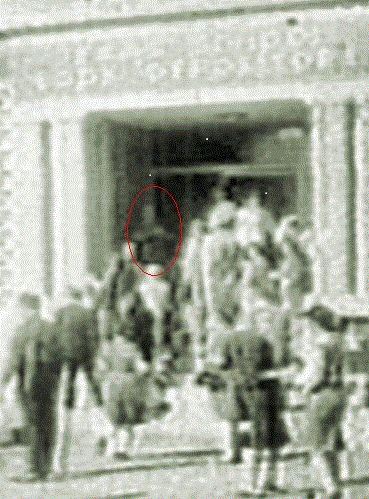
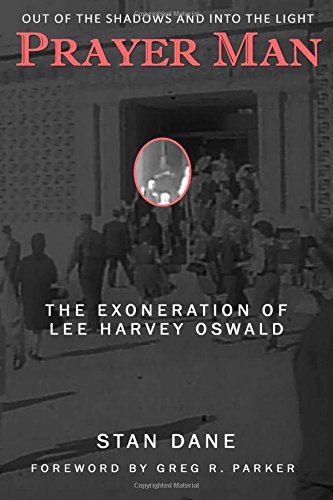
    Go to Part 1


  • Dale Myers, With Malice (Part 1)


    The following is a review of the 2013 Kindle edition of Dale Myers’ book With Malice.

    Commonly used abbreviations throughout this review:

    DPD = Dallas Police department
    WCD = Warren Commission document
    FBI = Federal Bureau of Investigation
    Sgt. = Seargent
    USSS = United States Secret Service
    Lt. = Lieutenant
    WCE = Warren Commission exhibit


    For the 50th anniversary of the assassination of President John F. Kennedy and the murder of Dallas Policeman J.D. Tippit, Dale Myers decided to publish an updated version of his book on Tippit’s murder entitled, With Malice. The updated book contains new text, photographs and maps pertaining to Tippit’s death. I had never read With Malice before, and it was only at the insistence of Jim DiEugenio that I decided to review the updated book. As anyone who is familiar with Myers knows, his contention is that Lee Harvey Oswald murdered Tippit in cold blood, after allegedly assassinating the President. As I hope to explain throughout this review, the notion that Oswald shot Tippit is utterly absurd. But before getting to the book itself, it is first important to outline some of the reasons why Dale Myers is not to be trusted when it comes to both Tippit’s murder and President Kennedy’s assassination.

    As most researchers of the JFK assassination are probably aware, Myers has claimed to have proven through his 3-D animation of President Kennedy’s assassination that the single bullet theory is actually true. However, as researchers such as Milicent Cranor, Bob Harris, and Pat Speer have shown, Myers’ work is highly deceptive. Speer’s comprehensive analysis of the statements of the ear/eye witnesses to the assassination has demonstrated beyond a reasonable doubt that the majority of ear/eye witnesses didn’t hear the so-called single bullet shot, and that the shot(s) to Governor Connally did not originate from the sixth floor of the Texas School book depository. Myers is also known for his support of the ludicrous notion that the first shot missed the President’s limousine, and caused the injury to bystander James Tague. Contrary to this belief, Tague always denied that the first shot was responsible for the cut to his left cheek. In fact, following the airing of Max Holland’s utterly fallacious documentary, The Lost Bullet, in which Holland claimed Tague’s injury was caused by the first shot, Tague indignantly exclaimed; “Holland is full of crap. One thing I know for sure is that the first shot was not the missed curb shot. Another thing I am positive about is that the last shot was the missed shot. You may not want to believe the Warren Commission’s final findings, but you can believe the 11 witnesses who state it was the last shot that missed.” (Read Tague’s remark). Although Tague was not always certain whether it was the second or third shot he heard which caused his injury, his confusion is understandable given that like the majority of ear/eye witnesses, he claimed that the next two shots he heard were fired in rapid succession (WCD 205, page 31). The fact that Myers pretends this theory is true in spite of Tague’s adamant denial, speaks poorly for his credibility as a researcher.

    Then there is Myers’ interview with John Kelin in 1982. During that interview, Kelin asked Myers what he thought about Oswald, to which Myers responded with the following remark; “…First off, I don’t think Lee Harvey Oswald pulled the trigger.” Myers also said that as far as saying Oswald is guilty, “…I find that extremely hard to believe”. However, most revealing of all was his denial that Oswald had shot Tippit; namely that “I think I will be able to show, beyond a reasonable doubt, that Oswald was not the killer of J.D. Tippit.” Researcher and author Jim DiEugenio once asked what had caused Myers to suddenly believe that Oswald hard murdered Tippit? Although we may never know the real answer to that question, it hardly matters. However, in this reviewer’s opinion, it was most likely due to Myers fondness for many of the DPD Officers he had interviewed, such as former DPD dispatcher Murray James Jackson. In fact, as this reviewer demonstrates below, Myers shows favouritism towards these very same officers.

    Although there are some people who believe that With Malice is the definitive book on Tippit’s murder, nothing could be further from the truth. Myers omits many facts and pieces of evidence which tend to exonerate Oswald as Tippit’s killer. Myers also shows favouritism towards witnesses who support Oswald’s guilt (even though, as I will explain, they lack credibility). In the introduction to his book, Myers also quotes many of Tippit’s family members and friends who dismiss the notion that Tippit was somehow involved in a conspiracy to murder either President Kennedy or Oswald. For example, Myers quotes Marie Frances Gasway, Tippit’s widow, who said the following during an interview in 2003: “The conspiracy stuff is so untrue, so totally unfounded.” (With Malice, Introduction). Quoting Tippit’s youngest son, Curtis Tippit, Myers writes: “People want sensationalism. Mom’s been abused by conspiracy theories and tabloid publications… Too many people want to cling to a false history, believing my father was in on something with Jack Ruby… Really it’s all kind of silly and funny” (ibid).

    Although it is perfectly understandable that Tippit’s family and friends want to feel a sense of closure by believing that the man who allegedly murdered Tippit was arrested by the DPD, it is nevertheless important that an honest analysis of the evidence and facts pertaining to his murder be presented to current and future researchers of that case. Furthermore, given the shame and embarrassment any allegation that Tippit was somehow involved in a conspiracy would bring to his family members and friends, it is also perfectly understandable that they would vehemently deny any such allegations. Readers should keep in mind that since writing several articles on Tippit’s murder on my blog, I have since changed my mind on a number of issues, and have come to realize that I had also made a number of mistakes and misjudgements.

    I: The search begins

    Myers begins his above titled Chapter 1 with the following sentences: “Lee Harvey Oswald murdered J.D. Tippit. The Dallas Cops believed it. The newspapers reported it. The Warren Commission made it official and the House Select Committee on Assassinations reaffirmed it.” (With Malice, Chapter 1). Myers and his fellow Warren Commission defenders scoff at the idea that the DPD and the Dallas district attorney’s Office could have helped frame Oswald for the murders of President Kennedy and J.D. Tippit. In fact, Myers snidely writes the following: “It was claimed [by Warren Commission critics] that Oswald was framed by a zealous Police force” (ibid). Thanks to Dallas district attorney Craig Watkins, we now know that with Henry Wade as District Attorney of Dallas, the DPD was one of the most corrupt Police departments in the entire United States; something which Myers and his ilk want to pretend isn’t true. To give the reader one example of just how bad the DA’s Office and the DPD were, let’s take the case of James Lee Woodard. Woodard was an African American man who spent twenty seven years in prison for a murder he didn’t commit. As it turned out, Henry Wade’s Office had withheld evidence from Woodard’s defence attorney which exonerated him as the killer. According to Michelle Moore, the President of the Innocence Project of Texas’ “…we’re finding lots of places where detectives in those cases, they kind of trimmed the corners to just get the case done”. She also added; “Whether that’s the fault of the detectives or the DA’s, I don’t know.” (Readers are strongly encouraged to read through this article, to see for themselves just how corrupt Wade’s Office and the DPD were).

    As for why the DA’s Office and the DPD would want to frame Oswald, just consider the following. The president of the United States of America (the most powerful man in the world) was gunned down in broad daylight and in full public view. Naturally, the entire United States, including the leaders of foreign countries, were anxiously waiting to learn who was responsible for the crime. Since the assassination of a sitting President was not a federal crime in 1963, the DPD had jurisdiction, and were undoubtedly under a tremendous amount of pressure to find those responsible, in order to avoid embarrassment for not being able to identify those responsible. Naturally, the DPD also had to find those responsible for the murder of one of their own policemen. As many researchers of the assassination have pointed out, a wallet bearing identification for Oswald and his alleged alias, Alek James Hidell, was discovered in the vicinity of the Tippit murder scene. This allegation first appeared in the book by former FBI agent James Hosty entitled Assignment Oswald. Myers dismisses the idea such a wallet was left behind to incriminate Oswald. But as this reviewer explains later on in this review, there is very good reason to believe that this was the case.

    It’s important to keep in mind that with a wallet left behind to incriminate Oswald, the DPD had a viable suspect for Tippit’s murder. The DPD could then use Tippit’s murder to portray Oswald as a violent man who was capable of assassinating the President. In fact, Warren Commission counsel David Belin once remarked that: “Once the hypothesis is admitted that Oswald killed patrolman Tippit, there can be no doubt that the overall evidence shows that Lee Harvey Oswald was the assassin of John F. Kennedy”. (ibid). To say that such a belief is narrow-minded would be an understatement. Myers also makes several demeaning comments against those who refuse to believe that Oswald shot Tippit. For example, Myers writes that; “Many eyewitness accounts of the [Tippit] shooting were twisted to exonerate Oswald” (ibid). The readers of this review can make up their own minds on whether or not this is the case. Myers also writes that; “Lee Harvey Oswald murdered Officer J.D. Tippit. There can no longer be any doubt about that”, and that no matter what role Oswald had in the President’s assassination “…Oswald’s guilt in the Tippit shooting must be hereafter considered a historic truth.” (ibid). In light of all the evidence to the contrary, to say that Oswald’s guilt in the Tippit murder must be considered a historic truth is almost absurd. However, Myers can make that claim, because he omits a lot of the evidence which tends to exonerate Oswald.

    II: The quiet cop

    In this chapter, Myers discusses Tippit’s life from his childhood, his high school years, his service in the United States Army as a paratrooper, on to his career as a DPD Officer. Myers portrays Tippit as a good and honest cop, killed in the line of duty. In his discussion of Tippit’s Army experiences, Myers explains that it had “…made deep impressions…” Namely that Tippit’s friends recalled that he would be startled by any loud noise and that he was “…still a little nervous…” (With Malice, Chapter 2). What Myers omits however, is that Tippit’s DPD personnel files contain evidence that he may possibly have been unstable. (Reopen Kennedy case forum, thread entitled: J.D Tippit: the perfect DPD recruit). In his discussion of Tippit’s career as a DPD Officer, Myers explains that since joining the DPD as an apprentice Policeman in July, 1952, Tippit was an “exemplary” Police Officer (With Malice, Chapter 2). However, Myers also mentions that in 1955, Tippit had received several reprimands for not appearing in court as ordered (ibid). In order to bolster his claim that Tippit was a good and honest Police Officer, Myers quotes several of Tippit’s fellow Police Officers, such as Tippit’s supervisor, Calvin “Bud” Owens, who vouched for this (ibid). Even if these claims are true, it has little bearing on whether Tippit was lured to Tenth Street to be shot and killed. The evidence for that lies in the fact that a wallet was left behind to incriminate Oswald for his murder. Furthermore, the DPD would naturally want to avoid making claims to the contrary, as any such claims could lead to speculation that Tippit was somehow involved in a conspiracy; and bring about embarrassment to the DPD.

    III: The final hours

    In this chapter, Myers relates to the readers the final hours of Tippit’s life; from the time he left his home at 6:15 am, to the time he was shot and killed on Tenth Street in the central Oak Cliff area of Dallas (With Malice, Chapter 3). The issues which Myers deals with here include why Tippit was in central Oak Cliff when he was killed, the sighting of Tippit at the Gloco Service station located at 1502 North Zangs blvd., the sighting of a DPD squad car which Earlene Roberts, the house keeper at 1026 North Beckley where Oswald was allegedly living at the time of the assassination, a car she claimed was outside the rooming house when “Oswald” was inside following the assassination, and finally, Tippit’s alleged presence at the Top Ten records store a few minutes prior to his death. Myers writes that; “Tippit wished he could have seen the President, whom he had voted for and admired.” (ibid) Whilst that may be true, it is this reviewer’s belief that it has little (if any) bearing on his death. Myers also relates to his readers the all too familiar tale that Howard Brennan was sitting directly across from the TSBD on Elm Street, when he allegedly observed Oswald firing the shots at President Kennedy (ibid). But what Myers doesn’t tell his readers is that the Zapruder film shows beyond any doubt that Brennan was sitting directly across Houston Street, and that Brennan was lying when he said he sitting directly across from the TSBD.

    In his discussion of whether or not Earlene Roberts had really seen a DPD squad car outside of the rooming house, Myers does everything he can to discredit her story. When Roberts was interviewed by the FBI on November 29, 1963, she told them that the number of the car she observed outside the rooming house was 207 (WCE 2781). As Myers explains, that particular car was assigned to DPD Officer Jim M. Valentine, and which took DPD Sgt. Gerald Hill and Dallas Morning News reporter Jim Ewell to Dealey Plaza from Police headquarters. As this reviewer will explain in an upcoming essay on Gerald Hill, Hill had by all likelihood commandeered car 207 from Officer Valentine, and was one of the two Officers inside the car when it was seen by Roberts outside of the rooming house. In that same essay, this reviewer will discuss Myers’ narrow minded attempt to discredit Roberts.

    On the day of the assassination, Tippit was assigned to patrol district 78 (testimony of Calvin Bud Owens, WC Volume VII, page 80). However, the patrol district in which Tippit was killed (district 91) was assigned to a DPD Officer named William Duane Mentzel (WCE 2645). Tippit and another Officer named Ronald C. Nelson were allegedly ordered to move into the central Oak Cliff by DPD dispatcher Murray Jackson at approximately 12:45 pm (WCE 705/1974). According to DPD chief Jesse Curry, the central Oak Cliff area included patrol district 91 (WCD 1259, page 3). According to the map of the DPD patrol districts, it stands to reason that districts 92, 93, 94, 108, and 109 which were adjacent to district 91 were also part of the central Oak Cliff area (Dallas Municipal archives, Box 7, Folder 10, Item 2). Although Jackson was never called to testify before the Warren Commission, during a filmed interview with Eddie Barker from CBS, he explained that he had ordered Tippit into the central Oak Cliff area because “We [the dispatchers] were draining the Oak Cliff area of available Police Officers….” (See the interview). Myers accepts that this was the case, and writes that Jackson told him during an interview that he had ordered Tippit into the central Oak Cliff area because Tippit had once helped him out during an incident with seven drunk teenagers, and that allegedly feeling that he could once again rely on Tippit, Jackson ordered Tippit into the Oak Cliff area to “help him [Jackson] again…. to cover Oak Cliff” (With Malice, Chapter 3).

    But contrary to Jackson’s claim, there is very good reason to believe that he never ordered Tippit and Nelson to move into the central Oak Cliff area. In the first transcript of channel one of the DPD radio recordings (Sawyer exhibit B), the order to send Tippit and Nelson into the central Oak Cliff area is curiously missing. Myers doesn’t mention this to his readers. In that very same transcript, the channel one dispatchers (Jackson and Clifford Hulse), allegedly broadcast the following message over the DPD radio at approximately 12:43 pm; “Attention all squads in the downtown area code three [lights on and sirens blazing] to Elm and Houston with caution.” (Sawyer exhibit B, page 398). Myers acknowledges this in his timetable of the events which occurred on the day of the assassination, but hides from his readers the fact that according to the next transcript which the DPD had provided to the FBI on March 20, 1964, the dispatchers had actually broadcast the following message: “Attention all squads, report to [the] downtown area code 3 to Elm and Houston, with caution.” (WCE 705).

    Whilst it certainly makes more sense that only the squads in the downtown area would be dispatched to the assassination scene, thereby leaving all the “outer” area squads in their assigned districts in the event a crime such as a robbery were to occur, the exact same transmission appears in the next transcript on the DPD channel one and two radio recordings (WCE 1974). On July 21, 1964, DPD chief Jesse Curry furnished the FBI a copy of the “original” tape recordings of the DPD radio traffic, which were reviewed by an agent of the FBI at the DPD (ibid). If the transmission “Attention all squads, report to [the] downtown area code 3 to Elm and Houston, with caution” was not recorded on the tapes, then the FBI would surely not have allowed it to be placed into the new transcript. Confirmation that the dispatchers had actually ordered all squads and not only the squads in the downtown area to proceed to Elm and Houston comes from DPD chief Curry himself. In a letter to the Warren Commission on July 17, 1964, Curry wrote; “…between 12:37 p.m. and 12:45 p.m., the dispatcher requested all squads to report to Elm and Houston in the downtown area, code 3” (WCD 1259, page 3). Curry then added; “It might further be pointed out that Officer Tippit remained on his district until the dispatcher had requested all squads to report to Elm and Houston…” (ibid). But perhaps most significantly of all, Jackson himself confirmed that all squads had been dispatched to Elm and Houston Streets in his filmed interview with Eddie Barker in 1967. According to Jackson; “…we immediately dispatched every available unit [squad] to the triple underpass where the shot was reported to have come from.” Myers mentions none of this to his readers.

    In light of all of the above, the notion that Jackson was only concerned that the Oak Cliff area was being “drained’ of available DPD Officers when all squads had been ordered to Elm and Houston seems strained. Jackson’s next transmission to Tippit was at approximately 12:54 pm, when he asked Tippit if he was in the Oak Cliff area (WCE 705/1974). Tippit allegedly responded that he was at Lancaster and Eighth. Jackson then allegedly instructed Tippit; “You will be at large for any emergency that comes in.” Keep in mind that the alleged order to Tippit and Nelson was to move into the central Oak Cliff area. On the day of the assassination, districts 93 and 94 were assigned to Officer Holley M. Ashcraft, and districts 108 and 109 were assigned to Officer Owen H. Ludwig (WCE 2645). Although the tape recordings of channel one of the DPD radio reveal that the dispatchers sent Ashcraft to Inwood road and Stemmons expressway to cut traffic (Listen to the recording), and although Ludwig was allegedly guarding the front of the Sheraton-Dallas-Hotel, Jackson never bothered to try and contact William Mentzel on the radio, who was on a lunch break at approximately the time of the assassination (ibid). None of the transcripts of the DPD radio communications show that Jackson had attempted to contact Mentzel; and the notion that Jackson would order Tippit and Nelson to move into the central Oak Cliff without even once bothering to contact Mentzel to ensure that Mentzel was patrolling his assigned districts (91 and 92) is also strained (ibid). Again, Myers does not mention to his readers that Jackson never bothered to contact Mentzel by the DPD radio.

    Finally, there is the fact that despite being allegedly ordered to move into the central Oak Cliff area, Ronald Nelson proceeded to Dealey Plaza, and even told the dispatcher that he had gone there at approximately 12:52 pm (WCE 705/1974). But despite disobeying Jackson’s order, we are supposed to believe that he had the audacity to then ask the dispatchers if they wanted him to go over to the Tippit murder scene (ibid). Myers explains that after Jackson allegedly ordered Tippit and Nelson to move into the central Oak Cliff area, Tippit responded; “I’m at Kiest and Bonnieview”, and Nelson allegedly responded that he is “…going North of Marsalis, on R.L. Thornton” (With Malice, Chapter 3). What Myers doesn’t mention is that the aforementioned alleged responses by Tippit and Nelson do not appear in either WCE 705 or Sawyer exhibit B. They first appear in WCE 1974. Myers also writes that Nelson told the dispatchers that he was at the South end of the Houston Street Viaduct (ibid). However, according to both WCE 705 and WCE 1974, the Officer who made the transmission was actually B.L. Bass; and that Bass had identified himself to the dispatchers by his radio number (101).

    When author Henry Hurt interviewed Nelson in 1984, he asked him; “Did you get the call to go to central Oak Cliff” (Hurt, Reasonable Doubt, page 162). After first telling Hurt that he wasn’t sure what he meant by his question, he then said “I had rather not talk about that” (ibid). According to Hurt, Nelson apparently considered that information to be worth some money (ibid). Myers explains that Nelson had declined a request for an interview with him (With Malice, Chapter 3). Nelson’s reluctance to be interviewed may have been due to the fact that he actually wasn’t ordered to move into the central Oak Cliff area, and that his explanation to Hurt that it was worth some money was just an excuse to discourage Hurt from talking about it with him. Suffice it to say, the notion that Tippit and Nelson were ordered to move into the central Oak Cliff area is dubious, and the transcripts and tape recordings of the DPD radio communications were in all likelihood altered to make it appear as though they actually were sent into the central Oak Cliff area.

    Obviously, the DPD had to provide an explanation for what Tippit was doing there; hence Jackson was coerced into claiming that he had sent them into central Oak Cliff. In this reviewer’s opinion, the DPD claimed that Nelson was also sent into central Oak Cliff so that they wouldn’t make it appear obvious that they were covering up for Tippit’s singular presence there. But did Jackson also have a personal reason for lying about Tippit’s presence in central Oak Cliff? As it turns out, there is. Jackson told Henry Hurt during an interview with him that he was a very close personal friend of both Tippit and his family (Hurt, Reasonable doubt, page 162). As any reasonable person would be able to understand, Tippit’s unauthorised presence in central Oak Cliff would have led to rumours which would probably be upsetting for his family members. Jackson may have thought that by claiming he had ordered Tippit to move into the central Oak Cliff area, he would be sparing Tippit’s family members of these upsetting rumours.

    In his timetable of events which occurred on the day of the assassination, Myers writes that Tippit was at the GLOCO (Good luck Oil Company) service station, located on 1502 North Zangs Blvd., apparently watching traffic “coming out of downtown.”, from about 12:56 pm to 1:06 pm (With Malice, Timetable of events). In the endnotes, Myers cites David Lifton’s interview with a photographer named Al Volkland, who told him that he was well acquainted with Tippit, and that he had seen him at the service station. Volkland’s claim of seeing Tippit there was allegedly confirmed by his wife; and both claimed that they observed Tippit at the service station 10 or 20 minutes following the assassination. Furthermore, J.B. “Shorty” Lewis and Emmett Hollingshead, who were employed at the service station, and Tom Mullins who was the owner of the station at the time of the assassination, also claimed they had seen Tippit there (With Malice, Chapter 3).

    In his endnotes, Myers also cites the Ramparts magazine article by David Welsh, in which Welsh wrote that Lewis, Hollingshead, and Mullins claimed Tippit was at the service station for about ten minutes, between 12:45 pm and 1:00 pm. However, Myers explains that in an interview with him in 1983, Hollingshead claimed that he had seen Tippit at the service station before the President was assassinated. Myers also claims that in an interview with him in 1983, Lewis said that other employees of the service station had seen Tippit there, and not him. Myers offers no source for why he believes Tippit arrived at the service station at 12:56 pm, and as this reviewer explains below, there is compelling evidence that Tippit was actually shot at about 1:06 pm. If Tippit really was at the service station, his presence there is a mystery. Whilst Myers doesn’t believe that Tippit was at the service station by 12:45 pm, and that he only moved into the central Oak Cliff area following the alleged order by Murray Jackson to do so, he nevertheless ignores all of the compelling evidence that Jackson didn’t order Tippit to move into the central Oak Cliff area.

    According to the DPD radio transmission transcripts, Murray Jackson asked Tippit for his location at approximately 1:03 pm, but received no response (WCE 705/1974). However, Myers writes that as the dispatchers were trying to determine the location of Officer A.D. Duncan, a garbled transmission was made that had the tonal characteristics of other “known” transmissions made by Tippit (With Malice, Chapter 3). In his endnotes, Myers explains that the transcripts describe the alleged transmission by Tippit as “more interference”, which is true (WCE 705/1974). In fact, according to the transcripts of the DPD radio communications, the interference was due to “…intermodulation similar, according to [the] Dallas Police Department, to that most often originating from the Dallas Power and light company” (ibid). Given Myers skewed conclusion driven agenda , as demonstrated throughout this review, readers are cautioned against believing much of what Myers writes. According to Myers, Tippit was at the Tip Top Records store at 1:11 pm, where he was allegedly trying to place a phone call to someone (With Malice, Chapter 3). However, given that Tippit didn’t respond to Jackson at 1:03 pm, Tippit was probably in the store at this point in time. If Tippit really was in the store trying to call someone, it remains a mystery as to who it was, and why he was trying to call him/her.

    IV: Murder on Tenth Street

    Myers now discusses Tippit’s murder on Tenth Street, and the events that followed. It is Myers contention that Tippit was shot at approximately 1:14.30 pm (With Malice, Chapter 4). Myers writes that the tape recordings of the DPD radio communications show that Domingo Benavides had attempted to inform the DPD dispatchers of Tippit’s death at 1:16 pm, as the tape recordings show that he began “keying” Tippit’s microphone at that time; and had been doing so for about one minute and forty one seconds. Based on the eyewitness account of Ted Callaway , Myers then speculates that Tippit was probably shot ninety seconds prior to Benavides attempt to contact the dispatcher (ibid). However, let’s look at all the evidence that Myers ignores to reach his conclusion that Tippit was shot at about 1:14.30 pm. To begin with, Myers never informs his readers that according to WCE 705, T.F. Bowley, who had arrived at the murder scene shortly following Tippit’s death, reported Tippit’s death just prior to 1:10 pm! In WCE 1974 however, the time of Bowley’s transmission was noted as being made at about 1:19 pm.

    Bowley claimed in his affidavit to the DPD that when he arrived at the Tippit murder scene, he looked at his watch and it read 1:10 pm. He also claimed that the first thing he did was to try and help Tippit, and then informed the DPD dispatchers that Tippit was shot (Dallas municipal archives, Box 2, Folder 3, Item 14). Assuming that Bowley took no more than a minute to try and help Tippit before informing the dispatchers of the shooting, the actual time of Bowley’s arrival would have been approximately 1:09 pm. Nevertheless, both WCE 705 and Bowley’s watch place Tippit’s death sooner than Myers time of 1:14.30. Myers deals with Bowley’s watch reading 1:10 pm in his endnotes, where he writes that no one determined whether Bowley’s watch was accurate on the day of the assassination. Whilst we will probably never know just how accurate Bowley’s watch was, WCE 705 places Bowley’s transmission at about 1:10 pm, which is fairly consistent with Bowley’s claim his watch read 1:10 pm after he arrived.

    In his endnotes, Myers also deals with the allegation by Mrs. Margie Higgins, who lived 150 feet east of and across the street from where Tippit was shot. As Myers writes, Mrs. Higgins told author Barry Ernest that she was watching the news, when the announcer stated that the time was 1:06 pm (Ernest, The Girl On The Stairs, page 90). Mrs Higgins told Ernest that she then checked the clock on top of the TV, which confirmed that the time was 1:06 pm, and that it was at that point when she heard the shooting. Myers tries to discredit Mrs Higgins’ claim by telling his readers that, “A review of archival recordings of all three networks broadcasting that afternoon in Dallas failed to verify her [Mrs Higgins’] recollection.” Myers then adds “In fact, none of the networks broadcast a time check at 1:06 p.m. as she claimed.” Although this review cannot verify whether this is true or not, readers are once again cautioned against taking Myers word for it, for this reviewer demonstrates throughout this review that Myers is not a candid or balanced researcher. Readers should also keep in mind that Mrs. Higgins’ claim is consistent with Helen Markham’s claim in her affidavit that she was standing on the corner of Tenth and Patton Streets at approximately 1:06 pm when Tippit was shot (Dallas Municipal archives, Box 2, Folder 1, Item 18).

    Both Markham’s and Mrs Higgins’ claims are also consistent with the fact that Markham told FBI agent Robert M. Barrett that when she left the Washateria of her apartment to catch her bus, she noticed the time shown on the clock of the Washateria was 1:04 pm (WCD 630). Markham explained to Barrett that she was attempting to call her daughter on the Washateria phone (ibid). The FBI determined that it would have taken Markham about two and a half minutes to reach the intersection of Tenth and Patton Streets, which means Markham would have arrived at the intersection close to 1:07 pm (ibid). Myers acknowledges in his book that Markham reportedly left the Washateria at 1:04 pm, but claims that Markham “probably” didn’t leave the Washateria before 1:11 pm, and speculates that this was perhaps the case because of her “eagerness” to contact her daughter by phone (With Malice, Chapter 4). In his endnotes, Myers snidely writes that in order to believe the statements by Markham, Higgins, and Bowley of when Tippit was killed; “…one would have to believe that Tippit lay dead in the Street for eight to twelve minutes before anyone notified [the] Police.” But only by ignoring the fact that WCE 705 places the time of Bowley’s radio transmission at approximately 1:10 pm can Myers make this claim and think that he can get away with it.

    Myers writes that the Dudley Hughes Funeral home, which had dispatched the ambulance which took Tippit’s body to Methodist hospital, was informed of the shooting at 1:18 pm by the DPD, and that Dudley M. Hughes Junior, who took the call from the DPD at the funeral home, allegedly filled out an ambulance call slip which was time stamped 1:18 pm (With Malice, Chapter 5). Myers references this call slip to an essay by researchers George and Patricia Nash in The New Leader entitled: The Other Witnesses (John Armstrong Baylor collection, tab entitled: George & Patricia Nash). However, the call slip itself doesn’t appear to be amongst the Dallas Municipal archives collection, and taking into account all of the evidence which contradicts the notion that the funeral home received the call at 1:18 pm, this piece of evidence should be considered unreliable. Of course, it is entirely likely that if the ambulance call slip actually exists, the DPD had falsified it in order to bolster the notion that Tippit was shot close to 1:18 pm; and thereby allowing Oswald plenty of time to reach Tenth and Patton in order to shoot Tippit after he allegedly left the rooming house at 1026 North Beckley.

    Readers should keep in mind that justice of the peace, Joe B. Brown, filled out an authorisation permit for an autopsy to be performed on Tippit’s body, and in that permit, Brown noted that Tippit was pronounced dead on arrival at Methodist hospital, and noted the time of death as 1:15 pm (Dallas Municipal archives, Box 3, Folder 24, Item 2). Although there is conflicting evidence for the time Tippit was pronounced dead at Methodist hospital, researcher Martin Hay discovered that in a supplementary offense report by DPD Officers R.A. Davenport and W.R. Bardin, Dr. Richard Liguori pronounced Tippit dead at Methodist Hospital at 1:15 pm (ReopenKennedycase forum, thread entitled: Question Concerning Time). Given the fact that (according to WCE 705) T.F. Bowley’s transmission to the DPD dispatchers was at approximately 1:10 pm, and given all of the aforementioned evidence which supports the notion that Tippit was shot prior to 1:10 pm and then taken to Methodist Hospital where he was most likely pronounced dead at 1:15 pm, Myers assertion that Tippit was shot at 1:14.30 pm is simply not tenable.

    According to WCE 705, Tippit allegedly tried to contact the DPD dispatchers twice at approximately 1:08 pm. However, these alleged transmissions are curiously missing from WCE 1974; and instead, there appears to be two garbled transmission from DPD Officers with the radio numbers 58 and 488. Although some researchers believe that the alleged call by Tippit at circa 1:08 pm is proof that Tippit was still alive at that time, and that he was attempting to report that he had just encountered a suspect, there is good reason to believe that this alleged call was added into the transcript by the DPD. Consider that with Helen Markham’s first day affidavit, the DPD would have realised that Tippit was killed at approximately 1:06 pm. It is this reviewer’s opinion that the DPD took advantage of the fact that there were two garbled transmissions at about 1:08 pm, and claimed that it was Tippit to make it appear as though he was alive after 1:06 pm.

    As far as Tippit’s alleged attempts to report that he had just encountered a suspect are concerned, the discovery of the wallet containing identification for Oswald and Hidell in the vicinity of the Tippit murder scene strongly implies that Tippit was lured to Tenth Street to be shot. With this in mind, the last thing the conspirators would surely have wanted was for Tippit to become suspicious. Therefore, it seems very unlikely that Tippit actually attempted to report that he had encountered a suspect. Myers never mentions that WCE 705 shows that Tippit attempted to contact the dispatchers, writing instead that: “A check of the Dallas Police tapes revealed that Tippit did not notify the dispatcher that he was stopping to question the man on Tenth Street” (With Malice, Chapter 4). It is this reviewer’s belief that Myers never mentions Tippit’s alleged attempts to contact the dispatchers, because he was probably concerned that his readers would think that Tippit had stopped “Oswald” at about 1:08 pm; and by implication, was also shot at this time.

    This reviewer would also like to point out that when T.F. Bowley reported the shooting to the DPD dispatchers, Murray Jackson allegedly responded by calling out Tippit’s radio number (78), because according to Myers, Tippit was “…thought to be the only available patrol unit in the Oak Cliff area.” (ibid) By ignoring all the evidence that the DPD radio traffic tape recordings have been altered, Myers can pretend that Jackson really did call for Tippit.

    Furthermore, in an apparent attempt to explain why Jackson immediately thought of calling for Tippit instead of William Mentzel, Myers writes in his endnotes that Mentzel, and another officer named Vernon R. Nolan, were sent to a traffic accident at about 1:11 pm. Curiously, there is nothing within WCE 705 and WCE 1974 that Mentzel was sent to a traffic accident.

    Another issue which Myers discusses in this chapter is the direction in which the killer was walking when he was spotted by Tippit. Based on the observations by William Lawrence Smith, Jimmy Burt, Jimmy Brewer, and William Scoggins, Myers concludes that Tippit’s killer was initially walking west (ibid). This reviewer agrees. However, readers should keep in mind that in his interview with the FBI on December 15, 1963, Burt made no mention of seeing Tippit’s killer at all (WCD 194, page 29). Based on the statements of witnesses Helen Markham and Jack Ray Tatum, Myers speculates that Tippit’s killer then turned around and was walking east when he observed Tippit’s squad car approaching, and that this is what caused Tippit to pull over to the curb and question his soon to be killer (ibid). According to Myers: “The eyewitness accounts depict the suspect traveling in two conflicting directions, with the key moment of change occurring just east of Tenth and Patton” (ibid). But as even Myers ironically notes at the end of this chapter, Helen Markham told the USSS on December 2, 1963, that she first observed Tippit’s killer on the sidewalk after Tippit had pulled his squad car to the curb (ibid). Myers also notes that on March 17, 1964, Markham told FBI agent Robert M. Barrett that she had first seen Tippit’s killer as Tippit passed the intersection of Tenth and Patton (ibid). When Markham testified before the Warren Commission, she claimed that she saw Tippit’s killer crossing Patton street (heading east), and about to step up onto the curb (WC Volume III, page 307).

    Not only do Markham’s statements directly contradict Myers assertion that the killer changed direction just east of Tenth and Patton, but given her overall unreliability as a witness, her claim that she had observed Tippit’s killer walking east should not be considered credible. Also, consider that in her affidavit to the DPD, she made no mention of which direction Tippit’s killer was walking when she first observed him (Dallas Municipal archives, Box 2, Folder 1, Item 18). According to researcher John Armstrong, a barber named Mr Clark claimed he had also seen Tippit’s killer walking west along Tenth Street, and that he would bet his life that the man he saw was Oswald However, Clark does not count as a witness to seeing Tippit’s killer walking west along Tenth Street, because he claimed he saw the man in the morning, whereas Tippit was most certainly there after 1:00 pm in the afternoon (John Armstrong Baylor research collection, tab entitled: 10th St. Barber shop).

    Myers also explains to his readers that a Mrs Ann McCravey (believed to be Mrs Ann McRavin who allegedly lived at 404 east Tenth Street) claimed that she had seen Tippit’s killer running (With Malice, Chapter 4). Although McRavin didn’t specify which direction she had seen Tippit’s killer running, Myers writes that given her vantage point; “…Tippit’s killer could only have been running in a westerly direction [when she saw him]…” (ibid). But contrary to McRavin’s claim, no other witness is on record saying that Tippit’s killer was running, and given the evidence that Tippit was lured to Tenth Street to be shot, it seems highly unlikely that his killer would have been running and making himself appear suspicious to Tippit. Therefore, if she really did see Tippit’s killer, her claim that he was running should not be considered credible.

    As far as Jack Tatum is concerned, there is good reason to believe that he may be a phony witness used not only to help incriminate Oswald for Tippit’s murder, but to also help explain the presence of a suspicious red Ford at the Tippit murder scene. When Tatum was interviewed by HSCA investigators on February 1, 1978, he claimed that after he witnessed Tippit being shot in the head, he sped off in his car, and made no mention of having returned to the murder scene (HSCA report, Volume XII, page 41). In fact, when Tatum was asked if there was anything he wished to add to the statement he made to investigators Jack Moriarty and Joe Bastori, he replied; “At this time I can’t think of anything.” (John Armstrong Baylor research collection, tab entitled: Jack Tatum). However, when Myers interviewed Tatum in 1983/84, Tatum now began to aggrandize his story and his importance in it. He now claimed that he had gone back to the Tippit murder scene, and had taken Helen Markham to a policeman (With Malice, Chapter 4). Evidently, by the time Myers had interviewed him, Tatum had experienced a case of memory improvement. It is also noteworthy that during a telephone interview on March 18, 1986, Tatum allegedly stated that he had taken Markham to the police station to give evidence (John Armstrong Baylor research collection, tab entitled: Jack Tatum). However, this allegation is dubious. As Myers acknowledges in his book, Markham was taken to DPD headquarters by an officer named George W. Hammer (With Malice, Chapter 7). According to the transcripts of the DPD radio communications, Hammer was indeed the officer who took Markham to DPD headquarters (WCE 705/1974).

    Whilst Myers and his ilk will probably argue that the interviewer was in error, the truth is that no intellectually honest researcher should assume that this was the case, and then argue that Tatum definitely didn’t make such a claim. Readers should also bear in mind that Tatum didn’t come forward as a witness shortly following Tippit’s murder because he allegedly thought that there were enough witnesses, and that he didn’t think he could “add anything” (John Armstrong Baylor research collection, tab entitled: Jack Tatum). During his aforementioned telephone interview, Tatum also claimed that he was concerned about rumors of a conspiracy, and in particular a Mafia one; and that this may have been another reason for him remaining quiet (ibid). Perhaps the most significant detail about Tatum is that he was employed by the Baylor Medical Centre in Dallas, which, according to researcher William Kelly, had received funds from both the U.S. Army and the CIA for the heinous MK/ULTRA research, between the years 1963 and 1965 (John Simkin’s education forum, thread entitled: Frank Kaiser). As many researchers have pointed out, the CIA has been involved in the cover-up of Oswald as President Kennedy’s assassin. Therefore, the possibility exists that the CIA may have been involved in coercing Tatum into identifying Oswald as Tippit’s killer in order to bolster the notion that he was President Kennedy’s assassin. Whilst this reviewer feels certain that Myers will dismiss this as ridiculous, it nevertheless remains a possibility.

    When Domingo Benavides testified before the Warren Commission, he claimed that a man in a red colored Ford had stopped and pulled over following the shooting, and that he never saw him get out of his car (WC Volume VI, page 463). During his interview with John Berendt from Esquire magazine, Benavides claimed that the car he had seen was red colored Ford with a white top, and that it came back to the Tippit murder scene a few minutes following the shooting (John Armstrong Baylor research collection, tab entitled: Igor Vaganov). Jack Tatum claimed that the car he was driving in when he arrived at the Tippit murder scene was a red colored 1964 model Ford Galaxie 500 (With Malice, Chapter 10). Whilst Myers readily accepts that the car Benavides had seen belonged to Jack Tatum, several researchers are of the opinion that it actually belonged to Igor Vaganov, who quite possibly played a role in Tippit’s murder (see the thread entitled Igor Vaganov on John Simkin’s Education Forum). Whilst this reviewer believes that the driver of the red Ford was quite possibly Igor Vaganov, it is also this reviewer’s opinion that Tatum was quite likely pushed into saying that he was the man driving the red Ford to help dispel the notion that the car belonged to Vaganov. As for why Tatum wasn’t coerced into coming forward sooner with his tale, this reviewer cannot offer an explanation. On a final note, Tatum may have been coerced into saying that Oswald was walking east to make it appear as though Tippit had stopped “Oswald” because he had turned around after seeing Tippit approaching in his squad car; just as Myers contends.

    V: Search for a killer

    Myers now explains to the readers the search for Tippit’s killer by the DPD, beginning with the discovery of the spent shell casings on the sixth floor of the TSBD by Dallas County deputy Sheriff, Luke Mooney (With Malice, Chapter 5). Myers believes that DPD Sgt. Gerald Hill was on the sixth floor when Mooney discovered the spent shell casings. But as this reviewer will explain in an upcoming essay on Hill, there is very good reason to believe that Hill was on the sixth floor of the TSBD before Mooney discovered the spent shell casings. Myers writes that the first officer to arrive at the Tippit murder scene was Kenneth Hudson Croy, who was a sergeant in the DPD reserves (With Malice, Chapter 5). According to Myers, the next Officer to arrive at the scene was Howell W. Summers, arriving about one minute after Kenneth Croy, circa 1:20 pm. However, according to the transcripts of channel one of the DPD radio transmissions, Officer Summers informs the dispatchers that he is at the murder scene after 1:25 pm, and after Officers Joe M. Poe, Leonard E. Jez, and Sgt. Calvin “Bud” Owens report that they have arrived at the murder scene (WCE 705/1974).

    Now if Summers was the second Officer to arrive, he waited for over five minutes before telling the dispatchers he arrived, which seems ridiculous. Although this reviewer doesn’t know why Myers doesn’t point this out to his readers, the fact that he doesn’t speaks poorly for his credibility. But in order to bolster the notion that Summers was the second Officer to arrive, Myers writes in his endnotes that Officer Roy W. Walker, who broadcast the first description of Tippit’s killer at about 1:22 pm, told him during an interview in 1983 that when he (Walker) arrived at the murder scene, there were two Officers already there. One of the Officers would undoubtedly have been reserve Sgt. Kenneth Croy. However, the identity of the second Officer to arrive (if Walker’s recollection was accurate) remains an open question.

    According to both WCE 705 and 1974, at approximately 1:32 pm, DPD Officer Jerry Pollard informs the dispatchers on channel one of the DPD radio that; “They [witnesses] say he [the killer] is running west in the alley between Jefferson and Tenth [Streets]”. Myers explains that the two witnesses who gave this information to the DPD Officers were Jimmy Burt and William Arthur Smith (With Malice, chapter 5). In his endnotes, Myers sources this claim to Burt’s interview with Al Chapman in 1968. According to Burt’s interview with the FBI on December 16, 1963, Burt claimed that “…he ran to the intersection of 10th and Patton and when he [Burt] was close enough to Patton Street to see to the south he saw the man running into an alley located between 10th and Jefferson Avenue on Patton Street. The man ran in the alley to the right would be running west at this point.” (WCD 194, page 29). However, Burt was most certainly lying, as no less than four witnesses; Warren Reynolds, B.M. “Pat” Patterson, L.J. Lewis, and Harold Russell, claimed they observed the gunman turn west from Patton Street onto Jefferson Blvd. (With Malice, Chapter 4). When Burt was interviewed by Al Chapman in 1968, he claimed that he and William Arthur Smith “…got to the alley [between Tenth and Jefferson] and we kind of come to a stop and looked down the alley and we saw this guy down there. He was down almost to the next street.” (With Malice, Chapter 4). Myers then writes that Burt and Smith may have been the last two witnesses to see Tippit’s killer fleeing west along the alley behind the Texaco Service station located on Jefferson Blvd. (ibid).

    In his endnotes, Myers acknowledges the discrepancies between Burt’s remarks to the FBI and his remarks to Al Chapman, but tries to explain the discrepancy by stating that because of his police record, his trouble with the U.S. Military, and his alleged desire to withhold his identity from the DPD, Burt possibly “altered” his 1963 interview with the FBI to avoid “deeper” involvement in the case. However, this appears to be nothing but a pathetic attempt at trying to conceal the fact that Burt lied during his interview with Al Chapman, and that the so-called radio transmission by Officer Pollard was probably added into the recordings/transcripts of the DPD radio transmissions to dismiss the possibility that Tippit’s real killer was hiding inside the Abundant Life Temple, located on the corner of Tenth and Crawford Streets (this reviewer will elaborate on this in the upcoming essay on Gerald Hill). Now if Burt really was concerned about all of the above as Myers claims, then why the heck would he lie to the FBI when he surely would have realized that he would be getting himself into more trouble? Myers also acknowledges in his endnotes that William Arthur Smith informed both the FBI and the Warren Commission that he and Burt did not follow the gunman, and also acknowledges that when he (Myers) interviewed Smith in 1997, Smith was unable to recall if they had followed the killer or not. Given all of the above, and despite what Myers wants his readers to believe, Burt should not be considered a credible witness.

    VI: Closing in

    Myers begins this chapter with a discussion of the false alarm at the Jefferson branch Library located on Marsalis and Jefferson streets, and concludes the chapter with Oswald’s arrest inside the Texas Theater. The person who triggered the false alarm at the library was Adrian Hamby, who worked there as a page (With Malice, Chapter 6). Hamby was approached by two plainclothes DPD “detectives”, and was allegedly told to go into the Library and inform management that a Police Officer was shot, and to have them lock all the doors and to not let anyone enter the Library until they secured the area (ibid). As Hamby was entering the Library, he was allegedly spotted by DPD Officer Charles T. Walker, after which Walker put a broadcast on the DPD radio that the suspect was in the library (WCE 705/1974). In his report to DPD Chief Jesse Curry, detective Marvin Buhk wrote that there were “Secret Service” men at the Jefferson Branch Library who informed DPD Officers at the Library that after Adrian Hamby came out of the Library, one of them claimed that Hamby was not the suspect (Dallas Municipal archives, Box 2, Folder 7, Item 56).

    In his endnotes, Myers writes that detective Buhk was the only officer to mention Secret Service agents being at the Library. As far as this reviewer in concerned, Myers is correct. Myers also writes that the “Secret Service” man referred to by Buhk in his report was actually one of the two “lawmen” who instructed Hamby to go into the library and have all the doors locked. The fact of the matter is that there is no known evidence that any genuine Secret Service agents were present at the Jefferson Branch Library on the day of the assassination. Furthermore, the identity of the two men who spoke to Hamby has never been determined, and if they were DPD detectives, then surely their identity would be known to Buhk and others, and surely Buhk would not have referred to them as Secret Service agents. One alternative explanation is that the so-called Secret Service men may have been conspirators, who may have deliberately triggered the false alarm at the Library to pull the DPD Officers away from the Abundant Life Temple, where Tippit’s actual killer was perhaps hiding (this reviewer will be discussing this theory in the upcoming essay on Gerald Hill). The possibility that these “Secret Service” men were conspirators is bolstered by the fact that several men who identified themselves as Secret Service men were present in Dealey Plaza shortly following President Kennedy’s assassination (readers are encouraged to read through this article on this reviewer’s blog). In his dismissal of the “Secret Service” men at the Library as being nothing sinister, Myers never mentions the fact that men identifying themselves as Secret Service men were present in Dealey Plaza.

    As perhaps every researcher of the JFK assassination is aware, Oswald was apprehended inside the Texas Theater after he allegedly tried to shoot Officer M. Nick McDonald with the revolver he supposedly used to murder Tippit. Myers’ discussion of the scuffle inside the theater with Oswald is perhaps the low point of his book, a considerable negative achievement. The author deliberately ignores evidence which contradicts the notion that Oswald had pulled out the revolver and tried to shoot Officer McDonald. Before entering the theater, Oswald was allegedly spotted by shoe store owner Johnny Calvin Brewer outside the lobby of his store on Jefferson Blvd., as he was allegedly trying to avoid the DPD (With Malice, Chapter 6). Brewer then allegedly observed Oswald duck into the theater behind Julia Elizabeth Postal, who was the cashier at the theater (ibid). Myers explains that Oswald had not paid for a ticket, and that Postal had seen Oswald “out of the corner of her eye” as he was coming towards the theater from the east (ibid). During her testimony before the Warren Commission, Postal claimed that she informed the DPD over the telephone that she hadn’t heard of Oswald’s description, but then described him as “ruddy looking.” (WC Volume VII, page 11).

    Towards the end of her testimony, counsel Joseph Ball showed Postal the shirt Oswald was wearing (WCE 150), when he was arrested inside the theatre. He asked her; “when he went in [to the Theater] was it [the shirt] tucked into his pants when he went in?” to which Postal responded; “No, sir; because I remember he came flying around the corner, because his hair was and his shirt was waving.”, and that “It [the shirt] was hanging out”! (ibid). So if Postal had merely seen “Oswald” out of the corner of her eye, how on Earth was she able to describe all of the above? The simple answer is that she did not see “Oswald” out of the corner of her eye, but actually got a good view of him. But, ironically, she also testified that she did not see him enter the theatre.

    Another pertinent piece of information which Myers omits is that when researcher Jones Harris allegedly interviewed Postal in 1963, Harris asked her if she had sold Oswald a ticket for the theater. Upon hearing the question, Postal burst into tears. When Harris asked her again if she had sold him a ticket, he received the same response. The obvious implication of Postal’s reaction is that she did sell a ticket to Oswald. Although this reviewer discusses evidence further on in this review which casts doubt on Harris’s credibility as far as the wallet containing identification for Oswald and Hidell is concerned, Postal’s own testimony as described above suggests that she did in fact sell Oswald a ticket. In fact, in both her affidavit to the DPD and in her interview with the FBI on February 29, 1964, she claimed that she had seen/noticed Oswald duck into the Theater (WCD 735, page 264), (Dallas Municipal archives, Box 2, Folder 3, Item 21) . As the reader can see, Postal is a problematic witness. And it appears to be that she did sell Oswald a ticket.

    Which makes Johnny Brewer problematic. Brewer testified that he had seen Oswald duck into the theater without paying for a ticket (WC Volume VII, page 4). However, he also testified that he had asked Postal if she sold him a ticket (ibid). When Counsel Joseph Ball enquired why Brewer had asked Postal if she sold Oswald a ticket, he said that he didn’t know! (ibid, page 5). The notion that Brewer would have to ask Postal if she had sold a ticket to Oswald, when he already knew the answer is far fetched. Brewer, along with Warren “Butch” Burroughs, who worked behind the concession stand inside the theater, then allegedly searched the theater to find Oswald (With Malice, Chapter 6). After they were unable to find him, Postal called the police (ibid). One important detail which Myers never mentions in his book is that Brewer told author Ian Griggs during an interview in 1996 that when he allegedly observed Oswald standing outside his store, there were two men from IBM in the store with him (Griggs, No Case to Answer, page 58). According to researcher Lee Farley, one of the two so-called “IBM men” was quite possibly Igor Vaganov (see the thread entitled Igor Vaganov on John Simkin’s education forum). This reviewer believes that Vaganov was likely one of the two “IBM” men in the store, and that the purpose of these two men was to alert Brewer that they had seen a man enter the theater with a gun looking like he was trying to hide from the police, so that Brewer would then alert the theater staff to call the DPD in order for Oswald to be arrested.

    Readers should keep in mind that when Warren Commission counsel David Belin asked Brewer how he found out about President Kennedy’s assassination, he testified that; “We were listening to a transistor radio there in the store…” (WC Volume VII, page 2). Belin however, didn’t both to ask Brewer who was in the store with him. Although Postal and Brewer were the two people who purportedly led the DPD to the Theater, the DPD never bothered to take affidavits from them on the day of the assassination. In fact, Postal and Brewer provided their affidavits to the DPD on December 4 and 6, 1963, respectively (Dallas Municipal archives, Box 2, Folder 3, Items 16 and 21). On the other hand, George Applin, who witnessed Oswald’s arrest inside the Texas Theater, provided the DPD an affidavit on the day of the assassination (Ibid, Folder 2, Item 3). Similarly, many of the people who witnessed the President’s assassination provided affidavits on the day of the assassination. Yet, incredibly, Postal and Brewer provided affidavits to the DPD over a week following the assassination. Curiously, there doesn’t appear to be an affidavit from Warren “Butch” Burroughs amongst the Dallas Municipal archives. Furthermore, according to both Warren Burroughs and a theater patron named Jack Davis, Oswald may have been inside the theater much sooner than when Brewer allegedly saw him outside his store at about 1:36 pm looking “funny/scared”

    After the police arrived at the Theater, the first Officer to approach Oswald as he was sitting down was Nick McDonald. Although Johnny Brewer was credited with pointing Oswald out to the DPD Officers inside the theater, Myers writes in his endnotes that the Dallas Morning News and the Dallas Times Herald published an article two days after the assassination, in which McDonald was quoted as saying; “A man sitting near the front, and I still don’t know who it was, tipped me [that] the man I wanted was sitting on the third row from the rear on the ground floor and not the balcony.” However, Brewer testified that he pointed Oswald out to the officers as he was standing on the stage of the theater (WC Volume VII, page 6) If McDonald’s account is true, then the obvious implication is that Brewer wasn’t the man who pointed Oswald out to the police. Myers evidently wants his readers to believe that the man was in fact Johnny Brewer, but doesn’t mention that Brewer was standing on the stage when he allegedly pointed Oswald out to the Officers.

    When Officer McDonald testified before the Warren Commission, he claimed he ordered Oswald to stand up, after which Oswald raised both of his hands and then allegedly yelled out “Well, it is all over now” (WC Volume III, page 300). Although McDonald also wrote in his arrest report to DPD Chief Jesse Curry that Oswald said “Well, it’s all over now”, this is not what McDonald initially claimed Oswald had said to him (Dallas Municipal archives, Box 2, Folder 7, Item 32). When McDonald was interviewed by WFAA-TV on the day following the assassination, he explained that Oswald said “This is it” (See the video). What’s most telling about the interview is that McDonald looks down to the table and sounds nervous (both of which are indications of lying) as he explains that Oswald said “This is it”. Myers doesn’t mention this discrepancy to his readers. Furthermore, when McDonald was interviewed by Lloyd Shearer, he told Shearer that he heard Oswald say “Now, it’s all over” (Oakland Tribune Parade, March 8, 1964). When Gerald Hill testified before the Warren Commission, he informed Counsel David Belin that he thought McDonald and Officer Thomas Hutson (who was also involved in Oswald’s arrest), said that they heard Oswald say “This is it”; but that he didn’t hear this himself (WC Volume VII, page 51). However, when Hutson was asked by Counsel David Belin if he remembered hearing Oswald say anything, Hutson said that he didn’t (WC Volume VII, page 32). It would therefore seem that Hill may have been embellishing.

    When Ian Griggs interviewed Johnny Brewer in 1996, Brewer told him that he heard Oswald shout out “It’s all over”; or words to that effect (Griggs, No Case to Answer, page 64). But when Brewer testified before the Warren Commission, Brewer merely claimed that he heard some hollering, and that he couldn’t make out exactly what Oswald said (WC Volume VII, page 6). Contained within the John Armstrong Baylor collection is an interview with a little known witness named David. According to David, he was with a friend named Bob in the theater when Oswald was arrested (John Armstrong Baylor collection, tab entitled: ‘David’). Evidently, David and Bob are the two young boys spotted by Officer Thomas Hutson sitting at the rear of the theater (WC Volume VII, page 31). David claimed that when McDonald approached Oswald and asked him to stand-up, the only thing he recalled Oswald saying was words similar to “All right”, and made no mention of him saying anything else The reader should bear in mind that there doesn’t appear to be any direct corroboration for the presence of Bob and David in the theater when Oswald was arrested. Yet, none of the above is even mentioned by Myers.

    In his report to Dallas Sheriff Bill Decker, Deputy Sheriff Buddy Walthers, who also allegedly witnessed Oswald’s arrest, wrote that the only thing he heard Oswald say was “It’s all over” (WC Volume XIX, Decker exhibit 5323). However, after reading through Walther’s report, it isn’t clear whether Walthers was saying Oswald said “it’s all over” before or after he was arrested; and as this reviewer will explain in the upcoming essay on Gerald Hill, former Dallas deputy sheriffs Bill Courson and Roger Craig have disputed Walther’s claim that he was inside the theater when Oswald was arrested. Readers should keep in mind that none of the other officers involved in Oswald’s arrest, or theater patrons John Gibson and George Applin who witnessed his arrest, claimed they heard Oswald shout out either “This is it” or “Well, it’s all over now” as McDonald claimed.

    As Myers writes in his book, FBI agent Robert M. Barrett, who also witnessed Oswald’s arrest, claimed in the report he wrote out on the day of the assassination that Oswald shouted in a loud voice; “Kill all the sons of bitches!” (With Malice, Chapter 6). But what Myers doesn’t tell his readers is that no other witness to Oswald’s arrest said that they heard him shout out words similar to what Barrett claimed he did; and that Barrett was almost certainly lying. In conclusion, it is readily apparent that McDonald was lying when he claimed that Oswald said; “This is it” or “Well, it’s all over now”. It is utterly inconceivable that McDonald could have confused the expressions “This is it” with “Well, it’s all over now” as they sound nothing alike. But Myers cannot admit that McDonald (and Barrett for that matter) were lying; as their agenda is to convince researchers that Oswald was guilty of killing Tippit beyond any doubt. Readers are encouraged to read through this article on this reviewer’s blog, which further demonstrates that McDonald was a liar.

    We now come to the question of whether or not Oswald tried to shoot Officer McDonald after McDonald ordered him to stand up; and whether Oswald did in fact have a gun when he was arrested. Although Myers admits in his endnotes that McDonald told Eddie Barker from CBS that he prevented “Oswald’s” gun from firing when his hand was allegedly jammed between the primer of the gun and the hammer, he nevertheless omits that when detective Paul Bentley was interviewed by reporters on the day following the assassination, he claimed that he prevented it from firing! (WCE 2157). However, Bentley also claimed that “…we [evidently referring to McDonald] got a thumb or something in between the hammer and the firing pin so that it mashed the firing [of the gun]…” and that the hammer of the gun “just snapped slightly” (ibid). But despite being allegedly confused about who had prevented the gun from firing, Bentley then almost humorously said; “…my hand was across to prevent it from firing…we don’t know if it was my thumb, finger or hand. I got a bruised hand from it. I don’t know if it was the thumb or the finger.” (ibid). Even though a photograph taken inside the Texas theater shows Bentley standing to the right of Oswald as he is apparently being handcuffed, there is no corroboration from McDonald or anyone else that Bentley prevented the gun from firing as he described (see Gerald Hill Exhibit A). It is therefore probable that Bentley was lying.

    Myers writes in his endnotes that WFAA-TV cameraman, Tom Alyea, claimed that he had seen a bandaged wound on McDonald’s hand during a filmed interview, but that when Alyea wanted to film it, McDonald objected. Although this would seem to corroborate McDonald’s claim that his hand had been jammed between the hammer and the firing pin of the revolver, Alyea described it as looking like someone had jabbed an ice-pick into it. In other words, it didn’t appear as though it was caused by the hammer of a revolver. If McDonald already had this injury before the scuffle with Oswald, then perhaps this is what gave him the idea later on to claim that the hammer of the gun had struck the fleshy part of his hand. Also, given that McDonald made no mention of his hand preventing the gun from firing in either his report to DPD chief Jesse Curry or during his testimony before the Warren Commission, it is apparent he has a credibility problem. McDonald also testified that the four inch scar on his left cheek was made by “Oswald’s” revolver during the scuffle inside the theater (WC Volume III, page 300). However, according to FBI agent Robert M. Barrett, McDonald told him that the graze on his left cheek was caused by Oswald punching him in the face, and knocking him against the seat; and not by the gun (WCD 5, page 84). Myers does not mention this contradiction in his book.

    Although McDonald implies in his report to DPD Chief Jesse Curry that officers Ray Hawkins, Charles Walker, and Thomas Hutson were with him when Oswald allegedly pulled out the revolver from his belt, during his testimony before the Warren Commission, he claimed that he had already disarmed Oswald by the time the aforementioned Officers had arrived to assist him (Dallas Municipal archives, Box 2, Folder 7, Item 32, WC Volume III, page 300). However, Hawkins, Walker, and Hutson all testified that Oswald had pulled the revolver out of his belt after they had arrived (WC Volume VII, pages 32, 39, and 94). Although McDonald took full credit for disarming Oswald, officer Hutson testified that McDonald and “somebody else” had taken the gun out of Oswald’s hand, but added that he “couldn’t say exactly” (ibid, page 32). Walker also testified that as several hands were on the gun, a detective “…reached over and pulled the gun away from everybody, pulled it away from everyone, best I can recall” (WC Volume VII, page 40). However, McDonald told the Warren Commission that after he had disarmed Oswald, he handed the gun to detective Bob Carroll (WC Volume III, page 301). When Carroll testified before the Warren Commission, he claimed that he saw a gun pointing at him (towards the south aisle of the theater) and then grabbed it and jerked it away from whoever had it (WC Volume VII, page 20).

    Myers selectively quotes from the testimony of Officer Charles Walker before the Warren Commission, during which Walker claimed that after Oswald pulled the revolver from under his shirt, it was about waist high and pointed at about a forty-five degree angle (With Malice, Chapter 6). Walker also wrote in his report to Chief Curry that the gun was being waved around approximately waist high (Dallas Municipal archives, Box 2, Folder 7, Item 47). Although Walker also testified that one the Officers had commanded Oswald to “let go of the gun”, to which Oswald allegedly responded “I can’t” (With Malice, Chapter 6). Whilst Myers has no problem using this claim by Walker, he nevertheless neglects to tell his readers that there is no corroboration for Walker’s claim; let alone that no officer is on record claiming that he had ordered Oswald to let go of the gun. Officer Hutson told the Warren Commission that Oswald was pointing the gun towards the theater screen when he allegedly heard the snap of the gun’s hammer, and that Oswald wasn’t aiming the gun at any Officer in particular (WC Volume VII, page 32). However, when McDonald was interviewed by Eddie Barker from CBS in 1964, he demonstrated to Barker that Oswald had allegedly aimed the gun at him (towards the south aisle of the theatre), and then the gun allegedly snapped as he and Oswald were down in the theater seats scuffling (See the footage).

    Hutson also testified that the only officer who could have come between the line of fire of the gun as it was allegedly aimed towards the screen was Ray Hawkins (ibid). Although Charles Walker testified that; “…Hawkins was in the general direction of the gun”, and that the gun was pointing slightly towards the theater screen, this is not what Hawkins claimed during his own testimony (WC Volume VII, page 39). Hawkins, who had approached Oswald and McDonald from the row of seats in front of them, testified that when the gun came out of Oswald’s belt “…it was pulled across to their right, or toward the south aisle of the theatre” and made no mention of the gun being aimed in the direction of the theater screen or towards him (WC Volume VII, page 94).

    When Johnny Brewer testified before the Warren Commission, he claimed that he observed a gun in Oswald’s hand aimed “up in the air” (WC Volume VII, page 6). During his interview with Ian Griggs in 1996, he now claimed that Oswald was trying to shoot McDonald in the head (Griggs, No Case to Answer, page 64). Yet, none of the other witnesses and the arresting Officers, let alone Nick McDonald, claimed that this is what they had seen during the scuffle. Moreover, Brewer’s claim is directly contradicted by Charles Walker, who stated that the gun was pointed about waist high. In his report to Chief Curry, detective John B. Toney wrote that Oswald had a pistol in his right hand, with his right arm “pinioned” across McDonald’s left shoulder (Dallas Municipal archives, Box 2, Folder 7, Item 43). It is also worth noting that Toney told author Larry Sneed many years later that he had seen a gun in “…someone’s hand over someone’s shoulder, and someone was holding the arm.” (Sneed, No More Silence, page 308). Not only do Toney’s remarks contradict what McDonald demonstrated to Eddie Barker in the aforementioned film footage, but none of Toney’s fellow officers offered corroboration for this claim.

    John Gibson, who was a witness to Oswald’s arrest, testified before the Warren Commission that as the DPD Officers walking along the aisles of the theatre, Oswald was standing in the aisle with a gun in his hand! (WC Volume VII, pages 71 and 72). When Counsel Joseph Ball asked him if any of the DPD Officers had a hold of it that time, Gibson testified that he didn’t believe so (ibid, page 72). Gibson’s account of what he allegedly witnessed is bizarre, for not one DPD Officer or any other witness claimed that Oswald was standing in the aisle with the gun in his hand as the Officers were walking along the aisles! Readers should keep in mind that the aforementioned self-proclaimed witness named David, claimed that Oswald pulled a gun, but didn’t see it until it was “taken away from him” It would therefore seem that David had merely assumed that Oswald pulled a gun, and as this reviewer will explain in the upcoming essay on Gerald Hill, this was by all likelihood the case. As for Dallas deputy Sheriff Buddy Walthers, he wrote in his report to Sheriff Bill Decker that when he reached the scuffle with Oswald; “…I could see a gun on the floor with 2 or 3 hands on it…” (WC Volume XIX, Decker exhibit 5323). Walthers also wrote that he thought it was detective Bob Carroll who reached down to the floor and got the gun. But when Walthers testified before the Warren Commission, he was now “real sure” that it was Carroll who got the gun, and curiously left out that the gun was on the floor (WC Volume VII, pages 547 and 548).

    Let’s now look at the statements by witness George Jefferson Applin. In his first day affidavit to the DPD, he allegedly wrote that Oswald “…had his arm around the officer’s left shoulder and had a pistol in his hand” (Dallas Municipal archives, Box 2, Folder 2, Item 3). But in his affidavit to the USSS on December 1, 1963, Applin claimed that during the scuffle between Oswald and McDonald “…one of the two had a pistol in his right hand” (WCD 87, page 558). In other words, Applin was saying that he wasn’t sure who had a hold of the gun. In his interview with the FBI on December 16, 1963, Applin allegedly claimed that Oswald pulled out a gun and aimed it at McDonald’s head, and that he thought the gun was on McDonald’s shoulder when Oswald allegedly pulled the trigger (WCD 206, page 69). Aside from what Johnny Brewer told Ian Griggs in 1996, there is no corroboration for the claim that Oswald pointed the gun at McDonald’s head. By the same token, apart from what John Toney wrote in his report to DPD chief Jesse Curry and what he told author Larry Sneed, there is no corroboration from anyone, let alone from McDonald, that Oswald had placed the gun on McDonald’s shoulder. Therefore, the aforementioned statements Applin allegedly made to the FBI should be taken with a grain of salt.

    When Applin testified before the Warren Commission, he made no mention of seeing the gun on McDonald’s shoulder or that he had seen Oswald aim the gun at McDonald’s head. In fact, when Counsel Joseph Ball asked him who pulled out the revolver, Applin claimed; “I guess it was Oswald, because -for one reason, that he had on a short sleeve shirt, and I [had] seen a man’s arm that was connected to the gun.” (WC Volume VII, page 89). Although it isn’t clear, it seems that Applin thought that the man with the short sleeved shirt was the one who had the gun, and that he thought Oswald was wearing a short sleeved shirt. However, Oswald was arrested wearing a long sleeved shirt (WCE 150). Similarly, on the day of the assassination, McDonald was photographed wearing a long sleeved shirt as he was talking to Dallas Morning News reporter Jim Ewell. As far as Applin’s claim (in his first day affidavit) that he had seen Oswald with his arm around McDonald’s shoulder and with a gun in his hand is concerned, the reader should keep in mind that according to DPD Lt. E.L. Cunningham, the officer who took Applin’s affidavit was detective John Toney; the same John Toney who claimed that he had seen a gun in his Oswald’s hand with his right arm pinioned across McDonald’s left shoulder (Dallas Municipal archives, Box 2, Folder 7, Item 15). Given the similarity between what Toney wrote in his report to Chief Curry and what Applin allegedly claimed in his affidavit, it is entirely conceivable that Toney altered what Applin actually told him.

    None of these many contradictions and inconsistencies between the statements by the aforementioned officers and witnesses is ever mentioned by Myers. Given the fact that he is a rabid advocate of Oswald’s guilt in the Tippit murder, Myers will probably dismiss all of the above contradictions and inconsistencies as being irrelevant. However, the truth is that no intellectually honest researcher would (or should) dismiss them as being irrelevant; and when they are taken in conjunction with all of the evidence discussed in this review that the DPD framed Oswald for Tippit’s murder, there is reason to believe that Oswald never had a revolver with him when he was arrested inside the theater. In a caption to one of the photographs taken outside the theater by Stuart Reed, as Oswald is being dragged towards a police car with his face covered by Charles Walker’s hat, Myers writes that detective Bob Carroll is holding onto Oswald’s revolver (With Malice, Chapter 6). Whilst the photograph does show Carroll holding onto a gun, his own statements rule out that this was “Oswald’s” revolver.

    In his report to DPD chief Jesse Curry, Carroll wrote that; “I grabbed the pistol and stuck it in my belt and then continued to assist in the subduing of Oswald” (Dallas Municipal archives, Box 2, Folder 7, Item 12). When Carroll testified before the Warren Commission, he confirmed that; “…I saw a pistol pointing at me so I reached and grabbed the pistol and jerked the pistol away and stuck it in my belt and then I grabbed Oswald” (WC Volume VII, page 20). He further added that; “The first time I saw the weapon, it was pointed in my direction, and I reached and grabbed it and stuck it into my belt… At the time, I was assisting in the arrest of Lee Harvey Oswald” (ibid, page 24). By omitting these statements from his book, Myers deceives his readers. In the report he wrote out on the day of the assassination, FBI agent Robert M. Barrett stated that; “One of the Officers took a .38 Calibre snub nose revolver out of Oswald’s right hand and handed it to detective [Bob] Carroll”. However, as discussed previously, Barrett lied when he wrote in his report that he heard Oswald yell in a loud voice “Kill all the sons of bitches”, and therefore, his claim that someone handed Carroll “Oswald’s” gun should be taken with a grain of salt (WCD 5, page 84).

    On a further note, the gun which Carroll was photographed holding outside of the theater appears to have a longer barrel than “Oswald’s” revolver, with what appears to be sunlight reflecting off of the barrel towards the muzzle end. As for whose gun Carroll was holding outside of the theater, this review will discuss this issue in the upcoming essay on Gerald Hill. In that same essay, this reviewer will be arguing that Hill framed Oswald for Tippit’s murder after he (or possibly one of his co-conspirators from the DPD) obtained the revolver Oswald allegedly had in his possession when arrested from Tippit’s real murderer. The reader should keep in mind that theater patron Jack Davis, told author Jim Marrs that Oswald had first sat next to him, but then got up and sat next to another person. (Crossfire, p. 353) In fact, Davis told Marrs that he thought it was strange that Oswald would sit right next to him inside a big theater with many seats to choose from (ibid). Warren “Butch” Burroughs told Marrs that Oswald had also sat next to a pregnant lady. Oswald’s actions imply that he thought he was to contact someone inside the theatre. And as many researchers, such as Greg Parker have noted, when Oswald was arrested, he had in his possession a torn box top with the label “Cox’s Fort Worth” printed on it, and that Oswald may have been using this to identify himself to the person he thought he was to meet inside the theater (see thread entitled Neely St Questions on John Simkin’s education forum).

    On a further note, the DPD took a list of the names of all the witnesses inside the theater after Oswald was arrested, but the list is now nowhere to be found. And the only two patrons who were interviewed concerning what they witnessed were John Gibson and George Jefferson Applin (Dallas Municipal archives, Box 2, Folder 7, Item 35). In this reviewer’s opinion, the reason the list was made to disappear was to conceal the identity of any would be conspirators inside the theater. Keep in mind that officer McDonald was quoted by the Dallas Morning News and the Dallas Times Herald as saying that a man sitting in the front row of the theater pointed Oswald out to him as the man he was seeking. It is also worth keeping in mind that George Applin testified that he had told a man sitting in the back row of the theater; “Buddy, you’d better move. There is a gun”, and that after doing so, the man calmly remained seated and didn’t budge (WC Volume VII, page 91). Given the man’s behaviour, the possibility exists that he too may have had some involvement in Oswald’s frame-up.

    Let’s now examine what Oswald allegedly said after he was removed from the theater, words which disinformation shills like David Von Pein have used against him. The five officers who took Oswald to DPD headquarters were Bob Carroll, Kenneth E. Lyon, Gerald Hill, Paul Bentley, and Charles T. Walker. Oswald was sitting in the rear seat, with Bentley sitting to his left and Walker sitting to his right. Myers quotes from K.E Lyon’s reports to DPD chief Jesse Curry in which he claimed that whilst en route to Police headquarters, Oswald admitted to carrying a gun inside the theater (With Malice, Chapter 6). Detective Bob Carroll made this same claim in his own report to Chief Curry (Dallas Municipal archives, Box 2, Folder 7, Item 12). Myers also quotes from Charles Walker’s Warren Commission testimony, where he claimed that Oswald admitted to carrying a gun inside the theater (ibid). However, Walker didn’t mention this in his report to Chief Curry.

    When Paul Bentley was interviewed by WFAA-TV on the day following the assassination, he also claimed that Oswald admitted to carrying a gun inside the theater. Given all the evidence presented in this review for Oswald being framed for Tippit’s murder, these statements should not be considered credible. The reader should also bear in mind that when Gerald Hill was interviewed by reporters shortly following Oswald’s arrest, he made no mention of Oswald admitting to carrying a gun inside the theater (WCE 2160). In fact, Hill complained that Oswald “…wouldn’t even admit he pulled the trigger on the gun in the theatre” (ibid). When Hill was interviewed by Bob Whitten of KCRA radio on the day of the assassination, he again neglected to mention that Oswald admitted to carrying a gun inside the theater; even though he did claim that Oswald allegedly said “This is it” after Officer McDonald approached him, and that Oswald admitted to being a communist (WCD 1210).

    Myers also quotes from Charles Walker’s testimony before the Warren Commission, during which Walker claimed that after Oswald was told that he was suspected of killing Tippit, Oswald made the remarks; “I hear they burn for murder” and “Well, they say it only takes a second to die” (With Malice, Chapter 6). Although Gerald Hill testified that Oswald made a statement similar to “You only fry for that” or “You can fry for that”, Hill made no mention of this to reporters on the day of the assassination, or during his interview with Bob Whitten (WC Volume VII, page 58). In fact, Hill told Whitten that when they had questioned Oswald inside the car about Killing Tippit, Oswald allegedly made the remark; “I don’t have to tell you all anything”, and made no mention of Oswald saying what both he and Walker claimed he did when they testified before the Warren Commission (WCD 1210). Furthermore, Hill made no mention of Oswald saying the above when he was questioned by reporters on the day of the assassination, telling them instead that Oswald “…did not make any definite statement other than demanding to see a lawyer and demanding his rights…” (WCE 2160).

    When detective Paul Bentley was interviewed by reporters on the night of the assassination, he told them that after Oswald was arrested, he just said “This is it, it’s all over with now” (WCE 2157). Similarly, when Bentley was interviewed the following day by WFAA-TV, he stated that Oswald was advised in the car that he was being placed in jail for suspicion of murdering Tippit; but made no mention of Oswald saying what Walker and Hill told the Warren Commission he did. There was also no mention of these alleged comments by Oswald in the arrest reports by Carroll, Lyon, Hill, Bentley, and Walker to Chief Curry (Dallas Municipal archives, Box 2, Folder 7, Items 4 , 12, 22, 28, and 47). During his testimony, Walker claimed that they never put the conversations they had with suspects in their reports to Chief Curry (WC Volume VII, page 42). However, the evidence discussed throughout this book suggests that Walker was deceptive.

    VII: A bird in the hand

    In this chapter, Myers discusses the events subsequent to Oswald’s arrival at DPD headquarters after his arrest. Myers writes that shorty following Oswald’s arrival at DPD headquarters, he was interrogated by detective Jim Leavelle; the homicide detective who was placed in charge of investigating Tippit’s murder (With Malice, Chapter 7). This is based on Myers’ interview with Leavelle, and was probably one of the most dishonest statements made in the book. When Leavelle testified before the Warren Commission, he claimed that the first time he had ever sat in on an interrogation with Oswald was on Sunday morning, November 24, 1963 (WC Volume VII, page 268). In fact, when Counsel Joseph Ball asked Leavelle if he had ever spoken to Oswald before this interrogation, he stated; “No; I had never talked to him before”! (ibid) Leavelle then stated during his testimony that; “…the only time I had connections with Oswald was this Sunday morning [November 24, 1963]. I never had [the] occasion to talk with him at any time…” (ibid, page 269).

    There is also nothing in Leavelle’s own report to DPD chief Curry about him interrogating Oswald shorty following Oswald’s arrival at DPD headquarters on Friday (Dallas Municipal archives, Box 3, Folder 8, Items 1 and 2). Myers is undoubtedly aware that Leavelle testified that he didn’t speak to Oswald before Sunday, but chooses instead to deceive his readers. But let’s understand why Myers does this. It is evident throughout his book that Myers’ agenda is to portray Oswald as the man who killed Tippit, and that the DPD did not frame him for Tippit’s murder. Since Leavelle was the homicide detective put in charge of investigating Tippit’s murder, the last thing Myers would want to admit is that Leavelle was unreliable, or an outright liar. It should also come as no surprise that Myers cannot tell the truth about Leavelle, as he is not even capable of telling readers the truth about where Howard Brennan was sitting when he allegedly witnessed Oswald firing his rifle at the President. Whilst Myers never questions Leavelle’s integrity as a DPD Officer, the reader should keep in mind that when author Joseph McBride interviewed Leavelle, Leavelle told him that the President’s assassination was no different than a South Texas “nigger” killing (McBride, Into the Nightmare, page 240). This remark reveals that Leavelle was a racist who was not really concerned about who killed President Kennedy.

    Myers also deceives his readers by omitting that DPD detectives, Gus Rose and Richard Stovall, wrote in their report to Chief Curry that they had briefly spoken to Oswald after he had been brought into the homicide Office (Dallas Municipal archives, Box 3, Folder 1, Item 3). Rose and Stovall confirmed that they had briefly spoken to Oswald shortly following his arrival, when they testified before the Warren Commission (WC Volume VII, pages 187 and 228). In his report to Chief Curry, Lt. T.L. Baker wrote that Oswald was brought into the interrogation room, from where he was “being held” by detectives Rose and Stovall, and made no mention of Leavelle having interrogated Oswald (Dallas Municipal archives, Box 5, Folder 5, Item 4). Suffice it to say, this reviewer knows of no reason to believe that Leavelle had interrogated Oswald shortly following his arrival at DPD headquarters.

    Myers explains that following Oswald’s arrest, Lt. Colonel Robert E. Jones of the U.S. Army’s 112th Military intelligence group (MIG) learned that a man named A.J Hidell “…had been arrested or come to the attention of law enforcement agencies.” (With Malice, Chapter 7). Myers writes that colonel Jones checked the MIG indices and discovered that there was an index on Hidell which “cross-referenced” with a file on Oswald; who allegedly used the name Alek James Hidell as an alias (ibid). Jones then allegedly pulled the file on Hidell, and notified the San Antonio FBI Office that he had some information (ibid). Colonel Jones testified before the HSCA that military intelligence officials had opened a file on Oswald after they allegedly received a report from the New Orleans Police department that Oswald had been arrested in connection with his activities associated with the Fair Play for Cuba Committee (ibid). Whilst Myers apparently considers this to be the gospel truth, Australian researcher Greg Parker has pointed out that Mrs. Marcelle Madden, who worked for the identification division of the New Orleans Police department, informed the FBI agent John Quigley on November 26, 1963, that she had no identification record for a man named Alek James Hidell (Reopen Kennedy case forum, thread entitled Hidell: The frame was bold and ruthless). Although Myers doesn’t mention this to his readers, he does explain in his endnotes that Army intelligence “routinely” destroyed Oswald’s file.

    Myers then moves onto a discussion of DPD Captain Will Fritz, in which he praises Fritz’s legacy as the long-time Captain of the DPD’s Homicide and Robbery bureau. Myers writes that Fritz ran his department “with an iron fist”, and that under his command, the homicide bureau had a 90% success rate at solving murders (With Malice, Chapter 7). What Myers doesn’t mention to his readers is the horrible legacy of the DPD with Henry Wade as the district attorney of Dallas and Fritz as the department chief (as discussed previously). Myers also writes that; “For Captain Fritz, modern technology had no place in his squad room. A calm, disarming manner was his weapon.” (ibid). Evidently, this is Myers’ explanation for why Fritz never tape recorded any of his interrogations with Oswald. As the man who was charged with murdering the President of the United States of America, Fritz; along with the FBI and USSS agents who interrogated Oswald, should have tape recorded the answers Oswald gave to the various questions he was allegedly asked. There is simply no excuse for why the interviews were not tape recorded. Instead, researchers must rely on the typed summary reports by the interrogators, and their testimonies before the Warren Commission. Naturally, Myers doesn’t point this out to his readers.

    In his discussion of the credibility of Helen Markham as an eyewitness to Tippit’s murder, Myers admits that her statements are “…laced with inaccurate and inconsistent details” but omits other pieces of evidence which cast doubt on Markham’s reliability as a witness (ibid). For one thing, Myers writes that when Markham testified before the Warren Commission, she identified Oswald as the number two man in the line-up; but omits that Warren Commission Counsel Joseph Ball had asked her the following leading question during her testimony; “Was there a number two man in their [the line-up]” (WC Volume III, page 310). Ball asked Markham this question after she claimed that she didn’t recognise the men in the line-up from their faces, and had never seen any of them before. But after he asks her this question, she now testifies that she recognised Oswald “Mostly from his face.” (ibid, page 311). Markham also testified that she thought Ball wanted her to describe their clothing, which is allegedly why Markham claimed that she hadn’t previously seen any of the men in the line-up; even though he had not yet asked her that question! (ibid). It is obvious from reading Markham’s testimony that she was an unreliable witness. In fact, during a debate with Mark Lane, Joseph Ball once famously remarked that he thought Markham was “an utter screwball”. Myers does not note this to his readers.

    Myers also omits that when Markham was interviewed by FBI agent Bardwell Odum on the day of the assassination, she told him that the killer was about 18 years old, with black hair, and had a red complexion (WCD 5, page 79). However, Markham denied during her testimony before the Warren Commission that she told Odum the killer had a ruddy complexion. But despite her denial, during a filmed interview for the program The Men who Killed Kennedy, Markham explained that the killer had a ruddy (red) complexion (View Markham’s interview). Curiously, when Domingo Benavides testified before the Warren Commission, he claimed that the killer’s skin looked “…a little bit ruddier than mine” (WC Volume VI, page 451). He also testified that the killer’s complexion was “…a little bit darker than average” (ibid). Yet, Oswald’s complexion did not appear to be ruddy/red or what can be described (in this reviewer’s opinion) as a little bit darker than average. The reader should also keep in mind that when Julia Postal testified before the Warren Commission, she claimed that the man who ducked into the theater looked ruddy to her (WC Volume VII, page 11). As Myers writes in his endnotes, Bernard Haire, the owner of Bernie’s hobby house which was located a few doors east of the Texas Theater, claimed he saw a man with a “flushed” appearance. This raises the distinct possibility that the man Haire saw was the same man Julia Postal observed ducking into the theatre. This reviewer will elaborate on this in the upcoming essay on Gerald Hill.

    Myers also takes a swipe at Mark Lane for (what he calls) badgering Helen Markham by asking her three times if she had ever told anybody that Tippit’s killer was short/stocky and had bushy hair (With Malice, Chapter 7). But at the same time, Myers apparently has no qualms about Warren Commission counsel David Belin repeatedly asking Virginia Davis if her sister-in-law, Barbara Davis, had telephoned the DPD before or after they had seen Tippit’s killer cut across their lawn (WC Volume VII, pages 455 to 468). Myers also never mentions that in the aforementioned film interview for The Men who Killed Kennedy program, Markham claimed that the killer was “a short guy”.

    Following his discussion of Markham, Myers moves on to a discussion of the identification of Oswald as Tippit’s killer in a line-up viewed by Ted Callaway and Sam Guinyard. Myers considers Callaway to be a reliable witness, writing that; “Ted Callaway has been one of the few Tippit witnesses whose story has remained accurate and unwavering for more than thirty-three years.” (With Malice, Chapter 8). Myers can pretend that Callaway is a reliable witness because he never notes the contradictions between the observations of Callaway and Guinyard, both of whom allegedly observed the killer fleeing south on Patton Street after Tippit was shot. At the time of the assassination, Callaway was the manager of the Harris Bros Auto sales at 501 East Jefferson Blvd, located on the northeast corner of the Patton Street/Jefferson Blvd. intersection (WC Volume III, page 352).

    Sam Guinyard testified that he worked there as a porter, and was polishing a car when he heard the shooting (WC Volume VII, page 395). According to Callaway’s testimony, Tippit’s killer crossed from the east side of Patton Street over to the west side of the street at a point just south of where William Scoggins cab was parked when Scoggins witnessed the shooting (Callaway marked this on WCE 537). In Chapter four of his book, Myers illustrates the killer’s flight path, along with the locations of Callaway and Guinyard when they allegedly saw him walking south on Patton Street; and the location of a third man named B.D. Searcy, who according to Callaway, was standing behind him when Tippit’s killer went by them (WC Volume III, page 354). Evidently, Myers based the killer’s flight path on WCE 735.

    According to Myers’ illustration, the killer had already crossed over to the west side of Patton Street when he went passed Sam Guinyard’s position. However, Guinyard testified that when he observed the gunman, he was on the east side of Patton Street, and he was about ten feet away from him when he observed him! (WC Volume VII, page 398). Guinyard further explained that the killer crossed over to the west side of Patton Street when he got to about five feet from the corner of the intersection of Patton Street and Jefferson Blvd. (ibid, page 397). Yet, Callaway testified, and illustrated on WCE 735, that the killer was already on the west side of Patton Street when he went by him (WC Volume III, page 353). Obviously, both men can not be correct.

    Callaway testified that he hollered at the gunman; “Hey man, what the hell is going on”, after which the gunman turned to look at him, shrugging his shoulders, and said something to him which Callaway claimed he couldn’t understand (ibid, pages 353 and 354). Callaway stated that he then told B.D. Searcy to keep an eye on the gunman and to follow him, after which he ran to the Tippit murder scene (ibid, page 354). On the contrary, Guinyard testified that it was Callaway who followed the gunman; “…trying to see which way he was going”, after which they allegedly went to the Tippit murder scene together (WC Volume VII, page 398). Furthermore, Guinyard made no mention of Callaway hollering at the killer, and the killer looking at Callaway and then saying something to him. When counsel Joseph Ball showed Guinyard the dark brown shirt Oswald was wearing when he was arrested at the Texas theatre, he testified that he saw Oswald wearing it as he came down Patton Street (ibid, page 400). Callaway on the other hand, testified that he couldn’t see this shirt! (WC Volume III, page 356). When Counsel Joseph Ball asked Guinyard if all the men in the line-up were about the same color, Guinyard exclaimed twice that; “…they wasn’t all about the same color.” (WC Volume VII, page 399). However, Oswald and the three men who were with him in the line-up; DPD detective Richard Clark, DPD detective William Perry, and DPD jail clerk Don Ables, were all Caucasians (see WCE 1054). If one is to believe that Guinyard’s eye sight was such that he was able to observe small differences in the skin tones of the four men in the line-up, one must simultaneously ignore all of the above contradictions between Callaway’s observations and his own.

    None of the above contradictions between the observations of Callaway and Guinyard, which raises serious questions about their credibility as witnesses, (and if they actually viewed Oswald in a line-up), are ever mentioned by Myers. Although the line-up allegedly seen by Callaway and Guinyard was conducted at approximately 6:30 pm on the night of the assassination, when Callaway was interviewed by FBI agent Arthur E. Carter on February 23, 1964, he told Carter that he recalled the line-up was conducted on the night after Tippit’s murder (WCD 735, page 262). In other words, Callaway was implying that the line-up was held on the night of November 23, 1963. However, Callaway would go on to testify that it was held on the night of the assassination. The reader should also bear in mind that when Domingo Benavides testified before the Warren Commission, he explained that after Callaway had gotten into William Scoggins cab to look for the killer with Scoggins, he asked him (Benavides) which way the killer went, but found out later on from Callaway that he did see the killer (WC Volume VI, page 452). If Callaway really did see the killer, he obviously had no reason to ask Benavides which way the killer went. Therefore, Benavides testimony strongly implies that Callaway never actually saw Tippit’s killer.

    Although Myers acknowledges in his endnotes that Benavides testified that Callaway asked him which way the killer went, he then uses Callaway and Jim Leavelle to discredit Benavides as a witness. According to Myers, during an interview in 1996, Callaway told him that Benavides confided to him that he didn’t actually see the gunman as he told the Warren Commission that he had (With Malice, Chapter 7). Myers also quotes from Jim Leavelle’s testimony where Leavelle claimed that; “I think he [Benavides] said he never saw the gunman actually…either that or he [Benavides] told me he could not recognise him, one or the other.” (ibid). Readers should also keep in mind that in his supplementary report on Tippit’s murder (evidently written on the day of the assassination), Leavelle wrote that Benavides didn’t see the killer (Dallas Municipal archives, Box 1, Folder 4, Item 3). Myers can pretend that Callaway and Leavelle are both trustworthy on this issue, because he never explains to his readers the serious credibility issues of both of these men It is apparent to this reviewer that Myers wants to discredit Benavides because he wants to maintain that both Callaway and Leavelle are credible witnesses.

    There are some issues with Benavides own credibility as a witness. For one thing, when Benavides testified before the Warren Commission, Counsel David Belin asked him if WCE 163 (the dark greyish blue jacket which Oswald allegedly wore to the TSBD on the morning of the assassination) was the jacket Tippit’s killer was wearing. To which Benavides responded; “I would say this looks just like it.” (WC Volume VI, page 453). However, Benavides had previously testified that the killer was wearing what appeared to be a light-beige jacket (ibid, page 450). In this reviewer’s opinion, Benavides could conceivably have mistaken the light gray jacket which the killer was wearing (WCE 162) as being a light beige color. Furthermore, the possibility that Belin was misquoted by the court reporter when he allegedly asked Benavides if WCE 163 was the jacket the killer was wearing cannot be ruled out.

    Benavides is also known for taking credit for notifying the DPD radio dispatchers that Tippit had been shot, when in fact it was T.F. Bowley who notified the dispatchers. Although this may seem as if Benavides lied to put himself in the spotlight, the fact is that T.F. Bowley was never called to testify before the Warren Commission. Many researchers, including myself, believe Bowley was avoided because according to his affidavit to the DPD, it was about 1:10 pm when he reported the shooting over the DPD radio; which was much too soon for the “official” time at which Tippit was shot (Dallas Municipal archives, Box 2, Folder 3, Item 14). Therefore, it seems likely that Benavides was coerced into taking credit for reporting the shooting over the radio. Although Benavides never positively identified Oswald as Tippit’s killer when he testified, he nevertheless claimed the killer looked like Oswald (WC Volume VI, page 452).

    Although it is this reviewer’s belief that Ted Callaway and Sam Guinyard never actually observed Tippit’s killer, there is one mystery concerning Callaway that remains. According to the DPD radio transcripts, Officer Howell W. Summers reports that he has an “…eyeball witness to the get-away man; that suspect in this shooting.” (WCE 705/1974). Summers then broadcasted the description of the suspect given to him by the witness over the radio. Although Myers claims that this witness was Ted Callaway, the distinct possibility exists that the witness was in fact B.D. Searcy, who worked at Harris Bros Auto Sales (WCD 735, page 261). Searcy is somewhat of an enigma, as there doesn’t appear to be any FBI and USSS interviews with him, and there also doesn’t appear to be an affidavit by Searcy to the DPD on what he heard and saw. Even though Ted Callaway told the FBI that both he and Searcy were standing on the front porch of the car lot, and even though Callaway was photographed standing on the front porch, there are no photographs depicting Searcy standing on the front porch (ibid, WCD 630, page 38). It is this reviewer’s opinion that Searcy was avoided because, unlike Callaway and Guinyard, he refused to be coaxed into identifying Oswald as Tippit’s killer. The reader should also bear in mind that even though Guinyard identified Oswald as the killer, there doesn’t appear to be an interview of him by the FBI and the USSS, and there doesn’t appear to be any photographs by the FBI showing where Guinyard was standing when he allegedly observed Oswald (WCD 630).

    Following his discussion of the identification of Oswald as Tippit’s killer by Callaway and Guinyard, Myers now moves onto the Davis sister-in-laws, Barbara and Virginia. Both of them allegedly identified Oswald as the killer in a DPD line-up on the evening of the assassination (With Malice, Chapter 7). The Davis sister-in-laws allegedly witnessed Tippit’s killer cut across the lawn of their apartment house, located on the southeast corner of the tenth and Patton Street intersection; emptying shells from the revolver as he did so. Myers writes that some critics have questioned the powers of observation of the two women because Barbara Davis testified before the Warren Commission that she observed the killer wearing a dark coat; even though he was actually wearing a light gray jacket (With Malice, Chapter 7). What Myers omits is that when counsel Joseph Ball asked her if Oswald was dressed the same in the police line-up as he was when she allegedly observed him after Tippit was shot, she replied; “All except he didn’t have a black coat on when I saw him in the line-up” (WC Volume III, page 347). In other words, Davis claimed that Tippit’s killer was wearing a black coat. It is incomprehensible to this reviewer that she could have mistaken or misremembered the light gray jacket (WCE 162) to be a black coat; and when she was shown the light gray jacket during her testimony, she refused to identify it (ibid). Contrary to what Myers wants us to believe, Davis’s testimony that the killer was wearing a black coat raises serious doubts about her credibility as a witness.

    Although Barbara and Virginia Davis allegedly observed the gunman together, they contradicted each other on a number of points. Barbara Davis testified that she called the DPD after the killer had gone out of sight (ibid, page 345). On the other hand, Virginia Davis was confused during her testimony as to whether Barbara called the DPD before or after they had seen the killer. Although Myers acknowledges this in his book, he nevertheless omits several other contradictions between their observations and recollections (With Malice, Chapter 7). For one thing, Barbara Davis testified she was standing on the front porch when the killer went by, whereas Virginia Davis testified that they both observed the killer through the front screen door; only to later on acknowledge that they were standing on the front porch when they saw the killer, just as she claimed in her affidavit to the USSS on December 1, 1963 (WCD 87, page 555). In that same affidavit she claimed that the killer was holding the gun in his left hand and unloading it into his right, and that she was lying down in bed with Barbara and her two children when she heard the shots (ibid).

    However, when she testified before the Warren Commission, she now claimed that the killer was holding the gun in his right hand and unloading it into his left, and that she was actually lying down on the couch when she heard the shots. Barbara Davis testified that she saw the killer cut across the middle of the yard of their apartment house, and illustrated this on WCE 534 (WC Volume III, page 344). However, Virginia Davis testified that the killer cut across the yard only about three feet from the sidewalk on Tenth Street (WC Volume VI, page 458).

    As far as the identification of Oswald in the line-up is concerned, Virginia Davis testified that she was the first to identify Oswald as the killer, and also testified that there were five men in the line-up; when in actual fact there were only four in total (WC Volume VI, page 462). However, when Barbara Davis testified, she took credit for being the first to identify Oswald as the killer (WC Volume III, page 350). Virginia Davis also testified that she went to the DPD to identify Oswald “…probably about 5:30”, which is ridiculous since according to the DPD, the line-up she and her sister-in-law allegedly viewed was conducted at approximately 7:55 pm (Dallas Municipal archives, Box 5, Folder 5, Item 4). Although Warren Commission defenders might argue that the contradictions between the two women’s recollections was due to one or both of them being nervous when they testified, the fact remains that all of the above raises doubts that they had seen the killer; or that they even viewed Oswald in a line-up, as both they and the DPD claimed. Myers actually writes in his book that Virginia Davis told him during an interview in 1997 that she was nervous when she testified before the Warren Commission (With Malice, Chapter 9)

    There is yet another piece of evidence which casts serious doubt on the credibility of the Davis sister-in-laws. Contained within the list of contacts for Jack Ruby is the name Leona Miller, with the telephone number WH3 – 8120 (WCD 717, page 6). When Barbara and Virginia Davis gave their affidavits to the DPD (allegedly on the day of the assassination), they listed their phone number as WH3 – 8120 (Dallas Municipal archives, Box 2, Folder 1, Items 20 and 22). Myers acknowledges this fact in his book, but dismisses its significance by writing that; “…apart from the phone number, there is no known connection between Leona Miller, Barbara Jeannette and Virginia Davis, and Jack Ruby.” (With Malice, Chapter 9). Contrary to what Myers would like us to believe, the fact that the phone number of two witnesses who contradicted each other on their observations of Tippit’s killer (despite both of them being certain that Oswald was the killer), and the fact that Barbara Davis believed that Tippit’s killer was wearing a black coat, raises the distinct possibility that the Davis sister-in-laws were ersatz witnesses used to implicate Oswald as Tippit’s killer. According to the testimony of Curtis Laverne Crafard (a.k.a Larry Crafard), Miller was apparently a girl who had phoned Ruby seeking employment at the Carousel club as a waitress (testimony of Curtis Laverne Crafard, WC Volume XIV).

    Curiously, there was a Leona Miller (married name Leona Lane) with whom Ruby was acquainted (WCD 1121, page 35). However, it is not known whether Miller (Lane) ever lived at the address the Davis sister-in-laws were living at when they allegedly observed Tippit’s killer. In my upcoming essay on Gerald Hill, this reviewer presents evidence that Tippit’s killer could in fact be Larry Crafard; which gives credence to the possibility that the Davis sister-in-laws were fake witnesses used to implicate Oswald. Though, truth be told, there is absolutely no solid connection between Jack Ruby, Larry Crafard, and the Davis sister-in-laws.

    On the day following Tippit’s murder, cab driver William W. Scoggins, along with cab driver William W. Whaley, were brought to the DPD to view Oswald in a line-up (With Malice, Chapter 7). Myers’ book contains a photograph by Jack Beers showing what he claims to be Scoggins and Whaley leaving the DPD homicide office to view the line-up (ibid). Scoggins told the Warren Commission that as the killer went past his cab, the killer looked back over his left shoulder, and that; “It seemed like I could see his face, his features and everything plain, you see.” (WC Volume III, page 327). Although Scoggins testified before the Warren Commission that he identified Oswald as Tippit’s killer in the line-up, he doesn’t mention this in his affidavit to the DPD on November 23, 1963 (Dallas Municipal archives, Box 2, Folder 1, Item 24). Myers doesn’t mention this to his readers. Myers also doesn’t mention that although DPD Lt. T.L. Baker wrote in his report to Chief Curry that Scoggins positively identified Oswald as Tippit’s killer in the line-up, detectives Marvin Johnson and L.D. Montgomery made no mention of this in their own reports to chief Curry. In fact, neither Johnson nor Montgomery mention in their reports that Scoggins viewed a line-up of Oswald (Dallas Municipal archives Box 5, Folder 5, Items 4, 26, 28, and 35).

    Although Myers admits that Scoggins told the Warren Commission that he had seen Oswald’s picture in the newspaper before he allegedly identified Oswald in the line-up as Tippit’s killer, he nevertheless omits that when Scoggins was reinterviewed by the FBI on November 25, 1963, he claimed that after viewing a photograph of Oswald, he was not certain that the man he observed fleeing from the Tippit murder scene was actually Oswald (WCD 5, page 77). The reader should bear in mind that when Scoggins testified, he claimed that some of the photos of Oswald shown to him by the FBI/USSS didn’t resemble Oswald, and that he may have picked the wrong photo (WC Volume III, page 335). However, according to his aforementioned interview with the FBI, Scoggins was only shown one photograph. Therefore, Scoggins was either lying, mistaken, or was actually referring to another interview.

    Scoggins also testified that he overheard William Whaley telling one (or more) of the cab drivers at the Oak Cliff cab company, for whom they were both employed, that he picked Oswald up at the Greyhound bus station, and then dropped him off at the 500 block of Beckley avenue in Oak Cliff (ibid, page 340). However, as researcher Lee Farley has demonstrated, Whaley did not give Oswald a ride to Oak Cliff in his cab, and that Scoggins was lying (see the thread entitled Oswald and cab 36 on John Simkin’s Spartacus education forum). It is also worth keeping in mind that despite hearing Tippit’s killer mumble either “Poor dumb cop” or “Poor damn cop” as he went by his cab, Scoggins never claimed that the killer’s voice was identical to Oswald’s (ibid, page 327), (Dallas Municipal archives, Box 2, Folder 1, Item 24). Finally, perhaps it’s also worth keeping in mind that even though Scoggins testified that he was “kind of crouched” behind his cab; and observed the killer through the windows of his cab, in his affidavit to the USSS on December 2, 1963, he claimed that he saw the killer after he (Scoggins) ran to the west side of Patton Street, opposite to his cab (WCD 87, page 553). In conclusion, much like Ted Callaway, Sam Guinyard, and the Davis sister-in-laws, William Scoggins is a witness whose credibility has question marks around it. Not that it matters to Myers.

    Many conspiracy advocates, past and present, have claimed that the Oswald line-ups were unfair. Although this reviewer shares that opinion, once it has been established that the witnesses were unreliable, and by implication, coaxed by the DPD to identify Oswald as the killer in the line-ups, the issue of whether the line-ups were fair or unfair becomes irrelevant. The contradictions between the alleged observations of Ted Callaway and Sam Guinyard are perhaps the best indication that witnesses were coaxed by the DPD to identify Oswald as Tippit’s killer, and once it is accepted that one or two witnesses were coaxed to identify Oswald as the killer, then logically, every eyewitness identification of Oswald as the killer in the DPD line-ups must be considered suspect. If Oswald was framed for Tippit’s murder by those responsible for the President’s assassination, then it only makes perfect sense that Tippit’s killer resembled Oswald, as they certainly would want any witness who saw the killer to think that it was Oswald.

    Towards the end of this Chapter, Myers discusses the paraffin tests used by the DPD to determine whether or not Oswald had fired a gun on the day of the assassination. Myers writes that; “…the lab report on the paraffin cast from Oswald’s right hand showed that the nitrate traces were not only positive, but ‘typical of the patterns produced in firing a revolver’. Such a finding suggests that, in this case, the presence of nitrates was the direct result of firing a handgun, and not due to the handling of some unknown nitrate-laced product.” (With Malice, Chapter 7). However, once again, Myers deceives his readers. For one thing, although he prints a sketch of the nitrates on Oswald’s right hand, he never explains that most of the nitrates were found on the palm side of the hand, and not on the back side of the hand where the nitrates from the revolver would have been deposited. Myers also omits that the FBI’s agent John Gallagher, who worked in the FBI’s laboratory in the physics and chemistry section, testified that; “No characteristic elements were found by neutron activation analysis of the residues which could be used to distinguish the rifle from the revolver cartridges.” (WC Volume XV, page 748 ). This further undermines the “finding” that the nitrate traces on the paraffin cast of Oswald’s hand are typical of the patterns produced by firing a revolver.

    In his discussion of the paraffin test, Myers also writes that the chemicals used in processing the nitrates will also react to nitrates found in urine, tobacco, cosmetics, kitchen matches, fertilizers and many other common items (ibid). Although Myers believes the paraffin tests applied to Oswald’s hands were valid, he never mentions that according to the report by DPD detectives Elmer Boyd and Richard Sims to Chief Curry, Sgt. W.E. “Pete” Barnes and detective John Hicks of the DPD crime lab applied the paraffin test to Oswald’s hands after Hicks had taken fingerprints from him! (Dallas Municipal archives, Box 3, Folder 4, Item 5). This was confirmed by Lt. T.L. Baker in his own report (ibid, Box 5, Folder 5, Item 4). Now if this true, it casts serious doubt on the validity of the tests, as Oswald’s hands would have been contaminated from the fingerprint ink, and washed afterwards to remove all ink. When Sgt. Barnes testified before the Warren Commission, he claimed that that he took palm prints from Oswald’s hands immediately before applying the paraffin test; only to quickly correct himself stating that it was done immediately after the paraffin test (WC Volume VII, page 284). However, Barnes’ correction should not be taken seriously, as evidence discussed below demonstrates that Barnes is not a credible witness. Readers should also keep in mind that when counsel David Belin asked Barnes during his testimony “Suppose I were to wash my hands between the time I fired it [WCE 143] and the time you took the paraffin test?”, Barnes claimed that this would “hurt the test” (WC Volume VII, page 280).

    In spite of all of his deceptions, Myers then has the audacity to write the following; “Every aspect of Tippit’s murder became the focus of relentless – and often unfair – criticism.”, adding that “Some doubters [critics] sought to exonerate Oswald of Tippit’s death by challenging the eyewitness accounts” (With Malice, Chapter 7). Yes, Dale. Shame on those of us who, unlike you, actually want to honestly point out the contradictions between the eyewitness accounts which raise serious doubts about their credibility. Suffice it to say, the readers can judge for themselves whether or not I have made unfair criticisms of the witnesses.


    Go to Part Two

  • Shane O’Sullivan, Killing Oswald


    I. Introduction

    Shane O’Sullivan is an Irish writer and filmmaker best known for his book and documentary RFK Must Die where he examined the assassination of Robert Kennedy. O’Sullivan created a sensation and made headlines when he identified three mysterious looking persons at the Ambassador Hotel at the time of the Bobby Kennedy assassination, as CIA agents. He named them as David Morales, George Johannides and Gordon Campbell. Most researchers have disputed his claim and believe that O’Sullivan was mistaken. And to his credit, he himself has admitted his error.

    In his new film, he decided to take on the JFK assassination. He made a film to document the life of the alleged assassin, Lee Harvey Oswald. The title he chose was Killing Oswald and it gave me the impression that the theme of the film would have been an examination of Oswald’s murder by Jack Ruby. After watching it I realized that the title was not the best of choices. The film does not deal with his murder per se, but with his life and actions before the assassination. A more appropriate title would have been something like “Oswald the Patsy” or “The Life and Death of Oswald” or even “Was Oswald an Intelligence Agent?”

    The documentary consists of fourteen chapters beginning with Oswald’s days in Japan, his defection to Russia, his relationship to the CIA, his Cuban escapades in New Orleans, his bizarre trip to Mexico and finally the day of the assassination. Other chapters examine double agent Richard Case Nagell, the Odio incident and the attempt to kill General Walker. One the best features of the film is the rare historical footage, including that of Castro entering Havana with Che Guevara, interviews with George De Mohrenschildt and Antonio Venciana, the Bay of Pigs invasion, David Atlee Phillips in Mexico and Oswald in custody.

    Now let’s examine if the O’Sullivan produced film is what some claimed it is: the best documentary ever about the JFK assassination.

    II. Kaiser and the Theology of Conspiracy

    In the opening of the documentary we watch Oswald talking to the reporters and declaring himself a “Patsy” followed by Chief of Police Curry’s assurances that Oswald will not be in danger since the police have taken all the necessary precautions. Unfortunately for Curry history proved him wrong. As America watched Ruby assassinate Oswald while inside the Police station in front of Police officers. Marguerite, Oswald’s mother predicts what we now know with a degree of certainty: that Oswald was a patsy and that “history will absolve him of any involvement in the deaths attributed to him.” Then O’Sullivan proceeds with a clip from a Woody Allen movie where Woody is obsessed with the assassination and his girlfriend mocks him for using the conspiracies theories to avoid sex with her. Although the scene is humorous, I did not quite understand what purpose it was supposed to serve, other than ridicule JFK researchers as conspiracy theorists who will believe any whacky theory. I would expect this from someone like John McAdams, but not from someone who does a movie to help explain this complex case and this complicated figure.

    However this was nothing compared to the second blow, which hit me directly in the face. The first person to be interviewed, of all people, is David Kaiser, a man who firmly believes that the Mafia instigated the assassination. And he elaborated on this theorem in his book The Road to Dallas. One only needs to read Jim DiEugenio’s review of that book to understand Kaiser and his beliefs. An historian by trade has now decided to talk in theological terms to explain the various beliefs regarding the assassination. He informs us that there are three churches:

    1. The Lone Nut Church, whose high priests are Gerald Posner and Vincent Bugliosi and believe that Oswald and Ruby were lone nuts that acted of their own.
    2. The Grand Conspiracy Church whose founder was Mark Lane and has Oliver Stone as its high priest and who believe in a large conspiracy and a cover up.
    3. The Middle Church, which includes a few people like Robert Blakey and David Kaiser. They believe that Oswald was guilty but as a part of a conspiracy put together by Organized Crime.

    So there you have it. This is the “Divine Conspiracy” according to Kaiser, to paraphrase Dante’s “Divine Comedy.” In my view Kaiser’s beliefs constitute a “Conspiracy Comedy.”

    Now, if a church includes as its members Lane and Stone, I will proudly join that church. I am very wary of those middle ground researchers who are not sure of what really happened, who think that Oswald maybe did what the WC says or maybe he did not; that maybe, just maybe, there was a conspiracy. Kaiser puts himself in the same league with Robert Blakey, the Chairman of the House Select Committee on Assassinations who chose to not investigate the case in depth and surrendered to the CIA’s wishes. If one wants to learn more about the deeds of Blakey he can read Jim DiEugenio’s excellent piece called “The Sins of Robert Blakey” from the book The Assassinations, which he co-edited with Lisa Pease. Unfortunately for him, Kaiser’s theory is outdated and today, with the possible exception of Tony Summers, all serious researchers disagree with the idea that the Mafia was behind the assassination.

    If one reads DiEugenio’s books, like Reclaiming Parkland and Destiny Betrayed, one will find out that Oswald was never in the sniper’s nest during the assassination. Therefore, he did not fire the alleged weapon.

    I cannot comprehend why O’Sullivan invited Kaiser to be a part of his documentary. Even worse he was a, perhaps “the” central figure in the documentary, speaking more than the other three guests. I would agree that John Newman, Dick Russell and Joan Mellen were excellent choices but I cannot imagine what prompted him to pick Kaiser. If he wanted a historian or a researcher with a good grasp and knowledge of the case, there were plenty to choose from. Some that come to my mind are Gerald McKnight, Peter Dale Scott, Jim DiEugenio, Lisa Pease, James Douglass, Larry Hancock and Greg Burnham. These researchers have proved time and again that they have a superior knowledge of the case than Kaiser will ever have. However, this is something that only O’Sullivan can explain. In my opinion, it was a serious blunder that cast a shadow over his entire effort.

    III. Oswald’s Defection to the Soviet Union

    Luckily things get better when John Newman and Dick Russell talk about Oswald’s years in Japan, and his subsequent defection to the USSR. Newman tells us that there was a mole in the KGB who informed the CIA that there was a mole in the U-2 program. He obviously meant Colonel Pyotor Popov who revealed to the CIA the above information after overhearing a drunken Colonel bragging that the KGB had obtained technical information about the U-2 spy plane (see Peter Dale Scott’s article “In Search of Popov’s Mole”). Popov was arrested by the Russians for treason on October 16, 1959, the day Oswald arrived in Moscow. Dick Russell explains to us that Richard Case Nagell, who met Oswald in Japan “had a casual but purposeful acquaintanceship with Oswald”, related to Oswald’s feature defection to USSR with radar secrets. Newman continues that Oswald, while announcing to American Consul Richard Snyder that he wanted to renounce his citizenship, also threatened to reveal classified information of special interest to the Soviets. Newman says that it was not necessary to do that in order to renounce his citizenship, which could have resulted in his arrest. Because it was Saturday Oswald could not fill out the necessary paperwork so he did not renounce his citizenship officially. We also see an actor, Raymond Burns, as Oswald. He recites monologues from the historic diary regarding his defection.

    I believe that O’Sullivan wasted valuable time on the historic diary, which only helps to reveal Oswald’s bone fides as a false defector. Instead, he should have examined the defection in more depth to fully understand what happened.

    Snyder assumed Oswald was referring to the U-2. Snyder concluded that Oswald was assuming that the KGB had bugged the American Embassy, and “was speaking for Russian ears in my office. If he really wanted to give secret information to the Soviets he could have gone straight to them without the Americans ever knowing. Bill Simpich (State Secret, Ch.1, www.maryferrell.org) believes that if Snyder’s assumption was right, Oswald may have been wittingly or unwittingly prepped by someone from Bil Harvey’s Staff D, since they were responsible for signal intelligence.

    It is worth it to mention that Bill Harvey of Staff D worked on the U-2 related Project Rock. This documentary should have also examined the theory that Oswald somehow had something to do with the shootdown of the U-2 plane by the Soviets on May 1, 1960 which led to the abortion of the Soviet-American peace conference in Paris. The failure of that process ensured the continuation of the Cold War, which satisfied a treasonous cabal of hard-line US and Soviet Intelligence officers, whose masters were above Cold War differences as George Micahel Evica and Charles Drago believe. Among the Soviet hardliners were Leonid Brezhnev, Yuri Andropov and Yekaterina Furtseva who wanted to wrest power from Khrushchev (see Joe Trento, The Secret History of the CIA). Dick Russell wrote in his book (The Man Who Knew Too Much, p. 118) that Furtseva-who was the most powerful woman in Russia-urged that Oswald be allowed to stay in Russia, and then prevented KGB from recruiting him.

    I don’t think that Oswald gave the Soviets any important information with which to aid them in the shootdown the U-2. His role was a distraction to take the blame for this treasonous act, instead of those who were responsible. Bob Tanembaum wrote in his book Corruption of Blood that “every intelligence agency is plagued by volunteers and individuals who wish to become spies. Virtually all of them are useless for real intelligence work…but some of them can be used as pigeons, that is, as false members of a spy network who can distract attention of counterintelligence operatives…” I believe that Oswald played that pigeon role in USSR and later in New Orleans and Mexico City. Many believe that Oswald was some kind of CIA operative, but not directly. John Newman noted that since Oswald had defected to the USSR, it should have been the Soviet Russia Division that should have opened a file on him. Strangely enough, it was Jim Angleton’s CI/SIG that opened the file, a year after his defection. And simultaneously he was put in the mail intercept HT/LINGUAL program, which made Oswald quite unique. Newman told Jim Dieugenio that he suspected that Oswald was an off-the-books agent for Jim Angleton because Oswald’s first file was opened by CI/SIG, and he was on the super secret and exclusive mail intercept list. (Destiny Betrayed, p. 144).

    IV. New Orleans and Cuban Escapades

    Two of the great mysteries that surround Oswald’s life are his activities and associations in New Orleans and Mexico City. When in New Orleans Oswald contacted the Communist Party (CPUSA), The Socialist Workers Party (SWP) and he tried to open a local charter of the pro-Castro organization, Fair Play for Cuba Committee (FPPC). While there he was in the company of strange fellows, which on the surface, did not make sense. Private Detective Guy Banister a fanatical rightwinger, anti-Communist, anti-Castro and segregationist. Jim Garrison proved Oswald was also in contact with a weird character named David Ferrie, and also Clay Shaw, a local businessman employed by the International Trade Mart. Somehow, O’Sullivan does not mention Ferrie and Shaw while examining Oswald’s activities in New Orleans. I feel that he should have done so. He correctly shows Oswald’s contact with the anti-Castro organization DRE, his phony fight with Bringuier, and his TV and radio interviews that brought him in contact with Ed Butler of an anti-Communist and anti-Castro organization, named Information Council of the Americas (INCA).

    Kaiser came to the conclusion that Oswald was part of FBI’s COINTELPRO program, which had as its goal to disrupt subversives, and it targeted organizations like the FPCC, the CPUSA and the WSP. He also concluded that Oswald was not working directly for the FBI, but he was working for anti-Communist organizations like INCA that were given the assignment by Hoover. Peter Dale Scott had first suggested in his book Deep Politics that Oswald didn’t work directly for the FBI but for a private investigative firm that probably had contracts to many different intelligence agencies. Kaiser may be right about this conclusion, but not entirely. We have evidence that both Banister and Butler were in contact with the CIA and not just the FBI. As DiEugenio showed, Butler was in communication with people like Charles Cabell, Deputy Director of the CIA, and Ed Lansdale, the legendary psy-ops master within the Agency who was shifting his focus from Vietnam to Cuba. Gordon Novel, the CIA agent who spied against Garrison said that he had seen David Atlee Phillips, and Sergio Arcacha Smith in Banister’s office (DiEugenio, p. 105, Destiny Betrayed). It is also documented that the CIA, back in 1961 was planning to discredit the FPCC, and the officers involved in the operation were James McCord and David Atlee Phillips. Thankfully, John Newman and Joan Mellen remind us that Oswald’s actions in New Orleans were choreographed by the CIA and David Atlee Phillips. Antonio Venciana, a Cuban exile, said in his interview that he had seen in Dallas his case officer Maurice Bishop talking to Oswald in Dallas. Gaeton Fonzi believed that Phillips was Bishop but Veciana never confirmed it. Luckily, in November, during the 50th anniversary, Venciana sent a letter to Fonzi’s widow confirming that Phillips was indeed the officer he knew as Maurice Bishop.

    A key facet of information missing from the documentary is that George Johannides, a CIA officer, was the man handling Carlos Bringuier’s New Orleans DRE organization from Miami, something that was hidden from the HSCA when he was the CIA liaison with the Committee. Other key incidents missing are the Cliton-Jackson incident and the story of Rose Cheramie.

    O’Sullivan then takes on the famous Sylvia Odio incident, giving us three different versions as to what happened then, and who the Cubans were, known by their war names as Leopoldo and Angel. Dick Russell, correctly in this author’s opinion, said that we still don’t know their true identity. Mellen tell us her belief that Leopoldo was Bernardo DeTorres and Angel was Angel Murgado, a Cuban associated with Robert Kennedy. But many researchers have disputed her claim. Kaiser states that it was Loran Hall, Laurence Howard and William Seymour, the three visitors to Odio. This theory was promoted by Hoover but long discredited, and without merit (DiEugenio, Reclaiming Parkland, pp.239-242).

    I believe that, instead of trying to identify these persons, he should have concentrated on the fact that Odio was a member of JURE, a Cuban exile organization used by the CIA against Castro. Some CIA officers like E.H. Hunt and David Morales hated its leader Manolo Ray and considered him to be a communist, not much better than Castro. Leopoldo presented Oswald as a nut and expert marksman, which is exactly what the Warren Commission supported. So it was an effort to associate Oswald the nut, and the subsequent assassination of the President, with Manolo Ray and JURE, the group the CIA hated. None of this is included in the documentary.

    Oswald in Mexico

    Despite the time limitations of the documentary, O’Sullivan does a fairly decent job in describing Oswald’s alleged visits to the Cuban and Soviet embassies in Mexico City, what occurred there, and the impersonation of Oswald that linked him to Valeri Kostikov, a KGB officer who allegedly was a member of KGB’s Department 13, responsible for assassinations.

    John Newman, in trying to explain what occurred in Mexico, stated “My explanation is that the story reflects a failure in the primary mission which was that Oswald, or the Oswald character, was supposed to be able to get to Cuba, ostensibly on his way to the Soviet Union…to cement the story that Oswald was connected to Castro…When that failed, to get the visa from the Cubans and Soviets…they had to come up with a plan B, … the phone conversations, mentioning his name and Kostikov’s name…”

    I am a great admirer of John Newman and his work, and we owe him a great deal of gratitude for deciphering the Mexico City mystery. However I will have to respectfully disagree with him that the primary mission was to get Oswald to Cuba. I cannot believe that his handler-who Newman thinks was probably David Phillips-did not know that to get a Cuba visit, one had to arrange it via the CPUSA, or that the Cubans would have required a Soviet visa first. I think the whole operation was a ruse to make it appear that Oswald wanted to travel to Cuba and force the Cubans to call the Soviets to have on record that they were cooperating together in controlling Oswald. Kaiser is certain that Oswald did travel to Cuba, but I disagree with him. If Oswald was in Dallas visiting Odio he would not have been able to make it in time to Mexico. If one reads the Lopez report it is almost clear that someone had impersonated him all along and that Oswald never traveled to Mexico.

    Although Newman names Phillips as the man handling Oswald in Mexico, O’Sullivan for whatever reason, chose not to include Newman’s view regarding James Jesus Angleton, the Chief of CIA’s Counterintelligence. In the 2008 epilogue of his superb book Oswald and the CIA Newman names Angleton as the man who designed the Mexico City plot. In fact, the name of Angleton is not mentioned even once during the two hour duration of the documentary. The same goes with Anne Goodpasture, Win Scott’s assistant in the US Embassy in Mexico. The very person that produced the “Mystery Man” photograph, that was supposed to be Oswald entering the Cuban and Soviet Embassies. He is not a mystery man though, because the Lopez Report has settled the issue many years ago. “Since the time of the assassination, this man has been identified as Yuriy Ivanovich Moskalev, a Soviet KGB officer” Lopez Report (p.179). These should have been included, since it is by now fairly obvious that it was Angleton in Langley and Phillips with Goodpasture in the field who choreographed Oswald’s moves and set up the Mexico City charade.

    Two others facts that are very crucial in the case are not covered by this documentary. The first was a memo that the CIA sent to FBI the day before Oswald got his tourist visa to visit Mexico. There, the CIA proposed a counter-operation against the FPPC. According to the memo, the CIA was considering “planting deceptive information to embarrass the organization in areas where it had support” (Newman, Oswald and the CIA, pp. 622-623).

    The second fact had to do with CIA’s reply to Mexico Station that included the statement that they had no information on Oswald after May 1962, which was a lie. Jane Roman, Angleton’s subordinate who signed off on the bottom of the cable, admitted to John Newman in 1994 after seeing the cable that “I am signing off on something I know isn’t true.” She also told him that “the SAS group would have held all the information on Oswald under their tight control”, and that “it’s indicative of a keen interest in Oswald, held very closely on a need-to-know basis” (Newman, ibid).

    VI. DeMohrenschildt and Ruth Paine

    After Oswald returned from Russia, he settled with his family back in Dallas. O’Sullivan documents the fact that Oswald was befriended by a White Russian Baron, George DeMohrenschildt, with CIA connections. It was Dallas CIA station chief J. Walton Moore who asked DeMonhreschildt to get into contact with the ex-Marine. O’Sullivan includes some rare footage of the Baron being interviewed and one of its best moments is a very clever and witty remark by DeMohrenschildt: “As it stands now, Oswald was a lunatic who killed President Kennedy. Ruby was another lunatic who killed the lunatic who killed the President – and now we have the third lunatic, supposedly Garrison, who tries to investigate this whole case. I think it is extremely insulting to the United States, the assumption, that there are so many lunatics here.”

    When Oswald went to New Orleans, his wife Marina and his child moved to her friend’s Ruth Paine. After hearing some of the interviews that Ruth Paine gave and presented on this documentary, one would get the impression that she was a very compassionate and altruistic person, who helped her friend Marina out of kindness. You would certainly not assume that this woman had CIA connections, and had played an important role in the framing of Oswald. She seems joyful and smiling, a housewife clueless, about the assassination. However if O’Sullivan have done his homework, he would have known that she was more than a housewife.

    Most of the incriminating evidence against Oswald was found at Ruth Paine’s garage. Among them,

    1. The pictures of the outside of General Walker’s house, along with the backyards photographs, showing Oswald holding in his hands, communist literature, a rifle and a handgun (DiEugenio, Destiny Betrayed, p.202).
    2. The documents produced after JFK’s assassination that proved that Oswald had travelled to Mexico City, evidence that the Police couldn’t find after searching her house (DiEugenio, Reclaiming Parkland, p.284).
    3. Testimony that she had seen Oswald typing a letter referring to Kostin (another name for Kostikov), about their meeting in Mexico that was sent to the Soviet Embassy in Washington. This letter is considered to be a forgery.
    4. Ruth Paine was the one who found Oswald the job at the Texas School Book Depository. However he received a phone call on October 15, 1963 from the unemployment office which asked her to inform Oswald that they had found for him a job with Trans-Texans Airlines, as a baggage carrier. They were paying him $100 more than the Texas Book School Depository, yet Oswald chose the job at the library. The truth is that Ruth never told Oswald about the phone call. (John Armstrong, Harvey and Lee, p.725).

    I could have written a lot more about her, but this not in the scope of this review. But if you wish to learn more about her you can read DiEugenio’s Destiny Betrayed and Evica’s A Certain Arrogance.

    VI. Conclusions

    This is a good enough documentary for the novice, but it does not contain enough information that is vital to understanding this complex case. I also believe that there were plenty of good researchers to recruit instead of David Kaiser, who, with all due respect, is just a better version of Robert Blakey. I noted earlier on that the choice of the documentary’s title was not the most appropriate. But I bypass this issue since the film was one of the few antidotes to the 50th anniversary Lone Nut blitz of propaganda, e.g. the movie Parkland and the numerous books that supported the Warren Commission fraud. It was a brave act by O’Sullivan to produce a documentary that tried to present and unravel the mysteries surrounding Oswald’s life, almost all of which were ignored at the 50th. And I hope that more JFK researchers will take this as an example and produce similar work. It is a duty we all have that is long overdue.