Tag: LBJ

  • Robert Rakove, Kennedy, Johnson and the Nonaligned World


    The historiography of the presidency of John F. Kennedy has taken a notable curve over the five decades since his passing. In the wake of his assassination, from about 1965 to 1973, there were a number of books published from former members of his White House staff. For example Ted Sorenson’s Kennedy and Arthur Schlesinger’s A Thousand Days were released in 1965. Pierre Salinger published With Kennedy in 1966. Ken O’Donnell and Dave Powers published Johnny We Hardly Knew Ye in 1973. These books all had value, and still are useful books. But the problem with them as history is that they are not, in the best sense, scholarly works. By and large they are memoirs. None of them have bibliographies in any sense. And none of them, except Schlesinger’s book is annotated – and even that is very sparse. Consequently, if one wanted to pen a book – for whatever reason – that was anti-Kennedy, one could dismiss these works as being non-objective books which, because of their personal ties to the president, paint a one-sided view of the man.

    Well, the anti-Kennedy movement did come. And with a vengeance. As I noted in my essay, The Posthumous Assassination of John F. Kennedy, it began right after the revelations of the Church Committee. (The Assassinations, edited by James DiEugenio and Lisa Pease, pgs. 324-73) That committee implicated Dwight Eisenhower and Allen Dulles in at least one attempted assassination plot of a foreign leader. But it could not do the same with President Kennedy. Although it did produce plenty of evidence that the CIA on its own, and with help from the Mafia, did try and kill Fidel Castro.

    As a reaction to this verdict, which was perceived by many on the right to be partisan – even though it was partly based on the CIA’s own Inspector General Report – there began to be an effort to reverse the image of Kennedy portrayed in these previous insider books. And also an attempt to reverse the verdict of the Church Committee: that somehow Kennedy was actually involved in assassination plots. In that essay, I mentioned four books published from 1976 onward in this vein. The first was The Search for JFK by Joan and Clay Blair and in 1984, the late John Davis published The Kennedys: Dynasty and Disaster. The Blair book concentrated on Kennedy from his youth until he decided to run for congress. The Davis book went into his presidency, and used an array of questionable witnesses and twisted testimony to implicate him in the Castro plots. Also in 1984, those reformed leftists Davis Horowitz and Peter Collier published an equally lopsided and untrustworthy volume called The Kennedys: An American Drama. Collier and Horowitz used people like Tim Leary and Priscilla Johnson to portray Kennedy as nothing more than an empty headed playboy upon his arrival in the White House.

    In 1991, Thomas Reeves published A Question of Character, the worst of the four. Reeves did almost no original research. He just crammed as much of the anti-Kennedy literature he could between the covers of his book. Even though he was a Ph. D. in history, he used some of the most specious sources one could imagine, for example John Davis on the Castro plots and Kitty Kelley and People Weekly on the likes of Judith Exner. As I pointed out in my essay, Reeves had an agenda. And the agenda did not include writing good history. Because I exposed why any real historian, if he was looking, should have seen through the falsities in both Davis and Exner. Reeves was not looking.

    But already in 1983 there had begun to be a twist in the curve. Richard Mahoney published his landmark book JFK: Ordeal in Africa. This book could not be dismissed as an insider memoir because Mahoney had spent about a year at the Kennedy Library going through all they had on the immense Congo crisis. He then produced a book that told us more about the origins and design of Kennedy’s foreign policy than any previous tome. Then in 1991, UCLA historian Irving Bernstein published Promises Kept, a reassessment of President Kennedy’s domestic policies dealing primarily with the economy and civil rights. In 1992, John Newman published JFK and Vietnam, which was the most detailed and convincing book written to that time – and perhaps since – on Kennedy’s intent to withdraw from Vietnam. In 1994, Professor Donald Gibson published Battling Wall Street, a volume dedicated almost exclusively to an examination of Kennedy’s economic policies at home and abroad, e.g. The Alliance for Progress.

    The impact of these four books was considerable. They began to turn the tide. Because, unlike the earlier books, these works were scholarly in approach and tone. They were filled with footnotes and sources and therefore could not be easily dismissed. And much of the footnoting was to primary sources, which had just recently been declassified. In the light of this impact, other authors now began to mine this field. One which authors like Davis, Reeves and Sy Hersh had done all they could to muddy the waters about. We therefore got valuable work on the Kennedy presidency by authors like David Kaiser, Jim Douglass, James Blight, David Talbot and Gordon Goldstein. By and large, what these books prove is that the first wave of authors, if scanty in their sourcing, were correct in their judgment. The Kennedy presidency really was a break from what had preceded it. And what came after it.

    In the last two years, we have seen the arrival of two books that go even further in that regard. They deal with a rarified but important subject: Kennedy’s approach to, and his dealings with the Third World. First there was Betting on the Africans by Philip Muehlenbeck. This was an acute and comprehensive look at Kennedy’s foreign policy in Africa. That book is now out in paperback and it is well worth purchasing. (See my review)

    After Muehlenbeck’s work, we now have Robert Rakove’s book on a similar subject. It is entitled Kennedy, Johnson and the Nonaligned World. The Rakove book is a good complement to Muehlenbeck’s for two reasons. First, although the book does not deal as extensively with Africa as Muehlenbeck, Rakove does deal with other countries outside of Africa e.g. India, and Indonesia. Secondly, Rakove goes into events well beyond Kennedy’s death, which helped reverse his Third World policies, e.g. Nixon’s famous Bohemian Grove speech of 1967.

    II

    Rakove begins his book on November 23, 1963. Depicting a state of official mourning in Cairo, he quotes Anwar El Sadat as saying Kennedy was the first American president who understood the Afro-Asian world. He then shifts the scene to India. There, Nehru addressed a special session of congress. He said that with Kennedy’s murder, a crime against humanity had been enacted. Not just against the American people but also, because of Kennedy’s sweeping and humane vision of the world, the crime had been committed against all mankind. In Jakarta, Sukarno delivered a heartfelt eulogy and ordered all flags lowered to half-mast.

    Rakove then gets to the point of his book. He notes that just one year later, angry mobs attacked the American libraries in both Egypt and Indonesia. And President Johnson was maligned in no uncertain terms by all three leaders. Three years after that, Gamal Abdul Nasser, the charismatic leader of Egypt actually severed relations with the United States over Johnson’s break with Kennedy’s policy in the Middle East, which clearly favored Israel in the Six-Day War. These personal attacks in Africa and Asia were to become a recurrent event as time went on. Culminating, of course, with the physical attacks on the USA in September of 2001.

    Rakove notes that, as an historical marker, the non-aligned movement began in 1955. This was the group of Third World countries who did not want to commit to either the east or west, and therefore become pawns in the Cold War. The man given credit for the first organizational meeting was Achmed Sukarno. His foreign minister organized that meeting, and it was held in Bandung, Indonesia.

    One reason Sukarno did this was because neither he, nor many other Third World leaders, had any trust in Eisenhower’s Secretary of State John Foster Dulles. (Rakove, p. 3) These leaders looked askance at Dulles’ penchant of ringing the USSR with American inspired regional alliances to stop the spread of communism. Nehru called this “a wrong approach, a dangerous approach, and a harmful approach.” (ibid, p. 5) Dulles’ Manichean view of the world inevitably created conflicts in three areas: 1.) the Middle East 2.) Southeast Asia, and 3.) sub-Sahara Africa. For instance, Nasser clearly objected to the creation of the Bagdad Pact in 1955, which included Turkey, Iran, Pakistan, Iraq and the United Kingdom. (p. 6) Dulles’ State Department was so much enamored of the “with us or against us” Cold War mentality that it labeled the growth of the non-aligned movement as “one of the most dangerous political trends of the fifties.” (ibid, p. 6) In fact, Dulles even contemplated staging a shadow Bandung Conference with conservative, sympathetic American allied nations at the conference. (p. 9) In fact, at a speech in Iowa in 1956, Dulles actually spoke aloud about the false pretense of a nation pretending to be neutral. In fact, he said his alliance system had eliminated that possibility. So much for the idea of a non-aligned country steering clear of the Cold War. (p. 10) Dulles was so reviled in the non-aligned world that, after he died, he became known as the man who made their foreign policy immoral.

    Like Muehlenbeck, Rakove begins with some choices made by Eisenhower and Dulles that clearly connote that they were not for the revolution in nationalism that was taking place in Africa and Asia at the time. Quite aptly, Rakove mentions Dulles pulling out of the Aswan Dam deal in Egypt and making Nasser go to the Russians for financing of the project. In the dispute between India and Portugal over the Indian Goa exclaves, the administration seemed to favor Portugal. (p. 14) And in Indonesia, Dulles tended to ignore the dispute between the Netherlands and Sukarno over the valuable island territory of West Irian. In fact, privately he was opposed to turning over the territory to Indonesia, and twice he refused to commandeer negotiations between the two countries. (p. 15) Rakove then describes how when Sukarno seemed to get too close to the Soviets, the Dulles brothers began to plan a coup against him.

    In continuing his summary of the Eisenhower-Dulles policy in the Third World, Rakove states that in Southeast Asia, Eisenhower wanted to assume control over the fallen French Empire in Indochina. (p. 16) Rakove adds that John Foster Dulles and his brother Allen, the CIA Director, were also opposed to neutral governments in Burma, Laos and Cambodia.

    Turning to Africa, Rakove states that Eisenhower had not even set up a State Department section dealing with African affairs until 1958. In a revealing aside, he writes that, before that time, African policy was run out of the European Bureau. (p. 18) Dulles was quite explicit about how wealthy certain areas of Africa were in mineral resources. He then added that the West would be in serious trouble if Africa were lost to the Free World.

    Like Muehlenbeck, Rakove notes that when France ostensibly left Africa, DeGaulle tried to keep as much control and influence as he could over Francophone Africa. Only Sekou Toure of Guinea did not accept DeGaulle’s terms for aid in order to stay part of what was in essence a commonwealth. Therefore, France tried to isolate his country. Dulles went along with this by not recognizing its independence at first. (p. 19) He did later only when communist countries agreed to aid the country.

    III

    From here, Rakove now segues into the giant Congo crisis. As I have said several times, no author I know of did a better job of describing that struggle and America’s role in it than Richard Mahoney in his classic JFK: Ordeal in Africa. At this stage of his book, Rakove gives us a decent enough precis of that titanic struggle, up to the murder of Patrice Lumumba. He uses this as a mirror to show how angry most of the African leaders of the time were about, as with France, Belgium’s duplicity in announcing a withdrawal, but using that withdrawal to keep control of their former colony by other imperial means instead of direct colonization. Rakove writes that whatever Eisenhower and Dulles said in public about being neutral in the Congo struggle, their actions clearly betrayed their siding with Belgium against revolutionary leader Patrice Lumumba. (p. 21) Two other examples of this favoritism toward colonialism were the CIA’s role in the overthrow of Mossadegh in 1953, and the attempt to overthrow Sukarno in Indonesia. In these three cases, Eisenhower and Dulles clearly sided with regressive forces as opposed to the nationalists who wanted to be independent.

    In the face of all this, and also the USA’s intervention in Lebanon in 1958, the USSR now began to make headway in the Third World. Rakove draws the above as background to what he is about to detail as a not so quiet revolution in foreign policy by President Kennedy. The word he will use to describe it is “engagement”.

    In fact, Rakove begins the second chapter of his book with a promise by president-elect John F. Kennedy. This promise made explicit that JFK was going to break with the Eisenhower/Dulles vision of the Third World. Kennedy said that he would not support substituting a new kind of tyranny for the former shackles of colonialism. But further he said he would not expect these new states to support America’s view of the world in each and every instance; but he would expect them to support their own freedom. (p. 29) These comments, in direct opposition to what Dulles had stated, set the tone for the split that will now come from Kennedy versus Eisenhower and Dulles. To show just how big a divide Kennedy would launch, Rakove notes that, even Adlai Stevenson, the liberal icon of the Democratic Party, called Kennedy’s memorable 1957 speech on the French/Algerian civil war “a great mistake”. (p. 32) But today, this speech is seen as the baseline for JFK’s beliefs about colonial conflict and the state of the emerging Third World. And it was these beliefs that would now be set into action by what Rakove calls the policy of engagement. A revolutionary policy that the author says academia has not really recognized.

    Rakove points out India as an example of a key state in the non-aligned world. Kennedy thought he could use India as a broker state to communicate with other non-aligned nations from Casablanca to Jakarta. Kennedy felt this way at least since 1958. For at that time, with Sen. John Sherman Cooper – a former ambassador to India – he co-sponsored the Kennedy-Cooper resolution, which featured expanded aid to India. (p. 33) But in addition to India, upon his inauguration, Kennedy wanted to develop better relations with both Nasser of Egypt and Sukarno of Indonesia.

    The author now goes into the reason d’etre for engagement. Kennedy felt that the “get tough” attitude that Foster Dulles had displayed with these countries had been, quite often, counter-productive. To the point where it had provided openings for the Soviets or Chinese to gain a competitive advantage. (p. 40)

    Rakove then makes an interesting distinction in the different attitudes toward engagement in the Kennedy administration. He points out one group of policy-makers who he calls idealists, that is men who acted as they did out of sheer fairness and charity over past Western crimes in the Third World. Rakove includes here Chester Bowles, African supervisor Mennen Williams and John K. Galbraith. Then he delineates a second group of men who he calls realists. These are policy-makers who acted as they did more out of a pragmatic view of the world. That is, if the USA repeated the excesses of Dulles/Eisenhower, then the USSR and China would make more inroads in the Third World. Rakove lists in this group Walt Rostow, George Ball and NSC staffer Robert Komer.

    At this point, the author notes the central case of Secretary of State Dean Rusk, and his relations with first Kennedy and then Johnson. (p. 52) Rakove writes that Kennedy and Rusk only had the barest of formal relationships. For instance, JFK often called him “Mr. Secretary”. There was none of the personal bonding between the two that Kennedy had with say Secretary of Defense Robert McNamara, Galbraith or even George Ball. And, as others have noted, Rusk very likely would have been replaced in a second Kennedy term. He contrasts this with the warmer relations that Rusk had with Lyndon Johnson, who decided to keep Rusk on throughout his presidency. And unlike Ball, McNamara and National Security Advisor McGeorge Bundy. Rusk endured the entire build up of forces in South Vietnam, something Kennedy almost certainly would not have done. But Rakove also notes, Rusk was a key reason that Kennedy’s policy of engagement wavered and then died under President Johnson. For in Kennedy’s outreach to the Third World, Rusk was only following orders. He had no internal beliefs in the policy to parallel Kennedy’s. Therefore, when Johnson eventually dropped engagement, Rusk offered no real resistance.

    But to further delineate what happened after Kennedy’s murder, Rakove outlines the working relationship between Foster Dulles and Johnson in the fifties. As Senate Majority Leader, LBJ had a close working relationship with the former Secretary of State. In fact, when Dulles was in the hospital dying of cancer, Johnson had sent him flowers and Dulles thanked Johnson for his many kindnesses and concern for his condition. (p. 55)

    In addition to this, Rakove notes – as many others have – that Kennedy’s management style differed from Johnson’s. Kennedy encouraged open debate and the exchange of contrary ideas. To put it mildly, Johnson did not. Therefore, in relation to the non-aligned world, Kennedy’s successor tended to ignore the input of Williams, Bowles and Stevenson. (p. 58) For instance, when Stevenson once tried to advise Johnson on his China policy, LBJ told him that is not what he was paid for. That was what Rusk was paid for. (p. 59) It was this difference in style, plus Johnson’s view of foreign aid as granting America rights of return on investment, plus the soaring escalation in Vietnam, which eventually managed to kill Kennedy’s engagement policy

    IV

    Rakove traces the beginnings of the formal engagement policy to a State Department paper issued in May of 1961. This paper recommended cooperation with neutralist countries, and also the necessity of countering Nikita Khrushchev’s January, 1961 appeal of Russian aid for wars of national liberation. (p. 166) Also, Kennedy drafted a message supporting the 1961 Belgrade Conference of non-aligned nations. This contrasts with Dulles’ strategy, which contemplated staging a rival conference of American-friendly states. (p. 76) After the Belgrade Conference, Kennedy began to direct attention to non-aligned states through the appointment of active and knowledgeable ambassadors like Galbraith in India and John Badeau in Egypt. (p. 83) Some of these men, like Galbraith, were personal friends of JFK.

    In May of 1961, Kennedy sent a letter to the leaders of the Arab world asking for their help in seeking a solution to the Arab-Israeli conflict. (p. 85) Almost every reply was belligerent, especially that of Saudi Arabia. The exception was the one by Nasser of Egypt. Kennedy used that reply to begin a correspondence with the pan Arab leader. This friendship managed to tone down Nasser’s anti-American and anti-Israeli invective while JFK was president. Kennedy also began to use foreign aid, especially food aid packages, to nations like Egypt, India and Indonesia in order to further relationships in the non-aligned world.

    But beyond these matters, it was Kennedy’s policies in places like Congo, Portuguese Africa, and West Irian that really brought him the appreciation and sympathy of the leaders of the non-aligned nations. These actions symbolized a clean break from the “with us or against us” attitude of John Foster Dulles. And it therefore acknowledged the desire of the non-aligned countries to go their own way with confidence. Knowing that the new president would understand that independence from Washington’s dictates did not mean automatic alliance with the USSR. In fact, in some cases, as with William Attwood’s posting to Guinea, Kennedy’s policies either lessened or even negated growing relationships in the Third World with the USSR. (pgs. 89-91)

    By 1963, with Kennedy’s help to India during a Chinese incursion, Rakove says engagement was at its apogee. (p. 92) Especially in the wake of the Russian attempt to make Cuba a forward base for its atomic weapons. But according to the author, in 1963, the policy effectiveness began to wind down. Rakove’s opinion on this is that with Kennedy occupied with the big issues of Berlin, Vietnam and Cuba, a dispute broke out that was actually three sided. It was between the previously noted idealist faction, the realist faction, and on the third side Dean Rusk. Who, according to Rakove, never really had his heart in the policy. (pgs. 95-96)

    But there were also external forces at work. As Rakove says, by 1963, the White House was getting it from both sides on this issue. From the Europeans for siding with the Third World, and from the non-aligned countries for not making anti-colonialism a clearly demarcated American policy. Concerning the former, both England and France advised Kennedy not to join in the UN military solution to the Congo crisis. (p. 104) JFK did so anyway. On the other side, India wondered why the USA did not formally back its military attempt to expel Portugal from Goa. Actually, the American ambassador tried to talk Nehru out of taking military action there. And, in fact, Adlai Stevenson opposed the Indian action in the United Nations. (pgs. 109-110)

    Rakove now points out a third element that began to slow down the policy of engagement. Because Kennedy’s policy was now so out there, that it began to attract opposition from congress. Even from so-called liberal Democrats like Stuart Symington. (p. 110) And finally, struggles like the Congo and the West Irian dispute in Indonesia were so difficult and drawn out that they sapped the energy and the will of the White House to do more. The West Irian dispute necessitated Kennedy sending his brother Robert to The Hague for personal diplomacy with the colonialists.

    According to the author, these factors set the stage for the eclipse of the engagement policy in 1964, under the stewardship of Johnson and Rusk.

    V

    To Rakove, a key point in the collapse of engagement was the change in policy under LBJ in Congo. (p. 128) After the death of Dag Hammarskjold, and under the influence of ambassador Edmund Gullion, Kennedy had gotten personally involved in leading the effort to keep the Congo intact. Thereby stopping the European attempt to split off the rich Katanga province and precluding a replacement of colonialism by European imperialism. The high point of this policy was Kennedy’s backing of a UN military mission in 1963 to prevent the succession of Katanga by Moise Tshombe. But in the fall of 1963, a leftist rebellion against Kennedy’s chosen successor to Lumumba, labor leader and Lumumba colleague, Cyrille Adoula, began in Stanleyville. Kennedy wanted to use special forces commandoes under the leadership of Colonel Michael Greene to train Adoula’s army, the ANC. But after Kennedy’s murder, this whole situation went completely awry.

    The Pentagon did not want to back Adoula. They favored army chief Joseph Mobutu, a staunch anti-communist who was much friendlier with the Europeans than Lumumba or Adoula. They deliberately stalled Greene while Kennedy was alive. After his death, the hardliners at the Pentagon now took over. Exhausted and sensing a power shift after Kennedy’s death, Adoula resigned in July of 1964. President Kasavubu appointed Moise Tshombe in his place. (p. 128) Tshombe pulled out all the stops in putting down the Stanleyville rebellion. Including bringing in mercenaries from the whites controlled state of Rhodesia. When leftists kidnapped Belgians citizens and American diplomats, Johnson now reversed Kennedy’s policy and sided with Belgium. American aircraft flown by CIA backed Cuban exiles now begin a massive air bombardment around Stanleyville. This led to a firestorm of criticism from the non-aligned states in Africa, the Middle East and Asia. (p. 130) Which is why Rakove calls the Stanleyville operation a milestone in the turning around of America’s image in the Third World from Kennedy to Johnson and then Nixon. In fact, Rakove notes that the Stanleyville incursion sparked even more criticism of the USA than did the death of Lumumba. As Rakove notes, with the retaliation by Johnson over the Gulf of Tonkin incident, the United States was now seen by many of the non-aligned countries as becoming an imperial power. (p. 134)

    Which leads to another distinction between Johnson and Kennedy. Kennedy risked relations with Europe in order to correct injustices in the Third World. And at times, he refused to go along with European allies on matters of principle outside colonial disputes e.g. the Skybolt affair with England, his refusal to give atomic weapons to Bonn. Johnson had little patience or appetite for these kinds of disputes. He was very conscious of the age-old American alliance with the United Kingdom.(p. 136) And in fact, very soon after the transition, Komer saw that LBJ would not be as sympathetic to the Third World as JFK was. For instance, Kennedy had always treated Nkrumah with respect. But now LBJ began to favor the more conservative African states who considered Nkrumah wild and unpredictable, or even worse. (p. 144) Nkrumah understood what was happening and he began to turn on the Europeans, for example, the British.

    The same thing happened between Johnson and Sukarno. Sukarno was against the formation of the British union of Malaysia. This included the countries of Malaya, North Borneo, Sarawak and Singapore. England needed the USA to stop supporting Sukarno in order to establish Malaysia. It was created in September of 1963. England brought much pressure on JFK to back Malaysia and ignore Sukarno’s protests. (p. 148) In fact, when Sukarno sent one of his top generals to visit Kennedy that fall, Kennedy was set to tell him that he still backed Sukarno and considered the Malaysia dispute only a temporary diversion. (p. 149) But General Nasution arrived not to meet Kennedy, but as Sukarno’s emissary to his funeral. But during their meeting, LBJ told Nasution he would continue Kennedy’s policies in regards to Indonesia.

    As Rakove points out, in light of what was about to happen, it is hard to believe that Johnson was doing anything but dissimulating with Nasution. For Johnson did not sign the aid bill that Kennedy was about to sign, which was still on the president’s desk. He now began to freeze out Sukarno and termed him a bully in private. And since Johnson favored England in the Malaysia dispute, he felt that if he talked to Sukarno it would show a sign of weakness. (p. 149) This played into the hands of the anti-Sukarno lobby in congress, which was growing fast. Kennedy had a state visit to Indonesia scheduled at the time of his death. Johnson never fulfilled that promise and never invited Sukarno to Washington. As Rakove notes, one reason LBJ changed Kennedy’s policy was in response to growing conflicts in Vietnam. He perceived Sukarno as too far left and to beholden to the PKI, the communist party in Indonesia. Kennedy’s attitude in this regard was the contrary. He was not afraid of Sukarno’s backing because he knew he was primarily a nationalist. But further if America froze Sukarno out, this would gravitate him to the communists.

    Which is what happened. Sukarno was now driven into the arms of the Chinese. And the USSR now sold MIG-21’s to Sukarno. Sukarno now recognized North Vietnam, and condemned growing aid by Johnson to Saigon. By late 1964, Sukarno was in an open alliance with Bejing. (p. 151)

    The same pattern occurred in Egypt. Three factors were at work that ended up poisoning the constructive work Kennedy had done with Nasser. First, Johnson was much more openly sympathetic to Israel than Kennedy was in the Israeli-Arab dispute. Second, unlike JFK, Johnson leaned toward the more conservative Arab states in the region, like Saudi Arabia, Jordan and Iran. Third, LBJ was not sympathetic toward Nasser’s ambition to lead the non-aligned movement. (p. 150) As Rakove points out, Kennedy’s moves toward friendly relations with Nasser were looked upon with a jaundiced eye by Israel, Jordan and Saudi Arabia. In the civil war in Yemen, Kennedy took Nasser’s side with the nationalist rebels versus the monarchy. He even tried to mediate the dispute. But England now openly sided with the monarchists and began to refer to Nasser as an Arab Hitler. (p. 156)

    By 1964, Nasser decided that the United States was about to shift policy in the Middle East in favor of Israel. (p. 159) In anticipation of this, he decided to warm up to the Russians and invited Nikita Khrushchev to visit. His growing violent rhetoric inspired students to attack the US Embassy in Cairo. And seeing where the United States was headed in Congo, he demanded all American influence out of that country.

    Finally, Rakove deals with the India/Pakistan dispute. Most commentators would say that Kennedy favored India. And again, the British did not like the fact that he did so. (p. 165) Now Johnson again began to reverse Kennedy’s policy in the area toward Pakistan. Predictably, India now began to buy arms from the Soviets.

    As Rakove writes, by 1964, the image of the USA abroad was literally in flames. US libraries in Cairo and Jakarta were burned. That is how fast the perception circulated that Johnson was breaking with Kennedy.

    VI

    As the author notes, Kennedy was very active in extending aid packages to Third World countries. Some of these programs he initiated, some he used to a unique and unprecedented degree: Alliance for Progress, Food for Peace, the Peace Corps. There were two views of foreign aid. One view said it should be used to help the economies of the undeveloped world grow and prosper. Therefore, if expensive, large-scale programs were necessary, Kennedy should go to congress and ask for the money. Which he did.

    The second view of foreign aid was that it was really more like an insurance policy. If the USA gave someone aid, we expected loyalty back. The battle over these two views gained momentum as Kennedy took more and more risks with his engagement policy. (p. 180) As conflicts grew in places like Congo, Goa, Yemen, and Malaysia, Kennedy’s opponents began to make the argument that the lowering of foreign aid should be a way of punishing non aligned countries who would not heed Washington’s wishes. And the fact that Kennedy even extended aid to Tito of Yugoslavia, who was part of the Communist Bloc, made his program more vulnerable. (p. 182)

    Again, men in his own party now challenged Kennedy. For instance, Democratic senator Bill Proxmire wanted to ban all foreign aid to communist countries. Stuart Symington opposed aid to India for construction of a steel mill. He cited the words of the Shah of Iran, a Kennedy nemesis, “No country could afford to stay neutral in the Cold War.” (p. 184) Ernest Gruening opposed aid to Nasser. (p. 189) So in his last year, Kennedy’s request for a large foreign aid package of nearly 5 billion was gradually whittled down while he was alive to about 4 billion. But when Johnson took office, it drooped even more, down to 3 billion. (p. 190) Simply because Johnson looked at the program through the second lens, as a way of rewarding friends and punishing perceived enemies. And then after this, Johnson never made the high requests for foreign aid that JFK did. As a result of this change in policy, the USA has little leverage in places like Egypt and Indonesia. And Rakove notes that by 1966, the whole Kennedy experiment with engagement was finished. Even Pakistan had moved closer to China, and India to the USSR. And as the Vietnam War now began to spin out of control, and non-aligned countries began to criticize the bombing program, Johnson began to cut even more aid programs to his critics. In fact, some countries now swore off any US aid e.g. Egypt and India. (p. 207-08) In fact Johnson actually created the Perkins Committee on foreign aid to explicitly recommend aid for political ends. (p. 212)

    Near the end of the book, Rakove tries to find specific reasons for the cessation of engagement. He goes overboard when he says that the White House encouraged the overthrow of Ngo Dinh Diem in 1963. As both John Newman, and Jim Douglass have shown, the overthrow of Diem was a plot manufactured by a cabal in the State Department made up of Averill Harriman, Roger Hilsman and Mike Forrestal. They were aided and abetted in Vietnam by Henry Cabot Lodge and Lucien Conein. (See John Newman’s JFK and Vietnam, pgs. 345-56; James W. Douglass’ JFK and the Unspeakable pgs. 163-167)

    Rakove gets more realistic when he writes that Johnson was never as interested in Third Word problems as Kennedy was. (p. 217) Some, like Komer, tried to tell Johnson what was at stake if Kennedy’s policy was not upheld and continued after his death. But it was no use. Johnson did not continue with state visits at the pace Kennedy had. He did not exchange correspondence as Kennedy did. And he did not have nearly the personal charm or warmth towards these leaders that Kennedy did. As Rakove writes, “LBJ lacked Kennedy’s intellectual interest in decolonization and his advisors had lost some of their enthusiasm for presidential diplomacy.” (p. 218) As the author notes, Johnson never met with any African non-aligned head of state. In fact, the new president began to meet with representatives of countries who were opposed to the non-aligned world, like Israel and Malaysia. And as the policy changed, Kennedy’s handpicked ambassadors now left their posts, like John Badeau in Egypt. And now the White House tried to actually discourage certain countries from attending the non-aligned meetings. (p. 221)

    Then as three non aligned leaders were disposed of by coups – Ben Bella in Algeria, Sukarno in Indonesia, and Nkrumah in Ghana – Johnson looks at these as bad men getting their comeuppance. Rakove argues that these events encouraged Johnson to escalate even further in Vietnam. (I must point out another point of contention with the author. He argues that the great Indonesia overthrow of 1965 was completely internal. Many others disagree and believe Western intelligence has a role in it beforehand, since it was accurately predicted a year in advance.) And as Johnson senselessly escalated in Southeast Asia, the no aligned leaders now vilified him even more. Which, in turn, made Johnson cut off even more aid programs, which worsened relations. (p. 243)

    In fact, the whole relationship with Egypt collapsed in 1966. Johnson had sold more and more arms to Israel in 1965 and 1966. (p. 246) And Johnson also favored the monarchy in Saudi Arabia over Nasser. When Israeli jets bombed the Egyptian Air Force on June 5, 1967, within 24 hours, Nasser broke relations with the USA. (p. 247) They would stay broken for six years. Two things now happened in the non-aligned movement. It became more Soviet backed. And also more of the members explicitly criticized Johnson’s support for Israel over the Arabs. But further, Johnson did next to nothing to try and get Portugal to dispose of her African colonies. Which was another reversal of Kennedy’s policy.

    As Rakove points out, Johnson’s lack of respect and interest for the Third World continued under Richard Nixon. In a famous speech Nixon gave at eh Bohemian Grove in 1967, Nixon recommended only giving aid to nations allied to America, and noting the rioting against America abroad, he looked askance at Kennedy’s engagement policy and what it had achieved. (pgs. 253-55)

    Near the end, Rakove maps out three turning points which turned around the engagement policy. These were the Stanleyville operation in Congo, Rolling Thunder in Vietnam, and Johnsons’ support for Israel during the Six Day War. (p. 256) But he says the main factor was probably not one of specifics. But it was the difference between the two men, Kennedy and Johnson.

    Overall, this is an intelligent and worthy book on Kennedy’s revolutionary foreign policy. I have made a couple of criticisms , and I could add one more. Rakove writes that Johnson committed to Vietnam because Kennedy had. Which ignores the fact that Kennedy was withdrawing from Vietnam in 1963 and Johnson knew that and explicitly disagreed with that policy and therefore reversed it. But again, taken as a whole, this is a valuable book. When coupled with Muehlenbeck’s Betting on the Africans, much needed light has now been cast over the specifics of Kennedy’s dealings with the Third World. How these broke with the past, and how LBJ and Nixon then returned them to their previous state. Which made our relations in the undeveloped world much less humane. Or as Bobby Kennedy called it, America had now lost what it should always maintain, “A decent respect for the opinions of Mankind”
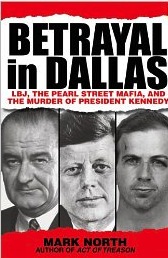
  • Mark North, Betrayal in Dallas: LBJ, the Pearl Street Mafia, and the Murder of President Kennedy

    Mark North, Betrayal in Dallas: LBJ, the Pearl Street Mafia, and the Murder of President Kennedy


    Having recently experienced an earthquake and a hurricane here in DC in less than a week, I thought I had seen my quota of disasters for a while. That is until this book showed up. In the pantheon of JFK literature we usually get one goofball theory per book. But in Betrayal in Dallas: LBJ, the Pearl Street Mafia, and the Murder of President Kennedy, author Mark North doubles-down and we get two discredited theories for the price of one.

    In this alternative universe LBJ, in cahoots with something called the “Pearl Street Mafia” (an invented title as the author admits), had JFK bumped off. For good measure, LBJ’s old crony and FBI head, J. Edgar Hoover is thrown into this mix as well. Hoover seems to be a favorite boogey man of North’s as he strongly implied JEH involvement in the President’s assassination in his previous offering, Act of Treason. In Betrayal in Dallas, according to North, Hoover’s complicity is unequivocal.

    It’s a common maxim that extraordinary claims demand extraordinary evidence. Yet the only extraordinary thing here is the marketing hype plus the author’s own undocumented claims. For instance, on page xi the author makes the bold assertion that “the new evidence revealed in this book proves to a legal certainty everything you have just read” [my emphasis].Talk about empty bombast. In the 159 skimpy pages that make up the body of the book, the case is not even close to being made. In a hyperbolic statement on the publisher’s website we are breathlessly told, “North’s conclusions are based on classified federal documents unknown to the public and research community.” And finally the author makes this bold declaration: “The evidence contained in this volume will force the hand of that [Justice] department by making public what they will not.” I may have missed it, but I don’t recall Eric Holder’s press conference confirming North’s assertions.

    Since we are told that the book is based on “documents unknown to the public and research community” certainly a check of the endnote section is a priority. By the way, I love how JFK researchers are slammed as being too thick to have discovered North’s “evidence”. Well, if that evidence consists of back issues of newspapers then, yes, I guess we have all missed the boat. You see, while some have us have wasted our time combing through the millions of pages of JFK related documents released by the Assassination Records and Review Board, North has trumped us all by simply reading loads of old newspapers. When one turns to the endnote section, one is immediately struck by a bizarre sourcing technique in which multiple instances of newspaper articles are presented in one endnote. For instance, endnote 10 of chapter 3 has close to 200 Dallas Morning News articles cited in that one endnote alone, and it runs on for 2 pages! One might get a pass on this if this was just an anomaly, but every chapter gets this kind of treatment with multiple source notes citing multiple instances of newspaper clippings. Has anyone ever seen such a format used before? On estimate it looks like 90 % of his endnotes are newspaper clippings. This goofiness makes up about 30 pages of the book while meaningless “exhibits” (mostly mundane letters) and other back matter account for another 80 plus pages. Oh, and don’t go looking for an index either. If you can believe it, there isn’t one. I’m on record as stating that the amount of pages shouldn’t be a consideration as long as you have something to report. But what North has done here gives the word ‘extraneous’ a whole new meaning. The United States government took four years to declassify millions of pages of formerly declassified or severely redacted documents on the murder of President Kennedy. Some of these papers were exceedingly interesting. Some of them were more than that. Some of them were absolute gems. To forsake that vital resource for old newspapers, to not utilize the documents at one’s disposal in the wake of the ARRB’s work, this is just shoddy. It kind of says: There wasn’t anything in those documents of value to my thesis. So let’s forget about them and read some reams of old newspapers instead.

    And speaking of shoddy, I think this is the first instance that I can recall where the publisher couldn’t get their own author’s name right. On the back cover blurb of Betrayal, they print “praise for the bestseller Act of Treason by Mark Lane.” That’s right. Mark LANE. The reader will recall that the author is in fact Mark North. The slapdash approach continues on the inside where, along with the examples previously mentioned, the author writes that RFK was a Senator on the McClellan Committee in the 1950’s. Of course, Robert Kennedy was not elected Senator until 1964.

    I’ve not mentioned North’s take on the hybrid conspiracy to kill the President as it hardly merits mentioning. But basically it’s the usual suspects: the Civello/Marcello arm of the Mafia killed JFK, this time with LBJ’s complicity. Johnson was also “mobbed up” along with other notable politicians, lawyers and judges (i.e. J. Edgar Hoover, Federal Judge Sarah T. Hughes, Assistant Attorney General Barefoot Sanders, and even Lady Bird!). While there is undoubtedly evidence of corruption among some of the politicos North implicates, it takes a giant leap of logic to put them in a criminal nexus intent on murdering the President. Despite the 30 pages of source (newspaper) notes, when it comes time for North to make his bold accusations, there are no citations. For example, on page 39 North writes, “With Civello providing the kill zone, it fell to Carlos Marcello in New Orleans to obtain the assassins.” Similarly on page 42 we are told, “By midsummer 1962, Marcello and Civello had set in motion the plan to murder the President.” Neither of these critical passages have any citations. Not even North’s beloved newspapers.

    On an affirmative note, North does not fall into the old trap that other “mob did it” enthusiasts do. That is he does not try to smear Jim Garrison as a Mafia goon. On the contrary, on page 33 North correctly notes that “In August [1961], New Orleans district attorney Jim Garrison’s office launched a drive on the Marcello-controlled French Quarter.” North goes on to note that “narcotics trafficking was to be Garrison’s office’s prime target.” Unfortunately, for the entire book, that’s about all you can put on the positive side of the ledger.

    After reading this volume, the only apparent betrayal will be to the consumer who plunks down $25.00 for this mess.


    Author’s Addendum:

    As I mentioned in the above review, for researchers to not utilize the documentation released over the years through the actions of the Assassination Records Review Board (ARRB) is inexcusable. This is a sentiment that I know is shared by this website’s owner, James DiEugenio, as he has mentioned it as well on several occasions, both on this site and on Black Op Radio.

    Consider the wealth of material the ARRB was able to extricate: the so-called “Lopez Report” on Mexico City, not to mention the supporting documentation, the CIA segregated collection of the House Select Committee on Assassinations (HSCA), the working (and personal) papers of Jim Garrison, Clay Shaw’s papers as well as the Shaw trial transcript, new interviews of all 3 of JFK’s pathologists as well as much new previously withheld medical evidence, CIA Inspector General reports on the Castro assassination plots and the Bay of Pigs, military and CIA documents on Vietnam, not to mention the working papers of the ARRB themselves. And this is just the tip of the iceberg!

    It is personally galling to this author to see books published anytime after 1993 not using this material. And most do not! (Notable exceptions are John Newman’s work, Jim DiEugenio’s and Lisa Pease’s work in Probe and its direct descendant The Assassinations, and my own humble effort, Let Justice Be Done). Indeed, a recent work that got very good reviews and was well received among the critical community utilized almost exclusively secondary sources in its research. Unless you are Nero Wolfe, who can solve mysteries without getting off of his fat duff, this approach is slovenly and sloth-like in my opinion. Whatever happened to good old-fashioned “shoe leather?” There is simply no excuse for not using a 3-pronged approach in JFK research:

    1. Interviews (Admittedly getting harder with the passage of time and key people dying off).
    2. The Paper Chase. (Extremely important in light of the ARRB’s work and what I’ve listed above). And yes
    3. Secondary sources: books, magazines, newspapers, etc. (But they better be damned good ones by credible authors and used sparingly).

    But regarding number 2 above, the National Archives (NARA) couldn’t make it any easier for researchers: just email them what you want and they’ll copy it and mail it to you (for a fee of course). There is plenty out there that hasn’t seen the light of day because nobody is doing the leg work. Let me give a recent and brief example. One weekday I went to NARA, arriving at 10:00 AM. I had them pull the working papers of several ARRB staffers. I reviewed several boxes of materials and copied over 100 pages. I was out of there by 1:00 and came away with a wealth of new information, including a heretofore unknown relationship between New Orleans FBI SAC, Warren deBrueys, and CIA spook David Atlee Phillips. The rest of the information will be included in my new book tentatively scheduled for publication in 2013. As with my earlier effort, this was all done on my own dime. For authors getting book contracts and advances, there is simply no excuse for bypassing this resource.

    Personally I always thought the old evidence was always pretty good. But at this point it makes little sense to regurgitate the efforts of Harold Weisberg, Vince Salandria, Sylvia Meagher and so many others, Especially when there is an avalanche of material waiting to complement their work.

  • Philip Nelson, LBJ Mastermind of JFK’s Assassination


    A Texan Looks at Nelson: LBJ Mastermind of JFK’s Assassination

    It seems like such a natural conclusion. The king is dead, long live the king. If you are studying the Kennedy assassination, and you ask the immortal question cui bono, you might first land on the name Lyndon Johnson. From “MacBird” to A Texan Looks at Lyndon to Ed Tatro in “The Guilty Men” episode in Nigel Turner’s The Men Who Killed Kennedy, many people have analyzed Johnson’s doings and cried foul.

    Into this tradition comes Phillip F. Nelson with a sizable work on the subject, wanting to go further than anyone has before. His view of Johnson is comparable to Sherlock Holmes’s description of Professor Moriarty: “He is the Napoleon of crime…He sits motionless like a spider in the centre of its web, but that web has a thousand radiations, and he knows very well every quiver of each of them.”[i] Nelson’s thesis is in his title: LBJ Mastermind of JFK’s Assassination.

    This particular genre of Kennedy book is admittedly one I find less useful than others. It is possible to see the JFK assassination as a game of Clue, deciding whether you think it is David Morales with the candlestick in the conservatory or J. Edgar Hoover with the lead pipe in the study. To my mind, this tendency often becomes engrossed in the less important details of assassination mechanics and (to my way of thinking) the more important mechanics of how states operate, how that affects us, and how best to combat the forces behind it. But that is my bias, so let the reader be informed. As for Nelson, he makes his intent clear. Noel Twyman, he says, names “…Lyndon Johnson and J. Edgar Hoover as having been involved in the plot and in the cover-up, though he failed to determine that Lyndon Johnson was the mastermind of the conspiracy. This book merely adds that last element in a case that has already been proven beyond a reasonable doubt.” [ii]

    Let’s see if Twyman’s ‘failure’ is Nelson’s gain.

    BEGINNINGS

    The book is divided into 10 chapters that purport to show LBJ’s hand in every aspect of the assassination, from the planning to the execution to the aftermath. It begins, however, by spelling out his basic criteria. Nelson argues that Johnson has motive, means, and opportunity, and that further he was a psychopath who would stop at nothing to achieve power.

    The author discusses Johnson’s rise to power, the ins and outs of the all too familiar tale of Box 13, and Johnson’s many distasteful characteristics. These are, by and large, taken from Johnson’s multi volume biographer Robert Caro. In the first chapter alone, at one point there are 26 consecutive footnotes going back to Caro. To this summary he also sprinkles a few quotes from Robert Dallek, but here also begins his penchant for questionable sources. He quotes from Jack Valenti, Victor Lasky, and (of all people) Seymour Hersh, just for starters. Now the problematic aspects of using those particular writers – at least without some qualification – is apparent to most Kennedy scholars. I won’t explain the nuts and bolts here, but instead direct the reader to Jim DiEugenio’s essay “The Posthumous Assassination of John F. Kennedy” for details. But suffice it to say that each of these writers has a rather large axe to grind and a willingness to use any means necessary to grind it.

    Now these sources do little harm to the early part of the book because Johnson’s character is well-established. He was a low-class sort of a person, prone to vulgar and over bearing displays of machismo in public, and employing men like Mac Wallace who were murderous criminals. And if you take allthese famous incidents a face value, and then string them in tandem over the years, then hey! Maybe LBJ does seem like the sort of man who, were it within his power, could have had the president killed and not be halted by any moral barriers.

    In Chapter 2, Nelson focuses on Kennedy’s relationship with the Joint Chiefs and their disagreements over foreign policy. Or were they disagreements? The author seems confused on this point. On the one hand, he seems to agree that Kennedy wanted peace and Johnson was more accommodating of the CIA and Department of Defense. Nelson describes, for example, how the CIA cut off aid to South Vietnam at a time when he was pondering whether to take this very action. They took the action automatically, following a playbook unknown to Kennedy. “But the larger point was that it was a message the CIA was sending to the president, who was being told who was really in control…it wasn’t John Kennedy.”[iii] He also describes how JFK and the military did not get along. And he then builds to this crucial statement: “Over the course of the next two years, those relationships would continue growing even further apart and become so well established that it could be argued that in the larger scheme, Lyndon B. Johnson had assumed the mantle of commander-in-chief.”[iv]

    To say the least, this last bit seems overstated. However, that aside, the peculiar part of Nelson’s analysis is that he seems to buy into the CIA’s version of the Bay of the Pigs. He writes that Kennedy wanted a second set of air strikes but was intimidated into not doing so by Adlai Stevenson. He then goes on to criticize Dean Rusk for agreeing with the president’s refusal to provide air cover during the invasion.[v] (He gets all this, incidentally, from Lasky.) To call this particular version of events simplistic is to be generous; but things only get worse from here.

    SMEAR CAMPAIGN

    Further going into the Cuban situation, Nelson blithely quotes Alexander Haig as saying that Robert Kennedy ran the hit teams killing innocents, although “…he took care to keep his own name out of most of the documents…” Haig goes on to say that with respect to the Cuban assault teams, “Bobby was the President!”[vi] (Haig, who is obviously not the most credible witness in this context, gave this interview to Gus ‘Single Bullet Fact’ Russo.) Hiag, or course, was the man who on an installment of Nightline actually said that Lyman Lemnitzer had told President Kennedy outright that the Bay of Pigs would fail without air cover. It was this kind of past-debacle CYA that provoked Kennedy to install a taping system in the White House. And this is how we know precisely what was said during the Missile Crisis. Yet, once again, Haig is all OK with our erstwhile author, who doesn’t stop to mention that maybe the sources for this information are a bit problematic.

    But Nelson steams ahead unabated. He now quotes Richard Helms’ aide Nestor Sanchez as saying that “The buck stops with the President on operations like that…All the other conspiracies [about] the agency was running amok, that’s baloney…” He isn’t quoting this to isolate a point of view; he’s using Sanchez as a viable witness. He does the same with the notorious Sam Halpern and even Richard Helms himself. He then writes that “The Kennedys’ campaign to get rid of the Castro ‘problem’ was doomed from the start…”[vii] Just so there is no question, he elaborates: “Documents prove…Bobby Kennedy had authorized the plots…”[viii] In fact the CIA Inspector General report on the Castro plots actually says the opposite: that the Agency could not use presidential approval as a fig leaf for what they had done. So where does Nelson get this contrary view? One will not be surprised to learn that Nelson also got this from Russo i.e.from his asinine book Live by the Sword. Readers can take a look for themselves, but be aware that Russo believes in the “jet-effect theory,”[ix] (i.e., the desperate attempt to show that Kennedy’s violent rearward motion could have happened from a rear shot), claims that Lee Harvey Oswald left fingerprints all over the alleged sniper’s nest (!!!), and argues that the backyard photograph (with its obvious chin splice) is genuine.[x] You get the idea.

    The pièce de résistance of this line of argument comes with Nelson’s assertion that Kennedy was aware of the assassination plots against Castro, but the CIA kept the Joint Chiefs in the dark.[xi]

    Let the reader judge, but let me say that I find this a tad implausible.

    Just for the record, please note the following list of people who testified to the Church Committee that Kennedy had never been informed of any assassination plots against Castro:

    • Dean Rusk
    • Maxwell Taylor
    • John McCone
    • McGeorge Bundy
    • Richard Helms
    • Bill Harvey[xii]

    To put it mildly, these are not perceived as friends of JFK.

    David Talbot put it like this:

    In the ideological war to define the Kennedy administration, which broke out soon after the president was laid to rest in Arlington and continues to this day, national security officials insisted that the Kennedy brothers were ‘out of control’ on Cuba, pushing them to take absurd measures against Castro like the Mongoose folly. This would become the standard version of the Kennedys’ Cuba policy in countless books, TV news shows, and documentaries – it was rash, obsessive, treacherous, even murderous. But this is not an accurate picture of the Kennedy policy.[xiii]

    Bill Harvey went so far as to say that he would have been the last person that JFK would have ever put in charge of a Castro assassination venture, even if he had desired it.[xiv]

    HERE WE GO AGAIN

    Enough about Cuba. Let’s get to the sex!

    Nelson reports blandly the same things that the CIA friendly Sy Hersh wrote in his long since discredited hatchet job The Dark Side of Camelot. For example, JFK tried to get Judith Exner in a three-way, then impregnated her, then told her to go see Sam Giancana for assistance in getting an abortion![xv] I grant this would make for a very exciting telenovela on Galavisión, but is dubious at best and has zero to do with Lyndon Johnson. (Remember him?) Surprisingly, the author doesn’t seem to notice this: the fact that he is losing his focus. Instead he actually acknowledges that the reader may well be more interested in more prurient detail, but he or she should seek other books for this. The first one to read, he sagely recommends, is another CIA attached journalist: Ronald Kessler’s Sins of the Father.[xvi] Incredible.

    It does point out the long-term damage books like these can do, however. My own local public library around the corner has perhaps a half-dozen books on JFK, and one of them is The Dark Side of Camelot. The name ‘Seymour Hersh’ is stronger than the book’s own infamy, which partly consisted of the investigative reporter being snookered into buying fake documents.[xvii]

    In any event, please accept my apologies. We were talking about sex. Nelson actually writes the following sentence, unawares of the ironic humor: “In the interest of brevity, we will consider further only JFK’s relationships with Marilyn Monroe, Mary Pinchot Meyer, Judith Exner, and Ellen Rometch…”[xviii] In the interests of brevity! Nelson then goes on to discuss these stories with no discernment at all, using as his sources material not just from Nina Burleigh and Deborah Davis, but also Hersh, Donald Wolfe, etc., without any analysis or elaboration on how credible the information is that he’s using. From the likes of Wolfe, he gets the observation that “…Hoover had warned Jack about exposing his affairs with Judith Campbell [Exner] and Marilyn Monroe, so he had resigned himself to give up both, no doubt because there were so many others to replace them.”[xix] If you can believe it, Nelson asserts that Wolfe “made a compelling case” of RFK’s involvement in Monroe’s death, and brings up rumors that JFK and Mary Meyer used drugs together. There are several astonishing claims made in the text, but here is one of my favorites: “It may be just a coincidence that, concurrently with his affair with Mary Pinchot Meyer and their rumored use of drugs together, Kennedy had become less tolerant of the CIA’s intelligence breakdowns and the Pentagon’s aggressive provocation for military actions, especially in Vietnam.”[xx]

    OK, let’s think about this. Which of these conclusions is more likely?

    1. JFK grew apart from his military advisors because of the Bay of Pigs invasion and the Cuban Missile Crisis, where they revealed themselves to be prepared to destroy the entire planet in defense of American interests.
    2. JFK grew apart from his military advisors because he was toking it up with a girlfriend.

    I am going to go with option 1 myself, particularly since we have no evidence (2) ever happened.

    There is a larger point here, which I raise again: What does this have to do with the book? We were talking about Lyndon Johnson, right?

    And so we are. Sometimes. Phillip Nelson’s book is truly a rambling one, taking 700 pages to express a claim that he could have made in 200 pages. If you delete material which consists of summaries of other people’s books, you might have as little as 20 pages of original material. And these 20 pages largely consist of his analysis of the Altgens photograph. We’ll get to that later.

    LYNDON’S SCANDALS

    Having dealt with Caro’s stories about LBJ and cheapjack authors’ versions of Kennedy’s involvement in Cuba and women, the middle section of the book turns its attention to the scandals that clung to the Vice-President. Most of these are familiar to anyone who has studied Johnson. They involve Bobby Baker, Mac Wallace, and the various people Johnson is alleged to have murdered, including his sister. Much of this appeared in The Men Who Killed Kennedy, although Nelson gets most of the juicy bits from Barr McLellan and the hoary volume by J. Evetts Haley A Texan Looks at Lyndon.[xxi]

    Any book that posits Johnson’s involvement in the assassination is going to use this material, and whether you buy this or not depends a great deal on testimony from people who may not be the most reliable witnesses. Nelson has little to add here, and if you are familiar with the McLellan book nothing here will be news. At least LBJ’s scandals have the virtue of being on-topic.

    THE MEAT OF THE ARGUMENT

    The last third of the book starts to deliver on some of Nelson’s conclusions. To this point, the main ideas of the book (that is, the ones that relate to LBJ) could be summarized as follows:

    1. LBJ was a scoundrel, hungry for power, and possibly psychopathic.
    2. LBJ got along better with the Department of Defense than JFK did. (Although Nelson does, curiously, quote Howard Burris from John Newman’s book JFK and Vietnam, saying that he didn’t believe Johnson had a “very deep” understanding of political issues.) Which is odd for a “mastermind.”[xxii]
    3. LBJ had very possibly committed several murders, or at least ordered them done, had stolen elections, and had generally shown little regard for the law.

    Having tried to show all these things, the author now has to demonstrate Johnson’s mastery. And one must give Nelson his due in this regard – he doesn’t mess around. He doesn’t lack for boldness. He has Johnson planning the entire assassination, and ordering people around who were not used to taking orders.

    The ‘Johnson plan’ would be based upon the concept that the operational and tactical plans would be carefully kept away from the highest level planners; Johnson and Angleton, possibly Hoover and LeMay as well, consistent with the precepts of ‘plausible deniability’ and interagency secrecy protocols would protect others throughout the ‘hierarchical’ chain.[xxiii]

    Not only does he plan the assassination, he controls the Secret Service, [xxiv] putting in orders for the Secret Service to compromise themselves. Nelson has no evidence for this, but it is, in his view, a “reasoned conjecture.”[xxv] We are assured that “Johnson’s hand would be kept invisible through his having three levels of staff separating him from motorcade planning.”[xxvi]

    As noted, Johnson is the boss, resulting in some dubious statements. One mid-chapter heading reads:

    J. Edgar Hoover: Johnson’s Willing Lieutenant[xxvii]

    I had to put the book down for a moment upon reading that. Hoover was not anyone’s willing lieutenant, and the idea that he would have kowtowed to the big Texan – well, I suppose it’s not impossible, but it is awfully hard to imagine. Similar to his saying that Johnson would “…undoubtedly recruit…General Curtis LeMay, who shared many of Johnson’s attitudes, especially about the president, whom he regarded as an indecisive coward and avowed socialist.”[xxviii] Johnson recruited LeMay into the operation? Just so there is no confusion: “Just as Vice President Johnson had been feeding secrets to his friends in the CIA (as noted in chapters 2 and 3), it is a reasonable presumption that he was doing the same with his friends in the Pentagon, probably including General LeMay, who was cut from the same, practically identical, bellicose cloth as Johnson.”[xxix]

    This last remark simply isn’t true. Even in pro-LeMay biographies, one gets the clear sense that LeMay counseled Lyndon Johnson in full commitment, an immense bombing campaign into North Vietnam, which he declined to do. Johnson only kept him on board for a year, listening to LeMay complain the whole time that air strikes were not timely or powerful enough for his liking.[xxx]

    INTERPRETATION

    Much of the rest of Nelson’s arguments rely upon his specific interpretation of specific events. For example, John Connally was “insistent upon the selection of the Trade Mart,”; but instead of throwing suspicion upon Connally directly, Nelson writes that “…it suggests the unseen hand of his mentor, Lyndon Johnson.”[xxxi]

    Nelson tells the story of how Johnson got into an argument about wanting Connally rather than Ralph Yarbrough to sit next to him during the assassination. JFK told Johnson that seating arrangements would not be changed and the latter became very upset. To Nelson, this is sinister; his foreknowledge intact, Johnson is trying to keep his buddy Connally out of harm’s way. However, Nelson also does note that Johnson hated Yarbrough, so he has another reason to not want to sit next to him. So, one assumes, LBJ would have been upset even if he was not the criminal mastermind behind the operation. [xxxii] That is to say, if you already believe in Nelson’s thesis, this becomes further corroborative evidence.

    The author also provides the solution to why Lyndon Johnson began crying hysterically on Air Force One shortly after the assassination, as appeared recently in Steven Gillon’s book. We must consider the “…likelihood that it was a result of his finally finding enough privacy to allow himself a moment to physically release the built-up tension that he had suppressed for hours – actually days, and weeks of intense anticipation – as he planned the critical action that would save his career: the murder of JFK.”[xxxiii]

    A story that Nelson does not use in his book occurs on board Air Force One, when new President Johnson tells Bill Moyers, “I wonder if the missiles are flying.” That is, Johnson was aware that certain factions within the national security state were interested in a war with the Soviets, and he thought they might use this excuse to get it. James K. Galbraith, the son of Kennedy advisor John Kenneth Galbraith, felt that Johnson understood that Kennedy and McNamara had been holding them off from blowing up the world, and that LBJ himself thought of the assassination as a potential coup.[xxxiv] However, this story obviously does not fit the program.

    Since so much of the argument for this book depends upon the author’s interpretation of various events, it is fair to ask whether we have what literature professors call “an unreliable narrator.” We have already seen, curiously, that he accepts material about the Kennedys promulgated by their ideological enemies. He also seems to buy into a rather facile description of Lee Harvey Oswald.

    The author blames Oswald’s “…fatherless childhood and his early life with a cold and distant mother…” for his willingness to be used. He quotes his brother Robert about the show ‘I Led Three Lives’ and how much young Oswald loved Ian Fleming novels. “It is ironic,” Nelson writes, “that Oswald shared one thing in common with Lyndon Johnson…a determined obsession with fulfilling the fantasies which he dreamt about as a child.”[xxxv]

    “Oswald thought that, finally, he would achieve his ultimate lifetime goal: becoming a full-time well-paid spy just like his hero from I Led Three Lives.”[xxxvi] In this day and age, in light of the work of writers like John Newman and John Armstrong, how can any serious author still write the above? Nelson’s analysis of Oswald is so fatuous it could have come from someone like Norman Mailer. As most everyone knows who studies the Kennedy assassination for any length of time, a mass of contradictions surrounds Lee Harvey Oswald. He was allegedly a Marxist, but his best friend was George de Morenschildt, a much older man, in a higher social class, who was a White Russian. He managed to travel unperturbed from the U.S. to the Soviet Union and back, despite being ostensibly a marine, and also brought his Soviet wife back with him, although she had belonged to a Communist youth organization.[xxxvii]

    But that’s not all. Nelson has this to say about Officer J. D. Tippit: “It remains unclear whether the murder of Tippit had anything to at all to do with Kennedy’s assassination: A more likely scenario was that it was simply retribution by the husband of the woman Tippit was known to have been sleeping with.”[xxxviii] Nelson writes this even though it has been discovered that someone left Oswald’s wallet at the scene of the crime.

    Curiouser and curiouser.

    It should also be specifically noted that Nelson supports, for the most part, the scenario presented in David Lifton’s Best Evidence. Whether or not this counts in his favor or not will depend on the reader’s allegiances. But let us observe that adopting Lifton’s premises means a whole other set of problems.

    He is wise enough not to assert, as Lifton did in his book, that all of the shots came from the front. This is untenable given the works of people like Don Thomas, for example, who in his recent book finds five shots, with four emanating from behind.[xxxix] Robert Groden, another serious analyst, has four shots, with three coming from the rear.[xl] These conclusions emerge from serious examination of the available forensic evidence.

    However, Nelson claims that there was evidence of body alteration, rather than photographic alteration. The author does try to make a case for it, and again he has Johnson as part of it, directing traffic to his swearing-in ceremony, which is mere cover for the snatching of the body. This was done, in accordance with Lifton’s thesis, so that JFK’s body was placed in a body bag.[xli] Even if we assume that it is plausible that persons unknown were able to sneak the body away for a time in order to perform this surgery – at any point in the swearing-in, the flight, or the arrival home – there are still enormous problems with this scenario.

    If Lifton is right, then “…the plot to alter the body was integral to the plot to shoot the President – i.e., that it was planned, as part of the murder, to secretly falsify the circumstances of his death.”[xlii] The mind staggers at this prospect. Why would you plan such a bizarre episode as part of your plot? There isn’t an easier way to kill a president? Lifton also writes that “…the plotters could know, once they saw the body, how much ammunition was needed, and so could coordinate the planting of bullets with the fabrication of trajectories.”[xliii]

    So all the bullets were planted – but they were also planted in such a way as to fool the FBI: “The central fact was that if President Kennedy’s body was altered, and false ammunition planted, then within twenty-four hours of the murder, the U.S. Department of Justice had been deceived.”[xliv] Deceived? Would this be the same Department of Justice that got a palm print off Oswald’s dead body?

    As questionable as one might find aspects of Lifton’s thesis, it gets even worse for Nelson. Because he has to have LBJ coordinating all this! And he dutifully theorizes: Johnson knows the body can be stolen, and he also knows “…that a ‘special’ autopsy would be necessary, one that would obliterate any evidence that Kennedy was shot anywhere but from behind…”[xlv] The chapter in which this appears is entitled ‘A More Plausible Scenario.’ A less plausible scenario can hardly be imagined.

    AND, FINALLY, THE ALTGENS PHOTOGRAPH

    Nelson spends many pages claiming that Lyndon Johnson cannot be seen in, and is therefore ducking in, the Altgens photograph.[xlvi] He claims that this is smoking-gun evidence that cannot be ignored. It has been sitting in front of all of us this whole time and we’ve missed it. How can LBJ be ducking so early? He must have known what was coming.

    Except I can see LBJ in the photograph, as can most others.

    Nelson realizes some might argue this. However, people who see Johnson in the photo are lying to themselves.[xlvii]

    TOWARD A MORE COHERENT SCENARIO

    We know, thanks to Hoover’s famous comment, that someone seemed to be impersonating Lee Harvey Oswald years prior to the Kennedy assassination. And we know that the CIA repeatedly tried to distance itself from Oswald, despite all evidence to the contrary. A couple of good questions in this regard were asked by Gerald McKnight: “Why did the supersensitive SIG have a file on an ex-marine defector? Why did the CIA wait for a year before opening a file on Oswald after learning about his defection?”[xlviii] To this let me add a third question: Is it because Lyndon Johnson said so? And another: Why would the CIA cover for Johnson? In the House Select Committee investigation, Robert Blakey made a pact with the Devil in allowing the CIA to vet the final report pre-publication. Investigator Gaeton Fonzi at first thought Blakely was being too careful, then began to harbor thoughts that Blakey was cooperating with the CIA for other reasons. [xlix] It was the CIA, for example, that classified the Lopez Report. [l] Why would they do this? What interests are they protecting if LBJ and the Del Charro cronies did it?

    Did Johnson also arrange the Chicago plot, exposed by Edwin Black in his fine 1975 article in Chicago Reader? If they had killed him in Chicago, Thomas Arthur Vallee would be the “lone nut.” Would we then have theories that Mayor Daley was the mastermind of the Kennedy assassination?

    Good questions, all.

    If you want to be serious about it, you can make a better case for Allen Dulles being the mastermind of the assassination than Lyndon Johnson. His oil ties, for example, are actually stronger than Johnson’s. The Dulles brothers had worked hard to destroy the antitrust suit filed against Standard Oil of New Jersey all the way back in 1953.[li] Dulles was a key planner in the overthrow of Mossadeq; under the latter’s rule, the Anglo-American Oil Company suffered huge losses. The company was a client of Dulles’s firm, Sullivan & Cromwell.[lii] Nor was Dulles a stranger to Cuba. As Morris Morley proves in his masterly study, Imperial State and Revolution, it was Dulles who pushed Eisenhower into his policy of isolating Castro, and then mounting a covert campaign against him.[liii] Also, Dulles had been involved in the recruitment and first interviews of General Reinhard Gehlen, the Nazi-turned American spy.[liv]

    As Jim Douglass points out:

    Dulles got Prouty to create a network of subordinate focal point offices in the armed services, then throughout the entire U.S. government…The consequence in the early 1960s, when Kennedy became president, was that the CIA had placed a secret team of its own employees through the entire U.S. government.[lv]

    According to Nelson, LBJ was afraid he was going to lose his job and go to prison – but Dulles had already lost his, due to the Bay of Pigs. LBJ was a wildly ambitious man who would do nothing to stop at getting power – but Dulles was head of the CIA, arguably a more powerful position than President. LBJ was a sonofabitch – but so was Dulles. He was a different kind of sonofabitch, sure, but his whole life Dulles had been making decisions that got people killed, and he exhibited nothing more than a dry sense of humor about it. There are some fruitcakes in government; it’s one of the first things you learn when you start doing research into this stuff.

    Now all that being said, am I going to write the book Allen Dulles: Mastermind of JFK’s Assassination? Of course not. The operation is bigger than any one man, even people like Dulles or James Angleton. The head of the snake is the snake.

    FINAL REMARKS

    Fidel Castro had a much deeper and insightful analysis of the situation than anything in this book:

    I haven’t forgotten that Kennedy centered his electoral campaign against Nixon on the theme of firmness toward Cuba. I have not forgotten the Machiavellian tactics and the equivocation, the attempts at invasion, the pressures, the blackmail, the organization of a counter-revolution, the blockade, and above all, the retaliatory measures which were imposed before, long before there was the pretext and alibi of Communism. But I feel that he inherited a difficult situation; I don’t think a President of the United States is ever really free, and I believe Kennedy is at present feeling the impact of this lack of freedom, I also believe that he now understands the extent to which he has been misled, especially, for example, on Cuban reaction at the time of the attempted Bay of Pigs invasion.[lvi]

    To say the least, Lyndon Johnson was an unappealing personality. It would not necessarily be surprising, in the abstract, if he had foreknowledge or tacitly approved of the assassination. He might even have been directly involved, although one can argue that. I do not think, however, that at this date, given the documentary evidence, an explanation which ignores the larger political forces of the national security state can be taken seriously.

    It is less important, ultimately in my view, to understand how he was killed than why he was killed. This is not addressed when one says ‘LBJ did it for power,’ or ‘Allen Dulles did it for revenge.’ Again I quote Douglass:

    Those who designed the plot to kill Kennedy were familiar with the inner sanctum of our national security state…The assassins’ purpose seems to have encompassed not only killing a president determined to make peace with the enemy but also using his murder as the impetus for a possible nuclear first strike against that same enemy.[lvii]

    JFK’s fateful decision was to go against the same system that profited his family and assisted his rise to power, and to lead with his conscience. That decision literally killed him. Our whole form of government, and indeed our entire consumer society, depends entirely on suppressing our consciences and destroying our empathy. Our economic and political system is devoid of it – for good reason. If we allowed ourselves to feel empathy for all the people in the world who suffer on our behalf, the system could not be maintained.

    This is why there is a constant and pervasive stream of anti-Kennedy books, shows, and films, and why that fervor slides into seemingly irrelevant places likes Nelson’s current book. The major media is desperate to tear down the Kennedy legacy – to make him a criminal, a cad, or a dope fiend. “He was like all the others,” the Victor Laskys of the world will tell us. And Philip Nelson then echoes it.

    He might have been when he came in. But he clearly changed.

    This is the key point. The essence of the Kennedy assassination is the state destroying conscientious leadership like white blood cells killing a virus; understanding this fact changes the assassination from a puzzle to be solved to a cause to be championed. Anything less is an insult to both history and JFK. And therefore a disservice to ourselves.


    NOTES

    [i] Doyle, Arthur Conan, “The Final Problem,” The Complete Sherlock Holmes Vol. 1 (Barnes & Noble Classics: NY 2003), 559.

    [ii] Nelson, Phillip F., LBJ The Mastermind of JFK’s Assassination (Xlibris Corporation: 2010), 138.

    [iii] Nelson, 571.

    [iv] Nelson, 151.

    [v] Nelson, 148-149.

    [vi] Nelson, 156-157.

    [vii] Nelson, 171-172.

    [viii] Nelson, 217.

    [ix] Russo, Gus, Live By the Sword (Bancroft Press: 1998), 298.

    [x] Russo, 444.

    [xi] Nelson, 147.

    [xii] DiEugenio, James, and Lisa Pease, The Assassinations (Feral House:Los Angeles CA 2003), 328

    [xiii] Talbot, 100.

    [xiv] Talbot, 111.

    [xv] Nelson, 197.

    [xvi] Nelson, 203.

    [xvii] There is a quick summary of these events in Thomas Powers’ contemporaneous review of the book in the New York Times: http://www.nytimes.com/books/97/11/30/reviews/971130.30powerst.html.

    [xviii] Nelson, 191.

    [xix] Nelson, 195.

    [xx] Nelson, 193.

    [xxi] I did find it curious that the book never once mentions Ed Tatro, who is well-known for his research on Johnson.

    [xxii] Nelson, 131.

    [xxiii] Nelson, 379.

    [xxiv] Nelson, 360.

    [xxv] Nelson, 425.

    [xxvi] Nelson, 426.

    [xxvii] Nelson, 346.

    [xxviii] Nelson, 125-126.

    [xxix] Nelson, 369.

    [xxx] Cronley, Major T. J., “Curtis LeMay: The Enduring ‘Big Bomber Man,’ (United States Marine Corps Command and Staff College Center, Quantico VA 1986).

    [xxxi] Nelson, 355.

    [xxxii] Nelson, 422.

    [xxxiii] Nelson, 448.

    [xxxiv] Talbot, David, Brothers (Free Press: NY 2007), 252.

    [xxxv] Nelson, 385.

    [xxxvi] Nelson, 493.

    [xxxvii] Parenti, Michael, Dirty Truths (City Lights Books: San Francisco CA 1996), 163-164.

    [xxxviii] Nelson, 529.

    [xxxix] Thomas, Don, Hear No Evil (Mary Ferrell Foundation Press: Ipswich MA 2010), 604.

    [xl] Groden, Robert and Harrison Livingstone, High Treason (The Conservatory Press: Baltimore MD 1989), 224. Actually, Groden seems likely to revise his thesis in his upcoming book, since he has since found at least one other shot on the Zapruder film itself.

    [xli] Lifton, David, Best Evidence (Macmillan: New York 1980), 680.

    [xlii] Lifton, 346.

    [xliii] Lifton, 359.

    [xliv] Lifton, 362.

    [xlv] Nelson, 546.

    [xlvi] Nelson, 501.

    [xlvii] Nelson, 507.

    [xlviii] McKnight, Gerald, Breach of Trust (University Press of Kansas 2005), 308.

    [xlix] Fonzi, Gaeton, The Last Investigation (Thunder’s Mouth Press: NY 1993), 257.

    [l] Fonzi, 267.

    [li] Lisagor, Nancy, and Frank Lipsius, A Law Unto Itself (William Morrow and Company: New York 1988), 203-204.

    [lii] Lisagor and Lipsius, 210.

    [liii] Morley, 95

    [liv] Mosley, Leonard, Dulles (The Dial Press/James Wade: NY 1978), 477-478.

    [lv] Douglass, Jim, JFK and the Unspeakable (Orbis Books: NY 2008), 86.

    [lvi] Douglass, Jim, 197.

    [lvii] Douglass, 242.

  • Evaluating the Case against Lyndon Johnson


    with Seamus Coogan and Phil Dragoo


    lbj color

    In light of the ongoing stream of LBJ-did-it books, beginning with the Glenn Sample/Mark Collom The Men on the Sixth Floor in 1996, and capped by Philp Nelson’s rather overstated LBJ: Mastermind of JFK’s Assassination in 2011, the authors’ decided to analyze some of the common evidence used in these tomes. From 1996 to 2011 there have been at least six books saying more or less the same thing: LBJ was in charge of the Kennedy plot. Besides the two named above, there are works by the bombastic Barr McClellan, the prolific Joseph Farrell (Click here to see that review), one by Mark North (click here to see that review ), and a revision of his first book The Texas Connection by Craig Zirbel called The Final Chapter. Almost all of these books use one or more of the following pieces of evidence of testimony in advancing their arguments. Johnson has occupied a curious position at CTKA. Barring two reviews of books, by Seamus Coogan and Joe Green, (Click here for Joseph Green’s review of Philip Nelson’s book), arguments mitigating this “Johnson did it alone theory” are scattered around CTKA in a number of articles and on linked websites. Perhaps the two most detailed looks are Coogan’s review of Alex Jones (Click here for that) and a reply by Coogan to George Bailey on Greg Parker’s site, which has now been removed. The authors have tangled with this myth in various threads related to Nelson’s book at the Lancer and DPF forums, with the assistance of people like Charles Drago, Gerald Ven, Tony Franks and Albert Doyle, to name just a few.

    No matter how often you tell people that the accumulated evidence clearly shows that Johnson had grave doubts about the assassination, and was unconvinced (as was Hoover) with the evidence concerning Oswald in the days after the assassination (Gerald McKnight, Breach of Trust, p. 283), and no matter how often you send people the link of LBJ asking Hoover, if any shots had been fired at him, there is still an “LBJ as mastermind” syndrome afoot. We are not saying that Johnson had no role in the assassination or cover up. The evidence for the latter is clear. But for some writers to say, as Barr McClellan and Phil Nelson do, that Johnson was the prime force behind the conspiracy, this simply has not been demonstrated to any convincing degree. Indeed a suspicious amount of LBJ did it obfuscation abounds. Let us detail some of it.

    1: LBJ created the Warren Commission

    This is perhaps the biggest fallacy (and it’s really the most ignored ‘truth’) in all the pro conspiracy LBJ-did-it phenomena. Thanks to the excellent work of Donald Gibson, in his star turn in Probe Magazine (reprinted in The Assassinations) we now know the true, documented story behind this potent but ultimately fanciful tale.

    The HSCA’s description of how the Warren Commission came into existence is neither complete nor accurate. The myth–or at least part of it–goes that Johnson, Fortas, Katzenbach and RFK decided to create a presidential committee to silence rumors of conspiracy. Katzenbach himself testified before the HSCA in 1978 and gave an extremely mixed account of how the commission was set up, not to mention who originated the idea. Indeed, it appears that he and the Committee were reluctant to discuss that rocky road.

    Donald Gibson found out that the idea for a commission was first suggested by Eugene Rostow, Dean of the Yale Law School during a telephone call to presidential aide Bill Moyers, on the 24th of November 1963. Moyers then informed LBJ about his discussion with Rostow on the morning of November 25th. That same day LBJ talked with Hoover at 10.30 am about the idea put forward to him about a commission, telling Hoover that it was a bad idea. Indeed, he stated unequivocally that he preferred an FBI report sanctioned by the attorney general that would support a Texas court of inquiry. A mere ten minutes later LBJ got a call from journalist Joe Alsop. Alsop, using all the charm and persuasion he could muster, tried to change LBJ’s mind regarding a presidential commission and he encouraged him to discuss the matter with former Secretary of State, Dean Acheson. Gibson believes that the idea originated from Rostow, Alsop, and Acheson, and it was supported by the Washington Post and the New York Times and Dean Rusk. LBJ called Senator Eastland on the 28th of November and persuaded him to abandon the idea to create an independent senate investigative committee. So LBJ was transformed in the space of four days from an opponent to the creator of the commission.

    One of the more sinister things that happened during this time was that, in talking to the White House, Rostow gave every indication that there were other people in the room with him awaiting the outcome of that very conversation. Alsop told Johnson he had just talked with Acheson. Who were Rostow’s “other people”? Well, that’s anyone’s guess. But when we consider that Rostow, Acheson and Alsop were all members of the Eastern Establishment it’s hardly surprising that Seamus Coogan and Jim DiEugenio suspect that one of the people listening in on Rostow’s phone call was Allen Dulles.

    Further Reading: The Creation of the ‘Warren Commission by Donald Gibson, pages 3-16, The Assassinations edited by James DiEugenio and Lisa Pease, 2003.

    2. E. Howard Hunt named LBJ as the Mastermind of the assassination

    In 2007, E. Howard Hunt, the infamous CIA officer and Watergate conspirator gave a deathbed confession to his son Saint John Hunt. He left behind a taped confession in which he claimed that LBJ ordered the murder of JFK. He claimed that LBJ asked CIA officer Cord Meyer to organize a plot to kill the man he considered an obstacle between himself and the Presidency. Then Meyer enlisted CIA officers, David Phillips, William Harvey, David Morales, Frank Sturgis and a French gunman to carry out the assassination. Hunt claimed that he did not take part in the plot, but was merely a benchwarmer. Should we really believe Hunt and his allegations that LBJ was the mastermind of the plot? Of course not.

    Hunt was a professional liar during his career at the CIA and he remained a liar to his death. Old habits die hard. Mark Lane proved in his book Plausible Denial that Hunt had lied about everything, like his denial that he was in Dallas the 22nd of November. And there is also his dirty effort to blame the deceased President Kennedy for the murder of Vietnamese President Ngo Dinh Diem by forging documents.

    It seems that his confession was a limited hangout to shift the blame for the deed from the real conspirators to a past president. So he gives us something to satisfy our curiosity, like some renegade CIA agents and LBJ in order to stop us from searching further, thus protecting the identity of the real conspirators to whom Hunt was intensely loyal.

    If Hunt was indeed part of the plot (and there are strong indications that he was no bench warmer but ‘well in on it’), he would have taken orders from people like Dulles, Dick Helms and James Angleton. For example he was exceptionally close with Dulles, helping author his memoirs once Kennedy had him kicked out of the agency after the Bay of Pigs debacle. Yet Hunt did not mention any of this and instead suggests for the organizing role, for the first time, another CIA officer, Cord Meyer. The problem with this attribution is simple: There is little or no corroborating evidence to show that Cord Meyer was a part of the conspiracy. On the other hand, there are plentiful indications that Hunt was involved.

    It is important to note here how this whole ‘Hunt confession” episode, which Jesse Ventura also used on his Kennedy conspiracy program, got started. Canadian journalist David Giammarco and actor Kevin Costner had an abiding interest in the JFK murder. They tried to get Howard Hunt to star in a documentary about the case. They wanted him to tell what he knew about it. It literally took years to coax him into doing so, and Costner had to make a special trip down to Florida and entice Hunt with a promise of a producer credit for the show. As with most TV specials, Hunt would be paid a certain amount upfront when the project sold, and then he would get a certain percentage of the profits later.

    As most people know, the thing eventually fell to pieces. And then, Hunt’s son, Saint John Hunt, became his father’s sole adviser on the project. From here on in, it was all downhill. The project never got made. What was left then was a one-sided story in the April 5, 2007 Rolling Stone, which is incomplete and not factually solid. This then was the genesis of the so-called Hunt confession(s). We use the plural because the one detailed in the Rolling Stone piece and in Hunt’s last book differ slightly. But the key points are, the CIA was ordered to do a job by Vice-President Johnson; and Hunt is not a participant. Which, to anyone really interested in the case, is a telling point. Because when it came time in court to prove where Hunt was on November 22, 1963, the CIA psy war operator who despised President Kennedy couldn’t do it. Even with hundreds of thousands of dollars and his reputation on the line.

    In summary, except for Cord Meyer, the rest of the CIA officers that Hunt named—David Phillips, Bill Harvey, Antonio Veciana, Frank Sturgis, Dave Morales, Lucien Sarti—are in reality nothing new. For they are have all been mentioned by other authors, and often in other scenarios not related to the Kennedy assassination. In fact Sarti, Hunt’s grassy knoll gunman, was first introduced in the original The Men Who Killed Kennedy series as part of the, now discredited, Christian David-Steve Rivele French assassination team story. Further, Hunt actually says that Sturgis invited him in on the plot, but he turned down the opportunity. To anyone who knows Hunt’s imperious and condescending approach to the Cubans he manipulated during the Bay of Pigs and Watergate, the idea that Sturgis would approach his boss Hunt for a project simply does not ring true. But by doing this, apart from spreading disinformation, Hunt gave his son a little gift to provide him with some extra income. His son cashed in on this in a big way: he now sells everything his father ever said. Further, there is no declassified evidence that Cord Meyer was close to the Kennedy case either in the months leading up to it, or in the months afterwards when the cover up ensued. And Hunt says that Meyer was the action officer in charge of the operation.

    On the other hand, there is evidence that people like Phillips, Jim Angleton, Richard Helms, and Howard Hunt were so involved. And there is plentiful evidence that Allen Dulles was a large part of the cover up on the Warren Commission. But yet, except for Phillips, none of these men were mentioned by Hunt. I wonder why.

    Indeed an indication of how far Saint John Hunt has slumped in credibility since his Rolling Stone stardom can be seen in the generally negative opinions of his appearance on Jesse Ventura’s show. Some months before his appearance, CTKA had run one of the first exposés of Hunt’s very public and explicit wheeling and dealing in a well known article on Alex Jones (Alex Jones on the Kennedy Murder: A Painful Case by Seamus Coogan). When Saint John Hunt stated along the lines that the more exposure he had the more dangerous it had become for him, Hunt’s lack of sincerity was all too obvious.

    3. Madeleine Brown’s allegations

    Out of respect to people who have passionately advocated for Madeleine Brown, her claims that she was LBJ’s mistress are likely true. But she gets a bit wobbly with her claims she gave birth to his illegitimate son Stephen, and she falls off the precipice with her murder plot party story. For instance, before her son passed away, he filed a lawsuit against Lady Bird Johnson for depriving him of his legal heirship. This action was dismissed since Stephen failed to appear in court. (“Dallas Morning News”, 10/3/90) As so often happens with people like Brown, the temptation to embellish upon the original tale is simply too great. In the cruel, imbalanced world of tall stories, serial liars like Judith Campbell Exner thrive, while those like Madeleine Brown are punished from all quarters and quite mercilessly so.

    In this regard Brown’s claims that Johnson was behind the assassination led her into the clutches of Dave Perry. During the nineties, and still today, Perry glories in picking up on the worst aspects of conspiracy research, pulling it apart and cleverly insinuating that the research community is advocating for people like Brown. When, in fact, only a small group of largely Dallas-based JFK researchers have ever endorsed her story. Brown left herself open to Perry, the bottom rung opportunity feeder.

    According to Brown’s story she was invited to a social party at the mansion of Clint Murchison, the Texas oil tycoon. She said that among the guests were J. Edgar Hoover, Clyde Tolson, Richard Nixon, H. L. Hunt, Fred Korth, Cliff Carter, etc. In her own words “Tension filled the room upon his arrival. The group immediately went behind closed doors. A short time later Lyndon, anxious and red-faced, re-appeared. I knew how secretly Lyndon operated. Therefore I said nothing… not even that I was happy to see him. Squeezing my hand so hard, it felt crushed from the pressure, he spoke with a grating whisper, a quiet growl, into my ear, not a love message, but one I’ll always remember: ‘After tomorrow those goddamn Kennedys will never embarrass me again – that’s no threat – that’s a promise.’” But did this meeting happen? And were LBJ and Hoover present? As explained in the Alex Jones article, probably not. There are a number of versions of this myth and each one gets wilder than the next.

    Johnson himself was seen by a few thousand people and filmed that night in the company of President Kennedy at the Houston Coliseum. Johnson didn’t arrive in Fort Worth until 11.05 pm on the night of the 21st of November, and it is roundly reported that he wound up his day in the same hotel at a very late hour with his advisors. (William Manchester, Death of a President, pgs 135, 138).

    The same goes for Dick Nixon, who was on the town late that night with Joan Crawford. (Nixon was a partner in a law firm that represented the Pepsi-Cola Company. Crawford was the wife of the CEO of Pepsi.) This was widely reported in the Dallas press and was still being reported until fairly late that evening. (The Dallas Morning News, Friday, November 22, 1963, Section 1-19) Kai Bird’s biography describes John McCloy hearing the news of the assassination while having breakfast with former President Eisenhower. (The Chairman, p. 544) As for Hoover, according to Anthony Summers, it is highly likely (to the point of absolute certainty) that J. Edgar Hoover, like McCloy, was nowhere near Texas at the time. For instance, the next day he was calling Bobby Kennedy from his Washington office at around 1:34 P.M EST with news of the shooting. (Summers, Official and Confidential, p. 394). In fact, none of the standard biographies of Hoover—Powers, Theoharis, Gentry, or Summers—notes him being in Texas that evening.

    A Dallas-to-Washington round trip is around 3.5 hours each way. Why would two very powerful and highly visible 68-year-olds, like Hoover and McCloy, fly to Dallas to meet with Johnson at some ungodly hour, well after 11:00 P.M CST, compromising themselves in the process, and then fly back from Dallas, arriving home anywhere between 3:00-5:00 AM the following morning?

    The chauffer that supposedly furnished the Hoover story was identified as Warren Tilley, but he was unable to talk due to throat cancer. His wife Eula who also worked for Murchison said that there wasn’t any such party, and further, that Clint Murchison Sr. had suffered a stroke in 1958 and he would have been unable to attend. But beyond that, Clint Murchison Sr. was not even living in that house those days, but in his ranch 75-85 miles southeast of Dallas. His son John Murchison was occupying the house in question with his wife. Another purported witness to the party was a seamstress named May Newman who did not work in the house that staged the alleged party but in the house of Virginia Murchison, Clint’s second wife. And, if so many famous people flew into Dallas that night, and so many of them drove to one house, would not at least one or two reporters have noticed it? Or been told about it?

    Assuming that Murchison, LBJ, Nixon, McCloy and Hoover among others were planning to assassinate JFK, would they have waited until the night before the assassination to finalize the plan? And, my God, why would they meet in front of so many attendees? Why would they plan the killing in Texas, Johnson’s and Murchison’s home state? And why wouldn’t the four lads based in Washington just get together there? These sorts of logical questions have to be discounted for one to believe this scenario in all its extremities.

    Another problem with Brown is that she appears to be contradictory—and contradicted—on certain points. For instance: When did she first announce her relationship with LBJ? In 1982, almost 20 years after Kennedy’s murder. At that point, there was no accompanying announcement that she had a child with Johnson. She says she first met LBJ at the Adolphus Hotel in Dallas in early October of 1948. But there is no evidence in any publications or newspapers that LBJ was in Dallas at that time. She first claimed that LBJ was behind the assassination, but then went on to say that LBJ told her that “It was the oil men and the CIA.” LBJ later told aide Marvin Watson that the “CIA had something to do with this plot.” Brown published a photograph in her book Texas in the Morning that shows an angry RFK hitting a post while LBJ looks really shocked. Madeleine claimed that the White House photographer that took the picture heard RFK screaming at LBJ: “Why did you have my brother killed?” How does she know that is what was said? Did the photographer tell her? Is it her interpretation? Nothing like this was verified in Talbot’s Brothers nor in Anthony Summers’ biography of J. Edgar Hoover. Or in any standard reference work on Bobby Kennedy. Then later in 1992, she told Harry Livingstone that LBJ did not die a natural death. His own Secret Service had him killed. Why? Because they hated his guts. She now had discovered even more evidence about the assassination. Namely that there were actually three plots to kill Kennedy, and the other two were backup plots. It was Johnson’s which succeeded with the KGB’s help. And Billy Sol Estes knew the names of all three assassins. Further, it was H. L. Hunt who called Jack Ruby to murder Oswald. (Killing the Truth, pgs 503-07)

    Brown’s motive for putting herself in the spotlight may have been her dire financial situation. This had led her to be convicted of fraud in 1988 by forging the will of a relative and thus forging her destiny as a dubious LBJ source. (The conviction was reversed on appeal in 1994 on a procedural error.)

    4. The Billie Sol Estes allegations

    Billie Sol Estes was a friend of Johnson’s who provided lots of money for his political campaigns. The Department of Agriculture subsidized farmers to prevent overproduction and oversupply, things which occurred during the Depression. Cotton production on new land was prohibited so each farmer could produce cotton according to allotments that were given to them according to a formula.

    Estes made millions of dollars from Federal subsidies for storing grain and cotton allotments by illegally purchasing allotments from other farmers for his farm. The Department of Agriculture suspected that Estes was involved in illegal activities and sent Henry Marshall, one of its officials, to investigate Estes. Marshall was killed in 1961 while investigating the scandal, but the case was (wrongly) ruled a suicide. Estes was convicted of fraud in 1962; he was sent to jail and was released in 1971. In 1984 Estes’ attorney sent a letter to the Justice Department and offered his client’s sworn testimony that LBJ had ordered the murders of eight people, including those of Henry Marshall, LBJ’s own sister Josefa and President Kennedy. Estes claimed that LBJ passed his orders through his aide Clifton Carter to Mac Wallace. (It is odd that Estes’ list included Josefa since she reportedly died of a cererbal hemorrhage in 1961 a the age of 49.)

    Now, if we examine the original charges and newspaper stories that put Estes away—all based upon defrauding the government—one will see very little credible evidence, if any, showing that Johnson was involved with Estes’ schemes. There were three articles published in the Pecos Independent and Enterprise which triggered a federal investigation. Those articles don’t show any evidence that LBJ was involved in the scam or brought any improper influence to bear to protect Estes. (J. Evetts Haley, A Texan Looks at Lyndon, pgs 112-13, 119-20, 123) In 1984, when the murder of Marshall was reopened, Estes took the stand for the grand jury. Here he made the charges mentioned above, and this is where the Mac Wallace as LBJ assassin angle began. Since everyone Estes named was dead, it was easy for him to make the charges. And impossible to indict anyone. And contrary to unsupported rumor, there was no return of uninidicted co-conspirator charges against LBJ, Carter, and Mac Wallace in the Marshall case. How can one indict dead people who never appear before a grand jury?

    Why did Estes turn on LBJ in 1984? In his book, Billy Sol Estes, he writes that he thought LBJ would help him when he was charged in the sixties. And Estes says Johnson could have done so. But this claim is bereft of logic. For if the sensational claims about Wallace killing Marshall are true, how much more can one help someone than ordering murder for hire? Which is what Estes says happened with Marshall. But if LBJ could have helped Estes in his legal plight, then why did he not just push some levers instead of resorting to murder?

    If we examine the benefits Estes asked in return for the above information we’ll discover that he requested in return immunity from prosecution, his parole restrictions lifted, favorable consideration being given to remove his long-standing tax liens, and an official pardon. From his own words, its obvious that, as stated above, a convicted felon and liar like Estes—who was actually conviced of fraud twice– had personal motives to implicate a dead President in the murder of JFK. Therefore we cannot take for granted the word of someone with a damaged reputation, little credibility, a criminal past and evident personal self-interest like Billie Sol Estes. In furtherance of this, if, as he said in his book (pgs 138, 143, 150, 152-3, 165) he had tapes of Carter talking about his carrying out LBJ’s orders in the Kennedy murder, he could make a million selling them. He never did so. And the reason he says he has tapes is probably to neutralize the fact that there is no other credible corroboration for his late arriving story.

    But beyond that, as noted in the Madeleine Brown section, Estes later became a conduit for unbeleivable stories about the assassination. In addition to knowing the identities of the three assassins in the murder, he later got into a mutated form of David Lifton’s body alteration theory. In his 2005 book he now said there was body alteration in the JFK case. But it was not to JFK, but to a lookalike. Before the assassination, a mortician named John Liggett was to find a body like Kennedy’s, and it was to later match certain wound descriptions. On the day of the murder, Liggett was picked up in a hearse that contained the lookalike’s body. At Love Field he got on a plane and instructions were relayed to him and he made it look like the double had been shot in the head from the rear. Then, photographs of both bodies were taken and were later mixed and matched for the offical story. (Estes, pgs 155-157)

    Who can beleive such a man? Or such a story? Well, maybe the always gullible Nigel Turner. He put Liggett’s wife on his extremely disappointing 2003 version of The Men Who Killed Kennedy. Turner and Arts and Entertainment Network were promptly sued by Liggett’s brother. A settlement was reached in 2005. That is what Turner gets for listening to a con man who said, at his second trial for fraud, words to the effect that his problem was he lived in a dream world. (Wall Street Journal, 8/7/79)

    5. LBJ and Ed Clark organized the assassination

    In 2003 Texas attorney Barr McClellan published his book Blood, Money & Power: How LBJ Killed JFK. Here he presented his theory that LBJ was the prime instigator who authorized the murder of JFK. McClellan was an attorney who in 1966 went to work in the law firm Clark, Thomas & Winters in Austin, Texas. This law firm represented LBJ’s interests, including advising on political strategy, campaign contributions, media issues and labor disputes. McClellan became a full partner in the firm in 1972 and left after a dispute with Ed Clark. McClellan claimed that Don Thomas, one of the partners, revealed to him in 1973 the truth about the president’s murder. Thomas allegedly said that LBJ confessed to him a month before his death that he had ordered attorney Ed Clark to organize the assassination of Kennedy. LBJ had also confessed this to his psychiatrist while being treated for depression. Thomas also claimed that LBJ asked him to reveal the truth to the world after he was dead to redeem himself from guilt. McClellan was astounded by these revelations but kept quiet until after Thomas’s death. In fact, at the 40th anniversary when the book was published, no one was around to contradict him. Not LBJ, not Thomas, not Clark, and of course, not the LBJ constant, Mac Wallace, who died in a car accident in 1971. That makes it kind of convenient to go on TV and say you knew Johnson killed John Kennedy.

    This book, like Billy Sol Estes, and like a similar Johnson did it product, The Men on the Sixth Floor, says that Johnson was in on the Henry Marshall murder. Except in the Estes version, Clifton Carter arranged the murder. In the McClellan version its Ed Clark who did the arranging. But again, McClellan never advances any credible evidence that Johnson had anything to do with Estes’ scams. Which makes it easy for him to avoid the question of why Johnson would do such a thing. But, with McClellan, no evidence is really needed. Estes had LBJ responsible for about eight murders. McClellan goes way beyond that. LBJ was a veritable Murder Incorporated, responsible for eleven confirmed killings and with nine more possible ones.

    Why would Thomas reveal all this to McClellan? Why would LBJ tell Thomas in the first place? This is how the author explains it. He sets forth a long conversation that he says Thomas told him about. Shortly before Johnson died in 1972, Thomas was at his ranch. Johnson now started to tell him about how he had Kennedy killed. Why did he say this? Because his presidency had collapsed, his reputation was nil, and he thought this confession would elevate his low image! Which is why he wanted Thomas to broadcast it after his death. Yep, that’s what he says. Maybe LBJ really was over the edge at the time? Or maybe it never happened. The psychiatrist himself did not reveal anything and neither he nor LBJ left anything written. McClellan’s whole book is like this. A series of sensational disclosures is made, and one goees looking for the annotation. Or even some corroboration. Its not there. Or if its there, it is so nebulous as to be meaningless. And when I say sensational, I mean it. Consider this string of accusations: Clark brokered a deal with Joe Kennedy to put LBJ on the 1960 ticket. LBJ learned about the art of assassination from the attempt on FDR and Thomas was involved in the famous heist of the senate seat from Coke Stevenson in 1948.

    And then there is the Kennedy murder. Again, unlike with Estes, it was Clark who set this up, not Carter. Somehow Leon Jaworski got involved with a search for a second assassin, the first–it goes without saying—was Mac Wallace. Again, there is no evidence for this Jaworski allegation. Or any reason why it was Jaworski who Clark called. And there is no evidence advanced that Clark knew Wallace. Further, McClellan says he has no idea how Wallace met Oswald or interested him in the plot. So he just says that Wallace met Oswald at a print shop in Dallas in 1962. But there is no evidence in the record that Oswald had anything printed in 1962. McClellan then has Oswald firing at the motorcade with Wallace from the sixth floor. Even though there is no credible evidence Oswald was there at that time. The assassination scenario for McClelan differs from The Men on the Sixth Floor. In the latter there are three assassins Oswald, Wallace, and a Chickasaw Indian named Loy Factor. In the McClellan version Oswald and Wallace are up there, but the third assassin is on the knoll. If you can believe it, in defiance of the ballistics evidence, McClellan has Oswald killing Tippit and shooting at Edwin Walker. In other words, Barr McClellan did not know anything about the evidence in the JFK case; and he didn’t care to learn. So he just wrote what he wanted in defiance of the facts.

    There is also the evidence of self-interest and personal motive since McClellan left the company after a heated dispute with Ed Clark. Not only would he have taken his revenge against Clark but he would have become famous as the man who solved the case. Or, alternatively, he distracted everyone at the 40th anniversary with his whimsical fantasy.

    6: LBJ and Mac Wallace

    Apart from the above, McClellan also enlisted in the Mac Wallace as JFK assassin ranks. He says Wallace fired shots from the 6th floor of the TSBD. If he could prove that Wallace was at the sniper’s nest, then by association he can cling to his theory that LBJ ordered the murder. An unidentified fingerprint was found on a box in the sniper’s nest. McClellan’s fingerprint expert, the late Nathan Darby, compared the fingerprint stored in the Archives against the fingerprints of Mac Wallace and found a match. But other experts have disputed the results, including those offered by author Glenn Sample, as did the FBI. So we cannot say with certainty that the fingerprint belonged to Wallace. And, further, if it was really LBJ who put Wallace up to this, then why would Wallace not wear gloves?

    The book by Glen Sample and Mark Collum, The Men on the Sixth Floor, also claimed that Wallace was one of the shooters in the TSBD and that Wallace had recruited Ruby and Oswald into the plot. The book based this information on a man named Loy Factor who served a long stretch in prison for murder. Just before he died, Factor confessed that he was one of the three gunmen in the TSBD, the other two being Oswald and the omnipresent Wallace. Factor was not a very credible witness. In 1948 he had been declared incompetent by the Veteran’s Administration, to the point they required a legal guardian for him. In 1969 he strangled his wife. He also had a severe case of diabetes. In this version of the story, Wallace recruited Factor after testing his marksmanship ability. He then offered him ten thousand dollars for the job. At a house in Dallas two days before the assassination, Factor was in on planning sessions with Wallace, two mysterious Latins, and two others: Ruby and Oswald. He was then driven to the TSBD the day of the murder and escorted to the sixth floor and handed a gun. When he arrived there, both Oswald and Wallace were already at their firing positions. An Hispanic woman named Ruth Ann had a walkie talkie and gave them a countdown. Afterwards, Wallace, Factor and the girl all managed to escape, presumably with weapons and walkie talkie intact. The getaway is even more questionable: Factor was left at a bus stop to get out of town. But then Ruth Ann and Wallace thought better of it and picked him up. But yet, it was not exactly a great commando team escape. The car broke down in Oklahoma due to a bad clutch. And Factor, get this, had to hitchhike home. God knows what happened to Wallace and the girl. Factor died in 1994, and we do not know what motivated him to make this wild claim.

    7: LBJ and the Connally – Yarborough incident

    According to this one there was a severe argument between LBJ and JFK regarding the seating arrangement in the Dallas motorcade. JFK wanted Senator Ralph Yarborough to sit in the same car with Johnson and Governor Connally in the Presidential limousine. On the contrary LBJ was furious with this arrangement since he hated Yarborough for his political views and he demanded that Connally sit next to him and Yarborough sit with Kennedy. Those who believe that LBJ planned the plot take this incident as proof that LBJ knew that an assassination attempt was to happen during the parade in Dallas and he wanted to protect his good friend Connally and have Yarborough shot along with JFK.

    The problem is that LBJ refused to sit next to the senator not because he knew about the assassination, but because he disliked the man and could not stand the sight of him. And it was mutual.

    When Kennedy arrived in Texas, Connally organized a dinner in his mansion to honor the President. Yarborough was furious when he learned that he was not placed at the head table with Kennedy and that his wife was not invited at all. He was fuming and he held LBJ responsible for the arrangement and refused to sit next to him. That was the cause of the heated argument between JFK and LBJ that many overheard.

    8: LBJ and the Mafia

    One of the proponents of this theory is Craig Zirbel. Zirbel is returning for another slice of the ‘Lyndon did it’ pie. In his first book broaching the LBJ angle, The Texas Connection, he unequivocally stated that LBJ had nothing to do with the Italian mob and that they had nothing to do with the assassination. Now on the eve of the 50th Mr. Zirbel has changed his tune completely. He now says he was incorrect—the Mob was in on it with LBJ all along! His book, pretentiously named The Final Chapter, ignores years of work by numerous researchers since the late 70’s that the assassination had been carried out by the Mob for their own benefit.

    Mark North is another individual who toes this line. In his latest book Betrayal in Dallas, North argues that JFK was killed in Dallas by Mafia contract killers hired by Louisiana Mob boss Carlos Marcello with the help of Dallas crony Joe Civello.. They picked Dallas because it was a Mafia-friendly city where LBJ, Henry Wade and other officials were bribed by gangsters. Robert Kennedy was determined to destroy the Civello mob in Dallas. To save himself and his political future LBJ went along with the Mafia plot and assassinated JFK. As Bill Davy noted in his review of this book, the name of the local Mob, the “Pearl Street Mafia”, was actually manufactured by North. In reality, there is no such named organization. And although the North book was hyped as being backed by dozens of declassififed documents, Davy showed that this was just that: hype. For North overwhleming relied upon old newspaper sources for his footnotes. And a myriad of them. For example, footnote 10 to Chapter 3, lists 200 Dallas Morning News articles. Davy concluded that about 90% of his footnotes were to newspaper articles. Geez, with that kind of advance publicity, how did the assassination ever take place? Everyone and their uncle must have known about it. But as Davy also notes, when it comes time to come up with real references for criminal acts, the book comes up empty. These are not footnoted. (Click here for this review .)

    It isn’t worth discussing this theory in any depth. It has been explained in the past that the Mafia could not manipulate CIA files, arrange the Mexico City incident, manipulate Richard Case Nagell, run the CIA’s anti-FPCC campaign of which Oswald was a part of, stage the Odio incident, manipulate the ballistics evidence, cover up the crime and then alter the medical evidence, or influence the Warren Commission cover up. If the Mafia was involved they were very junior partners. Most likely brought in to infuence Ruby to kill Oswald.

    A serious question that we can pose is: Why would LBJ choose Dallas as the city where the assassination would take place? It would not have been clever to commit the murder in his own backyard and face the risk of exposure if the plot backfired. If the Mafia figures involved in the plot were to be arrested and confess that LBJ was responsible, it would have been difficult for LBJ to defend himself with all the potential scandals swirling around him (Estes, TFX, Bobby Baker). Why would he stupidly incriminate himself when it would have been easier to organize it from outside Texas, maybe in Chicago, Tampa or Miami? This is seldom pondered by the few Johnson sponsors like Joseph Farrell, Craig Zirbel, and Phil Nelson.

    altgens

    9: LBJ photographs during and after the assassination

    Phil Nelson claimed that looking at the famous Altgens photograph he could not see LBJ, therefore he concludes that LBJ was hiding to avoid being hit because he had prior knowledge of the assassination. Unfortunately for Nelson, an object that is either LBJ or his Secret Service agent Rufus Youngblood can be made out in the photograph. This renders the notion of Altgen’s photo showing LBJ hiding to be utterly inconclusive at best.

    One of the more bizarre theories tied to this was explained by the ever unimpressive Alex Jones: that Johnson was in communication throughout the motorcade with death squads armed with grenades and bazookas along the route. The stupidest thing about this is that for Johnson to have been orchestrating this event he had to be doing so in front of his wife, and barely four feet away from his arch political enemy Ralph Yarborough. Yarborough, in fairness, made something of a stir when he claimed to Jim Marrs that Johnson asked Herschel Jacks (not an agent), to turn the radio on so he could hear reportage of the motorcade on a local radio station. (William Manchester, The Death of a President, p. 203) Occasionally, he would ask how much further they had to go. Then, Rufus Youngblood, Johnson’s assigned agent, would radio back to his follow up car “And ask them how many more miles and so forth.” (Youngblood Testimony, Warren Commission, Vol. II, p. 151) The closest Johnson ever got to a walkie-talkie was when Youngblood eventually managed to get over the seat and protect him from any possible shots. From there, Youngblood was barking orders to the other agents. (Manchester, pgs 244-245, Youngblood Testimony, p. 149). There’s nothing hidden here: Johnson admitted to being near Youngblood’s device when he got up off the floor. (Johnson Statement: Warren Commission; Vol V P. 562)

    If this evidence isn’t enough for you, how does logic sound? For Johnson to have coordinated the strike, it meant that he would have had to have undertaken a truly incredible sleight of hand. Because he was sitting next to his wife Lady Bird and a few feet away from his arch foe, Senator Ralph Yarbrough. Now, Yarbrough never said anything about Johnson talking into a radio in his Warren Commission affidavit. (Warren Commission, Vol. VII pgs 439-440) Nor did he say anything about Johnson being in continual radio contact with others to William Manchester in The Death of a President. (Manchester, pgs 244-245)
    H.B. McClain, the motorcycle policeman whose job it was to shadow Johnson’s car, like other patrolmen, didn’t much like Johnson’s attitude towards him and his fellow officers either. Yet he never saw Johnson do anything of the sort. (Larry Sneed, No More Silence, pgs 162-169). Let’s not forget the scores of witnesses who never saw anything of the sort either.

    All accounts of Johnson after the assassination are one of someone in deep confusion and fear. At Parkland Johnson was inconsolable and told Mac Kilduff that he wanted the announcement of JFK’s death to be delayed until he was safely on the plane, stating his belief in a potential ‘world wide conspiracy’. Now, Kilduff did not obey this command in any way. Johnson’s performance at Parkland Hospital and on Air Force One were certainly not mugging, as some like the abjectly awful Alex Jones researcher Paul Watson, has claimed. (Talbot, pgs 282-285). He also took off for Love Field quite literally with Secret Service Agents sitting on top of him according to Evelea Glanges who saw Johnson leave the hospital ducking down in his vehicle on the way to Love Field (Crenshaw, Conspiracy of Silence, p. 107). On Air Force One, recently released documents citing Godfrey McHugh’s observations of Johnson’s behavior indicate he was so terrified that prior to the aforementioned swearing in he had to be coaxed out of the Air Force One toilet.

    This leads us to another tangential myth that LBJ ordered Kennedy’s body to Bethesda Naval Hospital upon disembarkation in Washington. This is not true at all and the Secret Service’s actions, though illegal, were probably not as sinister as they have been made out to have been.

    The four main instigators behind the Secret Services seizure of the body and sending it off to Bethesda for one of the most bungled autopsies ever done were Admiral Burkley, Dave Powers, Godfrey McHugh, and Ken O’Donnell who, fearing the madhouse that Parkland was becoming, convinced Jackie to get out of there. (Manchester, pgs 415-434).

    Kennedy’s physician Admiral Burkley wanted the autopsy done in Bethesda. General Ted Clifton had wanted it done at Walter Reed. Johnson, had no say at all over where the autopsy was being held (Manchester, p 177 ). David Talbot then goes on to say that, at Bethesda, Bobby Kennedy became the most important figure. However, he did not run the autopsy as has been irresponsibly pushed by others (Brothers, pgs 14-17). And neither did Johnson from afar as much as some people would like him to. It was clearly the military in charge, and Harold Weisberg explains as much in his book (Never Again pgs 472-474).

    10. It was Dallas, Texas, Johnson’s backyard, therefore he had to have been the mastermind.

    This means because the murder took place in Texas, LBJ was at the controls. The problem with this is with what we know today, there were probably at least three plots afoot to kill President Kennedy in the fall of 1963. And the first two were in Florida and Chicago. The one in Chicago has been recently fairly well documented due to the book by Secret Service agent Abe Bolden, The Echo from Dealey Plaza, the rediscovered in-depth essay by Edwin Black, and the work by Jim Douglass in his book JFK and the Unspeakable. (If you have not read the Black essay, click here) One has to ask: If the Chicago plot had succeeded, would these books have been published?

    Was Johnson in on the assassination in some way? Perhaps. Did he know it was going to happen? Maybe. Was he in on the cover-up? Undoubtedly.

    But the problem is that the last answer is documented with credible evidence. For instance, there were phone calls made by President Johnson to make people serve on the Commission in which Johnson used knowingly questionable evidence to make them say yes. He then suspended the specter of nuclear holocaust over them, which intimidated Earl Warren into asking for an investigation without investigators. Johnson also understood that FBI Director J. Edgar Hoover was running a makeshift inquiry which was focused on Oswald from the first day. These, and other instances, are documented and provable.

    The answers to the first two questions are not. As we have tried to show here, some of the evidence adduced by those who advocate for Johnson’s culpability is not very trustworthy or convincing. There is little doubt that the Bobby Baker scandal and Don Reynolds’ scandals were threats to LBJ. Even Robert Caro acknowledges them in his disappointing book The Passage of Power. According to LBJ spokesman George Reedy, the former was not not a real threat to LBJ, the latter was more serious. Yet the latter, as Caro notes, was rather small in monetary value. Reynolds, Johnson’s insurance salesman, was asked to buy for Johnson’s wife a combination TV-stereo console set. Unless Reynolds had more up his sleeve, this seems a rather miniscule reason to murder the president, wound your friend the governor of Texas, and place yourelf in jeopardy of being tried and electrocuted for charges of murder and treason.

    Perhaps there is more to this. Edgar Tatro is working on a long book on the subject. Based on Tatro’s past work, it should be worth reading. But we also know that there is evidence upcoming in Jim DiEugenio’s revised version of Destiny Betrayed that there was work done by hidden intelligence assets to fool Jim Garrison into buying into a Texas based conspiracy. And even before that, in 1966, there was an FBI undercover agent sent to convince Vincent Salandria and Sylvia Meagher that Johnson was behind the plot. The woman said her name was Rita Rollins. She was a nurse from Texas who saw practice runs for the assassination on a large ranch there. She said she had witnesses in Canada who could prove that this happened and Johnson was involved in it. Well, when Meagher started asking her questions about her nursing job, she couldn’t answer them. Six months later, Salandria found out that the real name of Rita Rollins was Lulu Belle Holmes. She worked for the FBI as an agent provocatuer in the Peace Movement. So its not like questionable efforsts in this vein are new. We are not saying that the latest round of books are FBI inspired—not at all. These authors all seem sincere. We just wish they could come up with something better than the above. Or actually start with something better than the above and work from more original sources.

    Until then, works like McClellan’s, Nelson’s and The Men on the Sixth Floor, remain, for reasons stated above, not very convincing. And at worst, they lead to a cul de sac. With two million pages of declassified files, we have to do better.

  • Transcript of conversation between Joseph Alsop and LBJ, 11/25/1063


    (Click here if your browser is having trouble loading the above.)

  • Joseph Farrell, LBJ and the Conspiracy to Kill Kennedy


    The Failings of Joseph Farrell: A Review of LBJ and the Conspiracy to Kill Kennedy


    Introduction

    On the eve of the 50th Anniversary of Kennedy’s assassination a rather suspicious glut of obfuscation has descended upon us. We have Tom Hanks stepping into the arena with an Oswald-did-it tale. We have Leonardo DiCaprio falling in with the sad figures of Lamar Waldron and Thom Hartmann and their false-mob-did-it theorems. Now we have the specter of Lyndon Johnson either crashing the party alone or with a whole host of others in a number of hyped yet flawed books, e.g. Philip Nelson’s book, which, if you recall, Joseph Green did not like very much. (http://www.ctka.net/reviews/Green_LBJ.html)

    One would think that Joseph Farrell’s LBJ and the Conspiracy to Kill Kennedy: A Coalescence of Interests is at the cutting edge of LBJ ‘did it’ bogus research by chucking aliens into the mix. But during my travels over the years, I have met a number of ‘travellers’ of a different kind who regularly mix their aliens with LBJ, body and Zapruder film alteration to the point of abnormality. Make no mistake, many, if not most of those afflicted with the ‘Johnsonitis’ (a cruel condition) exhibit symptoms of consistently advocating for the very worst information and witnesses in the whole spectrum of JFK research.

    Many of these LBJ advocates may react angrily to themselves being associated with the crank fringe, in particularly with UFO’s. This is another symptom of the condition. The lies, misrepresentations and deceit inside Farrell’s book are a libellous marvel to behold. Yet, were the UFO angle not included, Farrell’s book would likely be lauded as a masterpiece by some simply because it says “Johnson did it.” Farrell’s effort does not top John Hankey, a man who still resides atop CTKA’s list of worst researchers ever. But Farrell’s debut turn in the field is an impressively bad effort that undoubtedly puts him in the league of Robert Morningstar, Lamar Waldron and Paul Kangas as people to avoid like the plague.

    This essay is in two parts. The first deals with details of Farrell’s book large and small, while the second deals with the ludicrous long essay, “Nomenclature of an Assassination Cabal” aka the Torbitt Document, which, if you can believe it, is a central tenet of Farrell’s work.

    The Failings of Farrell  Part One

    I) Enter the Dragon

    Depressed about having to write this all up I looked around and noted that Charles Drago had done a good deal of the review for me on the Deep Politics Forum (https://deeppoliticsforum.com/forums/showthread.php?6504-LBJ-and-the-Conspiracy-to-Kill-Kennedy-A-Coalescence-of-Interests):

    “I’m about a third of the way through Farrell. And for what it’s worth, I’ve read just about everything he’s published.
    “Farrell’s ultimate concerns are other than those of all but the tiniest percentage of JFK assassination scholars. What you’re going to get from this book is a grand tour of those concerns.
    “To summarize without having finished the book would be unfair. I can make two preliminary judgements, however:

    “1. Nothing new whatsoever yet in terms of evidence.
    “2. Farrell’s title is significantly misleading.

    “Again with the caveat that, while I’ve spot-checked the entire volume, I’ve seriously read/reviewed no more than a third of it, it seems to me that the title was chosen more for cynical marketing purposes than for any textual contention that LBJ was the assassination’s prime mover.
    “Farrell will turn off most of us. To follow his reasoning, you must accept his theories regarding everything from ancient extraterrestrial cosmic warfare, to alchemical and “magical” roots and practices within global political structures, to the existence of advanced saucer-shaped craft of Nazi design and development.
    “And even if your mind is so open that you’ll hang in there with Farrell as his JFK analysis unfolds — in fact, even if you accept in principle the second and third theories as indicated above — you may find his perspective on deep political subtleties of the sort we focus upon to be other than fine.
    “This book also is highly derivative in terms of its accounts of Masonic “designs” detectable within the JFK plot. Some of us are old enough to remember a pamphlet-sized publication which made the rounds in the ’70s which argued these points. I own it and will try to locate it as discussion of this book continues.”

    Clearly, with this pamphlet-sized publication from the seventies, Charles was referring to the now infamous Nomenclature/Torbitt essay which first surfaced in 1970. The year after Clay Shaw was acquitted in New Orleans. As we shall see, that was no coincidence of timing.

    II) Trust us – We’re Professionals!

    How Charles Drago could read even one of Farrell’s books is a testament to his courage, patience and temperament. To say he has read them all and not thrown himself out the nearest window is testament to his will to live. Lacking Charles’ patience and refinement after reading Farrell’s JFK bilge I have to advise people wanting to find truth in the Kennedy assassination not to touch him with a ten foot pole—Farrell, that is, not Drago.

    One of the many gaping flaws of Farrell’s book is readily apparent at its outset. It has an agenda the size of the Great Pyramid of Giza (which, considering Farrell’s previous work, is an ironic yet fitting comparison.) This appears set by Farrell’s friend and crank publishing magnate David Hatcher Childress of Adventures Unlimited Press. In Farrell’s Acknowledgements and Preliminaries section on page 7 he notes that his book on LBJ was the first he had ever been asked to produce for a publishing company. Apparently Childress had insisted that the author use Craig Zirbel’s utterly banal The Texas Connection as the core text for the book.

    Let us look at Childress’s impeccable research credentials in the Kennedy sphere that led him to believe in Zirbel as the great ‘Yogi’ of the case.

    1.)   Childress has backed up, endorsed, and researched the woefully trite conspirahypocrite tome Inside the Gemstone Files with Kenn ‘Steam Shovel Press’ Thomas (http://old.disinfo.com/archive/pages/dossier/id366/pg1/).

    2.)   He is also an ardent supporter of the fraudulent ‘Crystal Skull’ (http://www.nzherald.co.nz/technology/news/article.cfm?c_id=5&objectid=9005853)

    3.)   He’s studied brain eating Yetis (http://americanmonsters.com/site/2010/10/famed-author-believes-in-brain-eating-yeti/) .

    Indeed, it seems that a prerequisite of writing for Childress is that you have to believe in the Gemstone Files, Torbitt Document, and know Lyndon Johnson killed Kennedy.

    Farrell, like Childress, is also no slouch on the kook new age conspiracy gravy train. He’s the author of some rather unfortunately titled books like Giza Death Star Deployed about the great pyramid being part of an inter-galactic nexus for the Egyptian military industrial complex, which when activated had disastrous consequences for the Solar system. There’s also Cosmic War: Interplanetary Warfare, Modern Physics and Ancient Texts. Now, if your publisher buys into goofiness concerning the Gemstone Files, Crystal skulls, Yetis and the Torbitt Document, do you really think there’s much chance of Farrell being a credible source for anything? Let alone something as complex and as booby trapped as the JFK case?

    Probably not.

    New age cranks are every bit as bad as Alex Jones’ militia followers (just go to Project Camelot where any and all types of flakes congregate for starters), grand conspiratorial narratives abound. Common sense, not to mention critical analysis, are ignored in favor of wild theories and the adoration of other fantasists. For a long time now many of them, like Jones, have been trying to stake a claim in the Kennedy assassination, or have delusions that their works will be widely accepted within its ranks. Yet this is exceptionally hard to do when you have no idea about older JFK works like say Six Seconds in Dallas, Rush to Judgment, Never Again, Plausible Denial, High Treason, and Conspiracy; or modern ARRB era works like JFK and the Unspeakable, Let Justice Be Done, The Assassinations, The Last Investigation, or Breach of Trust; or at least aspects of books like A Certain Arrogance and Someone Would Have Talked.

    These books are just a sampling of what is today available, and despite differences of opinion in some areas they are at the very least honest works, infinitely better than anything Farrell and company have written, or will write on the subject. Though some good material is referenced in Farrell’s book like, for example, John Newman, Fletcher Prouty and Harold Weisberg, all three of them, particularly Weisberg, would have scorned Farrell as a kook of the worst kind. And to lump Newman, Prouty and Weisberg in with the likes of Daniel Estulin, David Lifton, Richard Hoagland, Michael Hoffman, Edward Jay Epstein, James Hepburn, Jim Fetzer and Dave Perry (despite Perry’s being correct about Madeleine Duncan Brown), clearly shows why this melting pot of conspiracy gumbo has a fetid stench lingering around it.

    III) Zirbelus Hyperbolus

    Let us put Farrell’s and Childress’ lurid acid trip-tinged, cryptozoological, science fiction fantasies and their poor choice of sources behind us. And let us focus again on their hero Craig Zirbel. In the footnotes on page 8, Farrell triumphantly states:

    “Zirbel’s book will become a central component of our case that Johnson was intimately connected to most of the groups alleged to have been involved in the assassination and thus a key member of the actual “planning committee” of the assassination.”

    Let us examine this bizarre claim in-depth. Because it is through examining this comment that we discover what is fundamental about this pretentious, arrogant and confused canard of a book. First, after promoting himself as a scholar with numerous degrees, it is stunning that Farrell, a theologian–supposedly familiar with primary and secondary sources–could bestow Zirbel’s publication (which is, believe it or not, as bad as Farrell’s) with any historical merit? Zirbel’s The Texas Connection is only loosely footnoted in a way that makes it difficult to pinpoint exactly what was said by whom. (For his part, Farrell, the academic, didn’t bother with a name index at the back of his book either preferring instead seven pages of adverts for all manner of Childress’s absurdities and an order form).

    During the length of the book, Farrell gradually adds the names of the organizations involved, slowly building up to a crescendo on page 203. The list has their involvement coming in at 3 differing levels 1.) executing the murder 2.) framing Oswald and 3.) being in charge of the overall cover up. Borrowing heavily from the long discredited Torbitt Document (discussed in Part II of this review) he names the following suspects in these categories:

    Anti Castro Cubans, Mafia, FBI, CIA, Big Oil, Military, Bankers (Federal Reserve), Nazis, Masons.

    Now, recall, this book is supposed to be about Johnson’s role as a ‘kingpin’ in the plot. Hence its title. The problem is that by the end of the book it seems that Johnson is in fact superseded in importance by the three main groups who organized the crime the Mafia, Big Oil and Nazis at least that’s what I can make out. It’s actually really hard to discern what the hell is going on. And it’s even more confusing because Zirbel didn’t say jack about any of these guys being involved. Indeed he went out of his way to deny and make excuses (some concerning the Mob were surprisingly feasible), as to why they were not. This is a very telling paradox about this book. And it shows that whoever edited it, did not exercise any kind of insight, care, or judgement. (Which, unfortunately, has become a rather commonplace occurrence at most publishing houses today.) This lack of oversight allowed Farrell to slip out of his Kennedy assassination mode, and back into the more familiar territory of UFO’s, Nazis and the occult, which is probably how he (naturally) gravitated to the fantastic Torbitt Document.

    Zirbel’s book essentially states that Johnson and his stooge Connally were the two principal individuals who pulled the levers of the assassination that day. And Johnson, with the full powers of the Presidency, then ran roughshod over the Warren Commission. Zirbel’s Johnson, as portrayed in the book, clearly had favors curried upon him because of people wanting to get in on his show. However, according to Zirbel it was Johnson and Johnson alone who did it, and it is implied that he used his favor-currying oil buddies to get his way. Yes, Zirbel places Johnson as the self made “king of all things,” which is just as bizarre as the disinformation Farrell spiels about the friends he claims Zirbel said Johnson had made. Who are they?

    Anti Castro Cubans: The Cuban exiles make a brief appearance via Zirbel on pages 56-57. However Zirbel is adamant that anti-Castro Cubans wound up regarding Kennedy as a hero after the Cuban Missile Crisis. Hence, it’s not these guys according to Zirbel, and there’s no links to LBJ among them.

    Mob: The ‘Mafia did it’ theory gets a sizable mention in Zirbel’s book, but by page 66 it’s not quite what Farrell would have one believe. Zirbel writes “The Mafia assassination theory is illogical and the use of small time hoods to any conspiracy was more likely someone to create a false tie to implicate the mob or someone who was using small time hoods as “freelancers” to help in a non-mob connected assassination.” It’s ironic that Zirbel’s new book has now expanded into including the Mob’s involvement. For a brief shining moment his statement about the real plotters use of mob lowlifes gave him a shred of all too fleeting credibility.

    FBI: Farrell’s a little more accurate with the FBI because they feature briefly on two pages – 19 and 120. And there’s a small mention of Hoover being Johnson’s neighbour for 20 years on page 26. There is no mention at all of Hoover’s involvement in the crime. Or of a conversation Hoover had with Johnson when he asks Edgar ‘Were they shooting at me?”(http://www.youtube.com/watch?v=4ZWERQevzms)

    CIA: On pages 66-70 Zirbel dismisses the CIA as suspects, imbibing that the CIA had no real reason to dislike the president. Really? How about the Bay of Pigs and the subsequent firing of Allen Dulles, Dick Bissell, and Charles Cabell? Remember, Zirbel is the guy whom Childress believes solved the case. It seems Childress can dream up any bunkum thing he wants but can’t conceive of a shill like Zirbel ignoring the rafts of genuine, that is non MJ-12 aligned, evidence about the issues between Kennedy and the CIA.

    Big Oil: Now they do get a number of mentions from Zirbel. And it’s clear that Johnson was pals with H. L. Hunt and Murchison. But on pages 57-59 Zirbel states that Kennedy’s oil depletion initiative was defeated in Congress circa 1962. Thus Zirbel rules out a Big Oil hit.

    Military: Zirbel mentions these guys but never as ancillaries to the assassination. All bar Oswald, who was a Marine, and that it was Oswald’s letter to John Connally that put him into the hands of the conspirators as a tool to use.

    NAZIS Federal Reserve: There’s not one mention of Nazis, the Federal Reserve, big money brokers or Masonry in Zirbel’s book. And unless I have made a hash of things, the closest he comes to this is on page 60 when he harangues Harrison Livingstone and Bob Groden’s 1989 effort High Treason as their assembling an unwieldy collection of powerful conservatives in a ‘Secret Team’ to eliminate the President. What’s doubly embarrassing for Farrell here is that Livingston and Groden’s book wasn’t big on ‘Masons did it’ mumbo jumbo. While it briefly explored potentials roles of Nazi sympathizers and the Federal Reserve, these were not parts of their central theses. If Farrell had bothered to read High Treason, one of the older pre-ARRB books which still offers some food for thought, he may have learned something. The notion of a ‘Secret Team’ of powerful, generally conservative interests was endorsed firstly by Fletcher Prouty, an individual whom Farrell uses a lot of (and misappropriating him is par for the course for cranks dealing with Prouty). Yet, Farrell does not realize that his mentor Zirbel completely dismisses Prouty.

    One of the trump cards played by Farrell is based upon Ruby’s paranoid ramblings of Nazi involvement in the crime. What’s ludicrous is that, for Farrell, this constitutes his having insider knowledge about the case and therefore ties to all of the parties mentioned in Farrell’s book. Yet Farrell, who obviously has no idea about how even the most basic of intelligence operations work, never stops to think that if the plot was so well organized, and those involved so sophisticated, why then would an unstable small time ‘hood’ like Ruby even be given the correct details and identities of the true perpetrators of the crime? This summary overview of The Texas Connection renders Farrell’s claims of Zirbel being a guiding light to his thesis pretty much fatuous. As one can see above, at least 90% of what Zirbel said is clearly disagreed with by Farrell, not agreed with by him. Furthermore, it’s clear that Zirbel isn’t the book’s main source of content. If you check the footnotes, Farrell, for want of a better word, liberally used much from Marrs and spiced that up with authors like David Lifton and Harrison Livingstone to make it appear that he didn’t just rip off Crossfire.

    IV) The Masonic Dominated Warren Commission

    I really wanted to ignore this aspect of the book, but it continually pulled me back in. The Masonic angle of the Warren Commission is a favorite amongst those either new to the case or who are in love with the sounds and imagery of their own imaginings.

    The big problem, is that Farrell as numerous others before him has fallen for the myth that the Warren Commission was Johnson’s creation. In fact, Johnson had wanted a Texas based investigation. Eugene Rostow and Joseph Alsop where the ones who pressured him and Nicholas Katzenbach into setting up a so-called blue ribbon panel. And in his phone call to LBJ, Alsop really greased the skids for the Commission. This is not a case of conjecture. Thanks to the first rate efforts of Donald Gibson (another researcher far in excess of Farrell’s feeble skills), this is a documented fact (See The Assassinations, edited by James DiEugenio and Lisa Pease, pgs. 3-17). Both FBI chief J. Edgar Hoover and Chief Justice Warren, who according to Farrell corralled the commissioners, were in fact at loggerheads over Warren’s preferred choice of Warren Olney as chief counsel. Hoover just did not want Olney, knowing from past experience he was a maverick and therefore difficult to control. Under pressure from Dulles, McCloy, Ford, Boggs and Hoover, a more agreeable counsel J. Lee Rankin was found. Again, today, this is all part of a documented record. (Gerald McKnight, Breach of Trust, pgs. 43-46). Thus, so much for the idea of fraternal love between the two Masonic brothers Warren and Hoover. (Farrell, pgs. 202-03)

    As for the rest of this Masonic landscape that Farrell weaves later on in his book, let me pull out some old classics on the jukebox from CTKA essays on other pretenders like John Hankey and Alex Jones, for those curious to see how much bunk has gone into the so called ‘Masonic Commission’.

    V) Guy Banister the ‘Big Boss’ from Butte Montana

    The Torbitt Document, which is discussed in Part II, ties up Clay Shaw with the Permindex group. Which, in Farrell’s opinion, was a shadowy collection of mobsters, oil men, intelligence agents and Nazis. Of course this leads him into banging heads with one Guy Banister. Now if the Torbitt Document is an antiquated fraud–as the majority of the research community now thinks it is–the intervening stuff about Fred Crisman, Shaw and Project Paper Clip need not be mentioned — and they won’t. What I am going to examine here though is somewhat of a prelude to what will be my follow up piece on the equally bogus MJ-12 documents (which also appears briefly via Richard Hoagland in Farrell’s work), and their attempts to lump a no lesser person than JFK in with UFO’s.

    On pages 28-29 of his book, Farrell takes it upon himself to inform the reader about Guy Banister, the famous ex senior FBI agent in New Orleans who was involved in various episodes of sheep dipping Oswald as a communist. Banister’s story is well known and I shan’t bore you. But Farrell chooses to impress upon us what he apparently thinks was the man’s greatest station in the FBI: the chief of its field office in Butte Montana. Why? Now hold onto your hats, this gets ‘loco’ real quick because Banister…

    “Was thus intimately involved in the FBI’s covert investigation of UFO’s beginning with the famous Kenneth Arnold sighting in June of 1947, the Maury Island UFO affair, and of course, the Roswell incident in July of 1947.”

    Farrell (and it would seem a lot of ufologists) never ask why on Earth (or is it Alpha Centuari) would a SAC of an FBI office in the middle of nowhere like Butte Montana be intimately involved in the Arnold incident two states and 700 kilometers away (that’s somewhere in the vicinity of 450 miles). That is, at Mount Rainier in Washington. Maury Island was also in Washington. And is another 65 kilometers. away from the Rainier location. There was simply no need for him to be there because the strategic importance of Washington state and Oregon meant that the FBI had a very heavy Cold War presence in both locations, and would likely have dealt with any UFOs only after the Air Force had done their investigations.

    But by far the most ludicrous thing in Farrell’s statement is his last location. Anybody familiar with maps (which Farrell and his followers apparently aren’t) knows that Roswell is in New Mexico. That’s some 1,520 kilometers (almost 1000 miles) from Banister’s location. But in Farrell’s, and others, alternate universe they seem to think that Banister’s office in the middle of Montana had jurisdiction over an area, that if one connected Butte, Montana in a straight line to Roswell, New Mexico then, from there in a straight line for Maury Island then head directly across back to Butte, well, Mr Banister is in command of a roughly triangular area some 4,430 kilometers in border length, and crossing eight states. That is some huge territory that Hoover entrusted to his Butte SAC.

    Now, this might cause more eager individuals to declare that Banister was the SAC of the Pacific Northwest (as I have seen some deluded souls claim). That position never existed. But even if it did, what in ‘Hale Bopp’ has Roswell got to do with Butte? Banister was genuinely involved in some UFO related issues. But all of them were of the ‘Earthling’ rather than the ‘ET’ variety. (http://www.project1947.com/gfb/fugo.htm) And these events were in his jurisdiction at the time, as was his office, which covered Montana and Idaho. Why is Banister so important that Farrell then has to go to such elaborate lengths to increase that importance? Well, it’s because he quotes as ‘fact’ what appears to be a piece of speculation from Peter Levenda. In his tome Sinister Forces: A Grimoire of American Political Witchcraft Legendaries:

    “A look at recently declassified FBI files for the period in 1947 show a number of telexes from Banister, some with his initials ‘WGB,’ all pertaining to UFO phenomena, as well as other FBI documents with the designation ‘Security Matter -X’ or simply ‘SM-X,’ the origin -the author supposes -of the ‘X-Files,’ which, at least in 1947, did exist at the FBI and was concerned with UFOs.”

    Were one to look at his J.K. Rowling like title to his book, one would be forgiven for thinking Levenda (who actually does do some interesting work) is getting a little on the cranky side of the equation in this area. Him not answering my polite email inquiring about this quote suggests that is so. Indeed, JFK researcher Greg Parker called his X-Files ramblings ‘bullshit’. While Bill Davy, an expert on Guy Banister and New Orleans to a level Levenda is likely not, also called the Banister UFO stuff ‘crap’, nor could he find any references or documentation concerning these purported X-Files allegations about Banister. Truth be told I never thought he would either.

    VI) Bad Research meets Ralph Macchio

    There are numerous errors dotted throughout Farrell’s work. To go through them one after another would increase your boredom and my frustration. So let’s just settle for some of the ‘snarlers’.

    • Pages 90-92: Farrell gives us the usual babble about Prouty and the Christchurch Star. In fairness to Farrell it’s a common mistake. Prouty never actually said New Zealand got the word ahead of anywhere else — despite the myths that have been swept up around it and despite what Farrell has quoted Prouty on.
    • The Paines are not mentioned once in the book, nor are their ties to Allen Dulles, and their long involvement/association with the CIA, which is kind of unforgivable by any of today’s research standards.
    • Farrell also makes something of a splash with George DeMohrenschildt, contending that DeMohrenschildt was spying on the agency and that his true ties belonged to big oil and the all seeing/ all evil Permindex group. Of course, in so doing, he takes up five pages of text, 95% sourced from Edward Jay Epstein whom he describes as an ‘assassination researcher’. In reality, Epstein was James Angleton’s shoeshine boy and the last known person to see DeMohrenschildt alive. That information does not make it into the book surprise, surprise.
    • The three tramps (long a subject of debate) take on a mystical significance for the plotters. They’re not Charles Harrison/ Frank Sturgis, Chauncey Holt/Fred Crisman and E. Howard Hunt (as some of the more imaginative lesser lights like Raymond Carroll believe); nor are they Harold Doyle, John Gedney, Gus Abrams (as advocated by Jim DiEugenio and the LaFontaines). They certainly aren’t just part of the scenery (as Fletcher Prouty has stated and it’s an opinion I myself prescribe too).  Their real identities are (drum roll please): Jubelo, Jubela and Jubelum. (I guess it’s more exciting than Moe, Curly and Larry). Why? Because Dealey Plaza was selected, not because of it being an excellent place to stage a killing of a head of state (there’s too much common sense in that equation). It’s because the convergence of the three roads in Dealey Plaza construct a trident, an important Masonic symbol. Has Farrell ever heard of Abraham Bolden and the Chicago plot? (Jim Douglas, JFK and the Unspeakable, pgs. 202-207) A cursory glance on Google Maps or Earth at the area of 625 West Jackson Blvd, Chicago, the location where Thomas Arthur Vallee was to be the Chicago designated Patsy, certainly doesn’t look it was chosen for its ‘Masonic’ advantages. It’s a long narrow street. The only clue to anything potentially masonic is where Vallee was located, at a corner by an intersection, …a crossroads, egads!

    Well there is something ‘significant’ about ‘crossroads’ if you’re a mason these days. That’s because they’re at a crossroads, apparently due to falling membership and people not taking the rituals seriously. (http://www.freemasoninformation.com/2011/02/at-the-crossroads-of-the-many-paths-of-freemasonry/). I guess you can’t find anything too sinister in a name that conjures up images of a guitar playing Ralph Macchio. Indeed the adherence to hokey documents and the outright lies laid out in Part II by Farrell and his cronies is far more sinister than anything a Mason or the Karate Kid playing slide guitar could ever conjure up.


    The Failings of Farrell — Part TWO: Torbitt Document Madness

    I) A Question of Timing

    It was the Garrison investigation from which the shadowy spectre of the Permindex Company emerged. How it came above board to the American public was due to the links in an Italian Leftist Newspaper Paesa Sera in March of 1967. This newspaper had established links between defendant Clay Shaw and two European-based companies — Permindex (Permanent Industrial Exhibitions) and the CMC (Centro Mondiale Commerciale (World Trade Centrer), the organisation Shaw ran in New Orleans) two suspected CIA affiliates.

    In some ways you can’t blame people for getting sucked into the mist surrounding Shaw and the Permindex Company. It’s genuinely fascinating stuff. There does appear to be some evidence that Shaw (despite his liberal façade) was himself sympathetic to fascist politics. And Permindex was clearly one of many groups throughout Europe that was a probable cover for the sinister antics surrounding Operation Gladio, which came above board in 1990 via independent European investigations. Permindex certainly did have ties to various right wing groups including former Nazi intelligence operatives. If the BBC ever had a finest moment, it’s screening of this amazing Gladio documentary which broke the story worldwide, would take the cake. (http://www.informationliberation.com/?id=16921).

    Paris Flammonde, author of fine 1969 book The Kennedy Conspiracy, was the individual responsible for the first in-depth look into Permindex from an American perspective. Flammonde methodically associated the company and its ‘offsider’, the CMC, and their many mysteries under the shadow of the Central Intelligence Agency. (http://www.maebrussell.com/Articles%20and%20Notes/Kennedy%20Conspiracy.html).

    Flammonde’s measured research was in stark contrast to a batch of papers that began circulating in 1970 entitled The Nomenclature of an Assassination Cabal, more commonly know as The Torbitt Document. (http://www.newsmakingnews.com/torbitt.htm) It takes its more common title from the pen name of its author William Torbitt (aka David Copeland), a lawyer from Waco, Texas. The papers then grew around the Garrison case and Flammonde’s volume like a toxic algae. Part of the problem was Flammonde’s change of direction. In 1971 he authored The Age of Flying Saucers, followed up by The Mystic Healers in 1975. What his leaving the field for more exotic areas did was leave his work on Permindex open to interpretation from those less than scrupulous about the content in the Torbitt Document.

    Permindex and CMC were now transformed from being a simple series of covers for Agency intelligence operations, into a motley crew of intelligence amateurs dominated by the Mob, oil millionaires, Division Five of the FBI, religious fronts, and Nazi collaborators. If you can believe it, even Roy Cohn figures in the fantastic revision and expansion of Permindex. In this alternate reality, organizations like the CIA become nothing but servants to these groups, in particularly the Mob. This is understandable. It’s now believed that the Torbitt Document was essentially a CIA disinformation operation aimed at discrediting or convoluting Garrison’s findings, a judgement with which I agree. I also think it’s safe to say that Nomenclature of an Assassination Cabal was also designed to confound and confuse Flammonde’s studies into Permindex. If it was so designed, then where did this disinformation start? Well the Torbitt Document wasn’t the first dud conspiracy angle pushed by the agency. It was preceded by a book entitled Farewell America in which it was stipulated that a big oil club called ‘The Committee’ was behind the assassination.

    The designated author of that book was James Hepburn. Hepburn’s real name was Herve Lemarre. Jim Garrison brought him down to New Orleans, and interviewed him several times to no avail. It turns out that Lemarre was not the guy who wrote the book. Jim DiEugenio, who discussed the book at the JFK Lancer’s November in Dallas 2010 conference, states:

    “This gets to be a shell, inside of a shell, inside of a shell, finding out the mystery of who really wrote this book.

    “…it turned out that the guy who really wrote the book is a guy nobody had ever heard of, Philippe de Vasjoly. Philippe de Vasjoly was a former agent of the [The Service de Documentation Extérieure et de Contre-Espionnage] SDECE which is the French intelligence group. He had been kicked out of French intelligence because he had been suspected of being a double agent. Does anybody know who he was a double agent for?”(http://www.jfklancer.com/catalog/nid/)

    It’s no surprise that a member of the crowd exclaimed ‘Angleton’. The feared Counter Intelligence chief of the CIA and an individual whose underlings, like Epstein, Farrell had no problem using in particularly Lemarre (whose moniker Hepburn he misspells ‘Hepdurn’) on page 50. Continuing with DiEugenio:

    “And so it started out that de Vasjoly actually supervised the writing of “Farewell America.” Now, of course, in 1968 very few people knew that James Angleton was running Oswald, but if Garrison would have known that he probably would have arrested Herve Lemarre. So, this is the first example of what I call these diversions that enter the JFK case.  And by the way, to this day people swear by this book, “Farewell America,” without knowing it was written as a project to James Angleton.”

    If we tie in Angleton’s actions in conjunction with the CIA’s Operation Mockingbird (see, The Assassinations, edited by DiEugenio and Lisa Pease, pgs. 302-303, not mentioned once in Farrell’s book) we can see that a very powerful apparatus well outside of the scope of LBJ, Big Oil and, in particularly, the Mafia was at play. It’s thus important we touch on these lowlifes briefly so we can set the record straight.

    II) The Good Shepard and the Lamb Pizza

    Now let’s not get too technical here in explaining why the notion of the agency being servants of the Mob, or anyone else for that matter, is pure and utter fiction and why only the worst researchers in the field like Lamar Waldron, and now Joseph Farrell, buy into this gibberish. Like Waldron, Farrell isn’t really that technically gifted with facts, preferring instead smatterings of sugar in 99 percent of his coffee. One needs to explain to Farrell and his group that in every operation the US government and the CIA have involved themselves with the mob, they, not the mob, have called the shots. This, I hate to repeat myself again, is a fact and there’s simply no excuse for saying otherwise today. (http://www.timesonline.co.uk/tol/news/world/us_and_americas/article1991470.ece).

    So let’s bring this down to their skill level shall we?

    The film The Good Shepherd is much maligned, and rightly so. It’s inaccurate, predictable and quite frankly a sham, much like Farrell’s work and that’s being kind). Waldron is a lost cause, I strongly suspect Farrell always has been as well. But, if not for a faint hope, he might learn something from this review, I advise he and his coterie of conspiravangelista’s take the time to view the conversation between Edward Wilson (Matt Damon) of the CIA and Joe Palmi (Joe Pesci) of the Mob as to whom really is in charge of it all. The dialogue is so dumb that even Farrell might take a hint.

    Palmi: “You’se the guys that scare me, you’re the people that make big wars.”

    Wilson: “No, we make sure the wars are small ones Mr Palmi.”

    If a movie as dopey and factually challenged as The Good Shepherd can get its facts straight with regard to this most simple of relationships. What excuse can Farrell make?

    III) Scamalamadingdong!

    Farrell, circa pages 158-159, postulates how the apparent insanity of Torbitt’s scribbling had stood the test of time. To this end Farrell enlists the well-known Peter Dale Scott and even Jim DiEugenio. From page 6 of Kenn Thomas’s nauseating Nasa, Nazis and JFK: The Torbitt Document and the JFK Assassination. (The following is from Farrell, quoting Thomas):

    “Yet it has a real air of authenticity. It ties together indisputable parts of the Warren Commission and testimony (of) Jim Garrison’s case. Few now doubt the existence of the DISC (Defence Industrial Security Command) or the FBI’s Division Five…Every major study of the assassination cites the Torbitt Document; some support or expand upon its conclusions; even studies of the files released since the establishment of the governments Assassination Materials Review Board. It is clearly the pivotal document of JFK Assassination Research.”

    Yet this is where things get truly bizarre. Farrell had taken out the footnotes from Thomas’s original text, notes 7-8, as seen below:

    “Yet it has a real air of authenticity. It ties together indisputable parts of the Warren Commission and testimony (of) Jim Garrison’s case. Few now doubt the existence of the DISC (Defence Industrial Security Command) or the FBI’s Division Five…Every major study of the assassination cites the Torbitt document; (7) some support or expand upon its conclusions; even studies of the files released since the establishment of the governments ‘Assassination Material Review Board’ (8) It is clearly the pivotal document of JFK Assassination Research.”

    It’s likely Farrell is just trying to be clever like he was with Zirbel (well, if misrepresenting an entire book is clever). He therefore conjoined two differing Scott statements made in Thomas’s book. It’s bad, but nothing should surprise us anymore from Farrell right? Wrong! Because on page 18 in the references to Thomas’s overlong introduction there is a brief bibliography. This is detrimental to Farrell because footnote 7 is actually a quote from a wholly different person. It is pretty bad for Thomas too because the gushy blurb about the virtues of the Torbitt Document and FBI’s Division 5 is attributed to no less than Jim DiEugenio and his book Destiny Betrayed. Shocked by the idea that DiEugenio (a well known critic of the document and the editor of this very piece) ever endorsed it, I rechecked my copy of his book and could find no textual reference to Torbitt at all, except as an ‘unsubstantiated’ report. Wondering if this was it, I contacted Jim and was told the following:

    “In my first book I listed it as an unpublished manuscript, in my bibliography, period. (p. 323) I used it for exactly one footnote that appears on page 373, and in the text when I made this reference I qualified it as being “unsubstantiated”, along with the other two references I made about Shaw arresting Dornberger and Von Braun”

    The above may also be terminal for the credibility of Childress’s crank publishing empire. Mischaracterization bordering on libel is a bad thing to get sued for. And I advise any author who may suspect Farrell, Childress and Thomas of having misapropriated and misrepresented their works to check on a possible legal recourse.

    IV) A Failed English Assault

    The Torbitt Document is regarded by most nowadays as a cornerstone of all things ‘bad’ in the field. As John Simkin on the Education Forum writes about Farrell after hearing him interviewed on the 18th of February 2011 (http://educationforum.ipbhost.com/index.php?showtopic=17378).

    “I was very unimpressed with him. If one looks at his past he has never shown any interest in the JFK case. He admits he wrote the book as a favour for his publisher after the original author dropped out. He says his publisher was upset because he had already paid for the ‘front cover artwork’. It was therefore a rush job. He says that the most important evidence that he discovered for the conspiracy was the Torbitt Document (William Torbitt is the pseudonymous author of Nomenclature of an Assassination Cabal that was first published in 1970). As researchers know, this document is highly controversial and could never be used as ‘evidence’ by any respectable researcher.”

    It’s all well and good that Simkin says this, but if it ‘could never be used as evidence’ I have to ask why John (who generally speaking has some good stuff), put up such a fawning write up about it and long extracts from it. The only critical piece he uses is from fellow Englishman Robin Ramsay’s 2002 book Who Shot JFK, and it has some major problems (http://www.spartacus.schoolnet.co.uk/JFKtorbitt.htm):

    “Clay Shaw was a director of the World Trade Center in New Orleans and was brought into a similar project in Italy involving a company called Permindex (Permanent Industrial Exhibitions), which proposed to create a network of World Trade Centers: propagandising for American business. Around these bare facts was created a story in which all these companies were CIA fronts for covert operations and assassinations. Permindex had been involved in trying to assassinate General de Gaulle and then had killed JFK. This story was planted on a Soviet-sympathising Italian newspaper; was then picked up by a left-wing magazine in New York and a magazine in Canada; and thence made its way to the Garrison investigation. And Garrison believed it without checking it. His 1988 book, ‘On The Trail Of The Assassins,’ carries a couple of pages on Permindex in which he quotes only the Canadian and Italian versions of the story. Parts of this Permindex story — itself disinformation — were then picked up and used to form the centrepiece of the most famous and most durable piece of disinformation generated by the case, the ‘Nomenclature Of An Assassination Cabal’ by ‘William Torbitt,’ better known as the Torbitt Memorandum.However, as soon as I began trying to check the few citations in it, they proved to be useless: either they didn’t exist, were impossible to get or, when tracked down, didn’t say what Torbitt said they did. But Torbitt lives on. Like all good conspiracy theories, it is immune to refutation”

    For all of Ramsay’s observations about the appalling lack of sources, he stands on some decidedly uneven ground; an article which appeared in Ramsay’s own Lobster Magazine, authored by co-founder Steve Dorril. Dorril, in making salient observations about the unreliability of the document’s sources and its fraudulence, had in fact sourced works from no lesser lights than Edward Jay Epstein and Peter Dale Scott whom he wrote in his footnotes:

    “The Garrison investigation was, to some extent, intertwined with the efforts of Teamsters allies to prevent/terminate the imprisonment of Teamster President Jimmy Hoffa. The inquiry became a means of applying pressure to have the Government’s chief anti-Hoffa witness, E.G. Partin, recant his testimony. Partin, it was claimed, was the connection between Ruby and Oswald. On this see P.D. Scott’s Crime and Coverup (Westworks, Berkeley, California 1977) pp. 27,28; and Edward Epstein’s Counterplot (NY 1969) pp. 41, 42.”

    There are two things to note here in Dorril’s ill-conceived article. First, as mentioned above, he begins to confuse and confound the fine work by Flammonde on this issue. Second, he uses the Garrison covering for the Mob myth in Scott and Epstein’s work (and similar to Farrell’s version of events on page 141) in which Hale Boggs becomes the Mob’s leading representative on the Warren Commission. One should note here, as Flammonde elucidates, this confusion about Garrison is the work of Walter Sheridan. In reality, Sheridan—as he did so often–tried to get a convicted former Teamster, Zachary Strate to fabricate a story and become a witness against Garrison. (Flammonde, pgs. 324-25) But as if falling for James Angleton’s arch lackey Epstein wasn’t disinformation enough, Dorrill fails to do careful research. He therefore conflates Paris Flammonde’s writings on Permindex with the Torbitt Document, seemingly writing them both off as being part of the same mass hysteria. (As the reader has seen, they clearly were not). The joke here is that Dorril’s sources for this ‘communist heist of truth’ were none other than the rather questionable likes of Richard Helms, James Phelan and Andrew Tully. (http://mcadams.posc.mu.edu/lobster.htm#N_1) In other words, Dorrill’s essay was all too eager to throw out the baby with the bathwater. For as declassified State Department Memoranda later showed, Permindex was all too real. (See DiEugenio, pgs. 209-212) And the saga around it was as Flammonde, not Torbitt, had presented it. Dorrill — in a Max Holland debunking mode — was not discriminating enough in categorizing sources of information.

    So while the Torbitt Document’s credibility was aptly thrown into doubt by Dorrill and Ramsey, they ignored the ally they had in Flammonde’s earlier writings.

    V) Move over Dover, Let Jimi Take over (Apologies to Hendrix)

    Now, contrary to popular opinion, my editor and I disagree on quite a few things. But I have to say that Jim DiEugenio really nails these guys on the Torbitt Document. He’s written at length about Helms, Epstein and in particularly Phelan – outing them regularly for their dubious calls while also backing Ramsay’s conclusions concerning the lack of sourcing in the Copeland/Torbitt disinfo product. DiEugenio also gave a good account in a number of posts on Richard DeLa Rossa’s site (which sadly, since DeLa Rossa’s death in 2010, has been only partly incorporated into the Deep Politics Forum as a tribute to his efforts). Therefore, a good part of DiEugenio’s research on the Torbitt Document was lost. Luckily, Ron Williams was able to rescue some of the five post series, of which 1 and 3, if you scroll down, can be read here (https://deeppoliticsforum.com/forums/showthread.php?1307-Nomenclature-of-an-Assassination-Cabal/page2)

    As has been discussed, DiEugenio also gave an in-depth address at JFK Lancer concerning the use of bad revisionist histories in November 2010 (http://justiceforkennedy.blogspot.com/search?updated-max=2011-05-08T07%3A22%3A00-07%3A00&max-results=5) and touched on a number of issues, such as Torbitt’s denial of Shaw’s ties to the Central Intelligence Agency:

    “I came to the same conclusion I did with Farewell America, that it was pure bunk. That it was pure disinformation, except it was a different form of disinformation. If you closely examine the Torbitt essay you will notice something quite odd: it accuses everybody and their mother of being involved in the Kennedy assassination, the Pentagon, the Mafia, the FBI, the DIA, something called DISC, which is not a CD, LBJ, Texas millionaires\billionaires — everybody, except the CIA. Everybody except the CIA is in this document! So, in fact, when it does discuss somebody who is a CIA agent, like Clay Shaw, it doesn’t call him a CIA agent. It calls him a military intelligence agent. Which was true, but only for four years. After Shaw got out of the military he became a CIA agent for a long, long time.”

    As for the poor referencing, DiEugenio doesn’t mince his words. In particular with regards to the Torbitt Document’s reliance on non-existent information in Jim Garrison’s files. As we have seen, the Torbitt Document is a very dangerous work to take seriously, yet it was obviously a huge influence on Farrell and Thomas. Continuing with DiEugenio’s Lancer address:

    “If you read the footnotes, whenever he says something very controversial or outlandish, what does the footnote say? Files of the New Orleans D.A. Well, I am one of the very few people who have looked through the files of the New Orleans D.A. and I can tell you this is complete crap! This stuff is not in there, at least not the stuff that I have seen. So, to me this is a dead giveaway to the Torbit Document.”

    Quite clearly Farrell, Childress and Thomas think the CIA had nothing to do with the JFK case, but that Roy Cohn was involved. With this kind of academic rigor, who knows what is next? Maybe that Nicoletti was on the grassy knoll and Roscoe White was in the storm drain? Well they might be as good a punt as another Torbitt, Farrell and Childress favourite: Ferenc Nagy, the ex Prime Minister of Hungry.

    “Nomenclature of an Assassination Cabal” I believe was meant to muddy the waters in the wake of the Garrison investigation by deliberately lying about the contents of his files. And it was meant to do two things: number one, to imply that the CIA was not actually involved in the case, and number two, to throw out a whole laundry list of other suspects, including, if you can believe it, but it’s there, Roy Cohn was somehow involved in the Kennedy assassination.”

    Peter Dale Scott’s non-reply to my email for his comments on the misappropriation of his work, in which I asked him if he actually endorsed the Thomas quote, could mean many things. For one, he may know I am not a big fan of his work. But whatever the case, I agree with DiEugenio’s observation:

    “Now the unfortunate thing about “Nomenclature of an Assassination Cabal” is this that they succeeded. That essay, like I said, became the Holy Grail for a lot of people in the JFK community. And it stayed that way for quite a long time. Secondly, it did provide a rather long list, myriad list of other suspects that people eagerly took up after. And I actually think you can divine the influence of “Nomenclature,” in a few writers, including Peter Dale Scott.”

    V) Its Source Material not Saucy Material

    The examination of source material and documentation is highly important. Good researchers like DiEugenio, and generally good ones like Ramsay, make sound points on the lack of evidence in Torbitt’s account. Yet, for myself, the points made about the inaccuracies in the documents can only go so far, not because of any difficulties in pin pointing errors, but rather the fact that there is no authenticity to any of the documents so sourced. For example, what does the footnote which recurs often in Torbitt “Files of the New Orleans DA” actually mean? It’s as if in a strange way such files exist, but on the other hand they really don’t. And at the time of its surfacing, who could check on this? For we now know today that many of Garrison’s files were being incinerated by DA Harry Connick. The others were privately held by Garrison.

    Virginia McCullogh from the Mae Brussell archive has stated that she has never seen an original document from Torbitt anywhere. This is very important. Why? Brussell’s files were voluminous, with all kinds of underground ‘info’. If anybody had anything resembling an original copy, even the sliver of a sheet from Torbitt/Copeland, it would likely have been her. McCullogh also states plainly and clearly she has seen ‘other versions’ of the Torbitt Document. But it now gets worse. The documents that had been furnished to Brussell concerning Torbitt had largely come from the notorious Bruce Roberts of the inherently bogus ‘Gemstone Files’ fame (http://www.newsmakingnews.com/vm10,30,01MBresearch.htm).

    The ludicrous gunk that emits from those ramblings is something to behold. And though Martin Cannon was a divisive figure in his time, I’d take his breakdown of the documents over any endorsement from Farrell’s editor and ‘Gemstone’ devotee Childress’s. (http://www.newsmakingnews.com/mcgemstoneexposedatlast.htm)

    Now, outside of conspiracy ‘La La Land’ where Farrell, Childress and Thomas dwell, there’s a little thing called document authentication. As said, any genuine scholar of any shade, be they pro-conspiracy or not, would be suspicious of a photocopied document. If that document had an anonymous source, then forget it. Real researchers very rarely, if ever, get given anonymous documents anyhow. However, in the world of fraudsters and their marks, anonymous documents are distributed with abandon, accepted without question, and then regurgitated back to their audience who either buy into them or are inspired to start forging their own.

    Let’s see what no originals and multiple versions of a document can mean for credibility. In this regard one can see that Farrell has been digging himself a hole since the first sentence of his epic literary failure, and he hits paydirt at the bottom of page 158. There he states that Kenn Thomas had meticulously assembled the only complete version of the Torbitt Document available. Ten pages later, in the footnotes on page 168, Farrell then brags that the Torbitt Document was correct; there was indeed a pro-German stay behind group being run by NATO. Farrell and Childress are either extremely gullible or in on the con themselves. Thomas’s book, predictably called NASA, Nazis and JFK: The Torbitt Document and the JFK Assassination, came out in 1996. The aforementioned Operation Gladio, in which the CIA and NATO were revealed as being heavily involved in Cold War European stay behind fascist groups since the end of WWII, first became public in 1992. In fact, Gladio is mentioned in Jim DiEugenio’s book of that year, Destiny Betrayed. (See page 372)

    Oddly enough if one reads page seven of Thomas’ book this is the same year that he had an ‘anonymous’ copy fall onto his lap. Is this suspicious? You bet it is. Thus let’s go back to page 158 where Farrell spills the beans that Thomas“meticulously reconstructed it from various photocopied versions in which it had been circulated underground.” Thanks to Farrell’s ineptitude it appears that Thomas was his own ‘anonymous’ source and was likely involved in the further manufacture and expansion of this “document”, which is anything but a document. With that in mind, how can anyone write “This is the first published manuscript of the document, and with luck will increase its availability and encourage researchers to further expand Torbitt’s web of connections”. A document is a document — it doesn’t expand, or contract, other people do that by making unauthorized alterations.

    Kenn Thomas, whose actions with the document cast a pall over his work on Danny Casolaro which I once found quite interesting, is behind the veil an even worse aggrandzier of the Torbitt hoax than Farrell. For what he has done is simply cut and paste together differing versions of a work which actually has no original. (Or at least no one can claim to have seen the original.) All he has done is make it longer, and if it is possible, even more pretentious. In Cyber Culture Counter Conspiracy: A Steamshovel Press Reader which compiled a number of articles from his magazine, Thomas includes articles critiquing Jim Marrs’ use of dubious sources in Alien Agenda (oh, the irony), endorsing Seymour Hersh (not surprising considering his good pal Farrell’s choice of bedmates), and mourning the passing of his hero Timothy Leary, the phony counter culture sleaze bag, and FBI informant and probable CIA operative. (http://news.bbc.co.uk/2/hi/americas/380815.stm) And as such, Leary spread a whole heap of unverified garbage about Mary Meyer and JFK tripping on LSD. (DiEugenio and Pease, The Assassinations, pgs. 341-342) This is a good note to end this on: Farrell, Childress and Thomas are a very bad trip indeed.

    Conclusion: The Evolution of Charlie’s Crank Pamphlet

    The crank pamphlets of the seventies that the research community was handed have now been replaced by technology. I’ve had the misfortune of seeing this sort of conspiravangelism run roughshod over reality on many a conspirahypocrites blog or forum. What epitomized the arrogance of Farrell’s presentation was his choice of some guy DeHart as his mentor (who obviously knows nothing about the case), not to mention this statement he made early on:

    “Any such analysis as is offered here is, of course, highly speculative. But it seems to me that nearly fifty years after the assassination, that it is high time to begin the process of arguing and advancing various structures for the conspiracy and drawing the necessary lessons from it.”

    Was Farrell’s book speculative? In one sense, it was not. He was ordered by his editor to write a book on the case based on often archaic, and probably Angleton influenced material on one hand, and people like Dick Hoagland (Mr. UFO), on the other. Working from such parameters, does Farrell honestly think that he has the ability to advance these structures of conspiracy and the different levels and layers? Or indeed does he think he is the first to try? If he does, he’s deluding himself. One of the reasons why genuine researchers often stop short of proffering an overall assassination scenario is that most of them aren’t sure enough to tell anybody how it all played out. Even figures like Jim Douglas have been extremely careful in outlining any plot. Indeed Douglas added a genuine holistic theological perspective to his work which never dominated the good research within it. By comparison with Douglass, Farrell is not a theologian, but a new age travelling medicine man.

    I have a feeling that, on Farrell’s behalf , there will likely be claims of being ‘rushed’ or what have you. Either that or we’ll get some horrific email directed at Jim DiEugenio or myself claiming some gross injustice (hey we didn’t make Farrell write this Torbitt baloney, Childress did). So if you’re aggrieved with CTKA, grab a number and join the cue. Because, with CTKA, or any other serious JFK group, no one should get a second chance after writing utterly inane drivel like this. Well maybe with the likes of Jim Phelps, and Hoagland, Farrell would. But there is another altogether mysterious figure who would have endorsed the book, and even more so than Thomas with his Torbitt, Childress with his madness and Farrell with his incompetence. Is largely responsible for another ongoing con in JFK research; the bogus JFK MJ-12 link, his name is Timothy Cooper. Whom will be discussed at length in my next article.

  • David Halberstam, The Best and the Brightest, Part 2

    David Halberstam, The Best and the Brightest, Part 2


    David Halberstam and The Second Biggest Lie Ever Told:

    A Look Back at The Best and the Brightest

    Part Two: Halberstam and Johnson


    dh vn
    Halberstam in Vietnam
    L B Johnson Model Khe Sanh
    LBJ with Vietnam model

    As I noted in Part 1 of this retrospective review of The Best and the Brightest, one of the most surprising lacunae in this celebrated book is that David Halberstam never mentions or references National Security Action Memorandum 263. This was President Kennedy’s directive that ordered the beginning of the US military withdrawal from Vietnam. This was to begin in December of 1963 with the removal of a thousand troops, and then continue in a phased way until 1965, when it would be completed i.e. all American troops would be back home. It is quite odd that in a book that spends over 300 pages discussing Kennedy’s policy on Vietnam, Halberstam could not find the space to mention this important directive. Especially in light of the fact that it had been in the works for quite awhile. Halberstam does mention that Kennedy had told John K. Galbraith to give him a report about Vietnam. But he confines this report to the dustbin by saying that Galbraith was mere window dressing and was on the periphery of Kennedy’s administration. (Halberstam, p. 152) When in fact, as mentioned in Part 1, the opposite was true about Galbraith’s report. It was the origin point for Kennedy’s instructions to Bob McNamara to begin a withdrawal plan.

    But there is something equally surprising about what Halberstam leaves out of his discussion of President Johnson’s conduct of the war. Except this lacuna comes at the beginning of his review of LBJ’s policy, not at the end. And because of that, it makes it even more significant. That is this: Halberstam never mentions or references National Security Action Memorandum 273. This is very surprising since as many writers have noted, NSAM 273 altered NSAM 263, at the same time it tried to state that it was not doing so. In his milestone book on the subject, John Newman spends over four pages discussing just how significant a change in policy Johnson’s new directive was. (JFK and Vietnam, pgs. 445-449) To name three of the most significant alterations:

    1. It allowed for direct US Navy involvement in OPLAN 34 patrols off the coast of North Vietnam. This would result in the Tonkin Gulf incident.
    2. It allowed for expanded American operations into Laos and Cambodia.
    3. While saying it would honor the troop reductions in NSAM 263, it did not. They were not carried out and the number of American advisers actually rose in the months after Kennedy’s murder.

    For an author to write nearly 700 pages on Kennedy, Johnson and Vietnam, and to never even mention NSAM’s 263 and 273–let alone discuss them–this is so bizarre as to be inexplicable. Again, it is censorship of such an extreme degree that it distorts history.

    But it is indicative of what Halberstam does to cloud the break in policy that occurred after Kennedy’s death. Take another instance: the first Vietnam meeting after Kennedy’s death. This happened just 48 hours after the assassination, on November 24th. (Newman pgs. 442-45) It is very difficult to locate this meeting in Halberstam’s book. In fact, you will not find it where you would expect to, in Chapter 16, the first one dealing with LBJ’s presidency. Where you will find a mention of it is at the end of Chapter 15, on pages 298-99. Where, ostensibly, Halberstam is wrapping up his view of Kennedy and Vietnam. By placing it there, Halberstam connotes some kind of continuity between the two men. What he does with the meeting constitutes even more censorship and distortion.

    He clearly tries to imply that this meeting was between only Johnson and Saigon ambassador Henry Cabot Lodge. (Halberstam, p. 298) And that Lodge had returned to Washington to give a report on deteriorating conditions in Vietnam. Not so. Kennedy brought Lodge back to Washington for the express purpose of firing him. (James Douglass, JFK and the Unspeakable, pgs. 374-75) Part of the reason for the termination was Lodge’s role in the demise of Ngo Dinh Diem and his brother Nhu. This is a continuation of Halberstam’s misrepresentations about Lodge. For he also says that Kennedy appointed him ambassador so as to involve the GOP in what could end up as a disaster. (Halberstam, p. 260) False. Kennedy didn’t want to appoint Lodge at all. He wanted his old friend Edmund Gullion as Saigon ambassador. This was vetoed by Dean Rusk who wanted Lodge appointed. (Douglass, pgs. 150-52)

    The point is that with Kennedy now dead, Lodge was not fired. He delivered his message to Johnson about how bad things were in Saigon. He then took part in a larger meeting—one that is completely absent from The Best and the Brightest. As John Newman notes, this meeting was attended by Secretary of State Dean Rusk, Defense Secretary Robert McNamara, Under Secretary of State George Ball, National Security Advisor McGeorge Bundy, and CIA Director John McCone. It was led by Johnson. (Newman, p. 442) In other words, the entire national security apparatus was on hand to hear a new tone and attitude on the subject of Vietnam. Phrases that JFK would never have uttered. LBJ said things like, “I am not going to lose in Vietnam”, “I am not going to be the president who saw Southeast Asia go the way that China went” , “Tell those generals in Saigon that Lyndon Johnson intends to stand by our word”. (ibid) The change was so clear that McCone wrote in his notes: “I received in this meeting the first “President Johnson tone” for action as contrasted with the “Kennedy tone”. (ibid, p. 443) Demarcating a break with the past, LBJ also said that he had “never been happy with our operations in Vietnam” (ibid) In his book, In Retrospect, McNamara said that Johnson’s intent was clear at this meeting. Instead of beginning to withdraw, LBJ was going to win the war. (p. 102) This message then filtered downward into each department. Which was a reversal of the message Kennedy had been giving after the May 1963 SecDef meeting in Hawaii. Back then, the generals and everyone else understood that any proposal for overt action would invite a negative Presidential decision. (Probe Vol. 5 No. 3)

    Question: Are we to believe that Halberstam, in his 500 interviews, did not interview any of these men about this meeting?

    Now, Johnson understood that McNamara was the key to securing his desired change in policy. Since McNamara had been the point man behind the scenes and to the media about Kennedy’s intent to withdraw. So in February of 1964, LBJ made sure McNamara would be on board the new train. In a declassified tape that is transcribed in the James Blight book, Virtual JFK, LBJ told McNamara, “I always thought it was foolish for you to make any statements about withdrawing. I thought it was bad psychologically. But you and the president thought otherwise, and I just sat silent.” (Blight, p. 310) For those who have heard this tape, one of the most shocking things about it is McNamara’s near-silent bewilderment as to what is happening. And in another conversation two weeks later, LBJ actually wants McNamara to take back or rephrase what he said in 1963 about the initial thousand man withdrawal. (ibid)

    These conversations completely vitiate another argument that Halberstam likes to make throughout the book. Namely that Johnson was somehow subservient to the advisors left over from Kennedy’s cabinet. In one of the most dubious passages in the book, Halberstam says that LBJ was in awe of these men and judged them by their labels. (Halberstam, p. 303) As he usually does, he then tops this silliness by saying that McNamara was the most forceful figure on Vietnam policy in early 1964. (p. 347) The strong implication being that somehow LBJ bowed to his advisers in making decisions on Vietnam. The evidence adduced above—avoided by Halberstam—completely undermines that thesis. Clearly, by the evidence of this first meeting, and the taped talks with McNamara, Johnson is the one commandeering them. In fact, as we shall see, LBJ often decided to proceed with steps in his escalation plan without their advice at all. And this was one thing that led to the exodus from the White House by McCone, Ball, Bundy and McNamara.

    Virtually all of the above, clearly indicating a break in policy, is notably absent from The Best and the Brightest. In Halberstam’s defense, one can argue that some of these taped conversations had not yet been declassified. But on the other hand, the man said he did 500 interviews. He had to have talked to someone at that November 24th meeting besides Lodge. Did he not even talk to Ken O’Donnell and Dave Powers? They had both been with Kennedy for years, from the beginning of his political career. They were in the White House for these decisions on Vietnam under both Kennedy and Johnson. They could have told Halberstam about NSAM 263, McNamara’s announcement about the thousand-troop withdrawal, and the plans for complete withdrawal by 1965. They also would have told him that Johnson changed all this within days of taking office. How do we know they would have told him so? Because they wrote about all this in their book about Kennedy, Johnny We Hardly Knew Ye. Which was published in 1972, the same year that The Best and the Brightest was published. (O’Donnell and Powers, pgs. 13-18)

    Halberstam covered his tracks well. By not listing the interviews he did, the author prevented anyone from checking on 1.) Whom he actually talked to, and 2.) What they told him.

    II

    As noted above, Halberstam eliminates Kennedy’s NSAM 263, the discussion and announcement about it, and NSAM 273, which LBJ used to partially subvert it. He also, for all intents and purposes, virtually discounts the November 24th first Vietnam meeting held by President Johnson–which also signaled a drastic change in policy. A change that was later noted by McGeorge Bundy: “The President has expressed his deep concern that our effort in Vietnam be stepped up to highest pitch.” (Gordon Goldstein, Lessons in Disaster, p. 105) As Goldstein astutely notes, the changes in tone, attitude, and emphasis were not just rhetorical. Within a little over three months, Kennedy’s withdrawal plan would be more than assigned to oblivion. A whole new plan for waging war would be put in its place.

    Goldstein does a nice job summarizing the steps that Johnson took to get there. He first sent McNamara to Saigon to render a report on the conditions in country. Since McNamara got the message at the 11/24 meeting, and since the intelligence reports had now been altered to reflect true conditions, at Christmas 1963, McNamara brought back a negative report. (ibid, p. 107) One month later, after McNamara relayed this report, the Joint Chiefs sent a proposal to Johnson on how to save the day: bombing of the north and insertion of combat troops. (ibid, p. 108) As Goldstein writes, “Exactly two months after Kennedy’s death, the chiefs were proposing air strikes against Hanoi and the deployment of US troops, not just in an advisory role, but in offensive operations against the North. The Joint Chiefs of Staff were proposing…the initial steps to Americanize the Vietnam War.” (ibid, p. 108) LBJ turned down this proposal. Not for the reasons Kennedy had years before. But because he did not have congress on board as a partner. At least not yet. (ibid, p. 109) But he did order the preparation of NSAM 288.

    First proposed in early March during a discussion between the Joint Chiefs and Johnson, NSAM 288 included both air and naval elements, to directly participate in the targeting of up to 94 military and industrial sites. In addition, it proposed the mining of harbors, imposition of a naval blockade, and in case China intervened, the use of nuclear weapons. (ibid, p. 108) In other words, it was a full order of battle. Thus, LBJ had achieved in a bit over three short months what Kennedy had resisted for three years.

    It takes Goldstein about ten pages to proceed from Kennedy’s assassination to the construction of NSAM 288. It takes Halberstam over fifty pages to do the same. How does he delay this for so long?

    With a very disturbing and recurring characteristic of the book: the insertion of the mini-biography. Often, whether its apropos or not, Halberstam completely stops the narrative flow of the book to insert a biography of someone. Whether or not that person is relevant to the story at that time, or really had any influence over events is not important. Chapter 16 is where the author begins his discussion of Johnson’s presidency. But NSAM 288, even though it was proposed a bit over three months after LBJ took the oath, is not in that chapter. What does Halberstam deem as being more important than LBJ’s plan for American forces to directly attack North Vietnam? Well, for starters, how about a biography of Dean Rusk. This goes on for about fifteen pages. (Halberstam pgs. 307-322) He actually calls Rusk a liberal. (p. 309) He then praises him at Kennedy’s expense. (p. 322) This is a man who JFK was actually going to fire. But then, as he often does, Halberstam tops himself. After this, he segues into a biography of, if you can believe it, Dean Acheson! I yawned and sighed through these biographical pages. To me it was nothing but pointless filler. And it accents a real weakness in Halberstam: He loved hearing himself talk. Whether what he was saying was relevant or not. In reality, what these two mini-biographies do is slow down the impact of Johnson’s fast reversal of policy. Because what LBJ is now planning—direct US attacks on North Vietnam—is something that Kennedy never even contemplated.

    Let me add two points here as to what Halberstam actually does with all this filler and obfuscation. By giving us all this irrelevant biography, he seems to be saying that knowing that Dean Rusk admired George Marshall is somehow more important than describing to the reader NSAM 273. Or showing how this directive impacted NSAM 263. In other words, when writing history, most documents do not matter. Which is the opposite of what most historians think: the documented historical record supersedes an oral recall.

    For two reasons. First, memory can always be faulty. Second, depending on who is doing the remembering, memory can be selective. But by leaving out so many important documents, and by not describing key events, like LBJ’s first meeting on Vietnam, Halberstam can foster absurd tenets. One of the most absurd comes at the very end of Chapter 16, which is supposed to be about LBJ’s early handling of the war. It is not. But the author ends the chapter by saying that 1964 was a lost year, and much of the loss was the fault of Dean Rusk. (p. 346)

    Both of these proclamations—that 1964 was a lost year, and it was attributable to Rusk—are just plain false. Many authors—like Fredrik Logevall– would argue that 1964 was the key year of the war. Johnson was not just stopping Kennedy’s withdrawal, but he was mapping out plans to use American forces in theater. Which amounts to a sea change. Second, Rusk had little to do with this. It was done by Johnson in cooperation with the Pentagon. After LBJ had turned McNamara around.

    As we have seen, and will see, Rusk was not even a major player in what was happening that year. The major player was Johnson. And far from being lost, LBJ was putting his plans together for the Americanization of the Vietnam War.

    III

    Another way that Halberstam camouflages the difference on Vietnam between Kennedy and Johnson is by using another preposterous proclamation. At the beginning of Chapter 16 he writes the following: “The decision in those early months was to hold the line on Vietnam. To hold it down and delay decisions.” (p. 303) Question for Mr. Halberstam: You yourself say that NSAM 288 was constructed in March of 1964. How was that holding the line on Vietnam? It completely broke with Kennedy’s previous policy. How could you not notice that?

    Actually, it is worse than that. NSAM 288 is only half the story. What LBJ did with it afterwards is the other half. This is another part of the story that Halberstam both misrepresents and underplays.

    After NSAM 288 was orally accepted by Johnson from the Chiefs, he then called McGeorge Bundy. (Goldstein pgs. 108-09. In itself that sequence of events tells us something.) Although he had accepted NSAM 288 in principle, he saw two impediments to utilizing it. First, he did not have a congressional resolution on his side. Therefore he had no legislative partner to go to war with. Secondly, he told Bundy, “And for nine months I’m just an inherited—I’m a trustee. I’ve got to win an election. “ (ibid, p. 109) This, of course, is what happened—in that order. Johnson got his resolution. He won his election by campaigning as a moderate peace candidate . After lying to the public about his intentions, he then went to war.

    In reading The Best and the Brightest, these steps all seem haphazard, coincidental, willy-nilly. This impression is achieved because the author never makes clear one of the most important aspects of Johnson’s alterations to NSAM 273. As John Newman points out, when LBJ was presented with the rough draft of the directive, he altered it in more ways than one. Paragraph seven had originally stated that South Vietnam should begin to build a maritime war apparatus . Johnson’s alterations now allowed for the USA to plan and execute its own maritime operations against the North. (Newman, JFK and Vietnam, p. 446) This alteration, specifically requested by Johnson, now paved the way for direct American attacks via a covert action plan called OPLAN 34 A. This was submitted to the White House one month later.. (ibid) This plan included a joint CIA/Pentagon action that allowed for American destroyers to patrol the coast of North Vietnam accompanied by small attack boats piloted by South Vietnamese sailors. The idea was that the smaller boats would fire on the north and the American destroyers would then record the North Vietnamese response to figure out what capabilities the enemy had.

    Clearly, the concept of the idea was a provocation to the North. It was inviting them to attack us in retaliation. As Edwin Moise points out, LBJ approved it because he had already made the decision that NSAM 288 would be carried out in the near future. This was his way of negating any attacks from hawkish GOP presidential contenders like Barry Goldwater or Richard Nixon. (Moise, Tonkin Gulf and the Escalation of the Vietnam War, p. 26) As Moise delineates, LBJ then further refined NSAM 288’s planning to include war campaign time intervals and the passage of a congressional resolution. (Moise, p. 27)

    This was all finalized in May and June of 1964, with the finishing touches placed on it by William Bundy. In June, Johnson began to lobby certain key members of congress for its passage. (Moise, p. 26) It is important to recall, this is almost two months before the Tonkin Gulf incident. In fact, on June 10th, McNamara said, “that in the event of a dramatic event in Southeast Asia we would go promptly for a congressional resolution.” (ibid) But since LBJ had to play the moderate in order to get re-elected, Bill Bundy added that the actual decision to expand the war would not be made until after the election. (Moise p. 44) This, of course, was a lie. With the writing of NSAM 288—something unthinkable under Kennedy–the decision to expand the war was already made. But since it was classified, the lie had wings. The actual campaign to fight the war was delayed only for political reasons. As Newman pointed out, Johnson was concealing his escalation plan so as not to lose his 1964 electoral base in the Democratic Party.

    Just about all of this is either absent from, or seriously discounted by Halberstam. Clearly, these events were not haphazard. They were connected in a straight line: the alterations to NSAM 273 led to OPLAN 34A; the drafting of NSAM 288 led to the lobbying for passage of a congressional resolution. All that was needed now was for the provocation strategy to succeed. That is for the “dramatic event” to take place so the resolution could be pushed through congress.

    This all renders ridiculous Halberstam’s idea that “the decision in those early months” was to hold the line on Vietnam. It also renders superfluous Halberstam’s insistence on giving us biographies of Dean Acheson and John Paton Davies in lieu of what the Johnson administration was really working on in the three months after Kennedy was murdered i.e. planning for America’s entry into the war.

    IV

    As noted previously, with all the above in place, what was needed was a “dramatic event”. Halberstam says that the Gulf of Tonkin incident traces back to January of 1964., when the plans for OPLAN 34A were being worked out. (p. 408) As noted above, this is false. Because those January plans would not have been contemplated under President Kennedy. They actually originated in the alterations Johnson made to the draft of NSAM 273 in November of 1963. Bundy told Newman that these alterations were directed by Johnson since LBJ “held stronger views on the war than Kennedy did.” (Newman, p. 445)

    Halberstam also mischaracterizes the purpose of these covert operations. He writes that they were meant to “make Hanoi pay a little for its pressure on the South, to hit back at the enemy, to raise morale in the South….” (Halberstam p. 408) Again, this is wrong. As Edwin Moise writes, outside of the South Vietnamese sailors on the fast attack speedboats, everything about these so-called DESOTO patrols was American. An important part of the mission was to “show the flag.” (Moise, p. 55) The North Vietnamese knew that the South Vietnamese did not have destroyer ships. Further, the destroyers violated the territorial waters of North Vietnam. Thus, as many authors have written, the design and action of these missions was a provocation. It was a way for the USA to get directly involved in a civil war. (Moise,p. 68) Even people in Johnson’s administration, like John McCone and Jim Forrestal, later admitted they were such. (Goldstein, p. 125)

    Halberstam then completely screws up the tandem nature of the missions. The destroyers and the speedboats worked together. The speedboats made the attacks. The destroyers were then meant to monitor the reactions in order to locate things like radar capability. Halberstam tries to separate the two from each other and he even tries to say the destroyers actually simulated attacks. (Halberstam, p. 411)

    To finish off his poor representation of what happened at Tonkin, he actually tries to insinuate that Johnson wanted to wait for more accurate information about what happened. (Halberstam, p. 412-13) In fact, after taking the August 2nd incident quite lightly, Johnson ordered a second mission the next day, which included violating territorial waters. (Moise, 105) He then marched down to Bundy’s office before he even knew what happened on the second patrol. (Goldstein, p. 126) He told Bundy to take out the draft resolution prepared by his brother William. Bundy told him, “Mr. President, we ought to think about this.” Johnson replied, “I didn’t ask you what you thought, I told you what to do.” (ibid)

    Now, there is another aspect of Tonkin Gulf that demonstrates just how intent Johnson was on protecting his right flank during an election year. Johnson took out the target list from NSAM 288 and picked out what he wanted to hit. It was late at night. But since he wanted to get on national television, he made the announcement on live TV anyway. This announcement alerted North Vietnam to the incoming planes, so they prepared their anti-aircraft batteries. Because of Johnson’s desire to announce the attacks on TV before they took place, two pilots were shot down. (Moise, p. 219) After the air sorties, a jubilant Johnson said, “I didn’t just screw Ho Chi Minh, I cut his pecker off.” (Logevall, p. 205)

    Johnson then lied to Sen. Bill Fulbright of the Senate Foreign Relations Committee. Fulbright was running the hearings on the Gulf of Tonkin Resolution. Johnson told him that OPLAN 34A was a South Vietnam operation. (Moise, p. 227) This did the trick. The resolution sailed through both houses almost without a nay vote. Johnson’s plan to get congress on board as his war partner had worked. LBJ proudly proclaimed about his congressional resolution that it was like grandma’s nightie. It covered everything. (Logevall, p. 205)

    What was the total destruction caused by the North Vietnamese attacks? One bullet through one hull. And the second attack, the one LBJ would not wait to hear about, did not occur. In other words, over one bullet in a hull, Johnson was ready to go to war. This was the man who proclaimed repeatedly that “We seek no wider war.” (Logevall, p. 199)

    How dim is Halberstam on this whole scenario for war? He quotes Walt Rostow as saying that things could not have turned out better if they had been planned that way. (Halberstam, p. 414) The author does not note the irony. They had been planned that way.

    Keeping all this in mind, let us recall what Halberstam wrote in introducing the Johnson administration and their attitude toward Vietnam. He wrote that they decided not to deal with Vietnam in 1964 but to keep their options open. (p. 307)

    He apparently wrote that with a straight face.

    V

    Now, as both Logevall and Goldstein note, Johnson had opportunities to begin negotiations throughout 1964. Goldstein concisely points out that there were other views being expressed at this time about Vietnam. Luminaries like journalist Walter Lippmann, French Premier Charles DeGaulle, and Senator Richard Russell were all pushing for a neutralization plan, something like Kennedy had done in Laos. DeGaulle specifically warned George Ball that the longer the USA stayed in Vietnam, the more painful and humiliating their exit would be. Not only did Johnson ignore their entreaties, as time went on he began to feel personal hostility towards journalists and heads of state who tried to press him on this issue. (Logevall, Choosing War, pgs. 143, 176) He even ostracized people inside the White House who advised him against escalation e.g. Vice President Hubert Humphrey. (ibid, p. 170) All this, even though the North made it clear that it was willing to talk. They actually offered a cease-fire in return for negotiations, which included the NLF—the political arm of the Viet Cong—at the table. (ibid, p. 163) Other countries, like Canada, asked to broker a meeting. Leaders like U Thant at the UN tried to get talks going. Johnson would not seriously entertain these. (Logevall, p. 211)

    As Logevall makes clear in his book, Johnson was so intent on getting America directly involved in Vietnam, he seriously contemplated attacking the North in May of 1964. (ibid, p. 147) But national opinion did not favor such an attack at the time. So Johnson did something that Halberstam either does not know about, or he deliberately ignored. He ordered a propaganda campaign to change attitudes on a US war in Vietnam. Run out of the State Department, it was two pronged. One axis was aimed at domestic opinion, and the other at foreign opinion. It was actually memorialized in NSAM 308. (ibid, p. 152) In other words, the administration was now trying to psychologically indoctrinate the public, and international opinion, into accepting a war climate with Hanoi. In fact, when Halberstam’s liberal, Dean Rusk, visited Williams College in June, he called South Vietnam as important to America and the free world as West Berlin. (Logevall, p. 168) Rusk also tried to pick up international allies for the coming conflict he understood was around the corner. He was remarkably unsuccessful.

    As Logevall makes clear, LBJ and Bill Bundy had already targeted a date for the direct American intervention in Vietnam. It was in January of 1964. (Logevall, p. 217) This, of course, was after the election. Yet, by the summer of 1964, Johnson had reports on his desk telling him just how difficult the war would be. And this is actually something Halberstam does a good job at. There was one report which told him that a bombing campaign would have little effect on the North since there were few industrial centers to hit. ( Halberstam, p. 356) There were two studies concerning the effect of combat troops in country. They both said it would take over 500, 000 men 5-10 years to subdue the enemy. (pgs. 370, 462) In the face of all this, Johnson still refused to contemplate negotiations or withdrawal. And he pressed forward with his propaganda campaign and his plans for war. Being advised in advance, what it would cost and that American air power would not have a deciding impact. And as Logevall acutely notes, Johnson kept all of this from the public so it would not become an election issue. Goldwater became the war candidate and LBJ the peace candidate. In the last days of his campaign Johnson said he wanted to “stay out of a shooting war” and that he was working for a peaceful solution. (Logevall, p. 250) On the campaign trail he also repeated the axiom that he was not going to “send American boys to fight a war Asian boys should fight for themselves.” (ibid, p. 253)

    Of course, the opposite was the case. But Halberstam cannot bring himself to admit that LBJ lied his head off about his true intentions in Vietnam. He makes excuses for him, saying that he misremembered certain details in his book The Vantage Point. Halberstam also says that the changes that took place in 1964 took place “very subtly”. (Halberstam p. 361) There is nothing subtle about lying a country into a war. Logevall manages an honesty that Halberstam cannot match: “If an American president had ever promised anything to the American people, then Lyndon Johnson had promised to keep the United States out of the war in Vietnam.” (Logevall, p. 253)

    The exact opposite happened. In another key event that Halberstam could not find with his 500 interviews, on the day of the election, Johnson’s war planning committee met to begin debating how to implement the plans for an expanded American war in Vietnam. (Logevall, p. 258) This from the candidate who had just said that he was seeking no wider war.

    The truly incredible thing about this is that as late as November of 1964, LBJ could still have gotten out. He had huge Democratic majorities in both houses of congress that would have covered him on this. Many popular and influential senators did not favor American entry e.g. Mike Mansfield, Frank Church, Gaylord Nelson, Bill Fulbright, Richard Russell etc. Lippmann was still advising him from his newspaper column not to attack the North. Knowing LBJ was preparing for war, both England and France advised him not to. Only 24% of the public favored sending in combat troops, while over half favored withdrawal. Most of the major newspapers favored not going to war, including the New York Times and Washington Post. (Logevall, pgs. 277-284) Later on even Bill Bundy admitted that Johnson could have gotten out at this point without taking a huge hit in popularity. (ibid, p. 288) Again, in patching together his phony “inevitable tragedy” scenario, Halberstam ignores all this. The apparent reason being that it does not support his thesis of inevitability.

    What it really tells us is that Vietnam was inevitable because Lyndon Johnson made it so.

    VI

    Halberstam takes every opportunity he can to disguise and obfuscate what was really happening in 1964. In addition to the instances written about above, in a passage describing 1964 as it progressed and ended, he actually begins the paragraph with this: “In the country and in the government, however, there was no clear sense of going to war.” (p. 399) From his 500 interviews, the author still did not understand that yes, most of the country did not understand we were going to war. That’s because President Johnson understood he had to be elected in order to go to war. But Johnson, and his upper echelon, sure as heck knew we were going to war.

    On this same page, Halberstam makes one of the most dubious parallels in this entire book. He says that the planning for Vietnam was derived from the Cuban Missile Crisis. (Halberstam, p. 399. He actually says this more than once.) This makes me wonder if he ever read anything about the Missile Crisis. Because there was no planning for the Missile Crisis. It was an emergency, impromptu thirteen-day crisis situation. And it could have immediately triggered an exchange of nuclear weapons. For as we know today, if Kennedy had decided to invade, the Russians had given Castro tactical atomic weapons. And these were under the control of the Cubans, not the Russians.

    On the other hand, American entry into Vietnam had been talked about by three administrations since 1954 and the Battle of Dien Bien Phu. There was no compelling crisis since Vietnam posed no immediate threat to the USA. For the simple reason that it was so distant and Hanoi had no nuclear weapons. Further, during the Missile Crisis, from the beginning, Kennedy asked for the input of all his advisers about the issue. Realizing that the vast majority of them—most of all the Pentagon—wanted to attack Cuba in some way, he decided on the least provocative action, the naval blockade. He then decided to go around his Cabinet, including Johnson, and arrange a back channel to the Russians to reach a settlement. All in less than two weeks.

    This is almost a negative template of what happened with LBJ and Vietnam. As seen above, from the first meeting, Johnson was not soliciting input. He was dictating what his advisers would do. He then, for thirteen months, exhibited no real desire to negotiate. Instead, he put together a battle plan. And he then tried to indoctrinate the country to it. At the first and slightest provocation, in the Tonkin Gulf, he then used American air power. And in Johnson’s case, the provocation was made by the USA. Kennedy had two opportunities during the Missile Crisis to do this: a U-2 shoot down and a Russian ship firing at an American ship. He did not. Even though the Russians had created the provocation by moving in the missiles. And, of course, there was no American attack, and it all ended peacefully. In fact, many believe it inaugurated a new attempt at détente between Russia, Cuba and the USA.

    Again, Halberstam ignores all these salient points to argue something that seems contrary to the actual facts. I think he does this to imply that somehow there was continuity between Kennedy and Johnson here. In other words, LBJ had not just Kennedy’s advisers, he used his model. Even though he did not.

    Now, as discussed above, the administration had already planned to begin the war in January of 1965. Yet even in January, Sen. Russell made a speech asking for a third country mediator to arrange a settlement. (Logevall, p. 300) At this time, Johnson was actually cabling Ambassador Maxwell Taylor to start getting Americans out of South Vietnam since the war was impending. (ibid) Finally realizing that LBJ was about to begin direct and sustained American offensives, several senators requested open hearings: George McGovern, Mike Mansfield, Richard Russell, Fulbright, Everett Dirksen, Albert Gore, Wayne Morse, Ernest Gruening, Gaylord Nelson etc. (Logevall, p. 305) Johnson sent Rusk to talk to Fulbright in order to stifle any open debate in the Senate. Johnson could not begin his long planned for war with open hearings attracting the attention of the national media. And it was this delay that probably made Johnson miss his January target date by a month.

    Halberstam leaves the above out of his narrative and instead describes the McGeorge Bundy visit to South Vietnam and the famous attack at Pleiku in early February while Bundy was there. (Halberstam, p. 520) This attack by the Viet Cong injured and killed several American advisers, and wounded scores more. (Goldstein, p. 155) Bundy sent back a memo on this incident that recommended air strikes as retaliation. Halberstam makes this Bundy memo into a huge milestone of American involvement in the war. He actually calls it one of the most memorable and important documents on the road to American commitment in Vietnam. In a startling passage, he writes that the paper trail on Vietnam was really not all that important because Johnson liked to use the phone. He essentially discounts use of the Pentagon Papers. (Halberstam, p. 524) But he says the Bundy/Pleiku memo was an exception, and of paramount importance.

    This is simply not true. For two reasons. First, as we have seen, American direct involvement in Vietnam had been decided on months before. Chester Cooper worked on the NSC staff and then under Averill Harriman under both Kennedy and Johnson. He said about this trip, “The problem was Johnson had already made up his mind. For all practical purposes, he had dismissed the option of de-escalating and getting out, but he didn’t want to say that he had, so the rationale for [Bundy’s] trip was this was going to be decisive.” Cooper then adds, but Johnson had “damn well decided already what he was going to do.” (Logevall, p. 319)

    The second problem with Halberstam giving the Pleiku memo so much weight is that Bundy had been a hawk from the beginning. Back in 1961, during Kennedy’s two-week debate over sending in combat troops, Bundy had drafted his “swimming pool memo” to the president. It is called that because Bundy began with this: “But the other day at the swimming pool you asked me what I thought and here it is. We should now agree to send about one division when needed for military action inside Vietnam…I would not put in a division for morale purposes.” (Goldstein, p. 62) Bundy then went on to make an utterly astonishing statement: “Laos was never really ours after 1954. South Vietnam is and wants to be.” (ibid) He then continued by saying that most everyone else, including Johnson, wanted to insert ground troops. Therefore Kennedy’s reluctance puzzled him: “I am troubled by your most natural desire to act on other items now, without taking the troop decision. Whatever the reasons, this has now become a sort of touchstone of our will.” (ibid, p. 63)

    There is little doubt that this memo convinced Kennedy that he had to go around Bundy to accomplish his goal of withdrawing from Vietnam. Which he did. I could not locate this memo in Halberstam’s book. Neither could I find the fact that Bundy had sent a rough draft to Johnson of the February 1964 Pleiku Memo on the second day of his trip. Yet, the attack on Pleiku occurred on the fourth and last day. (Logevall, p. 320) Finally, when Bundy got back to Washington, Johnson had his memo recommending retaliation in his hand. He looked up from his bed at his National Security Advisor and said, ”Well, isn’t that all decided?” (Goldstein, p. 158)

    Goldstein then adds something important that Halberstam completely misses. Johnson recalled all copies of Bundy’s Pleiku report. He in fact told Bundy to lie about its existence. (ibid) Why? Because what Bundy was actually proposing was an air campaign. Johnson did not believe in a war that was based from the sky. As Goldstein writes, Johnson used to say that “Ol’ Ho isn’t gonna give in to any airplanes.” (Goldstein, p. 159) But Saigon Ambassador Maxwell Taylor was opposed to ground troops. (ibid)

    The way Johnson finessed this was to go ahead and begin the bombing campaign in February. He knew two things would follow. First, the air campaign would not be effective. Second, that theater commander Gen. Westmoreland would then request ground troops for air base security. And this is what happened. Therefore, amid great fanfare, the first American ground troops arrived at Da Nang air base in March. Incredibly, as late as February 7th, the day before he approved Flaming Dart, the air retaliation for Pleiku, and a week before he approved the massive air barrage called Rolling Thunder, Johnson said in a speech that he was still not seeking a wider war. (Logevall, p. 346)

    It therefore took just eight months from the Tonkin Gulf incident to begin a full-scale war against North Vietnam. And the only reason it took that long is because Johnson had to lie around the election campaign. How does Halberstam slow this incredible galloping pace into slow motion? His usual technique. The insertion of the biography. Between Tonkin and Flaming Dart come two long biographies. The first is of Lyndon Johnson and takes up almost all of Chapter 20, or nearly thirty pages. The second biography is of Max Taylor and it subsumes almost all of Chapter 21, or nearly 15 pages. (If you can believe it, the biography of Taylor is just about twice as long as Halberstam’s discussion of the key Gulf of Tonkin incident.) With 45 pages of mostly filler, you can sure slow down things. Everything necessary to the narrative about these men could have been told in about five pages.

    After Da Nang the insertion of more combat troops came with amazing speed. Three weeks later Westmoreland requested 20,000 more men. And the mission was altered from base protection to offensive operations. Westmoreland then asked for 82,000 more men. By the end of 1965, less than one year after LBJ’s election, there were 175,000 combat troops in country. Under Kennedy there were none. Incredibly, Halberstam never notes the difference.

    There is another key part of Johnson’s escalation that Halberstam leaves out. It is this: Eisenhower backed him. (Goldstein p. 161) Ike informed Johnson that “he would use any weapons required, adding that if we were to use tactical nuclear weapons, such use would not in itself add to the chance of escalation.” (ibid) As McGeorge Bundy later said, because Johnson was a Cold Warrior and believer in the Domino Theory, he genuinely thought it was crucial to guard South Vietnam for the greater security purposes of Southeast Asia. The two people from whom he gained the most ballast and support from for this mission were Eisenhower and Dean Rusk. (Bundy referred to Rusk as Johnson’s “totally discreet and loyal cultural cousin”. Ibid) But Eisenhower was even more important than Rusk. Johnson felt that with Ike behind him, the dissidents were harmless. And further, Eisenhower stood by Westmoreland’s recommendations from the field. Because Eisenhower was also a believer in the Domino Theory LBJ considered him his most important single political ally. (ibid, p. 162) This is an important part of Johnson’s psychology as he went to war. I think Halberstam leaves it out in order to make it more of a purely Democratic Party affair.

    And there is another key point that Halberstam leaves out. See, 1965 was only the beginning. Because Johnson believed in a land war, he granted the Pentagon each troop request. And as the number began to soar way beyond 175,000 the exodus of former Kennedy staffers began: McCone, Bundy, Ball, and McNamara. This is a phenomenon that Halberstam barely notes. Because it completely undermines one of his theses: That LBJ was in awe of these men and listened to them. (Halberstam, p. 435) This is simply not the case. For instance, even in February of 1964, McNamara questioned a further commitment. (Logevall, p. 127) This is why he had to be talked around by LBJ. As Logevall writes, contrary to what Halberstam postulates, Johnson was not at all intimidated by Bundy, McNamara, and certainly not his pal Rusk. He either overrode them or simply ignored them. For example, Bundy wanted Johnson to be more candid with the public about the true circumstances of the war. Johnson refused. But further, after 1965, when LBJ continued to commit tens of thousands of combat troops, it became clear that Johnson was not listening to his Cabinet. The meetings were pro forma. Because Westmoreland had a secret telegram channel to LBJ. (Goldstein, pgs 214-15) It was through this channel that Westmoreland would make a request, Johnson would grant it, and then he would call a meeting on it. It was all designed to give his advisors the illusion of being heard when they really were not. And this is a main reason why they left one by one.

    VII

    One of the main motifs of The Best and the Brightest is the idea that the collapse of China in 1949 stigmatized the Cold War to such a degree that the USA could not risk losing another Far Eastern country. And the fact that this occurred under President Truman made it a special problem for the Democratic Party. There is little doubt that this is the case for President Johnson. (See Logevall pgs. 76-77) But try and find a quote like this from President Kennedy. Having read several books on the specific subject, that is Kennedy and Vietnam, I cannot recall one by JFK that relates Vietnam to the fall of China. But you can find a slew of quotes that show that Johnson was a dyed in the wool Cold Warrior. For example: “Lyndon Johnson is not going to go down as the president who lost in Vietnam. Don’t you forget that.” (Logevall, p. 77) On February 3, 1964, before Pleiku and Flaming Dart, Johnson told a newspaper reporter that if he chose to withdraw the dominoes would start falling over. “And God Almighty, what they said about us leaving China would just be warming up compared to what they’d say now.” (James Blight, Virtual JFK, p. 211)

    But the great quote on this is what Johnson said in the book Lyndon Johnson and the American Dream. (by Doris Kearns, p. 264) He compared withdrawal in Vietnam to what Neville Chamberlain did at Munich. In other words it would have been appeasement. He then said that, “And I knew that if we let Communist aggression succeed in taking over South Vietnam, there would follow in this country a national debate…that would shatter my presidency, kill my administration, and damage our democracy.” This quite naturally led to a comparison with China and the rise of McCarthyism. And after comparing them LBJ said the loss of Vietnam would have been worse. Kennedy would never have said any such thing. And this is the main reason that Johnson did what he did in Vietnam. But if you discount Kennedy’s early foreign policy views on Algeria, the Congo and Third World nationalism (which I showed Halberstam did in Part 1), and you downplay just what a Cold Warrior LBJ was, then you can further disguise the split in policy.

    In fact, Halberstam glides over an example of this without commenting on it. In 1965, Johnson sent troops to the Dominican Republic to thwart a leftist rebellion against a military junta that had displaced the liberal Juan Bosch. He threatened the rebel leader thusly, “Tell that son of a bitch that unlike the young man who came before me, I am not afraid to use what’s on my hip.” (Halberstam, p. 531) The author makes no comparison comment on this quote. Yet it tells us something about both LBJ and Halberstam. For Kennedy did intercede in the Dominican Republic. It was through diplomatic means and economic sanctions. But it was for Juan Bosch. And it was Kennedy’s actions which, in part, started the rebellion. (Donald Gibson, Battling Wall Street, pgs. 78-79) Johnson sent troops in to back the military junta that Kennedy was against, thereby reversing his policy. Can Halberstam really be ignorant of this? Or does he understand that it undermines his thesis, and this is why he makes no note of it?

    At the end of the book Halberstam tells us that after narrowly beating Gene McCarthy in the New Hampshire primary in 1968, Johnson got the news that he would do even worse in Wisconsin. He then decided to withdraw his candidacy. (Halberstam p. 654) The author then ends the main text of the book by summing up what happened to Max Taylor, Bob McNamara, and McGeorge Bundy. That is, how Vietnam scarred their careers. What he does not say is that none of it would have happened had Kennedy not been assassinated. In fact, that is what all three said later, that Kennedy would not have committed combat troops to Vietnam.

    So as expressed by Mary McCarthy in her January 1973 New York Review of Books critique, the thesis of the book is simply wrong. That is that somehow the Eastern Elitism of the Bundy brothers, combined with the whiz kid can-do mentality of McNamara produced the debacle of Vietnam. The declassified record shows something else. That Kennedy understood that McGeorge Bundy was too hawkish on Vietnam and he decided to go around him. And he had given McNamara the assignment of implementing his withdrawal plan. After he was killed, Johnson then stopped all this and brought in hawks like Walt Rostow and Bill Bundy. By eliminating the primacy of Kennedy and Johnson, what Halberstam is proposing here is sort of like saying that Oliver North ran the Iran/Contra enterprise.

    That was a cover story of course. And what Halberstam does here is essentially a cover story. But it’s a dual cover story. In his book, Halberstam describes a public debate over Vietnam that McGeorge Bundy participated in against LBJ’s wishes. Bundy, the man who Halberstam praises as being so brilliant and perceptive, did not do very well. (Halberstam, p. 620) That is because he really did not understand what was going on in Vietnam. In fact, from the Eisenhower to Nixon administrations, very few men in the whole saga did understand it. There were other people out there who understood what was really happening in Vietnam at a much earlier date. But they were not heard from.

    This fact would have told us something quite telling about the power structure in America and how the Eastern Establishment controlled it. Namely, that many of these men were not nearly as wise, insightful, or perceptive as their sales image said they were. And in fact, they could not be even if they wanted to since this would not advance their careers. In a real way, the Eastern Establishment wanted the Cold War to persist. Even if it produced something as monstrous as Vietnam. And they wanted Vietnam to persist. After all, there were billions to be made.

    President Kennedy, since he had been there as early as 1951, understood what was really happening. Which is why he wanted to get out. Halberstam’s book covers up both these truths: that the cabal entrusted to lead is entirely overrated, and that Kennedy was not one of them. He does so because it’s a truth too radical for someone like Halberstam. Who was never the kind of writer who pushed the envelope. What makes it worse is this: He never tried to amend it. Even after the declassified documents showed that Kennedy was going to withdraw and Johnson stopped it. This, I think, speaks to his intent.

    Michael Morrissey once wrote an essay on this subject which he titled, “The Second Biggest Lie Ever Told”. He explained this as the idea that what Johnson did in Vietnam was a continuation of what Kennedy had done. Morrissey then explained that the biggest lie ever told was that Oswald shot Kennedy. Clearly, the two are inextricably linked.

    The Best and the Brightest played a large role in cementing that second biggest lie. And in my view, as I showed in Part One, the deception was purposeful. Therefore this is not just an obsolete book. It is an intentionally misleading one.


    Back to part One

  • Gordon Goldstein, Lessons in Disaster


    Virtual JFK 3


    Part One of this essay reviews the film accompanying this book, which has the same title.

    Part Two of this essay reviews the book accompanying this film, which has the same title.


    See the Virtual JFK web site


    In my discussion of the book Virtual JFK: Vietnam if Kennedy Had Lived I first mentioned the name of Gordon Goldstein. Goldstein was to be the co-author, with McGeorge Bundy, of a book Bundy was going to write about his experiences with Presidents Kennedy and Johnson over the Vietnam War. That book was never completed because Bundy died before it was finished. The two had worked on it together for a bit less than two years. From the description of the travail here, plus what Goldstein was able to salvage, it would have been a real contribution to the literature. After Bundy passed away, Goldstein wanted to complete the book on his own. But Bundy’s widow would not allow it. So what he decided to do was to compose this memoir of his many months working with Bundy, and to also offer his own view on the Vietnam issue. Lessons in Disaster is not the book that might have been, but it’s still an interesting effort that is worth reading. Among other things, it gives us an insight into what one of the people directly involved in an epic tragedy thought of that terrible episode many years later. Or as Bundy said to Goldstein before they started, “I was part of a great failure. My wish now is that we had done less.” (p. 24)

    It is interesting to note how this effort began. In 1995, Robert McNamara published his book In Retrospect. In that book, he admitted to three things: 1.) The Vietnam War was a huge mistake 2.) He had determined by April1966 that it could not be won in a military sense (McNamara p. 261), and 3.) President Kennedy would not have Americanized the war and escalated it as President Johnson did ( ibid p. 96).

    (Let me interject something here as a personal sidelight. Although McNamara does not specifically mention John Newman in that book, Newman told me that he had several talks with McNamara before he started writing it. John was surprised at how many things McNamara had forgotten about, especially from the Kennedy years. I asked him how that could be so: How McNamara could have not recalled how different Kennedy’s plans had been? Newman replied, “Jim, if you were part of a decision that eventually took the lives of over 58,000 Americans and over two million Vietnamese, you would want to forget about the option you discarded too.”)

    When In Retrospect created the controversy it did, Bundy was asked to appear on a TV show to discuss the book. He did so. During the program, one of the other guests spoke up in defense of McNamara. He said, “You have a guest on your program, McGeorge Bundy, who was certainly as complicit as McNamara. I don’t know why McNamara should take all the heat.” (Goldstein, p. 22) A few days later, McNamara called Goldstein, and the book project began. Goldstein had worked with the former National Security Adviser while completing his Ph. D. in International Relations at Columbia. Unfortunately, Bundy died in the fall of 1996 before the book was completed. Before the two started in earnest, Bundy told Goldstein something that was to pithily sum up everything that followed, “Kennedy didn’t want to be dumb. Johnson didn’t want to be a coward.”

    McGeorge Bundy was Boston Brahmin. He was born there in 1919. His mother was related to the Lowell family, which was an institution in the area. His father Harvey was educated at Yale, where he was a member of Skull and Bones, and then went to Harvard Law School. In 1931, Mac Bundy joined his brothers Bill and Harvey Jr., at the famous boarding school of Groton, whose motto was “To serve is to rule.” (p. 7) Past attendees had been people like Dean Acheson and Franklin Roosevelt. After achieving a perfect SAT score, he went to Yale and joined Phi Beta Kappa. Like his father he joined Skull and Bones. After graduating, Bundy went to Harvard for post graduate work. During World War II, he joined the Navy and became an aide to Rear Admiral Alan Kirk. After the war, he co-authored a book with Secretary of State Henry Stimson. In 1948, he worked on the presidential campaign of Tom Dewey as a speech writer. After that he went to the Council on Foreign Relations to do a paper on the Marshall Plan with the help of Allen Dulles and Dwight Eisenhower. (p. 11) In 1949 he took a teaching position at Harvard in the Government Department. In 1953, at the young age of 34, he became Dean of Harvard faculty. It is here that Bundy met Senator John Kennedy, who was a member of the Harvard Board of Overseers. (p. 14) When Kennedy won the election for president in 1960, Bundy became his National Security Adviser. There is little doubt that, as Goldstein mentions, he revolutionized the position. He actually brought it out of the shadows and made it a position of primacy in the Cabinet.

    Bundy left the White House in 1966 to run the Ford Foundation. While there, the Pentagon Papers were published. Two Bundy assistants tried to coax him into making pubic the memos he had written under Johnson expressing the doubts he had about the war at the time. (p. 17) Bundy, out of the loyalty he felt to LBJ, decided not to. ( I should note here something the author leaves out of his outline of Bundy’s career. In a famous article published in the seventies in Penthouse, it was revealed that Bundy was the secretary of the Bilderberger Group, working directly under David Rockefeller.)

    In 1979, Bundy left the Ford Foundation and, amid great controversy—since, due to his involvement with Vietnam, most of the faculty did not want him there—became a professor of history at New York University. While there in 1984 he talked to journalist David Talbot about the subject. He told Talbot that he did have doubts about the war, “and it can be argued that I didn’t press hard enough.” (p. 19) He did not go any farther and told him he would sort it out later. He did with Goldstein.

    II

    One of the reasons I have detailed the remarkable pedigree of Bundy is that it proves the opposite of what one would expect. Namely that things like Ivy League credentials, secret societies, upper class origins, and Eastern Establishment connections really don’t mean that much on their own. Why? Because Bundy was not a good National Security Adviser. Although Richard Goodwin and Arthur Schlesinger tried to talk Bundy out of it, Bundy OK’d the Bay of Pigs invasion to Kennedy. (p. 38) Even though Bundy possessed a memo that the operation would not succeed unless it was fully supported by the CIA and Pentagon, he did not forward it to the Oval Office. (p. 40) Bundy offered to resign in the wake of that fiasco but Kennedy would not accept his resignation. He probably should have. Because later in1961, Bundy was one of the advisers urging Kennedy to commit American troops to Vietnam. Then in 1962, Bundy first backed air strikes to solve the Cuban Missile Crisis. He then switched to McNamara’s suggestion of a quarantine around Cuba during the Missile Crisis. He then switched back to the Pentagon plan for surgical air strikes, 800 of them. (pgs. 72-73) Although he later said that he switched at Kennedy’s request, this reason never surfaced until many years after. As Goldstein notes, at the time, Ted Sorenson said that Kennedy was actually a bit disgusted with his National Security Adviser.

    But as Bundy noted to Goldstein, one thing to note about Kennedy’s management of the Bay of Pigs was this: Under very strong pressure from the CIA and the Pentagon, Kennedy did not commit the American military to save the day. (p.44) Bundy also noted another pattern to Goldstein. During the Laotian crisis of the same year, the Pentagon wanted JFK to commit combat troops because if not, as Admiral Arleigh Burke said, all of Southeast Asia would be lost. (p. 46) Again, Kennedy did not go along. After calling for a high alert on Okinawa, Kennedy instructed Averill Harriman to produce a diplomatic solution. (p. 45) And he was so appalled by the advice he was getting that he now requested both Sorenson and Bobby Kennedy sit in on National Security Council meetings. (p. 46) Bundy told Goldstein that, after the way Kennedy handled Laos, he saw that, unlike many others—for instance, LBJ—President Kennedy had not bought into the Domino Theory. The idea that if one country went communist, it would take several nearby nations with it.

    Goldstein does a nice job at this point in sketching the background of the Vietnam crisis as Kennedy first inherited it. After the French defeat at Dien Bien Phu, Ngo Dinh Diem then rigged the plebiscite in order to succeed the proxy French emperor Bao Dai. But as the communist insurgency in the countryside grew larger, Diem’s security forces, led by his brother Nhu, became more brutal and repressive. Captured rebels were beaten, had their legs broken, and females were raped. (p. 51) In 1959, Diem restored the guillotine. Traveling courts in the countryside were now authorized to behead convicted communists. (ibid) Goldstein sums up the scene upon Kennedy’s ascendancy to the White House: “By 1961, as Kennedy assumed power in Washington, the situation in South Vietnam was characterized by an ascending nationalist and communist movement and an oppressive regime that was progressively losing control of the country and credibility with its people.” (ibid)

    What follows is one of the highlights of the book. Goldstein enumerates the number of times Kennedy turned down requests to commit combat troops to save the day before the White House debate over the Taylor/Rostow mission in November of 1961. He starts out with the request of Gen. Ed Lansdale in January of 1961. (p. 52) In April of 1961, McNamara suggested the same. (p. 53) That same month, Kennedy rejected a backdoor: he refused combat troops as trainers. (p. 54) He was asked twice in May and turned down both requests. (ibid) By July he had turned down a total of six requests. (p. 55)

    On July 15th, Max Taylor and Walt Rostow again requested combat troops. Bundy kept notes on this colloquy which Goldstein prints here. He wrote, “Questions from the president showed that the detailed aspects of this military plan had not been developed … the president made clear his own deep concern with the need for realism and accuracy in … military planning. He had observed in earlier military plans with respect to Laos that optimistic estimates were invariably proven false in the event … He emphasized the reluctance of the American people and of many distinguished leaders to see any direct involvement of US troops in that part of the world.” Rostow and Taylor tried to argue back but Kennedy said, “Gen. DeGaulle, out of painful French experience, had spoken with feeling of the difficulty of fighting in this part of the world.” Vice-President Johnson then called for a firmer military commitment to the region, including Laos. Kennedy resisted by saying, “Nothing would be worse than an unsuccessful intervention in the area, and that he did not have confidence in the military practicability of the proposal which had been put before him.” (pgs 56-57) This now made seven rejections of American direct intervention in seven months.

    On October 11th, Deputy Defense Secretary Alexis Johnson joined the push for combat troops. Again, Kennedy did not agree. But he did authorize a mission to South Vietnam by Max Taylor and Walt Rostow. (p. 57) At this time, the hawks in the White House begin to leak stories that Kennedy would now probably commit troops to Vietnam. When Kennedy saw the stories, he himself leaked a story denying it. (ibid)

    On October 20th, Frederick Nolting, the American ambassador in Vietnam, requested combat troops for flood relief purposes. Taylor was on the scene, and he agreed with the request—if he did not put Nolting up to it. Kennedy consulted with an agricultural expert and turned it down. Taylor then talked to the press about the issue. Kennedy telegrammed Taylor to stop doing so. (p. 58)

    When Kennedy received the Taylor/Rostow report, it again requested the sending of combat troops to Vietnam. And it couched the request in dire terms. It said if such a commitment was not made, the fall of South Vietnam would likely follow. (p. 60) The formal White House debate over the recommendation was taken up on November 7th. In addition to Taylor and Rostow, Defense Secretary McNamara, Secretary of State Dean Rusk, Bundy, and the entire Joint Chiefs of Staff told Kennedy to send combat troops. On November 15th, Kennedy closed the debate. At this point, Goldstein makes two cogent observations. There were only two people in the entire White House who sided with Kennedy on this issue. They were George Ball and John Kenneth Galbraith. When Ball personally approached Kennedy since he thought he might be weakening and could give in, Kennedy replied to him: “George, you’re just crazier than hell. That just isn’t going to happen.” (p. 62) And after this debate, Kennedy told Galbraith he was going to send him to Saigon. He wanted him to render a report also. (p. 61) Knowing what it would say, he would only give it to McNamara. And McNamara would now become Kennedy’s point man on his withdrawal plan. The third result of this debate was Kennedy’s issuance of National Security Action Memorandum (NSAM) 111, which increased the number of advisers to above 15,000, with no provision for combat troops.

    When Bundy reviewed all the above with Goldstein, he was impressed with both Kennedy’s insight and his steadfastness. He also told Professor James Blight, one of the co-editors of the fine book Virtual JFK, that Kennedy simply did not think that combat troops would work in South Vietnam. Because he did not see the struggle as a conventional war but as a classic counter-insurgency conflict. Bundy and Goldstein came to the conclusion that much of this was instilled in Kennedy from his visit to Vietnam in the early fifties during the last throes of the French imperial war there. (p. 235) Another strong influence was his discussion of the issue with Douglas MacArthur. The general told Kennedy it would be foolish to fight a large land war in Southeast Asia. He told him that he could pour a million men into the struggle and still be outnumbered. (p. 235) Alexis Johnson was skeptical of MacArthur’s stance but he admitted that it made a profound effect on President Kennedy. Max Taylor agreed with him. He said MacArthur’s analysis made a “hell of an impression on the President.” (ibid) Kennedy later told Bundy’s assistant Michael Forrestal “that the odds against an American victory over the Viet Cong were 100 to 1.” (p. 239) Since, as Bundy said, Kennedy did not buy into the Domino Theory, those odds were simply not worth it. Consequently, Bundy saw these ten rejections in eleven months as Kennedy’s final decision on the issue. And Bundy described a following meeting in January of 1962 in Palm Beach, Florida where Kennedy emphasized the advice and support role to be played by the Americans. (p. 71) That was a line Kennedy was not going to cross. And he didn’t.

    III

    After receiving Galbraith’s report, McNamara went to work on putting together the withdrawal plan. While he did that, the increased advisory team sent in by NSAM 111 managed to keep the lid on a deteriorating situation. But in 1963, things started going downhill fast. In January of that year, the Viet Cong defeated a regular detachment of the South Vietnamese army at the battle of Ap Bac. (p. 72) As things began to spiral downward, the reactions of the Ngo brothers worsened. Diem demanded that all public gatherings, even funerals, would have to have official state sanction. He even asked for total control over all anti-guerilla operations from the US. Then the epochal Hue crisis broke out in June. In response to a discriminatory edict passed by Diem, a huge Buddhist rally took place in the city of Hue. After a day of speeches, a radio station was bombed with many protesters standing outside. In the resultant chaos, shots were fired into the crowd. Several people were killed and even more were wounded. (The best account of this incident is by Jim Douglass, in JFK and the Unspeakable, pgs. 128-131) As a result of the crackdown ordered by Diem’s brother, Ngo Dinh Nhu, one of the monks leading the demonstration set himself on fire. (Goldstein, p. 75) This horrifying image was captured on both film and photograph and was relayed all over the world. Making it worse was the heinous reaction of Nhu’s wife, Madame Nhu (aka The Dragon Lady). She ridiculed his martyrdom as a “barbecue” and said if any others did the same “we shall clap our hands”. (ibid p. 76) Unfortunately for her, seven others did do the same. (ibid) This chain reaction mushroomed into a huge political crisis since it spawned marches, demonstrations, work stoppages and hunger strikes. (Douglass, p. 133) In reply, Nhu ended up arresting over 1,400 Buddhists.

    It was against the backdrop of this image of a collapsing government and an intractable leader that a small cabal in Washington and Saigon decided to take the next step and remove Diem and his brother from power. Goldstein does a decent job describing the events that led to the eventual coup and deaths of the brothers. (pgs. 76-81) But the best, most detailed description of how it began is by John Newman in his masterful book, JFK and Vietnam. There had been a small group in State and on Bundy’s staff that was waiting for an event like this to get rid of Diem. The group consisted of Averill Harriman and Roger Hilsman at State, and Michael Forrestal of the NSC. While Kennedy was away, Hilsman began sending cables to his ally William Trueheart in the Saigon embassy threatening to ostracize Diem. This was in defiance of Kennedy’s wishes. (Newman, p. 336) But once Henry Cabot Lodge had arrived as the new ambassador in Saigon, this group took an even bolder step.

    As with the sending of the threatening message, they waited until a strategic moment when all the principals of government were out of town. This came on the weekend of August 24-25th. JFK, McNamara, Bundy, Rusk, and CIA Director John McCone were all out of Washington. Three cables came in from Lodge and the CIA officer in contact with the South Vietnamese army, Lucien Conein. The message was that the Army was unhappy with the Ngo brothers and if the USA indicated to the generals that it “would be happy to see Diem and/or Nhu go, and the deed would be done.” Lodge added that he did not think it would be that easy. It could be a “shot in the dark”. (Newman, p. 346) This was all that Hilsman-Harriman-Forrestal needed. They sent a cable back on the 24th. It said that Diem must be given a chance to oust Nhu, “but if he remains obdurate, then we are prepared to accept the obvious implication that we can no longer support Diem. You may also tell appropriate military commanders we will give them direct support in any interim period of breakdown … ” (ibid)

    Forrestal was given the job of getting this cable cleared. He read it to Kennedy over the phone. Kennedy did not understand why it had to be sent that day. But he said to see if others would OK it, especially McCone. Kennedy probably said this because he knew McCone would not approve it. (ibid p. 347) But, in fact, McCone was never shown the cable. (ibid, p. 351) The cabal also fudged getting Chairman of the Joint Chiefs Maxwell Taylor to approve it. Hilsman and Forrestal concocted a story that said that no clearance from the Defense Department was required, meaning McNamara and Alexis Johnson. And further, that Taylor had approved it without question. Neither of these is true. (ibid p. 348) In fact, Taylor never approved the cable. When he saw it he perceptively thought, ” … my first reaction was that the anti-Diem group centered in State had taken advantage of the absence of the principal officials to get out instructions which would never have been approved as written under normal circumstances. ” (ibid p. 349) He also thought it would have never even been passed around if Bundy had been in town. Yet, Taylor did not call Kennedy to tell him what he thought was actually happening. The cable was sent that Saturday night.

    On Monday, Kennedy was upset at what had happened: “This shit has got to stop!” When Forrestal offered to resign Kennedy replied with, “You’re not worth firing. You owe me something, so you stick around.” (ibid, p. 351) But the problem now was that in Saigon, Lodge had immediately jumped on the cable. And, seemingly as if he was part of the plan, he bypassed putting pressure on Diem to fire his brother Nhu, and instead he went straight to the generals. This was on Sunday, the 25th, less than 24 hours after getting the Saturday night cable. (ibid, p. 350) Bypassing Diem was a crucial switch from the original cable, which said that Diem was to be given a chance to oust his brother Nhu. (ibid, p. 346) So now, by the end of Sunday the 25th, the effort to overthrow Diem was in motion with almost irreversible momentum. Even though Kennedy advised Lodge that he was against it and wanted to work with Diem, even though RFK was against it also, Lodge and Conein had cast their lot with the coup plotters. (Goldstein, pgs. 81, 86-88) This ended, of course, with the coup finally succeeding in early November. With the cooperation of Lodge and Conein, the Ngo brothers were not just ousted, they were killed. (Douglass deals with this episode exceedingly well on pgs. 206-210) The death of the brothers deeply troubled Kennedy both morally and religiously. He ordered a complete review of how the August 24th cable was sent, why it was so urgent to do on the weekend, and why it was skewed so much in favor of the generals. (Goldstein p. 90)

    In the aftermath of the coup, Bundy felt that perhaps the USA was now more committed to South Vietnam. But Kennedy did not waver from his withdrawal plan as helmed by McNamara. Goldstein quotes McNamara as saying to his biographer, “I believed that we had done all the training we could. Whether the South Vietnamese were qualified or not to turn back the North Vietnamese, I was certain that if they weren’t it was not for lack of training. More training wouldn’t strengthen them; therefore we should get out. The president agreed.” (ibid p. 84) Therefore in early October, NSAM 263 was issued. This stated that the US would withdraw a thousand advisers by the end of 1963. The White House announcement coupled with this issuance said that it was the first step in the eventual removal of the bulk of American personnel by the end of 1965. (Newman, p. 402) And after November coup, Kennedy said in a speech on November 14th that he did not want the US to put troops in Vietnam. His intent was to bring the Americans home. (Goldstein, pgs 95-96)

    As Goldstein notes, this was all changed by what happened in Dallas a week later.

    IV

    Like most current scholarship, Goldstein describes the sea change that took place on the Vietnam issue after Johnson took over. Bundy told Goldstein that LBJ was not going to jeopardize his election by losing any aspect of the Cold War. (pgs. 98-99) He also told Goldstein that he did not really want to serve under LBJ, but he felt he had to until at least November of 1964. Bundy, and others, felt the real successor to JFK was Bobby Kennedy. (ibid)

    The National Security Advisor states that there is no doubt that, from the first day, Johnson was preoccupied with Vietnam. (p. 105) For instance, Rusk said, “The President has expressed his deep concern that our effort in Vietnam be stepped up to the highest pitch, and that each day we ask ourselves what more we can do to further the struggle.” (p. 105) McCone said, “Johnson definitely feels that we place too much emphasis on social returns; he has very little tolerance with our spending so much time being “do-gooders”. (ibid) Johnson told McNamara that the USA was not doing everything it should in Vietnam. (p. 106) He sent McNamara to Saigon in order to give him a ground level report. Right before Christmas of 1963, McNamara returned with a bad report. (ibid, p. 107) The South Vietnamese had been lying about their progress in the war. A month after that, the Joint Chiefs sent a proposal to the White House recommending bombing the North and the insertion of US combat troops.

    This is quite interesting of course. Not just because of the speed of the reversal. That has been noted by several other authors. But because the fulcrum of Kennedy’s strategy had been to partly base his withdrawal strategy on the false reports he knew he was getting from South Vietnam. In fact, this was one of the main themes of Newman’s milestone book. Namely, that Kennedy knew these were wrong. But he was going to utilize them to base his withdrawal plan on. But the Pentagon and the CIA finally understood what Kennedy was up to and began to change these reports. And they backdated the changes to July, 1963. (Newman, pgs 425, 441) McNamara had to have known this, since Kennedy had appointed him to run the withdrawal plan. But like the others, he understood a new sheriff was in town. So McNamara presented to LBJ the revised figures, the ones done as a reaction to Kennedy’s withdrawal strategy. In light of this, the Joint Chiefs of Staff (JCS) responded with plans for both an American air and land war in Vietnam. On March 2, 1964 the JCS passed a new war proposal to the White House. This one was even more ambitious. It included bombing, the mining of North Vietnamese harbors, a naval blockade, and possible use of tactical atomic weapons, in case China intervened. (Goldstein, p. 108)

    Johnson said he was not ready for this proposal since he did not have congress yet as a partner and trustee. (ibid, p. 109) But he did order the preparation of NSAM 288. This was essentially a target list of bombing sites that eventually reached 94 possibilities. (Edwin Moise, Tonkin Gulf and the Escalation of the Vietnam War, pgs 24-25) By May 25th, with both Richard Nixon and Barry Goldwater clamoring for bombing of the north, LBJ had made the decision that the US would directly attack North Vietnam at an unspecified point in the future. (ibid, p. 26) In fact, the specific campaign, with the steps involved leading to a continuous air campaign, had already been mapped out in time intervals. This plan included the passage of a congressional resolution. (ibid, p. 27) The rough draft of the resolution was drawn up by a young lawyer in the State Department. (ibid) In June, Mac Bundy’s brother, William Bundy, finalized it. That month, Johnson began to lobby certain people in congress in advance. ( ibid, p. 26) On June 10th, McNamara said, “that in the event of a dramatic event in Southeast Asia we would go promptly for a congressional resolution.” (ibid) But Bill Bundy added, the actual decision to expand the war would not be made until after the election. (ibid, p. 44) This is precisely what happened.

    As Goldstein points out, there were other views being voiced at the time. People like Sen. Richard Russell, journalist Walter Lippmann, and French Premier DeGaulle were all pushing for a neutralization plan. It’s interesting to compare Johnson’s reaction to DeGaulle with Kennedy’s. Whereas Kennedy took DeGaulle’s opinion very seriously, Johnson told Bundy to call DeGaulle and get him to take back his appeal for neutralization. (Goldstein, p. 111) Considering all of the above, the only thing Johnson needed now was a casus belli—the “dramatic event” McNamara spoke of. LBJ himself had planted the seed for one.

    As John Newman notes, when Johnson became president, he altered the rough draft of NSAM 273 in more than one way. The most significant alteration was probably to paragraph seven. (Newman, p. 446) In the rough draft prepared by Bundy, it allowed for maritime operations against the north—but only by the government of South Vietnam. (ibid, p. 440) This was changed by LBJ. He struck the sentence specifying that maritime operations be done by the South Vietnamese government. (ibid, p. 446) Probably because this would have taken time, since South Vietnam had no sophisticated navy to speak of. As Newman writes, “This revision opened the door to direct US attacks against North Vietnam, and CINCPAC OPLAN 34-63, which became OPLAN 34A, was promptly submitted to the White House…” (ibid)By December 21, 1963—less than one month after Kennedy was killed—McNamara presented Johnson with a paper entitled “Plans for Covert Action into North Vietnam”. (ibid) One of the actions was to couple OPLAN 34A with DESOTO patrols in the Tonkin Gulf, all along the coast of North Vietnam. OPLAN 34 A consisted of hit and run strikes by small, quick patrol boats manned by South Vietnamese sailors. But outside of that, almost everything else about those missions was American in origin. The DESOTO patrols were completely American. These were destroyers manned with intelligence collecting machines to collect data on where things like North Vietnamese radar installations and torpedo boat harbors were. In other words, they worked in tandem.

    The first naval operations went into effect in February of 1964. (Moise, , p. 6) The destroyer used at that time was called the Craig. The destroyer used for the second set of missions, beginning in July, was the Maddox. An important part of the mission was to “show the flag”. (Moise, p. 55) And part of that was violating the claim the North Vietnamese made about the limits of their territorial waters. They said the limit was twelve miles. Yet on the July/August missions both the attacking patrol boats and the Maddox were in violation of that limit. Not just in relation to the mainland, but also relative to the islands off the coast, which were also attacked. (Moise, p. 68) As many authors have concluded, the design and action of the mission was a provocation. (ibid, p. 68) In fact, people inside the White House, like Forrestal and McCone, later agreed it was. (Goldstein, p. 125)

    There were two incidents that took place in the first week of August, which gave Johnson the pretext to pass his resolution. On August 2nd the Maddox was attacked by three North Vietnamese torpedo boats. Although torpedoes were launched, none hit. The total damage to the destroyer was one bullet through the hull. (Moise, p. 80) When the Defense Department briefed the senators on this first incident, they misrepresented it. They said the North Vietnamese fired first, that the USA had no role in the patrol boat raids, that the ships were in international waters, and there was no hot pursuit. These were all wrong. (Ibid, p. 87)

    At this point, Captain Herrick of the Maddox suggested the missions be stopped. They were not. And the mission was given direct orders to violate the twelve mile territorial waters claim. Which they did. (ibid, p. 95) LBJ himself authorized the new OPLAN 34A attack on August 3rd. (ibid, p. 105) On this particular DESOTO patrol, the Turner Joy joined the Maddox. On August 4th, the Turner Joy reported that torpedo boats were approaching her. This message was relayed to Washington. McNamara used these messages in his discussion with Johnson. The Turner Joy then opened fire, eventually expending 300 shells. It was later discovered that they were firing at nothing. No attack took place that night. And in fact, the records of the Turner Joy were later altered ” to make the evidence of an attack seem stronger than it actually was …” (ibid, p.147)

    The morning he first heard of the second incident, Johnson marched down to his National Security Advisor’s office. Bundy told Goldstein that this, in itself, was quite unusual. (Goldstein, p. 126) LBJ then told Bundy, “Get the resolution your brother drafted.” Bundy replied, “Mr. President, we ought to think about this.” Johnson said, “I didn’t ask you what you thought, I told you what to do.” (ibid) That exchange should throw the final pile of dirt on the myth of Johnson as the “reluctant warrior”

    But it’s actually worse than that. Because today there is a debate on whether this exchange took place after the phony news of an actual attack, or whether Johnson talked to Bundy just upon hearing that the torpedo boats were approaching. According to Goldstein’s chronology, LBJ told Bundy to get the resolution out before any of the phony news of an attack got to him. (ibid pgs 126-127) Which would mean of course that the attack, which did not occur, was superfluous to Johnson. He was going to use the non-event to get his pre-planned resolution through congress. And in fact, during a meeting on August 5th, Bundy actually said that the evidence for the first attack had stood up, but the evidence for the second attack was questionable. (White House Memorandum. 5 August, 1964.) In 2003, the National Security Archive, released a memo saying that on August 4th, Herrick had actually relayed a message to McNamara saying that the evidence for the second attack was doubtful. McNamara later believed that LBJ did what he did because he did not want to be attacked by the hawks as being weak or indecisive. In other words, he was protecting his right flank. (Moise, p. 211) But at the same time, by campaigning with slogans like “I will not send American boys to fight a war Asian boys should be fighting”, he disguised his real designs from his Democratic base. (Goldstein, p. 129)

    Sticking with his plan, Johnson took out the target list prepared by NSAM 288. He ordered air strikes that very day. But before the planes actually hit their targets, Johnson went on national television to announce the retaliation late on the night of August 4th. This alerted the North Vietnamese anti-aircraft batteries. So in the wee hours of August 5th, two pilots were shot down. (ibid, p. 219) But in another sense, the air strikes did the trick. Johnson’s approval ratings on his handling of the war went up drastically. (ibid p. 226) Afterwards, Johnson continued to deceive congress. He told Sen. William Fulbright that OPLAN 34A was a South Vietnamese operation. ( ibid p. 227) The Tonkin Gulf resolution was passed by both houses, almost unanimously. The whole idea in ramming it through was to change the outline of the event from a provocation by the US into America being a victim of North Vietnamese aggression.

    On August 7th, LBJ sent a message to Maxwell Taylor. He wanted a whole gamut of possible operations presented to him for direct American attacks against the North. This was received in the White House two days later. The target date for a systematic bombing campaign against the North was set for January of 1965. (Moise, p. 244) As we will see, Johnson missed this target by one month.

    After Johnson ordered the reprisal bombing for the non-existent second attack, the government of North Vietnam met. They decided that direct American military intervention in the South was on its way. They also concluded that a continuous bombing campaign was also probable. They decided the public had to be made aware of the coming onslaught. In September, they also began to send the first North Vietnamese regulars down the Ho Chi Minh Trail. (Moise, p. 251)

    All the above was made possible by the alterations in NSAM 273, which Johnson made four days after Kennedy was killed. In other words, LBJ was going to war over one bullet in a destroyer’s hull.

    V

    The last part of Lessons in Disaster describes Bundy’s slightly less than two years in the White House as Johnson implemented his plan to Americanize the war. If ever there was a case for dramatizing John Newman’s axiom about 1964, it is in these pages. Newman said that Kennedy was using the 1964 election to disguise his withdrawal plan; Johnson used the election to disguise his intervention plan. In fact LBJ had once said, Vietnam could not be lost before the election, but it also could not blossom into an all-out war before it either. (Goldstein, p. 133) In fact, CIA analyst Ray Cline had told Bundy that if America waited to intervene until after the election, it would still allow time to save the day. (ibid pgs. 136-37)

    For this book, Bundy threw himself into a review of Vietnam policy, especially under Johnson. The State Department had issued a report saying that a sustained aerial war would not be effective there. And it would not stop Hanoi from aiding the Viet Cong. Bundy ignored these warnings. He favored an air campaign. So did Max Taylor. LBJ disagreed. He told Taylor, “I have never felt this war will be won from the air, and it seems to me that what is much more needed and would be more effective is larger and stronger use of Rangers, and Special Forces, and Marines, or other appropriate military strength on the ground and on the scene.” (ibid, p. 151) Gen. William Westmoreland, the commander in South Vietnam, also agreed in a ground war. In February of 1965, Bundy was touring the country. The Viet Cong attacked an officers HQ in Pleiku, where several Americans were killed and even more injured. Bundy recommended air strikes in retaliation. When Bundy got back to Washington, he asked Johnson about his recommendation. LBJ replied, “Well, isn’t that all decided?” (ibid p. 158) And it had been. Operation Flaming Dart quickly escalated into Rolling Thunder, the greatest aerial bombardment campaign the world had ever seen. Johnson wanted Eisenhower’s approval for it first. He got it in spades. Eisenhower even recommended tactical nukes if necessary. (p. 161) The Domino Theory was quite powerful.

    The only person actually arguing with Johnson, in both public and private, was Vice-President Hubert Humphrey. When he addressed a long memo to Johnson arguing against escalation on quite practical grounds e.g. the instability of the South Vietnamese government, LBJ went ballistic. He barred him from any future meetings on Vietnam, and actually wanted surveillance put on him to see who he was talking to. (p. 162)

    Once the air war escalated, Westmoreland argued for troops to protect the air base at Da Nang. Interestingly, Taylor argued against it since it would break the line in the sand that Kennedy had drawn. (p. 163) LBJ sided with Westmoreland. And the first American combat troops arrived in Vietnam in March of 1965. Within two months of his inauguration, Johnson had begun both the air and land war he had been planning for over a year.

    Johnson’s next step was to ask the Secretary of the Army how many troops it would take to win the war. The response was 500,000 men and at least five years, probably more. (p. 165) On April 1st, just three weeks after the Da Nang landing, Johnson began to pour in the combat troops he felt he needed to win. The first contingent was of 20,000 men, and LBJ specifically changed their mission from base protection to offensive operations. By April 20th, Westmoreland was asking for an increase to 82,000 troops. He got them. (p. 171) At this point, Taylor understood what Johnson’s aim was: He was going to give the military all the men it needed as fast as possible to win the war. He was right. Westmoreland asked for more combat troops on June 7th. He got 42,000 more. He then asked for 52,000 after that. He got them also. By the end of 1965, Johnson’s first 11 months in office, there were over 175,000 combat troops in Vietnam. Under Kennedy there had been none.

    Bundy understood by the end of 1965 that Westmoreland was committed to a war of attrition. He felt he did not do enough analysis of what the war was devolving into. He didn’t press the story of what the real prospects for success were. He didn’t measure the strengths and weaknesses of each side. He didn’t ask: What kind of war will this be?, or How many losses will we sustain? (pgs. 178, 182) He had become a staff officer aiding his commander instead of a detached analyst measuring options in advance and giving the president the ups and downs of each option he takes. He felt that one of his greatest failures was that he never commissioned a detailed study as to what it would cost the USA in every aspect to completely secure South Vietnam. He failed to do this because he was initially in favor of intervention. He later told Goldstein that it was a serious error and he failed to ever address it. (p. 185) Bundy felt that another failure of his was that he did not understand that in this kind of war, numerical success did not equal military victory. Therefore Westmoreland’s famous “body count” tally was not a good barometer of how the war was actually progressing. (p. 188) The incredible thing was that the worse it got, the more people like Eisenhower and Rusk urged Johnson on. And the more troops LBJ committed. But yet, Westmoreland wanted still more. By the second half of 1965, he wanted a doubling of the troop commitment, and a tripling of the air war. (pgs. 201-202) This is where Bundy and Johnson began to part company. Another issue where they parted was on how much to tell the American public. Bundy thought Johnson had to sell the war more to keep America committed. Johnson wanted to keep it low profile. (p. 198)

    But there was something else that bothered Bundy about Johnson’s constant escalation. That’s because he found out the reason the military always got what they wanted. It was because the White House debates were nothing but a piece of choreographed stagecraft. The director being Lyndon Johnson, on instructions from Westmoreland. Bundy discovered that Westmoreland had a secret telegram channel to Johnson. Through this he would make a request, and Johnson would then OK it. It was at this point that LBJ would call the meeting on the requested escalation—after it had been approved. (pgs. 214-15) It was all meant to give people like him the feeling that they had a say in the decision, when they really did not. The decision was a fait accompli.

    Bundy felt that both he and Johnson got caught up in the whole war of attrition fallacy: That even if they achieved only a stalemate, that was better than losing because it would show the world the USA was not a paper tiger. (pgs. 221-222) This was the level of sophistication that was guiding the decisions of this great epic tragedy by the end of 1965.

    After it was all over, and the recriminations and many books had been written about it, Bundy decided to look back on his role in the debacle. One of the first books he read was David Halberstams’s The Best and the Brightest. A book in which he figured prominently. Although he thought it was an entertaining and informative read, he concluded that the central thesis was just wrong. (pgs. 148-49) It was not the advisers—the best and brightest—who did the staff work who got us into the Vietnam War. It was the difference in the men who occupied the Oval Office. It was the difference between Kennedy and Johnson.

    And with that, Lessons in Disaster joins a growing list of books that now almost fill up a shelf. In fact, we have now had two in the last year: Goldstein’s and Virtual JFK. It’s a shame it took so long for the truth to arrive. But finally, as Michael Morrissey wrote years ago, the second biggest lie about Kennedy’s assassination can be laid to rest.

  • The Creation of the Warren Commission


    From the May-June, 1996 issue (Vol. 3 No. 4) of Probe


    Most of the people who have done research on or are knowledgeable about the performance of the so-called Warren Commission are convinced that a number of its members and counsel played an important role in the post-assassination cover-up. Those seriously interested in its work, including the author, are convinced that the commission’s oversights, distortions, and other shortcomings represent something that is explainable only in terms of the intentions of people such as Allen Dulles, John J. McCloy, J. Lee Rankin, and Gerald Ford.

    Although a massive amount of work has been done on the Commission’s performance, the story of how the Commission was created has remained incomplete. This story needs to be completed because both reason and the facts indicate that the formation of the Commission, like the performance of elements of the FBI and the media, was as much a part of the cover-up process as was its Report.

    We can get closer to that complete story now because of the release in 1993 of the White House telephone transcripts for the period immediately following the assassination. In combination with material already in the public domain, those transcripts allow us to clearly identify the people who were directly responsible for the establishment of the President’s Commission on the Assassination of President Kennedy, later dubbed the “Warren Commission.”

    These transcripts demonstrate that the people who have been “credited” with the creation of the Commission had little to do with it-like LBJ’s longtime friend and advisor Abe Fortas-or were following the lead of others, as with President Johnson and Deputy Attorney General Nicholas Katzenbach. The transcripts show that the idea of a commission was pushed on LBJ by people who were outside of the government at that time and that this effort began within minutes of Lee Harvey Oswald’s death. Until Oswald was dead, there was no way that such an effort could be undertaken.

    Blakey’s Version

    The first extensive and official description of the events leading to the creation of the Warren Commission appears in the 1979 account from the Select Committee on Assassinations of the House of Representatives. Two stories emerge from their hearings. One is the Committee’s description of the events; the other is in the testimony of Nicholas Katzenbach, Deputy Attorney General at the time of the assassination. The two accounts are not identical even though the first is ostensibly dependent on the second.

    The Select Committee’s Report contains a section entitled “Creation of the Warren Commission.” It begins by saying that on November 22nd, “President Johnson was immediately faced with the problem of investigating the assassination.” This is misleading. As long as Oswald was alive, there wasn’t any real question about the investigation; it would be conducted in Dallas during a trial of Oswald. Second, as the evidence will show, President Johnson “was faced” with a problem after Oswald was killed, not “immediately” after the assassination. The problem for LBJ was not just one of investigating the assassination. There was also a problem presented to him by people trying to shape the investigatory process.

    The Committee’s rendition of events goes on to say that on November 23, 1963, J. Edgar Hoover “forwarded the results of the FBI’s preliminary investigation to him [LBJ]. This report detailed the evidence that indicated Lee Harvey Oswald’s guilt.” In fact, Hoover told LBJ on the morning of the 23rd that the case against Oswald was not then very good. The Committee’s account goes on to say that on the 24th, Hoover called LBJ aide Walter Jenkins and said that Katzenbach had told him that the President might appoint a commission. (As the record will show, Katzenbach was not speaking for the President, who on the 24th opposed the idea of a commission.) Hoover expressed his opposition to the creation of a commission, suggesting that the FBI handle the investigation and submit a report to the Attorney General. Hoover makes a vague reference to problems a commission might cause for U.S. foreign relations. He also mentions that he and Katzenbach are anxious to have “something issued so we can convince the public that Oswald is the real assassin.”

    The Committee’s report then summarizes parts of Katzenbach’s testimony to the Committee, stating that Katzenbach was very concerned about the multitude of conspiracy theories which had already emerged. Consequently, he wrote a memo on November 25th to LBJ aide Bill Moyers which emphasized the need to quiet these rumors. The Katzenbach memo recommends that a statement be issued immediately indicating that the evidence shows Oswald did it and that there were no conspirators. The memo suggests furthermore that the FBI would be the primary investigating body and that a Presidential commission would “review and examine the evidence and announce its conclusions.” The memo went on to say that there is a need for “something to head off public speculations or congressional hearings of the wrong sort.” Katzenbach did also say in his testimony that he always wanted to know the truth, including the facts concerning possible conspiracy.

    The HSCA continues, stating that on November 25th President Johnson ordered the FBI and the Department of Justice (run at this time by Katzenbach instead of the distraught RFK) to investigate the assassination and the murder of Oswald. By November 27th, Senator Everett M. Dirksen had proposed a Senate Judiciary Committee investigation and Representative Charles E. Goodell had proposed a joint Senate-House investigation. Also, Texas Attorney General Waggoner Carr had announced that a state court of inquiry would be established. The Committee cited a statement by Leon Jaworski, who worked for the offices of both the Texas Attorney General and the U.S. Attorney General, indicating that LBJ told him on November 25th that he (LBJ) was encouraging Carr to proceed with the Texas Court of Inquiry.

    The Select Committee account then skips to a November 29th memo from Walter Jenkins to LBJ which stated that:

    Abe [Fortas] has talked with Katzenbach and Katzenbach has talked with the Attorney General. They recommend a seven man commission-two Senators, two Congressmen, the Chief Justice, Allen Dulles, and a retired military man (general or admiral). Katzenbach is preparing a description of how the Commission would function.

    This memo and some of Katzenbach’s statements before the committee imply that Katzenbach and perhaps Abe Fortas, and even Robert Kennedy, were the source of the idea for the Commission. Also, there is an implication the memo of the 29th was critical in LBJ’s decision making. It was not. LBJ had agreed to the Commission idea not later than November 28th.

    The 1979 Robert Blakey-HSCA version is certainly more elaborate than the official story circulated in 1964. The problem is that it substitutes one misleading story for another. The original suggested that LBJ initiated the process. The latter implies that Katzenbach is the most important figure.

    Katzenbach’s Incomplete Tale

    Katzenbach’s own 1978 testimony before the Select Committee was part of the basis for the Committee’s account of the creation of the Warren Commission. Much of his testimony and deposition is consistent with that account. But some of it is not. And there were times when Katzenbach hinted at important undisclosed facts that the Committee staff did not bother to pursue. Katzenbach did imply that there was more to the story. The 1993 release of the White House telephone transcripts makes clear what Katzenbach hinted at.

    The HSCA first asked Katzenbach to explain why he was “exerting tremendous pressure right after the assassination to get the FBI report out and to get a report in front of the American people.” A November 25, 1963, memo from Katzenbach to Bill Moyers is referenced as evidence of Katzenbach’s activities. Katzenbach explains that his concern was to quiet rumors and speculation about conspiracy. Katzenbach then added that his activities were related to the idea of creating a commission “such as the Warren Commission” and that he did not view the FBI investigation as the final or only investigation.

    In his testimony Katzenbach represents the commission idea as his own several times. He also says, “I was never opposed to it.” This, of course, suggests that it was not his idea.

    Later in the questioning, Katzenbach mentions that by November 25th he was aware of Oswald’s stay in Russia and his visit to Mexico. He says he was also then aware that the FBI had concluded that there was no conspiracy. It is beyond any doubt that such a conclusion was completely unfounded just three days after the assassination and one day after the murder of Oswald. There is no possibility that the FBI could have eliminated the possibility that Oswald, even if guilty, could have had assistance or direction from others.

    A memo from Alan Belmont, an assistant director and number three man in the FBI, to Hoover’s assistant, William Sullivan, dated November 25th, refers to conversations between Katzenbach and Hoover about the assassination. The memo emphasizes that the FBI’s report should cover all the areas that might cause concern with the press and the public. Belmont wrote:

    In other words, this report is to settle the dust, in so far as Oswald and his activities are concerned, both from the standpoint that he is the man who assassinated the President, and relative to Oswald himself and his activities and background, et cetera.

    This and other information provided here establish Belmont as one of the primary forces in the FBI pressing for an immediate conclusion about the assassination.

    The intertwining of Katzenbach’s actions and those of Belmont is indicated in a comment by Katzenbach in his oral deposition. A 12/9/63 letter to Chief Justice Warren suggested that either the Commission or the Justice Department release a statement saying that the FBI had established “beyond a reasonable doubt” that Oswald killed Kennedy and that the investigation had so far uncovered no information suggesting a conspiracy. Katzenbach had signed this letter, but in his deposition he said that this letter was probably drafted by the FBI. The fact that the Deputy Attorney General is signing his name to something this important that he didn’t write suggests how closely interconnected his actions were with those of Belmont and, perhaps, others in the Bureau. In this oral deposition Katzenbach also reveals, in contradiction to his testimony, that he was not acting on his own when he proposed a commission to investigate the assassination.

    Katzenbach told the Committee that Hoover opposed the creation of a Commission and that President Johnson “neither rejected nor accepted the idea. He did not embrace it. I thought there was a period of time when he thought that it might be unnecessary.” As we shall see, this understates Johnson’s initial opposition.

    We come now to what was an important set of statements which should have been followed by specific questions from the House staff. Katzenbach was asked who else (presumably beyond the President and Hoover) he talked to during the time he was arriving at the idea of a commission. Katzenbach said that he believed he “recommended it to Bill Moyers” and raised the issue with Walter Jenkins and President Johnson. Katzenbach was then asked about “people outside the President’s immediate circle” and he responded that he did talk to such people. He mentioned Dean Rusk and Alexis Johnson as two people he may have talked to. Katzenbach then said:

    I am sure I talked about it with people outside the government entirely who called me and suggested old friends or former colleagues.

    Katzenbach does not identify-and is not asked to identify-those people “outside the government entirely.” There is no naming of the “old friends” and “former colleagues.” Instead, the questioning shifted to the views of Rusk and others already mentioned by Katzenbach. Given an opportunity to actually find out how the Warren Commission came into being, the HSCA’s staff decided to go on to other things. Because of the release of the White House telephone transcripts, we will now be able to identify some or most of those people who were “outside the government entirely.”

    [Read the rest of this article in its original version, attached below.]


    Original Probe article

    (Click here if your browser is having trouble loading the above.)