Tag: LBJ

  • Ken Burns & Lynn Novick, The Vietnam War: Part Two

    Ken Burns & Lynn Novick, The Vietnam War: Part Two


    nsam 263 nyt


    When I saw that the Koch Brothers were major backers of The Vietnam War, I suspected that Ken Burns and Lynn Novick were not going to use any of the newly declassified files concerning President Kennedy and his plans for withdrawing from Vietnam. I have been exposed to enough literature and discussion from the wealthy, organized Right to understand that the mere mention of Kennedy’s name causes something akin to bug-eyed rage. But I hoped against hope that the film would at least be fair to President Kennedy. Well, Burns and Novick might be decent people, but the best I can say about them in this regard is that they were not going to bite the (many) hands that feed them.

    In Part One, Burns and Novick noted Kennedy’s visit to Saigon in 1951. And they mention his meeting with a journalist there, Seymour Topping. Like Kennedy’s meeting at the time with State Department official Edmund Gullion, Topping told the congressman that the French effort there was not winning, but losing the war. And the image of the US paled badly in the eyes of many Vietnamese because they were allied with the colonizers. The film then depicts Kennedy writing a letter to his constituents about the wrong-headedness of the American position, which would likely become a lost cause.

    As with the Burns and Novick attempt to camouflage through anonymity the perpetrators behind direct American involvement in Vietnam, this strophe discounts the record to the breaking point. To elucidate just one element: Kennedy did not write just one letter to his constituents about our ill-fated alliance with France. That visit to Saigon had a transformational impact on his entire view of European colonialism in the Third World.

    As Richard Mahoney depicted in his landmark book JFK: Ordeal in Africa, Kennedy now began to make radio addresses and formal speeches attacking the orthodoxies of both political parties on the issues of anti-communism versus nationalism in the Third World. He became a veritable one-man band warning that the United States had to stand for something more than just anti-communism in the Third World. He did this at the risk of alienating the leaders of his own party, e.g., Dean Acheson and Adlai Stevenson. He specifically attacked Acheson’s State Department for not recognizing the needs and aspirations of the people they were supposed to be serving in the areas of Africa and Asia. (Mahoney, p. 15) In May of 1953, with the French defeat in sight, Kennedy wrote a letter to John Foster Dulles asking him 47 questions about what his policy was for future American involvement in Indochina. (ibid) When Nixon was lobbying Congress about Operation Vulture, Kennedy assailed it by asking how “the new Dulles policy and its dependence upon the threat of atomic retaliation will fare in these areas of guerilla warfare.” (ibid, p. 16)

    About one month before Dien Bien Phu fell, Kennedy took the floor of the Senate to make a long speech about America in Indochina. He began by saying the US could not declare war on nationalism:

    To pour money, material and men into the jungles of Indochina without at least a remote prospect of victory would be dangerously futile … no amount of American military assistance in Indochina can conquer an enemy which is everywhere and at the same time nowhere, an enemy of the people, which has the sympathy and covert support of the people. (ibid)

    It’s important to note that although Burns and Novick use Kennedy’s phrase about the Viet Minh being everywhere and nowhere, they do not attribute it to him.

    JFK’s opposition to the Dulles/Nixon/Eisenhower backing of French colonialism in the Third World culminated in 1957. In a famous Senate speech, Kennedy assailed the administration for its backing of another French colonial war, this time in Algeria. In that speech, Kennedy reminded his colleagues of two things. First, that what had happened in Indochina three years previous was now repeating itself on the north coast of Africa: We were backing a fey French effort to preserve the remnants of an overseas empire. And second, we were not being a true friend to our French ally. A true friend would have counseled Paris to negotiate an Algerian settlement allowing for an orderly departure, thus sparing more bloodshed in Africa and further polarization of the homeland. (ibid, pp. 20-22)

    It is hard for this writer to believe that Burns and Novick are not aware of that speech, for the simple reason that it created a mini-firestorm in both the press and at the White House. Kennedy specifically went after Secretary of State John Foster Dulles and Vice-President Richard Nixon. There were 138 editorial comments on the speech, over 2/3 of them negative. (ibid, p. 21) Kennedy was not just personally counter-attacked by Foster Dulles and Nixon, but by Stevenson and Acheson—members of his own party. The reaction was so violent that Kennedy told his father that he might have made a costly error. But Joe Kennedy replied to his son that he did not know how lucky he was. Algeria was going to get worse, and he would then look like a prophet. Which is what happened.

    That speech dealt with one of the same subjects that The Vietnam War deals with: the perils of America allying itself with French imperialism. One would therefore think that Burns and Novick should have noted it, especially because it fills in the background of what Kennedy did in Vietnam once he became president. It is not noted at all. Kennedy’s lonely six-year campaign to alert members of each political party to the importance of this issue, and the folly of what Eisenhower and his administration were doing—all this is reduced to one letter.

    When I saw what the film had done with this clear record, I began to wonder what Burns and Novick were going to do with the pile of new documents that had been released on the Kennedy administration and Vietnam since 1994 and the advent of the Assassination Records Review Board. Those hundreds of pages of documents, plus the research done on the subject by several authors and essayists, has created a whole new lens to look at this issue through. But when I saw that the film had almost completely muzzled Kennedy’s background on the issue, I then thought there were two paths left for the film to follow in regards to Kennedy and Vietnam. The first would be to introduce this newly declassified material out of left field, thereby making it rather jarring to the viewer; the likely reaction being: “Gosh, where is this guy coming from?” The second avenue would be simply to ignore this new scholarship and act as though it did not exist. Unsurprisingly, The Vietnam War took the latter path.

    As Kennedy himself noted on the eve of the Democratic convention in 1960, he had to win the nomination. If he lost, and either Lyndon Johnson or Stu Symington won, it would just be more of John Foster Dulles. (Philip Muehlenbeck, Betting on the Africans, p. 37) George Ball, the iconoclast who worked for Kennedy in the State Department, later commented on the president’s reformist ideas by saying that JFK wanted to change the dynamic in the Third World. He thought that we should not cede the nationalist cause to the Soviets, we should not automatically befriend the status quo. By doing that we gave the advantage to the Russians. (ibid, p. xiv)

    Authors like Mahoney, Philip Muehlenbeck, Robert Rakove, and Greg Poulgrain have written entire books based upon new research into this subject. This new scholarship demonstrates how President Kennedy almost immediately broke with the Dulles/Eisenhower regime in places like the Congo and Indonesia. Again, using the above authors’ work would have demonstrated that what Kennedy was about to do in Vietnam was pretty much of a piece with his foreign policy in the Third World. Burns and Novick present not a word of it.

    What do they present instead? Kennedy as some kind of conflicted Cold Warrior. They cherry-pick parts of his inaugural address in order to do this. They then say that after the Bay of Pigs, his confrontation with Nikita Khrushchev in Vienna and the construction of the Berlin Wall, Kennedy felt he had to draw the line somewhere, and that place was Vietnam. So after sending Walt Rostow and Maxwell Taylor to Saigon to gather information on what the conditions were like there, Kennedy then commissioned thousands more advisors into the theater.

    In doing so, the film pretty much eliminates the entire two-week debate in the White House where Kennedy faced off against virtually his entire cabinet and foreign policy advisors. As authors like James Blight have noted, for those two weeks, virtually every other voice in the room wanted to commit combat troops into Vietnam. The president was the only person holding the line against it. In Blight’s book Virtual JFK—co-edited with Janet Lang and David Welch—he spends over forty pages dealing with this landmark episode. And he produces the memorandum by Colonel Howard Burris (Johnson’s military aide) which memorialized Kennedy’s arguments against inserting combat troops. (Blight, pp. 281-83) These arguments included the facts that Vietnam was not a clear cut case of aggression as was Korea; America’s most important allies—like England—would not support such a move; the French effort, with hundreds of millions of dollars, had failed; combat troops would not be effective against guerillas and, in fact, would be quite vulnerable to attack. To say the least, Kennedy’s arguments look prescient today.

    As Gordon Goldstein pointed out in his valuable book on McGeorge Bundy, this was not the first time Kennedy had turned down a request to send combat troops into Vietnam. Goldstein listed no less than nine previous instances in which Kennedy had rejected such proposals before the November debates. (Lessons in Disaster, pp. 52-58) As both Blight and Goldstein concluded, this was a Rubicon that Kennedy simply would not cross. And, in fact, National Security Advisor Bundy agreed with his biographer Goldstein on this issue: Kennedy was not going to commit American combat troops to fight a guerilla war in the jungle. (ibid, p. 235)

    Of further note, when George Ball heard about this debate and Kennedy’s lonely stance against the interventionists, he thought the president might be weakening and warned him of what happened to France in Vietnam the decade before. Kennedy replied, “You’re crazier than hell George. That just isn’t going to happen.” (Goldstein, p. 62) And McGeorge Bundy, Robert McNamara, and General Maxwell Taylor—Kennedy’s three chief military advisors—all later wrote that Kennedy was never going to send the military in the form of combat troops into Vietnam. (Blight, p. 365; Goldstein, pp. 231, 238)

    As the film notes, after the debate, Kennedy did sign off on National Security Memorandum (NSAM) 111. This allowed for more advisors and equipment to aid Diem’s army called the ARVN [Army of the Republic of Vietnam]. A good question could have been raised at this point. During the lengthy debate, the Hawks had expressed their pleas in the most dire terms: namely, that South Vietnam would collapse without the insertion of combat troops—and lots of them. Bundy had requested tens of thousands, Secretary of Defense Robert McNamara had asked for hundreds of thousands. (Blight, p. 71, p. 280) If such was the case, how was Kennedy’s plan to send in more advisors going to salvage Saigon’s imminent fall?

    There is a parallel here with the failed Bay of Pigs invasion. After the first day of that doomed venture, when it was apparent all was lost, Kennedy was asked by both the CIA and the Pentagon to send in the navy to save the day. He refused. The film does not acknowledge that symmetry. Or the message implicit in Kennedy’s limited aid package: the US could help Diem, they could extend weapons and supplies. But they could not fight his war for him.

    There is a famous quote about how strongly Kennedy framed this question to Arthur Schlesinger. What the film does with this key quote is revealing. It includes only the first part of it, where JFK told Schlesinger that committing combat troops would be like taking a sip of alcohol: the effect would wear off and you then had to take another. But it eliminates Kennedy’s much stronger punch line: “The war in Vietnam could be won only so long as it was their war. If it were ever converted into a white man’s war, we would lose as the French had lost a decade earlier.” (Goldstein, p. 63) Could anything make the issue more clear? Congressman Kennedy had seen the folly of our effort to aid the French position in their war in Indochina. But he saw that France had overextended itself: that they had no real political base and therefore had to send in a land army to fight Giap’s guerilla war. He was not going to repeat that mistake with American troops. He was not going to be perceived as continuing a colonial war in the Third World.

    As mentioned above, Burns and Novick note Kennedy’s signing of NSAM 111. But they do not relate what else Kennedy did at this time. As James Blight has noted, all the indications are that Kennedy was shaken by the fact that he was almost alone in resisting the siren song of inserting the Army and Marines into Indochina as the main fighting force. (Blight, p. 281) Contrary to what the film implies, that cabinet was not unilaterally picked by JFK. It was done by committee, one that included Clark Clifford, Richard Neustadt, Larry O’Brien and Sargent Shriver. (Ted Sorenson, Kennedy, p. 258) For this reason, Kennedy decided to go outside that circle of White House advisors to enlist an ally. He notified John Kenneth Galbraith, ambassador to India, that he wanted him to visit Saigon and write up a report on how he saw the situation. Kennedy knew full well what Galbraith would say: namely, that we should begin to distance ourselves from Saigon. (Blight, pp. 69, 361) Then, when Galbraith arrived in town in early April, Kennedy sent him to see Bob McNamara to brief him on his report. The ambassador reported back to the president that he had achieved his mission and that McNamara was now on board. (ibid, p. 370) As several commentators have noted, e.g., Gordon Goldstein and John Newman, this was the beginning of Kennedy’s withdrawal plan.

    What does the film do with this very important background maneuvering by Kennedy? It reduces it all by simply saying that Secretary of Defense McNamara announced in the summer of 1962 that America was making progress on winning the war and therefore a gradual withdrawal of American advisors could begin and be completed by 1965. This camouflages two important points. First, it conveys the idea that this was McNamara’s initiative. Second, it also implies that Kennedy and McNamara both thought they were actually winning the war. Both of these tenets are wrong. McNamara had to be convinced upon Kennedy’s orders to begin this plan. It was Kennedy’s plan, not McNamara’s. Secondly, there is simply no credible evidence that either of them actually thought the American effort there was militarily successful. How could McNamara think so if just six months earlier he had recommended over 200,000 combat troops be committed into Vietnam? If you don’t mention it, you don’t have to explain it.

    As per Kennedy, he told his two trusted advisors, Ken O’Donnell and Dave Powers, that he had to delay his withdrawal plan and design it around the 1964 election, and complete it in 1965. Otherwise he would be decried by the right wing as a communist appeaser and that would endanger the election. (James Douglass, JFK and the Unspeakable, p. 126) Obviously, if Kennedy thought the ARVN were winning, or were going to win, he would not have expressed it that way. Further, researcher Malcolm Blunt recently sent this author a document Kennedy requested in the fall of 1963 and which was returned to the president in November, about two weeks before his death. This was an evacuation plan for American government employees in Saigon. John Newman has argued of late that Kennedy and McNamara feared that Saigon would fall before their original final withdrawal date, which was autumn of 1965. Kennedy likely ordered this plan for that reason. For as Kennedy told NSC assistant Mike Forrestal in 1963, the probability of Saigon winning was about 100-1. (Goldstein, p. 239)

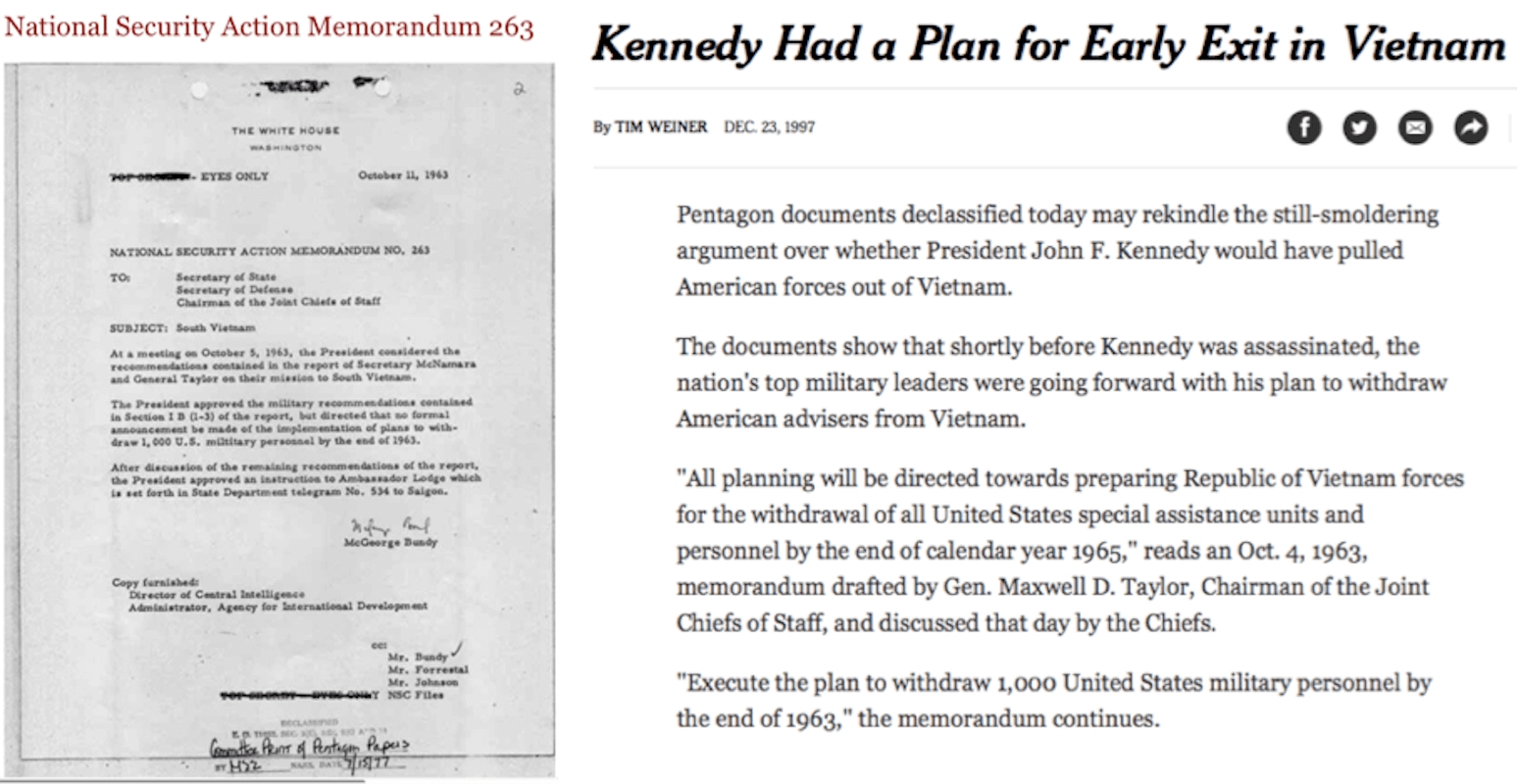
    Coinciding with all this is what is probably the most important document declassified by the ARRB. McNamara held regular meetings of the Saigon chiefs of agencies and the Pentagon in Hawaii. These were called Sec/Def meetings. For the one in May of 1963, he had requested that each agency and military chief bring with him their withdrawal schedule. After he had looked them over, he said they were too slow and would have to be speeded up. There was no qualification by McNamara that this withdrawal was hinging upon an American “victory” and there was no contingency plan mentioned to reinstate troops if the victory was not in sight. In fact, General Earle Wheeler wrote that he understood that any request for any overt action would be denied by the president. (Probe Magazine, Vol. 5, No. 3, pp. 19-21) These documents were so compelling that even The New York Times bannered a story with the headline: “Kennedy Had a Plan for Early Exit in Vietnam.” (ibid, p. 19) One would think that if it were good enough for that paragon of the MSM, the Grey Lady, it would be good enough for Burns and Novick. Needless to say, none of these documents are shown in The Vietnam War.

    Neither is NSAM 263 exhibited. This was the order drawn up in early October of 1963 that delineated the withdrawal plan and mandated that a thousand men be returned from Vietnam by the end of 1963. The story of how the order and the report it was attached to were created is revealing, and would have been informative to the viewer. By the autumn of 1963, JFK now had everything in place to activate his withdrawal plan. But he wanted to send his two highest military advisors to Saigon, that is, McNamara and Chairman of the Joint Chiefs Maxwell Taylor. He trusted McNamara, but not Taylor. Therefore, while those two were in Vietnam, Pentagon higher ups General Victor Krulak and Colonel Fletcher Prouty were invited to the White House. Bobby Kennedy met the duo. He instructed them, upon orders of the president, that they would actually edit and compose the Taylor/McNamara report at his direction. (John Newman, JFK and Vietnam, p. 401) Once that was done, it was shipped out to Hawaii and given to Taylor and McNamara in bound form. Kennedy was not allowing for any alterations.

    That report became the basis for NSAM 263. Presidentially designed, the report was used by him to ram 263 through his foreign policy advisors—some of whom were reluctant to sign on to it. But, reluctant or not, they ultimately did. McNamara was then sent out to announce the withdrawal plan to the press. As he was walking to meet the reporters, Kennedy instructed him with the following: “And tell them that means all of the helicopter pilots too.” (ibid, pp. 404-07)

    One would think that if a filmmaker were trying to assemble the latest scholarship on Vietnam for an American audience—if one were really trying to enlighten them with the best and newest information—then at least some of this would be included in the presentation. Or at least he or she would communicate some of the (at least) nine sources that Kennedy or McNamara confided in about the withdrawal plan. Or perhaps play the October 2, 1963 taped conference where McNamara actually says that they have to find a way to get out of Vietnam. (Blight, p. 100)

    I shouldn’t have to replay this refrain by now: None of this information is in the film. But as Burns pronounced on Marc Maron’s radio podcast of September 11th : History is malleable. Sort of like bubble gum, right Ken?

    What do Burns and Novick tender us instead? They give us Neil Sheehan and Jean Paul Vann. Which means they would have given us David Halberstam if he were alive. (See my two-part review, “David Halberstam, The Best and the Brightest) When I saw this, I realized just how much The Vietnam War wanted to be part of the MSM, and just how far PBS had fallen. For Halberstam’s The Best and the Brightest—which Warren Hinckle once called “one of the greatest bullshit books ever written”—makes McNamara out to be the chief engineer of the war. When, in fact, from April of 1962 to November of 1963, he was implementing Kennedy’s withdrawal plan. McNamara had even told his deputy, Roswell Gilpatric, that Kennedy had assigned him the task of winding down the war. (Blight, p. 371)

    Jean Paul Vann was one of the military advisors stationed in Vietnam under Kennedy. By all accounts he was committed to the cause of the American created nation-state of South Vietnam. Halberstam and Sheehan were young reporters at the time. Halberstam had been sent to Vietnam after being assigned to the Congo. Which is an important point. As noted above, one of Kennedy’s first reversals of Dulles/Eisenhower Cold War policy was in the Congo. In fact, that was the first place where JFK directed specific alterations to his predecessor’s policy. These would favor leftist leader Patrice Lumumba and the cause of emerging African nationalism. In that instance Kennedy was contravening a (British aided) Belgian attempt at recolonization. (Mahoney, pp. 65-69)

    Valuable research by Paul Rigby has shown that, prior to being assigned to Vietnam, Halberstam had done what he could to condescend to Kennedy’s efforts in Congo. In the pages of Times Talk—Halberstam’s employer, the NY Times in-house journal—the reporter conveyed some of those ideas. His stories, such as “It’s Chaos for a Correspondent in the Congo” and “Congo Boondocks: Land of Cannibals and Diamonds,” communicated the Establishment line that Congo could not handle independence because it was simply a land of African primitives. (William Prochnau, Once Upon a Distant War, p. 509; see also Halberstam’s The Making of a Quagmire, pp. 3-24) Halberstam seemed to be missing the overall gestalt of the struggle. He would later write of that colossal, epic conflict—which killed both Lumumba and Dag Hammarskjold—that there was less there than met the eye. (Halberstam, p. 17)

    Halberstam’s outlook and attitude failed to fully grasp Kennedy’s concepts in Congo, where JFK decided to do all he could to enforce UN Secretary General Hammarskjold’s policies for Congolese independence against America’s European allies England and Belgium. Kennedy continued that policy alone after Hammarskjold was killed. (“Hammarskjold and Kennedy vs. The Power Elite”) It is clear today—as it was then—that both Lumumba and Hammarskjold were murdered by colonial powers trying to retake the mineral wealth of Congo. (“Plane crash that killed UN boss may have been caused by aircraft attack”) Yet, in 1965, Halberstam could write that the Congolese cared less for their country than white people did. (ibid, p. 18) Unlike Halberstam, Jonathan Kwitny later fully comprehended what had happened. As Kwitny wrote, Patrice Lumumba became a hero in Africa “not because he promoted socialism, which he didn’t, but because he resisted foreign intervention. He stood up to outsiders, if only by getting himself killed.” (Endless Enemies, p. 72) As the picture below illustrates, Kennedy certainly understood Lumumba’s cause and his martyrdom:

    jfklumumba
    Kennedy receiving word of Lumumba’s death
    (photo: Jacques Lowe)

    On the larger, more epic level, Kwitny also had a much richer understanding of what was at stake in Congo than Halberstam. After surveying what happened, he memorably wrote about the legacy of Lumumba and what it meant in the larger movement of African nations to break out of the servitude of colonialism:

    The democratic experiment had no example in Africa, and badly needed one. So perhaps the sorriest … blight on the record of this new era is that the precedent for it all, the very first coup in postcolonial African history, the very first political assassination, and the very first junking of a legally constituted democratic system, all took place in a major country and were all instigated by the United States of America. It’s a sad situation when people are left to learn their ‘democracy’ from the Union of Soviet Socialist Republics. (ibid, p. 75)

    When Halberstam got to Vietnam—actually on his second day there—he lunched with the CIA’s station chief in Saigon. (Prochnau, p. 133) As the weeks went by, many of his CIA contacts from Congo migrated there. As author William Prochnau wrote, “By now his CIA contacts from the Congo had begun to flock to the hot new action in Southeast Asia like bees to honey; Vietnam was a spook’s dream and the Agency forever had a better fix on Vietnamese reality than the American military.” (ibid, p. 169)

    Halberstam admitted this in his 1965 book, The Making of a Quagmire, where he wrote, “But many CIA agents in Saigon were my friends, and I considered them among the ablest Americans I had seen overseas or at home.” (p. 222) In that book, Halberstam attempts an all-out defense of the CIA’s role in both Vietnam and the developing world. And he adds that inherent suspicion of the Agency is “the outgrowth of its bogeyman image among liberals …”. (ibid) This is especially puzzling today since the Church Committee revealed that Allen Dulles and the CIA had arranged numerous plots to kill Lumumba in the Congo, where the writer had just been stationed for many months. Later on, Halberstam attempted to distance himself from these admissions. He told Prochnau that UPI reporter Neil Sheehan had better CIA sources than he did, but he had better military sources. (Prochnau, p. 277)

    Both Halberstam and Sheehan were enamored with Vann, even though they understood he was an “essentially conservative, at times [an] almost reactionary man.” (Halberstam, p. 164) In their film, Burns and Novick have Sheehan tell us that, upon his own arrival in Saigon in 1962, he believed in American ideals and the alleged US mission in South Vietnam. He also believed in the dangers of the “international communist conspiracy”. Sheehan then adds that he was there to report the truth in order to help win the war for the betterment of the United States and the world. He describes going along on ARVN helicopter missions as being part of a crusade: he was thrilled by the experience.

    These attitudes made Sheehan and Halberstam easy targets for Vann. And negatively complementing that, it guaranteed that they would completely miss what Kennedy was doing. Colonel Vann was a veteran of Korea and, by 1963, had served in the military for twenty years. With Sheehan’s help, Burns and Novick spend several minutes outlining the January 1963 Battle of Ap Bac, an important conflict that Vann helped plan and supervise. Although the Viet Cong were outnumbered by a large margin, even though the ARVN had helicopter support and used armored personnel carriers, this battle turned out to be, by any accounting, a losing proposition for Vann. Saigon lost 80 dead, more than one hundred wounded, and five helicopters destroyed. The Viet Cong lost 18 dead and 39 wounded. Vann was deeply angered and confided the true facts of the defeat to his students Sheehan and Halberstam, who both wrote about the failure of the battle.

    The film does not reveal a key reason for that failure, one which Vann himself had discovered. Ngo Dinh Diem had issued orders to his field commanders not to initiate large offensive operations that would provoke serious casualties. Vann’s intelligence officer, Jim Drummond, concluded that the ARVN had not really checked the growth of the Viet Cong or the area under their control. (John Newman, JFK and Vietnam, p. 299) In other words, contrary to what the commander in Vietnam, General Harkins, was saying, America was not winning the war. And Ap Bac was living proof of that.

    Vann was shipped out of Vietnam in 1963 and served in the Pentagon as a procurement officer. He began to file formal reports complaining about how the war was being fought. These reports appealed to General Edward Lansdale because they clearly projected the fact that unless American ground troops were committed to Vietnam, Saigon would fall. (ibid, p. 319) As we have seen, this is the message Kennedy had listened to in November of 1961—and had rejected. Kennedy was aware of what Vann was doing. Both he and McNamara opposed the work of his acolyte Halberstam; Kennedy even asked the publisher of the Times to rotate him out of Saigon. (David Kaiser, American Tragedy, p. 261; Halberstam, p. 268)

    But Edward Lansdale had been the first to advise Kennedy to insert combat troops into Vietnam. (Newman, p. 20) Sure enough, after Kennedy’s death, when Lansdale returned to the White House, he recommended sending Vann back to Vietnam. Vann did return in 1965, when Lyndon Johnson overturned Kennedy’s policy and committed tens of thousands of American combat troops to Saigon. (Kaiser, p. 384)

    The reason that Sheehan and Halberstam admired Vann was simple: like him, they were Hawks. And like him—and opposed to Kennedy—they wanted more American involvement, not less. This is easily discernible by reading Halberstam’s 1965 book The Making of a Quagmire. That volume is perhaps the single most complete and coruscating condemnation of America’s Vietnam policy published to that point. It attacks every element of the American mission in that country and also the policies and personages of the Diem regime. (See Chapters 3-5) It then goes on to expose the ineptness of the ARVN (Chapters 5-7), in particular how bad Colonel Hunyh Van Cao was. The latter actually gets his own chapter: 10. Why so hard on Cao? Because Vann was the advisor attached to him, and—as with Sheehan—Vann was Halberstam’s hero in 1965. Why? Because he knew how to win the war. (See Chapter 11) So for Halberstam, when Vann departed, things got worse. (see Chapter 12).

    If Halberstam could not make it more clear, he does near the end of the book. With Sheehan mentioned throughout, he proclaims: “Bombers and helicopters and napalm are a help but they are not enough.” (p. 321) He then concludes with the following: “The lesson to be learned from Vietnam is that we must get in earlier, be shrewder, and force the other side to practice self-deception.” (p. 322)

    Of course, when the wishes of this troika—Sheehan, Vann and Halberstam—were fulfilled, we saw what happened. Direct American involvement ended up being an epic debacle. As many as 3-4 million people were slaughtered amid almost unimaginable horror. All in pursuit of a false goal that was not possible to attain. In other words, Kennedy was right and Vann, Sheehan and Halberstam were wrong. But neither Halberstam nor Sheehan could ever admit that. It is especially startling that Halberstam never saw the parallels of what happened in both Congo and Vietnam after Kennedy was killed: In Congo, the Agency and LBJ switched sides and joined the imperial interests; in Vietnam, the Pentagon and Johnson now broke Kennedy’s strictures and eventually imported 540,000 combat troops, making it an American imperial war. Truly puzzling that he would miss all of this.

    Sheehan and Halberstam got their wish. And even after it was clear that direct American involvement would not work, it took them years to understand it. And further, that the American army was self-destructing in the jungle, as Kennedy had predicted it would back in 1961. By 1971, even the army understood this. Colonel Robert Heinl wrote a long essay on its collapse at that time, and traced it from at least 1969. (Col. Robert D. Heinl, Jr., “The Collapse of the Armed Forces”)

    But author and activist Mark Lane understood it even earlier. In 1970 he published a book of personal interviews with returning veterans. The book was called Conversations with Americans. It was a shocking exposé of the individual and group war crimes that American solders had committed in Vietnam. Since there was a danger that his interview subjects would be prosecuted, he gave them the option of using fictitious names. He marked these with an asterisk in the text. He then added that the real names and full transcripts had been given over to an attorney who had worked for the Justice Department. (Lane, p. 17)

    When the book was published, The New York Times trotted out Sheehan to review it. (NY Times Book Review, 12/27/70) Sheehan wrote that he had contacted the Pentagon and some of the people named in the book did not serve in the military, or were not in the places where they said they were at the time. Which implied that what Lane was writing was fictitious. After, when Lane called the New York Times to talk to Sheehan, Sheehan would not accept his calls. The Times then sent Sheehan out on tour to promote his column. Which, of course, was a promotion of the collapsing war effort. Apparently, as a believer in the international communist conspiracy, Sheehan never imagined that there was a systematic, institutionalized cover-up of these crimes after the 1968 My Lai Massacre. But there was such a cover-up, and author Nick Turse discovered it when he found the (incomplete) records. (Kill Anything that Moves, pp. 15-21) When Lane asked Sheehan about My Lai during a radio interview, the New York Times reporter replied that it was just a rumor. (Mark Lane, Citizen Lane, pp. 220-21)

    Under pressure from the Times and Sheehan, Lane’s book was withdrawn from circulation.

    This is the man Burns and Novick use as the main talking head in their segment on the Kennedy years. With their defense of the Dulles brothers as “decent people” in Part One, the disappearance of Kennedy’s withdrawal plan and the championing of Vann and Sheehan in Part Two, so far the net value of this documentary is something less than zero.


    Addendum

    Although some critics of the film JFK have stated that there was no public announcement of NSAM 263, and Kennedy was keeping it quiet, as the reader can see in the following two Newsweek articles, that is false.  It was a public policy, and Kennedy had sent Defense Secretary Robert McNamara to brief the press on it after he had adopted it in October, 1963. (John Newman, JFK and Vietnam, p. 407)

    Newsweek, October 14, 1963

    (Click here if your browser is having trouble loading the above.)

    Newsweek, December 2, 1963

    (Click here if your browser is having trouble loading the above.)


    Part 1

    Part 3

    Part 4

  • C-SPAN Announces Schedule for “The National Security State & JFK”


    Saturday, July 15, 2017
    2:00 p.m. ET
    Jacob Hornberger, James DiEugenio , and Oliver Stone

    As soon as these air on TV you should be able to find them in C-SPAN’s video library at www.c-span.org/history using the search box up top to search by speaker name.

  • Gerald Posner vs. Roger Stone in Coral Gables

    Gerald Posner vs. Roger Stone in Coral Gables

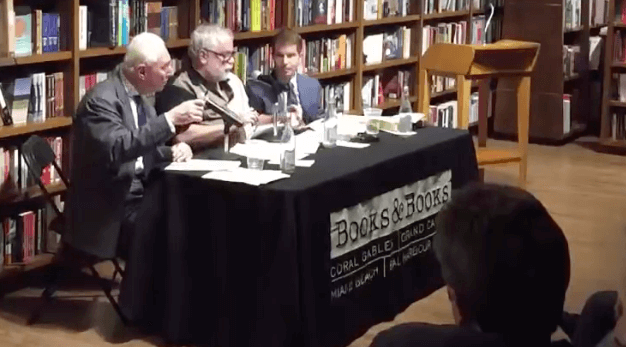
    On the 54th anniversary of President Kennedy’s assassination, at a bookstore in Coral Gables, Florida two famous authors convened. They were Gerald Posner and Roger Stone. The subject was a debate over the circumstances of Kennedy’s assassination. Obviously, because of the orientation of their books on the subject, Posner defended the Warren Commission verdict while Stone argued for a conspiracy.

    Robert Loomis

    Posner was trained as a lawyer. At age 23, he became one of the youngest attorneys ever employed by Cravath, Swaine and Moore, John McCloy’s old law firm. In 1980, he left that firm and opened a private practice with a partner. In 1986, he left that practice and became an author. In a relatively short period of time, he wrote three non-fiction books and one novel. In 1991, he was enlisted by Robert Loomis of Random House to write a response to Oliver Stone’s movie about the Kennedy assassination, JFK. The very plugged-in Loomis promised Posner that the CIA would cooperate with him on the project. (The Assassinations, edited by James DiEugenio and Lisa Pease, p. 369) And they did. Without their help, how else could an author gain access to high level defector Yuri Nosenko?

    Harold Evans

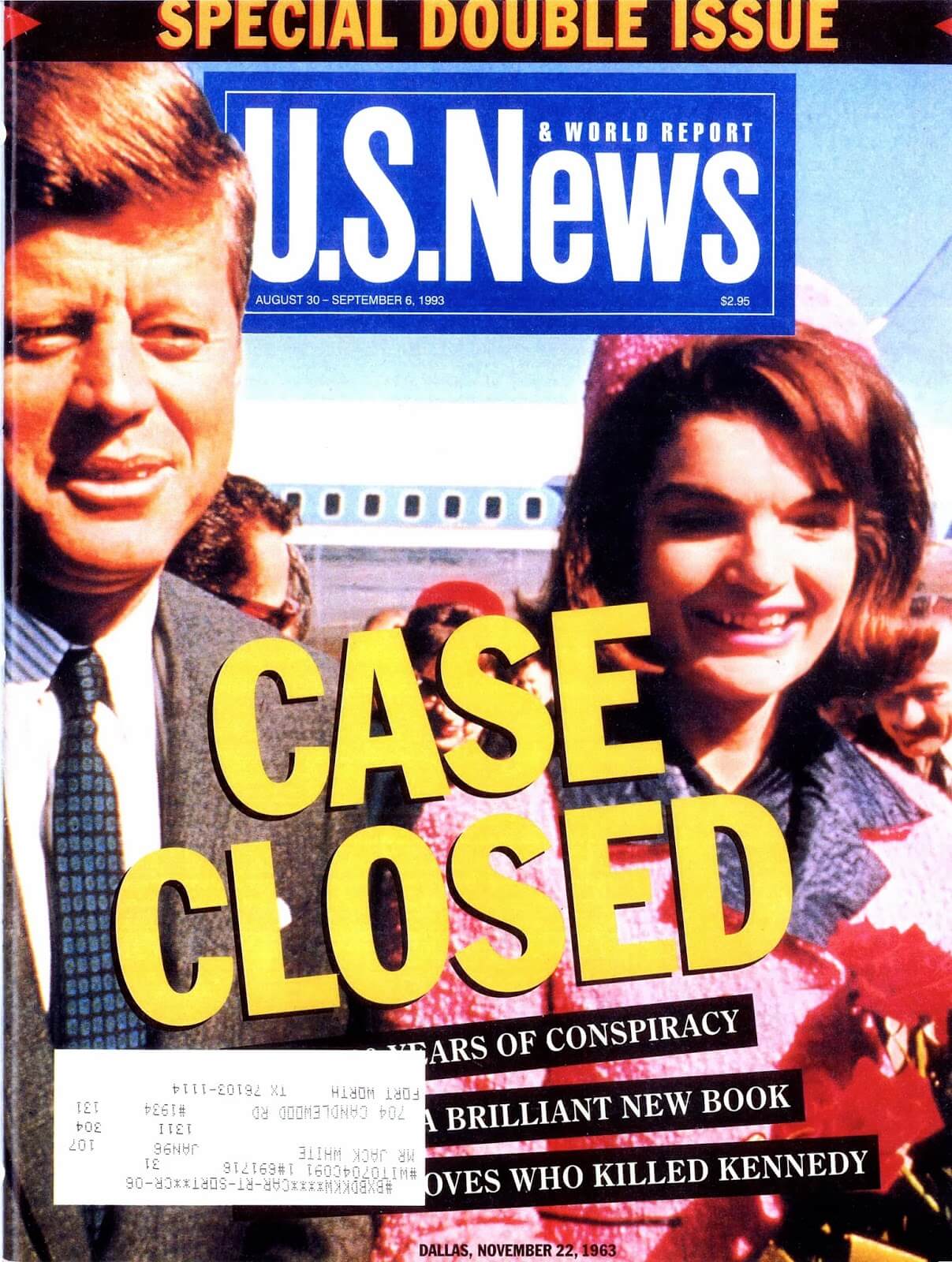
    As was exposed in a later lawsuit by the late Roger Feinman, Random House put a major effort into selling Posner’s Case Closed. One that was personally supervised by Harold Evans, who was president of the publishing house at the time. According to information Feinman discovered in his lawsuit, it was Evans who personally approved the infamous NY Times ads for the book. This was a four-phase campaign. It began with two teaser ads that promised to name the guilty parties in the JFK assassination. It culminated with two more ads. These featured the faces of Oliver Stone, David Lifton, Robert Groden, Jim Marrs, Mark Lane and Jim Garrison under a title which boldly accused them of the charge: “Guilty of Misleading the American Public”. If the reader knows anything about advertising costs in major newspapers, he can guess what those four ads cost. (Click here for Feinman’s essay about his lawsuit against Random House.)

    But that was not all. Apparently because Evans had previously served as a director of US News and World Report, that magazine gave Posner’s book a cover story. The book became such a cause celebre that other authors have successfully used it as a way to curry favor with the MSM, e.g., Jeff Toobin and Robert Dallek.

    The problem with all this hoopla, which was designed to coincide with the 30th anniversary of the assassination, is that it was completely unwarranted. There were several reviews that showed just how flawed Case Closed was: for instance, David Wrone’s. (See also this index of items on this site.) In fact, there were so many problems with Posner’s book that activist Dave Starks put together a compendium page of articles to show that, not only was Case Closed a very bad piece of scholarship, but it might have been worse than that. In his haste to do a hatchet job on the critics, Posner may have created interviews he did not actually do. For instance, Peter Scott talked to Carlos Bringuier after Case Closed came out. Contrary to the book’s claims, Bringuier said he never talked to Posner. (Author interview with Scott in San Francisco in 1994) Same with Dealey Plaza witness James Tague, who the author clearly states he talked to on two successive days. (See Posner, paperback edition, p. 546) When Gary Aguilar talked to Tague, he said he never spoke to Posner. To use another example, although the author said he interviewed JFK’s forensic pathologist Thornton Boswell, Boswell told Aguilar he never spoke to him. (Click here for Starks’ devastating page on Posner.)

    David Ferrie & Lee Oswald,
    Civil Air Patrol (1955)

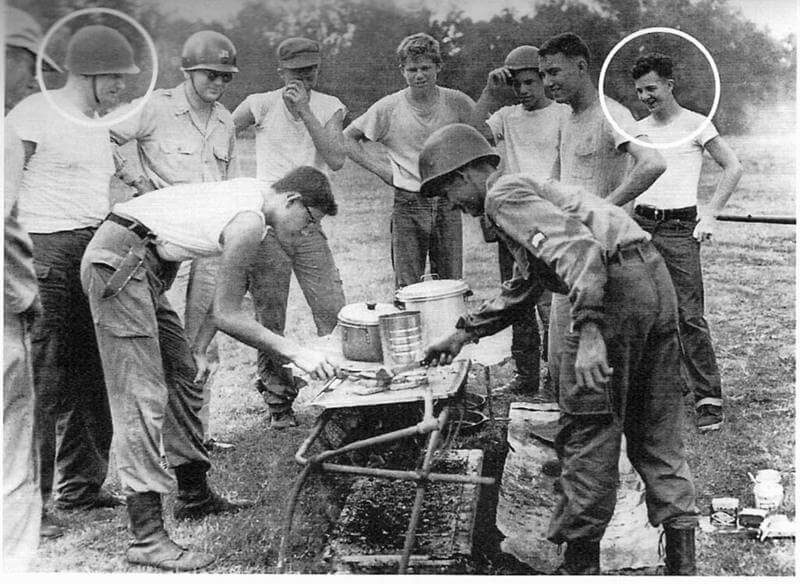
    Posner also committed some outright howlers in his much-ballyhooed book. For example, in his schematic drawings of the assassin at the Texas School Book Depository window, he has him posed as firing from an extreme left to right angle. So much so that these “Posner shots” would have ended up in the railroad yards behind the picket fence. (See Appendix A of Case Closed, paperback edition.) This makes one wonder if Posner was ever in Dallas. Because to anyone who has been to the building and peered out the sixth floor window—which was possible back then—it presents a slight right to left angle. Posner also wrote that there was no evidence to connect David Ferrie with Oswald. (Posner, p. 425) This was utterly ridiculous on many counts. But to name just one, when the book came out PBS did a special which featured a photo of Oswald and Ferrie together at a Civil Air Patrol (CAP) barbecue. They found it by questioning some other members of the CAP. Which means Posner could have done the same if he had knocked on some doors in the Crescent City. Posner also writes that there was no such personage as Clay Bertrand in New Orleans. When the JFK Act declassified both the Jim Garrison files and the papers of the HSCA, Posner again ended up with custard pie on his face. Those documents reveal that the number of witnesses who stated that Clay Shaw used the alias of Clay Bertrand was in the double digits. (Destiny Betrayed, Second Edition, by James DiEugenio, pp. 211, 387, 388)

    Posner’s book showed us in excelsis just how schizoid America is on the murder of President Kennedy. It did not matter to the Powers That Be just how error-strewn Posner’s book was. It did not matter to them that he was more or less acting as a hired gun for Loomis and Evans. It did not matter to them that the book was obviously a rush job for the 30th anniversary. Or that the title was preposterous since the declassification process of the JFK Act had not even gone into effect yet. In other words, the book was saying the case was closed when, in fact, two million pages of documents were about to be declassified in the next four years.

    Clearly, as representatives of the Anglo-American Establishment, the important thing for Loomis and Evans was this: They wanted to create a tangible cultural artifact to rally around at the 30th anniversary. Why? In order to beat back the tsunami effect of Oliver Stone’s JFK, which had blindsided them. Posner’s book was a concocted historical event. Today the book has been retired to the (rather large) ash heap of useless volumes on the JFK case. It has no intrinsic factual merit to it at all. It is simply an exemplar of a two-part cultural/historical phenomenon. I say two parts, because the second phase of this Jungian neurotic outbreak occurred four years later, with another Loomis client. This time the collective seizure was over Sy Hersh’s equally horrendous book. This one was a biography of John Kennedy, The Dark Side of Camelot. That bookend volume was as bad in its own way as Posner’s tome. But Oliver Stone had not just said that JFK was killed by a conspiracy. His film also stated that Kennedy was a foreign policy iconoclast who was changing things in that realm. This was true and has been proven even more accurate by recent scholarship. But that did not matter with Hersh, whose book was so bad that some critics said it should have been titled, The Dark Side of Seymour Hersh.

    II

    Roger Stone was born in Lewisboro, New York to a reporter mother and a father who drilled oil wells. Stone got hooked on politics when he read Conscience of a Conservative by Barry Goldwater. Although he admired Goldwater’s ideas he could not comprehend the tactics of his 1964 campaign. To put it mildly, he thought they were rather quixotic. As he told writer Matt Labash, “It’s like he was trying to lose. Going to Tennessee and coming out against the Tennessee Valley Authority? These were suicidal acts.” (Weekly Standard, November 5, 2007)

    Roger Stone & Nixon

    Because of this, Roger Stone became more enamored with Richard Nixon as his conservative standard bearer. He deduced that Nixon was “more pragmatic, more interested in winning than proving a point.” He took a pithy aphorism from RMN: “Losers don’t legislate.” (ibid) Stone liked Nixon so much that he decided that his newly found idol had not really lost the 1960 election. He had been robbed of the presidency through electoral fraud. So he wrote Nixon a letter at his New York law firm encouraging him to run again. Nixon replied that he did not plan on doing so, but if he did, he would be in touch with young Stone. (Stone is such a Nixon fan he had his face tattooed on his back.)

    Jeb Magruder testifies
    during the Watergate hearings

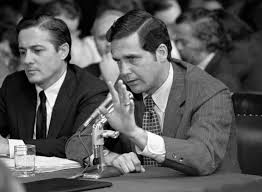
    While a student at George Washington University in Washington D.C., Stone invited Jeb Magruder, deputy director of the Committee to Reelect the President, to speak at the college’s Young Republican Club. After the speaking engagement Stone asked Magruder for a job with CREEP. At age 19, Stone decided to forsake his studies and joined right in with the antics of the infamous CREEP. For instance, he planted a mole in the camp of Democratic rival Hubert Humphrey. Magruder and his cohorts were obsessed with intelligence and skullduggery, and Stone had a natural affinity for them. He once wrote a check to Nixon rival Pete McCloskey from an account inscribed as the Young Socialists Alliance. Once he got the receipt he leaked it to the reactionary newspaper Manchester Union-Leader. (ibid)

    Against Senator George McGovern in the general election, Stone hired another spy he termed Sedan Chair II. But according to Stone, he did not understand the mentality of CREEP. To him it did not make any sense to take the kinds of risks they were taking when the Democratic candidate, McGovern, had so little chance of winning. After Watergate, which spelled the end of Nixon’s political career, he went to work for Bob Dole, and then for the (failed) Ronald Reagan campaign of 1976. During this period, he co-founded the National Conservative Political Action committee, which was designed to execute a GOP takeover of the Senate. Which, by recruiting men like Dan Quayle and Chuck Grassley, it did. As he noted to Jeffrey Toobin, “The Democrats were weak, we were strong.” (The New Yorker, June 2, 2008)

    Donald Trump & Roy Cohn
    JohnAnderson9 16 80
    John Anderson (Sept. 16, 1980)

    In 1980, he again worked for Reagan. In that election, he joined forces with the notorious attorney Roy Cohn, sworn enemy of the late Bobby Kennedy. They decided that the best way for Reagan to beat incumbent president Jimmy Carter in New York was to help Democratic congressman John Anderson get on the ballot. This way, the Democratic Party vote would be split and therefore weakened. According to Stone, Cohn told him to get in contact with a lawyer friend he had. Once in contact, he was to ask him how much it would cost to get Anderson the Liberal party nomination in New York. Stone reported back that the price was $125,000. A couple of days later, Stone was told by Cohn to pick up a suitcase and deliver it to the lawyer. He did so, and Anderson won the Liberal Party nomination. Reagan won New York with 46% of the vote. (ibid, Labash)

    Reagan’s victory in 1980 allowed Stone to enter the upper stratosphere of political campaign managing and lobbying. He now set up an office with two other GOP stalwarts, Charles Black and Paul Manafort. They would later be joined by none other than the late Lee Atwater, the man usually given credit for the Willie Horton TV ads, which helped defeat Democrat Michael Dukakis in 1988. The firm was lobbying on behalf of such people as Ferdinand Marcos, dictator of the Philippines, as well as conservative causes like the Nicaraguan Contras, and Angola’s UNITA rebels. And they advised several presidential candidates, even when they opposed each other.

    Stone’s primacy in the higher circles of the GOP came to an end in 1996. He was serving as an unaccredited adviser to Bob Dole’s presidential campaign when scandal struck. And it struck through the National Enquirer. They billed the story as “Top Dole Aide Caught in Group-Sex Ring.” (op. cit., Toobin) He and his second wife had run ads for swinging partners to participate in bedroom games. (op. cit., Labash) The tabloids even got hold of the advertising photos. Stone tried his usual “Deny, deny, deny” tactics. But they did not succeed.

    But in 2000, James Baker, who was running the GOP recount effort in Florida against Al Gore, brought Stone back to perform one last piece of political subterfuge. That act would have a momentous impact on America for decades into the future. It has come to be known as the “Brooks Brothers riot”.

    When the Florida Supreme Court ruled that Gore could have a recount in four counties, Stone and Baker decided this had to be thwarted. Scores of Republican congressional aides—the Brooks Brothers suits—had been flown to Miami to simulate grass roots, Floridian protest against the recount. Stone stationed himself in a Winnebago outside the building where the Miami-Dade County recount was taking place. Outfitted with walkie-talkies and cell phones, he went to work using these aides to create the illusion of an indigenous attack on the building. He did this by having the congressional aides actually enter the building and demand the recount be halted. According to the New York Times, some people were struck or kicked. (11/23/2000) This scene inside the building was coupled with Stone inspired Spanish language radio warnings about carloads of Cuban exiles driving to the scene. (op. cit., Toobin) In its broad outlines, the operation resembled the CIA coup in Guatemala in 1954. Between the Brooks Brothers demonstrators and the “imminent Cuban exile assault”, the recount was discontinued. The episode likely stopped Gore from actually taking the lead for the first time. This—plus the later Antonin Scalia order granting emergency relief due to the “irreparable damage” of counting votes—ultimately led to the US Supreme Court decision stopping the recount. And that brought us George W. Bush, perhaps the worst president in history.

    III

    After his work for Random House on the JFK case, in 1998 Posner wrote a book on the 30th anniversary of the Martin Luther King assassination. To no one’s surprise, Killing the Dream came to the same conclusion as Case Closed—the official story was correct. One year later of course, William Pepper demonstrated in court that Posner was wrong. The jury in a civil case brought by the King family ruled that King was killed as a result of a conspiracy.

    David Marwell

    Because of his establishment-pleasing writings, Posner became a TV and MSM presence. And he continued to write more non-fiction books. He appeared on many TV programs and also as an editorial writer for some major newspapers. According to Doug Horne in his book Inside the ARRB, the first director of the Assassination Records Review Board, David Marwell, said he found much of value in Case Closed. Consequently, he had lunch with Posner more than once. Harold Evans’ wife, Tina Brown, hired Posner as an investigative journalist for the online magazine Daily Beast. But he was forced to step down from that position in 2010 over several accusations that demonstrated that Posner was a serial plagiarist. He not only plagiarized for his articles at Daily Beast, but also in at least three of his books, e.g., Miami Babylon. (See Slate, “The Posner Plagiarism Perplex”, 2/11/2010, also Miami New Times, March 30, 2010)

    Tina Brown
    Harper Lee

    Three years later, the late Harper Lee filed a lawsuit claiming that her literary agent’s son-in-law had directed Posner to set up a corporation to defraud Lee of her royalties from her colossal best-seller To Kill a Mockingbird. In her court filing she said that she had faulty hearing and eyesight and these had been used by Samuel Pinkus to snooker her into signing over her book copyright. Pinkus assigned the copyright to a company incorporated by Posner. (NY Post, May 4, 2013) Four months later, Posner settled the suit and was dismissed from the legal action.

    After his work for James Baker in Miami, Roger Stone tended to concentrate on two new subjects. First, there was his friendship with Donald Trump. Stone was sold on the idea of Trump making a run for the presidency on the Reform Party ticket, the party created by Ross Perot. Although Trump made some overtures to run in the 2000 election, he ultimately decided against it. Stone also began to develop an avocation as an author. To say that his output has been prolific does not do him justice. In the space of about three years, beginning in late 2013, Stone has written or co-written—at last count—seven books. At least three of them rely on his relationship with Richard Nixon, who he still holds in high regard. If one looks closely, three of them rely on his relationship with Trump, who he had worked for in Trump’s 2015-16 campaign before they (allegedly) parted ways. His book about Jeb Bush, Jeb and the Bush Crime Family, was clearly meant as a broadside against the candidate most perceived as the favorite in the GOP primary campaign. His book about the Clintons, The Clintons’ War on Women, was meant as a preemptive strike against the attacks against Trump’s philandering with females.

    But Roger Stone/author first came to prominence at the 50th anniversary of the JFK assassination. At that time he co-wrote a book entitled The Man Who Killed Kennedy: The Case Against LBJ. That book became a New York Times bestseller. In fact, of all the books released at the 50th, it likely sold the most copies. Since then he has stayed involved in the field. In fact, his co-writers on the two previously mentioned books come from the JFK field. They are, respectively, Saint John Hunt and Robert Morrow.

    Why has Stone done this? It likely does not pay him the fees he commanded as a Washington lobbyist working in a very powerful PR firm. In a profile written by Jeff Toobin for The New Yorker, some hints for this career move are tossed out—almost inadvertently. One of the reasons Stone gives for being so enamored of Nixon is his anti-elitism. He adds Nixon was class conscious. And he identified with average people who ate TV dinners and watched Lawrence Welk. To Stone, Nixon “recognized the effectiveness of anti-elitism—a staple of American campaigns even today—as a core message.” In comparing Nixon with Reagan, Stone states that although many Republicans give Reagan credit for the defections of the working class from the Democrats, it was really Nixon who started it. Stone then zeroes in on the whole polarization concept:

    Nixon figured out how to win. We had a non-elitist message. We were the party of the workingman! We wanted lower taxes for everyone across the board. They were the part of the Hollywood elite. … The point that the Democrats missed was that the people who weren’t rich wanted to be rich.

    There is little doubt that Nixon, with his appeals to the Silent Majority in order to expand and lengthen the Vietnam War, did use these kinds of techniques. It’s obvious from the declassified tapes at the Nixon Library that he did not mean any of it. This was amply exposed by author Ken Hughes, among others, in his fine book Fatal Politics. And this exposure helps explain why Nixon and his family fought so long and hard not to have those tapes declassified. That book reveals that Nixon knew the war was lost in 1969. But he did not want to have South Vietnam fall on his watch. Therefore, he lied to Nguyen Van Thieu of South Vietnam to keep him in his corner while he negotiated an agreement with the north. The whole time he slaughtered tens of thousands of innocent civilians in an expanded air war over all of Indochina. The only reason for this was to announce a peace agreement on the eve of the 1972 election to make sure he had a landslide victory. This is all admitted to on these tapes in the Hughes book, and in letters he sent to Thieu in the book The Palace File.

    But the relevant point for today’s scene is that this cultural anti-elite aspect was well used by both Stone and Trump during the latter’s successful presidential campaign. Trump decided to leapfrog most of the MSM, and he did this with Stone’s help. In addition to the two books mentioned above, Stone helped promote the whole mythology of Ted Cruz’s father being seen in New Orleans with Lee Oswald in the summer of 1963. Stone used the word of Judyth Baker to promote this bizarre story. And Trump went on national TV with it. (Click here for our reaction.) The Morrow/Stone book about Clinton helped Trump alleviate the impact of the compelling Access Hollywood videotape. And this whole anti-cultural-elite concept helped avoid the question of how in the heck do the interests of a billionaire real estate investor coincide with America’s shrinking middle class? With the announcement of Trump’s cabinet, we can see that, as with Nixon, the whole idea is little more than window dressing. The policies that this cabinet and the Republican Party will try to enact will gut the middle class even more.

    IV

    All of the above about these two men is more than relevant to their debate in Coral Gables. Because it informs us of the state of the JFK case in America today. This author would not walk across the street to see Posner speak about either the JFK or King case. Simply because he is a lawyer who is in the employ of the official story. Therefore, it does not matter if what he is saying is incomplete, dubious or just specious. This reviewer has never read any of Stone’s books for the simple reason that I have a hard time thinking that Stone could master something as complex and multi-layered as the JFK case in just a matter of 3-4 years. I am also skeptical of the case that he and others have made against Lyndon Johnson. In watching this confrontation it appears I was correct about these suspicions.

    Roger Stone presented first. He led off with remarks about the avulsed rear skull wound that, for him, disappeared from the back of Kennedy’s head after he left Parkland Hospital. (This is not accurate. Gary Aguilar has shown it did not disappear, it was apparent at both the emergency room at Parkland and Bethesda Medical Center, where Kennedy’s body underwent an autopsy.) Stone later added the confusing point that the House Select Committee on Assassinations (HSCA) was convened because of Oliver Stone’s film JFK. I think Roger meant the Assassination Records Review Board (ARRB) was convened.

    But he then confuses this issue even more by saying that the HSCA revealed more of Ruby’s Mafia ties, which led them to conclude organized crime involvement in the JFK case. This is not really accurate, as the HSCA did not deduce this as one of their conclusions. Chief Counsel Robert Blakey did that in his later book on the JFK case, The Plot to Kill the President (which was co-written with Dick Billings).

    Stone also talked about his relationship with Senator Arlen Specter and how Specter did not have access to the autopsy materials during the Warren Commission proceedings. This needed to be qualified. As revealed by the declassified transcripts of the their executive hearings, the Warren Commission did have the autopsy materials. (Gerald McKnight, Breach of Trust, p. 171) And as Pat Speer has shown on his web site, Specter did see at least one of the autopsy photos. (See Chapter 10, “Examining the Examinations”.)

    Stone also said that the alleged rifle used by Oswald was purchased for $75.00 and that no marksman was able to duplicate what he did, that is get 2 of 3 direct hits in six seconds. The latter part of this is correct, the former sum is about three times what the rifle actually cost. Stone then concluded with the Jay Harrison/Barr McClellan sponsored Mac Wallace fingerprint found on the sixth floor. He also even mentioned one Loy Factor’s involvement with Wallace and the LBJ plot.

    Posner then replied. He criticized Stone’s book for having so many footnotes to other books. He therefore termed the book outdated. This is bizarre since Posner’s book is overwhelmingly reliant on the Warren Report and the accompanying volumes of evidence. He then said there was no evidence on the autopsy x-rays and photos that revealed anyone firing from anywhere except from behind and the general vicinity of the sixth floor.

    Apparently, Posner was not aware of the ARRB interview with Tom Robinson who worked out of Gawler’s funeral parlor. He said there was a wound near the right temple of the president that he filled in with wax. He said it was so close to the hairline it was difficult to see. (Murder in Dealey Plaza, p. 250, edited by James Fetzer.) Author Don Thomas has also done good work with the autopsy photos, which makes this wound easier to discern. Posner also ignores the fact that, as many have indicated, if the autopsy doctors are correct and the entrance wound in the skull came in near the base, then there is no trajectory of bullet particles on the X-rays to match it up with.

    Since Stone gave Posner an opening about only the Parkland doctors seeing the hole in the back of the skull, lawyer Posner took advantage of it. He said that since Kennedy’s body was not turned over at Parkland, they really didn’t see it. This is ridiculous on more than one count. First, as Gary Aguilar has shown, this avulsed wound did not “disappear” after Dallas. It was clearly observed at Bethesda, except the HSCA hid these interviews from the public. Therefore they were only declassified with the advent of the ARRB. (ibid, p. 199) And Posner talks about using dated information.

    Secondly, Parkland nurse Diana Bowron actually saw this wound as she was aiding the entourage bringing Kennedy’s body into the emergency room, and she saw it again as she was prepping Kennedy’s corpse to depart. (ibid, pp. 60, 199) Neurosurgeon Kemp Clark examined Kennedy’s skull as the tracheotomy was being performed and he stated that he saw this wound. (ibid, p. 193) Nurse Audrey Bell told the ARRB that Malcolm Perry showed her this wound by turning Kennedy’s head slightly. (Interview of 4/1/97) Then, of course, there is the testimony of Secret Service agent Clint Hill who said he saw this wound in the limousine on the way to Parkland. (op. cit., Fetzer, pp. 198-99) Stone should have literally harpooned Posner for citing such specious information.

    The bloviating Posner then added something just as dubious. He said that in order to argue conspiracy one must state that the X-rays and photos are altered. More baloney. Stone should have asked Posner on rebuttal, “How did the 6.5 mm fragment get on the X-rays if it’s not in the autopsy report and none of the autopsy doctors saw it that night?” He then should have asked the prosecutor, “What happened to the trail of fragments that lead pathologist Jim Humes wrote about in his report which goes from the bottom rear of the skull to the top? Those do not exist today. Why Gerald?” (Reclaiming Parkland, by James DiEugenio, pp. 152-54) Stone should also have asked the attorney, “Gerald, if all the shots came from the rear, including the head shot, why is there no blowout in the front of Kennedy’s face?”

    Further, the brain was never sectioned. Therefore we do not know the path of the bullet through the skull, or if there was only one bullet.  That would have been the best evidence of exactly what killed President Kennedy.  But it  was not done. Why?

    Finally, the back wound was not dissected.  So we do not know if this wound was a through and through wound–did it transit the body?  If it did not, then the Single Bullet Theory Posner upholds is kaput.  And according to pathologist Pierre Finck’s testimony at the Clay Shaw trial, the reason it was not tracked is that the doctors were prevented from doing so by the military brass at Bethesda.

    These all indicate a cover up, if not a conspiracy.  And they all would have been better evidence than the photos and X-rays. After all, one cannot photograph autopsy practices that were never performed.

    Posner then said it is wrong to say that no marksman ever duplicated Oswald’s shooting feat. He said the Commission did, CBS did, and the HSCA did.

    Concerning the first, I don’t know what Posner is talking about. Mark Lane and Sylvia Meagher have discussed the rifle experiments of the Warren Commission.  (Meagher, Accessories After the Fact,  pp. 108-10; Lane, Rush to Judgment,  pp. 126-30)  The FBI tried to get off three shots in six seconds, scoring two of three direct hits in the head and shoulder area. They failed. Therefore, the Commission had three military snipers try it. These tests were rigged. They were done from about twenty feet up, not sixty, as would have been the case with Oswald.  The three riflemen were given as much time as they wanted to gauge the first shot, again not the case for Oswald.  Third, they were firing at stationary and not moving targets.  And even at that, the targets were grouped much closer together than what the Commission said was the firing series in Dealey Plaza. Fifth, these were some of the vey best marksmen in the military. They were so good they were above the best in the Marine Corps, and could qualify for the Olympics. To put it mildly, Oswald was nowhere near this quality.  But even at that only one of them got the shots off in the required time.  And none were able to get two of three direct hits.

    Concerning CBS, apparently Posner has not read my essay based on CBS internal memoranda adduced by their employee Roger Feinman. Unlike what Posner stated, their first marksman, a famous military sniper, using a model of the 6.5 Mannlicher Carcano, could not do what Oswald did. They then brought in a team of riflemen, and let them practice for a week—which Oswald did not do in any way, shape or form. They then set up a target that eliminated the oak tree from the sixth floor, eliminated the curve in the street, and instead set up a moving sled to fire at. This last was the most important factor. Why? Because the sled posed an enlarged target, as Feinman notes, it at least doubled the target area. In other words, CBS cheated after their first marksman failed. (Click here for that information.)

    Stooping to the HSCA for evidence on this subject is really hard to understand. Even for Posner. Because the HSCA did no rifle tests during its actual duration. They did not do them until after the HSCA ceased operation. Wallace Milam sent me the full memo on this episode. It turns out that Chief Counsel Robert Blakey, his assistant Gary Cornwell, and some Washington policemen went out to a rifle range. There they tried to do what the Commission said Oswald did. In their overweening ambition, at first they decided not to use the telescopic site. Which is ridiculous since the Commission said Oswald did use it. After all, why would it be attached to the rifle if it were not used? As I can inform the reader, that scope makes a huge difference. To say Oswald did what he did without it is simply preposterous. But when the policemen used only the iron sights on the rifle, they had the same problem that the Commission did. They could not maintain accuracy within the six second time interval of the Warren Commission. So what did Blakey and Cornwell do? They used something called “point aiming”. Which means not using any site at all, just pointing the rifle. When they got off two shots in under two seconds that was enough. They then deduced it was possible to do what Oswald allegedly did even though they were only 20 feet up instead of 60 feet and their accuracy results were not recorded. (The Assassinations, edited by James DiEugenio and Lisa Pease, p. 83)

    Marine sniper
    Carlos Hathcock

    Stone should have replied that, yes, you can do what the Commission said Oswald did. But you have to cheat. And then not tell the public about the cheating. I would have then added that Carlos Hathcock, the greatest sniper of the Vietnam War, actually did try and duplicate accurately what the Commission said Oswald did. He told author Craig Roberts that he could not do it, even though he tried more than once.

    Posner actually used the fingerprint evidence on the alleged Oswald rifle to try and convict Oswald. Without telling the public that this so-called evidence was presented only after the FBI found there were no prints found on the rifle when Sebastian LaTona examined it that night. (Meagher, op. cit., pp. 120-27) Prints only showed up about a week later, and then thirty years later for a PBS special. Stone rightly pointed out that the FBI was inexplicably at the Oswald funeral parlor trying to get fingerprints off of his corpse. (Henry Hurt, Reasonable Doubt, pp. 107-09) Which is weird, since the Dallas Police already had Oswald’s fingerprints.

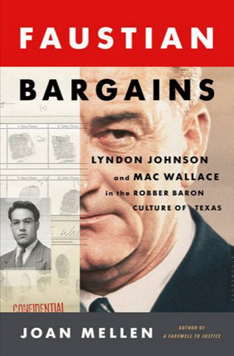
    Posner concluded by rebutting the use of the Mac Wallace fingerprint with the work of FBI authority Robert Garrett, as is featured in Joan Mellen’s book, Faustian Bargains.

    I won’t go on with my analysis since it would just be more of the same. Posner making more and more dubious claims and Stone replying with populist type experts, e.g., Judyth Baker on Cruz, and Richard Bartholomew on the Wallace print. (Yet, to my knowledge, Richard is not a fingerprint expert.) Posner actually tried to impeach Victoria Adams not seeing Oswald running down the stairs after the shooting by saying she did not see officer Marrion Baker or supervisor Roy Truly either. Again, Posner seems unaware that Miss Garner, Victoria’s supervisor, did see those two men come up the stairs after Adams and co-worker Sandy Styles went down. Further, the Warren Commission had this document in their hands, since it was dated June 2, 1964. While they were in session.

    Now, obviously, if Garner saw Baker and Truly after Victoria and Sandy went down the stairs, then the two women left within seconds of the shooting, as they said they did. Yet the Warren Report says they left much later, minutes afterwards. In other words, the Commission covered up the true facts of what had occurred. Because Adams and Styles give Oswald a rock solid alibi for not being on the sixth floor when they needed him to be so. (DiEugenio, op. cit., pp. 115-20)

    The most important thing that was said during this debate was that Stone would try and talk to Mr. Trump about the declassification of the final documents being held at the National Archives by the JFK Act. They are supposed to be finally disposed of in October of this year. Let us hope Mr. Stone uses his influence to see that through. It would be in keeping with his and Mr. Trump’s obeisance to conservative populism.

    (The debate video is embedded below, or the reader can watch it by clicking here.)

  • Gerald Posner vs. Roger Stone in Coral Gables

    Gerald Posner vs. Roger Stone in Coral Gables

    On the 54th anniversary of President Kennedy’s assassination, at a bookstore in Coral Gables, Florida two famous authors convened. They were Gerald Posner and Roger Stone. The subject was a debate over the circumstances of Kennedy’s assassination. Obviously, because of the orientation of their books on the subject, Posner defended the Warren Commission verdict while Stone argued for a conspiracy.

    Robert Loomis

    Posner was trained as a lawyer. At age 23, he became one of the youngest attorneys ever employed by Cravath, Swaine and Moore, John McCloy’s old law firm. In 1980, he left that firm and opened a private practice with a partner. In 1986, he left that practice and became an author. In a relatively short period of time, he wrote three non-fiction books and one novel. In 1991, he was enlisted by Robert Loomis of Random House to write a response to Oliver Stone’s movie about the Kennedy assassination, JFK. The very plugged-in Loomis promised Posner that the CIA would cooperate with him on the project. (The Assassinations, edited by James DiEugenio and Lisa Pease, p. 369) And they did. Without their help, how else could an author gain access to high level defector Yuri Nosenko?

    Harold Evans

    As was exposed in a later lawsuit by the late Roger Feinman, Random House put a major effort into selling Posner’s Case Closed. One that was personally supervised by Harold Evans, who was president of the publishing house at the time. According to information Feinman discovered in his lawsuit, it was Evans who personally approved the infamous NY Times ads for the book. This was a four-phase campaign. It began with two teaser ads that promised to name the guilty parties in the JFK assassination. It culminated with two more ads. These featured the faces of Oliver Stone, David Lifton, Robert Groden, Jim Marrs, Mark Lane and Jim Garrison under a title which boldly accused them of the charge: “Guilty of Misleading the American Public”. If the reader knows anything about advertising costs in major newspapers, he can guess what those four ads cost. (Click here for Feinman’s essay about his lawsuit against Random House.)

    But that was not all. Apparently because Evans had previously served as a director of US News and World Report, that magazine gave Posner’s book a cover story. The book became such a cause celebre that other authors have successfully used it as a way to curry favor with the MSM, e.g., Jeff Toobin and Robert Dallek.

    The problem with all this hoopla, which was designed to coincide with the 30th anniversary of the assassination, is that it was completely unwarranted. There were several reviews that showed just how flawed Case Closed was: for instance, David Wrone’s. (See also this index of items on this site.) In fact, there were so many problems with Posner’s book that activist Dave Starks put together a compendium page of articles to show that, not only was Case Closed a very bad piece of scholarship, but it might have been worse than that. In his haste to do a hatchet job on the critics, Posner may have created interviews he did not actually do. For instance, Peter Scott talked to Carlos Bringuier after Case Closed came out. Contrary to the book’s claims, Bringuier said he never talked to Posner. (Author interview with Scott in San Francisco in 1994) Same with Dealey Plaza witness James Tague, who the author clearly states he talked to on two successive days. (See Posner, paperback edition, p. 546) When Gary Aguilar talked to Tague, he said he never spoke to Posner. To use another example, although the author said he interviewed JFK’s forensic pathologist Thornton Boswell, Boswell told Aguilar he never spoke to him. (Click here for Starks’ devastating page on Posner.)

    David Ferrie & Lee Oswald,
    Civil Air Patrol (1955)

    Posner also committed some outright howlers in his much-ballyhooed book. For example, in his schematic drawings of the assassin at the Texas School Book Depository window, he has him posed as firing from an extreme left to right angle. So much so that these “Posner shots” would have ended up in the railroad yards behind the picket fence. (See Appendix A of Case Closed, paperback edition.) This makes one wonder if Posner was ever in Dallas. Because to anyone who has been to the building and peered out the sixth floor window—which was possible back then—it presents a slight right to left angle. Posner also wrote that there was no evidence to connect David Ferrie with Oswald. (Posner, p. 425) This was utterly ridiculous on many counts. But to name just one, when the book came out PBS did a special which featured a photo of Oswald and Ferrie together at a Civil Air Patrol (CAP) barbecue. They found it by questioning some other members of the CAP. Which means Posner could have done the same if he had knocked on some doors in the Crescent City. Posner also writes that there was no such personage as Clay Bertrand in New Orleans. When the JFK Act declassified both the Jim Garrison files and the papers of the HSCA, Posner again ended up with custard pie on his face. Those documents reveal that the number of witnesses who stated that Clay Shaw used the alias of Clay Bertrand was in the double digits. (Destiny Betrayed, Second Edition, by James DiEugenio, pp. 211, 387, 388)

    Posner’s book showed us in excelsis just how schizoid America is on the murder of President Kennedy. It did not matter to the Powers That Be just how error-strewn Posner’s book was. It did not matter to them that he was more or less acting as a hired gun for Loomis and Evans. It did not matter to them that the book was obviously a rush job for the 30th anniversary. Or that the title was preposterous since the declassification process of the JFK Act had not even gone into effect yet. In other words, the book was saying the case was closed when, in fact, two million pages of documents were about to be declassified in the next four years.

    Clearly, as representatives of the Anglo-American Establishment, the important thing for Loomis and Evans was this: They wanted to create a tangible cultural artifact to rally around at the 30th anniversary. Why? In order to beat back the tsunami effect of Oliver Stone’s JFK, which had blindsided them. Posner’s book was a concocted historical event. Today the book has been retired to the (rather large) ash heap of useless volumes on the JFK case. It has no intrinsic factual merit to it at all. It is simply an exemplar of a two-part cultural/historical phenomenon. I say two parts, because the second phase of this Jungian neurotic outbreak occurred four years later, with another Loomis client. This time the collective seizure was over Sy Hersh’s equally horrendous book. This one was a biography of John Kennedy, The Dark Side of Camelot. That bookend volume was as bad in its own way as Posner’s tome. But Oliver Stone had not just said that JFK was killed by a conspiracy. His film also stated that Kennedy was a foreign policy iconoclast who was changing things in that realm. This was true and has been proven even more accurate by recent scholarship. But that did not matter with Hersh, whose book was so bad that some critics said it should have been titled, The Dark Side of Seymour Hersh.

    II

    Roger Stone was born in Lewisboro, New York to a reporter mother and a father who drilled oil wells. Stone got hooked on politics when he read Conscience of a Conservative by Barry Goldwater. Although he admired Goldwater’s ideas he could not comprehend the tactics of his 1964 campaign. To put it mildly, he thought they were rather quixotic. As he told writer Matt Labash, “It’s like he was trying to lose. Going to Tennessee and coming out against the Tennessee Valley Authority? These were suicidal acts.” (Weekly Standard, November 5, 2007)

    Roger Stone & Nixon

    Because of this, Roger Stone became more enamored with Richard Nixon as his conservative standard bearer. He deduced that Nixon was “more pragmatic, more interested in winning than proving a point.” He took a pithy aphorism from RMN: “Losers don’t legislate.” (ibid) Stone liked Nixon so much that he decided that his newly found idol had not really lost the 1960 election. He had been robbed of the presidency through electoral fraud. So he wrote Nixon a letter at his New York law firm encouraging him to run again. Nixon replied that he did not plan on doing so, but if he did, he would be in touch with young Stone. (Stone is such a Nixon fan he had his face tattooed on his back.)

    Jeb Magruder testifies
    during the Watergate hearings

    While a student at George Washington University in Washington D.C., Stone invited Jeb Magruder, deputy director of the Committee to Reelect the President, to speak at the college’s Young Republican Club. After the speaking engagement Stone asked Magruder for a job with CREEP. At age 19, Stone decided to forsake his studies and joined right in with the antics of the infamous CREEP. For instance, he planted a mole in the camp of Democratic rival Hubert Humphrey. Magruder and his cohorts were obsessed with intelligence and skullduggery, and Stone had a natural affinity for them. He once wrote a check to Nixon rival Pete McCloskey from an account inscribed as the Young Socialists Alliance. Once he got the receipt he leaked it to the reactionary newspaper Manchester Union-Leader. (ibid)

    Against Senator George McGovern in the general election, Stone hired another spy he termed Sedan Chair II. But according to Stone, he did not understand the mentality of CREEP. To him it did not make any sense to take the kinds of risks they were taking when the Democratic candidate, McGovern, had so little chance of winning. After Watergate, which spelled the end of Nixon’s political career, he went to work for Bob Dole, and then for the (failed) Ronald Reagan campaign of 1976. During this period, he co-founded the National Conservative Political Action committee, which was designed to execute a GOP takeover of the Senate. Which, by recruiting men like Dan Quayle and Chuck Grassley, it did. As he noted to Jeffrey Toobin, “The Democrats were weak, we were strong.” (The New Yorker, June 2, 2008)

    Donald Trump & Roy Cohn
    JohnAnderson9 16 80
    John Anderson (Sept. 16, 1980)

    In 1980, he again worked for Reagan. In that election, he joined forces with the notorious attorney Roy Cohn, sworn enemy of the late Bobby Kennedy. They decided that the best way for Reagan to beat incumbent president Jimmy Carter in New York was to help Democratic congressman John Anderson get on the ballot. This way, the Democratic Party vote would be split and therefore weakened. According to Stone, Cohn told him to get in contact with a lawyer friend he had. Once in contact, he was to ask him how much it would cost to get Anderson the Liberal party nomination in New York. Stone reported back that the price was $125,000. A couple of days later, Stone was told by Cohn to pick up a suitcase and deliver it to the lawyer. He did so, and Anderson won the Liberal Party nomination. Reagan won New York with 46% of the vote. (ibid, Labash)

    Reagan’s victory in 1980 allowed Stone to enter the upper stratosphere of political campaign managing and lobbying. He now set up an office with two other GOP stalwarts, Charles Black and Paul Manafort. They would later be joined by none other than the late Lee Atwater, the man usually given credit for the Willie Horton TV ads, which helped defeat Democrat Michael Dukakis in 1988. The firm was lobbying on behalf of such people as Ferdinand Marcos, dictator of the Philippines, as well as conservative causes like the Nicaraguan Contras, and Angola’s UNITA rebels. And they advised several presidential candidates, even when they opposed each other.

    Stone’s primacy in the higher circles of the GOP came to an end in 1996. He was serving as an unaccredited adviser to Bob Dole’s presidential campaign when scandal struck. And it struck through the National Enquirer. They billed the story as “Top Dole Aide Caught in Group-Sex Ring.” (op. cit., Toobin) He and his second wife had run ads for swinging partners to participate in bedroom games. (op. cit., Labash) The tabloids even got hold of the advertising photos. Stone tried his usual “Deny, deny, deny” tactics. But they did not succeed.

    But in 2000, James Baker, who was running the GOP recount effort in Florida against Al Gore, brought Stone back to perform one last piece of political subterfuge. That act would have a momentous impact on America for decades into the future. It has come to be known as the “Brooks Brothers riot”.

    When the Florida Supreme Court ruled that Gore could have a recount in four counties, Stone and Baker decided this had to be thwarted. Scores of Republican congressional aides—the Brooks Brothers suits—had been flown to Miami to simulate grass roots, Floridian protest against the recount. Stone stationed himself in a Winnebago outside the building where the Miami-Dade County recount was taking place. Outfitted with walkie-talkies and cell phones, he went to work using these aides to create the illusion of an indigenous attack on the building. He did this by having the congressional aides actually enter the building and demand the recount be halted. According to the New York Times, some people were struck or kicked. (11/23/2000) This scene inside the building was coupled with Stone inspired Spanish language radio warnings about carloads of Cuban exiles driving to the scene. (op. cit., Toobin) In its broad outlines, the operation resembled the CIA coup in Guatemala in 1954. Between the Brooks Brothers demonstrators and the “imminent Cuban exile assault”, the recount was discontinued. The episode likely stopped Gore from actually taking the lead for the first time. This—plus the later Antonin Scalia order granting emergency relief due to the “irreparable damage” of counting votes—ultimately led to the US Supreme Court decision stopping the recount. And that brought us George W. Bush, perhaps the worst president in history.

    III

    After his work for Random House on the JFK case, in 1998 Posner wrote a book on the 30th anniversary of the Martin Luther King assassination. To no one’s surprise, Killing the Dream came to the same conclusion as Case Closed—the official story was correct. One year later of course, William Pepper demonstrated in court that Posner was wrong. The jury in a civil case brought by the King family ruled that King was killed as a result of a conspiracy.

    David Marwell

    Because of his establishment-pleasing writings, Posner became a TV and MSM presence. And he continued to write more non-fiction books. He appeared on many TV programs and also as an editorial writer for some major newspapers. According to Doug Horne in his book Inside the ARRB, the first director of the Assassination Records Review Board, David Marwell, said he found much of value in Case Closed. Consequently, he had lunch with Posner more than once. Harold Evans’ wife, Tina Brown, hired Posner as an investigative journalist for the online magazine Daily Beast. But he was forced to step down from that position in 2010 over several accusations that demonstrated that Posner was a serial plagiarist. He not only plagiarized for his articles at Daily Beast, but also in at least three of his books, e.g., Miami Babylon. (See Slate, “The Posner Plagiarism Perplex”, 2/11/2010, also Miami New Times, March 30, 2010)

    Tina Brown
    Harper Lee

    Three years later, the late Harper Lee filed a lawsuit claiming that her literary agent’s son-in-law had directed Posner to set up a corporation to defraud Lee of her royalties from her colossal best-seller To Kill a Mockingbird. In her court filing she said that she had faulty hearing and eyesight and these had been used by Samuel Pinkus to snooker her into signing over her book copyright. Pinkus assigned the copyright to a company incorporated by Posner. (NY Post, May 4, 2013) Four months later, Posner settled the suit and was dismissed from the legal action.

    After his work for James Baker in Miami, Roger Stone tended to concentrate on two new subjects. First, there was his friendship with Donald Trump. Stone was sold on the idea of Trump making a run for the presidency on the Reform Party ticket, the party created by Ross Perot. Although Trump made some overtures to run in the 2000 election, he ultimately decided against it. Stone also began to develop an avocation as an author. To say that his output has been prolific does not do him justice. In the space of about three years, beginning in late 2013, Stone has written or co-written—at last count—seven books. At least three of them rely on his relationship with Richard Nixon, who he still holds in high regard. If one looks closely, three of them rely on his relationship with Trump, who he had worked for in Trump’s 2015-16 campaign before they (allegedly) parted ways. His book about Jeb Bush, Jeb and the Bush Crime Family, was clearly meant as a broadside against the candidate most perceived as the favorite in the GOP primary campaign. His book about the Clintons, The Clintons’ War on Women, was meant as a preemptive strike against the attacks against Trump’s philandering with females.

    But Roger Stone/author first came to prominence at the 50th anniversary of the JFK assassination. At that time he co-wrote a book entitled The Man Who Killed Kennedy: The Case Against LBJ. That book became a New York Times bestseller. In fact, of all the books released at the 50th, it likely sold the most copies. Since then he has stayed involved in the field. In fact, his co-writers on the two previously mentioned books come from the JFK field. They are, respectively, Saint John Hunt and Robert Morrow.

    Why has Stone done this? It likely does not pay him the fees he commanded as a Washington lobbyist working in a very powerful PR firm. In a profile written by Jeff Toobin for The New Yorker, some hints for this career move are tossed out—almost inadvertently. One of the reasons Stone gives for being so enamored of Nixon is his anti-elitism. He adds Nixon was class conscious. And he identified with average people who ate TV dinners and watched Lawrence Welk. To Stone, Nixon “recognized the effectiveness of anti-elitism—a staple of American campaigns even today—as a core message.” In comparing Nixon with Reagan, Stone states that although many Republicans give Reagan credit for the defections of the working class from the Democrats, it was really Nixon who started it. Stone then zeroes in on the whole polarization concept:

    Nixon figured out how to win. We had a non-elitist message. We were the party of the workingman! We wanted lower taxes for everyone across the board. They were the part of the Hollywood elite. … The point that the Democrats missed was that the people who weren’t rich wanted to be rich.

    There is little doubt that Nixon, with his appeals to the Silent Majority in order to expand and lengthen the Vietnam War, did use these kinds of techniques. It’s obvious from the declassified tapes at the Nixon Library that he did not mean any of it. This was amply exposed by author Ken Hughes, among others, in his fine book Fatal Politics. And this exposure helps explain why Nixon and his family fought so long and hard not to have those tapes declassified. That book reveals that Nixon knew the war was lost in 1969. But he did not want to have South Vietnam fall on his watch. Therefore, he lied to Nguyen Van Thieu of South Vietnam to keep him in his corner while he negotiated an agreement with the north. The whole time he slaughtered tens of thousands of innocent civilians in an expanded air war over all of Indochina. The only reason for this was to announce a peace agreement on the eve of the 1972 election to make sure he had a landslide victory. This is all admitted to on these tapes in the Hughes book, and in letters he sent to Thieu in the book The Palace File.

    But the relevant point for today’s scene is that this cultural anti-elite aspect was well used by both Stone and Trump during the latter’s successful presidential campaign. Trump decided to leapfrog most of the MSM, and he did this with Stone’s help. In addition to the two books mentioned above, Stone helped promote the whole mythology of Ted Cruz’s father being seen in New Orleans with Lee Oswald in the summer of 1963. Stone used the word of Judyth Baker to promote this bizarre story. And Trump went on national TV with it. (Click here for our reaction.) The Morrow/Stone book about Clinton helped Trump alleviate the impact of the compelling Access Hollywood videotape. And this whole anti-cultural-elite concept helped avoid the question of how in the heck do the interests of a billionaire real estate investor coincide with America’s shrinking middle class? With the announcement of Trump’s cabinet, we can see that, as with Nixon, the whole idea is little more than window dressing. The policies that this cabinet and the Republican Party will try to enact will gut the middle class even more.

    IV

    All of the above about these two men is more than relevant to their debate in Coral Gables. Because it informs us of the state of the JFK case in America today. This author would not walk across the street to see Posner speak about either the JFK or King case. Simply because he is a lawyer who is in the employ of the official story. Therefore, it does not matter if what he is saying is incomplete, dubious or just specious. This reviewer has never read any of Stone’s books for the simple reason that I have a hard time thinking that Stone could master something as complex and multi-layered as the JFK case in just a matter of 3-4 years. I am also skeptical of the case that he and others have made against Lyndon Johnson. In watching this confrontation it appears I was correct about these suspicions.

    Roger Stone presented first. He led off with remarks about the avulsed rear skull wound that, for him, disappeared from the back of Kennedy’s head after he left Parkland Hospital. (This is not accurate. Gary Aguilar has shown it did not disappear, it was apparent at both the emergency room at Parkland and Bethesda Medical Center, where Kennedy’s body underwent an autopsy.) Stone later added the confusing point that the House Select Committee on Assassinations (HSCA) was convened because of Oliver Stone’s film JFK. I think Roger meant the Assassination Records Review Board (ARRB) was convened.

    But he then confuses this issue even more by saying that the HSCA revealed more of Ruby’s Mafia ties, which led them to conclude organized crime involvement in the JFK case. This is not really accurate, as the HSCA did not deduce this as one of their conclusions. Chief Counsel Robert Blakey did that in his later book on the JFK case, The Plot to Kill the President (which was co-written with Dick Billings).

    Stone also talked about his relationship with Senator Arlen Specter and how Specter did not have access to the autopsy materials during the Warren Commission proceedings. This needed to be qualified. As revealed by the declassified transcripts of the their executive hearings, the Warren Commission did have the autopsy materials. (Gerald McKnight, Breach of Trust, p. 171) And as Pat Speer has shown on his web site, Specter did see at least one of the autopsy photos. (See Chapter 10, “Examining the Examinations”.)

    Stone also said that the alleged rifle used by Oswald was purchased for $75.00 and that no marksman was able to duplicate what he did, that is get 2 of 3 direct hits in six seconds. The latter part of this is correct, the former sum is about three times what the rifle actually cost. Stone then concluded with the Jay Harrison/Barr McClellan sponsored Mac Wallace fingerprint found on the sixth floor. He also even mentioned one Loy Factor’s involvement with Wallace and the LBJ plot.

    Posner then replied. He criticized Stone’s book for having so many footnotes to other books. He therefore termed the book outdated. This is bizarre since Posner’s book is overwhelmingly reliant on the Warren Report and the accompanying volumes of evidence. He then said there was no evidence on the autopsy x-rays and photos that revealed anyone firing from anywhere except from behind and the general vicinity of the sixth floor.

    Apparently, Posner was not aware of the ARRB interview with Tom Robinson who worked out of Gawler’s funeral parlor. He said there was a wound near the right temple of the president that he filled in with wax. He said it was so close to the hairline it was difficult to see. (Murder in Dealey Plaza, p. 250, edited by James Fetzer.) Author Don Thomas has also done good work with the autopsy photos, which makes this wound easier to discern. Posner also ignores the fact that, as many have indicated, if the autopsy doctors are correct and the entrance wound in the skull came in near the base, then there is no trajectory of bullet particles on the X-rays to match it up with.

    Since Stone gave Posner an opening about only the Parkland doctors seeing the hole in the back of the skull, lawyer Posner took advantage of it. He said that since Kennedy’s body was not turned over at Parkland, they really didn’t see it. This is ridiculous on more than one count. First, as Gary Aguilar has shown, this avulsed wound did not “disappear” after Dallas. It was clearly observed at Bethesda, except the HSCA hid these interviews from the public. Therefore they were only declassified with the advent of the ARRB. (ibid, p. 199) And Posner talks about using dated information.

    Secondly, Parkland nurse Diana Bowron actually saw this wound as she was aiding the entourage bringing Kennedy’s body into the emergency room, and she saw it again as she was prepping Kennedy’s corpse to depart. (ibid, pp. 60, 199) Neurosurgeon Kemp Clark examined Kennedy’s skull as the tracheotomy was being performed and he stated that he saw this wound. (ibid, p. 193) Nurse Audrey Bell told the ARRB that Malcolm Perry showed her this wound by turning Kennedy’s head slightly. (Interview of 4/1/97) Then, of course, there is the testimony of Secret Service agent Clint Hill who said he saw this wound in the limousine on the way to Parkland. (op. cit., Fetzer, pp. 198-99) Stone should have literally harpooned Posner for citing such specious information.

    The bloviating Posner then added something just as dubious. He said that in order to argue conspiracy one must state that the X-rays and photos are altered. More baloney. Stone should have asked Posner on rebuttal, “How did the 6.5 mm fragment get on the X-rays if it’s not in the autopsy report and none of the autopsy doctors saw it that night?” He then should have asked the prosecutor, “What happened to the trail of fragments that lead pathologist Jim Humes wrote about in his report which goes from the bottom rear of the skull to the top? Those do not exist today. Why Gerald?” (Reclaiming Parkland, by James DiEugenio, pp. 152-54) Stone should also have asked the attorney, “Gerald, if all the shots came from the rear, including the head shot, why is there no blowout in the front of Kennedy’s face?”

    Further, the brain was never sectioned. Therefore we do not know the path of the bullet through the skull, or if there was only one bullet.  That would have been the best evidence of exactly what killed President Kennedy.  But it  was not done. Why?

    Finally, the back wound was not dissected.  So we do not know if this wound was a through and through wound–did it transit the body?  If it did not, then the Single Bullet Theory Posner upholds is kaput.  And according to pathologist Pierre Finck’s testimony at the Clay Shaw trial, the reason it was not tracked is that the doctors were prevented from doing so by the military brass at Bethesda.

    These all indicate a cover up, if not a conspiracy.  And they all would have been better evidence than the photos and X-rays. After all, one cannot photograph autopsy practices that were never performed.

    Posner then said it is wrong to say that no marksman ever duplicated Oswald’s shooting feat. He said the Commission did, CBS did, and the HSCA did.

    Concerning the first, I don’t know what Posner is talking about. Mark Lane and Sylvia Meagher have discussed the rifle experiments of the Warren Commission.  (Meagher, Accessories After the Fact,  pp. 108-10; Lane, Rush to Judgment,  pp. 126-30)  The FBI tried to get off three shots in six seconds, scoring two of three direct hits in the head and shoulder area. They failed. Therefore, the Commission had three military snipers try it. These tests were rigged. They were done from about twenty feet up, not sixty, as would have been the case with Oswald.  The three riflemen were given as much time as they wanted to gauge the first shot, again not the case for Oswald.  Third, they were firing at stationary and not moving targets.  And even at that, the targets were grouped much closer together than what the Commission said was the firing series in Dealey Plaza. Fifth, these were some of the vey best marksmen in the military. They were so good they were above the best in the Marine Corps, and could qualify for the Olympics. To put it mildly, Oswald was nowhere near this quality.  But even at that only one of them got the shots off in the required time.  And none were able to get two of three direct hits.

    Concerning CBS, apparently Posner has not read my essay based on CBS internal memoranda adduced by their employee Roger Feinman. Unlike what Posner stated, their first marksman, a famous military sniper, using a model of the 6.5 Mannlicher Carcano, could not do what Oswald did. They then brought in a team of riflemen, and let them practice for a week—which Oswald did not do in any way, shape or form. They then set up a target that eliminated the oak tree from the sixth floor, eliminated the curve in the street, and instead set up a moving sled to fire at. This last was the most important factor. Why? Because the sled posed an enlarged target, as Feinman notes, it at least doubled the target area. In other words, CBS cheated after their first marksman failed. (Click here for that information.)

    Stooping to the HSCA for evidence on this subject is really hard to understand. Even for Posner. Because the HSCA did no rifle tests during its actual duration. They did not do them until after the HSCA ceased operation. Wallace Milam sent me the full memo on this episode. It turns out that Chief Counsel Robert Blakey, his assistant Gary Cornwell, and some Washington policemen went out to a rifle range. There they tried to do what the Commission said Oswald did. In their overweening ambition, at first they decided not to use the telescopic site. Which is ridiculous since the Commission said Oswald did use it. After all, why would it be attached to the rifle if it were not used? As I can inform the reader, that scope makes a huge difference. To say Oswald did what he did without it is simply preposterous. But when the policemen used only the iron sights on the rifle, they had the same problem that the Commission did. They could not maintain accuracy within the six second time interval of the Warren Commission. So what did Blakey and Cornwell do? They used something called “point aiming”. Which means not using any site at all, just pointing the rifle. When they got off two shots in under two seconds that was enough. They then deduced it was possible to do what Oswald allegedly did even though they were only 20 feet up instead of 60 feet and their accuracy results were not recorded. (The Assassinations, edited by James DiEugenio and Lisa Pease, p. 83)

    Marine sniper
    Carlos Hathcock

    Stone should have replied that, yes, you can do what the Commission said Oswald did. But you have to cheat. And then not tell the public about the cheating. I would have then added that Carlos Hathcock, the greatest sniper of the Vietnam War, actually did try and duplicate accurately what the Commission said Oswald did. He told author Craig Roberts that he could not do it, even though he tried more than once.

    Posner actually used the fingerprint evidence on the alleged Oswald rifle to try and convict Oswald. Without telling the public that this so-called evidence was presented only after the FBI found there were no prints found on the rifle when Sebastian LaTona examined it that night. (Meagher, op. cit., pp. 120-27) Prints only showed up about a week later, and then thirty years later for a PBS special. Stone rightly pointed out that the FBI was inexplicably at the Oswald funeral parlor trying to get fingerprints off of his corpse. (Henry Hurt, Reasonable Doubt, pp. 107-09) Which is weird, since the Dallas Police already had Oswald’s fingerprints.

    Posner concluded by rebutting the use of the Mac Wallace fingerprint with the work of FBI authority Robert Garrett, as is featured in Joan Mellen’s book, Faustian Bargains.

    I won’t go on with my analysis since it would just be more of the same. Posner making more and more dubious claims and Stone replying with populist type experts, e.g., Judyth Baker on Cruz, and Richard Bartholomew on the Wallace print. (Yet, to my knowledge, Richard is not a fingerprint expert.) Posner actually tried to impeach Victoria Adams not seeing Oswald running down the stairs after the shooting by saying she did not see officer Marrion Baker or supervisor Roy Truly either. Again, Posner seems unaware that Miss Garner, Victoria’s supervisor, did see those two men come up the stairs after Adams and co-worker Sandy Styles went down. Further, the Warren Commission had this document in their hands, since it was dated June 2, 1964. While they were in session.

    Now, obviously, if Garner saw Baker and Truly after Victoria and Sandy went down the stairs, then the two women left within seconds of the shooting, as they said they did. Yet the Warren Report says they left much later, minutes afterwards. In other words, the Commission covered up the true facts of what had occurred. Because Adams and Styles give Oswald a rock solid alibi for not being on the sixth floor when they needed him to be so. (DiEugenio, op. cit., pp. 115-20)

    The most important thing that was said during this debate was that Stone would try and talk to Mr. Trump about the declassification of the final documents being held at the National Archives by the JFK Act. They are supposed to be finally disposed of in October of this year. Let us hope Mr. Stone uses his influence to see that through. It would be in keeping with his and Mr. Trump’s obeisance to conservative populism.

    (The debate video is embedded below, or the reader can watch it by clicking here.)

  • Joan Mellen, Faustian Bargains

    Joan Mellen, Faustian Bargains


    In 1998,  the late JFK researcher Jay Harrison had a brainstorm. It was simple in concept.  He would secure a fingerprint impression left unidentified by the Warren Commission from one of the boxes on the sixth floor of the Texas School Book Depository. He would then secure the fingerprints of Malcolm Wallace, the man accused by ex-con Billy Sol Estes of being a hit man for Lyndon Johnson.  Estes had accused Wallace of killing John Kennedy.

    Once Harrison had these two fingerprint samples, he would then enlist a fingerprint analyst to examine them.  If it was Wallace’s print on the box, then one could safely assume that he was on the sixth floor either during, or immediately after, the Kennedy assassination.  This would indicate that somehow Johnson was involved with the JFK hit; or else why would Wallace be there?

    As many have noted, it was really Estes who had drawn the crime in this manner, i.e., with Johnson as the prime mover and Malcolm Wallace as the assassin, or chief of the hit team. He had done the first part—LBJ as the prime force behind the JFK hit—in an aside to a man named Clint Peoples, a Texas lawman who had escorted him off to jail.  (Joan Mellen, Faustian Bargains, p. 230) The second part—Wallace as assassin—was done years later, when Estes got out of jail and testified before a grand jury.  That grand jury had been called to reopen the 1961 murder of another Texas law man, Henry Marshall.  Marshall was investigating some of Billy Sol’s crimes in Texas.  Right before the case was about to explode, Marshall was murdered by rifle fire.  He had been shot multiple times.  Incredibly, the local sheriff ruled the death a suicide.  In 1984, Estes got out of prison, after his second stay there.  He appeared before the Marshall grand jury.  He implicated Malcolm Wallace as the killer of Henry Marshall. Wallace had done this at the behest of Vice President Lyndon Johnson. For whom he had also killed President Kennedy.

    If Harrison’s concept turned out to be true, then it would give new credibility to the accusations of Billy Sol Estes, who many observers had severe doubts about. Estes had promised things like tape recordings and phone records to bolster his case, but he had never produced these exhibits, even when he was asked for them by Stephen Trott of the Justice Department. 

    Harrison enlisted two fingerprint analysts to confirm or deny that the prints matched.  One was Nathan Darby; the other was Harold Hoffmeister.  Darby went first.  After examining the prints he decided they matched at 14 points of identification.  Which would be good enough for a criminal legal action.  Hoffmeister then said he agreed.  But a day later, he recanted.  He said that after doing a re-examination, he felt that since both men worked with photocopies, the identification points were not adduced in a reliable manner.  (Mellen, Faustian Bargains,  p. 256)  As we shall see, Hoffmeister’s complaint was a legitimate one. But Harrison felt that he had recanted out of fear, since he had now found out who the print examination involved.

    So Harrison went ahead.  A press conference was called.  Darby’s work was submitted to the homicide division of the Dallas Police Department and to the FBI. (ibid)  The Bureau ended up disagreeing with Darby, but they did not submit any specific critique of his work. Harrison and his coterie therefore continued along in their mini campaign about Johnson and Wallace killing Kennedy.

    And it caught on.  In fact, it caught fire in 2003 for the fortieth anniversary of the Kennedy assassination.  In that year, a man named Barr McClellan wrote a book—this reviewer would call it a novel—about the same topic. Blood, Money and Power said Johnson had organized the JFK assassination and Malcolm Wallace was the chief of the hit team.  McClellan claimed inside knowledge from his work for a law firm that handled some of Johnson’s affairs in Texas.  McClellan’s book sold well, and it featured an appendix with the alleged Harrison/Darby fingerprint match.  In fact, Harrison had helped McClellan on his book—although, to be fair to Jay, he did not at all approve of the final draft of the volume.  (ibid, p. 265)

    During the fortieth anniversary media extravaganza, McClellan got more television and radio time than any other conspiracy advocate.  This was topped off by the ever-gullible documentary producer Nigel Turner. The laughably uncritical Turner made McClellan the main talking head on his pretentiously entitled program The Guilty Men. Needless to say, the Austin conspiracy demagogue Alex Jones also bought into McClellan.

    But that was not all. The Harrison/Darby cooperation now seemed to spawn a bevy of books that, retroactively, endorsed the Billy Sol Estes paradigm of Johnson/Wallace. Among others, these included later editions of The Men on the Sixth Floor by Glenn Sample and Mark Collom, LBJ: Mastermind of JFK’s Assassination by Philip Nelson,  and Roger Stone’s The Man Who Killed Kennedy: The Case Against LBJ. These books all endorsed, to various degrees, the Harrison/Darby print analysis.

    But  the longer the parade marched on, the odder a certain aspect of this acceptance began to appear. First, no one had done an independent analysis of the print match.  After all, Hoffmeister had recanted based upon the quality of the materials he and Darby had to work with.  Apparently this did not mean much to the leaping exegetes ready to board the ”LBJ did it” train.  Second, no one worked on a real biography of Malcolm Wallace.  Was he known as a professional killer?  Did he have a close association with the people Estes said he did:  like LBJ’s factotum in Texas Cliff Carter, Estes himself, and Johnson? Was he politically committed to everything JFK was against?  If not, was there any way to see if he had monetarily profited from all the murders that Estes said he had performed for LBJ? And perhaps the most important evidentiary point of all: Was there any evidence that Wallace was elsewhere on the days that both Marshall and Kennedy were murdered?

    Incredibly, no one seriously posed these questions for well over a decade.  Innocent outsiders who listened to the LBJ cacophony were, understandably, impressed:  with all that noise emanating from so many bongo drums, there had to be a real signal in there somewhere; it couldn’t all be much ado about nothing. Could it?

    II

    This reviewer, among several others, always had some reservations about the Harrison/Darby identification. One being: Why would Johnson use someone who was—however tenuously—associated with him in the assassination? Another was:  If Johnson and Wallace decided to go ahead and kill Kennedy anyway, would not a professional hit man use gloves to make sure he left no fingerprints behind?

    Joan Mellen decided to take the issue the proverbial whole nine yards.  In 2013 I heard her speaking about the subject of the LBJ/Wallace nexus at the Cyril Wecht conference in Pittsburgh.  To her, there was something suspicious about the entire enterprise.  Why had so many people mindlessly enlisted in the ranks without asking any of the skeptical questions mentioned above, or making any serious attempt to cross check the Harrison/Darby work?  Since it appeared no one else was going to do it, she did.

    The result of her years of work is a book called Faustian Bargains: Lyndon Johnson and Mac Wallace in the Robber Baron Culture of Texas. The book has several notable achievements. First, the portrait of Lyndon Johnson she draws is, quite simply, indelible.  It is so unremitting that, by the end of the book, it had me saying to myself: enough already. For, as I will explain, I think she might have overdone it.  Secondly, for the first time, we actually get a biography of Malcolm Wallace.  He is not a cipher anymore.  Third, in the supporting cast, we get a full look at the character of wheeler-dealer Billy Sol Estes—and to a lesser extent Bobby Baker.  And finally, Mellen has enlisted a professional reassessment of the Harrison/Darby fingerprint identification.  It is unfortunate that it took nearly 20 years for this to occur.  But that says something about the JFK critical field, does it not?

    This reviewer has read several biographies of Lyndon Johnson.  But few, if any, go as far in their indictment of his character and crimes as Mellen does.  Mellen begins at a familiar point: Johnson going to Washington in 1931 as secretary to congressman Dick Kleberg. (Mellen, p. 5) Kleberg was part of the King Ranch clan, so Johnson was not exactly siding with the little guy during the Great Depression.  But once Franklin Roosevelt was inaugurated, Johnson enlisted in the ranks of the New Deal.  And he insisted that Kleberg vote for the New Deal programs he was personally  against.

    In 1935, Johnson left Kleberg’s office to take a position he had been offered in Roosevelt’s National Youth Administration. (ibid, p. 6)  Then in 1937, Johnson ran for Congress in an open seat election.  He won and maneuvered to be appointed to the House Naval Affairs Committee. It is at this point that the young Johnson began his close association with the infamous construction company Brown and Root.

    Founded in Texas in 1919 by Herman Brown and Daniel Root, when the latter died, it came under the control of the Brown brothers, Herman and George.  Once Johnson was in Congress, he began a quid pro quo program with the brothers.  He would steer lucrative federal contracts their way, and benefit in turn from large cash contributions made to his political campaigns.  By the end of World War II, Brown and Root had done over 300 million dollars worth of work for the Navy. (p. 9)  In return, the brothers contributed over 100,000 dollars to Johnson’s 1941 Senate campaign, which he narrowly lost, even though he spent $750, 000 total, the equivalent of over $12 million today. And the population of the state at that time was slightly more than six million.

    In 1941, Johnson purchased KTBC radio in Austin for seventeen thousand dollars, or well over a quarter of a million today. (Mellen, pp. 11-12) This was done in his wife Lady Bird’s name, and allegedly with her money.  But Mellen unearthed a long buried report by Life magazine reporter Holland McCombs. His work was done during the Johnson/Goldwater campaign of 1964.  McCombs went to Texas and did some on-the-ground sleuthing.  According to his reports, Lady Bird did not have that kind of money back then either.  The implication being that the Brown brothers facilitated the purchase as a payoff to their man LBJ. After an appeal to the FCC, the station was allowed to raise its wattage, alter its frequency, and broadcast 24 hours.  This greatly increased its profit margins and it later became a CBS affiliate.  That purchase was the beginning of the Johnson media kingdom.

    This is all a prelude to the infamous Senate election of 1948, one which Johnson and his backers were determined not to lose.  Johnson had previously helped George Parr, a Texas political chief from the southern end of the state, gain a pardon on a tax evasion charge. (ibid, p. 47)  He also helped Parr gain revenge on Dick Kleberg who had resisted the pardon. LBJ recruited a candidate to run against Kleberg, and Johnson’s candidate won.  Along with his continued illicit favors for Brown and Root, this put him in a good position for the 1948  senatorial race.  When it was all over, Herman Brown had invested a half million to get Johnson elected to the Senate. (ibid, p. 53)

    The problem was that his opponent, Governor Coke Stevenson, was quite formidable.  Stevenson had been a long term Speaker of the Texas Assembly, then Lt. Governor, and then a two-term governor. In fact, Parr had helped Stevenson in previous elections steal hundreds, if not thousands, of votes in his tri-county area. (ibid, p. 51) But Parr was quite appreciative to LBJ about his pardon.  He agreed to do all he could to help him win this election. (ibid, p. 50)  Did he ever.

    A lot was at stake.  Whoever won the Democratic primary was pretty much guaranteed to win the seat in Washington since, at that time, the Republican party was pretty weak in Texas.  When the first tallies came in, Stevenson was winning by about 20,000 votes.  But when San Antonio came in, Stevenson’ s lead was cut in half.  And as the Parr-controlled counties in the south came in, Stevenson’s lead was eroded further.  As Mellen notes, Duval County, under Parr control, cast well over four thousand votes. Surprisingly, only forty were for Stevenson.  (p. 51)  LBJ went on the radio and declared himself the victor, even though, officially, Stevenson was still in the lead by over a hundred votes.

    Then came Precinct 13 in Jim Wells County, also under Parr control.  Officially only six hundred votes were cast.  Yet in the first tally, Johnson got over seven hundred votes.  Later, in an amended tally, Johnson got over nine hundred votes, wiping out Stevenson who got less than a hundred. (Mellen, p. 51)  Johnson won the state primary by 87 votes.

    It turned out, of course, that Parr had stacked the vote with people who had not voted.  Stevenson tried to fight back. But at a later meeting of the executive committee of the Democratic Party, he narrowly—by one vote—lost a motion to file an official protest. A federal district judge then ordered Johnson’s name off the ballot pending an inquiry.  But Johnson’s legal crony, Abe Fortas, got Hugo Black of the Supreme Court to void the order.  (ibid, p. 55)

    In the general election, Johnson crushed his GOP opponent by a margin of 2-1.  In rather short order, LBJ rose to become one of the most powerful Senate majority leaders in history. It was from that position that he became a player on the national political stage.

    III

    Malcolm Everett Wallace was born in 1921 in Mt. Pleasant, Texas.  He had five siblings.  The family moved to Dallas in 1924.  Wallace was  a participant in many extracurricular activities in high school.  He was the vice-president of his class and played quarterback on the football team. (ibid, p. 15)

    In 1939, he joined the Marines.  But he was forced to leave after ten months due to a serious back injury. (p. 17)  When he tried to reenlist, he was turned down.  He ended up at the University of Texas in 1941.  To say he was active in college life does not do him justice. Among a few other groups, he joined the debate club and worked on the yearbook.  He also was a member of the student assembly.  (p. 18)

    It was in Austin where he met his first, and most long lasting, romantic interest.  Her name was Nora Ann Carroll.  They exchanged Christmas gifts and letters.  He even wrote her poems.  This was the beginning of a relationship that would last, on and off, for about twenty years. (p. 23)

    Wallace ended up being president of his class at Texas.  He seems to have been quite liberal in his orientation.  He wanted the voting age lowered to 18—many years before the Vietnam War.  And he was all for using the power of the government to economically ease the lives of those in poverty.  He was also friendly with Black Americans.  (On his mother’s side, Wallace was one fourth Cherokee Indian.)

    Wallace was a strong president.  He insisted on meeting with the university administrators about matters that concerned him and his constituents. (p. 26)  And he was also interested in liberal candidates in national politics.  For instance, he was quite agitated when Henry Wallace was dropped from the Democratic national ticket in 1944. But Malcolm voted for him in 1948 for president. (p. 76)

    The problem Wallace had at Texas was that the controlling board of the university , the regents, was McCarthyite before the rise of Senator Joe McCarthy. They asked the university president, Homer Rainey, to remove three economics professors because they were too pro-labor.  Rainey refused.  They were removed anyway. (See pp. 29-30)  Rainey wanted to start a school of social work. This was turned down.  After two more confrontations, Rainey was asked to resign.  Rainey refused. Both the faculty and class president Malcolm Wallace backed him.  Wallace hitchhiked to Houston to appear before the Board of Regents.  He spoke for 45 minutes. Rainey was removed anyway.  Wallace then organized a mass demonstration. He led a march of 4000 students to the state capitol building.  Governor Stevenson met with him while the crowd waited outside. (p. 33)  But the regents refused to meet with him. Wallace then led an even larger demonstration, this time with 8,000 students—which was over 90% of the student body.  This failed also.  So Wallace grabbed the microphone at halftime of a Texas/SMU football game to promote his cause.

    Wallace’s extraordinary efforts in the Rainey case actually got him some national exposure in the Chicago Sun. (p. 38) It also earned him an FBI investigation.  But it was all for naught.  Rainey did not return.

    Wallace temporarily left Texas after the Rainey affair.  He went to New York City and attended Columbia and the New School for Social Research.  He earned a degree in economics from the latter.  (Mellen, p. 71)  Wallace returned to Texas to work in Rainey’s unsuccessful bid for governor.  In 1947, Wallace gained a second degree from UT in business.  That same year, Wallace married a woman named Mary Andre Dubose Barton.  (Who will be called Andre from here on.)  Nora had warned him against marrying.  She felt he had done so simply because she had married someone else.  (ibid, p. 74)  Nora turned out to be right.  To say the least, Andre caused Malcolm Wallace a lot of problems.

    It turned out that Andre had an alcohol problem, and was bisexual. When Wallace went to Columbia to pursue an instructor’s position, Andre was rumored to have had a lesbian affair.  So he returned to Texas and the couple had a child, named Michael.  This was unfortunate for Malcolm Wallace since, by all reports, he was quite a good instructor.  (p. 75)

    In 1948, Wallace met Cliff Carter.  In return for working in Johnson’s campaign, Carter got him a job in the Agriculture Department.  Wallace moved to Arlington, Virginia where his wife joined him.  Wallace published three academic papers in the early fifties. Andre decided to return to Austin.  It was at this time that she took up with a former actor and nine hole golf course owner named John Kinser.  (p. 87)

    Wallace returned to Texas and heard about the Kinser/Andre association.  This was further complicated by both men’s relationship with Josefa Johnson, the sister of Senator Johnson.  Wallace had been invited to a gathering at the Johnson residence while he lived in Arlington.  He briefly met the Johnsons—and presumably Josefa—but he always told his children and friends that he actually talked more with Lady Bird than he did with the senator. (See p. 237)

    Horace Busby, a Johnson lackey, told several writers that Wallace had some kind of dalliance with Josefa.  But as Mellen points out, Busby seems to have had it in for Wallace.  During the FBI inquiry for his Agriculture Department job, Busby was the only source that gave him a negative evaluation. (p. 77)  Kinser, a playboy type, was indeed having some kind of an affair with Josefa.  He was trying to charm her so he could get a government loan to expand his golf course.  (p. 83) 

    Wallace felt that Kinser had ruined his wife’s chances for her recovery from her alcohol problem. On October 22, 1951 he went to Kinser’s golf course and shot him.  Witnesses identified his license plate and he was pulled over. The paraffin test determined he had fired a gun. (p. 88)  Nora’s brother, Bill Carroll, recruited one Polk Shelton to defend her sister’s former boyfriend.  Shelton brought in his friend and colleague John Cofer. (p. 96) 

    One of the most interesting parts of the book is Mellen’s explication of how Malcolm Wallace ended up walking away from the resultant murder charge. It was not through any court room pyrotechnics by Johnson’s pal Cofer.  It was through the maneuvering of Shelton with a jury ringer by the name of Deckerd Johnson. To start the trial, Cofer moved for a dismissal on technical and procedural grounds.   This was declined by the judge.  But then Shelton moved for a suspended sentence based on the fact that Wallace had no prior criminal record.  This was also declined, but it was in the record.  (p. 99)

    Johnson was from a small Texas town which contained a few of Mac Wallace’s relatives.   During jury selection, Wallace phoned his uncle who lived in that town.  The uncle called a man named Gus Lanier.  Lanier was an attorney who also was Johnson’s first cousin.   Lanier then went down to the court and sat at the defense table for a few days. He made sure that Johnson saw him shaking hands with Wallace. (ibid)  Johnson did well for his friends and relatives.  He told his fellow jurors that if it was not a unanimous verdict, Wallace would not be retried.  As jury foreman this carried some weight. But it was a false statement that the jurors mistakenly believed. With the first part of his secret agenda achieved, Johnson now went along with the guilty verdict phase of determinations.  But then Johnson, in agreement with Polk Shelton, demanded a suspended sentence.  The others disagreed and wished to send Wallace to prison for a 10-20 year term.  But Johnson threatened them by saying if they did not come back with the suspended sentence, he would change his previous vote, letting Wallace walk without a guilty verdict or any sentence at all.  Johnson’s maneuverings worked.  And this is why the Kinser jury did what it did.  (pp. 103-04)

    IV

    When Lyndon Johnson got to the Senate he continued his old vices.  He developed a close working relationship with the secretary  to the majority leader, Bobby Baker.  Baker was, by his own admission, a professional wheeler-dealer. He had no problem manipulating votes in the Senate for future payoffs, outright bribes, and using his position to advance his private business interests.  Baker and Johnson were close for several years.  But when Baker’s illicit activities caught up with him, Johnson denied any such relationship.

    Baker’s career began its collapse with a lawsuit by one Ralph Hill.  Hill was a business partner of Baker in a vending machine enterprise. Baker demanded high kickbacks with the promise of future defense contracts. When the contracts did not appear, Hill threatened to file a lawsuit.  Baker then made some ominous remarks about Hill’s future health.  In the fall of 1963, Hill filed the action anyway.  (p. 158) This opened up the flood gates.  Shortly thereafter, in early November, Life magazine published a cover story exploring Baker’s activities.  This led Don Reynolds, an insurance salesman, to come forward.  He said that through Baker, he sold LBJ and his wife two large insurance policies.  But then Johnson had requested a gift of an expensive stereo system as a reward for the sale.  This now brought Johnson into the Baker scandals.  (p. 161)  But, by this time, Baker had already stepped down from his position.  This took some steam out of the Senate inquiry, which was not really zealous to begin with, since many senators were associated with Baker’s rackets.

    Then there was Billy Sol Estes.  Estes was a large contributor to Johnson’s Texas campaigns and the 1960 Kennedy/Johnson ticket.  To say that Estes was a con man and fraudster does not really describe the nature and scope of the man’s swindles.  He first specialized in cotton allotments.  He convinced farmers who had their land taken away by eminent domain to purchase land for cotton from him.  He would then lease it back.  Once, a year later, when the first payment was due, by pre-arrangement, the farmer would default.  In other words, Estes had purchased the allotment through lease fees.  But since the transaction was not a genuine sale, the deal was illegal.  He took the money from this fraud to build another fraud. This was in the anhydrous ammonia business—fertilizer.  He sold mortgages on nonexistent fertilizer tanks by convincing farmers to buy them sight unseen. He would then lease them from the buyer for the same amount as the mortgage payment.  He used these phony mortgages to get large bank loans.  The aim was to corner the anhydrous ammonia business.  As many have said, approximately 80% of the fertilizer warehouses were empty.

    The problem with the schemes was that, in his attempt to corner the fertilizer market, Estes was underselling the product so low that he was losing millions in the process.  Not even his cotton allotment scam could bail him out.  (Mellen, p. 140)  The lending companies grew suspicious. They began to suspect the fertilizer warehouses were non-existent.  On top of that, in 1961, even though he said he was worth millions, Estes had paid no income tax in four years. (ibid, p. 141)  As with Baker, an unhappy business partner, Harold Orr, was the first to expose Estes.  He declared that there was no fertilizer in those warehouses.

    A local agriculture official, Henry Marshall, also grew suspicious of Estes’s scams, especially the cotton allotment swindles.  He theorized that Estes was paying farmers a pittance for cotton allotments he could then use to grow abundant amounts of cotton. Which tripled the value of the land. He had been persuaded by Cliff Carter to go along with over a hundred of these deals.  But he now announced that he would not do it again, unless both the buyer and seller appeared before him with all the papers in place.  (p. 141)  Estes had bribed other Agriculture officials. But Marshall was determined. Appreciating Estes’ campaign contributions, Carter and Johnson tried to influence Marshall with a promotion. It did not take.  In early June of 1961, Marshall arranged a meeting with Attorney General Robert Kennedy on June 5, 1961.  He would present his evidence, and Kennedy would now indict Estes and end his scams. (p. 143)  The meeting never took place as Marshall was murdered on Saturday June 3rd.  Although there were indications of attempted carbon monoxide poisoning, the victim died of six gunshot wounds from his own bolt action rifle. The local sheriff, Howard Stegall, proclaimed the case a suicide.  Even more surprising, he got the local coroner to go along with it.

    But the stench was too strong.  Estes was ready to fall anyway. In 1962, a local biweekly newspaper, the Pecos Independent, now began a series of reports on Estes. These exposed both the cotton allotment and fertilizer scandals.  Johnson was upset since he understood that Bobby Kennedy could use this and the Baker scandal to have his brother remove him from the ticket in 1964. (p.  147)  LBJ had J. Edgar Hoover intervene to have the author of the articles removed from the story.  But the owner of the newspaper persisted in his efforts.  He forwarded this information about the fertilizer scam to the FBI through the Justice Department.  Bobby Kennedy now descended on Estes with 75 agents, including 16 auditors and IRS agents.  It was the beginning of the end for Billy Sol. (ibid)

    Estes was convicted in both state and federal courts. He exhausted his appeals in 1965. He then went to prison and was paroled in 1971.  In  1979, he was convicted of tax fraud and went to prison for four more years.  As many authors have noted, including Mellen, Estes always blamed Johnson for his legal problems.  He somehow expected LBJ to help save him, though it is difficult to see how that could have happened after the newspaper series was published and then sent to Washington. To put it mildly, Johnson had very little, if any, influence with Bobby Kennedy.  Once the publisher sent the article to Washington, Estes was doomed—and LBJ could not save him.  Yet, irrationally, Estes seemed to think that he could.  He became obsessed with this idea, and as Mellen shows in an interview, Estes became quite embittered toward Johnson.  It was a bitterness that never left him. (See pp. 242-43)

    V

    And this is how the lives of Mac Wallace and Estes intersected—posthumously.   After the Kinser trial, Wallace sued for divorce from Andre, specifically citing her alcoholism.  (p. 107)  The judge must have believed him since he got custody of the two children, Michael and Meredithe.  He then went to work as a personnel manager in 1952 for Jonco Aircraft in Shawnee, Oklahoma. Evidently, Wallace did not want his kids to grow up without a mother. He and Andre remarried and lived together in Oklahoma.

    Two years later, the family moved back to Texas and Wallace went to work for another defense plant called TEMCO.  This company was founded by D. H Byrd, a longtime friend and backer of Johnson. Mellen notes that there is no direct evidence that Johnson intervened to get Wallace his position there.  But there is circumstantial evidence, since Johnson appears to have secured his secretary’s father a job with TEMCO.

    In 1960, Andre filed for divorce again.  This time, she accused her husband of molesting their daughter. (p. 132 . ONI, which did Wallace’s security clearances, never bought into this; see p. 171)  Wallace now decided to leave TEMCO and Texas for a job in California with an acquisition of TEMCO called Ling Electronics.  He left his two children with Andre and moved to Orange County.

    Wallace spent most of the rest of his life in California working as a control supervisor for Ling.  He married a young woman named Virginia  Ledgerwood.  (p. 169).

    Later on, ONI lowered his clearance from SECRET to CONFIDENTIAL.  This may have been due to a DUI charge Wallace had gotten. It resulted in a demotion at work. Wallace reacted poorly to this.  He got depressed and began drinking even more.  In 1969 he and Virginia divorced and sold their house.  (p. 218)  He used the money to take out insurance policies on his three children—he had a third child with Virginia.  He decided to return to Texas.

    Wallace was dealing with severe health problems at this time. On the ride back to Texas, he passed out in a diabetic coma and sustained a concussion.  A hitchhiker he picked up saved him from even worse injuries. (p. 219)  Because of this, Wallace made out a will in April of 1970.  In the last months of his life, he taught part-time at Texas A&M, and worked part-time at his brother’s insurance office.

    On the evening of January 7, 1971 Wallace died in a single car accident.  He had driven off the road and into a concrete bridge abutment. The policeman who wrote out the accident report felt that Wallace was dead at the scene.  And, in fact, he was pronounced DOA at the hospital. (p. 221) Jay Harrison  questioned whether or not Wallace died that night. But Mellen documents the fact that several of his family members saw the body at the funeral parlor in an open casket.  It was Malcolm Wallace.  To further this idea, Harrison had also stated that Wallace visited his first wife in 1980. Also not true. This was their son Michael, who resembled his father.  (p. 251)

    VI

    In 1979, as he was being carted off to prison the second time, Billy Sol Estes began to carve out the foundation for the LBJ/Wallace murder of Henry Marshall construct.  Estes told his escort, former Texas Ranger Clint Peoples, that Marshall had not killed himself.  The authorities  should be looking in another direction. Peoples assumed this to mean Washington DC.  When Estes got out of jail, he appeared before a grand jury called on the Marshall murder.  Estes would now be represented by attorney Douglas Caddy.  Caddy had been trying to get Estes’s story out even while he was in prison—through the auspices of Galveston rightwing millionaire Shearn Moody. (p. 232)  Estes now told Peoples that Mac Wallace killed Henry Marshall.   Peoples contacted  John Paschall, DA of Roberson County, where Marshall had been killed.  Peoples convinced Paschall to reopen the Marshall case by calling a grand jury.

    On March 20, 1984, over 20 years after Marshall’s murder, Estes testified that Johnson had ordered the murder of Henry Marshall at a meeting in Washington with Carter, Estes and Wallace.  Caddy then brought these charges to the attention of the Justice Department.  But later, in addition to Marshall, Estes and Caddy now listed eight other people who had been killed by Wallace at the behest of LBJ.  This included Josefa Johnson, Kinser, and John Kennedy.  Like Joe McCarthy and communists in the State Department, the Caddy/Estes number was later raised up to 17.  (Ibid, p. 236)

    Just on the material we have gone over already, let us raise some questions about the Estes’ allegations about Marshall, and JFK.

    1. Why would Estes be so angry with Johnson if LBJ had ordered the death of Marshall? How much more could LBJ do than kill someone for Estes?
    2. There is no evidence that Wallace was a sharpshooter.  So why would Johnson and Carter use him to kill JFK?
    3. If Wallace pulled off all of these murders, why did he die with such a tiny estate?  Did Wallace commit all these killings, repeatedly putting his life and family at risk, for nothing?
    4. If these were not performed for money, then what was the political angle?  Wallace was more liberal than Johnson.

    But Mellen goes beyond these points. For instance, she establishes a solid alibi for Wallace for the dates on and about the murder of Marshall.  Marshall was killed on Saturday June 3, 1961.  On that Friday, Wallace had filled out and signed a security clearance form at work. On that weekend, his brother had brought both his children, and Wallace’s son Michael, out to see Malcolm.  The party arrived Friday evening.  That weekend they went to the beach and then Disneyland. (pp. 235-36)  There are two other points to be made in this regard.  The inquiry into Henry Marshall’s death concluded that he was killed somewhere in the middle of his farm, meaning that the person or persons who killed him knew how to get to him after they came in the gate.  There is no evidence that Wallace knew Marshall. (ibid) Finally, when Estes began to broadcast his story, he described the scene where Johnson and his co-conspirators had made the decision to kill Marshall.  Unfortunately, Johnson had not moved into that home, called The Elms, at that time. (ibid)

    Concerning the death of Josefa Johnson, she was married to a man named James Moss at the time of her death in 1961.  The evening before, she had been at a Christmas Eve gathering at Johnson’s ranch.  The only other guests were John and Nellie Connally.  The cause of death was first announced as a heart attack, but was changed to a cerebral hemorrhage, or stroke. (pp. 144-45)  Again, Wallace was living in California at the time.  And further, are we to assume that he took a quickie course in inducing cerebral hemorrhages and making them look like natural deaths?

    As per the assassination of John F. Kennedy, again Wallace was in California at the time, working for Ling Electronics.  And in 1963, his son Michael had moved in with him.  Michael recalls his father being home for dinner and trying to console him about Kennedy’s murder, which occurred in his home state of Texas. (p. 257)

    Then there is Billy Sol’s and Caddy’s relationship with the Justice Department.  Caddy tried to get an interview with Stephen Trott, a prosecutor in the Justice Department, after Estes had testified before the grand jury in 1984. (p. 238)  According to Caddy, Estes now said that Wallace recruited Jack Ruby, and Ruby then recruited Oswald.  During the actual assassination, Wallace was on the grassy knoll.  Recall, even though the list kept on growing, Estes and Caddy could produce no real evidence for any of the killings.  And Caddy had never seemed to seek out what the exculpatory evidence was.  As New York City prosecutor Bob Tanenbaum said to this author, as a DA, this is something you always allow for since you do not want to be blindsided at trial.

    Taking all this into account, its remarkable what Estes and Caddy wanted in return for a deposition.  Estes demanded a pardon for his past crimes, immunity from prosecution, relief from his parole restrictions, and his tax liens removed. (p. 240)  Very sensibly, Trott countered that he would agree to immunity if Estes would forward any evidence he had in advance, name his sources, and agree to a polygraph.  Trott actually sent three FBI agents to Texas for a preliminary interview.  When Estes saw them arrive in the lobby of the hotel, he walked out. (ibid)

    But there was the Darby/Harrison fingerprint, which both men swore by, but which no one had ever cross checked.  Mellen got a copy of Harrison’s fingerprint file from author Walt Brown, who maintained Harrison’s collection.  She then got Wallace’s Navy prints from the days he was in the Marines. She secured the services of one Robert Garrett as her analyst.  She approached Garrett in the summer of 2013. He had been the supervisor of the Middlesex County prosecutor’s office crime scene unit.  He had been trained in fingerprint analysis by the FBI headquarters in Washington and then at their lab in Quantico, Virginia.  In 2013 he was in charge of the certification programs for the International Association for Identification (IAI), which still certifies fingerprint examiners and is the one accrediting agency. (p. 258)

    An important matter that Garrett discovered was that neither Darby nor Hoffmeister was accredited by the IAI at the time they did their work for Jay Harrison in 1998.  One must renew one’s license every five years.  This is done by taking education credits, continued work experience, and by passing a test.  According to Garrett, who had been in charge of the IAI certification programs, Darby’s certification had expired in 1984, fourteen years before Harrison recruited him.  Hoffmeister’s expired in 1996.  (p. 261) Why Harrison did not check on this issue in advance is extremely puzzling, especially since Harrison had been a policeman for a number of years, and had to have known what the IAI was, and how its trademark—or lack of—impacted the credibility of the work done by Darby and Hoffmeister.

    Another problem that Garrett had with the Harrison/Darby file was the same issue that Hoffmeister raised: the quality of the reproductions that Darby had worked with.  Garrett actually told Mellen that he would not have proceeded if this is what he had had to base his judgment on. (p. 258)  First, the quality of the copy of the unidentified box print from the Warren Commission was simply inferior, to the point that it was unreliable.  So Mellen got an actual first generation photograph of this print from the National Archives. And in her book she shows the difference between the two, which is quite considerable. (See the last photo in photo section.)

    But further, Garrett did not want to utilize the Wallace print from the Kinser case, which Harrison had secured from the Texas authorities. These had been smudged since “the roller used to make the inked print had not been thoroughly cleaned off after its use with the previous subject.” (p. 259)  So Mellen attained Wallace’s Navy fingerprints.

    Using high technology, including a 256 shade gray scale that Darby did not have, Garrett now went to work.  He concluded that the unidentified box print was not a match with the Wallace print.  First he noted eight points of discrepancy between the two—that is, specific mismatches.  And he described these in detail. (p. 259)  Beyond that, he brought up problems with all fourteen of the alleged matches that Darby had made.  Some of these were due to the poor copies he had to work with.  But also part of it was the black and white methodology employed.  Garrett indicated where the “plotting” was off due to incorrect alignments. (p. 260) Garrett therefore concluded that there was no doubt that the unidentified Warren Commission box print did not belong to Wallace.

    It’s discouraging that we had to wait 15 years to correct this historic misjudgment.  Meanwhile, people like Roger Stone, Barr McClellan, Philip Nelson and Nigel Turner used this evidence in their books and films.  But due to the better original quality, the higher technology, and Garrett’s certification, the Darby/Harrison identification must stand corrected.

    The remarkable part of Mellen’s book is this: I have not touched on everything yet.  I have rarely read a book of less than three hundred pages that contains so much interesting content.  The last instance I can recall is with Larry Hancock’s Nexus back in 2011. Most of what I have left out deals with other aspects of Johnson’s career and life.  But I should add, as others have pointed out, what Johnson did in Texas in 1948 was not at all unprecedented.  As some have argued, Johnson and Parr stole the 1948 election because LBJ felt he had his previous run for Senate stolen from him.  And, as mentioned, Parr had stolen votes for Coke Stevenson’s races. Further, as she notes, Billy Sol Estes was also backed by the liberal Senator Ralph Yarborough.  And finally, although she notes instances of Johnson using the word “nigger”, this was all too common in the South at the time Johnson was growing up. It should not impact Johnson’s work on the issue of civil rights, which, in my opinion, he deserves credit for.  But on the plus side, the book includes a quite informative chapter on the USS Liberty and Johnson’s part in that horrific tragedy.

    To this reviewer Faustian Bargains seems to me a unique, almost singular book in the field.  And although I have noted some reservations about parts of the volume, most of it seems exceptional to me, and I would recommend the book to the reader.


    Addendum:  Note from the Author

    Joan Mellen informs us that she attained Wallace’s Navy fingerprints through his NARA military file, not through the Navy.

  • Ed Souza, Undeniable Truths


    I was looking forward to Ed Souza’s book on the JFK case. Souza has had a long career in the field of law enforcement. He has served as a police officer, a homicide investigator, and today he works as an instructor. It’s always good to get a viewpoint on the JFK case from a man who has spent his professional life in the field of forensics. For the simple reason that, in the normal course of murder investigations, the myriad anomalies that appear all over the JFK case, don’t occur. Therefore, I was eager to see how a professional in the ranks would confront them. As Donald Thomas showed in his book Hear No Evil, the previous course of some law enforcement professionals had been to avoid or discount those anomalies at all costs. To the point of revising the strictures of previous professional practice.

    I

    At the beginning of his book, Undeniable Truths: The Clear and Simple Facts Surrounding the Murder of President John F. Kennedy, I was pleased by Souza’s approach. And also on the evidence he was relying upon to prove his points. For example, in his introduction he reveals that, unlike some other previous investigators, Souza had actually visited Dallas more than once. While there he took many photographs with which he illustrates his book. And from his experience there on the ground, he had concluded “one man with a rifle could not have committed this crime alone.” He then comments that the sixties turned out to be the “decade of death”, not just for three important and progressive leaders – John Kennedy, Martin Luther King, and Bobby Kennedy – but also for the United States as we knew it. Most people would agree, the author is off to an auspicious start.

    Souza opens Chapter 1 by proclaiming that neither the Dallas Police nor the Secret Service fulfilled their first professional duty at the venue of the crime. Neither one of them secured the crime scene. The Texas School Book Depository was not immediately locked down. And the Secret Service actually took a pail and sponge to the presidential limousine at Parkland Hospital. (p. 1, all references to e book version.) He also notes that for the official version to be true, with Oswald firing from behind President Kennedy, the mass of blood and tissue from Kennedy – or a large part of it – should have gone forward, onto the rear of the front seat, and the backs of the two Secret Service agents in front of him. Yet, once one looks at the extant photos of the limousine, much of this matter seems to be behind the president and beside him. (p. 3) Souza writes that things like this strike him as odd. Because in all the years he investigated homicides for the LAPD, he never encountered the laws of physics violated as in the JFK case. (p. 5)

    He continues in this vein by saying, if the official version is true – that is, all the shots coming from the rear – then why was the back of Kennedy’s head blown out? (ibid) And, beyond that, why is the president’s face intact? (p. 9) He brings up a point that has received scant attention. If one goes to Dealey Plaza and looks at the kill zone from, say, a block or two away from the side, the angle from the sixth floor to the first shot seems too steep for what the Warren Commission says it is. And recall, in the FBI report on the autopsy, the angle of the back wound into Kennedy is registered as 45 degrees, or more than twice the dimensions the Commission says it is. (p. 7) And like Ryan Siebenthaler, and Doug Horne, Souza brings up the possibility that there may have been more than one wound in Kennedy’s back. (Click here and scroll down) He completes Chapter 1 by bringing up two more salient points. First, from his military records, Oswald had no training at all in aiming at and hitting moving targets. (p. 10) Secondly, there appears to be a time lapse between when Kennedy experiences his throat wound and the instant that John Connally is being hit for the first time. (He could have added here, that in the intact film – with the excised frames restored – it appears that JFK is hit before he disappears behind the Stemmons Freeway sign.)

    Again, so far, so good. These all seem to me to be truths that are pretty much backed up by the evidentiary record. And they contravene the official story.

    In Chapter 2, Souza now begins to hone in on the medical evidence, an aspect of the case that has become a real thorn in the side of Warren Commission advocates. He begins by quoting some of the Parkland Hospital witnesses, those who saw Kennedy immediately after the assassination in the emergency room. Dr. Gene Coleman Akin said that the throat wound appeared to be one of entrance, and the rear of Kennedy’s skull, at the right occipital area, was shattered. He further added that this head wound had all the earmarks of being an exit wound. (pp. 19-20) Nurse Diana Bowron talked about a large hole in the rear of Kennedy’s skull. (p. 23) Dr. Charles Carrico also witnessed a large, gaping wound in the right occipital/parietal area that was 5-7 centimeters in diameter, and was more or less circular in shape. (pp. 24-25)

    As Milicent Cranor has pointed out, Kemp Clark is an important witness. For the simple facts that he was a neurosurgeon and he officially pronounced Kennedy dead. Souza dutifully quotes Clark as describing a large, avulsive wound in the right posterior part of the skull, with cerebral and cerebellar tissue being damaged and exposed. (pp. 26-28)

    Souza concludes this part of his case with Margaret Hencliffe and Ronald Jones. Nurse Hencliffe stated that the bullet hole in the neck was an entrance wound. Doctor Jones also stated the neck wound was one of entrance and the rear head wound was an exit. Or to be explicit, Jones said: “There was a large defect in the backside of the head as the president lay in the cart with what appeared to be brain tissue hanging out of his wound ….” (p. 32)

    In summing this all up, the author states that twenty witnesses in Dallas said there was a hole in the back of Kennedy’s head. Further, at least seven of these witnesses saw cerebellum, which means the wound in the rear of the skull extended low in the head. Not only does this indicate a shot from the front, but if Kennedy had been shot from the rear, there would have been an exit in the front of the skull. Yet, on the autopsy photos, there is no such wound. (p. 33)

    From here, Souza now goes to the civilian witnesses in Dealey Plaza. He begins with two deceptive quotes from the Warren Report. The first is this one: “No credible evidence suggests that the shots were fired from the railroad bridge over the triple underpass, the nearby railroad yards, or any other place other than the Texas School Book Depository.”

    The second one is as follows: “In contrast to the testimony of the witnesses who heard and observed shots from the Depository, the Commission’s investigation has disclosed no credible evidence that any shots were fired from anywhere else.” (p. 42)

    Souza calls both of these statements lies. He then lists several witnesses who proffered evidence of shots from the front, specifically the grassy knoll: Sam Holland, Richard Dodd, patrolman J. M Smith (who really is not a civilian), James Simmons, Austin Miller, and , of course, the capper to all of this, the railroad crane worker, Lee Bowers. Bowers, of course, goes beyond giving evidence of shots from the front. With his observations of the phased timing of three cars coming in behind the picket fence and in front of the railroad yard, Bowers may have actually seen some of the preparations for the hit team operation. (See pp. 43-50)

    Souza then lists witnesses who say the second and third shots were fired almost on top of each other. And some of these men are police officers – Seymour Weitzman and Jesse Curry – and one was an unintended victim; John Connally. Others he lists as indicating shots came from the front are either spectators or part of the motorcade: Bill and Gayle Newman, Dave Powers, Ken O’Donnell, and J.C. Price. He notes that Powers and O’Donnell, worked for Kennedy, and were intimidated into changing their testimony. Price actually saw a man running from the fence to the TSBD, and was not called as a witness by the Commission. (See pp. 50 ff.)

    Again, all of this is fine. Like a responsible legal investigator, Souza has collected valid physical evidence from the crime scene, linked it with the autopsy evidence, and then corroborated it with witness statements. Its been done before, but Souza performs it with skill and brio and he brings in a few witnesses others have ignored.

    II

    Unfortunately, we have now reached the high point of the book. And we are only about twenty per cent into the text. For here, in my view, Souza now makes a tactical and strategic error. He shifts gears ever so slightly. He now begins to try and go one step up the investigative ladder. That is, how did the actual operation work? For about the next fifty pages the book now becomes a decidedly mixed bag – which the first fifty pages were not. Also, mistakes now begin to creep into the book – mistakes which should have been rather easily detected if a proofreader or fact checker had been employed.

    Let us begin with the better material. In order to show that something was going on inside the TSBD, the author uses witnesses like Arnold Rowland, Carolyn Walther and Toney Henderson to reveal the possibility that there may have been more than one gunman in the building Oswald worked in, and that they may have been elsewhere in the Texas School Book Depository. Most readers are familiar with Rowland and Walther, who both say they saw suspicious persons elsewhere than the sixth floor. Henderson said she saw two men on the sixth floor about five minutes before the shooting, and one had a rifle. We know it was five minutes before the shooting because she said an ambulance had just left the front of the building. This had to have been the transport for the man who had the epileptic seizure. And that occurred at 12:24 PM (p. 59)

    Souza then moves to the presence of Secret Service officers in Dealey Plaza post-assassination, when in fact none were actually there at that time. He uses law enforcement witnesses like DPD patrolman Joe Smith and Sgt. D. V. Harkness to demonstrate this point. And he culminates his case against the Warren Commission by using Chief of Police Jesse Curry to criticize the incredibly bad autopsy given to President Kennedy. (p. 117)

    But in this section of the book, the author now begins to do two things that will mar the rest of the work. He begins to rely on some rather dubious witnesses – who he apparently does not know are dubious. And he also begins to make some errors. Concerning the former, it is one thing to use a dubious witness, but if one is going to do so, one must be willing to shoulder the load of rehabilitating him or her. Souza does not do that. Therefore, when he used the rather controversial Gordon Arnold, and coupled that with the even more controversial Badgeman photo, I began to frown. (Click here for a brief expose of this controversy. Click here for a discussion of the Gordon Arnold debate.)

    He then mentioned the testimony of a man whose evidence he did not footnote. He calls him Detective De De Hawkins. Souza says this officer met two men in suits outside the TSBD who said they were from the Secret Service. (see p. 69) I had never seen this name anywhere. So I went searching for it. I could not find it in the Warren Report. I could not find it in Walt Brown’s The Warren Omission, which lists every single witness interviewed by the Commission. I began to panic when I could not find him in Michael Benson’s quite useful encyclopedia Who’s Who in the JFK Assassination. After looking in Ian Griggs’ book No Case to Answer and Jim Marrs’ Crossfire I was about to give up, since those books are strong on the Dallas Police aspect. I then decided to look at the late Vince Bugliosi’s behemoth Reclaiming History, which, although not a good book, has a very good index to its over two thousand pages of text. I came up empty again. Either Souza made a serious error, or he found someone who no one else has found. If the latter, he should have noted the interview.

    But if this was a mistake, it’s not the only one in the book. Not by a long shot. On page 89, Souza begins a brief discussion of the controversy between FBI agent Vince Drain and DPD officer J. C. Day about a print being found on the alleged rifle used in the assassination – except, it’s not, as Souza writes, a fingerprint, but a palm print. On page 95 of his book, he puts quotation marks around words attributed to Pierre Finck discrediting the magic bullet. When I looked up his source, the words were not in quotes; they were a paraphrase. (Benson, p. 137)

    In Chapter 6, properly entitled “The Autopsy Cover Up”, Souza makes three errors in the space of about one page. He says the autopsy doctors wrote that the president had a small hole in the upper right rear of his skull, which was an entrance wound. The hole was in the lower part of the right rear. He then says that there was a large hole in the right front part of the president’s head. According to the autopsy, it’s on the right side of the head, forward and above the ear. He also says that Dr. Charles Crenshaw was the first attending physician at Parkland Hospital to work on the president. (p. 100) But in looking at Crenshaw’s book, Trauma Room One, one will read that, before Crenshaw ever got inside the emergency room, Malcolm Perry and Chuck Carrico had already placed an endotracheal tube down the president’s throat. (Crenshaw, p. 62) Once Crenshaw got there, Perry made an incision for a tracheotomy.

    It was in this chapter that I felt that Souza began to lose control of his subject. Since the release of Oliver Stone’s film JFK, there has been a deluge of books and essays published on the medical aspects of the Kennedy case. In fact, Harrison Livingstone quickly published a sequel to High Treason called High Treason 2. David Lifton’s Best Evidence, the book and DVD, was back on the shelves.

    Why? Because, Stone, for the first time, exposed a large public audience to the utter failure of the Kennedy pathologists. Largely relying on the devastating testimony of Dr. Pierre Finck at the trial of Clay Shaw in New Orleans, hundreds of thousands of viewers now began to see that President Kennedy’s autopsy was not meant to find the cause of death. Because the pathologists were controlled by the military, neither Kennedy’s head wound nor his back wound was tracked for transience or directionality. For many people, including the autopsy doctors, it was a shocking thing to witness.

    Now, some of this subsequently published material on the autopsy material has been good and valuable. But there has been so much of it that it is easy to lose track of where the weight of the evidence lies. For example, Souza uses Paul O’Connor to say there was no brain in Kennedy’s skull to remove. (Souza p. 102) Yet many witnesses at Parkland Hospital said that, although Kennedy’s brain was damaged, a sizable portion of it was still present. And James Jenkins, among several others, who was at Bethesda that night, says about two thirds of it was intact. Here, Souza is relying on an outlier, not the weight of the evidence. (For a catalog of these witnesses see James DiEugenio, Reclaiming Parkland, p. 137) Further, Souza seems overly reliant on the work of Lifton. This was understandable decades ago, but today, there are several other authors who have done very good work on the medical side of the JFK case e.g. Milicent Cranor, David Mantik, Gary Aguilar. I could find none of these very respectable names in Souza’s book. I don’t understand why they aren’t there.

    III

    And to me, from here on in, the bad begins to outweigh the good in Undeniable Truths. Thus rendering the book’s title ironic.

    In Chapter 7, in a discussion of the attempted shooting of General Edwin Walker, Souza calls him a “former right-wing radical.” In 1963, Walker was anything but a “former” extremist. He then says the Walker shooting happened “just prior to the assassination ….” (Souza, p. 113) I think most people would say that a time-span of nearly eight months is not “just prior” to the assassination. According to the work of Secret Service authority Vince Palamara, the presidential motorcade route was not finally decided upon by the Secret Service and Dallas Mayor Earl Cabell’s office. (Souza, p. 115) It was decided upon by the Secret Service, and a small delegation from the White House, including advance man Jerry Bruno and presidential assistant Ken O’Donnell.

    From approximately this point on, Souza now begins to try and dig into the how, why, and who behind the assassination. And for me, the more he tried to do this, the more his book dissipated. This kind of exploration has to be handled quite gingerly, for the simple fact that the Kennedy assassination literature is not formally peer reviewed. Further, there is no declassified library for the likes of Sam Giancana or H. L. Hunt. One therefore has to be very discerning, scholarly and careful in picking over this evidence. It constitutes a giant swamp with large areas of quicksand beneath. To put it mildly, I was disappointed that Souza exhibited very little discernment in this part of his book.

    One startling example: he actually takes the book Double Cross by Chuck Giancana seriously as a source. This 1992 confection was clearly a commercially designed project; one that was meant to capitalize on the giant national controversy created by Oliver Stone’s film. And the idea that Sam Giancana was behind the JFK murder is simply a non-starter today. That book is currently considered a fairy tale. Yet Souza uses it as a source, and even recommends it to the reader. (See pp. 183, 295)

    Souza also considers the long series made by British film-maker Nigel Turner, The Men Who Killed Kennedy, as “one of the best documentaries on this subject.” (See pp. 300-02) I could hardly disagree more. Moreover, Souza heartily recommends Turner’s segment in the series called “The Guilty Men”, which featured none other than Barr McClellan. Apparently Souza missed the fact that in McClellan’s book, Blood. Money and Power, the author had Oswald on the sixth floor of the depository firing a shot at Kennedy, which elsewhere Souza says Oswald could not have done, because Oswald was not on the sixth floor. (p. 165)

    Souza is so enamored with the untrustworthy and irresponsible Nigel Turner that he can write, “It is a clear and solid fact that Malcolm Wallace’s fingerprint was found in the so-called sniper’s nest on the sixth floor ….” (p. 223) No, it is not such a fact. And, with state of the art computer scanning, Joan Mellen will show that in her upcoming book. But further, Souza is so uncritical about the Kennedy literature that he does not even take Turner to task for buying into the discredited Steve Rivele’s French Corsican mob concept in his first installment, and then switching horses and buying into Barr McClellan’s Texas/LBJ concept in his 2003 series. To me, Nigel Turner wasted one of the best opportunities anyone ever had in the Kennedy field to get a large segment of the truth in this case out to the public. Instead, Turner settled for the likes of Tom Wilson, Judy Baker, Rivele, Barr McClellan, et al. But Souza stands by this dilettante and poseur. And I shouldn’t even have to add the following: by this part of the book, Souza is also vouching for the likes of Madeleine Brown.

    If you can believe it, Souza says that Howard Hunt operated out of 544 Camp Street in 1963. (Souza, p. 175) This is a ridiculous overstatement. There is some evidence that Hunt was in New Orleans to set up the Cuban Revolutionary Council with Sergio Arcacha Smith, but that was not in 1963. (William Davy, Let Justice be Done, p. 24) And the idea that he “operated” Guy Banister’s office in 1963 is completely divergent from the adduced record. Yet Souza is so feverish in his conspiratorial invention that he doesn’t realize he is also writing that Sam Giancana enlisted Guy Banister in setting up Oswald. (See p. 182) That is due to his reliance on Chuck Giancana and Double Cross. How “all in” is Souza with this facetious book? He also quotes Giancana as saying that he knew George DeMohrenschildt, and the Chicago mobster enlisted George in helping to set up Lee Harvey Oswald. If someone can show me any evidence of this outside of the Chuck Giancana fantasy, I would like to see it.

    Now, right on this same page, and in this same section, Souza – in a book on the JFK case – groups Howard Hunt with Richard Nixon as potential players in the JFK case. Like the work of John Hankey, who Souza is now beginning to resemble, the author bases this simply on the fact that Hunt was one of the burglars caught at the Watergate complex in 1972. Souza then quickly shows that he is as circumspect on Watergate as he is on the overview of the JFK case. For he now says that Nixon ordered the Watergate break-in. Like many of his weighty disclosures, he does not footnote this. Probably because there is simply no credible evidence ever found by either the court system or the Senate Watergate Committee that Nixon did any such thing. Souza then compounds this by writing that Charles Colson was one of the planners of the break-in who Nixon hung out to dry. Again, there has never been any credible evidence adduced to substantiate this claim.

    I don’t have to go any further do I? As the reader can see, a book that started out promising, obeying the laws of criminal forensics, has now all but sunk in the lake of specious Kennedy assassination folklore. Souza’s book now began to remind me of nothing more than that monumental, nonsensical and misleading tract commonly called the Torbitt Document, more precisely entitled Nomenclature of an Assassination Cabal. As I argued in the second edition of Destiny Betrayed, that pamphlet looks today like a deliberate attempt at misdirection. It was designed to confuse and to stultify by amassing a large number of names and agencies in front of the reader and stirring them up in a blender. The problem being that there was very little, if any, connective tissue to the presentation, and even less genuine underlying evidence. (See Destiny Betrayed, second edition, pp. 323-24)

    I can assure the reader that I am not exaggerating by drawing that comparison. Just how unsuspecting is Souza? Because Chuck Giancana used Dallas police officer Roscoe White in his fable Double Cross, Souza uses White as one of the assassins in Dealey Plaza! (See page 187) The whole Roscoe White matter was exposed as another financially motivated fraud back in the nineties in an article entitled “I Was Mandarin” in Texas Monthly (December 1990). And that was not the only place it was exposed. Apparently, Souza was not aware of these exposures. Or if he was, he wanted to keep the mythology alive. Either way, it does not reflect very well on his professional scholarship or the quality of his book.

    As I have often said, what we need today is more books based upon the declassified files of the Assassination Records Review Board. And any book that does not utilize those records to a significant degree should be looked upon with an arched eyebrow. I have also said that, if everyone killed Kennedy – the Mob, LBJ, Nixon, the Dallas Police, the CIA – then no one killed Kennedy. Giving us a smorgasbord plot is as bad, maybe worse, than saying that Oswald killed Kennedy. It leads to a false conclusion that, in its own way, is just as pernicious as the Warren Commission’s.

    About the first fifty pages of Undeniable Truths is pretty much undeniable. The next fifty pages are a decided mixture of truth and question marks. Most of the last 200 pages do not at all merit the title. In fact, that part is, in large measure, nothing more than conjecture. And much of that conjecture is ill-founded.

  • David Kaiser agrees with CTKA about the flaws in Selma

    Why You Should Care That Selma Gets LBJ Wrong

    by David Kaiser, At: Time

  • Introduction to JFK’s Foreign Policy: A Motive for Murder


    In a little over a year [2013-2014], I have spoken at four conferences. These were, in order: Cyril Wecht’s Passing the Torch conference in Pittsburgh in October of 2013; JFK Lancer’s 50th Anniversary conference on the death of JFK, in Dallas in November of 2013; Jim Lesar’s AARC conference in Washington on the 50th Anniversary of the Warren Commission in September of 2014; and Lancer’s Dallas conference on the 50th anniversary of the Commission in November of 2014.

    At all four of these meetings, I decided to address an issue that was new and original. Yet, it should not have been so, not by a long shot. The subject I chose was President Kennedy’s foreign policy outside of Vietnam and Cuba. I noted that, up until now, most Kennedy assassination books treat Kennedy’s foreign policy as if it consisted of only discussions and reviews of Cuba and Vietnam. In fact, I myself was guilty of this in the first edition of Destiny Betrayed. My only plea is ignorance due to a then incomplete database of information. I have now come to conclude that this view of Kennedy is solipsistic. It is artificially foreshortened by the narrow viewpoint of those in the research community. And that is bad.

    Why? Because this is not the way Kennedy himself viewed his foreign policy, at least judging by the time spent on various issues—and there were many different topics he addressed—or how important he considered diverse areas of the globe. Kennedy had initiated significant and revolutionary policy forays in disparate parts of the world from 1961 to 1963. It’s just that we have not discovered them.

    Note that I have written “from 1961 to 1963”. Like many others, I have long admired Jim Douglass’ book JFK and the Unspeakable. But in the paperback edition of the book, it features as its selling tag, “A Cold Warrior Turns.” Today, I also think that this is a myth. John Kennedy’s unorthodox and pioneering foreign policy was pretty much formed before he entered the White House. And it goes back to Saigon in 1951 and his meeting with State Department official Edmund Gullion. Incredibly, no author in the JFK assassination field ever mentioned Gullion’s name until Douglass did. Yet, after viewing these presentations, the reader will see that perhaps no other single person had the influence Gullion did on Kennedy’s foreign policy. In a very real sense, one can argue today that it was the impact of Gullion’s ideas on young Kennedy that ultimately caused his assassination.

    These presentations are both empirically based. That is, they are not tainted or colored by hero worship or nostalgia. They are grounded in new facts that have been covered up for much too long. In fact, after doing this research, I came to the conclusion that there were two cover-ups enacted upon Kennedy’s death. The first was about the circumstances of his murder. That one, as Vince Salandria noted, was designed to fall apart, leaving us with a phony debate played out between the Establishment and a small, informed minority. The second cover-up was about who Kennedy actually was. This cover-up was supposed to hold forever. And, as it happens, it held for about fifty years. But recent research by authors like Robert Rakove and Philip Muehlenbeck, taking their cue from Richard Mahoney’s landmark book, JFK: Ordeal in Africa, have shown that Kennedy was not a moderate liberal in the world of foreign policy. Far from it. When studied in its context—that is, what preceded it and what followed it—Kennedy’s foreign policy was clearly the most farsighted, visionary, and progressive since Franklin Roosevelt. And in the seventy years since FDR’s death, there is no one even in a close second place.

    This is why the cover-up in this area had to be so tightly held, to the point it was institutionalized. So history became nothing but politics. Authors like Robert Dallek, Richard Reeves, and Herbert Parmet, among others, were doing the bidding of the Establishment. Which is why their deliberately censored versions of Kennedy were promoted in the press and why they got interviewed on TV. It also explains why the whole School of Scandal industry, led by people like David Heymann, prospered. It was all deliberate camouflage. As the generals, in that fine film Z, said about the liberal leader they had just murdered, Let us knock the halo off his head.

    But there had to be a reason for such a monstrous exercise to take hold. And indeed there was. I try to present here the reasons behind its almost maniacal practice. An area I have singled out for special attention was the Middle East. Many liberal bystanders ask: Why is the JFK case relevant today? Well, because the mess in the Middle East now dominates both our foreign policy and the headlines, much as the Cold War did several decades ago. And the roots of the current situation lie in Kennedy’s death, whereupon President Johnson began the long process which reversed his predecessor’s policy there. I demonstrate how and why this was done, and why it was kept such a secret.

    It is a literal shame this story is only coming to light today. John Kennedy was not just a good president. Nor was he just a promising president. He had all the perceptions and instincts to be a truly great president.

    That is why, in my view, he was murdered. And why the dual cover-ups ensued. There is little doubt, considering all this new evidence, that the world would be a much different and better place today had he lived. Moreover, by only chasing Vietnam and Cuba, to the neglect of everything else, we have missed the bigger picture. For Kennedy’s approach in those two areas of conflict is only an extension of a larger gestalt view of the world, one that had been formed many years prior to his becoming president.

    That we all missed so much for so long shows just how thoroughly and deliberately it had been concealed.


    {aridoc engine=”google” width=”400″ height=”300″}images/ppt/JimDFP-Wecht2013.pptx{/aridoc}


    {aridoc engine=”google” width=”400″ height=”300″}images/ppt/JimDFP-Lancer2014.pptx{/aridoc}


    Wecht 2013 Presentation

    Lancer 2014 Presentation


    Version given at November in Dallas, November 18, 2016

    {aridoc engine=”google” width=”400″ height=”300″}images/ppt/JimDFP-Lancer2016.pptx{/aridoc}

    Lancer 2016 Presentation


    Revision, presented on March 3, 2018, in San Francisco

    {aridoc engine=”google” width=”400″ height=”300″}images/ppt/JimD-JFK-FP-2018.pptx{/aridoc}

    2018 Revision

  • Jeff Greenfield, If Kennedy Lived


    Many years ago, in an America that seems very remote from the country we inhabit today, Jeff Greenfield co-wrote an interesting and valuable book. That book was co-written with journalist Jack Newfield. Both men had worked for Senator Robert Kennedy. In 1972, they published a book entitled A Populist Manifesto. It was subtitled, “The Making of a New Majority”. The book’s title echoed off of the Marx/Engels volume, A Communist Manifesto. It wasn’t quite as extreme as that volume, since the American populist movement was never communist in nature. But there is no doubt it had a leftist agenda. For instance, it decried the failures of the tax code to properly collect tax receipts from corporate giants like General Electric. The overall aim was to forge a new majority: a “coalition of self-interest” among the young urban middle class, poor racial minorities, and the Democratic labor movement. There was no denying the egalitarian theme of the book. The aim was to redistribute wealth and power through things like medical insurance for all, reorganization of the legal system, the splitting up of giant corporations, nationalization of large major public utilities, reducing national defense expenditures, and, ironically, in light of Greenfield’s position today, diversification of the broadcast media.

    As I said, I read the book as a young man. At the time I was working in the George McGovern campaign. I recall wrestling with several of its large, radical ideas. Many of which seemed attractive and almost common sensical to me. And back in the political environment of 1972, neither the title, nor the ideas, seemed out of place. But, of course, in a huge landslide, Richard Nixon crushed George McGovern later that year. And if one follows the career of Mr. Greenfield, it appears that the Yale Law School graduate got the message. Greenfield was 25 when his boss Senator Robert Kennedy was gunned down in Los Angeles. He was 29 when he co-wrote A Populist Manifesto. Socially and culturally, Woodstock signaled the end of the sixties: the anger and frustration of the betrayal and murders of the sixties would now transmute into an ethos of rock music and drugs. But in historical terms, the McGovern campaign was really the last stand for the sixties liberalism Bobby Kennedy represented in 1968. In fact, at the 1968 Democratic convention, McGovern was nominated as a kind of stand-in for Robert Kennedy’s constituency. And Frank Mankiewicz, who announced the death of RFK in Los Angeles, was one of the top managers of McGovern’s campaign. The Democratic Party has never really been the same since. Neither has the nation.

    As noted above, after his boss was killed and McGovern was swamped, Greenfield got the message. Books like A Populist Manifesto were not the way to get your ticket punched in a polity headed by RFK’s antithesis, Richard Nixon. Greenfield then went to work for several years in the office of political consultant David Garth. Garth was one of the most successful consultants in the history of New York City. He was a key figure-perhaps the key figure– in helping to elect Mayors John Lindsay, Ed Koch, Rudy Giuliani and Michael Bloomberg. Garth was a master of the use of television and what came to be called, “the sound bite”. Garth kept a low profile for himself. He shunned publicity and operated under the radar as he molded the city’s fate. Therefore, he was something of a political chameleon who worked for both Democrats and Republicans. Whatever his own political beliefs were, they remained a mystery. But its safe to say this: If Greenfield was now working for a man who’s main goal was winning, and if some of his winners included the likes of Giuliani, then its pretty clear that the law school graduate was now moderating the ideas he once advocated in A Populist Manifesto.

    After his work for Garth, Greenfield was now ready to start on a third career. With the lessons learned in Garth’s office, he repackaged himself as a “political analyst”. And he now sold himself as such to the media. He started at ABC News in the eighties, working primarily on Nightline. He then went to CNN for about a decade. In 2007, he was hired as a “political correspondent” at CBS. Today, he does things like conduct public discussions in New York with people like Fox’s Charles Krauthammer and Time’s Joe Klein. In other words, after starting his career as being concerned with challenging the establishment, Greenfield has now become a part of that establishment. To see this in bold letters, one has to go no further than his book on the 2000 election heist in Florida, Oh Waiter: One Order of Crow. That tome just might be one of the very worst published on that disastrous election: superficial, breezy, lazy, and worst of all, accepting of almost everything the MSM broadcast about the episode. If one wants to see just how bad Greenfield’s book really is, just read Greg Palast’s The Best Democracy Money Can Buy, or Jews for Buchanon by John Nichols. The first actually shows how the conspiracy to steal that election worked; the second is a good catalogue on all the irregularities which occurred during the entire months long drama. Which, of course, concluded with one of the worst Supreme Court decisions in recent memory. In 2005, Lance Dehaven-Smith wrote The Battle for Florida, a very good retrospective on all the failures of local and federal government that allowed a crime like this to occur. All of these works, and many more, make Greenfield’s book look like a grade school reader. And let us not forget, it was the heist of this election from Al Gore that directly caused the invasion of Iraq in 2003. Which was a completely manufactured and unnecessary war. That war’s repercussions are still being felt today. In both Iraq and the USA. Greenfield’s book does not even begin to fill in the outlines of that crime or its epic tragic results.

    All of the above is appropriate background to Greenfield’s attempt at an alternative history of the Kennedy presidency. Before we address the work itself, the reviewer should note a bit about the genre. Alternative history tries to imagine what the world would have been like if some crucial event had not occurred. There are two ways to approach the subject. One is in a fact based, scholarly manner in which alternative information is argued and debated for value. A good example of this would be James Blight’s excellent book about whether or not President Kennedy would have pulled out of Vietnam, Virtual JFK. A looser, more narrative type of alternative history would be exemplified by Philip Roth’s The Plot Against America. In that book, a fine novelist reimagines America if isolationist and closet anti-Semite Charles Lindbergh had been elected president in 1940. According to Roth, Lindbergh then negotiated a non-aggression understanding with Hitler and embarked on his own Jewish pogroms. The second method allows for more fictional devices and looser interpretations.

    Greenfield’s is much more in the second category than in the first. In fact, he wrote a previous book of alternative history called Then Everything Changed in 2011. I did not read that book, and after reading this one I am glad I did not. First, Greenfield does not have the literary gifts to do this kind of thing well. As noted above, Philip Roth was a fine novelist. To put it kindly, Jeff Greenfield is not. There is very little in this book to mark the gifts of fine narrative construction. Some traits a good novelist should have are the ability to draw characters, to depict credible and memorable dialogue, to make a narrative flow, to construct a believable backdrop to his story, and to build drama (and perhaps suspense). For me Greenfield’s book is written at the level of The Novel 101 in all of those categories. And even at that level, it is the work of only an average student. Therefore, intrinsically, the book has very little gripping power.

    Which leaves us with the choices Greenfield made in his version of a Kennedy presidency that lasted two terms. First of all, Greenfield has Kennedy surviving the assassination attempt because the Secret Service put the plexiglass bubble top on the limousine. Kennedy then goes on to Parkland Hospital where his life is saved by the doctors there. In his version, Oswald is then shot at the Texas Theater. Robert Kennedy then ponders if anyone else was involved in the murder attempt. But according to Greenfield, he is the only man of consequence who does so. In fact, one of the more bizarre things about the book is this: it’s President Kennedy who tries to discourage Bobby from investigating the case. In other words, Greenfield has JFK offering up the Warren Commission’s case against Oswald.

    This takes us up to about the end of Chapter 2. And even at this early point in the book, any responsible reviewer has to note some odd choices Greenfield made. In the author’s introduction to the book, remembering who Greenfield is and was, he says two predictable things about what will follow. First, he finds the case against Oswald to be compelling. Remember, this is a Yale Law School graduate saying this. Secondly, he is not going to be writing a hagiography about the Kennedys. These two qualifications clearly mark the book throughout. And the first one seriously discolors the opening two chapters.

    For instance, although Greenfield’s version of Oswald, like the real Oswald, never had a trial, its pretty clear where Mr. MSM stands on that issue. In his discussion of the Women’s Center or the Trade Mart as Kennedy’s ultimate speaking destination that day, he writes that if the former had been chosen, there would have been no sixth floor sniper. The author has Oswald also killing Officer Tippit. At the Texas Theater, Greenfield has Oswald pulling a gun before he is killed by Officer McDonald. As more than one commentator has demonstrated, including Gil DeJesus, this whole scenario, with Oswald trying to take a shot at a policeman, was very likely manufactured by the Dallas Police to make Oswald appear like a belligerent defendant who was capable of killing someone. (See here for the case.)

    But along the way in these opening two chapters, Greenfield shows us even further how questionable and weakly scaffolded his alternative history really is. In depicting the assassination, he says that Roy Kellerman’s first reaction was to throw himself over President Kennedy. One wonders how many times the author has seen the Zapruder film. Because there is no evidence on that film for Kellerman ever contemplating any such act. And further, he would have had to throw himself over Governor John Connally to get to Kennedy.

    And Greenfield has no qualms about walking over the dead body of his former boss. In his discussion of who Robert Kennedy may have thought killed his brother, he writes that the Attorney General knew about the CIA plots to kill Castro. As many, many others have written the problem with this is that is clashes with the best evidence we have on the matter. That is the CIA’s own Inspector General report, which says such was not the case. (The Assassinations, edited by James DiEugenio and Lisa Pease, pgs. 327-28) And also, there is J. Edgar Hoover’s memorandum of his meeting with Robert Kennedy. Hoover had stumbled upon the plots 2 years later and alerted RFK to his knowledge of Sam Giancana’s participation in them. This occurred when the Bureau found out about Robert Maheu’s illegal attempts to help Gianacana with a personal problem. When the FBI found out about their past association with the CIA plots to kill Castro, Hoover briefed RFK about the matter. Kennedy revealed nothing but surprise and anger. (ibid, p. 327) When he called in the CIA for further briefing, the same reaction was exhibited. As the briefer wrote, “If you have seen Mr. Kennedy’s eyes get steely and his jaw set and his voice get low and precise you get a definite feeling of unhappiness.” (ibid) The CIA had to brief him because he didn’t know about the plots.

    As this reviewer noted in his essay, “The Posthumous Assassination of John F. Kennedy”, since about 1975 and the Church Committee hearings, there has been an orchestrated, never-ending campaign to reverse both the CIA’s and the Committee’s finding in this regard. Which was that the CIA planned and executed these plots independently. Greenfield goes along with this campaign against his former boss.

    In Chapter 3, Greenfield has Vice-President Lyndon Johnson resigning office over scandals involving his former assistant Bobby Baker and insurance salesman Don Reynolds. In Greenfield’s scenario, Abe Fortas and Clark Clifford go to Johnson and tell him that Bobby Kennedy is bringing pressure on Life Magazine to go ahead and publicize these charges against Johnson. Therefore, Johnson resigns in January of 1964. Its clear that Greenfield got most of his material for this episode from Robert Caro’s book, The Passage of Power.

    In Chapter 4, Greenfield has President Kennedy, now healed, returning to Washington and addressing congress. But he also returns to the idea of Robert Kennedy wrestling with the possibility that Oswald may not have been working by himself. But they way the author presents this is classic MSM cliché:

    It was unimaginable to him that a single insignificant twerp of a man like Lee Harvey Oswald could have struck the most powerful figure in the world. But the more he and his team of investigators looked, the harder it was to fit any of the likely suspects with the facts.

    Note first, Greenfield uses the whole banal adage of the psychological difficulty of accepting a loser like Oswald as the assassin of a great man like Kennedy as his starting point. In other words, it’s not the evidence that is the problem, it’s the paradigm. Well, a writer can do that if he recites the whole warmed over Warren Commission creed as gospel.

    Which is what Greenfield does next. He presents the whole Commission case to the reader. Just as someone like Arlen Specter, or more in line with Greenfield’s profession, Tom Brokaw, would. He says CE 399, the Magic Bullet, was traced to the rifle found on the sixth floor. He then adds that the rifle was traced to Oswald who ordered it under an assumed name. He then goes even further and writes that it was this rifle which Oswald used to fire on retired General Edwin Walker. Then, apparently using Howard Brennan, Greenfield writes that witnesses saw a man fitting the Oswald description on the sixth floor moments before the assassination. He then tops it all off with a crescendo that would have had David Belin beaming. He writes that it was an undeniable fact that Oswald shot and killed Officer Tippit, and had tried to kill the officer who arrested him at the Texas Theater.

    Now to go through this whole litany of half-truths and outright deceptions would take much more length and depth than this book deserves. I have already linked to a source which discredits the last claim. But briefly, to say that the Tippit case leaves no room for doubt is a bit daffy. For instance, the bullets used in that shooting could never be matched to the alleged revolver used by Oswald. (James DiEugenio, Reclaiming Parkland, p. 101) And further, there is no evidence that Oswald ever picked up that handgun from Railroad Express Agency, as the Commission says he did. (ibid, p. 104) And perhaps Greenfield does not know it, but someone dropped Oswald’s wallet with an Alek Hidell alias in it at the Tippit scene. Because according to the Warren Commission, the Dallas Police took Oswald’s wallet in the car driving away from the Texas Theater. (ibid, pgs. 101-102) And to say that Oswald shot at Walker ignores the fact that Oswald was never accused of doing that until eight months afterwards. And the only way you can accuse him of that is by changing the bullet that was recovered from the scene of Walker’s house. (ibid, pgs. 79-80) Further, the best witness to the Walker shooting, young Kirk Coleman, said he saw two men escaping from the scene after the shooting. Both drove separate cars and neither resembled Oswald. Further, according to the Commission, Oswald did not drive.

    To further cut off any possibility of a conspiracy, Greenfield writes that Oswald’s only link to anti-Castro Cubans was a clumsy attempt to infiltrate them. This, of course, refers to Oswald’s confrontation with Carlos Bringuier on Canal Street. An incident which drew a lot of publicity for Oswald, even though it was quite innocuous. But this can only be categorized as the “only link” if one disregards a rather important piece of evidence. Namely the Corliss Lamont pamphlet which was stamped with the address “544 Camp Street”. This was found among Oswald’s belongings upon his arrest for the altercation with Bringuier. As anyone who has studied this case knows, that stamped address was a ticking bomb. Because it happened to be one of the addresses to Guy Banister’s office. And that office housed many Cuban exiles. Further, there were numerous credible witnesses who placed Oswald at that address and/or with Banister. And since Banister was involved with both the Bay of Pigs invasion and Operation Mongoose, Oswald had many opportunities to intersect with Cubans working for the CIA, for example Sergio Arcacha Smith. (See Destiny Betrayed, Second Edition, by James DiEugenio, pgs. 109-16)

    As noted above, one of the most repugnant parts of the book is that the author actually has President Kennedy trying to talk the Attorney General out of investigating further. So in addition to smearing RFK with the Castro plots, he tries to put the seal of approval on the preposterous Warren Report with John F. Kennedy speaking from the grave.

    From here, Greenfield now covers all the MSM tracks. Like Philip Shenon, he writes that the FBI and CIA were careless in their surveillance of Oswald. And this is what allowed him to kill President Kennedy. He specifically says the CIA lost track of Oswald when he returned to Dallas. In the sentence before this, Greenfield writes something artfully inaccurate. He says that Oswald had visited the Cuban and Russian embassies in Mexico City “just a few months before the shooting of the president.” (p. 60 of the e-book edition.) Oswald was in Mexico City seven weeks before the assassination. Not a few months. But that “error” makes it easier to say the CIA lost track of him in the meantime. When, according to the Commission, Oswald returned to Dallas right after leaving Mexico City. This allows Greenfield to avoid the whole can of worms that Mexico City opens up for defenders of the official story.

    Greenfield then notes the whole James Hosty incident with the destroyed note allegedly left at FBI HQ in Dallas by Oswald before the assassination. Hosty was ordered to deep-six the note about three days after the assassination. Greenfield writes that if this information about Oswald leaving a threatening note at FBI HQ had been given to the Secret Service, they may have been interested in knowing Oswald’s whereabouts during the motorcade. Well, maybe, maybe not. After all, what happened with the Secret Service in the wake of the thwarting of the plot to kill Kennedy in Chicago? Answer: Nothing. (Jim Douglass, JFK and the Unspeakable, p. 266) Greenfield avoids that problem by not mentioning a word about the Chicago attempt.

    The above summarizes the lengths Greenfield goes to in camouflaging the true circumstances of Kennedy’s murder. Let us now review what the author does with his version of Kennedy’s two terms in the presidency. Make no mistake, for the most part, Greenfield continues the agenda he showed on the assassination as he deals with Kennedy’s presidency. For instance, the author provides a brief and sketchy annotation section at the end in which he lists some of the sources he used in the book. Two of his main sources for Kennedy’s presidency are Richard Reeves’ President Kennedy: Profile of Power, and Nick Bryant’s The Bystander: John F. Kennedy and the Struggle for Black Equality. Again, if one wanted to present a Fox version of President Kennedy, one could hardly do better than this choice. First for his overall presidency, second for his civil rights campaign.

    Dealing with the latter, in my review of Larry Sabato’s book, The Kennedy Half Century, I demonstrated just how much Kennedy did for the civil rights struggle in less than three years. And how this was previewed by what he did in the senate. I also named three good books on this subject. All of them are ignored by Greenfield. I then presented the evidence that Kennedy had done more for civil rights in less than one term in office than the previous 18 presidents had done in a century. A combination of the regressive right and the loopy left (Bryant was the foreign correspondent for the The Guardian), wants to disguise that historical fact. They cannot. (Click here for that review and scroll to section 3.)

    As for Reeves, his book was so bad I couldn’t finish it. It seemed to me to largely be a response by an establishment journalist to the depiction of Kennedy as shown in Oliver Stone’s film JFK. And when Tom Brokaw presented his 2-hour special on Kennedy’s assassination last year, Reeves was trotted out to neutralize the effect of NSAM 263 on the Vietnam War. Reeves said that if only concerned things like cooks and kitchen help. Which is nothing but fiction. But these are the kinds of people who Greenfield uses as sources in his book.

    So its little surprise that the image presented of Kennedy here is that of a moderate conservative. For instance, because he does not want to be perceived as being too “out there” on civil rights, Greenfield’s Kennedy proposes a welfare-to-work program. This way he can negate any white backlash by saying the program is not targeted or black Americans. At his 1964 acceptance speech, Kennedy names a new theme for his second term. He dumps the title New Frontier for the New Patriotism. Greenfield actually then has Kennedy using a line from Ronald Reagan: “Are you better off than you were four years ago?”

    But that is not enough for Greenfield. He actually has Kennedy proclaiming, “This is a conservative country at heart…Why can’t these damn conservatives understand a tax cut will give us so much growth, we’ll actually have more revenue. Its so obvious.” If Kennedy ever said anything like this, I have never come across it. The story behind Kennedy’s tax cut was not at all similar to what the Reagan tax cut was. Walter Heller, a Keynesian economist, designed Kennedy’s tax cut. Heller would have never gotten within ten miles of Reagan’s White House. Why? Because he used to poke fun at Milton Friedman. Kennedy’s tax cut was designed to speed up both growth and productivity. It was not weighted towards the upper classes. In fact it slightly favored the working class and middle class. After discussing the issue with Heller, Kennedy thought this was the best way to get the economy moving immediately, with a demand-side stimulus program. (In fact, Kennedy first thought of a New Deal type government-spending program.) And if Kennedy ever thought the program would pay for itself, I have never seen that quote either. In fact, it did not. (See Timothy Noah, The New Republic, 10/12/2012) As for promoting his tax cut, this speech is about as far as he went rhetorically in catering to the business class. (http://www.presidency.ucsb.edu/ws/?pid=9057)

    Greenfield’s take on Vietnam is a decidedly mixed bag. He does have Kennedy withdrawing from Southeast Asia and flying to Moscow to cement a deal about this. But this is only after he writes “As president, he had pressed the military for a more assertive strategy in Vietnam.” Since the Pentagon wanted to insert combat troops, and Kennedy refused to do so, then this “assertive strategy” did not amount to much. In fact, it was fairly marginal. He then adds, “In his inclination to take the offensive, Kennedy was reflecting a long-standing national consensus that the loss of any territory to a communist insurgency was a threat to every other nation in the region.” In other words, Kennedy was a believer in the Domino Theory. As no less than McGeorge Bundy concluded after much study of the declassified records, this is simply not true. (See Gordon Goldstein’s Lessons in Disaster, a good book that, predictably, Greenfield ignores.) In fact, Greenfield actually implies that the reason Kennedy did do a deal in Vietnam was so the government of South Vietnam could not do one first.

    According to Greenfield, Kennedy could not get his civil rights bill through congress. (An idea that is neutralized by Thurston Clarke who used interviews with congressional leaders of the time for his information.) So LBJ calls Kennedy and recommends going with a crew of black Americans who were war heroes to shame congress into acting. As the reader can see, Greenfield is now stage-managing JFK like Dick Morris did Bill Clinton.

    Greenfield does mention that Kennedy was going to try an opening to Red China. (p. 174) And this, plus the Vietnam deal, ignites a plot to get rid of Kennedy. Headed by James Angleton, it threatens to expose his dalliance with Mary Meyer to the press. And, of course, Greenfield buys the Timothy Leary drug angle to this story also. One which Leary himself forgot about for almost two decades. The plotters decide to use reporter Clark Mollenhoff to expose the story. But Bobby Kennedy hears about it first. He then brings pressure on the newspaper not to print the tale. This kills the story.

    But because people in the press heard about what RFK had done, they give the Kennedys a bad press until 1968. Therefore, RFK does not run in 1968. The two men who do run are Hubert Humphrey and a man who Greenfield apparently very much admires, Ronald Reagan. We don’t learn who won. At the very end, Jackie Kennedy decides to leave her husband.

    This is the worst kind of alternative history. Because it’s an alternative that is seriously colored by the view from the present. More specifically, those who won and those who lost. With a decided bias in favor of those who won. Therefore it tells us more about today than about the past. What makes it offensive is that the author got his start in politics by working for one of those who lost. And today, that seems to mean little to him.

    Here, Jeff Greenfield shows us just how bad the MSM can be. Even with the freedom to write an imaginary history, he still can’t come close to telling the truth.

  • On its 50th Anniversary: Why the Warren Report Today is Inoperative, In Five “Plaques”


    Introduction to the Series

    In late September and October of this year, the nation will observe the 50th anniversary of the issuance of, respectively, the Warren Report and its accompanying 26 volumes of evidence. There are certain forms of commemoration already in the works. For instance, there is a book upcoming by inveterate Warren Report apologists Mel Ayton and David Von Pein. And undoubtedly, with the MSM in complete obeisance to the Warren Report, Commission attorney Howard Willens will undoubtedly be in the spotlight again.

    At CTKA, since we report on the latest developments in the case, and are very interested in the discoveries of the Assassination Records Review Board, we have a much more realistic and frank view of the Warren Report. In the light of the discoveries made on the case today, the Warren Report is simply untenable. In just about every aspect. About the only fact it got right is that Jack Ruby shot Lee Harvey Oswald in the basement of the Dallas Police Headquarters. The Commission could not miss that since it was captured live on television. But, as we shall see, it got just about everything else related to that shooting wrong.

    Today, to anyone who knows the current state of the evidence in the JFK case, the Warren Report stands as a paradigm of how not to conduct either a high profile murder investigation, or any kind of posthumous fact finding inquiry. In fact, just about every attorney who has looked at the Kennedy case since 1964 in any official capacity has had nothing but unkind words about it. This includes Jim Garrison, Gary Hart and Dave Marston of the Church Committee, the first attorneys of record for the HSCA, Richard Sprague and Robert Tanenbaum, as well as the second pair, Robert Blakey and Gary Cornwell, and finally, Jeremy Gunn, the chief counsel of the ARRB. This is a crucial point-among many others– that the MSM ignored during its (disgraceful) commemoration of the 50th anniversary of President Kennedy’s assassination.

    On the other hand, CTKA’s role is one of recording fact oriented history and criticism about President Kennedy’s murder. Therefore, we wish to assemble a list of reasons why, today, the Warren Report and its verdict has the forensic impact of a pillow slap.

    In spite of that, we predict, come September, the MSM will carry virtually none of what is to follow. Even though everything you are about to read is factually supported and crucial as to why the Warren Report is so fatally flawed. The fact you will hear very little of the following, or perhaps none of it, tells you how dangerously schizoid America and the MSM is on the subject of the murder of President Kennedy. It also might give us a clue as to why the country has not been the same since.

    The following starts a continuing series which will be added to on a regular basis until late October of this year. The series will be arranged in plaques or sets. These are composed of separate, specific points which are thematically related and will be briefly summarized after all the points in a plaque are enumerated. This first set deals with the formation of the Warren Commission. And we show just how hopelessly compromised that body was from the instant it was created. We strongly urge our readers to try and get the their local MSM outlets to cover some of these very important facts that are in evidence today, but, for the most part, were not known to the public back in 1964.

    [For convenience, we have embedded the five originally separate articles into this single article.  – Webmaster]


    PLAQUE ONE: Hopelessly stilted at the start.

    Posted June 20, 2014

    1. Earl Warren never wanted to head the Commission and had to be blackmailed into taking the job.

    Due to the declassified records made available by the ARRB, we now know that Chief Justice Earl Warren initially declined to helm the Commission. After he did so, President Johnson summoned him to the White House. Once there, LBJ confronted him with what he said was evidence that Oswald had visited both the Cuban and Russian consulates in Mexico City. Johnson then intimated that Oswald’s previous presence there, seven weeks before the assassination, could very well indicate the communists were behind Kennedy’s murder. Therefore, this could necessitate atomic holocaust, World War III. Both Johnson and Warren later reported that this warning visibly moved the Chief Justice and he left the meeting in tears. (See James Douglass, JFK and the Unspeakable, pgs. 80-83; James DiEugenio, Destiny Betrayed, Second Edition, pgs. 358-59)

    2. Clearly intimidated by his meeting with Johnson, Earl Warren had no desire to run any kind of real investigation.

    Due to the declassification process of the ARRB, we now have all the executive session hearings of the Commission. Because of that, we know how effective Johnson’s chilling warning to Earl Warren was. At the first meeting of the Commission, Warren made it clear that he 1.) Did not want the Commission to employs its own investigators. 2.) They were just to evaluate materials produced by the FBI and Secret Service. 3.) He did not want to hold public hearings or use the power of subpoena. 4.) He even intimated that he did not even want to call any witnesses. He thought the Commission could rely on interviews done by other agencies. He actually said the following: “Meetings where witnesses would be brought in would retard rather than help our investigation.”

    As the reader can see, Johnson’s atomic warning had cowed the former DA of Alameda county California, Earl Warren. He had no desire to run a real investigation.

    3. Warren communicated Johnson’s warning about the threat of atomic warfare to his staff at their first meeting.

    At the Commission’s first staff meeting, attorney Melvin Eisenberg took notes of how Warren briefed the young lawyers on the task ahead, i.e. trying to find out who killed President Kennedy. Warren told them about his reluctance to take the job. He then told them that LBJ “stated that rumors of the most exaggerated kind were circulating in this country and overseas. Some rumors went as far as attributing the assassination to a faction within the Government” that wanted to install LBJ as president. These rumors, “if not quenched, could conceivably lead the country into a war which could cost 40 million lives.” (Emphasis added, Memorandum of Eisenberg 1/20/64)

    Warren then added “No one could refuse to do something which might help to prevent such a possibility. The President convinced him that this was an occasion on which actual conditions had to override general principles.” (Emphasis added) In discussing the role of the Commission, Warren asserted the “importance of quenching rumors, and precluding future speculation such as that which has surrounded the death of Lincoln.” Warren then added this, “He emphasized that the Commission had to determine the truth, whatever that might be.”

    It is those 14 words that Commission staffers, like the late David Belin, would dutifully quote for The New York Times. We now know that, by leaving out the previous 166 words, Belin was distorting the message. Any group of bright young lawyers would understand that Warren was sending down orders from the White House. The last 14 words were simply technical cover for all that had come before. When Warren said, “this was an occasion on which actual conditions had to override general principles”, he could not be more clear. In fact, that phrase is so telling that, in his discussion of the memo, Vincent Bugliosi leaves it out of his massive book Reclaiming History. (See Bugliosi, p. 367, and Reclaiming Parkland by James DiEugenio, pgs. 253-54)

    But there is further certification that the staffers got the message and acted on it. For in her first interview with the Church Committee, Sylvia Odio talked about her meeting with Commission lawyer Wesley Liebeler. After taking her testimony in Dallas, he told Odio, “Well, you know if we do find out that this is a conspiracy you know that we have orders from Chief Justice Warren to cover this thing up.” (Odio’s Church Committee interview with Gaeton Fonzi, of 1/16/76)

    4. Hoover closed the case on November 24th, the day Ruby Killed Oswald.

    On that day, FBI Director J. Edgar Hoover called Walter Jenkins at the White House. He said that he had spoken with assistant Attorney General Nicolas Katzenbach already, and that they both were anxious to have “something issued so we can convince the public that Oswald is the real assassin.” (The Assassinations, edited by James DiEugenio and Lisa Pease, p. 4)

    It was on this day that Oswald was killed by Jack Ruby live on television. How could Hoover have completed an investigation of that particular murder on the day it happened? To do such an inquiry, Ruby’s entire background would have to be checked, all the people he dealt with and spoke to in the preceding weeks would have to be located and spoken to, the Dallas Police force would have to be interviewed to see if he had help entering the City Hall basement, and all films, photos and audio would have to be reviewed for evidentiary purposes. This point would be crucial: if Ruby was recruited, this would indicate a conspiracy to silence Oswald. That whole investigation was done in less than a day?

    Nope. And, in fact, not only was the murder of Oswald not fully investigated at the time Hoover closed the case, but just 24 hours earlier, Hoover had told President Johnson that the case against Oswald for the JFK murder was not very good. (ibid) This all indicates that Hoover was making a political choice, not an investigatory one. It suggests everything the Bureau did from this point on would be to fulfill that (premature) decision. Which leads us to the next point.

    5. The FBI inquiry was so unsatisfactory, even the Warren Commission discounted it.

    In fact, you will not find the FBI report in the Commission’s evidentiary volumes. Even though the Commission relied on the Bureau for approximately 80% of its investigation. (Warren Report, p. xii) Why? First, Hoover never bought the Single Bullet Theory. That is, the idea that one bullet went through both President Kennedy and Governor John Connally, making seven wounds, smashing two bones, and emerging almost unscathed. The Warren Commission did end up buying into this idea, which later caused it so many problems.

    But second, the FBI report sent to the Commission was inadequate even for the Commissioners. We know this from the declassified Executive Session transcript of January 22, 1964. The Commissioners were shocked about two things. First, the FBI is not supposed to come to conclusions. They are supposed to investigate and present findings for others to form conclusions. But in this case, they said Oswald killed Kennedy and Officer J. D. Tippit without accomplices. That Ruby killed Oswald with no accomplices or aid. And the two didn’t know each other. In other words, this report was a fulfillment of Hoover’s message to Walter Jenkins of November 24th. (See Point 4) The Commissioners, who were lawyers, saw that the FBI had not run out anywhere near all the leads available to them. As Commission counsel J. Lee Rankin exclaimed, “But they are concluding that there can’t be a conspiracy without those being run out. Now that is not my experience with the FBI.” (James DiEugenio, Reclaiming Parkland, p. 219)

    In other words, in his zeal to close the case, Hoover broke with established FBI practice not once, but twice. In sum, the FBI report was so poor, the Commission decided it had to call witnesses and use subpoena power.

    6. Hoover knew the CIA was lying about Oswald and Mexico City. He also knew his report was a sham.

    President Johnson relied on the CIA for his information about Oswald in Mexico City. As we saw in Point 1, he used it to intimidate Warren. As we saw in Points 2 and 3, Warren then communicated this fear to the Commission and his staff.

    But what if that information was, for whatever reason, either wrong, or intentionally false? Would that not put a different interpretation on the information, its source, and Johnson’s message to Warren?

    Within seven weeks of the murder, Hoover understood that such was the case. Writing in the marginalia of a memo concerning CIA operations within the USA, he wrote about the Agency, “I can’t forget the CIA withholding the French espionage activities in the USA nor the false story re Oswald’s trip to Mexico, only to mention two instances of their double dealings.” (The Assassinations, p. 224, emphasis added) In a phone call to Johnson, Hoover revealed that the voice on the Mexico City tape sent to him by the Agency was not Oswald’s, “In other words, it appears that there is a second person who was at the Soviet Embassy down there.” (ibid) Needless to say, if Oswald was being impersonated in Mexico, this transforms the whole import of Johnson’s original message to Warren.

    Knowing this, Hoover went along with what he knew was a cover-up. And he admitted this in private on at least two occasions. He told a friend, after the initial FBI report was submitted, that the case was a mess, and he had just a bunch of loose ends. In the late summer of 1964, he was asked by a close acquaintance about it. Hoover replied, “If I told you what I really know, it would be very dangerous to this country. Our political system would be disrupted.” (Reclaiming Parkland, p. 222)

    7. Nicolas Katzenbach cooperated with Hoover to close the case almost immediately.

    As we saw in Point 4, on November 24th, Hoover had closed the case. But he had also talked to Acting Attorney General Nicolas Katzenbach that day about getting something out to convince the public Oswald was the sole killer. As we saw, Hoover did this with his makeshift FBI report.

    Katzenbach also did this with the famous Katzenbach Memorandum. (Which can be read here.) As one can see, there is evidence that Hoover actually drafted the memo for Katzenbach. It says that the public must be satisfied Oswald was the lone killer and he had no confederates still at large. It does not say Oswald was the lone killer. After all, Ruby had just killed him the day before. How could there be any conclusions reached about the matter in 24 hours? Katzenbach wants to rely on an FBI report to convince the public Knowing that the previous day Hoover had told him he was closing the case already. This memo was sent to the White House, and Katzenbach would later become the Justice Department liaison with the Commission. In fact, he attended their first meeting and encouraged them to accept the FBI report. Which they did not. (Executive Session transcript of 12/5/63)

    8. Howard Willens actually thought the CIA was honest with the Warren Commission.

    As the Commission liaison, Katzenbach appointed Justice Department lawyer Howard Willens to recruit assistant counsel to man the Commission. Willens then stayed with the Commission throughout as an administrator and Katzenbach’s eyes and ears there.

    In his journal, on March 12, 1964, Willens wrote the following: “I consider the CIA representatives to be among the more competent people in government who I have ever dealt with. They articulate, they are specialists, and they seem to have a broad view of government. This may be, of course because they do not have a special axes (sic) to grind in the Commission’s investigation.”

    Recall, former Director Allen Dulles sat on the Commission for ten months. He never revealed the CIA-Mafia plots to kill Castro. Richard Helms also was in direct communication with the Commission. He did not reveal the existence of the plots either.

    CIA counter-intelligence chief James Angleton was designated by Helms to be the point person with the Commission on Oswald. Tipped off by Dulles, he rehearsed with the FBI to tell the same story about Oswald’s lack of affiliation with both agencies. (Peter Grose, Gentleman Spy, pgs. 547-48) Today, of course, many informed observers believe that Oswald was an agent provocateur for the CIA and an informant for the FBI. There is ample evidence for both. (See Destiny Betrayed, Chapters 7 and 8, and John Newman’s Oswald and the CIA.) But you will not find any of it in the Warren Report.

    9. When senior lawyers started leaving, Howard Willens hired law school graduates to finish the job.

    As noted in Point 8, Howard Willens hired most of the counselors for the Commission. Surprisingly, many of these lawyers were not criminal attorneys. They had a business background or education e.g. David Belin, Melvin Eisenberg, Wesley Liebeler. But beyond that, by the summer of 1964, many of the senior counselors started to leave. Mainly because they were losing money being away from private practice. To replace them, Willens did a rather odd thing. He began to hire newly minted law school graduates. In other words, lawyers who had no experience in any kind of practice at all. In fact, one of these men, Murray Lauchlicht, had not even graduated from law school when Willens enlisted him. (Philip Shenon, A Cruel and Shocking Act, p. 404) His field of specialty was trusts and estates. When he got to the Commissions offices, Lauchlicht was assigned to complete the biography of Jack Ruby. Another recent law school graduate who had clerked for one year was Lloyd Weinreb. The 24 year old Weinreb was given the job of completing the biography of Oswald. (ibid, p. 405)

    Needless to say, these two aspects of the report, the biographies of Oswald and Ruby have come to be suspect since they leave so much pertinent material out. In fact, Burt Griffin told the House Select Committee on Assassinations, senior counsel Leon Hubert left because he did not feel he was getting any support from the Commission administrators, or the intelligence agencies, to understand who Ruby really was. (HSCA, Volume XI, pgs. 268-83) Obviously, someone who had not even graduated law school would not have those kinds of compunctions. Willens probably knew that.

    10. The two most active members of the Commission were Allen Dulles and Gerald Ford.

    As we have seen from Points 1-3, from the moment that Johnson conjured up the vision of 40 million dead through atomic warfare, Earl Warren was largely marginalized as an investigator. He was further marginalized when he tried to appoint his own Chief Counsel, Warren Olney. He was outmaneuvered by a combination of Hoover, Dulles, Gerald Ford and John McCloy. Not only did they manage to jettison Olney, they installed their own choice, J. Lee Rankin. (Gerald McKnight, Breach of Trust, pgs.41-45)

    Within this milieu, with no effective leadership, the two most active and dominant commissioners turned out to be Dulles and Ford. (Walt Brown, The Warren Omission, pgs. 83-85) Which is just about the worst thing that could have happened. As we have seen, Dulles was, to be kind, less than forthcoming about both Oswald, and the CIA-Mafia plots to kill Castro. As has been revealed through declassified records, Ford was, from almost the outset, a Commission informant for the FBI. (Breach of Trust, pgs. 42-44)

    Later on, in the editing of the final report, Ford did something unconscionable, but quite revealing. In the first draft, the report said that the first wound to Kennedy hit him in the back. Which is accurate. Ford changed this to the bullet hit Kennedy in the neck. (ibid, p. 174) Which reveals that he understood that the public would have a hard time accepting the trajectory of the Single Bullet Theory. When the HSCA made public some of the autopsy photos, it was revealed the bullet did hit Kennedy in the back. Lawyers, like Vincent Bugliosi, call an act like that “consciousness of guilt”.

    11. The Warren Report only achieved a unanimous vote through treachery i.e. tricking its own members.

    One of the best kept secrets of the Commission was that all of its members were not on board with the Single Bullet Theory. In fact, as we know today, there was at least one member who was not ready to sign off on the report unless certain objections were in the record. The man who made these objections was Sen. Richard Russell. Sen. John S. Cooper and Rep. Hale Boggs quietly supported him behind the scenes. These three not only had problems with ballistics evidence, they also questioned the FBI version of just who Lee and Marina Oswald actually were. Russell was so disenchanted with the proceedings that he actually wrote a letter of resignation-which he did not send-and he commissioned his own private inquiry. (Reclaiming Parkland, p. 258)

    Realizing that Russell was going to demand certain objections be entered into the record at the final meeting, Rankin and Warren did something extraordinarily deceitful. They stage-managed a presentation that featured a female secretary there; but she was not from the official stenography company, Ward and Paul. (McKnight, p. 294) She was, in essence, an actress. Therefore, there is no actual transcript of this meeting where Russell voiced his reservations.

    This fact was kept from Russell until 1968. Then researcher Harold Weisberg discovered it. When he alerted Russell to this internal trickery, the senator became the first commissioner to openly break ranks with his cohorts and question what they had done. (ibid, pgs. 296-97) Russell was later joined by Boggs and Cooper. Hale Boggs was quite vocal about the cover-up instituted by Hoover. He said that “Hoover lied his eyes out to the Commission.” (Reclaiming Parkland, p. 259)

    12. In its design and intent, the Commission was a travesty of legal procedure, judicial fairness and objectivity.

    One of the boldest lies in the Warren Report appears in the Foreword. There, the Commission declares that although it has not been a courtroom procedure, neither has it proceeded “as a prosecutor determined to prove a case.” (p. xiv) No one who has read the report and compared it with the 26 volumes believes this. For the simple reason that, as many critics pointed out, the evidence in the volumes is carefully picked to support the concept of Oswald’s guilt and Ruby acting alone. Sylvia’s Meagher’s masterful Accessories After the Fact, makes this point in almost every chapter. The Commission ignored evidence in its own volumes, or to which it had access, which contradicted its own predetermined prosecutorial conclusions.

    A good example, previously mentioned, would be what Gerald Ford did with the back wound. (See Point 10) Another would be the fact that in the entire report–although the Zapruder film is mentioned at times–there is no description of the rapid, rearward movement of Kennedy’s entire body as he is hit at Zapruder frame 313.

    Although it was helmed by a Chief Justice who had fought for the rights of the accused, the Commission reversed judicial procedure: Oswald was guilty before the first witness was called. We know this from the outline prepared by Chief Counsel Rankin. On a progress report submitted January 11, 1964, the second subhead reads, “Lee Harvey Oswald as the Assassin of President Kennedy.” The second reads, “Lee Harvey Oswald: Background and Possible Motives.” (Reclaiming Parkland pgs. 250-51) This was three weeks before the hearings began! Clearly, the Commission was arranged at this time as an adversary to Oswald. But there was no defense granted to the defendant. None at all.

    This is a point that the Commission again misrepresents in its Foreword. They write that they requested Walter Craig, president of the ABA, to advise whether or not they were abiding by the basic principles of American justice. And he attended hearings and was free to express himself at all times. As Meagher pointed out, this arrangement lasted only from February 27th to March 12th. And not once did Craig make an objection in Oswald’s defense. (Meagher, p. xxix) After this, Craig and his assistants did not participate directly. They only made suggestions. Further, neither Craig nor his assistants were at any of the hearings of the 395 witnesses who did not appear before the Commission, but were deposed by Warren Commission counsel.

    As more than one writer has noted, the Nazis at Nuremburg were provided more of a defense than Oswald. This fact alone makes the Warren Report a dubious enterprise.

    13. As a fact finding body, the Commission was completely unsatisfactory.

    For two reasons. First, usually, as with congressional hearings, when such a body is assembled, there is a majority and minority counsel to balance out two points of view. That did not happen here. And it was never seriously contemplated. Therefore, as we saw with Russell in Point 11, there was no check on the majority.

    Second, a fact finding commission is supposed to find all the facts, or at least a good portion of them. If they do not, then their findings are greatly reduced in validity in direct proportion to what is missing from the record.

    To cite what is missing from the Warren Report would take almost another 26 volumes of evidence. But in very important fields, like the medical evidence and autopsy procedures, like Oswald’s associations with American intelligence, as with Ruby’s ties to the Dallas Police and to organized crime, in all these areas, and many more, what the Warren Report left out is more important than what it printed. In fact, there have been entire books written about these subjects-respectively, William Law’s In the Eye of History, John Newman’s Oswald and the CIA, Seth Kantor’s Who was Jack Ruby?-that completely alter the depiction of the portraits drawn of those subjects in the report. And when we get to other specific subjects, like Oswald in New Orleans, or the Clinton/Jackson incident, Mexico City, or the killing of Oswald by Ruby, the Warren Report today is completely and utterly bereft of facts. Therefore, its conclusions are rudderless since they have no reliable scaffolding.

    Conclusion from Plaque One: The Warren Commission was hopelessly biased against Oswald from its inception. Actually before its inception, as we have seen with he cases of Warren, Hoover and Katzenbach. And since each of those men had an integral role to play in the formation and direction of the Commission, the enterprise was doomed from the start. As a criminal investigation, as a prosecutor’s case, and as a fact finding inquiry. The Commission, in all regards, was like the Leaning Tower of Pisa: structurally unsound at its base. Therefore, all of its main tenets, as we shall see, were destined to be specious.


    PLAQUE TWO: The Worst Prosecutorial Misconduct Possible

    Posted July 23, 2014.

    Introduction

    As we have seen in Plaque 1, since there was no internal check on it, and no rules of evidence in play, the Warren Commission was essentially a prosecution run amok. And when a prosecutor knows he can do just about anything he wants, he will fiddle with the evidence. We will now list several examples where the Commission altered, discounted, or failed to present important exculpatory evidence in the case against Oswald.

    14. Arlen Specter buried the testimony of FBI agents Jim Sibert and Frank O’Neill.

    Commission counsel Specter had a difficult job. He had to camouflage the medical evidence in the JFK case to minimize the indications of a conspiracy. Sibert and O’Neill were two FBI agents assigned by Hoover to compile a report on Kennedy’s autopsy. Their report and observations would have created insurmountable problems for Specter. Among other things, they maintained that the back wound was actually in the back and not the neck, that this wound did not transit the body, and it entered at a 45-degree angle, which would make it impossible to exit the throat. Years later, when shown the back of the head photos of President Kennedy – which depict no hole, neatly combed hair, and an intact scalp – they both said this was not at all what they recalled. For example, O’Neill and Sibert both recalled a large gaping wound in the back of the skull. Which clearly suggests a shot from the front. (William Matson Law, In the Eye of History, pgs. 168, 245) Neither man was called as a witness, and their report is not in the 26 volumes of evidence appended to the Warren Report. Specter told Chief Counsel J. Lee Rankin that Sibert made no contemporaneous notes and O’Neill destroyed his. These are both false. (James DiEugenio, Reclaiming Parkland, p. 121) But they allowed a cover for prosecutor Specter to dispense with evidence that would have vitiated both the Single Bullet Theory and the idea that all shots came from the back.

    15. Arlen Specter never interviewed Admiral George Burkley or produced his death certificate.

    Burkley was an important witness. Not just because he was the president’s personal physician. But because he was the one doctor who was present at both Parkland Hospital and Bethesda Medical Center. (See Roger Feinman’s online book, The Signal and the Noise, Chapter 8.) As Feinman details, Burkley was in the room before Malcolm Perry made his incision for a tracheotomy. Therefore, he likely saw the throat wound before it was slit. But further, on his death certificate, he placed the back wound at the level of the third thoracic vertebra, which would appear to make the trajectory through the throat – and the Single Bullet Theory – quite improbable. (ibid) He also signed the autopsy descriptive sheet as “verified”. This also placed the back wound low (click here). The third thoracic vertebra is about 4-6 inches below the point at which the shoulders meet the neck. As we saw in Plaque One, Gerald Ford revised a draft of the Warren Report to read that the bullet went through the neck, not the back. Burkley’s death certificate would have seriously undermined Ford’s revision.

    How troublesome of a witness could Burkley have been? In 1977, his attorney contacted Richard Sprague, then Chief Counsel of the HSCA. Sprague’s March 18th memo reads that Burkley “. . . had never been interviewed and that he has information in the Kennedy assassination indicating others besides Oswald must have participated.” Later, author Henry Hurt wrote that “. . . in 1982 Dr. Burkley told the author in a telephone conversation that he believed that President Kennedy’s assassination was the result of a conspiracy.” (Hurt, Reasonable Doubt , p. 49)

    16. The Warren Report distorted the November 22nd impromptu press conference of Dallas doctors Kemp Clark and Malcolm Perry.

    This press conference was particularly troublesome for the official story. Among other things, Dr. Malcolm Perry said three times that the throat wound appeared to be an entrance wound. This would indicate a shot from the front, and therefore a second assassin. Therefore, on page 90 of the Warren Report, a description of Perry’s comments appears which is simply not honest. The report says that Perry answered a series of hypotheticals, he explained how a variety of possibilities could account for JFK’s wounds, and he demonstrated how a single bullet could have caused all of the wounds in the president. This is, at best, an exaggeration.

    On the next page, quoting a newspaper account, the report states that Perry said it was “possible” the neck wound was one of entrance. Perry never said this. And the fact that the report quotes a newspaper account and not the transcript gives the game away. Clearly, the report is trying to negate Perry’s same day evidence of his work on the throat wound, since he had the best view of this wound (click here). In modern parlance, this is called after-the-fact damage control. Attorneys searching for the truth in a murder case should not be participating in such an exercise.

    17. In the entire Warren Report, one will not encounter the name of O. P. Wright.

    Considering the fact that the report is over 800 pages long, this is amazing. Why? Because most people consider Commission Exhibit (CE) 399 one of the most important – if not the most important – piece of evidence in the case. Wright was the man who handed this exhibit over to the Secret Service. This should have made him a key witness in the chain of possession of this bullet. Especially since CE 399 is the fulcrum of the Warren Report. Sometimes called the Magic Bullet, Specter said this projectile went through both Kennedy and Governor Connally making seven wounds and smashing two bones. Without this remarkable bullet path, and without this nearly intact bullet, the wounds necessitate too many bullets to accommodate Specter’s case. In other words, there was a second assassin. So Specter did all he could to try and make the wild ride of CE 399 credible.

    This included eliminating Wright from the report. Why? Because Wright maintained that he did not turn over CE 399 to the Secret Service that day. While describing what he did to author Josiah Thompson, Thompson held up a photo of CE 399 for Wright to inspect. Wright immediately responded that this was not the bullet he gave to the Secret Service. CE 399 is a copper-coated, round-nosed, military jacketed projectile. Wright said that he gave the Secret Service a lead-colored, sharp-nosed, hunting round. (Thompson, Six Seconds in Dallas, p. 175)

    Needless to say, with that testimony, in any kind of true legal proceeding, the defense would have moved for a mistrial.

    18. The drawings of Kennedy’s wounds depicted in the Warren Commission are fictional.

    After the Warren Commission was formed, pathologists James Humes and Thornton Boswell met with Specter about 8-10 times. (DiEugenio, Reclaiming Parkland, p. 119) Specter then arranged a meeting between a young medical artist, Harold Rydberg, and the two pathologists. To this day, Rydberg does not understand why he was chosen to do the medical illustrations for the Warren Commission. (Law, In the Eye of History, p. 293) He had only been studying for about a year. There were vastly more experienced artists available in the area.

    But further, when Humes and Boswell showed up, they had nothing with them: no pictures, no X-rays, no official measurements. Therefore, they verbally told Rydberg about Kennedy’s wounds from memory. Rydberg later deduced that this was done so that no paper trail existed. For the drawings are not done in accordance with the evidence. First, presaging Gerald Ford, the wound in Kennedy’s back is moved up into his neck. Then a slightly downward, straight-line flight path links this fictional neck placement with the throat wound. (See WC, Vol. 16, CE 385, 388)

    The head wound is also wrong. Humes and Boswell placed Kennedy’s head in a much more anteflexed position than the Zapruder film shows. In fact, Josiah Thompson exposed this as a lie when he juxtaposed the Rydberg drawing with a frame from the film. (Thompson, p. 111) Beyond that, the Rydberg drawing of the head wound shows much of the skull bone intact between the entrance, low in the rear skull, and the exit, on the right side above the ear. Yet, in Boswell’s face sheet, he described a gaping 10 by 17 cm. defect near the top of Kennedy’s skull. When Boswell testified, no one asked him why there was a difference between what he told Rydberg and what he wrote on his face sheet. (WC Vol. 2, p. 376 ff)

    19. The most important witness at the murder scene of Officer Tippit was not interviewed by the Warren Commission.

    According to his affidavit, Temple Ford Bowley arrived at the scene of the murder of Officer Tippit when the policeman was already on the ground and appeared dead to him. The key point he makes there is that he looked at his watch and it said 1:10 PM. (Joseph McBride, Into the Nightmare, p. 247)

    This is important because the last known witness to see Oswald before the Tippit shooting was Earlene Roberts, his landlady. She saw him through her window. He was outside waiting for a bus – which was going the opposite direction of 10th and Patton, the scene of the Tippit murder. But she pegged the time at 1:04. (ibid, p. 244) It is simply not credible that Oswald could have walked about 9/10 of a mile in six minutes. Or less. Because Bowley told author Joe McBride that when he arrived at he scene, there were already spectators milling around Tippit’s car.

    Bowley’s name is not in the index to the Warren Report, and there is no evidence that the Commission interviewed him.

    20. Two other key witnesses to the Tippit murder were also ignored by the Commission.

    Jim Garrison thought the most important witness to the murder of Tippit was Acquilla Clemons. (On the Trail of the Assassins, p. 197) She said that she saw two men at the scene. One was short and chunky and armed with a gun she saw him reload. The other man was tall and thin. They were in communication with each other, and the shorter man was directed to run the other way from the scene as the taller man. (McBride, p. 492)

    Barry Ernest interviewed another woman named Mrs. Higgins. She lived a few doors down from the scene. When she heard the shots she ran out the front door to look and saw Tippit lying in the street. She caught a glimpse of a man running from the scene with a handgun. She told Barry the man was not Oswald. She also said the time was 1:06. (The Girl on the Stairs, E book version, p. 59)

    Defenders of the Commission have tried to undermine Higgins by saying Tippit radioed in at 1:08. As Hasan Yusuf has pointed out, this depends on which of the radio chronologies submitted to the Warren Commission one picks to use. For in the final version of the radio log, submitted by the FBI, Tippit’s last call in appears to be at about 1:05. (CE 1974, p. 45)

    21. The Commission cannot even accurately tell us when Tippit was pronounced dead.

    How shoddy is the Warren Commission’s chronology of Tippit’s murder?

    They say Tippit was killed at about 1:15 PM. (WR, p. 165) Yet this is the time he was pronounced dead— at Methodist Hospital! Realizing they had a problem, they went to a secondary FBI record. The Bureau had submitted a typed memo based on the records at Hughes Funeral Home. In that typed FBI memo, it said Tippit was pronounced dead at Methodist Hospital at 1: 25.

    There is no attempt in the report to reconcile this memo with the actual hospital record. (Click here and scroll down).

    22. There is not a whiff in the Warren Report about the second wallet left at the scene of the Tippit murder.

    One of the first things any high profile, public murder case should do is secure any and all audio or video recordings at the scene. Those exhibits should then be gone over minute by minute in order to secure any important evidence. This was not done in this case. Or if it was done, either the Warren Commission or the FBI failed to make all the results part of the record.

    On the afternoon of the assassination, Channel 8 in Dallas showed a film by station photographer Ron Reiland. Taken at the scene of the Tippit murder, it depicted a policeman opening and showing a billfold to an FBI agent. That the Commission never secured this film for examination speaks reams about its performance. Because, years later, James Hosty revealed in his book Assignment Oswald that fellow FBI agent Bob Barrett told him that the wallet contained ID for Oswald and Alek Hidell! The problem with this is that the Warren Report tells us that the police confiscated Oswald’s wallet and ID in a car transporting him to city hall. (DiEugenio, Reclaiming Parkland, pgs. 101-102) This creates a huge problem for the official story. For it clearly suggests that the DPD deep-sixed the wallet from the Tippit scene to escape the implication that 1.) Someone planted Oswald’s ID at the Tippit scene 2.) Because–as Bowley, Clemmons, and Higgins indicate–Oswald was not there.

    23. There is not a whiff in the Warren Report about the Babushka Lady.

    This is the name given to a woman in a trench coat, with a scarf over her head. She is positioned on the grass opposite the grassy knoll, near prominent witnesses Charles Brehm, Jean Hill and Mary Moorman. In other words, to Kennedy’s left. She appears in several films and photographs e.g. the Zapruder film, Muchmore film and Bronson film. The fact that she appears in all of those films and the Commission never appeared to notice her is quite puzzling. But it is made even more so by the following: She has in her hand what appears to be either a still camera or movie camera. And she was using it during the assassination. Because of her location–opposite of Abraham Zapruder–what is on that film may be of the utmost importance. Because you could have a film taken to match up with Abraham Zapruder’s from an opposite angle. It may even contain views of possible assassins atop the knoll.

    There is no evidence that the Commission ever made an attempt to track this witness down through any of its investigative agencies.

    24. The Commission did everything it could to negate the testimony of Victoria Adams.

    Victoria Adams was employed at the Texas School Book Depository on the day of the assassination. Within seconds after hearing the shots, she ran out her office door and down the stairs. Her testimony was always immutable: she neither heard nor saw anyone on those stairs. This posed a serious problem for the Commission. Because their scenario necessitated Oswald tearing down those same stairs right after he took the shots. If Adams did not see or hear him, this clearly indicated Oswald was not on the sixth floor at the time of the shooting.

    So the Commission went about trying to weaken and obfuscate her testimony. David Belin asked her to locate where she stopped on the first floor when she descended. But as Barry Ernest discovered, this exhibit, CE 496, does not include a map of the first floor. (DiEugenio, Reclaiming Parkland, p. 93) The report says she left her office within a minute of the shooting, when she actually left within a few seconds. (ibid) The Commission then failed to question her corroborating witness Sandy Styles, the girl who followed her out and down the stairs. They then buried a document written by her boss, Dorothy Garner, which further substantiated the fact that she was on the stairs within a few seconds of the shooting. (ibid)

    Adams put a spear through the heart of the Commission’s case. The Commission made sure it didn’t reach that far.

    25. The Commission screened testimony in advance to make sure things they did not like did not enter the record.

    There is more than one example of this. (See Reclaiming Parkland, pgs. 232-33) But a vivid and memorable example is what David Belin did with sheriff’s deputy Roger Craig. Craig told author Barry Ernest that when he examined his testimony in the Commission volumes, it was altered 14 times. Craig told Barry the following:

    “When Belin interrogated me – he would ask me questions and, whenever an important question would come up – he would have to know the answer beforehand. He would turn off the recorder and instruct the stenographer to stop taking notes. Then he would ask for the question, and if the answer satisfied him, he would turn the recorder back on, instruct the stenographer to start writing again, and he would ask me the same question and I would answer it.

    However, while the recorder was off, if the answer did not satisfy him, he would turn the recorder back on and instruct the stenographer to start writing again and then he would ask me a completely different question.” Craig added that none of these interruptions were noted in the transcript entered in the Commission volumes. (The Girl on the Stairs, E book version, p.95)

    26. The Warren Commission changed the bullet in the Walker shooting to incriminate Oswald.

    There was no previous firearms violence in Oswald’s past to serve as behavioral precedent for the murders of Kennedy and Tippit. General Edwin Walker had been shot at in April of 1963. The case was unsolved by the Dallas Police as of November, and Oswald had never even been a suspect. In fact, his name appears to have never even been brought up. But if one turns to the Warren Report, one will see that the Commission uses the Walker incident to “indicate that in spite of the belief among those who knew him that he was apparently not dangerous, Oswald did not lack the determination and other traits required to carry out a carefully planned killing of another human being…” (WR, p. 406)

    There is one major problem with this verdict (among others). If Oswald misfired at Walker, it would have to have been done with a rifle different than the one the Commission says he used in Dealey Plaza. Because the projectile recovered from the Walker home was described by the Dallas Police as being a steel-jacketed 30.06 bullet. (See Gerald McKnight, Breach of Trust, p. 49 and the General Offense Report of 4/10/63 filed by officers Van Cleave and McElroy.)

    There is no evidence Oswald ever had this kind of rifle. And the Warren Report never notes this discrepancy in the ammunition used in the Walker shooting versus the Kennedy murder.

    Conclusion

    This section could go on and on and on. Because the record of evidence manipulation by the Commission and its agents is so voluminous as to be book length. But what this plaque does is show that the bias demonstrated in Plaque 1 was then actively implemented by the Warren Commission. To the point that it accepted altered exhibits, allowed testimony to be censored and screened, and deep-sixed important testimony and evidence it did not want to entertain.

    Therefore, the Commission can be shown to be untrustworthy in its presentation of facts and evidence. Especially revealing is that none of this seems random or careless. All of these alterations point in one direction: to incriminate Oswald. As New York Homicide chief Robert Tanenbaum once said about the Warren Commission, he was taken aback by the amount of exculpatory evidence that the Warren Report left out, and also the major problems with the breaks in the evidentiary trail. (DiEugenio, Reclaiming Parkland, p. 65) What makes this even more shocking is that every single member of the Commission was a lawyer, as was every staff member. In their almost messianic zeal to convict Oswald, they all seem to have utterly forgotten about the rules of evidence and the canon of legal ethics.


    PLAQUE THREE: The Warren Commission Manufactures the Case Against Oswald

    Posted July 30, 2014

    Introduction

    In Plaque 1, we showed the insurmountable bias the Warren Commission had against Oswald at the very start. Nor was there a minority to check the excesses of a majority fact finding function. The last did not exist because what constituted the minority; Sen. Russell, Rep. Boggs, Sen. Cooper; were completely marginalized. In fact, we now have this in writing. On his blog, Commission administrator Howard Willens, has posted his diary. In his discussion of a Secret Service matter, Willens writes the following. “Apparently at least Congressman Ford and Mr. Dulles felt that PRS is not adequate to do the job. The two remaining members of the Commission, the Chief Justice and Mr. McCloy disagreed on this issue.” (italics added) Can it be more clear? If the remaining members besides Dulles and Ford were Warren and McCloy, then for Willens, the Commission did not include Russell, Boggs and Cooper. That takes marginalization as far as it can be taken. There simply was no internal check on the majority who were hell bent on railroading Oswald.

    In Plaque 2, we showed that the Commission, because of its innate bias, would then manipulate, discount or eliminate evidence. We will now show how the evidentiary record was fabricated to make Oswald into something he was not: an assassin.

    27. Oswald’s SR 71 money order.

    The SR 71 was the fastest plane that ever flew. It achieved speeds up to, and over, Mach III. Unfortunately for the Warren Report, the post office never used this plane to carry mail from one city to another.

    The Warren Report tells us that Oswald mailed his money order for a rifle on March 12, 1963. It then tells us that the money order arrived at Klein’s Sporting Goods in Chicago and was deposited at its bank the next day. (WR, p. 119) This is how Oswald allegedly ordered the rifle that killed Kennedy.

    Chicago is about 700 miles from Dallas. Recall, 1963 was way before the advent of computer technology for the post office. It was even before the advent of zip codes. But we are to believe the following: The USPS picked up a money order from a mailbox. They then transported it to the nearest post office. There, it was sorted and shipped out to the airport. It flew to Chicago. It was picked up at the airport there and driven to the main post office. There, it was sorted, placed on a truck and driven to the regional post office. It was then given to a route carrier and he delivered it to Klein’s. After its arrival at Klein’s it was then sorted out according to four categories of origin (John Armstrong, Harvey and Lee, p. 451) Klein’s then delivered it to their financial repository, the first National Bank of Chicago. There it was deposited in Klein’s account.

    The Warren Report says that all of this happened in a less than 24 hour period. To which we reply with one word: Really?

    28. The invisibly deposited money order.

    This money order was made out for $21.45. Robert Wilmouth was a Vice-President of the First National Bank of Chicago. According to him, the money order should have had four separate stamps on it as it progressed through his bank and the Federal Reserve system. (ibid)

    If such was the case, when one turns to look at this money order, one is surprised at its appearance. (See Volume 17, pgs. 677-78) For it bears none of the markings described by Wilmouth. The only stamp on it is the one prepared by Klein’s for initial deposit. Needless to say, Wilmouth did not testify before the Commission.

    But further, if one looks in the Commission volumes for other checks deposited by Oswald, e.g. from Leslie Welding, Reily Coffee, and Jaggers-Chiles-Stovall, one will see that these are properly stamped. (See, for example, Vol. 24 pgs. 886-90)

    29. The invisible money order drop off.

    From the markings on the envelope, the money order was mailed prior to 10:30 AM on March 12, 1963. The problem is that Jaggers-Chiles-Stovall, where Oswald was working at the time, recorded each assignment an employee did during the day. They also recorded how much time he spent on each assignment. When one checks on his assignment sheet for March 12th, one will see that Oswald was continually busy from 8:00 AM until 12:15 PM. (Commission Exhibit 1855, Vol. 23, p. 605) Further, as Gil Jesus has discovered, the HSCA inquiry said the post office where Oswald bought the money order from opened at 8:00 AM. (Box 50, HSCA Segregated CIA files.)

    So when did Oswald mail the money order? Even though Oswald’s time sheet is in the volumes, the Warren Report does not point out this discrepancy. Let alone explain it.

    30. The invisible rifle pick up.

    It’s hard to believe but it appears to be true. In its ten-month investigation, the Warren Commission, the FBI, the Secret Service, and the post office could never produce a single postal employee who gave, or even witnessed the transfer of the rifle to Oswald. (DiEugenio, Reclaiming Parkland, p. 62, Armstrong, p. 477) In fact, there is no evidence that Oswald ever actually picked up this rifle at the post office. For instance we don’t even know the day on which the rifle was retrieved.

    Maybe that is because the transaction should not have occurred the way the Commission says it did. The rifle was ordered in the name of A. Hidell. But the post office box it arrived at was in the name of Lee Oswald. (ibid) Postal regulations at the time dictated that if a piece of merchandise addressed to one person arrived at a different person’s box; which was the case here; it was to be returned to the sender. Therefore, this rifle should have never gotten to Oswald’s box.

    The Commission had an ingenious way to get around this problem. They wrote that the portion of the postal application Oswald made out listing others who could pick up merchandise at his box was thrown out after the box was closed in May. (WR, p. 121) The report says this was done in accordance with postal rules. Yet, if this was so, why did the post office not discard his application for his New Orleans box?

    Because the Commission was lying. Stewart Galanor wrote the post office in 1966 and asked how long post office box applications were kept in 1963. The answer was for two years after the box was closed.

    31. The rifle the Commission says Oswald ordered is not the rifle the Commission says killed Kennedy.

    This one is shocking even for the Warren Commission. The Commission says that Oswald ordered a 36-inch, 5.5 pound Mannlicher Carcano carbine rifle. But this is not the rifle entered into evidence by the Dallas Police. That rifle is a 40.2 inch, 7.5 pound Mannlicher Carcano short rifle. Again, this discrepancy is never noted by the Commission nor is it in the Warren Report. (Armstrong, p. 477)

    This issue is so disturbing for Commission defenders that they now say that Klein’s shipped Oswald the wrong rifle because they were out of the 36 inch carbine. To which the reply must be: And they never advised him of this first? When a mail order house is out of a product, they usually tell the customer that, and ask him if he wishes to change the order. At least that is this writer’s experience. There is no evidence or testimony in the record that any such thing happened in this case. Even in interviews of the executives from Klein’s.

    There is evidence the Warren Commission knew this was a serious problem. This is why they entered into the record an irrelevant page from the November, 1963 issue of Field and Stream. This issue did carry an ad for the 40 inch rifle. But the magazine the commission decided Oswald ordered the rifle from was the February 1963 issue of American Rifleman. (Armstrong, p. 477, WC Vol. 20, p. 174)

    32. Arlen Specter did not show Darrell Tomlinson CE 399.

    As we showed in Plaque 2, O. P. Wright’s name is not in the Warren Report. But Arlen Specter did question Darrell Tomlinson. He was the hospital employee who recovered CE 399 and gave it to Wright. In the reports of the questioning of Tomlinson, and in his Warren Commission testimony, there is no evidence that Specter ever showed Tomlinson CE 399. (WC Vol. 6, pgs. 128-34)

    To say this is highly irregular is soft-pedaling it. Wright and Tomlinson are the two men who recovered CE 399 and started it on its journey to the Secret Service and then the FBI lab that night. To not ask the two men who began the chain of possession; in fact, to totally ignore one of them; to certify their exhibit is more than stunning. It invites suspicion. The next point illustrates why.

    33. The Warren Commission accepted a lie by Hoover on the validity of CE 399.

    This was a mistake of the first order. Because it was later discovered that the FBI fabricated evidence to cover up the falsification of CE 399. As Gary Aguilar and Josiah Thompson later discovered, the man who the FBI said got identifications of CE 399 from Wright and Tomlinson was agent Bardwell Odum. According to Commission Exhibit 2011, when Odum showed the bullet to these two hospital employees, their reply was it “appears to be the same one” but they could not “positively identify it.” (The Assassinations, edited by Jim DiEugenio and Lisa Pease, p. 282)

    That in itself was a nebulous reply to an important question. But it turned out that it concealed something even worse. For when Aguilar and Thompson visited Odum and asked him about this identification, he denied it ever happened. He said he never showed any bullet to any hospital employees concerning the Kennedy assassination. And if he did he would have recalled it. Because he knew Wright and he also would have filed his own report on it. Which he did not. (ibid, p. 284)

    34. Hoover lied about Elmer Lee Todd’s initials.

    There was another lie Hoover told about CE 399. He said that agent Elmer Lee Todd initialed the bullet. (WC Vol 24, p. 412) This turned out to be false. The Commission never examined the exhibit to see if Todd’s initials are on the bullet. Many years later, researcher John Hunt did so. He found they were not there (click here).

    35. Robert Frazier’s work records proved the lie about CE 399, and the Commission never requested them.

    But beyond that, Hunt’s work with Frazier’s records revealed something perhaps even more disturbing. Todd wrote that he got the bullet from Secret Service Chief Jim Rowley at 8:50 PM. He then drove it to Frazier at the FBI lab. But Frazier’s work records say that he received the “stretcher bullet” at 7:30. How could he have done so if Todd was not there yet? (DiEugenio, Reclaiming Parkland, p. 227)

    From this evidence, either CE 399 was substituted or there were two bullets delivered, and one was made to disappear. Either way, the Commission fell for a phony story by Hoover (click here).

    36. CE 543 could not have been fired that day.

    The Commission tells us that there were three shells found near the sixth floor window, the so-called “sniper’s nest.” But one of these shells, CE 543, could not have been fired that day. As ballistics expert Howard Donahue has noted, this shell could not have been used to fire a rifle that day. For the rifle would not have worked properly. (DiEugenio, Reclaiming Parkland, p. 69) It also contains three sets of identifying marks which reveal it had been loaded and extracted three times before. It also has marks on it from the magazine follower. But the magazine follower only marks the last cartridge in a clip. Which this was not. (Thompson, p. 145)

    Historian Michael Kurtz consulted with forensic pathologist Forest Chapman about this exhibit. He then wrote that the shell “lacks the characteristic indentation on the side made by the firing chamber of Oswald’s rifle.” (Kurtz, Crime of the Century, second edition, p. 51) Chapman concluded that CE 543 was probably dry loaded. The pathologist noted “CE 543 had a deeper and more concave indentation on its base…where the firing pin strikes the case. Only empty cases exhibit such characteristics.” (ibid, p. 52)

    This was certified through experimentation by British researcher Chris Mills. He purchased a Mannlicher Carcano and then experimented repeatedly. The only way he achieved a similar denting effect was by using empty shells. And then the effect only appeared infrequently. Mills concluded this denting effect could only occur with an empty case that had been previously fired, and then only on occasion. (op cit. DiEugenio, p. 69)

    37. In addition to the Commission presenting the wrong rifle, the wrong bullet and the wrong shell, it’s also the wrong bag.

    The Commission tells us that Oswald carried a rifle to work the day of the assassination in a long brown bag. Wesley Frazier and his sister said the bag was carried by Oswald under his arm. The problems with this story are manifold. For instance, there is no photo of this bag in situ taken by the Dallas Police. The eventual paper bag produced by the police had no traces of oil or grease on it even though the rifle had been soaked in a lubricant called Cosmoline for storage purposes.(DiEugenio, Reclaiming Parkland, p. 177) Though the rifle had to be dissembled to fit under Oswald’s armpit, the FBI found no bulges or creases in the paper.

    Further, after a long and detailed analysis by Pat Speer, it appears that the bag in evidence did not match the Depository paper samples. (ibid, p. 179) Further, the police did not officially photograph the alleged gun sack until November 26th!

    All this strongly indicates that the bag the police brought outside the depository is not the same one in evidence today. (Click here for proof).

    38. The Commission now had to alter testimony in order to match the phony evidence of the wrong gun, the wrong bullet, the wrong shell and the wrong bag. They did.

    It was now necessary to place Oswald on the sixth floor in proximity to the southeast window. The Commission’s agents therefore got several people to alter their testimony. For instance, Harold Norman was on the fifth floor that day. He said nothing about hearing shells drop above him in his first FBI interview. Coaxed along by Secret Service agent Elmer Moore, he now vividly recalled shell casings dropping for a convenient three times.(DiEugenio, Reclaiming Parkland, pgs. 30-31.)

    In his first DPD and FBI interviews, Depository worker Charles Givens said he had seen Oswald on the first floor lunchroom at about 11:50 AM, after he had sent up an elevator for him while they were working on the sixth floor. But when he testified before the Commission, Givens now added something completely new. Now he said that he forgot his cigarettes and went up to the sixth floor for them. There he conveniently saw Oswald near the southeast window. As many researchers, including Sylvia Meagher and Pat Speer have shown, it’s pretty clear that the Dallas Police, specifically, Lt. Revill got Givens to change his story. The Commission, which was aware of the switch, accepted the revised version. (ibid, p. 98).

    Carolyn Arnold was a secretary working in the depository. She was interviewed by the FBI after the assassination. She told them she saw Oswald on the first floor at about 12:25. Years later, reporter Earl Golz showed her what the FBI had written about her. She was shocked. They had altered her statement to read that she saw him “a few minutes before 12:15 PM.” (ibid, p. 96)

    With Oswald now transported up to the sixth floor, there was only Marina Oswald left. In her first Secret Service interviews, she had told the agents she had never seen a rifle with a scope. In fact, she did not even know such rifles existed. Which created a problem. Because the weapon in question did have a scope. Threatened with deportation, when she arrived for her Warren Commission testimony she was confronted with the scoped rifle. She now proclaimed “This is the fateful rifle of Lee Oswald.” (ibid, pgs.62- 63)

    39. The WC never found any evidence that Oswald picked up the handgun with which it says Tippit was killed.

    This weapon was shipped through the Railroad Express Agency. REA was a forerunner to private mail companies like Federal Express. When one looks at the evidence exhibits in the Warren Report one will see something strange. There is no evidence that Oswald ever picked up this revolver. In fact, the evidence trail stops right there. That is, at the point one would report to REA, show some ID, pay for the weapon, sign off on a receipt, and get a matching one. (WR, p. 173)

    In fact, from the evidence adduced in the report, it does not even appear that the FBI visited REA. Which would be unfathomable. It is more likely they did visit and encountered the same situation there as at the post office with the rifle: No receipts, or witnesses, to attest to the pick-up.

    40. The ballistics evidence in the Tippit case is fishy.

    As many have noted, including Jim Garrison, the Dallas Police could not get the bullets expended in the Tippit case to match the alleged handgun used. (Garrison, On the Trail of the Assassins, p. 199) They only sent one bullet to Washington, even though four were fired at Tippit. Further, on the day of the murder, Dallas police made out an inventory of evidence at the scene. That inventory did not include cartridge cases of any kind. (ibid, p. 200) These were not added until six days after the police got a report that he FBI could not match the bullets to the weapon.

    Just as odd: the shell casings do not match the bullets. Three of the bullets were copper coated and made by Winchester. One bullet was lead colored and made by Remington. But two of the cartridges were from Winchester and two were made by Remington. (ibid, p. 201)

    There is evidence that the shells found at the scene are not those in evidence. Sgt. Gerald Hill allegedly instructed Officer J. M. Poe to mark two of the shells. When Poe examined them for the Commission, he could not detect his markings on the shells. (ibid)

    As Garrison suggested, this sorry trail indicates that once the police could not get a match for the bullets, they then fired the handgun to make sure they had a match for the shells. Even if they were not the same ones found at the scene. The Commission accepted this.

    Conclusion

    The Warren Commission misrepresented its own evidence. As we saw in Plaque 1, from its inception, the Commission had an overwhelming bias against Lee Oswald. And since Oswald was given no defense, and there were no restraints placed upon its bias, the Commission became a runaway prosecution. One which altered testimony and evidence, and accepted the most outlandish proclamations without crosschecking them.

    There is actually internal documentary evidence to prove this point. In late April of 1964, staff administrator Norman Redlich wrote a memo to Chief Counsel J. Lee Rankin. Discovered by researcher David Josephs, it is a startling letter, one which shows that the Commission literally made up its case as it went along. In discussing the three shot scenario, Redlich is still maintaining that all three shots hit targets: the first into Kennedy, the second into Gov. Connally, and the last into Kennedy’s skull. Yet, this will not be what the Warren Report concludes.

    But Redlich also writes that “As our investigation now stands, however, we have not shown that these events could possibly have occurred in the manner suggested above.” He also writes that the first shot was probably fired at Zapruder frame 190. This was also changed in the final report since it would have necessitated firing through the branches of an oak tree. He concludes with this: “I should add that the facts which we now have in our possession, submitted to us in separate reports from the FBI and Secret Service are totally incorrect, and if left uncorrected will present a completely misleading picture.”

    The problem is this: the FBI and Secret Service were the two prime sources of information for the Commission. (WR, p. xii) Responsible for about 90% of the raw material they had. If these were “incorrect,” then what would the Commission do to “correct” them?

    This memo can be read here.


    PLAQUE FOUR: Specter covers up the Medical Evidence

    Posted September 7, 2014

    Introduction

    With what is known about the medical evidence in the JFK case today, looking back at what the Warren Commission did with it in 1964 is almost staggering. Today, with the work of writers like Gary Aguilar, David Mantik, Milicent Cranor, William Law, Pat Speer, and Cyril Wecht, no objective person can deny that something went seriously wrong at the Kennedy autopsy in Bethesda, Maryland. In light of that, the work that the Commission did with this evidence in ’64 needs to be analyzed to appreciate just how careful Arlen Specter was in navigating a minefield.

    41. Although President Kennedy was killed by a bullet wound to the skull, that wound was never dissected by lead pathologist James Humes.

    This fact is unbelievable. In any high profile homicide case in which the victim is killed by a bullet wound, it is standard procedure to track the trajectory of the fatal wound through the body. This has to be done in order to trace the bullet path, to test if the wound is a transiting one, and to note where it entered and exited. All of this information would be crucial as forensic evidence during a legal proceeding.

    The problem is that the Warren Commission was not at all forensic, nor was it a legal proceeding. It was not even a respectable fact finding commission. Shockingly, outside of printing some primary documents, the medical aspects of this case are dealt with in just seven pages in the Warren Report. (pgs. 85-92) In that section, it is not revealed why the head wound was not sectioned. In fact, the report does not even admit there was no sectioning of the brain. In Volume II of the Commission evidence, Arlen Specter never brings up the lack of sectioning of the brain in his examination of James Humes.

    And to add further to the incredulity, the supplemental report to the autopsy, which deals with the skull wound, also does not admit there was no sectioning. (See WR pgs. 544-45)

    42. Without comment, the Warren Report says that President Kennedy’s brain weighed 1500 grams.

    In that supplemental report, it says that after formalin fixation, Kennedy’s brain weighed 1500 grams. (WR, p. 544) There is no comment on this in the 800 pages of the Warren Report. There should have been much comment about it. Why? Because the average weight of a brain for a 40-49 year old man is 1350 grams. Even allowing for the formalin fixing, Kennedy’s brain weight has more volume than it should.

    Which is surprising considering the reports on the condition of the brain. FBI agent Frank O’Neill said half the brain was gone and a significant portion was missing from the rear. (James DiEugenio, Reclaiming Parkland, p. 137) Dr. Thornton Boswell, Humes’ fellow pathologist, said about a third of the brain was missing. Humes himself said about 2/3 of the cerebrum was gone. (ibid) Floyd Reibe, a photographic assistant, said only about half the brain was left when he saw it removed. Jim Sibert, O’Neill’s fellow FBI agent at the autopsy said, “you look at a picture, an anatomical picture of a brain and it’s all there; there was nothing like that.” (ibid) The list of witnesses to how disrupted the brain was could go on and on.

    The point is, given all this testimony, plus what we see happening in the Zapruder film–a terrific head explosion, with matter ejecting high into the air; how could the volume of the brain be what it is reported as? That is, larger than normal.

    If you can believe it, and you can by now, in the entire examination of James Humes, Arlen Specter never even surfaced the issue of the extraordinary weight of the brain. (WC Vol. II, pgs. 348-376) Neither did it come up in the examinations of assistants Thornton Boswell or Pierre Finck. (ibid, pgs. 376-84) Since it was in the record for all concerned to see, that fact clearly suggests deliberate avoidance.

    43. Kennedy’s back wound was not dissected.

    As noted in point 41, Kennedy’s fatal skull wound was not sectioned. Neither was the other wound the Commission says he sustained, the wound to his back. (Which as we saw, Gerald Ford transferred to his neck.) Again, this has to be the first, perhaps only, high profile murder case by gunfire, in which neither wound sustained by the victim was tracked.

    In the examinations of Humes, Boswell, and Pierre Finck, this question is never brought up by Specter. That is: Why did none of the doctors dissect the track of this back wound. Again, this was crucial in determining directionality, if the wound was a transiting one, and if it was, points of entrance and exit. Because there has been so much debate about the nature of this wound, in retrospect, this was a key failing of an autopsy procedure which many have called, one of the worst ever. And that includes Dr. Michael Baden of the HSCA. (DiEugenio, op. cit, p. 114)

    The reason Specter never asked why finally surfaced in 1969 at the trial of Clay Shaw in New Orleans. Called as a witness by Shaw’s defense team, under cross-examination by assistant DA Al Oser, Finck exposed much of the secrecy and subterfuge around the autopsy.

    Finck revealed that the three autopsy doctors were not really in charge. He said that there were a number of military officers there; a fact which Humes covered up in his Commission testimony; and they actually limited what the doctors were doing. (See James DiEugenio, Destiny Betrayed, Second Edition, p. 300) To the point that a frustrated Humes asked, “Who is in charge here?” An Army General then replied, “I am.” (ibid)

    When Oser tried to get Finck to answer the question Specter had deliberately ignored–namely why was the back wound not tracked–Finck clearly did not want to answer the question. Oser had to pose the query eight times. He even had to ask the judge to direct the witness to reply. Finck finally said, “As I recall I was told not to but I don’t remember by whom.” (ibid, p. 302) One can imagine the impact that confession would have had if it had been printed in the Warren Report. The obvious question then would have been: Why did certain people in the autopsy room not want the back wound dissected? Specter was sure to avoid that Pandora’s Box.

    44. Arlen Specter’s questioning of Thornton Boswell was a travesty.

    As Walt Brown notes in his book, The Warren Omission, Specter asked Boswell a total of 14 questions. When one subtracts the formalities, like tracing his education, that number is reduced to 8. (WC, Vol. II, p. 377)

    Which is shocking. Because, for instance, of the controversy surrounding the face sheet which he allegedly prepared. That sheet places the posterior back wound well down into the back. In fact, in a place which corresponds to the evidence of the blood and holes in Kennedy’s back and shirt. It also allows for a rather large wound in the skull. This wound is not visible in either the autopsy photos or x-rays.

    To ask such a key witness, who had such crucial information, just 8 relevant questions tells us what we need to know about Arlen Specter and his intentions as attorney for the Warren Commission. He was on a mission to conceal, not reveal.

    45. The Commission slept through some of James Humes’ most revealing testimony.

    In Volume II of the Commission volumes, James Humes made some puzzling and disturbing comments.

    In responding to comments by Sen. John Cooper about determining the angle of the bullets from the Texas School Book Depository for the head shot, he said that this could not be done with accuracy, since the exit hole was too broad. But yet, this was not the question. The question was if he could determine the angle from the position Kennedy was in when he was struck. (p. 360) According to the Commission, they knew where this shot was fired from, and Humes indicated where it struck on the rear of the skull. (See Vol. 2, p. 351)

    When Allen Dulles then tried to nail the location down by asking if the bullet was inconsistent with a shot from either behind or from the side, Humes made a reply that is mysterious to this day. He said, “Scientifically, sir, it is impossible for it to have been fired from other than behind. Or to have exited from other than behind.” (ibid, italics added) If the bullet exited from behind it was fired from the front. Stunningly, no one asked him to clarify what he meant by this. In fact, the next question, from John McCloy, was if he thought the head wound was a lethal one. Recall, the Commission had seen the Zapruder film several times.

    As some have said, you couldn’t make this stuff up if you tried.

    46. Humes and Specter cooperated on a cover story as to why Humes destroyed the first draft of his autopsy report.

    James Humes originally stated that the reason he burned the first draft of his autopsy report was because he did not want the blood stained report to come into the possession of some cheap souvenir hunter. (WC, Vol. II p. 373)

    Over three decades later, in 1996, under questioning by Chief Counsel Jeremy Gunn of the Assassination Records Review Board, this story fell apart. Because Gunn honed in on the fact that the report was written in the privacy of his own home. It is hard to believe that Humes did not wash up before he left the morgue. (Gerald McKnight, Breach of Trust, p. 165)

    But further, it was revealed that Humes also burned his unsoiled notes along with the first draft. Deeply agitated, and now outside the friendly patty cake of Specter’s cooperation, Humes began to come unglued. He offered up the startling excuse that, “it was my own materials.” (ibid)

    This leaves two problems. First, what was the real reason Humes burned his report? Second, if he burned his notes, then how does one compare what is in the report with what it is supposed to be based upon?

    47. The Commission lied about not having possession of the autopsy materials.

    On January 21, 1964, Commissioner John McCloy asked J. Lee Rankin if the Commission had all the autopsy materials, including color photographs, in their offices. Rankin replied that yes they did. (See p. 36 of transcript) But according to Warren Commission historian Gerald McKnight, this information was kept hidden from most all of the Commission staff. (McKnight, p.171) The exception being Specter who was shown a photo by Secret Service agent Elmer Moore, Earl Warren’s “bodyguard.” (Specter alluded to this at Cyril Wecht’s Duquesne Symposium in 2003)

    Rankin’s reply to McCloy is disturbing. Because at almost every opportunity in the intervening decades, the Commissioners and counsel had denied they had the materials. But further, they tried to say they did not have them because the Kennedy family denied them access. This was simply not possible. Because these materials, including photos and x-rays, were in the possession–and under the control–of the Secret Service at that time. Which is how Moore had them. So the Commission had to have gotten them from the Secret Service.

    48. In the entire Warren Report, there is no mention of the Harper Fragment.

    The Harper fragment is a crucial piece of forensic evidence. It was named after Billy Harper, the person who found this piece of bone in Dealey Plaza while taking photos on the 23rd. He brought it to his uncle, Dr. Jack Harper, who took it to Dr. A. B. Cairns, chief of pathology at Methodist Hospital in Dallas. Cairns determined it was occipital bone, from the rear of JFK’s head. He also had quality color slides made of both sides of the fragment. This is fortunate, since this piece of evidence has now disappeared.

    Among the important points to remember about the Harper fragment is that, if it is occipital, then it strongly suggests a shot from the front. Secondly, when the House Select Committee tried to place the Harper fragment in their own reconstruction, situated to the front right side of the skull, it did not fit. And the HSCA tried to then ditch the evidence proving it did not. (See Who’s Who in the JFK Assassination, by Michael Benson, p. 173; John Hunt, “A Demonstrable Impossibility” at History Matters website)

    For the Commission to try and determine the nature of Kennedy’s head wounds without even noting this piece of evidence is irresponsible.

    49. James Humes lied about the diameter of Kennedy’s anterior neck wound in his testimony.

    Under examination by Specter, Humes said the neck wound measured a few millimeters in diameter. (See WC, Vol. II, p. 362) Since this wound was slit at Parkland Hospital in Dallas for purposes of a tracheotomy, Humes could not have garnered this information on his own. It turns out he got it from Dr. Malcolm Perry, the man who did the tracheotomy. But when one looks at the notation made about this information, it does not say a few millimeters. It says 3-5 mm. (See James Rinnovatore and Allan Eaglesham, The JFK Assassination Revisited, p. 26 for the note)

    The probable reason Humes fudged his testimony was that he had testified that the posterior back wound was 7 x 4 mm. (WC Vol. II, p. 351) This would have meant the entrance wound was larger than the exit wound. Something that could only happen in the solipsistic world of the Warren Commission.

    50. James Humes and Arlen Specter cooperated on a cover story to conceal the true location of Kennedy’s back wound for the Commission.

    Under questioning by Specter, Humes said that the bullet holes in Kennedy’s jacket and shirt line up well with Commission Exhibit 385. (WC, Vol II, p. 366) The bullet holes in those two clothing exhibits both depict the wound to have entered in JFK’s back about six inches below the collar. Which Humes admits to. Anyone can see that CE 385 depicts that wound much further up, near where the neck meets the back. (Click here)

    So how do Specter and Humes explain this deliberate misrepresentation? They say Kennedy was heavily muscled and waving at the crowd. (WC, op. cit) Kennedy was not heavily muscled. He was about 6′ 1″ and 175 pounds. Anyone who has seen photos of him in a swimsuit or at autopsy will tell you he was rather slender. And there is no way in the world that the very mild wave Kennedy performs before he goes behind the freeway sign could account for the raising of that six inch differential. In fact, when Kennedy starts waving, his elbow is on the car door. (Click here)

    These misrepresentations are deliberately designed to cover up the fraud of CE 385. And, in turn, to make the wild fantasy of the Single Bullet Theory palatable.

    Conclusion

    Arlen Specter clearly understood that there were serious problems with the evidence of the autopsy in the JFK case. Which is why, as previously noted, he deep-sixed the Sibert-O’Neill report made by the FBI.

    The questioning of the three pathologists by Specter was a masterpiece of avoidance. Or, in plain language, a cover up. The true facts of this horrendous autopsy did not begin to be exposed until the trial of Clay Shaw–five years later in New Orleans. There, under a real examination, Pierre Finck first revealed that the doctors were not running the autopsy. The scores of officers in the room were. This explains why the back wound was not dissected and the brain not sectioned. Without those two practices, we do not know the direction of the bullets through the skull, throat and back; nor do we know how many bullets struck; nor do we know if all the wounds were transiting.

    Because of Specter, we also did not discover the real circumstances of Dr. Humes burning his first autopsy draft and notes. And because of Specter and Humes cooperation on a deception, the true nature of Kennedy’s back wound, and the problems in connecting it with the throat wound, were camouflaged. All of these dodges, and more, were meant to disguise evidence of more than three shots. And therefore, more than one assassin.

    If the Commission had been a true legal proceeding, Specter’s actions would have been just cause to begin a disbarment case against him.


    PLAQUE FIVE: The Conspiracy the Commission Couldn’t Find

    Posted September 24, 2014

    Introduction

    In this final series, we will center on information that most certainly indicated a plot, or at least suggested a conspiratorial set of associations in the JFK case. Almost all the material discussed here was available back in 1964. The problem was that the agencies that the Commission relied upon were not forthcoming in forwarding the facts to the Commission. In other words, the Commission was more or less at the mercy of men like J. Edgar Hoover at the FBI, James Rowley and Elmer Moore at the Secret Service, and Richard Helms and James Angleton at the CIA. Since those three agencies provided the overwhelming majority of information to the Commission, the investigation was doomed from the start.

    51. Within 72 hours of the assassination, David Ferrie was trying to deny his association with Oswald. And he broke the law to do so.

    After Jim Garrison turned Ferrie over to the FBI, Oswald’s longtime friend and CAP colleague lied his head off to the Bureau. He said he never owned a telescopic rifle, or used one, and he would not even know how to use one. Considering his activities as a CIA trainer for the Bay of Pigs and Operation Mongoose, these were clear deceptions.

    He also said he never knew Oswald and that Oswald was not a member of a CAP squadron in New Orleans.

    He then said he did not know Sergio Arcacha Smith from 544 Camp Street, and he had no association with any Cuban exile group since 1961. (James DiEugenio, Destiny Betrayed, p. 177)

    Every one of these statements was a lie. Further, it is a crime to perjure yourself to an FBI agent in an investigation. (ibid) That Hoover did not indict Ferrie, shows that 1.) He did not give a damn about Kennedy’s murder and 2.) The Commission was at his mercy.

    52. The FBI knew about Ferrie’s friendship with Oswald through CAP member Chuck Francis, and they knew about the association of Oswald with Ferrie and Shaw in the Clinton-Jackson area.

    What makes Point 51 above even worse is that the Bureau had the evidence to prove Ferrie was lying to them. After the assassination, CAP member Chuck Francis was interviewed by the Bureau. Francis took the now famous CAP photo depicting Ferrie with Oswald at a picnic. (ibid, p. 233) How could Ferrie have denied that evidence? In fact, he was worried about it. Since in the days following the assassination, he called various CAP members to see if they had any pictures of him with Oswald. The FBI knew about these frantic calls also. (ibid) As Vincent Bugliosi would say, the perjury by Ferrie plus his attempt at obstruction of justice would indicate a “consciousness of guilt.”

    Through the work of Joan Mellen, we know that the Bureau had a report by Reeves Morgan that Oswald had been in the Clinton/Jackson area that summer with two men who fit the description of Ferrie and Clay Shaw. The FBI then visited the hospital personnel office where Oswald went to apply for a job. (ibid)

    There is no evidence that Hoover forwarded any of this important information to the Commission.

    53. Both the CIA and the FBI had counter-intelligence programs active in 1963 against the Fair Play for Cuba Committee.

    At the 20th anniversary of the Kennedy assassination, Commission counsel David Belin was one of the featured guests on a Nightline segment. During the telecast he made an astonishing declaration: He proclaimed he had seen every CIA document on the Kennedy case. If he was telling the truth, then why did he not say that the Agency, as well as the Bureau, had counter-intelligence programs arrayed against the FPCC in 1963, and that David Phillips headed the CIA operation? (DiEugenio, Reclaiming Parkland, p. 236)

    This would seem to most to be of extreme evidentiary importance. Because Oswald formed his own one-man operation for the FPCC in New Orleans while working out of Guy Banister’s office. In fact, he even put Banister’s address on some of his FPCC flyers. And the FBI knew that also. (Destiny Betrayed, p. 102) Needless to say, this would all seem to suggest that perhaps Oswald was not really a communist; but at work, through Banister’s office, for Phillips’ anti-FPCC campaign.

    Which leads us to an amazing fact.

    54. You will not find the name of David Phillips in the 19,000 pages of the Commission volumes.

    In retrospect, this is startling. Why? Because today Phillips is seen as one of the chief mid-level suspects in the Kennedy case. Oswald was seen with Phillips at the Southland Building in Dallas in late summer of 1963. Phillips occupied the Cuban desk in Mexico City while Oswald was allegedly there in late September and early October, 1963. And if Oswald was an agent provocateur for the CIA infiltrating the FPCC, then Phillips had to have known about his activities in New Orleans that summer. Since he was in charge of coordinating them.

    In other words, Phillips seems to have been in direct proximity to Oswald throughout 1963. In fact, he told his brother James before he died that he was in Dallas the day JFK was killed. (DiEugenio, Destiny Betrayed, p. 364)

    55. There is direct evidence and testimony linking Phillips to suspects in the JFK case in New Orleans.

    After Gordon Novel first met Sergio Arcacha Smith, Arcacha invited him to a meeting in Guy Banister’s office. The subject was arranging a telethon in New Orleans to support the anti-Castro cause. Joining the trio was a fourth man, a Mr. Phillips. In a sworn deposition, Novel’s description of Mr. Phillips closely aligns with David Phillips. (See William Davy, Let Justice be Done, pgs. 22-24)

    Secondly, in the aftermath of the Bay of Pigs disaster, the CIA made a report on the Belle Chasse training camp south of New Orleans. Ferrie and Arcacha Smith were both heavily involved in this camp’s activities. (ibid, p. 30) That report is detailed in all aspects of the history of the camp including when it opened, who was trained there, how many were trained, and what they were trained in. Only someone with firsthand knowledge of its activities could have written the memo. At the end, the memo reads, “the training camp was entirely Agency controlled and the training was conducted by Agency personnel.” The memo was signed by Phillips. (ibid, p. 31)

    Third, during the preparations for Operation Mongoose, another camp was opened across Lake Pontchartrain. Ferrie was a drill instructor at this camp also. (ibid, p. 30) When Bob Tanenbaum was Deputy Chief Counsel of the HSCA, he saw a film that was probably from this camp. He brought in witnesses to view it to get positive identifications. Three of the identified men were Oswald, Banister and Phillips. (ibid, p. 30)

    As the reader can see, we now have evidence linking the people on the ground around Oswald in the summer of 1963, with a man one or two steps upward in the CIA’s chain of command. This would be an important development if one were seeking out a conspiracy.

    56. The names of Rose Cheramie and Richard Case Nagell are not in the Warren Report.

    Along with Sylvia Odio, this trio forms perhaps the most important evidence of a conspiracy before the fact. In fact, Jim Garrison once wrote that Nagell was the most important witness there was. (DiEugenio, Destiny Betrayed, Second Edition, p. 94) Nagell was a CIA operative who was hired out of Mexico City by the KGB. They heard there was a plot brewing to kill Kennedy. They thought they would be implicated in it. They hired Nagell to track it down. (ibid, pgs. 95-96) By the fall of 1963, Nagell was hot on the trail of David Ferrie, Sergio Arcacha Smith, and Carlos Quiroga. He was convinced that Oswald, who the KGB had given him a photo of at the start, was being set up by these men. (ibid, p. 97)

    Rose Cheramie predicted the assassination in advance. She had been abandoned by two men who were talking about the plot as the trio was enacting a drug deal. After she was abandoned, she was having withdrawal symptoms. But she predicted to the officer who picked her up and drove her to a state hospital that Kennedy would be killed in Dallas shortly. (ibid, p. 78) When this turned out to be true, the officer returned to her and got more details.

    There is no evidence the Commission ever investigated Cheramie. But Jim Garrison did. He got identifications of Cheramie’s companions. They turned out to be Sergio Arcacha Smith and CIA operative Emilio Santana.

    57. The Commission’s investigation of Oswald in Mexico City was so skimpy as to be negligent.

    Declassified in 1996, this was called the Slawson-Coleman report, named after staff attorneys David Slawson and William Coleman. The man who coordinated with the Commission about their visit to Mexico City was CIA Deputy Director Richard Helms. (Probe Magazine, Vol. 4, No. 1, p. 14) Helms advised that every step they took in Mexico that Slawson and Coleman deal “on the spot with the CIA representative.” (ibid) Consequently, this 37-page report does not mention Anne Goodpasture, or the Tarasoffs. Goodpasture has become an incredibly important figure today. Because she controlled the tapes and photo surveillance files from the Cuban and Russian consulates for suspect David Phillips. The Tarasoffs were the married couple that did the Russian translations from the surveillance tapes. Further, the Commission never interviewed Silvia Duran, the receptionist in the Cuban embassy who actually spent the most time with Oswald; or whoever this person was.

    Why do I say that? Because the Slawson/Coleman report never reveals the following information: 1.) Duran talked to an “Oswald” who was short and blonde, not the real Oswald (DiEugenio, Destiny Betrayed, Second Edition, p. 349) 2.) The record says Oswald visited the embassies a total of five times. There should be ten pictures the CIA took of him entering and exiting the buildings. There are none. 3.) The FBI heard tapes the CIA said were of Oswald. The agents interviewing Oswald in detention said the man they talked to was not the man on the tapes. (ibid, p. 357) Which poses the question: was Oswald in Mexico City?

    Maybe, but maybe not. Either way, it is doubtful he did the things the Commission said he did. In fact, the HSCA prepared two perjury indictments for the Justice Department to serve on this issue. One was for Phillips and one for Goodpasture. The Mexico City report issued by the HSCA, authored by Dan Hardway and Ed Lopez; which was 400 pages long– enumerates numerous lies told to the Committee by those two. And it strongly indicates someone was manipulating the surveillance record. If that is so, then one has to wonder if it was a coincidence that this was done to the man who would be accused of killing Kennedy in advance of the assassination.

    58. The chief witnesses against Oswald were Ruth and Michael Paine.

    As Walt Brown notes in his book, The Warren Omission, the Paines were in the witness chair on a combined nine days. In total, they were asked well over 6,000 questions. In fact, Ruth was asked the most questions of any single witness. (See Brown, pgs. 262-63) Yet, except for Senator Richard Russell, not one commissioner ever posed any queries as to who they really were, what they did in this case, and why the Commission used them so extensively. (DiEugenio, Destiny Betrayed, Second Edition, p. 195) But there is a telltale piece of evidence about all that. It appears that Allen Dulles solicited old friends of his from the Eastern Establishment to give the couple public endorsements as early as December of 1963; which was well before any witnesses were called, Or the Commission’s case took shape. (ibid)

    But Dulles went even further about this connection. In private, he commented that the JFK researchers “would have had a field day if they had known…he had actually been in Dallas three weeks before the murder…and that one of Mary Bancroft’s childhood friends had turned out to be a landlady for Marina Oswald.” (ibid, p. 198) The Mary Bancroft Dulles was referring to had been an OSS agent he had run during World War II. Mary was a lifelong friend with Ruth Forbes, Michael Paine’s mother.

    To make a long story short, both Ruth and Michael Paine came from family backgrounds that are intertwined with the power elite and the CIA. For instance, Ruth’s sister, Sylvia Hoke worked for the Agency in 1963, a fact the CIA and Ruth tried to keep from Jim Garrison. Sylvia’s husband worked for the Agency for International Development, which was closely affiliated with the Agency. Later in life, Ruth admitted to a friend her father worked for the CIA also. And during the Contra war in Nicaragua, many American Sandinista sympathizers on the scene saw Ruth’s activities there as being CIA sponsored. (ibid, pgs. 197, 199) There is also evidence that a man fitting the description of Michael Paine was at a restaurant adjacent to SMU trying to sniff out students who were sympathetic to Castro. Further, there were early reports that Dallas deputy Sheriff Buddy Walthers, in his search of the Paine household, discovered several “metal filing cabinets full of letter, maps, records, and index cards, with names of pro-Castro sympathizers.” (ibid, p. 198) There is also evidence that the Paines played a role in manufacturing the case against Oswald. For instance, they claimed the Minox spy camera found in Oswald’s belongings really belonged to Michael. (ibid, p. 207.) For a survey of the case against the Paines see, James DiEugenio’s Destiny Betrayed, Second Edition, pgs. 155-56, 194-208. (Also, click here for a visual essay). This declassified record makes the Paines appear fishier than an aquarium.

    59. There is no mention of Carl Mather of Collins Radio in the Warren Report.

    Carl Mather and his wife were good friends with Officer Tippit and his wife Marie. In fact, they went over to the Tippit home to console Marie at about 3:30 PM. (Joseph McBride, Into the Nightmare, p. 527) What makes that so interesting is what happened about 2 hours earlier.

    In Oak Cliff, on Davis Street horns were blaring and police cars moving within an hour of the assassination due to the murder of Tippit in that area. A veteran auto mechanic named T. F. White saw a man in a car looking suspicious, like he was trying to hide himself. This was in the parking lot of the El Chico Restaurant across the street from his auto garage. Which was about six blocks from the scene of the Tippit murder. White went over to the car and got a better look at the man and took down the license plate. When he got home that night and watched TV, he told his wife that the man in the car was Oswald. (ibid, p. 526)

    When reporter Wes Wise heard about the story, he got the license plate number checked out. It belonged to Carl Mather. Thus began the mystery of how either Oswald, or a double, got in a car after the assassination with a license plate belonging to Tippit’s friend Mather. To make it worse, Mather worked for a CIA related company called Collins Radio. Collins did work for the White House, had contracts in Vietnam and worked with Cuban exiles on ships used in raids on Castro’s Cuba. (ibid, pgs. 527-28)

    That the Warren Report does not mention this pregnant lead is incredible.

    60. The Warren Report says that Jack Ruby had no significant connections to organized crime figures.

    Since they did not know about the CIA-Mafia plots to kill Castro, maybe the Commission did not think Santo Trafficante was significant. But Trafficante was one of the three mobsters the CIA contacted in order to do away with Fidel Castro (the other two were John Roselli and Sam Giancana.) There were reliable reports, from more than one source, that Ruby visited Trafficante while he was imprisoned by Castro at Tresconia prison in late 1959. One eyewitness even said that he saw Ruby serving the mobster a meal. (Michael Benson, Who’s Who in the JFK Assassination, pgs. 455-56)

    Another witness said that on this trip to Cuba, Ruby was also seen with Lewis McWillie. McWillie was a former manager of Trafficante’s gambling casinos in Havana. Ruby actually shipped handguns to McWillie in Cuba. By all accounts Ruby idolized McWillie; and would do almost anything for him. (ibid, p. 272)

    61. Officer Patrick Dean lied about how Ruby could have gotten into the city hall basement on Sunday November 24th to kill Oswald.

    Dean was in charge of security for the transfer of Oswald that day. He told Burt Griffin of the Commission that Ruby would have needed a key to get into a door that ran along the alleyway behind the building. Griffin suspected Dean was lying about this point. Griffin wrote a memo saying he had reason to think that Ruby did not come down the Main Street ramp. But Dean was urging Ruby to say this as a part of a cover up. Commission Chief Counsel J. Lee Rankin would not back Griffin on this and succumbed to pressure out of Dallas, especially from DA Henry Wade. (DiEugenio, Reclaiming Parkland, pgs. 205-06)

    It turned out that Dean was lying on this point. When the HSCA investigated this issue they found out that Ruby did not need a key to enter that door. They further found out that Dean flunked his polygraph test administered by the Dallas Police; even though he wrote his own questions! When the HSCA went looking for this test, it was nowhere to be found. (ibid, p. 205)

    62. The FBI falsified Jack Ruby’s polygraph test.

    The HSCA appointed a panel of polygraph experts to examine the records of Jack Ruby’s lie detector test for the Warren Commission. This was done by an FBI expert named Bell Herndon. The Commission accepted Herndon’s verdict that Ruby had passed the test. The HSCA panel did not. In fact, they exposed the test as being so faulty as to be about worthless. The panel said that Herndon violated at least ten basic protocols of polygraph technique. These ranged from having too many people in the room; which would cause diversions and false readings; to asking way too many questions. There were over 100; which is about six times as many as there should have been. (ibid, p. 244)

    This was crucial. Because as the panel explained, liars become immune to showing physiological stimuli if questioned for too long. In other words, the subject could lie and get away with it. Herndon also confused the types of questions; relevant, irrelevant, and control questions; so that it was hard to arrange a chart based on accurate readings. (ibid)

    Finally, Herndon completely altered the proper methods of using the Galvanic Skin Response machine (GSR). He started it at a low point of only 25% capacity, and then lowered it. The panel said the machine should never have been set that low. But it should have been raised, not lowered, later. (ibid, p. 245) This is interesting because when Ruby was asked, “Did you assist Oswald in the assassination?”; to which he replied in the negative; it registered the largest GSR reaction in the first test series. (ibid, pgs. 245-46)

    63. The Dallas Police hid the best witness to the killing of Oswald by Ruby.

    Sgt. Don Flusche was never examined by the Warren Commission. There are indications that the DPD did not want the Commission to know about him. (ibid, p, 204) Flusche was in a perfect position to watch the ramp from Main Street. He had parked his car across the street and was leaning on it during the entire episode of Ruby shooting Oswald. Further, he knew Ruby. He told HSCA investigator Jack Moriarty that “There was no doubt in his mind that Ruby did not walk down the ramp and further did not walk down Main Street anywhere near the Ramp.” (ibid, p. 203)

    Conclusion

    Much of the above evidence was kept from the Commission. Which shows how weak and controlled the whole exercise was. Without independent investigators, the Commission was reliant on the good will of bodies like the FBI and Dallas Police; who both had much to hide in regards to the murders of Kennedy, Tippit and Oswald.

    But the clear outlines of a conspiratorial design is obvious in the evidence above. One in which Oswald is unconsciously manipulated by those around him in New Orleans and Mexico City e.g. Ferrie and Phillips. He then returns to Dallas where he and his wife are in the clutches of their false friends, Ruth and Michael Paine. Kennedy is killed, and the CIA brings in its old ally the Mafia. McWillie and Trafficante find the perfect man, one with prolific ties to the police, to polish off Oswald before he can talk.

    Is this what happened? We don’t know that for sure since this scenario was never investigated at the time. But we know today that it is perfectly plausible; much more so than the wild fantasy proposed in the Warren Report.

    We will stop at 63 pieces of evidence, for two reasons. First that is ten more than Vincent Bugliosi brought up in Reclaiming History to indict Oswald. And ours are much more solid and convincing than his. Second, it’s the year Kennedy was killed. And as many studies have shown e.g. Larry Sabato’s in The Kennedy Half Century; the vast majority of Americans felt that something went awry with America after Kennedy’s murder.

    We agree. So although we could easily go to one hundred, 63 is a good number to stop at.