Tag: LBJ

  • Tom Hanks and 1968

    Tom Hanks and 1968


    As many of this site’s readers know, for the recently released book The JFK Assassination: The Evidence Today, this author did a lot of work on the career of actor Tom Hanks. In 1993, on the set of the film Philadelphia, Hanks met music producer Gary Goetzman. A few years after that meeting, Goetzman and Hanks decided to expand their careers into producing movies: both feature films and documentaries. They set up a company called Playtone and began to churn out products that—if one understands who Hanks is—were reflective of both the actor’s personal psyche and his view of the American zeitgeist. That view was accentuated when, in 1998, Hanks first worked with Steven Spielberg on the film Saving Private Ryan. It was while working on this film that the two met and befriended the late historian Stephen Ambrose, who was a consultant on that picture.

    As I wrote in my book, Ambrose turned out to have a real weakness for a historian: He manufactured interviews. Ambrose made his name, and became an establishment darling, due to his several books about Dwight Eisenhower. This included a two volume formal biography published in 1983-84. All of these books, except the first, were published after Eisenhower’s death in 1969. It was proven, by both an Eisenhower archivist and his appointments secretary, that Ambrose made up numerous interviews with the late president, interviews which he could not have conducted. (James DiEugenio, The JFK Assassination: The Evidence Today, p. 46) Late in his career, Ambrose was also proven to be a serial plagiarist by two different studies. (See David Kirkpatrick’s article in the NY Times, January 11, 2002; also “How the Ambrose Story Developed”, History News Network, June 2002)

    But the worst and most revealing issue about Ambrose’s career was his switching sides in the attacks on James Bacque’s important book, Other Losses. Bacque had done some real digging into the military archives of World War II. He had discovered that the Americans had been involved in serious war crimes against German prisoners of war, and had later tried to cover it up. Bacque sent his manuscript to Ambrose in advance of publication. Ambrose had nothing but praise for it. (DiEugenio, p. 47) In 1989, before the book was to be published abroad, Bacque visited Ambrose at his home and the two went over the book in detail. When Other Losses was published in America, Ambrose at first stood by the book, which, quite naturally, was generating controversy. But after doing a teaching engagement at the US Army War College, Ambrose reversed field. First, he organized a seminar attacking the book. Then, as he would later do with Oliver Stone’s JFK, he wrote an attack article for the New York Times. (DiEugenio, p. 47)

    As Bacque noted, the book Ambrose attacked was the same one the historian had praised in private letters to the author. It was the same book Ambrose read and offered suggestions to in the confines of his home. The difference was that the information was now public, and creating controversy. Bacque’s book was accusing the American military of grievous war crimes, including thousands of deaths, and since Eisenhower was involved in these acts, the pressure was on. Ambrose was the alleged authority on both Eisenhower and his governance of the American war effort in Europe. Could America have really done what the Canadian author was saying it did? To put it simply, Ambrose buckled. Under pressure from the military and the MSM, he did triple duty. Not only did he organize the panel and write the attack editorial, he then pushed through a book based on the panel. (See Bacque’s reply to this book)

    Reflecting on this professional and personal betrayal, Bacque later wrote that he could not really blame Ambrose for it all, because the American establishment does not really value accuracy in the historical record. What it really wants is a “pleasing chronicle which justifies and supports our society.” He then added that, in light of that fact, “We should not wonder when a very popular writer like Ambrose is revealed to be a liar and plagiarizer, because he has in fact given us what we demand from him above all, a pleasing myth.” (DiEugenio, p. 48)


    II

    I have prefaced this review of Playtone’s latest documentary 1968: The Year that Changed America, because it is important to keep all of this information in mind during any discussion of Hanks and his producing career. Even though he did not graduate from college, he fancies himself a historian. Thus many of his films deal with historical subjects: both his feature films and his documentaries. Yet Hanks—and also Spielberg—have set Ambrose as their role model in the field. In my view, it is this kind of intellectual sloth and lack of genuine curiosity that has helped give us films like Charlie Wilson’s War, Parkland, and The Post. These films all tried to make heroes out of people who were no such thing: U.S. representative Charlie Wilson, the Dallas Police, and in the last instance, Ben Bradlee and Kay Graham. And by doing so, these pictures have mislead the American public about important events; respectively, the origins and results of the war in Afghanistan, the assassination of President Kennedy, and the position of the Washington Post on the Vietnam War. (For details on all of these misrepresentations, elisions, and distortions see Part 3 of The JFK Assassination.)

    Since he wrote so often about Eisenhower, one of Ambrose’s preoccupations was World War II. He wrote at least a dozen books on that subject. As previously mentioned, Hanks and Spielberg took a brief vignette Ambrose had uncovered for his book Band of Brothers and greatly expanded and heavily revised it into the film Saving Private Ryan. (DiEugenio, pp. 45-46) From there, Hanks and Spielberg produced the hugely budgeted mini-series Band of Brothers. This was a chronicle of a company of American soldiers fighting in the European theater until the surrender of Japan. In addition to these two dramatic presentations, Hanks has produced three documentaries on the subject of American soldiers fighting in Europe. As anyone who has seen Saving Private Ryan knows, that film is largely based on the allied landing at Normandy in 1944. Ambrose wrote extensively on that event. In fact, one of his books was titled D-Day, June 6, 1944: The Climactic Battle of World War II. And in the films of Hanks and Spielberg, the import of that title is also conveyed: that America defeated the Third Reich.

    The problem with this is quite simple: it’s not true. Any real expert on World War II will inform you that it was not America that was responsible for the defeat of Hitler. It was the Soviets. And D-Day was not the climactic battle of that war. That took place in 1942 at Stalingrad, and to a lesser extent in 1943 with the tank battle at Kursk. Both of those titanic battles took place prior to the Normandy invasion, and Hitler gambled everything on them. His invasion of Russia in 1941 consumed 80% of the Wehrmacht, over three million men. To this day, it is the largest land invasion in history. (DiEugenio, p. 454) When this giant infantry offensive was defeated at Stalingrad, Hitler tried to counter that defeat with the largest tank battle in history at Kursk. This battle ended up being more or less a draw; but it was really a loss for Hitler since he had to win. The Germans lost so many men, aircraft and tanks on the Russian front that the rest of the war was a slow retreat back to Berlin.

    Due to the Cold War, the historical establishment in America largely ignored these facts. Like Ambrose, they chose to glorify and aggrandize what commanders like Eisenhower had done in Europe and, to a lesser extent, what Douglas MacArthur achieved in the Pacific. In both films and TV, Hollywood followed this paradigm. Pictures like The Longest Day, Anzio, and Battle of the Bulge were echoed by small screen productions like Combat, The Gallant Men, and Twelve O’clock High. Parents bought their children toy weapons and they played games modeled on these presentations of America crushing the Nazis.

    The social and historical problem with all this one-sidedness in books, films and network television was simple. It contributed to a cultural mythology of American supremacy, both in its military might and moral cause. That pretense—of both might and right—was slowly and excruciatingly ground to pieces in the jungles of Indochina. This is an important cultural issue that Ambrose, Hanks and Spielberg were not able to deal with in any real sense. I really don’t think that they ever actually confronted it. If one can make a film so weirdly lopsided as The Post, then I think one can say that, for whatever reason, it’s just not in them. After all, Hanks is 61, and Spielberg is 71. If you don’t get it after a combined 132 years, then it is probably too late. (This reviewer did some research into both men’s lives to try and ponder the mystery of this obtuseness. For my conclusions, see DiEugenio, pp. 42-44, 405-12)


    III

    This brings us to the latest Hanks/Goetzman historical documentary for CNN. It is called 1968: The Year that Changed America. HBO is the main outlet for the Playtone historical mini-series productions, e.g., John Adams, Band of Brothers, The Pacific. Cable News Network is the main market for their historical documentaries. This includes Playtone’s profiles of four decades—The Sixties, The Seventies, The Eighties, and The Nineties, and their awful documentary The Assassination of President Kennedy. This last was broadcast during the 50th anniversary of Kennedy’s murder in 2013. The two main talking heads on this program were Dan Rather and Vincent Bugliosi. One would have thought that Rather had so discredited himself on the subject that he would not appear on any such programs ever again. Playtone did not think so. Either that or Hanks was unaware of the discoveries of the late Roger Feinman. Feinman worked for CBS and exposed their unethical broadcast practices in both their 1967 and 1975 specials, in addition to their subsequent lies about them. (See Why CBS Covered Up the JFK Assassination) I would like to think Hanks unaware of all this. But after sustained exposure to his output, I am not sure it would have made any difference.

    This lack of scholarly rigor is reflected in some of the talking heads employed in 1968: The Year that Changed America. There is a crossover with that recent documentary bomb, American Dynasties: The Kennedys. (See my review) So again we get writers like Pat Buchanan, Tim Naftali and Evan Thomas. But in addition, we get Rather, plus the Washington Post’s Thomas Ricks, former Nixon appointee Dwight Chapin and Hanks himself. There have been many books written about that key year of 1968, but this documentary does not utilize most of the recent releases by authors like Richard Vinen, or even Laurence O’Donnell. Instead, it relies on authors who wrote their books long ago; for example, Mark Kurlanksy, whose book was published in 2003, and Charles Kaiser, who first published his volume in 1988. Readers can draw their own conclusions about these choices.

    The four-hour series is divided up by seasons: Winter, Spring, Summer, Fall. It begins with Rather discussing the fading presidency of Lyndon Johnson. He delivers the usual platitudes about LBJ’s passage of some good domestic legislation like Medicare, but how this was outweighed by the war in Vietnam. In addition to this standby cliché, the program misses a grand opportunity to elucidate a key point about that war. In 1966, author Michael Arlen termed it “the living room war”. This is because reporters on the scene were allowed almost unfettered access to military operations. This approach brought the war’s brutality into the home front. The Pentagon understood this was a liability, so in later wars, this was greatly curtailed. What took its place was the so-called press junket or pool: certain journalists were given restricted access accompanied by escorts. They reported back to their colleagues and that is how the news was distributed. To put it plainly, because of Vietnam, war reporting has now become controlled. This technique was used extensively during Operation Desert Storm and the invasion of Iraq (e.g., the siege of Fallujah).

    The film’s second lost opportunity concerns the fact that, by 1968, Johnson had escalated the Vietnam War to almost unfathomable heights since he had taken office in 1963. What made that worse is that he had run on a peace platform in 1964. In that campaign he had characterized his opponent, Senator Barry Goldwater, as the hawk on Vietnam. As Frederick Logevall noted in his book, Choosing War, if anyone had promised anything during that campaign, Johnson had promised the American people there would be no wider war. But not only did LBJ hide his true intentions in 1964, he also hid the fact that, unlike President Kennedy, he was determined not to lose in Indochina. (Logevall, p. 94) The fact that he had deceived the American public in 1964, then escalated the war to the point of inserting 500,000 combat troops in theater, while instituting Rolling Thunder, the largest aerial bombardment campaign in military history—all of this was too much of a reversal. Especially when it was accompanied by a draft, and resistance to that draft. In this reviewer’s opinion, this film downplays or ignores all of these key points. Yet they are all crucial in explaining why Johnson had become so unpopular in 1967 and 1968. To have Dan Rather, not Logevall, address this issue reveals early how honest this program is going to be.

    We then cut to the siege of Khe Sanh and the Tet offensive. Philip Caputo talks about the former, Hanks discusses the latter. Surprisingly, the program makes no attempt to link the two attacks. Many analysts of the war, like John Prados, have posed the questions: Was Khe Sanh a diversion for Tet? Or was Tet a diversion for Khe Sanh? Today, the consensus seems to be the former. Khe Sanh was in an extreme, almost isolated northern part of South Vietnam and was under siege by the regulars in the North Vietnamese army. Most of the Tet uprisings were in the south and were conducted by a combination of the Viet Cong supported by about 60 to 70,000 North Vietnamese regulars. The commander of the northern army, Genral Giap, later said that Khe Sanh itself was not important, but only served as a diversion to draw American forces away from population centers in the south, including Saigon. (See the essay “The Battle of Khe Sanh”, by Peter Brush.) Not only is this important issue not addressed, but the program again utilizes another cliché: namely, that Tet was a military defeat but such a shock that it succeeded psychologically.

    The reviewer begs to disagree. Militarily, what Tet revealed was two crucial points. The first was that the three-year escalation by Johnson, as supervised by General William Westmoreland, had been a failure. No major city in South Vietnam was secure from attack, not even the American embassy in Saigon. The enemy was everywhere and was armed and ready to kill. The Westmoreland/Johnson strategy of wearing down the opponent through a war of attrition had been misguided and pretty much useless. Secondly, it showed that the fabricated country of South Vietnam was a hollow shell. Without American troops, Tet would have probably collapsed the Saigon government. Johnson and Westmoreland had built no effective independent fighting force there. It was the exposure of these two failures that cashiered both Johnson and Westmoreland. On top of that, it stopped any further troop escalation of the war.

    A third result of Tet—also ignored by the program—was that it showed the almost astonishing lack of intelligence America had on the enemy. As CIA professionals like Ralph McGehee have written, the surprise of the Tet offensive was probably one of the greatest intelligence failures in American military history. Yet it did not seem to hurt the career of the CIA station chief in Saigon, Ted Shackley.

    The complement to this North Vietnamese success was that the American military was disintegrating. In fact, the My Lai Massacre took place in March, 1968. If the reader can believe it, I could detect no mention of this atrocity in this four-part documentary. I also could find no mention of what My Lai was probably a part of, namely Operation Phoenix. This was the CIA’s systematic and brutal program to torture and kill civilians who were suspected of being Viet Cong. Reporters like Seymour Hersh had denied My Lai was part of the Phoenix Program. But later authors like Doug Valentine have discovered new evidence which indicates it was. (The Assassinations, edited by James DiEugenio and Lisa Pease, p. 367)

    In addition to these shortcomings, there is almost no analysis of why President Johnson decided not to run in 1968. The program offers up the fact that Senator Eugene McCarthy had done well against LBJ in the New Hampshire primary—something that we all know and is about as sophisticated and penetrating as a high school history textbook. The program does not mention the now famous meeting of the so-called Wise Men that Johnson called after the Tet offensive. This meeting was attended by some outside luminaries like former Secretary of State Dean Acheson and General Omar Bradley. Johnson brought in a military briefer. The briefer tried to explain how Tet was a military loss for the communists. At this point, former Secretary of State Acheson got up and walked out. After, a Johnson aide called and asked why he left. Acheson replied that he would not sit through more canned Pentagon briefings. He wanted to see the raw reports and talk to people on the ground. After this call, LBJ sent Secretary of Defense Clark Clifford over to the Pentagon to look at those reports and interview the commanders. After about two weeks of review, Clifford—who had been a hawk—now decided the war was hopeless. He advised Johnson to seek a negotiated settlement. What makes this key episode surprising by its absence is that Evan Thomas is the co-author of the book the information first appeared in. Today, Thomas has become a hack. But in 1986, he and Walter Isaacson wrote an interesting book. (The Wise Men, pp. 683-89; see also Todd Gitlin, The Sixties, pp. 303-04)

    The other reason that Johnson decided to step down was first conveyed through journalist Jules Witcover’s book 85 Days, a chronicle of Robert Kennedy’s last campaign. After Senator Eugene McCarthy’s strong showing in the New Hampshire primary and Robert Kennedy’s announcement to enter the race, Johnson’s men on the ground in Wisconsin predicted he had no chance of winning the state primary. (Gitlin, p. 304; Milton Viorst, Fire in the Streets, p. 419) That is how unpopular LBJ had become. Indeed, realizing he had no chance of winning, authors like Robert Dallek and Joseph Palermo have shown that Johnson now schemed of ways to deprive Bobby Kennedy of both the nomination and a victory in November. Again, Dallek is one of the interviewees, but apparently this was too hardboiled for the Playtone scenario.


    IV

    After Vietnam, the second major subject the film portrays is the sanitation workers’ strike in Memphis that Martin Luther King was part of in March and April of 1968. It was this participation that led to King’s assassination on April 4th. Since this is Hanks and Goetzman, there is no discussion of any of the suspicious circumstances that took place that made his murder possible. Rather, the program uses the late Rev. Billy Kyles as a witness, a man who some believe may have been part of the set up to kill King. (See The 13th Juror, pp. 521-28) There is only a brief mention that, in 1967-68, King was trying to expand his movement beyond civil rights, of how this strained his relations with his more conservative political allies and how it was not enough for the more radical elements.

    The program then breaks from straight political history into a segment on African-American singers James Brown and Diana Ross. It thereafter cuts to the 1968 Academy Awards, where the Best Picture Oscar was won by the film In the Heat of the Night, a tricky race-relations police mystery. If the reader can fathom it, the program then follows with a few moments on the science-fiction film Planet of the Apes. Author Rick Perlstein says something like, well the riots in the cities were reflected in the destruction of the Statue of Liberty at the end of that film. I will not comment on the silliness of that cultural comparison. Except to say that this is Playtone.

    Instead of the sci-fi interlude, I wish the program would have given more time to the establishment and aftermath of the Kerner Commission. As a result of the terrible race riots in Watts, Chicago, Newark and Detroit, President Johnson appointed Governor Otto Kerner of Illinois to chair an 11-member panel to study the causes and possible cures for these riots, which had taken the lives of scores of citizens. That 1968 report ended up being a national bestseller and was one of the most acute and candid analyses of the race problem written in that era. It revealed that police brutality instigated many of the riots and that the underlying issues were failed housing and education programs. It also assailed the media for having almost no insight into the causes of the conflagrations. The report’s most memorable quote was, “Our nation is moving toward two societies, one black, one white—separate but unequal.” The most notable aspect of this remarkable document is that, after appointing the commission, Johnson ignored the report. This was the beginning of the policy that White House advisor Patrick Moynihan and President Richard Nixon would later formalize as “benign neglect” toward the race problem. (Viorst, p. 508) Needless to say, one month after the report was published, over a hundred riots broke out in the wake of King’s assassination.

    The third large event that the film describes is the entry into the Democratic race for the presidency by Robert Kennedy. Tim Naftali says that Kennedy did not enter until Johnson had been already wounded by McCarthy in New Hampshire. As several authors have noted, Bobby Kennedy had been having discussions on whether to announce his candidacy for over a month prior to the New Hampshire primary. As journalist Jules Witcover wrote, he had decided to enter the primary race prior to New Hampshire. (Chapter 2 in the e-book version of Witcover’s 85 Days, specifically p. 70) But he did not announce until after because he did not want that announcement to have any effect on that state primary. The film then depicts Kennedy in Indianapolis announcing the news of King’s murder to an awaiting crowd, and his prominent role in helping Coretta King arrange the funeral in Atlanta.

    The student riots at Columbia are mentioned and depicted visually, but their anti-war origins are bypassed. One of the students involved, Bob Feldman, had discovered the university was supporting the war effort through its association with the Institute for Defense Analysis. The film also does not deal with the unusual bifurcation of that demonstration. The SDS students were dealt with separately from the university’s African-American demonstrators. The former were motivated by Columbia’s association with the war; the latter by the encroachment by the university into the nearby lower class area of Morningside Heights and the construction of a gym they felt would be segregated. The Columbia demonstration ended with the NYPD assaulting the students: over 100 were injured and nearly 600 were arrested. As author Todd Gitlin noted, the MSM—particularly the New York Times and Newsweek—turned against the students and did not denounce the brutality the police used in expelling them from the campus. (Gitlin, pp. 307-08)

    The film now begins to posit the two figures of Richard Nixon and George Wallace in opposition to these student and race disturbances. The series never makes explicit what was clearly the political objective of both presidential candidates: To capitalize on these inner city bonfires—over one hundred cities erupted in riots after King’s murder—in order to exploit the issue of “law and order” for political purposes. The idea was to ignore their underlying causes and exalt the effort of the police to stamp them out, which was made easier by LBJ ignoring the Kerner Commission. For example, Nixon began to cultivate a Southern Strategy around the race riots issue. Kevin Phillips, a Nixon strategist at the time, was open about this later. He had noted that in 1964, although Senator Barry Goldwater had lost in a landslide, the conservative Republican presidential candidate took five states in the south. The strategist chalked this up to the fact that Goldwater had voted against the Civil Rights Act of 1964. Phillips concluded that his party should enforce the Voting Rights Act because, “The more Negroes who register as Democrats in the South, the sooner the Negrophobe whites will quit the Democrats and become Republicans. That’s where the votes are.” He then added that without that aspect, “the whites will backslide into their old comfortable arrangement with the local Democrats.” (NY Times, May 17, 1970, “Nixon’s Southern Strategy”) For whatever reason, Phillips is not on the program to explain this strategy.

    A good way to have crystallized this moral and political quandary would have been to contrast the Nixon/Phillips strategy with what Bobby Kennedy was faced with in late 1963. The first scene of John Bohrer’s book about RFK depicts the Attorney General contemplating a letter of resignation to his brother in November of 1963. Kennedy felt that he had been too strong on the issue of civil rights and would now lose the entire south for JFK in the upcoming election. (The Revolution of Robert Kennedy, p. 1) In other words, since the 18 previous presidents had ignored the issue and allowed segregation and discrimination to fester in the south, when Bobby Kennedy faced the issue directly, white backlash had been unleashed. This painful moral and political issue is not addressed in this Hanks/Goetzman production.


    V

    The race for the Republican nomination is also outlined. Richard Nixon had a well-planned, well-organized campaign and he got in early. His two rivals were Michigan governor George Romney and the governor of New York, Nelson Rockefeller. In 1967, Romney made a bad mistake for a Republican: He told the truth about Vietnam. In explaining his early support for the war, he said he had been brainwashed by the army about it. (Gitlin, p. 297) This eventually forced him to leave the field in February. Rockefeller vacillated and did not enter the race until the end of April. Considering that tardiness he did fairly well, coming in second in the delegate count at the Miami convention. California Governor Ronald Reagan challenged Nixon in some of the primaries but only won in his home state. Spiro Agnew, the governor of Maryland was nominated for Vice President, reportedly on the strength of a scolding delivered to civil rights demonstrators. (Gitlin, p. 132)

    As many commentators have stated, this race constituted a milestone for the Republican Party. Nixon’s victory and the failure of Romney and Rockefeller to effectively challenge him from the center marked the beginning of the end of both the moderate and liberal wings of the GOP represented, respectively, by politicians like Senator John Sherman Cooper and Senator Jacob Javits. The next Republican to win the White House would be the man who challenged Nixon from the far right, Ronald Reagan. This historical landmark is only passingly noted in the film.

    In dealing with Bobby Kennedy’s June victory in California, the program has Tim Naftali say words to the effect that when Kennedy exited the Embassy Room and walked through the pantry, Sirhan Sirhan was waiting for him. It’s comments like this that keep Naftali on these programs. As anyone who has studied the RFK case knows, Sirhan was escorted into the pantry by the infamous Girl in the Polka Dot Dress after he shared coffee with her. Or as Sirhan himself said, “Then she moved and I followed her. She led me into a dark place.” (Shane O’Sullivan, Who Killed Bobby, p. 115) The program then shows some film of the aftermath of the shooting. In relation to Sirhan, who was being pummeled, one person cries out, “We don’t want another Oswald!” That exclamation bridges a five-year national psychic chasm extending from Dallas to Los Angeles.

    Kennedy’s death is followed by the subsequent mass at St Patrick’s in New York, featuring Ted Kennedy’s memorable eulogy. We then see the famous railroad car journey from New York to Washington where reportedly two million spectators lined the tracks to say good-bye and pay their respects to the senator. This touching moment is then dissipated by Hanks coming on and saying words to the effect: And that was the end of 1968. No Tom, that was the end of the second phase of the sixties, and for all intents and purposes it closed the promise of the decade down. The first phase of the sixties are sometimes termed the Camelot years, from 1960-63. It was brought to an end in Dallas in 1963. The second phase of the decade was the angry sixties, finished off by Robert Kennedy’s 1968 assassination in Los Angeles. The murders of both King and RFK were the last spasms of the once promising and hopeful decade. After this, American youth escaped into drugs and psychedelic rock epitomized by Woodstock in 1969. That sensational decade was therefore literally shot to death.

    During Kennedy’s funeral at Arlington, many inhabitants of Resurrection City, the site of the Poor People’s March, journeyed over to pay their last respects. This was fitting in more than one respect, because it was Kennedy, through Marian Wright, who had given King the idea for that Poor People’s March. (Arthur Schlesinger, Robert Kennedy and His Times, pp. 911-12) The film does not note that irony. Nor does it note that Tom Hayden, who was about to lead the demonstrations in Chicago, was weeping in a pew during the requiem mass at St. Patrick’s Cathedral. (Schlesinger, p. 956)

    And that would have been a good lead-in to the film’s presentation of the disastrous Democratic Convention in Chicago. Vice-President Hubert Humphrey had entered the race, but had bypassed competing in any primaries. In 1968, it was still possible to amass a large amount of delegates without going the primary route. Because he was closely associated with President Johnson, Humphrey—unlike Kennedy and McCarthy—had not denounced the war in public. On the contrary, as John Bohrer wrote, he had attacked Kennedy for offering diplomatic solutions to end the conflict. (The Revolution of Robert Kennedy, pp. 271-74) As the film notes, after the death of RFK, McCarthy essentially slid off the grid. There really was no genuine anti-war alternative to Humphrey in Chicago. And this was the cause of the demonstrations and rioting that took place there. Unlike what the film conveys, while the riots were ongoing, the networks did not really cover them very much. For instance, out of 19 hours of coverage, NBC only showed 14 minutes of the demonstrations and police beatings. (“Lessons from the Election of 1968”, The New Yorker, January 8, 2018)

    Resurrection City and the Poor People’s March had failed without King. And, as many have observed, without RFK there, the Democratic Party split apart in Chicago. Mayor Richard Daley was determined to show that, amid the chaos, he was in charge. The police even raided McCarthy’s headquarters at the Hilton Hotel. (Gitlin, p. 334) Humphrey won the nomination, but he was a severely wounded candidate. He did not announce his support for a bombing halt and negotiations until the last month of the campaign. McCarthy would not endorse him until the last week. He was gaining rapidly at the end, but he fell just short. The film tries to say that Illinois, which went for Nixon, made the difference. But doing the arithmetic in the Electoral College, that is not correct. Nixon still would have won. The difference was probably the Wallace campaign.

    To the film’s credit, it does mention the October Surprise of 1968: that is, Nixon’s actions through Republican lobbyist Anna Chennault to sabotage Johnson’s attempt to get negotiations going in Paris between Saigon and Hanoi. The subterfuge turned out to be effective and it might have cost Humphrey the election. But the film does not ask the next logical question. Since Johnson found out about Nixon’s subversion while it was in progress, why did he not make it public? Johnson also had evidence that the Greek junta had funneled Nixon $500,000 during his campaign. (NY Times, April 12, 1998, “Lone Star Setting”) This was clearly a bribe. Did Johnson not want Humphrey to win? In fact, as Sean Wilentz reported in the aforementioned article, Johnson actually preferred Nelson Rockefeller as his successor.

    The film ends with what one would expect of Hanks. Not with Nixon and the premature end of the sizzling Sixties, but with 2001: A Space Odyssey and the Apollo 7 and Apollo 8 missions, the latter of which orbited the moon. Hanks has always idealized those space missions. And he has always ignored their prohibitive costs and the fact that they ended up in the Challenger catastrophe. Which pretty much ended the wild ideas about manned space flights. This contravenes the film’s idea that somehow Apollo 8 redeemed the horrible disappointments and reversals of 1968, which helped bring about the coming of Richard Nixon. And neither does a film culture that went from 2001: A Space Odyssey to Wonder Woman and Black Panther. Those last two films treat the issues of women’s rights and black identity only a couple of notches below the depth with which In the Heat of the Night did. On the issue of race, I much preferred the quiet simplicity of Nothing But a Man.

    In sum, this is a thoroughly mediocre rendering of a tumultuous year. Mediocre in every way, including aesthetically. It is almost as if Adam Curtis and the daring things he did with documentary form in The Power of Nightmares never happened. What Playtone does here is simply slap together archival footage with people talking. Which would not be bad if the talking heads delivered original or insightful commentary. But they don’t. Not even close. And that is a real shame since what happened in 1968 casts a very long shadow. A shadow that cuts well into the new millennium.

  • Noam Chomsky Needs an Intervention

    Noam Chomsky Needs an Intervention


    Does Noam Chomsky have permanent foot-in-mouth disease? It looks like that. In his latest, he almost outdoes himself. Yet his acolytes still print his nonsensical meanderings. The question, as we shall see, is why. On March 22nd, Lynn Parramore at Alternet posted an interview Chomsky had done with her at the blog of the Institute of New Economic Thinking. Apparently neither Parramore nor Alternet believe in fact checking anything before they post it. Since they do not, then we must.

    Parramore asked the professor emeritus about what he sees as continuities in politics and international relations. Citing Thucydides’ History of the Peloponnesian War, the esteemed linguist said that a general rule would be “the powerful do what they wish and the weak suffer what they must.” When asked how he saw the rule being modified, Chomsky immediately started in on something that was false in and of itself and even more false as a mode of historical comparison. And Parramore did not just fail to call him out on anything; she never even asked a clarifying question.

    Chomsky said that there had been “some steps towards imposing constraints and limits on state violence. For the most part, they come from inside.” He then said that if you looked at the actions Kennedy and Johnson carried out in Vietnam, “they were possible because of almost complete lack of public attention.” He then went on to say that it was hard to stage an anti-war demonstration back in 1966 because it would be broken up with the support of the press.

    Where does one begin with such malarkey? First of all, note how the linguist immediately equates what Johnson did in Vietnam with what Kennedy did. Parramore did not ask: But Mr. Chomsky, there were no combat troops in Vietnam under Kennedy, and there was no Operation Rolling Thunder—the greatest air bombing campaign in history—under Kennedy. It was LBJ who instituted both. I, for one, would have liked to hear Chomsky answer that. But it was not to be. In reality, there was not a heck of a lot to protest until after Kennedy was killed.

    In fact, the protests really began in 1964. Maybe Chomsky forgot this, but planning began in March at Yale for demonstrations in May. The New York City socialist journal, The National Guardian, then announced its support for this movement. And in May, there were coordinated demonstrations all across the country including New York City, San Francisco, Seattle and Madison, Wisconsin. And, I don’t know how he missed it, but also in Boston. This was two years before Chomsky says it could not be done. That same month, the first draft card burning protest took place in New York City. That fall, Mario Savio began the free speech movement at UC Berkeley. This was a milestone in both campus organization and demonstrations. In December of that year, there was another coordinated series of anti-war demonstrations by several leftist groups. This time they occurred in more than a dozen cities across the country, from San Francisco to, again—need I add—Chomsky’s Boston. Maybe Chomsky was not part of these, and so he thinks they could not have happened without him?

    I won’t even begin to enumerate all the demonstrations that took place in 1965. It would take up too much space. But to name just one, the Students for a Democratic Society sponsored a march in April in Washington DC that had 25,000 participants. It was hosted by journalist I.F. Stone and featured entertainers like Joan Baez, Judy Collins and Phil Ochs. But the point is made: this is what a poor and slanted historian Chomsky is.

    The reason these demonstrations began to spread that year—and to grow in size and scope—was simple. President Johnson had now openly broken with Kennedy’s policy of no direct American military intervention in Indochina, something that professor James Blight has shown LBJ, in his own words, had been planning to do almost from the week after Kennedy had been killed. (See Blight, Virtual JFK, pp. 304-14) This is what most historians call the cause-and-effect view of historical events. Chomsky can avoid it since he pretty much simply denies the events took place. And the questioner lets his adulteration of history slide.

    Chomsky then adds that by 1966, South Vietnam had been pretty much destroyed and the war had spread to other areas of Indochina. Again, to put it mildly, such a general statement is dubious. Operation Rolling Thunder had only been ongoing for a year and those bombing campaigns targeted the North. Further, when the North mounted the Tet Offensive in January of 1968, General Giap’s forces invaded well over thirty cities, all in the South. Therefore, many major population centers were in existence at that time—which was two years beyond when the professor says the country had been pretty much destroyed. What Chomsky is trying to state—that by the first year of Johnson’s escalation the country had been leveled—is pure polemical hyperbole. Which is why polemicists make very bad historians.

    The other part of the statement, that the war had spread to others areas, specifically Cambodia and Laos, is, for Chomsky, relatively accurate. Johnson almost immediately exceeded the limits Kennedy had formed in cross-border intelligence operations. (John Newman, JFK and Vietnam, pp. 447-48) But the actual air strikes against Cambodia and Laos did not begin until mid-December of 1965. These were sporadic in nature, and meant to disrupt supply lines into South Vietnam. Johnson’s Ambassador to India, Chester Bowles, visited Prince Sihanouk of Cambodia in December of 1967 to tell him that America had no desire to run any kind of military operations against Cambodia. (William Shawcross, Sideshow, p. 70) As any serious student of the war in Indochina knows, the expansion of the war into Cambodia and Laos did not begin in earnest until Richard Nixon was elected president. Within two months of his inauguration, the secret bombing of Cambodia had begun. It would go on for fourteen months. Within a year of its advent, Sihanouk would be deposed. This was the beginning of the rise to power of the Khmer Rouge.

    As the reader can see, Chomsky likes to use a loose form of historical revisionism. He transfers events that took place under LBJ to Kennedy; and those that took place under Nixon to Johnson. His is a kind of “anything goes” philosophy of historical study. Chomsky sticks everything into a blender and he comes out with a milkshake. Unfortunately for him, real historians do not work like this. A large part of what people like David Kaiser and John Newman have done is to draw distinctions so that there can be clear discernment of who was responsible for what.

    From here, Chomsky does something that is bizarre. He says that the Reagan administration tried to duplicate what Kennedy had done in Vietnam by the issuance of a White Paper about Central America. But somehow the White Paper was proven faulty by the Wall Street Journal and therefore there was no invasion of Central America. First of all, Kennedy never issued any “White Paper” about Vietnam. What I think Chomsky is referring to here is the 1961 Taylor/Rostow report which Kennedy used to debate the merits of American involvement in South Vietnam. Kennedy ended up overruling its recommendations. Against the advice of almost all of his advisors, he refused to enter combat troops into Vietnam. (Newman, p. 138) But prior to that, as Gordon Goldstein notes in his book, Lessons in Disaster, Kennedy had rejected at least seven previous attempts to do the same. (See pp. 47-65) At the same time, Kennedy then dispatched John Kenneth Galbraith to Saigon to write a report to counter Taylor/Rostow. That report was then delivered to Secretary of Defense Robert McNamara in April of 1962. (David Kaiser, American Tragedy, p. 132) This constituted the beginning of Kennedy’s withdrawal plan. That plan culminated the next year with NSAM 263, which ordered the withdrawal of a thousand advisors. (Newman, p. 407) How one can compare a White House-commissioned and -backed public White Paper with a private trip report that the president himself ended up not just rejecting, but countering—this is Chomsky’s secret.

    Unchallenged by Parramore, Chomsky then jumps to the American invasion of Iraq. Here, Chomsky gets even stranger. He actually tries to say that the demonstrations against the Iraq War were successful. No joke. That in some way, President Bush and Secretary of Defense Rumsfeld were restrained by these protests. Did Chomsky somehow forget ‘Shock and Awe’, Fallujah, Haditha?

    It’s a little surprising that Chomsky could write such a thing in the wake of two important articles that were just published at Consortium News about the Iraq War. On March 22nd, Nicolas J. S. Davies wrote an important essay which tries to estimate the total casualties that had been sustained by the Iraq War after 15 years. He came to the conclusion that the figure is about 2.4 million. The number is not final since the war is still going on. The invasion caused an explosion of terrorism and the creation of ISIS which demanded a new battle for Mosul. How can this be considered a success for the pre-war demonstrations? As I argued in my four-part review of the Burns-Novick PBS series The Vietnam War, one can make a cogent argument that the massive 1968-69 anti-war demonstrations did help bring an end to the war because, as Jeffrey Kimball has shown, they discouraged Nixon from implementing his plans for a large expansion of the war effort. But this was almost five years after Johnson committed American combat troops. As a point of comparison, there was one anti-war demonstration in 2008, the fifth anniversary of the Iraq invasion.

    The other article at Consortium News is by Nat Parry, the son of the site’s late founder Bob Parry. His article tries to measure just how bad the war has been for Iraq. As Parry notes, at the time of the 2003 invasion, “Iraq was a country that had already been devastated by a US-led war a decade earlier and crippling economic sanctions that caused the death of 1.5 million Iraqis.” But in addition to forgetting that, Chomsky also managed to forget that on the first day of the war America hurled 400 cruise missiles at Baghdad. On the second day, this was repeated. Then an air bombing campaign ensued which entailed 1,700 air sorties. To accompany the invasion, there were 10,800 cluster bombs dropped. Many of these were fired into urban areas in March and April of 2003. In Bush’s mad attempt to kill Saddam Hussein, four bombs were dropped on a residential restaurant, leaving a 60-foot crater.

    Although the assault was officially over in April of 2003 and President Bush made his Mission Accomplished speech on May 1st, the war against the resistance was just beginning. Then there was also the residue of the illegal weapons that had been used, like phosphorus and depleted uranium. These kinds of weapons, plus the nighttime bombing that the Pentagon and CIA had kept from the press junkets at Fallujah, Ramadi and Mosul, hid the fact that, as Parry describes them, those three cities had been largely reduced to rubble. By 2014, a former CIA Director had conceded that the nation of Iraq had basically been destroyed. As Michael Hayden stated, “I think Iraq has pretty much ceased to exist.” Hayden went on to say that it was now broken up into parts, which he did not think could be placed back together again.

    This was not the case with Vietnam. The war ended in 1975 and the country was reunified. Ten years later, Vietnam welcomed American investment. Does anyone think this will happen anywhere in the near future with Iraq? So what was Chomsky talking about with the “success” of those 2003 demonstrations? And the limitations placed on warfare? Can the man be serious?

    As I have pointed out previously, Noam Chomsky is not a historian. He is a propagandist. Historians try to find the truth about an historical event or era by sifting through the facts: documents, exhibits and testimony. They then create a thesis by inductive reasoning from the evidence. Chomsky does not do this. He creates a conclusion first, and then grabs onto anything he can think of to sustain it. Which is why, as I have shown, he is easy to disprove.

    But for me, that is not the worst part. The worst part are the people (like David Barsamian) and the forums (like Democracy Now) that have allowed him to ramble on, with no checks or balances on his blathering. The man needs an intervention, but none of his backers feel strong enough to give him one. Probably because they have been lulled into a zombie-like state by listening too long to his sputtering pontifications.

  • The Enemy Within: The Rise and Fall of the Alliance for Progress

    The Enemy Within: The Rise and Fall of the Alliance for Progress


    with Jim DiEugenio


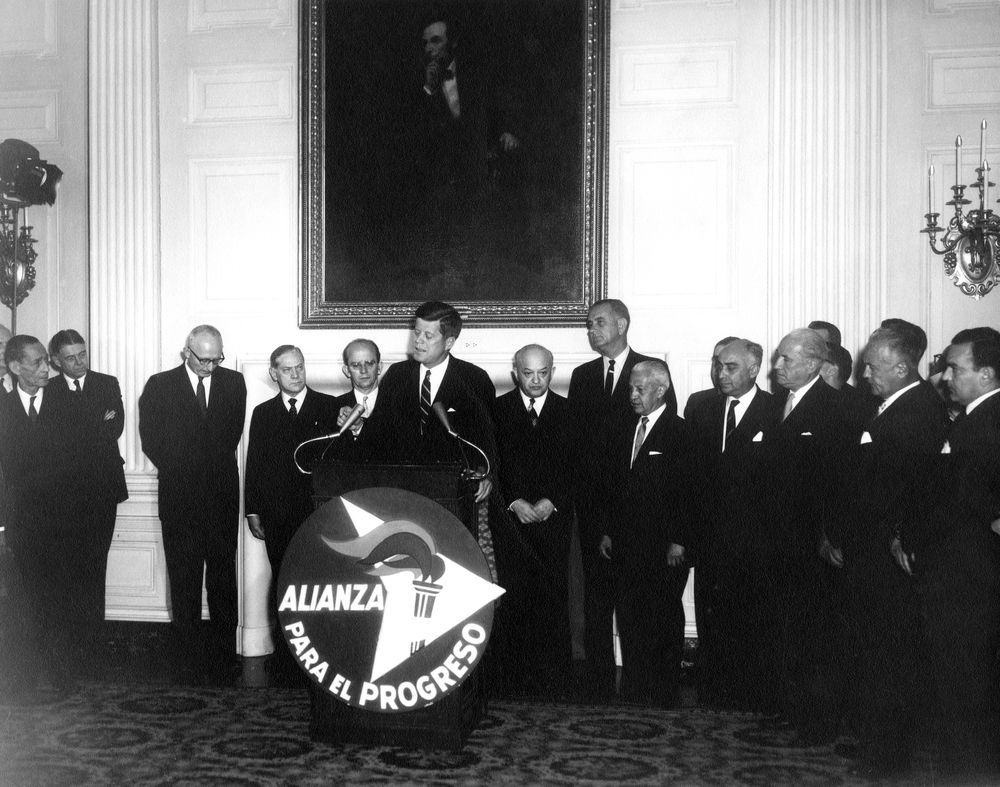
    In March of 1961, President Kennedy gave a moving address at a White House reception for members of Congress and the Diplomatic Corps of Latin America in which he detailed his bold vision for a progressive South and Central American future:

    We propose to complete the revolution of the Americas, to build a hemisphere where all men can hope for a suitable standard of living and all can live out their lives in dignity and in freedom. To achieve this goal political freedom must accompany material progress … Let us once again transform the American Continent into a vast crucible of revolutionary ideas and efforts, a tribute to the power of the creative energies of free men and women, an example to all the world that liberty and progress walk hand in hand. Let us once again awaken our American revolution until it guides the struggles of people everywhere­ –– not with an imperialism of force or fear but the rule of courage and freedom and hope for the future of man.

    To many, the Alliance for Progress—as the ten-year, $20 billion dollar foreign aid program for Latin America was known—was a necessary, if somewhat controversial move on the United States’ part to quell social upheavals in developing nations. Some felt that the inherent instability of post-colonial Latin America would inevitably lead to the continent’s adoption of communism, that omnipresent Cold War specter largely deployed as a bogey-man for the continuance of U.S. imperialism and intervention, whose very real atrocities in Europe were, by default, exported to the wider world to justify almost every post-war intervention by the United States military-industrial apparatus. While the Soviet Union was far from the ideal society outlined by its founding members after the Russian Revolution of 1917—not to mention the absolutely shocking treatment of its citizens during and after World War II—its international ambitions were far from inevitable. And certainly not always as sinister as U.S. foreign-policy planners insisted, particularly in the Khrushchev era, into which President Kennedy stepped after winning the 1960 election.

    A few key ideological underpinnings of those American policy makers in power during the 1950s and early 1960s must be mentioned. These include, but are not limited to, a myopic paternalism towards non-white governments in the developing world; an irrational, reactive fear of anything resembling socialism or neutralism; and a steadfast belief in allying with the greater of two evils, namely a pro-U.S. dictator over an independent, “potentially communist” official interested in his own country’s well-being. It was in this context that the spymasters at the Central Intelligence Agency, and their friends on the board of United Fruit Company, cooked up Operation PBSUCCESS, the half-baked 1954 overthrow of the democratically elected leader of Guatemala, Jacobo Árbenz. This plot, hatched from Washington by the likes of Allen Dulles and Walter Bedell Smith, to name but two, was intended to redeem the exploitative profits of the United Fruit Company’s banana farms—which Árbenz asked to be fairly taxed and repurposed for general occupancy by the poor—and to destroy any possibility of his land and tax reforms from going “communist.”

    Árbenz himself had no ties to Moscow, was only trying to reverse the decades of dictatorial excess plaguing his nation from its previous rulers, and noted that there wasn’t even a Russian embassy in Guatemala. In the climate of mid-century McCarthyism, it wasn’t a hard sell to discredit Arbenz’ regime.

    In the congressional debate from June of 1954, just weeks before the coming overthrow, both Lyndon Johnson and his fellow Texan, representative Jack Brooks, were staunchly pushing for intervention on Capitol Hill. Eerily echoing rhetoric used to justify the later U.S. support of the Nicaraguan Contras, Congressman Brooks argued, “A communist-dominated government in Guatemala is only 700 miles from Texas—only 960 miles, or a few hours’ bomber time, from the refiners, the chemical plants, and the homes of my own Second District in Texas.” (Congressional Record, Senate, 25 June 1954, pp. 8922-8926) In 1986, Ronald Reagan emphatically reminded those in attendance in his Cabinet Room that if the counter-revolutionaries he was funding through his illegal arms deal with Iran failed, it would create “a privileged sanctuary for terrorists and subversives just two days’ driving time from Harlingen, Texas” (Ronald Reagan, “Remarks at a White House Meeting for Supporters of United States Assistance for the Nicaraguan Democratic Resistance”).

    One of the only opposing voices to the Brooks tirade, Senator William Langer of North Dakota, was largely ignored, and did not even receive comments after his views were expressed. He noted:

    I do not believe that the Members of the Senate have been adequately informed as yet as to what is going on in Guatemala. We have had inadequate time to consider such a major declaration on foreign policy. Is there a foreign invasion of Guatemala, or is there a civil war? …. Of course we are opposed to external interference with the affairs of any nation, especially so with regard to our sister republics of Latin America. But even more, we will, or we ought to be, committed to the principle that every sovereign nation has a right to determine for itself its own form of government. (Congressional Record, Senate, 28 June 1954, pp. 9065-9066.)

    In the end, none of this mattered. And the story, which has been covered in exhaustive and painful detail by the likes of Nick Cullather in Secret History and William Blum in Killing Hope, is well known. Both psychological and direct warfare were employed to achieve their dramatic effect: Miami-based anti-Árbenz radio broadcasts, leaflets dropped by B-26 bombers, and vicious strafings of the harbor’s oil reserve tanks and the city’s capital buildings combined to spread chaos and terror. Renegade pilot Jerry DeLarm and a former Flying Tiger named Whiting Willauer, whose P-47s buzzed Guatemala City, bristling with eight .50 caliber machine guns, searched the city for anything that moved, scattering citizens and forcing Árbenz to steal away to his headquarters with his security detail. The implied threat of a full-blown United States Marine Corps landing eventually forced Árbenz to concede. Days later, fearing for his life in his presidential suite, he appeared on a nightly radio broadcast and announced his reluctant resignation: “Workers, peasants, patriots! Guatemala is going through a hard trial. A cruel war against Guatemala has been unleashed. The United Fruit Company and U.S. monopolies, together with U.S. ruling circles are responsible. Mercenaries have unleashed fire and death, respecting nothing.” (FOIA Guatemala 0000920952 U 3 May 1, 1954)

    Following this, he fled the capital with his remaining loyal staff members and sought refuge in a nearby Mexican embassy. Team members of the coup went so far as to plant Marxist literature in his personal bookshelf. And they left behind a crate of Soviet weapons and ammunition, which was quietly discredited by the international media because of their sloppy work, though Time Magazine predictably parroted the CIA’s disinformation. It has also come to light that on June 3, 1954, just weeks before the coup, Allen Dulles privately ordered Arthur Hays Sulzberger, the publisher of the New York Times, to keep his foreign journalists out of Guatemala. After attempting to convince him that one of his best reporters, Sydney Gruson, was a communist who could not be trusted to provide an accurate picture of the unfolding political situation, Dulles demanded he be prevented from flying to Guatemala City to cover the events. Eventually, Sulzberger conceded: ‘‘I telephoned Allen Dulles and told him that we would comply with their suggestion.” (NY Times, 6/7/1997) It should be noted that Gruson eventually became an executive of the Times, and later a director and vice chairman. He retired from the paper in 1987 and went into investment banking. This was Allen Dulles’ idea of a communist. (NY Times, 3/9/1998)


    II

    In the wake of Árbenz’ removal, and the subsequent removal of Colonel Díaz, who was Árbenz’s final supporter and was in power all of one day, the brutal and corrupt former chief of Guatemalan police, Carlos Castillo Armas arrived. He had been leading a 150-man CIA-funded and trained band of guerillas through the jungles of Honduras on this way to the capital during the air raids. After a brief discussion with Col. Monzon—who had become the third leader of Guatemala in as many days—Armas came to power. He immediately ordered the arrests of all former high-ranking Árbenz supporters. That list of supporters came from John Peurifoy, the U.S. Ambassador the CIA had placed on site before the coup. Over the next few months, he then sent death squads roaming into the countryside, killing thousands of landless peasants and blaming the murders on Árbenz, going so far as to immediately publish a picture book of the mass graves called Genocidio sobre Guatemala, a disturbing Alice in Wonderland revision of history I don’t recommend reading. Within the first few months, over 72,000 people were arrested and detained without trial for alleged ties to communism.

    In the United States, Castillo-Armas was invited by President Eisenhower to a gold-star dinner reception and given a ceremonial party of the highest order. Their man in Guatemala had been installed, and another threat to world stability had been removed. Days after the coup, U.S. Secretary of State John Foster Dulles established the official lie in a United States television and radio broadcast, “Led by Colonel Castillo-Armas, patriots arose in Guatemala to challenge the communist leadership—and to change it. Thus the situation is being cured by the Guatemalans themselves.” (Jonathan Fried, Guatemala in Rebellion:Unfinished History, Grove Press, 1983, pp.77-79). The truth was that, had it not been for United Fruit and the CIA, Árbenz would not have been overthrown. Castillo-Armas was simply an appendage manufactured by Washington.

    Árbenz’s daughter committed suicide years later, citing the coup and their uncertain wanderings in exile as her source of depression. Her father died in 1971, an alcoholic by then, in a strange bathtub accident in Mexico City; aides forced their way into his hotel bathroom when they noted steam coming from under the door sill. He was found face down in scalding water. Towards the end of his life he actually did join the Communist Party, since he believed the Soviet Union was the only bulwark against Western imperialism, a trajectory later taken by Fidel Castro after the Cuban revolution, and after multiple attempts had been made on his life by the CIA and its Cuban exile mercenaries, and the implications of the Operation Mongoose terror campaign sank in.

    It was nearly forty years later that the death squads, random political kidnappings, and utter chaos of the overthrow and its aftermath finally abated. Nearly 200,000 Guatemalans were killed in the wake of PBSUCCESS. The nation has never fully recovered from the coup. It not only served to harden the hearts of those with any inkling that the United States was their friend, but fundamentally radicalized figures like Ernesto “Che” Guevara, who himself was in Guatemala City during the coup, and who witnessed the betrayal by the purported beacon of democracy in the free world.

    In a way, PBSUCCESS, along with the overthrow of Mohammad Mosaddegh in Iran only a year earlier, was the template that would be repeated throughout the Cold War: plausible deniability, the co-opting of corrupt insiders seeking power or revenge, crates of weapons and cash, and voilà: peace. Only the total opposite resulted, as both Shah Reza Pahlavi in Iran (1953) and Carlos Castillo Armas in Guatemala (1954) displayed unusual violence once they came to power, essentially condemning their populations to lives of abject misery and despair during their reigns, forever terrified of being tortured and imprisoned by the nations’ respective secret police forces and their embedded CIA handlers and trainers. This was largely lost on policy planners, removed as they were from the scenes of their crimes. Life went on in Georgetown and at CIA headquarters. Figures like E. Howard Hunt and Allen Dulles went on puffing their wooden pipes in their plush, book-lined studies, carefully reading foreign cables and memoranda, dutifully planning the next overthrow, the next dictator to be installed, the next assassination. As E. Howard Hunt’s son observed in a 2007 interview, when he asked his father about the deaths of all those Guatemalans following PBSUCCESS, he said, surprised, “Deaths? What deaths?” (Rolling Stone, 4/5/2007)


    III

    It is in this context that President Kennedy’s struggle to reconcile with the intelligence agencies was born. When he took the oath of office, he had unknowingly filled an essentially compromised position of statesmanship, whose real power lay not in the democratic or executive processes, but in shadowy, essentially rogue organizations like the Central Intelligence Agency, and to a lesser extent, Hoover’s FBI, who at the time were more concerned with subverting peaceful demonstrations domestically and wiretapping elected officials for personal exploitation than with solving major crimes. Indeed, Hoover was in something of a double bind himself, as James Angleton, the CIA’s Chief of Counter-Intelligence, allegedly possessed an incriminating photo of Hoover having sex with his Deputy Director Clyde Tolson, a telling accusation given Hoover’s unusually bitter hatred of homosexuals. (Lisa Pease, Probe, Vol. 7 No. 5., 2000)

    Philip K. Dick’s The Man in The High Castle is a counterfactual scenario in which the Axis forces won World War II. There it is detailed how a triumphant Nazi Germany secretly plotted to undermine their ostensible Japanese ally while fulfilling their commitment to the Final Solution. While this thankfully never took place, what is remarkable about the postwar period is the amount of actual influence these Nazi forces continued to have on Western policy in the wake of their military defeat, and how, in many ways their members shaped the creation of the CIA. Consider for a moment the fact that the OSS, and later the CIA, almost entirely relied on former Nazis to provide intelligence on all Soviet activity in Europe immediately after the war. That Germany had pledged a war of racial extermination against the Russian people only a few years earlier apparently didn’t factor into American officials’ interpretation of their Nazi agents’ reports on Soviet activity and its relative threat to the West. Reinhard Gehlen, a former SS Major General who ran this “Gehlen Organization” which later became West Germany’s Bundesnachrichtendienst (Federal Intelligence Service), was personal friends with Allen Dulles, who exchanged letters with him years after he was acquitted of war crimes and put on the U.S. payroll to establish his spy network. One letter, from April 1957 begins, “May I extend to you my heartiest and most sincere wishes for your birthday and wish you health and continuing success for your responsible task during the next years of your life. I would like to take this opportunity to enclose my kindest thanks for your cordial hospitality my co-workers and I enjoyed during our stay over there.”

    This should come as little surprise, given Allen Dulles’ own dealings with the Nazis during the war in which his own country was trying bitterly to defeat Hitler, at great loss of life and materiel. Sullivan and Cromwell, the law firm of which John Foster Dulles was managing partner, was instrumental in keeping I. G. Farben, Krupp, and other Nazi industries in business during the ostensible embargo and trading freeze imposed by the United States during World War II. Mirroring their dual powers as Secretary of State and Director of Central Intelligence in the 1950s, John and Allen respectively tested their powers when Allen was OSS station chief of Berne, Switzerland in 1942, and Foster was running his law firm in New York. As David Talbot noted in a recent interview:

    In one case a German industrialist had seen Auschwitz being built and had heard what they were going to be using it for. He slipped across the border with this eyewitness account and Dulles basically did nothing with this to make this an urgent priority of the Roosevelt administration. He was not concerned about the Jews’ fate. He was more concerned about his clients, his German clients: making sure their assets would be carefully hidden and that Germany would emerge from the war defeated but a strong bulwark against the Soviet Union, whom he always regarded as the true enemy. (Reader Supported News, 10/20/2015)

    This historical backdrop is crucial to understanding the future conflation, in the 1950s and 60s, of communism with nationalistic independence movements in the developing world. For it was people like the Dulles brothers and their colleagues who would convince President Truman to create the CIA, under much pressure, and through the presentation of the Red menace as gleaned from the not-entirely-objective Gehlen Group and their Nazi members who were enjoying U.S. salaries and protection. Indeed, not only was Gehlen protected, but also Wernher von Braun, who handpicked Jewish slaves for use at his Peenemünde Mittelwerk rocket facility during the war; von Braun subsequently became the leading scientist for the U.S. space program, going so far as to design the boosters that put the first American astronauts on the moon. Similarly, while seemingly random Nazis were tried and executed at Nuremberg, those with truly useful knowledge in the eyes of U.S. foreign policy officials were conveniently released on strange case-by-case dismissals. Otto Skorzeny, who rescued Mussolini from the Gran Sasso hotel with his elite glider-borne troops, was never convicted of war-crimes, despite being Hitler’s personal bodyguard and despite his equipping SS commandos with captured U.S. uniforms and weapons to sow discord during the Battle of the Bulge. Incredibly, it was three SS soldiers masquerading as U.S. military police officers that broke him out of Darmstadt prison while he awaited his verdict. Maintaining it was always the United States that aided his escape, he quickly found new work after the war from the highest bidders. These included the fascist government of Peron’s Argentina, Franco’s Spain, Israel, and even the United States, which denies ever dealing with him, but whom Skorzeny, in a brief interview, claims hired him to remove Castro. This is actually supported by the CIA’s own records. In a memo from August of 1966, they noted,

    Otto Skorzeny, the former SS Colonel who rescued Mussolini, planned to kidnap Fidel Castro and take him to an undisclosed place, according to a feature article in the Sunday supplement to La Cronica published in Lima, Peru on August 7, 1966. The article says that the plan, known as “Project Tropical,” having the approval of Allen Dulles, head of CIA, was to have been carried out in 1961 but was vetoed by President Kennedy. (FOIA3B3: “Otto Skorzeny Planned to Kidnap Fidel Castro.”)

    In many ways, to figures in the American intelligence agencies, President Kennedy represented a radical departure from previous administrations. For instance, he favored figures like Indonesia’s Sukarno, and Patrice Lumumba in the Congo, both nationalists seeking financial and political independence from Western colonial and industrial policies. Therefore, in the eyes of those who championed the Dulles brothers, he was a traitor. That the CIA tried to overthrow Sukarno and actively participated in the successful assassination of Lumumba did not escape his attention, and from almost the first few months of his term, Kennedy came to discover the truly sinister machinations of an agency which ostensibly existed to gather intelligence against foreign threats, but which in reality had become a well-oiled coup d’état and assassination machine. Hoping that he would carry the torch from the Eisenhower administration’s support of overthrows against developing nations, policy planners in the CIA and other agencies were sorely disappointed by his rhetoric and actions in the face of defiant, outspoken liberation leaders, who they were quick to subsume under the communist umbrella which they saw unfolding across the world in their Manichean ideology of the post-McCarthy era. Kennedy stated in his March 1961 address outlining the Alliance for Progress words which, in the eyes of planners like Dulles, seemed reminiscent of the Kremlin: “We call for social change by free men, change in the spirit of Washington and Jefferson, of Bolivar and San Martin—not change which seeks to impose on men tyrannies which we cast out a century and a half ago. Our motto is what it has always been—progress yes, tyranny no—progreso sí, tiranía no!”


    IV

    As a number of authors—like Richard Mahoney—have shown, unlike Eisenhower, Kennedy understood the evils that colonialism and imperialism had wrought in the Third World. He also understood that the regimes that had been set up in the second Age of Colonialism were beginning to break apart during the fifties. A good example of this was his landmark 1957 speech in the Senate assailing France’s colonial war to maintain its regime in Algeria. In that speech Kennedy specifically targeted American aid to France to fight its imperial war against the Algerian natives. Because of that famous speech, he subsequently became the man to see in Washington for visiting African dignitaries.

    In early 1961, Kennedy had sent Arthur Schlesinger on a tour of Latin America. (Schlesinger, A Thousand Days, pp. 175-185) Schlesinger had a strong interest in the area since he had studied Franklin Roosevelt’s Good Neighbor Policy. He admired the aim but felt it was limited as it emphasized the diplomatic and legal dimensions of American aid. Its only economic aspect was the Export-Import Bank. Later on, the International Monetary Fund (IMF) also entered the picture. But as Schlesinger quickly grasped, the terms placed on loans from the IMF demanded too many restrictive measures, like deflation, which resulted in higher unemployment and reduced per capita income.

    The solution, as far as the Eisenhower/Nixon administration was concerned, was to supply mostly military aid—and then let private companies invest in these Latin American countries in hopes of creating economic development through foreign investment. The problem with this was that the IMF and Export-Import Bank would usually make loans only to nations that had what they considered stable governments. As Schlesinger pointed out, this usually meant right-wing governments. It was this kind of thinking that sent Vice President Nixon to Havana to praise the “competence and stability” of the completely corrupt Batista regime. (Schlesinger, p. 174) These debilitating IMF programs, as well as other private American loans, were well described in John Perkins’ 2004 book Confessions of an Economic Hit Man. There, Perkins observed that far too high a ratio of the loan packages ended up aiding the plutocracy that was already in power.

    As Schlesinger acutely observed, this paradigm ignored how the United States had actually developed as a business and commercial power. Congress had made very large investments in transportation and infrastructure, e.g., canals, highways, and railroads. Congress had also granted large amounts of property to states to create land grant colleges, many of which specialized in agricultural education. The federal government also encouraged the settling of the frontier through what were essentially land giveaways in states like Oklahoma. Therefore, historian Schlesinger concluded, the Eisenhower/Nixon model contradicted the American model. At the same time, the model was inadequate to the needs of these many developing countries. Or as one Latin American leader told Schlesinger, “The United States has given me just enough rope to hang myself.” (Schlesinger, p. 182) It therefore encouraged the image of America as an imperial power from the north. And it also gave an appeal to communists like Fidel Castro. As another leader told Kennedy’s representative:

    There is much poverty in my country. The communists have made themselves the advocates of the just demands of the workers and peasants. That makes it hard for us to oppose them without seeming to oppose what we regard as a just social program. (p. 183)

    Thus it was not just an ethical, and humanitarian dilemma, but also a practical one in terms of the Cold War. America had to be able to compete with the communists on the basic sustenance level in Latin America. If not, then we would encourage violent unrest leading to guerilla warfare. What made the New Frontier’s approach even more attractive was that when Schlesinger talked to most of the leaders in Latin America, they preferred aid from Kennedy more than they did Castro. In other words, the Eisenhower/Nixon approach squandered a welcome opportunity. (p. 185)

    Schlesinger returned in February and briefed the president. On March 13, 1961, the Alliance for Progress was formally announced in the East Room of the White House. Kennedy summoned all Latin American ambassadors to the proceedings, and had them broadcast in Spanish, Portugese, French and English through Voice of America. The president then sent a request to Congress for funding. The basic idea was that aid money would now come from the Treasury Department, bypassing the punitive restrictions of the IMF, Export-Import Bank and private loans. Kennedy declared that he wanted the Alliance to transform the Western Hemisphere “into a vast crucible of revolutionary ideas and efforts.” (Theodore Sorenson, Kennedy, p. 601)

    Five months later, Kennedy arranged for a meeting in Punta Del Este, Uruguay. The president sent Schlesinger, Latin American specialist Richard Goodwin, Adolf Berle (a veteran of the Good Neighbor Policy), United Nations representative Adlai Stevenson, Treasury Secretary Douglas Dillon and many foreign aid officers. (Although Dillon was a Republican, he understood Kennedy’s strategy to counter Castro’s appeal.) The Punta del Este concept was similar to a giant business seminar at which Americans were supposed to brainstorm with Latin Americans to write up programs and proposals to advance economic development. Nothing like it had ever occurred before in South America. After the meeting, Kennedy was startled by the scope of the problems he was facing. He had originally conceived a ten-year plan. But now he was skeptical that the problems could be solved in a decade, even with his planned 20 billion dollar investment from the American treasury. (Sorenson, p. 602)

    As Ted Sorenson noted, one of the obstructions Kennedy ran into was the resistance of the landed aristocracy that was already in power. They were quite influential in all facets of the status quo, e.g., the newspapers and the military. They did not want to alter that status quo with land grants, tax reform, or increased wages. And Kennedy did not envision the Alliance as just a funding program. He also wanted it to be a reform program, one that would extend not just economic benefits but political rights. (p. 602) As he expressed with one of his most famous adages, “Those who make peaceful revolution impossible will make violent revolution inevitable.” (p. 602)

    But in spite of all the obstacles, Kennedy’s Alliance for Progress managed to build housing projects, schools, create individually owned farms, and provide food rations for the hungry. And he got many letters from former street urchins who now, for the first time, had a new home to live in. (p. 604)

    Beyond these goals, Kennedy was planning on putting structures in place that would guarantee long range and self-sustaining reform. He was also constructing central planning agencies, technical assistance programs, progressive tax structures, and encouraging the submission of detailed development plans to the Organization of American States. And he did experience some success. In its first year, aid to Latin America tripled. In two years, ten of the nineteen member nations hit their targeted growth rates. (p. 604) One of which was a 2.5% increase in per capita income.

    Like many programs Kennedy had launched, once he was killed in Dallas, the CIA and President Johnson at first neutralized it, and then as Johnson gave way to President Nixon, it was reversed. As every commentator on the Alliance for Progress has pointed out, when Johnson took office, this marked the ascendancy of Thomas Mann in Latin American affairs. Mann, the ambassador to Mexico under Kennedy, like others in the State Department, had been busy in the wake of his assassination trying to put together Oswald as part of a Cuban conspiracy. Mann and Johnson had long been friends. And, like Johnson, Mann was a conservative in his foreign policy views. Johnson quickly made Mann his de facto chief officer in Latin America. Within 18 months, the new president gave Mann three titles in the area, including the directorship of the Alliance. This was significant for one simple reason. Mann had opposed such an aid program for the area as far back as 1959. (Walter LaFeber, Inevitable Revolutions, p. 156) In other words, while Johnson kept up the Kennedy rhetoric about the Alliance for Progress, Mann was the perfect figure in the bureaucracy to start to extinguish the program. As LBJ speechwriter Harry McPherson once said about Kennedy’s eloquent opening address back in March of 1961 in the East Room, it was a “lot of crap”. (p. 156)

    Mann did two things to start to stamp out the program. First, the overall allotment was greatly reduced for fiscal years 1967-69. Second, what was left was mainly directed to military, not economic, aid. The excuse for this was the increasing massive expenditures going to Indochina. (p. 156) These future planned reductions were accompanied by a speech Mann made in March of 1964, less than four months after Kennedy’s assassination. This address was given to Mann’s Latin American employees in what was supposed to be an off-the-record conference. In the speech, he made no reference at all to the Alliance for Progress. Nor did he address any need for structural changes. What he did point out was the need to spur economic growth while maintaining the status quo. He went as far as to say “this meant quickly recognizing military regimes that overthrew civilian governments” (p. 157) Thus, in short order, two of Kennedy’s aims for the Alliance were stopped cold: encouraging wider democratic participation, and expanding economic opportunity.

    The further erosion of the Alliance was continued the next year in the Dominican Republic. President Kennedy was opposed to the military coup that had expelled the elected president Juan Bosch. Bosch had been elected in December of 1962 in what many declared the first free election in that country’s history. He immediately announced both economic and political reforms in keeping with the Alliance for Progress aims. But he was overthrown in a military coup in September of 1963. As Donald Gibson has described in his book Battling Wall Street, Kennedy took the lead in beginning a hemisphere-wide condemnation and economic boycott of the new regime in order to help Bosch regain power. At the time of his assassination, Kennedy’s actions were picking up steam. (Gibson, pp. 78-79)

    Bosch went into exile in Puerto Rico. While there he arranged for his backers to slowly gain strength in hopes of returning to power. This very likely was about to happen in 1965. But unlike Kennedy, Johnson and Mann were opposed to Bosch. As with Allen Dulles’ view of Arbenz, they saw him as another Castro: a second communist dictatorship in the Caribbean. With the help of the CIA, including Bernardo De Torres, a chief suspect in the JFK assassination, they infiltrated Bosch’s forces, and created a huge propaganda campaign that attributed atrocities to his followers. (James DiEugenio, Destiny Betrayed, Second Edition, p. 228) This set the stage for the landing of about 30,000 Marines in April of 1965 in order to maintain control and prevent Bosch from taking power. In the name of a souped up and false charge of anti-communism (Bosch was not a communist), Johnson had violated the nonintervention pledge the USA had made when it joined the OAS in 1948. This was consistent with what he felt about that body since he once said it “… couldn’t pour piss out of a boot if the instructions were written on the heel.” (LaFeber, p. 158) Johnson’s invasion of the Dominican Republic told members of the OAS that the Alliance for Progress was all but buried.

    In 1969, President Nixon presided over the last rites. He sent Nelson Rockefeller on a tour similar to Schlesinger’s for Kennedy in 1961. Except Rockefeller came back with a quite different message. He wrote in his report that there was really little America could do in the area and he said that the USA should drastically cut back on its aid programs. (Jeffrey Taffet, Foreign Aid as Foreign Policy, pp. 181-88) This message was similar to Patrick Moynihan’s infamous memo to Nixon in January of 1970 about the plight of African Americans; his recommended solution was to begin a period of “benign neglect”.

    But as author John Bohrer points out in his book The Revolution of Robert Kennedy, it really had entered that phase four years earlier. When Senator Robert Kennedy was preparing for a journey to several countries in South America, he was briefed by the State Department. After listening to their instructions, he replied it looked to him as if what the Alliance for Progress had come down to was that you can “abolish political parties and close down the Congress and take away the basic freedoms of the people … and you’ll get a lot of our money. But if you mess around with an American oil company, we’ll cut you off without a penny. Is that it?” His briefer said that that was about the size of it. As he walked out RFK told an assistant, “It sounds like we’re working for United Fruit again.” (Bohrer, p. 231)

    President Kennedy’s ideas for a more peaceful world were almost universally reversed after his death, the Alliance for Progress being one that has been little noticed by anyone who is not a foreign policy aficionado. But not only did President Kennedy wish to join in a collaborative effort with the Soviet Union to reach the moon; he saw in the concept of mutually assured nuclear destruction a horrifying and unnecessary scenario, going so far as to ratify the Nuclear Test Ban Treaty in August of 1963 with Nikita Khrushchev, which essentially took the first major step to wind down the specter of atomic holocaust. Similarly, Kennedy had asked Schlesinger to draw up a written plan to greatly decrease the covert action wing of the CIA, and even restructure it to allow transparency and Congressional oversight. (David Talbot, The Devil’s Chessboard, p. 439)

    The legacy of this brief moment in American history has largely been relegated to the cult of Kennedy’s personality: his playboy image, his charisma, and his superficial sheen. And yet, at least to my knowledge, no president had come so close as to actually delivering on the promises of the United States’ purported mission of fostering peace across the world. There is substantial evidence for his withdrawal plan from Vietnam, which, if he had lived, could have prevented one of the greatest humanitarian crises in 20th-Century history, not to mention preserved the reputation of the world’s leading superpower. In addition, with his assassination came a full retrenchment of the intelligence-industrial complex, whose actions and efforts basically ran unchecked until the cursory reviews of Congress in the mid-to-late 1970s in the wake of Watergate. And with Martin Luther King’s and Robert Kennedy’s assassinations only months apart in 1968, it is safe to say that all of the major players for human progress and actual co-operation among nations and among those at home had been removed. Symbolically, the Sixties ended that hot night in June of 1968 at the Ambassador Hotel, a tragic evening which served as a somber bookend to the brief window of hope that had opened in the election of 1960 for a generation genuinely seeking change.

  • The Vietnam War and the Destruction of JFK’s Foreign Policy (Part 2)


    Part 1


    Part 2: 1963-1975


    What happens next, of course, is that Johnson essentially passes NSAM 273 which had been drafted for JFK at his Honolulu conference at which Kennedy said, “When these guys get back, we’re going to have a long discussion about how the heck we ever got into Vietnam.” LBJ rewrites this and he orders three important revisions in the rough draft that McGeorge Bundy had written. One of them was that they would be able to use American naval equipment to raid the north coast of Vietnam and the other two were to make it easier to do special forces cross-border operations into Cambodia and Laos.

    In other words, what you were going to have now was the beginning of the Gulf of Tonkin incident because South Vietnam didn’t have any navy. South Vietnam itself couldn’t do those raids coupled with the destroyer communications missions, what they called the DESOTO patrols, which is going to result in the Gulf of Tonkin incident.

    Second of all, this now spreads the war across the borders into Laos and Cambodia which Kennedy really didn’t want to do. He wanted to keep [Cambodian Prince] Sihanouk in Cambodia and he wanted to try and keep Laos neutral.

    If you can believe it, and by now you can, Burns and Novick don’t mention NSAM 273 and how it altered Kennedy’s policies. After the election, when Johnson then is elected president in a landslide in which he campaigned essentially on the idea that we’re not going to send American boys to fight a war that Asian boys should, he uses this incident in the Tonkin Gulf as a war declaration.

    I’m going to go with that just briefly because I think everybody listening to this understands what the Tonkin Gulf incident was. These patrols that I mentioned, these raids by the South Vietnamese army aboard these American sponsored patrol ships, they were coupled with American destroyers decked out with high-tech communications equipment to find radar spots and communication spots along the North Coast of Vietnam off the Tonkin Gulf. They were clearly … even George Ball who worked for Johnson in the State Department, and even McGeorge Bundy, later said that they were designed as provocations.

    When the North Vietnamese went ahead and counter attacked the raids, they actually put one machine gun bullet into one of the destroyer’s hulls then, of course, there was a so-called second attack, which never really happened. That was enough pretext for Johnson to use as a way to attack the North which is, by the way, what he wanted to do since March of 1964 when he signed NSAM 288, which more or less reversed NSAM 263 and which mapped out certain targets that we would use. He sends these airplane jet sorties over North Vietnam, bombing petroleum refineries and also navy shipyards. I think it was something like at least 65 sorties. Two guys were shot down, one was killed, one was taken prisoner. That signaled to Hanoi that Johnson planned to go to war in Vietnam.

    Giap actually admitted towards the end of his life, through his son, that he understood Kennedy was withdrawing at the end of 1963. (https://kennedysandking.com/john-f-kennedy-articles/general-giap-knew) This new signal told the North to start planning for a war because Johnson’s attitude was completely different.

    And that, of course, is what happened. Once Johnson won the landslide election, then very shortly after that he began to militarize this, by the way, I should say over Bobby Kennedy’s protests.

    There’s a really nice book out by a guy named John Bohrer called The Revolution of Robert Kennedy, where for the first time that I know of, it’s revealed that Bobby Kennedy did not agree with what Johnson was doing, and he did not agree as early as 1964. Everybody says it’s 1967, but that was only when Bobby Kennedy, this is in public; privately, he was trying to discourage Johnson from militarizing the war. That’s what Johnson’s intent was.

    In early 1965, he begins to send all kinds of bombing planes into South Vietnam. I think about 90 some bombers come over from Thailand. Of course, if you’re going to put all these bomber planes in there, the Viet Cong are going to raid them – which they did. That was the excuse for sending in the first American combat troops.

    I think there was something like 5,000 who went ashore at Da Nang in March of 1965 and then that increased amazingly by the end of the year if you can believe it, by the end of 1965 there’s 175,000 combat troops in the country. Amazing escalation.

    Operation Rolling Thunder which was, like I said, the biggest bombing campaign the world had ever seen. You got to wonder what the hell is there to bomb? The reason you bombed Germany or Japan was because there was an industrial base that supplied the war machines of both countries; but how the heck can you bomb rice fields and palm trees? There really wasn’t a heck of a lot of industrial base in North Vietnam to bomb, or in South Vietnam. Of course you ended up killing a heck of a lot of civilians.

    By the way, I should add that when I did some research on this, the numbers I found go way beyond what the Defense Department admitted. I found a study that was made by a British medical group that actually went to Vietnam today and they went ahead and they interviewed, they went door to door, which is what you’re supposed to do with epidemiological work on this. You want to actually try and talk to people in the field. When they asked them, “How many members of your family did you lose when it was all over?” meaning to anything, not just bombing but also stepping on mines and things like that, they came to the rather astonishing figure – these revised figures – that between both the military casualties and the civilian casualties that the number is 4 million, which is amazing in a country of 35 million people. Which means that about one-tenth of the population was killed during this crazy, senseless, nutty war.

    Let me add that this is one of the reasons Kennedy did not want to send combat troops in because he said, “How do you fight an enemy that is both everywhere and nowhere and at the same time has the support of the people? How do you send American combat troops in to fight that kind of a war?”

    Johnson and Westmoreland, who was the guy who … Westmoreland was the general that Johnson chose to be the commanding officer in Vietnam; they didn’t seem to understand that. They never came to a kind of tactical and strategic decision about how to fight the war except to try and overpower the enemy with this terrific artillery fire and air power, and it didn’t work.

    All it did was essentially kill a lot of civilians, not win over the population for us, in fact it did the opposite; and it bombed to smithereens the beautiful ecology of that country. This went on: ’65, ’66, and ’67. By this time, the United States had something like 525,000 combat troops in country. By the way, when I say that figure, once Johnson made his decision to escalate, he asked the Joint Chiefs of Staff: he said “Tell me how many men it’s going to take and how long to win this war?” And they actually told him they said 500,000 men, five to ten years to do it.

    Johnson finally hit the 500,000 number in 1967, 1968, around that time; 500,000 combat troops in the country and it still didn’t work. The horrible thing of course is that as it didn’t work, the American army begin to collapse, began to fall apart internally, because they knew there really wasn’t any plan to win the war.

    Colonel Robert Heinl wrote a wonderful article in which he described this, called Collapse of the Armed Forces in Indochina. (https://msuweb.montclair.edu/~furrg/Vietnam/heinl.html) He reported all the drug abuse, because in addition to not being able to win the war, the United States got involved through the CIA, Air America, in this Golden Triangle Opium Trade in which President Thieu knew about it and Vice-president Ky was a part of it. By the way, Burns and Novick don’t mention that involvement at all.

    What happened is that many of these soldiers either begin to smoke pot or do heroin and then it got to be a business. It began to be refined because you refine opium into heroin and then it began to be shipped to Marseille a great French seaport on the Mediterranean, and then some of it got into the United States. There had been reports that some of it came in in the body bags of dead American soldiers. I’m not positive that happened, but I’ve seen reports that it happened. There was a report that Hoover talked about it in one of his memos but I’ve never actually seen the memo. That’s how bad this thing got as the American army began to collapse. And then of course began what the military termed “fragging”.

    As the American soldiers begin to see that there was no way to win this war, they began to do two things. They began to take it out on the civilian population by slaughtering many unarmed civilians; and then also by taking it out on their commanding officers. If they got a mission message the night before that they knew was hopeless, instead of going through with the mission, they would just go ahead and toss a grenade in the commanding officer’s cabin.

    There were numerous … Heinl in his article said that … I think it’s from 1969 to 1971. There were well over 200 instances of that happening in Vietnam. You can’t run an army, I don’t have to tell anybody – even people who want to defend this war to this day and there’s still some people who do – that you can’t run an army like that. You can’t run an army, if you got that many people mutinying.

    The American army began to collapse, and then, of course, you have the Tet Offensive. The Tet Offensive took place at the beginning of 1968 and at the time when Johnson and Westmoreland were saying that there’s light at the end of the tunnel. Well, the massive size and scope of the Tet Offensive, in which the Viet Cong raided almost every major city in South Vietnam, in which they actually had Viet Cong inside the American Embassy in Saigon; and there was a famous picture, and Burns and Novick didn’t show this picture. There’s a famous picture of an American diplomat shooting a handgun at a Viet Cong rebel running through the courtyard. That picture got published in Life Magazine.

    Then the American people said “We can’t even defend our own American Embassy in Saigon?” Like I said, these raids took place all throughout South Vietnam, from the northern part to the southern part. That showed the American public that we weren’t winning the war, and Johnson refused to admit this.

    At a famous meeting after the Tet Offensive, he called in his advisors and he called in some elder statesmen like Bob Lovett and Dean Acheson. He brought in the Pentagon to try and explain how United States had not lost Tet; we actually won: because we killed so many more of the enemy than they killed of us. And Acheson walked out. When Johnson called him up later and said: Why did you walk out, Dean? Acheson said something like: I’m not going to listen to any of this crap anymore. I’m not going to listen to some commissioned officer coming over and giving me the message that Pentagon wants to deliver. I actually want to see the raw reports.

    That began to turn Johnson around. A couple of weeks later he sent a new Secretary of Defense, because McNamara had quit by now. One by one all the Kennedy people quit; Pierre Salinger, John McCone, McGeorge Bundy, George Ball, and then McNamara. One by one they all left. He appointed his own Secretary of Defense, Clark Clifford. He went over to the Pentagon and he talked about this on more than one occasion. He said words to the effect: When I started these interviews I was a hawk; after two weeks of asking these guys questions based on the documents they gave me, I realized that I had made a terrible mistake. Today, I have no problem saying that I could not have been more wrong about Vietnam.

    At the end of that two-week review, he went back to Johnson and he said, “There’s no way we’re going to win this war. My best advice to you is to get out of this thing.” That’s when Johnson went on TV, I think it was the end of March 1968, and he shocked the country and he said he was not going to run again, as he was going to devote the rest of his time to trying to get a peace treaty in Vietnam.

    OHH:

    ’68 is such an important year. Can you just give us a little chronology of the assassinations, the riots in Chicago, and these other things you were talking about?

    James DiEugenio:

    1968 is one of the most … I mean to call it pivotal doesn’t do it justice. It’s really epochal because you had so many key events happening in that one year that there’s no way around it: Individually they changed the shape of history. Put it together, they completely shifted history around.

    In the beginning of 1968, of course we had the Tet Offensive. That leads to Johnson going on the air and saying he’s not going to run again, which is a shock to everybody. Then a week later, you had the assassination of Martin Luther King in Memphis, just a week later. Then you had McCarthy and Bobby Kennedy both running for president and slowly but surely Bobby Kennedy takes a lead. It looks like he’s going to win the nomination because he won this great victory in California. Then that night, which I think is almost exactly one month after … no, no, excuse me, two months after King is assassinated, then Bobby Kennedy is assassinated.

    In many ways, in many ways, anybody who studies history should be able to tell you this: With the death of Bobby Kennedy you really, I don’t think we’re exaggerating this at all, you really had the death of the 60s. That was it. With him went all the hopes and dreams and the aspirations, whether well-founded or not, of that whole generation of people who really wanted to see the promises of the New Frontier, the promises of the civil rights movement, the promises of a new approach to foreign policy, the promises of a more equitable country. That was over with his death and that’s what made it so shocking.

    That led to the Chicago Convention. At that convention, you essentially had what was the RFK/King wing of the Democratic Party led by all those young people and people of color protesting against the Richard Daley/Lyndon Johnson wing of the Democratic Party. You had that split that was dramatized by the violence which I think most people who study that, that was really a planned attack by Daley who wanted to put down this uprising that he saw.

    It was really kind of a street battle which the networks really didn’t do a heck of a good job broadcasting. But there had been a lot of private pictures taken of what those cops were doing to those kids. It was really brutal. It leaked over to the convention where you had Abraham Ribicoff, a Kennedy guy, looking right at Daley and saying, “If George McGovern won this thing” – because McGovern was the guy they put up at the last minute in place of Bobby Kennedy to represent the Robert Kennedy wing of the party—“We wouldn’t have this Gestapo tactics in the streets of Chicago.”

    You can see Daley, you can read his lips when he says “F – – K. You”; and the Democratic Party splintered apart at that convention. Then of course, you had Nixon … and I’ve said this more than once, Nixon essentially hijacked Johnson’s peace plan. Because he began to perceive this as a way that Johnson was going to become the peace president and win the election for Hubert Humphrey, his vice president who, after Kennedy was killed, won the nomination in Chicago.

    He sabotaged it, quite literally, there’s no other way around this. The evidence today is overwhelming that he sabotaged the peace talks that Johnson was trying to sponsor by having an emissary, Madame Chennault, the wife of Claire Chennault, and Bui Diem who was President Thieu’s Ambassador in Washington. They told President Thieu not to cooperate with Johnson’s peace plan. If they held out, they would get a better deal from Nixon.

    What’s important to remember about that is you have to really understand how treacherous Nixon was. I don’t think that the Burns-Novick special got that close to it. At that time Nixon is having Chennault and Diem report to John Mitchell, who’s going to be his attorney general, and who was his campaign manager. Nixon knows about the meeting of Lovett and Acheson and Clark Clifford in Washington that took place in January and February. He tells people working on his speeches … literally he says, because he has heard about that meeting and he says: We know the war can’t be won, but we can’t let on to that. We have to make like it can be won to have more leverage in the campaign.

    Here’s a guy who knows that the Vietnam War was lost, who sabotages Johnson’s attempt to end it for purely political purposes, and then once he becomes president due to this … because, see, on the eve of the election, I think four or five days before the election, President Thieu made a 27-minute speech – and by the way, Burns and Novick don’t tell you this either – he made a 27-minute speech in Saigon that was carried by all three networks. Back in those days you had ABC, NBC, and CBS, and if you had those three, everybody in the country is watching it because that’s all there was except for PBS which had a very small audience.

    They all televised Thieu’s speech, in which he made it clear that he was not going to cooperate with Johnson’s plan because he perceived this as a sell-out to South Vietnam. Even people who worked for Nixon said that that speech won the election for him because Humphrey was coming on very strong in October and that speech put the stop to Humphrey’s rally.

    That’s what happened in 1968 and that’s how Nixon became president.

    It was an unbelievable, mind-boggling year and it all happened in the space of a matter of months. That’s what put Richard Nixon in the White House. It’s a bloody shame what happened as a result of that because Nixon and Kissinger passed a paper around the first weeks they were in the White House, it’s called NSSM1, which means National Security Study Memorandum. They wanted to know what people thought about in the foreign policy apparatus, what people thought about the Vietnam War.

    Johnson had replaced Westmoreland with Creighton Abrams at this time. Even Creighton Abrams, in his response, said words to the effect that: in my opinion you cannot win a military victory. All you have is a stalemate there.

    In other words, knowing that the best he could do was get a long stalemate and knowing the American people will never stand for that, Nixon begins to expand the air war into Laos and Cambodia. For political purposes, he then began to draw down the number of troops there.

    In other words, you were doing a balancing act. You were getting out American combat troops, trying to turn the war over to South Vietnam; and at the same time you’re increasing and expanding the focus of the air war. What that did, of course, is it destabilized Cambodia and Laos.

    I don’t have to tell about it, what happened in Cambodia, because once the air war began to rain down, it began to help the Chinese Marxist rebels led by Pol Pot. I shouldn’t say that because most people, if you try and classify who Pol Pot was, nobody really knows what the heck he was. He is seen to be like an agrarian revolutionary who wanted to empty whole cities out and bring them to the countryside in a crazy, restructuring of society.

    As the bombing campaign picked up, Pol Pot’s forces strengthened. When Sihanouk brought in his Prime Minister Lon Nol, a military guy, when he went on vacation, Lon Nol staged a coup. Of course, Lon Nol encouraged Nixon because he was keeping what they were doing, and the country got destabilized even more and the bombing went inland. What happened, of course, was this built up Pol Pot’s forces until he was able to lay siege to Lon Nol’s new government, a horrible, horrible situation that resulted.

    This went on, this expansion of the war, Nixon knowing that he really can’t win but trying to find a way to get the best agreement he can, and at the same time he’s polarizing and deceiving the public in America. He’s going to sell out President Thieu because once he realizes that he can’t win the war, he also knows he has to get out before the election or else people are going to ask him … rather, excuse me, he has to arrange to have the defeat come after the election or people are going to say, “You kept us here for four years for nothing.” He begins to create something called “the decent interval”.

    The decent interval is something that both Nixon and Kissinger lied about in both their books; in Nixon’s book, No More Vietnams and Kissinger’s book, The White House Years. They denied that this thing existed, but it did exist. In fact, Kissinger even wrote about it in his notebooks he took over to China and he talked about it with Zhou Enlai. And Zhou Enlai communicated it to North Vietnam.

    The decent interval was this concept: Saigon could fall but it had to fall after the American troops were gone, because then we could blame it on President Thieu and the South Vietnamese army, and it wouldn’t be blamed on us.

    That’s how treacherous these guys were. That’s how bad these guys were. The countless tons of bombs … by the way, Nixon dropped more bombs in Indochina than Johnson did, and it was by of wide margin, just so he could ensure that he’d win the 1972 election and humiliate … these guys hated what they perceived as a liberal media and leftist intellectuals, and so that’s what they were doing. That’s what they were doing. That’s what they did it for. That’s what it went on for.

    What happens, of course, is that there is the Easter Offensive in the spring of ’72 that undoubtedly would have taken the country over at that time. It was a massive tank attack from the north, but then Nixon and Kissinger called in the American Air Force from as far away as Thailand and that stopped the Easter Offensive.

    Then, when Nixon thought he had a peace agreement in the fall of 1972 and Kissinger brought the agreement back to President Thieu, and President Theiu went into a rage because he looked at it and it only mentioned three countries in Indochina; Cambodia, Laos, and Vietnam. In other words, Nixon and Kissinger were essentially saying: We know that it’s all over and we know that the country is going to be united again with the north and you’re not going to be a part of it. Thieu flew into a rage and Kissinger couldn’t handle him. He let him write out a list of demands and he brought the demands back to Le Duc Tho, who was the negotiator in Paris, with Kissinger.

    It was a list of 60 demands. Le Duc Tho says: Look, I can’t settle every one of these in one-on-one with you. I got to take them back to Hanoi and I have to discuss a few of them with the Politburo there. Kissinger didn’t want to admit that he wasn’t making any headway because Nixon had already relieved Kissinger of his duties with Thieu, and he appointed Alexander Haig to run that aspect. Kissinger said that the North Vietnamese were being deliberately belligerent, and so Nixon ordered the Christmas Bombing which went on for something like 13 days. The North was so outraged by this…

    There is a mythology on what people, like the military, that says somehow that it was the Christmas Bombing that brought Le Duc Tho back to the negotiating table. First of all, Le Duc Tho was going to return to the negotiating table anyway. What Nixon did that for was to try and show President Thieu that he would use American military power if there were any violations of the agreement. That’s what that was for. Then, Hanoi got so angry because they didn’t want to return to the negotiating table. Nixon had to ask them to come back. They didn’t want to come back. The Chinese had to convince them to go back. China basically said: Look, Nixon has lost something like 12 points in his approval ratings because of that bombing. He is in deep trouble over this Watergate thing, which is not going to go away. All you have to do is wait them out and you can take the whole country because they’re going to have to leave.

    Also, Congress has start cutting funding for the war.

    After the shootings at Kent State and Jackson State, the Gulf of Tonkin Resolution was repealed, and now the liberals in Congress and even some Republicans were so sick of this thing that they started to cut off the funding for the war. The Peace Movement accomplished that, which of course Burns and Novick don’t tell you that in their documentary; but they did achieve that. A very significant achievement.

    So Le Duc Tho went back to Paris and the agreements were signed in January of 1973. Nixon’s big thing was always peace with honor. Well, first of all, there was no peace and there was no honor. The fighting continued, each side trying to get an advantage. There was nothing honorable about it because polarizing the country and selling out your ally at the same time, there’s no honor in doing that.

    Then, of course, in 1975 Nixon is finally out of office due to the Watergate Scandal like the Chinese predicted. Kissinger is running the evacuation of South Vietnam, and everybody remembers the famous image of the American helicopter at the top of … some people say it’s the American Embassy but actually I think it’s a CIA station building. That helicopter there with all the Vietnamese trying to get on the helicopter. Some of them didn’t get on. The United States left. President Jerry Ford and Kissinger left about 500 people there.

    That’s the image that everybody remembers about America leaving Vietnam. That night, Kissinger got on the phone with an old friend of his from academic circles when he was at Harvard and said: Thank God it’s all over. We should have never been there. In other words, that’s what he really thought. That’s what Kennedy was saying – we should have never had American combat troops there, we should have never had this huge military mission there.

    It always amazed me that Nixon and Kissinger were looked up to as these foreign policy mavens. When, in fact, they were nothing but dyed-in-the-wool Cold Warriors, who manipulated the Cold War for political purposes.

    To show you how stupid Nixon and Kissinger were, in the ’80s when Gorbachev took over the Soviet Union, after he met with Reagan … Reagan really liked him. He thought this guy is a real reformer. Margaret Thatcher, the right-wing nut from England actually said we can work with Mr. Gorbachev. Reagan called in Nixon and he then called in Kissinger and he told them: I think I can really work with this guy. I don’t think he’s one of those old hard line communist apparatchiks. Nixon didn’t believe it. He told him, “Yes he is. That’s how he got the power.” And then he told, as he was leaving, he told Reagan’s assistants: “Whatever you do, don’t leave Reagan in the same room with Gorbachev alone.”

    Kissinger said the same thing, How can you be that wrong about two important things, like the Vietnam War and that great moment in history which Reagan partly bungled because of the advice from those two guys? It has always puzzled me how Nixon and Kissinger, how the mainstream media made them out to be these foreign policy gurus when in fact they were nothing except a dressed up John Foster Dulles.

    I’ll take Kennedy any day of the week.

    OHH:

    Right. Just from what happened in Vietnam, and just because you brought up Pol Pot. Eventually it was the Vietnamese themselves that had to go get rid of Pol Pot because of what he had done.

    James DiEugenio:

    Correct. See, that’s something that Burns and Novick don’t even touch on. The horrible genocide that took place in Cambodia because of the Nixon-Kissinger bombing campaign. When Pol Pot took over, God knows … I usually go by a million people but if you go ahead and find that … because there was this investigation I think a few years ago, this long series of trials and investigations that went on. They actually put the figure much higher than that. They actually put the figure at about two million that perished by Pol Pot in Cambodia.

    And you’re exactly right. It got so horrible in Cambodia that the North Vietnamese had to go in, and it was they that overturned the Pol Pot tyranny, not us.

    OHH:

    Right. When you think about what you just said with … you have Cambodia, two million people; you have Vietnam, four million people I don’t think you can take out from this whole thing the Indonesian massacres of 1965 because it’s obvious at the whole domino theory, so you’re talking about seven million people in the course of 20 years, whatever it was.

    James DiEugenio:

    No, that all happened. The vast amount of casualties in Vietnam all happened from about 1966 onward and you had the overthrow of Sukarno in ’65, right? In the period of about a decade, you had the … going by the latest figures, the latest figures that I could find, when you add in Vietnam, Cambodia, and Indonesia. What did you say, seven million?

    OHH:

    Just roughly from what you had said earlier…

    James DiEugenio:

    Yeah, that’s what I would say. I would say a rough estimate would be about seven million. That might be wrong, that might be too high, it might be too low but it’s around, from the latest figures I could find, the most accurate figures I could find, it’s about seven million.

    At the very least, it’s five and a half million. And all because of the reversals of Kennedy’s policies in both Indochina and Indonesia. Because Kennedy, as people who read my website and keep up on Greg Poulgrain’s work, the wonderful scholar on Indonesia from Australia, Kennedy was backing Sukarno all the way to the end. I’m talking 1963, and he planned on visiting Indonesia in 1964.

    Kennedy went as far as to arrange nationalization deals for Sukarno, because he thought Sukarno was getting screwed by these big petroleum companies. He actually got on the phone and relayed his message: I want a much more generous split to go to Indonesia. They wanted 90/10 in favor of the company. Kennedy insisted 60/40 in the favor of the Indonesian government.

    That was the whole difference because we know what happened in Indonesia after. Under Johnson, it just became a pig out in which tens of thousands of people, hundreds of thousands of people were slaughtered and Suharto gave the government over to the big corporations, most of them being Americans.

    OHH:

    Let’s end on this. I want to put Kennedy’s policies in perspective a little bit. Do you feel that there’s any resemblance between his idea of what America’s foreign policy should be and what FDR’s vision for the post-war world should have been?

    James DiEugenio:

    I think they’re pretty similar when I look at this. When I see what FDR’s foreign policy was and what he wanted to do with the Soviet Union and what he wanted to do in the third world. I think they’re pretty much similar.

    Roosevelt wanted to keep that grand alliance together after the war: that is between United States, England, and the Soviet Union. He felt he could control Stalin at least in the international field and so he wanted to keep that together after the war. He tried to understand the Soviet Union’s insecurity about Eastern Europe. Now in the third world, Roosevelt did not want any more of the colonialism, this brutal colonialism that actually went in and made the native people even worse off than they were before the colonial state took over. He actually said that to one of his advisors: We can’t tolerate a situation in which the native people are in worse conditions after the Europeans come in than they were before.

    Those two things I think are pretty similar to what Kennedy’s ideas were, certainly by 1963. In my opinion, what you had here is you had Kennedy trying to go ahead and turn back American foreign policy by rebelling against what the Dulles Brothers had done and restoring it back to Roosevelt. Then what you have when Johnson and then Nixon took over, you had essentially the overthrow of Kennedy’s reform policy and you went back to what the Dulles Brothers were.

    By the way, let me add one I’m pretty sure about, I’m right about this. At one time before the Burns-Novick series came on, I was going to do a very long two-part essay for kennedysandking,com, and this was going to be my central idea. I was going to go ahead and demonstrate, because most authors all they do is compare Kennedy with Johnson: what did Johnson do to Kennedy’s foreign policy? I was going to take it all the way through Nixon and Kissinger. And I was going to do it in four central areas: Vietnam, Pakistan and India, Indonesia and the Middle East. I actually spent a lot of time on this. I spent about four months doing research on it.

    Then, when the Burns-Novick thing came on I said, “Well, I can do it this way. I can do it with just focusing on this and this is going to be a big media event so more people will probably read this if I just focus it on Vietnam”, but I did do the preliminary research and so I’m pretty sure that I’m right about this. That was the historical contour: Kennedy was going back to Roosevelt and then after Kennedy was assassinated, Johnson and Nixon went back to Dulles. They repealed almost all the good things that Kennedy had done, and they went back to more or less a Dulles-Eisenhower paradigm.

    To complete that thought – to show you how bad it got – once Nixon left office Jerry Ford, Mr. Warren Commission cover-up, took over. He brought in Don Rumsfeld and Dick Cheney. Those guys thought that Kissinger was too moderate, if you can believe it. They thought he was too moderate. That was the historical beginning of the Neocon movement, the Neoconservative movement that eventually swept through Washington. That was the complete elimination and destruction of whatever was left of Kennedy’s foreign policy once those guys took power. Because we saw what happened first with the Reagan administration and then with both the Bushes. They did so much damage to the American image abroad that … I don’t really honestly … I don’t think you can even salvage it anymore. In my opinion that’s what happened.

    Kennedy’s Foreign Policy today is essentially in a museum.

    OHH:

    Right.

    James DiEugenio:

    It’s dead and buried and you can study it for historical purposes. But that series of events from Johnson to Nixon to Ford spelled the end of that kind of view of American foreign policy throughout the world. It’s like that book that Kennedy liked so much, The Ugly American. Did you know that? That he was a big fan of that book?

    OHH:

    No, no.

    James DiEugenio:

    It was a classic back then. It was trying to show how misguided American foreign policy was, and they made a movie out of it with Marlon Brando. It was how misguided American foreign policy was in the Third World. Kennedy liked it so much he bought a hundred copies and he gave it to everybody else in the Senate, so they could read it so they would understand, in a fictional form, what was happening.

    That view that America could not be a controller, we had to let those people in the Third World have a degree of freedom and democracy for themselves; that we we’re going to lose them to either fascism or communism. That was all dead and buried then, and that’s what happened. I sincerely believe that that was the case from the work I did on this.

    OHH:

    Can you give a list of books if people want to dig more into this issue?

    James DiEugenio:

    To find out about Kennedy’s foreign policy?

    OHH:

    Yeah.

    James DiEugenio:

    Okay. A really good one I believe is [by] Robert Rakove and it’s called Kennedy Johnson, and the Nonaligned World;

    [A second one is:] Betting on the Africans by Philip E. Muehlenbeck.

    The third one is The Incubus of Intervention by Greg Poulgrain.

    The last one is JFK: Ordeal in Africa by Richard Mahoney.

    OHH:

    Is there anything you want to add, tag on at the end here?

    James DiEugenio:

    No. I think we did a pretty good job covering it. There’s a lot of information in this interview that’s not in those essays, so I think we did a pretty good job on it and I got to actually be more explicit about what my original message was going to be.

    OHH:

    Great. You’re such a wealth of knowledge so it’s always great to hear you go over all these things. Let me … is that Colby interview, is that in the new JFK releases?

    James DiEugenio:

    Yes.

    OHH:

    Great. I’ll dig that up at some links on there. Thanks for talking once again, and I really appreciate you taking the time.

    James DiEugenio:

    Okay.


    This interview was edited for grammar, flow and factual accuracy.

  • The Vietnam War and the Destruction of JFK’s Foreign Policy (Part 1)


    Part 1: 1945-1963


    OHH:

    We’ve got James DiEugenio here. He’s the publisher and editor of kennedysandking.com. It’s a great website with tons of information on a lot of Cold War history, the assassinations of the ’60s and a lot of interesting book reviews and things like that. He’s here today and we’re going to talk about the United States’ involvement in Vietnam and a lot about Kennedy’s involvement in that war as well. Thank you, Jim, for speaking today.

    James DiEugenio:

    Sure and I guess I should add that one of the reasons that I’m doing this, and one of the reasons that I wrote the four-part essay is because I was so disappointed in the Ken Burns-Lynn Novick colossal 18-hour, 10-part documentary series that was on PBS. I felt like it was a squandered opportunity. Our site became one of the big critical focuses of that disappointing series. I’m going to take that further with you in this interview.

    OHH:

    Great. Let’s just start from the beginning. What’s the history of the United States’ involvement in Vietnam?

    James DiEugenio:

    To understand how the United States got bogged down in this horrible disaster that ended up in an epic tragedy for both the people of Vietnam and a large part of the American population? It goes back to what historians – and I always like to take a historical viewpoint of things because I think that’s the most accurate way to understand something like this – call the second age of imperialism. Historians say the first age of imperialism, or colonialism took place in the late 1400s, early 1500s, when some of the great powers of Europe, the Dutch, the French, the British, the Portuguese and the Spanish started to carve up the Western Hemisphere.

    Now, what we call the second age of imperialism took place from about the 1800s, in the early 1800s to the later part of the 1800s when the French and the British, to a lesser part the Germans and the Belgians, began to occupy areas of Africa and Asia.

    Now, the French involvement in Vietnam began as a kind of religious missionary movement to convert the people of Indochina to Catholicism. And as that picked up steam, it became a kind of commercial relationship. The French built a factory there and they began to have trade agreements. By about the late 1850s, the French had a military attaché there and they began to attack the province of Da Nang and they created a colonial region in the southern part of Vietnam called Cochinchina. That spread gradually over the next few years into the central region and then finally the northern region which they called Aman. And then they began to spread it out even further westward into Cambodia and Laos.

    This is how the French empire, which we called Indochina, that’s how it started and it lasted there of course until the fall of the French government to the Germans in the early part of World War II.

    When Paris fell, the Japanese went in, filled the vacuum, and then at the end of World War II, President Franklin Roosevelt had made it clear before he died that he did not want the French to go back into Indochina after the war. He even asked the Chinese nationalist government if they would rather go in instead to prevent the French from going back in, they said, “No.”

    He made it clear that he didn’t want any more colonial powers going back in and taking up the places they had before the war. Unfortunately, Roosevelt passed away shortly after that and as the Japanese left, the British came in and they allowed the French to come in behind them and reestablish their government in Vietnam. Except now there was an organized rebellion against this led by this guy named Ho Chi Minh. Ho Chi Minh tried to negotiate with the French. When that didn’t work, he decided to organize opposition forces to the French as they began to try and reoccupy Cochinchina.

    Now, there was a fellow – and by the way, this was extraordinary to me that the Burns-Novick series left the figure of Bao Dai completely out of the picture. I don’t even think they mentioned him once. But Bao Dai had been the French figurehead in Vietnam. What really escalated the conflict between Ho Chi Minh and the French was the fact that the French now wanted to bring back Bao Dai.

    Ho Chi Minh got really furious at this because he figured, look, if that’s what they’re designing to do, then what they’re going to do is to create another colonial empire because he knew that Bao Dai was nothing but a figurehead. He was not going to give democracy or self-government to the Vietnamese people at all.

    That began what’s usually referred to as the first Indochina war.

    What happened here of course is that once the Chinese and the Russians decided to stand by Ho Chi Minh when he declared his opposition to Bao Dai, Dean Acheson, Truman’s secretary of state, saw that as a movement towards communism. And this really shows you how crazy the times were and this was a huge problem back then in those days, that this whole idea that the Dulles Brothers put out and advocated for and Acheson preceded the Dulles Brothers but he had a lot of their trademarks in diplomacy.

    The idea was this: you had to be on our side, and if you weren’t on our side, you were against us. This simply meant that there was going to be no neutrality. We’re not going to go ahead and allow third world nations to pick their own path. And as we’ll see, this will be a serious point of contention when Kennedy comes to power because he disagreed with that policy. When the French now picked up these hints that the United States would support them, they begin to escalate the war and Acheson and Truman now began to finance a large part of the French military effort to retake Vietnam and Indochina.

    This went on for a couple of years. But in the election of 1952, when Eisenhower takes over and the Dulles brothers come to power – Foster Dulles of the State Department and Allen Dulles as director of the CIA – the aid to the French gets astronomical. It goes up by a factor of about 10, until by the last year of the war in 1954, the United States is literally dumping hundreds of millions of dollars and military aid, supplies, et cetera, into the French effort to maintain control of Indochina.

    Now, John Foster Dulles brought Acheson’s ideas in the Third World to a point that I don’t even think Acheson would agree with. John Foster Dulles was extremely ideological about this whole issue. He simply would not tolerate any kind of neutrality by any new leader in the Third World. And this is why he and his brother then began to back the French attempt to a really incredible degree. By the last year of the war late 1953, early 1954, the United States was more or less financing about 80% of the French war effort. On top of that, because they were footing the bill, they would not even allow the French to negotiate a way out, because the French actually wanted to do that in 1952 or 1953. The French were going to negotiate a way out of this dilemma but Dulles would not tolerate it.

    And so the war went on until the French made a last desperate strategic gamble to win the war in 1954 and that of course was the Battle of Dien Bien Phu.

    OHH:

    Can I interrupt you before we go onto Dien Bien Phu?

    James DiEugenio:

    Go ahead.

    OHH:

    Why were the Dulles brothers, was this purely an ideological thing they were pushing or did the United States, did we already have business there? Was it an economic thing too? What was the push for getting so deeply involved with the French?

    James DiEugenio:

    That’s correct. It was not just ideological because the Dulles Brothers, prior to becoming parts of the government, had pretty high positions in one of the giant, probably the predominant corporate law firm in the United States called Sullivan & Cromwell. In fact, John Foster Dulles was actually the managing partner there and he brought his younger brother Allen in as a senior partner. It’s not completely correct to say that this was all ideological because it wasn’t.

    A large part of this was for commercial reasons in the sense that a lot of the clients that the Sullivan & Cromwell law firm represented had these large business interests in all different parts of the globe and sometimes this included Third World countries.

    That’s another reason of course the Dulles Brothers were so intent upon putting down this rebellion against the French attempt to recolonize the area. Because to them, it was an example of an industrial or already commercialized western power going ahead and exploiting cheap labor and cheap materials in the Third World. In large part, that’s what that law firm represented. So that’s absolutely correct. It was not just ideological. It was also a commercial view of the world and what the Dulles Brothers stood for in relation to the use of the natural resources in the Third World.

    Now, what happened at Dien Bien Phu, and I don’t think the Burns-Novick film really explained this as well as it should have, is that the French under Henri Navarre decided that they were losing the guerrilla war. So they decided to try and pull out the North Vietnamese forces, led by General Giap, into a more open air kind of a battle ground. They took over this low-lying valley in the northern part of Vietnam, not very far from the western border. The strategic idea was to get involved in a large scale battle where they would be able to use their air power and overpowering artillery to smash Giap’s forces.

    Well, it didn’t work out that way for a number of reasons. But one of them was that the Russians went ahead and transported these huge siege cannons to Giap, and Giap used literally tens of thousands of civilian supporters to transport these huge siege guns up this incline overlooking Dien Bien Phu. They began to bombard the airfield there, which negated a lot of the military advantage that the French thought they were going to be able to use. When that started happening, John Foster Dulles began to arrange direct American aid. And I’m talking about military aid.

    He actually began to go ahead and give them fighter planes, which he had repainted and drawn with French insignia run by CIA pilots. I think there were about 24 of them that he let them use. Then when that didn’t work, then he went ahead and started giving them large imports of other weapons to try and see if they could hold off the siege that was going to come. Finally, when that didn’t work, he arranged for Operation Vulture. Operation Vulture was the arrangement of a giant air armada. It was originally planned as something like, if I recall correctly: 60 small bombers, 150 jet fighters in case the Chinese intervened and also, three, I think there were B-36 Convair planes to carry three atomic bombs.

    Dulles could not get this through Eisenhower. Eisenhower refused to agree to it because the British had turned him down. He didn’t want to do this by himself. Even though Dulles tried to convince the British to help, they turned them down twice.

    Then Dulles, in a very strange move, he actually offered the atomic bombs to the French Foreign Secretary Bidault, Georges Bidault, in a separate private exchange which is a really remarkable thing to do because I’ve never been able to find any evidence that Eisenhower knew about that.

    That’s how desperate he was not to see Dien Bien Phu fall. But the French refused, the guy said straight to Foster Dulles, “If I use those, I’m going to kill as many of my troops as I will General Giap’s.” Dien Bien Phu fell, and at this point, two things happened that will more or less ensure American involvement in Vietnam.

    At the subsequent peace conference in Geneva, Switzerland, it’s very clear that the United States is calling the shots. Secondly, when the Chinese and Russians see that, they advised Ho Chi Minh to go along with whatever the western powers leaned towards. If not, they feared that the Americans would intervene immediately. In fact, Richard Nixon in a private talk with American newspaper editors, actually floated the idea of using American ground troops to intervene at Dien Bien Phu.

    What happens now is that, John Forster Dulles goes ahead and orally agrees that there will be general elections held in two years in 1956, and whoever wins, will then unify Vietnam. He didn’t sign it because the lawyer that he was understood that that would expose him later, but he did advise his representative at the conference to go ahead and say they will abide by that decision.

    This begins, for all intents and purposes, the American intervention in Vietnam and it begins – and this is really incredible to me that the Burns-Novick series never mentioned – Ed Lansdale, and how you can make a series, an 18-hour series about Vietnam and American involvement there and not mention Lansdale is mind-boggling.

    They did show his picture but they didn’t say his name. The reason it’s so mind-boggling is that Allan Dulles now made Lansdale more or less the action officer for the whole Vietnam enterprise. In other words, the objective was, number one to create an American state in South Vietnam, and number two, to prop up an American chosen leader to be the American president of this new state.

    Lansdale did it and I’ll tell you, it’s an incredible achievement what he did. Because he set up this giant psychological propaganda campaign, that scared the heck out of all the Catholics because the French had occupied the country.

    OHH:

    The whole country, we’re talking. This is the French were fighting over North Vietnam, South Vietnam. This was not splitting the two countries until this point, right?

    James DiEugenio:

    Right. They had converted a lot of the people there to the Catholic religion. What happens is that now, Lansdale has this great psychological propaganda war saying that Ho Chi Minh is now going to slaughter all the Catholic residents in North Vietnam. And so literally, hundreds of thousands of these converted Vietnamese now begin to come to the South and the CIA helps them by both land and by sea. They begin to transport them to the South because of the agreement was that all the Vietnamese would have I think a 36-month window to move in either direction.

    This was a great, great propaganda victory for the Dulles Brothers because they said, “Look, all these people are fleeing the North. Why? Because we represent democracy and the North represents communist slavery”. That wasn’t the reason at all of course, but that’s how they used it. Then, they found this Ngo Dinh Diem guy…

    OHH:

    Well, before we go ahead, can we talk a little bit about Lansdale? Whose auspices… was he running under the CIA, was he part of the military?

    James DiEugenio:

    The reason I don’t think Burns and Novick wanted to introduce Lansdale is because there isn’t any way in the world that you can talk about what Lansdale did in South Vietnam and not bring in the CIA. Because although Lansdale had a cover as a brigadier general in the Air Force, he really wasn’t an air force officer. He himself admitted this.

    We found some letters, John Newman and myself, up at Hoover Institute near Stanford in which he essentially admitted that he was really working for the CIA the whole time. He had done a lot of covert operations, most famously in the Philippines before he was chosen by Allen Dulles to lead this giant – which I’m pretty sure at that time – was the biggest CIA operation in their history. What he was doing here with this pure psychological warfare to get all these people to come south.

    And if you expose who Lansdale is, there isn’t any way that you can say that this was not a CIA-run operation. This whole idea is to thwart the whole Geneva agreement, and number two to thwart the will of the people of Vietnam. Because the reason this was done of course, and Eisenhower admitted this later, was that there was no way in the world that the CIA could find any kind of a candidate that was going to beat Ho Chi Minh in a national election.

    The CIA did these polls and they found out that Ho Chi Minh would win with probably 75 to 80% of the vote if there was an honest, real election. That’s why the CIA under Lansdale decided first to get all these new people into the south and then prop up this new government in the south to separate it from what they then called Ho Chi Minh’s area in the north.

    Now, understand: that didn’t exist before. France had colonized the whole country. So now you had the beginning of this entirely new country created by the CIA. There’s no other way around that statement and I really think that the Burns-Novick film to be mild, really underplayed that. There would have been no South Vietnam if it had not been for Lansdale.

    He’s the guy who created the whole country. Now, they picked a leader, a guy named Ngo Dinh Diem who was going to be their opposition to Ho Chi Minh. Well, the problem with picking Ngo Dinh Diem was number one, he spoke perfect fluent English; number two, he dressed like a westerner that is, he wore sport coats and suits and white shirts and ties and number three, he even had his hair cut like an American. His family was the same thing: his brother Nhu and Nhu’s wife Madame Nhu.

    How on earth anybody could think that somehow Diem and his family was going to win the allegiance of all the people in Vietnam and win elections… well, that wasn’t going to happen. What Lansdale did is and … You got to admire the way these guys think even if you don’t like the goals they achieve, the way they do it is very clever. Lansdale, number one, wanted to get rid of Bao Dai because he did not want to have anymore – him and John Foster Dulles had agreed – they had to get rid of the stigma of French colonialism.

    They sponsored a phony plebiscite, an up or down plebiscite on bringing Bao Dai back in 1955. Now, anybody who analyzes that election in 1955 will be able to tell you very clearly that it was rigged. To give you one example, Bao Dai was not allowed to campaign. It was pretty easy to beat somebody if the other guy cannot campaign, and Lansdale, for all practical purposes, there’s no other way to say this, he was Diem’s campaign manager. It was CIA money going in and running his campaign and there’s a famous conversation where Lansdale, because he has all this money and because they’ve already built up a police force in South Vietnam, he essentially tells Diem that, “I don’t think that we should make this very blatant. I don’t think you should win with over 65% of the vote.”

    Well, Lansdale decided he should be out of the country during the actual election so it wouldn’t look too obvious. So Diem then went ahead and decided he wanted to win with over 90% of the vote and that’s what it was rigged for. And as everybody who analyzed that election knows it was so bad that you actually had more people voting for Diem in certain provinces than actually lived there. That’s how bad the ballots were rigged. But it did what they wanted to do. It got rid of Bao Dai, so now in a famous quote by John Foster Dulles, he said words to the effect that: Good, we have a clean face there now. Without any kind of hint of colonialism.

    Now, you can believe he said that, it’s actually true. And it shows you the disconnect between the Dulles Brothers and Eisenhower with the reality that’s on the ground there because Diem is going to be nothing but a losing cause. Now that Diem is in power, Lansdale then goes ahead and advises him to negate the 1956 election and that’s what happens. The agreements that were made in Geneva were now cancelled, and this is the beginning of two separate countries. You get the north part of Vietnam led by Ho Chi Minh and with its capital at Hanoi and you get South Vietnam which is a complete American creation with its capital at Saigon led by Diem.

    By the end of 1957, and this is another problem I had with the Burns-Novick series – they try and say and imply that the war began under Kennedy. Simply not true.

    And by the way, this is something that Richard Nixon liked to say. He liked to say that, “Well, when I became President I was given this problem by my two predecessors.” No no, not at all.

    In the latter part of 1957, I think in either November or December, the leadership in the North, that is Ho Chi Minh and Le Duan and General Giap, they had decided they were now going to have to go to war with the United States. They began to make war plans at that early date and those war plans were then approved by the Russian Politburo. And both Russia and China, because in some ways it had been their fault that this happened by advising Ho Chi Minh to be meek and mild at the Geneva conference; they agreed to go ahead and supply Ho Chi Minh with weaponry, supplies and money.

    The war now begins. In the first Indochina War, France against the Vietnamese, the rebels in the south were called the Viet Minh. While now the Viet Minh are converted into the Viet Cong. This rebel force in the south now begins to materialize again except their enemy is Diem. Now begins the construction of the Ho Chi Minh Trail which crosses down through Laos and Cambodia and this is going to be a supply route to supply these rebels in the south and actually infiltrate troops into the south.

    The other way they’re going to do it is through a place called Sihanoukville in Southern Cambodia, there they’re going to bring in supplies by sea. Now, for all intents and purposes, the war now begins in around 1958.

    There begins to be hit and run raids against the Diem regime in the south. The United States now begins to really build up, not just a police force, which they had done before, but they now begin to build up a military attaché in the south. By the end of the Eisenhower regime, there’s something like about, if I recall, about 650 military advisers there with the police force that is trained at Michigan State University under a secret program.

    The battle in the countryside now begins in earnest: 1958, 1959, 1960. Diem, as he begins to be attacked, now gets more and more tyrannical. He begins to imprison tens of thousands of suspects in his famous tiger cages. These bamboo like 2′ by 4′ cages which people are rolled up like cinnamon rolls and kept prisoner, there were literally tens of thousand of those kinds of prisoners by 1960. He actually began to guillotine suspects in the countryside.

    As more and more of this militarized situation takes place, it begins to show that the idea that the United States is supporting a democracy is a farcical idea: because it’s not a democracy in the South because the police force is run by his brother Nhu and Diem is very much pro-Catholic and anti-Buddhist and unfortunately, for the United States, about 70% of the population in South Vietnam was Buddhist, even with the hundreds of thousands of people who fled south.

    The situation, and by the way, Lansdale was still there. He’s still supervising Diem, trying to hold on to this thing because he had so much invested there. As time goes on and the situation becomes more militarized, there actually comes to be a coup attempt against Diem in 1960, and the American ambassador in Saigon, I think his name was Elbridge Durbrow, he even lectures Diem that you’ve got to democratize this country, or else you’re going to be the symbol of this whole militaristic situation and you’re going to be under a state of siege, and this won’t work. That’s the situation that occurs during the election of 1960 with Kennedy versus Nixon. That’s the situation that whoever wins that election is going to be presented with.

    OHH:

    There’s an actual line here from Lansdale I guess, they acknowledge that this is a fascist state they set up.

    James DiEugenio:

    Lansdale actually said that. It’s a famous quote he said when things began to spin out of control when things began to be an overt militarized struggle by ’64, ’65 – where he said words of the effect: I don’t understand these people who complain about democratic rights and human rights, when I was never instructed to build that kind of state. I was instructed to build a fascist state and that’s what I did. Talk about from the horse’s mouth. That’s not an exact quote but it’s pretty much what he said.

    What happened is that the CIA sent in completely trained police officers that were meant to monitor and surveil any kind of, what they perceived as being subversive opposition to Diem. The CIA plan was that: we probably can’t control the countryside because it’s too big and it’s too expensive. But we have to maintain control in the big cities. So they began to issue ID cards, which identified the great majority of the population so they could begin to keep track of it and then they began to train the police forces to go ahead and root out anybody they thought was subversive.

    You’re never going to get an exact number of how many people Diem put in prison. But one of the most credible numbers I’ve seen is about 30,000. That’s how big the prison population was. Anybody who dissented against the Diem regime. What made it worse, what made it really almost fatal, was the fact that his brother Nhu did not want to tolerate religious freedom for the Buddhists. You had this crushing of political dissent and then you had this perceived persecution on religious grounds.

    It began to be a kind of endless downward spiral where the Diem regime needed more and more American aid to stay in power because it could not win, in the famous Lyndon Johnson phrase, “the hearts and minds of the people”. More and more aid began to be funneled into South Vietnam.

    It was like an inverse equation, the more the political system failed, the more the military system had to be escalated if we’re going to hang on to South Vietnam. That is the terrible situation that Kennedy is confronted with when he becomes president, when he’s inaugurated in January of 1961.

    OHH:

    Let’s talk about what Kennedy’s initial moves were? I mean, he had a lot facing him. Obviously, Cuba was probably more in the news as was things happening in Berlin, but how did Kennedy try to deal with Vietnam at the beginning of his administration?

    James DiEugenio:

    Well, that’s exactly right because Vietnam did not figure very strongly in the 1960 campaign. It was about the islands off the coast of China, Quemoy and Matsu, and about Cuba. Kennedy tried to get some things in there about Africa during the campaign but there really wasn’t a heck of a lot about Vietnam in the 1960 campaign. In fact, as we know now, the Eisenhower administration was actually secretly planning for the Bay of Pigs operation with Nixon and Howard Hunt.

    When Kennedy becomes president, he’s immediately confronted with these conditions in South Vietnam. And Edward Lansdale, I think it was a few days after the inauguration, hands him a report about how dire the situation is in Saigon, and he predicts that if the United States does not assert itself – meaning sending in American ground troops – that the Diem regime is in danger of falling.

    That was really the first time that Kennedy had ever heard such a thing. Because when he and Eisenhower had talked – they had a two-day conference to go ahead and facilitate the transition – Kennedy said that the country in Indochina that Eisenhower warned him about was not Vietnam, it was Laos. That’s why Kennedy first tried to solve the Laotian situation, in which he chose to put together a neutralist solution to the problem in 1961.

    Confronted with Vietnam, after Lansdale’s report, this created a landslide. Person after person, Walt Rostow, Maxell Taylor… by November of 1961, there are about eight reports on his desk, all encouraging the United States to send ground troops into South Vietnam. Even McGeorge Bundy, his national security adviser, recommended 25,000 ground troops, American combat troops, to go ahead and enter into South Vietnam to save the country.

    At this point, I think it’s necessary to correct another terrible mischaracterization in the Burns-Novick series. If you don’t understand who Kennedy was by 1961, then you cannot in any way present what Kennedy did in an honest way from 1961 to 1963. Kennedy was in Vietnam in 1951 as he was getting ready to run for senator. He took a trip into Asia. He landed at the Saigon airport and he deliberately avoided being briefed by the French emissaries or representatives of the French administration or the French press there. He had a list of people that he wanted to talk to. One of them was Edmund Gullion – who the film never mentions. They mentioned a New York Times reporter, I think his name was Seymour Topping.

    It was the Gullion meeting that really impressed Kennedy because Gullion simply stated, when Kennedy asked him, “Does France have a chance of winning this war?” Gullion said, “No. France doesn’t have any chance of winning. There’s no way in the world we’ are going to win this thing.” JFK said, “Well, how come?” Gullion said, “Look, Ho Chi Minh has fired up the Vietnamese population, especially the younger generation, to a point that they would rather die than go back to French colonialism. With that kind of enthusiasm, that kind of zealotry, there’s no way in the world that the French are going to kill off a guerrilla movement because it’s going to devolve into a war of attrition. You will never get the French population in Paris to support that kind of a war.” That’s why Gullion predicted France and America would lose, way back in 1951.

    That talk had a tremendous effect on Kennedy’s whole view of the Cold War. Up until that point, Kennedy was more or less a moderate in a Democratic Party on that issue. That meeting radicalized Kennedy on the whole issue of the Third World, because he now began to see it as being not really about democracy versus communism. It’s really about independence versus imperialism, and the United States had to stand for something more than anti-communism in the third world in a practical sense, or else, we were going to lose these colonial wars.

    Kennedy now began to map out this whole new foreign policy that, I’m not exaggerating very much when I say that no other politician in Congress had at that time. I don’t know of any other politician, senator or congressman, that this early, 1951, 1952, began to pronounce these statements that Kennedy is going to go on with for six years. Namely that it’s not the Democrats that are wrong, it’s not the Republicans that are wrong: both parties are wrong on this. We have to understand that in the Third World, we have to be on the side of independence. Nationalism is a kind of emotion, a kind of psyche that’s not going to be defeated there. We have to understand that.

    So when Dien Bien Phu fell in 1954, Kennedy was on the Senate floor saying that: it doesn’t matter how much men, how much material we put in, this is not going to work; direct American intervention is not going to work. Operation Vulture is not going to work. That continued until his great speech in 1957 on the floor of the Senate about the French colonial war in Algeria. And I advise anybody, if you want to see who JFK really was, read that speech. It’s in that book, The Strategy of Peace, the entire speech.

    In that one, he essentially says: Look, we saw this happening three years ago in Indochina, and now it’s repeating itself on the north coast of Africa. How many times do we have to go through this to understand what the heck is happening here? If we were the real friends of France, we would not be sending them weapons to fight this colonial war with. What we’d be doing instead is we’d be convincing them to go to the negotiating table and exit, find a gentlemanly way to get out of this thing so that not only can they spare the bloodshed, but they can save a civil war in their own country over this.

    That speech in the summer of 1957, that speech was so radical, it was so revolutionary that, if I remember correctly, there were 165 editorial comments about it throughout half the newspapers in the United States, half of the major newspapers in United Stated commented on it. Two thirds of them were negative. That’s how far ahead of the curve JFK was. We know two-thirds of them were negative because his office clipped all the newspapers; he had a clipping service.

    Kennedy was really stunned by this, “Did I make a mistake here?” He wrote his father saying: You know dad I might have miscalculated on this thing. I’m getting hammered in the press. His father wrote back to him and said: You don’t know how lucky you are, because two years from now when this thing gets even worse and everything you predicted turns out to be true, you’re going to be the darling of the Democratic Party.

    And that’s what happened. When Kennedy comes in to the White House – and this is where I have a disagreement with a lot of people in the critical community including people like John Newman, even Jim Douglass – my view of it is that in 1961 he already has the gestalt idea of what his foreign policy is going to be. And a big part of that is: I’m going to do everything I can not to intervene with American military power in the Third World, whether it be Cuba, whether it be Vietnam.

    When the debates come in the fall of 1961, when everybody in the room is telling him: You’ve got to send ground troops into South Vietnam or the country is going to fall. McNamara, if you can believe it, Defense Secretary McNamara was even worse than McGeorge Bundy. He wanted 200,000 men to be sent in the South Vietnam. Kennedy, as he is described in many books – a good one is James Blight’s book Virtual JFK, he spends 40 pages discussing those debates – Kennedy is virtually the only guy in the room, who was resisting all of it. This was a difference between Kennedy and Johnson.

    Kennedy was not a domineering kind of a personality. He would encourage his advisors to say what they thought, whereas Johnson would use every rhetorical trick in the book to steer everything to go his way. He’d use ridicule, sarcasm, et cetera.

    Kennedy wasn’t like that, and so he let this debate go on. Finally, after about two weeks, he said: No, we’re not going to go ahead and commit ground troops in the Vietnam for a number of reasons. Number one, we are not going to be able to get anybody to ally ourselves with. We’re going to have to go to this alone. Secondly, it’s a very, very hard thing to understand. It’s not like the Korea situation where you have the North Korean invasion come across the border. This is much more of a civil war. The mass of congressmen, let alone the public, is not going to be able to understand it. Third, how do you send in infantry divisions and artillery divisions to fight a war in the jungles of Indochina? Of course, those all ended up being accurate. He did go ahead and increased the number of advisors; he sent in 15,000 advisors.

    Right after this, and this is something that people like David Halberstam in his incredibly bad book, The Best and the Brightest, they shrug this off in a sentence. Right after this, JFK tells John Kenneth Galbraith, his ambassador to India: I want you to go ahead to Saigon and I want you to write me a report on what you think is going on there and if you think the United States should go in there with combat troops and the whole armada – knowing, of course, that Galbraith thinks it’s a stupid idea.

    That was meant to counteract the report that Walt Rostow and Gen. Max Taylor had brought back to him in which he had gone over in the debate. He gets his Galbraith report, and sits on it for a while. When Galbraith comes to town in April 1962, he tells him: Take your report on Vietnam, bring it to McNamara, and tell him it’s from me.

    That’s what Galbraith did, and he wrote back to Kennedy saying: All right, I did what you asked me to do, and McNamara’s on board. This is how, number one, Kennedy finally got an ally in his own cabinet to share his view of Vietnam, and McNamara now becomes the spearhead for what’s going to be Kennedy’s withdrawal plan. That’s the beginning of Kennedy’s plan to withdraw from South Vietnam.

    OHH:

    Now, just to go into some of it, Kennedy wasn’t doing nothing in Vietnam. Did he setup the things like the strategic hamlets? He carried on the war to some degree, right? But not with American troops.

    James DiEugenio:

    Correct. What I think Kennedy was trying to do, he was essentially running a kind of two-track program. He wanted to see if this more expansive advisory aid would do any good. Is the problem that we’re not giving Saigon enough aid to counter the Russian and Chinese aid being given to Hanoi? Is that the problem?

    What he decided to do was, number one, to try and expand the aid to Saigon and, at the same time, if that doesn’t work he’s also planning a withdrawal from Saigon. Kennedy’s idea was this: We can go ahead and help the people we are allied with. We give them money, we can give them supplies, we can give them weapons, we can send in trainers but we can’t fight the war for them. We can’t do that.

    He quite literally said that to Schlesinger. He said: If we fight the war for them, then we’re going to end up like the French; and I saw that. We can’t make it into a white man’s war. He quite literally said, “We can’t make it into a white man’s war” or it will be recognized as that by the native population.

    On the one hand, he’s trying to give them extended help and on the other hand he’s planning withdrawal in case that doesn’t work.

    There’s one other element here – there’s the 1964 election. See, as John Newman said in his groundbreaking book, JFK and Vietnam, the best way to explain the two men in relation to Vietnam was that Kennedy was planning his withdrawal plan around the 1964 election, Johnson was planning his escalation plan around the 1964 election.

    Remember, John Newman wrote his book, I think it was published in 1992 which is 25 years ago, and everything that has come out of the archives since then has supported that he is absolutely right about that whole issue. Kennedy actually said such to Kenny O’Donnell and Dave Powers: I’m going to be damned as an appeaser when we leave by everybody on the right after the election, but we better win the election because that’s what I’m going to do.

    It was those three things, it was the trying to help and train the people we’re allied with as much as we could. Number two, planning for withdrawing in case that doesn’t work, and then timing it around that 1964 election. I think those are three things we have to understand about the Kennedy administration, in his approach to the war.

    OHH:

    Can you walk us through the assassination of Diem? Why would Kennedy want to make such a drastic change at that point?

    James DiEugenio:

    I’m glad you asked me that question because there’s some new information on that which, of course, everybody has ignored. I haven’t seen any mention of this in any media outlet, whether it’d be the mainstream press or the so-called alternative press. [Editor’s Note: This interview was on 6/20/75 by the Church Committee and was declassified on July 24, 2017]

    What I’m talking about is the top-secret Church Committee interview with Bill Colby, which was in 1975. Colby was, first of all, he was stationed in Vietnam up until I think the summer of 1962 and then he became the CIA’s Chief of the Far East, which made him the top officer in that area.

    Let me go ahead and sketch in the background. There’s two things we should understand about what happened with the coup attempt against Diem and his brother, which culminated in early November of 1963.

    First of all, as time goes on, Diem and especially his brother Nhu, began to be more and more tyrannical about any dissent in South Vietnam. As time goes on, and the success of the Viet Cong gets more and more strong, is that the dissent now begins to pour into the cities, and it comes in a way through the Buddhist demonstrations which began to be, by late 1962, early 1963, pretty massive. Nhu, who was in charge of the secret police in Saigon, now decides to crack down on these demonstrations. That’s one element.

    The second element is that as the war begins to be more obviously a losing proposition by about late 1962, it becomes clear to a lot of people, I think including Kennedy and certain elements in the State Department, that is Averill Harriman, Mike Forrestal, and Roger Hilsman, that this new support that Kennedy is giving isn’t doing very much good. We’re not getting very much results compared to the amount of money and supplies and advisors we have there. What happens is, the press, and I’m talking about David Halberstam and Neil Sheehan, they got together with one of the advisors that’s stationed there, John Paul Vann, and they begin to write stories about how Kennedy is not doing enough, we’re not doing enough to win this war.

    What happens, the key event, is the battle of Ap Bac. This began in early January, 1963. There a heavily supported force consisting of two South Vietnamese battalions, parts of a regiment, and three companies, supported by armed personnel carriers, artillery and at least ten helicopter gunships, lost to a force less than half that size, consisting of Viet Cong supplemented by North Vietnamese regulars.

    Roger Hilsman was in country at that time and he read up on this thing. He begins, and the only term you can call this is a cabal within the State Department that begins to plot to get rid of Diem’s government. They’re convinced by now that Diem cannot win this war. They essentially said: We picked the wrong guy. So they hatched a plot that when everybody is out of Washington, there was a weekend, the third weekend of August, when Kennedy has decided to change ambassadors. He wanted to bring Gullion into Saigon. Secretary of State Dean Rusk rejected that, and Rusk picked Henry Cabot Lodge.

    While that was going on, Hilsman and his circle run a con job on Kennedy on a weekend knowing that everybody’s out of town. They tell him that all of his advisors, including John McCone, the new CIA director, have agreed to send an ultimatum to Diem: You have to get rid of your brother, you have to grant more democratic rights or we’re going to side with the military against you. They read this to Kennedy who’s up in Hyannis Port, and Kennedy said, “McCone’s on board with this?”, and they say, “Yeah.” [See John Newman, JFK and Vietnam, Chapter 18]

    Well, they didn’t show it to McCone. That’s why Kennedy had a hard time because he knew that McCone was a big Diem backer. They deceived him. That’s the first part. The second part was that Lodge did not go to Diem and counsel him first as to what the plan was. He went directly to the generals who wanted to overthrow Diem with the telex – this is called a cable.

    When Kennedy comes back to Washington and he discovers what’s happened, he’s furious. He starts slamming the desk: “This shit has got to stop!” Forrestal, who had been part of the plot, offered his resignation and Kennedy says very coldly, “You’re not worth firing. You owe me something now.” Kennedy cancels the order. Cabot Lodge, on that 1983 PBS special, which is much better than the Burns-Novick one, he admits getting that cancellation order.

    The new evidence we have now is that Bill Colby told the Senate in a private session, he said that the generals backed away from the overthrow attempt for a couple of months. He then added that it’s when the Commodity Import Program cancelled Diem’s credits, which was a month after that, that they decided to go ahead because to them that told them that Diem didn’t have any more support from the business community at all. (See aforementioned Colby deposition, po. 37, 74)

    If you want to see how important that is, if you go to Jim Douglass’ book, he talks about that meeting in which the CIA representative at the meeting, they were having a meeting about Vietnam, and he suddenly … Kennedy is talking about the financial support we’re giving Diem and the CIA guy at the meeting says, words to the effect: “Sir that’s been cancelled.” And Kennedy says he didn’t cancel it. And the reply is: I know you didn’t cancel it. He says: It’s automatically cancelled at a certain dispute level. [Refer to Douglass, JFK and the Unspeakable, p. 192]

    Kennedy gets angry and he says, “My God, do you know what you’ve done?” The guy doesn’t say anything because Kennedy knew what’s going to happen. That’s the event that Colby says that recharged the plot to overthrow Diem. When Kennedy found out about this, he tried to send a private emissary to Diem to relieve his brother Nhu and take refuge in the American Embassy. He didn’t listen to him. Instead, Diem made a terrible mistake. He decided to work with Lodge when they started laying siege at the Presidential Palace.

    I can’t recommend … there’s no better chronicle of this than what’s in Jim Douglas’ book, JFK and the Unspeakable. I think between that, the chapter in Newman’s book and what Colby said in his private session with the Church Committee, I think it’s pretty clear. I don’t think you can prove this beyond a reasonable doubt, but I think you can prove it beyond what they call a preponderance of the evidence. I think it’s pretty clear that Lodge and the de facto head of the CIA station, Lucien Conein (because Lodge had gotten rid of the actual CIA station chief because he figured he favored Diem too much). Lodge and Conein, because Diem was calling Lodge thinking that he was going to help him get out of Saigon, really Lodge was relaying those messages to Conein who was in communication with the generals.

    So when Diem comes out of that church thinking he is going to have a limousine to the airport, it is really the generals who greeted him and they assassinated him in the back of the truck. [See Douglass, pgs. 192-210]

    Kennedy was furious about this when he heard about it. He walked out of the meeting with Taylor pounding his teeth. He told Forrestal that he was going to recall Lodge for the purposes of firing him and then they were going to have a huge meeting, and then we’re going to go ahead and educate everybody about how the hell we got into this mess because he was going to try and educate them to his point of view.

    What happened, of course, is that Kennedy is assassinated in Dallas. Johnson becomes president and doesn’t fire Lodge. He keeps Lodge there. Instead of educating them to Kennedy’s point of view, at the very first meeting, it’s very clear that Johnson is going to, instead of getting out of the war, he is determined not to lose the war. Then of course, everything changes in a period of just a matter of months.

    As many authors have noted, Johnson’s point of view about this whole thing was diametrically opposed to Kennedy and it went all the way back to 1961 where he was sent to Saigon on a goodwill tour and he actually told Diem to ask Kennedy for military troops at that time in 1961. Everything changes very quickly once Kennedy is assassinated and once Johnson takes over.

    OHH:

    Can you just give us some of the numbers? How many soldiers died in Vietnam by the time Kennedy was assassinated? How many advisors were there? The war didn’t really get started until pretty far into Johnson’s administration. Is that right?

    James DiEugenio:

    The war doesn’t begin in a real sense until Johnson wins the election in 1964. Once he does that, then about three months later there begins to be a big Air Force buildup, a bombing buildup; and then ground troops begin to arrive in 1965 at Da Nang to compliment the big air buildup that’s going to take place.

    When Kennedy is killed, there’s something like 15,000 American advisors. No combat troops in Vietnam. I think, at that time, there had been, all the way through from Eisenhower to Kennedy, I think there are about 135 American fatalities in Vietnam. It’s minuscule; when it’s all over, of course you’re going to have 58,000 dead American troops, about 300,000 casualties, and on top of that you’re going to have the greatest air bombing campaign in the history of mankind. Rolling Thunder under Johnson, and then a continuance of that especially over Laos and Cambodia by Nixon. There’s going to be more bombs dropped over Indochina than the allies dropped during all of World War II.

    OHH:

    What do you think next? You could go into the NSAM itself, if you are interested in that, or we could go on to the Johnson’s part of the war?

    James DiEugenio:

    One of the things … the big problems I had with the Burns-Novick program was that the stretch of time between Kennedy’s assassination, which was of course in November of ’63 until the Gulf of Tonkin incident, was very much underplayed.

    First of all, there was no mention of NSAM 263 which is unbelievable. Really kind of shocking because NSAM 263, of course, was Kennedy’s order that officially began his withdrawal program. That withdrawal program actually began in May of 1963. The implementation part began in May of 1963 when McNamara met was all of the CIA, State Department, Pentagon advisors from Vietnam at a meeting in Honolulu called the SecDef conference. At that meeting, he demanded that everybody bring with them their schedules for getting out of Vietnam.

    When he was presented with those schedules he said, “This is too slow. We have to speed this up,” which is a very curious comment which no one has really been saying anything about. I think the reason that McNamara said that … One of the most important declassified documents that came out since the closure of the AARB, and Malcolm Blunt, a wonderful British researcher found this and he sent it to me, is that Kennedy ordered an evacuation plan for South Vietnam which had just been returned to him the first week of November.

    John Newman, in my talks with him, has said that McNamara and Kennedy were worried that Saigon would fall before the withdrawal was completed. In other words, Kennedy had mapped out his withdrawal program from late 1963 to the middle of 1965. It would be completed by that time, approximately 1,000 troops a month but they worried that Saigon would not be able to hold out. I think that’s why Kennedy ordered that evacuation plan. Once that’s in place, once McNamara has made it clear to the people in Saigon that the United States is getting out, then Kennedy goes ahead and gathers his advisors in October of 1963 and he pre-writes the McNamara-Taylor report. That report was not written by McNamara-Taylor. It was written by Victor Krulak and Fletcher Prouty under the direction of Bobby Kennedy under the orders of Jack Kennedy. The Novick-Burns series didn’t mention any of this about NSAM 263 or about the writing by the Kennedy brothers of the Taylor-McNamara report.

    Vietnam War and the USA

    Generally, historians have determined a number of causes of the Vietnam War including European imperialism in Vietnam, American containment, and the expansion of communism during the Cold War.

    The aftermath of the Vietnam War

    Thousands of members of the US armed forces were either killed or went missing. While Vietnam emerged as a potent military power, its industry, business, and agriculture were disrupted, and its cities were severely damaged. In the US, the military was demoralized, and the country was divided.


    Part 2


    This interview was edited for grammar, flow and factual accuracy.

  • John R. Bohrer, The Revolution of Robert Kennedy

    John R. Bohrer, The Revolution of Robert Kennedy


    rfkrevolutionNext year will mark the fiftieth anniversary of the assassination of Senator Robert Kennedy. Consequently there have been three biographies published about RFK in the last 16 months. Last year we had the Henry Kissinger endorsed book by Larry Tye entitled Bobby Kennedy: The Making of a Liberal Icon. That work was so agenda driven, with so little new information, that it was quite difficult to read. (Click here for my review) A couple of weeks ago we had the publication of Chris Matthews’ book on RFK. Judging from Matthews’ book on John Kennedy, the volume does not hold much promise; but we will be fair in our upcoming review.

    This past June, John R. Bohrer published an unusual book about RFK. Entitled The Revolution of Robert Kennedy, it focuses on the period of time from after President Kennedy’s assassination to the end of 1966. In other words, it covers only three years, but they were crucial years. To anyone really interested in RFK, it seems to me a volume of the greatest interest. Not only is it unique in its focus, but, unlike Tye, Bohrer has done some valuable research on his subject, and unearthed some new and important information about the senator. His book shows that you can reveal a lot about a person if you study your subject from a small window but tell more about that frame than others do.

    In his introduction, Bohrer mentions something I was not aware of. Bobby Kennedy had offered to resign his position as Attorney General in advance of his brother’s 1964 reelection campaign. It had become clear to RFK that the opposition to his actions in the civil rights arena had done much to alienate both Democratic voters and politicians in the south. He saw this as being a serous liability to President Kennedy’s 1964 reelection. JFK refused to entertain the offer, but on November 20, 1963 Bobby Kennedy was despondent about the issue and still thought it was the right thing to do. After all, as the author notes, Bobby had run JFK’s 1952 senatorial campaign. In 1956, as a kind of dress rehearsal for 1960, he joined up with Adlai Stevenson’s presidential campaign. So he knew how brutal these things could become, and the impact his name and acts could have on the calculus for 1964.

    Bohrer portrays the assassination of President Kennedy as something that seriously affected Robert Kennedy and made him rethink his ideas about politics, in the sense that ideas and ideals mattered. It should not be all about practicality and vote counting. In fact, one of the recurring words in his speeches after his brother’s death was “revolution”. In visiting Peru, he told students who had assembled to meet him that the revolution was their responsibility. They must be wise and humane so that it will be peaceful and successful: “But a revolution will come whether we will it or not. We can affect its character, we cannot alter its inevitability.” (Bohrer, p. 8) That speech was made while RFK was a senator from New York. Ask yourself the last time you heard a US senator encourage revolution anywhere in the world.


    II

    When Attorney General Robert Kennedy got the word of his brother’s death, he talked with his press secretary Ed Guthman. The latter commented that this might bring people together. RFK replied prophetically that no, this was going to make things worse. (Bohrer, p. 12) He actually pondered whether he should resign. But President Johnson sent Clark Clifford to persuade him to stay in his position. Within days, FBI Director J. Edgar Hoover had pulled RFK’s private line out of his inner office. And with that, the Attorney General realized that his power in the Justice Department had been severely curtailed. As long as his brother was president, he had some leverage over Hoover. Without the White House behind him, Hoover was free to chart his own course. (p. 15) Again, he thought of resigning. But he decided to stay on until the Civil Rights bill that he and his brother had worked so hard for was passed. A main thesis of Bohrer’s book is that although his brother was gone, and JFK had been the main fulcrum of his life, Bobby now began to search for a new rudder. And that would turn out to be keeping the legacy of President Kennedy alive. Because, as the book outlines, in addition to Hoover, RFK saw certain moves that President Johnson made as being counter to what his brother had been about.

    One of these was the ascension of Thomas Mann on the Latin American desk of the State Department. Under President Kennedy, Mann had been Ambassador to Mexico. Within three weeks of his murder, Mann was promoted by Johnson to Secretary of State for Inter-American Affairs, and also to govern the US Agency for International Development. As Arthur Schlesinger has noted, and as RFK agreed, this double appointment seemed aimed at neutralizing JFK’s rather moderate Alliance for Progress program in Latin America. (Bohrer, p. 19)

    In fact, a couple of months later, Mann held a conference for the State Department’s Latin American diplomatic corps. During his address, he did not mention the Alliance for Progress. He said the USA should not intervene against dictators if they were friendly to American business interests. But they should oppose communists whatever their policies would be. The speech was leaked to the press and characterized as advocating American commercial profits over Latin American political reform. The policy became known as the Mann Doctrine. (Walter LaFeber Inevitable Revolutions, p. 157)

    Mann’s speech was instrumental in the American backed coup that occurred several weeks later in Brazil. The following year, Mann and Johnson worked together in order to halt the movement to reinstall Juan Bosch in the Dominican Republic. President Kennedy had ordered severe economic sanctions against the military plotters who had ousted the democratically elected President Bosch in September of 1963. In their opposition to Bosch, Mann and LBJ’s actions eventually led to a large military intervention by the Marines to halt his restoration. (See LaFeber, pp. 157-58; Donald Gibson, Battling Wall Street, pp. 78-80)

    What RFK and Schlesinger understood was that Johnson’s favoring of Mann’s hardline approach was a direct challenge to what Kennedy wished to achieve with his Alliance for Progress. (For a long, detailed analysis of this program under JFK, see Schlesinger’s Robert Kennedy and His Times, pp. 494-574) One of the aims of the 1961 Alliance program was to stimulate economic growth by making loans to Latin American countries directly from the American treasury; this afforded lower interest rates and less stringent policy strictures than going through the World Bank.

    To understand who Mann was and what he did in Latin America, one only has to comprehend that in reviewing the Alliance for Progress, historians like Schlesinger and LaFeber divide it in half: the Kennedy version versus the Johnson version. As Alliance administrator William D. Rogers stated about the Mann/LBJ takeover: “… a more dramatic shift in tone and style of US Alliance Leadership would have been difficult to imagine.” (Schlesinger, p. 721) As for President Kennedy’s oratorical hopes for the Alliance causing peaceful revolution, LBJ assistant Harry McPherson termed that: “A lot of crap.” As LaFeber notes, the Mann/LBJ revision of the Alliance consisted largely of dismantling it. But also in tilting it away from economic investment and toward military build ups. (LaFeber, p. 156) As Juan Bosch later noted of JFK’s intent to use the Alliance for Progress for democratization and structural change, those aims died with Kennedy in Dallas. (Schlesinger, p. 722) Bobby Kennedy predicted what the outcome of that abandonment would be: “The people of Latin America will not accept this kind of existence for the next generation. We would not, they will not. There will be changes.” Considering the violence that swept through Central America in the eighties, and the more peaceful revolutions that occurred in the new millennium, Kennedy was correct. (For the latter, see Oliver Stone’s documentary film, South of the Border.)

    A significant achievement of the book is its detailed explication of Robert Kennedy’s opposition to what LBJ did in another theater of Third World conflict, South Vietnam. The accepted version of RFK’s thoughts and actions on this subject has been that his tacit acceptance of what Johnson did in Indochina from 1964-66 suggested that he was in agreement with it. With what Bohrer has unearthed for his book, that view is simply untenable today.

    When young Adam Walinsky first joined Senator Kennedy’s staff, Kennedy told him that Johnson was more conservative than most people thought he was. (Bohrer, p. 141) Walinsky recommended that they not confront Johnson directly, but on the edges of policy, thus not inciting an open feud. So Kennedy took his time in making his disagreement over Indochina public. But as early as 1964, he told Johnson that he did not think the war should be escalated into a full-blown military conflict. (p. 70) Kennedy felt that raising the military component to a higher level would not work. There had to be some attempt at a political settlement. But also, our side had to offer more significant aid to the people of South Vietnam. Johnson feigned at agreeing with this approach. But, as we all know, that is not the path he took. (p. 152) In June of 1964, shortly after telling Johnson about his ideas, Attorney General Kennedy confided to Schlesinger that he believed “the situation in Vietnam may get worse and become a serious political liability to the administration.” (p. 72)

    It did get worse after the Gulf of Tonkin Resolution was passed two months later, and Johnson began air attacks against the north. When the Viet Cong retaliated by detonating bombs on new American air bases, the retaliatory air attacks increased. Kennedy was also disappointed that, while escalating, Johnson seemed to rely for advice and courage on former President Eisenhower. (p. 152)

    Journalist David Halberstam—who was a full-fledged Hawk at the time—got wind of this and criticized Bobby on the grounds of arrogance: How dare he think he was smarter than the likes of LBJ and Eisenhower? Unlike them, Bobby thought he could win the war without dropping tons of bombs and using overwhelming force. Needless to say, Halberstam’s half-baked ideas would lead to an epochal disaster. And only when it peaked out in 1968, with over 500,000 combat troops in Vietnam, and the war devolved into ”dropping tons of bombs and using overwhelming force,” did Halberstam begin to see that he and his colleague Neil Sheehan were utterly and completely wrong about a path to victory. But, to my knowledge, neither author ever admitted that the Kennedys were right.


    III

    Although some members of JFK’s staff wanted to resign after his assassination, the Attorney General advised them to stay on at least until the presidential election of 1964, if only in order to push Johnson into following through on President Kennedy’s goals on civil rights, unemployment insurance, and aid to education. In January of 1964, there was a boomlet to draft Bobby Kennedy as Johnson’s vice-president. Democratic leaders like Peter Crotty of New York, and Paul Corbin, who was working a write-in vote for Bobby in New Hampshire, were a major part of this effort. (Bohrer, pp. 31-39) Without visiting the state, Kennedy got over 25,000 write-in votes in New Hampshire. (p. 47) By April, a poll showed that 47% of the public wanted the Attorney General to serve as vice-president. An aide, Fred Dutton, advised him to make more speaking engagements to boost that figure. Up until that time, Kennedy had only made two speeches after his brother’s death. The first was little more than a courtesy appearance for the UAW, the second was a speech on civil rights. Kennedy now began to negotiate personally with GOP Senator Everett Dirksen over the civil rights bill in progress through Congress. (p. 55) To show how intent he was on seeing the bill pass, he visited Prince Edward County Virginia, a school district that had closed down its school system rather then integrate. The Kennedys had been instrumental in raising private funds to keep the system open. RFK visited the area again to present a large check to the Teachers’ Union to sustain issuing paychecks. Shortly after, in a visit to West Georgia College, he was asked about George Wallace’s popularity. He replied that people who vote for Wallace “…want the Negroes to be quiet, but the Negroes are not going to be quiet.” He then managed to continue his reply with what was now becoming his favorite word: “This is a revolution going on in connection with civil rights and the Negroes.” (pp. 58-59)

    In an oral history given as he began to find his own voice, Kennedy stated the differences between him and the new president. He said LBJ had made it clear that it was not really the Democratic Party anymore. It was now an All-American party and the businessmen like it. All the people who opposed JFK now like it. He concluded with, “I don’t like it much.” (p. 60)

    Those sentiments are remarkably consistent with what Senator William Fulbright would conclude in 1966 as he began to investigate the reasons for the escalation in Vietnam. Namely, conservatives opposed to President Kennedy were now supporting LBJ, while liberals who supported President Kennedy were now opposed to the new president. In the late spring of 1964, Bobby Kennedy began to formulate a countering political strategy: running for the Senate from New York. As he said, there he would be the “head of the Kennedy wing of the Democratic Party.” (p. 60)

    Bobby Kennedy was leaving the Senate seat in Massachusetts to his brother Teddy. His brother-in-law, Steve Smith, had been at work organizing President Kennedy’s presidential campaign. New York was to be a big part of that campaign. So Smith now switched to recommending RFK run for the Senate in New York against Republican Kenneth Keating. After all, the Attorney General had lived in New York for about ten years. (pp. 62-63) Bobby now put out the word that he would resign from Johnson’s cabinet after the civil rights bill was passed and signed. As the author notes, one of the things that bothered the AG was that he believed that Johnson saw Vietnam as a military problem. Kennedy did not see it that way. He thought a purely military effort would not be successful. He also did not like Secretary of State Dean Rusk, who was also a Hawk on Vietnam. (pp. 70-71) Because of this, Kennedy was not happy when Johnson chose General Maxwell Taylor as the new ambassador to Vietnam. RFK liked Taylor because of his advocacy of low intensity warfare through Special Forces, like the Green Berets. But Kennedy thought that LBJ chose the general to give him cover for a military escalation. Which turned out to be the case. (p. 74)

    The civil rights bill passed in the latter part of June, 1964. A few days later, Ben Bradlee of Newsweek asked Kennedy what he would like to do in life now. Kennedy replied that he would like to maintain all the energy and excitement his brother had generated and harness it. (p. 88) Bradlee printed this and Johnson was quite naturally perturbed. During the signing of the bill, LBJ let Bobby know how perturbed he was. Within earshot, he handed a signing pen to J. Edgar Hoover and told the FBI Director, “You deserve several of these.” If anything told the Attorney General he was persona non grata with the new power axis, that did. (p. 90) Further, Johnson now arranged the upcoming Democratic convention so that the salute to President Kennedy came on the last night, instead of the first. Johnson was worried because Bobby Kennedy was now outpolling Hubert Humphrey for vice president by a margin of 2-1. In July, Johnson called in the Attorney General and read off a list of potential vice presidential nominees he would not consider, with Bobby being on the list. (p. 100) The next month in Atlantic City at the Democratic convention, it was obvious that Johnson had made the right decision for himself politically. When Robert Kennedy appeared at the podium an oceanic ovation took place that lasted over ten minutes. In the public eye, Robert Kennedy was the heir apparent to his brother. It was time to begin his ascension to the throne.


    IV

    Robert Kennedy declared himself a candidate for the Senate on August 25, 1964 at his home in Glen Cove, Long Island. As he began to campaign, something unusual began to happen which no one recalled seeing before. In his public appearances, a reaction set in similar to Beatlemania: people began to tear his clothes off, rip his cuff links, and shake hands with him so hard that after doing this repeatedly, it caused the candidate’s hands to bleed. (p. 117) His managers, fearing for his health, demanded he not campaign each day and take off one day per week to recover.

    His advisors also found out that Kennedy did not speak well in rehearsed commercials for the camera. But he did do well in unrehearsed Q-and-A periods after delivering a speech, especially with young people. So this is what they broadcast. (p. 124) Kennedy ended up defeating Keating by ten points.

    Once in the Senate, RFK visited his brother’s grave at night. In fact, after a friend watched this happen once, he realized that the groundskeeper had an arrangement with Bobby to let him in when no one was there. (p. 147) In the Senate, Robert Kennedy decided to do what he could to maintain what he perceived to be his brother’s legacy. He fought against closing Veterans Hospitals for budgetary reasons. He got the administration’s requested allotment cut in half. He moved for adding testing provisions to a large education bill—and he got that through. He fought Governor Nelson Rockefeller on getting grants for New York state’s impacted poverty areas. He won that battle also. (pp. 148-50) By his eleventh week in office, the new senator was getting a thousand letters per day.

    One of his pet issues was something his brother was an early advocate for: gaining home rule for Washington D. C. He said about this objective that, because the District of Columbia was predominantly African-American, home rule was being held back for the reason that “there are many people who don’t want progress made here.” (p. 161) He further added that, in his view, the problem fundamentally was not about race, but about poverty. There was a reason he accentuated this point. RFK had kept his notebook from President Kennedy’s last cabinet meeting. In his notes he had written down the word “poverty” seven times. So this was another way of continuing the policies his older brother had left behind. (p. 159) To him, if America did not attack the problems of broken homes in the ghetto, and the effect that had on education, then there would be no real improvement.

    RFK and his brother Senator Ted Kennedy were very much involved in extending the Civil Rights Act with the Voting Rights Act of 1965. They also wanted to add a clause that would eliminate the poll tax. That failed, and an amendment had to be passed to eradicate the tax. (pp. 165-66) The bill passed in large part because of the 1964 electoral landslide, which gave the Democrats 68 seats in the Senate. As Walinsky later said, it was, “A crazy time. I mean we were going to reshape American society, all of us. There was a new bill every day.” (p. 166)

    But there was a shadow hanging over it all. In early April of 1965, Johnson gave a hawkish speech about Vietnam. This was just after the first combat troops had landed at DaNang Air Base, and Rolling Thunder, Johnson’s air campaign against the north, was in its initial stages. Again, RFK advised Johnson against taking the militaristic path in Vietnam. Sounding like his fallen brother, he added that America should make it clear to the Saigon government that we will not be staying there to fight the war for them. He even asked Johnson to fire Dean Rusk and replace him with the more moderate Bill Moyers. (p. 168) But since he was a Democrat, and American troops had been committed into theater, he also felt obligated to vote for Johnson’s appropriations for escalation, even though he did not approve of the actions. He explained, “If I voted for it without saying anything, it would have appeared that I approved of it—which I didn’t.” (p. 175)

    In his public speeches he again returned to his favorite word, revolution. He praised students who marched on Washington as demonstrating the “essence of the American Revolution.” (p. 180) At a commencement address he stated, “We are the heirs of a revolution that lit the imagination of all those who seek a better life for themselves and their children.” He added that there was also a revolution aimed against America. After hundreds of years of domination by the West he said, America buys 8 million cars per year, while those in formerly colonized countries go without shoes. He told the graduates, that they “have an unparalleled opportunity—not to find a world, but to make one.” (p. 179)

    Kennedy had no qualms about taking on big lobbies or big business. He railed in public about the growing power of the NRA, a lobby which he characterized as spending huge amounts of cash distorting the facts, and which placed a minimal inconvenience above saving the lives of thousands of Americans each year. (p. 182) He called in the CEO’s of the Big Three auto companies and questioned them about how much money their companies were making while spending so little on research into safety matters. (pp. 200-01) He also moved against the tobacco companies. He was the first to propose a warning label on cigarette packages. (p. 203) Senator Kennedy even tried to get right-to-work statutes repealed. These were laws, mostly in the south, that weakened unions since they allowed employees in a shop to opt out of union membership while enjoying union benefits. (p. 203)

    Reading Bohrer’s book, it is very hard to defend the MSM meme that RFK was a reluctant warrior on civil rights and the plight of African Americans. For the simple reason that he never let go of the issue. At times he went beyond what most civil rights advocates were talking about. Frequently, his ideas echoed Martin Luther King’s. At a VISTA indoctrination in Harlem, Kennedy said, “It is one thing to assure a man the legal right to eat in a restaurant: it is another thing to assure that he can earn the money to eat there…” (p. 205) He was sometimes at pains to delineate the differences for black Americans in the south versus the north. For example, he stated, “Civil rights leaders cannot, with sit-ins, change the fact that adults are illiterate. Marches do not create jobs for their children.” (p. 205)

    In one of his most controversial statements about the issue, the former Attorney General talked about the differing ways in which the law is looked upon by middle class and wealthy Caucasians as opposed to downtrodden minorities. To the more privileged group, the law is looked upon as a friend who preserves and protects property and personal safety. But to the latter group, the law seems different: “The law does not fully protect their lives, their dignity, or encourage their hope and trust for the future.” (p. 206) Kennedy was attacked for this statement by several media outlets including the Christian Science Monitor, the New York Times and Time. They characterized his comments as a sitting senator encouraging youths to break the law. Kennedy stood by his statement. He said that the Watts riots of 1965 would be repeated “across the nation if we don’t act quickly.” (p. 206)

    As noted above, another point that Bohrer’s book effectively contravenes is the idea that Kennedy was late to oppose Johnson’s escalation of the Vietnam War. As shown, Kennedy had done this in private with LBJ in 1964. That same year, in an address at Caltech, he did so publicly in an indirect way. He stated that guerilla warfare and terrorism arose from the conditions desperate people live under, and they cannot be put down by force alone. He then said, “Over the years, an understanding of what America really stands for is going to count far more than missiles, aircraft carriers and supersonic bombers.” (p. 190)

    What surprised many commentators inside the beltway was that the first term senator’s attempt to forge his Kennedy wing of the Democratic Party was working. For example, one evening there were two competing Washington social events arranged. One was by the Kennedys; one by the wealthy Washington hostess and former ambassador to Luxembourg, Perle Mesta. Mesta had backed Johnson against JFK in 1960. The Kennedy gathering outdrew Mesta’s by a 10-1 ratio. (p. 183)

    In the midst of this entire rising furor came the invitation to speak in South Africa.


    V

    Ian Robertson was a member, and eventual president, of the longstanding National Union of South African Students (NUSAS). From its founding in 1924, this group had opposed the apartheid system in their country. In July of 1965, Robertson extended an invitation to Kennedy to speak at Cape Town University in the spring of 1966. After doing so, he challenged the authorities to deny Kennedy entry. Robertson was now placed under house arrest. Not only did Kennedy accept, he made the invitation public, thereby making it harder for the South African government to deny him entry. Reporter Murray Kempton wrote, “It is unlikely he will ever go. What is extraordinary is the fact of the invitation …. Senator Kennedy has a name at which lonely men grasp in their loneliness.” (p. 227)

    Kempton was wrong. Kennedy had every intention of speaking in South Africa. But at the time that journey was being arranged, RFK also decided to also take an expedition to Latin America. What Kennedy did south of the border, and the very fact that he was determined to go to South Africa—these factors defined who he was at this time, and also where he was in the makeup of our political system. As we shall see, he had by now clearly inherited his brother’s mantle, and in some ways, gone beyond it.

    Before going to Latin America, Kennedy was to be briefed on the political conditions in the countries he was visiting, and also what the State Department wanted him to say and not say while he was there. So he and two assistants showed up at the State Department and were briefed by Jack Vaughn. As Vaughn went through the countries Kennedy was to visit, and advised him on what to say if anyone asked him about the American invasion of the Dominican Republic, the senator began to fully understand how much Johnson had overturned President Kennedy’s Alliance for Progress program. By the time it was ending, RFK registered his disgust at what had happened:

    Well, Mr. Vaughn, as I see it, then, what the Alliance for Progress has come down to is that you can abolish political parties and close down the Congress and take away the basic freedoms of the people and deny your political opponents any rights at all and banish them from the country, and you’ll get a lot of our money. But if you mess around with an American oil company, we’ll cut you off without a penny. Is that it?

    Vaughn then replied, “That’s about the size of it.” Walking out of the meeting, Kennedy said to one of his assistants, “It sounds like we’re working for United Fruit again.” (p. 231)

    What Kennedy said and did while on this voyage south seemed designed to show that he, for one, was not working for United Fruit. In addressing crowds in Lima, Peru, he told them to emulate the men who liberated Latin America from the Spanish Empire: San Martín and O’Higgins. He urged them on by saying, “You can do as they can. You cannot do less.” He then went beyond that. He urged them to emulate the justice of their Indian ancestors, the Incas, who punished nobles more harshly than they did the peasants for breaking identical laws. (p. 233) In Lima, Santiago and Buenos Aires, he repeated what had become his motto: “The responsibility of our times is nothing less than revolution.” (p. 233)

    In speaking of the history of the United States, he told crowds that the revolution in the American political system that they should look at was Franklin Roosevelt’s New Deal. Because that example demonstrated “the power of affirmative free government.” To RFK it was a hallmark of the state combining the twin ideals of social justice and liberty. (p. 234)

    In Peru, Kennedy made part of his itinerary a visit to the high altitude city of Cuzco, the capital of the Inca civilization. There, young children followed him shouting “Viva Kennedy”, ripping his pants and tearing his cheek, drawing blood. On their way back down, he stopped to talk to some peasant farmers tilling the land. When they told him they paid high prices for powdered milk donated through the US Food for Peace program, he turned to the Peace Corps aide with them and told him to look into the matter. He then asked aloud, “What happened to all our AID money? Where is it going?” He then added that the ambassador to Peru, Wesley Jones, “might as well have been the ambassador from Standard Oil.” (p. 235)

    The high point of the Peru part of the visit was a meeting with intellectuals and artists in Lima, at a gathering that resembled a salon on the west side of Manhattan. Bobby was being assailed about all the problems that the Rockefeller owned oil companies had caused and mistakes America had made. RFK asked why they always looked to the USA first. The answer was that the USA would not let them do anything about Rockefeller’s International Petroleum Company. Kennedy replied that they could not have it both ways, cursing the USA and then blaming the State Department. The solution was simple: nationalize the oil company. Someone responded that David Rockefeller had been there and warned them if they did anything to his oil company all aid would be cut off.

    The senator’s response to this should serve as a model to any doctrinaire leftist who still thinks that the Kennedys were part of the Eastern Establishment. He tartly replied, “Oh, come on! David Rockefeller isn’t the government. We Kennedys eat Rockefellers for breakfast.” (p. 235)

    In Chile, he offered to debate with communist students on an equal time basis. But after he gave his speech and offered the time to the other side, no one took him up on it. (p. 240) Then, in the mining town of Concepcion, he went down into a coal mine. When he came back up he said, “If I worked in this mine, I’d be a communist too.”

    In Brazil, three youths were arrested on charges of plotting to kill the senator. Bobby asked that they be released. They were not, but the charges were then lessened. RFK then sent a messenger to the jail to ask them to write down any questions they had about him. (p. 244) He then visited a sugar cane field and talked to the workers. They told him that their landlord was paying them three days wages for six days work. The senator walked directly to the property owner’s house and started yelling at him for not paying his workers a decent wage. (p. 245) He then went to the presidential palace. After visiting with the newly installed government ushered in by the previous year’s CIA sponsored coup, he was being driven back to his hotel when he saw some of the crowd being struck by soldiers trying to keep them away from his car. He jumped out of the car and shouted, “Down with the government! On to the palace!”

    His visit to Latin America was so incendiary that much of it was not reported in American newspapers. (p. 245)

    VI

    At the time of his death in August of 1965, United Nations representative Adlai Stevenson was working on at least one—perhaps two—ways of negotiating out of Vietnam. One was through the UN Secretary General U Thant. A second rumored one was initiated by Ho Chi Minh, using Italy and India as go-betweens. (p. 250) Bobby Kennedy heard about these through his contacts in the White House. He was very disappointed they came to naught, and shared his chagrin with columnist Joe Kraft. Kraft then wrote a column in which he said that the senator opposed what Johnson was doing in Indochina, but could not confront the White House about it out of loyalty to the president and also to his party.

    In December of 1965, echoing Martin Luther King, Kennedy said that we should not forsake the domestic battle against poverty for a war abroad because it would divide the nation. (p. 252) Heeding Kennedy’s words to accept an offer for a bombing halt at Christmas 1965, Johnson did so, although he told Defense Secretary Robert McNamara it went against his “natural inclinations.” Both Senators Fulbright and Kennedy urged Johnson to use the interim halt as a negotiating tool for some kind of settlement. When LBJ resumed bombing at the end of January 1966, Kennedy said if bombing Indochina is our answer to the problem there, we were headed for a disaster. He added that, “The danger is that the decision to resume may become the first in a series of steps on a road from which there is no turning back—a road which leads to catastrophe for all mankind.” (p. 264)

    The next month RFK called a press conference. The reaction to this conference shows just how much Johnson and the unquestioning press—specifically David Halberstam and Neil Sheehan—had tilted the scales toward intervention. This press conference was called a few months after Halberstam had published his book, The Making of Quagmire. That book was an all out attack on American policy toward Saigon from the right. Kennedy suggested a power sharing coalition government in South Vietnam, which included the communists. (p. 269) In retrospect, this was a very sensible solution for everyone: Hanoi, Saigon, and the USA. Kennedy was viciously attacked by both the MSM and Washington politicians, even those from his own party. Vice-President Humphrey said this would be like placing an arsonist in the fire department. The Chicago Tribune called him Ho Chi Kennedy. Forgetting Vietnam was one country, The Washington Post said it would be rewarding aggression. (pp. 271-74).

    Incredibly, Kennedy visited both Ole Miss and the University of Alabama in 1966. At Ole Miss, he revealed to the crowd just how politically motivated Governor Ross Barnett was before the James Meredith riot broke out there in 1962. In negotiations with Barnett, the governor had asked Kennedy if he could have a federal marshal pull a gun on him so it would look like he was physically intimidated into going along with integrating the college. Kennedy was not responsive. So Barnett called him back and said, no, he wanted all the marshals to pull guns on him. The students roared with laughter at that one. (p. 285)

    At Christmas, 1965, Kennedy threw a series of celebrations of the holidays in the Bedford Stuyvesant area of Brooklyn. It was his way to begin to follow through on President Kennedy’s nascent attempt at a war on poverty. It was his way to generate interest in a developing program to attack the poverty cycle in the inner cities. He gave a series of three speeches on the subject. The aim was to break up the ghettoes and offer subsidies to those who wished to leave. For those who stayed, Kennedy wanted to give more aid to schools to improve education, offer tax breaks to companies to relocate there, and free legal advice for tenants to fight predatory landlords. The idea was to go beyond the New Deal. He envisioned this program to be a combination public-private community development corporation, the aim being to offer a diversified program to end inner city poverty and eradicate ghettoes. (pp. 255-61)

    There can be no better way to end this review than to describe Kennedy’s eventual journey to South Africa at the request of the courageous Ian Robertson. I should preface this by saying Kennedy really had nothing to gain from this visit. The South Africa cause was so vague and nebulous in 1966 it did not even register as a blip on the political screen. And, due to what he and his brother had done from 1961-63, there was no domestic political benefit for him because he already had the African–American vote tied up.

    The South African government denied any American reporters entry into the country. Four who tried to sneak in were rounded up and placed on a plane to Rhodesia. (p. 294) The visual record we have of this momentous event consists largely of grainy black and white home movies. No member of the government would meet with him. And the only press representatives on hand were those who supported apartheid. Unlike in the USA and Latin America, spectators did not rush to grab him, since it was considered an offense for a black man to shake hands with a white man. At his first speaking engagement Kennedy stood an empty chair next to him to signify the absence of Robertson. Robertson had been charged with the Suppression of Communism Act. Which evidently meant that, in South Africa, RFK was considered a communist.

    When he visited Robertson at his apartment, the government would allow no one else to be present, not even friendly journalists. The first thing he asked Robertson was if the place was bugged. He then told him to stomp his feet to throw the surveillance off temporarily. Kennedy then asked him questions about his country and how he felt about Vietnam. He told him how badly he felt about his house arrest. He closed the meeting by giving him a copy of President Kennedy’s book Profiles in Courage. It was signed by Jackie Kennedy. (p. 295)

    He then went to make his memorable speech at the University of Cape Town—to, of course, an all white audience. That speech has one of the most brilliant openings in the history of modern American oratory. He began by saying he was glad to be in a country settled by the Dutch, taken over by the British, and now a republic. A nation in which the natives had been subdued and with whom relations remained problematic; a land which defined itself by a hostile frontier; a land which once imported slaves and now had to solve the residue of that problem. He then stopped, smiled, and said, “I refer, of course, to the United States of America.” (p. 295)

    He then talked about the responsibilities of a republic, which South Africa had become in 1961. And how that model of government was intended to guarantee individual rights for its citizens. He added that he meant all of the citizenry. He then talked about governments that denied freedom and would label as “‘communist’ every threat to their people.” He continued with how his family had felt the sting of prejudice because they were looked down upon as being Irish in New England. He mentioned the fact that Martin Luther King had won the Nobel Prize because of his struggle in the USA. He ended his speech in South Africa with the following:

    Each time a man stands up for an ideal or acts to improve the lot of others or strikes out against injustice, he sends forth a tiny ripple of hope, and crossing each other from a million different centers of energy and daring, those ripples build a current which can sweep down the mightiest walls of oppression and resistance.

    He then closed with, “Each of us have our own work to do.”

    This is a fine book. The best volume on Robert Kennedy I have read since Arthur Schlesinger’s two volume set in 1978. If you want to know about Bobby Kennedy’s life, the Schlesinger book is your choice. But if you want to know who RFK was in his last years, this is the book to read. No politician I know of ever did or said these kinds of things at home and abroad. I strongly recommend the book as a Christmas gift for your children and younger loved ones. Through it, they will be reminded that, not that long ago, the political spectrum was not defined by the likes of Hillary Clinton and Donald Trump. And you did not have to hold your nose before entering the voting both. We all owe thanks to John Bohrer. He is to be congratulated for capturing the essence of a good man who became a great man. The vivid memory this book draws reminds all of us just what America could have been.

  • Ken Burns & Lynn Novick, The Vietnam War: Part Four (The Nixon Years)

    Ken Burns & Lynn Novick, The Vietnam War: Part Four (The Nixon Years)


    For all practical purposes it is not possible to separate out the last months of President Johnson’s stewardship of the Vietnam War from Richard Nixon’s. For they are intertwined around two crucial points.

    First, after the Tet offensive and during the siege of Khe Sanh, Johnson called a meeting of the so-called Wise Men of American foreign policy, retired eminences like Dean Acheson and Robert Lovett. Johnson brought in the military to try and explain how America had actually won the Tet offensive. Acheson walked out. When Johnson called him later to ask why he left, Acheson said he would not listen to any more canned Pentagon presentations. He wanted the raw data of the intelligence reports. LBJ complied and Acheson got the real picture of what was happening in the field. (Walter Isaacson and Evan Thomas, The Wise Men, p. 687)

    A couple of weeks later, Johnson told Secretary of Defense Clark Clifford to begin an in depth review of the war based on the real figures. After about two weeks of discussion, with Clifford asking the generals many probing questions, the new secretary came to the conclusion it was a hopeless military situation. (Isaacson and Thomas, pp. 683-89) As Clifford later said, “The Tet offensive’s size and scope made a mockery of what the American military had told the public about the war, and devastated American credibility.” (Carl Oglesby, Ravens in the Storm, p. 156) As a result of these two developments, Johnson decided there would be no further granting of General Westmoreland’s requests for combat troops. Shortly after, he removed Westmoreland and replaced him with Creighton Abrams.

    Nixon had heard about the Wise Men meeting and understood what it meant. In March of 1968, before the presidential campaign began, he told three of his speechwriters: “I’ve come to the conclusion that there’s no way to win the war. But we can’t say that, of course. In fact, we have to seem to say the opposite, just to keep some degree of bargaining leverage.” (Jeffrey Kimball, Nixon’s Vietnam War, p. 52)

    What makes that statement startling is the following episode. Realizing it was the end of the line, Johnson decided not to run again in 1968. When he announced this at the end of March, he said he would spend the rest of his administration, about ten months, trying to get a peace settlement. When the presidential race heated up in the summer of 1968, Nixon began to perceive this tactic as a way of aiding the Democratic candidate, Hubert Humphrey, LBJ’s Vice-President. Nixon decided to hatch a plot in order to stop Johnson’s negotiations from getting off the ground. With newly discovered files, writers like Bob Parry and Ken Hughes have filled in the outlines of this previously hazy conspiracy. The idea was to use sympathetic agents like GOP lobbyist Anna Chennault and Vietnamese ambassador to the USA Bui Diem to tell President Thieu in Saigon not to enter the negotiations. If he did not, he would get a better deal from President Nixon. The plot was successful. Thieu boycotted the negotiations, stymying Johnson’s efforts, thus backstopping Nixon’s narrow victory. (For a good article on the subject, see Robert Parry, “LBJ’s X File on Nixon’s Treason,” Consortium News, March 3, 2012; for a book-length treatment see Ken Hughes’, Chasing Shadows.)

    Nixon managed to win the presidency, but unawares to him at the time, he was sowing the seeds of his downfall. For, as both Parry and Hughes have noted, the real provocation for Watergate was not the publication of the Pentagon Papers. It was Nixon’s knowledge that Johnson knew that he—a private citizen—had illegally subverted LBJ’s foreign policy. This was a violation of the Logan Act. For Johnson perceived something was wrong with Thieu’s reaction. He decided to have the CIA and the FBI place surveillance on Nixon’s campaign, Anna Chennault, and the Vietnamese embassy in Washington. The result of this was that Nixon’s covert campaign was discovered. But Johnson decided not to go public with the information. When Nixon took office, J. Edgar Hoover tipped him off as to what Johnson had done. Nixon commissioned a study of where Johnson had stored the file on the matter. A young aide concluded (wrongly) that it was at the Brookings Institute. On one of the declassified Watergate tapes one can hear Nixon talking about firebombing Brookings, and sending a team in under the confusion to ransack the place to find the file. This caused the creation of the so-called Plumbers Unit in the White House. It was that unit which would break into the Watergate Hotel in the summer of 1972. Nixon resigned facing impeachment charges two years later because of that event. (“Fleshing Out Nixon’s Vietnam Treason”)

    The Burns/Novick documentary does a decent enough job on the above. It touches on these major points (except for Johnson’s Wise Man meeting). But it does not note two important subsidiary issues. Although Nixon acknowledged the war was lost before he entered office, he greatly increased air operations over both Laos and Cambodia. During 1969, Nixon increased bomb tonnage over Laos by 60%. (Jeffrey Kimball, The Vietnam War Files, p. 21) In Cambodia, the increase was even more radical. As William Shawcross noted in his bestselling book Sideshow, the leader of Cambodia in 1969, Prince Sihanouk, had allowed the Johnson administration to do small scale cross-border raids. This was to hinder North Vietnam’s supply route to South Vietnam, the Ho Chi Minh Trail, which crossed through Cambodia and Laos. But he never gave them permission to extend the war into his country, or to use sustained B-52 bombing. (Shawcross, pp. 70-71)

    This all changed under Nixon and his National Security Advisor Henry Kissinger. And Burns and Novick drastically underplay the change. In fact, they attempt to blur the difference between the two administrations. As Shawcross writes, by the end of 1968 there were about 4,000 of Pol Pot’s Khmer Rouge rebels in Cambodia. (p. 73) Sihanouk had done all he could to walk a tightrope between Hanoi and Washington in order to protect his people and their social structure from the war, thus keeping Pol Pot at bay.

    This was not good enough for Nixon. During the first week of his administration he made Cambodia and Sihanouk targets of his war plans. (Shawcross, p. 91) In March of 1969, Nixon began secret sustained B-52 bombing attacks over Cambodia. As he said, “We’ll bomb the bastards off the earth.” (Anthony Summers, The Arrogance of Power, p. 333 ) And he tried. In the next 14 months there were 3,630 B-52 sorties flown over Cambodia. That bombing campaign drove the North Vietnamese from the border areas of Cambodia inward; but the bombing raids followed them. (William Blum, The CIA: A Forgotten History, p. 151) And this began to destabilize Sihanouk’s government. (Shawcross, p. 113) To protect his right flank, Sihanouk appointed General Lon Nol as his prime minister. The general staged a coup against Sihanouk. Lon Nol allowed Nixon and Kissinger to supplement their air war with an invasion of Cambodia in the spring of 1970. From here the Khmer Rouge exponentially gained in strength until Lon Nol’s government was under siege by Pol Pot. Nothing like that existed under Johnson, let alone Kennedy. Therefore, it is quite a stretch to blur the dividing lines.

    How much of an escalation in the air war was there under Nixon? Realizing in 1968 the war was lost, and later announcing a program of troop withdrawals in August of 1969, Nixon proceeded to drop more bomb tonnage over Indochina than Johnson had. And it was by a significant factor—over a million tons. (Kimball, The Vietnam War Files, p. 21)

    A good question could have been posed at this time in the Burns/Novick narrative. Knowing the war was lost, why was Nixon now spreading it further beyond the borders of Vietnam? The only way to answer that question would be to trace Nixon’s involvement with Ngo Dinh Diem and President Eisenhower back to 1954-56. (Actually before that, since Nixon appealed to President Truman to support the French cause in the first Indochina War; see David F. Schmitz, Richard Nixon and the Vietnam War, p. 1). Contrary to what Nixon liked to tell interviewers like David Frost, he did not inherit the South Vietnam problem. He helped create it—through illicit means. He did so, at the foot of his master Secretary of State John Foster Dulles, by breaking the Geneva Accords and not allowing unification elections. America then handpicked a homegrown, Catholic, English speaking leader, Ngo Dinh Diem. (Blum, pp. 138-139) CIA Director Allen Dulles then had veteran black operator Ed Lansdale rig the plebiscite that got rid of the French administration and installed Diem as dictator. (p. 139) The Agency furnished Diem a police force by training his security officers at Michigan State. As former Green Beret Donald Duncan wrote, some of these security measures comprised torture techniques against dissidents like lowering the prisoner’s testicles into a vise, and also waterboarding. (pp. 141-42. It should be noted, Burns and Novick imply that Americans did not do these things. A false presumption we will return to.)

    In other words, whether Nixon wanted to deny it or not, he was up to his neck in the creation of the state of South Vietnam. It would not have existed without the Eisenhower/Nixon administration. Foster Dulles, Nixon’s mentor, said in a rather famous comment, which the film ignores: “We have a clean slate there now, without a taint of colonialism. Dien Bien Phu was a blessing in disguise.” (Blum, p. 139)

    Yet, in spite of all this, one of the worst things about this series is that it tries to imply that three presidents fought the war: Kennedy, Johnson and Nixon. Utter balderdash. The fact is that when Kennedy won the presidency he was presented with this fabricated country, run by a Lansdale-chosen leader, who could hardly be less wrong for the population he was representing. And Diem was backed up by Pentagon advisors, and a CIA-run police state—replete with the infamous tiger cages—and tens of millions of dollars in aid each year. In introducing Nixon, the film ignores all of this. And, as I noted in Part 1, concerning the first Indochina War and the creation of both South Vietnam and Diem: Burns and Novick deliberately cut most of this out, including the mention of Lansdale’s name. They also excised the fact that Vice President Nixon was the first high level politician who proposed sending American combat troops to Vietnam, in order to bail out the French at Dien Bien Phu.

    In my opinion, this censorship is historically untenable. One has to fully grasp Nixon’s initial involvement in the conflict in order to understand his irrational actions upon becoming president. Partly because of his schooling at the foot of Foster Dulles, Nixon was an inveterate Cold Warrior, and would die as one. About the famous and serious Sino/Soviet border dispute he once said, “They are simply arguing about what kind of shovel they should use to dig the grave of the United States.” (Richard Nixon and the Vietnam War, by David Schmitz, p. 10) While campaigning for GOP Senator Barry Goldwater in the 1964 presidential election, Nixon said the war was part of Chinese expansionism into Southeast Asia, and if they won they would spread into Australia and New Zealand. (Schmitz, p. 12) In that campaign he also said LBJ was not aggressive enough and he should take the war into the north. (p. 12) In an article for Reader’s Digest, Nixon wrote that America losing in Vietnam would be like Neville Chamberlain appeasing Adolf Hitler at Munich. For, he added, the fate of all Asia relied on the outcome. (p. 13) In December of 1964, after Johnson won the election, Nixon now urged the expansion of the war into Laos and North Vietnam. For if we lost in Vietnam, it would risk a major war with Russia or China; we should therefore fight now and not later. (p. 14) Once Johnson did commit combat troops in 1965, Nixon said we needed more until the communists left. (p. 16) To say this all turned out to be wrong is not the point. It all turned out to be complete malarkey. This from a man who the MSM once framed as some kind of foreign policy guru.

    On top of that, there were his multiple trips to South Vietnam, four of them in five years. All while he was out of office. (Schmitz, p. 19) The one he took in 1964 is inexplicable. (Jim Hougan tries to explain it here.) In 1967, he met in country with Ed Lansdale and tried to encourage Johnson to mine Haiphong harbor. (p. 16)

    Then there was the Madman Theory. Foster Dulles called it the “uncertainty principle”. What it meant was this: you had to convince your foe that you were willing to go to previously unimagined lengths in order to persuade him you were irrational. (Jeffry Kimball, The Vietnam War Files, p. 55) He would as a result either capitulate or agree to unfavorable terms. The problem is that none of this worked in Vietnam; not the bombing of Cambodia, not the invasion of Cambodia, not the increased bombing over Laos, not the invasion of Laos, not the mining of Haiphong harbor, and so on. Yet even when the military saw that the torture and assassination program, Operation Phoenix, was not working and wanted to cut it back, Nixon insisted it be renewed. (Summers, p. 334)

    The fact was that the Cold War construct that Eisenhower, Johnson and Nixon bought into was faulty. The idea that there was a colossal communist conspiracy emanating from Moscow or Bejing (or both), that Vietnam was part of this plot, and if we did not stop them there then the dominoes would fall all the way to Hawaii: this turned out to be moonshine. And by 1957, State Department officer George Kennan—the man who made up the concept of containment back in 1946—deplored the contortions that his original ideas had undergone at the hands of the Pentagon, the CIA and hardline political hacks. But he specifically excluded President Kennedy from this pack. In fact, he liked working with JFK, and after he was killed, he had a “dismal foreboding for the future of this country”. (Click here) One of the most serious failings in this 18 hour behemoth is that the underpinnings of these horribly flawed ideas are never exposed. On the contrary, at times, they are even supported.

    Nixon and his National Security Advisor Henry Kissinger set up a series of secret negotiations in Paris in 1969. For a long time they did not go anywhere. The main negotiators were Kissinger and Hanoi’s Le Duc Tho. The latter saw through all the bluster that Nixon and Kissinger tried to throw at him. He told Kissinger in 1970 that Nixon’s Vietnamization program—the attempt to gradually turn over the war to South Vietnam as American troops left—was not working and would not work. He specifically mentioned the failure in Laos, and the previous failure of Johnson’s bombing campaign, Rolling Thunder. He then was quite frank: he told Kissinger that America had failed in Vietnam. (Jeffrey Kimball, The Vietnam War Files, p. 127) Hanoi’s representative made the following cogent observation: “Before, there were over a million US and puppet troops, and you failed. How can you succeed when you let the puppet troops do the fighting? Now, with only US support, how can you win?” (p. 127)

    Nixon was caught between the devil and the deep blue sea. For his own political survival, he knew he could not keep American troops in Vietnam. He had to maintain his withdrawal schedule. It was the only way to at least partly neutralize the anti-war movement, which—contrary to what the film states—had a strong influence on what Nixon was doing. Jeffrey Kimball, the foremost authority on Nixon’s Vietnam policies, has clearly noted this. Prior to the giant October and November 1969 anti-war demonstrations—which took place not just throughout America but also around the world—Nixon had mapped out a multi-pronged offensive against Hanoi. It was a land-air-sea plan. It included, but was not limited to: infantry operations across the DMZ, air strikes at bridges near the Chinese border, and the mining of three seaports. It was codenamed Operation Duck Hook. It was so secret that not even Defense Secretary Melvin Laird knew about it. (Kimball, p. 101) Nixon had drafted a speech to announce this surprise offensive. But after seeing the size, scope and intensity of the protest movements, he called off the operation. He then changed his planned address to his Silent Majority speech. (p. 105) It was startling to me that Burns and Novick did not mention this strophe at all. Perhaps it was excised because one of the goals of the film was to belittle the anti-war movement, a point I will return to later.

    Richard Nixon fought to the end of his life to prevent any of his records from being released through the National Archives. There was real progress made on this only after he passed away in 1994. Today, it is apparent that one reason he fought so desperately against it was due to the nature of his many discussions with Kissinger on Vietnam. The tapes would have exposed his book on the subject, No More Vietnams, as a knowing deception. For instance, Nixon wrote that he never considered bombing the dikes in North Vietnam or using atomic weapons. As Kimball discovered, during Hanoi’s Easter Offensive, in spring 1972, Nixon considered doing both. (Kimball, pp. 214-19) Although their film discusses the Easter Offensive, Burns and Novick do not play this tape.

    But there was actually something else in those tapes and papers that was just as bad. Realizing the war was lost and that Hanoi would drive a hard bargain in Paris, Nixon and Kissinger decided to prolong the conflict for purely political purposes. Kissinger called this the “decent interval” strategy. (Kimball, p. 187) What it meant was that South Vietnam could fall, but only after America had left the country, the resulting perception being that America and Nixon had not lost the war, but that South Vietnam and President Thieu had. There were two motivating forces behind this construct. First, as Kissinger and Nixon both noted, Saigon had to fall after the 1972 election. If not, their political opponents and media critics would assail them with the question as to why they had stayed in the war for four more years. (pp. 138-39) Not only would this endanger them politically, but it would also give ballast to their dreaded enemies: the leftist media and intellectuals. As Kimball notes, Kissinger knew how to drive Nixon into a frenzy over this theme. At times Kimball describes a scene that almost resembles a folie à deux: Nixon would end up screaming and pounding the table over Vietnam. (p. 172) With so much time and emotion invested in a lost cause, Nixon was willing to prolong the hostilities in order to secure a second term.

    Related to this was what Nixon told his Chief of Staff Bob Haldeman: He was not going to be the first president to lose a war. (Summers, p. 337) Burns and Novick note the first factor, they ignore the second.

    And they understate how badly Nixon and Kissinger manipulated and then sold out President Thieu. When Thieu agreed to go along with Nixon’s 1968 plot to short-circuit Johnson’s bid for peace talks, Thieu went beyond the call. On November 1st, on the eve of the election, he made a speech in Saigon that was broadcast by all three American networks. It was a 27 minute address in which he declared he could not participate in the Paris talks, the implication being that they were politically motivated and would be bad for Saigon. Historian Teddy White wrote in his book about the 1968 election that if not for Thieu, “Hubert Humphrey would probably have won the election.” (See Nguyen Tien Hung and Jerrold Schecter, The Palace File, p. 28) Nixon speechwriter and conservative columnist Bill Safire agreed with that judgment. He wrote that because of Thieu’s assent to the scheme, Nixon probably owed his presidency to him. Safire then added, “Nixon remembered.” (Kimball, Nixon’s Vietnam War, p. 60)

    But he remembered only to a point. The most obvious indication of this was the fact that Nixon excluded South Vietnam from the secret Paris peace talks. Thieu was not told about them in advance and was not consulted on them. He was only given 1-2 page summaries after the fact. (Larry Berman, No Peace, No Honor, pp. 43-44, 69) This despite the fact that Nixon had told southern delegates to the 1968 Republican convention that America could not withdraw from Vietnam because it would be sacrificing an ally. Yet this is now what he was doing. (p. 47) In less than two years, Nixon had reversed his position. But it was worse than that. At a conference on Midway Island in 1969, Nixon had promised Thieu eight more years of support: four of them would be military and four would be economic in nature. (Schecter, p. 34)

    After two years of negotiations, and before his journey to China, Nixon made the secret talks public on January 25, 1972. It was at this time that Thieu was allowed to read the record of the twelve secret meetings that Kissinger had with Le Duc Tho extending back to 1969 (Schecter, pp. 47-48) What Burns and Novick do with this episode is odd. They imply that Hanoi thought Nixon—with an upcoming trip to Moscow also scheduled—was getting too close to their allies, trying to undermine their support. And this is why the Easter Offensive was launched at the end of March. This does not jibe with the record. It is true that Nixon was using these visits as a way to negotiate the war, but the record states that he was weakening his position. For instance, during his February 1972 China visit, he abandoned his demand of mutual withdrawal. America would complete its withdrawal unilaterally. (Schecter, pp. 50-51) In late March, Hanoi launched its Easter Offensive. In preparations for the May Moscow meeting, Kissinger told Soviet premier Brezhnev that Nixon would now accept a cease-fire in place, meaning troops from the north could stay in the south after the truce. (p. 58) This was a crucial concession, because Hanoi was determined not to repeat the mistake they made in 1954, which was surrendering their military position for empty agreements. Again, Thieu was not told about this key concession until afterwards.

    In spite of this, Nixon still wrote a letter to Thieu in October that said, “… we both seek the preservation of a non-communist structure in South Vietnam …” (Schecter, p. 73) Yet when Kissinger presented the draft agreement to Thieu, it only talked about Indochina as three nations: Laos, Cambodia and Vietnam. (pp. 88, 108) Justifiably, he got extremely upset. And it did not help when Kissinger tried to explain this as an error in stenography. Thieu made a string of specific objections he wanted Kissinger to address with Hanoi, or he threatened not to sign the agreements.

    Here, the film had a good opportunity to elucidate the true circumstances behind the infamous 1972 Christmas bombing of the north.  Although Nixon threatened to enact the peace proposal without Thieu’s signature, he really wanted Saigon to sign. Without that, his recurrent rubric of Peace with Honor would ring hollow. For instance, Nixon once said in a speech in 1972, that his goal was “… peace with honor, and not peace with surrender in Vietnam.” (Schecter, pp. 116-17) This was false, and both he and Kissinger knew it was false when Nixon said it. They did not give a hoot about either peace or honor. What they wanted was political cover for the 1972 election. For in a taped conversation in August of 1972, Kissinger said to Nixon that all they needed was a way to keep the country together for a year or two beyond the agreement, after which “Mr. President, Vietnam will be a backwater, no one will give a damn.” (Ken Hughes, Fatal Politics, pp. 84-85) In fact, from the Chinese, Le Duc Tho understood what Nixon and Kissinger were angling for, since Kissinger had made the “decent interval” concept clear to Zhou en Lai. (Hughes, p. 86; also Kimball, The Vietnam War Files, p. 187)

    When Thieu expressed his reservations at signing, Kissinger went back to Paris with his demands. There were many, and Le Duc Tho said he had to take some of them back to Hanoi for discussion. Kissinger told Nixon that Hanoi was being obstinate. So Nixon used this as an excuse for the Christmas bombing. But the latter was really designed to convince Thieu to sign. It was Nixon’s way of previewing to him that, as he promised, should Hanoi break the agreement, he would bring swift retaliation. (Kimball, p. 275) The bombing dropped Nixon’s approval ratings eleven points in two weeks. And contrary to conventional wisdom, it did not bring Hanoi back to the table. Nixon had to ask Le Duc Tho to return. (pp. 279-80) Even then, he was reluctant to do so. He had to be convinced by the Chinese to go back. They told him that Nixon was now on the ropes; plus his political problems—the Watergate scandal—would considerably alter the situation within a year. This is what convinced Hanoi to return. (Berman, p. 221) The agreement was then signed on January 23, 1973. Nixon could now conduct his second administration without the Vietnam albatross around his neck.

    Needless to say, little of the above is elucidated in the film. And without that, one cannot really fathom the level and scope of Nixon and Kissinger’s deceit and duplicity. In their books—No More Vietnams, and The White House Years—both men denied there was any such “decent interval”. Knowing there was, Nixon deliberately polarized the country: left versus right, young vs. old, all before his phantasm of Peace with Honor, and aware the entire time it was all malarkey. Malarkey designed to guarantee his election in 1972 over George McGovern, and also to avoid saddling him with the stigma of being the first president to lose a war. This is why he so bitterly fought not to have his tapes and papers declassified.

    Did Burns and Novick soften their treatment of Nixon because, in one sense they employed his tactics? As anti-war activist Christopher Koch has noted, their film seems intent on doing what it can to belittle the anti-war movement, both its character and its impact. As Koch notes, at one point, the film intercuts young people dancing at Woodstock with soldiers in combat in the jungle. The film even gets one former protester to apologize for what she did back then on the (unpictured) charge that she called a returning vet a “baby killer”. The film does the same thing to Jane Fonda. They picture her topless in the film Barbarella, and then extract an unwise thing she said in North Vietnam. This is supposed to discredit the Oscar winning actress and discount the sacrifices she made to educate the public to stop the war.

    This is both unfair and untrue. As Koch notes, the vast majority of the anti-war movement respected and tried to help veterans. Mark Lane, for example, did much to organize GI coffee houses where lawyers would counsel returning veterans, or soldiers who had serious objections to being sent to Vietnam. (See Citizen Lane, pp. 232-49) Jane Fonda toured the country with former veterans and visited local colleges, addressing standing-room-only crowds. One of the things she did was have the former soldiers demonstrate the anti-personnel, three stage cluster bombs that the army was using in Indochina. I know this, since I was at one of her talks in my hometown of Erie, Pennsylvania. Cluster bombs are loaded with smaller bomblets that explode and scatter over an area as large as three football fields. (What is a “cluster bomb”?) Although the film shows many scenes of combat, these weapons are not demonstrated.

    Which relates to the film’s treatment of John Kerry. At first, Kerry is depicted as a courageous and eloquent young man uttering his famous phrase, “Who wants to be the last man to die for a mistake?” But then, when Kerry mentions some of the atrocities American soldiers had committed, Burns and Novick do something cheap but predictable. They cut to other veterans disagreeing with those descriptions. Of course, because the war was so polarizing, it is easy to find someone who would reflexively object to this testimony. Yet the evidence that such things happened is overwhelming. And the film ignores it all. For example, there is no mention of the Winter Soldier Investigation held in Detroit, Michigan in early 1972. There, approximately one hundred veterans testified by live broadcast into Canada about the many, many atrocities that they had seen or, in some cases, participated in. Were they all lying? Apparently Charles Colson of the Nixon White House did not think so. He composed a memo on methods to discredit these individuals because their testimony was so potent. (Lane, p. 218) He used the same tactic that, as I mentioned in part 2, Neil Sheehan used to discredit Lane’s book, Conversations with Americans. He got in contact with the Pentagon and they said some of these vets had never served in Vietnam. This was exposed as a lie. (p. 223. For a summary of those powerful, unforgettable hearings click here) Like the attack on Jane Fonda, the questions about Kerry are uncalled for and unwarranted.

    Further, in addition to stopping Nixon from launching Operation Duck Hook, there can be no doubt that the protests caused Congress to begin to cut off Nixon’s ability to prosecute the war at all. Within one year of the shootings at Kent State and Jackson State—where a total of six students were killed protesting the invasion of Cambodia—Congress had repealed the Gulf of Tonkin resolution. (McGeorge Bundy, “Vietnam and Presidential Powers” Foreign Affairs, Winter 1979-80) Contrary to what Nixon and Kissinger later said—and what the film parrots—that repeal had nothing to do with Watergate, since Watergate had not happened yet. Forced to come up with a new rationale for maintaining the war, Nixon now said he had to “wind up” what was already in process. As McGeorge Bundy explained, the reaction to Cambodia now forced the White House to explain the ongoing carnage. The “wind up” excuse was so feeble and inhuman, so condescending to Congress, that it was the beginning of the congressional movement to cut off all funding for the war. Bundy clearly elucidated that 37 years ago. If you can believe it, somehow the Burns and Novick research team missed it.

    Did they also miss the Golden Triangle? How could anyone researching the Vietnam War ignore Alfred McCoy’s milestone book, The Politics of Heroin in Southeast Asia. That book demonstrated that the CIA cooperated with Southeast Asian drug lords in shipping heroin to France, with some of it eventually arriving in America. And it showed that the leaders of South Vietnam, like Nixon’s forlorn friend Mr. Thieu, knew about it. Which makes sense since Thieu’s Vice President, Nguyen Cao Ky, actually participated in the drug trade. (Henrik Kruger, The Great Heroin Coup, pp. 134-35)

    The film’s last episode ends with the collapse of South Vietnam in 1975. Burns and Novick spend a great deal of time on this, but in this viewer’s opinion, it was done better in the 2014 film, Last Days in Vietnam. Better in every way: cinematically, dramatically, in conveying of crucial information, and in extracting the heroism involved. (Click here)

    At the very end, Burns and Novick reprise in a montage close to all of their witnesses. In an oft-used device, captions then tell us what they do today. One of them, Tim O’Brien, reads part of a book he wrote on the war. We then hear the classic Beatles ballad Let it Be. I am still trying to understand what this all meant. We know that these people survived and went on after, or they would not be in the film. Short of all-out nuclear warfare, that was going to happen; and happens in any war. Survivors often write books about their wartime experiences. The use of the Beatles song was quite puzzling: did this signify “Hey, look at these fine people who survived. It couldn’t have been all bad?” If that was the point, it did not work since many of the individual stories were not very memorable or exceptional. I could not figure out, for example, why Denton Crocker, who died early in the war, was even included. If this combination of music and montage was meant to be a tragic ending, it did not even come close. Yet that is what the Vietnam War was, an epic tragedy, especially for Vietnam.

    What I really think Burns and Novick were trying to do was perform an act of commemoration. Which might be why they do not go into the concurrent fall of Cambodia to Pol Pot in 1975. It’s well-nigh impossible to commemorate what Nixon and Kissinger caused there, which was one of the greatest genocides of the 20th century. And this is what makes the preface to the programs by Bank of America so offensive. Before each episode we hear and see the words that Bank of America is a sponsor of the show because “with perspective comes understanding.” This is a ridiculous statement, one that is simply not applicable to the study of history. Any true historian will tell you that perspective has little to do with understanding the past. And, at worst, perspective can seriously distort history. What helps us understand history is not perspective, it is the accumulation of important facts. As a famous Ivy League professor once said, facts are like sunshine, they illuminate events. Here are some facts Burns and Novick could have shown us that would have had the effect of klieg lights. In 1986, about ten years after the fall of Saigon, Vietnam opened its doors to American investment. About ten years after that, in 1995, Vietnam normalized relations with America. In 2000, Washington and Hanoi signed broad trade agreements. (Oglesby, p. 313) Which means that if Eisenhower, Nixon and the Dulles brothers had not violated the Geneva Accords back in 1954, Vietnam and America would have normalized relations by 1975. Probably sooner, since the awful residue of the war would not have existed.

    You cannot understand Vietnam if you spend about six minutes out of 18 hours on the Phoenix Program. And in those few moments you do not show the viewer the segment on that subject from Peter Davis’ classic 1974 film Hearts and Minds. In that unforgettable episode, Davis interviewed a military officer who knew about the program. He described a technique they employed to get information about the Viet Cong. The agents would take a group of communist sympathizers up in a helicopter. They would ask them to reveal information. If they hesitated, they would run the suspect up to an open door. If he still did not talk, they would run him up again. If that did not work, the third time they would throw him out. The officer ended with the words that, inevitably the next suspect would talk. For me, that 1-2 minute segment revealed more about the failure of American actions in Vietnam than this entire ten-part documentary did. In miniature, that interview showed why we could not win over the populace, because we had brutalized ourselves into barbarism.

    At the end of Hearts and Minds, Davis asked a returning veteran if we had learned anything from this horrendous experience. The veteran said he thought we were trying not to. Which turned out to be accurate. Because so few people knew and understood just how bad Vietnam was, George W. Bush was allowed to repeat the whole nightmare with his unprovoked war in Iraq. He made up his own phony Gulf of Tonkin pretext: the non-existent weapons of mass destruction (WMD). That war destabilized the Middle East, just as Nixon and Kissinger destabilized Cambodia and Laos. Except this time, the White House and the Pentagon did learn something. They learned not to conduct a Living Room War. They learned the secret of the “embedded correspondent,” like Judith Miller of the New York Times, who the military trusted so much, they had her still looking for WMD when they knew there were none to be found.

    The other lesson learned was by the media. They learned how to cooperate with power. The Vietnam War caused a rightward drift in America. After Nixon resigned, Gerald Ford took office. The Warren Commission cover-up veteran brought with him two young conservative firebrands: Dick Cheney and Donald Rumsfeld. Those two did not care for Kissinger’s foreign policy. They actually considered him too moderate. Thus began the neoconservative movement. Which eventually took over Washington, including the Public Broadcasting System. The best evidence of that triumph is to compare the 1983 PBS series Vietnam: A Television History with the Burns/Novick version. The former is more honest, more hard-hitting, and more complete on the facts of the war. Much more rewarding than this newer version. And in a very real way, that comparison tells us how the Nixon/Kissinger view of Vietnam and the world eventually eclipsed John F. Kennedy’s.


    Part 1

    Part 2

    Part 3

  • Ken Burns & Lynn Novick, The Vietnam War: Part Three (The Johnson Years)

    Ken Burns & Lynn Novick, The Vietnam War: Part Three (The Johnson Years)


    Once The Vietnam War turned to Lyndon Johnson’s stewardship of the conflict, I immediately looked for several milestones to be elucidated. For what happened in regard to Vietnam from November 24, 1963 until August 10, 1964 were the most crucial contributions to the Indochina disaster since the creation of South Vietnam and the installation of Ngo Dinh Diem in 1955. The developments under Johnson allowed the conflagration to escalate to an entirely new level of violence, one that seemed unimaginable beforehand. Those events made possible both the giant air war—codenamed Rolling Thunder—unleashed over North Vietnam in March of 1965, and the introduction of American combat troops that same month. The first would lead to the explosion of more bomb tonnage over Indochina than was dropped over Europe and Japan during World War II; the second would culminate with 540,000 American combat troops in theater by 1968. There were no combat troops in Vietnam the day President Kennedy was assassinated.

    It was stunning to me to see how quickly the film moved from Kennedy’s assassination to the Gulf of Tonkin incident. This was an interval of about eight and a half months. The film glides through that period in about 14 minutes. And in those 14 minutes it portrays Lyndon Johnson as a kind of avuncular stumblebum who wants to transfer the war to the South Vietnamese so he can fulfill his ambitions on the domestic front. The only way one can present this foreshortened and ersatz picture is by refusing to consult the newly declassified record.

    To understand how this colossal—and ultimately disastrous—American involvement in Indochina took place, one has to go back to 1961. In May of that year, Vice-President Johnson went on a goodwill tour to Saigon. Counter to President Kennedy’s already stated policy, he recommended that head of state Ngo Dinh Diem ask Washington for American combat troops. (John Newman, JFK and Vietnam, p. 72) As we have seen, this was a Rubicon that Kennedy never showed any signs of crossing. And as we saw in our review of Part 2, the indications are that he would have rather evacuated South Vietnam than do so. Yet Johnson is requesting Diem do just that in the summer of 1961.

    A second key fact about Johnson is still enshrouded in mystery. As more than one author has noted, the Pentagon kept two sets of books on the progress being made by Diem in the war. One was announced to the public and press. This told the story that Saigon was doing well in its battle against the Viet Cong. But a second in-house set of books revealed the true facts: Diem was actually losing the battle. In some way, Johnson got access to that secret set of books in the spring of 1962. (Newman, pp. 225-29) Therefore, he knew that our side was losing. And that Secretary of Defense Robert McNamara’s forecast of the USA being able to start leaving the country in 1963 was really camouflage: PR to make the American exit easier.

    Those two facts help explain Johnson’s first meeting concerning Vietnam after Kennedy’s death. This occurred on November 24, 1963. As the advisors who were there noted, Johnson’s tone and attitude were much more militaristic, uncompromising and controlling than Kennedy’s. (Robert McNamara, In Retrospect, p. 102) For example, he said, “I am not going to lose Vietnam. I am not going to be the President who saw Southeast Asia go the way that China went.” He instructed the ambassador to tell the generals in Saigon “that Lyndon Johnson intends to stand by our word.” He then told those assembled that he had never been happy with American operations in Vietnam. (Newman, pp. 442-43)

    As previously noted about Part 2, Burns and Novick failed to mention NSAM 263. This was the order by which Kennedy began his withdrawal from Vietnam. It said that 1,000 advisors would be brought home for Christmas, 1963. Kennedy sent Robert McNamara out to announce this to the press. (Newman, p. 407) Which was fitting since Kennedy had appointed his Defense Secretary to supervise the withdrawal plan until its completion in 1965. Johnson not only ignored NSAM 263, he actually increased the advisors there to over 20,000. The film notes this, but does not note how that broke with NSAM 263.

    As this author mentioned in Part 2, some of the most important declassified documents of the ARRB related to Vietnam. And some of these specifically revealed what happened to McNamara after Kennedy’s assassination. Largely due to David Halberstam’s bad book, The Best and the Brightest, McNamara had been pictured as the architect of the escalation of the Vietnam War, even though the declassified record reveals that, from April of 1962 to November of 1963, he was implementing Kennedy’s withdrawal plan. For example, in a taped conference of October 2, 1963, McNamara says that after the American training mission in South Vietnam is completed, we can bring all our advisors home. (James Blight, Virtual JFK, pp. 100, 124) In light of this unearthed record, the question becomes: What happened to McNamara to alter his mindset on Vietnam?

    The answer to that key question is simple: President Johnson succeeded Kennedy.

    Johnson understood McNamara’s crucial role in Kennedy’s withdrawal plan. In order to turn him around to his different point of view, he began to work on him as only LBJ could. In a phone call, he told McNamara, “I always thought it was foolish for you to make any statements about withdrawing. I thought it was bad psychologically. But you and the president thought otherwise, and I just sat silent.” (Blight, p. 310) This statement not only confirms Kennedy’s withdrawal plan, but it tells us that Johnson opposed it. Later, Johnson went even further. He tried to get McNamara to make a public statement denying he ever really meant his declarations about withdrawing! (ibid) Which indicates that Johnson was trying to conceal a conscious upcoming break with Kennedy’s Vietnam policy.

    There is another manipulative statement Johnson made to McNamara that is probably the most revealing of all. He said, “Then come the questions: how the hell does McNamara think he can—when he’s losing a war—he can pull men out of there?” (ibid) That query indicates a revealing fact, and also a dividing line in attitude. It shows that Johnson was reading the Pentagon’s back channel reports about the true state of the war: namely Saigon was losing. Secondly, it shows that Johnson thought that Vietnam figured among America’s vital interests and it had to be defended at all costs. Because if we lost there, it would embolden the international communist conspiracy.

    This is exemplified by another declassified tape. President Johnson is talking to a reporter months before the Gulf of Tonkin incident. LBJ says of the option to simply withdraw that, if he did that, the dominoes would fall, and the Republicans would attack him as they did President Truman for losing China. (ibid, p. 211) Around this time, he even said the dominoes could fall all the way to San Francisco if Saigon collapsed. (Eugene Windchy, Tonkin Gulf, p. 302) Having listened to many, many tapes of Kennedy talking about the issue, this author has never heard him make those dire comparisons. But once he was out of office, Johnson went even further. He said to a writer that his losing Vietnam would have been like Neville Chamberlain appeasing Adolf Hitler. (Blight, p. 211) This illustrates the difference between the two men. Johnson was a classic Cold Warrior who completely bought into the Domino Theory. As National Security Advisor McGeorge Bundy told his biographer, that was not the case with Kennedy. (Gordon Goldstein, Lessons in Disaster, pp. 230-32)

    With all this elucidated for the viewer, what was about to happen can be much better understood. A couple of days after his first meeting on Vietnam, Johnson had Bundy alter the rough draft of National Security Action Memorandum (NSAM) 273. This document had been prepared at a conference in Honolulu a few days previous. Since he was visiting Texas, Kennedy had not read it. And because of what happened in Dallas, he never saw it. McGeorge Bundy prepared the NSAM 273 working draft. Johnson made three important changes to this document. The first allowed the USA to use its own ships to help South Vietnam stage attacks in the north (these would be codenamed OPLAN 34A). The other two made it easier to expand cross-border covert operations into Laos and Cambodia. (Newman, pp. 446-47) In other words, their net effect was expansive and escalatory. The first one—as we shall see—set the stage for the Tonkin Gulf incident.

    With McNamara now co-opted to his view of Vietnam, Johnson sent him to Saigon to tender his opinion on the true circumstances of the war. In late December, McNamara reversed himself from what he was declaring two months earlier. Instead of saying that the training period was almost over and we could withdraw, he now said that unless major changes were made it was likely the communists would take over soon. (Goldstein, pp 105-07) In January, two months after Kennedy was killed, the Joint Chiefs of Staff recommend air strikes and claim US forces are necessary against the north.

    On March 2, 1964 Johnson called Bundy and told him that after a meeting with the Joint Chiefs, he was thinking of escalating the war by letting American air and naval elements directly attack the north. (ibid, p. 108) But he did not want to do that without congressional support. In other words, in less than three months, Johnson was contemplating doing what Kennedy would not hear of doing in three years: inserting American combat forces into Vietnam. After sending McNamara to Saigon again in March, Johnson signed onto a report by his newly converted Defense Secretary that said the US should begin contingency planning for both “Retaliatory Actions” and a program for “Graduated Overt Military Pressure” against Hanoi. For all intents and purposes, Johnson’s agreement with this report closed off any hope of withdrawal or negotiated settlement. It was adapted as NSAM 288, and with its rubric of “retaliatory action” it foreshadowed what would happen in the Gulf of Tonkin. (Frederick Logevall, Choosing War, pp. 128-130) As Logevall wrote, McNamara’s 1964 militant approach was not really due to his own attitudes, but to his “almost slavish loyalty to his president. Lyndon Johnson had made clear he would not countenance defeat in Vietnam … .” (ibid, p. 127)

    In February of 1964, Johnson announced he was creating an Inter-Agency committee to consider future actions to take in Vietnam. Again, this is something that Kennedy did not do. Two members were William Sullivan from the State Department and Bill Bundy, who worked for the Navy but would soon transition to State. (Joseph Goulden, Truth is the First Casualty, p. 87; Windchy, p. 309) This committee suggested all kinds of escalatory actions, including Johnson making a speech in advance of direct American bombing of the north, then going to Congress for a resolution authorizing further actions. Their conclusion then was that Saigon needed direct American intervention in order to win. (Goulden, p. 88) The Pentagon picked out a series of targets—94 of them—to attack. A congressional resolution was actually drafted in May of 1964 by Abram Chayes, a lawyer in the State Department. Bill Bundy then redrafted it. (Edwin Moise, Tonkin Gulf and the Escalation of the Vietnam War, p. 27) After Bundy revised it, Johnson would occasionally carry it around in his jacket pocket. (Windchy, p. 318)

    By now, I need not tell the reader that almost none of the above information is conveyed in the Burns/Novick film. They deal with it all in about two sentences. In this author’s opinion, it is not possible to understand or place in context what was about to happen without knowing all of the above. For what was about to occur allowed America to directly intervene in Vietnam.

    With the above in place—the inter-agency committee, the rough draft of a congressional resolution, the 94 targets list, the concept of “retaliatory action”—all that was needed to trigger these prepared paths of action was a casus belli. After Kennedy was killed, President Johnson had greatly increased the scope and size of Special Forces actions. One of these covert operations was called OPLAN 34A. (Moise, p. 7) OPLAN 34A has been described as Republic-of-Vietnam-, i.e., Saigon-, sponsored attacks against the coast of North Vietnam. But as one participant said, they “… were not really an RVN program carried out with American assistance; they could better be described as an American program carried out with RVN assistance.” (Moise, p. 7) America purchased the boats for these raids, and it appears that America employed the navigational crews, but did not land with the actual assault teams. (Moise, pp. 15-16) As the raids crept north up the coast—attacking radar installments, shooting up security posts, boarding and hijacking fishing trawlers—Hanoi decided to beef up its defensive patrols in the Gulf of Tonkin. This in turn resulted in the attack boats being furnished with large caliber, tripod-mounted machine guns so they could fire from a distance. (Moise, p. 21)

    As the raids grew in number and variety, the Pentagon decided to use them for intelligence purposes and then use the gathered intelligence to map out future raids. Thus were initiated the DeSoto Patrols in January of 1964. They were performed with Navy destroyers, which were outfitted with extra communications equipment. Their mission was to take photos, make visual observations, intercept and translate Hanoi’s radio messages, and do radar tests up the Tonkin coast. In the summer of 1964, the two ships Maddox and Turner Joy were manning this mission.

    No one with any objectivity could deny that the patrols were related to the raids. In fact, the USA made possible, and was controlling, both. Further, it would be difficult to deny that they were meant as provocations. In fact, two holdovers from the Kennedy administration—George Ball and McGeorge Bundy—labeled them as such. (Moise, p. 100, 240) Yet, this is what the administration said about them afterwards. These raids had been going on for months. (Windchy, pp. 152-53) The DeSoto patrols began in January, and the two that would ensnare the US in the war were the third and the fourth. The Maddox had been in Tonkin Gulf when OPLAN 34A raids took place at the end of July. Hanoi gunboats had counterattacked those raids. (Windchy, p. 75) On that mission, the Maddox had violated North Vietnam’s territorial waters. (Moise, p. 68) For that reason, when new raids occurred 48 hours later on August 2, and Maddox was still in Tonkin, Hanoi sent out three torpedo boats to head her off. After an exchange of fire, the navy called in planes. The Maddox was virtually unscathed; it was hit by one bullet. The American air assault hit all three attacking vessels with machine gun fire. One of the torpedo boats was dead in the water and was rescued by the other two. (Moise, pp. 79, 83)

    The naval officer in charge wanted to discontinue the patrols. (Moise, p. 94) But Johnson personally approved another one. The idea behind this was to “show the flag” and not leave the impression Hanoi was facing us down. (Moise, pp. 104-05) But a key point that Burns and Novick leave out is this: there were further OPLAN 34A raids on the night of August 3! The Maddox, joined by the Turner Joy, were in the vicinity of those raids. This information was so sensitive it was kept secret until February of 1968. (Windchy, p. 169)

    The following evening, August 4th, was the occasion for the infamous “phantom attack” on the Maddox and Turner Joy. No one knows for sure what caused the crews of the two boats to start firing. It was probably a combination of tenseness, and misinterpretation of both radar and sonar signals. (See chapter 15 of Windchy for an analysis.) The bottom line is that it was a false alarm. There was no attack. But the message was sent to Washington that there was an attack. After August 2nd, Johnson had warned Hanoi not to fire again at American ships. He now quickly came to a conclusion on two key matters: 1.) He would retaliate, and 2.) He would present the already prepared resolution to Congress.

    This much the film presents. It does not present the amazing speed with which LBJ finalized those immense decisions. Johnson got news of an impending attack from Robert McNamara at about 9 AM on August 4. The first thing Johnson asked him was how fast he could put together a retaliatory air strike. (Moise, p. 211) Johnson then went down to McGeorge Bundy’s office and told him to bring up the congressional resolution his brother Bill had written. When Bundy suggested that they think about it first, the president tartly replied: “I didn’t ask you what you thought. I told you what to do!” (Gordon Goldstein, Lessons in Disaster, p. 126) As Alexander Haig later reported, after this, the air attack and resolution were faits accomplis. (Moise, p. 211)

    There are other points that should be noted that are lacking in the film’s depiction of these epochal events. The film says that Johnson was told the second attack had been “probable” when he made up his mind to retaliate. This is not really accurate. As noted above, McNamara, Haig and McGeorge Bundy stated that the news of the so-called attack had not even come in when Johnson had made up his mind. Burns and Novick further muddy things when they say that the ship officers misinterpreted Hanoi’s orders to prepare an attack for the actual order to attack. According to Ray Cline, the intelligence chief for the CIA and then the State Department, that is not the case. About seven years after the fact, he finally got to review all of the messages that came in from both ships that morning—with time stamps. He concluded that, without fail, they were all referring to the first attack, not the second. (Moise, p. 199)

    We next see and hear a pilot who was shot down during the retaliatory air strikes, code-named Pierce Arrow. The film does not reveal that a fellow pilot was actually killed in that mission. Burns and Novick also fail to mention a distinct possibility for why one pilot was shot down and became a prisoner and one was killed. The president insisted on going on TV to announce the attack. He wanted to get on in prime-time. When that was not possible, Johnson insisted on getting on at 11:30 EST before The Tonight Show. At that time, only four of the 64 sorties had been flown. In other words, Johnson’s announcement tipped off Hanoi. (Moise, pp. 217, 222; Windchy, p. 229; Goulden, p. 45) Burns and Novick fail to mention another interesting fact: the list of targets for the strikes was culled from the previously mentioned list of 94. In other words, everything Johnson did with Tonkin Gulf had been discussed and reviewed previously. (Moise, p. 211) None of it had ever been mentioned by President Kennedy.

    But there was one great advantage that the passage of the Tonkin Gulf resolution held for the president. And thankfully, the film does present this. It served as a great political asset that allowed Johnson to outflank his GOP foe Barry Goldwater on the one issue the Republicans could use against him. In fact, Johnson actually spoke out loud about this the morning of August 4th. Referring to himself in the third person, he said: “The attack on Lyndon Johnson was going to come from the right and the Hawks, and he must not allow them to accuse him of vacillating or being an indecisive leader.” (Moise, p. 211) As the film shows, Johnson’s approval ratings on his conduct of the war zoomed up by thirty points.

    The Gulf of Tonkin resolution was written in such a broad manner that it amounted to a side-door pre-dated declaration of war. In fact, in the planning for its passage back in June, Johnson’s inter-agency committee stated that they should submit it only “… if it could be passed quickly, overwhelmingly, and without too much discussion of its implications.” (Moise, p. 29) Further, they noted that if Congress asks if it is a declaration of war, they should reply that it really was not. (p. 227) It was so broadly written, it also allowed American troops to enter Laos and Cambodia. (Goulden, p. 13)

    In the administration’s reports and testimony to the Senate, either by mistake or on purpose, the White House was deceptive. For instance, they called the first attack entirely unprovoked. They said the Maddox was there on a “routine patrol”, like hundreds the US Navy does around the world. (Goulden, pp. 26, 28) The White House also claimed there was no violation of territorial waters; the Maddox and Turner Joy were anywhere from 30-60 miles away from those waters. (p. 39) The White House reported that the torpedo boats had illuminated the Turner Joy, hinted there were North Vietnamese aircraft in the sky, and that the other side fired the first shot on August 2nd. (ibid) The White House denied there was any connection between the two American destroyers and the South Vietnamese raids. (p. 61) When asked the reason why Hanoi attacked, Secretary of State Dean Rusk escaped into pure Cold War boilerplate. He said there was no satisfactory explanation for the attacks since the communists see the world differently from us and it is “very difficult to enter each other’s minds …” (p. 43) I wish the film had mentioned all of this, because it was the beginning of Johnson’s credibility gap. But it was largely because of these false claims that the resolution was passed in both houses of Congress with only two dissenting votes. (Click here for an article updating Cline’s work with more documents)

    With the resolution passed, and the election pretty much over, Johnson was then able to begin to militarize the conflict. At the same time, he was on the campaign trail saying things like: “We don’t want our American boys to do the fighting for Asian boys” and “We seek no wider war”. (Goulden, pp. 38, 164) As one official admitted off the record, “Tonkin saved the war for us. It was a little raft that kept us afloat from the summer of 1964 through the election, when Mr. Johnson felt the political freedom to make the decisions he made.” (Windchy, p. 317) As more than one author has noted, scores of planes now began to be sent to Vietnam from Thailand. (Goulden, p. 236; Windchy, p. 240) Around this time, air bases were built at DaNang and Bien Hoa. (Windchy, p. 313) When the latter base was attacked by Viet Cong guerrillas on November 1, 1964, it marked the start of a small wave of these assaults culminating in the attack on Pleiku in February. McGeorge Bundy was in Vietnam at the time. Just prior to Pleiku, he began to compose a famous message to Johnson that was later called the “Fork in the Road Memo”. Dated January 27, 1965, it mapped out two paths of action to the rising attacks on American installations. One was to retaliate and marshal forces against Hanoi, the other was to negotiate a way out. In the memo, Bundy wrote that he and Robert McNamara favored the former, and Johnson agreed. He ordered another retaliatory attack on the north. (Goldstein, p. 156) In the next month, this led to 1.) Operation Rolling Thunder, a titanic air campaign over North Vietnam that would last for almost four years, and 2.) The landing of combat troops at DaNang a few days later. General Maxwell Taylor strongly disagreed with the troop landing. He said that the natural tendency would be to expand that mission from protecting the air bases to an offensive mode. Which is what happened two weeks later. (Goldstein, pp. 164-169) By the end of 1965, Johnson had committed over 175,000 American ground troops into theater.

    What is so remarkable about this commitment is not just its speed, but the fact that, a week before it began, Johnson had been warned by Army Chief of Staff Harold Johnson that it would take a half million combat troops five years to win the war. (Goldstein, p. 165) Sure enough, by 1967 Johnson had 525,000 men in Vietnam.

    Johnson had appointed William Westmoreland as the commanding general in Vietnam. Westmoreland decided on a strategy of attrition. That is, by employing an enormous amount of American firepower, his forces would kill so many more of the Viet Cong and North Vietnamese regulars that they would have to sue for peace. That strategy was unsuccessful for two reasons. First, it failed to account for the inventive and imaginative methods the Viet Cong could use to counter that firepower advantage. Second, it did not allow for the many ways Hanoi could ship more replacement troops into the south.

    But there was a third reason the strategy failed. The film barely touches upon it, yet it was crucial, since both the first commander, Paul Harkins, and Westmoreland used it: the body count figures were fudged. (John Newman, JFK and Vietnam, pp. 288, 298-99; John Ranelagh, The Agency, pp. 456-57) This was done in a number of ways: sometimes by not updating intelligence estimates; sometimes by pure fraud, e.g., creating operations that did not happen. Or, as Nick Turse shows in his book Kill Anything that Moves, at times it was done by adding thousands of civilian deaths to the enemy combatant column.

    When Johnson submitted the Gulf of Tonkin resolution to the Senate, he had his friend William Fulbright of Arkansas manage its passage through the Senate Foreign Relations Committee. By early 1966, Senator Fulbright suspected he had been conned by Johnson. He decided to hold public hearings on the conduct of the war. What Burns and Novick do with the Fulbright hearings shows us what is wrong with their film.

    Fulbright decided to hold the hearings not only because of what was happening with the escalation in Vietnam, but because he had discovered that Johnson had lied to him about the reasons the United States sent 25,000 Marines into the Dominican Republic in 1965. Johnson had said that the communist forces had decapitated hundreds of innocent civilians and that the insurgents had fired bullets into the embassy. (Goulden, p. 166) Fulbright’s committee had done a study after the Marines had joined the military-backed government to subdue the backers of former president Juan Bosch. The study had proven not only that the above statements by Johnson were false, but that the president had vastly overstated the number of communists backing Bosch. (Windchy, p. 40) Further, that the lie about American nationals being endangered was a cover story for sending in the Marines. Fulbright had concluded the intervention was not necessary and it was also unwise. (Windchy, p. 41; see also Goulden, pp. 165-67)

    It should be added here: like Vietnam, the Dominican Republic was another example of Johnson reversing a Kennedy policy. In 1963, Kennedy had begun a series of diplomatic maneuvers to isolate the military junta that had overthrown the democratically elected presidency of Juan Bosch. Inspired by Kennedy, other nations had followed. This momentum had allowed the Bosch forces to grow and actually threaten to take back the presidency. Johnson closed the door on this with this fraudulently motivated intervention. (Donald Gibson, Battling Wall Street, pp 78-79)

    Fulbright, a Democrat who Kennedy seriously considered as his Secretary of State, then gave a speech that exposed Johnson’s handling of the Dominican Republic. Fulbright hesitated to give the speech. But one of his advisors sent him the following memo, which crystallizes what was happening in America. Carl Marcy wrote that a review of developments of the last 24 months helped to explain what happened to

    … turn the liberal supporters of President Kennedy into opponents of the policies of President Johnson, and the rightwing opponents of Eisenhower and Kennedy into avid supporters of the present administration. … We have tried to force upon the rest of the world a righteous American point of view which we maintained is the consensus that others must accept. Most of the tragedies of the world have come from such righteousness. (Goulden, p. 166)

    When Senator Fulbright began to hold his hearings, CBS decided to cover them on a daily basis. That is, they pre-empted regular programming. The man most responsible for this daring move was executive producer Fred Friendly. Friendly thought this could be a good opportunity for Americans to see how democracy actually worked and to partake in a debate over what was becoming a controversial war.

    One of the first witnesses Fulbright called was former diplomat-turned-historian George Kennan. Johnson knew that Kennan would be a potent witness against the war, because he was immune to the tactics the president was using: branding his critics as commie symps. The reason that would not work with Kennan is because in 1946, while diplomatically stationed in Russia, Kennan had been the author of the famous Long Telegram from Moscow. That 8,000-word memo outlined the philosophy of containment, which the USA would follow for the next 40 years in its relations with the USSR. But Kennan did not agree with starting wars in places that posed no threat to the national security of America. He compared them to an elephant being frightened by a mouse. Burns and Novick tell us that, for whatever reason, CBS decided not to air Kennan’s testimony on its network—the implication being that this was a failure of nerve on the part of the media.

    That is wrong. And I do not for five seconds think that Burns and Novick did not know it was wrong. What really happened was this: Johnson called up the president of CBS, Frank Stanton, and browbeat him into not showing Kennan! (Randall B. Woods, Fulbright: A Biography, p. 405) In my opinion, this is a serious alteration of the record. It somehow blames the media for something that they would not have done on their own. And it softens the image of Johnson, who was becoming more and more unstable as he was being attacked for his huge escalation of the war. One would think that film-makers who work through television would be sensitive to something like that.

    But as alluded to above, Johnson did not just try to neutralize Kennan. He wanted to brand the whole anti-war movement as communist-inspired. As the film notes, he called in both Richard Helms and J. Edgar Hoover, Directors of the CIA and FBI, and told them to come up with some dirt relating these protesters to Moscow or Bejing. (Church Committee, Book 3, p. 681; James K. Davis, Spying on America, p. 132) These attempts were unsuccessful; but they were terribly damaging in the long run, because, given permission to do such things, those forays evolved over time into the CIA’s MH/CHAOS program, and greatly expanded the FBI’s COINTELPRO project. Both of them involved massive surveillance of leftist groups in America. And the surveillance often turned into operations to undermine those groups. The film leaves that out.

    Burns and Novick mention the split the war caused between Johnson and Martin Luther King. It does not mention the fact that as King grew more vocal in his objections, Johnson struck out at him also. He began to play the so-called “sex tapes” that the FBI had put together for Hoover as a way of driving King to take his own life. Johnson had offered them to certain journalists while entertaining them in the White House. (Curt Gentry, J. Edgar Hoover: The Man and the Secrets, p. 574) When Vice-President Hubert Humphrey argued against escalating in 1965, Johnson became enraged and barred him from future meetings on Vietnam. He actually wanted surveillance placed on Humphrey to see who he was talking to. (Goldstein p. 162)

    The film also tries to imply that Johnson conducted the war only in cooperation and agreement with his advisors. As we have seen with Humphrey, that is not really true. Johnson ended up overriding his advisors. And one by one, they started leaving: Pierre Salinger, Ken O’Donnell, George Ball, McGeorge Bundy, and finally, Robert McNamara were all gone by 1967. They all ended up disagreeing with Johnson’s war policy. And O’Donnell later wrote a book with Dave Powers where he specifically stated that Johnson had broken with Kennedy’s policy on Vietnam. (Ken O’Donnell & David Powers, Johnny, We Hardly Knew Ye, pp. 14-18) As McGeorge Bundy found out, the so-called troop escalation debates were crafted in advance. Johnson had a secret telegram channel with Westmoreland in Saigon. When the general would make a troop request, LBJ would approve it. The president would then call in his advisors for a meeting whose conclusion had already been ordained. (Goldstein, pp. 214-15)

    When taken with a wider lens, the picture Burns and Novick try to focus of Johnson is not really accurate or complete. The portait of Johnson drawn by the film is—to use a literary analogy—sort of like Arthur Miller’s Willy Loman: a blustering, but somewhat sympathetic elderly man who stumbles into an unforeseen mess.

    This author would use two other literary comparisons: Captain Ahab and Macbeth. Ahab for the years 1963-65 and Macbeth for 1966-68. As we have shown with a surfeit of evidence, Johnson thought he knew and understood Vietnam and the Cold War better than Kennedy. So he immediately began to overturn his predecessor’s policy there. As he did so, he tried to hide the evidence of his reversal. Once he was elected in November of 1964, he began his full attack on Vietnam. Which turned into an epic tragedy for both Vietnam and America. In fact, what happened in Vietnam—short of atomic weapons—was probably the worst that could have happened. When Johnson saw how wrong he was, he turned into the Shakespearean character: striking out, and attempting to neutralize all those who opposed and criticized him. Until almost everyone had deserted him.

    As depicted in Athens or at the Globe Theater, with tragedy there is always an element of both rage and violence. Johnson assiduously worked to spring his own trap on himself. And that is what is missing from this film.


    Part 1

    Part 2

    Part 4