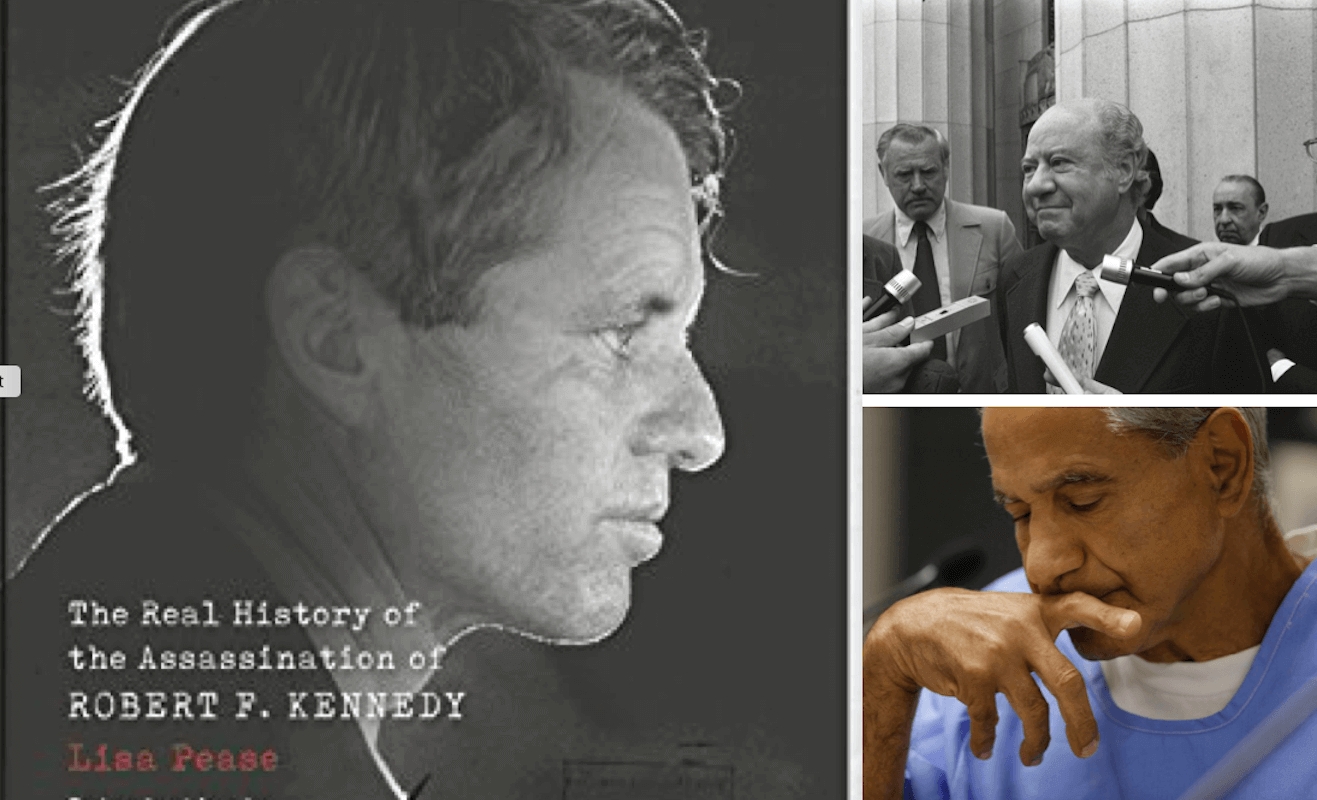
It’s a rare thing indeed when a book actually delivers everything you could wish for—and then some. I can count on one hand the number of books in recent memory that have achieved this. Incorporating over twenty years of research, personal interviews, deep archival digging, and a comprehensive survey of nearly all the extant literature and articles surrounding Robert Kennedy’s encounter with the unspeakable in the pantry of the Ambassador Hotel on the night of Jun 5, 1968, A Lie too Big to Fail will no doubt stand the test of time as the definitive book on the RFK murder. Pease establishes not only the most compelling case against the LAPD’s compromised (non-)investigation of the case to date, but reveals startling new discoveries, including previously unexplored forensic evidence, new witnesses to multiple shooters, and evidence of foul play at the highest levels of the United States political apparatus.
Digging deep into the court records and transcripts of the also-compromised defense attorney who sold the 24-year old Sirhan Sirhan down the river before he ever had a chance at anything approaching a fair trial, Pease presents a firm case for why his fate—as he sits locked up in a California prison for life—cannot be justified in a democratic society. That Sirhan is still alive and paying for a crime he never committed brings a necessary urgency to her plea that the case be reopened. Because not only did Robert Kennedy’s murder signal the death knell of true progressivism in the United States political arena, but it served as perhaps the most arrogant abuse of power by a hidden hand that, for five decades, hijacked the United States’ foreign and domestic policy. Written with a gripping, driving cadence, the author’s narrative gifts are as pronounced as her investigative acumen. And with this book as her lifetime achievement on a case that still remains relatively obscure in light of the JFK assassination, she will likely establish herself as the preeminent authority on the subject for years to come.
II
Officially, minutes after delivering his victory speech in the Embassy Ballroom of the Ambassador Hotel in Los Angeles just after midnight, Senator Kennedy—to the cheers of his teeming supporters and staff—excused himself from the podium, proceeded backstage through a small passage leading to large double doors, entered the hotel’s kitchen pantry, shook hands with cooks and a busboy, and was shot to death. The sole perpetrator was held to be Sirhan Bishara Sirhan, a 24-year-old Palestinian immigrant who appeared in the confusion of the crowded space in front of the senator and fired a .22 caliber revolver at Kennedy, mortally wounding him and injuring five other people with his eight-shot discharge.
Kennedy died almost a day later. He had multiple brain surgeries and finally succumbed to the massive damage of the shattered bullet fragments: his heart rate lowered to barely a pulse, then stopped. His funeral ceremony was one of the most highly attended in U.S. history. For people like Tom Hayden, original author of the Port Huron Statement, who sat crying in a church pew upon learning of the death of his hero, the senator’s untimely death was also the death of hope for a generation seeking to take their nation on a course of peace and social justice. With Richard Nixon’s victory all but assured in the confused scrambling of the Democratic Party to promote their second tier candidates, the United States was going to fundamentally change.
That’s the official version of events we teach our kids in school and repeat ad nauseum in the mainstream media. The problem, of course is that when Thomas Noguchi, the LA County coroner who was tasked with performing Robert Kennedy’s autopsy, was finished, he discovered that the fatal shot, just behind his right ear into the victim’s brain, was fired with the gun barrel at contact range, which could not have been more than three inches. This was demonstrable, as Kennedy’s neck exhibited tell-tale signs of powder burn tattooing, or stippling, which Noguchi took great pains to demonstrate by setting up a test-firing at the LA Police Academy on mock human skulls made of latex and pig ears after the autopsy. Each officer was asked to fire at his respective target from six ranges: barrel-pressed against the target, a quarter inch, half inch, two inches, three, and finally four. Only at three inches, did the stippling dispersal pattern match that on Kennedy’s corpse. Of the nearly seventy witnesses in the pantry that night, none placed Sirhan closer than three feet, and most average a distance of approximately five to six feet. Equally troubling was the fact that the three shots which struck Kennedy were fired from behind and at equally sharp vertical angles, from low to high, which makes it physically impossible for them to have come from Sirhan’s gun, which even before he was attacked and restrained by bystanders, was by all accounts pointed directly at Kennedy in a flat, arm-outstretched fashion. We know Kennedy only perceived a threat from the front by the fact that numerous witnesses recall his hands defensively coming up to cover his face at seeing an approaching Sirhan before he fell to his knees, wounded, and then slumped to the floor where he lay dying in a pool of gathering blood from his fatal head wound.
The immediate aftermath of the shooting is another one fraught with contradictory claims. Officially, the LAPD concluded—or as we will see, decided actively to conclude, with the urging of two former CIA interrogation experts who took over the investigation within days of the murder—there was no conspiracy. Sirhan was apprehended, everyone saw him shoot, Kennedy went down, case closed. And yet, as Lisa Pease aptly demonstrates, that is not at all what witnesses reported. Almost thirty separate people placed Sirhan in the company of a young lady in a polka dot dress, along with several male accomplices. Many of them saw her in the pantry, seemingly holding Sirhan, and having the same sickly smile on her face as they claim he did before he lurched forward with gun outstretched to make his move. Witness Sandy Serrano places her in the immediate aftermath of the shooting running down the fire escape to the back parking lot with her male companion—both of whom Serrano witnessed entering the hotel via this very fire escape with Sirhan Sirhan earlier in the evening. Serrano said she was exuberantly shouting, “We shot him!” When asked by Sandy who did she kill, the girl responded, “Kennedy! We killed him!”. They were overheard by the Bernsteins, an elderly couple in the parking lot who reported the incident to first-responder Paul Sharaga, of LAPD. When Sharaga put out an APB for these two suspects, he was told moments later by a superior at Ramparts station that, “We don’t want them to get anything started on a big conspiracy.” (Larry Hancock, “Incomplete Justice, Part One: At the Ambassador Hotel,” 5/19/2007) The APB was subsequently pulled, allowing any accomplices ample time to make their escape.
Lisa Pease details this familiar chain of events and the controversy surrounding the clearly real accomplices, sited by dozens of witnesses throughout the ballroom and surrounding areas that night. With regard to figures like the infamous girl in the polka dot dress, she brings some fascinating new insights to the case: including the likely use of multiple teams and multiple polka dot women who were also part of the plot. Many have wondered: What would have happened had Kennedy exited via a different route? The author is quick to note that he was marked for death that night by the sheer number of likely assassins actually positioned in the Ambassador Hotel that evening. While as many as three shooters could have been in the pantry, the LAPD was immediately told to stand down in their pursuit of leads concerning anyone but Sirhan’s immediate family and friends. Therefore, we will probably never be able to say conclusively who these people were. Lisa Pease provides some excellent considerations though, and that is perhaps one of the most exciting parts of her new findings, along with some of her personal interviews which to my knowledge she is sharing here for the first time in print. That, plus the fact that SUS officers at Ramparts station also burned over 2,400 photos taken at the Ambassador ballroom in a hospital incinerator, removed and later destroyed key ceiling and door panels containing bullet holes because they “didn’t have room to store them,” and both discredited and intimidated major credible eyewitnesses: all this smacks of a systematic cover-up.
III
Stylistically, A Lie To Big To Fail achieves a fine balance between the immense complexity of the case—with its thousands of files, its many bizarre suspects and characters, its hypno-programming realities, and other strange but relevant source data—and the inherent drama of the event. We begin with an almost Raymond-Chandler-styled portrait of those fateful California nights spent with folks like director of The Manchurian Candidate John Frankenheimer (talk about situational irony) and other supporters, then progress to the primary victory speech at the Ambassador Hotel. The book is instantly engaging, no matter how familiar readers might be with the case. The accessibility of the book is another commendable feat Pease has pulled off; experts who have studied the case for decades will still find evidence and propositions they had never seen or considered, while a friend I loaned the book to—who had never examined the case—could just as easily engage with the text. That is no small feat. Too often a book in the assassination field presumes a level of familiarity with the subject material that is beyond the scope of most readers, while those that are more accessible often gloss over the depth and complexity of the subplots, and also motives and new information gleaned from recent declassifications. A Lie to Big to Fail does neither, and presents an eminently readable, thoroughly substantiated story that, in many respects, is stranger than fiction.
Covering the gamut of the LAPD’s Special Unit Senator files, along with newly discovered archival footage from places like the California State Archive and local news agencies, Pease’s book is probably the most comprehensive I have ever read on this case, incorporating not only the limited but extremely useful secondary literature from the 1970s, 80s and recent times, but also combing the entire primary source record of the case as well. The author poured thousands of hours of personal research into the book. And it shows. Sources are meticulously detailed and annotated, in the classical manner with the references at the bottom of the page. This allows anyone with an internet connection to fact check most of her findings; some must be accessed in person in Sacramento and elsewhere.
The other thing that really stands out in the book is the author’s refusal to argue she’s definitively solved the case. Don’t get me wrong: if anyone has come close to figuring out exactly what happened that night, it’s Lisa Pease. What I mean is that too often plots of this magnitude, which require not only clandestine funding, months of planning, a deeply complex cover-up often stretching decades, and the complicity of many high-level officials and planners, are traced to a single source: the mob, the CIA, the Minutemen, Nixon. What seems to be the case, and I will let readers reach their own conclusions, is that, as Lisa notes, there were aspects of both underworld crime liaisons, private military contractors, and off-the-books involvement of the Central Intelligence Agency in the persons of say Hank Hernandez and Manny Peña (USAID/CIA), and of course Robert Maheu (Howard Hughes Corporation/CIA). Thane Cesar has been and still is a prime suspect, given his anti-Kennedy, pro-segregation views and convenient placement as RFK’s escort in the pantry. That he “retired” from Ace Security, a job he’d had for only a few weeks, as he sarcastically stated during his exit interview with the LAPD, is also extremely suspicious. (RFK LAPD Microfilm, Volume 122, Reporters Daily Transcripts, Reinvestigative Files 1974—1978) p. 314). That Nixon was basically handed the presidency does not, of course, implicate him personally; though as the end of the book suggests, there is anecdotal evidence his brother Don was indeed apprised of the events surrounding the assassination and informally debriefed shortly thereafter. In a diary entry that Pease personally procured from John Meier, a Howard Hughes top aide from 1966 to 1970, Meier wrote on June 6, 1968:
Bob Maheu called to ask about the Don Nixon meeting and suggested 8:30 breakfast at the Desert Inn Country Club (in Las Vegas). I went to the club. Maheu was all smiles, and Don Nixon walks in an all smiles. What followed next had to be seen to be believed. They embraced each other and Don Nixon said, “Well that prick is dead,” and Maheu said, “Well it looks like your brother is in now.” (Pease, p. 493)
This book also presents perhaps the most balanced look at the controversy surrounding the potential and very likely programming Sirhan underwent before his arrival on the scene. Drawing from both familiar and quite obscure cases, where people were indeed exposed as hypno-programmed assets operating against their will with no working knowledge of how or why they performed various acts and crimes, she gives those in the research community a solid footing on which to stand in what amounts to the hardest part of the case for the MSM to digest. Given the CIA’s millions of dollars of research into its MK-ULTRA and related mind control experiments, along with the accounts provided in Pease’s later chapters, even the most skeptical critics will be hard pressed now to discredit this exotic but very real use of actionable hypnosis.
IV
Sirhan remains languishing in prison to this day, narrowly avoiding the gas chamber by a lucky break which saw California abolish the death penalty in 1972. Despite his good behavior, insistence that he has no memory of the events in the pantry, his numerous and sincere interviews with new therapists and hypno-suggestive experts, his fate remains sealed. William Pepper, the attorney and barrister who represented the King family during their 1999 civil trial against Lloyd Jowers, in which a Shelby County jury determined Martin Luther King had been assassinated as a result of a conspiracy, has joined attorney Laurie Dusek in a bid to free Sirhan from a crime we know he could not possibly have committed.
Senator Kamala Harris, who served as the California Attorney General until 2017, and who was also the DA of San Francisco from 2004 to 2011, insisted since the parole hearing reached her desk in 2012 that Sirhan is still guilty. Following the release of an audio tape found in the California State Archives which captured what acoustics expert Philip Van Praag believes is thirteen distinct shots in the pantry, Harris was confronted by the very real possibility that Sirhan was not a lone gunman. Harris calls Van Praag’s analysis “pure speculation.” (Martinez and Johnson, “Prosecutors, attorneys argue: Was there a second gun in RFK assassination?” CNN, 3/12/2012)
Similarly, despite the very real fact that hypno-programming has been successfully deployed in military, civilian, and criminal plots, and other special operations dating back to the early 20th century, Harris refuses to accept its possible use on Sirhan in the RFK saga. Upon reading the adamant testimony of Harvard professor of forensic psychiatry and hypnosis, Dr. Daniel Brown—who spent over sixty hours interviewing Sirhan—Harris claimed, “The theory that a person could be hypnotized into planning and committing a murder against his will is a controversial (if not fantastic) one and has not been adopted by most of Brown’s peers, including the American Psychological Association.” She continues, “Thus, even if Sirhan could show that some psychologists believe in mind control or hypno-programming, his showing of actual innocence is nevertheless based on a debatable theory that is not universally accepted in the psychology community.” (CNN, 3/12/2012) Brown, in a signed 2011 affidavit, stated, “I have written four textbooks on hypnosis, and I have hypnotized over 6,000 individuals over a 40-year professional career. Mr. Sirhan is one of the most hypnotizable individuals I have ever met, and the magnitude of his amnesia for actions under hypnosis is extreme.” (Tom Jackman, “The Assassination of Bobby Kennedy: Was Sirhan Sirhan hypnotized to be the fall guy?” Washington Post, 6/4/2018)
What is actually a debatable theory, in reply to DA Harris’ conclusions, is that three bullets fired at very close range and one at contact range (the fatal head shot behind the right ear), all from behind and at a steep upward angle are supposed to have come from a weapon that was always at least three feet in front of the target. Or that at least thirteen bullets were fired from a gun which could only hold eight, and which likely fired no real bullets, just blanks. These are solidly based facts of the case, yet they are treated as conjectures. If other major legal cases were handled with this much disregard for forensic evidence, lawyers would be disbarred. And if Sirhan had been offered a fair trial—another exceptional chapter of A Lie Too Big to Fail—it is almost certain he would be a free man. But the special logic applied by those seeking to obfuscate the sinister implications of the final major assassination of the 1960s continues to hold fast, at least at the legal level.
Things are changing though, and it would seem that the concerted efforts of those like Lisa Pease, along with the recent public denial of the official version of events by none other than Robert Kennedy Jr., may be turning the tide towards the real evidence which supports a concerted high-level conspiracy to remove a potential president. It was with a real sigh of relief that I read a recent Washington Post summary of Lisa’s new findings, one that, for a change, actually took her argument seriously and did not attempt to reduce her thesis to fringe theory. In the fifty-one years of relative silence surrounding the case, dotted here and there by books and talks by people like Allard Lowenstein, Ted Charach, Philip Melanson and others, that’s a true testament to the work of informed citizens uncovering the darker chapters of their nation’s history. As journalist Tom Jackman’s article notes, “Robert F. Kennedy Jr., the son of the slain senator, said he thought Pease was ‘a great researcher.’ Similarly, Kennedy said that his own investigation, which included meeting with Sirhan in prison in December 2017, showed that ‘Sirhan could not and did not fire the gun that shot and killed my father.’” (Jackman, “CIA may have used contractor who inspired ‘Mission Impossible,’ to kill RFK, new book alleges,” Washington Post, 2/9/2019)
V
A Lie Too Big To Fail is more than a window into one of the most fascinating and disturbing assassinations of the sixties. It is a work whose implications are relevant to anyone trying to understand how the United States devolved into a shell of a country whose tenets of equality, freedom and justice have gone by the boards, leaving us with a paper-thin facade of a democracy embodied by charlatans who wear red and blue uniforms but who essentially represent the same corporate and military-industrial overlords, or what Colonel Fletcher Prouty once referred to as “The Secret Team:”
It is a sinister device of opportunity and contrivance. What does exist is the mechanism. What exists is the automatic system, much like a nervous system or an electrical system. More properly, what exists is like a giant electronic data processing machine … which has its own power to grow, to reproduce, and to become more insidiously effective and efficient as it operates. It is a great intra-governmental infrastructure that is fed by inputs from all sources. It is big business, big government, big money, big pressure, and headless—-all operating in self-centered, utterly self-serving security and secrecy. (Prouty, The Secret Team: The CIA and its Allies in Control of the United States and the World, p. xvii)
It was Jim Garrison who eerily predicted this in an obscure and brief interview less than a month after the RFK slaying. Art Kevin, host of Los Angeles’ KHJ Radio, asked the New Orleans District Attorney,
AK: Jim … are you prepared to say that the same elements responsible for the death of John F. Kennedy were responsible for the deaths of Senator Robert F. Kennedy and perhaps even Martin Luther King?
JG: Well, you can remove the perhaps. The answer is “of course,” except that in the case of Senator Kennedy, they apparently interposed a cover organization.
A bit later:
JG: But there’s no, I don’t think there’s any question about the fact that the same forces removed everyone. Every one of these men were humanists. They were concerned about the human race. They were not racist in the slightest way, and above all, they were opposed to the evolution of America into an imperialist empire-seeking warfare state. Which it has become, I’m afraid. And now there aren’t too many, now there aren’t too many leaders left to talk out loud against the war in Vietnam. They’re eliminating them, one by one. Always a lone assassin. (“Jim Garrison says RFK was Hip to Murder Plots,” San Francisco Express-Times, 7/3/1968)
Entrenched in an almost two-decade long foreign policy disaster in the Middle East and Afghanistan, riddled with crippling, insurmountable debt, with young people more despondent and driven to self-medication and violence, the United States of 2019 is unquestionably the dark legacy of those tiny .22 caliber slugs flying through the pantry that fateful July night. As political philosopher Sheldon Wolin described it, the United States in the past half-century has come to resemble an inverted totalitarian government. By that he means, a state run not by a traditional dictator like Stalin, Mao or Mussolini, but one even more ruthlessly efficient at quelling dissent and spreading disinformation through a diffuse and impossible-to-pin-down network of powerful and manipulative factors, from the corporate media to lobbyist groups, to the hollow candidates propped up every four years for the election circus:
Antidemocracy, executive predominance, and elite rule are basic elements of inverted totalitarianism. Antidemocracy does not take the form of overt attacks upon the idea of government by the people. Instead, politically it means encouraging what I have earlier dubbed ‘civic demobilization,’ conditioning an electorate to being aroused for a brief spell, controlling its attention span, and then encouraging distraction or apathy. The intense pace of work and the extended working day, combined with job insecurity, is a formula for political demobilization, for privatizing the citizenry. It works indirectly. Citizens are encouraged to distrust their government and politicians; to concentrate upon their own interests; to begrudge their taxes; and to exchange active involvement for symbolic gratifications of patriotism, collective self-righteousness, and military prowess. Above all, depoliticization is promoted through society’s being enveloped in an atmosphere of collective fear and of individual powerlessness: fear of terrorists, loss of jobs, the uncertainties of pension plans, soaring health costs, and rising educational expenses. (Wolin, Democracy Incorporated, p. 239)
Indeed, many of these issues, which could have been addressed in Dr. King’s Poor People’s March—which RFK conceived and encouraged MLK to undertake—have never been seriously resolved in the last fifty years of American history. The powerful and vigorous aspirations of those like Tom Hayden, which burned briefly and flickered out with RFK’s assassination, have not been rekindled. After Robert Kennedy’s death, there have not been any significant, ideologically divergent political candidates offering real change or practical solutions to basic entrenched issues in the United States. What we got was Richard Nixon, Gerald Ford, Jimmy Carter. It then got worse with the full-blown neoconservative movement’s apotheosis in the persons of Ronald Reagan, followed by George H. W. Bush, and W. In effect, the antithesis of everything which people like Martin Luther King, JFK, Malcolm X, and Robert Kennedy represented.
But we must not lose hope, however bleak the future looks. And it is our responsibility not to. As Lisa Pease has so expertly done in her recent book, everything is in our power to expose the lie which still surrounds RFK’s untimely end. As the author concludes in her final passages, “He spent the last years of his life tilting at the windmills of greed and self-interest that ultimately cut him down. But his song lives on in all of us who strive, in whatever ways we can, to reach those unreachable stars.” (Pease, p. 504)
Some related items:
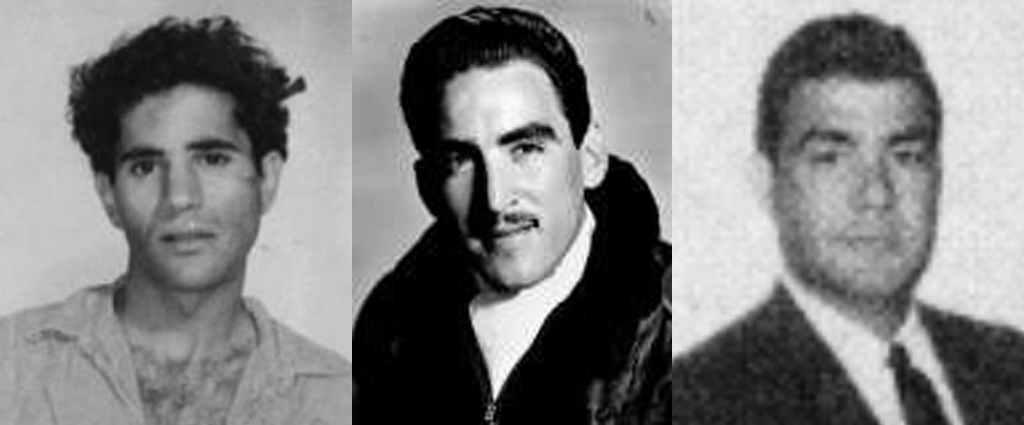


 We have been informed by Paul Schrade that Rose Lynn Mangan passed away in late February of this year. Many people probably do not know who she was, for the simple reason that she was a person who worked mostly behind the scenes. Off and on, she had been the chief researcher for Sirhan Sirhan’s defense team for many years. No one had spent as much time looking at the evidence in the RFK case than she did. Mangan lived in Carson City, Nevada, so it was not that far for her to drive to the Sacramento State Archives where much of the surviving evidence in the Robert Kennedy assassination was maintained.
 At the time of her passing, Mangan had a book contract with JFK Lancer about her life as Sirhan’s Researcher, to be published in June, 2018. It was to be based upon the extensive files she had accumulated over the decades she had worked on the RFK case and visited the Sacramento Archives. Lancer is going forward with its publication in a revised format. Debra Conway will also be visiting Carson City to collect the Mangan files; her archives will be preserved, scanned and will be made available online along with the publication. While we await her complete files to be deposited online, anyone interested in the Bobby Kennedy case should visit