Tag: JIM GARRISON

  • Pipe the Bimbo in Red

    Pipe the Bimbo in Red


    Some time in 2022, I gave an online talk for UK Dealey Plaza about the Garrison Files, which I had just completed reading…all nine thousand pages. During the question period, one audience member asked me…Paul, do you have any idea why someone like Dean Andrews would represent someone like Clay Shaw? like Dean Andrews was chosen to represent Clay Shaw (1:08:33)? I have to admit my answer was quite vague. As the moderator of this talk, Neale Safaty, pointed out: Dean Andrews is very enigmatic.

    In their book, the authors ask, for anyone has a minimum of critical thinking abilities: Why would Andrews get a call from Clay Shaw, AKA Clem or Clay Bertrand on the day of JFK’s assassination to represent an already doomed Oswald?

    At 44:32 of this same video, the questions of sexual orientation of Oswald and Ruby come up, where you can witness my own confusion about sightings of a scruffy-looking Oswald vs. the neat, clean Oswald.

    When Donald Jeffries asked me if I would do a book review of this book, I was at first hesitant—as I had just gone through a year of writing and promoting The JFK Assassination Chokeholds with four colleagues and frankly, I needed a break from JFK. But a book about Dean Andrews, played so enticingly by fellow-Canadian John Candy in JFK, I decided to give it a go. I am happy I did. I now have a better grasp of whom Andrews was, the mystery of the unkempt Oswald, and the scene in New Orleans during the summer of 1963.

    Their interview with Andrews’ son represents an important find. Not that we can take what Dean junior says as gold. Like the children of many of the cast of characters associated with the JFK saga, Dean Andrews III and other members of the Andrews family paid a heavy burden that reminds one of the Saint John Hunt story. Dean will be seriously challenged for what he reveals because of whom he became, and not necessarily what he says. You will see that I have reservations with some of his statements. His dad clearly had his safety in mind when he answered Dean’s questions when he was a youngster by being evasive, cryptic, and mysterious. His father’s non-denials in certain instances speak volumes. So, on the weight alone of the Dean Andrews III interviews, well conducted by Law, assassination researchers will have plenty to consider, debate and research further and is reason enough to read this book. Other than the ad-hominems Dean is certain to face, there will be some who may want to unfairly shoot the messengers: Don Jeffries and William Law.

    While I do recommend Pipe the Bimbo in Red, I would urge the authors to consider writing a revised version, or maybe even a second edition to clear up loose ends, and synthesize by adding information and plucking out irritants. Some of the weaknesses in this book are self-inflicted through overreach and sloppiness which will distract from the key themes before they are even presented and provide a juicy target for lone nut theorists.

    First Impressions

    I have to say that I do not know Donald Jeffries, so I felt his request came a little out of the blue. I had a negative impression of the title but must admit that it unmistakably projects the image we all have come to associate with Dean Andrews.

    Next, I found out that it was co-authored by William Matson Law, whom I had the pleasure of listening to at last November’s Lancer Conference. Law’s interviews of FBI agents Jim Sibert and Frank O’Neill are landmarks and help obliterate the Warren Commission by underscoring what they witnessed during JFK’s autopsy and reveal bias of the Warren Commission. The authors’ work received an endorsement by Garrison authority William Davy, who wrote a foreword that also goes a long way in proving that Clem Bertrand and Clay Shaw were one and the same.

    The preface by Edward Haslam does a fine job in presenting how important the setting of NOLA was for the goings-on in 1963, and just how tightly knit the characters were in this small, big city.

    Their bibliography includes the following:

    • William Davy, Let Justice be Done: New Light on the Jim Garrison Investigation
    • James DiEugenio, Destiny Betrayed: JFK, Cuba, and the Garrison Case
    • Paris Flammonde, The Kennedy Conspiracy: An Uncommisioned Report on the Jim Garrison Investigation
    • Jim Garrison, A Heritage of Stone
    • Jim Garrison, On the Trail of the Assassins: My Investigation and Prosecution of the Murder of President Kennedy
    • Edward T. Haslam, Dr. Mary’s Monkey
    • Marrs, Jim, Crossfire: The Plot That Killed Kennedy
    • Joan Mellen, A Farewell to Justice: Jim Garrison, JFK’s Assassination, and the Case That Should Have Changed History
    • Jack Roth, Killing Kennedy: Exposing the Plot, the Cover-Up, and the Consequences
    • Richard E. Sprague, The Taking of America 1-2-3

    One element not included is the raw data available from the 9000 pages of the Garrison files. This, in my view, reduced their sources of information, though the best of these may have surfaced in the many books they referenced…but certainly not all. Thanks to Paul Abbott from Australia, there is now a master index to help navigate dozens of files. Dean Andrews name is associated numerous times in over twenty different files. I would argue that this is a much richer source than what we can find in any other government investigation.

    Overall, the book was certain to rest on a solid foundation if the information was well absorbed.

    The Preface, Foreword and Introduction

    The preface by Haslam is really useful for describing the NOLA setting and the network that Dean Andrews, Oswald, Clay Shaw and Garrison roamed around in. It is a network that hated the Castro threat because of their business ties to Latin America, that saw Kennedy as Castro’s enabler, one that was well connected to intelligence, the mob and Cuban exiles all working in sync to reclaim their kingdom. New Orleans was the last place for a Fair Play for Cuba Committee chapter to set up shop, unless it was a front. Haslam remembered that on the day of the assassination, very threatening skies were forming west of the city…skies no normal person would drive into for an ice-skating outing, as David Ferrie said he was doing that day.

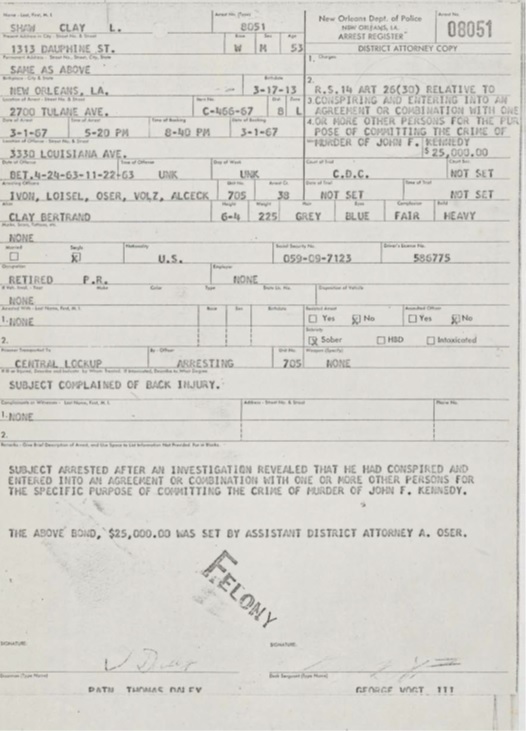
    Davy continues the strong start with more than just a normal plug of what I was about to read. For this author, Shaw and Bertrand being the same person is a fact. Shaw told Officer Aloysius Habighorst that Bertrand was an alias he used, which was transcribed on an arrest form that is now part of the official record. Attempts to explain this away border on the loony, as in another person in the crowded, noisy room when Shaw revealed his secret identity did not hear him say this (in other words he simply did not hear). Davy reinforces this with another salvo:

    By the time of my interview with Weisberg (ca. 1997) he had long since turned bitter towards Garrison and his investigation—which made one of his comments to me inexplicable. When I asked him about the shadowy figure of “Clay Bertrand” he confidently stated that “Bertrand was Clay Shaw. No doubt. Monk Zelden confirmed it to me.”

    Of course, Shaw was the defendant in Garrison’s case and Zelden was a New Orleans attorney who worked with one of the more colorful characters in Lee Harvey Oswald’s orbit, Dean Andrews. Davy then, in a few surgical paragraphs, sets the stage for the book by explaining how Andrews’ links with both Shaw and Oswald were a catalyst for the Garrison investigation—which led to the municipal court attorney’s demise.

    He also adroitly points out the extremely revealing INS information about Oswald that Law and Jeffries rely on and that so few in the research community have utilized. Somewhere around 2017 when this information was pointed out, I remember Davy telling Len Osanic on Black Op Radio words to the effect: The fact that we have a governmental agency affirmation that Oswald could be seen entering the building where Banister had his offices with Ferrie and his gang of nuts represents an official intelligence confirmation about Oswald’s connections and exclaimed that this is game, set and match!

    That introduction does a good job setting up the highlight of the book, that is the Dean Andrews III interviews. In the view of the authors, the considerable time spent with Dean was enough to convince them that his unique vista of the case and the access he had to his father’s perspective (which was not without limitations) were grounds for relating his story and shedding light around the enigma that is his dad.

    Through their relationship with Dean Junior, the authors even heard briefly from Dean Andrews’ wife, who described her deceased husband as a very unstable individual which caused so much hardship.

    Beyond bringing fresh, untapped information, the authors argue that Garrison uncovered the ground-level conspirators alluded to in the movie JFK. While this statement may please some of the Garrison disciples, it is clearly too all-encompassing. The plot was too complex for Garrison to grasp the whole ground-level operation. Gaeton Fonzi and some of his followers would argue that there was plenty of intrigue related to Miami that also qualifies as ground level. Who the ground players were for what happened in Dealey Plaza depends on roles that likely did not emanate entirely from Ferrie and friends…at least this book does not prove this. This does not diminish in any way the importance of what took place in New Orleans in 1963.

    CHAPTER ONE: Harold Weisberg in New Orleans

    Readers in this chapter will understand just how much of a threat Garrison became to the conspirators and they will see an early example of how pro-conspiracy forces can turn bitterly against one another through the Weisberg/Garrison break-up…Something we have witnessed time and time again over the years up to today where the infighting around the legal procedures concerning the breaches of the JFK Act is in full swing, to the delectation of lone nut propagandists.

    The authors do not pull any punches when it comes to covering Weisberg whether it is describing his research or his underhanded jabs at Garrison and the movie JFK. They also in this chapter meander into a number of subjects including the organized smear campaign against Garrison by media assets and the infiltration of his office.

    There are a lot of nice nuggets here. But one problem began to emerge that permeated throughout the first three chapters: while we are getting a summary of a lot of what has been written about Garrison and New Orleans and even more, the authors are inconsistent with their sources. For example, on page 18 they write: A rough draft of Aynesworth’s May 15, 1967, Newsweek article, “The JFK Conspiracy,” is in the Lyndon B. Johnson Library. There is also a cover letter addressed to LBJ’s press secretary George Christian. Aynesworth wrote, “I am not offering this for comment of any kind, nor a check of the validity of any part…My interest in informing government officials of each step along the way is because of my intimate knowledge of what Jim Garrison is planning…I intend to make a complete report of my knowledge available to the FBI, as I have done in the past.” Interesting weaseling about for certain, but no direct source to prove the existence of this highly incriminating behavior, either by a link or a book source.

    Consider this reference: Regis Kennedy (no relation to the president) is among several witnesses connected to the events in Dallas in 1963 who died “before they could be fully questioned,” according to online sources. No careful researcher will take such a statement seriously. There is also this one on page 79: In an interview aired two years after his death in 1990, (Judge) Haggerty would say, “I believe he [Shaw] was lying to the jury. Of course, the jury probably believed him. But I think Shaw put a good con job on the jury.” I found this so important that I had to ask Jim DiEugenio if it really happened, and he confirmed that it did, but an author needs to be more precise than this. In one case the source is the controversial Torbitt document, and the authors seem unaware of the true name of its author: (Lawyer David Copeland). Sometimes the source is Quoting from the Spartacus Educational Forum. There is also a preference by the authors to refer to a book as a source rather than the primary data the book info is based on. I paid a price for this when I used Ultimate Sacrifice as a source about potential patsy Policarpo Lopez. I got panned by some whereas I could have avoided all the flack by quoting directly from the HSCA files on Lopez.

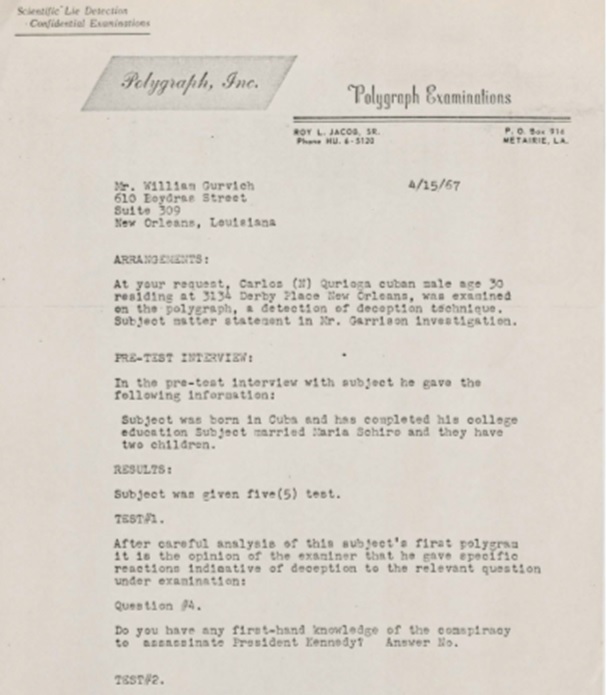
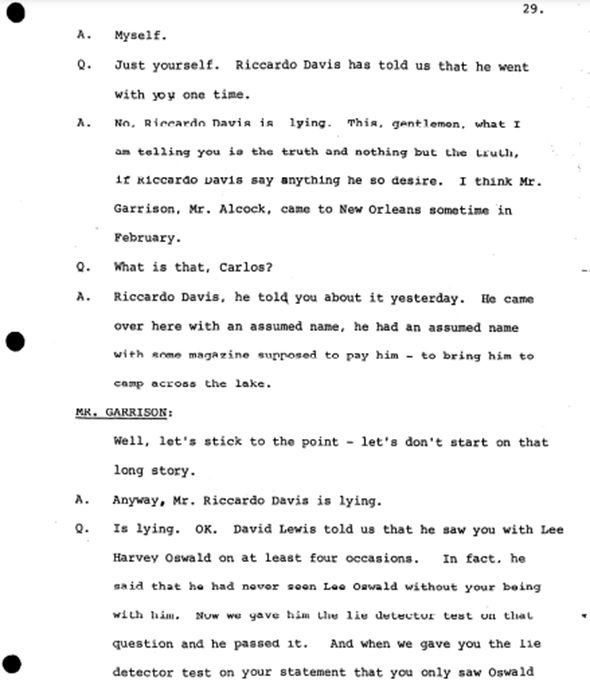
    This to me is an irritant because I often cannot refer directly to a source to learn more, and I cannot repeat it as fact until I know that the source is solid. Where this sloppiness came to bite the authors hard can be seen on page 58 where they hover around a Carlos who was seen in the company of Oswald and Sergio Arcacha Smith, a little later they say Garrison attorney Lou Ivon asked witness Dave Lewis if he recognized the name Carlos Corega…In so doing they completely messed up the Carlos Quiroga incident which is well covered in two sources they had referred to elsewhere: Destiny Betrayed and this author’s KennedysandKing articles about the FPCC. Quiroga is known to have met Oswald at his place, bringing a stack of FPCC flyers, being with Oswald at Mancuso’s restaurant in the presence of Arcacha Smith and other usual suspects and revealing that Oswald used the FPCC as a front through a failed polygraph test. Lewis strengthened some of these revelations in his own polygraph test.

    Do not get me wrong, dismissing the authors and this book because of improper sourcing would be in my view an error. There is too much good information and new insights to throw away the baby with the bath water. The work put into talking to Dean Andrews III and his mother as well as Ed Voebel’s sisters, niece and son, John Barbour, Garrison investigator Stephen Jaffe, etc. represent important developments.

    Chapter 1 showcased another problem with Bimbo that can also be seen in chapters 2 and 3: it lacks structure. The first chapter is supposed to be about Weisberg, but many tangents are taken that bring the reader into whole other subject matters that are interesting yes, but certain to create confusion with information overload. I also think that they should have broken down the chapters into subsections. They have only one subsection in the whole book as far as I can remember which sticks out like a lonely outlier: Kennedy. In a second edition, and I really hope they write one, they will need to break down the information into more chapters with multiple subsections.

    CHAPTER TWO: A Ground Level Plot

    If one wants to get a snapshot of what has been said and written about the central characters operating out of New Orleans, this part of the book throws everything at the reader, plus the kitchen sink. Since my book readings about Garrison go back for a while, it was good to be reminded of the many anomalies that took place in the Crescent City. There is plenty here that I did not know or recall.

    This chapter is also inconsistent with sources and tends to wander. I believe it should be retitled. While many interesting links are made around shady people, I would have trouble describing this the ground-level plot based on the information we are given. Objectives, strategies, timelines, roles…there is a lack of clarity around the “said” plot. The chapter is really more about hanky-panky in New Orleans.

    CHAPTER THREE: Dean Andrews and His Fluid Recollections

    After the strong start to the book, I found the first two chapters to be interesting, but a mixed bag in terms of reliability. The authors make it difficult for the readers to digest the sheer quantity of information thrown at them and to come away with a high level of confidence in what is written. You sometimes feel as if you are on a carousel ride in a figure eight trajectory while in gallop mode.

    While some of the sloppiness and meandering continues, Chapter 3, for this reader, was a turning point and was appropriately titled. Dean Andrews is one of the keys to understanding the New Orleans network of shady characters that link Oswald to Clay Shaw. New Orleans was so toxic to the Warren Commission that Andrews was coerced into confabulating (because he was supposedly under sedation) that a call from Shaw AKA Bertrand that he got asking him to represent Oswald while he was sick in the hospital was a figment of his imagination. The FBI also decided not to delve into Oswald’s 544 Camp Street office and the cast of right-wingers and intelligence actors that the office was a fulcrum for…a mistake according to the HSCA.

    From Andrews’ own mouth, an open-minded reader should be left with a clear impression that:

    • Andrews represented Oswald a number of times.
    • Clay Shaw backed this relationship as well as Andrews’ representation of members of the gay community.
    • Andrews was a small-time fixer. Better Call Saul comes to mind.
    • The call did occur and was corroborated.
    • Andrews was intimidated and scared out of his wits.
    • He professed Oswald’s innocence.
    • He admitted that the FBI turned the heat on him.
    • Oswald’s representation of the Fair Play for Cuba Committee was a front, and he was paid.
    • He was part of a network that includes Shaw, Oswald, Wray Gill, Ferrie, Marcello and the anti-Castro movement.
    • The contradictory comments he made were for self-preservation.

    The authors deserve credit for making this clear to the world.

    CHAPTER FOUR: The Dean Andrews III Interviews

    This chapter represents the apex of the book. Dean Andrews was 12 when JFK was assassinated. During the Garrison Investigation, he witnessed and lived through a downturn of his father’s fortunes and career and the quasi break-up of his family. The impact on Dean Junior’s health and ambitions were immense. It is a tragic story that seems to be a recurring theme for so many of the family members of those connected the assassination. Perhaps the real perpetrators of JFK’s assassination never went to jail for the crimes, but many paid a personal price with a lot of collateral damage to their close ones.

    Those who did seek the truth also risked a lot. The traces they left likely caused trauma for the ones they cared for, but hopefully left them with a sense of pride for fighting the good fight. The cover-up artists live in denial. The more that comes out throughout the years, the less their positions are tenable. Yet they plod on even though they are at the opposite end of the official records. With a great majority of the population and more and more traditional and new media open to the conspiracy scenarios, lone nut advocates are swimming in a much smaller pond and are the ones who come across as Q-ananonish.

    What Jeffries and Law do in these interviews is shed light on what a son, who is knowledgeable about the case and who decoded his father the way only a family member can, said, thought, knew, guessed, heard about his father and the case. Dean’s father was very abstract when talking about the saga but revealed so much anyway. Sometimes through non-denials you can figure things out. A son picks up patterns, signals from non-verbal communications and knows when his father is hiding something.

    • The authors deserve kudos for recognizing Dean’s importance, gaining his trust and making a record of what he can relate no matter how troubled he became.
    • I will not tell you what he has to say because you need to read it for yourself and ponder:
    • Dean talks about his dad’s sexuality;
    • What he thinks about Jim Garrison;
    • The Bertrand-Shaw identities;
    • Attempts to harm, intimidate and even kill his dad;
    • The divide in his family;
    • His dad’s links to Shaw, Marcello, Garrison, Oswald, Mork Zelden, David Ferrie;
    • Oliver Stone and the film JFK;
    • Oswald and the FPCC;
    • His dad’s links to intelligence;
    • His father’s personality and biography.

    You will ponder, debate and hopefully research on your own to build around this new low-hanging fruit in figuring out the enigma of Dean Andrews. These revelations will likely be polarizing due to the fact that they focus on Jim Garrison and New Orleans. But they are very much worth reading.

    I would encourage the authors to try and get corroboration. Dean claims the Figaro ran an article about Garrison being arrested for sexual misconduct…where is it? The only sources that I have seen around such allegations come from discredited smear tacticians. Challenge Dean on whom he confided to, who he thinks could corroborate what he has to say. Not much was said about David Ferrie in the interview…Query William Davy and others about what other questions should be asked. We are actually reaching a point where even the offspring will not be available for much longer.

    CHAPTER FIVE William Law 1993 Interview with Perry Raymond Russo

    I am not certain why this part gets to be labeled a chapter, while the two that follow the aftermath are labeled appendices. They are essentially decades old interviews that they decided to highlight as blasts from the past. I am happy they did, as I believe that what is in them is pertinent and not necessarily well known.

    This section underscores many themes we can find elsewhere in the book but recounts them as seen and felt through the important witness—Perry Russo.

    One detail that came screaming out at me that would help explain the differences in appearance in Oswald: The unkempt, messy, unshaven Oswald vs. the neat, clean Oswald. Despite the use of impostors, there had to be something more to these seemingly conflicting sightings. Here is what Russo says: “I’m saying that the guy stayed over at this other guy’s house. Well, the wife should know. How the fuck would this dude, Perry Russo, how would he know? Well, he didn’t. And then she admitted that he used to beat the fuck out of her, and then run out on her. And he’d be gone for three or four days. And she’s glad to see him go. And she said in 1969, telling her when we were in court, she said that he always was immaculately clean. Well, he wasn’t when he was away from her. He was dirty and unshaven. Well and understandable, because he didn’t bring his shaving stuff. He didn’t bring his deodorant. He didn’t give a fuck. He was mad at the world. I didn’t get along with him. But I maintain that. I look like the Lone Ranger. No one could believe me. His wife said he slept every night with her. He took care of the kids. He was never dirty. He was always clean and meticulous about his appearance. I’m saying he’s unshaven three days in. Now, that comes out in 1979. He used to beat the fuck out of her, leave for a week. And all of a sudden, it becomes reasonable that Lee Oswald went over to his friend’s house, Dave Ferrie. Not that far from 4905 Magazine Street, where he lived, with her…in Louisiana.”

    When you connect the dots between what Russo, Andrews Sr. and Andrews Jr. have to say, we get a better idea of how the whole Andrews, Ferrie, Oswald, Shaw, Marcello, Cuban Exile network is linked as well as the many double lives led by so many of these characters.

    CHAPTER SIX Conclusion: The Conspiracy Is Clear

    In chapter 6 the authors pick the brain of author and former TV personality John Barbour. Here I discovered what Garrison confided to his good friend off the record. We get to know what Garrison speculated as to the nature of the conspiracy…From what happened in Dealey Plaza to the catalyst behind the decision to remove JFK to how the murder was sanctioned. Garrison also had a contact who described the very weird goings-on during the Oswald interrogation after the murder. The source was there and wished to remain anonymous. This is also very interesting.

    Then they come back and touch on a Dean Andrews’ claim that his father’s hospitalization just before the assassination was due to an attempted murder because of what he knew. What is not asked here, is that if this were the case, did this attempt likely involve the very person who called him to represent Oswald? How Clay Shaw even knew where to reach Andrews is a point that is raised.

    Here again the title is misleading. While it is clear that there was a conspiracy, and this book adds food for thought around some of the characters, it does not come close to clarifying what the conspiracy was…not even what they call the ground-level conspiracy. New Orleans on its own, if completely decoded, cannot explain even one quarter of the ground-level conspiracy. As Hancock and Boylan show in Tipping Point, so much else was revolving around players in Miami who were the real architects of regime change operations and were way more determining of what happened in Dealey Plaza than Ferrie et al. There is a big difference between getting Oswald to goosestep in a charade vs. participating in an ambush of a president.

    The Afterword by Jack Roth, and the Three Appendices

    I have visited Dealey Plaza and Oswald’s “said” flight trajectory, guided by Dallas resident and researcher Matt Douthit and found it to be fascinating. Jack Roth has convinced me to tour New Orleans. His brilliant description in just a few pages culminates with the following statement from a tour guide he met: “…there’s no way anybody could’ve walked these streets, been engaged in this kind of activity, and been involved with people of this caliber in this city and have it not been something more than what it seemed.”

    When he goes into the Judy Baker stuff however, I cringe and worry for the authors. I don’t know how many serious writers contaminate their work and tarnish their own reputations on frivolous yarns. Some stories require qualifiers like the not yet substantiated story by…(the Paul Landis revelation comes to mind). Others are sure to polarize those who believe there was a conspiracy and provide a big juicy target for lone-nut advocates: Madeleine Brown, Judith Exner Campbell and Baker clearly fall in this category.

    The three appendices are excellently chosen: Dean Andrews’ fascinating Warren Commission testimony; a letter from Fletcher Prouty to Oliver Stone (September 2, 1990) which sheds light on how a coup emanates from the highest levels of power in the U.S. and excerpts from a little exposed speech before a November 18, 2006, JFK Lancer Conference by Anne Dischler who worked with State Trooper Francis Fruge for Jim Garrison.

    Conclusion

    Just last fall, we had completed our book, The JFK Assassination Chokeholds, after going through through a very strict regime of trying to only include fact-based, primary evidence and carefully backing up each statement we made. All in all, there are close to 800 footnotes, exhibits and direct quotes with sources within the text. Among my other co-authors, there are three attorneys grounded in how to write on a legal basis and one of the world’s premier researchers. Reading Bimbo, I needed to completely change my base of references on how to write a book: questionable sources, lack of focus and fallacious thinking pop up too often to avoid the poison pen of critics. It would have been easy to pan it. But in a sense the authors are really telling a story.

    Bimbo offers too much to be ignored and opens the doors to further exploration around the subject of New Orleans which was clearly toxic and threatening to the early, biased investigators with an agenda. They talked to Andrews III, Davy, Barbour, Jaffe and Voebel’s close ones. They revealed important, little-known records that are decades old yet still so very important. Not reading Bimbo is tantamount to not accessing fresh, controversial information from none other than the son of one of the most enigmatic personages in this whole affair. Even if we discount everything else in Bimbo (which one should not do) and even if we do not believe everything Dean Andrews III says, a serious researcher should hear and consider it closely, just like we listened to William Kent’s daughter, E. H. Hunt’s son and David Atlee Phillips’ relatives.

    Interviewing Dean junior was a coup!

    As for the rest of the book here are my suggestions for a second edition.

    1. Get yourselves an editor, someone like William Davy, who acts as a real devil’s advocate to rethink the chapters, improve the focus, break down the information better, get rid of the frivolous, add crucial data, correct grammar, etc.
    2. Really improve choice of sources and how these are disclosed for every affirmation made.
    3. Add a master chronology of events in New Orleans, a full Dean Andrews bio, a glossary of names and a map with key locations.
    4. Consider showing exhibits from the Dean III scrapbook.
    5. Re-interview Andrews with questions, people like Davy, DiEugenio, Mellen would like to ask and try and get some corroboration from people Dean himself may be able to identify.
    6. Order the Garrison Files from Len Osanic as well as Paul Abbott’s master index and see what you can find there. There are many files on Andrews.
    7. Try and increase the Dean Andrews research and write more about him and cool it on the ground-level plot.

    Dean Andrews is to this book what the Big Mac is to McDonald’s…Your cash cow! Milk it!!!

  • Edward Epstein:  The Critic who Flipped

    Edward Epstein: The Critic who Flipped


    The 88-year-old Edward Epstein was found dead in his apartment on Tuesday January 9th. His nephew, Richard Nessel , said the cause of death was complications from CV 19. (NY Times obituary by Sam Harris of January 11, 2024)

    The obituary notes the first of Epstein’s many books was entitled Inquest, published in 1966. As Epstein wrote in his memoir, Assume Nothing, he wrote this book after he flunked out of Cornell and was trying to get back into the college. The man trying to help him, Professor Andrew Hacker, was with him on campus when the news came in that President Kennedy had been killed. Hacker said that finding the truth about the assassination would be a test for American democracy. This gave Epstein the idea of writing a Master’s thesis on the subject. Hacker wrote letters for him in order to talk to the Commissioners, and all agreed except for Earl Warren.

    Inquest was published in 1966, and it helped form something of a wave effect, since it just preceded Mark Lane’s Rush to Judgment, Sylvia Meagher’s Accessories After the Fact and Josiah Thompson’s Six Seconds in Dallas. But, as Joseph McBride notes in his book on the media Political Truth, there was a difference between Epstein’s book and the others. McBride quotes from the ending of Inquest:

    If the Commission had made it clear that very substantial evidence indicated the presence of a second assassin, it would have opened a Pandora’s box of doubts and suspicions. In establishing its version of the truth, the Warren Commission acted to reassure the nation and protect the national interest. (McBride, pp. 192-93)

    In fact, the first part of the book is titled “Political Truth”. McBride comments on this by saying its pretty obvious that the author knew “full well that the assassination was covered up.” But it would seem that he was at least partly trying “to justify the reason for the cover-up.” Further, Warren Commissioner John McCloy told Epstein that the function of that body was to “show the world that America was not a banana republic, where a government can be changed by a conspiracy.” (McBride, p. 137)

    Epstein went even further in this regard in first his E-book, The JFK Assassination Diary, and then again in his printed memoir Assume Nothing. In those two places, both published in the 21st century, he revealed that when he asked Arlen Specter how he convinced the Commission about the Single Bullet Theory, he said he told them that it was either that or start looking for a second assassin. (Epstein E book, p. 24) Norman Redlich, one of the most powerful members of the Commission staff agreed with Specter. (Epstein, The Assassination Chronicles, p. 155). As anyone should know, even without being a lawyer, that path is not 1.) Following the evidence, or 2.) A viable standard of proof.

    There was also something else that Epstein knew, namely that the Commission was basing their case on unreliable witnesses. For instance, he knew that attorney Burt Griffin had told Dallas police officer Patrick Dean that he was a liar. Dean was in charge of security the day Jack Ruby entered city hall and gunned down Oswald on national TV. (The Assassination Chronicles, p. 110) The Commission also thought that Marina had fabricated a story about Oswald attempting to kill Richard Nixon. And Redlich had written this about her: “Marina Oswald has lied to the Secret Service, the FBI and this Commission on matters of vital concern.” Commission lawyer Joe Ball did not trust Helen Markham or Howard Brennan either. (ibid, pp. 142-44) In an interview Epstein did with Commission lawyer Wesley Liebeler, he referred to the Commission as Snow White and the Seven Dwarfs with Marina as Snow White and Earl Warren as Dopey. (E book, p. 17)

    In reviewing Epstein’s work on the Commission in his book and diary –the latter may have been created after the fact—what is puzzling is how many important things escaped him. To point out just two: he did not find out about Commissioner Jerry Ford changing the entering location of the Magic Bullet from the back to the neck in the final draft of the Warren Report. Even though he interviewed Chief Counsel J. Lee Rankin. Rankin had this evidence in his files, and his son turned it over to the Assassination Records Review Board in the nineties. Epstein interviewed J. Lee Rankin.

    Another important fact that escaped him is that there was no transcript made of the final executive session meeting of the Commission. Although he describes the debate that took place on this issue at that meeting, he relies on interviews he did for his information. (The Assassination Chronicles, pp. 154-56; p. 604) He could have gone to the National Archives and found out that no transcript of this meeting was made. That is what Harold Weisberg did. (Gerald McKnight, Breach of Trust, pp. 295-97)

    If Epstein would have done that, he could have informed people like Senator Richard Russell and Senator John Cooper that they had been hoodwinked about their objections being recorded. And that could have opened up just how deeply they were opposed to not just the Magic Bullet, but the way in which the Commission was being conducted. Author Gerald McKnight later revealed Russell’s disharmony in his book on the Commission, and Cooper assistant Morris Wolff did the same about Cooper. (Wolff, Lucky Conversations, pp.103-15)

    Something appears to have happened to Epstein shortly after he wrote Inquest. For instance, he appeared on the record album for the book Scavengers and Critics of the Warren Report. That book was published in January of 1967 and was clearly a cheap smear of the Commission critics, co-written by FBI informant Larry Schiller. There is further evidence for Epstein’s sudden switch in John Kelin’s fine book Praise from a Future Generation.

    On November 30, 1966 there was a debate on the Warren Report in Boston. Epstein had been invited to participate, but he declined. Vince Salandria was a participant. After the debate, Salandria was surprised to see Epstein in the audience walking toward him. They had a brief discussion during which Epstein said, “I’ve changed Vince.” Salandria replied with, “You mean you made a deal.” Epstein smiled and said, “You know what happened” and walked away. (Kelin, p. 335, E book version). In fact, years later, when he made an appearance on the Larry King Show he actually said he thought “the men who served on the Warren Commission served in good faith.” (Probe Vol. 7 No. 1, p. 14). Today we have two sources telling us that Jerry Ford knew the Commission was a sham: Morris Wolff and Valery d’Estaing. (See Interview with Wolff, Black Op Radio, 1/11/2024; the film JFK Revisited)

    To say that Epstein changed is an understatement. In his next two books, he now became an unrepentant defender of the official story. Because he wrote a book on the Warren Commission, he was invited by The New Yorker to go to New Orleans and write a long article on the JFK investigation being done by DA Jim Garrison. It’s pretty clear from the beginning of his “diary” entries that Epstein had a bias against any new inquiry into the Kennedy case that would lead elsewhere than where the Commission had. For instance, he distorts Garrison’s dispute with the local judges and also on how David Ferrie was initially released by the FBI in 1963. (Epstein, pp. 39-41). In fact, Epstein was accepting advice from the likes of Tom Bethell and Jones Harris on Garrison. Some people who encountered Harris, like the late Jerry Policoff, thought he was rather erratic in his beliefs on the JFK case. Tom Bethell had all the earmarks of being a plant in Garrison’s office. (Click here for that)

    But that was just the beginning of Epstein’s lack of fairness. Epstein also had many contacts with Shaw’s lawyers. Beyond that he was also in contact with a lawyer who represented both Gordon Novel and Jack Ruby, Elmer Gertz. Within one week of The New Yorker publishing Epstein’s article, the CIA was circulating it as an example of how they could counter critics of the Warren Report. (Op. cit. Probe, p. 15)

    To give just one example of Epstein’s objectivity: he believed Dean Andrews when Andrews said Clay Shaw was not Clay Bertrand. (Epstein’s diary, p. 46). Even though Epstein’s JFK diary was published in the new millennium, he avoids the fact that Dean Andrews was indicted and convicted for perjury on this point. But beyond that, Andrews secretly admitted to Harold Weisberg that Shaw was Bertrand. Weisberg kept that promise until after Andrews passed. And today, there are about a dozen witnesses to this fact. (See the book JFK Revisited, p. 65)

    Then there was Legend. With the Church Committee exposing the crimes of the CIA, and issuing a report showing how poorly the FBI had investigated the case, there was movement to reopen the Kennedy case. Clearly an establishment lion like the Reader’s Digest would want to get a jump on such a reopening. Knowing what they wanted, they called in Epstein to do a full scale biography of Lee Oswald. Ken Gilmore, a managing editor there, contacted the FBI and told them the book would put to rest recurring myths surrounding the Kennedy assassination. Gilmore requested that the Bureau allow Epstein to access their files on the case. Epstein did visit the FBI offices at their invitation. (Op. cit. Probe, pp. 15-16)

    John Barron, a senior editor, was also friendly with the CIA. Therefore, the Agency did something remarkable, they gave Epstein access to Soviet defector Yuri Nosenko. They also told him he would have access to the tapes made at the Mexico City station of Oswald at the Soviet and Cuban embassies. (ibid) The only other writer I know who had CIA assisted access to Nosenko was Gerald Posner. Before the ARRB I know of no writer who had access to those tapes. Finally, Epstein was in contact with James Angleton both by phone and in person. Epstein freely admits to this in his diary. And here is the capper in that regard. Jim Marrs interviewed a Legend researcher. He asked her why the book did not explore Oswald’s ties to the CIA, which were at least as obvious as those to the KGB, which the book accented. She replied that they were advised to avoid that area. (ibid, p. 24)

    According to Don Freed, the book was budgeted by Reader’s Digest for 2 million. Epstein got a $500,000 advance, over 2.5 million today. As noted above, they also furnished him with a fleet of researchers, including Pam Butler and Henry Hurt of Reader’s Digest. All this for a book that tries to convey the almost indefensible tenet that Oswald was first recruited by the Russians, and then upon his return was now pledged allegiance to Castro and this was why Oswald shot Kennedy. The Russians then sent Nosenko over to discourage any thought the KGB was involved, since he said Oswald was never recruited by Moscow.

    With all we know today, for Epstein to maintain these types of theses well into the 20th century is simply inexcusable. Because for example, today it appears that Oswald’s file at CIA was being rigged before he went to Russia. And we know that from the declassified work of HSCA researcher Betsy Wolf. And it appears that it was only Angleton who had access to all the files on Oswald at the Agency. (See this) Secondly, Clay Shaw had two CIA clearances and was employed by them as a highly paid contract agent. (JFK Revisited, p. 65). Finally, in a declassified file attained by Malcolm Blunt, it appears that Angleton was in charge of commandeering operations against Garrison. For that file, we only have the cover sheet, with several folders missing.

    Let me conclude with two interesting anecdotes about Epstein. Epstein was the last person to see George DeMohrenschildt alive. He was paying him about a thousand dollars a day for interviews down in Florida. On the second day, after the Baron left, he went to a friend’s house where he was staying and allegedly took his own life by shotgun blast. Dennis Bludworth was the DA investigating the case. He wanted to see the notes of the interviews. Epstein said he had no notes or tape recordings. Bludworth did not believe that, not with Epstein paying him that kind of money. Under further questioning Epstein told Bludworth that he was also paying for the Baron’s rented car and he added that:

    …he showed DeMohrenschildt a document which indicated he might be taken back to Parkland Hospital in Dallas and given more electroshock treatment. You know, DeMohrenschildt was deathly afraid of those treatments. They can wreck your mind… (Mark Lane, November 1977, Gallery)

    Finally, let us make one other note as to how plugged in Epstein was to the power elite on Legend. Billy Joe Lord was on the same ship that Oswald took to Europe in 1959 on his voyage to Russia. In fact, Lord was Oswald’s cabin mate. The pair spent about two weeks together crossing the Atlantic. For this reason Epstein wanted to interview him for the book. Lord did not want to talk to Epstein since he knew he was a critic of anyone who contested the Warren Report. Lord then related that he did meet with two of Epstein’s researchers. (FBI Report of March 15, 1977) One of them said that they may have to apply pressure to Lord. And they knew two people who could do so. One was James Allison, a local newspaper chain owner and a friend of the Bush family. The other was no less than future governor and president, George W. Bush.

    These are the perks you get with the equivalent of a $2.5 million advance—on a JFK assassination book.

    For more on the career of Epstein on the JFK case, please click here.

  • Hugh Aynesworth is Dead: The Grinch is Gone

    Hugh Aynesworth is Dead: The Grinch is Gone


    Hugh Aynesworth died on December 23rd at age 92 after being in both the hospital and hospice care.

    Aynesworth was born in West Virginia and started his newspaper career at the Clarksburg Exponent-Telegram. In the fifties he was employed in Fort Smith, Arkansas as a sports editor and then a managing editor. He then moved to Dallas as a business writer for the Times Herald, and later worked for UPI in Denver. He returned to Dallas in 1960 to write for the Morning News and it was while there that the JFK murder took place. In 1967 he shifted over to Newsweek, from where he began to cover the Jim Garrison inquiry into the JFK case.

    To anyone who was really interested in the assassination of President John Kennedy, his death will be unlamented. Because perhaps no other reporter in America—excepting maybe Dan Rather– did more to cover up the facts in that case, over a longer period of time, than did Hugh Aynesworth.

    He maintained that he was at three crucial venues on the day of Kennedy’s murder. First, he was a witness to the actual assassination in Dealey Plaza. Yet, does any photograph reveal this to be the case? He was also allegedly on the scene when Patrolman J. D. Tippit was killed, though it is hard to pin down a time when he was there. (More on this later.) He then pulled off a trifecta. He also said he was at the Texas Theater when the police apprehended Lee Oswald–and he added that he saw Oswald try and shoot Officer Nick McDonald. (“The Man Who Saw Too Much”, by William Broyles, Texas Monthly, March 1976). Since the evidence indicates that Oswald did not do any such thing, this is also tough to buy into. (Sylvia Meagher, Accessories After the Fact, p. 259)

    But, for Hugh, that was not enough. Aynesworth also said that he was in the Dallas Police Department basement when Jack Ruby lunged forward to shoot Oswald. Again, if anyone can pinpoint a film or photo of the man being there, please do. After all, this event was captured live on television. The thesis that he was on the scene for all of these events allowed him to maintain the concept that he had “broken almost every major assassination story.” (Broyles, op. cit.) He now became the Morning News’ lead reporter on the Kennedy case.

    As William Broyles wrote, Aynesworth liked to throw bouquets at himself. For instance, that he became the first reporter to break the story of Oswald’s escape route. Since Oswald was not trying to escape, this is also a dubious story. After all, how does one “escape” by using public transportation, like a bus and taxi. And in the latter case, Oswald offered the cab to an elderly lady first. (Meagher, pp. 75-83)

    As anyone can see, it was not enough for Aynesworth to cover the story. He had a definite viewpoint about the JFK assassination. And he had it before the Warren Report was even published. On July 21, 1964, through his columnist colleague Holmes Alexander, it became clear that the omnipresent reporter did not trust Chief Justice Earl Warren on the JFK case. So the pair fired a shot across the bow of the Commission. The Commission had to show that Oswald was a homicidal maniac. If not, then Aynesworth would reveal that the FBI knew Oswald was a potential assassin and that the Bureau blew their assignment.

    But even that was not enough for Hugh. He was now going to show that Oswald was “a hard driven political radical Leftist”. How so? The column revealed that Aynesworth had interviewed Marina Oswald. Marina had told him that Oswald had threatened to kill Richard Nixon. This one shows just how nutty Aynesworth had become on the Kennedy case. Because not even the Warren Commission bought into it. (Warren Report, pp. 187-89) This rubbish has been exposed by more than one writer. For instance: Nixon was not near Dallas at the time Marina said the incident happened. (Meagher, p. 241) But further, as Peter Scott has observed, to buy into this, Marina had to have locked Oswald in the bathroom to stop him from this heinous act–yet the bathroom locked from the inside. Finally, there was no local newspaper announcement that Nixon was going to be in Dallas at this time, April of 1963. Yet Marina clearly implied that this is what caused Oswald to plan on shooting him. (See also WC Vol., 5, p. 389, and Scott, Deep Politics and the Death of JFK, pp. 286-91) According to Michael Granberry’s obituary for Aynesworth, the Nixon nuttiness originated with a conversation between Marina and Aynesworth.

    Was there more to the Marina/Hugh relationship? In May of 1967, researcher Shirley Martin wrote a letter to Jim Garrison about her 1964 meeting with the man. Hugh started off with some “disgusting anti-Kennedy stories.” He then began to praise the city of Dallas, especially his newspaper the Morning News. Hugh then personally smeared some of the Commission critics like Thomas Buchanan and Mark Lane; the former was a “fairy” and the latter was a communist. He added that the JFK case was really a communist plot that Earl Warren would cover up. He also said that he had an affair with Marina. He then commented that Marina and Ruth Paine were involved in a lesbian relationship prior to the assassination. Martin also wrote that Aynesworth was bitter about Merriman Smith winning the Pulitzer for his JFK coverage.

    But then there was this. The reporter told Shirley that he was at the scene of the Tippit shooting at 1:05, no later than 1:10. In other words, before the Commission said the murder occurred. (Warren Report, pp. 165-66). In fact, it would be impossible for Oswald to have walked from his rooming house to the scene of the crime—10th and Patton—during that time interim. (Meagher, p. 255)

    According to researcher Rachel Rendish, Aynesworth once offered to show her some sex photos of Marina. Rendish slammed the door shut like this:

    Oh yes, I know all about that film and how you boys set her up. She said that was the item you always used for blackmail. I have absolutely no interest in seeing it… He was stunned. (Email to Robert Morrow, 12/27/23)

    Then there was the Oswald diary heist. When the FBI did an investigation of how the alleged “Oswald diary” got into Aynesworth’s newspaper they concluded that it was likely stolen from the Dallas Police archives by assistant DA Bill Alexander and then given to Aynesworth. After running it locally, he then put it on the market to other publications. The sale garnered well into the five figures, a ducal sum in those days. The proceeds were split between Aynesworth, his then wife, and Alexander. Marina, who had a legal claim, was originally cut out of the deal.

    In late 1966, Aynesworth became an FBI informant on the JFK case. There was a December 12th report from Hugh on the progress of the Life magazine re-inquiry into the murder of Kennedy. Its odd that this would occur at all since Aynesworth was not a part of that investigative team, which included Josiah Thompson, Ed Kern and Patsy Swank. It likely happened due to the titular Life leader Holland McCombs, a friend of Clay Shaw’s, wanting to cover all the bases, and knowing he could rely on Hugh to do so. Aynesworth told the Bureau that Life had found a witness who connected Oswald with Ruby. In his report he also added that Mark Lane was a homosexual and had to drop his political career because of the allegations. If one recalls, earlier it was Buchanan who was homosexual and Lane was a communist. So now Lane was a gay commie? Like the CYA coward he was, Aynesworth specifically requested his identity not be disclosed by the FBI.

    But it was during the Jim Garrison inquiry that Aynesworth really came into his own as an agent/informant for the FBI and CIA. The reporter learned about Garrison’s inquiry through Life magazine stringer David Chandler. The DA granted Hugh an interview at his home after which Aynesworth wrote to McCombs that they should not let Garrison knew they were playing “both sides”. This was after the first meeting! But recall the man’s credo: “I’m not saying there wasn’t a conspiracy….I know most people in this country believe there was a conspiracy. I just refuse to accept it and that’s my life’s work.” (July of 1979 on Dallas PBS affiliate KERA). How could he do so if he was so invested in the Krazy Kid Oswald story from the start? But there is a corollary to this: the Machiavellian rule that the one’s own ends justify the means. And, as with Marina and Nixon fabrication, he was about to prove it once more.
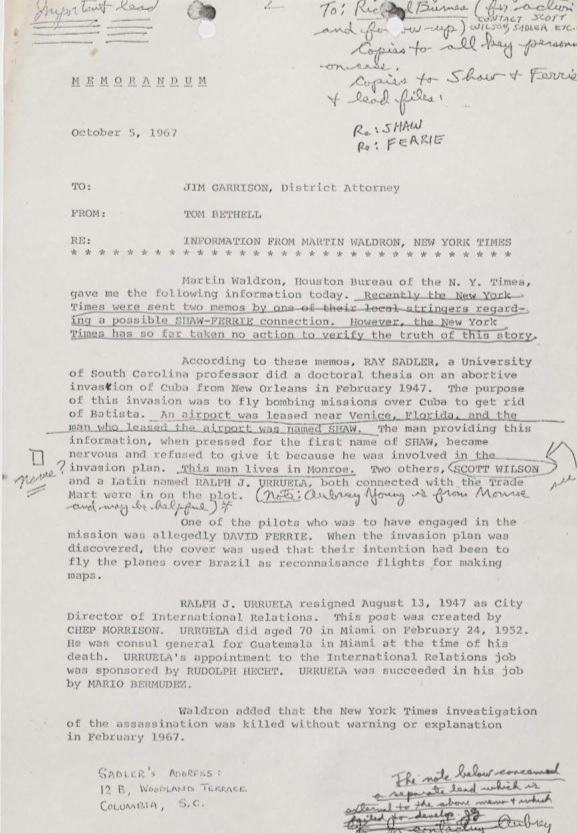
    In May of 1967, Aynesworth wrote an article for Newsweek on the Clay Shaw case. The article was simply a cheap smear. It said that whatever plot there was out of New Orleans, it was made up by Garrison; that the DA’s staff had threatened to murder a witness; and the DA was running the equivalent of a reign of terror over the city which had the citizenry in fear. But, before the libelous story ran, the reporter sent a copy to both the White House and the FBI. In an accompanying telegram, he wrote that Garrison’s plan was to make it seem that the FBI and CIA are involved in the JFK “plot”. He again requested his name be withheld. This secrecy is what he relied upon to make it seem he was independent and not in bed with the feds. In fact, when Aynesworth helped organize a Kennedy conference in Dallas to compete with the ASK seminars in the early nineties, someone asked him that question: Have you ever cleared a story in advance with the White House or the FBI. Like any common fink, he denied it. The questioner then confronted him with this telegram.

    But it was not just the FBI and the White House from whom he sought protection. British researcher Malcolm Blunt has discovered a CIA document in which the Agency revealed that Aynesworth was interested in Agency employment from back in the early sixties. (Memo of January 25, 1968). And in fact, he appears to have gone to Cuba, not once, but twice, in 1962 and 1963. Robert Morrow confronted him with this and the reporter’s answer was a clever piece of evasion. (Click here for the exchange)

    James Feldman commented on this meeting, saying that Hugh never directly replied to the question of was he a CIA media asset. He only said that he did not take money from a government agency. But as Feldman added, agencies often distribute funds through business intermediaries or other types of fronts. Feldman concluded that “his failure to answer the question in a forthright, honest manner merely supports those who assert that Aynesworth has been a CIA media asset.”

    About the last there can be little, if any, doubt. For in his attempt to directly obstruct Garrison’s legal proceedings against Clay Shaw, the reporter actually did what he (falsely) accused Garrison of doing: he attempted to bribe a witness. As many know, Shaw, Oswald and David Ferrie had gone to the Clinton/Jackson area–about 120 miles northeast of New Orleans– in the early autumn of 1963. Many witnesses saw the trio, with Oswald in a voter registration line and Shaw and Ferrie sitting in a Cadillac (Garrison actually had a picture of the car, see Joan Mellen, A Farewell to Justice, p. 223).

    Sheriff John Manchester was one of the most important witnesses to this strange but fascinating episode. And Aynesworth understood how important he was. Hugh had essentially moved to New Orleans by 1967 and was working with Shaw’s lawyers. He had plants inside of Garrison’s office, e.g. William Gurvich. And they had supplied him with memoranda on which Garrison was working. (See Destiny Betrayed, by James DiEugenio, Second Edition, pp.252-54) One of these concerned Manchester’s testimony, in which he identified Shaw as the driver of the car. Aynesworth drove to the Clinton area with it and told Manchester something quite interesting and revelatory about himself and who he was working with in tandem. Hugh told the sheriff that if he failed to show up at Shaw’s trial he could get him a job as a CIA handler in Mexico for 38,000 dollars per year, over $300,000 today. Obviously, if he was not working with the Agency, how could Aynesworth extend such an offer?

    I rather liked Manchester’s incorruptible reply: “I advise you to leave the area. Otherwise I’ll cut you a new asshole.” (ibid, p. 255)

    From threatening the Warren Commission and FBI, to helping create a phony Nixon murder attempt, to allegedly sleeping with Marina Oswald and taking photos of it, to smearing Commission critics as being both gay and commies, to informing for J. Edgar Hoover and lying about it, to interfering with a DA’s investigation and bribing prospective witnesses, Hugh Aynesworth was a piece of human flotsam masquerading as a reporter on the JFK case. That Dallas holds him up as an exemplary journalist shows how deeply in denial that city is about President Kennedy’s assassination and the cover up that followed…

  • Indexing the Garrison Folders

    Indexing the Garrison Folders


    I’ll be the first to admit that I only had a passing knowledge of the scope of New Orleans District Attorney Jim Garrison’s investigation into the JFK assassination through its New Orleans aspect. His book On the Trail of the Assassins was the very first book I owned on the subject. The story of that book is also told in Oliver Stone’s 1991 feature film JFK. The book and film depict the only case of a prosecutor placing on trial a suspect for conspiracy to assassinate President Kennedy.

    As my interest grew in the topic, so did my awareness of the controversy that continued to orbit the legacy of Garrison’s investigation. Some of these included the lack of avenues of inquiry into Carlos Marcello / New Orleans mob, perceived targeting of homosexuals in New Orleans, using sodium pentothal in interrogations, infiltrations to sabotage the investigation to name a few. It was thanks to the works of Joan Mellen (A Farewell to Justice) Jim DiEugenio (Destiny Betrayed, second edition), Bill Davy (Let Justice be Done) and Dick Russell (The Man Who Knew Too Much) that I began to scratch the surface of the intrigue in New Orleans – before and after the JFK assassination. These books served as ways to excavate value and separate the wheat from the chaff. Something that had not been done prior in the critical community.

    In February 2022, I emailed Len Osanic in a reply to a conversation he had on his podcast, Black Op Radio with researcher Paul Bleau. Up until that point I was already aware of the fine work Paul had been putting out around the Fair Play for Cuba Committee. Hearing him refer to how much of his source information came from the folders of Jim Garrison, I reached out to Len to ask for access to them as well.

    Receiving the folders, I was taken aback by the diversity of topics that were contained within them. Multiple folders with titles containing ‘Clay Shaw’, ‘David Ferrie’, ‘Guy Banister’, ‘Lee Oswald’. However, the more I delved into the folders, the more duplications and cross-categorising of documents I found within them. A good example is how records on Clay Shaw’s finances are filed within the ‘Miguel Torres’ folder. This is not a criticism of the original curator of the Garrison folders. In fact, the story goes that these folders (the last remaining of his office’s collection) were only just saved from being destroyed by Garrison DA predecessor and detractor, Harry Connick before being anonymously donated to Len Osanic.

    What will surprise people that acquire the Garrison folders is not only their diversity of topics but how much time they span; from 1947 to 1991. The point being that Garrison amassed a massive catalogue during and after his investigation in the 60’s proving that his interest in the JFK assassination never waned right up until his death in 1992. It was out of honor and respect for Garrison’s admirable devotion to seeking the truth behind the JFK assassination, and the sacrifices he made in doing so, that I remained motivated to complete the gargantuan task of creating a simple name index for them.

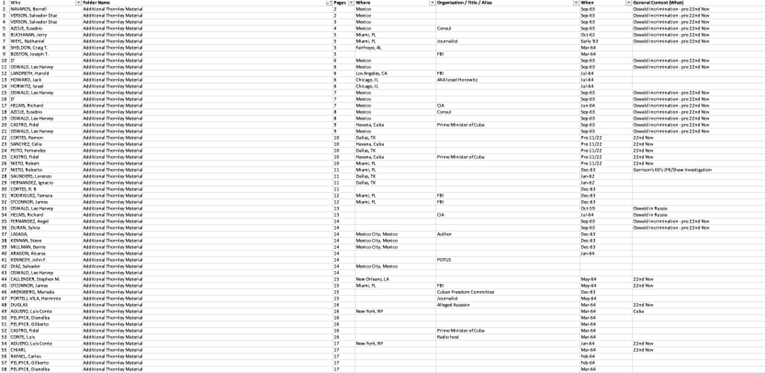
    Having acquired the Garrison folders, in April 2022, I opened up a spreadsheet in Microsoft Excel and started recording names within the first folder ‘Additional Thornley Material’. And like Forrest Gump, I just kept on going by recording names. I soon reached out to Paul Bleau to let him know I was embarking on this and that I would let him know of anything of interest that I found. I asked him to reach back out to me for any facets of the JFK assassination that I might keep an eye out for as I went through the folders as well. At around the same time, about 1,000 lines deep into the index, I emailed Jim Di Eugenio to ensure that I wasn’t reinventing the wheel with anyone else’s work either.

    He advised that Peter Vea had compiled a rough and very general index only. Onward I stepped in my epic task.

    The Garrison Folders consists of 171 folders that include 12,818 scanned PDF pages taking up 2GB of space. This material contains newspaper clippings, Garrison office memos, affidavits, notes and records of interrogations, letters to and from, FBI, DPD, Secret Service, and Warren Commission testimony transcripts. I must stress that I did not read every page word for word – I simply scanned over them to look for names and context. I deliberately did this to stick to my overarching purpose of the exercise. To collect names and list them.

    And it soon occurred to me that I could potentially farm out some folders to others to help with building the index. But considering the numerous instances of duplicate documents that I had already picked up in the folders, I knew that it was really only something I could complete, as I was already able to recall if I’d indexed a document or not. I am sure that this will be one of the positive outcomes for indexing Garrison’s folders – to organize all duplicates out of them to make the information as clear and easy to access as possible.

    To ensure the quality of the index, I set myself some very clear guidelines to complete it.

    • Its primary purpose should be an index of names and their location within the files. Any additional context that I could glean was bonus and should also be listed.
    • Scanning not reading would enable me to build the index over a realistic period of time to ensure that my memory would be fresh for weeding out duplicate documents.
    • Consistency would be key. Naming convention, capturing broad context and time all needed consistency in formatting and categorizing.
    • The exercise of indexing the Garrison Folders was not about trying to find ‘silver bullets’ or ‘skeletons in the closet’ that would solve the JFK assassination once and for all. It would just be a resource to help those much more knowledgeable on the case help to do just that.

    The last point is perhaps the most important for both completing the index, but for also how I intended it to be used. Most reasonable scholars of the JFK assassination will surely appreciate that there was never likely anything confined to paper that points directly to who set up Lee Oswald, killed President Kennedy, why it all happened as well as how it was covered up. If anything like that existed, the passage of time and an overarching apparatus to control the narrative of the case, for the sake of national security etc …would have seen it destroyed long ago.

    But what is true is that most breakthroughs in the case ever since have come from researchers piecing together and corroborating documents and evidence. Depending on how well versed one is in the case, the materials might seem new, or it might not. That is according to one’s own experience and knowledge, everybody’s level of knowledge on the JFK Assassination is their own. This is why I sought to keep the index simple and easy to use. So anyone from new arrivals to the JFK assassination to its most seasoned and expert of scholars could use it and find and corroborate information.

    So, how do those with the Garrison Folders best use the index? There’s a few ways, as intended, to ensure its ease of use for people of all knowledge and interest levels. It is a simple spreadsheet that can have filters easily applied to each of its columns:

    1. Who
    2. Folder Name
    3. Page Number
    4. Where
    5. Organisation/Title/Alias
    6. When
    7. General Context (What)
    8. Context Additional
    9. Context Additional

    abbott1

    If a user is particularly interested in researching a person, filtering out their name in column A will bring their name up along with reference to every other file and context that they appear in within the files. The same applies for all other columns right through until general context where a user may wish to gather all references across the files in relation to a particular facet from say Oswald’s vaccination records, Ferrie’s Library card, the Bilderberg Group to the RFK and MLK assassinations.

    Users general interest in history will be also sated by the Garrison Folders and this corresponding Index as there are many news article clippings that provide a glimpses into the perspective of both mainstream and alternate media sources and publications during the time. And with the passage of time, it is interesting to note how astute some reporting was but also how prescient it would turn out to be when subsequent world history and current affairs is considered.

    Before I embarked on building the index, I had been the beneficiary of the hard work of many scholars and truth seekers. And with thanks to the recent examples of perseverance by Paul Bleau and his invaluable work on the FPCC and Garrison aspects, Bart Kamp for his digitizing of Malcolm Blunt’s extensive records collection as well as the openness of Len Osanic / Black Op Radio and Jim DiEugenio, I felt compelled to do my bit too.

    My hope for the index is two-fold—that scholars of all levels will use it to either validate their research or, better still, uncover missing pieces that prompts new lines of inquiry. I would also like it to be a source of inspiration for others wishing to contribute to the research community. History should never be immune from distillation. It should be examined without preconceived outcomes or agendas. Let how this index was compiled by one person wishing to their part also be an example of this.

    You can download the index file here. (.xlsx file)

  • Orleans Parish Grand Jury | Special Investigation


    DA Harry Connick wanted them destroyed but they were saved by investigator Gary Raymond. See here.

  • Arun Starkey Strikes the first Blow for the Sixtieth

    Arun Starkey Strikes the first Blow for the Sixtieth


    As many of us noted a long time ago, the so called online revolution in journalism did not pan out the way we hoped. And we are being constantly reminded of that fact. The latest example is from an online culture ‘zine from London. Founded in 2010, Far Out is supposed to be a cultural journal: music, films and the arts. It was founded in 2010 by a then student Lee Thomas-Mason, who had been a sports reporter. Their contributing reporter, Arun Starkey, is also London based and according to his billing, he tries “to find the political angle in music or cinema whenever possible.”

    It is not very difficult to find a political angle with Oliver Stone’s 2021 documentary JFK Revisited. That film is generally about three things:

    1. John F. Kennedy’s foreign policy ideas and how they differed from those who came before him.
    2. The truly atrocious performance by the Warren Commission in investigating the murky circumstances of his assassination.
    3. The disastrous results of Kennedy’s assassination in both Africa, and Indochina.

    There are other areas one could note, like Kennedy’s showdowns with southern racist governors in Mississippi and Alabama. But for any objective writer looking for a “political angle” in the film, this was it. Those themes are presented with plentiful evidence both in the film and in the book accompanying the documentary, JFK Revisited: Through the Looking Glass. Evidently reporter Arun Starkey never bothered to read the book, which contains over 500 footnotes to the statements in the documentary.

    On March 4th he penned an article that, to this writer, looks forward to the upcoming 60th anniversary of JFK’s murder. Why do I say that? Because his ostensible subject, Oliver Stone’s film JFK Revisited, was released in 2021. We are much closer to the 60th anniversary than the release date of the film. And the documentary played in England on the Sky Network.

    Arun begins his piece by saying Oliver Stone has a way of dividing people due to conspiracy theories. He quite naturally mentions the 1991 film JFK, which Stone directed. Are we to really understand that Starkey does not know why JFK was divisive? It is because the entire Establishment jumped on board the Warren Report before it was even published. He then jumps to the 2021 documentary and mentions that Stone stated in that documentary that he was trying to find out what happened on November 22, 1963. What he leaves out is that the film shows how the media swallowed the Warren Report in advance.

    At this point, Starkey performs a neat sleight of hand trick. One would think any fair minded reporter would now go through some of the new evidence Stone presented in the 2021 documentary. For instance, on the Kennedy autopsy, or the ballistics evidence, or Oswald’s activities in New Orleans in the summer of 1963. And how this contradicted or was ignored by the Warren Commission.

    Starkey does not mention one single evidentiary point from the film. This is incredible, because that is what the film is about. It is clearly focused on the creation and the discoveries of the Assassination Records Review Board (ARRB). That body worked from 1994-98 declassifying a new database of information about the circumstances of a high-level plot which took Kennedy’s life and how several foreign policy reversals followed.

    Incredibly, Starkey never once mentions the ARRB: what it was, who was on it, or what it did. That is quite a negative achievement since the film features three prominent members of that body: Chairman John Tunheim, his deputy Tom Samoluk and Military Records analyst Doug Horne. Can one imagine covering a baseball game and never describing the pitching, hitting, scoring or who won the game?

    Like many who wish to avoid the matter of who killed President Kennedy and why, Starkey now leaps to a conclusion. And, while leaping, he jumps into the arms of the Rolling Stone’s Tim Weiner. Weiner wrote his non-review of the documentary back in November of 2021. So again, this is old news. But Starkey wants to deflect the contents of the documentary and onto why Stone wanted to film Jim Garrison’s book On the Trail of the Assassins back in 1991. This is so off kilter that its almost ludicrous. Why? Because JFK Revisited has next to nothing to do with Jim Garrison. There might be five minutes in the film about that aspect of the Kennedy case. So what is Starkey’s end game?

    He wants to play the same violin solo that Weiner did. But before he does that musical concerto, he admits that what Weiner wrote “has holes”. He has to admit that since both Oliver Stone and myself replied in no uncertain terms to Weiner’s piece of junk review. What Weiner tried to say is that somehow 1.) Oliver Stone fell for a disinformation story out of Moscow about Allen Dulles supporting an overthrow of French president Charles DeGaulle and 2.) Jim Garrison did the same in his indictment of Clay Shaw.

    As Stone and myself both stated, this is double barreled malarkey. On December 2, 2021 Stone posted his reply on his Facebook page. He noted that neither the film, nor its writer, namely me, referred to any such Moscow related sources—specifically the Italian newspaper Paese Sera—for the Dulles/DeGaulle accusations. Stone then listed the sources we did use, like author David Talbot, and The London Observer and the New York Times, among others. This was a grave error for Weiner to make back then. It is even worse for Starkey today because of the publication of the book. Our sources are described in detail on pages 99-100 of the book JFK Revisited: Through the Looking Glass. And we also note there how Weiner fell on his face by claiming we did something that we clearly did not. If Starkey can show how any of those 5 references were Moscow oriented stories or sources, please do. If he cannot then he, like Weiner, has committed a schoolboy howler. Weiner’s article, like Starkey’s, should have been fact checked.

    As Stone further replied, it’s just as ignorant to state that Jim Garrison based his case about the JFK murder on that same Italian newspaper. He based his inquiry on Oswald’s activities in New Orleans that summer, plus the people he discovered Oswald associated with. None of this key information was covered in the Warren Report. Stone’s film discusses this material through authors like John Newman and Jeff Morley. Starkey, like Weiner, does not mention these facts or those two men.

    Garrison had been investigating Clay Shaw since December of 1966! (William Davy, Let Justice be Done, p. 63). And this was because of his relationships with Lee Oswald and Dave Ferrie. Shaw was indicted before any story about him in Paese Sera appeared. I will wait for Starkey to prove that Garrison had a relationship with the reporters working on that story in Italy before that time. I will have a long wait, since none existed. So the idea that Garrison fell for some Russian disinformation to indict Shaw is simply wrong. In fact, in the longest and most widely read interview the DA gave, in Playboy in October of 1967, he never even brought that subject up. (Click here for that interview) Just like he never brought it up at Shaw’s trial.

    Starkey then does something utterly goofy. Relying on Weiner, he writes that Shaw was not a CIA operative. I have to wonder, did Starkey see the documentary? Or did he just blindly crib Weiner? We show the documents in the film that the ARRB declassified on Shaw. Shaw was a longstanding, well paid, contract agent, and he had a covert security clearance. Again, the accompanying book to the film goes into this at more length. But Starkey apparently thought that the referenced facts were irrelevant. (See JFK Revisited, pgs. 64-65; 197-98)

    Mr. Starkey then goes even further with this baloney. Neither he nor Weiner apparently knew that the book publisher who picked up Garrison’s On the Trail of the Assassins, Sheridan Square Press, did so because the managers—Bill Schaap, and especially Ellen Ray— were longtime friends of the DA. Even on these kinds of simple matters, Starkey slips on a couple of more banana peels. There is no cover up of how Oliver Stone got hold of the book. Ellen gave it to him at a film festival in Havana. That was revealed back in 1991. And it had nothing to do with Stone being an assassination freak, because-at the time— he was not. Ellen thought that since he made some political films, one about Vietnam—Platoon—that the subject would interest him.

    Starkey’s conclusion is absurd. Neither JFK nor JFK Revisited are based on Jim Garrison’s “delusions”. Stone hired a staff of researchers for the first film and they contributed new material that is not in Garrison’s book e.g. like all the Vietnam scenes. (See, 1992’s JFK: The Book of the Film.) As stated above, the 2021 film is not based at all on Garrison’s book. I should know since I wrote the script. It is based on the discoveries of the ARRB—which Starkey does not wish to discuss or even mention. If he had done so, he would not have been able to write his penultimate statement: namely that everything dealing with the JFK murder is “so oblique” and “blurred by subjective readings”.

    No they are not Mr. Starkey. Which is why you did not mention things like autopsy photographer John Stringer denying he took the pictures of JFK’s brain, and the denial by FBI agent Bardwell Odum that he ever showed CE 399—the Magic Bullet,— to the two men who found it at Parkland Hospital. There is nothing oblique or subjective about those facts. What is oblique is the inability and unwillingness of an alleged alternative journal to inform the public about them. If Starkey thinks I am kidding, I will gladly debate him about those facts he chose to avoid. I predict in advance that like James Kirchick and Gerald Posner he will not accept this offer.

  • The Garrison Files and Exposing the FPCC, Part 3

    The Garrison Files and Exposing the FPCC, Part 3


    see Part 2

    Jim Garrison was not able to prove to a jury that Clay Shaw was part of a plot in the assassination of JFK. But according to Mark Lane, who polled the jury after the trial, he did convince that jury that there was a conspiracy to kill Kennedy.

    Garrison was up against too many forces from the government, intelligence community and the media. He was overmatched. Two of his top targets died within a day as he was closing in on some of the key perpetrators. David Ferrie, who was thick as thieves with both Oswald and Shaw, mysteriously died, leaving behind two unsigned suicide notes. His Cuban exile, mafia-linked colleague, Eladio Del Valle, was both shot and macheted to death. Garrison saw his offices bugged, his witnesses harassed and intimidated, his subpoenas turned down, and some of his inner circle turned on him. The press and the U.S. justice system gave him a difficult time; he was labelled as crooked, homophobic, ambitious and was harassed to no end before, during and after the trial.

    Garrison was so maliciously slandered by the press, no one would even take the time to look at what was in his files. This included two generations of the critical community. Thanks to Len Osanic, we now have those files in zip drive format. Today there can be little question that Garrison did have something. In fact, he had a lot of things

    The goal of this article is not to rehash this whole line of argumentation. Diligent researchers like Bill Davy, Joan Mellen and Jim DiEugenio have sealed the deal on this aspect through excellent work and eloquent writing. The goal is to show that there is still more to excavate in these files.

    I began reading these files 5 months ago. I am currently creating a lead file for myself. It has over 300 pages in it. I am quite certain that I have missed important clues that would double the size of this file so I hope others will comb through them.

    Sort of as a trial balloon, I have sent some interesting pieces to some of the best in the business. The reactions have been very positive from a savvy group.

    While I am not yet prepared to put a degree of certainty on the following affirmations, let me suggest the following:

    1. Oswald was assigned at least one Cuban escort

    2. David Ferrie admitted his part in the plot to a room-mate

    3. Clay Shaw was not only a well-paid CIA asset, he was likely known by, if not connected to, Allen Dulles

    4. There is an interesting continuum of Oswald babysitters who link Dallas to New Orleans

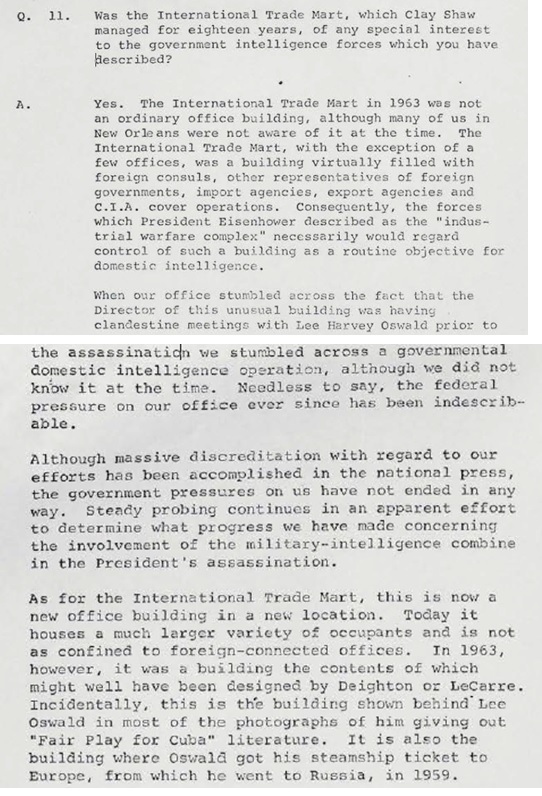
    5. The 1963 ITM is an organization of interest

    6. David Ferrie may have been a provider of young males for Shaw

    7. We can add another potential patsy to a fairly large list of candidates I discuss in my Prior Plots articles.

    8. The list of people who frequented 544 Camp Street is much better documented and incriminating

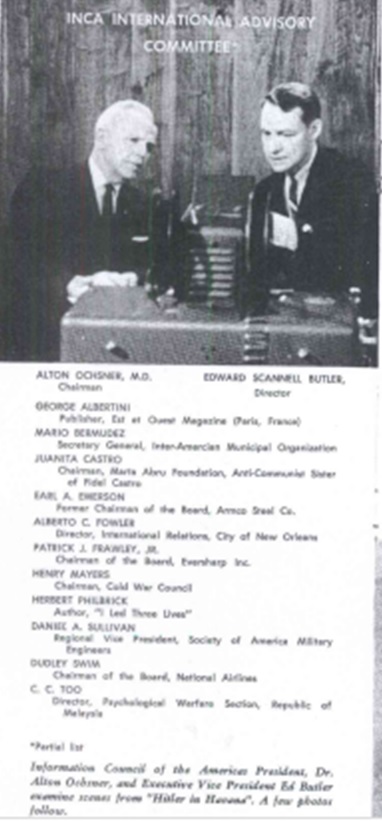
    9. We know more about INCA than ever before

    10. There is stronger evidence of Ruby`s links to New Orleans

    In this first article we will discuss Clay Shaw, the 544 Camp Street Network, and the FPCC front for Oswald.

    Case 1) Further evidence that Clem Bertrand is Clay Shaw

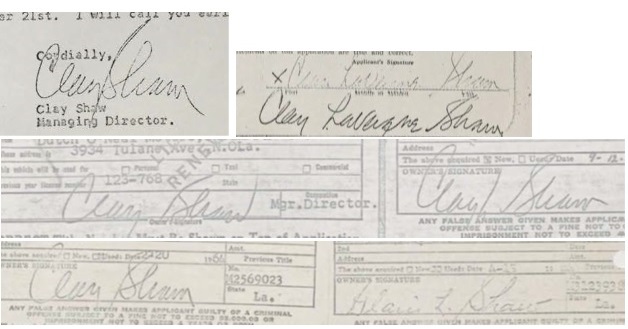
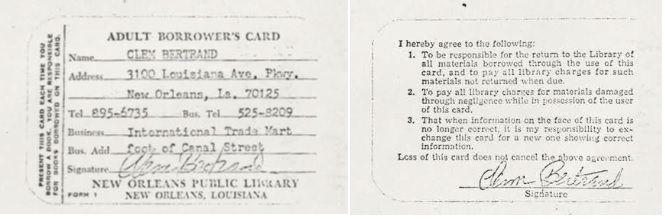
    Many witnesses have confirmed that Clem and Clay Bertrand were Clay Shaw aliases. He used this name in an airport lounge (Materials Clay Shaw 2 Page 20) and in a moment of absent-mindedness gave it away to policeman Aloysius A. Habighorst after he was arrested. (See line ten to the left in Alias box)

    Just for good measure, let us add the following signed statement, which speaks for itself:

    And how about this signed statement by a witness (key passages):

    Add to this Oswald’s lawyer Dean Andrews being backed by Clay Shaw under the alias Clay Bertrand, plus compelling declassified FBI witness testimony. But let’s have fun anyway. Hardly a slam-dunk on its own, the comparison of the Clay Shaw and Clem Bertrand signatures provides more primary data.

    Clay Shaw was involved in real estate and was the director of the International Trade Mart. His signatures can be found in the Garrison files. Here are a few taken from copies of documents he signed:

    We can also find this Library card made out to, and signed twice by, Clem Bertrand of the ITM:

    At first this card was dismissed by the Garrison team because the phone numbers did not match the destinations. However, they decided to reconsider this piece of evidence:

    I wondered what a hand-writing expert might say about these signatures, one who had solid credentials, with no dog in the race, one who might like to weigh in simply to help out with no agenda, nor any fees. Luckily, I was able to find such a person. The following is just a small part of her pedigree:

    Here are the signatures I asked her to compare:

    Here is what she responded:

    “Hello Mr. Bleau, 

    I have reviewed the signatures you sent me. I must first tell you that these signatures are not of good quality. They are copies of copies of copies…. Ideally, I should examine originals or first-generation copies, i.e. made from the original. 

    Despite everything, I can tell you that there are several similarities between these signatures on several levels: 

    • Movement 

    • Tilt 

    • Proportions 

    • Spacing 

    • Continuity 

    • Graphic level 

    This makes it possible to retain the hypothesis (subject to) that they were executed by the same hand. 

    I am surprised to see the use of French names (Lavergne and Bertrand) in the signatures. 

    Sincerely,”                                                                                                

    This opinion concurs with that of the illustrious handwriting expert Elizabeth McCarthy who testified at the Clay Shaw trial: and she did have originals and first generation copies to work from. McCarthy stated that, in over three decades, she had been certified to testify in 28 states and three foreign countries. She worked on as many as two cases per day with about a quarter of them going to court. So the dissenting opinion about this subject is by a dyed in the wool FBI man and J. Edgar Hoover loyalist: Charles Appel. This article is not meant for those who would support the FBI in the Kennedy case.

    Today, it is well-nigh indisputable that Clay Shaw and Clay or Clem Bertrand are the same person and that this high-level intelligence asset was trying to get Dean Andrews to represent Oswald, someone he clearly knew. Why do I say this about Shaw’s intel status? Because Malcolm Blunt has just discovered that in CIA documents, contrary to what many had tried to say about Shaw, his expenses were being paid by the Agency while doing those many overseas reports. This is even more evidence that Shaw lied to the public and under oath at his trial about his association with the CIA.

    In a future article, this author will argue that Shaw, because of his links to the ITM and Permindex, must have been known to Allen Dulles. Thus adding a third Oswald babysitter to Ruth Paine and George DeMorenschildt as Dulles-linked persons of interest. The Old Man had his fingers in many pies.

    The 544 Camp Street network

    After writing a seventy-page, two-part article on Exposing the FPCC, I did not think that I could add very much to expose a charade of Oswald provocateur activity in New Orleans. I was wrong. The Garrison file sources, provided me with even more heavy artillery to fully dismantle this cover, and to shine light on Oswald’s network partners.

    The revelation of the 544 Camp Street address stamped on Oswald’s FPCC flyers caused lone-nutters fits. Because anti-Castro Cuban exiles, rabid right wingers, Guy Banister, David Ferrie and other people who revolved around Oswald during the Summer of 1963 were frequently seen in the same building. These flyers were a major problem which was admitted to by the HSCA. We also know that this address had housed another one of Banister’s anti-Castro partners in the name of the Cuban Revolutionary Council led by Sergio Arcacha Smith; who in late 1961 was part of a quasi-anti-FPCC riot in Tampa which came to be known as the Marti-Park incident.

    From Jim DiEugenio’s article there is not much more that we need to add to show that Oswald was a member of a network playing the role of a provocateur. As Jim DiEugenio points out in this reply to Alecia Long, at least seven witnesses either saw Oswald at 544 Camp Street, or with Guy Banister on the streets in New Orleans. This included three people who worked for Banister, and two INS agents. When one adds in the layer of intrigue placed over this by the ARRB, the logic becomes pretty ineluctable. For the declassified record has shown that the Board proved both the CIA and FBI had ongoing counter-intelligence campaigns against the Fair Play for Cuba Committee (FPCC). Oswald was the only member of the New Orleans contingent. And he stamped Banister’s address on one, or more, of his leaflets that summer. A fact which Banister was quite upset about. (HSCA interview with Delphine Roberts of 7/6/78). And then there was the ITM connection to Oswald’s leafleting activities. Let us quote from Jim DiEugenio’s reply to Alecia Long’s column in the Washington Post.

    Another important aspect of Oswald in New Orleans that Long discounts is Oswald’s leafleting in front of Shaw’s International Trade Mart in mid-August. This also had some interesting telltale points to it. First, [Carlos] Bringuier and his right-hand man Carlos Quiroga said that they went to see Oswald in an attempt to infiltrate his FPCC “group” after the ITM incident. The visit occurred before it happened. And Quiroga arrived with a stack of flyers about a half foot thick. In other words, the DRE appears to have been supplying Oswald with his leaflets in preparation for the incident. Secondly, the reason we have films of the event is that Shaw’s first assistant at the ITM, Jesse Core, had summoned the cameras. (Davy, Let Justice be Done, p. 38) Beyond that, it was this leafleting episode that caused George Higginbotham to alert Banister, and his reply was “One of them is one of mine.” (Oswald had hired two helpers from the unemployment office to aid him.) But there was something else to note. In addition to calling the cameras for the ITM incident, Jesse Core picked up a pamphlet from the prior Canal Street episode, the one which got Oswald arrested. He noted that it had Banister’s address on it. He mailed it from the Trade Mart to the FBI with a message attached: “note the inside back cover.” (John Armstrong, Harvey and Lee, p. 568) This would suggest that both Shaw and Core knew about Oswald’s mistake. How would they know unless they were aware of Banister’s operation? Which recalls the work done for Banister by Bill Wegmann and Guy Johnson. But further, the FBI then knew about Oswald at 544 Camp Street before the assassination.

    Wegmann and Johnson were part of Clay Shaw’s defense team.

    On August 27, 1978, Banister’s secretary Roberts was re-interviewed by HSCA Investigator Robert Buras. She said she

    believes that LEE OSWALD came into the office to be interviewed for a job, but doesn’t remember anything specific, because so many people came in for interviews. At a later date Banister introduced Marina and OSWALD to her in his office, but they walked right out and she did not talk to them. She could not recall hearing Marina speak, or how they were dressed. On several occasions LEE OSWALD would come in and go into Banister’s office and she could not hear any conversation from that room. She believed that OSWALD was either working, or attempting to work, for Banister. She does remember hearing Guy Banister holler at Jim Arthus and Sam Newman about letting OSWALD the second-floor room and about keeping the Fair Play for Cuba Committee literature from his office. Arthus used to come into the office and put leaflets on Banister’s leaflet table as a joke because all the other literature was anti-communist.

    Scott Malone reported: “Delphine is definitely a kook, but I found someone else to corroborate her story. She told Mary Brengel about having seen OSWALD in Banister’s office two weeks after the assassination. She did not mention Marina’s presence.”

    Even more telling, if we are to believe a 1979 Dallas Morning News article from the Garrison files, it is Banister who, according to his secretary and girlfriend Delphine Roberts, helped Oswald settle into his Camp Street locale:

    The list

    Lone-nut backers have used the tired tactic of trying to distance 544 Camp Street from Guy Banister and David Ferrie offices by shielding it with a wall and a floor or two. The other deflection is to insist on the separation in time between Oswald and the previous occupiers: The Cuban Revolutionary Council. As the above section demonstrated, there can be no doubt about Oswald’s links to Banister and Ferrie, and no architectural imagining can elide it. When analyzing the following lists made available in the Garrison files, we will see that the time argument to try and create separation between Oswald and the nest of anti-Castro militants holds no water… Something that both the HSCA and Richard Schweiker of the Church Committee fully understood.

    Their mission touched a hot button in New Orleans:

    This author is still analyzing the list of names that we can closely connect to this address. What he has found so far is quite incriminating.

    Consider the following profiles of some of the crusaders:

    William T. Walshe:

    One of Mr. Walshe’s important credentials was that he was secretary of the New Orleans based Mississippi Valley World Trade Center (MPWTC) which links him closely to its Secretary: None other than Clay Shaw according to the following listing.

    Mississippi Valley World Trade Conference Annual Award 1955

    Name: MISSISSIPPI VALLEY WORLD TRADE COUNCIL

    Type Entity: Non-Profit Corporation

    Status: Not Active (Action by Secretary of State)

    2006 Annual Report/Reinstatement form is required in order to reinstate Print Annual Report/Reinstatement Form for Filing

    Mailing Address: 124 CAMP ST., NEW ORLEANS, LA 70130

    Domicile Address: 124 CAMP ST., NEW ORLEANS, LA 70130

    File Date: 09/05/1956

    Registered Agent (Appointed 9/05/1956): C. C. WALTHER, 3524 GENTILLY BLVD., NEW ORLEANS, LA 70119

    Registered Agent (Appointed 9/05/1956): CLAY SHAW, 505 DAUPHINE ST., NEW ORLEANS, LA 70116

    President: C. C. WALTHER, 3524 GENTILLY BLVD., NEW ORLEANS, LA

    Vice President: WILLIAM T. WALSHE, 1208 WEBSTER ST., NEW ORLEANS, LA

    Secretary: CLAY SHAW, 505 DAUPHINE ST., NEW ORLEANS, LA

    To understand the status of this organization, one simply needs to note the following:

    From January 4th to January 20th, First Deputy Premier Anastas Mikoyan of the Soviet Union visited the U.S. During his stay, Mikoyan met Under Secretary of State Douglas Dillon, Secretary of State John Foster Dulles, and President Eisenhower and was profiled by Allen Dulles head of the CIA. One of the organizations that was debriefed by Dillon was this MPWTCA highlighting further the proximity between Dulles and Shaw. In 1961, President Kennedy, appointed Republican Dillon Treasury Secretary which put him in charge of the Secret Service.

    Walther himself was rather connected, with links to General Cabell: (New Orleans Times-Picayune May 10, 1961 S1-P3)

    CIA Must Keep Quiet — Cabell
    General Cites Strides of Reds in Science

    The Central Intelligence Agency, because of the sensitive nature of its activities, must maintain a policy of silence at all times in regard to its knowledge of the participation in United States affairs, the deputy director of the CIA said in New Orleans Tuesday [9th] night.

    Air Force Gen. C. P. Cabell said that he therefore could not “rise to the defense of the CIA” in regard to its reported connection with the recent Cuban invasion, a connection which has come under repeated fire from many quarters.

    Gen. Cabell arrived in New Orleans late Tuesday to address the International Relations Association of New Orleans, previously called the Foreign Policy Association of New Orleans. At a meeting held at the Sheraton-Charles Hotel, he discussed “Communism and Science.” He left shortly after the meeting to return to Washington.

    Interviewed at International House shortly before his talk, Gen. Cabell refused to comment on the Cuban invasion and the CIA’s role in the affair.

    “This is a sensitive subject, certainly, and one which should be discussed only by President Kennedy and Secretary of State Rusk,” he said. “The Central Intelligence Agency is not a policy making agency; we merely serve the policy makers.”

    Therefore, it would make matters only worse, he continued, if officials of the CIA and other like agencies continued to make comments concerning the Cuban situation.

    “It could very possibly occur that these comments would differ in meaning and suggestion from those made by the only two people who should be commenting on it – the President and the Secretary of State,” he said.

    Discussing the scientific accomplishments of the Communists in his talk before the International Relations Association, Gen. Cabell said that “there is no reason at all to belittle or magnify the accomplishments of scientists living under Communistic regimes, and there is no reason to draw invidious comparisons between our efforts and their efforts.

    “What we must realize is that the accomplishments are real,” he continued, “and that their successes so far have led them to place even more emphasis on scientific research and development in what Khruschev calls ‘the splendid years under Communism.”

    Cabell said that science is the servant of Communism and that, stripped of all its usual verbiage, “Communism is a future social order being constructed out of present-day socialism through the application of science.

    “We must recognize the vast scientific resources of the Soviet Union and the growing strength of China are being integrated with their political ambitions to reconstruct society in the Communist countries and eventually in the entire world.”

    He concluded that “we should stand forewarned that every resource available to being used by the Communists to advance their political ends.”

    The International Relations Association changed its name from the Foreign Policy Association Tuesday night because, according to its president, C. C. Walther, the group is no longer affiliated with its originator, the Foreign Policy Association of New York.

    It has been reported by eminent author Donald Gibson that Clay Shaw was present during Cabell’s speech. (Davy, p. 293)

    Harold K. Marshal and wife Mrs. Naomi Marshal has her own links to Clay Shaw according to excerpts from this 2013 notice written by her son. article in NoLaVie

    My mother, known to our neighbors to the south as “La Mujer del Norte” (the woman from the north), traveled extensively in Latin America on business during those heady days in the 1940s and ’50s, when New Orleans was dubbed “Gateway to the Americas” — long before Miami, Atlanta and Houston opened economic sluices to the south, effectively shutting New Orleans’ wrought-iron-laced gates for years to come.

    On her way to prominence in foreign trade, Mother shattered several glass ceilings, becoming the first woman officer of the New Orleans Board of Trade and a member of the city’s Export Managers Club. She was an avid supporter of the original International Trade Mart, a five-story modernist block of offices and displays of foreign government trade offices, spearheaded by Clay Shaw, its first director, which was demolished to make way for the New Orleans Sheraton hotel.

    Her life was full, including her idea to locate the ITM tower at the foot of Canal Street, rather than in the new Duncan Plaza (City Hall) complex.

    Clay Shaw moderated a panel that featured Gilbert Mellin

    On October 23, 1959 Clay Shaw moderated a panel discussion that included local business leader and CRC backer Gilbert Mellin; a gathering where anti-communist attitudes were in full view.

    Manuel Gil

    Was employed as Production Manager by INCA. Authorized to sign checks for “Cuban Revolutionary Council”, and a charter member of INCA.
    (WC Vol 26, p. 769; CE 3119; CD 87 SS 517 p. 3 DTR 00-381; CD 407, p. 15; Oswald in New Orleans, Weisberg, pp. 343, 345, 356, 362-363)

    INCA was run by Ed Butler who was friendly with Lloyd Cobb and Clay Shaw of the ITM, who in turn cooperated with him in his anti-communist endeavors. Ed Butler also contributed in the sheep-dipping of Oswald into his Warren Commission, pro-Castro persona. Of course, Gil was in close contact with Sergio Arcacha Smith.

    William Monteleone

    Monteleone’s hotel is where Shaw was the moderator for Anti-Communist panel discussion featuring Mellin.

    According to this CIA file, an informant of unknown reliability claimed that Shaw was linked to one of the Monteleone girls in situations of gross immorality with overtones of sexual deviancy. While this admittedly is of little worth in terms of evidence, it is interesting that this even exists in a CIA file. Is this CIA profiling of U.S. citizens even legal? Unless perhaps they were keeping an eye on one of their own.

    According to the manager of the Newman building, a “young Monteleone” ran the CRC (Garrison Files):

    Provosty Dayries

    The second name on the list should cast no doubt about Banister’s strong ties to the CRC (https://www.lib.lsu.edu/sites/default/files/sc/findaid/3320.pdf)

    In 1951 Provosty Arthur Dayries, who was working for the VA at the time, became assistant superintendent of police—a political appointment by New Orleans Mayor deLesseps “Chep” Morrison. This was after the retirement of Milton Durel, and aimed to bring internal crime within the police department to a stop. At the time, many police captains were part of an underground lottery, gambling, prostitution, and drinking network within the city, which was designated as a “vice” or “graft” investigation (the terms are used interchangeably throughout the materials). He was promoted to superintendent in 1954, following an investigation into the former superintendent of police, Joseph Scheuring, and his lack of leadership in working to end the police network.

    Prior to the hiring of Dayries as assistant superintendent, Mayor Morrison hired a former FBI agent from Chicago–though originally from Louisiana–named Guy Banister to handle the internal affairs investigation from within the mayor’s office. When Dayries was promoted to superintendent, he hired Banister to serve as his assistant. The two repeatedly came into conflict. Banister would often speak to the media before statements had been cleared by Dayries or Mayor Morrison. Additionally, Banister would routinely overstep his bounds within the police department regarding his leadership. At one point he attempted to take over Dayries’s job while he was in Florida speaking at a conference, before being reprimanded by the mayor.

    While Banister at one time did claim Dayries was corrupt, they certainly frequented the same personages.

    The Rodriguez clan

    According to this information in the Mary Ferrell files Arnesto Napoleon Rodriguez y Gonzalez worked with ONI in the 1930s. Father of Arnesto, Jr., an FBI informant who was in communication with Lee Oswald in New Orleans during the summer of 1963. AMJUTE-1 is named as Arnesto Napoleon Rodriguez y Gonzalez on a list of cryptonyms. Arnesto’s other son, Emilio Rodriguez was also a CIA asset based in Mexico City, after being a stay behind agent in Cuba.

    Arnesto Napoleon Rodriguez told an investigator for New Orleans District Attorney Jim Garrison that Oswald “came to the Berlitz School of Languages on one occasion and attempted to talk to him about the possibility of taking a language course, and about Cuba in general. He said he told OSWALD he was busy at the time; if he would return at a later date, they could discuss the situation. OSWALD, however, never returned.” He denied having any tapes of Oswald. [CIA 79, 166-78, 113-48, 72; Sciambra to Garrison 2.14.67 interview with ER Sr.] According to Larry Hancock Arnesto, father and son, were both in the court-room when Oswald got arrested for his fight during his leafletting activities, and Emilio was well connected to the JM. Wave crowd.

    Carlos Crimadier (or Grimader on the list)

    He was the auditor for the Crusade. Here is how the HSCA describes him:

    Richard D. Reily

    If the name Richard D. Reily rings a bell, it is because he is a family member of the same family who owned the Reily Coffee Company where Oswald worked for a few weeks during the summer of 1963 in the Crescent City.

    Ronnie Caire

    According to Ronnie Caire’s testimony to the HSCA, the Ronnie Caire advertising agency provided marketing services for the CRC. Caire also interviewed Oswald during the summer of 63 when he applied for work. (https://www.jfk-assassination.net/weberman/nodule11.htm) Caire says he had been approached by Sergio Arcacha Smith and that he knew both Banister and E. Howard Hunt. He stated that the CIA approached him through the CRC because he was politically connected. (https://www.jfk-online.com/jpsasfrd.html) (For more information, click here.) According to Arnesto Rodriguez Senior, Caire was the principal organizer of the Crusade and was very close to Smith. In fact, he said that Caire’s offices served as the HQs for the Crusade. If this is the case, then this places Oswald in offices occupied by the CRC and the Crusade. Hmmm.

    It is interesting to note that Oswald also applied for work at United Fruit (Garrison: Oswald Miscel. Files, Bercham Exhibit 1), and Michoud Assembly Facility (NASA) where Shaw tenant William Kloepfer worked. He also applied in photography for Jules Weiss who was close to Shaw and also Warren Bernados who also knew him. The funny thing is that Bernados and Weiss had been partners but split, yet Oswald put the partnership company on his unemployment job search report, and both claimed he had passed by to apply for work after they split up. (Garrison Files Shaw Leads 2) Was Oswald really looking for work? … or was he simply being fed names he could use for his unemployment insurance claims? He told Dean Andrews that he was being paid $20 a day to hand out FPCC leaflets. In the Garrison files, we can see all the names of the employers where Oswald supposedly applied. It would be interesting to see how many of these tie into the network we are describing.

    Arcacha Smith

    Smith was head of the CRC at this time and figures on this list in a major way. Sergio Arcacha Smith His links to David Ferrie, Guy Banister, Layton Martens, Carlos Quiroga, Carlos Marcello, Carlos Bringuier, Arnesto Rodriguez, Ronnie Caire, Warren DeBrueys of the FBI who monitored the FPCC in New Orleans, and a host of well-connected anti-Castro operatives (many of whom relate directly to Oswald and Clay Shaw) is well documented… So is his theft of fund-raising revenue, and his determination not to cooperate with Jim Garrison.

    Others known to have come into contact with Oswald and Newman Building occupants, include Cuban exiles of interest like Carlos Bringuier of the DRE who, according to his book, had met Bill Stuckey for the first time in August 1962 (Crime Without Punishment, page 101); and Celso Hernandez and Frank Bartes (who replaced Sergio Arcacha Smith in the CRC). These Cuban exiles all had touch points with Oswald. The FPCC and DRE were monitored by David Phillips (CIA) as well as Warren DeBrueys (FBI) and George Joannides (CIA). The CRC was under Howard Hunt’s watchful eye. Bringuier associate Miguel Cruz also came into contact with Oswald and is identified as informant T-2 as mentioned in DeBrueys’ FPCC file. (Blakey letter to Attorney General of U.S., October 16 1978)

    Joan Mellen’s research indicates that after his brawl on Canal Street with Bringuier, Hernandez and Cruz, Oswald, while under arrest, asked to meet DeBrueys. Warren was out of the office and his associate met Oswald for hours. Which sounds like overkill for a small disturbance. The following file (see bottom right) shows that a Ramon Hernandez complaint about Oswald hand-outs also reached the FBI’s top FPCC dog in New Orleans:

    If the picture one gets from this is that Shaw, Ferrie, Banister and Oswald’s multiple connections to this network of anti-Castro Cuban exiles, right-wing extremists and intelligence actors was not coincidental, then you are beginning to see quite clearly. If you are not quite there yet perhaps the story of one of the last well-connected Cubans to appear on this list will seal the deal. His name is Carlos Quiroga, co-chair of the youth wing of the Crusade to Free Cuba, second in command at the CRC, well-connected to Smith, Bringuier, Bartes, Ferrie, Banister… and Oswald.

    His testimony to Garrison was polygraphed… His lies were plentiful, blistering and confirmed by another polygraphed witness. Quiroga deserves a section of his own.

    Carlos Quiroga

    Oswald`s landlady Jesse Garner saw Quiroga meet Oswald at his apartment. Quiroga claimed that he was trying to infiltrate the FPCC. This could have been done by filling out one of the flyers that Oswald was distributing. According to Jesse Garner in her Warren Commission testimony, Quiroga seems to have brought way more than one application: Note how both lawyer Wesley Liebeler and Jim Garrison underscore the quantity of flyers Quiroga brought with him:

    Another false claim made by Quiroga was that this had been the only time that he had met Oswald.

    The following lie detector test results reveal that: Quiroga met Oswald a number of times. He also knew that Oswald`s association with the FPCC was but a front and that Oswald was part of an anti-Castro operation. That he knew that David Ferrie knew Guy Banister and he had seen Oswald with at least one other Latino subject.

    The exchange below between Quiroga and Jim Garrison, provides corroboration to the damning test results, in that two witnesses–one who had also been polygraphed–contradicted Quiroga`s statements.

    David Lewis, a roommate of Banister employee Jack Martin, witnessed Quiroga with Oswald a number of times. While his testimony and character have been the subject of numerous attacks, there was no denying that his own polygraph results bolster the proof of deception brought forward by Quiroga’s polygraph. We can also add Ricardo Davis as one other witness who accompanied Quiroga when he was with Oswald on an occasion.

    (http://www.aarclibrary.org/publib/jfk/garr/grandjury/pdf/Quiroga.pdf page 29)

    More list member analysis

    The motive of Latinos to be involved in the Crusade is self-explanatory. The Anglo-Saxon members most likely had business motivations. New Orleans was the gateway for North South trade. The last thing they wanted was a Castro stimulated revolution of Central and South American states that would disrupt markets and supply chains. After discussing with a member of the research community from New Orleans, who briefly perused the list, he concluded that a number of multi-millionaires were represented and wanted Castro out.

    One example is Mrs. R. G. Robinson, who was likely the wife of Robert Gibson Robinson, son of the founder of Robinson Lumber Company (1893). Robert Gibson, was instrumental in the internationalization of this stellar family-run company. (See this link its website,

    Robert Gibson Robinson, his son, upon recognizing the declining supply of export quality Heart Pine, began the company’s first foreign manufacturing facility in Nicaragua in 1942 to supply Pitch Pine to Robinson’s customers around the world.

    After World War II, Jack, Charlie, and Sam, the third generation of Robinsons entered the business, expanded into hardwoods and began operations in Honduras and Brazil.

    Mexico was also an important supplier of product. Just like with United Fruit, a communist take-over in these areas would have been disastrous.

    Consider this about a Stockton B. Jefferson:

    If this is the CPA husband of Mrs. Stockton B. Jefferson from the list, we can link another member of the Crusade who saw Castro as an existential risk. Note the association with Avondale Shipyards. One of the founders of Avondale Shipyards was a newspaper owner and father of Fred Koch, founder of Koch Industries. Harry Koch

    Oswald letter to FPCC

    In one of my articles for Kennedysandking, Oswald’s Last Letter, I presented strong evidence that a letter to the Russian Embassy was a fake designed to paint Oswald in cahoots with Russia for the assassination. A very early researcher has convinced me that at least one of Oswald’s letters to the FPCC was done with close assistance. For this important clue, we need to go back to 1964 and quote directly from Harold Feldman, OSWALD and the FBI.

    After presenting arguments that Oswald was an FBI informant, Harold astutely makes the following points: “If the FBI did not employ Oswald or work with him, then who wrote the letters he addressed to the Fair Play for Cuba Committee in New York? Oswald alone certainly didn’t. Whoever wrote the letters to New York was coherent, commanded a good vocabulary, rarely misspelled a word, and punctuated decently. Oswald himself wrote English that a sixth-grader would blush to acknowledge. Here is a letter he wrote to his mother from Russia on June 28, 1963. I preserve the original spelling and punctuation:

    Dear Mother.

    Received your letter today in which you say you wish to pay me back the money you used last year, that, of course, is not nessicary however you can send me somethings from there every now and than.

    If you decide to send a package please send the following:

    One can Rise shaving cream (one razor (Gillet)

    Pocket novels westerns and scienace fiction — Time or Newsweek magazine

    Chewing Gum and chocolate bars.

    That’s about all. Ha-ha

    I very much miss sometime to read you should try and get me the pocket novel “1984” by Wells.

    I am working at the local Radio plant as a mettal worker. We live only five minutes from there so it is very conveinant.

    Well thats about all for now. I repeat you do not have to send me checks or money!

    Love XX

    Lee
    P.S. Marina sends a big Hello to you also

    Now compare this semi-literate effusion with the following addressed to the Fair Play for Cuba Committee about two years later. (A New York Times report on the letters to FPCC indicates that they were handwritten, so presumably no public stenographer improved their style.)

    Dear Mr. Lee:

    I was glad to receive your advice concerning my try at starting a New Orleans F.P.C.C. chapter.

    I hope you won’t be too disapproving at my innovations but I do think they are necessary for this area.

    As per your advice I have taken a P.O. Box (N.O. 30061).

    Against your advice I have decided to take an office from the very beginning.

    I u c [apparently meaning, as you see] from the circular I had jumped the gun on the charter business but I don’t think it’s too important. You may think the circular is too provocative, but I want it to attract attention even if it’s the attention of the lunatic fringe. I had 2,000 of them run off.

    The major change in tactics you can see from the small membership blanks, in that I will charge $1 a month dues for the new Orleans chapter only and I intend to issue N.O. F.P.C.C. membership cards also.

    This is without recourse to the $5 annual F.P.C.C. membership fee.

    However, you will lose nothing in the long run because I will forward $5 to the national F.P.C.C. for every New Orleans chapter member who remains a dues paying member for 5 months in any year. . . .

    And so on for several more well-integrated paragraphs. He now spells “receive” and “necessary” correctly. He has mastered the apostrophe. His ideas cohere. He tackles words like “innovations,” “provocative,” “recourse,” “disapproving,” “approaching,” and “application” with success, something that would have been clearly beyond the powers of the voluntary exile in Minsk.

    Until the authorship of the letters to the FPCC is settled, I think it reasonable to suppose that Oswald did not compose them, at least not without help. Who, and where, is the invisible scribe? No associate of his New Orleans period has been found, or even hinted at. If Oswald was employed by the FBI to operate in “Castro groups,” as the news report suggests, it is also reasonable to suppose that in the letters to FPCC his pen was guided by the FBI.”

    In the following you will see that the actual hand-written version indicates a few differences with the above typed version (example its vs it`s). In my view the analysis by Mr. Feldman remains valid and astute given what he had to work with. He is correct in saying that this letter is so much better in grammar, word selection and style than other Oswald correspondence.

    The FPCC in 1963

    In my first prior plots article, I based my research on author Van Gosse’s work to estimate maximum FPCC membership to be between 5 and 7 thousand in 1961 and argued that such a low number made it impossible for persons of interest like Richard Case Nagell, Oswald, Policarpo Lopez, Vaughn Marlowe, Harry Dean, John Glenn, Santiago Garriga–who were potential patsies to varying degrees–to all be coincidently linked to the FPCC; especially for those in the Deep South where the FPCC had much less activity. Based on recent data that I have obtained, the odds are astronomically worse than what I first thought.

    According to Malcolm Blunt, Vincent T. Lee, who was the last head of the organization, stated that the number of members had plummeted to about 1500 by mid-1963, finances were very poor and that the other FPCC officers were no longer even answering to him. Even the Treasury Department noted that the FPCC was almost inactive. Furthermore, members in the Deep South tended to be disproportionately African American, and the FPCC was riddled with informants.

    In other words, the statistical probability of seeing a white person in the Deep South genuinely involved with such a vegetative outfit was rather small… seeing seven of the subjects profiled… well, no comment.

    Framing Oswald

    Two persons both Garrison and Blunt included in their files are the Buchanan brothers, Jerry and Jim Buchanan. They appear to be part of the large number of frame-up artists (FBI Report of Joseph Boston). Jerry claimed he had a fight with Oswald in early 1963 while he was distributing FPCC flyers in Miami.

    Here is the capper: Both Jerry and Jim were officers of the International Anti Communist Brigade, where one of the Blame it on Castro Kings, Frank Sturgis, left his alpha male scent.

    Birds of a feather

    In article 2 of its formation documents, the International Trade Mart specifies one of its roles as “the development, promotion and maintenance of trade and commerce between the people of the United States of America and the people of the world, particularly the other American republics.”

    It goes without saying that a communist country like Cuba, that was nationalizing many of its industries, was not in tune with the ITM mission.

    In 1968, its president, the CIA connected Lloyd Cobb, went even further by stating: “the aims of the new International Trade Mart would be: to act as a catalyst to develop trade and not be just a display area for foreign goods; to encourage and stimulate U.S. investors into joint enterprises with Latin Americans; to counter Communist propaganda…” (The Story of the International Trade Mart, page 15).

    Since the assassination, the ITM has gone through a merger and a multitude of changes, moves and expansion– making it an entirely different post-Cold War entity today. It is safe to say that during the Red Scare and Missile Crisis, New Orleans and its captains of industry where a tight-knit bunch who worked in synch with one another to target communist threats. The omni-present intelligence network was a partner in this economic and national security danger. This is why Oswald set up an office in the heart of one of the major anti-communist blocs in North America at the time and played a provocateur role using the brain-dead FPCC as a front: to work with a network in rooting out communists. A network which included Guy Banister, Cuban exiles, David Ferrie, INCA, WSDU, the CRC, The Friends of Democratic Cuba, The DRE, the Anti-Communist League of the Caribbean, intelligence actors and Clay Shaw who was a well-paid CIA contract agent. This is why we have seen so much interaction between persons on the list with Oswald and Shaw. Given the role of the ITM, how could Shaw not be well connected and work in symbiosis with the apparatus countering communism as well as with the New Orleans power elite.

    Just how invested the ITM, or at least some of its governance members were, in controlling the environments capitalists dealt in is not known. The Garrison files do offer some clues which the research community should pour into. Let us look at some of the people who were involved in with the ITM some sixty years ago.

    We can begin with what Garrison himself observed when questioned on May 27, 1969 (Garrison Files: Crusade to Free Cuba, file 2, page 38)

    Article 4 of the ITM foundation papers lists the original board directors in 1945. While a 1963 list would be worth analyzing, this one is already very revealing, especially when comparing with INCA members and operatives:

    And this list of INCA operatives from an INCA pamphlet:

    We know Shaw was close to Butler and Ocshner of INCA and that Philbrick was Oswald’s idol. Garrison was obviously intrigued by certain names such as Eustis Reily on the INCA list. This author finds the Stern names (WDSU) interesting. Since William Stuckey had a weekly radio program at the station and they allowed Walter Sheridan to work out of their offices while doing his NBC hatchet job on Garrison in 1967.

    Declassified files prove that Lloyd Cobb, Theodore Brent (top dogs at the ITM) and Clay Shaw, who joined later, were intel connected . For instance, Cobb was on a panel of CIA cleared lawyers in New Orleans. (William Davy, Let Justice be Done, p. 182) According to Joan Mellen, Brent’s Mississippi Shipping Company ended up being a CIA proprietary. (Mellen, A Farewell to Justice, p. 131) Oliver Stone’s film, JFK: Destiny Betrayed, proves that Shaw was a highly valued contract agent and had a covert security clearance for the Agency. The last name on the ITM list William G. Zetzmann also figures on a partial list of INCA members almost 20 years later.

    A New Orleans based researcher sent me the following information: “I spoke with Paul Fabry, head of Radio Free Europe and other CIA organizations and later with his secretary, who told me that it was always their understanding that the ITM  was “an agency operation”. The bronze plaque in the lobby of the ITM listed Alton Ochsner, James Coleman and a guy named Wm. Norman (atty and spook).” 

    Now let us see what we can peace together in terms of ITM occupants, employees and visitors.

    According to the Story of the ITM: A list of first tenants included David Kattan, Otis McAllister Co., Hemisphere Trading Co. (of which Alonzo G. Ensenat was Manager), United China & Glass Co., W. R. Grace & Co , S. Jackson & Son, Inc., Dictaphone Corp., Lily-Tulip Co., and Lucky Tiger Co.

    It would be helpful if researchers could profile these occupants of the ITM and others who were there in and around the time of the assassination. For instance, J. Peter Grace presided over W.R. Grace & Company as of 1945 for many decades. He is profiled this way by Source-watch: The name J. Peter Grace (1913-1995) “is found in the Council for National Policy (CNP) Membership Directory for 1984-85 and 1988. Grace holds a Bachelor of Arts degree from Yale University (1936). Grace “started in 1936 as Assistant Secretary at W. R. Grace, in 1945 became President and CEO. Grace is a member of the Newcomen Society, Council on Foreign Relations (CFR), Knights of Malta: American Chapter of the Board of Founders, Knights of Malta President, 114 Avenue of the Americas [Who’s Who in America (1976-77, 1992-93)]. Grace was involved in Project Paperclip — a post-World War II CIA arrangement to remove classified information from dossiers so that former SS members and 900+ Nazi scientists could emigrate to the U. S. Hundreds of war criminals would find employment within government agencies and companies such as W.R. Grace chemical company whose president was J. Peter Grace.”

    Alonzo Ensenat certainly has strong ties to Clay Shaw. He was president of Hemisphere Trading Co. in New Orleans until founding Ensenat & Co., an import-export firm, in 1947. He was president of the company until retiring in 1980.

    Mr. Ensenat was a member of the committee that organized International House in New Orleans in 1943 and was on its first board of directors. This is where Shaw went to work on his return from World War II. The chain of International Houses was started by the Rockefellers and spread worldwide as part of their globalist, one world vision. The chairman of the Board of Trustees was John McCloy, a frequent Rockefeller lawyer. (James DiEugenio, Destiny Betrayed, second edition, p. 383) In 1945, Ensenat was an organizer of the International Trade Mart and was one of its first tenants when the building opened at 2 Canal St. in 1963. International House and the International Trade Mart later merged to form the World Trade Center of New Orleans. In 1946, Mr. Ensenat was an organizer of the Foreign Trade Zone, a duty-free zone that helped increase traffic through the Port of New Orleans after World War II.

    Ensenat was on the executive committee of the Mississippi Valley World Trade Council (Secretary, Clay Shaw), which sponsored annual conferences in New Orleans to promote American exports in the 1950s and ’60s. He was president and general chairman of the conference in 1960 when it received the U.S. Department of Commerce’s “E” Award for excellence in promoting exports. He also was a charter member and past president of the World Trade Club of New Orleans. As opposed to this globalist goal, as Professor Donald Gibson has shown, Kennedy was a nationalist, both for the United States and largely in the Third World. This was a distinct break in policy between him and Dwight Eisenhower. (See DiEugenio, Chapter 2)

    But beyond the uplinks to the Eastern Establishment, the ITM and Shaw had downlinks into the Crescent City. Aura Lee was a former secretary to Shaw at the ITM. After watching a press conference by Shaw where he denied knowing David Ferrie, she stated to Dr. Charles Moore, that she had seen Ferrie enter Shaw’s office at the Trade Mart several times. It happened so often the she thought Ferrie had privileged entry into his office. (DiEugenio, p. 209)

    Bill Gaudet had an office in the ITM. According to Harold Weisberg, it was adjacent to two vacant offices. He published the Latin American Reports. Weisberg described him as C.I.A affiliated. (Andrew Sciambra Assistant D.A., interview with Weisberg on 4/14/1969). According to Sciambra, Cuban exiles often reported that Gaudet was CIA or FBI. Gaudet witnessed Oswald talking to Banister. (DiEugenio, p. 112)

    On March 31, 1967, Betty Parrot told Garrison’s assistant DA Andy Sciambra, that Bill Dalzell lived in her home and that he was involved in a group called the Friends of Cuba with Sergio Arcacha Smith, BILL CRAIG, GRADY DURHAM, an individual named LOGAN who was also a member of the C.I.A., BILL KLINE, an attorney, REGIS KENNEDY, a member of the FBI, an individual named HOFFMAN and an individual named EASTERLING.

    She also stated that “this group later moved from their office in the Balter Building and moved into an office in the International Trade Mart and then operated under the name of The Voice of Cuba or The Friends of Democratic Cuba.”

    Layton Martens, listed as second in charge of the CFC after Arcacha Smith, knew David Ferrie through the Civil Air Patrol very well and also knew Clay Shaw but claimed Ferrie did not know Shaw. Here is what he told Garrison’s Assistant D.A. Alvin Oser when questioned on March 12, 1967, when asked: Have you ever been at the International Trade Mart?

    LM: Yes.

    AO: When was that?

    LM: Well, a couple of vacations, a girlfriend’s mother worked there and I used to stop in and see her. I used to tell her hello. I did some soliciting there for funds for the F.R.D. and I went once with CLAY to see the plans for the new building.

    Another ex-Civil Air Patrol cadet under Ferrie, Lawrence Fox, told assistant DA Jim Alcock (April 14, 1967) that he also solicited funds for the Crusade to Free Cuba at the ITM with David Ferrie. He said he was involved with Layton Martens and Arcacha Smith. (Garrison Files Miscellaneous reports 2 page 20)

    In a report (described as relatively accurate but unconfirmed) about CIA leads in New Orleans dated May 24, 1967 to Jim Garrison by Assistant D.A. William Martin, he describes a Dave Baldwin who was hired by Shaw:

    “(DAVE) BALDWIN) formerly of this City and a former newspaper reporter for the New Orleans States Item, was a covert member of the Central

    Intelligence Agency and operated in India during the years of 1950, 1951 and_l952. Subsequent to his service in India Mr. BALDWIN returned to this city and was employed by CLAY SHAW as Public Relations Director for the International Trade Mart from 1952 through 1955…

    …It was told to me that, during his employment at) the Trade Mart, DAVID BALDWIN succeeded in recruiting CLAY SHAW for C.I.A. operations, or, conversely, that CLAY SHAW had already been recruited by the C.I.A. by the time of BALDWIN’s employment, and that his employment of BALDWIN was suggested or sponsored by the C.I.A. During his operations in India. Mr. BALDWIN used as a cover his employment as a correspondent for North American Newspaper Alliance, the Louisville courier Journal, and the New Orleans Item.”

    And there was Jesse Core, who replaced Baldwin. Core became Clay Shaw’s aide-de-camp at ITM. Core happened to pick up a flyer while Oswald was leafleting on Canal Street. He brought it back to the ITM. From there, he mailed it to the FBI office. He noted the part of the flyer which had Guy Banister’s office listed on it. This would suggest that he and Shaw knew this was a problem for Oswald, Banister and the FBI. Further, it was Core who notified WDSU TV about Oswald’s leafleting event outside the ITM. (DiEugenio, p. 161)

    And we have this report that is so information-packed that I will share it intact:

    In other words, at about the time Garrison’s inquiry was being exposed against his will by local reporter Rosemary James, The Times pulled the plug on their own inquiry.. When, in fact, they had leads in their files that backed up the DA. This parallels what Time-Life did through editor Holland McCombs, due to his friendship with Clay Shaw. (Click here for details https://www.kennedysandking.com/john-f-kennedy-reviews/last-second-in-dallas-part-1)

    Respected researcher David Boylan sent me this provocative piece of information about another interesting occupant: “I’m not sure if you guys have seen this. EAR’s (Emilo A. Rodriguez) statement just before he became a full-time employee. Page 6 is pretty interesting. He worked for the Berlitz School located at the ITM. His brother Arnesto would later run the Berlitz school and attempt to teach Oswald Spanish.”

    https://www.maryferrell.org/showDoc.html?docId=181877#relPageId=1.

    “The signature is still redacted but I’m sure it was signed by David Morales. Morales had been working with EAR and Sforza in Cuba and exfiltrated them both in June 1961.Szorza would get an office but Morales wanted to keep EAR away so that EAR could continue his deep cover work.”

    Summary

    In parts 1 and 2 of this series, it was demonstrated that when Oswald started an FPCC chapter in New Orleans, he did so to infiltrate it as an informant.  

    In part 3 of this series of articles we have not only sealed the deal on proving that Oswald’s FPCC activities were simply a role he was playing as part of city-wide anti-Castro offensive that had national backing. We also show how Oswald and Clay Shaw’s work environments overlap in terms of contacts, mission and activities.

    It was in the ITM’s DNA of that day to support anti-Castro efforts through propaganda, funding, organizing and networking as covertly as possible. Clay Shaw and Oswald’s intelligence fingerprints go back years before their appearances in New Orleans. Richard Schweiker of the Church Committee famously stated that everywhere you look with Oswald you find the fingerprints of intelligence. Shaw let his spook-slip show a number of times through his reckless socializing and hobnobbing with David Ferrie as well as through his anti-Communist support activities, network links and association with Permindex. Which in those day were not just a patriotic duty: in the New Orleans business community, it was part of people like Clay Shaw’s understood job description.

    There has been a lot of discussion about the close physical proximity of 544 Camp Street to Banister and right-wing activists. Thanks to the Garrison files, we can work on proximities within the networks Oswald and Shaw shared. It is within these associations–which in the mind of their members were noble and deemed essential–that a few key people on a need to know basis exchanged money, orders and words that contributed to the murder of a President who was not in tune with a national mission, and thus considered a national threat. There was also a need to cover up and create distance between network members and Oswald.

    One member of this network that has not been discussed yet was a muscular Latino who was often seen accompanying Oswald, or perhaps an Oswald double. He was considered so suspicious that the whole Garrison team was on the look-out for him. He was never identified. He was seen so often and described in corroborative terms that can leave no doubt that Oswald, the supposed lone-nut drifter, had at least one escort.

    Stay tuned!

  • The Unprecedented Debate over JFK Revisited

    The Unprecedented Debate over JFK Revisited


    It is almost three months since Oliver Stone’s documentary JFK Revisited: Through the Looking Glass was released on the Showtime cable network. The international impact of the film is unprecedented for a documentary on the subject. After its July debut at the Cannes Film Festival, the film made the cover of Paris Match. In Australia, the documentary was featured in three national newspapers as a feature story. The program Today Extra! carried by Channel 9—one of the largest TV networks on that continent—picked up the writer of the documentary, namely me, and drove him to a studio on Sunset Boulevard in Hollywood for an interview. It screened at the Rome Film Festival in both versions, 2 hours and 4 hours—playing within a mile of each other, which again made national news. This screenwriter was also interviewed by Izvestia, one of the largest media groups in Russia. After the Cannes debut, the distribution company Altitude collected the European reviews of the film and the reaction was strongly favorable. Needless to say, Oliver Stone did many media interviews while in Cannes and these got large circulation. One he later did with the RT network’s Michael McCaffrey was widely watched on YouTube, as were the three YouTube trailers made in advance of the film’s American debut. The film is on the long list for the BAFTA award for Best Documentary and will be submitted for the Emmy awards in the same category.

    The amazing thing about this debate and discussion is this: it’s still going on. And this is even before the four-hour version, Destiny Betrayed, has been made available in the USA. Stone enacted a strategy that understood the problem he faced. The MSM in this country has always been predisposed to favor the official story in the JFK case—and the film deals with this topic. So, the celebrated director did an end-run around the MSM. And, with the help of journalist Jeff Morley, it worked. Between Morley and Counterpunch, Glenn Greenwald, Joe Rogan, The People’s Weekly, Russ Baker, Dick Russell and Who What Why, Ed Curtin at Lew Rockwell, Countercurrents, and The Unz Review, Branko Marcetic at Jacobin, and Stone’s personal appearances on shows like Useful Idiots and Breaking Points, the message of the film has reached a potential domestic audience of over twelve million. This is in addition to the foreign exhibition—which is ongoing.

    In fact, two continuing series were caused by the film. Aaron Good’s Destiny Betrayed interview series at Patreon cohosted by Abby Martin (click here) and Russ Baker’s journalistic series at WhoWhatWhy (click here). This successful end-run created enough buzz that it drew author Gerald Posner and leftwing polemicist Noam Chomsky back into the arena. Hardly anyone missed them, but the fact they returned shows that JFK Revisited has had an impact. The MSM attempt to halt that effect has proven unsuccessful. Yet, almost three months later, the attempt is still being made.

    The way the MSM has tried to parry this impact is notable. It’s obvious that writers like Tim Wiener at Rolling Stone do not want to deal with the intellectual architecture of the film. That architecture was formed by the discoveries made possible by the Assassination Records Review Board (ARRB). A fact which Wiener did not even note in his slam at the film. (For my reply, click here)

    Tim never mentions the ARRB, which is quite a feat, because without the Board, JFK Revisited could not have been made. He never mentions points in the evidentiary record that the film delineates as never before in a broadcast format, for example the specious provenance of CE 399 which the FBI lied about; official autopsy photographer John Stringer and his admission that he did not take the pictures of Kennedy’s brain at the National Archives; the long concealed testimony of Dorothy Garner of the Texas School Book Depository where she corroborates Sandy Styles and Victoria Adams in that she never saw Oswald descending from the sixth floor after the assassination. Garner makes this point even more forceful, since she stayed on the fourth floor until supervisor Roy Truly and motorcycle policeman Marron Baker ascended the stairs. All of this is elucidated in the film at length and with precision. How could Tim miss it? Maybe because he had to, since it proves a conspiracy.

    And here lies a curious phenomenon. Tim clearly did not want to do his homework on the subject. Instead, he trotted out, of all people, Max Holland. By now, Holland has been discredited so often that one would think he would be off the table. Gary Aguilar took Holland apart on the very point that Tim borrowed from him to deploy against the film, namely CIA disinformation tales about foreign news stories attacking the Agency (e.g. their role in encouraging the coup plots against President Charles de Gaulle). In fact, in the Holland/Aguilar debate, it became clear Holland was proffering the very dubious testimony of, if you can believe it, Agency official Richard Helms. Helms was actually convicted of perjury on this very topic: that is lying about Agency covert actions. (If the reader thinks I am exaggerating, please click here to see that debate for yourself) Did Weiner not know about this? It was easy enough to locate the debate.

    But in addition to being routed by Aguilar, there was Holland’s pathetic attempt at a documentary on the JFK case. This was 2011’s The Lost Bullet. Here, Holland said that the bullet that struck James Tague on Commerce Street had previously struck a streetlight—and this happened before Abraham Zapruder started filming! In other words, it took place before Kennedy had proceeded down Elm Street into the kill zone, but it’s worse than that. As Pat Speer later revealed, in all probability, the producers of the program knew their nutty thesis about the streetlight was false, since they had had a laboratory do an experiment before the documentary was shown. As Speer noted, “Holland’s theory had thus been shot to pieces, both figuratively and literally, even before the program pushing his theory had aired.” (click here for details)

    In his desperate attempt to critique JFK Revisited, this is the kind of author Tim Wiener utilizes, without telling his readers about it, which brings us to James Kirchik.

    Air Mail is a recently introduced digital magazine. Its chief founder was Graydon Carter. Carter was the longtime editor of Vanity Fair. His 2019 co-founder was Allesandra Stanley, a longtime veteran of Time and The New York Times. They allowed Kirchik to write a review of Stone’s documentary which almost makes one wonder if he saw the film. Kirchik spends most of his time talking about Jim Garrison’s 1969 prosecution of Clay Shaw and Stone’s JFK, the 1991 feature film of Garrison’s book On the Trail of the Assassins. Kirchik does this with all the mildewed and phonily sinister strophes of the likes of James Kirkwood in American Grotesque, a museum piece in the literature on the JFK case.

    When Kirchik does get to what is in the new documentary, who does he use to try and attack it? The Canadian version of Max Holland, namely Fred Litwin. JFK Revisited accurately notes that, with help from the ARRB, 12 witnesses are now revealed to have known that Shaw used the alias of Clay Bertrand. Some of these were turned up by Joan Mellen in her book, A Farewell to Justice. Barbara Bennett was a chanteuse at Pat O’Brien’s. She “had turned on the television and seen Shaw being arrested: ‘There’s Clay Bertrand!’ she shouted out.” Shaw had frequented that nightclub and Bennett was “his sometime party guest.” (p. 121) French Quarter businesswoman Rickey Planche just knew the man as Bertrand. Only when she saw him on TV did she learn his name was Shaw. (ibid) Her testimony would suggest that the knowledge of Shaw as Bertrand was not uncommon.

    It was not. As Garrison notes in his book, a bartender at Cosimo’s said that “Bertrand comes here a lot.” And the man knew that his real name was Clay Shaw. He added, “I think most people know that.” (Garrison, p. 85) Garrison’s investigators then found two more bartenders in the French Quarter who said the same. (ibid) An FBI memorandum of March 2, 1967, states that the Bureau had two sources in February who knew Shaw was Bertrand. Jessie Parker a hostess at the VIP room for Eastern Air Lines, testified that Shaw signed her guest book as Clay Bertrand. Alfred Moran corroborated this instance, but declassified documents show the CIA got to him and talked him out of his story. (William Davy, Let Justice be Done, pp. 178–79) In March of 1967, reporter Larry Schiller told the FBI that he had five sources in New Orleans and San Francisco who indicated Shaw used other names including Bertrand. (Davy, p. 193) Ed Guthman, a former Justice Department official, also knew about Shaw’s alias. (ibid) In fact, the Justice Department had told the New York Times that such was the case. (Davy, p. 191) Reporter Richard Billings, who was interviewing Garrison in 1967, noted in his journal that evidence that Shaw was Bertrand was popping up everywhere. (Davy, p. 302) Dr. Jacob Hety knew a gay man named Greg Donnelly. Donnelly had known Shaw for many years and he had referred to him as Clay Bertrand. (Probe, Vol. 7, No. 2, p. 21) When essayist Ed Tatro was in New Orleans for the Shaw trial, he was told words to the effect that, everyone down here knows Shaw is Bertrand. (James DiEugenio, Destiny Betrayed, Second Edition, p. 387) As the film notes, the icing on the cake as far as this matter goes is that Dean Andrews, who Shaw employed as an attorney, admitted to Harold Weisberg that Shaw was Bertrand. (DiEugenio, p. 388) There are still others I could list, but this makes the point beyond any real question. Clear and simple: Shaw was Bertrand and he lied about it in public and on the witness stand.

    Why did he lie? For the simple matter that he did not want to reply to this question: Why did you call Andrews and ask him to go to Dallas to defend Oswald? By denying the evidence above, Kirchik avoids that point.

    He then recites the discredited line first issued by Dick Helms: Shaw was only a domestic contact source for the CIA, one of thousands of businessmen they interviewed for information from abroad. Then comes this howler: “This was the extent of his involvement with the agency.” JFK Revisited proves this is false and Helms was providing a cover story. Shaw was a highly paid and valued contract agent/source and we produced the document which proves this in the film. It was first unearthed by Mellen in her book Our Man In Haiti. (p. 54) Shaw had a third Agency clearance also. This one was a covert security approval for Project QKENCHANT. (Davy, p. 195). Again, we show this in the film. How could Kirchik have missed it? But the worst one of all is the fact that the ARRB discovered that the CIA had destroyed Shaw’s 201 file. (Click here for the memo)

    And then there is this issue.

    Shaw denied in public and on the stand that he had any association with the Agency. We show a film clip of him saying this in the documentary. Therefore this is more perjury that Kirchik does not wish to admit. From declassified files, we also understand today that Shaw lied about not knowing David Ferrie. (Davy, p. 195). We also know Shaw lied about not knowing Oswald. (See Davy, Chapter 11 and click here) As the late attorney Allard Lowenstein once remarked in relation to the RFK case: In his experience as a lawyer, people with nothing to hide don’t hide things.

    From here, Kirchik pulls a Tim Weiner. He says that the whole idea Garrison had about Shaw and the CIA in the JFK case was part of a Paese Sera story that was printed on March 4, 1967, in that Italian leftist newspaper.

    This is utterly stupid. Garrison was investigating Shaw months before that, in December of 1966. On February 24th, an FBI informant had called Garrison’s office and told them that Shaw was Bertrand. (Davy, p. 120) Shaw was then arrested before the story came out. But beyond that, the FBI itself had been investigating Shaw in December of 1963, since his name had come up in their inquiry into the JFK case due to several parties furnishing them information about him. (Davy, p. 192) Does Kirchik know any of this? What does any of it have to do with Paesa Sera? Zilch.

    The McCarthyite attempt by the CIA to link Kennedy assassination writers and investigators to Communist causes and thereby labeling them dupes of Russian disinformation, that propaganda tactic preceded Max Holland for decades. It first started with Joachim Joesten over his book Oswald: Assassin or Fall Guy back in 1964. Using Gestapo files, they labeled Joesten a member of the German Communist Party. (Click here) This about a man who worked for Newsweek in the forties. As was reported in Time, the Warren Commission—with help from Dick Helms—was out to spike Joesten’s book and one way of doing that was smearing him. (John Kelin, Praise from a Future Generation, pp. 168–71) It is very disappointing to see Kirchik use similar smear tactics today, especially when they are even more groundless now than they were then.

    The article concludes with more meritless attributions Kirchik borrows from Litwin. Jim Garrison never wrote a memo, or said anything in public, about Shaw’s homosexuality. There is not one memo I have ever seen to this effect by him. So what does Kirchik do? He says an August 1968 Confidential magazine article portraying the Kennedy murder as part of a gay plot was written by a Garrison investigator. Kirchik—who does not seem to give a damn about fact checking—has slipped on another banana peel. The author was not a Garrison investigator. He was a friend of Bill Boxley, later exposed as a CIA plant inside the DA’s office. (Davy, pp. 146–47)

    The article ends with another jeremiad against Stone’s 1991 film. In other words, Kirchik has not addressed one evidentiary point in JFK Revisited. His column is a perfect example of what film criticism should not be—bringing one’s own personal prejudices and obsessions to the film; rather than elucidating the film’s structure, themes, and style for the viewer. If one does not know anything or give one iota about the murder of President Kennedy, then one should just admit that and slide by, rather than ensnaring the reader inside the writer’s own pernicious ignorance.

  • The Post and the 30th Anniversary of JFK

    The Post and the 30th Anniversary of JFK


    On Sunday, May 19, 1991, the Washington Post published a feature story by George Lardner in its Outlook section. It was titled “On the Set: Dallas in Wonderland.” Lardner had visited the set of Oliver Stone’s film JFK while it was shooting in Dallas. His lengthy article pretty much gave a blast off to the long, sustained MSM preemptive strike against a film that the public would not see for seven months. This phenomenon was unprecedented in the history of cinema, before or since. And Lardner’s attack was total. He even wrote the following (shocking) sentence about the film’s major thesis: “There was no abrupt change in Vietnam policy after J.F. K.’s death.” (Click here for details)

    On December 22, 2021, Ann Hornaday published a feature story in the Sunday Arts section of the Washington Post. It was titled, “JFK at 30.” The extended subtitle was “Oliver Stone and the lasting impact of America’s most dangerous movie.” Her article was softer in tone than Lardner’s superheated polemic. But as far as the film went, and the state of the JFK case today, there is not much difference in effect.

    Perhaps the worst aspect is when Hornaday makes an attempt to somehow link the film to what happened at the January 6th insurrection. She says that JFK “did not invent alternative facts, deepfakes, or Deep State paranoia. But its form and content surely anticipated them and helped usher in an era when audiences would increasingly accept them as reality.”

    Only someone wishing to ignore rightwing conspiracy movements could write such a statement. In 1991, when JFK was released, Rush Limbaugh’s radio show had been nationally syndicated for three years. A year later, in 1992, Limbaugh would launch a TV version of his show. Recognizing Limbaugh’s success, approximately four years after that, Roger Ailes convinced Rupert Murdoch to launch Fox News Channel. Limbaugh and Fox were used to attack scientific concepts like global warming, to defend Donald Trump after the Unite the Right rally in Charlottesville, and to spread 2020 election fraud allegations. It is this kind of propaganda—furthered by Fox imitators OAN and Newsmax—that led to the insurrection, which was planned and exacerbated—even while it was happening—by the Mercer family backed Parler online service. (Click here for details)

    This false attribution angle is complemented by her comments about Stone’s portrait of President Kennedy, which she says, “has been called the mother of all counterfactuals.” Why? Because Stone thinks that Kennedy would have stopped the war in Vietnam, aggressively pursued civil rights, and curtailed the Cold War. If Kennedy pulling out of Vietnam is “counterfactual” one has to wonder why the following illustrious scholars also support that thesis: Gordon Goldstein, Howard Jones, David Kaiser, James Blight, and David Welch. And why did a man she uses to denigrate Stone, Tim Weiner, write this headline in the New York Times on December 23, 1997: “Kennedy had a Plan for Early Exit in Vietnam.” The reason Tim wrote that article was because the Assassination Records Review Board had just declassified scores of pages of documents from the May 1963 SecDef meeting in Hawaii. At that meeting, Defense Secretary Robert McNamara was collecting Vietnam withdrawal schedules from the Pentagon, CIA, and State Department. Schedules he had requested months earlier.

    As per Kennedy and civil rights, again, this is not at all counterfactual. President Kennedy did more for civil rights in three years than Franklin Roosevelt, Harry Truman, and Dwight Eisenhower did in three decades. This is simply a matter of historical record. It is also historical record that, after the tearing down of Jim Crow in the south, President Johnson altered Kennedy’s plans for the second stage of his program—with deleterious effect. (Click here for details)

    Finally, Kennedy was trying for a détente with the USSR and a rapprochement with Fidel Castro at the time of his death. For the latter, Hornaday could have made reference to the people involved, like William Attwood and Jean Daniel. (Peter Kornbluh, Cigar Aficionado, September/October 1999) As per the USSR, she could have consulted another negative critic she uses, namely Tim Naftali. In Naftali’s book, One Hell of Gamble, he revealed a secret communication that was sent to the Kremlin through Kennedy family friend William Walton. That letter originated a week after the assassination with Robert Kennedy and Jackie Kennedy. It said that they did not buy the MSM story about Oswald alone killing JFK. They suspected a large rightwing domestic plot, but they knew that the new president, LBJ, was too close to big business to continue the détente that JFK and Nikita Khrushchev had begun. Therefore, Bobby would resign as Attorney General, gain electoral office, and then run for the presidency and that he would then continue it, which is what RFK did—and Jackie did not want him to do. (Naftali and Aleksandr Fursenko, pp. 345, 402; David Talbot, Brothers, pp. 30–34) She ended up being correct in her prognostication. If this happened as previously outlined, how is it counterfactual?

    About the original release of Stones’ film, she says that Warner Brothers launched a “Free the Files” campaign which shrewdly detracted from a negative press. That campaign began the day the film was first shown. For at the end of the picture, a crawl was attached which said that the files of the House Select Committee on Assassinations (HSCA)—the last official inquiry into JFK’s murder—were classified until the year 2029. The public reaction to that information was electric. Capitol Hill was deluged with phone calls, faxes, and telegrams outraged that this secrecy could still be going on. To give just one example: when the chairman of the HSCA, Congressman Louis Stokes, saw the film with his daughter, she asked him: “Why did you do that Daddy?” Stokes ended up being one of the prime backers for the creation of the Assassination Records Review Board (ARRB). The Board’s function was to do just that—attempt to declassify all of those still secret documents. According to ARRB employee Doug Horne, Stokes met privately with the five person panel and urged them to reinvestigate the medical evidence in the case. Since, according to Stokes, no one on his committee was satisfied with what they had done in that regard.

    This leads us to the subject of the ARRB. Using Naftali as a source, Hornaday says that Donald Trump delayed the ultimate release of the still withheld ARRB files for three years. What happened was this. By law, everything was supposed to be released in October of 2017. President Trump had tweeted about how he was looking forward to doing just that. He was the only person who could delay that release. On the day it was supposed to occur, he did just that—he delayed it for a period of 6 months. When that interval was over, he then added another three years to the extension. One would think 3 1/2 years would be enough to sort through the files. Apparently, it was not, because, in October of 2021, President Biden delayed it for two more months. In December, he only released about 10% of what was still being withheld. The rest was postponed until October of next year. In other words, if all is finally released then, we will have waited almost five years beyond the legislated release date to see what was in these files. And what is the guarantee that Biden will not delay it further at that time?

    Concerning what was in some of the previously released files, she says that Clay Shaw—who Jim Garrison prosecuted for conspiracy in the JFK case—had once worked with the CIA. The implication being that at the time of the assassination or afterwards, he had not. One of the ARRB declassified files revealed that Shaw had a covert security clearance—and it was valid in 1967. (William Davy, Let Justice de Done, p. 195). Through its CIA specialist, the ARRB also learned that the Agency had destroyed Shaw’s 201 file. (ARRB memorandum of November 14, 1996 by Manuel Legaspi) Since the Shaw case figures rather expansively in the 1991 film, and the defendant denied he had worked for the CIA, one would think that this would be relevant information for her article.

    Quoting Tim Weiner, the former New York Times reporter says the thesis of the film is a lie, but yet many people believe it. Hornaday then mentions the whole Weiner/Max Holland mythology about Garrison’s case being initiated by a KGB planted story in an Italian newspaper. Since Garrison arrested Shaw before that story was printed, and was investigating Shaw for about three months prior to its publication—and there was no contact between the two entities prior to publication—the reader should find the logic of all this rather puzzling. (For a detailed explanation of how Holland duped The Daily Beast, click here) And as I have previously noted, for anyone to take Holland seriously after he produced one of the worst documentaries ever on the JFK case is simple MSM fruitiness. Holland’s program was so bad that even Warren Commission zealots decried it. (Click here for details)

    Writing about Stone’s dark 1991 portrait of Lyndon Johnson, and consistent with an emerging pattern, Hornaday now goes to Mark Updegrove. Mark was the Director of the Lyndon Johnson Library and Museum for eight years and is president and CEO of the LBJ Foundation in Austin. Predictably, he says that Stone’s film was,

    …seminal insofar as it legitimized wide-eyed conspiracy theory and set a great precedent in how far we could push film to depict history, or purport to depict history. And that was a dangerous and irresponsible precedent.

    Everything in Stone’s JFK about the Vietnam War, and Johnson’s actions involving it, has proven to be accurate. For example, the scene where Johnson tells the Joint Chiefs, “You just get me elected and I’ll give you your damned war” was taken from the 1983 edition of Stanley Karnow’s book Vietnam: A History (p. 326)

    The most recent scholarly work in the field is even more convincing in this regard. In 1962, Johnson was getting the true data on how poorly the war was proceeding, not the false numbers that showed it was going well. (John Newman, JFK and Vietnam, 2017 edition, p. 223) But in 1961, the vice president had visited Saigon and, in conjunction with the Pentagon, had suggested to President Diem that he request American combat troops to help fight the war. (Newman, pp. 73, 77) This is something Kennedy had not authorized and would never authorize. In Virtual JFK, the authors’ quote a 1964 tape in which Johnson literally says that he disagreed with Kennedy’s policies in Vietnam, especially his decision to withdraw in a losing situation. (Blight, pp. 305–10) A month after this, in March, LBJ authorized the drafting of NSAM 288. This planned a great militarization of the war, including a full scale air war against Hanoi. It meant that “the administration has rejected all thought of a graceful withdrawal.” (Fredrik Logevall, Choosing War, p. 129) What was left to enact NSAM 288 was a declaration of war. The Johnson administration was drafting just that—three months before congress passed the Tonkin Gulf resolution in August. (Edwin Moise, Tonkin Gulf and the Escalation of the Vietnam War, pp. 26–27) As noted above by Blight, not only did Johnson know he was breaking with Kennedy’s policy, but he also took pains to conceal it. Again, Stone’s portrait of Johnson in relation to Vietnam was accurate. And has been both proven and bolstered by later document releases and research.

    She also says that somehow the conspiratorial framework of the film, that is a plot between the CIA and Joint Chiefs, has been debunked. She does not say where or by who, but to name some prominent people in the critical community who subscribe to, or had subscribed to, this general concept: attorney Stanley Marks, attorney Vincent Salandria, author Doug Horne, author Jacob Hornberger, Professor John Newman, and myself. In the long version of JFK Revisited: Destiny Betrayed, Stone backs this up with more evidence. She also says that JFK Revisited does not prove that Allen Dulles was a part of the plot. One of the featured speakers in the film, David Talbot, does make that case in his book The Devil’s Chessboard. All she had to do was call him as she did Tim Wiener or Mark Updegrove. Evidently, she didn’t.

    She never called the screenwriter of JFK Revisited either, even though I left her an email and asked her to do just that. If she had done so she could not have written that the documentary includes what Stone “insists” is new evidence. Since I was involved in researching the script, arranging the interviews and posing the questions, I could have told her just what was new, how it was new, and what it meant to the calculus of the case (e.g. in dealing with CE 399, the testimony of Commission witness Victoria Adams, and the ARRB sworn deposition of autopsy photographer John Stringer). Respectively, it means that there is no chain of custody for the magic bullet and the FBI lied about it; that Dorothy Garner, Adams’ supervisor, supported her testimony, which gave Lee Oswald a formidable alibi for the time of the shooting; and that Stringer did not take the photos of Kennedy’s brain in the National Archives. Which begs the questions: Who did and why? There is no ”insisting” about this. It is all new—made possible by the ARRB.

    In 1991, George Lardner gave Oliver Stone a slap across the face with his open hand. In 2021, Ann Hornady gave him a backhand wrapped in a velvet glove. After Max Boot and this, it’s pretty clear that, thirty years after Stone’s film, The Washington Post cannot accept the facts—old or new—about what happened to President Kennedy.

  • Why Tim Weiner Never Called Me

    Why Tim Weiner Never Called Me


    On November 22, 2021, Tim Weiner wrote an article about Oliver Stone’s new documentary dealing with the JFK assassination for Rolling Stone. It’s really a hit piece, the literary equivalent of a drive by shooting. And, as we shall see, it’s not about what Weiner says it’s about.

    Weiner begins by saying that JFK Revisited: Through the Looking Glass is “rooted in a big lie.” What is that lie? According to Weiner, the lie is that Kennedy was murdered by the Deep State (i.e. the CIA backed by the military-industrial complex). From here, one would think that Weiner would now confront the evidence in the film and, point by point, counter it and thus reduce Oliver Stone to, in his words, “a tinfoil-hatted fabricator.”

    He does not do that. Not even close. Like a cardsharp, Weiner skips that step and jumps to this accusation: if anyone thinks the CIA killed Kennedy, you are being deluded by a Soviet era disinformation campaign. Unfortunately, I’m not kidding. But before Weiner begins playing his Russian aria, he first does a prelude. He says this about JFK’s assassination:

    Either Lee Harvey Oswald, trained by the United States Marines as a sharpshooter before he defected to the Soviet Union, got off a million-to-one shot in Dallas. He acted alone. Or he was an instrument of a conspiracy so immense that it staggers the mind.

    Right out of the gate Weiner sets up a game of false alternatives, because JFK Revisited shows Oswald’s “million-to-one shot” did not happen. The film takes pains to demonstrate that the Warren Commission’s Magic Bullet, labeled CE 399, was not fired in Dealey Plaza that day. JFK Revisited proves this on more than one basis. The film also proves that the FBI and the Warren Commission lied about the provenance of CE 399. It does this with evidence made possible by the Assassination Records Review Board (ARRB), but Weiner does not want the reader to know this since it knocks out one of his false alternatives. If he admitted this evidence, then one would be left with, well, a conspiracy.

    This phony prelude leads to Weiner’s main theme. It’s not an easy job to soften and make acceptable the life and career of CIA Director Allen Dulles. One would think that, after all we know about Dulles today, no one would try, but Weiner has to, in order to sketch in his other false alternative. Namely that Stone says that Dulles was the “presiding genius of the plot against the president.” (The film doesn’t really say that, but accuracy is not what Weiner is after.)

    So now Tim pulls out his make-up kit for Dulles. He writes that the CIA Director did not back the plots to overthrow Charles de Gaulle of France, which is a startling statement. For many interested observers, one of the best books on the career of Allen Dulles is The Devil’s Chessboard. Author David Talbot uses a variety of sources to show that Weiner is wrong. For example, the newspaper Paris-Jour centered on Dulles as the main culprit in the attempted overthrow of April 1961. Later, bestselling French author Vincent Jauvert traced the sources of these stories in the French press to de Gaulle’s own foreign ministry. (Talbot, p. 414) In fact, De Gaulle had come to this conclusion himself. (London Observer, May 2, 1961) Author Andrew Tully also noted columns in Le Monde and l’Express which he wrote were owed to high French officials. (CIA: The Inside Story, pp. 48–49)

    In the USA, The Nation reported that high level French government employees thought the CIA had encouraged the attempted overthrow. And using l’Express, they wrote that one of the dissident French generals had several meetings with CIA agents who advised him that getting rid of de Gaulle would do the free world a great service. (The Nation, May 20, 1961) These stories also appeared in American mainstream newspapers like The Washington Post. (April 30, 1961) Most fatally for Weiner, his former employer The New York Times also printed the story. Scotty Reston wrote that the CIA was indeed “involved in an embarrassing liaison with the anti-Gaullist officers.” (New York Times, April 29, 1961) But further, Talbot goes into the reasons behind the conflict between Dulles and de Gaulle. It was the desire of the French leader to get rid of NATO’s Operation Gladio elements in France and also his intent to set free the French colony of Algeria in North Africa. (Talbot, pp. 416–17) One would think that all this would be enough to satisfy most objective observers.

    In a neat bit of cherry picking, Weiner never mentions any of these sources. He borrows a trick from Max Holland and says that the idea that the CIA backed the attempts by dissident French officers to overthrow de Gaulle was all part of a Russian disinformation campaign that began in Italy. To most informed observers the idea that Scotty Reston would rely on the Italian newspaper Paese Sera is ridiculous on its face.

    But further, for Weiner to use Holland as a source for the John F. Kennedy assassination is inexcusable. Ten years ago, Holland made one of the worst documentaries ever produced on the Kennedy assassination. In fact, as Pat Speer has noted, there were indications that Holland knew his thesis was faulty before the documentary even aired. How bad was it? Even Commission zealots Dale Myers and Todd Vaughan attacked the show. The Lost Bullet was so indefensible that one would think no one would ever treat Holland with any degree of respect again. (Click here for details)

    But this is the JFK case, so normal rules of credit and reference do not apply. Therefore, Weiner trots out Holland once more. And he then doubles down on the man. He says that New Orleans DA Jim Garrison arrested Clay Shaw because of a story that ran in Paesa Sera three days after. (Hmm) He then adds that Garrison bandied this story about as a basis for his prosecution of Shaw and also that it became a central basis for his whole case against the Central Intelligence Agency.

    Again, this derives from Max Holland. Holland has been selling this line for a very long time. He was pretty much eviscerated on it by Gary Aguilar back in 2004. This was during a debate that was broadcast by CSPAN and is still available on the web; therefore Weiner could have easily located it. (Click here for the debate) Aguilar proved that, unlike what Holland and Weiner imply, Garrison did not make the Paesa Sera story a part of his case against Shaw—either in public or at Shaw’s trial. For example, in his 26 page Playboy interview—the longest ever run by the magazine at that time—the DA never brought it up.

    But then Weiner does something that is probably even worse. And it shows his utter disdain for the work of the Assassination Records Review Board. He says that Shaw was not a longtime operative of the CIA. Because of the work of the Board, we now have documentation that proves that the defendant lied about this at his trial. Shaw had three CIA clearances, one of them being a covert security clearance. (William Davy, Let Justice be Done, p. 196) As Joan Mellen discovered, Shaw was also a valuable and well-compensated contract agent. (Mellen, Our Man in Haiti, p. 54) Adding the documentation up, Shaw’s CIA career extended over a period of 23 years. Unlike Tim, most people would think that qualifies as being longtime. In fact, the Board’s CIA specialist also discovered that the CIA had destroyed Shaw’s 201 file. Why? (Click here for details)

    Virtually everything in the above paragraph is displayed in the film. Somehow Weiner either missed it or chose to ignore it, but in JFK Revisited we also feature authors Jefferson Morley and John Newman. Those two discuss what Garrison based his own investigation on at its inception: Oswald’s activities in New Orleans. Specifically, how he interacted with the CIA run anti-Castro Student Revolutionary Directorate (DRE) and the fact he stamped his pro-Castro flyers with the address of the extremely rightwing Guy Banister. We then detail how:

    1.) The FBI covered up Oswald’s association with Banister, (Newman, Oswald and the CIA, p. 310); and

    2.) The CIA lied about their liaison to the House Select Committee on Assassinations having no association with the Oswald case in 1963. The truth was that George Joannides was the CIA handler of the DRE in 1963. (Miami New Times, April 12, 2001, “Revelation 1963”)

    Most people, as Garrison did, would think that this information about Oswald in New Orleans would tell us something about him, probably that he was not really a Marxist. The latest discoveries on this issue were made possible by the ARRB and are in the film.

    In fact, one of the most shocking things about Weiner’s article is this: He cannot bring himself to mention by name the Assassination Records Review Board. Or the fact that JFK Revisited uses their work to an unprecedented degree. This is quite a bit of alchemy since the film interviews three men who worked for that body, and it mentions the Board throughout. In addition, it displays declassified documents which back up many of the declarations in the film. Weiner does not refer to any of these documents or witness statements.

    Toward the end of his screed, Tim writes that he cannot tell us that there wasn’t a conspiracy. He then says that maybe there is a bombshell in the still classified archives. That utterly inane statement demonstrates why Weiner’s article is not criticism; it’s a hatchet job. As demonstrated, Tim does not want to tell the reader what is in the film. The fact that, under oath, the official JFK autopsy photographer told the Board that he did not shoot the pictures of Kennedy’s brain that are in the archives today. John Stringer gave five reasons for his denial. Two of them being that he did not use the type of film with which the extant photographs were taken, and he did not utilize the photographic process evident in those pictures. JFK Revisited has Doug Horne, an ARRB employee who was in the room with Stringer during his sworn testimony, narrate this passage. (Horne, Inside the ARRB, p. 810)

    Just like he does not want to tell his readers about the above, Tim also won’t reveal that the FBI lied about CE 399, the Magic Bullet. They did so in three ways. The film proves that the Bureau lied about its identification by the first two people who handled it. (The Assassinations, edited by James DiEugenio and Lisa Pease, pp. 282–84) It also proves that the Bureau lied about an FBI agent’s initials being on the exhibit. They are not. Third, by their own records, the FBI lab had the Magic Bullet before it was transferred to the agent who delivered it there. This delivery, of course, was by the agent whose initials are not on the bullet. (James DiEugenio, Destiny Betrayed, second edition, p. 345)

    Like the issue of the autopsy photos, the information about CE 399 is proved out in the film. It would be of great interest to anyone watching, since it goes to the heart of the Warren Commission’s case against Oswald. Like everything else above, Weiner does not mention it. In fact, before writing his piece and attributing sources of information in the script to Paese Sera, he never called this writer, which would seem to be a significant trespass of journalistic ethics since I wrote the script. I could have informed him of the actual sources we used for things like the attempted overthrow of de Gaulle or Clay Shaw and the CIA. Those sources had nothing to do with what Weiner attributes them to. When the annotated scripts are published next year, this will be made plain to anyone who reads them.

    So, the question then becomes: Why didn’t Tim Weiner pick up the phone to call Jim DiEugenio? Or shoot an email to Jim to find out what my actual sources were in writing the script? It would have been simple to do either. All he had to do was call Oliver Stone’s office or find me on the web through the Kennedys and King web site.

    Since Weiner neither poses nor replies to that question in his column, it leaves the answer open for speculation. He closes his hatchet job by saying something about “a moral obligation to call bullshit when we see it.” Tim is so wrapped up in his own agenda that he does not recognize his own paroxysm of hypocrisy. When a writer does not present any of the documented material that he calls “bullshit” then yes, one can declare it as such. But that is not journalism; its classic propaganda that does nothing to inform the public. When a film can document what it says with sworn testimony and documents written at the time, that is not “bullshit.” These are unpleasant facts that were kept hidden from the public for decades. And it was only through Oliver Stone’s making of his film JFK in 1991 that they finally began to emerge.

    One last point about Tim’s concluding issue about disbelief in government. One can see through the graph in Kevin Phillip’s book Arrogant Capitol that, unlike what Weiner wants you to think, that erosion of belief is not a recent phenomenon. That graph extends from 1960 to the mid-nineties. The year of the single biggest drop in trust was 1964, when the Warren Report was published.

    Another factor that led to overall cynicism was ten years of war in Vietnam—the most divisive conflict since the Civil War. As JFK Revisited shows, if Kennedy had lived, this would not have happened. The film also shows that President Johnson consciously reversed Kennedy’s withdrawal plan in order to escalate that war. There is no mention of this by Wiener in his article. By that excision, Wiener’s hypocrisy is in full view.  For on December 23, 1997, there was an article in the New York Times about the ARRB declassifying documents from the May 1963 SecDef meeting in Hawaii where Defense Secretary Robert McNamara was collecting Vietnam withdrawal schedules from the Pentagon. The title of the story was “Kennedy Had a Plan for Early Exit in Vietnam.”

    The reporter was Tim Weiner.  What a convenient lapse of memory. Tim Weiner is an object lesson in why the public has lost faith in the MSM.

    Click here for what appears to be Tim’s current Twitter account.