Reader Rich Negrete has made this remarkable film based on the information given the Warren Commission by Victoria Adams, Sandy Styles and Dorothy Garner. These three witnesses provided powerful testimony that Oswald was not on the sixth floor at the time of President Kennedy’s assassination. Rich goes into detail as to how the Warren Commission decided to dodge the clear implications of these witnesses. Because they knew it would counter their pre-conceived conclusions, this evidence was altered, ignored, and even destroyed. He does all this with delicacy, accuracy, and forceful effect.
Although a major source is Barry Ernest’s milestone book The Girl onthe Stairs, in some ways Rich Negrete goes beyond that book. For instance in the information about Dorothy Garner and the professional opinion of Dr. Joseph Dolce, who worked for the Warren Commission. The amount of primary source information placed on the screen is copious and potent. It helps show why and how the Commission did what they did with this episode. For a first time film-making effort The Killing Floor is impressive. I personally hope there are more of these to come. And I thank Rich for letting us place it on our web site.
[Allen Dulles] joked in private that the JFK conspiracy buffs would have had a field day if they had known…he had actually been in Dallas three weeks before the murder…and that one of Mary Bancroft’s childhood friends had turned out to be a landlady for Marina Oswald, the assassin’s Russian born wife.
James Srodes, Allen Dulles, pp. 554–55
In Part One of this review, I noted how director Max Good draws parallels in the escorting of Marina Oswald by a trio of persons who seemed to arrive out of the blue in 1963. One of the circumstances that is notable is that all three—George DeMohrenschildt, Ruth Paine, and Priscilla Johnson—spoke Russian. Again, could this be a strange accident? I, for one, have never met anyone in my life who spoke Russian. Yet, in the space of about ten months, three people entered into the lives of the Oswalds who all happened to speak Russian. And as each one left, another replaced the former, almost as if each was being managed by an off-stage supervisor as to when to take over.
Part of The Assassination and Mrs. Paine centers on the mystery of Naushon Island. Naushon Island is the largest of the Elizabeth Islands in southeastern Massachusetts. It is very much an exclusive area, having been owned by the Forbes—Michael’s family—for a century and a half. Some of the wealthiest and most powerful members of the Eastern Establishment have vacationed there, for example former Secretary of State John Kerry, as did Michael and Ruth Paine. As Barbara LaMonica wrote in Probe magazine, the FBI found out that Michael’s grandmother, Elise Cabot Forbes, took out a $300,000 trust fund for her grandson Michael. (Probe, Vol. 5 No. 5, p. 6) That would translate to about 3 million dollars today. The logical question is: what was someone with that kind of money doing living in a suburb of Dallas/Fort Worth chumming around with an alleged Marxist agitator? And, as noted in Part One, engaging with local college students on the merits of Castroism—and taking Castro’s side while doing so.
As we know, George DeMohrenschildt—aka the Baron—was the route through which Ruth and Michael first met the Oswalds in early 1963. (James Douglass, JFK and the Unspeakable, p. 168) The Baron was intimately involved with the White Russian community in the Dallas/ Fort Worth area. The late Philip Melanson established that this group:
…received financial assistance from the CIA. Most of the White Russians had fled Communist persecution and had been brought to the United States by the Tolstoy Foundation, an anti-communist lobby that received yearly subsidies from the Agency. The Russian Orthodox Church, a centerpiece of the very conservative and religious White Russian Community, also received Agency philanthropy. (Spy Saga, p. 79)
George Bouhe was a prominent member of this expatriate community. Bouhe was Marina’s English tutor. (Probe, Volume 7, No. 3, p. 3) When Jim Garrison told Marina that Bouhe was also a neighbor of Jack Ruby, the man who killed her husband, Marina said she was aware of that. How? Because Bouhe visited her to tell her about it. He said it was just a coincidence that he happened to live next door to her husband’s killer. As researcher Steve Jones noted, was this not a possible connection between Oswald and Ruby? Did the Warren Commission ever explore it? This reviewer has never seen any evidence they did.
II
In Max Good’s film, Ruth Paine tries to imply that she only met George DeMohrenschildt once, in early 1963.
As Steve Jones mentioned in 1998 in Probe magazine, this is not accurate. In her appearance before the New Orleans grand jury, Ruth admitted to Jim Garrison that she and Michael met up with the Baron in 1967. It turns out they were dinner guests of his and they discussed, among other things, a copy of the infamous backyard photo which was recently found amongst the Baron’s belongings after the assassination, upon his return from Haiti. (Probe, Vol. 5 No. 3, p. 9)
As Carol Hewett noted, in May of 1963, Michel Paine returned a record player and some records to Everett Glover, which Marina had borrowed from the Baron. (Probe, Vol. 5 No. 1 pp. 16–17) Glover took the items to George’s storage unit. When the Baron returned from Haiti, they discovered another version of the infamous backyard photographs in that storage unit.
As the late Jim Marrs wrote, there are some notable aspects about this version of the backyard photo; but we will focus on the discovery of the picture. First, as described, it was not unearthed until George returned to Texas from Haiti. (Jim Marrs, Crossfire, p. 287) The Baron’s widow told Marrs that they had never seen the picture before then. She was also convinced the photo was planted, while in storage. Although Everett Glover later had placed the Baron’s things in storage, Ruth Paine also had access to the storage space. (ibid) George later wrote that he only discussed the photo with his closest friends, which apparently included the Paines. (Op. Cit. Probe, p. 17)
But, with the Paines, there is always a capper. Here it is: Michael Paine told Dan Rather in 1993 that he saw one of the infamous backyard photographs in April of 1963! He told CBS that Oswald proudly showed him a photo as he picked him up for a dinner engagement. As Ms. Hewett asked: if this is true, why did Michael never say anything about this to the FBI or the Warren Commission? (Probe, Vol. 5 No. 1, p. 16)
As mentioned in the first part of this review, Sylvia Hyde—Ruth’s sister— refused to talk to Max for his film. Jim Garrison was curious about Sylvia, since he could not find out who she worked for. Garrison questioned Ruth before the New Orleans grand jury about this. To be mild, Ruth is rather unhelpful. Even though she spent over a week with her back in 1963, she cannot figure who she worked for. But what makes it even more puzzling, she cannot even say where she lived! Recall, she had driven down to the central Atlantic coast to visit her and she does not recall where she drove to? (Transcript, 4-18-68, pp 58–62). She ended up insinuating to the DA that Sylvia lived in Virginia, most likely Falls Church. But a listener to Len Osanic’s Black Op Radio program later found out that she lived in Maryland.
An aspect that Sylvia Meagher insinuated about Ruth Paine was her predisposition against Oswald. On more than one occasion, Ruth has said she was taken aback that Oswald would call her about contacting attorney John Abt. If one can comprehend it, she was surprised he was also presuming of his own innocence. As Joseph McBride later pointed out, in an article written by Jessamyn West for Redbook in July, 1964, Ruth went further. She told West she was glad that Ruby killed Oswald. This surprised the author. She gave Ruth a chance to repair the damage and this is what Ruth said: “I thought Lee’s death this way would be so much easier for Marina.” (Warren Commission Vol. 22, p. 856) Recall, Oswald never had an attorney while in custody, the Warren Commission never allowed any legal counsel for him, and their hearings were closed to the public. Ruth Paine, the kindly Quaker lady, somehow thinks that due process and right to counsel can go to Hades in regard to Oswald. And let us not forget, John Kennedy.
III
Max Good has structured his film as a kind of point/counterpoint dialogue between the critics of the Warren Commission and its stalwarts. From the latter side we hear from, in addition to Ruth, Max Holland, and Gerald Posner. I cannot see how anyone can complain about their treatment and/or the balance of the film. To give just one example, Posner says that Oswald’s last two calls were to Ruth about an attorney and about Marina, but that is not really the whole story. Oswald tried to make one other call on Saturday night and the Secret Service would not let it through. It was to a former military intelligence officer named John Hurt in North Carolina. How Oswald ever knew this man, or his phone number, is a mystery worthy of Sherlock Holmes. (Click here for details) It furthers Senator Richard Schweiker’s concept that Oswald had the fingerprints of intelligence all over him.
Ruth gets plenty of speaking time. And the film shows that she is a standard bearer for many Establishment-backed TV specials which support the official story, for example the London trial which featured prosecutor Vincent Bugliosi and defense attorney Gerry Spence. About that one, she says that it was like a regular trial. This reviewer spent a large part of a book showing that such was simply not the case. (See, The JFK Assassination: The Evidence Today, pp. 3–70) She then mentions the Peter Jennings special on ABC in 2003, which she calls one of the best.
Recall, this was the program in which Dale Myers prepared a computer simulation which proclaimed that the Magic Bullet—about which so much controversy has swirled for so long—should not be titled the Single Bullet Theory. That title denotes the facts that one bullet went through two men, causing seven wounds, smashing two bones, and emerging pretty much intact. Dale said this should not be called a theory. With his trusty computer, he renamed it: the Single Bullet Fact. That very questionable computer graphic has been effectively attacked at least five times: by Bob Harris, by Pat Speer, by Milicent Cranor, by Dave Mantik and by John Orr. (For the Harris demonstration, click here and for the Speer version, click here)
Around the same time in the film, Holland tells the audience, well the Warren Commission was not perfect and we should be skeptical. But saying the murder of Kennedy was a coup d’etat, that is just going too far. This from a man who was responsible for one of the very worst documentaries ever assembled on the JFK case. One which was not even supported by some of the backers of the Commission. And according to Speer, Holland likely knew the main thesis was faulty before the show aired. (Click here for details)
Oliver Stone gets mentioned, for instance by former Motion Picture Association of America president Jack Valenti, who violently objected to the film, calling it a “monstrous charade.” Michael Beschloss says that Stone created myths. Since everything Stone presented about the Vietnam War in 1991 turned out to be accurate, those two statements are understandable, for Valenti was in the White House working for LBJ as he implemented the first escalations after Kennedy’s death. In 1997, Beschloss tried to dispute Stone on the Vietnam War in his first book on LBJ called Taking Charge. Unfortunately for him, at the end of that year, the Assassination Records Review Board declassified 800 pages of documents which proved Stone was correct on this issue. (New York Times, 12/23/97, “Kennedy Had a Plan for Early Exit in Vietnam”) And as Stone shows in the film JFK Revisited: Through the Looking Glass, LBJ was fully aware of Kennedy’s exit plan, disagreed with it, and consciously worked to reverse it.
Ruth mentions Stone again and says that celebrated film director never tried to talk to her during the making of the film JFK.
Stone seems to contradict her in the film. And when I asked him about this, he stated he did try and talk to her and later added, “You can take that to the bank.” (Email and phone conversations, 6/6 and 6/8/22)
IV
The film closes with three tantalizing areas of controversy. The first is the so-called “Walker note.” This was allegedly a set of directions left by Oswald for his wife in the wake of his attempted shooting of General Edwin Walker. There is a big problem with this: the shooting happened in April. Oswald was never even considered a suspect until after the Kennedy assassination, over 7 months later. At that point, as if by magic, two things happened.
First, the FBI turned the original bullet, a steel colored 30.06, into a copper coated 6.5 mm projectile. (Gerald McKnight, Breach of Trust, p. 49; DPD General Offense report of 4/10/63) Needless to say, that 30.06 projectile would not be fired with the Oswald Mannlicher-Carcano 6.5 rifle. Secondly, Ruth Paine transported the Walker note to Marina through a book she sent via the Secret Service. This is the note the Secret Service was so suspicious of that they thought she wrote it. (DiEugenio, Destiny Betrayed, second edition, p. 203)
But it’s even worse than that. The best witness in the Walker case that summer was Kirk Coleman. Coleman said he ran out when he heard the shot. He saw two men escaping the scene in their cars. Neither of the men looked like Oswald and, according to the Warren Commission, Oswald could not drive. (McKnight, p. 57) Coleman was never called as a witness by the Commission. That is how important the Walker note was.
As mentioned above, both Ruth Paine and Priscilla Johnson produced evidence that Oswald had been in Mexico City. This was after the official searches of the Paine household. In fact, with Johnson, this went on until September—10 months after the first searches. (Mark Lane, Plausible Denial, pp. 66–67) Even members of the Commission—like Richard Russell—felt this was over the top and it raised more questions than it answered. In fact, there is an internal problem with the “Oswald letter” that Ruth took from her desk secretary. Namely, Oswald likely would not have known that a certain person in the Cuban embassy had been rotated out and replaced by someone else, which is what he wrote about in his alleged letter. (Click here for details) In fact, due to some very good work by David Josephs, among others, many critics do not think Oswald went to Mexico City. (Click here for details)
One last point about the Mexico City letter. Carol Hewett wrote that it was when Ruth Paine decided to move her furniture that Ruth actually took the letter. (Probe, Vol. 4 No. 3, p. 27) Ruth appears to say that in the film also. Chris Newton, due to some insightful observations, raises the most fundamental questions about this story, namely, that the furniture was not really moved. That, in reality, it stayed where it originally was. If Chris is correct about this, at a minimum, what it seems to mean is that Ruth wanted a pretext and landmark to pick up that letter. I cannot begin to describe Newton’s work in a synoptic form. I can only advise the interested reader to please go through this attached thread. (Click here for details)
Finally, the impression left by Ruth about her picking up Marina from New Orleans and taking her to Irving, was that it was more or less made by serendipity. Yet, during her cross country trip, the FBI discovered that she had talked about it well in advance to others she had visited, presenting it like a fait accompli. (Probe, Vol. 3 No. 4, p. 15)
And related to this, in some very interesting work by Tom Gram, it appears that Oswald was getting mail at Ruth’s Irving address in late July of 1963. (Email communication of June 22, 2022) And, in fact, Marina had also signed a transfer document to Ruth’s home in May. Gram writes that Ruth likely encouraged this on the grounds that it would ensure she would not miss anything. (Click here for details)
Max Good has done a creditable job in making this film. He has raised the correct questions and raised them in a fair and adroit way, giving both sides time to mount their arguments. He has done it all in a skillful manner, considering the budget constraints he worked under. He deserves kudos for his difficult travail and the public should extend him the courtesy of watching his film. It is overdue, but still it is the first of its kind. If you were unaware of the questions, you will be surprised. If you were aware, you will be pleased that someone finally placed them in the pictorial public domain.
As our readers know, I just did a two-part review of the very poor CNN four-part special about Lyndon Johnson, largely modeled on the work of Joe Califano. As an honest appraisal of Johnson’s presidency, that program was simply unforgiveable, both in regard to Johnson’s domestic and foreign policy. (Click here for details) Concerning the latter, it actually tried to say that Johnson did not decide to go to war in Indochina until after the Tonkin Gulf Resolution had passed. Since LBJ used that resolution as an act of war, most of us would fail to see the logic in that, but that is how desperate CNN and the production company, Bat Bridge Entertainment, were in trying to salvage Johnson’s reversal of Kennedy’s withdrawal plan and decision to enter a disastrous war in Vietnam. That war plunged America into a ten-year-long struggle that resulted in epic tragedy for both Indochina and the USA.
Mark Updegrove was one of the talking heads on that program, as well as one of its executive producers. Updegrove was the director of the LBJ Library for eight years. He is now the president and CEO of the LBJ Foundation in Austin. He began his career in magazine publishing. He was the publisher of Newsweek and president of Time/Canada. He was that latter magazine’s Los Angeles manager, but he was also VP in sales and operations for Yahoo and VP/ publisher for MTV Magazine. In other words, Updegrove has long been a part of the MSM.
I could not find any evidence that Mark is a credentialed historian. All I could discover is that he had a Bachelor’s Degree in Economics from the University of Maryland. I don’t think it is improper to question whether or not a man should be running a presidential library if he is neither an historian nor an archivist. The writing of history is a much different discipline than being a publisher or running business operations. At its fundamental base, it means the willingness to spend hours upon hours going through declassified documents, supplementing that with field investigation, and also tracing hard to find witnesses. Then, when that travail is over, measuring the value of what one has found.
It is not an easy task to write valuable history, especially of the revisionist type that bucks the MSM, for the simple reason that revisionist history that challenges hallowed paradigms is not a good path to career advancement. The much safer path is what the late Stephen Ambrose did. When a friend of his did discover powerful evidence which demanded a revisionist reconstruction about World War II, Ambrose first befriended him and then—measuring the costs to his career—turned on him. That is the kind of behavior that gets you business lunches with people like Tom Hanks. (James DIEugenio, The JFK Assassination: The Evidence Today, pp. 45–48)
As I reviewed at length and proved with many examples, the aim of the above CNN series was to somehow elevate Johnson’s rather poor performance as president over the space of five years. It was a presidency that was so violent, corrosive, and polarizing that the late Philip Roth wrote a memorable book about its enduring and pernicious impact on the United States. There were many instances that I did not even deal with in my two-part review of that series, for example the overthrow in Brazil and the forcing out of George Papandreou in Greece in 1965. Who can forget Johnson’s rather direct reply to the protestations of the Greek ambassador in the latter case:
Then listen to me Mr. Ambassador: fuck your Parliament and your Constitution. America is the elephant. They may just get whacked by the elephant’s trunk, whacked good…We pay a lot of good American dollars to the Greeks, Mr. Ambassador. If your Prime Minister gives me talk about Democracy, Parliament, and Constitutions, he, his Parliament, and his Constitution may not last very long. (William Blum, The CIA: A Forgotten History, p. 244)
As William Blum shows in his book, Johnson was true to his word.
Because of the above, it is not an easy job to somehow whitewash and then rehabilitate Johnson the man and Johnson the president, especially because LBJ followed President John Kennedy and almost systematically reversed much of his foreign policy, with so many debilitating results. In his film JFK: Destiny Betrayed, Oliver Stone showed those actions in relation to Indochina, Congo, the Middle East, and Indonesia. That film also tried to show how Kennedy was also working on modes of détente with both Cuba and the USSR. These were both abandoned by the new president.
Apparently Updegrove is well aware of how poorly Johnson does in a comparison with Kennedy. He has now written a book about Kennedy. Because of his longtime relations with Time magazine, he got them to do what is essentially a preview/promo for that book. (See Time online April 26, 2022, story by Olivia Waxman.)
To see where Updegrove’s book Incomparable Grace: JFK in the Presidency is coming from, one can simply read the italicized intro to his own summary. Waxman writes that since 1963, there have been “myths and misunderstandings” about JFK and the early “gunning down” of the handsome leader caused some of this “continued fascination.” Waxman then lets Updegrove, who is not an historian, take charge with these words:
History in its most cursory form is a beauty contest and, as we look at John F. Kennedy, he’s a perfect President for the television age, because he shows up so well and speaks so elegantly.
Who needs to read the book? We have seen this infomercial so many times by the MSM that reading the book is superfluous. Kennedy was the glamour president. He was handsome, exquisitely tailored, a good speaker, and witty. This was what made him an icon in history, but he really did not have any notable achievements behind him. It was all glitz. And then Updegrove begins that part of the MSM formula: the belittlement of JFK, the so called myths and misunderstandings that caused the continued fascination with Kennedy the president. Mark chooses three areas to hone in on for his attack.
The Missile Crisis
He begins by saying that the first myth is that “JFK won the Cuban Missile Crisis by staring down the Soviets.” Updegrove then writes that the true cause of the crisis was that the Russians knew they were at a large atomic disadvantage and also that the USA had offensive missiles in Turkey. Therefore, this was not just “recklessness on the part of Nikita Khrushchev,” it “was really more of a calculated risk.” The risk being to get the missiles removed from Turkey. He says the world did not know about the Turkish agreement at the time. I would beg to disagree and you can find my basis for disagreement in the following story from the New York Times in late November of 1962. The agreement about Turkey was out and known in the public at that time. Unlike what Updegrove wants to maintain, most understood what the main terms of the agreement were. But further, to say that was the basis of the agreement is to ignore that the Russians had about ten times as many missiles in Cuba as the USA did in Turkey. (Philip Zelikow and Ernest May, The Kennedy Tapes, p. 60)
I would, however, also disagree with him on two other more important points. First, JFK’s achievement in the Missile Crisis was not a “stare down”. It was avoiding a nuclear conflagration. Anyone who reads the book The Kennedy Tapes will understand that JFK took the least provocative and least risky alternative that was offered him: the blockade. Many others in the meetings recommended bombing the missile silos or an outright invasion of Cuba. Both Kennedys were asking about the former: Would that not create a lot of casualties? (May and Zelikow, p. 66) Kennedy became rather disenchanted with that option.
What Kennedy did was opt for the blockade, which also gave the Kremlin time to think about what they were doing. This neutralized the hawks in both camps. And I should not have to tell Updegrove how angry and upset the Joint Chiefs were with that choice. General Curtis LeMay accused Kennedy of appeasement and compared what he was doing to what Neville Chamberlain did at Munich with the Nazis. (James DiEugenio, Destiny Betrayed, Second Edition, p. 57)
But what is important here in regard to Updegrove is that in reading the transcripts, Johnson was siding with the hawks. At a meeting on October 27, 1962—towards the end of the crisis when Kennedy was trying to corral the confidence of his advisors for an agreement—Johnson was not on board. He said, “My impression is that we’re having to retreat. We’re backing down.” He then said we made Turkey insecure, and also Berlin:
People feel it. They don’t know why they feel it and how. But they feel it. We got a blockade and we’re doing this and that and the Soviet ships are coming through. (May and Zelikow p. 587)
He then said something even more provocative in referring to a U2 plane shot down by Cuba, “The Soviets shot down one plane and the Americans gave up Turkey. Then they shoot down another and the Americans give up Berlin.” (Ibid, p. 592) He then got more belligerent. He said that, in light of this, what Khrushchev was doing was dismantling the foreign policy of the United States for the last 15 years, in order to get the missiles out of Cuba. He topped off that comment by characterizing Kennedy’s attitude toward that dismantlement like this: “We’re glad and we appreciate it and we want to discuss it with you.” (ibid, p. 597) It’s reading things like that which makes us all grateful Kennedy was president at that time.
This is what Kennedy’s achievement really was, not taking this crackpot hawkish advice and instead working toward a peaceful solution that would satisfy everyone. And with this on the table, we can now fully understand Updegrove’s next point.
The Vietnam War
Updegrove says it was a myth that Kennedy would have pulled out of Vietnam. In his article, he ignores the fact that Kennedy had already given the order to begin that withdrawal with NSAM 263. He then pens a real howler: Kennedy did not tell any of his military advisors about his intent to withdraw. I could barely contain myself when I read that, but this is how desperate one gets when trying to argue this point, which has been proven through the Assassination Records Review Board (ARRB) beyond any reasonable doubt.
Most people would consider Robert McNamara a military advisor; after all he was the Secretary of Defense running the Pentagon. Roswell GIlpatric was McNamara’s deputy. In an oral history, he said McNamara told him that Kennedy had given him instructions to start winding down American involvement in Vietnam. (James Blight, Virtual JFK, p. 371) McNamara then conveyed this instruction to General Harkins, another military man, at a conference in Saigon in 1962. McNamara told Harkins to begin to form a plan to turn full responsibility for the conflict over to South Vietnam. (James Douglass, JFK and the Unspeakable, p. 120) In May of 1963, Harkins and all departments in Vietnam—military, CIA, State—submitted those withdrawal plans to McNamara. I showed the documents of this conference on a Fox special last year. I said, as anyone can see, everyone there knew Kennedy was withdrawing and there was no serious dissent, since they knew it was the path the president had chosen. (See the program JFK: The Conspiracy Continues) These documents were declassified by the ARRB in late 1997, so they have been out there for well over 20 years.
But further, the Board also declassified the discussions Kennedy had with his advisors in October of 1963, when the withdrawal plan was being implemented. At that time, Kennedy and McNamara overruled all objections to the withdrawal by people like National Security Advisor McGeorge Bundy and Joint Chiefs Chairman Max Taylor. Again, Taylor was another military man. (John Newman, JFK and Vietnam, 2017 edition, pp. 410–11). Finally, when McNamara was leaving the Pentagon, he did a debrief interview. There, he said that he and Kennedy had agreed that America could help, supply, and advise Saigon in the war effort, but America could not fight the war for them. Therefore, once that advisement was completed, America was leaving; and it did not matter if Saigon was winning or losing: we were getting out. (Vietnam: The Early Decisions, edited by Lloyd C. Gardner and Ted Gittinger, p. 166)
Johnson is a liability for Updegrove here also. He knew all of this. And he objected to it. In a February 1964 discussion with McNamara, he bares his objection to Kennedy’s plan for withdrawal. He says he sat there silent thinking, what the heck is McNamara doing withdrawing from a war he is losing. (Blight, p. 310)
I really do not see how it gets any clearer than that.
JFK and Civil Rights
I just did a long review of this issue on Aaron Good’s series American Exception. Updegrove uses the hoary cliché that Kennedy came late to the issue and “he refused to do anything on a proactive basis relating to civil rights.” Both of these are utterly false and, again, LBJ ends up being a liability for Updegrove.
In 1957, President Eisenhower and Vice-President Nixon sent a mild, nebulous bill to Capitol Hill to create a pretty much toothless Civil Rights Commission. Neither man gave a damn about civil rights. In fact, Eisenhower had advised Earl Warren to vote again the Brown vs Board case. (Click here for details) The reason they did this was because Governor Orville Faubus had just humiliated the president over the crisis at Little Rock, so this was a way of salvaging the president’s image. The other reason was that the GOP wanted to split the Democratic Party between the northern liberals and the southern conservatives, and this was a way to do it.
In order to minimize that split, Majority Leader Lyndon Johnson watered the bill down even more, to the point that Senator Kennedy did not want to vote for it. Johnson had to lobby him to do so. Finally, JFK relented after his advisors told him it would be better than nothing. Prior to this, for 20 years, LBJ had voted against every civil rights bill ever introduced on the Hill. And he did so on the doctrine of States Rights, echoing John Calhoun. The reason he relented this time was that he knew he could not run for president as a veteran segregationist. This was what had crippled his mentor Richard Russell’s presidential ambitions. Contrary to what Updegrove writes, this is why Kennedy was so eager to get to work on this issue in 1961.
Kennedy had hired Harris Wofford, attorney for the Civil Rights Commission, as a campaign advisor. After his election, he asked Wofford to prepare a summary of what to do with civil rights once he was inaugurated. Wofford told him that he would not be able to get an omnibus civil rights bill through congress his first year and probably not in his second year either. This was primarily due to the power of the southern filibuster in the Senate, but what he could do was act through executive orders, the courts, and the Justice Department, in order to move the issue. And then that could build momentum for a bill in his third year. (Irving Bernstein, Promises Kept, pp. 44–50)
Kennedy followed that advice just about to the letter. To say that Kennedy did nothing proactive on civil rights until 1963 is bad even for Updegrove. On his first day in office, Kennedy began to move towards the first law on affirmative action. (Bernstein, pp. 52–53). He signed such an executive order in March of 1961, saying that every department of the government must now enact affirmative action rules. He later extended this to any contracting with the government. In other words, if a company did business with say the State Department, that company also had to follow affirmative action guidelines. This was a huge breakthrough. Since now, for example, textile factories in the south had to hire African Americans to make uniforms for the Navy.
Bobby Kennedy made a speech at the University of Georgia Law Day in 1961. He said that, unlike Eisenhower, this administration would enforce the Brown vs. Board decision. Therefore, the White House went to work trying to force all higher education facilities in the South to integrate their classes. They did this through restrictions on grants in aid and money for federal research projects. Universities like Clemson and Duke now had to integrate classes.
Through the court system, Kennedy forced the last two reluctant universities in the South to accept African American applicants. This was James Meredith at Ole Miss in 1962 and Vivian Malone and James Hood at Alabama in 1963. When the Secretary of Education in Louisiana resisted the Brown decision, Bobby Kennedy indicted him. When Virginia tried to circumvent Brown by depriving funds to school districts, the Kennedys decided to build a school district from scratch with private funds. (Click here for details)
Kennedy strongly believed that voting rights was very important in this struggle. He therefore raised funds to finance voting drives and moved to strike down poll taxes in the south. (Bernstein, pp. 68–69). All of this, and more, was before his landmark speech on civil rights in June of 1963. You can ignore all of this if you just say well Kennedy was not proactive on the issue, but that is not being honest with the reader.
In my opinion, it is no coincidence that the CNN series was broadcast about a month before Updegrove’s book came out. And the book was accompanied by articles in Time and People and various appearances on cable TV.
If you did not know by now, that coupling shows we are up against a coordinated campaign, but the other side will not admit that.
“Dulles is a legendary figure, and it’s hard to operate with legendary figures.”
-President Kennedy
Let us state the preconditions for the drama that historian Greg Poulgrain is going to compose in his stellar volume, JFK vs Allen Dulles: Battleground Indonesia. Sukarno led Indonesia to independence against both the Dutch and the Japanese. After World War II, he became the first leader of an independent Indonesia. He then became one of the foremost spokesmen for the Non-Aligned Movement, that is, the Third World leaders who did not wish to get involved in American/Russian Cold War struggles but wished to navigate their own foreign policy choices free of those entanglements. Some of his partners in this enterprise were Nehru of India and Gamal Abdel Nasser of Egypt. In fact, the first meeting of this group was in Bandung, Indonesia in 1955.
At the time Sukarno was leading this movement, the two men supervising American foreign policy were the Dulles brothers. John Foster as Secretary of State and Allen as Director of the Central Intelligence Agency. To put it mildly, they did not appreciate the attempts at neutralism in the Third World. (Robert Rakove, Kennedy, Johnson and the Nonaligned World, pp. 10–11) They believed that there was no such thing as neutrality in what they cast as a rigid, dogmatic Cold War world outlook.
Partly due to this, the CIA tried to overthrow Sukarno in 1958. At that time, this was perhaps the largest Agency operation ever. Ostensibly, it was not successful. And American participation in the attempt was exposed by the shooting down of CIA pilot Allen Pope. To put it gently, Sukarno did not appreciate what the Dulles brothers had tried to do. He also did not like the fact that the United States would not help him in his quest to attain West Irian from the Dutch. Sukarno thought that territory was entitled to Indonesia and should have been turned over at independence.
Thus, another layer of intrigue is placed over the situation. As Poulgrain notes, Allen Dulles and the Dutch knew something about West Irian that Sukarno did not. In 1936, there had been a joint Dutch/American mountain expedition to the highest point in West Irian, this included Dutch geologist Jean Jaques Dozy. Dozy’s report was discovered in 1960 by Forbes Wilson of Freeport Sulphur. Wilson sponsored a second expedition. Both groups found out that there were immense deposits of gold, silver, and copper in the Carstensz Pyramid, in a place called the Ertsberg. Two miles away, in an alpine meadow, was another huge deposit in an area called the Grasberg. The combined value of the mineral resources in those two places staggered the imagination. To make just one statement about it: This was the largest repository of gold in the world at that time. And it is why the Dutch did not wish to give up the area. Allen Dulles was trying to find a way to let American interests exploit both the Ertsberg and the Grasberg.
Besides Sukarno and Allen Dulles, the third major character involved in Poulgrain’s epic tragedy is John F. Kennedy, both as a senator and as president. In 1957, Kennedy made a speech on the floor of the Senate which startled the Dulles brothers, President Dwight Eisenhower, and Vice-President Richard Nixon. He made clear his disagreement with the administration over their support for France in its attempt to keep the North African colony of Algeria as part of the French empire. (Allen Nevins, editor, The Strategy of Peace, pp. 66–80) Kennedy opened that speech by saying that people around the world wanted to be independent and that the enemy of independence was imperialism. Kennedy was saying he understood that the era of European colonialism was ending and he was willing to side with the Third World nationalists in Algeria against the longtime American ally in Paris. Sukarno and the Non-Aligned Movement now had a potential ally in Kennedy. In the election of 1960, that potential was realized.
When Kennedy took office, he arranged a deal. Sukarno would return Pope to the USA and Bobby Kennedy, along with diplomat Ellsworth Bunker, would convince the Dutch to give Sukarno West Irian. This was called the New York Agreement and it was signed at the United Nations in late summer of 1962. The Dutch were out of the picture concerning the Ertsberg, but Dulles still understood what the real situation was. Kennedy and Sukarno did not. With the assassination of Kennedy in 1963 and the overthrow of Sukarno in 1965, Dulles achieved his original goal for his backers, the Rockefellers. How those last two steps were achieved form the backbone of Poulgrain’s work, because they depict the triumph of both Dulles and Freeport Sulphur, which later became the giant mining conglomerate Freeport-McMoran. They also depict one of the most horrible of modern-day atrocities: the attempted extermination of the PKI, the Indonesian communist party, which resulted in the expulsion of Sukarno and the rise of the military dictatorship of General Suharto, who would rule Indonesia for three decades.
[The above prologue was by James DiEugenio]
It’s a rare thing when an author achieves a comprehensive and penetrating analysis of a long-forgotten historical episode, while delivering his story with a pace more apropos to a thriller novel than a groundbreaking addition to the historiography of the C.I.A. at mid-century. Dr. Greg Poulgrain’s sweeping and important book is one of the most exciting reads in recent memory—equal parts Indiana Jones, Ian Fleming novel, and geopolitical tour de force—with keen attention paid to the inner personalities of two of the most iconic figures of the 1960s, Allen Dulles and John F. Kennedy. We watch as they played their delicate chess game to determine the future of the Indonesian government; and, by extension, control of the nation’s vast offshore petroleum reserves, along with the largest gold deposit ever discovered in human history.
Poulgrain’s book stands out for a number of reasons, not least for the flair he possesses as a stylist. Often books on subjects such as this plod through the historical data, citing numerous and turgid anecdotes and stenographic notes from dry briefings that largely put one to sleep. I’ve always found this unfortunate, as the real history of the C.I.A. during the 1960s contains the stuff of the greatest fiction, the greatest cinema. And Poulgrain seems to have noticed. While never shying away from the archives and the documented record, his achievement lies first in his framing of the chance 1936 discovery of the Ertsberg mother lode by a daring prospector working for a Dutch petroleum company as a dramatic hook. He then juxtaposes this earlier timeline against the colorful backdrop of the later power struggle playing out between a freshly elected President Kennedy and his soon to be nemesis, C.I.A. Director Allen Dulles, all the while filling in the relevant gaps to guide the reader through this powerful climactic showdown, which includes a chapter on UN Secretary General Dag Hammarskjold.
Moreover, Poulgrain was able to meet with Jean-Jacques Dozy, the prospector who struck gold in 1936, as well as with key political figures relevant to the later political drama in Indonesia during the overthrow of Sukarno in 1965. He conducted a series of interviews from the late 1970s to the late 1980s. And he weaves together his personal notes from these interviews to enrich and enliven the story even further, lending a sort of murder-mystery air to the book in high fashion. How much gold was really in the Ertsberg? Were the explorer and his team complicit in the initial coverup? Who really held the keys to Indonesia’s future? Were internal forces and internecine Indonesian strife responsible for the fated events that unfolded over the next three decades? Or were Dulles and friends in Langley solely to blame for another bloody coup by proxy? Such are the questions the author explores in his fine work.
A special notice should go to the portrayal of the night of September 30, 1965. That evening may rank with the Night of the Long Knives as to pure treachery and diabolical aim. Many historical commentators have tried to figure out what really happened on that evening, which created such a reversal of Indonesian history. Due to the interviews he did with some of the survivors of that dark episode, Poulgrain gives us the best explication ever written unraveling that mystery. The book is worth reading just for that chapter. (See Chapter 7)
As most readers of this genre understand by now, Allen Dulles represented an iconic, often sinister, and looming figure in the grand tapestry of mid-century America. From his longstanding ties to the giant law firm of Sullivan and Cromwell, to his role in the creation of the Treaty of Versailles, to his vast Rolodex of spies, assassins and international contacts, to his close friendships and admiration for postwar Nazi war criminals like Reinhard Gehlen, he presents an impenetrable and often sociopathic personality, someone who, in his own words, enjoyed the sound of a rat’s neck breaking as the spring trap snapped shut.
Driven in large part by pure imperialistic greed and deception, and at other times by what appears to be a genuine aversion to anything resembling socialism, collectivism, or non-alignment with U.S. anti-communism, Dulles was the perfect foil to the pro-Third World, pro-decolonization John F. Kennedy. Three years prior to his close victory over Richard Nixon, Kennedy delivered impassioned speeches on the Senate floor, championing the freedom of the Algerian people against the French:
I am concerned today that we are failing to meet the challenge of imperialism—on both counts—and thus failing in our responsibilities to the free world. (Remarks of Senator John F. Kennedy in the Senate, Washington D.C., July 2, 1957, John F. Kennedy Library)
Yet, in many ways, Sullivan and Cromwell was about imperialism. If one is representing the Rockefellers, as Allen Dulles was, then one is involved with an imperialistic system of beliefs. This ideological impasse between two irreconcilable worldviews serves as the tense thematic backdrop against which the book’s many detours add both color and historical perspective to the dramatic saga of the Indonesian archipelago at the beginning of the decolonization era. As Poulgrain notes, “Kennedy realized during his first year in office that much of the advice on Indonesia from DCI Dulles was premised on the belief that Sukarno’s leadership was Indonesia’s fatal flaw.” (JFK vs. Allen Dulles, p. 46)
While most scholars seem to place the singular showdown between Dulles and Kennedy at the Bay of Pigs debacle—designed to fail by Dulles and associated C.I.A. cohorts in order to force Kennedy to commit U.S. carrier air support—Battleground Indonesia, the subtitle of Poulgrain’s book, presents a fascinating window into a largely overlooked, but critically important, episode in the Pacific. This episode would represent, along with the Congo Crisis, some of the last gasps of pure unfettered imperialism in its most crystalline form, a quixotic adventure involving obscure shell corporations operating illegally under C.I.A. protection, powerful moneyed interests from the shadow world, familiar names from the later Kennedy assassination plot like George de Mohrenschildt and L. Fletcher Prouty, and corrupt Indonesian officials and splinter groups with their own diverse interests. All of this played out under the wary eye of a sitting U.S. president who intimated that some of his closest intelligence advisors were obfuscating and distorting the situation to suit their own agendas. It is, at once, a tragic and incredible story that has been largely lost in the dizzying array of C.I.A. exploits the world over and, as Poulgrain observes, “into this matrix of intelligence entanglements, Kennedy proceeded unawares.” (JFK vs. Allen Dulles, p. 9)
The attraction of this work also lies in another achievement that is often forgotten in books of the genre, namely, the personal touch. Frequently, Poulgrain plays the role—commandingly—of amateur psychologist and adds in important depth and essence to the characters involved in this grand undertaking to gain control of the Ertsberg and its associated billions of dollars of ore, to name but one of the numerous story arcs in JFK vs. Allen Dulles. Too often, we forget that human beings, no matter what their titles or powers, are still just that, human beings and, as such, are often fallible, naive, ruthless, proud, furtive, bold, corrupt, cowardly, impetuous, sanguinary, honorable, and countless other adjectives. They are rarely the simple paper cutouts in the annals of history in the extensive catalog of books attempting to detail their exploits.
This book lives up to its title: JFK vs. Allen Dulles, while tying together a grand panoply of monied interests, international power players, secret agents, and heads of state, ultimately still reads like a battle of two central personalities: President John F. Kennedy, the fresh and enterprising ingenue, filled with a sincere conviction to deliver on his promises to liberate the oppressed people of the developing world—perhaps the last sitting president to legitimately champion the ostensible slogans of the United States overseas and at home—against the Old Guard hardline anti-Communist Director of Central Intelligence Allen Welsh Dulles, Kennedy’s eventual nemesis and the likely architect of his untimely demise in the backseat of a limo in Dealey Plaza. It’s a brilliant dramatic conceit and, when combined with the copious and fresh source material and alluring insights of a first-rate researcher like Dr. Greg Poulgrain, makes for one of the best reads in its genre.
The only comedian I can think of who I would compare to the late Dick Gregory is Mort Sahl. They were both socio-political themed stand-up comedians who, at the peak of their careers, decided to gamble fame and fortune for their political ideals. Sahl did it by deciding to become an investigator for Jim Garrison on the JFK case. Gregory did it for civil rights activists Medgar Evers and then Martin Luther King. He later became involved with people like Robert Groden and Mark Lane on the JFK case and the King case.
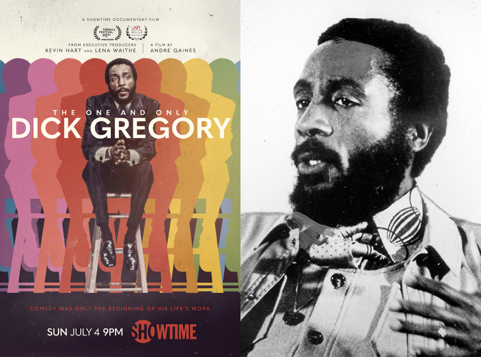
The current documentary about Dick Gregory on Showtime, The One and Only Dick Gregory, makes note of the fact that, by 1962, Gregory was probably the hottest comedian in America. In fact, one of the interview subjects, Harry Belafonte, calls him the greatest political comedian ever.
Gregory was born in St. Louis, went to high school there, and then attended Southern Illinois University on a track scholarship. He was drafted into the army and won some talent shows as a comedian. When he returned from the service, he dropped out of college and went to Chicago to try and become a professional comedian. He was one of the very few comedians who decided to make racial issues funny: “Segregation is not all bad. Have you ever heard of a collision where the people in the back of the bus got hurt?”
This kind of comedy got him noted in both Chicago and New York City. One of his first record albums, East and West, was done in New York. (Between 1961 and 1964, he did seven albums.) When he returned to Chicago, he received what most commentators note as his big break. He replaced Professor Irwin Corey for what was supposed to be one night at the Playboy Club. One of the jokes he cracked that night went like this: “I understand there are a good many Southerners in the room tonight. I know the South very well, I spent twenty years there one night.” He was such a hit that the one-night stand turned into six weeks. One notice read as follows:
Dick Gregory, age 28, has become the first Negro comedian to make his way into the nightlife club big time.
Another said:
What makes Gregory refreshing is not only that he feels secure enough to joke about the trials and triumphs of his own race, but that he can laugh, in a sort of brotherhood of humor, with white men about their own problems…
This highly successful Chicago appearance caught the attention of Jack Paar. After Steve Allen, Paar was the second steady host of The Tonight Show. It was Paar who made the show into the institution it became. Paar was not just funny. He was intelligent, informed, curious, and principled. In other words, he was just the kind of late-night host who Dick Gregory would appeal to. As the comedian later added, it was not just the fact that Paar had him on national television, it was what happened afterwards. The host invited him over to the panel to talk. That is what was important. At that time, such a display of integration was unusual. According to the film, it blew the NBC switchboard out. Because of his new notoriety, CBS newsman Mike Wallace did a profile of him.
From there it was on to the likes of Ed Sullivan and Merv Griffin. Greg, as his friends called him, also wrote an autobiography called Nigger, co-written with Robert Lipsyte. Amazingly, in nearly sixty years, that book has never been out of print.
II
At this point in the film, director/writer Andre Gaines begins to describe his subject’s transition from a pointed stand-up comic to a socio-political activist. As the sixties heated up, it wasn’t enough for Dick Gregory to say things like, “Football is the only place where a black man can knock down a white man and 40,000 people cheer.” Or, in satirizing liberals, “They all say, some of my best friends are colored, but there just aren’t that many of us.” Or in pointing out the hypocrisy of the court system: “A black guy robs a bank of $20,000 and he gets four years in Alcatraz. A white guy embezzles 3 million and he gets three years.” As civil rights demonstrations broke out in the south, Greg began to empathize with what was happening. As he put it, since he was from the north, he was not really aware of how bad the Jim Crow situation was down south. Even though he was making a lot of money at this time and he was peaking in his professional career, he decided that, whatever the consequences, he was going to get involved with the struggle for civil rights.
And he began to adjust his humor as this happened: “A white guy kills 2 black demonstrators with his car and the cop arrests the dead guy 500 yards away for leaving the scene of an accident.” He did civil rights work first for Medgar Evers, who he very much admired for his voter registration drives. Gregory also became involved with the famous case of the three missing civil rights workers in Neshoba County, Mississippi—James Chaney, Andrew Goodman, and Michael Schwerner. He suspected the sheriff’s office was involved. He then offered a reward for information on the case. The FBI followed his lead of offering reward money. It worked. The bodies were found and the case was solved.
The film notes that his publicist sued him at this time, since Greg had sacrificed $100,000 worth of appearances—the equivalent of about a million bucks today—in order to work the South with Medgar. At this time, Gregory was getting $5,000 per nightclub/concert appearance. Instead, he chose to risk getting arrested by participating in civil rights drives in places like Mississippi and Alabama.
As the film shows, he did get arrested. Beyond that, he got his arm broken while being battered with a baseball bat. (Dick Gregory and Mark Lane, Murder in Memphis, ebook version, p. 29) He was very much depressed when Evers was assassinated in the summer of 1963. But he pressed on, getting arrested even more. As he put it, what these activists were doing was more important than what he was doing. When the famous 1965 Watts riots broke out in Los Angeles, he said on TV, “I just got back from Los Angeles, Vietnam.” The film dramatizes his message at the time. Greg was saying that this was not a problem confined to the black community, it was an American problem. The film then juxtaposes excerpts from rioting in Harlem in 1964 with those from Ferguson in 2014.
From here, the film begins to show that, as Gregory now became associated with Martin Luther King, like King, he began to become a vociferous critic of the Vietnam War. And as this occurred, J. Edgar Hoover and the FBI began to keep files on the comedian; they also tapped his phone and drew up methods of neutralizing his impact. Greg decided that, for this particular anti-war message, he had to speak at colleges and universities. He began to attract large crowds and he would harangue the United States for building this Military Industrial Complex and using it against the people of Vietnam. The regents of the University of Tennessee banned him from speaking on campus. They said he was an “extreme racist” and his presence would insult much of the state’s citizenry. The students sued and they hired noted radical lawyer William Kunstler to present their case. They won in court and Gregory finally spoke there in 1970. In 1969, Gregory spoke at the huge moratorium against the war in Washington DC.
Not mentioned by the film are the comedian’s political races. Dick Gregory (unsuccessfully) ran against Richard J. Daley for the office of mayor of Chicago in 1967. He then ran as a write-in candidate for the President of the United States in 1968. (Gregory and Lane, p. 7) In some states, Mark Lane was his running mate. In some other states, his running mate was Dr. Benjamin Spock, the famous pediatrician. Gregory later wrote one of his many books about this campaign. That election attempt landed him on Richard Nixon’s enemies list.
As the film depicts, King’s assassination resulted in a huge wave of riots in well over 100 cities across America. The year 1968 almost brought the United States to a point of civil war. Gregory humorously commented on this state of siege. On stage, he would bring out a large violin case. He opened it and pulled out a tommy gun. He then pulled out a bow and started playing the machine gun.
III
At this point, the film notes that one of the methods Greg used to protest the war was by fasting. And I thought that it would be at this juncture that writer/director Andre Gaines would cut to the event that was probably the crystallization of Greg’s political career. I am, of course, referring to the night of March 6, 1975. That was when the Zapruder film was shown for the first time on national television. The three main guests that night on the program Good Night America were Geraldo Rivera as host, Robert Groden as the photo technician who had recovered a copy of the film from Life magazine, and Dick Gregory. It is not an understatement to say that the showing of this film on national TV electrified America. It put the Kennedy assassination back on the national agenda. It now became a topic of conversation at lunch and around water coolers at work.
By this time, Dick Gregory had become convinced that something had gone politically wrong with America after 1968. And, on top of that, the fact that JFK, Malcolm X, King, and Bobby Kennedy had all been snuffed out in a span of five years—that was just too much to swallow as simply a coincidence.
Gregory had known King and President Kennedy. Greg was at the March on Washington, which was sponsored by the White House and at which King had spoken so memorably. (Gregory and Lane, p. 6) He had been asked to come down to Birmingham in 1963 for the huge demonstration that several civil rights leaders had combined forces on. President Kennedy called him at home and asked him not to go, since they were working on a solution to the conflict and further demonstrations could imperil it. Greg appreciated the call, but said he felt he had to go. (ibid, pp. 30–33)
As the comedian told this reviewer, when he returned from Birmingham, his wife told him that Kennedy had called again and wanted him to return his call the moment he got in. Gregory noted the late hour, but his wife said JFK told her it did not matter what time it was. So Dick Gregory called the White House and Kennedy picked up the phone. The president said to the comedian words to the effect that he needed to know everything that happened in Birmingham. Greg went on for about ten minutes describing the whole ugly mess. When he was done, Kennedy replied with “Oh, we’ve got those bastards now!” At this comment, Gregory started weeping. (2003 Interview with Joe Madison and Gregory in Washington on WOL Radio One)
This is probably the reason he was quite interested in Kennedy’s assassination. But Greg was even closer to King. And the film shows them on stage together. In 1977, Mark Lane and Dick Gregory combined to author a book on King’s assassination. At that time, it was titled Code Name Zorro, since they had learned from FBI agent Arthur Murtaugh that “Zorro” was the FBI’s moniker for King. When it was republished in a revised version in 1993, the volume was now titled Murder in Memphis. To this day, it is a seminal book on the King case.
Very early in that volume, Gregory notes that it was when King turned against the Vietnam War that his image in the public mind was altered.
When King made his famous speech on April 4, 1967, in New York condemning the conflict in Vietnam, he was now perceived as an enemy of the Power Elite. (Gregory and Lane, p. 6) Later in the book, Greg outlines how even those involved in the civil rights movement were taken aback by King’s harsh stand on the Vietnam issue, for the simple reason that they knew that Vietnam had become President Johnson’s personal fiefdom. He was the one who had escalated that war to a magnitude beyond President Kennedy’s imagination. These other civil rights leaders understood that there was a danger that Johnson would take King’s condemnation as a personal assault and the president would turn his back on their cause. (Gregory and Lane, p. 51) And as Greg said so perceptively later in that book, King was expanding his vision of American civil rights to universal human rights. (ibid, p. 56)
King’s anti-Vietnam War speech was criticized by both the New York Times and Washington Post. It’s hard to comprehend today, but both of those MSM outlets were still supporting what Johnson was doing in Indochina at that time. (Click here for details) As Gregory notes in Murder in Memphis, it was William Pepper’s famous photo essay in Ramparts magazine that had energized King in this regard. (Click here for details)
IV
But as Gregory also points out in Murder in Memphis, the antipathy for King amid the Power Elite was exponentially increased when he also announced his plans for a Poor People’s March in Washington. There was a good reason for this march. As many commentators have noted, what had happened under Johnson was simple to comprehend. And, in fact, he himself knew it. Johnson’s vision of a Great Society had crashed on the shores of Da Nang in Vietnam. Or as King himself had declared:
Many of the very programs we are talking about have been stifled because of the war in Vietnam. I am absolutely convinced that the frustrations are going to increase in the ghettoes of our nation as along as the war continues. (Gregory and Lane, p. 54)
In other words, as King said to newsman Sander Vanocur, the dream he talked about in his March on Washington speech in 1963 had, in some respects—between the race riots and Vietnam—become a nightmare. As Gregory noted, the Poor People’s March posed the possibility of exposing this nightmare, and not just to LBJ, but congress. In fact, Murder in Memphis contains an appendix in which Senator Robert Byrd made a vituperative speech against it. (Speech of March 29, 1968) The Poor People’s March provoked meetings at the White House, the Department of Justice, the Pentagon, the Metropolitan Police, and the FBI. (ibid, p. 57; the best book on this is probably Gerald McKnight’s The Last Crusade published in 1998) The combination of King’s assassination, plus the massive interference and surveillance with the march turned it into a failure.
Dick Gregory was correct when he described King as turning in his last years towards a different agenda. About that there should be little or no doubt:
In a sense you could say we are engaged in a class struggle, yes. It will be a long and difficult struggle for our program calls for a redistribution of economic power…I feel that this movement in behalf of the poor is the most moral thing—it is saying that every man is an heir to a legacy of dignity and worth. (Speech of March, 1968)
Or as King—echoing Bobby Kennedy—put it more succinctly: “What good it is to be allowed to eat in a restaurant, if you can’t afford a hamburger.” (Sylvie Laurent, King and the Other America, p. x) As Gregory wrote in Murder in Memphis, the dilemma that King was trying to expose was multi-dimensional. It not only would pose problems for Johnson, the White House, and Congress, but it would probably be an international problem. As the comedian wrote:
What would this do to our image as the richest nation in the world? What about those countries who were not aware of America’s racial problems of poverty and hunger? … White reaction to the planned Poor People’s March was astonishing. A headline in Readers’s Digest magazine a few days before King was killed read, “The United States may face a civil crisis this April when a Poor People’s Army pitches camp in the nations’ capital. (Gregory and Lane, p. 57)
As Dick Gregory was saying, and as Sylvie Laurent amplified later, King was now trying to stretch his populist coalition. And MLK explicitly stated it in his own terms:
The unemployed poverty-stricken white man must be made to realize that he is in the very same boat with the Negro. Together, they could exert massive pressure on the government to get jobs for all. Together, they could form a grand alliance. (Laurent, p. 8)
Due to King’s murder and the powerful forces arrayed against what was left of the Poor People’s March, it failed. As Laurent wrote:
On June 24, 1968, the makeshift housing Martin Luther King Jr. had dreamt of, built on the mall in Washington DC and known as Resurrection City was wiped out. Police tear gas filled the air. Hundreds of people were arrested. Bulldozers smashed the plywood shacks. (Laurent, p. 1)
As Richard Nixon later said, it was that image and the dispersal of those people that combined to help elect him. (ibid) The grand alliance King was designing ended up dissipated. The reverse, namely Nixon’s southern strategy, was later used by Ronald Reagan, and then given broadcast voice by Rush Limbaugh and Fox News. King’s unification strategy was now somewhere in the ozone. Roger Ailes’ and Pat Buchanan’s polarization policy ruled the day.
That would have been a powerful coda with which to end The One and Only Dick Gregory.
V
The only trace of this that I could detect was near the very end of the film. On a last kind of 2015 comeback tour, two years before Greg died, there is a brief glance at Pepper’s book The Plot to Kill King on a chair. If I missed something, I hope someone can remind me of it.
So, what does approximately the last third of the film deal with? Gregory turning into a fitness expert and a health foods businessman. He moved his family to a forty-acre farm in Plymouth, Massachusetts, in 1973. He began to sell vitamins and nutrition products. He also was one of the first to argue for the primacy of natural water in everyone’s diet. He stopped playing nightclubs and there was no more alcohol consumption or smoking for him. Harking back to his college days, he became an avid runner. And his cause now was to erase world hunger. He fasted for that one also.
He created something called the Bahamian Diet nutrition drink. This ended up being very successful. After having some legal problems in the mid 1980’s which tied up much of his assets, he settled the lawsuit and sold the business for millions.
But Greg never really lost his affinity to protest injustice. Another part of his life was devoted to exposing the CIA/cocaine scandal of the late nineties. At that time, he actually went out to CIA HQ in Langley, Virginia, and unspooled yellow tape around the building. Because as he said, “We know where the criminals are.”
Andre Gaines’ film is a passable chronicle of the showbiz side of Dick Gregory, but it does not do justice to what made the man the true icon he was. Perhaps that was the price of getting people like Chris Rock and Dave Chappelle and Kevin Hart to appear. If it was not, then Gaines made a mistake. His film should be called The One and Only Dick Gregory (Censored Version).